EP2636791A1 - Cigarrete paper effective in reducing amount of visible sidestream smoke and content of carbon monoxide in mainstream smoke, and cigarrete - Google Patents
Cigarrete paper effective in reducing amount of visible sidestream smoke and content of carbon monoxide in mainstream smoke, and cigarrete Download PDFInfo
- Publication number
- EP2636791A1 EP2636791A1 EP12762832.9A EP12762832A EP2636791A1 EP 2636791 A1 EP2636791 A1 EP 2636791A1 EP 12762832 A EP12762832 A EP 12762832A EP 2636791 A1 EP2636791 A1 EP 2636791A1
- Authority
- EP
- European Patent Office
- Prior art keywords
- amount
- calcium carbonate
- cigarette
- shape
- cigarette paper
- Prior art date
- Legal status (The legal status is an assumption and is not a legal conclusion. Google has not performed a legal analysis and makes no representation as to the accuracy of the status listed.)
- Granted
Links
Images


Classifications
-
- A—HUMAN NECESSITIES
- A24—TOBACCO; CIGARS; CIGARETTES; SIMULATED SMOKING DEVICES; SMOKERS' REQUISITES
- A24D—CIGARS; CIGARETTES; TOBACCO SMOKE FILTERS; MOUTHPIECES OF CIGARS OR CIGARETTES; MANUFACTURE OF TOBACCO SMOKE FILTERS OR MOUTHPIECES
- A24D1/00—Cigars; Cigarettes
- A24D1/02—Cigars; Cigarettes with special covers
-
- D—TEXTILES; PAPER
- D21—PAPER-MAKING; PRODUCTION OF CELLULOSE
- D21H—PULP COMPOSITIONS; PREPARATION THEREOF NOT COVERED BY SUBCLASSES D21C OR D21D; IMPREGNATING OR COATING OF PAPER; TREATMENT OF FINISHED PAPER NOT COVERED BY CLASS B31 OR SUBCLASS D21G; PAPER NOT OTHERWISE PROVIDED FOR
- D21H15/00—Pulp or paper, comprising fibres or web-forming material characterised by features other than their chemical constitution
- D21H15/02—Pulp or paper, comprising fibres or web-forming material characterised by features other than their chemical constitution characterised by configuration
-
- D—TEXTILES; PAPER
- D21—PAPER-MAKING; PRODUCTION OF CELLULOSE
- D21H—PULP COMPOSITIONS; PREPARATION THEREOF NOT COVERED BY SUBCLASSES D21C OR D21D; IMPREGNATING OR COATING OF PAPER; TREATMENT OF FINISHED PAPER NOT COVERED BY CLASS B31 OR SUBCLASS D21G; PAPER NOT OTHERWISE PROVIDED FOR
- D21H17/00—Non-fibrous material added to the pulp, characterised by its constitution; Paper-impregnating material characterised by its constitution
- D21H17/03—Non-macromolecular organic compounds
- D21H17/05—Non-macromolecular organic compounds containing elements other than carbon and hydrogen only
- D21H17/14—Carboxylic acids; Derivatives thereof
-
- D—TEXTILES; PAPER
- D21—PAPER-MAKING; PRODUCTION OF CELLULOSE
- D21H—PULP COMPOSITIONS; PREPARATION THEREOF NOT COVERED BY SUBCLASSES D21C OR D21D; IMPREGNATING OR COATING OF PAPER; TREATMENT OF FINISHED PAPER NOT COVERED BY CLASS B31 OR SUBCLASS D21G; PAPER NOT OTHERWISE PROVIDED FOR
- D21H17/00—Non-fibrous material added to the pulp, characterised by its constitution; Paper-impregnating material characterised by its constitution
- D21H17/63—Inorganic compounds
- D21H17/64—Alkaline compounds
-
- D—TEXTILES; PAPER
- D21—PAPER-MAKING; PRODUCTION OF CELLULOSE
- D21H—PULP COMPOSITIONS; PREPARATION THEREOF NOT COVERED BY SUBCLASSES D21C OR D21D; IMPREGNATING OR COATING OF PAPER; TREATMENT OF FINISHED PAPER NOT COVERED BY CLASS B31 OR SUBCLASS D21G; PAPER NOT OTHERWISE PROVIDED FOR
- D21H17/00—Non-fibrous material added to the pulp, characterised by its constitution; Paper-impregnating material characterised by its constitution
- D21H17/63—Inorganic compounds
- D21H17/66—Salts, e.g. alums
-
- D—TEXTILES; PAPER
- D21—PAPER-MAKING; PRODUCTION OF CELLULOSE
- D21H—PULP COMPOSITIONS; PREPARATION THEREOF NOT COVERED BY SUBCLASSES D21C OR D21D; IMPREGNATING OR COATING OF PAPER; TREATMENT OF FINISHED PAPER NOT COVERED BY CLASS B31 OR SUBCLASS D21G; PAPER NOT OTHERWISE PROVIDED FOR
- D21H17/00—Non-fibrous material added to the pulp, characterised by its constitution; Paper-impregnating material characterised by its constitution
- D21H17/63—Inorganic compounds
- D21H17/67—Water-insoluble compounds, e.g. fillers, pigments
- D21H17/675—Oxides, hydroxides or carbonates
-
- D—TEXTILES; PAPER
- D21—PAPER-MAKING; PRODUCTION OF CELLULOSE
- D21H—PULP COMPOSITIONS; PREPARATION THEREOF NOT COVERED BY SUBCLASSES D21C OR D21D; IMPREGNATING OR COATING OF PAPER; TREATMENT OF FINISHED PAPER NOT COVERED BY CLASS B31 OR SUBCLASS D21G; PAPER NOT OTHERWISE PROVIDED FOR
- D21H21/00—Non-fibrous material added to the pulp, characterised by its function, form or properties; Paper-impregnating or coating material, characterised by its function, form or properties
- D21H21/50—Non-fibrous material added to the pulp, characterised by its function, form or properties; Paper-impregnating or coating material, characterised by its function, form or properties characterised by form
- D21H21/52—Additives of definite length or shape
-
- Y—GENERAL TAGGING OF NEW TECHNOLOGICAL DEVELOPMENTS; GENERAL TAGGING OF CROSS-SECTIONAL TECHNOLOGIES SPANNING OVER SEVERAL SECTIONS OF THE IPC; TECHNICAL SUBJECTS COVERED BY FORMER USPC CROSS-REFERENCE ART COLLECTIONS [XRACs] AND DIGESTS
- Y10—TECHNICAL SUBJECTS COVERED BY FORMER USPC
- Y10T—TECHNICAL SUBJECTS COVERED BY FORMER US CLASSIFICATION
- Y10T428/00—Stock material or miscellaneous articles
- Y10T428/25—Web or sheet containing structurally defined element or component and including a second component containing structurally defined particles
- Y10T428/258—Alkali metal or alkaline earth metal or compound thereof
-
- Y—GENERAL TAGGING OF NEW TECHNOLOGICAL DEVELOPMENTS; GENERAL TAGGING OF CROSS-SECTIONAL TECHNOLOGIES SPANNING OVER SEVERAL SECTIONS OF THE IPC; TECHNICAL SUBJECTS COVERED BY FORMER USPC CROSS-REFERENCE ART COLLECTIONS [XRACs] AND DIGESTS
- Y10—TECHNICAL SUBJECTS COVERED BY FORMER USPC
- Y10T—TECHNICAL SUBJECTS COVERED BY FORMER US CLASSIFICATION
- Y10T428/00—Stock material or miscellaneous articles
- Y10T428/27—Web or sheet containing structurally defined element or component, the element or component having a specified weight per unit area [e.g., gms/sq cm, lbs/sq ft, etc.]
- Y10T428/273—Web or sheet containing structurally defined element or component, the element or component having a specified weight per unit area [e.g., gms/sq cm, lbs/sq ft, etc.] of coating
- Y10T428/277—Cellulosic substrate
Definitions
- This invention relates to a cigarette paper and a cigarette, and more specifically relates to a cigarette paper and a cigarette reducing a visible sidestream smoke amount and a carbon monoxide amount in mainstream smoke.
- a cigarette (low sidestream smoke cigarette) having a small amount of sidestream smoke to be generated has been developed. Whether such a cigarette actually has a small amount of sidestream smoke to be generated is usually determined by a so-called fishtail method (described in Health Canada Test Method T-212). In this fishtail method, the amount of total particulate matter in sidestream smoke is measured, and the amount of the total particulate matter is considered as a sidestream smoke amount.
- Patent Document 1 discloses that magnesium hydroxide gel is added
- Patent Document 2 discloses that a filler having a high-specific surface area formed of calcium carbonate and so on is added.
- Patent Document 3 discloses a cigarette paper which can reduce the sidestream smoke amount according to visual observation (also referred to as the visible sidestream smoke amount in this specification) rather than the sidestream smoke amount according to the fishtail method.
- This cigarette paper contains calcium carbonate in an amount of 30 g/m 2 or more and a combustion regulating agent such as potassium citrate in an amount of 3% by weight or more.
- an object of the invention is to provide a cigarette paper which can reduce a visible sidestream smoke amount and at the same time can reduce a carbon monoxide amount in a mainstream smoke.
- this invention provides a cigarette paper having a grammage of 40 to 55 g/m 2 and containing calcium carbonate in an amount of 18 g/m 2 or more.
- This invention further provides a cigarette including a cigarette rod including tobacco shreds wrapped into a rod shape with the cigarette paper, and a filter coaxially connected to an end of the cigarette rod by a tipping paper.
- a cigarette paper and a cigarette according to this invention reduce the amount of sidestream smoke generated and the amount of carbon monoxide in main stream smoke.
- the cigarette paper according to this invention has a grammage of 40 to 55 g/m 2 and contains calcium carbonate in an amount of 18 g/m 2 or more.
- Pulp fiber used in the cigarette paper according to this invention can be constituted of flax pulp fiber used in a typical cigarette paper, wood pulp fiber (hardwood pulp, softwood pulp), and so on.
- the cigarette paper according to this invention is prepared by mixing 18 g/m 2 or more of calcium carbonate with the pulp fiber.
- Calcium carbonate is contained in the form of particles, and although the particle diameter can be suitably selected in terms of cost and ease of papermaking, the particle diameter is preferably 0.02 to 10 ⁇ m.
- the content of calcium carbonate is preferably 29 g/m 2 or less.
- the content of calcium carbonate is more preferably 20 to 25 g/m 2 .
- the content of calcium carbonate means the amount of calcium carbonate contained in a cigarette paper after manufacture.
- the amount of calcium carbonate in the cigarette paper can be obtained by extracting and then quantifying calcium ions as described in an example to be described later.
- Calcium carbonate used in this invention is a synthetic calcium carbonate synthesized by chemical reaction, and primary particles of the synthetic calcium carbonate are all in substantially the same shape and size and are homogeneous.
- primary particles refers to fundamental particles constituting a power immediately after synthesis by chemical reaction
- secondary particles refers to an aggregate formed by agglomeration of a large number of primary particles.
- the shape of the primary particles of calcium carbonate to be used is not particularly limited, and the primary particles having any shape of a spindle shape, a cubic shape, a columnar shape, and a needle shape can be used.
- the primary particles having a columnar shape or a needle shape when calcium carbonate in which the primary particles have a columnar shape or a needle shape is used, the amount of carbon monoxide in mainstream smoke is significantly reduced in comparison with the case of using calcium carbonate having another shape.
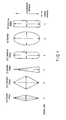
- FIG. 1 shows a typical shape of a primary particle of calcium carbonate.
- the primary particle shown in FIG. 1 have a shape extending in one direction.
- the direction of extension of the particle is the longitudinal direction, and the maximum value in the longitudinal direction is referred to as the length (L).
- the direction perpendicular to the longitudinal direction is the lateral direction, and the maximum value in the lateral direction is referred to as the width (W).
- the ratio of length (L) to width (W) of the primary particle is referred to as an aspect ratio.
- the ratio (aspect ratio) of the length (L) to the width (W) of the columnar or needle-shaped primary particle is preferably not less than 4 and less than 10. Both the columnar particle and the needle-shaped particle refer to particles having an aspect ratio of not less than 4 ( FIG.
- the columnar shape and the needle shape can be distinguished by whether or not the primary particle observed with an electron microscope has a pointed shape. Namely, the columnar shape does not have a pointed shape (FIGS. 1(d) and (f)) , and the needle shape has a pointed shape (FIGS. 1(a) and (c)).
- the needle shape may have a pointed shape at the both ends in the extending direction of the particle or may have the pointed shape at one end.
- the columnar shape includes not only a circular cylindrical shape but also a truncated conical shape.
- the width (W) and the length (L) of the primary particle can be measured using a scanning electron microscope, for example.
- the primary particle has a columnar shape or a needle shape
- the shape of the secondary particle formed by agglomeration in a process of typical papermaking has a bur shape.
- the bur shape represents an agglomeration shape in which tens to thousands of primary particles having a columnar or needle shape are three-dimensionally entangled.
- FIG. 2 schematically shows an example of the bur shape.
- the bur shape has a central core body at its center, a large number of primary particles may protrude from the central core body, and the bur shape may not have the central core body at its center.
- Calcium carbonate in which the secondary particles have a bur shape is commercially available as Cal-light-SA (Shiraishi Kogyo Kaisha, Ltd.) and bur-shaped calcium carbonate (Newlime Co., Ltd.), for example.
- calcium carbonate in which the secondary particles are in the form of a bur shape When calcium carbonate in which the secondary particles are in the form of a bur shape is used, calcium carbonate in the form of the primary particle (having a columnar or needle shape) may be contained in pulp fiber, calcium carbonate in the form of the secondary particle (having a bur shape) may be contained in the pulp fiber, or calcium carbonate as a mixture having the forms of the primary particle and the secondary particle may be contained in the pulp fiber. In each case, calcium carbonate has a bur shape in the cigarette paper.
- the primary particles of calcium carbonate have a columnar or needle shape. More preferably, an average aspect ratio of the primary particles falls within the range of not less than 4 and less than 10, and an average length (L) of the primary particles is 0.1 to 1.5 ⁇ m. It is still more preferable that the density of the obtained cigarette paper is 0.4 to 1.0 g/m 3 .
- representative plural (at least 50, and for example, 50 to 200) particles are selected, the aspect ratio is obtained by measuring the width (W) and the length (L) of the primary particles for each particle, and an average value of the aspect ratio is obtained, whereby the average aspect ratio can be obtained.
- the average length (L) representative plural (at least 50, and for example, 50 to 200) particles are selected, the length (L) of each particle is measured, and an average value of the length (L) is obtained, whereby the average length (L) can be obtained.
- the cigarette paper according to this invention has a grammage of 40 to 55 g/m 2 . It is more preferable that the grammage of the cigarette paper is 42 to 50 g/m 2 .
- the cigarette paper according to this invention may contain a combustion regulating agent.
- a combustion regulating agent an alkali metal citrate is preferably used, and particularly preferred are potassium citrate and sodium citrate, and these combustion regulating agents may be used alone or may be used in combination.
- the cigarette paper preferably contains the combustion regulating agent in an amount of 1.0 to 5.0% by weight, and more preferably 1.5 to 4.0% by weight.
- the cigarette paper according to this invention reduces the amount of visible sidestream smoke of a cigarette and, at the same time, can reduce the amount of carbon monoxide in mainstream smoke in comparison with a conventional cigarette paper.
- the cigarette paper according to this invention can be used as a cigarette paper of a cigarette with a filter.
- a cigarette which includes a cigarette rod including tobacco shreds wrapped into a rod shape with the cigarette paper of the invention and a filter coaxially connected to an end of the cigarette rod by a tipping paper.
- the amount of carbon monoxide in mainstream smoke can be measured as the carbon monoxide amount per smoke draft obtained by dividing the total amount per cigarette in specified cigarette smoking conditions (Health Canada Test Method: 55 ml/2 s) by the total number of smoke drafts.
- the amount of visible sidestream smoke can be measured by sensory evaluation, the amount of visible sidestream smoke can be simply measured using a visible sidestream smoke amount measuring apparatus disclosed in Japanese Patent No. 3683792 (or Patent Literature 3).
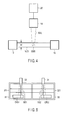
- the visible sidestream smoke amount measuring apparatus will be hereinafter described using FIGS. 3 and 4 (reproductions of FIGS. 1 and 2 of the Japanese Patent No. 3683792 ) for confirmation.
- FIG. 3 is a schematic perspective view showing the visible sidestream smoke amount measuring apparatus disclosed in the Japanese Patent No. 3683792 .
- FIG. 4 is a block diagram schematically showing a configuration of the visible sidestream smoke amount measuring apparatus.
- a visible sidestream smoke amount measuring apparatus 10 is provided with a spontaneous combustion chamber 11 for a smoking article, a visible light emitting unit 12 used for applying a predetermined visible light beam to sidestream smoke, generated by spontaneous combustion of the smoking article and naturally rising (moving up) in the spontaneous combustion chamber 1, in a direction substantially perpendicular to a direction of a flow of the sidestream smoke, and a scattered light intensity detection unit 14 used for detecting, as an index of the amount of visible sidestream smoke, the intensity of scattered light scattered by sidestream smoke in a direction substantially perpendicular to the direction of the visible light beam.
- the spontaneous combustion chamber 11 is formed of a light-shielding material and constituted of a rectangular parallelepiped tubular body elongated in a longitudinal direction prescribed by four sidewalls 11a to 11d, for example.
- Sidewall 11a has in its lower portion a smoking article insertion opening 111 through which a smoking article SA such as a lit cigarette is fitted in the spontaneous combustion chamber 11.
- the four sidewalls 11a to 11d prescribing the spontaneous combustion chamber 11 respectively have ventilation windows 112 to 115 such as mesh windows at their lowermost end portions so that air required for spontaneous combustion of the smoking article SA can be supplied in the spontaneous combustion chamber 11.
- the position of the insertion opening 111 for a smoking article is set to a position where sidestream smoke SSS from the smoking article SA fitted in the spontaneous combustion chamber 11 through the insertion opening 111 passes through the ventilation windows 112 to 115 is not affected by disturbance of outside air entering inside the spontaneous combustion chamber 11, and a distance from the smoking article SA to the upper end of the spontaneous combustion chamber 11 is sufficient such that the sidestream smoke SSS is not substantially swayed.
- Glass beads are filled in a bottom space of the spontaneous combustion chamber 11 surrounded by the ventilation windows 112 to 115 so that the flow of the sidestream smoke SSS rising in the spontaneous combustion chamber 11 due to spontaneous combustion of the smoking article is not disturbed, whereby an air flow rectifying layer can be formed.
- the upper end of the spontaneous combustion chamber 11 is opened.
- An exhaust hood 15 can be installed at the open end for the purpose of exhausting in the spontaneous combustion chamber 11.
- the spontaneous combustion chamber 11 is required to be exhausted so as to avoid substantial influence on the spontaneous combustion of the smoking article SA.
- a rectification filter 16 is attached across an upper open end of the spontaneous combustion chamber 11.
- the exhaust hood 15 has an exhaust duct 151 on its top, and the exhaust duct 151 is connected to an exhaust system (not shown).
- the visible light emitting unit 12 is provided outside the spontaneous combustion chamber 11.
- the visible light emitting unit 12 is provided outside sidewall 11b facing sidewall 11a of the spontaneous combustion chamber 11 in which the smoking article SA is inserted.
- a visible light transmission window 116 is provided at a portion of sidewall 11b facing the visible light emitting unit 12.
- the visible light emitting unit 12 has a visible light source (not shown) and applies a visible light beam VLB to the sidestream smoke SSS, generated by the spontaneous combustion of the smoking article SA and naturally rising in the spontaneous combustion chamber 11, in the direction substantially perpendicular to the direction of the flow of the sidestream smoke SSS.
- a visible light source is not limited especially as long as the visible light is emitted, and although a visible light laser, a visible light-emitting diode, a halogen lamp, and so on can be used, for example, an A light source specified by international commission on illumination is representatively used.
- the visible light beam (visible light flux) VLB emitted from the visible light emitting unit 12 has a substantial cross-sectional surface in which the visible light can be applied to the sidestream smoke SSS naturally rising in the spontaneous combustion chamber 11 while, even if the sidestream smoke SSS is somewhat swayed, the sway is sufficiently covered.
- the visible light beam VLB has a width w ( FIG. 4 ) in the direction perpendicular to the irradiation direction and, at the same time, has a rectangular cross section having a height in a direction substantially perpendicular to the irradiation direction of the visible light beam VLB so as to correspond to a visual field in the sensory evaluation in consideration of a human visual field.
- the width w is at least equal to a sway width of the sidestream smoke SSS in the direction perpendicular to the irradiation direction of the visible light beam.
- the cross-sectional surface of the visible light beam is not limited to a rectangular shape and may be an elliptical shape, a circular shape, and so on.
- a mask having an opening corresponding to the cross-sectional surface of the visible light beam may be used, or a lens system constituted of a combination of a convex lens and a concave lens may be used, for example, and the shaping itself can be performed by a well-known method.
- a light absorption unit 13 used for absorbing/removing all light emitted from the visible light emitting unit 12 and transmitted through the sidestream smoke SSS so that measurement is not affected is provided outside the spontaneous combustion chamber 11 facing the visible light emitting unit 12 and, in the example shown in FIG. 3 , provided outside sidewall 11a.
- a visible light transmission window 117 is provided at a portion of sidewall 11a facing the light absorption unit 13.
- a scattered light intensity detection unit 14 is provided outside the spontaneous combustion chamber 11 in the direction perpendicular to the direction of the light beam emitted from the light intensity detection unit 12, and in an example shown in FIG. 3 , the scattered light intensity detection unit 14 is provided outside sidewall 11d.
- a visible light transmission window 118 is provided at a portion of sidewall 11d facing the scattered light intensity detection unit 14.
- the scattered light intensity detection unit 14 detects the intensity of scattered light (hereinafter referred to as 90 degree scattered light) SVL scattered in the direction substantially perpendicular to the irradiation direction of the visible light beam VLB among the light applied to the sidestream smoke SSS and scattered by the sidestream smoke SSS.
- the scattered light intensity detection unit 14 is provided in itself with a well-known optical system (not shown) used for collecting the 90 degree scattered light SVL and has a photoelectric converter (not shown) which converts the collected 90 degree scattered light SVL into an electrical signal and outputs the electrical signal.
- a photoelectric converter a photomultiplier which converts light into a voltage signal can be preferably used.
- the converted voltage signal is subjected to analog-to-digital conversion, for example, and then can be subjected to data sampling with a personal computer.
- Data acquisition interval and acquisition time can be arbitrarily set, and typically measurement at 300 points can be performed at an interval of 0.2 seconds for 1 minute.
- the detected intensity of the 90 degree scattered light SVL correlates very well with the amount of visible sidestream smoke, and as the detected intensity of the 90 degree scattered light is large, it can be determined that the amount of visible sidestream smoke is relatively large. It was shown that the intensity of the 90 degree scattered light does not correlate with the total amount of particulate matter in the sidestream smoke.
- the spontaneous combustion chamber 11 has a rectangular solid shape of 11 cm ⁇ 11 cm having a height of 80 cm, and the smoking article insertion opening 111 is provided at a position of 50 cm from the lower end of the spontaneous combustion chamber 11, a distance from the smoking article SA to the center of visible light beam is 10 cm, and the visible light beam emitted from the visible light emitting unit has a cross section with a size of 5 cm ⁇ 5 cm.
- the visible sidestream smoke amount measuring apparatus preferably has conversion table means 20 that converts the 90 degree scattered light intensity detected by the scattered light intensity detection unit 14 into the amount of visible sidestream smoke and outputs the amount of visible sidestream smoke based on a correlative relationship between the 90 degree scattered light intensity and the amount of visible sidestream smoke.
- the conversion table means the correlative relationship between the 90 degree scattered light intensity obtained in advance and the amount of visible sidestream smoke is input as a conversion equation, a calibration curve, and so on, a 90 degree scattered light intensity signal output from the scattered light intensity detection unit 14 is converted into the amount of visible sidestream smoke, and the amount of visible sidestream smoke is output.
- the amount of visible sidestream smoke of the smoking articles such as a large number of cigarettes is first evaluated by sensory evaluation according to a two-point comparison method, and the amount of visible sidestream smoke is converted into a number.
- the 90 degree scattered light intensity of the same smoking article detected by this apparatus is measured.
- the calibration curve can be obtained by plotting obtained measured values.
- the conversion equation from the 90 degree scattered light intensity to the amount of visible sidestream smoke can be obtained based on the calibration curve.
- the sensory evaluation according to the two-point comparison method can be performed using a visible sidestream smoke amount evaluation apparatus shown in FIG. 5 , for example.
- a standard cigarette CIG1 and a target cigarette CIG2 are spontaneously combusted in two bilaterally symmetric spontaneous combustion chambers 31 and 32, and there is employed such a questionnaire that with respect to the standard cigarette CIG1 having 5 points, how much the amount of sidestream smoke of the target cigarette CIG2 is observed within a range of 0 to 10 points.
- the chambers 31 and 32 are provided respectively with observation windows 311 and 321 having a fixed longitudinal width, and visible light sources 33 and 34 are provided in the upper portions of the respective chambers.
- each longitudinal width of the observation windows 311 and 321 corresponds to the height of the visible light beam emitted from the visible light emitting unit 12 of the visible sidestream smoke amount measuring apparatus, and the distance from the cigarettes CIG1 and CIG2 to the lower ends of the observation windows 311 and 321 corresponds to a distance from the smoking article SA at the lower end of the visible light beam emitted from the visible light emitting unit 12 of the visible sidestream smoke amount measuring apparatus.
- the visible light from the visible light sources 33 and 34 is applied from above to the sidestream smokes SS1 and SS2, and the sidestream smokes SS1 and SS2 are observed only from the observation windows 311 and 321.
- the 90 degree scattered light intensity obtained by the visible sidestream smoke amount measuring apparatus correlates very well with amount of the visible sidestream smoke in the sensory evaluation, and this fact is demonstrated in Japanese Patent No. 3897700 .
- the sensory evaluation according to the two-point comparison method is performed using the visible sidestream smoke amount evaluating apparatus shown in FIG. 5 , it is confirmed that when a value of visible sidestream smoke amount/SBR (hereinafter referred to as the amount of visible sidestream smoke) shown as an index in this example is not more than 5.0 ⁇ 10 -2 (min/mm), it can be determined that the amount of visible sidestream smoke according to the sensory evaluation is sufficiently reduced with respect to a standard typical cigarette.
- calcium carbonate PCX-850 and Cal-light-SA were purchased from Shiraishi Kogyo Kaisha, Ltd.
- needle-shaped calcium carbonate and bur-shaped calcium carbonate were purchased from Newlime Co., Ltd.
- the primary particle of PCX-850 has a spindle shape, and although the primary particles form the secondary particle, a bur shape is not formed.
- the primary particle of Cal-light-SA has a columnar shape, and the primary particles are agglomerated to form a bur-shaped secondary particles.
- the primary particle of the needle-shaped calcium carbonate has a needle shape, and the primary particles does not form the secondary particle.
- the primary particle of bur-shaped calcium carbonate has a needle shape, and the primary particles are agglomerated to form the bur-shaped secondary particle.
- a pulp mixture in which the weight ratio of bleached broad leaf tree kraft pulp (LBKP) to bleached coniferous tree kraft pulp (NBKP) is 8:2 is beaten so that a freeness is about 100 mL in Canadian Standard Freeness, and calcium carbonate shown in Table 1 as a filler is added to the beaten pulp mixture in a content shown in Table 1.
- a cigarette paper (the grammage is shown in Table 1) is subjected to papermaking by a TAPPI standard sheet machine. Potassium citrate aqueous solution as a combustion regulating agent is coated onto a surface of the obtained cigarette paper so that potassium citrate in an amount of 3 to 4 wt% on the dry base is contained in the cigarette paper.
- This cigarette paper is matched for two or more days under conditions of a temperature of 22°C and a relative humidity of 60% and cut into a predetermined length.
- ultrasonic extraction is performed for 30 minutes in 0.3 N aqueous hydrochloric acid, and calcium carbonate is quantified as calcium ions by a capillary electrophoresis system (7100) manufactured by Agilent Technologies, and calcium ions are converted into calcium carbonate, whereby the amount of calcium carbonate in the cigarette paper is obtained.
- a cigarette is produced by a tobacco roller (Rizla).
- the circumference is 22.6 mm, and the length is 67 mm.
- a normal filter (having a length of 31 mm) is provided to be mounted on one end of the cigarette with the use of a tipping paper.
- the filling amount of the tobacco shreds is 0.515 g per cigarette.
- the amount of visible sidestream smoke of the obtained cigarette is measured using an apparatus shown in FIGS. 3 and 4 , the amount of carbon monoxide in mainstream smoke is measured using a Micro-GC (3000A) manufactured by Agilent Technologies, and the amount of carbon monoxide per smoke (puff) is calculated.
- the amount of visible sidestream smoke of each cigarette is standardized with a visible sidestream smoke amount measured value in a standard cigarette (reference cigarette 3R4F) (accordingly, the unit is nondimensional).
- the standardized amount of visible sidestream smoke is divided by the spontaneous combustion rate (SBR) (unit: mm/min) of a cigarette. SBR is measured at an atmosphere linear velocity of 200 mm/s. The results are indicated in Table 1.
- the reference example is an example of using calcium carbonate (Unibur-70) (although it is not available now, it is stored by the present applicant) described in Jpn. Pat. Appln. KOKAI Publication No. 59-94700.
- Table 1 Examples Cigarette paper Cigarette Calcium carbonate Cigarette paper grammage (g/m 2 ) Visible sidestream smoke amount/SBR (min/mm) CO amount in mainstream smoke (mg/puff) Kind Content (g/m 2 ) Comparative Example 1 PCX-850 11.0 43.6 7.3 ⁇ 10 -2 4.6 Comparative Example 2 15.0 45.0 6.8 ⁇ 10 -2 4.5 Example 1 18.8 47.0 4.7 ⁇ 10 -2 4.3 Example 2 23.5 47.1 4.4 ⁇ 10 -2 3.4 Example 3 28.0 47.2 4.8 ⁇ 10 -2 3.9 Example 4 25.0 53.0 4.8 ⁇ 10 -2 4.1 Comparative Example 3 30.0 63.0 3.3 ⁇ 10 -2 5.0 Reference Example Unibur-70 10.5 27.5 7.8 ⁇ 10 -2 3.3
- the yield of calcium carbonate with respect to the amount of pulp in the cigarette paper depends on the amount of pulp, it is considered that the maximum value is 40 to 60%, and when the yield is 40 to 50%, the grammage of the cigarette paper required for maintaining not less than 18 g/m 2 of calcium carbonate is assumed to be not less than 40 g/m 2 .
- the grammage is required to be increased, and accompanying this, the amount of carbon monoxide in the sidestream smoke is increased.
- the comparative example 3 that when the grammage is more than 55 g/m 2 , although there is a tendency to reduce the amount of visible sidestream smoke, the amount of carbon monoxide in the mainstream smoke is increased.
- the cigarette paper has a grammage of 40 to 55 g/m 2 and contains calcium carbonate in an amount of not less than 18 g/m 2 , the amount of sidestream smoke generated and the amount of carbon monoxide in the mainstream smoke can be reduced.
- the cigarette paper has a grammage of 42 to 50 g/m 2 and contains calcium carbonate in an amount of 20 to 25 g/m 2 , it is possible to expect greater effects.
- a cigarette paper is manufactured as in the above examples to produce a cigarette except that the grammage of the cigarette paper and the kind of calcium carbonate are changed as shown in the following Table 2.
- the amount of visible sidestream smoke and the amount of carbon monoxide in the main stream smoke of the obtained cigarette are measured. Further, with regard to the obtained cigarette paper, in order to examine a mechanism in which the amount of carbon monoxide in the main stream smoke is reduced, the density of the cigarette paper is measured. The results are shown in Table 2.
- the length (L) of the primary particle described in Table 2 is an average of the length (L) of 100 primary particles measured by means of Winroof image analysis software (Mitani Corporation) using an SEM image captured with a JSM-5310 scanning electron microscope manufactured by JEOL. Although the aspect ratio of calcium carbonate used in this example is indicated in Table 2, the width (W) of the primary particle is measured in a similar manner to the length (L) of the primary particle, and the ratio (L/W) of the length (L) of the primary particle to the width (W) is calculated.
- Example 6 Cal-light-SA Columnar 1.21 9.5 45.1 0.52 3.0 4.8 ⁇ 10 -2 * Shiraishi Kogyo Kaisha, Ltd. Nominal value (long diameter) is described
- a suitable aspect ratio (L/W) of the columnar or needle-shaped calcium carbonate is preferably not less than 4 and less than 10.
- the visible sidestream smoke falls within a range of not more than 5.0 ⁇ 10 -2 (min/mm), and therefore, it can be said that the amount of visible sidestream smoke can be sufficiently reduced.
- a cigarette paper is manufactured as in the above examples to produce a cigarette except that the grammage of the cigarette paper and the kind of calcium carbonate are changed as shown in the following Table 3.
- the amount of visible sidestream smoke and the amount of carbon monoxide in the main stream smoke of the obtained cigarette are measured.
- the results are indicated in Table 3.
- the length (L) of the primary particle described in Table 3 is an average of the length (L) of 100 primary particles measured according to the above method.
- the primary particles of bur-shaped calcium carbonate have an average aspect ratio of 6.7, and the primary particles of Cal-light-SA have an average aspect ratio of 9.5.
- Example 8 Cal-light-SA Columnar 1.21 23.6 48.1 3.2 3.0 ⁇ 10 -2
- a cigarette paper is manufactured as in the above examples to produce a cigarette except that the grammage of the cigarette paper and the kind of calcium carbonate are changed as shown in the following Table 4.
- the amount of visible sidestream smoke and the amount of carbon monoxide in the mainstream smoke of the obtained cigarette are measured.
- the results are indicated in Table 4.
- the primary particles have a needle shape
- the average length (L) of the primary particles is 3.3 ⁇ m
- the average aspect ratio of the primary particles is 8.0
- the secondary particles have a bur shape.
- the primary particles have a needle shape, the average length (L) of the primary particles is 4.8 ⁇ m, and the average aspect ratio of the primary particles is 6.7; however, the secondary particles does not have a bur shape.
- the bur-shaped calcium carbonate and the needle-shaped calcium carbonate in which the values of the lengths (L) of the primary particles are approximately close to each other are compared, whereby the influence of whether or not the secondary particles are in the form of a bur shape on the amount of visible sidestream smoke and the amount of carbon monoxide in the mainstream smoke can be verified.
- Example 9 Needle-shaped calcium carbonate Needle-shape Without 24.5 49.8 4.7 3.7 ⁇ 10 -2
- the size of the primary particles is small, and the secondary particles have a bur shape, it is guessed that the density of the cigarette paper is reduced most, and the carbon monoxide amount in the mainstream smoke is reduced most.
Landscapes
- Chemical & Material Sciences (AREA)
- Inorganic Chemistry (AREA)
- Paper (AREA)
- Cigarettes, Filters, And Manufacturing Of Filters (AREA)
Abstract
Description
- This invention relates to a cigarette paper and a cigarette, and more specifically relates to a cigarette paper and a cigarette reducing a visible sidestream smoke amount and a carbon monoxide amount in mainstream smoke.
- Recently, a cigarette (low sidestream smoke cigarette) having a small amount of sidestream smoke to be generated has been developed. Whether such a cigarette actually has a small amount of sidestream smoke to be generated is usually determined by a so-called fishtail method (described in Health Canada Test Method T-212). In this fishtail method, the amount of total particulate matter in sidestream smoke is measured, and the amount of the total particulate matter is considered as a sidestream smoke amount.
- In order to provide a cigarette having a small amount of sidestream smoke to be generated, a filler which is a compound exhibiting combustion inhibiting effect is added to a cigarette paper. For example,
Patent Document 1 discloses that magnesium hydroxide gel is added, andPatent Document 2 discloses that a filler having a high-specific surface area formed of calcium carbonate and so on is added. - Meanwhile, Patent Document 3 discloses a cigarette paper which can reduce the sidestream smoke amount according to visual observation (also referred to as the visible sidestream smoke amount in this specification) rather than the sidestream smoke amount according to the fishtail method. This cigarette paper contains calcium carbonate in an amount of 30 g/m2 or more and a combustion regulating agent such as potassium citrate in an amount of 3% by weight or more.
- Patent Literature
- Patent Literature 1: Jpn. Pat. Appln. KOKOKU Publication No.
63-37621 - Patent Literature 2: Japanese Patent No.
2730894 - Patent Literature 3: Japanese Patent No.
3897700 - Although the low sidestream smoke cigarette according to the prior art significantly reduces the sidestream smoke amount, there is a tendency to increase the carbon monoxide amount in the mainstream smoke.
- Accordingly, an object of the invention is to provide a cigarette paper which can reduce a visible sidestream smoke amount and at the same time can reduce a carbon monoxide amount in a mainstream smoke.
- In order to solve the above problem, this invention provides a cigarette paper having a grammage of 40 to 55 g/m2 and containing calcium carbonate in an amount of 18 g/m2 or more.
- This invention further provides a cigarette including a cigarette rod including tobacco shreds wrapped into a rod shape with the cigarette paper, and a filter coaxially connected to an end of the cigarette rod by a tipping paper.
- A cigarette paper and a cigarette according to this invention reduce the amount of sidestream smoke generated and the amount of carbon monoxide in main stream smoke.
-
-
FIG. 1 is a view schematically showing a typical shape of primary particles of calcium carbonate. -
FIG. 2 is a view schematically showing an example of secondary particles having a bur shape. -
FIG. 3 is a schematic perspective view showing an apparatus which measures the amount of visible sidestream smoke of a smoking article according to the present invention. -
FIG. 4 is a block diagram schematically showing a constitution of the apparatus which measures the amount of visible sidestream smoke of the smoking article according to the present invention. -
FIG. 5 is a schematic diagram showing a visible sidestream smoke amount evaluation apparatus which can be used in sensory evaluation. - Hereinafter, the present invention will be explained in detail.
- The cigarette paper according to this invention has a grammage of 40 to 55 g/m2 and contains calcium carbonate in an amount of 18 g/m2 or more.
- Pulp fiber used in the cigarette paper according to this invention can be constituted of flax pulp fiber used in a typical cigarette paper, wood pulp fiber (hardwood pulp, softwood pulp), and so on.
- The cigarette paper according to this invention is prepared by mixing 18 g/m2 or more of calcium carbonate with the pulp fiber. Calcium carbonate is contained in the form of particles, and although the particle diameter can be suitably selected in terms of cost and ease of papermaking, the particle diameter is preferably 0.02 to 10 µm. The content of calcium carbonate is preferably 29 g/m2 or less. The content of calcium carbonate is more preferably 20 to 25 g/m2. In this specification, the content of calcium carbonate means the amount of calcium carbonate contained in a cigarette paper after manufacture. The amount of calcium carbonate in the cigarette paper can be obtained by extracting and then quantifying calcium ions as described in an example to be described later.
- Calcium carbonate used in this invention is a synthetic calcium carbonate synthesized by chemical reaction, and primary particles of the synthetic calcium carbonate are all in substantially the same shape and size and are homogeneous. In this specification, the term "primary particles" refers to fundamental particles constituting a power immediately after synthesis by chemical reaction, and the term "secondary particles" refers to an aggregate formed by agglomeration of a large number of primary particles.
- The shape of the primary particles of calcium carbonate to be used is not particularly limited, and the primary particles having any shape of a spindle shape, a cubic shape, a columnar shape, and a needle shape can be used. However, when calcium carbonate in which the primary particles have a columnar shape or a needle shape is used, the amount of carbon monoxide in mainstream smoke is significantly reduced in comparison with the case of using calcium carbonate having another shape.
-
FIG. 1 shows a typical shape of a primary particle of calcium carbonate. The primary particle shown inFIG. 1 have a shape extending in one direction. The direction of extension of the particle is the longitudinal direction, and the maximum value in the longitudinal direction is referred to as the length (L). The direction perpendicular to the longitudinal direction is the lateral direction, and the maximum value in the lateral direction is referred to as the width (W). The ratio of length (L) to width (W) of the primary particle is referred to as an aspect ratio. The ratio (aspect ratio) of the length (L) to the width (W) of the columnar or needle-shaped primary particle is preferably not less than 4 and less than 10. Both the columnar particle and the needle-shaped particle refer to particles having an aspect ratio of not less than 4 (FIG. 1 ). The columnar shape and the needle shape can be distinguished by whether or not the primary particle observed with an electron microscope has a pointed shape. Namely, the columnar shape does not have a pointed shape(FIGS. 1(d) and (f)) , and the needle shape has a pointed shape(FIGS. 1(a) and (c)). The needle shape may have a pointed shape at the both ends in the extending direction of the particle or may have the pointed shape at one end. The columnar shape includes not only a circular cylindrical shape but also a truncated conical shape. - The width (W) and the length (L) of the primary particle can be measured using a scanning electron microscope, for example.
- In a preferred aspect, in the calcium carbonate used in this invention, it is preferable that the primary particle has a columnar shape or a needle shape, and, at the same time, the shape of the secondary particle formed by agglomeration in a process of typical papermaking has a bur shape. The bur shape represents an agglomeration shape in which tens to thousands of primary particles having a columnar or needle shape are three-dimensionally entangled. As a specific example of the bur shape, there are aspects shown in Jpn. Pat. Appln. KOKAI Publication Nos.
55-40849 59-94700 FIG. 2 schematically shows an example of the bur shape. The bur shape has a central core body at its center, a large number of primary particles may protrude from the central core body, and the bur shape may not have the central core body at its center. Calcium carbonate in which the secondary particles have a bur shape is commercially available as Cal-light-SA (Shiraishi Kogyo Kaisha, Ltd.) and bur-shaped calcium carbonate (Newlime Co., Ltd.), for example. - When calcium carbonate in which the secondary particles are in the form of a bur shape is used, calcium carbonate in the form of the primary particle (having a columnar or needle shape) may be contained in pulp fiber, calcium carbonate in the form of the secondary particle (having a bur shape) may be contained in the pulp fiber, or calcium carbonate as a mixture having the forms of the primary particle and the secondary particle may be contained in the pulp fiber. In each case, calcium carbonate has a bur shape in the cigarette paper.
- In this invention, preferably, the primary particles of calcium carbonate have a columnar or needle shape. More preferably, an average aspect ratio of the primary particles falls within the range of not less than 4 and less than 10, and an average length (L) of the primary particles is 0.1 to 1.5 µm. It is still more preferable that the density of the obtained cigarette paper is 0.4 to 1.0 g/m3.
- To obtain the average aspect ratio, representative plural (at least 50, and for example, 50 to 200) particles are selected, the aspect ratio is obtained by measuring the width (W) and the length (L) of the primary particles for each particle, and an average value of the aspect ratio is obtained, whereby the average aspect ratio can be obtained. To obtain the average length (L), representative plural (at least 50, and for example, 50 to 200) particles are selected, the length (L) of each particle is measured, and an average value of the length (L) is obtained, whereby the average length (L) can be obtained.
- The cigarette paper according to this invention has a grammage of 40 to 55 g/m2. It is more preferable that the grammage of the cigarette paper is 42 to 50 g/m2.
- The cigarette paper according to this invention may contain a combustion regulating agent. As the combustion regulating agent, an alkali metal citrate is preferably used, and particularly preferred are potassium citrate and sodium citrate, and these combustion regulating agents may be used alone or may be used in combination. The cigarette paper preferably contains the combustion regulating agent in an amount of 1.0 to 5.0% by weight, and more preferably 1.5 to 4.0% by weight.
- The cigarette paper according to this invention reduces the amount of visible sidestream smoke of a cigarette and, at the same time, can reduce the amount of carbon monoxide in mainstream smoke in comparison with a conventional cigarette paper.
- The cigarette paper according to this invention can be used as a cigarette paper of a cigarette with a filter. Namely, according to one aspect of this invention, there is provided a cigarette which includes a cigarette rod including tobacco shreds wrapped into a rod shape with the cigarette paper of the invention and a filter coaxially connected to an end of the cigarette rod by a tipping paper.
- The amount of carbon monoxide in mainstream smoke can be measured as the carbon monoxide amount per smoke draft obtained by dividing the total amount per cigarette in specified cigarette smoking conditions (Health Canada Test Method: 55 ml/2 s) by the total number of smoke drafts.
- Although the amount of visible sidestream smoke can be measured by sensory evaluation, the amount of visible sidestream smoke can be simply measured using a visible sidestream smoke amount measuring apparatus disclosed in Japanese Patent No.
3683792 FIGS. 3 and4 (reproductions ofFIGS. 1 and2 of the Japanese Patent No.3683792 -
FIG. 3 is a schematic perspective view showing the visible sidestream smoke amount measuring apparatus disclosed in the Japanese Patent No.3683792 FIG. 4 is a block diagram schematically showing a configuration of the visible sidestream smoke amount measuring apparatus. - As shown in
FIGS. 3 and4 , a visible sidestream smokeamount measuring apparatus 10 is provided with aspontaneous combustion chamber 11 for a smoking article, a visiblelight emitting unit 12 used for applying a predetermined visible light beam to sidestream smoke, generated by spontaneous combustion of the smoking article and naturally rising (moving up) in thespontaneous combustion chamber 1, in a direction substantially perpendicular to a direction of a flow of the sidestream smoke, and a scattered lightintensity detection unit 14 used for detecting, as an index of the amount of visible sidestream smoke, the intensity of scattered light scattered by sidestream smoke in a direction substantially perpendicular to the direction of the visible light beam. - The
spontaneous combustion chamber 11 is formed of a light-shielding material and constituted of a rectangular parallelepiped tubular body elongated in a longitudinal direction prescribed by foursidewalls 11a to 11d, for example.Sidewall 11a has in its lower portion a smokingarticle insertion opening 111 through which a smoking article SA such as a lit cigarette is fitted in thespontaneous combustion chamber 11. The foursidewalls 11a to 11d prescribing thespontaneous combustion chamber 11 respectively haveventilation windows 112 to 115 such as mesh windows at their lowermost end portions so that air required for spontaneous combustion of the smoking article SA can be supplied in thespontaneous combustion chamber 11. It is preferable that the position of theinsertion opening 111 for a smoking article is set to a position where sidestream smoke SSS from the smoking article SA fitted in thespontaneous combustion chamber 11 through theinsertion opening 111 passes through theventilation windows 112 to 115 is not affected by disturbance of outside air entering inside thespontaneous combustion chamber 11, and a distance from the smoking article SA to the upper end of thespontaneous combustion chamber 11 is sufficient such that the sidestream smoke SSS is not substantially swayed. - Glass beads (not shown) are filled in a bottom space of the
spontaneous combustion chamber 11 surrounded by theventilation windows 112 to 115 so that the flow of the sidestream smoke SSS rising in thespontaneous combustion chamber 11 due to spontaneous combustion of the smoking article is not disturbed, whereby an air flow rectifying layer can be formed. The upper end of thespontaneous combustion chamber 11 is opened. Anexhaust hood 15 can be installed at the open end for the purpose of exhausting in thespontaneous combustion chamber 11. Thespontaneous combustion chamber 11 is required to be exhausted so as to avoid substantial influence on the spontaneous combustion of the smoking article SA. In the event of exhaust, in order to prevent the disturbance of the flow of the sidestream smoke SSS naturally rising in thespontaneous combustion chamber 11 due to the spontaneous combustion of the smoking article, it is preferable that arectification filter 16 is attached across an upper open end of thespontaneous combustion chamber 11. - The
exhaust hood 15 has anexhaust duct 151 on its top, and theexhaust duct 151 is connected to an exhaust system (not shown). - The visible
light emitting unit 12 is provided outside thespontaneous combustion chamber 11. In an example shown inFIG. 3 , the visiblelight emitting unit 12 is provided outsidesidewall 11b facing sidewall 11a of thespontaneous combustion chamber 11 in which the smoking article SA is inserted. A visiblelight transmission window 116 is provided at a portion ofsidewall 11b facing the visiblelight emitting unit 12. The visiblelight emitting unit 12 has a visible light source (not shown) and applies a visible light beam VLB to the sidestream smoke SSS, generated by the spontaneous combustion of the smoking article SA and naturally rising in thespontaneous combustion chamber 11, in the direction substantially perpendicular to the direction of the flow of the sidestream smoke SSS. A visible light source is not limited especially as long as the visible light is emitted, and although a visible light laser, a visible light-emitting diode, a halogen lamp, and so on can be used, for example, an A light source specified by international commission on illumination is representatively used. - The visible light beam (visible light flux) VLB emitted from the visible
light emitting unit 12 has a substantial cross-sectional surface in which the visible light can be applied to the sidestream smoke SSS naturally rising in thespontaneous combustion chamber 11 while, even if the sidestream smoke SSS is somewhat swayed, the sway is sufficiently covered. For example, the visible light beam VLB has a width w (FIG. 4 ) in the direction perpendicular to the irradiation direction and, at the same time, has a rectangular cross section having a height in a direction substantially perpendicular to the irradiation direction of the visible light beam VLB so as to correspond to a visual field in the sensory evaluation in consideration of a human visual field. It is preferable that the width w is at least equal to a sway width of the sidestream smoke SSS in the direction perpendicular to the irradiation direction of the visible light beam. The cross-sectional surface of the visible light beam is not limited to a rectangular shape and may be an elliptical shape, a circular shape, and so on. In such shaping of the visible light beam, a mask having an opening corresponding to the cross-sectional surface of the visible light beam may be used, or a lens system constituted of a combination of a convex lens and a concave lens may be used, for example, and the shaping itself can be performed by a well-known method. - It is preferable that a
light absorption unit 13 used for absorbing/removing all light emitted from the visiblelight emitting unit 12 and transmitted through the sidestream smoke SSS so that measurement is not affected is provided outside thespontaneous combustion chamber 11 facing the visiblelight emitting unit 12 and, in the example shown inFIG. 3 , provided outsidesidewall 11a. A visiblelight transmission window 117 is provided at a portion ofsidewall 11a facing thelight absorption unit 13. - A scattered light
intensity detection unit 14 is provided outside thespontaneous combustion chamber 11 in the direction perpendicular to the direction of the light beam emitted from the lightintensity detection unit 12, and in an example shown inFIG. 3 , the scattered lightintensity detection unit 14 is provided outsidesidewall 11d. A visiblelight transmission window 118 is provided at a portion ofsidewall 11d facing the scattered lightintensity detection unit 14. As described above, the scattered lightintensity detection unit 14 detects the intensity of scattered light (hereinafter referred to as 90 degree scattered light) SVL scattered in the direction substantially perpendicular to the irradiation direction of the visible light beam VLB among the light applied to the sidestream smoke SSS and scattered by the sidestream smoke SSS. The scattered lightintensity detection unit 14 is provided in itself with a well-known optical system (not shown) used for collecting the 90 degree scattered light SVL and has a photoelectric converter (not shown) which converts the collected 90 degree scattered light SVL into an electrical signal and outputs the electrical signal. As the photoelectric converter, a photomultiplier which converts light into a voltage signal can be preferably used. The converted voltage signal is subjected to analog-to-digital conversion, for example, and then can be subjected to data sampling with a personal computer. Data acquisition interval and acquisition time can be arbitrarily set, and typically measurement at 300 points can be performed at an interval of 0.2 seconds for 1 minute. - The detected intensity of the 90 degree scattered light SVL correlates very well with the amount of visible sidestream smoke, and as the detected intensity of the 90 degree scattered light is large, it can be determined that the amount of visible sidestream smoke is relatively large. It was shown that the intensity of the 90 degree scattered light does not correlate with the total amount of particulate matter in the sidestream smoke.
- It is preferable to install external stray
light shielding boxes 17 to 19 between the visiblelight emitting unit 12 and the visiblelight transmission window 116, between the light absorbingunit 13 and the visiblelight transmission window 117, and between the scattered lightintensity detection unit 14 and the visiblelight transmission window 118 in order to prevent external stray light from entering through each visible light transmission window. - When a representative example of the entire size of an
apparatus 10 and so on are shown, thespontaneous combustion chamber 11 has a rectangular solid shape of 11 cm × 11 cm having a height of 80 cm, and the smokingarticle insertion opening 111 is provided at a position of 50 cm from the lower end of thespontaneous combustion chamber 11, a distance from the smoking article SA to the center of visible light beam is 10 cm, and the visible light beam emitted from the visible light emitting unit has a cross section with a size of 5 cm × 5 cm. - As shown in
FIG. 4 , the visible sidestream smoke amount measuring apparatus preferably has conversion table means 20 that converts the 90 degree scattered light intensity detected by the scattered lightintensity detection unit 14 into the amount of visible sidestream smoke and outputs the amount of visible sidestream smoke based on a correlative relationship between the 90 degree scattered light intensity and the amount of visible sidestream smoke. In the conversion table means, the correlative relationship between the 90 degree scattered light intensity obtained in advance and the amount of visible sidestream smoke is input as a conversion equation, a calibration curve, and so on, a 90 degree scattered light intensity signal output from the scattered lightintensity detection unit 14 is converted into the amount of visible sidestream smoke, and the amount of visible sidestream smoke is output. In order to obtain the correlative relationship between the 90 degree scattered light intensity and the amount of visible sidestream smoke, the amount of visible sidestream smoke of the smoking articles such as a large number of cigarettes is first evaluated by sensory evaluation according to a two-point comparison method, and the amount of visible sidestream smoke is converted into a number. The 90 degree scattered light intensity of the same smoking article detected by this apparatus is measured. For example, when the vertical axis represents the amount of visible sidestream smoke and the horizontal axis represents the 90 degree scattered light intensity, the calibration curve can be obtained by plotting obtained measured values. The conversion equation from the 90 degree scattered light intensity to the amount of visible sidestream smoke can be obtained based on the calibration curve. - The sensory evaluation according to the two-point comparison method can be performed using a visible sidestream smoke amount evaluation apparatus shown in
FIG. 5 , for example. Namely, a standard cigarette CIG1 and a target cigarette CIG2 are spontaneously combusted in two bilaterally symmetricspontaneous combustion chambers chambers observation windows light sources observation windows light emitting unit 12 of the visible sidestream smoke amount measuring apparatus, and the distance from the cigarettes CIG1 and CIG2 to the lower ends of theobservation windows light emitting unit 12 of the visible sidestream smoke amount measuring apparatus. The visible light from thevisible light sources observation windows - The 90 degree scattered light intensity obtained by the visible sidestream smoke amount measuring apparatus correlates very well with amount of the visible sidestream smoke in the sensory evaluation, and this fact is demonstrated in Japanese Patent No.
3897700 FIG. 5 , it is confirmed that when a value of visible sidestream smoke amount/SBR (hereinafter referred to as the amount of visible sidestream smoke) shown as an index in this example is not more than 5.0 × 10⁻² (min/mm), it can be determined that the amount of visible sidestream smoke according to the sensory evaluation is sufficiently reduced with respect to a standard typical cigarette. - Hereinafter, the invention will be described with reference to examples. In the following examples, calcium carbonate PCX-850 and Cal-light-SA were purchased from Shiraishi Kogyo Kaisha, Ltd., and needle-shaped calcium carbonate and bur-shaped calcium carbonate were purchased from Newlime Co., Ltd.
- The primary particle of PCX-850 has a spindle shape, and although the primary particles form the secondary particle, a bur shape is not formed. The primary particle of Cal-light-SA has a columnar shape, and the primary particles are agglomerated to form a bur-shaped secondary particles. The primary particle of the needle-shaped calcium carbonate has a needle shape, and the primary particles does not form the secondary particle. The primary particle of bur-shaped calcium carbonate has a needle shape, and the primary particles are agglomerated to form the bur-shaped secondary particle.
- A pulp mixture in which the weight ratio of bleached broad leaf tree kraft pulp (LBKP) to bleached coniferous tree kraft pulp (NBKP) is 8:2 is beaten so that a freeness is about 100 mL in Canadian Standard Freeness, and calcium carbonate shown in Table 1 as a filler is added to the beaten pulp mixture in a content shown in Table 1. With the use of an obtained paper stock, a cigarette paper (the grammage is shown in Table 1) is subjected to papermaking by a TAPPI standard sheet machine. Potassium citrate aqueous solution as a combustion regulating agent is coated onto a surface of the obtained cigarette paper so that potassium citrate in an amount of 3 to 4 wt% on the dry base is contained in the cigarette paper. This cigarette paper is matched for two or more days under conditions of a temperature of 22°C and a relative humidity of 60% and cut into a predetermined length. In the amount of calcium carbonate in the cigarette paper, ultrasonic extraction is performed for 30 minutes in 0.3 N aqueous hydrochloric acid, and calcium carbonate is quantified as calcium ions by a capillary electrophoresis system (7100) manufactured by Agilent Technologies, and calcium ions are converted into calcium carbonate, whereby the amount of calcium carbonate in the cigarette paper is obtained.
- With the use of the obtained cigarette paper and tobacco shreds (American blend), a cigarette is produced by a tobacco roller (Rizla). As the size of the cigarette, the circumference is 22.6 mm, and the length is 67 mm. A normal filter (having a length of 31 mm) is provided to be mounted on one end of the cigarette with the use of a tipping paper. The filling amount of the tobacco shreds is 0.515 g per cigarette.
- The amount of visible sidestream smoke of the obtained cigarette is measured using an apparatus shown in
FIGS. 3 and4 , the amount of carbon monoxide in mainstream smoke is measured using a Micro-GC (3000A) manufactured by Agilent Technologies, and the amount of carbon monoxide per smoke (puff) is calculated. - In the measurement of the amount of visible sidestream smoke, in order to correct the difference between days in sensitivity of a visible laser, for each measurement, the amount of visible sidestream smoke of each cigarette is standardized with a visible sidestream smoke amount measured value in a standard cigarette (reference cigarette 3R4F) (accordingly, the unit is nondimensional). In order to eliminate influence of the grammage of the cigarette paper and the kind and content of calcium carbonate, the standardized amount of visible sidestream smoke is divided by the spontaneous combustion rate (SBR) (unit: mm/min) of a cigarette. SBR is measured at an atmosphere linear velocity of 200 mm/s. The results are indicated in Table 1.
- The reference example is an example of using calcium carbonate (Unibur-70) (although it is not available now, it is stored by the present applicant) described in Jpn. Pat. Appln. KOKAI Publication No. 59-94700.
Table 1 Examples Cigarette paper Cigarette Calcium carbonate Cigarette paper grammage (g/m2) Visible sidestream smoke amount/SBR (min/mm) CO amount in mainstream smoke (mg/puff) Kind Content (g/m2) Comparative Example 1 PCX-850 11.0 43.6 7.3×10⁻² 4.6 Comparative Example 2 15.0 45.0 6.8×10⁻² 4.5 Example 1 18.8 47.0 4.7×10⁻² 4.3 Example 2 23.5 47.1 4.4×10⁻² 3.4 Example 3 28.0 47.2 4.8×10⁻² 3.9 Example 4 25.0 53.0 4.8×10⁻² 4.1 Comparative Example 3 30.0 63.0 3.3×10⁻² 5.0 Reference Example Unibur-70 10.5 27.5 7.8×10⁻² 3.3 - As can be seen in the result shown in Table 1, it is confirmed that if the content of calcium carbonate is not less than 18 g/m2, the value of the visible sidestream smoke amount per spontaneous combustion rate (SBR) is less than 5.0 × 10⁻². This fact shows that the visible sidestream smoke is sufficiently reduced (examples 1 to 4). Meanwhile, It will be shown that when the amount of calcium carbonate is less than 18 g/m2, including the reference example, the amount of visible sidestream smoke is large (comparative examples 1 and 2).
- Although the yield of calcium carbonate with respect to the amount of pulp in the cigarette paper depends on the amount of pulp, it is considered that the maximum value is 40 to 60%, and when the yield is 40 to 50%, the grammage of the cigarette paper required for maintaining not less than 18 g/m2 of calcium carbonate is assumed to be not less than 40 g/m2. When the content of calcium carbonate is further increased, the grammage is required to be increased, and accompanying this, the amount of carbon monoxide in the sidestream smoke is increased. Specifically, it can be confirmed from the comparative example 3, that when the grammage is more than 55 g/m2, although there is a tendency to reduce the amount of visible sidestream smoke, the amount of carbon monoxide in the mainstream smoke is increased.
- According to above, when the cigarette paper has a grammage of 40 to 55 g/m2 and contains calcium carbonate in an amount of not less than 18 g/m2, the amount of sidestream smoke generated and the amount of carbon monoxide in the mainstream smoke can be reduced. As shown in the comparative example 2, when the cigarette paper has a grammage of 42 to 50 g/m2 and contains calcium carbonate in an amount of 20 to 25 g/m2, it is possible to expect greater effects.
- In the examples 5 and 6, in calcium carbonate in which the primary particles have comparable length (L) and the shapes of the primary particles are different, the influence of the shape of the primary particles on the amount of visible sidestream smoke and the mainstream smoke is examined. As calcium carbonate in which the primary particles have different shapes, PCX-850 and Cal-light-SA are used. The contents of PCX-850 and Cal-light-SA are 22.5 and 23.0 g/m2, respectively.
- A cigarette paper is manufactured as in the above examples to produce a cigarette except that the grammage of the cigarette paper and the kind of calcium carbonate are changed as shown in the following Table 2. The amount of visible sidestream smoke and the amount of carbon monoxide in the main stream smoke of the obtained cigarette are measured. Further, with regard to the obtained cigarette paper, in order to examine a mechanism in which the amount of carbon monoxide in the main stream smoke is reduced, the density of the cigarette paper is measured. The results are shown in Table 2.
- The length (L) of the primary particle described in Table 2 is an average of the length (L) of 100 primary particles measured by means of Winroof image analysis software (Mitani Corporation) using an SEM image captured with a JSM-5310 scanning electron microscope manufactured by JEOL. Although the aspect ratio of calcium carbonate used in this example is indicated in Table 2, the width (W) of the primary particle is measured in a similar manner to the length (L) of the primary particle, and the ratio (L/W) of the length (L) of the primary particle to the width (W) is calculated.
Table 2 Examples Cigarette paper Cigarette Calcium carbonate Cigarette paper grammage (g/m2) Cigarette paper density (g/cm3) CO amount in mainstream smoke (mg/puff) Visible sidestream smoke amount/SBR (min/mm) Kind Shape of primary particle Primary particle average length (L) (µm) Average aspect ratio Example 5 PCX-850 Spindle 1.00* 3.5 46.4 0.65 3.5 4.4×10⁻² Example 6 Cal-light-SA Columnar 1.21 9.5 45.1 0.52 3.0 4.8×10⁻² * Shiraishi Kogyo Kaisha, Ltd. Nominal value (long diameter) is described - As can be seen in the result shown in Table 2, when the calcium carbonate in which the primary particles have a columnar shape and the calcium carbonate in which the primary particles have a spindle shape are compared with each other, the amount of carbon monoxide in the main stream smoke of the cigarette paper using the columnar calcium carbonate is lower, and therefore, it is confirmed that the shape of the primary particle is important. With regard to the density of the cigarette paper, in comparison with the cigarette paper using the calcium carbonate in which the primary particles have a spindle shape, when the calcium carbonate in which the primary particles have a columnar shape is used, the reduction of the cigarette paper density can be confirmed. When the calcium carbonate (Cal-light-SA) in which the primary particles have a columnar shape is used, it is assumed that the density of the cigarette paper is reduced, so that the amount of carbon monoxide in the mainstream smoke is reduced. When a limitation in manufacturing at present is considered, a suitable aspect ratio (L/W) of the columnar or needle-shaped calcium carbonate is preferably not less than 4 and less than 10. When Cal-light-SA is used, the visible sidestream smoke falls within a range of not more than 5.0 × 10⁻² (min/mm), and therefore, it can be said that the amount of visible sidestream smoke can be sufficiently reduced.
- Next, in calcium carbonate in which the secondary particles similarly have a bur shape, the influence of the length (L) of the primary particle on the amount of visible sidestream smoke and the amount of carbon monoxide in the mainstream smoke is examined. As calcium carbonate having columnar or needle-shaped primary particles having different length (L), bur-shaped calcium carbonate and Cal-light-SA are used.
- A cigarette paper is manufactured as in the above examples to produce a cigarette except that the grammage of the cigarette paper and the kind of calcium carbonate are changed as shown in the following Table 3. The amount of visible sidestream smoke and the amount of carbon monoxide in the main stream smoke of the obtained cigarette are measured. The results are indicated in Table 3. The length (L) of the primary particle described in Table 3 is an average of the length (L) of 100 primary particles measured according to the above method. The primary particles of bur-shaped calcium carbonate have an average aspect ratio of 6.7, and the primary particles of Cal-light-SA have an average aspect ratio of 9.5.
Table 3 Examples Cigarette paper Cigarette Calcium carbonate Cigarette paper grammage (g/m2) CO amount in mainstream smoke (mg/puff) Visible sidestream smoke amount/SBR (min/mm) Trade name Shape of primary particle Primary particle average length (L) (µm) Content (g/m2) Example 7 Bur-shaped calcium carbonate Needle-shaped 3.30 23.4 49.2 4.1 3.2×10⁻² Example 8 Cal-light-SA Columnar 1.21 23.6 48.1 3.2 3.0×10⁻² - As can be seen in the result shown in Table 3, in the cigarette paper using two kinds of calcium carbonate in which the secondary particles similarly have a bur shape, it is confirmed that the amount of carbon monoxide in the main stream smoke in the cigarette paper using Cal-light-SA in which the length (L) of the primary particles is small is further reduced. Thus, it can be shown that the smaller the size of the primary particle, the larger the effect of reducing the amount of carbon monoxide in the mainstream smoke, and considering variation of the length (L) of the primary particles, it is assumed that the average length (L) of the primary particles is preferably not more than 1.5 µm.
- The influence of whether or not the secondary particles of calcium carbonate are in the form of a bur shape on the amount of visible sidestream smoke and the amount of carbon monoxide in the mainstream smoke is examined.
- A cigarette paper is manufactured as in the above examples to produce a cigarette except that the grammage of the cigarette paper and the kind of calcium carbonate are changed as shown in the following Table 4. The amount of visible sidestream smoke and the amount of carbon monoxide in the mainstream smoke of the obtained cigarette are measured. The results are indicated in Table 4. In the bur-shaped calcium carbonate used here, the primary particles have a needle shape, the average length (L) of the primary particles is 3.3 µm, the average aspect ratio of the primary particles is 8.0, and the secondary particles have a bur shape. Meanwhile, in the needle-shaped calcium carbonate, the primary particles have a needle shape, the average length (L) of the primary particles is 4.8 µm, and the average aspect ratio of the primary particles is 6.7; however, the secondary particles does not have a bur shape. Thus, the bur-shaped calcium carbonate and the needle-shaped calcium carbonate in which the values of the lengths (L) of the primary particles are approximately close to each other are compared, whereby the influence of whether or not the secondary particles are in the form of a bur shape on the amount of visible sidestream smoke and the amount of carbon monoxide in the mainstream smoke can be verified.
Table 4 Examples Cigarette paper Cigarette Calcium carbonate Cigarette paper grammage (g/m2) CO amount in mainstream smoke (mg/puff) Visible sidestream smoke amount/SBR (min/mm) Trade name Shape of primary particle Bur shape of secondary particle Content (g/m2) Example 9 Needle-shaped calcium carbonate Needle-shape Without 24.5 49.8 4.7 3.7×10⁻² Example 10 Bur-shaped calcium carbonate Needle-shape With 23.5 48.6 4.0 3.5×10⁻² - As can be seen in the result shown in Table 4, in the cigarette paper using bur-shaped calcium carbonate in which the secondary particles have a bur shape, although the amount of visible sidestream smoke is substantially equivalent in comparison with the cigarette paper using needle-shaped calcium carbonate, the amount of carbon monoxide in the mainstream smoke is reduced. From this fact, the effect obtained when the calcium carbonate in which the secondary particles have a bur shape is used is confirmed. However, in the cigarette paper containing calcium carbonate in which the primary particles have a large length (L), since the density of the cigarette paper is not reduced, the effect of reducing the amount of carbon monoxide in the mainstream smoke can be less expected, and as the length (L) of the primary particles becomes small, the higher the carbon monoxide reduction effect that can be expected. Namely, in the cigarette paper using calcium carbonate in which the primary particles have a columnar shape or needle shape, the size of the primary particles is small, and the secondary particles have a bur shape, it is guessed that the density of the cigarette paper is reduced most, and the carbon monoxide amount in the mainstream smoke is reduced most.
- In this example, although a cigarette having a circumference of 22.6 mm is used, a similar effect can be expected in a cigarette having a different circumference, and the invention does not limit the size of a cigarette.
Claims (8)
- A cigarette paper having a grammage of 40 to 55 g/m2 and containing calcium carbonate in an amount of 18 g/m2 or more.
- The cigarette paper according to claim 1, characterized in that a primary particle of the calcium carbonate has a columnar shape or needle shape.
- The cigarette paper according to claim 2, characterized in that the primary particle of the calcium carbonate has an average aspect ratio of not less than 4 and less than 10 and has an average length (L) of 0.1 to 1.5 µm.
- The cigarette paper according to claim 2 or 3, characterized in that the secondary particle of the calcium carbonate is in the form of a bur shape.
- The cigarette paper according to claim 4 having a density of 0.4 to 1.0 g/cm3.
- The cigarette paper according to any one of claims 1 to 5 containing a combustion regulating agent characterized by comprising an alkali metal citrate.
- The cigarette paper according to claim 6, containing the combustion regulating agent in an amount of 1.0 to 5.0% by weight.
- A cigarette characterized by comprising:a cigarette rod including tobacco shreds wrapped into a rod shape with the cigarette paper according to any one of claims 1 to 7; anda filter coaxially connected to an end of the cigarette rod by a tipping paper.
Applications Claiming Priority (2)
| Application Number | Priority Date | Filing Date | Title |
|---|---|---|---|
| JP2011077902 | 2011-03-31 | ||
| PCT/JP2012/058622 WO2012133797A1 (en) | 2011-03-31 | 2012-03-30 | Cigarrete paper effective in reducing amount of visible sidestream smoke and content of carbon monoxide in mainstream smoke, and cigarrete |
Publications (3)
| Publication Number | Publication Date |
|---|---|
| EP2636791A1 true EP2636791A1 (en) | 2013-09-11 |
| EP2636791A4 EP2636791A4 (en) | 2014-09-10 |
| EP2636791B1 EP2636791B1 (en) | 2019-01-02 |
Family
ID=46931492
Family Applications (1)
| Application Number | Title | Priority Date | Filing Date |
|---|---|---|---|
| EP12762832.9A Active EP2636791B1 (en) | 2011-03-31 | 2012-03-30 | Cigarette paper and cigarette reducing visible sidestream smoke amount and carbon monoxide amount in mainstream smoke |
Country Status (5)
| Country | Link |
|---|---|
| US (1) | US20130247925A1 (en) |
| EP (1) | EP2636791B1 (en) |
| JP (1) | JP5716087B2 (en) |
| ES (1) | ES2717664T3 (en) |
| WO (1) | WO2012133797A1 (en) |
Families Citing this family (4)
| Publication number | Priority date | Publication date | Assignee | Title |
|---|---|---|---|---|
| JP2015117437A (en) * | 2012-03-30 | 2015-06-25 | 日本たばこ産業株式会社 | Cigarette folded paper maintaining opacity and reducing amount of carbon monoxide in main flow smoke |
| JP5997356B1 (en) * | 2015-10-08 | 2016-09-28 | 日本製紙パピリア株式会社 | Wrapping paper for smoking articles |
| CN106666827A (en) * | 2017-01-23 | 2017-05-17 | 安徽天翔高新特种包装材料集团有限公司 | Environment-friendly tipping paper |
| WO2018179278A1 (en) | 2017-03-30 | 2018-10-04 | 日本たばこ産業株式会社 | Paper for smoking article and smoking article |
Family Cites Families (19)
| Publication number | Priority date | Publication date | Assignee | Title |
|---|---|---|---|---|
| DE2332294C3 (en) * | 1973-06-25 | 1980-01-31 | Feldmuehle Ag, 4000 Duesseldorf | Lightweight, high-stiffness, high-volume paper |
| JPS5540849A (en) | 1978-09-13 | 1980-03-22 | Shiraishi Kogyo Kaisha Ltd | Internally filled paper |
| US4450847A (en) | 1982-04-07 | 1984-05-29 | Olin Corporation | Wrapper for smoking articles and method |
| JPS5994700A (en) | 1982-11-17 | 1984-05-31 | 本州製紙株式会社 | Production of dew preventing wall paper |
| JPS59232916A (en) * | 1983-06-16 | 1984-12-27 | Shiraishi Chuo Kenkyusho:Kk | United body of needlelike or columnar calcium carbonate, its manufacture and coating composition for heat sensitive paper containing said united body |
| US4805644A (en) | 1986-06-30 | 1989-02-21 | Kimberly-Clark Corporation | Sidestream reducing cigarette paper |
| US4739775A (en) * | 1986-09-26 | 1988-04-26 | Kimberly-Clark Corporation | Wrapper constructions for self-extinguishing and reduced ignition proclivity smoking articles |
| DE69007791T2 (en) * | 1989-06-02 | 1994-08-18 | Rothmans Benson & Hedges | CIGARETTE WITH REDUCED SIDE FLOW OF THE SMOKE. |
| US5065777A (en) * | 1990-04-26 | 1991-11-19 | P. H. Glatfelter Company | Thermally stable ash conditioners for cigarette paper, methods of making such cigarette paper and smoking articles made from such wrappers--case III |
| JPH05279993A (en) * | 1992-03-31 | 1993-10-26 | Japan Tobacco Inc | Cigarette paper |
| US5253660A (en) * | 1992-04-24 | 1993-10-19 | P. H. Glatfelter Company | Reduced sidestream smoke smoking article wrappers, methods of making such wrappers and smoking articles made from such wrappers |
| JP3606721B2 (en) * | 1997-10-13 | 2005-01-05 | 株式会社ユポ・コーポレーション | Stretched resin film with excellent printability |
| GB9928853D0 (en) * | 1999-12-07 | 2000-02-02 | British American Tobacco Co | Improvements relating to smoking articles |
| JP3683792B2 (en) | 2000-09-05 | 2005-08-17 | 日本たばこ産業株式会社 | Device for measuring the amount of visible sidestream smoke in smoking articles |
| ATE537299T1 (en) | 2001-05-16 | 2011-12-15 | Japan Tobacco Inc | WRAPPING PAPER FOR TOBACCO PRODUCTS WITH LESS BY-LINE SMOKE |
| TW592642B (en) * | 2002-02-04 | 2004-06-21 | Japan Tobacco Inc | Cigarette |
| US8151805B2 (en) * | 2002-03-18 | 2012-04-10 | Japan Tobacco Inc. | Cigarette with the amount of sidestream smoke reduced |
| JP5096028B2 (en) * | 2007-03-29 | 2012-12-12 | 日本製紙株式会社 | Slurry containing light calcium carbonate-silica composite and aluminum-based water-soluble inorganic compound |
| JP2009174088A (en) * | 2008-01-25 | 2009-08-06 | Nippon Zeon Co Ltd | Paper coating composition |
-
2012
- 2012-03-30 EP EP12762832.9A patent/EP2636791B1/en active Active
- 2012-03-30 WO PCT/JP2012/058622 patent/WO2012133797A1/en not_active Ceased
- 2012-03-30 ES ES12762832T patent/ES2717664T3/en active Active
- 2012-03-30 JP JP2013507802A patent/JP5716087B2/en active Active
-
2013
- 2013-05-16 US US13/895,995 patent/US20130247925A1/en not_active Abandoned
Also Published As
| Publication number | Publication date |
|---|---|
| WO2012133797A1 (en) | 2012-10-04 |
| JP5716087B2 (en) | 2015-05-13 |
| JPWO2012133797A1 (en) | 2014-07-28 |
| US20130247925A1 (en) | 2013-09-26 |
| EP2636791B1 (en) | 2019-01-02 |
| ES2717664T3 (en) | 2019-06-24 |
| EP2636791A4 (en) | 2014-09-10 |
Similar Documents
| Publication | Publication Date | Title |
|---|---|---|
| JP4863603B2 (en) | Smokers with low carbon monoxide emissions | |
| US20240415166A1 (en) | Smoking article with heat resistant sheet material | |
| EP2636791B1 (en) | Cigarette paper and cigarette reducing visible sidestream smoke amount and carbon monoxide amount in mainstream smoke | |
| JP3897700B2 (en) | Wrapping paper for smoking articles to reduce the amount of visible sidestream smoke | |
| KR102598360B1 (en) | Wraps for non-combustible heated smoking articles, non-combustible heated smoking articles and electrically heated smoking systems | |
| EP0791688B1 (en) | Cigarette paper for tobacco products | |
| CN1809289B (en) | Smoking articles with reduced carbon monoxide emissions | |
| JP2017218699A (en) | Roll paper for smoking article | |
| JP3420564B2 (en) | Cigarette paper with reduced basis weight | |
| EP3995004B1 (en) | Heat-not-burn tobacco product and electrically heated tobacco product | |
| RU2636555C2 (en) | Cigarette paper with lamellar filler | |
| WO2013146325A1 (en) | Cigarette wrapping paper which maintains opacity thereof and can reduce amount of carbon monoxide in mainstream smoke | |
| US20090044819A1 (en) | Covering material for smoking products having improved carbon monoxide reducing properties | |
| JP3683792B2 (en) | Device for measuring the amount of visible sidestream smoke in smoking articles | |
| JP2003129399A (en) | Cigarette wrapping paper | |
| JPH11181699A (en) | Wrapping paper for smoking articles | |
| HK1180909B (en) | Smoking article with heat resistant sheet material |
Legal Events
| Date | Code | Title | Description |
|---|---|---|---|
| PUAI | Public reference made under article 153(3) epc to a published international application that has entered the european phase |
Free format text: ORIGINAL CODE: 0009012 |
|
| 17P | Request for examination filed |
Effective date: 20130514 |
|
| AK | Designated contracting states |
Kind code of ref document: A1 Designated state(s): AL AT BE BG CH CY CZ DE DK EE ES FI FR GB GR HR HU IE IS IT LI LT LU LV MC MK MT NL NO PL PT RO RS SE SI SK SM TR |
|
| DAX | Request for extension of the european patent (deleted) | ||
| A4 | Supplementary search report drawn up and despatched |
Effective date: 20140811 |
|
| RIC1 | Information provided on ipc code assigned before grant |
Ipc: D21H 27/00 20060101AFI20140805BHEP Ipc: A24D 1/02 20060101ALI20140805BHEP Ipc: D21H 17/67 20060101ALI20140805BHEP |
|
| STAA | Information on the status of an ep patent application or granted ep patent |
Free format text: STATUS: EXAMINATION IS IN PROGRESS |
|
| 17Q | First examination report despatched |
Effective date: 20180126 |
|
| REG | Reference to a national code |
Ref country code: DE Ref legal event code: R079 Ref document number: 602012055432 Country of ref document: DE Free format text: PREVIOUS MAIN CLASS: D21H0027000000 Ipc: D21H0015020000 |
|
| RIC1 | Information provided on ipc code assigned before grant |
Ipc: D21H 17/67 20060101ALI20180712BHEP Ipc: A24D 1/02 20060101ALI20180712BHEP Ipc: D21H 17/66 20060101ALI20180712BHEP Ipc: D21H 17/14 20060101ALI20180712BHEP Ipc: D21H 21/52 20060101ALI20180712BHEP Ipc: D21H 17/64 20060101ALI20180712BHEP Ipc: D21H 15/02 20060101AFI20180712BHEP |
|
| GRAP | Despatch of communication of intention to grant a patent |
Free format text: ORIGINAL CODE: EPIDOSNIGR1 |
|
| STAA | Information on the status of an ep patent application or granted ep patent |
Free format text: STATUS: GRANT OF PATENT IS INTENDED |
|
| INTG | Intention to grant announced |
Effective date: 20180817 |
|
| GRAS | Grant fee paid |
Free format text: ORIGINAL CODE: EPIDOSNIGR3 |
|
| GRAA | (expected) grant |
Free format text: ORIGINAL CODE: 0009210 |
|
| STAA | Information on the status of an ep patent application or granted ep patent |
Free format text: STATUS: THE PATENT HAS BEEN GRANTED |
|
| AK | Designated contracting states |
Kind code of ref document: B1 Designated state(s): AL AT BE BG CH CY CZ DE DK EE ES FI FR GB GR HR HU IE IS IT LI LT LU LV MC MK MT NL NO PL PT RO RS SE SI SK SM TR |
|
| REG | Reference to a national code |
Ref country code: GB Ref legal event code: FG4D |
|
| REG | Reference to a national code |
Ref country code: CH Ref legal event code: EP Ref country code: AT Ref legal event code: REF Ref document number: 1084530 Country of ref document: AT Kind code of ref document: T Effective date: 20190115 |
|
| REG | Reference to a national code |
Ref country code: IE Ref legal event code: FG4D |
|
| REG | Reference to a national code |
Ref country code: DE Ref legal event code: R096 Ref document number: 602012055432 Country of ref document: DE |
|
| REG | Reference to a national code |
Ref country code: NL Ref legal event code: MP Effective date: 20190102 |
|
| REG | Reference to a national code |
Ref country code: LT Ref legal event code: MG4D |
|
| REG | Reference to a national code |
Ref country code: ES Ref legal event code: FG2A Ref document number: 2717664 Country of ref document: ES Kind code of ref document: T3 Effective date: 20190624 |
|
| PG25 | Lapsed in a contracting state [announced via postgrant information from national office to epo] |
Ref country code: NL Free format text: LAPSE BECAUSE OF FAILURE TO SUBMIT A TRANSLATION OF THE DESCRIPTION OR TO PAY THE FEE WITHIN THE PRESCRIBED TIME-LIMIT Effective date: 20190102 |
|
| PG25 | Lapsed in a contracting state [announced via postgrant information from national office to epo] |
Ref country code: LT Free format text: LAPSE BECAUSE OF FAILURE TO SUBMIT A TRANSLATION OF THE DESCRIPTION OR TO PAY THE FEE WITHIN THE PRESCRIBED TIME-LIMIT Effective date: 20190102 Ref country code: SE Free format text: LAPSE BECAUSE OF FAILURE TO SUBMIT A TRANSLATION OF THE DESCRIPTION OR TO PAY THE FEE WITHIN THE PRESCRIBED TIME-LIMIT Effective date: 20190102 Ref country code: PL Free format text: LAPSE BECAUSE OF FAILURE TO SUBMIT A TRANSLATION OF THE DESCRIPTION OR TO PAY THE FEE WITHIN THE PRESCRIBED TIME-LIMIT Effective date: 20190102 Ref country code: NO Free format text: LAPSE BECAUSE OF FAILURE TO SUBMIT A TRANSLATION OF THE DESCRIPTION OR TO PAY THE FEE WITHIN THE PRESCRIBED TIME-LIMIT Effective date: 20190402 Ref country code: PT Free format text: LAPSE BECAUSE OF FAILURE TO SUBMIT A TRANSLATION OF THE DESCRIPTION OR TO PAY THE FEE WITHIN THE PRESCRIBED TIME-LIMIT Effective date: 20190502 |
|
| PG25 | Lapsed in a contracting state [announced via postgrant information from national office to epo] |
Ref country code: HR Free format text: LAPSE BECAUSE OF FAILURE TO SUBMIT A TRANSLATION OF THE DESCRIPTION OR TO PAY THE FEE WITHIN THE PRESCRIBED TIME-LIMIT Effective date: 20190102 Ref country code: RS Free format text: LAPSE BECAUSE OF FAILURE TO SUBMIT A TRANSLATION OF THE DESCRIPTION OR TO PAY THE FEE WITHIN THE PRESCRIBED TIME-LIMIT Effective date: 20190102 Ref country code: GR Free format text: LAPSE BECAUSE OF FAILURE TO SUBMIT A TRANSLATION OF THE DESCRIPTION OR TO PAY THE FEE WITHIN THE PRESCRIBED TIME-LIMIT Effective date: 20190403 Ref country code: LV Free format text: LAPSE BECAUSE OF FAILURE TO SUBMIT A TRANSLATION OF THE DESCRIPTION OR TO PAY THE FEE WITHIN THE PRESCRIBED TIME-LIMIT Effective date: 20190102 Ref country code: IS Free format text: LAPSE BECAUSE OF FAILURE TO SUBMIT A TRANSLATION OF THE DESCRIPTION OR TO PAY THE FEE WITHIN THE PRESCRIBED TIME-LIMIT Effective date: 20190502 Ref country code: BG Free format text: LAPSE BECAUSE OF FAILURE TO SUBMIT A TRANSLATION OF THE DESCRIPTION OR TO PAY THE FEE WITHIN THE PRESCRIBED TIME-LIMIT Effective date: 20190402 |
|
| REG | Reference to a national code |
Ref country code: DE Ref legal event code: R097 Ref document number: 602012055432 Country of ref document: DE |
|
| PG25 | Lapsed in a contracting state [announced via postgrant information from national office to epo] |
Ref country code: EE Free format text: LAPSE BECAUSE OF FAILURE TO SUBMIT A TRANSLATION OF THE DESCRIPTION OR TO PAY THE FEE WITHIN THE PRESCRIBED TIME-LIMIT Effective date: 20190102 Ref country code: RO Free format text: LAPSE BECAUSE OF FAILURE TO SUBMIT A TRANSLATION OF THE DESCRIPTION OR TO PAY THE FEE WITHIN THE PRESCRIBED TIME-LIMIT Effective date: 20190102 Ref country code: AL Free format text: LAPSE BECAUSE OF FAILURE TO SUBMIT A TRANSLATION OF THE DESCRIPTION OR TO PAY THE FEE WITHIN THE PRESCRIBED TIME-LIMIT Effective date: 20190102 Ref country code: SK Free format text: LAPSE BECAUSE OF FAILURE TO SUBMIT A TRANSLATION OF THE DESCRIPTION OR TO PAY THE FEE WITHIN THE PRESCRIBED TIME-LIMIT Effective date: 20190102 Ref country code: MC Free format text: LAPSE BECAUSE OF FAILURE TO SUBMIT A TRANSLATION OF THE DESCRIPTION OR TO PAY THE FEE WITHIN THE PRESCRIBED TIME-LIMIT Effective date: 20190102 Ref country code: IT Free format text: LAPSE BECAUSE OF FAILURE TO SUBMIT A TRANSLATION OF THE DESCRIPTION OR TO PAY THE FEE WITHIN THE PRESCRIBED TIME-LIMIT Effective date: 20190102 Ref country code: DK Free format text: LAPSE BECAUSE OF FAILURE TO SUBMIT A TRANSLATION OF THE DESCRIPTION OR TO PAY THE FEE WITHIN THE PRESCRIBED TIME-LIMIT Effective date: 20190102 |
|
| REG | Reference to a national code |
Ref country code: CH Ref legal event code: PL |
|
| PLBE | No opposition filed within time limit |
Free format text: ORIGINAL CODE: 0009261 |
|
| STAA | Information on the status of an ep patent application or granted ep patent |
Free format text: STATUS: NO OPPOSITION FILED WITHIN TIME LIMIT |
|
| PG25 | Lapsed in a contracting state [announced via postgrant information from national office to epo] |
Ref country code: LU Free format text: LAPSE BECAUSE OF NON-PAYMENT OF DUE FEES Effective date: 20190330 Ref country code: SM Free format text: LAPSE BECAUSE OF FAILURE TO SUBMIT A TRANSLATION OF THE DESCRIPTION OR TO PAY THE FEE WITHIN THE PRESCRIBED TIME-LIMIT Effective date: 20190102 |
|
| REG | Reference to a national code |
Ref country code: BE Ref legal event code: MM Effective date: 20190331 |
|
| 26N | No opposition filed |
Effective date: 20191003 |
|
| GBPC | Gb: european patent ceased through non-payment of renewal fee |
Effective date: 20190402 |
|
| PG25 | Lapsed in a contracting state [announced via postgrant information from national office to epo] |
Ref country code: CH Free format text: LAPSE BECAUSE OF NON-PAYMENT OF DUE FEES Effective date: 20190331 Ref country code: GB Free format text: LAPSE BECAUSE OF NON-PAYMENT OF DUE FEES Effective date: 20190402 Ref country code: LI Free format text: LAPSE BECAUSE OF NON-PAYMENT OF DUE FEES Effective date: 20190331 Ref country code: IE Free format text: LAPSE BECAUSE OF NON-PAYMENT OF DUE FEES Effective date: 20190330 |
|
| PG25 | Lapsed in a contracting state [announced via postgrant information from national office to epo] |
Ref country code: BE Free format text: LAPSE BECAUSE OF NON-PAYMENT OF DUE FEES Effective date: 20190331 Ref country code: SI Free format text: LAPSE BECAUSE OF FAILURE TO SUBMIT A TRANSLATION OF THE DESCRIPTION OR TO PAY THE FEE WITHIN THE PRESCRIBED TIME-LIMIT Effective date: 20190102 |
|
| PG25 | Lapsed in a contracting state [announced via postgrant information from national office to epo] |
Ref country code: TR Free format text: LAPSE BECAUSE OF FAILURE TO SUBMIT A TRANSLATION OF THE DESCRIPTION OR TO PAY THE FEE WITHIN THE PRESCRIBED TIME-LIMIT Effective date: 20190102 |
|
| PG25 | Lapsed in a contracting state [announced via postgrant information from national office to epo] |
Ref country code: MT Free format text: LAPSE BECAUSE OF NON-PAYMENT OF DUE FEES Effective date: 20190330 |
|
| REG | Reference to a national code |
Ref country code: AT Ref legal event code: UEP Ref document number: 1084530 Country of ref document: AT Kind code of ref document: T Effective date: 20190102 |
|
| PG25 | Lapsed in a contracting state [announced via postgrant information from national office to epo] |
Ref country code: CY Free format text: LAPSE BECAUSE OF FAILURE TO SUBMIT A TRANSLATION OF THE DESCRIPTION OR TO PAY THE FEE WITHIN THE PRESCRIBED TIME-LIMIT Effective date: 20190102 |
|
| PG25 | Lapsed in a contracting state [announced via postgrant information from national office to epo] |
Ref country code: HU Free format text: LAPSE BECAUSE OF FAILURE TO SUBMIT A TRANSLATION OF THE DESCRIPTION OR TO PAY THE FEE WITHIN THE PRESCRIBED TIME-LIMIT; INVALID AB INITIO Effective date: 20120330 |
|
| PGFP | Annual fee paid to national office [announced via postgrant information from national office to epo] |
Ref country code: ES Payment date: 20210525 Year of fee payment: 10 |
|
| PGFP | Annual fee paid to national office [announced via postgrant information from national office to epo] |
Ref country code: FI Payment date: 20220322 Year of fee payment: 11 Ref country code: AT Payment date: 20220322 Year of fee payment: 11 |
|
| PGFP | Annual fee paid to national office [announced via postgrant information from national office to epo] |
Ref country code: CZ Payment date: 20220329 Year of fee payment: 11 |
|
| PG25 | Lapsed in a contracting state [announced via postgrant information from national office to epo] |
Ref country code: MK Free format text: LAPSE BECAUSE OF FAILURE TO SUBMIT A TRANSLATION OF THE DESCRIPTION OR TO PAY THE FEE WITHIN THE PRESCRIBED TIME-LIMIT Effective date: 20190102 |
|
| REG | Reference to a national code |
Ref country code: ES Ref legal event code: FD2A Effective date: 20230605 |
|
| P01 | Opt-out of the competence of the unified patent court (upc) registered |
Effective date: 20230530 |
|
| PG25 | Lapsed in a contracting state [announced via postgrant information from national office to epo] |
Ref country code: ES Free format text: LAPSE BECAUSE OF NON-PAYMENT OF DUE FEES Effective date: 20220331 |
|
| PG25 | Lapsed in a contracting state [announced via postgrant information from national office to epo] |
Ref country code: FI Free format text: LAPSE BECAUSE OF NON-PAYMENT OF DUE FEES Effective date: 20230330 Ref country code: CZ Free format text: LAPSE BECAUSE OF NON-PAYMENT OF DUE FEES Effective date: 20230330 |
|
| REG | Reference to a national code |
Ref country code: AT Ref legal event code: MM01 Ref document number: 1084530 Country of ref document: AT Kind code of ref document: T Effective date: 20230330 |
|
| PG25 | Lapsed in a contracting state [announced via postgrant information from national office to epo] |
Ref country code: AT Free format text: LAPSE BECAUSE OF NON-PAYMENT OF DUE FEES Effective date: 20230330 |
|
| PGFP | Annual fee paid to national office [announced via postgrant information from national office to epo] |
Ref country code: DE Payment date: 20260319 Year of fee payment: 15 |
|
| PGFP | Annual fee paid to national office [announced via postgrant information from national office to epo] |
Ref country code: FR Payment date: 20260320 Year of fee payment: 15 |