EP2636695A1 - Polycarbonate resin and thermoplastic resin composition including polycarbonate resin - Google Patents
Polycarbonate resin and thermoplastic resin composition including polycarbonate resin Download PDFInfo
- Publication number
- EP2636695A1 EP2636695A1 EP10859318.7A EP10859318A EP2636695A1 EP 2636695 A1 EP2636695 A1 EP 2636695A1 EP 10859318 A EP10859318 A EP 10859318A EP 2636695 A1 EP2636695 A1 EP 2636695A1
- Authority
- EP
- European Patent Office
- Prior art keywords
- polycarbonate resin
- group
- substituted
- polycarbonate
- chemical formula
- Prior art date
- Legal status (The legal status is an assumption and is not a legal conclusion. Google has not performed a legal analysis and makes no representation as to the accuracy of the status listed.)
- Withdrawn
Links
Classifications
-
- C—CHEMISTRY; METALLURGY
- C08—ORGANIC MACROMOLECULAR COMPOUNDS; THEIR PREPARATION OR CHEMICAL WORKING-UP; COMPOSITIONS BASED THEREON
- C08G—MACROMOLECULAR COMPOUNDS OBTAINED OTHERWISE THAN BY REACTIONS ONLY INVOLVING UNSATURATED CARBON-TO-CARBON BONDS
- C08G77/00—Macromolecular compounds obtained by reactions forming a linkage containing silicon with or without sulfur, nitrogen, oxygen or carbon in the main chain of the macromolecule
- C08G77/48—Macromolecular compounds obtained by reactions forming a linkage containing silicon with or without sulfur, nitrogen, oxygen or carbon in the main chain of the macromolecule in which at least two but not all the silicon atoms are connected by linkages other than oxygen atoms
- C08G77/50—Macromolecular compounds obtained by reactions forming a linkage containing silicon with or without sulfur, nitrogen, oxygen or carbon in the main chain of the macromolecule in which at least two but not all the silicon atoms are connected by linkages other than oxygen atoms by carbon linkages
-
- C—CHEMISTRY; METALLURGY
- C08—ORGANIC MACROMOLECULAR COMPOUNDS; THEIR PREPARATION OR CHEMICAL WORKING-UP; COMPOSITIONS BASED THEREON
- C08G—MACROMOLECULAR COMPOUNDS OBTAINED OTHERWISE THAN BY REACTIONS ONLY INVOLVING UNSATURATED CARBON-TO-CARBON BONDS
- C08G64/00—Macromolecular compounds obtained by reactions forming a carbonic ester link in the main chain of the macromolecule
- C08G64/18—Block or graft polymers
- C08G64/186—Block or graft polymers containing polysiloxane sequences
-
- C—CHEMISTRY; METALLURGY
- C08—ORGANIC MACROMOLECULAR COMPOUNDS; THEIR PREPARATION OR CHEMICAL WORKING-UP; COMPOSITIONS BASED THEREON
- C08G—MACROMOLECULAR COMPOUNDS OBTAINED OTHERWISE THAN BY REACTIONS ONLY INVOLVING UNSATURATED CARBON-TO-CARBON BONDS
- C08G77/00—Macromolecular compounds obtained by reactions forming a linkage containing silicon with or without sulfur, nitrogen, oxygen or carbon in the main chain of the macromolecule
- C08G77/42—Block-or graft-polymers containing polysiloxane sequences
- C08G77/448—Block-or graft-polymers containing polysiloxane sequences containing polycarbonate sequences
-
- C—CHEMISTRY; METALLURGY
- C08—ORGANIC MACROMOLECULAR COMPOUNDS; THEIR PREPARATION OR CHEMICAL WORKING-UP; COMPOSITIONS BASED THEREON
- C08G—MACROMOLECULAR COMPOUNDS OBTAINED OTHERWISE THAN BY REACTIONS ONLY INVOLVING UNSATURATED CARBON-TO-CARBON BONDS
- C08G77/00—Macromolecular compounds obtained by reactions forming a linkage containing silicon with or without sulfur, nitrogen, oxygen or carbon in the main chain of the macromolecule
- C08G77/48—Macromolecular compounds obtained by reactions forming a linkage containing silicon with or without sulfur, nitrogen, oxygen or carbon in the main chain of the macromolecule in which at least two but not all the silicon atoms are connected by linkages other than oxygen atoms
- C08G77/50—Macromolecular compounds obtained by reactions forming a linkage containing silicon with or without sulfur, nitrogen, oxygen or carbon in the main chain of the macromolecule in which at least two but not all the silicon atoms are connected by linkages other than oxygen atoms by carbon linkages
- C08G77/52—Macromolecular compounds obtained by reactions forming a linkage containing silicon with or without sulfur, nitrogen, oxygen or carbon in the main chain of the macromolecule in which at least two but not all the silicon atoms are connected by linkages other than oxygen atoms by carbon linkages containing aromatic rings
-
- C—CHEMISTRY; METALLURGY
- C08—ORGANIC MACROMOLECULAR COMPOUNDS; THEIR PREPARATION OR CHEMICAL WORKING-UP; COMPOSITIONS BASED THEREON
- C08L—COMPOSITIONS OF MACROMOLECULAR COMPOUNDS
- C08L69/00—Compositions of polycarbonates; Compositions of derivatives of polycarbonates
-
- C—CHEMISTRY; METALLURGY
- C08—ORGANIC MACROMOLECULAR COMPOUNDS; THEIR PREPARATION OR CHEMICAL WORKING-UP; COMPOSITIONS BASED THEREON
- C08L—COMPOSITIONS OF MACROMOLECULAR COMPOUNDS
- C08L83/00—Compositions of macromolecular compounds obtained by reactions forming in the main chain of the macromolecule a linkage containing silicon with or without sulfur, nitrogen, oxygen or carbon only; Compositions of derivatives of such polymers
- C08L83/10—Block- or graft-copolymers containing polysiloxane sequences
Definitions
- the present invention relates to a polycarbonate resin.
- the present invention relates to a composition of polycarbonate resin and thermoplastic resin with excellent impact strength, chemical resistance, and transparency.
- a polycarbonate is a thermoplastic resin having an aromatic polycarbonate ester with excellent mechanical properties, self-extinguishing property, dimensional stability, thermostability and transparency. Due to these excellent properties, polycarbonate has become an exemplary engineering plastic, with increasing scope in the visible parts of electrical and electronic products, optical discs, and automobile parts and the like. The scope of use of polycarbonate has further increased recently. Research is being carried out to improve the property of polycarbonate and to use polycarbonate in a variety of fields. In particular, there are many research reports which suggest modification of the properties of polycarbonate by copolymerization of more than two types of diols having different structures and by including polymers, the structures of which are different from diols, in the main chain of the polycarbonate. For example, in Korean patent application No. 2009-0035031 , a resin composition is disclosed to improve the chemical resistance and the fire retardant property by copolymerization of a specific structure with the polycarbonate.
- the present invention was carried out with an object of developing a polycarbonate resin with excellent properties of impact strength, chemical resistance and transparency.
- the object of the present invention is to provide a polycarbonate resin with excellent impact strength and chemical resistance.
- Another object of the present invention is to provide a polycarbonate resin having excellently high transparency while providing an excellent impact strength and chemical resistance.
- Yet another object of the present invention is to provide a thermoplastic resin composition comprising a polycarbonate resin having the aforesaid characteristics and to provide a product formed from this resin composition.
- the present invention provides a polycarbonate resin which comprises a repeating unit of the following chemical formula 1 in its main chain:
- R 1 ⁇ R 8 each are independently substituted C 1 -C 10 alkyl groups or C 6 -C 18 aryl groups substituted by one or more groups selected from a group comprising C 1 -C 10 alkyl group, C 6 -C 18 aryl group, halogen atom, and C 1 -C 10 alkoxy group;
- a and B each are independently C 1 -C 10 alkylene group, C 6 -C 18 arylene group, -O- or -S-.
- Z is C 1 -C 18 alkylene group, C 6 -C 18 cyclo alkylene group, or substituted or non-substituted C 6 -C 18 arylene group;
- X and Y each are independently hydrogen, halogen, C 1 -C 18 alkoxy group, C 1 -C 10 alkyl group, or C 6 -C 18 aryl group; while n and m are positive integers, where n+m is an integer having a value from 8 to 100.
- the repeating unit in said chemical formula 1 is from 2.8 to 3.4 % by weight of the total polycarbonate resin.
- said Si content is from 4.7 to 4.9 % by weight of the total polycarbonate resin.
- the repeating unit in said chemical formula 1 is from 2.3 to 2.5 % by weight of the total polycarbonate resin, and at the same time, said Si contents is from 5.5 to 7.0 % by weight of the total polycarbonate resin.
- said substituent is C 1 -C 6 alkyl group, C 6 -C 18 aryl group, or halogen. Said substituent is preferably a C 1 -C 6 alkyl group, more preferably a C 1 -C 3 alkyl group.
- Si in chemical formula 1, Si can be either bound to the Z group or can be bound to the substituent which is included in said Z group.
- Said X and Y each are independently hydrogen, halogen, C 1 -C 18 alkoxy group, C 1 -C 10 alkyl group, or C 6 -C 18 aryl group.
- X and Y each are independently H or C 1 -C 3 alkoxy, more preferably hydrogen or methoxy.
- Said X and Y each can be independently represented as one number to four numbers in benzene moiety, more preferably X and Y each can be presented as one number to two numbers.
- Said X and Y each can be independently bound at anyone of the positions among the positions 2, 3, 5, and 6 in benzene.
- Said X and Y can be preferably bound at position 3 in the benzene structure.
- Z is a substituted or non-substituted C 1 -C 18 alkylene group, substituted or non-substituted C 6 -C 18 cyclo alkylene group, or substituted or non-substituted C 6 -C 18 arylene group.
- Z can be a C 1 -C 10 alkylene group, substituted or non-substituted C 6 - 10 cycloalkylene group, or substituted or non-substituted C 6 -C 10 arylene group.
- a notched IZOD impact strength of a specimen of thickness 1/4" as per ASTM D256 is measured from 60 to 90 kgf•cm/cm.
- Haze (Hz) measured by Haze meter for the specimen extruded with a thickness of 2.5mm is from 0.1 to 10%, and the Total Transmitted Light (TT) is from 85 to 99%.
- the present invention provides a polycarbonate resin composition
- a polycarbonate resin composition comprising a polycarbonate resin in accordance with the present invention and a polycarbonate resin excluding Si.
- the ratio of contents between said polycarbonate resin and polycarbonate resin without said Si is in a ratio ranging from 40:60 to 60:40.
- the present invention provides a new thermoplastic resin composition by adding additives into said polycarbonate resin, to form a formed product from said thermoplastic resin composition.
- the present invention relates to a polycarbonate resin and relates to a polycarbonate resin having an excellent impact strength, chemical resistance, and transparency and relates to a thermoplastic resin composition containing the same.
- the present invention relates to a polycarbonate resin with excellent impact strength and high transparency while providing chemical resistance to an organic solvent by introducing a polysiloxane repeating unit into a main chain of the polycarbonate.
- a polycarbonate resin composition having an improved chemical resistance and impact strength while maintaining the transparency.
- the object was achieved by introducing a siloxane polymer having a specific chemical strength that can improve the chemical resistance and impact strength of the main chain of the polycarbonate.
- the present invention is carried out by introducing the repeating unit into the main chain of the polycarbonate:
- R 1 ⁇ R 8 each are independently substituted C 1 -C 10 alkyl groups or C 6 -C 18 aryl groups substituted by one or more groups selected from a group comprising C 1 -C 10 alkyl group, C 6 -C 18 aryl group, halogen atom, and C 1 -C 10 alkoxy group.
- a and B each are, independently substituted C 1 -C 10 alkylene group, C 6 -C 18 arylene group, - O-, or -S-.
- Z is C 1 -C 18 alkylene group or C 6 -C 18 cyclo alkylene group, or substituted or non-substituted C 6 -C 18 arylene group.
- X and Y each are independently substituted hydrogen, halogen, C 1 -C 18 alkoxy group, C 1 -C 10 alkyl group, or C 6 -C 18 aryl group.
- n and m are positive integers, and wherein n+m is integer having a value of 8 to 100.
- the repeating unit in said chemical formula 1 is from 2.8 to 3.4 % by weight of the total polycarbonate resin.
- said Si content is from 4.7 to 4.9 % by weight of the total polycarbonate resin.
- said repeating unit in said chemical formula 1 is from 2.3 to 2.5 % by weight of the total polycarbonate resin, and said Si content is from 5.5 to 7.0 % by weight of the total polycarbonate resin.
- said substituent is a C 1 -C 6 alkyl group, C 6 -C 18 aryl group, or halogen.
- Said substituent is preferably a C 1 -C 6 alkyl group. More preferably, it is a C 1 -C 3 alkyl group.
- Si can be bound either to the Z group or can be bound to a substituent which is included in the Z group.
- Said X and Y each are independently hydrogen, halogen, C 1 -C 18 alkoxy, C 1 -C 10 alkyl group, or C 6 -C 18 aryl group.
- X and Y each are independently hydrogen or C 1 -C 3 alkoxy, but more preferably, these are hydrogen or methoxy group.
- Said X and Y each can be independently represented as one to four in number in benzene moiety, preferably said X and Y each can be presented as one to two in numbers.
- Said X and Y each can be independently bound at any position among the positions 2, 3, 5, and 6 of benzene.
- Said X and Y each can be preferably bound at position 3 in benzene.
- Z is a substituted or non-substituted C 1 -C 18 alkylene group, substituted or non-substituted C 6 -C 18 cyclo alkylene group, or substituted or non-substituted C 6 -C 18 arylene group.
- Z can be a substituted or non-substituted C 1 -C 10 alkylene group, substituted or non-substituted C 6 -C 10 cyclo alkylene group, or substituted or non-substituted C 6 -C 10 arylene group.
- a notched IZOD impact strength of a specimen of thickness 1/4" measured as per ASTM D256 is from 60 to 90 kgf.cm/cm.
- Haze (Hz) of the specimen extruded with a thickness of 2.5mm measured by the Haze meter is from 0.1 to 10%
- TT Total Transmittance of light
- the polycarbonate resin of said chemical formula 1 in which a polysiloxane repeating unit can be included is manufactured by reacting one or more compounds selected from a group comprising diphenols, which can be indicated by the chemical formula 2 given below, phosgene, ester, and carbonate:
- A is a connecting group selected from a group comprising a single bonded, substituted, or non-substituted straight chain or a branched C 1 ⁇ C 30 alkylene group, substituted or straight chain or branched C 2 ⁇ C 5 alkylene group, a substituted or non-substituted C 2 ⁇ C 5 alkylidene group, a substituted or a non-substituted straight chain or branched C 1 ⁇ C 30 haloalkylene group, a substituted or non-substituted C 5 ⁇ C 6 cycloalkylene group, a substituted or non-substituted C 5 ⁇ C 6 cycloalkenylene group, a substituted or non-substituted C 5 ⁇ C 10 cycloalkylidene group, a substituted or non-substituted C 6 ⁇ C 30 arylene group, a substituted or non-substituted straight chain or a branched C 1
- R1 and R2 of each group are independently substituted or non-substituted C 1 ⁇ C 30 alkyl group, or substituted or non-substituted C 6 ⁇ C 30 aryl group.
- n 1 and n 2 each are independently integers having a value of 0 to 4.
- Substituted means hydrogen atom is substituted by a substituent selected from a group comprising halogen group, alkyl group, C 1 ⁇ C 30 alkyl group, C 1 ⁇ C 30 haloalkyl group, C 6 ⁇ C 30 aryl group, C 1 ⁇ C 20 alkoxy group, and any combination of these.
- Diphenols which are indicated by chemical formula 2, can constitute in two or more combinations, the repeating unit of the polycarbonate resin.
- diphenols are hydroquinone, resorcinol, 4,4'-dihydroxydiphenyl, 2,2-bis(4-hydroxyphenyl) propane (also called as 'bisphenol-A'), 2,4-bis(4-hydroxyphenyl)-2-methylbutane, bis(4-hydroxyphenyl) methane, 1,1-bis(4-hydroxyphenyl) cyclohexane, 2,2-bis(3-chloro-4-hydroxyphenyl) propane, 2,2-bis(3,5-dimethyl-4-hydroxyphenyl) propane, 2,2-bis(3,5-dichloro-4- hydroxyphenyl) propane, 2,2-bis(3,5-dibromo-4- hydroxyphenyl) propane, bis(4-hydroxyphenyl) sulphoxide, bis(4-hydroxyphenyl) ketone, bis(4-hydroxyphenyl) s
- 2,2-bis(4-hydroxyphenyl) propane 2,2-bis(3,5-dichloro-4-hydroxyphenyl) propane or 1,1-bis(4-hydroxyphenyl) cyclohexane can preferably be used. More preferably, 2,2-bis(4-hydroxyphenyl) propane can also be used among these.
- Said polycarbonate resin can be a composite of copolymers prepared from more than two types of diphenols.
- polycarbonate resin linear polycarbonate resin, branched polycarbonate resin, and polyestercarbonate copolymer resin can also be used.
- linear polycarbonate resins there are bisphenol-A polycarbonate resins.
- branched polycarbonate resin there are examples of composition prepared by reacting a multifunctional aromatic compound, such as tremellitic anhydride, tremellitic acid with diphenols and carbonate. Said multifunctional aromatic compound can be included at 0.05 to 2 mol% for total branched polycarbonate resin.
- polycarbonate copolymer resins there are examples of composition prepared by reacting bifunctional carboxylic acid with diphenols and carbonate. During this reaction, diarylcarbonate, such as diphenyl carbonate can be used as said carbonate.
- the polycarbonate resin in the present invention can be prepared by copolymerization by adding the siloxane polymer of the following chemical formula 3 into diphenols which is indicated by said chemical formula 2. That means, the polycarbonate resin in the present invention can be prepared by copolymerization of the compound of chemical formula 3 with one or more compounds selected from a group comprising diphenols as indicated by said chemical formula 2, phosgene, halogen acid ester, and carbonate.
- R 1 ⁇ R 8 each are independently substituted C 1 -C 10 alkyl groups or C 6 -C 18 aryl groups substituted with one or more groups selected from a group comprising C 1 -C 10 alkyl group, C 6 -C 18 aryl group, halogen atom, and C 1 -C 10 alkoxy group.
- a and B each are independently C 1 -C 10 alkylene group, C 6 -C 18 arylene group, -O-, or -S-.
- Z is C 1 -C 18 alkylene group or C 6 -C 18 cyclo alkylene group, or substituted or non-substituted C 6 -C 18 arylene group.
- X and Y each are independently hydrogen, halogen, C 1 -C 18 alkoxy group, C 1 -C 10 alkyl group, or C 6 -C 18 aryl group.
- n and m are positive integers, and wherein n+m is an integer of 8 to 100.
- Bis-hydroxyaryl siloxane as a practical example of said chemical formula 3 can be prepared during the stages of synthesizing monohydroxy siloxane (chemical formula 7) by reacting hydride terminated siloxane (chemical formula 5 below) with phenol derivatives as indicated by chemical formula 6 below (the first stage); and said monohydroxy siloxane is reacted with diene during the second stage:
- R 1 and R 2 each are independently C 1 -C 10 alkyl group or C 6 -C 18 aryl having C 1 -C 10 alkyl group, C 6 -C 18 aryl group, or halogen or alcoxy group.
- A is C 1 -C 10 alkylene group or C 6 -C 18 arylene group having C 1 -C 10 alkylene group, C 6 -C 18 arylene group, -O- or -S-.
- B is C 1 -C 10 alkylene group or C 6 -C 18 arylene group having double bond at their terminals, or C 1 -C 10 alkylene group or C 6 -C 18 arylene group having double bond at their terminals or -O- or -S-.
- Z is a substituted or non-substituted C 1 -C 18 alkylene group, a substituted or non-substituted C 6 -C 18 cycloalkylene group, or a substituted or non-substituted C 6 -C 18 arylene group.
- Y is hydrogen, halogen, C 1 -C 18 alkoxy, C 1 -C 10 alkyl group or C 6 -C 18 aryl group.
- n is an integer having a value of 4 to 100.
- the first stage is synthesis of monohydroxy siloxane (chemical formula 7) by reacting hydride terminated siloxane (chemical formula 5) and phenol derivative (chemical formula 6) in the presence of catalyst.
- catalyst comprising platinum
- catalyst can be a platinum atom itself or a compound containing platinum.
- Said catalyst can be used at a rate of 10 to 500 ppm, preferably at a rate of 50 to 150 ppm.
- Said reaction can be carried out inside an organic solvent.
- said reaction can be carried out inside 1,2-dichloroethane, toluene, xylene, dichlorobenzene, or a composite solvent of these, but the solvent is not limited to these solvents.
- the reaction can be carried out with toluene.
- Reaction temperature and time can be adjusted according to the reactivity of chemical formula 5 and chemical formula 6.
- said reaction can be carried out at a reaction temperature of 60 to 140°C, preferably at 110 to 120°C, for a reaction time of 2 to 12 hours, preferably for 3 to 5 hours.
- the compound of chemical formula prepared in said stage 1 can be purified and used during the next stage or can be used in situ during the next stage without additional purification.
- the second stage is the preparation stage of bis-hydroxyaryl siloxane, by making monohydroxy siloxane (chemical formula 7) react with diene.
- Said diene can be a diene containing a substituted or non-substituted C 1 -C 18 alkyl group, a substituted or non-substituted C 6 -C 18 cycloalkyl group, or a choloralkyl group or a C 6 -C 18 aryl group.
- Said substituted group can include a C 1 -C 6 alkyl group, C 6 -C 18 aryl, or halogen.
- Said substituent is, preferably a C 1 -C 6 alkyl group. More preferably, it is a C 1 -C 3 alkyl group.
- bis-hydroxyaryl siloxane can be prepared by making the compound of chemical formula 7 react in situ after adding diene without purification process.
- reaction temperature and time of monohydroxy aryl siloxane and diene can be adequately adjusted.
- reaction temperature and time which have been used during the first stage of the reaction can be adopted as such, but it is not limited to this range.
- Prepared bis-hydroxyaryl siloxane can be purified and recovered through a general method.
- the reactant is filtered after completion of the second stage of reaction to remove the catalyst.
- bis-hydroxyaryl siloxane (chemical formula 4) can be recovered. According to the purity of bis-hydroxyaryl siloxane, additional purification can be carried out.
- siloxane moiety and Z in said chemical formula 1 are introduced, modification is possible inside the chain in siloxane polymer moiety. It is possible to adjust the physical properties of the polycarbonate resin, suitable for various applications, by adjusting said Z. For example, if Z is arylene, the transparency and chemical resistance can be improved as compared to the linear alkylene.
- the contents of the repeating unit in chemical formula 1 is preferably at 1 to 20 % by weight of the total polycarbonate resin.
- the transparency and impact characteristics can be regulated.
- the impact strength of resin becomes excellent with polysiloxane at a percentage higher than 20 % by weight, though it is difficult to ensure the transparency.
- Si content is preferably 0.3 to 10 % by weight of the total polycarbonate resin content. It is possible to adjust the transparency and the impact strength by adjusting Si contents of the total polycarbonate resin.
- the repeating unit in chemical formula 1 should be at a rate of 1.0 to 13 % by weight of the total polycarbonate resin.
- Si content should be 0.3 to 7 % by weight of the total polycarbonate resin. Within said contents ranges, a polycarbonate resin with good impact strength and transparency can be obtained.
- n is an integer within a range of 1 to 60. More preferably, m+n should be an integer of 8 to 100. It is possible to adjust a balance between the impact characteristic and the transparency by adjusting the chain length of polysiloxane moiety that is present at both the side of Z.
- the weight average molecular weight (Mw) of the polycarbonate resin in accordance with the present invention can be 10,000 to 200,000, more particularly it can be 20,000 to 50,000.
- the present invention provides a polycarbonate resin according to the present invention and a polycarbonate resin composition comprising a polycarbonate resin without Si.
- the ratio of contents of said polycarbonate resin and polycarbonate resin not comprising said Si is from 40:60 to 60:40.
- the present invention also provides a thermoplastic resin composition by adding additives into the polycarbonate resin of the present invention.
- thermoplastic resin composition can be prepared by further selectively adding antioxidants, lubricants, reinforcing agents, fillers, inorganic additives, pigments and/or dyes according to each application.
- thermoplastic resin composition of the present invention can possess excellent impact strength.
- the notched IZOD impact strength of a specimen of thickness 1/4" measured as per ASTM D256 can be 60 to 90 kgf.cm/cm.
- thermoplastic resin composition of the present invention can possess an excellent transparency.
- haze (Hz) of the extruded specimen of thickness 2.5mm measured by Haze meter is from 0.1 to 10% and the Total Transmitted Light (TT) can be 85 to 99%.
- thermoplastic resin composition has an excellent chemical resistance and preferably, the changes of the tensile strength in a dumbbell shaped test specimen as per ASTM No. 1 before and after immersing it into gasoline for seven days can be below 25 %.
- a formed product prepared from said thermoplastic resin composition has a high impact strength, chemical resistance as well as high transparency.
- a siloxane polymer in said practical example A-F was prepared through two stages wherein monohydroxyaryl silxoane is synthesized by making hydride terminated siloxane with phenol derivatives in the presence of catalyst (Pt) in the first stage; and said monohydroxyaryl silxoane and diene are reacted in the second stage.
- the implementation of the example 2 was carried out in the same way as the example 1 except for using polysiloxane B (13.1g, 2.6mmol).
- DOSY analysis for this polymer confirmed that siloxane polymer was bound inside the main chain of polycarbonate.
- the Si content was analyzed as 2.6 wt% with 1H NMR. cMw contents using GPC was found to be 21,169.
- the implementation of the example 3 was carried out in the same way as the example 1 except for using polysiloxane C (13.9g, 6.6mmol).
- DOSY analysis for this polymer confirmed that siloxane polymer was bound inside the main chain of polycarbonate.
- the Si content was analyzed as 2.6 wt% with 1H NMR.
- cMw contents using GPC was found to be 25,609.
- the implementation of the example 4 was carried out in the same way as the example 1 except for using polysiloxane D (5.0g, 2.5mmol).
- DOSY analysis for this polymer confirmed that siloxane polymer was bound inside the main chain of polycarbonate.
- the Si content was analyzed as 1.2 wt% with 1H NMR. cMw contents using GPC was found to be 22,565.
- the implementation of the example 5 was carried out in the same way as the example 1 except for using polysiloxane D (12.7g, 6.3mmol).
- DOSY analysis for this polymer confirmed that siloxane polymer was bound inside the main chain of polycarbonate.
- the Si content was analyzed as 2.7 wt% with 1H NMR. cMw contents using GPC was found to be 22,117.
- the implementation of the example 6 was carried out in the same way as the example 1 except for using polysiloxane D (18.9g, 9.4mmol).
- DOSY analysis for this polymer confirmed that siloxane polymer was bound inside the main chain of polycarbonate.
- the Si content was analyzed as 3.9 wt% with 1H NMR. cMw contents using GPC was found to be 22,732.
- the implementation of the example 7 was carried out in the same way as the example 1 except for using polysiloxane E (11.02g, 3.15mmol).
- DOSY analysis for this polymer confirmed that siloxane polymer was bound inside the main chain of polycarbonate.
- the Si content was analyzed as 2.4 wt% with 1H NMR. cMw contents using GPC was found to be 23,754.
- the implementation of the example 8 was carried out in the same way as the example 1 except for using polysiloxane E (14.7g, 4.19 mmol).
- DOSY analysis for this polymer confirmed that siloxane polymer was bound inside the main chain of polycarbonate.
- the Si content was analyzed as 3.2 wt% with 1H NMR. cMw contents using GPC was found to be 22,538.
- the implementation of the example 9 was carried out in the same way as the example 1 except for using polysiloxane E (18.2g, 5.2mmol).
- DOSY analysis for this polymer confirmed that siloxane polymer was bound inside the main chain of polycarbonate.
- the Si content was analyzed as 4.8 wt% with 1H NMR. cMw contents using GPC was found to be 20,841.
- the implementation of the example 10 was carried out in the same way as the example 1 except for using polysiloxane F (14.4g, 6.9mmol).
- DOSY analysis for this polymer confirmed that siloxane polymer was bound inside the main chain of polycarbonate.
- the Si content was analyzed as 2.5 wt% with 1H NMR.
- cMw contents using GPC was found to be 21,645.
- BPA 2,2-bis(4-hydroxyphenyl) propane
- the organic layer of the solution was separated and neutralized by adding 200ml of 10% HCl and washed with water till the pH of the solution became neutral. After washing, a part of the solvent from the organic layer was removed. The polymer was precipitated using methanol. This precipitate was filtered and dried to obtain powder form polymer. GPC analysis result showed that the cMw of polymer was 21,920.
- Notched Izod specimen of thickness 1/8" and 1/4' were prepared as per ASTM D256 and tested at 25°C and -30°C, respectively.
- Dumbbell shaped specimen as per ASTM No. 1 was immersed into gasoline for seven days and the changes in the tensile strength was assessed.
- Hazeness and permeability were measured for the specimen of thickness 3mm using Haze Meter (YDPO2-0D, NIPPON DENSHOKU).
- a polycarbonate resin made as per the present invention in the example 1-11 can maintain excellent impact strength, chemical resistance, and high transparency.
Landscapes
- Chemical & Material Sciences (AREA)
- Health & Medical Sciences (AREA)
- Chemical Kinetics & Catalysis (AREA)
- Medicinal Chemistry (AREA)
- Polymers & Plastics (AREA)
- Organic Chemistry (AREA)
- Polyesters Or Polycarbonates (AREA)
- Compositions Of Macromolecular Compounds (AREA)
Abstract
This invention provides a polycarbonate resin which includes a repeating unit in its main chain as per the following chemical formula 1:

In said formula, R1∼R8 each are independently C1-C10 alkyl groups or C6-C18 aryl groups substituted by one or more groups selected from a group comprising C1-C10 alkyl group, C6-C18 aryl group, halogen atom, and C1-C10 alkoxy group; A and B each are independently C1 -C10 alkylene group, C6-C18 arylene group, -O- or -S-; Z is C1-C18 alkylene group, C6-C18 cyclo alkylene group, or substituted or non-substituted C6-C18 arylene group; X and Y each are independently hydrogen, halogen, C1-C18 alkoxy group, C1-C10 alkyl, or C6-C18 aryl group; wherein m and m are positive integers and n+m is an integer having a value of 8 to 100.
Description
- The present invention relates to a polycarbonate resin. In particular, the present invention relates to a composition of polycarbonate resin and thermoplastic resin with excellent impact strength, chemical resistance, and transparency.
- A polycarbonate is a thermoplastic resin having an aromatic polycarbonate ester with excellent mechanical properties, self-extinguishing property, dimensional stability, thermostability and transparency. Due to these excellent properties, polycarbonate has become an exemplary engineering plastic, with increasing scope in the visible parts of electrical and electronic products, optical discs, and automobile parts and the like. The scope of use of polycarbonate has further increased recently. Research is being carried out to improve the property of polycarbonate and to use polycarbonate in a variety of fields. In particular, there are many research reports which suggest modification of the properties of polycarbonate by copolymerization of more than two types of diols having different structures and by including polymers, the structures of which are different from diols, in the main chain of the polycarbonate. For example, in Korean patent application No.
2009-0035031 - In particular, several researches have been undertaken to improve the limited chemical resistance property of polycarbonate. Effort was also made to resolve the problem of impairment of its mechanical properties due to the penetration of diluent solvents inside the paint while coating, if a polycarbonate resin is being used as a visible part for the electrical and electronic products. In order to solve the problem of impairment of mechanical properties of the polycarbonate, efforts have been made to improve the physical properties of the polycarbonate by blending the polycarbonate with other thermoplastic resins.
- In these technological trials, although the chemical resistance of the blended polycarbonate improved, the impact resistance or transparency could not be improved. For example, in the
US Patent No. 4,188,314 , an article is disclosed which is comprised of polycarbonate and copolyester having improved chemical resistance, but a sufficient impact strength could not be obtained by the method used therein. While, a resin composition comprising copolymer polycarbonate, copolyester, and olefin acrylate polymer bound by 25 to 90 mole% ester is disclosed in theUS patent no. 4,634,737 , this composition shows a very low transparency, although the chemical resistance was improved. - In accordance with another technological trial, there have been efforts to improve the chemical resistance in the main chain of the polycarbonate by introduction of another polymer. In particular, research on a polycarbonate comprising a polysiloxane structure has been undertaken. In Korean patent application Nos.
2006-0058195 2007-0071592 US patent No. 5,401,826 . However, in this case as well, although the chemical resistance and impact resistance were improved, there was an impairment of the transparency. - The present invention was carried out with an object of developing a polycarbonate resin with excellent properties of impact strength, chemical resistance and transparency.
- The object of the present invention is to provide a polycarbonate resin with excellent impact strength and chemical resistance.
- Another object of the present invention is to provide a polycarbonate resin having excellently high transparency while providing an excellent impact strength and chemical resistance.
- Yet another object of the present invention is to provide a thermoplastic resin composition comprising a polycarbonate resin having the aforesaid characteristics and to provide a product formed from this resin composition.
- The aforesaid and other objects of the present invention can all be achieved by the present invention as explained in the following description.
- To resolve the aforesaid technological problems, the present invention provides a polycarbonate resin which comprises a repeating unit of the following chemical formula 1 in its main chain:

- Wherein, in said formula, R1∼ R8 each are independently substituted C1-C10 alkyl groups or C6 -C18 aryl groups substituted by one or more groups selected from a group comprising C1-C10 alkyl group, C6-C18 aryl group, halogen atom, and C1-C10 alkoxy group; A and B each are independently C1 -C10 alkylene group, C6-C18 arylene group, -O- or -S-. Z is C1-C18 alkylene group, C6-C18 cyclo alkylene group, or substituted or non-substituted C6-C18 arylene group; X and Y each are independently hydrogen, halogen, C1-C18 alkoxy group, C1-C10 alkyl group, or C6-C18 aryl group; while n and m are positive integers, where n+m is an integer having a value from 8 to 100.
- In an embodiment of the present invention, it is preferred if the repeating unit in said chemical formula 1 is from 2.8 to 3.4 % by weight of the total polycarbonate resin.
- In another embodiment of the present invention, it is preferred if said Si content is from 4.7 to 4.9 % by weight of the total polycarbonate resin.
- In yet another embodiment of the present invention, it is preferred if the repeating unit in said chemical formula 1 is from 2.3 to 2.5 % by weight of the total polycarbonate resin, and at the same time, said Si contents is from 5.5 to 7.0 % by weight of the total polycarbonate resin.
- In said chemical formula 1, said substituent is C1-C6 alkyl group, C6-C18 aryl group, or halogen. Said substituent is preferably a C1-C6 alkyl group, more preferably a C1-C3 alkyl group.
- In Si-Z-Si bond in chemical formula 1, Si can be either bound to the Z group or can be bound to the substituent which is included in said Z group.
- Said X and Y each are independently hydrogen, halogen, C1-C18 alkoxy group, C1-C10 alkyl group, or C6-C18 aryl group. Preferably, X and Y each are independently H or C1-C3 alkoxy, more preferably hydrogen or methoxy. Said X and Y each can be independently represented as one number to four numbers in benzene moiety, more preferably X and Y each can be presented as one number to two numbers. Said X and Y each can be independently bound at anyone of the positions among the positions 2, 3, 5, and 6 in benzene.
- Said X and Y can be preferably bound at position 3 in the benzene structure.
- In said chemical formula 1, Z is a substituted or non-substituted C1-C18 alkylene group, substituted or non-substituted C6-C18 cyclo alkylene group, or substituted or non-substituted C6-C18 arylene group. Preferably, Z can be a C1-C10 alkylene group, substituted or non-substituted C6-10 cycloalkylene group, or substituted or non-substituted C6-C10 arylene group.
- In the compound of chemical formula 1, if Z is C3-C12 cyclo alkylene group, then a notched IZOD impact strength of a specimen of thickness 1/4" as per ASTM D256 is measured from 60 to 90 kgf•cm/cm.
- In the compound of chemical formula 1, if Z is a linear C1-C10 alkyl, then Haze (Hz) measured by Haze meter for the specimen extruded with a thickness of 2.5mm is from 0.1 to 10%, and the Total Transmitted Light (TT) is from 85 to 99%.
- In the compound of chemical formula 1, if Z is a C6-C18 arylene group, then the changes in the tensile strength before and after immersing the dumbbell specimen prepared as per ASTM No.1 into gasoline for seven days is from 0 to 25%.
- The present invention provides a polycarbonate resin composition comprising a polycarbonate resin in accordance with the present invention and a polycarbonate resin excluding Si. The ratio of contents between said polycarbonate resin and polycarbonate resin without said Si is in a ratio ranging from 40:60 to 60:40.
- The present invention provides a new thermoplastic resin composition by adding additives into said polycarbonate resin, to form a formed product from said thermoplastic resin composition.
- The present invention relates to a polycarbonate resin and relates to a polycarbonate resin having an excellent impact strength, chemical resistance, and transparency and relates to a thermoplastic resin composition containing the same.
- The present invention relates to a polycarbonate resin with excellent impact strength and high transparency while providing chemical resistance to an organic solvent by introducing a polysiloxane repeating unit into a main chain of the polycarbonate.
- In the conventional technology of providing improved chemical resistance and impact strength in the polycarbonate resin, there were problems of transparency impairment while the chemical resistance and impact strength were improved. Therefore, by the present invention a polycarbonate resin composition has been developed having an improved chemical resistance and impact strength while maintaining the transparency. The object was achieved by introducing a siloxane polymer having a specific chemical strength that can improve the chemical resistance and impact strength of the main chain of the polycarbonate.
- The present invention is carried out by introducing the repeating unit into the main chain of the polycarbonate:

- In the aforesaid chemical formula, R1 ∼R8 each are independently substituted C1-C10 alkyl groups or C6 -C18 aryl groups substituted by one or more groups selected from a group comprising C1 -C10 alkyl group, C6 -C18 aryl group, halogen atom, and C1-C10 alkoxy group. A and B each are, independently substituted C1 -C10 alkylene group, C6 -C18 arylene group, - O-, or -S-. Z is C1 -C18 alkylene group or C6 -C18 cyclo alkylene group, or substituted or non-substituted C6 -C18 arylene group. X and Y each are independently substituted hydrogen, halogen, C1 -C18 alkoxy group, C1 -C10 alkyl group, or C6 -C18 aryl group. Wherein, n and m are positive integers, and wherein n+m is integer having a value of 8 to 100.
- In another exemplary embodiment of the present invention, it is preferable if the repeating unit in said chemical formula 1 is from 2.8 to 3.4 % by weight of the total polycarbonate resin.
- In another exemplary embodiment of the present invention, it is preferable if said Si content is from 4.7 to 4.9 % by weight of the total polycarbonate resin.
- In yet another exemplary embodiment of the present invention, it is preferable if said repeating unit in said chemical formula 1 is from 2.3 to 2.5 % by weight of the total polycarbonate resin, and said Si content is from 5.5 to 7.0 % by weight of the total polycarbonate resin.
- In said chemical formula 1, said substituent is a C1-C6 alkyl group, C6-C18 aryl group, or halogen. Said substituent is preferably a C1-C6 alkyl group. More preferably, it is a C1-C3 alkyl group.
- In the Si-Z-Si bond in said chemical formula 1, Si can be bound either to the Z group or can be bound to a substituent which is included in the Z group.
- Said X and Y each are independently hydrogen, halogen, C1-C18 alkoxy, C1-C10 alkyl group, or C6-C18 aryl group. Preferably, X and Y each are independently hydrogen or C1-C3 alkoxy, but more preferably, these are hydrogen or methoxy group. Said X and Y each can be independently represented as one to four in number in benzene moiety, preferably said X and Y each can be presented as one to two in numbers. Said X and Y each can be independently bound at any position among the positions 2, 3, 5, and 6 of benzene. Said X and Y each can be preferably bound at position 3 in benzene.
- In said chemical formula 1, Z is a substituted or non-substituted C1-C18 alkylene group, substituted or non-substituted C6-C18 cyclo alkylene group, or substituted or non-substituted C6-C18 arylene group. Preferably, Z can be a substituted or non-substituted C1-C10 alkylene group, substituted or non-substituted C6-C10 cyclo alkylene group, or substituted or non-substituted C6-C10 arylene group.
- In the compound of said chemical composition 1, if Z is a C3-C12 cyclo alkylene group, then a notched IZOD impact strength of a specimen of thickness 1/4" measured as per ASTM D256 is from 60 to 90 kgf.cm/cm.
- In the compound of said chemical formula 1, if Z is a linear C1-C10 alkyl group, then Haze (Hz) of the specimen extruded with a thickness of 2.5mm measured by the Haze meter is from 0.1 to 10%, and the Total Transmittance of light (TT) is from 85 to 99%.
- In the compound of chemical formula 1, if Z is a C6-C18 arylene group, then the changes in the tensile strength of the dumbbell shaped test specimen prepared as per ASTM No. 1 before and after immersing into gasoline for seven days is from 0 to 25 %.
- The polycarbonate resin of said chemical formula 1 in which a polysiloxane repeating unit can be included, is manufactured by reacting one or more compounds selected from a group comprising diphenols, which can be indicated by the chemical formula 2 given below, phosgene, ester, and carbonate:

- In said chemical formula, A is a connecting group selected from a group comprising a single bonded, substituted, or non-substituted straight chain or a branched C1∼ C30 alkylene group, substituted or straight chain or branched C2∼C5 alkylene group, a substituted or non-substituted C2∼C5 alkylidene group, a substituted or a non-substituted straight chain or branched C1∼C30 haloalkylene group, a substituted or non-substituted C5∼C6 cycloalkylene group, a substituted or non-substituted C5∼C6 cycloalkenylene group, a substituted or non-substituted C5∼C10 cycloalkylidene group, a substituted or non-substituted C6∼C30 arylene group, a substituted or non-substituted straight chain or a branched C1∼ C20 alkoxylene group, halogen acid ester group, carbonate group, CO, S, and SO2. R1 and R2 of each group are independently substituted or non-substituted C1∼C30 alkyl group, or substituted or non-substituted C6∼C30 aryl group. Where, n1 and n2 each are independently integers having a value of 0 to 4.
- Said term "Substituted" means hydrogen atom is substituted by a substituent selected from a group comprising halogen group, alkyl group, C1∼ C30 alkyl group, C1∼C30 haloalkyl group, C6∼C30 aryl group, C1∼C20 alkoxy group, and any combination of these.
- Diphenols, which are indicated by chemical formula 2, can constitute in two or more combinations, the repeating unit of the polycarbonate resin. Examples of said diphenols are hydroquinone, resorcinol, 4,4'-dihydroxydiphenyl, 2,2-bis(4-hydroxyphenyl) propane (also called as 'bisphenol-A'), 2,4-bis(4-hydroxyphenyl)-2-methylbutane, bis(4-hydroxyphenyl) methane, 1,1-bis(4-hydroxyphenyl) cyclohexane, 2,2-bis(3-chloro-4-hydroxyphenyl) propane, 2,2-bis(3,5-dimethyl-4-hydroxyphenyl) propane, 2,2-bis(3,5-dichloro-4- hydroxyphenyl) propane, 2,2-bis(3,5-dibromo-4- hydroxyphenyl) propane, bis(4-hydroxyphenyl) sulphoxide, bis(4-hydroxyphenyl) ketone, bis(4-hydroxyphenyl) ether. Among said diphenols, 2,2-bis(4-hydroxyphenyl) propane, 2,2-bis(3,5-dichloro-4-hydroxyphenyl) propane or 1,1-bis(4-hydroxyphenyl) cyclohexane can preferably be used. More preferably, 2,2-bis(4-hydroxyphenyl) propane can also be used among these.
- Said polycarbonate resin can be a composite of copolymers prepared from more than two types of diphenols. For said polycarbonate resin, linear polycarbonate resin, branched polycarbonate resin, and polyestercarbonate copolymer resin can also be used.
- As said linear polycarbonate resins, there are bisphenol-A polycarbonate resins. As said branched polycarbonate resin, there are examples of composition prepared by reacting a multifunctional aromatic compound, such as tremellitic anhydride, tremellitic acid with diphenols and carbonate. Said multifunctional aromatic compound can be included at 0.05 to 2 mol% for total branched polycarbonate resin. As said polycarbonate copolymer resins, there are examples of composition prepared by reacting bifunctional carboxylic acid with diphenols and carbonate. During this reaction, diarylcarbonate, such as diphenyl carbonate can be used as said carbonate.
- The polycarbonate resin in the present invention can be prepared by copolymerization by adding the siloxane polymer of the following chemical formula 3 into diphenols which is indicated by said chemical formula 2. That means, the polycarbonate resin in the present invention can be prepared by copolymerization of the compound of chemical formula 3 with one or more compounds selected from a group comprising diphenols as indicated by said chemical formula 2, phosgene, halogen acid ester, and carbonate.

- In said chemical formula, R1 ∼R8 each are independently substituted C1 -C10 alkyl groups or C6 -C18 aryl groups substituted with one or more groups selected from a group comprising C1-C10 alkyl group, C6 -C18 aryl group, halogen atom, and C1-C10 alkoxy group. A and B each are independently C1-C10 alkylene group, C6-C18 arylene group, -O-, or -S-. Z is C1-C18 alkylene group or C6 -C18 cyclo alkylene group, or substituted or non-substituted C6-C18 arylene group. X and Y each are independently hydrogen, halogen, C1-C18 alkoxy group, C1 -C10 alkyl group, or C6 -C18 aryl group. Wherein, n and m are positive integers, and wherein n+m is an integer of 8 to 100.
- The method of preparation of siloxane polymer in accordance with the present invention is as given below.
- Bis-hydroxyaryl siloxane as a practical example of said chemical formula 3 (chemical formula 4 below) can be prepared during the stages of synthesizing monohydroxy siloxane (chemical formula 7) by reacting hydride terminated siloxane (chemical formula 5 below) with phenol derivatives as indicated by chemical formula 6 below (the first stage); and said monohydroxy siloxane is reacted with diene during the second stage:


- In said chemical formula, R1 and R2 each are independently C1-C10 alkyl group or C6 -C18 aryl having C1-C10 alkyl group, C6-C18 aryl group, or halogen or alcoxy group.
- A is C1 -C10 alkylene group or C6-C18 arylene group having C1-C10 alkylene group, C6-C18 arylene group, -O- or -S-.
- B is C1-C10 alkylene group or C6-C18 arylene group having double bond at their terminals, or C1-C10 alkylene group or C6-C18 arylene group having double bond at their terminals or -O- or -S-.
- Z is a substituted or non-substituted C1-C18 alkylene group, a substituted or non-substituted C6-C18 cycloalkylene group, or a substituted or non-substituted C6-C18 arylene group.
- Y is hydrogen, halogen, C1-C18 alkoxy, C1-C10 alkyl group or C6-C18 aryl group. Wherein, n is an integer having a value of 4 to 100.
- The first stage is synthesis of monohydroxy siloxane (chemical formula 7) by reacting hydride terminated siloxane (chemical formula 5) and phenol derivative (chemical formula 6) in the presence of catalyst.
- As said catalysts, catalyst comprising platinum can be used. For example, catalyst can be a platinum atom itself or a compound containing platinum. Preferably, catalyst of H2PtCl6, Pt2{[(CH2=CH)Me2Si]2O}3, Rh[(cod)2]BF4, Rh(PPh3)4Cl, or Pt/C can be used either singly or in combination, but catalysts are not limited to these examples. More preferably, catalyst Pt/C, for example, 10% Pt/C can be used.
- Said catalyst can be used at a rate of 10 to 500 ppm, preferably at a rate of 50 to 150 ppm.
- Said reaction can be carried out inside an organic solvent. For example, said reaction can be carried out inside 1,2-dichloroethane, toluene, xylene, dichlorobenzene, or a composite solvent of these, but the solvent is not limited to these solvents. Preferably, the reaction can be carried out with toluene.
- Reaction temperature and time can be adjusted according to the reactivity of chemical formula 5 and chemical formula 6. For example, said reaction can be carried out at a reaction temperature of 60 to 140°C, preferably at 110 to 120°C, for a reaction time of 2 to 12 hours, preferably for 3 to 5 hours.
- The compound of chemical formula prepared in said stage 1 can be purified and used during the next stage or can be used in situ during the next stage without additional purification.
- The second stage is the preparation stage of bis-hydroxyaryl siloxane, by making monohydroxy siloxane (chemical formula 7) react with diene.
- Said diene can be a diene containing a substituted or non-substituted C1-C18 alkyl group, a substituted or non-substituted C6-C18 cycloalkyl group, or a choloralkyl group or a C6-C18 aryl group. Said substituted group can include a C1-C6 alkyl group, C6-C18 aryl, or halogen. Said substituent is, preferably a C1-C6 alkyl group. More preferably, it is a C1-C3 alkyl group.
- After completing the first stage of the reaction, bis-hydroxyaryl siloxane can be prepared by making the compound of chemical formula 7 react in situ after adding diene without purification process.
- The reaction temperature and time of monohydroxy aryl siloxane and diene can be adequately adjusted. For example, though the reaction temperature and time which have been used during the first stage of the reaction can be adopted as such, but it is not limited to this range.
- Prepared bis-hydroxyaryl siloxane can be purified and recovered through a general method. For example, the reactant is filtered after completion of the second stage of reaction to remove the catalyst. By concentrating the obtained filtrate to remove the reaction solvent and low molecular by-product, bis-hydroxyaryl siloxane (chemical formula 4) can be recovered. According to the purity of bis-hydroxyaryl siloxane, additional purification can be carried out.
- Since in the polycarbonate resin, in accordance with the present invention, siloxane moiety and Z in said chemical formula 1 are introduced, modification is possible inside the chain in siloxane polymer moiety. It is possible to adjust the physical properties of the polycarbonate resin, suitable for various applications, by adjusting said Z. For example, if Z is arylene, the transparency and chemical resistance can be improved as compared to the linear alkylene.
- The contents of the repeating unit in chemical formula 1 is preferably at 1 to 20 % by weight of the total polycarbonate resin. By adjusting the contents of polysiloxane as indicated by the Chemical formula 1 among the entire polycarbonate resin, the transparency and impact characteristics can be regulated. However, the impact strength of resin becomes excellent with polysiloxane at a percentage higher than 20 % by weight, though it is difficult to ensure the transparency.
- Also, Si content is preferably 0.3 to 10 % by weight of the total polycarbonate resin content. It is possible to adjust the transparency and the impact strength by adjusting Si contents of the total polycarbonate resin.
- More preferably, the repeating unit in chemical formula 1 should be at a rate of 1.0 to 13 % by weight of the total polycarbonate resin. At the same time, Si content should be 0.3 to 7 % by weight of the total polycarbonate resin. Within said contents ranges, a polycarbonate resin with good impact strength and transparency can be obtained.
- Also, it is preferable if m is an integer within a range of 1 to 60 and n is an integer within a range of 1 to 60. More preferably, m+n should be an integer of 8 to 100. It is possible to adjust a balance between the impact characteristic and the transparency by adjusting the chain length of polysiloxane moiety that is present at both the side of Z.
- The weight average molecular weight (Mw) of the polycarbonate resin in accordance with the present invention can be 10,000 to 200,000, more particularly it can be 20,000 to 50,000.
- The present invention provides a polycarbonate resin according to the present invention and a polycarbonate resin composition comprising a polycarbonate resin without Si. The ratio of contents of said polycarbonate resin and polycarbonate resin not comprising said Si is from 40:60 to 60:40.
- The present invention also provides a thermoplastic resin composition by adding additives into the polycarbonate resin of the present invention.
- Said thermoplastic resin composition can be prepared by further selectively adding antioxidants, lubricants, reinforcing agents, fillers, inorganic additives, pigments and/or dyes according to each application.
- Among the repeating unit which is included in the thermoplastic resin of the present invention, if Z among the repeating unit of said chemical formula 1 is C3-C12 cycloalkylene, then a thermoplastic resin composition of the present invention can possess excellent impact strength. Preferably, the notched IZOD impact strength of a specimen of thickness 1/4" measured as per ASTM D256 can be 60 to 90 kgf.cm/cm.
- Among the repeating unit of said chemical formula 1 which is included in the polycarbonate resin in the thermoplastic resin composition, if Z is a linear C3-C12 alkyl group, then said thermoplastic resin composition of the present invention can possess an excellent transparency. Preferably, haze (Hz) of the extruded specimen of thickness 2.5mm measured by Haze meter is from 0.1 to 10% and the Total Transmitted Light (TT) can be 85 to 99%.
- In the repeating unit of said chemical formula 1, if Z is C3-C12 arylene group, then said thermoplastic resin composition has an excellent chemical resistance and preferably, the changes of the tensile strength in a dumbbell shaped test specimen as per ASTM No. 1 before and after immersing it into gasoline for seven days can be below 25 %.
- A formed product prepared from said thermoplastic resin composition has a high impact strength, chemical resistance as well as high transparency.
- The present invention can be more easily understood with the following practical examples. The following practical examples are provided to exemplify the present invention and not intended to limit the scope of protection which is sought by the scope of the attached patent application.
- The substituents in the compound of said chemical formula 1 in the siloxane polymers A, B, C, D, E, and F are as below.
[Table 1] Substituents in Chemical formula 1 Siloxane polymer A Siloxane polymer B A C3H6 C3H6 B C3H6 C3H6 Z 

R1~R8 CH3 CH3 X OCH3 OCH3 Y OCH3 OCH3 m+n 20 60 [Table 2] Substituents in Chemical formula 1 Siloxane polymer C Siloxane polymer D A C3H6 C3H6 B C3H6 C3H6 Z 
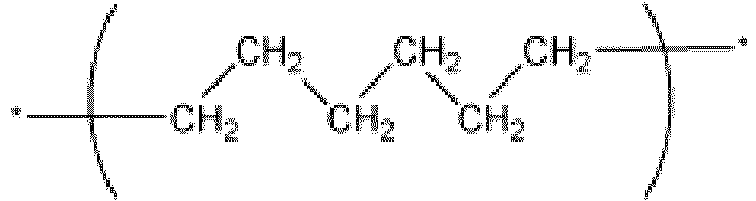
R1~R8 CH3 CH3 X OCH3 OCH3 Y OCH3 OCH3 m+n 20 60 [Table 3] Substituents in Chemical formula 1 Siloxane polymer E Siloxane polymer F A C3H6 C3H6 B C3H6 C3H6 Z 

R1~R8 CH3 CH3 X OCH3 OCH3 Y OCH3 OCH3 m+n 20 60 - A siloxane polymer in said practical example A-F was prepared through two stages wherein monohydroxyaryl silxoane is synthesized by making hydride terminated siloxane with phenol derivatives in the presence of catalyst (Pt) in the first stage; and said monohydroxyaryl silxoane and diene are reacted in the second stage.
- After adding 130 ml of 9.1% NaOH aqueous solution, 2,2-bis(4-hydroxyphenyl) propane (BPA) (21.1g, 92.4mmol), methyltributyl ammonium chloride (1.3g, 5.3mmol), 150 ml of methylene chloride, this mixture was strongly stirred. While maintaining the temperature of solution at 20 to 25°C, 50ml of methylene chloride solution, in which triphosgen (10.1g, 101.7mmol) was dissolved, was added. The mixture was stirred for 10 min. while maintaining pH at 6 to 7. After that, siloxane polymer A (14.3g, 6.9mmol) which was dissolved into 15ml of methylene chloride was added. This mixture was stirred for 10 min. while maintaining pH at 10 to 12 by adding 50% NaOH. After that, 2,2-bis(4-hydroxyphenyl) propane (BPA) (84.7g, 371.0mmol), water, and 150ml of methylene chloride were added followed by stirring them for 1 hour. Into this mixture, trimethylamine (1.0g, 9.9mmol), para-cumylphenol (3.8g, 17.9 mmol) were added. This mixture was again stirred while adding 200ml of methylene chloride solution in which triphosgen (40.7g, 411.6mmol) was dissolved slowly into the reactor for 1 hour while maintaining pH of solution at 10 to 12 by adding 50% NaOH. After completing the stirring, the organic layer was separated by stirring the mixture for 1 hour, 200ml of 10% HCl solution was added to neutralize the solution and then washing operation was carried out by water till pH becomes neutral. After washing, a part of the solvent from the organic layer was removed. The polymer was precipitated using methanol. This precipitate was filtered and dried to obtain a powder form polymer. DOSY analysis for this polymer revealed that silicone polymer is bound inside the main chain of polycarbonate. The Si content was analyzed as 2.5 wt% with 1H NMR. GPC analysis result showed that cMw contents as 21,248.
- The implementation of the example 2 was carried out in the same way as the example 1 except for using polysiloxane B (13.1g, 2.6mmol). DOSY analysis for this polymer confirmed that siloxane polymer was bound inside the main chain of polycarbonate. The Si content was analyzed as 2.6 wt% with 1H NMR. cMw contents using GPC was found to be 21,169.
- The implementation of the example 3 was carried out in the same way as the example 1 except for using polysiloxane C (13.9g, 6.6mmol). DOSY analysis for this polymer confirmed that siloxane polymer was bound inside the main chain of polycarbonate. The Si content was analyzed as 2.6 wt% with 1H NMR. cMw contents using GPC was found to be 25,609.
- The implementation of the example 4 was carried out in the same way as the example 1 except for using polysiloxane D (5.0g, 2.5mmol). DOSY analysis for this polymer confirmed that siloxane polymer was bound inside the main chain of polycarbonate. The Si content was analyzed as 1.2 wt% with 1H NMR. cMw contents using GPC was found to be 22,565.
- The implementation of the example 5 was carried out in the same way as the example 1 except for using polysiloxane D (12.7g, 6.3mmol). DOSY analysis for this polymer confirmed that siloxane polymer was bound inside the main chain of polycarbonate. The Si content was analyzed as 2.7 wt% with 1H NMR. cMw contents using GPC was found to be 22,117.
- The implementation of the example 6 was carried out in the same way as the example 1 except for using polysiloxane D (18.9g, 9.4mmol). DOSY analysis for this polymer confirmed that siloxane polymer was bound inside the main chain of polycarbonate. The Si content was analyzed as 3.9 wt% with 1H NMR. cMw contents using GPC was found to be 22,732.
- The implementation of the example 7 was carried out in the same way as the example 1 except for using polysiloxane E (11.02g, 3.15mmol). DOSY analysis for this polymer confirmed that siloxane polymer was bound inside the main chain of polycarbonate. The Si content was analyzed as 2.4 wt% with 1H NMR. cMw contents using GPC was found to be 23,754.
- The implementation of the example 8 was carried out in the same way as the example 1 except for using polysiloxane E (14.7g, 4.19 mmol). DOSY analysis for this polymer confirmed that siloxane polymer was bound inside the main chain of polycarbonate. The Si content was analyzed as 3.2 wt% with 1H NMR. cMw contents using GPC was found to be 22,538.
- The implementation of the example 9 was carried out in the same way as the example 1 except for using polysiloxane E (18.2g, 5.2mmol). DOSY analysis for this polymer confirmed that siloxane polymer was bound inside the main chain of polycarbonate. The Si content was analyzed as 4.8 wt% with 1H NMR. cMw contents using GPC was found to be 20,841.
- The implementation of the example 10 was carried out in the same way as the example 1 except for using polysiloxane F (14.4g, 6.9mmol). DOSY analysis for this polymer confirmed that siloxane polymer was bound inside the main chain of polycarbonate. The Si content was analyzed as 2.5 wt% with 1H NMR. cMw contents using GPC was found to be 21,645.
- By blending the polymer obtained from the example 8 and SC-1190 (BPA-PC) from Jeil Industries at a weight ratio of 50:50, the test was carried out.
- After melting 2,2-bis(4-hydroxyphenyl) propane (BPA) (45.66g, 200mmol) into 400ml of 9.1% NaOH aqueous solution, 200ml of methylene chloride was added. This mixture was strongly stirred and 250ml of methylene chloride solution in which triphosgen (22.95g, 77.3mmol) was dissolved was slowly added for 1 hour while maintaining the solution temperature at 20 to 25°C. Para-cumylphenol (0.99mmol) was added and strongly stirred for 5 min. And then, triethylamine (0.28g, 2mmol) was added into the solution and stirred again for one and a half hour while maintaining the pH of the solution higher than 11 with 50% NaOH solution. The organic layer of the solution was separated and neutralized by adding 200ml of 10% HCl and washed with water till the pH of the solution became neutral. After washing, a part of the solvent from the organic layer was removed. The polymer was precipitated using methanol. This precipitate was filtered and dried to obtain powder form polymer. GPC analysis result showed that the cMw of polymer was 21,920.
- Polycarbonate SC-1100 from Jeil Industries was used for the preparation of Comparative example 2.
- 10% of JN100 from SJ Chemical as a copolyester and polycarbonate SC-1100 from Jeil Industries were blended for the preparation of this example.
- 20% of JN100 from SJ Chemical as a copolyester and polycarbonate SC-1100 from Jeil Industries were blended for this example.
- 30% of JN100 from SJ Chemical as a copolyester and polycarbonate SC-1100 from Jeil Industries were blended to prepare this example.
- 40% of JN100 from SJ Chemical as a copolyester and polycarbonate SC-1100 from Jeil Industries were blended for this example.
- physical characteristics of polymer

- After drying the prepared polymer by the methods in the practical examples 1-11 and comparison examples 1-6 at 120°C for 4 hours, it was processed by injection moulding at forming temperature of 290°C, mould temperature at 70°C inside 10 Oz injection molding machine to prepare a specimen of thickness 3 mm.
- Notched Izod specimen of thickness 1/8" and 1/4' were prepared as per ASTM D256 and tested at 25°C and -30°C, respectively.
- Dumbbell shaped specimen as per ASTM No. 1 was immersed into gasoline for seven days and the changes in the tensile strength was assessed.
- Hazeness and permeability were measured for the specimen of thickness 3mm using Haze Meter (YDPO2-0D, NIPPON DENSHOKU).
- The measured physical properties for the specimens in the examples 1-11 and comparative examples 1-6 are presented in Table 4.
[Table 4] Si contents (wt%) Molecular wt. (Mw) Haze (%) Permeability (%) 1/4" Izod impact strength (room temp.) 1/8" Izod impact strength (RT) 1/8" Izod impact strength (-30°C) Retention rate of tensile strength after immersing into gasoline(%) Example 1 2.5 21,248 3.7 89.2 70.9 91.6 68.5 78 Example 2 2.6 21,169 4.2 88.0 71.5 92.0 69.5 80 Example 3 2.6 25,609 2.84 88.7 72.8 92.6 70.6 82 Example 4 1.2 22,565 0.85 91.5 68.3 90.2 68.5 93 Example 5 2.7 22,117 1.17 90.5 72.3 91.9 73.5 97 Example 6 3.9 22,732 2.85 89.2 89.5 95.9 78.5 99 Example 7 2.4 23,754 2.25 89.9 71.8 92.1 71.5 95 Example 8 3.2 22,538 3.75 89.5 83.5 93.7 74.2 98 Example 9 4.8 20,841 4.65 89.0 92.7 97.1 79.6 99 Example 10 2.5 21,645 1.92 92.0 71.2 91.0 70.3 99 Example 11 1.5 23,892 1.02 90.7 67.5 89.8 66.5 93 Comparative example 1 0 21,920 0.50 90.3 5.1 75.9 7.5 51 Comparative example 2 0 26,800 0.95 90.1 12.1 92.1 15.5 62 Comparative example 3 0 26,800 0.92 90.1 6.5 60.5 10.7 83 Comparative example 4 0 26,800 0.90 90.3 5.9 55.3 8.8 90 Comparative example 5 0 26,800 0.90 90.6 5.1 52.3 7.8 91 Comparative example 6 0 26,800 0.88 90.6 4.9 52.3 7.0 93 - As can be seen from the above Table 4, a polycarbonate resin made as per the present invention in the example 1-11 can maintain excellent impact strength, chemical resistance, and high transparency.
Claims (14)
- A polycarbonate resin which comprises a repeating unit of the following chemical formula in its main chain:

- Polycarbonate resin as claimed in Claim 1, characterized in that the repeating unit in said Chemical formula 1 is from 1 to 20 % by weight of the total polycarbonate resin.
- Polycarbonate resin as claimed in Claim 1, characterized in that the Si content is from 0.3 to 10 wt.% of the total polycarbonate resin.
- Polycarbonate resin as claimed in Claim 1, characterized in that the repeating unit in said Chemical formula 1 comprises from 1 to 20 % by weight of the total polycarbonate resin and Si content is from 0.3 to 10 % by weight of the total polycarbonate resin.
- Polycarbonate resin as claimed in Claim 1, characterized in that said Z is a C1-C12 alkylene group which contains a linear arylene group or does not contain the same.
- Polycarbonate resin as claimed in Claim 1, characterized in that said Z is a linear alkylene.
- Polycarbonate resin as claimed in Claim 1, characterized in that m is an integer having a value of 1 to 60, n is an integer having a value of 1 to 60.
- A thermoplastic resin composition comprising a polycarbonate resin and additives of polycarbonate resin as claimed in any of the Claims 1 to 7.
- Thermoplastic resin composition as claimed in Claim 8, characterized in that Z is from among the compounds of C3-C12 cyclo alkylene group, the notched IZOD impact strength of the specimen of thickness 1/4" measured as per ASTM D256 is from 60 to 90 kgf•cm/cm.
- Thermoplastic resin composition as claimed in Claim 8, wherein Z is from among the compounds of a linear C1-C10 alkyl group, Haze (Hz) of the extruded specimen of thickness 2.5mm measured by Haze meter is from 0.1 to 10%, and the Total Transmitted Light (TT) is from 85 to 99%.
- Thermoplastic resin composition as claimed in Claim 8, characterized in that Z in said chemical formula is from among the compounds of C6-C18 arylene group, the changes in the tensile strength of the dumbbell shaped test specimen prepared as per ASTM No. 1 before and after immersing into gasoline for seven days are from 0 to 25 %.
- Thermoplastic resin composition as claimed in Claim 8, characterized in that a moulded product is prepared from said thermoplastic resin composition.
- A polycarbonate resin as claimed in any of the Claims 1 to 7, characterized in that said polycarbonate resin does not include polycarbonate and Si.
- A polycarbonate resin as claimed in Claim 13, characterized in that said polycarbonate resin does not include polycarbonate and said Si is included in a ratio ranging from 40:60 to 60:40.
Applications Claiming Priority (2)
| Application Number | Priority Date | Filing Date | Title |
|---|---|---|---|
| KR1020100109520A KR101281575B1 (en) | 2010-11-05 | 2010-11-05 | Polycarbonate Resin and Thermoplastic Resin Composition Comprising Same |
| PCT/KR2010/009595 WO2012060516A1 (en) | 2010-11-05 | 2010-12-30 | Polycarbonate resin and thermoplastic resin composition including polycarbonate resin |
Publications (2)
| Publication Number | Publication Date |
|---|---|
| EP2636695A1 true EP2636695A1 (en) | 2013-09-11 |
| EP2636695A4 EP2636695A4 (en) | 2014-04-16 |
Family
ID=46024618
Family Applications (1)
| Application Number | Title | Priority Date | Filing Date |
|---|---|---|---|
| EP10859318.7A Withdrawn EP2636695A4 (en) | 2010-11-05 | 2010-12-30 | Polycarbonate resin and thermoplastic resin composition including polycarbonate resin |
Country Status (5)
| Country | Link |
|---|---|
| US (1) | US8871875B2 (en) |
| EP (1) | EP2636695A4 (en) |
| KR (1) | KR101281575B1 (en) |
| CN (1) | CN103201312B (en) |
| WO (1) | WO2012060516A1 (en) |
Cited By (2)
| Publication number | Priority date | Publication date | Assignee | Title |
|---|---|---|---|---|
| WO2016137741A1 (en) * | 2015-02-25 | 2016-09-01 | Momentive Performance Materials Inc. | Reactive polysiloxanes and copolymers made therefrom |
| EP3150652A4 (en) * | 2014-12-04 | 2017-07-12 | LG Chem, Ltd. | Copolycarbonate and composition comprising same |
Families Citing this family (7)
| Publication number | Priority date | Publication date | Assignee | Title |
|---|---|---|---|---|
| KR101281575B1 (en) | 2010-11-05 | 2013-07-03 | 제일모직주식회사 | Polycarbonate Resin and Thermoplastic Resin Composition Comprising Same |
| KR101674246B1 (en) * | 2013-11-19 | 2016-11-08 | 롯데첨단소재(주) | Polycarbonate based thermoplastic resin composition and article comprising the same |
| EP3081584A4 (en) * | 2013-12-10 | 2017-07-12 | Idemitsu Kosan Co., Ltd | Polycarbonate-polyorganosiloxane copolymer and method for producing same |
| KR101779188B1 (en) | 2014-09-05 | 2017-09-15 | 주식회사 엘지화학 | Copolycarbonate and composition comprising the same |
| JP2017532411A (en) * | 2014-09-18 | 2017-11-02 | モメンティブ パフォーマンス マテリアルズ インコーポレイテッド | Polysiloxane copolymers or terpolymers and polymers made therefrom |
| US9428617B2 (en) * | 2014-09-18 | 2016-08-30 | Momentive Performance Material Inc. | α,ω-functionalized polyoxyalkylene-siloxane polymers and copolymers made therefrom |
| KR101685665B1 (en) | 2014-12-04 | 2016-12-12 | 주식회사 엘지화학 | Copolycarbonate and composition comprising the same |
Family Cites Families (16)
| Publication number | Priority date | Publication date | Assignee | Title |
|---|---|---|---|---|
| US4188314A (en) | 1976-12-14 | 1980-02-12 | General Electric Company | Shaped article obtained from a carbonate-polyester composition |
| US4634737A (en) | 1984-12-19 | 1987-01-06 | General Electric Company | Copolyester-carbonate composition |
| EP0522751B1 (en) * | 1991-07-01 | 1998-04-01 | General Electric Company | Polycarbonate-polysiloxane block copolymers |
| JPH05117382A (en) | 1991-10-29 | 1993-05-14 | Nippon G Ii Plast Kk | Copolymerized polycarbonate, its production and composition composed thereof |
| JP3350341B2 (en) * | 1996-04-01 | 2002-11-25 | 信越化学工業株式会社 | Polysiloxane / polyether block copolymer and method for producing the copolymer |
| US6414175B1 (en) * | 1997-03-29 | 2002-07-02 | Th. Goldschmidt Agh | Innovative siloxane block copolymers with rigid spacers and their use |
| AUPP268898A0 (en) | 1998-03-31 | 1998-04-23 | Cardiac Crc Nominees Pty Limited | High modulus polyurethane compositions |
| US6080829A (en) * | 1998-06-24 | 2000-06-27 | Medtronic, Inc. | Silalkylenesiloxane copolymer materials and methods for their preparation |
| US6984700B2 (en) | 2002-09-17 | 2006-01-10 | Medtronic, Inc. | Compounds containing silicon-containing groups, medical devices, and methods |
| KR100615909B1 (en) | 2004-11-24 | 2006-08-28 | 제일모직주식회사 | Polycarbonate resin composition with excellent chemical and impact resistance |
| KR20070071592A (en) | 2005-12-30 | 2007-07-04 | 에스케이케미칼주식회사 | Copolyester / Polycarbonate Resin Compositions and Products thereof |
| US20070208144A1 (en) * | 2006-03-02 | 2007-09-06 | General Electric Company | Poly(arylene ether) block copolymer compositions, methods, and articles |
| US8871865B2 (en) | 2006-08-01 | 2014-10-28 | Sabic Global Technologies B.V. | Flame retardant thermoplastic polycarbonate compositions |
| US8273849B2 (en) * | 2009-12-30 | 2012-09-25 | Sabic Innovative Plastics Ip B.V. | Isosorbide-based polycarbonates, method of making, and articles formed therefrom |
| KR101332434B1 (en) * | 2010-08-26 | 2013-11-22 | 제일모직주식회사 | Bishydroxyarylsilxoane and preparation method thereof |
| KR101281575B1 (en) | 2010-11-05 | 2013-07-03 | 제일모직주식회사 | Polycarbonate Resin and Thermoplastic Resin Composition Comprising Same |
-
2010
- 2010-11-05 KR KR1020100109520A patent/KR101281575B1/en active Active
- 2010-12-30 EP EP10859318.7A patent/EP2636695A4/en not_active Withdrawn
- 2010-12-30 CN CN201080069971.1A patent/CN103201312B/en active Active
- 2010-12-30 WO PCT/KR2010/009595 patent/WO2012060516A1/en not_active Ceased
-
2013
- 2013-05-05 US US13/887,348 patent/US8871875B2/en active Active
Cited By (2)
| Publication number | Priority date | Publication date | Assignee | Title |
|---|---|---|---|---|
| EP3150652A4 (en) * | 2014-12-04 | 2017-07-12 | LG Chem, Ltd. | Copolycarbonate and composition comprising same |
| WO2016137741A1 (en) * | 2015-02-25 | 2016-09-01 | Momentive Performance Materials Inc. | Reactive polysiloxanes and copolymers made therefrom |
Also Published As
| Publication number | Publication date |
|---|---|
| US20140148559A1 (en) | 2014-05-29 |
| KR101281575B1 (en) | 2013-07-03 |
| KR20120048090A (en) | 2012-05-15 |
| EP2636695A4 (en) | 2014-04-16 |
| CN103201312A (en) | 2013-07-10 |
| WO2012060516A1 (en) | 2012-05-10 |
| US8871875B2 (en) | 2014-10-28 |
| CN103201312B (en) | 2015-07-22 |
Similar Documents
| Publication | Publication Date | Title |
|---|---|---|
| US8871875B2 (en) | Polycarbonate resin and thermoplastic resin composition including polycarbonate resin | |
| EP3228647B1 (en) | Polycarbonate resin composition | |
| EP3048127B1 (en) | Copolycarbonate and composition containing same | |
| EP3067379B1 (en) | Copolycarbonate and composition containing same | |
| US9376534B2 (en) | Phenyl-containing functional polysiloxanes and polycarbonate-polysiloxane copolymers made therefrom | |
| EP3553131A1 (en) | Polycarbonate resin composition having excellent heat resistance and fluidity, and molded product including same | |
| KR101674246B1 (en) | Polycarbonate based thermoplastic resin composition and article comprising the same | |
| KR101489957B1 (en) | Polycarbonate-polysiloxane copolymer and method for preparing the same | |
| EP2660271A2 (en) | Polycarbonate-polysiloxane copolymer, and method for preparing same | |
| EP3050908B1 (en) | Copolycarbonate and composition comprising same | |
| EP3825344B1 (en) | Copolycarbonate, and polycarbonate composition comprising same | |
| KR101542615B1 (en) | Novel polysiloxane, method for preparing the same and polycarbonate-polysiloxane copolymer containing the same | |
| KR102115799B1 (en) | Polysiloxane-polycarbonate copolymer having improved transparency and low temperature impact resistance and method for preparing the same | |
| EP3406650B1 (en) | Copolycarbonate and resin composition comprising same | |
| JP7608367B2 (en) | Polycarbonate-polyorganosiloxane copolymer | |
| EP3050909B1 (en) | Copolycarbonate and composition comprising same | |
| KR101675197B1 (en) | Polyorganosiloxane and copolycarbonate resin | |
| EP3205685B1 (en) | Copolycarbonate and composition comprising same | |
| EP3406649B1 (en) | Copolycarbonate and resin composition comprising same | |
| EP3381980B1 (en) | Polycarbonate resin composition | |
| KR101489958B1 (en) | Polycarbonate-polysiloxane copolymer and method for preparing the same | |
| KR20140086772A (en) | Polycarbonate-polysiloxane copolymer and method for preparing the same | |
| KR101499244B1 (en) | Method for preparing polysiloxane-polycarbonate copolymer | |
| KR20220086279A (en) | Polycarbonate and molded article formed therefrom |
Legal Events
| Date | Code | Title | Description |
|---|---|---|---|
| PUAI | Public reference made under article 153(3) epc to a published international application that has entered the european phase |
Free format text: ORIGINAL CODE: 0009012 |
|
| 17P | Request for examination filed |
Effective date: 20130503 |
|
| AK | Designated contracting states |
Kind code of ref document: A1 Designated state(s): AL AT BE BG CH CY CZ DE DK EE ES FI FR GB GR HR HU IE IS IT LI LT LU LV MC MK MT NL NO PL PT RO RS SE SI SK SM TR |
|
| DAX | Request for extension of the european patent (deleted) | ||
| A4 | Supplementary search report drawn up and despatched |
Effective date: 20140318 |
|
| STAA | Information on the status of an ep patent application or granted ep patent |
Free format text: STATUS: THE APPLICATION IS DEEMED TO BE WITHDRAWN |
|
| 18D | Application deemed to be withdrawn |
Effective date: 20141015 |