EP2636675B1 - Diphosphonate compounds and preparation method and use thereof - Google Patents
Diphosphonate compounds and preparation method and use thereof Download PDFInfo
- Publication number
- EP2636675B1 EP2636675B1 EP11837502.1A EP11837502A EP2636675B1 EP 2636675 B1 EP2636675 B1 EP 2636675B1 EP 11837502 A EP11837502 A EP 11837502A EP 2636675 B1 EP2636675 B1 EP 2636675B1
- Authority
- EP
- European Patent Office
- Prior art keywords
- compound
- mol
- added
- substituted
- alkyl
- Prior art date
- Legal status (The legal status is an assumption and is not a legal conclusion. Google has not performed a legal analysis and makes no representation as to the accuracy of the status listed.)
- Not-in-force
Links
- XQRLCLUYWUNEEH-UHFFFAOYSA-L diphosphonate(2-) Chemical class [O-]P(=O)OP([O-])=O XQRLCLUYWUNEEH-UHFFFAOYSA-L 0.000 title description 20
- 238000002360 preparation method Methods 0.000 title description 4
- -1 diphosphonate compound Chemical class 0.000 claims description 83
- 150000001875 compounds Chemical class 0.000 claims description 74
- 239000000243 solution Substances 0.000 claims description 58
- 239000007787 solid Substances 0.000 claims description 53
- RTZKZFJDLAIYFH-UHFFFAOYSA-N Diethyl ether Chemical compound CCOCC RTZKZFJDLAIYFH-UHFFFAOYSA-N 0.000 claims description 48
- 238000000034 method Methods 0.000 claims description 48
- VEXZGXHMUGYJMC-UHFFFAOYSA-M Chloride anion Chemical compound [Cl-] VEXZGXHMUGYJMC-UHFFFAOYSA-M 0.000 claims description 43
- VEXZGXHMUGYJMC-UHFFFAOYSA-N Hydrochloric acid Chemical compound Cl VEXZGXHMUGYJMC-UHFFFAOYSA-N 0.000 claims description 43
- 239000012295 chemical reaction liquid Substances 0.000 claims description 41
- 125000000449 nitro group Chemical group [O-][N+](*)=O 0.000 claims description 38
- 229910052736 halogen Inorganic materials 0.000 claims description 35
- 150000002367 halogens Chemical class 0.000 claims description 35
- 239000003814 drug Substances 0.000 claims description 34
- 229940079593 drug Drugs 0.000 claims description 33
- XLYOFNOQVPJJNP-UHFFFAOYSA-N water Substances O XLYOFNOQVPJJNP-UHFFFAOYSA-N 0.000 claims description 33
- 125000001424 substituent group Chemical group 0.000 claims description 32
- 238000006243 chemical reaction Methods 0.000 claims description 30
- LFQSCWFLJHTTHZ-UHFFFAOYSA-N Ethanol Chemical compound CCO LFQSCWFLJHTTHZ-UHFFFAOYSA-N 0.000 claims description 27
- XEKOWRVHYACXOJ-UHFFFAOYSA-N Ethyl acetate Chemical compound CCOC(C)=O XEKOWRVHYACXOJ-UHFFFAOYSA-N 0.000 claims description 27
- 125000004093 cyano group Chemical group *C#N 0.000 claims description 27
- 229910052739 hydrogen Inorganic materials 0.000 claims description 24
- 239000002244 precipitate Substances 0.000 claims description 23
- 210000000988 bone and bone Anatomy 0.000 claims description 22
- 239000000706 filtrate Substances 0.000 claims description 21
- 125000003118 aryl group Chemical group 0.000 claims description 20
- 239000001257 hydrogen Substances 0.000 claims description 20
- 125000000547 substituted alkyl group Chemical group 0.000 claims description 20
- 239000012670 alkaline solution Substances 0.000 claims description 19
- 125000003107 substituted aryl group Chemical group 0.000 claims description 19
- 229940035423 ethyl ether Drugs 0.000 claims description 18
- 239000003960 organic solvent Substances 0.000 claims description 18
- 125000000217 alkyl group Chemical group 0.000 claims description 15
- YMWUJEATGCHHMB-UHFFFAOYSA-N Dichloromethane Chemical compound ClCCl YMWUJEATGCHHMB-UHFFFAOYSA-N 0.000 claims description 14
- 150000002431 hydrogen Chemical class 0.000 claims description 13
- UFHFLCQGNIYNRP-UHFFFAOYSA-N Hydrogen Chemical compound [H][H] UFHFLCQGNIYNRP-UHFFFAOYSA-N 0.000 claims description 10
- 239000002904 solvent Substances 0.000 claims description 10
- HTSGKJQDMSTCGS-UHFFFAOYSA-N 1,4-bis(4-chlorophenyl)-2-(4-methylphenyl)sulfonylbutane-1,4-dione Chemical compound C1=CC(C)=CC=C1S(=O)(=O)C(C(=O)C=1C=CC(Cl)=CC=1)CC(=O)C1=CC=C(Cl)C=C1 HTSGKJQDMSTCGS-UHFFFAOYSA-N 0.000 claims description 9
- ODTQUKVFOLFLIQ-UHFFFAOYSA-N 2-[di(propan-2-yloxy)phosphorylmethyl-propan-2-yloxyphosphoryl]oxypropane Chemical compound CC(C)OP(=O)(OC(C)C)CP(=O)(OC(C)C)OC(C)C ODTQUKVFOLFLIQ-UHFFFAOYSA-N 0.000 claims description 9
- 125000000325 methylidene group Chemical group [H]C([H])=* 0.000 claims description 9
- KDLHZDBZIXYQEI-UHFFFAOYSA-N Palladium on carbon Substances [Pd] KDLHZDBZIXYQEI-UHFFFAOYSA-N 0.000 claims description 8
- 238000004821 distillation Methods 0.000 claims description 8
- 238000007363 ring formation reaction Methods 0.000 claims description 8
- FCSKOFQQCWLGMV-UHFFFAOYSA-N 5-{5-[2-chloro-4-(4,5-dihydro-1,3-oxazol-2-yl)phenoxy]pentyl}-3-methylisoxazole Chemical compound O1N=C(C)C=C1CCCCCOC1=CC=C(C=2OCCN=2)C=C1Cl FCSKOFQQCWLGMV-UHFFFAOYSA-N 0.000 claims description 7
- HEDRZPFGACZZDS-UHFFFAOYSA-N Chloroform Chemical compound ClC(Cl)Cl HEDRZPFGACZZDS-UHFFFAOYSA-N 0.000 claims description 7
- FAIAAWCVCHQXDN-UHFFFAOYSA-N phosphorus trichloride Chemical compound ClP(Cl)Cl FAIAAWCVCHQXDN-UHFFFAOYSA-N 0.000 claims description 7
- ISIJQEHRDSCQIU-UHFFFAOYSA-N tert-butyl 2,7-diazaspiro[4.5]decane-7-carboxylate Chemical compound C1N(C(=O)OC(C)(C)C)CCCC11CNCC1 ISIJQEHRDSCQIU-UHFFFAOYSA-N 0.000 claims description 7
- 229940126062 Compound A Drugs 0.000 claims description 6
- NLDMNSXOCDLTTB-UHFFFAOYSA-N Heterophylliin A Natural products O1C2COC(=O)C3=CC(O)=C(O)C(O)=C3C3=C(O)C(O)=C(O)C=C3C(=O)OC2C(OC(=O)C=2C=C(O)C(O)=C(O)C=2)C(O)C1OC(=O)C1=CC(O)=C(O)C(O)=C1 NLDMNSXOCDLTTB-UHFFFAOYSA-N 0.000 claims description 6
- 230000004913 activation Effects 0.000 claims description 6
- 125000003342 alkenyl group Chemical group 0.000 claims description 6
- 238000005804 alkylation reaction Methods 0.000 claims description 6
- 125000000304 alkynyl group Chemical group 0.000 claims description 6
- 239000003054 catalyst Substances 0.000 claims description 6
- 150000001924 cycloalkanes Chemical class 0.000 claims description 6
- 230000007062 hydrolysis Effects 0.000 claims description 6
- 238000006460 hydrolysis reaction Methods 0.000 claims description 6
- 229910052711 selenium Inorganic materials 0.000 claims description 6
- 125000005017 substituted alkenyl group Chemical group 0.000 claims description 6
- 229910052794 bromium Inorganic materials 0.000 claims description 5
- 239000012074 organic phase Substances 0.000 claims description 5
- 230000009467 reduction Effects 0.000 claims description 5
- 125000004426 substituted alkynyl group Chemical group 0.000 claims description 5
- 229910052717 sulfur Inorganic materials 0.000 claims description 5
- 208000030159 metabolic disease Diseases 0.000 claims description 4
- GDTBXPJZTBHREO-UHFFFAOYSA-N bromine Substances BrBr GDTBXPJZTBHREO-UHFFFAOYSA-N 0.000 claims description 3
- 238000000605 extraction Methods 0.000 claims description 3
- 125000001997 phenyl group Chemical group [H]C1=C([H])C([H])=C(*)C([H])=C1[H] 0.000 claims description 3
- 125000001246 bromo group Chemical group Br* 0.000 claims description 2
- 229910052801 chlorine Inorganic materials 0.000 claims description 2
- 229910052731 fluorine Inorganic materials 0.000 claims description 2
- 239000000376 reactant Substances 0.000 claims description 2
- 230000001105 regulatory effect Effects 0.000 claims description 2
- 125000000008 (C1-C10) alkyl group Chemical group 0.000 claims 2
- 125000004169 (C1-C6) alkyl group Chemical group 0.000 claims 2
- IAZDPXIOMUYVGZ-UHFFFAOYSA-N Dimethylsulphoxide Chemical compound CS(C)=O IAZDPXIOMUYVGZ-UHFFFAOYSA-N 0.000 description 54
- HEMHJVSKTPXQMS-UHFFFAOYSA-M Sodium hydroxide Chemical compound [OH-].[Na+] HEMHJVSKTPXQMS-UHFFFAOYSA-M 0.000 description 36
- 230000000694 effects Effects 0.000 description 34
- OKKJLVBELUTLKV-UHFFFAOYSA-N Methanol Chemical compound OC OKKJLVBELUTLKV-UHFFFAOYSA-N 0.000 description 33
- 239000011669 selenium Substances 0.000 description 32
- UIIMBOGNXHQVGW-UHFFFAOYSA-M Sodium bicarbonate Chemical compound [Na+].OC([O-])=O UIIMBOGNXHQVGW-UHFFFAOYSA-M 0.000 description 24
- LPXPTNMVRIOKMN-UHFFFAOYSA-M sodium nitrite Chemical compound [Na+].[O-]N=O LPXPTNMVRIOKMN-UHFFFAOYSA-M 0.000 description 24
- RWZYAGGXGHYGMB-UHFFFAOYSA-N anthranilic acid Chemical compound NC1=CC=CC=C1C(O)=O RWZYAGGXGHYGMB-UHFFFAOYSA-N 0.000 description 22
- 210000002997 osteoclast Anatomy 0.000 description 21
- 238000004458 analytical method Methods 0.000 description 18
- BUGBHKTXTAQXES-UHFFFAOYSA-N Selenium Chemical compound [Se] BUGBHKTXTAQXES-UHFFFAOYSA-N 0.000 description 17
- 208000001132 Osteoporosis Diseases 0.000 description 16
- 230000015572 biosynthetic process Effects 0.000 description 16
- 210000004027 cell Anatomy 0.000 description 16
- 238000002330 electrospray ionisation mass spectrometry Methods 0.000 description 16
- 235000019441 ethanol Nutrition 0.000 description 16
- 210000000963 osteoblast Anatomy 0.000 description 16
- 238000005160 1H NMR spectroscopy Methods 0.000 description 15
- 229910052698 phosphorus Inorganic materials 0.000 description 15
- ZLMJMSJWJFRBEC-UHFFFAOYSA-N Potassium Chemical compound [K] ZLMJMSJWJFRBEC-UHFFFAOYSA-N 0.000 description 13
- 239000012954 diazonium Substances 0.000 description 13
- 150000001989 diazonium salts Chemical class 0.000 description 13
- 150000002500 ions Chemical class 0.000 description 13
- 239000011591 potassium Substances 0.000 description 13
- 229910052700 potassium Inorganic materials 0.000 description 13
- NINIDFKCEFEMDL-UHFFFAOYSA-N Sulfur Chemical compound [S] NINIDFKCEFEMDL-UHFFFAOYSA-N 0.000 description 12
- UCMIRNVEIXFBKS-UHFFFAOYSA-N beta-alanine Chemical compound NCCC(O)=O UCMIRNVEIXFBKS-UHFFFAOYSA-N 0.000 description 12
- 230000035755 proliferation Effects 0.000 description 12
- 229910000030 sodium bicarbonate Inorganic materials 0.000 description 12
- FYSNRJHAOHDILO-UHFFFAOYSA-N thionyl chloride Chemical compound ClS(Cl)=O FYSNRJHAOHDILO-UHFFFAOYSA-N 0.000 description 12
- 229940102859 methylene diphosphonate Drugs 0.000 description 11
- 238000003786 synthesis reaction Methods 0.000 description 11
- OGSPWJRAVKPPFI-UHFFFAOYSA-N Alendronic Acid Chemical compound NCCCC(O)(P(O)(O)=O)P(O)(O)=O OGSPWJRAVKPPFI-UHFFFAOYSA-N 0.000 description 10
- 239000012065 filter cake Substances 0.000 description 10
- 230000002401 inhibitory effect Effects 0.000 description 10
- 230000008569 process Effects 0.000 description 10
- OYPRJOBELJOOCE-UHFFFAOYSA-N Calcium Chemical compound [Ca] OYPRJOBELJOOCE-UHFFFAOYSA-N 0.000 description 9
- 239000011575 calcium Substances 0.000 description 9
- 229910052791 calcium Inorganic materials 0.000 description 9
- XIMIGUBYDJDCKI-UHFFFAOYSA-N diselenium Chemical compound [Se]=[Se] XIMIGUBYDJDCKI-UHFFFAOYSA-N 0.000 description 9
- KJIBMWDZDVHRDP-UHFFFAOYSA-N 2-aminobenzoic acid;cyclohexane Chemical compound C1CCCCC1.NC1=CC=CC=C1C(O)=O KJIBMWDZDVHRDP-UHFFFAOYSA-N 0.000 description 8
- JKYKXTRKURYNGW-UHFFFAOYSA-N 3,4-dihydroxy-9,10-dioxo-9,10-dihydroanthracene-2-sulfonic acid Chemical compound O=C1C2=CC=CC=C2C(=O)C2=C1C(O)=C(O)C(S(O)(=O)=O)=C2 JKYKXTRKURYNGW-UHFFFAOYSA-N 0.000 description 8
- 230000024279 bone resorption Effects 0.000 description 8
- 239000005457 ice water Substances 0.000 description 8
- 239000007788 liquid Substances 0.000 description 8
- 208000006386 Bone Resorption Diseases 0.000 description 7
- 229960004343 alendronic acid Drugs 0.000 description 7
- 239000001963 growth medium Substances 0.000 description 7
- 230000005764 inhibitory process Effects 0.000 description 7
- 0 CN(*C(*)C1*)C1=O Chemical compound CN(*C(*)C1*)C1=O 0.000 description 6
- 229910006124 SOCl2 Inorganic materials 0.000 description 6
- 238000002835 absorbance Methods 0.000 description 6
- 239000002253 acid Substances 0.000 description 6
- 229940000635 beta-alanine Drugs 0.000 description 6
- 230000011164 ossification Effects 0.000 description 6
- 239000003208 petroleum Substances 0.000 description 6
- 239000013641 positive control Substances 0.000 description 6
- LVTJOONKWUXEFR-FZRMHRINSA-N protoneodioscin Natural products O(C[C@@H](CC[C@]1(O)[C@H](C)[C@@H]2[C@]3(C)[C@H]([C@H]4[C@@H]([C@]5(C)C(=CC4)C[C@@H](O[C@@H]4[C@H](O[C@H]6[C@@H](O)[C@@H](O)[C@@H](O)[C@H](C)O6)[C@@H](O)[C@H](O[C@H]6[C@@H](O)[C@@H](O)[C@@H](O)[C@H](C)O6)[C@H](CO)O4)CC5)CC3)C[C@@H]2O1)C)[C@H]1[C@H](O)[C@H](O)[C@H](O)[C@@H](CO)O1 LVTJOONKWUXEFR-FZRMHRINSA-N 0.000 description 6
- 235000017557 sodium bicarbonate Nutrition 0.000 description 6
- 229910000104 sodium hydride Inorganic materials 0.000 description 6
- 238000012360 testing method Methods 0.000 description 6
- 238000013019 agitation Methods 0.000 description 5
- 230000004663 cell proliferation Effects 0.000 description 5
- 230000008021 deposition Effects 0.000 description 5
- 125000004051 hexyl group Chemical group [H]C([H])([H])C([H])([H])C([H])([H])C([H])([H])C([H])([H])C([H])([H])* 0.000 description 5
- 229910052757 nitrogen Inorganic materials 0.000 description 5
- 238000006722 reduction reaction Methods 0.000 description 5
- IJGRMHOSHXDMSA-UHFFFAOYSA-N Atomic nitrogen Chemical compound N#N IJGRMHOSHXDMSA-UHFFFAOYSA-N 0.000 description 4
- 239000005711 Benzoic acid Substances 0.000 description 4
- 108091003079 Bovine Serum Albumin Proteins 0.000 description 4
- 102000007591 Tartrate-Resistant Acid Phosphatase Human genes 0.000 description 4
- 108010032050 Tartrate-Resistant Acid Phosphatase Proteins 0.000 description 4
- 239000007864 aqueous solution Substances 0.000 description 4
- WPYMKLBDIGXBTP-UHFFFAOYSA-N benzoic acid Chemical compound OC(=O)C1=CC=CC=C1 WPYMKLBDIGXBTP-UHFFFAOYSA-N 0.000 description 4
- 230000000875 corresponding effect Effects 0.000 description 4
- 208000037265 diseases, disorders, signs and symptoms Diseases 0.000 description 4
- 238000001914 filtration Methods 0.000 description 4
- TVIVLENJTXGRAM-UHFFFAOYSA-N methyl 2-(4-aminophenyl)acetate Chemical compound COC(=O)CC1=CC=C(N)C=C1 TVIVLENJTXGRAM-UHFFFAOYSA-N 0.000 description 4
- UCSJYZPVAKXKNQ-HZYVHMACSA-N streptomycin Chemical compound CN[C@H]1[C@H](O)[C@@H](O)[C@H](CO)O[C@H]1O[C@@H]1[C@](C=O)(O)[C@H](C)O[C@H]1O[C@@H]1[C@@H](NC(N)=N)[C@H](O)[C@@H](NC(N)=N)[C@H](O)[C@H]1O UCSJYZPVAKXKNQ-HZYVHMACSA-N 0.000 description 4
- VOLRSQPSJGXRNJ-UHFFFAOYSA-N 4-nitrobenzyl bromide Chemical compound [O-][N+](=O)C1=CC=C(CBr)C=C1 VOLRSQPSJGXRNJ-UHFFFAOYSA-N 0.000 description 3
- QTBSBXVTEAMEQO-UHFFFAOYSA-N Acetic acid Chemical compound CC(O)=O QTBSBXVTEAMEQO-UHFFFAOYSA-N 0.000 description 3
- 208000010392 Bone Fractures Diseases 0.000 description 3
- 206010017076 Fracture Diseases 0.000 description 3
- 229920002472 Starch Polymers 0.000 description 3
- 125000002704 decyl group Chemical group [H]C([H])([H])C([H])([H])C([H])([H])C([H])([H])C([H])([H])C([H])([H])C([H])([H])C([H])([H])C([H])([H])C([H])([H])* 0.000 description 3
- 230000004069 differentiation Effects 0.000 description 3
- 230000029087 digestion Effects 0.000 description 3
- 201000010099 disease Diseases 0.000 description 3
- 239000012091 fetal bovine serum Substances 0.000 description 3
- 238000011534 incubation Methods 0.000 description 3
- 239000000047 product Substances 0.000 description 3
- 239000008107 starch Substances 0.000 description 3
- 238000001291 vacuum drying Methods 0.000 description 3
- KZDCMKVLEYCGQX-UDPGNSCCSA-N 2-(diethylamino)ethyl 4-aminobenzoate;(2s,5r,6r)-3,3-dimethyl-7-oxo-6-[(2-phenylacetyl)amino]-4-thia-1-azabicyclo[3.2.0]heptane-2-carboxylic acid;hydrate Chemical compound O.CCN(CC)CCOC(=O)C1=CC=C(N)C=C1.N([C@H]1[C@H]2SC([C@@H](N2C1=O)C(O)=O)(C)C)C(=O)CC1=CC=CC=C1 KZDCMKVLEYCGQX-UDPGNSCCSA-N 0.000 description 2
- USQHEVWOPJDAAX-UHFFFAOYSA-N 2-azaniumylcyclohexane-1-carboxylate Chemical compound NC1CCCCC1C(O)=O USQHEVWOPJDAAX-UHFFFAOYSA-N 0.000 description 2
- 229940122361 Bisphosphonate Drugs 0.000 description 2
- 206010065687 Bone loss Diseases 0.000 description 2
- DBVJJBKOTRCVKF-UHFFFAOYSA-N Etidronic acid Chemical compound OP(=O)(O)C(O)(C)P(O)(O)=O DBVJJBKOTRCVKF-UHFFFAOYSA-N 0.000 description 2
- 238000006546 Horner-Wadsworth-Emmons reaction Methods 0.000 description 2
- KEAYESYHFKHZAL-UHFFFAOYSA-N Sodium Chemical compound [Na] KEAYESYHFKHZAL-UHFFFAOYSA-N 0.000 description 2
- 229940062527 alendronate Drugs 0.000 description 2
- 235000010233 benzoic acid Nutrition 0.000 description 2
- 150000004663 bisphosphonates Chemical class 0.000 description 2
- 230000007423 decrease Effects 0.000 description 2
- 229940011871 estrogen Drugs 0.000 description 2
- NLFBCYMMUAKCPC-KQQUZDAGSA-N ethyl (e)-3-[3-amino-2-cyano-1-[(e)-3-ethoxy-3-oxoprop-1-enyl]sulfanyl-3-oxoprop-1-enyl]sulfanylprop-2-enoate Chemical compound CCOC(=O)\C=C\SC(=C(C#N)C(N)=O)S\C=C\C(=O)OCC NLFBCYMMUAKCPC-KQQUZDAGSA-N 0.000 description 2
- 229940009626 etidronate Drugs 0.000 description 2
- 238000002474 experimental method Methods 0.000 description 2
- 230000036541 health Effects 0.000 description 2
- 238000000338 in vitro Methods 0.000 description 2
- 230000002503 metabolic effect Effects 0.000 description 2
- QJGQUHMNIGDVPM-UHFFFAOYSA-N nitrogen group Chemical group [N] QJGQUHMNIGDVPM-UHFFFAOYSA-N 0.000 description 2
- 150000003839 salts Chemical class 0.000 description 2
- 239000012312 sodium hydride Substances 0.000 description 2
- 238000010186 staining Methods 0.000 description 2
- 229960005322 streptomycin Drugs 0.000 description 2
- 238000009423 ventilation Methods 0.000 description 2
- 229960004276 zoledronic acid Drugs 0.000 description 2
- XRASPMIURGNCCH-UHFFFAOYSA-N zoledronic acid Chemical compound OP(=O)(O)C(P(O)(O)=O)(O)CN1C=CN=C1 XRASPMIURGNCCH-UHFFFAOYSA-N 0.000 description 2
- YSLGEVYXEHDQHJ-UHFFFAOYSA-N 1-(bromomethyl)-4-(nitromethyl)benzene Chemical compound [O-][N+](=O)CC1=CC=C(CBr)C=C1 YSLGEVYXEHDQHJ-UHFFFAOYSA-N 0.000 description 1
- JKMHFZQWWAIEOD-UHFFFAOYSA-N 2-[4-(2-hydroxyethyl)piperazin-1-yl]ethanesulfonic acid Chemical compound OCC[NH+]1CCN(CCS([O-])(=O)=O)CC1 JKMHFZQWWAIEOD-UHFFFAOYSA-N 0.000 description 1
- IZQAUUVBKYXMET-UHFFFAOYSA-N 2-bromoethanamine Chemical compound NCCBr IZQAUUVBKYXMET-UHFFFAOYSA-N 0.000 description 1
- AKUZCYHACKSWCV-UHFFFAOYSA-N 3,4-dihydro-2H-pyrido[2,1-a]isoindol-1-one Chemical compound C1=CC=CC2=C3C(=O)CCCN3C=C21 AKUZCYHACKSWCV-UHFFFAOYSA-N 0.000 description 1
- VHUUQVKOLVNVRT-UHFFFAOYSA-N Ammonium hydroxide Chemical compound [NH4+].[OH-] VHUUQVKOLVNVRT-UHFFFAOYSA-N 0.000 description 1
- 208000006770 Ascorbic Acid Deficiency Diseases 0.000 description 1
- 208000020084 Bone disease Diseases 0.000 description 1
- 229940078581 Bone resorption inhibitor Drugs 0.000 description 1
- WKBOTKDWSSQWDR-UHFFFAOYSA-N Bromine atom Chemical compound [Br] WKBOTKDWSSQWDR-UHFFFAOYSA-N 0.000 description 1
- 102000055006 Calcitonin Human genes 0.000 description 1
- 108060001064 Calcitonin Proteins 0.000 description 1
- 208000013725 Chronic Kidney Disease-Mineral and Bone disease Diseases 0.000 description 1
- 206010010356 Congenital anomaly Diseases 0.000 description 1
- 102100035111 Farnesyl pyrophosphate synthase Human genes 0.000 description 1
- KRHYYFGTRYWZRS-UHFFFAOYSA-M Fluoride anion Chemical compound [F-] KRHYYFGTRYWZRS-UHFFFAOYSA-M 0.000 description 1
- 108010026318 Geranyltranstransferase Proteins 0.000 description 1
- SXRSQZLOMIGNAQ-UHFFFAOYSA-N Glutaraldehyde Chemical compound O=CCCCC=O SXRSQZLOMIGNAQ-UHFFFAOYSA-N 0.000 description 1
- 239000007995 HEPES buffer Substances 0.000 description 1
- 239000012981 Hank's balanced salt solution Substances 0.000 description 1
- 108090000723 Insulin-Like Growth Factor I Proteins 0.000 description 1
- WUJBLJYIMDGCJX-UHFFFAOYSA-N O1P(=O)OP(=O)OC1CC1=CC=CC=C1 Chemical compound O1P(=O)OP(=O)OC1CC1=CC=CC=C1 WUJBLJYIMDGCJX-UHFFFAOYSA-N 0.000 description 1
- HWZUDASOMGNLSM-UHFFFAOYSA-N O=P1OCOP(=O)O1 Chemical compound O=P1OCOP(=O)O1 HWZUDASOMGNLSM-UHFFFAOYSA-N 0.000 description 1
- 241000283977 Oryctolagus Species 0.000 description 1
- 208000001164 Osteoporotic Fractures Diseases 0.000 description 1
- 229910019142 PO4 Inorganic materials 0.000 description 1
- 108090000445 Parathyroid hormone Proteins 0.000 description 1
- 102000003982 Parathyroid hormone Human genes 0.000 description 1
- 208000006735 Periostitis Diseases 0.000 description 1
- OAICVXFJPJFONN-UHFFFAOYSA-N Phosphorus Chemical compound [P] OAICVXFJPJFONN-UHFFFAOYSA-N 0.000 description 1
- XBDQKXXYIPTUBI-UHFFFAOYSA-M Propionate Chemical compound CCC([O-])=O XBDQKXXYIPTUBI-UHFFFAOYSA-M 0.000 description 1
- 102000013275 Somatomedins Human genes 0.000 description 1
- 102000004142 Trypsin Human genes 0.000 description 1
- 108090000631 Trypsin Proteins 0.000 description 1
- 206010047623 Vitamin C deficiency Diseases 0.000 description 1
- 229930003316 Vitamin D Natural products 0.000 description 1
- 206010047626 Vitamin D Deficiency Diseases 0.000 description 1
- QYSXJUFSXHHAJI-XFEUOLMDSA-N Vitamin D3 Natural products C1(/[C@@H]2CC[C@@H]([C@]2(CCC1)C)[C@H](C)CCCC(C)C)=C/C=C1\C[C@@H](O)CCC1=C QYSXJUFSXHHAJI-XFEUOLMDSA-N 0.000 description 1
- 238000010521 absorption reaction Methods 0.000 description 1
- 230000001464 adherent effect Effects 0.000 description 1
- 230000032683 aging Effects 0.000 description 1
- RGCKGOZRHPZPFP-UHFFFAOYSA-N alizarin Chemical compound C1=CC=C2C(=O)C3=C(O)C(O)=CC=C3C(=O)C2=C1 RGCKGOZRHPZPFP-UHFFFAOYSA-N 0.000 description 1
- 125000005025 alkynylaryl group Chemical group 0.000 description 1
- QWCKQJZIFLGMSD-UHFFFAOYSA-N alpha-aminobutyric acid Chemical compound CCC(N)C(O)=O QWCKQJZIFLGMSD-UHFFFAOYSA-N 0.000 description 1
- 125000003277 amino group Chemical group 0.000 description 1
- 239000000908 ammonium hydroxide Substances 0.000 description 1
- 238000003556 assay Methods 0.000 description 1
- UHOVQNZJYSORNB-UHFFFAOYSA-N benzene Substances C1=CC=CC=C1 UHOVQNZJYSORNB-UHFFFAOYSA-N 0.000 description 1
- 230000033228 biological regulation Effects 0.000 description 1
- 230000033558 biomineral tissue development Effects 0.000 description 1
- 238000001815 biotherapy Methods 0.000 description 1
- 239000002617 bone density conservation agent Substances 0.000 description 1
- 230000010256 bone deposition Effects 0.000 description 1
- 230000004097 bone metabolism Effects 0.000 description 1
- 229910021538 borax Inorganic materials 0.000 description 1
- BBBFJLBPOGFECG-VJVYQDLKSA-N calcitonin Chemical compound N([C@H](C(=O)N[C@@H](CC(C)C)C(=O)NCC(=O)N[C@@H](CCCCN)C(=O)N[C@@H](CC(C)C)C(=O)N[C@@H](CO)C(=O)N[C@@H](CCC(N)=O)C(=O)N[C@@H](CCC(O)=O)C(=O)N[C@@H](CC(C)C)C(=O)N[C@@H](CC=1NC=NC=1)C(=O)N[C@@H](CCCCN)C(=O)N[C@@H](CC(C)C)C(=O)N[C@@H](CCC(N)=O)C(=O)N[C@@H]([C@@H](C)O)C(=O)N[C@@H](CC=1C=CC(O)=CC=1)C(=O)N1[C@@H](CCC1)C(=O)N[C@@H](CCCNC(N)=N)C(=O)N[C@@H]([C@@H](C)O)C(=O)N[C@@H](CC(N)=O)C(=O)N[C@@H]([C@@H](C)O)C(=O)NCC(=O)N[C@@H](CO)C(=O)NCC(=O)N[C@@H]([C@@H](C)O)C(=O)N1[C@@H](CCC1)C(N)=O)C(C)C)C(=O)[C@@H]1CSSC[C@H](N)C(=O)N[C@@H](CO)C(=O)N[C@@H](CC(N)=O)C(=O)N[C@@H](CC(C)C)C(=O)N[C@@H](CO)C(=O)N[C@@H]([C@@H](C)O)C(=O)N1 BBBFJLBPOGFECG-VJVYQDLKSA-N 0.000 description 1
- 229960004015 calcitonin Drugs 0.000 description 1
- 238000004113 cell culture Methods 0.000 description 1
- 230000001413 cellular effect Effects 0.000 description 1
- ACSIXWWBWUQEHA-UHFFFAOYSA-N clodronic acid Chemical compound OP(O)(=O)C(Cl)(Cl)P(O)(O)=O ACSIXWWBWUQEHA-UHFFFAOYSA-N 0.000 description 1
- 229960002286 clodronic acid Drugs 0.000 description 1
- 230000002596 correlated effect Effects 0.000 description 1
- 230000006378 damage Effects 0.000 description 1
- 230000007812 deficiency Effects 0.000 description 1
- XPPKVPWEQAFLFU-UHFFFAOYSA-J diphosphate(4-) Chemical compound [O-]P([O-])(=O)OP([O-])([O-])=O XPPKVPWEQAFLFU-UHFFFAOYSA-J 0.000 description 1
- 235000011180 diphosphates Nutrition 0.000 description 1
- XQRLCLUYWUNEEH-UHFFFAOYSA-N diphosphonic acid Chemical compound OP(=O)OP(O)=O XQRLCLUYWUNEEH-UHFFFAOYSA-N 0.000 description 1
- 208000035475 disorder Diseases 0.000 description 1
- 230000002708 enhancing effect Effects 0.000 description 1
- 239000000262 estrogen Substances 0.000 description 1
- 239000002834 estrogen receptor modulator Substances 0.000 description 1
- 238000011156 evaluation Methods 0.000 description 1
- 239000012894 fetal calf serum Substances 0.000 description 1
- 239000012634 fragment Substances 0.000 description 1
- 239000011521 glass Substances 0.000 description 1
- 125000000623 heterocyclic group Chemical group 0.000 description 1
- 230000013632 homeostatic process Effects 0.000 description 1
- 239000003688 hormone derivative Substances 0.000 description 1
- 150000003949 imides Chemical class 0.000 description 1
- 230000006698 induction Effects 0.000 description 1
- 229910052500 inorganic mineral Inorganic materials 0.000 description 1
- CJWQYWQDLBZGPD-UHFFFAOYSA-N isoflavone Natural products C1=C(OC)C(OC)=CC(OC)=C1C1=COC2=C(C=CC(C)(C)O3)C3=C(OC)C=C2C1=O CJWQYWQDLBZGPD-UHFFFAOYSA-N 0.000 description 1
- 235000008696 isoflavones Nutrition 0.000 description 1
- 230000035800 maturation Effects 0.000 description 1
- 230000009245 menopause Effects 0.000 description 1
- 125000002496 methyl group Chemical group [H]C([H])([H])* 0.000 description 1
- 229940017219 methyl propionate Drugs 0.000 description 1
- 239000011707 mineral Substances 0.000 description 1
- 235000010755 mineral Nutrition 0.000 description 1
- 238000010534 nucleophilic substitution reaction Methods 0.000 description 1
- 230000003287 optical effect Effects 0.000 description 1
- 230000001599 osteoclastic effect Effects 0.000 description 1
- 239000000199 parathyroid hormone Substances 0.000 description 1
- 229960001319 parathyroid hormone Drugs 0.000 description 1
- 210000003460 periosteum Anatomy 0.000 description 1
- 235000021317 phosphate Nutrition 0.000 description 1
- 150000003013 phosphoric acid derivatives Chemical class 0.000 description 1
- 239000011574 phosphorus Substances 0.000 description 1
- 102000004169 proteins and genes Human genes 0.000 description 1
- 108090000623 proteins and genes Proteins 0.000 description 1
- 230000003161 proteinsynthetic effect Effects 0.000 description 1
- 238000012207 quantitative assay Methods 0.000 description 1
- 238000011084 recovery Methods 0.000 description 1
- 201000006409 renal osteodystrophy Diseases 0.000 description 1
- 238000012827 research and development Methods 0.000 description 1
- 208000010233 scurvy Diseases 0.000 description 1
- 229940095743 selective estrogen receptor modulator Drugs 0.000 description 1
- 239000000333 selective estrogen receptor modulator Substances 0.000 description 1
- 235000010339 sodium tetraborate Nutrition 0.000 description 1
- 210000004872 soft tissue Anatomy 0.000 description 1
- XXUZFRDUEGQHOV-UHFFFAOYSA-J strontium ranelate Chemical compound [Sr+2].[Sr+2].[O-]C(=O)CN(CC([O-])=O)C=1SC(C([O-])=O)=C(CC([O-])=O)C=1C#N XXUZFRDUEGQHOV-UHFFFAOYSA-J 0.000 description 1
- 229940079488 strontium ranelate Drugs 0.000 description 1
- 239000006228 supernatant Substances 0.000 description 1
- 239000000725 suspension Substances 0.000 description 1
- 230000009897 systematic effect Effects 0.000 description 1
- 230000009885 systemic effect Effects 0.000 description 1
- BSVBQGMMJUBVOD-UHFFFAOYSA-N trisodium borate Chemical compound [Na+].[Na+].[Na+].[O-]B([O-])[O-] BSVBQGMMJUBVOD-UHFFFAOYSA-N 0.000 description 1
- 239000012588 trypsin Substances 0.000 description 1
- 229930003231 vitamin Natural products 0.000 description 1
- 229940088594 vitamin Drugs 0.000 description 1
- 235000013343 vitamin Nutrition 0.000 description 1
- 239000011782 vitamin Substances 0.000 description 1
- 235000019166 vitamin D Nutrition 0.000 description 1
- 239000011710 vitamin D Substances 0.000 description 1
- 150000003710 vitamin D derivatives Chemical class 0.000 description 1
- 229940046008 vitamin d Drugs 0.000 description 1
- 150000003722 vitamin derivatives Chemical class 0.000 description 1
Classifications
-
- C—CHEMISTRY; METALLURGY
- C07—ORGANIC CHEMISTRY
- C07F—ACYCLIC, CARBOCYCLIC OR HETEROCYCLIC COMPOUNDS CONTAINING ELEMENTS OTHER THAN CARBON, HYDROGEN, HALOGEN, OXYGEN, NITROGEN, SULFUR, SELENIUM OR TELLURIUM
- C07F9/00—Compounds containing elements of Groups 5 or 15 of the Periodic Table
- C07F9/02—Phosphorus compounds
- C07F9/547—Heterocyclic compounds, e.g. containing phosphorus as a ring hetero atom
- C07F9/6536—Heterocyclic compounds, e.g. containing phosphorus as a ring hetero atom having nitrogen and sulfur atoms with or without oxygen atoms, as the only ring hetero atoms
- C07F9/6539—Five-membered rings
- C07F9/6541—Five-membered rings condensed with carbocyclic rings or carbocyclic ring systems
-
- A—HUMAN NECESSITIES
- A61—MEDICAL OR VETERINARY SCIENCE; HYGIENE
- A61P—SPECIFIC THERAPEUTIC ACTIVITY OF CHEMICAL COMPOUNDS OR MEDICINAL PREPARATIONS
- A61P19/00—Drugs for skeletal disorders
- A61P19/08—Drugs for skeletal disorders for bone diseases, e.g. rachitism, Paget's disease
-
- A—HUMAN NECESSITIES
- A61—MEDICAL OR VETERINARY SCIENCE; HYGIENE
- A61P—SPECIFIC THERAPEUTIC ACTIVITY OF CHEMICAL COMPOUNDS OR MEDICINAL PREPARATIONS
- A61P19/00—Drugs for skeletal disorders
- A61P19/08—Drugs for skeletal disorders for bone diseases, e.g. rachitism, Paget's disease
- A61P19/10—Drugs for skeletal disorders for bone diseases, e.g. rachitism, Paget's disease for osteoporosis
-
- C—CHEMISTRY; METALLURGY
- C07—ORGANIC CHEMISTRY
- C07F—ACYCLIC, CARBOCYCLIC OR HETEROCYCLIC COMPOUNDS CONTAINING ELEMENTS OTHER THAN CARBON, HYDROGEN, HALOGEN, OXYGEN, NITROGEN, SULFUR, SELENIUM OR TELLURIUM
- C07F9/00—Compounds containing elements of Groups 5 or 15 of the Periodic Table
- C07F9/02—Phosphorus compounds
- C07F9/28—Phosphorus compounds with one or more P—C bonds
- C07F9/38—Phosphonic acids [RP(=O)(OH)2]; Thiophosphonic acids ; [RP(=X1)(X2H)2(X1, X2 are each independently O, S or Se)]
- C07F9/40—Esters thereof
- C07F9/4003—Esters thereof the acid moiety containing a substituent or a structure which is considered as characteristic
- C07F9/4025—Esters of poly(thio)phosphonic acids
- C07F9/4028—Esters of poly(thio)phosphonic acids containing no further substituents than -PO3H2 groups in free or esterified form
- C07F9/4031—Acyclic unsaturated derivatives
-
- C—CHEMISTRY; METALLURGY
- C07—ORGANIC CHEMISTRY
- C07F—ACYCLIC, CARBOCYCLIC OR HETEROCYCLIC COMPOUNDS CONTAINING ELEMENTS OTHER THAN CARBON, HYDROGEN, HALOGEN, OXYGEN, NITROGEN, SULFUR, SELENIUM OR TELLURIUM
- C07F9/00—Compounds containing elements of Groups 5 or 15 of the Periodic Table
- C07F9/02—Phosphorus compounds
- C07F9/547—Heterocyclic compounds, e.g. containing phosphorus as a ring hetero atom
- C07F9/5475—Heterocyclic compounds, e.g. containing phosphorus as a ring hetero atom having nitrogen and selenium with or without oxygen or sulfur as ring hetero atoms; having nitrogen and tellurium with or without oxygen or sulfur as ring hetero atoms
Definitions
- the present invention relates to a new diphosphonate compound, and to a method to prepare the above new diphosphonate compound.
- Bone metabolic diseases are disorders of bone formation, bone resorption and deposition of bone minerals caused by disturbance of normal bone metabolism from congenital or acquired factors. Bone metabolic diseases include osteoporosis, vitamin D deficiency, vitamin C deficiency, renal osteodystrophy etc. Among these bone metabolic diseases, osteoporosis is a common and frequent disease. Osteoporosis is a systematic and systemic bone disease characterized by brittleness increase of bone and high risk of fracture caused by bone loss, bone tissue microstructure destruction.
- osteoporosis As living standard of people continuously improves, life span of people prolongs and aging society comes, osteoporosis has become a common and frequent disease that seriously threatens health of the middle and old aged; particularly for menopause women, the balance of bone formation and bone resorption is disturbed by variation in estrogen level, resulting in massive bone loss, increase of bone resorption and/or descent of bone formation, causing osteoporosis, and even worse, osteoporotic fracture.
- China is not only the country having the largest amount of population, but also the country having the largest amount of osteoporosis patients. Based on the fifth nationwide census, the male incidence of osteoporosis is 14.6% and the female incidence of osteoporosis is 61.8% in the old-aged above 60 years old, with an overall incidence of 6.97% and totally 88.26 million of middle and old aged threatened by occurrence of osteoporosis. To Mid 21 Century. China will come into the peak period of the aged society, the population above 60 constitutes 27% of the total population, reaching up to 400 million. As a result, the research and development on the drugs to prevent and treat osteoporosis have a great sense in improving the health of people and increasing life quality and also have a great social value.
- the drugs used for treating osteoporosis mainly include four classes: one is bone resorption inhibitors such as a variety of diphosphonate compounds. Isopropyl isoflavones, calcitonin, estrogen and selective estrogen receptor modulator; one is bone formation-accelerating drugs such as fluoride, parathyroid hormone, insulin-like growth factor, protein synthetic hormone; one is ossification-accelerating drugs such as calcium, vitamin D and its derivatives; one is drugs for inhibiting the activity of osteoclast and enhancing bone formation such as strontium ranelate; and other classes such as traditional Chinese medicine.
- bone resorption inhibitors such as a variety of diphosphonate compounds. Isopropyl isoflavones, calcitonin, estrogen and selective estrogen receptor modulator
- bone formation-accelerating drugs such as fluoride, parathyroid hormone, insulin-like growth factor, protein synthetic hormone
- ossification-accelerating drugs such as calcium, vitamin D and its derivatives
- Diphosphonate drugs i.e. pharmaceutically-acceptable salts
- Diphosphonate drugs are synthetic analogue of natural pyrophosphate, having the basic structure shown in formula I: as shown in formula I, R', R" lateral chains in diphosphonate molecular structure may affect its bone affinity.
- R' is H, OH or halogen and the like groups
- R' has a smaller influence on the bone affinity of diphosphonate drugs
- the structure of R" is a main factor that affects the bone affinity of diphosphonate drugs.
- R is diphosphonate salt not comprising nitrogen, represented by Etidronate, clodronate, and clinically applied in the 70s last century; the second is that R" structure comprises amino group, having a stronger ability of inhibiting bone resorption than the diphosphonate drugs without nitrogen, represented by Panidronate, alendronate.
- R" is diphosphonate salt comprising nitrogen containing heterocycle, having an even stronger ability of inhibiting bone resorption and an easier clinical application, represented by Zoledronate which has a bone affinity over 10000 times stronger than Etidronate.
- Diphosphonate drugs comprising N (comprising-NH 2 or comprising N heterocycle) or not comprising N both treat osteoporosis through inhibiting the activity of osteoclast and have a weak effect on osteoblast proliferation.
- commercially available diphosphonate drugs have a more and more stronger effect on inhibiting osteoclast but also increase the risk of fracture, and moreover it has not reported that diphosphonate drugs have an effect on osteoblast proliferation.
- the object of the present invention is to overcome the deficiency that currently available diphosphonate compounds have strong effect on inhibiting the activity of osteoclast but a weaker effect on osteoblast proliferation, and to provide a new diphosphonate compound and a method for preparing the same.
- the diphosphonate compound provided in the present invention is capable of bi-directionally regulating osteoblast and osteoclast.
- R 1 is preferably H, OH.
- R 1 may also be halogen, preferably F, Cl or Br.
- R 2 is wherein Ar is substituted aryl, the substituent is C1 ⁇ C6 alkyl substituted in different sites, C1 ⁇ C6 optionally substituted alkyl, halogen, -CN, -NO 2 or -OH.
- R 3 is preferably Se.
- R 6 , R 7 , R 8 and R 9 are preferably hydrogen.
- the present invention also provides two methods for preparing the diphosphonate compound having the above formula II.
- Tetraisopropyl methylene diphosphonate and NaH are performed with the proton activation reaction of methylene for 1h ⁇ 4h under -5°C ⁇ 40°C, with the mole ratio of NaH and tetraisopropylmetlrylene diphosphonate being 1:1 ⁇ 3:1;
- the compound A comprising substituent of bromine and nitro are added to the reaction liquid resulted from step (1) to perform alkylation reaction under 60°C ⁇ 150°C for 2h ⁇ 5h, the mole ratio of compound A and tetraisopropyl methylene diphosphonate is 1:1 ⁇ 3:1; after reaction organic solvent is added to the reaction liquid for extraction, the organic phase is collected and rotaiyly-dried, and compound I with the methylene substituted by the compound comprising nitro group is obtained;
- 10% Pd/C catalyst is added to the alcohol solution of compound I obtained in step (2) and hydrogen gas is inlet, reacted under room temperature with 1 to 20 atmospheric pressure for 18h ⁇ 48h, with the weight ratio of compound I and 10% Pd/C catalyst being 1:10 ⁇ 1:5, the solution is filtered and evaporated dried to obtain compound II;
- Alkaline solution is added to the compound II obtained in step (3) under the temperature of -20°C ⁇ 5°C, the pH is adjusted to 7 ⁇ 14, then the organic solvent of o- seleniumchloroylbenzoyl chloride or o-sulfachloroylbenzoyl chloride is added, and reacted under room temperature for 3h ⁇ 8h with the mole ratio of compound II and o- seleniumchloroylbenzoyl chloride or o-sulfachloroylbenzoyl chloride being 1:1 ⁇ 1:5, the reaction solution is filtered, the precipitate is collected and washed with organic solvent and dried under 60°C ⁇ 100°C for 4h ⁇ 24h to obtain compound V;
- Alcohol and concentrated hydrochloric acid are added to the compound V obtained in step (4) with 1g compound V added 5mL ⁇ 50mL alcohol solution and 5mL ⁇ 60mL concentrated hydrochloric acid, refluxed under 90°C ⁇ 120°C for 4h ⁇ 10h.
- the solvent is removed through reduced pressure distillation, the residue is washed with alcohol, and the solid is vacuum-dried under 50°C ⁇ 120°C for 4h ⁇ 10h to obtain the diphosphonate compound having formula II.
- the organic solvent in step (2) may be methylene dichloride, methenyl chloride, ethyl acetate or petroleum ether.
- the alkaline solution in step (4) is NaHCO 3 solution.
- the organic solvent of o-seleniumchloroylbenzoyl chloride or o-sulfachloroylbenzoyl chloridein step (4) is ethylether, methylene dichloride, methenyl chloride or ethyl acetate.
- the o-seleniumchloroylbenzoyl chloride or o-sulfachloroylbenzoyl chloride in step (4) is prepared from the following method:
- the alkaline solution of Se/S ion is obtained from the reaction of selenium powder or sulfur powder with potassium borohydride, and NaOH in water for 3h ⁇ 10h, wherein the mole ratio of potassium borohydride, NaOH and selenium powder/sulfur powder is 1:10 ⁇ 5:1;
- the diazonium salt solution is obtained from the reaction of the hydrochloric acid solution of anthranilic acid containing substituent, anthranilate cyclohexane containing substituent or ⁇ -alanine containing substituent with NaNO 2 solution under room temperature for -20°C ⁇ 5°C; the mole ratio of NaNO 2 and anthranilic acid containing substituent, anthranilate cyclohexane containing substituent or ⁇ -alanine containing substituent is 1:1 ⁇ 3:1.
- the alkaline solution of Se/S ion is obtained from the reaction of selenium powder or sulfur powder with potassium borohydride and NaOH in water for 3h ⁇ 10h, wherein the mole ratio of potassium borohydride, NaOH and selenium powder/sulfur powder is 1:10 ⁇ 5: 1;
- the diazonium salt solution is obtained from the reaction of the hydrochloric acid solution of anthranilic acid containing substituent, anthranilate cyclohexane containing substituent or ⁇ -alanine containing substituent (compound C) with NaNO 2 solution under -20°C ⁇ 5°C; the mole ratio of NaNO 2 and compound C is 1:1 ⁇ 3:1.
- the diphosphonate compound having formula II with R1 being H may be prepared.
- the above preparing method comprises the following steps:
- the alkaline solution of Se/S ion is obtained from the reaction of selenium powder or sulfur powder with potassium borohydride and NaOH in water for 3h ⁇ 10h, wherein the mole ratio of potassium borohydride, NaOH and selenium powder/sulfur powder is 1:10 ⁇ 5:1:
- the diazonium salt solution is obtained from the reaction of the hydrochloric acid solution of anthranilic acid containing substituent, anthranilate cyclohexane containing substituent or ⁇ -alanine containing substituent (compound C) with NaNO 2 solution under -20°C ⁇ 5°C; the mole ratio of NaNO 2 and compound C is 1:1 ⁇ 3:1.
- the diphosphonate compound having formula II with R1 being H may be prepared.
- the above preparing method comprises the following steps:
- Another method for preparing the above diphosphonate compound having formula II comprises the following steps:
- the organic solvent in step (1) may be ethyl ether, methylene dichloride, methenyl chloride or ethyl acetate.
- step (4) the method for preparing o- seleniumchloroylbenzoyl chloride or o-sulfachloroylbemoyl chloride in step (4) is described as above.
- the diphosphonate compound having formula II with R1 being OH may be prepared.
- the above preparing method comprises the following steps:
- Existing nitrogen-containing diphosphonate are the most widely used drug for treating osteoporosis, such as commercially available Alendronate and Zoledronate, which mainly inhibit the farnesyl diphosphate synthase and therefore reduce the protein level in osteoclast, thus inhibiting the activity of osteoclast and treating osteoporosis.
- the activity of existing nitrogen-containing diphosphonate and its salt becomes higher, i.e. the effect of these compounds on inhibiting osteoclast become stronger, the effect on osteoblast proliferation is weak, which may increase the risk of fracture.
- the present invention provides a new diphosphonate compound and a method for preparing the same and an application of the same, and moreover the structural features of the compound are identified.
- alendronate sodium is commercially available and widely used, is taken as positive control, and the results indicate that the new diphosphonate compound provided in the present invention exhibits an activity in inhibiting osteoclast equivalent to alendronate sodium, and a higher activity in affecting the proliferation of osteoplast than the positive control compounds, but the positive control exhibits a weaker effect on osteoplast proliferation.
- an administration schedule for the diphosphonate compound of the present invention is provided.
- R 4 and R 5 are independently selected from the group consisting of Hydrogen, halogen, -CN, -NO 2 , -OH, -OR', -COOR', -OCOOR', -COR', -CON(R') 2 , -OCON(R') 2 , -SR, -SO 2 R, -SO 2 N(R') 2 , -SOR' group, C1 ⁇ C10 alkyl, C1 ⁇ C10 substituted alkyl, alkenyl, substituted alkenyl, alkynyl, substituted alkynyl aryl or substituted aryl, wherein each of R and R'is independently selected from the group consisting of H, alkyl, aryl, substituted alkyl or substituted aryl; R 4 and R 5 may also constitute 3 ⁇ 7 carbons of cyclo alkane, the cyclo alkane may be substituted by C1 ⁇ C6 alkyl, C1 ⁇ C6 substituted alky
- R1 in the exemplified diphosphonate compound is H, it may be prepared by the method below:
- Tetraisopropyl methylene diphosphonate and NaH are performed with the proton activation reaction of methylene for 1h ⁇ 4h under -5°C ⁇ 40°C, with the mole ratio of NaH and tetraisopropyl methylene diphosphonate being 1:1 ⁇ 3:1;
- the compound A substituted by bromine and nitro is added to the reaction liquid resulted from step (1) to perform alkylation reaction under 60°C ⁇ 150°C for 2h ⁇ 5h, the mole ratio of compound A and tetraisopropyl methylene diphosphonate is 1:1 ⁇ 3:1; after reaction organic solvent is added to the reaction liquid for extraction, the organic phase is collected and rotaiyly-dried, to obtain compound I with the methylene substituted by the compound comprising nitro group;
- 10% Pd/C catalyst is added to the alcohol solution of compound I obtained in step (2) and hydrogen gas is inlet, reacted under room temperature with 1 to 20 atmospheric pressure for 18h ⁇ 48h with the weight ratio of compound I and 10% Pd/C catalyst being 1:0.5 ⁇ 1:5, and then filtered and evaporated dry to obtain compound II;
- the alkaline solution of Se/S ion is reacted with diazonium salt solution under 60°C ⁇ 100°C for 2h ⁇ 8h, pH of the reaction liquid is adjusted with acid to less than 5, the precipitate is filtered, and the filtration residue is washed with water, alkaline solution is added to dissolve the precipitate, and then the solution is filtered, the filtrate is acidized to pH less than 5, the precipitate is obtained, collected and the precipitate is dried under 80°C ⁇ 150°C to obtain diselenum/disulfide compound (compound III);
- Alcohol and concentrated hydrochloric acid are added to the compound V obtained in step (4), with 1g compound V added 5mL ⁇ 50mL alcohol solution and 5mL ⁇ 60mL concentrated hydrochloric acid, and refluxed under 90°C ⁇ 120°C for 4h ⁇ 10h.
- the solvent is removed through reduced pressure distillation, and the residue is washed with alcohol, and the solid obtained is vacuum-dried under 50°C ⁇ 120°C for 4h ⁇ 10h, to obtain the diphosphonate compound having formula II.
- the organic solvent in step (2) may be methylene dichloride, methenyl chloride, ethyl acetate or petroleum ether.
- the alkaline solution in step (4) is NaHCO 3 solution
- the organic solvent of o-seleniumchloroylbenzoyl chloride or o-sulfachloroylbenzoyl chloride is ethylether, methylene dichloride, methenyl chloride, ethyl acetate.
- step (4) the o-seleniumchloroylbenzoyl chloride or o-sulfachloroylbenzoyl chloride in step (4) is prepared from the following method:
- the alkaline solution of Se/S ion is obtained from the reaction of selenium powder or sulfur powder with potassium borohydride, and NaOH in water for 3h ⁇ 10h, wherein the mole ratio of potassium borohydride, NaOH and selenium powder/sulfur powder is 1:10 ⁇ 5: 1;
- the diazonium salt solution is obtained from the reaction of the hydrochloric acid solution of anthranilic acid containing substituent, anthranilate cyclohexane containing substituent or ⁇ -alanine containing substituent with NaNO 2 solution under room temperature for -20°C ⁇ 5°C; the mole ratio of NaNO 2 and anthranilic acid containing substituent, anthranilate cyclohexane containing substituent or ⁇ -alanine containing substituent is 1:1-3:1.
- the alkaline solution of Se/S ion is obtained from the reaction of selenium powder or sulfur powder with potassium borohydride and NaOH in water for 3h ⁇ 10h, wherein the mole ratio of potassium borohydride, NaOH and selenium powder/sulfur powder is 1:104 ⁇ 5:1;
- the diazonium salt solution is obtained from the reaction of the hydrochloric acid solution of anthranilic acid containing substituent, anthranilate cyclohexane containing substituent or ⁇ -alanine containing substituent (compound C) with NaNO 2 solution under -20°C ⁇ 5°C; the mole ratio of NaNO 2 and compound C is 1:1 ⁇ 3:1.
- R1 in the exemplified diphosphonate compound is OH, it may be prepared by the method below:
- the organic solvent of o-seleniumchloroylbenzoyl chloride or o-sulfachloroylbenzoyl chloride is added into pH 7 ⁇ 14 ⁇ -amino acid methylester (compound B), and reacted under room temperature for 3h ⁇ 8h, with the mole ratio of o-seleniumchloroylbenzoyl chloride or o-sulfachloroylbenzoyl chloride and compound B being 1 ⁇ 3:1, the reaction liquid is filtered, and the precipitate is washed with ethylether, and dried under 50°C ⁇ 100°C for 4h ⁇ 24h, to obtain compound VII;
- Alcohol and concentrated hydrochloric acid are added to the compound VII obtained in step (1), with 1g compound VII added 2mL ⁇ 50mL alcohol and 5mL ⁇ 50mL concentrated hydrochloric acid, and refluxed under 90°C ⁇ 120°C for 4h ⁇ 10h, the solvent is removed through reduced pressure distillation, the residue is recrystallized with alcohol, to obtain the compound VIII;
- step (2) The compound VII obtained in step (2) is reacted with phosphorous acid and phosphorus trichloride under 90°C ⁇ 120°C for 2h ⁇ 6h, water is added into the reactant, with 1g compound VIII added 1mL ⁇ 50 mL water, and refluxed under 90°C ⁇ 110°C for 1h ⁇ 3h, with the mole ratio of compound VIII and phosphorous acid being 1: 1 ⁇ 1:5, and the mole ratio of compound VIII and phosphorus trichloride being 1:2 ⁇ 1:6, the reaction liquid is filtered, alcohol solution is added into the filtrate and put still under -5°C ⁇ 50°C for 12h ⁇ 48h, and suction-filtered, and the solid is washed with 5°C ⁇ 15°C cold water, and vacuum-dried under 50°C ⁇ 120°C for 4h ⁇ 10h, to obtain the diphosphonate compound (compound IX) having formula II.
- the organic solvent in step (1) may be ethyl ether, methylene dichloride, methenyl chloride or ethyl acetate.
- step (4) The method for preparing o-seleniumchloroylbenzoyl chloride or o-sulfachloroylbenzoyl chloride in step (4) is described as above.
- the diphosphonate compound in this embodiment is 4-(3-carbonylbenzo[d][1,2]selenazole-2(3H))-benzyl-methylene diphosphonic acid, having the following formula:
- the method for preparing the compound comprises the following steps:
- the white solid is 4-(3-carbonylbenzo[d][1,2]selenazole-2(3H))-benzyl-methylene diphosphonic acid.
- the diphosphonate compound in this embodiment is 4-(3-carbonylbenzo[d][1,2]selenazole-2(3H))-benzyl-metlrylene-1-hydroxyl-methylene diphosphonic acid, having the following formula:
- the method for preparing the compound comprises the following steps:
- the white solid is 4-(3-carbonylbenzo[d][1,2]selenazole-2(3H))-benzyl-1-hydroxyl-methylenediphosphonic acid.
- the diphosphonate compound in this embodiment is 2-(3-carbonylbenzo[d][1,2]selenazole-2(3H))-ethyl-methylene diphosphonic acid, having the following formula:
- the method for preparing the compound comprises the following steps:
- the white solid is 2-(3-carbonylbenzo[d][1,2]selenazole-2(3H))-ethyl-methylene diphosphonic acid.
- the diphosphonate compound in this embodiment is 2-(3-carbonylbenzo[d][1,2]selenazole-2(3H))-ethyl-1-hydroxyl-methylene diphosphonic acid, having the following formula:
- the method for preparing the compound comprises the following steps:
- the white solid is 2-(3-carbonylbenzo[d][1,2]selenazole-2(3H))-benzyl-1-hydroxyl-methylene diphosphonic acid.
- the diphosphonate compound in this embodiment is 4-(4,5-dimethyl--1,2-seleniumazolidine-3-ketone)-benzyl-methylene diphosphonic acid, having the following formula:
- the method for preparing the compound comprises the following steps:
- the light yellow solid is 4-(4,5-dimethyl--1,2-seleniumazolidine-3-ketone)-benzyl-methylene diphosphonic acid.
- the diphosphonate compound in this embodiment is 4-(4,5-dimethyl-1,2-seleniumazolidine-3-ketone)-benzyl-1-hydroxyl-methylene diphosphonic acid, having the following formula:
- the method for preparing the compound comprises the following steps:
- the light yellow solid is 4-(4,5-dimethyl-1,2-seleniumazolidine-3-ketone)-benzyl-1-hydroxyl-methylene diphosphonic acid.
- the diphosphonate compound in this embodiment is 4-(3-carbonylcyclohexano[d][1,2]selenazole-2(3H))-benzyl-methylene-diphosphonic acid, having the following formula:
- the diphosphonic acid compound is prepared from the same synthesis process with embodiment 5, but the only difference is that 2-amino cyclohexane carboxylic acid replaces 2-methyl- ⁇ butyrine to obtain white solid.
- the white solid is 4-(3-carbonylcyclohexano[d][1,2]selenazole-2(3H))-benzyl-methylene diphosphonic acid.
- the diphosphonate compound in this embodiment is 4-(3 -carbonylcyclohexano[d][1,2] selenazole-2(3H))-benzyl-1-hyclroxyl-methylenectiphosphonic acid, having the following formula:
- the diphosphonic acid compound is prepared from the same synthesis process with embodiment 6, but the only difference is that 2-methyl- ⁇ -butyrine is replaced by 2-aminocyclohexanecarboxylic acid to obtain white solid.
- the white solid is 4-(3-carbonylcyclohexano[d][1,2]selenazole-2(3H))-benzyl-1-hydroxyl-methylene diphosphonic acid.
- the diphosphonate compound in this embodiment is 4-(3-carbonyl-5-chlorobenzo[d][1,2]selenazole-2(3H))-benzyl-metlrylene diphosphonic acid, having the following formula:
- the diphosphonic acid compound is prepared from the same synthesis process with embodiment 1, but the only difference is that anthranilic acid is replaced by 2-amino-5-chlorine-benzoic acid to obtain white-like solid 4-(3-carbonyl-5-chlorobenzo[d][1,2]selenazole-2(3H))-benzyl-methylene diphosphonic acid.
- the white solid is 4-(3-carbonyl-5-cyclohexano[d][1,2]selenazole-2(3H))-benzyl-methylene diphosphonic acid.
- the diphosphonate compound in this embodiment is 4-(3-carbonyl-5-chlorobenzo[d][1,2]selenazole-2(3H))-benzyl-1-hydroxyl-methylene diphosphonic acid, having the following formula:
- the diphosphonic acid compound is prepared from the same synthesis process with embodiment 2, but the only difference is that anthranilic acid is replaced by 2-amino-5-chlorine-benzoic acid to obtain white-like solid.
- ESI-MS 512. Element analysis: Se 15.6%, P 12.0%.
- the white solid is 4-(3-carbonyl-5-cyclohexano[d][1,2]selenazole-2(3H))-benzyl-1-hydroxyl-methylenediphosphoni c acid.
- the diphosphonate compound in this embodiment is 4-(2-methylbenzo[d][1,2]selenazole-3(2H)-ketone)-benzyl-methylene diphosphonic acid, having the following formula:
- the diphosphonic acid compound is prepared from the same synthesis process with embodiment 1, but the only difference is that 4-nitrobenzyl bromide is replaced by 4-nitromethylbenzyl bromide to obtain white solid.
- 1H-NMR (DMSO, ⁇ ) 2.20 ⁇ 2.41 (t,1H); 3.05 ⁇ 3.19 (d,2H); 5.171 ⁇ 5.192 (S,2H); 7.316 ⁇ 7.334 (d,2H); 7.450 ⁇ 7.470 (t,1H); 7.512 ⁇ 7.530 (d,2H); 7.650 ⁇ 7.694 (t,1H); 7.879 ⁇ 7.896 (d,1H); 8.089 ⁇ 8.112 (d,1H); 10.321 ⁇ 10.507 (S,4H).
- ESI-MS 476. Element analysis: Se 16.7%, P 13.1%.
- the white solid is 4-(2-methylbenzo[d][1,2]selenazole-3(2H)-ketone)-benzyl-methylene diphosphonic acid.
- the diphosphonate compound in this embodiment is 4-(2-methylbenzo[d][1,2]selenazole-3(2H)-ketone)-benzyl-1-hydroxyl-methylene diphosphonic acid, having the following formula:
- the diphosphonic acid compound is prepared from the same synthesis process with embodiment 2, but the only difference is that methyl-(4-aminophenyl) acetate is replaced by methyl-a-methyl-p-amino phenyl acetate to obtain white solid.
- the white solid is 4-(2-methylbenzo[d][1,2]selenazole-3(2H)-ketone)-benzyl-1-hydroxyl-methylene diphosphonic acid.
- the diphosphonate compound in this embodiment is 4-(3-carbonylbenzo[d][1,2]selenazole-2(3H))-phenylethyl-methylenediphosphonic acid, having the following formula:
- the diphosphonic acid compound is prepared from the same synthesis process with embodiment 1, but the only difference is that 4-nitrobenzyl bromide is replaced by 4-nitro-(2-bromomethyl)-benzene to obtain light yellow solid.
- 1H-NMR (DMSO, ⁇ ) 1.35 ⁇ 1.49 (t,1H); 1.65 ⁇ 1.79 (m,2H); 3.00 ⁇ 3.12 (t,2H); 7.336 ⁇ 7.41 (d,2H); 7.453 ⁇ 7.475 (t,1H); 7.510 ⁇ 7.534 (d,2H); 7.651 ⁇ 7.693 (t,1H); 7.882 ⁇ 7.900 (d,1H); 8.088 ⁇ 8.115 (d,1H); 10.329 ⁇ 10.515 (S,4H).
- ESI-MS 476. Element analysis: Se 16.6%, P 13.2%.
- the white solid is 4-(3-carbonylbenzo[d][1,2]selenazole-2(3H))-phenylethyl-methylene diphosphonic acid.
- the diphosphonate compound in this embodiment is 4-(3-carbonylbenzo[d][1,2]selenazole-2(3H))-phenylethyl-1-hydroxyl-methylene diphosphonic acid, having the following formula:
- the diphosphonic acid compound is prepared from the same synthesis process with embodiment 2, but the only difference is that methyl 4-amino phenyl acetate is replaced by methyl 4-nitro-phenylpropionatere to obtain white solid.
- ESI-MS 492. Element analysis: Se 16.2%, P 12.5%.
- the white solid is 4-(3-carbonylbenzo[d] [1,2]selenazole-2(3H))-phenylethyl-1-hydroxyl-methylene diphosphonic acid
- the diphosphonate compound in this embodiment is 4-(3-carbonylbenzo[d][1,2]sulfonazole-2(3H))-benzyl-methylene diphosphonic acid, having the following formula:
- the diphosphonic acid compound is prepared from the same synthesis process with embodiment 1, but the only difference is that selenium powder is replaced by sulfur powder to obtain yellow solid.
- 1H-NM (DMSO, ⁇ ) 2.11 ⁇ 2.27 (t,1H); 2.98 ⁇ 3.12 (d,2H); 7.121 ⁇ 7.325 (d,2H); 7.352 ⁇ 7.371 (t,1H); 7.402 ⁇ 7.464 (d,2H); 7.501 ⁇ 7.592 (t,1H); 7.610 ⁇ 7.741 (d,1H); 7.918 ⁇ 8.002 (d,1H); 10.198 ⁇ 10.693 (S,4H).
- ESI-MS 415. Element analysis: S 15.1%, P 14.9%.
- the yellow solid is 4-(3-carbonylbenzo[d][1,2]sulfonazole-2(3H))-phenylethyl-methylene diphosphonic acid.
- the diphosphonate compound in this embodiment is 4-(3-carbonylbenzo[d][1,2]sulfonazole-2(3H))-benzyl-1-hydroxyl-methylene diphosphonic acid, having the following formula:
- the diphosphonic acid compound is prepared from the same synthesis process with embodiment 2, but the only difference is that selenium powder is replaced by sulfur powder to obtain yellow solid.
- 1H-NMR (DMSO, ⁇ ) 3.07 ⁇ 3.21 (S,2H); 7.310 ⁇ 7.332 (d,2H); 7.350 ⁇ 7.369 (t,1H); 7.517 ⁇ 7.537 (d,2H); 7.562 ⁇ 7.593 (t,1H); 7.614 ⁇ 7.642 (d,1H); 7.801 ⁇ 7.872 (d,1H); 9.313 (S,1H); 10.409 (S,4H).
- ESI-MS 431. Element analysis: S 14.6 %, P 14.3%.
- yellow solid is 4-(3-carbonylbenzo[d][1,2]selenazole-2(3H))-phenylethyl-1-hydroxyl-methylene diphosphonic acid.
- MG63 osteoblasts Key Laboratory of Ministry of Education for Biological Therapy of Human Diseases, SCU
- cells adhere to wall and grow, and the endochylema begins to extend, fresh F-12 culture media containing 10% fetal bovine serum is added and replaced every 48 hours.
- trypsin is used for digestion so that adherent cells become loose and round-shaped, and the digestion liquid is extracted out and added with fresh F-12 culture media containing 10% fetal bovine serum to terminate digestion.
- Cells are pipetted from the culture flask, adjusted to the desired density, and transferred into the other culture flasks or culture plates.
- MTT method is used to evaluate the effects of the drug on the activity of proliferation of osteoblasts MG63, wherein each well of 96-well plate is added with fresh MTT (5mg/mL) 100 ⁇ L, incubated under 37°C for 4h, and vibrated every a period of time. Then the supernatant is removed, each well is added with 200 ⁇ L DMSO (DMSO, Sigma corp.), vibrated on micro-oscillator for 10 min. Equivalent amount of liquid is transferred to an new plate and the absorbance value under 490nm is measured referring to table 1.
- Table 1 indicates that, compared with the corresponding control groups (including blank and positive control) at the same time points, there is no statistical difference in absorbance value both at 24h and 48h (P>0.05) indicating the tested drugs and ALEN have no influence on proliferation of MG63 cells in the range of concentrations within 48h.
- the alizarin red S(ARS) quantitative assay is applied, wherein each well of 6 well plate is added with 10 -5 mol/L, 10 -7 mol/L, 10 -9 mol/L of SC or ALEN, respectively, for 5d (1,25-(OH) 2 VitD 3 is added 48h before experiment termination for each well, and the final concentration of the vitamin is 10 -8 mol/L), and the culture media is extracted out. Then the cell was rinsed with PBS (pH7.2) gently for 3 times, fixed in 95% alcohol for 15min, and stained with 1% alizarin red S under room temperature for 30 min-45 min. Image Pro Plus 6.0 software (Media Cybernetics Inc.) is applied to measure the size of calcium nodules (orange red, diameter>200 ⁇ m).
- each well is added with 1 mL extract (extract preparation: 800 mL 10% acetic acid with 200 mL anhydrous ethyl alcohol) extracted for 30min-45min, kept in dark, and shaken slightly.
- the absorbance of 450nm wavelength is measured and recorded.
- the concentration of alizarin red S in each well is calculated.
- alizarin red S and calcium are linear correlated, the calcium deposition is evaluated according to the alizarin red S concentration.
- the osteoclasts is cultured using a modified Chambers method, the new-born Japanese White Rabbit (1 week-age, provided by Experimental Animal Center of West China Medical Center of Sichuan University) is sacrificed by neck dislocation, and dipped in 75% ethanol for 5min, long bones are taken out under sterile condition, and soft tissue, periosteum as well as osteoepiphysis on the bone surface are removed in D-Hanks balanced salt solution, clean the bone shaft with ⁇ -MEM 2 times, and then cut off the long bone longitudinally in ⁇ -MEM full media (containing 15% fetal calf serum, penicillin 100 U/mL, streptomycin 100 ⁇ g/mL, 25m MHEPES, pH 7.0-7.2), scrape the medullar cavity of the bone gently until it is clean, and use a pipette (5mL syringe, 25G syringe needle) to rinse the medullar cavity repeatedly with culture media, and then the rinse solution is collected and filtered with cell
- Results indicate that all concentrations of SC compounds and Alen, compared with blank, can inhibit the formation of osteoclasts and the inhibition is depending on the incubation time and concentrations of the tested drugs, but there is no significant difference between SC compounds and Alen indicating SC compounds and Alen have equivalent inhibition effect on the formation of osteoclasts. Generally, with the concentration and incubation time of the drugs increasing, TRAP + cell number obviously decreases.
- the current in vitro study indicates that the bisphosphonates SC, on one hand, may inhibit differentiation and maturation of osteoclasts and reduce the metabolic activity of bone resorption; on the other hand, they may also considerably promote proliferation and differentiation of osteoblasts, enhance bone formation and regulate metabolic balance of bone formation/resorption, and finally restore the homeostasis of bone.
- the in vitro study shows that the invention of SC compounds characteristic by their proliferation promotion effect to osteoblasts as well as the bisphosphonates' inhibition effect to osteoclasts. Therefore, the SC compounds of the present invention perform dual-directional regulation effect for osteoporosis treatment.
Landscapes
- Chemical & Material Sciences (AREA)
- Health & Medical Sciences (AREA)
- Organic Chemistry (AREA)
- Life Sciences & Earth Sciences (AREA)
- General Health & Medical Sciences (AREA)
- Biochemistry (AREA)
- Molecular Biology (AREA)
- Physical Education & Sports Medicine (AREA)
- Orthopedic Medicine & Surgery (AREA)
- Rheumatology (AREA)
- Engineering & Computer Science (AREA)
- Bioinformatics & Cheminformatics (AREA)
- Chemical Kinetics & Catalysis (AREA)
- General Chemical & Material Sciences (AREA)
- Medicinal Chemistry (AREA)
- Nuclear Medicine, Radiotherapy & Molecular Imaging (AREA)
- Pharmacology & Pharmacy (AREA)
- Animal Behavior & Ethology (AREA)
- Public Health (AREA)
- Veterinary Medicine (AREA)
- Pharmaceuticals Containing Other Organic And Inorganic Compounds (AREA)
- Low-Molecular Organic Synthesis Reactions Using Catalysts (AREA)
Description
- The present invention relates to a new diphosphonate compound, and to a method to prepare the above new diphosphonate compound.
- Bone metabolic diseases are disorders of bone formation, bone resorption and deposition of bone minerals caused by disturbance of normal bone metabolism from congenital or acquired factors. Bone metabolic diseases include osteoporosis, vitamin D deficiency, vitamin C deficiency, renal osteodystrophy etc. Among these bone metabolic diseases, osteoporosis is a common and frequent disease. Osteoporosis is a systematic and systemic bone disease characterized by brittleness increase of bone and high risk of fracture caused by bone loss, bone tissue microstructure destruction. As living standard of people continuously improves, life span of people prolongs and aging society comes, osteoporosis has become a common and frequent disease that seriously threatens health of the middle and old aged; particularly for menopause women, the balance of bone formation and bone resorption is disturbed by variation in estrogen level, resulting in massive bone loss, increase of bone resorption and/or descent of bone formation, causing osteoporosis, and even worse, osteoporotic fracture.
- China is not only the country having the largest amount of population, but also the country having the largest amount of osteoporosis patients. Based on the fifth nationwide census, the male incidence of osteoporosis is 14.6% and the female incidence of osteoporosis is 61.8% in the old-aged above 60 years old, with an overall incidence of 6.97% and totally 88.26 million of middle and old aged threatened by occurrence of osteoporosis. To Mid 21 Century. China will come into the peak period of the aged society, the population above 60 constitutes 27% of the total population, reaching up to 400 million. As a result, the research and development on the drugs to prevent and treat osteoporosis have a great sense in improving the health of people and increasing life quality and also have a great social value.
- Currently, the drugs used for treating osteoporosis mainly include four classes: one is bone resorption inhibitors such as a variety of diphosphonate compounds. Isopropyl isoflavones, calcitonin, estrogen and selective estrogen receptor modulator; one is bone formation-accelerating drugs such as fluoride, parathyroid hormone, insulin-like growth factor, protein synthetic hormone; one is ossification-accelerating drugs such as calcium, vitamin D and its derivatives; one is drugs for inhibiting the activity of osteoclast and enhancing bone formation such as strontium ranelate; and other classes such as traditional Chinese medicine.
- Among the drugs for treating osteoporosis, diphosphonate drugs inhibiting bone resorption are the most commonly used. Diphosphonate drugs, i.e. pharmaceutically-acceptable salts, are synthetic analogue of natural pyrophosphate, having the basic structure shown in formula I:

- Document "Synthesis of 3,4-Dihydro-2H-pyrido[1,2-b]isoindol-1-one and 3,4-Dihydro-2H-pyrido[1,2-b]pyrrolidin-1-one Functionalized at the C-6 Position by an Intramolecular Horner-Wadsworth-Emmons Reaction", Eur. J. Org. Chem., 1 January 1999 (1999-01-01) pages 3489-3493 discloses polyheterocycles and methods for preparing the polyheterocycles using nucleophilic substitution followed by an intramolecular Horner-Wadsworth-Emmons reaction between imides and β-functionalized phosphates.
- The object of the present invention is to overcome the deficiency that currently available diphosphonate compounds have strong effect on inhibiting the activity of osteoclast but a weaker effect on osteoblast proliferation, and to provide a new diphosphonate compound and a method for preparing the same. The diphosphonate compound provided in the present invention is capable of bi-directionally regulating osteoblast and osteoclast.
- The diphosphonate compound provided in the present invention has the structure of formula:


R2 is
R3 is Se or S;
R4 and R5 are independently selected from the group consisting of Hydrogen, halogen, -CN, -NO2, -OH, -OR', -COOR', -OCOOR', -COR', -CON(R')2, -OCON(R')2, -SR, -SO2R, -SO2N(R')2, -SOR' group, C1∼C10 alkyl, C1∼C10 substituted alkyl, alkenyl, substituted alkenyl, alkynyl, substituted alkynylaryl or substituted aryl, wherein each of R and R'is independently selected from the group consisting of H, alkyl, aryl, substituted alkyl or substituted aryl; R4 and R5 may also constitute 3∼7carbons of cyclo alkane, the cyclo alkane may be substituted by C1∼C6 alkyl, C1∼C6 substituted alkyl, halogen, -CN, -NO2 or -OH;
R6, R7, R8 and R9 are independently selected from the group consisting of Hydrogen, halogen, -CN, -NO2, -OH, -OR', -COOR', -OCOOR', -COR', -CON(R')2, -OCON(R')2, -SR, -SO2R, -SO2N(R')2, -SOR' group, alkyl, alkenyl, alkynyl, aryl, substituted alkyl, substituted alkenyl, substituted alkynyl or substituted aryl, wherein each of R and R'is independently selected from H, alkyl, aryl, substituted alkyl or substituted aryl. - In the diphosphonate compound having the above formula II, R2 is

R3 is Se or S;
R4 and R5 are independently selected from the group consisting of Hydrogen, halogen, -CN, -NO2, -OH or C1∼C10 alkyl;
R6, R7, R8 and R9 are each independently selected from the group consisting of Hydrogen, halogen, -CN, -NO2 or -OH alkyl. - In the diphosphonate compound having the above formula II, R1 is preferably H, OH.
- R1 may also be halogen, preferably F, Cl or Br.
- In the diphosphonate compound having the above formula II, R2 is

- In the diphosphonate compound having the above formula II, R2 is

- In the diphosphonate compound having the above formula II, R2 is

- In the above compounds, R3 is preferably Se.
- In the diphosphonate compound having the above formula II , R6, R7, R8 and R9 are preferably hydrogen.
- The present invention also provides two methods for preparing the diphosphonate compound having the above formula II.
- One method for preparing the diphosphonate compound having the above formula II, comprising:
- Tetraisopropyl methylene diphosphonate and NaH are performed with the proton activation reaction of methylene for 1h∼4h under -5°C∼40°C, with the mole ratio of NaH and tetraisopropylmetlrylene diphosphonate being 1:1∼3:1;
- The compound A comprising substituent of bromine and nitro are added to the reaction liquid resulted from step (1) to perform alkylation reaction under 60°C∼150°C for 2h∼5h, the mole ratio of compound A and tetraisopropyl methylene diphosphonate is 1:1∼3:1; after reaction organic solvent is added to the reaction liquid for extraction, the organic phase is collected and rotaiyly-dried, and compound I with the methylene substituted by the compound comprising nitro group is obtained;
- 10% Pd/C catalyst is added to the alcohol solution of compound I obtained in step (2) and hydrogen gas is inlet, reacted under room temperature with 1 to 20 atmospheric pressure for 18h∼48h, with the weight ratio of compound I and 10% Pd/C catalyst being 1:10∼1:5, the solution is filtered and evaporated dried to obtain compound II;
- The alkaline solution of Se/S ion is reacted with diazonium salt solution under 60°C∼100°C for 2h∼8h, pH of the reaction liquid is adjusted with acid to less than 5, and the precipitate is filtered, and the filtration residue is washed with water, alkaline solution is added to dissolve the precipitate and filtered, the filtrate is acidized to pH less than 5 and the precipitate is obtained, collected and dried under 80°C∼150°C to obtain diselenium/disulfide compound (compound III);
- Alkaline solution is added to the compound II obtained in step (3) under the temperature of -20°C∼5°C, the pH is adjusted to 7∼14, then the organic solvent of o- seleniumchloroylbenzoyl chloride or o-sulfachloroylbenzoyl chloride is added, and reacted under room temperature for 3h∼8h with the mole ratio of compound II and o- seleniumchloroylbenzoyl chloride or o-sulfachloroylbenzoyl chloride being 1:1∼1:5, the reaction solution is filtered, the precipitate is collected and washed with organic solvent and dried under 60°C∼100°C for 4h∼24h to obtain compound V;
- Alcohol and concentrated hydrochloric acid are added to the compound V obtained in step (4) with 1g compound V added 5mL∼50mL alcohol solution and 5mL∼60mL concentrated hydrochloric acid, refluxed under 90°C∼120°C for 4h∼10h. The solvent is removed through reduced pressure distillation, the residue is washed with alcohol, and the solid is vacuum-dried under 50°C∼120°C for 4h∼10h to obtain the diphosphonate compound having formula II.
- In the method for preparing the diphosphonate compound having the formula II, the organic solvent in step (2) may be methylene dichloride, methenyl chloride, ethyl acetate or petroleum ether.
- In the method for preparing the diphosphonate compound having the formula II, the alkaline solution in step (4) is NaHCO3 solution.
- In the method for preparing the diphosphonate compound having the formula II, the organic solvent of o-seleniumchloroylbenzoyl chloride or o-sulfachloroylbenzoyl chloridein step (4) is ethylether, methylene dichloride, methenyl chloride or ethyl acetate.
- In the method for preparing the diphosphonate compound having the formula II, the o-seleniumchloroylbenzoyl chloride or o-sulfachloroylbenzoyl chloride in step (4) is prepared from the following method:
- a. The alkaline solution of Se/S ion is reacted with diazonium salt solution under 60°C∼100°Cfor 2h∼8h, pH of the reaction liquid is adjusted with acid to less than 5, the precipitate is filtered, and the filtration residue is washed with water, basic NaHCO3 solution is added to dissolve the precipitate, and filtered, the filtrate is adjusted to pH less than 5, the precipitate is collected and dried under 80°C∼150°C to obtain diselenium/disulfide compound;
- b. the diselenium/disulfide compound obtained in step a is added into SOCl2, refluxed under 60°C∼90°C for 2h∼5h, the solvent is recovered through reduced pressure distillation, with the mole ratio of diselenium/disulfide compound and SOCl2 being 1:2∼1:50; petroleum ether is added to the residue, and refluxed under 30°C∼90°C for 2h∼4h, and filtered when hot, the filtrate is put still in room temperature for 8h∼24h, the solid precipitated is dried under 20°C∼50°C for 12h∼48h, to obtain o-seleniumchloroylbenzoyl chloride or o-sulfachloroylbenzoyl chloride ;
- The alkaline solution of Se/S ion is obtained from the reaction of selenium powder or sulfur powder with potassium borohydride, and NaOH in water for 3h∼10h, wherein the mole ratio of potassium borohydride, NaOH and selenium powder/sulfur powder is 1:10∼5:1;
- The diazonium salt solution is obtained from the reaction of the hydrochloric acid solution of anthranilic acid containing substituent, anthranilate cyclohexane containing substituent or β-alanine containing substituent with NaNO2 solution under room temperature for -20°C∼5°C; the mole ratio of NaNO2 and anthranilic acid containing substituent, anthranilate cyclohexane containing substituent or β-alanine containing substituent is 1:1∼3:1.
- The alkaline solution of Se/S ion is obtained from the reaction of selenium powder or sulfur powder with potassium borohydride and NaOH in water for 3h∼10h, wherein the mole ratio of potassium borohydride, NaOH and selenium powder/sulfur powder is 1:10∼5: 1;
- The diazonium salt solution is obtained from the reaction of the hydrochloric acid solution of anthranilic acid containing substituent, anthranilate cyclohexane containing substituent or β-alanine containing substituent (compound C) with NaNO2 solution under -20°C∼5°C; the mole ratio of NaNO2 and compound C is 1:1∼3:1.
- According to the above preparing method, the diphosphonate compound having formula II with R1 being H may be prepared. The above preparing method comprises the following steps:
- anthranilate cyclohexane containing substituent or β-alanine containing substituent is 1:1∼3:1.
- The alkaline solution of Se/S ion is obtained from the reaction of selenium powder or sulfur powder with potassium borohydride and NaOH in water for 3h∼10h, wherein the mole ratio of potassium borohydride, NaOH and selenium powder/sulfur powder is 1:10∼5:1:
- The diazonium salt solution is obtained from the reaction of the hydrochloric acid solution of anthranilic acid containing substituent, anthranilate cyclohexane containing substituent or β-alanine containing substituent (compound C) with NaNO2 solution under -20°C∼5°C; the mole ratio of NaNO2 and compound C is 1:1∼3:1.
- According to the above preparing method, the diphosphonate compound having formula II with R1 being H may be prepared. The above preparing method comprises the following steps:

- Another method for preparing the above diphosphonate compound having formula II comprises the following steps:
- (1). cyclization:
- the organic solvent of o- seleniumchloroylbenzoyl chloride or o-sulfachloroylbenzoyl chloride is added into pH 7∼14 ω-amino acid methylester (compound B), reacted under room temperature for 3h∼8h, with the mole ratio of o- seleniumchloroylbenzoyl chloride or o-sulfachloroylbenzoyl chloride and compound B being 1:1∼3:1, the reaction liquid is filtered, into the filtrate and put still under -5°C∼5°C for 12h∼48h, suction-filtered, and the solid is washed with 5°C∼15°C cold water, vacuum-dried under 50°C∼120°C for 4h∼10h to obtain the diphosphonate compound (compound IX) having formula II.
- In the method for preparing the diphosphonate compound having the formula II, the organic solvent in step (1) may be ethyl ether, methylene dichloride, methenyl chloride or ethyl acetate.
- In the method for preparing the diphosphonate compound having the formula II, the method for preparing o- seleniumchloroylbenzoyl chloride or o-sulfachloroylbemoyl chloride in step (4) is described as above.
- According to the above preparing method, the diphosphonate compound having formula II with R1 being OH may be prepared. The above preparing method comprises the following steps:

- Existing nitrogen-containing diphosphonate are the most widely used drug for treating osteoporosis, such as commercially available Alendronate and Zoledronate, which mainly inhibit the farnesyl diphosphate synthase and therefore reduce the protein level in osteoclast, thus inhibiting the activity of osteoclast and treating osteoporosis. Although the activity of existing nitrogen-containing diphosphonate and its salt becomes higher, i.e. the effect of these compounds on inhibiting osteoclast become stronger, the effect on osteoblast proliferation is weak, which may increase the risk of fracture.
- The present invention provides a new diphosphonate compound and a method for preparing the same and an application of the same, and moreover the structural features of the compound are identified. In cellular pharnacodynamics experiments, where alendronate sodium is commercially available and widely used, is taken as positive control, and the results indicate that the new diphosphonate compound provided in the present invention exhibits an activity in inhibiting osteoclast equivalent to alendronate sodium, and a higher activity in affecting the proliferation of osteoplast than the positive control compounds, but the positive control exhibits a weaker effect on osteoplast proliferation. In experimental examples, an administration schedule for the diphosphonate compound of the present invention is provided.
- In the embodiments exemplified in the present invention, the diphosphonate compound having formula II:


Wherein R1 is H, OH or halogen;
R2 is
R3 is Se or S, preferably Se;
R6, R7, R8 and R9 are each independently selected from the group consisting of Hydrogen, halogen, -CN, -NO2 or -OH alkyl. - R4 and R5 are independently selected from the group consisting of Hydrogen, halogen, -CN, -NO2, -OH, -OR', -COOR', -OCOOR', -COR', -CON(R')2, -OCON(R')2, -SR, -SO2R, -SO2N(R')2, -SOR' group, C1∼C10 alkyl, C1∼C10 substituted alkyl, alkenyl, substituted alkenyl, alkynyl, substituted alkynyl aryl or substituted aryl, wherein each of R and R'is independently selected from the group consisting of H, alkyl, aryl, substituted alkyl or substituted aryl; R4 and R5 may also constitute 3∼7 carbons of cyclo alkane, the cyclo alkane may be substituted by C1∼C6 alkyl, C1∼C6 substituted alkyl, halogen, -CN, -NO2 or -OH; R4 and R5 are preferably hydrogen, halogen, -CN, -NO2, -OH;
R6, R7, R8 and R9 are independently selected from the group consisting of Hydrogen, halogen, -CN, -NO2, -OH, -OR', -COOR', -OCOOR', -COR', -CON(R')2, -OCON(R')2, -SR, -SO2R, -SO2N(R')2, -SOR' group, alkyl, alkenyl, alkynyl, aryl, substituted alkyl, substituted alkenyl, substituted alkynyl or substituted aryl, wherein each of R and R'is independently selected from the group consisting of H, alkyl, aryl, substituted alkyl or substituted aryl; R6, R7, R8 and R9 are preferably hydrogen. - That is to say in the embodiments exemplified in the present invention, some diphosphonate compounds have the structure of formula III, other diphosphonate compounds have the structure of formula IV:


- When R1 in the exemplified diphosphonate compound is H, it may be prepared by the method below:
- Tetraisopropyl methylene diphosphonate and NaH are performed with the proton activation reaction of methylene for 1h∼4h under -5°C∼40°C, with the mole ratio of NaH and tetraisopropyl methylene diphosphonate being 1:1∼3:1;
- The compound A substituted by bromine and nitro is added to the reaction liquid resulted from step (1) to perform alkylation reaction under 60°C∼150°C for 2h∼5h, the mole ratio of compound A and tetraisopropyl methylene diphosphonate is 1:1∼3:1; after reaction organic solvent is added to the reaction liquid for extraction, the organic phase is collected and rotaiyly-dried, to obtain compound I with the methylene substituted by the compound comprising nitro group;
- 10% Pd/C catalyst is added to the alcohol solution of compound I obtained in step (2) and hydrogen gas is inlet, reacted under room temperature with 1 to 20 atmospheric pressure for 18h∼48h with the weight ratio of compound I and 10% Pd/C catalyst being 1:0.5∼1:5, and then filtered and evaporated dry to obtain compound II;
- The alkaline solution of Se/S ion is reacted with diazonium salt solution under 60°C∼100°C for 2h∼8h, pH of the reaction liquid is adjusted with acid to less than 5, the precipitate is filtered, and the filtration residue is washed with water, alkaline solution is added to dissolve the precipitate, and then the solution is filtered, the filtrate is acidized to pH less than 5, the precipitate is obtained, collected and the precipitate is dried under 80°C∼150°C to obtain diselenum/disulfide compound (compound III);
- Alkaline solution is added to the compound II obtained in step (3) under the temperature of -20°C∼5°C, the pH is adjusted to7∼14, and then the organic solvent of o-seleniumchloroylbenzoyl chloride or o-sulfachloroylbenzoyl chloride is added and reacted under room temperature for 3h∼8h, with the mole ratio of compound II and o-seleniumchloroylbenzoyl chloride or o-sulfachloroylbenzoyl chloride being 1:1∼1:5. The reaction solution is filtered, the precipitate is collected and washed with organic solvent, and dried under 60°C∼100°C for 4h∼24h, to obtain compound V;
- Alcohol and concentrated hydrochloric acid are added to the compound V obtained in step (4), with 1g compound V added 5mL∼50mL alcohol solution and 5mL∼60mL concentrated hydrochloric acid, and refluxed under 90°C∼120°C for 4h∼10h. The solvent is removed through reduced pressure distillation, and the residue is washed with alcohol, and the solid obtained is vacuum-dried under 50°C∼120°C for 4h∼10h, to obtain the diphosphonate compound having formula II.
- The organic solvent in step (2) may be methylene dichloride, methenyl chloride, ethyl acetate or petroleum ether.
- The alkaline solution in step (4) is NaHCO3 solution, the organic solvent of o-seleniumchloroylbenzoyl chloride or o-sulfachloroylbenzoyl chloride is ethylether, methylene dichloride, methenyl chloride, ethyl acetate.
- the o-seleniumchloroylbenzoyl chloride or o-sulfachloroylbenzoyl chloride in step (4) is prepared from the following method:
- a. The alkaline solution of Se/S ion is reacted with diazonium salt solution under 60°C∼100°C for 2h∼8h, pH of the reaction liquid is adjusted with acid to less than 5, and the precipitate is filtered, the filtration residue is washed with water, basic NaHCO3 solution is added to dissolve the precipitate, and then the solution is filtered, the filtrate is acidized to pH less than 5, the precipitate is collected and dried under 80°C∼150°C to obtain diselenium/disulfide compound;
- b. the diselenium/disulfide compound obtained in step a is added into SOCl2, and refluxed under 60°C∼90°C for 2h∼5h, the solvent is recovered through reduced pressure distillation, with the mole ratio of diselenium/disulfide compound and SOCl2 being 1:2∼1:50; petroleum ether is added to the residue, and refluxed under 30°C∼90°C for 2h∼4h, filtered when hot, the filtrate is put still in room temperature for 8h∼24h, the solid precipitated is dried under 0°C∼50°C for 12h∼48h, to obtain o- seleniumchloroylbenzoyl chloride or o-sulfachloroylbenzoyl chloride ;
- The alkaline solution of Se/S ion is obtained from the reaction of selenium powder or sulfur powder with potassium borohydride, and NaOH in water for 3h∼10h, wherein the mole ratio of potassium borohydride, NaOH and selenium powder/sulfur powder is 1:10∼5: 1;
- The diazonium salt solution is obtained from the reaction of the hydrochloric acid solution of anthranilic acid containing substituent, anthranilate cyclohexane containing substituent orβ-alanine containing substituent with NaNO2 solution under room temperature for -20°C∼5°C; the mole ratio of NaNO2 and anthranilic acid containing substituent, anthranilate cyclohexane containing substituent or β-alanine containing substituent is 1:1-3:1.
- The alkaline solution of Se/S ion is obtained from the reaction of selenium powder or sulfur powder with potassium borohydride and NaOH in water for 3h∼10h, wherein the mole ratio of potassium borohydride, NaOH and selenium powder/sulfur powder is 1:104∼5:1;
- The diazonium salt solution is obtained from the reaction of the hydrochloric acid solution of anthranilic acid containing substituent, anthranilate cyclohexane containing substituent orβ-alanine containing substituent (compound C) with NaNO2 solution under -20°C∼5°C; the mole ratio of NaNO2 and compound C is 1:1∼3:1.
- When R1 in the exemplified diphosphonate compound is OH, it may be prepared by the method below:
- the organic solvent of o-seleniumchloroylbenzoyl chloride or o-sulfachloroylbenzoyl chloride is added into pH 7∼14 ω-amino acid methylester (compound B), and reacted under room temperature for 3h∼8h, with the mole ratio of o-seleniumchloroylbenzoyl chloride or o-sulfachloroylbenzoyl chloride and compound B being 1∼3:1, the reaction liquid is filtered, and the precipitate is washed with ethylether, and dried under 50°C∼100°C for 4h∼24h, to obtain compound VII;
- Alcohol and concentrated hydrochloric acid are added to the compound VII obtained in step (1), with 1g compound VII added 2mL∼50mL alcohol and 5mL∼50mL concentrated hydrochloric acid, and refluxed under 90°C∼120°C for 4h∼10h, the solvent is removed through reduced pressure distillation, the residue is recrystallized with alcohol, to obtain the compound VIII;
- The compound VII obtained in step (2) is reacted with phosphorous acid and phosphorus trichloride under 90°C∼120°C for 2h∼6h, water is added into the reactant, with 1g compound VIII added 1mL∼50 mL water, and refluxed under 90°C∼110°C for 1h∼3h, with the mole ratio of compound VIII and phosphorous acid being 1: 1∼1:5, and the mole ratio of compound VIII and phosphorus trichloride being 1:2∼1:6, the reaction liquid is filtered, alcohol solution is added into the filtrate and put still under -5°C∼50°C for 12h∼48h, and suction-filtered, and the solid is washed with 5°C∼15°C cold water, and vacuum-dried under 50°C∼120°C for 4h∼10h, to obtain the diphosphonate compound (compound IX) having formula II.
- The organic solvent in step (1) may be ethyl ether, methylene dichloride, methenyl chloride or ethyl acetate.
- The method for preparing o-seleniumchloroylbenzoyl chloride or o-sulfachloroylbenzoyl chloride in step (4) is described as above.
- The diphosphonate compound in this embodiment is 4-(3-carbonylbenzo[d][1,2]selenazole-2(3H))-benzyl-methylene diphosphonic acid, having the following formula:

- The method for preparing the compound comprises the following steps:
- 50mL aqueous solution of 12g KBH4 is slowly added dropwise to 400mL aqueous solution of 64g selenium powder in room temperature, and then 64g selenium powder is added, and stirred in room temperature for 2h, and then 75mL 9mol/L NaOH solution is added, and stirred for 3h and to obtain the alkaline solution of Se ion.
- 240 g o-aminobenzoic acid is added into 500mL water and 400mL concentrated HCl, completely dissolved, and put still in 0°C∼5°C ice water bath. 12g NaNO2 is added into 50mL water and stirred to dissolve, and then added dropwise into o-aminobenzoic acid solution, and the temperature is controlled between 0°C∼5°C.
- Potassium iodide-starch test paper is used to determine the end of reaction (drip one drop of reaction liquid onto potassium iodide-starch test paper, the test paper turning blue indicates complete reaction) to obtain diazonium salt solution.
- The diazonium salt solution is added dropwise to the prepared alkaline solution of Se ion. After dripping, the temperature is raised to 60°C and reacted for 5h. pH of the reaction liquid is adjusted with concentrated hydrochloric acid to less than 3, and yellow precipitate is obtained, filtered and washed with water. Then NaHCO3 is added, dissolved, boiled and filtered, and the filtrate is acidized by diluted hydrochloric acid and pH is adjusted to less than 3. Yellow precipitate is obtained, filtered and white-like or light yellow filter cake is obtained, and dried under 100°C to obtain benzoic acid 2,2'-diselenide.
- 150g benzoic acid 2,2'-diselenide is added to 650mL SOCl2 solution, refluxed under 80°C for 3h, and the solvent is removed through reduced pressure distillation. The residue is added to 400mL petroleum ether, heated up and refluxed for 30min. The reaction liquid is filtered when hot, and the filtrate is put still in room temperature to crystallize. Yellow solid is obtained, and filtered, and the filter cake is dried in room temperature with good ventilation and 2-o-seleniumchloroylbenzoyl chloride is obtained.
- 206g tetraisopropyl methylene diphosphonate is added dropwise to 600mL DMF of 25.2g sodium hydride and stirred, and reacted under room temperature for 2h. 156g 4-nitrobenzyl bromide is added, heated up to 80°C and reacted for 4h. After reaction 250mL ethyl acetate is added to the reaction liquid to extract, and the organic phase is collected and rotaryly-dried to obtain tetraisopropyl 4-nitrobenzyl methylene diphosphonate.
- 50g tetraisopropyl 4-nitrobenzyl methylene diphosphonate is dissolved in 500mL methanol and 30g 10% Pd-C is added, the hydrogen is inlet for 24h reduction reaction, and the filtrate is collected and rotaryly-dried to obtain tetraisopropyl 4-amino benzylmethylene diphosphonate.
- The ethyl ether solution of 30g 2-o-seleniumchloroylbenzoyl chloride is added dropwise to the mixed liquid of 50g tetraisopropyl 4-amino benzylmethylene diphosphonate, 40g sodium bicarbonate and 400mL water and stirred, the reaction liquid is cooled in ice bath, and reacted in ice-water bath for 2h and reacted in room temperature for 4h. The reaction liquid is filtered and the filter cake is washed with ethyl ether and dried under 60°C for 8h to obtain 4-(3-carbonylbenzo[d][1,2]selenazole-2(3H))-tetraisopropyl benzyl-methylene diphosphonate.
- 800mL methanol and 1600mL concentrated hydrochloric acid are added to 40g 4-(3-carbonylbenzo[d][1,2]selenazole-2(3H))-tetraisopropylbenzyl-methylene diphosphonate and refluxed under 110°C for 6h. The reaction liquid is filtered after reaction, the filtrate is evaporated and dried, and the residue is washed with methanol and dried in 105°C vacuum drying oven for 10h to obtain white solid.
- Identification of the white solid:
- 600MHZ (Advance Bruker) 1H-NMR (DMSO,δ) 2.25∼2.39 (t,1H); 3.05∼3.17 (d,2H); 7.335 (d,2H); 7.452∼7.471 (t,1H); 7.514∼7.535 (d,2H); 7.651∼7.692 (t,1H); 7.883∼7.903 (d,1H); 8.085∼8.105 (d,1H); 10.330∼10.512 (S,4H).
- Finnigan MAT 4510 ESI-MS (Thermo Electron) :462.
- Element analysis: Se is 16.9% analyzed by Chinese 2005 edition pharmacopoeia selenium content analysis method, P is 13.5% analyzed by Chinese 2005 edition pharmacopoeia phosphorus content analysis method.
- It can be determined from the above identifications that the white solid is 4-(3-carbonylbenzo[d][1,2]selenazole-2(3H))-benzyl-methylene diphosphonic acid.
- The diphosphonate compound in this embodiment is 4-(3-carbonylbenzo[d][1,2]selenazole-2(3H))-benzyl-metlrylene-1-hydroxyl-methylene diphosphonic acid, having the following formula:

- The method for preparing the compound comprises the following steps:
- The ethyl ether solution of 80g 2-o-seleniumchloroylbenzoyl chloride is added dropwise to the mixed liquid of 50g methyl p-aminobenzenacetate, 15g sodium bicarbonate and 600mL water and stirred. The reaction liquid is cooled in an ice bath, reacted in an ice-water bath for 2h, and reacted in room temperature for 4h. The reaction liquid is filtered and the filter cake is washed with ethyl ether and dried under 60°C for 8h to obtain p-(3-carbonylbenzo[d][1,2]selenazole-2(3H))-methyl phenyl acetate.
- 9g phosphorous acid is heated up to 100°C and dissolved, 50g p-(3-carbonylbenzo[d][1,2]selenazole-2(3H))-methylphenyl acetate is added, stirred to dissolve, 26g phosphorus trichloride is added dropwise, the agitation is kept for 4h, 400mL water is added when the product go stiff, and refluxed under 105°C for 2h. The reaction liquid is filtered and the filtrate is added with methanol and put still under 5°C for 24h, suction-filtered, the solid is washed with cold water, and vacuum-dried under 100°C for 6h to obtain white solid.
- Identification of the white solid:
- 1H-NMR (DMSO,δ) 3.12∼3.25 (S,2H); 7.336∼7.340 (d,2H); 7.450∼7.469 (t,1H); 7.517∼7.537 (d,2H); 7.650∼7.693 (t,1H); 7.884∼7.902 (d,1H); 8.08∼8.100 (d,1H); 9.456 (S,1H); 10.347∼10.523 (S,4H).
- ESI-MS: 478.
- Element analysis: Se16.5%, P13.0%.
- It can be determined from the above identifications that the white solid is 4-(3-carbonylbenzo[d][1,2]selenazole-2(3H))-benzyl-1-hydroxyl-methylenediphosphonic acid.
- The diphosphonate compound in this embodiment is 2-(3-carbonylbenzo[d][1,2]selenazole-2(3H))-ethyl-methylene diphosphonic acid, having the following formula:

- The method for preparing the compound comprises the following steps:
- 200g tetraisopropyl methylene diphosphonate is added dropwise to 600mL DMF of 25g sodium hydride and stirred, reacted under room temperature, for 2h. 86g 2-amino ethyl bromide is added to the reaction bulb.After addition the temperature is heated up to 80°C to react for 4h.After reaction 250mL ethyl acetate is added to the reaction liquid to extract, and the organic phase is collected and rotaryly-dried to obtain tetraisopropyl 2-nitro ethyl methylene diphosphonate.
- 50g tetraisopropyl 2-ntroethyl methylene diphosphonate is dissolved in 500mL methanol, 20g 10% Pd-C is added, and the hydrogen is inlet for 24h reduction reaction, and the filtrate is collected and rotaryly-dried to obtain tetraisopropyl 2-amino ethyl methylene diphosphonate.
- The ethyl ether solution of 30g 2-benzoyl chloride is added dropwise to the mixed liquid of 50g tetraisopropyl 2-amino ethyl diphosphonate, 30g sodium bicarbonate and 350mL water and stirred, the reaction liquid is cooled in ice bath, reacted in ice-water bath for 2h and reacted in room temperature for 4h. The reaction liquid is filtered and the filter cake is washed with ethyl ether and dried under 60°C for 8h to obtain 2-(3-carbonylbenzo[d][1,2]selenazole-2(3H)) -tetraisopropylethyl-methylene diphosphonate.
- 40g 2-(3-carbonylbenzo[d][1,2]selenazole-2(3H))-tetraisopropylethyl-methylene diphosphonate is added to 400mL methanol and 800mL concentrated hydrochloric acid and refluxed under 110°C for 6h. After reaction the reaction liquid is cooled, and filtered, and the filtrate is evaporated and dried, and the residue is washed with methanol and dried in 105°C vacuum drying oven for 10h to obtain white solid.
- Identification of the white solid:
- 1H-NMR (DMSO,δ) 1.36∼1.52 (t,1H); 1.54∼1.69 (m,2H); 3.71∼3.84 (t,2H); 7.450∼7.474 (t,1H); 7.652∼7.693 (t,1H); 7.882∼7.896 (d,1H); 8.085∼8.111 (d,1H); 10.325∼10.552 (S,4H).
- ESI-MS: 412.
- Element analysis: Se 19.2%, P 14.9%.
- It is determined that the white solid is 2-(3-carbonylbenzo[d][1,2]selenazole-2(3H))-ethyl-methylene diphosphonic acid.
- The diphosphonate compound in this embodiment is 2-(3-carbonylbenzo[d][1,2]selenazole-2(3H))-ethyl-1-hydroxyl-methylene diphosphonic acid, having the following formula:

- The method for preparing the compound comprises the following steps:
- The ethyl ether solution of 80g 2-o-seleniumchloroylbenzoyl chloride is added dropwise to the mixed liquid of 31g 3-alaninemethyl ester, 8g sodium bicarbonate and 350mL water and stirred, the reaction liquid is cooled in ice bath, reacted in ice-water bath for 1h and reacted in room temperature for 3h. The reaction liquid is filtered and the filter cake is washed with ethyl ether and dried under 60°C for 8h to obtain 3-(3-carbonylbenzo[d][1,2]selenazole-2(3H))-methyl propionate.
- 8g phosphorous acid is heated up to 100°C and dissolved, 50g 3-(3-carbonylbenzo[d][1,2]selenazole-2(3H))-metlryl propionate is added, stirred to dissolve, and 30g phosphorus trichloride is added dropwise, the agitation is kept for 4h, 400mL water is added when the product goes stiff, and refluxed under 105°C for 2h. The reaction liquid is filtered and the filtrate is added with methanol and put still under 5°C for 24h, suction-filtered, the solid is washed with cold water and vacuum-dried under 100°C for 6h to obtain white solid.
- Identification of the white solid:
- 1H-NMR (DMSO,δ) 1.77∼1.94 (m,2H); 3.69∼3.80 (t,2H); 7.444∼7.464 (t,1H); 7.642∼7.687 (t,1H); 7.889∼7.903 (d,1H); 8.081∼8.109 (d,1H); 9.210 (S,1H); 10.320∼10.502 (S,4H).
- ESI-MS: 428.
- Element analysis: Se 18.4%, P 14.5%.
- It is determined that the white solid is 2-(3-carbonylbenzo[d][1,2]selenazole-2(3H))-benzyl-1-hydroxyl-methylene diphosphonic acid.
- The diphosphonate compound in this embodiment is 4-(4,5-dimethyl--1,2-seleniumazolidine-3-ketone)-benzyl-methylene diphosphonic acid, having the following formula:
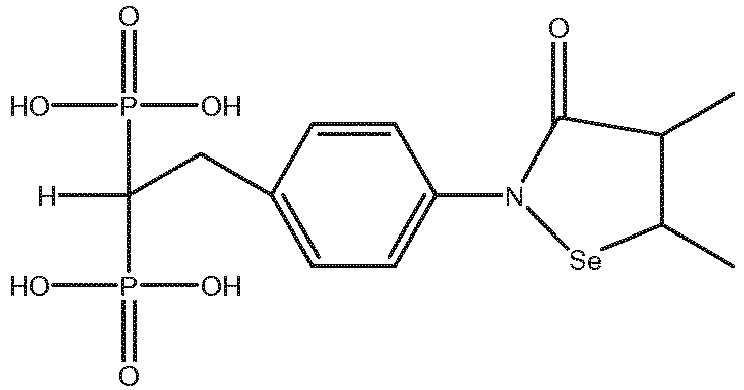
- The method for preparing the compound comprises the following steps:
- 50mL aqueous solution of 12g KBH4 is slowly added dropwise to 400mL aqueous solution of 64g selenium powder in room temperature. Then 64g selenium powder is added, stirred in room temperature for 3h, and then 80mL 9mol/L NaOH solution is added and the agitation is kept for 3h to obtain the alkaline solution of Se ion.
- 205g 2-methy β-butyrine is added to 500mL water and 400mL concentrated HC1, completely dissolved, placed in 0∼5°C ice-water bath, 12g NaNO2 is added to 50mL water and stirred to dissolve, then added dropwise to 2-methyl β-butyrine solution. The dripping speed is controlled to keep the temperature between 0∼5°C, the potassium iodide-starch test paper is used to determine the end of reaction, and the diazonium salt solution is obtained.
- The diazonium salt solution is added dropwise to the above Se ion solution. After dripping the temperature of the reaction liquid is raised to 60°C and reacted for 5h. pH of the reaction liquid is adjusted by concentrated hydrochloric acid to less than 3. The white precipitate is obtained, filtered, and washed with water. NaHCO3 is then added, dissolved and boiled, and then filtered. The filtrate is acidified with diluted hydrochloric acid, and pH is adjusted to less than 1. The white precipitate is obtained, filtered, the white filter cake is obtained, and dried under 100°C to obtain 3,3'-selenium-2-methyl-butanoic acid.
- 150g 3,3'-selenium-2-methyl butanoic acid is added into 400mL SOCl2 solution, refluxed under 80°C for 2h, and the solvent is recovered through reduced pressure distillation. The residue is added to 300mL petroleum ether and heated up and refluxed for 30min. The reaction liquid is filtered while hot, the filtrate is put still in room temperature to crystallize in low temperature, the precipitated solid is filtered, and the filter cake is dried in room temperature with good ventilation to obtain 3-selenium-2-methylbutyricacidchloride.
- The ethyl ether solution of 25g 3-selenium-2-methyl butyric acid chloride is added dropwise to the mixed liquid of 50g tetraisopropyl 4-aminobenzyl methylene diphosphonate, 40g sodium bicarbonate and 400mL water and stirred. The reaction liquid is cooled in ice bath, reacted in ice-water bath for 2h and reacted in room temperature for 4h. The reaction liquid is filtered and the filter cake is washed with ethyl ether and dried under 60°C for 8h to obtain 4-(4,5-dimethyl--1,2-seleniumazolidine-3-ketone)-tetraisopropylbenzyl-methylene diphosphonate.
40g 4-(4,5-dimethy-1,2-seleniumazolidine-3-ketone)-tetraisopropylbenzyl-methylene diphosphonate is added to 500mL methanol and 1000mL concentrated hydrochloric acid, and refluxed under110°C for 6h. After reaction the reaction liquid is cooled and filtered, and the filtrate is evaporated and dried. The residue is washed with methanol and dried in 105°C vacuum drying oven for 10h to obtain light yellow solid. - Identification of the light yellow solid:
- 1H-NMR (DMSO,δ) 1.40∼1.58 (d,3H); 1.67∼1.89 (d,3H); 2.20∼2.34 (m,1H); 2.36∼2.48 (m,1H); 2.87∼2.97 (t,1H); 3.05∼3.17 (d,2H); 7.334∼7.356 (d,2H); 7.510∼7.534 (d,2H); 10.310∼10.576 (S,4H).
- ESI-MS: 440.
- Element analysis: Se 7.9%, P 14.1%.
- It is determined that the light yellow solid is 4-(4,5-dimethyl--1,2-seleniumazolidine-3-ketone)-benzyl-methylene diphosphonic acid.
- The diphosphonate compound in this embodiment is 4-(4,5-dimethyl-1,2-seleniumazolidine-3-ketone)-benzyl-1-hydroxyl-methylene diphosphonic acid, having the following formula:

- The method for preparing the compound comprises the following steps:
- The ethyl ether solution of 70g 3-selenum-2-methylbutyryl chloride is added dropwise to the mixed liquid of 50g methyl-(4-aminophenyl) acetate, 15g sodium bicarbonate and 600mL water and stirred. The reaction liquid is cooled in ice bath, reacted in ice-water bath for 2h and reacted in room temperature for 4h. The reaction liquid is filtered and the filter cake is washed with ethyl ether and dried under 60°C for 8h to obtain 4-(4,5-dimethyl--1,2-seleniumazolidine-3-ketone)-methylphenyl acetate.
- 8.5g phosphorous acid is heated up to 90°C∼120°C and dissolved, 50g 4-(4,5-dimethyl-1,2-seleniumazolidine-3-ketone)-methylphenyl acetate is added, stirred to dissolve, 28g phosphorus trichloride is added dropwise, and the agitation is kept for 4h. Water is added when the product goes stiff and refluxed under 105°C for 2h. The reaction liquid is filtered and the filtrate is added with methanol and put still under 5°C for 17h, suction-filtered. The solid is washed with cold water and vacuum-dried under 100°C for 6h to obtain white solid.
- Identification of the white solid:
- 1H-NMR (DMSO,δ) 1.38∼1.49 (d,3H); 1.65∼1.79 (d,3H); 2.23∼2.34 (m,1H); 2.83∼2.95 (m,2H); 3.03∼3.18 (S,2H); 7.336∼7.356 (d,2H); 7.509∼7.531 (d,2H); 9.450S,1H); 10.309∼10.594 (S,4H).
- ESI-MS: 456.
- Element analysis: Se 17.2%, P 13.7%.
- It is determined that the light yellow solid is 4-(4,5-dimethyl-1,2-seleniumazolidine-3-ketone)-benzyl-1-hydroxyl-methylene diphosphonic acid.
- The diphosphonate compound in this embodiment is 4-(3-carbonylcyclohexano[d][1,2]selenazole-2(3H))-benzyl-methylene-diphosphonic acid, having the following formula:

- The diphosphonic acid compound is prepared from the same synthesis process with embodiment 5, but the only difference is that 2-amino cyclohexane carboxylic acid replaces 2-methyl-β butyrine to obtain white solid.
- Identification of the white solid:
- 1H-NMR (DMSO,δ) 1.39∼1.49 (m,4H); 1.50∼1.59 (m,2H); 1.65∼1.90 (m,2H); 2.01∼2.19 (m,1H); 2.25∼2.39 (t,1H); 2.71∼2.93 (m,1H); 3.05∼3.17 (d,2H); 7.307∼7.331 (d,2H); 7.519∼7.546 (d,2H); 10.219∼10.491 (S,4H).
- ESI-MS: 466.
- Element analysis: Se 17.1%, P 13.2%.
- It is determined that the white solid is 4-(3-carbonylcyclohexano[d][1,2]selenazole-2(3H))-benzyl-methylene diphosphonic acid.
- The diphosphonate compound in this embodiment is 4-(3 -carbonylcyclohexano[d][1,2] selenazole-2(3H))-benzyl-1-hyclroxyl-methylenectiphosphonic acid, having the following formula:

- The diphosphonic acid compound is prepared from the same synthesis process with embodiment 6, but the only difference is that 2-methyl-β-butyrine is replaced by 2-aminocyclohexanecarboxylic acid to obtain white solid.
- Identification of the white solid:
- 1H-NMR (DMSO,δ) 1.29∼1.38 (m,4H); 1.42∼1.58 (m,2H); 1.61∼1.87 (m,2H); 2.02∼2.21 (m,1H); 2.68∼2.93 (m,1H); 3.20∼3.42 (s,2H); 7.311∼7.33 (d,2H); 7.511∼7.536 (d,2H); 9.347S,1H); 10.301∼10.485 (S,4H).
- ESI-MS: 482;
- Element analysis: Se 16.3%, P 12.9%.
- It is determined that the white solid is 4-(3-carbonylcyclohexano[d][1,2]selenazole-2(3H))-benzyl-1-hydroxyl-methylene diphosphonic acid.
- The diphosphonate compound in this embodiment is 4-(3-carbonyl-5-chlorobenzo[d][1,2]selenazole-2(3H))-benzyl-metlrylene diphosphonic acid, having the following formula:

- The diphosphonic acid compound is prepared from the same synthesis process with embodiment 1, but the only difference is that anthranilic acid is replaced by 2-amino-5-chlorine-benzoic acid to obtain white-like solid 4-(3-carbonyl-5-chlorobenzo[d][1,2]selenazole-2(3H))-benzyl-methylene diphosphonic acid.
1H-NMR (DMSO,δ) 2.20∼2.47 (t,1H); 3.03∼3.21 (d,2H); 7.331∼7.356 (d,2H); 7.447∼7.476 (d,1H); 7.510∼7.536 (d,2H); 7.880∼7.911 (d,1H); 8.193∼8.203 (s,1H); 10.331∼10.489S,4H).
ESI-MS: 496
Element analysis: Se 15.8%, P 12.6% - It is determined that the white solid is 4-(3-carbonyl-5-cyclohexano[d][1,2]selenazole-2(3H))-benzyl-methylene diphosphonic acid.
- The diphosphonate compound in this embodiment is 4-(3-carbonyl-5-chlorobenzo[d][1,2]selenazole-2(3H))-benzyl-1-hydroxyl-methylene diphosphonic acid, having the following formula:

- The diphosphonic acid compound is prepared from the same synthesis process with embodiment 2, but the only difference is that anthranilic acid is replaced by 2-amino-5-chlorine-benzoic acid to obtain white-like solid.
1H-NMR (DMSO,δ) 3.21∼3.39 (S,2H); 7.330∼7.351 (d,2H); 7.447∼7.473 (d,1H); 7.511∼7.536 (d,2H); 7.877∼7.903 (d,1H); 8.190∼8.213 (s,1H); 9.447 (S,1H); 10.278∼10.504 (S,4H).
ESI-MS: 512.
Element analysis: Se 15.6%, P 12.0%. - It is determined that the white solid is 4-(3-carbonyl-5-cyclohexano[d][1,2]selenazole-2(3H))-benzyl-1-hydroxyl-methylenediphosphoni c acid.
- The diphosphonate compound in this embodiment is 4-(2-methylbenzo[d][1,2]selenazole-3(2H)-ketone)-benzyl-methylene diphosphonic acid, having the following formula:

- The diphosphonic acid compound is prepared from the same synthesis process with embodiment 1, but the only difference is that 4-nitrobenzyl bromide is replaced by 4-nitromethylbenzyl bromide to obtain white solid.
1H-NMR (DMSO,δ) 2.20∼2.41 (t,1H); 3.05∼3.19 (d,2H); 5.171∼5.192 (S,2H); 7.316∼7.334 (d,2H); 7.450∼7.470 (t,1H); 7.512∼7.530 (d,2H); 7.650∼7.694 (t,1H); 7.879∼7.896 (d,1H); 8.089∼8.112 (d,1H); 10.321∼10.507 (S,4H).
ESI-MS: 476.
Element analysis: Se 16.7%, P 13.1%. - It is determined that the white solid is 4-(2-methylbenzo[d][1,2]selenazole-3(2H)-ketone)-benzyl-methylene diphosphonic acid.
- The diphosphonate compound in this embodiment is 4-(2-methylbenzo[d][1,2]selenazole-3(2H)-ketone)-benzyl-1-hydroxyl-methylene diphosphonic acid, having the following formula:

- The diphosphonic acid compound is prepared from the same synthesis process with embodiment 2, but the only difference is that methyl-(4-aminophenyl) acetate is replaced by methyl-a-methyl-p-amino phenyl acetate to obtain white solid.
1H-NMR (DMSO,δ) 3.12∼3.27 (S,2H); 5.170∼5.191 (S,2H); 7.319∼7.331 (d,2H); 7.450∼7.471 (t,1H); 7.510∼7.530 (d,2H); 7.643∼7.690 (t,1H); 7.880∼7.901 (d,1H); 8.083∼8.115 (d,1H); 9.468S,1H); 10.320∼10.511 (S,4H).
ESI-MS: 492.
Element analysis: Se 15.9%, P 12.5%. - It is determined that the white solid is 4-(2-methylbenzo[d][1,2]selenazole-3(2H)-ketone)-benzyl-1-hydroxyl-methylene diphosphonic acid.
- The diphosphonate compound in this embodiment is 4-(3-carbonylbenzo[d][1,2]selenazole-2(3H))-phenylethyl-methylenediphosphonic acid, having the following formula:

- The diphosphonic acid compound is prepared from the same synthesis process with embodiment 1, but the only difference is that 4-nitrobenzyl bromide is replaced by 4-nitro-(2-bromomethyl)-benzene to obtain light yellow solid.
1H-NMR (DMSO,δ) 1.35∼1.49 (t,1H); 1.65∼1.79 (m,2H); 3.00∼3.12 (t,2H); 7.336∼7.41 (d,2H); 7.453∼7.475 (t,1H); 7.510∼7.534 (d,2H); 7.651∼7.693 (t,1H); 7.882∼7.900 (d,1H); 8.088∼8.115 (d,1H); 10.329∼10.515 (S,4H).
ESI-MS: 476.
Element analysis: Se 16.6%, P 13.2%. - It is determined that the white solid is 4-(3-carbonylbenzo[d][1,2]selenazole-2(3H))-phenylethyl-methylene diphosphonic acid.
- The diphosphonate compound in this embodiment is 4-(3-carbonylbenzo[d][1,2]selenazole-2(3H))-phenylethyl-1-hydroxyl-methylene diphosphonic acid, having the following formula:

- The diphosphonic acid compound is prepared from the same synthesis process with embodiment 2, but the only difference is that methyl 4-amino phenyl acetate is replaced by methyl 4-nitro-phenylpropionatere to obtain white solid.
1H-NMR (DMSO,δ) 1.52∼1.83 (t,2H); 3.01∼3.10 (t,2H); 7.334∼7.42 (d,2H); 7.455∼7.477 (t,1H); 7.510∼7.532 (d,2H); 7.652∼7.693 (t,1H); 7.882∼7.901 (d,1H); 8.083∼8.112 (d,1H); 9.378 (S,1H); 10.329∼10.512 (S,4H).
ESI-MS: 492.
Element analysis: Se 16.2%, P 12.5%. - It is determined that the white solid is 4-(3-carbonylbenzo[d] [1,2]selenazole-2(3H))-phenylethyl-1-hydroxyl-methylene diphosphonic acid
- The diphosphonate compound in this embodiment is 4-(3-carbonylbenzo[d][1,2]sulfonazole-2(3H))-benzyl-methylene diphosphonic acid, having the following formula:

- The diphosphonic acid compound is prepared from the same synthesis process with embodiment 1, but the only difference is that selenium powder is replaced by sulfur powder to obtain yellow solid.
1H-NM (DMSO,δ) 2.11∼2.27 (t,1H); 2.98∼3.12 (d,2H); 7.121∼7.325 (d,2H); 7.352∼7.371 (t,1H); 7.402∼7.464 (d,2H); 7.501∼7.592 (t,1H); 7.610∼7.741 (d,1H); 7.918∼8.002 (d,1H); 10.198∼10.693 (S,4H).
ESI-MS: 415.
Element analysis: S 15.1%, P 14.9%. - It is determined that the yellow solid is 4-(3-carbonylbenzo[d][1,2]sulfonazole-2(3H))-phenylethyl-methylene diphosphonic acid.
- The diphosphonate compound in this embodiment is 4-(3-carbonylbenzo[d][1,2]sulfonazole-2(3H))-benzyl-1-hydroxyl-methylene diphosphonic acid, having the following formula:

- The diphosphonic acid compound is prepared from the same synthesis process with embodiment 2, but the only difference is that selenium powder is replaced by sulfur powder to obtain yellow solid.
1H-NMR (DMSO,δ) 3.07∼3.21 (S,2H); 7.310∼7.332 (d,2H); 7.350∼7.369 (t,1H); 7.517∼7.537 (d,2H); 7.562∼7.593 (t,1H); 7.614∼7.642 (d,1H); 7.801∼7.872 (d,1H); 9.313 (S,1H); 10.409 (S,4H).
ESI-MS: 431.
Element analysis: S 14.6 %, P 14.3%. - It is determined that the yellow solid is 4-(3-carbonylbenzo[d][1,2]selenazole-2(3H))-phenylethyl-1-hydroxyl-methylene diphosphonic acid.
-
- Test drugs: SC-1∼16; self-made, referring to embodiments.
- Positive control: alendronate sodium (ALEN), National Institutes for Food and Drug Control (batch number: 100901-200601).
- Blank: dissolvents except tested drugs or ALEN.
- MG63 osteoblasts (Key Laboratory of Ministry of Education for Biological Therapy of Human Diseases, SCU), after 24h of recovery, cells adhere to wall and grow, and the endochylema begins to extend, fresh F-12 culture media containing 10% fetal bovine serum is added and replaced every 48 hours. When cell confluence reaches to 70%-80%, 0.25% trypsin is used for digestion so that adherent cells become loose and round-shaped, and the digestion liquid is extracted out and added with fresh F-12 culture media containing 10% fetal bovine serum to terminate digestion. Cells are pipetted from the culture flask, adjusted to the desired density, and transferred into the other culture flasks or culture plates.
- MTT method is used to evaluate the effects of the drug on the activity of proliferation of osteoblasts MG63, wherein each well of 96-well plate is added with fresh MTT (5mg/mL) 100µL, incubated under 37°C for 4h, and vibrated every a period of time. Then the supernatant is removed, each well is added with 200µL DMSO (DMSO, Sigma corp.), vibrated on micro-oscillator for 10 min. Equivalent amount of liquid is transferred to an new plate and the absorbance value under 490nm is measured referring to table 1.
Table 1 Cell proliferation of each group (MTT method, n=4,†† x ± sGroup 24h 48h 72h Blank 0.383±0.012 0.441±0.010 0.659±0.012 SC-1 10-9 mol/L 0.371±0.009 0.437±0.008 0.746±0.011* 10-7 mol/L 0.337±0.011 0.425±0.007 0.649±0.010 10-5 mol/L 0.340±0.009 0.398±0.011* 0.299±0.009** SC-2 10-9 mol/L 0.365±0.008 0.412±0.007 0.713±0.013* 10-7 mol/L 0.377±0.006 0.431±0.009 0.701±0.008 10-5 mol/L 0.351±0.009 0.387±0.005* 0.317±0.013** SC-3 10-9 mol/L 0387±0.012 0.413±0.008 0.646±0.009 10-7 mol/L 0.362±0.011 0.410±0.011 0.587±0.012 10-5 mol/L 0.332±0.009 0.367±.007* 0.304±0.005** SC-4 10-9 mol/L 0365±0.008 0.431±0.008 0.755-±0.009* 10-7 mol/L 0.341±0.011 0.466±0.006 0.637±0.011 10-5 mol/L 0.335±0.007 0.411±0.010 0.302±0.008** SC-5 10-9 mol/L 0.371±0.006 0.419±0.008 0.702±0.009 10-7 mol/L 0.361±0.008 0.437±0.010 0.661±0.010 10-5 mol/L 0.348±0.009 0.414±0.007 0.383±0.009** SC-6 10-9 mol/L 0.428±0.010 0.441±0.008 0.699±0.008 10-7 mol/L 0.410±0.007 0.400±0.007 0.632±0.010 10-5 mol/L 0.392±0.010 0.377±0.009* 0.411±0.008* SC-7 10-9 mol/L 0366±0.007 0.461±0.008 0.631±0.009 10-7 mol/L 0.346±0.009 0.469±0.008 0.618±0.009 10-5 mol/L 0.313±0.010 0.412±0.012 0.317±0.011** SC-8 10-9 mol/L 0.355±0.009 0.421±0.008 0.773±0.013* 10-7 mol/L 0.373±0.010 0.439±0.012 0.709±0.010 10-5 mol/L 0.376±0.009 0.412±0.007 0.342±0.008** SC-9 10-9 mol/L 0.356±0.008 0.431±0.008 0.698±0.008 10-7 mol/L 0.363±0.008 0.457±0.010 0.713±0.011 10-5 mol/L 0.347±0.007 0.400±0.008* 0.323±0.010** SC-10 10-9 mol/L 0.355±0.007 0.421±0.009 0.698±0.008 10-7 mol/L 0.359±0.011 0.429±0.011 0.614±0.011 10-5 mol/L 0.341±0.007 0.387±0.009* 0.328±0.009** SC-11 10-9 mol/L 0.366±0.009 0.427±0.009 0.694±0.009 10-7 mol/L 0.341±0.009 0.438±0.008 0.656±0.011 10-5 mol/L 0.331±0.007 0.413±0.012 0.322±0.009** SC-12 10-9 mol/L 0.378±0.008 0.442±0.007 0.720±0.011 10-7 mol/L 0.364±0.009 0.462±0.008 0.712±0.007 10-5 mol/L 0.359±0.011 0.395±0.008* 0.342±0.009** SC-13 10-9 mol/L 0.374±0.011 0.432±0.007 0.661±0.009 10-7 mol/L 0.359±0.010 0.422±0.009 0.610±0.010 10-5 mol/L 0.345±0.008 0.385±0.011* 0.311±0.012** SC-14 10-9 mol/L 0.377±0.012 0.435±0.008 0.637±0.009 10-7 mol/L 0.358±0.010 0.426±0.009 0.627±0.011 10-5 mol/L 0.324±0.009 0.388±0.008* 0.324±0.009** SC-15 10-9 mol/L 0395±0.007 0.462±0.008 0.688±0.010 10-7 mol/L 0.366±0.004 0.433±0.006 0.524±0.011 10-5 mol/L 0.331±0.007 0.352±0.006** 0.308±0.007 SC-16 10-9 mol/L 0.348±0.007 0.432±0.008 0.612±0.007 10-7 mol/L. 0.343±0.005 0.415±0.007 0.527±0.011 10-5 mol/L 0.316±0.007 0.324±0.006** 0.262±0.007** Alen 10-9 mol/L 0.359±0.009 0.455±0.007 0.673±0.07 10-7 mol/L 0.351±0.002 0.426±0.004 0.546±0.012 10-5 mol/L 0.345±0.009 0.339±0.006** 0.258±0.008** *p<0.05, compared with control group; **p<0.01, compared with control - Table 1 indicates that, compared with the corresponding control groups (including blank and positive control) at the same time points, there is no statistical difference in absorbance value both at 24h and 48h (P>0.05) indicating the tested drugs and ALEN have no influence on proliferation of MG63 cells in the range of concentrations within 48h. After 72h's incubation of the compound, 10-9mol/L of SC-1, SC-2, SC-4, SC-8 groups, compared with the corresponding control groups, there are statistical difference in absorbance value (P<0.05), indicating the above SC compounds in low concentration when cultured for 72h with MG63 could enhance MG63 cell proliferation. ALEN groups in higher concentration of 10-5, 10-7 mol/L for 72h, and cell proliferation activity is inhibited in different degrees (compared with the corresponding control groups, P<0.01), but compared with the corresponding control groups, there is an increasing tendency of absorbance value in other SC groups, indicating SC compounds may up-regulate MG63 cell proliferation in certain concentrations. Only when concentration and effecting period of SC reach to 10-5 mol/L and 72h, respectively, the proliferation activity of MG63 cell is obviously affected (P<0.01) indicating high concentrations (10-5,10-7mol/L) inhibit MG63 cell proliferation only after a long time (72h) of effect. Compared with positive control (Alen), each group of tested compound has no statistical difference in MG63 cell inhibition indicating the inhibition activity of each tested drug is equivalent to Alen.
- The alizarin red S(ARS) quantitative assay is applied, wherein each well of 6 well plate is added with 10-5 mol/L, 10-7 mol/L, 10-9 mol/L of SC or ALEN, respectively, for 5d (1,25-(OH)2VitD3 is added 48h before experiment termination for each well, and the final concentration of the vitamin is 10-8 mol/L), and the culture media is extracted out. Then the cell was rinsed with PBS (pH7.2) gently for 3 times, fixed in 95% alcohol for 15min, and stained with 1% alizarin red S under room temperature for 30 min-45 min. Image Pro Plus 6.0 software (Media Cybernetics Inc.) is applied to measure the size of calcium nodules (orange red, diameter>200µm). Next, each well is added with 1 mL extract (extract preparation: 800 mL 10% acetic acid with 200 mL anhydrous ethyl alcohol) extracted for 30min-45min, kept in dark, and shaken slightly. The absorbance of 450nm wavelength is measured and recorded. According to the equation y=0.0088x+0.0549 (y, absorbance, x, concentration of alizarin red S, µg/mL; r=0.997), the concentration of alizarin red S in each well is calculated. As alizarin red S and calcium are linear correlated, the calcium deposition is evaluated according to the alizarin red S concentration. Results are shown in table 2
Table 2 Effect of each group of drugs on mineralization of osteoblasts (n=4, x ± s)Group Calcium nodulesize/mm2 ARS concentration/(µg/mL) Blank control 1.34±0.17 344±25 S 10-9mol/L 2.53±10.35** 455±31 C- 10-7mol/L 1.62±0.09* 389±43 1 10-5mol/L 1.01±0.12 277±26 S 10-9mol/L 2.47±0.18** 440±22 C- 10-7mol/L 1.99±0.20* 415±23 2 10-5mol/L 1.01±0.05 213±11 S 10-9mol/L 2.44±0.13** 431±19 C- 10-7mol/L 1.91±0.17 413±21 3 10-5mol/L 1.133±0.03 263±10 S 10-9mol/L 2.39±0.28** 463±28 C- 10-7mol/L 1.51±0.08 401±45 4 10-5mol/L 1.14±0.09 297±33 S 10-9mol/L 2.03±0.13* 411±18 C- 10-7mol/L 1.87±0.21 386±20 5 10-5mol/L 1.27±0.10 300±15 S 10-9mol/L 2.53±0.19** 469±17 C- 10-7mol/L 2.02±0.16* 421±18 6 10-5mol/L 1.19±0.04 259±12 S 10-9mol/L 2.11±0.19** 416±25 C- 10-7mol/L 1.44±0.08 332±27 7 10-5mol/L 1.09±0.07 277±41 S 10-9mol/L 1.96±0.19* 395±17 C- 10-7mol/L 1.66±0.16 354±23 8 10-5mol/L 1.32±0.11 309±13 S 10-9mol/L 2.61±0.27** 487±15 C- 10-7mol/L 2.11±0.13* 433±19 9 10-5mol/L 1.27±0.07 329±12 S 10-9mol/L 2.49±0.33** 460±24 C- 10-7mol/L 1.97±0.09* 411±43 10 10-5mol/L 1.12±0.07 265±18 S 10-9mol/L 2.38±0.11** 451±29 C- 10-7mol/L 2.01±0.21* 398±21 11 10-5mol/L 1.21±0.11 299±26 S 10-9mol/L 2.51±0.17** 445±30 C- 10-7mol/L 1.75±0.16 365±26 12 10-5mol/L 0.97±0.02 239±12 S 10-9mol/L 2.39±0.26** 447±36 c- 10-7mol/L 1.89±0.07 419±31 13 10-5mol/L 1.11±0.14 291±21 S 10-9mol/L 2.01±0.20* 401±21 C- 10-7mol/L 1.87±0.15* 411±19 14 10-5mol/L 1.17±0.04 239±7 S 10-9mol/L 1.59±0.17 399±26 C- 10-7mol/L 1.01±0.05 328±20 15 10-5mol/L 0.94±0.03 219±11 S 10-9mol/L 1.97±0.19* 395±29 C- 10-7mol/L 1.55±0.06 313±11 16 10-5mol/L 1.12±0.10 288±25 10-9mol/L 1.74±0.15 381±23 AI 10-7mol/L 1.47±0.19 325±29 en 10-5mol/L 0.97±0.09 183±12 *p<0.05, compared with control group; **p<0.01, compared with control group. - Results indicate that each SC compound in lower concentration increases the calcium deposition of osteoblasts obviously, especially SC-1, SC-2, SC-4, SC-6, SC-9, SC-10, SC-11, SC-12, SC-13, SC-14, SC-15, but each group of compound of high concentration (10-5 mol/L) inhibits calcium deposition of osteoblasts. It is not found that Alen group of low concentration can enhance the calcium deposition of osteoblasts.
- The osteoclasts is cultured using a modified Chambers method, the new-born Japanese White Rabbit (1 week-age, provided by Experimental Animal Center of West China Medical Center of Sichuan University) is sacrificed by neck dislocation, and dipped in 75% ethanol for 5min, long bones are taken out under sterile condition, and soft tissue, periosteum as well as osteoepiphysis on the bone surface are removed in D-Hanks balanced salt solution, clean the bone shaft with α-MEM 2 times, and then cut off the long bone longitudinally in α-MEM full media (containing 15% fetal calf serum, penicillin 100 U/mL, streptomycin 100 µg/mL, 25m MHEPES, pH 7.0-7.2), scrape the medullar cavity of the bone gently until it is clean, and use a pipette (5mL syringe, 25G syringe needle) to rinse the medullar cavity repeatedly with culture media, and then the rinse solution is collected and filtered with cell strainer to remove bone fragment, and centrifuged at 1000 rpm for 5 min, the precipitate is suspended by 10 mL α-MEM, a hematocytometer is used for cell counting, the cell density in suspension is adjusted to 1 X 10⁷/mL, and inoculate the cells in 6-well plates, and co-cultured with glass slide or bone slice, after 60 min the culture media was replaced with α-MEM induction culture media (containing 15% fetal bovine serum, 10 nM 1, 25-(OH)2VitD3, penicillin 100 U/mL, streptomycin 100 µg/mL, 25mM HEPES, pH 7.0-7.2). The culture media is replaced every 3 days.
- Each group of osteoclasts is performed with tartrate-resistant acid phosphatase (TRAP) staining, observed in optical microscope, and the TRAP staining positive cells are counted. Results are shown in table 3.
Table 3 Effect of the drug on OC cell formation (n=6,† † x ± s)Group 3d 5d Blank 13±2 32±7 SC-1 10-9mol/L 12±3 15±3 10-7mol/L 14±4 10±5 10-5mol/L 5±1 1±1 10-9mol/L 10±3 14±5 SC-2 10-7mol/L 13±5 11±4 10-5mol/L 8±3 3±2 10-9mol/L 13±5 15±6 SC-3 10-7mol/L 9±5 4±3 10-5mol/L 12±3 3±3 10-9mol/L 13±2 13±4 SC-4 10-7mol/L 11±2 12±2 10-5mol/L 6±2 3±1 10-9mol/L 11±2 13±3 SC-5 10-7mol/L 14±5 13±6 10-5mol/L 9±1 7±2 10-9mol/L 13±1 13±4 SC-6 10-7mol/L 11±3 7±4 10-5mol/L 12±6 5±4 10-9mol/L 12±3 21±6 SC-7 10-7mol/L 10±2 15±4 10-5mol/L 6±2 9±2 10-9mol/L 12±3 21±6 SC-8 10-7mol/L 10±2 15±4† 10-5mol/L 6±2 9±2 10-9mol/L 12±7 19±7 SC-9 10-7mol/L 10±3 14±5 10-5mol/L 10±6 7±3 10-9mol/L 13±3 20±8 SC-10 10-7mol/L 9±4 16±5 10-5mol/L 3±3 6±5 10-9mol/L 9±3 14±8 SC-11 10-7mol/L 10±7 12±6 10-5mol/L 5±3 8±6 10-9mol/L 13±2 19±6 SC-12 10-7mol/L 10±5 14±9 10-5mol/L 7±6 7±3 10-9mol/L 12±4 11±2 SC-13 10-7mol/L 9±3 9±6 10-5mol/L 3±1 2±1 10-9mol/L 13±3 14±9 SC-14 10-7mol/L 11±6 12±4 10-5mol/L 7±3 5±1 10-9mol/L 12±5 13±3 SC-15 10-7mol/L 10±3 11±5 10-5mol/L 8±3 7±3 10-9mol/L 11±5 15±6 SC-16 10-7mol/L 9±4 12±3 10-5mol/L 8±3 6±2 10-9mol/L 14±6 18±6 Alen 10-7mol/L 13±4 15±5 10-5mol/L 8±2 5±2 *p<0.05, compared with blank; **p<0.01, compared with blank. - Results indicate that all concentrations of SC compounds and Alen, compared with blank, can inhibit the formation of osteoclasts and the inhibition is depending on the incubation time and concentrations of the tested drugs, but there is no significant difference between SC compounds and Alen indicating SC compounds and Alen have equivalent inhibition effect on the formation of osteoclasts. Generally, with the concentration and incubation time of the drugs increasing, TRAP+ cell number obviously decreases.
- After 5 days' culture of osteoclasts the bone slices were taken out, fixed in 2.5% glutaraldehyde for 7min, cleaned by ultrasonic agitation for 5 min in 0.25mmol/L ammonium hydroxide 3 times, dehydrated with alcohol and air-dried, stained with 1% toludine blue (containing 1% sodium borate) for 3min, and air-dried. Images are photographed with Nikon IX60 microscope using SPOT Cool CCD camera. The size of resorption pit on the whole bone slices is detected using Image Pro Plus 6.0 software. Results are shown in table 4.
Table 4 Effect of the drugs on formation and size of resorption pit of the osteoclast (n=6, x ± s)Drug concentration/mol/ L 10-9 10-7 10-5 Blank group 154.60±12.47 SC-1 98.92±7.26 59.16±11.85 8.73±1.75 SC-2 91.23±8.31 43.52±7.59 10.42±2.16 SC-3 100.49±10.15 59.49±10.03 9.35±1.09 SC-4 90.51±9.07 64.59±8.87 8.42±2.25 SC-5 98.41±13.26 46.40±11.21 5.58±0.98 SC-6 109.43±16.42 68.43±9.92 10.13±2.78 SC-7 103.45±9.67 72.53±9.83 8.50±2.11 SC-8 118.25±14.73 64.45±8.77 12.23±3.06 SC-9 107.23±9.88 45.72±7.86 11.12±2.65 SC-10 96.53±8.54 48.55±9.32 10.52±3.33 SC-11 99.53±11.27 56.72±10.11 9.43±4.25 SC-12 112.99±16.39 82.23±13.39 10.04±1.86 SC-13 112.11±9.96 92.45+12.28 11.52±2.64 SC-14 96.37±8.72 79.79±9.04 8.80±2.31 SC-15 99.37±8.43 81.92±9.12 9.17±3.47 SC-16 88.76±6.23 69.02±15.61 13.01±1.17 Alen 107.77±8.37 65.02±18.77 10.81±1.02 - The results show that the resorption pits size of all tested drugs groups as well as Alen groups decrease obviously compared with blank (p<0.01) indicating both SC compounds and Alen have inhibition effect on osteoclasts. The highest concentration (10-5 mol/L) of drugs, including Alen, present the maximal reduction in resorption pits size, and there are no significant differences between SC groups and Alen groups in resorption pits size indicating the tested drugs perform equivalent effect on the inhibition of osteoclasts with Alen.
- The current in vitro study indicates that the bisphosphonates SC, on one hand, may inhibit differentiation and maturation of osteoclasts and reduce the metabolic activity of bone resorption; on the other hand, they may also considerably promote proliferation and differentiation of osteoblasts, enhance bone formation and regulate metabolic balance of bone formation/resorption, and finally restore the homeostasis of bone.
- The in vitro study shows that the invention of SC compounds characteristic by their proliferation promotion effect to osteoblasts as well as the bisphosphonates' inhibition effect to osteoclasts. Therefore, the SC compounds of the present invention perform dual-directional regulation effect for osteoporosis treatment.
Claims (15)
- A compound with formula II:


R2 is
R3 is Se or S;
R4 and R5 are independently selected from the group consisting of hydrogen, halogen, -CN, -NO2 -OH, -OR', -COOR', -OCOOR', -COR', -CON(R')2, -OCON(R')2, -SR, -SO2R, -SO2N(R')2, -SOR'group, C1-C10 alkyl, C1-C10 substituted alkyl, alkenyl, substituted alkenyl, alkynyl, substituted alkynyl aryl or substituted aryl, wherein each of R and R' is independently selected from the group consisting of H, alkyl, aryl, substituted alkyl or substituted alkyl; or R4 and R5 constitute 3-7 carbons of cyclo alkane, the cyclo alkane may be substituted by C1-C6 alkyl, C1-C6 substituted alkyl, halogen, -CN, -NO2 or -OH;
R6, R7, R8 and R9 are independently selected from the group consisting of Hydrogen, halogen, -CN, -NO2 -OH, -OR', -COOR', -OCOOR', -COR', -CON(R')2, -OCON(R')2, -SR, -SO2R, -SO2N(R')2, -SOR'group, alkyl, alkenyl, alkynyl, aryl, substituted alkyl, substituted alkenyl, substituted alkynyl or substituted aryl, wherein each of R and R' is independently selected from H, alkyl, aryl, substituted alkyl or substituted aryl. - The compound according to Claim1, characterized in that R1 is H, OH or halogen;
R2 is
R3 is Se or S;
R4 and R5 are independently selected from the group consisting of Hydrogen, halogen, -CN, -NO2, -OH or C1-C10 alkyl;
R6, R7, R8 and R9 are each independently selected from the group consisting of Hydrogen, halogen, -CN, -NO2 or -OH alkyl. - The compound according to Claim 2, characterized in that R1 is H or OH.
- The compound according to Claim 2, characterized in that R1 is halogen.
- The compound according to Claim 4, characterized in that R1 is F, Cl or Br.
- The compound according to Claim 2, characterized in that R2 is

- The compound according to Claim 2, characterized in that R2 is

- The compound according to Claim 7, characterized in that R2 is

- The compound according to Claim 2, characterized in that R3 is Se.
- The compound according to Claim 2, characterized in that R6, R7, R8 and R9 are hydrogen.
- The compound according to Claim 2, characterized in that R1 is H or OH;
R2 is
R3 is Se;
R4 and R5 are independently selected from the group consisting of Hydrogen, halogen, -CN, -NO2 or -OH;
R6, R7, R8 and R9 are hydrogen. - A method for preparing the compound according to any of Claims 1-11, comprising the following steps:(1). Proton activation of methylene:Tetraisopropylmethylenediphosphonate and NaH are performed with the proton activation reaction of methylene for 1h-4h under -5°C-40°C, with the mole ratio of NaH and tetraisopropylmethylendiphosphonate being1:1-3:1;(2). alkylation reaction:The compound A
Br- R2-NO2
substituted by bromine and nitro is added to the reaction liquid resulted from step (1) to perform alkylation reaction under 60°C∼150°C for 2h∼5h, the mole ratio of compound A and tetraisopropylmethylenediphosphonate is 1:1-3:1; after reaction organic solvent is added to the reaction liquid for extraction, the organic phase is collected and evaporated to dryness, and compound I (3). reduction of nitro:10% Pd/C catalyst is added to the alcohol solution of compound I obtained in the alcylation reaction of step (2) and hydrogen gas is inlet, reacted under room temperature with 0.1MPa-2MPa of Hydrogen pressure in reaction system for 18h-48h, with the weight ratio of compound I and 10% Pd/C catalyst being 1:0.5-1:5, then compound II:
 (4). cyclization:Alkaline solution is added to the compound II obtained in the reduction of nitro of step (3) under the temperature of -20°C∼5°C, the pH is regulated to 7∼14, and then the organic solvent of o-seleniumchloroylbenzoyl chloride or o-sulfachloroylbenzoyl chloride is added, under room temperature, for 3h∼8h, with the mole ratio of compound II to o-seleniumchloroylbenzoyl chloride or o-sulfachloroylbenzoyl chloride being 1:1-1:5, and the reaction solution is filtered, the precipitate is collected and washed with organic solvent, and dried under 60°C-100°C for 4h-24h to obtain compound V:
 (5). hydrolysis:Alcohol and concentrated hydrochloric acid are added to the compound V obtained in the cyclization of step (4), with 1g compound V added 5mL∼50mL alcohol solution and 5mL∼60mL concentrated hydrochloric acid, refluxed under 90°C∼120°C for 4h∼10h, and the solvent is evaporated, the residue is washed with alcohol, and the solid obtained is vacuum-dried under 50°C∼120 °C for 4h∼10h, to obtain the diphosphonate compound having formula II.
 - A method for preparing the compound according to any of Claims 1-11, comprising the following steps:(1). cyclization:Solution of o-seleniumchloroylbenzoyl chloride or o-sulfachloroylbenzoyl chloride is added to pH 7∼14 ω-amino acid methyl ester
 (compound B), and reacted under room temperature for 3h∼8h, with the mole ratio of o-seleniumchloroylbenzoyl chloride or o-sulfachloroylbenzoyl chloride and ω-amino acid methyl ester being 1:1∼3:1, the reaction liquid is filtered, and the precipitate is washed with organic solvent, and dried under 50°C∼100°C for 4h∼24h, to obtain compound VII:
 (2). hydrolysis:Alcohol and hydrochloric acid are added to the compound VII obtained in the cyclization of step (1), with 1g compound VII added 2mL∼50mL alcohol and 5mL-50mL hydrochloric acid, refluxed under 90°C∼120°C for 4h-10h, and the solvent is removed through reduced pressure distillation, the residue is recrystallized with alcohol, to obtain the compound VIII
 (3). phosphoration:The compound VIII obtained in the hydrolysis of step (2) is reacted with phosphorous acid and phosphorus trichloride under 90°C∼120°C for 2h∼6h, water is added into the reactant, with 1g compound VIII added 1mL∼50mLwater, and refluxed under 90°C∼110°C for 1h∼h, with the mole ratio of compound VIII and phosphorous acid being 1:1∼1:5, and the mole ratio of compound VIII and phosphorus trichloride being 1:2∼1:6, and the reaction liquid is filtered, alcohol solution is added into the filtrate and put still under -5°C∼5°Cfor 12h∼48h; then the solution is suction-filtered, the solid is washed with water, and vacuum-dried under 50°C∼120°C for 4h∼10h, to obtain the diphosphonate compound IX:
- The method for preparing the compound according to Claim 13, characterized in that the solvent in step (1) is ethylether, methylene dichloride, methenyl chloride or ethyl acetate.
- An application of the compound according to any of Claims 1∼11 in preparing the drugs for treating bone metabolic diseases.
Applications Claiming Priority (2)
| Application Number | Priority Date | Filing Date | Title |
|---|---|---|---|
| CN201010529957.7A CN102453050B (en) | 2010-11-03 | 2010-11-03 | Bisphosphonate compound and preparation method thereof |
| PCT/CN2011/078808 WO2012058976A1 (en) | 2010-11-03 | 2011-08-24 | Diphosphonate compounds and preparation method and use thereof |
Publications (3)
| Publication Number | Publication Date |
|---|---|
| EP2636675A1 EP2636675A1 (en) | 2013-09-11 |
| EP2636675A4 EP2636675A4 (en) | 2014-03-12 |
| EP2636675B1 true EP2636675B1 (en) | 2016-05-18 |
Family
ID=46023994
Family Applications (1)
| Application Number | Title | Priority Date | Filing Date |
|---|---|---|---|
| EP11837502.1A Not-in-force EP2636675B1 (en) | 2010-11-03 | 2011-08-24 | Diphosphonate compounds and preparation method and use thereof |
Country Status (5)
| Country | Link |
|---|---|
| US (1) | US9045506B2 (en) |
| EP (1) | EP2636675B1 (en) |
| JP (1) | JP5792314B2 (en) |
| CN (1) | CN102453050B (en) |
| WO (1) | WO2012058976A1 (en) |
Families Citing this family (5)
| Publication number | Priority date | Publication date | Assignee | Title |
|---|---|---|---|---|
| CN106083925B (en) * | 2016-07-11 | 2019-12-31 | 成都云克药业有限责任公司 | Diphosphonic acid compound and preparation method and application thereof |
| CN105924470B (en) * | 2016-07-11 | 2019-01-29 | 成都云克药业有限责任公司 | A kind of bisphosphonate compound and the preparation method and application thereof |
| CN109608492B (en) * | 2018-12-19 | 2021-02-09 | 深圳市第二人民医院 | Diphosphonic acid compound for osteoporosis and preparation method thereof |
| CN111647016A (en) * | 2020-07-10 | 2020-09-11 | 成都纽瑞特医疗科技股份有限公司 | The preparation method of hydroxymethylene diphosphonate |
| CN112142795A (en) * | 2020-10-19 | 2020-12-29 | 成都纽瑞特医疗科技股份有限公司 | Selenazole diphosphonic acid compound and preparation method thereof |
Family Cites Families (10)
| Publication number | Priority date | Publication date | Assignee | Title |
|---|---|---|---|---|
| GB8609538D0 (en) * | 1986-04-18 | 1986-05-21 | Ici Plc | Heterocyclic compounds |
| GB8808138D0 (en) * | 1988-04-07 | 1988-05-11 | Leo Pharm Prod Ltd | Chemical compounds |
| JPH0699457B2 (en) * | 1988-08-12 | 1994-12-07 | 山之内製薬株式会社 | Heterocyclic bisphosphonic acid derivative and its medicine |
| FI89365C (en) | 1990-12-20 | 1993-09-27 | Leiras Oy | PROCEDURE FOR THE FRAMEWORK OF THE PHARMACOLOGICAL PROCEDURE OF METHYLENBISPHOSPHONYRADERIVAT |
| JPH05222073A (en) * | 1992-02-13 | 1993-08-31 | Sumitomo Pharmaceut Co Ltd | Bone selective estrogen |
| IL115041A0 (en) * | 1995-08-23 | 1995-12-08 | Yissum Res Dev Co | Novel bisphosphonates process for their preparation and pharmaceutical compositions containing them |
| CN1166651C (en) * | 2001-06-08 | 2004-09-15 | 北京大学药学院 | Anti-inflammatory and antineoplastic R-bis or glycophenylpropane isoselenazole substituted compound |
| CA2656053A1 (en) * | 2006-07-03 | 2008-01-10 | Generics [Uk] Limited | Novel process for the preparation of bisphosphonic acids |
| US8974801B2 (en) * | 2006-12-21 | 2015-03-10 | Amphastar Pharmaceuticals Inc. | Long term sustained release pharmaceutical composition containing aqueous suspension of bisphosphonate |
| JP2009107970A (en) * | 2007-10-30 | 2009-05-21 | Kirin Holdings Co Ltd | Macrophage iron metabolism-related gene expression enhancer comprising Nrf2 activating compound as an active ingredient |
-
2010
- 2010-11-03 CN CN201010529957.7A patent/CN102453050B/en active Active
-
2011
- 2011-08-24 US US13/880,972 patent/US9045506B2/en not_active Expired - Fee Related
- 2011-08-24 WO PCT/CN2011/078808 patent/WO2012058976A1/en not_active Ceased
- 2011-08-24 EP EP11837502.1A patent/EP2636675B1/en not_active Not-in-force
- 2011-08-24 JP JP2013536987A patent/JP5792314B2/en not_active Expired - Fee Related
Also Published As
| Publication number | Publication date |
|---|---|
| CN102453050B (en) | 2015-01-07 |
| WO2012058976A1 (en) | 2012-05-10 |
| US9045506B2 (en) | 2015-06-02 |
| JP2013542946A (en) | 2013-11-28 |
| EP2636675A4 (en) | 2014-03-12 |
| EP2636675A1 (en) | 2013-09-11 |
| JP5792314B2 (en) | 2015-10-07 |
| US20130211097A1 (en) | 2013-08-15 |
| CN102453050A (en) | 2012-05-16 |
Similar Documents
| Publication | Publication Date | Title |
|---|---|---|
| US5300687A (en) | Trifluoromethylbenzylphosphonates useful in treating osteoporosis | |
| CA2328159C (en) | Use of aminoalkylphosphonic acid derivatives for the therapeutic and preventative treatment of infections | |
| EP2636675A1 (en) | Diphosphonate compounds and preparation method and use thereof | |
| KR20200022480A (en) | Compositions and Methods for Controlling Hair Growth | |
| DK167808B1 (en) | Methylenebisphosphonic acid derivative, process for preparing it, and pharmaceutical composition which comprises these derivatives | |
| JP2004537549A (en) | Use of 4-[(4-thiazolyl) phenoxy] alkoxy-benzamidine derivatives as an osteoporosis therapeutic agent | |
| EP2330098B1 (en) | COMPOUND WITH AGITATION EFFECT ON PEROXISOME PROLIFERATOR-ACTIVATED RECEPTOR SUBTYPE delta, AND PREPARATION METHOD AND USE THEREOF | |
| US6410782B1 (en) | Diphosphonic acid salts for the treatment of osteoporosis | |
| JPS63239290A (en) | Novel bicyclic diphosphonate compounds, pharmaceutical compositions, and methods for treating abnormal calcium and phosphate metabolism | |
| CA2855660C (en) | Therapeutic agent for arthrosis | |
| CN105924470B (en) | A kind of bisphosphonate compound and the preparation method and application thereof | |
| SK282650B6 (en) | Pyridinyl-aminomethylidene biphosphonic acid tetraesters, pharmac eutical preparation containing them and their use | |
| DK155732B (en) | ANALOGY PROCEDURE FOR THE PREPARATION OF AMINO ACID DERIVATIVES | |
| US5616576A (en) | Controlling bone resorption with pyrroloquinoline quinone (PQQ) and related compounds | |
| CA2138127C (en) | New acyclic amidine group-containing diphosphonic acid derivatives, processes for their preparation and medicaments containing these compounds | |
| US4835178A (en) | Methylendioxyphenathrene and stilben derivatives, process for the preparation thereof, pharmaceutical compositions using these, and therapeutic applications | |
| AU664761B2 (en) | Thio-substituted cyclic phosphonate compounds for treating abnormal calcium and phosphate metabolism | |
| JP5783910B2 (en) | Phosphate management using small molecules | |
| CN118666760B (en) | Nitrogen-heterocycle-containing alpha-carbonyl thioamide compound, and preparation method and application thereof | |
| SK144794A3 (en) | Quaternary nitrogen containing phosphonate compounds for treating abnormal calcium and phosphate metabolism | |
| CN1435418A (en) | Aromatic nitrogen-contg. bis-phosphonic acid derivs., process for preparing same and use thereof | |
| JPH0314807B2 (en) | ||
| DK200200115U3 (en) | Novel salts of 4-amino-1-hydroxybutylidene-1,1-bisphosphonic acid, their preparation and use | |
| JP2004518716A (en) | Pharmaceutical composition for prevention and treatment of osteoporosis | |
| FI68243C (en) | FRAMEWORK FOR PHARMACOLOGICAL ACTIVATION OF ACTIVE DIPHOSPHONATERS |
Legal Events
| Date | Code | Title | Description |
|---|---|---|---|
| PUAI | Public reference made under article 153(3) epc to a published international application that has entered the european phase |
Free format text: ORIGINAL CODE: 0009012 |
|
| 17P | Request for examination filed |
Effective date: 20130516 |
|
| AK | Designated contracting states |
Kind code of ref document: A1 Designated state(s): AL AT BE BG CH CY CZ DE DK EE ES FI FR GB GR HR HU IE IS IT LI LT LU LV MC MK MT NL NO PL PT RO RS SE SI SK SM TR |
|
| DAX | Request for extension of the european patent (deleted) | ||
| A4 | Supplementary search report drawn up and despatched |
Effective date: 20140206 |
|
| RIC1 | Information provided on ipc code assigned before grant |
Ipc: C07F 9/547 20060101AFI20140131BHEP Ipc: C07F 9/6541 20060101ALI20140131BHEP Ipc: A61P 19/10 20060101ALI20140131BHEP Ipc: A61P 19/08 20060101ALI20140131BHEP Ipc: A61K 31/675 20060101ALI20140131BHEP Ipc: C07F 9/40 20060101ALI20140131BHEP |
|
| 17Q | First examination report despatched |
Effective date: 20150218 |
|
| GRAP | Despatch of communication of intention to grant a patent |
Free format text: ORIGINAL CODE: EPIDOSNIGR1 |
|
| INTG | Intention to grant announced |
Effective date: 20160217 |
|
| GRAS | Grant fee paid |
Free format text: ORIGINAL CODE: EPIDOSNIGR3 |
|
| GRAA | (expected) grant |
Free format text: ORIGINAL CODE: 0009210 |
|
| AK | Designated contracting states |
Kind code of ref document: B1 Designated state(s): AL AT BE BG CH CY CZ DE DK EE ES FI FR GB GR HR HU IE IS IT LI LT LU LV MC MK MT NL NO PL PT RO RS SE SI SK SM TR |
|
| REG | Reference to a national code |
Ref country code: GB Ref legal event code: FG4D |
|
| REG | Reference to a national code |
Ref country code: CH Ref legal event code: EP |
|
| REG | Reference to a national code |
Ref country code: IE Ref legal event code: FG4D Ref country code: AT Ref legal event code: REF Ref document number: 800371 Country of ref document: AT Kind code of ref document: T Effective date: 20160615 |
|
| REG | Reference to a national code |
Ref country code: DE Ref legal event code: R096 Ref document number: 602011026791 Country of ref document: DE |
|
| REG | Reference to a national code |
Ref country code: NL Ref legal event code: MP Effective date: 20160518 |
|
| REG | Reference to a national code |
Ref country code: LT Ref legal event code: MG4D |
|
| PG25 | Lapsed in a contracting state [announced via postgrant information from national office to epo] |
Ref country code: NL Free format text: LAPSE BECAUSE OF FAILURE TO SUBMIT A TRANSLATION OF THE DESCRIPTION OR TO PAY THE FEE WITHIN THE PRESCRIBED TIME-LIMIT Effective date: 20160518 Ref country code: FI Free format text: LAPSE BECAUSE OF FAILURE TO SUBMIT A TRANSLATION OF THE DESCRIPTION OR TO PAY THE FEE WITHIN THE PRESCRIBED TIME-LIMIT Effective date: 20160518 Ref country code: LT Free format text: LAPSE BECAUSE OF FAILURE TO SUBMIT A TRANSLATION OF THE DESCRIPTION OR TO PAY THE FEE WITHIN THE PRESCRIBED TIME-LIMIT Effective date: 20160518 Ref country code: NO Free format text: LAPSE BECAUSE OF FAILURE TO SUBMIT A TRANSLATION OF THE DESCRIPTION OR TO PAY THE FEE WITHIN THE PRESCRIBED TIME-LIMIT Effective date: 20160818 |
|
| REG | Reference to a national code |
Ref country code: AT Ref legal event code: MK05 Ref document number: 800371 Country of ref document: AT Kind code of ref document: T Effective date: 20160518 |
|
| PG25 | Lapsed in a contracting state [announced via postgrant information from national office to epo] |
Ref country code: PT Free format text: LAPSE BECAUSE OF FAILURE TO SUBMIT A TRANSLATION OF THE DESCRIPTION OR TO PAY THE FEE WITHIN THE PRESCRIBED TIME-LIMIT Effective date: 20160919 Ref country code: SE Free format text: LAPSE BECAUSE OF FAILURE TO SUBMIT A TRANSLATION OF THE DESCRIPTION OR TO PAY THE FEE WITHIN THE PRESCRIBED TIME-LIMIT Effective date: 20160518 Ref country code: RS Free format text: LAPSE BECAUSE OF FAILURE TO SUBMIT A TRANSLATION OF THE DESCRIPTION OR TO PAY THE FEE WITHIN THE PRESCRIBED TIME-LIMIT Effective date: 20160518 Ref country code: GR Free format text: LAPSE BECAUSE OF FAILURE TO SUBMIT A TRANSLATION OF THE DESCRIPTION OR TO PAY THE FEE WITHIN THE PRESCRIBED TIME-LIMIT Effective date: 20160819 Ref country code: ES Free format text: LAPSE BECAUSE OF FAILURE TO SUBMIT A TRANSLATION OF THE DESCRIPTION OR TO PAY THE FEE WITHIN THE PRESCRIBED TIME-LIMIT Effective date: 20160518 Ref country code: HR Free format text: LAPSE BECAUSE OF FAILURE TO SUBMIT A TRANSLATION OF THE DESCRIPTION OR TO PAY THE FEE WITHIN THE PRESCRIBED TIME-LIMIT Effective date: 20160518 Ref country code: LV Free format text: LAPSE BECAUSE OF FAILURE TO SUBMIT A TRANSLATION OF THE DESCRIPTION OR TO PAY THE FEE WITHIN THE PRESCRIBED TIME-LIMIT Effective date: 20160518 |
|
| PG25 | Lapsed in a contracting state [announced via postgrant information from national office to epo] |
Ref country code: IT Free format text: LAPSE BECAUSE OF FAILURE TO SUBMIT A TRANSLATION OF THE DESCRIPTION OR TO PAY THE FEE WITHIN THE PRESCRIBED TIME-LIMIT Effective date: 20160518 Ref country code: BE Free format text: LAPSE BECAUSE OF NON-PAYMENT OF DUE FEES Effective date: 20160831 |
|
| PG25 | Lapsed in a contracting state [announced via postgrant information from national office to epo] |
Ref country code: DK Free format text: LAPSE BECAUSE OF FAILURE TO SUBMIT A TRANSLATION OF THE DESCRIPTION OR TO PAY THE FEE WITHIN THE PRESCRIBED TIME-LIMIT Effective date: 20160518 Ref country code: CZ Free format text: LAPSE BECAUSE OF FAILURE TO SUBMIT A TRANSLATION OF THE DESCRIPTION OR TO PAY THE FEE WITHIN THE PRESCRIBED TIME-LIMIT Effective date: 20160518 Ref country code: SK Free format text: LAPSE BECAUSE OF FAILURE TO SUBMIT A TRANSLATION OF THE DESCRIPTION OR TO PAY THE FEE WITHIN THE PRESCRIBED TIME-LIMIT Effective date: 20160518 Ref country code: EE Free format text: LAPSE BECAUSE OF FAILURE TO SUBMIT A TRANSLATION OF THE DESCRIPTION OR TO PAY THE FEE WITHIN THE PRESCRIBED TIME-LIMIT Effective date: 20160518 Ref country code: RO Free format text: LAPSE BECAUSE OF FAILURE TO SUBMIT A TRANSLATION OF THE DESCRIPTION OR TO PAY THE FEE WITHIN THE PRESCRIBED TIME-LIMIT Effective date: 20160518 |
|
| REG | Reference to a national code |
Ref country code: DE Ref legal event code: R097 Ref document number: 602011026791 Country of ref document: DE |
|
| PG25 | Lapsed in a contracting state [announced via postgrant information from national office to epo] |
Ref country code: BE Free format text: LAPSE BECAUSE OF FAILURE TO SUBMIT A TRANSLATION OF THE DESCRIPTION OR TO PAY THE FEE WITHIN THE PRESCRIBED TIME-LIMIT Effective date: 20160518 Ref country code: SM Free format text: LAPSE BECAUSE OF FAILURE TO SUBMIT A TRANSLATION OF THE DESCRIPTION OR TO PAY THE FEE WITHIN THE PRESCRIBED TIME-LIMIT Effective date: 20160518 Ref country code: PL Free format text: LAPSE BECAUSE OF FAILURE TO SUBMIT A TRANSLATION OF THE DESCRIPTION OR TO PAY THE FEE WITHIN THE PRESCRIBED TIME-LIMIT Effective date: 20160518 Ref country code: AT Free format text: LAPSE BECAUSE OF FAILURE TO SUBMIT A TRANSLATION OF THE DESCRIPTION OR TO PAY THE FEE WITHIN THE PRESCRIBED TIME-LIMIT Effective date: 20160518 |
|
| REG | Reference to a national code |
Ref country code: DE Ref legal event code: R119 Ref document number: 602011026791 Country of ref document: DE |
|
| PLBE | No opposition filed within time limit |
Free format text: ORIGINAL CODE: 0009261 |
|
| STAA | Information on the status of an ep patent application or granted ep patent |
Free format text: STATUS: NO OPPOSITION FILED WITHIN TIME LIMIT |
|
| PG25 | Lapsed in a contracting state [announced via postgrant information from national office to epo] |
Ref country code: MC Free format text: LAPSE BECAUSE OF FAILURE TO SUBMIT A TRANSLATION OF THE DESCRIPTION OR TO PAY THE FEE WITHIN THE PRESCRIBED TIME-LIMIT Effective date: 20160518 |
|
| REG | Reference to a national code |
Ref country code: CH Ref legal event code: PL |
|
| 26N | No opposition filed |
Effective date: 20170221 |
|
| GBPC | Gb: european patent ceased through non-payment of renewal fee |
Effective date: 20160824 |
|
| PG25 | Lapsed in a contracting state [announced via postgrant information from national office to epo] |
Ref country code: CH Free format text: LAPSE BECAUSE OF NON-PAYMENT OF DUE FEES Effective date: 20160831 Ref country code: LI Free format text: LAPSE BECAUSE OF NON-PAYMENT OF DUE FEES Effective date: 20160831 |
|
| REG | Reference to a national code |
Ref country code: FR Ref legal event code: ST Effective date: 20170428 |
|
| PG25 | Lapsed in a contracting state [announced via postgrant information from national office to epo] |
Ref country code: SI Free format text: LAPSE BECAUSE OF FAILURE TO SUBMIT A TRANSLATION OF THE DESCRIPTION OR TO PAY THE FEE WITHIN THE PRESCRIBED TIME-LIMIT Effective date: 20160518 |
|
| REG | Reference to a national code |
Ref country code: IE Ref legal event code: MM4A |
|
| PG25 | Lapsed in a contracting state [announced via postgrant information from national office to epo] |
Ref country code: IE Free format text: LAPSE BECAUSE OF NON-PAYMENT OF DUE FEES Effective date: 20160824 Ref country code: GB Free format text: LAPSE BECAUSE OF NON-PAYMENT OF DUE FEES Effective date: 20160824 Ref country code: DE Free format text: LAPSE BECAUSE OF NON-PAYMENT OF DUE FEES Effective date: 20170301 Ref country code: FR Free format text: LAPSE BECAUSE OF NON-PAYMENT OF DUE FEES Effective date: 20160831 |
|
| PG25 | Lapsed in a contracting state [announced via postgrant information from national office to epo] |
Ref country code: LU Free format text: LAPSE BECAUSE OF NON-PAYMENT OF DUE FEES Effective date: 20160824 |
|
| PG25 | Lapsed in a contracting state [announced via postgrant information from national office to epo] |
Ref country code: CY Free format text: LAPSE BECAUSE OF FAILURE TO SUBMIT A TRANSLATION OF THE DESCRIPTION OR TO PAY THE FEE WITHIN THE PRESCRIBED TIME-LIMIT Effective date: 20160518 Ref country code: HU Free format text: LAPSE BECAUSE OF FAILURE TO SUBMIT A TRANSLATION OF THE DESCRIPTION OR TO PAY THE FEE WITHIN THE PRESCRIBED TIME-LIMIT; INVALID AB INITIO Effective date: 20110824 |
|
| PG25 | Lapsed in a contracting state [announced via postgrant information from national office to epo] |
Ref country code: TR Free format text: LAPSE BECAUSE OF FAILURE TO SUBMIT A TRANSLATION OF THE DESCRIPTION OR TO PAY THE FEE WITHIN THE PRESCRIBED TIME-LIMIT Effective date: 20160518 Ref country code: MK Free format text: LAPSE BECAUSE OF FAILURE TO SUBMIT A TRANSLATION OF THE DESCRIPTION OR TO PAY THE FEE WITHIN THE PRESCRIBED TIME-LIMIT Effective date: 20160518 Ref country code: IS Free format text: LAPSE BECAUSE OF FAILURE TO SUBMIT A TRANSLATION OF THE DESCRIPTION OR TO PAY THE FEE WITHIN THE PRESCRIBED TIME-LIMIT Effective date: 20160518 Ref country code: MT Free format text: LAPSE BECAUSE OF NON-PAYMENT OF DUE FEES Effective date: 20160831 |
|
| PG25 | Lapsed in a contracting state [announced via postgrant information from national office to epo] |
Ref country code: BG Free format text: LAPSE BECAUSE OF FAILURE TO SUBMIT A TRANSLATION OF THE DESCRIPTION OR TO PAY THE FEE WITHIN THE PRESCRIBED TIME-LIMIT Effective date: 20160518 |
|
| PG25 | Lapsed in a contracting state [announced via postgrant information from national office to epo] |
Ref country code: AL Free format text: LAPSE BECAUSE OF FAILURE TO SUBMIT A TRANSLATION OF THE DESCRIPTION OR TO PAY THE FEE WITHIN THE PRESCRIBED TIME-LIMIT Effective date: 20160518 |