EP2634182B1 - Method for preparing 1,3,5-trioxane - Google Patents
Method for preparing 1,3,5-trioxane Download PDFInfo
- Publication number
- EP2634182B1 EP2634182B1 EP11836529.5A EP11836529A EP2634182B1 EP 2634182 B1 EP2634182 B1 EP 2634182B1 EP 11836529 A EP11836529 A EP 11836529A EP 2634182 B1 EP2634182 B1 EP 2634182B1
- Authority
- EP
- European Patent Office
- Prior art keywords
- trioxane
- distillation tower
- distillation
- tower
- discharged
- Prior art date
- Legal status (The legal status is an assumption and is not a legal conclusion. Google has not performed a legal analysis and makes no representation as to the accuracy of the status listed.)
- Active
Links
Images


Classifications
-
- C—CHEMISTRY; METALLURGY
- C07—ORGANIC CHEMISTRY
- C07D—HETEROCYCLIC COMPOUNDS
- C07D323/00—Heterocyclic compounds containing more than two oxygen atoms as the only ring hetero atoms
- C07D323/04—Six-membered rings
- C07D323/06—Trioxane
-
- B—PERFORMING OPERATIONS; TRANSPORTING
- B01—PHYSICAL OR CHEMICAL PROCESSES OR APPARATUS IN GENERAL
- B01D—SEPARATION
- B01D3/00—Distillation or related exchange processes in which liquids are contacted with gaseous media, e.g. stripping
- B01D3/009—Distillation or related exchange processes in which liquids are contacted with gaseous media, e.g. stripping in combination with chemical reactions
-
- B—PERFORMING OPERATIONS; TRANSPORTING
- B01—PHYSICAL OR CHEMICAL PROCESSES OR APPARATUS IN GENERAL
- B01D—SEPARATION
- B01D3/00—Distillation or related exchange processes in which liquids are contacted with gaseous media, e.g. stripping
- B01D3/34—Distillation or related exchange processes in which liquids are contacted with gaseous media, e.g. stripping with one or more auxiliary substances
- B01D3/40—Extractive distillation
-
- Y—GENERAL TAGGING OF NEW TECHNOLOGICAL DEVELOPMENTS; GENERAL TAGGING OF CROSS-SECTIONAL TECHNOLOGIES SPANNING OVER SEVERAL SECTIONS OF THE IPC; TECHNICAL SUBJECTS COVERED BY FORMER USPC CROSS-REFERENCE ART COLLECTIONS [XRACs] AND DIGESTS
- Y02—TECHNOLOGIES OR APPLICATIONS FOR MITIGATION OR ADAPTATION AGAINST CLIMATE CHANGE
- Y02P—CLIMATE CHANGE MITIGATION TECHNOLOGIES IN THE PRODUCTION OR PROCESSING OF GOODS
- Y02P20/00—Technologies relating to chemical industry
- Y02P20/10—Process efficiency
Definitions
- the present invention relates to a method of preparing 1,3,5-trioxane using a reaction distillation tower including a reactor and a distillation tower provided with a distillation unit and an extraction unit.
- 1,3,5-trioxane is obtained by the cyclization reaction of formaldehyde in the presence of an acid catalyst or a solid acid catalyst.
- a 1,3,5-trioxane-contaning vapor obtained by the cyclization reaction is supplied from a reactor to a distillation tower.
- US3378468 and JP06228127 disclose such kind of process.
- the 1,3,5-trioxane-contaning vapor boiling in the distillation tower is concentrated and discharged, and then this concentrated 1,3,5-trioxane-containing vapor is extracted with a water-insoluble organic solvent. Further, the 1,3,5-trioxane-containing vapor boiling in the distillation tower may be directly extracted with a water-insoluble organic solvent.
- 1,3,5-trioxane is extracted by both a distillation tower and an extraction tower, and an extracted liquid is converted into a solution containing a small amount of 1,3,5-trioxane by a fractionator, and then the solution is refluxed into the extraction tower.
- This method of preparing 1,3,5-trioxane disclosed in JP 1982-200383 is problematic in that an equipment investment cost excessively increases because a distillation tower and an extraction tower are separately provided in order to prepare 1,3,5-trioxane, in that the preparation efficiency of 1,3,5-trioxane remarkably decreases because a large amount of formaldehyde and 1,3,5-trioxane, other than 1,3,5-trioxane extracted with extractant in the extraction tower, is discharged to the outside of a system, and in that distillation loss increases in the recovery process for recovering and reusing 1,3,5-trioxane.
- the present invention intends to provide a method of preparing 1,3,5-trioxane using a reaction distillation tower including a reactor and a distillation tower provided with integrally-formed distillation and extraction units, which can improve the preparation efficiency of 1,3,5-trioxane.
- An aspect of the present invention provides a method of preparing 1,3,5-trioxane using a reaction distillation tower including a reactor 10 and a distillation tower 20 provided with integrally-formed distillation and extraction units 21 and 22, wherein, at the time of extracting 1,3,5-trioxane from the extraction unit 22, a part of a water phase, which is separated from a stream discharged from a top of the distillation tower 20, is refluxed to an upper end of an extractant supply stream of the extraction unit 22.
- the concentration of formaldehyde in the water phase separated from the stream discharged from the top of the distillation tower 20 may be 15 wt% or less.
- An embodiment of the present invention provides a method of preparing 1,3,5-trioxane using a reaction distillation tower including a reactor and a distillation tower provided with integrally-formed distillation and extraction units, wherein, at the time of extracting 1,3,5-trioxane from the extraction unit, a part of a water phase, which is separated from a stream discharged from the top of the distillation tower, is refluxed to the upper end of an extractant supply stream of the extraction unit.
- an embodiment of the present invention provides a method of preparing 1,3,5-trioxane, wherein a stream discharged from a side cut unit of a distillation tower including a distillation unit and an extraction unit is separated into an oil phase and a water phase, and then the water phase is returned to the distillation unit of the distillation tower, and simultaneously water supplied to the reactor is azeotropically boiled with an extractant in the extraction unit for extracting 1,3,5-trioxane, discharged from the top of the distillation tower and then separated into a water phase and an oil phase, and then a part of the water phase is discharged to the outside of a system, and the remaining water phase is refluxed into the upper end of an extractant supply stream, so the concentration of formaldehyde formed in the extraction unit is lowered, and thus the amount of formaldehyde discharged to the outside of the system without participating in a reaction can be reduced, thereby increasing the preparation efficiency of 1,3,5-trioxane.
- a method of preparing 1,3,5-trioxane using a reaction distillation tower including a reactor and a distillation tower provided with a distillation unit and an extraction unit includes the processes of
- the method of preparing 1,3,5-trioxane according to the present invention is characterized in that (i) distillation and extraction units included in a distillation tower are integrated with each other, and (ii) although the water phase discharged from the top of the distillation tower may be discharged to the outside of a system or may be refluxed into the extraction unit, this water phase is refluxed into the upper end of an extractant supply stream when the water phase is refluxed into the extraction unit
- the processes (2), (3) and (4) are realized by one distillation tower including a distillation unit and an extraction unit. Further, in this method, in the process (4) of discharging water supplied to the reactor to the outside of a system, in order to minimize the discharge of formaldehyde, the water supplied to the reactor is azeotropically boiled with an extractant in the extraction unit of the distillation tower, discharged from the top of the distillation tower and then separated into a water phase and an oil phase, and then a part of the water phase is discharged to the outside of a system, and the remaining water phase is refluxed into the upper end of an extractant supply stream, so the concentrate of formaldehyde formed in the extraction unit is lowered, with the result that the amount of formaldehyde discharged to the outside of the system without participating in a reaction can be reduced, thereby increasing the preparation efficiency of 1,3,5-trioxane.
- 1,3,5-trioxane is prepared from formaldehyde in the presence of an acid catalyst.
- Formaldehyde which is a raw material of 1,3,5-trioxane, is supplied into the reactor 10, and is then heated in the presence of an acid catalyst to synthesize 1,3,5-trioxane.
- Formaldehyde which is a raw material used to synthesize 1,3,5-trioxane, may exist in the form of formaldehyde gas, an aqueous formaldehyde solution, paraformaldehyde or the like.
- an aqueous formaldehyde solution may be used in terms of tractability.
- the acid catalyst may be a homogeneous catalyst.
- a solid acid catalyst may be used as the acid catalyst.
- the acid catalyst may include mineral acids, such as sulfuric acid, phosphoric acid and the like; strong organic acids, such as sulfonic acid, phosphonic acid, trifluoroacetic acid and the like; solid acids, such as a strong-acid cation exchanger, zeolite, silica, alumina, active white clay and the like; and heteropoly acids, such as phosphomolybdic acid, phosphotungstenic acid and the like.
- 1,3,5-trioxane synthesized in the reactor 10 is supplied to the distillation tower 20 together with supplied water and formaldehyde.
- a 1,3,5-trioxane-containing vapor is supplied to the distillation tower 20.
- the 1,3,5-trioxane-containing vapor includes 1,3,5-trioxane, formaldehyde and water.
- the 1,3,5-trioxane-containing vapor supplied from the reactor 10 is distilled and extracted to separate 1,3,5-trioxane.
- the distillation tower 20 includes a distillation unit 21 located at the lower portion thereof and an extraction unit 22 located at the upper portion thereof.
- the distillation tower 20 may be provided with an inner-structured side cut unit 23 such as a chimney tray or a column adaptor between the distillation unit 21 and the extraction unit 22.
- the 1,3,5-trioxane-containing vapor supplied from the reactor 10 is introduced into the lower end of the distillation unit 21, the water phase (a) returning to the distillation unit 21 from the side cut unit 23 of the distillation tower 20 condenses the rising 1,3,5-trioxane-containing vapor, and a part of the 1,3,5-trioxane-containing vapor is supplied from the distillation unit 21 to the extraction unit 22 via the side cut unit 23.
- the formaldehyde included in the water phase (a) returning to the distillation unit 21 can be reused in the reactor 10 for synthesizing 1,3,5-trioxane.
- 1,3,5-trioxane is separated from the 1,3,5-trioxane-containing vapor supplied from the distillation unit 21.
- an extractant is supplied into the extraction unit 22 through an extractant supply stream (d).
- a part of the extractant supplied through the extractant supply stream (d) is azeotropically boiled with water, discharged from the top of the distillation tower 20, and then returns to the extraction unit 22 through a extractant return stream (g).
- the 1,3,5-trioxane-containing liquid phase separated from the extraction unit 22 is discharged to a stream (c) through the side cut unit 23 of the distillation tower 20, and is then separated into an oil phase (b) and a water phase (a).
- the water phase (a) may return to the distillation unit.
- the stream (c) may include 1,3,5-trioxane, formaldehyde, an extractant and water.
- an extractant is externally supplied thereinto through the extractant supply stream (d) in order to separate 1,3,5-trioxane.
- a part of the extractant for separating 1,3,5-trioxane may be an organic solvent that can be azeotropically boiled with water.
- the organic solvent may include halogenated aliphatic hydrocarbons such as methylene chloride, chloroform, carbon tetrachloride, ethylene chloride and the like; halogenated aromatic hydrocarbons such as chlorobenzene, o-chlorobenzene and the like; and aromatic hydrocarbons such as benzene, toluene and the like.
- benzene can be preferably used.
- the extractant supplied to the extraction unit 22 and the water introduced into the extraction unit 22 through the reactor 10 and the distillation unit 21 are discharged from the top of the distillation tower 20 by azeotropic distillation, and, in this procedure, a formaldehyde-containing vapor may also be discharged from the top of the distillation tower 20 together with the extractant and the water.
- the oil phase stream (g) and the water phase streams (e and f) separated from the stream discharged from the top of the distillation tower 20 may include other materials, such as methanol, formic acid, methylal, methyl formate and the like.
- the reaction distillation tower includes a distillation tower 20 provided with a distillation unit 21 (diameter 30 mm, 15 stages, bubble-cap tray), an extraction unit 22 (diameter 50 mm, 20 stages, bubble-cap tray) and a side cut unit 23 (one stage, chimney tray) disposed between the distillation unit 21 and the extraction unit 22, a reactor 10 (volume 5 L, provided with a heating unit) and a decanter (volume 1.5 L).
- a distillation tower 20 provided with a distillation unit 21 (diameter 30 mm, 15 stages, bubble-cap tray), an extraction unit 22 (diameter 50 mm, 20 stages, bubble-cap tray) and a side cut unit 23 (one stage, chimney tray) disposed between the distillation unit 21 and the extraction unit 22, a reactor 10 (volume 5 L, provided with a heating unit) and a decanter (volume 1.5 L).
- An aqueous solution containing formaldehyde in a concentration of 65.0 wt% was supplied to the reactor 10 at a flow rate of 400 g/hr, and the concentration of sulfuric acid in a reaction solution was set to 2.0 wt%.
- a 1,3,5-trioxane-containing vapor produced by steam heating of 1400 g/hr was supplied to the distillation unit 21 of the distillation tower 20.
- the 1,3,5-trioxane-containing vapor was supplied to the extraction unit 22, and simultaneously benzene was supplied to the extraction unit 22 as an extractant through a stream (d).
- the 1,3,5-trioxane-containing vapor supplied to the distillation unit 21 was introduced into the extraction unit 22, was discharged from the side cut unit 23 to a stream (c) together with benzene supplied to the extraction unit 22, and was then phase-separated into a water phase (a) and an oil phase (b). Then, the oil phase (b) was balanced with benzene supplied to the extraction unit 22 by adjusting the flow rate of the oil phase (b) to 620 g/hr.
- a part of benzene supplied through the extractant supply stream (d) was azeotropically boiled with water by the steam supplied to the reactor 10, and was then discharged from the top of the distillation tower 20.
- the discharged bezene was reused through a stream (g).
- a part of water supplied to the reactor 10 was discharged through a stream (e), and residual water was refluxed to the top of the distillation tower 20 through a stream (f).
- the flow rate of water was maintained at 162 g/hr, and, in the stream (f), the flow rate thereof was maintained at 300 g/hr.
- the composition obtained from the top of the distillation tower 20 includes 84.0 wt% of water, 11.6 wt% of formaldehyde and 4.4 wt% of a residue.
- 1,3,5-trioxane was prepared using a distillation tower 24 (diameter 30 mm, 15 stages, bubble-cap tray), an extraction tower 25 (diameter 50 mm, 20 stages, bubble-cap tray), a reactor 10 (volume 5 L, provided with a heating unit), a decanter (volume 1.5 L) and a condenser 40 for condensing a part of a vapor discharged from the distillation tower, as shown in FIG. 2 in which the distillation tower 24 and the extraction tower 25 are provided by separating the distillation unit 21 and the extraction unit 22 from the distillation tower 20 shown in FIG. 1 .
- An aqueous solution containing formaldehyde in a concentration of 65.0 wt% was supplied to the reactor 10 at a flow rate of 400 g/hr, and the concentration of sulfuric acid in a reaction solution was set to 2.0 wt%.
- a 1,3,5-trioxane-containing vapor produced by steam heating of 1400 g/hr was supplied to the distillation tower 24.
- a part of the 1,3,5-trioxane-containing vapor discharged from the distillation tower 24 returned to the top of the distillation tower 24 through a stream (a'), and the 1,3,5-trioxane-containing vapor was supplied to the extraction tower 25, and simultaneously benzene was supplied to the extraction tower 25 as an extractant through a stream (d).
- the 1,3,5-trioxane-containing vapor supplied from the top of the distillation tower 24 to the bottom of the extraction tower 25 was discharged from the bottom of the extraction tower 25 through a stream (c) together with benzene supplied to the extraction tower 25, and was then phase-separated into a water phase (a) and an oil phase (b). Then, the oil phase (b) was balanced with benzene supplied to the extraction tower 25 by adjusting the flow rate of the oil phase (b) to 600 g/hr.
- the water phase (a) separated from the bottom of the extraction tower 25 was refluxed into the distillation tower 24 in order to maintain an interface.
- a part of benzene supplied through the extractant supply stream (d) was azeotropically boiled with water by the steam supplied to the reactor 10, and was then discharged from the top of the extraction tower 25.
- the discharged benzene was reused through a stream (g).
- a part of water supplied to the reactor 10 was discharged through a stream (e), and residual water was refluxed to the top of the extraction tower 25 through a stream (f).
- 1,3,5-trioxane was prepared in the same condition as in Example 1, except that the water phase separated from the top of the distillation tower 20 was returned to the lower end of an extractant supply stream (e) through a stream (f).
- the waster phase (e) obtained from the top of the extraction unit 22 of the distillation tower 20 includes formaldehyde in a concentration of 32.0 wt%.
- the concentration of formaldehyde in the extraction unit 22 was analyzed using gas chromatography (detector TCD, separation tube APS-201 20% Flusin T 30-60mesh 4m). 1 ⁇ L of a sample was taken by a 10 ⁇ L syringe, and was then analyzed by gas chromatography under conditions of an inlet temperature of 170°C, a detector temperature of 150°C, a separation tube temperature of 110°C and a helium gas flow rate of 20 mL/min. [Table 1] Unit Ex. 1 Comp. Ex. 1 Comp. Ex.
Landscapes
- Chemical & Material Sciences (AREA)
- Organic Chemistry (AREA)
- Chemical Kinetics & Catalysis (AREA)
- Heterocyclic Compounds That Contain Two Or More Ring Oxygen Atoms (AREA)
- Low-Molecular Organic Synthesis Reactions Using Catalysts (AREA)
Description
- The present invention relates to a method of preparing 1,3,5-trioxane using a reaction distillation tower including a reactor and a distillation tower provided with a distillation unit and an extraction unit.
- Conventionally, 1,3,5-trioxane is obtained by the cyclization reaction of formaldehyde in the presence of an acid catalyst or a solid acid catalyst. A 1,3,5-trioxane-contaning vapor obtained by the cyclization reaction is supplied from a reactor to a distillation tower.
US3378468 andJP06228127 - For example, in the case of
JP 1982-200383 JP 1982-200383 - The present invention intends to provide a method of preparing 1,3,5-trioxane using a reaction distillation tower including a reactor and a distillation tower provided with integrally-formed distillation and extraction units, which can improve the preparation efficiency of 1,3,5-trioxane.
- An aspect of the present invention provides a method of preparing 1,3,5-trioxane using a reaction distillation tower including a
reactor 10 and adistillation tower 20 provided with integrally-formed distillation andextraction units extraction unit 22, a part of a water phase, which is separated from a stream discharged from a top of thedistillation tower 20, is refluxed to an upper end of an extractant supply stream of theextraction unit 22. - In the method of preparing 1,3,5-trioxane, the concentration of formaldehyde in the water phase separated from the stream discharged from the top of the
distillation tower 20 may be 15 wt% or less. -
-
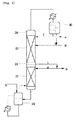
FIG. 1 is a schematic view showing a reaction distillation tower used in preparing 1,3,5-trioxane according to the present invention, the reaction distillation tower including a distillation tower provided with integrally-formed distillation and extraction units, wherein a part of a water phase, which is separated from a stream discharged from the top of the distillation tower, is refluxed to the upper end of an extractant supply stream of the extraction unit. -
FIG. 2 is a schematic view showing a reaction distillation tower used in preparing 1,3,5-trioxane, wherein the reaction distillation tower is configured such that a distillation tower and an extraction tower is separately provided -
FIG. 3 is a schematic view showing a reaction distillation tower used in preparing 1,3,5-trioxane according to the present invention, the reaction distillation tower including a distillation tower provided with integrally-formed distillation and extraction units, wherein a part of a water phase, which is separated from a stream discharged from the top of the distillation tower, is refluxed to the lower end of an extractant supply stream of the extraction unit -
- 10: Reactor
- 20: Distillation tower
- 21: Distillation unit
- 22: Extraction unit
- 23: Side cut unit (Chimney-tray unit)
- 24: Distillation tower
- 25: Extraction tower
- 30: Decanter
- Hereinafter, the present invention will be described in detail.
- An embodiment of the present invention provides a method of preparing 1,3,5-trioxane using a reaction distillation tower including a reactor and a distillation tower provided with integrally-formed distillation and extraction units, wherein, at the time of extracting 1,3,5-trioxane from the extraction unit, a part of a water phase, which is separated from a stream discharged from the top of the distillation tower, is refluxed to the upper end of an extractant supply stream of the extraction unit.
- Particularly, an embodiment of the present invention provides a method of preparing 1,3,5-trioxane, wherein a stream discharged from a side cut unit of a distillation tower including a distillation unit and an extraction unit is separated into an oil phase and a water phase, and then the water phase is returned to the distillation unit of the distillation tower, and simultaneously water supplied to the reactor is azeotropically boiled with an extractant in the extraction unit for extracting 1,3,5-trioxane, discharged from the top of the distillation tower and then separated into a water phase and an oil phase, and then a part of the water phase is discharged to the outside of a system, and the remaining water phase is refluxed into the upper end of an extractant supply stream, so the concentration of formaldehyde formed in the extraction unit is lowered, and thus the amount of formaldehyde discharged to the outside of the system without participating in a reaction can be reduced, thereby increasing the preparation efficiency of 1,3,5-trioxane.
- Generally, a method of preparing 1,3,5-trioxane using a reaction distillation tower including a reactor and a distillation tower provided with a distillation unit and an extraction unit includes the processes of
- (1) producing a 1,3,5-trioxane-contaning vapor from formaldehyde in the presence of an acid catalyst;
- (2) distilling and extracting the 1,3,5-trioxane-contaning vapor to separate 1,3,5-trioxane;
- (3) separating the 1,3,5-trioxane-contaning vapor into a water phase and an oil phase and then returning the water phase to the distillation tower; and
- (4) discharging water supplied to the reactor to the outside of a system
- The method of preparing 1,3,5-trioxane according to the present invention is characterized in that (i) distillation and extraction units included in a distillation tower are integrated with each other, and (ii) although the water phase discharged from the top of the distillation tower may be discharged to the outside of a system or may be refluxed into the extraction unit, this water phase is refluxed into the upper end of an extractant supply stream when the water phase is refluxed into the extraction unit
- That is, in the method of preparing 1,3,5-trioxane according to the present invention, the processes (2), (3) and (4) are realized by one distillation tower including a distillation unit and an extraction unit. Further, in this method, in the process (4) of discharging water supplied to the reactor to the outside of a system, in order to minimize the discharge of formaldehyde, the water supplied to the reactor is azeotropically boiled with an extractant in the extraction unit of the distillation tower, discharged from the top of the distillation tower and then separated into a water phase and an oil phase, and then a part of the water phase is discharged to the outside of a system, and the remaining water phase is refluxed into the upper end of an extractant supply stream, so the concentrate of formaldehyde formed in the extraction unit is lowered, with the result that the amount of formaldehyde discharged to the outside of the system without participating in a reaction can be reduced, thereby increasing the preparation efficiency of 1,3,5-trioxane.
- Hereinafter, the present invention will be described in more detail with reference to the accompanying drawings.
- In the
reactor 10, 1,3,5-trioxane is prepared from formaldehyde in the presence of an acid catalyst. Formaldehyde, which is a raw material of 1,3,5-trioxane, is supplied into thereactor 10, and is then heated in the presence of an acid catalyst to synthesize 1,3,5-trioxane. - Formaldehyde, which is a raw material used to synthesize 1,3,5-trioxane, may exist in the form of formaldehyde gas, an aqueous formaldehyde solution, paraformaldehyde or the like. Preferably, an aqueous formaldehyde solution may be used in terms of tractability.
- The acid catalyst may be a homogeneous catalyst. A solid acid catalyst may be used as the acid catalyst. Examples of the acid catalyst may include mineral acids, such as sulfuric acid, phosphoric acid and the like; strong organic acids, such as sulfonic acid, phosphonic acid, trifluoroacetic acid and the like; solid acids, such as a strong-acid cation exchanger, zeolite, silica, alumina, active white clay and the like; and heteropoly acids, such as phosphomolybdic acid, phosphotungstenic acid and the like.
- 1,3,5-trioxane synthesized in the
reactor 10 is supplied to thedistillation tower 20 together with supplied water and formaldehyde. Specifically, a 1,3,5-trioxane-containing vapor is supplied to thedistillation tower 20. The 1,3,5-trioxane-containing vapor includes 1,3,5-trioxane, formaldehyde and water. - In the
distillation tower 20, the 1,3,5-trioxane-containing vapor supplied from thereactor 10 is distilled and extracted to separate 1,3,5-trioxane. - For this purpose, the
distillation tower 20 includes adistillation unit 21 located at the lower portion thereof and anextraction unit 22 located at the upper portion thereof. Thedistillation tower 20 may be provided with an inner-structuredside cut unit 23 such as a chimney tray or a column adaptor between thedistillation unit 21 and theextraction unit 22. - The 1,3,5-trioxane-containing vapor supplied from the
reactor 10 is introduced into thedistillation unit 21 located at the lower portion of thedistillation tower 20. - In the
distillation unit 21, as described above, the 1,3,5-trioxane-containing vapor supplied from thereactor 10 is introduced into the lower end of thedistillation unit 21, the water phase (a) returning to thedistillation unit 21 from theside cut unit 23 of thedistillation tower 20 condenses the rising 1,3,5-trioxane-containing vapor, and a part of the 1,3,5-trioxane-containing vapor is supplied from thedistillation unit 21 to theextraction unit 22 via theside cut unit 23. The formaldehyde included in the water phase (a) returning to thedistillation unit 21 can be reused in thereactor 10 for synthesizing 1,3,5-trioxane. - In the
extraction unit 22, 1,3,5-trioxane is separated from the 1,3,5-trioxane-containing vapor supplied from thedistillation unit 21. For this purpose, an extractant is supplied into theextraction unit 22 through an extractant supply stream (d). A part of the extractant supplied through the extractant supply stream (d) is azeotropically boiled with water, discharged from the top of thedistillation tower 20, and then returns to theextraction unit 22 through a extractant return stream (g). - Further, the 1,3,5-trioxane-containing liquid phase separated from the
extraction unit 22 is discharged to a stream (c) through theside cut unit 23 of thedistillation tower 20, and is then separated into an oil phase (b) and a water phase (a). Here, the water phase (a) may return to the distillation unit. In this case, the stream (c) may include 1,3,5-trioxane, formaldehyde, an extractant and water. - In the
extraction unit 22, an extractant is externally supplied thereinto through the extractant supply stream (d) in order to separate 1,3,5-trioxane. A part of the extractant for separating 1,3,5-trioxane may be an organic solvent that can be azeotropically boiled with water. Specific examples of the organic solvent may include halogenated aliphatic hydrocarbons such as methylene chloride, chloroform, carbon tetrachloride, ethylene chloride and the like; halogenated aromatic hydrocarbons such as chlorobenzene, o-chlorobenzene and the like; and aromatic hydrocarbons such as benzene, toluene and the like. Among these organic solvents, benzene can be preferably used. - The extractant supplied to the
extraction unit 22 and the water introduced into theextraction unit 22 through thereactor 10 and thedistillation unit 21 are discharged from the top of thedistillation tower 20 by azeotropic distillation, and, in this procedure, a formaldehyde-containing vapor may also be discharged from the top of thedistillation tower 20 together with the extractant and the water. - Therefore, in the water discharged from the top of the
distillation tower 20, the same amount of a water phase as that of water introduced into thereactor 10 may be discharged to the outside through a stream (e), and residual water phase may return to the top of thedistillation tower 20 through a stream (f) in order to lower the concentration of formaldehyde discharged from the top thereof together with the water phase in the process of azeotropic distillation. - Consequently, a part of the water phase discharged from the top of the
distillation tower 20 together with the extractant returns to theextraction unit 22 of thedistillation tower 20 through the stream (f), so the amount of formaldehyde discharged to the outside through the top of thedistillation tower 20 can be reduced, and thus the preparation efficiency of 1,3,5-trioxane can be increased. - The oil phase stream (g) and the water phase streams (e and f) separated from the stream discharged from the top of the
distillation tower 20 may include other materials, such as methanol, formic acid, methylal, methyl formate and the like. - Hereinafter, the present invention will be described in more detail with reference to the following Examples. However, the scope of the present invention is not limited to these Examples.
- 1,3,5-trioxane was prepared using a reaction distillation tower shown in
FIG. 1 . - The reaction distillation tower includes a
distillation tower 20 provided with a distillation unit 21 (diameter 30 mm, 15 stages, bubble-cap tray), an extraction unit 22 (diameter 50 mm, 20 stages, bubble-cap tray) and a side cut unit 23 (one stage, chimney tray) disposed between thedistillation unit 21 and theextraction unit 22, a reactor 10 (volume 5 L, provided with a heating unit) and a decanter (volume 1.5 L). - An aqueous solution containing formaldehyde in a concentration of 65.0 wt% was supplied to the
reactor 10 at a flow rate of 400 g/hr, and the concentration of sulfuric acid in a reaction solution was set to 2.0 wt%. A 1,3,5-trioxane-containing vapor produced by steam heating of 1400 g/hr was supplied to thedistillation unit 21 of thedistillation tower 20. - The 1,3,5-trioxane-containing vapor was supplied to the
extraction unit 22, and simultaneously benzene was supplied to theextraction unit 22 as an extractant through a stream (d). - The 1,3,5-trioxane-containing vapor supplied to the
distillation unit 21 was introduced into theextraction unit 22, was discharged from the side cutunit 23 to a stream (c) together with benzene supplied to theextraction unit 22, and was then phase-separated into a water phase (a) and an oil phase (b). Then, the oil phase (b) was balanced with benzene supplied to theextraction unit 22 by adjusting the flow rate of the oil phase (b) to 620 g/hr. - The water phase (a) separated from the side cut
unit 23 of thedistillation tower 20 was refluxed into thedistillation unit 21 in order to maintain an interface. - A part of benzene supplied through the extractant supply stream (d) was azeotropically boiled with water by the steam supplied to the
reactor 10, and was then discharged from the top of thedistillation tower 20. The discharged bezene was reused through a stream (g). A part of water supplied to thereactor 10 was discharged through a stream (e), and residual water was refluxed to the top of thedistillation tower 20 through a stream (f). - For this purpose, in the stream (e), the flow rate of water was maintained at 162 g/hr, and, in the stream (f), the flow rate thereof was maintained at 300 g/hr. After 20 hours from operation start, the composition obtained from the top of the
distillation tower 20 includes 84.0 wt% of water, 11.6 wt% of formaldehyde and 4.4 wt% of a residue. - 1,3,5-trioxane was prepared using a distillation tower 24 (
diameter 30 mm, 15 stages, bubble-cap tray), an extraction tower 25 (diameter 50 mm, 20 stages, bubble-cap tray), a reactor 10 (volume 5 L, provided with a heating unit), a decanter (volume 1.5 L) and acondenser 40 for condensing a part of a vapor discharged from the distillation tower, as shown inFIG. 2 in which thedistillation tower 24 and theextraction tower 25 are provided by separating thedistillation unit 21 and theextraction unit 22 from thedistillation tower 20 shown inFIG. 1 . - An aqueous solution containing formaldehyde in a concentration of 65.0 wt% was supplied to the
reactor 10 at a flow rate of 400 g/hr, and the concentration of sulfuric acid in a reaction solution was set to 2.0 wt%. A 1,3,5-trioxane-containing vapor produced by steam heating of 1400 g/hr was supplied to thedistillation tower 24. A part of the 1,3,5-trioxane-containing vapor discharged from thedistillation tower 24 returned to the top of thedistillation tower 24 through a stream (a'), and the 1,3,5-trioxane-containing vapor was supplied to theextraction tower 25, and simultaneously benzene was supplied to theextraction tower 25 as an extractant through a stream (d). - The 1,3,5-trioxane-containing vapor supplied from the top of the
distillation tower 24 to the bottom of theextraction tower 25 was discharged from the bottom of theextraction tower 25 through a stream (c) together with benzene supplied to theextraction tower 25, and was then phase-separated into a water phase (a) and an oil phase (b). Then, the oil phase (b) was balanced with benzene supplied to theextraction tower 25 by adjusting the flow rate of the oil phase (b) to 600 g/hr. - The water phase (a) separated from the bottom of the
extraction tower 25 was refluxed into thedistillation tower 24 in order to maintain an interface. - A part of benzene supplied through the extractant supply stream (d) was azeotropically boiled with water by the steam supplied to the
reactor 10, and was then discharged from the top of theextraction tower 25. The discharged benzene was reused through a stream (g). A part of water supplied to thereactor 10 was discharged through a stream (e), and residual water was refluxed to the top of theextraction tower 25 through a stream (f). - A part of the 1,3,5-trioxane-containing vapor discharged from the
distillation tower 24 was condensed, and then returned to the top of thedistillation tower 24. For this purpose, in the stream (e), the flow rate of water was maintained at 175 g/hr, and, in the stream (f), the flow rate thereof was maintained at 156 g/hr. After 20 hours from operation start, the waster phase (e) obtained from the top of theextraction tower 25 includes formaldehyde in a concentration of 19.5 wt%. - 1,3,5-trioxane was prepared in the same condition as in Example 1, except that the water phase separated from the top of the
distillation tower 20 was returned to the lower end of an extractant supply stream (e) through a stream (f). - For this purpose, in the stream (e), the flow rate of water was maintained at 162 g/hr, and, in the stream (f), the flow rate thereof was maintained at 300 g/hr. After 20 hours from operation start, the waster phase (e) obtained from the top of the
extraction unit 22 of thedistillation tower 20 includes formaldehyde in a concentration of 32.0 wt%. - In each of the 1,3,5-trioxane preparation processes of Example 1 and Comparative Examples 1 and 2, the concentration of formaldehyde in the
extraction unit 22 was analyzed using the following method - The concentration of formaldehyde in the
extraction unit 22 was analyzed using gas chromatography (detector TCD, separation tube APS-201 20% Flusin T 30-60mesh 4m). 1 µL of a sample was taken by a 10 µL syringe, and was then analyzed by gas chromatography under conditions of an inlet temperature of 170°C, a detector temperature of 150°C, a separation tube temperature of 110°C and a helium gas flow rate of 20 mL/min.[Table 1] Unit Ex. 1 Comp. Ex. 1 Comp. Ex. 2 Formaldehyde (α) supplied into system g/hr 260.0 260.0 260.0 Formaldehyde (β) discharged to the outside of system g/hr 18.8 30.4 51.8 Ratio (β/α) of Formaldehyde (α) to Formaldehyde (β) % 7.2 11.7 19.9 concentration of formaldehyde in water phase (e,f) discharged from top of extraction unit 22 or top ofextraction tower 25wt% 11.6 19.5 32.0 Configuration of distillation tower single distillation tower one distillation tower and one extraction tower single distillation tower Position of water phase stream (f) refluxed to system without being discharged to the outside of system extractant supply stream (d) is connected with top of extraction unit extractant supply stream (d) is connected with top of extraction tower extractant supply stream (d) is connected with lower portion of extraction unit - As the results of measuring the concentration of formaldehyde in the
extraction unit 22 in each of the 1,3,5-trioxane preparation processes of Example 1 and Comparative Examples 1 and 2, as given in Table 1 above, it can be ascertained that, when a distillation tower including integrally-formed distillation and extraction units was used (Example 1), the amount of formaldehyde discharged to the outside of a system was small compared to when a distillation tower including separately-formed distillation and extraction units was used (Comparative Example 1). - Further, it can be ascertained that, when the water phase discharged from the top of the distillation tower and then phase-separated was returned to the upper end of the extractant supply stream (Example 1), the amount of formaldehyde discharged to the outside of a system was small compared to when this water phase was returned to the lower end of the extractant supply stream (Comparative Example 2).
- Consequently, it can be ascertained that, when 1,3,5-trioxane is prepared by returning the water phase discharged from the top of the distillation tower and then phase-separated to the upper end of the extractant supply stream using the distillation tower including integrally-formed distillation and extraction units, the amount of formaldehyde (raw material) discharged to the outside of a system can be reduced, and thus the preparation efficiency of 1,3,5-trioxane can be improved.
Claims (2)
- A method of preparing 1,3,5-trioxane using a reaction distillation tower including a reactor 10 and a distillation tower 20 provided with integrally-formed distillation and extraction units 21 and 22, wherein, at the time of extracting 1,3,5-trioxane from the extraction unit 22, a part of a water phase, which is separated from a stream discharged from a top of the distillation tower 20, is refluxed to an upper end of an extractant supply stream of the extraction unit 22.
- The method of preparing 1,3,5-trioxane according to claim 1, wherein the concentration of formaldehyde in the water phase separated from the stream discharged from the top of the distillation tower 20 is 15 wt% or less.
Applications Claiming Priority (2)
| Application Number | Priority Date | Filing Date | Title |
|---|---|---|---|
| KR1020100107119A KR101092220B1 (en) | 2010-10-29 | 2010-10-29 | 1.3,5-How to prepare trioxane |
| PCT/KR2011/006061 WO2012057437A2 (en) | 2010-10-29 | 2011-08-18 | Method for preparing 1,3,5-trioxane |
Publications (4)
| Publication Number | Publication Date |
|---|---|
| EP2634182A2 EP2634182A2 (en) | 2013-09-04 |
| EP2634182A4 EP2634182A4 (en) | 2014-04-02 |
| EP2634182B1 true EP2634182B1 (en) | 2015-08-05 |
| EP2634182B8 EP2634182B8 (en) | 2015-09-16 |
Family
ID=45506021
Family Applications (1)
| Application Number | Title | Priority Date | Filing Date |
|---|---|---|---|
| EP11836529.5A Active EP2634182B8 (en) | 2010-10-29 | 2011-08-18 | Method for preparing 1,3,5-trioxane |
Country Status (7)
| Country | Link |
|---|---|
| US (1) | US8981125B2 (en) |
| EP (1) | EP2634182B8 (en) |
| JP (1) | JP5873096B2 (en) |
| KR (1) | KR101092220B1 (en) |
| CN (1) | CN103370313B (en) |
| BR (1) | BR112013010541A8 (en) |
| WO (1) | WO2012057437A2 (en) |
Families Citing this family (4)
| Publication number | Priority date | Publication date | Assignee | Title |
|---|---|---|---|---|
| KR101496621B1 (en) | 2014-09-16 | 2015-02-25 | 백승용 | Process for Producing Trioxane |
| EP3390380B1 (en) * | 2015-12-18 | 2020-02-12 | Basf Se | Energy recovery in a method for preparing 1,3,5-trioxane |
| CN105622366B (en) * | 2016-03-14 | 2017-09-12 | 凯瑞环保科技股份有限公司 | A kind of device and method for producing polymethoxy dimethyl ether DMM3 5 |
| KR102827947B1 (en) | 2025-04-11 | 2025-07-01 | 피엔아이디 주식회사 | Reactor and Production Facilities for 1,3,5-trioxane in Polyoxymethylene Manufacturing Process |
Family Cites Families (8)
| Publication number | Priority date | Publication date | Assignee | Title |
|---|---|---|---|---|
| DE1493997C3 (en) * | 1964-11-28 | 1973-11-08 | Fa. Josef Meissner, 5000 Koeln | Process for the production of trioxane |
| DE2912767A1 (en) * | 1979-03-30 | 1980-10-09 | Hoechst Ag | METHOD FOR THE CONTINUOUS PRODUCTION OF TRIOXANE |
| JPH0243750B2 (en) * | 1981-06-02 | 1990-10-01 | Mitsubishi Gas Chemical Co | TORIOKISANNOSEIZOHOHO |
| JPH06228127A (en) * | 1993-02-02 | 1994-08-16 | Asahi Chem Ind Co Ltd | Production of trioxane |
| DE19842579A1 (en) * | 1998-09-17 | 2000-03-23 | Ticona Gmbh | Production of trioxan from liquid, formaldehyde-containing mixtures with a low water content involves evaporation or sublimation followed by condensation or desublimation to a liquid or solid product |
| JP2001199978A (en) | 1999-11-10 | 2001-07-24 | Toray Ind Inc | Method for producing trioxane |
| KR20010097592A (en) | 2000-04-25 | 2001-11-08 | 구광시 | A process of preparing for the trioctane |
| JP2005247719A (en) | 2004-03-02 | 2005-09-15 | Toray Ind Inc | Continuous production method of 1,3,5 trioxane |
-
2010
- 2010-10-29 KR KR1020100107119A patent/KR101092220B1/en active Active
-
2011
- 2011-08-18 CN CN201180063318.9A patent/CN103370313B/en active Active
- 2011-08-18 EP EP11836529.5A patent/EP2634182B8/en active Active
- 2011-08-18 JP JP2013536489A patent/JP5873096B2/en active Active
- 2011-08-18 US US13/882,034 patent/US8981125B2/en active Active
- 2011-08-18 BR BR112013010541A patent/BR112013010541A8/en not_active Application Discontinuation
- 2011-08-18 WO PCT/KR2011/006061 patent/WO2012057437A2/en not_active Ceased
Also Published As
| Publication number | Publication date |
|---|---|
| CN103370313B (en) | 2015-04-01 |
| BR112013010541A2 (en) | 2016-07-05 |
| JP2013542221A (en) | 2013-11-21 |
| WO2012057437A2 (en) | 2012-05-03 |
| US8981125B2 (en) | 2015-03-17 |
| JP5873096B2 (en) | 2016-03-01 |
| EP2634182A2 (en) | 2013-09-04 |
| US20130261318A1 (en) | 2013-10-03 |
| CN103370313A (en) | 2013-10-23 |
| BR112013010541A8 (en) | 2017-10-31 |
| WO2012057437A3 (en) | 2012-06-21 |
| KR101092220B1 (en) | 2011-12-12 |
| EP2634182A4 (en) | 2014-04-02 |
| EP2634182B8 (en) | 2015-09-16 |
Similar Documents
| Publication | Publication Date | Title |
|---|---|---|
| US8829206B2 (en) | Production of cyclic acetals or ketals using solid acid catalysts | |
| EP1254126B1 (en) | Process for the epoxidation of olefins | |
| US5886198A (en) | Method for continuously producing a cyclic formal | |
| US8981125B2 (en) | Method for preparing 1,3,5-trioxane | |
| EP2634183B1 (en) | Method for preparing 1,3,5-trioxane | |
| AU2004309046A1 (en) | Method for separating trioxane from a trioxane/formaldehyde/water mixture by means of pressure change rectification | |
| US20100121081A1 (en) | Method for separating trioxane from a trioxane/formaldehyde/water mixture by means of pressure change rectification | |
| CN114315522B (en) | Purification method of cyclohexanol and preparation method of cyclohexanone | |
| CN101918388B (en) | The method for preparing crude product trioxane | |
| CN111087288A (en) | Method for purifying dimeric methoxy dimethyl ether | |
| JP5305657B2 (en) | A method for producing trioxane, characterized in that a water-containing side stream is removed during the first distillation step | |
| KR101496621B1 (en) | Process for Producing Trioxane | |
| KR20080085009A (en) | Method and apparatus for preparing purified methyl isobutyl ketone | |
| EP2684860B1 (en) | Method for concentrating aqueous 3-hydroxy-2,2-dimethylpropanal solution | |
| AU2007260060A1 (en) | Integrated method for the preparation of trioxane from formaldehyde | |
| KR20060043301A (en) | Continuous production method of 1,3,5-trioxane | |
| AU2006278026A1 (en) | Integrated method for the production of trioxane from formaldehyde | |
| AU2006277926A1 (en) | Integrated method for producing trioxane from formaldehyde | |
| JPS58198482A (en) | Production of trioxane | |
| CS214049B1 (en) | Process for preparing o-cresol, 2,6-xylenol and 2,3,6-trimethylphenol | |
| KR20180117096A (en) | Energy recovery in 1,3,5-trioxane manufacturing process |
Legal Events
| Date | Code | Title | Description |
|---|---|---|---|
| PUAI | Public reference made under article 153(3) epc to a published international application that has entered the european phase |
Free format text: ORIGINAL CODE: 0009012 |
|
| 17P | Request for examination filed |
Effective date: 20130516 |
|
| AK | Designated contracting states |
Kind code of ref document: A2 Designated state(s): AL AT BE BG CH CY CZ DE DK EE ES FI FR GB GR HR HU IE IS IT LI LT LU LV MC MK MT NL NO PL PT RO RS SE SI SK SM TR |
|
| DAX | Request for extension of the european patent (deleted) | ||
| A4 | Supplementary search report drawn up and despatched |
Effective date: 20140303 |
|
| RIC1 | Information provided on ipc code assigned before grant |
Ipc: C07D 323/06 20060101AFI20140225BHEP Ipc: B01D 3/40 20060101ALI20140225BHEP |
|
| GRAP | Despatch of communication of intention to grant a patent |
Free format text: ORIGINAL CODE: EPIDOSNIGR1 |
|
| INTG | Intention to grant announced |
Effective date: 20150319 |
|
| GRAS | Grant fee paid |
Free format text: ORIGINAL CODE: EPIDOSNIGR3 |
|
| GRAA | (expected) grant |
Free format text: ORIGINAL CODE: 0009210 |
|
| AK | Designated contracting states |
Kind code of ref document: B1 Designated state(s): AL AT BE BG CH CY CZ DE DK EE ES FI FR GB GR HR HU IE IS IT LI LT LU LV MC MK MT NL NO PL PT RO RS SE SI SK SM TR |
|
| REG | Reference to a national code |
Ref country code: GB Ref legal event code: FG4D |
|
| REG | Reference to a national code |
Ref country code: CH Ref legal event code: EP |
|
| REG | Reference to a national code |
Ref country code: AT Ref legal event code: REF Ref document number: 740637 Country of ref document: AT Kind code of ref document: T Effective date: 20150815 |
|
| REG | Reference to a national code |
Ref country code: IE Ref legal event code: FG4D |
|
| RAP2 | Party data changed (patent owner data changed or rights of a patent transferred) |
Owner name: KOLON PLASTICS, INC. |
|
| REG | Reference to a national code |
Ref country code: DE Ref legal event code: R096 Ref document number: 602011018555 Country of ref document: DE |
|
| REG | Reference to a national code |
Ref country code: AT Ref legal event code: MK05 Ref document number: 740637 Country of ref document: AT Kind code of ref document: T Effective date: 20150805 |
|
| REG | Reference to a national code |
Ref country code: LT Ref legal event code: MG4D |
|
| REG | Reference to a national code |
Ref country code: NL Ref legal event code: MP Effective date: 20150805 |
|
| PG25 | Lapsed in a contracting state [announced via postgrant information from national office to epo] |
Ref country code: GR Free format text: LAPSE BECAUSE OF FAILURE TO SUBMIT A TRANSLATION OF THE DESCRIPTION OR TO PAY THE FEE WITHIN THE PRESCRIBED TIME-LIMIT Effective date: 20151106 Ref country code: FI Free format text: LAPSE BECAUSE OF FAILURE TO SUBMIT A TRANSLATION OF THE DESCRIPTION OR TO PAY THE FEE WITHIN THE PRESCRIBED TIME-LIMIT Effective date: 20150805 Ref country code: LV Free format text: LAPSE BECAUSE OF FAILURE TO SUBMIT A TRANSLATION OF THE DESCRIPTION OR TO PAY THE FEE WITHIN THE PRESCRIBED TIME-LIMIT Effective date: 20150805 Ref country code: LT Free format text: LAPSE BECAUSE OF FAILURE TO SUBMIT A TRANSLATION OF THE DESCRIPTION OR TO PAY THE FEE WITHIN THE PRESCRIBED TIME-LIMIT Effective date: 20150805 Ref country code: NO Free format text: LAPSE BECAUSE OF FAILURE TO SUBMIT A TRANSLATION OF THE DESCRIPTION OR TO PAY THE FEE WITHIN THE PRESCRIBED TIME-LIMIT Effective date: 20151105 |
|
| PG25 | Lapsed in a contracting state [announced via postgrant information from national office to epo] |
Ref country code: PL Free format text: LAPSE BECAUSE OF FAILURE TO SUBMIT A TRANSLATION OF THE DESCRIPTION OR TO PAY THE FEE WITHIN THE PRESCRIBED TIME-LIMIT Effective date: 20150805 Ref country code: HR Free format text: LAPSE BECAUSE OF FAILURE TO SUBMIT A TRANSLATION OF THE DESCRIPTION OR TO PAY THE FEE WITHIN THE PRESCRIBED TIME-LIMIT Effective date: 20150805 Ref country code: PT Free format text: LAPSE BECAUSE OF FAILURE TO SUBMIT A TRANSLATION OF THE DESCRIPTION OR TO PAY THE FEE WITHIN THE PRESCRIBED TIME-LIMIT Effective date: 20151207 Ref country code: IS Free format text: LAPSE BECAUSE OF FAILURE TO SUBMIT A TRANSLATION OF THE DESCRIPTION OR TO PAY THE FEE WITHIN THE PRESCRIBED TIME-LIMIT Effective date: 20151205 Ref country code: ES Free format text: LAPSE BECAUSE OF FAILURE TO SUBMIT A TRANSLATION OF THE DESCRIPTION OR TO PAY THE FEE WITHIN THE PRESCRIBED TIME-LIMIT Effective date: 20150805 Ref country code: RS Free format text: LAPSE BECAUSE OF FAILURE TO SUBMIT A TRANSLATION OF THE DESCRIPTION OR TO PAY THE FEE WITHIN THE PRESCRIBED TIME-LIMIT Effective date: 20150805 Ref country code: SE Free format text: LAPSE BECAUSE OF FAILURE TO SUBMIT A TRANSLATION OF THE DESCRIPTION OR TO PAY THE FEE WITHIN THE PRESCRIBED TIME-LIMIT Effective date: 20150805 Ref country code: AT Free format text: LAPSE BECAUSE OF FAILURE TO SUBMIT A TRANSLATION OF THE DESCRIPTION OR TO PAY THE FEE WITHIN THE PRESCRIBED TIME-LIMIT Effective date: 20150805 |
|
| PG25 | Lapsed in a contracting state [announced via postgrant information from national office to epo] |
Ref country code: NL Free format text: LAPSE BECAUSE OF FAILURE TO SUBMIT A TRANSLATION OF THE DESCRIPTION OR TO PAY THE FEE WITHIN THE PRESCRIBED TIME-LIMIT Effective date: 20150805 |
|
| REG | Reference to a national code |
Ref country code: CH Ref legal event code: PL |
|
| PG25 | Lapsed in a contracting state [announced via postgrant information from national office to epo] |
Ref country code: CH Free format text: LAPSE BECAUSE OF NON-PAYMENT OF DUE FEES Effective date: 20150831 Ref country code: LI Free format text: LAPSE BECAUSE OF NON-PAYMENT OF DUE FEES Effective date: 20150831 Ref country code: IT Free format text: LAPSE BECAUSE OF FAILURE TO SUBMIT A TRANSLATION OF THE DESCRIPTION OR TO PAY THE FEE WITHIN THE PRESCRIBED TIME-LIMIT Effective date: 20150805 Ref country code: DK Free format text: LAPSE BECAUSE OF FAILURE TO SUBMIT A TRANSLATION OF THE DESCRIPTION OR TO PAY THE FEE WITHIN THE PRESCRIBED TIME-LIMIT Effective date: 20150805 Ref country code: EE Free format text: LAPSE BECAUSE OF FAILURE TO SUBMIT A TRANSLATION OF THE DESCRIPTION OR TO PAY THE FEE WITHIN THE PRESCRIBED TIME-LIMIT Effective date: 20150805 Ref country code: CZ Free format text: LAPSE BECAUSE OF FAILURE TO SUBMIT A TRANSLATION OF THE DESCRIPTION OR TO PAY THE FEE WITHIN THE PRESCRIBED TIME-LIMIT Effective date: 20150805 Ref country code: SK Free format text: LAPSE BECAUSE OF FAILURE TO SUBMIT A TRANSLATION OF THE DESCRIPTION OR TO PAY THE FEE WITHIN THE PRESCRIBED TIME-LIMIT Effective date: 20150805 |
|
| REG | Reference to a national code |
Ref country code: DE Ref legal event code: R097 Ref document number: 602011018555 Country of ref document: DE |
|
| PG25 | Lapsed in a contracting state [announced via postgrant information from national office to epo] |
Ref country code: RO Free format text: LAPSE BECAUSE OF FAILURE TO SUBMIT A TRANSLATION OF THE DESCRIPTION OR TO PAY THE FEE WITHIN THE PRESCRIBED TIME-LIMIT Effective date: 20150805 Ref country code: MC Free format text: LAPSE BECAUSE OF FAILURE TO SUBMIT A TRANSLATION OF THE DESCRIPTION OR TO PAY THE FEE WITHIN THE PRESCRIBED TIME-LIMIT Effective date: 20150805 |
|
| REG | Reference to a national code |
Ref country code: IE Ref legal event code: MM4A |
|
| PLBE | No opposition filed within time limit |
Free format text: ORIGINAL CODE: 0009261 |
|
| STAA | Information on the status of an ep patent application or granted ep patent |
Free format text: STATUS: NO OPPOSITION FILED WITHIN TIME LIMIT |
|
| 26N | No opposition filed |
Effective date: 20160509 |
|
| GBPC | Gb: european patent ceased through non-payment of renewal fee |
Effective date: 20151105 |
|
| PG25 | Lapsed in a contracting state [announced via postgrant information from national office to epo] |
Ref country code: IE Free format text: LAPSE BECAUSE OF NON-PAYMENT OF DUE FEES Effective date: 20150818 |
|
| PG25 | Lapsed in a contracting state [announced via postgrant information from national office to epo] |
Ref country code: SI Free format text: LAPSE BECAUSE OF FAILURE TO SUBMIT A TRANSLATION OF THE DESCRIPTION OR TO PAY THE FEE WITHIN THE PRESCRIBED TIME-LIMIT Effective date: 20150805 |
|
| REG | Reference to a national code |
Ref country code: FR Ref legal event code: ST Effective date: 20160809 |
|
| PG25 | Lapsed in a contracting state [announced via postgrant information from national office to epo] |
Ref country code: GB Free format text: LAPSE BECAUSE OF NON-PAYMENT OF DUE FEES Effective date: 20151105 |
|
| PG25 | Lapsed in a contracting state [announced via postgrant information from national office to epo] |
Ref country code: FR Free format text: LAPSE BECAUSE OF NON-PAYMENT OF DUE FEES Effective date: 20151005 |
|
| PG25 | Lapsed in a contracting state [announced via postgrant information from national office to epo] |
Ref country code: MT Free format text: LAPSE BECAUSE OF FAILURE TO SUBMIT A TRANSLATION OF THE DESCRIPTION OR TO PAY THE FEE WITHIN THE PRESCRIBED TIME-LIMIT Effective date: 20150805 |
|
| PG25 | Lapsed in a contracting state [announced via postgrant information from national office to epo] |
Ref country code: HU Free format text: LAPSE BECAUSE OF FAILURE TO SUBMIT A TRANSLATION OF THE DESCRIPTION OR TO PAY THE FEE WITHIN THE PRESCRIBED TIME-LIMIT; INVALID AB INITIO Effective date: 20110818 Ref country code: SM Free format text: LAPSE BECAUSE OF FAILURE TO SUBMIT A TRANSLATION OF THE DESCRIPTION OR TO PAY THE FEE WITHIN THE PRESCRIBED TIME-LIMIT Effective date: 20150805 Ref country code: BG Free format text: LAPSE BECAUSE OF FAILURE TO SUBMIT A TRANSLATION OF THE DESCRIPTION OR TO PAY THE FEE WITHIN THE PRESCRIBED TIME-LIMIT Effective date: 20150805 |
|
| PG25 | Lapsed in a contracting state [announced via postgrant information from national office to epo] |
Ref country code: CY Free format text: LAPSE BECAUSE OF FAILURE TO SUBMIT A TRANSLATION OF THE DESCRIPTION OR TO PAY THE FEE WITHIN THE PRESCRIBED TIME-LIMIT Effective date: 20150805 |
|
| PG25 | Lapsed in a contracting state [announced via postgrant information from national office to epo] |
Ref country code: BE Free format text: LAPSE BECAUSE OF NON-PAYMENT OF DUE FEES Effective date: 20150831 |
|
| PG25 | Lapsed in a contracting state [announced via postgrant information from national office to epo] |
Ref country code: LU Free format text: LAPSE BECAUSE OF NON-PAYMENT OF DUE FEES Effective date: 20150818 |
|
| PG25 | Lapsed in a contracting state [announced via postgrant information from national office to epo] |
Ref country code: MK Free format text: LAPSE BECAUSE OF FAILURE TO SUBMIT A TRANSLATION OF THE DESCRIPTION OR TO PAY THE FEE WITHIN THE PRESCRIBED TIME-LIMIT Effective date: 20150805 Ref country code: TR Free format text: LAPSE BECAUSE OF FAILURE TO SUBMIT A TRANSLATION OF THE DESCRIPTION OR TO PAY THE FEE WITHIN THE PRESCRIBED TIME-LIMIT Effective date: 20150805 |
|
| PG25 | Lapsed in a contracting state [announced via postgrant information from national office to epo] |
Ref country code: AL Free format text: LAPSE BECAUSE OF FAILURE TO SUBMIT A TRANSLATION OF THE DESCRIPTION OR TO PAY THE FEE WITHIN THE PRESCRIBED TIME-LIMIT Effective date: 20150805 |
|
| PGFP | Annual fee paid to national office [announced via postgrant information from national office to epo] |
Ref country code: DE Payment date: 20250609 Year of fee payment: 15 |