EP2633923B1 - Photoelectrochemicalmethod on metal preservation - Google Patents
Photoelectrochemicalmethod on metal preservation Download PDFInfo
- Publication number
- EP2633923B1 EP2633923B1 EP11835581.7A EP11835581A EP2633923B1 EP 2633923 B1 EP2633923 B1 EP 2633923B1 EP 11835581 A EP11835581 A EP 11835581A EP 2633923 B1 EP2633923 B1 EP 2633923B1
- Authority
- EP
- European Patent Office
- Prior art keywords
- titanium dioxide
- nano
- scaled titanium
- nonionic surfactant
- scaled
- Prior art date
- Legal status (The legal status is an assumption and is not a legal conclusion. Google has not performed a legal analysis and makes no representation as to the accuracy of the status listed.)
- Active
Links
Images


Classifications
-
- C—CHEMISTRY; METALLURGY
- C09—DYES; PAINTS; POLISHES; NATURAL RESINS; ADHESIVES; COMPOSITIONS NOT OTHERWISE PROVIDED FOR; APPLICATIONS OF MATERIALS NOT OTHERWISE PROVIDED FOR
- C09D—COATING COMPOSITIONS, e.g. PAINTS, VARNISHES OR LACQUERS; FILLING PASTES; CHEMICAL PAINT OR INK REMOVERS; INKS; CORRECTING FLUIDS; WOODSTAINS; PASTES OR SOLIDS FOR COLOURING OR PRINTING; USE OF MATERIALS THEREFOR
- C09D7/00—Features of coating compositions, not provided for in group C09D5/00; Processes for incorporating ingredients in coating compositions
- C09D7/40—Additives
- C09D7/45—Anti-settling agents
-
- C—CHEMISTRY; METALLURGY
- C09—DYES; PAINTS; POLISHES; NATURAL RESINS; ADHESIVES; COMPOSITIONS NOT OTHERWISE PROVIDED FOR; APPLICATIONS OF MATERIALS NOT OTHERWISE PROVIDED FOR
- C09D—COATING COMPOSITIONS, e.g. PAINTS, VARNISHES OR LACQUERS; FILLING PASTES; CHEMICAL PAINT OR INK REMOVERS; INKS; CORRECTING FLUIDS; WOODSTAINS; PASTES OR SOLIDS FOR COLOURING OR PRINTING; USE OF MATERIALS THEREFOR
- C09D127/00—Coating compositions based on homopolymers or copolymers of compounds having one or more unsaturated aliphatic radicals, each having only one carbon-to-carbon double bond, and at least one being terminated by a halogen; Coating compositions based on derivatives of such polymers
- C09D127/02—Coating compositions based on homopolymers or copolymers of compounds having one or more unsaturated aliphatic radicals, each having only one carbon-to-carbon double bond, and at least one being terminated by a halogen; Coating compositions based on derivatives of such polymers not modified by chemical after-treatment
- C09D127/12—Coating compositions based on homopolymers or copolymers of compounds having one or more unsaturated aliphatic radicals, each having only one carbon-to-carbon double bond, and at least one being terminated by a halogen; Coating compositions based on derivatives of such polymers not modified by chemical after-treatment containing fluorine atoms
-
- C—CHEMISTRY; METALLURGY
- C09—DYES; PAINTS; POLISHES; NATURAL RESINS; ADHESIVES; COMPOSITIONS NOT OTHERWISE PROVIDED FOR; APPLICATIONS OF MATERIALS NOT OTHERWISE PROVIDED FOR
- C09D—COATING COMPOSITIONS, e.g. PAINTS, VARNISHES OR LACQUERS; FILLING PASTES; CHEMICAL PAINT OR INK REMOVERS; INKS; CORRECTING FLUIDS; WOODSTAINS; PASTES OR SOLIDS FOR COLOURING OR PRINTING; USE OF MATERIALS THEREFOR
- C09D175/00—Coating compositions based on polyureas or polyurethanes; Coating compositions based on derivatives of such polymers
- C09D175/04—Polyurethanes
-
- C—CHEMISTRY; METALLURGY
- C09—DYES; PAINTS; POLISHES; NATURAL RESINS; ADHESIVES; COMPOSITIONS NOT OTHERWISE PROVIDED FOR; APPLICATIONS OF MATERIALS NOT OTHERWISE PROVIDED FOR
- C09D—COATING COMPOSITIONS, e.g. PAINTS, VARNISHES OR LACQUERS; FILLING PASTES; CHEMICAL PAINT OR INK REMOVERS; INKS; CORRECTING FLUIDS; WOODSTAINS; PASTES OR SOLIDS FOR COLOURING OR PRINTING; USE OF MATERIALS THEREFOR
- C09D5/00—Coating compositions, e.g. paints, varnishes or lacquers, characterised by their physical nature or the effects produced; Filling pastes
- C09D5/44—Coating compositions, e.g. paints, varnishes or lacquers, characterised by their physical nature or the effects produced; Filling pastes for electrophoretic applications
- C09D5/4476—Coating compositions, e.g. paints, varnishes or lacquers, characterised by their physical nature or the effects produced; Filling pastes for electrophoretic applications comprising polymerisation in situ
-
- C—CHEMISTRY; METALLURGY
- C09—DYES; PAINTS; POLISHES; NATURAL RESINS; ADHESIVES; COMPOSITIONS NOT OTHERWISE PROVIDED FOR; APPLICATIONS OF MATERIALS NOT OTHERWISE PROVIDED FOR
- C09D—COATING COMPOSITIONS, e.g. PAINTS, VARNISHES OR LACQUERS; FILLING PASTES; CHEMICAL PAINT OR INK REMOVERS; INKS; CORRECTING FLUIDS; WOODSTAINS; PASTES OR SOLIDS FOR COLOURING OR PRINTING; USE OF MATERIALS THEREFOR
- C09D7/00—Features of coating compositions, not provided for in group C09D5/00; Processes for incorporating ingredients in coating compositions
- C09D7/40—Additives
- C09D7/60—Additives non-macromolecular
- C09D7/61—Additives non-macromolecular inorganic
- C09D7/62—Additives non-macromolecular inorganic modified by treatment with other compounds
-
- C—CHEMISTRY; METALLURGY
- C09—DYES; PAINTS; POLISHES; NATURAL RESINS; ADHESIVES; COMPOSITIONS NOT OTHERWISE PROVIDED FOR; APPLICATIONS OF MATERIALS NOT OTHERWISE PROVIDED FOR
- C09D—COATING COMPOSITIONS, e.g. PAINTS, VARNISHES OR LACQUERS; FILLING PASTES; CHEMICAL PAINT OR INK REMOVERS; INKS; CORRECTING FLUIDS; WOODSTAINS; PASTES OR SOLIDS FOR COLOURING OR PRINTING; USE OF MATERIALS THEREFOR
- C09D7/00—Features of coating compositions, not provided for in group C09D5/00; Processes for incorporating ingredients in coating compositions
- C09D7/40—Additives
- C09D7/66—Additives characterised by particle size
- C09D7/67—Particle size smaller than 100 nm
-
- C—CHEMISTRY; METALLURGY
- C23—COATING METALLIC MATERIAL; COATING MATERIAL WITH METALLIC MATERIAL; CHEMICAL SURFACE TREATMENT; DIFFUSION TREATMENT OF METALLIC MATERIAL; COATING BY VACUUM EVAPORATION, BY SPUTTERING, BY ION IMPLANTATION OR BY CHEMICAL VAPOUR DEPOSITION, IN GENERAL; INHIBITING CORROSION OF METALLIC MATERIAL OR INCRUSTATION IN GENERAL
- C23F—NON-MECHANICAL REMOVAL OF METALLIC MATERIAL FROM SURFACE; INHIBITING CORROSION OF METALLIC MATERIAL OR INCRUSTATION IN GENERAL; MULTI-STEP PROCESSES FOR SURFACE TREATMENT OF METALLIC MATERIAL INVOLVING AT LEAST ONE PROCESS PROVIDED FOR IN CLASS C23 AND AT LEAST ONE PROCESS COVERED BY SUBCLASS C21D OR C22F OR CLASS C25
- C23F11/00—Inhibiting corrosion of metallic material by applying inhibitors to the surface in danger of corrosion or adding them to the corrosive agent
- C23F11/08—Inhibiting corrosion of metallic material by applying inhibitors to the surface in danger of corrosion or adding them to the corrosive agent in other liquids
- C23F11/18—Inhibiting corrosion of metallic material by applying inhibitors to the surface in danger of corrosion or adding them to the corrosive agent in other liquids using inorganic inhibitors
- C23F11/185—Refractory metal-containing compounds
-
- C—CHEMISTRY; METALLURGY
- C08—ORGANIC MACROMOLECULAR COMPOUNDS; THEIR PREPARATION OR CHEMICAL WORKING-UP; COMPOSITIONS BASED THEREON
- C08K—Use of inorganic or non-macromolecular organic substances as compounding ingredients
- C08K3/00—Use of inorganic substances as compounding ingredients
- C08K3/18—Oxygen-containing compounds, e.g. metal carbonyls
- C08K3/20—Oxides; Hydroxides
- C08K3/22—Oxides; Hydroxides of metals
- C08K2003/2237—Oxides; Hydroxides of metals of titanium
- C08K2003/2241—Titanium dioxide
-
- C—CHEMISTRY; METALLURGY
- C08—ORGANIC MACROMOLECULAR COMPOUNDS; THEIR PREPARATION OR CHEMICAL WORKING-UP; COMPOSITIONS BASED THEREON
- C08K—Use of inorganic or non-macromolecular organic substances as compounding ingredients
- C08K9/00—Use of pretreated ingredients
- C08K9/04—Ingredients treated with organic substances
- C08K9/06—Ingredients treated with organic substances with silicon-containing compounds
-
- Y—GENERAL TAGGING OF NEW TECHNOLOGICAL DEVELOPMENTS; GENERAL TAGGING OF CROSS-SECTIONAL TECHNOLOGIES SPANNING OVER SEVERAL SECTIONS OF THE IPC; TECHNICAL SUBJECTS COVERED BY FORMER USPC CROSS-REFERENCE ART COLLECTIONS [XRACs] AND DIGESTS
- Y10—TECHNICAL SUBJECTS COVERED BY FORMER USPC
- Y10T—TECHNICAL SUBJECTS COVERED BY FORMER US CLASSIFICATION
- Y10T428/00—Stock material or miscellaneous articles
- Y10T428/25—Web or sheet containing structurally defined element or component and including a second component containing structurally defined particles
- Y10T428/256—Heavy metal or aluminum or compound thereof
Definitions
- the present invention relates to a photoelectrochemical method for metal preservation, more specifically, it relates to a photoelectrochemical method for metal preservation by applying a coating containing nano-scaled titanium dioxide surface modified by nonionic surfactant on the metal surface.
- cathodic protection and anodic protection are most effective ones.
- Typical examples of cathodic protection and anodic protection include, for example, cathodic protection of natural gas transmission pipelines, sacrificial anodic protection of transformer substation grounding network of a power system, gas phase cathodic protection of interior wall of storage tank, cathodic protection of bridge floor concrete, cathodic protection of petrochemical facilities, cathodic protection of shipping equipment, cathodic protection of long distance petroleum pipeline, and cathodic protection of crude petroleum storage tank.
- grounding networks Materials used for grounding networks, for example, in the transformer substation grounding network of a power system, are mainly plain carbon steels in the form of flat steel or round steel.
- the grounding facilities which have long been operated in a poor underground environment, suffer unavoidable chemical and electrochemical corrosions by soil, and stray current corrosion in stray current region of the earthing network.
- the corrosion of grounding network is generally shown in a local corrosion morphology. After the occurrence of corrosion, carbon steel materials of the grounding network are embrittled, exfoliated, loosened, or even fractured.
- electric power accidents induced by the degraded performance of the grounding network gradually increase, and the damages and economic losses caused thereby also increase.
- the technique of cathodic protection has a favorable effect and a long protection period, and is convenient in construction.
- the method of sacrificial anodic electrochemical protection is suitable not only for newly-built grounding network protection, but also for reforming the old grounding network so as to prolong its life.
- the method of sacrificial anodic protection or the method of applied power supply cathodic protection are effective in protecting the grounding network, however, aside from continuous consumption of sacrificial anodic metal blocks or electric energy, they further require instruments, apparatuses, conductors and the like for testing the protective current. Meanwhile, any failure of the monitoring devices such as a potentiostat in the protection system may lead to protection failure, and further result in serious corrosion of the grounding network.
- CN 1927966 A provides a nanometer paint, which comprises fluoric acrylic/silicone resin in 30-60 wt%, nanometer pigment particle in 4-30 wt%, nanometer silica in 0.1-5 wt% and solvent for the rest, wherein the nanometer pigment particle and nanometer silica have a particle diameter of not greater than 191.4 nm.
- CN 101440243 A relates to a nano titanium dioxide fluorocarbon coating composition, comprising 2 to 6 percent by weight of nano titanium dioxide, 80 to 90 percent by weight of fluorocarbon base material, 5 to 10 percent by weight of curing agent and 2 to 10 percent by weight of coating thinner.
- the nano titanium dioxide is rutile-type nano titanium dioxide particle modified by silane coupling agent KH-570.
- the fluorocarbon coating composition can effectively improve the dispersing performance of nano titanium dioxide particle in the coating composition and the UV aging resistance of the coating.
- CN 1427052 A relates to a nanometre photocatalytic polyurethane paint, composing of modified synthetic resin prepared from nanometre TiO 2 1-45wt%, high-molecular dispersant 0.1-10wt%, synthetic resin 15-70wt% and solvent for the rest, and also solidifying agent. It is prepared through first preparing high-concentration low-viscosity nanometre TiO 2 slurry, and then preparing the paint via using said slurry. This makes nanometre TiO 2 more easily disperse in the paint, and the coating film obtained from said paint show excellent photocatalytic performance.
- An object of the present invention is to provide a photoelectrochemical method for metal preservation.
- Further embodiments are coatings and surface-modified nano-scaled titanium dioxide of claims 15 and 16, a method for preparing the surface-modified nano-scaled titanium dioxide according to claims 17-23.
- the method of the present invention current necessary for metal preservation is directly supplied by the coating layer containing the surface modified nano-scaled titanium dioxide under the action of light.
- the method of this invention saves not only applied power supply and sacrificial anode, but also complicated works like installation, detection and maintenance of a series of apparatuses such as potentiostat, reference electrode, connecting circuit.
- the method of this invention further enables photoelectrochemical protection of a metal to notably reduce its corrosion speed, for example, the order of magnitude of the self-corrosion current of the metal electrode coated with a coating containing the surface modified nano-scaled titanium dioxide is 10 -9 -10 -8 A/cm 2 , which is generally 1-2, or even 3 orders of magnitude less than the self-corrosion current of the metal electrode coated with a coating free of nano-scaled titanium dioxide.
- the nano-scaled titanium dioxide in the coating layer coated on the metal surface generates electrons and holes charge carriers under the action of light, said metal absorbs the generated electrons and/or holes, so that E micro cathode of the metal corrosion cell moves negatively and/or E micro anode thereof moves positively, resulting in a reduction of the potential difference ⁇ E between the cathode and the anode, and further causing decrease of the self-corrosion current, so that said metal is accordingly protected, wherein the light can be ultraviolet light, visible light or infrared light.
- inventors of the present application prepare the nano-scaled titanium dioxide surface modified by nonionic surfactant through the following steps:
- the used wetting agent can be any wetting agent known to a person skilled in the art.
- Alcohol is a preferred wetting agent used in the present invention. Suitable alcohols include but are not limited to methanol, ethanol, n-propanol, isopropanol, 2-methyl-1-propanol, n-butanol, 2-butanol and tert-butanol.
- the used wetting agent and the nano-scaled titanium dioxide substrate are in a weight ratio of 2:1-20:1, preferably 3:1-10:1.
- the particle diameter of the nano-scaled titanium dioxide substrate is 1-100 nm, preferably 1-60nm, more preferably 1-40nm.
- a suitable hydrophile-lipophile balance value of the nonionic surfactant of the present invention is 1-10, preferably 2-8, more preferably 2-5.8.
- the dosage of the nonionic surfactant is 1-20 wt% based on the weight of the nano-scaled titanium dioxide substrate, preferably 2-10wt%, more preferably 3-8wt%.
- Drying may be operated at normal temperature or elevated temperature such as 60-80°C, and under normal pressure or reduced pressure for 10-48 hours, preferably 12-36 hours.
- a proper way of drying, for example, is to dry at elevated temperature such as 60-80°C under reduced pressure.
- the polyurethane coating containing the surface modified nano-scaled titanium dioxide is preferably applied on the metal surface for photoclectrochemical protection of the metal.
- the nano-scaled titanium dioxide surface modified by the nonionic surfactant hereinabove, a polyol, an isocyanate, optional pigment and filler, as well as optional adjuvant are mixed in the solvent to obtain the polyurethane coating comprising the surface modified nano-scaled titanium dioxide, wherein the content of the surface modified nano-scaled titanium dioxide is 0.1-10 wt% based on the total weight of the coating, preferably 0.5-5wt%, more preferably 0.8-3wt%; the polyol and the isocyanate are in a weight ratio of 10:1- 2:1, preferably 8:1-3:1, more preferably 5:1-4:1.
- the polyol used can be polyester polyol, polyether polyol, epoxy resin, hydroxy acrylic resin or hydroxy alkyd resin.
- the used isocyanate is toluene diisocyanate, diphenyl-methane-diisocyanate, 1,6-hexamethylene diisocyanate, trimethyl hexamethylene diisocyanate, p-phenylene diisocyanate, 4,4'-dicyclohexylmethane diisocyanate, m-xylene diisocyanate, isophorone diisocyanate, 1,5-naphthalene diisocyanate or isocyanato end capped prepolymers.
- the nonionic surfactant used during the preparation of the surface modified nano-scaled titanium dioxide is ethylene glycol aliphatic acid ester, polyoxyethylene sorbitol beeswax derivatives, diethylene glycol aliphatic acid ester or glyceryl monostearate, for example, ethylene glycol aliphatic acid ester Emcol ® EL-50 (HLB value of 3.6), polyoxyethylene sorbitol beeswax derivatives Arias ® G-1727 (HLB value of 4.0), diethylene glycol aliphatic acid ester Emcol ® DO-50 (HLB value of 4.7) or glyceryl monostearate Aldo ® 28 (HLB value of 5.5).
- the fluorocarbon coating containing the surface modified nano-scaled titanium dioxide is also preferably applied on the metal surface for photoelectrochemical protection of the metal.
- nano-scaled titanium dioxide surface modified by the nonionic surfactant hereinabove, a fluorocarbon resin, optional pigment and filler, as well as optional adjuvant are mixed in the solvent to obtain the fluorocarbon coating comprising the surface modified nano-scaled titanium dioxide, wherein the content of the surface modified nano-scaled titanium dioxide is 0.1-10 wt% based on the total weight of the coating, preferably 0.5-5wt%, more preferably 0.8-3wt%.
- the used fluorocarbon resin is selected from polyvinyl fluoride, polyvinylidene fluoride, vinylidene fluoride-hexafluoropropylene copolymer, tetrafluoroethylene-hexafluoropropylene-vinylidene fluoride copolymer, tetrafluoroethylene-propylene copolymer and tetrafluoroethylene-vinylidene fluoride-acrylic acid copolymer, the fluorocarbon resin is preferably selected from polyvinylidene fluoride, vinylidene fluoride-hexafluoropropylene copolymer, tetrafluoroethylene-propylene copolymer and tetrafluoroethylene-vinylidene fluoride-acrylic acid copolymer.
- the nonionic surfactant preferably used for the preparation of the surface modified nano-scaled titanium dioxide is sorbitan tristearate, ethylene glycol aliphatic acid ester, polyoxyethylene sorbitol beeswax derivatives or propylene glycol aliphatic acid ester, for example, sorbitan tristearate Span ® 65 (HLB value of 2.1), ethylene glycol aliphatic acid ester Emcol ⁇ EO-50 (HLB value of 2.7), polyoxyethylene sorbitol beeswax derivatives Atlas ® G-1704 (HLB value of 3.0) or propylene glycol aliphatic acid ester Emcol ® PO-50 (HLB value of 3.4).
- the solvents used for the coating according to the present invention are common solvents or a mixture thereof, including but not limited to aromatic hydrocarbons such as xylene, toluene esters such as ethyl acetate, butyl acetate, isoamyl acetate; alcohols such as butanol, isobutanol, phenylcarbinol; ethers such as ethylene glycol monoethyl ether, ethylene glycol monobutyl ether, propylene glycol diethyl ether; ketones such as methylisobutylketone, acetophenone, isophorone.
- aromatic hydrocarbons such as xylene, toluene esters such as ethyl acetate, butyl acetate, isoamyl acetate
- alcohols such as butanol, isobutanol, phenylcarbinol
- ethers such as ethylene glycol monoethyl ether,
- the filler used in the coating according to the present invention is, for example, talc powder, calcium carbonate, barium sulfate, silicon dioxide.
- the adjuvant used in the coating according to the present invention is for example, an anti-foaming agents, a wetting agent, a dispersant, an emulsifier, an anti-settling agent, a stabilizer, an anti-skinning agent, a leveling agent, a drier, an anti-sagging agent, a plasticizer, a delusterant, a fire retardant, a mildewproof agent, a fungicide, a trapping agent.
- a person skilled in the art may determine the type and the amount of the used filler and/or adjuvant based on the required properties of the coating such as bactericidal performance and the like.
- the metal with a coating layer containing nano-scaled titanium dioxide coated on its surface is subjected under the action of light, electrons of the donor level (e - ) are excited to the conduction band, or electrons of the valence band (e - ) are excited to the acceptor level, holes (h + ) are generated accordingly in the valence band, resulting in the production of photo-induced charge carriers, then the conductivity of the coating layer changes, and the coating layer shifts from the insulative-type to the conductive-type with a certain conductivity.
- the metal with a coating containing nano-scaled titanium dioxide coated on its surface accepts both electrons and holes, the electrons e - enter the micro cathodic area of the metal from the nano-scaled titanium dioxide conduction band, causing the electrode potential E micro cathode of the metal micro cathode to move negatively; the holes (h + ) enter the micro anodic area of the metal from the nano-scaled titanium dioxide valence band, causing the electrode potential E micro anode of the metal micro anode to move positively.
- E micro anode moves positively and E micro cathode moves negatively, as shown by ⁇ in Fig.1 , the potential difference ⁇ E between E micro anode and E micro cathode of the metal corrosion microbattery is reduced.
- i c (E micro cathode -E micro anode )/(P a +P k ), assuming that the polarizability P of electrochemical reaction remains unchanged, then i c depends entirely on ⁇ E(E micro cathode -E micro anode ), the smaller ⁇ E is, the smaller the metal self-corrosion current i c is.
- a metal with a coating containing nano-scaled titanium dioxide coated on its surface is an electron-acceptance type
- the electrons e - enter the metal from the nano-scaled titanium dioxide conduction band.
- the micro cathode of the metal accepts the electrons, and the electrode potential E micro cathode moves negatively.
- the polarizability P of electrochemical reaction remains unchanged, as shown by 2 in Fig.1
- the initial mixed potential E c moves negatively to E c2
- the initial corrosion current i c reduces accordingly to i c2 .
- a metal with a coating containing nano-scaled titanium dioxide coated on its surface is a hole-acceptance type
- the holes h + enter the metal from the nano-scaled titanium dioxide valence band.
- the micro anode of the metal accepts the holes, and the electrode potential E micro anode moves positively.
- the polarizability P of electrochemical reaction remains unchanged, as shown by 3 in Fig.1
- the initial mixed potential E c moves positively to E c3
- the initial corrosion current i c reduces accordingly to i c3 .
- the reduction in the self-corrosion current demonstrates that the coating containing nano-scaled titanium dioxide enables photoelectrochemical protection of the metal, and notably reduces the corrosion speed of the metal.
- the electrode plate is coated with the coating containing the nano-scaled titanium dioxide surface modified by nonionic surfactant on its surface, cured and then used as a working electrode, wherein the thickness of the cured coating layer is 15-50 ⁇ m, preferably 20-45 ⁇ m, more preferably 25-40 ⁇ m; the electrode plate can be prepared by for example, copper, steel, stainless steel or aluminium alloy.
- the above working electrode, a saturated calomel electrode as the reference electrode, and a Pt electrode as the auxiliary electrode together set up a three-electrode system.
- the three-electrode system is immersed in a 3.5wt% NaCl electrolyte solution, followed by measuring its electrochemical polarization curve using a CA-2A potentiostat.
- nano-scaled titanium dioxide particles having a particle diameter of 16-20nm were precisely weighed, and added in 12.1ml methanol under stirring. After continuous stirring for about 20 mins, 0.07g ethylene glycol aliphatic acid ester Emol EL-50 with a hydrophile-lipophile balance value of 3.6 were added therein, and subjected to ultrasonic treatment for 20minutes. 2.47g surface modified nano-scaled titanium dioxide was thus obtained by drying for 24 hours at a temperature of 60°C under reduced pressure.
- 60g hydroxy acrylic resin (TB60018P-type, Xiamen Kang Dilong Company), and 12g toluene diisocyanate were mixed uniformly in 31.6ml mixed solvent of butanone and xylene (in a volume ratio of 3:1) to obtain a polyurethane coating free of nano-scaled titanium dioxide.
- the copper electrode plate in the size of 1cm ⁇ 1cm was welded with a copper wire.
- An epoxy resin and a polyamide resin were mixed in a weight ratio of 3:2, and slowly stirred uniformly using a glass rod.
- the uniformly mixed epoxy resin and polyamide resin were poured into a paper box in which a copper electrode plate was placed in advance, and cured for 1 day.
- the encapsulated copper electrode plate was rubbed in sequence by using 200#, 400#, 600# wet sand paper, wiped with alcohol, and then naturally dried in the air.
- the polyurethane coating free of nano-scaled titanium dioxide was coated on the treated copper electrode plate, and cured to obtain a working electrode A1.
- the thickness of the coating layer was measured by using a film thickness gauge as 36 ⁇ m.
- the polyurethane coating containing 1wt% surface modified nano-scaled titanium dioxide was coated on another treated copper electrode plate, and cured to obtain a working electrode A2.
- the thickness of the coating layer was measured by using a film thickness gauge as 31 ⁇ m.
- the polyurethane coating containing 2wt% surface modified nano-scaled titanium dioxide was coated on another treated copper electrode plate, and cured to obtain a working electrode A3.
- the thickness of the coating layer was measured by using a film thickness gauge as 25 ⁇ m.
- the three-electrode systems each comprising the working electrode A1, A2 or A3 were immersed in the electrolyte solution for 1 day, and then the working electrodes A1, A2 and A3 were measured according to the above mentioned method.
- the resulting polarization curves are shown in Fig.2 , wherein the solid curve is the polarization curve of the working electrode A1, the sparsely dotted curve is the polarization curve of the working electrode A2, and the densely dotted curve is the polarization curve of the working electrode A3.
- a tangent from the Tafel area intersects a straight line of the self-corrosion potential parallel to the horizontal axis to obtain an intersection, and the abscissa of the intersection represents the self-corrosion current.
- the order of magnitude of the self-corrosion current i c corresponding to the working electrode A1 coated with the polyurethane coating free of nano-scaled titanium dioxide reaches 10 -7 A/cm 2
- the order of magnitude of the self-corrosion current i c1 corresponding to the working electrode A2 coated with the polyurethane coating containing 1wt% surface modified nano-scaled titanium dioxide is 10 -8 A/cm 2
- the order of magnitude of the self-corrosion current i c2 corresponding to the working electrode A3 coated with the polyurethane coating containing 2wt% surface modified nano-scaled titanium dioxide is also 10 -8 A/cm 2 .
- the reduction in the self-corrosion current demonstrates that the polyurethane coating containing the surface modified nano-scaled titanium dioxide has a high protective effect on the copper electrode.
- Example 1 is the case shown by 1 in Fig.1 , i.e. the copper accepts the electrons and holes charge carriers generated by exciting the nano-scaled titanium dioxide in the coating layer by light, so that E micro cathode of the metal corrosion cell moves negatively and E micro anode thereof moves positively, resulting in a reduction of the potential difference ⁇ E between the cathode and the anode, and further causing decrease of the self-corrosion current, as a result, the copper electrode obtains the corresponding photoelectrochemical protection.
- nano-scaled titanium dioxide particles having a particle diameter of 45-50nm were precisely weighed, and added in 11.8ml ethanol under stirring. After continuous stirring for 20 minutes, 0.12g polyoxyethylene sorbitol beeswax derivatives Arias ® G-1727 with a hydrophile-lipophile balance value of 4.0 were added therein, and subjected to ultrasonic treatment for 20 minutes. 3.22g surface modified nano-scaled titanium dioxide was obtained by drying for 24 hours at a temperature of 60°C under reduced pressure.
- 3g of said nano-scaled titanium dioxide surface modified by Arias ® G-1727, 62g hydroxy alkyd resin (with a number average molecular weight of 250000, Dalian Boxiang Industrial And Trade Co., Ltd.), and 7.7g toluene diisocyanate were mixed uniformly in 30.8ml mixed solvent of butanone and xylene (in a volume ratio of 3:1) to obtain a polyurethane coating containing 3wt% of the surface modified nano-scaled titanium dioxide.
- 60g hydroxy alkyd resin (with a number average molecular weight of 250000, Dalian Boxiang Industrial And Trade Co., Ltd.), and 7.7g toluene diisocyanate were mixed uniformly in 34.2ml mixed solvent of butanone and xylene (in a volume ratio of 3:1) to obtain a polyurethane coating free of nano-scaled titanium dioxide.
- the polyurethane coating free of nano-scaled titanium dioxide was coated on the treated A3 Steel electrode plate, and cured to obtain a working electrode B 1.
- the thickness of the coating layer was measured by using a film thickness gauge as 38 ⁇ m.
- the polyurethane coating containing 1wt% surface modified nano-scaled titanium dioxide was coated on another treated A3 Steel electrode plate, and cured to obtain a working electrode B2.
- the thickness of the coating layer was measured by using a film thickness gauge as 34 ⁇ m.
- the polyurethane coating containing 3wt% surface modified nano-scaled titanium dioxide was coated on another treated A3 Steel electrode plate, and cured to obtain a working electrode B3.
- the thickness of the coating layer was measured by using a film thickness gauge as 30 ⁇ m.
- the three-electrode systems each comprising the working electrode B1 or B2 were immersed in the electrolyte solution for 1 hour under darkroom conditions, and then the working electrodes B1 and B2 were measured according to the above mentioned method.
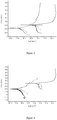
- the resulting polarization curves are shown in Fig.3 , wherein the solid curve is the polarization curve of the working electrode B1, and the dotted curve is the polarization curve of the working electrode B2.
- the three-electrode systems each comprising the working electrode B1 or B3 were immersed in the electrolyte solution for 2 hours under natural light irradiation, and then the working electrodes B1 and B3 were measured according to the above mentioned method.
- Fig.4 The resulting polarization curves are shown in Fig.4 , wherein the solid curve is the polarization curve of the working electrode B1, and the dotted curve is the polarization curve of the working electrode B3.
- the order of magnitude of the self-corrosion current i c corresponding to the working electrode B1 coated with the polyurethane coating free of nano-scaled titanium dioxide reaches 10 -6 A/cm 2
- the order of magnitude of the self-corrosion current i c1 corresponding to the working electrode B2 coated with the polyurethane coating containing 1wt% surface modified nano-scaled titanium dioxide is 10 -8 A/cm 2 , 2 orders of magnitudes different from the former.
- the reduction in the self-corrosion current demonstrates that the polyurethane coating containing the surface modified nano-scaled titanium dioxide has a high protective effect on the A3 Steel electrode under darkroom conditions.
- the order of magnitude of the self-corrosion current i c corresponding to the working electrode B1 coated with the polyurethane coating free of nano-scaled titanium dioxide reaches 10 -6 A/cm 2
- the order of magnitude of the self-corrosion current i c2 corresponding to the working electrode B3 coated with the polyurethane coating containing 3wt% surface modified nano-scaled titanium dioxide is 10 -9 A/cm 2 , 3 orders of magnitudes different from the former.
- the reduction in the self-corrosion current demonstrates that the polyurethane coating containing the surface modified nano-scaled titanium dioxide has a high protective effect on the A3 Steel electrode under natural light irradiation.
- Example 2 is the case shown by 2 in Fig.1 , i.e. the steel accepts the electrons generated by exciting the nano-scaled titanium dioxide in the coating layer by light, so that E micro cathode of the metal corrosion cell moves negatively, resulting in a reduction of the potential difference ⁇ E between the cathode and the anode, and further causing decrease of the self-corrosion current, as a result, the steel electrode obtains the corresponding photoelectrochemical protection.
- nano-scaled titanium dioxide particles having a particle diameter of 70-80nm were precisely weighed, and added in 26.6ml isopropanol under stirring. After continuous stirring for 20 minutes, 0.21g diethylene glycol aliphatic acid ester Emcol ® DO-50 with a hydrophile-lipophile balance value of 4.7 were added therein, and subjected to ultrasonic treatment for 20 minutes. 3.69g surface modified nano-scaled titanium dioxide was thus obtained by drying for 24 hours at a temperature of 60°C under reduced pressure.
- polyester polyol 100-type, Liaoning Dongchen Polyurethane Co., Ltd
- diphenyl-methane-diisocyanate 13g diphenyl-methane-diisocyanate were mixed uniformly in 32.7ml mixed solvent of butanone and xylene (in a volume ratio of 3:1) to obtain a polyurethane coating free of nano-scaled titanium dioxide.
- the polyurethane coating free of nano-scaled titanium dioxide was coated on the treated Stainless Steel 316 electrode plate, and cured to obtain a working electrode C1.
- the thickness of the coating layer was measured by using a film thickness gauge as 32 ⁇ m.
- the polyurethane coating containing 1wt% surface modified nano-scaled titanium dioxide was coated on the other three treated Stainless Steel 316 electrode plates, and cured to obtain working electrodes C2, C3 and C4.
- the thicknesses of the coating layers were each measured by using a film thickness gauge as 28 ⁇ m, 29 ⁇ m and 30 ⁇ m.
- the three-electrode systems each comprising the working electrode C1 or C2 were immersed in the electrolyte solution for 1 day, the three-electrode system comprising the working electrode C3 was immersed in the electrolyte solution for 2 days, and the three-electrode system comprising the working electrode C4 was immersed in the electrolyte solution for 3 days. Then, the working electrodes C1, C2, C3 and C4 were measured according to the above mentioned method. The resulting polarization curves are shown in Fig.5 .
- curve 4 is a polarization curve of the working electrode C1
- curve 1 is a polarization curve of the working electrode C2
- curve 2 is a polarization curve of the working electrode C3
- curve 3 is a polarization curve of the working electrode C4.
- the order of magnitude of the self-corrosion current i c corresponding to the working electrode C1 coated with the polyurethane coating free of nano-scaled titanium dioxide is 10 -7 A/cm 2
- the order of magnitude of the self-corrosion current i c1 corresponding to the working electrode C2 coated with the polyurethane coating containing 1wt% surface modified nano-scaled titanium dioxide is 10 -9 A/cm 2 , two orders of magnitude different from the former
- the order of magnitude of the self-corrosion current i c2 corresponding to the working electrode C3 coated with the polyurethane coating containing 1wt% surface modified nano-scaled titanium dioxide is 10 -8 A/cm 2
- the order of magnitude of the self-corrosion current i c3 corresponding to the working electrode C4 coated with the polyurethane coating containing 1wt% surface modified nano-scaled titanium dioxide is 10
- Example 3 is the case shown by 3 in Fig.1 , i.e. the stainless steel accepts the holes generated by exciting the nano-scaled titanium dioxide in the coating layer by light, so that E micro anode of the metal corrosion cell moves positively, resulting in a reduction of the potential difference ⁇ E between the cathode and the anode, and further causing decrease of the self-corrosion current, as a result, the stainless steel electrode obtains the corresponding photoelectrochemical protection.
- nano-scaled titanium dioxide particles having a particle diameter of 16-20nm were precisely weighed, and added in 12.1ml methanol under stirring. After continuous stirring for 20 minutes, 0.07g sorbitan tristearate Span ® 65 with a hydrophile-lipophile balance value of 2.1 were added therein, and subjected to ultrasonic treatment for 20 minutes. 2.47g surface modified nano-scaled titanium dioxide was thus obtained by drying for 24 hours at a temperature of 60°C under reduced pressure.
- the 1100-type aluminium alloy (Henan Xintai Aluminum Industry Co., Ltd) electrode plate in the size of 2cm ⁇ 2cm was rubbed in sequence by using 200#, 400#, 600# wet sand paper, wiped with alcohol, and then naturally dried in the air.
- a pencil was used to draw a 1cm ⁇ 1cm marked line thereon, and a hole having a diameter of 3mm was drilled in a part outside the marked line.
- the fluorocarbon coating free of nano-scaled titanium dioxide was coated on the surface of the 1cm ⁇ 1cm region inside the marked line, cured in a muffle furnace at 240°C for 10 minutes, and cooled to room temperature in the air.
- the thickness of the coating layer was measured by using a film thickness gauge as 35 ⁇ m. Aluminium wire was connected to the electrode plate through the hole, and bonded by using 703 Silica Gel (Beijing Chemical Reagent Co., Ltd) to ensure conduction. The part of the electrode plate, which was not coated with the fluorocarbon coating, was encapsulated with 703 Silica Gel, and naturally cured to obtain the working electrode D1.
- the working electrode D2 was obtained as described hereinabove, except replacing the fluorocarbon coating free of nano-scaled titanium dioxide by the fluorocarbon coating containing 1wt% surface modified nano-scaled titanium dioxide.
- the three-electrode systems each comprising the working electrode D1 or D2 were immersed in the electrolyte solution for 1 day, and then the working electrodes D1 and D2 were measured according to the above mentioned method.
- the resulting polarization curves are shown in Fig.6 .
- the solid curve is the polarization curve of the working electrode D1
- the dotted curve is the polarization curve of the working electrode D2.
- the order of magnitude of the self-corrosion current i c corresponding to the working electrode D1 coated with the fluorocarbon coating free of nano-scaled titanium dioxide is 10 -7 A/cm 2
- the order of magnitude of the self-corrosion current i c1 corresponding to the working electrode D2 coated with the fluorocarbon coating containing 0.8wt% surface modified nano-scaled titanium dioxide is 10 -8 A/cm 2 .
- the reduction in the self-corrosion current demonstrates that the fluorocarbon coating containing the surface modified nano-scaled titanium dioxide has a high protective effect on the 1100-type aluminium alloy electrode.
- Example 4 is the case shown by 2 in Fig.1 , i.e. the aluminium alloy accepts the electrons generated by exciting the nano-scaled titanium dioxide in the coating layer by light, so that E micro cathode of the metal corrosion cell moves negatively, resulting in a reduction of the potential difference ⁇ E between the cathode and the anode, and further causing decrease of the self-corrosion current, as a result, the aluminium alloy electrode obtains the corresponding photoclectrochemical protection.
Landscapes
- Chemical & Material Sciences (AREA)
- Engineering & Computer Science (AREA)
- Life Sciences & Earth Sciences (AREA)
- Organic Chemistry (AREA)
- Materials Engineering (AREA)
- Wood Science & Technology (AREA)
- Inorganic Chemistry (AREA)
- Health & Medical Sciences (AREA)
- Molecular Biology (AREA)
- Nanotechnology (AREA)
- Mechanical Engineering (AREA)
- Metallurgy (AREA)
- Paints Or Removers (AREA)
- Application Of Or Painting With Fluid Materials (AREA)
- Other Surface Treatments For Metallic Materials (AREA)
- Chemical Kinetics & Catalysis (AREA)
- Medicinal Chemistry (AREA)
- Polymers & Plastics (AREA)
Description
- The present invention relates to a photoelectrochemical method for metal preservation, more specifically, it relates to a photoelectrochemical method for metal preservation by applying a coating containing nano-scaled titanium dioxide surface modified by nonionic surfactant on the metal surface.
- Great losses in all walks of life caused by metal corrosion account for about 3-4% of the national economic output. The modern anti-corrosion technology adopted may reduce the losses caused by corrosion by about 15%, which has considerable resource values and economic values.
- Among those methods for controlling metal corrosion, the electrochemical cathodic protection and anodic protection are most effective ones. Typical examples of cathodic protection and anodic protection include, for example, cathodic protection of natural gas transmission pipelines, sacrificial anodic protection of transformer substation grounding network of a power system, gas phase cathodic protection of interior wall of storage tank, cathodic protection of bridge floor concrete, cathodic protection of petrochemical facilities, cathodic protection of shipping equipment, cathodic protection of long distance petroleum pipeline, and cathodic protection of crude petroleum storage tank.
- Materials used for grounding networks, for example, in the transformer substation grounding network of a power system, are mainly plain carbon steels in the form of flat steel or round steel. The grounding facilities, which have long been operated in a poor underground environment, suffer unavoidable chemical and electrochemical corrosions by soil, and stray current corrosion in stray current region of the earthing network. The corrosion of grounding network is generally shown in a local corrosion morphology. After the occurrence of corrosion, carbon steel materials of the grounding network are embrittled, exfoliated, loosened, or even fractured. With increased capacity of the electric power system and complexity of the network, as well as enhanced automation level, electric power accidents induced by the degraded performance of the grounding network gradually increase, and the damages and economic losses caused thereby also increase.
- With growing concerns about anti-corrosion of the grounding network of the electric power system, anti-corrosion measures are widely taken at present in order to enhance or ensure the security level of the grounding network. Enlarged cross section of an grounding block and increased corrosion allowance can reduce negative impacts on the grounding effects exerted by corrosion, but cannot solve the problem radically, particularly in areas suffering severe corrosion, resulting in unnecessary consumption of large amounts of metal materials. Copper or other corrosion-resistant will not nonferrous metals may be used as grounding materials, whereas they are highly cost, difficult to construct, easy to cause galvanic corrosion, and further influencing safety of other steel structures. Composite materials such as galvanized steel, are usually employed as grounding materials, but the effect thereof will not be long lasting. The technique of cathodic protection has a favorable effect and a long protection period, and is convenient in construction. The method of sacrificial anodic electrochemical protection is suitable not only for newly-built grounding network protection, but also for reforming the old grounding network so as to prolong its life.
- The method of sacrificial anodic protection or the method of applied power supply cathodic protection are effective in protecting the grounding network, however, aside from continuous consumption of sacrificial anodic metal blocks or electric energy, they further require instruments, apparatuses, conductors and the like for testing the protective current. Meanwhile, any failure of the monitoring devices such as a potentiostat in the protection system may lead to protection failure, and further result in serious corrosion of the grounding network.
-
CN 1927966 A provides a nanometer paint, which comprises fluoric acrylic/silicone resin in 30-60 wt%, nanometer pigment particle in 4-30 wt%, nanometer silica in 0.1-5 wt% and solvent for the rest, wherein the nanometer pigment particle and nanometer silica have a particle diameter of not greater than 191.4 nm. -
CN 101440243 A relates to a nano titanium dioxide fluorocarbon coating composition, comprising 2 to 6 percent by weight of nano titanium dioxide, 80 to 90 percent by weight of fluorocarbon base material, 5 to 10 percent by weight of curing agent and 2 to 10 percent by weight of coating thinner. The nano titanium dioxide is rutile-type nano titanium dioxide particle modified by silane coupling agent KH-570. The fluorocarbon coating composition can effectively improve the dispersing performance of nano titanium dioxide particle in the coating composition and the UV aging resistance of the coating. -
CN 1427052 A relates to a nanometre photocatalytic polyurethane paint, composing of modified synthetic resin prepared from nanometre TiO2 1-45wt%, high-molecular dispersant 0.1-10wt%, synthetic resin 15-70wt% and solvent for the rest, and also solidifying agent. It is prepared through first preparing high-concentration low-viscosity nanometre TiO2 slurry, and then preparing the paint via using said slurry. This makes nanometre TiO2 more easily disperse in the paint, and the coating film obtained from said paint show excellent photocatalytic performance. - In view of the above situations, inventors of the present application had an extensive and profound research in the field of protection metal from corrosion, in expectation of obtaining a method for metal preservation having low cost and high efficiency and notably reducing the corrosion speed. The result showed that applying a coating containing nano-scaled titanium dioxide surface modified by nonionic surfactant on a metal surface was effective in photoelectrochemically preserving the metal. The inventors just implemented the present invention based on the above discovery.
- An object of the present invention is to provide a photoelectrochemical method for metal preservation.
- Embodiments that can achieve said object are summarized as follows:
- 1. A photoelectrochemical method for metal preservation comprising applying a coating including the following components on metal surface and curing the coating:
- A) the film-forming component; and
- B) the surface modified nano-scaled titanium dioxide, which consists of nano-scaled titanium dioxide particle as substrate and the nonionic surfactant covered on the nano-scaled titanium dioxide substrate surface; the particle diameter of the nano-scaled titanium dioxide substrate is 1-100nm, preferably 1-60nm, more preferably 1-40nm; the hydrophile-lipophile balance value of the nonionic surfactant is 1-10, preferably 2-8, more preferably 2-5.8; and the content of the nonionic surfactant is 1-20 wt% based on the weight of nano-scaled titanium dioxide substrate, preferably 2-10wt%, more preferably 3-8wt%; wherein the content of the surface modified nano-scaled titanium dioxide is 0.1-10 wt% based on the total weight of the coating, preferably 0.5-5wt%, more preferably 0.8-3wt%.
- 2. The method of
item 1, wherein the nano-scaled titanium dioxide in the cured coating produces electrons and holes under the action of light. - 3. The method of
item 1, wherein the cured coating has a thickness of 15-50µm, preferably 20-45µm, more preferably 25-40µm. - 4. The method of any of
items 1 to 3, wherein the film-forming component is fluorocarbon resin which is preferably selected from polyvinyl fluoride, polyvinylidene fluoride, vinylidene fluoride-hexafluoropropylene copolymer, tetrafluoroethylene-hexafluoropropylene-vinylidene fluoride copolymer, tetrafluoroethylene-propylene copolymer and tetrafluoroethylene-vinylidene fluoride-acrylic acid copolymer, and is more preferably selected from polyvinylidene fluoride, vinylidene fluoride-hexafluoropropylene copolymer, tetrafluoroethylene-propylene copolymer and tetrafluoroethylene-vinylidene fluoride-acrylic acid copolymer. - 5. The method of
item 4, wherein the nonionic surfactant is selected from sorbitan tristearate, ethylene glycol aliphatic acid ester, polyoxyethylene sorbitol beeswax derivatives or propylene glycol aliphatic acid ester. - 6. The method of any of
items 1 to 3, wherein the film-forming component is polyurethane resin formed by polyol and isocyanate in a weight ratio of 10:1-2:1, preferably 8:1-3:1, more preferably 5:1-4:1. - 7. The method of
item 6, wherein the polyol is selected from polyester polyol, polyether polyol, epoxy resin, hydroxy acrylic resin and hydroxy alkyd resin. - 8. The method of
item 6, wherein isocyanate is selected from toluene diisocyanate, diphenyl-methane-diisocyanate, 1,6-hexamethylene diisocyanate, trimethyl hexamethylene diisocyanate, p-phenylene diisocyanate, 4,4'-dicyclohexylmethane diisocyanate, m-xylene diisocyanate, isophorone diisocyanate, 1,5-naphthalene diisocyanate and isocyanato end capped prepolymers. - 9. The method of
item 6, wherein the nonionic surfactant is selected from ethylene glycol aliphatic acid ester, polyoxyethylene sorbitol beeswax derivatives, diethylene glycol aliphatic acid ester or glyceryl monostearate. - 10. The method of any of
items 1 to 9, wherein the metal is copper, steel, stainless steel or aluminium alloy. - Further embodiments are coatings and surface-modified nano-scaled titanium dioxide of claims 15 and 16, a method for preparing the surface-modified nano-scaled titanium dioxide according to claims 17-23.
- In the method of the present invention, current necessary for metal preservation is directly supplied by the coating layer containing the surface modified nano-scaled titanium dioxide under the action of light. Compared with the traditional electrochemical protection method, the method of this invention saves not only applied power supply and sacrificial anode, but also complicated works like installation, detection and maintenance of a series of apparatuses such as potentiostat, reference electrode, connecting circuit. Meanwhile, the method of this invention further enables photoelectrochemical protection of a metal to notably reduce its corrosion speed, for example, the order of magnitude of the self-corrosion current of the metal electrode coated with a coating containing the surface modified nano-scaled titanium dioxide is 10-9-10-8A/cm2, which is generally 1-2, or even 3 orders of magnitude less than the self-corrosion current of the metal electrode coated with a coating free of nano-scaled titanium dioxide.
-
-
Fig.1 is a schematic diagram of self-corrosion potential and self-corrosion current of the corroded metal before and after the photoelectrochemical protection. -
Fig.2 shows polarization curves of the working electrode of Example 1 coated with a polyurethane coating free of nano-scaled titanium dioxide, a polyurethane coating containing 1wt% surface modified nano-scaled titanium dioxide as well as a polyurethane coating containing 2wt% surface modified nano-scaled titanium dioxide, which was immersed in the electrolyte solution for 1 day. -
Fig.3 shows polarization curves of the working electrode of Example 2 coated with a polyurethane coating free of nano-scaled titanium dioxide as well as a polyurethane coating containing 1wt% surface modified nano-scaled titanium dioxide, which was immersed in the electrolyte solution for 1 hour under darkroom condition. -
Fig.4 shows polarization curves of the working electrode of Example 2 coated with a polyurethane coating free of nano-scaled titanium dioxide as well as a polyurethane coating containing 3wt% surface modified nano-scaled titanium dioxide, which was immersed in the electrolyte solution for 2 hours under natural light irradiation. -
Fig.5 shows polarization curves of the working electrode of Example 3 coated with a polyurethane coating free of nano-scaled titanium dioxide and immersed in the electrolyte solution for 1 day, and with a polyurethane coating containing 1wt% surface modified nano-scaled titanium dioxide, and immersed in the electrolyte solution respectively for 1 day, 2 days and 3 days. -
Fig.6 shows polarization curves of the working electrode of Example 4 coated with a fluorocarbon coating free of nano-scaled titanium dioxide as well as a fluorocarbon coating containing 0.8wt% surface modified nano-scaled titanium dioxide, which was immersed in the electrolyte solution for 1 day. - The term "photoelectrochemical protection" used in the context of the present application should be so interpreted: the nano-scaled titanium dioxide in the coating layer coated on the metal surface generates electrons and holes charge carriers under the action of light, said metal absorbs the generated electrons and/or holes, so that Emicro cathode of the metal corrosion cell moves negatively and/or Emicro anode thereof moves positively, resulting in a reduction of the potential difference ΔE between the cathode and the anode, and further causing decrease of the self-corrosion current, so that said metal is accordingly protected, wherein the light can be ultraviolet light, visible light or infrared light.
- To uniformly disperse the nano-scaled titanium dioxide particles in the coating, and to ensure their uniform dispersion in the coating layer after curing, first, inventors of the present application prepare the nano-scaled titanium dioxide surface modified by nonionic surfactant through the following steps:
- a) wetting the nano-scaled titanium dioxide particle as the substrate with a wetting agent;
- b) mixing the nonionic surfactant uniformly with the dispersion of nano-scaled titanium dioxide substrate in the wetting agent from step a); and
- c) drying.
- The used wetting agent can be any wetting agent known to a person skilled in the art. Alcohol is a preferred wetting agent used in the present invention. Suitable alcohols include but are not limited to methanol, ethanol, n-propanol, isopropanol, 2-methyl-1-propanol, n-butanol, 2-butanol and tert-butanol. The used wetting agent and the nano-scaled titanium dioxide substrate are in a weight ratio of 2:1-20:1, preferably 3:1-10:1.
- The particle diameter of the nano-scaled titanium dioxide substrate is 1-100 nm, preferably 1-60nm, more preferably 1-40nm.
- A suitable hydrophile-lipophile balance value of the nonionic surfactant of the present invention is 1-10, preferably 2-8, more preferably 2-5.8. The dosage of the nonionic surfactant is 1-20 wt% based on the weight of the nano-scaled titanium dioxide substrate, preferably 2-10wt%, more preferably 3-8wt%.
- Drying may be operated at normal temperature or elevated temperature such as 60-80°C, and under normal pressure or reduced pressure for 10-48 hours, preferably 12-36 hours. A proper way of drying, for example, is to dry at elevated temperature such as 60-80°C under reduced pressure.
- In the method of this invention, the polyurethane coating containing the surface modified nano-scaled titanium dioxide is preferably applied on the metal surface for photoclectrochemical protection of the metal.
- The nano-scaled titanium dioxide surface modified by the nonionic surfactant hereinabove, a polyol, an isocyanate, optional pigment and filler, as well as optional adjuvant are mixed in the solvent to obtain the polyurethane coating comprising the surface modified nano-scaled titanium dioxide, wherein the content of the surface modified nano-scaled titanium dioxide is 0.1-10 wt% based on the total weight of the coating, preferably 0.5-5wt%, more preferably 0.8-3wt%; the polyol and the isocyanate are in a weight ratio of 10:1- 2:1, preferably 8:1-3:1, more preferably 5:1-4:1.
- The polyol used can be polyester polyol, polyether polyol, epoxy resin, hydroxy acrylic resin or hydroxy alkyd resin.
- The used isocyanate is toluene diisocyanate, diphenyl-methane-diisocyanate, 1,6-hexamethylene diisocyanate, trimethyl hexamethylene diisocyanate, p-phenylene diisocyanate, 4,4'-dicyclohexylmethane diisocyanate, m-xylene diisocyanate, isophorone diisocyanate, 1,5-naphthalene diisocyanate or isocyanato end capped prepolymers.
- In the condition that the film-forming component is polyurethane resin formed by polyols and isocyanates, it is preferred that the nonionic surfactant used during the preparation of the surface modified nano-scaled titanium dioxide is ethylene glycol aliphatic acid ester, polyoxyethylene sorbitol beeswax derivatives, diethylene glycol aliphatic acid ester or glyceryl monostearate, for example, ethylene glycol aliphatic acid ester Emcol® EL-50 (HLB value of 3.6), polyoxyethylene sorbitol beeswax derivatives Arias® G-1727 (HLB value of 4.0), diethylene glycol aliphatic acid ester Emcol® DO-50 (HLB value of 4.7) or glyceryl monostearate Aldo® 28 (HLB value of 5.5).
- In the method of this invention, the fluorocarbon coating containing the surface modified nano-scaled titanium dioxide is also preferably applied on the metal surface for photoelectrochemical protection of the metal.
- The nano-scaled titanium dioxide surface modified by the nonionic surfactant hereinabove, a fluorocarbon resin, optional pigment and filler, as well as optional adjuvant are mixed in the solvent to obtain the fluorocarbon coating comprising the surface modified nano-scaled titanium dioxide, wherein the content of the surface modified nano-scaled titanium dioxide is 0.1-10 wt% based on the total weight of the coating, preferably 0.5-5wt%, more preferably 0.8-3wt%.
- The used fluorocarbon resin is selected from polyvinyl fluoride, polyvinylidene fluoride, vinylidene fluoride-hexafluoropropylene copolymer, tetrafluoroethylene-hexafluoropropylene-vinylidene fluoride copolymer, tetrafluoroethylene-propylene copolymer and tetrafluoroethylene-vinylidene fluoride-acrylic acid copolymer, the fluorocarbon resin is preferably selected from polyvinylidene fluoride, vinylidene fluoride-hexafluoropropylene copolymer, tetrafluoroethylene-propylene copolymer and tetrafluoroethylene-vinylidene fluoride-acrylic acid copolymer.
- In the case that the film-forming component is fluorocarbon resin, the nonionic surfactant preferably used for the preparation of the surface modified nano-scaled titanium dioxide is sorbitan tristearate, ethylene glycol aliphatic acid ester, polyoxyethylene sorbitol beeswax derivatives or propylene glycol aliphatic acid ester, for example, sorbitan tristearate Span® 65 (HLB value of 2.1), ethylene glycol aliphatic acid ester Emcol© EO-50 (HLB value of 2.7), polyoxyethylene sorbitol beeswax derivatives Atlas® G-1704 (HLB value of 3.0) or propylene glycol aliphatic acid ester Emcol® PO-50 (HLB value of 3.4).
- The solvents used for the coating according to the present invention are common solvents or a mixture thereof, including but not limited to aromatic hydrocarbons such as xylene, toluene esters such as ethyl acetate, butyl acetate, isoamyl acetate; alcohols such as butanol, isobutanol, phenylcarbinol; ethers such as ethylene glycol monoethyl ether, ethylene glycol monobutyl ether, propylene glycol diethyl ether; ketones such as methylisobutylketone, acetophenone, isophorone. A person skilled in the art may determine the amount of the solvent based on the required properties of the coating such as paintability and the like.
- The filler used in the coating according to the present invention is, for example, talc powder, calcium carbonate, barium sulfate, silicon dioxide.
- The adjuvant used in the coating according to the present invention is for example, an anti-foaming agents, a wetting agent, a dispersant, an emulsifier, an anti-settling agent, a stabilizer, an anti-skinning agent, a leveling agent, a drier, an anti-sagging agent, a plasticizer, a delusterant, a fire retardant, a mildewproof agent, a fungicide, a trapping agent.
- A person skilled in the art may determine the type and the amount of the used filler and/or adjuvant based on the required properties of the coating such as bactericidal performance and the like.
- In general, when a metal with a coating layer coated on its surface is immersed in an electrolyte solution, the electrolyte solution permeates through the coating layer via defects thereof and contacts the metal surface. A corrosion cell composed by micro anode and micro cathode is formed on the metal surface, thus resulting in electrochemical corrosion of the metal.
- The metal with a coating layer containing nano-scaled titanium dioxide coated on its surface is subjected under the action of light, electrons of the donor level (e-) are excited to the conduction band, or electrons of the valence band (e-) are excited to the acceptor level, holes (h+) are generated accordingly in the valence band, resulting in the production of photo-induced charge carriers, then the conductivity of the coating layer changes, and the coating layer shifts from the insulative-type to the conductive-type with a certain conductivity.
- If the metal with a coating containing nano-scaled titanium dioxide coated on its surface, accepts both electrons and holes, the electrons e- enter the micro cathodic area of the metal from the nano-scaled titanium dioxide conduction band, causing the electrode potential Emicro cathode of the metal micro cathode to move negatively; the holes (h+) enter the micro anodic area of the metal from the nano-scaled titanium dioxide valence band, causing the electrode potential Emicro anode of the metal micro anode to move positively. As Emicro anode moves positively and Emicro cathode moves negatively, as shown by □ in
Fig.1 , the potential difference ΔE between Emicro anode and Emicro cathode of the metal corrosion microbattery is reduced. According to the relationship ic=(Emicro cathode -Emicro anode)/(Pa+Pk), assuming that the polarizability P of electrochemical reaction remains unchanged, then ic depends entirely on ΔE(Emicro cathode-Emicro anode), the smaller ΔE is, the smaller the metal self-corrosion current ic is. - If a metal with a coating containing nano-scaled titanium dioxide coated on its surface, is an electron-acceptance type, the electrons e- enter the metal from the nano-scaled titanium dioxide conduction band. The micro cathode of the metal accepts the electrons, and the electrode potential Emicro cathode moves negatively. Assumed that the polarizability P of electrochemical reaction remains unchanged, as shown by ② in
Fig.1 , the initial mixed potential Ec moves negatively to Ec2, and the initial corrosion current ic reduces accordingly to ic2. - If a metal with a coating containing nano-scaled titanium dioxide coated on its surface, is a hole-acceptance type, the holes h+ enter the metal from the nano-scaled titanium dioxide valence band. The micro anode of the metal accepts the holes, and the electrode potential Emicro anode moves positively. Assumed that the polarizability P of electrochemical reaction remains unchanged, as shown by ③ in
Fig.1 , the initial mixed potential Ec moves positively to Ec3, and the initial corrosion current ic reduces accordingly to ic3. - The reduction in the self-corrosion current demonstrates that the coating containing nano-scaled titanium dioxide enables photoelectrochemical protection of the metal, and notably reduces the corrosion speed of the metal.
- The electrode plate is coated with the coating containing the nano-scaled titanium dioxide surface modified by nonionic surfactant on its surface, cured and then used as a working electrode, wherein the thickness of the cured coating layer is 15-50µm, preferably 20-45µm, more preferably 25-40µm; the electrode plate can be prepared by for example, copper, steel, stainless steel or aluminium alloy. The above working electrode, a saturated calomel electrode as the reference electrode, and a Pt electrode as the auxiliary electrode together set up a three-electrode system. The three-electrode system is immersed in a 3.5wt% NaCl electrolyte solution, followed by measuring its electrochemical polarization curve using a CA-2A potentiostat.
- The advantages of the method of this invention are easily understood by a person skilled in art by combing the drawings of the description and taking an overall consideration of this invention:
- (1) the nano-scaled titanium dioxide uniformly dispersed in the coating layer strengthens the physical protection of the metal by the coating layer through its nano-scaled size effect.
- (2) the protective current is directly generated by the coating layer containing the surface modified nano-scaled titanium dioxide under the action of light; the applied power supply and sacrificial anode are saved;
- (3) complicated works like installation, detection and maintenance of a series of apparatuses such as potentiostat, reference electrode, connecting circuit, are saved; and
- (4) the reduction in the self-corrosion current demonstrates that the method of this invention enables photoelectrochemical protection of the metal, and notably reduces the corrosion speed thereof.
- The present invention is illustrated in detail hereinbelow by reference to examples and drawings.
- 2.4g nano-scaled titanium dioxide particles having a particle diameter of 16-20nm were precisely weighed, and added in 12.1ml methanol under stirring. After continuous stirring for about 20 mins, 0.07g ethylene glycol aliphatic acid ester Emol EL-50 with a hydrophile-lipophile balance value of 3.6 were added therein, and subjected to ultrasonic treatment for 20minutes. 2.47g surface modified nano-scaled titanium dioxide was thus obtained by drying for 24 hours at a temperature of 60°C under reduced pressure. 1g of said nano-scaled titanium dioxide surface modified by Emcol® EL-50, 60g hydroxy acrylic resin (TB60018P-type, Xiamen Kang Dilong Company), and 12g toluene diisocyanate were mixed uniformly in 30.5ml mixed solvent of butanone and xylene (in a volume ratio of 3:1) to obtain a polyurethane coating containing 1wt% of the surface modified nano-scaled titanium dioxide. 2g of said nano-scaled titanium dioxide surface modified by Emcol® EL-50, 60g hydroxy acrylic resin (TB60018P-type, Xiamen Kang Dilong Company), and 12g toluene diisocyanate were mixed uniformly in 29.3ml mixed solvent of butanone and xylene (in a volume ratio of 3:1) to obtain a polyurethane coating containing 2wt% of the surface modified nano-scaled titanium dioxide. 60g hydroxy acrylic resin (TB60018P-type, Xiamen Kang Dilong Company), and 12g toluene diisocyanate were mixed uniformly in 31.6ml mixed solvent of butanone and xylene (in a volume ratio of 3:1) to obtain a polyurethane coating free of nano-scaled titanium dioxide.
- The copper electrode plate in the size of 1cm×1cm was welded with a copper wire. An epoxy resin and a polyamide resin were mixed in a weight ratio of 3:2, and slowly stirred uniformly using a glass rod. The uniformly mixed epoxy resin and polyamide resin were poured into a paper box in which a copper electrode plate was placed in advance, and cured for 1 day. The encapsulated copper electrode plate was rubbed in sequence by using 200#, 400#, 600# wet sand paper, wiped with alcohol, and then naturally dried in the air. The polyurethane coating free of nano-scaled titanium dioxide was coated on the treated copper electrode plate, and cured to obtain a working electrode A1. The thickness of the coating layer was measured by using a film thickness gauge as 36µm. The polyurethane coating containing 1wt% surface modified nano-scaled titanium dioxide was coated on another treated copper electrode plate, and cured to obtain a working electrode A2. The thickness of the coating layer was measured by using a film thickness gauge as 31µm. The polyurethane coating containing 2wt% surface modified nano-scaled titanium dioxide was coated on another treated copper electrode plate, and cured to obtain a working electrode A3. The thickness of the coating layer was measured by using a film thickness gauge as 25µm.
- The three-electrode systems each comprising the working electrode A1, A2 or A3 were immersed in the electrolyte solution for 1 day, and then the working electrodes A1, A2 and A3 were measured according to the above mentioned method. The resulting polarization curves are shown in
Fig.2 , wherein the solid curve is the polarization curve of the working electrode A1, the sparsely dotted curve is the polarization curve of the working electrode A2, and the densely dotted curve is the polarization curve of the working electrode A3. A tangent from the Tafel area intersects a straight line of the self-corrosion potential parallel to the horizontal axis to obtain an intersection, and the abscissa of the intersection represents the self-corrosion current. As shown byFig.2 , the order of magnitude of the self-corrosion current ic corresponding to the working electrode A1 coated with the polyurethane coating free of nano-scaled titanium dioxide reaches 10-7A/cm2, the order of magnitude of the self-corrosion current ic1 corresponding to the working electrode A2 coated with the polyurethane coating containing 1wt% surface modified nano-scaled titanium dioxide is 10-8A/cm2, and the order of magnitude of the self-corrosion current ic2 corresponding to the working electrode A3 coated with the polyurethane coating containing 2wt% surface modified nano-scaled titanium dioxide is also 10-8A/cm2. The reduction in the self-corrosion current demonstrates that the polyurethane coating containing the surface modified nano-scaled titanium dioxide has a high protective effect on the copper electrode. - Example 1 is the case shown by ① in
Fig.1 , i.e. the copper accepts the electrons and holes charge carriers generated by exciting the nano-scaled titanium dioxide in the coating layer by light, so that Emicro cathode of the metal corrosion cell moves negatively and Emicro anode thereof moves positively, resulting in a reduction of the potential difference ΔE between the cathode and the anode, and further causing decrease of the self-corrosion current, as a result, the copper electrode obtains the corresponding photoelectrochemical protection. - 3.1g nano-scaled titanium dioxide particles having a particle diameter of 45-50nm were precisely weighed, and added in 11.8ml ethanol under stirring. After continuous stirring for 20 minutes, 0.12g polyoxyethylene sorbitol beeswax derivatives Arias® G-1727 with a hydrophile-lipophile balance value of 4.0 were added therein, and subjected to ultrasonic treatment for 20 minutes. 3.22g surface modified nano-scaled titanium dioxide was obtained by drying for 24 hours at a temperature of 60°C under reduced pressure. 1g of said nano-scaled titanium dioxide surface modified by Arias® G-1727, 62g hydroxy alkyd resin (with a number average molecular weight of 250000, Dalian Boxiang Industrial And Trade Co., Ltd.), and 7.7g toluene diisocyanate were mixed uniformly in 33.1ml mixed solvent of butanone and xylene (in a volume ratio of 3:1) to obtain a polyurethane coating containing 1wt% of the surface modified nano-scaled titanium dioxide. 3g of said nano-scaled titanium dioxide surface modified by Arias® G-1727, 62g hydroxy alkyd resin (with a number average molecular weight of 250000, Dalian Boxiang Industrial And Trade Co., Ltd.), and 7.7g toluene diisocyanate were mixed uniformly in 30.8ml mixed solvent of butanone and xylene (in a volume ratio of 3:1) to obtain a polyurethane coating containing 3wt% of the surface modified nano-scaled titanium dioxide. 60g hydroxy alkyd resin (with a number average molecular weight of 250000, Dalian Boxiang Industrial And Trade Co., Ltd.), and 7.7g toluene diisocyanate were mixed uniformly in 34.2ml mixed solvent of butanone and xylene (in a volume ratio of 3:1) to obtain a polyurethane coating free of nano-scaled titanium dioxide.
- A difference of the treated electrode plate, which was prepared as described by Example 1, was replacing copper with A3 Steel (Beijing Anticorr Corrosion Resistance Technique Development Co., Ltd). The polyurethane coating free of nano-scaled titanium dioxide was coated on the treated A3 Steel electrode plate, and cured to obtain a working
electrode B 1. The thickness of the coating layer was measured by using a film thickness gauge as 38µm. The polyurethane coating containing 1wt% surface modified nano-scaled titanium dioxide was coated on another treated A3 Steel electrode plate, and cured to obtain a working electrode B2. The thickness of the coating layer was measured by using a film thickness gauge as 34µm. The polyurethane coating containing 3wt% surface modified nano-scaled titanium dioxide was coated on another treated A3 Steel electrode plate, and cured to obtain a working electrode B3. The thickness of the coating layer was measured by using a film thickness gauge as 30µm. - The three-electrode systems each comprising the working electrode B1 or B2 were immersed in the electrolyte solution for 1 hour under darkroom conditions, and then the working electrodes B1 and B2 were measured according to the above mentioned method. The resulting polarization curves are shown in
Fig.3 , wherein the solid curve is the polarization curve of the working electrode B1, and the dotted curve is the polarization curve of the working electrode B2. The three-electrode systems each comprising the working electrode B1 or B3 were immersed in the electrolyte solution for 2 hours under natural light irradiation, and then the working electrodes B1 and B3 were measured according to the above mentioned method. The resulting polarization curves are shown inFig.4 , wherein the solid curve is the polarization curve of the working electrode B1, and the dotted curve is the polarization curve of the working electrode B3. As shown byFig.3 , under darkroom conditions, the order of magnitude of the self-corrosion current ic corresponding to the working electrode B1 coated with the polyurethane coating free of nano-scaled titanium dioxide reaches 10-6A/cm2, and the order of magnitude of the self-corrosion current ic1 corresponding to the working electrode B2 coated with the polyurethane coating containing 1wt% surface modified nano-scaled titanium dioxide is 10-8A/cm2, 2 orders of magnitudes different from the former. The reduction in the self-corrosion current demonstrates that the polyurethane coating containing the surface modified nano-scaled titanium dioxide has a high protective effect on the A3 Steel electrode under darkroom conditions. As shown byFig.4 , under natural light irradiation, the order of magnitude of the self-corrosion current ic corresponding to the working electrode B1 coated with the polyurethane coating free of nano-scaled titanium dioxide reaches 10-6A/cm2, and the order of magnitude of the self-corrosion current ic2 corresponding to the working electrode B3 coated with the polyurethane coating containing 3wt% surface modified nano-scaled titanium dioxide is 10-9A/cm2, 3 orders of magnitudes different from the former. The reduction in the self-corrosion current demonstrates that the polyurethane coating containing the surface modified nano-scaled titanium dioxide has a high protective effect on the A3 Steel electrode under natural light irradiation. - Example 2 is the case shown by ② in
Fig.1 , i.e. the steel accepts the electrons generated by exciting the nano-scaled titanium dioxide in the coating layer by light, so that Emicro cathode of the metal corrosion cell moves negatively, resulting in a reduction of the potential difference ΔE between the cathode and the anode, and further causing decrease of the self-corrosion current, as a result, the steel electrode obtains the corresponding photoelectrochemical protection. - 3.48g nano-scaled titanium dioxide particles having a particle diameter of 70-80nm were precisely weighed, and added in 26.6ml isopropanol under stirring. After continuous stirring for 20 minutes, 0.21g diethylene glycol aliphatic acid ester Emcol® DO-50 with a hydrophile-lipophile balance value of 4.7 were added therein, and subjected to ultrasonic treatment for 20 minutes. 3.69g surface modified nano-scaled titanium dioxide was thus obtained by drying for 24 hours at a temperature of 60°C under reduced pressure. 1g of said nano-scaled titanium dioxide surface modified by Emcol® DO-50, 58g polyester polyol (100-type, Liaoning Dongchen Polyurethane Co., Ltd) and 13g diphenyl-methane-diisocyanate were mixed uniformly in 31.6ml mixed solvent of butanone and xylene (in a volume ratio of 3:1) to obtain a polyurethane coating containing 1wt% of the surface modified nano-scaled titanium dioxide. 58g polyester polyol (100-type, Liaoning Dongchen Polyurethane Co., Ltd), and 13g diphenyl-methane-diisocyanate were mixed uniformly in 32.7ml mixed solvent of butanone and xylene (in a volume ratio of 3:1) to obtain a polyurethane coating free of nano-scaled titanium dioxide.
- A difference of the treated electrode plate, which was prepared as described by Example 1, was replacing copper with Stainless Steel 316 (Beijing Anticorr Corrosion Resistance Technique Development Co., Ltd). The polyurethane coating free of nano-scaled titanium dioxide was coated on the treated Stainless Steel 316 electrode plate, and cured to obtain a working electrode C1. The thickness of the coating layer was measured by using a film thickness gauge as 32µm. The polyurethane coating containing 1wt% surface modified nano-scaled titanium dioxide was coated on the other three treated Stainless Steel 316 electrode plates, and cured to obtain working electrodes C2, C3 and C4. The thicknesses of the coating layers were each measured by using a film thickness gauge as 28µm, 29µm and 30µm.
- The three-electrode systems each comprising the working electrode C1 or C2 were immersed in the electrolyte solution for 1 day, the three-electrode system comprising the working electrode C3 was immersed in the electrolyte solution for 2 days, and the three-electrode system comprising the working electrode C4 was immersed in the electrolyte solution for 3 days. Then, the working electrodes C1, C2, C3 and C4 were measured according to the above mentioned method. The resulting polarization curves are shown in
Fig.5 . InFig.5 ,curve 4 is a polarization curve of the working electrode C1,curve 1 is a polarization curve of the working electrode C2,curve 2 is a polarization curve of the working electrode C3, andcurve 3 is a polarization curve of the working electrode C4. As shown byFig.5 , in the case of 1-day immersion, the order of magnitude of the self-corrosion current ic corresponding to the working electrode C1 coated with the polyurethane coating free of nano-scaled titanium dioxide is 10-7A/cm2, and the order of magnitude of the self-corrosion current ic1 corresponding to the working electrode C2 coated with the polyurethane coating containing 1wt% surface modified nano-scaled titanium dioxide is 10-9A/cm2, two orders of magnitude different from the former; in the case of 2-day immersion, the order of magnitude of the self-corrosion current ic2 corresponding to the working electrode C3 coated with the polyurethane coating containing 1wt% surface modified nano-scaled titanium dioxide is 10-8A/cm2; in the case of 3-day immersion, the order of magnitude of the self-corrosion current ic3 corresponding to the working electrode C4 coated with the polyurethane coating containing 1wt% surface modified nano-scaled titanium dioxide is 10-9A/cm2, 2 orders of magnitude different from the self-corrosion current ic. The reduction in the self-corrosion current demonstrates that the polyurethane coating containing the surface modified nano-scaled titanium dioxide has a high protective effect on the Stainless Steel 316 electrode. - Example 3 is the case shown by ③ in
Fig.1 , i.e. the stainless steel accepts the holes generated by exciting the nano-scaled titanium dioxide in the coating layer by light, so that Emicro anode of the metal corrosion cell moves positively, resulting in a reduction of the potential difference ΔE between the cathode and the anode, and further causing decrease of the self-corrosion current, as a result, the stainless steel electrode obtains the corresponding photoelectrochemical protection. - 2.4g nano-scaled titanium dioxide particles having a particle diameter of 16-20nm were precisely weighed, and added in 12.1ml methanol under stirring. After continuous stirring for 20 minutes, 0.07g sorbitan tristearate Span® 65 with a hydrophile-lipophile balance value of 2.1 were added therein, and subjected to ultrasonic treatment for 20 minutes. 2.47g surface modified nano-scaled titanium dioxide was thus obtained by drying for 24 hours at a temperature of 60°C under reduced pressure. 60g polyvinylidene fluoride (T-1 type, Shanghai East Fluorine Chemical Technology Co., Ltd.) was weighed and added into 44.2ml mixed solvent of butanone and xylene (in a volume ratio of 3:1), uniformly dispersing the polyvinylidene fluoride under stirring in the mixed solvent to obtain a fluorocarbon resin dispersion system. 0.8g of the nano-scaled titanium dioxide surface modified by Span® 65 was added into the fluorocarbon resin dispersion system to obtain the fluorocarbon coating containing 1wt% surface modified nano-scaled titanium dioxide. 60g polyvinylidene fluoride (T-1 type, Shanghai East Fluorine Chemical Technology Co., Ltd.) was weighed and added into 45.1ml mixed solvent of butanone and xylene (in a volume ratio of 3:1), uniformly dispersing the polyvinylidene fluoride under stirring in the mixed solvent to obtain a fluorocarbon coating free of nano-scaled titanium dioxide.
- The 1100-type aluminium alloy (Henan Xintai Aluminum Industry Co., Ltd) electrode plate in the size of 2cm×2cm was rubbed in sequence by using 200#, 400#, 600# wet sand paper, wiped with alcohol, and then naturally dried in the air. A pencil was used to draw a 1cm×1cm marked line thereon, and a hole having a diameter of 3mm was drilled in a part outside the marked line. The fluorocarbon coating free of nano-scaled titanium dioxide was coated on the surface of the 1cm×1cm region inside the marked line, cured in a muffle furnace at 240°C for 10 minutes, and cooled to room temperature in the air. The thickness of the coating layer was measured by using a film thickness gauge as 35µm. Aluminium wire was connected to the electrode plate through the hole, and bonded by using 703 Silica Gel (Beijing Chemical Reagent Co., Ltd) to ensure conduction. The part of the electrode plate, which was not coated with the fluorocarbon coating, was encapsulated with 703 Silica Gel, and naturally cured to obtain the working electrode D1. The working electrode D2 was obtained as described hereinabove, except replacing the fluorocarbon coating free of nano-scaled titanium dioxide by the fluorocarbon coating containing 1wt% surface modified nano-scaled titanium dioxide.
- The three-electrode systems each comprising the working electrode D1 or D2 were immersed in the electrolyte solution for 1 day, and then the working electrodes D1 and D2 were measured according to the above mentioned method. The resulting polarization curves are shown in
Fig.6 . InFig.6 , the solid curve is the polarization curve of the working electrode D1, and the dotted curve is the polarization curve of the working electrode D2. As shown byFig.6 , the order of magnitude of the self-corrosion current ic corresponding to the working electrode D1 coated with the fluorocarbon coating free of nano-scaled titanium dioxide is 10-7A/cm2, and the order of magnitude of the self-corrosion current ic1 corresponding to the working electrode D2 coated with the fluorocarbon coating containing 0.8wt% surface modified nano-scaled titanium dioxide is 10-8A/cm2. The reduction in the self-corrosion current demonstrates that the fluorocarbon coating containing the surface modified nano-scaled titanium dioxide has a high protective effect on the 1100-type aluminium alloy electrode. - Example 4 is the case shown by ② in
Fig.1 , i.e. the aluminium alloy accepts the electrons generated by exciting the nano-scaled titanium dioxide in the coating layer by light, so that Emicro cathode of the metal corrosion cell moves negatively, resulting in a reduction of the potential difference ΔE between the cathode and the anode, and further causing decrease of the self-corrosion current, as a result, the aluminium alloy electrode obtains the corresponding photoclectrochemical protection.
Claims (23)
- A photoelectrochemical method for metal preservation comprising applying a coating including the following components on a metal surface and curing the coating:A) a film-forming component; andB) surface modified nano-scaled titanium dioxide, which consists of nano-scaled titanium dioxide particle as substrate and the nonionic surfactant covered on the nano-scaled titanium dioxide substrate surface; the particle diameter of the nano-scaled titanium dioxide substrate is 1-100 nm; the hydrophile-lipophile balance value of the nonionic surfactant is 1-10; and the content of the nonionic surfactant is 1-20 wt% based on the weight of nano-scaled titanium dioxide substratewherein the content of the surface modified nano-scaled titanium dioxide is 0.1-10 wt% based on the total weight of the coating.
- The method of claim 1, wherein the hydrophile-lipophile balance value of the nonionic surfactant is 2-8.
- The method of claim 1, wherein the hydrophile-lipophile balance value of the nonionic surfactant is 2-5.8.
- The method of claim 1, wherein the content of the nonionic surfactant is 2-10 wt% based on the weight of nano-scaled titanium dioxide substrate.
- The method of claim 1, wherein the content of the nonionic surfactant is 3-8 wt% based on the weight of nano-scaled titanium dioxide substrate.
- The method of claim 1, wherein the nano-scaled titanium dioxide in the cured coating produces electrons and holes under the action of light.
- The method of claim 1, wherein the cured coating has a thickness of 15-50 µm.
- The method according to any of claims 1 to 7, wherein the film-forming component is fluorocarbon resin.
- The method of claim 8, wherein the nonionic surfactant is selected from sorbitan tristearate, ethylene glycol aliphatic acid ester, polyoxyethylene sorbitol beeswax derivatives or propylene glycol aliphatic acid ester.
- The method according to any of claims 1 to 7, wherein the film-forming component is polyurethane resin formed by polyol and isocyanate in a weight ratio of 10:1-2:1.
- The method of claim 10, wherein the polyol is selected from polyester polyol, polyether polyol, epoxy resin, hydroxy acrylic resin and hydroxy alkyd resin.
- The method of claim 10, wherein isocyanate is selected from toluene diisocyanate, diphenyl-methane-diisocyanate, 1,6-hexamethylene diisocyanate, trimethyl hexamethylene diisocyanate, p-phenylene diisocyanate, 4,4'-dicyclohexylmethane diisocyanate, m-xylene diisocyanate, isophorone diisocyanate, 1,5-naphthalene diisocyanate and isocyanato end capped prepolymers.
- The method of claim 10, wherein the nonionic surfactant is selected from ethylene glycol aliphatic acid ester, polyoxyethylene sorbitol beeswax derivatives, diethylene glycol aliphatic acid ester or glyceryl monostearate.
- The method according to any of claims 1 to 13, wherein the metal is copper, steel, stainless steel or aluminium alloy.
- The coating according to any of claims 1-5 and 8 to 13.
- The surface modified nano-scaled titanium dioxide according to any of claims 1-5, 9 and 13.
- A method for preparing the surface modified nano-scaled titanium dioxide according to claim 16, comprising the following steps:a) wetting the nano-scaled titanium dioxide particle as the substrate with a wetting agent;b) mixing the nonionic surfactant uniformly with the dispersion of nano-scaled titanium dioxide substrate in the wetting agent from step a), wherein the hydrophile-lipophile balance value of the nonionic surfactant is 1-10; and the dosage of the nonionic surfactant is 1-20 wt% based on the weight of nano-scaled titanium dioxide substrate; andc) drying;wherein the particle diameter of the nano-scaled titanium dioxide substrate is 1-100nm.
- The method according to claim 17, wherein the hydrophile-lipophile balance value of the nonionic surfactant is 2-8.
- The method according to claim 17, wherein the hydrophile-lipophile balance value of the nonionic surfactant is 2-5.8.
- The method according to claim 17, wherein the dosage of the nonionic surfactant is 2-10 wt% based on the weight of nano-scaled titanium dioxide substrate.
- The method according to claim 17, wherein the dosage of the nonionic surfactant is 3-8 wt% based on the weight of nano-scaled titanium dioxide substrate.
- The method according to claim 17, wherein the wetting agent is selected from methanol, ethanol, n-propanol, isopropanol, 2-methyl-1-propanol, n-butanol, 2-butanol and tert-butanol, and the wetting agent and the nano-scaled titanium dioxide substrate are in a weight ratio of 2:1-20:1.
- The method according to any of claims 17-22, wherein the nonionic surfactant is selected from sorbitan tristearate, ethylene glycol aliphatic acid ester, polyoxyethylene sorbitol beeswax derivatives, propylene glycol aliphatic acid ester, diethylene glycol aliphatic acid ester or glyceryl monostearate.
Applications Claiming Priority (2)
| Application Number | Priority Date | Filing Date | Title |
|---|---|---|---|
| CN2010105177086A CN102009037B (en) | 2010-10-25 | 2010-10-25 | Method for protecting metal by photoelectrochemistry |
| PCT/CN2011/079936 WO2012055308A1 (en) | 2010-10-25 | 2011-09-21 | Photoelectrochemicalmethod on metal preservation |
Publications (3)
| Publication Number | Publication Date |
|---|---|
| EP2633923A1 EP2633923A1 (en) | 2013-09-04 |
| EP2633923A4 EP2633923A4 (en) | 2015-07-15 |
| EP2633923B1 true EP2633923B1 (en) | 2017-04-19 |
Family
ID=43839473
Family Applications (1)
| Application Number | Title | Priority Date | Filing Date |
|---|---|---|---|
| EP11835581.7A Active EP2633923B1 (en) | 2010-10-25 | 2011-09-21 | Photoelectrochemicalmethod on metal preservation |
Country Status (4)
| Country | Link |
|---|---|
| US (1) | US9371589B2 (en) |
| EP (1) | EP2633923B1 (en) |
| CN (1) | CN102009037B (en) |
| WO (1) | WO2012055308A1 (en) |
Families Citing this family (23)
| Publication number | Priority date | Publication date | Assignee | Title |
|---|---|---|---|---|
| CN102009037B (en) * | 2010-10-25 | 2013-06-19 | 江苏考普乐新材料股份有限公司 | Method for protecting metal by photoelectrochemistry |
| US9849512B2 (en) | 2011-07-01 | 2017-12-26 | Attostat, Inc. | Method and apparatus for production of uniformly sized nanoparticles |
| CN102653652B (en) * | 2012-05-02 | 2014-07-09 | 常州大学 | Nano composite fluorocarbon coating and preparation method thereof |
| CN103436112A (en) * | 2013-09-13 | 2013-12-11 | 句容联众科技开发有限公司 | Weather-fastness coating |
| US12610952B2 (en) | 2014-09-23 | 2026-04-28 | Evoq Nano, Inc. | Antimicrobial compositions and methods |
| CN104402347B (en) * | 2014-10-20 | 2016-04-13 | 苏州市建筑科学研究院集团股份有限公司 | A kind of diatom ooze finishing material for purifying formaldehyde and preparation method thereof |
| WO2016161348A1 (en) | 2015-04-01 | 2016-10-06 | Attostat, Inc. | Nanoparticle compositions and methods for treating or preventing tissue infections and diseases |
| US11473202B2 (en) | 2015-04-13 | 2022-10-18 | Attostat, Inc. | Anti-corrosion nanoparticle compositions |
| EP3283580B1 (en) * | 2015-04-13 | 2025-06-04 | EVÕQ Nano, Inc. | Anti-corrosion nanoparticle compositions |
| US10201571B2 (en) | 2016-01-25 | 2019-02-12 | Attostat, Inc. | Nanoparticle compositions and methods for treating onychomychosis |
| EP3484634A4 (en) * | 2016-07-14 | 2020-07-29 | Arcanum Alloys, Inc. | Methods for forming stainless steel parts |
| CN107856156B (en) * | 2017-11-21 | 2019-05-03 | 浙江省林业科学研究院 | A kind of preparation method of nanometer titanium dioxide-based wood preservative |
| US11018376B2 (en) | 2017-11-28 | 2021-05-25 | Attostat, Inc. | Nanoparticle compositions and methods for enhancing lead-acid batteries |
| US11646453B2 (en) | 2017-11-28 | 2023-05-09 | Attostat, Inc. | Nanoparticle compositions and methods for enhancing lead-acid batteries |
| CN111034382B (en) * | 2018-01-05 | 2022-05-24 | 韩国科学技术研究院 | Method for producing electromagnetic wave shielding film |
| CN110280461A (en) * | 2019-06-11 | 2019-09-27 | 西安华捷奥海新材料有限公司 | A long-term corrugated plate tunnel anti-rockburst device corrosion-resistant composite film and its implementation method |
| US12115250B2 (en) | 2019-07-12 | 2024-10-15 | Evoq Nano, Inc. | Use of nanoparticles for treating respiratory infections associated with cystic fibrosis |
| US12456759B2 (en) | 2021-03-30 | 2025-10-28 | Evoq Nano, Inc. | Nanoparticle-enhanced lead-acid electrode paste and improved lead-acid batteries made therefrom |
| CN113930130A (en) * | 2021-11-04 | 2022-01-14 | 淮安凯佳粉末涂料有限公司 | Thermosetting powder coating |
| CN114231993B (en) * | 2021-12-20 | 2022-08-23 | 上海集优张力控制螺栓有限公司 | Metal anticorrosive material |
| CN115521559B (en) * | 2022-10-26 | 2023-05-09 | 金塑企业集团(上海)有限公司 | High-hardness PVC-U electrical bushing and processing technology thereof |
| WO2025189349A1 (en) * | 2024-03-12 | 2025-09-18 | 聚泰环保材料科技股份有限公司 | Delustered modified cellulose fiber and manufacturing method therefor |
| CN118667385B (en) * | 2024-08-20 | 2024-11-15 | 陕西东方航天科技有限公司 | Degradable coating for pyrograph and preparation method thereof |
Family Cites Families (16)
| Publication number | Priority date | Publication date | Assignee | Title |
|---|---|---|---|---|
| US5853809A (en) * | 1996-09-30 | 1998-12-29 | Basf Corporation | Scratch resistant clearcoats containing suface reactive microparticles and method therefore |
| CN1287138A (en) * | 1999-09-03 | 2001-03-14 | 中国科学院固体物理研究所泰兴纳米材料厂 | Surface treatment for nanometer-level titania |
| US20020045010A1 (en) * | 2000-06-14 | 2002-04-18 | The Procter & Gamble Company | Coating compositions for modifying hard surfaces |
| CN1189528C (en) | 2001-12-21 | 2005-02-16 | 中国科学院金属研究所 | Nano photo catalyzed polyurethane paint and its preparation method |
| CN1181151C (en) * | 2002-04-17 | 2004-12-22 | 中国科学院金属研究所 | A kind of nano photocatalytic fluorocarbon resin coating and preparation method thereof |
| CN1927966A (en) * | 2005-09-09 | 2007-03-14 | 鸿富锦精密工业(深圳)有限公司 | Nano coating and preparation method thereof |
| CN1970662A (en) * | 2006-11-09 | 2007-05-30 | 上海大学 | Highly corrosiveness-resistant nanometer composite epoxy resin paint preparation method |
| CN101323719A (en) * | 2007-06-15 | 2008-12-17 | 上海金力泰化工股份有限公司 | Building curtain wall porcelain coating |
| CN100587016C (en) * | 2007-07-06 | 2010-02-03 | 北京化工大学 | A kind of preparation method of anti-fog self-cleaning type antibacterial anti-mildew spraying agent |
| CN101440143B (en) * | 2007-11-20 | 2011-04-06 | 山东东岳神舟新材料有限公司 | Polymerization process for increasing stability of fluorinated ethylenepropylene copolymer resin end group |
| CN101932752A (en) * | 2007-12-04 | 2010-12-29 | 格雷斯公司 | Corrosion resistant material |
| CN101440243B (en) * | 2008-12-25 | 2012-01-04 | 上海交通大学 | Titania fluorocarbon nano-coating and preparation thereof |
| CN102009037B (en) * | 2010-10-25 | 2013-06-19 | 江苏考普乐新材料股份有限公司 | Method for protecting metal by photoelectrochemistry |
| CN102010000B (en) * | 2010-10-25 | 2014-07-16 | 江苏考普乐新材料有限公司 | Nano titanium dioxide and preparation method thereof |
| CN101985536B (en) * | 2010-10-25 | 2013-04-03 | 江苏考普乐新材料股份有限公司 | Fluorocarbon paint and preparation method thereof |
| CN101985541B (en) | 2010-10-25 | 2013-03-20 | 江苏考普乐新材料股份有限公司 | Polyurethane coating and preparation method thereof |
-
2010
- 2010-10-25 CN CN2010105177086A patent/CN102009037B/en active Active
-
2011
- 2011-09-21 EP EP11835581.7A patent/EP2633923B1/en active Active
- 2011-09-21 WO PCT/CN2011/079936 patent/WO2012055308A1/en not_active Ceased
- 2011-09-21 US US13/881,660 patent/US9371589B2/en not_active Expired - Fee Related
Also Published As
| Publication number | Publication date |
|---|---|
| EP2633923A1 (en) | 2013-09-04 |
| WO2012055308A1 (en) | 2012-05-03 |
| US9371589B2 (en) | 2016-06-21 |
| CN102009037A (en) | 2011-04-13 |
| EP2633923A4 (en) | 2015-07-15 |
| CN102009037B (en) | 2013-06-19 |
| US20130224477A1 (en) | 2013-08-29 |
Similar Documents
| Publication | Publication Date | Title |
|---|---|---|
| EP2633923A1 (en) | Photoelectrochemicalmethod on metal preservation | |
| CN112778817B (en) | Corrosion-resistant coating for steel bar for marine concrete and preparation method of corrosion-resistant coating | |
| CN116970295B (en) | A "brick-mud" layered structure corrosion-resistant phosphate composite coating and its preparation method and application | |
| CN110229601A (en) | Fluorocarbon coating and preparation method thereof and coating process | |
| CN110042381A (en) | A kind of preparation method of aluminum alloy surface film | |
| Goyal et al. | Performance assessment of specialist conductive paint for cathodic protection of steel in reinforced concrete structures | |
| CN116574437A (en) | A kind of self-repairing insulating material for electric equipment and preparation method thereof | |
| Xu et al. | Corrosion of self-curing waterborne zinc oxide-potassium silicate coating modified with aluminium powder | |
| CN114958150B (en) | Antistatic anticorrosive paint for petroleum pipeline and preparation method thereof | |
| Yu et al. | Fabrication of polyaniline/waste sugarcane bagasse composite fillers for excellent anti-corrosion protective coatings | |
| CN102719164A (en) | Preparation process of multi-performance paint based on ultrathin coating | |
| CN108409932B (en) | Preparation method of modified epoxy resin and application of modified epoxy resin in heavy-duty anticorrosive paint | |
| Rahman | A Promising coating of nanostructured graphene-ceria nanofillers in polyurethane for corrosion protection | |
| Dahalan et al. | Corrosion behavior of organic epoxy-xinc coating with fly ash as an extender pigment | |
| CN107880736A (en) | A kind of electric power tower anticorrosion paint special and preparation method thereof | |
| CN101591493B (en) | Surface coating composition and preparation method thereof | |
| CN117551379A (en) | Anticorrosive coating containing graphene component and preparation method thereof | |
| CN115678416A (en) | Method for long-acting corrosion prevention of iron tower anchor | |
| KR20110108754A (en) | Ceramic High Corrosion Coatings for Steel Structures | |
| CN113881327A (en) | Preparation method of oil-resistant static-conductive anticorrosive paint added with modified graphene | |
| CN106380998A (en) | Polyaniline-chopped glass fiber-phenolic resin paint and preparation method thereof | |
| Varalakshmi et al. | Effect of Anti Corrosive Coatings To Steel-A State of Art Report | |
| CN114181557A (en) | Water-based fireproof radiation-resistant coating system and preparation method thereof | |
| CN119505683A (en) | A polyurethane electric power anti-corrosion material and preparation method thereof | |
| CN116445020A (en) | A kind of titanium hydrogen phosphate modified silica sol coating and preparation method thereof |
Legal Events
| Date | Code | Title | Description |
|---|---|---|---|
| PUAI | Public reference made under article 153(3) epc to a published international application that has entered the european phase |
Free format text: ORIGINAL CODE: 0009012 |
|
| 17P | Request for examination filed |
Effective date: 20130524 |
|
| AK | Designated contracting states |
Kind code of ref document: A1 Designated state(s): AL AT BE BG CH CY CZ DE DK EE ES FI FR GB GR HR HU IE IS IT LI LT LU LV MC MK MT NL NO PL PT RO RS SE SI SK SM TR |
|
| DAX | Request for extension of the european patent (deleted) | ||
| RA4 | Supplementary search report drawn up and despatched (corrected) |
Effective date: 20150617 |
|
| RIC1 | Information provided on ipc code assigned before grant |
Ipc: C09D 7/12 20060101ALI20150611BHEP Ipc: B05D 7/14 20060101AFI20150611BHEP Ipc: C09D 175/04 20060101ALI20150611BHEP Ipc: C09D 1/00 20060101ALN20150611BHEP Ipc: C09D 127/12 20060101ALI20150611BHEP Ipc: B05D 7/24 20060101ALI20150611BHEP Ipc: B05D 5/00 20060101ALI20150611BHEP Ipc: B05D 5/12 20060101ALI20150611BHEP |
|
| RIC1 | Information provided on ipc code assigned before grant |
Ipc: C09D 7/12 20060101ALI20160425BHEP Ipc: B05D 7/14 20060101AFI20160425BHEP Ipc: B05D 5/12 20060101ALI20160425BHEP Ipc: C09D 175/04 20060101ALI20160425BHEP Ipc: B05D 5/00 20060101ALI20160425BHEP Ipc: C09D 1/00 20060101ALN20160425BHEP Ipc: C09D 127/12 20060101ALI20160425BHEP Ipc: B05D 7/24 20060101ALI20160425BHEP |
|
| GRAP | Despatch of communication of intention to grant a patent |
Free format text: ORIGINAL CODE: EPIDOSNIGR1 |
|
| RIC1 | Information provided on ipc code assigned before grant |
Ipc: B05D 7/14 20060101AFI20160512BHEP Ipc: C09D 127/12 20060101ALI20160512BHEP Ipc: B05D 7/24 20060101ALI20160512BHEP Ipc: B05D 5/12 20060101ALI20160512BHEP Ipc: C09D 1/00 20060101ALN20160512BHEP Ipc: B05D 5/00 20060101ALI20160512BHEP Ipc: C09D 175/04 20060101ALI20160512BHEP Ipc: C09D 7/12 20060101ALI20160512BHEP |
|
| INTG | Intention to grant announced |
Effective date: 20160613 |
|
| GRAS | Grant fee paid |
Free format text: ORIGINAL CODE: EPIDOSNIGR3 |
|
| GRAJ | Information related to disapproval of communication of intention to grant by the applicant or resumption of examination proceedings by the epo deleted |
Free format text: ORIGINAL CODE: EPIDOSDIGR1 |
|
| GRAL | Information related to payment of fee for publishing/printing deleted |
Free format text: ORIGINAL CODE: EPIDOSDIGR3 |
|
| GRAP | Despatch of communication of intention to grant a patent |
Free format text: ORIGINAL CODE: EPIDOSNIGR1 |
|
| INTC | Intention to grant announced (deleted) | ||
| RIC1 | Information provided on ipc code assigned before grant |
Ipc: C09D 7/12 20060101ALI20161117BHEP Ipc: B05D 7/24 20060101ALI20161117BHEP Ipc: C09D 175/04 20060101ALI20161117BHEP Ipc: B05D 7/14 20060101AFI20161117BHEP Ipc: B05D 5/00 20060101ALI20161117BHEP Ipc: B05D 5/12 20060101ALI20161117BHEP Ipc: C09D 1/00 20060101ALN20161117BHEP Ipc: C09D 127/12 20060101ALI20161117BHEP |
|
| INTG | Intention to grant announced |
Effective date: 20161208 |
|
| GRAA | (expected) grant |
Free format text: ORIGINAL CODE: 0009210 |
|
| AK | Designated contracting states |
Kind code of ref document: B1 Designated state(s): AL AT BE BG CH CY CZ DE DK EE ES FI FR GB GR HR HU IE IS IT LI LT LU LV MC MK MT NL NO PL PT RO RS SE SI SK SM TR |
|
| REG | Reference to a national code |
Ref country code: GB Ref legal event code: FG4D |
|
| REG | Reference to a national code |
Ref country code: CH Ref legal event code: EP |
|
| REG | Reference to a national code |
Ref country code: AT Ref legal event code: REF Ref document number: 885444 Country of ref document: AT Kind code of ref document: T Effective date: 20170515 |
|
| REG | Reference to a national code |
Ref country code: IE Ref legal event code: FG4D |
|
| REG | Reference to a national code |
Ref country code: DE Ref legal event code: R096 Ref document number: 602011037218 Country of ref document: DE |
|
| REG | Reference to a national code |
Ref country code: NL Ref legal event code: MP Effective date: 20170419 |
|
| REG | Reference to a national code |
Ref country code: LT Ref legal event code: MG4D |
|
| REG | Reference to a national code |
Ref country code: AT Ref legal event code: MK05 Ref document number: 885444 Country of ref document: AT Kind code of ref document: T Effective date: 20170419 |
|
| PG25 | Lapsed in a contracting state [announced via postgrant information from national office to epo] |
Ref country code: NL Free format text: LAPSE BECAUSE OF FAILURE TO SUBMIT A TRANSLATION OF THE DESCRIPTION OR TO PAY THE FEE WITHIN THE PRESCRIBED TIME-LIMIT Effective date: 20170419 |
|
| PG25 | Lapsed in a contracting state [announced via postgrant information from national office to epo] |
Ref country code: LT Free format text: LAPSE BECAUSE OF FAILURE TO SUBMIT A TRANSLATION OF THE DESCRIPTION OR TO PAY THE FEE WITHIN THE PRESCRIBED TIME-LIMIT Effective date: 20170419 Ref country code: ES Free format text: LAPSE BECAUSE OF FAILURE TO SUBMIT A TRANSLATION OF THE DESCRIPTION OR TO PAY THE FEE WITHIN THE PRESCRIBED TIME-LIMIT Effective date: 20170419 Ref country code: HR Free format text: LAPSE BECAUSE OF FAILURE TO SUBMIT A TRANSLATION OF THE DESCRIPTION OR TO PAY THE FEE WITHIN THE PRESCRIBED TIME-LIMIT Effective date: 20170419 Ref country code: AT Free format text: LAPSE BECAUSE OF FAILURE TO SUBMIT A TRANSLATION OF THE DESCRIPTION OR TO PAY THE FEE WITHIN THE PRESCRIBED TIME-LIMIT Effective date: 20170419 Ref country code: FI Free format text: LAPSE BECAUSE OF FAILURE TO SUBMIT A TRANSLATION OF THE DESCRIPTION OR TO PAY THE FEE WITHIN THE PRESCRIBED TIME-LIMIT Effective date: 20170419 Ref country code: NO Free format text: LAPSE BECAUSE OF FAILURE TO SUBMIT A TRANSLATION OF THE DESCRIPTION OR TO PAY THE FEE WITHIN THE PRESCRIBED TIME-LIMIT Effective date: 20170719 Ref country code: GR Free format text: LAPSE BECAUSE OF FAILURE TO SUBMIT A TRANSLATION OF THE DESCRIPTION OR TO PAY THE FEE WITHIN THE PRESCRIBED TIME-LIMIT Effective date: 20170720 |
|
| PG25 | Lapsed in a contracting state [announced via postgrant information from national office to epo] |
Ref country code: LV Free format text: LAPSE BECAUSE OF FAILURE TO SUBMIT A TRANSLATION OF THE DESCRIPTION OR TO PAY THE FEE WITHIN THE PRESCRIBED TIME-LIMIT Effective date: 20170419 Ref country code: RS Free format text: LAPSE BECAUSE OF FAILURE TO SUBMIT A TRANSLATION OF THE DESCRIPTION OR TO PAY THE FEE WITHIN THE PRESCRIBED TIME-LIMIT Effective date: 20170419 Ref country code: IS Free format text: LAPSE BECAUSE OF FAILURE TO SUBMIT A TRANSLATION OF THE DESCRIPTION OR TO PAY THE FEE WITHIN THE PRESCRIBED TIME-LIMIT Effective date: 20170819 Ref country code: PL Free format text: LAPSE BECAUSE OF FAILURE TO SUBMIT A TRANSLATION OF THE DESCRIPTION OR TO PAY THE FEE WITHIN THE PRESCRIBED TIME-LIMIT Effective date: 20170419 Ref country code: SE Free format text: LAPSE BECAUSE OF FAILURE TO SUBMIT A TRANSLATION OF THE DESCRIPTION OR TO PAY THE FEE WITHIN THE PRESCRIBED TIME-LIMIT Effective date: 20170419 Ref country code: BG Free format text: LAPSE BECAUSE OF FAILURE TO SUBMIT A TRANSLATION OF THE DESCRIPTION OR TO PAY THE FEE WITHIN THE PRESCRIBED TIME-LIMIT Effective date: 20170719 |
|
| REG | Reference to a national code |
Ref country code: DE Ref legal event code: R097 Ref document number: 602011037218 Country of ref document: DE |
|
| PG25 | Lapsed in a contracting state [announced via postgrant information from national office to epo] |
Ref country code: SK Free format text: LAPSE BECAUSE OF FAILURE TO SUBMIT A TRANSLATION OF THE DESCRIPTION OR TO PAY THE FEE WITHIN THE PRESCRIBED TIME-LIMIT Effective date: 20170419 Ref country code: DK Free format text: LAPSE BECAUSE OF FAILURE TO SUBMIT A TRANSLATION OF THE DESCRIPTION OR TO PAY THE FEE WITHIN THE PRESCRIBED TIME-LIMIT Effective date: 20170419 Ref country code: RO Free format text: LAPSE BECAUSE OF FAILURE TO SUBMIT A TRANSLATION OF THE DESCRIPTION OR TO PAY THE FEE WITHIN THE PRESCRIBED TIME-LIMIT Effective date: 20170419 Ref country code: CZ Free format text: LAPSE BECAUSE OF FAILURE TO SUBMIT A TRANSLATION OF THE DESCRIPTION OR TO PAY THE FEE WITHIN THE PRESCRIBED TIME-LIMIT Effective date: 20170419 Ref country code: EE Free format text: LAPSE BECAUSE OF FAILURE TO SUBMIT A TRANSLATION OF THE DESCRIPTION OR TO PAY THE FEE WITHIN THE PRESCRIBED TIME-LIMIT Effective date: 20170419 |
|
| PLBE | No opposition filed within time limit |
Free format text: ORIGINAL CODE: 0009261 |
|
| STAA | Information on the status of an ep patent application or granted ep patent |
Free format text: STATUS: NO OPPOSITION FILED WITHIN TIME LIMIT |
|
| PG25 | Lapsed in a contracting state [announced via postgrant information from national office to epo] |
Ref country code: IT Free format text: LAPSE BECAUSE OF FAILURE TO SUBMIT A TRANSLATION OF THE DESCRIPTION OR TO PAY THE FEE WITHIN THE PRESCRIBED TIME-LIMIT Effective date: 20170419 Ref country code: SM Free format text: LAPSE BECAUSE OF FAILURE TO SUBMIT A TRANSLATION OF THE DESCRIPTION OR TO PAY THE FEE WITHIN THE PRESCRIBED TIME-LIMIT Effective date: 20170419 |
|
| 26N | No opposition filed |
Effective date: 20180122 |
|
| REG | Reference to a national code |
Ref country code: CH Ref legal event code: PL |
|
| GBPC | Gb: european patent ceased through non-payment of renewal fee |
Effective date: 20170921 |
|
| PG25 | Lapsed in a contracting state [announced via postgrant information from national office to epo] |
Ref country code: MC Free format text: LAPSE BECAUSE OF FAILURE TO SUBMIT A TRANSLATION OF THE DESCRIPTION OR TO PAY THE FEE WITHIN THE PRESCRIBED TIME-LIMIT Effective date: 20170419 Ref country code: SI Free format text: LAPSE BECAUSE OF FAILURE TO SUBMIT A TRANSLATION OF THE DESCRIPTION OR TO PAY THE FEE WITHIN THE PRESCRIBED TIME-LIMIT Effective date: 20170419 |
|
| REG | Reference to a national code |
Ref country code: IE Ref legal event code: MM4A |
|
| REG | Reference to a national code |
Ref country code: BE Ref legal event code: MM Effective date: 20170930 |
|
| PG25 | Lapsed in a contracting state [announced via postgrant information from national office to epo] |
Ref country code: LU Free format text: LAPSE BECAUSE OF NON-PAYMENT OF DUE FEES Effective date: 20170921 |
|
| REG | Reference to a national code |
Ref country code: FR Ref legal event code: ST Effective date: 20180531 |
|
| PG25 | Lapsed in a contracting state [announced via postgrant information from national office to epo] |
Ref country code: LI Free format text: LAPSE BECAUSE OF NON-PAYMENT OF DUE FEES Effective date: 20170930 Ref country code: IE Free format text: LAPSE BECAUSE OF NON-PAYMENT OF DUE FEES Effective date: 20170921 Ref country code: GB Free format text: LAPSE BECAUSE OF NON-PAYMENT OF DUE FEES Effective date: 20170921 Ref country code: CH Free format text: LAPSE BECAUSE OF NON-PAYMENT OF DUE FEES Effective date: 20170930 |
|
| PG25 | Lapsed in a contracting state [announced via postgrant information from national office to epo] |
Ref country code: BE Free format text: LAPSE BECAUSE OF NON-PAYMENT OF DUE FEES Effective date: 20170930 Ref country code: FR Free format text: LAPSE BECAUSE OF NON-PAYMENT OF DUE FEES Effective date: 20171002 |
|
| PG25 | Lapsed in a contracting state [announced via postgrant information from national office to epo] |
Ref country code: MT Free format text: LAPSE BECAUSE OF NON-PAYMENT OF DUE FEES Effective date: 20170921 |
|
| PG25 | Lapsed in a contracting state [announced via postgrant information from national office to epo] |
Ref country code: HU Free format text: LAPSE BECAUSE OF FAILURE TO SUBMIT A TRANSLATION OF THE DESCRIPTION OR TO PAY THE FEE WITHIN THE PRESCRIBED TIME-LIMIT; INVALID AB INITIO Effective date: 20110921 |
|
| REG | Reference to a national code |
Ref country code: DE Ref legal event code: R082 Ref document number: 602011037218 Country of ref document: DE Representative=s name: MATHYS & SQUIRE EUROPE LLP, DE Ref country code: DE Ref legal event code: R082 Ref document number: 602011037218 Country of ref document: DE Representative=s name: MATHYS & SQUIRE GBR, DE Ref country code: DE Ref legal event code: R082 Ref document number: 602011037218 Country of ref document: DE Representative=s name: MATHYS & SQUIRE EUROPE PATENTANWAELTE PARTNERS, DE |
|
| PG25 | Lapsed in a contracting state [announced via postgrant information from national office to epo] |
Ref country code: CY Free format text: LAPSE BECAUSE OF NON-PAYMENT OF DUE FEES Effective date: 20170419 |
|
| PG25 | Lapsed in a contracting state [announced via postgrant information from national office to epo] |
Ref country code: MK Free format text: LAPSE BECAUSE OF FAILURE TO SUBMIT A TRANSLATION OF THE DESCRIPTION OR TO PAY THE FEE WITHIN THE PRESCRIBED TIME-LIMIT Effective date: 20170419 |
|
| PG25 | Lapsed in a contracting state [announced via postgrant information from national office to epo] |
Ref country code: TR Free format text: LAPSE BECAUSE OF FAILURE TO SUBMIT A TRANSLATION OF THE DESCRIPTION OR TO PAY THE FEE WITHIN THE PRESCRIBED TIME-LIMIT Effective date: 20170419 |
|
| PG25 | Lapsed in a contracting state [announced via postgrant information from national office to epo] |
Ref country code: PT Free format text: LAPSE BECAUSE OF FAILURE TO SUBMIT A TRANSLATION OF THE DESCRIPTION OR TO PAY THE FEE WITHIN THE PRESCRIBED TIME-LIMIT Effective date: 20170419 |
|
| PG25 | Lapsed in a contracting state [announced via postgrant information from national office to epo] |
Ref country code: AL Free format text: LAPSE BECAUSE OF FAILURE TO SUBMIT A TRANSLATION OF THE DESCRIPTION OR TO PAY THE FEE WITHIN THE PRESCRIBED TIME-LIMIT Effective date: 20170419 |
|
| REG | Reference to a national code |
Ref country code: DE Ref legal event code: R082 Ref document number: 602011037218 Country of ref document: DE Representative=s name: MATHYS & SQUIRE GBR, DE Ref country code: DE Ref legal event code: R082 Ref document number: 602011037218 Country of ref document: DE Representative=s name: MATHYS & SQUIRE EUROPE PATENTANWAELTE PARTNERS, DE |
|
| PGFP | Annual fee paid to national office [announced via postgrant information from national office to epo] |
Ref country code: DE Payment date: 20250923 Year of fee payment: 15 |