EP2632915B1 - Benzimidazole inhibitors of leukotriene production - Google Patents
Benzimidazole inhibitors of leukotriene production Download PDFInfo
- Publication number
- EP2632915B1 EP2632915B1 EP11779065.9A EP11779065A EP2632915B1 EP 2632915 B1 EP2632915 B1 EP 2632915B1 EP 11779065 A EP11779065 A EP 11779065A EP 2632915 B1 EP2632915 B1 EP 2632915B1
- Authority
- EP
- European Patent Office
- Prior art keywords
- alkyl
- compound
- optionally substituted
- pharmaceutically acceptable
- independently selected
- Prior art date
- Legal status (The legal status is an assumption and is not a legal conclusion. Google has not performed a legal analysis and makes no representation as to the accuracy of the status listed.)
- Active
Links
- 0 CC1=C*C(*)=C(*)*1 Chemical compound CC1=C*C(*)=C(*)*1 0.000 description 14
- VXDWBTJFARAIIT-UHFFFAOYSA-N CC(C)(C)[n]1c(-c2ccccc2C(OC)=O)nc2cc(-c3cnc(N)nc3)ccc12 Chemical compound CC(C)(C)[n]1c(-c2ccccc2C(OC)=O)nc2cc(-c3cnc(N)nc3)ccc12 VXDWBTJFARAIIT-UHFFFAOYSA-N 0.000 description 2
- JMPQPGQXPNCYNS-UHFFFAOYSA-N CCNC(c(ccc(F)c1)c1-c1nc2cc(-c3cnc(N)nc3)ccc2[n]1C(C)(C)C)=O Chemical compound CCNC(c(ccc(F)c1)c1-c1nc2cc(-c3cnc(N)nc3)ccc2[n]1C(C)(C)C)=O JMPQPGQXPNCYNS-UHFFFAOYSA-N 0.000 description 2
- XYGKZNHJRRAKLL-UHFFFAOYSA-N CC(C)(C)[n]1c(-c(cc(cc2)C#N)c2C(NS(C)(=O)=O)=O)nc2cc(-c3cnc(N)nc3)ccc12 Chemical compound CC(C)(C)[n]1c(-c(cc(cc2)C#N)c2C(NS(C)(=O)=O)=O)nc2cc(-c3cnc(N)nc3)ccc12 XYGKZNHJRRAKLL-UHFFFAOYSA-N 0.000 description 1
- BMKQQLOHUPSGER-UHFFFAOYSA-N CC(C)(C)[n]1c(-c(cccc2)c2C(N2CCOCC2)=O)nc2cc(-c3cnc(N)nc3)ccc12 Chemical compound CC(C)(C)[n]1c(-c(cccc2)c2C(N2CCOCC2)=O)nc2cc(-c3cnc(N)nc3)ccc12 BMKQQLOHUPSGER-UHFFFAOYSA-N 0.000 description 1
- ACVYXPYPSOYVRW-UHFFFAOYSA-N CC(C)(C)[n]1c(-c(cccc2)c2C(NC2CCNCC2)=O)nc2cc(-c3cnc(N)nc3)ccc12 Chemical compound CC(C)(C)[n]1c(-c(cccc2)c2C(NC2CCNCC2)=O)nc2cc(-c3cnc(N)nc3)ccc12 ACVYXPYPSOYVRW-UHFFFAOYSA-N 0.000 description 1
- CAZMFAUZNQZJEF-UHFFFAOYSA-N CC(C)(C)[n]1c(-c(cccc2)c2C(Nc2cnccc2)=O)nc2cc(-c3cnc(N)nc3)ccc12 Chemical compound CC(C)(C)[n]1c(-c(cccc2)c2C(Nc2cnccc2)=O)nc2cc(-c3cnc(N)nc3)ccc12 CAZMFAUZNQZJEF-UHFFFAOYSA-N 0.000 description 1
- YPZLBBKXHDYUNL-UHFFFAOYSA-N CC(C)(C)[n]1c(-c2cc(C(N)=O)ccc2)nc2cc(-c3cnc(N)nc3)ccc12 Chemical compound CC(C)(C)[n]1c(-c2cc(C(N)=O)ccc2)nc2cc(-c3cnc(N)nc3)ccc12 YPZLBBKXHDYUNL-UHFFFAOYSA-N 0.000 description 1
Classifications
-
- C—CHEMISTRY; METALLURGY
- C07—ORGANIC CHEMISTRY
- C07D—HETEROCYCLIC COMPOUNDS
- C07D403/00—Heterocyclic compounds containing two or more hetero rings, having nitrogen atoms as the only ring hetero atoms, not provided for by group C07D401/00
- C07D403/02—Heterocyclic compounds containing two or more hetero rings, having nitrogen atoms as the only ring hetero atoms, not provided for by group C07D401/00 containing two hetero rings
- C07D403/04—Heterocyclic compounds containing two or more hetero rings, having nitrogen atoms as the only ring hetero atoms, not provided for by group C07D401/00 containing two hetero rings directly linked by a ring-member-to-ring-member bond
-
- A—HUMAN NECESSITIES
- A61—MEDICAL OR VETERINARY SCIENCE; HYGIENE
- A61P—SPECIFIC THERAPEUTIC ACTIVITY OF CHEMICAL COMPOUNDS OR MEDICINAL PREPARATIONS
- A61P1/00—Drugs for disorders of the alimentary tract or the digestive system
-
- A—HUMAN NECESSITIES
- A61—MEDICAL OR VETERINARY SCIENCE; HYGIENE
- A61P—SPECIFIC THERAPEUTIC ACTIVITY OF CHEMICAL COMPOUNDS OR MEDICINAL PREPARATIONS
- A61P1/00—Drugs for disorders of the alimentary tract or the digestive system
- A61P1/18—Drugs for disorders of the alimentary tract or the digestive system for pancreatic disorders, e.g. pancreatic enzymes
-
- A—HUMAN NECESSITIES
- A61—MEDICAL OR VETERINARY SCIENCE; HYGIENE
- A61P—SPECIFIC THERAPEUTIC ACTIVITY OF CHEMICAL COMPOUNDS OR MEDICINAL PREPARATIONS
- A61P11/00—Drugs for disorders of the respiratory system
-
- A—HUMAN NECESSITIES
- A61—MEDICAL OR VETERINARY SCIENCE; HYGIENE
- A61P—SPECIFIC THERAPEUTIC ACTIVITY OF CHEMICAL COMPOUNDS OR MEDICINAL PREPARATIONS
- A61P11/00—Drugs for disorders of the respiratory system
- A61P11/02—Nasal agents, e.g. decongestants
-
- A—HUMAN NECESSITIES
- A61—MEDICAL OR VETERINARY SCIENCE; HYGIENE
- A61P—SPECIFIC THERAPEUTIC ACTIVITY OF CHEMICAL COMPOUNDS OR MEDICINAL PREPARATIONS
- A61P11/00—Drugs for disorders of the respiratory system
- A61P11/06—Antiasthmatics
-
- A—HUMAN NECESSITIES
- A61—MEDICAL OR VETERINARY SCIENCE; HYGIENE
- A61P—SPECIFIC THERAPEUTIC ACTIVITY OF CHEMICAL COMPOUNDS OR MEDICINAL PREPARATIONS
- A61P13/00—Drugs for disorders of the urinary system
- A61P13/10—Drugs for disorders of the urinary system of the bladder
-
- A—HUMAN NECESSITIES
- A61—MEDICAL OR VETERINARY SCIENCE; HYGIENE
- A61P—SPECIFIC THERAPEUTIC ACTIVITY OF CHEMICAL COMPOUNDS OR MEDICINAL PREPARATIONS
- A61P13/00—Drugs for disorders of the urinary system
- A61P13/12—Drugs for disorders of the urinary system of the kidneys
-
- A—HUMAN NECESSITIES
- A61—MEDICAL OR VETERINARY SCIENCE; HYGIENE
- A61P—SPECIFIC THERAPEUTIC ACTIVITY OF CHEMICAL COMPOUNDS OR MEDICINAL PREPARATIONS
- A61P17/00—Drugs for dermatological disorders
-
- A—HUMAN NECESSITIES
- A61—MEDICAL OR VETERINARY SCIENCE; HYGIENE
- A61P—SPECIFIC THERAPEUTIC ACTIVITY OF CHEMICAL COMPOUNDS OR MEDICINAL PREPARATIONS
- A61P17/00—Drugs for dermatological disorders
- A61P17/06—Antipsoriatics
-
- A—HUMAN NECESSITIES
- A61—MEDICAL OR VETERINARY SCIENCE; HYGIENE
- A61P—SPECIFIC THERAPEUTIC ACTIVITY OF CHEMICAL COMPOUNDS OR MEDICINAL PREPARATIONS
- A61P19/00—Drugs for skeletal disorders
- A61P19/02—Drugs for skeletal disorders for joint disorders, e.g. arthritis, arthrosis
-
- A—HUMAN NECESSITIES
- A61—MEDICAL OR VETERINARY SCIENCE; HYGIENE
- A61P—SPECIFIC THERAPEUTIC ACTIVITY OF CHEMICAL COMPOUNDS OR MEDICINAL PREPARATIONS
- A61P19/00—Drugs for skeletal disorders
- A61P19/06—Antigout agents, e.g. antihyperuricemic or uricosuric agents
-
- A—HUMAN NECESSITIES
- A61—MEDICAL OR VETERINARY SCIENCE; HYGIENE
- A61P—SPECIFIC THERAPEUTIC ACTIVITY OF CHEMICAL COMPOUNDS OR MEDICINAL PREPARATIONS
- A61P25/00—Drugs for disorders of the nervous system
-
- A—HUMAN NECESSITIES
- A61—MEDICAL OR VETERINARY SCIENCE; HYGIENE
- A61P—SPECIFIC THERAPEUTIC ACTIVITY OF CHEMICAL COMPOUNDS OR MEDICINAL PREPARATIONS
- A61P27/00—Drugs for disorders of the senses
- A61P27/02—Ophthalmic agents
-
- A—HUMAN NECESSITIES
- A61—MEDICAL OR VETERINARY SCIENCE; HYGIENE
- A61P—SPECIFIC THERAPEUTIC ACTIVITY OF CHEMICAL COMPOUNDS OR MEDICINAL PREPARATIONS
- A61P29/00—Non-central analgesic, antipyretic or antiinflammatory agents, e.g. antirheumatic agents; Non-steroidal antiinflammatory drugs [NSAID]
-
- A—HUMAN NECESSITIES
- A61—MEDICAL OR VETERINARY SCIENCE; HYGIENE
- A61P—SPECIFIC THERAPEUTIC ACTIVITY OF CHEMICAL COMPOUNDS OR MEDICINAL PREPARATIONS
- A61P31/00—Antiinfectives, i.e. antibiotics, antiseptics, chemotherapeutics
- A61P31/04—Antibacterial agents
-
- A—HUMAN NECESSITIES
- A61—MEDICAL OR VETERINARY SCIENCE; HYGIENE
- A61P—SPECIFIC THERAPEUTIC ACTIVITY OF CHEMICAL COMPOUNDS OR MEDICINAL PREPARATIONS
- A61P35/00—Antineoplastic agents
-
- A—HUMAN NECESSITIES
- A61—MEDICAL OR VETERINARY SCIENCE; HYGIENE
- A61P—SPECIFIC THERAPEUTIC ACTIVITY OF CHEMICAL COMPOUNDS OR MEDICINAL PREPARATIONS
- A61P35/00—Antineoplastic agents
- A61P35/02—Antineoplastic agents specific for leukemia
-
- A—HUMAN NECESSITIES
- A61—MEDICAL OR VETERINARY SCIENCE; HYGIENE
- A61P—SPECIFIC THERAPEUTIC ACTIVITY OF CHEMICAL COMPOUNDS OR MEDICINAL PREPARATIONS
- A61P37/00—Drugs for immunological or allergic disorders
-
- A—HUMAN NECESSITIES
- A61—MEDICAL OR VETERINARY SCIENCE; HYGIENE
- A61P—SPECIFIC THERAPEUTIC ACTIVITY OF CHEMICAL COMPOUNDS OR MEDICINAL PREPARATIONS
- A61P37/00—Drugs for immunological or allergic disorders
- A61P37/02—Immunomodulators
-
- A—HUMAN NECESSITIES
- A61—MEDICAL OR VETERINARY SCIENCE; HYGIENE
- A61P—SPECIFIC THERAPEUTIC ACTIVITY OF CHEMICAL COMPOUNDS OR MEDICINAL PREPARATIONS
- A61P37/00—Drugs for immunological or allergic disorders
- A61P37/02—Immunomodulators
- A61P37/06—Immunosuppressants, e.g. drugs for graft rejection
-
- A—HUMAN NECESSITIES
- A61—MEDICAL OR VETERINARY SCIENCE; HYGIENE
- A61P—SPECIFIC THERAPEUTIC ACTIVITY OF CHEMICAL COMPOUNDS OR MEDICINAL PREPARATIONS
- A61P37/00—Drugs for immunological or allergic disorders
- A61P37/08—Antiallergic agents
-
- A—HUMAN NECESSITIES
- A61—MEDICAL OR VETERINARY SCIENCE; HYGIENE
- A61P—SPECIFIC THERAPEUTIC ACTIVITY OF CHEMICAL COMPOUNDS OR MEDICINAL PREPARATIONS
- A61P43/00—Drugs for specific purposes, not provided for in groups A61P1/00-A61P41/00
-
- A—HUMAN NECESSITIES
- A61—MEDICAL OR VETERINARY SCIENCE; HYGIENE
- A61P—SPECIFIC THERAPEUTIC ACTIVITY OF CHEMICAL COMPOUNDS OR MEDICINAL PREPARATIONS
- A61P9/00—Drugs for disorders of the cardiovascular system
-
- A—HUMAN NECESSITIES
- A61—MEDICAL OR VETERINARY SCIENCE; HYGIENE
- A61P—SPECIFIC THERAPEUTIC ACTIVITY OF CHEMICAL COMPOUNDS OR MEDICINAL PREPARATIONS
- A61P9/00—Drugs for disorders of the cardiovascular system
- A61P9/10—Drugs for disorders of the cardiovascular system for treating ischaemic or atherosclerotic diseases, e.g. antianginal drugs, coronary vasodilators, drugs for myocardial infarction, retinopathy, cerebrovascula insufficiency, renal arteriosclerosis
-
- A—HUMAN NECESSITIES
- A61—MEDICAL OR VETERINARY SCIENCE; HYGIENE
- A61P—SPECIFIC THERAPEUTIC ACTIVITY OF CHEMICAL COMPOUNDS OR MEDICINAL PREPARATIONS
- A61P9/00—Drugs for disorders of the cardiovascular system
- A61P9/12—Antihypertensives
-
- C—CHEMISTRY; METALLURGY
- C07—ORGANIC CHEMISTRY
- C07D—HETEROCYCLIC COMPOUNDS
- C07D403/00—Heterocyclic compounds containing two or more hetero rings, having nitrogen atoms as the only ring hetero atoms, not provided for by group C07D401/00
- C07D403/14—Heterocyclic compounds containing two or more hetero rings, having nitrogen atoms as the only ring hetero atoms, not provided for by group C07D401/00 containing three or more hetero rings
-
- C—CHEMISTRY; METALLURGY
- C07—ORGANIC CHEMISTRY
- C07D—HETEROCYCLIC COMPOUNDS
- C07D405/00—Heterocyclic compounds containing both one or more hetero rings having oxygen atoms as the only ring hetero atoms, and one or more rings having nitrogen as the only ring hetero atom
- C07D405/14—Heterocyclic compounds containing both one or more hetero rings having oxygen atoms as the only ring hetero atoms, and one or more rings having nitrogen as the only ring hetero atom containing three or more hetero rings
-
- C—CHEMISTRY; METALLURGY
- C07—ORGANIC CHEMISTRY
- C07D—HETEROCYCLIC COMPOUNDS
- C07D413/00—Heterocyclic compounds containing two or more hetero rings, at least one ring having nitrogen and oxygen atoms as the only ring hetero atoms
- C07D413/14—Heterocyclic compounds containing two or more hetero rings, at least one ring having nitrogen and oxygen atoms as the only ring hetero atoms containing three or more hetero rings
Definitions
- This invention relates to benzimidazoles that are useful as inhibitors of five lipoxygenase activating protein (FLAP) and are thus useful for treating a variety of diseases and disorders that are mediated or sustained through the activity of leukotrienes including asthma, allergy, rheumatoid arthritis, multiple sclerosis, inflammatory pain, acute chest syndrome and cardiovascular diseases including atherosclerosis, myocardial infarction and stroke.
- FLAP five lipoxygenase activating protein
- This invention also relates to pharmaceutical compositions comprising these compounds and the use of these compounds in methods of treating various diseases and disorders,.
- LTs Leukotrienes
- LTA4 5-lipoxygenase
- FLAP integral membrane protein 5-lipoxygenase-activating protein
- LTB 4 is a potent chemotactic agent for leukocytes, and stimulates adhesion, aggregation and enzyme release.
- LTs have been implicated as having a possible role in numerous diseases or conditions (for a review, see M. Peters-Golden and W.R. Henderson, Jr., M.D., N. Engl. J. Med., 2007, 357, 1841-1854 ).
- LTs have been implicated as having a possible role in numerous allergic, pulmonary, fibrotic, inflammatory and cardiovascular diseases, as well as cancer.
- Inhibition of FLAP is also reported to be useful for treating renal diseases such as diabetes-induced proteinuria (see for example J. M. Valdivieso et al., Journal of Nephrology, 2003, 16, 85-94 and A Montero et al., Journal of Nephrology, 2003, 16, 682-690 ).
- FLAP inhibitors have been reported in the scientific literature (see for example J.F. Evans et al., Trends in Pharmacological Sciences, 2008, 72-78 ) and in U.S. patents. Some have been evaluated in clinical trials for asthma, including MK-886, MK-591, and BAY X1005, also known as DG-031. More recently, the FLAP inhibitor AM-103 ( J.H. Hutchinson et al., J. Med. Chem. 52, 5803-5815 ) has been evaluated in clinical trials, based on its anti-inflammatory properties ( D.S. Lorrain et al., J. Pharm. Exp. Ther., 2009 , DOI: 10.1124/jpet.109.158089).
- DG-031 has also been in clinical trials to evaluate its effect on biomarkers for myocardial infarction risk and showed a dose-dependent suppression of several biomarkers for the disease ( H. Hakonarson et al., JAMA, 2005, 293, 2245-2256 ).
- MK-591 was shown in a clinical trial to reduce proteinuria in human glomerulonephritis (see for example A. Guash et al., Kidney International, 1999, 56, 291-267 ).
- the present invention provides novel compounds which inhibit 5-lipoxygenase activating protein (FLAP) and are thus useful for treating a variety of diseases and disorders that are mediated or sustained through the activity of leukotrienes, including allergic, pulmonary, fibrotic, inflammatory and cardiovascular diseases and cancer.
- FLAP 5-lipoxygenase activating protein
- This invention also relates to pharmaceutical compositions comprising these compounds and the use of these compounds in methods of treating various diseases and disorders.
- the present invention relates to a compound of formula IA wherein:
- the present invention relates to a compound of formula (IA) as described in the broadest embodiment above, or a pharmaceutically acceptable salt thereof, wherein:
- the present invention relates to a compound of formula (IA) as described in any of the preceding embodiments, wherein:
- a seventh embodiment there is provided a compound of formula (IA) as described in the sixth embodiment above, or a pharmaceutically acceptable salt thereof, wherein R 1 is with the proviso that the compounds and are excluded.
- the present invention relates to a compound of formula IB wherein:
- the present invention relates to a compound of formula (IB) as described in the preceding embodiment, wherein:
- the invention relates to any of the compounds depicted in Table 1 above and the pharmaceutically acceptable salts thereof.
- Representative compounds of the invention show activity in the FLAP binding assay and in the human whole blood LTB 4 production inhibition assay, described in the assessment of biological properties section, as shown in Table 2.
- Table 2 Example SPA IC 50 (nM) hWB IC 50 (nM) 1 1400 2 25.20 2187 3 0.91 763 4 11.40 433 5 357 6 5.07 130 7 21.90 414 8 7.40 94 9 110.90 >5000 10 6.09 11 55.60 12 610.00 >5000 14 35.40 1154 15 220.00 >5000 16 644.90 18 18.80 2437 19 43.80 2872 20 2.20 2700 21 14.70 3286 22 1.50 2246 23 17.40 2226 24 140.00 2868 25 460.00 >5000 26 34.60 4900 27 180.00 28 520.00 >5000 29 200.00 3049 30 413 31 1949 32 939 33 20.00 3082 34 15.80 906 35 4700.00
- the invention also relates to pharmaceutical preparations, containing as active substance one or more compounds of the invention, or the pharmaceutically acceptable derivatives thereof, optionally combined with conventional excipients and/or carriers.
- Compounds of the invention also include their isotopically-labelled forms.
- An isotopically-labelled form of an active agent of a combination of the present invention is identical to said active agent but for the fact that one or more atoms of said active agent have been replaced by an atom or atoms having an atomic mass or mass number different from the atomic mass or mass number of said atom which is usually found in nature.
- isotopes which are readily available commercially and which can be incorporated into an active agent of a combination of the present invention in accordance with well established procedures, include isotopes of hydrogen, carbon, nitrogen, oxygen, phosphorous, fluorine and chlorine, e .
- An active agent of a combination of the present invention, a prodrug thereof, or a pharmaceutically acceptable salt of either which contains one or more of the above-mentioned isotopes and/or other isotopes of other atoms is contemplated to be within the scope of the present invention.
- the invention includes the use of any compounds of described above containing one or more asymmetric carbon atoms may occur as racemates and racemic mixtures, single enantiomers, diastereomeric mixtures and individual diastereomers. Isomers shall be defined as being enantiomers and diastereomers. All such isomeric forms of these compounds are expressly included in the present invention.
- Each stereogenic carbon may be in the R or S configuration, or a combination of configurations.
- Some of the compounds of the invention can exist in more than one tautomeric form.
- the invention includes methods using all such tautomers.
- C 1-6 alkoxy is a C 1-6 alkyl with a terminal oxygen, such as methoxy, ethoxy, propoxy, butoxy.
- All alkyl, alkenyl, and alkynyl groups shall be understood as being branched or unbranched where structurally possible and unless otherwise specified. Other more specific definitions are as follows:
- C 3-10 carbocycle or "cycloalkyl” refers to a nonaromatic 3 to 10-membered (but preferably, 3 to 6-membered) monocyclic carbocyclic radical or a nonaromatic 6 to 10-membered fused bicyclic, bridged bicyclic, or spirocyclic carbocyclic radical.
- the C 3-10 carbocycle may be either saturated or partially unsaturated, and the carbocycle may be attached by any atom of the cycle which results in the creation of a stable structure.
- Non-limiting examples of 3 to 10-membered monocyclic carbocycles include cyclopropyl, cyclobutyl, cyclopentyl, cyclopentenyl, cyclohexyl, cyclohexenyl, cycloheptanyl, cycloheptenyl, and cyclohexanone.
- Non-limiting examples of 6 to 10-membered fused bicyclic carbocyclic radicals include bicyclo[3.3.0]octane, bicyclo[4.3.0]nonane, and bicyclo[4.4.0]decanyl (decahydronaphthalenyl).
- Non-limiting examples of 6 to 10-membered bridged bicyclic carbocyclic radicals include bicyclo [2.2.2]heptanyl, bicyclo[2.2.2]octanyl, and bicyclo[3.2.1]octanyl.
- Non-limiting examples of 6 to 10-membered spirocyclic carbocyclic radicals include but are not limited to spiro[3,3]heptanyl, spiro[3,4]octanyl and spiro[4,4]heptanyl.
- 5 to 11-membered heterocycle refers to a stable nonaromatic 4-8 membered monocyclic heterocyclic radical or a stable nonaromatic 6 to 11-membered fused bicyclic, bridged bicyclic or spirocyclic heterocyclic radical.
- the 5 to 11-membered heterocycle consists of carbon atoms and one or more, preferably from one to four heteroatoms chosen from nitrogen, oxygen and sulfur.
- the heterocycle may be either saturated or partially unsaturated.
- Non-limiting examples of nonaromatic 4-8 membered monocyclic heterocyclic radicals include tetrahydrofuranyl, azetidinyl, pyrrolidinyl, pyranyl, tetrahydropyranyl, dioxanyl, thiomorpholinyl, 1,1-dioxo-1 ⁇ 6 -thiomorpholinyl, morpholinyl, piperidinyl, piperazinyl, and azepinyl.
- Non-limiting examples of nonaromatic 6 to 11-membered fused bicyclic radicals include octahydroindolyl, octahydrobenzofuranyl, and octahydrobenzothiophenyl.
- Non-limiting examples of nonaromatic 6 to 11-membered bridged bicyclic radicals include 2-azabicyclo[2.2.1]heptanyl, 3-azabicyclo[3.1.0]hexanyl, and 3-azabicyclo[3.2.1]octanyl.
- Non-limiting examples of nonaromatic 6 to 11-membered spirocyclic heterocyclic radicals include 7-aza-spiro[3,3]heptanyl, 7-spiro[3,4]octanyl, and 7-aza-spiro[3,4]octanyl.
- 5 to 11-membered heteroaryl shall be understood to mean an aromatic 5 to 6-membered monocyclic heteroaryl or an aromatic 7 to 11-membered heteroaryl bicyclic ring where at least one of the rings is aromatic, wherein the heteroaryl ring contains 1-4 heteroatoms such as N, O and S.
- Non-limiting examples of 5 to 6-membered monocyclic heteroaryl rings include furanyl, oxazolyl, isoxazolyl, oxadiazolyl, thiazolyl, pyrazolyl, pyrrolyl, imidazolyl, tetrazolyl, triazolyl, thienyl, thiadiazolyl, pyridinyl, pyrimidinyl, pyridazinyl, pyrazinyl, triazinyl, and purinyl.
- Non-limiting examples of 7 to 11-membered heteroaryl bicyclic heteroaryl rings include pyrrolopyridinyl, imidazopyridinyl, pyrazolopyridinyl, dihydropyrrolopyridinyl, benzimidazolyl, quinolinyl, dihydro-2 H -quinolinyl, isoquinolinyl, quinazolinyl, indazolyl, thieno[2,3-d]pyrimidinyl, indolyl, isoindolyl, benzofuranyl, benzopyranyl, benzodioxolyl, benzoxazolyl and benzothiazolyl.
- heteroatom as used herein shall be understood to mean atoms other than carbon such as O, N, and S.
- halogen as used in the present specification shall be understood to mean bromine, chlorine, fluorine or iodine.
- alkyl a non-limiting example would be -CH 2 CHF 2 , -CF 3 etc.
- the compounds of the invention are only those which are contemplated to be 'chemically stable' as will be appreciated by those skilled in the art.
- a compound which would have a 'dangling valency', or a 'carbanion' are not compounds contemplated by the inventive methods disclosed herein.
- the invention includes pharmaceutically acceptable derivatives of compounds of formula IA and IB.
- a "pharmaceutically acceptable derivative” refers to any pharmaceutically acceptable salt which, upon administration to a patient, is capable of providing (directly or indirectly) a compound useful for the invention.
- Pharmaceutically acceptable salts include those derived from pharmaceutically acceptable inorganic and organic acids and bases.
- acids examples include hydrochloric, hydrobromic, sulfuric, nitric, perchloric, fumaric, maleic, phosphoric, glycolic, lactic, salicylic, succinic, toluene-p-sulfuric, tartaric, acetic, citric, methanesulfonic, formic, benzoic, malonic, naphthalene-2-sulfuric and benzenesulfonic acids.
- Other acids such as oxalic acid, while not themselves pharmaceutically acceptable, may be employed in the preparation of salts useful as intermediates in obtaining the compounds and their pharmaceutically acceptable acid addition salts.
- Salts derived from appropriate bases include alkali metal (e . g ., sodium), alkaline earth metal ( e . g ., magnesium), ammonium and N-(C 1 -C 4 alkyl) 4 + salts.
- the compounds of formula IA and IB may be made using the general synthetic methods described below, which also constitute part of the invention.
- the compounds of the invention may be prepared by the methods described below.
- the groups R 1 to R 7 are as defined above for general formula IA and IB unless noted.
- Optimum reaction conditions and reaction times may vary depending on the particular reactants used. Unless otherwise specified, solvents, temperatures, pressures and other reaction conditions may be readily selected by one of ordinary skill in the art. Specific procedures are provided in the Synthetic Examples section. Typically, reaction progress may be monitored by thin layer chromatography (TLC) or HPLC-MS if desired. Intermediates and products may be purified by chromatography on silica gel, recrystallization, HPLC and/or reverse phase HPLC.
- a 1,2-diaminobenzene derivative substituted with R 1 and R 2 may be reacted with a benzaldehyde derivative substituted with R 3 - R 7 to provide the desired compound of formula IA.
- the reaction may be run in acetic acid or in aqueous DMF in the presence of oxone or alternatively, in a suitable solvent such as methanol, in the presence of a suitable catalyst such as proline or p-toluenesulfonic acid.
- Diamino intermediate II may be prepared as illustrated in Schemes 2
- a disubstituted nitro benzene of formula IV is reacted with an amine of formula V, in a suitable solvent, in the presence of a suitable base such as potassium carbonate, to provide an intermediate of formula VI.
- X is Cl or Br.
- Ra and Rb are hydrogen or Ra and Rb together with the oxygen atoms to which they are attached form a 5-6 membered ring optionally substituted with 2-4 methyl groups. Reduction of nitro compound VIII provides an intermediate of formula II.
- reaction of a compound of formula IX with a a grignard reagent followed by reaction with DMF provides an intemediate of formula III.
- Scheme 4 illustrates an alternate method that may be used to prepare compounds of formula IA.
- R-1 25 g, 0.1 mol
- R-2 18 mL, 0.17 mol
- the solution is heated at 60°C for 16 hours.
- the solvent is removed in vacuum.
- the residue is suspended in methanol (20 mL).
- the precipitate is collected by filtration and washed with methanol to give R-3.
- R-3 (7.2 g, 0.026 mol) in DMF (100 mL) and H 2 O (10 mL) are added R-4 (8.7 g, 0.04 mol), Pd(PPh 3 ) 4 (3 g, 0.003 mol) and K 2 CO 3 (7.3 g, 0.053 mol) at room temperature.
- R-4 (8.7 g, 0.04 mol)
- Pd(PPh 3 ) 4 (3 g, 0.003 mol)
- K 2 CO 3 7.3 g, 0.053 mol
- the solution is heated to 100°C for 2 hours.
- the solution is cooled down, washed with H 2 O (100 mL) and extracted with EtOAc.
- the combined organic layer is dried with MgSO 4 and filtered.
- the filtrate is concentrated and the residue is recrystallized in CH 2 Cl 2 to afford R-5.
- Example Structure m/z (M + +1) 15 406.2 16 388.2 17 (reference example) 402.77
- example 1 To a solution of example 1 (96 mg, 0.25 mmol) in DMF (1.5 mL) is added N-[(dimethylamino)-1H,1,2,3-triazolo[4,5-B]pyridin-1-ylmethylene]-N-methylmethanaminium hexafluorophosphate N-oxide (HATU) (98.9 mg, 0.26 mmol) and triethylamine (TEA) (0.04 mL, 0.26 mmol). The mixture is stirred at room temperature for 0.5 hour and R-8 (23.3 mg, 0.25 mmol) is added followed by stirring at room temperature for 1.5 hours.
- HATU N-[(dimethylamino)-1H,1,2,3-triazolo[4,5-B]pyridin-1-ylmethylene]-N-methylmethanaminium hexafluorophosphate N-oxide
- TEA triethylamine
- Example 4 Example no Structure m/z(M + +1) 28 457.36 29 415.15
- Example 6 Example no Structure m/z(M + +1) 30 433.24 31 482.21 32 496.22
- Example 7 Example Structure m/z (M + +1) 33 419.15 34 419.17
- example 8 To a solution of example 8 (80 mg, 0.19 mmol) and copper (I) oxide (0.8 mg, 0.01 mmol) in DMF (0.8 mL) and methanol (0.2 mL) is added trimethylsilyl azide (0.04 mL, 0.28 mmol). The solution is stirred at room temperature for 10 minutes and then at 80 °C for 48 hours. Extra copper (I) oxide (0.8 mg, 0.01 mmol), trimethyl silyl azide (0.01 mL, 0.09 mmol) and methanol (0.4 mL) are added and the reaction mixture stirred at 80 °C for a further 48 hours.
- example 15 To a solution of example 15 (80 mg, 0.19 mmol) in DMF (5 mL) are added dimethylamine (0.19 mL, 0.39 mmol), 1-[3-(dimethylamino)propyl]3-ethylcarbodiimide HCl (EDCI) (75 mg, 0.39 mmol), 1-hydroxybenzotriazole hydrate (13 mg, 0.01 mmol) and i Pr 2 NEt (0.1 mL) at room temperature. The solution is stirred at the same temperature for 24 hours. Water is added and the solution is extracted with EtOAc (3 x 10 mL). The combined organic layer is dried with MgSO 4 and is filtered. The filrate is concentrated and the residue is purified by silica gel flash column chromatography with 10% MeOH in CH 2 Cl 2 as the eluent to afford the title compound (13 mg).
- EDCI 1-[3-(dimethylamino)propyl]3-ethylcarbodiimide
- R-9 600 mg, 2.47 mmol
- R-29 350 mg, 2.6 mmol
- DMF 10 mL
- Oxone 1.60 g, 2.60 mmol
- This reaction mixture is sonicated at room temperature for 1 hour.
- the solvent was removed in vacuo.
- the residue was partitioned between EtOAc and saturated sodium bicarbonate solution.
- the organic layer is washed with brine, dried over sodium sulfate.
- the solvent is removed in vacuo and the residue is purified by flash chromatography (silica gel, eluted with 0-50 % EtOAc in hexane) to give R-30 (0.826 g).
- R-30 (400 mg, 1.13 mmol) is dissoved in DMF (6 mL) and 2 M sodium carbonate solution (2 mL).
- R-4 (0.322 g, 1.50 mmol) is added followed by bis(triphenylphosphine)palladium(II) chloride (0.070 g, 0.10 mmol).
- This reaction mixture is degassed and heated in a microwave reaction at 100 °C for 30 minutes. The solvent is removed in vacuo and the residue is purified by flash chromatography (silica gel, eluted with 0-10% MeOH in CH 2 Cl 2 ) to give R-31 (0.226 g).
- Example Structure m/z (M + +1) 35 401.52
- R-32 (1.38 g, 3.6 mmol) in DMF (10 mL), followed by the addition of 6N of HCl (0.7 mL).
- HATU 1.6 g, 4.4 mmol
- i Pr 2 NEt 565 mg, 4.4 mmol
- ammonium hydroxide 4 mL.
- the reaction mixture is stirred at room temperature for 1 hour.
- the reaction mixture is diluted with EtOAc, washed with water, brine and is dried under anhydrous Na 2 SO 4 .
- the mixture is filtered and concentrated.
- the residue is purified by silica gel flash chromatography with 0-4% MeOH/CH 2 Cl 2 as the eluent to afford R-33 (1.2 g).
- Compounds are assessed for the ability to bind to FLAP in a binding assay that measures compound-specific displacement of an iodinated ( 125 I) FLAP inhibitor via a Scintillation Proximity Assay format (adapted from S. Charleson et al., Mol. Pharmacol., 1992, 41, 873-879 ).
- Cell pellets produced from sf9 insect cells expressing recombinant human FLAP protein are resuspended in buffer A [15 mM Tris-HCl (pH 7.5), 2 mM MgCl 2 , 0.3 mM EDTA, 1 mM PMSF].
- the cells are lysed with a Dounce homogenizer and the material is centrifuged at 10,000 x g for 10 minutes. The supernatant is then collected and centrifuged at 100,000 x g for 60 minutes.
- an aliquot of the 100,000 x g pellet is resuspended in 1 ml of buffer A, Dounce homogenized, and finally subjected to polytron mixing (30 seconds).
- Membrane protein (25 ⁇ l, 5 ⁇ g) is mixed with WGA SPA beads (Amersham) and stirred for 1h.
- WGA SPA beads Amersham
- To an assay plate (Perkin Elmer FlexiPlate) is added 25 ⁇ l of test compound prepared in Binding buffer [100 mM Tris (pH 7.5), 140 mM NaCl, 5% glycerol, 2 mM EDTA, 0.5 mM TCEP, 0.05% Tween 20], 25 ⁇ l of [ 125 I]L-691,831 (an iodinated analog of MK-591, Charleson et al. Mol. Pharmacol., 41, 873-879, 1992 ) and finally 50 ⁇ l of the bead/protein mixture.
- Binding buffer 100 mM Tris (pH 7.5), 140 mM NaCl, 5% glycerol, 2 mM EDTA, 0.5 mM TCEP, 0.05% T
- the preferred potency range (IC 50 ) of compounds in the above assay is between 0.1 nM to 10 ⁇ M, the more preferred potency range is 0.1 nM to 1 ⁇ M, and the most preferred potency range is 0.1 nM to 100 nM.
- Compounds are additionally tested in a human whole blood assay to determine their ability to inhibit the synthesis of LTB 4 in a cellular system.
- Compounds are combined with heparinized human whole blood and incubated for 15 minutes at 37°C.
- Calcimycin (20 ⁇ M final, prepared in phosphate-buffered saline, pH 7.4) is then added and the mixture is incubated for another 30 minutes at 37°C.
- the samples are centrifuged for 5 min at low speed (1500 x g) and the plasma layer is removed. Plasma LTB 4 concentrations are then measured using an antibody-based homogenous time-resolved fluorescence method (CisBio, Bedford, MA).
- the preferred potency range (IC 50 ) of compounds in the above assay is between 10 nM to 10 ⁇ M, the more preferred potency range is 10 nM to 1 ⁇ M.
- the compounds of the invention are effective inhibitors of 5-lipoxygenase activating protein (FLAP) and thus inhibit leukotriene production. Therefore, in one embodiment of the invention, there is provided compounds for use in methods of treating leukotriene-mediated disorders using compounds of the invention. In another embodiment, there is provided compounds for use in methods of treating cardiovascular, inflammatory, allergic, pulmonary and fibrotic diseases, renal diseases and cancer using compounds of the invention.
- FLAP 5-lipoxygenase activating protein
- the compounds of the invention block the production of LTs resulting from the oxidation of arachidonic acid by 5-LO and subsequent metabolism.
- the inhibition of FLAP activity is an attractive means for preventing and treating a variety of diseases mediated by LTs. These include:
- a therapeutically effective dose will generally be in the range from about 0.01 mg to about 100 mg/kg of body weight per dosage of a compound of the invention; preferably, from about 0.1 mg to about 20 mg/kg of body weight per dosage.
- the dosage range would be from about 0.7 mg to about 7000 mg per dosage of a compound of the invention, preferably from about 7.0 mg to about 1400 mg per dosage.
- Some degree of routine dose optimization may be required to determine an optimal dosing level and pattern.
- the active ingredient may be administered from 1 to 6 times a day.
- the compounds of the invention are typically administered in the form of a pharmaceutical composition.
- Such compositions can be prepared using procedures well known in the pharmaceutical art and comprise at least one compound of the invention.
- the compounds of the invention may also be administered alone or in combination with adjuvants that enhance stability of the compounds of the invention, facilitate administration of pharmaceutical compositions containing them in certain embodiments, provide increased dissolution or dispersion, increased antagonist activity, provide adjunct therapy, and the like.
- the compounds according to the invention may be used on their own or in conjunction with other active substances according to the invention, optionally also in conjunction with other pharmacologically active substances.
- the compounds of this invention are administered in a therapeutically or pharmaceutically effective amount, but may be administered in lower amounts for diagnostic or other purposes.
- Administration of the compounds of the invention, in pure form or in an appropriate pharmaceutical composition can be carried out using any of the accepted modes of administration of pharmaceutical compositions.
- administration can be, for example, orally, buccally (e.g., sublingually), nasally, parenterally, topically, transdermally, vaginally, or rectally, in the form of solid, semi-solid, lyophilized powder, or liquid dosage forms, such as, for example, tablets, suppositories, pills, soft elastic and hard gelatin capsules, powders, solutions, suspensions, or aerosols, or the like, preferably in unit dosage forms suitable for simple administration of precise dosages.
- the pharmaceutical compositions will generally include a conventional pharmaceutical carrier or excipient and a compound of the invention as the/an active agent, and, in addition, may include other medicinal agents, pharmaceutical agents, carriers, adjuvants, diluents, vehicles, or combinations thereof.
- Such pharmaceutically acceptable excipients, carriers, or additives as well as methods of making pharmaceutical compositions for various modes or administration are well-known to those of skill in the art. The state of the art is evidenced, e.g., by Remington: The Science and Practice of Pharmacy, 20th Edition, A.
- the forms of the compounds of the invention utilized in a particular pharmaceutical formulation will be selected (e.g., salts) that possess suitable physical characteristics (e.g., water solubility) that are required for the formulation to be efficacious.
Landscapes
- Health & Medical Sciences (AREA)
- Organic Chemistry (AREA)
- Chemical & Material Sciences (AREA)
- Life Sciences & Earth Sciences (AREA)
- Animal Behavior & Ethology (AREA)
- Veterinary Medicine (AREA)
- Chemical Kinetics & Catalysis (AREA)
- General Chemical & Material Sciences (AREA)
- Medicinal Chemistry (AREA)
- Nuclear Medicine, Radiotherapy & Molecular Imaging (AREA)
- Public Health (AREA)
- Pharmacology & Pharmacy (AREA)
- General Health & Medical Sciences (AREA)
- Engineering & Computer Science (AREA)
- Bioinformatics & Cheminformatics (AREA)
- Immunology (AREA)
- Pulmonology (AREA)
- Rheumatology (AREA)
- Urology & Nephrology (AREA)
- Heart & Thoracic Surgery (AREA)
- Cardiology (AREA)
- Pain & Pain Management (AREA)
- Physical Education & Sports Medicine (AREA)
- Dermatology (AREA)
- Oncology (AREA)
- Hematology (AREA)
- Communicable Diseases (AREA)
- Ophthalmology & Optometry (AREA)
- Transplantation (AREA)
- Biomedical Technology (AREA)
- Neurology (AREA)
- Neurosurgery (AREA)
- Otolaryngology (AREA)
- Orthopedic Medicine & Surgery (AREA)
- Vascular Medicine (AREA)
- Pharmaceuticals Containing Other Organic And Inorganic Compounds (AREA)
- Plural Heterocyclic Compounds (AREA)
Description
- This invention relates to benzimidazoles that are useful as inhibitors of five lipoxygenase activating protein (FLAP) and are thus useful for treating a variety of diseases and disorders that are mediated or sustained through the activity of leukotrienes including asthma, allergy, rheumatoid arthritis, multiple sclerosis, inflammatory pain, acute chest syndrome and cardiovascular diseases including atherosclerosis, myocardial infarction and stroke. This invention also relates to pharmaceutical compositions comprising these compounds and the use of these compounds in methods of treating various diseases and disorders,.
- Leukotrienes (LTs) and the biosynthetic pathway from arachidonic acid leading to their production have been the targets of drug discovery efforts for over twenty years. LTs are produced by several cell types including neutrophils, mast cells, eosinophils, basophils monocytes and macrophages. The first committed step in the intracellular synthesis of LTs involves oxidation of arachidonic acid by 5-lipoxygenase (5-LO) to LTA4, a process requiring the presence of the 18 kD integral membrane protein 5-lipoxygenase-activating protein (FLAP) (D.K. Miller et al., Nature, 1990, 343, 278-281; R.A.F. Dixon et al., Nature, 1990, 343, 282-284). Subsequent metabolism of LTA4 leads to LTB4, and the cysteinyl LTs- LTC4, LTD4 and LTE4 (B. Samuelsson, Science, 1983, 220, 568-575). The cysteinyl LTs have potent smooth muscle constricting and bronchoconstricting effects and they stimulate mucous secretion and vascular leakage. LTB4 is a potent chemotactic agent for leukocytes, and stimulates adhesion, aggregation and enzyme release.
- Much of the early drug discovery effort in the LT area was directed towards the treatment of allergy, asthma and other inflammatory conditions. Research efforts have been directed towards numerous targets in the pathway including antagonists of LTB4 and the cysteinyl leukotrienes LTC4, LTD4 and LTE4, as well as inhibitors of 5-lipoxygenase (5-LO), LTA4 hydrolase and inhibitors of 5-lipoxygenase activating protein (FLAP) (R.W. Friesen and D. Riendeau, Leukotriene Biosynthesis Inhibitors, Ann. Rep. Med. Chem., 2005, 40, 199-214). Years of effort in the above areas have yielded a few marketed products for the treatment of asthma including a 5-LO inhibitor, zileuton, and LT antagonists, montelukast, pranlukast and zafirlukast.
- More recent work has implicated LTs in cardiovascular disease, including myocardial infarction, stroke and atherosclerosis (G. Riccioni et al., J. Leukoc. Biol., 2008, 1374-1378). FLAP and 5-LO were among the components of the 5-LO and LT cascade found in atherosclerotic lesions, suggesting their involvement in atherogenesis (R. Spanbroek et al., Proc. Natl. Acad. Sci. U.S.A., 2003, 100, 1238-1243). Pharmacological inhibition of FLAP has been reported to decrease atherosclerotic lesion size in animal models. In one study, oral dosing of the FLAP inhibitor MK-886 to apoE/LDL-R double knockout mice fed a high-fat diet from 2 months of age to 6 months led to a 56% decrease in plaque coverage in the aorta and a 43% decrease in the aortic root (J. Jawien et al., Eur. J. Clin. Invest., 2006, 36, 141-146). This plaque effect was coupled with a decrease in plaque-macrophage content and a concomitant increase in collagen and smooth muscle content which suggests a conversion to a more stable plaque phenotype. In another study, it was reported that administration of MK-886 via infusion to ApoE-/-xCD4dnTβRII mice (apoE KO mice expressing a dominant-negative TGF-beta receptor which effectively removes all TGF-beta from the system) resulted in about a 40% decrease in plaque area in the aortic root (M. Back et al., Circ. Res., 2007, 100, 946-949). The mice were only treated for four weeks after plaque growth was already somewhat mature (12 weeks) thus raising the possibility of therapeutically treating atherosclerosis via this mechanism. In a study examining human atherosclerotic lesions, it was found that the expression of FLAP, 5-LO and LTA4 hydrolase was significantly increased compared to healthy controls (H. Qiu et al., Proc. Natl. Acad. Sci. U.S.A., 103, 21, 8161-8166). Similar studies suggest that inhibition of the LT pathway, for example by inhibition of FLAP, would be useful for the treatment of atherosclerosis (for reviews, see M. Back Curr. Athero. Reports, 2008 10, 244-251 and Curr. Pharm. Des., 2009, 15, 3116-3132).
- In addition to the work cited above, many other studies have been directed towards understanding the biological actions of LTs and the role of LTs in disease. These studies have implicated LTs as having a possible role in numerous diseases or conditions (for a review, see M. Peters-Golden and W.R. Henderson, Jr., M.D., N. Engl. J. Med., 2007, 357, 1841-1854). In addition to the specific diseases cited above, LTs have been implicated as having a possible role in numerous allergic, pulmonary, fibrotic, inflammatory and cardiovascular diseases, as well as cancer. Inhibition of FLAP is also reported to be useful for treating renal diseases such as diabetes-induced proteinuria (see for example J. M. Valdivieso et al., Journal of Nephrology, 2003, 16, 85-94 and A Montero et al., Journal of Nephrology, 2003, 16, 682-690).
- A number of FLAP inhibitors have been reported in the scientific literature (see for example J.F. Evans et al., Trends in Pharmacological Sciences, 2008, 72-78) and in U.S. patents. Some have been evaluated in clinical trials for asthma, including MK-886, MK-591, and BAY X1005, also known as DG-031. More recently, the FLAP inhibitor AM-103 (J.H. Hutchinson et al., J. Med. Chem. 52, 5803-5815) has been evaluated in clinical trials, based on its anti-inflammatory properties (D.S. Lorrain et al., J. Pharm. Exp. Ther., 2009, DOI: 10.1124/jpet.109.158089). Subsequently, it was replaced by the back-up compound AM-803 (GSK-2190915) for the treatment of respiratory diseases. DG-031 has also been in clinical trials to evaluate its effect on biomarkers for myocardial infarction risk and showed a dose-dependent suppression of several biomarkers for the disease (H. Hakonarson et al., JAMA, 2005, 293, 2245-2256). MK-591 was shown in a clinical trial to reduce proteinuria in human glomerulonephritis (see for example A. Guash et al., Kidney International, 1999, 56, 291-267).
- However, to date, no FLAP inhibitor has been approved as a marketed drug.
- The present invention provides novel compounds which inhibit 5-lipoxygenase activating protein (FLAP) and are thus useful for treating a variety of diseases and disorders that are mediated or sustained through the activity of leukotrienes, including allergic, pulmonary, fibrotic, inflammatory and cardiovascular diseases and cancer. This invention also relates to pharmaceutical compositions comprising these compounds and the use of these compounds in methods of treating various diseases and disorders.
- In its first broadest embodiment, the present invention relates to a compound of formula IA
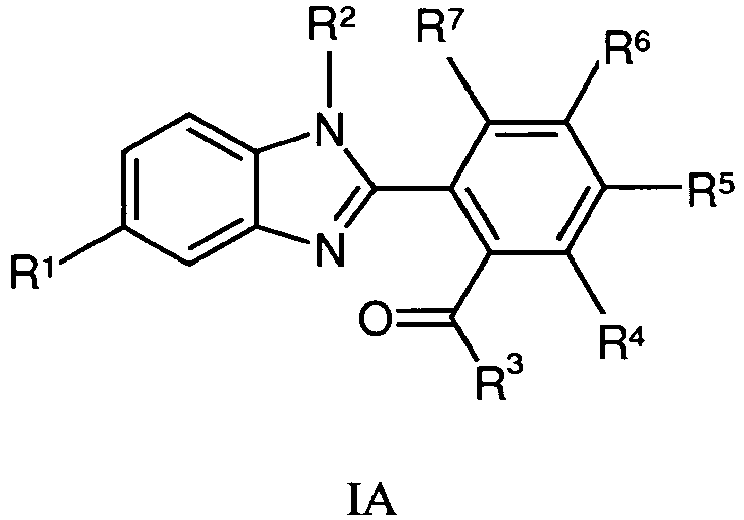
- R1 is a 5-11 membered heteroaryl ring containing one to three heteroatoms selected from nitrogen, oxygen and sulfur, wherein the heteroaryl ring is optionally independently substituted with one to three groups selected from Ra, Rb and Rc;
- R2 is C1-C6 alkyl;
- R3 is -OH, -N(R8)(R9), -NH-S(O)2-C1-6alkyl, NH-S(O)2-aryl, 5-6 membered heterocycle or C1-6alkoxy;
- R4, R5, R6 and R7 are each independently selected from
- (a) -H,
- (b) -OH,
- (c) halogen,
- (d) -CN,
- (e) -CF3,
- (f) C1-6alkyl optionally substituted with one to three-OH, fluorine, C1-6alkoxyl, -N(R8)(R9), or -C(O)N(R8)(R9),
- (g) C1-6alkoxy optionally substituted with one to three -OH, fluorine, -OC1-6alkyl, or -OC3-6 cycloalkyl,
- (h) -S(O)nC1-6alkyl,
- (i) -CO2R8,
- (j) -S(O)2N(R8)(R9),
- (k) a 5-membered heteroaryl ring,
- (l) a 5-6 membered heterocyclic ring;
- R8 and R9 are each independently selected from -H, C1-6alkyl, C3-6cycloalkyl, halogen, -CF3, -OH, -(CH2)nCO2R10, -CN, C1-6alkoxyl, C1-6alkyl-O- C1-3 alkyl, C1-6alkylhydroxyl, C1-3alkyl-CN, 5-6 membered heteroaryl ring and 5-6 membered heterocyclic ring, wherein the C1-6alkyl is optionally substituted with a 5-6 heteroaryl ring, 5-6 membered heterocyclic ring or -N(R10)(R11);
- R10 and R11 are each independently selected from -H and C1-6alkyl;
- Ra is selected from H, -NH2, -NH(C1-C6)alkyl, -NR10R11, -NH-C(O)C1-C6alkyl, NR11-C(O)C1-C6alkyl, -O(C1-C8)alkyl, -O(C3-C6)cycloalkyl, -S-(C1-C6)alkyl, -S(O)-C1-C6alkyl, -S(O)2-C1-C6alkyl, oxo and -CH2-OH;
- Rb is selected from -H, -(C1-C6)alkyl, -O-(C1-C6)alkyl, -NH2, -CH2-OH, -C=N, -CH2NH2 and -C(O)OCH3;
- Rc is selected from -H, -CH3 and, -OH;
- n is 1 or 2;
- In a second embodiment, the present invention relates to a compound of formula (IA) as described in the broadest embodiment above, or a pharmaceutically acceptable salt thereof, wherein:
- R1 is pyridinyl, pyrimidinyl, pyrazinyl, pyridazinyl, pyrrolyl, imidazolyl, thienyl, furanyl, thiazolyl, quinolinyl, isoquinolinyl, pyrrolopyridinyl, imidazopyridinyl, pyrazolopyridinyl and dihydropyrrolopyridinyl optionally substituted with oxo, wherein each heterocycle is optionally independently substituted with one to three groups selected from Ra, Rb and Rc;
- R2 is methyl, ethyl, propyl, isopropyl, butyl, t-butyl, isobutyl, pentyl or hexyl;
- R3 is -OH, -N(R8)(R9), -NH-S(O)2-C1-6alkyl, -NH-S(O)2-phenyl, morpholinyl, piperidinyl, tetrahydropyranyl or C1-6alkoxy;
- R4, R5, R6 and R7 are each independently selected from
- (a) -H,
- (b) -OH,
- (c) halogen,
- (d) -CN,
- (e) -CF3,
- (f) C1-6alkyl optionally substituted with one to three -OH, fluorine, C1-6alkoxyl, -N(R8)(R9), or -C(O)N(R8)(R9),
- (g) C1-6alkoxy optionally substituted with one to three-OH, fluorine, -OC1-6alkyl, or -OC3-6 cycloalkyl,
- (h) -S(O)nC1-6alkyl,
- (i) -CO2R8,
- (j) -S(O)2N(R8)(R9),
- (k) pyrrolyl, imidazolyl, thienyl, furanyl, thiazolyl and tetrazolyl,
- (l) pyrrolidinyl, tetrahydrofuranyl, tetrahydrothienyl, tetrahydropyranyl, piperidinyl, morpholinyl, thiomorpholinyl and dioxothiomorpholinyl;
- R8 and R9 are each independently selected from -H, C1-6alkyl, C3-6cycloalkyl, halogen, -CF3, -OH, -(CH2)nCO2R10, -CN, C1-6alkoxyl, C1-6alkyl-O- C1-3 alkyl, C1-6alkylhydroxyl, C1-3alkyl-CN, 5-6 membered heteroaryl ring and 5-6 membered heterocyclic ring, wherein the C1-6alkyl is optionally substituted with pyridinyl, pyrimidinyl, pyrazinyl, pyridazinyl, pyrrolidinyl, tetrahydrofuranyl, tetrahydrothienyl, tetrahydropyranyl, piperidinyl, morpholinyl, thiomorpholinyl, dioxothiomorpholinyl or - N(R10)(R11);
- R10 and R11 are each independently selected from -H and C1-3alkyl;
- Ra is selected from H, -NH2, -NH(C1-C6)alkyl, -NR10R11, -NH-C(O)C1-C6alkyl, -NR11-C(O)C1-C6alkyl, -O(C1-C8)alkyl, -O(C3-C6)cycloalkyl, -S-(C1-C6)alkyl, -S(O)-C1-C6alkyl, -S(O)2-C1-C6alkyl, oxo and -CH2-OH;
- Rb is selected from -H, -(C1-C6)alkyl, -O-(C1-C6)alkyl, -NH2, -CH2-OH, -C≡N, -CH2NH2 and -C(O)OCH3;
- Rc is selected from -H, -CH3 and -OH;
- n is 1 or 2;
- In third embodiment, the present invention relates to a compound of formula (IA) as described in any of the preceding embodiments, wherein:
- R1 is selected from:


- Ra is selected from H, -NH2, -NH(C1-C6)alkyl, -NR10R11, -NH-C(O)C1-C6alkyl, -NR11-C(O)C1-C6alkyl, -O(C1-C8)alkyl, -O(C3-C6)cycloalkyl, -S-(C1-C6)alkyl, -S(O)-C1-C6alkyl, -S(O)2-C1-C6alkyl and -CH2-OH;
- Rb is selected from -H, -(C1-C6)alkyl, -O-(C1-C6)alkyl, -NH2, -CH2-OH, -C≡N, -CH2NH2 and -C(O)OCH3;
- Rc is selected from -H, -CH3 and -OH;
- R10 and R11 are each independently selected from -H and C1-3alkyl;
- In a fourth embodiment there is provided a compound of formula (IA) as described in any of the preceding embodiments above, wherein:
- R2 is methyl, ethyl, propyl, isopropyl, butyl, t-butyl or isobutyl;
- In a fifth embodiment there is provided a compound of formula (IA) as described in any of the preceding embodiments, wherein:
- R3 is -OH, -N(R8)(R9), -NH-S(O)2-C1-6alkyl, NH-S(O)2-phenyl, morpholinyl, piperidinyl or C1-6alkoxy;
- R4, R5, R6 and R7 are each independently selected from
- (a) -H,
- (b) -OH,
- (c) halogen,
- (d) -CN,
- (e) -CF3,
- (f) C1-6alkyl optionally substituted with one to three -OH, fluorine, C1-6alkoxyl, -N(R8)(R9), or -C(O)N(R8)(R9),
- (g) C1-6alkoxy optionally substituted with one to three -OH, fluorine, -OC1-6alkyl, or -OC3-6cycloalkyl,
- (h) -S(O)2C1-6alkyl,
- (i) -CO2R8,
- (j) -S(O)2N(R8)(R9),
- (k) pyrrolyl, imidazolyl, thienyl, furanyl, thiazolyl and tetrazolyl,
- (l) pyrrolidinyl, tetrahydrofuranyl, tetrahydrothienyl, tetrahydropyranyl, piperidinyl, morpholinyl, thiomorpholinyl and dioxothiomorpholinyl;
- R8 and R9 are each independently selected from -H, C1-6alkyl, C3-6cycloalkyl, halogen, -CF3, -OH, -CH2CO2R10, -CN, C1-6alkoxyl, C1-6alkyl-O- C1-3 alkyl, C1-6alkylhydroxyl, C1-3alkyl-CN, pyridinyl, pyrimidinyl, piperidinyl, morpholinyl, tetrahydropyranyl and tetrahydrofuranyl, wherein the C1-6alkyl is optionally substituted with pyridinyl, pyrimidinyl, pyrazinyl, pyridazinyl, pyrrolidinyl, tetrahydrofuranyl, tetrahydrothienyl, tetrahydropyranyl, piperidinyl, morpholinyl, thiomorpholinyl, dioxothiomorpholinyl or -N(R10)(R11);
- R10 and R11 are each independently selected from -H and C1-3alkyl;
- In a sixth embodiment there is provided a compound of formula (IA) as described in the first or second embodiment above, wherein:
- R1 is pyridinyl, pyrimidinyl, pyrazinyl or pyridazinyl, each optionally substituted with an amino group;
- R2 is t-butyl;
- R3 is -OH, -N(R8)(R9), -NH-S(O)2-C1-6alkyl, morpholinyl or C1-3alkoxy;
- R4, R5, R6 and R7 are each independently selected from
- (a) -H,
- (b) -OH,
- (c) halogen,
- (d) -CN,
- (e) -CF3,
- (f) C1-6alkyl optionally substituted with one to three -OH, fluorine, C1-6alkoxyl, -N(R8)(R9), or -C(O)N(R8)(R9),
- (g) C1-6alkoxy optionally substituted with one to three -OH, fluorine, or -OC1-6alkyl,
- (i) -S(O)2C1-6alkyl,
- (h) -CO2R8,
- (i) -S(O)2N(R8)(R9),
- (j) pyrrolyl, imidazolyl, thienyl, furanyl, thiazolyl and tetrazolyl,
- (k) piperidinyl and morpholinyl;
- R8 and R9 are each independently selected from -H, C1-3alkyl, cyclopropyl, halogen, -CN, C1-4alkyl-O- methoxy, pyridinyl and piperidinyl, wherein the C1-6alkyl is optionally substituted with pyridinyl, tetrahydrofuranyl, or -N(R10)(R11);
- R10 and R11 are each independently selected from -H and C1-3alkyl;
- In a seventh embodiment there is provided a compound of formula (IA) as described in the sixth embodiment above, or a pharmaceutically acceptable salt thereof, wherein R1 is


- In an eighth embodiment there is provided a compound of formula (IA) as described in the sixth embodiment above, wherein:
- R2 is t-butyl;
- In a ninth embodiment there is provided a compound of formula (IA) according to embodiment six, wherein:
- R1 is

- R3 is

- R4, R5, R6 and R7 are each independently selected from -H, -CN and F;
- In another first broadest embodiment, the present invention relates to a compound of formula IB

- R1 is pyridinyl, pyrimidinyl, pyrazinyl, pyridazinyl, pyrrolyl, imidazolyl, thienyl, furanyl, thiazolyl, quinolinyl, isoquinolinyl, pyrrolopyridinyl, imidazopyridinyl, pyrazolopyridinyl and dihydropyrrolopyridinyl optionally substituted with oxo, wherein each heterocycle is optionally independently substituted with one to three groups selected from Ra, Rb and Rc;
- R2 is methyl, ethyl, propyl, isopropyl, butyl, t-butyl, isobutyl, pentyl or hexyl;
- R3 is -OH, -N(R8)(R9), -NH-S(O)2-C1-6alkyl, -NH-S(O)2-phenyl, morpholinyl, piperidinyl, tetrahydropyranyl or C1-6alkoxy;
- R4, R5, R6 and R7 are each independently selected from
- (a) -H,
- (b) -OH,
- (c) halogen,
- (d) -CN,
- (e) -CF3,
- (f) C1-6alkyl optionally substituted with one to three -OH, fluorine, C1-6alkoxyl, -N(R8)(R9), or -C(O)N(R8)(R9),
- (g) C1-6alkoxy optionally substituted with one to three -OH, fluorine, -OC1-6alkyl, or -OC3-6 cycloalkyl,
- (h) -S(O)nC1-6alkyl,
- (i) -CO2R8,
- (j) -S(O)2N(R8)(R9),
- (k) pyrrolyl, imidazolyl, thienyl, furanyl, thiazolyl and tetrazolyl,
- (l) pyrrolidinyl, tetrahydrofuranyl, tetrahydrothienyl, tetrahydropyranyl, piperidinyl, morpholinyl, thiomorpholinyl and dioxothiomorpholinyl;
- R8 and R9 are each independently selected from -H, C1-6alkyl, C3-6cycloalkyl, halogen, -CF3, -OH, -(CH2)nCO2R10, -CN, C1-6alkoxyl, C1-6alkyl-O-C1-3 alkyl, C1-6alkylhydroxyl, C1-3alkyl-CN, 5-6 membered heteroaryl ring and 5-6 membered heterocyclic ring, wherein the C1-6alkyl is optionally substituted with pyridinyl, pyrimidinyl, pyrazinyl, pyridazinyl, pyrrolidinyl, tetrahydrofuranyl, tetrahydrothienyl, tetrahydropyranyl, piperidinyl, morpholinyl, thiomorpholinyl, dioxothiomorpholinyl or -N(R10)(R11);
- R10 and R11 are each independently selected from -H and C1-3 alkyl;
- Ra is selected from H, -NH2, -NH(C1-C6)alkyl, -NR10R11, -NH-C(O)C1-C6alkyl, -NR11-C(O)C1-C6alkyl, -O(C1-C8)alkyl, -O(C3-C6)cycloalkyl, -S-(C1-C6)alkyl, -S(O)-C1-C6alkyl, -S(O)2-C1-C6alkyl, oxo and -CH2-OH;
- Rb is selected from -H, -(C1-C6)alkyl, -O-(C1-C6)alkyl, -NH2, -CH2-OH, -C≡N, -CH2NH2 and -C(O)OCH3;
- Rc is selected from -H, -CH3 and -OH;
- n is 1 or 2;
- In a second embodiment, the present invention relates to a compound of formula (IB) as described in the preceding embodiment, wherein:
- R1 is selected from:


- Ra is selected from H, -NH2, -NH(C1-C6)alkyl, -NR10R11, -NH-C(O)C1-C6alkyl, -NR"-C(O)C1-C6alkyl, -O(C1-C8)alkyl, -O(C3-C6)cycloalkyl, -S-(C1-C6)alkyl, -S(O)-C1-C6alkyl, -S(O)2-C1-C6alkyl and -CH2-OH;
- Rb is selected from -H, -(C1-C6)alkyl, -O-(C1-C6)alkyl, -NH2, -CH2-OH, -C≡N, -CH2NH2 and -C(O)OCH3;
- Rc is selected from -H, -CH3 and -OH;
- R10 and R11 are each independently selected from -H and C1-3alkyl;
- In a third embodiment there is provided a compound of formula (IB) as described in any of the preceding embodiments above, wherein:
- R2 is methyl, ethyl, propyl, isopropyl, butyl, t-butyl or isobutyl;
- In a fourth embodiment there is provided a compound of formula (IB) as described in any of the preceding embodiments, wherein:
- R3 is -OH, -N(R8)(R9), -NH-S(O)2-C1-6alkyl, -NH-S(O)2-phenyl, morpholinyl, piperidinyl
or C1-6alkoxy; - R4, R5, R6 and R7 are each independently selected from
- (a) -H,
- (b) -OH,
- (c) halogen,
- (d) -CN,
- (e) -CF3,
- (f) C1-6alkyl optionally substituted with one to three -OH, fluorine, C1-6alkoxyl, -N(R8)(R9), or -C(O)N(R8)(R9),
- (g) C1-6alkoxy optionally substituted with one to three -OH, fluorine, -OC1-6alkyl, or -OC3-6cycloalkyl,
- (h) -S(O)2C1-6alkyl,
- (i) -CO2R8,
- (i) -S(O)2N(R8)(R9),
- (k) pyrrolyl, imidazolyl, thienyl, furanyl, thiazolyl and tetrazolyl,
- (l) pyrrolidinyl, tetrahydrofuranyl, tetrahydrothienyl, tetrahydropyranyl, piperidinyl, morpholinyl, thiomorpholinyl and dioxothiomorpholinyl;
- R8 and R9 are each independently selected from -H, C1-6alkyl, C3-6cycloalkyl, halogen, -CF3, -OH, -CH2CO2R10, -CN, C1-6alkoxyl, C1-6alkyl-O- C1-3 alkyl, C1-6alkylhydroxyl, C1-3alkyl-CN, pyridinyl, pyrimidinyl, morpholinyl, pipridinyl, tetrahydropyaranyl and teterahydrofuranyl, wherein the C1-6alkyl is optionally substituted with pyridinyl, pyrimidinyl, pyrazinyl, pyridazinyl, pyrrolidinyl, tetrahydrofuranyl, tetrahydrothienyl, tetrahydropyranyl, piperidinyl, morpholinyl, thiomorpholinyl, dioxothiomorpholinyl or -N(R10)(R11);
- R10 and R11 are each independently selected from -H and C1-3alkyl;
- In a fifth embodiment there is provided a compound of formula (IB) as described in the first embodiment above, wherein:
- R1 is pyridinyl, pyrimidinyl, pyrazinyl or pyridazinyl, each optionally substituted with an amino or methoxy group;
- R2 is t-butyl;
- R3 is -OH or -N(R8)(R9);
- R4, R5, R6 and R7 are each independently selected from
- (a) -H,
- (b) -OH,
- (c) halogen,
- (d) -CN,
- (e) -CF3,
- (f) C1-6alkyl optionally substituted with one to three -OH, fluorine, C1-6alkoxyl, -N(R8)(R9), or -C(O)N(R8)(R9),
- (g) C1-6alkoxy optionally substituted with one to three -OH, fluorine, or -OC1-6alkyl,
- (h) -S(O)2C1-6alkyl,
- (i) -CO2R8,
- (j) -S(O)2N(R8)(R9),
- (k) pyrrolyl, imidazolyl, thienyl, furanyl, thiazolyl and tetrazolyl,
- (l) piperidinyl and morpholinyl;
- R8 and R9 are each independently selected from -H and C1-3alkyl;
- or a pharmaceutically acceptable salt thereof.
- In a sixth embodiment there is provided a compound of formula (IB) as described in the fifth embodiment above, or a pharmaceutically acceptable salt thereof,
wherein R1 is
- In an seventh embodiment there is provided a compound of formula (IB) as described in the fifth embodiment above, wherein:
- R2 is t-butyl;
- In a eighth embodiment there is provided a compound of formula (IB) according to embodiment five, wherein:
- R1 is

- R2 is t-butyl;
- R3 is

- R4, R5, R6 and R7 are each independently selected from -H and F;
- The following are representative compounds of the invention which can be made by the general synthetic schemes, the examples, and known methods in the art.
Table 1 Example Structure Name 1 
2-[5-(2-Amino-pyrimidin-5-yl)-1-tert-butyl-1H-benzoimidazol-2-yl]-benzoic acid 2 
2-[5-(2-Amino-pyrimidin-5-yl)-1-tert-butyl-1H-benzoimidazol-2-yl]-N-cyclopropyl-benzamide 3 
2-[5-(2-Amino-pyrimidin-5-yl)-1-tert-butyl-1H-benzoimidazol-2-yl]-N-pyridin-4-yl-benzamide 4 
2-[5-(2-Amino-pyrimidin-5-yl)-1-tert-butyl-1H-benzoimidazol-2-yl]-N-methyl-benzamide 5 
2-[5-(2-Amino-pyrimidin-5-yl)-1-tert-butyl-1H-benzoimidazol-2-yl]-4,5-difluoro-N-methyl-benzamide 6 
2-[5-(2-Amino-pyrimidin-5-yl)-1-tert-butyl-1H-benzoimidazol-2-yl]-4-fluoro-N-methyl-benzamide 7 
2-[5-(2-Amino-pyrimidin-5-yl)-1-tert-butyl-1H-benzoimidazol-2-yl]-5-methoxy-N-methyl-benzamide 8 
2-[5-(2-Amino-pyrimidin-5-yl)-1-tert-butyl-1 H-benzoimidazol-2-yl]-4-cyano-N-methyl-benzamide 9 
2-[5-(2-Amino-pyrimidin-5-yl)-1-tert-butyl-1H-benzoimidazol-2-yl]-N-methyl-4-(2H-tetrazol-5-yl)-benzamide 10 
2-[5-(2-Amino-pyrimidin-5-yl)-1-tert-butyl-1H-benzoimidazol-2-yl]-4-cyano-N-cyano-benzamide 11 
N-{2-[5-(2-Amino-pyrimidin-5-yl)-1-tert-bu tyl-1H-benzoimidazol-2-yl]-4-cyano-benzoyl}-methanesulfonamide 12 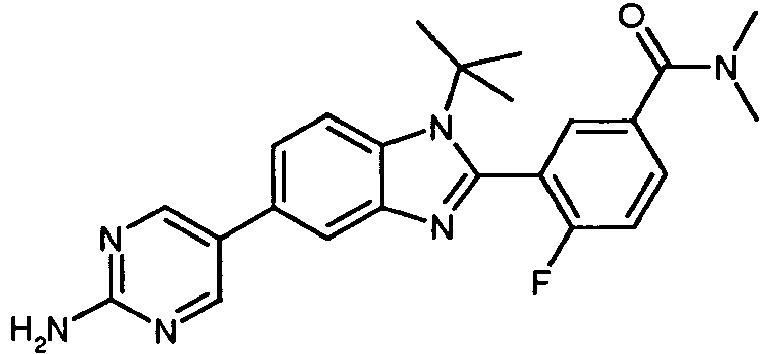
3-[5-(2-Amino-pyrimidin-5-yl)-1-tert-butyl-1H-benzoimidazol-2-yl]-4-fluoro-N,N-dimethyl-benzamide 13 
3-[5-(2-Amino-pyrimidin-5-yl)-1-tert-butyl-1H-benzoimidazol-2-yl]-benzamide 14 
2-[5-(2-Amino-pyrimidin-5-yl)-1-tert-butyl-1H-benzoimidazol-2-yl]-benzamide 15 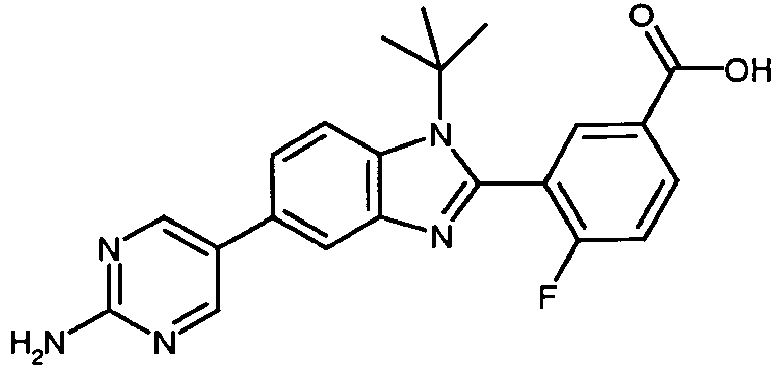
3-[5-(2-Amino-pyrimidin-5-yl)-1-tert-butyl-1H-benzoimidazol-2-yl]-4-fluoro-benzoic acid 16 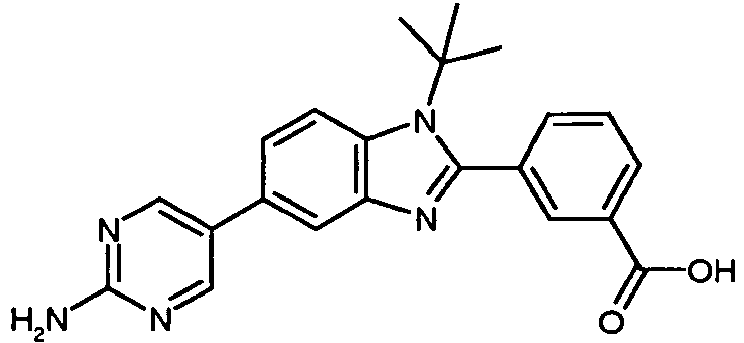
3-[5-(2-Amino-pyrimidin-5-yl)-1-tert-butyl-1H-benzoimidazol-2-yl]-benzoic acid 18 
2-[5-(2-Amino-pyrimidin-5-yl)-1-tert-butyl-1H-benzoimidazol-2-yl]-N-(tetrahydro-furan-2-ylmethyl)-benzamide 19 
2-[5-(2-Amino-pyrimidin-5-yl)-1-tert-butyl-1H-benzoimidazol-2-yl]-N-(2-methoxy-ethyl)-benzamide 20 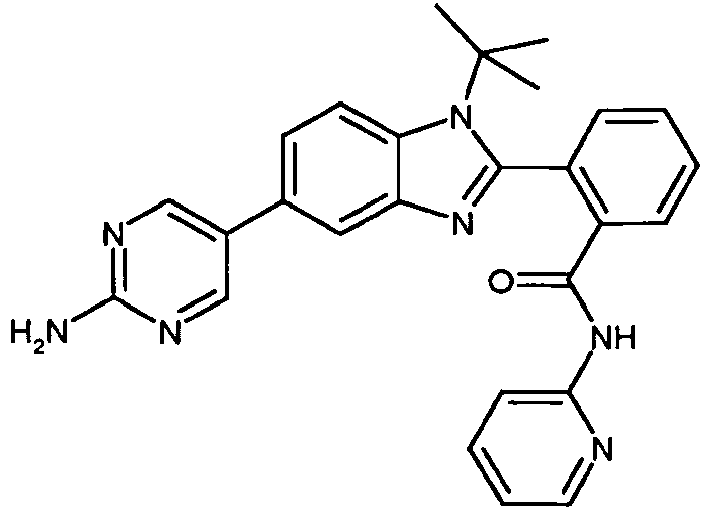
2-[5-(2-Amino-pyrimidin-5-yl)-1-tert-butyl-1H-benzoimidazol-2-yl]-N-pyridin-2-yl-benzamide 21 
2-[5-(2-Amino-pyrimidin-5-yl)-1-tert-butyl-1H-benzoimidazol-2-yl]-N-tert-butyl-benzamide 22 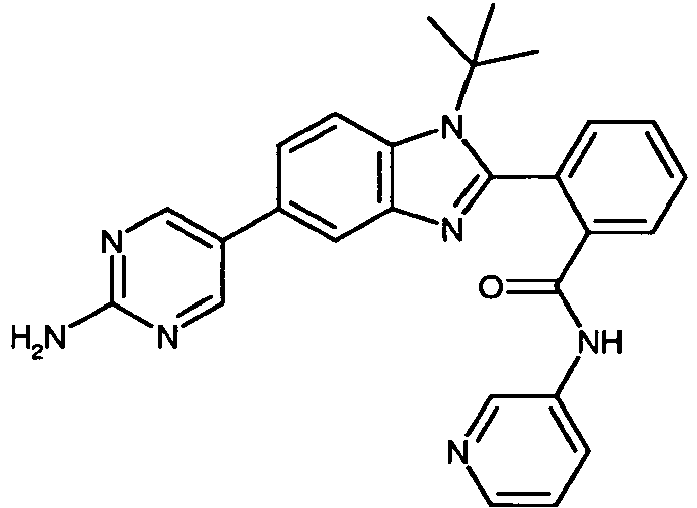
2-[5-(2-Amino-pyrimidin-5-yl)-1-tert-butyl-1H-benzoimidazol-2-yl]-N-pyridin-3-yl-benzamide 23 
2-[5-(2-Amino-pyrimidin-5-yl)-1-tert-butyl-1H-benzoimidazol-2-yl]-N-ethyl-benzamide 24 
2-[5-(2-Amino-pyrimidin-5-yl)-1-tert-butyl-1H-benzoimidazol-2-yl]-N-(2-dimethylamino-ethyl)-benzamide 25 
2-[5-(2-Amino-pyrimidin-5-yl)-1-tert-butyl-1H-benzoimidazol-2-yl]-N-piperidin-4-yl-benzamide 26 
2-[5-(2-Amino-pyrimidin-5-yl)-1-tert-butyl-1H-benzoimidazol-2-yl]-N-isopropyl-benzamide 27 
2-[5-(2-Amino-pyrimidin-5-yl)-1-tert-butyl-1H-benzoimidazol-2-yl]-N-methyl-N-pyridin-2-yl-benzamide 28 
{2-[5-(2-Amino-pyrimidin-5-yl)-1-tert-butyl-1H-benzoimidazol-2-yl]-phenyl}-morpholin-4-yl-methanone 29 
2-[5-(2-Amino-pyrimidin-5-yl)-1-tert-butyl-1H-benzoimidazol-2-yl]-N,N-dimethyl-benzamide 30 
2-[5-(2-Amino-pyrimidin-5-yl)-1-tert-butyl-1H-benzoimidazol-2-yl]-N-ethyl-4-fluoro-benzamide 31 
2-[5-(2-Amino-pyrimidin-5-yl)-1-tert-butyl-1H-benzoimidazol-2-yl]-4-fluoro-N-pyridin-3-yl-benzamide 32 
2-[5-(2-Amino-pyrimidin-5-yl)-1-tert-butyl-1H-benzoimidazol-2-yl]-4-fluoro-N-pyridin-3-ylmethyl-benzamide 33 
2-[5-(2-Amino-pyrimidin-5-yl)-1-tert-butyl-1H-benzoimidazol-2-yl]-5-fluoro-N-methyl-benzamide 34 
2-[5-(2-Amino-pyrimidin-5-yl)-1-tert-butyl-1H-benzoimidazol-2-yl]-3-fluoro-N-methyl-benzamide 35 
3-[1-tert-Butyl-5-(5-methoxy-pyridin-3-yl)-1H-benzoimidazol-2-yl]-benzamide - In one embodiment, the invention relates to any of the compounds depicted in Table 1 above and the pharmaceutically acceptable salts thereof.
- Representative compounds of the invention show activity in the FLAP binding assay and in the human whole blood LTB4 production inhibition assay, described in the assessment of biological properties section, as shown in Table 2.
Table 2 Example SPA IC50 (nM) hWB IC50 (nM) 1 1400 2 25.20 2187 3 0.91 763 4 11.40 433 5 357 6 5.07 130 7 21.90 414 8 7.40 94 9 110.90 >5000 10 6.09 11 55.60 12 610.00 >5000 14 35.40 1154 15 220.00 >5000 16 644.90 18 18.80 2437 19 43.80 2872 20 2.20 2700 21 14.70 3286 22 1.50 2246 23 17.40 2226 24 140.00 2868 25 460.00 >5000 26 34.60 4900 27 180.00 28 520.00 >5000 29 200.00 3049 30 413 31 1949 32 939 33 20.00 3082 34 15.80 906 35 4700.00 - The invention also relates to pharmaceutical preparations, containing as active substance one or more compounds of the invention, or the pharmaceutically acceptable derivatives thereof, optionally combined with conventional excipients and/or carriers.
- Compounds of the invention also include their isotopically-labelled forms. An isotopically-labelled form of an active agent of a combination of the present invention is identical to said active agent but for the fact that one or more atoms of said active agent have been replaced by an atom or atoms having an atomic mass or mass number different from the atomic mass or mass number of said atom which is usually found in nature. Examples of isotopes which are readily available commercially and which can be incorporated into an active agent of a combination of the present invention in accordance with well established procedures, include isotopes of hydrogen, carbon, nitrogen, oxygen, phosphorous, fluorine and chlorine, e.g., 2H, 3H, 13C, 14C, 15N, 18O, 17O, 31P, 32P, 35S, 18F, and 36Cl, respectively. An active agent of a combination of the present invention, a prodrug thereof, or a pharmaceutically acceptable salt of either which contains one or more of the above-mentioned isotopes and/or other isotopes of other atoms is contemplated to be within the scope of the present invention.
- The invention includes the use of any compounds of described above containing one or more asymmetric carbon atoms may occur as racemates and racemic mixtures, single enantiomers, diastereomeric mixtures and individual diastereomers. Isomers shall be defined as being enantiomers and diastereomers. All such isomeric forms of these compounds are expressly included in the present invention. Each stereogenic carbon may be in the R or S configuration, or a combination of configurations.
- Some of the compounds of the invention can exist in more than one tautomeric form. The invention includes methods using all such tautomers.
- All terms as used herein in this specification, unless otherwise stated, shall be understood in their ordinary meaning as known in the art. For example, "C1-6 alkoxy" is a C1-6 alkyl with a terminal oxygen, such as methoxy, ethoxy, propoxy, butoxy. All alkyl, alkenyl, and alkynyl groups shall be understood as being branched or unbranched where structurally possible and unless otherwise specified. Other more specific definitions are as follows:
- The term "alkyl" refers to both branched and unbranched alkyl groups. It should be understood that any combination term using an "alk" or "alkyl" prefix refers to analogs according to the above definition of "alkyl". For example, terms such as "alkoxy", "alkythio" refer to alkyl groups linked to a second group via an oxygen or sulfur atom. "Alkanoyl" refers to an alkyl group linked to a carbonyl group (C=O).
- The term "C3-10 carbocycle" or "cycloalkyl" refers to a nonaromatic 3 to 10-membered (but preferably, 3 to 6-membered) monocyclic carbocyclic radical or a nonaromatic 6 to 10-membered fused bicyclic, bridged bicyclic, or spirocyclic carbocyclic radical. The C3-10 carbocycle may be either saturated or partially unsaturated, and the carbocycle may be attached by any atom of the cycle which results in the creation of a stable structure. Non-limiting examples of 3 to 10-membered monocyclic carbocycles include cyclopropyl, cyclobutyl, cyclopentyl, cyclopentenyl, cyclohexyl, cyclohexenyl, cycloheptanyl, cycloheptenyl, and cyclohexanone. Non-limiting examples of 6 to 10-membered fused bicyclic carbocyclic radicals include bicyclo[3.3.0]octane, bicyclo[4.3.0]nonane, and bicyclo[4.4.0]decanyl (decahydronaphthalenyl). Non-limiting examples of 6 to 10-membered bridged bicyclic carbocyclic radicals include bicyclo [2.2.2]heptanyl, bicyclo[2.2.2]octanyl, and bicyclo[3.2.1]octanyl. Non-limiting examples of 6 to 10-membered spirocyclic carbocyclic radicals include but are not limited to spiro[3,3]heptanyl, spiro[3,4]octanyl and spiro[4,4]heptanyl.
- The term "5 to 11-membered heterocycle" refers to a stable nonaromatic 4-8 membered monocyclic heterocyclic radical or a stable nonaromatic 6 to 11-membered fused bicyclic, bridged bicyclic or spirocyclic heterocyclic radical. The 5 to 11-membered heterocycle consists of carbon atoms and one or more, preferably from one to four heteroatoms chosen from nitrogen, oxygen and sulfur. The heterocycle may be either saturated or partially unsaturated. Non-limiting examples of nonaromatic 4-8 membered monocyclic heterocyclic radicals include tetrahydrofuranyl, azetidinyl, pyrrolidinyl, pyranyl, tetrahydropyranyl, dioxanyl, thiomorpholinyl, 1,1-dioxo-1λ6-thiomorpholinyl, morpholinyl, piperidinyl, piperazinyl, and azepinyl. Non-limiting examples of nonaromatic 6 to 11-membered fused bicyclic radicals include octahydroindolyl, octahydrobenzofuranyl, and octahydrobenzothiophenyl. Non-limiting examples of nonaromatic 6 to 11-membered bridged bicyclic radicals include 2-azabicyclo[2.2.1]heptanyl, 3-azabicyclo[3.1.0]hexanyl, and 3-azabicyclo[3.2.1]octanyl. Non-limiting examples of nonaromatic 6 to 11-membered spirocyclic heterocyclic radicals include 7-aza-spiro[3,3]heptanyl, 7-spiro[3,4]octanyl, and 7-aza-spiro[3,4]octanyl.
- The term "5 to 11-membered heteroaryl" shall be understood to mean an aromatic 5 to 6-membered monocyclic heteroaryl or an aromatic 7 to 11-membered heteroaryl bicyclic ring where at least one of the rings is aromatic, wherein the heteroaryl ring contains 1-4 heteroatoms such as N, O and S. Non-limiting examples of 5 to 6-membered monocyclic heteroaryl rings include furanyl, oxazolyl, isoxazolyl, oxadiazolyl, thiazolyl, pyrazolyl, pyrrolyl, imidazolyl, tetrazolyl, triazolyl, thienyl, thiadiazolyl, pyridinyl, pyrimidinyl, pyridazinyl, pyrazinyl, triazinyl, and purinyl. Non-limiting examples of 7 to 11-membered heteroaryl bicyclic heteroaryl rings include pyrrolopyridinyl, imidazopyridinyl, pyrazolopyridinyl, dihydropyrrolopyridinyl, benzimidazolyl, quinolinyl, dihydro-2H-quinolinyl, isoquinolinyl, quinazolinyl, indazolyl, thieno[2,3-d]pyrimidinyl, indolyl, isoindolyl, benzofuranyl, benzopyranyl, benzodioxolyl, benzoxazolyl and benzothiazolyl.
- It will be understood that one to three carbon ring moieties in the each of the 5 to 11-membered heterocyclic rings, , and the nonaromatic portion of the bicyclic heteroaryl rings can independently be replaced with a carbonyl, thiocarbonyl, or iminyl moiety, i.e., -C(=O)-, -C(=S)- and -C(=NR8)-, respectively, where R8 is as defined above. The term "heteroatom" as used herein shall be understood to mean atoms other than carbon such as O, N, and S.
- The term "halogen" as used in the present specification shall be understood to mean bromine, chlorine, fluorine or iodine. The definitions "halogenated", "partially or fully halogenated"; partially or fully fluorinated; "substituted by one or more halogen atoms", includes for example, mono, di or tri halo derivatives on one or more carbon atoms. For alkyl, a non-limiting example would be -CH2CHF2, -CF3 etc.
- The compounds of the invention are only those which are contemplated to be 'chemically stable' as will be appreciated by those skilled in the art. For example, a compound which would have a 'dangling valency', or a 'carbanion' are not compounds contemplated by the inventive methods disclosed herein.
- The invention includes pharmaceutically acceptable derivatives of compounds of formula IA and IB. A "pharmaceutically acceptable derivative" refers to any pharmaceutically acceptable salt which, upon administration to a patient, is capable of providing (directly or indirectly) a compound useful for the invention.Pharmaceutically acceptable salts include those derived from pharmaceutically acceptable inorganic and organic acids and bases. Examples of suitable acids include hydrochloric, hydrobromic, sulfuric, nitric, perchloric, fumaric, maleic, phosphoric, glycolic, lactic, salicylic, succinic, toluene-p-sulfuric, tartaric, acetic, citric, methanesulfonic, formic, benzoic, malonic, naphthalene-2-sulfuric and benzenesulfonic acids. Other acids, such as oxalic acid, while not themselves pharmaceutically acceptable, may be employed in the preparation of salts useful as intermediates in obtaining the compounds and their pharmaceutically acceptable acid addition salts. Salts derived from appropriate bases include alkali metal (e.g., sodium), alkaline earth metal (e.g., magnesium), ammonium and N-(C1-C4 alkyl)4 + salts.
- The compounds of formula IA and IB may be made using the general synthetic methods described below, which also constitute part of the invention.
- The compounds of the invention may be prepared by the methods described below. In each of the schemes below, the groups R1 to R7 are as defined above for general formula IA and IB unless noted. Optimum reaction conditions and reaction times may vary depending on the particular reactants used. Unless otherwise specified, solvents, temperatures, pressures and other reaction conditions may be readily selected by one of ordinary skill in the art. Specific procedures are provided in the Synthetic Examples section. Typically, reaction progress may be monitored by thin layer chromatography (TLC) or HPLC-MS if desired. Intermediates and products may be purified by chromatography on silica gel, recrystallization, HPLC and/or reverse phase HPLC.
- Starting materials and reagents are either commercially available or may be prepared by one skilled in the art using methods described in the chemical literature and in the Synthetic Examples section below.
- Compounds of formula IA may be prepared as shown in Scheme 1.

- As illustrated in scheme 1, a 1,2-diaminobenzene derivative substituted with R1 and R2 may be reacted with a benzaldehyde derivative substituted with R3 - R7 to provide the desired compound of formula IA. The reaction may be run in acetic acid or in aqueous DMF in the presence of oxone or alternatively, in a suitable solvent such as methanol, in the presence of a suitable catalyst such as proline or p-toluenesulfonic acid.
- Diamino intermediate II may be prepared as illustrated in Schemes 2

- In scheme 2, a disubstituted nitro benzene of formula IV, is reacted with an amine of formula V, in a suitable solvent, in the presence of a suitable base such as potassium carbonate, to provide an intermediate of formula VI. X is Cl or Br. Reaction of the intermediate of formula VI with a boronic acid ester of formula VII, in a suitable solvent, in the presence of a suitable catalyst, provides a coupled product of formula VIII. Ra and Rb are hydrogen or Ra and Rb together with the oxygen atoms to which they are attached form a 5-6 membered ring optionally substituted with 2-4 methyl groups. Reduction of nitro compound VIII provides an intermediate of formula II.
- Intermediate III may be prepared as shown in scheme 3 below.

- As shown in scheme 3, reaction of a compound of formula IX with a a grignard reagent followed by reaction with DMF provides an intemediate of formula III.
- Scheme 4 illustrates an alternate method that may be used to prepare compounds of formula IA.

- As illustrated in scheme 4 above, reduction of a nitro benzene of formula VI, under standard conditions, provides a diamino intermediate of formula X. Reaction of the intermediate of formula X with intermediate III, as in scheme 1, provides a benzimidazole of formula XI. Coupling of the intermediate of formula XI with a boronic acid or a boronic ester of formula VIII, in the presence of a catalyst, in a suitable solvent, provides a compound of formula IA.
- Compounds of formula IB may be made by methods outlined in schemes 1 - 4 by using the appropriately 1,3 dicarbonyl intermediate corresponding to intermediate III.
- Compounds of formula IA, IB as well as the respective intermediates prepared by the above methods may be further converted to additional intermediates or compounds of formula IA and IB by methods known in the art and exemplified in the Synthetic Examples section below.
-
- Solvents: Acetonitrile/Water with 0.1 % TFA or 0.1% Formic acid
- Column: Waters SunFire C 18 Prep OBD 5um 19 x 100 mm
-
- Solvents; Acetonitrile/Water with 0.2% Ammonium hydroxide
- Column: Waters XBridge Prep C18 5 um 19 x 100 mm
-
- Solvents: Acetonitrile/Water with no modifier
- Columns: Waters SunFire C18 Prep OBD 5um 19 x 100 mm or Waters XBridge Prep C18 5 um 19 x 100 mm
-

- To a solution of R-1 (25 g, 0.1 mol) in THF (100 mL) is added R-2 (18 mL, 0.17 mol). The solution is heated at 60°C for 16 hours. The solvent is removed in vacuum. The residue is suspended in methanol (20 mL). The precipitate is collected by filtration and washed with methanol to give R-3.
- To a solution of R-3 (7.2 g, 0.026 mol) in DMF (100 mL) and H2O (10 mL) are added R-4 (8.7 g, 0.04 mol), Pd(PPh3)4 (3 g, 0.003 mol) and K2CO3 (7.3 g, 0.053 mol) at room temperature. The solution is heated to 100°C for 2 hours. The solution is cooled down, washed with H2O (100 mL) and extracted with EtOAc. The combined organic layer is dried with MgSO4 and filtered. The filtrate is concentrated and the residue is recrystallized in CH2Cl2 to afford R-5.
- To a round bottom flask are added R-5 (6.3 g, 0.02 mol) and ammonium formate (6.9 g, 0.1 mol) in EtOH, (100 mL), followed by the addition of zinc dust (4.3g, 0.066 mol). The reaction mixture is stirred at 50°C for 2 hours. The reaction mixture is filtered through a short pad of diatomaceous earth. The filter pad is rinsed with MeOH (50 mL) and the combined filtrate is concentrated. The residue is extracted with H2O (50 mL) and EtOAc (3 x 50 mL). The combined organic layer is washed with saturated NaHCO3 solution, dried (MgSO4) and filtered. The filtrate is concentrated to afford the title intermediate (4.5 g).
- The following intermediate is synthesized in similar fashion with appropriate reagents:
Intermediate Structure I-2 
-

- To a solution of I-1 (50 mg, 0.19 mmol) in DMF (10 mL) is added R-6 (44 mg, 0.29 mmol) at room temperature. Oxone (119 mg, 0.19 mmol) in H2O (1 mL) is added and the solution is stirred at the same temperature for 1 hour. Sat. sodium thiosulfate is added and the mixture is extracted with EtOAc (3 x 10 mL) and H2O (10 mL). The combined organic layer is dried with MgSO4 and is filtered. The filtrate is concentrated and the residue is purified by reverse Prep HPLC (high pH method) to yield title compound (52 mg).
- The following compounds are also obtained by methods described in Example 1:
Example Structure m/z (M++1) 15 
406.2 16 
388.2 17 (reference example) 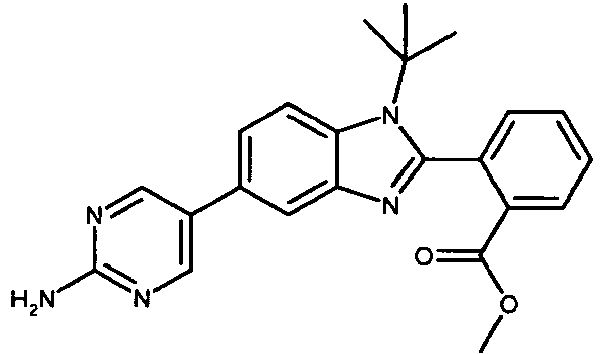
402.77 -
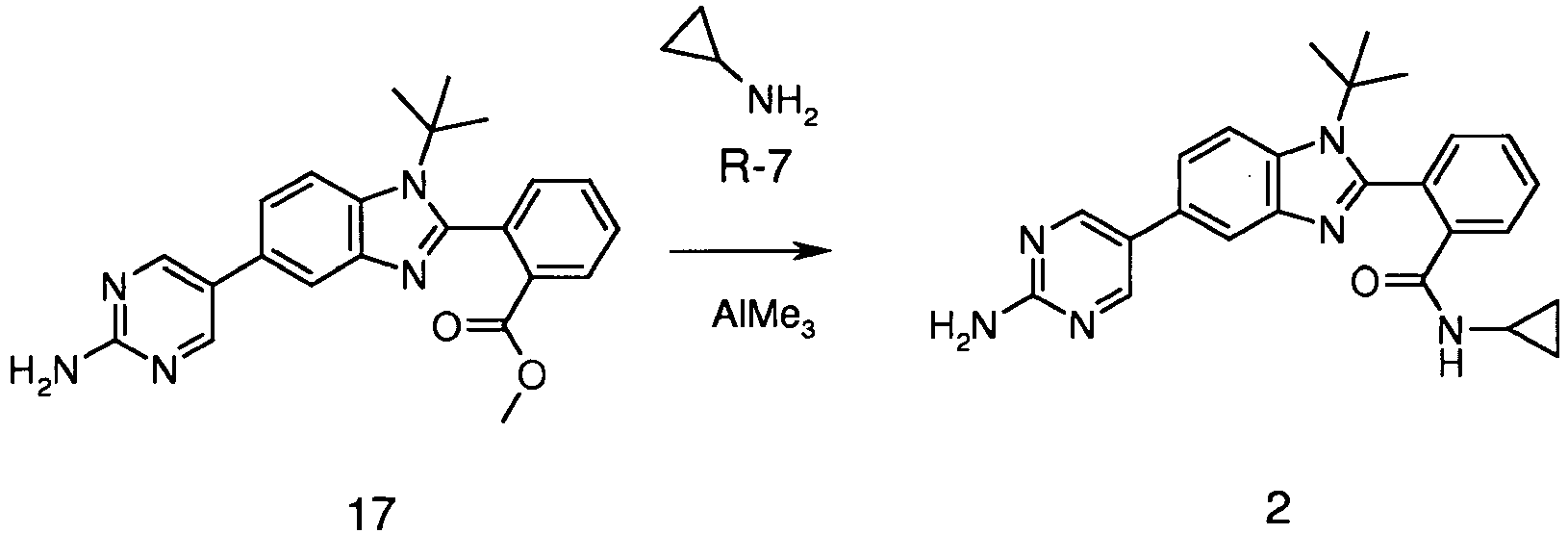
- To a solution of example 17 (15.6 mg, 0.27 mmol) in anhydrous toluene (5 mL) is added trimethylaluminium (2M in toluene, 0.187 mL, 0.81 mmol) and the mixture is stirred at room temperature for 0.5 hour. R-7 (100 mg, 0.25 mmol) is then added and the reaction is stirred at 100 °C for 2 hours. The reaction is cooled to room temperature then quenched with water. The organics are separated and the aqueous phase is extracted into CH2Cl2. The combined organics are dried with Na2SO4, filtered and concentrated in vacuo. The residue is purified by preparative HPLC (neutral method) to give the title compound (52.8 mg).
- The following compounds are also obtained by methods described in Example 2:
Example no Structure m/z(M++1) 18 
471.34 19 
445.33 20 
464.29 21 
443.32 22 
464.35 23 
415.29 24 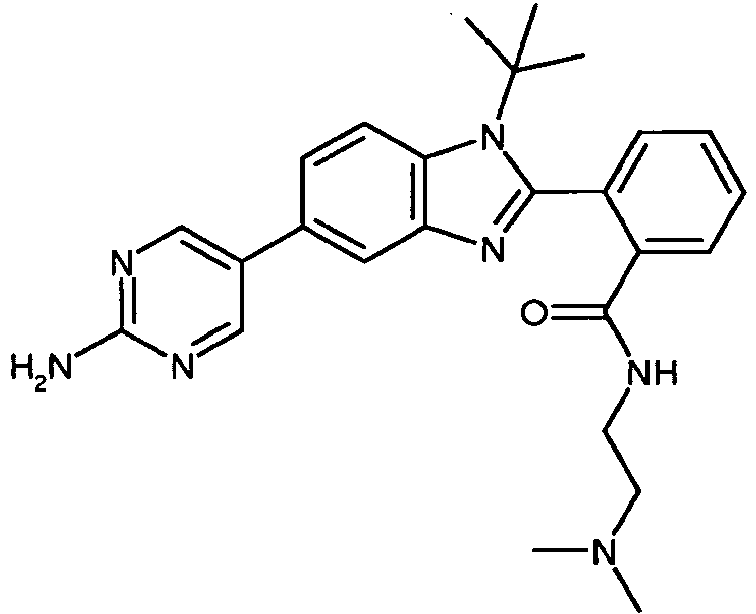
458.37 25 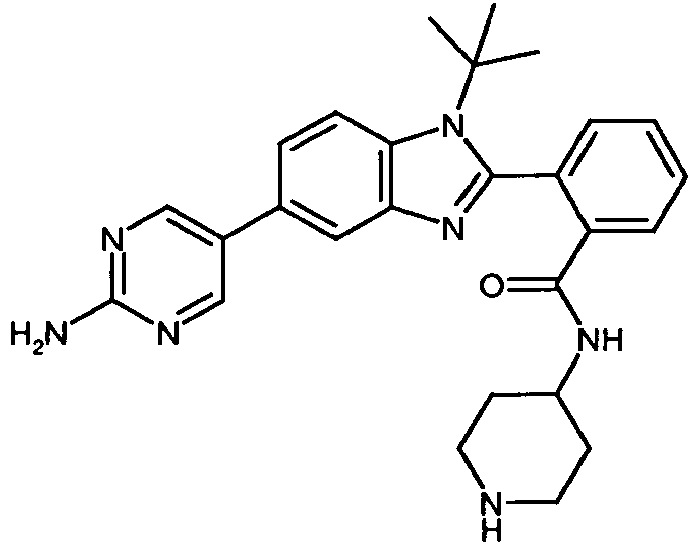
470.4 26 
429.33 27 
478.34 -

- To a solution of example 1 (96 mg, 0.25 mmol) in DMF (1.5 mL) is added N-[(dimethylamino)-1H,1,2,3-triazolo[4,5-B]pyridin-1-ylmethylene]-N-methylmethanaminium hexafluorophosphate N-oxide (HATU) (98.9 mg, 0.26 mmol) and triethylamine (TEA) (0.04 mL, 0.26 mmol). The mixture is stirred at room temperature for 0.5 hour and R-8 (23.3 mg, 0.25 mmol) is added followed by stirring at room temperature for 1.5 hours. Extra HATU (98.9 mg, 0.26 mmol) and TEA (0.072 mL, 0.52 mmol) are added and the reaction mixture is stirred at 40 °C for a further 25 hours and then concentrated in vacuo. The residue is dissolved in EtOAc and washed with saturated aqueous NaHCO3 and brine. The organics are dried with Na2SO4, filtered and concentrated in vacuo. The residue is purified by preparative HPLC (neutral method) to give the title compound (24.4 mg).
-

- To a round bottom flask are added R-3 (2 g, 7.3 mmol) and ammonium formate (2.3 g, 37 mmol) in EtOH (20 mL), follow by the addtion of Zinc dust (952 mg, 14.6 mmol). The reaction mixture is stirred at 50 °C for 2 hours. The reaction mixture is filtered through celite and is washed with MeOH. The filtrate is concentrated and the residue was dissolved in CH2Cl2/water. The organic layer is collected, washed with brine, dry under anhydrous Na2SO4. The mixture is filtered and the residue is concentrated to afford R-9 (1.7 g).
- To a solution of R-9 (500 mg, 2.06 mmol) and R-10 (337.6 mg, 2.06 mmol) in DMF (20 mL) is added oxone (758.5 mg, 1.23 mmol) and the solution is stirred at room temperature for 1 hour. The mixture is concentrated in vacuo and the residue is diluted in CH2Cl2 and is washed with saturated aqueous NaHCO3. The organics are dried with Na2SO4, filtered and concentrated in vacuo to give R-11 (787 mg).
- To a solution of methylamine hydrochloride (47.94 mg, 0.71 mmol) and TEA (0.10 mL, 0.71 mmol) in anhydrous toluene (6 mL) is added trimethylaluminium (2M in toluene, 0.484 mL, 0.97 mmol) and the mixture is stirred at room temperature for 0.5 hour. R-11 (250 mg, 0.65 mmol) is then added and the reaction is stirred at 100 °C for 2 hours. The reaction is cooled to room temperature then quenched with water (2 mL). The organics are separated and the aqueous phase is extracted into CH2Cl2. The combined organics are dried with Na2SO4, filtered and concentrated in vacuo to give R-12 (221.2 mg).
- To a suspension of R-12 (221.2 mg, 0.57 mmol), R-4 (139.3 mg, 0.63 mmol) and potassium acetate (168.6 mg, 1.72 mmol) in dioxane (3 mL) are added PdCl2(dppf) (48.5 mg, 0.06 mmol). The mixture is stirred at 80 °C for 3 hours and then concentrated in vacuo. The residue is diluted in CH2Cl2 and washed with saturated aqueous NaHCO3. The organics are dried with Na2SO4, filtered and concentrated in vacuo. The residue is purified by preparative HPLC (neutral method) to give the title compound.
- The following compounds are also obtained by methods described in Example 4:
Example no Structure m/z(M++1) 28 
457.36 29 
415.15 -
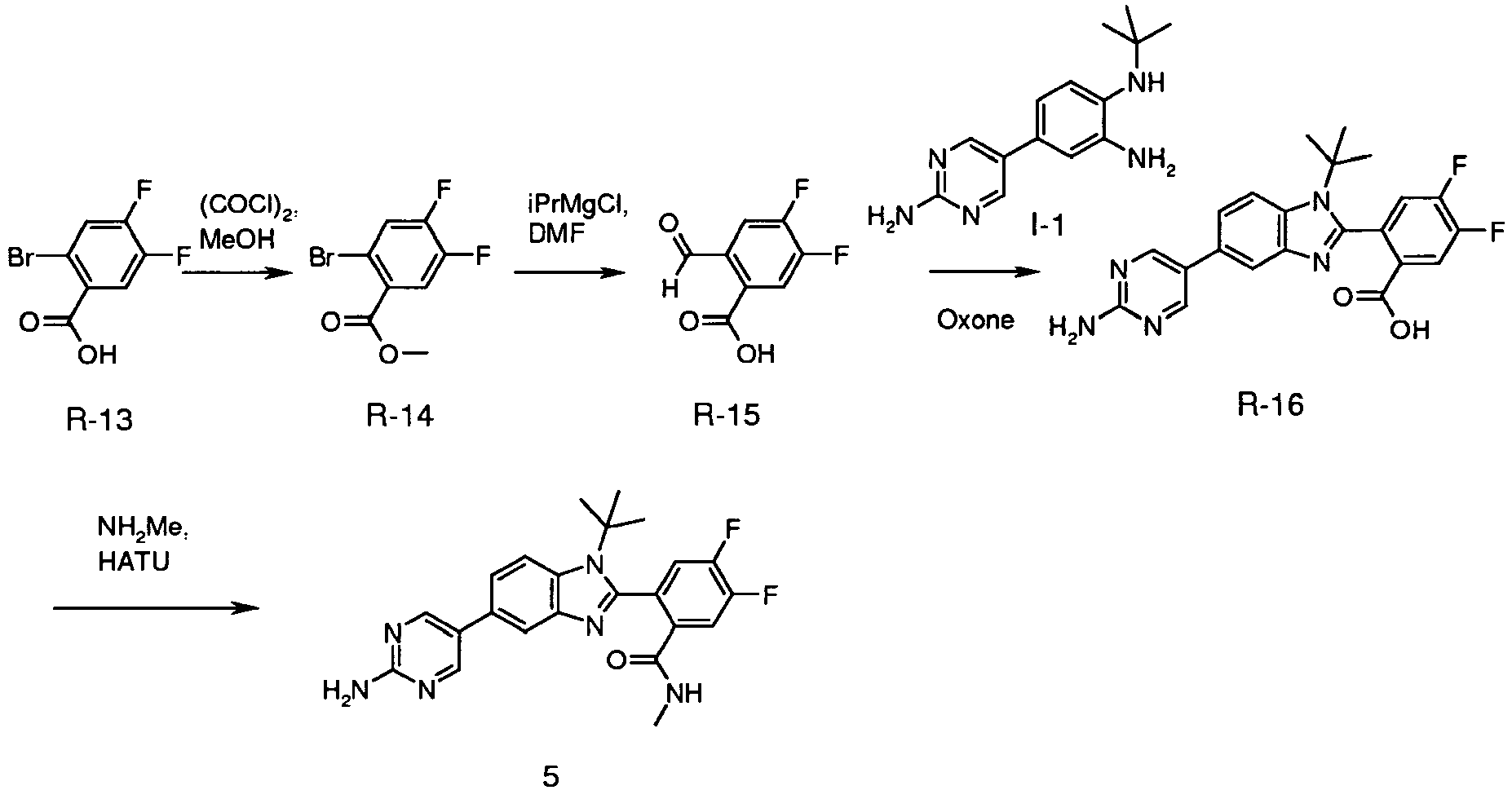
- To a solution of R-13 (500 mg, 2.11 mmol) in CH2Cl2 (10 mL) is added oxalyl chloride (0.54 mL, 6.33 mmol) dropwise followed by DMF (0.1 mL). The reaction mixture is stirred at room temperature for 0.5 hour and then cooled to 0 °C and methanol (1.7 mL, 42.2 mmol) is added. The reaction is warmed to room temperature and stirred for 22 hours and concentrated in vacuo. The residue is dissolved in CH2Cl2 and washed with water and brine. The organics are dried with a hydrophobic frit and concentrated in vacuo. The residue is purified by flash chromatography (SiO2, 50% CH2Cl2 in cyclohexane) to give R-14 (501.9 mg).
- A solution of R-14 (333 mg, 1.33 mmol) in anhydrous THF (5 mL) is cooled to -30 °C and isopropyl magnesium chloride (2M in THF, 0.99 mL, 1.99 mmol) is added. The reaction is stirred at -30 °C for 4 hours, DMF (1.03 mL, 13.27 mmol) is added and the mixture is warmed to room temperature and stirred for 1.5 hours. The reaction mixture is concentrated in vacuo and the residue acidified to pH 1 using 0.5M aqueous HCl. The product is extracted into CH2Cl2 and the combined organics are washed with brine and then dried with Na2SO4, filtered and concentrated in vacuo. The residue is purified by flash chromatography (SiO2, 20-40% EtOAc in cyclohexane) to give R-16 (50.3 mg).
- To a solution of I-1 (38.7 mg, 0.15 mmol) and R-16 (28.0 mg, 0.15 mmol) in DMF (1 mL) is added oxone (55.5 mg, 0.09 mmol) and the solution is stirred at room temperature for 1 hour. The mixture is quenched with saturated aqueous NaHCO3 and concentrated in vacuo to give R-16 (63.7 mg).
- To a solution of R-16 (64.0 mg, 0.15 mmol) in DMF (2.0 mL) is added HATU (86.2 mg, 0.23 mmol) and TEA (0.06 mL, 0.45 mmol). The mixture is stirred at room temperature for 0.5 hour and methylamine (2M in THF, 0.23 mL, 0.45 mmol) is added. The mixture is then stirred for 1 hour at room temperature and then concentrated in vacuo. The residue is dissolved in EtOAc and washed with saturated aqueous NaHCO3 and brine. The organics are dried with Na2SO4, filtered and concentrated in vacuo. The residue is purified by preparative HPLC (neutral method) to give the title compound (12.8 mg).
-

- A solution of methyl R-16 (5 g, 21.46 mmol) in anhydrous THF (40 mL) is cooled to - 30 °C and isopropyl magnesium chloride (2M in THF, 16.1 mL, 32.18 mmol) is added. The reaction is stirred at -30 °C for 3 hours, DMF (16.6 mL, 0.215 mol) is added and the mixture is warmed to room temperature and stirred for 2 hours. The reaction mixture is concentrated in vacuo and the residue diluted with 0.5M aqueous HCl (100 mL). The product is extracted into CH2Cl2 and the combined organics are washed with brine and then dried with Na2SO4, filtered and concentrated in vacuo. The residue is purified by flash chromatography (SiO2, 30% EtOAc in heptane) to give R-17 (1.56 g)
- To a solution of the R-17 (985 mg, 5.86 mmol) in DMF (15 mL) is added potassium carbonate (971.7 mg, 7.03 mmol) followed by iodoethane (0.54 mL, 6.74 mmol). The reaction mixture is stirred at room temperature for 3.5 hours before the insoluble salts are filtered off and the filtrate is concentrated in vacuo. The residue is partitioned between CH2Cl2 and saturated aqueous NH4Cl and the combined organics are washed with brine and dried with Na2SO4, filtered and concentrated in vacuo to give R-18 (959.3 mg)
- To a solution I-1 (1.1 g, 4.35 mmol) and R-18 (958 mg, 4.35 mmol) in DMF (20 mL) is added oxone (1.60 g, 2.61 mmol) and the solution is stirred at room temperature for 4.5 hours. The mixture is concentrated in vacuo and the residue is diluted in CH2Cl2 and washed with saturated aqueous NaHCO3 and brine. The organics are dried with Na2SO4, filtered and concentrated in vacuo. The residue is purified by flash chromatography (SiO2, 10-20% DCM in EtOAc) to give R-19 (1.42 g).
- To a solution of methylamine hydrochloride (663.5 mg, 9.83 mmol) and TEA (1.37 mL, 9.83 mmol) in anhydrous toluene (20 mL) is added trimethylaluminium (2M in toluene, 4.91 mL, 9.83 mmol) and the mixture is stirred at room temperature for 0.5 hour. R-19 (1.42 g, 3.28 mmol) is then added and the reaction is stirred at 100 °C for 24 hours. The reaction is cooled to room temperature then quenched with water. The insoluble salts are filtered off and washed with MeOH and EtOAc and the filtrate is concentrated in vacuo. The residue is dissolved in CH2Cl2 and washed with saturated aqueous NaHCO3, NH4Cl and brine. The organics are dried with Na2SO4, filtered and concentrated in vacuo. The residue is purified by flash chromatography (SiO2, 4.5-6.5% MeOH in EtOAc) and recrystallised from EtOAc/.cyclohexane at 0 °C to give the title compound (579.3 mg).
- The following compounds are also obtained by methods described in Example 6:
Example no Structure m/z(M++1) 30 
433.24 31 
482.21 32 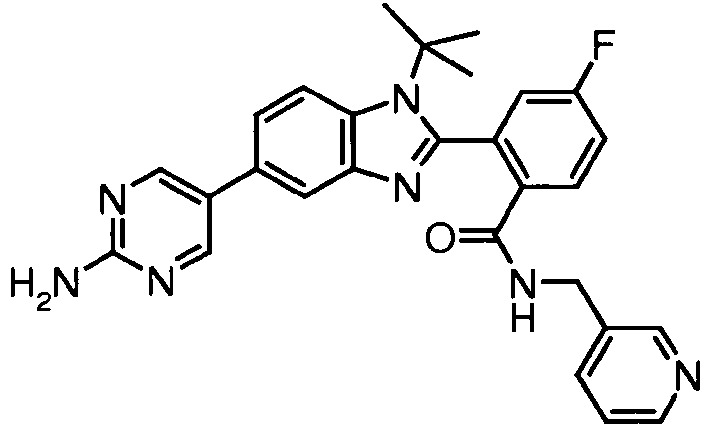
496.22 -

- A solution of R-20 (500 mg, 2.16 mmol) in anhydrous THF (21 mL) is cooled to -78 °C and n-butyllithium (2.5M in hexanes, 1.82 mL, 4.54 mmol) is added dropwise. The solution is stirred at -78 °C for 0.5 hour and DMF (1.77 mL, 22.83 mmol) is added and the reaction mixture is stirred for a further 2 hours before quenching with saturated aqueous NH4Cl. The reaction mixture is warmed to room temperature and acidified with aqueous 2M HCl and extracted into EtOAc. The combined organics are washed with brine and then dried with MgSO4, filtered and concentrated in vacuo to give R-21 (395 mg)
- To a solution of the R-21 (395 mg, 1.34 mmol) in DMF (15 mL) is added potassium carbonate (363.6 mg, 2.63 mmol) followed by iodoethane (0.18 mL, 2.30 mmol). The reaction mixture is stirred at 40 °C for 4 hours and then concentrated in vacuo. The residue is partitioned between CH2Cl2 and saturated aqueous NH4Cl and the combined organics are filtered through a hydrophobic frit and concentrated in vacuo. The residue is purified by flash chromatography (SiO2, 15% EtOAc in cyclohexane) to give R-22 (269 mg)
- To a solution I-1 (320.1 mg, 1.24 mmol) and R-22 (259.0 mg, 1.24 mmol) in DMF (5 mL) is added oxone (458.8 mg, 0.75 mmol) and the solution is stirred at room temperature for 3 hours. The mixture is concentrated in vacuo and the residue is diluted in CH2Cl2 and washed with saturated aqueous NaHCO3 and brine. The organics are dried with Na2SO4, filtered and concentrated in vacuo. The residue is purified by flash chromatography (SiO2, 0-10% DCM in EtOAc) to give R-23 (277.3 mg)
- To a solution of methylamine hydrochloride (59.1 mg, 0.88 mmol) and TEA (0.12 mL, 0.88 mmol) in anhydrous toluene (2.5 mL) is added trimethylaluminium (2M in toluene, 0.44 mL, 0.88 mmol) and the mixture is stirred at room temperature for 0.5 hour. R-23 (130 mg, 0.29 mmol) is then added and the reaction is stirred at 100 °C for 2 hours. The reaction is cooled to room temperature then quenched with water. The insoluble salts are filtered off and washed with MeOH and EtOAc and the filtrate is concentrated in vacuo. The residue is purified by preparative HPLC (neutral method) to give to give the title compound (64.3 mg).
- The following compounds are also obtained by methods described in Example 7:
Example Structure m/z (M++1) 33 
419.15 34 
419.17 -
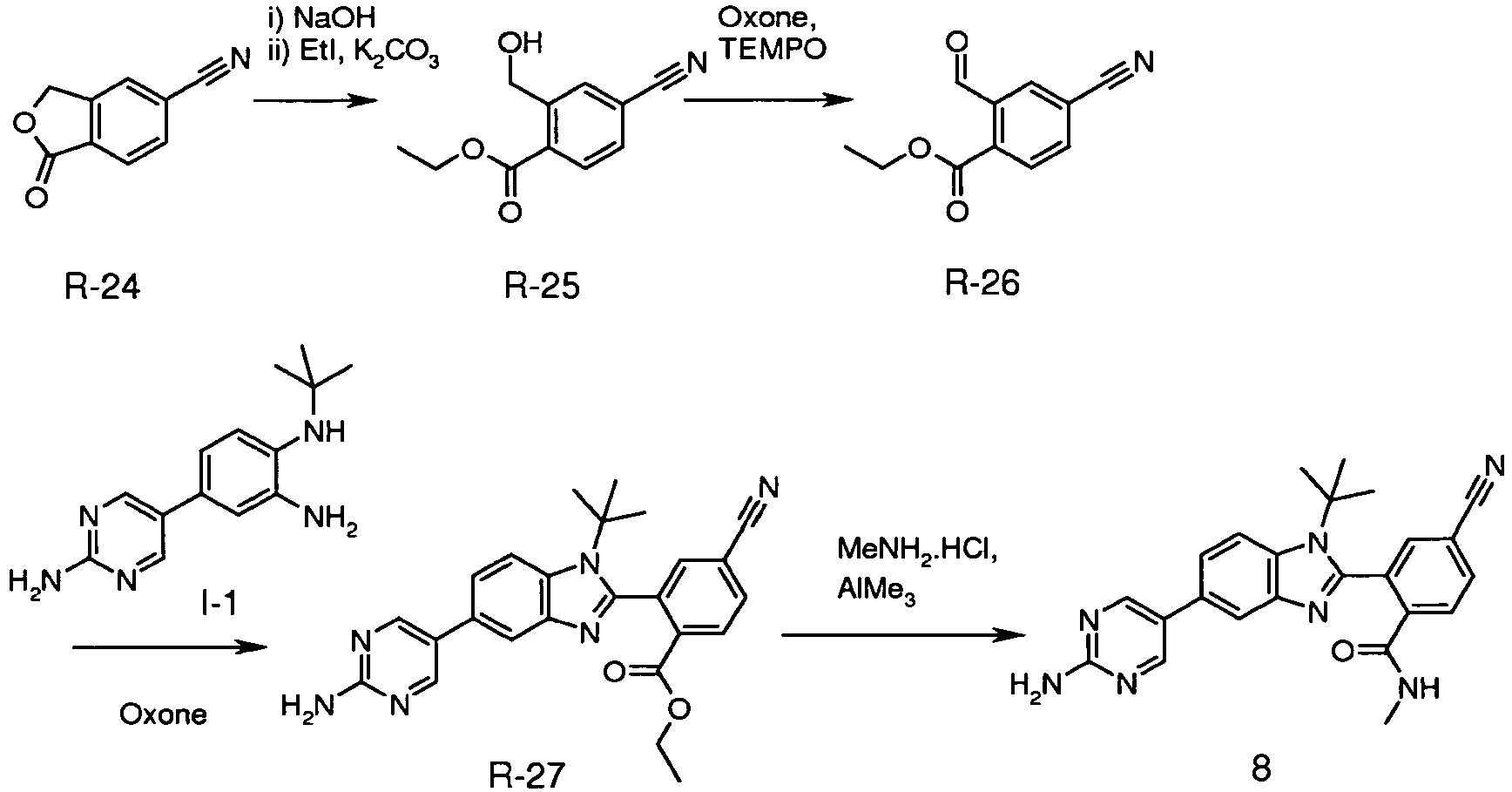
- A suspension of R-24 (1.0g, 6.28 mmol) and NaOH (1M aqueous solution, 6.28 mL, 6.28 mmol) in THF (10 mL) is stirred at room temperature for 2 hours and then concentrated in vacuo. The residue is then suspended in DMF (25 mL) and iodoethane (0.53 mL, 6.59 mmol) is added. The reaction mixture is then stirred at 80 °C for 0.5 hour and then cooled to 0 °C and saturated aqueous NH4Cl is added. The product is extracted into EtOAc and the organics are washed with water and brine and dried with Na2SO4, filtered and concentrated in vacuo to give R-25 (1.20 g)
- To a solution of R-25 (1.50 g, 7.31 mmol) and tetrabutylammonium chloride (40.6 mg, 0.15 mmol) in CH2Cl2 (43 mL) is added 2,2,6,6-Tetramethylpiperdine-1-oxyl radical (TEMPO) (34.5 mg, 0.22 mmol) in CH2Cl2 (2 mL) and oxone (9.89 g, 16.01 mmol). The reaction mixture is stirred at room temperature for 18 hours and more TEMPO (34.5 mg, 0.22 mmol) is added. The reaction mixture is stirred for a further 22 hours and then the mixture is filtered. The filtrate is washed with saturated aqueous NaHCO3 and brine and dried with Na2SO4, filtered and concentrated in vacuo to give R-26 (790.9 mg).
- To a solution I-1 (860.4 mg, 3.34 mmol) and R-26 (790 mg, 3.34 mmol) in DMF (16 mL) is added oxone (1.23 g, 2.01 mmol) and the solution is stirred at room temperature for 2.5 hours. The mixture is concentrated in vacuo and the residue is diluted in CH2Cl2 and washed with saturated aqueous NaHCO3 and brine. The organics are dried with Na2SO4, filtered and concentrated in vacuo. The residue is purified by flash chromatography (SiO2, 1-3.5% MeOH in CH2Cl2) to give R-27 (952.3 mg).
- To a solution of methylamine hydrochloride (321.0 mg, 4.75 mmol) and TEA (0.66 mL, 4.75 mmol) in anhydrous toluene (20 mL) is added trimethylaluminium (2M in toluene, 3.24 mL, 6.48 mmol) and the mixture is stirred at room temperature for 0.5 hour. R-27 (952 mg, 2.16 mmol) is then added and the reaction is stirred at 100 °C for 2.5 hours. The reaction is cooled to room temperature then quenched with water. The insoluble salts are filtered off and washed with MeOH and DCM and the filtrate is concentrated in vacuo. The residue is dissolved in CH2Cl2 and washed with saturated aqueous NaHCO3, water and brine and dried with Na2SO4, filtered and concentrated in vacuo. The residue is purified by flash chromatography (SiO2, 5-8% MeOH in CH2Cl2) to give to give the title compound (421 mg).
-

- To a solution of example 8 (80 mg, 0.19 mmol) and copper (I) oxide (0.8 mg, 0.01 mmol) in DMF (0.8 mL) and methanol (0.2 mL) is added trimethylsilyl azide (0.04 mL, 0.28 mmol). The solution is stirred at room temperature for 10 minutes and then at 80 °C for 48 hours. Extra copper (I) oxide (0.8 mg, 0.01 mmol), trimethyl silyl azide (0.01 mL, 0.09 mmol) and methanol (0.4 mL) are added and the reaction mixture stirred at 80 °C for a further 48 hours. The reaction mixture is cooled and quenched with 5.5% aqueous ceric ammonium nitrate (12 mL) and concentrated in vacuo. The residue is triturated from DMF and the solid is purified by preparative HPLC (neutral method) to give to give the title compound (8.5 mg).
-

- To a suspension of R-27 (615 mg, 1.40 mmol), methanol (5.0 mL), THF (5.0 mL) and water (2.0 mL) is added lithium hydroxide monohydrate (117.2 mg, 2.79 mmol). The reaction mixture is stirred at 40 °C for 2 hours. The reaction mixture is concentrated in vacuo to give R-28 (584 mg).
- To a solution of R-28 (200 mg, 0.48 mmol) in DMF (4.0 mL) is added HATU (363.5 mg, 0.96 mmol) and TEA (0.20 mL, 1.43 mmol). The mixture is stirred at room temperature for 0.5 hour and cyanamide (40.2 mg, 0.96 mmol) is added followed by stirring at room temperature for 4.5 hours. Extra HATU (181.8 mg, 0.48 mmol) is added and the reaction mixture is stirred for a further 1.5 hours and then concentrated in vacuo. The residue partitioned between CH2Cl2 and saturated aqueous NaHCO3. The organics are concentrated in vacuo and purified by preparative HPLC (neutral method) to give the title compound (15.2 mg).
-

- To a solution of R-28 (235 mg, 0.56 mmol) in THF (6.0 mL) is added N-[(1H-benzotrizol-1-yl)(dimethylamino)methyl-amino_methylene]-N-methyl-methanaminium tetrafluoroborate (TBTU) (270.5 mg, 0.84 mmol) and TEA (0.23 mL, 1.69 mmol). The mixture is stirred at room temperature for 0.5 hour and methanesulfonamide (160.3 mg, 1.69 mmol) is added followed by stirring at room temperature for 5 hours. Extra TBTU (270.5 mg, 0.84 mmol) is added and the reaction mixture is stirred for a further 44 hours and then concentrated in vacuo. The residue is purified by preparative HPLC (neutral method) to give the title compound (89.6 mg).
-

- To a solution of example 15 (80 mg, 0.19 mmol) in DMF (5 mL) are added dimethylamine (0.19 mL, 0.39 mmol), 1-[3-(dimethylamino)propyl]3-ethylcarbodiimide HCl (EDCI) (75 mg, 0.39 mmol), 1-hydroxybenzotriazole hydrate (13 mg, 0.01 mmol) and iPr2NEt (0.1 mL) at room temperature. The solution is stirred at the same temperature for 24 hours. Water is added and the solution is extracted with EtOAc (3 x 10 mL). The combined organic layer is dried with MgSO4 and is filtered. The filrate is concentrated and the residue is purified by silica gel flash column chromatography with 10% MeOH in CH2Cl2 as the eluent to afford the title compound (13 mg).
-

- R-9 (600 mg, 2.47 mmol) and R-29 (350 mg, 2.6 mmol) are dissolved in DMF (10 mL) and water (1 mL). To this solution is added Oxone (1.60 g, 2.60 mmol). This reaction mixture is sonicated at room temperature for 1 hour. The solvent was removed in vacuo. The residue was partitioned between EtOAc and saturated sodium bicarbonate solution. The organic layer is washed with brine, dried over sodium sulfate. The solvent is removed in vacuo and the residue is purified by flash chromatography (silica gel, eluted with 0-50 % EtOAc in hexane) to give R-30 (0.826 g).
- R-30 (400 mg, 1.13 mmol) is dissoved in DMF (6 mL) and 2 M sodium carbonate solution (2 mL). R-4 (0.322 g, 1.50 mmol) is added followed by bis(triphenylphosphine)palladium(II) chloride (0.070 g, 0.10 mmol). This reaction mixture is degassed and heated in a microwave reaction at 100 °C for 30 minutes. The solvent is removed in vacuo and the residue is purified by flash chromatography (silica gel, eluted with 0-10% MeOH in CH2Cl2) to give R-31 (0.226 g).
- R-31 (40 mg, 0.12 mmol) is dissoved in EtOH (2 mL). Potassium hydroxide (KOH) (0.40 g, 0.1 mmol) is added followed by hydrogenperoxide (0.5 mL). This reaction mixture is stirred at room temperature for 4 hours. The solvent is removed in vacuo and the residue is suspended in water. The solid is collected by filtration and recrystalized in DMSO and MeOH to give the title compound (22 mg).
- The following compounds are also obtained by methods described in Example 13:
Example Structure m/z (M++1) 35 
401.52 -

- To a round bottom flask is added R-11 (1.4 g, 3.6 mmol) in THF (6 mL), MeOH (3 mL) and water (3 mL), followed by the addition of LiOH hydrate (180 mg, 4.3 mmol). The reaction mixture is stirred at room temperature for 24 hours. The reaction mixture is concentrated to dryness to afford R-32 (1.7 g).
- To a round bottom flask is added R-32 (1.38 g, 3.6 mmol) in DMF (10 mL), followed by the addition of 6N of HCl (0.7 mL). HATU (1.6 g, 4.4 mmol) is added, followed by iPr2NEt (565 mg, 4.4 mmol) and ammonium hydroxide (4 mL). The reaction mixture is stirred at room temperature for 1 hour. The reaction mixture is diluted with EtOAc, washed with water, brine and is dried under anhydrous Na2SO4. The mixture is filtered and concentrated. The residue is purified by silica gel flash chromatography with 0-4% MeOH/CH2Cl2 as the eluent to afford R-33 (1.2 g).
- To a sealed vial is added R-33 (80 mg, 0.22 mmol) in DMF (3.5 mL), followed by the addition of R-4 (52 mg, 0.23 mmol), Pd(PPh3)4 (25 mg, 0.02 mmol) and aqueous 2 M Na2CO3 (0.43 mL, 0.86 mmol). The reaction mixture is heated under Argon at 100 °C for 2 hours. The residue is diluted with EtOAc, washed with brine, is dried under anhydrous Na2SO4. The mixture is filtered and concentrated. The residue is purified by silica gel flash chromatography with 0-5% 2M NH3 in MeOH/CH2Cl2 as the eluent to afford the title compound (44 mg).
Final Compounds Example Structure Method m/z Retention Time LC_MS method 1 
1 388.2 1.14 B 2 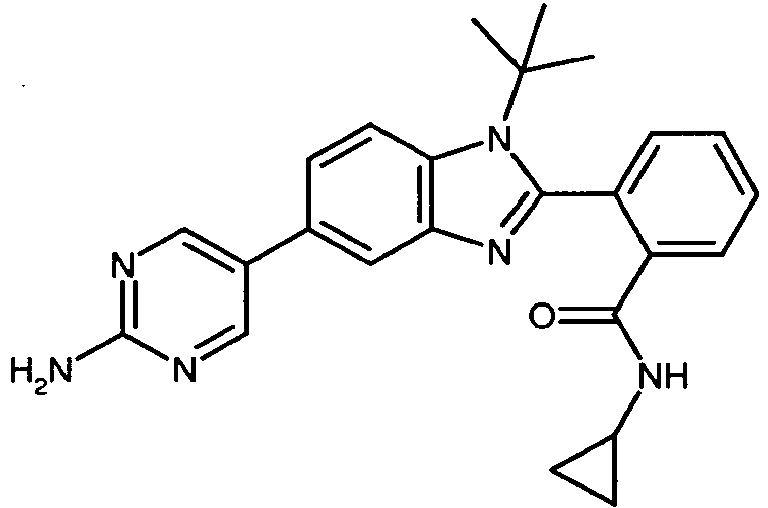
2 427.38 2.84 A 3 
3 464.29 2.58 A 4 
4 401.3 2.7 A 5 
5 437.21 3 A 6 
6 419.19 2.85 A 7 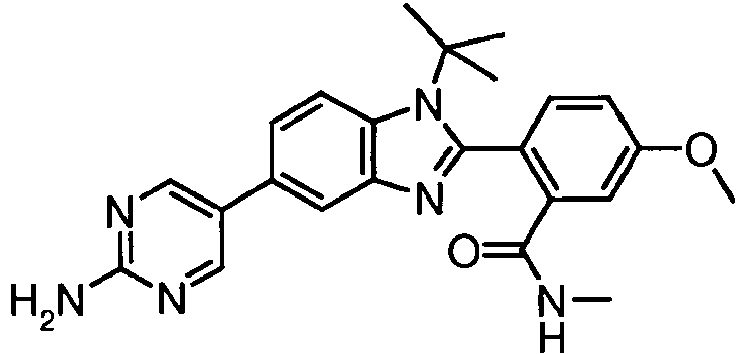
7 431.22 2.85 A 8 
8 426.24 2.91 A 9 
9 469.20 2.71 A 10 
10 437.21 3.01 A 11 
11 490.18 2.95 A 12 
12 433.2 1.22 B 13 
13 387.51 5.22 D 14 
14 387.79 1.07 C 15 
1 406.2 1.2 B 16 
1 388.2 1.05 B 18 
2 471.34 2.89 A 19 
2 445.33 2.78 A 20 
2 464.29 3.06 A 21 
2 443.32 3.14 A 22 
2 464.35 2.73 A 23 
2 415.29 2.8 A 24 
2 458.37 2.43 A 25 
2 470.4 2.55 A 26 
2 429.33 2.92 A 27 
2 478.34 3.2 A 28 
4 457.36 2.99 A 29 
4 415.15 2.69 A 30 
6 433.24 2.97 A 31 
6 482.21 2.93 A 32 
6 496.22 2.73 A 33 
7 419.15 2.85 A 34 
7 419.17 2.93 A 35 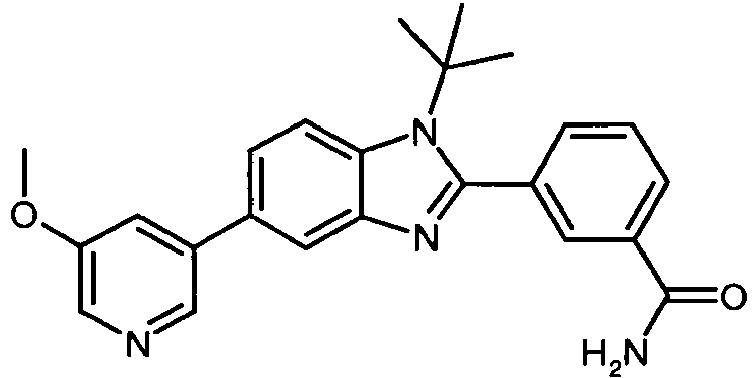
13 401.52 4.94 D LC-MS Method A MET/CR/1416 High resolution method' Column Waters Atlantis dC18 100 x 2.1 mm, 3µm column 40 °C Mobile phase A - 0.1% Formic acid (water) B - 0.1 % Formic acid (acetonitrile) Flow rate 0.6 ml/min Injection volume 3ul Detector 215nm (nominal) Gradient Time (mins) % Organic 0.00 5 5.00 100 5.40 100 5.42 5 LC-MS Method B Column Agilent SB-C18 1.8µm, 3x50mm column Ambient temperature Mobile phase A = Formic acid (aq) 0.1% B = Formic acid (acetonitrile) 0.1% Flow rate 1.5 ml/min Injection volume 3µl Detector 220nm and 254nm Gradient Time (mins) % B 0 12 0.25 30 0.3 40 1.19 95 1.75 100 LC-MS Method C Column Agilent Zorbax C18 SB 3.5um 4.6x30mm cartridge Ambient temperature Mobile phase A = Formic acid (aq) 0.1 % B = Formic acid (acetonitrile) 0.1% Flow rate 2.5 ml/min Injection volume 7µl Detector 220nm and 254nm Gradient Time (mins) % B 0 95 1.7 5 2 5 2.1 95 2.3 95 LC-MS Method D Column Agilent Zorbax Eclipse XDB-C8 5um 4.6x150mm column Ambient temperature Mobile phase A = Formic acid (aq) 0.1% B = Formic acid (acetonitrile) 0.1% Flow rate 1.5 ml/min Injection volume 7µl Detector 220nm and 254nm Gradient Time (mins) % B 0 95 7 5 9 5 9.3 95 10 95 - Compounds are assessed for the ability to bind to FLAP in a binding assay that measures compound-specific displacement of an iodinated (125I) FLAP inhibitor via a Scintillation Proximity Assay format (adapted from S. Charleson et al., Mol. Pharmacol., 1992, 41, 873-879).
- Cell pellets produced from sf9 insect cells expressing recombinant human FLAP protein are resuspended in buffer A [15 mM Tris-HCl (pH 7.5), 2 mM MgCl2, 0.3 mM EDTA, 1 mM PMSF]. The cells are lysed with a Dounce homogenizer and the material is centrifuged at 10,000 x g for 10 minutes. The supernatant is then collected and centrifuged at 100,000 x g for 60 minutes. To prepare membrane protein for an assay, an aliquot of the 100,000 x g pellet is resuspended in 1 ml of buffer A, Dounce homogenized, and finally subjected to polytron mixing (30 seconds). Membrane protein (25 µl, 5 µg) is mixed with WGA SPA beads (Amersham) and stirred for 1h. To an assay plate (Perkin Elmer FlexiPlate) is added 25 µl of test compound prepared in Binding buffer [100 mM Tris (pH 7.5), 140 mM NaCl, 5% glycerol, 2 mM EDTA, 0.5 mM TCEP, 0.05% Tween 20], 25 µl of [125I]L-691,831 (an iodinated analog of MK-591, Charleson et al. Mol. Pharmacol., 41, 873-879, 1992) and finally 50 µl of the bead/protein mixture. (final concentrations: beads, 200 µg/well; protein, 5µg/well; [125I] probe, 0 08 nM/well(17 nCi/well). The plates are shaken for 2h before reading on a Microbeta plate reader. Non-specific binding is determined by the addition of 10 µM cold L-691,831 compound.
- In general, the preferred potency range (IC50) of compounds in the above assay is between 0.1 nM to 10 µM, the more preferred potency range is 0.1 nM to 1 µM, and the most preferred potency range is 0.1 nM to 100 nM.
- Compounds are additionally tested in a human whole blood assay to determine their ability to inhibit the synthesis of LTB4 in a cellular system. Compounds are combined with heparinized human whole blood and incubated for 15 minutes at 37°C. Calcimycin (20µM final, prepared in phosphate-buffered saline, pH 7.4) is then added and the mixture is incubated for another 30 minutes at 37°C. The samples are centrifuged for 5 min at low speed (1500 x g) and the plasma layer is removed. Plasma LTB4 concentrations are then measured using an antibody-based homogenous time-resolved fluorescence method (CisBio, Bedford, MA).
- In general, the preferred potency range (IC50) of compounds in the above assay is between 10 nM to 10 µM, the more preferred potency range is 10 nM to 1 µM.
- The compounds of the invention are effective inhibitors of 5-lipoxygenase activating protein (FLAP) and thus inhibit leukotriene production. Therefore, in one embodiment of the invention, there is provided compounds for use in methods of treating leukotriene-mediated disorders using compounds of the invention. In another embodiment, there is provided compounds for use in methods of treating cardiovascular, inflammatory, allergic, pulmonary and fibrotic diseases, renal diseases and cancer using compounds of the invention.
- Without wishing to be bound by theory, by inhibiting the activity of FLAP, the compounds of the invention block the production of LTs resulting from the oxidation of arachidonic acid by 5-LO and subsequent metabolism. Thus, the inhibition of FLAP activity is an attractive means for preventing and treating a variety of diseases mediated by LTs. These include:
- Cardiovascular diseases including atherosclerosis, myocardial infarction, stroke, aortic aneurysm, sickle cell crisis, ischemia-reperfusion injury, pulmonary arterial hypertension and sepsis;
- Allergic diseases including asthma, allergic rhinitis, rhinosinusitis, atopic dermatitis and urticaria;
- Fibrotic diseases including airway remodeling in asthma, idiopathic pulmonary fibrosis, scleroderma, asbestosis;
- Pulmonary syndromes including adult respiratory distress syndrome, viral bronchiolitis, obstructive sleep apnea, chronic obstructive pulmonary disease, cystic fibrosis, and bronchopulmonary dysplasia;
- Inflammatory diseases including rheumatoid arthritis, osteoarthritis, gout, glomerulonephritis, interstitial cystitis, psoriasis, inflammatory bowel disease systemic lupus erythematosus, transplant rejection, multiple sclerosis, inflammatory pain, inflammatory and allergic ocular diseases;
- Cancer including solid tumors, leukemias and lymphomas; and
- Renal diseases such as glomerulonephritis.
- For treatment of the above-described diseases and conditions, a therapeutically effective dose will generally be in the range from about 0.01 mg to about 100 mg/kg of body weight per dosage of a compound of the invention; preferably, from about 0.1 mg to about 20 mg/kg of body weight per dosage. For example, for administration to a 70 kg person, the dosage range would be from about 0.7 mg to about 7000 mg per dosage of a compound of the invention, preferably from about 7.0 mg to about 1400 mg per dosage. Some degree of routine dose optimization may be required to determine an optimal dosing level and pattern. The active ingredient may be administered from 1 to 6 times a day.
- When used as pharmaceuticals, the compounds of the invention are typically administered in the form of a pharmaceutical composition. Such compositions can be prepared using procedures well known in the pharmaceutical art and comprise at least one compound of the invention. The compounds of the invention may also be administered alone or in combination with adjuvants that enhance stability of the compounds of the invention, facilitate administration of pharmaceutical compositions containing them in certain embodiments, provide increased dissolution or dispersion, increased antagonist activity, provide adjunct therapy, and the like. The compounds according to the invention may be used on their own or in conjunction with other active substances according to the invention, optionally also in conjunction with other pharmacologically active substances. In general, the compounds of this invention are administered in a therapeutically or pharmaceutically effective amount, but may be administered in lower amounts for diagnostic or other purposes.
- Administration of the compounds of the invention, in pure form or in an appropriate pharmaceutical composition, can be carried out using any of the accepted modes of administration of pharmaceutical compositions. Thus, administration can be, for example, orally, buccally (e.g., sublingually), nasally, parenterally, topically, transdermally, vaginally, or rectally, in the form of solid, semi-solid, lyophilized powder, or liquid dosage forms, such as, for example, tablets, suppositories, pills, soft elastic and hard gelatin capsules, powders, solutions, suspensions, or aerosols, or the like, preferably in unit dosage forms suitable for simple administration of precise dosages. The pharmaceutical compositions will generally include a conventional pharmaceutical carrier or excipient and a compound of the invention as the/an active agent, and, in addition, may include other medicinal agents, pharmaceutical agents, carriers, adjuvants, diluents, vehicles, or combinations thereof. Such pharmaceutically acceptable excipients, carriers, or additives as well as methods of making pharmaceutical compositions for various modes or administration are well-known to those of skill in the art. The state of the art is evidenced, e.g., by Remington: The Science and Practice of Pharmacy, 20th Edition, A. Gennaro (ed.), Lippincott Williams & Wilkins, 2000; Handbook of Pharmaceutical Additives, Michael & Irene Ash (eds.), Gower, 1995; Handbook of Pharmaceutical Excipients, A.H. Kibbe (ed.), American Pharmaceutical Ass'n, 2000; H.C. Ansel and N.G. Popovish, Pharmaceutical Dosage Forms and Drug Delivery Systems, 5th ed., Lea and Febiger, 1990.
- As one of skill in the art would expect, the forms of the compounds of the invention utilized in a particular pharmaceutical formulation will be selected (e.g., salts) that possess suitable physical characteristics (e.g., water solubility) that are required for the formulation to be efficacious.
with the proviso that the compounds


with the proviso that the compounds


with the proviso that the compounds


with the proviso that the compounds


with the proviso that the compounds


with the proviso that the compounds


Claims (24)
- A compound of formula IA:
 R1 is a 5-11 membered heteroaryl ring containing one to three heteroatoms selected from nitrogen, oxygen and sulfur, wherein the heteroaryl ring is optionally independently substituted with one to three groups selected from Ra, Rb and Rc;R2 is C1-C6 alkyl;R3 is -OH, -N(R8)(R9), -NH-S(O)2-C1-6alkyl, NH-S(O)2-aryl, 5-6 membered heterocycle or C1-6alkoxy;R4, R5, R6 and R7 are each independently selected from(a) -H,(b) -OH,(c) halogen,(d) -CN,(e) -CF3,(f) C1-6alkyl optionally substituted with one to three -OH, fluorine, C1-6alkoxyl, -N(R8)(R9), or -C(O)N(R8)(R9),(g) C1-6alkoxy optionally substituted with one to three -OH, fluorine, -OC1-6alkyl, or -OC3-6 cycloalkyl,(h) -S(O)nC1-6alkyl,(i) -CO2R8,(j) -S(O)2N(R8)(R9),(k) a 5-membered heteroaryl ring,(l) a 5-6 membered heterocyclic ring;R8 and R9 are each independently selected from -H, C1-6alkyl, C3-6cycloalkyl, halogen, -CF3, -OH, -(CH2)nCO2R10, -CN, C1-6alkoxyl, C1-6alkyl-O- C1-3 alkyl, C1-6alkylhydroxyl, C1-3alkyl-CN, 5-6 membered heteroaryl ring and 5-6 membered heterocyclic ring, wherein the C1-6alkyl is optionally substituted with a 5-6 heteroaryl ring, 5-6 membered heterocyclic ring or -N(R10)(R11);R10 and R11 are each independently selected from -H and C1-6alkyl;Ra is selected from H, -NH2, -NH(C1-C6)alkyl, -NR10R11, -NH-C(O)C1-C6alkyl, NR"-C(O)C1-C6alkyl, -O(C1-C8)alkyl, -O(C3-C6)cycloalkyl, -S-(C1-C6)alkyl, -S(O)-C1-C6alkyl, -S(O)2-C1-C6alkyl, oxo and -CH2-OH;Rb is selected from -H, -(C1-C6)alkyl, -O-(C1-C6)alkyl, -NH2, -CH2-OH, -C≡N, -CH2NH2 and -C(O)OCH3;Rc is selected from -H, -CH3 and, -OH;n is 1 or 2;or a pharmaceutically acceptable salt thereof;
with the proviso that the compounds

- A compound of formula (IA) according to claim 1, or a pharmaceutically acceptable salt thereof, wherein:R1 is pyridinyl, pyrimidinyl, pyrazinyl, pyridazinyl, pyrrolyl, imidazolyl, thienyl, furanyl, thiazolyl, quinolinyl, isoquinolinyl, pyrrolopyridinyl, imidazopyridinyl, pyrazolopyridinyl and dihydropyrrolopyridinyl optionally substituted with oxo, wherein each heterocycle is optionally independently substituted with one to three groups selected from Ra, Rb and Rc;R2 is methyl, ethyl, propyl, isopropyl, butyl, t-butyl, isobutyl, pentyl or hexyl;R3 is -OH, -N(R8)(R9), -NH-S(O)2-C1-6alkyl, -NH-S(O)2-phenyl, morpholinyl, piperidinyl, tetrahydropyranyl or C1-6alkoxy;R4, R5, R6 and R7 are each independently selected from(a) -H,(b) -OH,(c) halogen,(d) -CN,(e) -CF3,(f) C1-6alkyl optionally substituted with one to three -OH, fluorine, C1-6alkoxyl, -N(R8)(R9), or -C(O)N(R8)(R9),(g) C1-6alkoxy optionally substituted with one to three -OH, fluorine, -OC1-6alkyl, or -OC3-6 cycloalkyl,(h) -S(O)nC1-6alkyl,(i) -CO2R8,(j) -S(O)2N(R8)(R9),(k) pyrrolyl, imidazolyl, thienyl, furanyl, thiazolyl and tetrazolyl,(l) pyrrolidinyl, tetrahydrofuranyl, tetrahydrothienyl, tetrahydropyranyl, piperidinyl, morpholinyl, thiomorpholinyl and dioxothiomorpholinyl;R8 and R9 are each independently selected from -H, C1-6alkyl, C3-6cycloalkyl, halogen, -CF3, -OH, -(CH2)nCO2R10, -CN, C1-6alkoxyl, C1-6alkyl-O- C1-3 alkyl, C1-6alkylhydroxyl, C1-3alkyl-CN, 5-6 membered heteroaryl ring and 5-6 membered heterocyclic ring, wherein the C1-6alkyl is optionally substituted with pyridinyl, pyrimidinyl, pyrazinyl, pyridazinyl, pyrrolidinyl, tetrahydrofuranyl, tetrahydrothienyl, tetrahydropyranyl, piperidinyl, morpholinyl, thiomorpholinyl, dioxothiomorpholinyl or - N(R10)(R11);R10 and R11 are each independently selected from -H and C1-3alkyl;Ra is selected from H, -NH2, -NH(C1-C6)alkyl, -NR10R11, -NH-C(O)C1-C6alkyl, -NR11-C(O)C1-C6alkyl, -O(C1-C8)alkyl, -O(C3-C6)cycloalkyl, -S-(C1-C6)alkyl, -S(O)-C1-C6alkyl, -S(O)2-C1-C6alkyl, oxo and -CH2-OH;Rb is selected from -H, -(C1-C6)alkyl, -O-(C1-C6)alkyl, -NH2, -CH2-OH, -C≡N, -CH2NH2 and -C(O)OCH3;Rc is selected from -H, -CH3 and -OH;n is 1 or 2;with the proviso that the compounds


- A compound of formula (IA) according to claim 1 or 2, wherein:R1 is selected from:
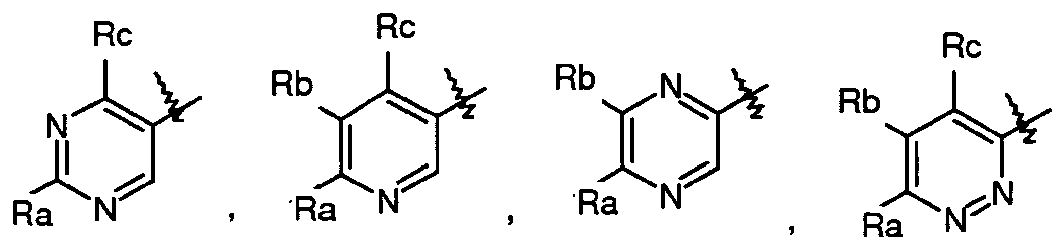

 Ra is selected from H, -NH2, -NH(C1-C6)alkyl, -NR10R11, -NH-C(O)C1-C6alkyl, -NR11-C(O)C1-C6alkyl, -O(C1-C8)alkyl, -O(C3-C6)cycloalkyl, -S-(C1-C6)alkyl, -S(O)-C1-C6alkyl, -S(O)2-C1-C6alkyl and -CH2-OH;Rb is selected from -H, -(C1-C6)alkyl, -O-(C1-C6)alkyl, -NH2, -CH2-OH, -C≡N, -CH2NH2 and -C(O)OCH3;Rc is selected from -H, -CH3 and -OH;R10 and R11 are each independently selected from -H and C1-3 alkyl;or a pharmaceutically acceptable salt thereof;
with the proviso that the compounds

- A compound of formula (IA) according to any of the claims 1-3, wherein:R2 is methyl, ethyl, propyl, isopropyl, butyl, t-butyl or isobutyl;or a pharmaceutically acceptable salt thereof;
with the proviso that the compounds

- A compound of formula (IA) according to any of the claims 1-4, wherein:R3 is -OH, -N(R8)(R9), -NH-S(O)2-C1-6alkyl, NH-S(O)2-phenyl, morpholinyl, piperidinyl or C1-6alkoxy;R4, R5, R6 and R7 are each independently selected from(a) -H,(b) -OH,(c) halogen,(d) -CN,(e) -CF3,(f) C1-6alkyl optionally substituted with one to three -OH, fluorine, C1-6alkoxyl, -N(R8)(R9), or -C(O)N(R8)(R 9),(g) C1-6alkoxy optionally substituted with one to three -OH, fluorine, -OC1-6alkyl, or -OC3-6cycloalkyl,(h) -S(O)2C1-6alkyl,(i) -CO2R8,(j) -S(O)2N(R8)(R9),(k) pyrrolyl, imidazolyl, thienyl, furanyl, thiazolyl and tetrazolyl,(l) pyrrolidinyl, tetrahydrofuranyl, tetrahydrothienyl, tetrahydropyranyl, piperidinyl, morpholinyl, thiomorpholinyl and dioxothiomorpholinyl;R8 and R9 are each independently selected from -H, C1-6alkyl, C3-6cycloalkyl, halogen, -CF3, -OH, -CH2CO2R10, -CN, C1-6alkoxyl, C1-6alkyl-O- C1-3 alkyl, C1-6alkylhydroxyl, C1-3alkyl-CN, pyridinyl, pyrimidinyl, piperidinyl, morpholinyl, tetrahydropyranyl and tetrahydrofuranyl, wherein the C1-6alkyl is optionally substituted with pyridinyl, pyrimidinyl, pyrazinyl, pyridazinyl, pyrrolidinyl, tetrahydrofuranyl, tetrahydrothienyl, tetrahydropyranyl, piperidinyl, morpholinyl, thiomorpholinyl, dioxothiomorpholinyl or -N(R10)(R11);R10 and R11 are each independently selected from -H and C1-3alkyl;or a pharmaceutically acceptable salt thereof;
with the proviso that the compounds

- A compound of formula (IA) according to claim 1 or 2, wherein:R1 is pyridinyl, pyrimidinyl, pyrazinyl or pyridazinyl, each optionally substituted with an amino group;R2 is t-butyl;R3 is -OH, -N(R8)(R9), -NH-S(O)2-C1-6alkyl, morpholinyl or C1-3alkoxy;R4, R5, R6 and R7 are each independently selected from(a) -H,(b) -OH,(c) halogen,(d) -CN,(e) -CF3,(f) C1-6alkyl optionally substituted with one to three -OH, fluorine, C1-6alkoxyl, -N(R8)(R9), or -C(O)N(R8)(R9),(g) C1-6alkoxy optionally substituted with one to three -OH, fluorine, or -OC1-6alkyl,(i) -S(O)2C1-6alkyl,(h) -CO2R8,(i) -S(O)2N(R8)(R9),(j) pyrrolyl, imidazolyl, thienyl, furanyl, thiazolyl and tetrazolyl,(k) piperidinyl and morpholinyl;R8 and R9 are each independently selected from -H, C1-3alkyl, cyclopropyl, halogen, -CN, C1-4alkyl-O- methoxy, pyridinyl and piperidinyl, wherein the C1-6alkyl is optionally substituted with pyridinyl, tetrahydrofuranyl, or -N(R10)(R11);R10 and R11 are each independently selected from -H and C1-3alkyl;or a pharmaceutically acceptable salt thereof;
with the proviso that the compounds
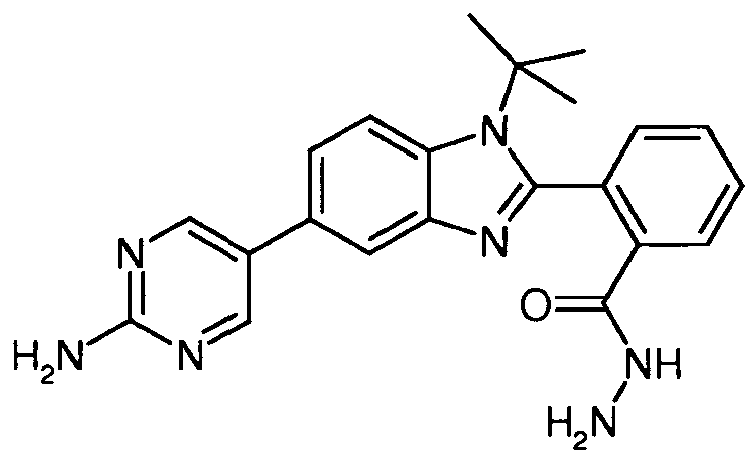
- A compound of formula (IA) according to claim 6, or a pharmaceutically acceptable salt thereof,
wherein R1 is


- A compound of formula (IA) according to claim 6, wherein:R2 is t-butyl;or a pharmaceutically acceptable salt thereof;
with the proviso that the compounds

- A compound of formula (IA) according to claim 6, wherein:R1 is
 R2 is t-butyl;R3 is
 R4, R5, R6 and R7 are each independently selected from -H, -CN and F;or a pharmaceutically acceptable salt thereof;
with the proviso that the compound
- A compound of formula IB:

 R1 is pyridinyl, pyrimidinyl, pyrazinyl, pyridazinyl, pyrrolyl, imidazolyl, thienyl, furanyl, thiazolyl, quinolinyl, isoquinolinyl, pyrrolopyridinyl, imidazopyridinyl, pyrazolopyridinyl and dihydropyrrolopyridinyl optionally substituted with oxo, wherein each heterocycle is optionally independently substituted with one to three groups selected from Ra, Rb and Rc;R2 is methyl, ethyl, propyl, isopropyl, butyl, t-butyl, isobutyl, pentyl or hexyl;R3 is -OH, -N(R8)(R9), -NH-S(O)2-C1-6alkyl, -NH-S(O)2-phenyl, morpholinyl, piperidinyl, tetrahydropyranyl or C1-6alkoxy;R4, R5, R6 and R7 are each independently selected from(a) -H,(b) -OH,(c) halogen,(d) -CN,(e) -CF3,(f) C1-6alkyl optionally substituted with one to three -OH, fluorine, C1-6alkoxyl, -N(R8)(R9), or -C(O)N(R8)(R9),(g) C1-6alkoxy optionally substituted with one to three -OH, fluorine, -OC1-6alkyl, or -OC3-6 cycloalkyl,(h) -S(O)nC1-6alkyl,(i) -CO2R8,(j) -S(O)2N(R8)(R9),(k) pyrrolyl, imidazolyl, thienyl, furanyl, thiazolyl and tetrazolyl,(l) pyrrolidinyl, tetrahydrofuranyl, tetrahydrothienyl, tetrahydropyranyl, piperidinyl, morpholinyl, thiomorpholinyl and dioxothiomorpholinyl;R8 and R9 are each independently selected from -H, C1-6alkyl, C3-6cycloalkyl, halogen, -CF3, -OH, -(CH2)nCO2R10, -CN, C1-6alkoxyl, C1-6alkyl-O-C1-3alkyl, C1-6alkylhydroxyl, C1-3alkyl-CN, 5-6 membered heteroaryl ring and 5-6 membered heterocyclic ring, wherein the C1-6alkyl is optionally substituted with pyridinyl, pyrimidinyl, pyrazinyl, pyridazinyl, pyrrolidinyl, tetrahydrofuranyl, tetrahydrothienyl, tetrahydropyranyl, piperidinyl, morpholinyl, thiomorpholinyl, dioxothiomorpholinyl or -N(R10)(R11);R10 and R11 are each independently selected from -H and C1-3alkyl;Ra is selected from H, -NH2, -NH(C1-C6)alkyl, -NR10R11, -NH-C(O)C1-C6alkyl, -NR11-C(O)C1-C6alkyl, -O(C1-C8)alkyl, -O(C3-C6)cycloalkyl, -S-(C1-C6)alkyl, -S(O)-C1-C6alkyl, -S(O)2-C1-C6alkyl, oxo and -CH2-OH;Rb is selected from -H, -(C1-C6)alkyl, -O-(C1-C6)alkyl, -NH2, -CH2-OH, -C=N, -CH2NH2 and, -C(O)OCH3;Rc is selected from -H, -CH3 and -OH;n is 1 or 2;or a pharmaceutically acceptable salt thereof.
 - A compound of formula (IB) according to claim 10 wherein,
R1 is selected from:


Rb is selected from -H, -(C1-C6)alkyl, -O-(C1-C6)alkyl, -NH2, -CH2-OH, -C=N, -CH2NH2 and -C(O)OCH3;
Rc is selected from -H, -CH3 and -OH;
R10 and R11 are each independently selected from -H and C1-3alkyl;
or a pharmaceutically acceptable salt thereof. - A compound of formula (IB) according to claims 10 or 11, wherein:R2 is methyl, ethyl, propyl, isopropyl, butyl, t-butyl or isobutyl;or a pharmaceutically acceptable salt thereof.
- A compound of formula (IB) according to any of the claims 10-12, wherein:R3 is -OH, -N(R8)(R9), -NH-S(O)2-C1-6alkyl, -NH-S(O)2-phenyl, morpholinyl, piperidinyl or C1-6alkoxy;R4, R5, R6 and R7 are each independently selected from(a) -H,(b) -OH,(c) halogen,(d) -CN,(e) -CF3,(f) C1-6alkyl optionally substituted with one to three -OH, fluorine, C1-6alkoxyl, -N(R8)(R9), or -C(O)N(R8)(R9),(g) C1-6alkoxy optionally substituted with one to three -OH, fluorine, -OC1-6alkyl, or -OC3-6cycloalkyl,(h) -S(O)2C1-6alkyl,(i) -CO2R8,(i) -S(O)2N(R8)(R9),(k) pyrrolyl, imidazolyl, thienyl, furanyl, thiazolyl and tetrazolyl,(l) pyrrolidinyl, tetrahydrofuranyl, tetrahydrothienyl, tetrahydropyranyl, piperidinyl, morpholinyl, thiomorpholinyl and dioxothiomorpholinyl;R8 and R9 are each independently selected from -H, C1-6alkyl, C3-6cycloalkyl, halogen, -CF3, -OH, -CH2CO2R10, -CN, C1-6alkoxyl, C1-6alkyl-O- C1-3 alkyl, C1-6alkylhydroxyl, C1-3alkyl-CN, pyridinyl, pyrimidinyl, morpholinyl, pipridinyl, tetrahydropyaranyl and teterahydrofuranyl, wherein the C1-6alkyl is optionally substituted with pyridinyl, pyrimidinyl, pyrazinyl, pyridazinyl, pyrrolidinyl, tetrahydrofuranyl, tetrahydrothienyl, tetrahydropyranyl, piperidinyl, morpholinyl, thiomorpholinyl, dioxothiomorpholinyl or -N(R10)(R11);R10 and R11 are each independently selected from -H and C1-3alkyl;or a pharmaceutically acceptable salt thereof.
- A compound of formula (IB) according to claim 10, wherein:R1 is pyridinyl, pyrimidinyl, pyrazinyl or pyridazinyl, each optionally substituted with an amino or methoxy group;R2 is t-butyl;R3 is -OH or -N(R8)(R9);R4, R5, R6 and R7 are each independently selected from(a) -H,(b) -OH,(c) halogen,(d) -CN,(e) -CF3,(f) C1-6alkyl optionally substituted with one to three -OH, fluorine, C1-6alkoxyl, -N(R8)(R9), or -C(O)N(R8)(R9),(g) C1-6alkoxy optionally substituted with one to three -OH, fluorine, or -OC1-6alkyl,(h) -S(O)2C1-6alkyl,(i) -CO2R8,(j) -S(O)2N(R8)(R9),(k) pyrrolyl, imidazolyl, thienyl, furanyl, thiazolyl and tetrazolyl,(l) piperidinyl and morpholinyl;R8 and R9 are each independently selected from -H and C1-3alkyl;or a pharmaceutically acceptable salt thereof.
- A compound of formula (IB) according to claim 14, or a pharmaceutically acceptable salt thereof,
wherein R1 is
- A compound of formula (IB) according to claim 14, wherein:R2 is t-butyl;or a pharmaceutically acceptable salt thereof.
- A compound of formula (IB) according to claim 14, wherein:R1 is
 R2 is t-butyl;R3 is
 R4, R5, R6 and R7 are each independently selected from -H and F;or a pharmaceutically acceptable salt thereof.
 - A compound according to claim 1 or 10 selected from a group consisting of:

 or pharmaceutically acceptable salts thereof.
- A compound according to claim 18, selected from a group consisting of:
 or pharmaceutically acceptable salts thereof.
- A pharmaceutical composition comprising a compound according to any of the claims 1 to 19, or a pharmaceutically acceptable salt thereof, and a pharmaceutically acceptable excipient and/or carrier.
- A compound of any of claims 1 to 19 or a pharmaceutically acceptable salt thereof for use as a medicament.
- A compound of any of claims 1 to 19 or a pharmaceutically acceptable salt thereof for use in a method of treating a leukotriene-mediated disorder.
- A compound for use according to claim 22 wherein the leukotriene-mediated disorder is selected from cardiovascular, inflammatory, allergic, pulmonary and fibrotic diseases, renal diseases and cancer.
- A compound for use according to claim 22, wherein said leukotriene-mediated disorder is Atherosclerosis.
Applications Claiming Priority (2)
| Application Number | Priority Date | Filing Date | Title |
|---|---|---|---|
| US40813310P | 2010-10-29 | 2010-10-29 | |
| PCT/US2011/057786 WO2012058254A1 (en) | 2010-10-29 | 2011-10-26 | Benzimidazole inhibitors of leukotriene production |
Publications (2)
| Publication Number | Publication Date |
|---|---|
| EP2632915A1 EP2632915A1 (en) | 2013-09-04 |
| EP2632915B1 true EP2632915B1 (en) | 2015-08-12 |
Family
ID=44906474
Family Applications (1)
| Application Number | Title | Priority Date | Filing Date |
|---|---|---|---|
| EP11779065.9A Active EP2632915B1 (en) | 2010-10-29 | 2011-10-26 | Benzimidazole inhibitors of leukotriene production |
Country Status (4)
| Country | Link |
|---|---|
| US (1) | US8829200B2 (en) |
| EP (1) | EP2632915B1 (en) |
| JP (1) | JP5928958B2 (en) |
| WO (1) | WO2012058254A1 (en) |
Families Citing this family (5)
| Publication number | Priority date | Publication date | Assignee | Title |
|---|---|---|---|---|
| TWI644899B (en) | 2013-02-04 | 2018-12-21 | 健生藥品公司 | Flap modulators |
| CN103214456B (en) * | 2013-04-20 | 2015-02-25 | 郎恒元 | Benzimidazole compound with antitumour activity as well as preparation method and application thereof |
| EP2949653A1 (en) | 2014-05-27 | 2015-12-02 | Banoglu, Erden | Isoxazole derivatives as leukotriene biosynthesis inhibitors |
| JP7094942B2 (en) | 2017-03-15 | 2022-07-04 | 住友ファーマ株式会社 | Method for producing benzimidazole derivative |
| CN113603661B (en) * | 2021-08-11 | 2024-04-09 | 沈阳药科大学 | Synthesis method of (S) -5-fluoro-3-methyl isobenzofuran-3-ketone |
Family Cites Families (21)
| Publication number | Priority date | Publication date | Assignee | Title |
|---|---|---|---|---|
| DE3505609A1 (en) | 1985-02-19 | 1986-08-21 | Merck Patent Gmbh, 6100 Darmstadt | BENZIMIDAZOLYL PYRIDAZINONE |
| WO1999061013A2 (en) | 1998-05-22 | 1999-12-02 | Avanir Pharmaceuticals | COMPOUNDS HAVING IgE AFFECTING PROPERTIES |
| TR200200310T2 (en) | 1999-08-06 | 2002-08-21 | Janssen Pharmaceutica N.V. | 6-azauracil derivatives that inhibit interleukin-5. |
| EP1529046A1 (en) | 2002-08-08 | 2005-05-11 | Boehringer Ingelheim Pharmaceuticals Inc. | Substituted benzimidazole compounds |
| US7151114B2 (en) * | 2003-01-09 | 2006-12-19 | Boehringer Ingelheim International Gmbh | Use of substituted 2-phenylbenzimidazoles as medicaments |
| CA2534649A1 (en) | 2003-08-01 | 2005-02-10 | Genelabs Technologies, Inc. | Bicyclic imidazol derivatives against flaviviridae |
| US7319108B2 (en) | 2004-01-25 | 2008-01-15 | Sanofi-Aventis Deutschland Gmbh | Aryl-substituted heterocycles, process for their preparation and their use as medicaments |
| WO2005108370A1 (en) * | 2004-04-16 | 2005-11-17 | Ajinomoto Co., Inc. | Benzene compounds |
| WO2006044602A2 (en) | 2004-10-18 | 2006-04-27 | Merck & Co., Inc. | Diphenyl substituted alkanes as flap inhiibitors |
| US7405302B2 (en) * | 2005-10-11 | 2008-07-29 | Amira Pharmaceuticals, Inc. | 5-lipoxygenase-activating protein (FLAP) inhibitors |
| GB2431927B (en) * | 2005-11-04 | 2010-03-17 | Amira Pharmaceuticals Inc | 5-Lipoxygenase-activating protein (FLAP) inhibitors |
| EP2013174B1 (en) | 2006-04-11 | 2013-05-08 | Merck Sharp & Dohme Corp. | Diaryl substituted alkanes |
| JP2010502615A (en) | 2006-09-01 | 2010-01-28 | メルク エンド カムパニー インコーポレーテッド | Inhibitors of 5-lipoxygenase activating protein (FLAP) |
| EP2099789A4 (en) | 2006-12-04 | 2012-02-15 | Boehringer Ingelheim Int | HIV REPLICATION INHIBITORS |
| WO2008073451A2 (en) * | 2006-12-11 | 2008-06-19 | Sirtris Pharmaceuticals, Inc. | Benzoimidazole derivatives as sirtuin (sir) modulating compounds |
| CA2683948A1 (en) | 2007-04-20 | 2008-10-30 | Merck Frosst Canada Ltd. | Novel heteroaromatic compounds as inhibitors of stearoyl-coenzyme a delta-9 desaturase |
| AU2008266960A1 (en) | 2007-06-20 | 2008-12-24 | Merck Sharp & Dohme Corp. | Diphenyl substituted alkanes |
| EP2209761A4 (en) | 2007-10-10 | 2012-01-04 | Merck Sharp & Dohme | CYCLOALCANES SUBSTITUTED WITH DIPHENYLS |
| EP2058308A1 (en) * | 2007-11-12 | 2009-05-13 | Merck Sante | Benzimidazoledihydrothiadiazinone derivatives used as fructose-1,6-biphosphatase inhibitors and pharmaceutical compositions containing same. |
| EP2509975B1 (en) | 2009-12-04 | 2014-04-23 | Boehringer Ingelheim International GmbH | Benzimidazole inhibitors of leukotriene production |
| RU2012154447A (en) | 2010-05-12 | 2014-06-20 | Вандербилт Юниверсити | HETEROCYCLIC SULPHON ALLOSTERIC POTENTIATORS MGLUR4, COMPOSITIONS AND METHODS FOR TREATING NEUROLOGICAL DYSFUNCTIONS |
-
2011
- 2011-10-26 JP JP2013536761A patent/JP5928958B2/en active Active
- 2011-10-26 US US13/281,685 patent/US8829200B2/en active Active
- 2011-10-26 WO PCT/US2011/057786 patent/WO2012058254A1/en not_active Ceased
- 2011-10-26 EP EP11779065.9A patent/EP2632915B1/en active Active
Also Published As
| Publication number | Publication date |
|---|---|
| US20120277226A1 (en) | 2012-11-01 |
| JP5928958B2 (en) | 2016-06-01 |
| WO2012058254A1 (en) | 2012-05-03 |
| US8829200B2 (en) | 2014-09-09 |
| JP2013540819A (en) | 2013-11-07 |
| EP2632915A1 (en) | 2013-09-04 |
Similar Documents
| Publication | Publication Date | Title |
|---|---|---|
| EP2651930B1 (en) | Biarylamide inhibitors of leukotriene production | |
| JP5862669B2 (en) | Leukotriene-producing oxadiazole inhibitors | |
| EP2509975B1 (en) | Benzimidazole inhibitors of leukotriene production | |
| EP2331541B1 (en) | Indolizine inhibitors of leukotriene production | |
| WO2012024150A1 (en) | Oxadiazole inhibitors of leukotriene production | |
| WO2013116182A1 (en) | Heterocyclic compounds as inhibitors of leukotriene production | |
| EP2619196B1 (en) | Oxadiazole inhibitors of leukotriene production | |
| US8829200B2 (en) | Benzimidazole inhibitors of leukotriene production | |
| EP2619197B1 (en) | Oxadiazole inhibitors of leukotriene production | |
| EP2635566B1 (en) | Benzimidazole inhibitors of leukotriene production | |
| TW202428265A (en) | Kit inhibitors, compounds, pharmaceutical compositions, and methods of use thereof | |
| CN120025312A (en) | Benzazepine derivatives | |
| JP6353899B2 (en) | Inhibitors of leukotriene production | |
| JP2016108257A (en) | Indoline derivative | |
| JP2016523982A (en) | Inhibitors of leukotriene production | |
| HK40122836A (en) | Benzazepine derivatives | |
| HK40026075A (en) | Benzazepine derivatives |
Legal Events
| Date | Code | Title | Description |
|---|---|---|---|
| PUAI | Public reference made under article 153(3) epc to a published international application that has entered the european phase |
Free format text: ORIGINAL CODE: 0009012 |
|
| 17P | Request for examination filed |
Effective date: 20130529 |
|
| AK | Designated contracting states |
Kind code of ref document: A1 Designated state(s): AL AT BE BG CH CY CZ DE DK EE ES FI FR GB GR HR HU IE IS IT LI LT LU LV MC MK MT NL NO PL PT RO RS SE SI SK SM TR |
|
| DAX | Request for extension of the european patent (deleted) | ||
| 17Q | First examination report despatched |
Effective date: 20140221 |
|
| GRAP | Despatch of communication of intention to grant a patent |
Free format text: ORIGINAL CODE: EPIDOSNIGR1 |
|
| INTG | Intention to grant announced |
Effective date: 20150401 |
|
| GRAS | Grant fee paid |
Free format text: ORIGINAL CODE: EPIDOSNIGR3 |
|
| GRAA | (expected) grant |
Free format text: ORIGINAL CODE: 0009210 |
|
| AK | Designated contracting states |
Kind code of ref document: B1 Designated state(s): AL AT BE BG CH CY CZ DE DK EE ES FI FR GB GR HR HU IE IS IT LI LT LU LV MC MK MT NL NO PL PT RO RS SE SI SK SM TR |
|
| REG | Reference to a national code |
Ref country code: GB Ref legal event code: FG4D |
|
| REG | Reference to a national code |
Ref country code: CH Ref legal event code: EP |
|
| REG | Reference to a national code |
Ref country code: AT Ref legal event code: REF Ref document number: 742036 Country of ref document: AT Kind code of ref document: T Effective date: 20150815 |
|
| REG | Reference to a national code |
Ref country code: IE Ref legal event code: FG4D |
|
| REG | Reference to a national code |
Ref country code: DE Ref legal event code: R096 Ref document number: 602011018754 Country of ref document: DE |
|
| REG | Reference to a national code |
Ref country code: FR Ref legal event code: PLFP Year of fee payment: 5 |
|
| REG | Reference to a national code |
Ref country code: LT Ref legal event code: MG4D |
|
| REG | Reference to a national code |
Ref country code: AT Ref legal event code: MK05 Ref document number: 742036 Country of ref document: AT Kind code of ref document: T Effective date: 20150812 |
|
| REG | Reference to a national code |
Ref country code: NL Ref legal event code: MP Effective date: 20150812 |
|
| PG25 | Lapsed in a contracting state [announced via postgrant information from national office to epo] |
Ref country code: LT Free format text: LAPSE BECAUSE OF FAILURE TO SUBMIT A TRANSLATION OF THE DESCRIPTION OR TO PAY THE FEE WITHIN THE PRESCRIBED TIME-LIMIT Effective date: 20150812 Ref country code: FI Free format text: LAPSE BECAUSE OF FAILURE TO SUBMIT A TRANSLATION OF THE DESCRIPTION OR TO PAY THE FEE WITHIN THE PRESCRIBED TIME-LIMIT Effective date: 20150812 Ref country code: GR Free format text: LAPSE BECAUSE OF FAILURE TO SUBMIT A TRANSLATION OF THE DESCRIPTION OR TO PAY THE FEE WITHIN THE PRESCRIBED TIME-LIMIT Effective date: 20151113 Ref country code: LV Free format text: LAPSE BECAUSE OF FAILURE TO SUBMIT A TRANSLATION OF THE DESCRIPTION OR TO PAY THE FEE WITHIN THE PRESCRIBED TIME-LIMIT Effective date: 20150812 Ref country code: NO Free format text: LAPSE BECAUSE OF FAILURE TO SUBMIT A TRANSLATION OF THE DESCRIPTION OR TO PAY THE FEE WITHIN THE PRESCRIBED TIME-LIMIT Effective date: 20151112 |
|
| PG25 | Lapsed in a contracting state [announced via postgrant information from national office to epo] |
Ref country code: IS Free format text: LAPSE BECAUSE OF FAILURE TO SUBMIT A TRANSLATION OF THE DESCRIPTION OR TO PAY THE FEE WITHIN THE PRESCRIBED TIME-LIMIT Effective date: 20151212 Ref country code: RS Free format text: LAPSE BECAUSE OF FAILURE TO SUBMIT A TRANSLATION OF THE DESCRIPTION OR TO PAY THE FEE WITHIN THE PRESCRIBED TIME-LIMIT Effective date: 20150812 Ref country code: SE Free format text: LAPSE BECAUSE OF FAILURE TO SUBMIT A TRANSLATION OF THE DESCRIPTION OR TO PAY THE FEE WITHIN THE PRESCRIBED TIME-LIMIT Effective date: 20150812 Ref country code: HR Free format text: LAPSE BECAUSE OF FAILURE TO SUBMIT A TRANSLATION OF THE DESCRIPTION OR TO PAY THE FEE WITHIN THE PRESCRIBED TIME-LIMIT Effective date: 20150812 Ref country code: PT Free format text: LAPSE BECAUSE OF FAILURE TO SUBMIT A TRANSLATION OF THE DESCRIPTION OR TO PAY THE FEE WITHIN THE PRESCRIBED TIME-LIMIT Effective date: 20151214 Ref country code: ES Free format text: LAPSE BECAUSE OF FAILURE TO SUBMIT A TRANSLATION OF THE DESCRIPTION OR TO PAY THE FEE WITHIN THE PRESCRIBED TIME-LIMIT Effective date: 20150812 Ref country code: PL Free format text: LAPSE BECAUSE OF FAILURE TO SUBMIT A TRANSLATION OF THE DESCRIPTION OR TO PAY THE FEE WITHIN THE PRESCRIBED TIME-LIMIT Effective date: 20150812 Ref country code: AT Free format text: LAPSE BECAUSE OF FAILURE TO SUBMIT A TRANSLATION OF THE DESCRIPTION OR TO PAY THE FEE WITHIN THE PRESCRIBED TIME-LIMIT Effective date: 20150812 |
|
| PG25 | Lapsed in a contracting state [announced via postgrant information from national office to epo] |
Ref country code: NL Free format text: LAPSE BECAUSE OF FAILURE TO SUBMIT A TRANSLATION OF THE DESCRIPTION OR TO PAY THE FEE WITHIN THE PRESCRIBED TIME-LIMIT Effective date: 20150812 |
|
| PG25 | Lapsed in a contracting state [announced via postgrant information from national office to epo] |
Ref country code: CZ Free format text: LAPSE BECAUSE OF FAILURE TO SUBMIT A TRANSLATION OF THE DESCRIPTION OR TO PAY THE FEE WITHIN THE PRESCRIBED TIME-LIMIT Effective date: 20150812 Ref country code: IT Free format text: LAPSE BECAUSE OF FAILURE TO SUBMIT A TRANSLATION OF THE DESCRIPTION OR TO PAY THE FEE WITHIN THE PRESCRIBED TIME-LIMIT Effective date: 20150812 Ref country code: EE Free format text: LAPSE BECAUSE OF FAILURE TO SUBMIT A TRANSLATION OF THE DESCRIPTION OR TO PAY THE FEE WITHIN THE PRESCRIBED TIME-LIMIT Effective date: 20150812 Ref country code: SK Free format text: LAPSE BECAUSE OF FAILURE TO SUBMIT A TRANSLATION OF THE DESCRIPTION OR TO PAY THE FEE WITHIN THE PRESCRIBED TIME-LIMIT Effective date: 20150812 Ref country code: DK Free format text: LAPSE BECAUSE OF FAILURE TO SUBMIT A TRANSLATION OF THE DESCRIPTION OR TO PAY THE FEE WITHIN THE PRESCRIBED TIME-LIMIT Effective date: 20150812 |
|
| REG | Reference to a national code |
Ref country code: DE Ref legal event code: R097 Ref document number: 602011018754 Country of ref document: DE |
|
| PG25 | Lapsed in a contracting state [announced via postgrant information from national office to epo] |
Ref country code: LU Free format text: LAPSE BECAUSE OF FAILURE TO SUBMIT A TRANSLATION OF THE DESCRIPTION OR TO PAY THE FEE WITHIN THE PRESCRIBED TIME-LIMIT Effective date: 20151026 Ref country code: RO Free format text: LAPSE BECAUSE OF FAILURE TO SUBMIT A TRANSLATION OF THE DESCRIPTION OR TO PAY THE FEE WITHIN THE PRESCRIBED TIME-LIMIT Effective date: 20150812 |
|
| REG | Reference to a national code |
Ref country code: CH Ref legal event code: PL |
|
| PLBE | No opposition filed within time limit |
Free format text: ORIGINAL CODE: 0009261 |
|
| STAA | Information on the status of an ep patent application or granted ep patent |
Free format text: STATUS: NO OPPOSITION FILED WITHIN TIME LIMIT |
|
| PG25 | Lapsed in a contracting state [announced via postgrant information from national office to epo] |
Ref country code: MC Free format text: LAPSE BECAUSE OF FAILURE TO SUBMIT A TRANSLATION OF THE DESCRIPTION OR TO PAY THE FEE WITHIN THE PRESCRIBED TIME-LIMIT Effective date: 20150812 |
|
| 26N | No opposition filed |
Effective date: 20160513 |
|
| REG | Reference to a national code |
Ref country code: IE Ref legal event code: MM4A |
|
| PG25 | Lapsed in a contracting state [announced via postgrant information from national office to epo] |
Ref country code: CH Free format text: LAPSE BECAUSE OF NON-PAYMENT OF DUE FEES Effective date: 20151031 Ref country code: LI Free format text: LAPSE BECAUSE OF NON-PAYMENT OF DUE FEES Effective date: 20151031 |
|
| PG25 | Lapsed in a contracting state [announced via postgrant information from national office to epo] |
Ref country code: SI Free format text: LAPSE BECAUSE OF FAILURE TO SUBMIT A TRANSLATION OF THE DESCRIPTION OR TO PAY THE FEE WITHIN THE PRESCRIBED TIME-LIMIT Effective date: 20150812 |
|
| REG | Reference to a national code |
Ref country code: FR Ref legal event code: PLFP Year of fee payment: 6 |
|
| PG25 | Lapsed in a contracting state [announced via postgrant information from national office to epo] |
Ref country code: IE Free format text: LAPSE BECAUSE OF NON-PAYMENT OF DUE FEES Effective date: 20151026 |
|
| PG25 | Lapsed in a contracting state [announced via postgrant information from national office to epo] |
Ref country code: BE Free format text: LAPSE BECAUSE OF FAILURE TO SUBMIT A TRANSLATION OF THE DESCRIPTION OR TO PAY THE FEE WITHIN THE PRESCRIBED TIME-LIMIT Effective date: 20150812 |
|
| PG25 | Lapsed in a contracting state [announced via postgrant information from national office to epo] |
Ref country code: HU Free format text: LAPSE BECAUSE OF FAILURE TO SUBMIT A TRANSLATION OF THE DESCRIPTION OR TO PAY THE FEE WITHIN THE PRESCRIBED TIME-LIMIT; INVALID AB INITIO Effective date: 20111026 Ref country code: SM Free format text: LAPSE BECAUSE OF FAILURE TO SUBMIT A TRANSLATION OF THE DESCRIPTION OR TO PAY THE FEE WITHIN THE PRESCRIBED TIME-LIMIT Effective date: 20150812 Ref country code: BG Free format text: LAPSE BECAUSE OF FAILURE TO SUBMIT A TRANSLATION OF THE DESCRIPTION OR TO PAY THE FEE WITHIN THE PRESCRIBED TIME-LIMIT Effective date: 20150812 |
|
| PG25 | Lapsed in a contracting state [announced via postgrant information from national office to epo] |
Ref country code: CY Free format text: LAPSE BECAUSE OF FAILURE TO SUBMIT A TRANSLATION OF THE DESCRIPTION OR TO PAY THE FEE WITHIN THE PRESCRIBED TIME-LIMIT Effective date: 20150812 |
|
| PG25 | Lapsed in a contracting state [announced via postgrant information from national office to epo] |
Ref country code: MT Free format text: LAPSE BECAUSE OF FAILURE TO SUBMIT A TRANSLATION OF THE DESCRIPTION OR TO PAY THE FEE WITHIN THE PRESCRIBED TIME-LIMIT Effective date: 20150812 |
|
| REG | Reference to a national code |
Ref country code: FR Ref legal event code: PLFP Year of fee payment: 7 |
|
| PG25 | Lapsed in a contracting state [announced via postgrant information from national office to epo] |
Ref country code: TR Free format text: LAPSE BECAUSE OF FAILURE TO SUBMIT A TRANSLATION OF THE DESCRIPTION OR TO PAY THE FEE WITHIN THE PRESCRIBED TIME-LIMIT Effective date: 20150812 Ref country code: MK Free format text: LAPSE BECAUSE OF FAILURE TO SUBMIT A TRANSLATION OF THE DESCRIPTION OR TO PAY THE FEE WITHIN THE PRESCRIBED TIME-LIMIT Effective date: 20150812 |
|
| REG | Reference to a national code |
Ref country code: FR Ref legal event code: PLFP Year of fee payment: 8 |
|
| PG25 | Lapsed in a contracting state [announced via postgrant information from national office to epo] |
Ref country code: AL Free format text: LAPSE BECAUSE OF FAILURE TO SUBMIT A TRANSLATION OF THE DESCRIPTION OR TO PAY THE FEE WITHIN THE PRESCRIBED TIME-LIMIT Effective date: 20150812 |
|
| PGFP | Annual fee paid to national office [announced via postgrant information from national office to epo] |
Ref country code: DE Payment date: 20251021 Year of fee payment: 15 |
|
| PGFP | Annual fee paid to national office [announced via postgrant information from national office to epo] |
Ref country code: GB Payment date: 20251022 Year of fee payment: 15 |
|
| PGFP | Annual fee paid to national office [announced via postgrant information from national office to epo] |
Ref country code: FR Payment date: 20251030 Year of fee payment: 15 |