EP2632015A1 - Ups electricity supply control circuit and ups electricity supply - Google Patents
Ups electricity supply control circuit and ups electricity supply Download PDFInfo
- Publication number
- EP2632015A1 EP2632015A1 EP11833851.6A EP11833851A EP2632015A1 EP 2632015 A1 EP2632015 A1 EP 2632015A1 EP 11833851 A EP11833851 A EP 11833851A EP 2632015 A1 EP2632015 A1 EP 2632015A1
- Authority
- EP
- European Patent Office
- Prior art keywords
- switching transistor
- circuit
- isolation transformer
- voltage
- rechargeable battery
- Prior art date
- Legal status (The legal status is an assumption and is not a legal conclusion. Google has not performed a legal analysis and makes no representation as to the accuracy of the status listed.)
- Withdrawn
Links
Images





Classifications
-
- H—ELECTRICITY
- H02—GENERATION; CONVERSION OR DISTRIBUTION OF ELECTRIC POWER
- H02J—ELECTRIC POWER NETWORKS; CIRCUIT ARRANGEMENTS OR SYSTEMS FOR SUPPLYING OR DISTRIBUTING ELECTRIC POWER; SYSTEMS FOR STORING ELECTRIC ENERGY
- H02J9/00—Circuit arrangements for emergency or stand-by power supply, e.g. for emergency lighting
- H02J9/04—Circuit arrangements for emergency or stand-by power supply, e.g. for emergency lighting in which the distribution system is disconnected from the normal source and connected to a standby source
- H02J9/06—Circuit arrangements for emergency or stand-by power supply, e.g. for emergency lighting in which the distribution system is disconnected from the normal source and connected to a standby source with automatic change-over, e.g. UPS systems
- H02J9/061—Circuit arrangements for emergency or stand-by power supply, e.g. for emergency lighting in which the distribution system is disconnected from the normal source and connected to a standby source with automatic change-over, e.g. UPS systems for DC powered loads
-
- H—ELECTRICITY
- H02—GENERATION; CONVERSION OR DISTRIBUTION OF ELECTRIC POWER
- H02J—ELECTRIC POWER NETWORKS; CIRCUIT ARRANGEMENTS OR SYSTEMS FOR SUPPLYING OR DISTRIBUTING ELECTRIC POWER; SYSTEMS FOR STORING ELECTRIC ENERGY
- H02J7/00—Circuit arrangements for charging or discharging batteries or for supplying loads from batteries
- H02J7/865—Battery or charger load switching, e.g. concurrent charging and load supply
-
- H—ELECTRICITY
- H02—GENERATION; CONVERSION OR DISTRIBUTION OF ELECTRIC POWER
- H02M—APPARATUS FOR CONVERSION BETWEEN AC AND AC, BETWEEN AC AND DC, OR BETWEEN DC AND DC, AND FOR USE WITH MAINS OR SIMILAR POWER SUPPLY SYSTEMS; CONVERSION OF DC OR AC INPUT POWER INTO SURGE OUTPUT POWER; CONTROL OR REGULATION THEREOF
- H02M3/00—Conversion of DC power input into DC power output
- H02M3/01—Resonant DC/DC converters
-
- H—ELECTRICITY
- H02—GENERATION; CONVERSION OR DISTRIBUTION OF ELECTRIC POWER
- H02M—APPARATUS FOR CONVERSION BETWEEN AC AND AC, BETWEEN AC AND DC, OR BETWEEN DC AND DC, AND FOR USE WITH MAINS OR SIMILAR POWER SUPPLY SYSTEMS; CONVERSION OF DC OR AC INPUT POWER INTO SURGE OUTPUT POWER; CONTROL OR REGULATION THEREOF
- H02M3/00—Conversion of DC power input into DC power output
- H02M3/22—Conversion of DC power input into DC power output with intermediate conversion into AC
- H02M3/24—Conversion of DC power input into DC power output with intermediate conversion into AC by static converters
- H02M3/28—Conversion of DC power input into DC power output with intermediate conversion into AC by static converters using discharge tubes with control electrode or semiconductor devices with control electrode to produce the intermediate AC
- H02M3/325—Conversion of DC power input into DC power output with intermediate conversion into AC by static converters using discharge tubes with control electrode or semiconductor devices with control electrode to produce the intermediate AC using devices of a triode or a transistor type requiring continuous application of a control signal
- H02M3/335—Conversion of DC power input into DC power output with intermediate conversion into AC by static converters using discharge tubes with control electrode or semiconductor devices with control electrode to produce the intermediate AC using devices of a triode or a transistor type requiring continuous application of a control signal using semiconductor devices only
- H02M3/33569—Conversion of DC power input into DC power output with intermediate conversion into AC by static converters using discharge tubes with control electrode or semiconductor devices with control electrode to produce the intermediate AC using devices of a triode or a transistor type requiring continuous application of a control signal using semiconductor devices only having several active switching elements
- H02M3/33573—Full-bridge at primary side of an isolation transformer
-
- H—ELECTRICITY
- H02—GENERATION; CONVERSION OR DISTRIBUTION OF ELECTRIC POWER
- H02M—APPARATUS FOR CONVERSION BETWEEN AC AND AC, BETWEEN AC AND DC, OR BETWEEN DC AND DC, AND FOR USE WITH MAINS OR SIMILAR POWER SUPPLY SYSTEMS; CONVERSION OF DC OR AC INPUT POWER INTO SURGE OUTPUT POWER; CONTROL OR REGULATION THEREOF
- H02M3/00—Conversion of DC power input into DC power output
- H02M3/22—Conversion of DC power input into DC power output with intermediate conversion into AC
- H02M3/24—Conversion of DC power input into DC power output with intermediate conversion into AC by static converters
- H02M3/28—Conversion of DC power input into DC power output with intermediate conversion into AC by static converters using discharge tubes with control electrode or semiconductor devices with control electrode to produce the intermediate AC
- H02M3/325—Conversion of DC power input into DC power output with intermediate conversion into AC by static converters using discharge tubes with control electrode or semiconductor devices with control electrode to produce the intermediate AC using devices of a triode or a transistor type requiring continuous application of a control signal
- H02M3/335—Conversion of DC power input into DC power output with intermediate conversion into AC by static converters using discharge tubes with control electrode or semiconductor devices with control electrode to produce the intermediate AC using devices of a triode or a transistor type requiring continuous application of a control signal using semiconductor devices only
- H02M3/337—Conversion of DC power input into DC power output with intermediate conversion into AC by static converters using discharge tubes with control electrode or semiconductor devices with control electrode to produce the intermediate AC using devices of a triode or a transistor type requiring continuous application of a control signal using semiconductor devices only in push-pull configuration
-
- H—ELECTRICITY
- H02—GENERATION; CONVERSION OR DISTRIBUTION OF ELECTRIC POWER
- H02J—ELECTRIC POWER NETWORKS; CIRCUIT ARRANGEMENTS OR SYSTEMS FOR SUPPLYING OR DISTRIBUTING ELECTRIC POWER; SYSTEMS FOR STORING ELECTRIC ENERGY
- H02J9/00—Circuit arrangements for emergency or stand-by power supply, e.g. for emergency lighting
- H02J9/04—Circuit arrangements for emergency or stand-by power supply, e.g. for emergency lighting in which the distribution system is disconnected from the normal source and connected to a standby source
- H02J9/06—Circuit arrangements for emergency or stand-by power supply, e.g. for emergency lighting in which the distribution system is disconnected from the normal source and connected to a standby source with automatic change-over, e.g. UPS systems
- H02J9/067—Circuit arrangements for emergency or stand-by power supply, e.g. for emergency lighting in which the distribution system is disconnected from the normal source and connected to a standby source with automatic change-over, e.g. UPS systems using multi-primary transformers, e.g. transformer having one primary for each AC energy source and a secondary for the loads
Definitions
- the present invention relates to the field of power supplies, and more particularly to an Uninterruptible power supply (UPS) control circuit and a UPS.
- UPS Uninterruptible power supply
- UPSs with isolation generally use flyback conversion, or in some cases two-switch forward conversion.
- UPSs without isolation may use a buck circuit as a step-down converter, or a buck-boost circuit as a step-down/step-up converter.
- UPSs are designed with separately arranged chargers.
- the charger is an independent component regardless of how it is connected to the UPS.
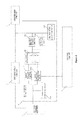
- FIG. 1 is a block diagram illustrating a first conventional UPS.
- the UPS includes an input filtering circuit 1, a rectification circuit 2, an inversion circuit 3, a static transfer switch 4, an output filtering circuit 5, a control circuit 6, an auxiliary circuit 7, an DC/DC circuit A, a rechargeable battery B and a charging circuit C.
- the input filtering circuit 1, the rectification circuit 2, the inversion circuit 3, the static transfer switch 4 and the output filtering circuit 5 are connected sequentially; and the output terminal of the input filtering circuit 1 is connected with the input terminal of the static transfer switch 4.
- the charging circuit C is connected between the rechargeable battery B and the output terminal of the input filtering circuit 1.
- the DC/DC circuit A is connected between the rechargeable battery B and the output terminal of the rectification circuit 2.
- the DC/DC circuit A, the rectification circuit 2, the inversion circuit 3 and the static transfer switch 4 are all controlled by the control circuit 6.
- the rechargeable battery B powers the auxiliary circuit 7.
- the rechargeable battery B In a mains power mode of the UPS, the rechargeable battery B is charged, by the mains power via the input filtering circuit 1 and then the charging circuit C.
- the rechargeable battery B is discharged, via the DC/DC circuit A to supply an input voltage to the inversion circuit 3.
- FIG. 2 is a block diagram illustrating a second conventional UPS.
- the second UPS differs from the first UPS in that: the charging circuit C is connected between the rechargeable battery B and the output terminal of the rectification circuit 2.
- the rechargeable battery B is charged, by the mains power via the input filtering circuit 1, the rectification circuit 2 and then the charging circuit C; in a battery mode of the UPS, the rechargeable battery B is discharged, via the DC/DC circuit A to supply an input voltage to the inversion circuit 3.
- the rechargeable battery B is charged using an independent charging circuit C, causing a complex circuit structure and a higher cost.
- a technical problem to be solved by the present invention is to provide a UPS control circuit and a UPS.
- a UPS control circuit connected with a rechargeable battery including an input filtering circuit, a rectification circuit, an inversion circuit, a static transfer switch, an output filtering circuit, a control circuit, and an auxiliary circuit, the input filtering circuit, the rectification circuit, the inversion circuit, the static transfer switch, and the output filtering circuit being connected sequentially, an output terminal of the input filtering circuit being connected with an input terminal of the static transfer switch, and the rectification circuit, the inversion circuit, and the static transfer switch all being controlled by the control circuit
- the control circuit further includes a multipurpose DC/DC circuit connected between an output terminal of the rectification circuit and the rechargeable battery, and the multipurpose DC/DC circuit is controlled by the control circuit, so that in a battery mode, the rechargeable battery supplies an input voltage to the inversion circuit via the multipurpose DC/DC circuit; and in a mains power mode, the rechargeable battery is charged by an output voltage of the rectification circuit via the multipurpose DC
- the multipurpose DC/DC circuit may include a battery/mains power selector switch and an isolation transformer, a primary side of the isolation transformer is provided with a first switching transistor group, a first rectification circuit, and a first filter capacitor group, and a secondary side of the isolation transformer is provided with a second switching transistor group, a second rectification circuit, and a second filter capacitor group,
- the battery/mains power selector switch is a manually-operated switch, or an electrically-operated switch controlled by the control circuit, when the battery mode is selected by the battery/mains power selector switch, the control circuit controls the first switching transistor group to be rapidly switched between on and off, so that an output voltage of the rechargeable battery is converted into a first AC voltage, which is applied to the primary side of the isolation transformer, resulting in a second AC voltage on the secondary side of the isolation transformer; at the same time, the control circuit controls the second switching transistor group to be turned off, so that the second AC voltage is converted into a DC voltage via the second
- the first switching transistor group may include a first switching transistor and a second switching transistor, each of the first switching transistor and the second switching transistor includes a body diode, the first rectification circuit is a half-wave rectification circuit formed by the body diode of the first switching transistor and the body diode of the second switching transistor, the first filter capacitor group may include a first capacitor, the second switching transistor group may include a third switching transistor and a fourth switching transistor, the second rectification circuit may be a bridge rectifier, and the second filter capacitor group may include a third capacitor and a fourth capacitor, an anode of the rechargeable battery is connected to a center tap of the primary winding of the isolation transformer via the battery/mains power selector switch, a cathode of the rechargeable battery is connected to a dotted terminal of the primary winding of the isolation transformer via the first switching transistor, and is connected to a non-dotted terminal of the primary winding of the isolation transformer via the second switching transistor, and the first capacitor is connected between
- the second switching transistor group may further include a fifth switching transistor and a sixth switching transistor, and the positive output terminal of the bridge rectifier is connected to the negative output terminal of the bridge rectifier via the fifth switching transistor and the sixth switching transistor, with an intersection of the fifth switching transistor and the sixth switching transistor connected to the non-dotted terminal of the secondary winding of the isolation transformer.
- the multipurpose DC/DC circuit may include an isolation transformer, a primary side of the isolation transformer is provided with a first switching transistor group, a first rectification circuit, and a first filter capacitor group, and a secondary side of the isolation transformer is provided with a second switching transistor group, a second rectification circuit, and a second filter capacitor group, in the battery mode, the control circuit controls the first switching transistor group to be rapidly switched between on and off, so that an output voltage of the rechargeable battery is converted into a first AC voltage, which is applied to the primary side of the isolation transformer, resulting in a second AC voltage on the secondary side of the isolation transformer; at the same time, the control circuit controls the second switching transistor group to be turned off, so that the second AC voltage is converted into a DC voltage via the second rectification circuit and the second filter capacitor group, to supply an input voltage to the inversion circuit; and in the mains power mode, the control circuit controls the second switching transistor group to be rapidly switched between on and off, so that an output voltage of the
- the first switching transistor group may include a first switching transistor, a second switching transistor, a third switching transistor, and a fourth switching transistor, each of the first switching transistor, the second switching transistor, the third switching transistor, and the fourth switching transistor includes a body diode
- the first rectification circuit is a full-wave rectification circuit formed by the body diode of the first switching transistor, the body diode of the second switching transistor, the body diode of the third switching transistor, and the body diode of the fourth switching transistor
- the first filter capacitor group may include a first capacitor
- the second switching transistor group may include a fifth switching transistor and a sixth switching transistor
- the second rectification circuit may be a bridge rectifier
- the second filter capacitor group may include a third capacitor and a fourth capacitor
- an anode of the rechargeable battery is connected to a cathode of the rechargeable battery via the first switching transistor and the second switching transistor, and the anode of the rechargeable battery is also connected to the cathode of the
- the second switching transistor group may further include a seventh switching transistor and an eighth switching transistor, and the positive output terminal of the bridge rectifier is connected to the negative output terminal of the bridge rectifier via the seventh switching transistor and the eighth switching transistor, with an intersection of the seventh switching transistor and the eighth switching transistor connected to the non-dotted terminal of the secondary winding of the isolation transformer.
- the multipurpose DC/DC circuit may include an isolation transformer, a primary side of the isolation transformer is provided with a first switching transistor group, a first rectification circuit, a first filter capacitor group, and a resonant circuit, and a secondary side of the isolation transformer is provided with a second switching transistor group, a second rectification circuit, and a second filter capacitor group, in the battery mode, the control circuit controls the first switching transistor group to be rapidly switched between on and off, so that an output voltage of the rechargeable battery is converted via the resonant circuit into a first AC voltage, which is applied to the primary side of the isolation transformer, resulting in a second AC voltage on the secondary side of the isolation transformer; at the same time, the control circuit controls the second switching transistor group to be turned off, so that the second AC voltage is converted into a DC voltage via the second rectification circuit and the second filter capacitor group, to supply an input voltage to the inversion circuit, and in the mains power mode, the control circuit controls the second switching transistor group to
- the first switching transistor group may include a first switching transistor, a second switching transistor, a third switching transistor, and a fourth switching transistor
- the first filter capacitor group may include a first capacitor
- the first rectification circuit may include a charging capacitor and an induction coil
- the second switching transistor group may include a fifth switching transistor and a sixth switching transistor
- the second rectification circuit may be a bridge rectifier
- the second filter capacitor group may include a third capacitor and a fourth capacitor
- an anode of the rechargeable battery is connected to a cathode of the rechargeable battery via the first switching transistor and the second switching transistor
- the anode of the rechargeable battery is also connected to the cathode of the rechargeable battery via the third switching transistor and the fourth switching transistor, with an intersection of the first switching transistor and the second switching transistor connected to a dotted terminal of the primary winding of the isolation transformer via the charging capacitor and then the induction coil, and an intersection of the third switching transistor and the fourth switching transistor connected to a non-dotted terminal
- a UPS including a rechargeable battery and a UPS control circuit connected with the rechargeable battery, the UPS control circuit being any one of the above UPS control circuits.
- a multipurpose DC/DC circuit is connected between an output terminal of a rectification circuit 2 and a rechargeable battery B, so that in a mains power mode, the rechargeable battery is charged by the mains power via an input filtering circuit, the rectification circuit, and the multipurpose DC/DC circuit; and in a battery mode, the rechargeable battery supplies an input voltage to an inversion circuit via the multipurpose DC/DC circuit. Therefore, the multipurpose DC/DC circuit incorporates the charging and discharging functions, eliminating the need for an independent charging circuit to charge the rechargeable battery, resulting in a simpler circuit structure and a lower cost, and providing greater value to the customer.
- FIG. 1 is a block diagram illustrating a first conventional UPS
- FIG. 2 is a block diagram illustrating a second conventional UPS
- FIG. 3 is a block diagram illustrating a UPS according to the present invention.
- FIG. 4 is a block diagram illustrating a multipurpose DC/DC circuit according to a first embodiment of the present invention
- FIG. 5 is a circuit diagram illustrating a first preferred embodiment of FIG. 4 ;
- FIG. 6 is a circuit diagram illustrating a second preferred embodiment of FIG. 4 ;
- FIG. 7 is a circuit diagram illustrating a third preferred embodiment of FIG. 4 ;
- FIG. 8 is a block diagram illustrating a multipurpose DC/DC circuit according to a second embodiment of the present invention.
- FIG. 9 is a circuit diagram illustrating a first preferred embodiment of FIG. 8 ;
- FIG. 10 is a circuit diagram illustrating a second preferred embodiment of FIG. 8 ;
- FIG. 11 is a circuit diagram illustrating a third preferred embodiment of FIG. 8 ;
- FIG. 12 is a block diagram illustrating a multipurpose DC/DC circuit according to a third embodiment of the present invention.
- FIG. 13 is a circuit diagram illustrating a first preferred embodiment of FIG. 12 ;
- FIG. 14 is a circuit diagram illustrating a second preferred embodiment of FIG. 12 .
- FIG. 15 is a circuit diagram illustrating a third preferred embodiment of FIG. 12 .
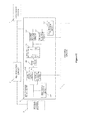
- FIG. 3 is a block diagram illustrating a UPS according to the present invention.
- the UPS includes a rechargeable battery B and a UPS control circuit connected with the rechargeable battery B.
- the UPS control circuit includes an input filtering circuit 1, a rectification circuit 2, an inversion circuit 3, a static transfer switch 4, an output filtering circuit 5, a control circuit 6, and a multipurpose DC/DC circuit 8.
- the input filtering circuit 1, the rectification circuit 2, the inversion circuit 3, the static transfer switch 4, and the output filtering circuit 5 are connected sequentially, and an output terminal of the input filtering circuit 1 is connected with an input terminal of the static transfer switch 4.
- the rectification circuit 2, the inversion circuit 3, the static transfer switch 4, and the multipurpose DC/DC circuit 8 are all connected with and controlled by the control circuit 6.
- the multipurpose DC/DC circuit is connected between the output terminal of the rectification circuit 2 and the rechargeable battery B.
- the rechargeable battery supplies an input voltage to the inversion circuit 3 via the multipurpose DC/DC circuit 8.
- the rechargeable battery B is charged by an output voltage of the rectification circuit 2 via the multipurpose DC/DC circuit 8.
- the multipurpose DC/DC circuit 8 is connected between the output terminal of the rectification circuit 2 and the rechargeable battery B, and the multipurpose DC/DC circuit A is connected with and controlled by the control circuit 6.
- the rechargeable battery In the battery mode, the rechargeable battery is charged by the mains power via the input filtering circuit 1, the rectification circuit 2, and the multipurpose DC/DC circuit 8.
- the rechargeable battery In the mains power mode, the rechargeable battery supplies an input voltage to the inversion circuit 3 via the multipurpose DC/DC circuit 8.
- the multipurpose DC/DC circuit 8 incorporates the charging and discharging functions, eliminating the need for an independent charging circuit to charge the rechargeable battery B, resulting in a simpler circuit structure and a lower cost of the UPS control circuit, and providing greater value to the customer.
- the UPS according to the embodiment of the present invention may further include an auxiliary circuit 7 arranged between the multipurpose DC/DC circuit 8 and the rechargeable battery B.
- FIG. 4 is a block diagram illustrating a multipurpose DC/DC circuit according to a first embodiment of the present invention.
- the multipurpose DC/DC circuit 8 includes a battery/mains power selector switch 100 and an isolation transformer 101.
- a primary side of the isolation transformer 101 is provided with a first switching transistor group 103, a first rectification circuit 102, and a first filter capacitor group 104.
- a secondary side of the isolation transformer 101 is provided with a second switching transistor group 106, a second rectification circuit 105, and a second filter capacitor group 107.
- the first switching transistor group 103 and the second switching transistor group 106 are all controlled by the control circuit 6.
- the output terminal of the rechargeable battery B is connected to the primary side of the isolation transformer 101 via the battery/mains power selector switch 100 and then the first rectification circuit 102. Meanwhile, the output terminal of the rechargeable battery B is also connected to the primary side of the isolation transformer 101 via the battery/mains power selector switch 100 and then the first switching transistor group 103. Moreover, the first filter capacitor group 104 is connected to the output terminal of the battery/mains power selector switch 100 (i.e., the intersection between the battery/mains power selector switch 100 and the first rectification circuit 102). The secondary side of the isolation transformer 101 is connected to the input terminal of a conversion circuit 3 (i.e., the inversion circuit 3 in Figure 3 ) via the second rectification circuit 105. Meanwhile, the secondary side of the isolation transformer 101 is also connected to the input terminal of the conversion circuit 3 via the second switching transistor group 106. The second filter capacitor group 107 is connected to the input terminal of the conversion circuit 3.
- a conversion circuit 3 i.e., the inversion circuit 3
- the control circuit 6 controls the first switching transistor group 103 to be rapidly switched between on and off, so that an output voltage of the rechargeable battery B is converted into a first AC voltage, which is applied to the primary side of the isolation transformer 101, resulting in a second AC voltage on the secondary side of the isolation transformer 101.
- the control circuit 6 controls the second switching transistor group 106 to be turned off, so that the second AC voltage is converted into a DC voltage via the second rectification circuit 105 and the second filter capacitor group 107, to supply an input voltage to the conversion circuit 3.
- the control circuit 6 controls the second switching transistor group 106 to be rapidly switched between on and off, so that an output voltage of the rectification circuit 2 is converted into a third AC voltage, which is applied to the secondary side of the isolation transformer 101, resulting in a fourth AC voltage on the primary side of the isolation transformer 101.
- the fourth AC voltage is converted into a DC voltage via the first rectification circuit 102 and the first filter capacitor group 104, to charge the rechargeable battery B.
- the battery/mains power selector switch 100 may be a manually-operated switch, or an electrically-operated switch controlled by the control circuit 6.
- FIG. 5 is a circuit diagram illustrating a first preferred embodiment of FIG. 4 .
- the first switching transistor group 103 includes a first switching transistor Q1 and a second switching transistor Q2.
- Each of the first switching transistor Q1 and the second switching transistor Q2 includes a body diode.
- the first rectification circuit 102 is a half-wave rectification circuit formed by the body diode of the first switching transistor Q1 and the body diode of the second switching transistor Q2.
- the first filter capacitor group 104 includes a first capacitor C1.
- the second switching transistor group 106 includes a third switching transistor Q3 and a fourth switching transistor Q4.
- the second rectification circuit 105 is a bridge rectifier D.
- the second filter capacitor group 107 includes a third capacitor C3 and a fourth capacitor C4.
- the anode of the rechargeable battery B is connected to a center tap of the primary winding of the isolation transformer 101 via the battery/mains power selector switch 100.
- the cathode of the rechargeable battery B is connected to a dotted terminal of the primary winding of the isolation transformer 101 via the first switching transistor Q1, and is connected to a non-dotted terminal of the primary winding of the isolation transformer 101 via the second switching transistor Q2.
- the first capacitor C1 is connected between the center tap of the primary winding of isolation transformer 101 and the cathode of the rechargeable battery B.
- a first diode D1 is arranged between the center tap of the primary winding of the isolation transformer 101 and the anode of the rechargeable battery B.
- the anode of the first diode D1 is connected with the center tap of the primary winding of the isolation transformer 101, and the cathode of the first diode D1 is connected with the anode of the rechargeable battery B.
- the battery/mains power selector switch 100 When the mains power mode is selected by the battery/mains power selector switch 100, the battery/mains power selector switch 100 is open, and the rechargeable battery B is charged by a charging current via the first diode D1, thereby preventing ripple which may affect the rechargeable battery B.
- a dotted terminal of the secondary winding of the isolation transformer 101 is connected to a positive input terminal I+ of the bridge rectifier D.
- a non-dotted terminal of the secondary winding of the isolation transformer 101 is connected to a negative input terminal I- of the bridge rectifier D.
- a positive output terminal O+ of the bridge rectifier D is connected to a negative output terminal O- of the bridge rectifier D via the third switching transistor Q3 and then the fourth switching transistor Q4, with an intersection of the third switching transistor Q3 and the fourth switching transistor Q4 connected to the non-dotted terminal of the secondary winding of the isolation transformer 101.
- the positive output terminal O+ of the bridge rectifier D is also connected to the negative output terminal O- of the bridge rectifier D via the third capacitor C3 and then the fourth capacitor C4, with an intersection of the third capacitor C3 and the fourth capacitor C4 connected to a center tap of the secondary winding of the isolation transformer 101.
- the battery mode is selected when the battery/mains power selector switch 100 is closed.
- the mains power mode is selected when the battery/mains power selector switch 100 is open.
- FIG. 6 is a circuit diagram illustrating a second preferred embodiment of FIG. 4 .
- the second preferred embodiment differs from the first embodiment shown in Figure 5 in that:
- the intersection of the third switching transistor Q3 and the fourth switching transistor Q4 is connected to the dotted terminal of the secondary winding of the isolation transformer 101.
- FIG. 7 is a circuit diagram illustrating a third preferred embodiment of FIG. 4 .
- the third preferred embodiment differs from the second embodiment shown in Figure 6 in that: the second switching transistor group 106 further includes a fifth switching transistor Q5 and a sixth switching transistor Q6.
- the positive output terminal O+ of the bridge rectifier D is connected to the negative output terminal Q- of the bridge rectifier D via the fifth switching transistor Q5 and then the sixth switching transistor Q6, with an intersection of the fifth switching transistor Q5 and the sixth switching transistor Q6 connected to the non-dotted terminal of the secondary winding of the isolation transformer 101.
- FIG. 8 is a block diagram illustrating a multipurpose DC/DC circuit according to a second embodiment of the present invention.
- the multipurpose DC/DC circuit 8 includes an isolation transformer 101.
- a primary side of the isolation transformer 101 is provided with a first switching transistor group 103, a first rectification circuit 102, and a first filter capacitor group 104.
- a secondary side of the isolation transformer 101 is provided with a second switching transistor group 106, a second rectification circuit 105, and a second filter capacitor group 107.
- the output terminal of the rechargeable battery B is connected to the primary side of the isolation transformer 101 via the first rectification circuit 102.
- the output terminal of the rechargeable battery B is also connected to the primary side of the isolation transformer 101 via the first switching transistor group 103.
- the first filter capacitor group 104 is connected to the output terminal of the rechargeable battery B.
- the secondary side of the isolation transformer 101 is connected to the input terminal of the conversion circuit 3 via the second rectification circuit 105. Meanwhile, the secondary side of the isolation transformer 101 is also connected to the input terminal of the conversion circuit 3 via the second switching transistor group 106.
- the second filter capacitor group 107 is connected to the input terminal of the conversion circuit 3.
- the control circuit 6 controls the first switching transistor group 103 to be rapidly switched between on and off, so that an output voltage of the rechargeable battery B is converted via the first rectification circuit 102 into a first AC voltage, which is applied to the primary side of the isolation transformer 101, resulting in a second AC voltage on the secondary side of the isolation transformer 101.
- the control circuit 6 controls the second switching transistor group 106 to be turned off, so that the second AC voltage is converted into a DC voltage via the second rectification circuit 105 and the second filter capacitor group 107, to supply an input voltage to the conversion circuit 3.
- the control circuit 6 controls the second switching transistor group 106 to be rapidly switched between on and off, so that an output voltage of the rectification circuit 2 is converted into a third AC voltage, which is applied to the secondary side of the isolation transformer 101, resulting in a fourth AC voltage on the primary side of the isolation transformer 101.
- the fourth AC voltage is converted into a DC voltage via the first rectification circuit 104 and the first filter capacitor group 102, to charge the rechargeable battery B.
- control circuit 6 may automatically detect whether the mains power is in a normal state, and charge the rechargeable battery B with the mains power when the mains power is normal; and initiate the UPS to power the load in a battery mode when the mains power fails.
- control circuit 6 may monitor the charge stored in the rechargeable battery B, in order to prevent overcharging and overdischarging.
- FIG. 9 is a circuit diagram illustrating a first preferred embodiment of FIG. 8 .
- the first switching transistor group 103 includes a first switching transistor Q1, a second switching transistor Q2, a third switching transistor Q3, and a fourth switching transistor Q4.
- the first rectification circuit 102 is a full-wave rectification circuit formed by the body diode of the first switching transistor Q1, the body diode of the second switching transistor Q2, the body diode of the third switching transistor Q3, and the body diode of the fourth switching transistor Q4.
- the first filter capacitor group 104 includes a first capacitor C1.
- the second switching transistor group 106 includes a fifth switching transistor Q5 and a sixth switching transistor Q6.
- the second rectification circuit 105 is a bridge rectifier D.
- the second filter capacitor group 107 includes a third capacitor C3 and a fourth capacitor C4.
- the anode of the rechargeable battery B is connected to the cathode of the rechargeable battery B via the first switching transistor Q1 and the second switching transistor Q2.
- the anode of the rechargeable battery B is also connected to the cathode of the rechargeable battery B via the third switching transistor Q3 and the fourth switching transistor Q4.
- An intersection of the first switching transistor Q1 and the second switching transistor Q2 is connected to a dotted terminal of the primary winding of the isolation transformer 101.
- An intersection of the third switching transistor Q3 and the fourth switching transistor Q4 is connected to a non-dotted terminal of the primary winding of the isolation transformer 101.
- the first capacitor C1 is connected between the anode and the cathode of the rechargeable battery B.
- a dotted terminal of the secondary winding of the isolation transformer 101 is connected to a positive input terminal I+ of the bridge rectifier D.
- a non-dotted terminal of the secondary winding of the isolation transformer 101 is connected to a negative input terminal I- of the bridge rectifier D.
- a positive output terminal O+ of the bridge rectifier D is connected to a negative output terminal O- of the bridge rectifier D via the fifth switching transistor Q5 and then the sixth switching transistor Q6, with an intersection of the fifth switching transistor Q5 and the sixth switching transistor Q6 connected to the non-dotted terminal of the secondary winding of the isolation transformer 101.
- the positive output terminal O+ of the bridge rectifier D is connected to the negative output terminal O- of the bridge rectifier D via the third capacitor C3 and then the fourth capacitor C4, with an intersection of the third capacitor C3 and the fourth capacitor C4 connected to a center tap of the secondary winding of the isolation transformer 101.
- FIG. 10 is a circuit diagram illustrating a second preferred embodiment of FIG. 8 .
- the second preferred embodiment differs from the first preferred embodiment shown in Figure 9 in that: the intersection of the fifth switching transistor Q5 and the sixth switching transistor Q6 is connected to the dotted terminal of the secondary winding of the isolation transformer 101.
- FIG. 11 is a circuit diagram illustrating a third preferred embodiment of FIG. 8 .
- the third preferred embodiment differs from the second embodiment shown in Figure 10 in that: the second switching transistor group 106 further includes a seventh switching transistor Q7 and an eighth switching transistor Q8.
- the positive output terminal O+ of the bridge rectifier D is connected to the negative output terminal Q- of the bridge rectifier D via the seventh switching transistor Q7 and then the eighth switching transistor Q8, with an intersection of the seventh switching transistor Q7 and the eighth switching transistor Q8 connected to the non-dotted terminal of the secondary winding of the isolation transformer 101.
- FIG. 12 is a block diagram illustrating a multipurpose DC/DC circuit according to a third embodiment of the present invention.
- the multipurpose DC/DC circuit 8 includes an isolation transformer 101.
- a primary side of the isolation transformer 101 is provided with a first switching transistor group 103, a first filter capacitor group 104, a first rectification circuit 102, and a resonant circuit 108.
- a secondary side of the isolation transformer 101 is provided with a second switching transistor group 106, a second rectification circuit 105, and a second filter capacitor group 107.
- the output terminal of the rechargeable battery B is connected to the primary side of the isolation transformer 101 via the first rectification circuit 102 and the resonant circuit 108. Meanwhile, the output terminal of the rechargeable battery B is also connected to the primary side of the isolation transformer 101 via the first switching transistor group 103 and the resonant circuit 108.
- the first filter capacitor group 104 is connected to the output terminal of the rechargeable battery B.
- the secondary side of the isolation transformer 101 is connected to the input terminal of the conversion circuit 3 via the second rectification circuit 105. Meanwhile, the secondary side of the isolation transformer 101 is also connected to the input terminal of the conversion circuit 3 via the second switching transistor group 106.
- the second filter capacitor group 107 is connected to the input terminal of the conversion circuit 3.
- the control circuit 6 controls the first switching transistor group 103 to be rapidly switched between on and off, so that an output voltage of the rechargeable battery B is converted via the resonant circuit 108 into a first AC voltage, which is applied to the primary side of the isolation transformer 101, resulting in a second AC voltage on the secondary side of the isolation transformer 101.
- the control circuit 6 controls the second switching transistor group 106 to be turned off, so that the second AC voltage is converted into a DC voltage via the second rectification circuit 105 and the second filter capacitor group 107, to supply an input voltage to the inversion circuit 3.
- the control circuit 6 controls the second switching transistor group 106 to be rapidly switched between on and off, so that an output voltage of the rectification circuit 2 is converted into a third AC voltage, which is applied to the secondary side of the isolation transformer 101, resulting in a fourth AC voltage on the primary side of the isolation transformer 101.
- the fourth AC voltage is converted into a DC voltage via the resonant circuit 108, the first rectification circuit 102 and the first filter capacitor group 104, to charge the rechargeable battery B.
- the resonant circuit 108 can improve the power factor.
- FIG. 13 is a circuit diagram illustrating a first preferred embodiment of FIG. 12 .
- the first switching transistor group 103 includes a first switching transistor Q1, a second switching transistor Q2, a third switching transistor Q3, and a fourth switching transistor Q4.
- the first rectification circuit 102 is a full-wave rectification circuit formed by the body diode of the first switching transistor Q1, the body diode of the second switching transistor Q2, the body diode of the third switching transistor Q3, and the body diode of the fourth switching transistor Q4.
- the first filter capacitor group 104 includes a first capacitor C1.
- the resonant circuit 108 includes a charging capacitor Cc and an induction coil L1.
- the second switching transistor group 106 includes a fifth switching transistor Q5 and a sixth switching transistor Q6.
- the second rectification circuit 102 is a bridge rectifier D.
- the second filter capacitor group 107 includes a third capacitor C3 and a fourth capacitor C4.
- the anode of the rechargeable battery B is connected to the cathode of the rechargeable battery B via the first switching transistor Q1 and the second switching transistor Q2.
- the anode of the rechargeable battery B is also connected to the cathode of the rechargeable battery B via the third switching transistor Q3 and the fourth switching transistor Q4.
- An intersection of the first switching transistor Q1 and the second switching transistor Q2 is connected to a dotted terminal of the primary winding of the isolation transformer 101 via the charging capacitor Cc and then the induction coil L1.
- An intersection of the third switching transistor Q3 and the fourth switching transistor Q4 is connected to a non-dotted terminal of the primary winding of the isolation transformer 101.
- the first capacitor C1 is connected between the anode and the cathode of the rechargeable battery B.
- a dotted terminal of the secondary winding of the isolation transformer 101 is connected to a positive input terminal I+ of the bridge rectifier D.
- a non-dotted terminal of the secondary winding of the isolation transformer 101 is connected to a negative input terminal I- of the bridge rectifier D.
- a positive output terminal O+ of the bridge rectifier D is connected to a negative output terminal O- of the bridge rectifier D via the fifth switching transistor Q5 and then the sixth switching transistor Q6, with an intersection of the fifth switching transistor Q5 and the sixth switching transistor Q6 connected to the non-dotted terminal of the secondary winding of the isolation transformer 101.
- the positive output terminal O+ of the bridge rectifier D is connected to the negative output terminal O- of the bridge rectifier D via the third capacitor C3 and then the fourth capacitor C4, with an intersection of the third capacitor C3 and the fourth capacitor C4 connected to a center tap of the secondary winding of the isolation transformer 101.
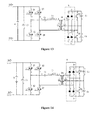
- FIG. 14 is a circuit diagram illustrating a second preferred embodiment of FIG. 12 .
- the second preferred embodiment differs from the first preferred embodiment shown in Figure 13 in that:
- the intersection of the fifth switching transistor Q5 and the sixth switching transistor Q6 is connected to the dotted terminal of the secondary winding of the isolation transformer 101.
- FIG. 15 is a circuit diagram illustrating a third preferred embodiment of FIG. 12 .
- the third preferred embodiment differs from the first preferred embodiment shown in Figure 14 in that: the second switching transistor group 106 further includes a seventh switching transistor Q7 and an eighth switching transistor Q8.
- the positive output terminal O+ of the bridge rectifier D is connected to the negative output terminal Q- of the bridge rectifier D via the seventh switching transistor Q7 and then the eighth switching transistor Q8, with an intersection of the seventh switching transistor Q7 and the eighth switching transistor Q8 connected to the non-dotted terminal of the secondary winding of the isolation transformer 101.
- any one or more of the first switching transistor Q1, the second switching transistor Q2,..., and the eighth switching transistor Q8 may be an IGBT, or a MOSFET, or any other switching transistor.
- the control circuit 6 can adjust charging and discharging voltage/current by adjusting duty cycles of switching on/off of those switching transistors.
- the present invention also provides a UPS including a rechargeable battery B and a UPS control circuit connected with the rechargeable battery.
- the UPS control circuit may be any one of the above UPS control circuits, the details of which are omitted here.
Landscapes
- Engineering & Computer Science (AREA)
- Power Engineering (AREA)
- Business, Economics & Management (AREA)
- Emergency Management (AREA)
- Charge And Discharge Circuits For Batteries Or The Like (AREA)
- Dc-Dc Converters (AREA)
Abstract
Description
- This application claims the benefit of Chinese patent application No.
201010520653.4 - The present invention relates to the field of power supplies, and more particularly to an Uninterruptible power supply (UPS) control circuit and a UPS.
- Generally, the designs of conventional UPSs can be classified into the following two categories.
- UPSs with isolation generally use flyback conversion, or in some cases two-switch forward conversion.
- UPSs without isolation may use a buck circuit as a step-down converter, or a buck-boost circuit as a step-down/step-up converter.
- These conventional UPSs are designed with separately arranged chargers. In a UPS, the charger is an independent component regardless of how it is connected to the UPS.
-
Figure 1 is a block diagram illustrating a first conventional UPS. As shown inFigure 1 , the UPS includes aninput filtering circuit 1, arectification circuit 2, aninversion circuit 3, astatic transfer switch 4, anoutput filtering circuit 5, acontrol circuit 6, anauxiliary circuit 7, an DC/DC circuit A, a rechargeable battery B and a charging circuit C. Specifically, theinput filtering circuit 1, therectification circuit 2, theinversion circuit 3, thestatic transfer switch 4 and theoutput filtering circuit 5 are connected sequentially; and the output terminal of theinput filtering circuit 1 is connected with the input terminal of thestatic transfer switch 4. The charging circuit C is connected between the rechargeable battery B and the output terminal of theinput filtering circuit 1. The DC/DC circuit A is connected between the rechargeable battery B and the output terminal of therectification circuit 2. The DC/DC circuit A, therectification circuit 2, theinversion circuit 3 and thestatic transfer switch 4 are all controlled by thecontrol circuit 6. Moreover, the rechargeable battery B powers theauxiliary circuit 7. In a mains power mode of the UPS, the rechargeable battery B is charged, by the mains power via theinput filtering circuit 1 and then the charging circuit C. In a battery mode of the UPS, the rechargeable battery B is discharged, via the DC/DC circuit A to supply an input voltage to theinversion circuit 3. -
Figure 2 is a block diagram illustrating a second conventional UPS. As shown inFigure 2 , the second UPS differs from the first UPS in that: the charging circuit C is connected between the rechargeable battery B and the output terminal of therectification circuit 2. Similarly, in a mains power mode of the UPS, the rechargeable battery B is charged, by the mains power via theinput filtering circuit 1, therectification circuit 2 and then the charging circuit C; in a battery mode of the UPS, the rechargeable battery B is discharged, via the DC/DC circuit A to supply an input voltage to theinversion circuit 3. - As can be seen, in the conventional UPSs, the rechargeable battery B is charged using an independent charging circuit C, causing a complex circuit structure and a higher cost.
- In view of the disadvantages in the prior art that the conventional UPSs charges the rechargeable battery using an independent charging circuit, causing a complex circuit structure and a higher cost of the UPS, a technical problem to be solved by the present invention is to provide a UPS control circuit and a UPS.
- In order to achieve the above object, according to the present invention, there is provided a UPS control circuit connected with a rechargeable battery including an input filtering circuit, a rectification circuit, an inversion circuit, a static transfer switch, an output filtering circuit, a control circuit, and an auxiliary circuit, the input filtering circuit, the rectification circuit, the inversion circuit, the static transfer switch, and the output filtering circuit being connected sequentially, an output terminal of the input filtering circuit being connected with an input terminal of the static transfer switch, and the rectification circuit, the inversion circuit, and the static transfer switch all being controlled by the control circuit,
the control circuit further includes a multipurpose DC/DC circuit connected between an output terminal of the rectification circuit and the rechargeable battery, and
the multipurpose DC/DC circuit is controlled by the control circuit, so that in a battery mode, the rechargeable battery supplies an input voltage to the inversion circuit via the multipurpose DC/DC circuit; and in a mains power mode, the rechargeable battery is charged by an output voltage of the rectification circuit via the multipurpose DC/DC circuit. - In the above UPS control circuit according to the present invention, the multipurpose DC/DC circuit may include a battery/mains power selector switch and an isolation transformer, a primary side of the isolation transformer is provided with a first switching transistor group, a first rectification circuit, and a first filter capacitor group, and a secondary side of the isolation transformer is provided with a second switching transistor group, a second rectification circuit, and a second filter capacitor group,
the battery/mains power selector switch is a manually-operated switch, or an electrically-operated switch controlled by the control circuit,
when the battery mode is selected by the battery/mains power selector switch, the control circuit controls the first switching transistor group to be rapidly switched between on and off, so that an output voltage of the rechargeable battery is converted into a first AC voltage, which is applied to the primary side of the isolation transformer, resulting in a second AC voltage on the secondary side of the isolation transformer; at the same time, the control circuit controls the second switching transistor group to be turned off, so that the second AC voltage is converted into a DC voltage via the second rectification circuit and the second filter capacitor group, to supply an input voltage to the inversion circuit, and
when the mains power mode is selected by the battery/mains power selector switch, the control circuit controls the second switching transistor group to be rapidly switched between on and off, so that an output voltage of the rectification circuit is converted into a third AC voltage, which is applied to the secondary side of the isolation transformer, resulting in a fourth AC voltage on the primary side of the isolation transformer, and the fourth AC voltage is converted into a DC voltage via the first rectification circuit and the first filter capacitor group, to charge the rechargeable battery. - In the above UPS control circuit according to the present invention, the first switching transistor group may include a first switching transistor and a second switching transistor, each of the first switching transistor and the second switching transistor includes a body diode, the first rectification circuit is a half-wave rectification circuit formed by the body diode of the first switching transistor and the body diode of the second switching transistor, the first filter capacitor group may include a first capacitor, the second switching transistor group may include a third switching transistor and a fourth switching transistor, the second rectification circuit may be a bridge rectifier, and the second filter capacitor group may include a third capacitor and a fourth capacitor,
an anode of the rechargeable battery is connected to a center tap of the primary winding of the isolation transformer via the battery/mains power selector switch, a cathode of the rechargeable battery is connected to a dotted terminal of the primary winding of the isolation transformer via the first switching transistor, and is connected to a non-dotted terminal of the primary winding of the isolation transformer via the second switching transistor, and the first capacitor is connected between the center tap of the primary winding of isolation transformer and the cathode of the rechargeable battery, and
a dotted terminal of the secondary winding of the isolation transformer is connected to a positive input terminal of the bridge rectifier, a non-dotted terminal of the secondary winding of the isolation transformer is connected to a negative input terminal of the bridge rectifier, a positive output terminal of the bridge rectifier is connected to a negative output terminal of the bridge rectifier via the third switching transistor and then the fourth switching transistor, with an intersection of the third switching transistor and the fourth switching transistor connected to the non-dotted terminal or the dotted terminal of the secondary winding of the isolation transformer, and the positive output terminal of the bridge rectifier is also connected to the negative output terminal of the bridge rectifier via the third capacitor and then the fourth capacitor, with an intersection of the third capacitor and the fourth capacitor connected to a center tap of the secondary winding of the isolation transformer. - In the above UPS control circuit according to the present invention, the second switching transistor group may further include a fifth switching transistor and a sixth switching transistor, and the positive output terminal of the bridge rectifier is connected to the negative output terminal of the bridge rectifier via the fifth switching transistor and the sixth switching transistor, with an intersection of the fifth switching transistor and the sixth switching transistor connected to the non-dotted terminal of the secondary winding of the isolation transformer.
- In the above UPS control circuit according to the present invention, the multipurpose DC/DC circuit may include an isolation transformer, a primary side of the isolation transformer is provided with a first switching transistor group, a first rectification circuit, and a first filter capacitor group, and a secondary side of the isolation transformer is provided with a second switching transistor group, a second rectification circuit, and a second filter capacitor group,
in the battery mode, the control circuit controls the first switching transistor group to be rapidly switched between on and off, so that an output voltage of the rechargeable battery is converted into a first AC voltage, which is applied to the primary side of the isolation transformer, resulting in a second AC voltage on the secondary side of the isolation transformer; at the same time, the control circuit controls the second switching transistor group to be turned off, so that the second AC voltage is converted into a DC voltage via the second rectification circuit and the second filter capacitor group, to supply an input voltage to the inversion circuit; and
in the mains power mode, the control circuit controls the second switching transistor group to be rapidly switched between on and off, so that an output voltage of the rectification circuit is converted into a third AC voltage, which is applied to the secondary side of the isolation transformer, resulting in a fourth AC voltage on the primary side of the isolation transformer, and the fourth AC voltage is converted into a DC voltage via the first rectification circuit and the first filter capacitor group, to charge the rechargeable battery. - In the above UPS control circuit according to the present invention, the first switching transistor group may include a first switching transistor, a second switching transistor, a third switching transistor, and a fourth switching transistor, each of the first switching transistor, the second switching transistor, the third switching transistor, and the fourth switching transistor includes a body diode, the first rectification circuit is a full-wave rectification circuit formed by the body diode of the first switching transistor, the body diode of the second switching transistor, the body diode of the third switching transistor, and the body diode of the fourth switching transistor, the first filter capacitor group may include a first capacitor, the second switching transistor group may include a fifth switching transistor and a sixth switching transistor, the second rectification circuit may be a bridge rectifier, and the second filter capacitor group may include a third capacitor and a fourth capacitor,
an anode of the rechargeable battery is connected to a cathode of the rechargeable battery via the first switching transistor and the second switching transistor, and the anode of the rechargeable battery is also connected to the cathode of the rechargeable battery via the third switching transistor and the fourth switching transistor, with an intersection of the first switching transistor and the second switching transistor connected to a dotted terminal of the primary winding of the isolation transformer, and an intersection of the third switching transistor and the fourth switching transistor connected to a non-dotted terminal of the primary winding of the isolation transformer, and the first capacitor is connected between the anode and the cathode of the rechargeable battery, and
a dotted terminal of the secondary winding of the isolation transformer is connected to a positive input terminal of the bridge rectifier, a non-dotted terminal of the secondary winding of the isolation transformer is connected to a negative input terminal of the bridge rectifier, a positive output terminal of the bridge rectifier is connected to a negative output terminal of the bridge rectifier via the fifth switching transistor and then the sixth switching transistor, with an intersection of the fifth switching transistor and the sixth switching transistor connected to the non-dotted terminal or the dotted terminal of the secondary winding of the isolation transformer, and the positive output terminal of the bridge rectifier is connected to the negative output terminal of the bridge rectifier via the third capacitor and then the fourth capacitor, with an intersection of the third capacitor and the fourth capacitor connected to a center tap of the secondary winding of the isolation transformer. - In the above UPS control circuit according to the present invention, the second switching transistor group may further include a seventh switching transistor and an eighth switching transistor, and the positive output terminal of the bridge rectifier is connected to the negative output terminal of the bridge rectifier via the seventh switching transistor and the eighth switching transistor, with an intersection of the seventh switching transistor and the eighth switching transistor connected to the non-dotted terminal of the secondary winding of the isolation transformer.
- In the above UPS control circuit according to the present invention, the multipurpose DC/DC circuit may include an isolation transformer, a primary side of the isolation transformer is provided with a first switching transistor group, a first rectification circuit, a first filter capacitor group, and a resonant circuit, and a secondary side of the isolation transformer is provided with a second switching transistor group, a second rectification circuit, and a second filter capacitor group,
in the battery mode, the control circuit controls the first switching transistor group to be rapidly switched between on and off, so that an output voltage of the rechargeable battery is converted via the resonant circuit into a first AC voltage, which is applied to the primary side of the isolation transformer, resulting in a second AC voltage on the secondary side of the isolation transformer; at the same time, the control circuit controls the second switching transistor group to be turned off, so that the second AC voltage is converted into a DC voltage via the second rectification circuit and the second filter capacitor group, to supply an input voltage to the inversion circuit, and
in the mains power mode, the control circuit controls the second switching transistor group to be rapidly switched between on and off, so that an output voltage of the rectification circuit is converted into a third AC voltage, which is applied to the secondary side of the isolation transformer, resulting in a fourth AC voltage on the primary side of the isolation transformer, and the fourth AC voltage is converted into a DC voltage via the resonant circuit, the first rectification circuit, and the first filter capacitor group, to charge the rechargeable battery. - In the above UPS control circuit according to the present invention, the first switching transistor group may include a first switching transistor, a second switching transistor, a third switching transistor, and a fourth switching transistor, the first filter capacitor group may include a first capacitor, the first rectification circuit may include a charging capacitor and an induction coil, the second switching transistor group may include a fifth switching transistor and a sixth switching transistor, the second rectification circuit may be a bridge rectifier, and the second filter capacitor group may include a third capacitor and a fourth capacitor,
an anode of the rechargeable battery is connected to a cathode of the rechargeable battery via the first switching transistor and the second switching transistor, and the anode of the rechargeable battery is also connected to the cathode of the rechargeable battery via the third switching transistor and the fourth switching transistor, with an intersection of the first switching transistor and the second switching transistor connected to a dotted terminal of the primary winding of the isolation transformer via the charging capacitor and then the induction coil, and an intersection of the third switching transistor and the fourth switching transistor connected to a non-dotted terminal of the primary winding of the isolation transformer, and the first capacitor is connected between the anode and the cathode of the rechargeable battery, and
a dotted terminal of the secondary winding of the isolation transformer is connected to a positive input terminal of the bridge rectifier, a non-dotted terminal of the secondary winding of the isolation transformer is connected to a negative input terminal of the bridge rectifier, a positive output terminal of the bridge rectifier is connected to a negative output terminal of the bridge rectifier via the fifth switching transistor and then the sixth switching transistor, with an intersection of the fifth switching transistor and the sixth switching transistor connected to the non-dotted terminal or the dotted terminal of the secondary winding of the isolation transformer, and the positive output terminal of the bridge rectifier is connected to the negative output terminal of the bridge rectifier via the third capacitor and then the fourth capacitor, with an intersection of the third capacitor and the fourth capacitor connected to a center tap of the secondary winding of the isolation transformer. - According to the present invention, there is also provided a UPS including a rechargeable battery and a UPS control circuit connected with the rechargeable battery, the UPS control circuit being any one of the above UPS control circuits.
- The UPS control circuit and the UPS according to the present invention may bring about the following advantages. A multipurpose DC/DC circuit is connected between an output terminal of a
rectification circuit 2 and a rechargeable battery B, so that in a mains power mode, the rechargeable battery is charged by the mains power via an input filtering circuit, the rectification circuit, and the multipurpose DC/DC circuit; and in a battery mode, the rechargeable battery supplies an input voltage to an inversion circuit via the multipurpose DC/DC circuit. Therefore, the multipurpose DC/DC circuit incorporates the charging and discharging functions, eliminating the need for an independent charging circuit to charge the rechargeable battery, resulting in a simpler circuit structure and a lower cost, and providing greater value to the customer. - The present invention will be described hereinafter in conjunction with the accompanying drawings and the embodiments. In the drawings:
-
FIG. 1 is a block diagram illustrating a first conventional UPS; -
FIG. 2 is a block diagram illustrating a second conventional UPS; -
FIG. 3 is a block diagram illustrating a UPS according to the present invention; -
FIG. 4 is a block diagram illustrating a multipurpose DC/DC circuit according to a first embodiment of the present invention; -
FIG. 5 is a circuit diagram illustrating a first preferred embodiment ofFIG. 4 ; -
FIG. 6 is a circuit diagram illustrating a second preferred embodiment ofFIG. 4 ; -
FIG. 7 is a circuit diagram illustrating a third preferred embodiment ofFIG. 4 ; -
FIG. 8 is a block diagram illustrating a multipurpose DC/DC circuit according to a second embodiment of the present invention; -
FIG. 9 is a circuit diagram illustrating a first preferred embodiment ofFIG. 8 ; -
FIG. 10 is a circuit diagram illustrating a second preferred embodiment ofFIG. 8 ; -
FIG. 11 is a circuit diagram illustrating a third preferred embodiment ofFIG. 8 ; -
FIG. 12 is a block diagram illustrating a multipurpose DC/DC circuit according to a third embodiment of the present invention; -
FIG. 13 is a circuit diagram illustrating a first preferred embodiment ofFIG. 12 ; -
FIG. 14 is a circuit diagram illustrating a second preferred embodiment ofFIG. 12 ; and -
FIG. 15 is a circuit diagram illustrating a third preferred embodiment ofFIG. 12 . - For a better understanding, the UPS control circuit and the UPS according to the present invention are described below in detail in conjunction with the accompanying drawings.
-
FIG. 3 is a block diagram illustrating a UPS according to the present invention. - As shown in
Figure 3 , the UPS according to the embodiment of the present invention includes a rechargeable battery B and a UPS control circuit connected with the rechargeable battery B. The UPS control circuit includes aninput filtering circuit 1, arectification circuit 2, aninversion circuit 3, astatic transfer switch 4, anoutput filtering circuit 5, acontrol circuit 6, and a multipurpose DC/DC circuit 8. - The
input filtering circuit 1, therectification circuit 2, theinversion circuit 3, thestatic transfer switch 4, and theoutput filtering circuit 5 are connected sequentially, and an output terminal of theinput filtering circuit 1 is connected with an input terminal of thestatic transfer switch 4. Therectification circuit 2, theinversion circuit 3, thestatic transfer switch 4, and the multipurpose DC/DC circuit 8 are all connected with and controlled by thecontrol circuit 6. - The multipurpose DC/DC circuit is connected between the output terminal of the
rectification circuit 2 and the rechargeable battery B. In a battery mode, the rechargeable battery supplies an input voltage to theinversion circuit 3 via the multipurpose DC/DC circuit 8. In a mains power mode, the rechargeable battery B is charged by an output voltage of therectification circuit 2 via the multipurpose DC/DC circuit 8. - In the UPS control circuit according to the embodiment of the present invention, the multipurpose DC/DC circuit 8 is connected between the output terminal of the
rectification circuit 2 and the rechargeable battery B, and the multipurpose DC/DC circuit A is connected with and controlled by thecontrol circuit 6. In the battery mode, the rechargeable battery is charged by the mains power via theinput filtering circuit 1, therectification circuit 2, and the multipurpose DC/DC circuit 8. In the mains power mode, the rechargeable battery supplies an input voltage to theinversion circuit 3 via the multipurpose DC/DC circuit 8. The multipurpose DC/DC circuit 8 incorporates the charging and discharging functions, eliminating the need for an independent charging circuit to charge the rechargeable battery B, resulting in a simpler circuit structure and a lower cost of the UPS control circuit, and providing greater value to the customer. - The UPS according to the embodiment of the present invention may further include an
auxiliary circuit 7 arranged between the multipurpose DC/DC circuit 8 and the rechargeable battery B. -
FIG. 4 is a block diagram illustrating a multipurpose DC/DC circuit according to a first embodiment of the present invention. As shown inFigure 4 , in the first embodiment, the multipurpose DC/DC circuit 8 includes a battery/mainspower selector switch 100 and anisolation transformer 101. A primary side of theisolation transformer 101 is provided with a firstswitching transistor group 103, afirst rectification circuit 102, and a firstfilter capacitor group 104. A secondary side of theisolation transformer 101 is provided with a secondswitching transistor group 106, asecond rectification circuit 105, and a secondfilter capacitor group 107. The firstswitching transistor group 103 and the secondswitching transistor group 106 are all controlled by thecontrol circuit 6. - Specifically, the output terminal of the rechargeable battery B is connected to the primary side of the
isolation transformer 101 via the battery/mainspower selector switch 100 and then thefirst rectification circuit 102. Meanwhile, the output terminal of the rechargeable battery B is also connected to the primary side of theisolation transformer 101 via the battery/mainspower selector switch 100 and then the firstswitching transistor group 103. Moreover, the firstfilter capacitor group 104 is connected to the output terminal of the battery/mains power selector switch 100 (i.e., the intersection between the battery/mainspower selector switch 100 and the first rectification circuit 102). The secondary side of theisolation transformer 101 is connected to the input terminal of a conversion circuit 3 (i.e., theinversion circuit 3 inFigure 3 ) via thesecond rectification circuit 105. Meanwhile, the secondary side of theisolation transformer 101 is also connected to the input terminal of theconversion circuit 3 via the secondswitching transistor group 106. The secondfilter capacitor group 107 is connected to the input terminal of theconversion circuit 3. - When the battery mode is selected by the battery/mains
power selector switch 100, thecontrol circuit 6 controls the firstswitching transistor group 103 to be rapidly switched between on and off, so that an output voltage of the rechargeable battery B is converted into a first AC voltage, which is applied to the primary side of theisolation transformer 101, resulting in a second AC voltage on the secondary side of theisolation transformer 101. At the same time, thecontrol circuit 6 controls the secondswitching transistor group 106 to be turned off, so that the second AC voltage is converted into a DC voltage via thesecond rectification circuit 105 and the secondfilter capacitor group 107, to supply an input voltage to theconversion circuit 3. - When the mains power mode is selected by the battery/mains
power selector switch 100, thecontrol circuit 6 controls the secondswitching transistor group 106 to be rapidly switched between on and off, so that an output voltage of therectification circuit 2 is converted into a third AC voltage, which is applied to the secondary side of theisolation transformer 101, resulting in a fourth AC voltage on the primary side of theisolation transformer 101. The fourth AC voltage is converted into a DC voltage via thefirst rectification circuit 102 and the firstfilter capacitor group 104, to charge the rechargeable battery B. - The battery/mains
power selector switch 100 may be a manually-operated switch, or an electrically-operated switch controlled by thecontrol circuit 6. -
FIG. 5 is a circuit diagram illustrating a first preferred embodiment ofFIG. 4 . - As shown in
Figure 5 andFigure 4 , in the first preferred embodiment, the firstswitching transistor group 103 includes a first switching transistor Q1 and a second switching transistor Q2. Each of the first switching transistor Q1 and the second switching transistor Q2 includes a body diode. Thefirst rectification circuit 102 is a half-wave rectification circuit formed by the body diode of the first switching transistor Q1 and the body diode of the second switching transistor Q2. The firstfilter capacitor group 104 includes a first capacitor C1. The secondswitching transistor group 106 includes a third switching transistor Q3 and a fourth switching transistor Q4. Thesecond rectification circuit 105 is a bridge rectifier D. The secondfilter capacitor group 107 includes a third capacitor C3 and a fourth capacitor C4. - The anode of the rechargeable battery B is connected to a center tap of the primary winding of the
isolation transformer 101 via the battery/mainspower selector switch 100. The cathode of the rechargeable battery B is connected to a dotted terminal of the primary winding of theisolation transformer 101 via the first switching transistor Q1, and is connected to a non-dotted terminal of the primary winding of theisolation transformer 101 via the second switching transistor Q2. The first capacitor C1 is connected between the center tap of the primary winding ofisolation transformer 101 and the cathode of the rechargeable battery B. Moreover, a first diode D1 is arranged between the center tap of the primary winding of theisolation transformer 101 and the anode of the rechargeable battery B. The anode of the first diode D1 is connected with the center tap of the primary winding of theisolation transformer 101, and the cathode of the first diode D1 is connected with the anode of the rechargeable battery B. - When the mains power mode is selected by the battery/mains
power selector switch 100, the battery/mainspower selector switch 100 is open, and the rechargeable battery B is charged by a charging current via the first diode D1, thereby preventing ripple which may affect the rechargeable battery B. - A dotted terminal of the secondary winding of the
isolation transformer 101 is connected to a positive input terminal I+ of the bridge rectifier D. A non-dotted terminal of the secondary winding of theisolation transformer 101 is connected to a negative input terminal I- of the bridge rectifier D. A positive output terminal O+ of the bridge rectifier D is connected to a negative output terminal O- of the bridge rectifier D via the third switching transistor Q3 and then the fourth switching transistor Q4, with an intersection of the third switching transistor Q3 and the fourth switching transistor Q4 connected to the non-dotted terminal of the secondary winding of theisolation transformer 101. The positive output terminal O+ of the bridge rectifier D is also connected to the negative output terminal O- of the bridge rectifier D via the third capacitor C3 and then the fourth capacitor C4, with an intersection of the third capacitor C3 and the fourth capacitor C4 connected to a center tap of the secondary winding of theisolation transformer 101. - The battery mode is selected when the battery/mains
power selector switch 100 is closed. The mains power mode is selected when the battery/mainspower selector switch 100 is open. -
FIG. 6 is a circuit diagram illustrating a second preferred embodiment ofFIG. 4 . - The second preferred embodiment differs from the first embodiment shown in
Figure 5 in that: - the intersection of the third switching transistor Q3 and the fourth switching transistor Q4 is connected to the dotted terminal of the secondary winding of the
isolation transformer 101. -
FIG. 7 is a circuit diagram illustrating a third preferred embodiment ofFIG. 4 . - The third preferred embodiment differs from the second embodiment shown in
Figure 6 in that: the secondswitching transistor group 106 further includes a fifth switching transistor Q5 and a sixth switching transistor Q6. The positive output terminal O+ of the bridge rectifier D is connected to the negative output terminal Q- of the bridge rectifier D via the fifth switching transistor Q5 and then the sixth switching transistor Q6, with an intersection of the fifth switching transistor Q5 and the sixth switching transistor Q6 connected to the non-dotted terminal of the secondary winding of theisolation transformer 101. -
FIG. 8 is a block diagram illustrating a multipurpose DC/DC circuit according to a second embodiment of the present invention. - In the second embodiment of the present invention, the multipurpose DC/DC circuit 8 includes an
isolation transformer 101. A primary side of theisolation transformer 101 is provided with a firstswitching transistor group 103, afirst rectification circuit 102, and a firstfilter capacitor group 104. A secondary side of theisolation transformer 101 is provided with a secondswitching transistor group 106, asecond rectification circuit 105, and a secondfilter capacitor group 107. Specifically, the output terminal of the rechargeable battery B is connected to the primary side of theisolation transformer 101 via thefirst rectification circuit 102. Meanwhile, the output terminal of the rechargeable battery B is also connected to the primary side of theisolation transformer 101 via the firstswitching transistor group 103. The firstfilter capacitor group 104 is connected to the output terminal of the rechargeable battery B. The secondary side of theisolation transformer 101 is connected to the input terminal of theconversion circuit 3 via thesecond rectification circuit 105. Meanwhile, the secondary side of theisolation transformer 101 is also connected to the input terminal of theconversion circuit 3 via the secondswitching transistor group 106. The secondfilter capacitor group 107 is connected to the input terminal of theconversion circuit 3. - In the battery mode, the
control circuit 6 controls the firstswitching transistor group 103 to be rapidly switched between on and off, so that an output voltage of the rechargeable battery B is converted via thefirst rectification circuit 102 into a first AC voltage, which is applied to the primary side of theisolation transformer 101, resulting in a second AC voltage on the secondary side of theisolation transformer 101. At the same time, thecontrol circuit 6 controls the secondswitching transistor group 106 to be turned off, so that the second AC voltage is converted into a DC voltage via thesecond rectification circuit 105 and the secondfilter capacitor group 107, to supply an input voltage to theconversion circuit 3. - In the mains power mode, the
control circuit 6 controls the secondswitching transistor group 106 to be rapidly switched between on and off, so that an output voltage of therectification circuit 2 is converted into a third AC voltage, which is applied to the secondary side of theisolation transformer 101, resulting in a fourth AC voltage on the primary side of theisolation transformer 101. The fourth AC voltage is converted into a DC voltage via thefirst rectification circuit 104 and the firstfilter capacitor group 102, to charge the rechargeable battery B. - In this embodiment, the
control circuit 6 may automatically detect whether the mains power is in a normal state, and charge the rechargeable battery B with the mains power when the mains power is normal; and initiate the UPS to power the load in a battery mode when the mains power fails. In addition, thecontrol circuit 6 may monitor the charge stored in the rechargeable battery B, in order to prevent overcharging and overdischarging. -
FIG. 9 is a circuit diagram illustrating a first preferred embodiment ofFIG. 8 . - As shown in
Figure 9 andFigure 8 , in the first preferred embodiment, the firstswitching transistor group 103 includes a first switching transistor Q1, a second switching transistor Q2, a third switching transistor Q3, and a fourth switching transistor Q4. Thefirst rectification circuit 102 is a full-wave rectification circuit formed by the body diode of the first switching transistor Q1, the body diode of the second switching transistor Q2, the body diode of the third switching transistor Q3, and the body diode of the fourth switching transistor Q4. The firstfilter capacitor group 104 includes a first capacitor C1. The secondswitching transistor group 106 includes a fifth switching transistor Q5 and a sixth switching transistor Q6. Thesecond rectification circuit 105 is a bridge rectifier D. The secondfilter capacitor group 107 includes a third capacitor C3 and a fourth capacitor C4. - The anode of the rechargeable battery B is connected to the cathode of the rechargeable battery B via the first switching transistor Q1 and the second switching transistor Q2. The anode of the rechargeable battery B is also connected to the cathode of the rechargeable battery B via the third switching transistor Q3 and the fourth switching transistor Q4. An intersection of the first switching transistor Q1 and the second switching transistor Q2 is connected to a dotted terminal of the primary winding of the
isolation transformer 101. An intersection of the third switching transistor Q3 and the fourth switching transistor Q4 is connected to a non-dotted terminal of the primary winding of theisolation transformer 101. The first capacitor C1 is connected between the anode and the cathode of the rechargeable battery B. - A dotted terminal of the secondary winding of the
isolation transformer 101 is connected to a positive input terminal I+ of the bridge rectifier D. A non-dotted terminal of the secondary winding of theisolation transformer 101 is connected to a negative input terminal I- of the bridge rectifier D. A positive output terminal O+ of the bridge rectifier D is connected to a negative output terminal O- of the bridge rectifier D via the fifth switching transistor Q5 and then the sixth switching transistor Q6, with an intersection of the fifth switching transistor Q5 and the sixth switching transistor Q6 connected to the non-dotted terminal of the secondary winding of theisolation transformer 101. The positive output terminal O+ of the bridge rectifier D is connected to the negative output terminal O- of the bridge rectifier D via the third capacitor C3 and then the fourth capacitor C4, with an intersection of the third capacitor C3 and the fourth capacitor C4 connected to a center tap of the secondary winding of theisolation transformer 101. -
FIG. 10 is a circuit diagram illustrating a second preferred embodiment ofFIG. 8 . - The second preferred embodiment differs from the first preferred embodiment shown in
Figure 9 in that: the intersection of the fifth switching transistor Q5 and the sixth switching transistor Q6 is connected to the dotted terminal of the secondary winding of theisolation transformer 101. -
FIG. 11 is a circuit diagram illustrating a third preferred embodiment ofFIG. 8 . - The third preferred embodiment differs from the second embodiment shown in
Figure 10 in that: the secondswitching transistor group 106 further includes a seventh switching transistor Q7 and an eighth switching transistor Q8. The positive output terminal O+ of the bridge rectifier D is connected to the negative output terminal Q- of the bridge rectifier D via the seventh switching transistor Q7 and then the eighth switching transistor Q8, with an intersection of the seventh switching transistor Q7 and the eighth switching transistor Q8 connected to the non-dotted terminal of the secondary winding of theisolation transformer 101. -
FIG. 12 is a block diagram illustrating a multipurpose DC/DC circuit according to a third embodiment of the present invention. - In the third embodiment, the multipurpose DC/DC circuit 8 includes an
isolation transformer 101. A primary side of theisolation transformer 101 is provided with a firstswitching transistor group 103, a firstfilter capacitor group 104, afirst rectification circuit 102, and aresonant circuit 108. A secondary side of theisolation transformer 101 is provided with a secondswitching transistor group 106, asecond rectification circuit 105, and a secondfilter capacitor group 107. - Specifically, the output terminal of the rechargeable battery B is connected to the primary side of the
isolation transformer 101 via thefirst rectification circuit 102 and theresonant circuit 108. Meanwhile, the output terminal of the rechargeable battery B is also connected to the primary side of theisolation transformer 101 via the firstswitching transistor group 103 and theresonant circuit 108. The firstfilter capacitor group 104 is connected to the output terminal of the rechargeable battery B. The secondary side of theisolation transformer 101 is connected to the input terminal of theconversion circuit 3 via thesecond rectification circuit 105. Meanwhile, the secondary side of theisolation transformer 101 is also connected to the input terminal of theconversion circuit 3 via the secondswitching transistor group 106. The secondfilter capacitor group 107 is connected to the input terminal of theconversion circuit 3. - In the battery mode, the
control circuit 6 controls the firstswitching transistor group 103 to be rapidly switched between on and off, so that an output voltage of the rechargeable battery B is converted via theresonant circuit 108 into a first AC voltage, which is applied to the primary side of theisolation transformer 101, resulting in a second AC voltage on the secondary side of theisolation transformer 101. At the same time, thecontrol circuit 6 controls the secondswitching transistor group 106 to be turned off, so that the second AC voltage is converted into a DC voltage via thesecond rectification circuit 105 and the secondfilter capacitor group 107, to supply an input voltage to theinversion circuit 3. - In the mains power mode, the
control circuit 6 controls the secondswitching transistor group 106 to be rapidly switched between on and off, so that an output voltage of therectification circuit 2 is converted into a third AC voltage, which is applied to the secondary side of theisolation transformer 101, resulting in a fourth AC voltage on the primary side of theisolation transformer 101. The fourth AC voltage is converted into a DC voltage via theresonant circuit 108, thefirst rectification circuit 102 and the firstfilter capacitor group 104, to charge the rechargeable battery B. In this embodiment, theresonant circuit 108 can improve the power factor. -
FIG. 13 is a circuit diagram illustrating a first preferred embodiment ofFIG. 12 . - As shown in
Figure 13 andFigure 12 , in the first preferred embodiment, the firstswitching transistor group 103 includes a first switching transistor Q1, a second switching transistor Q2, a third switching transistor Q3, and a fourth switching transistor Q4. Thefirst rectification circuit 102 is a full-wave rectification circuit formed by the body diode of the first switching transistor Q1, the body diode of the second switching transistor Q2, the body diode of the third switching transistor Q3, and the body diode of the fourth switching transistor Q4. The firstfilter capacitor group 104 includes a first capacitor C1. Theresonant circuit 108 includes a charging capacitor Cc and an induction coil L1. The secondswitching transistor group 106 includes a fifth switching transistor Q5 and a sixth switching transistor Q6. Thesecond rectification circuit 102 is a bridge rectifier D. The secondfilter capacitor group 107 includes a third capacitor C3 and a fourth capacitor C4. - The anode of the rechargeable battery B is connected to the cathode of the rechargeable battery B via the first switching transistor Q1 and the second switching transistor Q2. The anode of the rechargeable battery B is also connected to the cathode of the rechargeable battery B via the third switching transistor Q3 and the fourth switching transistor Q4. An intersection of the first switching transistor Q1 and the second switching transistor Q2 is connected to a dotted terminal of the primary winding of the
isolation transformer 101 via the charging capacitor Cc and then the induction coil L1. An intersection of the third switching transistor Q3 and the fourth switching transistor Q4 is connected to a non-dotted terminal of the primary winding of theisolation transformer 101. The first capacitor C1 is connected between the anode and the cathode of the rechargeable battery B. - A dotted terminal of the secondary winding of the
isolation transformer 101 is connected to a positive input terminal I+ of the bridge rectifier D. A non-dotted terminal of the secondary winding of theisolation transformer 101 is connected to a negative input terminal I- of the bridge rectifier D. A positive output terminal O+ of the bridge rectifier D is connected to a negative output terminal O- of the bridge rectifier D via the fifth switching transistor Q5 and then the sixth switching transistor Q6, with an intersection of the fifth switching transistor Q5 and the sixth switching transistor Q6 connected to the non-dotted terminal of the secondary winding of theisolation transformer 101. The positive output terminal O+ of the bridge rectifier D is connected to the negative output terminal O- of the bridge rectifier D via the third capacitor C3 and then the fourth capacitor C4, with an intersection of the third capacitor C3 and the fourth capacitor C4 connected to a center tap of the secondary winding of theisolation transformer 101. -
FIG. 14 is a circuit diagram illustrating a second preferred embodiment ofFIG. 12 . - The second preferred embodiment differs from the first preferred embodiment shown in
Figure 13 in that: - the intersection of the fifth switching transistor Q5 and the sixth switching transistor Q6 is connected to the dotted terminal of the secondary winding of the
isolation transformer 101. -
FIG. 15 is a circuit diagram illustrating a third preferred embodiment ofFIG. 12 . - The third preferred embodiment differs from the first preferred embodiment shown in
Figure 14 in that: the secondswitching transistor group 106 further includes a seventh switching transistor Q7 and an eighth switching transistor Q8. The positive output terminal O+ of the bridge rectifier D is connected to the negative output terminal Q- of the bridge rectifier D via the seventh switching transistor Q7 and then the eighth switching transistor Q8, with an intersection of the seventh switching transistor Q7 and the eighth switching transistor Q8 connected to the non-dotted terminal of the secondary winding of theisolation transformer 101. - In the above embodiments of the present invention, any one or more of the first switching transistor Q1, the second switching transistor Q2,..., and the eighth switching transistor Q8 may be an IGBT, or a MOSFET, or any other switching transistor. The
control circuit 6 can adjust charging and discharging voltage/current by adjusting duty cycles of switching on/off of those switching transistors. - The present invention also provides a UPS including a rechargeable battery B and a UPS control circuit connected with the rechargeable battery. The UPS control circuit may be any one of the above UPS control circuits, the details of which are omitted here.
- Embodiments of the present invention are described above, which shall not be considered limiting the present invention. Any alternations, modifications and equivalents made without deviation from the spirit and principle of the present invention shall fall within the scope of protection of the present invention.
Claims (10)
- A UPS control circuit connected with a rechargeable battery comprising an input filtering circuit, a rectification circuit, an inversion circuit, a static transfer switch, an output filtering circuit, and a control circuit, the input filtering circuit, the rectification circuit, the inversion circuit, the static transfer switch, and the output filtering circuit being connected sequentially, an output terminal of the input filtering circuit being connected with an input terminal of the static transfer switch, and the rectification circuit, the inversion circuit, and the static transfer switch all being controlled by the control circuit,
characterized in that the UPS control circuit further comprises a multipurpose DC/DC circuit connected between an output terminal of the rectification circuit and the rechargeable battery,
the multipurpose DC/DC circuit is connected with and controlled by the control circuit, so that in a battery mode, the rechargeable battery supplies an input voltage to the inversion circuit via the multipurpose DC/DC circuit; and in a mains power mode, the rechargeable battery is charged by an output voltage of the rectification circuit via the multipurpose DC/DC circuit. - The UPS control circuit according to claim 1, characterized in that the multipurpose DC/DC circuit comprises a battery/mains power selector switch and an isolation transformer, a primary side of the isolation transformer is provided with a first switching transistor group, a first rectification circuit, and a first filter capacitor group, and a secondary side of the isolation transformer is provided with a second switching transistor group, a second rectification circuit, and a second filter capacitor group,
when the battery mode is selected by the battery/mains power selector switch, the control circuit controls the first switching transistor group to be rapidly switched between on and off, so that an output voltage of the rechargeable battery is converted into a first AC voltage, which is applied to the primary side of the isolation transformer, resulting in a second AC voltage on the secondary side of the isolation transformer; at the same time, the control circuit controls the second switching transistor group to be turned off, so that the second AC voltage is converted into a DC voltage via the second rectification circuit and the second filter capacitor group, to supply an input voltage to the inversion circuit, and
when the mains power mode is selected by the battery/mains power selector switch, the control circuit controls the second switching transistor group to be rapidly switched between on and off, so that an output voltage of the rectification circuit is converted into a third AC voltage, which is applied to the secondary side of the isolation transformer, resulting in a fourth AC voltage on the primary side of the isolation transformer, and the fourth AC voltage is converted into a DC voltage via the first rectification circuit and the first filter capacitor group, to charge the rechargeable battery. - The UPS control circuit according to claim 2, characterized in that the first switching transistor group comprises a first switching transistor and a second switching transistor, each of the first switching transistor and the second switching transistor comprises a body diode, the first rectification circuit is a half-wave rectification circuit formed by the body diode of the first switching transistor and the body diode of the second switching transistor, the first filter capacitor group comprises a first capacitor, the second switching transistor group comprises a third switching transistor and a fourth switching transistor, the second rectification circuit is a bridge rectifier, and the second filter capacitor group comprises a third capacitor and a fourth capacitor,
an anode of the rechargeable battery is connected to a center tap of the primary winding of the isolation transformer via the battery/mains power selector switch, a cathode of the rechargeable battery is connected to a dotted terminal of the primary winding of the isolation transformer via the first switching transistor, and is connected to a non-dotted terminal of the primary winding of the isolation transformer via the second switching transistor, and the first capacitor is connected between the center tap of the primary winding of isolation transformer and the cathode of the rechargeable battery, and
a dotted terminal of the secondary winding of the isolation transformer is connected to a positive input terminal of the bridge rectifier, a non-dotted terminal of the secondary winding of the isolation transformer is connected to a negative input terminal of the bridge rectifier, a positive output terminal of the bridge rectifier is connected to a negative output terminal of the bridge rectifier via the third switching transistor and then the fourth switching transistor, with an intersection of the third switching transistor and the fourth switching transistor connected to the non-dotted terminal or the dotted terminal of the secondary winding of the isolation transformer, and the positive output terminal of the bridge rectifier is also connected to the negative output terminal of the bridge rectifier via the third capacitor and then the fourth capacitor, with an intersection of the third capacitor and the fourth capacitor connected to a center tap of the secondary winding of the isolation transformer. - The UPS control circuit according to claim 3, characterized in that the second switching transistor group further includes a fifth switching transistor and a sixth switching transistor, and the positive output terminal of the bridge rectifier is connected to the negative output terminal of the bridge rectifier via the fifth switching transistor and then the sixth switching transistor, with an intersection of the fifth switching transistor and the sixth switching transistor connected to the non-dotted terminal of the secondary winding of the isolation transformer.
- The UPS control circuit according to claim 1, characterized in that the multipurpose DC/DC circuit comprises an isolation transformer, a primary side of the isolation transformer is provided with a first switching transistor group, a first rectification circuit, and a first filter capacitor group, and a secondary side of the isolation transformer is provided with a second switching transistor group, a second rectification circuit, and a second filter capacitor group,
in the battery mode, the control circuit controls the first switching transistor group to be rapidly switched between on and off, so that an output voltage of the rechargeable battery is converted into a first AC voltage, which is applied to the primary side of the isolation transformer, resulting in a second AC voltage on the secondary side of the isolation transformer; at the same time, the control circuit controls the second switching transistor group to be turned off, so that the second AC voltage is converted into a DC voltage via the second rectification circuit and the second filter capacitor group, to supply an input voltage to the conversion circuit, and
in the mains power mode, the control circuit controls the second switching transistor group to be rapidly switched between on and off, so that an output voltage of the rectification circuit is converted into a third AC voltage, which is applied to the secondary side of the isolation transformer, resulting in a fourth AC voltage on the primary side of the isolation transformer, and the fourth AC voltage is converted into a DC voltage via the first rectification circuit and the first filter capacitor group, to charge the rechargeable battery. - The UPS control circuit according to claim 5, characterized in that the first switching transistor group comprises a first switching transistor, a second switching transistor, a third switching transistor, and a fourth switching transistor, each of the first switching transistor, the second switching transistor, the third switching transistor, and the fourth switching transistor comprises a body diode, the first rectification circuit is a full-wave rectification circuit formed by the body diode of the first switching transistor, the body diode of the second switching transistor, the body diode of the third switching transistor, and the body diode of the fourth switching transistor, the first filter capacitor group comprises a first capacitor, the second switching transistor group comprises a fifth switching transistor and a sixth switching transistor, the second rectification circuit is a bridge rectifier, and the second filter capacitor group comprises a third capacitor and a fourth capacitor,
an anode of the rechargeable battery is connected to a cathode of the rechargeable battery via the first switching transistor and the second switching transistor, and the anode of the rechargeable battery is also connected to the cathode of the rechargeable battery via the third switching transistor and the fourth switching transistor, with an intersection of the first switching transistor and the second switching transistor connected to a dotted terminal of the primary winding of the isolation transformer, and an intersection of the third switching transistor and the fourth switching transistor connected to a non-dotted terminal of the primary winding of the isolation transformer, and the first capacitor is connected between the anode and the cathode of the rechargeable battery, and
a dotted terminal of the secondary winding of the isolation transformer is connected to a positive input terminal of the bridge rectifier, a non-dotted terminal of the secondary winding of the isolation transformer is connected to a negative input terminal of the bridge rectifier, a positive output terminal of the bridge rectifier is connected to a negative output terminal of the bridge rectifier via the fifth switching transistor and then the sixth switching transistor, with an intersection of the fifth switching transistor and the sixth switching transistor connected to the non-dotted terminal or the dotted terminal of the secondary winding of the isolation transformer, and the positive output terminal of the bridge rectifier is connected to the negative output terminal of the bridge rectifier via the third capacitor and then the fourth capacitor, with an intersection of the third capacitor and the fourth capacitor connected to a center tap of the secondary winding of the isolation transformer. - The UPS control circuit according to claim 6, characterized in that the second switching transistor group further includes a seventh switching transistor and an eighth switching transistor, and the positive output terminal of the bridge rectifier is connected to the negative output terminal of the bridge rectifier via the seventh switching transistor and then the eighth switching transistor, with an intersection of the seventh switching transistor and the eighth switching transistor connected to the non-dotted terminal of the secondary winding of the isolation transformer.
- The UPS control circuit according to claim 1, characterized in that the multipurpose DC/DC circuit comprises an isolation transformer, a primary side of the isolation transformer is provided with a first switching transistor group, a first rectification circuit, a first filter capacitor group, and a resonant circuit, and a secondary side of the isolation transformer is provided with a second switching transistor group, a second rectification circuit, and a second filter capacitor group,
in the battery mode, the control circuit controls the first switching transistor group to be rapidly switched between on and off, so that an output voltage of the rechargeable battery is converted via the resonant circuit into a first AC voltage, which is applied to the primary side of the isolation transformer, resulting in a second AC voltage on the secondary side of the isolation transformer; at the same time, the control circuit controls the second switching transistor group to be turned off, so that the second AC voltage is converted into a DC voltage via the second rectification circuit and the second filter capacitor group, to supply an input voltage to the conversion circuit, and
in the mains power mode, the control circuit controls the second switching transistor group to be rapidly switched between on and off, so that an output voltage of the rectification circuit is converted into a third AC voltage, which is applied to the secondary side of the isolation transformer, resulting in a fourth AC voltage on the primary side of the isolation transformer, and the fourth AC voltage is converted into a DC voltage via the resonant circuit, the first rectification circuit, and the first filter capacitor group, to charge the rechargeable battery. - The UPS control circuit according to claim 8, characterized in that the first switching transistor group comprises a first switching transistor, a second switching transistor, a third switching transistor, and a fourth switching transistor, the first filter capacitor group comprises a first capacitor, the first rectification circuit comprises a charging capacitor and an induction coil, the second switching transistor group comprises a fifth switching transistor and a sixth switching transistor, the second rectification circuit is a bridge rectifier, and the second filter capacitor group comprises a third capacitor and a fourth capacitor,
an anode of the rechargeable battery is connected to a cathode of the rechargeable battery via the first switching transistor and the second switching transistor, and the anode of the rechargeable battery is also connected to the cathode of the rechargeable battery via the third switching transistor and the fourth switching transistor, with an intersection of the first switching transistor and the second switching transistor connected to a dotted terminal of the primary winding of the isolation transformer via the charging capacitor and then the induction coil, and an intersection of the third switching transistor and the fourth switching transistor connected to a non-dotted terminal of the primary winding of the isolation transformer, and the first capacitor is connected between the anode and the cathode of the rechargeable battery, and
a dotted terminal of the secondary winding of the isolation transformer is connected to a positive input terminal of the bridge rectifier, a non-dotted terminal of the secondary winding of the isolation transformer is connected to a negative input terminal of the bridge rectifier, a positive output terminal of the bridge rectifier is connected to a negative output terminal of the bridge rectifier via the fifth switching transistor and then the sixth switching transistor, with an intersection of the fifth switching transistor and the sixth switching transistor connected to the non-dotted terminal or the dotted terminal of the secondary winding of the isolation transformer, and the positive output terminal of the bridge rectifier is connected to the negative output terminal of the bridge rectifier via the third capacitor and then the fourth capacitor, with an intersection of the third capacitor and the fourth capacitor connected to a center tap of the secondary winding of the isolation transformer. - A UPS comprising a rechargeable battery and a UPS control circuit connected with the rechargeable battery, the UPS control circuit being a UPS control circuit according to any one of claims 1-13.
Applications Claiming Priority (2)
| Application Number | Priority Date | Filing Date | Title |
|---|---|---|---|
| CN2010105206534A CN101976871B (en) | 2010-10-22 | 2010-10-22 | UPS (Uninterrupted Power Supply) power supply control circuit and UPS power supply |
| PCT/CN2011/080980 WO2012051945A1 (en) | 2010-10-22 | 2011-10-19 | Ups electricity supply control circuit and ups electricity supply |
Publications (2)
| Publication Number | Publication Date |
|---|---|
| EP2632015A1 true EP2632015A1 (en) | 2013-08-28 |
| EP2632015A4 EP2632015A4 (en) | 2016-11-30 |
Family
ID=43576728
Family Applications (1)
| Application Number | Title | Priority Date | Filing Date |
|---|---|---|---|
| EP11833851.6A Withdrawn EP2632015A4 (en) | 2010-10-22 | 2011-10-19 | POWER SUPPLY CONTROL CIRCUIT WITHOUT CUT-OFF AND ELECTRICAL SUPPLY WITHOUT AN ASSOCIATED CUT |
Country Status (4)
| Country | Link |
|---|---|
| US (1) | US9570930B2 (en) |
| EP (1) | EP2632015A4 (en) |
| CN (1) | CN101976871B (en) |
| WO (1) | WO2012051945A1 (en) |
Cited By (2)
| Publication number | Priority date | Publication date | Assignee | Title |
|---|---|---|---|---|
| WO2020176073A1 (en) * | 2019-02-25 | 2020-09-03 | Hewlett-Packard Development Company, L.P. | Energy storage and alternating current power combiners |
| CN114312392A (en) * | 2020-09-30 | 2022-04-12 | 比亚迪股份有限公司 | Vehicle charging device and method and vehicle |
Families Citing this family (27)
| Publication number | Priority date | Publication date | Assignee | Title |
|---|---|---|---|---|
| CN101976871B (en) * | 2010-10-22 | 2013-03-06 | 艾默生网络能源有限公司 | UPS (Uninterrupted Power Supply) power supply control circuit and UPS power supply |
| CN103187876B (en) * | 2011-12-28 | 2016-08-03 | 艾默生网络能源有限公司 | A kind of DC/DC circuit of uninterrupted power source |
| CN103715746B (en) * | 2012-09-29 | 2016-08-24 | 艾默生网络能源有限公司 | A kind of UPS and DC/DC circuit |
| CN103368249B (en) * | 2012-03-26 | 2016-02-10 | 阿里巴巴集团控股有限公司 | The system and method that a kind of uninterrupted power supply is powered |
| CN102638093B (en) * | 2012-04-27 | 2015-04-01 | 天津三星电子有限公司 | Power off protection device |
| AT512887B1 (en) * | 2012-04-27 | 2014-03-15 | Siemens Ag | Output stage of a charger |
| CN104810871B (en) * | 2014-01-26 | 2018-12-11 | 伊顿制造(格拉斯哥)有限合伙莫尔日分支机构 | Uninterruptible power supply and its starting method |
| CN105024551A (en) * | 2014-04-16 | 2015-11-04 | 艾默生网络能源有限公司 | Resonance circuit, charger and uninterrupted power supply |
| CN106663945A (en) * | 2014-08-22 | 2017-05-10 | 东宾制造有限公司 | Control of multiple battery packs |
| CN104505878A (en) * | 2014-12-12 | 2015-04-08 | 国家电网公司 | Portable voltage-stabilizing mobile power supply device |
| EP3411933A1 (en) * | 2016-02-02 | 2018-12-12 | Koninklijke Philips N.V. | A multifunctional power distribution apparatus |
| CN106339060A (en) * | 2016-08-30 | 2017-01-18 | 成都英格瑞德电气有限公司 | UPS (Uninterrupted Power Supply) system based on touch screen control |
| CN106253462A (en) * | 2016-08-30 | 2016-12-21 | 成都英格瑞德电气有限公司 | There is the improvement ups system of filter function |
| CN107026503B (en) * | 2017-03-28 | 2020-07-10 | 湖北航天技术研究院总体设计所 | Control method of rocket launching vehicle flexible uninterrupted direct current power supply system |
| CN108808833A (en) * | 2017-05-24 | 2018-11-13 | 伊顿制造(格拉斯哥)有限合伙莫尔日分支机构 | A kind of UPS circuits |
| CN107650729B (en) * | 2017-10-26 | 2019-06-04 | 科博达技术股份有限公司 | The pre-charging device of the High-Voltage Electrical Appliances of new-energy automobile |
| CN109245283B (en) * | 2018-10-16 | 2023-12-29 | 深圳市科陆电子科技股份有限公司 | Standby battery monitoring system and uninterrupted power supply intelligent switching and monitoring system |
| CN110165773A (en) * | 2019-04-29 | 2019-08-23 | 浙江大邦科技有限公司 | Uninterruptible power system based on wisdom street lamp |
| CN110061560B (en) * | 2019-05-24 | 2022-02-08 | 联正电子(深圳)有限公司 | Off-line uninterrupted power supply and control method thereof |
| CN110061559B (en) * | 2019-05-24 | 2022-01-25 | 联正电子(深圳)有限公司 | Off-line uninterrupted power supply and control method thereof |
| CN110425174B (en) * | 2019-07-24 | 2024-07-26 | 许继电源有限公司 | Fan speed regulating circuit and multipath parallel fan speed regulating circuit |
| CN110601327A (en) * | 2019-10-14 | 2019-12-20 | 美平电器制品(深圳)有限公司 | A hybrid hairdresser |
| CN110696672B (en) * | 2019-11-08 | 2023-04-11 | 成都信息工程大学 | System for realizing rapid charging of power battery |
| CN112803610B (en) * | 2019-11-14 | 2024-07-09 | Oppo广东移动通信有限公司 | Device to be charged, system, wireless charging method, and storage medium |
| CN113078728A (en) * | 2021-05-06 | 2021-07-06 | 深圳弘德智能有限公司 | Single-phase safe high-frequency isolation UPS power supply |
| CN117656892B (en) * | 2022-08-30 | 2024-10-29 | 比亚迪股份有限公司 | Vehicle power supply system and vehicle |
| CN116692621A (en) * | 2023-06-19 | 2023-09-05 | 日立楼宇技术(广州)有限公司 | Elevator brake control circuit, elevator and control method |
Family Cites Families (19)
| Publication number | Priority date | Publication date | Assignee | Title |
|---|---|---|---|---|
| AU661564B2 (en) * | 1992-03-06 | 1995-07-27 | Hino Jidosha Kogyo Kabushiki Kaisha | Braking and auxiliary power apparatus of internal combustion engine |
| US5896280A (en) | 1997-11-25 | 1999-04-20 | Exide Electronics Corporation | Frequency converter and improved UPS employing the same |
| NZ332613A (en) | 1998-01-30 | 2000-06-23 | Silverline Power Conversion Ll | Uninterruptible power supply |
| US6115276A (en) | 1998-11-24 | 2000-09-05 | Lucent Technologies Inc. | AC bus system with battery charger/inverter backup |
| JP4191874B2 (en) * | 2000-03-24 | 2008-12-03 | 株式会社高見沢サイバネティックス | Uninterruptible power system |
| CN2454974Y (en) | 2000-11-02 | 2001-10-17 | 系统电子工业股份有限公司 | Detection device for automatic adjustment of uninterruptible power supply |
| CN2572644Y (en) * | 2002-03-14 | 2003-09-10 | 漳州市海峡科技实业有限公司 | ATX power source having UPS function |
| JP3908077B2 (en) | 2002-04-16 | 2007-04-25 | 株式会社日立製作所 | DC backup power supply and diagnosis method thereof |
| US7352154B2 (en) * | 2004-01-14 | 2008-04-01 | Vanner, Inc. | Electrical system control for a vehicle |
| TWI332746B (en) * | 2006-04-17 | 2010-11-01 | Delta Electronics Inc | Low cost, low power loss ups device |
| WO2008007540A1 (en) * | 2006-07-10 | 2008-01-17 | Panasonic Corporation | Power supply device |
| TWI324428B (en) * | 2007-03-28 | 2010-05-01 | Hybrid green uninterruptible power system and bi-directional converter module and power conversion method thereof | |
| US7796406B2 (en) * | 2007-07-31 | 2010-09-14 | Lumenis Ltd. | Apparatus and method for high efficiency isolated power converter |
| JP2009095071A (en) | 2007-10-03 | 2009-04-30 | Tdk-Lambda Corp | Uninterruptible power supply unit |
| JP4401418B2 (en) * | 2008-04-18 | 2010-01-20 | シャープ株式会社 | Bi-directional DC / DC converter and power conditioner |
| US8102678B2 (en) | 2008-05-21 | 2012-01-24 | Flextronics Ap, Llc | High power factor isolated buck-type power factor correction converter |
| CN101685980B (en) * | 2008-09-27 | 2012-11-14 | 力博特公司 | Full-bridge zero-voltage boost switching resonant converter based on LLC used for UPS |
| CN101976871B (en) * | 2010-10-22 | 2013-03-06 | 艾默生网络能源有限公司 | UPS (Uninterrupted Power Supply) power supply control circuit and UPS power supply |
| JP5559742B2 (en) * | 2011-05-25 | 2014-07-23 | 日立建機株式会社 | Electric drive for construction machinery |
-
2010
- 2010-10-22 CN CN2010105206534A patent/CN101976871B/en active Active
-
2011
- 2011-10-19 EP EP11833851.6A patent/EP2632015A4/en not_active Withdrawn
- 2011-10-19 WO PCT/CN2011/080980 patent/WO2012051945A1/en not_active Ceased
- 2011-10-19 US US13/880,002 patent/US9570930B2/en not_active Expired - Fee Related
Cited By (2)
| Publication number | Priority date | Publication date | Assignee | Title |
|---|---|---|---|---|
| WO2020176073A1 (en) * | 2019-02-25 | 2020-09-03 | Hewlett-Packard Development Company, L.P. | Energy storage and alternating current power combiners |
| CN114312392A (en) * | 2020-09-30 | 2022-04-12 | 比亚迪股份有限公司 | Vehicle charging device and method and vehicle |
Also Published As
| Publication number | Publication date |
|---|---|
| EP2632015A4 (en) | 2016-11-30 |
| CN101976871B (en) | 2013-03-06 |
| US9570930B2 (en) | 2017-02-14 |
| CN101976871A (en) | 2011-02-16 |
| WO2012051945A1 (en) | 2012-04-26 |
| US20130200708A1 (en) | 2013-08-08 |
Similar Documents
| Publication | Publication Date | Title |
|---|---|---|
| US9570930B2 (en) | UPS electricity supply control circuit and UPS electricity supply | |
| US10079541B1 (en) | Wide input, wide output, high efficiency, isolated DC-DC converter-battery charger | |
| TWI221695B (en) | Uninterruptible power system | |
| Hsieh et al. | A novel high step-up DC–DC converter for a microgrid system | |
| Zhang et al. | Flyback-based single-stage power-factor-correction scheme with time-multiplexing control | |
| TWI514734B (en) | Adapter, controlling method of adapter and notebook | |
| CN102742138B (en) | AC-DC converter and AC-DC conversion method | |
| US20200366215A1 (en) | Resonant Power Converters and Control Methods for Wide Input and Output Voltage Ranges | |
| EP2800230B1 (en) | Dc/dc circuit for uninterruptible power supply | |
| EP2662965A2 (en) | LLC resonant power converter with current-circulating circuit for enabling light-load regulation | |
| EP3404816B1 (en) | Power converter system and method for operating a power converter system | |
| CN103187876A (en) | DC/DC circuit for UPS | |
| EP2937979A1 (en) | Single-pole switch power source | |
| US12132341B2 (en) | Battery charging and discharging circuit | |
| US12062943B2 (en) | AC switch PFC with integrated charger and DC-DC for online UPS systems | |
| JP6298634B2 (en) | Switching power supply | |
| JP2014176226A (en) | Dc/dc converter and distributed power supply system | |
| KR102691474B1 (en) | System and method for controlling charing battery of vehicle | |
| US20230387815A1 (en) | Direct current to direct current converter, electronic device, and charger | |
| CN118523511A (en) | Charging circuit, power supply circuit, electronic equipment and power supply system | |
| JP2014171313A (en) | Dc/dc converter | |
| Chen et al. | A new nonisolated three-port DC-DC converter with high step-up/down ratio | |
| RU2732280C1 (en) | Uninterrupted power supply - static reversible converter for supply of alternating and direct current consumers and charging (recharging) of storage battery | |
| Shafiei et al. | High power LLC battery charger: Wide regulation using phase-shift for recovery mode | |
| KR20020015465A (en) | Uninterruptable switching mode power supply |
Legal Events
| Date | Code | Title | Description |
|---|---|---|---|
| PUAI | Public reference made under article 153(3) epc to a published international application that has entered the european phase |
Free format text: ORIGINAL CODE: 0009012 |
|
| 17P | Request for examination filed |
Effective date: 20130514 |
|
| AK | Designated contracting states |
Kind code of ref document: A1 Designated state(s): AL AT BE BG CH CY CZ DE DK EE ES FI FR GB GR HR HU IE IS IT LI LT LU LV MC MK MT NL NO PL PT RO RS SE SI SK SM TR |
|
| DAX | Request for extension of the european patent (deleted) | ||
| RA4 | Supplementary search report drawn up and despatched (corrected) |
Effective date: 20161027 |
|
| RIC1 | Information provided on ipc code assigned before grant |
Ipc: H02J 7/02 20060101ALI20161021BHEP Ipc: H02J 7/00 20060101AFI20161021BHEP |
|
| RAP1 | Party data changed (applicant data changed or rights of an application transferred) |
Owner name: VERTIV TECH CO., LTD. |
|
| 17Q | First examination report despatched |
Effective date: 20180410 |
|
| STAA | Information on the status of an ep patent application or granted ep patent |
Free format text: STATUS: THE APPLICATION IS DEEMED TO BE WITHDRAWN |
|
| 18D | Application deemed to be withdrawn |
Effective date: 20190209 |