EP2631979A2 - Solid oxide fuel cell - Google Patents
Solid oxide fuel cell Download PDFInfo
- Publication number
- EP2631979A2 EP2631979A2 EP11834603.0A EP11834603A EP2631979A2 EP 2631979 A2 EP2631979 A2 EP 2631979A2 EP 11834603 A EP11834603 A EP 11834603A EP 2631979 A2 EP2631979 A2 EP 2631979A2
- Authority
- EP
- European Patent Office
- Prior art keywords
- channels
- unit cells
- solid oxide
- fuel cell
- electricity
- Prior art date
- Legal status (The legal status is an assumption and is not a legal conclusion. Google has not performed a legal analysis and makes no representation as to the accuracy of the status listed.)
- Granted
Links
- 239000000446 fuel Substances 0.000 title claims abstract description 129
- 239000007787 solid Substances 0.000 title claims abstract description 51
- 230000005611 electricity Effects 0.000 claims abstract description 80
- 239000003792 electrolyte Substances 0.000 claims description 22
- 238000010248 power generation Methods 0.000 description 15
- 238000000034 method Methods 0.000 description 10
- 239000001301 oxygen Substances 0.000 description 10
- 229910052760 oxygen Inorganic materials 0.000 description 10
- 239000000843 powder Substances 0.000 description 9
- 239000001257 hydrogen Substances 0.000 description 7
- 229910052739 hydrogen Inorganic materials 0.000 description 7
- 238000004519 manufacturing process Methods 0.000 description 7
- 239000000463 material Substances 0.000 description 7
- 238000006243 chemical reaction Methods 0.000 description 6
- 239000007789 gas Substances 0.000 description 6
- -1 oxygen ions Chemical class 0.000 description 6
- 230000008569 process Effects 0.000 description 6
- UFHFLCQGNIYNRP-UHFFFAOYSA-N Hydrogen Chemical compound [H][H] UFHFLCQGNIYNRP-UHFFFAOYSA-N 0.000 description 5
- 239000002737 fuel gas Substances 0.000 description 5
- QVGXLLKOCUKJST-UHFFFAOYSA-N atomic oxygen Chemical compound [O] QVGXLLKOCUKJST-UHFFFAOYSA-N 0.000 description 4
- 239000011230 binding agent Substances 0.000 description 4
- 239000002241 glass-ceramic Substances 0.000 description 4
- 238000010438 heat treatment Methods 0.000 description 4
- 238000002156 mixing Methods 0.000 description 4
- BASFCYQUMIYNBI-UHFFFAOYSA-N platinum Chemical compound [Pt] BASFCYQUMIYNBI-UHFFFAOYSA-N 0.000 description 4
- CURLTUGMZLYLDI-UHFFFAOYSA-N Carbon dioxide Chemical compound O=C=O CURLTUGMZLYLDI-UHFFFAOYSA-N 0.000 description 3
- 229910018281 LaSrMnO3 Inorganic materials 0.000 description 3
- 239000011248 coating agent Substances 0.000 description 3
- 238000000576 coating method Methods 0.000 description 3
- 239000007772 electrode material Substances 0.000 description 3
- 239000011521 glass Substances 0.000 description 3
- 239000002002 slurry Substances 0.000 description 3
- 229910001233 yttria-stabilized zirconia Inorganic materials 0.000 description 3
- BVKZGUZCCUSVTD-UHFFFAOYSA-L Carbonate Chemical compound [O-]C([O-])=O BVKZGUZCCUSVTD-UHFFFAOYSA-L 0.000 description 2
- PXHVJJICTQNCMI-UHFFFAOYSA-N Nickel Chemical compound [Ni] PXHVJJICTQNCMI-UHFFFAOYSA-N 0.000 description 2
- KDLHZDBZIXYQEI-UHFFFAOYSA-N Palladium Chemical compound [Pd] KDLHZDBZIXYQEI-UHFFFAOYSA-N 0.000 description 2
- WMWLMWRWZQELOS-UHFFFAOYSA-N bismuth(iii) oxide Chemical compound O=[Bi]O[Bi]=O WMWLMWRWZQELOS-UHFFFAOYSA-N 0.000 description 2
- 229910002092 carbon dioxide Inorganic materials 0.000 description 2
- 239000001569 carbon dioxide Substances 0.000 description 2
- 230000008859 change Effects 0.000 description 2
- 230000000694 effects Effects 0.000 description 2
- 150000002431 hydrogen Chemical class 0.000 description 2
- VNWKTOKETHGBQD-UHFFFAOYSA-N methane Chemical compound C VNWKTOKETHGBQD-UHFFFAOYSA-N 0.000 description 2
- 229910002119 nickel–yttria stabilized zirconia Inorganic materials 0.000 description 2
- 229910000510 noble metal Inorganic materials 0.000 description 2
- 229910052697 platinum Inorganic materials 0.000 description 2
- 238000006722 reduction reaction Methods 0.000 description 2
- 238000007740 vapor deposition Methods 0.000 description 2
- XLYOFNOQVPJJNP-UHFFFAOYSA-N water Substances O XLYOFNOQVPJJNP-UHFFFAOYSA-N 0.000 description 2
- OKTJSMMVPCPJKN-UHFFFAOYSA-N Carbon Chemical compound [C] OKTJSMMVPCPJKN-UHFFFAOYSA-N 0.000 description 1
- 229910002331 LaGaO3 Inorganic materials 0.000 description 1
- 229910019142 PO4 Inorganic materials 0.000 description 1
- BQCADISMDOOEFD-UHFFFAOYSA-N Silver Chemical compound [Ag] BQCADISMDOOEFD-UHFFFAOYSA-N 0.000 description 1
- 229920002472 Starch Polymers 0.000 description 1
- 230000008901 benefit Effects 0.000 description 1
- 230000015572 biosynthetic process Effects 0.000 description 1
- 239000000919 ceramic Substances 0.000 description 1
- 239000011195 cermet Substances 0.000 description 1
- 239000003034 coal gas Substances 0.000 description 1
- 239000004020 conductor Substances 0.000 description 1
- 230000007797 corrosion Effects 0.000 description 1
- 238000005260 corrosion Methods 0.000 description 1
- 230000007547 defect Effects 0.000 description 1
- 239000002270 dispersing agent Substances 0.000 description 1
- 238000001035 drying Methods 0.000 description 1
- 238000011049 filling Methods 0.000 description 1
- 239000010439 graphite Substances 0.000 description 1
- 229910002804 graphite Inorganic materials 0.000 description 1
- 150000002500 ions Chemical class 0.000 description 1
- 239000011244 liquid electrolyte Substances 0.000 description 1
- 229910052751 metal Inorganic materials 0.000 description 1
- 239000002184 metal Substances 0.000 description 1
- 239000007769 metal material Substances 0.000 description 1
- 239000000203 mixture Substances 0.000 description 1
- 230000004048 modification Effects 0.000 description 1
- 238000012986 modification Methods 0.000 description 1
- 239000003345 natural gas Substances 0.000 description 1
- 229910052759 nickel Inorganic materials 0.000 description 1
- 229910000480 nickel oxide Inorganic materials 0.000 description 1
- 238000007254 oxidation reaction Methods 0.000 description 1
- GNRSAWUEBMWBQH-UHFFFAOYSA-N oxonickel Chemical compound [Ni]=O GNRSAWUEBMWBQH-UHFFFAOYSA-N 0.000 description 1
- 229910052763 palladium Inorganic materials 0.000 description 1
- 239000010452 phosphate Substances 0.000 description 1
- NBIIXXVUZAFLBC-UHFFFAOYSA-K phosphate Chemical compound [O-]P([O-])([O-])=O NBIIXXVUZAFLBC-UHFFFAOYSA-K 0.000 description 1
- 239000004014 plasticizer Substances 0.000 description 1
- 239000005518 polymer electrolyte Substances 0.000 description 1
- 239000011148 porous material Substances 0.000 description 1
- 238000007789 sealing Methods 0.000 description 1
- 229910052709 silver Inorganic materials 0.000 description 1
- 239000004332 silver Substances 0.000 description 1
- 238000005245 sintering Methods 0.000 description 1
- 239000008107 starch Substances 0.000 description 1
- 235000019698 starch Nutrition 0.000 description 1
- 238000006467 substitution reaction Methods 0.000 description 1
- 239000013589 supplement Substances 0.000 description 1
- 230000008646 thermal stress Effects 0.000 description 1
- 239000002918 waste heat Substances 0.000 description 1
Images




Classifications
-
- H—ELECTRICITY
- H01—ELECTRIC ELEMENTS
- H01M—PROCESSES OR MEANS, e.g. BATTERIES, FOR THE DIRECT CONVERSION OF CHEMICAL ENERGY INTO ELECTRICAL ENERGY
- H01M8/00—Fuel cells; Manufacture thereof
- H01M8/02—Details
- H01M8/0202—Collectors; Separators, e.g. bipolar separators; Interconnectors
- H01M8/0258—Collectors; Separators, e.g. bipolar separators; Interconnectors characterised by the configuration of channels, e.g. by the flow field of the reactant or coolant
-
- H—ELECTRICITY
- H01—ELECTRIC ELEMENTS
- H01M—PROCESSES OR MEANS, e.g. BATTERIES, FOR THE DIRECT CONVERSION OF CHEMICAL ENERGY INTO ELECTRICAL ENERGY
- H01M8/00—Fuel cells; Manufacture thereof
- H01M8/02—Details
- H01M8/0202—Collectors; Separators, e.g. bipolar separators; Interconnectors
- H01M8/0258—Collectors; Separators, e.g. bipolar separators; Interconnectors characterised by the configuration of channels, e.g. by the flow field of the reactant or coolant
- H01M8/026—Collectors; Separators, e.g. bipolar separators; Interconnectors characterised by the configuration of channels, e.g. by the flow field of the reactant or coolant characterised by grooves, e.g. their pitch or depth
-
- H—ELECTRICITY
- H01—ELECTRIC ELEMENTS
- H01M—PROCESSES OR MEANS, e.g. BATTERIES, FOR THE DIRECT CONVERSION OF CHEMICAL ENERGY INTO ELECTRICAL ENERGY
- H01M8/00—Fuel cells; Manufacture thereof
- H01M8/02—Details
- H01M8/0202—Collectors; Separators, e.g. bipolar separators; Interconnectors
- H01M8/0258—Collectors; Separators, e.g. bipolar separators; Interconnectors characterised by the configuration of channels, e.g. by the flow field of the reactant or coolant
- H01M8/0263—Collectors; Separators, e.g. bipolar separators; Interconnectors characterised by the configuration of channels, e.g. by the flow field of the reactant or coolant having meandering or serpentine paths
-
- H—ELECTRICITY
- H01—ELECTRIC ELEMENTS
- H01M—PROCESSES OR MEANS, e.g. BATTERIES, FOR THE DIRECT CONVERSION OF CHEMICAL ENERGY INTO ELECTRICAL ENERGY
- H01M8/00—Fuel cells; Manufacture thereof
- H01M8/24—Grouping of fuel cells, e.g. stacking of fuel cells
- H01M8/241—Grouping of fuel cells, e.g. stacking of fuel cells with solid or matrix-supported electrolytes
- H01M8/2425—High-temperature cells with solid electrolytes
-
- H—ELECTRICITY
- H01—ELECTRIC ELEMENTS
- H01M—PROCESSES OR MEANS, e.g. BATTERIES, FOR THE DIRECT CONVERSION OF CHEMICAL ENERGY INTO ELECTRICAL ENERGY
- H01M8/00—Fuel cells; Manufacture thereof
- H01M8/24—Grouping of fuel cells, e.g. stacking of fuel cells
- H01M8/241—Grouping of fuel cells, e.g. stacking of fuel cells with solid or matrix-supported electrolytes
- H01M8/2425—High-temperature cells with solid electrolytes
- H01M8/2432—Grouping of unit cells of planar configuration
-
- H—ELECTRICITY
- H01—ELECTRIC ELEMENTS
- H01M—PROCESSES OR MEANS, e.g. BATTERIES, FOR THE DIRECT CONVERSION OF CHEMICAL ENERGY INTO ELECTRICAL ENERGY
- H01M8/00—Fuel cells; Manufacture thereof
- H01M8/24—Grouping of fuel cells, e.g. stacking of fuel cells
- H01M8/241—Grouping of fuel cells, e.g. stacking of fuel cells with solid or matrix-supported electrolytes
- H01M8/2425—High-temperature cells with solid electrolytes
- H01M8/2435—High-temperature cells with solid electrolytes with monolithic core structure, e.g. honeycombs
-
- H—ELECTRICITY
- H01—ELECTRIC ELEMENTS
- H01M—PROCESSES OR MEANS, e.g. BATTERIES, FOR THE DIRECT CONVERSION OF CHEMICAL ENERGY INTO ELECTRICAL ENERGY
- H01M8/00—Fuel cells; Manufacture thereof
- H01M8/24—Grouping of fuel cells, e.g. stacking of fuel cells
- H01M8/2457—Grouping of fuel cells, e.g. stacking of fuel cells with both reactants being gaseous or vaporised
-
- H—ELECTRICITY
- H01—ELECTRIC ELEMENTS
- H01M—PROCESSES OR MEANS, e.g. BATTERIES, FOR THE DIRECT CONVERSION OF CHEMICAL ENERGY INTO ELECTRICAL ENERGY
- H01M8/00—Fuel cells; Manufacture thereof
- H01M8/10—Fuel cells with solid electrolytes
- H01M8/12—Fuel cells with solid electrolytes operating at high temperature, e.g. with stabilised ZrO2 electrolyte
- H01M2008/1293—Fuel cells with solid oxide electrolytes
-
- Y—GENERAL TAGGING OF NEW TECHNOLOGICAL DEVELOPMENTS; GENERAL TAGGING OF CROSS-SECTIONAL TECHNOLOGIES SPANNING OVER SEVERAL SECTIONS OF THE IPC; TECHNICAL SUBJECTS COVERED BY FORMER USPC CROSS-REFERENCE ART COLLECTIONS [XRACs] AND DIGESTS
- Y02—TECHNOLOGIES OR APPLICATIONS FOR MITIGATION OR ADAPTATION AGAINST CLIMATE CHANGE
- Y02E—REDUCTION OF GREENHOUSE GAS [GHG] EMISSIONS, RELATED TO ENERGY GENERATION, TRANSMISSION OR DISTRIBUTION
- Y02E60/00—Enabling technologies; Technologies with a potential or indirect contribution to GHG emissions mitigation
- Y02E60/30—Hydrogen technology
- Y02E60/50—Fuel cells
Definitions
- the present invention relates to a solid oxide fuel cell and, more particularly, to a highly-efficient solid oxide fuel cell having an increased electrode area per unit volume.
- a fuel cell is a device for converting a change in free energy caused by oxidation reaction of fuel to electric energy.
- the fuel cell there have been developed a phosphate fuel cell, a polymer electrolyte fuel cell, a molten carbonate fuel cell and a solid oxide fuel cell.
- the solid oxide fuel cell is capable of generating electric energy at a high temperature of 600°C to 1,000°C. Therefore, the solid oxide fuel cell enjoys highest energy conversion efficiency among the fuel cells developed thus far. Thanks to the high energy conversion efficiency, the solid oxide fuel cell, if practically available, can become a substitute for the existing energy converters. If hydrogen is used as the fuel of the solid oxide fuel cell, it is possible to reduce emission of carbon dioxide (CO 2 ). It is therefore expected that the solid oxide fuel cell will be used as an energy source for a future energy system.
- CO 2 carbon dioxide
- the solid oxide fuel cell is operable at a high temperature and is capable of causing reaction within a fuel electrode (anode).
- a fuel electrode anode
- the solid oxide fuel cell can use not only hydrogen but also other kinds of fuel such as a natural gas and a coal gas.
- the solid oxide fuel cell does not use liquid electrolyte and does not suffer from problems of material corrosion, electrolyte loss and electrolyte supplement.
- Complex power generation can be performed through the use of high-quality waste heat dissipated from the solid oxide fuel cell. This makes it possible to enhance the efficiency of a power generation system as a whole.
- the solid oxide fuel cell is composed of a unit cell including an oxygen ionic conductive electrolyte, an air electrode (cathode) and a fuel electrode (anode), latter two of which are arranged on the opposite surface of the electrolyte.
- an air and reducing fuel such as hydrogen are supplied to the respective electrodes of the unit cell, reduction reaction of oxygen occurs in the air electrode, thereby generating oxygen ions.
- the oxygen ions move toward the fuel electrode through the electrolyte and react again with reducing fuel such as hydrogen supplied to the fuel electrode, thus generating water. At this time, electrons are generated in the fuel electrode and are consumed in the air electrode. Electricity can be obtained by interconnecting the fuel electrode and the air electrode.
- the solid oxide fuel cell is largely divided into a tubular type and a planar type.
- the tubular type solid oxide fuel cell is disclosed in many different patent documents, e.g., KR10-0286779B and KR10-0344936B .
- JP2004-31158A discloses a fuel cell in which a plurality of parallel channels is formed in an electrolyte support body and in which an air electrode and a fuel electrode are formed on the inner walls of each of the channels.
- a cap is arranged between an upper unit cell and a lower unit cell.
- the cap is provided to discharge an exhaust gas going through reaction in the unit cells.
- a plurality of discharge holes and an exhaust gas flow path are arranged in the cap so that an air and a fuel gas should not be mixed with each other.
- the fuel introduced passes through the fuel gas flow path, the discharge holes and the exhaust gas flow path. Then, the fuel is discharged to the outside.
- the air introduced passes through the air flow path, the discharge holes and the exhaust gas flow path. Thereafter, the air is discharged to the outside.
- the cap has a plate shape.
- a rectangular exhaust gas flow path is formed in the central region of the cap.
- a plurality of discharge holes is formed in the position of the exhaust gas flow path corresponding to the fuel gas flow path or the air flow path.
- the cap has a structure substantially hard to manufacture.
- the cap is not a power generating part. For that reason, there is a problem in that the power generation area per unit volume is reduced if the cap is arranged between the unit cells adjoining each other.
- Korean Patent No. 0815207 discloses a fuel cell in which a plurality of parallel channels is formed in an electrolyte support body and in which an air electrode and a fuel electrode are formed on the inner walls of the channels.
- this fuel cell passages are formed in the channels so as to interconnect air flow paths and fuel flow paths formed in upper unit cells and lower unit cells adjoining each other.
- electricity collecting plates have to be installed on the opposite side surface of each of the unit cells to which side plates are coupled. Therefore, each of the unit cells requires two electricity collecting plates.
- the electricity collecting plates are made of an expensive metallic material. It is therefore necessary to reduce the number of the electricity collecting plates installed.
- the electricity collecting plates are installed on the opposite side surface of each of the unit cells, the distance from the air electrode and the fuel electrode formed on the inner surfaces of the channels distant from the side surfaces to the electricity collecting plates becomes longer. This poses a problem of increasing the moving distance of electrons.
- Another object of the present invention is to provide a solid oxide fuel cell capable of enjoying high power generation efficiency.
- a further object of the present invention is to provide a solid oxide fuel cell which is structurally simple and easy to manufacture.
- a solid oxide fuel cell including unit cells, a first side plate and a second side plate respectively attached to opposite lateral surfaces of the unit cells, and a first electricity collector and a second electricity collector arranged between the unit cells.
- Each of the unit cells each includes a support body block.
- the support body block includes a first surface, a second surface parallel to the first surface, a plurality of first channels extending in a first direction in a parallel relationship with the first surface and serving as flow paths through which an air flows and a plurality of second channels existing between the first channels and serving as flow paths through which fuel flows, the first channels having first-surface-side open ends and second-surface-side open ends, the second channels having first-surface-side open ends and second-surface-side open ends.
- Each of the unit cells further includes air electrodes (cathodes) formed on inner surfaces of the first channels, fuel electrodes (anodes) formed on inner surfaces of the second channels, a first electricity collecting layer formed on the first surface and electrically connected to the air electrodes and a second electricity collecting layer formed on the second surface and electrically connected to the fuel electrodes;
- the unit cells are stacked one above another such that the first channels of the unit cells adjoining each other are connected to one another to form the flow paths through which the air flow and such that the second channels of the unit cells adjoining each other are connected to one another to form the flow paths through which the fuel flow.
- a lower one of the unit cells adjoining each other is combined with an upper one of the unit cells in a 180 degree rotated state.
- the first surfaces of the unit cells adjoining each other are arranged to face each other with the first electricity collector interposed therebetween.
- the second surfaces of the unit cells adjoining each other are arranged to face each other with the second electricity collector interposed therebetween.
- the lower surface of an upper one of the unit cells adjoining each other is in a mirror-symmetrical relationship with an upper surface of a lower one of the unit cells.
- the first side plate and the second side plate are respectively attached to opposite lateral surfaces of the unit cells and are configured to close lateral ends of the first channels and the second channels.
- the first electricity collector is electrically connected to the first electricity collecting layer and is arranged to partially close the first-surface-side open ends of the first channels of the unit cells.
- the second electricity collector is electrically connected to the second electricity collecting layer and is arranged to partially close the second-surface-side open ends of the second channels of the unit cells.
- the electricity collectors are arranged to partially close the first channels and the second channels such that the air or the fuel flows zigzag along the first channels and the second channels.
- the solid oxide fuel cell according to the present invention provides the following effects.
- an air flow path and a fuel flow path adjoining in a parallel relationship with each other are formed in a support body block. It is therefore possible to reduce the thickness of an electrolyte layer and to increase the power generation efficiency.
- the flow paths of an upper unit cell and a lower unit cell adjoining each other are connected to each other. Therefore, the area in which an air and fuel react with each other until they are discharged can be adjusted by adjusting the number of stacks without having to change the shape of unit cells. Even if the operating temperature of the solid oxide fuel cell is low, it is possible to keep the power generation efficiency constant by increasing the number of stacks.
- the solid oxide fuel cell according to the present invention can be manufactured by forming an air flow path and a fuel flow path in a support body block to thereby produce unit cells having a self-supporting structure and then arranging and stacking electricity collecting plate between the unit cells. This makes it easy to manufacture the solid oxide fuel cell.
- the distance from the power generation part to the electricity collecting plate becomes shorter. It is therefore possible to reduce electric resistance and to increase the power generation efficiency.
- the solid oxide fuel cell is structurally simple.
- the lower surface of an upper layer and the upper surface of a lower layer coupled together are in a mirror-symmetrical relationship with each other. This makes it easy to perform sealing in a stacking process.
- the electricity collecting plate is arranged between an upper unit cell and a lower unit cell adjoining each other. Only one electricity collecting plate is used with respect to each of the unit cells. Therefore, as compared with the conventional solid oxide fuel cells, it is possible to reduce the number of electricity collecting plates used.
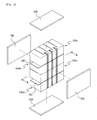
- Fig. 1 is an exploded perspective view showing a solid oxide fuel cell according to one embodiment of the present invention.
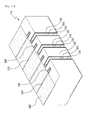
- Fig. 2 is a perspective view illustrating a state that the unit cells of the solid oxide fuel cell shown in Fig. 1 are combined together.
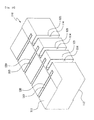
- Fig. 3 is a perspective view showing one of the unit cells shown in Fig. 1 .
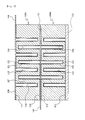
- Fig. 4 is a section view of the solid oxide fuel cell taken along line A-A in Fig. 2 .
- the solid oxide fuel cell includes a plurality of unit cells 100a, 100b, 100c and 100d, a plurality of electricity collecting plates 140 and 141 and a pair of side plates 150 and 151.
- each of the unit cells 100 includes a support body block 110, an air electrode 120, a fuel electrode 121 and a plurality of electricity collecting layers 130 and 131.
- the electrolyte support body block may be formed of an ionic conductive material such as yttria stabilized zirconia (YSZ), CeO 2 -base electrolyte, Bi 2 O 3 -based electrolyte or LaGaO 3 -based electrolyte.
- YSZ yttria stabilized zirconia
- CeO 2 -base electrolyte CeO 2 -base electrolyte
- Bi 2 O 3 -based electrolyte or LaGaO 3 -based electrolyte.
- the porous electrode support body block is usually formed of a mixture of nickel oxide and yttria stabilized zirconia (NiO-YSZ). In the event that the porous electrode support body block is used as the support body block 110, an electrolyte layer is formed on the surface of the porous electrode support body block. Use of the porous electrode support body block makes it possible to form the electrolyte layer with a reduced thickness.
- a porous conductive support body block having an electrode layer, an electrolyte layer and an opposite electrode layer formed on the surface thereof may be used as the support body block 110.
- the porous conductive support body block is produced by adding a suitable amount of pore formers such as graphite or starch to metallic powder or oxide powder reducible to metal, mixing the powder with a binder, a plasticizer or a dispersant to thereby prepare slurry, filling the slurry into a ceramic mold and drying the slurry into a molded body, and then sintering the molded body under a reducing atmosphere.
- the support body block 110 includes a first surface 111 which is equivalent to an upper surface in Fig. 3 and a second surface 112 which is equivalent to a lower surface in Fig. 3 .
- the support body block 110 further includes a plurality of first channels 113, each of which has a lateral end opened at one lateral side of the support body block 110, an first-surface-side open end fully opened on the first surface 111 and a second-surface-side open end partially opened on the second surface 112.
- the support body block 110 further includes a plurality of second channels 114 arranged between the first channels 113. Each of the second channels 114 has a lateral end opened at the other lateral side of the support body block 110, a first-surface-side open end partially opened on the first surface 111 and a second-surface-side open end fully opened on the second surface 112.
- first-surface-side open end of each of the first channels 113 is fully opened on the first surface 111
- second-surface-side open end of each of the first channels 113 is partially opened on the second surface 112 to thereby form a first path 115.
- the remaining portion of the second-surface-side open end of each of the first channels 113 is closed.
- the second-surface-side open end of each of the second channels 114 is fully opened on the second surface 112.
- the first-surface-side open end of each of the second channels 114 is partially opened on the first surface 111 to thereby form a second path 116.
- the support body block 110 further includes a plurality of wall portions 117 arranged between the first channels 113 and the second channels 114.
- the wall portions 117 may be formed to have a thickness of several tens micrometers.
- the depth of each of the channels 113 and 114 may be about thirty times as large as the width of each of the wall portions 117. For instance, if the thickness of each of the wall portions 117 is 50 ⁇ m, the depth of each of the channels 113 and 114 may be about 1,500 ⁇ m.
- the wall portions 117 serve as an electrolyte. Therefore, as the thickness of the wall portions 117 becomes smaller, the ion conductivity grows higher. This makes it possible to increase the power generation efficiency and to reduce the operating temperature.
- the air electrode (cathode) 120 is formed on the inner surface of each of the first channels 113.
- the air electrode 120 may be made of LaSrMnO 3 .
- the air electrode 120 can be formed by electrochemical vapor deposition or many other methods, e.g., a method of mixing a material for the formation of the air electrode 120 with a binder to produce a paste and then coating the paste on the inner surface of each of the first channels 113.
- the fuel electrode (anode) 121 is formed on the inner surface of each of the second channels 114.
- the fuel electrode 121 may be made of Ni-YSZ (cermet).
- the fuel electrode 121 can be formed by many different methods such as electrochemical vapor deposition and paste coating.
- a first electricity collecting layer 130 and a second electricity collecting layer 131 electrically connected to the air electrode 120 and the fuel electrode 121 are formed on the first surface 111 and the second surface 112 of the support body block 110.
- the first electricity collecting layer 130 formed on the first surface 111 is electrically connected to the air electrode 120 but is not connected to the fuel electrode 121.
- the second electricity collecting layer 131 formed on the second surface 112 is electrically connected to only the fuel electrode 121.
- the electricity collecting layers 130 and 131 are not formed on the opposite lateral surfaces of the support body block 110 but on the first surface 111 as an upper surface and the second surface 112 as a lower surface.
- the unit cells 100 are stacked one above another, thereby forming a unit cell stack.
- a stacking method will now be described on the basis of the third highest unit cell 100c and the lowermost unit cell 100d among the unit cells 100 shown in Fig. 1 .
- the upper unit cell 100c and the lower unit cell 100d are joined to each other by rotating 180 degrees the lower unit cell 100d such that the lower surface of the upper unit cell 100c is in a mirror-symmetrical relationship with the upper surface of the lower unit cell 100d. Due to the rotation of the lower unit cell 100d, the upper surface of the lower unit cell 100d becomes the second surface 112 and the lower surface of the lower unit cell 100d becomes the first surface 111. In other words, the upper unit cell 100c and the lower unit cell 100d are combined together by rotating 180 degrees the lower unit cell 100d such that the second surface 112 of the upper unit cell 100c makes contact with the second surface 112 of the lower unit cell 100d.
- the channels 113 and 114 of the upper unit cell 100c and the channels 113 and 114 of the lower unit cell 100d are connected to each other.
- the lower surface of the upper unit cell 100c is in a mirror-symmetrical relationship with the upper surface of the lower unit cell 100d. Therefore, the first paths 115 of the first channels 113 of the upper unit cell 100c are connected to the first paths 115 of the first channels 113 of the lower unit cell 100d.
- the fully opened lower ends of the second channels 114 of the upper unit cell 100c are connected to the fully opened upper ends of the second channels 114 of the lower unit cell 100d.
- a first electricity collecting plate 140 and a pair of second electricity collecting plates 141 are arranged between the unit cells 100.
- the first electricity collecting plate 140 is arranged between the first surfaces 111 of the unit cells 100b and 100c adjoining each other.
- the second electricity collecting plate 141 are arranged between the second surfaces 112 of the unit cells 100a and 100b and between the second surfaces 112 of the unit cells 100c and 100d.
- the first electricity collecting plate 140 is electrically connected to the first electricity collecting layers 130 formed on the first surfaces 111.
- the second electricity collecting plates 141 are electrically connected to the second electricity collecting layers 131 formed on the second surfaces 112.
- the first electricity collecting plate 140 arranged between the first surfaces 111 of the unit cells 100b and 100c partially closes the fully opened ends of the first channels 113 existing on the first surfaces 111, thereby forming a third path 118 (see Fig. 5 ).
- Each of the second electricity collecting plates 141 partially closes the fully opened ends of the second channels 114 existing on the second surfaces 112, thereby forming a fourth path 119 (see Fig. 6 ).
- the first electricity collecting plate 140 and the second electricity collecting plates 141 protrude in the opposite directions from each other. Accordingly, electricity can be easily collected by connecting the first electricity collecting plate 140 and the second electricity collecting plates 141 with an electrically conductive paste.
- the upper unit cell 100 and the lower unit cell 100 are joined to each other by rotating 180 degrees the lower unit cell 100 such that the second surface 112 of the upper unit cell 100 makes contact with the second surface 112 of the lower unit cell 100.
- the electricity collecting plates 140 and 141 are arranged between the unit cells 100. Therefore, as compared with the conventional fuel cells in which the electricity collecting plates 140 and 141 are arranged on the lateral surfaces of the unit cells 100, it is possible to reduce the number of the electricity collecting plates by one half.
- a first side plate 150 and a second side plate 151 are attached to the opposite lateral surfaces of the stack of the unit cells 100.
- the first side plate 150 and the second side plate 151 serve to close the channels 113 and 114 of some of the unit cells 100.
- the first side plate 150 and the second side plate 151 do not close the channels 113 and 114 of the uppermost and lowermost unit cells 100a and 100d. The reason is that the channels 113 and 114 of the uppermost and lowermost unit cells 100a and 100d are used as inlets and outlets through which the air or the fuel is introduced and discharged.
- the side plates 150 and 151 may be made of a material lower in porosity than the support body block 110 or glass or glass ceramics.
- the support body block and the side plates may be directly bonded to each other under a high temperature and a high pressure or may be encapsulated by an encapsulating material such as glass ceramics or the like.
- Cover plates 152 and 153 are attached to the uppermost and lowermost unit cells 100a and 100d. Just like the side plates 150 and 151, the cover plates 152 and 153 may be made of a material lower in porosity than the support body block 110 or glass or glass ceramics.
- Fig. 5 is a view showing the flow of an air in the solid oxide fuel cell shown in Fig. 1 .
- Fig. 6 is a view showing the flow of fuel in the solid oxide fuel cell shown in Fig. 1 .
- the electrodes and the electricity collecting layers are not shown in Figs. 5 and 6 .
- an air A is supplied to the first channels 113 of the solid oxide fuel cell.
- Reducing fuel F such as hydrogen or the like is supplied to the second channels 114.
- the air A and the fuel F are introduced through the channels 113 and 114 of the lowermost unit cell 100d. Then, the air A and the fuel F flow zigzag along the channels 113 and 114 of the upper unit cells.
- the air A is introduced through the first channels 113 of the lowermost unit cell 100d.
- the air A passes through the first paths 115, the first channels 113 of the second lowest unit cell 100c, the third paths 118, the first channels 113 of the third lowest unit cell 100b and the first paths 115.
- the air A is discharged to the outside through the first channels 113 of the uppermost unit cell 100a.
- the fuel F is introduced through the second channels 114 of the lowermost unit cell 100d.
- the fuel F passes through the fourth paths 119, the second channels 114 of the second lowest unit cell 100c, the second paths 116, the second channels 114 of the third lowest unit cell 100b and the fourth paths 119.
- the fuel F is discharged to the outside through the second channels 114 of the uppermost unit cell 100a.
- Reduction reaction of oxygen occurs in the air electrode 120 of the first channels 113, thereby generating oxygen ions.
- the oxygen ions move toward the second channels 114 through the wall portions 117.
- the oxygen ions thus moved react with hydrogen supplied into the second channels 114, thus generating water.
- oxygen molecules are ionized by electrons, in which process electrons are consumed.
- oxygen ions react with hydrogen, in which process electrons are generated. If the air electrode 120 and the fuel electrode 121 are connected to each other, electrons can flow to thereby generate electricity.
- the solid oxide fuel cell of the present invention it is possible to significantly increase the area of the air electrodes 120 and the fuel electrodes 121, i.e., the electrode area per unit volume. This makes it possible to achieve high-efficiency power generation.
- the side plates 150 and 151 and the cover plates 152 and 153 are made of a material whose thermal expansion coefficient does not differ from the thermal expansion coefficient of the support body blocks 110 of the unit cells 100, the stack of the unit cells 100 can enjoy increased durability and reliability. Thus, even when repeatedly operated and stopped, the solid oxide fuel cell is restrained from being broken by thermal stresses. Since the unit cells and the stack thereof are structurally simple, it is possible to reduce the size and weight of a large-capacity power generation system.
- Figs. 7 through 11 are process views for explaining a method of manufacturing the unit cell shown in Fig. 3 .
- the support body block 110 is slit to form the first channels 113.
- a paste obtained by mixing an air electrode material and a binder is coated on the inner surfaces of the first channels 113 and is subjected to heat treatment for two hours at a maximum temperature of about 1,100°C, thereby forming the air electrodes 120 on the inner surfaces of the first channels 113 as shown in Fig. 8 .
- the coating of the air electrode material is usually performed in such a manner that LaSrMnO 3 +YSZ is first coated and LaSrMnO 3 is coated subsequently.
- the portions of the support body block 110 existing between the first channels 113 are slit from the opposite side of the first channels 113, thereby forming the second channels 114.
- the wall portions 117 as electrolyte layers having a thickness of several tens micrometers can be easily formed between the first channels 113 and the second channels 114.
- a paste obtained by mixing a fuel electrode material and a binder is coated on the inner surfaces of the second channels 114 and is subjected to heat treatment, thereby forming the fuel electrodes 121 on the inner surfaces of the second channels 114 as shown in Fig. 10 .
- metallic powder is coated on the air electrodes 120 and the first surface 111 and is subjected to heat treatment, thereby forming the first electricity collecting layer 130.
- metallic powder is coated on the fuel electrodes 121 and the second surface 112 and is subjected to heat treatment, thereby forming the second electricity collecting layer 131.
- the metallic powder may be coated in the form of a paste.
- Noble metal such as platinum, silver and palladium may be used as the metallic powder coated on the air electrodes 120 and the first surface 111.
- the noble metal can also be used as the metallic powder coated on the fuel electrodes 121 and the second surface 112.
- the second channels 114 are kept in a reducing atmosphere, nickel is usually used as the second electricity collecting layer 131 for the fuel electrodes 121.
- the air electrodes 120 and the fuel electrodes 121 are electrically conductive. Therefore, instead of using metallic powder, the air electrodes 120 and the fuel electrodes 121 may be coated even on the first surface 111 and the second surface 112 to form the electricity collecting layers.
- the unit cells manufactured in this manner are stacked one above another by rotating 180 degrees the lower unit cell 100 such that the lower surface of the upper unit cell 100 is in a mirror-symmetrical relationship with the upper surface of the lower unit cell 100.
- the electricity collecting plates 140 and 141 are arranged between the unit cells 100.
- first side plate 150 and the second side plate 151 are attached to the opposite lateral surfaces of the stack of the unit cells 100.
- the cover plates 152 and 153 are attached to the uppermost and lowermost unit cells 100a and 100d.
- the electricity collecting plates are used as electricity collectors in the aforementioned embodiment, it may be possible to use conductive wires, e.g., platinum wires, as the electricity collectors.
- conductive wires e.g., platinum wires
- plates made of the same material as the support body block or glass or glass ceramics may be arranged to partially close the channels of the unit cells so that the air and the fuel can flow zigzag along the channels.
Landscapes
- Life Sciences & Earth Sciences (AREA)
- Engineering & Computer Science (AREA)
- Manufacturing & Machinery (AREA)
- Sustainable Development (AREA)
- Sustainable Energy (AREA)
- Chemical & Material Sciences (AREA)
- Chemical Kinetics & Catalysis (AREA)
- Electrochemistry (AREA)
- General Chemical & Material Sciences (AREA)
- Fuel Cell (AREA)
Abstract
Description
- The present invention relates to a solid oxide fuel cell and, more particularly, to a highly-efficient solid oxide fuel cell having an increased electrode area per unit volume.
- A fuel cell is a device for converting a change in free energy caused by oxidation reaction of fuel to electric energy. As examples of the fuel cell, there have been developed a phosphate fuel cell, a polymer electrolyte fuel cell, a molten carbonate fuel cell and a solid oxide fuel cell.
- The solid oxide fuel cell is capable of generating electric energy at a high temperature of 600°C to 1,000°C. Therefore, the solid oxide fuel cell enjoys highest energy conversion efficiency among the fuel cells developed thus far. Thanks to the high energy conversion efficiency, the solid oxide fuel cell, if practically available, can become a substitute for the existing energy converters. If hydrogen is used as the fuel of the solid oxide fuel cell, it is possible to reduce emission of carbon dioxide (CO2). It is therefore expected that the solid oxide fuel cell will be used as an energy source for a future energy system.
- In the meantime, the solid oxide fuel cell is operable at a high temperature and is capable of causing reaction within a fuel electrode (anode). This provides an advantage in that the solid oxide fuel cell can use not only hydrogen but also other kinds of fuel such as a natural gas and a coal gas. Unlike the molten carbonate fuel cell, the solid oxide fuel cell does not use liquid electrolyte and does not suffer from problems of material corrosion, electrolyte loss and electrolyte supplement. Complex power generation can be performed through the use of high-quality waste heat dissipated from the solid oxide fuel cell. This makes it possible to enhance the efficiency of a power generation system as a whole.
- The solid oxide fuel cell is composed of a unit cell including an oxygen ionic conductive electrolyte, an air electrode (cathode) and a fuel electrode (anode), latter two of which are arranged on the opposite surface of the electrolyte. If an air and reducing fuel such as hydrogen are supplied to the respective electrodes of the unit cell, reduction reaction of oxygen occurs in the air electrode, thereby generating oxygen ions. The oxygen ions move toward the fuel electrode through the electrolyte and react again with reducing fuel such as hydrogen supplied to the fuel electrode, thus generating water. At this time, electrons are generated in the fuel electrode and are consumed in the air electrode. Electricity can be obtained by interconnecting the fuel electrode and the air electrode.
- The solid oxide fuel cell is largely divided into a tubular type and a planar type. The tubular type solid oxide fuel cell is disclosed in many different patent documents, e.g.,
KR10-0286779B KR10-0344936B -
JP2004-31158A - In the fuel cell disclosed in
JP2004-31158A - The cap has a plate shape. A rectangular exhaust gas flow path is formed in the central region of the cap. A plurality of discharge holes is formed in the position of the exhaust gas flow path corresponding to the fuel gas flow path or the air flow path. Thus, the cap has a structure substantially hard to manufacture.
- The cap is not a power generating part. For that reason, there is a problem in that the power generation area per unit volume is reduced if the cap is arranged between the unit cells adjoining each other.
- In the fuel cell disclosed in
JP2004-31158A - Korean Patent No.
0815207 - It is an object of the present invention to provide a solid oxide fuel cell having an increased power output per unit volume.
- Another object of the present invention is to provide a solid oxide fuel cell capable of enjoying high power generation efficiency.
- A further object of the present invention is to provide a solid oxide fuel cell which is structurally simple and easy to manufacture.
- In accordance with the present invention, there is provided a solid oxide fuel cell including unit cells, a first side plate and a second side plate respectively attached to opposite lateral surfaces of the unit cells, and a first electricity collector and a second electricity collector arranged between the unit cells.
- Each of the unit cells each includes a support body block. The support body block includes a first surface, a second surface parallel to the first surface, a plurality of first channels extending in a first direction in a parallel relationship with the first surface and serving as flow paths through which an air flows and a plurality of second channels existing between the first channels and serving as flow paths through which fuel flows, the first channels having first-surface-side open ends and second-surface-side open ends, the second channels having first-surface-side open ends and second-surface-side open ends. Each of the unit cells further includes air electrodes (cathodes) formed on inner surfaces of the first channels, fuel electrodes (anodes) formed on inner surfaces of the second channels, a first electricity collecting layer formed on the first surface and electrically connected to the air electrodes and a second electricity collecting layer formed on the second surface and electrically connected to the fuel electrodes;
- The unit cells are stacked one above another such that the first channels of the unit cells adjoining each other are connected to one another to form the flow paths through which the air flow and such that the second channels of the unit cells adjoining each other are connected to one another to form the flow paths through which the fuel flow. At this time, a lower one of the unit cells adjoining each other is combined with an upper one of the unit cells in a 180 degree rotated state. The first surfaces of the unit cells adjoining each other are arranged to face each other with the first electricity collector interposed therebetween. The second surfaces of the unit cells adjoining each other are arranged to face each other with the second electricity collector interposed therebetween.
- Preferably, the lower surface of an upper one of the unit cells adjoining each other is in a mirror-symmetrical relationship with an upper surface of a lower one of the unit cells.
- The first side plate and the second side plate are respectively attached to opposite lateral surfaces of the unit cells and are configured to close lateral ends of the first channels and the second channels.
- The first electricity collector is electrically connected to the first electricity collecting layer and is arranged to partially close the first-surface-side open ends of the first channels of the unit cells. The second electricity collector is electrically connected to the second electricity collecting layer and is arranged to partially close the second-surface-side open ends of the second channels of the unit cells.
- The electricity collectors are arranged to partially close the first channels and the second channels such that the air or the fuel flows zigzag along the first channels and the second channels.
- The solid oxide fuel cell according to the present invention provides the following effects.
- First, there is no need to employ additional structures such as a cover and a cap which should otherwise be installed between an upper unit cell and a lower unit cell adjoining each other. It is therefore possible to increase a power output per unit volume.
- Second, an air flow path and a fuel flow path adjoining in a parallel relationship with each other are formed in a support body block. It is therefore possible to reduce the thickness of an electrolyte layer and to increase the power generation efficiency.
- Third, the flow paths of an upper unit cell and a lower unit cell adjoining each other are connected to each other. Therefore, the area in which an air and fuel react with each other until they are discharged can be adjusted by adjusting the number of stacks without having to change the shape of unit cells. Even if the operating temperature of the solid oxide fuel cell is low, it is possible to keep the power generation efficiency constant by increasing the number of stacks.
- Fourth, the solid oxide fuel cell according to the present invention can be manufactured by forming an air flow path and a fuel flow path in a support body block to thereby produce unit cells having a self-supporting structure and then arranging and stacking electricity collecting plate between the unit cells. This makes it easy to manufacture the solid oxide fuel cell.
- Fifth, the distance from the power generation part to the electricity collecting plate becomes shorter. It is therefore possible to reduce electric resistance and to increase the power generation efficiency.
- Sixth, the solid oxide fuel cell is structurally simple. The lower surface of an upper layer and the upper surface of a lower layer coupled together are in a mirror-symmetrical relationship with each other. This makes it easy to perform sealing in a stacking process.
- Seventh, the electricity collecting plate is arranged between an upper unit cell and a lower unit cell adjoining each other. Only one electricity collecting plate is used with respect to each of the unit cells. Therefore, as compared with the conventional solid oxide fuel cells, it is possible to reduce the number of electricity collecting plates used.
-
-
Fig. 1 is an exploded perspective view showing a solid oxide fuel cell according to one embodiment of the present invention. -
Fig. 2 is a perspective view illustrating a state that the unit cells of the solid oxide fuel cell shown inFig. 1 are combined together. -
Fig. 3 is a perspective view showing one of the unit cells shown inFig. 1 . -
Fig. 4 is a section view of the solid oxide fuel cell taken along line A-A inFig. 2 . -
Fig. 5 is a view showing the flow of an air in the solid oxide fuel cell shown inFig. 1 . -
Fig. 6 is a view showing the flow of fuel in the solid oxide fuel cell shown inFig. 1 . -
Figs. 7 through 11 are process views for explaining a method of manufacturing the unit cell shown inFig. 3 . - A solid oxide fuel cell according to one embodiment of the present invention will now be described in detail with reference to the accompanying drawings.
-
Fig. 1 is an exploded perspective view showing a solid oxide fuel cell according to one embodiment of the present invention.Fig. 2 is a perspective view illustrating a state that the unit cells of the solid oxide fuel cell shown inFig. 1 are combined together.Fig. 3 is a perspective view showing one of the unit cells shown inFig. 1 .Fig. 4 is a section view of the solid oxide fuel cell taken along line A-A inFig. 2 . - Referring to
Figs. 1 and2 , the solid oxide fuel cell according to one embodiment of the present invention includes a plurality ofunit cells electricity collecting plates side plates - Referring to
Figs. 3 and4 , each of the unit cells 100 includes asupport body block 110, anair electrode 120, afuel electrode 121 and a plurality of electricity collecting layers 130 and 131. - An electrolyte support body block or a porous electrode support body block can be used as the
support body block 110. The electrolyte support body block may be formed of an ionic conductive material such as yttria stabilized zirconia (YSZ), CeO2-base electrolyte, Bi2O3-based electrolyte or LaGaO3-based electrolyte. - The porous electrode support body block is usually formed of a mixture of nickel oxide and yttria stabilized zirconia (NiO-YSZ). In the event that the porous electrode support body block is used as the
support body block 110, an electrolyte layer is formed on the surface of the porous electrode support body block. Use of the porous electrode support body block makes it possible to form the electrolyte layer with a reduced thickness. - A porous conductive support body block having an electrode layer, an electrolyte layer and an opposite electrode layer formed on the surface thereof may be used as the
support body block 110. The porous conductive support body block is produced by adding a suitable amount of pore formers such as graphite or starch to metallic powder or oxide powder reducible to metal, mixing the powder with a binder, a plasticizer or a dispersant to thereby prepare slurry, filling the slurry into a ceramic mold and drying the slurry into a molded body, and then sintering the molded body under a reducing atmosphere. - Referring again to
Figs. 3 and4 , thesupport body block 110 includes afirst surface 111 which is equivalent to an upper surface inFig. 3 and asecond surface 112 which is equivalent to a lower surface inFig. 3 . The support body block 110 further includes a plurality offirst channels 113, each of which has a lateral end opened at one lateral side of thesupport body block 110, an first-surface-side open end fully opened on thefirst surface 111 and a second-surface-side open end partially opened on thesecond surface 112. The support body block 110 further includes a plurality ofsecond channels 114 arranged between thefirst channels 113. Each of thesecond channels 114 has a lateral end opened at the other lateral side of thesupport body block 110, a first-surface-side open end partially opened on thefirst surface 111 and a second-surface-side open end fully opened on thesecond surface 112. - While the first-surface-side open end of each of the
first channels 113 is fully opened on thefirst surface 111, the second-surface-side open end of each of thefirst channels 113 is partially opened on thesecond surface 112 to thereby form afirst path 115. The remaining portion of the second-surface-side open end of each of thefirst channels 113 is closed. Conversely, the second-surface-side open end of each of thesecond channels 114 is fully opened on thesecond surface 112. The first-surface-side open end of each of thesecond channels 114 is partially opened on thefirst surface 111 to thereby form asecond path 116. - The support body block 110 further includes a plurality of
wall portions 117 arranged between thefirst channels 113 and thesecond channels 114. Thewall portions 117 may be formed to have a thickness of several tens micrometers. The depth of each of thechannels wall portions 117. For instance, if the thickness of each of thewall portions 117 is 50 µm, the depth of each of thechannels wall portions 117 serve as an electrolyte. Therefore, as the thickness of thewall portions 117 becomes smaller, the ion conductivity grows higher. This makes it possible to increase the power generation efficiency and to reduce the operating temperature. - The air electrode (cathode) 120 is formed on the inner surface of each of the
first channels 113. Theair electrode 120 may be made of LaSrMnO3. Theair electrode 120 can be formed by electrochemical vapor deposition or many other methods, e.g., a method of mixing a material for the formation of theair electrode 120 with a binder to produce a paste and then coating the paste on the inner surface of each of thefirst channels 113. - The fuel electrode (anode) 121 is formed on the inner surface of each of the
second channels 114. Thefuel electrode 121 may be made of Ni-YSZ (cermet). Thefuel electrode 121 can be formed by many different methods such as electrochemical vapor deposition and paste coating. - A first
electricity collecting layer 130 and a secondelectricity collecting layer 131 electrically connected to theair electrode 120 and thefuel electrode 121 are formed on thefirst surface 111 and thesecond surface 112 of thesupport body block 110. The firstelectricity collecting layer 130 formed on thefirst surface 111 is electrically connected to theair electrode 120 but is not connected to thefuel electrode 121. On the contrary, the secondelectricity collecting layer 131 formed on thesecond surface 112 is electrically connected to only thefuel electrode 121. In the solid oxide fuel cell according to the present invention, the electricity collecting layers 130 and 131 are not formed on the opposite lateral surfaces of the support body block 110 but on thefirst surface 111 as an upper surface and thesecond surface 112 as a lower surface. - As shown in
Fig. 1 , the unit cells 100 are stacked one above another, thereby forming a unit cell stack. A stacking method will now be described on the basis of the thirdhighest unit cell 100c and thelowermost unit cell 100d among the unit cells 100 shown inFig. 1 . - According to the present invention, the
upper unit cell 100c and thelower unit cell 100d are joined to each other by rotating 180 degrees thelower unit cell 100d such that the lower surface of theupper unit cell 100c is in a mirror-symmetrical relationship with the upper surface of thelower unit cell 100d. Due to the rotation of thelower unit cell 100d, the upper surface of thelower unit cell 100d becomes thesecond surface 112 and the lower surface of thelower unit cell 100d becomes thefirst surface 111. In other words, theupper unit cell 100c and thelower unit cell 100d are combined together by rotating 180 degrees thelower unit cell 100d such that thesecond surface 112 of theupper unit cell 100c makes contact with thesecond surface 112 of thelower unit cell 100d. - Once the unit cells 100 are stacked one above another, the
channels upper unit cell 100c and thechannels lower unit cell 100d are connected to each other. At this time, the lower surface of theupper unit cell 100c is in a mirror-symmetrical relationship with the upper surface of thelower unit cell 100d. Therefore, thefirst paths 115 of thefirst channels 113 of theupper unit cell 100c are connected to thefirst paths 115 of thefirst channels 113 of thelower unit cell 100d. The fully opened lower ends of thesecond channels 114 of theupper unit cell 100c are connected to the fully opened upper ends of thesecond channels 114 of thelower unit cell 100d. - While four unit cells are stacked in the example shown in
Fig. 1 , the number of unit cells stacked is not limited to four but may be arbitrarily changed. - Referring again to
Fig. 1 , a firstelectricity collecting plate 140 and a pair of secondelectricity collecting plates 141 are arranged between the unit cells 100. The firstelectricity collecting plate 140 is arranged between thefirst surfaces 111 of theunit cells electricity collecting plate 141 are arranged between thesecond surfaces 112 of theunit cells second surfaces 112 of theunit cells electricity collecting plate 140 is electrically connected to the first electricity collecting layers 130 formed on the first surfaces 111. The secondelectricity collecting plates 141 are electrically connected to the secondelectricity collecting layers 131 formed on the second surfaces 112. - Since the
electricity collecting plates first surfaces 111 and thesecond surfaces 112 of thesupport body block 110, electrons generated in thefuel electrode 121 move a short distance to reach the secondelectricity collecting plates 141. Electrons emitted from the firstelectricity collecting plate 140 move a short distance to reach theair electrode 120. Accordingly, it is possible to reduce the internal loss of electrons and to increase the power generation efficiency. - The first
electricity collecting plate 140 arranged between thefirst surfaces 111 of theunit cells first channels 113 existing on thefirst surfaces 111, thereby forming a third path 118 (seeFig. 5 ). Each of the secondelectricity collecting plates 141 partially closes the fully opened ends of thesecond channels 114 existing on thesecond surfaces 112, thereby forming a fourth path 119 (seeFig. 6 ). In order to allow the air and the fuel to flow zigzag through thechannels electricity collecting plate 140 and the secondelectricity collecting plates 141 such that thepaths paths - The first
electricity collecting plate 140 and the secondelectricity collecting plates 141 protrude in the opposite directions from each other. Accordingly, electricity can be easily collected by connecting the firstelectricity collecting plate 140 and the secondelectricity collecting plates 141 with an electrically conductive paste. - In the solid oxide fuel cell of the present invention, the upper unit cell 100 and the lower unit cell 100 are joined to each other by rotating 180 degrees the lower unit cell 100 such that the
second surface 112 of the upper unit cell 100 makes contact with thesecond surface 112 of the lower unit cell 100. Theelectricity collecting plates electricity collecting plates - Referring again to
Fig. 1 , afirst side plate 150 and asecond side plate 151 are attached to the opposite lateral surfaces of the stack of the unit cells 100. Thefirst side plate 150 and thesecond side plate 151 serve to close thechannels first side plate 150 and thesecond side plate 151 do not close thechannels lowermost unit cells channels lowermost unit cells side plates -
Cover plates lowermost unit cells side plates cover plates -
Fig. 5 is a view showing the flow of an air in the solid oxide fuel cell shown inFig. 1 .Fig. 6 is a view showing the flow of fuel in the solid oxide fuel cell shown inFig. 1 . The electrodes and the electricity collecting layers are not shown inFigs. 5 and6 . Referring toFigs. 5 and6 , an air A is supplied to thefirst channels 113 of the solid oxide fuel cell. Reducing fuel F such as hydrogen or the like is supplied to thesecond channels 114. The air A and the fuel F are introduced through thechannels lowermost unit cell 100d. Then, the air A and the fuel F flow zigzag along thechannels - Referring to
Fig. 5 , the air A is introduced through thefirst channels 113 of thelowermost unit cell 100d. The air A passes through thefirst paths 115, thefirst channels 113 of the secondlowest unit cell 100c, thethird paths 118, thefirst channels 113 of the thirdlowest unit cell 100b and thefirst paths 115. Then, the air A is discharged to the outside through thefirst channels 113 of theuppermost unit cell 100a. - Referring to
Fig. 6 , the fuel F is introduced through thesecond channels 114 of thelowermost unit cell 100d. The fuel F passes through thefourth paths 119, thesecond channels 114 of the secondlowest unit cell 100c, thesecond paths 116, thesecond channels 114 of the thirdlowest unit cell 100b and thefourth paths 119. Then, the fuel F is discharged to the outside through thesecond channels 114 of theuppermost unit cell 100a. - Reduction reaction of oxygen occurs in the
air electrode 120 of thefirst channels 113, thereby generating oxygen ions. The oxygen ions move toward thesecond channels 114 through thewall portions 117. The oxygen ions thus moved react with hydrogen supplied into thesecond channels 114, thus generating water. In theair electrode 120, oxygen molecules are ionized by electrons, in which process electrons are consumed. In thefuel electrode 121, oxygen ions react with hydrogen, in which process electrons are generated. If theair electrode 120 and thefuel electrode 121 are connected to each other, electrons can flow to thereby generate electricity. - With the solid oxide fuel cell of the present invention, it is possible to significantly increase the area of the
air electrodes 120 and thefuel electrodes 121, i.e., the electrode area per unit volume. This makes it possible to achieve high-efficiency power generation. If theside plates cover plates - Next, a method of manufacturing the unit cell of the aforementioned solid oxide fuel cell will be described with reference to the accompanying drawings.
Figs. 7 through 11 are process views for explaining a method of manufacturing the unit cell shown inFig. 3 . - First, as shown in
Fig. 7 , thesupport body block 110 is slit to form thefirst channels 113. Then, a paste obtained by mixing an air electrode material and a binder is coated on the inner surfaces of thefirst channels 113 and is subjected to heat treatment for two hours at a maximum temperature of about 1,100°C, thereby forming theair electrodes 120 on the inner surfaces of thefirst channels 113 as shown inFig. 8 . The coating of the air electrode material is usually performed in such a manner that LaSrMnO3+YSZ is first coated and LaSrMnO3 is coated subsequently. - Next, as shown in
Fig. 9 , the portions of the support body block 110 existing between thefirst channels 113 are slit from the opposite side of thefirst channels 113, thereby forming thesecond channels 114. In this manner, thewall portions 117 as electrolyte layers having a thickness of several tens micrometers can be easily formed between thefirst channels 113 and thesecond channels 114. - Then, a paste obtained by mixing a fuel electrode material and a binder is coated on the inner surfaces of the
second channels 114 and is subjected to heat treatment, thereby forming thefuel electrodes 121 on the inner surfaces of thesecond channels 114 as shown inFig. 10 . - Then, as shown in
Fig. 11 , metallic powder is coated on theair electrodes 120 and thefirst surface 111 and is subjected to heat treatment, thereby forming the firstelectricity collecting layer 130. In addition, metallic powder is coated on thefuel electrodes 121 and thesecond surface 112 and is subjected to heat treatment, thereby forming the secondelectricity collecting layer 131. The metallic powder may be coated in the form of a paste. Noble metal such as platinum, silver and palladium may be used as the metallic powder coated on theair electrodes 120 and thefirst surface 111. The noble metal can also be used as the metallic powder coated on thefuel electrodes 121 and thesecond surface 112. Since thesecond channels 114 are kept in a reducing atmosphere, nickel is usually used as the secondelectricity collecting layer 131 for thefuel electrodes 121. Theair electrodes 120 and thefuel electrodes 121 are electrically conductive. Therefore, instead of using metallic powder, theair electrodes 120 and thefuel electrodes 121 may be coated even on thefirst surface 111 and thesecond surface 112 to form the electricity collecting layers. - The unit cells manufactured in this manner are stacked one above another by rotating 180 degrees the lower unit cell 100 such that the lower surface of the upper unit cell 100 is in a mirror-symmetrical relationship with the upper surface of the lower unit cell 100. At this time, the
electricity collecting plates - Then, the
first side plate 150 and thesecond side plate 151 are attached to the opposite lateral surfaces of the stack of the unit cells 100. Thecover plates lowermost unit cells - Thereafter, the
electricity collecting plates - While one preferred embodiment of the present invention has been described above, it will be apparent to those skilled in the art that various changes, modifications and substitutions may be made without departing from the scope of the invention defined in the claims.
- For example, while the electricity collecting plates are used as electricity collectors in the aforementioned embodiment, it may be possible to use conductive wires, e.g., platinum wires, as the electricity collectors. At this time, plates made of the same material as the support body block or glass or glass ceramics may be arranged to partially close the channels of the unit cells so that the air and the fuel can flow zigzag along the channels.
Claims (6)
- A solid oxide fuel cell, comprising:a plurality of unit cells each including a support body block, the support body block including a first surface, a second surface parallel to the first surface, a plurality of first channels extending in a first direction in a parallel relationship with the first surface and serving as flow paths through which an air flows and a plurality of second channels existing between the first channels and serving as flow paths through which fuel flows, the first channels having first-surface-side open ends and second-surface-side open ends, the second channels having first-surface-side open ends and second-surface-side open ends, each of the unit cells further including air electrodes (cathodes) formed on inner surfaces of the first channels, fuel electrodes (anodes) formed on inner surfaces of the second channels, a first electricity collecting layer formed on the first surface and electrically connected to the air electrodes and a second electricity collecting layer formed on the second surface and electrically connected to the fuel electrodes;a first side plate and a second side plate respectively attached to opposite lateral surfaces of the unit cells and configured to close lateral ends of the first channels and the second channels;a first electricity collector electrically connected to the first electricity collecting layer and arranged to partially close the first-surface-side open ends of the first channels of the unit cells; anda second electricity collector electrically connected to the second electricity collecting layer and arranged to partially close the second-surface-side open ends of the second channels of the unit cells,wherein the unit cells are stacked one above another such that the first channels of the unit cells adjoining each other are connected to one another to form the flow paths through which the air flow and such that the second channels of the unit cells adjoining each other are connected to one another to form the flow paths through which the fuel flow, the first surfaces of the unit cells adjoining each other arranged to face each other with the first electricity collector interposed therebetween, the second surfaces of the unit cells adjoining each other arranged to face each other with the second electricity collector interposed therebetween.
- The solid oxide fuel cell of claim 1, wherein the second-surface-side open ends of the first channels are partially opened to form first paths through which the air passes and the first-surface-side open ends of the second channels are partially opened to form second paths through which the fuel passes.
- The solid oxide fuel cell of claim 2, wherein the first electricity collector are arranged to partially close the first-surface-side open ends of the first channels to thereby form third paths such that the air flows zigzag along the first channels and the second electricity collector are arranged to partially close the second-surface-side open ends of the second channels to thereby form fourth paths such that the fuel flows zigzag along the second channels.
- The solid oxide fuel cell of claim 1, wherein the unit cells are arranged such that a lower surface of an upper unit cell is in a mirror-symmetrical relationship with an upper surface of a lower unit cell.
- The solid oxide fuel cell of claim 1, wherein the support body block is an electrolyte support body block, or a porous electrode support body block having an electrolyte layer formed on one surface thereof, or a porous electrically-conductive support body block having an electrode layer, an electrolyte layer and an opposite electrode layer.
- The solid oxide fuel cell of claim 1, wherein the first electricity collector and the second electricity collector protrude in opposite directions from each other.
Applications Claiming Priority (2)
| Application Number | Priority Date | Filing Date | Title |
|---|---|---|---|
| KR1020100101803A KR101071228B1 (en) | 2010-10-19 | 2010-10-19 | Solid oxide fuel cell |
| PCT/KR2011/007747 WO2012053803A2 (en) | 2010-10-19 | 2011-10-18 | Solid oxide fuel cell |
Publications (3)
| Publication Number | Publication Date |
|---|---|
| EP2631979A2 true EP2631979A2 (en) | 2013-08-28 |
| EP2631979A4 EP2631979A4 (en) | 2015-12-09 |
| EP2631979B1 EP2631979B1 (en) | 2017-09-27 |
Family
ID=45032491
Family Applications (1)
| Application Number | Title | Priority Date | Filing Date |
|---|---|---|---|
| EP11834603.0A Not-in-force EP2631979B1 (en) | 2010-10-19 | 2011-10-18 | Solid oxide fuel cell |
Country Status (6)
| Country | Link |
|---|---|
| US (1) | US9166232B2 (en) |
| EP (1) | EP2631979B1 (en) |
| JP (1) | JP5595597B2 (en) |
| KR (1) | KR101071228B1 (en) |
| CN (1) | CN103155256B (en) |
| WO (1) | WO2012053803A2 (en) |
Families Citing this family (1)
| Publication number | Priority date | Publication date | Assignee | Title |
|---|---|---|---|---|
| KR102055950B1 (en) * | 2012-12-14 | 2019-12-13 | 주식회사 미코 | Stack structure for fuel cell |
Family Cites Families (12)
| Publication number | Priority date | Publication date | Assignee | Title |
|---|---|---|---|---|
| EP0536909B1 (en) | 1991-10-11 | 1998-03-11 | Westinghouse Electric Corporation | Solid oxide fuel cell generator |
| KR100344936B1 (en) | 1999-10-01 | 2002-07-19 | 한국에너지기술연구원 | Tubular Solid Oxide Fuel Cell supported by Fuel Electrode and Method for the same |
| JP2004031158A (en) | 2002-06-26 | 2004-01-29 | Nissan Motor Co Ltd | Fuel cell and fuel cell stack using the same |
| CN1276537C (en) * | 2002-10-28 | 2006-09-20 | 韩国电力公社 | Solid oxide fuel cells having gas channel |
| JP4966503B2 (en) | 2005-03-14 | 2012-07-04 | 一般財団法人電力中央研究所 | Structure of anode-supported solid oxide fuel cell |
| KR100727684B1 (en) * | 2005-12-08 | 2007-06-13 | 학교법인 포항공과대학교 | Solid oxide fuel cell module, fuel cell using same and manufacturing method thereof |
| KR100815207B1 (en) * | 2006-11-09 | 2008-03-19 | 김영정 | Solid oxide fuel cell |
| KR100889267B1 (en) * | 2007-07-30 | 2009-03-19 | 한국과학기술원 | Solid Oxide Fuel Cell |
| KR100976506B1 (en) * | 2008-03-31 | 2010-08-17 | 포항공과대학교 산학협력단 | Electrode support for solid oxide fuel cell, unit cell and stack manufacturing method using same |
| JP5127626B2 (en) * | 2008-07-31 | 2013-01-23 | キヤノン株式会社 | Image processing apparatus and image processing method |
| KR100968505B1 (en) * | 2008-09-08 | 2010-07-07 | 한국과학기술원 | Metal support solid oxide fuel cell and method for manufacturing same |
| JP5435385B2 (en) * | 2009-07-29 | 2014-03-05 | Tdk株式会社 | Solid oxide fuel cell and method for producing solid oxide fuel cell |
-
2010
- 2010-10-19 KR KR1020100101803A patent/KR101071228B1/en active Active
-
2011
- 2011-10-18 US US13/880,404 patent/US9166232B2/en active Active
- 2011-10-18 CN CN201180050369.8A patent/CN103155256B/en not_active Expired - Fee Related
- 2011-10-18 JP JP2013534810A patent/JP5595597B2/en active Active
- 2011-10-18 WO PCT/KR2011/007747 patent/WO2012053803A2/en not_active Ceased
- 2011-10-18 EP EP11834603.0A patent/EP2631979B1/en not_active Not-in-force
Also Published As
| Publication number | Publication date |
|---|---|
| US20130202982A1 (en) | 2013-08-08 |
| CN103155256B (en) | 2015-05-20 |
| EP2631979B1 (en) | 2017-09-27 |
| JP5595597B2 (en) | 2014-09-24 |
| CN103155256A (en) | 2013-06-12 |
| JP2013543645A (en) | 2013-12-05 |
| EP2631979A4 (en) | 2015-12-09 |
| KR101071228B1 (en) | 2011-10-10 |
| US9166232B2 (en) | 2015-10-20 |
| WO2012053803A3 (en) | 2012-06-14 |
| WO2012053803A2 (en) | 2012-04-26 |
Similar Documents
| Publication | Publication Date | Title |
|---|---|---|
| JP4000128B2 (en) | Fuel electrode support type flat tube type solid oxide fuel cell stack and manufacturing method thereof | |
| US20070224481A1 (en) | Manifold and stack of electrochemical reactor cells, and electrochemical reactor system composed of these components | |
| US7816055B2 (en) | Compact fuel cell | |
| US20070037031A1 (en) | Cermet and ceramic interconnects for a solid oxide fuel cell | |
| US8304136B2 (en) | Solid oxide fuel cell and solid oxide fuel cell bundle | |
| US7285347B2 (en) | Anode-supported flat-tubular solid oxide fuel cell stack and fabrication method of the same | |
| KR20000059873A (en) | Single Cell and Stack Structure of Solid Oxide Fuel Cell | |
| US20230170494A1 (en) | Fuel cell and electrolyzer hotbox module using conductive zirconia stacks | |
| JP2011519114A (en) | Ceramic interconnects for fuel cell stacks | |
| JP2009507356A (en) | Ceramic membrane with integral seal and support, and electrochemical cell and electrochemical cell stack structure including the same | |
| EP1300903A1 (en) | A miniaturized solid-oxide fuel cell | |
| JP2005513721A (en) | Metal current collector protected by oxide film | |
| KR20110022907A (en) | Flat Solid Oxide Fuel Cell Module | |
| JP4236298B2 (en) | Solid oxide fuel cell with honeycomb integrated structure | |
| US20120034547A1 (en) | Structure of solid oxide fuel cell | |
| JP5674035B2 (en) | Medium / low temperature high efficiency electrochemical cell and electrochemical reaction system composed of them | |
| JP5021756B2 (en) | Solid oxide fuel cell | |
| EP2631979B1 (en) | Solid oxide fuel cell | |
| EP3979378B1 (en) | Cell, cell stack device, module, and module housing device | |
| KR20110022911A (en) | Flat Solid Oxide Fuel Cell Module | |
| JPH10189024A (en) | Solid electrolyte fuel cell with honeycomb integrated structure | |
| KR101905499B1 (en) | Unit cell module and stack for solid oxide fuel cell | |
| JPH11297342A (en) | Solid electrolyte fuel cell with honeycomb integrated structure | |
| CN112470314A (en) | Fuel cell and cell stack device | |
| JPH11297343A (en) | Solid electrolyte fuel cell with honeycomb integrated structure |
Legal Events
| Date | Code | Title | Description |
|---|---|---|---|
| PUAI | Public reference made under article 153(3) epc to a published international application that has entered the european phase |
Free format text: ORIGINAL CODE: 0009012 |
|
| 17P | Request for examination filed |
Effective date: 20130426 |
|
| AK | Designated contracting states |
Kind code of ref document: A2 Designated state(s): AL AT BE BG CH CY CZ DE DK EE ES FI FR GB GR HR HU IE IS IT LI LT LU LV MC MK MT NL NO PL PT RO RS SE SI SK SM TR |
|
| DAX | Request for extension of the european patent (deleted) | ||
| A4 | Supplementary search report drawn up and despatched |
Effective date: 20151109 |
|
| RIC1 | Information provided on ipc code assigned before grant |
Ipc: H01M 8/12 20060101AFI20151103BHEP Ipc: H01M 8/24 20060101ALI20151103BHEP Ipc: H01M 8/02 20060101ALI20151103BHEP |
|
| REG | Reference to a national code |
Ref country code: DE Ref legal event code: R079 Ref document number: 602011041999 Country of ref document: DE Free format text: PREVIOUS MAIN CLASS: H01M0008120000 Ipc: H01M0008242500 |
|
| GRAP | Despatch of communication of intention to grant a patent |
Free format text: ORIGINAL CODE: EPIDOSNIGR1 |
|
| RIC1 | Information provided on ipc code assigned before grant |
Ipc: H01M 8/124 20160101ALI20170418BHEP Ipc: H01M 8/0258 20160101ALI20170418BHEP Ipc: H01M 8/2425 20160101AFI20170418BHEP |
|
| INTG | Intention to grant announced |
Effective date: 20170524 |
|
| GRAS | Grant fee paid |
Free format text: ORIGINAL CODE: EPIDOSNIGR3 |
|
| GRAA | (expected) grant |
Free format text: ORIGINAL CODE: 0009210 |
|
| AK | Designated contracting states |
Kind code of ref document: B1 Designated state(s): AL AT BE BG CH CY CZ DE DK EE ES FI FR GB GR HR HU IE IS IT LI LT LU LV MC MK MT NL NO PL PT RO RS SE SI SK SM TR |
|
| REG | Reference to a national code |
Ref country code: GB Ref legal event code: FG4D |
|
| REG | Reference to a national code |
Ref country code: CH Ref legal event code: EP |
|
| REG | Reference to a national code |
Ref country code: AT Ref legal event code: REF Ref document number: 932793 Country of ref document: AT Kind code of ref document: T Effective date: 20171015 |
|
| REG | Reference to a national code |
Ref country code: IE Ref legal event code: FG4D |
|
| REG | Reference to a national code |
Ref country code: FR Ref legal event code: PLFP Year of fee payment: 7 |
|
| REG | Reference to a national code |
Ref country code: DE Ref legal event code: R096 Ref document number: 602011041999 Country of ref document: DE |
|
| REG | Reference to a national code |
Ref country code: CH Ref legal event code: NV Representative=s name: KASCHE AND PARTNER AG, CH |
|
| PG25 | Lapsed in a contracting state [announced via postgrant information from national office to epo] |
Ref country code: FI Free format text: LAPSE BECAUSE OF FAILURE TO SUBMIT A TRANSLATION OF THE DESCRIPTION OR TO PAY THE FEE WITHIN THE PRESCRIBED TIME-LIMIT Effective date: 20170927 Ref country code: HR Free format text: LAPSE BECAUSE OF FAILURE TO SUBMIT A TRANSLATION OF THE DESCRIPTION OR TO PAY THE FEE WITHIN THE PRESCRIBED TIME-LIMIT Effective date: 20170927 Ref country code: LT Free format text: LAPSE BECAUSE OF FAILURE TO SUBMIT A TRANSLATION OF THE DESCRIPTION OR TO PAY THE FEE WITHIN THE PRESCRIBED TIME-LIMIT Effective date: 20170927 Ref country code: NO Free format text: LAPSE BECAUSE OF FAILURE TO SUBMIT A TRANSLATION OF THE DESCRIPTION OR TO PAY THE FEE WITHIN THE PRESCRIBED TIME-LIMIT Effective date: 20171227 Ref country code: SE Free format text: LAPSE BECAUSE OF FAILURE TO SUBMIT A TRANSLATION OF THE DESCRIPTION OR TO PAY THE FEE WITHIN THE PRESCRIBED TIME-LIMIT Effective date: 20170927 |
|
| REG | Reference to a national code |
Ref country code: NL Ref legal event code: MP Effective date: 20170927 |
|
| REG | Reference to a national code |
Ref country code: LT Ref legal event code: MG4D |
|
| REG | Reference to a national code |
Ref country code: AT Ref legal event code: MK05 Ref document number: 932793 Country of ref document: AT Kind code of ref document: T Effective date: 20170927 |
|
| PG25 | Lapsed in a contracting state [announced via postgrant information from national office to epo] |
Ref country code: RS Free format text: LAPSE BECAUSE OF FAILURE TO SUBMIT A TRANSLATION OF THE DESCRIPTION OR TO PAY THE FEE WITHIN THE PRESCRIBED TIME-LIMIT Effective date: 20170927 Ref country code: LV Free format text: LAPSE BECAUSE OF FAILURE TO SUBMIT A TRANSLATION OF THE DESCRIPTION OR TO PAY THE FEE WITHIN THE PRESCRIBED TIME-LIMIT Effective date: 20170927 Ref country code: BG Free format text: LAPSE BECAUSE OF FAILURE TO SUBMIT A TRANSLATION OF THE DESCRIPTION OR TO PAY THE FEE WITHIN THE PRESCRIBED TIME-LIMIT Effective date: 20171227 Ref country code: GR Free format text: LAPSE BECAUSE OF FAILURE TO SUBMIT A TRANSLATION OF THE DESCRIPTION OR TO PAY THE FEE WITHIN THE PRESCRIBED TIME-LIMIT Effective date: 20171228 |
|
| PG25 | Lapsed in a contracting state [announced via postgrant information from national office to epo] |
Ref country code: NL Free format text: LAPSE BECAUSE OF FAILURE TO SUBMIT A TRANSLATION OF THE DESCRIPTION OR TO PAY THE FEE WITHIN THE PRESCRIBED TIME-LIMIT Effective date: 20170927 |
|
| PG25 | Lapsed in a contracting state [announced via postgrant information from national office to epo] |
Ref country code: RO Free format text: LAPSE BECAUSE OF FAILURE TO SUBMIT A TRANSLATION OF THE DESCRIPTION OR TO PAY THE FEE WITHIN THE PRESCRIBED TIME-LIMIT Effective date: 20170927 Ref country code: CZ Free format text: LAPSE BECAUSE OF FAILURE TO SUBMIT A TRANSLATION OF THE DESCRIPTION OR TO PAY THE FEE WITHIN THE PRESCRIBED TIME-LIMIT Effective date: 20170927 Ref country code: ES Free format text: LAPSE BECAUSE OF FAILURE TO SUBMIT A TRANSLATION OF THE DESCRIPTION OR TO PAY THE FEE WITHIN THE PRESCRIBED TIME-LIMIT Effective date: 20170927 |
|
| PG25 | Lapsed in a contracting state [announced via postgrant information from national office to epo] |
Ref country code: SM Free format text: LAPSE BECAUSE OF FAILURE TO SUBMIT A TRANSLATION OF THE DESCRIPTION OR TO PAY THE FEE WITHIN THE PRESCRIBED TIME-LIMIT Effective date: 20170927 Ref country code: AT Free format text: LAPSE BECAUSE OF FAILURE TO SUBMIT A TRANSLATION OF THE DESCRIPTION OR TO PAY THE FEE WITHIN THE PRESCRIBED TIME-LIMIT Effective date: 20170927 Ref country code: IT Free format text: LAPSE BECAUSE OF FAILURE TO SUBMIT A TRANSLATION OF THE DESCRIPTION OR TO PAY THE FEE WITHIN THE PRESCRIBED TIME-LIMIT Effective date: 20170927 Ref country code: EE Free format text: LAPSE BECAUSE OF FAILURE TO SUBMIT A TRANSLATION OF THE DESCRIPTION OR TO PAY THE FEE WITHIN THE PRESCRIBED TIME-LIMIT Effective date: 20170927 Ref country code: IS Free format text: LAPSE BECAUSE OF FAILURE TO SUBMIT A TRANSLATION OF THE DESCRIPTION OR TO PAY THE FEE WITHIN THE PRESCRIBED TIME-LIMIT Effective date: 20180127 Ref country code: SK Free format text: LAPSE BECAUSE OF FAILURE TO SUBMIT A TRANSLATION OF THE DESCRIPTION OR TO PAY THE FEE WITHIN THE PRESCRIBED TIME-LIMIT Effective date: 20170927 |
|
| REG | Reference to a national code |
Ref country code: DE Ref legal event code: R097 Ref document number: 602011041999 Country of ref document: DE |
|
| PG25 | Lapsed in a contracting state [announced via postgrant information from national office to epo] |
Ref country code: MC Free format text: LAPSE BECAUSE OF FAILURE TO SUBMIT A TRANSLATION OF THE DESCRIPTION OR TO PAY THE FEE WITHIN THE PRESCRIBED TIME-LIMIT Effective date: 20170927 |
|
| REG | Reference to a national code |
Ref country code: IE Ref legal event code: MM4A |
|
| PG25 | Lapsed in a contracting state [announced via postgrant information from national office to epo] |
Ref country code: LU Free format text: LAPSE BECAUSE OF NON-PAYMENT OF DUE FEES Effective date: 20171018 Ref country code: DK Free format text: LAPSE BECAUSE OF FAILURE TO SUBMIT A TRANSLATION OF THE DESCRIPTION OR TO PAY THE FEE WITHIN THE PRESCRIBED TIME-LIMIT Effective date: 20170927 |
|
| PLBE | No opposition filed within time limit |
Free format text: ORIGINAL CODE: 0009261 |
|
| STAA | Information on the status of an ep patent application or granted ep patent |
Free format text: STATUS: NO OPPOSITION FILED WITHIN TIME LIMIT |
|
| REG | Reference to a national code |
Ref country code: BE Ref legal event code: MM Effective date: 20171031 |
|
| PG25 | Lapsed in a contracting state [announced via postgrant information from national office to epo] |
Ref country code: BE Free format text: LAPSE BECAUSE OF NON-PAYMENT OF DUE FEES Effective date: 20171031 Ref country code: PL Free format text: LAPSE BECAUSE OF FAILURE TO SUBMIT A TRANSLATION OF THE DESCRIPTION OR TO PAY THE FEE WITHIN THE PRESCRIBED TIME-LIMIT Effective date: 20170927 |
|
| 26N | No opposition filed |
Effective date: 20180628 |
|
| PG25 | Lapsed in a contracting state [announced via postgrant information from national office to epo] |
Ref country code: MT Free format text: LAPSE BECAUSE OF NON-PAYMENT OF DUE FEES Effective date: 20171018 |
|
| REG | Reference to a national code |
Ref country code: FR Ref legal event code: PLFP Year of fee payment: 8 |
|
| PG25 | Lapsed in a contracting state [announced via postgrant information from national office to epo] |
Ref country code: IE Free format text: LAPSE BECAUSE OF NON-PAYMENT OF DUE FEES Effective date: 20171018 |
|
| PG25 | Lapsed in a contracting state [announced via postgrant information from national office to epo] |
Ref country code: SI Free format text: LAPSE BECAUSE OF FAILURE TO SUBMIT A TRANSLATION OF THE DESCRIPTION OR TO PAY THE FEE WITHIN THE PRESCRIBED TIME-LIMIT Effective date: 20170927 |
|
| PG25 | Lapsed in a contracting state [announced via postgrant information from national office to epo] |
Ref country code: HU Free format text: LAPSE BECAUSE OF FAILURE TO SUBMIT A TRANSLATION OF THE DESCRIPTION OR TO PAY THE FEE WITHIN THE PRESCRIBED TIME-LIMIT; INVALID AB INITIO Effective date: 20111018 |
|
| PG25 | Lapsed in a contracting state [announced via postgrant information from national office to epo] |
Ref country code: CY Free format text: LAPSE BECAUSE OF NON-PAYMENT OF DUE FEES Effective date: 20170927 |
|
| PG25 | Lapsed in a contracting state [announced via postgrant information from national office to epo] |
Ref country code: MK Free format text: LAPSE BECAUSE OF FAILURE TO SUBMIT A TRANSLATION OF THE DESCRIPTION OR TO PAY THE FEE WITHIN THE PRESCRIBED TIME-LIMIT Effective date: 20170927 |
|
| PG25 | Lapsed in a contracting state [announced via postgrant information from national office to epo] |
Ref country code: TR Free format text: LAPSE BECAUSE OF FAILURE TO SUBMIT A TRANSLATION OF THE DESCRIPTION OR TO PAY THE FEE WITHIN THE PRESCRIBED TIME-LIMIT Effective date: 20170927 |
|
| PG25 | Lapsed in a contracting state [announced via postgrant information from national office to epo] |
Ref country code: PT Free format text: LAPSE BECAUSE OF FAILURE TO SUBMIT A TRANSLATION OF THE DESCRIPTION OR TO PAY THE FEE WITHIN THE PRESCRIBED TIME-LIMIT Effective date: 20170927 |
|
| PG25 | Lapsed in a contracting state [announced via postgrant information from national office to epo] |
Ref country code: AL Free format text: LAPSE BECAUSE OF FAILURE TO SUBMIT A TRANSLATION OF THE DESCRIPTION OR TO PAY THE FEE WITHIN THE PRESCRIBED TIME-LIMIT Effective date: 20170927 |
|
| PGFP | Annual fee paid to national office [announced via postgrant information from national office to epo] |
Ref country code: GB Payment date: 20211026 Year of fee payment: 11 Ref country code: DE Payment date: 20211203 Year of fee payment: 11 |
|
| PGFP | Annual fee paid to national office [announced via postgrant information from national office to epo] |
Ref country code: FR Payment date: 20211025 Year of fee payment: 11 Ref country code: CH Payment date: 20211026 Year of fee payment: 11 |
|
| REG | Reference to a national code |
Ref country code: DE Ref legal event code: R119 Ref document number: 602011041999 Country of ref document: DE |
|
| REG | Reference to a national code |
Ref country code: CH Ref legal event code: PL |
|
| GBPC | Gb: european patent ceased through non-payment of renewal fee |
Effective date: 20221018 |
|
| PG25 | Lapsed in a contracting state [announced via postgrant information from national office to epo] |
Ref country code: LI Free format text: LAPSE BECAUSE OF NON-PAYMENT OF DUE FEES Effective date: 20221031 Ref country code: FR Free format text: LAPSE BECAUSE OF NON-PAYMENT OF DUE FEES Effective date: 20221031 Ref country code: DE Free format text: LAPSE BECAUSE OF NON-PAYMENT OF DUE FEES Effective date: 20230503 Ref country code: CH Free format text: LAPSE BECAUSE OF NON-PAYMENT OF DUE FEES Effective date: 20221031 |
|
| PG25 | Lapsed in a contracting state [announced via postgrant information from national office to epo] |
Ref country code: GB Free format text: LAPSE BECAUSE OF NON-PAYMENT OF DUE FEES Effective date: 20221018 |