EP2630150B1 - 6-amido derivatives of 4,5a-epoxymorphinans for treatment of pain - Google Patents
6-amido derivatives of 4,5a-epoxymorphinans for treatment of pain Download PDFInfo
- Publication number
- EP2630150B1 EP2630150B1 EP11835042.0A EP11835042A EP2630150B1 EP 2630150 B1 EP2630150 B1 EP 2630150B1 EP 11835042 A EP11835042 A EP 11835042A EP 2630150 B1 EP2630150 B1 EP 2630150B1
- Authority
- EP
- European Patent Office
- Prior art keywords
- hydrogen
- chosen
- compound according
- phenyl
- optionally substituted
- Prior art date
- Legal status (The legal status is an assumption and is not a legal conclusion. Google has not performed a legal analysis and makes no representation as to the accuracy of the status listed.)
- Active
Links
- 0 *[C@](CC1)([C@@](Cc2ccc3*)N(*)CC4)[C@]44c2c3OC4[C@@]1NC(*)=O Chemical compound *[C@](CC1)([C@@](Cc2ccc3*)N(*)CC4)[C@]44c2c3OC4[C@@]1NC(*)=O 0.000 description 2
Classifications
-
- C—CHEMISTRY; METALLURGY
- C07—ORGANIC CHEMISTRY
- C07D—HETEROCYCLIC COMPOUNDS
- C07D489/00—Heterocyclic compounds containing 4aH-8, 9 c- Iminoethano-phenanthro [4, 5-b, c, d] furan ring systems, e.g. derivatives of [4, 5-epoxy]-morphinan of the formula:
- C07D489/02—Heterocyclic compounds containing 4aH-8, 9 c- Iminoethano-phenanthro [4, 5-b, c, d] furan ring systems, e.g. derivatives of [4, 5-epoxy]-morphinan of the formula: with oxygen atoms attached in positions 3 and 6, e.g. morphine, morphinone
- C07D489/04—Salts; Organic complexes
-
- C—CHEMISTRY; METALLURGY
- C07—ORGANIC CHEMISTRY
- C07D—HETEROCYCLIC COMPOUNDS
- C07D489/00—Heterocyclic compounds containing 4aH-8, 9 c- Iminoethano-phenanthro [4, 5-b, c, d] furan ring systems, e.g. derivatives of [4, 5-epoxy]-morphinan of the formula:
- C07D489/06—Heterocyclic compounds containing 4aH-8, 9 c- Iminoethano-phenanthro [4, 5-b, c, d] furan ring systems, e.g. derivatives of [4, 5-epoxy]-morphinan of the formula: with a hetero atom directly attached in position 14
- C07D489/08—Oxygen atom
-
- A—HUMAN NECESSITIES
- A61—MEDICAL OR VETERINARY SCIENCE; HYGIENE
- A61K—PREPARATIONS FOR MEDICAL, DENTAL OR TOILETRY PURPOSES
- A61K31/00—Medicinal preparations containing organic active ingredients
- A61K31/33—Heterocyclic compounds
- A61K31/395—Heterocyclic compounds having nitrogen as a ring hetero atom, e.g. guanethidine or rifamycins
- A61K31/435—Heterocyclic compounds having nitrogen as a ring hetero atom, e.g. guanethidine or rifamycins having six-membered rings with one nitrogen as the only ring hetero atom
- A61K31/47—Quinolines; Isoquinolines
- A61K31/485—Morphinan derivatives, e.g. morphine, codeine
-
- A—HUMAN NECESSITIES
- A61—MEDICAL OR VETERINARY SCIENCE; HYGIENE
- A61K—PREPARATIONS FOR MEDICAL, DENTAL OR TOILETRY PURPOSES
- A61K51/00—Preparations containing radioactive substances for use in therapy or testing in vivo
- A61K51/02—Preparations containing radioactive substances for use in therapy or testing in vivo characterised by the carrier, i.e. characterised by the agent or material covalently linked or complexing the radioactive nucleus
- A61K51/04—Organic compounds
- A61K51/041—Heterocyclic compounds
- A61K51/044—Heterocyclic compounds having nitrogen as a ring hetero atom, e.g. guanethidine, rifamycins
- A61K51/0455—Heterocyclic compounds having nitrogen as a ring hetero atom, e.g. guanethidine, rifamycins having six-membered rings with one nitrogen as the only ring hetero atom
-
- A—HUMAN NECESSITIES
- A61—MEDICAL OR VETERINARY SCIENCE; HYGIENE
- A61P—SPECIFIC THERAPEUTIC ACTIVITY OF CHEMICAL COMPOUNDS OR MEDICINAL PREPARATIONS
- A61P25/00—Drugs for disorders of the nervous system
- A61P25/04—Centrally acting analgesics, e.g. opioids
-
- G—PHYSICS
- G01—MEASURING; TESTING
- G01N—INVESTIGATING OR ANALYSING MATERIALS BY DETERMINING THEIR CHEMICAL OR PHYSICAL PROPERTIES
- G01N33/00—Investigating or analysing materials by specific methods not covered by groups G01N1/00 - G01N31/00
- G01N33/48—Biological material, e.g. blood, urine; Haemocytometers
- G01N33/50—Chemical analysis of biological material, e.g. blood, urine; Testing involving biospecific ligand binding methods; Immunological testing
- G01N33/94—Chemical analysis of biological material, e.g. blood, urine; Testing involving biospecific ligand binding methods; Immunological testing involving narcotics or drugs or pharmaceuticals, neurotransmitters or associated receptors
- G01N33/9486—Analgesics, e.g. opiates, aspirine
Definitions
- the invention relates to opioid receptor binding 6-amido derivatives of 4,5a-epoxymorphinans.
- the compounds are useful as analgesics.
- Opiates have been the subject of intense research since the isolation of morphine in 1805, and thousands of compounds having opiate or opiate-like activity have been identified.
- Many opioid receptor-interactive compounds including those used for producing analgesia (e.g., morphine) and those used for treating drug addiction (e.g., methadone, buprenorphine and naltrexone) in humans work by triggering ⁇ opioid receptors in the central nervous system (CNS) and by crossing the blood-brain barrier.
- ⁇ opioid receptors in the central nervous system (CNS) and by crossing the blood-brain barrier.
- these opiates usually cause unwanted peripheral side effects. Often, the peripheral side effects manifest themselves in the gastrointestinal (GI) tract and the respiratory system.
- GI gastrointestinal
- WO2010/006119 disclose opioid receptor antagonists of various formulas useful as analgesics.
- the compounds of the invention are useful as analgesics having lessened liability for constipation and respiratory depression.
- the invention relates to compounds of formula I: or a pharmaceutically acceptable salt thereof, wherein
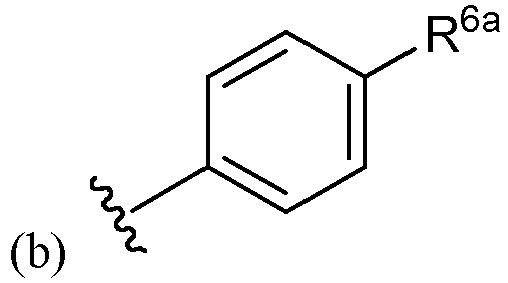
- R 4a is chosen from wherein R 5a is chosen from bromo, chloro, iodo, cyano, (C 1 -C 3 )alkyl, (C 1 -C 3 )haloalkyl, (C 1 -C 3 )haloalkoxy, (C 2 -C 3 )alkoxy and R 10 , wherein R 6a is chosen from hydroxy, nitro, cyano, (C 2 -C 3 )haloalkyl, (C 1 -C 3 )haloalkoxy, (C 1 -C 3 )alkoxy and R 10 ; wherein R 5 is chosen from halogen, hydroxy, nitro, cyano, (C 1 -C 3 )alkyl, (C 1 -C 3 )haloalkyl, (C 1 -C 3 )haloalkoxy, (C 1 -C 3 )alkoxy and R 10 ; and R 6b is chosen
- the invention in another aspect, relates to a pharmaceutical composition
- a pharmaceutical composition comprising at least one compound of the formula I above and a pharmaceutically acceptable carrier.
- the invention relates to a compound described above for use in reducing pain.
- Analgesic compounds disclosed therein fall into two primary classes: compounds of general formula II, in which R 1 is cyclopropylmethyl, and compounds of general formula I, in which R 1 is not cyclopropylmethyl.
- the compounds of general formula I include a series in which R 1 is allyl and one in which R 1 is cyclobutylmethyl. When R 1 is -CH 2 -Het, Het may be tetrahydrofuranyl.
- the invention relates to compounds of formula I: or a pharmaceutically acceptable salt thereof, wherein
- R 1 is allyl
- R 2 is chosen from hydrogen, (C 1 -C 6 )acyl, (C 1 -C 6 )oxaalkyl, and (C 1 -C 6 )acyloxaalky
- R 3 is hydrogen or methyl
- R 4 is chosen from
- R 4a is (g), an aromatic heterocycle other than unsubstituted pyridine, quinoline or isoquinoline, optionally substituted with with from one to three substituents chosen from halogen, hydroxy, nitro, cyano, (C 1 -C 3 )alkyl, (C 1 -C 3 )haloalkyl, (C 1 -C 3 )haloalkoxy, (C 1 -C 3 )alkoxy and R 10 .
- R 4a may also be other than pyridine monosubstituted with bromine, chlorine, methyl, methoxy or cyano.
- R 4a may also be other than unsubstituted pyrimidine, cinnoline quinazoline or pyridazine.
- the compound of the invention is of formula wherein R 1 , R 2 , R 3 , and R 4 are as described above, or a pharmaceutically acceptable salt thereof.
- R 3 is hydrogen; in others R 3 is methyl.
- R 4 is In some of these embodiments, R 5a is chosen from bromo, chloro, iodo, (C 1 -C 3 )haloalkyl, (C 1 -C 3 )haloalkoxy, (C 2 -C 3 )alkoxy and R 10 .
- R 5a is chosen from bromo, chloro, iodo, trifluoromethyl, trifluoromethoxy and R 10
- R 10 is chosen from phenyl, furanyl and thiophenyl, optionally substituted with one to three substituents independently chosen from halogen, methyl, trifluoromethyl, methoxy, trifluoromethoxy, methylenedioxy and acetyl.
- R 5a is iodo, either in its normal isotopic ratio or in a ratio enriched in 125 I.
- R 4 is wherein R 5 is chosen from bromo, chloro, iodo, nitro, cyano, methyl, trifluoromethyl, trifluoromethoxy, methoxy, phenyl, thiophenyl, furanyl; and R 6b is chosen from bromo, chloro, iodo, nitro, cyano, methyl, trifluoromethyl, trifluoromethoxy, methoxy, phenyl, thiophenyl and furanyl, with the proviso that both R 5 and R 6b are not phenyl or heteroaryl.
- R 4 is 3,4-diiodophenyl or 3-iodophenyl.
- the amide substituent at the oxymorphone 6 position is in the ⁇ configuration and R 4 is phenyl substituted at other than 2 or 6 with from one to three substituents chosen from bromo, chloro, iodo, hydroxy, nitro, cyano, (C 1 -C 3 )alkyl, (C 1 -C 3 )haloalkyl, (C 1 -C 3 )haloalkoxy, (C 1 -C 3 )alkoxy and R 10 .
- R 4 is phenyl substituted at the 3- and 4-positions with two substituents chosen independently from bromo, chloro, iodo, methyl, trifluoromethyl, methoxy and trifluoromethoxy.
- R 4 is phenyl substituted at the 3- or 4-position with a substituent chosen from bromo, chloro, iodo, methyl, trifluoromethyl, methoxy, trifluoromethoxy and R 10 .
- R 10 may be chosen from phenyl, furanyl and thiophenyl, optionally substituted with one to three substituents independently chosen from halogen, methyl, trifluoromethyl, methoxy, trifluoromethoxy, methylenedioxy and acetyl.
- R 2 is H;
- R 3 is hydrogen;
- R 8 is hydrogen; and
- R 4 is 3,4-diiodophenyl.
- the amide substituent at the oxymorphone 6 position is in the ⁇ configuration and R 4 is optionally substituted quinoline.
- R 1 is allyl; R 2 is H; R 3 and R 8 are hydrogen and R 4 is optionally substituted quinoline.
- R 8 is chosen from hydrogen and (C 1 -C 6 )alkyl. Preferred compounds are those in which R 8 is hydrogen or methyl.
- the compound is of the formula: or a pharmaceutically acceptable salt thereof, wherein:
- the present invention also relates to a compound of the formula: or a pharmaceutically acceptable salt thereof, wherein R 1 is allyl; and R 2 , R 3 , R 4 are chosen from the group consisting of:
- the present invention concerns a radiolabeled compound as defined above.
- R 2 , R 3 , and R 8 are H; and R 4 is 3- 125 I-phenyl or 3,4-di- 125 I-phenyl.
- the present invention concerns a method for assaying for the kappa3 receptor comprising exposing a tissue to a radiolabeled compound according to the invention, rinsing said tissue, and measuring the amount and/or location of said radiolabeled compound in said tissue.
- the invention also relates to said radiolabeled compound for use in a method for assaying for an opioid-like receptor, the method comprising exposing the radiolabeled compound to a source of receptor in vitro or in vivo , and measuring the amount and/or location of said radiolabeled compound bound to the receptor.
- compositions in accord with the invention comprise a pharmaceutically acceptable carrier and a compound as described above.
- the compounds described above are for use in therapy, preferably for use in reducing pain.
- the pain may be reduced without substantial reduction of intestinal motility and/or without substantial respiratory depression.
- substantially is intended to mean that the intestinal motility or respiration rate is reduced by at least 50% at a dose that is the analgesic ED 50 for a naive subject.
- the compounds may also be employed in a ⁇ -opioid-dependent patient.
- the compounds may also be employed in assays for the kappa3 receptor; radioiodinated compounds are particularly useful for this assay.
- Alkyl is intended to include linear or branched, or cyclic hydrocarbon structures and combinations thereof. A combination would be, for example, cyclopropylmethyl.
- Lower alkyl refers to alkyl groups of from 1 to 6 carbon atoms. Examples of lower alkyl groups include methyl, ethyl, propyl, isopropyl, cyclopropyl, butyl, s-and t-butyl, cyclobutyl and the like. Preferred alkyl groups are those of C 20 or below.
- Cycloalkyl is a subset of alkyl and includes cyclic hydrocarbon groups of from 3 to 8 carbon atoms. Examples of cycloalkyl groups include c-propyl, c-butyl, c-pentyl, norbornyl and the like.
- Alkoxy or alkoxyl refers to groups of from 1 to 8 carbon atoms of a straight, branched, or cyclic configuration and combinations thereof attached to the parent structure through an oxygen. Examples include methoxy, ethoxy, propoxy, isopropoxy, cyclopropyloxy, cyclohexyloxy and the like. Lower-alkoxy refers to groups containing one to four carbons.
- Aryl and heteroaryl mean a 5- or 6-membered aromatic or heteroaromatic ring containing 0-3 heteroatoms selected from O, N, or S; a bicyclic 9- or 10-membered aromatic or heteroaromatic ring system containing 0-3 heteroatoms selected from O, N, or S; or a tricyclic 13- or 14-membered aromatic or heteroaromatic ring system containing 0-3 heteroatoms selected from O, N, or S.
- the aromatic 6- to 14-membered carbocyclic rings include, e.g ., benzene, naphthalene, indane, tetralin, and fluorene and the 5- to 10-membered aromatic heterocyclic rings include, e.
- aryl and heteroaryl refer to residues in which one or more rings are aromatic, but not all need be.
- Arylalkyl means an aryl ring attached to an alkyl residue in which the point of attachment to the parent structure is through the alkyl. Examples are benzyl, phenethyl and the like. Heteroarylalkyl means an alkyl residue attached to a heteroaryl ring. Examples include, e.g ., pyridinylmethyl, pyrimidinylethyl and the like.
- C 2 to C 10 hydrocarbon means a linear, branched, or cyclic residue comprised of hydrogen and carbon as the only elemental constituents and includes alkyl, cycloalkyl, polycycloalkyl, alkenyl, alkynyl, aryl and combinations thereof. Examples include benzyl, phenethyl, cyclohexylmethyl, cyclopropylmethyl, cyclobutylmethyl, allyl, camphoryl and naphthylethyl.
- carbocycle is intended to include ring systems in which the ring atoms are all carbon but of any oxidation state.
- C 3 -C 10 carbocycle refers to both non-aromatic and aromatic systems, including such systems as cyclopropane, benzene and cyclohexene;
- C 8 -C 12 carbopolycycle refers to such systems as norbornane, decalin, indane and naphthalene.
- Carbocycle if not otherwise limited, refers to monocycles, bicycles and polycycles.
- Heterocycle means a cycloalkyl or aryl residue in which one to two of the carbons is replaced by a heteroatom such as oxygen, nitrogen or sulfur. Heteroaryls form a subset of heterocycles.
- heterocycles include pyrrolidine, pyrazole, pyrrole, imidazole, indole, quinoline, isoquinoline, tetrahydroisoquinoline, benzofuran, benzodioxan, benzodioxole (commonly referred to as methylenedioxyphenyl, when occurring as a substituent), tetrazole, morpholine, thiazole, pyridine, pyridazine, pyrimidine, pyrazine, thiophene, furan, oxazole, oxazoline, isoxazole, dioxane, tetrahydrofuran and the like.
- substituted refers to the replacement of one or more hydrogen atoms in a specified group with a specified radical.
- Oxo is also included among the substituents referred to in "optionally substituted”; it will be appreciated by persons of skill in the art that, because oxo is a divalent radical, there are circumstances in which it will not be appropriate as a substituent (e.g. on phenyl).
- 1, 2 or 3 hydrogen atoms are replaced with a specified radical.
- more than three hydrogen atoms can be replaced by fluorine; indeed, all available hydrogen atoms could be replaced by fluorine.
- the compounds described herein contain one or more asymmetric centers and may thus give rise to enantiomers, diastereomers, and other stereoisomeric forms that may be defined, in terms of absolute stereochemistry, as (R)- or (S)-.
- the present invention is meant to include all such possible isomers, as well as their racemic and optically pure forms. It will be apparent that certain chiral centers are specified in compounds set forth in the claims. In these cases, the chiral centers that are not specified encompass both configurations; those that are specified encompass only the specified configuration.
- Optically active (R)- and (S)-isomers may be prepared using chiral synthons or chiral reagents, or resolved using conventional techniques. When the compounds described herein contain olefinic double bonds or other centers of geometric asymmetry, and unless specified otherwise, it is intended that the compounds include both E and Z geometric isomers. Likewise, all tautomeric forms are also intended to be included.
- the compounds of the invention may exist as salts, i.e. cationic species.
- pharmaceutically acceptable salt refers to salts whose counter ion (anion) derives from pharmaceutically acceptable non-toxic acids including inorganic acids and organic acids.
- Suitable pharmaceutically acceptable acids for salts of the compounds of the present invention include, for example, acetic, adipic, alginic, ascorbic, aspartic, benzenesulfonic (besylate), benzoic, boric, butyric, camphoric, camphorsulfonic, carbonic, citric, ethanedisulfonic, ethanesulfonic, ethylenediaminetetraacetic, formic, fumaric, glucoheptonic, gluconic, glutamic, hydrobromic, hydrochloric, hydroiodic, hydroxynaphthoic, isethionic, lactic, lactobionic, laurylsulfonic, maleic, malic, mandelic, methanesulfonic, mucic, naphthylenesulfonic, nitric, oleic, pamoic, pantothenic, phosphoric, pivalic, polygalacturonic, salicylic, stea
- the compounds of this invention can exist in radiolabeled form, i.e., the compounds may contain one or more atoms containing an atomic mass or mass number different from the atomic mass or mass number usually found in nature. Alternatively, a plurality of molecules of a single structure may include at least one atom that occurs in an isotopic ratio that is different from the isotopic ratio found in nature.
- Radioisotopes of hydrogen, carbon, phosphorous, fluorine, chlorine and iodine include 2 H, 3 H, 11 C, 13 C, 14 C, 15 N, 3 S, 18 F, 36 Cl, 125 I, 124 I and 131 I respectively.
- Radiolabeled compounds of formulae I and II of this invention and prodrugs thereof can generally be prepared by methods well known to those skilled in the art. Conveniently, such radiolabeled compounds can be prepared by carrying out the procedures disclosed in the Examples and Schemes by substituting a readily available radiolabeled reagent for a non-radio labeled reagent.
- the present invention provides a pharmaceutical composition
- a pharmaceutical composition comprising a compound of formula I or II or a pharmaceutically acceptable salt or solvate thereof, together with one or more pharmaceutically carriers thereof and optionally one or more other therapeutic ingredients.
- the carrier(s) must be "acceptable” in the sense of being compatible with the other ingredients of the formulation and not deleterious to the recipient thereof.
- the compositions may be formulated for oral, topical or parenteral administration. For example, they may be given intravenously, intraarterially, subcutaneously, and directly into the CNS - either intrathecally or intracerebroventricularly.
- Formulations include those suitable for oral, parenteral (including subcutaneous, intradermal, intramuscular, intravenous and intraarticular), rectal and topical (including dermal, buccal, sublingual and intraocular) administration.
- the compounds are preferably administered orally or by injection (intravenous or subcutaneous).
- the precise amount of compound administered to a patient will be the responsibility of the attendant physician. However, the dose employed will depend on a number of factors, including the age and sex of the patient, the precise disorder being treated, and its severity. Also, the route of administration may vary depending on the condition and its severity.
- the formulations may conveniently be presented in unit dosage form and may be prepared by any of the methods well known in the art of pharmacy. In general, the formulations are prepared by uniformly and intimately bringing into association the active ingredient with liquid carriers or finely divided solid carriers or both and then, if necessary, shaping the product into the desired formulation.
- Formulations of the present invention suitable for oral administration may be presented as discrete units such as capsules, cachets or tablets each containing a predetermined amount of the active ingredient; as a powder or granules; as a solution or a suspension in an aqueous liquid or a non-aqueous liquid; or as an oil-in-water liquid emulsion or a water-in-oil liquid emulsion.
- the active ingredient may also be presented as a bolus, electuary or paste.
- a tablet may be made by compression or molding, optionally with one or more accessory ingredients.
- Compressed tablets may be prepared by compressing in a suitable machine the active ingredient in a free-flowing form such as a powder or granules, optionally mixed with a binder, lubricant, inert diluent, lubricating, surface active or dispersing agent.
- Molded tablets may be made by molding in a suitable machine a mixture of the powdered compound moistened with an inert liquid diluent.
- the tablets may optionally be coated or scored and may be formulated so as to provide sustained, delayed or controlled release of the active ingredient therein.
- Formulations for parenteral administration include aqueous and non-aqueous sterile injection solutions which may contain anti-oxidants, buffers, bacteriostats and solutes which render the formulation isotonic with the blood of the intended recipient.
- Formulations for parenteral administration also include aqueous and non-aqueous sterile suspensions, which may include suspending agents and thickening agents.
- the formulations may be presented in unit-dose or multi-dose containers, for example sealed ampoules and vials, and may be stored in a freeze-dried (lyophilized) condition requiring only the addition of a sterile liquid carrier, for example saline, phosphate-buffered saline (PBS) or the like, immediately prior to use.
- Extemporaneous injection solutions and suspensions may be prepared from sterile powders, granules and tablets of the kind previously described.
- Formulations for rectal administration may be presented as a suppository with the usual carriers such as cocoa butter or polyethylene glycol.
- Formulations for topical administration in the mouth include lozenges comprising the active ingredient in a flavoured basis such as sucrose and acacia or tragacanth, and pastilles comprising the active ingredient in a basis such as gelatin and glycerin or sucrose and acacia.
- Preferred unit dosage formulations are those containing an effective dose, as herein below recited, or an appropriate fraction thereof, of the active ingredient.
- formulations of this invention may include other agents conventional in the art having regard to the type of formulation in question, for example those suitable for oral administration may include flavoring agents.
- treatment or “treating,” or “palliating” or “ameliorating” are used interchangeably herein. These terms refers to an approach for obtaining beneficial or desired results including but not limited to therapeutic benefit and/or a prophylactic benefit.
- therapeutic benefit is meant eradication or amelioration of the underlying disorder being treated.
- a therapeutic benefit is achieved with the eradication or amelioration of one or more of the physiological systems associated with the underlying disorder such that an improvement is observed in the patient, notwithstanding that the patient may still be afflicted with the underlying disorder.
- the compositions may be administered to a patient at risk of developing a particular disease, or to a patient reporting one or more of the physiological systems of a disease, even though a diagnosis of this disease may not have been made.
- Receptor-Binding Assays Competition-binding assays in MOR-CHO (mu), DOR-CHO (delta) and KOR-CHO (kappa) were performed at 25°C in 50 mM potassium phosphate buffer, pH 7.4, containing 5 mM magnesium sulfate (only in the case of CHO-MOR). Specific binding was defined as the difference between total binding and nonspecific binding, determined in the presence of 8 ⁇ M levallorphan.
- 125I-SMGP1 IBNtxA was used as the universal radioligand to determine the relative affinity of drugs in MOR1-CHO, KOR1-CHO and DOR1-CHO.
- Specific binding was defined as the difference between total binding and nonspecific binding, determined in the presence of 8 ⁇ M levallorphan. Protein concentration was determined as described by Lowry et al. [J Biol Chem 1951, 193, 265-275; (1951 )] using bovine serum albumin as the standard. Kd, Bmax, and Ki values were calculated by nonlinear regression analysis (GraphPadPrism). We have observed that compounds that bind with the kappa3 site and that exhibit K i less than 100 nM exhibit useful analgesia, and compounds that are selective for kappa3 exhibit improved side-effect profiles.
- the "kappa3 opioid receptor" as referred to herein is the receptor first characterized by Clark et al. [J.Pharmacol. Exp.Ther.
- This receptor appears to be the same receptor which has been alternately referred to as the kappa2b receptor by Rothman et al. [Peptides 11, 311-331 (1990 )]. In any event, it can be characterized by the high affinity binding (K i ⁇ 1 nM) for levallorphan, ketocyclazocine and SMGP1 and low affinity for morphine (K i >1 ⁇ M), norbinaltorphimine (K i >50 nM) and DADL (K i >50 nM).
- Tail Flick Analgesia Assays Male CD-i mice (25-35 g; Charles River Breeding Laboratories, Wilmington, MA) were maintained on a 12-hr light/dark cycle with Purina rodent chow and water available ad libitum. Mice were housed in groups of five until testing. Analgesia was determined using the radiant heat tail-flick technique [ D'Amour and Smith, J. Pharmacol. Exp. Ther. 72: 74-79 (1941 )]. For the tail-flick assay, the latency to withdraw the tail from a focused light stimulus was measured electronically using a photocell. Baseline latencies (2.0-3.0 sec) were determined before experimental treatments for all animals as the mean of two trials.
- Tail-flick latencies were determined as indicated for each experiment, and a maximal latency of 10 sec for tail-flick was used to minimize tissue damage. All experiments were replicated at least twice with each group in each experiment containing at least 10 mice and the combined results of all replications presented. Compounds with an ED 50 less than 10 mg/kg are preferred because the potency allows for smaller dosages, but higher ED 50 's are possible.
- Gastrointestinal motility assay Gastrointestinal transit was determined as described by Paul and Pasternak [Eur. J. Pharmacol. 149 (1988), pp. 403-404 .)]. In brief, after withholding food for 8 hours, animals received the indicated drug and then were given a charcoal meal (0.2 mL; 10% of purified charcoal and 2.5% of gum tragacanth, w/v) by gavage and were sacrificed 30 min later. The distance traveled by the charcoal meal was then measured and reported in centimeters.
- a charcoal meal 0.2 mL; 10% of purified charcoal and 2.5% of gum tragacanth, w/v
- the testing apparatus consisted of two compartments of equal size separated by a wall with a guillotine-style door (MedAssociates ENV-512 insert). One compartment was surrounded by white walls and had a rod floor, while the other had black walls and a grid floor. Infrared photobeams lining the floor of the compartments were used to track the location of the mouse at all times; this data was used to calculate the total distance traveled by the animal using MedAssociates Activity Monitor software. This data is expressed as the distance each animal traveled following each drug injection divided by the average distance traveled by that animal following saline injection.
- the animal cages were brought to the testing room for 3 hours for habituation to the environment.
- animals are placed in one chamber and allowed to explore both sides freely for 20 minutes. Their baseline preferences for each compartment are calculated; in the place preference experiment, the side in which they spend more time in initially is assigned to saline, while the opposite side is designated as the drug-paired side. For place aversion, the initially preferred side is paired with drug, while the other side is assigned to saline.
- animals are allowed to habituate to the experimental room for 1 hour prior to each session.
- Animals are injected on alternating days for 8 days with either drug or saline and restricted to one compartment for 20 minutes so that they learn to associate a treatment condition with a specific compartment.
- animals are placed in the side paired with saline and allowed to freely explore both compartments for 20 minutes.
- the time spent in each compartment post-conditioning is calculated and subtracted from the amount of time spent in each compartment pre-conditioning to determine the change in each animals' preference due to conditioning.
- morphine 6 mg/kg s.c.
- test compound 1 mg/kg s.c.
- mice received test compound alone as a control for its analgesia in the morphine-tolerant mice.
- Compound SMGP1 which had both high affinity and high selectivity for kappa3 receptors, was examined more extensively.
- Compound SMGP1 is a very potent analgesic in mice, having a potency greater than morphine.
- the pharmacology of the drug differed from morphine in a number of important criteria.
- Naloxone is an effective antagonist, capable of reversing morphine and virtually all the clinically used opiates.
- naloxone was far less potent in reversing the analgesia elicited by SMGP1, and a series of antagonists selective against traditional mu, delta, kappa1 and ORL1 drugs were inactive.
- Levallorphan is an opioid antagonist structurally analogous to the opioid agonist levorphanol. Like levorphanol, levallorphan has high affinity for the kappa3 site. Thus, it was not surprising that levallorphan effectively reversed the analgesic actions of compound 1. This confirms the opioid nature of the response. Chronic administration of morphine rapidly leads to a diminished response, or tolerance.
- SMGP1 also showed some tolerance with chronic administration, although it appeared more slowly than that seen with morphine. However, SMGP1 showed no cross tolerance to morphine. When given to highly morphine tolerant mice, SMGP1 showed a normal analgesic response. Following chronic administration, all animals administered morphine show prompt and dramatic signs of withdrawal, a measure of physical dependence, when challenged with an antagonist. In contrast, chronic administration of SMGP1 led to no physical dependence. Naloxone did not precipitate withdrawal, which was expected since it also did not reverse the analgesia at this dose and had poor affinity for the binding site. However, levallorphan also did not precipitate withdrawal despite its ability to reverse analgesia, clearly distinguishing SMGP1 from clinically available opioids.
- SMGP1 could be used in conjunction with traditional opiates regardless of how long a patient had been taking them, i.e. they could be used to reduce pain in a ⁇ -opioid-dependent patient.
- the effect of SMGP1 on the inhibition of gastrointestinal transit was minimal. This is in marked contrast to morphine. Based upon these observations, a person of skill would conclude that SMGP1 would have minimal constipation liability.
- the ketone at the 6-position of the three opiates was transformed to an amine (Opiate-NH 2 ) by reductive amination using NaBH 3 CN and NH 4 OAc to yield a mixture of beta and alpha isomers.
- the beta and alpha isomers were purified by column chromatography.
- substituted carboxylic acids were converted to N-succinimidyl ester by reacting it with N-hydroxysuccinimide in presence of DCC and THF.
- the corresponding activated ester was then reacted with the beta or alpha isomer of the Opiate-NH 2 in presence of DIEA and DCM.
- the aroyl amido derivatives of opiates were then purified by column chromatography.
- the substituted carboxylic acids were directly coupled to the Opiate-NH 2 using BOP and DIEA in DCM to give 3,6-diaroylated derivatives.
- the 3,6-diaroyl opiate derivatives were then subjected to basic hydrolysis with K 2 CO 3 to yield 6-aroyl derivatives of naltrexamine, naloxamine and oxymorphanamine.
- the reaction was quenched by addition of 10 mL IN NaOH, the solvents were evaporated on a rotavapor at 40°C. The residue was then extracted with 30 mL DCM three times; the organic extracts were combined and washed with 25 mL water. The organic extracts were dried over Na 2 SO 4 and concentrated to a white solid, which was purified by silica gel column chromatography. The reaction gave a mixture of alpha and beta isomers. The respective isomers were isolated by column chromatography using 87:10:3 of EtOAc: MeOH: NH 4 OH as the eluent.
- the beta isomer had a higher R f than the alpha isomer on a TLC plate and eluted first when the mixture was subjected to column chromatography. Yields for beta isomer were about 2.5-3 g (25-30%). NMR peaks of the compounds matched the literature values.
- N-hydroxysuccinimide (NHS) esters of substituted carboxylic acids were synthesized as follows: Substituted carboxylic acid (7.8 mmol), NHS (1g, 8.6 mmol, 1.1 eqv), DCC (1.79 g, 8.6 mmol, 1.1 eqv) in 20 mL dry THF were stirred overnight. The white suspension was filtered and the clear filterate was evaporated on a rotavapor at 40°C. The white solid seen was purified by column chromatography using EtOAc/hexanes as eluents. A singlet at ⁇ 2.9 integrating to 4 protons in 1 H-NMR and corresponding to four protons of succinimide was seen in all NHS esters of substituted carboxylic acids. Yields were about 80-100%.
Landscapes
- Health & Medical Sciences (AREA)
- Chemical & Material Sciences (AREA)
- Life Sciences & Earth Sciences (AREA)
- Organic Chemistry (AREA)
- Engineering & Computer Science (AREA)
- Molecular Biology (AREA)
- General Health & Medical Sciences (AREA)
- Pharmacology & Pharmacy (AREA)
- Medicinal Chemistry (AREA)
- Biomedical Technology (AREA)
- Physics & Mathematics (AREA)
- Hematology (AREA)
- Immunology (AREA)
- Urology & Nephrology (AREA)
- Veterinary Medicine (AREA)
- Animal Behavior & Ethology (AREA)
- Public Health (AREA)
- Bioinformatics & Cheminformatics (AREA)
- Epidemiology (AREA)
- Pain & Pain Management (AREA)
- Emergency Medicine (AREA)
- Biotechnology (AREA)
- Optics & Photonics (AREA)
- Pathology (AREA)
- Cell Biology (AREA)
- General Physics & Mathematics (AREA)
- Proteomics, Peptides & Aminoacids (AREA)
- Microbiology (AREA)
- Food Science & Technology (AREA)
- Biochemistry (AREA)
- Analytical Chemistry (AREA)
- Nuclear Medicine, Radiotherapy & Molecular Imaging (AREA)
- General Chemical & Material Sciences (AREA)
- Chemical Kinetics & Catalysis (AREA)
- Neurosurgery (AREA)
- Neurology (AREA)
- Pharmaceuticals Containing Other Organic And Inorganic Compounds (AREA)
- Acyclic And Carbocyclic Compounds In Medicinal Compositions (AREA)
- Investigating Or Analysing Biological Materials (AREA)
Description
- The invention relates to opioid receptor binding 6-amido derivatives of 4,5a-epoxymorphinans. The compounds are useful as analgesics.
- Opiates have been the subject of intense research since the isolation of morphine in 1805, and thousands of compounds having opiate or opiate-like activity have been identified. Many opioid receptor-interactive compounds, including those used for producing analgesia (e.g., morphine) and those used for treating drug addiction (e.g., methadone, buprenorphine and naltrexone) in humans work by triggering µ opioid receptors in the central nervous system (CNS) and by crossing the blood-brain barrier. However, as there are µ opioid receptors outside the CNS, these opiates usually cause unwanted peripheral side effects. Often, the peripheral side effects manifest themselves in the gastrointestinal (GI) tract and the respiratory system. For instance, prolonged morphine administration often causes constipation, and prolonged morphine administration ultimately causes life-threatening respiratory depression in patients. Other side effects appear to arise from the central action of morphine-like compounds. These central side effects of µ ligands include physical dependence (addiction) and sedation. Thus, a drug that is able to treat symptoms of pain, but not cause some or all of the peripheral and central side effects, would be most valuable.
-
WO2010/006119 , Ghirmai et al. (J. Med. Chem., 2008, 51(6), 1913-24) andWO 2005/117589 disclose opioid receptor antagonists of various formulas useful as analgesics. - The compounds of the invention are useful as analgesics having lessened liability for constipation and respiratory depression.
- In one aspect, the invention relates to compounds of formula I:

- R1 is allyl
- R2 is chosen from hydrogen, (C1-C6)acyl, (C1-C6)oxaalkyl, and (C1-C6)acyloxaalky;
- R3 is chosen from hydrogen and (C1-C6)alkyl;
- R4 is chosen from
- (a) phenyl substituted at other than 2 or 6 with from one to three substituents chosen from amino, bromo, chloro, iodo, hydroxy, nitro, cyano, (C1-C3)alkyl, (C1-C3)haloalkyl, (C1-C3)haloalkoxy, (C1-C3)alkoxy and R10;
- (b) optionally substituted naphthylene;
- (c) optionally substituted anthracene;
- (d) optionally substituted aromatic heterocycle;
- R8 is chosen from hydrogen and (C1-C6)alkyl;
- R10 is optionally substituted phenyl, optionally substituted aromatic heterocycle or optionally substituted non-aromatic oxygen or sulfur heterocycle;
- wherein the substituents on naphthylene, anthracene, heterocycle or R10 are chosen independently from halogen, hydroxy, nitro, cyano, (C1-C3)alkyl, (C1-C3)haloalkyl, (C1-C3)haloalkoxy, (C1-C3)acyl and (C1-C3)alkoxy.
- Also disclosed is a compound of formula II:

R4a is chosen from


- (e) napthylene substituted with from one to three substituents chosen from halogen, hydroxy, nitro, cyano, (C1-C3)alkyl, (C1-C3)haloalkyl, (C1-C3)haloalkoxy, (C1-C3)alkoxy and R10;
- (f) anthracene optionally substituted with from one to three substituents chosen from halogen, hydroxy, nitro, cyano, (C1-C3)alkyl, (C1-C3)haloalkyl, (C1-C3)haloalkoxy, (C1-C3)alkoxy and R10;
- (g) aromatic heterocycle other than unsubstituted pyridine, quinoline or isoquinoline, optionally substituted with with from one to three substituents chosen from halogen, hydroxy, nitro, cyano, (C1-C3)alkyl, (C1-C3)haloalkyl, (C1-C3)haloalkoxy, (C1-C3)alkoxy and R10.
- In another aspect, the invention relates to a pharmaceutical composition comprising at least one compound of the formula I above and a pharmaceutically acceptable carrier.
- In another aspect, the invention relates to a compound described above for use in reducing pain.
- Analgesic compounds disclosed therein fall into two primary classes: compounds of general formula II, in which R1 is cyclopropylmethyl, and compounds of general formula I, in which R1 is not cyclopropylmethyl. The compounds of general formula I include a series in which R1 is allyl and one in which R1 is cyclobutylmethyl. When R1 is -CH2-Het, Het may be tetrahydrofuranyl.
- In one aspect, the invention relates to compounds of formula I:

- R1 is allyl;
- R2 is chosen from hydrogen, (C1-C6)acyl, (C1-C6)oxaalkyl, and (C1-C6)acyloxaalky;
- R3 is chosen from hydrogen and (C1-C6)alkyl;
- R4 is chosen from
- (a) phenyl substituted at other than the 2- or 6-position with from one to three substituents chosen from amino, bromo, chloro, iodo, hydroxy, nitro, cyano, (C1-C3)alkyl, (C1-C3)haloalkyl, (C1-C3)haloalkoxy, (C1-C3)alkoxy, and R10;
- (b) optionally substituted naphthylene;
- (c) optionally substituted anthracene; and
- (d) optionally substituted aromatic heterocycle;
- R8 is chosen from hydrogen and (C1-C6)alkyl; and
- R10 is optionally substituted phenyl, optionally substituted aromatic heterocycle or optionally substituted non-aromatic oxygen or sulfur heterocycle;
- wherein the substituents on naphthylene, anthracene, heterocycle or R10 are chosen independently from halogen, hydroxy, nitro, cyano, (C1-C3)alkyl, (C1-C3)haloalkyl, (C1-C3)haloalkoxy, (C1-C3)acyl, and (C1-C3)alkoxy.
- Some embodiments of the invention are represented by the formula:

- In these compounds, R1 is allyl;
R2 is chosen from hydrogen, (C1-C6)acyl, (C1-C6)oxaalkyl, and (C1-C6)acyloxaalky;
R3 is hydrogen or methyl; and
R4 is chosen from - (a) phenyl substituted at other than 2 or 6 with from one to three substituents chosen from bromo, chloro, iodo, hydroxy, nitro, cyano, (C1-C3)alkyl, (C1-C3)haloalkyl, (C1-C3)haloalkoxy, (C1-C3)alkoxy and R10;
- (b) optionally substituted naphthylene;
- (c) optionally substituted anthracene;
- (d) aromatic heterocycle chosen from pyridine, thiophene, furan and pyrrole optionally substituted with from one to three substituents chosen from bromo, chloro, iodo, hydroxy, nitro, cyano, (C1-C3)alkyl, (C1-C3)haloalkyl, (C1-C3)haloalkoxy and (C1-C3)alkoxy.
- In some embodiments of the compounds of formula II, R4a is (g), an aromatic heterocycle other than unsubstituted pyridine, quinoline or isoquinoline, optionally substituted with with from one to three substituents chosen from halogen, hydroxy, nitro, cyano, (C1-C3)alkyl, (C1-C3)haloalkyl, (C1-C3)haloalkoxy, (C1-C3)alkoxy and R10. In these embodiments R4a may also be other than pyridine monosubstituted with bromine, chlorine, methyl, methoxy or cyano. In these embodiments R4a may also be other than unsubstituted pyrimidine, cinnoline quinazoline or pyridazine.
- In some embodiments, the compound of the invention is of formula

or a pharmaceutically acceptable salt thereof. - In some embodiments R2 is hydrogen; in others R2 is chosen from acetyl, acetoxymethyl, - CH2OC(=O)C(CH3)3 and -CH2OC(=O)OCH3.
- In some embodiments, R3 is hydrogen; in others R3 is methyl. In some embodiments, R4 is


- In one embodiment, R4 is 3,4-diiodophenyl or 3-iodophenyl.
- In one embodiment, the amide substituent at the oxymorphone 6 position is in the β configuration and R4 is phenyl substituted at other than 2 or 6 with from one to three substituents chosen from bromo, chloro, iodo, hydroxy, nitro, cyano, (C1-C3)alkyl, (C1-C3)haloalkyl, (C1-C3)haloalkoxy, (C1-C3)alkoxy and R10. A preferred subgenus is that in which R4 is phenyl substituted at the 3- and 4-positions with two substituents chosen independently from bromo, chloro, iodo, methyl, trifluoromethyl, methoxy and trifluoromethoxy. In another preferred subgenus, R4 is phenyl substituted at the 3- or 4-position with a substituent chosen from bromo, chloro, iodo, methyl, trifluoromethyl, methoxy, trifluoromethoxy and R10. R10 may be chosen from phenyl, furanyl and thiophenyl, optionally substituted with one to three substituents independently chosen from halogen, methyl, trifluoromethyl, methoxy, trifluoromethoxy, methylenedioxy and acetyl. Preferably, R2 is H; R3 is hydrogen; R8 is hydrogen; and R4 is 3,4-diiodophenyl.
- In another embodiment, the amide substituent at the oxymorphone 6 position is in the β configuration and R4 is optionally substituted quinoline. In some embodiments, R1 is allyl; R2 is H; R3 and R8 are hydrogen and R4 is optionally substituted quinoline.
- As described above, R8 is chosen from hydrogen and (C1-C6)alkyl. Preferred compounds are those in which R8 is hydrogen or methyl.
- According to a preferred embodiment, the compound is of the formula:

- R2 is H;
- R3 is H; and
- R4 is 3-iodophenyl.
- The present invention also relates to a compound of the formula:

R1 is allyl;
and R2, R3, R4 are chosen from the group consisting of: - R2 is hydrogen, R3 is hydrogen, R4 is 3-iodophenyl;
- R2 is COCH3, R3 is hydrogen, R4 is 3-iodophenyl;
- R2 is CH2OCCH3, R3 is hydrogen, R4 is 3-iodophenyl;
- R2 is CH2OCOC(CH3)3, R3 is hydrogen, R4 is 3-iodophenyl;
- R2 is hydrogen, R3 is CH3, R4 is 3-iodophenyl;
- R2 is hydrogen, R3 is hydrogen, R4 is 2-iodophenyl;
- R2 is hydrogen, R3 is hydrogen, R4 is 4-iodophenyl;
- R2 is hydrogen, R3 is hydrogen, R4 is 3-fluorophenyl;
- R2 is hydrogen, R3 is hydrogen, R4 is 3-chlorophenyl;
- R2 is hydrogen, R3 is hydrogen, R4 is 3-bromophenyl;
- R2 is hydrogen, R3 is hydrogen, R4 is phenyl;
- R2 is hydrogen, R3 is hydrogen, R4 is benzyl;
- R2 is hydrogen, R3 is hydrogen, R4 is Ph-3CF3;
- R2 is hydrogen, R3 is hydrogen, R4 is Ph-3OCH3;
- R2 is hydrogen, R3 is hydrogen, R4 is Ph-3NH2;
- R2 is hydrogen, R3 is hydrogen, R4 is Ph-3N(CH3)2;
- R2 is hydrogen, R3 is hydrogen, R4 is Ph-3OH;
- R2 is hydrogen, R3 is hydrogen, R4 is Ph-3NO2;
- R2 is hydrogen, R3 is hydrogen, R4 is Ph-4OCF3;
- R2 is hydrogen, R3 is hydrogen, R4 is Ph-4OC4H9;
- R2 is hydrogen, R3 is hydrogen, R4 is Ph-4Boronic acid pinacol ester;
- R2 is hydrogen, R3 is hydrogen, R4 is Ph-4CH2-tButyl;
- R2 is hydrogen, R3 is hydrogen, R4 is Ph-4Si(OC2H5)3;
- R2 is hydrogen, R3 is hydrogen, R4 is Ph-3,4,5-I,I,I;
- R2 is hydrogen, R3 is hydrogen, R4 is Ph-3,4-O2C2H4;
- R2 is hydrogen, R3 is hydrogen, R4 is Ph-3,4-O2CH2;
- R2 is hydrogen, R3 is hydrogen, R4 is Ph-3,4-(OC2H5)2;
- R2 is hydrogen, R3 is hydrogen, R4 is Ph-3,4-(OC2H4CF3)2;
- R2 is hydrogen, R3 is hydrogen, R4 is Ph-Ph;
- R2 is hydrogen, R3 is hydrogen, R4 is C14H10;
- R2 is hydrogen, R3 is hydrogen, R4 is Ph-cHexane;
- R2 is hydrogen, R3 is hydrogen, R4 is PhCH2Ph;
- R2 is hydrogen, R3 is hydrogen, R4 is PhOPh;
- R2 is hydrogen, R3 is hydrogen, R4 is Anthracene;
- R2 is hydrogen, R3 is hydrogen, R4 is Ph-Ph-Ph;
- R2 is hydrogen, R3 is hydrogen, R4 is 2-Quinoline;
- R2 is hydrogen, R3 is hydrogen, R4 is Ph-4Benzofuran;
- R2 is hydrogen, R3 is hydrogen, R4 is Ph-4Thiophene;
- R2 is hydrogen, R3 is hydrogen, R4 is Ph-4Benzopyrrole;
- R2 is hydrogen, R3 is hydrogen, R4 is Ph-4(2-Furan);
- R2 is hydrogen, R3 is hydrogen, R4 is Ph-4(2-Thiophene);
- R2 is hydrogen, R3 is hydrogen, R4 is Ph-4(2-Pyrrole); and
- R2 is hydrogen, R3 is hydrogen, R4 is Ph-4-SCH3.
- According to another aspect, the present invention concerns a radiolabeled compound as defined above. Preferably, in the radiolabeled compound according to the invention, R2, R3, and R8 are H; and R4 is 3-125I-phenyl or 3,4-di-125I-phenyl.
- According to another aspect, the present invention concerns a method for assaying for the kappa3 receptor comprising exposing a tissue to a radiolabeled compound according to the invention, rinsing said tissue, and measuring the amount and/or location of said radiolabeled compound in said tissue.
- The invention also relates to said radiolabeled compound for use in a method for assaying for an opioid-like receptor, the method comprising exposing the radiolabeled compound to a source of receptor in vitro or in vivo, and measuring the amount and/or location of said radiolabeled compound bound to the receptor.
- Pharmaceutical compositions in accord with the invention comprise a pharmaceutically acceptable carrier and a compound as described above.
- The compounds described above are for use in therapy, preferably for use in reducing pain. In the treatment of pain, the pain may be reduced without substantial reduction of intestinal motility and/or without substantial respiratory depression. The term "substantial" is intended to mean that the intestinal motility or respiration rate is reduced by at least 50% at a dose that is the analgesic ED50 for a naive subject. The compounds may also be employed in a µ-opioid-dependent patient. The compounds may also be employed in assays for the kappa3 receptor; radioiodinated compounds are particularly useful for this assay.
- Alkyl is intended to include linear or branched, or cyclic hydrocarbon structures and combinations thereof. A combination would be, for example, cyclopropylmethyl. Lower alkyl refers to alkyl groups of from 1 to 6 carbon atoms. Examples of lower alkyl groups include methyl, ethyl, propyl, isopropyl, cyclopropyl, butyl, s-and t-butyl, cyclobutyl and the like. Preferred alkyl groups are those of C20 or below. Cycloalkyl is a subset of alkyl and includes cyclic hydrocarbon groups of from 3 to 8 carbon atoms. Examples of cycloalkyl groups include c-propyl, c-butyl, c-pentyl, norbornyl and the like.
- Alkoxy or alkoxyl refers to groups of from 1 to 8 carbon atoms of a straight, branched, or cyclic configuration and combinations thereof attached to the parent structure through an oxygen. Examples include methoxy, ethoxy, propoxy, isopropoxy, cyclopropyloxy, cyclohexyloxy and the like. Lower-alkoxy refers to groups containing one to four carbons.
- Aryl and heteroaryl mean a 5- or 6-membered aromatic or heteroaromatic ring containing 0-3 heteroatoms selected from O, N, or S; a bicyclic 9- or 10-membered aromatic or heteroaromatic ring system containing 0-3 heteroatoms selected from O, N, or S; or a tricyclic 13- or 14-membered aromatic or heteroaromatic ring system containing 0-3 heteroatoms selected from O, N, or S. The aromatic 6- to 14-membered carbocyclic rings include, e.g., benzene, naphthalene, indane, tetralin, and fluorene and the 5- to 10-membered aromatic heterocyclic rings include, e.g., imidazole, pyridine, indole, thiophene, benzopyranone, thiazole, furan, benzimidazole, quinoline, isoquinoline, quinoxaline, pyrimidine, pyrazine, tetrazole and pyrazole. As used herein aryl and heteroaryl refer to residues in which one or more rings are aromatic, but not all need be.
- Arylalkyl means an aryl ring attached to an alkyl residue in which the point of attachment to the parent structure is through the alkyl. Examples are benzyl, phenethyl and the like. Heteroarylalkyl means an alkyl residue attached to a heteroaryl ring. Examples include, e.g., pyridinylmethyl, pyrimidinylethyl and the like.
- C2 to C10 hydrocarbon means a linear, branched, or cyclic residue comprised of hydrogen and carbon as the only elemental constituents and includes alkyl, cycloalkyl, polycycloalkyl, alkenyl, alkynyl, aryl and combinations thereof. Examples include benzyl, phenethyl, cyclohexylmethyl, cyclopropylmethyl, cyclobutylmethyl, allyl, camphoryl and naphthylethyl.
- Unless otherwise specified, the term "carbocycle" is intended to include ring systems in which the ring atoms are all carbon but of any oxidation state. Thus (C3-C10) carbocycle refers to both non-aromatic and aromatic systems, including such systems as cyclopropane, benzene and cyclohexene; (C8-C12) carbopolycycle refers to such systems as norbornane, decalin, indane and naphthalene. Carbocycle, if not otherwise limited, refers to monocycles, bicycles and polycycles.
- Heterocycle means a cycloalkyl or aryl residue in which one to two of the carbons is replaced by a heteroatom such as oxygen, nitrogen or sulfur. Heteroaryls form a subset of heterocycles. Examples of heterocycles include pyrrolidine, pyrazole, pyrrole, imidazole, indole, quinoline, isoquinoline, tetrahydroisoquinoline, benzofuran, benzodioxan, benzodioxole (commonly referred to as methylenedioxyphenyl, when occurring as a substituent), tetrazole, morpholine, thiazole, pyridine, pyridazine, pyrimidine, pyrazine, thiophene, furan, oxazole, oxazoline, isoxazole, dioxane, tetrahydrofuran and the like.
- As used herein, the term "optionally substituted" may be used interchangeably with "unsubstituted or substituted". The term "substituted" refers to the replacement of one or more hydrogen atoms in a specified group with a specified radical. For example, substituted alkyl, aryl, cycloalkyl, heterocyclyl etc. refer to alkyl, aryl, cycloalkyl, or heterocyclyl wherein one or more H atoms in each residue are replaced with halogen, haloalkyl, alkyl, acyl, alkoxyalkyl, hydroxyloweralkyl, carbonyl, phenyl, heteroaryl, benzenesulfonyl, hydroxy, loweralkoxy, haloalkoxy, oxaalkyl, carboxy, alkoxycarbonyl [-C(=O)O-alkyl], alkoxycarbonylamino [HNC(=O)O-alkyl], carboxamido [-C(=O)NH2], alkylaminocarbonyl [-C(=O)NH-alkyl], cyano, acetoxy, nitro, amino, alkylamino, dialkylamino, (alkyl)(aryl)aminoalkyl, alkylaminoalkyl (including cycloalkylaminoalkyl), dialkylaminoalkyl, dialkylaminoalkoxy, heterocyclylalkoxy, mercapto, alkylthio, sulfoxide, sulfone, sulfonylamino, alkylsulfinyl, alkylsulfonyl, acylaminoalkyl, acylaminoalkoxy, acylamino, amidino, aryl, benzyl, heterocyclyl, heterocyclylalkyl, phenoxy, benzyloxy, heteroaryloxy, hydroxyimino, alkoxyimino, oxaalkyl, aminosulfonyl, trityl, amidino, guanidino, ureido, benzyloxyphenyl, and benzyloxy. "Oxo" is also included among the substituents referred to in "optionally substituted"; it will be appreciated by persons of skill in the art that, because oxo is a divalent radical, there are circumstances in which it will not be appropriate as a substituent (e.g. on phenyl). In one embodiment, 1, 2 or 3 hydrogen atoms are replaced with a specified radical. In the case of alkyl and cycloalkyl, more than three hydrogen atoms can be replaced by fluorine; indeed, all available hydrogen atoms could be replaced by fluorine.
- The compounds described herein contain one or more asymmetric centers and may thus give rise to enantiomers, diastereomers, and other stereoisomeric forms that may be defined, in terms of absolute stereochemistry, as (R)- or (S)-. The present invention is meant to include all such possible isomers, as well as their racemic and optically pure forms. It will be apparent that certain chiral centers are specified in compounds set forth in the claims. In these cases, the chiral centers that are not specified encompass both configurations; those that are specified encompass only the specified configuration. Optically active (R)- and (S)-isomers may be prepared using chiral synthons or chiral reagents, or resolved using conventional techniques. When the compounds described herein contain olefinic double bonds or other centers of geometric asymmetry, and unless specified otherwise, it is intended that the compounds include both E and Z geometric isomers. Likewise, all tautomeric forms are also intended to be included.
- As used herein, and as would be understood by the person of skill in the art, the recitation of "a compound" - unless expressly further limited - is intended to include salts of that compound. In a particular embodiment, the term "compound of formula I" refers to the compound or a pharmaceutically acceptable salt thereof.
- The compounds of the invention may exist as salts, i.e. cationic species. The term "pharmaceutically acceptable salt" refers to salts whose counter ion (anion) derives from pharmaceutically acceptable non-toxic acids including inorganic acids and organic acids. Suitable pharmaceutically acceptable acids for salts of the compounds of the present invention include, for example, acetic, adipic, alginic, ascorbic, aspartic, benzenesulfonic (besylate), benzoic, boric, butyric, camphoric, camphorsulfonic, carbonic, citric, ethanedisulfonic, ethanesulfonic, ethylenediaminetetraacetic, formic, fumaric, glucoheptonic, gluconic, glutamic, hydrobromic, hydrochloric, hydroiodic, hydroxynaphthoic, isethionic, lactic, lactobionic, laurylsulfonic, maleic, malic, mandelic, methanesulfonic, mucic, naphthylenesulfonic, nitric, oleic, pamoic, pantothenic, phosphoric, pivalic, polygalacturonic, salicylic, stearic, succinic, sulfuric, tannic, tartaric acid, teoclatic, p-toluenesulfonic, and the like.
- It will be recognized that the compounds of this invention can exist in radiolabeled form, i.e., the compounds may contain one or more atoms containing an atomic mass or mass number different from the atomic mass or mass number usually found in nature. Alternatively, a plurality of molecules of a single structure may include at least one atom that occurs in an isotopic ratio that is different from the isotopic ratio found in nature. Radioisotopes of hydrogen, carbon, phosphorous, fluorine, chlorine and iodine include 2H, 3H, 11C, 13C, 14C, 15N, 3S, 18F, 36Cl, 125I, 124I and 131I respectively. Compounds that contain those radioisotopes and/or other radioisotopes of other atoms are within the scope of this invention. Tritiated, i.e. 3H, and carbon-14, i.e., 14C, radioisotopes are particularly preferred for their ease in preparation and detectability. Compounds that contain isotopes 11C, 13N, 15O, 124I and 18F are well suited for positron emission tomography. Radiolabeled compounds of formulae I and II of this invention and prodrugs thereof can generally be prepared by methods well known to those skilled in the art. Conveniently, such radiolabeled compounds can be prepared by carrying out the procedures disclosed in the Examples and Schemes by substituting a readily available radiolabeled reagent for a non-radio labeled reagent.
- Although this invention is susceptible to embodiment in many different forms, preferred embodiments of the invention are shown. It should be understood, however, that the present disclosure is to be considered as an exemplification of the principles of this invention and is not intended to limit the invention to the embodiments illustrated. It may be found upon examination that certain members of the claimed genus are not patentable to the inventors in this application. In this event, subsequent exclusions of species from the compass of applicants' claims are to be considered artifacts of patent prosecution and not reflective of the inventors' concept or description of their invention; the invention encompasses all of the members of the genera I and II that are not already in the possession of the public.
- While it may be possible for the compounds of formula I to be administered as the raw chemical, it is preferable to present them as a pharmaceutical composition. According to a further aspect, the present invention provides a pharmaceutical composition comprising a compound of formula I or II or a pharmaceutically acceptable salt or solvate thereof, together with one or more pharmaceutically carriers thereof and optionally one or more other therapeutic ingredients. The carrier(s) must be "acceptable" in the sense of being compatible with the other ingredients of the formulation and not deleterious to the recipient thereof. The compositions may be formulated for oral, topical or parenteral administration. For example, they may be given intravenously, intraarterially, subcutaneously, and directly into the CNS - either intrathecally or intracerebroventricularly.
- Formulations include those suitable for oral, parenteral (including subcutaneous, intradermal, intramuscular, intravenous and intraarticular), rectal and topical (including dermal, buccal, sublingual and intraocular) administration. The compounds are preferably administered orally or by injection (intravenous or subcutaneous). The precise amount of compound administered to a patient will be the responsibility of the attendant physician. However, the dose employed will depend on a number of factors, including the age and sex of the patient, the precise disorder being treated, and its severity. Also, the route of administration may vary depending on the condition and its severity. The formulations may conveniently be presented in unit dosage form and may be prepared by any of the methods well known in the art of pharmacy. In general, the formulations are prepared by uniformly and intimately bringing into association the active ingredient with liquid carriers or finely divided solid carriers or both and then, if necessary, shaping the product into the desired formulation.
- Formulations of the present invention suitable for oral administration may be presented as discrete units such as capsules, cachets or tablets each containing a predetermined amount of the active ingredient; as a powder or granules; as a solution or a suspension in an aqueous liquid or a non-aqueous liquid; or as an oil-in-water liquid emulsion or a water-in-oil liquid emulsion. The active ingredient may also be presented as a bolus, electuary or paste.
- A tablet may be made by compression or molding, optionally with one or more accessory ingredients. Compressed tablets may be prepared by compressing in a suitable machine the active ingredient in a free-flowing form such as a powder or granules, optionally mixed with a binder, lubricant, inert diluent, lubricating, surface active or dispersing agent. Molded tablets may be made by molding in a suitable machine a mixture of the powdered compound moistened with an inert liquid diluent. The tablets may optionally be coated or scored and may be formulated so as to provide sustained, delayed or controlled release of the active ingredient therein.
- Formulations for parenteral administration include aqueous and non-aqueous sterile injection solutions which may contain anti-oxidants, buffers, bacteriostats and solutes which render the formulation isotonic with the blood of the intended recipient. Formulations for parenteral administration also include aqueous and non-aqueous sterile suspensions, which may include suspending agents and thickening agents. The formulations may be presented in unit-dose or multi-dose containers, for example sealed ampoules and vials, and may be stored in a freeze-dried (lyophilized) condition requiring only the addition of a sterile liquid carrier, for example saline, phosphate-buffered saline (PBS) or the like, immediately prior to use. Extemporaneous injection solutions and suspensions may be prepared from sterile powders, granules and tablets of the kind previously described.
- Formulations for rectal administration may be presented as a suppository with the usual carriers such as cocoa butter or polyethylene glycol.
- Formulations for topical administration in the mouth, for example buccally or sublingually, include lozenges comprising the active ingredient in a flavoured basis such as sucrose and acacia or tragacanth, and pastilles comprising the active ingredient in a basis such as gelatin and glycerin or sucrose and acacia.
- Preferred unit dosage formulations are those containing an effective dose, as herein below recited, or an appropriate fraction thereof, of the active ingredient.
- It should be understood that in addition to the ingredients particularly mentioned above, the formulations of this invention may include other agents conventional in the art having regard to the type of formulation in question, for example those suitable for oral administration may include flavoring agents.
- As used herein, "treatment" or "treating," or "palliating" or "ameliorating" are used interchangeably herein. These terms refers to an approach for obtaining beneficial or desired results including but not limited to therapeutic benefit and/or a prophylactic benefit. By therapeutic benefit is meant eradication or amelioration of the underlying disorder being treated. Also, a therapeutic benefit is achieved with the eradication or amelioration of one or more of the physiological systems associated with the underlying disorder such that an improvement is observed in the patient, notwithstanding that the patient may still be afflicted with the underlying disorder. For prophylactic benefit, the compositions may be administered to a patient at risk of developing a particular disease, or to a patient reporting one or more of the physiological systems of a disease, even though a diagnosis of this disease may not have been made.
- The following abbreviations and terms have the indicated meanings throughout:
- Ac
- = acetyl
- Boc
- = t-butyloxy carbonyl
- BOP
- = benzotriazol-1-yloxy-tris(dimethylamino)phosphonium hexafluorophosphate
- Bu
- = butyl
- c-
- = cyclo
- DCM
- = dichloromethane = methylene chloride = CH2Cl2
- DIEA
- = diisopropylethylamine
- DMF
- = N,N-dimethylformamide
- DMSO =
- dimethyl sulfoxide
- DOR
- = delta opioid receptor
- EtOAc
- = ethyl acetate
- EtOH
- = ethanol
- GC
- = gas chromatography
- HOAc
- = acetic acid
- KOR
- = kappa opioid receptor
- Me
- = methyl
- MOR
- = mu opioid receptor
- MTBE
- = methyl t-butyl ether
- PEG
- = polyethylene glycol
- Ph
- = phenyl
- PhOH
- = phenol
- rt
- = room temperature
- sat'd
- = saturated
- s-
- = secondary
- t- or tert-
- = tertiary
- TBDMS
- = t-butyldimethylsilyl
- TFA
- = trifluoroacetic acid
- THF
- = tetrahydrofuran
- TMS
- = trimethylsilyl
- tosyl
- = p-toluenesulfonyl
- Receptor-Binding Assays: Competition-binding assays in MOR-CHO (mu), DOR-CHO (delta) and KOR-CHO (kappa) were performed at 25°C in 50 mM potassium phosphate buffer, pH 7.4, containing 5 mM magnesium sulfate (only in the case of CHO-MOR). Specific binding was defined as the difference between total binding and nonspecific binding, determined in the presence of 8 µM levallorphan. 125I-SMGP1 (IBNtxA) was used as the universal radioligand to determine the relative affinity of drugs in MOR1-CHO, KOR1-CHO and DOR1-CHO. Protein concentrations were generally 20-40 µg/mL, incubation times were 90 minutes for all assays. (Majumdar et al., Bioorg Med Chem Lett. 2011,21(13), 4001-4004). Kappa3 opioid receptor competition binding assays were carried out in whole brain membrane homogenates, performed at 25°C in 50 mM potassium phosphate buffer, pH 7.4, containing 5 mM magnesium sulfate for 90 minutes in presence of 100nM CTAP, 100 nM U50488h and 100 nM DPDPE. 125I-SMGP was used as the radioligand in the assays, typically 500 micrograms of protein and 0.15 nM of the radioligand was used in a 0.5 mL assay. Specific binding was defined as the difference between total binding and nonspecific binding, determined in the presence of 8 µM levallorphan. Protein concentration was determined as described by Lowry et al. [J Biol Chem 1951, 193, 265-275; (1951)] using bovine serum albumin as the standard. Kd, Bmax, and Ki values were calculated by nonlinear regression analysis (GraphPadPrism). We have observed that compounds that bind with the kappa3 site and that exhibit Ki less than 100 nM exhibit useful analgesia, and compounds that are selective for kappa3 exhibit improved side-effect profiles. The "kappa3 opioid receptor" as referred to herein is the receptor first characterized by Clark et al. [J.Pharmacol. Exp.Ther. 251, 461-468 (1989)]. This receptor appears to be the same receptor which has been alternately referred to as the kappa2b receptor by Rothman et al. [Peptides 11, 311-331 (1990)]. In any event, it can be characterized by the high affinity binding (Ki <1 nM) for levallorphan, ketocyclazocine and SMGP1 and low affinity for morphine (Ki>1 µM), norbinaltorphimine (Ki>50 nM) and DADL (Ki>50 nM).
- Tail Flick Analgesia Assays: Male CD-i mice (25-35 g; Charles River Breeding Laboratories, Wilmington, MA) were maintained on a 12-hr light/dark cycle with Purina rodent chow and water available ad libitum. Mice were housed in groups of five until testing. Analgesia was determined using the radiant heat tail-flick technique [D'Amour and Smith, J. Pharmacol. Exp. Ther. 72: 74-79 (1941)]. For the tail-flick assay, the latency to withdraw the tail from a focused light stimulus was measured electronically using a photocell. Baseline latencies (2.0-3.0 sec) were determined before experimental treatments for all animals as the mean of two trials. Post-treatment tail-flick latencies were determined as indicated for each experiment, and a maximal latency of 10 sec for tail-flick was used to minimize tissue damage. All experiments were replicated at least twice with each group in each experiment containing at least 10 mice and the combined results of all replications presented. Compounds with an ED50 less than 10 mg/kg are preferred because the potency allows for smaller dosages, but higher ED50's are possible.
- Gastrointestinal motility assay: Gastrointestinal transit was determined as described by Paul and Pasternak [Eur. J. Pharmacol. 149 (1988), pp. 403-404.)]. In brief, after withholding food for 8 hours, animals received the indicated drug and then were given a charcoal meal (0.2 mL; 10% of purified charcoal and 2.5% of gum tragacanth, w/v) by gavage and were sacrificed 30 min later. The distance traveled by the charcoal meal was then measured and reported in centimeters.
- Conditional place preference/Aversion and Locomotor activity: The testing apparatus consisted of two compartments of equal size separated by a wall with a guillotine-style door (MedAssociates ENV-512 insert). One compartment was surrounded by white walls and had a rod floor, while the other had black walls and a grid floor. Infrared photobeams lining the floor of the compartments were used to track the location of the mouse at all times; this data was used to calculate the total distance traveled by the animal using MedAssociates Activity Monitor software. This data is expressed as the distance each animal traveled following each drug injection divided by the average distance traveled by that animal following saline injection.
- For 2 days prior to testing, the animal cages were brought to the testing room for 3 hours for habituation to the environment. On the pre-conditioning test day, animals are placed in one chamber and allowed to explore both sides freely for 20 minutes. Their baseline preferences for each compartment are calculated; in the place preference experiment, the side in which they spend more time in initially is assigned to saline, while the opposite side is designated as the drug-paired side. For place aversion, the initially preferred side is paired with drug, while the other side is assigned to saline. During the conditioning phase of the experiment, animals are allowed to habituate to the experimental room for 1 hour prior to each session. Animals are injected on alternating days for 8 days with either drug or saline and restricted to one compartment for 20 minutes so that they learn to associate a treatment condition with a specific compartment. On the post-conditioning testing day, animals are placed in the side paired with saline and allowed to freely explore both compartments for 20 minutes. The time spent in each compartment post-conditioning is calculated and subtracted from the amount of time spent in each compartment pre-conditioning to determine the change in each animals' preference due to conditioning.
- Determination of LD50: Lethality was determined 60 minutes after the administration of test compound (250 mg/kg) to groups of mice (n = 8). See Gistrak et al. The Journal of Pharmacology and Experimental Therapeutics. 251, 469-476 (1989).
- Tolerance studies: Groups of mice (n = 10) were treated with either morphine (6 mg/kg s.c.) or test compound (1 mg/kg s.c.) twice daily for 5 days. Tail-flick latencies were determined before and 30 minutes after each injection. See Gistrak et al. (1989) op. cit.
Effects of Chronic administration: Mice were pelleted with morphine pellets (75 mg free base; NIDA) and tested for analgesia on Day 1 and 3. On Day 3 they also were tested with test compound (1 mg/kg, s.c.) for analgesia and with naloxone (1 mg/kg, s.c.) to precipitate withdrawal. A separate group of mice received test compound alone as a control for its analgesia in the morphine-tolerant mice. Similarly, a group of mice (n=10) were made tolerant to test compound by twice daily injections to 1 mg/kg, s.c. for 10 days. On Day 10 they also were tested with test compound (1 mg/kg, s.c.) for analgesia and with naloxone (1mg/kg, s.c.) and levallorphan (1mg/kg) to precipitate withdrawal. Animals were evaluated for signs of diarrhea and jumping. See Gistrak et al. (1989) op. cit. - Respiratory Depression assessment: The MouseOx Pulse Oximeter system (Starr Life Sciences, Pittsburgh, PA) was used to assess respiratory rate in awake, freely-moving, adult male CD1 mice. For 30 minutes, each animal was habituated to the device using a blank collar, after which the oximeter collar was placed on the animal. A five-second average breath rate was assessed at 5 minute intervals. A baseline for each animal was obtained over a 25 minute period prior to drug injection; beginning 15 minutes post-injection, measurements were then taken for a period of 35 minutes. Groups of mice (n = 5) were treated subcutaneously with either morphine or test compound and breath rates were measured for both sets. At doses that are five times the ED50 of each compound, i.e. 2.5 mg/kg for SMGP1 and 20 mg/kg for morphine, morphine showed 50% respiratory depression whereas SMGP1 showed no statistically significant depression as compared to saline.
- Representative results of these studies are outlined in Table 1.
Table 1 
Ki (nM) Tail flick analgesia Compd R1 R2 R3 R4 a MOR KOR DOR kappa3 ED50 (mg/kg) SMGP1 -CH2cPropyl H H Ph-3I 0.11 0.03 0.24 0.16 0.53 SMGP 2 -CH3 H H Ph-3I 0.97 47.22 2.45 41.22 >10 SMGP 3 -CH2CH=CH2 H H Ph-3I 0.22 0.08 2.55 0.25 0.57 SMGP 4 -CH2CH=CH2 H H Ph-3Ib 5.07 12.16 7.642 8.46 5.0 SMGP 5 -CH2CH2CH3 H H Ph-3I 60 SMGP 6 -CH2cButyl H H Ph-3I 0.88 0.67 2.38 11.44 SMGP 7 -Bz H H Ph-3I SMGP 8 -CH2CH=CH2 CH3 H Ph-3I >100 >100 >100 >100 >10 SMGP 9 -CH2C3H5 CH3 H Ph-3I SMGP 10 -CH3 CH3 H Ph-3I SMGP 11 -CH2CH=CH2 COCH3 H Ph-3I SMGP 12 -CH2CH=CH2 CH2OCCH3 H Ph-3I SMGP 13 -CH2CH=CH2 CH2OCCH3 H Ph-3I SMGP 14 -CH2CH=CH2 CH2OCOC(CH3)3 H Ph-3I SMGP 15 -CH2CH=CH2 H CH3 Ph-3I SMGP 16 -CH2CH=CH2 H H Ph-2I 1.56 1 22.8 29 >10 SMGP 17 -CH2CH=CH2 H H Ph-4I 0.11 0.28 3.36 0.64 0.16 SMGP 18 -CH2CH=CH2 H H Ph-3F 0.47 2.05 18.19 8.09 3.24 SMGP 19 -CH2CH=CH2 H H Ph-3Cl 1.15 0.52 4.87 5.49 2.3 SMGP 20 -CH2CH=CH2 H H Ph-3Br 3.85 1.58 23.37 2.05 1.36 SMGP 21 -CH2CH=CH2 H H Ph-H 4.03 14.27 60.78 5.82 5 SMGP 22 -CH2CH=CH2 H H Ph-3CH3 0.29 1.62 8.24 8.98 2 SMGP 23 -CH2CH=CH2 H H Ph-3CF3 0.85 0.22 2.96 9.32 0.26 SMGP 24 -CH2CH=CH2 H H Ph-3OCH3 0.18 4.97 17.22 1.64 0.1 SMGP 25 -CH2CH=CH2 H H Ph-3NH2 0.43 0.4 36 7.62 >10 SMGP 26 -CH2CH=CH2 H H Ph-3N(CH3)2 6.39 34.9 51.35 10.79 >10 SMGP 27 -CH2CH=CH2 H H Ph-3OH 0.23 2.75 11.25 5.21 10.3 SMGP 28 -CH2CH=CH2 H H Ph-3NO2 1.41 1.51 18.13 4.53 6.79 SMGP 29 -CH2CH=CH2 H H Ph-4OCF3 0.66 3.16 17.88 7.43 0.82 SMGP 30 -CH2CH=CH2 H H Ph-4OC4H9 >10 SMGP 31 -CH2CH=CH2 H H Ph-4Boronic acid pinacol ester >10 SMGP 32 -CH2CH=CH2 H H Ph-4CH2-tButyl SMGP 33 -CH2CH=CH2 H H Ph-4Si(OC2H5)3 SMGP 34 -CH2CH=CH2 H H Ph-3,4-I,I 0.5 0.05 0.12 0.004 0.05 SMGP 35 -CH2CH=CH2 H H Ph-3,4,5-1,1,1 SMGP 36 -CH2CH=CH2 H H Ph-3,4-O2C2H4 >10 SMGP 37 -CH2CH=CH2 H H Ph-3,4-O2CH2 >10 SMGP 38 -CH2CH=CH2 H H Ph-3,4-(OC2H5)2 SMGP 39 -CH2CH=CH2 H H Ph-3,4-(OC2H4CF3)2 SMGP 40 -CH2CH=CH2 H H Ph-Ph 0.95 25.79 19.15 7.17 12.5 SMGP 41 -CH2CH=CH2 H H C14H10 0.74 1.29 5.51 6.64 1.47 SMGP 42 -CH2CH=CH2 H H Ph-cHexane 1.55 49.78 45.05 7.22 >10 SMGP43 -CH2CH=CH2 H H PhCH2Ph SMGP 44 -CH2CH=CH2 H H PhOPh SMGP 45 -CH2CH=CH2 H H Anthracene SMGP 46 -CH2CH=CH2 H H Ph-Ph-Ph SMGP 47 -CH2CH=CH2 H H 2-Quinoline 0.2 0.5 150 0.01 0.04 SMGP 48 -CH2CH=CH2 H H Ph-4Benzofuran SMGP 49 -CH2CH=CH2 H H Ph-4Thiophene SMGP 50 -CH2CH=CH2 H H Ph-4Benzopyrr ole SMGP51 -CH2CH=CH2 H H Ph-4(2-Furan) >10 SMGP52 -CH2CH=CH2 H H Ph-4(2-Thiophene) SMGP 53 -CH2CH=CH2 H H Ph-4(2-Pyrrole) SMGP 54 -CH2CH=CH2 H H CH3 20.46 >100 >100 >100 >10 SMGP 55 -CH2CH=CH2 H H C6H13 9.5 9.15 32.2 29.65 >10 SMGP 56 -CH2CH=CH2 H H C12H25 0.61 9.35 32.2 29.65 >10 SMGP 57 -CH2CH=CH2 H H cHexane 11.54 17.9 >100 30.17 >10 SMGP 58 -CH2CH=CH2 H H Adamantane 6.5 7.1 >100 30.27 >10 SMGP59 -CH2CH=CH2 H H Ph-4-SCH3 0.8 3.67 15.87 4.08 5.43 a Beta isomer
bAlpha isomer - Compound SMGP1, which had both high affinity and high selectivity for kappa3 receptors, was examined more extensively. Compound SMGP1 is a very potent analgesic in mice, having a potency greater than morphine. However, the pharmacology of the drug differed from morphine in a number of important criteria. Naloxone is an effective antagonist, capable of reversing morphine and virtually all the clinically used opiates. However, naloxone was far less potent in reversing the analgesia elicited by SMGP1, and a series of antagonists selective against traditional mu, delta, kappa1 and ORL1 drugs were inactive. Levallorphan is an opioid antagonist structurally analogous to the opioid agonist levorphanol. Like levorphanol, levallorphan has high affinity for the kappa3 site. Thus, it was not surprising that levallorphan effectively reversed the analgesic actions of compound 1. This confirms the opioid nature of the response. Chronic administration of morphine rapidly leads to a diminished response, or tolerance.
- Compound SMGP1 also showed some tolerance with chronic administration, although it appeared more slowly than that seen with morphine. However, SMGP1 showed no cross tolerance to morphine. When given to highly morphine tolerant mice, SMGP1 showed a normal analgesic response. Following chronic administration, all animals administered morphine show prompt and dramatic signs of withdrawal, a measure of physical dependence, when challenged with an antagonist. In contrast, chronic administration of SMGP1 led to no physical dependence. Naloxone did not precipitate withdrawal, which was expected since it also did not reverse the analgesia at this dose and had poor affinity for the binding site. However, levallorphan also did not precipitate withdrawal despite its ability to reverse analgesia, clearly distinguishing SMGP1 from clinically available opioids. Unlike other kappa drugs currently available clinically, SMGP1 could be used in conjunction with traditional opiates regardless of how long a patient had been taking them, i.e. they could be used to reduce pain in a µ-opioid-dependent patient. The effect of SMGP1 on the inhibition of gastrointestinal transit was minimal. This is in marked contrast to morphine. Based upon these observations, a person of skill would conclude that SMGP1 would have minimal constipation liability.
- Compounds of the invention may be synthesized via the following general route:

- This synthesis may be extended for compounds in which R2 is other than hydrogen:

- Detailed descriptions of the synthesis of representative compounds of the invention follow:
- General Procedures: All reactions were carried out under positive nitrogen atmosphere with a magnetic stirrer at ambient temperatures using oven dried glassware. 1H-NMR were taken on a 500 MHz Bruker instrument using CDCl3 as solvent. Silica gel (230-400 mesh) was used in column chromatography.
- The ketone at the 6-position of the three opiates was transformed to an amine (Opiate-NH2) by reductive amination using NaBH3CN and NH4OAc to yield a mixture of beta and alpha isomers. The beta and alpha isomers were purified by column chromatography. In a parallel synthesis, substituted carboxylic acids were converted to N-succinimidyl ester by reacting it with N-hydroxysuccinimide in presence of DCC and THF. The corresponding activated ester was then reacted with the beta or alpha isomer of the Opiate-NH2 in presence of DIEA and DCM. The aroyl amido derivatives of opiates were then purified by column chromatography. Alternatively, the substituted carboxylic acids were directly coupled to the Opiate-NH2 using BOP and DIEA in DCM to give 3,6-diaroylated derivatives. The 3,6-diaroyl opiate derivatives were then subjected to basic hydrolysis with K2CO3 to yield 6-aroyl derivatives of naltrexamine, naloxamine and oxymorphanamine.
- Reductive amination of naltrexone, naloxone and oxymorphone was carried out using a literature protocol published by Portoghese and co-workers (J Med Chem 1977(20), 8, 1100). Typically, 10 g of opiate (30 mmol), was stirred with NH4OAc (22g, 0.3 mol, 10 eqv) in 40 mL dry methanol for 10 minutes at room temperature. NaBH3CN (1.31 g, 21 mmol, 0.7 eqv) in 5 mL dry methanol was then added to the reaction mixture and contents stirred overnight. The reaction was quenched by addition of 10 mL IN NaOH, the solvents were evaporated on a rotavapor at 40°C. The residue was then extracted with 30 mL DCM three times; the organic extracts were combined and washed with 25 mL water. The organic extracts were dried over Na2SO4 and concentrated to a white solid, which was purified by silica gel column chromatography. The reaction gave a mixture of alpha and beta isomers. The respective isomers were isolated by column chromatography using 87:10:3 of EtOAc: MeOH: NH4OH as the eluent. The beta isomer had a higher Rf than the alpha isomer on a TLC plate and eluted first when the mixture was subjected to column chromatography. Yields for beta isomer were about 2.5-3 g (25-30%). NMR peaks of the compounds matched the literature values.
- N-hydroxysuccinimide (NHS) esters of substituted carboxylic acids were synthesized as follows: Substituted carboxylic acid (7.8 mmol), NHS (1g, 8.6 mmol, 1.1 eqv), DCC (1.79 g, 8.6 mmol, 1.1 eqv) in 20 mL dry THF were stirred overnight. The white suspension was filtered and the clear filterate was evaporated on a rotavapor at 40°C. The white solid seen was purified by column chromatography using EtOAc/hexanes as eluents. A singlet at δ2.9 integrating to 4 protons in 1H-NMR and corresponding to four protons of succinimide was seen in all NHS esters of substituted carboxylic acids. Yields were about 80-100%.
- Aroylations of naltrexamine, naloxamine and oxymorphonamine were carried out as follows: Procedure I: Opiate-NH2 (200 mg, 0.6 mmol) was reacted with DIEA (116 ul, 0.66 mmol, 1.1 eqv) and NHS esters of substituted carboxylic acids (0.66 mmol, 1.1 eqv) in dry DCM (5 mL) for 2 h. The reaction was diluted to 20 mL with DCM and washed with 5 mL water. The organic extracts were dried over Na2SO4 and then concentrated to a white solid, which was purified by silica gel column chromatography using 1-5% MeOH:DCM as eluents. Yields of the target compounds were 50-75%.
- Alternate procedure II: Opiate-NH2 (200 mg, 0.6 mmol) was reacted with BOP (271 mg, 1.2 mmol, 2 eqv), DIEA (313 ul, 1.8 mmol, 3 eqv) and substituted carboxylic acid (1.2 mmol, 2 eqv) in dry DCM (5 mL) for 2 h. The reaction mixture poured into a small silica gel column and eluted with 100 mL EtOAc. The ethyl acetate fraction was evaporated and a white solid was obtained. The solid obtained was hydrolyzed in K2CO3 and MeOH. Briefly, the contents, usually a white suspension were stirred with K2CO3 (622 mg, 4.22 mmol, 7 eqv) and MeOH for 3h.The white suspension seen was filtered and the filterate concentrated to a yellowish oil or a white solid. The oily residue or white solid obtained was then purified by column chromatography using 1-5% MeOH: DCM as the eluent. Typical yields were around 65%.
- Synthesis of individual embodiments:
- SMGP1: Compound SMGP1 was synthesized according to the general procedure (I) described above using β-naltrexamine, NHS ester of 3-iodobenzoic acid and DIEA in DCM. A white solid was obtained. 1H-NMR δ 8.16 (s, 1H), 7.8-7.74 (m, 2H), 7.35-7.34 (d, 1H), 7.14-7.11 (m, 1H), 6.68-6.67 (d, 1H), 6.56-6.54 (d, 1H), 4.59 (d, 1H), 4.12 (m, 1H), 3.15-3.0 (m, 2H), 2.67-2.61 (m, 2H), 2.39-2.36 (m, 2H), 2.26-2.19 (m, 2H), 1.19 (m, 1H), 1.59-1.47 (m, 4H), 0.84 (m, 1H), 0.5 (m, 2H), 0.13 (m, 2H). ESI-MS m/z: 573.2 (MH+).
- SMGP2: Compound SMGP2 was synthesized according to the general procedure (I) described above using β-oxymorphanamine, NHS ester of 3-iodobenzoic acid and DIEA in DCM. A white solid was obtained. 1H-NMR δ 8.13 (s, 1H), 7.8-7.78 (d, 2H), 7.76-7.76 (d, 1H), 7.14-7.11 (m, 1H), 6.73-6.71 (d, 1H), 6.57-6.59 (d, 1H), 4.55 (d, 1H), 4.12 (m, 1H), 3.16-3.12 (m, 1H), 2.88 (m, 1H), 2.65-2.62 (m, 1H), 2.47 (m, 1H), 2.36 (s, 3H), 2.25-2.22 (m, 2H), 1.9-1.25 (m, 5H). ESI-MS m/z: 533.13 (MH+).
- SMGP3: SMGP 3 was synthesized according to the general procedure (I) described above using β-naloxamine, NHS ester of 3-iodobenzoic acid and DIEA in DCM. A white solid was obtained. Yield: 75%; 1H-NMR (500 MHz, CDCl3) δ: 8.16 (s, 1H), 7.8 (d, J=8.9 Hz, 1H), 7.76 (d, J=8.9 Hz, 1H), 7.15-7.11 (m, 1H), 6.69 (d, J=10.6 Hz, 1H), 6.57 (d, J=10.6 Hz, 1H), 5.8 (m, 1H), 5.23-5.16 (m, 2H), 4.57 (d, J=8.85 Hz, 1H), 4.13 (m, 1H), 3.14-1.2, 14H). 13C NMR (600 MHz, CDCl3) δ: 165.4, 142.9, 140.3, 139.2, 136.4, 136.2, 135.2, 130.6, 130.1, 126.1, 124.7, 119.3, 118.1, 117.6, 94.3, 92.9, 70.2, 62.4, 57.8, 50.5, 47.3, 43.6, 31.5, 29.0, 23.2, 22.7 ppm. ESI-MS m/z: 559.1 (MH+). HRMS calcd for C26H28N2O4I (MH+), 559.1094; found, 559.1099.
- SMGP4: SMGP4 was synthesized according to the general procedure (I) described above using α-naloxamine, NHS ester of 3-iodobenzoic acid and DIEA in DCM. A white solid was obtained. Yield: 73%; 1H-NMR (500 MHz, CDCl3) δ: 8.01 (s, 1H), 7.78 (d, J = 7.8 Hz, 1H), 7.66 (d, J = 7.8 Hz, 1H), 7.11 (t, J = 7.8 Hz, 1H), 6.70 (d, J = 8.1 Hz, 1H), 6.56 (d, J = 8.1 Hz, 1H), 6.37 (d, J = 8.2 Hz, 1H), 5.80 (m, 1H), 5.18 (d, J = 18.5 Hz, 1H,), 5.15 (d, J = 10.9 Hz, 1H), 4.74 (m, 2H), 3.50-1.00 (m, 15 H) ppm. 13C NMR (600 MHz, CDCl3) δ: 165.5, 145.1, 140.3, 137.2, 136.6, 136.0, 135.2, 130.8, 130.1, 126.3, 125.9, 119.4, 118.0, 117.3, 94.2, 90.1, 69.7, 62.3, 58.1, 47.2, 46.7, 42.9, 33.3, 28.9, 23.0, 21.0 ppm. MS (ESI) m/z (%) 559 (MH+). HRMS calcd for C26H28N2O4 I (MH+), 559.1094; found, 559.1107.
- SMGP8: SMGP8 was synthesized according to the general procedure (I) described above using 3-OMe-β-naloxamine, NHS ester of 3-iodobenzoic acid and DIEA in DCM. A white solid was obtained. Yield: 36%; 1H-NMR δ: 8.19 (s, 1H), 7.8 (m, 1H), 7.42 (m, 1H), 7.16 (m, 1H), 6.75 (d, J=10 Hz, 1H), 6.66 (d, J=10 Hz, 1H), 5.85 (m, 1H), 5.18 (m, 2H), 4.61 (d, 1H), 4.08 (m, 1H), 3.85 (s, 2H), 3.15-0.1(m, 14H). MS (ESI) m/z (%) 573 (MH+). HRMS calcd for C27H30N2O4I (MH+), 573.1250; found, 573.1252.
- SMGP16: SMGP16 was synthesized according to the general procedure (II) described above using β-naloxamine, 2-iodobenzoic acid, BOP and DIEA in DCM followed by base hydrolysis. A white solid was obtained. Yield: 60%; 1H-NMR (500 MHz, CDCl3) δ: 7.87 (d, J=8.35 Hz, 1H), 7.42 (d, J=8.35, 1H), 7.38-7.36 (m, 1H), 7.11-7.08 (m, 1H), 6.75 (d, J=8.35, 1H), 6.6 (d, J=8.35, 1H), 6.41 (m, 1H), 5.78 (m, 1H), 5.14 (m, 2H), 4.51 (d, J=8.35, 1H), 4.17 (m, 1H), 3.49-1.26 (m, 14H). 13C NMR (600 MHz, CDCl3) δ: 169.2, 142.9, 142.2, 139.9, 139.6, 135.2, 131.1, 130.8, 128.3, 128.2, 124.8, 119.3, 118.0, 117.6, 93.2, 92.4, 70.2, 62.4, 57.7, 50.8, 47.5, 43.6, 31.0, 29.5, 23.5, 22.7 ppm. MS(ESI) m/z (%) 559 (MH+). HRMS calcd for C26H28N2O4 I (MH+), 559.1094; found, 559.1115.
- SMGP17: SMGP17was synthesized according to the general procedure (II) described above using β-naloxamine, 4-iodobenzoic acid, BOP and DIEA in DCM followed by base hydrolysis. A white solid was obtained. Yield: 43%; 1H-NMR (500 MHz, CDCl3) δ: 7.78 (d, J=9.8 Hz, 2H), 7.53 (d, J=9.8 Hz, 2H), 6.7 (d, J=9.8 Hz, 1H), 6.57 (d, J=9.8 Hz, 1H), 5.82 (m, 1H), 5.23-5.2 (m, 2H), 4.51 (d, J=8.2 Hz, 1H), 4.23 (m, 1H), 3.19-1.5 (m, 14H). 13C NMR (600 MHz, Methanol-d4) δ 169.3, 143.8, 143.1, 139.0, 138.9, 135.1, 130.3, 130.0, 99.4, 91.9, 71.4, 64.7, 56.7, 53.3, 49.6, 47.7, 45.8, 31.1, 28.9, 24.6, 24.0 ppm. MS(ESI) m/z (%) 559 (MH+). HRMS calcd for C26H28N2O4 I (MH+), 559.1094; found, 559.1099.
- SMGP18: SMGP18 was synthesized according to the general procedure (II) described above using β-naloxamine, 3-fluorobenzoic acid, BOP and DIEA in DCM followed by base hydrolysis. A white solid was obtained. Yield: 70%, 1H-NMR (500 MHz, CDCl3) δ: 7.59 (d, J=9.2 Hz, 1H), 7.55 (d, J=9.2Hz, 1H), 7.41-7.36 (m, 2H), 7.21-7.17 (m, 1H), 6.73 (d, J=9.2 Hz, 1H), 6.59 (d, J=10Hz, 1H), 5.81 (m, 1H), 5.23-5.16 (m, 2H), 4.51 (d, J=9.2 Hz, 1H), 4.25 (m, 1H), 3.14-1.28 (m, 14H). MS(ESI) m/z (%) 451 (MH+). HRMS calcd for C26H28N2O4F(MH+), 451.2033; found, 451.2031.
- SMGP19: SMGP19 was synthesized according to the general procedure (II) described above using β-naloxamine, 3-chlorobenzoic acid, BOP and DIEA in DCM followed by base hydrolysis. A white solid was obtained. Yield: 72%, 1H-NMR (500 MHz, CDCl3) δ: 7.82 (s, 1H), 7.69 (d, J=7.85 Hz, 1H), 7.47 (d, J=7.85Hz, 1H), 7.39-7.35 (m, 1H), 6.73 (d, J=8.05 Hz, 1H), 6.59 (d, J=8.05 Hz, 1H), 5.82-5.81 (m, 1H), 5.2-5.17 (m, 2H), 4.51-4.5 (d, J=5 Hz, 1H), 4.25 (m, 1H), 3.14-1.28 (m, 14H). 13C NMR (600 MHz, CDCl3) δ 165.7, 142.9, 139.2, 136.1, 135.2, 134.6, 131.5, 130.5, 129.8, 127.5, 125.1, 124.7, 119.3, 118.1, 117.6, 92.7, 70.3, 62.4, 57.8, 50.5, 47.2, 43.6, 31.6, 29.0, 23.2, 22.7 ppm. MS(ESI) m/z (%) 467 (MH+). HRMS calcd for C26H28N2O4Cl(MH+), 467.1738; found, 467.1737.
- SMGP20: SMGP20 was synthesized according to the general procedure (II) described above using β-naloxamine, 3-bromobenzoic acid, BOP and DIEA in DCM followed by base hydrolysis. A white solid was obtained. Yield: 70%; 1H-NMR (500 MHz, CDCl3) δ: 7.96 (s, 1H), 7.72 (d, J=8.75 Hz, 1H), 7.61 (d, J=8.75 Hz, 1H), 7.31-7.28 (m, 1H), 7.24-7.22 (m, 1H), 6.72 (d, J=8.75 Hz, 1H), 6.58 (d, J=8.75 Hz, 1H), 5.8 (m, 1H), 5.23-5.16 (m, 2H), 4.52 (d, J=8.75 Hz, 1H), 4.18 (m, 1H), 3.14-1.5 (m, 14H). MS (ESI) m/z (%) 511 (MH+). HRMS calcd for C26H28N2O4Br (MH+), 511.1232; found, 511.1250.
- SMGP 21: SMGP 21 was synthesized according to the general procedure (II) described above using β-naloxamine, benzoic acid, BOP and DIEA in DCM followed by base hydrolysis. A white solid was obtained. Yield: 32%; 1H-NMR (500 MHz, CDCl3) δ: 7.82 (d, J=9.2 Hz, 2H), 7.51-7.42 (m, 3H), 7.20 (m, 1H), 6.74 (d, J=9.2Hz, 1H), 6.59 (d, J=9.2 Hz, 1H), 5.82 (m, 1H), 5.23-5.17 (m, 2H), 4.5 (d, J=7.65 Hz, 1H), 4.26 (m, 1H), 3.13-1.25 (m, 14H). 13C NMR (600 MHz, CDCl3) δ 166.9, 143.3, 139.2, 135.2, 134.5, 131.5, 130.7, 128.6, 127.0, 125.0, 119.2, 118.1, 117.5, 93.3, 70.2, 62.5, 57.8, 49.8, 47.2, 43.6, 31.7, 28.9, 23.2, 22.7 ppm. MS (ESI) m/z (%) 433 (MH+). HRMS calcd for C26H29N2O4 (MH+), 433.2127; found, 433.2125.
- SMGP 22: SMGP 22was synthesized according to the general procedure (II) described above using β-naloxamine, 3-toluic acid, BOP and DIEA in DCM followed by base hydrolysis. A white solid was obtained. Yield: 49%; 1H-NMR (500 MHz, CDCl3) δ: 7.67 (m, 2H), 7.51 (s, 1H), 7.35 (d, J=8.1 Hz, 1H), 6.71 (d, J=8.1Hz, 1H), 6.61 (d, J=8.1Hz, 1H), 5.82 (m, 1H), 5.23-5.17 (m, 2H), 4.55 (d, J=7.05 Hz, 1H), 4.06 (m, 1H), 3.36-1.5 (m, 16H). 13C NMR (600 MHz, CDCl3) δ 167.3, 143.1, 139.3, 138.4, 135.2, 134.4, 132.3, 130.7, 128.4, 127.8, 124.8, 123.9, 119.2, 118.1, 117.6, 93.3, 70.2, 62.5, 57.8, 50.2, 47.3, 43.6, 31.5, 29.1, 23.5, 22.7, 21.4 ppm. MS(ESI) m/z (%) 447 (MH+). HRMS calcd for C27H31N2O4 (MH+), 447.2284; found, 447.2290.
- SMGP 23: SMGP 23was synthesized according to the general procedure (II) described above using β-naloxamine, 3-trifluorotoluic acid, BOP and DIEA in DCM followed by base hydrolysis. A white solid was obtained. Yield: 69%; 1H-NMR (500 MHz, CDCl3) δ: 8.01 (s, 3H), 8.0 (m, 1H), 7.89-7.88 (m, 1H), 7.65 (m, 1H), 7.45 (m, 1H), 6.62 (d, J=8.15 Hz, 1H), 6.5 (d, J=8.15 Hz, 1H), 5.78-5.74 (m, 1H), 5.2-5.13 (m, 2H), 4.67 (d, J=6.15 Hz, 1H), 4.11-4.02 (m, 1H), 3.54-1.24 (m, 14H). 13C NMR (600 MHz, Methanol-d4) δ 165.7, 142.9, 139.2, 136.1, 135.2, 134.6, 131.5, 130.5, 129.8, 127.5, 125.1, 124.7, 119.3, 118.1, 117.6, 92.7, 70.3, 62.4, 57.8, 50.5, 47.2, 43.6, 31.6, 29.0, 23.2, 22.7 ppm. MS (ESI) m/z (%) 501 (MH+). HRMS calcd for C27H28N2O4F3 (MH+), 501.2001; found, 501.2004.
- SMGP 24: SMGP 24 was synthesized according to the general procedure (II) described above using β-naloxamine, 3-anisic acid, BOP and DIEA in DCM followed by base hydrolysis. A white solid was obtained. Yield: 60%; 1H-NMR (500 MHz, CDCl3) δ: 7.56 (d, J=9 Hz, 1H), 7.39-7.26 (m, 3H), 7.0 (m, 1H), 6.72 (d, J=8.1 Hz, 1H), 6.55 (d, J=8.1 Hz, 1H), 5.78-5.74 (m, 1H), 5.24-5.17 (m, 2H), 4.52 (d, J=6.2 Hz, 1H), 4.12-4.11 (m, 1H), 3.78 (s, 3H), 3.72-1.25 (m, 14H). 13C NMR (600 MHz, Methanol-d4) δ 170.0, 161.3, 143.8, 143.1, 136.9, 130.7, 127.9, 126.6, 121.8, 121, 120.5, 119.8, 118.6, 113.7, 91.9, 71.4, 64.7, 55.9, 53.2, 49.3, 47.6, 31.1, 29.0, 24.6, 24.1 ppm. MS (ESI) m/z (%) 463 (MH+). HRMS calcd for C27H31N2O5 (MH+), 463.2233; found, 463.2232.
- SMGP 25: SMGP 25was synthesized according to the general procedure (II) described above using β-naloxamine, 3-amino benzoic acid, BOP and DIEA in DCM followed by base hydrolysis. A white solid was obtained. Yield: 30%; 1H-NMR (500 MHz, CDCl3) δ: 7.2-7.16 (m, 1H), 7.1 (d, J=7.95 Hz, 1H), 6.90 (d, J=7.95 Hz, 1H), 6.8 (d, J=7.95 Hz, 1H), 6.75 (d, J=8.1 Hz, 1H), 6.69 (d, J=8.1 Hz, 1H), 5.81-5.8 (m, 1H), 5.19-5.16 (m, 2H), 4.46 (d, J=5.85 Hz, 1H), 4.21-4.19 (m, 1H), 3.48-1.22 (m, 16H). MS (ESI) m/z (%) 448 (MH+). HRMS calcd for C26H30N3O4 (MH+), 448.2236; found, 448.2230.
- SMGP 26: SMGP 26 was synthesized according to the general procedure (II) described above using β-naloxamine, 3-dimethylamino benzoic acid, BOP and DIEA in DCM followed by base hydrolysis. A white solid was obtained. Yield: 60%; 1H-NMR (500 MHz, CDCl3) δ 7.63 (s, 1H), 7.53 (d, J = 6.0 Hz, 1H), 7.47 (t,, J = 6.8 Hz, 1H), 7.33 (dd, J = 6.8, 1.8 Hz ,1H,), 6.77 (s, 1H), 6.76 (s, 1H), 5.93 (m, 1H), 5.68 (d, J = 14.5 Hz, 1H,), 5.62 (d, J = 8.5 Hz, 1H), 4.81 (d,, J = 6.5 Hz, 1H), 3.95-1.55 (m, 23 H) ppm. MS (ESI) m/z (%) 476 (MH+). HRMS calcd for C28H34N3O4 (MH+), 476.2549; found, 476.2544.
- SMGP 27: SMGP 27was synthesized according to the general procedure (II) described above using β-naloxamine, 3-hydroxy benzoic acid, BOP and DIEA in DCM followed by base hydrolysis. A white solid was obtained. Yield: 39%; 1H-NMR (500 MHz, CDCl3) δ: 7.44 (m, 3H), 7.3-7.28 (m, 2H), 6.99 (d, J=7.75 Hz, 1H), 6.71 (d, J=7.75 Hz, 1H), 6.6 (d, J=7.75 Hz, 1H), 5.82-5.8 (m, 1H), 5.22-5.17 (m, 2H), 4.51 (d, J=7.75 Hz, 1H), 4.062 (m, 1H), 3.51-1.51 (m, 14H). MS (ESI) m/z (%) 449 (MH+). HRMS calcd for C26H29N2O5 (MH+), 449.2076; found, 449.2080.
- SMGP 28: SMGP 28was synthesized according to the general procedure (II) described above using β-naloxamine, 3-nitro benzoic acid, BOP and DIEA in DCM followed by base hydrolysis. A white solid was obtained. Yield: 59%; 1H-NMR (500 MHz, CDCL3)δ: 8.68 (s, 1H), 8.36-8.34 (m, 1H), 8.22 (d, J=11.8 Hz, 1H), 7.67-7.63 (m, 2H), 6.69 (d, J=11.8 Hz, 1H), 6.58 (d, J=11.8 Hz, 1H), 5.81 (m, 1H), 5.2-5.17 (m, 2H), 4.59 (d, J=9.8 Hz, 1H), 4.27 (m, 1H), 3.14-1.25 (m, 14H). MS(ESI) m/z (%) 478 (MH+). HRMS calcd for C26H28N3O6 (MH+), 479.1978; found, 478.1967.
- SMGP 29: SMGP 29 was synthesized according to the general procedure (II) described above using β-naloxamine, 4-(trifluoromethoxy)benzoic acid, BOP and DIEA in DCM followed by base hydrolysis. A white solid was obtained. Yield: 79%; 1H-NMR (500 MHz, CDCl3)δ: 7.87 (d, J=11.75 Hz, 1H), 7.44 (d, J=11.75 Hz, 1H), 7.24 (m, 2H), 6.72 (d, J=11.75 Hz, 1H), 6.58 (d, J=11.75 Hz, 1H), 5.81 (m, 1H), 5.23-5.16 (m, 2H), 4.53 (d, J=9.8 Hz, 1H), 4.24 (m, 1H), 3.33-1.28 (m, 14H). 13C NMR (600 MHz, Methanol-d4) δ 168.7, 152.8, 143.8, 143.2, 134.5, 130.6, 127.9, 126.6, 122.7, 121.8, 121.0, 119.7, 91.9, 71.4, 64.7, 56.7, 53.3, 48.3, 47.6, 31.1, 28.9, 24.6, 24.1 ppm. MS (ESI) m/z (%) 517 (MH+). HRMS calcd for C27H28N2O5F3 (MH+), 517.1950; found, 517.1956.
- SMGP30: Compound SMGP30 was synthesized according to the general procedure (II) described above using β-naloxamine, 4-butoxybenzoic acid, BOP and DIEA in DCM followed by base hydrolysis. A white solid was obtained. 1H-NMR δ: 7.77-7.75 (d, 2H), 7.22 (d, 1H), 6.88-6.86 (d, 2H), 6.73-6.71 (d, 1H), 6.57-6.55 (d, 1H), 5.79 (m, 1H), 5.22-5.15 (m, 2H), 4.52 (d, 1H), 4.17 (m, 1H), 3.99 (t, 2H), 3.47-0.97 (m, 21H) ESI-MS m/z: 503.24 (MH-).
- SMGP34: SMGP34 was synthesized according to the general procedure (II) described above using β-naloxamine, 3,4-diiodobenzoic acid, BOP and DIEA in DCM followed by base hydrolysis. A white solid was obtained. Yield: 63%; 1H-NMR δ: 8.29 (s, 1H), 7.91 (d, J=9.1 Hz, 1H), 7.44 (d, J=9.1 Hz 1H), 6.7 (d, J=9.9 Hz, 1H), 6.66 (d, J=9.9 Hz, 1H), 5.85 (m, 1H), 5.18 (m, 2H), 4.61 (d, J=5Hz, 1H), 4.08 (m, 1H), 3.85 (s, 2H), 3.15-0.1(m, 14H). 13C NMR (600 MHz, CDCl3) δ 164.9, 142.1, 139.3, 139.2, 137.9, 135.1, 130.4, 127.5, 124.5, 119.5, 118.2, 117.6, 112.1, 108.2, 92.4, 70.4, 62.4, 57.8, 51.4, 47.3, 43.6, 31.2, 29.5, 23.5, 22.7 ppm. MS(ESI) m/z (%) 685 (MH+). HRMS calcd for C26H27N2O4I2 (MH+), 685.0060; found, 685.0052.
- SMGP35: Compound SMGP35 was synthesized according to the general procedure (I) described above using β-naloxamine, NHS ester of 3,4,5-triiodobenzoic acid, and DIEA in DCM. A white solid was obtained. 1H-NMR δ: 8.57 (s, 2H), 6.88-6.87 (d, 1H), 6.72-6.7 (d, 1H), 5.83-5.76 (m, 1H), 5.22-5.15 (m, 2H), 4.34 (d, 1H), 4.0 (m, 1H), 3.14-1.5 (m, 14H) ESI-MS m/z: 810.92 (MH+).
- SMGP36: Compound SMGP36 was synthesized according to the general procedure (I) described above using β-naloxamine, NHS ester of 1,4-benzodioxane-6-carboxylic acid, and DIEA in DCM. A white solid was obtained. 1H-NMR δ: 7.36 (s, 1H), 7.31-7.3 (d, 1H), 7.05-7.03 (d, 1H), 6.88-6.87 (d, 1H), 6.73-6.72 (d, 1H), 6.58-6.56 (d, 1H), 5.84-5.76 (m, 1H), 5.22-5.16 (m, 2H), 4.49-4.48 (d, 1H), 4.28-4.27 (m, 4H), 4.1 (m, 1H), 3.49-1.24 (m, 14H) ESI-MS m/z: 491.10 (MH+).
- SMGP40: SMGP40 was synthesized according to the general procedure (I) described above using β-naloxamine, NHS ester of biphenyl-4-carboxylic acid, and DIEA in DCM. A white solid was obtained. Yield: 85%; 1H-NMR (500 MHz, CDCl3) δ: 7.89 (d, J=8.15 Hz, 2H), 7.66-7.61 (m, 4H), 7.46 (m, 3H), 7.38 (m, 1H), 6.74 (d, J=8.15 Hz, 1H), 6.61 (d, J=8.15 Hz, 1H), 5.82-5.79 (m, 1H), 5.23-5.17 (m, 2H), 4.53-4.52 (d, J=5.15 Hz, 1H), 4.31-4.29 (m, 1H), 3.15-1.25 (m, 14H). 13C NMR (600 MHz, CDCl3) δ 166.7, 144.2, 143.2, 140.1, 139.2, 135.2, 133.1, 130.6, 128.9, 128.0, 127.6, 127.2, 119.2, 118.1, 117.6, 92.9, 70.2, 62.5, 57.8, 50.1, 47.2, 43.6, 31.7, 31.0, 28.9, 23.2, 22.7 ppm. MS (ESI) m/z: 509.09 (MH+). HRMS calcd for C32H33N2O4 (MH+), 509.2440; found, 509.2423.
- SMGP41: SMGP41was synthesized according to the general procedure (I) described above using β-naloxamine, NHS ester of naphthalene-2-carboxylic acid, and DIEA in DCM. A white solid was obtained. Yield: 89%; 1H-NMR (500 MHz, CDCl3) δ:
- δ 8.1 (s, 1H), 7.78-7.70 (m, 4H), 7.47 (t, J= 7.5 Hz, 1H), 7.40 (t, J = 7.5 Hz, 1H), 6.91 (d, J = 8.8 Hz, 1H), 6.73 (d, J = 8.1 Hz, 1H), 6.51 (d, J = 8.1 Hz, 1H), 5.79 (m, 1H), 5.16 (m, 2H), 4.80 (m, 1H), 4.73 (d, J = 4.3 Hz, 1H), 3.10-1.05 (m, 15 H) ppm, 13C NMR (600 MHz, Methanol-d4) δ 170.0, 147.5, 140.4, 136.4, 134.0, 132.3, 130.1, 129.3, 129.1, 129.0, 128.8, 127.9, 125.1, 123.4, 121.0, 119.6, 89.7, 71.4, 71.0, 63.9, 57.0, 47.7, 47.2, 47.0, 31.8, 30.7, 24.6, 20.9 ppm. MS(ESI) m/z (%) 483 (MH+). HRMS calcd for C30H31N2O4 (MH+), 483.2284; found, 483.2293.
- SMGP42: Compound SMGP42 was synthesized according to the general procedure (I) described above using β-naloxamine, NHS ester of 4-cyclohexylbenzoic acid, and DIEA in DCM. A white solid was obtained. 1H-NMR δ: 8.11-8.09 (d, 1H), 7.75-7.73 (d, 2H), 7.26 (d, 2H), 6.73-6.71 (d, 1H), 6.57-6.55 (d, 1H), 5.81 (m, 1H), 5.19 (m, 2H), 4.51 (d, 1H), 4.2 (m, 1H), 3.11-1.1 (m, 14H) ESI-MS m/z: 515.35 (MH+).
- SMGP54: SMGP54was synthesized according to the general procedure (II) described above using β-naloxamine, acetic acid, BOP and DIEA in DCM followed by base hydrolysis. A white solid was obtained. Yield: 33%; 1H NMR (500 MHz, CDCl3): δ 6.70 (d, J = 8.2 Hz, 1H,), 6.56 (d, J = 8.2 Hz, 1H), 5.96 (d, J = 9.2 Hz, 1H), 5.76 (m, 1H,), 5.18 (d, J = 17.8 Hz, 1H,), 5.14 (d, J = 10.5 Hz, 1H,), 4.33 (d, J = 6.5 Hz, 1H), 3.89 (m, 1H), 3.15-0.80 (m, 18 H) ppm. MS(ESI) m/z (%) 371 (MH+). HRMS calcd for C21H27N2O4 (MH+), 371.1971; found, 371.1965.
- SMGP55: SMGP55was synthesized according to the general procedure (II) described above using β-naloxamine, hexanoic acid, BOP and DIEA in DCM followed by base hydrolysis. A white solid was obtained. Yield: 50%; 1H NMR (500 MHz, CDCl3): δ 6.71 (d, J = 8.2 Hz, 1H,), 6.55 (d, J = 8.2 Hz, 1H), 6.07 (d, J = 9.2 Hz, 1H), 5.77 (m, 1H), 5.18 (d, J = 17.4 Hz, 1H), 5.14 (d, J = 10.1 Hz, 1H,), 4.34 (d, J = 6.4 Hz, 1H), 3.91 (m, 1H), 3.15-0.80 (m, 26 H) ppm. MS(ESI) m/z (%) 427 (MH+). HRMS calcd for C26H35N2O4 (MH+), 427.2597; found, 427.2591.
- SMGP56: SMGP56was synthesized according to the general procedure (II) described above using β-naloxamine, dodecanoic acid, BOP and DIEA in DCM followed by base hydrolysis. A white solid was obtained. Yield:35%; 1H NMR (500 MHz, CDCl3): δ 6.71 (d, J = 8.2 Hz, 1H), 6.55 (d, J = 8.2 Hz, 1H,), 6.07 (d, J = 9.2 Hz, 1H,), 5.76 (m, 1H), 5.18 (d, J = 17.4 Hz, 1H,), 5.14 (d, J = 10.1 Hz, 1H), 4.34 (d, J = 6.4 Hz, 1H), 3.91 (m, 1H), 3.10-0.86 (m, 38 H) ppm. MS(ESI) m/z (%) 511 (MH+). HRMS calcd for C31H47N2O4 (MH+), 511.3536; found, 511.3550.
- SMGP57: SMGP57was synthesized according to the general procedure (II) described above using β-naloxamine, cyclohexanoic acid, BOP and DIEA in DCM followed by base hydrolysis. A white solid was obtained. Yield: 33%; 1H NMR (500 MHz, CDCl3): δ 6.71 (d, J = 8.1 Hz, 1H), 6.55 (d, J = 8.0 Hz, 1H), 6.14 (d, J = 9.1 Hz, 1H), 5.77 (m, 1H), 5.18 (d, J = 17.4 Hz, 1H), 5.14 (d, J = 10.0 Hz, 1H), 4.33 (d, J = 6.1 Hz, 1H), 3.93 (m, 1H), 3.15-0.80 (m, 26 H) ppm. 13C NMR (600 MHz, CDCl3) δ 176.0, 143.1, 139.5, 135.3, 130.8, 124.7, 119.1, 118.0, 117.6, 93.7, 70.1, 62.5, 57.7, 49.7, 47.3, 45.7, 43.6, 31.3, 29.7, 29.6, 29.3, 25.8, 25.7, 23.6, 22.7ppm. MS (ESI) m/z (%) 439 (MH+). HRMS calcd for C26H35N2O4 (MH+), 439.2597; found, 439.2602.
- SMGP58: SMGP58 was synthesized according to the general procedure (II) described above using β-naloxamine, 1-Adamantyl carboxylic acid, BOP and DIEA in DCM followed by base hydrolysis. A white solid was obtained. Yield: 26%; 1H NMR (500 MHz, CDCl3) δ: 6.71 (d, J = 8.2 Hz, 1H,), 6.55 (d, J = 8.2 Hz, 1H), 6.22 (d, J = 9.5 Hz, 1H), 5.77 (m, 1H), 5.28 (s, 1H), 5.18 (d, J = 17.2 Hz, 1H), 5.14 (d, J = 10.2 Hz, 1H), 4.31 (d, J= 5.9 Hz, 1H), 3.97 (m, 1H), 3.15-0.76 (m, 29 H) ppm. MS (ESI) m/z (%) 491 (MH+). HRMS calcd for C30H39N2O4 (MH+), 491.2910; found, 491.2912.
Claims (18)
- A compound of formula I
 R1 is allyl;R2 is chosen from hydrogen, (C1-C6)acyl, (C1-C6)oxaalkyl, and (C1-C6)acyloxaalky;R3 is chosen from hydrogen and (C1-C6)alkyl;R4 is chosen from(a) phenyl substituted at other than the 2- or 6-position with from one to three substituents chosen from amino, bromo, chloro, iodo, hydroxy, nitro, cyano, (C1-C3)alkyl, (C1-C3)haloalkyl, (C1-C3)haloalkoxy, (C1-C3)alkoxy, and R10;(b) optionally substituted naphthylene;(c) optionally substituted anthracene; and(d) optionally substituted aromatic heterocycle;R8 is chosen from hydrogen and (C1-C6)alkyl; andR10 is optionally substituted phenyl, optionally substituted aromatic heterocycle or optionally substituted non-aromatic oxygen or sulfur heterocycle;wherein the substituents on naphthylene, anthracene, heterocycle or R10 are chosen independently from halogen, hydroxy, nitro, cyano, (C1-C3)alkyl, (C1-C3)haloalkyl, (C1-C3)haloalkoxy, (C1-C3)acyl, and (C1-C3)alkoxy.
 - A compound according to claim 1 wherein
R3 is hydrogen or methyl;
R4 is chosen from(a) phenyl substituted at other than the 2- or 6-position with from one to three substituents chosen from amino, bromo, chloro, iodo, hydroxy, nitro, cyano, (C1-C3)alkyl, (C1-C3)haloalkyl, (C1-C3)haloalkoxy, (C1-C3)alkoxy, and R10;(b) optionally substituted naphthylene;(c) optionally substituted anthracene; and(d) aromatic heterocycle chosen from pyridine, thiophene, furan, and pyrrole, optionally substituted with from one to three substituents chosen from bromo, chloro, iodo, hydroxy, nitro, cyano, (C1-C3)alkyl, (C1-C3)haloalkyl, (C1-C3)haloalkoxy and (C1-C3)alkoxy; andR8 is hydrogen. - A compound according to claim 1 or 2 wherein the compound is of formula:

- A compound according to claim 3 wherein R2 is chosen from H, acetyl, acetoxymethyl, -CH2OC(=O)C(CH3)3, and -CH2OC(=O)OCH3.
- A compound according to claim 3 wherein R3 is chosen from H, and CH3.
- A compound according to claim 3 wherein R4 is
 R5a is chosen from bromo, chloro, iodo, (C1-C3)haloalkyl, preferably trifluoromethyl, (C1-C3)haloalkoxy, (C2-C3)alkoxy, preferably trifluoromethoxy and R10, with R10 preferably chosen from phenyl, furanyl and thiophenyl, optionally substituted with one to three substituents independently chosen from halogen, methyl, trifluoromethyl, methoxy, trifluoromethoxy and acetyl;or
 R5 is chosen from bromo, chloro, iodo, nitro, cyano, methyl, trifluoromethyl, trifluoromethoxy, methoxy, phenyl, thiophenyl, and furanyl; andR6b is chosen from bromo, chloro, iodo, nitro, cyano, methyl, trifluoromethyl, trifluoromethoxy, methoxy, phenyl, thiophenyl, and furanyl,with the proviso that both R5 and R6b are not phenyl or heteroaryl.
 - A compound according to claim 6 wherein R4 is 3,4-diiodophenyl.
- A compound according to claim 2 wherein the amide substituent at the oxymorphone 6 position is in the β configuration, and R4 is
phenyl substituted at other than the 2- or 6-position with from one to three substituents chosen from bromo, chloro, iodo, hydroxy, nitro, cyano, (C1-C3)alkyl, (C1-C3)haloalkyl, (C1-C3)haloalkoxy, (C1-C3)alkoxy, and R10; or
phenyl substituted at the 3- and 4-positions with two substituents chosen independently from bromo, chloro, iodo, methyl, trifluoromethyl, methoxy, and trifluoromethoxy; or phenyl substituted at the 3- or 4-position with a substituent chosen from bromo, chloro, iodo, methyl, trifluoromethyl, methoxy, trifluoromethoxy, and R10;
and R10 is chosen from phenyl, furanyl, and thiophenyl, optionally substituted with one to three substituents independently chosen from halogen, methyl, trifluoromethyl, methoxy, trifluoromethoxy, methylenedioxy, and acetyl. - A compound according to claim 8 wherein R2 is H; R3 is hydrogen; and R4 is 3,4-diiodophenyl.
- A compound according to claim 6 wherein R4 is 3-iodophenyl.
- A compound according to claim 2 wherein the amide substituent at the oxymorphone 6 position is in the β configuration, and R4 is optionally substituted quinoline.
- A compound according to claim 1, wherein the compound is of the formula:
 R2 is H;R3 is H; andR4 is 3-iodophenyl.
 - A compound of the formula:

R1 is allyl;
and R2, R3, R4 are chosen from the group consisting of:- R2 is hydrogen, R3 is hydrogen, R4 is 3-iodophenyl;- R2 is COCH3, R3 is hydrogen, R4 is 3-iodophenyl;- R2 is CH2OCCH3, R3 is hydrogen, R4 is 3-iodophenyl;- R2 is CH2OCOC(CH3)3, R3 is hydrogen, R4 is 3-iodophenyl;- R2 is hydrogen, R3 is CH3, R4 is 3-iodophenyl;- R2 is hydrogen, R3 is hydrogen, R4 is 2-iodophenyl;- R2 is hydrogen, R3 is hydrogen, R4 is 4-iodophenyl;- R2 is hydrogen, R3 is hydrogen, R4 is 3-fluorophenyl;- R2 is hydrogen, R3 is hydrogen, R4 is 3-chlorophenyl;- R2 is hydrogen, R3 is hydrogen, R4 is 3-bromophenyl;- R2 is hydrogen, R3 is hydrogen, R4 is phenyl;- R2 is hydrogen, R3 is hydrogen, R4 is benzyl;- R2 is hydrogen, R3 is hydrogen, R4 is Ph-3CF3;- R2 is hydrogen, R3 is hydrogen, R4 is Ph-3OCH3;- R2 is hydrogen, R3 is hydrogen, R4 is Ph-3NH2;- R2 is hydrogen, R3 is hydrogen, R4 is Ph-3N(CH3)2;- R2 is hydrogen, R3 is hydrogen, R4 is Ph-3OH;- R2 is hydrogen, R3 is hydrogen, R4 is Ph-3NO2;- R2 is hydrogen, R3 is hydrogen, R4 is Ph-4OCF3;- R2 is hydrogen, R3 is hydrogen, R4 is Ph-4OC4H9;- R2 is hydrogen, R3 is hydrogen, R4 is Ph-4Boronic acid pinacol ester;- R2 is hydrogen, R3 is hydrogen, R4 is Ph-4CH2-tButyl;- R2 is hydrogen, R3 is hydrogen, R4 is Ph-4Si(OC2H5)3;- R2 is hydrogen, R3 is hydrogen, R4 is Ph-3,4,5-I,I,I;- R2 is hydrogen, R3 is hydrogen, R4 is Ph-3,4-O2C2H4;- R2 is hydrogen, R3 is hydrogen, R4 is Ph-3,4-O2CH2;- R2 is hydrogen, R3 is hydrogen, R4 is Ph-3,4-(OC2H5)2;- R2 is hydrogen, R3 is hydrogen, R4 is Ph-3,4-(OC2H4CF3)2;- R2 is hydrogen, R3 is hydrogen, R4 is Ph-Ph;- R2 is hydrogen, R3 is hydrogen, R4 is C14H10;- R2 is hydrogen, R3 is hydrogen, R4 is Ph-cHexane;- R2 is hydrogen, R3 is hydrogen, R4 is PhCH2Ph;- R2 is hydrogen, R3 is hydrogen, R4 is PhOPh;- R2 is hydrogen, R3 is hydrogen, R4 is Anthracene;- R2 is hydrogen, R3 is hydrogen, R4 is Ph-Ph-Ph;- R2 is hydrogen, R3 is hydrogen, R4 is 2-Quinoline;- R2 is hydrogen, R3 is hydrogen, R4 is Ph-4Benzofuran;- R2 is hydrogen, R3 is hydrogen, R4 is Ph-4Thiophene;- R2 is hydrogen, R3 is hydrogen, R4 is Ph-4Benzopyrrole;- R2 is hydrogen, R3 is hydrogen, R4 is Ph-4(2-Furan);- R2 is hydrogen, R3 is hydrogen, R4 is Ph-4(2-Thiophene);- R2 is hydrogen, R3 is hydrogen, R4 is Ph-4(2-Pyrrole); and- R2 is hydrogen, R3 is hydrogen, R4 is Ph-4-SCH3. - A radiolabeled compound according to any of claims 1 to 13.
- The radiolabeled compound according to claim 14, wherein R2, R3, and R8 are H; and R4 is 3-125I-phenyl or 3,4-di-125I-phenyl.
- A method for assaying for the kappa3 receptor comprising exposing a tissue to a radiolabeled compound according to claim 14 or 15, rinsing said tissue, and measuring the amount and/or location of said radiolabeled compound in said tissue.
- A radiolabeled compound according to claim 14 or 15 for use in a method for assaying for an opioid-like receptor, the method comprising exposing the radiolabeled compound to a source of receptor in vitro or in vivo, and measuring the amount and/or location of said radiolabeled compound bound to the receptor.
- A compound according to any one of claims 1 to 13 for use in therapy, preferably for use in reducing pain.
Applications Claiming Priority (2)
| Application Number | Priority Date | Filing Date | Title |
|---|---|---|---|
| US39448110P | 2010-10-19 | 2010-10-19 | |
| PCT/US2011/056827 WO2012054566A2 (en) | 2010-10-19 | 2011-10-19 | 6-amido derivatives of 4,5a-epoxymorphinans for treatment of pain |
Publications (3)
| Publication Number | Publication Date |
|---|---|
| EP2630150A2 EP2630150A2 (en) | 2013-08-28 |
| EP2630150A4 EP2630150A4 (en) | 2014-04-30 |
| EP2630150B1 true EP2630150B1 (en) | 2017-04-12 |
Family
ID=45975852
Family Applications (1)
| Application Number | Title | Priority Date | Filing Date |
|---|---|---|---|
| EP11835042.0A Active EP2630150B1 (en) | 2010-10-19 | 2011-10-19 | 6-amido derivatives of 4,5a-epoxymorphinans for treatment of pain |
Country Status (12)
| Country | Link |
|---|---|
| US (3) | US20130289060A1 (en) |
| EP (1) | EP2630150B1 (en) |
| JP (1) | JP6013345B2 (en) |
| KR (1) | KR101960107B1 (en) |
| CN (1) | CN103261203B (en) |
| AU (1) | AU2011317183B2 (en) |
| BR (1) | BR112013009505B1 (en) |
| CA (1) | CA2814795C (en) |
| ES (1) | ES2632932T3 (en) |
| IL (1) | IL225755B (en) |
| MX (1) | MX345624B (en) |
| WO (1) | WO2012054566A2 (en) |
Families Citing this family (7)
| Publication number | Priority date | Publication date | Assignee | Title |
|---|---|---|---|---|
| WO2012054566A2 (en) | 2010-10-19 | 2012-04-26 | Memorial Sloan-Kettering Cancer Center | 6-amido derivatives of 4,5a-epoxymorphinans for treatment of pain |
| ES2784690T3 (en) | 2013-12-05 | 2020-09-29 | Univ Bath | New opioid compounds and their uses |
| WO2016176657A1 (en) | 2015-04-30 | 2016-11-03 | Memorial Sloan-Kettering Cancer Center | Mitragynine analogs and uses thereof |
| WO2021007366A1 (en) | 2019-07-08 | 2021-01-14 | St. Louis College Of Pharmacy | G-protein biased opioid receptor agonist/analgesics with reduced arrestin recruitment |
| CN111116395B (en) * | 2019-12-27 | 2023-04-07 | 湖北工业大学 | Multi-iodo aromatic acid compound and application thereof in resisting adenovirus 7 |
| WO2022212868A1 (en) * | 2021-04-01 | 2022-10-06 | University Of Cincinnati | Long lasting opioid reversal using hydrogen peroxide-induced release in blood |
| KR102733276B1 (en) * | 2023-11-30 | 2024-11-26 | 박수정 | Cooked food packaging container that can be tilted using film cutting blade |
Family Cites Families (23)
| Publication number | Priority date | Publication date | Assignee | Title |
|---|---|---|---|---|
| US6323212B1 (en) * | 1992-01-23 | 2001-11-27 | Toray Industries, Inc. | Morphinan derivative and its pharmaceutical applications |
| EP0657163B1 (en) * | 1993-06-30 | 1998-10-14 | Toray Industries, Inc. | Antitussive |
| EP0661283B1 (en) * | 1993-07-19 | 1998-10-21 | Toray Industries, Inc. | Brain cell protective |
| EP0663401B1 (en) * | 1993-07-23 | 2000-06-07 | Toray Industries, Inc. | Morphinan derivative and medicinal use |
| EP0829481A1 (en) * | 1996-09-16 | 1998-03-18 | Pfizer Inc. | Morphinan hydroxamic acid compounds |
| JP4359711B2 (en) * | 1997-09-02 | 2009-11-04 | 東レ株式会社 | Drug addiction treatment |
| DE60039444D1 (en) * | 1999-08-24 | 2008-08-21 | Toray Industries | REMEDIES FOR NEUROPATHIC PAIN AND EXPERIMENTAL MODELS OF NEUROPATHIC PAIN |
| US20010049375A1 (en) * | 2000-03-15 | 2001-12-06 | Wolfgang Sadee | Neutral antagonists and use thereof in treating drug abuse |
| CA2442423C (en) * | 2001-03-30 | 2009-11-03 | Toray Industries, Inc. | Therapeutic drug for psychoneurotic disorders |
| US8481501B2 (en) * | 2004-05-28 | 2013-07-09 | Human Biomolecular Research Institute | Synthesis of metabolically stable analgesics, pain medications and other agents |
| EP1762569A1 (en) * | 2005-09-12 | 2007-03-14 | Alcasynn Pharmaceuticals Gmbh | Novel 6-amino-morphinan derivatives, method of manufacturing them and their application as analgesics |
| JP2009508895A (en) * | 2005-09-23 | 2009-03-05 | ディーエスエム アイピー アセッツ ビー.ブイ. | Use of opioid receptor antagonists |
| CN101426481B (en) * | 2006-04-21 | 2012-12-05 | 帝斯曼知识产权资产管理有限公司 | Use of opioid receptor antagonists |
| WO2008133297A1 (en) * | 2007-04-24 | 2008-11-06 | Toray Industries, Inc. | Therapeutic or prophylactic agent for dyskinesia |
| JP5099127B2 (en) * | 2007-04-26 | 2012-12-12 | 東レ株式会社 | Stable solid preparation containing 4,5-epoxymorphinan derivative |
| MX2010003660A (en) * | 2007-10-05 | 2010-08-10 | Toray Industries | Remedy for relieving skin troubles comprising morphinan derivative or pharmacologically acceptable acid addition salt thereof as the active ingredient. |
| CA2730111C (en) * | 2008-07-10 | 2017-02-28 | Human Biomolecular Research Institute | Synthesis of metabolically stable agents for alcohol and drug abuse |
| CN102196811B (en) * | 2008-10-24 | 2014-03-19 | 东丽株式会社 | Stable tablet containing 4,5-epoxymorphinan derivative |
| WO2010083384A2 (en) * | 2009-01-16 | 2010-07-22 | Virginia Commonwealth University | Non-peptidyl, potent, and selective mu opioid receptor antagonists |
| WO2011020030A2 (en) * | 2009-08-13 | 2011-02-17 | The General Hospital Corporation | Methods and compositions to prevent addiction |
| MX362830B (en) * | 2010-01-29 | 2019-02-14 | Toray Industries | Therapeutic or prophylactic agent for biliary diseases. |
| WO2012054566A2 (en) | 2010-10-19 | 2012-04-26 | Memorial Sloan-Kettering Cancer Center | 6-amido derivatives of 4,5a-epoxymorphinans for treatment of pain |
| ES2586655T3 (en) * | 2011-01-31 | 2016-10-18 | Toray Industries, Inc. | (-) - 17- (cyclopropylmethyl) -3,14 beta-dihydroxy-4,5alpha-epoxy-6 beta-[N-methyl-trans-3- (3-furyl) acrylamido] morphinan for use in the treatment or prevention of cancer cachexia |
-
2011
- 2011-10-19 WO PCT/US2011/056827 patent/WO2012054566A2/en not_active Ceased
- 2011-10-19 AU AU2011317183A patent/AU2011317183B2/en active Active
- 2011-10-19 JP JP2013535029A patent/JP6013345B2/en active Active
- 2011-10-19 MX MX2013004280A patent/MX345624B/en active IP Right Grant
- 2011-10-19 BR BR112013009505-9A patent/BR112013009505B1/en active IP Right Grant
- 2011-10-19 ES ES11835042.0T patent/ES2632932T3/en active Active
- 2011-10-19 US US13/879,908 patent/US20130289060A1/en not_active Abandoned
- 2011-10-19 CA CA2814795A patent/CA2814795C/en active Active
- 2011-10-19 KR KR1020137012499A patent/KR101960107B1/en active Active
- 2011-10-19 CN CN201180061032.7A patent/CN103261203B/en active Active
- 2011-10-19 EP EP11835042.0A patent/EP2630150B1/en active Active
-
2013
- 2013-04-14 IL IL225755A patent/IL225755B/en active IP Right Grant
-
2014
- 2014-05-19 US US14/281,237 patent/US9725457B2/en active Active
-
2017
- 2017-08-08 US US15/672,245 patent/US10150775B2/en active Active
Non-Patent Citations (1)
| Title |
|---|
| None * |
Also Published As
| Publication number | Publication date |
|---|---|
| EP2630150A4 (en) | 2014-04-30 |
| JP2013541559A (en) | 2013-11-14 |
| CN103261203B (en) | 2017-06-20 |
| MX2013004280A (en) | 2013-10-17 |
| KR20130121110A (en) | 2013-11-05 |
| CA2814795A1 (en) | 2012-04-26 |
| ES2632932T3 (en) | 2017-09-18 |
| US9725457B2 (en) | 2017-08-08 |
| MX345624B (en) | 2017-02-08 |
| AU2011317183A1 (en) | 2013-05-09 |
| US20130289060A1 (en) | 2013-10-31 |
| IL225755A0 (en) | 2013-06-27 |
| US20180057504A1 (en) | 2018-03-01 |
| WO2012054566A3 (en) | 2012-07-19 |
| CN103261203A (en) | 2013-08-21 |
| KR101960107B1 (en) | 2019-03-19 |
| WO2012054566A2 (en) | 2012-04-26 |
| US20140255308A1 (en) | 2014-09-11 |
| IL225755B (en) | 2018-10-31 |
| US10150775B2 (en) | 2018-12-11 |
| BR112013009505B1 (en) | 2022-06-21 |
| CA2814795C (en) | 2018-02-27 |
| JP6013345B2 (en) | 2016-10-25 |
| AU2011317183B2 (en) | 2016-10-20 |
| EP2630150A2 (en) | 2013-08-28 |
| BR112013009505A2 (en) | 2016-07-26 |
Similar Documents
| Publication | Publication Date | Title |
|---|---|---|
| US10150775B2 (en) | 6-amido derivatives of 4,5A-epoxymorphinans for treatment of pain | |
| TWI686376B (en) | Bicyclic compounds | |
| US6559159B2 (en) | Kappa opioid receptor ligands | |
| TWI504604B (en) | Heterocyclic compound and use thereof | |
| US11760758B2 (en) | Mitragynine analogs for the treatment of pain, mood disorders and substance use disorders | |
| TWI379832B (en) | 8-azabicyclo[3.2.1]octane compounds as mu opioid receptor antagonists | |
| AU2021361031A1 (en) | Inhibiting human integrin a4b7 | |
| JPH08225512A (en) | New N, N'-disubstituted guanidine | |
| CN102341389A (en) | Fluorochemicals and methods of use | |
| ES2623362T3 (en) | Metabolically stable pain relievers and pain medications | |
| JP2009502808A (en) | Non-phenolic opioids with large substituents | |
| JP2014073964A (en) | Morphinan derivatives | |
| US20250195504A1 (en) | Naltrexamine derivatives bearing 5-member heterocyclic ring systems and opioid receptor modulators | |
| US20140315919A1 (en) | Highly selective sigma receptor ligands | |
| US6984664B2 (en) | Tertiary amino compounds having opioid receptor affinity | |
| CA2595400C (en) | Methylphenidate derivatives and their use in the treatment of angiogenic diseases and conditions | |
| US20080318966A1 (en) | Sinomenine Derivatives and Preparation and Uses Thereof | |
| WO2024186915A1 (en) | Dual-target mu opioid and dopamine d3 receptors ligands preparation and use thereof | |
| Yata | Design and synthesis of selective orexin 1 receptor antagonists with a morphinan skeleton and novel rearrangement reaction of morphinan skeleton | |
| WO2025174540A1 (en) | Novel morphine framework derivatives | |
| JP2023028184A (en) | Morphinan derivative and pharmaceutical use thereof | |
| CA3146163A1 (en) | G-protein biased opioid receptor agonist/analgesics with reduced arrestin recruitment |
Legal Events
| Date | Code | Title | Description |
|---|---|---|---|
| PUAI | Public reference made under article 153(3) epc to a published international application that has entered the european phase |
Free format text: ORIGINAL CODE: 0009012 |
|
| 17P | Request for examination filed |
Effective date: 20130514 |
|
| AK | Designated contracting states |
Kind code of ref document: A2 Designated state(s): AL AT BE BG CH CY CZ DE DK EE ES FI FR GB GR HR HU IE IS IT LI LT LU LV MC MK MT NL NO PL PT RO RS SE SI SK SM TR |
|
| DAX | Request for extension of the european patent (deleted) | ||
| A4 | Supplementary search report drawn up and despatched |
Effective date: 20140328 |
|
| RIC1 | Information provided on ipc code assigned before grant |
Ipc: A61P 25/04 20060101ALI20140324BHEP Ipc: A61K 31/485 20060101ALI20140324BHEP Ipc: C07D 489/04 20060101AFI20140324BHEP |
|
| 17Q | First examination report despatched |
Effective date: 20150908 |
|
| GRAP | Despatch of communication of intention to grant a patent |
Free format text: ORIGINAL CODE: EPIDOSNIGR1 |
|
| INTG | Intention to grant announced |
Effective date: 20161010 |
|
| GRAS | Grant fee paid |
Free format text: ORIGINAL CODE: EPIDOSNIGR3 |
|
| STAA | Information on the status of an ep patent application or granted ep patent |
Free format text: STATUS: GRANT OF PATENT IS INTENDED |
|
| GRAJ | Information related to disapproval of communication of intention to grant by the applicant or resumption of examination proceedings by the epo deleted |
Free format text: ORIGINAL CODE: EPIDOSDIGR1 |
|
| GRAL | Information related to payment of fee for publishing/printing deleted |
Free format text: ORIGINAL CODE: EPIDOSDIGR3 |
|
| STAA | Information on the status of an ep patent application or granted ep patent |
Free format text: STATUS: EXAMINATION IS IN PROGRESS |
|
| GRAR | Information related to intention to grant a patent recorded |
Free format text: ORIGINAL CODE: EPIDOSNIGR71 |
|
| STAA | Information on the status of an ep patent application or granted ep patent |
Free format text: STATUS: GRANT OF PATENT IS INTENDED |
|
| GRAA | (expected) grant |
Free format text: ORIGINAL CODE: 0009210 |
|
| STAA | Information on the status of an ep patent application or granted ep patent |
Free format text: STATUS: THE PATENT HAS BEEN GRANTED |
|
| INTC | Intention to grant announced (deleted) | ||
| AK | Designated contracting states |
Kind code of ref document: B1 Designated state(s): AL AT BE BG CH CY CZ DE DK EE ES FI FR GB GR HR HU IE IS IT LI LT LU LV MC MK MT NL NO PL PT RO RS SE SI SK SM TR |
|
| INTG | Intention to grant announced |
Effective date: 20170307 |
|
| REG | Reference to a national code |
Ref country code: GB Ref legal event code: FG4D |
|
| REG | Reference to a national code |
Ref country code: CH Ref legal event code: EP |
|
| REG | Reference to a national code |
Ref country code: IE Ref legal event code: FG4D |
|
| REG | Reference to a national code |
Ref country code: AT Ref legal event code: REF Ref document number: 883752 Country of ref document: AT Kind code of ref document: T Effective date: 20170515 |
|
| REG | Reference to a national code |
Ref country code: DE Ref legal event code: R096 Ref document number: 602011036994 Country of ref document: DE |
|
| REG | Reference to a national code |
Ref country code: NL Ref legal event code: MP Effective date: 20170412 |
|
| REG | Reference to a national code |
Ref country code: LT Ref legal event code: MG4D |
|
| REG | Reference to a national code |
Ref country code: AT Ref legal event code: MK05 Ref document number: 883752 Country of ref document: AT Kind code of ref document: T Effective date: 20170412 |
|
| REG | Reference to a national code |
Ref country code: ES Ref legal event code: FG2A Ref document number: 2632932 Country of ref document: ES Kind code of ref document: T3 Effective date: 20170918 Ref country code: FR Ref legal event code: PLFP Year of fee payment: 7 |
|
| PG25 | Lapsed in a contracting state [announced via postgrant information from national office to epo] |
Ref country code: NL Free format text: LAPSE BECAUSE OF FAILURE TO SUBMIT A TRANSLATION OF THE DESCRIPTION OR TO PAY THE FEE WITHIN THE PRESCRIBED TIME-LIMIT Effective date: 20170412 |
|
| PG25 | Lapsed in a contracting state [announced via postgrant information from national office to epo] |
Ref country code: LT Free format text: LAPSE BECAUSE OF FAILURE TO SUBMIT A TRANSLATION OF THE DESCRIPTION OR TO PAY THE FEE WITHIN THE PRESCRIBED TIME-LIMIT Effective date: 20170412 Ref country code: FI Free format text: LAPSE BECAUSE OF FAILURE TO SUBMIT A TRANSLATION OF THE DESCRIPTION OR TO PAY THE FEE WITHIN THE PRESCRIBED TIME-LIMIT Effective date: 20170412 Ref country code: GR Free format text: LAPSE BECAUSE OF FAILURE TO SUBMIT A TRANSLATION OF THE DESCRIPTION OR TO PAY THE FEE WITHIN THE PRESCRIBED TIME-LIMIT Effective date: 20170713 Ref country code: AT Free format text: LAPSE BECAUSE OF FAILURE TO SUBMIT A TRANSLATION OF THE DESCRIPTION OR TO PAY THE FEE WITHIN THE PRESCRIBED TIME-LIMIT Effective date: 20170412 Ref country code: HR Free format text: LAPSE BECAUSE OF FAILURE TO SUBMIT A TRANSLATION OF THE DESCRIPTION OR TO PAY THE FEE WITHIN THE PRESCRIBED TIME-LIMIT Effective date: 20170412 Ref country code: NO Free format text: LAPSE BECAUSE OF FAILURE TO SUBMIT A TRANSLATION OF THE DESCRIPTION OR TO PAY THE FEE WITHIN THE PRESCRIBED TIME-LIMIT Effective date: 20170712 |
|
| PG25 | Lapsed in a contracting state [announced via postgrant information from national office to epo] |
Ref country code: SE Free format text: LAPSE BECAUSE OF FAILURE TO SUBMIT A TRANSLATION OF THE DESCRIPTION OR TO PAY THE FEE WITHIN THE PRESCRIBED TIME-LIMIT Effective date: 20170412 Ref country code: LV Free format text: LAPSE BECAUSE OF FAILURE TO SUBMIT A TRANSLATION OF THE DESCRIPTION OR TO PAY THE FEE WITHIN THE PRESCRIBED TIME-LIMIT Effective date: 20170412 Ref country code: BG Free format text: LAPSE BECAUSE OF FAILURE TO SUBMIT A TRANSLATION OF THE DESCRIPTION OR TO PAY THE FEE WITHIN THE PRESCRIBED TIME-LIMIT Effective date: 20170712 Ref country code: PL Free format text: LAPSE BECAUSE OF FAILURE TO SUBMIT A TRANSLATION OF THE DESCRIPTION OR TO PAY THE FEE WITHIN THE PRESCRIBED TIME-LIMIT Effective date: 20170412 Ref country code: IS Free format text: LAPSE BECAUSE OF FAILURE TO SUBMIT A TRANSLATION OF THE DESCRIPTION OR TO PAY THE FEE WITHIN THE PRESCRIBED TIME-LIMIT Effective date: 20170812 Ref country code: RS Free format text: LAPSE BECAUSE OF FAILURE TO SUBMIT A TRANSLATION OF THE DESCRIPTION OR TO PAY THE FEE WITHIN THE PRESCRIBED TIME-LIMIT Effective date: 20170412 |
|
| REG | Reference to a national code |
Ref country code: DE Ref legal event code: R097 Ref document number: 602011036994 Country of ref document: DE |
|
| PG25 | Lapsed in a contracting state [announced via postgrant information from national office to epo] |
Ref country code: RO Free format text: LAPSE BECAUSE OF FAILURE TO SUBMIT A TRANSLATION OF THE DESCRIPTION OR TO PAY THE FEE WITHIN THE PRESCRIBED TIME-LIMIT Effective date: 20170412 Ref country code: EE Free format text: LAPSE BECAUSE OF FAILURE TO SUBMIT A TRANSLATION OF THE DESCRIPTION OR TO PAY THE FEE WITHIN THE PRESCRIBED TIME-LIMIT Effective date: 20170412 Ref country code: CZ Free format text: LAPSE BECAUSE OF FAILURE TO SUBMIT A TRANSLATION OF THE DESCRIPTION OR TO PAY THE FEE WITHIN THE PRESCRIBED TIME-LIMIT Effective date: 20170412 Ref country code: DK Free format text: LAPSE BECAUSE OF FAILURE TO SUBMIT A TRANSLATION OF THE DESCRIPTION OR TO PAY THE FEE WITHIN THE PRESCRIBED TIME-LIMIT Effective date: 20170412 Ref country code: SK Free format text: LAPSE BECAUSE OF FAILURE TO SUBMIT A TRANSLATION OF THE DESCRIPTION OR TO PAY THE FEE WITHIN THE PRESCRIBED TIME-LIMIT Effective date: 20170412 |
|
| PLBE | No opposition filed within time limit |
Free format text: ORIGINAL CODE: 0009261 |
|
| STAA | Information on the status of an ep patent application or granted ep patent |
Free format text: STATUS: NO OPPOSITION FILED WITHIN TIME LIMIT |
|
| PG25 | Lapsed in a contracting state [announced via postgrant information from national office to epo] |
Ref country code: SM Free format text: LAPSE BECAUSE OF FAILURE TO SUBMIT A TRANSLATION OF THE DESCRIPTION OR TO PAY THE FEE WITHIN THE PRESCRIBED TIME-LIMIT Effective date: 20170412 |
|
| 26N | No opposition filed |
Effective date: 20180115 |
|
| PG25 | Lapsed in a contracting state [announced via postgrant information from national office to epo] |
Ref country code: SI Free format text: LAPSE BECAUSE OF FAILURE TO SUBMIT A TRANSLATION OF THE DESCRIPTION OR TO PAY THE FEE WITHIN THE PRESCRIBED TIME-LIMIT Effective date: 20170412 Ref country code: MC Free format text: LAPSE BECAUSE OF FAILURE TO SUBMIT A TRANSLATION OF THE DESCRIPTION OR TO PAY THE FEE WITHIN THE PRESCRIBED TIME-LIMIT Effective date: 20170412 |
|
| PG25 | Lapsed in a contracting state [announced via postgrant information from national office to epo] |
Ref country code: LU Free format text: LAPSE BECAUSE OF NON-PAYMENT OF DUE FEES Effective date: 20171019 |
|
| REG | Reference to a national code |
Ref country code: BE Ref legal event code: MM Effective date: 20171031 |
|
| PG25 | Lapsed in a contracting state [announced via postgrant information from national office to epo] |
Ref country code: BE Free format text: LAPSE BECAUSE OF NON-PAYMENT OF DUE FEES Effective date: 20171031 |
|
| REG | Reference to a national code |
Ref country code: FR Ref legal event code: PLFP Year of fee payment: 8 |
|
| PG25 | Lapsed in a contracting state [announced via postgrant information from national office to epo] |
Ref country code: MT Free format text: LAPSE BECAUSE OF NON-PAYMENT OF DUE FEES Effective date: 20171019 |
|
| PG25 | Lapsed in a contracting state [announced via postgrant information from national office to epo] |
Ref country code: IE Free format text: LAPSE BECAUSE OF NON-PAYMENT OF DUE FEES Effective date: 20171019 |
|
| PG25 | Lapsed in a contracting state [announced via postgrant information from national office to epo] |
Ref country code: HU Free format text: LAPSE BECAUSE OF FAILURE TO SUBMIT A TRANSLATION OF THE DESCRIPTION OR TO PAY THE FEE WITHIN THE PRESCRIBED TIME-LIMIT; INVALID AB INITIO Effective date: 20111019 |
|
| PG25 | Lapsed in a contracting state [announced via postgrant information from national office to epo] |
Ref country code: CY Free format text: LAPSE BECAUSE OF NON-PAYMENT OF DUE FEES Effective date: 20170412 |
|
| PG25 | Lapsed in a contracting state [announced via postgrant information from national office to epo] |
Ref country code: MK Free format text: LAPSE BECAUSE OF FAILURE TO SUBMIT A TRANSLATION OF THE DESCRIPTION OR TO PAY THE FEE WITHIN THE PRESCRIBED TIME-LIMIT Effective date: 20170412 |
|
| PG25 | Lapsed in a contracting state [announced via postgrant information from national office to epo] |
Ref country code: TR Free format text: LAPSE BECAUSE OF FAILURE TO SUBMIT A TRANSLATION OF THE DESCRIPTION OR TO PAY THE FEE WITHIN THE PRESCRIBED TIME-LIMIT Effective date: 20170412 |
|
| PG25 | Lapsed in a contracting state [announced via postgrant information from national office to epo] |
Ref country code: PT Free format text: LAPSE BECAUSE OF FAILURE TO SUBMIT A TRANSLATION OF THE DESCRIPTION OR TO PAY THE FEE WITHIN THE PRESCRIBED TIME-LIMIT Effective date: 20170412 |
|
| PG25 | Lapsed in a contracting state [announced via postgrant information from national office to epo] |
Ref country code: AL Free format text: LAPSE BECAUSE OF FAILURE TO SUBMIT A TRANSLATION OF THE DESCRIPTION OR TO PAY THE FEE WITHIN THE PRESCRIBED TIME-LIMIT Effective date: 20170412 |
|
| P01 | Opt-out of the competence of the unified patent court (upc) registered |
Effective date: 20230530 |
|
| PGFP | Annual fee paid to national office [announced via postgrant information from national office to epo] |
Ref country code: IT Payment date: 20250922 Year of fee payment: 15 |
|
| PGFP | Annual fee paid to national office [announced via postgrant information from national office to epo] |
Ref country code: GB Payment date: 20250904 Year of fee payment: 15 |
|
| PGFP | Annual fee paid to national office [announced via postgrant information from national office to epo] |
Ref country code: FR Payment date: 20250908 Year of fee payment: 15 |
|
| REG | Reference to a national code |
Ref country code: CH Ref legal event code: U11 Free format text: ST27 STATUS EVENT CODE: U-0-0-U10-U11 (AS PROVIDED BY THE NATIONAL OFFICE) Effective date: 20251101 |
|
| PGFP | Annual fee paid to national office [announced via postgrant information from national office to epo] |
Ref country code: DE Payment date: 20250902 Year of fee payment: 15 |
|
| PGFP | Annual fee paid to national office [announced via postgrant information from national office to epo] |
Ref country code: CH Payment date: 20251101 Year of fee payment: 15 |
|
| PGFP | Annual fee paid to national office [announced via postgrant information from national office to epo] |
Ref country code: ES Payment date: 20251104 Year of fee payment: 15 |