EP2630104B1 - Compounds for use in imaging, diagnosing and/or treatment of diseases of the central nervous system - Google Patents
Compounds for use in imaging, diagnosing and/or treatment of diseases of the central nervous system Download PDFInfo
- Publication number
- EP2630104B1 EP2630104B1 EP11772951.7A EP11772951A EP2630104B1 EP 2630104 B1 EP2630104 B1 EP 2630104B1 EP 11772951 A EP11772951 A EP 11772951A EP 2630104 B1 EP2630104 B1 EP 2630104B1
- Authority
- EP
- European Patent Office
- Prior art keywords
- compound
- formula
- fluorine
- methyl
- butyl
- Prior art date
- Legal status (The legal status is an assumption and is not a legal conclusion. Google has not performed a legal analysis and makes no representation as to the accuracy of the status listed.)
- Active
Links
- 0 CN(CC(*)Cc1ccccc1)C(*)(*)C#C Chemical compound CN(CC(*)Cc1ccccc1)C(*)(*)C#C 0.000 description 4
Images






Classifications
-
- A—HUMAN NECESSITIES
- A61—MEDICAL OR VETERINARY SCIENCE; HYGIENE
- A61K—PREPARATIONS FOR MEDICAL, DENTAL OR TOILETRY PURPOSES
- A61K51/00—Preparations containing radioactive substances for use in therapy or testing in vivo
- A61K51/02—Preparations containing radioactive substances for use in therapy or testing in vivo characterised by the carrier, i.e. characterised by the agent or material covalently linked or complexing the radioactive nucleus
- A61K51/04—Organic compounds
-
- C—CHEMISTRY; METALLURGY
- C07—ORGANIC CHEMISTRY
- C07B—GENERAL METHODS OF ORGANIC CHEMISTRY; APPARATUS THEREFOR
- C07B59/00—Introduction of isotopes of elements into organic compounds ; Labelled organic compounds per se
-
- C—CHEMISTRY; METALLURGY
- C07—ORGANIC CHEMISTRY
- C07B—GENERAL METHODS OF ORGANIC CHEMISTRY; APPARATUS THEREFOR
- C07B59/00—Introduction of isotopes of elements into organic compounds ; Labelled organic compounds per se
- C07B59/001—Acyclic or carbocyclic compounds
-
- C—CHEMISTRY; METALLURGY
- C07—ORGANIC CHEMISTRY
- C07C—ACYCLIC OR CARBOCYCLIC COMPOUNDS
- C07C209/00—Preparation of compounds containing amino groups bound to a carbon skeleton
- C07C209/04—Preparation of compounds containing amino groups bound to a carbon skeleton by substitution of functional groups by amino groups
- C07C209/14—Preparation of compounds containing amino groups bound to a carbon skeleton by substitution of functional groups by amino groups by substitution of hydroxy groups or of etherified or esterified hydroxy groups
- C07C209/16—Preparation of compounds containing amino groups bound to a carbon skeleton by substitution of functional groups by amino groups by substitution of hydroxy groups or of etherified or esterified hydroxy groups with formation of amino groups bound to acyclic carbon atoms or to carbon atoms of rings other than six-membered aromatic rings
-
- C—CHEMISTRY; METALLURGY
- C07—ORGANIC CHEMISTRY
- C07C—ACYCLIC OR CARBOCYCLIC COMPOUNDS
- C07C211/00—Compounds containing amino groups bound to a carbon skeleton
- C07C211/01—Compounds containing amino groups bound to a carbon skeleton having amino groups bound to acyclic carbon atoms
- C07C211/26—Compounds containing amino groups bound to a carbon skeleton having amino groups bound to acyclic carbon atoms of an unsaturated carbon skeleton containing at least one six-membered aromatic ring
- C07C211/29—Compounds containing amino groups bound to a carbon skeleton having amino groups bound to acyclic carbon atoms of an unsaturated carbon skeleton containing at least one six-membered aromatic ring the carbon skeleton being further substituted by halogen atoms or by nitro or nitroso groups
Definitions
- This invention relates to novel compounds suitable for labelling or already labelled by 18 F, methods of preparing such compounds, compositions comprising such compounds, kits comprising such compounds or compositions and compositions or kits for diagnostic imaging by positron emission tomography (PET).
- PET positron emission tomography
- PET positron emission tomography
- positron emitting isotopes include carbon, iodine, fluorine, nitrogen, and oxygen. These isotopes can replace their non-radioactive counterparts in target compounds to produce tracers that function biologically and are chemically identical to the original molecules for PET imaging, or can be attached to said counterparts to give close analogues of the respective parent effector molecule.
- 18 F is the most convenient labelling isotope due to its relatively long half life (110 min) which permits the preparation of diagnostic tracers and subsequent study of biochemical processes.
- its low ⁇ + energy (634 keV) is also advantageous.
- nucleophilic aromatic and aliphatic [ 18 F]-fluoro-fluorination reaction is of great importance for [ 18 F]-fluoro-labelled radiopharmaceuticals which are used as in vivo imaging agents targeting and visualizing diseases, e.g. solid tumours or diseases of brain.
- a very important technical goal in using [ 18 F]-fluoro-labelled radiopharmaceuticals is the quick preparation and administration of the radioactive compound.
- MAO Monoamine oxidases
- MAO-B In the human brain the presence of MAO-B predominates over MAO-A. Cerebral MAO-B levels increase with age and are further up-regulated in the brains of Alzheimer's disease (AD) patients mostly due to an increase of reactive astrocytes. As astrocyte activity and, consequently, the activity of the MAO-B system is up-regulated in neuroinflammatory processes, radiolabelled MAO-B inhibitors may serve as an imaging biomarker in neuroinflammation and neurodegeneration, including Alzheimer's disease.
- AD Alzheimer's disease
- Inhibitors that are selective for either MAO-A or MAO-B have been identified and investigated (e.g. J. Med. Chem. 2004, 47: 1767-1774 and Proc. Nat. Acad. Sci. USA, 2005, 102: 12684-12689 ).
- Deprenyl (compound A ), a MAO-B inhibitor ( Biochem. Pharmacol. 1972, 5: 393-408 ) and clorgyline ( B ), a MAO-A inhibitor ( Acta Psychiatr. Scand. Suppl. 1995, 386: 8-13 ), are potent monoamine oxidase inhibitors inducing irreversible inhibition of the respective enzymes.
- the ( R )-isomer of deprenyl (Selegilin®, compound ( R )-A) is a more potent inhibitor than the ( S )-isomer (not shown).
- MAO-B inhibitors are for example used to increase DOPA levels in CNS ( Progr. Drug Res. 1992, 38: 171-297 ) and they have been used in clinical trials for the treatment of Alzheimer's disease (AD) based on the fact that an increased level of MAO-B is involved in astrocytes associated with Alzheimer plaques ( Neuroscience 1994, 62: 15-30 ).
- [ 11 C]-L-Deprenyl-D2 also referred to as DED ([ 11 C]-L-bis-deuterium-deprenyl)
- DED [ 11 C]-L-bis-deuterium-deprenyl
- epilepsy Acta Neurol. Scand. 2001, 103: 360 ; Acta Neurol. Scand. 1998, 98: 224 ; Epilepsia 1995, 36: 712 ), amyotrophic lateral sclerosis (ALS, see J. Neurolog. Sci. 2007, 255: 17 ), and traumatic brain injury ( Clin. Positron Imaging 1999, 2: 71 ).
- DED has been furthermore used in studies on the effect of smoking and age on MAO-B acitivity ( Neurobiol. Aging 1997, 18: 431 ; Nucl. Med. Biol. 2005, 32: 521 ; Proc. Nat. Acad. Sci. USA 2003, 20: 11600 ; Life Sci. 1998, 63: 2, PL19 ; J. Addict. Disease 1998, 17: 23 ).
- the non-deuterated analogue of DED [ 11 C]-L-deprenyl, binds very rapidly and irreversibly to MAO-B.
- the tracer may be trapped at a rate similar to or higher than its delivery by plasma, rendering PET images of regions with high MAO-B levels and/or low blood flow representing perfusion rather than MAO-B activity.
- the binding of DED is slower due to a kinetic isotope effect and thus DED allows for a more accurate assessment of MAO-B activity as its non-deuterated counterpart (see e.g. J. Nucl. Med. 1995, 36: 1255 ; J. Neurochem. 1988, 51: 1524 ).
- WO 2009/052970 A2 discloses novel 18 F labelled analogues of L-Deprenyl.
- Compound F shown below features favourable uptake in baboon brain and improved properties, such as superior metabolic stability, as compared to [ 11 C]-L-Deprenyl and the aformentioned 18 F labelled MAO-B inhibitors D and E.
- the aim of the present invention was to find a 18 F labelled compound binding to MAO-B featuring superior signal to backgound ratio as compared to the current state of the art that can be used to detect reactive astrocytes by means of PET imaging targeting monoamine oxidase B, and to identify suitable precursors for its preparation.
- the invention further relates to methods of preparing such compounds, compositions comprising such compounds, kits comprising such compounds or compositions and compositions or kits for diagnostic imaging by positron emission tomography (PET).
- PET positron emission tomography
- a "leaving group” refers to a functional group selected from the group comprising halo, in particular chloro, bromo, iodo, methanesulfonyloxy, p- toluenesulfonyloxy, trifluoromethanesulfonyloxy, nonafluorobutanesulfonyloxy, (4-bromo-benzene)sulfonyloxy, (4-nitro-benzene)sulfonyloxy, (2-nitro-benzene)-sulfonyloxy, (4-isopropyl-benzene)sulfonyloxy, (2,4,6-tri-isopropyl-benzene)-sulfonyloxy, (2,4,6-trimethyl-benzene)sulfonyloxy, (4- tert butyl-benzene)sulfonyloxy, benzenesulfonyloxy, and (4-me
- aryl as employed herein by itself or as part of another group refers to monocyclic or bicyclic aromatic groups containing from 6 to 12 carbons in the ring portion, preferably 6-10 carbons in the ring portion, such as phenyl, biphenyl, naphthyl or tetrahydronaphthyl.
- a preferred aryl group is phenyl.
- alkyl refers to a straight chain or branched chain alkyl group with 1 to 6 carbon atoms such as, for example methyl, ethyl, propyl, isopropyl, butyl, iso -butyl, tert -butyl, pentyl, iso -pentyl, neopentyl, hexyl.
- organic acid refers to mineral acids, including, but not being limited to: acids such as carbonic, nitric, phosphoric, hydrochloric, perchloric or sulfuric acid or the acidic salts thereof such as potassium hydrogen sulfate, or to appropriate organic acids which include, but are not limited to: acids such as aliphatic, cycloaliphatic, aromatic, araliphatic, heterocyclic, carboxylic and sulfonic acids, examples of which are formic, acetic, trifluoroacetic, propionic, succinic, glycolic, gluconic, lactic, malic, fumaric, pyruvic, benzoic, anthranilic, mesylic, fumaric, salicylic, phenylacetic, mandelic, embonic, methanesulfonic, ethanesulfonic, benzenesulfonic, phantothenic
- the compounds of the present invention can exist as solvates, such as hydrates, wherein compounds of the present invention may contain organic solvents or water as structural element of the crystal lattice of the compounds.
- the amount of said solvents may exist in a stoichiometric or unstoichiometric ratio.
- stoichiometric solvates e.g. hydrates, hemi-, (semi-), mono-, sesqui-, di-, tri-, tetra-, penta- etc. solvates or hydrates are possible.
- halogen refers to fluorine (F), chlorine (Cl), bromine (Br), or iodine (I);
- halide refers to fluoride, chloride, bromide or iodide.
- the invention is directed towards compounds of the general formula I: wherein
- the invention is directed towards a compound of the general formula la: wherein
- the invention is directed towards a compound of the general formula Ib: wherein
- the invention is directed towards a compound of the general formula Id: including enantiomers as well as racemic mixtures, and any suitable salt with an organic or inorganic acid, or solvate thereof.
- the invention is directed towards the compound of the general formula If: and any suitable salt with an organic or inorganic acid, or solvate thereof.
- the invention is directed to the synthesis of a compound of the formula I, in which R 2 stands for a leaving group as defined above, from suitable starting materials.
- suitable starting materials can comprise but are not limited to alcohols of the general formula IIa:
- Such syntheses comprise but are not limited to the reaction with a sulfonyl halide, such as methanesulfonyl chloride or p -toluenesulfonyl chloride, in the presence of a suitable base, such as a trialkyl amine, e.g. triethylamine, or such as a heteroaromatic base, e.g. pyridine or 2,6-lutidine, in a suitable solvent such as an optionally halogenated hydrocarbon, e.g. dichloromethane, or an ether, such as tetrahydrofurane.
- a suitable base such as a trialkyl amine, e.g. triethylamine, or such as a heteroaromatic base, e.g. pyridine or 2,6-lutidine
- a suitable solvent such as an optionally halogenated hydrocarbon, e.g. dichloromethane, or an ether, such as te
- Said synthetic methods may further comprise, but are not limited to the use of sulfonyl anhydrides instead of the aforementioned sulfonyl halides, such as methanesulfonic anhydride, to give compound of the formula II in which R 2 is a sulfonic ester.
- Said synthetic methods may furthermore comprise the use of carbon tetrahalides, such as tetrachloromethane or tetrabromomethane, and suitable organophosphorus reagents such as triphenylphosphane or tri- n- butylphosphane, for the conversion of alcohols of the general formula IIa into compounds of the general formula I in which R 2 stands for a leaving group.
- the invention is directed to a synthesis of the compound with formula Id as described above from the alcohol with the formula IIb:
- the invention is directed to a synthesis of the compound with formula Id as described above from the alcohol with the formula IIb by reacting IIb with a suitable sulfonyl chloride in the presence of a suitable base in an appropriate solvent, as described above.
- the invention is directed to a synthesis of the compound with formula If as described above from the alcohol with the formula IIc by reacting IIc with a suitable sulfonyl chloride in the presence of a suitable base in an appropriate solvent, as described above:
- the invention is directed to a synthesis of the compounds with formula Id or If as described above from alcohols with the formula IIb or IIc by reacting said alcohols with a sulfonyl chloride, such as methanesulfonyl chloride or p -toluenesulfonyl chloride, in the presence of a suitable base, such as a trialkyl amine, e.g. triethylamine, in a suitable solvent such as a halogenated hydrocarbon, e.g. dichloromethane, to effect conversion of the hydroxy group displayed by compounds of the formulae Ia into a chloro group.
- a sulfonyl chloride such as methanesulfonyl chloride or p -toluenesulfonyl chloride
- a suitable base such as a trialkyl amine, e.g. triethylamine
- a suitable solvent such as a halogenated hydrocarbon,
- the reaction mixture resulting from bringing together all reactants is initially allowed to react for a suitable time ranging from 5 min to 6 hours, preferred 15 min to 4 hours, even more preferred 30 min to 2 hours, at a temperature between -50°C and +30°C, preferred -30°C and +30°C, even more preferred -10°C and +25 °C, followed by heating the reaction mixture for a suitable time ranging from 5 min to 6 hours, preferred 15 min to 4 hours, even more preferred 30 min to 2 hours to a temperature range between 70°C to 130 °C, preferred 80°C to 120 °C, even more preferred 90°C to 110°C.
- the heating period effects the conversion of an initially formed mixtures of Id / If with their respective primary regioisomers reflecting the constitution of the respective starting material IIb or IIc.
- Said F-fluorinating agent is a compound comprising F-anions, preferably a compound selected from but not limited to the group comprising 4, 7, 13, 16, 21, 24-hexaoxa-1,10-diazabicyclo[8.8.8]-hexacosane K F, i.e.
- crown ether salt Kryptofix KF, KF, HF, KH F 2 , CsF, NaF and tetraalkylammonium salts of F, such as tetrabutylammonium fluoride, and wherein F 18 F, to give a compound in which R 2 is replaced by 18 F.
- F-fluorinating agent is a compound comprising F-anions, preferably a compound selected from but not limited to the group comprising 4, 7, 13, 16, 21, 24-hexaoxa-1,10-diazabicyclo[8.8.8]-hexacosane K F, i.e.
- crown ether salt Kryptofix KF, KF, HF, KH F 2 , CsF, NaF and tetraalkylammonium salts of F, such as tetrabutylammonium fluoride, and wherein F 18 F.
- F-fluorinating agent is a compound comprising F-anions, preferably a compound selected from but not limited to the group comprising 4, 7, 13, 16, 21, 24-hexaoxa-1,10-diazabicyclo[8.8.8]-hexacosane K F, i.e.
- crown ether salt Kryptofix KF, KF, HF, KH F 2 , CsF, NaF and tetraalkylammonium salts of F, such as tetrabutylammonium fluoride, and wherein F 18 F.
- the invention is directed towards the compounds of the general formula I for use in the preparation of an 18 F labelled diagnostic imaging agent or imaging agent, preferably as imaging agent for PET application.
- said PET application is used for imaging of CNS diseases.
- CNS diseases include but are not limited to inflammatory and autoimmune, allergic, infectious and toxin-triggered and ischemia-triggered diseases, pharmacologically triggered inflammation with pathophysiological relevance, neuroinflammatory, neurodegenerative diseases.
- the CNS disease is selected from multiple sclerosis, Alzheimer's disease, frontotemporal dementia, dementia with Lewy bodies, leukoencephalopathy, epilepsy, neuropathic pain, amyotrophic lateral sclerosis, Parkinson's Disease, encephalopathies, brain tumors, depression, drug abuse, addictive diseases, atheroma, atherosclerosis, pharmacologically triggered inflammation, systemic inflammation of unclear origin.
- said PET application is used for imaging of dementia related diseases, such as Alzheimer's disease.
- said PET application is used for imaging neuroinflammatory diseases, such as multiple sclerosis.
- kits comprising compounds of formula I.
- kits may contain at least one sealed vial containing a compound of formula I.
- the kit may also contain reagents suitable to perform the herein disclosed reactions.
- the reagents disclosed herein may be also included in such kit and may be stored in a sealed vial.
- the kit may also contain 18 F labelling reagents.
- the kit may contain instructions for its use.
- the invention is directed to the compounds of general formula I, for use in conducting biological assays and chromatographic identification. More preferably, the use relates to compounds of general formula I wherein R 2 is 18 F.
- the invention relates to:
- CNS diseases include but are not limited to inflammatory and autoimmune, allergic, infectious and toxin-triggered and ischemia-triggered diseases, pharmacologically triggered inflammation with pathophysiological relevance, neuroinflammatory, neurodegenerative diseases. More preferably, the CNS disease is selected from multiple sclerosis, Alzheimer's disease, frontotemporal dementia, dementia with Lewy bodies, leukoencephalopathy, epilepsy, neuropathic pain, amyotrophic lateral sclerosis, Parkinson's Disease, encephalopathies, brain tumors, depression, drug abuse, addictive diseases, atheroma, atherosclerosis, pharmacologically triggered inflammation, systemic inflammation of unclear origin.
- said PET application is used for imaging of dementia related diseases, such as Alzheimer's disease.
- said PET application is used for imaging neuroinflammatory diseases, such as multiple sclerosis.
- the 18 F-labelled compounds of the invention are useful PET tracers for imaging of or diagnosing CNS diseases in particular for Alzheimer's disease and multiple sclerosis.
- the synthesis of the compounds of the invention commences with amino alcohol intermediates of the general formula II. Many of these amino alcohols are known to the person skilled in the art and readily synthesised from suitable amino acid building blocks or suitably protected intermediates which are often commercially available. Subsequently, the deuterated propargyl group is introduced to give tertiary amines IIa. This can be performed using crude 3-bromo(3,3- 2 H 2 )prop-1-yne prepared according to Fowler et al., Nucl. Med. Biol. 2001, 28 (7): 779 - 785 ; in our hands however, the corresponding tosylate III was found to be more practical due to its lower volatility and better detectability. It is easily prepared from the deuterated propargyl alcohol described in the reference given above.
- the hydroxy group of the resulting amino alcohol IIa is then transferred into a leaving group by methods known to the person skilled in the art, such as sulfonylation or halogenation.
- sulfonates are only available from sulfonyl anhydrides since the sulfonates initially formed from sulfonyl chlorides get readily displaced by the concomitant chloride counterion. Said sulfonates have been reported to readily undergo a rearrangement via an intermediate aziridinium ion which may give rise to regiosiomeric mixtures of products, see e.g . L. Lehmann et al., WO 2009/052970 A2 . For additional information on the aziridinium ion rearrangement see e.g. P. Gmeiner et al., J. Org. Chem. 1994, 59: 6766 .
- thermodynamically more stable product can be formed with high selectivity as shown in the example shown below, as illustrated below for the synthesis of compound If.
- the amino alcohols IIa can be converted into the corresponding non-radioactive fluorides Ih by methods known to the person skilled in the art, such as the reaction with nonafluorobutylsulfonyl fluoride in the presence of Et 3 N x 3 HF. Also these reactions typically yield regioisomeric mixtures, presumably via an intermediate aziridinium ion.
- Reactions employing microwave irradiation can be run with a Biotage Initator® microwave optionally oven equipped with a robotic unit.
- the compounds and intermediates produced according to the methods of the invention may require purification. Purification of organic compounds is well known to the person skilled in the art and there may be several ways of purifying the same compound. In some cases, no purification may be necessary. In certain cases, the compounds may be purified by crystallization. In some cases, impurities may be removed by trituration using a suitable solvent. In some cases, the compounds may be purified by chromatography, particularly flash column chromatography, using for example prepacked silica gel cartridges, e.g.
- the compounds may be purified by preparative HPLC using for example a Waters autopurifier equipped with a diode array detector and/or online electrospray ionization mass spectrometer in combination with a suitable prepacked reverse phase column and eluents such as gradients of water and acetonitrile which may contain additives such as trifluoroacetic acid or aqueous ammonia.
- a FlashMaster II autopurifier Arnaut/Biotage
- eluents such as gradients of hexane/EtOAc or dichloromethane/ethanol.
- the compounds may be purified by preparative HPLC using for example a Waters autopurifier equipped with a diode array detector and/or online electrospray ionization mass spectrometer in combination with a suitable prepacked reverse phase column and eluents such as gradients of water and acetonitrile which may contain additives such as trifluoroacetic acid or aqueous ammonia.
- purification methods as described above can provide those compounds of the present invention which possess a sufficiently basic functionality in the form of a salt, such as, in the case of a compound of the present invention which is sufficiently basic, a trifluoroacetate or formate salt for example.
- a salt of this type may be transformed into its free base form, respectively, by various methods known to the persion skilled in the art.
- a solution of [ 18 F]fluoride in [ 18 O] enriched water was flashed through a Sep-Pak QMA light cartridge (preconditioned with potassium carbonate [0.5 M, 5 mL], 18 M ⁇ H 2 O, 10 mL) to isolate 15 GBq of [ 18 F]fluoride which was then eluted from the cartridge with .1.5 mL of a solution of potassium carbonate and Kryptofix 2.2.2 in water and acetonitrile (5 mg K 222 in 0.95 mL MeCN, 1 mg K 2 CO 3 in 0.05 mL water). The solvent was evaporated at 120° C under continuous nitrogen flow and a yellow residue of [ 18 F]F - /K 2 CO 3 /K2.2.2 was left.
- the desired primary regioisomer N-[(2 S )-1-[ 18 F]fluoro-3-phenylpropan-2-yl]-N-methyl(1,1- 2 H 2 )prop-2-yn-1-amine was purified by reverse phase HPLC on a ACE 5 C18 HL 250 x 10 mm; 5 ⁇ m and 85% 0.01 M H 3 PO 4 / 15% MeCN was used as the eluting solvent at a flow rate of 4 mL / min.
- the dissolved product was transferred to a Sep-Pak C18 plus cartridge.
- the cartridge was washed with 5 mL of water and the desired 18 F labelled product was eluted with 1 mL ethanol into the product vial (2.77 GBq).
- the radiochemical purity of the radioligand was analyzed by a reverse phase HPLC on a ACE 3 C18 S/N- A67537; 50 x 4.6 mm; 3 ⁇ m. with a solvent gradient: start 5% acetonitrile - 95% acetonitrile in 0.1% trifluoroacetic acid in 7 min., flow: 2 mL/min.
- the desired 18 F labelled product of example 3 was isolated in a radiochemical purity of > 99% and a radiochemical yield of 27.5 % corrected for radioactive decay within 70 minutes and confirmed by co-injection with the corresponding non-radioactive F-19 fluoro-standard of example 2.
- the compound showed a high initial brain uptake of radioactivity (Peak: 6.03 ⁇ 1.09% ID/g at 2 min p.i.) and a high initial elimination of radioactivity from the brain (1.44 ⁇ 0.15% ID/g at 30 min p.i.) with a further decrease (0.91 ⁇ 0.09% ID/g, 4 hours p.i.) as shown in Fig. 1 .
- the elimination ratio defined by peak uptake at 2 min to uptake at 30 min was 4.2 times. This is improved over the non-deuterated compound where said ratio was 3.6 (Peak: 7.5 ⁇ 0.04% ID/g at 2 min p.i. and 2.10 ⁇ 0.33% ID/g at 30 min p.i.) and will add to a better brain image quality. Therefore, an improved diagnostic performance can be expected.
- the 18 F metabolite represented by region of interest 2 (ROI2, marked by a square) of the thin layer chromatogram (TLC) was identified as [ 18 F] amphetamine ( Fig. 2b ).
- Optical density of this metabolite band was measured using the software Image Quant 5.2 (Molecular Dynamics 1999) and revealed a reduction by about 2.4 times for [ 18 F] D2 Deprenyl as compared to the non-deuterated [ 18 F] Deprenyl (compound F) ( Fig. 2a ).
- these data hint to an improved metabolism profile of [ 18 F] D2 Deprenyl as an advantage over the non-deuterated compound expecting to lead to less background signal in brain PET images.
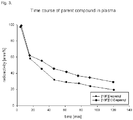
- Plasma radioactivity metabolic profiles have been monitored over time for [ 18 F] D2 Deprenyl compared to the non-deuterated [ 18 F] Deprenyl in cynomolgus monkey plasma ( Fig. 3 ).
- the radioactivity for [ 18 F] D2 Deprenyl was 18% and 31% higher as observed for [ 18 F] Deprenyl at the 30 and 60 min time points, respectively ( Fig. 3 ).
- metabolites occurring in cynomolgus monkey plasma over time have been monitored for both ligands ( Fig. 4 ).
- Fig. 4 metabolites occurring in cynomolgus monkey plasma over time have been monitored for both ligands
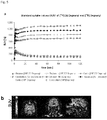
- a particularly important improvement of MAO-B imaging is the surprising technical effect that a decrease in signal intensity from [ 18 F] Deprenyl towards [ 18 F] D2 Deprenyl is between 6-8 times in the brain regions investigated during the steady state phase (see Fig. 5a ). From studies using [ 11 C] Deprenyl it is known that the MAO-B signal is underestimated in regions with high MAO-B activity due to high trapping rate that is similar to or exceeds delivery ( Fowler et al. J Nucl Med 1995, 36: 1255 ). Deuteration of [ 11 C] Deprenyl has been reported to result in a reduced trapping rate leading to more reliable quantification of the signal.
Landscapes
- Chemical & Material Sciences (AREA)
- Organic Chemistry (AREA)
- Health & Medical Sciences (AREA)
- Life Sciences & Earth Sciences (AREA)
- Pharmacology & Pharmacy (AREA)
- Physics & Mathematics (AREA)
- Medicinal Chemistry (AREA)
- Optics & Photonics (AREA)
- Proteomics, Peptides & Aminoacids (AREA)
- Epidemiology (AREA)
- Animal Behavior & Ethology (AREA)
- General Health & Medical Sciences (AREA)
- Public Health (AREA)
- Veterinary Medicine (AREA)
- Medicines Containing Antibodies Or Antigens For Use As Internal Diagnostic Agents (AREA)
- Organic Low-Molecular-Weight Compounds And Preparation Thereof (AREA)
Description
- This invention relates to novel compounds suitable for labelling or already labelled by 18F, methods of preparing such compounds, compositions comprising such compounds, kits comprising such compounds or compositions and compositions or kits for diagnostic imaging by positron emission tomography (PET).
- Molecular imaging has the potential to detect disease, disease progression or therapeutic effectiveness earlier than most conventional methods in the fields of oncology, neurology and cardiology. Of the several promising molecular imaging technologies having been developed such as optical imaging, magnetic resonance imaging (MRI), single photon emission computed tomography (SPECT), and positron emission tomography (PET), PET is also of particular interest for drug development because of its high sensitivity and ability to provide quantitative and kinetic data.
- For example positron emitting isotopes include carbon, iodine, fluorine, nitrogen, and oxygen. These isotopes can replace their non-radioactive counterparts in target compounds to produce tracers that function biologically and are chemically identical to the original molecules for PET imaging, or can be attached to said counterparts to give close analogues of the respective parent effector molecule. Among these isotopes, 18F is the most convenient labelling isotope due to its relatively long half life (110 min) which permits the preparation of diagnostic tracers and subsequent study of biochemical processes. In addition, its low β+ energy (634 keV) is also advantageous.
- The nucleophilic aromatic and aliphatic [18F]-fluoro-fluorination reaction is of great importance for [18F]-fluoro-labelled radiopharmaceuticals which are used as in vivo imaging agents targeting and visualizing diseases, e.g. solid tumours or diseases of brain. A very important technical goal in using [18F]-fluoro-labelled radiopharmaceuticals is the quick preparation and administration of the radioactive compound.
- Monoamine oxidases (MAO, EC, 1.4.3.4) represent a distinct class of amine oxidases. Monoamine oxidases are present in two isoforms known as MAO-A and MAO-B (Med. Res. Rev. 1984, 4: 323-358). Crystal structures of MAO-A and MAO-B complexed by ligands have been reported (J. Med. Chem. 2004, 47: 1767-1774 and Proc. Nat. Acad. Sci. USA 2005, 102: 12684-12689).
- In the human brain the presence of MAO-B predominates over MAO-A. Cerebral MAO-B levels increase with age and are further up-regulated in the brains of Alzheimer's disease (AD) patients mostly due to an increase of reactive astrocytes. As astrocyte activity and, consequently, the activity of the MAO-B system is up-regulated in neuroinflammatory processes, radiolabelled MAO-B inhibitors may serve as an imaging biomarker in neuroinflammation and neurodegeneration, including Alzheimer's disease.
- Inhibitors that are selective for either MAO-A or MAO-B have been identified and investigated (e.g. J. Med. Chem. 2004, 47: 1767-1774 and Proc. Nat. Acad. Sci. USA, 2005, 102: 12684-12689).
- Deprenyl (compound A), a MAO-B inhibitor (Biochem. Pharmacol. 1972, 5: 393-408) and clorgyline (B), a MAO-A inhibitor (Acta Psychiatr. Scand. Suppl. 1995, 386: 8-13), are potent monoamine oxidase inhibitors inducing irreversible inhibition of the respective enzymes. The (R)-isomer of deprenyl (Selegilin®, compound (R)-A) is a more potent inhibitor than the (S)-isomer (not shown).


- Neuroprotective and other pharmaceutical effects have also been described for inhibitors (Curr. Pharm. Des. 2010, 16: 2799-2817, Nature Reviews Neuroscience 2006, 295: 295-309; Br. J. Pharmacol. 2006, 147: 5287-5296, J. Alzheimers Dis. 2010, 21: 361-371, Prog. Neurobiol. 2010, 92: 330-344).
- MAO-B inhibitors are for example used to increase DOPA levels in CNS (Progr. Drug Res. 1992, 38: 171-297) and they have been used in clinical trials for the treatment of Alzheimer's disease (AD) based on the fact that an increased level of MAO-B is involved in astrocytes associated with Alzheimer plaques (Neuroscience 1994, 62: 15-30).
- Fluorinated MAO inhibitors have been synthesised and biochemically evaluated (Kirk et al., Fluorine and Health, A. Tressaud and G. Haufe (editors), Elsevier 2008, pp. 662-699). 18F and 11C labelled MAO inhibitors have been studied in vivo (Journal of the Neurological Science 2007, 255: 17-22; Review: Methods 2002, 27: 263-277).
- 18F labelled deprenyl and deprenyl analogues (D) and (E) have also been reported (Int. J. Radiat. Appl. Instrument. Part A, Applied Radiation Isotopes, 1991, 42: 121; J. Med. Chem. 1990, 33: 2015-2019 and Nucl. Med. Biol. 1999, 26: 111-116, respectively).

- Amongst said 11C labelled MAO inhibitors, [11C]-L-Deprenyl-D2, also referred to as DED ([11C]-L-bis-deuterium-deprenyl), has been widely used by multiple groups to study CNS diseases with regard to their impact on MAO-B acitivity, such as epilepsy (Acta Neurol. Scand. 2001, 103: 360; Acta Neurol. Scand. 1998, 98: 224; Epilepsia 1995, 36: 712), amyotrophic lateral sclerosis (ALS, see J. Neurolog. Sci. 2007, 255: 17), and traumatic brain injury (Clin. Positron Imaging 1999, 2: 71).

- Moreover, a comparative multitracer study including DED has been performed in patients suffering from Alzheimer's disease (AD) and healthy controls (Neurolmage 2006, 33: 588).
- DED has been furthermore used in studies on the effect of smoking and age on MAO-B acitivity (Neurobiol. Aging 1997, 18: 431; Nucl. Med. Biol. 2005, 32: 521; Proc. Nat. Acad. Sci. USA 2003, 20: 11600; Life Sci. 1998, 63: 2, PL19; J. Addict. Disease 1998, 17: 23).
- The non-deuterated analogue of DED, [11C]-L-deprenyl, binds very rapidly and irreversibly to MAO-B. As a result, the tracer may be trapped at a rate similar to or higher than its delivery by plasma, rendering PET images of regions with high MAO-B levels and/or low blood flow representing perfusion rather than MAO-B activity. The binding of DED is slower due to a kinetic isotope effect and thus DED allows for a more accurate assessment of MAO-B activity as its non-deuterated counterpart (see e.g. J. Nucl. Med. 1995, 36: 1255; J. Neurochem. 1988, 51: 1524).
-
WO 2009/052970 A2 discloses novel 18F labelled analogues of L-Deprenyl. Compound F shown below features favourable uptake in baboon brain and improved properties, such as superior metabolic stability, as compared to [11C]-L-Deprenyl and the aformentioned 18F labelled MAO-B inhibitors D and E. - It can be anticipated that deuteration at the propargylic position, as introduced in DED, will also result in a reduction of the trapping rate of compound F (Fowler et al. J Neurochem. 1988; 51: 1524-1534).

- For the sake of clarity, the reader is referred to the fact that the synthesis of F, alike the preparation of suitable precursors thereof such as J from alcoholic intermediates such as G is thought to proceed via a rearrangement reaction involving an aziridinium ion H. Said rearrangement may give rise to regiosiomeric mixtures of products as exemplified here. Thus, the regioisomeric precursors J1 and J2, due to the leaving group qualities of their chloro groups, can be equilibrated under suitable conditions, whilst F can be readily separated from its secondary regioisomer and is stable towards equilibration. For additional information on the aziridinium ion rearrangement see e.g. P. Gmeiner et al., J. Org. Chem. 1994, 59: 6766. The aziridinium rearrangement proceeds in a stereospecific manner, as described in
WO 2010/121719 A1 (see also the aformentioned publication and J. Cossy et al., Chem. Eur. J. 2009, 15: 1064).
- The aim of the present invention was to find a 18F labelled compound binding to MAO-B featuring superior signal to backgound ratio as compared to the current state of the art that can be used to detect reactive astrocytes by means of PET imaging targeting monoamine oxidase B, and to identify suitable precursors for its preparation.
- This was achieved by the provision of the compounds of the current invention which showed excellent uptake in target regions which surprisingly was accompanied with a significantly enhanced washout resulting in lower undesired signals, such as non-specific binding, as highlighted in
Figs. 5a and 5b . - The effect strongly exceeds effects reported for compounds from the closest prior art (see literature references below) and hence could not be expected by the person skilled in the art.
- Surprisingly, a decrease in signal intensity between 6-8 times from [18F] Deprenyl towards [18F] D2 Deprenyl was obeserved in the brain regions investigated during the steady state phase (see
Fig. 5a ). - From studies using [11C] Deprenyl it is known that the MAO-B signal is underestimated in regions with high MAO-B activity due to high trapping rate that is similar to or exceeds delivery (Fowler et al. J Nucl Med 1995, 36: 1255). Deuteration of [11C] Deprenyl has been reported to result in a reduced trapping rate leading to more reliable quantification of the signal. However, the effect of deuteration on the decrease in signal intensity for the [11C] D2 Deprenyl (DED) observed in healthy baboon and human brain regions comparable to those investigated by us, e.g. striatum, thalamus, cortex, is only approximately 1.2 - 2.0 (Fowler et al. J. Neurochem 1988, 51: 1524-1534; J. Nucl. Med. 1995, 36: 1255-1262; Mol. Imaging Biol. 2005, 7: 377-387). The unexpectedly pronounced improvement of aforementioned ratio (6 to 8 as compared to 1.2 to 2.0 in the prior art) renders the compounds of the invention as superior PET imaging agents.
- The present invention covers compounds of general formula I

- D is deuterium;
- R1 is selected from methyl, ethyl, n-propyl, n-butyl, iso-butyl;
- R2 is [18F]fluorine or a leaving group;
- n and m are selected from 0 and 1 with the provisos that if n = 0, m must be 1, and if n = 1, m must be 0, and if R2 is fluorine, n must be 1 and m must be 0;
- including all stereoisomeric forms of said compounds, including but not limited to enantiomers and diastereoisomers as well as racemic mixtures, and any suitable salt with an organic or inorganic acid, complex or solvate thereof.
- The invention further relates to methods of preparing such compounds, compositions comprising such compounds, kits comprising such compounds or compositions and compositions or kits for diagnostic imaging by positron emission tomography (PET).
- As used herein, a "leaving group" refers to a functional group selected from the group comprising halo, in particular chloro, bromo, iodo, methanesulfonyloxy, p-toluenesulfonyloxy, trifluoromethanesulfonyloxy, nonafluorobutanesulfonyloxy, (4-bromo-benzene)sulfonyloxy, (4-nitro-benzene)sulfonyloxy, (2-nitro-benzene)-sulfonyloxy, (4-isopropyl-benzene)sulfonyloxy, (2,4,6-tri-isopropyl-benzene)-sulfonyloxy, (2,4,6-trimethyl-benzene)sulfonyloxy, (4-tertbutyl-benzene)sulfonyloxy, benzenesulfonyloxy, and (4-methoxy-benzene)sulfonyloxy.
- The term "aryl" as employed herein by itself or as part of another group refers to monocyclic or bicyclic aromatic groups containing from 6 to 12 carbons in the ring portion, preferably 6-10 carbons in the ring portion, such as phenyl, biphenyl, naphthyl or tetrahydronaphthyl. A preferred aryl group is phenyl.
- As used herein in the description of the invention and in the claims, the term "alkyl", by itself or as part of another group, refers to a straight chain or branched chain alkyl group with 1 to 6 carbon atoms such as, for example methyl, ethyl, propyl, isopropyl, butyl, iso-butyl, tert-butyl, pentyl, iso-pentyl, neopentyl, hexyl.
- As used herein in the description of the invention and in the claims, the terms "inorganic acid" and "organic acid", refer to mineral acids, including, but not being limited to: acids such as carbonic, nitric, phosphoric, hydrochloric, perchloric or sulfuric acid or the acidic salts thereof such as potassium hydrogen sulfate, or to appropriate organic acids which include, but are not limited to: acids such as aliphatic, cycloaliphatic, aromatic, araliphatic, heterocyclic, carboxylic and sulfonic acids, examples of which are formic, acetic, trifluoroacetic, propionic, succinic, glycolic, gluconic, lactic, malic, fumaric, pyruvic, benzoic, anthranilic, mesylic, fumaric, salicylic, phenylacetic, mandelic, embonic, methanesulfonic, ethanesulfonic, benzenesulfonic, phantothenic, toluenesulfonic, trifluoromethanesulfonic and sulfanilic acid, respectively.
- The compounds of the present invention can exist as solvates, such as hydrates, wherein compounds of the present invention may contain organic solvents or water as structural element of the crystal lattice of the compounds. The amount of said solvents may exist in a stoichiometric or unstoichiometric ratio. In case of stoichiometric solvates, e.g. hydrates, hemi-, (semi-), mono-, sesqui-, di-, tri-, tetra-, penta- etc. solvates or hydrates are possible.
- Since at least one chiral centre is present in the compounds according to the present invention and another form of an isomeric centre may be present, all isomeric forms resulting from said isomeric centres, including enantiomers and diastereoisomers, are intended to be covered herein. Compounds containing a chiral centre may be used as racemic mixture or as an enantiomerically enriched mixture, or the racemic mixture may be separated using well-known techniques and a single enantiomer may be used.
- The terms "halogen", or "halo" refers to fluorine (F), chlorine (Cl), bromine (Br), or iodine (I); the term "halide" refers to fluoride, chloride, bromide or iodide.
- In a first aspect the invention is directed towards compounds of the general formula I

- D is deuterium;
- R1 is selected from methyl, ethyl, n-propyl, n-butyl, iso-butyl;
- R2 is [18F]fluorine or a leaving group, wherein leaving groups are selected from halogen, C1-C6-alkylsulfonyloxy, which is optionally substituted by fluorine, and arylsulfonyloxy, which is optionally substituted by hydrogen, methyl, halo and nitro, and wherein particularly preferred leaving groups are chloro, bromo, methanesulfonyloxy, and p-toluenesulfonyloxy, and wherein the most preferred leaving group is chloro;
- n and m are selected from 0 and 1 with the provisos that if n = 0, m must be 1, and if n = 1, m must be 0, and if R2 is fluorine, n must be 1 and m must be 0; including all stereoisomeric forms of said compounds, including but not limited to enantiomers and diastereoisomers as well as racemic mixtures, and any suitable salt with an organic or inorganic acid, complex or solvate thereof.
- In a preferred embodiment, the invention is directed towards compounds of the general formula I:

- D is deuterium;
- R1 is methyl;
- R2 is selected from fluoro or chloro; wherein fluoro is [18F]fluorine, n and m are selected from 0 and 1 with the provisos that if n = 0, m must be 1, and if n = 1, m must be 0, and if R2 is [18F]fluorine, n must be 1 and m must be 0;
- including enantiomers as well as racemic mixtures, and any suitable salt with an organic or inorganic acid, or solvate thereof.
- In a more preferred embodiment, the invention is directed towards a compound of the general formula la:
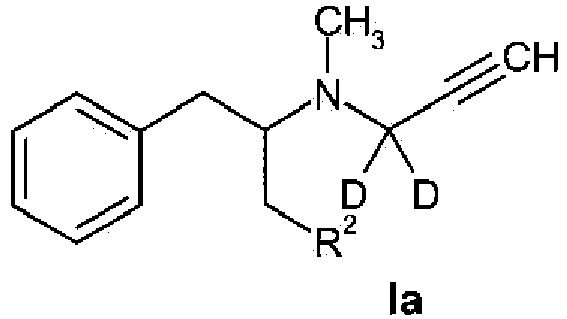
- D is deuterium;
- R2 is selected from fluoro or chloro; wherein fluoro is [18F]fluorine,
- including enantiomers as well as racemic mixtures, and any suitable salt with an organic or inorganic acid, or solvate thereof.
- In another more preferred embodiment, the invention is directed towards a compound of the general formula Ib:

- D is deuterium;
- R2 is chloro;
- including enantiomers as well as racemic mixtures, and any suitable salt with an organic or inorganic acid, or solvate thereof.
- In an even more preferred embodiment, the invention is directed towards the compound of the general formula Ic:

- In another even more preferred embodiment, the invention is directed towards a compound of the general formula Id:

- In a particularly preferred embodiment, the invention is directed towards the compound of the general formula Ie:

and any suitable salt with an organic or inorganic acid, or solvate thereof. - In a particularly preferred embodiment, the invention is directed towards the compound of the general formula If:

- In a second aspect the invention is directed to the synthesis of a compound of the formula I, in which R2 stands for a leaving group as defined above, from suitable starting materials. Such compounds are useful precursors for the introduction of R2 = 18F, i.e. for the generation of 18F labelled radiotracers. Said starting materials can comprise but are not limited to alcohols of the general formula IIa:

- Such syntheses comprise but are not limited to the reaction with a sulfonyl halide, such as methanesulfonyl chloride or p-toluenesulfonyl chloride, in the presence of a suitable base, such as a trialkyl amine, e.g. triethylamine, or such as a heteroaromatic base, e.g. pyridine or 2,6-lutidine, in a suitable solvent such as an optionally halogenated hydrocarbon, e.g. dichloromethane, or an ether, such as tetrahydrofurane.
- Said synthetic methods may further comprise, but are not limited to the use of sulfonyl anhydrides instead of the aforementioned sulfonyl halides, such as methanesulfonic anhydride, to give compound of the formula II in which R2 is a sulfonic ester. Said synthetic methods may furthermore comprise the use of carbon tetrahalides, such as tetrachloromethane or tetrabromomethane, and suitable organophosphorus reagents such as triphenylphosphane or tri-n-butylphosphane, for the conversion of alcohols of the general formula IIa into compounds of the general formula I in which R2 stands for a leaving group.
- In a preferred embodiment, the invention is directed to a synthesis of the compound with formula Id as described above from the alcohol with the formula IIb:

- In a more preferred embodiment, the invention is directed to a synthesis of the compound with formula Id as described above from the alcohol with the formula IIb by reacting IIb with a suitable sulfonyl chloride in the presence of a suitable base in an appropriate solvent, as described above.
- In a particularly preferred embodiment, the invention is directed to a synthesis of the compound with formula If as described above from the alcohol with the formula IIc by reacting IIc with a suitable sulfonyl chloride in the presence of a suitable base in an appropriate solvent, as described above:

- In another particularly preferred embodiment, the invention is directed to a synthesis of the compounds with formula Id or If as described above from alcohols with the formula IIb or IIc by reacting said alcohols with a sulfonyl chloride, such as methanesulfonyl chloride or p-toluenesulfonyl chloride, in the presence of a suitable base, such as a trialkyl amine, e.g. triethylamine, in a suitable solvent such as a halogenated hydrocarbon, e.g. dichloromethane, to effect conversion of the hydroxy group displayed by compounds of the formulae Ia into a chloro group. The reaction mixture resulting from bringing together all reactants is initially allowed to react for a suitable time ranging from 5 min to 6 hours, preferred 15 min to 4 hours, even more preferred 30 min to 2 hours, at a temperature between -50°C and +30°C, preferred -30°C and +30°C, even more preferred -10°C and +25 °C, followed by heating the reaction mixture for a suitable time ranging from 5 min to 6 hours, preferred 15 min to 4 hours, even more preferred 30 min to 2 hours to a temperature range between 70°C to 130 °C, preferred 80°C to 120 °C, even more preferred 90°C to 110°C. The heating period effects the conversion of an initially formed mixtures of Id / If with their respective primary regioisomers reflecting the constitution of the respective starting material IIb or IIc.
- In a third aspect the invention is directed towards a method of synthesis comprising the reaction of a compound of the general formula I, wherein R2 stands for a leaving group, with an F-fluorinating agent, in which F = 18F, to give a compound in which R2 is replaced by 18F. Said F-fluorinating agent is a compound comprising F-anions, preferably a compound selected from but not limited to the group comprising 4, 7, 13, 16, 21, 24-hexaoxa-1,10-diazabicyclo[8.8.8]-hexacosane K F, i.e. crown ether salt Kryptofix KF, KF, HF, KH F2, CsF, NaF and tetraalkylammonium salts of F, such as tetrabutylammonium fluoride, and wherein F = 18F, to give a compound in which R2 is replaced by 18F.
- In a preferred embodiment, the invention is directed towards a method of synthesis of compound of the general formula Ic, in which F = 18F, by reacting compound of the general formula Id with an F-fluorinating agent, in which F = 18F. Said F-fluorinating agent is a compound comprising F-anions, preferably a compound selected from but not limited to the group comprising 4, 7, 13, 16, 21, 24-hexaoxa-1,10-diazabicyclo[8.8.8]-hexacosane K F, i.e. crown ether salt Kryptofix KF, KF, HF, KH F2, CsF, NaF and tetraalkylammonium salts of F, such as tetrabutylammonium fluoride, and wherein F = 18F.
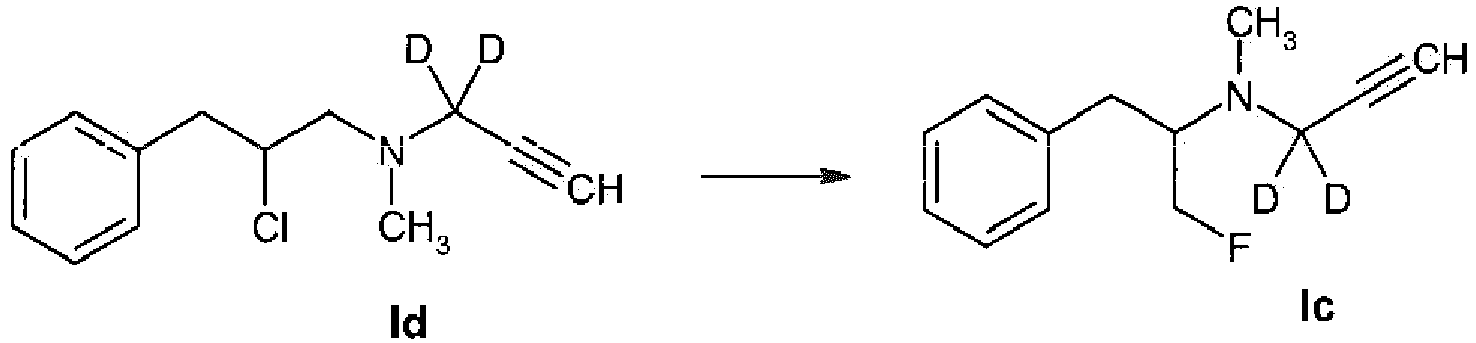
- In another preferred embodiment, the invention is directed towards a method of synthesis of compound of the general formula Ie, in which F 18F, by reacting compound of the general formula If with an F-fluorinating agent, in which F = 18F. Said F-fluorinating agent is a compound comprising F-anions, preferably a compound selected from but not limited to the group comprising 4, 7, 13, 16, 21, 24-hexaoxa-1,10-diazabicyclo[8.8.8]-hexacosane K F, i.e. crown ether salt Kryptofix KF, KF, HF, KH F2, CsF, NaF and tetraalkylammonium salts of F, such as tetrabutylammonium fluoride, and wherein F = 18F.

- In a fourth aspect, the invention is directed towards the compounds of the general formula I for use in the preparation of an 18F labelled diagnostic imaging agent or imaging agent, preferably as imaging agent for PET application.
- In a more preferred embodiment, said PET application is used for imaging of CNS diseases. CNS diseases include but are not limited to inflammatory and autoimmune, allergic, infectious and toxin-triggered and ischemia-triggered diseases, pharmacologically triggered inflammation with pathophysiological relevance, neuroinflammatory, neurodegenerative diseases.
- More preferably, the CNS disease is selected from multiple sclerosis, Alzheimer's disease, frontotemporal dementia, dementia with Lewy bodies, leukoencephalopathy, epilepsy, neuropathic pain, amyotrophic lateral sclerosis, Parkinson's Disease, encephalopathies, brain tumors, depression, drug abuse, addictive diseases, atheroma, atherosclerosis, pharmacologically triggered inflammation, systemic inflammation of unclear origin.
- In a particularly preferred embodiment, said PET application is used for imaging of dementia related diseases, such as Alzheimer's disease.
- In another particularly preferred embodiment, said PET application is used for imaging neuroinflammatory diseases, such as multiple sclerosis.
- The invention also relates to kits comprising compounds of formula I. Such kits may contain at least one sealed vial containing a compound of formula I. The kit may also contain reagents suitable to perform the herein disclosed reactions. The reagents disclosed herein may be also included in such kit and may be stored in a sealed vial. The kit may also contain 18F labelling reagents. Furthermore, the kit may contain instructions for its use.
- In a fifth aspect, the invention is directed to the compounds of general formula I, for use in conducting biological assays and chromatographic identification. More preferably, the use relates to compounds of general formula I wherein R2 is 18F.
- Compounds of general formula I wherein the fluorine isotope is 19F are useful as references and/or measurement agents.
- The compounds of general formula I are herein defined as above and encompass all embodiments and preferred features.
- In particular the invention relates to:
- 1. A compound of formula I:

- D is deuterium;
- R1 is selected from methyl, ethyl, n-propyl, n-butyl, iso-butyl;
- R2 is [18F]fluorine or a leaving group, wherein leaving groups are selected from halogen, C1-C6-alkylsulfonyloxy, which is optionally substituted by fluorine, and arylsulfonyloxy, which is optionally substituted by hydrogen, methyl, halo and nitro;
- n and m are selected from 0 and 1 with the provisos that if n = 0, m must be 1, and if n = 1, m must be 0, and if R2 is fluorine, n must be 1 and m must be 0;
- including all stereoisomeric forms of said compounds, including but not limited to enantiomers and diastereoisomers as well as racemic mixtures, and any suitable salt with an organic or inorganic acid, complex or solvate thereof.
- 2. A compound according to
count 1,
wherein R2 is selected from the group consisting of chloro, bromo, methanesulfonyloxy, and p-toluenesulfonyloxy. - 3. A compound according to counts 1 or 2, wherein
D is deuterium;
R1 is methyl;
R2 is selected from fluoro or chloro, wherein fluoro is [18F]fluorine. - 4. A compound of formula la:

D is deuterium;
R2 is selected from fluoro or chloro; wherein fluoro is [18F]fluorine, including enantiomers as well as racemic mixtures, and any suitable salt with an organic or inorganic acid, or solvate thereof. - 5. A compound of formula Ib:

D is deuterium;
R2 is chloro;
including enantiomers as well as racemic mixtures, and any suitable salt with an organic or inorganic acid, or solvate thereof. - 6. A compound selected from the group of compounds consisting of
a compound of formula Ic, wherein F is 18F,


a compound of formula If,
- 7. A [18F] labelled compound of
counts - 8. A diagnostic composition comprising a [18F] labelled compound of
counts - 9. A [18F] labelled compound of
counts - 10. A diagnostic composition comprising a [18F] labelled compound of
counts - 11. A compound or a composition according to count 7 to 10 for imaging of Alzheimer's disease.
- 12. A compound or a composition according to
counts 7 to 11, wherein the [18F] labelled compound is a compound of formula Ie:
- 13. A method for the synthesis of a compound according to formula I:

- D is deuterium;
- R1 is selected from methyl, ethyl, n-propyl, n-butyl, iso-butyl;
- R2 is [18F]fluorine or a leaving group, wherein leaving groups are selected from halogen, C1-C6-alkylsulfonyloxy, which is optionally substituted by fluorine, and arylsulfonyloxy, which is optionally substituted by hydrogen, methyl, halo and nitro;
- n and m are selected from 0 and 1 with the provisos that if n = 0, m must be 1, and if n = 1, m must be 0, and if R2 is fluorine, n must be 1 and m must be 0;
- characterized in that
- a compound of formula IIa:

- is reacted with a sulfonyl anhydride or a sulfonyl halide.
- 14. A method for the synthesis of a compound according to formula Ib:

- D is deuterium;
- R2 is chloro;
- characterized in that
- a compound of formula IIb:

- is reacted with a sulfonyl chloride.
- 15. A method according to count 14, wherein the sulfonyl chloride is methanesulfonyl chloride.
- 16. A method according to count 14 or 15, for the synthesis of a compound of formula 1f:

a compound of formula IIc:
- 17. A method for the synthesis of a compound according to formula I:

- D is deuterium;
- R1 is selected from methyl, ethyl, n-propyl, n-butyl, iso-butyl;
- R2 is [18F]fluorine;
- n is 1 and m is 0;
- characterized in that
- a compound of formula I:

- D is deuterium;
- R1 is selected from methyl, ethyl, n-propyl, n-butyl, iso-butyl;
- R2 is a leaving group, wherein leaving groups are selected from halogen, C1-C6- alkylsulfonyloxy, which is optionally substituted by fluorine, and arylsulfonyloxy, which is optionally substituted by hydrogen, methyl, halo and nitro;
- n is 0 and m is 1;
- is reacted with a suitable F-fluorinating agent, wherein F is 18F.
- 18. A method according to count 17 for the synthesis of a compound of formula Ic:

characterized in that
a compound of formula Id:
- 19. A method according to count 17 or 18 for the synthesis of a compound of formula Ie:

characterized in that
a compound of formula If:
- 20. A kit comprising at least one sealed container comprising a compound or a composition according to counts 1-12.
- 21. A kit comprising at least one sealed container comprising a compound of
count 6. - 22. A kit according to counts 20 and 21 comprising a further sealed container comprising reagents.
- In the context of this invention, CNS diseases include but are not limited to inflammatory and autoimmune, allergic, infectious and toxin-triggered and ischemia-triggered diseases, pharmacologically triggered inflammation with pathophysiological relevance, neuroinflammatory, neurodegenerative diseases. More preferably, the CNS disease is selected from multiple sclerosis, Alzheimer's disease, frontotemporal dementia, dementia with Lewy bodies, leukoencephalopathy, epilepsy, neuropathic pain, amyotrophic lateral sclerosis, Parkinson's Disease, encephalopathies, brain tumors, depression, drug abuse, addictive diseases, atheroma, atherosclerosis, pharmacologically triggered inflammation, systemic inflammation of unclear origin.
- In a particularly preferred embodiment, said PET application is used for imaging of dementia related diseases, such as Alzheimer's disease.
- In another particularly preferred embodiment, said PET application is used for imaging neuroinflammatory diseases, such as multiple sclerosis.
- According to the invention, the 18F-labelled compounds of the invention are useful PET tracers for imaging of or diagnosing CNS diseases in particular for Alzheimer's disease and multiple sclerosis.
- The synthesis of the compounds of the invention commences with amino alcohol intermediates of the general formula II. Many of these amino alcohols are known to the person skilled in the art and readily synthesised from suitable amino acid building blocks or suitably protected intermediates which are often commercially available. Subsequently, the deuterated propargyl group is introduced to give tertiary amines IIa. This can be performed using crude 3-bromo(3,3-2H2)prop-1-yne prepared according to Fowler et al., Nucl. Med. Biol. 2001, 28 (7): 779 - 785; in our hands however, the corresponding tosylate III was found to be more practical due to its lower volatility and better detectability. It is easily prepared from the deuterated propargyl alcohol described in the reference given above.

- The hydroxy group of the resulting amino alcohol IIa is then transferred into a leaving group by methods known to the person skilled in the art, such as sulfonylation or halogenation.
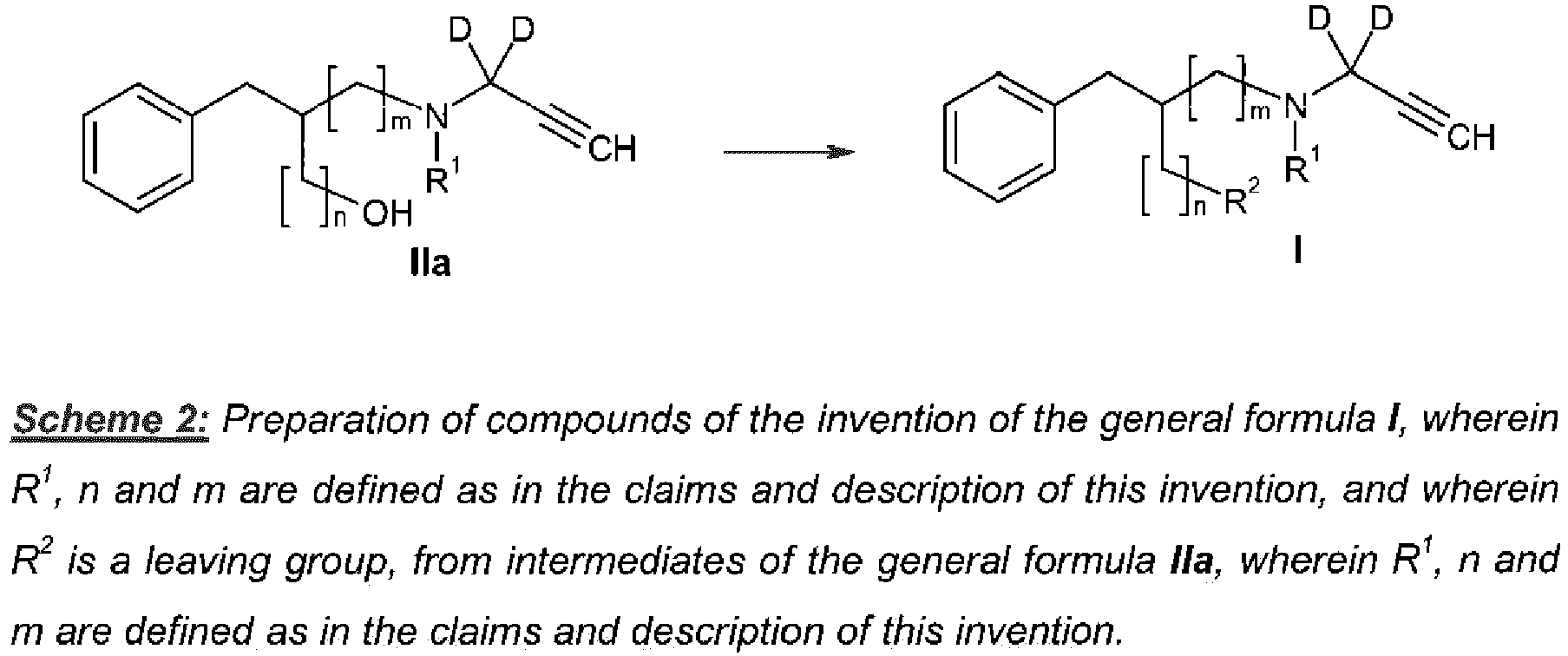
- It is worth noting at this point that sulfonates are only available from sulfonyl anhydrides since the sulfonates initially formed from sulfonyl chlorides get readily displaced by the concomitant chloride counterion. Said sulfonates have been reported to readily undergo a rearrangement via an intermediate aziridinium ion which may give rise to regiosiomeric mixtures of products, see e.g
. L. Lehmann et al., WO 2009/052970 A2 . For additional information on the aziridinium ion rearrangement see e.g. P. Gmeiner et al., J. Org. Chem. 1994, 59: 6766. The aziridinium rearrangement proceeds in a stereospecific manner, as described inWO 2010/121719 A1 (see also the aformentioned publication and J. Cossy et al., Chem. Eur. J. 2009, 15: 1064). Under suitable conditions conferring thermodynamic control, the thermodynamically more stable product can be formed with high selectivity as shown in the example shown below, as illustrated below for the synthesis of compound If.
- The resulting compounds with the general formula I wherein R2 is a leaving group can be converted into ratiotracers (wherein R2 = 18F) by radiofluorination methods known to the person skilled in the art, e.g. 4, 7, 13, 16, 21, 24-hexaoxa-1,10-diazabicyclo[8.8.8]-hexacosane K F, i.e. crown ether salt Kryptofix KF, KF, HF, KH F2, CsF, NaF and tetraalkylammonium salts of F, such as tetrabutylammonium fluoride, and wherein F = 18F, Also these reactions typically yield regioisomeric mixtures, presumably via an intermediate aziridinium ion, which can be separated by means of HPLC to give the desired primary regioisomers Ig.
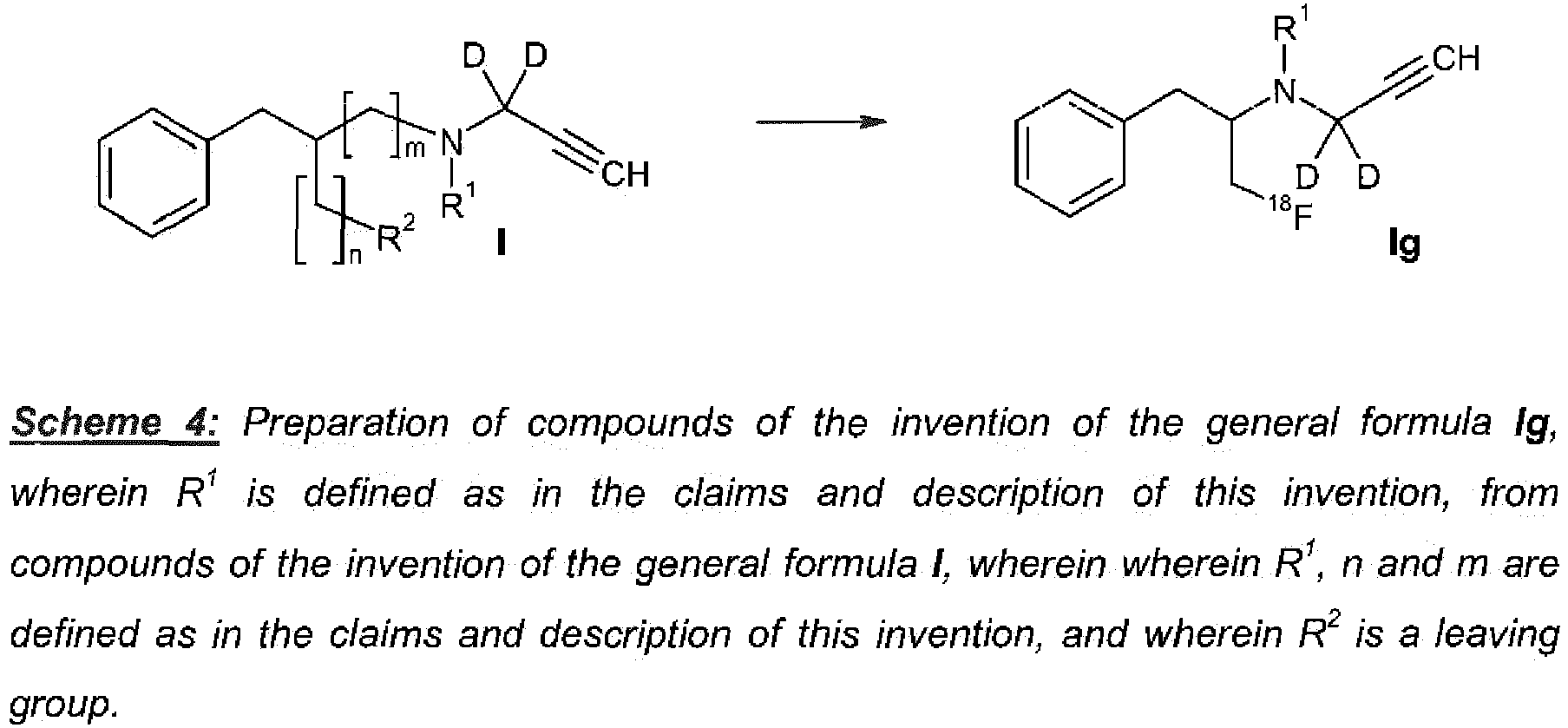
- In a similar fashion, the amino alcohols IIa can be converted into the corresponding non-radioactive fluorides Ih by methods known to the person skilled in the art, such as the reaction with nonafluorobutylsulfonyl fluoride in the presence of Et3N x 3 HF. Also these reactions typically yield regioisomeric mixtures, presumably via an intermediate aziridinium ion.

-
-
Fig. 1 : Distribution of [18F] D2 Deprenyl (compound of Example 3) detected via a gamma-detector is shown in a time frame of 4 hours in mouse brains (n=3). -
Fig. 2 : Autoradiographies of thin layer chromatograms (TLC) generated by using a solvent consisting of 10% hexane/ 90% ethyl acetate. Mouse plasma, cruor and brain tissue were investigated at 5 min p.i. in order to detect metabolites generated from (a) [18F] D2 Deprenyl and (b) non-deuterated [18F] Deprenyl (compound F). Circles delineate the regions of interest (ROI) for measurement of the respective bands by use of the software Image Quant 5.2. The band represented by ROI2 in (a) is reduced in intensity as compared to (b) (marked by a square). 18F- - free fluoride, par. - parent compound, P - plasma, C- cruor (n=3 mice); cereb. - cerebellum, ctx- cortex, mid - midbrain (tissue from 3 mice pooled for each region; 1 - [18F] metamphetamine; 2 - [18F] amphetamine; 3 - [18F] Nordeprenyl and [18F] D2 Nordeprenyl, resp.; 4 - [18F] D2 Deprenyl and non-deuterated [18F] Deprenyl, respectively. -
Fig. 3 : Demonstration of in vivo time course of [18F] D2 Deprenyl and non-deuterated [18F] Deprenyl in cynomolgus monkey plasma. -
Fig. 4 : Demonstration of in vivo metabolism of (a) [18F] D2 Deprenyl and (b) non-deuterated [18F] Deprenyl in cynomolgus monkey plasma. The time course of the parent compounds as well as metabolites expressed in [area %] generated from respective HPLC chromatograms are shown. -
Fig. 5 : PET in different brain regions of cynomolgus monkeys with [18F] D2 Deprenyl and non-deuterated [18F] Deprenyl, respectively. (a) Time activity curves (TAC) expressed as percent SUV of [18F] D2 Deprenyl over a time of 120 min and compared to the respective TACs of non-deuterated [18F] Deprenyl. (b) Images of three planes (transversal, coronal and sagittal) of the brain of the same cynomolgus monkey after the injection of [18F] D2 Deprenyl.
Surprisingly, the decrease of the signal of [18F] D2 Deprenyl, as expressed as % standard uptake value (SUV) in TACs compared to the signal of the non-deuterated [18F] Deprenyl was 6 to 8 times between 30 and 120 min in the investigated brain regions of cynomolgus monkeys (Fig. 5a ). This was not expected since the decrease in signal due to the deuteration effect known from [11C] Deprenyl versus [11C] D2 Deprenyl (DED) is only approximately 1.2 - 2.0 times observed in baboon and human brain regions comparable to those investigated by us, e.g. striatum, thalamus, cortex (Fowler et al. J. Neurochem 1988, 51: 1524-1534; J. Nucl. Med. 1995, 36: 1255-1262; Mol. Imaging Biol. 2005, 7: 377-387).
Thus, the brain trapping also in target regions was less pronounced (Fig. 5b ) and leads to an advantage over [11C] D2 Deprenyl regarding background signal. -
Fig. 6 : Preparative HPLC chromatogram of [18F] D2 Deprenyl showing a retention time of the desired 18F radiolabelled product of tR=12.5 min. -
Fig. 7 : Analytical HPLC chromatogram of [18F] D2 Deprenyl showing a retention time of the desired 18F radialabelled product of tR=2.59 min. -
Fig. 8 : Analytical HPLC chromatogram of [19F] D2 Deprenyl (compound of Example 2) showing a retention time of the desired non-radioactive 19F reference compound tR=of 2.36 min. -
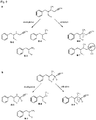
Fig. 9 : In vitro metabolite pathways in rat, mouse, dog, monkey and human microsomes and rat and human heaptocyte preparations. The metabolites were detected by LC/MS. (a) Metabolite pathways of non-deuterated [18F] Deprenyl and (b) Metabolite pathways of [18F] D2 Deprenyl. -
Fig. 10 : Distribution of [18F] D2 Deprenyl as observed by PET in different regions of a cynomolgus monkey brain. Time activity curves (TAC) were expressed as percent standard uptake values (SUV [%]) over a time of 120 min. - General: All solvents and chemicals were obtained from commercial sources and used without further purification. The following table lists the abbreviations used in this paragraph and in the Examples section as far as they are not explained within the text body. NMR peak forms are stated as they appear in the spectra, possible higher order effects have not been considered. Chemical names were generated using the ACD IUPAC naming software by Advanced Chemical Development. In some cases generally accepted names of commercially available reagents were used in place of ACD/IUPAC generated names.
- Reactions employing microwave irradiation can be run with a Biotage Initator® microwave optionally oven equipped with a robotic unit. The compounds and intermediates produced according to the methods of the invention may require purification. Purification of organic compounds is well known to the person skilled in the art and there may be several ways of purifying the same compound. In some cases, no purification may be necessary. In certain cases, the compounds may be purified by crystallization. In some cases, impurities may be removed by trituration using a suitable solvent. In some cases, the compounds may be purified by chromatography, particularly flash column chromatography, using for example prepacked silica gel cartridges, e.g. from Separtis such as Isolute® Flash silica gel or Isolute® Flash NH2 silica gel in combination with e.g. a FlashMaster II autopurifier (Argonaut/Biotage) and eluents such as gradients of hexane/EtOAc or dichloromethane/ethanol. In some cases, the compounds may be purified by preparative HPLC using for example a Waters autopurifier equipped with a diode array detector and/or online electrospray ionization mass spectrometer in combination with a suitable prepacked reverse phase column and eluents such as gradients of water and acetonitrile which may contain additives such as trifluoroacetic acid or aqueous ammonia. In some cases, purification methods as described above can provide those compounds of the present invention which possess a sufficiently basic functionality in the form of a salt, such as, in the case of a compound of the present invention which is sufficiently basic, a trifluoroacetate or formate salt for example. A salt of this type may be transformed into its free base form, respectively, by various methods known to the persion skilled in the art.
Abbreviations br broad signal (in NMR) d doublet dd doublet of doublet DMSO dimethylsulfoxide ee enantiomeric excess ESI electrospray ionisation EtOAc ethyl acetate Et2O dimethyl ether h hour K2CO3 potassium carbonate K 2.2.2 4, 7, 13, 16, 21, 24-hexaoxa-1,10-d iazabicyclo[8.8.8]-hexacosane MeCN acetonitrile MS mass spectrometry MTB methyl tert-butyl ether m multiplet min minute NMR nuclear magnetic resonance spectroscopy : chemical shifts (δ) are given in ppm. r.t. room temperature s singlet t triplet THF tetrahydrofurane -

- To a suspension of N-methyl-L-phenylalanine (20 g, 112 mmol) in THF (1200 mL) cooled to -10 °C was added in small portions lithium aluminium hydride (6.35 g, 167 mmol). After ceasing of the initial exothermic reaction, the cooling bath was removed and the reaction mixture was heated at reflux overnight. Subsequently, another portion of lithium aluminium hydride (4.24 g, 112 mmol) was added after cooling to -10 °C, followed by refluxing for an additional 3 h. The reaction mixture was cooled to -40°C, and aqueous 2 N sodium hydroxide was added cautiously. After warming up to r.t., the mixture was filtered, the residue was washed with MTB, and the filtrate was evaporated to give the crude target compound (17.7 g, 96 % yield) which was used without further purification.
1H NMR (400 MHz, DMSO-d 6) δ ppm 2.26 (s, 3 H), 2.51 - 2.62 (m, 3 H) 3.16 - 3.30 (m, 3 H), 7.11 - 7.25 (m, 5 H).
MS (ESI): [M + H]+ = 166. -

- To a solution of (1,1-2H2)prop-2-yn-1-ol (3.40 g, prepared according to Fowler et al., Nucl. Med. Biol. 2001, 28 (7): 779 - 785, separation from residual ethanol was accomplished by fractional distillation) in dichloromethane (250 mL) was added pyridine (7 mL), and the mixture was cooled to 0°C. Tosyl anhydride (21.0 g, 1.1 eq) was added and the reaction mixture was allowed to stir for 30 min, the cooling bath was removed and stirring was continued for 1.5 h. The mixture was concentrated in vacuo and the residue was purified by column chromatography on silica gel (EtOAc in hexane 2.5% → 25 %) to give the target compound in approx. 90 % puritiy (9.39 g, 68 % yield).
1H NMR (300 MHz, CDCl3) δ ppm 2.47 (m app s, 4 H), 7.36 (d, 2 H), 7.83 (d, 2 H).
MS (ESI): [M + H]+ = 213. -

- To a solution of (2S)-2-(methylamino)-3-phenylpropan-1-ol (3.00 g, 18.2 mmol) in THF (150 mL) was added potassium carbonate (325 mesh, 3.76 g, 1.50 eq) at r.t.. Intermediate 1B was added, and the mixture was stirred overnight at r.t.. In order to effect complete turnover, another portion of potassium carbonate (0.50 eq) was added, and the mixture was stirred at r.t. for additional 2 h. The mixture was aconcentrated in vacuo and partitioned between dichloromethane and brine. The organic layer was dried over sodium sulfate and evaporated. The residue was purified by column chromatography on silica gel (EtOAc in hexane 9% → 90%) to give the desired product (2.07 g, 50 % yield).
1H NMR (600 MHz, CHLOROFORM-d) δ ppm 2.29 (s, 1 H) 2.37 - 2.43 (m, 1 H) 2.44 (s, 3 H) 2.75 - 2.95 (s br, 1 H) 3.05 - 3.12 (m, 2 H) 3.33 - 3.39 (m, 1 H) 3.41 - 3.46 (m, 1 H) 7.16 - 7.32 (m, 5 H).
MS (ESI): [M + H]+ = 206. -

- To a solution of (2S)-2-{methyl[(1,1-2H2)prop-2-yn-1-yl]amino}-3-phenylpropan-1-ol (57 mg, 0.28 mmol) in dichloromethane (3 mL) was added triethylamine (58 µL, 0.42 mmol), and the mixture was cooled to 0 °C. Methanesulfonyl chloride (28 µL, 0.36 mmol) was added, and the cooling bath was removed. After stirring at r.t. for 1 h, the reaction mixture was heated to 100 °C in a microwave oven for 1 h. After cooling to r.t., the mixture was diluted with diethyl ether (3 mL) and then washed by aqueous sodium bicarbonate. The aqueous layers were extracted with diethylether (2 x 3 mL), and the combined organic layers were diluted with dichloromethane and finally washed with brine. The organic layer was dried over sodium sulfate and evaporated. Column chromatography on silica (Et2O in
pentane 5% → 15%) gave the title compound containing only small quantities of the corresponding primary regioisomer (50 mg, 80 % yield).
1H NMR (400 MHz, CHLOROFORM-d) δ ppm 2.21 (s, 1 H) 2.38 (s, 3 H) 2.74 (d, 2 H) 2.95 (dd, 1 H) 3.23 (dd, 1 H) 4.10 - 4.19 (m, 1 H) 7.23 - 7.36 (m, 5 H).
MS (ESI): [M + H]+ = 224. -

- To a solution of (2S)-2-{methyl[(1,1-2H2)prop-2-yn-1-yl]amino}-3-phenylpropan-1-ol (2.00 g, 9.74 mmol) in THF (50 mL) was added subsequently nonafluorobutanesulfonyl fluoride (5.89 g, 2.0 eq), triethylamine tris-hydrofluoride (3.14 g, 2.0 eq), and triethylamine (8.15 mL, 6.0 eq), and the resulting mixture was stirred for 24 h at r.t.. After concentration in vacuo, the crude residue was purified by column chromatography on silica (5% → 15 % EtOAc in hexane) to give the pure title compound as an oil (220 mg, 10 % yield). In addition, the regioisomer N-[(2R)-2-fluoro-3-phenylpropyl]-N-methyl(1,1-2H2)prop-2-yn-1-amine (380 mg, 19 % yield), and a mixed fraction composed from both regioisomers (400 mg, 20 %) was obtained.
-

- A solution of [18F]fluoride in [18O] enriched water was flashed through a Sep-Pak QMA light cartridge (preconditioned with potassium carbonate [0.5 M, 5 mL], 18 MΩ H2O, 10 mL) to isolate 15 GBq of [18F]fluoride which was then eluted from the cartridge with .1.5 mL of a solution of potassium carbonate and Kryptofix 2.2.2 in water and acetonitrile (5 mg K222 in 0.95 mL MeCN, 1 mg K2CO3 in 0.05 mL water). The solvent was evaporated at 120° C under continuous nitrogen flow and a yellow residue of [18F]F-/K2CO3/K2.2.2 was left. 1 mL of extra dry acetonitrile was added and evaporated as before. The residue was then cooled to 50°C and N-[(2R)-2-chloro-3-phenylpropyl]-N-methyl(1,1-2H2)prop-2-yn-1-amine (Example 2; ∼2mg) dissolved in DMSO (600 µL) was added. The closed reaction vessel was heated at 120°C for 20 min. The reaction mixture was cooled to 50°C and was diluted with 4 mL of the mobile phase before injecting to the preparative HPLC for purification.
- The desired primary regioisomer N-[(2S)-1-[18F]fluoro-3-phenylpropan-2-yl]-N-methyl(1,1-2H2)prop-2-yn-1-amine was purified by reverse phase HPLC on a
ACE 5 C18 HL 250 x 10 mm; 5 µm and 85% 0.01 M H3PO4 / 15% MeCN was used as the eluting solvent at a flow rate of 4 mL / min. The eluate was monitored by a UV absorbance detector (λ = 254 nm) in series with a radioactivity detector. The fraction of the desired compound was collected at tR=12.5 min (figure 6 ) and diluted with 40 mL water. The dissolved product was transferred to a Sep-Pak C18 plus cartridge. The cartridge was washed with 5 mL of water and the desired 18F labelled product was eluted with 1 mL ethanol into the product vial (2.77 GBq). The radiochemical purity of the radioligand was analyzed by a reverse phase HPLC on aACE 3 C18 S/N- A67537; 50 x 4.6 mm; 3 µm. with a solvent gradient: start 5% acetonitrile - 95% acetonitrile in 0.1% trifluoroacetic acid in 7 min., flow: 2 mL/min. The desired 18F labelled product of example 3 was isolated in a radiochemical purity of > 99% and a radiochemical yield of 27.5 % corrected for radioactive decay within 70 minutes and confirmed by co-injection with the corresponding non-radioactive F-19 fluoro-standard of example 2. - The eluate was monitored by a UV absorbance detector (A = 254 nm) in series with a radioactivity detector.The retention time of the 18F labelled product was tR=2.59 min (
figure 7 ) and the retention time of the non-radioactive reference compound was determined to be tR=2.36 min (figure 8 ). - [19F] D2 Deprenyl (compound of Example 2) has an affinity towards MAO-B of IC50 = 41.3 nM. This was determined by incubating human MAO-B prepared from insect cells infected with recombinant baculovirus containing respective cDNA inserts (Sigma) with respective reagents of the Amplex Red Monoamine Oxidase Assay-Kit (Molecular Probes). The affinity towards MAO-A is greater than 2 µM.
- Biodistribution of [18F] D2 Deprenyl (compound of Example 3) was investigated in NMRI mice weighing 31.1-38.5 g at seven time points. For each
time point 3 mice were used. The mice were injected each with 0.256 MBq [18F] D2 Deprenyl. After the respective time points the mice were sacrificed, the organs taken out and measured in a gamma counter. The results were decay corrected. The compound showed a high initial brain uptake of radioactivity (Peak: 6.03 ± 1.09% ID/g at 2 min p.i.) and a high initial elimination of radioactivity from the brain (1.44 ± 0.15% ID/g at 30 min p.i.) with a further decrease (0.91 ± 0.09% ID/g, 4 hours p.i.) as shown inFig. 1 . Unexpectedly, the elimination ratio defined by peak uptake at 2 min to uptake at 30 min was 4.2 times. This is improved over the non-deuterated compound where said ratio was 3.6 (Peak: 7.5 ± 0.04% ID/g at 2 min p.i. and 2.10 ± 0.33% ID/g at 30 min p.i.) and will add to a better brain image quality. Therefore, an improved diagnostic performance can be expected. - [18F] D2 Deprenyl and [19F] D2 Deprenyl have been investigated regarding their metabolic properties in vitro and in vivo. Investigations of the metabolite profile in rat, mouse and human liver microsomes and human and rat hepatocytes show that N-dealkylation is the major metabolic pathway for both the deuterated and the non-deuterated compound. However, oxidation at the propargyl moiety, as observed as an additional metabolic pathway for the non-deuterated compound (M-7), was surprisingly not detectable any more in incubations with [19F] D2 Deprenyl (
Fig. 9 ). - In addition, in brain tissue the 18F metabolite represented by region of interest 2 (ROI2, marked by a square) of the thin layer chromatogram (TLC) was identified as [18F] amphetamine (
Fig. 2b ). Optical density of this metabolite band was measured using the software Image Quant 5.2 (Molecular Dynamics 1999) and revealed a reduction by about 2.4 times for [18F] D2 Deprenyl as compared to the non-deuterated [18F] Deprenyl (compound F) (Fig. 2a ). Specifically, these data hint to an improved metabolism profile of [18F] D2 Deprenyl as an advantage over the non-deuterated compound expecting to lead to less background signal in brain PET images. - Plasma radioactivity metabolic profiles have been monitored over time for [18F] D2 Deprenyl compared to the non-deuterated [18F] Deprenyl in cynomolgus monkey plasma (
Fig. 3 ). As can be seen from the comparison of the graphs depicting the radioactivity of [18F] D2 Deprenyl in plasma the radioactivity for [18F] D2 Deprenyl was 18% and 31% higher as observed for [18F] Deprenyl at the 30 and 60 min time points, respectively (Fig. 3 ). In addition, metabolites occurring in cynomolgus monkey plasma over time have been monitored for both ligands (Fig. 4 ). As can be seen fromFig. 3 , [18F] D2 Deprenyl was more stable in plasma than the non-deuterated [18F] Deprenyl. Specifically metabolite M1 was less produced (Fig. 4a ). In addition, time activity curves (TAC) of [18F] D2 Deprenyl showed features of a reversible behaviour (Fig. 10 ). This gives more flexibility regarding quantification of the PET data and is, thus, an advantage. - A particularly important improvement of MAO-B imaging is the surprising technical effect that a decrease in signal intensity from [18F] Deprenyl towards [18F] D2 Deprenyl is between 6-8 times in the brain regions investigated during the steady state phase (see
Fig. 5a ). From studies using [11C] Deprenyl it is known that the MAO-B signal is underestimated in regions with high MAO-B activity due to high trapping rate that is similar to or exceeds delivery (Fowler et al. J Nucl Med 1995, 36: 1255). Deuteration of [11C] Deprenyl has been reported to result in a reduced trapping rate leading to more reliable quantification of the signal. The effect of deuteration on the decrease in signal intensity for the [11C] D2 Deprenyl (DED) observed in healthy baboon and human brain regions comparable to those investigated by us, e.g. striatum, thalamus, cortex, is only approximately 1.2 - 2.0 (Fowler et al. J. Neurochem 1988, 51: 1524-1534; J. Nucl. Med. 1995, 36: 1255-1262; Mol. Imaging Biol. 2005, 7: 377-387). This unexpectedly pronounced improvement of aforementioned ratio (6 to 8 as compared to 1.2 to 2.0 in the prior art) renders the compounds of the invention as superior PET imaging agents.
Claims (22)
- A compound of formula I:
 D is deuterium;R1 is selected from methyl, ethyl, n-propyl, n-butyl, iso-butyl;R2 is [18F]fluorine or a leaving group, wherein leaving groups are selected from halogen, C1-C6-alkylsulfonyloxy, which is optionally substituted by fluorine, and arylsulfonyloxy, which is optionally substituted by hydrogen, methyl, halo and nitro;n and m are selected from 0 and 1 with the provisos that if n = 0, m must be 1, and if n = 1, m must be 0, and if R2 is fluorine, n must be 1 and m must be 0;including all stereoisomeric forms of said compounds, including but not limited to enantiomers and diastereoisomers as well as racemic mixtures, and any suitable salt with an organic or inorganic acid, complex or solvate thereof.
 - A compound according to claim 1,
wherein R2 is selected from the group consisting of chloro, bromo, methanesulfonyloxy, and p-toluenesulfonyloxy. - A compound according to claim 1 or 2, wherein
D is deuterium;
R1 is methyl;
R2 is selected from fluoro or chloro, wherein fluoro is [18F]fluorine. - A compound according to claim 1 of formula Ia:
 D is deuterium;R2 is selected from fluoro or chloro; wherein fluoro is [18F]fluorine,including enantiomers as well as racemic mixtures, and any suitable salt with an organic or inorganic acid, or solvate thereof.
 - A compound according to claim 1 of formula Ib:
 D is deuterium;R2 is chloro;including enantiomers as well as racemic mixtures, and any suitable salt with an organic or inorganic acid, or solvate thereof.
 - A compound according to claim 1 selected from the group of compounds consisting of
a compound of formula Ic,
a compound of formula Id,


- A [18F] labelled compound of claims 1, 3, 4, and 6 as a diagnostic compound for PET imaging.
- A diagnostic composition comprising a [18F] labelled compound of claims 1, 3, 4, and 6 for use in PET imaging.
- A [18F] labelled compound of claims 1, 3, 4, and 6 for use as a diagnostic compound for PET imaging of CNS diseases.
- A diagnostic composition comprising a [18F] labelled compound of claims 1, 3, 4, and 6 for use in PET imaging of CNS diseases.
- A compound or a composition according to claim 7 to 10 for use in imaging of Alzheimer's disease.
- A compound or a composition according to claims 7 to 11, wherein the [18F] labelled compound is a compound of formula Ie:

- A method for the synthesis of a compound according to formula I:
 D is deuterium;R1 is selected from methyl, ethyl, n-propyl, n-butyl, iso-butyl;R2 is [18F]fluorine or a leaving group, wherein leaving groups are selected from halogen, C1-C6-alkylsulfonyloxy, which is optionally substituted by fluorine, and arylsulfonyloxy, which is optionally substituted by hydrogen, methyl, halo and nitro;n and m are selected from 0 and 1 with the provisos that if n = 0, m must be 1, and if n = 1, m must be 0, and if R2 is fluorine, n must be 1 and m must be 0;characterized in thata compound of formula IIa:
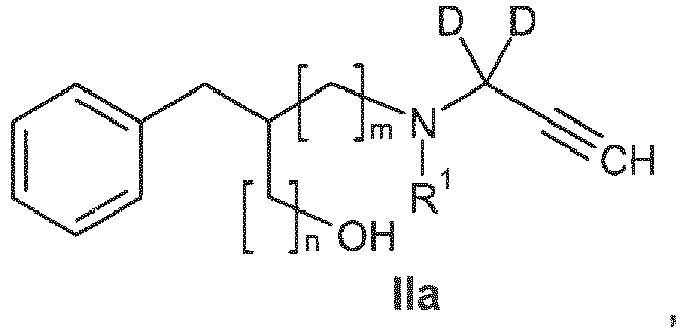 is reacted with a sulfonyl anhydride or a sulfonyl halide.
 - A method for the synthesis of a compound according to formula Ib:
 D is deuterium;R2 is chloro;characterized in thata compound of formula IIb:
 is reacted with a sulfonyl chloride.
 - A method according to claim 14, wherein the sulfonyl chloride is methanesulfonyl chloride.
- A method according to claim 14 or 15, for the synthesis of a compound of formula 1f:

a compound of formula IIc:
- A method for the synthesis of a compound according to formula I:
 D is deuterium;R1 is selected from methyl, ethyl, n-propyl, n-butyl, iso-butyl;R2 is [18F]fluorine;n is 1 and m is 0;characterized in thata compound of formula I:
 D is deuterium;R1 is selected from methyl, ethyl, n-propyl, n-butyl, iso-butyl;R2 is a leaving group, wherein leaving groups are selected from halogen, C1-C6-alkylsulfonyloxy, which is optionally substituted by fluorine, and arylsulfonyloxy, which is optionally substituted by hydrogen, methyl, halo and nitro;n is 0 and m is 1;is reacted with a suitable F-fluorinating agent, wherein F is 18F.
 - A method according to claim 17 for the synthesis of a compound of formula Ic:

characterized in that
a compound of formula Id:
- A method according to claim 17 or 18 for the synthesis of a compound of formula Ie:

characterized in that
a compound of formula If:
- A kit comprising at least one sealed container comprising a compound or a composition according to claims 1-12.
- A kit comprising at least one sealed container comprising a compound of claim 6.
- A kit according to claims 20 and 21 comprising a further sealed container comprising reagents.
Priority Applications (1)
| Application Number | Priority Date | Filing Date | Title |
|---|---|---|---|
| EP11772951.7A EP2630104B1 (en) | 2010-10-22 | 2011-10-17 | Compounds for use in imaging, diagnosing and/or treatment of diseases of the central nervous system |
Applications Claiming Priority (3)
| Application Number | Priority Date | Filing Date | Title |
|---|---|---|---|
| EP10188559A EP2450332A1 (en) | 2010-10-22 | 2010-10-22 | Compounds for use in Imaging, diagnosing and/or treatment of diseases of the central nervous system (F-D2-Deprenyl) |
| EP11772951.7A EP2630104B1 (en) | 2010-10-22 | 2011-10-17 | Compounds for use in imaging, diagnosing and/or treatment of diseases of the central nervous system |
| PCT/EP2011/068124 WO2012052409A1 (en) | 2010-10-22 | 2011-10-17 | Compounds for use in imaging, diagnosing and/or treatment of diseases of the central nervous system |
Publications (2)
| Publication Number | Publication Date |
|---|---|
| EP2630104A1 EP2630104A1 (en) | 2013-08-28 |
| EP2630104B1 true EP2630104B1 (en) | 2018-04-04 |
Family
ID=43760025
Family Applications (2)
| Application Number | Title | Priority Date | Filing Date |
|---|---|---|---|
| EP10188559A Withdrawn EP2450332A1 (en) | 2010-10-22 | 2010-10-22 | Compounds for use in Imaging, diagnosing and/or treatment of diseases of the central nervous system (F-D2-Deprenyl) |
| EP11772951.7A Active EP2630104B1 (en) | 2010-10-22 | 2011-10-17 | Compounds for use in imaging, diagnosing and/or treatment of diseases of the central nervous system |
Family Applications Before (1)
| Application Number | Title | Priority Date | Filing Date |
|---|---|---|---|
| EP10188559A Withdrawn EP2450332A1 (en) | 2010-10-22 | 2010-10-22 | Compounds for use in Imaging, diagnosing and/or treatment of diseases of the central nervous system (F-D2-Deprenyl) |
Country Status (19)
| Country | Link |
|---|---|
| US (1) | US9314540B2 (en) |
| EP (2) | EP2450332A1 (en) |
| JP (1) | JP5964840B2 (en) |
| KR (1) | KR101852647B1 (en) |
| CN (2) | CN104478735B (en) |
| AR (1) | AR083519A1 (en) |
| AU (1) | AU2011317664A1 (en) |
| BR (1) | BR112013009861A2 (en) |
| CA (1) | CA2815401C (en) |
| DK (1) | DK2630104T3 (en) |
| EA (1) | EA023820B1 (en) |
| HK (1) | HK1203190A1 (en) |
| IL (1) | IL225855A0 (en) |
| MX (1) | MX340487B (en) |
| NZ (1) | NZ610736A (en) |
| PH (1) | PH12013501017A1 (en) |
| SG (1) | SG189478A1 (en) |
| TW (1) | TW201225979A (en) |
| WO (1) | WO2012052409A1 (en) |
Families Citing this family (5)
| Publication number | Priority date | Publication date | Assignee | Title |
|---|---|---|---|---|
| EP2053033A1 (en) * | 2007-10-26 | 2009-04-29 | Bayer Schering Pharma AG | Compounds for use in imaging, diagnosing and/or treatment of diseases of the central nervous system or of tumors |
| US9988336B2 (en) | 2014-03-18 | 2018-06-05 | Mayo Foundation For Medical Education And Research | Gaseous F-18 technologies |
| SI3143011T1 (en) | 2014-05-13 | 2021-08-31 | F. Hoffmann-La Roche Ag | Deuterated heterocyclic compounds and their use as imaging agents |
| CN107445798B (en) * | 2016-06-01 | 2020-11-03 | 中国农业大学 | A kind of synthetic method of α,α-dideutero alcohol compounds |
| GB202105950D0 (en) * | 2021-04-26 | 2021-06-09 | Ge Healthcare Ltd | Analytical HPLC |
Family Cites Families (4)
| Publication number | Priority date | Publication date | Assignee | Title |
|---|---|---|---|---|
| PL183266B1 (en) * | 1995-03-02 | 2002-06-28 | Scherer Ltd R P | Pharmaceutic compositions containing inhibitors of monoamino oxidase b |
| CN1178461C (en) * | 1998-06-09 | 2004-12-01 | 松下电器产业株式会社 | Image encoding device, image decoding device, and facsimile device |
| EP2053033A1 (en) | 2007-10-26 | 2009-04-29 | Bayer Schering Pharma AG | Compounds for use in imaging, diagnosing and/or treatment of diseases of the central nervous system or of tumors |
| KR101619564B1 (en) | 2009-04-23 | 2016-05-10 | 바이엘 파마 악티엔게젤샤프트 | Novel precursor molecules for f-18 labelled pet tracers |
-
2010
- 2010-10-22 EP EP10188559A patent/EP2450332A1/en not_active Withdrawn
-
2011
- 2011-10-17 DK DK11772951.7T patent/DK2630104T3/en active
- 2011-10-17 BR BR112013009861A patent/BR112013009861A2/en not_active IP Right Cessation
- 2011-10-17 SG SG2013029954A patent/SG189478A1/en unknown
- 2011-10-17 NZ NZ610736A patent/NZ610736A/en not_active IP Right Cessation
- 2011-10-17 US US13/880,847 patent/US9314540B2/en active Active
- 2011-10-17 CA CA2815401A patent/CA2815401C/en active Active
- 2011-10-17 EP EP11772951.7A patent/EP2630104B1/en active Active
- 2011-10-17 AU AU2011317664A patent/AU2011317664A1/en not_active Abandoned
- 2011-10-17 PH PH1/2013/501017A patent/PH12013501017A1/en unknown
- 2011-10-17 KR KR1020137012979A patent/KR101852647B1/en active Active
- 2011-10-17 CN CN201410528340.1A patent/CN104478735B/en active Active
- 2011-10-17 EA EA201300479A patent/EA023820B1/en not_active IP Right Cessation
- 2011-10-17 MX MX2013004457A patent/MX340487B/en active IP Right Grant
- 2011-10-17 JP JP2013534282A patent/JP5964840B2/en active Active
- 2011-10-17 WO PCT/EP2011/068124 patent/WO2012052409A1/en not_active Ceased
- 2011-10-17 CN CN201180060749XA patent/CN103443056A/en active Pending
- 2011-10-21 AR ARP110103900A patent/AR083519A1/en not_active Application Discontinuation
- 2011-10-21 TW TW100138362A patent/TW201225979A/en unknown
-
2013
- 2013-04-21 IL IL225855A patent/IL225855A0/en unknown
-
2015
- 2015-04-17 HK HK15103757.0A patent/HK1203190A1/en unknown
Also Published As
| Publication number | Publication date |
|---|---|
| AU2011317664A1 (en) | 2013-05-23 |
| TW201225979A (en) | 2012-07-01 |
| US9314540B2 (en) | 2016-04-19 |
| WO2012052409A1 (en) | 2012-04-26 |
| HK1203190A1 (en) | 2015-10-23 |
| CN103443056A (en) | 2013-12-11 |
| DK2630104T3 (en) | 2018-07-16 |
| PH12013501017A1 (en) | 2017-08-23 |
| CA2815401A1 (en) | 2012-04-26 |
| EP2450332A1 (en) | 2012-05-09 |
| KR101852647B1 (en) | 2018-04-26 |
| SG189478A1 (en) | 2013-05-31 |
| CN104478735A (en) | 2015-04-01 |
| BR112013009861A2 (en) | 2019-09-24 |
| US20130336890A1 (en) | 2013-12-19 |
| EP2630104A1 (en) | 2013-08-28 |
| MX2013004457A (en) | 2013-09-16 |
| NZ610736A (en) | 2014-11-28 |
| EA023820B1 (en) | 2016-07-29 |
| CN104478735B (en) | 2017-05-31 |
| JP5964840B2 (en) | 2016-08-03 |
| EA201300479A1 (en) | 2013-10-30 |
| KR20140023870A (en) | 2014-02-27 |
| JP2014502257A (en) | 2014-01-30 |
| MX340487B (en) | 2016-07-11 |
| IL225855A0 (en) | 2013-07-31 |
| CA2815401C (en) | 2019-04-09 |
| AR083519A1 (en) | 2013-03-06 |
Similar Documents
| Publication | Publication Date | Title |
|---|---|---|
| EP2217549B1 (en) | Compounds for use in imaging, diagnosing, and/or treatment of diseases of the central nervous system or of tumors | |
| US9314540B2 (en) | Compounds for use in imaging, diagnosing and/or treatment of diseases of the central nervous system | |
| AU2010282334A1 (en) | Single diastereomers of 4-fluoroglutamine and methods fo their preparation and use | |
| EP2688863B1 (en) | Compounds for use in imaging, diagnosing and/or treatment of diseases of the central nervous system | |
| KR101619564B1 (en) | Novel precursor molecules for f-18 labelled pet tracers | |
| HK1195053A (en) | Compounds for use in imaging, diagnosing and/or treatment of diseases of the central nervous system | |
| NZ614825B2 (en) | Compounds for use in imaging, diagnosing and/or treatment of diseases of the central nervous system |
Legal Events
| Date | Code | Title | Description |
|---|---|---|---|
| PUAI | Public reference made under article 153(3) epc to a published international application that has entered the european phase |
Free format text: ORIGINAL CODE: 0009012 |
|
| 17P | Request for examination filed |
Effective date: 20130513 |
|
| AK | Designated contracting states |
Kind code of ref document: A1 Designated state(s): AL AT BE BG CH CY CZ DE DK EE ES FI FR GB GR HR HU IE IS IT LI LT LU LV MC MK MT NL NO PL PT RO RS SE SI SK SM TR |
|
| DAX | Request for extension of the european patent (deleted) | ||
| 17Q | First examination report despatched |
Effective date: 20140701 |
|
| GRAP | Despatch of communication of intention to grant a patent |
Free format text: ORIGINAL CODE: EPIDOSNIGR1 |
|
| INTG | Intention to grant announced |
Effective date: 20170316 |
|
| GRAJ | Information related to disapproval of communication of intention to grant by the applicant or resumption of examination proceedings by the epo deleted |
Free format text: ORIGINAL CODE: EPIDOSDIGR1 |
|
| INTC | Intention to grant announced (deleted) | ||
| GRAP | Despatch of communication of intention to grant a patent |
Free format text: ORIGINAL CODE: EPIDOSNIGR1 |
|
| INTG | Intention to grant announced |
Effective date: 20171020 |
|
| GRAS | Grant fee paid |
Free format text: ORIGINAL CODE: EPIDOSNIGR3 |
|
| GRAA | (expected) grant |
Free format text: ORIGINAL CODE: 0009210 |
|
| AK | Designated contracting states |
Kind code of ref document: B1 Designated state(s): AL AT BE BG CH CY CZ DE DK EE ES FI FR GB GR HR HU IE IS IT LI LT LU LV MC MK MT NL NO PL PT RO RS SE SI SK SM TR |
|
| REG | Reference to a national code |
Ref country code: GB Ref legal event code: FG4D |
|
| REG | Reference to a national code |
Ref country code: CH Ref legal event code: EP |
|
| REG | Reference to a national code |
Ref country code: AT Ref legal event code: REF Ref document number: 985438 Country of ref document: AT Kind code of ref document: T Effective date: 20180415 |
|
| REG | Reference to a national code |
Ref country code: IE Ref legal event code: FG4D |
|
| REG | Reference to a national code |
Ref country code: DE Ref legal event code: R096 Ref document number: 602011047198 Country of ref document: DE |
|
| REG | Reference to a national code |
Ref country code: DK Ref legal event code: T3 Effective date: 20180711 |
|
| REG | Reference to a national code |
Ref country code: SE Ref legal event code: TRGR |
|
| REG | Reference to a national code |
Ref country code: NL Ref legal event code: FP |
|
| REG | Reference to a national code |
Ref country code: LT Ref legal event code: MG4D |
|
| REG | Reference to a national code |
Ref country code: FR Ref legal event code: PLFP Year of fee payment: 8 |
|
| PG25 | Lapsed in a contracting state [announced via postgrant information from national office to epo] |
Ref country code: LT Free format text: LAPSE BECAUSE OF FAILURE TO SUBMIT A TRANSLATION OF THE DESCRIPTION OR TO PAY THE FEE WITHIN THE PRESCRIBED TIME-LIMIT Effective date: 20180404 Ref country code: PL Free format text: LAPSE BECAUSE OF FAILURE TO SUBMIT A TRANSLATION OF THE DESCRIPTION OR TO PAY THE FEE WITHIN THE PRESCRIBED TIME-LIMIT Effective date: 20180404 Ref country code: NO Free format text: LAPSE BECAUSE OF FAILURE TO SUBMIT A TRANSLATION OF THE DESCRIPTION OR TO PAY THE FEE WITHIN THE PRESCRIBED TIME-LIMIT Effective date: 20180704 Ref country code: ES Free format text: LAPSE BECAUSE OF FAILURE TO SUBMIT A TRANSLATION OF THE DESCRIPTION OR TO PAY THE FEE WITHIN THE PRESCRIBED TIME-LIMIT Effective date: 20180404 Ref country code: AL Free format text: LAPSE BECAUSE OF FAILURE TO SUBMIT A TRANSLATION OF THE DESCRIPTION OR TO PAY THE FEE WITHIN THE PRESCRIBED TIME-LIMIT Effective date: 20180404 Ref country code: BG Free format text: LAPSE BECAUSE OF FAILURE TO SUBMIT A TRANSLATION OF THE DESCRIPTION OR TO PAY THE FEE WITHIN THE PRESCRIBED TIME-LIMIT Effective date: 20180704 |
|
| PG25 | Lapsed in a contracting state [announced via postgrant information from national office to epo] |
Ref country code: LV Free format text: LAPSE BECAUSE OF FAILURE TO SUBMIT A TRANSLATION OF THE DESCRIPTION OR TO PAY THE FEE WITHIN THE PRESCRIBED TIME-LIMIT Effective date: 20180404 Ref country code: RS Free format text: LAPSE BECAUSE OF FAILURE TO SUBMIT A TRANSLATION OF THE DESCRIPTION OR TO PAY THE FEE WITHIN THE PRESCRIBED TIME-LIMIT Effective date: 20180404 Ref country code: GR Free format text: LAPSE BECAUSE OF FAILURE TO SUBMIT A TRANSLATION OF THE DESCRIPTION OR TO PAY THE FEE WITHIN THE PRESCRIBED TIME-LIMIT Effective date: 20180705 Ref country code: HR Free format text: LAPSE BECAUSE OF FAILURE TO SUBMIT A TRANSLATION OF THE DESCRIPTION OR TO PAY THE FEE WITHIN THE PRESCRIBED TIME-LIMIT Effective date: 20180404 |
|
| REG | Reference to a national code |
Ref country code: AT Ref legal event code: MK05 Ref document number: 985438 Country of ref document: AT Kind code of ref document: T Effective date: 20180404 |
|
| PG25 | Lapsed in a contracting state [announced via postgrant information from national office to epo] |
Ref country code: PT Free format text: LAPSE BECAUSE OF FAILURE TO SUBMIT A TRANSLATION OF THE DESCRIPTION OR TO PAY THE FEE WITHIN THE PRESCRIBED TIME-LIMIT Effective date: 20180806 |
|
| REG | Reference to a national code |
Ref country code: DE Ref legal event code: R097 Ref document number: 602011047198 Country of ref document: DE |
|
| PG25 | Lapsed in a contracting state [announced via postgrant information from national office to epo] |
Ref country code: AT Free format text: LAPSE BECAUSE OF FAILURE TO SUBMIT A TRANSLATION OF THE DESCRIPTION OR TO PAY THE FEE WITHIN THE PRESCRIBED TIME-LIMIT Effective date: 20180404 Ref country code: SK Free format text: LAPSE BECAUSE OF FAILURE TO SUBMIT A TRANSLATION OF THE DESCRIPTION OR TO PAY THE FEE WITHIN THE PRESCRIBED TIME-LIMIT Effective date: 20180404 Ref country code: RO Free format text: LAPSE BECAUSE OF FAILURE TO SUBMIT A TRANSLATION OF THE DESCRIPTION OR TO PAY THE FEE WITHIN THE PRESCRIBED TIME-LIMIT Effective date: 20180404 Ref country code: EE Free format text: LAPSE BECAUSE OF FAILURE TO SUBMIT A TRANSLATION OF THE DESCRIPTION OR TO PAY THE FEE WITHIN THE PRESCRIBED TIME-LIMIT Effective date: 20180404 Ref country code: CZ Free format text: LAPSE BECAUSE OF FAILURE TO SUBMIT A TRANSLATION OF THE DESCRIPTION OR TO PAY THE FEE WITHIN THE PRESCRIBED TIME-LIMIT Effective date: 20180404 |
|
| PLBE | No opposition filed within time limit |
Free format text: ORIGINAL CODE: 0009261 |
|
| STAA | Information on the status of an ep patent application or granted ep patent |
Free format text: STATUS: NO OPPOSITION FILED WITHIN TIME LIMIT |
|
| PG25 | Lapsed in a contracting state [announced via postgrant information from national office to epo] |
Ref country code: IT Free format text: LAPSE BECAUSE OF FAILURE TO SUBMIT A TRANSLATION OF THE DESCRIPTION OR TO PAY THE FEE WITHIN THE PRESCRIBED TIME-LIMIT Effective date: 20180404 Ref country code: SM Free format text: LAPSE BECAUSE OF FAILURE TO SUBMIT A TRANSLATION OF THE DESCRIPTION OR TO PAY THE FEE WITHIN THE PRESCRIBED TIME-LIMIT Effective date: 20180404 |
|
| 26N | No opposition filed |
Effective date: 20190107 |
|
| REG | Reference to a national code |
Ref country code: DE Ref legal event code: R081 Ref document number: 602011047198 Country of ref document: DE Owner name: LIFE MOLECULAR IMAGING LTD., GB Free format text: FORMER OWNER: PIRAMAL IMAGING SA, MATRAN, CH Ref country code: DE Ref legal event code: R082 Ref document number: 602011047198 Country of ref document: DE Representative=s name: BOEHMERT & BOEHMERT ANWALTSPARTNERSCHAFT MBB -, DE Ref country code: DE Ref legal event code: R081 Ref document number: 602011047198 Country of ref document: DE Owner name: LIFE MOLECULAR IMAGING SA, CH Free format text: FORMER OWNER: PIRAMAL IMAGING SA, MATRAN, CH |
|
| REG | Reference to a national code |
Ref country code: BE Ref legal event code: HC Owner name: LIFE MOLECULAR IMAGING SA; CH Free format text: DETAILS ASSIGNMENT: CHANGE OF OWNER(S), CHANGEMENT DE NOM DU PROPRIETAIRE; FORMER OWNER NAME: PIRAMAL IMAGING SA Effective date: 20190322 |
|
| PG25 | Lapsed in a contracting state [announced via postgrant information from national office to epo] |
Ref country code: SI Free format text: LAPSE BECAUSE OF FAILURE TO SUBMIT A TRANSLATION OF THE DESCRIPTION OR TO PAY THE FEE WITHIN THE PRESCRIBED TIME-LIMIT Effective date: 20180404 |
|
| REG | Reference to a national code |
Ref country code: CH Ref legal event code: PL |
|
| REG | Reference to a national code |
Ref country code: NL Ref legal event code: HC Owner name: LIFE MOLECULAR IMAGING SA; CH Free format text: DETAILS ASSIGNMENT: CHANGE OF OWNER(S), CHANGE OF OWNER(S) NAME; FORMER OWNER NAME: PIRAMAL IMAGING SA Effective date: 20190507 |
|
| PG25 | Lapsed in a contracting state [announced via postgrant information from national office to epo] |
Ref country code: LU Free format text: LAPSE BECAUSE OF NON-PAYMENT OF DUE FEES Effective date: 20181017 Ref country code: MC Free format text: LAPSE BECAUSE OF FAILURE TO SUBMIT A TRANSLATION OF THE DESCRIPTION OR TO PAY THE FEE WITHIN THE PRESCRIBED TIME-LIMIT Effective date: 20180404 |
|
| PG25 | Lapsed in a contracting state [announced via postgrant information from national office to epo] |
Ref country code: LI Free format text: LAPSE BECAUSE OF NON-PAYMENT OF DUE FEES Effective date: 20181031 Ref country code: CH Free format text: LAPSE BECAUSE OF NON-PAYMENT OF DUE FEES Effective date: 20181031 |
|
| PG25 | Lapsed in a contracting state [announced via postgrant information from national office to epo] |
Ref country code: MT Free format text: LAPSE BECAUSE OF NON-PAYMENT OF DUE FEES Effective date: 20181017 |
|
| PG25 | Lapsed in a contracting state [announced via postgrant information from national office to epo] |
Ref country code: TR Free format text: LAPSE BECAUSE OF FAILURE TO SUBMIT A TRANSLATION OF THE DESCRIPTION OR TO PAY THE FEE WITHIN THE PRESCRIBED TIME-LIMIT Effective date: 20180404 |
|
| PG25 | Lapsed in a contracting state [announced via postgrant information from national office to epo] |
Ref country code: CY Free format text: LAPSE BECAUSE OF FAILURE TO SUBMIT A TRANSLATION OF THE DESCRIPTION OR TO PAY THE FEE WITHIN THE PRESCRIBED TIME-LIMIT Effective date: 20180404 Ref country code: HU Free format text: LAPSE BECAUSE OF FAILURE TO SUBMIT A TRANSLATION OF THE DESCRIPTION OR TO PAY THE FEE WITHIN THE PRESCRIBED TIME-LIMIT; INVALID AB INITIO Effective date: 20111017 Ref country code: MK Free format text: LAPSE BECAUSE OF NON-PAYMENT OF DUE FEES Effective date: 20180404 |
|
| PG25 | Lapsed in a contracting state [announced via postgrant information from national office to epo] |
Ref country code: IS Free format text: LAPSE BECAUSE OF FAILURE TO SUBMIT A TRANSLATION OF THE DESCRIPTION OR TO PAY THE FEE WITHIN THE PRESCRIBED TIME-LIMIT Effective date: 20180804 |
|
| REG | Reference to a national code |
Ref country code: DE Ref legal event code: R081 Ref document number: 602011047198 Country of ref document: DE Owner name: LIFE MOLECULAR IMAGING LTD., GB Free format text: FORMER OWNER: LIFE MOLECULAR IMAGING SA, MATRAN, CH Ref country code: DE Ref legal event code: R081 Ref document number: 602011047198 Country of ref document: DE Owner name: LANTHEUS BIOSCIENCES LTD., GB Free format text: FORMER OWNER: LIFE MOLECULAR IMAGING SA, MATRAN, CH |
|
| REG | Reference to a national code |
Ref country code: FI Ref legal event code: PCE Owner name: LIFE MOLECULAR IMAGING LIMITED |
|
| REG | Reference to a national code |
Ref country code: NL Ref legal event code: PD Owner name: LIFE MOLECULAR IMAGING LIMITED; GB Free format text: DETAILS ASSIGNMENT: CHANGE OF OWNER(S), ASSIGNMENT; FORMER OWNER NAME: LIFE MOLECULAR IMAGING SA Effective date: 20220513 |
|
| REG | Reference to a national code |
Ref country code: GB Ref legal event code: 732E Free format text: REGISTERED BETWEEN 20220513 AND 20220518 |
|
| REG | Reference to a national code |
Ref country code: BE Ref legal event code: PD Owner name: LIFE MOLECULAR IMAGING LIMITED; GB Free format text: DETAILS ASSIGNMENT: CHANGE OF OWNER(S), ASSIGNMENT; FORMER OWNER NAME: LIFE MOLECULAR IMAGING SA Effective date: 20220513 |
|
| REG | Reference to a national code |
Ref country code: FR Ref legal event code: PLFP Year of fee payment: 12 |
|
| P01 | Opt-out of the competence of the unified patent court (upc) registered |
Effective date: 20230530 |
|
| PGFP | Annual fee paid to national office [announced via postgrant information from national office to epo] |
Ref country code: IE Payment date: 20250917 Year of fee payment: 15 |
|
| PGFP | Annual fee paid to national office [announced via postgrant information from national office to epo] |
Ref country code: NL Payment date: 20251024 Year of fee payment: 15 |
|
| PGFP | Annual fee paid to national office [announced via postgrant information from national office to epo] |
Ref country code: DE Payment date: 20251028 Year of fee payment: 15 |
|
| PGFP | Annual fee paid to national office [announced via postgrant information from national office to epo] |
Ref country code: GB Payment date: 20251023 Year of fee payment: 15 |
|
| PGFP | Annual fee paid to national office [announced via postgrant information from national office to epo] |
Ref country code: FI Payment date: 20251024 Year of fee payment: 15 Ref country code: DK Payment date: 20251024 Year of fee payment: 15 |
|
| PGFP | Annual fee paid to national office [announced via postgrant information from national office to epo] |
Ref country code: FR Payment date: 20251027 Year of fee payment: 15 |
|
| PGFP | Annual fee paid to national office [announced via postgrant information from national office to epo] |
Ref country code: BE Payment date: 20251024 Year of fee payment: 15 |
|
| PGFP | Annual fee paid to national office [announced via postgrant information from national office to epo] |
Ref country code: SE Payment date: 20251024 Year of fee payment: 15 |
|
| REG | Reference to a national code |
Ref country code: DE Ref legal event code: R081 Ref document number: 602011047198 Country of ref document: DE Owner name: LANTHEUS BIOSCIENCES LTD., GB Free format text: FORMER OWNER: LIFE MOLECULAR IMAGING LTD., WARWICK, GB |