EP2629242A1 - A user wearable visual assistance device and method - Google Patents
A user wearable visual assistance device and method Download PDFInfo
- Publication number
- EP2629242A1 EP2629242A1 EP13275033.2A EP13275033A EP2629242A1 EP 2629242 A1 EP2629242 A1 EP 2629242A1 EP 13275033 A EP13275033 A EP 13275033A EP 2629242 A1 EP2629242 A1 EP 2629242A1
- Authority
- EP
- European Patent Office
- Prior art keywords
- gesture
- person
- motion
- image
- camera
- Prior art date
- Legal status (The legal status is an assumption and is not a legal conclusion. Google has not performed a legal analysis and makes no representation as to the accuracy of the status listed.)
- Withdrawn
Links
Images








Classifications
-
- G—PHYSICS
- G06—COMPUTING OR CALCULATING; COUNTING
- G06V—IMAGE OR VIDEO RECOGNITION OR UNDERSTANDING
- G06V40/00—Recognition of biometric, human-related or animal-related patterns in image or video data
- G06V40/10—Human or animal bodies, e.g. vehicle occupants or pedestrians; Body parts, e.g. hands
- G06V40/107—Static hand or arm
-
- G—PHYSICS
- G06—COMPUTING OR CALCULATING; COUNTING
- G06V—IMAGE OR VIDEO RECOGNITION OR UNDERSTANDING
- G06V10/00—Arrangements for image or video recognition or understanding
- G06V10/40—Extraction of image or video features
- G06V10/42—Global feature extraction by analysis of the whole pattern, e.g. using frequency domain transformations or autocorrelation
- G06V10/421—Global feature extraction by analysis of the whole pattern, e.g. using frequency domain transformations or autocorrelation by analysing segments intersecting the pattern
-
- G—PHYSICS
- G06—COMPUTING OR CALCULATING; COUNTING
- G06V—IMAGE OR VIDEO RECOGNITION OR UNDERSTANDING
- G06V20/00—Scenes; Scene-specific elements
- G06V20/20—Scenes; Scene-specific elements in augmented reality scenes
Definitions
- the present invention relates to a user wearable visual assistance device and method. Embodiments of the present invention relate to vision processing.
- the visually impaired suffer from difficulties due to lack of visual acuity, field of view, color perception and other forms of visual impairments. These challenges impact life in many aspects for example mobility, risk of injury, independence and situational awareness in everyday life.
- GPS global positioning system
- obstacle detection without performing recognition
- screen readers These products may lack certain crucial aspects to integrate fully and seamlessly into the life of a visually impaired person.
- the present invention seeks to provide an improved wearable device and method.
- the device includes a processor connectible to a camera.
- the processor is adapted to capture multiple image frames.
- Motion of a gesture is detected by using differences between the image frames.
- the gesture may be classified (recognized or re-recognized) responsive to the detected motion.
- the motion of the gesture may be repetitive.
- the gesture may include waving an object in the field of view of the camera and the object being held may be classified by the device. The motion detection and classification of the gesture and/or object are performed while avoiding pressing of a button on the device.
- the gesture may include holding an object in a hand of the person, enabling the person to audibly name the object and recording the name. Upon failing to recognize the gesture and/or to classify the object being held the person may be provided feedback by the device. Alternatively, or in addition upon succeeding to recognize the gesture and/or to classify the object, the person may be provided feedback by the device.. The person may train a classifier by audibly naming the object.
- the motion detection may include: tracking the image motion between the image frames and grouping the image motion into groups. The groups include similar image movement. The person may be notified of an attribute related to the gesture and/or the object being held.
- the device includes a processor operatively connectible to a camera.
- the processor is adapted to capture multiple image frames, to detect motion of a gesture by using differences between the image frames and to classify the gesture responsive to the detected motion.
- the motion of the gesture may be repetitive.
- a bone conduction headphone may be attached to the processor.
- the device may detect an object and recognize the object.
- the processor audibly informs the person by utilizing the bone conduction headphone to name the object.
- a device including a camera and a processor.
- the device is wearable for a person.
- the object Upon presenting an object to the device for a first time, the object is detected.
- the person may label the object using a sound.
- the sound may be recorded by the device to produce a recorded sound.
- the object Upon presenting the (same or similar) object a second time to the device, the object is recognized.
- the recorded sound is played by the device for hearing by the person.
- the device may notify the person of an attribute of the device.
- the first and/or second presentation may include moving the object in the field of view of the camera, and the motion triggers the device to act in response.
- image motion of the image of the object may be tracked between the image frames.
- the image of the object may be separated from image background responsive to the tracked image motion of the images of the object.
- the first and/or second presentations of the object may include inserting the object into the field of view of the camera and the insertion of the object into the field of view of the camera triggers the device to act in response.
- the device may include and may manage a data base of objects personal to the person, The objects of the database when presented to the device are recognizable by the device.
- embodiments of the present invention utilize a user-machine interface in which the existence of an object in the environment of a user and a hand gesture trigger the device to notify the user regarding an attribute of the object.
- the device may be adapted to learn the preferences of the user. In that sense, the device is extensible and gradually suits the user better with use, since the preferences of the user may be learned in time with use of the device.
- FIG. 1 illustrates a system 1, according to a feature of an embodiment of the present invention.
- a camera 12 with image sensor 12a captures image frames 14 in a forward view of camera 12.
- Camera 12 may be a monochrome camera, a red green blue (RGB) camera or a near infra red (NIR) camera.
- Image frames 14 are captured and transferred to processor 16 to be processed.
- the processing of image frames 14 may be based upon algorithms in memory or storage 18.
- Storage 18 is shown to include a classifier 509 which may include gesture detection 100, vehicle detection and recognition 102, bank note detection and recognition 104 and/ or traffic sign detection and recognition 106.
- Classifier 509 may be a multi-class classifier and may include, for example, multiple classes of different images of different objects including bank notes, vehicles, e.g. buses, traffic signs and/or signals, and gestures. Another classifier may be available for face detection 120. A method may be available for obstacle detection 122 with or without use of an additional sensor (not shown)
- Camera 12 may be located in a housing which is attached to a mount 22.
- Mount 22 connects electrically to an audio unit 26 via a cable 24.
- a slot 22b is located between camera 12 and mount 22.
- Both camera 12 and audio unit 26 may be operatively connected to processor 16 and optionally to storage 18.
- Processor 16 and storage 18 may be a custom unit or alternatively may be part of a mobile computer system, e.g. smart phone.
- Audio unit 26 (not shown) may be an audio speaker which may be in close proximity to and/ or attached the ear of the user or located and attached at the bend in arm 32.
- audio unit 26 may be a bone conducting headphone set which may conduct through to one ear or to both ears of the person.
- Unit 26 may also be a earphone connected to processor 16 by a wireless connection, e.g. BlueTooth RTM .
- FIG. 2b shows an alternative view of apparatus 20, showing camera 12, mount 22, slot 22b, cable 24 and audio unit 26, according to a feature of an embodiment of the present invention.
- Eyeglasses 30 have two arms 32 connected to the frame front of eyeglasses 30 with hinges 36.
- the frame front hold the lenses 34 of eyeglasses 30.
- a docking component 22a is attached to an arm 32 near to the frame front but just before hinge 36.
- FIG. 4 shows a device 40 of eyeglasses retrofit with an apparatus according to a feature of an embodiment of the present invention.
- Camera 12 may be docked on docking component 22a so that slot 22b between mount 22 and camera 12 slides onto docking component 22a.
- a magnetic connection between the slot and docking component 22a may allow camera 12 and mount 22 to be attachable, detachable and re-attachable to eyeglasses 30 via docking component 22a.
- a spring loaded strip located in the slot or on either side of docking component 22a (located behind hinge 36) may be utilized to allow camera 12 to be attachable, detachable and re-attachable to eyeglasses 30.
- Camera 12 is therefore, located to capture images frames 14 with a view which may be substantially the same view (provided through lenses 34 if applicable) of the person wearing eyeglasses 30. Camera 12 is therefore, located to minimize parallax error between the view of the person and view of camera 12.
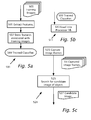
- FIG. 5a shows a method 501 for training a multi-class classifier 509, according to a feature of an embodiment of the present invention.
- Training of classifier 509 is performed prior to using trained classifier 509 to classify for example gestures, bank notes, vehicles, particularly buses and/or traffic signals or traffic signs.
- Training images 503, for example of bank notes for a particular country are provided and image features of the bank notes are extracted in step 505.
- Features extracted (step 505) from training images 503 may include optical gradients, intensity, color, texture and contrast for example.
- Features of the bank notes for a particular country may be stored (step 507) to produce a trained classifier 509.
- a similar exercise may be performed for steps 503 and 505 with respect to hand gestures.
- Features of hand gestures may be stored (step 507) to produce a. trained classifier 509.
- An example of a multi-class classifier 509 which may be produced includes the extracted features of both bank notes as one class of objects and hand gestures as another class of objects.
- Optical flow or differences between image frames 14 may be further used for classification for example to detect and recognize gesture motion or to detect and recognize the color change of a traffic signal
- Step 513 trained classifier 509 is loaded into processor 16.
- FIG. 5c shows a method 521, according to a feature of an embodiment of the present invention.
- trained classifier 509 loaded into processor 16 (step 513)
- image frames 14 are captured in step 523 of various possible visual fields of the person wearing device 40.
- the captured image frames 14 are then used to search (step 525) for a candidate image 527 for an object found in the image frames 14. Further processing of candidate images 527 are shown in the description that follows.
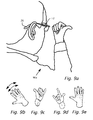
- Figure 9a shows a person wearing device 40 and visual field 90a of camera 12.
- the person is presenting a hand gesture in the field of view of camera 12.
- the gesture shown for example being the right hand palm side of the person with fingers closed and the thumb pointing out to the right.
- Figures 9b-9e show other example hand gestures which may be in visual field 90a of the person and camera 12.
- Figure 9b shows the back or dorsal part of an open right hand which is being waved from side to side.
- Figure 9c shows a palm side of a left hand with thumb and little finger extended.
- Figure 9d shows a palm side of a right hand with thumb, little finger and index finger extended.
- Figure 9e shows the back or dorsal part of an open right hand which is stationary.
- Figure 10 shows a visual field 90b of a person wearing device 40.
- Visual field 90c of the person includes a document 1000 and the pointing of the index finger of the right hand to text in document 1000.
- Document 1000 in this case is a book but also may be a timetable, notice on a wall or a text on some signage in close proximity to the person such as text on the label of a can for example.
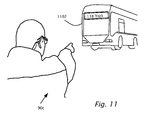
- FIG 11 shows a visual field 90c of a person wearing device 40.
- visual field 90c includes a bus 1102 and the pointing of the index finger of the right in the general direction of bus 1102.
- Bus 1102 also includes a text such as the bus number and destination. The text may also include details of the route of bus 1102.
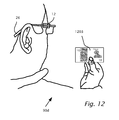
- Figure 12 shows a visual field 90d of a person wearing device 40.
- Visual field 90d includes the person holding a banknote 1203 or visual field 90d may have banknote 1203 on a counter top or in the hands of another person such as shop assistant for example.
- FIG. 13 shows a visual field 90e of a person wearing device 40.
- visual field 90c includes a traffic signal 1303 and the pointing of the index finger of the right in the general direction of traffic signal 1303.
- traffic signal has two sign lights 1303a (red) and 1303b (green) which may be indicative of a pedestrian crossing sign or alternatively traffic signal 1303 may have three sign lights (red, amber, green) indicative of a traffic sign used by vehicles as well as pedestrians.
- FIG. 6 shows a method 601, according to a feature of an embodiment of the present invention.
- the visual field 90 of the person and camera 12 may be scanned while device 40 is worn by the person.
- a decision is made to determine if an object detected in visual field 90 is either a hand of the person or a face of another person. If the object detected is the face of another person, facial recognition of the other person may be performed in step 607. Facial recognition step 607 may make use of classifier 120 which has been previously trained to recognize faces of people who are known to the person. If the object detected in visual field 90 is a hand of the person, in decision box 609 it may be determined if the hand gesture is a pointing finger gesture or not.
- the pointing finger may be for instance a pointing index finger of the right hand or left hand of the person. If the hand does not include a pointing finger, then hand gestures may be detected starting in step 613 the flow of which continues in Figure 7 . If the finger is pointing to an attribute such as a text layout in decision box 611, the flow continues in Figure 8 .
- Step 7 shows a method 701, according to a feature of an embodiment of the present invention.
- Method 701 is a continuation of step 613 shown in Figure 6 .
- a hand gesture of a user is detected and recognized to not include a pointing finger.
- the hand gesture may be classified as one of many recognizable gestures of trained classifier 509. Recognizing the hand gesture as one of many hand gestures may simultaneously provide control (step 705) of device 40 based on the hand gesture as well as providing an audible output via audio unit 26 in response to and/ or in confirmation of the hand gesture (step 707).
- control of device 40 may include gestures to recognize colours, to stop a process of recognizing just buses for example, increase the volume of unit 26, to stop and/ or start reading recognized text, to start recording video or to take a picture.
- the audible output may be click sound, bleep, a one word confirmation or to notify the person that a specific mode has been entered, such as just looking for buses and bus numbers for example.
- Audible output response in step 707 may alternatively or in addition include information or data related to a recognized object.
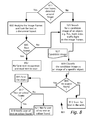
- Step 8 shows a method 801, according to a feature of en embodiment of the present invention.
- Method 801 shows the continuation of decision step 611 shown in Figure 6 .
- Decision step 611 is reached by virtue of finding a finger pointing in visual field 90 in step 609.
- the resolution of camera 12 may be increased to enable analysis (step 803) of image frames 14 so as to look for example for a block of text within the text layout of a document. If text is found in decision block 805, recognition of the text is performed in step 807 and the text may be read to the person via audio unit 26.
- the index finger may be used to point to which specific portion of text to be recognized and to be read in the document.
- a search for a candidate image 527 in the field of view 90 for an object may be performed in step 525.
- the search in step 525 may be made with a lower resolution of camera 12 to enable searching of the object in image frames 14.
- the object may be a vehicle such as a bus, a bank note and/ or traffic light shown in views 90c, 90d and 90e respectively for example.
- the candidate image 527 may then be classified in step 809, using classifier 509 as an image of a specific object.
- the person may track the candidate image to provide a tracked candidate image in the image frames 14. The tracking may be based on sound perception, partial vision or situational awareness by orienting the head-worn camera 12 in the direction of the object.
- the tracked candidate image may be then selected for classification and recognition.
- decision block 811 if an object is found, it may be possible to inform the person what the object is (bus 1102, bank note 1203 or traffic signal 1303 for example) and to scan the object (step 815) for attributes of the object such as text, colour or texture. If text and/or colour is found, in decision 817 on or for the object, the user may be audibly notified (step 819) via audio unit 26 and the recognized text may be read to the person.
- bus 1102 the bus number may be read along with the destination or route based on recognized text and/ or colour of the bus.
- bank note 1203 the denomination of the bank note (5 British pounds or 5 American dollars) may be read to the person based on recognized text and/ or colour or texture of the bank note.
- traffic signal 1303 based on the colour of traffic signal 1303 or a combination colour and/ or text of traffic signal 1303 to stop or to walk.
- step 821 If no text is found on the object then the user may be audibly notified (step 821) via audio unit 26 that no text has been found on the object.
- decision step 811 if no object is found, then a scan for any text in the image frames 14 may be made in step 813.
- Decision step 817 may be run again after step 813 to notify of text (step 819) and unit 26 to read the text or notify (step 821) of no text found.
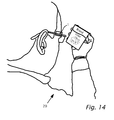
- Figure 14 illustrates a user wearing device 1 and holding an object, e.g. a package of butter, in the field of view of camera 12.
- An object e.g. a package of butter
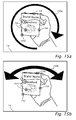
- Figures 15a and 15b showing the user holding and/or moving the object.
- the type of movement of the object that the user may make, in successive captured image frames 14 may be repetitive: for instance, a circular movement 150a, a side to side movement 150b, and/or an up and down movement. Alternatively, there may be substantially no movement of the object.
- Figures 15a and 15b also illustrate features, e.g. corners 152 and edges or edge features 154 of the object which may be tracked by device 1 during the image motion
- device 1 determines that a user is holding an object that was previously held by the user, and device 1 re-recognizes the object.
- Device 1 may act responsive to the re-recognition and/or use re-recognition of the object as a control input.
- FIGS 16a and 16b illustrate methods 41 and 42 respectively, according to embodiments of the present invention.
- device 1 determines with high probability, that the user is presenting (step 403) an object in the field of view of camera 12.
- Device 1 may check whether the object is recognizable.
- the user may name the object or make a sound to label the object (step 413) and the sound may be recorded (step 415).
- a feature of the present invention is that method 41 avoids a button press. Hand motion, such as waving the object in the field of view of camera 12 or inserting the object into the field of view is sufficient to indicate to device 1 that there is an object being presented (step 403) for recognition (step 405).
- method 42 performs image-based matching in a way that is fast and flexible.
- the previously detected object is presented again (step 403 ) to camera 12 and image-based matching is performed so that the object is recognized (step 405) as the same object that was previously detected.
- a unique aspect to device 1 is that a user can add objects. For example, a visually impaired user may not be able to identify the particular brand of yogurt she is interested in purchasing from the store shelf. Such a user may ask for assistance once, in order to find the product. She then presents the product to device 1 and subsequently the device will tell that product apart from others, making the shopping fast and pleasant to the user. Another example is a visually impaired person who pays using cash and needs to ensure that he/she receives the correct change, as device 1 may identify the bank notes and coins.
- FIG. 17a shows a flow diagram of a method 1701, according to a feature of an embodiment of the present invention.
- step 1703 motion of an object held by a user of device 1 is detected using differences between image frames 14. Based on the motion detected of the object between image frames in step 1703, the object is classified in step 1705.
- Alternative steps according to different embodiments of the present invention may follow classification step 1705.
- a failure to classify the object may be audibly given to the user by audio unit 26.
- a successful classification in step 1705 may allow the user to name the object (step 1707) and record the name of the object.
- a successful re-recognition in step 1705 may allow the user to audibly hear from audio unit 26, text being read aloud by using optical character recognition (OCR) of characters on the object.
- OCR optical character recognition
- FIG. 17b shows an aspect of motion detection of a gesture ( step 1703 ) in greater detail, according to a feature of an embodiment of the present invention.
- feature points of the object are detected as the object is held in the hand of the user and moved by the hand of the user.
- the feature points may be corners 152 and edge features 154 of the object. Corners 152 and edge features 154 may be provided by algorithms known in the art of image processing such as Scale-invariant feature transform (SIFT) or Harris corners. From the way the user holds the object in her hand, it may be understood that the object includes a gesture intended for control of device 1.
- SIFT Scale-invariant feature transform
- the features such as corners 152 and edge features 154, which may be found on the object and/ or the hand of the user holding the object, may be tracked by device 1 between image frames 14.
- the features may be grouped (step 1735 ) into groups which have similar features and movements. Repetitive motion of features 152, 154 may be used by device 1 to indicate a control input to device 1.
- FIG. 18a illustrates a flow diagram of a method 1801, according to features of embodiments of the present invention for tracking image motion or tracking features of an object between image frames 14.
- Method 1801 receives an input 1803 including tracks from features e.g. corners 152 and edges 154, from a number e,g, 11, of previous image frames 14.
- the tracks from the tracked features are filtered (step 1805) and for each track, differential pairs (dx, dy) pairs e.g. 10 pairs are stored (step 1807), where x and y are Cartesian axes in image space. Shorter tracks may be ignored and may be discarded (step 1807) which have image motion below a threshold.
- step 1809 if too many tracks remain in an image frame 14, image frame 14 may be ignored (step 1811), indicating that camera 12 has probably moved during the exposure causing the background also to move. In this way, method 1801 achieves separation of the image of a moving object or gesture from the background.
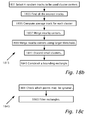
- FIG. 18b illustrates clustering step 1813 of Figure 18a in greater detail, according to a feature of an embodiment of the present invention.
- K random tracks selected to be used as seed cluster centers (step 1831). Tracks nearest to the seed cluster centers may be found for each seed cluster center (up to a distance, e.g. 20*0.5, for an average 0.5 pixels per image frame 14. The average track for each cluster is computed (step 1835). Nearby cluster centers are merged (step 1837). Nearby cluster centers may be merged again using a larger threshold (step 1839). Small clusters of a few points in absolute number or percentage of total are discarded (step 1841) after which a bounding rectangle is constructed (step 1843).
- Step 18c illustrating a flow diagram of step 1843 in greater detail of constructing a bounding rectangle.
- a check is performed for points which may be ignored (step 1861).
- the points to be ignored are typically those whose removal significantly changes significantly the area of the bounding rectangle.
- Step 1861 is repeated a number, e.g 3, of times.
- the rectangles may be filtered (step 1863) by (i) discarding rectangles that are too small (width, height), (ii) based on percentage of points from the cluster is too low compared to other tracks that lie inside the rectangle. Filtering may be performed according to the total number of tracks from features from the cluster inside the rectangle divided by the area of the rectangle.
- all the rectangles from the previous image frames 14 are input and the location and scales of each rectangle to the current image frame 14 frame are updated.
- the updating of the location and scales of each rectangle to the current image frame 14 frame may be performed done using random sample consensus (RANSAC) to estimate motion along the tracks.
- RANSAC random sample consensus
- a candidate for each location is then selected. Selecting the candidate for each location chooses the rectangle that best covers all the other rectangle.
- the candidate may change. Whether to classify this rectangle is decided on the basis of:
- edge or edge feature refers to an image feature having in image space a significant gradient in gray scale or color.
- edge direction is the direction of the gradient in gray scale or color in image space.
- detection is used herein in the context of an image of a object and refers to recognizing an image in a portion of the image frame as that of a object, for instance a object of a visually impaired person wearing the camera.
- detection and “recognition” in the context of an image of a object are used herein interchangeably, although detection may refer to a first instance and recognition may refer to a second or subsequent instance.
- motion detection or detection of motion as used herein refers to detection of image motion a features of an object between image frames.
- image intensity refers to either gray scale intensity as in a monochromatic image and/or one or more color intensities, for instance red/green/blue/, in a color image.
- class refers to a process performed by a machine-learning process based on characteristics of an object to identify a class or group to which the object belongs.
- the classification process may also include the act of deciding that the object is present. Examples of classes of objects include buses, hand gestures, bank notes and traffic signals.
- classify a gesture refers to recognizing the gesture as an input to the device.
- 'field of view is the angular extent of the observable world that is visible at any given moment either by an eye of a person and/ or a camera.
- the focal length of the lens of the camera provides a relationship between the field of view and the working distance of the camera.
- attribute refers to specific information of the recognized object. Examples may include the state of a recognized traffic signal, or a recognized hand gesture such as a pointed object which may be used for a control feature of the device; the denomination of a recognized bank note is an attribute of the bank note; the bus number is an attribute of the recognized bus.
- tracking image motion refers to tracking an image over multiple image frames.
- frame front refers to the front part of the eyeglass frame that holds the lenses in place and bridges the top of the nose.
- bone conduction refers to the conduction of sound to the inner ear through the bones of the skull.
- the first object is a thumb
- the second object is also known herein as an "index object”
- the second object is known herein as an "index” object
- the third object is known herein as a “middle object”
- the fourth object is known herein as "ring object”
- the fifth object is known herein as "pinky” object.
Landscapes
- Engineering & Computer Science (AREA)
- Physics & Mathematics (AREA)
- General Physics & Mathematics (AREA)
- Multimedia (AREA)
- Theoretical Computer Science (AREA)
- Human Computer Interaction (AREA)
- Computer Vision & Pattern Recognition (AREA)
- Image Analysis (AREA)
- User Interface Of Digital Computer (AREA)
Abstract
Description
- The present invention relates to a user wearable visual assistance device and method. Embodiments of the present invention relate to vision processing.
- The visually impaired suffer from difficulties due to lack of visual acuity, field of view, color perception and other forms of visual impairments. These challenges impact life in many aspects for example mobility, risk of injury, independence and situational awareness in everyday life.
- Many products offer solutions in the realm of mobility such as global positioning system (GPS), obstacle detection without performing recognition, and screen readers. These products may lack certain crucial aspects to integrate fully and seamlessly into the life of a visually impaired person.
- Thus, there is a need for and it would be advantageous to have a device which enhances quality of life for the visually impaired.
- The present invention seeks to provide an improved wearable device and method.
- According to an aspect of the invention, there is provided a method as in
claim 1. - According to an aspect of the invention, there is provided a device as in claim 13.
- Various methods for visually assisting a person are provided for herein using a device wearable by the person. The device includes a processor connectible to a camera. The processor is adapted to capture multiple image frames. Motion of a gesture is detected by using differences between the image frames. The gesture may be classified (recognized or re-recognized) responsive to the detected motion. The motion of the gesture may be repetitive. The gesture may include waving an object in the field of view of the camera and the object being held may be classified by the device. The motion detection and classification of the gesture and/or object are performed while avoiding pressing of a button on the device.
- The gesture may include holding an object in a hand of the person, enabling the person to audibly name the object and recording the name. Upon failing to recognize the gesture and/or to classify the object being held the person may be provided feedback by the device. Alternatively, or in addition upon succeeding to recognize the gesture and/or to classify the object, the person may be provided feedback by the device.. The person may train a classifier by audibly naming the object. The motion detection may include: tracking the image motion between the image frames and grouping the image motion into groups. The groups include similar image movement. The person may be notified of an attribute related to the gesture and/or the object being held.
- Various devices are provided for herein wearable by the person The device includes a processor operatively connectible to a camera. The processor is adapted to capture multiple image frames, to detect motion of a gesture by using differences between the image frames and to classify the gesture responsive to the detected motion. The motion of the gesture may be repetitive. A bone conduction headphone may be attached to the processor. The device may detect an object and recognize the object. The processor audibly informs the person by utilizing the bone conduction headphone to name the object.
- Various methods are provided for herein of using a device including a camera and a processor. The device is wearable for a person. Upon presenting an object to the device for a first time, the object is detected. Upon detection of the object, the person may label the object using a sound. The sound may be recorded by the device to produce a recorded sound. Upon presenting the (same or similar) object a second time to the device, the object is recognized. Upon recognizing the object , the recorded sound is played by the device for hearing by the person. Upon the second presentation of the object, the device may notify the person of an attribute of the device.
- The first and/or second presentation may include moving the object in the field of view of the camera, and the motion triggers the device to act in response.
- Prior to the detection of the object, image motion of the image of the object may be tracked between the image frames. The image of the object may be separated from image background responsive to the tracked image motion of the images of the object.
- The first and/or second presentations of the object may include inserting the object into the field of view of the camera and the insertion of the object into the field of view of the camera triggers the device to act in response.
- When the object is successfully recognized and/or not successfully recognized by the device, feedback may be provided accordingly to the person by playing an audible sound to the person indicating that the object is recognized or not recognized. The device may include and may manage a data base of objects personal to the person, The objects of the database when presented to the device are recognizable by the device.
- Embodiments of the invention are herein described, by way of example only, with reference to the accompanying drawings, wherein:
-
Figure 1 shows a system diagram, according to embodiments of the present invention; -
Figure 2a shows an isometric view of an apparatus, according a feature of an embodiment of the present invention; -
Figure 2b shows an alternative isometric view of the apparatus shown inFigure 2a , according to a feature of an embodiment of the present invention; -
Figure 3 shows eyeglasses retrofit according to a feature of an embodiment of the present invention; -
Figure 4 shows retrofit of eyeglasses shown inFigure 3 with a portion of the apparatus shown infigures 2a and 2b , according to a feature of an embodiment of the present invention; -
Figure 5a-5c ,Figure 6 andFigures 7-8 are flow diagrams which illustrate processes according to different features of embodiments of the present invention; -
Figure 9a shows a person wearing eyeglasses retrofit as shown inFigure 4 and gesturing, according to a feature of an embodiment of the present invention; -
Figures 9b-9e show other possible hand gestures in the visual field of the camera, according to different embodiments of the present invention; -
Figures 10-14 shows further examples of a person wearing and using the device ofFigure 4 for detecting and recognizing text, a bus, a bank note, a traffic signal and holding an object, according to different embodiments of the present invention; -
Figures 15a and 15b illustrate image frames according to different embodiments of the present invention; -
Figure 16a illustrates a process in which a user names an object being held, according to a feature of an embodiment of the present invention; -
Figure 16b illustrates a process in which the device recognizes the object previously held in the process ofFigure 16a , according to a feature of an embodiment of the present invention; -
Figure 17a shows a flow diagram of a method of detecting gesture motion, according to a feature of an embodiment of the present invention; -
Figure 17b shows an aspect of the detection step of the method illustrated inFigure 17a in greater detail; -
Figure 18a shows a flow diagram of a method, according to a feature of an embodiment of the present invention; -
Figure 18b shows a flow diagram of a method which provides greater detail to a step of the method illustrated inFigure 18a , according to a feature of an embodiment of the present invention; and -
Figure 18c shows a flow diagram of a method which provides greater detail to a step of the method illustrated inFigure 18b , according to a feature of an embodiment of the present invention. - Reference will now be made in detail to features of embodiments of the present invention, examples of which are illustrated in the accompanying drawings, wherein like reference numerals refer to the like elements throughout. The features are described below to explain embodiments of the present invention by referring to the figures.
- Before explaining features of embodiments of the invention in detail, it is to be understood that the invention is not limited in its application to the details of design and the arrangement of the components set forth in the following description or illustrated in the drawings. The invention is capable of other features or of being practiced or carried out in various ways. Also, it is to be understood that the phraseology and terminology employed herein is for the purpose of description and should not be regarded as limiting.
- By way of introduction, embodiments of the present invention utilize a user-machine interface in which the existence of an object in the environment of a user and a hand gesture trigger the device to notify the user regarding an attribute of the object. The device may be adapted to learn the preferences of the user. In that sense, the device is extensible and gradually suits the user better with use, since the preferences of the user may be learned in time with use of the device.
- Reference is now made to
Figure 1 which illustrates asystem 1, according to a feature of an embodiment of the present invention. Acamera 12 withimage sensor 12a captures image frames 14 in a forward view ofcamera 12.Camera 12 may be a monochrome camera, a red green blue (RGB) camera or a near infra red (NIR) camera. Image frames 14 are captured and transferred toprocessor 16 to be processed. The processing of image frames 14 may be based upon algorithms in memory orstorage 18.Storage 18 is shown to include aclassifier 509 which may includegesture detection 100, vehicle detection and recognition 102, bank note detection andrecognition 104 and/ or traffic sign detection and recognition 106.Classifier 509 may be a multi-class classifier and may include, for example, multiple classes of different images of different objects including bank notes, vehicles, e.g. buses, traffic signs and/or signals, and gestures. Another classifier may be available forface detection 120. A method may be available forobstacle detection 122 with or without use of an additional sensor (not shown) - Reference is now made to
Figure 2a which shows a view of anapparatus 20, according a feature of an embodiment of the present invention.Camera 12 may be located in a housing which is attached to amount 22.Mount 22 connects electrically to anaudio unit 26 via acable 24. Aslot 22b is located betweencamera 12 andmount 22. Bothcamera 12 andaudio unit 26 may be operatively connected toprocessor 16 and optionally tostorage 18.Processor 16 andstorage 18 may be a custom unit or alternatively may be part of a mobile computer system, e.g. smart phone. Audio unit 26 (not shown) may be an audio speaker which may be in close proximity to and/ or attached the ear of the user or located and attached at the bend inarm 32. In other embodiments,audio unit 26 may be a bone conducting headphone set which may conduct through to one ear or to both ears of the person.Unit 26 may also be a earphone connected toprocessor 16 by a wireless connection, e.g. BlueToothRTM. - Reference is now made to
Figure 2b which shows an alternative view ofapparatus 20, showingcamera 12,mount 22,slot 22b,cable 24 andaudio unit 26, according to a feature of an embodiment of the present invention. - Reference is now made to
Figure 3 which showseyeglasses 30 retrofit according to a feature of an embodiment of the present invention.Eyeglasses 30 have twoarms 32 connected to the frame front ofeyeglasses 30 with hinges 36. The frame front hold thelenses 34 ofeyeglasses 30. Adocking component 22a is attached to anarm 32 near to the frame front but just beforehinge 36. - Reference is now made to
Figure 4 which shows adevice 40 of eyeglasses retrofit with an apparatus according to a feature of an embodiment of the present invention.Camera 12 may be docked ondocking component 22a so thatslot 22b betweenmount 22 andcamera 12 slides ontodocking component 22a. A magnetic connection between the slot anddocking component 22a may allowcamera 12 and mount 22 to be attachable, detachable and re-attachable toeyeglasses 30 viadocking component 22a. In other embodiments, a spring loaded strip located in the slot or on either side ofdocking component 22a (located behind hinge 36) may be utilized to allowcamera 12 to be attachable, detachable and re-attachable toeyeglasses 30. Any other means known in the art of mechanical design may alternatively or additionally be utilized to allowcamera 12 to be attachable, detachable and re-attachable toeyeglasses 30.Camera 12 is therefore, located to capture images frames 14 with a view which may be substantially the same view (provided throughlenses 34 if applicable) of theperson wearing eyeglasses 30.Camera 12 is therefore, located to minimize parallax error between the view of the person and view ofcamera 12. - Reference is now made to
Figure 5a which shows amethod 501 for training amulti-class classifier 509, according to a feature of an embodiment of the present invention. Training ofclassifier 509 is performed prior to using trainedclassifier 509 to classify for example gestures, bank notes, vehicles, particularly buses and/or traffic signals or traffic signs.Training images 503, for example of bank notes for a particular country, are provided and image features of the bank notes are extracted instep 505. Features extracted (step 505) fromtraining images 503 may include optical gradients, intensity, color, texture and contrast for example. Features of the bank notes for a particular country may be stored (step 507) to produce a trainedclassifier 509. A similar exercise may be performed forsteps classifier 509. An example of amulti-class classifier 509 which may be produced includes the extracted features of both bank notes as one class of objects and hand gestures as another class of objects. - Optical flow or differences between image frames 14 may be further used for classification for example to detect and recognize gesture motion or to detect and recognize the color change of a traffic signal
- Reference is now made to
Figure 5b , which shows amethod 511, according to a feature of an embodiment of the present invention. Instep 513, trainedclassifier 509 is loaded intoprocessor 16. - Reference is now made to
Figure 5c , which shows amethod 521, according to a feature of an embodiment of the present invention. With trainedclassifier 509 loaded into processor 16 (step 513), image frames 14 are captured instep 523 of various possible visual fields of theperson wearing device 40. The captured image frames 14 are then used to search (step 525) for acandidate image 527 for an object found in the image frames 14. Further processing ofcandidate images 527 are shown in the description that follows. - Reference is now made to
Figure 9a which shows aperson wearing device 40 andvisual field 90a ofcamera 12. The person is presenting a hand gesture in the field of view ofcamera 12. The gesture shown for example being the right hand palm side of the person with fingers closed and the thumb pointing out to the right.Figures 9b-9e show other example hand gestures which may be invisual field 90a of the person andcamera 12.Figure 9b shows the back or dorsal part of an open right hand which is being waved from side to side.Figure 9c shows a palm side of a left hand with thumb and little finger extended.Figure 9d shows a palm side of a right hand with thumb, little finger and index finger extended.Figure 9e shows the back or dorsal part of an open right hand which is stationary. - Reference is now made to
Figure 10 which shows avisual field 90b of aperson wearing device 40.Visual field 90c of the person includes adocument 1000 and the pointing of the index finger of the right hand to text indocument 1000.Document 1000 in this case is a book but also may be a timetable, notice on a wall or a text on some signage in close proximity to the person such as text on the label of a can for example. - Reference is now made to
Figure 11 which shows avisual field 90c of aperson wearing device 40. Herevisual field 90c includes abus 1102 and the pointing of the index finger of the right in the general direction ofbus 1102.Bus 1102 also includes a text such as the bus number and destination. The text may also include details of the route ofbus 1102. Reference is now made toFigure 12 which shows avisual field 90d of aperson wearing device 40.Visual field 90d includes the person holding abanknote 1203 orvisual field 90d may havebanknote 1203 on a counter top or in the hands of another person such as shop assistant for example. - Reference is now made to
Figure 13 which shows avisual field 90e of aperson wearing device 40. Herevisual field 90c includes atraffic signal 1303 and the pointing of the index finger of the right in the general direction oftraffic signal 1303. Here traffic signal has twosign lights 1303a (red) and 1303b (green) which may be indicative of a pedestrian crossing sign or alternativelytraffic signal 1303 may have three sign lights (red, amber, green) indicative of a traffic sign used by vehicles as well as pedestrians. - Reference is now made to
Figure 6 which shows amethod 601, according to a feature of an embodiment of the present invention. Instep 603 the visual field 90 of the person andcamera 12 may be scanned whiledevice 40 is worn by the person. In decision block 605 a decision is made to determine if an object detected in visual field 90 is either a hand of the person or a face of another person. If the object detected is the face of another person, facial recognition of the other person may be performed instep 607.Facial recognition step 607 may make use ofclassifier 120 which has been previously trained to recognize faces of people who are known to the person. If the object detected in visual field 90 is a hand of the person, indecision box 609 it may be determined if the hand gesture is a pointing finger gesture or not. The pointing finger may be for instance a pointing index finger of the right hand or left hand of the person. If the hand does not include a pointing finger, then hand gestures may be detected starting instep 613 the flow of which continues inFigure 7 . If the finger is pointing to an attribute such as a text layout indecision box 611, the flow continues inFigure 8 . - Reference is now made to
Figure 7 which shows amethod 701, according to a feature of an embodiment of the present invention.Method 701 is a continuation ofstep 613 shown inFigure 6 . In step 613 a hand gesture of a user is detected and recognized to not include a pointing finger. Instep 703 the hand gesture may be classified as one of many recognizable gestures of trainedclassifier 509. Recognizing the hand gesture as one of many hand gestures may simultaneously provide control (step 705) ofdevice 40 based on the hand gesture as well as providing an audible output viaaudio unit 26 in response to and/ or in confirmation of the hand gesture (step 707). Instep 705, control ofdevice 40 may include gestures to recognize colours, to stop a process of recognizing just buses for example, increase the volume ofunit 26, to stop and/ or start reading recognized text, to start recording video or to take a picture. Instep 707, the audible output may be click sound, bleep, a one word confirmation or to notify the person that a specific mode has been entered, such as just looking for buses and bus numbers for example. Audible output response instep 707 may alternatively or in addition include information or data related to a recognized object. - Reference is now made to
Figure 8 which shows amethod 801, according to a feature of en embodiment of the present invention.Method 801 shows the continuation ofdecision step 611 shown inFigure 6 .Decision step 611 is reached by virtue of finding a finger pointing in visual field 90 instep 609. Indecision step 611 it is determined if a text layout is detected around a pointing finger and if so, the resolution ofcamera 12 may be increased to enable analysis (step 803) of image frames 14 so as to look for example for a block of text within the text layout of a document. If text is found indecision block 805, recognition of the text is performed instep 807 and the text may be read to the person viaaudio unit 26. The index finger may be used to point to which specific portion of text to be recognized and to be read in the document. - In both
decision boxes candidate image 527 in the field of view 90 for an object may be performed instep 525. The search instep 525 may be made with a lower resolution ofcamera 12 to enable searching of the object in image frames 14. The object may be a vehicle such as a bus, a bank note and/ or traffic light shown inviews candidate image 527 may then be classified instep 809, usingclassifier 509 as an image of a specific object. Additionally, the person may track the candidate image to provide a tracked candidate image in the image frames 14. The tracking may be based on sound perception, partial vision or situational awareness by orienting the head-worncamera 12 in the direction of the object. The tracked candidate image may be then selected for classification and recognition. - In
decision block 811, if an object is found, it may be possible to inform the person what the object is (bus 1102,bank note 1203 ortraffic signal 1303 for example) and to scan the object (step 815) for attributes of the object such as text, colour or texture. If text and/or colour is found, indecision 817 on or for the object, the user may be audibly notified (step 819) viaaudio unit 26 and the recognized text may be read to the person. In the case ofbus 1102 the bus number may be read along with the destination or route based on recognized text and/ or colour of the bus. In the case ofbank note 1203 the denomination of the bank note (5 British pounds or 5 American dollars) may be read to the person based on recognized text and/ or colour or texture of the bank note. In the case oftraffic signal 1303 based on the colour oftraffic signal 1303 or a combination colour and/ or text oftraffic signal 1303 to stop or to walk. - If no text is found on the object then the user may be audibly notified (step 821) via
audio unit 26 that no text has been found on the object. Indecision step 811, if no object is found, then a scan for any text in the image frames 14 may be made instep 813.Decision step 817 may be run again afterstep 813 to notify of text (step 819) andunit 26 to read the text or notify (step 821) of no text found. - Reference is now made to
Figure 14 which illustrates auser wearing device 1 and holding an object, e.g. a package of butter, in the field of view ofcamera 12. A portion of animage frame 14 is shown inFigures 15a and 15b showing the user holding and/or moving the object. The type of movement of the object that the user may make, in successive captured image frames 14 may be repetitive: for instance, acircular movement 150a, a side toside movement 150b, and/or an up and down movement. Alternatively, there may be substantially no movement of the object.Figures 15a and 15b also illustrate features,e.g. corners 152 and edges or edge features 154 of the object which may be tracked bydevice 1 during the image motion - According to a feature of an embodiment of the present invention,
device 1 determines that a user is holding an object that was previously held by the user, anddevice 1 re-recognizes the object.Device 1 may act responsive to the re-recognition and/or use re-recognition of the object as a control input. - Reference is now made to
Figures 16a and 16b which illustratemethods - In
method 41,device 1 determines with high probability, that the user is presenting (step 403) an object in the field of view ofcamera 12.Device 1 may check whether the object is recognizable. Upon detecting or recognizing (step 405) the object being presented, the user may name the object or make a sound to label the object (step 413) and the sound may be recorded (step 415). A feature of the present invention is thatmethod 41 avoids a button press. Hand motion, such as waving the object in the field of view ofcamera 12 or inserting the object into the field of view is sufficient to indicate todevice 1 that there is an object being presented (step 403) for recognition (step 405). - Referring now to
Figure 16b ,method 42 performs image-based matching in a way that is fast and flexible. The previously detected object is presented again (step 403 ) tocamera 12 and image-based matching is performed so that the object is recognized (step 405) as the same object that was previously detected. A unique aspect todevice 1 is that a user can add objects. For example, a visually impaired user may not be able to identify the particular brand of yogurt she is interested in purchasing from the store shelf. Such a user may ask for assistance once, in order to find the product. She then presents the product todevice 1 and subsequently the device will tell that product apart from others, making the shopping fast and pleasant to the user. Another example is a visually impaired person who pays using cash and needs to ensure that he/she receives the correct change, asdevice 1 may identify the bank notes and coins. - Reference is now made to
Figure 17a which shows a flow diagram of amethod 1701, according to a feature of an embodiment of the present invention. Instep 1703, motion of an object held by a user ofdevice 1 is detected using differences between image frames 14. Based on the motion detected of the object between image frames instep 1703, the object is classified instep 1705. Alternative steps according to different embodiments of the present invention may followclassification step 1705. A failure to classify the object may be audibly given to the user byaudio unit 26. A successful classification instep 1705 may allow the user to name the object (step 1707) and record the name of the object. A successful re-recognition instep 1705 may allow the user to audibly hear fromaudio unit 26, text being read aloud by using optical character recognition (OCR) of characters on the object. - Reference is now made to
Figure 17b which shows an aspect of motion detection of a gesture ( step 1703 ) in greater detail, according to a feature of an embodiment of the present invention. Instep 1731, feature points of the object are detected as the object is held in the hand of the user and moved by the hand of the user. Referring again to again toFigures 15a, 15b , the feature points may becorners 152 and edge features 154 of the object.Corners 152 and edge features 154 may be provided by algorithms known in the art of image processing such as Scale-invariant feature transform (SIFT) or Harris corners. From the way the user holds the object in her hand, it may be understood that the object includes a gesture intended for control ofdevice 1. Alternatively or in addition, instep 1733, the features such ascorners 152 and edge features 154, which may be found on the object and/ or the hand of the user holding the object, may be tracked bydevice 1 between image frames 14. The features may be grouped ( step 1735 ) into groups which have similar features and movements. Repetitive motion offeatures device 1 to indicate a control input todevice 1. - Reference is now made to
Figure 18a which illustrates a flow diagram of amethod 1801, according to features of embodiments of the present invention for tracking image motion or tracking features of an object between image frames 14.Method 1801 receives aninput 1803 including tracks from features e.g.corners 152 andedges 154, from a number e,g, 11, of previous image frames 14. The tracks from the tracked features are filtered (step 1805) and for each track, differential pairs (dx, dy) pairs e.g. 10 pairs are stored (step 1807), where x and y are Cartesian axes in image space. Shorter tracks may be ignored and may be discarded (step 1807) which have image motion below a threshold. Indecision block 1809, if too many tracks remain in animage frame 14,image frame 14 may be ignored (step 1811), indicating thatcamera 12 has probably moved during the exposure causing the background also to move. In this way,method 1801 achieves separation of the image of a moving object or gesture from the background. - In
decision block 1809, if not too many tracks remain inimage frame 14, the tracks are clustered (step 1813) based on linear complexity. - Reference is now made to
Figure 18b which illustratesclustering step 1813 ofFigure 18a in greater detail, according to a feature of an embodiment of the present invention. K random tracks selected to be used as seed cluster centers (step 1831). Tracks nearest to the seed cluster centers may be found for each seed cluster center (up to a distance, e.g. 20*0.5, for an average 0.5 pixels perimage frame 14. The average track for each cluster is computed (step 1835). Nearby cluster centers are merged (step 1837). Nearby cluster centers may be merged again using a larger threshold (step 1839). Small clusters of a few points in absolute number or percentage of total are discarded (step 1841) after which a bounding rectangle is constructed (step 1843). - Reference is now made to
Figure 18c illustrating a flow diagram ofstep 1843 in greater detail of constructing a bounding rectangle. For each boundary direction (up, right, down, left) a check is performed for points which may be ignored (step 1861). The points to be ignored are typically those whose removal significantly changes significantly the area of the bounding rectangle.Step 1861 is repeated a number, e.g 3, of times. The rectangles may be filtered (step 1863) by (i) discarding rectangles that are too small (width, height), (ii) based on percentage of points from the cluster is too low compared to other tracks that lie inside the rectangle. Filtering may be performed according to the total number of tracks from features from the cluster inside the rectangle divided by the area of the rectangle. - With multiple frames, all the rectangles from the previous image frames 14 are input and the location and scales of each rectangle to the
current image frame 14 frame are updated. The updating of the location and scales of each rectangle to thecurrent image frame 14 frame may be performed done using random sample consensus (RANSAC) to estimate motion along the tracks. A candidate for each location is then selected. Selecting the candidate for each location chooses the rectangle that best covers all the other rectangle. When anew image frame 14 arrives, the candidate may change. Whether to classify this rectangle is decided on the basis of: - if the homography indicates too large an image motion, then ignore the rectangle because the image might be blurry.
- rectangles are re-sent until there is one image in which the classifier gets a high score
- rectangles that failed too many times, are later ignored so as to save computing power.
- The term "edge or "edge feature" as used herein refers to an image feature having in image space a significant gradient in gray scale or color.
- The term "edge direction" is the direction of the gradient in gray scale or color in image space.
- The term "detection" is used herein in the context of an image of a object and refers to recognizing an image in a portion of the image frame as that of a object, for instance a object of a visually impaired person wearing the camera. The terms "detection" and "recognition" in the context of an image of a object are used herein interchangeably, although detection may refer to a first instance and recognition may refer to a second or subsequent instance.
- The term "motion detection" or detection of motion as used herein refers to detection of image motion a features of an object between image frames.
- The term "image intensity" as used herein refers to either gray scale intensity as in a monochromatic image and/or one or more color intensities, for instance red/green/blue/, in a color image.
- The term "classify" as used herein, refers to a process performed by a machine-learning process based on characteristics of an object to identify a class or group to which the object belongs. The classification process may also include the act of deciding that the object is present. Examples of classes of objects include buses, hand gestures, bank notes and traffic signals.
- The term "classify a gesture" as used herein refers to recognizing the gesture as an input to the device.
- The term 'field of view" (FOV) as used herein is the angular extent of the observable world that is visible at any given moment either by an eye of a person and/ or a camera. The focal length of the lens of the camera provides a relationship between the field of view and the working distance of the camera.
- The term "attribute" as used herein, refers to specific information of the recognized object. Examples may include the state of a recognized traffic signal, or a recognized hand gesture such as a pointed object which may be used for a control feature of the device; the denomination of a recognized bank note is an attribute of the bank note; the bus number is an attribute of the recognized bus.
- The term "tracking image motion" as used herein, refers to tracking an image over multiple image frames.
- The term "frame front" as used herein refers to the front part of the eyeglass frame that holds the lenses in place and bridges the top of the nose.
- The term "bone conduction" as used herein refers to the conduction of sound to the inner ear through the bones of the skull.
- The objects of a hand are termed herein as follows: the first object is a thumb, the second object is also known herein as an "index object", the second object is known herein as an "index" object, the third object is known herein as a "middle object", the fourth object is known herein as "ring object" and the fifth object is known herein as "pinky" object.
- The indefinite articles "a", "an" is used herein, such as "a candidate image", "an audible output" have the meaning of "one or more" that is "one or more candidate images" or "one or more audible outputs".
- Although selected features of embodiments of the present invention have been shown and described, it is to be understood the present invention is not limited to the described features. Instead, it is to be appreciated that changes may be made to these features without departing from the principles of the invention, the scope of which is defined by the claims.
- All optional and preferred features and modifications of the described embodiments and dependent claims are usable in all aspects of the invention taught herein. Furthermore, the individual features of the dependent claims, as well as all optional and preferred features and modifications of the described embodiments are combinable and interchangeable with one another.
- The disclosures in United States patent application number
13/397,919 patent application number 12 275 016.9
Claims (15)
- A method for visually assisting a person using a device wearable by the person, wherein the device includes a processor operatively connectible to a camera, wherein the processor is adapted to capture a plurality of image frames, the method comprising:detecting motion of a gesture by using differences between the image frames;classifying said gesture responsive to said detected motion.
- The method of claim 1, wherein said motion of said gesture is repetitive.
- The method of claim 1 or 2, wherein said detecting and said classifying are performed while avoiding pressing of a button on the device.
- The method of any preceding claim, wherein said gesture includes holding an object in a hand of the person.
- The method of claim 4, further comprising:enabling the person to audibly name said object; andrecording said name.
- The method of claim 4 or 5, wherein said gesture includes waving said object in the field of view of the camera.
- The method of any of claims 4 to 6, further comprising classifying said object.
- The method of any preceding claim, further comprising:providing feedback to the person upon failing to classify said gesture.
- The method of any preceding claim, wherein said gesture includes holding an object, the method further comprising:training a classifier by audibly naming the object.
- The method of any preceding claim, further comprising:performing said detecting by identifying portions of a hand.
- The method of any preceding claim, wherein said detecting motion includes:tracking the image motion between said image frames;grouping said image motion into groups, wherein said groups include similar image movement.
- The method of any preceding claim, further comprising:notifying the person of an attribute related to the gesture.
- A device wearable by the person, wherein the device includes a processor operatively connectible to a camera, wherein the processor is adapted to capture a plurality of image frames, the device operable to :detect motion of a gesture by using differences between the image frames;classify said gesture responsive to said detected motion.
- The device of claim 13, wherein said motion of said gesture is repetitive.
- The device of claim 13 or 14, further comprising:a bone conduction headphone operatively attached to said processor, wherein the device detects an object and recognizes the object, wherein said processor audibly informs the person by utilizing said bone conduction headphone to name said object.
Priority Applications (2)
| Application Number | Priority Date | Filing Date | Title |
|---|---|---|---|
| EP13275033.2A EP2629242A1 (en) | 2012-02-16 | 2013-02-15 | A user wearable visual assistance device and method |
| US13/914,792 US20130271584A1 (en) | 2011-02-17 | 2013-06-11 | User wearable visual assistance device |
Applications Claiming Priority (3)
| Application Number | Priority Date | Filing Date | Title |
|---|---|---|---|
| US13/397,919 US20120212593A1 (en) | 2011-02-17 | 2012-02-16 | User wearable visual assistance system |
| EP12275016A EP2490155A1 (en) | 2011-02-17 | 2012-02-17 | A user wearable visual assistance system |
| EP13275033.2A EP2629242A1 (en) | 2012-02-16 | 2013-02-15 | A user wearable visual assistance device and method |
Publications (1)
| Publication Number | Publication Date |
|---|---|
| EP2629242A1 true EP2629242A1 (en) | 2013-08-21 |
Family
ID=47664222
Family Applications (2)
| Application Number | Title | Priority Date | Filing Date |
|---|---|---|---|
| EP13275025.8A Withdrawn EP2629241A1 (en) | 2012-02-16 | 2013-02-08 | Control of a wearable device |
| EP13275033.2A Withdrawn EP2629242A1 (en) | 2011-02-17 | 2013-02-15 | A user wearable visual assistance device and method |
Family Applications Before (1)
| Application Number | Title | Priority Date | Filing Date |
|---|---|---|---|
| EP13275025.8A Withdrawn EP2629241A1 (en) | 2012-02-16 | 2013-02-08 | Control of a wearable device |
Country Status (1)
| Country | Link |
|---|---|
| EP (2) | EP2629241A1 (en) |
Cited By (9)
| Publication number | Priority date | Publication date | Assignee | Title |
|---|---|---|---|---|
| US8917169B2 (en) | 1993-02-26 | 2014-12-23 | Magna Electronics Inc. | Vehicular vision system |
| US8993951B2 (en) | 1996-03-25 | 2015-03-31 | Magna Electronics Inc. | Driver assistance system for a vehicle |
| US9008369B2 (en) | 2004-04-15 | 2015-04-14 | Magna Electronics Inc. | Vision system for vehicle |
| WO2015200168A1 (en) * | 2014-06-27 | 2015-12-30 | Intel Corporation | Using a generic classifier to train a personalized classifier for wearable devices |
| US9436880B2 (en) | 1999-08-12 | 2016-09-06 | Magna Electronics Inc. | Vehicle vision system |
| US9555803B2 (en) | 2002-05-03 | 2017-01-31 | Magna Electronics Inc. | Driver assistance system for vehicle |
| US9949056B2 (en) | 2015-12-23 | 2018-04-17 | Ecole Polytechnique Federale De Lausanne (Epfl) | Method and apparatus for presenting to a user of a wearable apparatus additional information related to an audio scene |
| US10071676B2 (en) | 2006-08-11 | 2018-09-11 | Magna Electronics Inc. | Vision system for vehicle |
| EP3876025A1 (en) | 2020-03-02 | 2021-09-08 | Siemens Aktiengesellschaft | Obstacle detection and collision warning assembly |
Families Citing this family (2)
| Publication number | Priority date | Publication date | Assignee | Title |
|---|---|---|---|---|
| EP3189370A1 (en) * | 2014-09-01 | 2017-07-12 | Eyra Ltd | Process and wearable device equipped with stereoscopic vision for helping the user |
| CN106408961B (en) * | 2016-11-14 | 2019-03-01 | 华北电力大学(保定) | Two-level pan-logic intelligent control method and control system for single-intersection signal lights |
Citations (4)
| Publication number | Priority date | Publication date | Assignee | Title |
|---|---|---|---|---|
| US6115482A (en) * | 1996-02-13 | 2000-09-05 | Ascent Technology, Inc. | Voice-output reading system with gesture-based navigation |
| WO2001003635A1 (en) * | 1999-07-07 | 2001-01-18 | Fekete Janos | Device for aiding the orientation of the blind |
| GB2378301A (en) * | 2001-07-31 | 2003-02-05 | Hewlett Packard Co | Personal object recognition system for visually impaired persons |
| US20060017810A1 (en) * | 2004-04-02 | 2006-01-26 | Kurzweil Raymond C | Mode processing in portable reading machine |
-
2013
- 2013-02-08 EP EP13275025.8A patent/EP2629241A1/en not_active Withdrawn
- 2013-02-15 EP EP13275033.2A patent/EP2629242A1/en not_active Withdrawn
Patent Citations (4)
| Publication number | Priority date | Publication date | Assignee | Title |
|---|---|---|---|---|
| US6115482A (en) * | 1996-02-13 | 2000-09-05 | Ascent Technology, Inc. | Voice-output reading system with gesture-based navigation |
| WO2001003635A1 (en) * | 1999-07-07 | 2001-01-18 | Fekete Janos | Device for aiding the orientation of the blind |
| GB2378301A (en) * | 2001-07-31 | 2003-02-05 | Hewlett Packard Co | Personal object recognition system for visually impaired persons |
| US20060017810A1 (en) * | 2004-04-02 | 2006-01-26 | Kurzweil Raymond C | Mode processing in portable reading machine |
Non-Patent Citations (1)
| Title |
|---|
| YANG MING-HSUAN AND AHUJA NARENDRA: "Face detection and gesture recognition for human-computer interaction", 2001, KLUWER ACADEMIC PUBLISHERS, ISBN: 0792374096, pages: 57 - 69, XP002693649 * |
Cited By (35)
| Publication number | Priority date | Publication date | Assignee | Title |
|---|---|---|---|---|
| US8917169B2 (en) | 1993-02-26 | 2014-12-23 | Magna Electronics Inc. | Vehicular vision system |
| US8993951B2 (en) | 1996-03-25 | 2015-03-31 | Magna Electronics Inc. | Driver assistance system for a vehicle |
| US9436880B2 (en) | 1999-08-12 | 2016-09-06 | Magna Electronics Inc. | Vehicle vision system |
| US9834216B2 (en) | 2002-05-03 | 2017-12-05 | Magna Electronics Inc. | Vehicular control system using cameras and radar sensor |
| US9643605B2 (en) | 2002-05-03 | 2017-05-09 | Magna Electronics Inc. | Vision system for vehicle |
| US10683008B2 (en) | 2002-05-03 | 2020-06-16 | Magna Electronics Inc. | Vehicular driving assist system using forward-viewing camera |
| US10351135B2 (en) | 2002-05-03 | 2019-07-16 | Magna Electronics Inc. | Vehicular control system using cameras and radar sensor |
| US9555803B2 (en) | 2002-05-03 | 2017-01-31 | Magna Electronics Inc. | Driver assistance system for vehicle |
| US10118618B2 (en) | 2002-05-03 | 2018-11-06 | Magna Electronics Inc. | Vehicular control system using cameras and radar sensor |
| US11203340B2 (en) | 2002-05-03 | 2021-12-21 | Magna Electronics Inc. | Vehicular vision system using side-viewing camera |
| US9948904B2 (en) | 2004-04-15 | 2018-04-17 | Magna Electronics Inc. | Vision system for vehicle |
| US10110860B1 (en) | 2004-04-15 | 2018-10-23 | Magna Electronics Inc. | Vehicular control system |
| US10735695B2 (en) | 2004-04-15 | 2020-08-04 | Magna Electronics Inc. | Vehicular control system with traffic lane detection |
| US9609289B2 (en) | 2004-04-15 | 2017-03-28 | Magna Electronics Inc. | Vision system for vehicle |
| US11847836B2 (en) | 2004-04-15 | 2023-12-19 | Magna Electronics Inc. | Vehicular control system with road curvature determination |
| US10015452B1 (en) | 2004-04-15 | 2018-07-03 | Magna Electronics Inc. | Vehicular control system |
| US9008369B2 (en) | 2004-04-15 | 2015-04-14 | Magna Electronics Inc. | Vision system for vehicle |
| US9736435B2 (en) | 2004-04-15 | 2017-08-15 | Magna Electronics Inc. | Vision system for vehicle |
| US11503253B2 (en) | 2004-04-15 | 2022-11-15 | Magna Electronics Inc. | Vehicular control system with traffic lane detection |
| US10187615B1 (en) | 2004-04-15 | 2019-01-22 | Magna Electronics Inc. | Vehicular control system |
| US10306190B1 (en) | 2004-04-15 | 2019-05-28 | Magna Electronics Inc. | Vehicular control system |
| US9191634B2 (en) | 2004-04-15 | 2015-11-17 | Magna Electronics Inc. | Vision system for vehicle |
| US10462426B2 (en) | 2004-04-15 | 2019-10-29 | Magna Electronics Inc. | Vehicular control system |
| US9428192B2 (en) | 2004-04-15 | 2016-08-30 | Magna Electronics Inc. | Vision system for vehicle |
| US10071676B2 (en) | 2006-08-11 | 2018-09-11 | Magna Electronics Inc. | Vision system for vehicle |
| US10787116B2 (en) | 2006-08-11 | 2020-09-29 | Magna Electronics Inc. | Adaptive forward lighting system for vehicle comprising a control that adjusts the headlamp beam in response to processing of image data captured by a camera |
| US11148583B2 (en) | 2006-08-11 | 2021-10-19 | Magna Electronics Inc. | Vehicular forward viewing image capture system |
| US11396257B2 (en) | 2006-08-11 | 2022-07-26 | Magna Electronics Inc. | Vehicular forward viewing image capture system |
| US11623559B2 (en) | 2006-08-11 | 2023-04-11 | Magna Electronics Inc. | Vehicular forward viewing image capture system |
| US11951900B2 (en) | 2006-08-11 | 2024-04-09 | Magna Electronics Inc. | Vehicular forward viewing image capture system |
| US9563855B2 (en) | 2014-06-27 | 2017-02-07 | Intel Corporation | Using a generic classifier to train a personalized classifier for wearable devices |
| WO2015200168A1 (en) * | 2014-06-27 | 2015-12-30 | Intel Corporation | Using a generic classifier to train a personalized classifier for wearable devices |
| US9949056B2 (en) | 2015-12-23 | 2018-04-17 | Ecole Polytechnique Federale De Lausanne (Epfl) | Method and apparatus for presenting to a user of a wearable apparatus additional information related to an audio scene |
| EP3876025A1 (en) | 2020-03-02 | 2021-09-08 | Siemens Aktiengesellschaft | Obstacle detection and collision warning assembly |
| WO2021175641A1 (en) | 2020-03-02 | 2021-09-10 | Siemens Aktiengesellschaft | Arrangement for obstacle detection and collision warning |
Also Published As
| Publication number | Publication date |
|---|---|
| EP2629241A1 (en) | 2013-08-21 |
Similar Documents
| Publication | Publication Date | Title |
|---|---|---|
| US20130271584A1 (en) | User wearable visual assistance device | |
| EP2490155A1 (en) | A user wearable visual assistance system | |
| US12494070B2 (en) | Feature density object classification, systems and methods | |
| US20130169536A1 (en) | Control of a wearable device | |
| Yi et al. | Portable camera-based assistive text and product label reading from hand-held objects for blind persons | |
| JP4633043B2 (en) | Image processing device | |
| EP2629241A1 (en) | Control of a wearable device | |
| US20140267644A1 (en) | Systems and methods for performing a triggered action | |
| US20220139113A1 (en) | Method and device for detecting object in image | |
| CN110678875A (en) | System and method for guiding user to take self-photo | |
| CN112257513A (en) | A training method, translation method and system for a sign language video translation model | |
| US20190378290A1 (en) | Information processing apparatus and non-transitory computer readable medium storing information processing program | |
| CN114764944A (en) | Pupil positioning method and device based on angular point detection | |
| Coughlan et al. | -Camera-Based Access to Visual Information | |
| Samundeswari et al. | Optical character recognition for visuall ychallenged people with shopping cart using AI | |
| Rodríguez-Moreno et al. | Sign language recognition by means of common spatial patterns | |
| JP2024100002A (en) | Image recognition device, control method of image recognition device and program | |
| Viitaniemi et al. | Detecting hand-head occlusions in sign language video | |
| Bekhit | Computer Vision and Augmented Reality in iOS | |
| Asteriadis et al. | Non-verbal feedback on user interest based on gaze direction and head pose | |
| Kunene et al. | Indoor sign recognition for the blind | |
| De Beugher et al. | Automatic analysis of in-the-wild mobile eye-tracking experiments using object, face and person detection | |
| Tian et al. | Detecting good quality frames in videos from mobile camera for blind navigation | |
| Li et al. | Wearable facial action unit classification from near-field infrared eye images using deformable models | |
| Raees et al. | Personal privacy based on deep learning techniques: A comparative study |
Legal Events
| Date | Code | Title | Description |
|---|---|---|---|
| PUAI | Public reference made under article 153(3) epc to a published international application that has entered the european phase |
Free format text: ORIGINAL CODE: 0009012 |
|
| AK | Designated contracting states |
Kind code of ref document: A1 Designated state(s): AL AT BE BG CH CY CZ DE DK EE ES FI FR GB GR HR HU IE IS IT LI LT LU LV MC MK MT NL NO PL PT RO RS SE SI SK SM TR |
|
| AX | Request for extension of the european patent |
Extension state: BA ME |
|
| 17P | Request for examination filed |
Effective date: 20140206 |
|
| RBV | Designated contracting states (corrected) |
Designated state(s): AL AT BE BG CH CY CZ DE DK EE ES FI FR GB GR HR HU IE IS IT LI LT LU LV MC MK MT NL NO PL PT RO RS SE SI SK SM TR |
|
| STAA | Information on the status of an ep patent application or granted ep patent |
Free format text: STATUS: THE APPLICATION IS DEEMED TO BE WITHDRAWN |
|
| 18D | Application deemed to be withdrawn |
Effective date: 20160901 |