EP2628721A1 - Synthesis of 2-(3,4-difluorophenyl)cyclopropanecarboxylic acid - Google Patents
Synthesis of 2-(3,4-difluorophenyl)cyclopropanecarboxylic acid Download PDFInfo
- Publication number
- EP2628721A1 EP2628721A1 EP12156137.7A EP12156137A EP2628721A1 EP 2628721 A1 EP2628721 A1 EP 2628721A1 EP 12156137 A EP12156137 A EP 12156137A EP 2628721 A1 EP2628721 A1 EP 2628721A1
- Authority
- EP
- European Patent Office
- Prior art keywords
- compound
- formula
- group
- difluorophenyl
- preparation
- Prior art date
- Legal status (The legal status is an assumption and is not a legal conclusion. Google has not performed a legal analysis and makes no representation as to the accuracy of the status listed.)
- Ceased
Links
- 0 *[C@](C1)C1c(cc1)cc(F)c1F Chemical compound *[C@](C1)C1c(cc1)cc(F)c1F 0.000 description 1
- KFESTBSZFJPKJP-JGVFFNPUSA-N COC([C@H](C1)[C@@H]1c(cc1)cc(F)c1F)=O Chemical compound COC([C@H](C1)[C@@H]1c(cc1)cc(F)c1F)=O KFESTBSZFJPKJP-JGVFFNPUSA-N 0.000 description 1
- GOYDNIKZWGIXJT-UHFFFAOYSA-N Fc(cccc1)c1F Chemical compound Fc(cccc1)c1F GOYDNIKZWGIXJT-UHFFFAOYSA-N 0.000 description 1
- LQBABPIBBJIGEJ-UHFFFAOYSA-N N#CCCC(c(cc1F)ccc1F)O Chemical compound N#CCCC(c(cc1F)ccc1F)O LQBABPIBBJIGEJ-UHFFFAOYSA-N 0.000 description 1
- FQPDRPKWHJKGFR-JAMMHHFISA-N N#C[C@H](C1)C1c(cc1)cc(F)c1F Chemical compound N#C[C@H](C1)C1c(cc1)cc(F)c1F FQPDRPKWHJKGFR-JAMMHHFISA-N 0.000 description 1
Classifications
-
- C—CHEMISTRY; METALLURGY
- C07—ORGANIC CHEMISTRY
- C07C—ACYCLIC OR CARBOCYCLIC COMPOUNDS
- C07C211/00—Compounds containing amino groups bound to a carbon skeleton
- C07C211/33—Compounds containing amino groups bound to a carbon skeleton having amino groups bound to carbon atoms of rings other than six-membered aromatic rings
- C07C211/39—Compounds containing amino groups bound to a carbon skeleton having amino groups bound to carbon atoms of rings other than six-membered aromatic rings of an unsaturated carbon skeleton
- C07C211/40—Compounds containing amino groups bound to a carbon skeleton having amino groups bound to carbon atoms of rings other than six-membered aromatic rings of an unsaturated carbon skeleton containing only non-condensed rings
-
- C—CHEMISTRY; METALLURGY
- C07—ORGANIC CHEMISTRY
- C07C—ACYCLIC OR CARBOCYCLIC COMPOUNDS
- C07C253/00—Preparation of carboxylic acid nitriles
- C07C253/14—Preparation of carboxylic acid nitriles by reaction of cyanides with halogen-containing compounds with replacement of halogen atoms by cyano groups
-
- C—CHEMISTRY; METALLURGY
- C07—ORGANIC CHEMISTRY
- C07C—ACYCLIC OR CARBOCYCLIC COMPOUNDS
- C07C253/00—Preparation of carboxylic acid nitriles
- C07C253/30—Preparation of carboxylic acid nitriles by reactions not involving the formation of cyano groups
-
- C—CHEMISTRY; METALLURGY
- C07—ORGANIC CHEMISTRY
- C07C—ACYCLIC OR CARBOCYCLIC COMPOUNDS
- C07C255/00—Carboxylic acid nitriles
- C07C255/01—Carboxylic acid nitriles having cyano groups bound to acyclic carbon atoms
- C07C255/15—Carboxylic acid nitriles having cyano groups bound to acyclic carbon atoms containing cyano groups and singly-bound oxygen atoms bound to the same unsaturated acyclic carbon skeleton
-
- C—CHEMISTRY; METALLURGY
- C07—ORGANIC CHEMISTRY
- C07C—ACYCLIC OR CARBOCYCLIC COMPOUNDS
- C07C255/00—Carboxylic acid nitriles
- C07C255/01—Carboxylic acid nitriles having cyano groups bound to acyclic carbon atoms
- C07C255/32—Carboxylic acid nitriles having cyano groups bound to acyclic carbon atoms having cyano groups bound to acyclic carbon atoms of a carbon skeleton containing at least one six-membered aromatic ring
- C07C255/36—Carboxylic acid nitriles having cyano groups bound to acyclic carbon atoms having cyano groups bound to acyclic carbon atoms of a carbon skeleton containing at least one six-membered aromatic ring the carbon skeleton being further substituted by hydroxy groups
-
- C—CHEMISTRY; METALLURGY
- C07—ORGANIC CHEMISTRY
- C07C—ACYCLIC OR CARBOCYCLIC COMPOUNDS
- C07C255/00—Carboxylic acid nitriles
- C07C255/45—Carboxylic acid nitriles having cyano groups bound to carbon atoms of rings other than six-membered aromatic rings
- C07C255/46—Carboxylic acid nitriles having cyano groups bound to carbon atoms of rings other than six-membered aromatic rings to carbon atoms of non-condensed rings
-
- C—CHEMISTRY; METALLURGY
- C07—ORGANIC CHEMISTRY
- C07C—ACYCLIC OR CARBOCYCLIC COMPOUNDS
- C07C45/00—Preparation of compounds having >C = O groups bound only to carbon or hydrogen atoms; Preparation of chelates of such compounds
- C07C45/61—Preparation of compounds having >C = O groups bound only to carbon or hydrogen atoms; Preparation of chelates of such compounds by reactions not involving the formation of >C = O groups
- C07C45/67—Preparation of compounds having >C = O groups bound only to carbon or hydrogen atoms; Preparation of chelates of such compounds by reactions not involving the formation of >C = O groups by isomerisation; by change of size of the carbon skeleton
- C07C45/68—Preparation of compounds having >C = O groups bound only to carbon or hydrogen atoms; Preparation of chelates of such compounds by reactions not involving the formation of >C = O groups by isomerisation; by change of size of the carbon skeleton by increase in the number of carbon atoms
-
- C—CHEMISTRY; METALLURGY
- C07—ORGANIC CHEMISTRY
- C07C—ACYCLIC OR CARBOCYCLIC COMPOUNDS
- C07C51/00—Preparation of carboxylic acids or their salts, halides or anhydrides
- C07C51/08—Preparation of carboxylic acids or their salts, halides or anhydrides from nitriles
-
- C—CHEMISTRY; METALLURGY
- C07—ORGANIC CHEMISTRY
- C07C—ACYCLIC OR CARBOCYCLIC COMPOUNDS
- C07C51/00—Preparation of carboxylic acids or their salts, halides or anhydrides
- C07C51/083—Preparation of carboxylic acids or their salts, halides or anhydrides from carboxylic acid anhydrides
-
- C—CHEMISTRY; METALLURGY
- C07—ORGANIC CHEMISTRY
- C07C—ACYCLIC OR CARBOCYCLIC COMPOUNDS
- C07C51/00—Preparation of carboxylic acids or their salts, halides or anhydrides
- C07C51/09—Preparation of carboxylic acids or their salts, halides or anhydrides from carboxylic acid esters or lactones
-
- C—CHEMISTRY; METALLURGY
- C07—ORGANIC CHEMISTRY
- C07C—ACYCLIC OR CARBOCYCLIC COMPOUNDS
- C07C51/00—Preparation of carboxylic acids or their salts, halides or anhydrides
- C07C51/41—Preparation of salts of carboxylic acids
- C07C51/412—Preparation of salts of carboxylic acids by conversion of the acids, their salts, esters or anhydrides with the same carboxylic acid part
-
- C—CHEMISTRY; METALLURGY
- C07—ORGANIC CHEMISTRY
- C07C—ACYCLIC OR CARBOCYCLIC COMPOUNDS
- C07C61/00—Compounds having carboxyl groups bound to carbon atoms of rings other than six-membered aromatic rings
- C07C61/16—Unsaturated compounds
- C07C61/40—Unsaturated compounds containing halogen
-
- C—CHEMISTRY; METALLURGY
- C07—ORGANIC CHEMISTRY
- C07C—ACYCLIC OR CARBOCYCLIC COMPOUNDS
- C07C67/00—Preparation of carboxylic acid esters
- C07C67/08—Preparation of carboxylic acid esters by reacting carboxylic acids or symmetrical anhydrides with the hydroxy or O-metal group of organic compounds
-
- C—CHEMISTRY; METALLURGY
- C07—ORGANIC CHEMISTRY
- C07C—ACYCLIC OR CARBOCYCLIC COMPOUNDS
- C07C67/00—Preparation of carboxylic acid esters
- C07C67/30—Preparation of carboxylic acid esters by modifying the acid moiety of the ester, such modification not being an introduction of an ester group
- C07C67/31—Preparation of carboxylic acid esters by modifying the acid moiety of the ester, such modification not being an introduction of an ester group by introduction of functional groups containing oxygen only in singly bound form
-
- C—CHEMISTRY; METALLURGY
- C07—ORGANIC CHEMISTRY
- C07C—ACYCLIC OR CARBOCYCLIC COMPOUNDS
- C07C67/00—Preparation of carboxylic acid esters
- C07C67/30—Preparation of carboxylic acid esters by modifying the acid moiety of the ester, such modification not being an introduction of an ester group
- C07C67/317—Preparation of carboxylic acid esters by modifying the acid moiety of the ester, such modification not being an introduction of an ester group by splitting-off hydrogen or functional groups; by hydrogenolysis of functional groups
- C07C67/327—Preparation of carboxylic acid esters by modifying the acid moiety of the ester, such modification not being an introduction of an ester group by splitting-off hydrogen or functional groups; by hydrogenolysis of functional groups by elimination of functional groups containing oxygen only in singly bound form
-
- C—CHEMISTRY; METALLURGY
- C07—ORGANIC CHEMISTRY
- C07C—ACYCLIC OR CARBOCYCLIC COMPOUNDS
- C07C69/00—Esters of carboxylic acids; Esters of carbonic or haloformic acids
- C07C69/66—Esters of carboxylic acids having esterified carboxylic groups bound to acyclic carbon atoms and having any of the groups OH, O—metal, —CHO, keto, ether, acyloxy, groups, groups, or in the acid moiety
- C07C69/73—Esters of carboxylic acids having esterified carboxylic groups bound to acyclic carbon atoms and having any of the groups OH, O—metal, —CHO, keto, ether, acyloxy, groups, groups, or in the acid moiety of unsaturated acids
- C07C69/732—Esters of carboxylic acids having esterified carboxylic groups bound to acyclic carbon atoms and having any of the groups OH, O—metal, —CHO, keto, ether, acyloxy, groups, groups, or in the acid moiety of unsaturated acids of unsaturated hydroxy carboxylic acids
-
- C—CHEMISTRY; METALLURGY
- C07—ORGANIC CHEMISTRY
- C07C—ACYCLIC OR CARBOCYCLIC COMPOUNDS
- C07C69/00—Esters of carboxylic acids; Esters of carbonic or haloformic acids
- C07C69/74—Esters of carboxylic acids having an esterified carboxyl group bound to a carbon atom of a ring other than a six-membered aromatic ring
- C07C69/753—Esters of carboxylic acids having an esterified carboxyl group bound to a carbon atom of a ring other than a six-membered aromatic ring of polycyclic acids
-
- C—CHEMISTRY; METALLURGY
- C07—ORGANIC CHEMISTRY
- C07B—GENERAL METHODS OF ORGANIC CHEMISTRY; APPARATUS THEREFOR
- C07B2200/00—Indexing scheme relating to specific properties of organic compounds
- C07B2200/07—Optical isomers
-
- C—CHEMISTRY; METALLURGY
- C07—ORGANIC CHEMISTRY
- C07C—ACYCLIC OR CARBOCYCLIC COMPOUNDS
- C07C2601/00—Systems containing only non-condensed rings
- C07C2601/02—Systems containing only non-condensed rings with a three-membered ring
Definitions
- the present invention relates to the field of organic synthesis, in particular to the synthesis of specific intermediates suitable for the synthesis of triazolopyrimidine compounds.
- An important triazolopyrimidine compound is ticagrelor (TCG; Brilinta ® ; 3-[7-[[(1 R ,2 S )-2-(3,4-difluorophenyl)cyclopropyl]amino]-5-(propylthio)-3 H -1,2,3-triazolo[4,5-d]pyrimidin-3-yl]-5-(2-hydroxyethoxy)-(1 S ,2 S ,3 R ,5 S )-1,2-cyclopentanediol) having the following structural formula.
- Ticagrelor shows pharmaceutical activity by functioning as a P2Y12 receptor antagonist and thus is indicated for the treatment or prevention of thrombotic events, for example stroke, heart attack, acute coronary syndrome or myocardial infection with ST elevation, other coronary artery diseases and arterial thrombosis as well as other disorders related to platelet aggregation ( WO 00/34283 ).
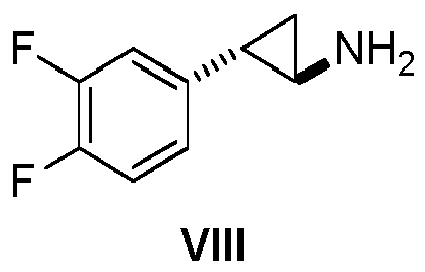
- the ticagrelor molecule consists of three main parts, an essential part being the cyclopropyl moiety. All synthetic approaches mentioned above utilize the intermediate CPA ( trans -(1 R ,2 S )-2-(3,4-difluorophenyl)cyclopropylamine) of formula VIII as one of the key intermediates.
- CPA is prepared as shown in Scheme 7.
- 3,4-Difluorobenzaldehyde is reacted with malonic acid in the presence of pyridine and piperidine to yield (E)-3-(3,4-difluorophenyl)-2-propenoic acid, which is converted to (E)-3-(3,4-difluorophenyl)-2-propenoyl chloride by using thionyl chloride in the presence of toluene and pyridine.
- the eight steps synthesis described Scheme 7 is very long, uses toxic compounds like sodium azide and pyridine, and is not economical as expensive reagents like trimethylsulfoxonium iodide are used. Moreover, the overall yield of the reaction is low.
- CPA is prepared as shown in Scheme 9.
- First step involves reacting 1,2-difluorobenzene with chloroacetyl chloride in the presence of aluminium trichloride to produce 2-chloro-1-(3,4-difluorophenyl)ethanone.
- the keto group of the latter is then reduced by the use of chiral oxazaborolidine catalyst and borane dimethylsulfide complex to yield 2-chloro-1-(3,4-difluorophenyl)ethanol, which is then reacted with triethylphosphoacetate in the presence of sodium hydride in toluene to produce trans -(1 R ,2 R )-2-(3,4-difluorophenyl)cyclopropyl carboxylate.
- the ester compound is first converted to amide by methyl formate in the presence of ammonia, said amide is then reacted with sodium hydroxide and sodium hypochlorite to produce CPA.
- CPA is prepared by a process as described in Scheme 10.
- ( E )-3-(3,4-difluorophenyl)acrylic acid is reacted with oxalyl dichloride in the presence of N , N- dimethylformamide and dichlorometane to produce the corresponding acryloyl chloride, which is then reacted with a mixture of (2 R )-bornane-10,2-sultam and triethylamine to yield [3a S- [1( E ),3a,6,7a]]-1-[3-(3,4-difluorophenyl)-1-oxo-2-propenyl]-hexahydro-8,8-dimethyl-3 H -3a,6-methano-2,1-benzisothiazole-2,2-dioxide.
- keto group of the latter intermediate is in the subsequent step stereochemically reduced to hydroxyl group by the use of chiral oxazaborolidine together with borane dimethyl sulfide or borane-N,N,diethyl aniline complex in the presence of tetrahydrofurane.
- WO 12/001531 describes another alternative synthetic path for preparation of CPA (Scheme 12).
- the starting reagent 3,4-difluorobenzaldehide is reacted with a mixture of methyltriphenylphosphonium bromide, 1,8-diazabicyclo[5.4.0]undec-7-ene (DBU) and toluene to yield 3,4-difluorostyrene.
- DBU 1,8-diazabicyclo[5.4.0]undec-7-ene
- the obtained carboxylic acid is with aqueous hydroxylamine solution further converted to trans- (1 R ,2 R )-2-(3,4-difluorophenyl)-1-cyclopropanecarboxamide, which is mixed with pyridine and acetic anhydride to yield trans -(1 R ,2 R )-N-(acetyloxy)-2-(3,4-difluorophenyl)-1-cyclopropane carboxamide.
- DBU 1,8-diazabicyclo[5.4.0]undec-7-ene
- the object of the present invention was to provide an industrially applicable and economical process for obtaining 2-(3,4-difluorophenyl)cyclopropanecarboxylic acid ( VII ), an important intermediate in preparation of CPA ( VIII ).
- the present invention provides a process for the preparation of a compound of formula VI wherein R is a group convertible to carboxyl group selected from the group consisting of CN, trihalomethyl and COOR 1 , wherein R 1 is linear or branched C 1 -C 6 alkyl, the process comprising the steps of:
- the process defined above allows for preparation or synthesis of the compound of formula VII with an industrially applicable and economical process while using environmentally friendly reagents. Preferred embodiments will be described below.
- the present invention further provides novel compounds that are useful as intermediates in the preparation of ticagrelor ( TCG ).
- the compound of formula V is prepared by comprising the steps of
- the group convertible to carboxyl group can be any group that allows the formation of carbanion on a carbon atom attached to it and can be further transformed to carboxyl group.
- Said group is preferably selected from the group consisting of carboxylic ester (COOR 1 ), cyano, trihalomethyl, ethynyl group and a carboxamide group.
- R 1 group of the carboxylic ester COOR 1 can be any substituted or unsubstituted linear or branched alkyl, for example linear or branched C 1 -C 6 alkyl, cyclic alkyl, for example L-menthyl, or substituted or unsubstituted aryl.
- R 1 is selected from the group consisting of methyl (Me), ethyl (Et), propyl (Pr), secondary such as iso -propyl (iPr) or tertiary alkyl such as tert -butyl (tBu).
- Reduction of keto group of the compound of formula IV can be performed by any suitable reducing agent, for example metal borohydride, or alternatively by using heterogeneous or homogeneous catalysts usually employed for reduction of ketones and hydrogen or hydrogen donor.
- suitable reducing agent for example metal borohydride
- heterogeneous or homogeneous catalysts usually employed for reduction of ketones and hydrogen or hydrogen donor for example metal borohydride
- the compound of formula IV is prepared from a compound of formula I with a process comprising:
- the reaction of the compound of formula I with the compound of formula IIa or IIb is performed in the presence of a Lewis acid, for example AlCl 3 .
- a Lewis acid for example AlCl 3 .
- This Friedel-Crafts reaction can be conducted in any solvent, preferred solvents are dichloromethane and 1,2-difluorobenzene.
- the substituents R 2 and R 3 in the compound of formula IIb is a leaving group, preferably selected from a group consisting of hydroxyl, Cl, Br and I, most preferably Cl.
- the compound of formula IV can also be directly obtained by reacting a compound of formula I with the compound of formula IIIc wherein R is a group convertible to carboxyl group selected from the group consisting of CN, trihalomethyl and COOR 1 , wherein R 1 is linear or branched C 1 -C 6 alkyl, and R 2 is selected from a group consisting of hydroxyl, Cl, Br and I.
- R is a group convertible to carboxyl group selected from the group consisting of CN, trihalomethyl and COOR 1 , wherein R 1 is linear or branched C 1 -C 6 alkyl, and R 2 is selected from a group consisting of hydroxyl, Cl, Br and I.
- the compound of formula VI is further converted to the compound of formula VII or a salt thereof by means of basic or acidic hydrolysis, optionally in the presence of a cosolvent.
- a suitable salt of intermediate VII is a metal salt, for example an alkali metal or earth alkali metal salt.
- the preferred salt of intermediate VII is lithium salt.
- the compound of formula VII or a salt thereof, prepared by the process of the present invention is further converted to CPA , a compound of formula VIII , by a process known in the art.
- a process described in Bioorg. Med. Chem. Lett. 2007, 17, 6013-6018 (Scheme 8) or the one described in WO 11/017108 (Scheme 10) can be followed.
- the compound of formula VII is synthesized as shown in Scheme 13.
- 1,2-Difluorobenzene ( I ) and succinic anhydride ( IIa ) as starting materials are reacting in the presence of a Lewis acid such as AlCl 3 to give IIIa as white solid.
- This Friedel-Crafts reaction can be conducted in any solvent, preferably in CH 2 Cl 2 or 1,2-difluorobenzene.
- IIIa is then esterified in the presence of an appropriate solvent and acid, preferably H 2 SO 4 , to afford esters IVa or IVc as white solid.
- the keto group of the respective ester is reduced using reducing agent such as metal borohydride or other reducing agent.
- the reduction can be carried out either in stereoselective way or not. It can be reduced in the presence of heterogeneous or homogeneous catalyst usually employed for reduction of ketones and hydrogen or hydrogen donor to form Va or Vc in enantiomerically pure form or as a mixture of enantiomers.
- the hydrogen donor can be formic acid and its derivatives, borane and its derivatives, cyclohexene and its derivatives or other hydrogen donor used in reduction of ketones.
- Reduction can also be carried out following biochemical principles. Va and Vc are then cyclized to cyclopropane compounds VIa or VIc .
- the hydroxyl group in converted to a better leaving group by either formation of substituted or unsubstituted arylsulfonate or substituted or unsubstituted alkylsulfonate ester, and then cyclization is performed by addition of a base, preferably potassium tert-butoxide or sodium hydride. In the last step a simple basic or acidic hydrolysis is performed to afford the compound of formula VII .
- the compound of formula VII is synthesized as shown in Scheme 14.
- 3-Chloro-1-(3,4-difluorophenyl)propan-1-one ( IIIb' ) is prepared by reacting 1,2-difluorobenzene (I) with 3-chloropropionyl chloride ( IIb' ) in the presence of a Lewis acid such as AlCl 3 , optionally without the use of additional solvent.
- a solution of 3-chloro-1-(3,4-difluorophenyl)propan-1-one ( IIIb' ) is reacted with a base, followed by cyanide such as sodium cyanide to form IVb .
- Base can also be cyanide itself.
- Solvent can be either protic or aprotic, preferably the solvent is selected from C 1 -C 6 alcohols, most preferably solvent is ethanol.
- IVb is reduced with reducing agent such as metal borohydride or other reducing agent or it is reduced in the presence of heterogeneous or homogeneous catalyst usually employed for reduction of ketones and hydrogen or hydrogen donor to form Vb in enantiomerically pure form or as mixture of enantiomers.
- the reduction can be carried out either in stereoselective way or not.
- the hydrogen donor can be formic acid and its derivatives, borane and its derivatives, cyclohexene and its derivatives or other hydrogen donor used in reduction of ketones. Reduction can also be carried out following biochemical principles.
- Vb is transformed by first converting hydroxyl group to a better leaving group by either formation of substituted or unsubstituted arylsulfonate or substituted or unsubstituted alkylsulfonate ester and then to VIb by addition of a base, preferably potassium tert -butoxide or sodium hydride.
- a base preferably potassium tert -butoxide or sodium hydride.
- the base used in the reaction from Vb to VIb can also be the same base as the one used for the transformation of hydroxyl group to a better leaving group as described above.
- VIb is transformed to VII by hydrolysis in basic or acidic conditions, optionally in the presence of a cosolvent.
- the compound with the activated hydroxyl group can optionally be isolated before base induced transformation to VIb .
- the compound of formula Vb can be treated with phosphine derivatives such as trialkyl or triaryl phosphines, preferably triphenylphosphine and dialkyl diazodicarboxylate such as diethyl diazodicarboxylate (DEAD) in the presence of a base to yield the compound of formula VIb .
- phosphine derivatives such as trialkyl or triaryl phosphines, preferably triphenylphosphine and dialkyl diazodicarboxylate such as diethyl diazodicarboxylate (DEAD)
- a suitable salt of intermediate VII is a metal salt, for example an alkali metal or earth alkali metal salt.
- the preferred salt of intermediate VII is lithium salt.
- the following manner of presentation of structures of compounds VI and VII means that the position of substituents is trans and may contain a mixture of both enantiomers as a racemic mixture, a mixture enriched in one enantiomer or one particular enantiomer.
- the ratio of enantiomer mainly depends on enantioselectivity of reduction of the keto group in the compound of formula IV, which can be carried out by achiral reducing agents, such as borohydrides, by achiral agents such as boranes with chiral promotors such as with oxazaborolidine, by enantioselective reducing agents, by enantiomerically enriched chiral catalyst and hydrogen or hydrogen donor or by enzymatic way.
- the selection of reducing system should be carried out in such way that the synthesis leads to the intermediates with configuration at the position of the aryl substituent, which finally leads to cyclopropyl intermediates suitable for the synthesis of ticagrelor.
- the enantiomerically enriched intermediates with suitable configuration at the position of the aryl substituent can be obtained also by other processes well known in the art, such as for example chromatography on chiral column, crystallization, crystallization by formation of diastereomeric salts or kinetic resolution.
Landscapes
- Chemical & Material Sciences (AREA)
- Organic Chemistry (AREA)
- Engineering & Computer Science (AREA)
- Oil, Petroleum & Natural Gas (AREA)
- Chemical Kinetics & Catalysis (AREA)
- Health & Medical Sciences (AREA)
- Toxicology (AREA)
- Organic Low-Molecular-Weight Compounds And Preparation Thereof (AREA)
Abstract
The present invention relates to the field of organic synthesis and describes the synthesis of specific intermediates suitable for the preparation of triazolopyrimidine compounds such as ticagrelor.
Description
- The present invention relates to the field of organic synthesis, in particular to the synthesis of specific intermediates suitable for the synthesis of triazolopyrimidine compounds.
- An important triazolopyrimidine compound is ticagrelor (TCG; Brilinta®; 3-[7-[[(1R,2S)-2-(3,4-difluorophenyl)cyclopropyl]amino]-5-(propylthio)-3H-1,2,3-triazolo[4,5-d]pyrimidin-3-yl]-5-(2-hydroxyethoxy)-(1S,2S,3R,5S)-1,2-cyclopentanediol) having the following structural formula.

- Ticagrelor shows pharmaceutical activity by functioning as a P2Y12 receptor antagonist and thus is indicated for the treatment or prevention of thrombotic events, for example stroke, heart attack, acute coronary syndrome or myocardial infection with ST elevation, other coronary artery diseases and arterial thrombosis as well as other disorders related to platelet aggregation (
WO 00/34283 - The synthesis of ticagrelor (TCG) is demanding. There are five to six known synthetic variants, which are described in the basic patent application
WO 00/34283 WO 01/92263 WO 10/030224 WO 11/017108 - The ticagrelor molecule consists of three main parts, an essential part being the cyclopropyl moiety. All synthetic approaches mentioned above utilize the intermediate CPA (trans-(1R,2S)-2-(3,4-difluorophenyl)cyclopropylamine) of formula VIII as one of the key intermediates.

- There are several synthetic paths for preparation of intermediate CPA known in the literature.
- According to
WO 01/92200 WO 01/92263 
- The eight steps synthesis described Scheme 7 is very long, uses toxic compounds like sodium azide and pyridine, and is not economical as expensive reagents like trimethylsulfoxonium iodide are used. Moreover, the overall yield of the reaction is low.
- Another process for the preparation of CPA is described in Bioorg. Med. Chem. Lett. 2007, 17, 6013-6018. The synthesis of the trans-(1R,2S)-phenylcyclopropylamine begins with derivatisation of substituted cinnamic acid A with Oppolzer's sultam to give B. Diastereoselective cyclopropanation then provides, after recrystallisation, cyclopropylamide C in high chiral purity which is readily saponified to acid D. A four-step Curtius rearrangement gives CPA.

- This 8 steps long synthesis presented in Scheme 8 involves the use of hazardous and explosive materials like sodium hydride, diazomethane and sodium azide. Moreover, highly expensive chiral sultamam and palladium acetate are used. In addition, this lengthy process involves column chromatographic purifications, which are generally undesirable in view of large scale industrial applicability
- According to
WO 08/018822 WO 08/018823 
- The disadvantages of the process described in
WO 08/018822 WO 08/018823 - According to
WO 11/017108 
- The disadvantage of the process described in
WO 11/017108 - Another synthetic route for preparing CPA is described in
WO 11/132083 - The disadvantage of the process described in
WO 11/132083 
-
WO 12/001531 
- The disadvantage of the process described in
WO 12/001531 - A major drawback of the hitherto known synthesis schemes for the preparation of CPA is that the synthesis is long and/or expensive or environmentally unfriendly reagents are used, which makes the prior art processes unsuitable for large scale preparation of CPA of formula VIII. A need therefore remains for an alternative but commercially viable process for preparation of CPA.
- The object of the present invention was to provide an industrially applicable and economical process for obtaining 2-(3,4-difluorophenyl)cyclopropanecarboxylic acid (VII), an important intermediate in preparation of CPA (VIII).
- The present invention provides a process for the preparation of a compound of formula VI

- (i) providing a compound of formula V

- (ii) converting the hydroxyl group of the compound of formula V to a better leaving group, and
- (iii) converting the obtained compound by cyclization in a presence of a base to provide a compound of formula VI.
- The process defined above allows for preparation or synthesis of the compound of formula VII with an industrially applicable and economical process while using environmentally friendly reagents. Preferred embodiments will be described below. The present invention further provides novel compounds that are useful as intermediates in the preparation of ticagrelor (TCG).
- Aspects and preferred embodiments of the present invention will be described in further detail below, noting however that such aspects as well as embodiments and examples are presented for illustrative purposes only and shall not limit the invention in any way.
- According to a preferred embodiment, the compound of formula V is prepared by comprising the steps of
- (i) providing a compound of formula IV

- (ii) reducing the keto group of the compound of formula IV to yield the compound of formula V.
- The group convertible to carboxyl group can be any group that allows the formation of carbanion on a carbon atom attached to it and can be further transformed to carboxyl group. Said group is preferably selected from the group consisting of carboxylic ester (COOR1), cyano, trihalomethyl, ethynyl group and a carboxamide group.
- The R1 group of the carboxylic ester COOR1 can be any substituted or unsubstituted linear or branched alkyl, for example linear or branched C1-C6 alkyl, cyclic alkyl, for example L-menthyl, or substituted or unsubstituted aryl. Preferably R1 is selected from the group consisting of methyl (Me), ethyl (Et), propyl (Pr), secondary such as iso-propyl (iPr) or tertiary alkyl such as tert-butyl (tBu).
- Reduction of keto group of the compound of formula IV can be performed by any suitable reducing agent, for example metal borohydride, or alternatively by using heterogeneous or homogeneous catalysts usually employed for reduction of ketones and hydrogen or hydrogen donor.
- In another embodiment of the present invention, the compound of formula IV is prepared from a compound of formula I with a process comprising:
- (i) providing a compound of formula I

- (ii) reacting the compound of formula I with a compound of formula IIa or IIb

to yield a compound of formula IIIa or IIIb, respectively
- (iii) converting the compound of formula IIIa or IIIb to the compound of formula IV.
- The reaction of the compound of formula I with the compound of formula IIa or IIb is performed in the presence of a Lewis acid, for example AlCl3. This Friedel-Crafts reaction can be conducted in any solvent, preferred solvents are dichloromethane and 1,2-difluorobenzene. The substituents R2 and R3 in the compound of formula IIb is a leaving group, preferably selected from a group consisting of hydroxyl, Cl, Br and I, most preferably Cl.
- Alternatively, the compound of formula IV can also be directly obtained by reacting a compound of formula I with the compound of formula IIIc

- In another preferred embodiment, the compound of formula VI is further converted to the compound of formula VII or a salt thereof by means of basic or acidic hydrolysis, optionally in the presence of a cosolvent.

- A suitable salt of intermediate VII is a metal salt, for example an alkali metal or earth alkali metal salt. The preferred salt of intermediate VII is lithium salt.
- In another embodiment, the compound of formula VII or a salt thereof, prepared by the process of the present invention, is further converted to CPA, a compound of formula VIII, by a process known in the art. A process described in Bioorg. Med. Chem. Lett. 2007, 17, 6013-6018 (Scheme 8) or the one described in
WO 11/017108 - In a particularly preferred embodiment, the compound of formula VII is synthesized as shown in Scheme 13. 1,2-Difluorobenzene (I) and succinic anhydride (IIa) as starting materials are reacting in the presence of a Lewis acid such as AlCl3 to give IIIa as white solid. This Friedel-Crafts reaction can be conducted in any solvent, preferably in CH2Cl2 or 1,2-difluorobenzene. IIIa is then esterified in the presence of an appropriate solvent and acid, preferably H2SO4, to afford esters IVa or IVc as white solid. In the next step, the keto group of the respective ester is reduced using reducing agent such as metal borohydride or other reducing agent. The reduction can be carried out either in stereoselective way or not. It can be reduced in the presence of heterogeneous or homogeneous catalyst usually employed for reduction of ketones and hydrogen or hydrogen donor to form Va or Vc in enantiomerically pure form or as a mixture of enantiomers. The hydrogen donor can be formic acid and its derivatives, borane and its derivatives, cyclohexene and its derivatives or other hydrogen donor used in reduction of ketones. Reduction can also be carried out following biochemical principles. Va and Vc are then cyclized to cyclopropane compounds VIa or VIc. First, the hydroxyl group in converted to a better leaving group by either formation of substituted or unsubstituted arylsulfonate or substituted or unsubstituted alkylsulfonate ester, and then cyclization is performed by addition of a base, preferably potassium tert-butoxide or sodium hydride. In the last step a simple basic or acidic hydrolysis is performed to afford the compound of formula VII.

- This synthetic route of Scheme 13 was found particularly advantageous for its simplicity and possibility of preparation of the compound of formula VII enriched in one enantiomer.
- In another particularly preferred embodiment, the compound of formula VII is synthesized as shown in Scheme 14. 3-Chloro-1-(3,4-difluorophenyl)propan-1-one (IIIb') is prepared by reacting 1,2-difluorobenzene (I) with 3-chloropropionyl chloride (IIb') in the presence of a Lewis acid such as AlCl3, optionally without the use of additional solvent. Next, a solution of 3-chloro-1-(3,4-difluorophenyl)propan-1-one (IIIb') is reacted with a base, followed by cyanide such as sodium cyanide to form IVb. Base can also be cyanide itself. Solvent can be either protic or aprotic, preferably the solvent is selected from C1-C6 alcohols, most preferably solvent is ethanol. In the next step, IVb is reduced with reducing agent such as metal borohydride or other reducing agent or it is reduced in the presence of heterogeneous or homogeneous catalyst usually employed for reduction of ketones and hydrogen or hydrogen donor to form Vb in enantiomerically pure form or as mixture of enantiomers. The reduction can be carried out either in stereoselective way or not. The hydrogen donor can be formic acid and its derivatives, borane and its derivatives, cyclohexene and its derivatives or other hydrogen donor used in reduction of ketones. Reduction can also be carried out following biochemical principles. Next, Vb is transformed by first converting hydroxyl group to a better leaving group by either formation of substituted or unsubstituted arylsulfonate or substituted or unsubstituted alkylsulfonate ester and then to VIb by addition of a base, preferably potassium tert-butoxide or sodium hydride. Alternatively, the base used in the reaction from Vb to VIb can also be the same base as the one used for the transformation of hydroxyl group to a better leaving group as described above. In the last step, VIb is transformed to VII by hydrolysis in basic or acidic conditions, optionally in the presence of a cosolvent.

- Alternatively, the compound with the activated hydroxyl group can optionally be isolated before base induced transformation to VIb.
- Alternatively, the compound of formula Vb can be treated with phosphine derivatives such as trialkyl or triaryl phosphines, preferably triphenylphosphine and dialkyl diazodicarboxylate such as diethyl diazodicarboxylate (DEAD) in the presence of a base to yield the compound of formula VIb.
- Further aspects of the present invention reside in the provision of valuable intermediate compounds of formula V and VI, and a salt of compound of formula VII, all useful in the synthesis of ticagrelor (TCG):


- A suitable salt of intermediate VII is a metal salt, for example an alkali metal or earth alkali metal salt. The preferred salt of intermediate VII is lithium salt.
- Particular examples of such useful intermediate compounds are listed by their respective formulas below:
Formula Chemical name 
isopropyl 4-(3,4-difluorophenyl)-4-hydroxybutanoate 
4-(3,4-difluorophenyl)-4-hydroxybutanenitrile 
isopropyl trans-2-(3,4-difluorophenyl)cyclopropanecarboxylate 
trans-2-(3,4-difluorophenyl)cyclopropanecarbonitrile 
methyl trans-2-(3,4-difluorophenyl)cyclopropanecarboxylate 
lithium trans-2-(3,4-difluorophenyl)cyclopropanecarboxylate - The following manner of presentation of structures of compounds VI and VII


- The enantiomerically enriched intermediates with suitable configuration at the position of the aryl substituent can be obtained also by other processes well known in the art, such as for example chromatography on chiral column, crystallization, crystallization by formation of diastereomeric salts or kinetic resolution.
- In the following the present invention will be described in further detail by illustrative, nonlimiting examples.
-

- To a mixture of 1,2-difluorobenzene (I) (15 mL) and succinic anhydride (IIa) (4.0 g, 40.0 mmol) was slowly added AlCl3 (16.0 g, 120 mmol). The resulting reaction mixture was stirred at 40°C for 16 h, then it was poured to the mixture of 37% HCl (20 mL) and ice (50 g). After extraction with MeTHF (3 x 20 mL), combined organic layers are dried over MgSO4, and then concentrated to afford crude product, which was then recrystallized from toluene to give 6.6 g (77% yield) of title compound as white powder. Melting point 80°C; MS (ESI) m/z: 215 [MH]+.
-

- A mixture of IIIa (1.5 g, 7.0 mmol) and H2SO4 (96%, 0.15 g) in MeOH (20 mL) is stirred at 60°C for 2 hours, then the resulting reaction mixture was poured in the solution of K2CO3 (3 g) in water (50 mL). Ice (50 g) was added and mixture was stirred for 15 min. White solid was then filtered off, washed with water and dried to afford title compound as white powder (1.57 g, 98% yield). Melting point 46°C; MS (ESI) m/z: 229 [MH]+.
-

- A mixture of Ia (1.5 g, 7.0 mmol) and H2SO4 (96%, 0.15 g) in iPrOH (20 mL) is stirred at 80°C for 16 hours, then the resulting reaction mixture was poured in the solution of K2CO3 (3 g) in water (50 mL). Ice (50 g) was added and mixture was stirred for 15 min. White solid was then filtered off, washed with water and dried to afford title compound as white powder (1.50 g, 84% yield). Melting point 36°C; MS (ESI) m/z: 257 [MH]+.
-

- To a solution of IVc (1.0 g, 4.38 mmol) in MeOH (7 mL) / Et2O (7 mL) NaBH4 (83 mg, 2.19 mmol) was added at 0°C. The resulting reaction mixture was stirred at 0°C for 15 min, then saturated solution of NaHCO3 (30 mL) was added, and product was extracted to THF (3 x 10 mL). Combined organic layers were dried over Na2SO4, and then concentrated. Purification by chromatography (SiO2, hexane:EtOAc) afforded title compound as colorless oil (0.89 g, 88% yield). MS (ESI) m/z: 230 [MH]+.
-

- To a solution of IVa (1.4 g, 5.46 mmol) in iPrOH (20 mL) NaBH4 (0.10 g, 2.73 mmol) was added at 0°C. The resulting reaction mixture is stirred at room temperature for 2 h, then AcOH (0,1 mL) and water (100 mL) were added, and product was extracted to THF (3 x 20 mL). Combined organic layers were dried over MgSO4, and then concentrated. Purification by chromatography (SiO2, hexane:EtOAc) afforded title compound as colorless oil (0.73 g, 56% yield). MS (ESI) m/z: 259 [MH]+.
-

- To a solution of Vc (0.89 g, 3.87 mmol) and triethylamine (1.08 mL, 7.74 mmol) in dry THF (15 mL) was added under stirring at 0°C MsCl (0.33 mL, 4.26 mmol). Resulting reaction mixture was stirred at 0°C for 20 min, then tBuOK (0.65 g, 5.81 mmol) was added, and reaction mixture was stirred at 0°C for additional 20 min. Then 1 M HCl (10 mL) was added, product was extracted to MeTHF (3 x 10 mL), combined organic phases were dried over MgSO4, then concentrated to afford crude compound, which was then purified by chromatography (SiO2, hexane:EtOAc) to afford title compound as colorless oil (0.52 g, 63%). MS (ESI) m/z: 213 [MH]+.
-

- To a solution of Va (0.5 g, 1.94 mmol) and triethylamine (0.54 mL, 3.87 mmol) in dry THF (10 mL) was added under stirring at 0°C MsCl (0.17 mL, 2.13 mmol). Resulting reaction mixture was stirred at 0°C for 20 min, then tBuOK (0.43 g, 3.87 mmol) was added, and reaction mixture was stirred at 0°C for additional 20 min. Then 1 M HCl (10 mL) was added, product was extracted to MeTHF (3 x 10 mL), combined organic phases were dried over MgSO4, then concentrated to afford crude compound, which was then purified by chromatography (SiO2, hexane:EtOAc) to afford title compound as colorless oil (0.37 g, 79%). MS (ESI) m/z: 241 [MH]+.
-

- To a solution of VIc (0.36 g, 1.70 mmol) in EtOH (5 mL) was added 5 M NaOH (0.37 mL, 1.87 mmol). Resulting reaction mixture was stirred at room temperature for 16 h. 1 M HCl (20 mL) was added, product was extracted to MeTHF (3 x 10 mL), combined organic phases were dried over MgSO4, and concentrated to afford white solid (0.28 g, 83% yield). MS (ESI) m/z: 199 [MH]+.
-
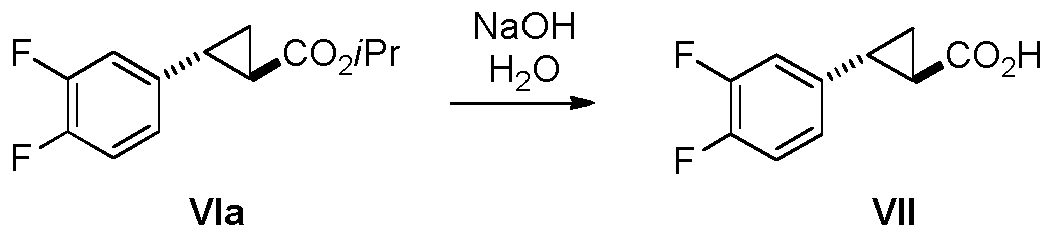
- To a solution of VIa (100 mg, 0.42 mmol) in EtOH (5 mL) was added 8 M NaOH (0.1 mL). Resulting reaction mixture was stirred at room temperature for 16 h. 1 M HCl (5 mL) was added, product was extracted to MeTHF (3 x 5 mL), combined organic phases were dried over MgSO4, and concentrated to afford white solid (61 mg, 73% yield).
-
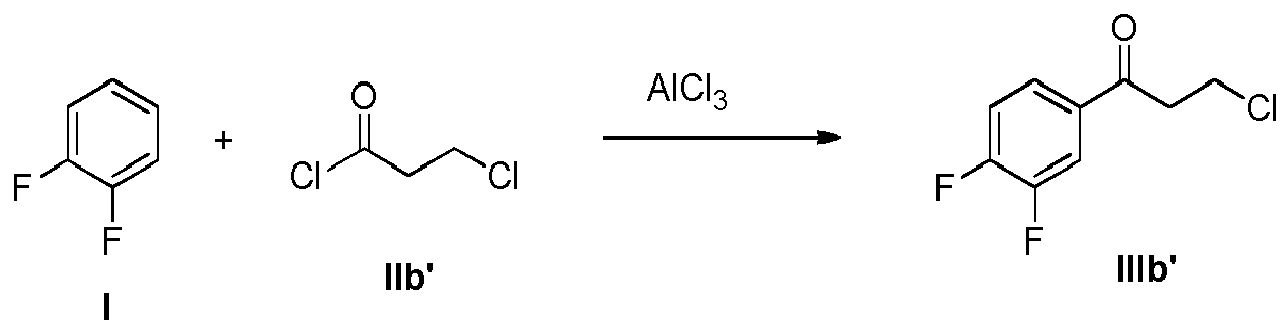
-

- To a solution of 3-chloro-1-(3,4-difluorophenyl)propan-1-one (IIIb') (20 g, 98 mmol) in ethyl acetate (50 mL) was added potassium tert-butoxide (9.60 g, 98 mmol) at 70 °C and stirred for 15 min and then cooled to 25 °C. The resulting mixture was filtered to remove salts (salts were washed with 5 mL of ethyl acetate and 10 mL of ethanol). To thus obtained was added dropwise a solution of sodium cyanide (9.6 g, 195 mmol) in water (50 mL) during 30 minutes. After the addition was complete the mixture was stirred at 25 °C for additional 0.5 hours, ethanol was added (20 mL) and the mixture was stirred for additional 3 hours. Phases were separated and the lower water layer was extracted with ethyl acetate (25 mL). The combined organic phases were washed with brine ( 3 × 25 mL) and concentrated under reduced pressure to give 18.5 g (97 %) 4-(3,4-difluorophenyl)-4-oxobutanenitrile (IVb) as oil that crystallized on standing. 1H NMR (CDCl3, 500 MHz): δ 2.78 (t, J = 7.1 Hz, 2H), 3.34 (t, J = 7.1 Hz, 2H), 7.29 (m, 1 H), 7.74 (m, 1H), 7.80 (m, 1H).
-

- To a cold (0 °C) solution of 4-(3,4-difluorophenyl)-4-oxobutanenitrile (IVb) (10 g, 51 mmol) in methanol (100 mL) was added portion wise sodium borohydride (1.93 g) and the mixture was stirred at 5 °C for additional 30 minutes. Acetic acid (10 mL) was added drop wise and the methanol was removed under reduced pressure. Ethyl acetate (100 mL) was added and the resulting mixture was washed with water (3 x 30 mL), dried over magnesium sulfate, filtered and concentrated under reduced pressure. To the remaining oil was added methyl tert-butyl ether (30 mL, MTBE), filtered through the pad of silica gel (washed with some additional MTBE) and concentrated under reduced pressure. To the remaining oil was added toluene (20 mL) and again concentrated under reduced pressure to give 8.8 g (87 %) of 4-(3,4-difluorophenyl)-4-hydroxybutanenitrile (Vb) as an oil. 1H NMR (CDCl3, 500 MHz): δ 1.96 (m, 2H), 2.38 (m, 1H), 2.53 (m, 1 H), 4.75 (m, 1 H), 7.04 (m, 1H), 7.15 (m, 2H).
-

- To a cold (0 °C) solution of 4-(3,4-difluorophenyl)-4-hydroxybutanenitrile (Vb) (5.7 g, 29 mmol) and triethylamine (8.0 mL, 57 mmol) in dry tetrahydrofurane (100 mL) was added methanesulfonyl chloride (2.5 mL, 32 mmol) and stirred at 0 °C for another 20 min. Potassium tert-butoxide (6.4 g, 57 mmol) was added and stirred at 0 °C for another 20 min. 1 M aqueous solution of HCl (57 mL) was added and the resulting solution was extracted with diethyl ether (3 x 70 mL). Combined ethereal layers were washed with brine (50 mL) and concentrated under reduced pressure. Crude product was purified by chromatography (silica gel; hexane/ethyl acetate 9 1 7 3) to give 2.84 g (55 %) of trans-2-(3,4-difluorophenyl)-cyclopropanecarbonitrile (VIb) as an oil. 1H NMR (CDCl3, 500 MHz): δ 1.41 (m, 1H), 1.53 (m, 1H), 1.64 (m, 1H), 2.60 (m, 1H), 6.87 (m, 1H), 6.92 (m, 1H), 7.10 (m, 1H).
-

- A mixture of trans-2-(3,4-difluorophenyl)cyclopropanecarbonitrile (VIb) (7.70 g) and 4 M aqueous lithium hydroxide (281 mL) was stirred at reflux temperature for 3.5 hours. The resulting mixture was cooled down and acidified with 4 M aqueous HCl to pH 1 and the product was extracted with MTBE (200 + 2 x 150 mL). Combined organic layers were dried with magnesium sulfate, filtered and concentrated under reduced pressure to give 8.12 g (95 %) of trans-2-(3,4-difluorophenyl)cyclopropanecarboxylic acid (VII) as a solid. 1H NMR (CDCl3, 500 MHz): δ 1.36 (m, 1H), 1.68 (m, 1H), 1.87 (m, 1H), 2.57 (m, 1H), 6.86 (m, 1H), 6.92 (m, 1H), 7.08 (m, 1 H).
-
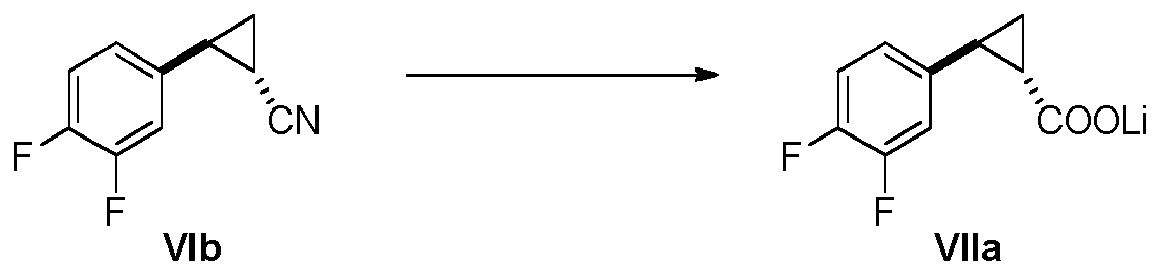
- A mixture of trans-2-(3,4-difluorophenyl)cyclopropanecarbonitrile (VIb) (0.2 g) and 4 M aqueous lithium hydroxide (7.3 mL) was stirred at reflux temperature for 1.5 hours. The resulting mixture was cooled down, the solid was filtered off, washed with cold water to give 0.15 g (66 %) of lithium trans-2-(3,4-difluorophenyl)cyclopropanecarboxylate (VIIa) as a solid. 1H NMR (DMSO-d6, 500 MHz): δ 0.89 (m, 1 H), 1.21 (m, 1 H), 1.53 (m, 1 H), 2.12 (m, 1 H), 6.89 (m, 1 H), 7.05 (m, 1 H), 7.24 (m, 1 H).
Claims (11)
- A process for the preparation of a compound of formula VI

the process comprising the steps of:(i) providing a compound of formula V (ii) converting the hydroxyl group of the compound of formula V to a better leaving group, and(iii) converting the obtained compound by cyclization in a presence of a base to provide a compound of formula VI.
 - The process according to claim 1, wherein R is selected from a group consisting of COOMe, COOiPr and CN.
- The process according to claim 1, wherein the compound of formula V is prepared by comprising the steps of(i) providing a compound of formula IV

- The process according to claim 3, wherein the compound of formula IV is prepared by comprising the steps of:(i) providing a compound of formula I
 (ii) reacting the compound of formula I with a compound of formula IIa or IIb
to yield a compound of formula IIIa or IIIb, respectively (iii) converting the compound of formula IIIa or IIIb to the compound of formula IV.
 - The process according to claim 1, wherein the compound of formula VI is further converted to a compound of formula VII or a salt thereof

- The process according to claim 5, wherein the compound of formula VII or a salt thereof is further converted to a compound of formula VIII or a salt thereof
- A compound of the following formula Va or Vb

- A compound of the following formula VIa, VIb or VIc

- A metal salt of a compound of the following formula VII

- A compound of the following formula VIIa

- Use of a compound as defined in any one of claims 7 to 10, and their stereochemically isomeric forms, in the preparation of ticagrelor.
Priority Applications (3)
| Application Number | Priority Date | Filing Date | Title |
|---|---|---|---|
| EP12156137.7A EP2628721A1 (en) | 2012-02-20 | 2012-02-20 | Synthesis of 2-(3,4-difluorophenyl)cyclopropanecarboxylic acid |
| PCT/EP2013/053301 WO2013124280A1 (en) | 2012-02-20 | 2013-02-20 | Synthesis of 2-(3,4-difluorophenyl)cyclopropanecarboxylic acid |
| CN201380020622.4A CN104411676B (en) | 2012-02-20 | 2013-02-20 | Synthesis of 2-(3,4-difluorophenyl)cyclopropanecarboxylic acid |
Applications Claiming Priority (1)
| Application Number | Priority Date | Filing Date | Title |
|---|---|---|---|
| EP12156137.7A EP2628721A1 (en) | 2012-02-20 | 2012-02-20 | Synthesis of 2-(3,4-difluorophenyl)cyclopropanecarboxylic acid |
Publications (1)
| Publication Number | Publication Date |
|---|---|
| EP2628721A1 true EP2628721A1 (en) | 2013-08-21 |
Family
ID=47750661
Family Applications (1)
| Application Number | Title | Priority Date | Filing Date |
|---|---|---|---|
| EP12156137.7A Ceased EP2628721A1 (en) | 2012-02-20 | 2012-02-20 | Synthesis of 2-(3,4-difluorophenyl)cyclopropanecarboxylic acid |
Country Status (3)
| Country | Link |
|---|---|
| EP (1) | EP2628721A1 (en) |
| CN (1) | CN104411676B (en) |
| WO (1) | WO2013124280A1 (en) |
Families Citing this family (13)
| Publication number | Priority date | Publication date | Assignee | Title |
|---|---|---|---|---|
| EP2906518A4 (en) | 2012-10-09 | 2016-07-27 | California Inst Of Techn | CYCLOPROPANATION OF OLEFIN IN VIVO AND IN VITRO CATALYZED BY ENZYMES HEMMES |
| CN104326922B (en) * | 2014-11-03 | 2016-08-17 | 成都百裕制药股份有限公司 | The preparation method of ticagrelor intermediate (1R, 2S)-2-(2,3-difluorophenyl) cyclopropylamine |
| US20180148745A1 (en) * | 2015-05-26 | 2018-05-31 | California Institute Of Technology | Hemoprotein catalysts for improved enantioselective enzymatic synthesis of ticagrelor |
| TWI758313B (en) * | 2016-10-12 | 2022-03-21 | 美商陶氏農業科學公司 | Process for the preparation of (1r,3r)- and (1s,3s)-2,2-dihalo-3-(substituted phenyl)cyclopropanecarboxylic acids |
| CN106631887B (en) * | 2016-10-19 | 2018-03-20 | 杨绮红 | A kind of preparation technology of (1R, 2S) 1 cyano group 2 (3,4 difluorophenyl) cyclopropane |
| CN106565503B (en) * | 2016-10-19 | 2018-04-24 | 华北理工大学 | The method for synthesizing (1R, 2S) -1- amino-(3,4- difluorophenyls)-cyclopropane |
| ES2853999T3 (en) * | 2016-11-14 | 2021-09-20 | Byondis Bv | Process for the preparation of alpha, omega-diamino mono-protected alkanes |
| CN107141236B (en) * | 2017-04-24 | 2019-03-22 | 台州职业技术学院 | The novel synthesis of ticagrelor midbody (1R, 2R) -2- (3,4- difluoro-benzene base) cyclopropane nitrile |
| WO2019077627A1 (en) * | 2017-10-16 | 2019-04-25 | Metrochem Api Pvt Ltd. | A process for the manufacture of posaconazole |
| CN108033883A (en) * | 2017-12-27 | 2018-05-15 | 安徽太主科技发展有限公司 | A kind of ticagrelor three-membered ring intermediate prepares intermediate compound preparation method |
| CN112479854B (en) * | 2020-12-08 | 2023-09-08 | 杭州龙晶医药科技有限公司 | Green process for producing cyclopropylformic acid |
| CN115894496B (en) * | 2021-09-30 | 2025-03-21 | 上海贝美医药科技有限公司 | A preparation method of ticagrelor and its intermediates |
| CN117659882B (en) * | 2023-12-25 | 2024-06-11 | 北京宇阳泽丽防水材料有限责任公司 | High-flame-retardance long-service-life thermoplastic polyolefin waterproof coiled material and preparation method thereof |
Citations (10)
| Publication number | Priority date | Publication date | Assignee | Title |
|---|---|---|---|---|
| EP0577949A1 (en) * | 1992-07-09 | 1994-01-12 | Hüls Aktiengesellschaft | Method of preparing chlorine free cyclopropanecarbocylicacid methylester |
| WO2000034283A1 (en) | 1998-12-04 | 2000-06-15 | Astrazeneca Ab | Novel triazolo(4,5-d)pyrimidine compounds |
| WO2001092200A1 (en) | 2000-06-02 | 2001-12-06 | Astrazeneca Ab | Process for the preparation of cyclopropyl carboxylic acid esters and derivatives |
| WO2001092263A1 (en) | 2000-06-02 | 2001-12-06 | Astrazeneca Ab | Novel triazolo pyrimidine compounds |
| WO2008018823A1 (en) | 2006-08-05 | 2008-02-14 | Astrazeneca Ab | A process for the preparation of optically active cyclopropylamines |
| WO2008018822A1 (en) | 2006-08-05 | 2008-02-14 | Astrazeneca Ab | Chemical process for preparation of aromatic cyclopropane esters and amides |
| WO2010030224A1 (en) | 2008-09-09 | 2010-03-18 | Astrazeneca Ab | A process for preparing [1s- [1-alpha, 2-alpha, 3-beta (1s*, 2r*) 5-beta] ] -3- [7- [2- (3, 4-dif luorophenyl) -cyclopropylamino] - 5- (propylthio) -3h-1, 2, 3-triazolo [4, 5-d] pyrimidin-3-yl] -5- (2- hydroxyethoxy) cyclopentane-1, 2-diol and to its intermediates |
| WO2011017108A2 (en) | 2009-07-27 | 2011-02-10 | Auspex Pharmaceuticals, Inc. | Cyclopropyl modulators of p2y12 receptor |
| WO2011132083A2 (en) | 2010-04-20 | 2011-10-27 | Actavis Group Ptc Ehf | Novel process for preparing phenylcyclopropylamine derivatives using novel intermediates |
| WO2012001531A2 (en) | 2010-06-30 | 2012-01-05 | Actavis Group Ptc Ehf | Novel processes for the preparation of phenylcyclopropylamine derivatives and use thereof for preparing ticagrelor |
-
2012
- 2012-02-20 EP EP12156137.7A patent/EP2628721A1/en not_active Ceased
-
2013
- 2013-02-20 WO PCT/EP2013/053301 patent/WO2013124280A1/en not_active Ceased
- 2013-02-20 CN CN201380020622.4A patent/CN104411676B/en not_active Expired - Fee Related
Patent Citations (10)
| Publication number | Priority date | Publication date | Assignee | Title |
|---|---|---|---|---|
| EP0577949A1 (en) * | 1992-07-09 | 1994-01-12 | Hüls Aktiengesellschaft | Method of preparing chlorine free cyclopropanecarbocylicacid methylester |
| WO2000034283A1 (en) | 1998-12-04 | 2000-06-15 | Astrazeneca Ab | Novel triazolo(4,5-d)pyrimidine compounds |
| WO2001092200A1 (en) | 2000-06-02 | 2001-12-06 | Astrazeneca Ab | Process for the preparation of cyclopropyl carboxylic acid esters and derivatives |
| WO2001092263A1 (en) | 2000-06-02 | 2001-12-06 | Astrazeneca Ab | Novel triazolo pyrimidine compounds |
| WO2008018823A1 (en) | 2006-08-05 | 2008-02-14 | Astrazeneca Ab | A process for the preparation of optically active cyclopropylamines |
| WO2008018822A1 (en) | 2006-08-05 | 2008-02-14 | Astrazeneca Ab | Chemical process for preparation of aromatic cyclopropane esters and amides |
| WO2010030224A1 (en) | 2008-09-09 | 2010-03-18 | Astrazeneca Ab | A process for preparing [1s- [1-alpha, 2-alpha, 3-beta (1s*, 2r*) 5-beta] ] -3- [7- [2- (3, 4-dif luorophenyl) -cyclopropylamino] - 5- (propylthio) -3h-1, 2, 3-triazolo [4, 5-d] pyrimidin-3-yl] -5- (2- hydroxyethoxy) cyclopentane-1, 2-diol and to its intermediates |
| WO2011017108A2 (en) | 2009-07-27 | 2011-02-10 | Auspex Pharmaceuticals, Inc. | Cyclopropyl modulators of p2y12 receptor |
| WO2011132083A2 (en) | 2010-04-20 | 2011-10-27 | Actavis Group Ptc Ehf | Novel process for preparing phenylcyclopropylamine derivatives using novel intermediates |
| WO2012001531A2 (en) | 2010-06-30 | 2012-01-05 | Actavis Group Ptc Ehf | Novel processes for the preparation of phenylcyclopropylamine derivatives and use thereof for preparing ticagrelor |
Non-Patent Citations (3)
| Title |
|---|
| BIOORG. MED. CHEM. LETT., vol. 17, 2007, pages 6013 - 6018 |
| SPRINGTHORPE ET AL: "From ATP to AZD6140: The discovery of an orally active reversible P2Y12 receptor antagonist for the prevention of thrombosis", BIOORGANIC & MEDICINAL CHEMISTRY LETTERS, PERGAMON, ELSEVIER SCIENCE, GB, vol. 17, no. 21, 1 November 2007 (2007-11-01), pages 6013 - 6018, XP022267216, ISSN: 0960-894X, DOI: 10.1016/J.BMCL.2007.07.057 * |
| TSAI T Y ET AL: "Novel trans-2-aryl-cyclopropylamine analogues as potent and selective dipeptidyl peptidase IV inhibitors", BIOORGANIC & MEDICINAL CHEMISTRY, PERGAMON, GB, vol. 17, no. 6, 15 March 2009 (2009-03-15), pages 2388 - 2399, XP025981936, ISSN: 0968-0896, [retrieved on 20090220], DOI: 10.1016/J.BMC.2009.02.020 * |
Also Published As
| Publication number | Publication date |
|---|---|
| WO2013124280A1 (en) | 2013-08-29 |
| CN104411676A (en) | 2015-03-11 |
| CN104411676B (en) | 2016-03-16 |
Similar Documents
| Publication | Publication Date | Title |
|---|---|---|
| WO2013124280A1 (en) | Synthesis of 2-(3,4-difluorophenyl)cyclopropanecarboxylic acid | |
| Pansegrau et al. | The oxazoline-benzyne route to 1, 2, 3-trisubstituted benzenes. Tandem addition of organolithiums, organocuprates, and. alpha.-lithionitriles to benzynes | |
| WO2013144295A1 (en) | Synthesis of 2-(3,4-difluorophenyl)cyclopropanamine derivatives and salts | |
| Audran et al. | Synthesis of Methylene‐and Alkylidenecyclopropane Derivatives | |
| JP2013177417A (en) | Process for preparation of optically active cyclopropylamine | |
| WO2011132083A2 (en) | Novel process for preparing phenylcyclopropylamine derivatives using novel intermediates | |
| EP1292561A1 (en) | Process for the preparation of cyclopropyl carboxylic acid esters and derivatives | |
| JPWO1999058513A1 (en) | Novel intermediate compounds and methods for producing optically active octanoic acid derivatives | |
| EP2644590A1 (en) | Synthesis of 2-(3,4-difluorophenyl)cyclopropanamine derivatives and salts | |
| Sun et al. | Concise asymmetric synthesis of the sex pheromone of the tea tussock moth | |
| Harada et al. | Synthesis of jiadifenin using Mizoroki–Heck and Tsuji–Trost reactions | |
| Jungong et al. | Asymmetric intramolecular C–H insertion of sulfonyldiazoacetates catalyzed by Rh (II) | |
| Rosales et al. | Solvent influence in the Rh-catalyzed intramolecular 1, 6 C–H insertions: a general approach to the chromane and flavanone skeletons | |
| Chen et al. | l-Threonine-catalysed asymmetric α-hydroxymethylation of cyclohexanone: application to the synthesis of pharmaceutical compounds and natural products | |
| Itagaki et al. | Enantio-and diastereocontrolled synthesis of (+)-juvabione employing organocatalytic desymmetrisation and photoinduced fragmentation | |
| Cho et al. | Catalytic enantioselective reactions. Part 18: Preparation of 3-deoxy-3-N, N-dialkylamino-1, 2; 5, 6-di-O-isopropylidene-d-altritol derivatives from d-mannitol and their applications for catalytic enantioselective addition of dialkylzinc to aldehydes | |
| CN101309924A (en) | The preparation method of escitalopram | |
| Sugimura et al. | Chiral and flexible 2, 4-pentanediol-tethered cyclopropanation of olefins with a carbenoid derived from a diazo ester to construct three stereogenic centers | |
| JP4910150B2 (en) | A method for producing a β-fluoro (phenylsulfonyl) methyl adduct and a method for producing an optically active β-fluoromethylcarbonyl derivative. | |
| Kukula et al. | Structural effects in the Pd-induced enantioselective deprotection–decarboxylation of β-ketoesters | |
| TW200920745A (en) | Process for preparing 5-(4-fluorophenyl)-1-[2-((2R,4R)-4-hydroxy-6-oxo-tetrahydro-pyran-2-yl)ethyl]-2-isopropyl-4-phenyl-1H-pyrrole-3-carboxylic acid phenylamide | |
| JP2009215198A (en) | METHOD FOR PRODUCING OPTICALLY ACTIVE beta-FLUOROMETHYLCARBONYL DERIVATIVE | |
| DE69104681T2 (en) | Optically active 7-substituted-3,5-difunctionalized 6-heptenoic acid esters. | |
| Haruta et al. | Stereoselective synthesis of (+)-2-deoxyolivin based on cycloaddition reaction between the homophthalic anhydride and the chiral cyclohexenone derivative | |
| Koyata et al. | Convenient preparation of optically active cibenzoline and analogues from 3, 3-diaryl-2-propen-1-ols |
Legal Events
| Date | Code | Title | Description |
|---|---|---|---|
| PUAI | Public reference made under article 153(3) epc to a published international application that has entered the european phase |
Free format text: ORIGINAL CODE: 0009012 |
|
| AK | Designated contracting states |
Kind code of ref document: A1 Designated state(s): AL AT BE BG CH CY CZ DE DK EE ES FI FR GB GR HR HU IE IS IT LI LT LU LV MC MK MT NL NO PL PT RO RS SE SI SK SM TR |
|
| AX | Request for extension of the european patent |
Extension state: BA ME |
|
| STAA | Information on the status of an ep patent application or granted ep patent |
Free format text: STATUS: THE APPLICATION HAS BEEN REFUSED |
|
| 18R | Application refused |
Effective date: 20130928 |