EP2626829A2 - Apparatus and method for providing streaming content - Google Patents
Apparatus and method for providing streaming content Download PDFInfo
- Publication number
- EP2626829A2 EP2626829A2 EP11830913.7A EP11830913A EP2626829A2 EP 2626829 A2 EP2626829 A2 EP 2626829A2 EP 11830913 A EP11830913 A EP 11830913A EP 2626829 A2 EP2626829 A2 EP 2626829A2
- Authority
- EP
- European Patent Office
- Prior art keywords
- period
- media
- periods
- metadata
- content
- Prior art date
- Legal status (The legal status is an assumption and is not a legal conclusion. Google has not performed a legal analysis and makes no representation as to the accuracy of the status listed.)
- Ceased
Links
Images


Classifications
-
- H—ELECTRICITY
- H04—ELECTRIC COMMUNICATION TECHNIQUE
- H04L—TRANSMISSION OF DIGITAL INFORMATION, e.g. TELEGRAPHIC COMMUNICATION
- H04L65/00—Network arrangements, protocols or services for supporting real-time applications in data packet communication
- H04L65/60—Network streaming of media packets
-
- H—ELECTRICITY
- H04—ELECTRIC COMMUNICATION TECHNIQUE
- H04N—PICTORIAL COMMUNICATION, e.g. TELEVISION
- H04N21/00—Selective content distribution, e.g. interactive television or video on demand [VOD]
- H04N21/20—Servers specifically adapted for the distribution of content, e.g. VOD servers; Operations thereof
- H04N21/23—Processing of content or additional data; Elementary server operations; Server middleware
- H04N21/234—Processing of video elementary streams, e.g. splicing of video streams or manipulating encoded video stream scene graphs
-
- G—PHYSICS
- G06—COMPUTING OR CALCULATING; COUNTING
- G06Q—INFORMATION AND COMMUNICATION TECHNOLOGY [ICT] SPECIALLY ADAPTED FOR ADMINISTRATIVE, COMMERCIAL, FINANCIAL, MANAGERIAL OR SUPERVISORY PURPOSES; SYSTEMS OR METHODS SPECIALLY ADAPTED FOR ADMINISTRATIVE, COMMERCIAL, FINANCIAL, MANAGERIAL OR SUPERVISORY PURPOSES, NOT OTHERWISE PROVIDED FOR
- G06Q90/00—Systems or methods specially adapted for administrative, commercial, financial, managerial or supervisory purposes, not involving significant data processing
-
- H—ELECTRICITY
- H04—ELECTRIC COMMUNICATION TECHNIQUE
- H04L—TRANSMISSION OF DIGITAL INFORMATION, e.g. TELEGRAPHIC COMMUNICATION
- H04L65/00—Network arrangements, protocols or services for supporting real-time applications in data packet communication
- H04L65/60—Network streaming of media packets
- H04L65/61—Network streaming of media packets for supporting one-way streaming services, e.g. Internet radio
-
- H—ELECTRICITY
- H04—ELECTRIC COMMUNICATION TECHNIQUE
- H04L—TRANSMISSION OF DIGITAL INFORMATION, e.g. TELEGRAPHIC COMMUNICATION
- H04L65/00—Network arrangements, protocols or services for supporting real-time applications in data packet communication
- H04L65/60—Network streaming of media packets
- H04L65/61—Network streaming of media packets for supporting one-way streaming services, e.g. Internet radio
- H04L65/612—Network streaming of media packets for supporting one-way streaming services, e.g. Internet radio for unicast
-
- H—ELECTRICITY
- H04—ELECTRIC COMMUNICATION TECHNIQUE
- H04L—TRANSMISSION OF DIGITAL INFORMATION, e.g. TELEGRAPHIC COMMUNICATION
- H04L65/00—Network arrangements, protocols or services for supporting real-time applications in data packet communication
- H04L65/60—Network streaming of media packets
- H04L65/61—Network streaming of media packets for supporting one-way streaming services, e.g. Internet radio
- H04L65/613—Network streaming of media packets for supporting one-way streaming services, e.g. Internet radio for the control of the source by the destination
-
- H—ELECTRICITY
- H04—ELECTRIC COMMUNICATION TECHNIQUE
- H04L—TRANSMISSION OF DIGITAL INFORMATION, e.g. TELEGRAPHIC COMMUNICATION
- H04L65/00—Network arrangements, protocols or services for supporting real-time applications in data packet communication
- H04L65/80—Responding to QoS
-
- H—ELECTRICITY
- H04—ELECTRIC COMMUNICATION TECHNIQUE
- H04L—TRANSMISSION OF DIGITAL INFORMATION, e.g. TELEGRAPHIC COMMUNICATION
- H04L67/00—Network arrangements or protocols for supporting network services or applications
- H04L67/01—Protocols
- H04L67/02—Protocols based on web technology, e.g. hypertext transfer protocol [HTTP]
-
- H—ELECTRICITY
- H04—ELECTRIC COMMUNICATION TECHNIQUE
- H04N—PICTORIAL COMMUNICATION, e.g. TELEVISION
- H04N21/00—Selective content distribution, e.g. interactive television or video on demand [VOD]
- H04N21/20—Servers specifically adapted for the distribution of content, e.g. VOD servers; Operations thereof
- H04N21/23—Processing of content or additional data; Elementary server operations; Server middleware
- H04N21/234—Processing of video elementary streams, e.g. splicing of video streams or manipulating encoded video stream scene graphs
- H04N21/2343—Processing of video elementary streams, e.g. splicing of video streams or manipulating encoded video stream scene graphs involving reformatting operations of video signals for distribution or compliance with end-user requests or end-user device requirements
- H04N21/23439—Processing of video elementary streams, e.g. splicing of video streams or manipulating encoded video stream scene graphs involving reformatting operations of video signals for distribution or compliance with end-user requests or end-user device requirements for generating different versions
-
- H—ELECTRICITY
- H04—ELECTRIC COMMUNICATION TECHNIQUE
- H04N—PICTORIAL COMMUNICATION, e.g. TELEVISION
- H04N21/00—Selective content distribution, e.g. interactive television or video on demand [VOD]
- H04N21/20—Servers specifically adapted for the distribution of content, e.g. VOD servers; Operations thereof
- H04N21/23—Processing of content or additional data; Elementary server operations; Server middleware
- H04N21/235—Processing of additional data, e.g. scrambling of additional data or processing content descriptors
- H04N21/2355—Processing of additional data, e.g. scrambling of additional data or processing content descriptors involving reformatting operations of additional data, e.g. HTML pages
- H04N21/2358—Processing of additional data, e.g. scrambling of additional data or processing content descriptors involving reformatting operations of additional data, e.g. HTML pages for generating different versions, e.g. for different recipient devices
-
- H—ELECTRICITY
- H04—ELECTRIC COMMUNICATION TECHNIQUE
- H04N—PICTORIAL COMMUNICATION, e.g. TELEVISION
- H04N21/00—Selective content distribution, e.g. interactive television or video on demand [VOD]
- H04N21/40—Client devices specifically adapted for the reception of or interaction with content, e.g. set-top-box [STB]; Operations thereof
- H04N21/43—Processing of content or additional data, e.g. demultiplexing additional data from a digital video stream; Elementary client operations, e.g. monitoring of home network or synchronising decoder's clock; Client middleware
-
- H—ELECTRICITY
- H04—ELECTRIC COMMUNICATION TECHNIQUE
- H04N—PICTORIAL COMMUNICATION, e.g. TELEVISION
- H04N21/00—Selective content distribution, e.g. interactive television or video on demand [VOD]
- H04N21/60—Network structure or processes for video distribution between server and client or between remote clients; Control signalling between clients, server and network components; Transmission of management data between server and client, e.g. sending from server to client commands for recording incoming content stream; Communication details between server and client
- H04N21/61—Network physical structure; Signal processing
- H04N21/6106—Network physical structure; Signal processing specially adapted to the downstream path of the transmission network
- H04N21/6125—Network physical structure; Signal processing specially adapted to the downstream path of the transmission network involving transmission via Internet
-
- H—ELECTRICITY
- H04—ELECTRIC COMMUNICATION TECHNIQUE
- H04N—PICTORIAL COMMUNICATION, e.g. TELEVISION
- H04N21/00—Selective content distribution, e.g. interactive television or video on demand [VOD]
- H04N21/80—Generation or processing of content or additional data by content creator independently of the distribution process; Content per se
- H04N21/83—Generation or processing of protective or descriptive data associated with content; Content structuring
- H04N21/84—Generation or processing of descriptive data, e.g. content descriptors
-
- H—ELECTRICITY
- H04—ELECTRIC COMMUNICATION TECHNIQUE
- H04N—PICTORIAL COMMUNICATION, e.g. TELEVISION
- H04N21/00—Selective content distribution, e.g. interactive television or video on demand [VOD]
- H04N21/80—Generation or processing of content or additional data by content creator independently of the distribution process; Content per se
- H04N21/83—Generation or processing of protective or descriptive data associated with content; Content structuring
- H04N21/845—Structuring of content, e.g. decomposing content into time segments
-
- H—ELECTRICITY
- H04—ELECTRIC COMMUNICATION TECHNIQUE
- H04N—PICTORIAL COMMUNICATION, e.g. TELEVISION
- H04N21/00—Selective content distribution, e.g. interactive television or video on demand [VOD]
- H04N21/80—Generation or processing of content or additional data by content creator independently of the distribution process; Content per se
- H04N21/85—Assembly of content; Generation of multimedia applications
- H04N21/854—Content authoring
- H04N21/8541—Content authoring involving branching, e.g. to different story endings
Definitions
- the present invention relates to a technology for providing streaming content, and more particularly, to an apparatus and method for providing media content using adaptive streaming.
- Streaming is one of schemes for transmitting and playing back multimedia content such as sounds, moving images, and the like.
- a client may play back content while receiving the content through the streaming.
- An adaptive streaming service refers to providing a streaming service employing a communication scheme with a request of a client and a response of a server in response to the request.
- the client may request a media sequence suitable for an environment of the client (for example, a transmission channel of the client), using the adaptive streaming service.
- the server may provide a media sequence matched to the request of the client among media sequences with various qualities that are included in the server.
- the adaptive streaming service may be provided based on various protocols.
- a Hypertext Transfer Protocol (HTTP) adaptive streaming service refers to an adaptive streaming service provided based on an HTTP protocol.
- a client of the HTTP adaptive streaming service may receive content from a server using the HTTP protocol, and may transmit a request associated with a streaming service to the server.
- An aspect of the present invention provides an apparatus and method that may play back media including a sequence of one or more periods, using segments that are classified for each period.
- Another aspect of the present invention provides an apparatus and method that may use metadata that represents a start time attribute and/or a duration attribute of each of one or more periods, to play back media including a sequence of the one or more periods.
- a method for providing media including: receiving metadata of media, the metadata including one or more periods; accessing segments of the media based on information provided by the metadata; and decoding and rendering data of the media that is included in the segments, wherein each of the periods includes one or more representations of the media, and wherein each of the representations starts from a beginning point of a period and continues to an ending point of the period, and includes one or more segments.
- the metadata may be a Media Presentation Description (MPD) of the media.
- Each of the periods may be defined by a period element.
- the period element may include a start attribute indicating a start time of a period.
- the period element may include a duration attribute indicating a duration of a period.
- the duration attribute may specify a start time of a period subsequent to the period.
- the start time of the period may determine a start time of each of segments included in the period.
- the period element may include a reference attribute indicating a reference to an external period element, and each of the periods may be defined by the external period element.
- a terminal including: an access engine to receive metadata of media, to receive segments of the media based on information provided by the metadata, and to decode data of the media that is included in the segments, the metadata including one or more periods; and a media engine to receive the data of the media from the access engine, and to output the media, wherein each of the periods includes one or more representations of the media, and wherein each of the representations starts from a beginning point of a period and continues to an ending point of the period, and includes one or more segments.
- Metadata that represents a start time attribute and/or a duration attribute of each of one or more periods, to play back media including a sequence of the one or more periods.
- a Dynamic Adaptive Streaming over HTTP may specify formats that enable 1) delivery of media content from an HTTP server to an HTTP client, and enable 2) caching of content by standard HTTP cashes.
- a media component may be an encoded version of individual media types, such as audios, videos, or timed texts with specific attributes, for example bandwidths, languages, or resolutions.
- Media content may be a set of media components having a common timeline, for example audios, videos, or timed texts. Additionally, media components may have relationships on how the media components may be presented (for example, individually, jointly, or mutually exclusive) as programs or movies.
- media content media, media, and content may be used as interchangeable terms.
- a media presentation may be a structured collection of data used to establish bounded or unbounded presentation of media content including components of continuous media.
- the media presentation may be a structured collection of data that is accessible to a DASH client in order to provide a streaming service to a user.
- a Media Presentation Description may be a formalized description for a media presentation.
- the media presentation may be described by an MPD including possible updates of the MPD.
- Content may be content on demand, or live content.
- the content may be divided into one or more intervals.
- the content may include one or more intervals.
- intervals may be interchangeable with periods.
- the term period may be used as a term in 3 rd Generation Partnership Project (3GPP) adaptive HTTP streaming.
- 3GPP 3 rd Generation Partnership Project
- a period may be an interval of a media presentation.
- a continuous sequence of all periods may constitute the media presentation.
- the media presentation may include one or more periods.
- the media presentation may include a sequence of one or more periods.
- One or more intervals may be a basic unit.
- One or more intervals may be described by signaling metadata.
- metadata may describe each of the one or more intervals.
- the metadata may be an MPD.
- the MPD may define a format to announce resource identifiers for segments.
- the MPD may provide a context for identified resources within the media presentation.
- the resource identifiers may be HTTP-Uniform Resource Locators (URLs). URLs may be restricted by a byte range attribute.
- Each interval may be divided into segments.
- segments may be interchangeable with fragments.
- the term segment may be used as a term of 3GPP adaptive HTTP streaming.
- a segment may refer to an entity body of a response to an HTTP/1.1 GET request for an HTTP-URL, for example as defined in RFC 2616, (or a GET request for a part indicated by a byte range).
- a terminal may play back media content using received bytes (namely, a segment).
- a sub-segment may refer to a smallest unit within segments that may be indexed by a segment index at the segment level.
- Two or more sets of fragments corresponding to a single interval may exist. Each of the sets may be called an alternative.
- Each period may include one or more groups.
- Each group may include one or more representations of the same media content. Accordingly, each period may include one or more representations of media content.
- groups may be interchangeable with adaptation sets.
- a representation may refer to a structured collection of one or more media components within a single period.
- a representation may be one of alternative choices of a complete set or subset of media content components forming media content during a defined period.
- a representation may include one or more media streams. Each of the media streams may be an encoded version of a single media content component.
- a representation may start from a beginning point of a period (namely, a period including the representation), and may continue to an ending point of the period.
- a representation may be one of alternative choices of the media content or a subset of the media content typically differing by the encoding choice, for example by a bitrate, a resolution, a language, a codec, and the like.
- An MPD (or an MPD element) may provide descriptive information that enables a client to select one or more representations.
- a Random Access Point may be a specific location in a media segment.
- the RAP may be identified as a location in which playback may be started continuously from a location of the RAP using only information included in a media segment.
- Each representation may be formed of one or more segments.
- a representation may include one or more segments.
- An MPD may be a document including metadata required to a DASH client to form appropriate HTTP-URLs in order to 1) access segments and to 2) provide a user with a streaming service.
- the HTTP-URLs may be absolute or relative.
- the MPD may be an Extensible Markup Language (XML)-document.
- XML Extensible Markup Language
- the MPD may include an MPD element.
- the MPD may include only a single MPD element.
- FIG. 1 is a signal flowchart illustrating a content processing method according to an embodiment of the present invention.
- a terminal 100 may be a DASH client.
- the DASH client may be compatible with a client specified in RFC 2616.
- the DASH client may typically use an HTTP GET method or an HTTP partial GET method, as specified in RFC 2616, to access segments or parts of segments.
- a server 110 may perform hosting on DASH segments.
- the server 110 may be compatible with a server specified in RFC 2616.
- the terminal 100 may receive metadata of media (or content) from the server 110.
- the server 110 may transmit the metadata of the media to the terminal 100.
- the media may include one or more periods.
- the metadata may include BaseURL elements. One or more BaseURL elements may be provided.
- the terminal 100 may process the received metadata.
- the terminal 100 may extract information provided by the metadata, or information included in the metadata.
- the terminal 100 may access a segment of the media based on the information provided by the metadata.
- Each of the periods may include one or more groups, and each of the groups may include one or more representations of the media.
- each of the periods may include the one or more representations of the media. Accordingly, each of the representations may start from a beginning point of a period including each of the representations, and may continue to an ending point of the period.
- Each of the representations may include one or more segments.
- Each of the periods may be defined by a period element.
- the period element may include a start attribute indicating a start time of a period. Additionally, the period element may include a duration attribute indicating a duration of a period.
- a start time of a first period among one or more periods may be applied.
- a second period may be subsequent to the first period.
- a start time of the first period may be equivalent to a value of the start attribute.
- Method 2 When a start attribute does not exist in the first period element of the first period, and when a second period element of the second period includes a duration attribute, the start time of the first period may be obtained by adding a value of the duration attributc of the second period element to a start time of the second period. Accordingly, a duration attribute of a period may specify a start time of a period subsequent to the period.
- Method 3 When a start attribute does not exist in the first period element of the first period, and when the first period is the first of the one or more periods, the start time of the first period may be 0.
- the period element may include a reference attribute indicating a reference to an external period element.
- a period may be defined by the external period element.
- the terminal 100 may send a request for a segment of the media to the server 110 using a URL of the segment.
- the URL may be resolved with respect to one of the above-described BaseURL elements.
- the URL of the segment may be generated based on a BaseURL element.
- the terminal 100 may request the server 110 to transmit a segment suitable for a specific interval based on the processed metadata. In other words, the requested segment may be selected based on the metadata.
- the terminal 100 may perform the HTTP GET method, to request the server 110 to transmit the segment.
- the metadata may include a range attribute.
- the request may include a request for bytes of a resource indicated by a URL that are designated by the range attribute.
- the URL of the segment may be an absolute URL or a relative URL.
- Identical segments may be accessible at multiple locations indicated by URLs resolved with respect to the respective BaseURL elements. In other words, identical segments may be selectively accessible by the URLs provided by the BaseURL elements.
- a first BaseURL element among the BaseURL elements may be used as a basic Universal Resource Indicator (URI), and BaseURL elements other than the first BaseURL element may be used as alternative BaseURL elements.
- URI Universal Resource Indicator
- the metadata may selectively include a sourceURL attribute of the segment.
- a BaseURL element among the BaseURL elements may be mapped to the sourceURL attribute, so that the URL of the segment may be generated.
- the server 110 may need to parse content (for example, a Moving Picture Experts Group (MPEG) layer 4 (MP4) file for Scalable Video Coding (SVC)), and may extract a data part suitable for the requested segment.
- MPEG Moving Picture Experts Group
- MP4 Scalable Video Coding
- the server 110 may transmit, to the terminal 100, segments suitable for each request from the terminal 100.
- the terminal 100 may receive the segments from the server.
- the terminal 100 may perform decoding and rendering on data of the media included in the segment, to play back the media.
- a start time of a period may determine a start time of each of segments included in the period. Accordingly, to play back media using segments, the terminal 100 may determine a playback time based on a start time of a period including the segments.
- the terminal 100 may play back the media using the received segments by repeating operations 120 through 160.
- a BaseURL element may include an MPD level BaseURL element of an MPD, and a period level BaseURL element of each period.
- the period level BaseURL element may refer to a BaseURL element applied to a period to which the period level BaseURL element belongs.
- a URL of a segment included in each period may be resolved with respect to the period level BaseURL element.
- One or more MPD level BaseURL elements may be provided, and one or more period level BaseURL elements may be provided.
- the BaseURL element may further include a group level BaseURL element of a group.
- a URL of a segment included in each group may be resolved with respect to the group level BaseURL element.
- One or more group level BaseURL elements may be provided.
- the BaseURL element may further include a representation level BaseURL element of a representation.
- a URL of a segment included in each representation may be resolved with respect to the representation level BaseURL element.
- a BaseURL element of a specific level may be resolved with respect to a BaseURL element of a higher level.
- a period level BaseURL element may be resolved with respect to an MPD level BaseURL element.
- a group level BaseURL element may be resolved with respect to a period level BaseURL element.
- a representation level BaseURL element may be resolved with respect to a group level BaseURL element or a period level BaseURL element.
- FIG. 2 is a diagram illustrating categories of signaling information according to an embodiment of the present invention.
- the signaling information (namely, metadata) may be divided into the following categories 1) through 4):
- FIG 3 is a diagram illustrating a hierarchy of content division and levels of signaling information according to an embodiment of the present invention.
- Signaling of metadata may be physically separated into content-level information 310, interval-level information 320, QoS information 330, and mapping information 340. Linking of related parts of the content-level information 310, the interval-level information 320, the QoS information 330, and the mapping information 340 may be performed by reference.
- a processing model may be "server-based."
- the model may be "distributed."
- the model may be client-based, because most (or all) processing (namely, computations for deciding alternatives and resolving locations) is performed by the client.
- the separation of metadata parts may enable efficiency in storage and delivery. For example, during a session, metadata of the content-level information 310 may be sent once, and only the interval-level information 320 may be periodically updated. Similarly, a single file containing the QoSInfo 330 may be used for different intervals and different contents.
- both XML and pseudo-code may be used to represent signaling syntax.
- XML syntax may be used for clients that support an XLM profile based on an MPEG-21 and similar schema.
- pseudo-code syntax may be based on a "language" of an International Organization for Standardization (ISO) base media file format and the like, and may be used in non-XML clients.
- a profile of the pseudo-code syntax may employ a parsing module similar to a parsing module of file-format parsing.
- a table of common elements may be defined and elements in each format may be represented, in the following embodiments.
- the proposed syntax may be represented by any other languages.
- a child element may be shown in a column on the right of a parent element of the child element.
- "Leaf"-level elements may be shown in italic, and parent elements may be shown in bold letter.
- a parent element may be represented by a corresponding XML type and a file box.
- 0...N may mean that the number of instances of an occurrence element may be from 0 to "unbounded.”
- the minimum occurrence of 0 may mean that an element may be optional (namely, not present).
- a minimum occurrence equal to or greater than 1 may mean that an element is mandatory in the syntax.
- Occurrence may be interchangeable with cardinality.
- A indicates an attribute
- E indicates an element.
- M indicates mandatory
- O indicates optional.
- M indicates mandatory
- O indicates optional
- OD indicates optional with default value
- CM indicates conditionally mandatory.
- elements may be represented as ⁇ minOccurs> ... ⁇ maxOccurs>.
- N may be unbounded.
- QoSInfo may be also called AdaptationInfo to make QoSInfo more specific. Moreover, a few elements may be revised to increase flexibility of the syntax.
- Table 1 Occurr ence Semantics XML syntax (based on MPEG-21) Pseud o-code (File format box) HttpStr 1 Describes the top-level element of signaling metadata for HTTP streaming HttpStrea mingType 'htps' box General Info 0...N Contains the general information of the described content GeneralIn foType 'geni' box TimeSc ale 0...1 Describes the number of time units in 1 second. integer unsign ed int(32) This value is used with time-related elements, when a time unit is not specified. LiveStar tTime 0...1 If LiveStartTime element is not present, the content is of VoD type.
- LiveStartTime element indicates a live content that is to be displayed at a time value of LiveStartTime. If LiveStartTime has a time value of 0, the display time is unknown.
- Duratio n 0...1 indicates duration of the content. Otherwise, the duration is unknown.
- integer unsign ed int(32) DefaultI ntDurati on 0...1 indicates a default duration of each interval of the content.
- integer unsign ed int(32) MinUpd ateTime 0...1 indicates the minimum waiting time before requesting the main description file again.
- boolean flag of the box Default Content Loc 0...1 Provides a default location for the content.
- anyURI string of URL Interval sRef 0...N Provides reference to description containing one or more instances Interval element.
- Intervals RefType 'iref' box One or more instances of Interval element represent a sequence of consecutive interval(s).
- Interval 0...N Provides information of an interval of content.
- IntervalT ype 'intv' box The information of the interval may be either included as an instance of Interval element or referenced by IntervalsRef element.
- IntervalI nfo 0...1 Provides general information of an interval.
- IntervalIn foType 'inti' box QoSInfo Ref 0...1 Provides reference to description represented by QoSInfo element. dia:Refer enceType 'qref' box If QosInfoRef element is present, QoSInfo element may not be present at the same level.
- QoSInfo 0...1 Provides information about alternatives of content, such resource characteristics and quality/utility.
- QoSInfoT ype 'QoSi' box If QoSInfo element is present, QoSInfoRef element may not be present.
- Mappin gInfoRe f 0...1 Provides reference to description represented by MappingInfo element.
- MappingInfoRef element may not be present at the same level.
- Mappin gInfo 0...1 Provides information about locations of content alternatives. MappingI nfoType 'mapi' box If the information is not provided, DefaultContentIntLoc element (if not, DefaultContentLoc) can be used to retrieve content. If MappingInfo element is present, MappingInfoRef element may not be present.
- NextInt ervalsR ef 0...1 Provides reference to information of next interval(s).
- Intervals RefType may be extended from dia:Refer enceType 'nref' box
- the information of next interval(s) is description containing one more instances of Interval element.
- the information of next interval(s) is description represented Interval element.
- NextIntervalsRef element the client does not need to reload the main description represented by HttpStr element. Within the current time window, only the final interval may contain NextIntervalsRef element.
- Previou sInterva lsRef 0...1 Provides reference to information of previous interval(s).
- Intervals RefType may be extended from dia:Refer enceType 'nref' box
- the information of next interval(s) is description containing one or more instances of Interval element.
- next interval(s) is description represented by Interval element.
- PreviousIntervalsRef element the client does not need to reload the main description represented by HttpStr element.
- the first interval may contain NextIntervalsRef element.
- Table 2 describes IntervalsRef, NextIntervalsRef, PreviousIntervalsRef, QoSInfoRef, MappingInfoRef a, and IntervalInfo.
- Table 2 Occurr ence Semantics XML syntax (based on MPEG-21) Pseudo-code (File format box) QoSInfoRe f, MappingIn foRef Index 1 Indicates the order (starting from 1) of the referenced description or (Interval, QoSInfo, MappingInfo) in the description file referenced by the next Location element. not box applicab le unsigned int(8) Location 1 Provides reference to description represented by Interval, QoSInfo, MappingInfo.
- TimeScal e 0...1 Describes the number of time units in one second. This value is used with time-related elements, when a time unit is not specified. TimeScale element, if present, overrides the time scale provided by GeneralInfo. integer unsigne d int(32) StartTime 0...1 Indicates the start time of the interval. Duration 0...1 Indicates the duration of the interval. integer unsigne d int(32) DefaultFr agDuratio n 0...1 Indicates the default duration of fragments of the interval (except the last fragment).
- integer unsigned int(32) DefaultC ontentInt Loc 0...1 Provides a default location for the content interval.
- anyURI type string Last 0...1 indicates the final interval of the content.
- boolean by flag IntervalsRe f, PreviousInt ervalsRef NextInterv alRef startTime Indicates the start time of the referenced sequence of intervals/periods relative to the start time of the content (LiveStartTime for live content and 0 for on-demand content).
- xs:durat ion Available Time 0...1 Indicates the time the description of the next interval is available. The is the relative time from the start time of the content.
- Index 1 Indicates the order (starting from 1) of the referenced interval description (or box) in the description file referenced by the next Location element. not applicab le unsigne d int(8)
- Location 1 Provides reference to description file that contains Interval descriptions. sx:anyU RI type or uri element in dia:Refe renceTy pe string (represe nting url)
- Table 3 Occurrence Semantics XML syntax (based on MPEG-21) Pseudo-code (File format box) QoSInfo 1 Provides information about a list of content alternatives, such as resource characteristics and quality/utility.
- QoSInf 'QoSi' oType containi ng a UtilityF unction of dia:Ada ptiveQo SType 'QoSi' box
- ClassSc hemeRe f 0...1 Provides a list of classification schemes. The classification schemes provide semantics for some terms or names.
- dia:Des cription Metadat aType 'csmr' box scheme 1...N Provides reference to a classification scheme. Attr. alias & href in dia:Des cription Metadat aType a url string (1) Resourc e 0...N
- Each instance of Resource element describes, for a list of alternatives, characteristic values of a certain resource type (e.g., bitrate).
- AdaptationOperator element describes, for a list of alternatives, values of a certain adaptation type (e.g., remove temporal layers).
- Utility element describes, for a list of alternatives, values in a certain quality/utility type (e.g., MOS).
- dia:UF DataTy pe 'util' box UtilityR ank 0...1 Describes the quality ranking for a list of alternatives.
- dia:Util ityRank Type 'utir' box Value 1...N Indicates the quality/utility rank of an alternative.
- integer unsigne d int(16) The number of instances of Value element is equal to the number of alternatives.
- Table 4 shows common semantics of (1) Resource, (2) AdaptationOperator, and (3) Utility of Table 3.
- Table 4 [Table 4] Element (1), (2), (3) Semantics XML syntax (based on MPEG- 21) Pseudo-code (File format box) Name 1 Describes an identifier for a certain type of the element. When the identifier is semantically defined by the above embodiment, next three elements are used to find semantics of the identifier in a classification scheme. Att. 'iOPinR ef', ref. a CS term unsigne d int(32) CSref_in d 0...1 Indicates the reference index of a classification scheme in the list provided by ClassSchemeRef element.
- Not applicab le unsigne d int(16) LevelNu m 0...1 Indicates the number of levels. Not applicab le unsigne d int(16) LevelInde x 1...N Each instance of LevelIndex element represents an index value at a level of the classification scheme. Not applicab le unsigne int(16) Value 1...N Indicates the value of a resource type (adaptation operator, or utility) of an alternative. The number of instances of Value element is equal to the number of alternatives. a compon ent in dia:Vect orDataT ype unsigne d int(32)
- Table 5 shows mapping information.
- Table 5 Occurr ence Semantics XML syntax (based on MPEG- 21) Pseudo-code (File format box) Mappin gInfo 0...1 Mappin gInfoTy pe 'mapi' bo x AlterLo cID 0...1 Provides a location ID for each alternative described in QoSInfo. dia:Inte gerVect orType 'aloc' box If AlterLocID element is not present, the first location in the location list may be used for all alternatives. Value 1...N Indicates a location ID for an alternative. integer unsigne d int(16) The number of instances of this element is equal to the number of alternatives.
- n th instance of Value element corresponds to the n th alternative of QoSInfo description.
- ReqQoS Para 0...N Indicates a parameter of QoSInfo that may be put in the request (for an alternative) sent by the client to the server.
- ReqQoS ParaTyp e that extends dia:Bool eanVect orType 'reqp' box
- a parameter may be an instance of Resource, AdaptationOperator, Utility, or UtilityRank elements.
- RefIndex 1 Indicates instance index/reference in the instance list of Resource, AdaptationOperator, Utility and UtilityRank elements.
- Locatio nList 1 Provides a list of locations for retrieving content alternatives Locatio nListTy pe 'locl' box Location 1...N Provides information of a location Locatio nType loca' box
- Semantics of Location elements may be further provided as shown in Table 6.
- Table 6 Occurr ence Semantics XML syntax (based on DIA) Pseud o-code (MP4) Locatio 0...N Locatio 'loca' n nType box LocID 1 Indicate an ID of an instance of Location element. Location element is referred to by AlterLocID. integer unsign ed int(16) StrLocat ion 0...N Provides location information of a stream of a content interval. StrLocat ionType 'stlo' box Each stream is provided by either a stream URL or a number of fragment URLs.
- FragNu m 0...1 Provides the number of fragments integer unsign ed int(16) Stream Url 0...1 Describes a URL of a stream anyURI type string Fragme ntUrl 0...N Describes a URL of a fragment.
- the number of instances of FragmentUrl element is the number of fragments.
- anyURI type string FragTi me 0...1 Provides durations of fragments. dia:Vect orDataT ype 'frtm' box Valu e 1...N Indicates a duration of a fragment. integer unsign ed
- the number of instances of Value element is the number of fragments.
- int(32) RandAc cess 0...1 Describes fragments that support random access. dia:Vect orDataType 'rdac' box Valu e 1...N Indicates the order of a random-access fragment.
- integer unsign ed int(16) MP2TS Para 0...1 Describes additional parameters (beside URL) for locating a content/program in a MPEG-2 TS.
- MP2TS ParaTyp e 'mp2p' box PID 0...N Describes values of PIDs of content/program in a MPEG-2 TS.
- integer unsign ed int(16) FragBo undaries 0...1 Describes boundaries of (virtual) fragments in a stream.
- the number of instances of FragBoundaries element is equal to the number of fragments of the stream. Only one type of following elements is present in a FragBoundaries instance.
- FragBo undaries Type 'frbd' box MP2 TSB ound ary 0...N Describes parameters for detecting (virtual) fragment boundary in a MPEG-2 TS. If there are two instances of MP2TSBoundary element, the two instances are starting and ending boundaries of a fragment. MP2TS Boundar yType 'mp2b' box If there is only one instance of MP2TSBoundary element, the instance is the starting boundary. The ending boundary is right before the starting boundary of the next fragment.
- ISOF ileBo undar y 1...2 Describes parameters for detecting (virtual) fragment boundary in a file based on ISO base media file format.
- ISOFile Boundar yType 'isfb' box If there are two instances of ISOFileBoundary element, the two instances are starting and ending boundaries of a fragment. If there is only one instance of ISOFileBoundary element, the instance is the starting boundary. The ending boundary is right before the starting boundary of the next fragment.
- Byte Rang es 1 Describes byte ranges that identify a part/fragment of a file.
- ByteRa ngesTyp e 'brag' box Parameters provided by ByteRanges element may be used for byte range options in an HTTP request.
- Semantics of MP2TSBoundary, ISOFileBoundary, and ByteRanges may be further provided as shown in Table 7.
- Table 7 Occu rrenc e Semantics XML syntax (based on DIA) Pseudo-code (MP4) MP2TSBou ndary MP2TSB oundaryT ype 'mp2b' box
- PCR_PID 1 Describes PID carrying PCR of the concerned content/program.
- integer unsigne d int(16) PCR_base 1 Describes a value of a PCR base field long unsigne d int(40)
- PCR_ext 1 Describes a value of a PCR extension field.
- integer unsigne d int(16) Appearance 1 Describes the appearance order (e.g., 1 st , 2 nd ) of the TS packet containing the PCR value identified by the above two elements. integer ansigne d int(16) If there is resetting/discontinuity of PCR, a PCR value may appear more than once during an interval.
- Media_PID 1...N Describes PID of a media (e.g., video) of a program. The number of instances of Media_PID element is equal to the number of media of the program/content.
- integer unsigne d int(16) Media_Offset 1...N Describes the offset (in TS packets of the same media PID) from the above identified PCR packet to the first media packet of a fragment.
- integer unsigned int(16) The n th instance of Media_Offset is associated with the n th instance of Media_PID.
- SequenceNo 1 Describes the sequence number provided in the mfhd box.
- integer unsigne d int(16) The mfhd box defines a fragment of an MP4 file. SequenceNo with a value of 0 indicates the beginning of the file.
- Signaling of metadata obtained by a client may include different parts or levels of signaling information. Accordingly, a request from the client to a server may include parameters of different levels of details.
- Main parameters of the client may be URIs, and may be associated with a query part.
- the metadata provided from the server to the client may include general content information 310 and general interval information 320.
- DefaultContentIntLoc (if not, DefaultContentIntLoc) may be used.
- the following parameters a) and b) are defined in the query part (of the request in operation 140):
- the metadata provided from the server to the client may include general content information 310, general interval information 320, and QoS information 330.
- QoS-related parameters a) through c) are defined in the query part (of the request in operation 140) to enable the client to request an appropriate alternative:
- Adaptation operators are as the following a) through e).
- Resource types are as the following a) through d).
- the metadata provided from the server to the client may include general content, general interval information, QoS information, and mapping information.
- the QoS-related parameters used in the request may be indicated by a ReqQoSPara part of QoSInfo metadata.
- RefIndex of ReqQoSPara is 0 or null
- the "alter" parameter may be used instead of other options.
- the QoS-related parameters may not be used. Alternatives in this case may be implied by locations of MappingInfo.
- a URI of content may be derived from rich description of MappingInfo.
- PIDs may be used to locate the content in the stream.
- the following parameters 1) through 3) for the query part (of the request in operation 140) may be used.
- Semantics of the above parameters may be provided in semantics of a FragBoundaries element.
- Table 8 shows syntax representation of HTTPStreamingType in the XML format.
- Table 9 shows syntax representation of GeneralInfoType in the XML format.
- Table 10 shows syntax representation of IntervalRefType in the XML format.
- Table 11 shows syntax representation of IntervalType in the XML format.
- Table 12 shows syntax representation of IntervalInfoType in the XML format.
- Table 13 shows syntax representations of ISOFileBoundaryType and ByteRangesType in the XML format.
- Table 14 shows syntax representation of HTTPStreamingBox in the MP4 pseudo-code format.
- XInclude may be a World Wide Web Consortium (W3C) technology that provides an inclusion mechanism used to merge XML documents.
- W3C World Wide Web Consortium
- PeriodsRef and XInclude may be similar in using any URI type (with the Location element and href attribute) to refer to a resource/description. However, there are major differences between the above two approaches.
- XInclude may be used to merge XML documents.
- the merged documents may need to be obtained before being optionally further processed.
- PeriodsRef may be used to refer to past or future periods. The past or future periods may not always need to be merged. The intention of PeriodsRef may be to allow a user to retrieve appropriate period information only when the user wants.
- startTime and availableTime of PeriodsRef may be unique for retrieval of period information.
- startTime and availableTime of PeriodsRef may be unique for retrieval of period information.
- “fallback” and “xpointer” may be used to improve functionality of PeriodsRef, while “parse”, “encoding”, “accept”, and “accept-language” may be unnecessary for PeriodsRef.
- an ids attribute may be added to indicate ids of referenced Periods used in the current media presentation. Additionally, to have consistency with the href attribute of XInclude, the Location element may be changed to an optional location attribute.
- Table 17 Element or Attribute Name type (Attribu te or Element ) Cardin ality Optio nality Description MPD
- E 1 M Describes a root element that carries a Media Presentation Description (MPD) for a Media Presentation. ............ Period
- PeriodsRef E 1...N O Provides reference to description containing one or more instances of Period element.
- One or more instances of Period element represent a sequence of consecution Period(s).
- the information of Period may be either included as an instance of Period element or referenced by PeriodsRef element.
- locatoin A O Provides reference to description of Period(s).
- xpointer A O Provides an XPointer to identify a portion of the referenced description. If xpointer attribute is absent, location attribute needs to be present.
- startTime A 0...1 O. Indicates the start time of the referenced sequence of Periods, relative to the start time of content. StartTime element may help a client to determine whether referenced information needs to be retrieved.
- availableTime A 0...1 O Indicates the time the description of referenced Period(s) is available. The time is the relative time from the start time of content. If availableTime attribute is absent, the description is already available.
- Period Timeline will be described.
- Each period may have a start attribute indicating a start time of a period.
- the above approach may not be flexible in modifying a timeline of periods.
- start times of all periods after the inserted period need to be modified.
- the same advertisement period is played repeatedly (for example, every 1 hour), the period may be continuously inserted.
- start times of remaining periods after periods are removed in space time may be modified.
- the PeriodTimeline element may provide information about presentation of periods based on a timeline. Semantics and syntax of the PeriodTimeline element may be provided in Tables 18 through 20 below.
- PeriodTimeline description of a Period may be independent of a presentation time. Accordingly, a Period may be reused (fully or partially) in the same media presentation or in another media presentation. To modify the presentation time, only the Period Timeline needs to be changed.
- the PartialPlay element may allow (re)play of one or more parts of a Period. For example, after an advertisement Period is presented, a part of the advertisement Period (denoted by beginning and ending) may be occasionally repeated during the whole session.
- the PeriodTimeline element may impose an explicit timeline of Periods. Without the PeriodTimeline element, the implicit timeline of Periods may be inferred from the ordered sequence of Periods. To support the replay of a Period in the case of implicit timeline, the PartialPlay element may also be provided as a child element of the Period element.
- Table 18 [Table 18] Element or Attribute Name Type (Attrib ute or Eleme nt) Cardin ality Optionali ty Description MPD E 1 M Describes a root element that carries a Media Presentation Description (MPD) for a Media Presentation. .......... PeriodTimeline E 0...1 O Provides the presentation timeline of Periods of the Media Presentation. PeriodsTime E 1...N O Provides time information for presenting Period.
- id A O Indicates an id of Period of the Media Presentation. This value is equal to the value of the id attribute of Period, if the id attribute of Period is present. If no id attributes are present, this value is equal to the appearance order of Period in the MPD.
- start A O Provides accurate start time of Period relative to the value of the attribute availabilityStart time of the Media Presentation. The start attribute overrides start attribute of corresponding Period (i.e., an instance of Period element). The start attribute may be present for the first Period of the timeline. For other Periods, if information about presentation duration of previous Periods is available, this value may be deduced and the attribute may be absent. PartialPlay E 0...N O.
- Period E 1...N M Provides information of Period.
- start A O Indicates a start time of Period.
- id A O Indicates an ID of Period. When the Period is a (partial) repeat of another Period, the value of id attribute is equal to an ID or an appearance order of a referred Period.
- duration A O. Indicates duration of Period. If start attribute is absent, duration attribute may be present.
- PartialPlay E 0...N O Provides information for presenting a (temporal) part of Period.
- beginning A O Indicates a beginning point of a part of Period. This time value is relative to the beginning of the Period.
- ending A O Indicates an ending point of a part of Period. This time value is relative to the beginning of the Period.
- Representation E 0...N Representation element contains description of Representation.
- a special attribute indicating an id value of a previous Period to be repeated may be used.
- FIG 5 is a diagram illustrating a configuration of a client according to an embodiment of the present invention.
- the client 100 includes an access engine 510, and a media engine 520.
- the access engine 510 may be a DASH access engine.
- the access engine 510 may receive metadata (for example, an MPD) from the server 110.
- metadata for example, an MPD
- the access engine 510 may form requests, and may issue the formed requests to the server 110.
- the access engine 510 may receive content (for example, segments or parts of the segments) from the server 110.
- the access engine 510 may provide the content to the media engine 520.
- An output of the access engine 510 may include media (or a part of the media) of an MPEG container (for example, an ISO/IEC 14492-12 ISO base media file format, or an ISO/IEC 13818-2 MPEG-2 TS). Additionally, the output of the access engine 510 may include timing information used to map internal timing of the media to a timeline of a media presentation.
- an MPEG container for example, an ISO/IEC 14492-12 ISO base media file format, or an ISO/IEC 13818-2 MPEG-2 TS.
- the media engine 520 may play back the provided content. Specifically, the media engine 520 may output the media using the media and the timing information that are output from the access engine 510.
- the method according to the above-described embodiments of the present invention may be recorded in computer-readable media including program instructions to implement various operations embodied by a computer.
- the media may also include, alone or in combination with the program instructions, data files, data structures, and the like.
- the program instructions recorded on the media may be those specially designed and constructed for the purposes of the embodiments, or they may be of the kind well-known and available to those having skill in the computer software arts.
- Examples of computer-readable media include magnetic media such as hard disks, floppy disks, and magnetic tape; optical media such as CD ROM disks and DVDs; magneto-optical media such as floptical disks; and hardware devices that are specially configured to store and perform program instructions, such as read-only memory (ROM), random access memory (RAM), flash memory, and the like.
- Examples of program instructions include both machine code, such as produced by a compiler, and files containing higher level code that may be executed by the computer using an interpreter.
- the described hardware devices may be configured to act as one or more software modules in order to perform the operations of the above-described embodiments of the present invention, or vice versa.
Landscapes
- Engineering & Computer Science (AREA)
- Multimedia (AREA)
- Signal Processing (AREA)
- Computer Networks & Wireless Communication (AREA)
- Business, Economics & Management (AREA)
- Computer Security & Cryptography (AREA)
- Economics (AREA)
- Physics & Mathematics (AREA)
- General Business, Economics & Management (AREA)
- General Physics & Mathematics (AREA)
- Theoretical Computer Science (AREA)
- Two-Way Televisions, Distribution Of Moving Picture Or The Like (AREA)
- Information Transfer Between Computers (AREA)
Abstract
Description
- The present invention relates to a technology for providing streaming content, and more particularly, to an apparatus and method for providing media content using adaptive streaming.
- Streaming is one of schemes for transmitting and playing back multimedia content such as sounds, moving images, and the like. A client may play back content while receiving the content through the streaming.
- An adaptive streaming service refers to providing a streaming service employing a communication scheme with a request of a client and a response of a server in response to the request.
- The client may request a media sequence suitable for an environment of the client (for example, a transmission channel of the client), using the adaptive streaming service. The server may provide a media sequence matched to the request of the client among media sequences with various qualities that are included in the server.
- The adaptive streaming service may be provided based on various protocols.
- A Hypertext Transfer Protocol (HTTP) adaptive streaming service refers to an adaptive streaming service provided based on an HTTP protocol. A client of the HTTP adaptive streaming service may receive content from a server using the HTTP protocol, and may transmit a request associated with a streaming service to the server.
- An aspect of the present invention provides an apparatus and method that may play back media including a sequence of one or more periods, using segments that are classified for each period.
- Another aspect of the present invention provides an apparatus and method that may use metadata that represents a start time attribute and/or a duration attribute of each of one or more periods, to play back media including a sequence of the one or more periods.
- According to an aspect of the present invention, there is provided a method for providing media, the method including: receiving metadata of media, the metadata including one or more periods; accessing segments of the media based on information provided by the metadata; and decoding and rendering data of the media that is included in the segments, wherein each of the periods includes one or more representations of the media, and wherein each of the representations starts from a beginning point of a period and continues to an ending point of the period, and includes one or more segments. The metadata may be a Media Presentation Description (MPD) of the media. Each of the periods may be defined by a period element.
- The period element may include a start attribute indicating a start time of a period.
- The period element may include a duration attribute indicating a duration of a period.
- The duration attribute may specify a start time of a period subsequent to the period.
- The start time of the period may determine a start time of each of segments included in the period.
- The period element may include a reference attribute indicating a reference to an external period element, and each of the periods may be defined by the external period element.
- According to another aspect of the present invention, there is provided a terminal, including: an access engine to receive metadata of media, to receive segments of the media based on information provided by the metadata, and to decode data of the media that is included in the segments, the metadata including one or more periods; and a media engine to receive the data of the media from the access engine, and to output the media, wherein each of the periods includes one or more representations of the media, and wherein each of the representations starts from a beginning point of a period and continues to an ending point of the period, and includes one or more segments.
- According to embodiments of the present invention, it is possible to use segments included in each of one or more periods, to play back media including a sequence of the one or more periods.
- Additionally, according to embodiments of the present invention, it is possible to use metadata that represents a start time attribute and/or a duration attribute of each of one or more periods, to play back media including a sequence of the one or more periods.
-
-
FIG 1 is a signal flowchart illustrating a content processing method according to an embodiment of the present invention. -
FIG. 2 is a diagram illustrating categories of signaling information according to an embodiment of the present invention. -
FIG. 3 is a diagram illustrating a hierarchy of content division and levels of signaling information according to an embodiment of the present invention. -
FIG 4 is a diagram illustrating detection of virtual boundaries in a Moving Picture Experts Group-2 Transport Stream (MPEG-2 TS) according to an embodiment of the present invention. -
FIG 5 is a diagram illustrating a configuration of a client according to an embodiment of the present invention. - Reference will now be made in detail to embodiments of the present invention, examples of which are illustrated in the accompanying drawings, wherein like reference numerals refer to the like elements throughout. The embodiments are described below in order to explain the present invention by referring to the figures.
- A Dynamic Adaptive Streaming over HTTP (DASH) may specify formats that enable 1) delivery of media content from an HTTP server to an HTTP client, and enable 2) caching of content by standard HTTP cashes.
- A media component may be an encoded version of individual media types, such as audios, videos, or timed texts with specific attributes, for example bandwidths, languages, or resolutions.
- Media content may be a set of media components having a common timeline, for example audios, videos, or timed texts. Additionally, media components may have relationships on how the media components may be presented (for example, individually, jointly, or mutually exclusive) as programs or movies.
- Hereinafter, media content, media, and content may be used as interchangeable terms.
- A media presentation (or media) may be a structured collection of data used to establish bounded or unbounded presentation of media content including components of continuous media.
- In other words, the media presentation may be a structured collection of data that is accessible to a DASH client in order to provide a streaming service to a user.
- A Media Presentation Description (MPD) may be a formalized description for a media presentation.
- The media presentation may be described by an MPD including possible updates of the MPD.
- Content may be content on demand, or live content.
- The content may be divided into one or more intervals. In other words, the content may include one or more intervals.
- Hereinafter, intervals may be interchangeable with periods. The term period may be used as a term in 3rd Generation Partnership Project (3GPP) adaptive HTTP streaming. In other words, a period may be an interval of a media presentation. A continuous sequence of all periods may constitute the media presentation.
- In other words, the media presentation may include one or more periods. Alternatively, the media presentation may include a sequence of one or more periods.
- One or more intervals may be a basic unit. One or more intervals may be described by signaling metadata. In other words, metadata may describe each of the one or more intervals.
- The metadata may be an MPD.
- The MPD may define a format to announce resource identifiers for segments. The MPD may provide a context for identified resources within the media presentation. The resource identifiers may be HTTP-Uniform Resource Locators (URLs). URLs may be restricted by a byte range attribute.
- Each interval may be divided into segments. Hereinafter, segments may be interchangeable with fragments. The term segment may be used as a term of 3GPP adaptive HTTP streaming.
- A segment may refer to an entity body of a response to an HTTP/1.1 GET request for an HTTP-URL, for example as defined in RFC 2616, (or a GET request for a part indicated by a byte range).
- A terminal may play back media content using received bytes (namely, a segment).
- A sub-segment may refer to a smallest unit within segments that may be indexed by a segment index at the segment level.
- Two or more sets of fragments corresponding to a single interval may exist. Each of the sets may be called an alternative.
- An alternative may be interchangeable with a representation (or an expression). Each period may include one or more groups.
- Each group may include one or more representations of the same media content. Accordingly, each period may include one or more representations of media content.
- Hereinafter, groups may be interchangeable with adaptation sets.
- A representation may refer to a structured collection of one or more media components within a single period. In other words, a representation may be one of alternative choices of a complete set or subset of media content components forming media content during a defined period. A representation may include one or more media streams. Each of the media streams may be an encoded version of a single media content component.
- A representation may start from a beginning point of a period (namely, a period including the representation), and may continue to an ending point of the period.
- A representation may be one of alternative choices of the media content or a subset of the media content typically differing by the encoding choice, for example by a bitrate, a resolution, a language, a codec, and the like.
- An MPD (or an MPD element) may provide descriptive information that enables a client to select one or more representations.
- A Random Access Point (RAP) may be a specific location in a media segment. The RAP may be identified as a location in which playback may be started continuously from a location of the RAP using only information included in a media segment.
- Each representation may be formed of one or more segments. In other words, a representation may include one or more segments.
- An MPD may be a document including metadata required to a DASH client to form appropriate HTTP-URLs in order to 1) access segments and to 2) provide a user with a streaming service. The HTTP-URLs may be absolute or relative.
- The MPD may be an Extensible Markup Language (XML)-document.
- The MPD may include an MPD element. The MPD may include only a single MPD element.
-
FIG. 1 is a signal flowchart illustrating a content processing method according to an embodiment of the present invention. - A terminal 100 may be a DASH client.
- The DASH client may be compatible with a client specified in RFC 2616. The DASH client may typically use an HTTP GET method or an HTTP partial GET method, as specified in RFC 2616, to access segments or parts of segments.
- A
server 110 may perform hosting on DASH segments. Theserver 110 may be compatible with a server specified in RFC 2616. - In
operation 120, the terminal 100 may receive metadata of media (or content) from theserver 110. In other words, theserver 110 may transmit the metadata of the media to the terminal 100. The media may include one or more periods. - The metadata may include BaseURL elements. One or more BaseURL elements may be provided.
- In
operation 130, the terminal 100 may process the received metadata. Inoperation 130, the terminal 100 may extract information provided by the metadata, or information included in the metadata. - In
operations 140 through 150, the terminal 100 may access a segment of the media based on the information provided by the metadata. - Each of the periods may include one or more groups, and each of the groups may include one or more representations of the media. In other words, each of the periods may include the one or more representations of the media. Accordingly, each of the representations may start from a beginning point of a period including each of the representations, and may continue to an ending point of the period. Each of the representations may include one or more segments.
- Each of the periods may be defined by a period element.
- The period element may include a start attribute indicating a start time of a period. Additionally, the period element may include a duration attribute indicating a duration of a period.
- To specify a start time of a first period among one or more periods, the following methods 1) through 3) may be applied. Hereinafter, a second period may be subsequent to the first period.
- Method 1): When a start attribute exists in a first period element of the first period, a start time of the first period may be equivalent to a value of the start attribute.
- Method 2): When a start attribute does not exist in the first period element of the first period, and when a second period element of the second period includes a duration attribute, the start time of the first period may be obtained by adding a value of the duration attributc of the second period element to a start time of the second period. Accordingly, a duration attribute of a period may specify a start time of a period subsequent to the period.
- Method 3): When a start attribute does not exist in the first period element of the first period, and when the first period is the first of the one or more periods, the start time of the first period may be 0.
- The period element may include a reference attribute indicating a reference to an external period element. A period may be defined by the external period element.
- In
operation 140, the terminal 100 may send a request for a segment of the media to theserver 110 using a URL of the segment. The URL may be resolved with respect to one of the above-described BaseURL elements. For example, the URL of the segment may be generated based on a BaseURL element. - The terminal 100 may request the
server 110 to transmit a segment suitable for a specific interval based on the processed metadata. In other words, the requested segment may be selected based on the metadata. The terminal 100 may perform the HTTP GET method, to request theserver 110 to transmit the segment. - The metadata may include a range attribute. The request may include a request for bytes of a resource indicated by a URL that are designated by the range attribute.
- The URL of the segment may be an absolute URL or a relative URL.
- Identical segments may be accessible at multiple locations indicated by URLs resolved with respect to the respective BaseURL elements. In other words, identical segments may be selectively accessible by the URLs provided by the BaseURL elements.
- Additionally, a first BaseURL element among the BaseURL elements may be used as a basic Universal Resource Indicator (URI), and BaseURL elements other than the first BaseURL element may be used as alternative BaseURL elements.
- The metadata may selectively include a sourceURL attribute of the segment. When the metadata selectively includes the sourceURL attribute of the segment, a BaseURL element among the BaseURL elements may be mapped to the sourceURL attribute, so that the URL of the segment may be generated.
- In
operation 145, in several cases, theserver 110 may need to parse content (for example, a Moving Picture Experts Group (MPEG) layer 4 (MP4) file for Scalable Video Coding (SVC)), and may extract a data part suitable for the requested segment. - In
operation 150, theserver 110 may transmit, to the terminal 100, segments suitable for each request from the terminal 100. The terminal 100 may receive the segments from the server. - In
operation 160, the terminal 100 may perform decoding and rendering on data of the media included in the segment, to play back the media. - A start time of a period may determine a start time of each of segments included in the period. Accordingly, to play back media using segments, the terminal 100 may determine a playback time based on a start time of a period including the segments.
- The terminal 100 may play back the media using the received segments by repeating
operations 120 through 160. - Here, a BaseURL element may include an MPD level BaseURL element of an MPD, and a period level BaseURL element of each period. The period level BaseURL element may refer to a BaseURL element applied to a period to which the period level BaseURL element belongs. In other words, a URL of a segment included in each period may be resolved with respect to the period level BaseURL element.
- One or more MPD level BaseURL elements may be provided, and one or more period level BaseURL elements may be provided.
- Additionally, the BaseURL element may further include a group level BaseURL element of a group. A URL of a segment included in each group may be resolved with respect to the group level BaseURL element. One or more group level BaseURL elements may be provided.
- The BaseURL element may further include a representation level BaseURL element of a representation. A URL of a segment included in each representation may be resolved with respect to the representation level BaseURL element.
- A BaseURL element of a specific level may be resolved with respect to a BaseURL element of a higher level. For example, a period level BaseURL element may be resolved with respect to an MPD level BaseURL element. A group level BaseURL element may be resolved with respect to a period level BaseURL element. A representation level BaseURL element may be resolved with respect to a group level BaseURL element or a period level BaseURL element.
-
FIG. 2 is a diagram illustrating categories of signaling information according to an embodiment of the present invention. - The signaling information (namely, metadata) may be divided into the following categories 1) through 4):
- 1) General information 210: includes common description of content, and general description of each interval, such as a duration, and a start time.
- 2) Quality of Service (QoS) information 220: describes characteristics of each alternative, such as a bitrate, a resolution, and a quality. In other words, the QoS information describes characteristics of each of alternatives of content.
An alternative may be physical (namely, created in advance), or may be virtual (namely, to be created on the fly). Based on information of alternatives, the client may select a fragment of an appropriate alternative. Accordingly, adaptivity to contexts of terminals and networks may be supported. - 3) Mapping information 230: describes locations to retrieve content.
Depending on specific cases, different alternatives may have the same or different locations. - 4) Client request 240: this type of signaling information may conform to a format of HTTP 1.1 request message. As shown in
FIG 1 , parameters requested by the client may be derived from the information of categories 1) through 3). -
FIG 3 is a diagram illustrating a hierarchy of content division and levels of signaling information according to an embodiment of the present invention. - Signaling of metadata according to an embodiment of the present invention may be physically separated into content-
level information 310, interval-level information 320,QoS information 330, andmapping information 340. Linking of related parts of the content-level information 310, the interval-level information 320, theQoS information 330, and themapping information 340 may be performed by reference. - These parts of signaling information may be combined in different ways to support the flexibility.
- For example, when only the content-
level information 310 and interval-level information 320 are sent to a client, all computations for deciding alternatives and resolving locations may be performed by a server. Accordingly, when only the content-level information 310 and interval-level information 320 are sent to the client, a processing model may be "server-based." - When the content-
level information 310, the interval-level information 320, and theQoS information 330 are sent to the client, all computations for deciding alternatives and resolving locations may be distributed and performed by the client and the server. Accordingly, when the content-level information 310, the interval-level information 320, and theQoS information 330 are sent to the client, the model may be "distributed." - When all the signaling information (namely, the content-
level information 310, the interval-level information 320, theQoS information 330, and the mapping information 340) is sent to the client, the model may be client-based, because most (or all) processing (namely, computations for deciding alternatives and resolving locations) is performed by the client. - The separation of metadata parts may enable efficiency in storage and delivery. For example, during a session, metadata of the content-
level information 310 may be sent once, and only the interval-level information 320 may be periodically updated. Similarly, a single file containing theQoSInfo 330 may be used for different intervals and different contents. - There are different ways to represent a set of metadata, for example XML, pseudo-code, a Session Description Protocol (SDP), and the like.
- In embodiments of the present invention, both XML and pseudo-code may be used to represent signaling syntax. XML syntax may be used for clients that support an XLM profile based on an MPEG-21 and similar schema. On the other hand, pseudo-code syntax may be based on a "language" of an International Organization for Standardization (ISO) base media file format and the like, and may be used in non-XML clients. In particular, a profile of the pseudo-code syntax may employ a parsing module similar to a parsing module of file-format parsing. To design the syntax for the above purpose, a table of common elements may be defined and elements in each format may be represented, in the following embodiments.
- The proposed syntax may be represented by any other languages.
- Hereinafter, tables of general syntax elements will be described.
- In the following tables, the syntax elements may be described hierarchically. In other words, a child element may be shown in a column on the right of a parent element of the child element. "Leaf"-level elements may be shown in italic, and parent elements may be shown in bold letter. A parent element may be represented by a corresponding XML type and a file box.
- In the column of occurrence, "0...N" may mean that the number of instances of an occurrence element may be from 0 to "unbounded." The minimum occurrence of 0 may mean that an element may be optional (namely, not present). A minimum occurrence equal to or greater than 1 may mean that an element is mandatory in the syntax.
- Occurrence may be interchangeable with cardinality.
- In a row of type, A indicates an attribute, and E indicates an element. In a row of optionality, M indicates mandatory, and O indicates optional. For attributes, M indicates mandatory, O indicates optional, OD indicates optional with default value, and CM indicates conditionally mandatory. For elements, elements may be represented as <minOccurs> ... <maxOccurs>. Here, N may be unbounded.
- The above meaning may equally be applied to other tables in the present specification.
- Additionally, QoSInfo may be also called AdaptationInfo to make QoSInfo more specific. Moreover, a few elements may be revised to increase flexibility of the syntax.
- The following Table 1 describes general information.
Table 1 [Table 1] Occurr ence Semantics XML syntax (based on MPEG-21) Pseud o-code (File format box) HttpStr 1 Describes the top-level element of signaling metadata for HTTP streaming HttpStrea mingType 'htps' box General Info 0...N Contains the general information of the described content GeneralIn foType 'geni' box TimeSc ale 0...1 Describes the number of time units in 1 second. integer unsign ed int(32) This value is used with time-related elements, when a time unit is not specified. LiveStar tTime 0...1 If LiveStartTime element is not present, the content is of VoD type. dateTime unsign ed int(64) The presence of LiveStartTime element indicates a live content that is to be displayed at a time value of LiveStartTime. If LiveStartTime has a time value of 0, the display time is unknown. Duratio n 0...1 If present, indicates duration of the content. Otherwise, the duration is unknown. integer unsign ed int(32) DefaultI ntDurati on 0...1 If present, indicates a default duration of each interval of the content. integer unsign ed int(32) MinUpd ateTime 0...1 If present, indicates the minimum waiting time before requesting the main description file again. integer unsign ed int(32) Consiste ntQoSIn fo 0...1 If true, indicates that information is the same as the whole content duration. boolean flag of the box Default Content Loc 0...1 Provides a default location for the content. anyURI string of URL Interval sRef 0...N Provides reference to description containing one or more instances Interval element. Intervals RefType 'iref' box One or more instances of Interval element represent a sequence of consecutive interval(s). Interval 0...N Provides information of an interval of content. IntervalT ype 'intv' box The information of the interval may be either included as an instance of Interval element or referenced by IntervalsRef element. IntervalI nfo 0...1 Provides general information of an interval. IntervalIn foType 'inti' box QoSInfo Ref 0...1 Provides reference to description represented by QoSInfo element. dia:Refer enceType 'qref' box If QosInfoRef element is present, QoSInfo element may not be present at the same level. QoSInfo 0...1 Provides information about alternatives of content, such resource characteristics and quality/utility. QoSInfoT ype 'QoSi' box If QoSInfo element is present, QoSInfoRef element may not be present. Mappin gInfoRe f 0...1 Provides reference to description represented by MappingInfo element. dia:Refer enceType 'mref box If MappingInfoRef element is present, MappingInfo element may not be present at the same level. Mappin gInfo 0...1 Provides information about locations of content alternatives. MappingI nfoType 'mapi' box If the information is not provided, DefaultContentIntLoc element (if not, DefaultContentLoc) can be used to retrieve content. If MappingInfo element is present, MappingInfoRef element may not be present. NextInt ervalsR ef 0...1 Provides reference to information of next interval(s). Intervals RefType, may be extended from dia:Refer enceType 'nref' box The information of next interval(s) is description containing one more instances of Interval element. The information of next interval(s) is description represented Interval element. Using NextIntervalsRef element, the client does not need to reload the main description represented by HttpStr element. Within the current time window, only the final interval may contain NextIntervalsRef element. Previou sInterva lsRef 0...1 Provides reference to information of previous interval(s). Intervals RefType, may be extended from dia:Refer enceType 'nref' box The information of next interval(s) is description containing one or more instances of Interval element. The information of next interval(s) is description represented by Interval element. Using PreviousIntervalsRef element, the client does not need to reload the main description represented by HttpStr element. Within the current time window, only the first interval may contain NextIntervalsRef element. - The following Table 2 describes IntervalsRef, NextIntervalsRef, PreviousIntervalsRef, QoSInfoRef, MappingInfoRef a, and IntervalInfo.
Table 2 [Table 2] Occurr ence Semantics XML syntax (based on MPEG-21) Pseudo-code (File format box) QoSInfoRe f, MappingIn foRef Index 1 Indicates the order (starting from 1) of the referenced description or (Interval, QoSInfo, MappingInfo) in the description file referenced by the next Location element. not box applicab le unsigned int(8) Location 1 Provides reference to description represented by Interval, QoSInfo, MappingInfo. uri element in dia:Refe renceTy pe string (represe nting url) IntervalInf o TimeScal e 0...1 Describes the number of time units in one second. This value is used with time-related elements, when a time unit is not specified. TimeScale element, if present, overrides the time scale provided by GeneralInfo. integer unsigne d int(32) StartTime 0...1 Indicates the start time of the interval. Duration 0...1 Indicates the duration of the interval. integer unsigne d int(32) DefaultFr agDuratio n 0...1 Indicates the default duration of fragments of the interval (except the last fragment). integer unsigne d int(32) DefaultC ontentInt Loc 0...1 Provides a default location for the content interval. anyURI type string Last 0...1 If true, indicates the final interval of the content. boolean by flag IntervalsRe f, PreviousInt ervalsRef NextInterv alRef startTime Indicates the start time of the referenced sequence of intervals/periods relative to the start time of the content (LiveStartTime for live content and 0 for on-demand content). xs:durat ion Available Time 0...1 Indicates the time the description of the next interval is available. The is the relative time from the start time of the content. integer unsigne d int(32) Index 1 Indicates the order (starting from 1) of the referenced interval description (or box) in the description file referenced by the next Location element. not applicab le unsigne d int(8) Location 1 Provides reference to description file that contains Interval descriptions. sx:anyU RI type or uri element in dia:Refe renceTy pe string (represe nting url) - The following Table 3 describes the QoSInfo element.
Table 3 [Table 3] Occurrence Semantics XML syntax (based on MPEG-21) Pseudo-code (File format box) QoSInfo 1 Provides information about a list of content alternatives, such as resource characteristics and quality/utility. QoSInf 'QoSi' oType containi ng a UtilityF unction of dia:Ada ptiveQo SType 'QoSi' box ClassSc hemeRe f 0...1 Provides a list of classification schemes. The classification schemes provide semantics for some terms or names. dia:Des cription Metadat aType 'csmr' box scheme 1...N Provides reference to a classification scheme. Attr. alias & href in dia:Des cription Metadat aType a url string (1) Resourc e 0...N Each instance of Resource element describes, for a list of alternatives, characteristic values of a certain resource type (e.g., bitrate). Elemen t constrai nt of 'resi' box dia:UF DataTy pe in DIA Utility-Functio nType (2) Adaptati onOpera tor 0...N Each instance of AdaptationOperator element describes, for a list of alternatives, values of a certain adaptation type (e.g., remove temporal layers). dia:UF DataTy pe 'adpo' box (3) Utility 0...N Each instance of Utility element describes, for a list of alternatives, values in a certain quality/utility type (e.g., MOS). dia:UF DataTy pe 'util' box UtilityR ank 0...1 Describes the quality ranking for a list of alternatives. dia:Util ityRank Type 'utir' box Value 1...N Indicates the quality/utility rank of an alternative. integer unsigne d int(16) The number of instances of Value element is equal to the number of alternatives. - The following Table 4 shows common semantics of (1) Resource, (2) AdaptationOperator, and (3) Utility of Table 3.
Table 4 [Table 4] Element (1), (2), (3) Semantics XML syntax (based on MPEG- 21) Pseudo-code (File format box) Name 1 Describes an identifier for a certain type of the element. When the identifier is semantically defined by the above embodiment, next three elements are used to find semantics of the identifier in a classification scheme. Att. 'iOPinR ef', ref. a CS term unsigne d int(32) CSref_in d 0...1 Indicates the reference index of a classification scheme in the list provided by ClassSchemeRef element. Not applicab le unsigne d int(16) LevelNu m 0...1 Indicates the number of levels. Not applicab le unsigne d int(16) LevelInde x 1...N Each instance of LevelIndex element represents an index value at a level of the classification scheme. Not applicab le unsigne int(16) Value 1...N Indicates the value of a resource type (adaptation operator, or utility) of an alternative. The number of instances of Value element is equal to the number of alternatives. a compon ent in dia:Vect orDataT ype unsigne d int(32) - The following Table 5 shows mapping information.
Table 5 [Table 5] Occurr ence Semantics XML syntax (based on MPEG- 21) Pseudo-code (File format box) Mappin gInfo 0...1 Mappin gInfoTy pe 'mapi' bo x AlterLo cID 0...1 Provides a location ID for each alternative described in QoSInfo. dia:Inte gerVect orType 'aloc' box If AlterLocID element is not present, the first location in the location list may be used for all alternatives. Value 1...N Indicates a location ID for an alternative. integer unsigne d int(16) The number of instances of this element is equal to the number of alternatives. The nth instance of Value element corresponds to the nth alternative of QoSInfo description. ReqQoS Para 0...N Indicates a parameter of QoSInfo that may be put in the request (for an alternative) sent by the client to the server. ReqQoS ParaTyp e that extends dia:Bool eanVect orType 'reqp' box A parameter may be an instance of Resource, AdaptationOperator, Utility, or UtilityRank elements. RefIndex 1 Indicates instance index/reference in the instance list of Resource, AdaptationOperator, Utility and UtilityRank elements. represented by attribute 'iOPinR ef that referenc es an IOPin in QoSInfo unsigned int(16) All 1 If true, the parameter needs to be requested for all alternatives and ReqFlag may be skipped. boolean flag ReqFlag 0...N Each instance of ReqFlag element corresponds to an alternative. compon unsigne ent of Boolean VectorT ype unsigne d int(8) If ReqFlag is true, the request for the corresponding alternative has the parameter identified above. Locatio nList 1 Provides a list of locations for retrieving content alternatives Locatio nListTy pe 'locl' box Location 1...N Provides information of a location Locatio nType loca' box - Semantics of Location elements may be further provided as shown in Table 6.
Table 6 [Table 6] Occurr ence Semantics XML syntax (based on DIA) Pseud o-code (MP4) Locatio 0...N Locatio 'loca' n nType box LocID 1 Indicate an ID of an instance of Location element. Location element is referred to by AlterLocID. integer unsign ed int(16) StrLocat ion 0...N Provides location information of a stream of a content interval. StrLocat ionType 'stlo' box Each stream is provided by either a stream URL or a number of fragment URLs. FragNu m 0...1 Provides the number of fragments integer unsign ed int(16) Stream Url 0...1 Describes a URL of a stream anyURI type string Fragme ntUrl 0...N Describes a URL of a fragment. The number of instances of FragmentUrl element is the number of fragments. anyURI type string FragTi me 0...1 Provides durations of fragments. dia:Vect orDataT ype 'frtm' box Valu e 1...N Indicates a duration of a fragment. integer unsign ed The number of instances of Value element is the number of fragments. int(32) RandAc cess 0...1 Describes fragments that support random access. dia:Vect orDataType 'rdac' box Valu e 1...N Indicates the order of a random-access fragment. integer unsign ed int(16) MP2TS Para 0...1 Describes additional parameters (beside URL) for locating a content/program in a MPEG-2 TS. MP2TS ParaTyp e 'mp2p' box PID 0...N Describes values of PIDs of content/program in a MPEG-2 TS. integer unsign ed int(16) FragBo undaries 0...1 Describes boundaries of (virtual) fragments in a stream. The number of instances of FragBoundaries element is equal to the number of fragments of the stream. Only one type of following elements is present in a FragBoundaries instance. FragBo undaries Type 'frbd' box MP2 TSB ound ary 0...N Describes parameters for detecting (virtual) fragment boundary in a MPEG-2 TS. If there are two instances of MP2TSBoundary element, the two instances are starting and ending boundaries of a fragment. MP2TS Boundar yType 'mp2b' box If there is only one instance of MP2TSBoundary element, the instance is the starting boundary. The ending boundary is right before the starting boundary of the next fragment. ISOF ileBo undar y 1...2 Describes parameters for detecting (virtual) fragment boundary in a file based on ISO base media file format. ISOFile Boundar yType 'isfb' box If there are two instances of ISOFileBoundary element, the two instances are starting and ending boundaries of a fragment. If there is only one instance of ISOFileBoundary element, the instance is the starting boundary. The ending boundary is right before the starting boundary of the next fragment. Byte Rang es 1 Describes byte ranges that identify a part/fragment of a file. ByteRa ngesTyp e 'brag' box Parameters provided by ByteRanges element may be used for byte range options in an HTTP request. - Semantics of MP2TSBoundary, ISOFileBoundary, and ByteRanges may be further provided as shown in Table 7.
[Table 7] Occu rrenc e Semantics XML syntax (based on DIA) Pseudo-code (MP4) MP2TSBou ndary MP2TSB oundaryT ype 'mp2b' box PCR_PID 1 Describes PID carrying PCR of the concerned content/program. integer unsigne d int(16) PCR_base 1 Describes a value of a PCR base field long unsigne d int(40) PCR_ext 1 Describes a value of a PCR extension field. integer unsigne d int(16) Appearance 1 Describes the appearance order (e.g., 1st, 2nd) of the TS packet containing the PCR value identified by the above two elements. integer ansigne d int(16) If there is resetting/discontinuity of PCR, a PCR value may appear more than once during an interval. Media_PID 1...N Describes PID of a media (e.g., video) of a program. The number of instances of Media_PID element is equal to the number of media of the program/content. integer unsigne d int(16) Media_Offset 1...N Describes the offset (in TS packets of the same media PID) from the above identified PCR packet to the first media packet of a fragment. integer unsigned int(16) The nth instance of Media_Offset is associated with the nth instance of Media_PID. ISOFileBou ndary ISOFileB oundaryT ype 'isfb' box SequenceNo 1 Describes the sequence number provided in the mfhd box. integer unsigne d int(16) The mfhd box defines a fragment of an MP4 file. SequenceNo with a value of 0 indicates the beginning of the file. ByteRanges ByteRang esType 'brag' box Start 1...N Describes the starting value of a byte range. integer unsigne d int(32) A value of '-1' means that this value in the HTTP request is missing. End 1...N Describes the ending value of a byte range. integer unsigne d int(32) A value of '-1' means that this value in the HTTP request is missing. Start-End instances are present in pair. The nth instance of End is associated with the nth instance of Start. Media_PID 0...N Describes PID of a media (e.g., video) that needs to be extracted from the byte range of the above pair of Start-End. integer unsigned int(16) Media_PID element is used when the byte range is a segment of MPEG-2 TS, and all PIDs do not need to be delivered. - Signaling of metadata obtained by a client may include different parts or levels of signaling information. Accordingly, a request from the client to a server may include parameters of different levels of details.
- Main parameters of the client may be URIs, and may be associated with a query part.
- Three main scenarios are examined as follows:
- In the server-based scenario, the metadata provided from the server to the client may include
general content information 310 andgeneral interval information 320. - For an URI of requested content, DefaultContentIntLoc (if not, DefaultContentIntLoc) may be used. To enable the client to request a specific fragment of content, the following parameters a) and b) are defined in the query part (of the request in operation 140):
- a) "fragno": Order value of the fragment in the interval
- b) "fragti": Start time of the fragment in the interval
- In the distributed scenario, the metadata provided from the server to the client may include
general content information 310,general interval information 320, andQoS information 330. - In addition to the above parameters, the following QoS-related parameters a) through c) are defined in the query part (of the request in operation 140) to enable the client to request an appropriate alternative:
- a) "alter": Order value of an alternative. Based on the order value of the alternative, the alternative may appear in the QoS information.
- b) "oper1", "oper2", ..., and "operN": "operi" carries a value of an ith adaptation operation that appears in the QoS information.
- c) "res1", "res2", ..., "resN": "resi" carries a value of an ith resource that appears in the QoS information.
- Only one of the above three options may be used in a single request.
- With typical adaptation operators and resource types, specific parameter names for better intelligibility and interoperability may be defined.
- Adaptation operators are as the following a) through e).
- a) audiolayers: indicates the number of scalable audio layers to be discarded.
- b) temporallayers: indicates the number of temporal layers of scalable video to be discarded.
- c) spatiallayers: indicates the number of spatial layers of scalable video to be discarded.
- d) qualitylayers: indicates the number of quality layers of scalable video to be discarded.
- e) prioritylayers: indicates the number of priority layers of scalable video to be discarded.
- Resource types are as the following a) through d).
- a) bitrate: indicates the average bitrate (in Kbps) of the requested alternative.
- b) vertresolution: indicates the vertical resolution of the requested alternative.
- c) horiresolution: indicates the horizontal resolution of the requested alternative.
- d) framerate: indicates the framerate of the requested alternative.
- Using the pre-defined parameters, an example of a request URI based on the bitrate may be "http://server.com/file.mp4?fragno=5&bitrate=550."
- In the client-based scenario, the metadata provided from the server to the client may include general content, general interval information, QoS information, and mapping information.
- The QoS-related parameters used in the request may be indicated by a ReqQoSPara part of QoSInfo metadata. For example, when RefIndex of ReqQoSPara is 0 or null, the "alter" parameter may be used instead of other options.
- When ReqQoSPara is not present in the QoSInfo metadata, the QoS-related parameters may not be used. Alternatives in this case may be implied by locations of MappingInfo.
- A URI of content may be derived from rich description of MappingInfo. When content/program is conveyed in an MPEG-2 TS, one or more PIDs may be used to locate the content in the stream.
- When additional information for detecting fragment boundaries are provided, the following parameters 1) through 3) for the query part (of the request in operation 140) may be used.
- 1) For an MPEG-2 TS boundary, Appearance, PCR_PID, PCR_base, PCR_ext, Media_PID, and Media_Offset
- 2) For an ISO media file boundary, SequenceNo
- 3) For a file considered as a raw byte-sequence, Start and End
- Semantics of the above parameters may be provided in semantics of a FragBoundaries element.
- Start-End pairs may be used by a range header of an HTTP request message. For example, if {(Start=0, End=99); (Start=200, End=299)}, the header may be "Range: bytes=0-99,200-299. "
- Hereinafter, syntax representation in an XML format will be described. Representations of the above syntax elements may be provided in the XML format. Semantics of each element may be traced back in the above Tables 1 through 7.
- Several elements may be extensions of several types defined in an MPEG-21 DIA. Several few elements may take several types defined in the MPEG-21 DIA.
- The following Table 8 shows syntax representation of HTTPStreamingType in the XML format.
- Table 8


- The following Table 9 shows syntax representation of GeneralInfoType in the XML format.
- Table 9

- The following Table 10 shows syntax representation of IntervalRefType in the XML format.
- Table 10
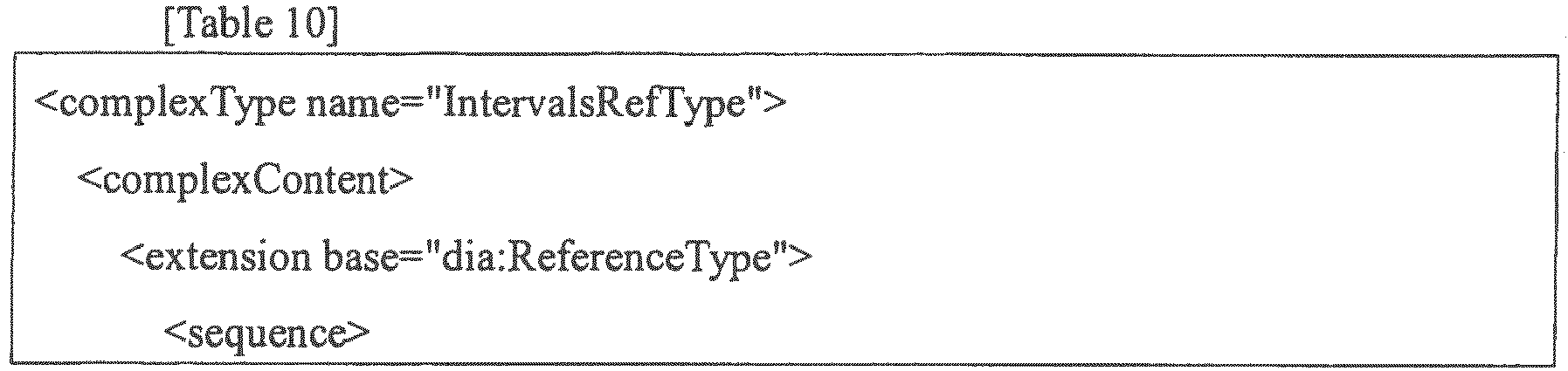

- The following Table 11 shows syntax representation of IntervalType in the XML format.
- Table 11

- The following Table 12 shows syntax representation of IntervalInfoType in the XML format.
- Table 12

- The following Table 13 shows syntax representations of ISOFileBoundaryType and ByteRangesType in the XML format.
- Table 13

- Hereinafter, syntax representation in an MP4 pseudo-code format will be described. Representation of the above syntax elements may be provided in the MP4 pseudo-code format.
- The following Table 14 shows syntax representation of HTTPStreamingBox in the MP4 pseudo-code format.
- Table 14

- Hereinafter, several other options of PeriodsRef element will be described.
- XInclude may be a World Wide Web Consortium (W3C) technology that provides an inclusion mechanism used to merge XML documents.
- The above PeriodsRef and XInclude may be similar in using any URI type (with the Location element and href attribute) to refer to a resource/description. However, there are major differences between the above two approaches.
- XInclude may be used to merge XML documents. In other words, the merged documents may need to be obtained before being optionally further processed. Conversely, PeriodsRef may be used to refer to past or future periods. The past or future periods may not always need to be merged. The intention of PeriodsRef may be to allow a user to retrieve appropriate period information only when the user wants.
- In association with specific attributes/elements, startTime and availableTime of PeriodsRef may be unique for retrieval of period information. Among the attributes/elements of XInclude, "fallback" and "xpointer" may be used to improve functionality of PeriodsRef, while "parse", "encoding", "accept", and "accept-language" may be unnecessary for PeriodsRef.
- Based on the above description, two additional options for referencing periods may be proposed: 1) enhanced PeriodsRef, and 2) XInclude-extending PeriodsRef.
- 1) Enhanced PeriodsRef: enables enhancement of existing PeriodsRef by fallback element and xpointer attribute of XInclude. The option may have an advantage of simplicity in syntax and processing. The syntax of modified PeriodsRef may be provided in Table 15 below.
- 2) XInclude-extending PeriodsRef: enables building of PeriodsRef by simply extending XInclude with startTime and availableTime attributes. The operation may have an advantage of the use of standard XInclude. To avoid always merging documents initially, the semantics of PeriodsRef may need to mandate that "clients are allowed to decide whether merging needs to be completed." The syntax of PeriodsRef may be provided in Table 16 below.
- In the above syntax, an ids attribute may be added to indicate ids of referenced Periods used in the current media presentation. Additionally, to have consistency with the href attribute of XInclude, the Location element may be changed to an optional location attribute.
- Table 15


- Table 16

- The semantics of the above elements/attributes may be provided as shown in Table 17.
- Table 17
[Table 17] Element or Attribute Name type (Attribu te or Element ) Cardin ality Optio nality Description MPD E 1 M Describes a root element that carries a Media Presentation Description (MPD) for a Media Presentation. ............ Period E 1...N O Provides information of Period. PeriodsRef E 1...N O Provides reference to description containing one or more instances of Period element. One or more instances of Period element represent a sequence of consecution Period(s). The information of Period may be either included as an instance of Period element or referenced by PeriodsRef element. ids A O. Provides id(s) of referenced Period(s). When multiple consecutive Periods are referenced, the id's conveyed by this string are separated by semicolon. locatoin A O. Provides reference to description of Period(s). xpointer A O. Provides an XPointer to identify a portion of the referenced description. If xpointer attribute is absent, location attribute needs to be present. startTime A 0...1 O. Indicates the start time of the referenced sequence of Periods, relative to the start time of content. StartTime element may help a client to determine whether referenced information needs to be retrieved. availableTime A 0...1 O. Indicates the time the description of referenced Period(s) is available. The time is the relative time from the start time of content. If availableTime attribute is absent, the description is already available. - Each period may have a start attribute indicating a start time of a period. However, the above approach may not be flexible in modifying a timeline of periods.
- For example, to insert an advertisement period into an MPD for VOD, start times of all periods after the inserted period need to be modified. Furthermore, when the same advertisement period is played repeatedly (for example, every 1 hour), the period may be continuously inserted. In the same manner, when one or more periods are removed from an MPD, start times of remaining periods after periods are removed in space time may be modified.
- In the embodiment, for flexibility of period management, the following modifications may be proposed:
- 1) Add a new attribute called "duration" to a Period
- 2) Change a current start attribute of a Period to optional
- 3) Add a new element called PeriodTimeline to the MPD type
- The PeriodTimeline element may provide information about presentation of periods based on a timeline. Semantics and syntax of the PeriodTimeline element may be provided in Tables 18 through 20 below.
- Using PeriodTimeline, description of a Period may be independent of a presentation time. Accordingly, a Period may be reused (fully or partially) in the same media presentation or in another media presentation. To modify the presentation time, only the Period Timeline needs to be changed.
- In addition, the PartialPlay element may allow (re)play of one or more parts of a Period. For example, after an advertisement Period is presented, a part of the advertisement Period (denoted by beginning and ending) may be occasionally repeated during the whole session.
- The PeriodTimeline element may impose an explicit timeline of Periods. Without the PeriodTimeline element, the implicit timeline of Periods may be inferred from the ordered sequence of Periods. To support the replay of a Period in the case of implicit timeline, the PartialPlay element may also be provided as a child element of the Period element.
Table 18 [Table 18] Element or Attribute Name Type (Attrib ute or Eleme nt) Cardin ality Optionali ty Description MPD E 1 M Describes a root element that carries a Media Presentation Description (MPD) for a Media Presentation. .......... PeriodTimeline E 0...1 O Provides the presentation timeline of Periods of the Media Presentation. PeriodsTime E 1...N O Provides time information for presenting Period. id A O. Indicates an id of Period of the Media Presentation. This value is equal to the value of the id attribute of Period, if the id attribute of Period is present. If no id attributes are present, this value is equal to the appearance order of Period in the MPD. start A O. Provides accurate start time of Period relative to the value of the attribute availabilityStart time of the Media Presentation. The start attribute overrides start attribute of corresponding Period (i.e., an instance of Period element). The start attribute may be present for the first Period of the timeline. For other Periods, if information about presentation duration of previous Periods is available, this value may be deduced and the attribute may be absent. PartialPlay E 0...N O. Provides information for presenting a (temporal) part of Period. beginning A O. Indicates a beginning point of a part of Period. This time value is relative to the beginning of the Period. ending A O. Indicates an ending point of a part of Period. This time value is relative to the beginning of the Period. Period E 1...N M Provides information of Period. start A O Indicates a start time of Period. id A O Indicates an ID of Period. When the Period is a (partial) repeat of another Period, the value of id attribute is equal to an ID or an appearance order of a referred Period. duration A O. Indicates duration of Period. If start attribute is absent, duration attribute may be present. Also, for the last Period of a Media Presentation, if availabilityEndTime and SegmentTimeline are not available, the duration attribute of the Period may be present. PartialPlay E 0...N O. Provides information for presenting a (temporal) part of Period. beginning A O. Indicates a beginning point of a part of Period. This time value is relative to the beginning of the Period. ending A O. Indicates an ending point of a part of Period. This time value is relative to the beginning of the Period. Representation E 0...N Representation element contains description of Representation. - Table 19


- Table 20


- As no repeated Period needs to contain representation description again, the minimum number of Representation instances may be changed to 0.
- Rather than using the id attribute directly, a special attribute indicating an id value of a previous Period to be repeated may be used.
-
FIG 5 is a diagram illustrating a configuration of a client according to an embodiment of the present invention. - The
client 100 includes anaccess engine 510, and amedia engine 520. - The
access engine 510 may be a DASH access engine. - The
access engine 510 may receive metadata (for example, an MPD) from theserver 110. - The
access engine 510 may form requests, and may issue the formed requests to theserver 110. - The
access engine 510 may receive content (for example, segments or parts of the segments) from theserver 110. - The
access engine 510 may provide the content to themedia engine 520. - An output of the
access engine 510 may include media (or a part of the media) of an MPEG container (for example, an ISO/IEC 14492-12 ISO base media file format, or an ISO/IEC 13818-2 MPEG-2 TS). Additionally, the output of theaccess engine 510 may include timing information used to map internal timing of the media to a timeline of a media presentation. - The
media engine 520 may play back the provided content. Specifically, themedia engine 520 may output the media using the media and the timing information that are output from theaccess engine 510. - Technical information according to the embodiments of the present invention described above with reference to
FIGS. 1 through 4 may equally be applied to the present embodiment. Accordingly, further description thereof will be omitted. - The method according to the above-described embodiments of the present invention may be recorded in computer-readable media including program instructions to implement various operations embodied by a computer. The media may also include, alone or in combination with the program instructions, data files, data structures, and the like. The program instructions recorded on the media may be those specially designed and constructed for the purposes of the embodiments, or they may be of the kind well-known and available to those having skill in the computer software arts. Examples of computer-readable media include magnetic media such as hard disks, floppy disks, and magnetic tape; optical media such as CD ROM disks and DVDs; magneto-optical media such as floptical disks; and hardware devices that are specially configured to store and perform program instructions, such as read-only memory (ROM), random access memory (RAM), flash memory, and the like. Examples of program instructions include both machine code, such as produced by a compiler, and files containing higher level code that may be executed by the computer using an interpreter. The described hardware devices may be configured to act as one or more software modules in order to perform the operations of the above-described embodiments of the present invention, or vice versa.
- Although a few embodiments of the present invention have been shown and described, the present invention is not limited to the described embodiments. Instead, it would be appreciated by those skilled in the art that changes may be made to these embodiments without departing from the principles and spirit of the invention, the scope of which is defined by the claims and their equivalents.
Claims (16)
- A method for providing media, the method comprising:receiving metadata of media, the metadata comprising one or more periods;accessing segments of the media based on information provided by the metadata; anddecoding and rendering data of the media that is included in the segments,wherein each of the periods comprises one or more representations of the media,
andwherein each of the representations starts from a beginning point of a period and continues to an ending point of the period, and comprises one or more segments. - The method of claim 1, wherein the metadata is a Media Presentation Description (MPD) of the media.
- The method of claim 1, wherein each of the periods is defined by a period element.
- The method of claim 3, wherein the period element comprises a start attribute indicating a start time of a period.
- The method of claim 3, wherein the period element comprises a duration attribute indicating a duration of a period.
- The method of claim 5, wherein the duration attribute specifies a start time of a period subsequent to the period.
- The method of claim 3, wherein the start time of the period determines a start time of each of segments included in the period.
- The method of claim 3, wherein the period element comprises a reference attribute indicating a reference to an external period element, and each of the periods is defined by the external period element.
- A terminal, comprising:an access engine to receive metadata of media, to receive segments of the media based on information provided by the metadata, and to decode data of the media that is included in the segments, the metadata comprising one or more periods; anda media engine to receive the data of the media from the access engine, and to output the media,wherein each of the periods comprises one or more representations of the media,
andwherein each of the representations starts from a beginning point of a period and continues to an ending point of the period, and comprises one or more segments. - The terminal of claim 9, wherein the metadata is a Media Presentation Description (MPD) of the media.
- The terminal of claim 8, wherein each of the periods is defined by a period element.
- The terminal of claim 11, wherein the period element comprises a start attribute indicating a start time of a period.
- The terminal of claim 11, wherein the period element comprises a duration attribute indicating a duration of a period.
- The terminal of claim 13, wherein the duration attribute specifies a start time of a period subsequent to the period.
- The terminal of claim 11, wherein the start time of the period determines a start time of each of segments included in the period.
- The terminal of claim 11, wherein the period element comprises a reference attribute indicating a reference to an external period element, and each of the periods is
defined by the external period element.
Priority Applications (2)
| Application Number | Priority Date | Filing Date | Title |
|---|---|---|---|
| EP17162129.5A EP3226198A1 (en) | 2010-10-06 | 2011-10-06 | Apparatus and method for providing streaming content |
| EP17184168.7A EP3273404A1 (en) | 2010-10-06 | 2011-10-06 | Apparatus and method for providing streaming content |
Applications Claiming Priority (7)
| Application Number | Priority Date | Filing Date | Title |
|---|---|---|---|
| US39032810P | 2010-10-06 | 2010-10-06 | |
| US40567410P | 2010-10-22 | 2010-10-22 | |
| US41446210P | 2010-11-17 | 2010-11-17 | |
| US41793110P | 2010-11-30 | 2010-11-30 | |
| US201161434036P | 2011-01-19 | 2011-01-19 | |
| KR1020110100706A KR101206698B1 (en) | 2010-10-06 | 2011-10-04 | Apparatus and method for providing streaming contents |
| PCT/KR2011/007387 WO2012047028A2 (en) | 2010-10-06 | 2011-10-06 | Apparatus and method for providing streaming content |
Related Child Applications (2)
| Application Number | Title | Priority Date | Filing Date |
|---|---|---|---|
| EP17162129.5A Division EP3226198A1 (en) | 2010-10-06 | 2011-10-06 | Apparatus and method for providing streaming content |
| EP17184168.7A Division EP3273404A1 (en) | 2010-10-06 | 2011-10-06 | Apparatus and method for providing streaming content |
Publications (2)
| Publication Number | Publication Date |
|---|---|
| EP2626829A2 true EP2626829A2 (en) | 2013-08-14 |
| EP2626829A4 EP2626829A4 (en) | 2014-05-14 |
Family
ID=45928228
Family Applications (3)
| Application Number | Title | Priority Date | Filing Date |
|---|---|---|---|
| EP11830913.7A Ceased EP2626829A4 (en) | 2010-10-06 | 2011-10-06 | APPARATUS AND METHOD FOR PROVIDING REAL-TIME MULTIMEDIA CONTENT |
| EP17184168.7A Ceased EP3273404A1 (en) | 2010-10-06 | 2011-10-06 | Apparatus and method for providing streaming content |
| EP17162129.5A Ceased EP3226198A1 (en) | 2010-10-06 | 2011-10-06 | Apparatus and method for providing streaming content |
Family Applications After (2)
| Application Number | Title | Priority Date | Filing Date |
|---|---|---|---|
| EP17184168.7A Ceased EP3273404A1 (en) | 2010-10-06 | 2011-10-06 | Apparatus and method for providing streaming content |
| EP17162129.5A Ceased EP3226198A1 (en) | 2010-10-06 | 2011-10-06 | Apparatus and method for providing streaming content |
Country Status (5)
| Country | Link |
|---|---|
| US (1) | US8909805B2 (en) |
| EP (3) | EP2626829A4 (en) |
| KR (1) | KR101206698B1 (en) |
| CN (2) | CN103181186B (en) |
| WO (1) | WO2012047028A2 (en) |
Cited By (2)
| Publication number | Priority date | Publication date | Assignee | Title |
|---|---|---|---|---|
| US11477253B2 (en) | 2006-06-09 | 2022-10-18 | Qualcomm Incorporated | Enhanced block-request streaming system using signaling or block creation |
| US11743317B2 (en) | 2009-09-22 | 2023-08-29 | Qualcomm Incorporated | Enhanced block-request streaming using block partitioning or request controls for improved client-side handling |
Families Citing this family (25)
| Publication number | Priority date | Publication date | Assignee | Title |
|---|---|---|---|---|
| KR20120034550A (en) | 2010-07-20 | 2012-04-12 | 한국전자통신연구원 | Apparatus and method for providing streaming contents |
| US9467493B2 (en) * | 2010-09-06 | 2016-10-11 | Electronics And Telecommunication Research Institute | Apparatus and method for providing streaming content |
| CN103299600B (en) * | 2011-01-04 | 2016-08-10 | 汤姆逊许可公司 | Apparatus and method for transmitting live media content |
| EP2924989A1 (en) | 2011-03-16 | 2015-09-30 | Electronics and Telecommunications Research Institute | Apparatus and method for providing streaming content using representations |
| WO2013058633A1 (en) * | 2011-10-20 | 2013-04-25 | 엘지전자 주식회사 | Broadcast service receiving method and broadcast service receiving apparatus |
| US8977704B2 (en) | 2011-12-29 | 2015-03-10 | Nokia Corporation | Method and apparatus for flexible caching of delivered media |
| US9401968B2 (en) * | 2012-01-20 | 2016-07-26 | Nokia Techologies Oy | Method and apparatus for enabling pre-fetching of media |
| US9438883B2 (en) | 2012-04-09 | 2016-09-06 | Intel Corporation | Quality of experience reporting for combined unicast-multicast/broadcast streaming of media content |
| KR101995270B1 (en) * | 2012-04-25 | 2019-07-03 | 삼성전자주식회사 | Method and apparatus for playing video data |
| MY185190A (en) * | 2012-04-26 | 2021-04-30 | Huawei Tech Co Ltd | System and method for signaling segment encryption and key derivation for adaptive streaming |
| CN104429093B (en) | 2012-07-09 | 2018-01-05 | 华为技术有限公司 | HTTP dynamic self-adapting streaming media clients and its session management implementation |
| US10616297B2 (en) | 2012-07-09 | 2020-04-07 | Futurewei Technologies, Inc. | Content-specific identification and timing behavior in dynamic adaptive streaming over hypertext transfer protocol |
| KR102020363B1 (en) * | 2012-10-31 | 2019-09-10 | 삼성전자 주식회사 | Method and apparatus for transmitting and receiving media segment using adaptive streaming |
| US9680689B2 (en) | 2013-02-14 | 2017-06-13 | Comcast Cable Communications, Llc | Fragmenting media content |
| WO2015008774A1 (en) | 2013-07-19 | 2015-01-22 | ソニー株式会社 | Information processing device and method |
| US9807452B2 (en) * | 2013-10-07 | 2017-10-31 | Samsung Electronics Co., Ltd. | Practical delivery of high quality video using dynamic adaptive hypertext transport protocol (HTTP) streaming (DASH) without using HTTP in a broadcast network |
| KR101854895B1 (en) | 2013-11-27 | 2018-05-04 | 인터디지탈 패튼 홀딩스, 인크 | Media presentation description |
| US20150172347A1 (en) * | 2013-12-18 | 2015-06-18 | Johannes P. Schmidt | Presentation of content based on playlists |
| KR20150083429A (en) * | 2014-01-08 | 2015-07-17 | 한국전자통신연구원 | Method of representing bit depth for video play using dash |
| US9866608B2 (en) * | 2014-03-24 | 2018-01-09 | Qualcomm Incorporated | Processing continuous multi-period content |
| US10110652B2 (en) * | 2014-10-14 | 2018-10-23 | Intel IP Corporation | Carriage of media content quality information |
| EP3288270B1 (en) * | 2015-04-22 | 2020-06-03 | LG Electronics Inc. | Broadcasting signal transmission device, broadcasting signal reception device, broadcasting signal transmission method, and broadcasting signal reception method |
| WO2016199513A1 (en) | 2015-06-09 | 2016-12-15 | ソニー株式会社 | Receiving device, transmission device and data processing method |
| WO2016205733A1 (en) * | 2015-06-19 | 2016-12-22 | Huawei Technologies Co., Ltd. | Template uniform resource locator signing |
| US11102259B2 (en) | 2019-01-22 | 2021-08-24 | Apple Inc. | Network system for content playback on multiple devices |
Family Cites Families (44)
| Publication number | Priority date | Publication date | Assignee | Title |
|---|---|---|---|---|
| US20030093790A1 (en) * | 2000-03-28 | 2003-05-15 | Logan James D. | Audio and video program recording, editing and playback systems using metadata |
| US7330875B1 (en) * | 1999-06-15 | 2008-02-12 | Microsoft Corporation | System and method for recording a presentation for on-demand viewing over a computer network |
| AU2001283004A1 (en) * | 2000-07-24 | 2002-02-05 | Vivcom, Inc. | System and method for indexing, searching, identifying, and editing portions of electronic multimedia files |
| US20050193408A1 (en) * | 2000-07-24 | 2005-09-01 | Vivcom, Inc. | Generating, transporting, processing, storing and presenting segmentation information for audio-visual programs |
| US20050193425A1 (en) * | 2000-07-24 | 2005-09-01 | Sanghoon Sull | Delivery and presentation of content-relevant information associated with frames of audio-visual programs |
| US20050203927A1 (en) * | 2000-07-24 | 2005-09-15 | Vivcom, Inc. | Fast metadata generation and delivery |
| US20050204385A1 (en) * | 2000-07-24 | 2005-09-15 | Vivcom, Inc. | Processing and presentation of infomercials for audio-visual programs |
| US7512665B1 (en) * | 2000-08-17 | 2009-03-31 | International Business Machines Corporation | Chained uniform resource locators |
| US20050273514A1 (en) * | 2000-12-22 | 2005-12-08 | Ray Milkey | System and method for automated and optimized file transfers among devices in a network |
| US20050005308A1 (en) * | 2002-01-29 | 2005-01-06 | Gotuit Video, Inc. | Methods and apparatus for recording and replaying sports broadcasts |
| US20030069991A1 (en) * | 2001-10-09 | 2003-04-10 | Brescia Paul T. | Location-based address provision |
| US7739601B1 (en) * | 2002-01-23 | 2010-06-15 | Microsoft Corporation | Media authoring and presentation |
| US7418494B2 (en) * | 2002-07-25 | 2008-08-26 | Intellectual Ventures Holding 40 Llc | Method and system for background replication of data objects |
| KR100486713B1 (en) * | 2002-09-17 | 2005-05-03 | 삼성전자주식회사 | Apparatus and method for streaming multimedia data |
| KR20040096718A (en) * | 2003-05-10 | 2004-11-17 | 삼성전자주식회사 | Multimedia data decoding apparatus, audio data receiving method and audio data structure therein |
| JP4340483B2 (en) | 2003-06-27 | 2009-10-07 | 富士通株式会社 | Composite content delivery method and delivery system |
| US20050102371A1 (en) * | 2003-11-07 | 2005-05-12 | Emre Aksu | Streaming from a server to a client |
| KR100563659B1 (en) | 2003-12-09 | 2006-03-23 | 한국전자통신연구원 | Real time streaming service device |
| JP2005318471A (en) * | 2004-04-30 | 2005-11-10 | Toshiba Corp | Video metadata |
| US20060235883A1 (en) * | 2005-04-18 | 2006-10-19 | Krebs Mark S | Multimedia system for mobile client platforms |
| JP2007048348A (en) * | 2005-08-08 | 2007-02-22 | Toshiba Corp | Information storage medium, information reproducing apparatus, information reproducing method, and information reproducing program |
| US9386064B2 (en) * | 2006-06-09 | 2016-07-05 | Qualcomm Incorporated | Enhanced block-request streaming using URL templates and construction rules |
| US20080034424A1 (en) * | 2006-07-20 | 2008-02-07 | Kevin Overcash | System and method of preventing web applications threats |
| US7711797B1 (en) * | 2006-07-31 | 2010-05-04 | Juniper Networks, Inc. | Optimizing batch size for prefetching data over wide area networks |
| KR20080018778A (en) * | 2006-08-25 | 2008-02-28 | 삼성전자주식회사 | Method of executing AB content in segments, control point device and home network system |
| US20080155602A1 (en) * | 2006-12-21 | 2008-06-26 | Jean-Luc Collet | Method and system for preferred content identification |
| US8533310B2 (en) * | 2007-03-09 | 2013-09-10 | Riverbed Technology, Inc. | Method and apparatus for acceleration by prefetching associated objects |
| JP2008259001A (en) | 2007-04-06 | 2008-10-23 | Japan Radio Co Ltd | Digital content distribution system |
| US9542394B2 (en) * | 2007-06-14 | 2017-01-10 | Excalibur Ip, Llc | Method and system for media-based event generation |
| WO2009054907A2 (en) * | 2007-10-19 | 2009-04-30 | Swarmcast, Inc. | Media playback point seeking using data range requests |
| US8365271B2 (en) * | 2008-02-27 | 2013-01-29 | International Business Machines Corporation | Controlling access of a client system to access protected remote resources supporting relative URLs |
| US8209609B2 (en) * | 2008-12-23 | 2012-06-26 | Intel Corporation | Audio-visual search and browse interface (AVSBI) |
| US20100169303A1 (en) * | 2008-12-31 | 2010-07-01 | David Biderman | Playlists for real-time or near real-time streaming |
| US8909806B2 (en) * | 2009-03-16 | 2014-12-09 | Microsoft Corporation | Delivering cacheable streaming media presentations |
| US8621044B2 (en) * | 2009-03-16 | 2013-12-31 | Microsoft Corporation | Smooth, stateless client media streaming |
| US8793282B2 (en) | 2009-04-14 | 2014-07-29 | Disney Enterprises, Inc. | Real-time media presentation using metadata clips |
| US8201204B2 (en) * | 2009-07-31 | 2012-06-12 | Cisco Technology, Inc. | Minimizing black video segments during ad insertion |
| WO2011070552A1 (en) * | 2009-12-11 | 2011-06-16 | Nokia Corporation | Apparatus and methods for describing and timing representations in streaming media files |
| US8918533B2 (en) * | 2010-07-13 | 2014-12-23 | Qualcomm Incorporated | Video switching for streaming video data |
| US8806050B2 (en) * | 2010-08-10 | 2014-08-12 | Qualcomm Incorporated | Manifest file updates for network streaming of coded multimedia data |
| US9160978B2 (en) * | 2010-08-10 | 2015-10-13 | Google Technology Holdings LLC | Method and apparatus related to variable duration media segments |
| EP2638682A4 (en) * | 2010-11-12 | 2014-07-23 | Realnetworks Inc | TRAFFIC MANAGEMENT IN ADAPTIVE STREAMING PROTOCOLS |
| US8812621B2 (en) * | 2011-05-03 | 2014-08-19 | Cisco Technology, Inc. | Reducing fetching load on cache servers in adaptive streaming |
| US8468145B2 (en) * | 2011-09-16 | 2013-06-18 | Google Inc. | Indexing of URLs with fragments |
-
2011
- 2011-10-04 KR KR1020110100706A patent/KR101206698B1/en active Active
- 2011-10-06 EP EP11830913.7A patent/EP2626829A4/en not_active Ceased
- 2011-10-06 WO PCT/KR2011/007387 patent/WO2012047028A2/en not_active Ceased
- 2011-10-06 US US13/824,995 patent/US8909805B2/en active Active
- 2011-10-06 EP EP17184168.7A patent/EP3273404A1/en not_active Ceased
- 2011-10-06 CN CN201180048729.0A patent/CN103181186B/en active Active
- 2011-10-06 EP EP17162129.5A patent/EP3226198A1/en not_active Ceased
- 2011-10-06 CN CN201610221910.1A patent/CN105704159A/en active Pending
Cited By (4)
| Publication number | Priority date | Publication date | Assignee | Title |
|---|---|---|---|---|
| US11477253B2 (en) | 2006-06-09 | 2022-10-18 | Qualcomm Incorporated | Enhanced block-request streaming system using signaling or block creation |
| US11743317B2 (en) | 2009-09-22 | 2023-08-29 | Qualcomm Incorporated | Enhanced block-request streaming using block partitioning or request controls for improved client-side handling |
| US11770432B2 (en) | 2009-09-22 | 2023-09-26 | Qualcomm Incorporated | Enhanced block-request streaming system for handling low-latency streaming |
| US12155715B2 (en) | 2009-09-22 | 2024-11-26 | Qualcomm Incorporated | Enhanced block-request streaming using block partitioning or request controls for improved client-side handling |
Also Published As
| Publication number | Publication date |
|---|---|
| KR101206698B1 (en) | 2012-11-30 |
| CN105704159A (en) | 2016-06-22 |
| EP3273404A1 (en) | 2018-01-24 |
| WO2012047028A3 (en) | 2012-05-31 |
| US20130185398A1 (en) | 2013-07-18 |
| WO2012047028A2 (en) | 2012-04-12 |
| US8909805B2 (en) | 2014-12-09 |
| CN103181186A (en) | 2013-06-26 |
| EP3226198A1 (en) | 2017-10-04 |
| EP2626829A4 (en) | 2014-05-14 |
| CN103181186B (en) | 2016-05-04 |
| KR20120038367A (en) | 2012-04-23 |
Similar Documents
| Publication | Publication Date | Title |
|---|---|---|
| US8909805B2 (en) | Apparatus and method for providing streaming content | |
| EP2615841B1 (en) | Apparatus and method for providing streaming content | |
| EP2597884A2 (en) | Apparatus and method for providing streaming contents | |
| US10277660B1 (en) | Apparatus and method for providing streaming content | |
| US20180288125A1 (en) | Apparatus and method for providing streaming content | |
| KR102042213B1 (en) | Apparatus and method for providing streaming contents | |
| KR102272853B1 (en) | Apparatus and method for providing streaming contents |
Legal Events
| Date | Code | Title | Description |
|---|---|---|---|
| PUAI | Public reference made under article 153(3) epc to a published international application that has entered the european phase |
Free format text: ORIGINAL CODE: 0009012 |
|
| 17P | Request for examination filed |
Effective date: 20130506 |
|
| AK | Designated contracting states |
Kind code of ref document: A2 Designated state(s): AL AT BE BG CH CY CZ DE DK EE ES FI FR GB GR HR HU IE IS IT LI LT LU LV MC MK MT NL NO PL PT RO RS SE SI SK SM TR |
|
| DAX | Request for extension of the european patent (deleted) | ||
| A4 | Supplementary search report drawn up and despatched |
Effective date: 20140414 |
|
| RIC1 | Information provided on ipc code assigned before grant |
Ipc: H04N 21/431 20110101ALI20140408BHEP Ipc: H04N 21/845 20110101ALI20140408BHEP Ipc: H04L 29/08 20060101ALI20140408BHEP Ipc: H04L 29/06 20060101ALI20140408BHEP Ipc: H04N 21/61 20110101ALI20140408BHEP Ipc: G06Q 50/00 20120101AFI20140408BHEP Ipc: H04N 21/8541 20110101ALI20140408BHEP Ipc: H04N 21/2343 20110101ALI20140408BHEP Ipc: H04N 21/43 20110101ALI20140408BHEP Ipc: G06Q 90/00 20060101ALI20140408BHEP Ipc: H04N 21/235 20110101ALI20140408BHEP Ipc: H04N 21/84 20110101ALI20140408BHEP |
|
| 17Q | First examination report despatched |
Effective date: 20150826 |
|
| 111L | Licence recorded |
Designated state(s): AL AT BE BG CH CY CZ DE DK EE ES FI FR GB GR HR HU IE IS IT LT LU LV MC MK MT NL NO PL PT RO RS SE SI SK SM TR Free format text: EXCLUSIVE LICENSE Name of requester: INTELLECTUAL DISCOVERY CO., LTD., KR Effective date: 20160613 |
|
| APBK | Appeal reference recorded |
Free format text: ORIGINAL CODE: EPIDOSNREFNE |
|
| APBN | Date of receipt of notice of appeal recorded |
Free format text: ORIGINAL CODE: EPIDOSNNOA2E |
|
| APBR | Date of receipt of statement of grounds of appeal recorded |
Free format text: ORIGINAL CODE: EPIDOSNNOA3E |
|
| APBV | Interlocutory revision of appeal recorded |
Free format text: ORIGINAL CODE: EPIDOSNIRAPE |
|
| STAA | Information on the status of an ep patent application or granted ep patent |
Free format text: STATUS: EXAMINATION IS IN PROGRESS |
|
| RAP1 | Party data changed (applicant data changed or rights of an application transferred) |
Owner name: IDEAHUB INC. |
|
| REG | Reference to a national code |
Ref country code: DE Ref legal event code: R003 |
|
| STAA | Information on the status of an ep patent application or granted ep patent |
Free format text: STATUS: THE APPLICATION HAS BEEN REFUSED |
|
| 18R | Application refused |
Effective date: 20210426 |