EP2625818B1 - Public key encryption system based on quadratic residuosity assumption of higher dimensions - Google Patents
Public key encryption system based on quadratic residuosity assumption of higher dimensions Download PDFInfo
- Publication number
- EP2625818B1 EP2625818B1 EP11761619.3A EP11761619A EP2625818B1 EP 2625818 B1 EP2625818 B1 EP 2625818B1 EP 11761619 A EP11761619 A EP 11761619A EP 2625818 B1 EP2625818 B1 EP 2625818B1
- Authority
- EP
- European Patent Office
- Prior art keywords
- ciphertext
- mod
- plaintext
- equal
- processor
- Prior art date
- Legal status (The legal status is an assumption and is not a legal conclusion. Google has not performed a legal analysis and makes no representation as to the accuracy of the status listed.)
- Not-in-force
Links
- 238000000034 method Methods 0.000 claims description 22
- 238000004590 computer program Methods 0.000 claims description 5
- 238000011084 recovery Methods 0.000 claims description 2
- 238000004422 calculation algorithm Methods 0.000 description 5
- 239000002131 composite material Substances 0.000 description 3
- 238000004891 communication Methods 0.000 description 2
- 230000000670 limiting effect Effects 0.000 description 2
- 238000004364 calculation method Methods 0.000 description 1
- 238000005457 optimization Methods 0.000 description 1
Images

Classifications
-
- H—ELECTRICITY
- H04—ELECTRIC COMMUNICATION TECHNIQUE
- H04L—TRANSMISSION OF DIGITAL INFORMATION, e.g. TELEGRAPHIC COMMUNICATION
- H04L9/00—Cryptographic mechanisms or cryptographic arrangements for secret or secure communications; Network security protocols
- H04L9/30—Public key, i.e. encryption algorithm being computationally infeasible to invert or user's encryption keys not requiring secrecy
Definitions
- the present invention relates generally to cryptography, and in particular to a public-key encryption system.
- Goldwasser-Micali described a public key encryption scheme; see Shafi Goldwasser and Silvio Micali. Probabilistic encryption. Journal of Computer and System Sciences, 28:270-299, 1984 .
- the scheme has a particular interest because is proved under the Quadratic Residuosity Assumption, but it is not efficient in terms of bandwidth as each bit in the plaintext is expanded to the size of the composite modulus in ciphertext.
- a first tentative to improve the efficiency of such scheme is due to Blum-Goldwasser (Manuel Blum and Shafi Goldwasser. An efficient probabilistic public-key encryption scheme which hides all partial information. In CRYPTO, pages 289-302, 1984 ). Their scheme achieves a better ciphertext expansion: the ciphertext has the same length of the plaintext plus an integer of the size of modulus. The scheme is proved semantically secure under the unpredictability of output of the Blum-Blum-Shub's pseudorandom generator which resides on factorisation hardness assumption. (See Lenore Blum, Manuel Blum, and Mike Shub. Comparison of two pseudo-random number generators.
- the invention is directed to a method of encryption of a k -bit plaintext m.
- N is a multiple of a product of two prime numbers p and q and N is not a square
- y is an element in multiplicative group Z N * of integers modulo N
- N pq.
- the invention is directed to a method of decryption of a ciphertext c generated according to the method of the first aspect.
- the invention is directed to a device for encryption of a k -bit plaintext m.
- N a multiple of a product of two prime numbers p and q and N is not a square
- y is an element in multiplicative group Z N * of integers modulo N
- N pq.
- the invention is directed to a device method of decryption of a ciphertext c generated according to the method of the first aspect.
- the invention is directed to a computer program product having stored thereon instructions that, when executed by a processor, performs the method of any one of the embodiments of the method of the first aspect.
- the invention is directed to a computer program product having stored thereon instructions that, when executed by a processor, performs the method of any one of the embodiments of the method of the second aspect.
- Figure 1 illustrates an apparatus for performing an exponentiation resistant against skipping attacks according to a preferred embodiment of the invention.
- a generic public-key encryption scheme may be defined as follows:
- the public-key encryption scheme of the present invention works as follows.
- a N 1 .
- FIG. 1 illustrates a device according to a preferred embodiment of the present invention.
- the device 100 comprises at least one interface unit 110 adapted for communication with other devices (not shown), at least one processor 120 and at least one memory 130 adapted for storing data, such as accumulators and intermediary calculation results.
- the processor 120 is adapted to encrypt plaintext m using the encryption method described herein.
- the processor 120 is adapted to decrypt ciphertext c using any of the embodiments of the decryption method described herein.
- the processor 120 is adapted to encrypt a plaintext m and to decrypt a ciphertext c.
- a computer program product 140 such as a CD-ROM or a DVD comprises stored instructions that, when executed by the processor 120, performs the method according to any of the embodiments of the invention, i.e. encryption, decryption or both encryption and decryption.
Landscapes
- Engineering & Computer Science (AREA)
- Computing Systems (AREA)
- Theoretical Computer Science (AREA)
- Computer Security & Cryptography (AREA)
- Computer Networks & Wireless Communication (AREA)
- Signal Processing (AREA)
- Storage Device Security (AREA)
- Compression, Expansion, Code Conversion, And Decoders (AREA)
- Mobile Radio Communication Systems (AREA)
Description
- The present invention relates generally to cryptography, and in particular to a public-key encryption system.
- This section is intended to introduce the reader to various aspects of art, which may be related to various aspects of the present invention that are described and/or claimed below. This discussion is believed to be helpful in providing the reader with background information to facilitate a better understanding of the various aspects of the present invention. Accordingly, it should be understood that these statements are to be read in this light, and not as admissions of prior art.
- In 1984, Goldwasser-Micali described a public key encryption scheme; see Shafi Goldwasser and Silvio Micali. Probabilistic encryption. Journal of Computer and System Sciences, 28:270-299, 1984. The scheme has a particular interest because is proved under the Quadratic Residuosity Assumption, but it is not efficient in terms of bandwidth as each bit in the plaintext is expanded to the size of the composite modulus in ciphertext.
- A first tentative to improve the efficiency of such scheme is due to Blum-Goldwasser (Manuel Blum and Shafi Goldwasser. An efficient probabilistic public-key encryption scheme which hides all partial information. In CRYPTO, pages 289-302, 1984). Their scheme achieves a better ciphertext expansion: the ciphertext has the same length of the plaintext plus an integer of the size of modulus. The scheme is proved semantically secure under the unpredictability of output of the Blum-Blum-Shub's pseudorandom generator which resides on factorisation hardness assumption. (See Lenore Blum, Manuel Blum, and Mike Shub. Comparison of two pseudo-random number generators. In CRYPTO, pages 61-78, 1982 and Lenore Blum, Manuel Blum, and Mike Shub. A simple unpredictable pseudo-random number generator. SIAM J. Comput., 15(2):364-383, 1986.) Details about the Blum-Goldwasser scheme can be found in The Foundations of Modern Cryptography by Oded Goldreich, 1997.
- After the initial work by Golwasser and Micali, Benaloh and Fisher proposed a first generalisation of the Golwasser-Micali encryption scheme based on a Prime Residuosity Assumption. (See Josh Daniel Cohen Benaloh. Verifiable secret-ballot elections. PhD thesis, New Haven, CT, USA, 1987, and Josh D. Cohen and Michael J. Fischer. A robust and verifiable cryptographically secure election scheme. In SFCS '85: Proceedings of the 26th Annual Symposium on Foundations of Computer Science, pages 372-382, Washington, DC, USA, 1985. IEEE Computer Society. See also Josh Benaloh: "Dense Probabilistic Cryptography," Proceedings of the Workshop on Selected Areas of Cryptography, 31 May 2004, pages 120-128.)
- The basic idea is to consider as message space Z/eZ for a particular small prime e instead of Z/2Z as in Goldwasser-Micali, so achieving a better ciphertext expansion. The main disadvantage of this scheme is that the decryption algorithm is very inefficient requiring a kind of exhaustive search (requiring then a small value of prime e to be practical).
- An improved variant of this latter was given by Naccache and Stern considering e not as a prime but a product of small primes. This allows a faster decryption. (See David Naccache and Jacques Stern. A new public key cryptosystem based on higher residues. In ACM Conference on Computer and Communications Security, pages 59-66, 1998.)
- A different approach of the same problem was proposed by Okamoto and Uchiyama who suggested to work with a particular modulus N =p2q. This choice improves the bandwidth using as message space Z/pZ. (See Tatsuaki Okamoto and Shigenori Uchiyama. A new public-key cryptosystem as secure as factoring. In EUROCRYPT, pages 308-318, 1998.) Unfortunately, the scheme is vulnerable to a chosen-ciphertext attack that allows to recover the modulus factorisation, completely breaking the system.
- Later, Paillier generalised the Okamoto-Uchiyama cryptosystem using N2, the square of a standard composite modulus. The underlying problem used to prove the scheme is the N-th residuosity assumption. (See Pascal Paillier. Public-key cryptosystems based on composite degree residuosity classes. In EUROCRYPT, pages 223-238, 1999.)
- Other applications of the more general theory of characters and residuosity can be found also in works by Monnerat and Vaudenay in the domain of undeniable signatures. (See Jean Monnerat, Yvonne Anne Oswald, and Serge Vaudenay. Optimization of the mova undeniable signature scheme. In Dawson and Vaudenay [9], pages 196-209; Jean Monnerat and Serge Vaudenay. Generic homomorphic undeniable signatures. In Pil Joong Lee, editor. Advances in Cryptology - ASIACRYPT 2004, Proceedings, volume 3329 of Lecture Notes in Computer Science. Springer, 2004, pages 354-371; and Jean Monnerat and Serge Vaudenay. Undeniable signatures based on characters: How to sign with one bit. In F. Bao et al., editors, Public Key Cryptography - PKC 2004, volume 2947 of Lecture Notes in Computer Science, pages 69-75. Springer-Verlag, 2004.) In these works, the authors focus on character of order 2, 3 and 4. The authors also provide an analysis and a classification of the problems related to the security of their schemes. Using the general theory of character in building cryptosystem appears also in "Undeniable signatures..." already mentioned and in a work by Renate Scheidler and Hugh C. Williams: A public-key cryptosystem utilizing cyclotomic fields. Des. Codes Cryptography, 6(2):117-131, 1995.
- It can therefore be appreciated that there is a need for a solution that improves the Goldwasser-Micali scheme in that it improves the bandwidth while remaining proved secure under standard hardness assumption. This invention provides such a solution.
- In a first aspect, the invention is directed to a method of encryption of a k-bit plaintext m. A device obtains plaintext m, picks a random

k mod N, and outputs the ciphertext. N is a multiple of a product of two prime numbers p and q and N is not a square, y is an element in multiplicative group


- In a first preferred embodiment, N = pq.
- In a second aspect, the invention is directed to a method of decryption of a ciphertext c generated according to the method of the first aspect. A device obtains ciphertext c and private key p, recovers m ∈ {0,..., 2k - 1} such that


- In a first preferred embodiment, the recovery of plaintext m = (m k-1,...,m 0)2 is performed by the following steps:

- In a third aspect, the invention is directed to a device for encryption of a k-bit plaintext m. The device comprises a processor adapted to obtain plaintext m, pick a random


- In a first preferred embodiment, N = pq.
- In a fourth aspect, the invention is directed to a device method of decryption of a ciphertext c generated according to the method of the first aspect. The device comprises a processor adapted to obtain ciphertext c and private key p, recover m ∈ {0,..., 2k - 1} such that

- In a fifth aspect, the invention is directed to a computer program product having stored thereon instructions that, when executed by a processor, performs the method of any one of the embodiments of the method of the first aspect.
- In a sixth aspect, the invention is directed to a computer program product having stored thereon instructions that, when executed by a processor, performs the method of any one of the embodiments of the method of the second aspect.
- Preferred features of the present invention will now be described, by way of non-limiting example, with reference to the accompanying drawings, in which
Figure 1 illustrates an apparatus for performing an exponentiation resistant against skipping attacks according to a preferred embodiment of the invention. - For illustrative purposes, the present invention will be described as applied to the square-and-multiply algorithm, but the skilled person will appreciate that it may easily be modified to any other exponentiation algorithm.
- A generic public-key encryption scheme may be defined as follows:
- A public key encryption scheme is a tuple of polynomial probabilistic algorithms (KeyGen, Encrypt, Decrypt):
- KeyGen(·): takes as input a security parameter κ and outputs a pair (pk, sk) containing the public and the secret key.
- Encrypt(·,·): performs encryption. Takes as input a plaintext m and a public key pk; outputs the ciphertext c = Encrypt(pk, m).
- Decrypt(·,·): a deterministic decryption algorithm that takes as input a ciphertext c and a secret key sk; outputs the plaintext m.
- The public-key encryption scheme of the present invention works as follows.
- KeyGen(κ): On input security parameter κ, KeyGen generates an integer k>1 and two random primes p, q = 1 (mod 2 k ) and forms N = pq. KeyGen also defines

- For an integer a co-prime to N = pq, the Jacobi symbol is defined as the product of the corresponding Legendre symbols, namely


- QR(N) is the subset of quadratic residues modulo N,

- It is preferred that exactly one value of


- The public key is pk = {N, y, k} and the private key is sk = {p}.
- Encrypt(pk, m): Input is plaintext message m ∈ {0, ... , 2 k - 1}. Encrypt outputs the encryption of message m under public key pk = {N, y, k}. Ciphertext c = Encrypt(pk, m) is computed as follows:
- pick a random

- set c = ymx 2 k mod N.
- Decrypt(sk, c): Decrypt recovers the plaintext m from the input ciphertext c using private key sk = {p} and outputs the plaintext m, by:
- 1. computing

- 2. finding m ∈ {0,..., 2k - 1} such that

- For a small value of k an exhaustive search is feasible to recover m. However, for larger values of k, it may be more efficient to proceed as follows:

-
Figure 1 illustrates a device according to a preferred embodiment of the present invention. Thedevice 100 comprises at least oneinterface unit 110 adapted for communication with other devices (not shown), at least oneprocessor 120 and at least onememory 130 adapted for storing data, such as accumulators and intermediary calculation results. - In a first preferred embodiment, the
processor 120 is adapted to encrypt plaintext m using the encryption method described herein. In a second preferred embodiment, theprocessor 120 is adapted to decrypt ciphertext c using any of the embodiments of the decryption method described herein. In a third preferred embodiment, theprocessor 120 is adapted to encrypt a plaintext m and to decrypt a ciphertext c. Acomputer program product 140 such as a CD-ROM or a DVD comprises stored instructions that, when executed by theprocessor 120, performs the method according to any of the embodiments of the invention, i.e. encryption, decryption or both encryption and decryption. - It will be appreciated that the public-key encryption system of the embodiments of the present invention can provide a scheme that:
- is proved secure under standard hardness assumption;
- provides better bandwidth than Goldwasser-Micali.
- is homomorphic: the product of ciphertexts for a number of plaintexts is the encryption of the sum of the plaintexts;
- allows a compact description of the public key owing to the particular choice of primes p and q.
- Each feature disclosed in the description and (where appropriate) the claims and drawings may be provided independently or in any appropriate combination. Features described as being implemented in hardware may also be implemented in software, and vice versa. Reference numerals appearing in the claims are by way of illustration only and shall have no limiting effect on the scope of the claims.


Claims (9)
- A method of encryption of a k-bit plaintext m, the method being performed in a device (100) and comprising the steps of:- obtaining plaintext m;- picking a random
 - generating ciphertext c = ymx2
k mod N; and- outputting the ciphertext;
wherein
N is a multiple of a product of two prime numbers p and q
each of the two prime numbers being equal to 1 (mod 2 k ) and N is not a square;
y is an element in multiplicative group
characterised in that k is an integer such
that k > 1; and
exactly one value of (-1)^((p-1)/2^k) and (-1)^((q-1)/2^k) is equal to 1 and the other one is equal to -1. - The method of claim 1, wherein N = pq.
- A method of decryption of a ciphertext c generated according to the method of claim 1, the method being performed in a device (100) and comprising the steps of:- obtaining ciphertext c and private key p equal to 1 (mod 2 k );- recovering m ∈ {0,..., 2k - 1} such that
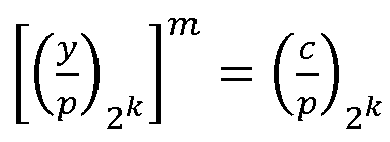 - outputting plaintext m;
wherein k is an integer such that k > 1
and
wherein

- The method of claim 3, wherein the recovery of plaintext m = (m k-1,...,m 0)2 is performed by the following steps, wherein B, t and z are variables:

- A device (100) for encryption of a k-bit plaintext m, the device (100) comprising a processor (120) adapted to:- obtain plaintext m;- pick a random
 - generate ciphertext c = ymx 2 k mod N; and- output the ciphertext;
wherein
N is a multiple of a product of two prime numbers p and q being equal to 1 (mod 2 k ) and N is not a square;
y is an element in multiplicative group
characterised in that k is an integer such
that k > 1; and
exactly one value of (-1)^((p-1)/2^k) and (-1)^((q-1)/2^k) is equal to 1 and the other one is equal to -1. - The device of claim 5, wherein N = pq.
- A device of decryption of a ciphertext c generated according to the method of claim 1, the device (100) comprising a processor (120) adapted to:- obtain ciphertext c and private key p equal to 1 (mod 2 k );- recover m ∈ {0,..., 2k - 1} such that
 - output plaintext m,
wherein k is an integer such that k > 1. - A computer program product (140) having stored thereon instructions that, when executed by a processor, performs the method of any one of claims 1 and 2.
- A computer program product (140) having stored thereon instructions that, when executed by a processor, performs the method of any one of claims 3 and 4.
Priority Applications (2)
| Application Number | Priority Date | Filing Date | Title |
|---|---|---|---|
| EP11761619.3A EP2625818B1 (en) | 2010-10-08 | 2011-09-28 | Public key encryption system based on quadratic residuosity assumption of higher dimensions |
| EP14197117.6A EP2884691B1 (en) | 2010-10-08 | 2011-09-28 | Public key encryption system based on the quadratic residuosity assumption |
Applications Claiming Priority (4)
| Application Number | Priority Date | Filing Date | Title |
|---|---|---|---|
| EP10306103 | 2010-10-08 | ||
| EP11306214 | 2011-09-23 | ||
| PCT/EP2011/066883 WO2012045628A1 (en) | 2010-10-08 | 2011-09-28 | Public key encryption system based on the quadratic residuosity assumption |
| EP11761619.3A EP2625818B1 (en) | 2010-10-08 | 2011-09-28 | Public key encryption system based on quadratic residuosity assumption of higher dimensions |
Related Child Applications (1)
| Application Number | Title | Priority Date | Filing Date |
|---|---|---|---|
| EP14197117.6A Division EP2884691B1 (en) | 2010-10-08 | 2011-09-28 | Public key encryption system based on the quadratic residuosity assumption |
Publications (2)
| Publication Number | Publication Date |
|---|---|
| EP2625818A1 EP2625818A1 (en) | 2013-08-14 |
| EP2625818B1 true EP2625818B1 (en) | 2014-12-24 |
Family
ID=45927238
Family Applications (2)
| Application Number | Title | Priority Date | Filing Date |
|---|---|---|---|
| EP11761619.3A Not-in-force EP2625818B1 (en) | 2010-10-08 | 2011-09-28 | Public key encryption system based on quadratic residuosity assumption of higher dimensions |
| EP14197117.6A Not-in-force EP2884691B1 (en) | 2010-10-08 | 2011-09-28 | Public key encryption system based on the quadratic residuosity assumption |
Family Applications After (1)
| Application Number | Title | Priority Date | Filing Date |
|---|---|---|---|
| EP14197117.6A Not-in-force EP2884691B1 (en) | 2010-10-08 | 2011-09-28 | Public key encryption system based on the quadratic residuosity assumption |
Country Status (3)
| Country | Link |
|---|---|
| US (1) | US9432191B2 (en) |
| EP (2) | EP2625818B1 (en) |
| WO (1) | WO2012045628A1 (en) |
Cited By (1)
| Publication number | Priority date | Publication date | Assignee | Title |
|---|---|---|---|---|
| EP2884691A3 (en) * | 2010-10-08 | 2015-07-08 | Thomson Licensing | Public key encryption system based on the quadratic residuosity assumption |
Families Citing this family (16)
| Publication number | Priority date | Publication date | Assignee | Title |
|---|---|---|---|---|
| EP2890048A1 (en) * | 2013-12-30 | 2015-07-01 | Thomson Licensing | Method for processing a generalized Goldwasser-Micali ciphertext, corresponding electronic device and computer program product |
| EP2966803A1 (en) * | 2014-07-11 | 2016-01-13 | Thomson Licensing | Method and device for cryptographic key generation |
| CN104184581B (en) * | 2014-08-07 | 2017-05-31 | 中国人民武装警察部队工程大学 | A kind of public key encryption method in tape symbol quadratic residue monoid |
| US10903976B2 (en) | 2017-01-20 | 2021-01-26 | Enveil, Inc. | End-to-end secure operations using a query matrix |
| US11777729B2 (en) | 2017-01-20 | 2023-10-03 | Enveil, Inc. | Secure analytics using term generation and homomorphic encryption |
| US11507683B2 (en) | 2017-01-20 | 2022-11-22 | Enveil, Inc. | Query processing with adaptive risk decisioning |
| US11196541B2 (en) | 2017-01-20 | 2021-12-07 | Enveil, Inc. | Secure machine learning analytics using homomorphic encryption |
| US10972251B2 (en) | 2017-01-20 | 2021-04-06 | Enveil, Inc. | Secure web browsing via homomorphic encryption |
| US10873568B2 (en) | 2017-01-20 | 2020-12-22 | Enveil, Inc. | Secure analytics using homomorphic and injective format-preserving encryption and an encrypted analytics matrix |
| US10680818B2 (en) * | 2018-04-12 | 2020-06-09 | Nxp | Encryption schemes with additional properties |
| CN108599951B (en) * | 2018-08-10 | 2021-10-01 | 北京奇虎科技有限公司 | Encryption method, encryption device, computing device and computer storage medium |
| US10902133B2 (en) | 2018-10-25 | 2021-01-26 | Enveil, Inc. | Computational operations in enclave computing environments |
| US10817262B2 (en) | 2018-11-08 | 2020-10-27 | Enveil, Inc. | Reduced and pipelined hardware architecture for Montgomery Modular Multiplication |
| US12099997B1 (en) | 2020-01-31 | 2024-09-24 | Steven Mark Hoffberg | Tokenized fungible liabilities |
| US11601258B2 (en) | 2020-10-08 | 2023-03-07 | Enveil, Inc. | Selector derived encryption systems and methods |
| CN114257366B (en) * | 2021-12-20 | 2024-04-12 | 成都卫士通信息产业股份有限公司 | Information homomorphic processing method, device, equipment and computer readable storage medium |
Family Cites Families (2)
| Publication number | Priority date | Publication date | Assignee | Title |
|---|---|---|---|---|
| US6697488B1 (en) * | 1998-08-26 | 2004-02-24 | International Business Machines Corporation | Practical non-malleable public-key cryptosystem |
| WO2012045628A1 (en) * | 2010-10-08 | 2012-04-12 | Thomson Licensing | Public key encryption system based on the quadratic residuosity assumption |
-
2011
- 2011-09-28 WO PCT/EP2011/066883 patent/WO2012045628A1/en not_active Ceased
- 2011-09-28 EP EP11761619.3A patent/EP2625818B1/en not_active Not-in-force
- 2011-09-28 EP EP14197117.6A patent/EP2884691B1/en not_active Not-in-force
- 2011-09-28 US US13/877,946 patent/US9432191B2/en not_active Expired - Fee Related
Cited By (1)
| Publication number | Priority date | Publication date | Assignee | Title |
|---|---|---|---|---|
| EP2884691A3 (en) * | 2010-10-08 | 2015-07-08 | Thomson Licensing | Public key encryption system based on the quadratic residuosity assumption |
Also Published As
| Publication number | Publication date |
|---|---|
| EP2884691B1 (en) | 2018-11-07 |
| EP2884691A3 (en) | 2015-07-08 |
| US20130195267A1 (en) | 2013-08-01 |
| US9432191B2 (en) | 2016-08-30 |
| EP2884691A2 (en) | 2015-06-17 |
| EP2625818A1 (en) | 2013-08-14 |
| WO2012045628A1 (en) | 2012-04-12 |
Similar Documents
| Publication | Publication Date | Title |
|---|---|---|
| EP2884691B1 (en) | Public key encryption system based on the quadratic residuosity assumption | |
| Catalano et al. | Paillier's cryptosystem revisited | |
| Bresson et al. | A simple public-key cryptosystem with a double trapdoor decryption mechanism and its applications | |
| Chen et al. | Security proof of Sakai-Kasahara’s identity-based encryption scheme | |
| Joye et al. | Efficient cryptosystems from 2 k-th power residue symbols | |
| Camacho et al. | On the impossibility of batch update for cryptographic accumulators | |
| Yasuda et al. | Reducing the key size of Rainbow using non-commutative rings | |
| Abdelfatah | A color image authenticated encryption using conic curve and Mersenne twister | |
| Koshiba et al. | Short exponent diffie-hellman problems | |
| CA2742530C (en) | Masking the output of random number generators in key generation protocols | |
| Fairbrother | An improved construction for universal re-encryption | |
| Sakalauskas et al. | Matrix power s-box construction | |
| Ferdianto et al. | Common modulus attack on the elliptic curve-based RSA algorithm variant | |
| Gjøsteen | Homomorphic cryptosystems based on subgroup membership problems | |
| El-Kassar et al. | ElGamal Public-Key Cryptosystem Using Reducible Polynomials Over a Finite Field. | |
| US20040151307A1 (en) | Tractable rational map public-key system | |
| Kayode et al. | Efficient RSA cryptosystem decryption based on Chinese remainder theorem and strong prime | |
| Cheon et al. | A cryptanalysis of the original domingo-ferrer's algebraic privacy homomophism | |
| Goswami et al. | A new public key cryptosystem over ℤ n 2 | |
| Gyu-Chol et al. | A study on the fast ElGamal encryption | |
| Kim et al. | Compress Multiple Ciphertexts Using ElGamal Encryption Schemes. | |
| Vishwakarma | TRIAD ANALYSIS BY DESIGN, SECURITY, AND EVOLUTION OF HFE, MI, AND OIL-VINEGAR CRYPTOSYSTEMS | |
| Derdouri et al. | Decrypting the ciphertexts of RSA cryptosystem with ciphering function | |
| Jingmin et al. | A new probabilistic encryption scheme | |
| Ghodosi | An efficient public key cryptosystem secure against chosen ciphertext attack |
Legal Events
| Date | Code | Title | Description |
|---|---|---|---|
| PUAI | Public reference made under article 153(3) epc to a published international application that has entered the european phase |
Free format text: ORIGINAL CODE: 0009012 |
|
| 17P | Request for examination filed |
Effective date: 20130328 |
|
| AK | Designated contracting states |
Kind code of ref document: A1 Designated state(s): AL AT BE BG CH CY CZ DE DK EE ES FI FR GB GR HR HU IE IS IT LI LT LU LV MC MK MT NL NO PL PT RO RS SE SI SK SM TR |
|
| DAX | Request for extension of the european patent (deleted) | ||
| GRAP | Despatch of communication of intention to grant a patent |
Free format text: ORIGINAL CODE: EPIDOSNIGR1 |
|
| INTG | Intention to grant announced |
Effective date: 20140718 |
|
| GRAS | Grant fee paid |
Free format text: ORIGINAL CODE: EPIDOSNIGR3 |
|
| GRAA | (expected) grant |
Free format text: ORIGINAL CODE: 0009210 |
|
| AK | Designated contracting states |
Kind code of ref document: B1 Designated state(s): AL AT BE BG CH CY CZ DE DK EE ES FI FR GB GR HR HU IE IS IT LI LT LU LV MC MK MT NL NO PL PT RO RS SE SI SK SM TR |
|
| REG | Reference to a national code |
Ref country code: GB Ref legal event code: FG4D |
|
| REG | Reference to a national code |
Ref country code: CH Ref legal event code: EP |
|
| REG | Reference to a national code |
Ref country code: IE Ref legal event code: FG4D |
|
| REG | Reference to a national code |
Ref country code: AT Ref legal event code: REF Ref document number: 703606 Country of ref document: AT Kind code of ref document: T Effective date: 20150115 |
|
| REG | Reference to a national code |
Ref country code: GB Ref legal event code: 746 Effective date: 20150116 |
|
| REG | Reference to a national code |
Ref country code: DE Ref legal event code: R096 Ref document number: 602011012562 Country of ref document: DE Effective date: 20150212 |
|
| REG | Reference to a national code |
Ref country code: NL Ref legal event code: VDEP Effective date: 20141224 |
|
| PG25 | Lapsed in a contracting state [announced via postgrant information from national office to epo] |
Ref country code: NO Free format text: LAPSE BECAUSE OF FAILURE TO SUBMIT A TRANSLATION OF THE DESCRIPTION OR TO PAY THE FEE WITHIN THE PRESCRIBED TIME-LIMIT Effective date: 20150324 Ref country code: FI Free format text: LAPSE BECAUSE OF FAILURE TO SUBMIT A TRANSLATION OF THE DESCRIPTION OR TO PAY THE FEE WITHIN THE PRESCRIBED TIME-LIMIT Effective date: 20141224 Ref country code: LT Free format text: LAPSE BECAUSE OF FAILURE TO SUBMIT A TRANSLATION OF THE DESCRIPTION OR TO PAY THE FEE WITHIN THE PRESCRIBED TIME-LIMIT Effective date: 20141224 |
|
| REG | Reference to a national code |
Ref country code: LT Ref legal event code: MG4D |
|
| PG25 | Lapsed in a contracting state [announced via postgrant information from national office to epo] |
Ref country code: GR Free format text: LAPSE BECAUSE OF FAILURE TO SUBMIT A TRANSLATION OF THE DESCRIPTION OR TO PAY THE FEE WITHIN THE PRESCRIBED TIME-LIMIT Effective date: 20150325 Ref country code: HR Free format text: LAPSE BECAUSE OF FAILURE TO SUBMIT A TRANSLATION OF THE DESCRIPTION OR TO PAY THE FEE WITHIN THE PRESCRIBED TIME-LIMIT Effective date: 20141224 Ref country code: LV Free format text: LAPSE BECAUSE OF FAILURE TO SUBMIT A TRANSLATION OF THE DESCRIPTION OR TO PAY THE FEE WITHIN THE PRESCRIBED TIME-LIMIT Effective date: 20141224 Ref country code: SE Free format text: LAPSE BECAUSE OF FAILURE TO SUBMIT A TRANSLATION OF THE DESCRIPTION OR TO PAY THE FEE WITHIN THE PRESCRIBED TIME-LIMIT Effective date: 20141224 Ref country code: RS Free format text: LAPSE BECAUSE OF FAILURE TO SUBMIT A TRANSLATION OF THE DESCRIPTION OR TO PAY THE FEE WITHIN THE PRESCRIBED TIME-LIMIT Effective date: 20141224 |
|
| REG | Reference to a national code |
Ref country code: AT Ref legal event code: MK05 Ref document number: 703606 Country of ref document: AT Kind code of ref document: T Effective date: 20141224 |
|
| PG25 | Lapsed in a contracting state [announced via postgrant information from national office to epo] |
Ref country code: NL Free format text: LAPSE BECAUSE OF FAILURE TO SUBMIT A TRANSLATION OF THE DESCRIPTION OR TO PAY THE FEE WITHIN THE PRESCRIBED TIME-LIMIT Effective date: 20141224 |
|
| PG25 | Lapsed in a contracting state [announced via postgrant information from national office to epo] |
Ref country code: SK Free format text: LAPSE BECAUSE OF FAILURE TO SUBMIT A TRANSLATION OF THE DESCRIPTION OR TO PAY THE FEE WITHIN THE PRESCRIBED TIME-LIMIT Effective date: 20141224 Ref country code: RO Free format text: LAPSE BECAUSE OF FAILURE TO SUBMIT A TRANSLATION OF THE DESCRIPTION OR TO PAY THE FEE WITHIN THE PRESCRIBED TIME-LIMIT Effective date: 20141224 Ref country code: EE Free format text: LAPSE BECAUSE OF FAILURE TO SUBMIT A TRANSLATION OF THE DESCRIPTION OR TO PAY THE FEE WITHIN THE PRESCRIBED TIME-LIMIT Effective date: 20141224 Ref country code: CZ Free format text: LAPSE BECAUSE OF FAILURE TO SUBMIT A TRANSLATION OF THE DESCRIPTION OR TO PAY THE FEE WITHIN THE PRESCRIBED TIME-LIMIT Effective date: 20141224 Ref country code: ES Free format text: LAPSE BECAUSE OF FAILURE TO SUBMIT A TRANSLATION OF THE DESCRIPTION OR TO PAY THE FEE WITHIN THE PRESCRIBED TIME-LIMIT Effective date: 20141224 |
|
| PG25 | Lapsed in a contracting state [announced via postgrant information from national office to epo] |
Ref country code: PL Free format text: LAPSE BECAUSE OF FAILURE TO SUBMIT A TRANSLATION OF THE DESCRIPTION OR TO PAY THE FEE WITHIN THE PRESCRIBED TIME-LIMIT Effective date: 20141224 Ref country code: IS Free format text: LAPSE BECAUSE OF FAILURE TO SUBMIT A TRANSLATION OF THE DESCRIPTION OR TO PAY THE FEE WITHIN THE PRESCRIBED TIME-LIMIT Effective date: 20150424 Ref country code: AT Free format text: LAPSE BECAUSE OF FAILURE TO SUBMIT A TRANSLATION OF THE DESCRIPTION OR TO PAY THE FEE WITHIN THE PRESCRIBED TIME-LIMIT Effective date: 20141224 |
|
| REG | Reference to a national code |
Ref country code: FR Ref legal event code: PLFP Year of fee payment: 5 |
|
| REG | Reference to a national code |
Ref country code: DE Ref legal event code: R097 Ref document number: 602011012562 Country of ref document: DE |
|
| PG25 | Lapsed in a contracting state [announced via postgrant information from national office to epo] |
Ref country code: DK Free format text: LAPSE BECAUSE OF FAILURE TO SUBMIT A TRANSLATION OF THE DESCRIPTION OR TO PAY THE FEE WITHIN THE PRESCRIBED TIME-LIMIT Effective date: 20141224 |
|
| PLBE | No opposition filed within time limit |
Free format text: ORIGINAL CODE: 0009261 |
|
| STAA | Information on the status of an ep patent application or granted ep patent |
Free format text: STATUS: NO OPPOSITION FILED WITHIN TIME LIMIT |
|
| 26N | No opposition filed |
Effective date: 20150925 |
|
| PG25 | Lapsed in a contracting state [announced via postgrant information from national office to epo] |
Ref country code: IT Free format text: LAPSE BECAUSE OF FAILURE TO SUBMIT A TRANSLATION OF THE DESCRIPTION OR TO PAY THE FEE WITHIN THE PRESCRIBED TIME-LIMIT Effective date: 20141224 |
|
| PG25 | Lapsed in a contracting state [announced via postgrant information from national office to epo] |
Ref country code: SI Free format text: LAPSE BECAUSE OF FAILURE TO SUBMIT A TRANSLATION OF THE DESCRIPTION OR TO PAY THE FEE WITHIN THE PRESCRIBED TIME-LIMIT Effective date: 20141224 |
|
| PG25 | Lapsed in a contracting state [announced via postgrant information from national office to epo] |
Ref country code: LU Free format text: LAPSE BECAUSE OF FAILURE TO SUBMIT A TRANSLATION OF THE DESCRIPTION OR TO PAY THE FEE WITHIN THE PRESCRIBED TIME-LIMIT Effective date: 20150928 Ref country code: MC Free format text: LAPSE BECAUSE OF FAILURE TO SUBMIT A TRANSLATION OF THE DESCRIPTION OR TO PAY THE FEE WITHIN THE PRESCRIBED TIME-LIMIT Effective date: 20141224 |
|
| REG | Reference to a national code |
Ref country code: CH Ref legal event code: PL |
|
| PG25 | Lapsed in a contracting state [announced via postgrant information from national office to epo] |
Ref country code: BE Free format text: LAPSE BECAUSE OF FAILURE TO SUBMIT A TRANSLATION OF THE DESCRIPTION OR TO PAY THE FEE WITHIN THE PRESCRIBED TIME-LIMIT Effective date: 20141224 |
|
| REG | Reference to a national code |
Ref country code: IE Ref legal event code: MM4A |
|
| PG25 | Lapsed in a contracting state [announced via postgrant information from national office to epo] |
Ref country code: CH Free format text: LAPSE BECAUSE OF NON-PAYMENT OF DUE FEES Effective date: 20150930 Ref country code: LI Free format text: LAPSE BECAUSE OF NON-PAYMENT OF DUE FEES Effective date: 20150930 Ref country code: IE Free format text: LAPSE BECAUSE OF NON-PAYMENT OF DUE FEES Effective date: 20150928 |
|
| REG | Reference to a national code |
Ref country code: FR Ref legal event code: PLFP Year of fee payment: 6 |
|
| PG25 | Lapsed in a contracting state [announced via postgrant information from national office to epo] |
Ref country code: MT Free format text: LAPSE BECAUSE OF FAILURE TO SUBMIT A TRANSLATION OF THE DESCRIPTION OR TO PAY THE FEE WITHIN THE PRESCRIBED TIME-LIMIT Effective date: 20141224 |
|
| PG25 | Lapsed in a contracting state [announced via postgrant information from national office to epo] |
Ref country code: SM Free format text: LAPSE BECAUSE OF FAILURE TO SUBMIT A TRANSLATION OF THE DESCRIPTION OR TO PAY THE FEE WITHIN THE PRESCRIBED TIME-LIMIT Effective date: 20141224 Ref country code: BG Free format text: LAPSE BECAUSE OF FAILURE TO SUBMIT A TRANSLATION OF THE DESCRIPTION OR TO PAY THE FEE WITHIN THE PRESCRIBED TIME-LIMIT Effective date: 20141224 Ref country code: HU Free format text: LAPSE BECAUSE OF FAILURE TO SUBMIT A TRANSLATION OF THE DESCRIPTION OR TO PAY THE FEE WITHIN THE PRESCRIBED TIME-LIMIT; INVALID AB INITIO Effective date: 20110928 |
|
| PG25 | Lapsed in a contracting state [announced via postgrant information from national office to epo] |
Ref country code: CY Free format text: LAPSE BECAUSE OF FAILURE TO SUBMIT A TRANSLATION OF THE DESCRIPTION OR TO PAY THE FEE WITHIN THE PRESCRIBED TIME-LIMIT Effective date: 20141224 |
|
| REG | Reference to a national code |
Ref country code: DE Ref legal event code: R082 Ref document number: 602011012562 Country of ref document: DE Representative=s name: HOFSTETTER, SCHURACK & PARTNER PATENT- UND REC, DE |
|
| REG | Reference to a national code |
Ref country code: FR Ref legal event code: PLFP Year of fee payment: 7 |
|
| PG25 | Lapsed in a contracting state [announced via postgrant information from national office to epo] |
Ref country code: MK Free format text: LAPSE BECAUSE OF FAILURE TO SUBMIT A TRANSLATION OF THE DESCRIPTION OR TO PAY THE FEE WITHIN THE PRESCRIBED TIME-LIMIT Effective date: 20141224 Ref country code: TR Free format text: LAPSE BECAUSE OF FAILURE TO SUBMIT A TRANSLATION OF THE DESCRIPTION OR TO PAY THE FEE WITHIN THE PRESCRIBED TIME-LIMIT Effective date: 20141224 |
|
| PG25 | Lapsed in a contracting state [announced via postgrant information from national office to epo] |
Ref country code: PT Free format text: LAPSE BECAUSE OF FAILURE TO SUBMIT A TRANSLATION OF THE DESCRIPTION OR TO PAY THE FEE WITHIN THE PRESCRIBED TIME-LIMIT Effective date: 20141224 |
|
| REG | Reference to a national code |
Ref country code: FR Ref legal event code: PLFP Year of fee payment: 8 |
|
| PG25 | Lapsed in a contracting state [announced via postgrant information from national office to epo] |
Ref country code: AL Free format text: LAPSE BECAUSE OF FAILURE TO SUBMIT A TRANSLATION OF THE DESCRIPTION OR TO PAY THE FEE WITHIN THE PRESCRIBED TIME-LIMIT Effective date: 20141224 |
|
| PGFP | Annual fee paid to national office [announced via postgrant information from national office to epo] |
Ref country code: FR Payment date: 20180925 Year of fee payment: 8 |
|
| PGFP | Annual fee paid to national office [announced via postgrant information from national office to epo] |
Ref country code: GB Payment date: 20180702 Year of fee payment: 8 |
|
| PGFP | Annual fee paid to national office [announced via postgrant information from national office to epo] |
Ref country code: DE Payment date: 20181001 Year of fee payment: 8 |
|
| REG | Reference to a national code |
Ref country code: DE Ref legal event code: R119 Ref document number: 602011012562 Country of ref document: DE |
|
| PG25 | Lapsed in a contracting state [announced via postgrant information from national office to epo] |
Ref country code: DE Free format text: LAPSE BECAUSE OF NON-PAYMENT OF DUE FEES Effective date: 20200401 |
|
| GBPC | Gb: european patent ceased through non-payment of renewal fee |
Effective date: 20190928 |
|
| PG25 | Lapsed in a contracting state [announced via postgrant information from national office to epo] |
Ref country code: GB Free format text: LAPSE BECAUSE OF NON-PAYMENT OF DUE FEES Effective date: 20190928 Ref country code: FR Free format text: LAPSE BECAUSE OF NON-PAYMENT OF DUE FEES Effective date: 20190930 |