EP2624240A1 - Molecular design apparatus and method - Google Patents
Molecular design apparatus and method Download PDFInfo
- Publication number
- EP2624240A1 EP2624240A1 EP12194942.4A EP12194942A EP2624240A1 EP 2624240 A1 EP2624240 A1 EP 2624240A1 EP 12194942 A EP12194942 A EP 12194942A EP 2624240 A1 EP2624240 A1 EP 2624240A1
- Authority
- EP
- European Patent Office
- Prior art keywords
- molecular
- data
- molecular orbital
- basis
- threshold
- Prior art date
- Legal status (The legal status is an assumption and is not a legal conclusion. Google has not performed a legal analysis and makes no representation as to the accuracy of the status listed.)
- Granted
Links
Images






Classifications
-
- G—PHYSICS
- G16—INFORMATION AND COMMUNICATION TECHNOLOGY [ICT] SPECIALLY ADAPTED FOR SPECIFIC APPLICATION FIELDS
- G16C—COMPUTATIONAL CHEMISTRY; CHEMOINFORMATICS; COMPUTATIONAL MATERIALS SCIENCE
- G16C20/00—Chemoinformatics, i.e. ICT specially adapted for the handling of physicochemical or structural data of chemical particles, elements, compounds or mixtures
- G16C20/50—Molecular design, e.g. of drugs
-
- G—PHYSICS
- G06—COMPUTING OR CALCULATING; COUNTING
- G06F—ELECTRIC DIGITAL DATA PROCESSING
- G06F30/00—Computer-aided design [CAD]
- G06F30/20—Design optimisation, verification or simulation
-
- G—PHYSICS
- G09—EDUCATION; CRYPTOGRAPHY; DISPLAY; ADVERTISING; SEALS
- G09B—EDUCATIONAL OR DEMONSTRATION APPLIANCES; APPLIANCES FOR TEACHING, OR COMMUNICATING WITH, THE BLIND, DEAF OR MUTE; MODELS; PLANETARIA; GLOBES; MAPS; DIAGRAMS
- G09B23/00—Models for scientific, medical, or mathematical purposes, e.g. full-sized devices for demonstration purposes
- G09B23/26—Models for scientific, medical, or mathematical purposes, e.g. full-sized devices for demonstration purposes for molecular structures; for crystallography
-
- G—PHYSICS
- G16—INFORMATION AND COMMUNICATION TECHNOLOGY [ICT] SPECIALLY ADAPTED FOR SPECIFIC APPLICATION FIELDS
- G16C—COMPUTATIONAL CHEMISTRY; CHEMOINFORMATICS; COMPUTATIONAL MATERIALS SCIENCE
- G16C10/00—Computational theoretical chemistry, i.e. ICT specially adapted for theoretical aspects of quantum chemistry, molecular mechanics, molecular dynamics or the like
Definitions
- the embodiment discussed herein is related to a molecular design apparatus and method for drawing molecular orbitals on a screen of a display device based on molecular structure design data.
- the molecular orbital function is useful for research of photoresponsiveness and reactivity of a molecule to be a development target.
- molecular orbitals such as a HOMO (Highest Occupied Molecular Orbital) and a LUMO (Lowest Unoccupied Molecular Orbital) are frequently drawn by a three-dimensional drawing using the computer.
- a molecular orbital drawing program and a molecular orbital drawing apparatus are used.
- a GUI Graphic User Interface
- a drawing time may be delayed.
- values of basis functions of the three-dimensional lattice points may be calculated beforehand. Moreover, lattice points themselves may be reduced.
- a molecular design apparatus including a storage part configured to store molecular structure design data; a molecular orbital function expansion part configured to calculate expansion coefficients applied to basis functions by expanding a molecular orbital function used to draw molecular orbitals based on the molecular structure design data, and stores first molecular orbital data in which the expansion coefficients are corresponded to the basis functions to the storage part; and a molecular orbital data reduction part configured to determine a coefficient threshold for the expansion coefficients of the basis functions acquired by the molecular orbital function expansion part by using a drawing threshold which indicates a constant function value, to draw the molecular orbital functions as an isosurface of the constant function value on a screen of a display device, and to store second molecular orbital data pertinent to the expansion coefficients based on the coefficient threshold to the storage part.
- a molecular design method conducted by a computer, and a non-transitory computer-readable recording medium storing a program for causing the computer to operate as the above-described molecular design apparatus.
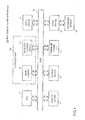
- a molecular design apparatus 100 includes a hardware configuration as illustrated in FIG. 1 .
- FIG. 1 is a diagram illustrating the hardware configuration of the molecular design apparatus 100.
- the molecular design apparatus 100 may be a terminal controlled by a computer, and may include a CPU (Central Processing Unit) 11, a main memory 12, an auxiliary storage device 13, an input device 14, a display device 15, an output device 16, a communication interface (I/F) 17, and a drive device 18, which are mutually connected via a bus B.
- a CPU Central Processing Unit
- the CPU 11 controls the molecular design apparatus 100 in accordance with programs stored in the main memory 12.
- the main memory 12 may include a Random Access Memory (RAM), a ROM (Read-Only Memory), or the like.
- the main memory 12 stores programs executed by the CPU 11, data used in processes conducted by the CPU 11, data acquired in the processes conducted by the CPU 11, and the like. Also, a part of an area of the main memory 12 may be used as a working area for the processes conducted by the CPU 11.
- the auxiliary storage device 13 may include a hard disk drive, and may store data such as the programs to perform Various processes. A part of a program stored in the auxiliary storage device 13 is loaded to the main memory 12, and is executed by the CPU 11. Accordingly, various processes are realized.
- a storage part 130 may include the main memory 12 and/or the auxiliary storage device 13.
- the input device 14 may include one or more operation parts such as a pointing device such as a mouse, a keyboard or the like.
- the input device 14 may be used for a user to input various information items for the processes in the molecular design apparatus 100.
- the display device 15 is used to display various information items under a control of the CPU 11.
- the output device 16 may include a printer or the like.
- the output device 16 is used for the user to output various information items in response to an instruction of the user.
- the communication I/F 17 is used to connect to the Internet, a Local Area Network (LAN), or the like.
- the communication I/F 17 corresponds to a device for controlling a communication with an external device.
- the program which may realize the process performed by the molecular design apparatus 100, may be provided by a recording medium 19 such as a CD-ROM (Compact Disc Read-Only Memory) or the like. That is, when the recording medium 19 storing the program is set to the drive device 18, the program is read out by the drive device 18 from the recording medium 19, and is installed to the auxiliary storage device 13 through the bus B. Accordingly, when the CPU 11 is instructed to execute the program, the CPU 11 starts the process in accordance with the program installed in the auxiliary storage device 13.
- the recording medium 19 for storing the program is not limited to the CD-ROM. Any camputer-readable recording medium may be used as the recording medium 19.
- a portable recording medium such as a Bus Digital Versatile Disk (DVD), a Universal Serial Bus (USB) memory, a semiconductor memory such as a flash memory, or the like may be used as the comptater-readable recording medium 19.
- DVD Digital Versatile Disk
- USB Universal Serial Bus
- semiconductor memory such as a flash memory, or the like
- the program for realizing the process performed by the molecular design apparatus 100 may be provided from the external device through the communication I/F 17.
- the program may be provided to the external device.
- Each of processes, which will be described later, may be realized at the external device.
- the communication through the communication I/F 17 is not limited to a wireless or wired communication.
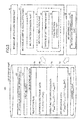
- FIG. 2 is a diagram illustrating a functional configuration example of the molecular design apparatus 100.
- the molecular design apparatus 100 includes a molecular structure design part 41, a molecular orbital calculation part 43, and a molecular orbital (MO) function expansion part 44, and an MO drawing part 48.
- the molecular structure design part 41, the MO function expansion part 44, and the MO drawing part 48 may be realized by processes which are performed by the CPU 11 executing respective programs.
- the molecular structure design part 41 conducts the molecular structure design based on data pertaining to the molecular structure.
- the data are input from the input device 14 by the user.
- a main window for the user to work is displayed by the molecular structure design part 41 on a screen of the display device 15.
- the user operates an atom item, a bond axis item, and the like to be displayed in the main window, by using the pointing device, the keyboard, or the like, so as to build a three-dimensional structure of a molecule in the main window.
- Molecular structure design data 132 which is created by operations of the user, are stored in the storage part 130.
- the molecular orbital calculation part 43 calculates a molecular orbital based on the molecular structure design data 132. In the embodiment, the molecular orbital calculation part 43 reduces as much as possible a data amount of a calculation result of the molecular orbital without losing drawing data of the molecular orbital.
- the molecular orbital calculation part 43 calculates the molecular orbital based on the molecular structure design data 132 by a molecular orbital function represented by a linear combination of multiple basis functions which are prepared beforehand.
- the molecular orbital calculation part 43 further includes the MO function expansion part 44, a threshold determination part 45, and a data deletion storage part 46.
- the threshold determination part 45 and the data deletion storage part 46 correspond to a MO data reduction part 47 for reducing the data amount of the calculation result of the molecular orbital.
- the MO function expansion part 44 calculates coefficients (hereinafter, called “expansion coefficients”) concerning the multiple basis functions to expand the molecular orbital function into the multiple basis functions.
- the molecular orbital calculation is performed to acquire the expansion coefficients respective to the multiple molecular orbital functions.
- the "molecular orbital” and the “molecular orbital function” are synonymous in a molecular orbital calculation process.
- the molecular orbital function represents a state of an electron in a molecule. An orbital function value in coordinates is raised to the power of two.
- ⁇ i indicates an i th molecular orbital function
- r indicates coordinates used to acquire a function value
- ⁇ p indicates a p th basis function
- N indicates a total number of the basis functions
- C pi indicates an expansion coefficient applied to the p th basis function in a case in which an i th molecular orbital function is expanded into the multiple basis functions.
- First MO data 134 are stored in the storage part 130. In the first MO data 134, the expansion coefficients C pi correspond to the p th basis function for each i th molecular orbital function.
- the threshold determination part 45 determines thresholds of the above-described coefficients used to create second MO data 136 for drawing the molecular orbital. By using the second MO data 136, it is possible for the MO drawing part 48 to draw the molecular orbital at high speed.
- ⁇ cutoff represents a threshold (corresponding to a drawing threshold) of the molecular orbital to set to an isosurface.
- ⁇ represents a value acquired by multiplying the number of the basis functions belonging to each of atoms with a ratio of the number of electrons with respect to a total number of basis, a basis ratio respective to the value, or the like.
- N Atom max represents a maximum value of atoms in a range where the basis functions are overlapped.
- the coefficient threshold C cutoff represents a threshold of the expansion coefficient of the molecular orbital function.
- ⁇ cutoff represents a threshold of the basis function to ignore relationships with other basis functions, regarding a radial distribution function of the basis function.
- the data deletion storage part 46 reduces the data amount of the first MO data 134, and also stores the second MO data 136 for the MO drawing part 48 to acquire an approximate molecular orbital function.
- the data deletion storage part 46 specifies, by referring to the first MO data 134, the expansion coefficients C pi being greater than or equal to coefficient threshold C cutoff calculated by a threshold determination part 45, the basis function ⁇ p corresponding to the expansion coefficients C pi , and the number of elements to acquire the approximate molecular orbital function for the i th molecular orbital function acquired by the MO function expansion part 44.
- the data deletion storage part 46 stores the expansion coefficients C pi , the basis function ⁇ p , and the number of elements to the second MO data 136 in the storage part 130, and sets "True” to a reduction flag 6a of the second MO data 136 to validate the second MO data 136. Initially, "False” is set to the reduction flag 6a to invalidate the second MO data 136.
- the expansion coefficients C pi being greater than or equal to the coefficient threshold C cutoff is stored in expansion coefficient data 6b.
- the expansion coefficients C pi may be stored in one dimensional array V.
- Basis function indication data 6c stores an entity of the basis function ⁇ p corresponding to the expansion coefficients C pi stored in the expansion coefficient data 6b, or a pointer to the basis function ⁇ p existing in the first MO data 134.
- one dimensional array V Basis may be used for the basis function ⁇ p .
- the number of the basis functions ⁇ p which is applied after the reduction of the data amount, corresponds to an element number of the array V Basis .
- One dimensional array V Orbital represents elements of the array V for the expansion coefficients C pi for each of the molecular orbital functions, and is stored in MO indication data 6d.
- the MO drawing part 48 draws the molecular orbital on the molecular structure in the window of the display device 15 by using the molecular orbital function calculated by the molecular orbital calculation part 43. If the reduction flag 6a of the second MO data 136 indicates "True” (the second MO data 136 is validated), the molecular orbital drawing part 48 draws the molecular orbital on the molecular structure by using the approximate molecular orbital function by referring to the second MO data 136. On the other hand, if the reduction flag 6a indicates "False” (the second MO data 136 is invalidated), the molecular orbital drawing part 48 draws the molecular orbital on the molecular structure by using the first MO data 134.
- the molecular orbital drawing part 48 includes a MO function determination part 49. If the reduction flag 6a indicates "True", the MO function determination part 49 calculates approximate molecular orbital function by referring to the second MO data 136. The molecular orbital drawing part 48 acquires a molecular orbital function value by using the approximate molecular orbital function calculated by the MO function determination part 49, and draws the molecular orbital on the molecular structure based on the molecular structure design data 132. Drawing data 138 for drawing the molecular orbital on the molecular structure are stored in the storage part 130.
- the threshold determination process is performed by the threshold determination part 45 to reduce the data amount of the expansion coefficients of the molecular orbitals.
- the threshold determination part 45 acquires each of the following values to calculate the coefficient threshold C cutoff indicating a threshold value of the expansion coefficients of the molecular orbital functions, in which the coefficient threshold C cutoff is expressed by the above expression (3).
- FIG. 3 is a diagram for explaining the drawing threshold ⁇ cutoff for the molecular orbital functions.
- a vertical axis indicates a function value
- a horizontal axis indicates coordinates.
- Drawing using the molecular orbital functions may be performed as drawing isosurface determined by an absolute value of a certain function value.
- the MO drawing part 48 displays a molecular structure 3a at the display device 15.
- the molecular orbitals are drawn by using the function values which are greater than or equal to + ⁇ cutoff or less than or equal to - ⁇ cutoff .
- the drawing threshold ⁇ cutoff may be a value set by a user.
- FIG. 4 is a diagram for explaining the basis threshold ⁇ cutoff .
- the basis threshold ⁇ cutoff indicates a threshold in which influence from the basis functions to other basis functions becomes sufficiently smaller.
- the basis functions are used to expand to the molecular orbital functions.
- Basis function values being less than or equal to the basis threshold ⁇ cutoff are deleted.
- a distribution function D (an expression (6)) may be used.
- the distribution function D may be regarded as a distribution function of a radial function R (an expression (5)) forming a basis function ⁇ (an expression (4)).
- ⁇ STO r 4 ⁇ ⁇ ⁇ R n STO r 2
- ⁇ STO nlm indicates a basis function using a Slater Type Orbital (STO)
- n indicates a principal quantum number
- 1 indicates an azimuthal quantum number
- m indicates a magnetic quantum number
- R STO n (r) indicates the radial function of the Slater Type Orbital in radial coordinates r
- n indicates the principal quantum number
- Y lm ( ⁇ , ⁇ ) indicates spherical harmonics of the Slater Type Orbital in angular coordinates ⁇ and ⁇
- 1 indicates the azimuthal quantum number
- m indicates a magnetic quantum number.
- ⁇ indicates an orbital exponent (a coefficient of an exponent of the radial function).
- D STO n, ⁇ indicates a radial distribution function of the Slater Type Orbital, and n indicates the principal quantum number.
- r ⁇ max indicates the radial coordinates determined by the threshold of the basis function.
- FIG. 5 is a diagram for explaining the maximum number N Atom max .
- the maximum number N Atom max indicates a maximum value of the total number of the atoms in a case of considering the influence of the basis function belonging to an atom to other basis functions belonging to other atoms for each atom. Coordinates are set as r ⁇ max when the coordinates indicate a function value of the distribution function D corresponding to the basis threshold ( FIG. 4 ). In this case, if centers of other atoms are included in a sphere of a radius 2r ⁇ max from each of the atoms, it is considered that the basis functions may influence each other ( FIG. 5 ).
- N Atom max indicates the maximum value of the number of the atoms included in the sphere of the radius 2r ⁇ max from the center of each of the atoms.
- ⁇ indicates a value which results from multiplying the number of the basis functions belonging to each of the atoms with a ratio of an electron number with respect to the total number of the basis functions, or an other value respective to the calculated value.
- a HOMO Highest Occupied Molecular Orbital
- LUMO Large Unoccupied Molecular Orbital
- ⁇ N Atom max is regarded as the number of the basis functions which are actually overlapped with respect to the total number N of the basis functions in the expression (1) for calculating the molecular orbital functions. Accordingly, it is possible to determine the drawing threshold ⁇ cutoff based on a relational expression (the above expression (2)), and to determine a pertinent coefficient threshold C cutoff by the above expression (3).
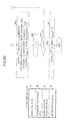
- FIG. 6 is a flowchart for explaining a threshold determination process.
- the threshold determination part 45 sets the drawing threshold ⁇ cutoff of the molecular orbital functions (step S61). Also, the threshold determination part 45 calculates and sets the basis threshold ⁇ cutoff in which the influence to other basis functions becomes sufficiently small in the space distribution of the basis function (step S62).
- the threshold determination part 45 acquires the threshold r ⁇ max of the distance where the basis function and other basis functions are significantly overlapped based on a distribution function D and the basis threshold ⁇ cutoff of the basis function ⁇ (step S63).
- the threshold determination part 45 acquires a maximum value of the number of atoms in the sphere of the radius 2r ⁇ max from each of the atoms, and sets the maximum number N Atom max (step S64).
- the threshold determination part 45 acquires ⁇ based on the number of the basis functions and the HOMO (step S65). Instead of the HOMO, ⁇ related to the LUMO may be acquired.
- the user may indicate the HOMO or LUMO beforehand.
- the threshold determination part 45 obtain the coefficient threshold C cutoff based on the drawing threshold ⁇ cutoff , the basis threshold ⁇ cutoff , and the maximum value N Atom max , and ⁇ (step S66).
- the data deletion storage part 46 Based on the coefficient threshold C cutoff determined in a process conducted by the threshold determination part 45, the data deletion storage part 46 creates and stores contents of the second MO data 136 in the storage part 130.
- FIG. 7 is a diagram for explaining the data reduction process concerning the i th molecular orbital function ⁇ i .
- the i th molecular orbital function ⁇ i will be described by using ⁇ i data 134-2 pertinent to the i th molecular orbital function ⁇ i in the first MO data 134 stored in the storage part 130.
- the data deletion storage part 46 stores the expansion coefficients C pi being greater than or equal to the coefficient threshold C cutoff in one dimensional array V.
- the expansion coefficients C pi being greater than or equal to the coefficient threshold C cutoff are stored in elements from j i start to j i End of the array V.
- the j i Start indicates a first expansion coefficient C pi after the data reduction process related to the i th molecular orbital ⁇ i (may be called "molecular orbital function ⁇ i ").
- the j i End indicates a last expansion coefficient C pi after the data reduction process related to the i th molecular orbital ⁇ i .
- the data deletion storage part 46 stores pointers to the basis functions ⁇ p corresponding to the expansion coefficient C pi being greater than or equal to the coefficient threshold C cutofff , to elements from j i Start to j End of the array V Basis .
- the data deletion storage part 46 manages elements from j i Start to j End by using one dimensional array V orbital .
- j i Start to an i th element (V Orbital [i]) of the array V Orbital the element number is acquired by deducting V Orbital [i] from V Orbital [i+1].
- ⁇ i ' data 136-2 pertinent to the i th molecular orbital ⁇ i are created.
- data from the array V[j i Start ] to the array V[j i End ] correspond to a part of the expansion coefficient data 6b in the second MO data 136 in FIG. 2 .
- Data from the array V Basis [j i Start ] to the array V Basis [j i End ] correspond to a part of the basis function indication data 6c.
- the array V Orbital [i] corresponds to a part of the the MO indication data 6d.
- the expression (1) may be replaced by using an array based on the following relational expression (A).
- the expansion coefficient C pi is represented by V[1]
- ⁇ p is represented by ⁇ VBasis[1]
- the expression (1) may be represented by an approximated molecular functions such as the following expression (7).
- the number of the basis functions ⁇ p pertaining to the i th molecular orbital ⁇ i becomes the total number N of the basis functions ⁇ p .
- the number of the basis functions ⁇ p pertaining to the i th molecular orbital ⁇ i becomes the element number acquired by a calculation (V Orbitai [i+1]-V Orbital [i]).
- a ratio of a calculation amount of the MO drawing part 48 in the embodiment with respect to that of the related art is indicated by the following expression (8) V Orbital ⁇ i + 1 - V Orbital i N
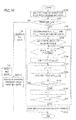
- FIG. 8A and FIG. 8B are flowcharts for explaining a data deletion storing process performed by the data deletion storage part 46.
- the data deletion storage part 46 sets 1 to a variable i (step S81).
- the data deletion storage part 46 acquires expansion coefficient data 4i of the i th molecular orbital ⁇ i from the first MO data 134 stored in the storage part 130 (step S82).
- the data deletion storage part 46 stores the expansion coefficients C pi being greater than or equal to coefficient threshold C cutoff calculated by a threshold determination part 45 to the elements from j i Start to j i End of the array V in the expansion coefficient data 6b. Also, the data deletion storage part 46 stores data indicating the basis functions ⁇ i to the elements from j i Start to j i End of the array V Basis in the basis function indication data 6c (step S83).
- the data deletion storage part 46 stores j i Start to the array V Orbital [i] related to the number of the expansion coefficients C pi being greater than or equal to coefficient threshold C cutoff in the MO indication data 6d (step S84).
- the data deletion storage part 46 increments the variable i by 1 (step S85), and determines whether the variable i reaches the total number N of the molecular orbital functions ⁇ , that is, whether the variable i is equal to the total number N (step S86). If the variable i is not equal to the total number N, the data deletion storage part 46 goes back to the step S82, and repeats the above described processes. On the other hand, if the variable i is equal to the total number N of molecular orbital functions ⁇ , the data deletion storage part 46 stores a value where 1 is added to j i End in the array V Orbital [i+1] (step S87). Then, the data deletion storing process is terminated.
- the second MO data 136 will be described with reference to FIG. 9 .
- the second MO data 136 are created by the MO data reduction part 47 including the threshold determination part 45 and the data deletion storage part 46.
- FIG. 9 is a diagram illustrating an example of the second MO data 136.
- FIG. 9 illustrates a case in which the second MO data 136 are created by the MO data reduction part 47 by deleting data from the first MO data 134 created by the MO function expansion part 44.
- the first MO data 134 is created by the MO function expansion part 44.
- the expansion coefficients C are stored by corresponding to the basis functions ⁇ , respectively, for each of the molecular orbitals ⁇ based on the molecular structure design data 132.
- N A indicates the number of the atoms in a molecule.
- the total number (that is, the total number of the molecular orbitals ⁇ ) of the basis functions ⁇ pertinent to the atom 1 through the atom N A is indicated by N.
- the basis functions ⁇ are independent functions.
- the total number of the expansion coefficients C is represented by N to the power of 2 (N 2 )
- the expansion coefficient data 6b include N squared values of the expansion coefficients C.
- the basis functions ⁇ for depicting orbitals of the atom 1 are represented with suffixes p 1 Start through p 1 End , respectively.
- the basis functions ⁇ for depicting orbitals of the atom 2 are represented with suffixes p 2 Start through p 2 End , respectively.
- the basis functions ⁇ for depicting orbitals of the atom N A are represented with suffixes p NA Start through p NA End respectively.
- the p 1 Start indicates a 1 st basis function ⁇
- p NA End indicates a N th basis function ⁇ .
- the expansion coefficient data 6b may be represented by a two dimensional array of N ⁇ N.
- a first suffix indicates one of the basis functions ⁇
- a second suffix indicates one of the molecular orbitals ⁇ .
- p i Start is a number to indicate a first function in the basis functions related to the i th atom
- p i End is a number to indicate a last function in the basis functions related to the i th atom.
- the first MO data 134 may include basis function data 9a representing each of the basis functions ⁇ .
- the basis function data 9a may be separately stored in another data file, table, or the like.
- the expansion coefficients C from the molecular orbital ⁇ 1 to the molecular orbital ⁇ N are stored to the array V in the expansion coefficient data 6b.
- the expansion coefficients C are stored to the elements from the 1 st to J 1 End in the array V.
- a first expression coefficient C is represented with a suffix m 1 Start
- a last expression coefficient C is represented with a suffix m 1 End .
- the expansion coefficients C, which are greater than or equal to coefficient threshold C cutoff are stored to the elements from the J N Start to m in the array V.
- the first expansion coefficient C is represented with a suffix m N Start
- the last expansion coefficient C is represented with a suffix m N End .
- the basis functions ⁇ which are used to depict the molecular orbitals ⁇ 1 through ⁇ N , are stored in the array V Basis according to an array order of the expansion coefficients C stored in the expansion coefficient 6b.
- the basis function ⁇ where the first expansion coefficient C with the suffix m 1 Start of the array V is used, is stored to the first element of the array V Basis . Also, the basis function ⁇ , where the last expansion coefficient C with the suffix m 1 End of the array V is used, is stored to the J 1 End element of the array V Basis .
- Other molecular orbitals ⁇ i will be explained in the same manner.
- a first element number j i Start of the i th molecular orbital ⁇ in the array V is stored in V Orbital [i].
- a value resulted from adding 1 to the number m of the expansion coefficients C after the data are reduced is stored to a last element V Orbital [N+1] of the array V Orbital.
- the number m may be also the number of the basis functions ⁇ which are deleted. Accordingly, in a molecular orbital drawing process conducted by the MO drawing part 48, it is possible to reduce the drawing process by the number m of the basis functions ⁇ which are deleted.
- the molecular orbit function values are calculated by the expression (1) using the first MO data 134 in the regular data format, and the drawing process is performed.
- FIG. 10 is a flowchart for explaining the molecular orbital function determination process.
- steps S103 through S111 correspond to the molecular orbital function determination process P10 conducted by the MO function determination part 49.
- the MO drawing part 48 acquires a value of the reduction flag 6a from the second MO data 136 stored in the storage part 130 (step S101).
- the MO drawing part 48 determines whether the reduction flag 6a indicates "True”, that is, whether the second MO data 136 is valid (step S102). When the reduction flag 6a indicates "False”, that is, the second MO data 136 is invalid, the MO drawing part 48 performs a regular drawing process by the expression (1) using the first MO data 134 (step S102-2), and terminates the molecular orbital function determination process when the regular drawing process ends.
- the MO drawing part 48 instructs the MO function determination part 49 to perform the molecular orbital function determination process.
- the MO function determination part 49 reads out the expansion coefficient data 6b, the basis function indication data 6c, and the MO indication data 6d from the second MO data 136, and acquires the array V, the array V Basis , and the array V Orbital (step S103).
- the MO function determination part 49 sets 1 to a number variable i specifying the i th molecular orbital function ⁇ (step S104), and sets V Orbital [i] to an element number variable j (step S105).
- the element number variable j specifies the both element numbers in the array V for storing the expansion coefficients C and the array V Basis of the basis function ⁇ , which are applied for the molecular orbital function ⁇ i .
- the first element number of the molecular orbital function ⁇ i is set to the element number variable j.
- the MO function determination part 49 sets an expression for multiplying the expansion coefficient C with the basis function ⁇ respective to the first element number, to the element i of an array ⁇ representing the molecular orbital function ⁇ i ( ⁇ [i]) (step S106).
- ⁇ i V j * ⁇ V Basis j
- the MO function determination part 49 increments the element number variable j (step S107), and additionally sets an expression for multiplying the expansion coefficient C and the basis function ⁇ respective to the element number variable j, to the element I ( ⁇ [i]) (step S108).
- the MO function determination part 49 determines whether the element number variable j is equal to the last element number in the molecular orbital function ⁇ i (step S109).
- the MO function determination part 49 acquires the array V Orbital [i], and deducts 1 from the array V Orbital [i+1].
- the MO function determination part 49 may determine whether the element number variable j reaches a value resulted from deducting 1 from the array V Orbital [i+1].
- the MO function determination part 49 returns to step S107.
- step S109 when the element number variable j is equal to the last element number in the molecular orbital function ⁇ i , the MO function determination part 49 increments the number variable i of the molecular orbital function ⁇ by 1 (step S110), and determines whether the number variable i reaches the total number N of the molecular orbital function ⁇ by checking whether the number variable i is equal to the total number N (step S111).
- the MO function determination part 49 may determine whether the number variable i is equal to the total number N. When the number variable i is not equal to the total number N, the MO function determination part 49 goes back to step S105 and repeats the above described process.
- the MO drawing part 48 determines that all molecular orbital functions ⁇ i are defined by the MO function determination part 49, and draws the molecular orbitals at the display device 15 by using the defined molecular orbital functions ⁇ i (step S112). After the molecular orbitals are drawn, the MO drawing part 48 terminates the molecular orbital function determination process.
- the data amount in a case of applying the data reduction according to the embodiment is compared with the data amount in a case in which the embodiment is not applied.
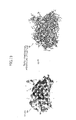
- FIG. 11 and FIG. 12 are diagrams for explaining a comparison of the data amounts in the first drawing example.
- FIG. 11 illustrates a state in which a three-dimensional molecular structure 7b of NKX-2677 from molecular structure data of a HOMO 7a of NKX-2677. Then, the comparison of the data amounts in a case of performing a molecular orbital calculation by using the AM1 will be illustrated in FIG. 12 .
- FIG. 12 a three-dimensional molecular structure 7c is illustrated in which the molecular orbitals are drawn in a case in which the data reduction according to the embodiment is not applied.
- original data that is, the data amount of "33856" bytes are used to calculate the molecular orbitals by the MO function expansion part 44.
- the data amount concerning the expansion coefficients C of the molecular orbitals ⁇ corresponds to that of the expansion coefficient data 40 ( FIG. 9 ). That is, the data amount is regarded as N 2 values of the expansion coefficients C.
- the second MO data 136 which is reduced by the MO data reduction part 47, are used in a three-dimensional molecular structure 7d in which the molecular orbitals are drawn.
- the data amount of "16337" bytes, which are reduced from the original data (for example, the first MO data 134), are used.
- a ratio to the original data amount (drawing calculation amount) indicates 48%.
- the number m of the expansion coefficients C after the data reduction performed to the expansion coefficient data 6b corresponds to the reduced data amount.
- FIG. 13 and FIG. 14 are diagrams for explaining a comparison of the data amounts in the second drawing example.
- a three-dimensional structure 8b is created and depicted by representing a ball and stick model based on molecular structure data of a HOMO 8a of the protein molecular 1BFP represented by a ribbon model, in a state in which hydrogen of the protein molecular 1BFP is added.
- a comparison of data mounts is illustrated in FIG. 14 .
- the three-dimensional molecular structure 8c is illustrated in a case in which the data reduction according to the embodiment is not applied and the molecular orbitals are drawn.
- the original data that is, the data amount of "91107025" bytes calculated by the MO function expansion part 44 are used.
- the data amount pertinent to the expansion coefficients C of the molecular orbitals ⁇ which are stored in the case of performing the AM1 method, correspond to that of the expansion coefficient data 40.
- the data amount is regarded as N 2 values of the expansion coefficients C.
- a three-dimensional molecular structure 8d is illustrated in a case in which the data reduction according to the embodiment is applied and the molecular orbitals are drawn.
- the second MO data 136 reduced by the MO data reduction part 47 are used. That is, the data amount of "3232281" bytes, which is reduced from the original data (which may be the first MO data 134), is used. A ratio to the original data amount (drawing calculation amount) indicates 3.5%.
- the number m of the expansion coefficients C after the data reduction performed to the expansion coefficient data 6b corresponds to the reduced data amount.
- the functional configuration according to the embodiment as illustrated in FIG. 2 and the like it is also possible to significantly reduce the data amount in the second drawing example.
- the approximate molecular orbital functions are depicted with the same quality as the three-dimensional molecular structure 8c. As described above, it is possible to acquire a pertinent drawing result of the molecular orbitals while reducing the calculation amount by the functional configuration according to the embodiment.
- the data amount of the expansion coefficients C acquired in the molecular orbital calculation is not reduced.
- the data amount of the expansion coefficients of the molecular orbitals exponentially increases by N squared (N 2 ).
- N 2 the storage part 130 of the molecular design apparatus may be considerably consumed.
- the molecular orbital functions ⁇ are used in which the molecular orbital functions ⁇ are reduced by using the coefficient threshold C cutoff of the expansion coefficients C based on the drawing threshold ⁇ cutoff indicating a constant function value to draw the molecular orbital functions ⁇ as the isosurface of the constant function value.
- the molecular orbital functions ⁇ are represented by the basis functions ⁇ and the expansion coefficients C.
- the molecular design apparatus in which the data amount is significantly reduced while retaining drawing information of the molecular orbitals, instead of losing the drawing information. It is possible to draw the molecular orbitals at higher speed, and to considerably reduce a storage area for the data amount.
- the invention also provides a computer program or a computer program product for carrying out any of the methods described herein, and a computer readable medium (which may be non-transitory) having stored thereon a program for carrying out any of the methods described herein.
- a computer program embodying the invention may be stored on a computer-readable medium, or it could, for example, be in the form of a signal such as a downloadable data signal provided from an Internet website, or it could be in any other form.
Landscapes
- Physics & Mathematics (AREA)
- Engineering & Computer Science (AREA)
- General Physics & Mathematics (AREA)
- Theoretical Computer Science (AREA)
- Chemical & Material Sciences (AREA)
- Crystallography & Structural Chemistry (AREA)
- Spectroscopy & Molecular Physics (AREA)
- Educational Technology (AREA)
- Mathematical Optimization (AREA)
- Mathematical Physics (AREA)
- Pure & Applied Mathematics (AREA)
- Business, Economics & Management (AREA)
- Mathematical Analysis (AREA)
- Educational Administration (AREA)
- Computational Mathematics (AREA)
- Algebra (AREA)
- Bioinformatics & Cheminformatics (AREA)
- Geometry (AREA)
- Evolutionary Computation (AREA)
- General Engineering & Computer Science (AREA)
- Health & Medical Sciences (AREA)
- Computer Hardware Design (AREA)
- General Health & Medical Sciences (AREA)
- Medicinal Chemistry (AREA)
- Pharmacology & Pharmacy (AREA)
- Life Sciences & Earth Sciences (AREA)
- Bioinformatics & Computational Biology (AREA)
- Computing Systems (AREA)
- Management, Administration, Business Operations System, And Electronic Commerce (AREA)
Abstract
Description
- The embodiment discussed herein is related to a molecular design apparatus and method for drawing molecular orbitals on a screen of a display device based on molecular structure design data.
- In research and development of a high technology related to drug design or the like, needs of a molecular orbital calculation using a computer have been increased. The molecular orbital function is useful for research of photoresponsiveness and reactivity of a molecule to be a development target. Especially, molecular orbitals such as a HOMO (Highest Occupied Molecular Orbital) and a LUMO (Lowest Unoccupied Molecular Orbital) are frequently drawn by a three-dimensional drawing using the computer. In order to draw the molecular orbitals, a molecular orbital drawing program and a molecular orbital drawing apparatus are used. A GUI (Graphical User Interface) for an easy user operation is realized.
- However, in the above-described drawing of the molecular orbitals, especially in a case of handling a large scale molecule, a calculation using a large amount of data is performed. In many molecular orbital calculation programs, expansion coefficients of the molecular orbitals acquired from a molecular orbital calculation result are output to a file. By a molecular orbital drawing program, a drawing process is executed. In the drawing process, expansion coefficient data and basis function data are read out from the file and values of molecular orbital functions are calculated. Alternatively, in addition to the file to which the expansion coefficients are output, a result file may be output as a result from actually calculating function values of three-dimensional lattice points. The molecular orbital drawing program may read the result file, and then, the drawing process may be performed.
- In a case in which a data amount related to the drawing process is increased, a drawing time may be delayed. In order to improve drawing speed, values of basis functions of the three-dimensional lattice points may be calculated beforehand. Moreover, lattice points themselves may be reduced.
- Japanese Laid-open Patent Publication No.
H06-168304 - Japanese Laid-open Patent Publication No.
H08-16546 - Accordingly, it is a general object of the invention to provide a molecular design apparatus in which a data amount is significantly reduced while retaining drawing information of molecular orbitals, instead of losing drawing information, so as to draw the molecular orbitals at higher speed, and to considerably reduce a storage area for the data amount.
- According to one aspect of the embodiment, there is provided a molecular design apparatus, including a storage part configured to store molecular structure design data; a molecular orbital function expansion part configured to calculate expansion coefficients applied to basis functions by expanding a molecular orbital function used to draw molecular orbitals based on the molecular structure design data, and stores first molecular orbital data in which the expansion coefficients are corresponded to the basis functions to the storage part; and a molecular orbital data reduction part configured to determine a coefficient threshold for the expansion coefficients of the basis functions acquired by the molecular orbital function expansion part by using a drawing threshold which indicates a constant function value, to draw the molecular orbital functions as an isosurface of the constant function value on a screen of a display device, and to store second molecular orbital data pertinent to the expansion coefficients based on the coefficient threshold to the storage part.
- According to other aspects of the embodiment, there may be provided a molecular design method conducted by a computer, and a non-transitory computer-readable recording medium storing a program for causing the computer to operate as the above-described molecular design apparatus.
-
-
FIG. 1 is a diagram illustrating a hardware configuration of a molecular design apparatus; -
FIG. 2 is a diagram illustrating a functional configuration example of the molecular design apparatus; -
FIG. 3 is a diagram for explaining a drawing threshold ϕcutoff for molecular orbital functions; -
FIG. 4 is a diagram for explaining a basis threshold χcutoff; -
FIG. 5 is a diagram for explaining a maximum number NAtom max; -
FIG. 6 is a flowchart for explaining a threshold determination process; -
FIG. 7 is a diagram for explaining a data reduction process concerning an ith molecular orbital function ϕ; -
FIG. 8A andFIG. 8B are flowcharts for explaining a data deletion storing process performed by a data deletion storage part; -
FIG. 9 is a diagram illustrating an example of second MO data; -
FIG. 10 is a flowchart for explaining a molecular orbital function determination process; -
FIG. 11 is a diagram for explaining a comparison of data amounts in a first drawing example; -
FIG. 12 is a diagram for explaining the comparison of data amounts in the first drawing example; -
FIG. 13 is a diagram for explaining a comparison of the data amounts in a second drawing example; and -
FIG. 14 is a diagram for explaining the comparison of the data amount in the second drawing example. - In the following, an embodiment of the present invention will be described with reference to the accompanying drawings. A
molecular design apparatus 100 according to the embodiment includes a hardware configuration as illustrated inFIG. 1 .
FIG. 1 is a diagram illustrating the hardware configuration of themolecular design apparatus 100. InFIG. 1 , themolecular design apparatus 100 may be a terminal controlled by a computer, and may include a CPU (Central Processing Unit) 11, amain memory 12, anauxiliary storage device 13, aninput device 14, adisplay device 15, anoutput device 16, a communication interface (I/F) 17, and adrive device 18, which are mutually connected via a bus B. - The
CPU 11 controls themolecular design apparatus 100 in accordance with programs stored in themain memory 12. Themain memory 12 may include a Random Access Memory (RAM), a ROM (Read-Only Memory), or the like. Themain memory 12 stores programs executed by theCPU 11, data used in processes conducted by theCPU 11, data acquired in the processes conducted by theCPU 11, and the like. Also, a part of an area of themain memory 12 may be used as a working area for the processes conducted by theCPU 11. - The
auxiliary storage device 13 may include a hard disk drive, and may store data such as the programs to perform Various processes. A part of a program stored in theauxiliary storage device 13 is loaded to themain memory 12, and is executed by theCPU 11. Accordingly, various processes are realized. Astorage part 130 may include themain memory 12 and/or theauxiliary storage device 13. - The
input device 14 may include one or more operation parts such as a pointing device such as a mouse, a keyboard or the like. Theinput device 14 may be used for a user to input various information items for the processes in themolecular design apparatus 100. Thedisplay device 15 is used to display various information items under a control of theCPU 11. Theoutput device 16 may include a printer or the like. Theoutput device 16 is used for the user to output various information items in response to an instruction of the user. The communication I/F 17 is used to connect to the Internet, a Local Area Network (LAN), or the like. The communication I/F 17 corresponds to a device for controlling a communication with an external device. - The program, which may realize the process performed by the
molecular design apparatus 100, may be provided by arecording medium 19 such as a CD-ROM (Compact Disc Read-Only Memory) or the like. That is, when therecording medium 19 storing the program is set to thedrive device 18, the program is read out by thedrive device 18 from therecording medium 19, and is installed to theauxiliary storage device 13 through the bus B. Accordingly, when theCPU 11 is instructed to execute the program, theCPU 11 starts the process in accordance with the program installed in theauxiliary storage device 13. Therecording medium 19 for storing the program is not limited to the CD-ROM. Any camputer-readable recording medium may be used as therecording medium 19. In addition to the CD-ROM, a portable recording medium such as a Bus Digital Versatile Disk (DVD), a Universal Serial Bus (USB) memory, a semiconductor memory such as a flash memory, or the like may be used as the comptater-readable recording medium 19. - Also, the program for realizing the process performed by the
molecular design apparatus 100 may be provided from the external device through the communication I/F 17. Alternatively, the program may be provided to the external device. Each of processes, which will be described later, may be realized at the external device. The communication through the communication I/F 17 is not limited to a wireless or wired communication. -
FIG. 2 is a diagram illustrating a functional configuration example of themolecular design apparatus 100. InFIG. 2 , portions according to the embodiment will be illustrated, and other portions are omitted. InFIG. 2 , themolecular design apparatus 100 includes a molecularstructure design part 41, a molecularorbital calculation part 43, and a molecular orbital (MO)function expansion part 44, and anMO drawing part 48. The molecularstructure design part 41, the MOfunction expansion part 44, and theMO drawing part 48 may be realized by processes which are performed by theCPU 11 executing respective programs. - The molecular
structure design part 41 conducts the molecular structure design based on data pertaining to the molecular structure. The data are input from theinput device 14 by the user. A main window for the user to work is displayed by the molecularstructure design part 41 on a screen of thedisplay device 15. The user operates an atom item, a bond axis item, and the like to be displayed in the main window, by using the pointing device, the keyboard, or the like, so as to build a three-dimensional structure of a molecule in the main window. Molecularstructure design data 132, which is created by operations of the user, are stored in thestorage part 130. - The molecular
orbital calculation part 43 calculates a molecular orbital based on the molecularstructure design data 132. In the embodiment, the molecularorbital calculation part 43 reduces as much as possible a data amount of a calculation result of the molecular orbital without losing drawing data of the molecular orbital. - The molecular
orbital calculation part 43 calculates the molecular orbital based on the molecularstructure design data 132 by a molecular orbital function represented by a linear combination of multiple basis functions which are prepared beforehand. The molecularorbital calculation part 43 further includes the MOfunction expansion part 44, athreshold determination part 45, and a datadeletion storage part 46. Thethreshold determination part 45 and the datadeletion storage part 46 correspond to a MOdata reduction part 47 for reducing the data amount of the calculation result of the molecular orbital. - The MO
function expansion part 44 calculates coefficients (hereinafter, called "expansion coefficients") concerning the multiple basis functions to expand the molecular orbital function into the multiple basis functions. In the embodiment, the molecular orbital calculation is performed to acquire the expansion coefficients respective to the multiple molecular orbital functions. In the following, the "molecular orbital" and the "molecular orbital function" are synonymous in a molecular orbital calculation process. The molecular orbital function represents a state of an electron in a molecule. An orbital function value in coordinates is raised to the power of two. In detail, by using an expression (1), the expansion coefficients of the molecular orbital function are calculated.
- In the above expression (1), ϕi indicates an ith molecular orbital function, r indicates coordinates used to acquire a function value, and χp indicates a pth basis function. N indicates a total number of the basis functions, and Cpi indicates an expansion coefficient applied to the pth basis function in a case in which an ith molecular orbital function is expanded into the multiple basis functions.
First MO data 134 are stored in thestorage part 130. In thefirst MO data 134, the expansion coefficients Cpi correspond to the pth basis function for each ith molecular orbital function. - The
threshold determination part 45 determines thresholds of the above-described coefficients used to createsecond MO data 136 for drawing the molecular orbital. By using thesecond MO data 136, it is possible for theMO drawing part 48 to draw the molecular orbital at high speed. A coefficient threshold Ccutoff is determined by an expression (3) acquired from an expression (2) based on the expression (1).

- In the above expressions (2) and (3), in a case in which the molecular orbital is drawn, ϕcutoff represents a threshold (corresponding to a drawing threshold) of the molecular orbital to set to an isosurface. Also, α represents a value acquired by multiplying the number of the basis functions belonging to each of atoms with a ratio of the number of electrons with respect to a total number of basis, a basis ratio respective to the value, or the like. NAtom max represents a maximum value of atoms in a range where the basis functions are overlapped. The coefficient threshold Ccutoff represents a threshold of the expansion coefficient of the molecular orbital function. χcutoff represents a threshold of the basis function to ignore relationships with other basis functions, regarding a radial distribution function of the basis function.
- The data
deletion storage part 46 reduces the data amount of thefirst MO data 134, and also stores thesecond MO data 136 for theMO drawing part 48 to acquire an approximate molecular orbital function. - The data
deletion storage part 46 specifies, by referring to thefirst MO data 134, the expansion coefficients Cpi being greater than or equal to coefficient threshold Ccutoff calculated by athreshold determination part 45, the basis function χp corresponding to the expansion coefficients Cpi, and the number of elements to acquire the approximate molecular orbital function for the ith molecular orbital function acquired by the MOfunction expansion part 44. The datadeletion storage part 46 stores the expansion coefficients Cpi, the basis function χp, and the number of elements to thesecond MO data 136 in thestorage part 130, and sets "True" to areduction flag 6a of thesecond MO data 136 to validate thesecond MO data 136. Initially, "False" is set to thereduction flag 6a to invalidate thesecond MO data 136. - The expansion coefficients Cpi being greater than or equal to the coefficient threshold Ccutoff is stored in
expansion coefficient data 6b. Preferably, the expansion coefficients Cpi may be stored in one dimensional array V. Basisfunction indication data 6c stores an entity of the basis function χp corresponding to the expansion coefficients Cpi stored in theexpansion coefficient data 6b, or a pointer to the basis function χp existing in thefirst MO data 134. In this case, one dimensional array VBasis may be used for the basis function χp. Also, the number of the basis functions χp, which is applied after the reduction of the data amount, corresponds to an element number of the array VBasis. One dimensional array VOrbital represents elements of the array V for the expansion coefficients Cpi for each of the molecular orbital functions, and is stored inMO indication data 6d. - The
MO drawing part 48 draws the molecular orbital on the molecular structure in the window of thedisplay device 15 by using the molecular orbital function calculated by the molecularorbital calculation part 43. If thereduction flag 6a of thesecond MO data 136 indicates "True" (thesecond MO data 136 is validated), the molecularorbital drawing part 48 draws the molecular orbital on the molecular structure by using the approximate molecular orbital function by referring to thesecond MO data 136. On the other hand, if thereduction flag 6a indicates "False" (thesecond MO data 136 is invalidated), the molecularorbital drawing part 48 draws the molecular orbital on the molecular structure by using thefirst MO data 134. - The molecular
orbital drawing part 48 includes a MOfunction determination part 49. If thereduction flag 6a indicates "True", the MOfunction determination part 49 calculates approximate molecular orbital function by referring to thesecond MO data 136. The molecularorbital drawing part 48 acquires a molecular orbital function value by using the approximate molecular orbital function calculated by the MOfunction determination part 49, and draws the molecular orbital on the molecular structure based on the molecularstructure design data 132. Drawingdata 138 for drawing the molecular orbital on the molecular structure are stored in thestorage part 130. - Next, a threshold determination process will be described. The threshold determination process is performed by the
threshold determination part 45 to reduce the data amount of the expansion coefficients of the molecular orbitals. - The
threshold determination part 45 acquires each of the following values to calculate the coefficient threshold Ccutoff indicating a threshold value of the expansion coefficients of the molecular orbital functions, in which the coefficient threshold Ccutoff is expressed by the above expression (3). - (A1) a drawing threshold ϕcutoff for the molecular orbital functions to draw the molecular orbitals,
- (A2) a base threshold χcutoff in which influence to other basis functions becomes sufficiently small in a space distribution of the basis function,
- (A3) a threshold rχ max of a distance where the basis function and other basis functions are sufficiently overlapped,
- (A4) a maximum value NAtom max of the number of atoms included in a sphere having a
radius 2rχ max from a center of each of the atoms, - (A5) a value α acquired by multiplying the number of bases for each of the atoms with a ratio of the number of electrons with respect to a total number of bases, and the like.
- The above item (A1) will be described with reference to
FIG. 3. FIG. 3 is a diagram for explaining the drawing threshold ϕcutoff for the molecular orbital functions. In a graph illustrated inFIG. 3 , a vertical axis indicates a function value, and a horizontal axis indicates coordinates. Drawing using the molecular orbital functions may be performed as drawing isosurface determined by an absolute value of a certain function value. By setting the drawing threshold ϕcutoff of afunction 3f, function values between +ϕcutoff and -ϕcutoff are not used. TheMO drawing part 48 displays amolecular structure 3a at thedisplay device 15. In themolecular structure 3a, the molecular orbitals are drawn by using the function values which are greater than or equal to +ϕcutoff or less than or equal to - ϕcutoff. The drawing threshold ϕcutoff may be a value set by a user. - The above items (A2) and (A3) will be described with reference to
FIG. 4. FIG. 4 is a diagram for explaining the basis threshold χcutoff. InFIG. 4 , the basis threshold χcutoff indicates a threshold in which influence from the basis functions to other basis functions becomes sufficiently smaller. The basis functions are used to expand to the molecular orbital functions. Basis function values being less than or equal to the basis threshold χcutoff are deleted. - In a case of considering the influence to the other basis functions, a distribution function D (an expression (6)) may be used. The distribution function D may be regarded as a distribution function of a radial function R (an expression (5)) forming a basis function χ (an expression (4)).


- In the expressions (4) to (6), χSTO nlm indicates a basis function using a Slater Type Orbital (STO), n indicates a principal quantum number, 1 indicates an azimuthal quantum number, and m indicates a magnetic quantum number. RSTO n(r) indicates the radial function of the Slater Type Orbital in radial coordinates r, and n indicates the principal quantum number. Ylm(θ,ϕ) indicates spherical harmonics of the Slater Type Orbital in angular coordinates θ and ϕ, 1 indicates the azimuthal quantum number, and m indicates a magnetic quantum number.
- ζ indicates an orbital exponent (a coefficient of an exponent of the radial function). DSTO n,ζ indicates a radial distribution function of the Slater Type Orbital, and n indicates the principal quantum number. Also, rχ max indicates the radial coordinates determined by the threshold of the basis function.
- The above item (A4) will be described with reference to
FIG. 5. FIG. 5 is a diagram for explaining the maximum number NAtom max. The maximum number NAtom max indicates a maximum value of the total number of the atoms in a case of considering the influence of the basis function belonging to an atom to other basis functions belonging to other atoms for each atom. Coordinates are set as rχ max when the coordinates indicate a function value of the distribution function D corresponding to the basis threshold (FIG. 4 ). In this case, if centers of other atoms are included in a sphere of aradius 2rχ max from each of the atoms, it is considered that the basis functions may influence each other (FIG. 5 ). - In
FIG. 5 , NAtom max indicates the maximum value of the number of the atoms included in the sphere of theradius 2rχ max from the center of each of the atoms. - The above item (A5) will be described. α indicates a value which results from multiplying the number of the basis functions belonging to each of the atoms with a ratio of an electron number with respect to the total number of the basis functions, or an other value respective to the calculated value. When α is calculated, a HOMO (Highest Occupied Molecular Orbital) in a region which tends to give an electron or a LUMO (Lowest Unoccupied Molecular Orbital) in a region which tends to receive the electron may be considered. αNAtom max is regarded as the number of the basis functions which are actually overlapped with respect to the total number N of the basis functions in the expression (1) for calculating the molecular orbital functions. Accordingly, it is possible to determine the drawing threshold ϕcutoff based on a relational expression (the above expression (2)), and to determine a pertinent coefficient threshold Ccutoff by the above expression (3).
-
FIG. 6 is a flowchart for explaining a threshold determination process. InFIG. 6 , thethreshold determination part 45 sets the drawing threshold ϕcutoff of the molecular orbital functions (step S61). Also, thethreshold determination part 45 calculates and sets the basis threshold χcutoff in which the influence to other basis functions becomes sufficiently small in the space distribution of the basis function (step S62). - The
threshold determination part 45 acquires the threshold rχ max of the distance where the basis function and other basis functions are significantly overlapped based on a distribution function D and the basis threshold χcutoff of the basis function χ (step S63). Thethreshold determination part 45 acquires a maximum value of the number of atoms in the sphere of theradius 2rχ max from each of the atoms, and sets the maximum number NAtom max (step S64). Moreover, thethreshold determination part 45 acquires α based on the number of the basis functions and the HOMO (step S65). Instead of the HOMO, α related to the LUMO may be acquired. The user may indicate the HOMO or LUMO beforehand. - Next, the
threshold determination part 45 obtain the coefficient threshold Ccutoff based on the drawing threshold ϕcutoff, the basis threshold χcutoff, and the maximum value NAtom max, and α (step S66). - Based on the coefficient threshold Ccutoff determined in a process conducted by the
threshold determination part 45, the datadeletion storage part 46 creates and stores contents of thesecond MO data 136 in thestorage part 130. - A data reduction process will be described with reference to
FIG. 7 . For the ith molecular orbital function ϕi, the data reduction process is performed by the datadeletion storage part 46.FIG. 7 is a diagram for explaining the data reduction process concerning the ith molecular orbital function ϕi. InFIG. 7 , the ith molecular orbital function ϕi will be described by using ϕi data 134-2 pertinent to the ith molecular orbital function ϕi in thefirst MO data 134 stored in thestorage part 130. - In the ϕi data 134-2, the expansion coefficients Cpi pertinent to the basis functions χp (p=1, 2, ..., N) corresponding to the basis functions χ1 through χN, respectively.
- The data
deletion storage part 46 stores the expansion coefficients Cpi being greater than or equal to the coefficient threshold Ccutoff in one dimensional array V. In an order of p from 1 to N, the expansion coefficients Cpi being greater than or equal to the coefficient threshold Ccutoff are stored in elements from ji start to ji End of the array V. The ji Start indicates a first expansion coefficient Cpi after the data reduction process related to the ith molecular orbital ϕi (may be called "molecular orbital function ϕi"). The ji End indicates a last expansion coefficient Cpi after the data reduction process related to the ith molecular orbital ϕi. - Also, when storing the expansion coefficients Cpi (greater than or equal to the coefficient threshold Ccutoff) after the data reduction, the data
deletion storage part 46 stores pointers to the basis functions χp corresponding to the expansion coefficient Cpi being greater than or equal to the coefficient threshold Ccutofff, to elements from ji Start to jEnd of the array VBasis. - Furthermore, the data
deletion storage part 46 manages elements from ji Start to jEnd by using one dimensional array Vorbital. By setting ji Start to an ith element (VOrbital[i]) of the array VOrbital, the element number is acquired by deducting VOrbital[i] from VOrbital[i+1]. - As described above, ϕi' data 136-2 pertinent to the ith molecular orbital ϕi are created. In the ϕi' data 136-2, data from the array V[ji Start] to the array V[ji End] correspond to a part of the
expansion coefficient data 6b in thesecond MO data 136 inFIG. 2 . Data from the array VBasis[ji Start] to the array VBasis[ji End] correspond to a part of the basisfunction indication data 6c. The array VOrbital[i] corresponds to a part of the theMO indication data 6d. - In order to approximate the above expression (1), the expression (1) may be replaced by using an array based on the following relational expression (A).
- Cpi => V[i],
χ p => χVBasis[l],
N => ji End- ji Start+1=VOrbital[i+1]-VOrbital[i] - The expansion coefficient Cpi is represented by V[1], and χp is represented by χVBasis[1]. Also, the total number N of the basis functions is represented by the number (ji End-ji Start+1 = VOrbital[i+1]-VOrbital[i]) of the basis functions to be applied.
- As described above, by approximating the above expression (1), the expression (1) may be represented by an approximated molecular functions such as the following expression (7).

- Also, in a case of a related art in which the embodiment is not applied, the number of the basis functions χp pertaining to the ith molecular orbital ϕi becomes the total number N of the basis functions χp. On the other hand, in a case of applying the embodiment, the number of the basis functions χp pertaining to the ith molecular orbital ϕi becomes the element number acquired by a calculation (VOrbitai[i+1]-VOrbital[i]). Accordingly, a ratio of a calculation amount of the
MO drawing part 48 in the embodiment with respect to that of the related art is indicated by the following expression (8)
The smaller the ratio acquired by the above expression (8) is, at the higher speed the drawing process is performed by theMO drawing part 48. - A data deletion storing process will be described with reference to
FIG. 8A andFIG. 8B . The data deletion storing process is performed by the datadeletion storage part 46 for all molecular orbital functions ϕi.FIG. 8A andFIG. 8B are flowcharts for explaining a data deletion storing process performed by the datadeletion storage part 46. InFIG. 8A , the datadeletion storage part 46sets 1 to a variable i (step S81). The datadeletion storage part 46 acquiresexpansion coefficient data 4i of the ith molecular orbital ϕi from thefirst MO data 134 stored in the storage part 130 (step S82). - The data
deletion storage part 46 stores the expansion coefficients Cpi being greater than or equal to coefficient threshold Ccutoff calculated by athreshold determination part 45 to the elements from ji Start to ji End of the array V in theexpansion coefficient data 6b. Also, the datadeletion storage part 46 stores data indicating the basis functions χi to the elements from ji Start to ji End of the array VBasis in the basisfunction indication data 6c (step S83). - Next, in
FIG. 8B , the datadeletion storage part 46 stores ji Start to the array VOrbital[i] related to the number of the expansion coefficients Cpi being greater than or equal to coefficient threshold Ccutoff in theMO indication data 6d (step S84). - After that, the data
deletion storage part 46 increments the variable i by 1 (step S85), and determines whether the variable i reaches the total number N of the molecular orbital functions ϕ, that is, whether the variable i is equal to the total number N (step S86). If the variable i is not equal to the total number N, the datadeletion storage part 46 goes back to the step S82, and repeats the above described processes. On the other hand, if the variable i is equal to the total number N of molecular orbital functions ϕ, the datadeletion storage part 46 stores a value where 1 is added to ji End in the array VOrbital[i+1] (step S87). Then, the data deletion storing process is terminated. - The
second MO data 136 will be described with reference toFIG. 9 . Thesecond MO data 136 are created by the MOdata reduction part 47 including thethreshold determination part 45 and the datadeletion storage part 46.FIG. 9 is a diagram illustrating an example of thesecond MO data 136.FIG. 9 illustrates a case in which thesecond MO data 136 are created by the MOdata reduction part 47 by deleting data from thefirst MO data 134 created by the MOfunction expansion part 44. - The
first MO data 134 is created by the MOfunction expansion part 44. In thefirst MO data 134, the expansion coefficients C are stored by corresponding to the basis functions χ, respectively, for each of the molecular orbitals ϕ based on the molecularstructure design data 132. - For each of an
atom 1, anatom 2, ..., an atom NA included in the molecular structure, one or more basis functions χ are prepared beforehand. NA indicates the number of the atoms in a molecule. The total number (that is, the total number of the molecular orbitals ϕ) of the basis functions χ pertinent to theatom 1 through the atom NA is indicated by N. The basis functions χ are independent functions. The total number of the expansion coefficients C is represented by N to the power of 2 (N2) Theexpansion coefficient data 6b include N squared values of the expansion coefficients C. - The basis functions χ for depicting orbitals of the
atom 1 are represented with suffixes p1 Start through p1 End, respectively. The basis functions χ for depicting orbitals of theatom 2 are represented with suffixes p2 Start through p2 End, respectively. The basis functions χ for depicting orbitals of the atom NA are represented with suffixes pNA Start through pNA End respectively. The p1 Start indicates a 1st basis function χ, and pNA End indicates a Nth basis function χ. - Each of the molecular orbitals ϕ is specified by the suffix i (i=1, ..., N), and the
expansion coefficient data 4i indicates data of the molecule orbitals ϕi in theexpansion coefficient data 40. Theexpansion coefficient data 6b may be represented by a two dimensional array of N×N. For each of the expansion coefficients C, a first suffix indicates one of the basis functions χ, and a second suffix indicates one of the molecular orbitals ϕ. For the 1st suffix, pi Start is a number to indicate a first function in the basis functions related to the ith atom, and pi End is a number to indicate a last function in the basis functions related to the ith atom. - The
first MO data 134 may includebasis function data 9a representing each of the basis functions χ. Alternatively, thebasis function data 9a may be separately stored in another data file, table, or the like. - In the
second MO data 136 created by the MOdata reduction part 47 based on thefirst MO data 134, the expansion coefficients C from the molecular orbital ϕ1 to the molecular orbital ϕN are stored to the array V in theexpansion coefficient data 6b. - For the first molecular orbital ϕ1, the expansion coefficients C, which are greater than or equal to coefficient threshold Ccutoff, are stored to the elements from the 1st to J1 End in the array V. A first expression coefficient C is represented with a suffix m1 Start, and a last expression coefficient C is represented with a suffix m1 End. For the last molecular orbital ϕN, the expansion coefficients C, which are greater than or equal to coefficient threshold Ccutoff, are stored to the elements from the JN Start to m in the array V. The first expansion coefficient C is represented with a suffix mN Start, and the last expansion coefficient C is represented with a suffix mN End.
- In the basis
function indication data 6c, the basis functions χ, which are used to depict the molecular orbitals ϕ1 through ϕN, are stored in the array VBasis according to an array order of the expansion coefficients C stored in theexpansion coefficient 6b. - For the first molecular orbital ϕ1, the basis function χ, where the first expansion coefficient C with the suffix m1 Start of the array V is used, is stored to the first element of the array VBasis. Also, the basis function χ, where the last expansion coefficient C with the suffix m1 End of the array V is used, is stored to the J1 End element of the array VBasis. Other molecular orbitals ϕi will be explained in the same manner.
- In the
MO indication data 6d, the number identifying the element where the first expansion coefficient C is indicated by the array VOrbital for each of the molecular orbitals ϕ1 to ϕN. A first element number ji Start of the ith molecular orbital ϕ in the array V is stored in VOrbital[i]. A value resulted from adding 1 to the number m of the expansion coefficients C after the data are reduced is stored to a last element VOrbital[N+1] of the array VOrbital. In the embodiment, when the MOdata reduction part 47 is applied so that thesecond MO data 136 is valid, the number m may be also the number of the basis functions χ which are deleted. Accordingly, in a molecular orbital drawing process conducted by theMO drawing part 48, it is possible to reduce the drawing process by the number m of the basis functions χ which are deleted. - In order to acquire molecular orbital function values of a drawing target from the
expansion coefficient data 6b of the molecular orbitals, it is determined whether data for the drawing process are stored in a regular data format (corresponding to thefirst MO data 134 including the entire data) in which the embodiment is applied or in a reduced data format (corresponding to the second MO data 136) in which the embodiment is applied and the data amount is reduced. Thereduction flag 6a may be used - If it is determined, by checking whether the
reduction flag 6a indicates "True" or "False", that the data in the regular data format are to be used for the drawing process, the molecular orbit function values are calculated by the expression (1) using thefirst MO data 134 in the regular data format, and the drawing process is performed. - If it is determined that the
second MO data 136 in the reduced data format are to be used for the drawing process, since the regular data format of thefirst MO data 134 and the reduced data format of thesecond MO data 136 are corresponded to as illustrated inFIG. 7 , values of approximate molecular orbital functions ϕi' are calculated by the above expression (7) based on the above described <Relational Expression A>. The molecular orbitals are drawn by using the values. In this case, compared with the regular data format, a drawing calculation amount is reduced at the ratio expressed by the expression (8). - Next, a molecular orbital function determination process will be described with reference to
FIG. 10 . The molecular orbital function determination process is performed by the MOfunction determination part 49 of theMO drawing part 48 using thesecond MO data 136 to determine the molecular orbital functions.FIG. 10 is a flowchart for explaining the molecular orbital function determination process. InFIG. 10 , steps S103 through S111 correspond to the molecular orbital function determination process P10 conducted by the MOfunction determination part 49. - The
MO drawing part 48 acquires a value of thereduction flag 6a from thesecond MO data 136 stored in the storage part 130 (step S101). - The
MO drawing part 48 determines whether thereduction flag 6a indicates "True", that is, whether thesecond MO data 136 is valid (step S102). When thereduction flag 6a indicates "False", that is, thesecond MO data 136 is invalid, theMO drawing part 48 performs a regular drawing process by the expression (1) using the first MO data 134 (step S102-2), and terminates the molecular orbital function determination process when the regular drawing process ends. - On the other hand, when the
reduction flag 6a indicates "True", that is, thesecond MO data 136 is valid, theMO drawing part 48 instructs the MOfunction determination part 49 to perform the molecular orbital function determination process. The MOfunction determination part 49 reads out theexpansion coefficient data 6b, the basisfunction indication data 6c, and theMO indication data 6d from thesecond MO data 136, and acquires the array V, the array VBasis, and the array VOrbital (step S103). - The MO
function determination part 49sets 1 to a number variable i specifying the ith molecular orbital function ϕ (step S104), and sets VOrbital[i] to an element number variable j (step S105). The element number variable j specifies the both element numbers in the array V for storing the expansion coefficients C and the array VBasis of the basis function χ, which are applied for the molecular orbital function ϕi. In a process in the step S105, the first element number of the molecular orbital function ϕi is set to the element number variable j. - The MO
function determination part 49 sets an expression for multiplying the expansion coefficient C with the basis function χ respective to the first element number, to the element i of an array ϕ representing the molecular orbital function ϕi (ϕ[i]) (step S106).
The MOfunction determination part 49 increments the element number variable j (step S107), and additionally sets an expression for multiplying the expansion coefficient C and the basis function χ respective to the element number variable j, to the element I (ϕ[i]) (step S108).
Accordingly, the MOfunction determination part 49 determines whether the element number variable j is equal to the last element number in the molecular orbital function ϕi (step S109). The MOfunction determination part 49 acquires the array VOrbital[i], and deducts 1 from the array VOrbital[i+1]. Thus, the element number indicating the last element is acquired. The MOfunction determination part 49 may determine whether the element number variable j reaches a value resulted from deducting 1 from the array VOrbital[i+1]. When the element number variable j has not reached the last element number in the molecular orbital function ϕi, that is, when the element number variable j is not equal to the last element number, the MOfunction determination part 49 returns to step S107. - On the other hand, in step S109, when the element number variable j is equal to the last element number in the molecular orbital function ϕi, the MO
function determination part 49 increments the number variable i of the molecular orbital function ϕ by 1 (step S110), and determines whether the number variable i reaches the total number N of the molecular orbital function ϕ by checking whether the number variable i is equal to the total number N (step S111). The MOfunction determination part 49 may determine whether the number variable i is equal to the total number N. When the number variable i is not equal to the total number N, the MOfunction determination part 49 goes back to step S105 and repeats the above described process. - On the other hand, when the number variable i is equal to the total number N, the
MO drawing part 48 determines that all molecular orbital functions ϕi are defined by the MOfunction determination part 49, and draws the molecular orbitals at thedisplay device 15 by using the defined molecular orbital functions ϕi (step S112). After the molecular orbitals are drawn, theMO drawing part 48 terminates the molecular orbital function determination process. - Next, a comparison result of data amounts will be described. The data amount in a case of applying the data reduction according to the embodiment is compared with the data amount in a case in which the embodiment is not applied.
- A first drawing example in a case of drawing the HOMO of an organic molecule NKX-2677 will be described with
FIG. 11 andFIG. 12 . The first drawing example will be depicted in a case of using an Austin Model 1 (AM1) method.FIG. 11 andFIG. 12 are diagrams for explaining a comparison of the data amounts in the first drawing example. -
FIG. 11 illustrates a state in which a three-dimensionalmolecular structure 7b of NKX-2677 from molecular structure data of aHOMO 7a of NKX-2677. Then, the comparison of the data amounts in a case of performing a molecular orbital calculation by using the AM1 will be illustrated inFIG. 12 . - In
FIG. 12 , a three-dimensionalmolecular structure 7c is illustrated in which the molecular orbitals are drawn in a case in which the data reduction according to the embodiment is not applied. For the three-dimensionalmolecular structure 7c, original data, that is, the data amount of "33856" bytes are used to calculate the molecular orbitals by the MOfunction expansion part 44. As illustrated inFIG. 9 , in a case of performing the AM1 method, the data amount concerning the expansion coefficients C of the molecular orbitals ϕ corresponds to that of the expansion coefficient data 40 (FIG. 9 ). That is, the data amount is regarded as N2 values of the expansion coefficients C. - On the other hand, when the data reduction according to the embodiment is conducted, the
second MO data 136, which is reduced by the MOdata reduction part 47, are used in a three-dimensionalmolecular structure 7d in which the molecular orbitals are drawn. In this case, the data amount of "16337" bytes, which are reduced from the original data (for example, the first MO data 134), are used. A ratio to the original data amount (drawing calculation amount) indicates 48%. As illustrated inFIG. 9 , the number m of the expansion coefficients C after the data reduction performed to theexpansion coefficient data 6b corresponds to the reduced data amount. - As described above, by including a functional configuration according to the embodiment as illustrated in
FIG. 2 and the like, in the first drawing example, it is possible to reduce the data amount by approximately one-half. Also, in the three-dimensionalmolecular structure 7d, the approximate molecular orbital functions are depicted with the same quality as the three-dimensionalmolecular structure 7c. As described above, it is possible to acquire a pertinent drawing result of the molecular orbitals while reducing the calculation amount by the functional configuration according to the embodiment. - A second drawing example will be described with reference to
FIG. 13 andFIG. 14 . In the second drawing example, the HOMO of a protein molecular 1BFP (C1156H1941N310O428S7) is depicted. In the second drawing example, a case of using the AM1 method is illustrated.FIG. 13 andFIG. 14 are diagrams for explaining a comparison of the data amounts in the second drawing example. - In
FIG. 13 , a three-dimensional structure 8b is created and depicted by representing a ball and stick model based on molecular structure data of aHOMO 8a of the protein molecular 1BFP represented by a ribbon model, in a state in which hydrogen of the protein molecular 1BFP is added. In a case of performing the molecular orbital calculation using the AM1, a comparison of data mounts is illustrated inFIG. 14 . - In
FIG. 14 , the three-dimensionalmolecular structure 8c is illustrated in a case in which the data reduction according to the embodiment is not applied and the molecular orbitals are drawn. In this case, the original data, that is, the data amount of "91107025" bytes calculated by the MOfunction expansion part 44 are used. As illustrated inFIG. 9 , the data amount pertinent to the expansion coefficients C of the molecular orbitals ϕ, which are stored in the case of performing the AM1 method, correspond to that of theexpansion coefficient data 40. The data amount is regarded as N2 values of the expansion coefficients C. - In a three-dimensional
molecular structure 8d is illustrated in a case in which the data reduction according to the embodiment is applied and the molecular orbitals are drawn. In this case, thesecond MO data 136 reduced by the MOdata reduction part 47 are used. That is, the data amount of "3232281" bytes, which is reduced from the original data (which may be the first MO data 134), is used. A ratio to the original data amount (drawing calculation amount) indicates 3.5%. As illustrated inFIG. 9 , the number m of the expansion coefficients C after the data reduction performed to theexpansion coefficient data 6b corresponds to the reduced data amount. - As described above, by including the functional configuration according to the embodiment as illustrated in
FIG. 2 and the like, it is also possible to significantly reduce the data amount in the second drawing example. Also, in the three-dimensionalmolecular structure 8d, the approximate molecular orbital functions are depicted with the same quality as the three-dimensionalmolecular structure 8c. As described above, it is possible to acquire a pertinent drawing result of the molecular orbitals while reducing the calculation amount by the functional configuration according to the embodiment. - Compared to the related art, even if lattice points are reduced, the data amount of the expansion coefficients C acquired in the molecular orbital calculation is not reduced. Regarding the total number N of independent basis functions, the data amount of the expansion coefficients of the molecular orbitals exponentially increases by N squared (N2). In a case of storing the expansion coefficients C, which are related to multiple large scale molecules, to reuse the expansion coefficients C, the
storage part 130 of the molecular design apparatus may be considerably consumed. - On the other hand, in the molecular design apparatus according to the embodiment, the molecular orbital functions ϕ are used in which the molecular orbital functions ϕ are reduced by using the coefficient threshold Ccutoff of the expansion coefficients C based on the drawing threshold ϕcutoff indicating a constant function value to draw the molecular orbital functions ϕ as the isosurface of the constant function value. The molecular orbital functions ϕ are represented by the basis functions χ and the expansion coefficients C. Thus, it is possible to conduct the drawing process of the molecular orbitals and to visually draw the molecular orbitals at higher speed so that the molecular orbitals are intuitively comprehensible.
- Accordingly, it is possible to provide the molecular design apparatus in which the data amount is significantly reduced while retaining drawing information of the molecular orbitals, instead of losing the drawing information. It is possible to draw the molecular orbitals at higher speed, and to considerably reduce a storage area for the data amount.
- In any of the above aspects, the various features may be implemented in hardware, or as software modules running on one or more processors. Features of one aspect may be applied to any of the other aspects.
- The invention also provides a computer program or a computer program product for carrying out any of the methods described herein, and a computer readable medium (which may be non-transitory) having stored thereon a program for carrying out any of the methods described herein. A computer program embodying the invention may be stored on a computer-readable medium, or it could, for example, be in the form of a signal such as a downloadable data signal provided from an Internet website, or it could be in any other form.
Claims (9)
- A molecular design apparatus, comprising:a storage part (130) configured to store molecular structure design data (132);a molecular orbital function expansion part (44) configured to calculate expansion coefficients applied to basis functions by expanding a molecular orbital function used to draw molecular orbitals based on the molecular structure design data (132), and stores to the storage part first molecular orbital data (134) in which the expansion coefficients are corresponded to the basis functions; anda molecular orbital data reduction part (47) configured to determine a coefficient threshold for the expansion coefficients of the basis functions acquired by the molecular orbital function expansion part by using a drawing threshold which indicates a constant function value, to draw the molecular orbital functions as an isosurface of the constant function value on a screen of a display device, and to store to the storage part second molecular orbital data (136) pertinent to the expansion coefficients based on the coefficient threshold.
- The molecular design apparatus as claimed in claim 1, wherein the molecular orbital data reduction part (47) includes a threshold determination part configured to set a basis threshold indicating function values in a range for ignoring overlaps of a basis function to other basis functions for each of the basis functions in the molecular orbital function, to calculate a coordinate threshold indicating a coordinate value corresponding to the basis threshold, to calculate a maximum value of a number of atoms included in a sphere having a predetermined radius based on the coordinate threshold from a center coordinate of each of the atoms forming a molecule, to calculate a value where a ratio of a total electron number of the molecule to a total number of the basis functions is multiplied to a number of the basis functions for each of the atoms or a basis ratio corresponding to the value, and to determine the coefficient threshold based on the drawing threshold, the basis threshold, the maximum value of the number of the atoms, and the basis ratio.
- The molecular design apparatus as claimed in claim 2, wherein the molecular orbital data reduction part (47) includes a data deletion storage part configured to store the second molecular orbital data (136) including the expansion coefficients being greater than or equal to the coefficient threshold determined by the threshold determination part by referring to the first molecular orbital data (134).
- The molecular design apparatus as claimed in claim 3, wherein the second molecular orbital data (136) includes
a coefficient array which stores the expansion coefficients being greater than or equal to the coefficient threshold;
a basis function indication array in which an element number thereof is equal to the element number of the coefficient array and stores pointers to the basis functions; and
a molecular orbital indication array in which the element number thereof is equal to a total number of the basis functions or is one more than the element number of the basis functions, and which stores a pointer to a first expansion coefficient for each of the molecular orbital functions in the expansion coefficient data, and
when the molecular orbital data reduction part (47) stores the second molecular orbital data (136) in the storage part, a reduction flag in the storage part is set to indicate that the expansion coefficients are reduced. - The molecular design apparatus as claimed in claim 4, further comprising a molecular orbital drawing part configured to draw the molecular orbitals on the screen of the display device by using the first molecular orbital data (134) or the second molecular orbital data (136) stored in the storage part based on the reduction flag,
wherein the molecular orbital drawing part includes a molecular orbital function determination part configured to determine each of approximate orbital functions approximating the molecular orbital functions by using the coefficient array, the basis function indication array, and the molecular orbital indication array in the second molecular orbital data (136), when the reduction flag indicates that the expansion coefficients are reduced. - The molecular design apparatus as claimed in claim 5, wherein the molecular orbital drawing part draws the molecular orbitals by using the first molecular orbital data (134) when the reduction flag does not indicate that the expansion coefficients are reduced.
- A molecular design method performed in a computer, the method comprising:calculating, by the computer, expansion coefficients pertinent to basis functions by expanding molecular orbital functions used to draw molecular orbitals to the basis functions based on molecular structure design data (132) stored in a storage part, and stores first molecular orbital data (134) in which the expansion coefficients are corresponded to the basis functions, to the storage part; anddetermining, by the computer, a coefficient threshold with respect to the expansion coefficients of the basis functions acquired in the calculating, by using a drawing threshold which indicates a constant function value, to draw the molecular orbital functions as an isosurface of the constant function value on a screen of a display device, and to store second molecular orbital data (136) pertinent to the expansion coefficients based on the coefficient threshold to the storage part.
- A program for causing a computer to execute a molecular design process comprising:calculating expansion coefficients pertinent to basis functions by expanding molecular orbital functions used to draw molecular orbitals to the basis functions based on molecular structure design data (132) stored in a storage part, and stores first molecular orbital data (134) in which the expansion coefficients are corresponded to the basis functions, to the storage part: anddetermining a coefficient threshold with respect to the expansion coefficients of the basis functions acquired in the calculating, by using a drawing threshold which indicates a constant function value, to draw the molecular orbital functions as an isosurface of the constant function value on a screen of a display device, and to store second molecular orbital data (136) pertinent to the expansion coefficients based on the coefficient threshold to the storage part.
- A computer-readable recording medium having stored therein a program according to claim 8.
Applications Claiming Priority (1)
| Application Number | Priority Date | Filing Date | Title |
|---|---|---|---|
| JP2012020255A JP5974513B2 (en) | 2012-02-01 | 2012-02-01 | Molecular design apparatus, molecular design method, and molecular design program |
Publications (2)
| Publication Number | Publication Date |
|---|---|
| EP2624240A1 true EP2624240A1 (en) | 2013-08-07 |
| EP2624240B1 EP2624240B1 (en) | 2017-07-05 |
Family
ID=47631173
Family Applications (1)
| Application Number | Title | Priority Date | Filing Date |
|---|---|---|---|
| EP12194942.4A Not-in-force EP2624240B1 (en) | 2012-02-01 | 2012-11-30 | Molecular design apparatus and method |
Country Status (3)
| Country | Link |
|---|---|
| US (1) | US9514253B2 (en) |
| EP (1) | EP2624240B1 (en) |
| JP (1) | JP5974513B2 (en) |
Families Citing this family (1)
| Publication number | Priority date | Publication date | Assignee | Title |
|---|---|---|---|---|
| EP3671492A1 (en) | 2018-12-21 | 2020-06-24 | Dassault Systèmes | Adaptive compression of simulation data for visualization |
Citations (4)
| Publication number | Priority date | Publication date | Assignee | Title |
|---|---|---|---|---|
| JPH06168304A (en) | 1992-11-30 | 1994-06-14 | Teijin Ltd | How to display molecular orbitals |
| JPH0816546A (en) | 1994-06-24 | 1996-01-19 | Mitsubishi Chem Corp | Method of generating lattice point value for displaying one-electron physical property value of molecule and method of displaying molecular orbital |
| US5572439A (en) * | 1991-12-20 | 1996-11-05 | Fujitsu Limited | Molecular design support system |
| WO2008096424A1 (en) * | 2007-02-07 | 2008-08-14 | Fujitsu Limited | Molecule designing method, program, and storage medium |
Family Cites Families (6)
| Publication number | Priority date | Publication date | Assignee | Title |
|---|---|---|---|---|
| JP2804704B2 (en) * | 1992-09-03 | 1998-09-30 | 富士通株式会社 | Function operation system |
| JPH07230480A (en) * | 1994-02-21 | 1995-08-29 | Nec Corp | Generating and plotting system for electron density face/ molecular orbital face |
| EP1673466B1 (en) * | 2003-10-14 | 2012-06-06 | Verseon | Method and apparatus for analysis of molecular combination based on computational estimation of electrostatic affinity using basis expansions |
| JP4741802B2 (en) * | 2004-01-19 | 2011-08-10 | 独立行政法人産業技術総合研究所 | Molecular orbital calculation method and calculation apparatus |
| US8386193B2 (en) * | 2004-09-27 | 2013-02-26 | Japan Science And Technology Agency | Molecular orbital computing device for elongation method |
| JP5266769B2 (en) * | 2008-01-22 | 2013-08-21 | 日本電気株式会社 | Molecular property value generation method and generator |
-
2012
- 2012-02-01 JP JP2012020255A patent/JP5974513B2/en not_active Expired - Fee Related
- 2012-11-30 EP EP12194942.4A patent/EP2624240B1/en not_active Not-in-force
- 2012-12-03 US US13/692,546 patent/US9514253B2/en not_active Expired - Fee Related
Patent Citations (4)
| Publication number | Priority date | Publication date | Assignee | Title |
|---|---|---|---|---|
| US5572439A (en) * | 1991-12-20 | 1996-11-05 | Fujitsu Limited | Molecular design support system |
| JPH06168304A (en) | 1992-11-30 | 1994-06-14 | Teijin Ltd | How to display molecular orbitals |
| JPH0816546A (en) | 1994-06-24 | 1996-01-19 | Mitsubishi Chem Corp | Method of generating lattice point value for displaying one-electron physical property value of molecule and method of displaying molecular orbital |
| WO2008096424A1 (en) * | 2007-02-07 | 2008-08-14 | Fujitsu Limited | Molecule designing method, program, and storage medium |
Also Published As
| Publication number | Publication date |
|---|---|
| US9514253B2 (en) | 2016-12-06 |
| US20130197879A1 (en) | 2013-08-01 |
| EP2624240B1 (en) | 2017-07-05 |
| JP5974513B2 (en) | 2016-08-23 |
| JP2013161137A (en) | 2013-08-19 |
Similar Documents
| Publication | Publication Date | Title |
|---|---|---|
| US7487442B2 (en) | Method, system, and computer-readable medium for the layout of automatically-placed elements and user-placed elements in a chart | |
| US11256996B2 (en) | Method for recommending next user input using pattern analysis of user input | |
| US20110113365A1 (en) | Scrolling large data sets | |
| WO2008019832A1 (en) | Improved monte carlo simulation and display of results thereof | |
| CN106326105A (en) | Method and device for generating test case of application program | |
| US9317489B2 (en) | Vector graphic conversion into fonts | |
| EP2624240B1 (en) | Molecular design apparatus and method | |
| US20230244976A1 (en) | Storage medium, quantum calculation control method, and information processing device | |
| GB2504966A (en) | Data plot processing | |
| US12380617B2 (en) | Visual reordering of partial vector objects | |
| US10042820B2 (en) | Method for converting OOXML formatted spreadsheets to HTML for web presentation | |
| US20090193067A1 (en) | Server-based recalculation of vector graphics | |
| CN105190510A (en) | consume content incrementally | |
| Na et al. | Research on a one-step fast simulation algorithm for bus rollover collision based on total strain theory | |
| KR102076550B1 (en) | Spreadsheet editing apparatus and method | |
| CN115686506A (en) | Data display method and device, electronic equipment and storage medium | |
| US20030052881A1 (en) | Graphical value display program, graphical value display method and recording medium | |
| US11960823B1 (en) | Missing glyph replacement system | |
| EP4361899A1 (en) | Evaluation support program, evaluation support method, and information processing apparatus | |
| JP5602273B1 (en) | Power system simulator, power system simulation program, and simulation method | |
| KR102266073B1 (en) | Electronic device that controls the efficient loading of each sheet that makes up a spreadsheet document based on a multi-thread and operating method thereof | |
| US20240120035A1 (en) | Cutoff energy determination method and information processing device | |
| US20170060818A1 (en) | Managing the display of electronic documents having embedded graphical elements | |
| CN104252455A (en) | Data sequencing method and data sequencing device | |
| Wilding et al. | Two sets of isotones for comparing tests of exponentiality |
Legal Events
| Date | Code | Title | Description |
|---|---|---|---|
| PUAI | Public reference made under article 153(3) epc to a published international application that has entered the european phase |
Free format text: ORIGINAL CODE: 0009012 |
|
| AK | Designated contracting states |
Kind code of ref document: A1 Designated state(s): AL AT BE BG CH CY CZ DE DK EE ES FI FR GB GR HR HU IE IS IT LI LT LU LV MC MK MT NL NO PL PT RO RS SE SI SK SM TR |
|
| AX | Request for extension of the european patent |
Extension state: BA ME |
|
| 17P | Request for examination filed |
Effective date: 20140203 |
|
| RBV | Designated contracting states (corrected) |
Designated state(s): AL AT BE BG CH CY CZ DE DK EE ES FI FR GB GR HR HU IE IS IT LI LT LU LV MC MK MT NL NO PL PT RO RS SE SI SK SM TR |
|
| 17Q | First examination report despatched |
Effective date: 20151130 |
|
| GRAP | Despatch of communication of intention to grant a patent |
Free format text: ORIGINAL CODE: EPIDOSNIGR1 |
|
| INTG | Intention to grant announced |
Effective date: 20170130 |
|
| GRAS | Grant fee paid |
Free format text: ORIGINAL CODE: EPIDOSNIGR3 |
|
| GRAA | (expected) grant |
Free format text: ORIGINAL CODE: 0009210 |
|
| AK | Designated contracting states |
Kind code of ref document: B1 Designated state(s): AL AT BE BG CH CY CZ DE DK EE ES FI FR GB GR HR HU IE IS IT LI LT LU LV MC MK MT NL NO PL PT RO RS SE SI SK SM TR |
|
| REG | Reference to a national code |
Ref country code: GB Ref legal event code: FG4D |
|
| REG | Reference to a national code |
Ref country code: CH Ref legal event code: EP |
|
| REG | Reference to a national code |
Ref country code: AT Ref legal event code: REF Ref document number: 907083 Country of ref document: AT Kind code of ref document: T Effective date: 20170715 |
|
| REG | Reference to a national code |
Ref country code: IE Ref legal event code: FG4D |
|
| REG | Reference to a national code |
Ref country code: DE Ref legal event code: R096 Ref document number: 602012034144 Country of ref document: DE |
|
| REG | Reference to a national code |
Ref country code: FR Ref legal event code: PLFP Year of fee payment: 6 |
|
| REG | Reference to a national code |
Ref country code: NL Ref legal event code: MP Effective date: 20170705 |
|
| REG | Reference to a national code |
Ref country code: AT Ref legal event code: MK05 Ref document number: 907083 Country of ref document: AT Kind code of ref document: T Effective date: 20170705 |
|
| REG | Reference to a national code |
Ref country code: LT Ref legal event code: MG4D |
|
| PG25 | Lapsed in a contracting state [announced via postgrant information from national office to epo] |
Ref country code: NO Free format text: LAPSE BECAUSE OF FAILURE TO SUBMIT A TRANSLATION OF THE DESCRIPTION OR TO PAY THE FEE WITHIN THE PRESCRIBED TIME-LIMIT Effective date: 20171005 Ref country code: FI Free format text: LAPSE BECAUSE OF FAILURE TO SUBMIT A TRANSLATION OF THE DESCRIPTION OR TO PAY THE FEE WITHIN THE PRESCRIBED TIME-LIMIT Effective date: 20170705 Ref country code: HR Free format text: LAPSE BECAUSE OF FAILURE TO SUBMIT A TRANSLATION OF THE DESCRIPTION OR TO PAY THE FEE WITHIN THE PRESCRIBED TIME-LIMIT Effective date: 20170705 Ref country code: NL Free format text: LAPSE BECAUSE OF FAILURE TO SUBMIT A TRANSLATION OF THE DESCRIPTION OR TO PAY THE FEE WITHIN THE PRESCRIBED TIME-LIMIT Effective date: 20170705 Ref country code: LT Free format text: LAPSE BECAUSE OF FAILURE TO SUBMIT A TRANSLATION OF THE DESCRIPTION OR TO PAY THE FEE WITHIN THE PRESCRIBED TIME-LIMIT Effective date: 20170705 Ref country code: SE Free format text: LAPSE BECAUSE OF FAILURE TO SUBMIT A TRANSLATION OF THE DESCRIPTION OR TO PAY THE FEE WITHIN THE PRESCRIBED TIME-LIMIT Effective date: 20170705 Ref country code: AT Free format text: LAPSE BECAUSE OF FAILURE TO SUBMIT A TRANSLATION OF THE DESCRIPTION OR TO PAY THE FEE WITHIN THE PRESCRIBED TIME-LIMIT Effective date: 20170705 |
|
| PG25 | Lapsed in a contracting state [announced via postgrant information from national office to epo] |
Ref country code: ES Free format text: LAPSE BECAUSE OF FAILURE TO SUBMIT A TRANSLATION OF THE DESCRIPTION OR TO PAY THE FEE WITHIN THE PRESCRIBED TIME-LIMIT Effective date: 20170705 Ref country code: LV Free format text: LAPSE BECAUSE OF FAILURE TO SUBMIT A TRANSLATION OF THE DESCRIPTION OR TO PAY THE FEE WITHIN THE PRESCRIBED TIME-LIMIT Effective date: 20170705 Ref country code: GR Free format text: LAPSE BECAUSE OF FAILURE TO SUBMIT A TRANSLATION OF THE DESCRIPTION OR TO PAY THE FEE WITHIN THE PRESCRIBED TIME-LIMIT Effective date: 20171006 Ref country code: BG Free format text: LAPSE BECAUSE OF FAILURE TO SUBMIT A TRANSLATION OF THE DESCRIPTION OR TO PAY THE FEE WITHIN THE PRESCRIBED TIME-LIMIT Effective date: 20171005 Ref country code: PL Free format text: LAPSE BECAUSE OF FAILURE TO SUBMIT A TRANSLATION OF THE DESCRIPTION OR TO PAY THE FEE WITHIN THE PRESCRIBED TIME-LIMIT Effective date: 20170705 Ref country code: RS Free format text: LAPSE BECAUSE OF FAILURE TO SUBMIT A TRANSLATION OF THE DESCRIPTION OR TO PAY THE FEE WITHIN THE PRESCRIBED TIME-LIMIT Effective date: 20170705 Ref country code: IS Free format text: LAPSE BECAUSE OF FAILURE TO SUBMIT A TRANSLATION OF THE DESCRIPTION OR TO PAY THE FEE WITHIN THE PRESCRIBED TIME-LIMIT Effective date: 20171105 |
|
| REG | Reference to a national code |
Ref country code: DE Ref legal event code: R097 Ref document number: 602012034144 Country of ref document: DE |
|
| PG25 | Lapsed in a contracting state [announced via postgrant information from national office to epo] |
Ref country code: CZ Free format text: LAPSE BECAUSE OF FAILURE TO SUBMIT A TRANSLATION OF THE DESCRIPTION OR TO PAY THE FEE WITHIN THE PRESCRIBED TIME-LIMIT Effective date: 20170705 Ref country code: RO Free format text: LAPSE BECAUSE OF FAILURE TO SUBMIT A TRANSLATION OF THE DESCRIPTION OR TO PAY THE FEE WITHIN THE PRESCRIBED TIME-LIMIT Effective date: 20170705 Ref country code: DK Free format text: LAPSE BECAUSE OF FAILURE TO SUBMIT A TRANSLATION OF THE DESCRIPTION OR TO PAY THE FEE WITHIN THE PRESCRIBED TIME-LIMIT Effective date: 20170705 |
|
| PLBE | No opposition filed within time limit |
Free format text: ORIGINAL CODE: 0009261 |
|
| STAA | Information on the status of an ep patent application or granted ep patent |
Free format text: STATUS: NO OPPOSITION FILED WITHIN TIME LIMIT |
|
| PG25 | Lapsed in a contracting state [announced via postgrant information from national office to epo] |
Ref country code: SM Free format text: LAPSE BECAUSE OF FAILURE TO SUBMIT A TRANSLATION OF THE DESCRIPTION OR TO PAY THE FEE WITHIN THE PRESCRIBED TIME-LIMIT Effective date: 20170705 Ref country code: IT Free format text: LAPSE BECAUSE OF FAILURE TO SUBMIT A TRANSLATION OF THE DESCRIPTION OR TO PAY THE FEE WITHIN THE PRESCRIBED TIME-LIMIT Effective date: 20170705 Ref country code: EE Free format text: LAPSE BECAUSE OF FAILURE TO SUBMIT A TRANSLATION OF THE DESCRIPTION OR TO PAY THE FEE WITHIN THE PRESCRIBED TIME-LIMIT Effective date: 20170705 Ref country code: SK Free format text: LAPSE BECAUSE OF FAILURE TO SUBMIT A TRANSLATION OF THE DESCRIPTION OR TO PAY THE FEE WITHIN THE PRESCRIBED TIME-LIMIT Effective date: 20170705 |
|
| 26N | No opposition filed |
Effective date: 20180406 |
|
| PG25 | Lapsed in a contracting state [announced via postgrant information from national office to epo] |
Ref country code: MC Free format text: LAPSE BECAUSE OF FAILURE TO SUBMIT A TRANSLATION OF THE DESCRIPTION OR TO PAY THE FEE WITHIN THE PRESCRIBED TIME-LIMIT Effective date: 20170705 |
|
| PG25 | Lapsed in a contracting state [announced via postgrant information from national office to epo] |
Ref country code: CH Free format text: LAPSE BECAUSE OF NON-PAYMENT OF DUE FEES Effective date: 20171130 Ref country code: LI Free format text: LAPSE BECAUSE OF NON-PAYMENT OF DUE FEES Effective date: 20171130 |
|
| PG25 | Lapsed in a contracting state [announced via postgrant information from national office to epo] |
Ref country code: SI Free format text: LAPSE BECAUSE OF FAILURE TO SUBMIT A TRANSLATION OF THE DESCRIPTION OR TO PAY THE FEE WITHIN THE PRESCRIBED TIME-LIMIT Effective date: 20170705 Ref country code: LU Free format text: LAPSE BECAUSE OF NON-PAYMENT OF DUE FEES Effective date: 20171130 |
|
| REG | Reference to a national code |
Ref country code: BE Ref legal event code: MM Effective date: 20171130 |
|
| REG | Reference to a national code |
Ref country code: IE Ref legal event code: MM4A |
|
| PG25 | Lapsed in a contracting state [announced via postgrant information from national office to epo] |
Ref country code: MT Free format text: LAPSE BECAUSE OF NON-PAYMENT OF DUE FEES Effective date: 20171130 |
|
| REG | Reference to a national code |
Ref country code: FR Ref legal event code: PLFP Year of fee payment: 7 |
|
| PG25 | Lapsed in a contracting state [announced via postgrant information from national office to epo] |
Ref country code: IE Free format text: LAPSE BECAUSE OF NON-PAYMENT OF DUE FEES Effective date: 20171130 |
|
| PG25 | Lapsed in a contracting state [announced via postgrant information from national office to epo] |
Ref country code: BE Free format text: LAPSE BECAUSE OF NON-PAYMENT OF DUE FEES Effective date: 20171130 |
|
| PGFP | Annual fee paid to national office [announced via postgrant information from national office to epo] |
Ref country code: FR Payment date: 20181011 Year of fee payment: 7 |
|
| PG25 | Lapsed in a contracting state [announced via postgrant information from national office to epo] |
Ref country code: HU Free format text: LAPSE BECAUSE OF FAILURE TO SUBMIT A TRANSLATION OF THE DESCRIPTION OR TO PAY THE FEE WITHIN THE PRESCRIBED TIME-LIMIT; INVALID AB INITIO Effective date: 20121130 |
|
| PG25 | Lapsed in a contracting state [announced via postgrant information from national office to epo] |
Ref country code: CY Free format text: LAPSE BECAUSE OF NON-PAYMENT OF DUE FEES Effective date: 20170705 |
|
| PG25 | Lapsed in a contracting state [announced via postgrant information from national office to epo] |
Ref country code: MK Free format text: LAPSE BECAUSE OF FAILURE TO SUBMIT A TRANSLATION OF THE DESCRIPTION OR TO PAY THE FEE WITHIN THE PRESCRIBED TIME-LIMIT Effective date: 20170705 |
|
| PG25 | Lapsed in a contracting state [announced via postgrant information from national office to epo] |
Ref country code: TR Free format text: LAPSE BECAUSE OF FAILURE TO SUBMIT A TRANSLATION OF THE DESCRIPTION OR TO PAY THE FEE WITHIN THE PRESCRIBED TIME-LIMIT Effective date: 20170705 |
|
| PG25 | Lapsed in a contracting state [announced via postgrant information from national office to epo] |
Ref country code: PT Free format text: LAPSE BECAUSE OF FAILURE TO SUBMIT A TRANSLATION OF THE DESCRIPTION OR TO PAY THE FEE WITHIN THE PRESCRIBED TIME-LIMIT Effective date: 20170705 |
|
| PG25 | Lapsed in a contracting state [announced via postgrant information from national office to epo] |
Ref country code: AL Free format text: LAPSE BECAUSE OF FAILURE TO SUBMIT A TRANSLATION OF THE DESCRIPTION OR TO PAY THE FEE WITHIN THE PRESCRIBED TIME-LIMIT Effective date: 20170705 |
|
| PG25 | Lapsed in a contracting state [announced via postgrant information from national office to epo] |
Ref country code: FR Free format text: LAPSE BECAUSE OF NON-PAYMENT OF DUE FEES Effective date: 20191130 |
|
| REG | Reference to a national code |
Ref country code: DE Ref legal event code: R082 Ref document number: 602012034144 Country of ref document: DE Representative=s name: HL KEMPNER PATENTANWAELTE, SOLICITORS (ENGLAND, DE Ref country code: DE Ref legal event code: R082 Ref document number: 602012034144 Country of ref document: DE Representative=s name: HL KEMPNER PATENTANWALT, RECHTSANWALT, SOLICIT, DE Ref country code: DE Ref legal event code: R082 Ref document number: 602012034144 Country of ref document: DE Representative=s name: HL KEMPNER PARTG MBB, DE |
|
| PGFP | Annual fee paid to national office [announced via postgrant information from national office to epo] |
Ref country code: GB Payment date: 20231012 Year of fee payment: 12 |
|
| PGFP | Annual fee paid to national office [announced via postgrant information from national office to epo] |
Ref country code: DE Payment date: 20231003 Year of fee payment: 12 |
|
| REG | Reference to a national code |
Ref country code: DE Ref legal event code: R119 Ref document number: 602012034144 Country of ref document: DE |
|
| GBPC | Gb: european patent ceased through non-payment of renewal fee |
Effective date: 20241130 |
|
| PG25 | Lapsed in a contracting state [announced via postgrant information from national office to epo] |
Ref country code: DE Free format text: LAPSE BECAUSE OF NON-PAYMENT OF DUE FEES Effective date: 20250603 |
|
| PG25 | Lapsed in a contracting state [announced via postgrant information from national office to epo] |
Ref country code: GB Free format text: LAPSE BECAUSE OF NON-PAYMENT OF DUE FEES Effective date: 20241130 |