EP2624234A1 - A system, a method and an apparatus for vehicular communication - Google Patents
A system, a method and an apparatus for vehicular communication Download PDFInfo
- Publication number
- EP2624234A1 EP2624234A1 EP12199230.9A EP12199230A EP2624234A1 EP 2624234 A1 EP2624234 A1 EP 2624234A1 EP 12199230 A EP12199230 A EP 12199230A EP 2624234 A1 EP2624234 A1 EP 2624234A1
- Authority
- EP
- European Patent Office
- Prior art keywords
- vehicle
- embedded
- spectrum
- information
- communication
- Prior art date
- Legal status (The legal status is an assumption and is not a legal conclusion. Google has not performed a legal analysis and makes no representation as to the accuracy of the status listed.)
- Granted
Links
Images
Classifications
-
- H—ELECTRICITY
- H04—ELECTRIC COMMUNICATION TECHNIQUE
- H04B—TRANSMISSION
- H04B11/00—Transmission systems employing ultrasonic, sonic or infrasonic waves
-
- B—PERFORMING OPERATIONS; TRANSPORTING
- B60—VEHICLES IN GENERAL
- B60Q—ARRANGEMENT OF SIGNALLING OR LIGHTING DEVICES, THE MOUNTING OR SUPPORTING THEREOF OR CIRCUITS THEREFOR, FOR VEHICLES IN GENERAL
- B60Q5/00—Arrangement or adaptation of acoustic signal devices
-
- G—PHYSICS
- G08—SIGNALLING
- G08G—TRAFFIC CONTROL SYSTEMS
- G08G1/00—Traffic control systems for road vehicles
- G08G1/07—Controlling traffic signals
- G08G1/087—Override of traffic control, e.g. by signal transmitted by an emergency vehicle
-
- G—PHYSICS
- G08—SIGNALLING
- G08G—TRAFFIC CONTROL SYSTEMS
- G08G1/00—Traffic control systems for road vehicles
- G08G1/09—Arrangements for giving variable traffic instructions
- G08G1/091—Traffic information broadcasting
- G08G1/094—Hardware aspects; Signal processing or signal properties, e.g. frequency bands
-
- G—PHYSICS
- G08—SIGNALLING
- G08G—TRAFFIC CONTROL SYSTEMS
- G08G1/00—Traffic control systems for road vehicles
- G08G1/09—Arrangements for giving variable traffic instructions
- G08G1/0962—Arrangements for giving variable traffic instructions having an indicator mounted inside the vehicle, e.g. giving voice messages
- G08G1/0965—Arrangements for giving variable traffic instructions having an indicator mounted inside the vehicle, e.g. giving voice messages responding to signals from another vehicle, e.g. emergency vehicle
-
- G—PHYSICS
- G07—CHECKING-DEVICES
- G07C—TIME OR ATTENDANCE REGISTERS; REGISTERING OR INDICATING THE WORKING OF MACHINES; GENERATING RANDOM NUMBERS; VOTING OR LOTTERY APPARATUS; ARRANGEMENTS, SYSTEMS OR APPARATUS FOR CHECKING NOT PROVIDED FOR ELSEWHERE
- G07C5/00—Registering or indicating the working of vehicles
- G07C5/008—Registering or indicating the working of vehicles communicating information to a remotely located station
-
- G—PHYSICS
- G08—SIGNALLING
- G08G—TRAFFIC CONTROL SYSTEMS
- G08G1/00—Traffic control systems for road vehicles
- G08G1/14—Traffic control systems for road vehicles indicating individual free spaces in parking areas
- G08G1/149—Traffic control systems for road vehicles indicating individual free spaces in parking areas coupled to means for restricting the access to the parking space, e.g. authorization, access barriers, indicative lights
-
- G—PHYSICS
- G10—MUSICAL INSTRUMENTS; ACOUSTICS
- G10L—SPEECH ANALYSIS TECHNIQUES OR SPEECH SYNTHESIS; SPEECH RECOGNITION; SPEECH OR VOICE PROCESSING TECHNIQUES; SPEECH OR AUDIO CODING OR DECODING
- G10L19/00—Speech or audio signals analysis-synthesis techniques for redundancy reduction, e.g. in vocoders; Coding or decoding of speech or audio signals, using source filter models or psychoacoustic analysis
- G10L19/018—Audio watermarking, i.e. embedding inaudible data in the audio signal
Definitions
- the present invention relates to communication, more particularly the present invention relates to a system, a method, and an apparatus for vehicle communication.
- vehicle-to-vehicle communication system or mobile-to-vehicle communication systems.
- Such communication systems are mostly used for safety, traffic management, driver assistance systems, policing and enforcement, pricing and payments.
- the vehicle-to-vehicle communication system generally utilizes a bandwidth in a range of 5.9 GHz in most countries, while other devices use Wi-Fi, Bluetooth, Near Field Communication (NFC), or some other kind of radio frequency for bi-directional communication.
- Wi-Fi Wireless Fidelity
- Bluetooth Wireless Fidelity
- NFC Near Field Communication
- WO2003085619 by Naresh Kumar Goyle discloses a system that provides a noise free way of communicating signals to enable transfer of precise messages between vehicles that is vehicle-to-vehicle communication.
- the communication system enables a vehicle to convey specific message to nearby vehicle quickly and effectively.
- Naresh Kumar Goyle further discloses generation of signals that are transferred by transceivers to the other vehicles to actuate pre-recorded messages in the system of the other vehicle.
- Such system requires the information to be exchange, to be pre-recorded and available on either side of the communication system.
- the information exchanged between vehicles in such communication is governed by a set of predefined codes, each code points to at least one pre-recorded message that need to be played.
- such communication employs a suitable wireless technology, which may require secure connection, device pairing, time consuming as well as lacks responsiveness to external actuation.
- US20110134971 by Choi et al. discloses a system and a method for transferring and receiving data in an audio frequency band.
- the data to be transmitted are added to an audio signal and the audio signal is transmitted in the audio frequency band, so that the data for the acoustic communication are effectively transmitted to the recipient in the audio frequency band.
- the US 6489885 patent issued to Solow teaches an apparatus for storing horn sound in a digital format instead of using conventional horn mechanisms.
- the main components of the digital circuit disclosed by Solow are clock circuit, counter, a memory location and digital to analog convertor (DAC).
- the application US20110060480 by Mottla et al. teaches a method, a system, and a mobile device that communicates directly with a vehicle-associated control module using either a TCP/IP communications channel or near-field communications.
- a user enters a request through an application provided in the mobile-device.
- the request can be a function, such as unlocking the vehicle doors, illuminating the interior or exterior lights, honking the horn, or activating a panic alarm.
- the disclosure teaches the use on a mobile device to control various function of a vehicle through a secure channel.
- the instruction flow is uni-directional from mobile to vehicle.
- Embodiments of the invention can have the advantage of providing a system utilizing upper audible frequency for vehicle communication.
- Embodiments of the invention can provide a system utilizing upper audible frequency to communicate without modifying the receiving apparatus or to the frequency generator.
- Embodiments of the invention can provide an apparatus that utilizes upper audible frequency for a vehicle communication with a mobile device in vicinity or any apparatus equipped to receive transmitted signals.
- a system uses upper audio band frequency for vehicle communication using a vehicle horn as a mechanism to send a broadcast message.
- the vehicle horn generates the sound wave with information embedded using a processor to be broadcasted to the receiving device.
- the sound waves are captured by the receiving devices in the vicinity thus achieving data communication between a vehicle and the receiving device.
- a method that utilizes upper audio band frequency for vehicle communication to transmit pre-defined broadcast messages.
- the pre-defined broadcast messages or the plurality of information transmitted is attributed the condition under which the vehicle horn is pressed, and whether horn was raised manually or automatically.
- the present invention describes a system for data communication between a vehicle and an external receiving device.
- the invention provides a unique communication means incorporated using software.
- the system uses sound waves in the inaudible frequency range for data communication.
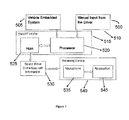
- the system (500) consists of a smart horn (515) which includes a vehicle horn (525) and a first processor (520).
- the first processor (520) is adapted to activate the horn (525) automatically when receives a plurality of signals from a vehicle embedded system (505) or manually when raised by a driver (510).
- the first processor (520) is configured to receive the plurality of signals from a plurality of sensors connected to the vehicle-embedded system (505) and monitor various points in a vehicle.
- the first processor ( 520 ) modulates and embeds a plurality of information (530) in an inaudible upper frequency of a sound spectrum or sound wave generated by the horn (525).
- a receiving device (540) is configured to receive the sound wave embedded with the plurality of information ( 530 ) utilizing at least one microphone (535).
- the inaudible frequency range uses the human-imperceptible portion of audio band (16-20 kHz) with a sampling rate of 44.1 kHz is used for short-range data broadcast transmission between a vehicle and the receiving device ( 540 ).
- the invention enables communication with the existing audio interfaces without requiring any custom-built interfaces.
- the use of upper audio band frequency for data communication reduces the excessive acoustic disturbance.
- the plurality of information transmitted is attributed the condition under which the smart horn (515) is pressed, and whether horn was raised manually or automatically. Furthermore, the speed of broadcast would be slow and hence will not allow detailed messages to be sent.
- the following information is appropriately modulated during the broadcast: Vehicle identification number, Vehicle owner's identification, Vehicle health identification (obtained from vehicle-embedded systems (505) like OBD), Vehicle location details. This information is stored in the vehicle-embedded system (505) or in the internal memory of the smart horn so that smart horn can broadcast appropriately.
- the range for broadcast transmission is not restricted to a specific distance for communication but is governed by the maximum power capability of the speakers of the horn.
- maximum power of the speaker/horn is utilized so that the emergency message/broadcast can transmitted to a maximum range possible.
- the system is utilized for broadcasting emergency signal when a vehicle on road meets with an accident or when the driver goes through a difficult physical emergency. It is important to notify the vehicles around mainly, to request help, or pass the information to the concerned authorities, and to alert vehicles that are near-by or approaching about the emergency so that they are alert to avoid mishaps.
- the smart horn (515) is activated either automatically or manually.
- the automatic activation of horn is enabled, by the input received from the vehicle-embedded system (505), which in turn receives feedback from various sensors coupled to the vehicle system.
- the driver shall initiate the horn press.
- the wait at a traffic signal can prove fatal. Therefore, to clear the traffic, a simple press of the horn will send across the necessary distress message to the traffic controller, configured to receive the transmitted information, which will then expedite the traffic in the concerned lane. Moreover, transmitting the signal through upper audio band frequency would ensure that there is limited interference from the audible noise and the ambulance does not add to the sound pollution.
- the communication signal broadcast information relating to vehicle identification for various purposes, like traffic patrolling, vehicle parking locations for the entry and exit of vehicle, and/or for toll booths.
- the smart horn is configured to pay at a tollbooth or at parking place.
- the pay system is utilized for bi-directional communication for paying.
- the receiving device (540) preferably consists of a microphone (535) and an application (545) to interpret the data transmitted via the smart horn (515).
- the receiving device utilizes a second processor (Not shown) to capture and interpret the plurality of information embedded in the inaudible spectrum.
- the receiving device can be an ordinary mobile phone configured to receive a broadcast message from the vehicle.
- the receiving device (540) demultiplexes the plurality of information sent through the audio band and accordingly interprets it to the user with the help of the application (545).
- a vehicle horn (525) generates the sound wave with embedded information (530) to be broadcasted to the receiving device (540). These sound waves (530) are captured by the receiving devices in the vicinity thus achieving data communication between a vehicle and the receiving device (540).
- FIG. 2 illustrates a method for an embodiment of the present disclosure.
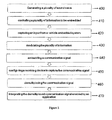
- a method for uni-directional vehicle communication comprising steps of generating a plurality of sound wave (400) having two spectrum, an audible spectrum and an inaudible spectrum, by activating a horn of a vehicle. Controlling a plurality of information (410) to be embedded into the inaudible spectrum by capturing an input from a vehicle embedded system (420). Modulating the plurality of information (430). Embedding a communication signal (440), consisting the plurality of information, into to the inaudible spectrum, and transmitting by the horn. Configuring a receiving device (450) to capture the communication signal embedded in the inaudible spectrum. Demultiplexing the communication signal (460) by a second signal processor embedded in the receiving device. Interpreting the demultiplexed communication signal (470) by an application hosted on the receiving device.
- a smart horn (515) receives a plurality of signals from a plurality of sensors connected to a vehicle-embedded system (505).
- one such sensor can be an airbag deployment sensor or a braking sensor that detects the real-time condition of the vehicle.
- a first processor (520) on receiving the plurality of signals determines the severity of the plurality of signals. On determining the severity, the first processor (520) modulates and embeds a plurality of information (530) in an inaudible upper frequency of a sound spectrum or sound wave generated by the horn (525).
- the plurality of information (530) embedded in the inaudible frequency of the sound spectrum is received by a receiving device (540) having at least one microphone (535) and an application (545) configured to demultiplex, interpret and display the plurality of information to at least one user of the receiving device (540).
- the plurality of information in present scenario, being a distress signal is read by the user and accordingly responds to the situation.
- the present disclosure is installed in an emergency vehicle.
- the emergency vehicle When the emergency vehicle is responding to an emergency and is waiting for a traffic signal clearance.
- a simple press of a smart horn (515) will send across the necessary distress message to an intelligent traffic controller (or receiving device (540)) configured to demultiplex and interpret the distress messages transmitted.
- Transmitting the sound wave with plurality of information (530) embedded, through upper audio frequency ensures limited interference from the audible noise.
- the intelligent traffic controller on receiving and interpreting the plurality of information in the form of distress message will expedite the traffic in a lane attributed the emergency vehicle.
- the present disclosure is applied for car-pooling and corporate transportation that organization and technology parks offer in developing nations.
- the car-pooling employees can register their vehicles at the transportation desk.
- the transportation group at the transportation desk allots code for each location in the city; the employee can load these codes in their mobile.
- a cab configured for car-pooling reaches at a predetermined position will transmit the information of its Vehicle ID, the destination code, the available vacancies, using the smart horn (515) in the upper audio band frequency for the receiving device (540) to capture.
- the receiving device (540) is further configured to send the information received to an employee or subscribed user. This enables to reduce the traffic congestion and allows for a quick pick up for the employees.
Landscapes
- Engineering & Computer Science (AREA)
- Physics & Mathematics (AREA)
- General Physics & Mathematics (AREA)
- Signal Processing (AREA)
- Business, Economics & Management (AREA)
- Emergency Management (AREA)
- Computer Networks & Wireless Communication (AREA)
- Acoustics & Sound (AREA)
- Mechanical Engineering (AREA)
- Multimedia (AREA)
- Mobile Radio Communication Systems (AREA)
Abstract
Description
- The present invention relates to communication, more particularly the present invention relates to a system, a method, and an apparatus for vehicle communication.
- An increasing number of vehicles are now equipped with vehicle-to-vehicle communication system, or mobile-to-vehicle communication systems. Such communication systems are mostly used for safety, traffic management, driver assistance systems, policing and enforcement, pricing and payments.
- The vehicle-to-vehicle communication system generally utilizes a bandwidth in a range of 5.9 GHz in most countries, while other devices use Wi-Fi, Bluetooth, Near Field Communication (NFC), or some other kind of radio frequency for bi-directional communication.
- In an application no.
WO2003085619 by Naresh Kumar Goyle discloses a system that provides a noise free way of communicating signals to enable transfer of precise messages between vehicles that is vehicle-to-vehicle communication. The communication system enables a vehicle to convey specific message to nearby vehicle quickly and effectively. Naresh Kumar Goyle further discloses generation of signals that are transferred by transceivers to the other vehicles to actuate pre-recorded messages in the system of the other vehicle. Such system requires the information to be exchange, to be pre-recorded and available on either side of the communication system. Moreover, the information exchanged between vehicles in such communication is governed by a set of predefined codes, each code points to at least one pre-recorded message that need to be played. In addition to being a pre-structured, such communication employs a suitable wireless technology, which may require secure connection, device pairing, time consuming as well as lacks responsiveness to external actuation. - In an application,
US20110134971 by Choi et al. discloses a system and a method for transferring and receiving data in an audio frequency band. The data to be transmitted are added to an audio signal and the audio signal is transmitted in the audio frequency band, so that the data for the acoustic communication are effectively transmitted to the recipient in the audio frequency band. -
US 2005/0049732 by Kanevsky et al. andUS 2010/0030838 by Atsmon et al. discuss communication between two intelligent elements using acoustic means. While Kanevsky et al. focus on using existing audio hardware like speakers and microphone for audio transmission, Atsmon et al. focus on using ultrasonic frequencies of range less than 50 kHz with special ultrasonic transducers. - The
US 6489885 patent issued to Solow , teaches an apparatus for storing horn sound in a digital format instead of using conventional horn mechanisms. The main components of the digital circuit disclosed by Solow are clock circuit, counter, a memory location and digital to analog convertor (DAC). - The application
US20110060480 by Mottla et al. teaches a method, a system, and a mobile device that communicates directly with a vehicle-associated control module using either a TCP/IP communications channel or near-field communications. A user enters a request through an application provided in the mobile-device. The request can be a function, such as unlocking the vehicle doors, illuminating the interior or exterior lights, honking the horn, or activating a panic alarm. The disclosure teaches the use on a mobile device to control various function of a vehicle through a secure channel. The instruction flow is uni-directional from mobile to vehicle. -
US 2008/0165622 by Liao et al. discuss the use of existing computer speaker and microphone for transmitting and receiving high frequency audio signals. The focus of this invention pertains to the ultrasonic/quasi-ultrasonic range of frequencies without any special interface requirement other than speakers and microphones. - Vehicle embedded systems today have multiple mechanisms to react in case of emergencies. A number of standards for example European Telecommunications Standards Institute standard TR 102 18 mandate different capabilities to be incorporated as part of safety measures. The possible implementation of this deals largely with the use of mobile networks or the WiFi network formed with near-by vehicles. However, there are situations where neither of mobile or WiFi network is available. In addition, there are multiple interfaces like Bluetooth, NFC for short-range communication supported by different systems, which result in an inability to form a communication network with a nearby device.
- From the reference cited, there is a long felt need for a system, a method, and a device that utilizes existing setup without major modification for a vehicle communication that uses a readily available unused spectrum without affecting humans. Exploiting the unused spectrum needs is free, as no licensing for the spectrum is needed. The use in unused spectrum also reduces the signal interference. There is also a long felt need for a system that can setup a communication channel between two devices without the need of time consuming and network dependant operation like Bluetooth, Wi-Fi and other conventional mode of communication.
- The invention is defined by the independent claims to which reference should be made.
- Embodiments of the invention can have the advantage of providing a system utilizing upper audible frequency for vehicle communication.
- Embodiments of the invention can provide a system utilizing upper audible frequency to communicate without modifying the receiving apparatus or to the frequency generator.
- Embodiments of the invention can provide an apparatus that utilizes upper audible frequency for a vehicle communication with a mobile device in vicinity or any apparatus equipped to receive transmitted signals.
- Before the present methods and apparatuses are described, it is to be understood that this invention is not limited to the particular apparatus and methodologies described, as there can be multiple possible embodiments of the present invention, which are not expressly illustrated, in the present disclosure. It is also to be understood that the terminology used in the description is for the purpose of describing the particular versions or embodiments only, and is not intended to limit the scope of the present invention, which will be limited only by the appended claims.
- In one aspect of the invention, a system is disclosed that uses upper audio band frequency for vehicle communication using a vehicle horn as a mechanism to send a broadcast message. The vehicle horn generates the sound wave with information embedded using a processor to be broadcasted to the receiving device. The sound waves are captured by the receiving devices in the vicinity thus achieving data communication between a vehicle and the receiving device.
- In another aspect of the invention, a method is provided that utilizes upper audio band frequency for vehicle communication to transmit pre-defined broadcast messages. According to an embodiment of the pre-defined broadcast messages or the plurality of information transmitted is attributed the condition under which the vehicle horn is pressed, and whether horn was raised manually or automatically.
- The foregoing summary, as well as the following detailed description of preferred embodiments, is better understood when read in conjunction with the appended drawings. For the purpose of illustrating the invention, there is shown in the drawings example constructions of the invention; however, the invention is not limited to the specific methods and product disclosed in the drawings:
-
Figure 1 illustrates a component diagram of the disclosed system. -
Figure 2 illustrates a logical flow of the steps involved in implementing the object of the invention. - Some embodiments of this invention, illustrating its features, will now be discussed:
- The words "comprising," "having," "containing," and "including," and other forms thereof, are intended to be equivalent in meaning and be open ended in that an item or items following any one of these words is not meant to be an exhaustive listing of such item or items, or meant to be limited to only the listed item or items.
- It must also be noted that as used herein and in the appended claims, the singular forms "a," "an," and "the" include plural references unless the context clearly dictates otherwise. Although any systems, methods, apparatuses, and devices similar or equivalent to those described herein can be used in the practice or testing of embodiments of the present invention, the preferred, systems and parts are now described.
- The disclosed embodiments are merely exemplary of the invention, which may be embodied in various forms.
- The present invention describes a system for data communication between a vehicle and an external receiving device. The invention provides a unique communication means incorporated using software. The system uses sound waves in the inaudible frequency range for data communication.
- Referring to
Figure 1 , the diagram illustrates the various components involved in the implementation of the system. The system (500) consists of a smart horn (515) which includes a vehicle horn (525) and a first processor (520). The first processor (520) is adapted to activate the horn (525) automatically when receives a plurality of signals from a vehicle embedded system (505) or manually when raised by a driver (510). The first processor (520) is configured to receive the plurality of signals from a plurality of sensors connected to the vehicle-embedded system (505) and monitor various points in a vehicle. The first processor (520) modulates and embeds a plurality of information (530) in an inaudible upper frequency of a sound spectrum or sound wave generated by the horn (525). A receiving device (540) is configured to receive the sound wave embedded with the plurality of information (530) utilizing at least one microphone (535). - In an embodiment, the inaudible frequency range uses the human-imperceptible portion of audio band (16-20 kHz) with a sampling rate of 44.1 kHz is used for short-range data broadcast transmission between a vehicle and the receiving device (540). By using this audio range, the invention enables communication with the existing audio interfaces without requiring any custom-built interfaces. The use of upper audio band frequency for data communication reduces the excessive acoustic disturbance.
- According to an embodiment of the present disclosure, the plurality of information transmitted is attributed the condition under which the smart horn (515) is pressed, and whether horn was raised manually or automatically. Furthermore, the speed of broadcast would be slow and hence will not allow detailed messages to be sent.
- In an embodiment of the present disclosure, the following information is appropriately modulated during the broadcast: Vehicle identification number, Vehicle owner's identification, Vehicle health identification (obtained from vehicle-embedded systems (505) like OBD), Vehicle location details. This information is stored in the vehicle-embedded system (505) or in the internal memory of the smart horn so that smart horn can broadcast appropriately.
- In an embodiment of the present disclosure, the range for broadcast transmission is not restricted to a specific distance for communication but is governed by the maximum power capability of the speakers of the horn. For example in an emergency scenario when the vehicle is either responding to an emergency or is involved in an emergency, maximum power of the speaker/horn is utilized so that the emergency message/broadcast can transmitted to a maximum range possible.
- In an exemplary embodiment, the system is utilized for broadcasting emergency signal when a vehicle on road meets with an accident or when the driver goes through a difficult physical emergency. It is important to notify the vehicles around mainly, to request help, or pass the information to the concerned authorities, and to alert vehicles that are near-by or approaching about the emergency so that they are alert to avoid mishaps. In the case of an emergency scenario, the smart horn (515) is activated either automatically or manually. The automatic activation of horn is enabled, by the input received from the vehicle-embedded system (505), which in turn receives feedback from various sensors coupled to the vehicle system. For a manual case, the driver shall initiate the horn press.
- In another embodiment of the present disclosure when an emergency vehicle like an ambulance is responding to an emergency, the wait at a traffic signal can prove fatal. Therefore, to clear the traffic, a simple press of the horn will send across the necessary distress message to the traffic controller, configured to receive the transmitted information, which will then expedite the traffic in the concerned lane. Moreover, transmitting the signal through upper audio band frequency would ensure that there is limited interference from the audible noise and the ambulance does not add to the sound pollution.
- In yet another embodiment, of the present disclosure the communication signal broadcast information relating to vehicle identification for various purposes, like traffic patrolling, vehicle parking locations for the entry and exit of vehicle, and/or for toll booths. According to another embodiment of the present disclosure, the smart horn is configured to pay at a tollbooth or at parking place. In another embodiment, the pay system is utilized for bi-directional communication for paying.
- In an embodiment, the receiving device (540) preferably consists of a microphone (535) and an application (545) to interpret the data transmitted via the smart horn (515). By using human-imperceptible portion of audio band (16 kHz-20 kHz), the system is able to communicate with the existing audio interfaces without requiring any special interfaces. The receiving device utilizes a second processor (Not shown) to capture and interpret the plurality of information embedded in the inaudible spectrum. In an embodiment, the receiving device can be an ordinary mobile phone configured to receive a broadcast message from the vehicle. The receiving device (540) demultiplexes the plurality of information sent through the audio band and accordingly interprets it to the user with the help of the application (545).
- In an embodiment, a vehicle horn (525) generates the sound wave with embedded information (530) to be broadcasted to the receiving device (540). These sound waves (530) are captured by the receiving devices in the vicinity thus achieving data communication between a vehicle and the receiving device (540).
-
Figure 2 , illustrates a method for an embodiment of the present disclosure. In an embodiment, a method for uni-directional vehicle communication is disclosed, the method comprising steps of generating a plurality of sound wave (400) having two spectrum, an audible spectrum and an inaudible spectrum, by activating a horn of a vehicle. Controlling a plurality of information (410) to be embedded into the inaudible spectrum by capturing an input from a vehicle embedded system (420). Modulating the plurality of information (430). Embedding a communication signal (440), consisting the plurality of information, into to the inaudible spectrum, and transmitting by the horn. Configuring a receiving device (450) to capture the communication signal embedded in the inaudible spectrum. Demultiplexing the communication signal (460) by a second signal processor embedded in the receiving device. Interpreting the demultiplexed communication signal (470) by an application hosted on the receiving device. - While considerable emphasis has been placed herein on the particular features of this invention, it will be appreciated that various modifications can be made, and that many changes can be made in the preferred aspects without departing from the principles of the invention. These and other modifications in the nature of the invention or the preferred aspects will be apparent to those skilled in the art from the disclosure herein, whereby it is to be distinctly understood that the foregoing descriptive matter is to be interpreted merely as illustrative of the invention and not as a limitation.
- In an exemplary embodiment of the invention, consider an emergency scenario when a vehicle utilizing a smart horn system (500) is involved in an accident and needs to send a distress message. A smart horn (515) receives a plurality of signals from a plurality of sensors connected to a vehicle-embedded system (505). In the present scenario, one such sensor can be an airbag deployment sensor or a braking sensor that detects the real-time condition of the vehicle. A first processor (520) on receiving the plurality of signals determines the severity of the plurality of signals. On determining the severity, the first processor (520) modulates and embeds a plurality of information (530) in an inaudible upper frequency of a sound spectrum or sound wave generated by the horn (525). The plurality of information (530) embedded in the inaudible frequency of the sound spectrum is received by a receiving device (540) having at least one microphone (535) and an application (545) configured to demultiplex, interpret and display the plurality of information to at least one user of the receiving device (540). The plurality of information in present scenario, being a distress signal is read by the user and accordingly responds to the situation.
- In another exemplary embodiment, the present disclosure is installed in an emergency vehicle. When the emergency vehicle is responding to an emergency and is waiting for a traffic signal clearance. A simple press of a smart horn (515) will send across the necessary distress message to an intelligent traffic controller (or receiving device (540)) configured to demultiplex and interpret the distress messages transmitted. Transmitting the sound wave with plurality of information (530) embedded, through upper audio frequency ensures limited interference from the audible noise. The intelligent traffic controller on receiving and interpreting the plurality of information in the form of distress message will expedite the traffic in a lane attributed the emergency vehicle.
- In yet another exemplary embodiment the present disclosure is applied for car-pooling and corporate transportation that organization and technology parks offer in developing nations. In present scheme/system for car-pooling, the car-pooling employees can register their vehicles at the transportation desk. The transportation group at the transportation desk allots code for each location in the city; the employee can load these codes in their mobile. When a cab configured for car-pooling reaches at a predetermined position will transmit the information of its Vehicle ID, the destination code, the available vacancies, using the smart horn (515) in the upper audio band frequency for the receiving device (540) to capture. The receiving device (540) is further configured to send the information received to an employee or subscribed user. This enables to reduce the traffic congestion and allows for a quick pick up for the employees.
-
- 1. Uses easily and readily available wave spectrum for broadcasting of information that is inaudible to human ears.
- 2. The dependency on availability of radio signals like WiFi or mobile communication signals for transmission is not required thus enabling broader use of the invention.
- 3. The use on inaudible frequency for information transfer using a non-secured communication channel makes the transfer of emergency information easy.
- 4. The system can be adopted without making special modifications to the existing apparatus setup.
Claims (12)
- A system for a vehicle communication using a smart horn (515), the system comprising:a first processor (520) embedded in a vehicle, configured to generate and broadcast a plurality of sound waves having at least two spectrums, an audible spectrum and an inaudible spectrum, the sound waves comprising a plurality of information embedded (530) into the inaudible spectrum;a vehicle embedded system (505) coupled to the first processor (520) to capture a plurality of signals associated with the vehicle embedded system; anda second processor embedded in a receiving device (540) configured to capture and interpret the plurality of information embedded into the inaudible spectrum.
- The system for vehicle communication using the smart horn of claim 1, wherein the plurality of information comprises of a vehicle identification number, a vehicle owner identification, a vehicle health identification, and/or, a vehicle location details.
- The system for vehicle communication using the smart horn of claim 1, wherein the inaudible spectrum has a frequency of 16,000 hertz to 20,000 hertz.
- The system for vehicle communication using the smart horn of claim 1, wherein the plurality of sound wave has a sampling rate of 44.1 kHz.
- The system for vehicle communication using the smart horn of claim 1, wherein the receiving device (540) is any device comprising at least one microphone (535) enabled to capture the plurality of information embedded in the inaudible sound spectrum.
- The system for vehicle communication using the smart horn of claim 1, wherein an application (545) enables the second processor to interpret the plurality of information captured.
- The system for vehicle communication using the smart horn of claim 1, communication device is selected from a group consisting of a mobile, a tollbooth, a parking booth, or a traffic signal.
- A method for vehicle communication comprising:generating a plurality of sound wave by activating a horn of a vehicle controlled by a first processor, wherein the plurality of sound wave have two spectrums, an audible spectrum and an inaudible spectrum;selecting one or more information to be embedded into the inaudible spectrum in response to an input from a vehicle embedded system;modulating the selected information using the first processor;embedding a communication signal, comprising the plurality of information, into to the inaudible spectrum and transmitting by activation of the horn; andconfiguring a microphone of a receiving device to capture and demodulate the plurality of information using a second processor to interpret the communication signal embedded in the inaudible spectrum;
- The method for vehicle communication of claim 8, wherein the vehicle embedded system comprises of plurality of sensors mounted at various location on the vehicle.
- The method for vehicle communication of claim 8, wherein the plurality of information comprises of a vehicle identification number, a vehicle owner identification, a vehicle health identification, and/or, a vehicle location details.
- A system for a vehicle communication comprising:a first processor (520) embedded in a vehicle, configured to generate and broadcast a plurality of sound waves having at least two spectrums including an audible spectrum and an inaudible spectrum, the sound waves comprising a plurality of information embedded (530) into the inaudible spectrum;a system (505) for embedding in a vehicle coupled to the first processor (520) to capture a plurality of signals associated with the vehicle embedded system; anda second processor embedded in a receiving device (540) configured to capture and interpret the plurality of information embedded into the inaudible spectrum.
- A system according to claim 11, comprising a horn for generating the plurality of sound waves.
Applications Claiming Priority (1)
| Application Number | Priority Date | Filing Date | Title |
|---|---|---|---|
| IN314MU2012 | 2012-02-02 |
Publications (2)
| Publication Number | Publication Date |
|---|---|
| EP2624234A1 true EP2624234A1 (en) | 2013-08-07 |
| EP2624234B1 EP2624234B1 (en) | 2022-11-30 |
Family
ID=47683465
Family Applications (1)
| Application Number | Title | Priority Date | Filing Date |
|---|---|---|---|
| EP12199230.9A Active EP2624234B1 (en) | 2012-02-02 | 2012-12-21 | A system, a method and an apparatus for vehicular communication |
Country Status (2)
| Country | Link |
|---|---|
| US (1) | US8725313B2 (en) |
| EP (1) | EP2624234B1 (en) |
Cited By (4)
| Publication number | Priority date | Publication date | Assignee | Title |
|---|---|---|---|---|
| CN108964787A (en) * | 2018-07-06 | 2018-12-07 | 南京航空航天大学 | A kind of information broadcast method based on ultrasound |
| GB2568761A (en) * | 2017-11-28 | 2019-05-29 | Univ College Dublin Nat Univ Ireland Dublin | Method and system for detecting vehicle sound |
| US10682576B2 (en) * | 2017-12-27 | 2020-06-16 | Nintendo Co., Ltd. | Information processing system, information processing method, information apparatus, and non-transitory storage medium having stored therein information processing program |
| WO2024063748A1 (en) * | 2022-09-23 | 2024-03-28 | Bahcesehir Universitesi | A hybrid communication system and method |
Families Citing this family (8)
| Publication number | Priority date | Publication date | Assignee | Title |
|---|---|---|---|---|
| US10044448B2 (en) * | 2011-05-18 | 2018-08-07 | Sparcq, Inc. | Sonic signaling communication for user devices |
| EP3090493A4 (en) * | 2013-12-31 | 2017-07-26 | Harman International Industries, Incorporated | Wireless connection pairing |
| US10460534B1 (en) * | 2015-10-26 | 2019-10-29 | Allstate Insurance Company | Vehicle-to-vehicle accident detection |
| CN107919894A (en) * | 2016-10-10 | 2018-04-17 | 德尔福电子(苏州)有限公司 | It is a kind of to be used for automobile and the sonic transmissions system and method for smart machine data transfer |
| CN108377169A (en) | 2018-02-08 | 2018-08-07 | 京东方科技集团股份有限公司 | A kind of vehicle information directive sending method and device |
| US10632908B2 (en) * | 2018-09-19 | 2020-04-28 | Ria Dubey | Method and apparatus for vehicular communication |
| US20250135991A1 (en) * | 2023-10-26 | 2025-05-01 | Adeia Guides Inc. | Contextual vehicle horn |
| DE102024115162B3 (en) * | 2024-05-30 | 2025-10-30 | Marco Scheffler | Gate system and drive device for a gate system |
Citations (12)
| Publication number | Priority date | Publication date | Assignee | Title |
|---|---|---|---|---|
| JP2000059319A (en) * | 1998-08-10 | 2000-02-25 | Sumitomo Metal Ind Ltd | Transmission / reception system, receiver, transmitter, information recording medium, and transmission / reception method |
| JP2001134894A (en) * | 1999-11-04 | 2001-05-18 | Kenwood Corp | System, device and method for detecting emergency vehicle, and recording medium |
| US6489885B2 (en) | 2001-03-02 | 2002-12-03 | Wolo Manufacturing Corp. | Digital horn for a motor vehicle |
| WO2003085619A1 (en) | 2002-04-04 | 2003-10-16 | Naresh Kumar Goyle | System for bi-directional communication/signalling between vehicles |
| US20050049732A1 (en) | 2003-08-29 | 2005-03-03 | Dimitri Kanevsky | Method and apparatus for computer communication using audio signals |
| EP1906696A1 (en) * | 2005-06-28 | 2008-04-02 | Field System, Inc. | Information providing system |
| US20080165622A1 (en) | 2007-01-09 | 2008-07-10 | Generalplus Technology Inc. | Audio system and related method integrated with ultrasound communication functionality |
| US20090022340A1 (en) * | 2006-04-25 | 2009-01-22 | Kronos Advanced Technologies, Inc. | Method of Acoustic Wave Generation |
| US20100030838A1 (en) | 1998-08-27 | 2010-02-04 | Beepcard Ltd. | Method to use acoustic signals for computer communications |
| US20110060480A1 (en) | 2009-06-08 | 2011-03-10 | Zipcar, Inc. | Mobile device application for communicating with vehicles |
| US20110133954A1 (en) * | 2009-12-03 | 2011-06-09 | Denso Corporation | Vehicle approach warning system, portable warning terminal and in-vehicle communication apparatus |
| US20110134971A1 (en) | 2008-08-14 | 2011-06-09 | Sk Telecom Co., Ltd. | System and method for data reception and transmission in audible frequency band |
Family Cites Families (4)
| Publication number | Priority date | Publication date | Assignee | Title |
|---|---|---|---|---|
| CN2178195Y (en) * | 1993-09-28 | 1994-09-28 | 陈永 | Universal intelligence horn for car |
| DE102005025545B4 (en) * | 2005-06-01 | 2010-04-08 | Cremona, Virginia | Signaling device for vehicles |
| CN103042971A (en) * | 2013-01-15 | 2013-04-17 | 哈尔滨工程大学 | Intelligent control device and control method for automobile horn |
| CN103137116B (en) * | 2013-03-13 | 2015-12-09 | 上海实业交通电器有限公司 | A kind of automobile electronic intelligent horn |
-
2012
- 2012-12-21 EP EP12199230.9A patent/EP2624234B1/en active Active
- 2012-12-27 US US13/727,952 patent/US8725313B2/en active Active
Patent Citations (12)
| Publication number | Priority date | Publication date | Assignee | Title |
|---|---|---|---|---|
| JP2000059319A (en) * | 1998-08-10 | 2000-02-25 | Sumitomo Metal Ind Ltd | Transmission / reception system, receiver, transmitter, information recording medium, and transmission / reception method |
| US20100030838A1 (en) | 1998-08-27 | 2010-02-04 | Beepcard Ltd. | Method to use acoustic signals for computer communications |
| JP2001134894A (en) * | 1999-11-04 | 2001-05-18 | Kenwood Corp | System, device and method for detecting emergency vehicle, and recording medium |
| US6489885B2 (en) | 2001-03-02 | 2002-12-03 | Wolo Manufacturing Corp. | Digital horn for a motor vehicle |
| WO2003085619A1 (en) | 2002-04-04 | 2003-10-16 | Naresh Kumar Goyle | System for bi-directional communication/signalling between vehicles |
| US20050049732A1 (en) | 2003-08-29 | 2005-03-03 | Dimitri Kanevsky | Method and apparatus for computer communication using audio signals |
| EP1906696A1 (en) * | 2005-06-28 | 2008-04-02 | Field System, Inc. | Information providing system |
| US20090022340A1 (en) * | 2006-04-25 | 2009-01-22 | Kronos Advanced Technologies, Inc. | Method of Acoustic Wave Generation |
| US20080165622A1 (en) | 2007-01-09 | 2008-07-10 | Generalplus Technology Inc. | Audio system and related method integrated with ultrasound communication functionality |
| US20110134971A1 (en) | 2008-08-14 | 2011-06-09 | Sk Telecom Co., Ltd. | System and method for data reception and transmission in audible frequency band |
| US20110060480A1 (en) | 2009-06-08 | 2011-03-10 | Zipcar, Inc. | Mobile device application for communicating with vehicles |
| US20110133954A1 (en) * | 2009-12-03 | 2011-06-09 | Denso Corporation | Vehicle approach warning system, portable warning terminal and in-vehicle communication apparatus |
Cited By (5)
| Publication number | Priority date | Publication date | Assignee | Title |
|---|---|---|---|---|
| GB2568761A (en) * | 2017-11-28 | 2019-05-29 | Univ College Dublin Nat Univ Ireland Dublin | Method and system for detecting vehicle sound |
| US10682576B2 (en) * | 2017-12-27 | 2020-06-16 | Nintendo Co., Ltd. | Information processing system, information processing method, information apparatus, and non-transitory storage medium having stored therein information processing program |
| US10765953B1 (en) | 2017-12-27 | 2020-09-08 | Nintendo Co., Ltd. | Information processing system, information processing method, information processing apparatus, and non-transitory storage medium having stored therein information processing program |
| CN108964787A (en) * | 2018-07-06 | 2018-12-07 | 南京航空航天大学 | A kind of information broadcast method based on ultrasound |
| WO2024063748A1 (en) * | 2022-09-23 | 2024-03-28 | Bahcesehir Universitesi | A hybrid communication system and method |
Also Published As
| Publication number | Publication date |
|---|---|
| US20130204458A1 (en) | 2013-08-08 |
| US8725313B2 (en) | 2014-05-13 |
| EP2624234B1 (en) | 2022-11-30 |
Similar Documents
| Publication | Publication Date | Title |
|---|---|---|
| US8725313B2 (en) | System, a method and, an apparatus for vehicular communication | |
| US8626152B2 (en) | Flexible telematics system and method for providing telematics to a vehicle | |
| US9767675B2 (en) | Mobile autonomous surveillance | |
| JP3829793B2 (en) | Emergency call device | |
| US11749104B2 (en) | Electronic device and method for providing V2X service using same | |
| CN101494662A (en) | Method and system for enhancing telematics services | |
| JP2009104230A (en) | Inter-vehicle and inter-vehicle communication system, in-vehicle communication device, portable communication device | |
| CN102463963A (en) | System for tracking a stolen-vehicle and method thereof | |
| ATE263995T1 (en) | DEVICE FOR INFORMING HELP AND/OR DANGER TO VEHICLES AND PEDESTRIANS USING A SHORT RANGE INFRARED OR ELECTROMAGNETIC SIGNALING SYSTEM | |
| JP3963205B2 (en) | Mobile radio terminal | |
| JP2001357480A (en) | Emergency call device | |
| EP1280120B1 (en) | Emergency location and warning device and method for means of transport | |
| JP7254023B2 (en) | Transmitting/receiving device, portable terminal, and communication program | |
| CN113055847B (en) | Audio playing method and related products | |
| KR101874123B1 (en) | Vehicle and portable terminal for communicating with the vehicle | |
| KR101591707B1 (en) | Methods and Apparatuses for providing Virtual Space Service using Vehicle Communication | |
| WO2018183372A1 (en) | Customer link | |
| JP4327840B2 (en) | Mobile radio terminal | |
| JP2004237829A (en) | In-vehicle device and communication device | |
| JP3142266B2 (en) | Emergency call system terminal equipment and emergency call system | |
| GB2589371A (en) | Parking area surveillance system | |
| Carnevali et al. | Security System and Method for Transport Applications: An Innovative Solution based on a Safe Communication Channel. | |
| JPH04219886A (en) | Extra fare time zone announciation device | |
| JP2004266642A (en) | Device for transmitting vehicle rearward camera image and device for transmitting vehicle terminal information | |
| JPS60153234A (en) | Device for radio communication system |
Legal Events
| Date | Code | Title | Description |
|---|---|---|---|
| PUAI | Public reference made under article 153(3) epc to a published international application that has entered the european phase |
Free format text: ORIGINAL CODE: 0009012 |
|
| 17P | Request for examination filed |
Effective date: 20130118 |
|
| AK | Designated contracting states |
Kind code of ref document: A1 Designated state(s): AL AT BE BG CH CY CZ DE DK EE ES FI FR GB GR HR HU IE IS IT LI LT LU LV MC MK MT NL NO PL PT RO RS SE SI SK SM TR |
|
| AX | Request for extension of the european patent |
Extension state: BA ME |
|
| STAA | Information on the status of an ep patent application or granted ep patent |
Free format text: STATUS: EXAMINATION IS IN PROGRESS |
|
| 17Q | First examination report despatched |
Effective date: 20180423 |
|
| RIC1 | Information provided on ipc code assigned before grant |
Ipc: G08G 1/14 20060101ALN20211108BHEP Ipc: G07C 5/00 20060101ALN20211108BHEP Ipc: G10L 19/018 20130101ALN20211108BHEP Ipc: H04B 11/00 20060101ALI20211108BHEP Ipc: B60Q 5/00 20060101ALI20211108BHEP Ipc: G08G 1/0965 20060101ALI20211108BHEP Ipc: G08G 1/09 20060101ALI20211108BHEP Ipc: G08G 1/087 20060101AFI20211108BHEP |
|
| RIC1 | Information provided on ipc code assigned before grant |
Ipc: G08G 1/14 20060101ALN20211206BHEP Ipc: G07C 5/00 20060101ALN20211206BHEP Ipc: G10L 19/018 20130101ALN20211206BHEP Ipc: H04B 11/00 20060101ALI20211206BHEP Ipc: B60Q 5/00 20060101ALI20211206BHEP Ipc: G08G 1/0965 20060101ALI20211206BHEP Ipc: G08G 1/09 20060101ALI20211206BHEP Ipc: G08G 1/087 20060101AFI20211206BHEP |
|
| GRAP | Despatch of communication of intention to grant a patent |
Free format text: ORIGINAL CODE: EPIDOSNIGR1 |
|
| STAA | Information on the status of an ep patent application or granted ep patent |
Free format text: STATUS: GRANT OF PATENT IS INTENDED |
|
| INTG | Intention to grant announced |
Effective date: 20220810 |
|
| GRAS | Grant fee paid |
Free format text: ORIGINAL CODE: EPIDOSNIGR3 |
|
| GRAA | (expected) grant |
Free format text: ORIGINAL CODE: 0009210 |
|
| STAA | Information on the status of an ep patent application or granted ep patent |
Free format text: STATUS: THE PATENT HAS BEEN GRANTED |
|
| RAP3 | Party data changed (applicant data changed or rights of an application transferred) |
Owner name: TATA CONSULTANCY SERVICES LIMITED |
|
| AK | Designated contracting states |
Kind code of ref document: B1 Designated state(s): AL AT BE BG CH CY CZ DE DK EE ES FI FR GB GR HR HU IE IS IT LI LT LU LV MC MK MT NL NO PL PT RO RS SE SI SK SM TR |
|
| REG | Reference to a national code |
Ref country code: CH Ref legal event code: EP Ref country code: GB Ref legal event code: FG4D |
|
| REG | Reference to a national code |
Ref country code: AT Ref legal event code: REF Ref document number: 1535267 Country of ref document: AT Kind code of ref document: T Effective date: 20221215 |
|
| REG | Reference to a national code |
Ref country code: IE Ref legal event code: FG4D |
|
| REG | Reference to a national code |
Ref country code: DE Ref legal event code: R096 Ref document number: 602012079055 Country of ref document: DE |
|
| REG | Reference to a national code |
Ref country code: NL Ref legal event code: FP |
|
| REG | Reference to a national code |
Ref country code: LT Ref legal event code: MG9D |
|
| PG25 | Lapsed in a contracting state [announced via postgrant information from national office to epo] |
Ref country code: SE Free format text: LAPSE BECAUSE OF FAILURE TO SUBMIT A TRANSLATION OF THE DESCRIPTION OR TO PAY THE FEE WITHIN THE PRESCRIBED TIME-LIMIT Effective date: 20221130 Ref country code: PT Free format text: LAPSE BECAUSE OF FAILURE TO SUBMIT A TRANSLATION OF THE DESCRIPTION OR TO PAY THE FEE WITHIN THE PRESCRIBED TIME-LIMIT Effective date: 20230331 Ref country code: NO Free format text: LAPSE BECAUSE OF FAILURE TO SUBMIT A TRANSLATION OF THE DESCRIPTION OR TO PAY THE FEE WITHIN THE PRESCRIBED TIME-LIMIT Effective date: 20230228 Ref country code: LT Free format text: LAPSE BECAUSE OF FAILURE TO SUBMIT A TRANSLATION OF THE DESCRIPTION OR TO PAY THE FEE WITHIN THE PRESCRIBED TIME-LIMIT Effective date: 20221130 Ref country code: FI Free format text: LAPSE BECAUSE OF FAILURE TO SUBMIT A TRANSLATION OF THE DESCRIPTION OR TO PAY THE FEE WITHIN THE PRESCRIBED TIME-LIMIT Effective date: 20221130 Ref country code: ES Free format text: LAPSE BECAUSE OF FAILURE TO SUBMIT A TRANSLATION OF THE DESCRIPTION OR TO PAY THE FEE WITHIN THE PRESCRIBED TIME-LIMIT Effective date: 20221130 |
|
| REG | Reference to a national code |
Ref country code: AT Ref legal event code: MK05 Ref document number: 1535267 Country of ref document: AT Kind code of ref document: T Effective date: 20221130 |
|
| PG25 | Lapsed in a contracting state [announced via postgrant information from national office to epo] |
Ref country code: RS Free format text: LAPSE BECAUSE OF FAILURE TO SUBMIT A TRANSLATION OF THE DESCRIPTION OR TO PAY THE FEE WITHIN THE PRESCRIBED TIME-LIMIT Effective date: 20221130 Ref country code: PL Free format text: LAPSE BECAUSE OF FAILURE TO SUBMIT A TRANSLATION OF THE DESCRIPTION OR TO PAY THE FEE WITHIN THE PRESCRIBED TIME-LIMIT Effective date: 20221130 Ref country code: LV Free format text: LAPSE BECAUSE OF FAILURE TO SUBMIT A TRANSLATION OF THE DESCRIPTION OR TO PAY THE FEE WITHIN THE PRESCRIBED TIME-LIMIT Effective date: 20221130 Ref country code: IS Free format text: LAPSE BECAUSE OF FAILURE TO SUBMIT A TRANSLATION OF THE DESCRIPTION OR TO PAY THE FEE WITHIN THE PRESCRIBED TIME-LIMIT Effective date: 20230330 Ref country code: HR Free format text: LAPSE BECAUSE OF FAILURE TO SUBMIT A TRANSLATION OF THE DESCRIPTION OR TO PAY THE FEE WITHIN THE PRESCRIBED TIME-LIMIT Effective date: 20221130 Ref country code: GR Free format text: LAPSE BECAUSE OF FAILURE TO SUBMIT A TRANSLATION OF THE DESCRIPTION OR TO PAY THE FEE WITHIN THE PRESCRIBED TIME-LIMIT Effective date: 20230301 |
|
| P01 | Opt-out of the competence of the unified patent court (upc) registered |
Effective date: 20230526 |
|
| PG25 | Lapsed in a contracting state [announced via postgrant information from national office to epo] |
Ref country code: SM Free format text: LAPSE BECAUSE OF FAILURE TO SUBMIT A TRANSLATION OF THE DESCRIPTION OR TO PAY THE FEE WITHIN THE PRESCRIBED TIME-LIMIT Effective date: 20221130 Ref country code: RO Free format text: LAPSE BECAUSE OF FAILURE TO SUBMIT A TRANSLATION OF THE DESCRIPTION OR TO PAY THE FEE WITHIN THE PRESCRIBED TIME-LIMIT Effective date: 20221130 Ref country code: EE Free format text: LAPSE BECAUSE OF FAILURE TO SUBMIT A TRANSLATION OF THE DESCRIPTION OR TO PAY THE FEE WITHIN THE PRESCRIBED TIME-LIMIT Effective date: 20221130 Ref country code: DK Free format text: LAPSE BECAUSE OF FAILURE TO SUBMIT A TRANSLATION OF THE DESCRIPTION OR TO PAY THE FEE WITHIN THE PRESCRIBED TIME-LIMIT Effective date: 20221130 Ref country code: CZ Free format text: LAPSE BECAUSE OF FAILURE TO SUBMIT A TRANSLATION OF THE DESCRIPTION OR TO PAY THE FEE WITHIN THE PRESCRIBED TIME-LIMIT Effective date: 20221130 Ref country code: AT Free format text: LAPSE BECAUSE OF FAILURE TO SUBMIT A TRANSLATION OF THE DESCRIPTION OR TO PAY THE FEE WITHIN THE PRESCRIBED TIME-LIMIT Effective date: 20221130 |
|
| REG | Reference to a national code |
Ref country code: BE Ref legal event code: MM Effective date: 20221231 |
|
| PG25 | Lapsed in a contracting state [announced via postgrant information from national office to epo] |
Ref country code: SK Free format text: LAPSE BECAUSE OF FAILURE TO SUBMIT A TRANSLATION OF THE DESCRIPTION OR TO PAY THE FEE WITHIN THE PRESCRIBED TIME-LIMIT Effective date: 20221130 Ref country code: LU Free format text: LAPSE BECAUSE OF NON-PAYMENT OF DUE FEES Effective date: 20221221 Ref country code: AL Free format text: LAPSE BECAUSE OF FAILURE TO SUBMIT A TRANSLATION OF THE DESCRIPTION OR TO PAY THE FEE WITHIN THE PRESCRIBED TIME-LIMIT Effective date: 20221130 |
|
| REG | Reference to a national code |
Ref country code: DE Ref legal event code: R097 Ref document number: 602012079055 Country of ref document: DE |
|
| PLBE | No opposition filed within time limit |
Free format text: ORIGINAL CODE: 0009261 |
|
| STAA | Information on the status of an ep patent application or granted ep patent |
Free format text: STATUS: NO OPPOSITION FILED WITHIN TIME LIMIT |
|
| PG25 | Lapsed in a contracting state [announced via postgrant information from national office to epo] |
Ref country code: IE Free format text: LAPSE BECAUSE OF NON-PAYMENT OF DUE FEES Effective date: 20221221 |
|
| 26N | No opposition filed |
Effective date: 20230831 |
|
| PG25 | Lapsed in a contracting state [announced via postgrant information from national office to epo] |
Ref country code: SI Free format text: LAPSE BECAUSE OF FAILURE TO SUBMIT A TRANSLATION OF THE DESCRIPTION OR TO PAY THE FEE WITHIN THE PRESCRIBED TIME-LIMIT Effective date: 20221130 Ref country code: BE Free format text: LAPSE BECAUSE OF NON-PAYMENT OF DUE FEES Effective date: 20221231 |
|
| PG25 | Lapsed in a contracting state [announced via postgrant information from national office to epo] |
Ref country code: HU Free format text: LAPSE BECAUSE OF FAILURE TO SUBMIT A TRANSLATION OF THE DESCRIPTION OR TO PAY THE FEE WITHIN THE PRESCRIBED TIME-LIMIT; INVALID AB INITIO Effective date: 20121221 |
|
| PG25 | Lapsed in a contracting state [announced via postgrant information from national office to epo] |
Ref country code: CY Free format text: LAPSE BECAUSE OF FAILURE TO SUBMIT A TRANSLATION OF THE DESCRIPTION OR TO PAY THE FEE WITHIN THE PRESCRIBED TIME-LIMIT Effective date: 20221130 |
|
| PG25 | Lapsed in a contracting state [announced via postgrant information from national office to epo] |
Ref country code: MK Free format text: LAPSE BECAUSE OF FAILURE TO SUBMIT A TRANSLATION OF THE DESCRIPTION OR TO PAY THE FEE WITHIN THE PRESCRIBED TIME-LIMIT Effective date: 20221130 Ref country code: IT Free format text: LAPSE BECAUSE OF FAILURE TO SUBMIT A TRANSLATION OF THE DESCRIPTION OR TO PAY THE FEE WITHIN THE PRESCRIBED TIME-LIMIT Effective date: 20221130 |
|
| PG25 | Lapsed in a contracting state [announced via postgrant information from national office to epo] |
Ref country code: MC Free format text: LAPSE BECAUSE OF FAILURE TO SUBMIT A TRANSLATION OF THE DESCRIPTION OR TO PAY THE FEE WITHIN THE PRESCRIBED TIME-LIMIT Effective date: 20221130 |
|
| PG25 | Lapsed in a contracting state [announced via postgrant information from national office to epo] |
Ref country code: MC Free format text: LAPSE BECAUSE OF FAILURE TO SUBMIT A TRANSLATION OF THE DESCRIPTION OR TO PAY THE FEE WITHIN THE PRESCRIBED TIME-LIMIT Effective date: 20221130 |
|
| PG25 | Lapsed in a contracting state [announced via postgrant information from national office to epo] |
Ref country code: BG Free format text: LAPSE BECAUSE OF FAILURE TO SUBMIT A TRANSLATION OF THE DESCRIPTION OR TO PAY THE FEE WITHIN THE PRESCRIBED TIME-LIMIT Effective date: 20221130 |
|
| PG25 | Lapsed in a contracting state [announced via postgrant information from national office to epo] |
Ref country code: MT Free format text: LAPSE BECAUSE OF FAILURE TO SUBMIT A TRANSLATION OF THE DESCRIPTION OR TO PAY THE FEE WITHIN THE PRESCRIBED TIME-LIMIT Effective date: 20221130 |
|
| PG25 | Lapsed in a contracting state [announced via postgrant information from national office to epo] |
Ref country code: TR Free format text: LAPSE BECAUSE OF FAILURE TO SUBMIT A TRANSLATION OF THE DESCRIPTION OR TO PAY THE FEE WITHIN THE PRESCRIBED TIME-LIMIT Effective date: 20221130 |
|
| REG | Reference to a national code |
Ref country code: CH Ref legal event code: U11 Free format text: ST27 STATUS EVENT CODE: U-0-0-U10-U11 (AS PROVIDED BY THE NATIONAL OFFICE) Effective date: 20260227 |
|
| PGFP | Annual fee paid to national office [announced via postgrant information from national office to epo] |
Ref country code: NL Payment date: 20260227 Year of fee payment: 14 |
|
| PGFP | Annual fee paid to national office [announced via postgrant information from national office to epo] |
Ref country code: GB Payment date: 20260227 Year of fee payment: 14 |
|
| PGFP | Annual fee paid to national office [announced via postgrant information from national office to epo] |
Ref country code: DE Payment date: 20260227 Year of fee payment: 14 |
|
| PGFP | Annual fee paid to national office [announced via postgrant information from national office to epo] |
Ref country code: FR Payment date: 20260227 Year of fee payment: 14 |
|
| PGFP | Annual fee paid to national office [announced via postgrant information from national office to epo] |
Ref country code: CH Payment date: 20260227 Year of fee payment: 14 |