EP2623712A2 - Method and apparatus for model based control for counter-rotating open-rotor gas turbine engine - Google Patents
Method and apparatus for model based control for counter-rotating open-rotor gas turbine engine Download PDFInfo
- Publication number
- EP2623712A2 EP2623712A2 EP13154024.7A EP13154024A EP2623712A2 EP 2623712 A2 EP2623712 A2 EP 2623712A2 EP 13154024 A EP13154024 A EP 13154024A EP 2623712 A2 EP2623712 A2 EP 2623712A2
- Authority
- EP
- European Patent Office
- Prior art keywords
- rotor
- aft
- control
- gas turbine
- actuator
- Prior art date
- Legal status (The legal status is an assumption and is not a legal conclusion. Google has not performed a legal analysis and makes no representation as to the accuracy of the status listed.)
- Withdrawn
Links
- 238000000034 method Methods 0.000 title claims description 27
- 239000000446 fuel Substances 0.000 claims abstract description 108
- 238000013459 approach Methods 0.000 claims abstract description 16
- 238000009530 blood pressure measurement Methods 0.000 claims description 7
- 238000012937 correction Methods 0.000 claims description 7
- 239000011159 matrix material Substances 0.000 claims description 7
- 230000000694 effects Effects 0.000 claims description 4
- 238000010586 diagram Methods 0.000 description 7
- 230000008878 coupling Effects 0.000 description 5
- 238000010168 coupling process Methods 0.000 description 5
- 238000005859 coupling reaction Methods 0.000 description 5
- 230000004044 response Effects 0.000 description 5
- 238000013507 mapping Methods 0.000 description 4
- 230000006870 function Effects 0.000 description 2
- 230000003993 interaction Effects 0.000 description 2
- 239000000523 sample Substances 0.000 description 2
- 230000001360 synchronised effect Effects 0.000 description 2
- 230000009897 systematic effect Effects 0.000 description 2
- 238000012546 transfer Methods 0.000 description 2
- 230000009471 action Effects 0.000 description 1
- 239000013068 control sample Substances 0.000 description 1
- 238000013461 design Methods 0.000 description 1
- 230000009466 transformation Effects 0.000 description 1
Images


Classifications
-
- F—MECHANICAL ENGINEERING; LIGHTING; HEATING; WEAPONS; BLASTING
- F02—COMBUSTION ENGINES; HOT-GAS OR COMBUSTION-PRODUCT ENGINE PLANTS
- F02C—GAS-TURBINE PLANTS; AIR INTAKES FOR JET-PROPULSION PLANTS; CONTROLLING FUEL SUPPLY IN AIR-BREATHING JET-PROPULSION PLANTS
- F02C9/00—Controlling gas-turbine plants; Controlling fuel supply in air- breathing jet-propulsion plants
- F02C9/48—Control of fuel supply conjointly with another control of the plant
- F02C9/50—Control of fuel supply conjointly with another control of the plant with control of working fluid flow
- F02C9/54—Control of fuel supply conjointly with another control of the plant with control of working fluid flow by throttling the working fluid, by adjusting vanes
-
- F—MECHANICAL ENGINEERING; LIGHTING; HEATING; WEAPONS; BLASTING
- F01—MACHINES OR ENGINES IN GENERAL; ENGINE PLANTS IN GENERAL; STEAM ENGINES
- F01D—NON-POSITIVE DISPLACEMENT MACHINES OR ENGINES, e.g. STEAM TURBINES
- F01D1/00—Non-positive-displacement machines or engines, e.g. steam turbines
- F01D1/24—Non-positive-displacement machines or engines, e.g. steam turbines characterised by counter-rotating rotors subjected to same working fluid stream without intermediate stator blades or the like
-
- B—PERFORMING OPERATIONS; TRANSPORTING
- B64—AIRCRAFT; AVIATION; COSMONAUTICS
- B64C—AEROPLANES; HELICOPTERS
- B64C11/00—Propellers, e.g. of ducted type; Features common to propellers and rotors for rotorcraft
- B64C11/30—Blade pitch-changing mechanisms
- B64C11/305—Blade pitch-changing mechanisms characterised by being influenced by other control systems, e.g. fuel supply
-
- F—MECHANICAL ENGINEERING; LIGHTING; HEATING; WEAPONS; BLASTING
- F01—MACHINES OR ENGINES IN GENERAL; ENGINE PLANTS IN GENERAL; STEAM ENGINES
- F01D—NON-POSITIVE DISPLACEMENT MACHINES OR ENGINES, e.g. STEAM TURBINES
- F01D7/00—Rotors with blades adjustable in operation; Control thereof
-
- F—MECHANICAL ENGINEERING; LIGHTING; HEATING; WEAPONS; BLASTING
- F02—COMBUSTION ENGINES; HOT-GAS OR COMBUSTION-PRODUCT ENGINE PLANTS
- F02C—GAS-TURBINE PLANTS; AIR INTAKES FOR JET-PROPULSION PLANTS; CONTROLLING FUEL SUPPLY IN AIR-BREATHING JET-PROPULSION PLANTS
- F02C9/00—Controlling gas-turbine plants; Controlling fuel supply in air- breathing jet-propulsion plants
- F02C9/48—Control of fuel supply conjointly with another control of the plant
- F02C9/56—Control of fuel supply conjointly with another control of the plant with power transmission control
- F02C9/58—Control of fuel supply conjointly with another control of the plant with power transmission control with control of a variable-pitch propeller
-
- B—PERFORMING OPERATIONS; TRANSPORTING
- B64—AIRCRAFT; AVIATION; COSMONAUTICS
- B64D—EQUIPMENT FOR FITTING IN OR TO AIRCRAFT; FLIGHT SUITS; PARACHUTES; ARRANGEMENT OR MOUNTING OF POWER PLANTS OR PROPULSION TRANSMISSIONS IN AIRCRAFT
- B64D27/00—Arrangement or mounting of power plants in aircraft; Aircraft characterised by the type or position of power plants
- B64D2027/005—Aircraft with an unducted turbofan comprising contra-rotating rotors, e.g. contra-rotating open rotors [CROR]
-
- Y—GENERAL TAGGING OF NEW TECHNOLOGICAL DEVELOPMENTS; GENERAL TAGGING OF CROSS-SECTIONAL TECHNOLOGIES SPANNING OVER SEVERAL SECTIONS OF THE IPC; TECHNICAL SUBJECTS COVERED BY FORMER USPC CROSS-REFERENCE ART COLLECTIONS [XRACs] AND DIGESTS
- Y02—TECHNOLOGIES OR APPLICATIONS FOR MITIGATION OR ADAPTATION AGAINST CLIMATE CHANGE
- Y02T—CLIMATE CHANGE MITIGATION TECHNOLOGIES RELATED TO TRANSPORTATION
- Y02T50/00—Aeronautics or air transport
- Y02T50/60—Efficient propulsion technologies, e.g. for aircraft
Definitions
- the current disclosure pertains to counter-rotating open-rotor (CROR) gas turbine engines; and, more specifically, control system implementations for such CROR gas turbine engines.
- CROR counter-rotating open-rotor
- the two counter-rotating rotors are functionally coupled to each other, and their operation is further impacted by fuel flow.
- the current disclosure provides control solutions addressing such problems and relationships.
- the current disclosure provides simple, robust and systematic solutions that mathematically decouple the two counter rotating rotors of a CROR engine by model-based dynamic inversion, which allows application of single-input-single-output (SISO) control concepts.
- the current solutions allow fuel flow to be treated as a known disturbance and rejected from the rotor speeds control.
- the current control solutions allow a simple and well-coordinated speed phase synchronizing among the four rotors on a two-engine vehicle.
- a counter-rotating open-rotor gas turbine engine includes: a forward un-ducted rotor including a plurality of forward rotor blades and including a forward rotor angle actuator for setting blade pitch angles of the plurality of forward rotor blades; an aft un-ducted rotor including a plurality of aft rotor blades and including an aft rotor angle actuator for setting blade pitch angles of the plurality of aft rotor blades; a gas turbine engine driving forward and aft un-ducted rotors and including a fuel actuator for setting the fuel flow to the gas turbine engine; and an open rotor control system including, a forward rotor blade pitch angle command (BetaF) electrically connected to the forward rotor angle actuator, an aft rotor blade pitch angle command (BetaA) electrically connected to the aft rotor angle actuator, a fuel flow command (Wf) electrically connected to the fuel actuator, a forward rotor blade pitch angle
- the open rotor control system may incorporate a control algorithm that includes: a 2x2 multi-input-multi-output (MIMO) control solution for the forward rotor blade pitch angle command (BetaF), the aft rotor blade pitch angle command (BetaA), the forward rotor speed feedback signal (Nf) and the aft rotor speed feedback signal (Na); and a single-input-single-output (SISO) control solution for the fuel flow command (Wf) and the engine pressure measurement feedback signal.
- MIMO multi-input-multi-output
- BetaF forward rotor blade pitch angle command
- BetaA the aft rotor blade pitch angle command
- Nf forward rotor speed feedback signal
- Na aft rotor speed feedback signal
- SISO single-input-single-output
- the open rotor control system may include a control option that considers fuel flow impact on rotor speeds but does not consider rotor blade pitch
- the gas generator fuel flow command (Wf) impact on rotor speeds Nf and Na may be treated as known disturbance input in the 2x2 MIMO control.
- the control algorithm may further include a disturbance rejection path to account for disturbance effect of fuel flow on forward and aft rotor speeds.
- the 2x2 MIMO control solution may utilize a dynamic inversion approach.
- a counter-rotating open-rotor gas turbine engine includes: a forward un-ducted rotor including a plurality of forward rotor blades and including a forward rotor angle actuator for setting blade pitch angles of the plurality of forward rotor blades; an aft un-ducted rotor including a plurality of aft rotor blades and including an aft rotor angle actuator for setting blade pitch angles of the plurality of aft rotor blades; a gas turbine engine driving forward and aft un-ducted rotors and including a fuel actuator for setting the fuel flow to the gas turbine engine; and an open rotor control system including, a forward rotor blade pitch angle command (BetaF) electrically connected to the forward rotor angle actuator, an aft rotor blade pitch angle command (BetaA) electrically connected to the aft rotor angle actuator, a fuel flow command (Wf) electrically connected to the fuel actuator, a forward rotor blade pitch angle
- the open rotor control system may include a multiple-input-multiple output (MIMO) control algorithm including a dynamics inversion approach for at least the forward rotor blade pitch angle command (BetaF), the aft rotor blade pitch angle command (BetaA), the forward rotor speed feedback signal (Nf) and the aft rotor speed feedback signal (Na).
- MIMO multiple-input-multiple output
- the open rotor control system may include a multiple-input-multiple output (MIMO) control algorithm including a dynamics inversion approach for at least the forward rotor blade pitch angle command (BetaF), the aft rotor blade pitch angle command (BetaA), the fuel flow command (Wf), the forward rotor speed feedback signal (Nf), the aft rotor speed feedback signal (Na) and the gas generator core speed feedback signal (N2).
- MIMO multiple-input-multiple output
- the open rotor control system may include a 3x3 multiple-input-multiple output (MIMO) control algorithm including a dynamics inversion approach for at least the forward rotor blade pitch angle command (BetaF), the aft rotor blade pitch angle command (BetaA), the fuel flow command (Wf), the forward rotor speed feedback signal (Nf), the aft rotor speed feedback signal (Na) and the gas generator core speed feedback signal (N2).
- MIMO multiple-input-multiple output
- the open rotor control system may further include a speed phase synchronizing control architecture positioned between forward and aft rotor and/or between two engines.
- the speed phase synchronizing control may include a single-input-single-output (SISO) control solution.
- the speed phase synchronizing control includes a speed phase synchronization controller that provides a correction input signal to a rotor speed regulator.
- a counter-rotating open-rotor gas turbine engine includes: a forward un-ducted rotor including a plurality of forward rotor blades and including a forward rotor angle actuator for setting blade pitch angles of the plurality of forward rotor blades; an aft un-ducted rotor including a plurality of aft rotor blades and including an aft rotor angle actuator for setting blade pitch angles of the plurality of aft rotor blades; a gas turbine engine driving forward and aft un-ducted rotors and including a fuel actuator for setting the fuel flow to the gas turbine engine; and an open rotor control system including, a forward rotor blade pitch angle command (BetaF) electrically connected to the forward rotor angle actuator, an aft rotor blade pitch angle command (BetaA) electrically connected to the aft rotor angle actuator, a fuel flow command (Wf) electrically connected to the fuel actuator, a forward rotor blade pitch angle
- the current disclosure is directed to any of the control systems described herein and/or any of the methods described herein.
- the current disclosure provides a method for controlling a counter-rotating open-rotor gas turbine engine that includes, (a) a forward un-ducted rotor including a plurality of forward rotor blades and including a forward rotor angle actuator for setting blade pitch angles of the plurality of forward rotor blades, (b) an aft un-ducted rotor including a plurality of aft rotor blades and including an aft rotor angle actuator for setting blade pitch angles of the plurality of aft rotor blades, and (c) a gas turbine engine driving the forward and aft un-ducted rotors and including a fuel actuator for setting fuel flow to the gas turbine engine, where the method may include steps of (not necessarily performed in any specific order): (1) generating forward and aft control signals respectively for the forward rotor angle actuator and the aft rotor angle actuator;
- control algorithm may consider fuel flow impact on rotor speeds but does not consider rotor blade pitch angles on gas generator engine pressure ratio.
- the fuel flow command impact on forward and aft rotor feedback signals may be treated as a known disturbance to the MIMO control solution.
- the MIMO control solution utilizes a dynamic inversion control approach.
- the method may include providing a speed phase synchronizing control architecture between (a) the forward and aft rotor feedback signals and (b) input signals to the gas turbine engine.
- the speed synchronizing control may include a single-input-single output (SISO) control solution.
- the speed phase synchronizing control may include a speed phase synchronizing controller that provides a correction input signal to a rotor speed regulator.
- Another exemplary method provided by the current disclosure is a method for controlling a counter-rotating open-rotor gas turbine engine that includes, (a) a forward un-ducted rotor including a plurality of forward rotor blades and including a forward rotor angle actuator for setting blade pitch angles of the plurality of forward rotor blades, (b) an aft un-ducted rotor including a plurality of aft rotor blades and including an aft rotor angle actuator for setting blade pitch angles of the plurality of aft rotor blades, and (c) a gas turbine engine driving the forward and aft un-ducted rotors and including a fuel actuator for setting fuel flow to the gas turbine engine; where the method may include steps of (not necessarily performed in any specific order): (1) generating forward and aft control signals respectively for the forward rotor angle actuator and the aft rotor angle actuator; (2) generating a fuel flow command for the fuel actuator; (3) receiving forward and aft
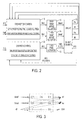
- Fig. 1 is a schematic block diagram representation of a basic control system architecture for counter-rotating open-rotor (CROR) gas turbine engine
- Fig. 2 is another schematic block diagram representation of a basic control system architecture for counter-rotating open-rotor (CROR) gas turbine engine
- Fig. 3 is a matrix representation of controlled plant input and output mapping for the CROR of Figs. 1 and 2 ;
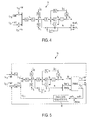
- Fig. 4 is a block diagram representation of an exemplary control architecture according to the current disclosure
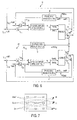
- Fig. 5 is a block diagram representation of the exemplary control architecture of Fig. 4 , including phase synchronization;
- Fig. 6 is a block diagram representation of the exemplary control architecture of Figs. 4 and 5 as applied to two engines;
- Fig. 7 is another matrix representation of controlled plant input and output mapping for the CROR of Figs. 1 and 2 ;
- Fig. 8 is a block diagram representation of another exemplary control architecture according to the current disclosure.
- the current disclosure provides simple, robust and systematic solutions that mathematically decouple the two counter rotating rotors of a CROR engine by model-based dynamic inversion, which allows application of single-input-single-output (SISO) control concepts.
- the current solutions allow fuel flow to be treated as a known disturbance and rejected from the rotor speeds control.
- the current control solutions allow a simple and well-coordinated speed phase synchronizing among the four rotors on a two-engine vehicle.
- an example CROR gas turbine engine 10 includes a differential gearbox 17 mechanically coupled between a forward un-ducted rotor 15 and an aft un-ducted rotor 13, so that the rotor speeds of the respective forward and aft un-ducted rotors 15, 13 are coupled for a given input torque.
- the example CROR gas turbine engine includes a fuel actuator 16 for setting the fuel flow to the engine and gear box 17.
- the example CROR gas turbine engine 10 includes (on a very basic level) three inputs: BetaF and BetaA, which are the forward and aft rotor actuator pitch angle input signals, respectively provided by the forward and aft blade pitch angle actuators 14 and 12; and Wf, which is the fuel flow input signal provided by the fuel flow actuator 16.
- Outputs (again, on a very basic level) from the CROR gas turbine engine 10 include Pa and Pf, which are aft and forward power signal outputs, Na and Nf, which are the aft and forward rotor speed signal outputs, and P46, which is a pressure signal output (an indication of core engine power).
- the control system includes an open rotor control section 18 and a gas path control section 20.
- Inputs to the open rotor control section 18 may include, for example, rotor speed Na and Nf, rotor speed phase Pa and Pf feedback signals from the engine 10; and inputs to the gas path control section 20 may include, for example, P46 feedback signal from the engine 10 and an FMV position signal from the fuel actuator 16.
- the two counter-rotating rotors are functionally coupled to each other, and their operation is further impacted by fuel flow.
- the controlled plant input and output mapping for the CROR can be represented in general as shown in Fig. 2 matrix, where Nf and Na are the forward and aft rotor speed signals outputs, BetaF and BetaA are the forward and aft rotor actuator pitch angle actuator input signals, Wf is the fuel flow actuator signal, and EPR is an engine pressure ratio signal.
- Nf and Na are the forward and aft rotor speed signals outputs
- BetaF and BetaA are the forward and aft rotor actuator pitch angle actuator input signals
- Wf is the fuel flow actuator signal
- EPR is an engine pressure ratio signal
- a 2x2 multi-input-multi-output (MIMO) control solution may be developed for the forward and aft rotor speed signals outputs (Nf and Na) and the forward and aft rotor actuator pitch angle actuator input signals (BetaF and BetaA).
- MIMO multi-input-multi-output
- k , k - 1 ⁇ d k - d k F k + A ⁇ x ⁇ k + B ⁇ u ⁇ k + B d ⁇ d ⁇ k
- k , k - 1 ⁇ d k - d k C ⁇ x ⁇ k + D u ⁇ u ⁇ k + D d ⁇ d ⁇ k
- Wf - EPR loop can be treated as a SISO plant and non-model based SISO control can be used for Wf-EPR loop, e.g., PID control.
- a SISO plant it can be model based SISO control or traditional Gain-scheduling SISO control. It is also within the scope of the current disclosure that Wf - EPR loop can be incorporated into the above state space model, but it may not be necessary for a well known SISO plant to do so.
- the decoupled control architecture 30 with disturbance rejection for holding constant speed is presented in Fig. 4 .
- the controlled plant perturbation model 30 is described by A , B , C , B d , D d , with control input vector Beta actuator (BetaF and BetaA) increment ⁇ k , output vector rotor speed (Nf and Na) perturbation ⁇ k , and disturbance fuel flow (Wf) perturbation d ⁇ k , which are defined in [0025]-[0030].
- the controlled plant input ⁇ k and the output ⁇ k are coupled.
- the decoupled control introduces K V , K F , K D , where K F decouples and cancels the original dynamics by increment state feedback F K , K D decouples and cancels the original disturbance by increment disturbance d ⁇ k , K V decouples the coupled input ⁇ k and output ⁇ k and reshapes the desired controlled plant with new control input v ⁇ K and output ⁇ k in SISO relationship.
- the output tracking control introduces K e to close the rotor speeds (Nf and Na) to their command references (NfR and NaR) such that the closed-loop SISO control based on the decoupled controlled plant (the input v ⁇ K and output ⁇ k ) achieves the desired control performance: Nf tracks NfR, and Na tracks NaR.
- speed phase sync between the two rotors - R2R Sync control can be done by locally adjusting v 2 to keep y 2 phase synchronizing with y 1 .
- the R2R Sync control structure is presented in Fig. 5 .
- the Phase Sync Regulator 40 determines the sign of dv 2 based on the following rules:
- the E2E Sync control structure is presented in Fig. 6 , where a second engine control architecture 30' and corresponding Phase Sync Regulator 40' are provided.
- the E2E Phase Sync Regulator 50 determines the sign of dv 1 based on the following rules:
- the controlled plant input and output mapping can be represented in general as in Fig. 7 , where BetaF and BetaA are forward rotor and aft rotor actuator inputs, respectively, Wf is fuel flow actuator. Nf and Na are BetaF forward rotor and aft rotor speeds, N2 is engine core speed.
- Fig. 8 The decoupled control 60 for holding constant speed is presented in Fig. 8 .
- This solution is essentially a 3x3 multi-input-multi-output variant of the embodiments of Figs. 4-6 when both rotor-rotor coupling and rotor-core coupling relationships are substantial.
- Fig. 8 provides a system level diagram of the 3x3 MIMO control for Open Rotor Engine Control. Dynamic inversion provides mathematical decoupling of control inputs (BetaF, BetaA, Wf) and outputs (Nf, Na, N2) relationships.
- the controlled plant perturbation model 60 is described by A , B , C , with control input vector Beta actuator (BetaF and BetaA) and fuel actuator (Wf) increment ⁇ k , output vector rotor speed (Nf and Na) and core speed (N2) perturbation ⁇ k , which are defined in [0049]-[0051].
- the controlled plant input ⁇ k and the output ⁇ k are coupled.
- the decoupled control introduces K V , K F , where K F decouples and cancels the original dynamics by increment state feedback F K , K V decouples the coupled input ⁇ k and the output ⁇ k and reshapes the desired controlled plant with new control input v ⁇ K and output ⁇ k in SISO relationship.
- the output tracking control introduces K e to close the rotor speeds (Nf and Na) to their command references (NfR and NaR) and core speed (N2) to its command reference (N2R) such that the closed-loop SISO control based on the decoupled controlled plant (the input v ⁇ K and output ⁇ k ) achieves the desired control performance: Nf tracks NfR, Na tracks NaR, and N2 tracks N2R.
- the speed phase synchronizing between y 1 and y 2 , or between y 1 of engine 1 and y 1 of engine 2 can be substantially the same as shown in the embodiment of Figs 4 and 5 .
- control system architectures disclosed herein may be provided in any manner known to those of ordinary skill, including software solutions, hardware or firmware solutions, and combinations of such. Such solutions would incorporate the use of appropriate processors, memory (and software embodying any algorithms described herein may be resident in any type of non-transitory memory), circuitry and other components as is known to those of ordinary skill.
Landscapes
- Engineering & Computer Science (AREA)
- Mechanical Engineering (AREA)
- General Engineering & Computer Science (AREA)
- Chemical & Material Sciences (AREA)
- Combustion & Propulsion (AREA)
- Automation & Control Theory (AREA)
- Aviation & Aerospace Engineering (AREA)
- Physics & Mathematics (AREA)
- Fluid Mechanics (AREA)
- Feedback Control In General (AREA)
- Control Of Turbines (AREA)
Abstract
Description
- The current disclosure pertains to counter-rotating open-rotor (CROR) gas turbine engines; and, more specifically, control system implementations for such CROR gas turbine engines. For CROR control, the two counter-rotating rotors are functionally coupled to each other, and their operation is further impacted by fuel flow.
- The current disclosure provides control solutions addressing such problems and relationships.
- The current disclosure provides simple, robust and systematic solutions that mathematically decouple the two counter rotating rotors of a CROR engine by model-based dynamic inversion, which allows application of single-input-single-output (SISO) control concepts. The current solutions allow fuel flow to be treated as a known disturbance and rejected from the rotor speeds control. Furthermore, the current control solutions allow a simple and well-coordinated speed phase synchronizing among the four rotors on a two-engine vehicle.
- According to the current disclosure, a counter-rotating open-rotor gas turbine engine includes: a forward un-ducted rotor including a plurality of forward rotor blades and including a forward rotor angle actuator for setting blade pitch angles of the plurality of forward rotor blades; an aft un-ducted rotor including a plurality of aft rotor blades and including an aft rotor angle actuator for setting blade pitch angles of the plurality of aft rotor blades; a gas turbine engine driving forward and aft un-ducted rotors and including a fuel actuator for setting the fuel flow to the gas turbine engine; and an open rotor control system including, a forward rotor blade pitch angle command (BetaF) electrically connected to the forward rotor angle actuator, an aft rotor blade pitch angle command (BetaA) electrically connected to the aft rotor angle actuator, a fuel flow command (Wf) electrically connected to the fuel actuator, a forward rotor speed feedback signal (Nf), an aft rotor speed feedback signal (Na), and an engine pressure ratio signal (EPR). The open rotor control system may incorporate a control algorithm that includes: a 2x2 multi-input-multi-output (MIMO) control solution for the forward rotor blade pitch angle command (BetaF), the aft rotor blade pitch angle command (BetaA), the forward rotor speed feedback signal (Nf) and the aft rotor speed feedback signal (Na); and a single-input-single-output (SISO) control solution for the fuel flow command (Wf) and the engine pressure measurement feedback signal. More specifically, the open rotor control system may include a control option that considers fuel flow impact on rotor speeds but does not consider rotor blade pitch angles impact on gas generator engine pressure ratio. Additionally, the gas generator fuel flow command (Wf) impact on rotor speeds Nf and Na may be treated as known disturbance input in the 2x2 MIMO control. In a more detailed embodiment, the control algorithm may further include a disturbance rejection path to account for disturbance effect of fuel flow on forward and aft rotor speeds. Alternatively or in addition, the 2x2 MIMO control solution may utilize a dynamic inversion approach.
- Also according to the current disclosure, a counter-rotating open-rotor gas turbine engine includes: a forward un-ducted rotor including a plurality of forward rotor blades and including a forward rotor angle actuator for setting blade pitch angles of the plurality of forward rotor blades; an aft un-ducted rotor including a plurality of aft rotor blades and including an aft rotor angle actuator for setting blade pitch angles of the plurality of aft rotor blades; a gas turbine engine driving forward and aft un-ducted rotors and including a fuel actuator for setting the fuel flow to the gas turbine engine; and an open rotor control system including, a forward rotor blade pitch angle command (BetaF) electrically connected to the forward rotor angle actuator, an aft rotor blade pitch angle command (BetaA) electrically connected to the aft rotor angle actuator, a fuel flow command (Wf) electrically connected to the fuel actuator, a forward rotor speed feedback signal (Nf), an aft rotor speed feedback signal (Na), and an engine core speed feedback signal or engine pressure ratio signal (EPR). The open rotor control system may include a multiple-input-multiple output (MIMO) control algorithm including a dynamics inversion approach for at least the forward rotor blade pitch angle command (BetaF), the aft rotor blade pitch angle command (BetaA), the forward rotor speed feedback signal (Nf) and the aft rotor speed feedback signal (Na). More specifically, the open rotor control system may include a multiple-input-multiple output (MIMO) control algorithm including a dynamics inversion approach for at least the forward rotor blade pitch angle command (BetaF), the aft rotor blade pitch angle command (BetaA), the fuel flow command (Wf), the forward rotor speed feedback signal (Nf), the aft rotor speed feedback signal (Na) and the gas generator core speed feedback signal (N2). More specifically, the open rotor control system may include a 3x3 multiple-input-multiple output (MIMO) control algorithm including a dynamics inversion approach for at least the forward rotor blade pitch angle command (BetaF), the aft rotor blade pitch angle command (BetaA), the fuel flow command (Wf), the forward rotor speed feedback signal (Nf), the aft rotor speed feedback signal (Na) and the gas generator core speed feedback signal (N2).
- Also, according to the current disclosure, with such counter-rotating open-rotor gas the open rotor control system may further include a speed phase synchronizing control architecture positioned between forward and aft rotor and/or between two engines. In certain embodiments, the speed phase synchronizing control may include a single-input-single-output (SISO) control solution. In certain embodiments the speed phase synchronizing control includes a speed phase synchronization controller that provides a correction input signal to a rotor speed regulator.
- Also, according to the current disclosure, a counter-rotating open-rotor gas turbine engine includes: a forward un-ducted rotor including a plurality of forward rotor blades and including a forward rotor angle actuator for setting blade pitch angles of the plurality of forward rotor blades; an aft un-ducted rotor including a plurality of aft rotor blades and including an aft rotor angle actuator for setting blade pitch angles of the plurality of aft rotor blades; a gas turbine engine driving forward and aft un-ducted rotors and including a fuel actuator for setting the fuel flow to the gas turbine engine; and an open rotor control system including, a forward rotor blade pitch angle command (BetaF) electrically connected to the forward rotor angle actuator, an aft rotor blade pitch angle command (BetaA) electrically connected to the aft rotor angle actuator, a fuel flow command (Wf) electrically connected to the fuel actuator, a forward rotor speed feedback signal (Nf), an aft rotor speed feedback signal (Na), and an engine core speed signal N2; where the open rotor control system has a control algorithm that may include a 3x3 multi-input-multi-output (MIMO) control solution for the forward rotor blade pitch angle command (BetaF), the aft rotor blade pitch angle command (BetaA), the fuel flow command (Wf), the forward rotor speed feedback signal (Nf), the aft rotor speed feedback signal (Na) and the engine core speed feedback signal (N2).
- Also the current disclosure is directed to any of the control systems described herein and/or any of the methods described herein. For example, the current disclosure provides a method for controlling a counter-rotating open-rotor gas turbine engine that includes, (a) a forward un-ducted rotor including a plurality of forward rotor blades and including a forward rotor angle actuator for setting blade pitch angles of the plurality of forward rotor blades, (b) an aft un-ducted rotor including a plurality of aft rotor blades and including an aft rotor angle actuator for setting blade pitch angles of the plurality of aft rotor blades, and (c) a gas turbine engine driving the forward and aft un-ducted rotors and including a fuel actuator for setting fuel flow to the gas turbine engine, where the method may include steps of (not necessarily performed in any specific order): (1) generating forward and aft control signals respectively for the forward rotor angle actuator and the aft rotor angle actuator; (2) generating a fuel flow command for the fuel actuator; (3) receiving forward and aft rotor feedback signals; and (4) receiving at least one of an engine pressure feedback signal and an engine core speed feedback signal; where the steps of (1) generating the forward and aft control signals and (2) generating the fuel flow signal utilize a control algorithm that may include, a multi-input-multi-output (MIMO) control solution for the forward and aft control signals and the forward and aft rotor feedback signals, and a single-input-single-output (SISO) control solution for the fuel flow command and the at least one of the engine pressure feedback signal and the engine core speed feedback signal. In a more detailed embodiment, the control algorithm may consider fuel flow impact on rotor speeds but does not consider rotor blade pitch angles on gas generator engine pressure ratio. Alternatively, or in addition, the fuel flow command impact on forward and aft rotor feedback signals may be treated as a known disturbance to the MIMO control solution. Alternatively, or in addition, the MIMO control solution utilizes a dynamic inversion control approach.
- In an alternate detailed embodiment, the method may include providing a speed phase synchronizing control architecture between (a) the forward and aft rotor feedback signals and (b) input signals to the gas turbine engine. In addition, the speed synchronizing control may include a single-input-single output (SISO) control solution. Alternatively, or in addition, the speed phase synchronizing control may include a speed phase synchronizing controller that provides a correction input signal to a rotor speed regulator.
- Another exemplary method provided by the current disclosure is a method for controlling a counter-rotating open-rotor gas turbine engine that includes, (a) a forward un-ducted rotor including a plurality of forward rotor blades and including a forward rotor angle actuator for setting blade pitch angles of the plurality of forward rotor blades, (b) an aft un-ducted rotor including a plurality of aft rotor blades and including an aft rotor angle actuator for setting blade pitch angles of the plurality of aft rotor blades, and (c) a gas turbine engine driving the forward and aft un-ducted rotors and including a fuel actuator for setting fuel flow to the gas turbine engine; where the method may include steps of (not necessarily performed in any specific order): (1) generating forward and aft control signals respectively for the forward rotor angle actuator and the aft rotor angle actuator; (2) generating a fuel flow command for the fuel actuator; (3) receiving forward and aft rotor feedback signals; and (4) receiving at least one of an engine pressure feedback signal and an engine core speed feedback signal; where the steps of (1) generating the forward and aft control signals and (2) generating the fuel flow signal may utilize a control algorithm that includes a multi-input-multi-output (MIMO) control solution including a dynamic inversion approach for the forward and aft control signals, the fuel flow command, the forward and aft rotor feedback signals and the least one of an engine pressure feedback signal and an engine core speed feedback signal. In a more detailed embodiment the MIMO control solution may be a 3x3 MIMO control solution.
-
Fig. 1 is a schematic block diagram representation of a basic control system architecture for counter-rotating open-rotor (CROR) gas turbine engine; -
Fig. 2 is another schematic block diagram representation of a basic control system architecture for counter-rotating open-rotor (CROR) gas turbine engine; -
Fig. 3 is a matrix representation of controlled plant input and output mapping for the CROR ofFigs. 1 and2 ; -
Fig. 4 is a block diagram representation of an exemplary control architecture according to the current disclosure; -
Fig. 5 is a block diagram representation of the exemplary control architecture ofFig. 4 , including phase synchronization; -
Fig. 6 is a block diagram representation of the exemplary control architecture ofFigs. 4 and 5 as applied to two engines; -
Fig. 7 is another matrix representation of controlled plant input and output mapping for the CROR ofFigs. 1 and2 ; and -
Fig. 8 is a block diagram representation of another exemplary control architecture according to the current disclosure. - The current disclosure provides simple, robust and systematic solutions that mathematically decouple the two counter rotating rotors of a CROR engine by model-based dynamic inversion, which allows application of single-input-single-output (SISO) control concepts. The current solutions allow fuel flow to be treated as a known disturbance and rejected from the rotor speeds control. Furthermore, the current control solutions allow a simple and well-coordinated speed phase synchronizing among the four rotors on a two-engine vehicle.
- The basic control system architecture for CROR is presented in
Figs. 1 and2 . As shown inFigs. 1 and2 , an example CRORgas turbine engine 10 includes adifferential gearbox 17 mechanically coupled between aforward un-ducted rotor 15 and an aft un-ductedrotor 13, so that the rotor speeds of the respective forward and aft un-ductedrotors fuel actuator 16 for setting the fuel flow to the engine andgear box 17. The example CRORgas turbine engine 10 includes (on a very basic level) three inputs: BetaF and BetaA, which are the forward and aft rotor actuator pitch angle input signals, respectively provided by the forward and aft bladepitch angle actuators fuel flow actuator 16. Outputs (again, on a very basic level) from the CRORgas turbine engine 10 include Pa and Pf, which are aft and forward power signal outputs, Na and Nf, which are the aft and forward rotor speed signal outputs, and P46, which is a pressure signal output (an indication of core engine power). The control system includes an openrotor control section 18 and a gaspath control section 20. Inputs to the openrotor control section 18 may include, for example, rotor speed Na and Nf, rotor speed phase Pa and Pf feedback signals from theengine 10; and inputs to the gaspath control section 20 may include, for example, P46 feedback signal from theengine 10 and an FMV position signal from thefuel actuator 16. - For CROR control, the two counter-rotating rotors are functionally coupled to each other, and their operation is further impacted by fuel flow. For example, the controlled plant input and output mapping for the CROR can be represented in general as shown in
Fig. 2 matrix, where Nf and Na are the forward and aft rotor speed signals outputs, BetaF and BetaA are the forward and aft rotor actuator pitch angle actuator input signals, Wf is the fuel flow actuator signal, and EPR is an engine pressure ratio signal. - Previous approaches to solve this problem have ignored the interactions between the forward and aft rotor speed signals, Nf and Na, and have attempted to utilize single-input-single-output control to attempt to maintain each rotor speed tracking their own reference. However, as shown in the controlled plant matrix of
Fig. 2 , the interactions between the six signals will impact the rotors' constant speed holding control and the rotors' speed phase synchronizing significantly, because this coupling always exists. - First Exemplary Control Solution
- Referring again to
Fig. 2 , where Nf and Na are the forward and aft rotor speed signals outputs, BetaF and BetaA are the forward and aft rotor actuator pitch angle actuator input signals, Wf is the fuel flow actuator signal, and EPR is an engine pressure ratio signal; if the gas generator fuel flow command Wf impact on rotor speeds Nf and Na are treated as known disturbance, such that the control algorithm may include a disturbance rejection path to account for disturbance effect of fuel flow on forward and aft rotor speeds, a 2x2 multi-input-multi-output (MIMO) control solution may be developed for the forward and aft rotor speed signals outputs (Nf and Na) and the forward and aft rotor actuator pitch angle actuator input signals(BetaF and BetaA). - Choose the states, control inputs, outputs and disturbance for open rotor control below:

- Assume the original open rotor controlled plant is:

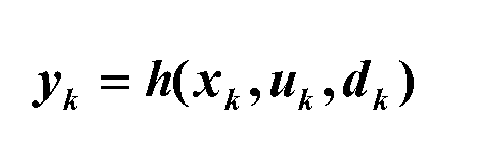
At sample k , the system states xk , the inputs u k-1, and the disturbances dk are known. Thus, the deviation variables are expressed about this current operating condition, i.e. xk , u k-1, dk , yk = h(xk ,u k-1,dk ) - Define the deviation variables from these conditions,


- The local linearized model of the system in terms of deviation variables may be derived

- Approximate Fk ≈ x̂k = xk - x k-1, and it is treated as a known initial condition for x̃ k+1 at sample k, or, autonomous response of the system states over one control sample free from any control action update, i.e. ũk = 0.

- The state space perturbation model for open rotor control is:



Where x̃(k) = 0, d̃(k) = 0, and ỹ(k) = 0 by definition.
Approximations:

- Since Gas Path is decoupled from the open rotor inputs, Wf - EPR loop can be treated as a SISO plant and non-model based SISO control can be used for Wf-EPR loop, e.g., PID control. As a SISO plant, it can be model based SISO control or traditional Gain-scheduling SISO control. It is also within the scope of the current disclosure that Wf - EPR loop can be incorporated into the above state space model, but it may not be necessary for a well known SISO plant to do so.
- Let EPRerr = EPRref - EPR. From a typical PID implementation,

- Use Tustin transformation, i.e.

- Then the discrete-time transfer function is:

- And the discrete-time state space model for PID controller is obtained via Observability Canonical Realization as:


- For open rotor controlled plant model, assume Nf and Na both have
relative degree 1, respectively, which is reasonable because actuator command to torque is algebraic relationship, and torque to rotor speed is 1st order dynamics, then,

- The desired output tracking response is:

- Properly choose k i,0, i = 1,2 such that the following polynomial

has its eigenvalue within the unit circle, then the output tracking is asymptotically stable. - Furthermore,

- For open rotor speed references are constant in general, therefore,

- Compare the above desired output response with


Where Ke is diagonal, KV = E -1,KE = E -1 Ke , ŷ(k) = yr (k)-y(k), Fk = x(k)-x(k-1), d̂(k) = Wf(k) - Wf(k-1). - The decoupled
control architecture 30 with disturbance rejection for holding constant speed is presented inFig. 4 . - As shown in
Fig. 4 , the controlledplant perturbation model 30 is described by A, B, C, Bd , Dd , with control input vector Beta actuator (BetaF and BetaA) increment ũk , output vector rotor speed (Nf and Na) perturbation ỹk , and disturbance fuel flow (Wf) perturbation d̃k , which are defined in [0025]-[0030]. The controlled plant input ũk and the output ỹk are coupled. The decoupled control introduces KV , KF , KD , where KF decouples and cancels the original dynamics by increment state feedback FK , KD decouples and cancels the original disturbance by increment disturbance d̂k , KV decouples the coupled input ũk and output ỹk and reshapes the desired controlled plant with new control input v̇K and output ỹk in SISO relationship. The output tracking control introduces Ke to close the rotor speeds (Nf and Na) to their command references (NfR and NaR) such that the closed-loop SISO control based on the decoupled controlled plant (the input v̇K and output ỹk ) achieves the desired control performance: Nf tracks NfR, and Na tracks NaR. The decoupling control law is ũk = KV v̇k + KFFK + KDd̂k , the increment actuator control input ũk needs to be integrated to generate the actuator control input uk , i.e., BetaFk and BeatAk, which are applied to Beta Actuators, respectively. - Since y 1 and y 2 are decoupled, that is, v 1 (k) = E -1(1,1)K e(1,1)ŷ 1(k) = K e1 ŷ 1(k) affects y 1 only, and v 2(k) = E -1(2,2)Ke (2,2)ŷ 2(k) = K e2 ŷ 2(k) affects y 2 only. Therefore, the speed phase synchronizing between y 1 and y 2 can be treated as an inner loop correction of any of the two decoupled SISO control loops.
- The phase feedback is defined as the average value in a certain time period (e.g., 6 samples):


Then speed phase sync between the two rotors - R2R Sync control can be done by locally adjusting v 2 to keep y 2 phase synchronizing with y 1 . - The R2R Sync control structure is presented in
Fig. 5 . ThePhase Sync Regulator 40 determines the sign of dv 2 based on the following rules: - If 0° < errPh ≤ 180° or - 360° < errPh ≤ -180°, Na is leading Nf,
- Na needs to be slowed down, i.e., dv 2 < 0;
- elseif 180° < errPh < 360° or - 180° < errPh < 0°, Na is behind Nf,
- Na needs to be speeded up, i.e., dv 2 > 0;
- For engine to engine (E2E) speed phase sync, since Nf and Na are decoupled for each engine, the Nfs from two engines need to be synchronized. Assume that
Engine 1 is specified as Master, Engine2 needs to be synchronized to Engine1. Define errPhEng = Ph f1 - Ph f2 - The E2E Sync control structure is presented in
Fig. 6 , where a second engine control architecture 30' and corresponding Phase Sync Regulator 40' are provided. The E2EPhase Sync Regulator 50 determines the sign of dv 1 based on the following rules: - If 0° < errPhEng ≤ 180° or - 360° < errPhEng ≤ -180°, E2 is leading E1,
- E2 needs to be slowed down, i.e., dv 1 < 0;
- elseif 180° < errPhEng< 360° or -180° < errPhEng< 0°, E2 is behind E1,
- E2 needs to be speeded up, i.e., dv 1 > 0;
- With the decoupled speed control, the rotor to rotor speed phase sync and engine to engine speed phase sync become classical SISO control design in the very simple system structure.
- Second Exemplary Control Solution
- For open rotor control, when the two counter-rotating rotors are mechanically coupled by a differential gearbox, the core speed N2 and the open rotor speeds are highly coupled. The controlled plant input and output mapping can be represented in general as in
Fig. 7 , where BetaF and BetaA are forward rotor and aft rotor actuator inputs, respectively, Wf is fuel flow actuator. Nf and Na are BetaF forward rotor and aft rotor speeds, N2 is engine core speed. - Choose the states, control inputs, controlled outputs for open rotor control shown in
Fig. 7 .
- The rotor speed dynamics, the engine core speed dynamics, the coupling between the two rotors, and the coupling between the gas generator and the rotors are all characterized in the following perturbation model:


Where x̃(k) = 0, and ỹ(k) = 0 by definition. - For open rotor controlled plant model, assume Nf , Na and N 2 all have
relative degree 1, respectively, which is reasonable because actuator command to torque is algebraic relationship, and torque to rotor or turbine speed is 1st order dynamics, then,

The desired output tracking response is:
Properly choose k i,0 , i=1, 2,3 such that the following polynomial
has its eigenvalue within the unit circle, then the output tracking is asymptotically stable.
Furthermore,
For rotor speed references are constant in general, therefore,
Compare the above desired output response with


Where Ke is diagonal, ŷ(k) = yr (k)-y(k), Fk = x(k)-x(k-1) - The decoupled
control 60 for holding constant speed is presented inFig. 8 . This solution is essentially a 3x3 multi-input-multi-output variant of the embodiments ofFigs. 4-6 when both rotor-rotor coupling and rotor-core coupling relationships are substantial.Fig. 8 provides a system level diagram of the 3x3 MIMO control for Open Rotor Engine Control. Dynamic inversion provides mathematical decoupling of control inputs (BetaF, BetaA, Wf) and outputs (Nf, Na, N2) relationships. - As shown in
Fig. 8 , the controlledplant perturbation model 60 is described by A, B, C, with control input vector Beta actuator (BetaF and BetaA) and fuel actuator (Wf) increment ũk , output vector rotor speed (Nf and Na) and core speed (N2) perturbation ỹk, which are defined in [0049]-[0051]. The controlled plant input ũk and the output ỹk are coupled. The decoupled control introduces KV , KF , where KF decouples and cancels the original dynamics by increment state feedback FK , KV decouples the coupled input ũk and the output ỹk and reshapes the desired controlled plant with new control input v̇ K and output ỹk in SISO relationship. The output tracking control introduces Ke to close the rotor speeds (Nf and Na) to their command references (NfR and NaR) and core speed (N2) to its command reference (N2R) such that the closed-loop SISO control based on the decoupled controlled plant (the input v̇K and output ỹk ) achieves the desired control performance: Nf tracks NfR, Na tracks NaR, and N2 tracks N2R. The decoupling control law is ũk = KV v̇k +KFFk , the increment actuator control input ũk needs to be integrated to generate the actuator control input ũk , i.e., BetaFk and BeatAk , and Wfk which are applied to Beta Actuators and fuel actuator, respectively. - With the current embodiment, when the rotor blade pitch angles BetaF and BetaA impact on gas generator output(s) can be neglected, then the corresponding elements in the 3x3 decoupling matrix transfer function can be simply zeroed out. The resulting control can be functionally equivalent to the control of
Fig. 4 , except that the controlled output for gas generator is core speed N2 rather than engine pressure ratio EPR. - Since y 1 and y 2 are decoupled from each other, and both they are decoupled from y 3 , that is, v 1 affects y 1 only, and v 2 affects y 2 only. Therefore, the speed phase synchronizing between y 1 and y 2 , or between y 1 of
engine 1 and y 1 ofengine 2 can be substantially the same as shown in the embodiment ofFigs 4 and 5 . - It is to be understood the control system architectures disclosed herein may be provided in any manner known to those of ordinary skill, including software solutions, hardware or firmware solutions, and combinations of such. Such solutions would incorporate the use of appropriate processors, memory (and software embodying any algorithms described herein may be resident in any type of non-transitory memory), circuitry and other components as is known to those of ordinary skill.
- Having disclosed the inventions described herein by reference to exemplary embodiments, it will be apparent to those of ordinary skill that alternative arrangements and embodiments may be implemented without departing from the scope of the inventions as disclosed herein. Further, it will be understood that it is not necessary to meet any of the objects or advantages of the invention(s) stated herein to fall within the scope of such inventions, because undisclosed or unforeseen advantages may exist.
- Various aspects and embodiments of the invention are indicated in the following clauses:
- 1. A counter-rotating open-rotor gas turbine engine comprising:
- a forward un-ducted rotor including a plurality of forward rotor blades and including a forward rotor angle actuator for setting blade pitch angles of the plurality of forward rotor blades;
- an aft un-ducted rotor including a plurality of aft rotor blades and including an aft rotor angle actuator for setting blade pitch angles of the plurality of aft rotor blades;
- a gas turbine engine driving forward and aft un-ducted rotors and including a fuel actuator for setting the fuel flow to the gas turbine engine; and
- an open rotor control system including, a forward rotor blade pitch angle command (BetaF) electrically connected to the forward rotor angle actuator, an aft rotor blade pitch angle command (BetaA) electrically connected to the aft rotor angle actuator, a fuel flow command (Wf) electrically connected to the fuel actuator, a forward rotor speed feedback signal (Nf), an aft rotor speed feedback signal (Na), and at least two of the engine pressure measurement feedback signals for calculating the engine pressure ratio (EPR) and an engine core speed signal (N2);
- the open rotor control system including a control algorithm including,
a 2x2 multi-input-multi-output (MIMO) control solution for the forward rotor blade pitch angle command (BetaF), the aft rotor blade pitch angle command (BetaA), the forward rotor speed feedback signal (Nf) and the aft rotor speed feedback signal (Na); and
a single-input-single-output (SISO) control solution for the fuel flow command (Wf) and the at least two of the engine pressure measurement feedback signals for calculating the engine pressure ratio (EPR) and the engine core speed signal (N2).
- 2. The counter-rotating open-rotor gas turbine engine of
clause 1, wherein the open rotor control system includes a control option that considers fuel flow impact on rotor speeds but does not consider rotor blade pitch angles on gas generator engine pressure ratio. - 3. The counter-rotating open-rotor gas turbine engine of
clause 1, wherein the gas generator fuel flow command (Wf) impact on rotor speed feedback signals (Nf and Na) is treated as a known disturbance input to the 2x2 MIMO control solution. - 4. The counter-rotating open-rotor gas turbine engine of
clause 1, wherein the control algorithm further includes a disturbance rejection path to account for disturbance effect of fuel flow on forward and aft rotor speeds. - 5. The counter-rotating open-rotor gas turbine engine of
clause 1, wherein the 2x2 MIMO control solution utilizes a dynamics inversion control approach. - 6. The counter-rotating open-rotor gas turbine engine of
clause 1, wherein the open rotor control system further includes a speed phase synchronizing control architecture positioned between (a) forward and aft rotor phase output feedback signals and (b) input signals to an engine speed regulator. - 7. The counter-rotating open-rotor gas turbine engine of clause 6, wherein the speed synchronizing control includes a single-input-single-output (SISO) control solution.
- 8. The counter-rotating open-rotor gas turbine engine of clause 6, wherein the speed phase synchronizing control includes a speed phase synchronizing controller that provides a correction input signal to a rotor speed regulator.
- 9. A counter-rotating open-rotor gas turbine engine comprising:
- a forward un-ducted rotor including a plurality of forward rotor blades and including a forward rotor angle actuator for setting blade pitch angles of the plurality of forward rotor blades;
- an aft un-ducted rotor including a plurality of aft rotor blades and including an aft rotor angle actuator for setting blade pitch angles of the plurality of aft rotor blades;
- a gas turbine engine driving forward and aft un-ducted rotors and including a fuel actuator for setting the fuel flow to the gas turbine engine; and
- an open rotor control system including, a forward rotor blade pitch angle command (BetaF) electrically connected to the forward rotor angle actuator, an aft rotor blade pitch angle command (BetaA) electrically connected to the aft rotor angle actuator, a fuel flow command (Wf) electrically connected to the fuel actuator, a forward rotor speed feedback signal (Nf), an aft rotor speed feedback signal (Na), and at least one of an engine pressure measurement feedback signal (EPR) and a gas generator core speed feedback signal (N2);
- the open rotor control system including a multiple-input-multiple-output (MIMO) control algorithm including a dynamic inversion matrix control solution for at least the forward rotor blade pitch angle command (BetaF), the aft rotor blade pitch angle command (BetaA), the forward rotor speed feedback signal (Nf) and the aft rotor speed feedback signal (Na).
- 10. The counter-rotating open-rotor gas turbine engine of clause 9, wherein the open rotor control system includes a 3x3 multiple-input-multiple-output (MIMO) control algorithm including a dynamics inversion approach for at least the forward rotor blade pitch angle command (BetaF), the aft rotor blade pitch angle command (BetaA), the fuel flow command (Wf), the forward rotor speed feedback signal (Nf), the aft rotor speed feedback signal (Na) and the gas generator core speed feedback signal (N2).
- 11. The counter-rotating open-rotor gas turbine engine of clause 9, wherein the open rotor control system further includes a speed phase synchronizing control architecture positioned between (a) forward and aft rotor phase output feedback signals and (b) input signals to an engine speed regulator.
- 12. The counter-rotating open-rotor gas turbine engine of
clause 11, wherein the speed synchronizing control includes a single-input-single-output (SISO) control solution. - 13. The counter-rotating open-rotor gas turbine engine of
clause 11, wherein the speed phase synchronizing control includes a speed phase synchronizing controller that provides a correction input signal to a rotor speed regulator. - 14. A method for controlling a counter-rotating open-rotor gas turbine engine that includes, (a) a forward un-ducted rotor including a plurality of forward rotor blades and including a forward rotor angle actuator for setting blade pitch angles of the plurality of forward rotor blades, (b) an aft un-ducted rotor including a plurality of aft rotor blades and including an aft rotor angle actuator for setting blade pitch angles of the plurality of aft rotor blades, and (c) a gas turbine engine driving the forward and aft un-ducted rotors and including a fuel actuator for setting fuel flow to the gas turbine engine, the method comprising steps of:
- generating forward and aft control signals respectively for the forward rotor angle actuator and the aft rotor angle actuator;
- generating a fuel flow command for the fuel actuator;
- receiving forward and aft rotor feedback signals; and
- receiving at least one of an engine pressure feedback signal and an engine core speed feedback signal;
- wherein the steps of generating the forward and aft control signals and generating the fuel flow signal utilize a control algorithm that includes,
a multi-input-multi-output (MIMO) control solution for the forward and aft control signals and the forward and aft rotor feedback signals, and
a single-input-single-output (SISO) control solution for the fuel flow command and the at least one of the engine pressure feedback signal and the engine core speed feedback signal.
- 15. The method of
clause 14, wherein the control algorithm considers fuel flow impact on rotor speeds but does not consider rotor blade pitch angles on gas generator engine pressure ratio. - 16. The method of
clause 14, wherein the fuel flow command impact on forward and aft rotor feedback signals is treated as a known disturbance to the MIMO control solution. - 17. The method of
clause 16, wherein the MIMO control solution utilizes a dynamic inversion control approach. - 18. The method of
clause 14, further comprising providing a speed phase synchronizing control architecture between (a) the forward and aft rotor feedback signals and (b) input signals to the gas turbine engine. - 19. The method of
clause 18, wherein the speed synchronizing control includes a single-input-single output (SISO) control solution. - 20. The method of
clause 18, wherein the speed phase synchronizing control includes a speed phase synchronizing controller that provides a correction input signal to a rotor speed regulator. - 21. A method for controlling a counter-rotating open-rotor gas turbine engine that includes, (a) a forward un-ducted rotor including a plurality of forward rotor blades and including a forward rotor angle actuator for setting blade pitch angles of the plurality of forward rotor blades, (b) an aft un-ducted rotor including a plurality of aft rotor blades and including an aft rotor angle actuator for setting blade pitch angles of the plurality of aft rotor blades, and (c) a gas turbine engine driving the forward and aft un-ducted rotors and including a fuel actuator for setting fuel flow to the gas turbine engine, the method comprising steps of:
- generating forward and aft control signals respectively for the forward rotor angle actuator and the aft rotor angle actuator;
- generating a fuel flow command for the fuel actuator;
- receiving forward and aft rotor feedback signals; and
- receiving at least one of an engine pressure feedback signal and an engine core speed feedback signal;
- wherein the steps of generating the forward and aft control signals and generating the fuel flow signal utilize a control algorithm that includes a multi-input-multi-output (MIMO) control solution including a dynamics inversion approach for the forward and aft control signals, the fuel flow command, the forward and aft rotor feedback signals and the least one of an engine pressure feedback signal and an engine core speed feedback signal.
- 22. The method of clause 21, wherein the MIMO control solution is a 3x3 MIMO control solution.
Claims (16)
- A counter-rotating open-rotor gas turbine engine (10) comprising:a forward un-ducted rotor (15) including a plurality of forward rotor blades and including a forward rotor angle actuator (14) for setting blade pitch angles of the plurality of forward rotor blades;an aft un-ducted rotor (13) including a plurality of aft rotor blades and including an aft rotor angle actuator (12) for setting blade pitch angles of the plurality of aft rotor blades;a gas turbine engine driving forward and aft un-ducted rotors and including a fuel actuator (16) for setting the fuel flow to the gas turbine engine; andan open rotor control system (30) including, a forward rotor blade pitch angle command (BetaF) electrically connected to the forward rotor angle actuator (14), an aft rotor blade pitch angle command (BetaA) electrically connected to the aft rotor angle actuator (12), a fuel flow command (Wf) electrically connected to the fuel actuator, a forward rotor speed feedback signal (Nf), an aft rotor speed feedback signal (Na), and at least two of the engine pressure measurement feedback signals for calculating the engine pressure ratio (EPR) and an engine core speed signal (N2);the open rotor control system including a control algorithm including,
a 2x2 multi-input-multi-output (MIMO) control solution for the forward rotor blade pitch angle command (BetaF), the aft rotor blade pitch angle command (BetaA), the forward rotor speed feedback signal (Nf) and the aft rotor speed feedback signal (Na); and
a single-input-single-output (SISO) control solution for the fuel flow command (Wf) and the at least two of the engine pressure measurement feedback signals for calculating the engine pressure ratio (EPR) and the engine core speed signal (N2). - The counter-rotating open-rotor gas turbine engine (10) of claim 1, wherein the open rotor control system includes a control option that considers fuel flow impact on rotor speeds but does not consider rotor blade pitch angles on gas generator engine pressure ratio.
- The counter-rotating open-rotor gas turbine engine (10) of claim 1 or 2, wherein the gas generator fuel flow command (Wf) impact on rotor speed feedback signals (Nf and Na) is treated as a known disturbance input to the 2x2 MIMO control solution.
- The counter-rotating open-rotor gas turbine engine (10) of any preceding claim, wherein the control algorithm further includes a disturbance rejection path to account for disturbance effect of fuel flow on forward and aft rotor speeds.
- The counter-rotating open-rotor gas turbine engine (10) of any preceding claim, wherein the 2x2 MIMO control solution utilizes a dynamics inversion control approach.
- The counter-rotating open-rotor gas turbine engine (10) of any preceding claim, wherein the open rotor control system further includes a speed phase synchronizing control architecture positioned between (a) forward and aft rotor phase output feedback signals and (b) input signals to an engine speed regulator.
- The counter-rotating open-rotor gas turbine engine (10) of claim 6, wherein the speed synchronizing control includes a single-input-single-output (SISO) control solution.
- The counter-rotating open-rotor gas turbine engine (10) of either of claim 6 or 7, wherein the speed phase synchronizing control includes a speed phase synchronizing controller that provides a correction input signal to a rotor speed regulator.
- A counter-rotating open-rotor gas turbine engine (10) comprising:a forward un-ducted rotor (15) including a plurality of forward rotor blades and including a forward rotor angle actuator (14) for setting blade pitch angles of the plurality of forward rotor blades;an aft un-ducted rotor (13) including a plurality of aft rotor blades and including an aft rotor angle actuator (12) for setting blade pitch angles of the plurality of aft rotor blades;a gas turbine engine driving forward and aft un-ducted rotors and including a fuel actuator (16) for setting the fuel flow to the gas turbine engine; andan open rotor control system (30) including, a forward rotor blade pitch angle command (BetaF) electrically connected to the forward rotor angle actuator (14), an aft rotor blade pitch angle command (BetaA) electrically connected to the aft rotor angle actuator (12), a fuel flow command (Wf) electrically connected to the fuel actuator (16), a forward rotor speed feedback signal (Nf), an aft rotor speed feedback signal (Na), and at least one of an engine pressure measurement feedback signal (EPR) and a gas generator core speed feedback signal (N2);the open rotor control system including a multiple-input-multiple-output (MIMO) control algorithm including a dynamic inversion matrix control solution for at least the forward rotor blade pitch angle command (BetaF), the aft rotor blade pitch angle command (BetaA), the forward rotor speed feedback signal (Nf) and the aft rotor speed feedback signal (Na).
- The counter-rotating open-rotor gas turbine engine (10) of claim 9, wherein the open rotor control system (30) includes a 3x3 multiple-input-multiple-output (MIMO) control algorithm including a dynamics inversion approach for at least the forward rotor blade pitch angle command (BetaF), the aft rotor blade pitch angle command (BetaA), the fuel flow command (Wf), the forward rotor speed feedback signal (Nf), the aft rotor speed feedback signal (Na) and the gas generator core speed feedback signal (N2).
- A method for controlling a counter-rotating open-rotor gas turbine engine (10) that includes, (a) a forward un-ducted rotor (15) including a plurality of forward rotor blades and including a forward rotor angle actuator (14) for setting blade pitch angles of the plurality of forward rotor blades, (b) an aft un-ducted rotor (13) including a plurality of aft rotor blades and including an aft rotor angle actuator (12) for setting blade pitch angles of the plurality of aft rotor blades, and (c) a gas turbine engine driving the forward and aft un-ducted rotors and including a fuel actuator (16) for setting fuel flow to the gas turbine engine, the method comprising steps of:generating forward and aft control signals (BetaF, BetaA) respectively for the forward rotor angle actuator (14) and the aft rotor angle actuator (12);generating a fuel flow command (Wf) for the fuel actuator (16);receiving forward and aft rotor feedback signals (Nf, Na); andreceiving at least one of an engine pressure feedback signal and an engine core speed feedback signal (N2);wherein the steps of generating the forward and aft control signals and generating the fuel flow signal utilize a control algorithm that includes,
a multi-input-multi-output (MIMO) control solution for the forward and aft control signals and the forward and aft rotor feedback signals, and
a single-input-single-output (SISO) control solution for the fuel flow command and the at least one of the engine pressure feedback signal and the engine core speed feedback signal. - The method of claim 11, wherein the control algorithm considers fuel flow impact on rotor speeds but does not consider rotor blade pitch angles on gas generator engine pressure ratio.
- The method of either of claim 11 or 12, wherein the fuel flow command impact on forward and aft rotor feedback signals is treated as a known disturbance to the MIMO control solution.
- The method of claim 13, wherein the MIMO control solution utilizes a dynamic inversion control approach.
- The method of any of claims 11 to 14, further comprising providing a speed phase synchronizing control architecture (40,40',50) between (a) the forward and aft rotor feedback signals and (b) input signals to the gas turbine engine.
- A method for controlling a counter-rotating open-rotor gas turbine engine (10) that includes, (a) a forward un-ducted rotor (15) including a plurality of forward rotor blades and including a forward rotor angle actuator (14) for setting blade pitch angles of the plurality of forward rotor blades, (b) an aft un-ducted rotor (13) including a plurality of aft rotor blades and including an aft rotor angle actuator (12) for setting blade pitch angles of the plurality of aft rotor blades, and (c) a gas turbine engine driving the forward and aft un-ducted rotors and including a fuel actuator (16) for setting fuel flow to the gas turbine engine, the method comprising steps of:generating forward and aft control signals (BetaF, BetaA) respectively for the forward rotor angle actuator (14) and the aft rotor angle actuator (12);generating a fuel flow command (Wf) for the fuel actuator (16);receiving forward and aft rotor feedback signals (Nf,Na); andreceiving at least one of an engine pressure feedback signal and an engine core speed feedback signal (N2);wherein the steps of generating the forward and aft control signals and generating the fuel flow signal utilize a control algorithm that includes a multi-input-multi-output (MIMO) control solution including a dynamics inversion approach for the forward and aft control signals, the fuel flow command, the forward and aft rotor feedback signals and the least one of an engine pressure feedback signal and an engine core speed feedback signal.
Applications Claiming Priority (2)
| Application Number | Priority Date | Filing Date | Title |
|---|---|---|---|
| US201261595419P | 2012-02-06 | 2012-02-06 | |
| US13/649,421 US8689539B2 (en) | 2012-02-06 | 2012-10-11 | Methods and apparatuses for model based control for counter-rotating open-rotor gas turbine engine |
Publications (2)
| Publication Number | Publication Date |
|---|---|
| EP2623712A2 true EP2623712A2 (en) | 2013-08-07 |
| EP2623712A3 EP2623712A3 (en) | 2017-08-09 |
Family
ID=47709948
Family Applications (1)
| Application Number | Title | Priority Date | Filing Date |
|---|---|---|---|
| EP13154024.7A Withdrawn EP2623712A3 (en) | 2012-02-06 | 2013-02-05 | Method and apparatus for model based control for counter-rotating open-rotor gas turbine engine |
Country Status (6)
| Country | Link |
|---|---|
| US (1) | US8689539B2 (en) |
| EP (1) | EP2623712A3 (en) |
| JP (1) | JP6152273B2 (en) |
| CN (1) | CN103244279B (en) |
| BR (1) | BR102013002797A2 (en) |
| CA (1) | CA2803309A1 (en) |
Families Citing this family (13)
| Publication number | Priority date | Publication date | Assignee | Title |
|---|---|---|---|---|
| WO2012100420A1 (en) * | 2011-01-27 | 2012-08-02 | 潍柴动力股份有限公司 | Control device and method for air system of diesel engine |
| US20130202434A1 (en) * | 2012-02-06 | 2013-08-08 | General Electric Company | Methods and Apparatuses for Non-Model Based Control for Counter-Rotating Open-Rotor Gas Turbine Engine |
| FR3000465B1 (en) * | 2012-12-27 | 2015-02-13 | Eurocopter France | METHOD FOR ROTATING A MAIN ROTOR OF ROTOR OF ROTOR, ACCORDING TO A VARIABLE VALUE ROTATION SPEED SET |
| JP5979097B2 (en) * | 2013-08-08 | 2016-08-24 | 東芝三菱電機産業システム株式会社 | Process control device |
| US10113487B2 (en) * | 2013-10-24 | 2018-10-30 | United Technologies Corporation | Cascaded multi-variable control system for a turboshaft engine |
| US9845145B2 (en) * | 2014-09-30 | 2017-12-19 | General Electric Company | Method and system for model based control for variable pitch fan engines and turbo-shaft, turbo-propeller engines |
| US9909442B2 (en) | 2015-07-02 | 2018-03-06 | General Electric Company | Method of controlling a position actuation system component for a gas turbine engine |
| US9771878B2 (en) | 2015-10-19 | 2017-09-26 | General Electric Company | Thrust scheduling method for variable pitch fan engines and turbo-shaft, turbo-propeller engines |
| US10480421B2 (en) | 2016-08-04 | 2019-11-19 | Pratt & Whitney Canada Corp. | System and method for an engine controller based on acceleration power |
| US10221776B2 (en) | 2016-08-04 | 2019-03-05 | Pratt & Whitney Canada Corp. | System and method for an engine controller based on inverse dynamics of the engine |
| EP3364255B1 (en) * | 2017-02-17 | 2021-10-06 | Ge Avio S.r.l. | Turbopropeller engine control system and method, providing optimized efficiency |
| FR3070056B1 (en) * | 2017-08-09 | 2019-08-23 | Safran Aircraft Engines | MIXED AIRCRAFT ENGINE CONTROL SYSTEM AND METHOD OF ADJUSTING THE SAME |
| US10961921B2 (en) | 2018-09-19 | 2021-03-30 | Pratt & Whitney Canada Corp. | Model-based control system and method for a turboprop engine |
Family Cites Families (11)
| Publication number | Priority date | Publication date | Assignee | Title |
|---|---|---|---|---|
| US4772179A (en) * | 1986-08-29 | 1988-09-20 | General Electric Company | Aircraft thrust control |
| US4772180A (en) * | 1986-08-29 | 1988-09-20 | General Electric Company | Aircraft thrust control |
| US4927329A (en) * | 1988-10-21 | 1990-05-22 | General Electric Company | Aircraft engine unducted fan blade pitch control system |
| US5242265A (en) * | 1990-07-23 | 1993-09-07 | General Electric Company | Aircraft pitch change mechanism |
| US5515444A (en) * | 1992-10-21 | 1996-05-07 | Virginia Polytechnic Institute And State University | Active control of aircraft engine inlet noise using compact sound sources and distributed error sensors |
| US6823675B2 (en) * | 2002-11-13 | 2004-11-30 | General Electric Company | Adaptive model-based control systems and methods for controlling a gas turbine |
| JP4555562B2 (en) * | 2003-12-09 | 2010-10-06 | ゼネラル・エレクトリック・カンパニイ | Method and apparatus for model predictive control of aircraft gas turbines |
| US7363094B2 (en) * | 2006-01-09 | 2008-04-22 | General Electric Company | Multivariable controller design method for multiple input/outputs systems with multiple input/output constraints |
| US7861578B2 (en) * | 2008-07-29 | 2011-01-04 | General Electric Company | Methods and systems for estimating operating parameters of an engine |
| US9718536B2 (en) | 2010-05-18 | 2017-08-01 | Hamilton Sundstrand Corporation | Counter-rotating open-rotor (CROR) |
| US20130202434A1 (en) * | 2012-02-06 | 2013-08-08 | General Electric Company | Methods and Apparatuses for Non-Model Based Control for Counter-Rotating Open-Rotor Gas Turbine Engine |
-
2012
- 2012-10-11 US US13/649,421 patent/US8689539B2/en active Active
-
2013
- 2013-01-23 JP JP2013009700A patent/JP6152273B2/en not_active Expired - Fee Related
- 2013-01-24 CA CA2803309A patent/CA2803309A1/en not_active Abandoned
- 2013-02-05 EP EP13154024.7A patent/EP2623712A3/en not_active Withdrawn
- 2013-02-05 BR BRBR102013002797-9A patent/BR102013002797A2/en not_active IP Right Cessation
- 2013-02-06 CN CN201310047441.2A patent/CN103244279B/en active Active
Non-Patent Citations (1)
| Title |
|---|
| None |
Also Published As
| Publication number | Publication date |
|---|---|
| CN103244279B (en) | 2017-05-17 |
| CN103244279A (en) | 2013-08-14 |
| US8689539B2 (en) | 2014-04-08 |
| JP6152273B2 (en) | 2017-06-21 |
| JP2013177886A (en) | 2013-09-09 |
| US20130269363A1 (en) | 2013-10-17 |
| EP2623712A3 (en) | 2017-08-09 |
| BR102013002797A2 (en) | 2015-06-09 |
| CA2803309A1 (en) | 2013-08-06 |
Similar Documents
| Publication | Publication Date | Title |
|---|---|---|
| EP2623712A2 (en) | Method and apparatus for model based control for counter-rotating open-rotor gas turbine engine | |
| EP3159523B1 (en) | Thrust scheduling method for variable pitch fan engines and turbo-shaft, turbo-propeller engines | |
| Garg | Aircraft turbine engine control research at NASA Glenn research center | |
| Zanotti et al. | Aerodynamic interaction between tandem propellers in eVTOL transition flight configurations | |
| CN108762089A (en) | A kind of aero-engine on-line optimization and multivariable Control design method based on model prediction | |
| EP3550127B1 (en) | Systems and methods for power turbine governing | |
| KR102883376B1 (en) | Device, method and computer program for controlling the propulsion of a vessel | |
| EP3002436A1 (en) | Method and system for model based control for variable pitch fan engines and turbo-shaft, turbo-propeller engines | |
| EP3705706B1 (en) | Fuel control system | |
| EP2963268B1 (en) | Multivariable feedforward control | |
| Connolly et al. | Modeling and control design for a turboelectric single aisle aircraft propulsion system | |
| EP2623711A2 (en) | Method and apparatus for non-model based control for counter-rotating open-rotor gas turbine engine | |
| Beyer et al. | Boosted incremental nonlinear dynamic inversion for flexible airplane gust load alleviation | |
| Litt et al. | System health management for a series/parallel partial hybrid powertrain with distributed electric propulsion | |
| Hoogreef et al. | Flight dynamics and control assessment for differential thrust aircraft in engine inoperative conditions including aero-propulsive effects: MFM Hoogreef, JSE Soikkeli | |
| van Arnhem | Design and analysis of an installed pusher propeller with boundary layer inflow | |
| Sarafraz et al. | Effects of rotor inflow models on dynamic responses of variable-pitch quadrotors: Y. Sarafraz, F. Shahmiri | |
| Wang et al. | A study on nonlinear model predictive control for helicopter/turboshaft engine with variable rotor speed based on piecewise objective function | |
| EP4620823A1 (en) | Fast thrust response using optimal power splitting in hybrid electric aircraft | |
| Chen et al. | Multienergy Management Control Schedule Design Method for Parallel Hybrid Electric Turbofan Engine under Different Flight Conditions | |
| Zhang et al. | Design and Validation of Cooperative Control System for Variable Camber Wing Trailing Edge | |
| Whitehouse et al. | Revisiting Wingtip Turbines for Performance Improvement and Emissions Reductions on Conventional and Hybrid Commercial Aircraft | |
| Shi-dong et al. | Researches on modeling and simulation of turbo-shaft engine and main rotor system | |
| Buescher et al. | Hybrid Electric Aircraft with Unlike Engine Degradation Using Model Predictive Control | |
| Zhao et al. | Modeling and Control of Hover Flight for a Distributed Electric Propulsion VTOL |
Legal Events
| Date | Code | Title | Description |
|---|---|---|---|
| PUAI | Public reference made under article 153(3) epc to a published international application that has entered the european phase |
Free format text: ORIGINAL CODE: 0009012 |
|
| AK | Designated contracting states |
Kind code of ref document: A2 Designated state(s): AL AT BE BG CH CY CZ DE DK EE ES FI FR GB GR HR HU IE IS IT LI LT LU LV MC MK MT NL NO PL PT RO RS SE SI SK SM TR |
|
| AX | Request for extension of the european patent |
Extension state: BA ME |
|
| PUAL | Search report despatched |
Free format text: ORIGINAL CODE: 0009013 |
|
| AK | Designated contracting states |
Kind code of ref document: A3 Designated state(s): AL AT BE BG CH CY CZ DE DK EE ES FI FR GB GR HR HU IE IS IT LI LT LU LV MC MK MT NL NO PL PT RO RS SE SI SK SM TR |
|
| AX | Request for extension of the european patent |
Extension state: BA ME |
|
| RIC1 | Information provided on ipc code assigned before grant |
Ipc: F02C 9/58 20060101ALI20170706BHEP Ipc: F01D 1/24 20060101AFI20170706BHEP Ipc: F01D 7/00 20060101ALI20170706BHEP Ipc: B64C 11/48 20060101ALI20170706BHEP |
|
| STAA | Information on the status of an ep patent application or granted ep patent |
Free format text: STATUS: THE APPLICATION IS DEEMED TO BE WITHDRAWN |
|
| 18D | Application deemed to be withdrawn |
Effective date: 20180210 |