EP2622970A1 - Salty taste enhancer - Google Patents
Salty taste enhancer Download PDFInfo
- Publication number
- EP2622970A1 EP2622970A1 EP10857834.5A EP10857834A EP2622970A1 EP 2622970 A1 EP2622970 A1 EP 2622970A1 EP 10857834 A EP10857834 A EP 10857834A EP 2622970 A1 EP2622970 A1 EP 2622970A1
- Authority
- EP
- European Patent Office
- Prior art keywords
- group
- carbon atoms
- hydrogen atom
- formula
- represented
- Prior art date
- Legal status (The legal status is an assumption and is not a legal conclusion. Google has not performed a legal analysis and makes no representation as to the accuracy of the status listed.)
- Withdrawn
Links
- 0 *C(Cc1c[n](*)c2c1CCC(*)C(*)C2)NC(*)=O Chemical compound *C(Cc1c[n](*)c2c1CCC(*)C(*)C2)NC(*)=O 0.000 description 7
- MCFSSCXTUKSNSW-MBIQTGHCSA-N CC(C)[C@H](C1)C1(C(NCCc1c[nH]c(cc2)c1cc2O)=O)N Chemical compound CC(C)[C@H](C1)C1(C(NCCc1c[nH]c(cc2)c1cc2O)=O)N MCFSSCXTUKSNSW-MBIQTGHCSA-N 0.000 description 1
- JJMVDCVPNLLOQT-CAUGKJMWSA-N CC(C)[C@H](CC[C@@H](C)C1)[C@@H]1C(N[C@@H](Cc1c[nH]c2ccccc12)C(O)=O)=O Chemical compound CC(C)[C@H](CC[C@@H](C)C1)[C@@H]1C(N[C@@H](Cc1c[nH]c2ccccc12)C(O)=O)=O JJMVDCVPNLLOQT-CAUGKJMWSA-N 0.000 description 1
- UPHHMYCOQGGBLC-AWEZNQCLSA-N COc(cccc1O)c1N/C(/[C@H](Cc1c[nH]c2c1cccc2)N)=[O]\C Chemical compound COc(cccc1O)c1N/C(/[C@H](Cc1c[nH]c2c1cccc2)N)=[O]\C UPHHMYCOQGGBLC-AWEZNQCLSA-N 0.000 description 1
- AKLXBQOKLMVDHW-UHFFFAOYSA-N OC(C(C1)(C1c1c[nH]c2c1cccc2)NC(CCc1ccccc1)=O)=O Chemical compound OC(C(C1)(C1c1c[nH]c2c1cccc2)NC(CCc1ccccc1)=O)=O AKLXBQOKLMVDHW-UHFFFAOYSA-N 0.000 description 1
- SWHZAXJCQHPXPN-UHFFFAOYSA-N Oc1cccc(O)c1C(N(CC1)Cc2c1c1ccccc1[nH]2)=O Chemical compound Oc1cccc(O)c1C(N(CC1)Cc2c1c1ccccc1[nH]2)=O SWHZAXJCQHPXPN-UHFFFAOYSA-N 0.000 description 1
Images


Classifications
-
- C—CHEMISTRY; METALLURGY
- C07—ORGANIC CHEMISTRY
- C07D—HETEROCYCLIC COMPOUNDS
- C07D209/00—Heterocyclic compounds containing five-membered rings, condensed with other rings, with one nitrogen atom as the only ring hetero atom
- C07D209/02—Heterocyclic compounds containing five-membered rings, condensed with other rings, with one nitrogen atom as the only ring hetero atom condensed with one carbocyclic ring
- C07D209/04—Indoles; Hydrogenated indoles
- C07D209/10—Indoles; Hydrogenated indoles with substituted hydrocarbon radicals attached to carbon atoms of the hetero ring
- C07D209/14—Radicals substituted by nitrogen atoms, not forming part of a nitro radical
-
- A—HUMAN NECESSITIES
- A23—FOODS OR FOODSTUFFS; TREATMENT THEREOF, NOT COVERED BY OTHER CLASSES
- A23L—FOODS, FOODSTUFFS OR NON-ALCOHOLIC BEVERAGES, NOT OTHERWISE PROVIDED FOR; PREPARATION OR TREATMENT THEREOF
- A23L27/00—Spices; Flavouring agents or condiments; Artificial sweetening agents; Table salts; Dietetic salt substitutes; Preparation or treatment thereof
- A23L27/20—Synthetic spices, flavouring agents or condiments
- A23L27/204—Aromatic compounds
-
- A—HUMAN NECESSITIES
- A23—FOODS OR FOODSTUFFS; TREATMENT THEREOF, NOT COVERED BY OTHER CLASSES
- A23L—FOODS, FOODSTUFFS OR NON-ALCOHOLIC BEVERAGES, NOT OTHERWISE PROVIDED FOR; PREPARATION OR TREATMENT THEREOF
- A23L27/00—Spices; Flavouring agents or condiments; Artificial sweetening agents; Table salts; Dietetic salt substitutes; Preparation or treatment thereof
- A23L27/20—Synthetic spices, flavouring agents or condiments
- A23L27/205—Heterocyclic compounds
- A23L27/2054—Heterocyclic compounds having nitrogen as the only hetero atom
-
- A—HUMAN NECESSITIES
- A23—FOODS OR FOODSTUFFS; TREATMENT THEREOF, NOT COVERED BY OTHER CLASSES
- A23L—FOODS, FOODSTUFFS OR NON-ALCOHOLIC BEVERAGES, NOT OTHERWISE PROVIDED FOR; PREPARATION OR TREATMENT THEREOF
- A23L27/00—Spices; Flavouring agents or condiments; Artificial sweetening agents; Table salts; Dietetic salt substitutes; Preparation or treatment thereof
- A23L27/88—Taste or flavour enhancing agents
-
- C—CHEMISTRY; METALLURGY
- C07—ORGANIC CHEMISTRY
- C07C—ACYCLIC OR CARBOCYCLIC COMPOUNDS
- C07C233/00—Carboxylic acid amides
- C07C233/01—Carboxylic acid amides having carbon atoms of carboxamide groups bound to hydrogen atoms or to acyclic carbon atoms
- C07C233/45—Carboxylic acid amides having carbon atoms of carboxamide groups bound to hydrogen atoms or to acyclic carbon atoms having the nitrogen atom of at least one of the carboxamide groups bound to a carbon atom of a hydrocarbon radical substituted by carboxyl groups
- C07C233/46—Carboxylic acid amides having carbon atoms of carboxamide groups bound to hydrogen atoms or to acyclic carbon atoms having the nitrogen atom of at least one of the carboxamide groups bound to a carbon atom of a hydrocarbon radical substituted by carboxyl groups with the substituted hydrocarbon radical bound to the nitrogen atom of the carboxamide group by an acyclic carbon atom
- C07C233/51—Carboxylic acid amides having carbon atoms of carboxamide groups bound to hydrogen atoms or to acyclic carbon atoms having the nitrogen atom of at least one of the carboxamide groups bound to a carbon atom of a hydrocarbon radical substituted by carboxyl groups with the substituted hydrocarbon radical bound to the nitrogen atom of the carboxamide group by an acyclic carbon atom having the carbon atom of the carboxamide group bound to an acyclic carbon atom of a carbon skeleton containing six-membered aromatic rings
-
- C—CHEMISTRY; METALLURGY
- C07—ORGANIC CHEMISTRY
- C07C—ACYCLIC OR CARBOCYCLIC COMPOUNDS
- C07C235/00—Carboxylic acid amides, the carbon skeleton of the acid part being further substituted by oxygen atoms
- C07C235/02—Carboxylic acid amides, the carbon skeleton of the acid part being further substituted by oxygen atoms having carbon atoms of carboxamide groups bound to acyclic carbon atoms and singly-bound oxygen atoms bound to the same carbon skeleton
- C07C235/32—Carboxylic acid amides, the carbon skeleton of the acid part being further substituted by oxygen atoms having carbon atoms of carboxamide groups bound to acyclic carbon atoms and singly-bound oxygen atoms bound to the same carbon skeleton the carbon skeleton containing six-membered aromatic rings
- C07C235/38—Carboxylic acid amides, the carbon skeleton of the acid part being further substituted by oxygen atoms having carbon atoms of carboxamide groups bound to acyclic carbon atoms and singly-bound oxygen atoms bound to the same carbon skeleton the carbon skeleton containing six-membered aromatic rings having the nitrogen atom of at least one of the carboxamide groups bound to a carbon atom of a six-membered aromatic ring
-
- C—CHEMISTRY; METALLURGY
- C07—ORGANIC CHEMISTRY
- C07C—ACYCLIC OR CARBOCYCLIC COMPOUNDS
- C07C235/00—Carboxylic acid amides, the carbon skeleton of the acid part being further substituted by oxygen atoms
- C07C235/42—Carboxylic acid amides, the carbon skeleton of the acid part being further substituted by oxygen atoms having carbon atoms of carboxamide groups bound to carbon atoms of six-membered aromatic rings and singly-bound oxygen atoms bound to the same carbon skeleton
- C07C235/44—Carboxylic acid amides, the carbon skeleton of the acid part being further substituted by oxygen atoms having carbon atoms of carboxamide groups bound to carbon atoms of six-membered aromatic rings and singly-bound oxygen atoms bound to the same carbon skeleton with carbon atoms of carboxamide groups and singly-bound oxygen atoms bound to carbon atoms of the same non-condensed six-membered aromatic ring
- C07C235/58—Carboxylic acid amides, the carbon skeleton of the acid part being further substituted by oxygen atoms having carbon atoms of carboxamide groups bound to carbon atoms of six-membered aromatic rings and singly-bound oxygen atoms bound to the same carbon skeleton with carbon atoms of carboxamide groups and singly-bound oxygen atoms bound to carbon atoms of the same non-condensed six-membered aromatic ring with carbon atoms of carboxamide groups and singly-bound oxygen atoms, bound in ortho-position to carbon atoms of the same non-condensed six-membered aromatic ring
- C07C235/60—Carboxylic acid amides, the carbon skeleton of the acid part being further substituted by oxygen atoms having carbon atoms of carboxamide groups bound to carbon atoms of six-membered aromatic rings and singly-bound oxygen atoms bound to the same carbon skeleton with carbon atoms of carboxamide groups and singly-bound oxygen atoms bound to carbon atoms of the same non-condensed six-membered aromatic ring with carbon atoms of carboxamide groups and singly-bound oxygen atoms, bound in ortho-position to carbon atoms of the same non-condensed six-membered aromatic ring having the nitrogen atoms of the carboxamide groups bound to hydrogen atoms or to acyclic carbon atoms
-
- C—CHEMISTRY; METALLURGY
- C07—ORGANIC CHEMISTRY
- C07C—ACYCLIC OR CARBOCYCLIC COMPOUNDS
- C07C237/00—Carboxylic acid amides, the carbon skeleton of the acid part being further substituted by amino groups
- C07C237/02—Carboxylic acid amides, the carbon skeleton of the acid part being further substituted by amino groups having the carbon atoms of the carboxamide groups bound to acyclic carbon atoms of the carbon skeleton
- C07C237/20—Carboxylic acid amides, the carbon skeleton of the acid part being further substituted by amino groups having the carbon atoms of the carboxamide groups bound to acyclic carbon atoms of the carbon skeleton the carbon skeleton containing six-membered aromatic rings
-
- C—CHEMISTRY; METALLURGY
- C07—ORGANIC CHEMISTRY
- C07C—ACYCLIC OR CARBOCYCLIC COMPOUNDS
- C07C309/00—Sulfonic acids; Halides, esters, or anhydrides thereof
- C07C309/01—Sulfonic acids
- C07C309/28—Sulfonic acids having sulfo groups bound to carbon atoms of six-membered aromatic rings of a carbon skeleton
- C07C309/45—Sulfonic acids having sulfo groups bound to carbon atoms of six-membered aromatic rings of a carbon skeleton containing nitrogen atoms, not being part of nitro or nitroso groups, bound to the carbon skeleton
- C07C309/51—Sulfonic acids having sulfo groups bound to carbon atoms of six-membered aromatic rings of a carbon skeleton containing nitrogen atoms, not being part of nitro or nitroso groups, bound to the carbon skeleton at least one of the nitrogen atoms being part of any of the groups, X being a hetero atom, Y being any atom
-
- C—CHEMISTRY; METALLURGY
- C07—ORGANIC CHEMISTRY
- C07D—HETEROCYCLIC COMPOUNDS
- C07D209/00—Heterocyclic compounds containing five-membered rings, condensed with other rings, with one nitrogen atom as the only ring hetero atom
- C07D209/02—Heterocyclic compounds containing five-membered rings, condensed with other rings, with one nitrogen atom as the only ring hetero atom condensed with one carbocyclic ring
- C07D209/04—Indoles; Hydrogenated indoles
- C07D209/10—Indoles; Hydrogenated indoles with substituted hydrocarbon radicals attached to carbon atoms of the hetero ring
- C07D209/14—Radicals substituted by nitrogen atoms, not forming part of a nitro radical
- C07D209/16—Tryptamines
-
- C—CHEMISTRY; METALLURGY
- C07—ORGANIC CHEMISTRY
- C07D—HETEROCYCLIC COMPOUNDS
- C07D209/00—Heterocyclic compounds containing five-membered rings, condensed with other rings, with one nitrogen atom as the only ring hetero atom
- C07D209/02—Heterocyclic compounds containing five-membered rings, condensed with other rings, with one nitrogen atom as the only ring hetero atom condensed with one carbocyclic ring
- C07D209/04—Indoles; Hydrogenated indoles
- C07D209/10—Indoles; Hydrogenated indoles with substituted hydrocarbon radicals attached to carbon atoms of the hetero ring
- C07D209/18—Radicals substituted by carbon atoms having three bonds to hetero atoms with at the most one bond to halogen, e.g. ester or nitrile radicals
-
- C—CHEMISTRY; METALLURGY
- C07—ORGANIC CHEMISTRY
- C07D—HETEROCYCLIC COMPOUNDS
- C07D209/00—Heterocyclic compounds containing five-membered rings, condensed with other rings, with one nitrogen atom as the only ring hetero atom
- C07D209/02—Heterocyclic compounds containing five-membered rings, condensed with other rings, with one nitrogen atom as the only ring hetero atom condensed with one carbocyclic ring
- C07D209/04—Indoles; Hydrogenated indoles
- C07D209/10—Indoles; Hydrogenated indoles with substituted hydrocarbon radicals attached to carbon atoms of the hetero ring
- C07D209/18—Radicals substituted by carbon atoms having three bonds to hetero atoms with at the most one bond to halogen, e.g. ester or nitrile radicals
- C07D209/20—Radicals substituted by carbon atoms having three bonds to hetero atoms with at the most one bond to halogen, e.g. ester or nitrile radicals substituted additionally by nitrogen atoms, e.g. tryptophane
-
- C—CHEMISTRY; METALLURGY
- C07—ORGANIC CHEMISTRY
- C07D—HETEROCYCLIC COMPOUNDS
- C07D317/00—Heterocyclic compounds containing five-membered rings having two oxygen atoms as the only ring hetero atoms
- C07D317/08—Heterocyclic compounds containing five-membered rings having two oxygen atoms as the only ring hetero atoms having the hetero atoms in positions 1 and 3
- C07D317/44—Heterocyclic compounds containing five-membered rings having two oxygen atoms as the only ring hetero atoms having the hetero atoms in positions 1 and 3 ortho- or peri-condensed with carbocyclic rings or ring systems
- C07D317/46—Heterocyclic compounds containing five-membered rings having two oxygen atoms as the only ring hetero atoms having the hetero atoms in positions 1 and 3 ortho- or peri-condensed with carbocyclic rings or ring systems condensed with one six-membered ring
- C07D317/48—Methylenedioxybenzenes or hydrogenated methylenedioxybenzenes, unsubstituted on the hetero ring
-
- C—CHEMISTRY; METALLURGY
- C07—ORGANIC CHEMISTRY
- C07D—HETEROCYCLIC COMPOUNDS
- C07D317/00—Heterocyclic compounds containing five-membered rings having two oxygen atoms as the only ring hetero atoms
- C07D317/08—Heterocyclic compounds containing five-membered rings having two oxygen atoms as the only ring hetero atoms having the hetero atoms in positions 1 and 3
- C07D317/44—Heterocyclic compounds containing five-membered rings having two oxygen atoms as the only ring hetero atoms having the hetero atoms in positions 1 and 3 ortho- or peri-condensed with carbocyclic rings or ring systems
- C07D317/46—Heterocyclic compounds containing five-membered rings having two oxygen atoms as the only ring hetero atoms having the hetero atoms in positions 1 and 3 ortho- or peri-condensed with carbocyclic rings or ring systems condensed with one six-membered ring
- C07D317/48—Methylenedioxybenzenes or hydrogenated methylenedioxybenzenes, unsubstituted on the hetero ring
- C07D317/50—Methylenedioxybenzenes or hydrogenated methylenedioxybenzenes, unsubstituted on the hetero ring with only hydrogen atoms, hydrocarbon or substituted hydrocarbon radicals, directly attached to atoms of the carbocyclic ring
- C07D317/60—Radicals substituted by carbon atoms having three bonds to hetero atoms with at the most one bond to halogen, e.g. ester or nitrile radicals
-
- C—CHEMISTRY; METALLURGY
- C07—ORGANIC CHEMISTRY
- C07D—HETEROCYCLIC COMPOUNDS
- C07D487/00—Heterocyclic compounds containing nitrogen atoms as the only ring hetero atoms in the condensed system, not provided for by groups C07D451/00 - C07D477/00
- C07D487/02—Heterocyclic compounds containing nitrogen atoms as the only ring hetero atoms in the condensed system, not provided for by groups C07D451/00 - C07D477/00 in which the condensed system contains two hetero rings
- C07D487/04—Ortho-condensed systems
Definitions
- the present invention relates to a novel compound having a salty taste enhancing effect. Moreover, the present invention relates to a salty taste enhancer comprising the compound which is used for food and drink, and the like.
- a method of replacing a part of sodium chloride with a sodium chloride alternative such as potassium salt, ammonium salt, basic amino acid, salty taste peptide and the like, has also been reported.
- a method of reducing a bitter taste of potassium chloride by using potassium chloride and carrageenan in combination e.g., patent document 1
- a production method of potassium chloride-containing fermentation food e.g., patent document 2
- a substance free of a sodium chloride taste in itself but potentiates a salt taste when co-used with sodium chloride is also known.
- a method of adding a saturated aliphatic monocarboxylic acid having 3 to 8 carbon atoms to a sodium chloride-containing food and drink at a proportion of 0.01 to 1 wt% based on the weight of sodium chloride and the like is known (e.g., patent document 3).
- patent document 3 e.g., patent document 3
- they are not satisfactory methods in terms of strength of the salty taste and taste quality. Therefore, a reduced-salt food superior in taste property, a salty taste enhancer which is superior in the taste quality or strong, or further, a novel compound capable of enhancing the salty taste is still demanded.
- ENaC epithelial sodium channel
- ENaC epithelial sodium channel
- ENaC epithelial sodium channel
- ENaC is a voltage-independent, amiloride-sensitive sodium channel present in the cellular membrane, which is an ion channel that functions when 3 kinds of subunits ( ⁇ or ⁇ subunit, ⁇ subunit and ⁇ subunit) are bonded.
- ENaC is known as an influx pathway of sodium ion in many epithelial tissues (non-patent documents 2, 3).
- ENaC is one of the proteins particularly studied in relation to the salty taste. Nevertheless, the involvement thereof in the salty taste acceptance of human has not been clarified as yet.
- non-patent document 4 While the involvement thereof in the salty taste acceptance of rodents has been acknowledged (non-patent document 4), there are negative opinions on that in the salty taste acceptance of human.
- non-patent document 5 describes that S3969 [N-(2-hydroxyethyl)-4-methyl-2-(4-methyl-1H-indol-3-ylthio)pentanamide] is a stimulant (activator) of ENaC that acts on ⁇ subunit, it merely suggests that a salty taste may have a stimulant action on rodents, and is completely silent on how it is actually tasted by human during eating, even a possibility thereof.
- Patent Document 1 JP-A-H4-262758 Patent Document 2: JP-A-2007-289145 Patent Document 3: JP-A-H5-184326 Patent Document 4: JP-A-H8-53332
- Non-Patent Document 1 The Japanese Journal of Taste and Smell Research, vol. 14, No. 3, page 447-450, 2007
- Non-Patent Document 2 Palmer LG (1987). "Ion selectivity of epithelial Na channels", J. Membr. Biol., 96: 97-106
- Non-Patent Document 3 Lazdunski M, Waldmann R, Champigny G, Bassilana F, Voilley N (1995), "Molecular cloning and functional expression of a novel amiloride-sensitive Na+ channel”. J. Biol. Chem. 270, (46): 27411-27414
- Non-Patent Document 4 Chandrashekar, J. et al.
- Non-Patent Document 5 Lu, M., et al. Small Molecule Activator of the Human Epithelial Sodium Channel, Journal of Biological Chemistry (2008), 283(18), 11981-11994
- Non-Patent Document 6 Yamazaki Y., Kawano Y., Yamanaka A., and Maruyama S., Bioorganic & Medicinal Chemistry Letters, 19, (2009) 4178-4182
- the aim of the present invention is to provide a novel compound having a strong salty taste enhancing effect, and a salty taste enhancer comprising the compound, and the like.
- the present inventors have conducted intensive studies and found that a compound of the following structure has a strong salty taste enhancing effect, which resulted in the completion of the present invention.
- a salty taste enhancer for food and drink which comprises a compound represented by the following formula:
- R 1 , R 2 , R 3 , R 4 and R 5 are each independently a hydrogen atom, a halogen atom, a hydroxyl group, a carboxyl group, an alkyl group having 1 to 3 carbon atoms which is optionally substituted by 1 to 3 halogen atoms, an alkoxy group having 1 to 3 carbon atoms, a carbamoyl group or a sulfo group, or R 1 and R 2 in combination or R 2 and R 3 in combination optionally form an alkylenedioxy group having 1 to 3 carbon atoms, or R 1 is optionally combined with the below-mentioned R 8 to form a carbonyl group; and * means a bonding site to X, (2) a cycloalkyl group having 3 to 7 carbon atoms which is optionally substituted by 1 to 3 alkyl groups having 1 to 3 carbon atoms, or (3) an alkyl group having 1 to 6 carbon atoms which is optionally substituted by 1 to 3 substituents
- R 11 is a hydrogen atom, or R 11 is optionally combined with the above-mentioned R 8 to form an alkylene group having 1 to 3 carbon atoms
- R 12 , R 13 , R 13a , R 14 and R 14a are each independently a hydrogen atom, a halogen atom, a hydroxyl group, an alkyl group having 1 to 3 carbon atoms or an alkoxy group having 1 to 3 carbon atoms; and * means a bonding site to Z, or (2) a group represented by the following formula:
- R 15 , R 15a , R 15b , R 16 and R 16a are each independently a hydrogen atom, a hydroxyl group, an alkyl group having 1 to 3 carbon atoms or an alkoxy group having 1 to 3 carbon atoms, or R 15 and R 16 in combination optionally form an alkylenedioxy group having 1 to 3 carbon atoms; and * means a bonding site to Z, or an edible salt thereof; [2] the salty taste enhancer of the above-mentioned [1], wherein, in the formula (I), R 13a , R 14a , R 15a , R 15b and R 16a are hydrogen atoms; [3] the salty taste enhancer of the above-mentioned [1] or [2], wherein, in the formula (I), Q is a group represented by
- R 3 '' is a hydrogen atom, a methyl group or a hydroxyl group; and * means a bonding site to X, and X is a covalent bond;
- a salty taste enhancer for food and drink which comprises a compound represented by the following formula:
- R 3 ''' is a hydrogen atom, a hydroxyl group, a methyl group or an alkoxy group having 1 to 3 carbon atoms
- R 9 ' is (i) a hydrogen atom, (ii) an alkyl group having 1 to 3 carbon atoms which is optionally substituted by hydroxyl group(s), (iii) a carboxyl group, or (iv) an alkoxy(having 1 to 3 carbon atoms)-carbonyl group
- R 15 ' and R 16 ' are each independently a hydrogen atom, a hydroxyl group, an alkyl group having 1 to 3 carbon atoms or an alkoxy group having 1 to 3 carbon atoms
- n is 1 or 2, provided that when n is 2, then R 3 ''' is not a hydroxyl group, or an edible salt thereof; [6] the salty taste enhancer of the above-mentioned [5], wherein, in the formula (V), n is 2; [7] a salt
- R 3 ''' is a hydrogen atom, a hydroxyl group, a methyl group or an alkoxy group having 1 to 3 carbon atoms; and * means a bonding site to X;
- R 9 ' is (i) a hydrogen atom, (ii) an alkyl group having 1 to 3 carbon atoms which is optionally substituted by hydroxyl group(s), (iii) a carboxyl group, or (iv) an alkoxy(having 1 to 3 carbon atoms)-carbonyl group; and
- R 12 ', R 13 ' and R 14 ' are each independently a hydrogen atom, a halogen atom, a hydroxyl group, an alkyl group having 1 to 3 carbon atoms or an alkoxy group having 1 to 3 carbon atoms, or an edible salt thereof;
- the salty taste enhancer of the above-mentioned [7] wherein, in the formula (VI), Q'' is a group represented by
- Q' is (1) a group represented by the following formula:
- R 1 ', R 2 ', R 3 ', R 4 ' and R 5 ' are each independently a hydrogen atom, a halogen atom, a hydroxyl group, a carboxyl group, an alkyl group having 1 to 3 carbon atoms which is optionally substituted by 1 to 3 halogen atoms, an alkoxy group having 1 to 3 carbon atoms, a carbamoyl group or a sulfo group, or R 1 , and R 2' in combination or R 2 ' and R 3 ' in combination optionally form an alkylenedioxy group having 1 to 3 carbon atoms, provided that any of R 1 ' to R 5 ' is not a hydrogen atom; and * means a bonding site to X, or (2) a cycloalkyl group having 3 to 7 carbon atoms which is optionally substituted by 1 to 3 alkyl groups having 1 to 3 carbon atoms; X is a covalent bond, -CH 2 - or -
- R 11 is a hydrogen atom, or R 11 is optionally combined with the above-mentioned R 8 to form an alkylene group having 1 to 3 carbon atoms
- R 12 , R 13 and R 14 are each independently a hydrogen atom, a halogen atom, a hydroxyl group, an alkyl group having 1 to 3 carbon atoms or an alkoxy group having 1 to 3 carbon atoms
- * means a bonding site to Z, or (2) a group represented by the following formula:
- R 15 and R 16 are each independently a hydrogen atom, a hydroxyl group, an alkyl group having 1 to 3 carbon atoms or an alkoxy group having 1 to 3 carbon atoms, or R 15 and R 16 in combination optionally form an alkylenedioxy group having 1 to 3 carbon atoms; and * means a bonding site to Z, provided that (1) a compound wherein Q' is a group represented by the formula (II'), X is -CH 2 -CH 2 -, Y' is -NH-CO-, Z is -CH 2 -CH 2 -, Ar' is a group represented by the formula (III'), R 1 ', R 2 ', R 4 ', R 5 ', R 11 , R 12 and R 14 are hydrogen atoms, and R 3 and R 13 are hydroxyl groups, (2) a compound wherein Q' is a group represented by the formula (II'), X is a covalent bond, Y' is -NH-CO-, Z is
- Q' is (1) a group represented by the following formula:
- R 1 ', R 2 ', R 3 ', R 4 ' and R 5 ' are each independently a hydrogen atom, a halogen atom, a hydroxyl group, a carboxyl group, an alkyl group having 1 to 3 carbon atoms which is optionally substituted by 1 to 3 halogen atoms, an alkoxy group having 1 to 3 carbon atoms, a carbamoyl group or a sulfo group, or R 1 ' and R 2 ' in combination or R 2 ' and R 3 ' in combination optionally form an alkylenedioxy group having 1 to 3 carbon atoms, provided that any of R 1 ' to R 5 ' is not a hydrogen atom; and * means a bonding site to X, or (2) a cycloalkyl group having 3 to 7 carbon atoms which is optionally substituted by 1 to 3 alkyl groups having 1 to 3 carbon atoms; X is a covalent bond, -CH 2 - or
- R 11 is a hydrogen atom, or R 11 is optionally combined with the above-mentioned R 8 to form an alkylene group having 1 to 3 carbon atoms
- R 12 , R 13 and R 14 are each independently a hydrogen atom, a halogen atom, a hydroxyl group, an alkyl group having 1 to 3 carbon atoms or an alkoxy group having 1 to 3 carbon atoms
- * means a bonding site to Z, or (2) a group represented by the following formula:
- R 3 ''' is a hydrogen atom, a hydroxyl group, a methyl group or an alkoxy group having 1 to 3 carbon atoms
- R 9 ' is (i) a hydrogen atom, (ii) an alkyl group having 1 to 3 carbon atoms which is optionally substituted by hydroxyl group(s), (iii) a carboxyl group, or (iv) an alkoxy(having 1 to 3 carbon atoms)-carbonyl group
- R 15 ' and R 16 ' are each independently a hydrogen atom, a hydroxyl group, an alkyl group having 1 to 3 carbon atoms or an alkoxy group having 1 to 3 carbon atoms
- n is 1 or 2, provided that when n is 2, then R 3 ''' is not a hydroxyl group, or a salt thereof; [18] the compound of the above-mentioned [17], wherein, in the formula (V), n is 2, or a salt thereof; [19] the compound
- R 3 ''' is a hydrogen atom, a hydroxyl group, a methyl group or an alkoxy group having 1 to 3 carbon atoms; and * means a bonding site to X;
- R 9 ' is (i) a hydrogen atom, (ii) an alkyl group having 1 to 3 carbon atoms which is optionally substituted by hydroxyl group(s), (iii) a carboxyl group, or (iv) an alkoxy(having 1 to 3 carbon atoms)-carbonyl group; and
- R 12 ', R 13 ' and R 14 ' are each independently a hydrogen atom, a halogen atom, a hydroxyl group, an alkyl group having 1 to 3 carbon atoms or an alkoxy group having 1 to 3 carbon atoms, or a salt thereof;
- Q'' is a group represented by
- the compound of the present invention is expected to show a strong salty taste enhancing effect, and it can be used for a salty taste enhancer for food and drink, and the like.
- halogen atom examples include a chlorine atom, a bromine atom, a fluorine atom and an iodine atom.
- alkyl group having 1 to 3 carbon atoms examples include a methyl group, an ethyl group, a propyl group, an isopropyl group and the like.
- alkyl group having 1 to 6 carbon atoms examples include a methyl group, an ethyl group, a propyl group, an isopropyl group, a butyl group, an isobutyl group, a sec-butyl group, a tert-butyl group, a pentyl group, an isopentyl group, a neopentyl group, a 1-ethylpropyl group, a 1,1-dimethylpropyl group, a 2-methylbutyl group, a hexyl group, an isohexyl group, a 1,1-dimethylbutyl group, a 2,2-dimethylbutyl group, a 3,3-dimethylbutyl group, a 2-ethylbutyl group and the like.
- Examples of the "alkoxy group having 1 to 3 carbon atoms” include a methoxy group, an ethoxy group, a propoxy group, an isopropoxy group and the like.
- Examples of the "cycloalkyl group having 3 to 7 carbon atoms” include a cyclopropyl group, a cyclobutyl group, a cyclopentyl group, a cyclohexyl group, a cycloheptyl group and the like.
- Examples of the "alkoxy(having 1 to 3 carbon atoms)-carbonyl group” include a methoxycarbonyl group, an ethoxycarbonyl group, a propoxycarbonyl group, an isopropoxycarbonyl group and the like.
- alkoxy(having 1 to 4 carbon atoms)-carbonyl group examples include a methoxycarbonyl group, an ethoxycarbonyl group, a propoxycarbonyl group, an isopropoxycarbonyl group, a butoxycarbonyl group and the like.
- aralkyloxycarbonyl group examples include a benzyloxycarbonyl group, a phenethyloxycarbonyl group, a naphthylmethyloxycarbonyl group (a 1-naphthylmethyloxycarbonyl group, a 2-naphthylmethyloxycarbonyl group), a biphenylylmethyloxycarbonyl group and the like.
- alkylene group having 1 to 3 carbon atoms examples include a methylene group, an ethylene group, a propylene group, -CH(CH 3 )-, -CH(CH 3 )-CH 2 -, -CH 2 -CH(CH 3 )-, - C(CH 3 ) 2 -, -CH(C 2 H 5 )- and the like.
- alkylenedioxy group having 1 to 3 carbon atoms examples include a methylenedioxy group, an ethylenedioxy group, a propylenedioxy group, -O-CH(CH 3 )-O-, -O-CH(CH 3 )-CH 2 -O-, -O-CH 2 -CH(CH 3 )-O-, -O-C (CH 3 ) 2 -O-, -O-CH(C 2 H 5 )-O- and the like.
- Q is (1) a group represented by the following formula:
- R 1 , R 2 , R 3 , R 4 and R 5 are each independently a hydrogen atom, a halogen atom, a hydroxyl group, a carboxyl group, an alkyl group having 1 to 3 carbon atoms which is optionally substituted by 1 to 3 halogen atoms, an alkoxy group having 1 to 3 carbon atoms, a carbamoyl group or a sulfo group, or R 1 and R 2 in combination or R 2 and R 3 in combination optionally form an alkylenedioxy group having 1 to 3 carbon atoms, or R 1 is optionally combined with R 8 to form a carbonyl group, (2) a cycloalkyl group having 3 to 7 carbon atoms which is optionally substituted by 1 to 3 alkyl groups having 1 to 3 carbon atoms, or (3) an alkyl group having 1 to 6 carbon atoms which is optionally substituted by 1 to 3 substituents selected from an amino group and a hydroxyl group.
- the "alkyl group having 1 to 3 carbon atoms" of the “alkyl group having 1 to 3 carbon atoms which is optionally substituted by 1 to 3 halogen atoms" for R 1 , R 2 , R 3 , R 4 or R 5 is preferably a methyl group.
- the "alkyl group having 1 to 3 carbon atoms which is optionally substituted by 1 to 3 halogen atoms" for R 1 , R 2 , R 3 , R 4 or R 5 is preferably an alkyl group having 1 to 3 carbon atoms (preferably a methyl group) which is optionally substituted by 1 to 3 fluorine atoms, more preferably a trifluoromethyl group.
- alkoxy group having 1 to 3 carbon atoms is preferably a methoxy group.
- alkylenedioxy group having 1 to 3 carbon atoms formed by R 1 and R 2 in combination or R 2 and R 3 in combination is preferably a methylenedioxy group.
- the "cycloalkyl group having 3 to 7 carbon atoms" of the "cycloalkyl group having 3 to 7 carbon atoms which is optionally substituted by 1 to 3 alkyl groups having 1 to 3 carbon atoms" for Q is preferably a cyclohexyl group.
- the "cycloalkyl group having 3 to 7 carbon atoms” is optionally substituted by 1 to 3 substituents selected from an alkyl group having 1 to 3 carbon atoms (preferably a methyl group, an isopropyl group).
- cycloalkyl group having 3 to 7 carbon atoms which is optionally substituted by 1 to 3 alkyl groups having 1 to 3 carbon atoms is preferably a cyclohexyl group optionally substituted by 1 to 3 alkyl groups having 1 to 3 carbon atoms (preferably a methyl group, an isopropyl group), more preferably a cyclohexyl group optionally substituted by 1 or 2 alkyl groups having 1 to 3 carbon atoms (preferably a methyl group, an isopropyl group), particularly preferably a 2-isopropyl-5-methylcyclohexyl group.
- alkyl group having 1 to 6 carbon atoms of the "alkyl group having 1 to 6 carbon atoms which is optionally substituted by 1 to 3 substituents selected from an amino group and a hydroxyl group" for Q is preferably an ethyl group, a tert-butyl group, an isopentyl group or a neopentyl group.
- alkyl group having 1 to 6 carbon atoms which is optionally substituted by 1 to 3 substituents selected from an amino group and a hydroxyl group is preferably an alkyl group having 1 to 6 carbon atoms (preferably an ethyl group, a tert-butyl group, an isopentyl group, a neopentyl group) optionally substituted by 1 or 2 (preferably 1) substituents selected from an amino group and a hydroxyl group, more preferably a tert-butyl group, a neopentyl group, a 2-hydroxyethyl group or a 1-amino-3-methylbutyl group.
- Q is preferably a group represented by
- Hal is a halogen atom; and * means a bonding site to X.
- Q is preferably a group represented by
- R 3 '' is a hydrogen atom, a methyl group or a hydroxyl group; and * means a bonding site to X.
- Q is preferably (1) a group represented by the following formula:
- R 1 ', R 2 ', R 3 ', R 4 ' and R 5 ' are each independently a hydrogen atom, a halogen atom, a hydroxyl group, a carboxyl group, an alkyl group having 1 to 3 carbon atoms which is optionally substituted by 1 to 3 halogen atoms, an alkoxy group having 1 to 3 carbon atoms, a carbamoyl group or a sulfo group, or R 1 ' and R 2 ' in combination or R 2 ' and R 3 ' in combination optionally form an alkylenedioxy group having 1 to 3 carbon atoms, provided that any of R 1 ' to R 5 ' is not a hydrogen atom; and * means a bonding site to X, or (2) a cycloalkyl group having 3 to 7 carbon atoms which is optionally substituted by 1 to 3 alkyl groups having 1 to 3 carbon atoms, more preferably any of R 1 ' to R 5 ' is a
- Q is preferably a group represented by
- R 3 ''' is a hydrogen atom, a hydroxyl group, a methyl group or an alkoxy group having 1 to 3 carbon atoms; and * means a bonding site to X, more preferably a group represented by
- X is a covalent bond, -CH 2 - or -CHR 7 -CH 2 - wherein R 7 is a hydrogen atom or an amino group. X is preferably a covalent bond.
- Y is -NR 8 -CO-, -NH-CO-O- or -CO-NH- wherein R 8 is a hydrogen atom or an alkyl group having 1 to 3 carbon atoms, or R 8 is optionally combined with R 1 to form a carbonyl group, or R 8 is optionally combined with R 11 to form an alkylene group having 1 to 3 carbon atoms.
- Y is preferably -NR 8 '-CO-, -NH-CO-O- or -CO-NH- wherein R 8 ' is a hydrogen atom or an alkyl group having 1 to 3 carbon atoms, or R 8 is optionally combined with the following R 11 to form an alkylene group having 1 to 3 carbon atoms, more preferably -NH-CO- or -CO-NH-, still more preferably -NH-CO-.
- Y is preferably -CO-NH-.
- the "alkyl group having 1 to 3 carbon atoms" for R 8 is preferably a methyl group.
- the "alkylene group having 1 to 3 carbon atoms" formed by R 8 and R 11 in combination is preferably a methylene group.
- R 9 and R 10 are each independently (i) a hydrogen atom, (ii) an alkyl group having 1 to 3 carbon atoms which is optionally substituted by hydroxyl group(s), (iii) a carboxyl group, (iv) an alkoxy(having 1 to 3 carbon atoms)-carbonyl group, (v) an aralkyloxycarbonyl group, (vi) an amino group optionally substituted by alkoxy(having 1 to 4 carbon atoms)-carbonyl group(s), or (vii) a carbamoyl group optionally substituted by alkyl group(s) having 1 to 3 carbon atoms wherein the alkyl group is optionally substituted by 1 to 3 substituents selected
- alkyl group having 1 to 3 carbon atoms of the “alkyl group having 1 to 3 carbon atoms which is optionally substituted by hydroxyl group(s)" for R 9 or R 10 is preferably a methyl group.
- the "alkoxy(having 1 to 3 carbon atoms)-carbonyl group” for R 9 or R 10 is preferably a methoxycarbonyl group or an ethoxycarbonyl group.
- the "aralkyloxycarbonyl group” for R 9 or R 10 is preferably a benzyloxycarbonyl group.
- alkoxy(having 1 to 4 carbon atoms)-carbonyl group" of the "amino group optionally substituted by alkoxy(having 1 to 4 carbon atoms)-carbonyl group(s)" for R 9 or R 10 is preferably a tert-butoxycarbonyl group.
- the "alkyl group having 1 to 3 carbon atoms” of the "carbamoyl group optionally substituted by alkyl group(s) having 1 to 3 carbon atoms wherein the alkyl group is optionally substituted by 1 to 3 substituents selected from a hydroxyl group, a carboxyl group and a phenyl group" for R 9 or R 10 is preferably an ethyl group.
- R 9 and R 10 are each independently (i) a hydrogen atom, (ii) an alkyl group having 1 to 3 carbon atoms (preferably a methyl group) which is optionally substituted by hydroxyl group(s), (iii) a carboxyl group, (iv) an alkoxy(having 1 to 3 carbon atoms)-carbonyl group (preferably a methoxycarbonyl group, an ethoxycarbonyl group), (v) an aralkyloxycarbonyl group (preferably a benzyloxycarbonyl group), (vi) an amino group optionally substituted by alkoxy
- Z is preferably -CH 2 -CHR 9 ' - or -CH 2 -CH 2 -CHR 9 ' - wherein R 9 ' is (i) a hydrogen atom, (ii) an alkyl group having 1 to 3 carbon atoms which is optionally substituted by hydroxyl group(s), (iii) a carboxyl group, or (iv) an alkoxy(having 1 to 3 carbon atoms)-carbonyl group, more preferably -CH 2 -CHR 9 '- wherein R 9 ' is as defined above, still more preferably -CH 2 -CH 2 -.
- Ar is (1) a group represented by the following formula:
- R 11 is a hydrogen atom, or R 11 is optionally combined with R 8 to form an alkylene group having 1 to 3 carbon atoms
- R 12 , R 13 , R 13a , R 14 and R 14a are each independently a hydrogen atom, a halogen atom, a hydroxyl group, an alkyl group having 1 to 3 carbon atoms or an alkoxy group having 1 to 3 carbon atoms
- * means a bonding site to Z, or (2) a group represented by the following formula:
- R 15 , R 15a , R 15b , R 16 and R 16a are each independently a hydrogen atom, a hydroxyl group, an alkyl group having 1 to 3 carbon atoms or an alkoxy group having 1 to 3 carbon atoms, or R 15 and R 16 in combination optionally form an alkylenedioxy group having 1 to 3 carbon atoms; and * means a bonding site to Z.
- the "alkylene group having 1 to 3 carbon atoms" formed by R 11 and R 8 in combination is preferably a methylene group.
- the "alkyl group having 1 to 3 carbon atoms" for R 12 , R 13 , R 13a , R 14 or R 14a is preferably a methyl group.
- the "alkoxy group having 1 to 3 carbon atoms" for R 15 , R 15a , R 15b , R 16 or R 16a is preferably a methoxy group.
- the "alkylenedioxy group having 1 to 3 carbon atoms" formed by R 15 and R 16 in combination is preferably a methylenedioxy group.
- R 13a , R 14a , R 15a , R 15b and R 16a are preferably hydrogen atoms.
- Ar is preferably (1) a group represented by the following formula:
- Ar is preferably (1) a group represented by the formula (III') wherein R 11 is a hydrogen atom, or R 11 is optionally combined with R 8 to form an alkylene group having 1 to 3 carbon atoms (preferably a methylene group); and R 12 , R 13 and R 14 are each independently a hydrogen atom, a halogen atom (preferably a fluorine atom), a hydroxyl group, or an alkyl group having 1 to 3 carbon atoms (preferably a methyl group), or (2) a group represented by the formula (IV') wherein R 15 and R 16 are each independently a hydrogen atom, a hydroxyl group or an alkoxy group having 1 to 3 carbon atoms (preferably a methoxy group), or R 15 and R 16 in combination optionally form an alkylenedioxy group having 1 to 3 carbon atoms (preferably a methylenedioxy group).
- R 11 is a hydrogen atom
- R 11 is optionally combined with R 8 to form an alkylene group having 1 to 3
- Ar is preferably a group represented by the following formula:
- R 1 , R 2 , R 3 , R 4 and R 5 are each independently a hydrogen atom, a halogen atom (preferably a chlorine atom, a bromine atom), a hydroxyl group, a carboxyl group, an alkyl group having 1 to 3 carbon atoms (preferably a methyl group) optionally substituted by 1 to 3 halogen atoms (preferably a fluorine atom), an alkoxy group having 1 to 3 carbon atoms (preferably a methoxy group, an ethoxy group), a carbamoyl group or a sulfo group, or R 1 and R 2 in combination or R 2 and R 3 in combination optionally form an alkylenedioxy group having 1 to 3 carbon atoms (preferably a methylenedioxy group), or R 1 is optionally combined with R 8 to form a carbonyl group, (2) a hydrogen atom, a halogen atom (preferably a chlorine atom, a bromine atom), a hydroxyl group
- the compound represented by the formula (I) wherein R 13a , R 14a , R 15a , R 15b and R 16a are hydrogen atoms is preferable.
- Hal is a halogen atom; and * means a bonding site to X, and X is a covalent bond, is preferable.
- R 3 '' is a hydrogen atom, a methyl group or a hydroxyl group; and * means a bonding site to X, and X is a covalent bond, is preferable.
- the compound represented by the formula (I) is preferably a compound represented by the formula (V), particularly preferably the compound wherein n is 2.
- a compound represented by the formula (I) is preferably a compound represented by the formula (VI), particularly preferably the compound wherein Q'' is a group represented by
- the compound represented by the formula (I) wherein any of R 1 to R 5 is a sulfo group, and Y is -CO-NH- is preferable.
- the compound represented by the formula (I) is particularly preferably the compounds disclosed in the following Examples, particularly 2,6-dihydroxy-N-(2-(5-hydroxy-1H-indol-3-yl)ethyl)benzamide.
- the compound represented by the above-mentioned formula (I') is a novel compound.
- Q' is a group represented by (1) the above-mentioned formula (II') wherein R 1 ', R 2 ', R 3 ', R 4 ' and R 5 ' are each independently a hydrogen atom, a halogen atom (preferably a chlorine atom, a bromine atom), a hydroxyl group, a carboxyl group, an alkyl group having 1 to 3 carbon atoms (preferably a methyl group) optionally substituted by 1 to 3 halogen atoms (preferably a fluorine atom), an alkoxy group having 1 to 3 carbon atoms (preferably a methoxy group, an ethoxy group), a carbamoyl group or a sulfo group, or R 1 ' and R 2 ' in combination or R 2 ' and R 3 ' in combination optionally form an alkyl
- Examples of the salt of compound (I) or (I') include salts with inorganic acid, salts with organic acid, salts with inorganic base, salts with organic base, salts with acidic or basic amino acid, and the like.
- Examples of the salt with inorganic acid include hydrochloride, hydrobromide, sulfate, nitrate, phosphate and the like.
- Examples of the salt with organic acid include formate, acetate, trifluoroacetate, maleate, tartrate, citrate, fumarate, methanesulfonate, benzenesulfonate, p-toluenesulfonate and the like.
- Examples of the salt with inorganic base include sodium salt, potassium salt, calcium salt, magnesium salt, ammonium salt and the like.
- Examples of the salt with organic base include salts with methylamine, diethylamine, trimethylamine, triethylamine, ethanolamine, diethanolamine, triethanolamine, ethylenediamine, tris(hydroxymethyl)methylamine, dicyclohexylamine, N,N'-dibenzylethylenediamine, guanidine, pyridine, picoline, choline, cinchonine, meglumine and the like.
- Examples of the salt with acidic or basic amino acid include salts with aspartic acid, glutamic acid, arginine, lysine and ornithine.
- the above-mentioned salt is preferably an edible salt.
- compound (I) (including compound (I')) or a salt thereof (hereinafter, sometimes to be abbreviated as the compound of the present invention) contains an optical isomer, a stereoisomer, a regioisomer or a rotamer, these are also encompassed in the compound of the present invention, and can be obtained as a single product according to synthetic and separation methods known per se.
- an optical isomer an optical isomer resolved from racemate is also encompassed in the compound of the present invention.
- isomers can be obtained as a single product according to synthetic methods known per se, separation methods known per se (e.g., concentration, solvent extraction, column chromatography, recrystallization, etc.), optical resolution methods known per se (e.g., fractional recrystallization, chiral column method, diastereomer method etc.) and the like.
- the compound of the present invention can be added to various foods and drinks.
- the food and drink are not particularly limited, examples thereof include seasonings (e.g., miso, soy sauce, baster, dashi (Japanese soup), dressing, mayonnaise, tomato ketchup etc.), soups (e.g., miso soup, Japanese-style soup (osuimono), consomme soup, egg soup, seaweed soup, potage etc.), sauces for soba, wheat noodles (udon), ramen, pasta and the like, sauces, foods of cooked rice (e.g., rice gruel, rice soup, ochazuke etc.), livestock processed products (e.g., ham, sausage, cheese etc.), confectionery and snack foods (e.g., potato chips, Japanese cracker, cookie etc.), cooked foods (e.g., boiled food, fried food, roasted food, curry etc.), drinks and the like.
- seasonings e.g., miso, soy sauce, baster,
- the amount of the compound of the present invention to be added to food and drink is not particularly limited as long as the effect thereof can be exhibited. However, since food and drink are mixtures with various substances, the amount of the present invention that achieves a salty taste enhancing effect may vary from the amount that shows a salty taste enhancing effect using simple brine and the like. Therefore, the amount of the compound of the present invention to be added to food and drink can be determined by appropriately examining the optimal amount for each food and drink. For example, 0.000001 - 0.1 wt% is preferable.
- the compound of the present invention can be used in combination with a known salty taste alternative.
- the salty taste alternative include potassium chloride, organic acid, arginine, argininate, ammonium chloride and the like. These may be used alone or two or more kinds thereof may be used as a mixture.
- the food and drink produced may contain a suitable additive to the extent that the salty taste enhancing action is not prevented.
- a suitable additive to the extent that the salty taste enhancing action is not prevented.
- such food and drink can contain, in addition to the compound of the present invention, various additives generally usable for the production of food and drink, such as protein (milk protein, soybean protein etc.), inorganic salt, acid, amino acids, nucleic acid taste components, saccharides, fats, natural seasonings, spices, excipients, dye components and the like.
- various additives generally usable for the production of food and drink such as protein (milk protein, soybean protein etc.), inorganic salt, acid, amino acids, nucleic acid taste components, saccharides, fats, natural seasonings, spices, excipients, dye components and the like.
- the inorganic salt include potassium chloride, ammonium chloride, magnesium sulfate and the like.
- Examples of the acid include carboxylic acids such as ascorbic acid, fumaric acid, malic acid, tartaric acid, citric acid, lactic acid, succinic acid and the like, salts thereof and the like.
- Examples of the amino acids include glutamates (e.g., sodium glutamate, potassium glutamate, calcium glutamate, ammonium glutamate, magnesium glutamate etc.), glutamic acid and the like. These have already been used as flavor enhancers for food, and all of them have umami taste derived from glutamic acid and taste property (e.g., sour taste derived from ammonium salt, etc.) characteristic of each cation.
- basic amino acids e.g., lysine, arginine, histidine etc.
- salts thereof can also be used as amino acids.
- nucleic acid taste component include sodium inosinate, sodium guanylate and the like.
- saccharide include sucrose, glucose, lactose and the like.
- the compound of the present invention preferably contains one or more kinds of additives selected particularly from organic acids, arginine, argininate, ammonium chloride and potassium chloride, which are known to have a salty taste enhancing effect.
- the production method of the compound represented by the formula (I) or a salt thereof is not particularly limited, and it can be produced by combination of known methods. Specifically, it can be synthesized according to the following method, which is not to be construed as limitative.
- compound (I-1) The compound represented by the formula (I) wherein Y is -NR 8 -CO- wherein R 8 is as defined above, or a salt thereof (hereinafter, to be referred to as compound (I-1)) can be produced according to the following Production Methods 1 or 2.
- Compound (I-1) can be produced by subjecting amine component (VII) and carboxylic acid component (VIII) to a condensation reaction with a dehydrating condensing agent.
- Amine component (VII) may be in the form of a salt (e.g., hydrochloride, p-toluenesulfonate etc.), and carboxylic acid component (VIII) may be in the form of a salt (e.g., dicyclohexylamine salt etc.).
- the condensation reaction may be carried out by addition of a base (e.g., triethylamine etc.).
- carboxylic acid component (VIII) is used in an amount of 0.8 - 1.2 equivalents per 1 equivalent of amine component (VII) for the reaction in good yield.
- the amount of the base to be used is 0.8 - 2.0 equivalents, preferably 1.0 - 1.5 equivalents, relative to amine component (VII).
- the solvent to be used is not particularly limited as long as it does not react with amine component (VII) or carboxylic acid component (VIII), and examples thereof include dichloromethane (DCM), N,N-dimethylformamide (DMF), chloroform, dimethyl sulfoxide (DMSO), N-methylpyrrolidone (NMP), and a mixed solvent thereof. Among them, dichloromethane and N,N-dimethylformamide are preferable.
- the amount of the solvent is 10 to 500-fold weight, preferably 15 to 100-fold weight, relative to amine component (VII).
- the dehydrating condensing agent may be a general condensing agent used for peptide synthesis and the like, and examples thereof include N,N'-dicyclohexylcarbodiimide (DCC), 1-ethyl-3-(3-dimethylaminopropyl)carbodiimide hydrochloride (EDCI ⁇ HCl), 2-(1H-benzotriazol-1-yl)-1,1,3,3-tetramethyluronium hexafluorophosphate (HBTU) and the like.
- a condensation promoter e.g., 1-hydroxybenzotriazole (HOBt) etc. is also used together with the dehydrating condensing agent.
- the amount of the dehydrating condensing agent to be used is 1.0 - 2.0 equivalents, preferably 1.05 - 1.20 equivalents, relative to amine component (VII).
- the amount of the condensation promoter to be used is 0.5 - 3.0 equivalents, preferably 1.0 - 1.5 equivalents, relative to amine component (VII).
- the reaction time is preferably about 3 - 24 hr which depends on the reaction temperature.
- the reaction temperature is preferably within the range of 5 - 35°C.
- Compound (I-1) can be produced by converting carboxylic acid component (VIII) to acid chloride (IX), and then subjecting acid chloride (IX) and amine component (VII) to a condensation reaction in the presence of a base.
- Acid chloride (IX) can be obtained by reacting carboxylic acid component (VIII) with oxalyl chloride, thionyl chloride or the like according to a conventional method.
- the amount of the oxalyl chloride, thionyl chloride or the like to be used is 0.8 - 10.0 equivalents, preferably 1.0 - 2.0 equivalents, relative to carboxylic acid component (VIII).
- the reaction temperature is generally 10.0 - 50.0°C, preferably 0 - 35.0°C
- the reaction time is generally 1.0 - 20.0 hr, preferably 3.0 - 16.0 hr.
- the reaction can be carried out by reacting acid chloride (IX) with amine component (VII) in the presence of a base (e.g., triethylamine, sodium hydroxide etc.). While the ratio of amine component (VII) and acid chloride (XI) to be used is not limited, acid chloride (IX) is used in an amount of 0.8 - 1.2 equivalents relative to amine component (VII), for the reaction in good yield.
- the amount of the base to be used is 0.8 - 3.0 equivalents, preferably 1.0 - 1.5 equivalents, relative to amine component (VII).
- Examples of the solvent to be used include those used in the above-mentioned Production Method 1.
- the reaction time is preferably about 3 - 24 hr which depends on the reaction temperature.
- the reaction temperature is preferably within the range of 5 - 35°C.
- compound (I-2) The compound represented by the formula (I) wherein Y is -CO-NH-, or a salt thereof (hereinafter, to be referred to as compound (I-2)) can be produced according to the following Production Methods 3 or 4.
- Compound (I-2) can be produced by subjecting amine component (XI) and carboxylic acid component (X) to the reaction similar to that in Production Method 1.
- Compound (I-2) can be produced by subjecting amine component (XI) and carboxylic acid component (X) to the reaction similar to that in Production Method 2.
- compound (I-3) The compound represented by the formula (I) wherein Y is -NH-CO-O-, or a salt thereof (hereinafter, to be referred to as compound (I-3)) can be produced according to the following Production Method 5.
- Compound (I-3) can be obtained by reacting amine component (XII) with chloroformate (XIII) (e.g., benzyl chloroformate etc.) or dicarbonate (XIV) (e.g., dialkyl dicarbonate) in the presence of a base under general conditions.
- chloroformate e.g., benzyl chloroformate etc.
- dicarbonate e.g., dialkyl dicarbonate
- the base include triethylamine, diisopropylamine, sodium hydroxide, potassium hydroxide, sodium carbonate, sodium hydrogen carbonate and the like.
- chloroformate (XIII) or dicarbonate (XIV) is used in an amount of 0.9 - 2.0 equivalents per 1 equivalent of amine component (XII), for the reaction in good yield.
- the amount of the base to be used is 1.5 - 3.0 equivalents, preferably 2.0 - 2.5 equivalents, relative to amine component (XII).
- the solvent to be used is not particularly limited as long as it does not rapidly react with amine component (XII), chloroformate (XIII) or dicarbonate (XIV), and examples thereof include 1,4-dioxane, dichloromethane, THF, water and the like.
- the reaction time is generally 1.0 - 25 hr, preferably 5.0 - 18 hr, and the reaction temperature is generally 0 - 50°C, preferably 15 - 35°C.
- each substituent when desired, can be converted by known deprotection, acylation reaction, alkylation reaction, hydrogenation reaction, oxidation reaction, reduction reaction, carbon chain extension reaction or substituent exchange reaction alone or a combination of two or more thereof.
- a protecting group generally used in peptide chemistry and the like may be introduced into these groups. By removing the protecting group as necessary after the reaction, the objective compound can be obtained.
- the removal of the above-mentioned protecting group can be performed according to a known method, for example, the method described in Protective Groups in Organic Synthesis, John Wiley and Sons (1980 ) or and the like.
- the obtained compound represented by the formula (I) or a salt thereof can be isolated and purified according to a conventional method.
- ethyl acetate, ethanol, methanol, diethyl ether, chloroform, dichloromethane, n-hexane and a mixed solvent thereof can be used as a solvent.
- Preparative thin layer chromatography (PTLC) or silica gel column chromatography can be employed as purification using chromatography.
- solvents exemplified for the above-mentioned crystallization can be used as an eluent.
- Example 2 The compounds of Examples 2, 5, 10, 11, 14 - 17, 20, 21 and 24 - 29 shown in the following Table 1 were also synthesized in the same manner as in Example 1.
- Salicylic acid (0.2762 g, 2.0 mmol), HOBt ⁇ H 2 O (0.3982 g, 2.6 mmol) and EDCI ⁇ HCl (0.4984 g, 2.6 mmol) (6 mL) were dissolved in N,N-dimethylformamide, and serotonin hydrochloride (0.5530 g, 2.6 mmol) and triethylamine (0.720 mL, 5.2 mmol) were added thereto, and the mixture was stirred overnight at room temperature. After completion of the reaction, the solvent was evaporated, and the residue was diluted with ethyl acetate.
- Example 52 The compound obtained in Example 52 (900 mg, 1.95 mmol) was dissolved in ethanol (5 mL), 5% palladium carbon (100 mg) was added thereto, and the mixture was stirred overnight under hydrogen. The next day, the palladium carbon was removed, and the residue was concentrated. The residue was dissolved in ethyl acetate, and the solution was purified by column chromatography. The solvent was evaporated under reduced pressure, and completely removed using a vacuum pump to give the objective compound (702 mg, 1.89 mmol, 97%).
- Example 100 The compounds of Examples 100 and 119 shown in the following Table 1 were also synthesized in the same manner as in Example 103.
- Example 107 The compound (0.191 g, 0.5 mmol) obtained in Example 107 was dissolved in THF (2 ml), and the pH of the solution was adjusted to 10 with 5% lithium hydroxide. The mixture was stirried for 30 min, and the resultant product was confirmed by TLC. The mixture was mildly acidified with 5% aqueous citric acid solution, and extracted with ethyl acetate. The extract was dried over magnesium sulfate, and the magnesium sulfate was removed. The residue was concentrated under reduced pressure, and the residue was recrystallized from hexane to give the objective compound (0.162 g, 0.44 mmol, 88.0%).
- Example 110 The compounds of Examples 110, 113, 115, 117, 121 and 123 shown in the following Table 1 were also synthesized in the same manner as in Example 108.
- ENaC activation current value namely, the inward current in ENaC-expressing oocyte was measured as follows. According to the method described in Motonao Nakamura, Takao Shimizu: Experiment of African clawed frog oocyte, Experimental Medicine Vol. 11, No. 3, 224-232 (1993 ), oocyte was collected from African clawed frog, microinjected into cRNA of oocyte, and the current value was measured by a Two Electrode Voltage Clamp technique.
- ND96 (96 mM NaCl, 2 mM KCl, 1 mM MgCl 2 , 5 mM Hepes, 1.8 mM CaCl 2 , pH 7.6) was used instead of MBS buffer in the above-mentioned document.
- Injector NANOLITER 2000 manufactured by World Precision Instruments was used for microinjection
- OpusXpress 6000A manufactured by Molecular Devices was used for current value measurement by a Two Electrode Voltage Clamp technique
- Clampfit 10.2 software manufactured by Molecular Devices was used for data analysis.
- the oocyte was set on a measuring apparatus OpusXpress 6000A, the electrodes were inserted into the oocyte, the voltage was clamped at a level lower by -30 mV than the resting membrane potential by a Two Electrode Voltage Clamp technique, and the current value was measured.
- a measuring apparatus OpusXpress 6000A the electrodes were inserted into the oocyte, the voltage was clamped at a level lower by -30 mV than the resting membrane potential by a Two Electrode Voltage Clamp technique, and the current value was measured.
- MED minimum effective dose
- the minimum effective dose of the stimulation compound that increased the current value by not less than 10%, as compared to the current value before addition of the compound and without stimulation was taken as MED.
- a smaller MED means higher ENaC activation potency.
- test compound was directly dissolved in ND96, or first dissolved in dimethyl sulfoxide (DMSO) to 100 mM, and then prepared by diluting the solution with ND96 to a concentration used for the evaluation.
- concentration of the test compound in ND96 was prepared to various concentrations within the range of 0.1 nM - 300 ⁇ m. DMSO at a concentration contained in the prepared liquid does not influence the current value of ENaC.
- ND96 as a perfusion fluid was flown at a rate of 0.5 mL/min through the measuring apparatus OpusXpress 6000A on which ENaC-expressing oocyte was set, the perfusion fluid was temporarily stopped every 3 minutes to add a test compound solution (0.25 mL) dissolved in ND96 at a rate of 0.5 mL/min. In this way, the test compound was contacted with ENaC-expressing oocyte, and whether ENaC is activated by the compound was examined by measuring the current value. After addition of the test compound, feeding of the perfusion fluid was resumed to wash away the compound to be ready for the next addition of the compound.
- the compound was added successively from a low concentration to a high concentration to stimulate ENaC-expressing oocyte.
- the concentrations actually added was, for example, 1 nM, 3 nM, 10 nM, 30 nM, 100 nM, 300 nM; 1 ⁇ M, 3 ⁇ M, 10 ⁇ m, 30 ⁇ m, 100 ⁇ m, 300 ⁇ m; 1.2 ⁇ M, 6 ⁇ M, 30 ⁇ m, 150 ⁇ m of one test compound.
- the compound was added from low concentrations to high concentrations at 3 min intervals.
- the first compound was added from a low concentration to a high concentration, then the second and the third compounds were similarly added successively to the same oocyte, and changes in the current value were measured.
- the current value was continuously measured from the start to the end of the experiment.
- the concentration of the compound of Example 32 was changed from low concentrations to high concentrations and changes of the current value were examined, the current value increased by not less than 10% in the concentration range of from not less than 1.2 ⁇ M to 6 ⁇ M. Therefore, MED of the compound of Example 32 was judged to be 1.2 - 6 ⁇ M.
- MED values of other representative Example compounds, which were obtained by measuring in the same manner, are shown in the following Table 2.
- the compound of the present invention was confirmed to have an ENaC activating action.
- the strength of the salty taste enhancing activity of the compound of Example 35 was examined by a quantitative sensory evaluation test.
- the quantitative sensory evaluation test was performed as follows. The strength of the salty taste enhancing activity when the compound of Example 35 as a sample was mixed at 0.00005 to 0.0040 g/dl with distilled water containing sodium chloride (0.5 g/dl) was measured. Distilled water containing sodium chloride at 0.55 g/dl, 0.60 g/dl, 0.65 g/dl was used as a comparison target.
- the coresponding marks were put down as positions in the straight lines showing the sodium chloride concentrations of 1.0 time (0.50 g/dl), 1.1 times (0.55 g/dl), 1.2 times (0.60 g/dl), 1.3 times (0.65 g/dl).
- the panelists were those who had an experience of developing flavoring of foodstuffs for a total of one year or more, and capable of distinguishing sodium chloride solutions having different concentrations of 0.50 g/dl, 0.55 g/dl, 0.60 g/dl (periodically confirmed).
- the “initial taste” is the evaluation of the strength of the salty taste for 2 seconds after placing in the mouth
- the “middle and after taste” is a combination of middle taste and after taste, which is the evaluation of the strength of the salty taste after 2 seconds from placing in the mouth.
- the results are shown in Fig. 2 .
- Fig. 2 has clarified that the compound of Example 35 has a salty taste enhancing activity.
- the results of ENaC activation current of Example 35 measured in the same manner as in Experimental Example 1 are shown in Fig. 3 .
- the results of Fig. 3 also show that the ENaC activation current starts to increase from the concentration of the compound of Example 35 of 0.00001 g/dl, increases in a concentration-dependent manner, reaches the maximum current value at 0.0020 g/dl, and shows almost constant current value in the concentration range of 0.0020 g/dl to 0.0080 g/dl. This correlates very well with the concentration-dependent salty taste enhancing effect of the compound of Example 35 by a sensory evaluation shown in Fig. 2 .
- the salty taste enhancing effect by the sensory evaluation and the ENaC activation current began to show simultaneously in a low concentration region of 0.0001 g/dl or below of the compound of Example 35, reach plateau and show almost constant values in a high concentration region exceeding 0.0010 g/dl.
- Such strong correlation between the salty taste enhancing effect and the ENaC activation current value suggests that at least one part of salty taste acceptance on the tongue is mediated by an ENaC salty taste receptor, and a compound that activates ENaC has a salty taste enhancing activity. Therefore, the compound of the present invention having an ENaC activating action shown in Table 2 is strongly suggested to have a salty taste enhancing activity.
- distilled water containing sodium chloride (0.5 g/dl) and mixed with the compound of Example 35 (0.001 g/dl), and distilled water containing sodium chloride (0.5 g/dl) and mixed with potassium chloride (0.325 g/dl) were used as comparison targets.
- the coresponding marks were put down as positions in the straight lines showing the sodium chloride concentrations of 1.0 time (0.50 g/dl), 1.1 times (0.55 g/dl), 1.2 times (0.60 g/dl), 1.3 times (0.65 g/dl), 1.4 times (0.70 g/dl).
- the panelists were those who had an experience of developing flavoring of foodstuffs for a total of one year or more, and capable of distinguishing sodium chloride solutions having different concentrations of 0.50 g/dl, 0.55 g/dl, 0.60 g/dl, 0.65 g/dl, 0.70 g/dl (periodically confirmed).
- the “initial taste” is the evaluation of the strength of the salty taste for 2 seconds after placing in the mouth
- the “middle and after taste” is a combination of middle taste and after taste, which is the evaluation of the strength of the salty taste after 2 seconds from placing in the mouth.
- the results are shown in Fig. 4 . The results have confirmed that the compound of the present invention has a superior effect even when used in combination with existing salty taste alternatives.
- the compound of the present invention provides a compound a strong salty taste enhancing effect, which is useful for a salty taste enhancer for food and drink, and the like.
Landscapes
- Chemical & Material Sciences (AREA)
- Organic Chemistry (AREA)
- Health & Medical Sciences (AREA)
- Nutrition Science (AREA)
- Life Sciences & Earth Sciences (AREA)
- Engineering & Computer Science (AREA)
- Food Science & Technology (AREA)
- Polymers & Plastics (AREA)
- Organic Low-Molecular-Weight Compounds And Preparation Thereof (AREA)
- Seasonings (AREA)
Abstract
Description
- The present invention relates to a novel compound having a salty taste enhancing effect. Moreover, the present invention relates to a salty taste enhancer comprising the compound which is used for food and drink, and the like.
- Excess intake of sodium chloride is one cause of elevation of blood pressure, and is considered to cause cerebral apoplexy and heart disease. To prevent this, reduction of the amount of intake of sodium chloride has been recommended. However, reduced-salt foods using reduced amount of sodium chloride taste plain and markedly reduce taste quality. To improve plain taste due to the reduction of salt, a method including addition of sodium glutamate and spice is known (e.g., non-patent document 1). While sodium glutamate and spice enhance the flavor, they are not sufficient for the effect of enhancing the salty taste itself.
- Furthermore, a method of replacing a part of sodium chloride with a sodium chloride alternative such as potassium salt, ammonium salt, basic amino acid, salty taste peptide and the like, has also been reported. For example, a method of reducing a bitter taste of potassium chloride by using potassium chloride and carrageenan in combination (e.g., patent document 1), a production method of potassium chloride-containing fermentation food (e.g., patent document 2) and the like. Moreover, a substance free of a sodium chloride taste in itself but potentiates a salt taste when co-used with sodium chloride is also known. For example, a method of adding a saturated aliphatic monocarboxylic acid having 3 to 8 carbon atoms to a sodium chloride-containing food and drink at a proportion of 0.01 to 1 wt% based on the weight of sodium chloride and the like is known (e.g., patent document 3). However, they are not satisfactory methods in terms of strength of the salty taste and taste quality.
Therefore, a reduced-salt food superior in taste property, a salty taste enhancer which is superior in the taste quality or strong, or further, a novel compound capable of enhancing the salty taste is still demanded. - On the other hand, various studies of the receptive mechanism of salty taste have been undertaken, though many aspects remain to be clarified.
ENaC (epithelial sodium channel) is a voltage-independent, amiloride-sensitive sodium channel present in the cellular membrane, which is an ion channel that functions when 3 kinds of subunits (α or δ subunit, β subunit and γ subunit) are bonded. ENaC is known as an influx pathway of sodium ion in many epithelial tissues (non-patent documents 2, 3).
ENaC is one of the proteins particularly studied in relation to the salty taste. Nevertheless, the involvement thereof in the salty taste acceptance of human has not been clarified as yet. While the involvement thereof in the salty taste acceptance of rodents has been acknowledged (non-patent document 4), there are negative opinions on that in the salty taste acceptance of human. In fact, while non-patent document 5 describes that S3969 [N-(2-hydroxyethyl)-4-methyl-2-(4-methyl-1H-indol-3-ylthio)pentanamide] is a stimulant (activator) of ENaC that acts on β subunit, it merely suggests that a salty taste may have a stimulant action on rodents, and is completely silent on how it is actually tasted by human during eating, even a possibility thereof. - While non-patent document 6, patent document 4 and the like describe that particular serotonin derivatives have a whitening effect and the like, the action of such serotonin derivatives on taste of sense is not known at all.
- Patent Document 1:
JP-A-H4-262758
Patent Document 2:JP-A-2007-289145
Patent Document 3:JP-A-H5-184326
Patent Document 4:JP-A-H8-53332 - Non-Patent Document 1: The Japanese Journal of Taste and Smell Research, vol. 14, No. 3, page 447-450, 2007
Non-Patent Document 2: Palmer LG (1987). "Ion selectivity of epithelial Na channels", J. Membr. Biol., 96: 97-106
Non-Patent Document 3: Lazdunski M, Waldmann R, Champigny G, Bassilana F, Voilley N (1995), "Molecular cloning and functional expression of a novel amiloride-sensitive Na+ channel". J. Biol. Chem. 270, (46): 27411-27414
Non-Patent Document 4: Chandrashekar, J. et al. The cells and peripheral representation of sodium taste in mice, Nature, (2010), 464, 297-302
Non-Patent Document 5: Lu, M., et al. Small Molecule Activator of the Human Epithelial Sodium Channel, Journal of Biological Chemistry (2008), 283(18), 11981-11994
Non-Patent Document 6: Yamazaki Y., Kawano Y., Yamanaka A., and Maruyama S., Bioorganic & Medicinal Chemistry Letters, 19, (2009) 4178-4182 - The aim of the present invention is to provide a novel compound having a strong salty taste enhancing effect, and a salty taste enhancer comprising the compound, and the like.
- The present inventors have conducted intensive studies and found that a compound of the following structure has a strong salty taste enhancing effect, which resulted in the completion of the present invention.
- Accordingly, the present invention provides the following. [1] A salty taste enhancer for food and drink, which comprises a compound represented by the following formula:
-

- wherein
Q is
(1) a group represented by the following formula: -

- wherein
R1, R2, R3, R4 and R5 are each independently a hydrogen atom, a halogen atom, a hydroxyl group, a carboxyl group, an alkyl group having 1 to 3 carbon atoms which is optionally substituted by 1 to 3 halogen atoms, an alkoxy group having 1 to 3 carbon atoms, a carbamoyl group or a sulfo group, or R1 and R2 in combination or R2 and R3 in combination optionally form an alkylenedioxy group having 1 to 3 carbon atoms, or
R1 is optionally combined with the below-mentioned R8 to form a carbonyl group; and
* means a bonding site to X,
(2) a cycloalkyl group having 3 to 7 carbon atoms which is optionally substituted by 1 to 3 alkyl groups having 1 to 3 carbon atoms, or
(3) an alkyl group having 1 to 6 carbon atoms which is optionally substituted by 1 to 3 substituents selected from an amino group and a hydroxyl group;
X is a covalent bond, -CH2- or -CHR7-CH2-wherein R7 is a hydrogen atom or an amino group;
Y is -NR8-CO-, -NH-CO-O- or -CO-NH-wherein
R8 is a hydrogen atom or an alkyl group having 1 to 3 carbon atoms, or
R8 is optionally combined with the above-mentioned R1 to form a carbonyl group, or
R6 is optionally combined with the below-mentioned R11 to form an alkylene group having 1 to 3 carbon atoms;
Z is -CHR9-, -CH2-CR9R10-, -CR9R10-CH2-, -CH2-CH2-CHR9-, -CH=CR9-or -CR9=CH-wherein
R9 and R10 are each independently (i) a hydrogen atom, (ii) an alkyl group having 1 to 3 carbon atoms which is optionally substituted by hydroxyl group(s), (iii) a carboxyl group, (iv) an alkoxy(having 1 to 3 carbon atoms)-carbonyl group, (v) an aralkyloxycarbonyl group, (vi) an amino group optionally substituted by alkoxy(having 1 to 4 carbon atoms)-carbonyl group(s), or (vii) a carbamoyl group optionally substituted by alkyl group(s) having 1 to 3 carbon atoms wherein the alkyl group is optionally substituted by 1 to 3 substituents selected from a hydroxyl group, a carboxyl group and a phenyl group; and
Ar is
(1) a group represented by the following formula: -
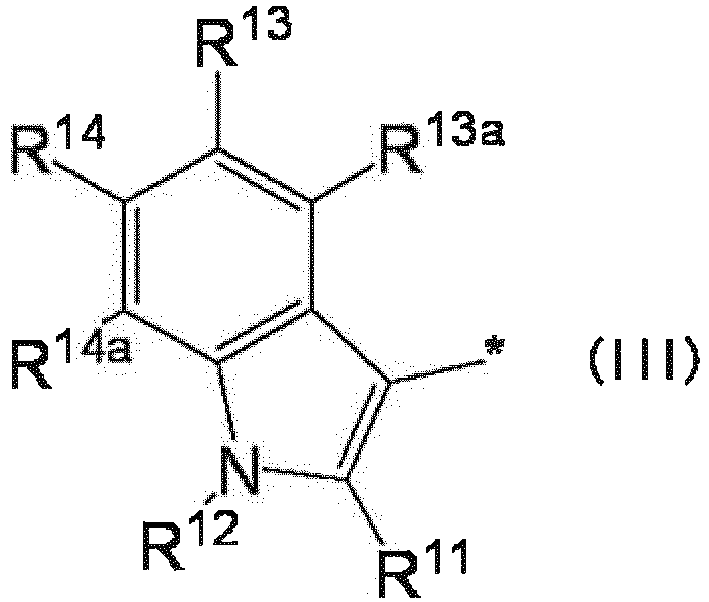
- wherein
R11 is a hydrogen atom, or
R11 is optionally combined with the above-mentioned R8 to form an alkylene group having 1 to 3 carbon atoms;
R12, R13, R13a, R14 and R14a are each independently a hydrogen atom, a halogen atom, a hydroxyl group, an alkyl group having 1 to 3 carbon atoms or an alkoxy group having 1 to 3 carbon atoms; and
* means a bonding site to Z, or
(2) a group represented by the following formula: -

- wherein
R15, R15a, R15b, R16 and R16a are each independently a hydrogen atom, a hydroxyl group, an alkyl group having 1 to 3 carbon atoms or an alkoxy group having 1 to 3 carbon atoms, or R15 and R16 in combination optionally form an alkylenedioxy group having 1 to 3 carbon atoms; and
* means a bonding site to Z,
or an edible salt thereof;
[2] the salty taste enhancer of the above-mentioned [1], wherein, in the formula (I), R13a, R14a, R15a, R15b and R16a are hydrogen atoms;
[3] the salty taste enhancer of the above-mentioned [1] or [2], wherein, in the formula (I),
Q is a group represented by -

- wherein
Hal is a halogen atom; and
* means a bonding site to X, and
X is a covalent bond;
[4] the salty taste enhancer of the above-mentioned [1] or [2], wherein, in the formula (I),
Q is a group represented by -

- wherein
R3'' is a hydrogen atom, a methyl group or a hydroxyl group;
and
* means a bonding site to X, and
X is a covalent bond;
[5] a salty taste enhancer for food and drink, which comprises a compound represented by the following formula: -

- wherein
R3''' is a hydrogen atom, a hydroxyl group, a methyl group or an alkoxy group having 1 to 3 carbon atoms;
R9' is (i) a hydrogen atom, (ii) an alkyl group having 1 to 3 carbon atoms which is optionally substituted by hydroxyl group(s), (iii) a carboxyl group, or (iv) an alkoxy(having 1 to 3 carbon atoms)-carbonyl group;
R15' and R16' are each independently a hydrogen atom, a hydroxyl group, an alkyl group having 1 to 3 carbon atoms or an alkoxy group having 1 to 3 carbon atoms; and
n is 1 or 2,
provided that when n is 2, then R3''' is not a hydroxyl group, or an edible salt thereof;
[6] the salty taste enhancer of the above-mentioned [5], wherein, in the formula (V), n is 2;
[7] a salty taste enhancer for food and drink, which comprises a compound represented by the following formula: -

- wherein
Q'' is a group represented by -

- wherein
R3''', is a hydrogen atom, a hydroxyl group, a methyl group or an alkoxy group having 1 to 3 carbon atoms; and
* means a bonding site to X;
R9' is (i) a hydrogen atom, (ii) an alkyl group having 1 to 3 carbon atoms which is optionally substituted by hydroxyl group(s), (iii) a carboxyl group, or (iv) an alkoxy(having 1 to 3 carbon atoms)-carbonyl group; and
R12', R13' and R14' are each independently a hydrogen atom, a halogen atom, a hydroxyl group, an alkyl group having 1 to 3 carbon atoms or an alkoxy group having 1 to 3 carbon atoms, or an edible salt thereof;
[8] the salty taste enhancer of the above-mentioned [7], wherein, in the formula (VI),
Q'' is a group represented by -

- wherein * means a bonding site to X, and
R9' is a hydrogen atom;
[9] the salty taste enhancer of the above-mentioned [1] or [2], wherein, in the formula (I), any of R1 to R5 is a sulfo group, and Y is -CO-NH-;
[10] a salty taste enhancer for food and drink, which comprises 2,6-dihydroxy-N-(2-(5-hydroxy-1H-indol-3-yl)ethyl)benzamide, or an edible salt thereof;
[11] a method of adjusting salty taste of food and drink, which comprises mixing a compound represented by the formula (I) described in the above-mentioned [1] or an edible salt thereof, and food and drink;
[12] a method of producing food and drink, which comprises mixing a compound represented by the formula (I) described in the above-mentioned [1] or an edible salt thereof, and food and drink;
[13] food and drink comprising a compound represented by the formula (I) described in the above-mentioned [1] or an edible salt thereof;
[14] food and drink comprising a compound represented by the formula (I) described in the above-mentioned [1] or an edible salt thereof, and potassium chloride;
[15] a compound represented by the following formula: -

- wherein
Q' is
(1) a group represented by the following formula: -

- wherein
R1', R2', R3', R4' and R5' are each independently a hydrogen atom, a halogen atom, a hydroxyl group, a carboxyl group, an alkyl group having 1 to 3 carbon atoms which is optionally substituted by 1 to 3 halogen atoms, an alkoxy group having 1 to 3 carbon atoms, a carbamoyl group or a sulfo group, or
R1, and R2' in combination or R2' and R3' in combination optionally form an alkylenedioxy group having 1 to 3 carbon atoms,
provided that any of R1' to R5' is not a hydrogen atom; and
* means a bonding site to X, or
(2) a cycloalkyl group having 3 to 7 carbon atoms which is optionally substituted by 1 to 3 alkyl groups having 1 to 3 carbon atoms;
X is a covalent bond, -CH2- or -CHR7-CH2-wherein R7 is a hydrogen atom or an amino group; Y' is -NR8'-CO-, -NH-CO-O- or -CO-NH-wherein
R8' is a hydrogen atom or an alkyl group having 1 to 3 carbon atoms, or
R8' is optionally combined with the following R11 to form an alkylene group having 1 to 3 carbon atoms;
Z is -CHR9-, -CH2-CR9R10-, -CR9R10-CH2-, -CH2-CH2-CHR9-, -CH=CR9- or -CR9=CH- wherein
R9 and R10 are each independently (i) a hydrogen atom, (ii) an alkyl group having 1 to 3 carbon atoms which is optionally substituted by hydroxyl group(s), (iii) a carboxyl group, (iv) an alkoxy(having 1 to 3 carbon atoms)-carbonyl group, (v) an aralkyloxycarbonyl group, (vi) an amino group optionally substituted by alkoxy(having 1 to 4 carbon atoms)-carbonyl group(s), or (vii) a carbamoyl group optionally substituted by alkyl group(s) having 1 to 3 carbon atoms wherein the alkyl group is optionally substituted by 1 to 3 substituents selected from a hydroxyl group, a carboxyl group and a phenyl group; and
Ar' is
(1) a group represented by the following formula: -

- wherein
R11 is a hydrogen atom, or
R11 is optionally combined with the above-mentioned R8 to form an alkylene group having 1 to 3 carbon atoms;
R12, R13 and R14 are each independently a hydrogen atom, a halogen atom, a hydroxyl group, an alkyl group having 1 to 3 carbon atoms or an alkoxy group having 1 to 3 carbon
atoms; and
* means a bonding site to Z, or
(2) a group represented by the following formula: -
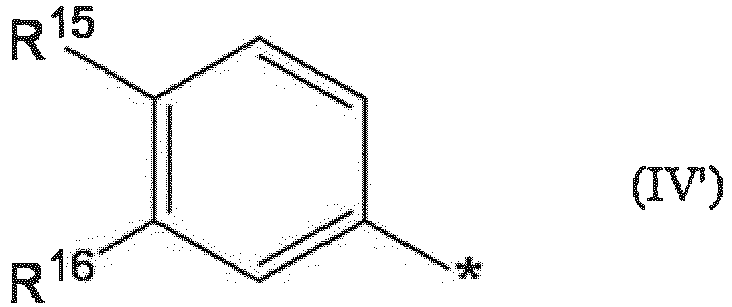
- wherein
R15 and R16 are each independently a hydrogen atom, a hydroxyl group, an alkyl group having 1 to 3 carbon atoms or an alkoxy group having 1 to 3 carbon atoms, or R15 and R16 in combination optionally form an alkylenedioxy group having 1 to 3 carbon atoms; and
* means a bonding site to Z,
provided that
(1) a compound wherein
Q' is a group represented by the formula (II'),
X is -CH2-CH2-,
Y' is -NH-CO-,
Z is -CH2-CH2-,
Ar' is a group represented by the formula (III'),
R1', R2', R4', R5', R11, R12 and R14 are hydrogen atoms, and
R3 and R13 are hydroxyl groups,
(2) a compound wherein
Q' is a group represented by the formula (II'),
X is a covalent bond,
Y' is -NH-CO-,
Z is -CH2-CHR9-Ar' is a group represented by the formula (III'), and - (i) R2', R3', R5', R11, R12, R13 and R14 are hydrogen atoms, R1 is a hydroxyl group, R4 is a bromine atom, and R9 is a hydrogen atom or a carboxyl group,
- (ii) R2', R3', R4', R5', R11, R12, R13 and R14 are hydrogen atoms, and R1' and R9 are carboxyl groups,
- (iii) R1', R2', R4', R5', R11, R12, R13 and R14 are hydrogen atoms, and R3' and R9 are carboxyl groups,
- (iv) R2', R4', R5', R11, R12 and R14 are hydrogen atoms, and R1', R3' and R13 are hydroxyl groups,
- (v) R2', R3', R5', R11, R12 and R14 are hydrogen atoms, and R1', R4' and R13 are hydroxyl groups,
- (vi) R1', R4', R5', R11, R12 and R14 are hydrogen atoms, R2', R3' and R13 are hydroxyl groups, or
- (vii) R2', R3', R4', R5', R11, R12, R13 and R14 are hydrogen atoms, R1' is a hydroxyl group, and R9 is a carboxyl group,
-

- wherein
Q' is
(1) a group represented by the following formula: -

- wherein
R1', R2', R3', R4' and R5' are each independently a hydrogen atom, a halogen atom, a hydroxyl group, a carboxyl group, an alkyl group having 1 to 3 carbon atoms which is optionally substituted by 1 to 3 halogen atoms, an alkoxy group having 1 to 3 carbon atoms, a carbamoyl group or a sulfo group, or
R1' and R2' in combination or R2' and R3' in combination optionally form an alkylenedioxy group having 1 to 3 carbon atoms,
provided that any of R1' to R5' is not a hydrogen atom; and
* means a bonding site to X, or
(2) a cycloalkyl group having 3 to 7 carbon atoms which is optionally substituted by 1 to 3 alkyl groups having 1 to 3 carbon atoms;
X is a covalent bond, -CH2- or -CHR7-CH2-
wherein R7 is a hydrogen atom or an amino group;
Y' is -NR8'-CO-, -NH-CO-O- or -CO-NH-
wherein
R8' is a hydrogen atom or an alkyl group having 1 to 3 carbon atoms, or
R8 is optionally combined with the following R11 to form an
alkylene group having 1 to 3 carbon atoms;
Z is -CHR9-, -CH2-CR9R10-, -CR9R10-CH2-, -CH2-CH2-CHR9-, -CH=CR9- or -CR9=CH-
wherein
R9 and R10 are each independently (i) a hydrogen atom, (ii) an alkyl group having 1 to 3 carbon atoms which is optionally substituted by hydroxyl group(s), (iii) a carboxyl group, (iv) an alkoxy(having 1 to 3 carbon atoms)-carbonyl group, (v) an aralkyloxycarbonyl group, (vi) an amino group optionally substituted by alkoxy(having 1 to 4 carbon atoms)-carbonyl group(s), or (vii) a carbamoyl group optionally substituted by alkyl group(s) having 1 to 3
carbon atoms wherein the alkyl group is optionally substituted by 1 to 3 substituents selected from a hydroxyl
group, a carboxyl group and a phenyl group; and
Ar' is
(1) a group represented by the following formula: -

- wherein
R11 is a hydrogen atom, or
R11 is optionally combined with the above-mentioned R8 to form an alkylene group having 1 to 3 carbon atoms;
R12, R13 and R14 are each independently a hydrogen atom, a halogen atom, a hydroxyl group, an alkyl group having 1 to 3 carbon atoms or an alkoxy group having 1 to 3 carbon
atoms; and
* means a bonding site to Z, or
(2) a group represented by the following formula: -

- wherein
R15 and R16 are each independently a hydrogen atom, a hydroxyl group, an alkyl group having 1 to 3 carbon atoms or an alkoxy group having 1 to 3 carbon atoms, or R15 and R16 in combination optionally form an alkylenedioxy group having 1 to 3 carbon atoms; and
* means a bonding site to Z,
provided that
(1) a compound wherein
Q' is a group represented by the formula (II'),
X is a covalent bond, -CH2- or -CH2-CH2-,
Y' is -NH-CO-,
Z is -CHR9-, -CH2-CHR9-, -CHR9-CH2-, -CH=CR9- or -CR9=CH-, Ar' is a group represented by the formula (III'),
R1', R2', R3', R4' and R5' are each independently a hydrogen atom, a hydroxyl group, an alkyl group having 1 to 3 carbon atoms or an alkoxy group having 1 to 3 carbon atoms, or R1, and R2, in combination or R2' and R3' in combination form a methylenedioxy group,
R9 is a hydrogen atom, a carboxyl group or an alkoxy(having 1 to 3 carbon atoms)-carbonyl group,
R11 and R12 are hydrogen atoms, and
R13 and R14 are each independently a hydrogen atom, a hydroxyl group, an alkyl group having 1 to 3 carbon atoms or an alkoxy group having 1 to 3 carbon atoms,
(2) a compound wherein
Q' is a group represented by the formula (II'),
X is a covalent bond,
Y' is -NH-CO-,
Z is -CH2-CHR9-,
Ar' is a group represented by the formula (III'), and - (i) R2', R3', R5', R11, R12, R13 and R14 are hydrogen atoms, R1, is a hydroxyl group, R4' is a bromine atom, and R9 is a hydrogen atom or a carboxyl group,
- (ii) R2', R3', R4', R5', R11, R12, R13 and R14 are hydrogen atoms, and R1' and R9 are carboxyl groups,
- (iii) R1', R2', R4', R5', R11, R12, R13 and R14 are hydrogen atoms, and R3' and R9 are carboxyl groups, or
- (iv) R2', R3', R4', R5', R11, R12, R13 and R14 are hydrogen atoms, R1' is a hydroxyl group, and R9 is a carboxyl group,
-

- wherein
R3''' is a hydrogen atom, a hydroxyl group, a methyl group or an alkoxy group having 1 to 3 carbon atoms;
R9' is (i) a hydrogen atom, (ii) an alkyl group having 1 to 3 carbon atoms which is optionally substituted by hydroxyl group(s), (iii) a carboxyl group, or (iv) an alkoxy(having 1 to 3 carbon atoms)-carbonyl group;
R15' and R16' are each independently a hydrogen atom, a hydroxyl group, an alkyl group having 1 to 3 carbon atoms or an alkoxy group having 1 to 3 carbon atoms; and
n is 1 or 2,
provided that when n is 2, then R3''' is not a hydroxyl group, or a salt thereof;
[18] the compound of the above-mentioned [17], wherein, in the formula (V), n is 2, or a salt thereof;
[19] the compound of the above-mentioned [15] or [16], which is a compound represented by the following formula: -

- wherein
Q'' is a group represented by -

- wherein
R3''' is a hydrogen atom, a hydroxyl group, a methyl group or an alkoxy group having 1 to 3 carbon atoms; and
* means a bonding site to X;
R9' is (i) a hydrogen atom, (ii) an alkyl group having 1 to 3 carbon atoms which is optionally substituted by hydroxyl group(s), (iii) a carboxyl group, or (iv) an alkoxy(having 1 to 3 carbon atoms)-carbonyl group; and
R12', R13' and R14' are each independently a hydrogen atom, a halogen atom, a hydroxyl group, an alkyl group having 1 to 3 carbon atoms or an alkoxy group having 1 to 3 carbon atoms, or a salt thereof;
[20] the compound of the above-mentioned [19], wherein, in the formula (VI),
Q'' is a group represented by -

- wherein * means a bonding site to X, and
R9' is a hydrogen atom,
or a salt thereof; and
[21] the compound of the above-mentioned [15] or [16], wherein, in the formula (I'),
any of R1' to R5' is a sulfo group, and
Y' is -CO-NH-,
or a salt thereof. - The compound of the present invention is expected to show a strong salty taste enhancing effect, and it can be used for a salty taste enhancer for food and drink, and the like.
-
-
Fig. 1 shows the activation current value when ENaC-expressing oocyte was stimulated with the compound of Example 32. -
Fig. 2 shows the salty taste enhancing ratio of the compound of Example 35 in a sensory evaluation test. -
Fig. 3 shows the activation current value when ENaC-expressing oocyte was stimulated with the compound of Example 35. -
Fig. 4 shows the salty taste enhancing ratio of the compound of Example 35 used in combination with potassium chloride in a sensory evaluation test. - The terms used in the present specification are explained below.
Examples of the "halogen atom" include a chlorine atom, a bromine atom, a fluorine atom and an iodine atom.
Examples of the "alkyl group having 1 to 3 carbon atoms" include a methyl group, an ethyl group, a propyl group, an isopropyl group and the like.
Examples of the "alkyl group having 1 to 6 carbon atoms" include a methyl group, an ethyl group, a propyl group, an isopropyl group, a butyl group, an isobutyl group, a sec-butyl group, a tert-butyl group, a pentyl group, an isopentyl group, a neopentyl group, a 1-ethylpropyl group, a 1,1-dimethylpropyl group, a 2-methylbutyl group, a hexyl group, an isohexyl group, a 1,1-dimethylbutyl group, a 2,2-dimethylbutyl group, a 3,3-dimethylbutyl group, a 2-ethylbutyl group and the like.
Examples of the "alkoxy group having 1 to 3 carbon atoms" include a methoxy group, an ethoxy group, a propoxy group, an isopropoxy group and the like.
Examples of the "cycloalkyl group having 3 to 7 carbon atoms" include a cyclopropyl group, a cyclobutyl group, a cyclopentyl group, a cyclohexyl group, a cycloheptyl group and the like.
Examples of the "alkoxy(having 1 to 3 carbon atoms)-carbonyl group" include a methoxycarbonyl group, an ethoxycarbonyl group, a propoxycarbonyl group, an isopropoxycarbonyl group and the like.
Examples of the "alkoxy(having 1 to 4 carbon atoms)-carbonyl group" include a methoxycarbonyl group, an ethoxycarbonyl group, a propoxycarbonyl group, an isopropoxycarbonyl group, a butoxycarbonyl group and the like.
Examples of the "aralkyloxycarbonyl group" include a benzyloxycarbonyl group, a phenethyloxycarbonyl group, a naphthylmethyloxycarbonyl group (a 1-naphthylmethyloxycarbonyl group, a 2-naphthylmethyloxycarbonyl group), a biphenylylmethyloxycarbonyl group and the like.
Examples of the "alkylene group having 1 to 3 carbon atoms" include a methylene group, an ethylene group, a propylene group, -CH(CH3)-, -CH(CH3)-CH2-, -CH2-CH(CH3)-, - C(CH3)2-, -CH(C2H5)- and the like.
Examples of the "alkylenedioxy group having 1 to 3 carbon atoms" include a methylenedioxy group, an ethylenedioxy group, a propylenedioxy group, -O-CH(CH3)-O-, -O-CH(CH3)-CH2-O-, -O-CH2-CH(CH3)-O-, -O-C (CH3)2-O-, -O-CH(C2H5)-O- and the like. - Each moiety in the above-mentioned formula (I) is explained below.
- Q is
(1) a group represented by the following formula: -

- wherein
R1, R2, R3, R4 and R5 are each independently a hydrogen atom, a halogen atom, a hydroxyl group, a carboxyl group, an alkyl group having 1 to 3 carbon atoms which is optionally substituted by 1 to 3 halogen atoms, an alkoxy group having 1 to 3 carbon atoms, a carbamoyl group or a sulfo group, or R1 and R2 in combination or R2 and R3 in combination optionally form an alkylenedioxy group having 1 to 3 carbon atoms, or
R1 is optionally combined with R8 to form a carbonyl group, (2) a cycloalkyl group having 3 to 7 carbon atoms which is optionally substituted by 1 to 3 alkyl groups having 1 to 3 carbon atoms, or
(3) an alkyl group having 1 to 6 carbon atoms which is optionally substituted by 1 to 3 substituents selected from an amino group and a hydroxyl group. - The "alkyl group having 1 to 3 carbon atoms" of the "alkyl group having 1 to 3 carbon atoms which is optionally substituted by 1 to 3 halogen atoms" for R1, R2, R3, R4 or R5 is preferably a methyl group.
The "alkyl group having 1 to 3 carbon atoms which is optionally substituted by 1 to 3 halogen atoms" for R1, R2, R3, R4 or R5 is preferably an alkyl group having 1 to 3 carbon atoms (preferably a methyl group) which is optionally substituted by 1 to 3 fluorine atoms, more preferably a trifluoromethyl group. - The "alkoxy group having 1 to 3 carbon atoms" for R1, R2, R3, R4 or R5 is preferably a methoxy group.
- The "alkylenedioxy group having 1 to 3 carbon atoms" formed by R1 and R2 in combination or R2 and R3 in combination is preferably a methylenedioxy group.
- The "cycloalkyl group having 3 to 7 carbon atoms" of the "cycloalkyl group having 3 to 7 carbon atoms which is optionally substituted by 1 to 3 alkyl groups having 1 to 3 carbon atoms" for Q is preferably a cyclohexyl group.
The "cycloalkyl group having 3 to 7 carbon atoms" is optionally substituted by 1 to 3 substituents selected from an alkyl group having 1 to 3 carbon atoms (preferably a methyl group, an isopropyl group).
The "cycloalkyl group having 3 to 7 carbon atoms which is optionally substituted by 1 to 3 alkyl groups having 1 to 3 carbon atoms" for Q is preferably a cyclohexyl group optionally substituted by 1 to 3 alkyl groups having 1 to 3 carbon atoms (preferably a methyl group, an isopropyl group), more preferably a cyclohexyl group optionally substituted by 1 or 2 alkyl groups having 1 to 3 carbon atoms (preferably a methyl group, an isopropyl group), particularly preferably a 2-isopropyl-5-methylcyclohexyl group. - The "alkyl group having 1 to 6 carbon atoms" of the "alkyl group having 1 to 6 carbon atoms which is optionally substituted by 1 to 3 substituents selected from an amino group and a hydroxyl group" for Q is preferably an ethyl group, a tert-butyl group, an isopentyl group or a neopentyl group.
The "alkyl group having 1 to 6 carbon atoms which is optionally substituted by 1 to 3 substituents selected from an amino group and a hydroxyl group" for Q is preferably an alkyl group having 1 to 6 carbon atoms (preferably an ethyl group, a tert-butyl group, an isopentyl group, a neopentyl group) optionally substituted by 1 or 2 (preferably 1) substituents selected from an amino group and a hydroxyl group, more preferably a tert-butyl group, a neopentyl group, a 2-hydroxyethyl group or a 1-amino-3-methylbutyl group. - Q is preferably a group represented by
-

- wherein
Hal is a halogen atom; and
* means a bonding site to X. - In another embodiment, Q is preferably a group represented by
-

- wherein
R3'' is a hydrogen atom, a methyl group or a hydroxyl group;
and
* means a bonding site to X. - In another embodiment, Q is
preferably
(1) a group represented by the following formula: -

- wherein
R1', R2', R3', R4' and R5' are each independently a hydrogen atom, a halogen atom, a hydroxyl group, a carboxyl group, an alkyl group having 1 to 3 carbon atoms which is optionally substituted by 1 to 3 halogen atoms, an alkoxy group having 1 to 3 carbon atoms, a carbamoyl group or a sulfo group, or
R1' and R2' in combination or R2' and R3' in combination optionally form an alkylenedioxy group having 1 to 3 carbon atoms,
provided that any of R1' to R5' is not a hydrogen atom; and
* means a bonding site to X, or
(2) a cycloalkyl group having 3 to 7 carbon atoms which is optionally substituted by 1 to 3 alkyl groups having 1 to 3 carbon atoms,
more preferably any of R1' to R5' is a sulfo group. - In another embodiment, Q is
preferably a group represented by -

- wherein
R3''' is a hydrogen atom, a hydroxyl group, a methyl group or an alkoxy group having 1 to 3 carbon atoms; and
* means a bonding site to X,
more preferably a group represented by -
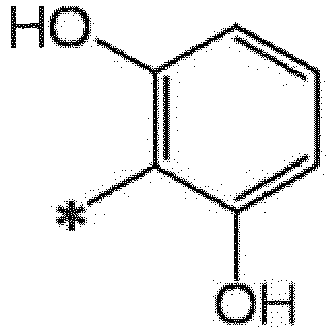
- wherein * means a bonding site to X.
- X is a covalent bond, -CH2- or -CHR7-CH2- wherein R7 is a hydrogen atom or an amino group.
X is preferably a covalent bond. - Y is -NR8-CO-, -NH-CO-O- or -CO-NH-
wherein
R8 is a hydrogen atom or an alkyl group having 1 to 3 carbon atoms, or
R8 is optionally combined with R1 to form a carbonyl group, or
R8 is optionally combined with R11 to form an alkylene group having 1 to 3 carbon atoms.
Y is
preferably -NR8'-CO-, -NH-CO-O- or -CO-NH-
wherein
R8' is a hydrogen atom or an alkyl group having 1 to 3 carbon atoms, or
R8 is optionally combined with the following R11 to form an
alkylene group having 1 to 3 carbon atoms,
more preferably -NH-CO- or -CO-NH-,
still more preferably -NH-CO-.
In another embodiment, Y is preferably -CO-NH-. - The "alkyl group having 1 to 3 carbon atoms" for R8 is preferably a methyl group.
The "alkylene group having 1 to 3 carbon atoms" formed by R8 and R11 in combination is preferably a methylene group. - Z is -CHR9-, -CH2-CR9R10-, -CR9R10-CH2-, -CH2-CH2-CHR9-, - CH=CR9- or -CR9=CH-
wherein
R9 and R10 are each independently (i) a hydrogen atom, (ii) an alkyl group having 1 to 3 carbon atoms which is optionally substituted by hydroxyl group(s), (iii) a carboxyl group, (iv) an alkoxy(having 1 to 3 carbon atoms)-carbonyl group, (v) an aralkyloxycarbonyl group, (vi) an amino group optionally substituted by alkoxy(having 1 to 4 carbon atoms)-carbonyl group(s), or (vii) a carbamoyl group optionally substituted by alkyl group(s) having 1 to 3 carbon atoms wherein the alkyl group is optionally substituted by 1 to 3 substituents selected from a hydroxyl group, a carboxyl group and a phenyl group. - The "alkyl group having 1 to 3 carbon atoms" of the "alkyl group having 1 to 3 carbon atoms which is optionally substituted by hydroxyl group(s)" for R9 or R10 is preferably a methyl group.
The "alkoxy(having 1 to 3 carbon atoms)-carbonyl group" for R9 or R10 is preferably a methoxycarbonyl group or an ethoxycarbonyl group.
The "aralkyloxycarbonyl group" for R9 or R10 is preferably a benzyloxycarbonyl group.
The "alkoxy(having 1 to 4 carbon atoms)-carbonyl group" of the "amino group optionally substituted by alkoxy(having 1 to 4 carbon atoms)-carbonyl group(s)" for R9 or R10 is preferably a tert-butoxycarbonyl group.
The "alkyl group having 1 to 3 carbon atoms" of the "carbamoyl group optionally substituted by alkyl group(s) having 1 to 3 carbon atoms wherein the alkyl group is optionally substituted by 1 to 3 substituents selected from a hydroxyl group, a carboxyl group and a phenyl group" for R9 or R10 is preferably an ethyl group. - Z is preferably -CHR9-, -CH2-CR9R10-, -CH2-CH2-CHR9- or - CH=CR9-, more preferably -CHR9-, -CH2-CR9R10-, -CH2-CH2-CHR9- or -
CH=CH-
wherein
R9 and R10 are each independently (i) a hydrogen atom, (ii) an alkyl group having 1 to 3 carbon atoms (preferably a methyl group) which is optionally substituted by hydroxyl group(s), (iii) a carboxyl group, (iv) an alkoxy(having 1 to 3 carbon atoms)-carbonyl group (preferably a methoxycarbonyl group, an ethoxycarbonyl group), (v) an aralkyloxycarbonyl group (preferably a benzyloxycarbonyl group), (vi) an amino group optionally substituted by alkoxy(having 1 to 4 carbon atoms)-carbonyl group(s)
(preferably a tert-butoxycarbonyl group), or (vii) a carbamoyl group optionally substituted by alkyl group(s) having 1 to 3 carbon atoms (preferably an ethyl group) wherein the alkyl group is optionally substituted by 1 to 3 substituents selected from a hydroxyl group, a carboxyl group and a phenyl group.
In another embodiment, Z is
preferably -CH2-CHR9' - or -CH2-CH2-CHR9' -
wherein
R9' is (i) a hydrogen atom, (ii) an alkyl group having 1 to 3 carbon atoms which is optionally substituted by hydroxyl
group(s), (iii) a carboxyl group, or (iv) an alkoxy(having 1 to 3 carbon atoms)-carbonyl group,
more preferably -CH2-CHR9'-
wherein R9' is as defined above,
still more preferably -CH2-CH2-. - Ar is
(1) a group represented by the following formula: -

- wherein
R11 is a hydrogen atom, or
R11 is optionally combined with R8 to form an alkylene group having 1 to 3 carbon atoms;
R12, R13, R13a, R14 and R14a are each independently a hydrogen atom, a halogen atom, a hydroxyl group, an alkyl group having 1 to 3 carbon atoms or an alkoxy group having 1 to 3 carbon atoms; and
* means a bonding site to Z, or
(2) a group represented by the following formula: -

- wherein
R15, R15a, R15b, R16 and R16a are each independently a hydrogen atom, a hydroxyl group, an alkyl group having 1 to 3 carbon atoms or an alkoxy group having 1 to 3 carbon atoms, or R15 and R16 in combination optionally form an alkylenedioxy group having 1 to 3 carbon atoms; and
* means a bonding site to Z. - The "alkylene group having 1 to 3 carbon atoms" formed by R11 and R8 in combination is preferably a methylene group.
The "alkyl group having 1 to 3 carbon atoms" for R12, R13, R13a, R14 or R14a is preferably a methyl group.
The "alkoxy group having 1 to 3 carbon atoms" for R15, R15a, R15b, R16 or R16a is preferably a methoxy group.
The "alkylenedioxy group having 1 to 3 carbon atoms" formed by R15 and R16 in combination is preferably a methylenedioxy group.
R13a, R14a, R15a, R15b and R16a are preferably hydrogen atoms. - Ar is preferably
(1) a group represented by the following formula: -

- wherein each symbol is as defined above, or
(2) a group represented by the following formula; -

- wherein each symbol is as defined above.
- Ar is preferably
(1) a group represented by the formula (III') wherein
R11 is a hydrogen atom, or
R11 is optionally combined with R8 to form an alkylene group having 1 to 3 carbon atoms (preferably a methylene group);
and
R12, R13 and R14 are each independently a hydrogen atom, a halogen atom (preferably a fluorine atom), a hydroxyl group, or an alkyl group having 1 to 3 carbon atoms (preferably a
methyl group), or
(2) a group represented by the formula (IV') wherein
R15 and R16 are each independently a hydrogen atom, a hydroxyl group or an alkoxy group having 1 to 3 carbon atoms (preferably a methoxy group), or
R15 and R16 in combination optionally form an alkylenedioxy group having 1 to 3 carbon atoms (preferably a methylenedioxy group). - In another embodiment, Ar is preferably a group represented by the following formula:
-

- wherein each symbol is as defined above.
- The compound represented by the formula (I) wherein
Q is
(1) a group represented by the above-mentioned formula (II) wherein
R1, R2, R3, R4 and R5 are each independently a hydrogen atom, a halogen atom (preferably a chlorine atom, a bromine atom), a hydroxyl group, a carboxyl group, an alkyl group having 1 to 3 carbon atoms (preferably a methyl group) optionally substituted by 1 to 3 halogen atoms (preferably a fluorine atom), an alkoxy group having 1 to 3 carbon atoms (preferably a methoxy group, an ethoxy group), a carbamoyl group or a sulfo group, or
R1 and R2 in combination or R2 and R3 in combination optionally form an alkylenedioxy group having 1 to 3 carbon atoms (preferably a methylenedioxy group), or
R1 is optionally combined with R8 to form a carbonyl group, (2) a cycloalkyl group having 3 to 7 carbon atoms (preferably a cyclohexyl group) optionally substituted by 1 to 3 (preferably 1 or 2) alkyl groups having 1 to 3 carbon atoms (preferably a methyl group, an isopropyl group) (particularly preferably a 2-isopropyl-5-methylcyclohexyl group), or (3) an alkyl group having 1 to 6 carbon atoms (preferably an ethyl group, a tert-butyl group, an isopentyl group, a neopentyl group) optionally substituted by 1 to 3 (preferably 1 or 2, more preferably 1) substituents selected from an amino group and a hydroxyl group (particularly preferably a tert-butyl group, a neopentyl group, a 2-hydroxyethyl group, a 1-amino-3-methylbutyl group);
X is a covalent bond, -CH2- or -CHR7-CH2-
wherein R7 is a hydrogen atom or an amino group;
Y is -NR8-CO-, -NH-CO-O- or -CO-NH-
wherein
R8 is a hydrogen atom or an alkyl group having 1 to 3 carbon atoms (preferably a methyl group), or
R8 is optionally combined with R1 to form a carbonyl group, or
R8 is optionally combined with R11 to form an alkylene group
having 1 to 3 carbon atoms (preferably a methylene group); Z is -CHR9-, -CH2-CR9R10-, -CH2-CH2-CHR9- or -CH=CR9- (preferably
-CHR9-, -CH2-CR9R10-, -CH2-CH2-CHR9- or -CH=CH-)
wherein
R9 and R10 are each independently (i) a hydrogen atom, (ii) an alkyl group having 1 to 3 carbon atoms (preferably a methyl group) which is optionally substituted by hydroxyl group(s), (iii) a carboxyl group, (iv) an alkoxy(having 1 to 3 carbon atoms)-carbonyl group (preferably a methoxycarbonyl group, an ethoxycarbonyl group), (v) an aralkyloxycarbonyl group (preferably a benzyloxycarbonyl group), (vi) an amino group optionally substituted by alkoxy(having 1 to 4 carbon atoms)-carbonyl group(s) (preferably a tert-butoxycarbonyl group), or (vii) a carbamoyl group optionally substituted by alkyl group(s) having 1 to 3 carbon atoms (preferably an ethyl group) wherein the alkyl group is optionally substituted by 1 to 3 substituents selected from a hydroxyl group, a carboxyl
group and a phenyl group; and
Ar is
(1) a group represented by the formula (III') wherein
R11 is a hydrogen atom, or
R11 is optionally combined with R8 to form an alkylene group having 1 to 3 carbon atoms (preferably a methylene group);
and
R12, R13 and R14 are each independently a hydrogen atom, a halogen atom (preferably a fluorine atom), a hydroxyl group, or an alkyl group having 1 to 3 carbon atoms (preferably a
methyl group), or
(2) a group represented by the formula (IV') wherein
R15 and R16 are each independently a hydrogen atom, a hydroxyl group or an alkoxy group having 1 to 3 carbon atoms (preferably a methoxy group), or
R15 and R16 in combination optionally form an alkylenedioxy group having 1 to 3 carbon atoms (preferably a
methylenedioxy group),
is preferable. - In another embodiment, the compound represented by the formula (I) wherein R13a, R14a, R15a, R15b and R16a are hydrogen atoms is preferable.
- In another embodiment, the compound represented by the formula (I) wherein
Q is a group represented by -

- wherein
Hal is a halogen atom; and
* means a bonding site to X, and
X is a covalent bond,
is preferable. - In another embodiment, the compound represented by the formula (I) wherein
Q is a group represented by -

- wherein
R3'' is a hydrogen atom, a methyl group or a hydroxyl group;
and
* means a bonding site to X, and
X is a covalent bond,
is preferable. - In another embodiment, the compound represented by the formula (I) is preferably a compound represented by the formula (V), particularly preferably the compound wherein n is 2.
In another embodiment, a compound represented by the formula (I) is preferably a compound represented by the formula (VI), particularly preferably the compound wherein Q'' is a group represented by -

- wherein * means a bonding site to X, and
R9' is a hydrogen atom. - In another embodiment, the compound represented by the formula (I) wherein
any of R1 to R5 is a sulfo group, and
Y is -CO-NH-,
is preferable.
The compound represented by the formula (I) is particularly preferably the compounds disclosed in the following Examples, particularly 2,6-dihydroxy-N-(2-(5-hydroxy-1H-indol-3-yl)ethyl)benzamide. - Of compound (I), the compound represented by the above-mentioned formula (I') is a novel compound.
The compound represented by the formula (I') wherein Q' is a group represented by
(1) the above-mentioned formula (II') wherein
R1', R2', R3', R4' and R5' are each independently a hydrogen atom, a halogen atom (preferably a chlorine atom, a bromine atom), a hydroxyl group, a carboxyl group, an alkyl group having 1 to 3 carbon atoms (preferably a methyl group) optionally substituted by 1 to 3 halogen atoms (preferably a fluorine atom), an alkoxy group having 1 to 3 carbon atoms (preferably a methoxy group, an ethoxy group), a carbamoyl group or a sulfo group, or
R1' and R2' in combination or R2' and R3' in combination optionally form an alkylenedioxy group having 1 to 3 carbon atoms (preferably a methylenedioxy group), or
(2) a cycloalkyl group having 3 to 7 carbon atoms (preferably a cyclohexyl group) optionally substituted by 1 to 3 (preferably 1 or 2) alkyl groups having 1 to 3 carbon atoms (preferably a methyl group, an isopropyl group) (particularly preferably a 2-isopropyl-5-methylcyclohexyl group); X is a covalent bond, -CH2- or -CHR7-CH2-
wherein R7 is a hydrogen atom or an amino group;
Y' is -NR8'-CO-, -NH-CO-O- or -CO-NH-
wherein
R8' is a hydrogen atom or an alkyl group having 1 to 3 carbon atoms (preferably a methyl group), or R8' is optionally combined with R11 to form an alkylene group
having 1 to 3 carbon atoms (preferably a methylene group); Z is -CHR9-, -CH2-CR9R10-, -CH2-CH2-CHR9- or -CH=CR9- (preferably
-CHR9-, -CH2-CR9R10-, -CH2-CH2-CHR9- or -CH=CH-)
wherein
R9 and R10 are each independently (i) a hydrogen atom, (ii) an alkyl group having 1 to 3 carbon atoms (preferably a methyl group) which is optionally substituted by hydroxyl group(s), (iii) a carboxyl group, (iv) an alkoxy(having 1 to 3 carbon atoms)-carbonyl group (preferably a methoxycarbonyl group, an ethoxycarbonyl group), (v) an aralkyloxycarbonyl group (preferably a benzyloxycarbonyl group), (vi) an amino group optionally substituted by alkoxy(having 1 to 4 carbon atoms)-carbonyl group(s)
(preferably a tert-butoxycarbonyl group), or (vii) a carbamoyl group optionally substituted by alkyl group(s) having 1 to 3 carbon atoms (preferably an ethyl group) wherein the alkyl group is optionally substituted by 1 to 3 substituents selected from a hydroxyl group, a carboxyl
group and a phenyl group; and
Ar' is
(1) a group represented by the formula (III')
wherein
R11 is a hydrogen atom, or
R11 is optionally combined with R8' to form an alkylene group having 1 to 3 carbon atoms (preferably a methylene group);
and
R12, R13 and R14 are each independently a hydrogen atom, a halogen atom (preferably a fluorine atom), a hydroxyl group, or an alkyl group having 1 to 3 carbon atoms (preferably a
methyl group), or
(2) a group represented by the formula (IV') wherein
R15 and R16 are each independently a hydrogen atom, a hydroxyl group or an alkoxy group having 1 to 3 carbon atoms (preferably a methoxy group), or
R15 and R16 in combination optionally form an alkylenedioxy group having 1 to 3 carbon atoms (preferably a
methylenedioxy group),
is preferable. - Examples of the salt of compound (I) or (I') include salts with inorganic acid, salts with organic acid, salts with inorganic base, salts with organic base, salts with acidic or basic amino acid, and the like.
Examples of the salt with inorganic acid include hydrochloride, hydrobromide, sulfate, nitrate, phosphate and the like.
Examples of the salt with organic acid include formate, acetate, trifluoroacetate, maleate, tartrate, citrate, fumarate, methanesulfonate, benzenesulfonate, p-toluenesulfonate and the like.
Examples of the salt with inorganic base include sodium salt, potassium salt, calcium salt, magnesium salt, ammonium salt and the like.
Examples of the salt with organic base include salts with methylamine, diethylamine, trimethylamine, triethylamine, ethanolamine, diethanolamine, triethanolamine, ethylenediamine, tris(hydroxymethyl)methylamine, dicyclohexylamine, N,N'-dibenzylethylenediamine, guanidine, pyridine, picoline, choline, cinchonine, meglumine and the like.
Examples of the salt with acidic or basic amino acid include salts with aspartic acid, glutamic acid, arginine, lysine and ornithine.
The above-mentioned salt is preferably an edible salt. - When compound (I) (including compound (I')) or a salt thereof (hereinafter, sometimes to be abbreviated as the compound of the present invention) contains an optical isomer, a stereoisomer, a regioisomer or a rotamer, these are also encompassed in the compound of the present invention, and can be obtained as a single product according to synthetic and separation methods known per se. For example, when the compound of the present invention contains an optical isomer, an optical isomer resolved from racemate is also encompassed in the compound of the present invention. These isomers can be obtained as a single product according to synthetic methods known per se, separation methods known per se (e.g., concentration, solvent extraction, column chromatography, recrystallization, etc.), optical resolution methods known per se (e.g., fractional recrystallization, chiral column method, diastereomer method etc.) and the like.
- In one embodiment of the present invention, the compound of the present invention can be added to various foods and drinks. While the food and drink are not particularly limited, examples thereof include seasonings (e.g., miso, soy sauce, baster, dashi (Japanese soup), dressing, mayonnaise, tomato ketchup etc.), soups (e.g., miso soup, Japanese-style soup (osuimono), consomme soup, egg soup, seaweed soup, potage etc.), sauces for soba, wheat noodles (udon), ramen, pasta and the like, sauces, foods of cooked rice (e.g., rice gruel, rice soup, ochazuke etc.), livestock processed products (e.g., ham, sausage, cheese etc.), confectionery and snack foods (e.g., potato chips, Japanese cracker, cookie etc.), cooked foods (e.g., boiled food, fried food, roasted food, curry etc.), drinks and the like. The amount of the compound of the present invention to be added to food and drink is not particularly limited as long as the effect thereof can be exhibited. However, since food and drink are mixtures with various substances, the amount of the present invention that achieves a salty taste enhancing effect may vary from the amount that shows a salty taste enhancing effect using simple brine and the like. Therefore, the amount of the compound of the present invention to be added to food and drink can be determined by appropriately examining the optimal amount for each food and drink. For example, 0.000001 - 0.1 wt% is preferable.
- The compound of the present invention can be used in combination with a known salty taste alternative. Examples of the salty taste alternative include potassium chloride, organic acid, arginine, argininate, ammonium chloride and the like. These may be used alone or two or more kinds thereof may be used as a mixture.
- When the compound of the present invention is added to food and drink, the food and drink produced may contain a suitable additive to the extent that the salty taste enhancing action is not prevented. For example, such food and drink can contain, in addition to the compound of the present invention, various additives generally usable for the production of food and drink, such as protein (milk protein, soybean protein etc.), inorganic salt, acid, amino acids, nucleic acid taste components, saccharides, fats, natural seasonings, spices, excipients, dye components and the like.
Examples of the inorganic salt include potassium chloride, ammonium chloride, magnesium sulfate and the like.
Examples of the acid include carboxylic acids such as ascorbic acid, fumaric acid, malic acid, tartaric acid, citric acid, lactic acid, succinic acid and the like, salts thereof and the like.
Examples of the amino acids include glutamates (e.g., sodium glutamate, potassium glutamate, calcium glutamate, ammonium glutamate, magnesium glutamate etc.), glutamic acid and the like. These have already been used as flavor enhancers for food, and all of them have umami taste derived from glutamic acid and taste property (e.g., sour taste derived from ammonium salt, etc.) characteristic of each cation. In addition, basic amino acids (e.g., lysine, arginine, histidine etc.) and salts thereof can also be used as amino acids.
Examples of the nucleic acid taste component include sodium inosinate, sodium guanylate and the like.
Examples of the saccharide include sucrose, glucose, lactose and the like.
The compound of the present invention preferably contains one or more kinds of additives selected particularly from organic acids, arginine, argininate, ammonium chloride and potassium chloride, which are known to have a salty taste enhancing effect. - The production method of the compound represented by the formula (I) or a salt thereof is not particularly limited, and it can be produced by combination of known methods. Specifically, it can be synthesized according to the following method, which is not to be construed as limitative.
- The compound represented by the formula (I) wherein Y is -NR8-CO- wherein R8 is as defined above, or a salt thereof (hereinafter, to be referred to as compound (I-1)) can be produced according to the following
Production Methods -
Production Method 1 -

- wherein each symbol is as defined above.
- Compound (I-1) can be produced by subjecting amine component (VII) and carboxylic acid component (VIII) to a condensation reaction with a dehydrating condensing agent.
Amine component (VII) may be in the form of a salt (e.g., hydrochloride, p-toluenesulfonate etc.), and carboxylic acid component (VIII) may be in the form of a salt (e.g., dicyclohexylamine salt etc.). When amine component (VII) is in the form of a salt, the condensation reaction may be carried out by addition of a base (e.g., triethylamine etc.). While the ratio of amine component (VII) and carboxylic acid component (VIII) to be used is not limited, carboxylic acid component (VIII) is used in an amount of 0.8 - 1.2 equivalents per 1 equivalent of amine component (VII) for the reaction in good yield. The amount of the base to be used is 0.8 - 2.0 equivalents, preferably 1.0 - 1.5 equivalents, relative to amine component (VII). - The solvent to be used is not particularly limited as long as it does not react with amine component (VII) or carboxylic acid component (VIII), and examples thereof include dichloromethane (DCM), N,N-dimethylformamide (DMF), chloroform, dimethyl sulfoxide (DMSO), N-methylpyrrolidone (NMP), and a mixed solvent thereof. Among them, dichloromethane and N,N-dimethylformamide are preferable. The amount of the solvent is 10 to 500-fold weight, preferably 15 to 100-fold weight, relative to amine component (VII).
- The dehydrating condensing agent may be a general condensing agent used for peptide synthesis and the like, and examples thereof include N,N'-dicyclohexylcarbodiimide (DCC), 1-ethyl-3-(3-dimethylaminopropyl)carbodiimide hydrochloride (EDCI·HCl), 2-(1H-benzotriazol-1-yl)-1,1,3,3-tetramethyluronium hexafluorophosphate (HBTU) and the like. A condensation promoter (e.g., 1-hydroxybenzotriazole (HOBt) etc.) is also used together with the dehydrating condensing agent. The amount of the dehydrating condensing agent to be used is 1.0 - 2.0 equivalents, preferably 1.05 - 1.20 equivalents, relative to amine component (VII). The amount of the condensation promoter to be used is 0.5 - 3.0 equivalents, preferably 1.0 - 1.5 equivalents, relative to amine component (VII).
The reaction time is preferably about 3 - 24 hr which depends on the reaction temperature. The reaction temperature is preferably within the range of 5 - 35°C. -
Production Method 2 -

- wherein each symbol is as defined above.
- Compound (I-1) can be produced by converting carboxylic acid component (VIII) to acid chloride (IX), and then subjecting acid chloride (IX) and amine component (VII) to a condensation reaction in the presence of a base.
- Acid chloride (IX) can be obtained by reacting carboxylic acid component (VIII) with oxalyl chloride, thionyl chloride or the like according to a conventional method. The amount of the oxalyl chloride, thionyl chloride or the like to be used is 0.8 - 10.0 equivalents, preferably 1.0 - 2.0 equivalents, relative to carboxylic acid component (VIII). The reaction temperature is generally 10.0 - 50.0°C, preferably 0 - 35.0°C, and the reaction time is generally 1.0 - 20.0 hr, preferably 3.0 - 16.0 hr.
- The reaction can be carried out by reacting acid chloride (IX) with amine component (VII) in the presence of a base (e.g., triethylamine, sodium hydroxide etc.). While the ratio of amine component (VII) and acid chloride (XI) to be used is not limited, acid chloride (IX) is used in an amount of 0.8 - 1.2 equivalents relative to amine component (VII), for the reaction in good yield. The amount of the base to be used is 0.8 - 3.0 equivalents, preferably 1.0 - 1.5 equivalents, relative to amine component (VII). Examples of the solvent to be used include those used in the above-mentioned
Production Method 1.
The reaction time is preferably about 3 - 24 hr which depends on the reaction temperature. The reaction temperature is preferably within the range of 5 - 35°C. - The compound represented by the formula (I) wherein Y is -CO-NH-, or a salt thereof (hereinafter, to be referred to as compound (I-2)) can be produced according to the following
Production Methods 3 or 4. -

- wherein each symbol is as defined above.
- Compound (I-2) can be produced by subjecting amine component (XI) and carboxylic acid component (X) to the reaction similar to that in
Production Method 1. -

- Compound (I-2) can be produced by subjecting amine component (XI) and carboxylic acid component (X) to the reaction similar to that in
Production Method 2. - The compound represented by the formula (I) wherein Y is -NH-CO-O-, or a salt thereof (hereinafter, to be referred to as compound (I-3)) can be produced according to the following Production Method 5.
- Production Method 5
-

- Compound (I-3) can be obtained by reacting amine component (XII) with chloroformate (XIII) (e.g., benzyl chloroformate etc.) or dicarbonate (XIV) (e.g., dialkyl dicarbonate) in the presence of a base under general conditions. Examples of the base include triethylamine, diisopropylamine, sodium hydroxide, potassium hydroxide, sodium carbonate, sodium hydrogen carbonate and the like.
While the ratio of amine component (XII) and chloroformate (XIII) or dicarbonate (XIV) to be used is not limited, chloroformate (XIII) or dicarbonate (XIV) is used in an amount of 0.9 - 2.0 equivalents per 1 equivalent of amine component (XII), for the reaction in good yield. The amount of the base to be used is 1.5 - 3.0 equivalents, preferably 2.0 - 2.5 equivalents, relative to amine component (XII).
The solvent to be used is not particularly limited as long as it does not rapidly react with amine component (XII), chloroformate (XIII) or dicarbonate (XIV), and examples thereof include 1,4-dioxane, dichloromethane, THF, water and the like.
The reaction time is generally 1.0 - 25 hr, preferably 5.0 - 18 hr, and the reaction temperature is generally 0 - 50°C, preferably 15 - 35°C. - In each of the above-mentioned reaction, when desired, each substituent can be converted by known deprotection, acylation reaction, alkylation reaction, hydrogenation reaction, oxidation reaction, reduction reaction, carbon chain extension reaction or substituent exchange reaction alone or a combination of two or more thereof.
- In each of the above-mentioned reaction, when the starting material compound has an amino group, a carboxyl group, a hydroxy group or a carbonyl group as a substituent, a protecting group generally used in peptide chemistry and the like may be introduced into these groups. By removing the protecting group as necessary after the reaction, the objective compound can be obtained.
The removal of the above-mentioned protecting group can be performed according to a known method, for example, the method described in Protective Groups in Organic Synthesis, John Wiley and Sons (1980) or and the like. - The obtained compound represented by the formula (I) or a salt thereof can be isolated and purified according to a conventional method. For example, when it is purified by crystallization, ethyl acetate, ethanol, methanol, diethyl ether, chloroform, dichloromethane, n-hexane and a mixed solvent thereof can be used as a solvent. Preparative thin layer chromatography (PTLC) or silica gel column chromatography can be employed as purification using chromatography. In this case, solvents exemplified for the above-mentioned crystallization can be used as an eluent.
- The utility of the present invention is specifically explained below by referring to Examples and Experimental Examples, which is not to be construed as limitative. The structures of the compounds synthesized in the following Production Examples were determined by nuclear magnetic resonance spectrum (Bruker AVANCE 400).
- 2,6-Dihydroxybenzoic acid (0.7706 g, 5.0 mmol) was dissolved in N,N-dimethylformamide (15 mL), and 1-hydroxybenzotriazole monohydrate (HOBt·H2O) (1.5314 g, 10.0 mmol) and 1-ethyl-3-(3-dimethylaminopropyl)carbodiimide hydrochloride (EDCI·HCl) (1.9170 g, 10.0 mmol) were added thereto, and the mixture was stirred at room temperature for 30 min. Then, (L)-tryptophan methyl ester hydrochloride (1.5283 g, 6.0 mmol) and triethylamine (1.66 mL, 12.0 mmol) were added thereto, and the mixture was stirred overnight at room temperature. After completion of the reaction, the solvent was evaporated, and the residue was diluted with ethyl acetate. The mixture was washed successively with 5% aqueous citric acid solution (twice), saturated brine (once), 10% saturated aqueous sodium hydrogen carbonate (twice) and saturated brine (once). The organic layer was dried over magnesium sulfate, and filtered, and the solvent was evaporated. The obtained crude product was purified by silica gel column chromatography to give the objective compound (0.6036 g, 1.70 mmol) as a white solid.
- The compounds of Examples 2, 5, 10, 11, 14 - 17, 20, 21 and 24 - 29 shown in the following Table 1 were also synthesized in the same manner as in Example 1. The compound of Example 20 was synthesized in the same manner as in Example 21, and it was confirmed that the objective compound was produced by TLC (silica gel 60 F254, manufactured by Merck; eluent, hexane:ethyl acetate=2:1).
- (S)-Methyl 2-(2,6-dihydroxybenzamido)-3-(1H-indol-3-yl)propanoate obtained in Example 1 (0.5508 g, 1.55 mmol) was dissolved in tetrahydrofuran (8 mL), and 1M lithium hydroxide aqueous solution (3.1 mL) was added thereto, and the mixture was stirred at room temperature for 2 hr. After completion of the reaction, the pH of the mixture was adjusted to about 2 with 1M hydrochloric acid, and the mixture was extracted with ethyl acetate. The obtained organic layer was washed with saturated brine, dried over magnesium sulfate, and filtered, and the solvent was evaporated. The obtained crude product was purified by silica gel column chromatography to give the objective compound as a white solid.
- The compounds of Examples 4, 9, 12, 13, 18 and 19 shown in the following Table 1 were also synthesized in the same manner as in Example 3.
- Salicylic acid (0.2762 g, 2.0 mmol), HOBt·H2O (0.3982 g, 2.6 mmol) and EDCI·HCl (0.4984 g, 2.6 mmol) (6 mL) were dissolved in N,N-dimethylformamide, and serotonin hydrochloride (0.5530 g, 2.6 mmol) and triethylamine (0.720 mL, 5.2 mmol) were added thereto, and the mixture was stirred overnight at room temperature. After completion of the reaction, the solvent was evaporated, and the residue was diluted with ethyl acetate. The mixture was washed successively with 5% aqueous citric acid solution (twice), saturated brine (once), 10% saturated aqueous sodium hydrogen carbonate (twice) and saturated brine (once). The organic layer was dried over magnesium sulfate, and filtered, and the solvent was evaporated. The obtained crude product was purified by silica gel column chromatography to give the objective compound (0.4609 g, 1.56 mmol).
- The compounds of Examples 7 and 8 shown in the following Table 1 were also synthesized in the same manner as in Example 6.
- To tert-butyl (S)-1-(2,6-dihydroxphenylcarbamoyl)-2-(1H-indol-3-yl)ethylcarbamate obtained in Example 21 (0.520 g, 1.27 mmol) was added 4M hydrochloric acid-dioxane solution (16 mL), and the mixture was reacted overnight at room temperature. After completion of the reaction, the solvent was evaporated, and the pH of the residue was adjusted to about 11 with 1M aqueous sodium hydroxide solution, and the mixture was extracted with ethyl acetate. The organic layer was dried over magnesium sulfate, and filtered, and the solvent was evaporated. The obtained crude product was purified by silica gel column chromatography to give the objective compound (0.0891 g, 0.29 mmol).
- The compound of Example 23 shown in the following Table 1 was also synthesized in the same manner as in Example 22, and it was confirmed that that the objective compound was produced by TLC (silica gel 60 F254; eluent,
dichloromethane:methanol=9:1). - 2,6-Dihydroxybenzoic acid (0.312 g, 2 mmol) and serotonin hydrochloride (0.430 g, 2 mmol) were dissolved in DMF (25 ml), and the solution was cooled to 0°C. Triethylamine (0.31 ml, 2.2 mmol), HOBt·H2O(0.346 g, 2.2 mmol) and EDCI·HCl (0.439 g, 2.2 mmol) were added thereto, and the mixture was stirred overnight at ambient temperature. The next day, the reaction progress was confirmed by thin layer chromatography (TLC), and the solvent was evaporated. To the residue were added ethyl acetate and water, and the obtained ethyl acetate layer was washed successively with 5% aqueous citric acid solution (twice), saturated brine (once), 5% aqueous sodium hydrogen carbonate solution (twice) and saturated brine (once), and dried over magnesium sulfate. The magnesium sulfate was removed, and the ethyl acetate was evaporated under reduced pressure to give an amorphous compound. The amorphous compound was purified by preparative thin layer chromatography (PTLC), and recrystallized from hexane to give the objective compound (0.093 g, 0.30 mmol, 14.9%).
- The compounds of Examples 32 - 34, 36, 37, 42, 44, 46 - 48, 62, 64, 67, 69, 84, 85, 87, 88, 90, 92, 93, 95, 96, 98, 104 - 107, 109, 111, 112, 114, 116, 118, 120, 122, 124 and 125 shown in the following Table 1 were also synthesized in the same manner as in Example 35.
- 2,3-Dihydroxybenzoic acid (0.663 g, 2 mmol) and tryptophan benzyl ester hydrochloride (0.309 g, 2 mmol) were dissolved in DMF (40 ml), and the solution was cooled to 0°C. Triethylamine (0.31 ml, 2.2 mmol), HOBt·H2O (0.341 g, 2.2 mmol) and EDCI·HCl (0.426 g, 2.2 mmol) were added thereto, and the mixture was stirred overnight at ambient temperature. The next day, the reaction progress was confirmed by TLC, and the solvent was evaporated. To the residue were added ethyl acetate and water, and the obtained ethyl acetate layer was washed successively with 5% aqueous citric acid solution (twice), saturated brine (once), 5% aqueous sodium hydrogen carbonate solution (twice) and saturated brine (once), and dried over magnesium sulfate. The magnesium sulfate was removed, and the ethyl acetate was evaporated under reduced pressure. The residue was purified by PTLC, and recrystallized from hexane. The obtained compound was dissolved in ethanol, 5% palladium carbon (300 mg) was added thereto, and the mixture was stirred overnight under hydrogen. The next day, the palladium carbon was removed, and the residue was concentrated. The residue was recrystallized from water to give the objective compound (0.039 g, 0.11mmol, 5.8%).
- The compounds of Examples 38, 40, 41, 43, 45, 63, 65, 66, 68, 70 - 83, 94, 97, 99, 101 and 102 shown in the following Table 1 were also synthesized in the same manner as in Example 39.
- Magnesium (668 mg) and anhydrous THF (10 mL) were stirred under argon. Iodine was added thereto, and the mixture was stirred for additional 5 min. (-)-Menthyl chloride (4.2 g, 240 mmol) was added thereto, and the mixture was heated with reflux. The completion of the reaction was confirmed by the change of the color of the solution from brown to colorless.
The reaction mixture was charged into 200 ml of two-necked flask, dry ice (9 g) was added thereto, and the mixture was stirred at room temperature for 2 hr. The reaction was quenched with 1N hydrochloric acid (25 mL), and the mixture was extracted with diethyl ether (25 mL X 3). The organic layer was washed with water, and extracted with 1N sodium hydroxide (25 mL X 3). The aqueous layer was neutralized with 2N hydrochloric acid (40 mL), and extracted with diethyl ether (25 mL X 3). The organic layer was dried over sodium sulfate, and the sodium sulfate was removed by filtration. The solvent was evaporated under reduced pressure, and completely removed using a vacuum pump to give (-)-menthyl carboxylic acid (1.68 g, 9.1 mmol).
To the (-)-menthyl carboxylic acid (150 mg, 0.81 mmol) was added thionyl chloride (1 mL) under argon, and the mixture was stirred at 80°C for 2 hr. The reaction mixture was concentrated, and the residue was cooled in ice bath, and dissolved in dichloromethane (4 mL). Tryptamine (130 mg, 0.81 mmol) and triethylamine (0.11 ml, 0.8 mmol) were added thereto, and the mixture was stirred overnight. The next day, to the mixture was added dichloromethane (6 mL), the mixture was washed with 5% aqueous citric acid solution, and the organic layer was concentrated. The residue was purified by column chromatography, and the solvent was evaporated under reduced pressure, and completely removed using a vacuum pump to give the objective compound (145 mg, 0.44 mmol, 55%). - The compounds of Examples 51, 52 and 60 shown in the following Table 1 were also synthesized in the same manner as in Example 50.
- The compound obtained in Example 52 (900 mg, 1.95 mmol) was dissolved in ethanol (5 mL), 5% palladium carbon (100 mg) was added thereto, and the mixture was stirred overnight under hydrogen. The next day, the palladium carbon was removed, and the residue was concentrated. The residue was dissolved in ethyl acetate, and the solution was purified by column chromatography. The solvent was evaporated under reduced pressure, and completely removed using a vacuum pump to give the objective compound (702 mg, 1.89 mmol, 97%).
- Tryptamine (200 mg, 1.2 mmol) was dissolved in
anhydrous 1,4-dioxane (4 mL) under argon, triethylamine (0.35 mL, 2.5 mmol) was added thereto, and then di-tert-butyldicarbonate (300 mg, 1.4 mmol) was added thereto, and the mixture was stirred overnight. The next day, the solvent was evaporated under reduced pressure, and ethyl acetate and water were added thereto. The obtained organic layer was dried over sodium sulfate, and the sodium sulfate was removed by filtration. The solvent was evaporated under reduced pressure, and completely removed using a vacuum pump to give the objective compound (107 mg, 0.41 mmol, 34%). - Tryptamine (199 mg, 1.2 mmol) was dissolved in dichloromethane (4 mL), and diisopropylethylamine (0.44 mL) and benzyl chloroformate (0.2 ml) were added thereto, and the mixture was stirred overnight. The next day, water was added thereto. The organic layer was dried over sodium sulfate, and the sodium sulfate was removed by filtration. The filtrate was purified by silica gel column, and the solvent was evaporated under reduced pressure, and completely removed using a vacuum pump to give the objective compound (155 mg, 0.53 mmol, 43%).
- The compounds of Examples 54 - 57 shown in the following tables were also synthesized in the same manner as in Example 53, 58, 59 and 39.
- To tert-butylcarboxylic acid (0.2 ml, 1.6 mmol) was added thionyl chloride (1 mL) under argon, and the mixture was stirred at 80°C for 2 hr. The reaction mixture was concentrated, and the residue was cooled in ice bath, and dissolved in dichloromethane (6 mL). L-Tryptophan benzyl ester hydrochloride (519 mg, 1.6 mmol) and triethylamine (0.3 mL) were added thereto, and the mixture was stirred overnight. The next day, dichloromethane (4 mL) was added thereto, and the mixture was washed successively with 5% aqueous citric acid solution (twice), saturated brine (once), 5% aqueous sodium hydrogen carbonate solution (twice) and saturated brine (once), and dried over sodium sulfate. The organic layer was concentrated, and the residue was purified by column chromatography, and the solvent was evaporated under reduced pressure, and completely removed using a vacuum pump to give the objective compound (241 mg, 0.73 mmol, 47%).
- 2,6-Dihydroxyaniline (0.251 g, 2 mmol) and 3,4-methylene dioxycinnamic acid (0.387 g, 2 mmol) were dissolved in DMF (20 ml), and the solution was cooled to 0°C. HOBt·H2O (0.337 g, 2.2 mmol) and EDCI·HCl (0.421 g, 2.2 mmol) were added thereto, and the mixture was stirred overnight at ambient temperature. The next day, the reaction progress was confirmed by TLC, and the solvent was evaporated. To the residue were added ethyl acetate and water, and the obtained ethyl acetate layer was washed successively with 5% aqueous citric acid solution (twice), saturated brine (once), 5% aqueous sodium hydrogen carbonate solution (twice) and saturated brine (once), and dried over magnesium sulfate. The magnesium sulfate was removed, and the ethyl acetate was evaporated under reduced pressure. The residue was recrystallized from hexane. The obtained compound was dissolved in methanol, palladium hydroxide (60 mg) was added thereto, and the mixture was stirred at 40°C for 7 hr under hydrogen. The palladium hydroxide was removed, and the residue was concentrated under reduced pressure. The precipitated crystals were removed, and the residue was purified by PTLC to give the objective compound (0.111 g, 0.37 mmol, 18.5%) as crystals.
- The compounds of Examples 89 and 91 shown in the following Table 1 were also synthesized in the same manner as in Example 86.
- 2-Aminobenzenesulfonic acid (0.512 g, 3 mmol) and Z-homophenylalanine (0.940 g, 3 mmol) were dissolved in DMF (20 ml), and the solution was cooled to 0°C. Triethylamine (0.46 ml, 3.3 mmol), HOBt·H2O (0.505 g, 3.3 mmol) and EDCI·HCl (0.636 g, 3.3 mmol) were added thereto, and the mixture was stirred overnight at ambient temperature. The next day, the reaction progress was confirmed by TLC, and the solvent was evaporated. To the residue were added ethyl acetate and water, and the obtained ethyl acetate layer was washed successively with 5% aqueous citric acid solution (twice) and saturated brine (once), and dried over magnesium sulfate. The magnesium sulfate was removed, and the ethyl acetate was evaporated under reduced pressure. The residue was purified by PTLC, and recrystallized from hexane. The obtained compound was dissolved in ethanol, 5% palladium carbon (150 mg) was added thereto, and the mixture was stirred overnight under hydrogen. The next day, the palladium carbon was removed, and the residue was concentrated, and the residue was recrystallized from ether to give the objective compound (0.172 g, 0.51 mmol, 17.1%).
- The compounds of Examples 100 and 119 shown in the following Table 1 were also synthesized in the same manner as in Example 103.
- The compound (0.191 g, 0.5 mmol) obtained in Example 107 was dissolved in THF (2 ml), and the pH of the solution was adjusted to 10 with 5% lithium hydroxide. The mixture was stirried for 30 min, and the resultant product was confirmed by TLC. The mixture was mildly acidified with 5% aqueous citric acid solution, and extracted with ethyl acetate. The extract was dried over magnesium sulfate, and the magnesium sulfate was removed. The residue was concentrated under reduced pressure, and the residue was recrystallized from hexane to give the objective compound (0.162 g, 0.44 mmol, 88.0%).
- The compounds of Examples 110, 113, 115, 117, 121 and 123 shown in the following Table 1 were also synthesized in the same manner as in Example 108.
-
Table 1-1 Ex. No. Structural Formula Material Values 1 
1H NMR ((CD3)2SO) δ=3.66 (s, 3H), 4.87-4.88 (m, 1H), 6.35 (d, J= 8.2 Hz, 2H), 6.96-6.99 (m, 1H), 7.06-7.09 (m, 1H), 7.16-7.20 (m, 2H), 7.35 (d, J= 8.0 Hz, 1H), 7.46 (d, J= 8.0 Hz, 1H), 9.31 (d, J= 6.8 Hz, 1H), 11.0 (bs, 1H) MS(ESI) m/z: 353.1 (M-1) Yield : 34% 2 
1H NMR ((CD3)2SO) δ=3.66 (s, 3H), 4.86-4.88 (m, 1H), 6.35 (d, J= 8.2 Hz, 2H), 6.96-6.99 (m, 1H), 7.06-7.09 (m, 1H), 7.16-7.20 (m, 2H), 7.35 (d, J= 8.0 Hz, 1H), 7.46 (d, J= 8.0 Hz, 1H), 9.31 (d, J= 6.8 Hz, 1H), 11.0 (bs, 1H) MS(ESI) m/z: 353.1 (M-1) Yield : 31% 3 
1H NMR ((CD3)2SO) δ=3.28-3.38 (m, 2H), 4.79 (bs, 1H), 6. 34 (d, J= 8.2 Hz, 2H), 6.93-6.97 (m, 1H), 7.04-7.08 (m, 1H), 7.13-7.18 (m, 2H), 7.34 (d, J= 8.0Hz, 1H), 7.52 (d, J= 8.0 Hz, 1H), 9.31 (bs, 1H), 10.9 (s, 1H) MS(ESI) m/z: 338.8 (M-1) Yield : 94% 4 
1H NMR ((CD3)2SO) δ= 3.26-3.34 (m, 2H), 4.79 (bs, 1H), 6.34 (d, J= 8.2 Hz, 2H), 6.93-6.97 (m, 1H), 7.04-7.08 (m, 1H), 7.13-7.18 (m, 2H), 7.34 (d, J= 8.0 Hz, 1H), 7.52 (d, J= 8.0 Hz, 1H), 9.31 (bs, 1H), 10.9 (s, 1H) MS(ESI) m/z: 338.8 (M-1) Yield : 89% 5 
1H NMR ((CD3)2SO) δ= 2.68-2.80 (m, 2H), 3.54 (s, 1H), 3.92 (s, 1H), 4.45 (s, 1H), 4.83 (s, 1H), 6.35-6.37 (m, 2H), 6.95-7.05 (m, 3H), 7.32-7.35 (m, 2H), 9.46 (s, 2H), 10.92 (s, 1H) MS(ESI) m/z: 306.9 (M-1) Yield : 35% -
Table 1-2 6 
1H NMR (CD3OD) δ= 3.01 (t, J= 7.4 Hz, 2H), 3.67 (t, J= 7.4 Hz, 2H), 6.68-6.71 (m, 1H), 6.87-6.91 (m, 2H), 7.02-7.05 (m, 2H), 7.17-7.20 (m, 1H), 7.36-7.40 (m, 1H), 7.71-7.74 (m, 1H) MS(ESI) m/z: 294.9 (M-1) Yield : 78% 7 
1H NMR ((CD3)2SO) δ= 2. 93 (t, J= 7. Hz, 2H), 3.79-3.83 (m, 2H), 6.59-6.61 (m, 1H), 6.90 (d J= 2.3 Hz, 1H), 7.07-7.13 (m, 2H), 7.82-7.88 (m, 4H), 8.64 (s, 1H), 10.51 (s, 1H) MS(ESI) m/z: 361.0 (M+Na) Yield : 85% 8 
1H NMR (CD3OD) δ= 3.04 (t, J= 7.3 Hz, 2H), 3.68 (t, J= 7.3 Hz, 2H), 6.67-6.70 (m, 1H), 7.00-7.20 (m, 3H), 7.62-7.84 (m, 3H), 7.85 (d, J= 6.7 Hz, 1H) Yield : 21% 9 
1H NMR ((CD3)2SO) δ= 2.93 (t, J= 7.7 Hz, 2H), 3.79-3.83 (m, 2H), 6.59-6.61 (m, 1H), 6.90 (d J= 2.3 Hz, 1H), 7.09-7.15 (m, 2H), 7.41-7.43 (m, 1H), 7.48-7.55 (m, 2H), 7.74-7.77 (m, 1H), 8.53 (bs, 1H), 10.49 (s, 1H) MS(ESI) m/z: 323.0 (M-1) Yield : quant. 10 
1H NMR (CD3OD) 5= 3.30-3.34 (m, 2H), 3.71 (s, 3H), 4.93-4.96 (m, 1H), 6.35 (d, J= 8.3 Hz, 1H), 6.67-6.70 (m, 1H), 6.91-6.92 (m, 1H), 7.05 (s, 1H), 7.12-7.19 (m, 2H) MS(ESI) m/z: 368.9 (M-1) Yield : 58% 11 
1H NMR (CD3OD) δ= 3.33-3.38 (m, 1H), 3.67 (s, 3H), 3.73 (s, 3H), 4.94-4.97 (m, 1H), 6.36 (d, J= 8.2 Hz, 2H), 7.00-7.04 (m, 2H), 7.12-7.17 (m, 2H), 7.30 (d, J= 8.1 Hz, 1H), 7.49 (d, J= 8.1 Hz, 1H) MS(ESI) m/z: 366.9 (M-1) Yield : 66% -
Table 1-3 12 
1H NMR (CD3OD) δ= 3.32-3.35 (m, 2H), 6.34 (d, J= 8.2 Hz, 2H), 6.67-6.69 (m, 1H), 7.01-7.18 (m, 4H) Yield : 96% 13 
1H NMR (CD3OD) δ= 3.37-3.39 (m, 2H), 3.63 (s, 3H), 4.93-5.03 (m, 1H), 6.34 (d, J= 8.2 Hz, 2H), 6.95-7.01 (m, 2H), 7.10-7.25 (m, 2H), 7.56 (d, J= 8.1Hz, 1H), 7.24 (d, J= 8.2 Hz, 1H) MS(ESI) m/z: 352.5 (M-1) Yield : 95% 14 
1H NMR (CD3OD) δ= 3.11 (d, J= 6.8 Hz, 2H), 3..67 (d, J= 4.6Hz, 2H), 4.44-4.47 (m, 1H), 6.37 (d, J= 8.2 Hz, 2H), 7.01-7.04 (m, 1H), 7.08-7.15 (m, 3H), 7.34 (d, J= 8.0 Hz, 1H), 7.72 (d, J= 8.0 Hz, 1H) MS(ESI) m/z: 324.8 (M-1) Yield : 49% 15 
1H NMR (CD3OD) δ= 3.33-3.38 (m, 2H), 5.00-5.03 (m, 3H), 6.36 (d, J= 8.2 Hz, 2H), 6. 97-7.00 (m, 2H), 7.08-7.14 (m, 4H), 7.24(s, 3H), 7.31-7.35 (m, 2H), 7.50 (d, J= 8. Hz, 1H) MS(ESI) m/z: 429.1 (M-1) Yield : 52% 16 
1H NMR (CD3OD) δ= 1.68 (s, 3H), 3.45 (d, J= 14.4 Hz, 1H), 3.51 (d, J= 14. 4 Hz, 1H), 3. 68 (s, 3H), 6.36 (d, J= 8.2 Hz, 2H), 6.95-6.99 (m, 1H), 7.05-7.09 (m, 2H), 7.12-7.17 (m, 1H), 7.33 (d, J= 8.0Hz, 1H), 7.49 (d, J= 8.0 Hz, 1H) MS(ESI) m/z: 367.1 (M-1) Yield: 32% 17 
1H NMR (CD3OD) δ= 3.37 (d, J= 6.0 Hz, 2H), 3.69 (s, 3H), 4.96-4.99 (m, 1H), 6.35 (d, J= 8.2 Hz, 2H), 6.75-6.81 (m, 1H), 7.03-7.06 (m, 1H), 7.09 (s, 1H), 7.13-7.17 (m, 1H), 7.43-7.46 (m, 1H) MS(ESI) m/z: 371.0 (M-1) Yield : 63% -
Table 1-4 18 
1H NMR (CD3OD) δ= 1.73 (s, 3H), 3.49 (d, J= 14.5Hz, 1H), 3. 63 (d, J= 14.5 Hz, 1H), 6.34 (d, J= 8.2 Hz, 2H), 6.92-6.96 (m, 1H), 7.03-7.07 (m, 2H), 7.11-7.15 (m, 1H), 7.31 (d, J= 8.0 Hz, 1H), 7. 56 (d, J= 8.0 Hz, 1H) MS(ESI) m/z: 352.8 (M-1) Yield : 83% 19 
1H NMR (CD3OD) δ= 3.40-3.42 (m, 2H), 4.94-4.97 (m, 1H), 6.34 (d, J= 8.2 Hz, 2H), 6.73-6.78 (m, 1H), 7.01-7.04 (m, 1H), 7.11-7.16 (m, 2H), 7.50-7.53 (m, 1H) MS(ESI) m/z: 356.8 (M-1) Yield : 86% 20 
Yield : 63% 21 
1H NMR (CD3OD) δ= 1.40 (s, 9H), 3.32-3.33 (m, 1H), 4.59-4.67 (m, 1H), 6.42 (d, J= 8.2 Hz, 2H), 6.90-6.95 (m, 1H), 7.02-7.13 (m, 2H), 7.11 (s, 1H), 7.35 (d, J= 8.1 Hz, 1H), 7.65-7.70 (m, 1H) Yield : 86% 22 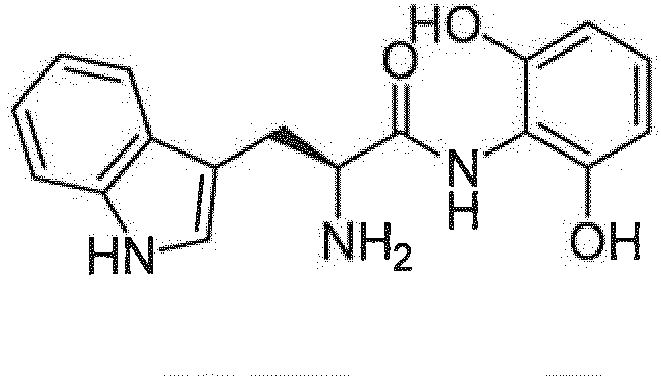
1H NMR (CD3OD) δ= 2.99-3.09 (m, 1H), 3.38-3.46 (m, 1H), 3. 92-3. 93 (m, 1H), 6.41 (d, J= 8.2 Hz, 2H), 6.88-6.92 (m, 1H), 7.04-7.06 (m, 1H), 7.10-7.12 (m, 1H), 7.19 (s, 1H), 7.36 (d, J= 8.0Hz, 1H), 7. 68 (d, J= 8.0 Hz, 1H) MS(ESI) m/z: 309.8 (M-1) Yield : 23% 23 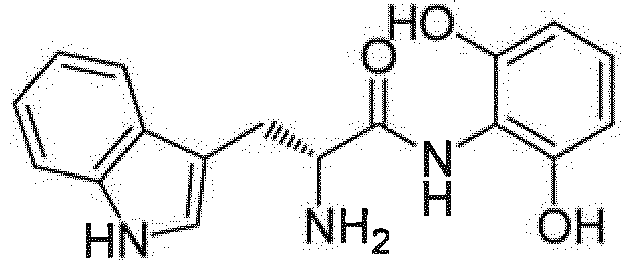
Yield : 27% -
Table 1-5 24 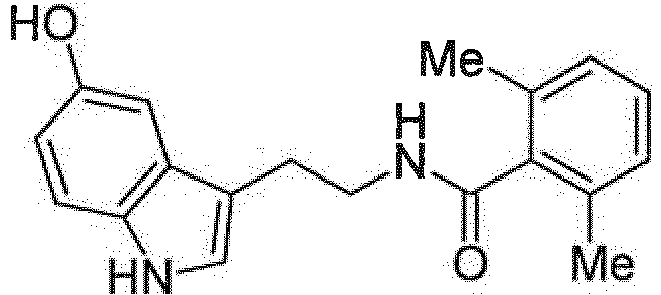
1H NMR ((CD3)2SO) δ=2.19 (s, 6H), 2.86 (t, J= 7.6 Hz, 2H), 3.49-3.54 (m, 2H), 6.59-6.62 (m, 1H), 6.89 (d J= 2.3 Hz, 1H), 7.03 (d J= 7.5 Hz, 2H), 7.10-7.17 (m, 3H), 8.37-8.40 (m, 1H), 8.61 (s, 1H), 10.50 (s, 1H) MS(ESI) m/z: 307.0 (M-1) Yield : 81% 25 
1H NMR ((CD3)2SO) 5= 2.81 (t, J= 7. 6 Hz, 2H), 3.40-3.44 (m, 2H), 3.74 (s, 6H), 6.60-6.63 (m, 1H), 6.66 (d J= 8.4 Hz, 2H), 6.88 (d J= 2.3 Hz, 1H), 7.10-7.16 (m, 2H), 7.26-7.30 (m, 1H), 8.09-8.15 (m, 1H), 8.62 (s, 1H), 10.51 (s, 1H) MS(ESI) m/z: 338.9 (M-1) Yield : 43% 26 
1H NMR ((CD3)2SO) δ= 2. 82 (t, J= 8.0 Hz, 2H), 3.46-3.51 (m, 2H), 6.60-6.62 (m, 1H), 6.87 (d J= 1.9 Hz, 1H), 7.10 (d J= 1.9 Hz, 1H), 7.13-7.15 (m, 1H), 7.84-7.88 (m, 1H), 8.13 (d J= 8.0 Hz, 2H), 8.63 (s, 1H), 8.87-8.90 (m, 1H), 10.53 (s, 1H) MS(ESI) m/z: 415.0 (M-1) Yield : 20% 27 
1H NMR ((CD3)2SO) δ= 2.87 (t, J= 7.5 Hz, 2H), 3.48-3.53 (m, 2H), 6.60-6.62 (m, 1H), 6.88 (d J= 2.3 Hz, 1H), 7.11-7.15 (m, 2H), 7.40-7.44 (m, 1H), 7.49-7.51 (m, 2H), 8.62 (s, 1H), 8.79-8.82 (m, 1H), 10.51 (s, 1H) MS(ESI) m/z: 346.8 (M-1) Yield : 65% 28 
1H NMR ((CD3)2SO) δ= 2.86 (t, J= 7.2 Hz, 2H), 3.55-3.58 (m, 2H), 5.80 (s, 2H), 6.60-6.63 (m, 1H), 6.91 (d J= 2.3 Hz, 1H), 7.08 (d J= 2.3 Hz, 1H), 7.14 (d J= 8.6 Hz, 1H), 8.61 (s, 1H), 8.69-8.76 (m, 1H), 9.87 (s, 1H), 10.51 (s, 1H) MS(ESI) m/z: 326.9 (M-1) Yield : 35% -
Table 1-6 29 
1H NMR ((CD3)2SO) δ= 2.15 (s, 3H), 2.89 (t, J= 7.2Hz, 2H), 3. 59-3. 64 (m, 2H), 6.18 (s, 2H), 6.61-6.64 (m, 1H), 6.92 (d J= 2.3 Hz, 1H), 7.09 (d J= 2.3Hz, 1H), 7.15 (d J= 8.6 Hz, 1H), 8.60 (bs, 1H), 8.93 (s, 1H), 10.53 (s, 1H) MS(ESI) m/z: 325.0 (M-1) Yield : 29% 32 
1H NMR(DMSO, 400MHz) δ=10.51 (1H, s), 9.14 (1H, s), 8.93 (1H, t, J=5.64Hz), 8.61 (1H, s), 7. 30 (1H, d, J=8.20Hz), 7.14 (1H, d, J=8.64Hz), 7.08 (1H, s), 6.92 (1H, s), 6.90 (1H, d, J=3.80Hz), 6.69 (1H, t, J=7.96Hz), 6.61 (1H, d, J=8.56Hz), 3.52 (2H, dd, J=6.24, 13.24Hz), 2.87 (2H, t, J=8.00Hz). ESI-MS [M+H]+=313.1 [M-H]- =310.9 Yield 23.0% 33 
1H NMR(DMSO,400MHz) δ=10.50 (1H, s), 10.06 (1H, s), 8.68 (1H, t, J=5.48Hz), 8.62 (1H, s), 7.69 (1H, d, J=8.8Hz), 7.14 (1H, d, J=8.64Hz),7.07 (1H, s), 6.88 (1H, s), 6.61 (1H, d, J=8.6Hz), 6.30 (1H, d, J=8.68Hz), 6.23 (1H, s), 3.51 (2H, dd, J=6.48, 13.08Hz), 2.85 (2H, t, J=7.96Hz). ESI-MS [M+H]+=313.1 [M-H]- =310. Yield 34.3% 34 
1H NMR(DMSO,400MHz) δ=10.51 (1H, s), 9.00 (1H, s), 8.82 (1H, s), 8.62 (1H, s), 7.24 (1H, s), 7.13 (1H, d, J=8.60Hz), 7.08 (1H, s), 6.86 (1H, d, J=8.76), 6.74 (1H, d, J=8.76Hz), 6.61 (1H, d, J=8.60Hz), 3.53 (2H, dd, J=6.68, 12.88Hz), 2.86 (2H, t, J=7.80Hz). ESI-MS [M+H]+=313.1 [M-H]- =310.8 Yield 30.1% -
Table 1-7 35 
1H NMR(DMSO,400MHz) δ=10.54 (1H, s), 9.01 (1H, s), 8.62 (1H, s), 7.16 (1H, s), 7.14 (1H, d, J=8.56Hz), 7.10 (1H, s), 6.90 (1H, s), 6.62 (1H, d, J=8.56Hz), 6.33 (2H, d, J=8.20Hz), 3.61 (2H, dd, J=6.92, 12.68Hz), 2.88 (2H, t, J=7.56Hz). ESI-MS [M+H]+=313.1 [M-H]- =310.9 Yield 14.9% 36 
1H NMR(DMSO,400MHz) δ=10.47 (1H, s), 9.43 (1H, s), 9.09 (1H, s), 8.61 (1H, s), 8.25 (1H, t, J=5.56), 7.29 (1H, s), 7.20 (1H, d, J=8.24Hz), 7.13 (1H, d, J=8.60Hz), 7.05(1H,s), 6.88 (1H, s), 6.76 (1H, d, J=8.24Hz), 6.60 (1H, d, J=8.56Hz), 3.44 (2H, dd, J=6.44, 13.20Hz), 2.81 (2H, t, J=8.04Hz). ESI-MS [M+H]+=313.1 [M-H]- =310.9 37 
1H NMR(DMSO,400MHz) δ=10.48 (1H, s), 9.44 (1H, s), 8.60 (1H, s), 8.35 (1H, t, J=5.40Hz), 7.13 (1H, d, J=8.60Hz), 7.05 (1H, s), 6.87 (1H, s), 6.68 (2H, s), 6.60 (1H, d, J=8.56Hz), 6.35 (1H, s), 3.43 (2H, dd, J=6.60, 14.76Hz), 2.81 (2H, t, J=8.04Hz). ESI-MS [M+H]+=313.1 [M-H]- =310.8 Yield 60.5% 38 
1H NMR(DMSO,400MHz) δ=10.80 (1H, s), 7.94 (1H, t, J=5.68, 11.36Hz), 7.52 (1H, d, J=7.80Hz), 7.35-6.96 (8H, m), 3.19-3.13 (1H, m), 3.09-3.05 (2H, m), 2.95-2.90 (1H, m). ESI-MS [M+H]+=307.6 [M-H]- =305.9 Yield 48.7% -
Table 1-8 39 
1H NMR(MeOD,400MHz) δ=7.61 (1H, d, J=7.92Hz), 7.34 (1H, d, J=8.12Hz), 7.22 (1H, d, J=8.12Hz), 7.13-7.07 (2H, m), 7.01-6.92 (2H, m), 6.71 (1H, t, J=7.96Hz), 3.51-3.37 (2H, m). ESI-MS [M+H]+=341.1 [M-H]- =338.8 Yield 5.8% 40 
1H NMR(DMSO,400MHz) δ=10.47 (1H, s), 8.61 (1H, s), 7.91 (1H, t, J=5.68Hz), 7.29-7.18 (4H, m), 7.13 (1H, d, J=8.60Hz), 6.99 (1H, s), 6.83 (1H, s), 6.60 (1H, d, J=8.6Hz), 4.36 (1H, bs), 3.48-3.42 (2H, m), 2.93 (1H, dd, J=5.12, 13.36Hz), 2.69-2.64 (2H, m). ESI-MS [M+H]+=324.2 [M-H]- =322.0 Yield 43.4% 41 
1H NMR(DMSO,400MHz) δ=10.84 (1H, s), 9.03 (1H, bs), 8.90 (1H, bs), 7.56 (1H, d, J=7.88Hz), 7.33-7.30 (2H, m), 7.14 (1H, s), 7.05 (1H, t, J=7.04, 14.08Hz), 6.97, 6.96, 6.94 (1H, t, J=7.04, 14.00Hz), 6.82 (1H, d, J=5.76Hz), 6.73 (1H, d, J=8.76), 4.68 (1H, bs), 3.47-3.24 (2H, m). ESI-MS [M-H]-=339.0 Yield 34.8% 42 
1H NMR(DMSO,400MHz) δ=10.83 (1H, s), 8.99 (1H, s), 8.83 (1H, s), 7.58 (1H, d, J=7.8Hz), 7.36 (1H, d, J=8.04Hz), 7.24 (1H, s), 7.19 (1H, s), 7.08 (1H, t, J=7.00, 14.04Hz), 6.99 (1H, t, J=7.92, 14.84Hz), 6.87 (1H, dd, J=2.92, 8.80Hz), 6.75 (1H, d, J=8.80Hz), 3.57 (2H, dd, J=6.92, 13.04Hz), 2.97 (2H, t, J=7.88Hz). ESI-MS [M+H]+=297.0 [M-H]- =294.9 Yield 68.6% -
Table 1-9 43 
1H NMR(DMSO,400MHz) δ=10.89 (1H, s), 8.23 (1H, d, J=7.60Hz), 7.59 (1H, d, J=7.84Hz), 7.36 (1H, d, J=8.08Hz), 7.25 (1H, d, J=2.20Hz), 7.07 (1H, t, J=7.00Hz), 6.98 (1H, t, J=7.52), 6.91-6.85 (2H, m), 6.80-6.76 (1H, m), 3.65, 3.64, 3.63, 3.62 (1H, dd, J=3,88, 8.88Hz), 3.27 (1H, d, J=14.32Hz), 2.85 (1H, dd, J=8.88, 14.36Hz). ESI-MS [M+H]+=296.1 [M-H]- =294.1 Yield 72.8% 44 
1H NMR(DMSO,400MHz) δ=10.49 (1H, s), 8.59 (2H, s), 7.87 (2H, d, J=6.96Hz), 7.53-7.45 (3H, m), 7.14 (1H, d, J=8.56Hz), 7.07 (1H, s), 6.90 (1H, s), 6.61 (1H, d, J=8.60Hz), 3.52 (2H, dd, J=6.56, 13.28Hz), 2.86 (2H, t, J=7.84, 14.84Hz). ESI-MS [M+H]+=281.0 [M-H]- =278.8 Yield 85.6% 45 
1H NMR(DMSO,400MHz) δ=10.08 (1H, s), 9.17 (1H, s), 7.89 (1H, t, J=5.84, 11.64Hz), 7.55 (1H, d, J=7.84), 7.34 (1H, d, J=8.04Hz), 7.12 (1H, s), 7.08 (1H, t, J=6.96, J=13.92Hz), 7.00-6.96 (3H, m), 6.67 (2H, d, J=4.48Hz), 3.33-3.27 (2H, m), 2.83-2.75 (3H, m), 1.57 (2H, s). ESI-MS [M+H]+=324.2 [M-H]- =321.8 Yield 82.9% 46 
1H NMR(DMSO,400MHz) δ=10.48 (NH), 8.07 (NH, amide), 7.24 (d, J=15.6Hz, 1H), 7.12 (d, J=8.6Hz, 1H), 7.05 (s, 1H), 6.94 (d, J=2.0Hz, 1H), 6.84 (d, J=2.0Hz, 1H), 6.82 (d, J=2.0Hz, 1H), 6.74 (d, J=8.1Hz, 1H), 6.59 (dd, J=8.6, 2.3Hz, 1H), 6.33 (d, J=15.6Hz, 1H), 3.44 (m, 2H), 2.78 (m, 2H). ESI-MS: [M+H]+=339.1, [M+Na]+=361.0, [M-H]-=337.2, [2M-H]-=675.2. Yield:54.0% -
Table 1-10 47 
1H NMR(DMSO,400MHz) δ=10.48 (NH), 8.07 (NH, amide), 7.24 (d, J=15.6Hz, 1H), 7.12 (d, J=8.6Hz, 1H), 7.05 (s, 1H), 6.94 (d, J=2.0Hz, 1H), 6.84 (d, J=2.0Hz, 1H), 6.82 (d, J=2.0Hz, 1H), 6.74 (d, J=8.1Hz, 1H), 6.59 (dd, J=8.6, 2.3Hz, 1H), 6.33 (d, J=15.6Hz, 1H), 3.44 (m, 2H), 2.78 (m, 2H). ESI-MS: [M+H]+=339.1, [M+Na]+=361.0, [M-H]-=337.2, [2M-H]-=675.2. Yield:54.0% 48 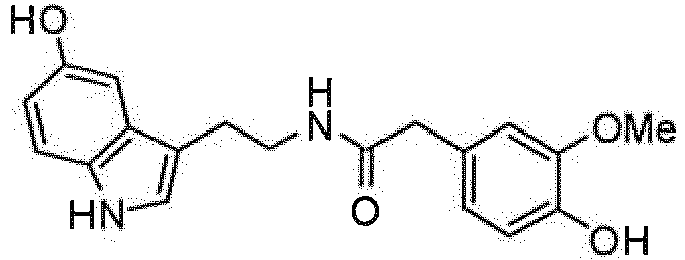
1H NMR(DMSO,400MHz) δ=10.47 (NH), 8.74 (OH) 8.57 (OH), 7.97 (NH), 7.11 (d, J=8.6Hz, 1H), 7.00 (d, J=2.2Hz, 1H), 6.82 (m, 2H), 6.68 (d, J=8Hz, 1H), 6.62 (dd, J=8, 1.8Hz, 1H), 6.58 (dd, J=8.6, 2.2Hz, 1H), 3.73 (s, 3H), 3.28 (m, 4H), 2.71 (t, J=7.4Hz, 2H). ESI-MS: [M+H]+=341.2, [M+Na]+=363.1, [2M-H]-=339.2, [2M-H]-=679.3. Yield:56.0% 50 
1H-NMR (CDCl3) δppm : 0.66 (3H, d, J = 6.9 Hz), 0.86 (6H, d, J = 7.2 Hz), 1.24 (1H, m), 1.26 (1H, m), 1.48 (1H, m), 1.61-1.70 (4H, m), 1.86 (1H,dt, J =3.5, 11.6), 2.98 (2H, m), 3.61 (2H, m), 5.43 (1H, m), 7.02 (1H, 2.4 Hz), 7.13 (1H, m), 7.22 (1H, m), 7.39 (1H, m), 7.63 (1H, m), 8.06 (1H, bs) ESI-MS : 327.3 (M+H)+, 325.3 (M-H)- 51 
1H-NMR (CDCl3) δppm : 0.61 (3H, d, J = 6.9 Hz), 0.82 (3H, d, J = 6.9 Hz) , 0.83 (3H, d, J= 6.5 Hz) , 0. 91 (2H, m), 1.12 (1H, m), 1.26 (1H, m), 1.46 (1H, tt, J = 0.5, 11.1 Hz), 1.56-1.70 (3H, m), 1.73 (1H,m), 1. 95 (1H, dt, J=3.6, 11.8 Hz), 3.31 (2H, m), 3.69 (3H, s), 5.02 (1H,m), 7.00 (1H, d, J=2.4 Hz), 7.11 (1H, m), 7.20 (1H, m), 7.36 (1H, m), 7.55 (1H, m), 8.06 (1H, bs) -
Table 1-11 52 
1H-NMR (CDCl3) δppm : 0.60 (3H, d, J = 6.9 Hz), 0.81 (3H, d, J = 7.0 Hz), 0.82 (3H, d, J= 6.6 Hz), 0.92 (2H, m), 1.11 (1H, m), 1.26 (1H, m), 1.46 (1H, tt, J = 1.4, 11.0 Hz), 1.57-1.71 (4H, m), 1.92 (1H, dt, J = 3.2, 8.4 Hz), 3.24 (1H, dd, J = 5.8, 14.9 Hz), 3.35 (1H, dd, J = 5.8, 14.9 Hz), 5.07 (1H, m), 5.08 (1H, d, J= 12.2 Hz), 5.13 (1H, d, J = 12.2 Hz), 5.87 (1H, d, J = 8.0Hz), 6.80 (1H, d, J = 2. 4 Hz), 7.10 (m, 1H), 7.19 (1H, m), 7.24 (1H, m), 7.32-7.36 (4H, m), 7.55 (1H, m), 7.97 (1H, bs) ESI-MS : 385.2 (M+H)+, 383.2 (M-H)- 53 
1H-NMR (CDCl3) δppm : 0.49 (3H, d, J = 6.8Hz), 0.76 (3H, d, J = 6.8 Hz), 0.82 (3H, d, J= 6.5 Hz), 0.88 (2H, m), 1.07 (1H, m), 1.22 (1H, m), 1.40 (2H, m), 1.57-1.69 (3H, m), 1.90 (1H, dt, J = 3.3, 11.8 Hz), 3.36 (1H, dd, J = 6.2 Hz), 4.92 (1H, dd, J = 6.2, 13.2 Hz), 5.93 (1H, d, J = 7.1 Hz), 7.08 (1H, d, J = 2.4Hz), 7.13 (1H,m), 7.21 (1H,m), 7.37 (1H, d, J = 8.1 Hz), 7. 60 (1H, d, J= 7.8 Hz), 8.22 (1H, s) ESI-MS : 461.3 (M+H)+, 459.3 (M-H)- 54 
1H-NMR (CDCl3) δppm : 0.64 (3H, d, J = 6.8Hz), 0.84 (3H, d, J = 6.8 Hz), 0. 86 (3H, d, J= 6.4 Hz) , 0.88 (2H, m), 0.93 (2H, m), 1.17 (1H, m), 1.28 (1H, m), 1.58-1.73 (4H, m), 1.92 (1H, t, J = 5.8Hz), 1.99 (1H, dd, J = 3.4, 11.6 Hz), 3.11 (1H, dd, J = 9.1, 14.5 Hz), 3.20 (1H, m), 3.28 (1H, m), 3.35 (1H, dd, J = 5.4, 14.5 Hz), 4.71 (1H, m), 5.96 (1H, m), 6.18 (1H, d, J = 76. Hz), 7.12 (1H, d, J = 2.32 Hz), 7.15 (1H, m), 7.23 (1H, m), 7.38 (1H, m), 7.74 (1H, d, J = 8.4 Hz), 8.09 (1H, m) ESI-MS : 414.2 (M+H)+, 412.2 (M-H)- -
Table 1-12 55 
1H-NMR (CDCl3) δppm : 1.43 (9H, s), 2.06 (1H, m), 3.13 - 3.36 (4H, m) , 3.46 - 3.50 (2H, m), 4.38 (1H, m), 5.17 (1H, m), 6.00 (1H, bs), 7.10 (1H, d, J = 2.4Hz), 7.15 (1H,m), 7.22 (1H, m), 7.38 (1H, m), 7.67 (1H, dd, J= 7.7 Hz), 8.13 (1H, bs) ESI-MS : 369.9 (M+Na)+, 346.0 (M-H)- 56 
1H-NMR (CDCl3) δppm : 1.43 (9H, s), 2.20 (1H, m), 3.13 - 3.35 (4H, m), 3.43 - 3.47 (2H,m), 4.39 (1H, m), 5.21 (1H, m), 6.06 (1H, bs), 7.08 (1H, d, J= 2.2 Hz) , 7.14 (1H, m), 7.21 (1H, m), 7.37 (1H, m), 7.66 (1H, dd, J = 7.8 Hz), 8.24 (1H, bs) ESI-MS : 369.5 (M+Na)+, 346.0 (M-H)- 57 
1H-NMR (CDCl3) δppm : 1.95 (1H, bs), 3.12 - 3.25 (3H, m), 3.34 - 3.46 (3H, m), 4.46 (1H, m), 5.11 (2H, s), 5.49 (1H, m), 5.95 (1H, m), 7.06 (1H, d, J = 1.6Hz), 7.13 (1H,m), 7.21 (1H,m), 7.32 - 7.37 (6H, m), 7.66 (1H, m), 8.13 (1H, bs) ESI-MS : 404.1 (M+Na)+, 379.9 (M-H)- 58 
1H-NMR (CDCl3) δppm : 1.43 (9H, s), 2.96 (2H, t, J=6.8Hz), 3.46 (2H, m), 4.60 (1H, m), 7.04 (1H, d, J =2.0Hz), 7.12 (1H, m), 7.20 (1H, m), 7.38 (1H, m), 7.61 (1H, d, J= 7.6 Hz), 8.00 (1H, bs) ESI-MS : 283.0 (M+Na)+, 258.9 (M-H)- 59 
1H-NMR (CDCl3) δppm : 2.99 (1H, t, J = 6.7 Hz), 3.55 (2H, m), 4.81 (1H, m), 5.10 (2H, s), 7.01 (1H, d, J = 1.4Hz), 7.11 (1H, m), 7.20 (1H, m), 7.29 - 7.38 (5H, m), 7.60 (1H, d, J = 7.6Hz), 7.99 (1H, bs) ESI-MS : 316.7 (M+Na)+, 293.0 (M-H)- -
Table 1-13 60 
1H-NMR (CDCl3) δppm : 0.60 (3H, d, J = 6.8 Hz), 0.80 (3H, d, J = 6.8 Hz), 0.84 (3H, d, J= 6.4 Hz), 0.91 (2H, m), 1.10 (1H, m), 1.26 (1H, m), 1.43 - 1.54 (3H, m), 1.60 - 1.69 (2H, m), 1.91 (1H, dt, J = 3.6, 11.6 Hz), 2.88 (1H, dd, J = 6.8,14.0 Hz),2.96-3.09 (2H, m), 3.26 (1H, dd, J = 5.0, 14.3 Hz), 4.65 (1H, m), 4.75 (1H, dd, J = 2.6, 5.7 Hz), 6.22 (1H, d, J=7.3 Hz), 6.38 (1H, d, J= 7.0 Hz), 6.89 (1H, d, J=6.2Hz), 6.95 (s, 1H), 7.10 - 7.20 (6H, m), 7.30 (1H, d, J = 8.0 Hz), 7.70 (1H, d, J = 7.5 Hz), 8.26 (1H, s) ESI-MS : 540.3 (M+Na)+, 516.0 (M-H)- 61 
1H-NMR (CDCl3) δppm : 0.90 (9H, s), 1.98 (m, 2H), 3.37 (2H, m), 4.88 (1H, dd, J = 6.2, 12.8 Hz), 5.92 (1H, d, J = 7.0 Hz), 7.06 (1H, d, J = 1.6 Hz), 7.13 (1H, m), 7.21 (1H, m), 7.36 (1H, d, J = 8.1 Hz), 7.59 (1H, d, J= 7.9 Hz), 8.23 (1H, bs) ESI-MS : 325.2 (M+Na)+, 301.2 (M-H)- 62 
ESI-MS : 449.2 (M+Na)+, 425.1 (M-H)- 63 
1H-NMR (CDCl3) δppm : 2. 42 (2H, m), 2.89 (2H, m), 3.30 (2H, d, J = 5.4), 4.88 (1H, m), 5.94 (1H, d, J = 7.4 Hz), 6.86 (1H, d, J = 2.2 Hz), 7.07 - 7.12 (3H, m), 7.17 - 7.21 (2H, m), 7.23 (1H, m), 7.25 (1H, m), 7.34 (1H, d, J = 8.1 Hz), 7.48 (1H, d, J= 7.8 Hz), 8.10 (1H, s) ESI-MS : 359.1 (M+Na)+, 334.9 (M-H)- -
Table 1-14 64 
ESI-MS : 478.9 (M+Na)+, 454.9 (M-H)- 65 
1H-NMR (CDCl3) δppm : 2.38 (2H, m), 2.82 (2H, m), 3.29 (2H, d, J = 5.7), 3.76 (3H, s), 4.87 (1H, m), 5.93 (1H, d, J=7.2Hz), 6.78 (2H, m), 6.83 (1H, m), 7.01 (2H, m), 7.10 (1H, m), 7.19 (1H, m), 7.34 (1H, d, J = 8.1 Hz), 7.48 (1H, d, J = 8.0), 8.14 (1H, s) ESI-MS : 389.2 (M+Na)+, 365.0 (M-H)- 66 
1H-NMR (CDCl3) δppm : 2.36 (2H, m), 2.79 (2H, m), 3.31 (2H, d, J = 5.4), 4.87 (1H, m), 5.89 (2H, m), 5.93 (1H, d, J = 7.4 Hz), 6.54 (1H, m), 6.60 (1H, d, J = 1.6 Hz), 6.67 (1H, d, J = 6.8 Hz), 6.93 (1H, s), 7.13 (1H, m), 7.20 (1H, m), 7.35 (1H, d, J = 8.1 Hz), 7.50 (1H, d, J = 7.8 Hz), 8.16 (1H, m) ESI-MS : 419.0 (M+K)+, 378.9 (M-H)- 67 
1H-NMR (CDCl3) δppm : 2.43 (2H, m), 2.81 (2H, m), 3.26 (2H, m), 3.85 (3H, s), 5.00 (1H, m), 5.09 (2H, s), 5.58 (1H, s), 5.91 (1H, d, J = 8.0 Hz), 6.59 - 6.74 (2H, m), 7.06 (1H, m), 7.18 (1H, m), 7.25 (2H, m), 7.36 (4H, m), 7.43 (1H, m), 7.96 (1H, bs) ESI-MS : 495.1 (M+Na)+, 471.1 (M-H)- 68 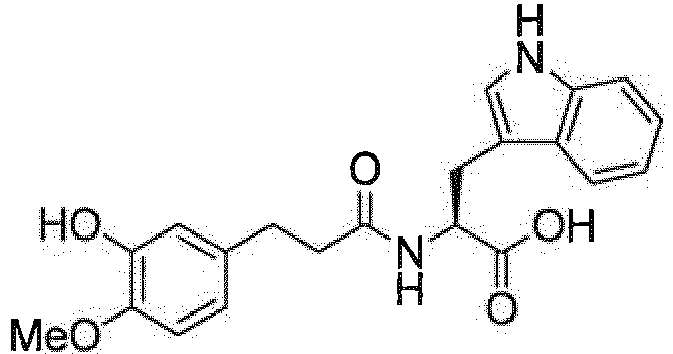
1H-NMR (CD3OD) δppm : 2.39 (2H, m), 2.68 (2H, m), 3.17 (2H, dd, J = 7.4, 14.7 Hz), 3.80 (3H, s), 3.84 (1H, m), 4.69 (1H, dd, J=5.0, 7.4 Hz), 6.55 (1H, dd, J = 2.1, 8.2 Hz), 6.65 (1H, d, J=2.1Hz), 6.75 (1H, d, J = 8.2 Hz), 6.98 - 7.02 (2H, m), 7.08 (1H, m), 7.32 (1H, d, J = 8.1 Hz), 7.55 (1H, d, J = 8.1 Hz) ESI-MS : 405.1 (M+Na)+, 381.1 (M-H)- -
Table 1-15 69 
1H-NMR (CD3Cl) δppm : 2.39 (2H, m), 2.78 (2H, m), 3.22 (2H, d, J = 5.4 Hz), 3.49 (1H, d, J = 3.8 Hz), 4. 93 (1H, m), 5.06 (1H, s), 5.76 (1H, s), 6.01 (1H, d, J = 7.8 Hz), 6.48 -6.53 (2H, m), 6.61 (1H, s), 6.65 (1H, d, J = 2.0 Hz), 6.73 (1H, d, J = 8.0 Hz), 7.06 (1H, m), 7.12 (1H, m), 7.22 (2H, m), 7.30 - 7.35 (3H, m), 7.40 (1H, d, J = 8.1 Hz), 8.03 (1H, bs) ESI-MS : 481.0 (M+Na)+, 457.0 (M-H)- 70 
1H-NMR (CD3OD) δppm : 2.35 (2H, m), 2.55 (2H, m), 3.18 (1H, dd, J = 6.5, 14.2 Hz), 4.60 (1H, m), 4.64 (1H, dd, J = 4.9, 6.5 Hz), 6.46 (1H, m), 6.61 - 6.64 (2H, m), 6.97 - 7.01 (2H, m), 6.97 - 7.01 (2H, m), 7.04 - 7.08 (1H, m), 7.30 (1H, m), 7.56 (1H, m) ESI-MS : 391.1 (M+Na)+, 367.1 (M-H)- 71 
1H-NMR (DMSO) δppm : 2.40 (2H, t, J = 7.5 Hz), 2.74 (2H, t, J = 7.5 Hz), 2.98 (1H, dd, J = 8.3, 14.3 Hz), 3.15 (1H, dd, J = 4.4, 14.3 Hz), 3.71 (3H, s), 4.48 (1H, m), 7.02 (1H, m), 7.11 - 7.36 (6H,m), 7.37 (1H, d, J=2.3Hz), 7.37 (1H, d, J = 8.2 Hz), 7.54 (1H, d, J = 7.9 Hz), 8.15 (1H, d, J = 7.9 Hz) ESI-MS : 351.2 (M+H)+, 348.8 (M-H)- 72 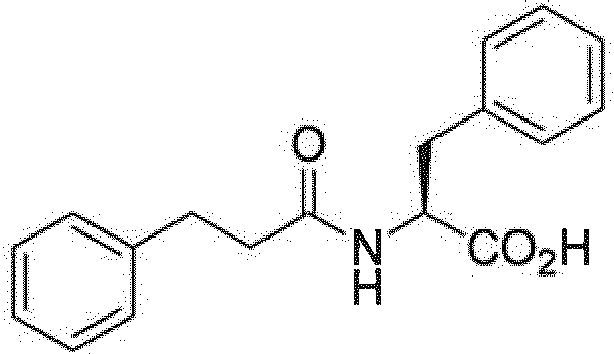
1H-NMR (DMSO) δppm : 2.37 (2H, t, J = 7.0 Hz), 2.72 (2H, t, J = 7.0 Hz), 2.84 (1H, dd, J = 9.4, 13.7 Hz), 3.04 (1H, dd, J = 4.9, 13.7 Hz), 4.44 (1H, m), 7.15-7.32 (10H, m), 8.20 (1H, d, J = 4.3 Hz) ESI-MS : 298.2 (M+H)+, 295.9 (M-H)- -
Table 1-16 73 
1H-NMR (DMSO) δppm : 2.37 (3H, s), 2.38 (2H, t, J = 8.0 Hz), 2.73 (2H, dt, J = 3.9, 8.0 Hz), 2.95 (1H, dd, J = 8.6, 14.3 Hz), 3.13 (1H, dd, J = 4. 6, 8.6 Hz), 4.46 (1H, m), 6.89 (1H, dd, J = 1.3, 8.0 Hz), 7.04 (1H, d, J = 2.3 Hz), 7.15 (3H, m), 7.21 (3H, m), 7.31 (1H, s), 8.14 (1H, d, J = 7.9) ESI-MS : 351.2 (M+H)+, 348.9 (M-H)- 74 
1H-NMR (DMSO) δppm : 2.39 (1H, t, J = 7.8 Hz), 2.75 (1H, t, J = 7.8 Hz), 2.88 (1H, dd, J = 8.8, 14.5 Hz), 3.05 (1H, dd, J = 5.2, 14.5 Hz), 4.43 (1H, m), 6.58 (1H, dd, J = 2.3, 8.6 Hz), 6.84 (1H, d, J =2.3Hz), 6. 99 (1H, d, J = 2.3 Hz), 7.11-7.16 (4H, m), 7.23 (2H, m), 8.10 (1H, d, J = 7.7 Hz), 8. 60 (1H, s), 10.5 (1H, s) ESI-MS : 350.9 (M-H)- 75 
1H-NMR (DMSO) δppm : 1.37 (s, 3H), 2.50 (2H, t, J = 7.9 Hz), 2. 93 (2H, t, J = 7.9 Hz), 3.15 (1H, d, J = 13.3 Hz), 3.37 (1H, d, 13.3 Hz), 7.01-7.03 (2H, m), 7.20-7.31 (8H, m), 7.78 (1H, s) ESI-MS : 334.2 (M+Na)+, 309.4 (M-H)- 76 
1H-NMR (CD3OD) δppm : 2.47 (2H, t, J = 7.9 Hz), 2.81 (2H, t, J = 7.9 Hz), 3.12 (1H, dd, J = 8.1, 14.7 Hz), 3.29 (1H, dd, J = 5.0, 14.7 Hz), 4.73 (1H, dd, J = 5.0, 8.1 Hz), 6.80 (1H, m), 6.96 (1H, s), 7.03 (1H, m), 7.13-7.24 (4H, m), 7.49 (1H, dd, J = 5.2, 8.6 Hz), 10.4 (1H, s) ESI-MS : 355.2 (M+H)+, 353.1 (M-H)- 77 
1H-NMR (CD3OD) δppm : 2.42 (3H, s), 2.46 (2H, t, J = 7.9 Hz), 2.80 (2H, m), 3.11 (1H, dd, J = 8.2, 14.7 Hz), 3.38 (1H, dd, J = 5.0, 14.7 Hz), 4.73 (1H, dd, J = 5.0, 8.2 Hz), 6.87 (1H, d, J = 8.1 Hz), 6.91 (1H, s), 7.11-7.23 (10H, m), 7.43 (1H, d, J = 8.1 Hz) ESI-MS : 373.1 (M+Na)+, 349.4 (M-H)- -
Table 1-17 78 
1H-NMR (CD3OD) δppm : 2.56 (1H, m), 2.75 (1H,m), 3.10 (1H, dd, J = 11.3, 14.4 Hz), 3.35 (1H, dd, J = 5.0, 14.4 Hz), 5.17 (1H, dd, J = 5.0, 11.3 Hz), 7.00-7.31 (10H, m) 79 
1H-NMR (CD3OD) δppm : 2.60 (2H, dt, J = 7.8, 1.4 Hz), 2.93 (2H, t, J = 7.8 Hz), 5.45 (1H, s), 7.17-7.36 (10H, m) ESI-MS : 306.1 (M+Na)+, 281.8 (M-H)- 80 
1H NMR (DMSO, 400MHz) δ=7.33-7.28 (4H, m), 7.26-7.21 (1H, m), 6.86 (1H, t, J=8.12Hz), 6.37 (2H, d, J=8.12Hz), 3.72 (1H, dd, J=8.92Hz), 3.18 (1H, dd, J=13.6Hz), 2.75 (1H, dd, J=13.6Hz). ESI-MS [M+H]+=273.2 [M-H]- =270.9 Yield 24.5% 81 
1H NMR (DMSO, 400MHz) δ=7.31-7.16 (5H, m), 6.85 (1H, t, J=8.12Hz), 6.35 (2H, d, J=8.12Hz), 3.43 (1H, dd, J=8.44Hz), 2.75-2.70 (2H, m), 2.08-2.05 (1H, m), 1.80-1.75 (1H, m). ESI-MS [M+H]+=286.9 [M-H]- =284.9 Yield 18.1% 82 
1H NMR (DMSO, 400MHz) δ=9.23 (1H, d, J=6.88Hz), 7.31-7.15 (6H, m), 6.36 (2H, d, J=8.20Hz), 4.80 (dd, 1H, J=6.36, 11.88Hz), 3.25-3.11 (2H, m). ESI-MS [M+H]+=302.0 [M-H]- =299.9 Yield 26.7% 83 
1H NMR (DMSO, 400MHz) 5=7.30-7.26 (2H, m), 7.21-7.15 (4H, m), 6.38 (2H, d, J=8.24Hz), 4.49 (1H, t, J=6.96, 12.32Hz), 2.65 (1H, t, J=7.80, 16.16Hz), 2.21-2.04 (1H, m). ESI-MS [M+H]+=316.2 [M-H]- =314.3 Yield 34.7% -
Table 1-18 84 
1H NMR (DMSO, 400MHz) δ=10.85 (1H, s), 9.03 (1H, s), 7.61 (1H, d, J=7.88), 7.36 (1H, d, J=8.04), 7.21-6.97 (4H, m), 6.35 (2H, d, J=8.20), 3.68 (2H, dd, J=7.04, 12.68Hz), 3.00 (2H, t, J=7.12, 14.28Hz). ESI-MS [M+H]+=297.1 [M-H]- =294.9 Yield 74.0% 85 
1H NMR (DMSO, 400MHz) δ=9.76 (2H, s), 9.56 (1H, s), 7.52 (1H, d, J=15.56Hz), 7.21 (1H, s), 7.18 (1H, d, J=8.12Hz), 7.07- 6. 99 (2H, m), 6.91 (1H, t, J=8.08Hz), 6.41 (2H, d, J=8.12Hz), 6.10 (2H, s). ESI-MS [M+H]+=300.2 [M-H]- =298.1 Yield 12.5% 86 
1H NMR (DMSO, 400MHz) δ=9.33 (3H, s), 6.90-6.85 (1H, m), 6.82 (1H, d, J=7.88Hz), 6.73 (1H, d, J=7.92Hz), 6.36 (2H, d, J=8.08Hz), 5.96 (2H, s), 2.84 (2H, dd, J=7.04, 15.24Hz), 2.70 (2H, dd, J=8.28, 15.12Hz). ESI-MS [M+H]+=297.1 [M-H]- =294.9 Yield 48.7% 87 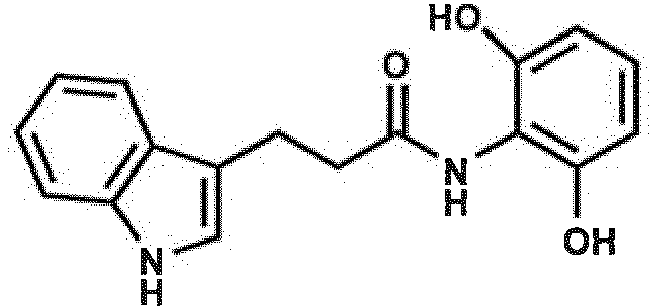
1H NMR (DMSO, 400MHz) δ=10.79 (1H, s), 9.39 (2H, bs), 7.58 (1H, d, J=7.72Hz), 7.33 (1H, d, J=8.00Hz), 7.17 (1H, s), 7.06 (1H, t, J=7.04Hz), 7.01 (1H, t, J=7.08Hz), 6.88 (1H, t, J=8.12Hz), 6.37 (2H, d, J=8.12Hz), 3.02 (2H, dd, J=7.08, 15.28Hz), 2.82 (2H, dd, J=6.00, 13.00Hz). ESI-MS [M+H]+=297.0 [M-H]- =294.9 Yield 55.0% -
Table 1-19 88 
1H NMR(DMSO, 400MHz) 5=9.73 (2H, s), 9.65 (1H, s), 9.25 (1H, s), 7.49 (1H, d, J=15.6Hz), 7.06 (2H, d, J=9.24Hz), 7.00-6.89 (3H, m), 6.41 (2H, d, J=8.12Hz), 3.82 (3H, s). ESI-MS [M+H]+=302.0 [M-H]- =299.8 Yield 27.3% 89 
1H NMR (DMSO, 400MHz) δ=9.36 (3H, s), 8.81 (1H, s), 6.87 (1H, t, J=8.12Hz), 6.82 (1H, d, J=8.16Hz), 6.68 (1H, s), 6.64 (1H, d, J=8.16Hz), 6.34 (2H, d, J=8.12Hz), 2.77 (2H, dd, J=6.36Hz), 2.68 (2H, dd, J=4.92). ESI-MS [M+H]+=304.0 [M-H]- =301.9 Yield 60.0% 90 
1H NMR (DMSO, 400MHz) δ=9.76 (2H, s), 9.63 (1H, s), 7.59 (3H, d, J=8.44Hz), 7.04 (3H, d, J=8.72Hz) 6.91 (1H, t, J=8.12Hz), 6.40 (2H, d, J=8.12Hz), 3.81 (3H, s). ESI-MS [M+H]+=286.2 [M-H]- =283.8 Yield 52.5% 91 
1H NMR (DMSO, 400MHz) 5=9.34 (3H, s), 7.18 (2H, d, J=8.60Hz), 6.90-6.84 (3H, m), 6.37 (2H, d, J=8.12Hz), 3.71 (3H, s), 2.85 (2H, dd, J=7.04, 15.40Hz), 2.71 (2H, dd, J=6.20Hz) ESI-MS [M+H]+=288.0 [M-H]- =286.1 Yield 31.6% 92 
1H NMR (DMSO, 400MHz) 5=10.89 (1H, s), 9.11 (1H, d, J=7.2Hz), 8.08 (1H, s), 7.57-7.51 (2H, m), 7.35 (1H, d, J=8.04Hz), 7.18 (1H, s), 7.07 (1H, t, J=7.00Hz), 6.98 (1H, t, J=7.00Hz), 6.90 (1H, d, J=8.8Hz), 4.81 (1H, dd, J=7.76, 13.04Hz), 3.65 (3H, s), 3.33-3.27 (2H, m). ESI-MS [M+H]+=417.0 [M-H]- =414.9 Yield 73.0% -
Table 1-20 93 
1H NMR(DMSO, 400MHz) δ=10.51 (1H, s), 9.01 (1H, s), 8.61 (1H, s), 8.07 (1H, s), 7.54 (1H, d, J=8.80Hz), 7.14 (1H, d, J=8.60Hz), 7.08 (1H, s), 6.90 (2H, d, J=8.84Hz), 6.60 (1H, d, J=8.60Hz), 3.55 (2H, dd, J=6.84, 12.84Hz), 2.89 (2H, dd, J=7.64, 15.00Hz). ESI-MS [M+H]+=374.9 [M-H]- =373.0 Yield 49.3% 94 
1H NMR (DMSO, 400MHz) δ=10.88 (1H, s), 9.04 (1H, d, J=7.20Hz), 7.92 (1H, d, J=6,76Hz), 7.53 (1H, d, J=7.88Hz), 7.39 (1H, t, J=6.08Hz), 7.33 (1H, d, J=8.08Hz), 7.19 (1H, s), 7.06 (1H, t, J=6.96), 6.97 (1H, t, J=6,96Hz), 6.91 (1H, t, J=7.08Hz), 4.76 (1H, dd, J=7.72, 13.44Hz), 3.33-3.28 (2H, m). ESI-MS [M+H]+=314.1 [M-H]- =311.8 Yield 56.5% 95 
1H NMR (DMSO, 400MHz) δ=10.84 (1H, s), 9.02 (1H, t, J=), 8.05 (1H, s), 7.59-7.53 (2H, m), 7.34 (1H, d), 7.19 (1H, s), 7.08 (1H, t, J=), 6.98 (1H, t, J=), 6.8 (1H, d , J=). ESI-MS [M+H]+=358.9 [M-H]- =357.0 Yield 43.4% 96 
1H NMR (DMSO, 400MHz) δ=9.07 (1H, d, J=7.36Hz), 8.04 (1H, s), 7.56 (1H, d, J=8.76Hz), 7.31-7.20 (5H, m), 6.89 (1H, d, J=8.76Hz), 4.77 (1H, dd, J=8.68, 12.96Hz), 3.22-3.09 (2H, m). ESI-MS [M+H]+=379.9 [M-H]- =377.9 Yield 66.0% -
Table 1-21 97 
1H NMR (DMSO, 400MHz) δ=9.03 (1H, d, J=7.44Hz), 7.89 (1H, d, J=6.68Hz), 7.40 (1H, t, J=7.20Hz), 7.31-7.21 (5H, m), 6.91 (2H, d, J=7.96Hz), 4.72 (1H, q, J=7.40Hz), 3.16 (2H, t, J=6.28Hz). ESI-MS [M+H]+=353.2 [M-H]- =351.1 Yield 57.5% 98 
1H NMR (DMSO, 400MHz) δ=9.15 (1H, d, J=7.28Hz), 8.14 (1H, s), 7.59 (1H, d, J=8.8Hz), 7.29 (2H, t, J=7.40Hz), 7.23-7.18 (3H, m), 6.94 (1H, d, J=8.80Hz), 4.45 (1H, q, J=7.12), 3.66 (3H, s), 2.74-2.66 (2H, m), 2.16-2.12 (2H, m). ESI-MS [M+H]+=394.1 [M-H]- =392.0 Yield 26.6% 99 
1H NMR (DMSO, 400MHz) δ=9.06 (1H, d, J=7.28Hz), 7.98 (1H, d, J=8.20Hz), 7.44 (1H, t, J=7.36Hz), 7.30 (2H, t, J=7.4Hz), 7.23-7.18 (3H, m), 6.97-6.93 (2H, m), 4.44 (1H, q, J=7.20Hz), 2.75-2.65 (2H, m), 2.16-2.10 (2H, m). ESI-MS [M+H]+=328.2 [M-H]- =326.0 Yield 54.2% 100 
1H NMR(DMSO, 400MHz) δ=11.00 (1H, s), 8.22 (1H, d, J=7.48Hz), 7.69 (1H, d, J=6.16Hz), 7.35-7.21 (6H, m), 7.07 (1H, t, J=7.60Hz), 3.84 (1H, t, J=4.72Hz), 3. 15 (2H, dd, J=6.00, 13.84Hz), 2.88 (2H, dd, J=8.08, 13.80Hz). ESI-MS [M+H]+=321.0 [M-H]- =318.9 Yield 5.3% -
Table 1-22 101 
1H NMR(DMSO, 400MHz) δ=10.48 (1H, s), 8.59 (1H, s), 7.93 (1H, t, J=5.68Hz), 7.10 (1H, d, J=8.84Hz), 7.03 (1H, s), 6.83 (1H, s), 6.59 (1H, d, J=8.60Hz), 4.36 (1H, t, J=5.00Hz), 3.46-3.41 (1H, m), 3.11 (1H, dd, J=5.32, 8.88Hz), 2.72 (1H, t, J=6.84Hz), ESI-MS [M+H]+=290.2 [M-H]- =288.0 Yield 38.0% 102 
1H NMR (DMSO, 400MHz) δ=10.80 (1H, s), 7.95 (1H, t, J=5.72Hz), 7.55 (1H, d, J=7.84Hz), 7.33 (1H, d, J=8.08Hz), 7.15 (1H, s), 7.06 (1H, t, J=5.80Hz), 6.97 (1H, t, J=7.96Hz), 3.38-3.32 (3H, m), 3.11 (1H, t, J=5.24Hz), 2.82 (2H, t, J=7.36Hz), 1.70-1.65 (3H, m), 1.42-1.35 (1H, m), 1.23-1.16 (1H, m), 0.88-0.83 (6H, m). ESI-MS [M+H]+=274.3 [M-H]- =272.0 Yield 35.3% 103 
1H NMR (DMSO, 400MHz) δ=11.02 (1H, s), 8.28 (1H, d, J=8.24Hz), 7.69 (1H, d, J=7.72Hz), 7.31-7.15 (6H, m), 7.02 (1H, t, J=7.56Hz), ESI-MS [M+H]+=335.1 [M-H]- =332.8 Yield 17.1% 104 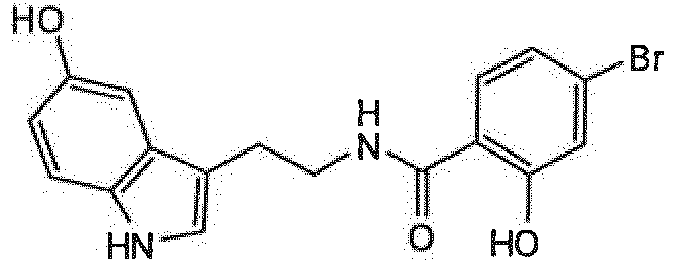
1H NMR(DMSO, 400MHz) δ=10.51 (1H, s), 8.97 (1H, t, J=5.68Hz), 8.61 (1H, s), 7.80 (1H, d, J=8.48Hz), 7.14-7.07 (4H, m), 6.88 (1H, s), 6.60 (1H, d, J=6.28Hz), 3.53 (2H, dd, J=6.72, 14.48Hz), 2.87 (2H, t, J=7.80Hz). Yield 31.7% ESI-MS [M+H]+=375.1 [M-H]- =373.0 Yield 31.7% -
Table 1-23 105 
1H NMR (DMSO, 400MHz) δ=10.83 (1H, s), 8.98 (1H, t, J=5.52Hz), 7.79 (1H, d, J=8.48Hz), 7.57 (1H, d, J=7.84Hz), 7.34 (1H, d, J=7.28Hz), 7.19 (1H, s), 7.14-7.05 (3H, m), 6.98 (1H, t, J=6.96Hz), 3.58 (2H, dd, J=6.96, 12.88Hz), 2.97 (2H, t, J=7.48Hz). ESI-MS [M+H]+=359.0 [M-H]- =357.0 Yield 82.4% 106 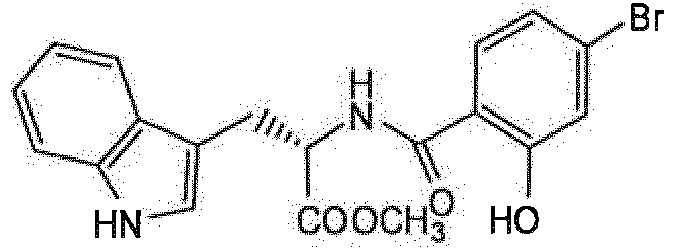
1H NMR (DMSO, 400MHz) δ=10.89 (1H, s), 9.04 (1H, bs), 7.84 (1H, d, J=5.96Hz), 7.50 (1H, d, J=7.96Hz), 7.33 (1H, d, J=8.04Hz), 7.17 (1H, s), 7.13-7.05 (3H, m), 6.96(1H, t, J=8.00Hz), 4.77 (1H, dd, J=7.60, 13.04Hz), 3.32-3.17 (2H, m). ESI-MS [M+H]+=417.1 [M-H]- =415.0 Yield 58.5% 107 
1H NMR (DMSO, 400MHz) 5=9.02 (1H, d, J=7.32Hz), 7.80 (1H, d, J=8.96Hz), 7.31-7.19 (5H, m), 7.14-7.11 (2H, m), 4.78-4.73 (1H, m), 3.66 (3H, s), 3.29-3.08 (2H, m). ESI-MS [M-H]-=378.0 Yield 66.3% 108 
1H NMR (DMSO, 400MHz) δ=8.95 (1H, d, J=7.64Hz), 7.83 (1H, d, J=8.36Hz), 7.30-7.11 (7H, m), 4.72-4.67 (1H, m), 3.21 (1H, dd, J=4.84, 13.88Hz), 3.10 (1H, dd, J=9.00, 13.84Hz). ESI-MS [M-H]-=361.8 Yield 88.0% 109 
1H NMR(DMSO, 400MHz) δ=9.07 (1H, d, J=7.36Hz), 8.05 (1H, s), 7.55 (1H, d, J=6.24Hz), 7.31-7.21(5H, m), 4.73 (1H, dd, J=8.32, 13.40Hz), 4.10 (2H, q, J=7.08Hz), 3.21-3.10 (2H, m), 1.16 (3H, t, J=4.72Hz). ESI-MS [M+H]+=392.0 [M-H]- =390.0 Yield 58.6% -
Table 1-24 110 
1H NMR (DMSO, 400MHz) δ=10.85 (1H, s), 8.95 (1H, d, J=7.40Hz), 7.86 (1H, d, J=8.36Hz), 7.54 (1H, d, J=7.92Hz), 7.32 (1H, d, J=7.68Hz), 7.16-7.11 (3H, m), 7.05 (1H, t, J=6.96Hz), 6.96 (1H, t, J=7.00Hz), 4.75-4.70 (1H, m), 3.33 (1H, dd, J=8.04, 14.40Hz), 3.24 (1H, dd, J=8.32, 14.84Hz). ESI-MS [M+H]+=401.0 [M-H]- =403.0 Yield 88.0% 111 
1H NMR (DMSO, 400MHz) δ=10.78 (1H, s), 9.40 (3H, bs), 7.58 (1H, d, J=7.80Hz), 7.33 (1H, d, J=8.04Hz), 7.16 (1H, s), 7.06 (1H, t, J=7.00Hz), 6.88 (1H, t, J=8.12Hz), 6.36 (2H, d, J=8.12Hz), 3.02 (2H, dd, J=7.24, 15.48Hz), 2.83 (2H, dd, J=6.04, 8.48Hz). ESI-MS [M+H]+=297.1 [M-H]- =294.9 Yield 15.4% 112 
1H NMR (DMSO, 400MHz) 5=10.94 (1H, s), 9.22 (1H, d, J=6.80Hz), 7.44 (1H, d, J=7.96Hz), 7.35 (1H, d, J=8.12Hz), 7.15 (1H, s), 7.07 (1H, t, J=5.96Hz), 6.97 (1H, t, J=7.08Hz), 4.85 (1H, dd, J=6.04, 12.68Hz), 3.65 (3H, s), 3.30 (2H, d, J=5.96Hz). ESI-MS [M+H]+=369.1 [M-H]- =367.1 Yield 33.0% 113 
1H NMR (DMSO, 400MHz) δ=10.91 (1H, s), 9.22 (1H, d, J=6.92Hz), 7.50 (1H, d, J=7.92Hz), 7.34 (1H, d, J=8.08Hz), 7.12 (1H, s), 7.06 (1H, dd, J=7.04Hz), 6.95 (1H, dd, J=6.96Hz), 6.17 (2H, s), 4.77 (1H, dd, J=6.12, 12.00Hz), 3.31 (1H, dd, J=5.12, 9.24Hz), 3.25 (1H, d, J=6.20Hz), 2.15 (3H, s). ESI-MS [M+H]+=355.1 [M-H]- =353.1 Yield 65.2% -
Table 1-25 114 
1H NMR(DMSO,400MHz) δ=9.14 (1H, d, J=6.08Hz), 7.32-7.18 (6H, m), 6.18 (2H, s), 4.80 (1H, dd, J=6.72, 12.76Hz), 4.14 (2H, q, J=6.08Hz), 3.17-3.11 (2H, m), 2.14 (3H, s), 1.16 (3H, t, J=7.12Hz). ESI-MS [M+H]+=344.0 [M-H]- =342.1 Yield 61.7% 115 
1H NMR(DMSO,400MHz) 5=9.14 (1H, d, J=7.08Hz), 7.31-7.19 (6H, m), 6.17 (2H, s), 4.75 (1H, t, J=5.36), 3.20 (1H, dd, J=5.24, 13.88Hz), 3.11 (1H, dd, J=6.72, 13.80Hz), 2.15 (3H, s). ESI-MS [M+H]+=316.2 [M-H]- =313.8 Yield 80.7% 116 
1H NMR(DMSO,400MHz) δ=9.25 (1H, d, J=6.68Hz), 7.31-7.18 (5H, m), 6.23 (2H, s), 4.53 (1H, dd, J=5.48, 12.76Hz), 3.66 (3H, s), 2.65 (2H, t, J=7.92Hz), 2.20-2.07 (5H, m). ESI-MS [M+H]+=344.1 [M-H]- =342.0 Yield 100%117 
1H NMR(DMSO,400MHz) δ=9.30 (1H, bs), 7.30-7.16 (5H, m), 6.22 (2H, s), 4.48 (1H, bs), 2.64 (2H, t, J=7.72Hz), 2.22-2.11 (5H, m). ESI-MS [M+H]+=330.2 [M-H]- =327.9 Yield 36.5% 118 
1H NMR(DMSO,400MHz) δ=9.13 (1H, d, J=6.96Hz), 7.33-7.18 (5H, m), 6.18 (2H, s), 4.83 (1H, dd, J=5.60Hz, 11.64Hz), 3.68 (3H, s), 2.16 (3H, s). ESI-MS [M+H]+=330.1 [M-H]- =328.1 Yield 58.9% -
Table 1-26 119 
1H NMR(DMSO,400MHz) δ=11.14 (1H, s), 11.05 (1H, s), 8.29 (3H, s), 8.15 (1H, d, J=7.96Hz), 7.73 (1H, d, J=6.40Hz), 7.66 (1H, d, J=7.84Hz). 7.39-7.35 (2H, m), 7.28 (1H, s), 7.16-7.07 (2H, m), 6.96 (1H, t, J=7.44), 4.22 (1H, dd, J=4.80,7.56Hz), 3.46 (1H, dd, J=4.56, 15.16Hz), 3.27 (1H, dd, J=7.80, 15.04Hz). ESI-MS [M+H]+=360.0 [M-H]- =358.0 Yield 26.7% 120 
1H NMR(DMSO,400MHz) δ=10.93 (1H, s), 10.00 (1H, s), 9.00 (1H, d, J=6.88Hz), 7.44 (1H, d, J=7.92), 7.35 (1H, d, J=8.08Hz), 7.14 (1H, s), 7.07 (1H, t, J=6.00Hz), 6.97 (1H, t, J=6.04Hz), 5.79 (2H, s), ESI-MS [M+H]+=371.1 [M-H]- =369.1 Yield 49.0% 121 
1H NMR(DMSO,400MHz) δ=10.90 (1H, s), 9.95 (1H, s), 8.99 (1H, d, J=6.96Hz), 7.51 (1H, d, J=7.92Hz), 7.33 (1H, d, J=8.04Hz), 7.12 (1H, s), 7. 06 (1H, t, J=7.16), 6.94 (1H, t, J=7.00Hz), 5.77(2H,s), 4.74(1H, dd, J=6.32, 12.04Hz), 3.30-3.22 (2H, m). ESI-MS [M+H]+=357.2 [M-H]- =355.0 Yield 65.5% 122 
1H NMR(DMSO,400MHz) 5=10.03 (1H, s), 8.91 (1H, d, J=7.00Hz), 7.33-7.18 (5H, m), 5.80 (2H, s), 4.78 (1H, dd, J=7.00, 12.48Hz), 3.67 (3H, s), 3.19-3.08 (2H, m). ESI-MS [M+H]+=332.1 [M-H]- =330.1 Yield 33.7% -
Table 1-27 123 
1H NMR(DMSO,400MHz) δ=9.97 (1H, s), 8.91(1H, d, J=7.04Hz), 7.32-7.19 (5H, m), 4.73 (1H, dd, J=6.72, 12.12Hz), 3.18 (1H, dd, J=5.24, 13.92Hz), 3.10 (1H, dd, J=6.88, 13.88Hz). ESI-MS [M+H]+=318.2 [M-H]- =316.1 Yield 76.2% 124 
1H NMR(DMSO,400MHz) δ=10.84 (1H, s), 8.92 (1H, s), 7.60 (1H, d, J=7.92Hz), 7.34 (1H, d, J=8.12Hz), 7.19 (1H, s), 7.08 (1H, t, J=8.04Hz), 6.98 (1H, t, J=7.00Hz), 6.17 (2H, s), 3.63 (2H, dd, J=7.16, 12.84Hz), 2. 97 (2H, t, J=7.08Hz), 2.15 (3H, s). ESI-MS [M+H]+=311.2 [M-H]- =308.9 Yield 15.5% 125 
1H NMR(DMSO,400MHz) δ=10.84 (1H, s), 9.78 (1H, s), 8.71 (1H, t, J=5.44Hz), 7.60 (1H, d, J=7.84Hz), 7.34 (1H, d, J=8.08Hz), 7.18 (1H, s), 7.08 (1H, t, J=7.00Hz), 6.98 (1H, t, J=7.04Hz), 5.78 (2H,s), 3.60 (2H, dd, J=7.00, 12.92Hz), 2.95 (2H, t, J=7.20, 14.32Hz) ESI-MS [M+H]+=313.0 [M-H]- =310.9 Yield 27.9% - ENaC activation current value, namely, the inward current in ENaC-expressing oocyte was measured as follows.
According to the method described in Motonao Nakamura, Takao Shimizu: Experiment of African clawed frog oocyte, Experimental Medicine Vol. 11, No. 3, 224-232 (1993), oocyte was collected from African clawed frog, microinjected into cRNA of oocyte, and the current value was measured by a Two Electrode Voltage Clamp technique. In the present invention, ND96 (96 mM NaCl, 2 mM KCl, 1 mM MgCl2, 5 mM Hepes, 1.8 mM CaCl2, pH 7.6) was used instead of MBS buffer in the above-mentioned document. Injector NANOLITER 2000 manufactured by World Precision Instruments was used for microinjection, OpusXpress 6000A manufactured by Molecular Devices was used for current value measurement by a Two Electrode Voltage Clamp technique, and Clampfit 10.2 software manufactured by Molecular Devices was used for data analysis. - Human ENaC δ, and β subunit genes shown by SEQ ID NOs: 1, 2 and 3, respectively, in the Sequence Listing were each cloned into a plasmid vector, and used as a template DNA for cRNA synthesis. cRNA was synthesized using MEGAscript kit manufactured by Ambion and according to the method of the manual of the manufacturer.
A mixture of the same amount of ENaC δ subunit cRNA (0.4 - 0.8 µg/µL), and β and γ subunits cRNA (0.4 µg/µL) was injected into the oocyte of African clawed frog at 27.6 nL per oocyte, and the oocyte was cultured for 16 hr-72 hr. Thereafter, the oocyte was set on a measuring apparatus OpusXpress 6000A, the electrodes were inserted into the oocyte, the voltage was clamped at a level lower by -30 mV than the resting membrane potential by a Two Electrode Voltage Clamp technique, and the current value was measured.
To measure the ENaC activation potency, oocyte was stimulated with each test compound, and the minimum effective dose (hereinafter to be abbreviated as MED) of the compound at the time point when the electric current started to increase was measured. In this case, the minimum effective dose of the stimulation compound that increased the current value by not less than 10%, as compared to the current value before addition of the compound and without stimulation, was taken as MED. A smaller MED means higher ENaC activation potency. - Each test compound was directly dissolved in ND96, or first dissolved in dimethyl sulfoxide (DMSO) to 100 mM, and then prepared by diluting the solution with ND96 to a concentration used for the evaluation. The concentration of the test compound in ND96 was prepared to various concentrations within the range of 0.1 nM - 300 µm. DMSO at a concentration contained in the prepared liquid does not influence the current value of ENaC.
ND96 as a perfusion fluid was flown at a rate of 0.5 mL/min through the measuring apparatus OpusXpress 6000A on which ENaC-expressing oocyte was set, the perfusion fluid was temporarily stopped every 3 minutes to add a test compound solution (0.25 mL) dissolved in ND96 at a rate of 0.5 mL/min. In this way, the test compound was contacted with ENaC-expressing oocyte, and whether ENaC is activated by the compound was examined by measuring the current value. After addition of the test compound, feeding of the perfusion fluid was resumed to wash away the compound to be ready for the next addition of the compound. - The compound was added successively from a low concentration to a high concentration to stimulate ENaC-expressing oocyte. The concentrations actually added was, for example, 1 nM, 3 nM, 10 nM, 30 nM, 100 nM, 300 nM; 1 µM, 3 µM, 10 µm, 30 µm, 100 µm, 300 µm; 1.2 µM, 6 µM, 30 µm, 150 µm of one test compound. The compound was added from low concentrations to high concentrations at 3 min intervals. The first compound was added from a low concentration to a high concentration, then the second and the third compounds were similarly added successively to the same oocyte, and changes in the current value were measured. The current value was continuously measured from the start to the end of the experiment.
- The concentration of the compound that increased the current value by not less than 10% for the first time after compound addition, as compared to the current value immediately before addition of the compound and without stimulation, was taken as MED. As one embodiment of the MED measurement, a graph of the current value when ENaC-expressing oocyte was stimulated with the compound of Example 32, is shown in
Fig. 1 . When the concentration of the compound of Example 32 was changed from low concentrations to high concentrations and changes of the current value were examined, the current value increased by not less than 10% in the concentration range of from not less than 1.2 µM to 6 µM. Therefore, MED of the compound of Example 32 was judged to be 1.2 - 6 µM.
MED values of other representative Example compounds, which were obtained by measuring in the same manner, are shown in the following Table 2. -
Table 2-1 Example No. MED value (µM) 1 0.6 2 0.6 3 0.6 4 0.6 6 3 9 3 10 3 11 3 12 3 13 1 14 1 15 10 16 3 17 1 18 3 19 1 20 10 21 10 22 3 23 10 25 3 26 6 27 3 28 1-3 29 1-3 32 1.2-6 35 0.1-0.3 39 1 41 1 42 1-3 53 10 63 1-3 65 3 66 3 -
Table 2-2 Example No. MED value (µM) 71 1-3 72 1-3 73 1-3 74 10 75 3-10 76 3 77 1-3 78 3 79 10 80 3 81 3 82 1 83 0.3-1 84 0.3 87 3 89 10 92 3-10 93 0.3 94 10 95 1 96 1 97 10 98 10 99 10 100 1 103 1 104 3 106 3 107 3 108 0.1-0.3 109 3 110 0.1-0.3 111 10 112 1 -
Table 2-3 Example No. MED value (µM) 113 0.3 114 10 115 0.3 116 3-10 117 0.3 118 10 119 0.3 120 0.3 121 3 122 1 123 10 124 3 125 1 - Thus, the compound of the present invention was confirmed to have an ENaC activating action.
- The strength of the salty taste enhancing activity of the compound of Example 35 was examined by a quantitative sensory evaluation test.
The quantitative sensory evaluation test was performed as follows. The strength of the salty taste enhancing activity when the compound of Example 35 as a sample was mixed at 0.00005 to 0.0040 g/dl with distilled water containing sodium chloride (0.5 g/dl) was measured. Distilled water containing sodium chloride at 0.55 g/dl, 0.60 g/dl, 0.65 g/dl was used as a comparison target. Using a linear measurement method, the coresponding marks were put down as positions in the straight lines showing the sodium chloride concentrations of 1.0 time (0.50 g/dl), 1.1 times (0.55 g/dl), 1.2 times (0.60 g/dl), 1.3 times (0.65 g/dl). For sensory marks, the positions put down by the panelists were measured, averaged and shown as the salty taste enhancement ratio (times) wherein n=5. The panelists were those who had an experience of developing flavoring of foodstuffs for a total of one year or more, and capable of distinguishing sodium chloride solutions having different concentrations of 0.50 g/dl, 0.55 g/dl, 0.60 g/dl (periodically confirmed). The "initial taste" is the evaluation of the strength of the salty taste for 2 seconds after placing in the mouth, and the "middle and after taste" is a combination of middle taste and after taste, which is the evaluation of the strength of the salty taste after 2 seconds from placing in the mouth. The results are shown inFig. 2 .
Fig. 2 has clarified that the compound of Example 35 has a salty taste enhancing activity. - In addition, the results of ENaC activation current of Example 35 measured in the same manner as in Experimental Example 1 are shown in
Fig. 3 . The results ofFig. 3 also show that the ENaC activation current starts to increase from the concentration of the compound of Example 35 of 0.00001 g/dl, increases in a concentration-dependent manner, reaches the maximum current value at 0.0020 g/dl, and shows almost constant current value in the concentration range of 0.0020 g/dl to 0.0080 g/dl. This correlates very well with the concentration-dependent salty taste enhancing effect of the compound of Example 35 by a sensory evaluation shown inFig. 2 . To be precise, the salty taste enhancing effect by the sensory evaluation and the ENaC activation current began to show simultaneously in a low concentration region of 0.0001 g/dl or below of the compound of Example 35, reach plateau and show almost constant values in a high concentration region exceeding 0.0010 g/dl.
Such strong correlation between the salty taste enhancing effect and the ENaC activation current value suggests that at least one part of salty taste acceptance on the tongue is mediated by an ENaC salty taste receptor, and a compound that activates ENaC has a salty taste enhancing activity.
Therefore, the compound of the present invention having an ENaC activating action shown in Table 2 is strongly suggested to have a salty taste enhancing activity. - Experimental Example 3 Sensory evaluation of salty taste enhancing activity by combined use of the compound of the present invention and known salty taste alternative
The strength of the salty taste enhancing activity of the compound of Example 35 when used in combination with known salty taste alternative was examined by a quantitative sensory evaluation test.
The quantitative sensory evaluation test was performed as follows. The strength of the salty taste enhancing activity when the compound of Example 35 (0.001 g/dl) as a sample and potassium chloride (0.325 g/dl) were mixed with distilled water containing sodium chloride (0.5 g/dl) was measured. Distilled water containing sodium chloride at 0.55 g/dl, 0.60 g/dl, 0.65 g/dl, 0.70 g/dl was used as a comparison target. Furthermore, for comparison evaluation, distilled water containing sodium chloride (0.5 g/dl) and mixed with the compound of Example 35 (0.001 g/dl), and distilled water containing sodium chloride (0.5 g/dl) and mixed with potassium chloride (0.325 g/dl) were used as comparison targets. Using a linear measurement method, the coresponding marks were put down as positions in the straight lines showing the sodium chloride concentrations of 1.0 time (0.50 g/dl), 1.1 times (0.55 g/dl), 1.2 times (0.60 g/dl), 1.3 times (0.65 g/dl), 1.4 times (0.70 g/dl). For sensory marks, the positions put down by the panelists were measured, averaged and shown as the salty taste enhancement ratio (times) wherein n=5. The panelists were those who had an experience of developing flavoring of foodstuffs for a total of one year or more, and capable of distinguishing sodium chloride solutions having different concentrations of 0.50 g/dl, 0.55 g/dl, 0.60 g/dl, 0.65 g/dl, 0.70 g/dl (periodically confirmed). The "initial taste" is the evaluation of the strength of the salty taste for 2 seconds after placing in the mouth, and the "middle and after taste" is a combination of middle taste and after taste, which is the evaluation of the strength of the salty taste after 2 seconds from placing in the mouth. The results are shown inFig. 4 .
The results have confirmed that the compound of the present invention has a superior effect even when used in combination with existing salty taste alternatives. - The compound of the present invention provides a compound a strong salty taste enhancing effect, which is useful for a salty taste enhancer for food and drink, and the like.


Q' is a group represented by the formula (II'),
X is -CH2- or -CH2-CH2-,
Y' is -NH-CO- or -CO-NH-,
Z is -CH2-, -CH2-CH2- or -CH=CH-,
Ar' is a group represented by the formula (IV'),
R1', R4' and R5' are hydrogen atoms, and
R2', R3', R15 and R16 are each independently a hydrogen atom, a hydroxyl group or a methoxy group,
(4) a compound wherein
Q' is a group represented by the formula (II'),
X is a covalent bond,
Y' is -NH-CO-,
Z is -CH2-CHR9-,
Ar' is a group represented by the formula (IV'),
R2', R3', R5', R15 and R16 are hydrogen atoms,
R1' is a hydroxyl group,
R4' is a bromine atom, and
R9 is a carboxyl group or a methoxycarbonyl group, and
(5) a compound wherein
Q' is a 2-isopropyl-,5-methylcyclohexyl group,
X is a covalent bond,
Y' is -NH-CO-,
Z is -CH2-CH2-, and
Ar' is a group represented by the formula (III'),
are excluded,
or a salt thereof;
[16] a compound represented by the following formula:
Q' is a group represented by the formula (II'),
X is -CH2- or -CH2-CH2-,
Y' is -CO-NH-,
Z is -CH2-, -CH2-CH2- or -CH=CH-,
Ar' is a group represented by the formula (IV'),
R1', R4' and R5' are hydrogen atoms, and
R2', R3', R15 and R16 are each independently a hydrogen atom, a hydroxyl group or a methoxy group,
(4) a compound wherein
Q' is a group represented by the formula (II'),
X is a covalent bond, -CH2- or -CH2-CH2-,
Y' is -NH-CO-,
Z is -CHR9-, -CH2-CHR9-, -CHR9-CH2-, -CH=CR9- or -CR9=CH-,
Ar' is a group represented by the formula (IV'),
R1', R2', R3', R4' and R5' are each independently a hydrogen atom, a hydroxyl group, an alkyl group having 1 to 3 carbon atoms or an alkoxy group having 1 to 3 carbon atoms, or R1 and R2 in combination or R2 and R3 in combination form a methylenedioxy group,
R9 is a hydrogen atom, a carboxyl group or an alkoxy(having 1 to 3 carbon atoms)-carbonyl group, and
R15 and R16 are each independently a hydrogen atom, a hydroxyl group, an alkyl group having 1 to 3 carbon atoms or an alkoxy group having 1 to 3 carbon atoms, or
R15 and R16 in combination form a methylenedioxy group,
(5) a compound wherein
Q' is a group represented by the formula (II'),
X is a covalent bond,
Y' is -NH-CO-,
Z is -CH2-CHR9-Ar' is a group represented by the formula (IV'),
R2', R3', R5', R15 and R16 are hydrogen atoms,
R1' is a hydroxyl group,
R4' is a bromine atom, and
R9 is a carboxyl group or a methoxycarbonyl group, and
(6) a compound wherein
Q' is 2-isopropyl-5-methylcyclohexyl group,
X is a covalent bond,
Y' is -NH-CO-,
Z is -CH2-CH2-, and
Ar' is a group represented by the formula (III'),
are excluded,
or a salt thereof;
[17] the compound of the above-mentioned [15] or [16], which is a compound represented by the following formula:
Claims (21)
- A salty taste enhancer for food and drink, which comprises a compound represented by the following formula:

Q is
(1) a group represented by the following formula:
R1, R2,R3, R4 and R5 are each independently a hydrogen atom, a halogen atom, a hydroxyl group, a carboxyl group, an alkyl group having 1 to 3 carbon atoms which is optionally substituted by 1 to 3 halogen atoms, an alkoxy group having 1 to 3 carbon atoms, a carbamoyl group or a sulfo group, or R1 and R2 in combination or R2 and R3 in combination optionally form an alkylenedioxy group having 1 to 3 carbon atoms, or
R1 is optionally combined with the below-mentioned R8 to form a carbonyl group; and
* means a bonding site to X,
(2) a cycloalkyl group having 3 to 7 carbon atoms which is optionally substituted by 1 to 3 alkyl groups having 1 to 3 carbon atoms, or
(3) an alkyl group having 1 to 6 carbon atoms which is optionally substituted by 1 to 3 substituents selected from an amino group and a hydroxyl group;
X is a covalent bond, -CH2- or -CHR7-CH2-
wherein R7 is a hydrogen atom or an amino group;
Y is -NR8-CO-, -NH-CO-O- or -CO-NH-
wherein
R8 is a hydrogen atom or an alkyl group having 1 to 3 carbon atoms, or
R8 is optionally combined with the above-mentioned R1 to form a carbonyl group, or
R8 is optionally combined with the below-mentioned R11 to form an alkylene group having 1 to 3 carbon atoms;
Z is -CHR9-, -CH2-CR9R10-, -CR9R10-CH2-, -CH2-CH2-CHR9-, -CH=CR9- or -CR9=CH-
wherein
R9 and R10 are each independently (i) a hydrogen atom, (ii) an alkyl group having 1 to 3 carbon atoms which is optionally substituted by hydroxyl group(s), (iii) a carboxyl group, (iv) an alkoxy(having 1 to 3 carbon atoms)-carbonyl group, (v) an aralkyloxycarbonyl group, (vi) an amino group optionally substituted by alkoxy(having 1 to 4 carbon atoms)-carbonyl group(s), or (vii) a carbamoyl group optionally substituted by alkyl group(s) having 1 to 3 carbon atoms wherein the alkyl group is optionally substituted by 1 to 3 substituents selected from a hydroxyl group, a carboxyl group and a phenyl group; and
Ar is
(1) a group represented by the following formula: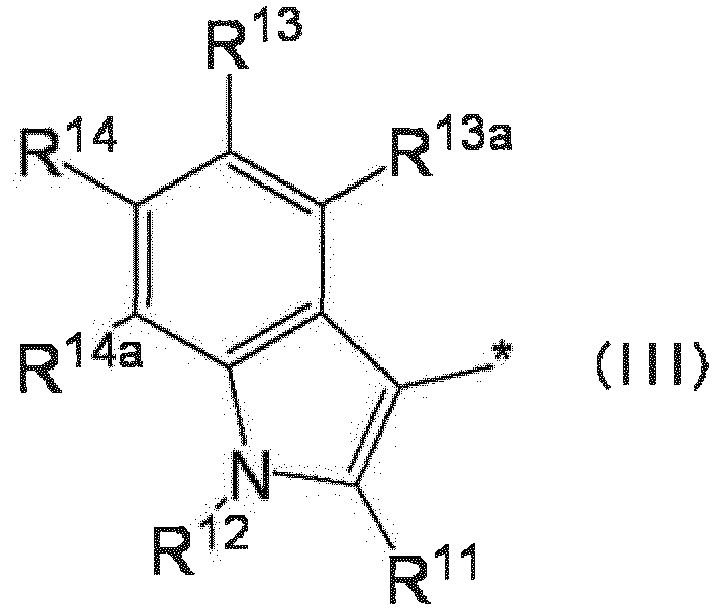
R11 is a hydrogen atom, or
R11 is optionally combined with the above-mentioned R8 to form an alkylene group having 1 to 3 carbon atoms;
R12 , R13 , R13a, R14 and R14a are each independently a hydrogen atom, a halogen atom, a hydroxyl group, an alkyl group having 1 to 3 carbon atoms or an alkoxy group having 1 to 3 carbon atoms; and
* means a bonding site to Z, or
(2) a group represented by the following formula:
R15 R15a, R15b, R16 and R16a are each independently a hydrogen atom, a hydroxyl group, an alkyl group having 1 to 3 carbon atoms or an alkoxy group having 1 to 3 carbon atoms, or R15 and R16 in combination optionally form an alkylenedioxy group having 1 to 3 carbon atoms; and
* means a bonding site to Z,
or an edible salt thereof. - The salty taste enhancer of claim 1, wherein, in the formula (I), R13a, R14a, R15a, R15b and R16a are hydrogen atoms.
- The salty taste enhancer of claim 1 or 2, wherein, in the formula (I),
Q is a group represented by
Hal is a halogen atom; and
* means a bonding site to X, and X is a covalent bond. - The salty taste enhancer of claim 1 or 2, wherein, in the formula (I),
Q is a group represented by
R3'' is a hydrogen atom, a methyl group or a hydroxyl group; and
* means a bonding site to X, and
X is a covalent bond. - A salty taste enhancer for food and drink, which comprises a compound represented by the following formula:

R3''' is a hydrogen atom, a hydroxyl group, a methyl group or an alkoxy group having 1 to 3 carbon atoms;
R9' is (i) a hydrogen atom, (ii) an alkyl group having 1 to 3 carbon atoms which is optionally substituted by hydroxyl group(s), (iii) a carboxyl group, or (iv) an alkoxy(having 1 to 3 carbon atoms)-carbonyl group;
R15' and R16' are each independently a hydrogen atom, a hydroxyl group, an alkyl group having 1 to 3 carbon atoms or an alkoxy group having 1 to 3 carbon atoms; and
n is 1 or 2,
provided that when n is 2, then R3''' is not a hydroxyl group, or an edible salt thereof. - The salty taste enhancer of claim 5, wherein, in the formula (V), n is 2.
- A salty taste enhancer for food and drink, which comprises a compound represented by the following formula:
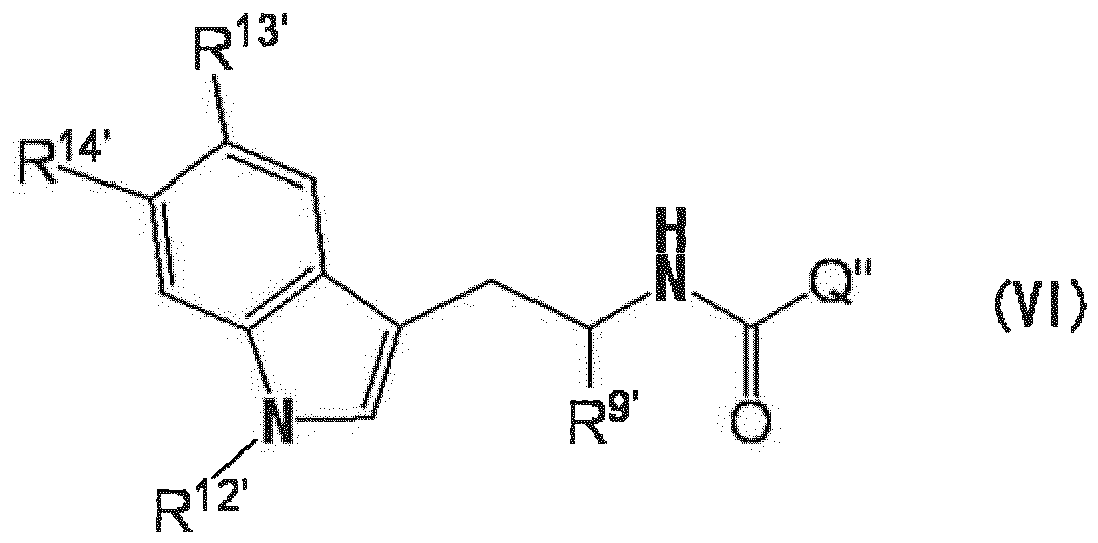
Q'' is a group represented by
R3''' is a hydrogen atom, a hydroxyl group, a methyl group or an alkoxy group having 1 to 3 carbon atoms; and
* means a bonding site to X;
R9' is (i) a hydrogen atom, (ii) an alkyl group having 1 to 3 carbon atoms which is optionally substituted by hydroxyl group(s), (iii) a carboxyl group, or (iv) an alkoxy(having 1 to 3 carbon atoms)-carbonyl group; and
R12', R13' and R14' are each independently a hydrogen atom, a halogen atom, a hydroxyl group, an alkyl group having 1 to 3 carbon atoms or an alkoxy group having 1 to 3 carbon atoms, or an edible salt thereof. - The salty taste enhancer of claim 7, wherein, in the formula (VI),
Q'' is a group represented by
R9' is a hydrogen atom. - The salty taste enhancer of claim 1 or 2, wherein, in the formula (I), any of R1 to R5 is a sulfo group, and Y is -CO-NH-.
- A salty taste enhancer for food and drink, which comprises 2,6-dihydroxy-N-(2-(5-hydroxy-1H-indol-3-yl)ethyl)benzamide,
or an edible salt thereof. - A method of adjusting salty taste of food and drink, which comprises mixing a compound represented by the formula (I) described in claim 1 or an edible salt thereof, and food and drink.
- A method of producing food and drink, which comprises mixing a compound represented by the formula (I) described in claim 1 or an edible salt thereof, and food and drink.
- Food or drink comprising a compound represented by the formula (I) described in claim 1 or an edible salt thereof.
- Food or drink comprising a compound represented by the formula (I) described in claim 1 or an edible salt thereof,
and potassium chloride. - A compound represented by the following formula:

Q' is
(1) a group represented by the following formula:
R1' R2', R3', R4' and R5' are each independently a hydrogen atom, a halogen atom, a hydroxyl group, a carboxyl group, an alkyl group having 1 to 3 carbon atoms which is optionally substituted by 1 to 3 halogen atoms, an alkoxy group having 1 to 3 carbon atoms, a carbamoyl group or a sulfo group, or
R1' and R2' in combination or R2' and R3' in combination optionally form an alkylenedioxy group having 1 to 3 carbon atoms,
provided that any of R1' to R5' is not a hydrogen atom; and * means a bonding site to X, or
(2) a cycloalkyl group having 3 to 7 carbon atoms which is optionally substituted by 1 to 3 alkyl groups having 1 to 3 carbon atoms;
X is a covalent bond, -CH2- or -CHR7-CH2-
wherein R7 is a hydrogen atom or an amino group; Y' is -NR8'-CO-, -NH-CO-O- or -CO-NH-
wherein
R8' is a hydrogen atom or an alkyl group having 1 to 3 carbon atoms, or
R8' is optionally combined with the following R11 to form an alkylene group having 1 to 3 carbon atoms;
Z is -CHR9-, -CH2-CR9R10-, -CR9R10-CH2-, -CH2-CH2-CHR9-, -CH=CR9- or -CR9=CH-
wherein
R9 and R10 are each independently (i) a hydrogen atom, (ii) an alkyl group having 1 to 3 carbon atoms which is optionally substituted by hydroxyl group(s), (iii) a carboxyl group, (iv) an alkoxy(having 1 to 3 carbon atoms)-carbonyl group, (v) an aralkyloxycarbonyl group, (vi) an amino group optionally substituted by alkoxy(having 1 to 4 carbon atoms)-carbonyl group(s), or (vii) a carbamoyl group optionally substituted by alkyl group(s) having 1 to 3 carbon atoms wherein the alkyl group is optionally substituted by 1 to 3 substituents selected from a hydroxyl group, a carboxyl group and a phenyl group; and
Ar' is
(1) a group represented by the following formula:
R11 is a hydrogen atom, or
R11 is optionally combined with the above-mentioned R8 to form an alkylene group having 1 to 3 carbon atoms;
R12, R13 and R19 are each independently a hydrogen atom, a halogen atom, a hydroxyl group, an alkyl group having 1 to 3 carbon atoms or an alkoxy group having 1 to 3 carbon atoms; and
* means a bonding site to Z, or
(2) a group represented by the following formula:
R15 and R16 are each independently a hydrogen atom, a hydroxyl group, an alkyl group having 1 to 3 carbon atoms or an alkoxy group having 1 to 3 carbon atoms, or
R15 and R16 in combination optionally form an alkylenedioxy group having 1 to 3 carbon atoms; and
* means a bonding site to Z,
provided that
(1) a compound wherein
Q' is a group represented by the formula (II'),
X is -CH2-CH2-,
Y' is -NH-CO-,
Z is -CH2-CH2-,
Ar' is a group represented by the formula (III'), R1', R2', R4', R5', R11, R12 and R14 are hydrogen atoms, and R3 and R13 are hydroxyl groups,
(2) a compound wherein
Q' is a group represented by the formula (II'),
X is a covalent bond, Y' is -NH-CO-,
Z is -CH2-CHR9-,
Ar' is a group represented by the formula (III'), and(i) R2', R3', R5', R11, R12, R13 and R14 are hydrogen atoms, R1 is a hydroxyl group, R9 is a bromine atom, and R9 is a hydrogen atom or a carboxyl group,(ii) R2', R3', R4', R5', R11, R12, R13 and R14 are hydrogen atoms, and R1, and R9 are carboxyl groups,(iii) R1', R2', R4', R5', R11, R12, R13 and R14 are hydrogen atoms, and R3' and R9 are carboxyl groups,(iv) R2', R4', R5', R11, R12 and R14 are hydrogen atoms, and R1', R3' and R13 are hydroxyl groups,(v) R2', R3', R5', R11, R12 and R14 are hydrogen atoms, and R1', R4' and R13 are hydroxyl groups,(vi) R1', R4', R5', R11, R12 and R14 are hydrogen atoms, R2', R3' and R13 are hydroxyl groups, or(vii) R2', R3', R4', R5', R11, R12, R13 and R14 are hydrogen atoms,R1' is a hydroxyl group, and R9 is a carboxyl group, (3) a compound wherein
Q' is a group represented by the formula (II'),
X is -CH2- or -CH2-CH2-,
Y' is -NH-CO- or -CO-NH-,
Z is -CH2-, -CH2-CH2- or -CH=CH-,
Ar' is a group represented by the formula (IV'), R1', R4' and R5' are hydrogen atoms, and
R2', R3', R15 and R16 are each independently a hydrogen atom, a hydroxyl group or a methoxy group,
(4) a compound wherein
Q' is a group represented by the formula (II'),
X is a covalent bond,
Y' is -NH-CO-,
Z is -CH2-CHR9-,
Ar' is a group represented by the formula (IV'), R2', R3', R5', R15 and R16 are hydrogen atoms,
R1' is a hydroxyl group,
R4' is a bromine atom, and
R9 is a carboxyl group or a methoxycarbonyl group, and
(5) a compound wherein
Q' is a 2-isopropyl-5-methylcyclohexyl group,
X is a covalent bond,
Y' is -NH-CO-,
Z is -CH2-CH2-, and
Ar' is a group represented by the formula (III'),
are excluded,
or a salt thereof. - A compound represented by the following formula:

Q' is
(1) a group represented by the following formula:
R1', R2', R3', R4', and R5' are each independently a hydrogen atom, a halogen atom, a hydroxyl group, a carboxyl group, an alkyl group having 1 to 3 carbon atoms which is optionally substituted by 1 to 3 halogen atoms, an alkoxy group having 1 to 3 carbon atoms, a carbamoyl group or a sulfo group, or
R1' and R2' in combination or R2' and R3' in combination optionally form an alkylenedioxy group having 1 to 3 carbon atoms,
provided that any of R1' to R5' is not a hydrogen atom; and * means a bonding site to X, or
(2) a cycloalkyl group having 3 to 7 carbon atoms which is optionally substituted by 1 to 3 alkyl groups having 1 to 3 carbon atoms;
X is a covalent bond, -CH2- or -CHR7-CH2-
wherein R7 is a hydrogen atom or an amino group; Y' is -NR8'-CO-, -NH-CO-O- or -CO-NH-
wherein
R8' is a hydrogen atom or an alkyl group having 1 to 3 carbon atoms, or
R8 is optionally combined with the following R11 to form an alkylene group having 1 to 3 carbon atoms;
Z is -CHR9-, -CH2-CR9R10-, -CR9R10-CH2-, -CH2-CH2-CHR9-, -CH=CR9- or -CR9=CH-
wherein
R9 and R10 are each independently (i) a hydrogen atom, (ii) an alkyl group having 1 to 3 carbon atoms which is optionally substituted by hydroxyl group(s), (iii) a carboxyl group, (iv) an alkoxy(having 1 to 3 carbon atoms)-carbonyl group, (v) an aralkyloxycarbonyl group, (vi) an amino group optionally substituted by alkoxy(having 1 to 4 carbon atoms)-carbonyl group(s), or (vii) a carbamoyl group optionally substituted by alkyl group(s) having 1 to 3 carbon atoms wherein the alkyl group is optionally substituted by 1 to 3 substituents selected from a hydroxyl group, a carboxyl group and a phenyl group; and
Ar' is
(1) a group represented by the following formula:
R11 is a hydrogen atom, or
R11 is optionally combined with the above-mentioned R8 to form an alkylene group having 1 to 3 carbon atoms;
R12 , R13 and R14 are each independently a hydrogen atom, a halogen atom, a hydroxyl group, an alkyl group having 1 to 3 carbon atoms or an alkoxy group having 1 to 3 carbon atoms; and
* means a bonding site to Z, or
(2) a group represented by the following formula:
R15 and R16 are each independently a hydrogen atom, a hydroxyl group, an alkyl group having 1 to 3 carbon atoms or an alkoxy group having 1 to 3 carbon atoms, or
R15 and R16 in combination optionally form an alkylenedioxy group having 1 to 3 carbon atoms; and
* means a bonding site to Z,
provided that
(1) a compound wherein
Q' is a group represented by the formula (II'),
X is a covalent bond, -CH2- or -CH2-CH2-,
Y' is -NH-CO-,
Z is -CHR9-, -CH2-CHR9-, -CHR9-CH2-, -CH=CR9- or -CR9=CH-,
Ar' is a group represented by the formula (III'), R1', R2', R3', R4' and R5' are each independently a hydrogen atom, a hydroxyl group, an alkyl group having 1 to 3 carbon atoms or an alkoxy group having 1 to 3 carbon atoms, or
R1' and R2' in combination or R2' and R3' in combination form a methylenedioxy group,
R9 is a hydrogen atom, a carboxyl group or an alkoxy(having 1 to 3 carbon atoms)-carbonyl group,
R11 and R12 are hydrogen atoms, and
R13 and R14 are each independently a hydrogen atom, a hydroxyl group, an alkyl group having 1 to 3 carbon atoms or an alkoxy group having 1 to 3 carbon atoms,
(2) a compound wherein
Q' is a group represented by the formula (II'),
X is a covalent bond, Y' is -NH-CO-,
Z is -CH2-CHR9-,
Ar' is a group represented by the formula (III'), and(i) R2', R3', R5', R11, R12, R13 and R14 are hydrogen atoms, R1' is a hydroxyl group, R4' is a bromine atom, and R9 is a hydrogen atom or a carboxyl group,(ii) R2', R3', R4', R5', R11, R12, R13 and R14 are hydrogen atoms, and R1, and R9 are carboxyl groups,(iii) R1', R2', R4', R5', R11, R12, R13 and R14 are hydrogen atoms, and R3' and R9 are carboxyl groups, or(iv) R2', R3', R4', R5', R11, R12, R13 and R14 are hydrogen atoms, R1' is a hydroxyl group, and R9 is a carboxyl group,(3) a compound wherein
Q' is a group represented by the formula (II'),
X is -CH2- or -CH2-CH2-,
Y' is -CO-NH-,
Z is -CH2-, -CH2-CH2- or -CH=CH-,
Ar' is a group represented by the formula (IV'), R1', R4' and R5' are hydrogen atoms, and
R2', R3', R15 and R16 are each independently a hydrogen atom, a hydroxyl group or a methoxy group,
(4) a compound wherein
Q' is a group represented by the formula (II'),
X is a covalent bond, -CH2- or -CH2-CH2-, Y' is -NH-CO-,
Z is -CHR9-, -CH2-CHR9-, -CHR9-CH2-, -CH=CR9- or -CR9=CH-,
Ar' is a group represented by the formula (IV'), R1', R2', R3', R4' and R5' are each independently a hydrogen atom, a hydroxyl group, an alkyl group having 1 to 3 carbon atoms or an alkoxy group having 1 to 3 carbon atoms, or
R1 and R2 in combination or R2 and R3 in combination form a methylenedioxy group,
R9 is a hydrogen atom, a carboxyl group or an alkoxy(having 1 to 3 carbon atoms)-carbonyl group, and
R15 and R16 are each independently a hydrogen atom, a hydroxyl group, an alkyl group having 1 to 3 carbon atoms or an alkoxy group having 1 to 3 carbon atoms, or
R15 and R16 in combination form a methylenedioxy group,
(5) a compound wherein
Q' is a group represented by the formula (II'),
X is a covalent bond,
Y' is -NH-CO-,
Z is -CH2-CHR9-,
Ar' is a group represented by the formula (IV'), R2', R3', R5', R15 and R16 are hydrogen atoms,
R1' is a hydroxyl group,
R4' is a bromine atom, and
R9 is a carboxyl group or a methoxycarbonyl group, and
(6) a compound wherein
Q' is 2-isopropyl-5-methylcyclohexyl group,
X is a covalent bond,
Y' is -NH-CO-,
Z is -CH2-CH2-, and
Ar' is a group represented by the formula (III'),
are excluded,
or a salt thereof. - The compound of claim 15 or 16, which is a compound represented by the following formula:

R3''' is a hydrogen atom, a hydroxyl group, a methyl group or an alkoxy group having 1 to 3 carbon atoms;
R9' is (i) a hydrogen atom, (ii) an alkyl group having 1 to 3 carbon atoms which is optionally substituted by hydroxyl group(s), (iii) a carboxyl group, or (iv) an alkoxy(having 1 to 3 carbon atoms)-carbonyl group;
R15' and R16' are each independently a hydrogen atom, a hydroxyl group, an alkyl group having 1 to 3 carbon atoms or an alkoxy group having 1 to 3 carbon atoms; and
n is 1 or 2,
provided that when n is 2, then R3''' is not a hydroxyl group, or a salt thereof. - The compound of claim 17, wherein, in the formula (V), n is 2, or a salt thereof.
- The compound of claim 15 or 16, which is a compound represented by the following formula:

Q'' is a group represented by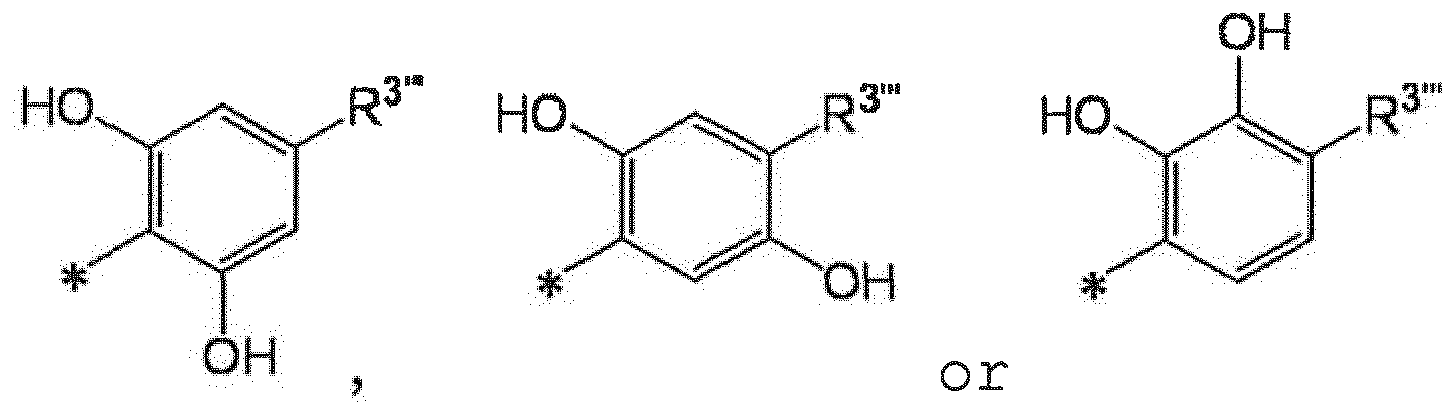
R3''' is a hydrogen atom, a hydroxyl group, a methyl group or an alkoxy group having 1 to 3 carbon atoms; and
* means a bonding site to X;
R9' is (i) a hydrogen atom, (ii) an alkyl group having 1 to 3 carbon atoms which is optionally substituted by hydroxyl group(s), (iii) a carboxyl group, or (iv) an alkoxy(having 1 to 3 carbon atoms)-carbonyl group; and
R12', R13' and R14' are each independently a hydrogen atom, a halogen atom, a hydroxyl group, an alkyl group having 1 to 3 carbon atoms or an alkoxy group having 1 to 3 carbon atoms, or a salt thereof. - The compound of claim 19, wherein, in the formula (VI), Q'' is a group represented by

R9' is a hydrogen atom,
or a salt thereof. - The compound of claim 15 or 16, wherein, in the formula (I'),
any of R1' to R5' is a sulfo group, and Y' is -CO-NH-,
or a salt thereof.
Applications Claiming Priority (1)
| Application Number | Priority Date | Filing Date | Title |
|---|---|---|---|
| PCT/JP2010/067005 WO2012042621A1 (en) | 2010-09-29 | 2010-09-29 | Salty taste enhancer |
Publications (2)
| Publication Number | Publication Date |
|---|---|
| EP2622970A1 true EP2622970A1 (en) | 2013-08-07 |
| EP2622970A4 EP2622970A4 (en) | 2014-04-16 |
Family
ID=45892125
Family Applications (1)
| Application Number | Title | Priority Date | Filing Date |
|---|---|---|---|
| EP10857834.5A Withdrawn EP2622970A4 (en) | 2010-09-29 | 2010-09-29 | Salty taste enhancer |
Country Status (4)
| Country | Link |
|---|---|
| US (1) | US20130196050A1 (en) |
| EP (1) | EP2622970A4 (en) |
| JP (1) | JPWO2012042621A1 (en) |
| WO (1) | WO2012042621A1 (en) |
Cited By (3)
| Publication number | Priority date | Publication date | Assignee | Title |
|---|---|---|---|---|
| WO2016094682A3 (en) * | 2014-12-10 | 2016-09-22 | Mars, Incorporated | Flavor compositions and pet food products containing the same |
| WO2020251928A1 (en) * | 2019-06-12 | 2020-12-17 | Corn Products Development, Inc. | Compositions with sugar like characteristics |
| WO2021028106A3 (en) * | 2019-08-15 | 2021-05-20 | Firmenich Sa | Taste-modifying compounds and uses thereof |
Families Citing this family (6)
| Publication number | Priority date | Publication date | Assignee | Title |
|---|---|---|---|---|
| GB201021103D0 (en) * | 2010-12-13 | 2011-01-26 | Univ Leuven Kath | New compounds for the treatment of neurodegenerative diseases |
| JP2014080406A (en) * | 2012-10-18 | 2014-05-08 | Yukijirushi Shubyo Kk | Plant growth regulator |
| CN108602837B (en) * | 2015-09-04 | 2022-02-11 | 新丰制药株式会社 | Compound having platelet aggregation inhibitory effect, salt thereof, and composition for preventing or treating thrombotic diseases comprising same |
| WO2019113443A2 (en) * | 2017-12-08 | 2019-06-13 | Chromocell Corporation | Tryptophan derivatives as sweeteners |
| US11572337B2 (en) * | 2018-03-06 | 2023-02-07 | Rutgers, The State University Of New Jersey | Antibacterial agents: arylalkylcarboxamido phloroglucinols |
| JP7821120B2 (en) * | 2020-04-29 | 2026-02-26 | エモリー ユニバーシティー | N-acetylserotonin derivatives as TRKB activators and their use |
Family Cites Families (13)
| Publication number | Priority date | Publication date | Assignee | Title |
|---|---|---|---|---|
| US4000297A (en) * | 1971-05-18 | 1976-12-28 | Rotta Research Laboratorium S.P.A. | N-p-chlorobenzoyl tryptophane, salts and compositions thereof |
| JP3073544B2 (en) | 1991-02-18 | 2000-08-07 | 三栄源エフ・エフ・アイ株式会社 | Debittering method of potassium chloride |
| US5220017A (en) * | 1991-04-10 | 1993-06-15 | Merck & Co., Inc. | Cholecystokinin antagonists |
| JP2889423B2 (en) | 1992-01-09 | 1999-05-10 | 長谷川香料株式会社 | Method for enhancing salty taste of salt-containing foods and drinks |
| JPH0853332A (en) | 1994-08-11 | 1996-02-27 | Kao Corp | Whitening cosmetics |
| WO2002087306A2 (en) * | 2001-05-01 | 2002-11-07 | Senomyx, Inc. | High throughput cell-based assay for monitoring sodium channel activity and discovery of salty taste modulating compounds |
| EP1644738A2 (en) * | 2003-07-10 | 2006-04-12 | Senomyx Inc. | IMPROVED ELECTROPHYSIOLOGICAL ASSAYS USING OOCYTES THAT EXPRESS HUMAN ENaC AND THE USE OF PHENAMIL TO IMPROVE THE EFFECT OF ENaC ENHANCERS IN ASSAYS USING MEMBRANE POTENTIAL REPORTING DYES |
| DE102004041496A1 (en) * | 2004-08-27 | 2006-03-02 | Symrise Gmbh & Co. Kg | Hydroxybenzoic acid amides and their use for masking bitter taste |
| EP1904443A1 (en) * | 2005-07-12 | 2008-04-02 | Bayer Cropscience Sa | New benzoheterocyclylethylbenzamide derivatives |
| JP2007289145A (en) | 2006-03-27 | 2007-11-08 | Yaizu Suisankagaku Industry Co Ltd | Method for producing fermented food containing potassium chloride |
| CN101611049A (en) * | 2006-10-19 | 2009-12-23 | 蒙奈尔化学感觉中心 | Human salty taste receptors and methods of modulating salty taste perception |
| EP2135516B1 (en) * | 2008-06-13 | 2012-08-15 | Symrise AG | Neo-menthyl derivatives as flavourings |
| JP5737176B2 (en) * | 2009-03-25 | 2015-06-17 | 味の素株式会社 | New amide derivatives and whitening agents |
-
2010
- 2010-09-29 WO PCT/JP2010/067005 patent/WO2012042621A1/en not_active Ceased
- 2010-09-29 JP JP2012536067A patent/JPWO2012042621A1/en not_active Ceased
- 2010-09-29 EP EP10857834.5A patent/EP2622970A4/en not_active Withdrawn
-
2013
- 2013-03-28 US US13/852,434 patent/US20130196050A1/en not_active Abandoned
Cited By (8)
| Publication number | Priority date | Publication date | Assignee | Title |
|---|---|---|---|---|
| WO2016094682A3 (en) * | 2014-12-10 | 2016-09-22 | Mars, Incorporated | Flavor compositions and pet food products containing the same |
| US10827772B2 (en) | 2014-12-10 | 2020-11-10 | Mars, Incorporated | Compounds that modulate fatty acid receptor activity and pet food products containing the same |
| US11185100B2 (en) | 2014-12-10 | 2021-11-30 | Mars, Incorporated | Methods for modulating taste receptors |
| US12207673B2 (en) | 2014-12-10 | 2025-01-28 | Mars, Incorporated | Compounds that modulate fatty acid receptor activity and pet food products containing the same |
| EP4403042A3 (en) * | 2014-12-10 | 2025-03-05 | Mars, Incorporated | Flavor compositions and pet food products containing the same |
| WO2020251928A1 (en) * | 2019-06-12 | 2020-12-17 | Corn Products Development, Inc. | Compositions with sugar like characteristics |
| CN114375163A (en) * | 2019-06-12 | 2022-04-19 | 玉米产品开发公司 | Compositions with sugar-like characteristics |
| WO2021028106A3 (en) * | 2019-08-15 | 2021-05-20 | Firmenich Sa | Taste-modifying compounds and uses thereof |
Also Published As
| Publication number | Publication date |
|---|---|
| US20130196050A1 (en) | 2013-08-01 |
| EP2622970A4 (en) | 2014-04-16 |
| WO2012042621A1 (en) | 2012-04-05 |
| JPWO2012042621A1 (en) | 2014-02-03 |
Similar Documents
| Publication | Publication Date | Title |
|---|---|---|
| US20130196050A1 (en) | Salty taste enhancer | |
| JP7436542B2 (en) | Method for synthesizing thyroid hormone analogs and polymorphs thereof | |
| US12384742B2 (en) | Organic compounds | |
| CN1593230A (en) | Alkyldienamides exhibiting taste and sensory effect in flavor compositions | |
| JPWO2013002329A1 (en) | Method for producing lanthionine derivative | |
| US20140004243A1 (en) | Salty taste enhancer | |
| WO2014208751A1 (en) | Novel umami imparter | |
| WO2015049294A1 (en) | Organic compounds | |
| US20110280812A1 (en) | Flavor-enhancing amide compounds | |
| US8501772B2 (en) | 3,8-diaminotetrahydroquinoline derivative | |
| CN108794517B (en) | Arginase inhibitor and preparation method and application thereof | |
| JPH08301831A (en) | Stilbene derivative and carcinostatic agent containing the same | |
| WO2018147458A1 (en) | Novel compound and taste-improving agent containing said compound | |
| JP2012191850A (en) | Indole derivative and saltiness-strengthening agent containing the same | |
| JP2016123333A (en) | Novel seasoning composition | |
| US8101223B2 (en) | Flavour modulating substances | |
| JP2001011037A (en) | Cycloalkanecarboxylic acid amide derivative | |
| EP1759595B1 (en) | Flavour modulating substance | |
| CN102811628A (en) | Compounds and methods for enhancing salty taste | |
| JP2007099641A (en) | Indolequinoxaline compound, method for producing the same, and pharmaceutical composition using the same | |
| US20240409517A1 (en) | Organic compounds | |
| JP5520966B2 (en) | Enaminocarbonyl compounds and uses thereof | |
| KR100245980B1 (en) | Homovanillamide derivatives and process of preparation thereof | |
| EP3189061A1 (en) | Derivatives of macrocyclic n-aryl-tricyclopyrimidine-2-amine polyethers as inhibitors of ftl3 and jak | |
| WO2011007090A1 (en) | Derivatives of 5,6-bisaryl-2-pyrimidine-carboxamide, preparation thereof, and therapeutic use thereof as urotensin-ii receptor antagonists |
Legal Events
| Date | Code | Title | Description |
|---|---|---|---|
| PUAI | Public reference made under article 153(3) epc to a published international application that has entered the european phase |
Free format text: ORIGINAL CODE: 0009012 |
|
| 17P | Request for examination filed |
Effective date: 20130415 |
|
| AK | Designated contracting states |
Kind code of ref document: A1 Designated state(s): AL AT BE BG CH CY CZ DE DK EE ES FI FR GB GR HR HU IE IS IT LI LT LU LV MC MK MT NL NO PL PT RO SE SI SK SM TR |
|
| DAX | Request for extension of the european patent (deleted) | ||
| A4 | Supplementary search report drawn up and despatched |
Effective date: 20140318 |
|
| RIC1 | Information provided on ipc code assigned before grant |
Ipc: C07D 487/04 20060101ALI20140312BHEP Ipc: C07C 233/29 20060101ALI20140312BHEP Ipc: C07D 209/20 20060101ALI20140312BHEP Ipc: C07D 317/48 20060101ALI20140312BHEP Ipc: C07D 209/14 20060101ALI20140312BHEP Ipc: C07D 209/18 20060101ALI20140312BHEP Ipc: C07C 309/46 20060101ALI20140312BHEP Ipc: C07C 233/51 20060101ALI20140312BHEP Ipc: C07C 233/87 20060101ALI20140312BHEP Ipc: A23L 1/237 20060101ALI20140312BHEP Ipc: A23L 1/22 20060101AFI20140312BHEP |
|
| 17Q | First examination report despatched |
Effective date: 20150206 |
|
| STAA | Information on the status of an ep patent application or granted ep patent |
Free format text: STATUS: THE APPLICATION IS DEEMED TO BE WITHDRAWN |
|
| 18D | Application deemed to be withdrawn |
Effective date: 20150617 |