EP2620497B1 - Method for producing circular dna formed from single-molecule dna - Google Patents
Method for producing circular dna formed from single-molecule dna Download PDFInfo
- Publication number
- EP2620497B1 EP2620497B1 EP11821594.6A EP11821594A EP2620497B1 EP 2620497 B1 EP2620497 B1 EP 2620497B1 EP 11821594 A EP11821594 A EP 11821594A EP 2620497 B1 EP2620497 B1 EP 2620497B1
- Authority
- EP
- European Patent Office
- Prior art keywords
- adapter
- dna
- dna molecule
- cleavage
- restriction enzyme
- Prior art date
- Legal status (The legal status is an assumption and is not a legal conclusion. Google has not performed a legal analysis and makes no representation as to the accuracy of the status listed.)
- Not-in-force
Links
Images



Classifications
-
- C—CHEMISTRY; METALLURGY
- C12—BIOCHEMISTRY; BEER; SPIRITS; WINE; VINEGAR; MICROBIOLOGY; ENZYMOLOGY; MUTATION OR GENETIC ENGINEERING
- C12N—MICROORGANISMS OR ENZYMES; COMPOSITIONS THEREOF; PROPAGATING, PRESERVING, OR MAINTAINING MICROORGANISMS; MUTATION OR GENETIC ENGINEERING; CULTURE MEDIA
- C12N15/00—Mutation or genetic engineering; DNA or RNA concerning genetic engineering, vectors, e.g. plasmids, or their isolation, preparation or purification; Use of hosts therefor
- C12N15/09—Recombinant DNA-technology
- C12N15/10—Processes for the isolation, preparation or purification of DNA or RNA
- C12N15/1096—Processes for the isolation, preparation or purification of DNA or RNA cDNA Synthesis; Subtracted cDNA library construction, e.g. RT, RT-PCR
-
- C—CHEMISTRY; METALLURGY
- C07—ORGANIC CHEMISTRY
- C07H—SUGARS; DERIVATIVES THEREOF; NUCLEOSIDES; NUCLEOTIDES; NUCLEIC ACIDS
- C07H21/00—Compounds containing two or more mononucleotide units having separate phosphate or polyphosphate groups linked by saccharide radicals of nucleoside groups, e.g. nucleic acids
- C07H21/04—Compounds containing two or more mononucleotide units having separate phosphate or polyphosphate groups linked by saccharide radicals of nucleoside groups, e.g. nucleic acids with deoxyribosyl as saccharide radical
-
- C—CHEMISTRY; METALLURGY
- C12—BIOCHEMISTRY; BEER; SPIRITS; WINE; VINEGAR; MICROBIOLOGY; ENZYMOLOGY; MUTATION OR GENETIC ENGINEERING
- C12N—MICROORGANISMS OR ENZYMES; COMPOSITIONS THEREOF; PROPAGATING, PRESERVING, OR MAINTAINING MICROORGANISMS; MUTATION OR GENETIC ENGINEERING; CULTURE MEDIA
- C12N15/00—Mutation or genetic engineering; DNA or RNA concerning genetic engineering, vectors, e.g. plasmids, or their isolation, preparation or purification; Use of hosts therefor
- C12N15/09—Recombinant DNA-technology
- C12N15/10—Processes for the isolation, preparation or purification of DNA or RNA
-
- C—CHEMISTRY; METALLURGY
- C12—BIOCHEMISTRY; BEER; SPIRITS; WINE; VINEGAR; MICROBIOLOGY; ENZYMOLOGY; MUTATION OR GENETIC ENGINEERING
- C12N—MICROORGANISMS OR ENZYMES; COMPOSITIONS THEREOF; PROPAGATING, PRESERVING, OR MAINTAINING MICROORGANISMS; MUTATION OR GENETIC ENGINEERING; CULTURE MEDIA
- C12N15/00—Mutation or genetic engineering; DNA or RNA concerning genetic engineering, vectors, e.g. plasmids, or their isolation, preparation or purification; Use of hosts therefor
- C12N15/09—Recombinant DNA-technology
- C12N15/63—Introduction of foreign genetic material using vectors; Vectors; Use of hosts therefor; Regulation of expression
- C12N15/64—General methods for preparing the vector, for introducing it into the cell or for selecting the vector-containing host
-
- C—CHEMISTRY; METALLURGY
- C12—BIOCHEMISTRY; BEER; SPIRITS; WINE; VINEGAR; MICROBIOLOGY; ENZYMOLOGY; MUTATION OR GENETIC ENGINEERING
- C12Q—MEASURING OR TESTING PROCESSES INVOLVING ENZYMES, NUCLEIC ACIDS OR MICROORGANISMS; COMPOSITIONS OR TEST PAPERS THEREFOR; PROCESSES OF PREPARING SUCH COMPOSITIONS; CONDITION-RESPONSIVE CONTROL IN MICROBIOLOGICAL OR ENZYMOLOGICAL PROCESSES
- C12Q1/00—Measuring or testing processes involving enzymes, nucleic acids or microorganisms; Compositions therefor; Processes of preparing such compositions
- C12Q1/68—Measuring or testing processes involving enzymes, nucleic acids or microorganisms; Compositions therefor; Processes of preparing such compositions involving nucleic acids
- C12Q1/6806—Preparing nucleic acids for analysis, e.g. for polymerase chain reaction [PCR] assay
-
- C—CHEMISTRY; METALLURGY
- C12—BIOCHEMISTRY; BEER; SPIRITS; WINE; VINEGAR; MICROBIOLOGY; ENZYMOLOGY; MUTATION OR GENETIC ENGINEERING
- C12Q—MEASURING OR TESTING PROCESSES INVOLVING ENZYMES, NUCLEIC ACIDS OR MICROORGANISMS; COMPOSITIONS OR TEST PAPERS THEREFOR; PROCESSES OF PREPARING SUCH COMPOSITIONS; CONDITION-RESPONSIVE CONTROL IN MICROBIOLOGICAL OR ENZYMOLOGICAL PROCESSES
- C12Q2521/00—Reaction characterised by the enzymatic activity
- C12Q2521/30—Phosphoric diester hydrolysing, i.e. nuclease
- C12Q2521/301—Endonuclease
-
- C—CHEMISTRY; METALLURGY
- C12—BIOCHEMISTRY; BEER; SPIRITS; WINE; VINEGAR; MICROBIOLOGY; ENZYMOLOGY; MUTATION OR GENETIC ENGINEERING
- C12Q—MEASURING OR TESTING PROCESSES INVOLVING ENZYMES, NUCLEIC ACIDS OR MICROORGANISMS; COMPOSITIONS OR TEST PAPERS THEREFOR; PROCESSES OF PREPARING SUCH COMPOSITIONS; CONDITION-RESPONSIVE CONTROL IN MICROBIOLOGICAL OR ENZYMOLOGICAL PROCESSES
- C12Q2525/00—Reactions involving modified oligonucleotides, nucleic acids, or nucleotides
- C12Q2525/30—Oligonucleotides characterised by their secondary structure
- C12Q2525/307—Circular oligonucleotides
Definitions
- the present invention relates to a method for producing circular DNA that is formed only from single-molecule DNA, a novel adapter used in the above-mentioned method, and a kit for producing circular DNA, comprising the novel adapter.
- the present invention further relates to a method for identifying and/or detecting a gene using single-molecule circular DNA produced by the above-mentioned method.
- the invention relates to a method for identifying and/or detecting a fusion gene that causes various pathologic conditions.
- Vector method is a conventional gene analysis method.
- a target gene to be analyzed is incorporated into a vector, and the full-length sequence of the gene obtained after the proliferation is then determined using a sequencer.
- the vector method is problematic in that it needs a culture operation, and also in that a sequencer should be used to analyze the full length of a gene.
- Figure 1 schematically shows the outline of gene analysis using the mate-pair method.
- a nucleotide sequence for ligation (a restriction enzyme recognition site) is attached to the both ends of the target gene to be analyzed, and the target gene is then circularized.
- a part including 15 nucleotides or more, and preferably 25 nucleotides or more to several tens of nucleotides or less, of both sides flanking to the restriction enzyme recognition site is cleaved from the circularized gene, generally using a type II restriction enzyme.
- the part is amplified by PCR, and the nucleotide sequence of the cleaved partial gene is then determined. Thereby, the sequences of both ends of the target gene are determined, and the target gene can be then identified using known sequence data.
- Mate pair means the sequence data of a pair of nucleotide sequences obtained by reading both ends of a single DNA fragment.
- Practically used methods of cleaving a given number of nucleotides from a gene include: a method of cutting sites apart from the recognition site using a type II restriction enzyme to cleave a given number of nucleotides out; and a method comprising physically cutting circular DNA using Sonication or the like, recovering a cleaved fragment with biotin attached to the linker, then amplifying the fragment by PCR, and then determining the sequence of the amplified PCR product.
- the mate-pair method can, therefore, identify a known gene by reading a certain length of nucleotide sequence including the both sides flanking to the ligation site in a gene circularized by ligating the both ends of the DNA. Basically, if partial nucleotide sequences of the head and tail portions of a gene were read, these sequences would allow a reliable discrimination among individual genes. Accordingly, the mate-pair method has been adopted as a reliable and simple gene analysis method (Non Patent Literatures 1 and 2). Moreover, the mate-pair method has been applied to the next generation sequence analysis, and thus it has become increasingly important together with the emergence of a high speed sequencer.
- a DNA is circularized for gene analysis according to the mate-pair method, besides the self-circularization of a single gene or a single DNA (a single molecule), the circularization of a plurality of DNAs (a plurality of molecules) and the linear binding of a plurality of molecules (two or more molecules) also take place.
- a linear molecule consisting of a plurality of molecules can be separated and eliminated from a circular molecule by the subsequent operations.
- a circular molecule consisting of a plurality of molecules cannot be separated from a circular molecule consisting of a single molecule, and it becomes a contaminant.
- a circular product consisting of a plurality of molecules inhibits individual gene analyses and significantly decreases analytical specificity for the following reasons.
- the gene analysis according to the mate-pair method intends to identify a target gene based on the nucleotide sequences of both ends of the target gene. Specifically, a ligation adapter for circularization is attached to both ends of individual genes, and the two adapter sites are then ligated to each other to circularize the gene. Then, a part including a certain number of nucleotides at both sides with the adapter site being the center is cleaved from the gene. Consequently, the gene can be identified by analyzing the nucleotide sequence of a portion from each end of the original gene. Hence, a circularized product of a plurality of molecules has a plurality of adapter sites, and the two ends attached to an adapter are ends of different genes.
- the gene fragment for the analysis obtained from circularized products of a plurality of molecules comprises ends of different genes.
- the analysis of a single gene cannot be carried out.
- the presence of a circularized product of a plurality of molecules inhibits each gene analysis.
- the probability of circularization of a plurality of DNA molecules generally ranges from few to dozen percent, depending on the method applied.
- they are recognized as abnormal nucleotide sequences and thus, elimination of them from the sequence to be analyzed is usually possible. Hence, it causes only a slight decrease in accuracy, although the operation becomes complicated.
- the mate-pair method is used to detect the presence of an abnormal gene, such as a fusion gene, in a group of normal genes, if a plurality of normal genes are circularized, it is determined that abnormal genes are present. As a result, it becomes impossible to accurately confirm the presence of an abnormal gene such as a fusion gene.
- the fusion gene is a gene with a novel function that is constructed by binding a plurality of (two) genes to each other. For example, abnormalities in chromosome structure, such as deletion, overlapping, recombination and translocation, are found in a cancer cell. When the cleavage and ligation of a gene occur at a DNA level and a structural gene is present at each cleavage point, a fusion gene is formed.
- a fusion gene is lethal or senseless to cells, and it does not cause clinical problems in many cases.
- cell growth is abnormally promoted as a result that a fusion protein generated from such a fusion gene inhibits the control of the cell growth, it causes clinical problems such as tumor formation.
- Non Patent Literature 3 Among such solid cancers, responsible fusion genes have been discovered from prostatic cancer and lung cancer (Non Patent Literatures 4 and 5).
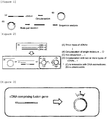
- FIG. 3 A schematic view of the analysis of a fusion gene according to the mate-pair method is shown in Figure 3 .
- Figure 4 A schematic view of the analysis of a fusion gene according to the mate-pair method.
- sequence analysis is carried out according to the mate-pair method, the result that a normal gene appears as a fusion gene may be obtained. If this gene is eliminated for the reason that it is not present in a conventional gene sequence, a fusion gene is also eliminated. As a result, it becomes substantially impossible to confirm the presence of a fusion gene.
- a fusion gene When a fusion gene is to be detected by the sequence analysis according to the mate-pair method, it is essential to eliminate circularized cDNA of a plurality of genes.
- Patent Literature 1 Japanese Patent No. 4303303
- the present inventors have found that a circularized DNA consisting only of a single molecule can be formed by introducing an adapter having a specific structure comprising a specific sequence recognition site into a single DNA molecule and then performing two-step ligation.
- the inventors have found a method for reliably circularizing only single-molecule DNA, wherein circularization of multiple molecules consisting of a plurality of DNAs does not take place.
- the present invention provides a method for producing a circular DNA which consists of a circular DNA formed from single-molecule DNA and which does not comprise circular DNA formed from a multiple-molecule DNA, the method comprising the following steps:
- the adapter (b) specifically binds to a cleavage end from the same adapter (b)
- linearization caused by circularization of a plurality of DNA molecules substantially does not take place, and the DNA to be circularized is a single-molecule DNA.
- the uncircularized linear DNA molecules need to be eliminated, as described above.
- the linear DNAs that are not circularized in step 6) consist of: a trace amount of single-molecule DNA, which have failed to rebind the portion (b) cleaved in step 5); and a major amount of single-molecule or multiple-molecule DNAs, which have be circularized with a plurality of DNA molecules in step 3) and have failed to rebind each adapter (b) after the cleavage of the adapter in step 5).
- the adapter (A) is preferably double-stranded DNA comprising a restriction enzyme site recognizing a sequence whose cleavage ends are complementary to each other, and it is, for example, double-stranded DNA comprising a restriction enzyme site recognizing a palindromic sequence.
- the present invention provides a method for producing a single circular DNA which consists of a circular DNA formed from a single-molecule DNA and which does not comprise a circular DNA formed from a multiple-molecule DNA, the method comprising the following steps:
- the above described second embodiment of the present invention further comprises a step of digesting with endonuclease a circularized DNA formed by binding the adapters (b) via cleavage sequence sites being partially different from each other (miss annealing) and circularization in the above described step 6).
- a step of digesting with endonuclease a circularized DNA formed by binding the adapters (b) via cleavage sequence sites being partially different from each other (miss annealing) and circularization in the above described step 6).
- the adapter (A) is a double-stranded DNA comprising a restriction enzyme site X recognizing a palindromic sequence
- the adapter (B) is a double-stranded DNA consisting of two DNA strands complementary to each other having the following structure y 1 -Y-y 2 -X: wherein X represents a double-stranded DNA being a restriction enzyme site recognizing a palindromic sequence; y 1 and y 2 represent double-stranded DNAs respectively comprising identical nick-generating enzyme recognition sites or restriction enzyme sites being reversely oriented to each other; Y represents a double-stranded DNA sequence having a unique sequence for each DNA molecule to be circularized, n represents an integer of 1 to 40, N 1 to N n , which may be the same or different, each represent a deoxyribonucleotide selected from the group consisting of dAMP, dCMP, dGMP and dTMP, and N' 1
- n is 1 to 40, preferably 4 to 15, and more preferably 5 to 10. However, even if n is more than 40, the method of the present invention can be carried out.
- y 1 and y 2 respectively comprise the nick-generating enzyme recognition sites, and more preferably, the nick-generating enzyme is Nb.BtsI that recognizes 6 nucleotides, or Nt.BsqQI that recognizes 7 nucleotides.
- y 1 and y 2 may respectively comprise the restriction enzyme sites.
- the present invention provides an adapter for producing a circular DNA, consisting of two DNA strands complementary to each other having the following structure y 1 -Y-y 2 -X: wherein X represents a double-stranded DNA that is a restriction enzyme site recognizing a palindromic sequence; y 1 and y 2 represent double-stranded DNAs respectively comprising identical nick-generating enzyme recognition sites or restriction enzyme sites being reversely oriented to each other; Y represents a double-stranded DNA sequence having a unique sequence for each DNA molecule to be circularized, n represents an integer of 1 to 40, N 1 to N n , which may be the same or different, each represent a deoxyribonucleotide selected from the group consisting of dAMP, dCMP, dGMP and dTMP, and N' 1 to N' n represent the following deoxyribonucleotides respectively corresponding to the N 1 to N n , [Table 2] N k N' k
- n is 1 to 40, preferably 4 to 15, and more preferably 5 to 10. However, even if n is more than 40, the method of the present invention can be carried out.
- the above described adapter in the third embodiment of the present invention corresponds to the adapter (B) in the second embodiment of the present invention, and it is preferably used in the method of the present invention for producing a circular DNA which consists of a circular DNA formed from a single-molecule DNA and which does not comprise a circular DNA formed from a multiple-molecule DNA.
- y 1 and y 2 respectively comprise nick-generating enzyme recognition sites, and more preferably, the nick-generating enzyme is Nb.BtsI that recognizes 6 nucleotides, or Nt.BsqQI that recognizes 7 nucleotides.
- y 1 and y 2 may respectively comprise restriction enzyme sites.
- the present invention further provides a kit for producing a circular DNA comprising the adapter according to the above described third embodiment (which is also simply referred to as adapter (B)) and an adapter consisting of a double-stranded DNA comprising a restriction enzyme site identical to the restriction enzyme site represented by X comprised in the adapter (B) (which is also simply referred to as adapter (A)).
- the present invention also provides a method for producing a cDNA library, comprising using the method according to the above described first or second embodiment.
- the present invention further provides a method for identifying a gene by subjecting a circular DNA molecule obtained by using the method according to the above described first or second embodiment to a mate-pair method, the method comprising the following steps:
- the nucleotide sequence to be read consists of preferably 15 to 100 nucleotides, and more preferably 25 to 35 nucleotides.
- the method of the present invention can also be carried out by reading a nucleotide sequence consisting of 600 or more nucleotides.
- the present invention further provides a method for detecting a fusion gene by subjecting a circular DNA molecule obtained by using the method according to the above described first or second embodiment to a mate-pair method, the method comprising the following steps:
- the nucleotide sequence to be read consists of preferably 15 to 100 nucleotides, and more preferably 25 to 35 nucleotides.
- the method of the present invention can also be carried out by reading a nucleotide sequence consisting of 600 or more nucleotides.
- the known fusion gene when the sequences of both sides flanking to both sides of the adapter (B) correspond to the ends of both sides of a known fusion gene, the known fusion gene is detected.
- the gene contained in the circular DNA molecule is identified to be a novel fusion gene.
- the detected novel fusion gene may be used in drug discovery screening.
- the adapter and method of the present invention uses the adapter and method of the present invention to improve the accuracy of gene analysis.
- unconventional high-accuracy mate-pair analysis becomes possible, and thus, the adapter and method of the present invention are provided as tools extremely useful for genomic analysis.
- the method of the present invention to the production of a cDNA library, it is highly likely to discover a novel fusion gene. That is to say, by reliably achieving circularization of a single DNA molecule, it becomes possible to develop novel diagnostic tool and/or method.
- a method for circularizing only a single-molecule DNA wherein circularization of a plurality of molecules is substantially prevented with regard to circularization of DNA, is provided, so that problems regarding contamination in gene analysis such as mate-pair analysis can be solved, and so that high-accuracy analysis becomes possible.
- the method of the present invention to detection and/or analysis of a fusion gene, high-accuracy analysis of a fusion gene becomes possible, and a useful diagnostic tool can be provided.
- the present invention provides a method for producing a circular DNA which consists of a circular DNA formed from a single-molecule DNA and which does not comprise a circular DNA formed from a multiple-molecule DNA, the method comprising the following steps:
- the above described first embodiment of the present invention relates to a technique of circularizing substantially only a single gene (DNA), such that circularization of a plurality of genes (DNAs) can be prevented.
- the method of the first embodiment of the present invention is characterized in that it comprises two-step circularization.
- Step 1) is a step of binding an adapter (A) for a first circularization to one end of each DNA molecule of interest, and binding to the other end thereof an adapter (B) used for a second circularization comprising an adapter (b) and the adapter (A).
- the adapter (B) binds to the DNA molecule via the adapter (b) side, such that the adapter (A) in the adapter (B) is located outside the bond of the DNA molecule to the adapter (b).
- the adapter (A) is allowed to bind to one end of each DNA molecule of interest, and the adapter (B) is allowed to bind to the other end, so that the adapter (A) in the adapter (B) is located on the side closer to the end than the adapter (b) is.
- the adapters (A) are located on both ends of each DNA molecule of interest.
- the adapter (A) comprises a cleavage site generating a cleavage end non-specifically binding to all of the cleavage ends of the adapter (A), and that the adapter (b) comprises a cleavage site generating a cleavage end specifically binding only to a cleavage end from the same adapter (b) . That is to say, the adapter (A) does not exhibit binding specificity and enables non-specific binding between all cleavage ends from the adapter (A).
- the adapter (b) has a constitution that is different depending on each DNA molecule of interest, and it is able to rebind to only cleavage ends from the same adapter (b) and is not able to rebind to cleavage ends from a different adapter (b).
- Step 2) is a first cleavage step of cleaving the DNA molecule obtained in step 1) at the cleavage site of the adapter (A).
- the adapters (A) bind to both ends of the DNA molecule obtained in step 1), cleavage ends from the adapters (A) are generated on both ends of each DNA molecule as a result of the first cleavage step.
- Step 3) is a first circularization step of binding both ends of the DNA molecule obtained in step 2) to circularize the DNA molecule.
- the first circularization is circularization with the adapters (A), and such circularization occurs as a result that cleavage ends from the adapters (A) generated on both ends of each DNA molecule bind to each other.
- the adapter (B), as well as the adapters (A) is incorporated into the circular molecule during the first circularization.
- the function of the adapter (A) does not have specificity, and does not have selectivity by the rebinding of both ends of the DNA molecule of interest.
- Step 4) is a step of eliminating uncircularized linear single-molecules and a DNA molecule consisting of a plurality of molecules bound to each other in step 3).
- Step 5) is a second cleavage step of cleaving the circular DNA molecule obtained in step 3) and step 4) at the cleavage site of the adapter (b). That is to say, cleavage is carried out at the adapter (b) incorporated into each DNA molecule that has been circularized in step 3), such that a linear molecule is generated.
- the second cleavage step cleavage ends from the adapters (b) are generated on both ends of each DNA molecule. In this step, the cleavage end generated as a result of the cleavage substantially cannot bind to a cleavage end from another circular molecule.
- Step 6) is a second circularization step of binding both ends of the DNA molecule obtained in step 5) to circularize the DNA molecule. That is to say, the cleavage ends from the adapters (b) are present on both ends of each DNA molecule obtained in step 5).
- the adapter (b) has a constitution that is different depending on each DNA molecule of interest, and it is able to rebind to only cleavage ends from the same adapter (b) and is not able to rebind to cleavage ends from a different adapter (b).
- second circularization takes place.
- the adapter (b) Because of the specificity of the adapter (b), only single-molecule DNA of interest is circularized. That is, the adapter (b) has binding specificity, and when each adapter (b) portion is cleaved, it rebinds only to a portion, to which it has bound in the original circularized product, but it cannot rebind to other portions, upon rebinding circularization. Accordingly, when rebinding and circularization are carried out in the case of circularization of a plurality of molecules, only the rebinding and circularization in a plurality of the original molecules are possible. As described later, this probability is extremely low, and it is substantially 0 (zero).
- the structures thereof are not particularly limited.
- an example of the adapter (A) is an adapter comprising a restriction enzyme site recognizing a palindromic structure
- an example of the adapter (b) is double-stranded DNA consisting of nucleic acids of at least 4 nucleotides, and preferably 5 or more nucleotides, which are complementary to each other, wherein the double-stranded DNA generates single-stranded ends complementary to each other, as a result of cleavage.
- the adapters (A) and (b) are not limited thereto.
- the adapter (b) may be a substance that becomes a key and a keyhole as a result of cleavage.
- the adapter (b) when it is cleaved and is then rebound, it may be an adapter that can rebind substantially only to the adapter before the cleavage.
- the method of the present invention can be applied. In such a case, a configuration, in which an upstream adapter (A1) is distinguished from a downstream adapter (A2) and in which (A1) binds to (A2), is adopted. In this case, it is anticipated that the efficiency of single-molecule circular DNA at the first step will be slightly increased, in comparison with the use of an ordinary adapter (A).
- circularized products from a plurality of genes (a plurality of molecules), which become contaminants, can be eliminated from, for example, gene analysis and gene identification according to the mate-pair method, and it becomes possible to produce circularized products only from a single molecule (a single gene).
- the a second embodiment of the present invention provides a method for producing a circular DNA which consists of a circular DNA formed from a single-molecule DNA and which does not comprise a circular DNA formed from a multiple-molecule DNA, the method comprising the following steps:
- the production method further comprise a step of digesting with endonuclease a circularized DNA formed by binding the adapters (b) via cleavage sequence sites being partially different from each other and circularization in the above described step 6).
- step 1) is a step of binding an adapter (A) for a first circularization to one end of each DNA molecule of interest, and binding to the other end thereof an adapter (B) used for a second circularization comprising an adapter (b) and the adapter (A).
- the adapter (B) binds to the DNA molecule via the adapter (b) side, such that the adapter (A) in the adapter (B) is located outside the bond of the DNA molecule to the adapter (b).
- the adapter (A) is a double-stranded DNA comprising a restriction enzyme site recognizing a palindromic sequence
- the adapter (B) comprises the adapter (b) and the adapter (A)
- the adapter (b) is a double-stranded DNA comprising identical nick-generating enzyme recognition sites or restriction enzyme sites being reversely oriented to each other
- the adapter (b) is a double-stranded DNA comprising a double-stranded DNA sequence having a unique sequence for each adapter (b) between the identical nick-generating enzyme recognition sites or restriction enzyme sites being reversely oriented to each other, and if the adapter (b) is cleaved at the identical nick-generating enzyme recognition sites or restriction enzyme sites being reversely oriented to each other, the cleavage site rebinds only to the cleavage site from the same adapter (b).
- Adapter (A) This adapter is a sequence for cleaving the DNA molecule with restriction enzymes in the first cleavage and then performing gene ligation to produce circular DNA.
- the adapter (A) may comprise any type of restriction enzyme site, as long as the restriction enzyme site recognizes a palindromic sequence.
- the adapter (A) comprises a restriction enzyme site recognizing a rare gene sequence that hardly cleaves the DNA of interest. Examples of the restriction enzyme site comprised in the adapter (A) include NotI and EcoRI.
- This adapter is a double-stranded DNA comprising identical nick-generating enzyme recognition sites or restriction enzyme sites being reversely oriented to each other, wherein it comprises a double-stranded DNA sequence having a unique sequence for each adapter (b) between the identical nick-generating enzyme recognition sites or restriction enzyme sites being reversely oriented to each other.
- This nick-generating enzyme recognition site or restriction enzyme site is used to cleave the DNA molecule in the second cleavage so as to form a gene overhang specific to each molecule.
- the nick-generating enzyme cleaves only one DNA strand by nick cleavage, whereas the restriction enzyme cleaves two DNA strands simultaneously. Both of these recognition sites can be introduced.
- cleavage sites are generated.
- the cleavage sites rebind only to cleavage sites from the same adapter (b).
- the length of the cleavage site is not limited.
- the length of the cleavage site is limited, as shown in the following examples.
- the nick-generating enzyme is preferable.
- a cleavage site which is generated when the adapter (b) is cleaved at the identical nick-generating enzyme recognition sites or restriction enzyme sites being reversely oriented to each other, will be described.
- the cleavage site is a portion corresponding to a gene overhang specific to each molecule.
- the number of nucleotides is limited.
- the length of the cleavage site can be arbitrarily set. In order to achieve high specificity, a greater number of nucleotides constituting such a cleavage site is appropriate. In contrast, if the cleavage site is too long, it is highly likely that gene ligation will occur due to mismatch.
- the number of nucleotides constituting the cleavage site should be set to be greater, and at the same time, a step of digestion with endonuclease should be added to prevent the possibility of mismatch ligation (miss annealing). It is to be noted that a random combination is applied to the sequence of a cleavage site, and each different cleavage site is designed for each DNA molecule.
- an adapter (B) having the following sequence is produced by nucleic acid synthesis, and then, it can be used in the method of the present invention.
- Step 2) is a first cleavage step of cleaving the DNA molecule obtained in step 1) with a restriction enzyme recognizing the restriction enzyme site comprised in the adapter (A) ( Figure 5 ).
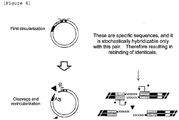
- Step 3) is a first circularization step of ligating both ends of the DNA molecule obtained in step 2) to circularize the DNA molecule ( Figure 6 ; first circularization).
- Step 4) is a step of eliminating uncircularized linear single-molecules and a DNA molecule consisting of a plurality of molecules bound to each other in step 3).
- Step 5) is a second cleavage step of cleaving the circular DNA molecule obtained in step 3) and step 4) with a nick-generating enzyme or a restriction enzyme recognizing the nick-generating enzyme recognition sites or restriction enzyme sites of the adapter (b).
- Step 6) is a second circularization step of ligating both ends of the DNA molecule obtained in step 5) to circularize the DNA molecule ( Figure 6 ; cleavage and recircularization).
- Step 6 because of the specificity of the sequence of the cleavage site, only the cleavage sites from the adapter (b) bound to the same DNA can bind to each other.
- the adapter (A) is a double-stranded DNA comprising a restriction enzyme site X recognizing a palindromic sequence
- the adapter (B) is a double-stranded DNA consisting of two DNA strands complementary to each other having the following structure y 1 -Y-y 2 -X: wherein X represents a double-stranded DNA being a restriction enzyme site recognizing a palindromic sequence; y 1 and y 2 represents double-stranded DNAs respectively comprising identical nick-generating enzyme recognition sites or restriction enzyme sites being reversely oriented to each other; Y represents a double-stranded DNA sequence having a unique sequence for each DNA molecule to be circularized, n represents an integer of 1 to 40, N 1 to N n , which may be the same or different, each represent a deoxyribonucleotide selected from the group consisting of dAMP, dCMP, dGMP and dTMP, and N' 1
- n is 1 to 40, preferably 4 to 15, and more preferably 5 to 10. However, even if n is more than 40, the method of the present invention can be carried out.
- the Y site consists of a pair of nucleotide sequences, which are randomly combined. For example, if Y is constituted with 8 nucleotide sequences, 4 8 combinations are obtained. Thereby, pair formation in circularization can be specified (selected), and rebinding only to the original pair becomes possible. As a result, only a single DNA can be recircularized, and since the Y portion of another molecule has a different structure, it cannot rebindn thereto.
- the Y portion of the adapter (B) can be basically produced by determining N (the number of nucleic acids), and then carrying out the synthesis of a main chain by random sequential condensation, in which nucleic acids are not determined, and a polymerase extension reaction using primers on consensus sequences.
- y 1 and y 2 respectively comprise nick-generating enzyme recognition sites, and more preferably, the nick-generating enzyme is Nb.BtsI. Further, y 1 and y 2 may preferably comprise restriction enzyme sites.
- the third embodiment of the present invention provides a preferred adapter (B) used in the method of the above described second embodiment of the present invention, namely, an adapter for producing a circular DNA, consisting of two DNA strands complementary to each other having the following structure y 1 -Y-y 2 -X: wherein X represents a double-stranded DNA being a site for a restriction enzyme recognizing a palindromic sequence; y 1 and y 2 represent double-stranded DNAs respectively comprising identical nick-generating enzyme recognition sites or restriction enzyme sites being reversely oriented to each other; Y represents a double-stranded DNA sequence having a unique sequence for each DNA molecule to be circularized, n represents an integer of 1 to 40, N 1 to N n , which may be the same or different, each represent a deoxyribonucleotide selected from the group consisting of dAMP, dCMP, dGMP and dTMP, and N' 1 to N' n represent the following deoxyribonucle
- n is 1 to 40, preferably 4 to 15, and more preferably 5 to 10. However, even if n is more than 40, the present invention can be carried out.
- y 1 and y 2 respectively comprise nick-generating enzyme recognition sites, and more preferably, the nick-generating enzyme is Nb.BtsI or Nt.BsqQI. Further, y 1 and y 2 may preferably comprise restriction enzyme sites.
- the fourth embodiment of the present invention provides a kit for producing a circular DNA, comprising the preferred adapter (A) and adapter (B) used in the method of the above described second embodiment of the present invention. That is to say, the fourth embodiment of the present invention provides a kit for producing a circular DNA, comprising an adapter (A) consisting of double-stranded DNA comprising a restriction enzyme site identical to the restriction enzyme site represented by X according to the above described third embodiment, and an adapter (B) according to the above described third embodiment.
- the kit for producing a circular DNA of the present invention comprises an adapter (A) and an adapter (B). These adapters are allowed to bind to both ends of a DNA molecule of interest, and thereafter, the two-step circularization method according to the first or second embodiment of the present invention is carried out, so as to provide a circularized DNA that comprises a circularized DNA formed only from a single-molecule DNA without comprising a circularized DNA formed from a multiple-molecule DNA.
- the fifth embodiment of the present invention provides a method for producing a cDNA library, comprising using the two-step circularization method according to the first or second embodiment of the present invention.
- a cDNA library comprising a circularized DNA consisting only of a single-molecule DNA can be produced.
- the sixth embodiment of the present invention provides a method for identifying a gene by subjecting a circular DNA molecule obtained by using the method according to the first or second embodiment of the present invention to a mate-pair method, the method comprising the following steps:
- Step 1) in the method of the sixth embodiment of the present invention is a step of reading nucleotide sequences, each consisting of 15 to 600 nucleotides, flanking to both sides of the adapter (B) in the circular DNA molecule obtained using the method according to the first or second embodiment of the present invention.
- the nucleotide sequence to be read consists of preferably 15 to 100 nucleotides, and more preferably 25 to 35 nucleotides.
- the method of the present invention can also be carried out by reading a nucleotide sequence consisting of 600 or more nucleotides.
- the nucleotide sequence can be read by a method well known to a person skilled in the art, using a sequencer.
- Step 2) in the method of the sixth embodiment of the present invention is a step of identifying a gene contained in the circular DNA molecule by comparing the read nucleotide sequences with the sequences of both ends of a known gene. If the read nucleotide sequences, which correspond to the sequences on both ends of a DNA molecule of interest, can be confirmed to be identical to the sequences of both ends of a known gene, then the DNA molecule of interest is identified to be the known gene.
- the seventh embodiment of the present invention provides a method for detecting a fusion gene by subjecting a circular DNA molecule obtained by using the method according to the first or second embodiment of the present invention to a mate-pair method, the method comprising the following steps:
- Step 1) in the method of the seventh embodiment of the present invention is a step of reading nucleotide sequences, each consisting of 15 to 600 nucleotides, flanking to both sides of an adapter (B) in a circular DNA molecule obtained by using the method according to the first or second embodiment of the present invention.
- the nucleotide sequence to be read consists of preferably 15 to 100 nucleotides, and more preferably 25 to 35 nucleotides.
- the method of the present invention can also be carried out by reading a nucleotide sequence consisting of 600 or more nucleotides.
- the nucleotide sequence can be read by a method well known to a person skilled in the art, using a sequencer.
- Step 2) in the method of the seventh embodiment of the present invention is a step of comparing the read nucleotide sequences with the sequences of both ends of a known gene.
- the gene comprised in the circular DNA molecule is identified to be a fusion gene. That is to say, if a portion, which corresponds to one end of the read nucleotide sequences corresponding to the sequences on both ends of a DNA molecule of interest, is identical to one end of a known gene, and if a portion corresponding to the other end is identical to one end of another known gene, the DNA molecule of interest is identified to be a fusion gene consisting of two known genes.
- the DNA of interest is detected to be the known fusion gene.
- the relationship between the expression of the known fusion gene and a disease has been known, it is possible to detect a disease characterized by the expression of the fusion gene detected by the aforementioned method, using the fusion gene as a marker.
- the gene contained in the circular DNA molecule is identified to be a novel fusion gene.
- the novel fusion gene detected by the aforementioned method can be used in drug discovery screening.
- Example 1 Application of the method of the present invention to the discovery of a fusion gene, in which cDNA synthesized from mRNA is used
- complementary strand DNA is first synthesized with reverse transcriptase, using oligonucleotide (1) having a poly T sequence complementary to a poly A site at the 3'-terminus of mRNA, as shown in Figure 7 .
- oligonucleotide (1) having a poly T sequence complementary to a poly A site at the 3'-terminus of mRNA, as shown in Figure 7 .
- a specific oligonucleotide sequence (2) is incorporated at the 5'-terminus of mRNA, as shown in Figure 7 .
- DNA is synthesized from an oligonucleotide complementary to this specific sequence, or a cDNA library is produced by PCR.
- the adapter (B) has been introduced into the oligonucleotide (1) sequence having a poly T sequence complementary to a poly A site at the 3'-terminus of mRNA, and the adapter (A) has been added to the oligonucleotide (2) sequence.
- a cDNA library when synthesized, it automatically becomes the basic structure of the present invention. It is not necessary to bind new sequences to the right and left ends, and the routine can directly proceed to the next step.
- the routine can directly proceed to the next step.
- the cDNA library is further amplified by PCR, if it is directly amplified, a specific N nucleotide sequence must be amplified.
- amplification is carried out using, for example, a 5' phosphate group-added primer as an upstream primer, and a primer containing the N nucleotide as a downstream primer, and after completion of the PCR, a strand into which the phosphate group primer has been incorporated is digested with ⁇ exonuclease. Thereafter, primer-extension is carried out again from the upstream primer, so as to produce a cDNA library in which the diversity of the N nucleotide is maintained.
- this process is not necessary.
- the subsequent adapter binding method is carried out.
- a restriction enzyme sequence has been introduced into each of the 3'-terminus and 5'-terminus thereof, as shown in Figure 7(3) .
- a restriction enzyme used in this case either an ordinary palindromic sequence, or a non-palindromic sequence for distinguishing the 3'-terminus and 5'-terminus, can be used.
- the adapter in order to ensure adapter binding, can also be bound to an end in the shape of blunt end with an A-protruding nucleotide. In order to introduce the adapter of the present invention after modification of the library, this method is desirable.
- Example 2 Application of the method of the present invention to genomic analysis by mate-pair method
- the following method is adopted to add adapters (A) and (B) to both ends of a DNA molecule.
- an adapter (A) is first allowed to bind.
- the amount of the adapter (A) added is set to be smaller than the amount of the target DNA molecules.
- the number of the adapters (A) may be the same as the number of the target DNA molecules, or one nucleotide protrusion may be enzymatically produced on a DNA fragment and a complementary adapter may be allowed to bind thereto.
- the concentration of the adapter may be excessive.
- the adapter (A) is allowed to bind to the end of the DNA molecule.
- an adapter (B) is allowed to bind.
- the first circularization is impossible for a single molecule and thus, it is eliminated.
- circularization with a plurality of DNAs can be formed (for example, the binding of two molecules, namely, the binding of the molecule of type (b) to the molecule of type (c)).
- Such a plurality of DNA molecules must bind to the molecule of type (a) or type (c) as a binding partner. Accordingly, both sides must bind to specific sequences having N sequences.
- the second circularization cannot be formed and is eliminated.
- the first circularization is impossible for a single molecule and is eliminated.
- circularization with a plurality of DNAs can be formed (for example, the binding of two molecules, namely, the binding of the molecule of type (b) to the molecule of type (c)). Since this DNA fragment originally has different N sequences on both ends, after completion of the nick cleavage, the second circularization cannot be formed and is eliminated.
- both ends are ligated at a first stage.
- cleavage does not take place at a second stage, it remains as circular DNA.
- BstXI is added to the outside of the adapter (A) comprising the restriction enzyme site, for example.
- an EcoRI site is incorporated, so that CCANNNNNNTGG is converted to CCAGAATTCTGG, for example.
- the restriction enzyme site of each of the adapter (A), and the adapter (A) contained in the adapter (B), is set to be an EcoRI site, for example.
- the sequence outside the EcoRI site is set to be a BstXI recognition sequence, for example. That is, the sequence of the adapter (A) is set to be CCAGAATTCTGG.
- the adapter (A) contained in the adapter (B) comprises an EcoRI site but does not comprise a BstXI recognition sequence, so that it cannot be cleaved with BstXI.
- the method of the present invention can be applied even to a genomic DNA fragment that cannot distinguish between upstream and downstream, differing from cDNA, so that single-molecule circular DNA can be produced, and so that the accuracy of mate-pair analysis can be significantly improved.
- Example 3 Regarding the possibility of rebinding of circular DNA genes in a plurality of circular DNA molecules
- such possibility is estimated in the following three cases: (1) a case in which the possibility is assumed from the volume of a DNA molecule and the amount (volume) of a reaction solution; (2) a case in which the possibility is assumed from the number of molecules in the reaction solution (in the two above cases, it is assumed that the number of N nucleotides in the Y portion is sufficiently large and that it has high specificity); and further, (3) a case in which the number of N nucleotides is determined but it is not sufficiently large.
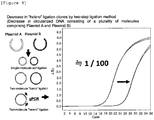
- Plasmid A and Plasmid B Two types of plasmids, Plasmid A and Plasmid B, were prepared.
- Product (i) obtained by cleaving each plasmid with a restriction enzyme and then directly ligating the fragments was compared with product (ii) obtained by ligating the adapter of the present invention according to the two-step ligation.
- any given nucleotides N (6 nucleotides) used as an adapter were subjected to random synthesis, and after ligation of the adapter, the adapter was cleaved at an NcoI site present on the end of the adapter. Then, a mixture of these plasmids was circularized by a first-step ligation, and using Nick enzyme, Nick was placed before and after any given 6 nucleotides N, so that circularization was cleaved. Thereafter, ligation was carried out again to perform a second-step circularization.
- the products (i) and (ii) in the mixed solution would comprise (1) circularized DNA formed with a single molecule of Plasmid A, (2) circularized DNA formed with a single molecule of Plasmid B, (3) circularized DNA formed with a plurality of molecules of Plasmid A, (4) circularized DNA formed with a plurality of molecules of Plasmid B, and (5) circularized DNA formed with a plurality of molecules comprising Plasmid A and Plasmid B.
- the amount of the circularized DNA (5) in the mixed solution generated from these products (i) and (ii) was evaluated as a representative example. Quantitative PCR was carried out using PCR primers specific to Plasmid A and Plasmid B.
- the adapter and method of the present invention uses the adapter and method of the present invention to improve the accuracy of gene analysis.
- unconventional high-accuracy mate-pair analysis becomes possible, and thus, the adapter and method of the present invention are provided as tools extremely useful for genomic analysis.
- the method of the present invention to the production of a cDNA library, it is highly likely to discover a novel fusion gene. That is to say, by reliably achieving circularization of a single DNA molecule, it becomes possible to develop novel diagnostic tool and/or method.
- a method for circularizing only a single-molecule DNA wherein circularization of a plurality of molecules is substantially prevented with regard to circularization of DNA, is provided, so that problems regarding contamination in gene analysis such as mate-pair analysis can be solved, and so that high-accuracy analysis becomes possible.
- the method of the present invention to detection and/or analysis of a fusion gene, high-accuracy analysis of a fusion gene becomes possible, and a useful diagnostic tool can be provided.
Landscapes
- Life Sciences & Earth Sciences (AREA)
- Chemical & Material Sciences (AREA)
- Health & Medical Sciences (AREA)
- Genetics & Genomics (AREA)
- Engineering & Computer Science (AREA)
- Organic Chemistry (AREA)
- Wood Science & Technology (AREA)
- Zoology (AREA)
- Biotechnology (AREA)
- General Engineering & Computer Science (AREA)
- Bioinformatics & Cheminformatics (AREA)
- Biomedical Technology (AREA)
- Biochemistry (AREA)
- Molecular Biology (AREA)
- General Health & Medical Sciences (AREA)
- Microbiology (AREA)
- Biophysics (AREA)
- Physics & Mathematics (AREA)
- Plant Pathology (AREA)
- Crystallography & Structural Chemistry (AREA)
- Analytical Chemistry (AREA)
- Proteomics, Peptides & Aminoacids (AREA)
- Bioinformatics & Computational Biology (AREA)
- Cell Biology (AREA)
- Chemical Kinetics & Catalysis (AREA)
- Immunology (AREA)
- Measuring Or Testing Involving Enzymes Or Micro-Organisms (AREA)
Description
- The present invention relates to a method for producing circular DNA that is formed only from single-molecule DNA, a novel adapter used in the above-mentioned method, and a kit for producing circular DNA, comprising the novel adapter.
- The present invention further relates to a method for identifying and/or detecting a gene using single-molecule circular DNA produced by the above-mentioned method. In particular, the invention relates to a method for identifying and/or detecting a fusion gene that causes various pathologic conditions.
- Vector method is a conventional gene analysis method. In the vector method, a target gene to be analyzed is incorporated into a vector, and the full-length sequence of the gene obtained after the proliferation is then determined using a sequencer. However, the vector method is problematic in that it needs a culture operation, and also in that a sequencer should be used to analyze the full length of a gene.
- In recent years, a high speed sequencer used in gene analysis has been developed, and with the development of this sequencer, mate-pair method as a gene analysis means has attracted attention.
-
Figure 1 schematically shows the outline of gene analysis using the mate-pair method. In the mate-pair method, a nucleotide sequence for ligation (a restriction enzyme recognition site) is attached to the both ends of the target gene to be analyzed, and the target gene is then circularized. Then, a part including 15 nucleotides or more, and preferably 25 nucleotides or more to several tens of nucleotides or less, of both sides flanking to the restriction enzyme recognition site is cleaved from the circularized gene, generally using a type II restriction enzyme. The part is amplified by PCR, and the nucleotide sequence of the cleaved partial gene is then determined. Thereby, the sequences of both ends of the target gene are determined, and the target gene can be then identified using known sequence data. Mate pair means the sequence data of a pair of nucleotide sequences obtained by reading both ends of a single DNA fragment. - Practically used methods of cleaving a given number of nucleotides from a gene include: a method of cutting sites apart from the recognition site using a type II restriction enzyme to cleave a given number of nucleotides out; and a method comprising physically cutting circular DNA using Sonication or the like, recovering a cleaved fragment with biotin attached to the linker, then amplifying the fragment by PCR, and then determining the sequence of the amplified PCR product.
- The mate-pair method can, therefore, identify a known gene by reading a certain length of nucleotide sequence including the both sides flanking to the ligation site in a gene circularized by ligating the both ends of the DNA. Basically, if partial nucleotide sequences of the head and tail portions of a gene were read, these sequences would allow a reliable discrimination among individual genes. Accordingly, the mate-pair method has been adopted as a reliable and simple gene analysis method (
Non Patent Literatures 1 and 2). Moreover, the mate-pair method has been applied to the next generation sequence analysis, and thus it has become increasingly important together with the emergence of a high speed sequencer. - However, when a DNA is circularized for gene analysis according to the mate-pair method, besides the self-circularization of a single gene or a single DNA (a single molecule), the circularization of a plurality of DNAs (a plurality of molecules) and the linear binding of a plurality of molecules (two or more molecules) also take place. A linear molecule consisting of a plurality of molecules can be separated and eliminated from a circular molecule by the subsequent operations. On the other hand, a circular molecule consisting of a plurality of molecules cannot be separated from a circular molecule consisting of a single molecule, and it becomes a contaminant. A circular product consisting of a plurality of molecules inhibits individual gene analyses and significantly decreases analytical specificity for the following reasons. Specifically, as shown in
Figure 2 , when three types of cDNAs are to be self-circularized, if only single-molecule DNA is circularized as shown in (B), a gene can be specified using precise sequences according to the mate-pair method. However, other than the circularization of a single molecule as shown in (B), an uncircularized linear product may be generated as shown in (C), or two or more cDNAs may be circularized as shown in (D). In the case of (C), the linear product can be eliminated with DNA exonuclease. However, in the case of (D), a circularized product consisting of a plurality of cDNAs is recognized as a circularized molecule, and thus, it cannot be eliminated and becomes a contaminant in the gene analysis according to the mate-pair method. - The gene analysis according to the mate-pair method intends to identify a target gene based on the nucleotide sequences of both ends of the target gene. Specifically, a ligation adapter for circularization is attached to both ends of individual genes, and the two adapter sites are then ligated to each other to circularize the gene. Then, a part including a certain number of nucleotides at both sides with the adapter site being the center is cleaved from the gene. Consequently, the gene can be identified by analyzing the nucleotide sequence of a portion from each end of the original gene. Hence, a circularized product of a plurality of molecules has a plurality of adapter sites, and the two ends attached to an adapter are ends of different genes. Accordingly, as described above, since gene analysis is carried out by cleaving a part including nucleotide sequences of a given number of nucleotides of the both ends attached to the adapter, with the adapter being the center, according to either one of the above described two methods, the gene fragment for the analysis obtained from circularized products of a plurality of molecules comprises ends of different genes. Thus, the analysis of a single gene cannot be carried out.
- As such, in the gene analysis according to the mate-pair method, the presence of a circularized product of a plurality of molecules inhibits each gene analysis.
- The probability of circularization of a plurality of DNA molecules generally ranges from few to dozen percent, depending on the method applied. In the analysis of a known gene, they are recognized as abnormal nucleotide sequences and thus, elimination of them from the sequence to be analyzed is usually possible. Hence, it causes only a slight decrease in accuracy, although the operation becomes complicated. However, in a case in which the mate-pair method is used to detect the presence of an abnormal gene, such as a fusion gene, in a group of normal genes, if a plurality of normal genes are circularized, it is determined that abnormal genes are present. As a result, it becomes impossible to accurately confirm the presence of an abnormal gene such as a fusion gene.
- The fusion gene is a gene with a novel function that is constructed by binding a plurality of (two) genes to each other. For example, abnormalities in chromosome structure, such as deletion, overlapping, recombination and translocation, are found in a cancer cell. When the cleavage and ligation of a gene occur at a DNA level and a structural gene is present at each cleavage point, a fusion gene is formed.
- In general, a fusion gene is lethal or senseless to cells, and it does not cause clinical problems in many cases. However, when cell growth is abnormally promoted as a result that a fusion protein generated from such a fusion gene inhibits the control of the cell growth, it causes clinical problems such as tumor formation.
- It had been considered that the fusion gene is mainly expressed in hematopoietic tumors. In recent years, however, it has been expected that the fusion gene would be also associated with epithelial solid tumors (Non Patent Literature 3). Among such solid cancers, responsible fusion genes have been discovered from prostatic cancer and lung cancer (
Non Patent Literatures 4 and 5). - From these findings, the analysis of a fusion gene, namely, confirmation of the presence of a fusion gene, has attracted attention as a novel method for diagnosing tumors (cancers) and the like. Specifically, by detecting a known fusion gene that has been known as corresponding to pathologic conditions, it becomes possible to make a rapid diagnosis of the pathologic conditions. Furthermore, the discovery of a novel fusion gene leads to the discovery of drug discovery targets.
- On the other hand, conventional chromosome analyses performed on solid tumors had had a certain limit, and it had been extremely difficult to analyze and/or confirm a fusion gene. Recently, novel methods, such as the cDNA functional expression analysis method according to Mano et al., have been developed. However, these techniques have been still insufficient in terms of complicated operations, problems regarding accuracy, etc. (Patent Literature 1). In addition, various types of next-generation high speed gene sequencers have been recently developed. Thus, high speed sequence analysis of genes has significantly progressed, and gene analysis in a short time has been realizing. Hence, searching for fusion genes have been started according to high-speed and/or high-scale nucleotide sequence analysis of tumor genomes and/or genes (Non Patent Literature 6).
- In order to identify a fusion gene by sequence analysis using the mate-pair method, it is essential to reliably produce single circular DNA from a single cDNA molecule. A schematic view of the analysis of a fusion gene according to the mate-pair method is shown in
Figure 3 . There is a case, however, in which single circular DNA may be formed from a plurality of cDNA molecules, as shown inFigure 4 . Thus, when sequence analysis is carried out according to the mate-pair method, the result that a normal gene appears as a fusion gene may be obtained. If this gene is eliminated for the reason that it is not present in a conventional gene sequence, a fusion gene is also eliminated. As a result, it becomes substantially impossible to confirm the presence of a fusion gene. - When a fusion gene is to be detected by the sequence analysis according to the mate-pair method, it is essential to eliminate circularized cDNA of a plurality of genes.
- Patent Literature 1: Japanese Patent No.
4303303 -
- Non Patent Literature 1: Tanpakushitsu Kakusan Koso, August 2009, (1233-1247, 1271-1275)
- Non Patent Literature 2: " Shikkan Idenshi no Tansaku to Chokosoku Sequence," Jikken Igaku extra edition, Vol. 27, No. 12 (2009, 113(1929)-143(1959))
- Non Patent Literature 3: Mitelman et al., 2004, Nature Genetics, Vol. 36, No. 4, pp. 331-334
- Non Patent Literature 4: Chinnaiyan et al., 2005, Science, Vol. 310, pp. 644-648
- Non Patent Literature 5 : Soda et al., 2007, Nature, Vol. 448, pp. 561-566
- Non Patent Literature 6: Bashir et al., April 2008, PLoS Computational Biology, Vol. 4,
- It is desired to discover a method for reliably producing a circular DNA molecule formed only from a single-molecule DNA. That is to say, it is an object of the present invention to provide a method capable of producing a single circularized DNA from a single DNA.
- The present inventors have found that a circularized DNA consisting only of a single molecule can be formed by introducing an adapter having a specific structure comprising a specific sequence recognition site into a single DNA molecule and then performing two-step ligation. The inventors have found a method for reliably circularizing only single-molecule DNA, wherein circularization of multiple molecules consisting of a plurality of DNAs does not take place.
- The invention is defined by the claims.
- In a first embodiment, the present invention provides a method for producing a circular DNA which consists of a circular DNA formed from single-molecule DNA and which does not comprise circular DNA formed from a multiple-molecule DNA, the method comprising the following steps:
- 1) a step of binding an adapter (A) for a first circularization to one end of each DNA molecule of interest, and binding to the other end thereof an adapter (B) for a second circularization comprising an adapter (b) and the adapter (A), wherein the adapter (B) binds to the DNA molecule via the adapter (b) side, such that the adapter (A) in the adapter (B) is located outside the bond of the DNA molecule to the adapter (b), wherein
- the adapter (A) comprises a cleavage site generating a cleavage end non-specifically binding to all of the cleavage ends of the adapter (A), and
- the adapter (b) comprises a cleavage site generating a cleavage end specifically binding only to a cleavage end from the same adapter (b);
- 2) a first cleavage step of cleaving the DNA molecule obtained in step 1) at the cleavage site of the adapter (A) ;
- 3) a first circularization step of binding both ends of the DNA molecule obtained in step 2) to circularize the DNA molecule;
- 4) a step of eliminating uncircularized linear single-molecules and a DNA molecule consisting of a plurality of molecules bound to each other in step 3);
- 5) a second cleavage step of cleaving the circular DNA molecule obtained in step 3) and step 4) at the cleavage site of the adapter (b); and
- 6) a second circularization step of binding both ends of the DNA molecule obtained in step 5) to circularize the DNA molecule.
- In the second circularization step, since the adapter (b) specifically binds to a cleavage end from the same adapter (b), linearization caused by circularization of a plurality of DNA molecules substantially does not take place, and the DNA to be circularized is a single-molecule DNA. At this time, the uncircularized linear DNA molecules need to be eliminated, as described above.
- The linear DNAs that are not circularized in step 6) consist of: a trace amount of single-molecule DNA, which have failed to rebind the portion (b) cleaved in step 5); and a major amount of single-molecule or multiple-molecule DNAs, which have be circularized with a plurality of DNA molecules in step 3) and have failed to rebind each adapter (b) after the cleavage of the adapter in step 5).
- In the first embodiment of the present invention, the adapter (A) is preferably double-stranded DNA comprising a restriction enzyme site recognizing a sequence whose cleavage ends are complementary to each other, and it is, for example, double-stranded DNA comprising a restriction enzyme site recognizing a palindromic sequence.
- In addition, in a second embodiment, the present invention provides a method for producing a single circular DNA which consists of a circular DNA formed from a single-molecule DNA and which does not comprise a circular DNA formed from a multiple-molecule DNA, the method comprising the following steps:
- 1) a step of binding an adapter (A) for a first circularization to one end of each DNA molecule of interest, and binding to the other end thereof an adapter (B) for a second circularization comprising an adapter (b) and the adapter (A), wherein the adapter (B) binds to the DNA molecule via the adapter (b) side, such that the adapter (A) in the adapter (B) is located outside the bond of the DNA molecule to the adapter (b), wherein
- the adapter (A) is a double-stranded DNA comprising a restriction enzyme site recognizing a palindromic sequence, and
- the adapter (B) comprises the adapter (b) and the adapter (A), wherein the adapter (b) is a double-stranded DNA comprising identical nick-generating enzyme recognition sites or restriction enzyme sites being reversely oriented to each other, wherein the adapter (b) is a double-stranded DNA comprising a double-stranded DNA sequence having a unique sequence for each adapter (b) between the identical nick-generating enzyme recognition sites or restriction enzyme sites being reversely oriented to each other, and if the adapter (b) is cleaved at the identical nick-generating enzyme recognition sites or restriction enzyme sites being reversely oriented to each other, the cleavage site rebinds only to the cleavage site from the same adapter (b);
- 2) a first cleavage step of cleaving the DNA molecule obtained in step 1) with a restriction enzyme recognizing the restriction enzyme site comprised in the adapter (A);
- 3) a first circularization step of ligating both ends of the DNA molecule obtained in step 2) to circularize the DNA molecule;
- 4) a step of eliminating uncircularized linear single-molecules and a DNA molecule consisting of a plurality of molecules bound to each other in step 3);
- 5) a second cleavage step of cleaving the circular DNA molecule obtained in step 3) and step 4) with a nick-generating enzyme or a restriction enzyme recognizing the nick-generating enzyme recognition sites or restriction enzyme sites of the adapter (b); and
- 6) a second circularization step of ligating both ends of the DNA molecule obtained in step 5) to circularize the DNA molecule.
- Preferably, the above described second embodiment of the present invention further comprises a step of digesting with endonuclease a circularized DNA formed by binding the adapters (b) via cleavage sequence sites being partially different from each other (miss annealing) and circularization in the above described step 6). Thereby, circular DNA consisting of a plurality of molecules can be more reliably eliminated.
- In the second embodiment of the present invention, preferably,
the adapter (A) is a double-stranded DNA comprising a restriction enzyme site X recognizing a palindromic sequence, and
the adapter (B) is a double-stranded DNA consisting of two DNA strands complementary to each other having the following structure y1-Y-y2-X:
X represents a double-stranded DNA being a restriction enzyme site recognizing a palindromic sequence;
y1 and y2 represent double-stranded DNAs respectively comprising identical nick-generating enzyme recognition sites or restriction enzyme sites being reversely oriented to each other;
Y represents a double-stranded DNA sequence having a unique sequence for each DNA molecule to be circularized, n represents an integer of 1 to 40, N1 to Nn, which may be the same or different, each represent a deoxyribonucleotide selected from the group consisting of dAMP, dCMP, dGMP and dTMP, and N'1 to N'n represent the following deoxyribonucleotides respectively corresponding to the N1 to Nn,[Table 1] Nk N'k dAMP dTMP dCMP dGMP dGMP dCMP dTMP dAMP
wherein k represents an integer from 1 to n. - In the above structure, n is 1 to 40, preferably 4 to 15, and more preferably 5 to 10. However, even if n is more than 40, the method of the present invention can be carried out.
- In this embodiment, preferably, y1 and y2 respectively comprise the nick-generating enzyme recognition sites, and more preferably, the nick-generating enzyme is Nb.BtsI that recognizes 6 nucleotides, or Nt.BsqQI that recognizes 7 nucleotides. Alternatively, y1 and y2 may respectively comprise the restriction enzyme sites.
- In a third embodiment, the present invention provides an adapter for producing a circular DNA, consisting of two DNA strands complementary to each other having the following structure y1-Y-y2-X:

X represents a double-stranded DNA that is a restriction enzyme site recognizing a palindromic sequence;
y1 and y2 represent double-stranded DNAs respectively comprising identical nick-generating enzyme recognition sites or restriction enzyme sites being reversely oriented to each other;
Y represents a double-stranded DNA sequence having a unique sequence for each DNA molecule to be circularized, n represents an integer of 1 to 40, N1 to Nn, which may be the same or different, each represent a deoxyribonucleotide selected from the group consisting of dAMP, dCMP, dGMP and dTMP, and N'1 to N'n represent the following deoxyribonucleotides respectively corresponding to the N1 to Nn,[Table 2] Nk N'k dAMP dTMP dCMP dGMP dGMP dCMP dTMP dAMP
wherein k represents an integer from 1 to n. - In the above structure, n is 1 to 40, preferably 4 to 15, and more preferably 5 to 10. However, even if n is more than 40, the method of the present invention can be carried out.
- The above described adapter in the third embodiment of the present invention corresponds to the adapter (B) in the second embodiment of the present invention, and it is preferably used in the method of the present invention for producing a circular DNA which consists of a circular DNA formed from a single-molecule DNA and which does not comprise a circular DNA formed from a multiple-molecule DNA.
- In the third embodiment of the present invention, preferably, y1 and y2 respectively comprise nick-generating enzyme recognition sites, and more preferably, the nick-generating enzyme is Nb.BtsI that recognizes 6 nucleotides, or Nt.BsqQI that recognizes 7 nucleotides. Alternatively, y1 and y2 may respectively comprise restriction enzyme sites.
- In a fourth embodiment, the present invention further provides a kit for producing a circular DNA comprising the adapter according to the above described third embodiment (which is also simply referred to as adapter (B)) and an adapter consisting of a double-stranded DNA comprising a restriction enzyme site identical to the restriction enzyme site represented by X comprised in the adapter (B) (which is also simply referred to as adapter (A)).
- In a fifth embodiment, the present invention also provides a method for producing a cDNA library, comprising using the method according to the above described first or second embodiment.
- In a sixth embodiment, the present invention further provides a method for identifying a gene by subjecting a circular DNA molecule obtained by using the method according to the above described first or second embodiment to a mate-pair method, the method comprising the following steps:
- 1) a step of reading nucleotide sequences, each consisting of 15 to 600 nucleotides, flanking to both sides of an adapter (B) in a circular DNA molecule obtained by using the method according to the above described first or second embodiment; and
- 2) a step of identifying a gene contained in the circular DNA molecule by comparing the read nucleotide sequences with the sequences of both ends of a known gene.
- The nucleotide sequence to be read consists of preferably 15 to 100 nucleotides, and more preferably 25 to 35 nucleotides. However, the method of the present invention can also be carried out by reading a nucleotide sequence consisting of 600 or more nucleotides.
- In a seventh embodiment, the present invention further provides a method for detecting a fusion gene by subjecting a circular DNA molecule obtained by using the method according to the above described first or second embodiment to a mate-pair method, the method comprising the following steps:
- 1) a step of reading nucleotide sequences, each consisting of 15 to 600 nucleotides, flanking to both sides of an adapter (B) in a circular DNA molecule obtained by using the method according to the above described first or second embodiment; and
- 2) a step of comparing the read nucleotide sequences with the sequences of both ends of a known gene, wherein if the genes of both ends correspond to known different genes, the gene comprised in the circular DNA molecule is identified to be a fusion gene.
- The nucleotide sequence to be read consists of preferably 15 to 100 nucleotides, and more preferably 25 to 35 nucleotides. However, the method of the present invention can also be carried out by reading a nucleotide sequence consisting of 600 or more nucleotides.
- In the seventh embodiment of the present invention, when the sequences of both sides flanking to both sides of the adapter (B) correspond to the ends of both sides of a known fusion gene, the known fusion gene is detected. When the relationship between the known fusion gene and a disease has been known, there is provided a method for detecting a disease characterized by the expression of the fusion gene detected by the method of the seventh embodiment, wherein the fusion gene is used as a marker.
- On the other hand, when the sequences flanking to both sides of the adapter (B) correspond to the terminal sequences of different genes and do not correspond to the ends of both sides of a known fusion gene, the gene contained in the circular DNA molecule is identified to be a novel fusion gene. In this case, the detected novel fusion gene may be used in drug discovery screening.
- Using the adapter and method of the present invention, the accuracy of gene analysis is significantly improved. In addition, unconventional high-accuracy mate-pair analysis becomes possible, and thus, the adapter and method of the present invention are provided as tools extremely useful for genomic analysis. In particular, by applying the method of the present invention to the production of a cDNA library, it is highly likely to discover a novel fusion gene. That is to say, by reliably achieving circularization of a single DNA molecule, it becomes possible to develop novel diagnostic tool and/or method.
- According to the present invention, a method for circularizing only a single-molecule DNA, wherein circularization of a plurality of molecules is substantially prevented with regard to circularization of DNA, is provided, so that problems regarding contamination in gene analysis such as mate-pair analysis can be solved, and so that high-accuracy analysis becomes possible. Moreover, by applying the method of the present invention to detection and/or analysis of a fusion gene, high-accuracy analysis of a fusion gene becomes possible, and a useful diagnostic tool can be provided.
-
- [
Figure 1] Figure 1 schematically shows an outline of the gene analysis according to the mate-pair method. - [
Figure 2] Figure 2 schematically shows problems with the gene analysis according to the mate-pair method. - [
Figure 3] Figure 3 is a schematic view showing the analysis of a fusion gene according to the mate-pair method. - [
Figure 4] Figure 4 schematically shows problems with the analysis of a fusion gene according to the mate-pair method. - [
Figure 5] Figure 5 schematically shows a first cleavage step in the two-step circularization method according to the present invention. - [
Figure 6] Figure 6 schematically shows first circularization, second cleavage, and second circularization steps in the two-step circularization method according to the present invention. - [
Figure 7] Figure 7 is a schematic view showing application of the method of the present invention to cDNA synthesized from mRNA. - [
Figure 8] Figure 8 is a schematic view showing application of the method of the present invention to a genomic library. - [
Figure 9] Figure 9 shows the experimental results of Example 4, which demonstrate that the production amount of a circularized DNA consisting of a plurality of molecules is decreased by application of the method of the present invention. - In a first embodiment, the present invention provides a method for producing a circular DNA which consists of a circular DNA formed from a single-molecule DNA and which does not comprise a circular DNA formed from a multiple-molecule DNA, the method comprising the following steps:
- 1) a step of binding an adapter (A) for a first circularization to one end of each DNA molecule of interest, and binding to the other end thereof an adapter (B) used for a second circularization comprising an adapter (b) and the adapter (A), wherein the adapter (B) binds to the DNA molecule via the adapter (b) side, such that the adapter (A) in the adapter (B) is located outside the bond of the DNA molecule to the adapter (b), wherein
- the adapter (A) comprises a cleavage site generating a cleavage end non-specifically binding to all of the cleavage ends of the adapter (A), and
- the adapter (b) comprises a cleavage site generating a cleavage end specifically binding only to a cleavage end from the same adapter (b);
- 2) a first cleavage step of cleaving the DNA molecule obtained in step 1) at the cleavage site of the adapter (A) ;
- 3) a first circularization step of binding both ends of the DNA molecule obtained in step 2) to circularization the DNA molecule;
- 4) a step of eliminating uncircularized linear single-molecules and a DNA molecule consisting of a plurality of molecules bound to each other in step 3);
- 5) a second cleavage step of cleaving the circular DNA molecule obtained in step 3) and step 4) at the cleavage site of the adapter (b); and
- 6) a second circularization step of binding both ends of the DNA molecule obtained in step 5) to circularization the DNA molecule.
- The above described first embodiment of the present invention relates to a technique of circularizing substantially only a single gene (DNA), such that circularization of a plurality of genes (DNAs) can be prevented.
- Specifically, the method of the first embodiment of the present invention is characterized in that it comprises two-step circularization.
- Hereinafter, the method of the first embodiment will be described in the order of steps.
- Step 1) is a step of binding an adapter (A) for a first circularization to one end of each DNA molecule of interest, and binding to the other end thereof an adapter (B) used for a second circularization comprising an adapter (b) and the adapter (A). Herein, the adapter (B) binds to the DNA molecule via the adapter (b) side, such that the adapter (A) in the adapter (B) is located outside the bond of the DNA molecule to the adapter (b). Specifically, the adapter (A) is allowed to bind to one end of each DNA molecule of interest, and the adapter (B) is allowed to bind to the other end, so that the adapter (A) in the adapter (B) is located on the side closer to the end than the adapter (b) is. As a result, the adapters (A) are located on both ends of each DNA molecule of interest.
- It is to be noted that the adapter (A) comprises a cleavage site generating a cleavage end non-specifically binding to all of the cleavage ends of the adapter (A), and that the adapter (b) comprises a cleavage site generating a cleavage end specifically binding only to a cleavage end from the same adapter (b) . That is to say, the adapter (A) does not exhibit binding specificity and enables non-specific binding between all cleavage ends from the adapter (A). In contrast, the adapter (b) has a constitution that is different depending on each DNA molecule of interest, and it is able to rebind to only cleavage ends from the same adapter (b) and is not able to rebind to cleavage ends from a different adapter (b).
- Step 2) is a first cleavage step of cleaving the DNA molecule obtained in step 1) at the cleavage site of the adapter (A).
- Since the adapters (A) bind to both ends of the DNA molecule obtained in step 1), cleavage ends from the adapters (A) are generated on both ends of each DNA molecule as a result of the first cleavage step.
- Step 3) is a first circularization step of binding both ends of the DNA molecule obtained in step 2) to circularize the DNA molecule. The first circularization is circularization with the adapters (A), and such circularization occurs as a result that cleavage ends from the adapters (A) generated on both ends of each DNA molecule bind to each other. Herein, the adapter (B), as well as the adapters (A), is incorporated into the circular molecule during the first circularization. As described above, the function of the adapter (A) does not have specificity, and does not have selectivity by the rebinding of both ends of the DNA molecule of interest. Thus, not only the binding of both ends of a single DNA molecule at the adapter (A) portions, but circularization by the binding of both ends of each of a plurality of DNA molecules, also takes place. That is, because of the function of the adapter (A), circularization of a plurality of molecules, as well as single-molecule circularization, takes place. A circularized product from such a plurality of molecules naturally comprises a plurality of the adapters (B).
- Step 4) is a step of eliminating uncircularized linear single-molecules and a DNA molecule consisting of a plurality of molecules bound to each other in step 3).
- Step 5) is a second cleavage step of cleaving the circular DNA molecule obtained in step 3) and step 4) at the cleavage site of the adapter (b). That is to say, cleavage is carried out at the adapter (b) incorporated into each DNA molecule that has been circularized in step 3), such that a linear molecule is generated. By the second cleavage step, cleavage ends from the adapters (b) are generated on both ends of each DNA molecule. In this step, the cleavage end generated as a result of the cleavage substantially cannot bind to a cleavage end from another circular molecule.
- Step 6) is a second circularization step of binding both ends of the DNA molecule obtained in step 5) to circularize the DNA molecule. That is to say, the cleavage ends from the adapters (b) are present on both ends of each DNA molecule obtained in step 5). As described above, the adapter (b) has a constitution that is different depending on each DNA molecule of interest, and it is able to rebind to only cleavage ends from the same adapter (b) and is not able to rebind to cleavage ends from a different adapter (b). Thus, as a result of the binding of cleavage ends from the adapters (b) on both ends of the same DNA molecule, second circularization takes place. Because of the specificity of the adapter (b), only single-molecule DNA of interest is circularized. That is, the adapter (b) has binding specificity, and when each adapter (b) portion is cleaved, it rebinds only to a portion, to which it has bound in the original circularized product, but it cannot rebind to other portions, upon rebinding circularization. Accordingly, when rebinding and circularization are carried out in the case of circularization of a plurality of molecules, only the rebinding and circularization in a plurality of the original molecules are possible. As described later, this probability is extremely low, and it is substantially 0 (zero). The probability of circularization of a single molecule is generally high because of its concentration, and as a result, only circularization of a single molecule takes place substantially. Uncircularized linear molecules can be separated and eliminated by allowing exonuclease to act on them.
- As far as the adapters (A) and (b) perform the above-mentioned functions, the structures thereof are not particularly limited. When these adapters are double-stranded DNAs, an example of the adapter (A) is an adapter comprising a restriction enzyme site recognizing a palindromic structure, whereas an example of the adapter (b) is double-stranded DNA consisting of nucleic acids of at least 4 nucleotides, and preferably 5 or more nucleotides, which are complementary to each other, wherein the double-stranded DNA generates single-stranded ends complementary to each other, as a result of cleavage. However, the adapters (A) and (b) are not limited thereto. For instance, another example of the adapter (b) may be a substance that becomes a key and a keyhole as a result of cleavage. In a word, when the adapter (b) is cleaved and is then rebound, it may be an adapter that can rebind substantially only to the adapter before the cleavage. However, even in the case of a cleavage site having a non-palindromic sequence, the method of the present invention can be applied. In such a case, a configuration, in which an upstream adapter (A1) is distinguished from a downstream adapter (A2) and in which (A1) binds to (A2), is adopted. In this case, it is anticipated that the efficiency of single-molecule circular DNA at the first step will be slightly increased, in comparison with the use of an ordinary adapter (A).
- According to the first embodiment of the present invention, circularized products from a plurality of genes (a plurality of molecules), which become contaminants, can be eliminated from, for example, gene analysis and gene identification according to the mate-pair method, and it becomes possible to produce circularized products only from a single molecule (a single gene).
- The a second embodiment of the present invention provides a method for producing a circular DNA which consists of a circular DNA formed from a single-molecule DNA and which does not comprise a circular DNA formed from a multiple-molecule DNA, the method comprising the following steps:
- 1) a step of binding an adapter (A) for a first circularization to one end of each DNA molecule of interest, and binding to the other end thereof an adapter (B) for a second circularization comprising an adapter (b) and the adapter (A), wherein the adapter (B) binds to the DNA molecule via the adapter (b) side, such that the adapter (A) in the adapter (B) is located outside the bond of the DNA molecule to the adapter (b), wherein
- the adapter (A) is a double-stranded DNA comprising a restriction enzyme site recognizing a palindromic sequence, and
- the adapter (B) comprises the adapter (b) and the adapter (A), wherein the adapter (b) is a double-stranded DNA comprising identical nick-generating enzyme recognition sites or restriction enzyme sites being reversely oriented to each other, wherein the adapter (b) is a double-stranded DNA comprising a double-stranded DNA sequence having a unique sequence for each adapter (b) between the identical nick-generating enzyme recognition sites or restriction enzyme sites being reversely oriented to each other, and if the adapter (b) is cleaved at the identical nick-generating enzyme recognition sites or restriction enzyme sites being reversely oriented to each other, the cleavage site rebinds only to the cleavage site from the same adapter (b);
- 2) a first cleavage step of cleaving the DNA molecule obtained in step 1) with a restriction enzyme recognizing the restriction enzyme site comprised in the adapter (A);
- 3) a first circularization step of ligating both ends of the DNA molecule obtained in step 2) to circularize the DNA molecule;
- 4) a step of eliminating uncircularized linear single-molecules and a DNA molecule consisting of a plurality of molecules bound to each other in step 3);
- 5) a second cleavage step of cleaving the circular DNA molecule obtained in step 3) and step 4) with a nick-generating enzyme or a restriction enzyme recognizing the nick-generating enzyme recognition sites or restriction enzyme sites of the adapter (b); and
- 6) a second circularization step of ligating both ends of the DNA molecule obtained in step 5) to circularize the DNA molecule.
- In the second embodiment of the present invention, it is preferable that the production method further comprise a step of digesting with endonuclease a circularized DNA formed by binding the adapters (b) via cleavage sequence sites being partially different from each other and circularization in the above described step 6).
- Hereafter, the second embodiment of the present invention will be described along the steps thereof, while referring to
Figures 5 and6 . - As schematically shown in
Figure 5 , step 1) is a step of binding an adapter (A) for a first circularization to one end of each DNA molecule of interest, and binding to the other end thereof an adapter (B) used for a second circularization comprising an adapter (b) and the adapter (A). Herein, the adapter (B) binds to the DNA molecule via the adapter (b) side, such that the adapter (A) in the adapter (B) is located outside the bond of the DNA molecule to the adapter (b). - Herein, the adapter (A) is a double-stranded DNA comprising a restriction enzyme site recognizing a palindromic sequence; and the adapter (B) comprises the adapter (b) and the adapter (A), wherein the adapter (b) is a double-stranded DNA comprising identical nick-generating enzyme recognition sites or restriction enzyme sites being reversely oriented to each other, wherein the adapter (b) is a double-stranded DNA comprising a double-stranded DNA sequence having a unique sequence for each adapter (b) between the identical nick-generating enzyme recognition sites or restriction enzyme sites being reversely oriented to each other, and if the adapter (b) is cleaved at the identical nick-generating enzyme recognition sites or restriction enzyme sites being reversely oriented to each other, the cleavage site rebinds only to the cleavage site from the same adapter (b).
- The adapters (A) and (b) will be described in detail below.
- Adapter (A): This adapter is a sequence for cleaving the DNA molecule with restriction enzymes in the first cleavage and then performing gene ligation to produce circular DNA. Accordingly, the adapter (A) may comprise any type of restriction enzyme site, as long as the restriction enzyme site recognizes a palindromic sequence. Preferably, the adapter (A) comprises a restriction enzyme site recognizing a rare gene sequence that hardly cleaves the DNA of interest. Examples of the restriction enzyme site comprised in the adapter (A) include NotI and EcoRI.

- Adapter (b): This adapter is a double-stranded DNA comprising identical nick-generating enzyme recognition sites or restriction enzyme sites being reversely oriented to each other, wherein it comprises a double-stranded DNA sequence having a unique sequence for each adapter (b) between the identical nick-generating enzyme recognition sites or restriction enzyme sites being reversely oriented to each other. This nick-generating enzyme recognition site or restriction enzyme site is used to cleave the DNA molecule in the second cleavage so as to form a gene overhang specific to each molecule. The nick-generating enzyme cleaves only one DNA strand by nick cleavage, whereas the restriction enzyme cleaves two DNA strands simultaneously. Both of these recognition sites can be introduced. When the adapter (b) is cleaved at the identical nick-generating enzyme recognition sites or restriction enzyme sites being reversely oriented to each other, cleavage sites are generated. The cleavage sites rebind only to cleavage sites from the same adapter (b). In the case of using the nick-generating enzyme, the length of the cleavage site is not limited. In the case of using the restriction enzyme, however, the length of the cleavage site is limited, as shown in the following examples. Thus, in order to arbitrarily adjust the length of the cleavage site, the nick-generating enzyme is preferable.
- Specific examples of each of the nick-generating enzyme recognition site and the restriction enzyme site will be given below.
-
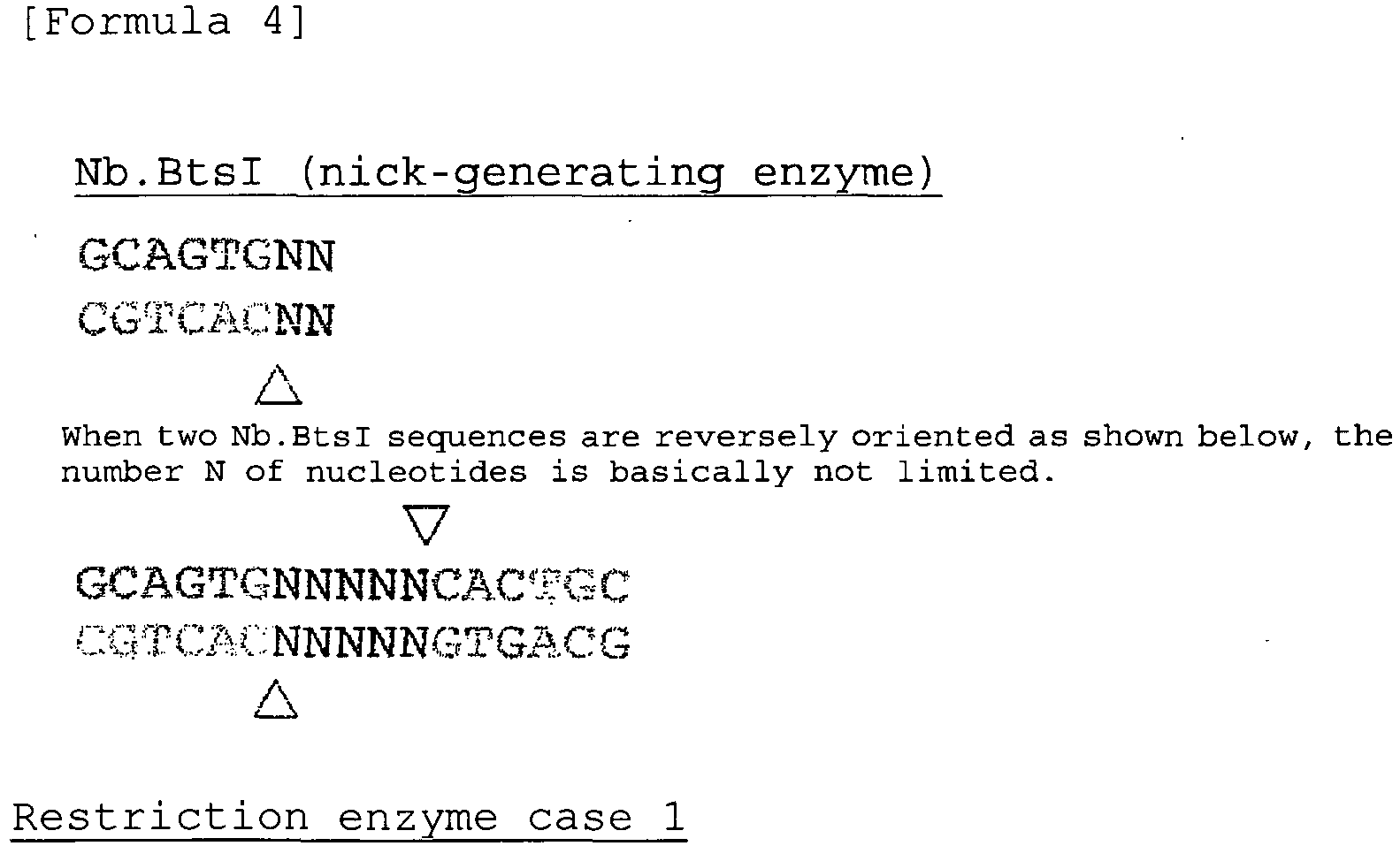

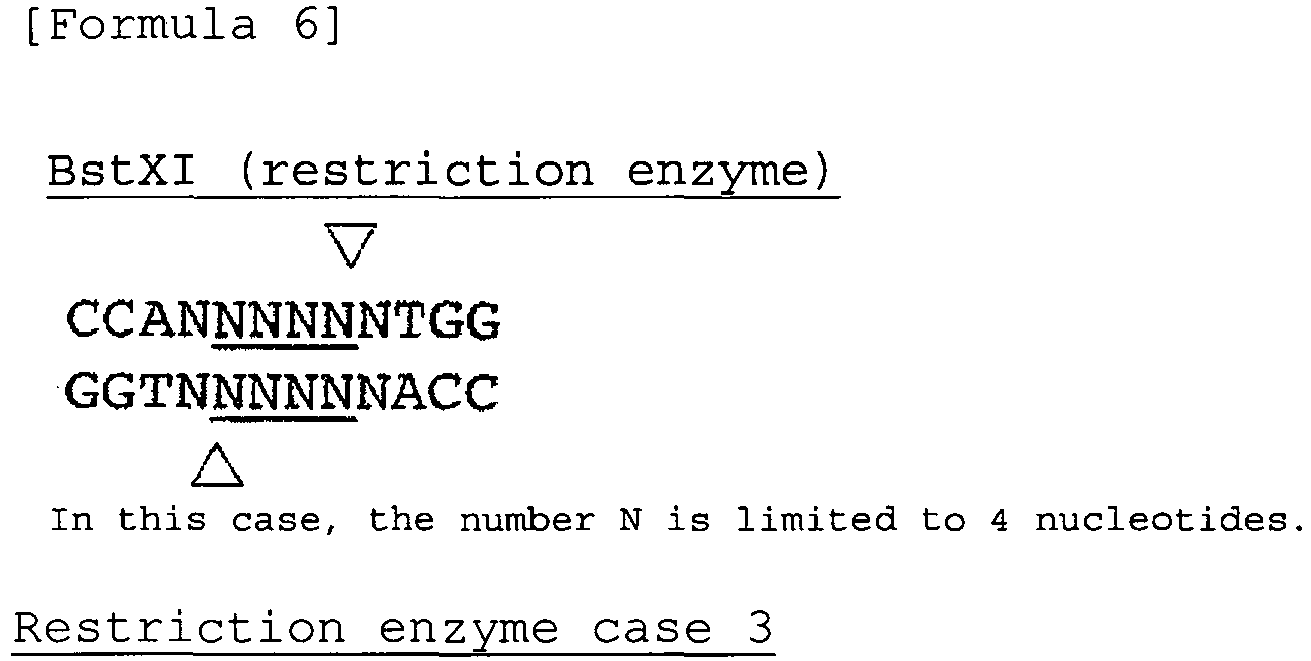
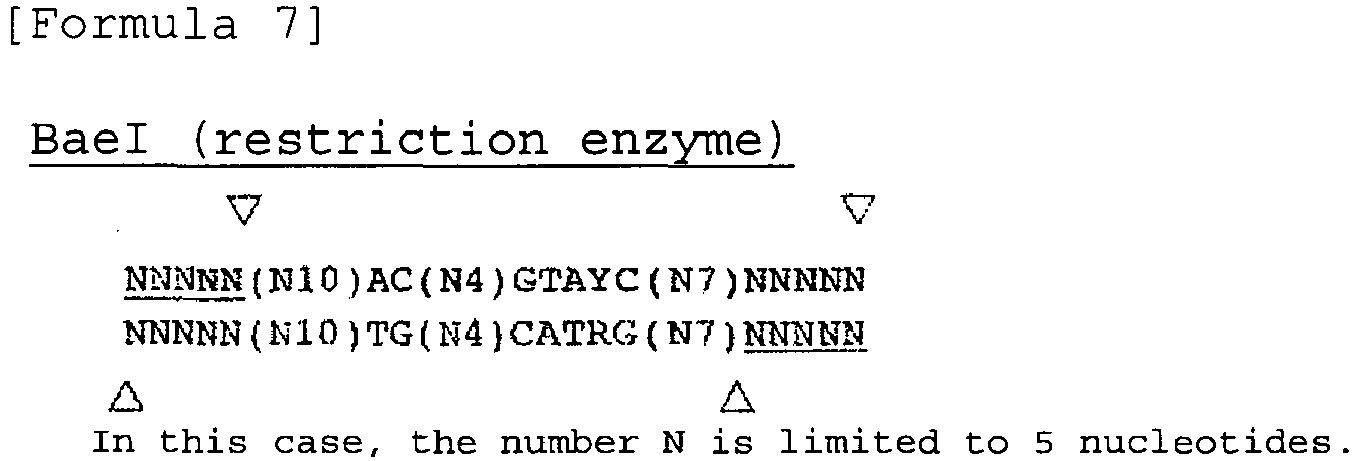
- In the case of this form, it is necessary to prepare two sites of N sequences that are equivalent to each other, by applying a method of extending primers from a loop structure, etc.
- Subsequently, a cleavage site, which is generated when the adapter (b) is cleaved at the identical nick-generating enzyme recognition sites or restriction enzyme sites being reversely oriented to each other, will be described.
- The cleavage site is a portion corresponding to a gene overhang specific to each molecule. As described above, when the cleavage site is produced with the restriction enzyme, the number of nucleotides is limited. On the other hand, when the cleavage site is produced with the nick-generating enzyme, the length of the cleavage site can be arbitrarily set. In order to achieve high specificity, a greater number of nucleotides constituting such a cleavage site is appropriate. In contrast, if the cleavage site is too long, it is highly likely that gene ligation will occur due to mismatch. When complexity is increased, such as the case of genome, it is desirable that the number of nucleotides constituting the cleavage site should be set to be greater, and at the same time, a step of digestion with endonuclease should be added to prevent the possibility of mismatch ligation (miss annealing). It is to be noted that a random combination is applied to the sequence of a cleavage site, and each different cleavage site is designed for each DNA molecule.
- A specific example will be given below, while the number of nucleotides is set at "5". As an example, an adapter (B) having the following sequence is produced by nucleic acid synthesis, and then, it can be used in the method of the present invention.

- Step 2) is a first cleavage step of cleaving the DNA molecule obtained in step 1) with a restriction enzyme recognizing the restriction enzyme site comprised in the adapter (A) (
Figure 5 ). - Step 3) is a first circularization step of ligating both ends of the DNA molecule obtained in step 2) to circularize the DNA molecule (
Figure 6 ; first circularization). - Step 4) is a step of eliminating uncircularized linear single-molecules and a DNA molecule consisting of a plurality of molecules bound to each other in step 3).
- Step 5) is a second cleavage step of cleaving the circular DNA molecule obtained in step 3) and step 4) with a nick-generating enzyme or a restriction enzyme recognizing the nick-generating enzyme recognition sites or restriction enzyme sites of the adapter (b).
- Step 6) is a second circularization step of ligating both ends of the DNA molecule obtained in step 5) to circularize the DNA molecule (
Figure 6 ; cleavage and recircularization). In this step, because of the specificity of the sequence of the cleavage site, only the cleavage sites from the adapter (b) bound to the same DNA can bind to each other. - In the second embodiment of the present invention, preferably, the adapter (A) is a double-stranded DNA comprising a restriction enzyme site X recognizing a palindromic sequence, and the adapter (B) is a double-stranded DNA consisting of two DNA strands complementary to each other having the following structure y1-Y-y2-X:

X represents a double-stranded DNA being a restriction enzyme site recognizing a palindromic sequence;
y1 and y2 represents double-stranded DNAs respectively comprising identical nick-generating enzyme recognition sites or restriction enzyme sites being reversely oriented to each other;
Y represents a double-stranded DNA sequence having a unique sequence for each DNA molecule to be circularized, n represents an integer of 1 to 40, N1 to Nn, which may be the same or different, each represent a deoxyribonucleotide selected from the group consisting of dAMP, dCMP, dGMP and dTMP, and N'1 to N'n represent the following deoxyribonucleotides respectively corresponding to the N1 to Nn,[Table 3] Nk N'k dAMP dTMP dCMP dGMP dGMP dCMP dTMP dAMP
wherein k represents an integer from 1 to n. - In the above structure, n is 1 to 40, preferably 4 to 15, and more preferably 5 to 10. However, even if n is more than 40, the method of the present invention can be carried out.
- The Y site consists of a pair of nucleotide sequences, which are randomly combined. For example, if Y is constituted with 8 nucleotide sequences, 48 combinations are obtained. Thereby, pair formation in circularization can be specified (selected), and rebinding only to the original pair becomes possible. As a result, only a single DNA can be recircularized, and since the Y portion of another molecule has a different structure, it cannot rebindn thereto.
- Since 4 types of nucleic acids are combined in a repeated permutation manner, if an N number of nucleic acids are present in the Y portion, the number of the sequences can be 4N. Accordingly, if N is 5, 45 = 1,016 types of nucleic acids are present in the Y portion. If N is 7, 16,000 or more nucleic acids are present in the Y portion. Thus, N = 7 is substantially sufficient. However, there is no problem, even if the number of nucleic acids is 8 or greater. When N is a great number, even if the nucleic acids are partially different, hybridization and ligation can be carried out. When the nucleic acids contain such mismatch, they can be digested using endonuclease. As a method for producing the Y portion of the adapter (B), the Y portion can be basically produced by determining N (the number of nucleic acids), and then carrying out the synthesis of a main chain by random sequential condensation, in which nucleic acids are not determined, and a polymerase extension reaction using primers on consensus sequences.
- In the second embodiment of the present invention, preferably, y1 and y2 respectively comprise nick-generating enzyme recognition sites, and more preferably, the nick-generating enzyme is Nb.BtsI. Further, y1 and y2 may preferably comprise restriction enzyme sites.
- The third embodiment of the present invention provides a preferred adapter (B) used in the method of the above described second embodiment of the present invention, namely, an adapter for producing a circular DNA, consisting of two DNA strands complementary to each other having the following structure y1-Y-y2-X:

X represents a double-stranded DNA being a site for a restriction enzyme recognizing a palindromic sequence;
y1 and y2 represent double-stranded DNAs respectively comprising identical nick-generating enzyme recognition sites or restriction enzyme sites being reversely oriented to each other;
Y represents a double-stranded DNA sequence having a unique sequence for each DNA molecule to be circularized, n represents an integer of 1 to 40, N1 to Nn, which may be the same or different, each represent a deoxyribonucleotide selected from the group consisting of dAMP, dCMP, dGMP and dTMP, and N'1 to N'n represent the following deoxyribonucleotides respectively corresponding to the N1 to Nn,[Table 4] Nk N'k dAMP dTMP dCMP dGMP dGMP dCMP dTMP dAMP
wherein k represents an integer from 1 to n. - In the above structure, n is 1 to 40, preferably 4 to 15, and more preferably 5 to 10. However, even if n is more than 40, the present invention can be carried out.
- As with the above described second embodiment, in the third embodiment of the present invention, preferably, y1 and y2 respectively comprise nick-generating enzyme recognition sites, and more preferably, the nick-generating enzyme is Nb.BtsI or Nt.BsqQI. Further, y1 and y2 may preferably comprise restriction enzyme sites.
- The fourth embodiment of the present invention provides a kit for producing a circular DNA, comprising the preferred adapter (A) and adapter (B) used in the method of the above described second embodiment of the present invention. That is to say, the fourth embodiment of the present invention provides a kit for producing a circular DNA, comprising an adapter (A) consisting of double-stranded DNA comprising a restriction enzyme site identical to the restriction enzyme site represented by X according to the above described third embodiment, and an adapter (B) according to the above described third embodiment.
- The kit for producing a circular DNA of the present invention comprises an adapter (A) and an adapter (B). These adapters are allowed to bind to both ends of a DNA molecule of interest, and thereafter, the two-step circularization method according to the first or second embodiment of the present invention is carried out, so as to provide a circularized DNA that comprises a circularized DNA formed only from a single-molecule DNA without comprising a circularized DNA formed from a multiple-molecule DNA.
- The fifth embodiment of the present invention provides a method for producing a cDNA library, comprising using the two-step circularization method according to the first or second embodiment of the present invention. By applying the method according to the first or second embodiment of the present invention to a library consisting of linear cDNAs, a cDNA library comprising a circularized DNA consisting only of a single-molecule DNA can be produced.
- The sixth embodiment of the present invention provides a method for identifying a gene by subjecting a circular DNA molecule obtained by using the method according to the first or second embodiment of the present invention to a mate-pair method, the method comprising the following steps:
- 1) a step of reading nucleotide sequences, each consisting of 15 to 600 nucleotides, flanking to both sides of an adapter (B) in a circular DNA molecule obtained by using the method according to the first or second embodiment of the present invention; and
- 2) a step of identifying a gene contained in the circular DNA molecule by comparing the read nucleotide sequences with the sequences of both ends of a known gene.
- Step 1) in the method of the sixth embodiment of the present invention is a step of reading nucleotide sequences, each consisting of 15 to 600 nucleotides, flanking to both sides of the adapter (B) in the circular DNA molecule obtained using the method according to the first or second embodiment of the present invention. The nucleotide sequence to be read consists of preferably 15 to 100 nucleotides, and more preferably 25 to 35 nucleotides. However, the method of the present invention can also be carried out by reading a nucleotide sequence consisting of 600 or more nucleotides. The nucleotide sequence can be read by a method well known to a person skilled in the art, using a sequencer.
- Step 2) in the method of the sixth embodiment of the present invention is a step of identifying a gene contained in the circular DNA molecule by comparing the read nucleotide sequences with the sequences of both ends of a known gene. If the read nucleotide sequences, which correspond to the sequences on both ends of a DNA molecule of interest, can be confirmed to be identical to the sequences of both ends of a known gene, then the DNA molecule of interest is identified to be the known gene.
- The seventh embodiment of the present invention provides a method for detecting a fusion gene by subjecting a circular DNA molecule obtained by using the method according to the first or second embodiment of the present invention to a mate-pair method, the method comprising the following steps:
- 1) a step of reading nucleotide sequences, each consisting of 15 to 600 nucleotides, flanking to both sides of an adapter (B) in a circular DNA molecule obtained by using the method according to the first or second embodiment of the present invention; and
- 2) a step of comparing the read nucleotide sequences with the sequences of both ends of a known gene, wherein if the genes of both ends correspond to known different genes, the gene comprised in the circular DNA molecule is identified to be a fusion gene.
- Step 1) in the method of the seventh embodiment of the present invention is a step of reading nucleotide sequences, each consisting of 15 to 600 nucleotides, flanking to both sides of an adapter (B) in a circular DNA molecule obtained by using the method according to the first or second embodiment of the present invention. The nucleotide sequence to be read consists of preferably 15 to 100 nucleotides, and more preferably 25 to 35 nucleotides. However, the method of the present invention can also be carried out by reading a nucleotide sequence consisting of 600 or more nucleotides. The nucleotide sequence can be read by a method well known to a person skilled in the art, using a sequencer.
- Step 2) in the method of the seventh embodiment of the present invention is a step of comparing the read nucleotide sequences with the sequences of both ends of a known gene. Herein, if the genes of both ends correspond to known different genes, the gene comprised in the circular DNA molecule is identified to be a fusion gene. That is to say, if a portion, which corresponds to one end of the read nucleotide sequences corresponding to the sequences on both ends of a DNA molecule of interest, is identical to one end of a known gene, and if a portion corresponding to the other end is identical to one end of another known gene, the DNA molecule of interest is identified to be a fusion gene consisting of two known genes.
- As an example, when the sequences of both sides flanking to both sides of the adapter (B) correspond to both ends of a known fusion gene, the DNA of interest is detected to be the known fusion gene. When the relationship between the expression of the known fusion gene and a disease has been known, it is possible to detect a disease characterized by the expression of the fusion gene detected by the aforementioned method, using the fusion gene as a marker.
- As another example, when the sequences flanking to both sides of the adapter (B) correspond to the terminal sequences of different genes and do not correspond to both ends of a known fusion gene, the gene contained in the circular DNA molecule is identified to be a novel fusion gene. The novel fusion gene detected by the aforementioned method can be used in drug discovery screening.
- Specific methods of allowing adapters to bind to both ends of a DNA molecule of interest (the left and right ends of a DNA molecule of interest) will be described in the following examples.
- When a cDNA library is synthesized from mRNA, in the most common method (Clontech SMART cDNA method) among the currently used methods, complementary strand DNA is first synthesized with reverse transcriptase, using oligonucleotide (1) having a poly T sequence complementary to a poly A site at the 3'-terminus of mRNA, as shown in
Figure 7 . After completion of the synthesis, a specific oligonucleotide sequence (2) is incorporated at the 5'-terminus of mRNA, as shown inFigure 7 . Subsequently, DNA is synthesized from an oligonucleotide complementary to this specific sequence, or a cDNA library is produced by PCR. - In this case, the adapter (B) has been introduced into the oligonucleotide (1) sequence having a poly T sequence complementary to a poly A site at the 3'-terminus of mRNA, and the adapter (A) has been added to the oligonucleotide (2) sequence. Thus, when a cDNA library is synthesized, it automatically becomes the basic structure of the present invention. It is not necessary to bind new sequences to the right and left ends, and the routine can directly proceed to the next step. By this method, when the cDNA library is further amplified by PCR, if it is directly amplified, a specific N nucleotide sequence must be amplified. Hence, since the diversity of the N nucleotide is maintained, amplification is carried out using, for example, a 5' phosphate group-added primer as an upstream primer, and a primer containing the N nucleotide as a downstream primer, and after completion of the PCR, a strand into which the phosphate group primer has been incorporated is digested with λ exonuclease. Thereafter, primer-extension is carried out again from the upstream primer, so as to produce a cDNA library in which the diversity of the N nucleotide is maintained. However, in the case of the adapter binding method, this process is not necessary. In order to introduce the adapter of the present invention after modification, such as fragmentation of the library, the subsequent adapter binding method is carried out.
- When a cDNA library is produced, it is possible that a restriction enzyme sequence has been introduced into each of the 3'-terminus and 5'-terminus thereof, as shown in
Figure 7(3) . As a restriction enzyme used in this case, either an ordinary palindromic sequence, or a non-palindromic sequence for distinguishing the 3'-terminus and 5'-terminus, can be used. Moreover, in order to ensure adapter binding, the adapter can also be bound to an end in the shape of blunt end with an A-protruding nucleotide. In order to introduce the adapter of the present invention after modification of the library, this method is desirable. - When genome is targeted, the situation is different from the case of a cDNA library. Differing from cDNA, a genomic fragment cannot distinguish the left and right sides of a DNA fragment. Accordingly, as shown in
Figure 8 , only the product (a) inFigure 8 , namely, a product prepared by binding the adapter on the left end to the adapter on the right end so that the two adapters are appropriately ligated, can be selected by a PCR method or a biotinylation method, or by inserting non-palindromic sequences as a restriction enzyme X sequence into both ends, or a method of establishing a plurality of restriction enzyme sites at the same site, using restriction enzyme (BstXI, etc.) containing an N region, etc. - Basically, the following method is adopted to add adapters (A) and (B) to both ends of a DNA molecule. At first, to a group of a plurality of DNAs, the concentration of which has been almost determined depending on the number of DNA molecules of interest, an adapter (A) is first allowed to bind. In this case, the amount of the adapter (A) added is set to be smaller than the amount of the target DNA molecules. However, stoichiometrically, the number of the adapters (A) may be the same as the number of the target DNA molecules, or one nucleotide protrusion may be enzymatically produced on a DNA fragment and a complementary adapter may be allowed to bind thereto. Especially, in this case, the concentration of the adapter may be excessive. Thereby, the adapter (A) is allowed to bind to the end of the DNA molecule. Subsequently, an adapter (B) is allowed to bind.
- In the present invention, as shown in (a) of
Figure 8 , it is necessary to produce a molecule in which the adapter (A) binds to one end thereof and the adapter (B) binds to the other end. Herein, as shown in (b) or (c) ofFigure 8 , it is necessary to eliminate a DNA molecule to which only the adapter (A) binds ((b) ofFigure 8 ) and a DNA molecule to which only the adapter (C) binds ((c) ofFigure 8 ). The methods therefor will be described below. - In the case of a molecule of type (a) of
Figure 8 , a first circularization, nick cleavage, and a second circularization are carried out without problems, and as a result, circularized DNA of interest is produced without problems. - On the other hand, in the case of a molecule of type (b) of
Figure 8 , the first circularization is impossible for a single molecule and thus, it is eliminated. However, circularization with a plurality of DNAs can be formed (for example, the binding of two molecules, namely, the binding of the molecule of type (b) to the molecule of type (c)). Such a plurality of DNA molecules must bind to the molecule of type (a) or type (c) as a binding partner. Accordingly, both sides must bind to specific sequences having N sequences. Thus, after completion of the nick cleavage, the second circularization cannot be formed and is eliminated. - Moreover, in the case of a molecule of type (c) of
Figure 8 , the first circularization is impossible for a single molecule and is eliminated. However, circularization with a plurality of DNAs can be formed (for example, the binding of two molecules, namely, the binding of the molecule of type (b) to the molecule of type (c)). Since this DNA fragment originally has different N sequences on both ends, after completion of the nick cleavage, the second circularization cannot be formed and is eliminated. - In the case of a molecule of type (a) of
Figure 8 , a first circularization, nick cleavage, and a second circularization are carried out without problems, and as a result, circularized DNA of interest is produced without problems. - On the other hand, in the case of a molecule of type (b) of
Figure 8 , the first circularization is possible. However, since this molecule does not have a nick sequence, nick cleavage is not carried out, and it remains as circularized DNA and cannot be eliminated. As an example of a method of preventing this, there is a BstXI method as described below. - Moreover, in the case of a molecule of type (c) of
Figure 8 , the first circularization and nick cleavage are possible. However, since this molecule originally has different N sequences on both ends, after completion of the nick cleavage, the second circularization cannot be formed and is eliminated. - In a case in which adapters (A) are added to both ends, both ends are ligated at a first stage. However, since cleavage does not take place at a second stage, it remains as circular DNA. As a method of solving this problem, BstXI is added to the outside of the adapter (A) comprising the restriction enzyme site, for example. Specifically, into the following restriction enzyme BstXI site, an EcoRI site is incorporated, so that CCANNNNNNTGG is converted to CCAGAATTCTGG, for example.


- That is to say, in this method, the restriction enzyme site of each of the adapter (A), and the adapter (A) contained in the adapter (B), is set to be an EcoRI site, for example. Then, only in the case of the adapter (A), the sequence outside the EcoRI site is set to be a BstXI recognition sequence, for example. That is, the sequence of the adapter (A) is set to be CCAGAATTCTGG. On the other hand, the adapter (A) contained in the adapter (B) comprises an EcoRI site but does not comprise a BstXI recognition sequence, so that it cannot be cleaved with BstXI.
- As a result, if the two adapters (A) bind to both ends and are then associated with each other, circularization can be opened by cleaving with BstXI and can be then eliminated. Of course, if the adapter (A) binds to the adapter (B), since the adapter (B) does not have a BstXI recognition sequence, it cannot be cleaved with BstXI.
- According to the above described method, the method of the present invention can be applied even to a genomic DNA fragment that cannot distinguish between upstream and downstream, differing from cDNA, so that single-molecule circular DNA can be produced, and so that the accuracy of mate-pair analysis can be significantly improved.
- Such possibility can be fully ignored, stochastically. The grounds will be described below.
- In order to stochastically assume the possibility that separated genes are re-associated, such possibility is estimated in the following three cases: (1) a case in which the possibility is assumed from the volume of a DNA molecule and the amount (volume) of a reaction solution; (2) a case in which the possibility is assumed from the number of molecules in the reaction solution (in the two above cases, it is assumed that the number of N nucleotides in the Y portion is sufficiently large and that it has high specificity); and further, (3) a case in which the number of N nucleotides is determined but it is not sufficiently large.
- (1) The case in which the possibility is assumed from the volume of a DNA molecule and the amount (volume) of a reaction solution
First, a single DNA molecule is presumed to be a sphere and its volume is estimated. Then, the possibility that molecules that have once been separated in a reaction system are associated as spheres in a solution is estimated.
The length of one nucleotide: 0.34 nm (0.34 × 10e-9 m = 3.4 × 10e-8 mm),
the length of a 3-kbp (3000 bp) plasmid: 1 × 10e-4 mm,
the volume of a DNA molecule assumed to be a sphere: 4/3 × 3.14 × (1 × 10e-4) × (1 × 10e-4) × (1 × 10e-4) mm3 = 4 × 10e-12 mm3, and
the number of DNA molecules as spheres in 100 ul if the volume of a single molecule is presumed to be 4 × 10e-12 mm3: 100 mm3/4 × 10e-12 mm3 = 2.5 × 10e13.
Accordingly, if the reaction system is homogeneous, the possibility that a sphere is associated with another equivalent sphere complementary thereto is extremely small ((1/(2.5 × 10e13)) = 4 × 10e-14). - (2) The case in which the possibility is assumed from the number of molecules in the reaction solution
On the other hand, the number of molecules is calculated as follows.
The molecular weight of a 3-kbp plasmid: 625 × 3000 = 1.8 × 10e6,
the mass of 1 mole of plasmid: 1 mol/L = 1.8 × 10e6 g/1L = 1.8 × 10e12 ug/1L,
the molar number of 3 ug of plasmid: 1 (mol/L) × 3 ug/(1.8 × 10e12) ug = 3/1.8 × 10e-12 mol/L = 1.6 × 10e-12 mol/L = 1.6 × 10e-9 mol/ml, and
the number of molecules of 3 ug of plasmid dissolved in 1 ml of solution if the Avogadro's number is presumed to be 6 × 10e23: 1.6 × 10e-9 mol/ml × 6 × 10e23 = 1.6 × 6 × 10e14 = 1 × 10e15.
Accordingly, if 3 ug of plasmid is present in 100 ul of reaction system, since 100 ul = 10e-1 mm3, the number of molecules is 1 × 10e14.
The possibility that a molecule in the solution with the aforementioned number of molecules is associated with another equivalent molecule complementary thereto is extremely small (1/1 × 10e14). - (3) As described above, it is assumed that the specificity of the number of N nucleotides in the Y portion would rather contribute to rebinding of separated genes.
- When the number of N nucleotides is "5," the possibility that two identical genes separated are rebound via identical gene fragments is: ((1/4) × (1/4) × (1/4) × (1/4) × (1/4)) × ((1/4) × (1/4) × (1/4) × (1/4) × (1/4)) = 1 × 10e-6.
- Accordingly, from these estimations, it can be concluded that the possibility that, after a plurality of DNAs have formed a ring and they have been then separated, identical DNA molecules rebind to each other, is extremely low, and thus, it can be fully ignored.
- The following experiment was carried out to verify that noise in circularization with a plurality of DNA molecules is reduced by increasing the efficiency of circularization with single-molecule DNA according to a two-step DNA binding (ligation) method.
- Two types of plasmids, Plasmid A and Plasmid B, were prepared. Product (i) obtained by cleaving each plasmid with a restriction enzyme and then directly ligating the fragments was compared with product (ii) obtained by ligating the adapter of the present invention according to the two-step ligation.
- In the case of the product (ii) to which the method of the present invention was applied, any given nucleotides N (6 nucleotides) used as an adapter were subjected to random synthesis, and after ligation of the adapter, the adapter was cleaved at an NcoI site present on the end of the adapter. Then, a mixture of these plasmids was circularized by a first-step ligation, and using Nick enzyme, Nick was placed before and after any given 6 nucleotides N, so that circularization was cleaved. Thereafter, ligation was carried out again to perform a second-step circularization.
- It is predicted that, during this operation, the products (i) and (ii) in the mixed solution would comprise (1) circularized DNA formed with a single molecule of Plasmid A, (2) circularized DNA formed with a single molecule of Plasmid B, (3) circularized DNA formed with a plurality of molecules of Plasmid A, (4) circularized DNA formed with a plurality of molecules of Plasmid B, and (5) circularized DNA formed with a plurality of molecules comprising Plasmid A and Plasmid B.
- According to the present invention, it was anticipated that the above-mentioned circularized DNAs (3), (4), and (5) would be significantly decreased in the product (ii), in comparison with the product (i).
- Hence, the amount of the circularized DNA (5) in the mixed solution generated from these products (i) and (ii) was evaluated as a representative example. Quantitative PCR was carried out using PCR primers specific to Plasmid A and Plasmid B.
- As a result, it was confirmed that the amount of the circularized DNA formed with a plurality of molecules such as (5) above, which was considered as noise, could be reduced to approximately one-hundredth by applying the method of the present invention (ii), in comparison with the method (i).
- Using the adapter and method of the present invention, the accuracy of gene analysis is significantly improved. In addition, unconventional high-accuracy mate-pair analysis becomes possible, and thus, the adapter and method of the present invention are provided as tools extremely useful for genomic analysis. In particular, by applying the method of the present invention to the production of a cDNA library, it is highly likely to discover a novel fusion gene. That is to say, by reliably achieving circularization of a single DNA molecule, it becomes possible to develop novel diagnostic tool and/or method.
- According to the present invention, a method for circularizing only a single-molecule DNA, wherein circularization of a plurality of molecules is substantially prevented with regard to circularization of DNA, is provided, so that problems regarding contamination in gene analysis such as mate-pair analysis can be solved, and so that high-accuracy analysis becomes possible. Moreover, by applying the method of the present invention to detection and/or analysis of a fusion gene, high-accuracy analysis of a fusion gene becomes possible, and a useful diagnostic tool can be provided.
-
- <110> KURUME UNIVERSITY
- <120> Method for creating a circular DNA formed from a single molecule DNA
- <130> 670470
- <140> Not yet assigned
<141> - <150>
JP2010-196719
<151> 2010-09-02 - <160> 4
- <170> PatentIn version 3.2
- <210> 1
<211> 17
<212> DNA
<213> Artificial - <220>
<223> one strand of adaptor (b) - <220>
<221> misc_feature
<222> (7)..(11)
<223> n is a, c, g, or t - <400> 1
gcagtgnnnn ncactgc 17 - <210> 2
<211> 12
<212> DNA
<213> Artificial - <220>
<223> adaptor (A) - <400> 2
ccagaattct gg 12 - <210> 3
<211> 39
<212> DNA
<213> Artificial - <220>
<223> SMART IV oligonucleotide - <400> 3
aagcagtggt atcaacgcag agtggccatt acggccggg 39 - <210> 4
<211> 58
<212> DNA
<213> Artificial - <220>
<223> CDS III/3' PCR primer - <220>
<221> misc_feature
<222> (58)..(58)
<223> n is a, c, g, or t - <400> 4
attctagagg ccgaggcggc cgacatgttt tttttttttt tttttttttt tttttttn 58
Claims (14)
- A method for producing a circular DNA which consists of a circular DNA formed from a single-molecule DNA and which does not comprise a circular DNA formed from a plurality of DNA molecules, the method comprising the following steps:1) a step of binding an adapter (A) for a first circularization to one end of each DNA molecule of interest, and binding to the other end thereof an adapter (B) for a second circularization comprising an adapter (b) and the adapter (A), wherein the adapter (B) binds to the DNA molecule via the adapter (b) side, such that the adapter (A) in the adapter (B) is located outside the bond of the DNA molecule to the adapter (b), wherein the adapter (A) comprises a cleavage site generating a cleavage end that is able to non-specifically bind to all of the cleavage ends of the adapter (A), and the adapter (b) comprises a cleavage site generating a cleavage end that is able to specifically bind only to the cleavage end from the same adapter (b);2) a first cleavage step of cleaving the DNA molecule obtained in step 1) at the cleavage site of the adapter (A);3) a first circularization step of binding both ends of the DNA molecule obtained in step 2) to circularize the DNA molecule;4) a step of eliminating uncircularized linear single-molecules and a DNA molecule consisting of a plurality of molecules bound to each other in step 3);5) a second cleavage step of cleaving the circular DNA molecule obtained in step 3) and step 4) at the cleavage site of the adapter (b); and6) a second circularization step of binding both ends of the DNA molecule obtained in step 5) to circularize the DNA molecule.
- The method according to claim 1, wherein the adapter (A) is a double-stranded DNA comprising a restriction enzyme site being or comprising a palindromic sequence,
wherein the adapter (b) is a double-stranded DNA comprising identical nick-generating enzyme recognition sites or restriction enzyme sites being reversely oriented to each other,
wherein the adapter (b) is a double-stranded DNA comprising a double-stranded DNA sequence having a unique sequence for each adapter (b) between the identical nick-generating enzyme recognition sites or restriction enzyme sites being reversely oriented to each other, and if the adapter (b) is cleaved at the identical nick-generating enzyme recognition sites or restriction enzyme sites being reversely oriented to each other, the cleavage site rebinds only to the cleavage site from the same adapter (b);
wherein in the first cleavage step of cleaving the DNA molecule obtained in step 1) the restriction enzyme recognizing the restriction enzyme site comprised in the adapter (A) is used; and
wherein in the second cleavage step of cleaving the circular DNA molecule obtained in step 3) and step 4) a nick-generating enzyme or a restriction enzyme recognizing the nick-generating enzyme recognition sites or restriction enzyme sites of the adapter (b) is used. - The method according to claim 2, which further comprises a step of digesting with endonuclease a circularized DNA formed by binding the adapters (b) via cleavage sequence sites being partially different from each other and circularization in step 6) of claim 2.
- An adapter for producing a circular DNA, the adapter consisting of two DNA strands complementary to each other having the following structure y1-Y-y2-X:

 X represents a double-stranded DNA being a restriction enzyme site being or comprising a palindromic sequence;y1 and y2 represent double-stranded DNAs respectively comprising identical nick-generating enzyme recognition sites or restriction enzyme sites being reversely oriented to each other;Y represents a double-stranded DNA sequence having a unique sequence for each DNA molecule to be circularized, n represents an integer of 1 to 40, N1 to Nn, which may be the same or different, each represent a deoxyribonucleotide selected from the group consisting of dAMP, dCMP, dGMP and dTMP, and N'1 to N'n represent the following deoxyribonucleotides respectively corresponding to the N1 to Nn,
[Table 1] Nk N'k dAMP dTMP dCMP dGMP dGMP dCMP dTMP dAMP wherein k represents an integer from 1 to n. - The method according to claim 2, wherein the adapter (A) is a double-stranded DNA comprising a restriction enzyme site X being or comprising a palindromic sequence, and the adapter (B) is the adapter according to claim 4.
- The adapter according to claim 4 or the method according to claim 5, wherein y1 and y2 respectively comprise the nick-generating enzyme recognition sites or the restriction enzyme sites.
- The adapter or the method according to claim 6, wherein the nick-generating enzyme is Nb.Btsl or Nt.BsqQl.
- A kit for producing circular DNA, comprising an adapter (A) consisting of a double-stranded DNA comprising a restriction enzyme site identical to the restriction enzyme site represented by X according to claim 4, and the adapter (B) according to any one of claims 4 or 6 to 7.
- A method for producing a cDNA library, comprising using the method according to any one of claims 1 to 3 or 5 to 7.
- A method for identifying a gene by subjecting a circular DNA molecule obtained by using the method according to any one of claims 1 to 3 or 5 to 7 to a mate-pair method, the method comprising the following steps:1) a step of reading nucleotide sequences, each consisting of 15 to 600 nucleotides, flanking to both sides of an adapter (B) in a circular DNA molecule obtained by using the method according to any one of claims 1 to 3 or 5 to 7; and2) a step of identifying a gene contained in the circular DNA molecule by comparing the read nucleotide sequences with the sequences of both ends of a known gene.
- A method for detecting a fusion gene by subjecting a circular DNA molecule obtained by using the method according to any one of claims 1 to 3 or 5 to 7 to a mate-pair method, the method comprising the following steps:1) a step of reading nucleotide sequences each consisting of 15 nucleotides or more and 600 nucleotides or less that are flanking to both sides of an adapter (B) in a circular DNA molecule obtained by using the method according to any one of claims 1 to 3 or 5 to 7; and2) a step of comparing the read nucleotide sequences with the sequences of both ends of a known gene, wherein if the genes of both ends correspond to known different genes, the gene comprised in the circular DNA molecule is identified to be a fusion gene.
- The method for detecting a fusion gene according to claim 11, wherein the sequences of both sides flanking to both sides of the adapter (B) correspond to both ends of a known fusion gene.
- A method for detecting a disease characterized by the expression of the fusion gene detected by the method according to claim 11, wherein the fusion gene is used as a marker.
- The method according to claim 11, wherein if the sequences flanking to both sides of the adapter (B) correspond to the terminal sequences of different genes and do not correspond to both ends of a known fusion gene, the gene comprised in the circular DNA molecule is identified to be a novel fusion gene.
Applications Claiming Priority (2)
| Application Number | Priority Date | Filing Date | Title |
|---|---|---|---|
| JP2010196719 | 2010-09-02 | ||
| PCT/JP2011/068856 WO2012029577A1 (en) | 2010-09-02 | 2011-08-22 | Method for producing circular dna formed from single-molecule dna |
Publications (3)
| Publication Number | Publication Date |
|---|---|
| EP2620497A1 EP2620497A1 (en) | 2013-07-31 |
| EP2620497A4 EP2620497A4 (en) | 2014-02-19 |
| EP2620497B1 true EP2620497B1 (en) | 2017-10-11 |
Family
ID=45772675
Family Applications (1)
| Application Number | Title | Priority Date | Filing Date |
|---|---|---|---|
| EP11821594.6A Not-in-force EP2620497B1 (en) | 2010-09-02 | 2011-08-22 | Method for producing circular dna formed from single-molecule dna |
Country Status (6)
| Country | Link |
|---|---|
| US (2) | US8962245B2 (en) |
| EP (1) | EP2620497B1 (en) |
| JP (1) | JP5780527B2 (en) |
| KR (1) | KR101583589B1 (en) |
| CN (1) | CN103119162B (en) |
| WO (1) | WO2012029577A1 (en) |
Families Citing this family (13)
| Publication number | Priority date | Publication date | Assignee | Title |
|---|---|---|---|---|
| US8962245B2 (en) * | 2010-09-02 | 2015-02-24 | Kurume University | Method for producing circular DNA formed from single-molecule DNA |
| WO2013031700A1 (en) * | 2011-08-31 | 2013-03-07 | 学校法人 久留米大学 | Method for exclusive selection of circularized dna from monomolecular dna when circularizing dna molecules |
| EP2753715A4 (en) * | 2011-09-09 | 2015-05-20 | Univ Leland Stanford Junior | METHODS FOR OBTAINING A SEQUENCE |
| JP6181751B2 (en) * | 2012-06-18 | 2017-08-16 | ニューゲン テクノロジーズ, インコーポレイテッド | Compositions and methods for negative selection of unwanted nucleic acid sequences |
| EP3015554A1 (en) | 2014-10-31 | 2016-05-04 | Rheinische Friedrich-Wilhelms-Universität Bonn | Gene expression analysis |
| CN107002291B (en) * | 2014-11-26 | 2019-03-26 | 深圳华大智造科技有限公司 | A kind of construction method and reagent of double-linker single-stranded circular library of nucleic acid |
| US10479991B2 (en) | 2014-11-26 | 2019-11-19 | Mgi Tech Co., Ltd | Method and reagent for constructing nucleic acid double-linker single-strand cyclical library |
| US20180016631A1 (en) * | 2014-12-24 | 2018-01-18 | Keygene N.V. | Backbone mediated mate pair sequencing |
| CN106148323B (en) * | 2015-04-22 | 2021-03-05 | 北京贝瑞和康生物技术有限公司 | Method and kit for constructing ALK gene fusion mutation detection library |
| EP3382034A1 (en) * | 2017-03-31 | 2018-10-03 | Rheinische Friedrich-Wilhelms-Universität Bonn | Gene expression analysis by means of generating a circularized single stranded cdna library |
| US20230159939A1 (en) | 2020-04-22 | 2023-05-25 | Fabmid | Methods for circularizing linear double stranded nucleic acids |
| WO2023072958A1 (en) | 2021-10-25 | 2023-05-04 | Fabmid | Methods for circularizing linear double stranded nucleic acids and the products thereof |
| WO2024260438A1 (en) * | 2023-06-21 | 2024-12-26 | 南京金斯瑞生物科技有限公司 | Method for preparing single-stranded dna using cas nicking enzyme |
Family Cites Families (15)
| Publication number | Priority date | Publication date | Assignee | Title |
|---|---|---|---|---|
| JPH04303303A (en) | 1991-03-29 | 1992-10-27 | Fuji Heavy Ind Ltd | Garbage container transportation device for multistoried building |
| WO2006003721A1 (en) | 2004-07-02 | 2006-01-12 | Kabushiki Kaisha Dnaform | Method for preparing sequence tags |
| CA2615323A1 (en) | 2005-06-06 | 2007-12-21 | 454 Life Sciences Corporation | Paired end sequencing |
| JP5103398B2 (en) * | 2005-06-06 | 2012-12-19 | 454 ライフ サイエンシーズ コーポレイション | Both end sequencing (paired sequencing) |
| CA2598893C (en) * | 2006-10-11 | 2012-04-10 | Astellas Pharma Inc. | Eml4-alk fusion gene |
| US20090093378A1 (en) | 2007-08-29 | 2009-04-09 | Helen Bignell | Method for sequencing a polynucleotide template |
| US7897344B2 (en) * | 2007-11-06 | 2011-03-01 | Complete Genomics, Inc. | Methods and oligonucleotide designs for insertion of multiple adaptors into library constructs |
| CN102027130A (en) | 2008-02-05 | 2011-04-20 | 霍夫曼-拉罗奇有限公司 | Paired end sequencing |
| US8352194B1 (en) | 2008-06-17 | 2013-01-08 | University Of South Florida | Method to identify cancer fusion genes |
| US20120202214A1 (en) | 2009-10-06 | 2012-08-09 | Kazuya Omi | Method for detecting fusion gene |
| JP5861244B2 (en) | 2010-06-22 | 2016-02-16 | 公益財団法人がん研究会 | Detection method of novel ROS1 fusion |
| US20130137111A1 (en) | 2010-07-26 | 2013-05-30 | Astellas Pharma Inc. | Detection method of novel ret fusion |
| US8962245B2 (en) * | 2010-09-02 | 2015-02-24 | Kurume University | Method for producing circular DNA formed from single-molecule DNA |
| AU2011372509B2 (en) | 2011-07-01 | 2017-02-09 | Htg Molecular Diagnostics, Inc. | Methods of detecting gene fusions |
| KR20140047138A (en) | 2011-08-04 | 2014-04-21 | 도쿠리츠교세이호진 고쿠리츠간켄큐센터 | Fusion gene of kif5b gene and ret gene, and method for determining effectiveness of cancer treatment targeting fusion gene |
-
2011
- 2011-08-22 US US13/819,396 patent/US8962245B2/en not_active Expired - Fee Related
- 2011-08-22 KR KR1020137006174A patent/KR101583589B1/en not_active Expired - Fee Related
- 2011-08-22 CN CN201180042478.5A patent/CN103119162B/en not_active Expired - Fee Related
- 2011-08-22 WO PCT/JP2011/068856 patent/WO2012029577A1/en not_active Ceased
- 2011-08-22 EP EP11821594.6A patent/EP2620497B1/en not_active Not-in-force
- 2011-08-22 JP JP2012531803A patent/JP5780527B2/en active Active
-
2015
- 2015-01-12 US US14/594,458 patent/US9434941B2/en not_active Expired - Fee Related
Non-Patent Citations (1)
| Title |
|---|
| None * |
Also Published As
| Publication number | Publication date |
|---|---|
| KR20130101508A (en) | 2013-09-13 |
| US20150197745A1 (en) | 2015-07-16 |
| US9434941B2 (en) | 2016-09-06 |
| CN103119162A (en) | 2013-05-22 |
| KR101583589B1 (en) | 2016-01-08 |
| US20130164757A1 (en) | 2013-06-27 |
| CN103119162B (en) | 2016-09-07 |
| JPWO2012029577A1 (en) | 2013-10-28 |
| US8962245B2 (en) | 2015-02-24 |
| EP2620497A1 (en) | 2013-07-31 |
| JP5780527B2 (en) | 2015-09-16 |
| EP2620497A4 (en) | 2014-02-19 |
| WO2012029577A1 (en) | 2012-03-08 |
Similar Documents
| Publication | Publication Date | Title |
|---|---|---|
| US8962245B2 (en) | Method for producing circular DNA formed from single-molecule DNA | |
| US12516372B2 (en) | Compositions and methods for screening mutations in thyroid cancer | |
| JP3251291B2 (en) | Classification method of nucleotide sequence population | |
| US10683542B2 (en) | Construction of next generation sequencing (NGS) libraries using competitive strand displacement | |
| JP7008407B2 (en) | Methods for Identifying and Counting Methylation Changes in Nucleic Acid Sequences, Expressions, Copies, or DNA Using Combinations of nucleases, Ligses, Polymerases, and Sequencing Reactions | |
| EP3610032B1 (en) | Methods of attaching adapters to sample nucleic acids | |
| US11952613B2 (en) | Methods and reagents for enhanced next generation sequencing library conversion and incorporation of molecular barcodes into targeted and random nucleic acid sequences | |
| CN105121664A (en) | Methods of sequencing nucleic acids in mixtures and compositions related thereto | |
| JP2023513606A (en) | Methods and Materials for Assessing Nucleic Acids | |
| WO2013192292A1 (en) | Massively-parallel multiplex locus-specific nucleic acid sequence analysis | |
| US20190185932A1 (en) | Method for preparing libraries for massively parallel sequencing based on molecular barcoding and use of libraries prepared by the method | |
| EP2752486B1 (en) | Method for exclusive selection of circularized dna from monomolecular dna when circularizing dna molecules | |
| AU2021202166A1 (en) | Composition for improving molecular barcoding efficiency and use thereof | |
| US20250163492A1 (en) | Method for generating population of labeled nucleic acid molecules and kit for the method | |
| WO2018081666A1 (en) | Methods of single dna/rna molecule counting | |
| KR20230124636A (en) | Compositions and methods for highly sensitive detection of target sequences in multiplex reactions | |
| US20250376723A1 (en) | Hybrid ssdna- and dsdna-ngs library preparation methods | |
| CN119932155A (en) | Methods and kits for targeted genome enrichment | |
| HK40017230B (en) | Methods of assessing nuclease cleavage |
Legal Events
| Date | Code | Title | Description |
|---|---|---|---|
| PUAI | Public reference made under article 153(3) epc to a published international application that has entered the european phase |
Free format text: ORIGINAL CODE: 0009012 |
|
| 17P | Request for examination filed |
Effective date: 20130402 |
|
| AK | Designated contracting states |
Kind code of ref document: A1 Designated state(s): AL AT BE BG CH CY CZ DE DK EE ES FI FR GB GR HR HU IE IS IT LI LT LU LV MC MK MT NL NO PL PT RO RS SE SI SK SM TR |
|
| DAX | Request for extension of the european patent (deleted) | ||
| A4 | Supplementary search report drawn up and despatched |
Effective date: 20140122 |
|
| RIC1 | Information provided on ipc code assigned before grant |
Ipc: C12N 15/09 20060101AFI20140116BHEP Ipc: C12Q 1/68 20060101ALI20140116BHEP |
|
| 17Q | First examination report despatched |
Effective date: 20160308 |
|
| GRAP | Despatch of communication of intention to grant a patent |
Free format text: ORIGINAL CODE: EPIDOSNIGR1 |
|
| INTG | Intention to grant announced |
Effective date: 20170522 |
|
| GRAS | Grant fee paid |
Free format text: ORIGINAL CODE: EPIDOSNIGR3 |
|
| GRAA | (expected) grant |
Free format text: ORIGINAL CODE: 0009210 |
|
| AK | Designated contracting states |
Kind code of ref document: B1 Designated state(s): AL AT BE BG CH CY CZ DE DK EE ES FI FR GB GR HR HU IE IS IT LI LT LU LV MC MK MT NL NO PL PT RO RS SE SI SK SM TR |
|
| REG | Reference to a national code |
Ref country code: GB Ref legal event code: FG4D |
|
| REG | Reference to a national code |
Ref country code: CH Ref legal event code: EP |
|
| REG | Reference to a national code |
Ref country code: IE Ref legal event code: FG4D |
|
| REG | Reference to a national code |
Ref country code: AT Ref legal event code: REF Ref document number: 936042 Country of ref document: AT Kind code of ref document: T Effective date: 20171115 |
|
| REG | Reference to a national code |
Ref country code: DE Ref legal event code: R096 Ref document number: 602011042387 Country of ref document: DE |
|
| REG | Reference to a national code |
Ref country code: NL Ref legal event code: MP Effective date: 20171011 |
|
| REG | Reference to a national code |
Ref country code: LT Ref legal event code: MG4D |
|
| REG | Reference to a national code |
Ref country code: AT Ref legal event code: MK05 Ref document number: 936042 Country of ref document: AT Kind code of ref document: T Effective date: 20171011 |
|
| PG25 | Lapsed in a contracting state [announced via postgrant information from national office to epo] |
Ref country code: NL Free format text: LAPSE BECAUSE OF FAILURE TO SUBMIT A TRANSLATION OF THE DESCRIPTION OR TO PAY THE FEE WITHIN THE PRESCRIBED TIME-LIMIT Effective date: 20171011 |
|
| PG25 | Lapsed in a contracting state [announced via postgrant information from national office to epo] |
Ref country code: SE Free format text: LAPSE BECAUSE OF FAILURE TO SUBMIT A TRANSLATION OF THE DESCRIPTION OR TO PAY THE FEE WITHIN THE PRESCRIBED TIME-LIMIT Effective date: 20171011 Ref country code: FI Free format text: LAPSE BECAUSE OF FAILURE TO SUBMIT A TRANSLATION OF THE DESCRIPTION OR TO PAY THE FEE WITHIN THE PRESCRIBED TIME-LIMIT Effective date: 20171011 Ref country code: LT Free format text: LAPSE BECAUSE OF FAILURE TO SUBMIT A TRANSLATION OF THE DESCRIPTION OR TO PAY THE FEE WITHIN THE PRESCRIBED TIME-LIMIT Effective date: 20171011 Ref country code: NO Free format text: LAPSE BECAUSE OF FAILURE TO SUBMIT A TRANSLATION OF THE DESCRIPTION OR TO PAY THE FEE WITHIN THE PRESCRIBED TIME-LIMIT Effective date: 20180111 Ref country code: ES Free format text: LAPSE BECAUSE OF FAILURE TO SUBMIT A TRANSLATION OF THE DESCRIPTION OR TO PAY THE FEE WITHIN THE PRESCRIBED TIME-LIMIT Effective date: 20171011 |
|
| PG25 | Lapsed in a contracting state [announced via postgrant information from national office to epo] |
Ref country code: AT Free format text: LAPSE BECAUSE OF FAILURE TO SUBMIT A TRANSLATION OF THE DESCRIPTION OR TO PAY THE FEE WITHIN THE PRESCRIBED TIME-LIMIT Effective date: 20171011 Ref country code: LV Free format text: LAPSE BECAUSE OF FAILURE TO SUBMIT A TRANSLATION OF THE DESCRIPTION OR TO PAY THE FEE WITHIN THE PRESCRIBED TIME-LIMIT Effective date: 20171011 Ref country code: RS Free format text: LAPSE BECAUSE OF FAILURE TO SUBMIT A TRANSLATION OF THE DESCRIPTION OR TO PAY THE FEE WITHIN THE PRESCRIBED TIME-LIMIT Effective date: 20171011 Ref country code: HR Free format text: LAPSE BECAUSE OF FAILURE TO SUBMIT A TRANSLATION OF THE DESCRIPTION OR TO PAY THE FEE WITHIN THE PRESCRIBED TIME-LIMIT Effective date: 20171011 Ref country code: BG Free format text: LAPSE BECAUSE OF FAILURE TO SUBMIT A TRANSLATION OF THE DESCRIPTION OR TO PAY THE FEE WITHIN THE PRESCRIBED TIME-LIMIT Effective date: 20180111 Ref country code: IS Free format text: LAPSE BECAUSE OF FAILURE TO SUBMIT A TRANSLATION OF THE DESCRIPTION OR TO PAY THE FEE WITHIN THE PRESCRIBED TIME-LIMIT Effective date: 20180211 Ref country code: GR Free format text: LAPSE BECAUSE OF FAILURE TO SUBMIT A TRANSLATION OF THE DESCRIPTION OR TO PAY THE FEE WITHIN THE PRESCRIBED TIME-LIMIT Effective date: 20180112 |
|
| REG | Reference to a national code |
Ref country code: DE Ref legal event code: R097 Ref document number: 602011042387 Country of ref document: DE |
|
| PG25 | Lapsed in a contracting state [announced via postgrant information from national office to epo] |
Ref country code: EE Free format text: LAPSE BECAUSE OF FAILURE TO SUBMIT A TRANSLATION OF THE DESCRIPTION OR TO PAY THE FEE WITHIN THE PRESCRIBED TIME-LIMIT Effective date: 20171011 Ref country code: DK Free format text: LAPSE BECAUSE OF FAILURE TO SUBMIT A TRANSLATION OF THE DESCRIPTION OR TO PAY THE FEE WITHIN THE PRESCRIBED TIME-LIMIT Effective date: 20171011 Ref country code: SK Free format text: LAPSE BECAUSE OF FAILURE TO SUBMIT A TRANSLATION OF THE DESCRIPTION OR TO PAY THE FEE WITHIN THE PRESCRIBED TIME-LIMIT Effective date: 20171011 Ref country code: CZ Free format text: LAPSE BECAUSE OF FAILURE TO SUBMIT A TRANSLATION OF THE DESCRIPTION OR TO PAY THE FEE WITHIN THE PRESCRIBED TIME-LIMIT Effective date: 20171011 |
|
| PLBE | No opposition filed within time limit |
Free format text: ORIGINAL CODE: 0009261 |
|
| STAA | Information on the status of an ep patent application or granted ep patent |
Free format text: STATUS: NO OPPOSITION FILED WITHIN TIME LIMIT |
|
| PG25 | Lapsed in a contracting state [announced via postgrant information from national office to epo] |
Ref country code: IT Free format text: LAPSE BECAUSE OF FAILURE TO SUBMIT A TRANSLATION OF THE DESCRIPTION OR TO PAY THE FEE WITHIN THE PRESCRIBED TIME-LIMIT Effective date: 20171011 Ref country code: SM Free format text: LAPSE BECAUSE OF FAILURE TO SUBMIT A TRANSLATION OF THE DESCRIPTION OR TO PAY THE FEE WITHIN THE PRESCRIBED TIME-LIMIT Effective date: 20171011 Ref country code: RO Free format text: LAPSE BECAUSE OF FAILURE TO SUBMIT A TRANSLATION OF THE DESCRIPTION OR TO PAY THE FEE WITHIN THE PRESCRIBED TIME-LIMIT Effective date: 20171011 Ref country code: PL Free format text: LAPSE BECAUSE OF FAILURE TO SUBMIT A TRANSLATION OF THE DESCRIPTION OR TO PAY THE FEE WITHIN THE PRESCRIBED TIME-LIMIT Effective date: 20171011 |
|
| 26N | No opposition filed |
Effective date: 20180712 |
|
| PG25 | Lapsed in a contracting state [announced via postgrant information from national office to epo] |
Ref country code: SI Free format text: LAPSE BECAUSE OF FAILURE TO SUBMIT A TRANSLATION OF THE DESCRIPTION OR TO PAY THE FEE WITHIN THE PRESCRIBED TIME-LIMIT Effective date: 20171011 |
|
| REG | Reference to a national code |
Ref country code: DE Ref legal event code: R119 Ref document number: 602011042387 Country of ref document: DE |
|
| PG25 | Lapsed in a contracting state [announced via postgrant information from national office to epo] |
Ref country code: MC Free format text: LAPSE BECAUSE OF FAILURE TO SUBMIT A TRANSLATION OF THE DESCRIPTION OR TO PAY THE FEE WITHIN THE PRESCRIBED TIME-LIMIT Effective date: 20171011 |
|
| REG | Reference to a national code |
Ref country code: CH Ref legal event code: PL |
|
| PG25 | Lapsed in a contracting state [announced via postgrant information from national office to epo] |
Ref country code: LU Free format text: LAPSE BECAUSE OF NON-PAYMENT OF DUE FEES Effective date: 20180822 Ref country code: LI Free format text: LAPSE BECAUSE OF NON-PAYMENT OF DUE FEES Effective date: 20180831 Ref country code: CH Free format text: LAPSE BECAUSE OF NON-PAYMENT OF DUE FEES Effective date: 20180831 |
|
| REG | Reference to a national code |
Ref country code: BE Ref legal event code: MM Effective date: 20180831 |
|
| PG25 | Lapsed in a contracting state [announced via postgrant information from national office to epo] |
Ref country code: DE Free format text: LAPSE BECAUSE OF NON-PAYMENT OF DUE FEES Effective date: 20190301 |
|
| PG25 | Lapsed in a contracting state [announced via postgrant information from national office to epo] |
Ref country code: FR Free format text: LAPSE BECAUSE OF NON-PAYMENT OF DUE FEES Effective date: 20180831 Ref country code: BE Free format text: LAPSE BECAUSE OF NON-PAYMENT OF DUE FEES Effective date: 20180831 |
|
| PG25 | Lapsed in a contracting state [announced via postgrant information from national office to epo] |
Ref country code: MT Free format text: LAPSE BECAUSE OF NON-PAYMENT OF DUE FEES Effective date: 20180822 |
|
| PG25 | Lapsed in a contracting state [announced via postgrant information from national office to epo] |
Ref country code: TR Free format text: LAPSE BECAUSE OF FAILURE TO SUBMIT A TRANSLATION OF THE DESCRIPTION OR TO PAY THE FEE WITHIN THE PRESCRIBED TIME-LIMIT Effective date: 20171011 |
|
| PG25 | Lapsed in a contracting state [announced via postgrant information from national office to epo] |
Ref country code: HU Free format text: LAPSE BECAUSE OF FAILURE TO SUBMIT A TRANSLATION OF THE DESCRIPTION OR TO PAY THE FEE WITHIN THE PRESCRIBED TIME-LIMIT; INVALID AB INITIO Effective date: 20110822 Ref country code: PT Free format text: LAPSE BECAUSE OF FAILURE TO SUBMIT A TRANSLATION OF THE DESCRIPTION OR TO PAY THE FEE WITHIN THE PRESCRIBED TIME-LIMIT Effective date: 20171011 |
|
| PG25 | Lapsed in a contracting state [announced via postgrant information from national office to epo] |
Ref country code: IE Free format text: LAPSE BECAUSE OF NON-PAYMENT OF DUE FEES Effective date: 20180822 Ref country code: CY Free format text: LAPSE BECAUSE OF FAILURE TO SUBMIT A TRANSLATION OF THE DESCRIPTION OR TO PAY THE FEE WITHIN THE PRESCRIBED TIME-LIMIT Effective date: 20171011 Ref country code: MK Free format text: LAPSE BECAUSE OF NON-PAYMENT OF DUE FEES Effective date: 20171011 |
|
| PG25 | Lapsed in a contracting state [announced via postgrant information from national office to epo] |
Ref country code: AL Free format text: LAPSE BECAUSE OF FAILURE TO SUBMIT A TRANSLATION OF THE DESCRIPTION OR TO PAY THE FEE WITHIN THE PRESCRIBED TIME-LIMIT Effective date: 20171011 |
|
| PGFP | Annual fee paid to national office [announced via postgrant information from national office to epo] |
Ref country code: GB Payment date: 20200821 Year of fee payment: 10 |
|
| GBPC | Gb: european patent ceased through non-payment of renewal fee |
Effective date: 20210822 |
|
| PG25 | Lapsed in a contracting state [announced via postgrant information from national office to epo] |
Ref country code: GB Free format text: LAPSE BECAUSE OF NON-PAYMENT OF DUE FEES Effective date: 20210822 |