EP2617864A2 - Method for improving hydrophilicity of a coating film through treatment on a surface morphology and super hydrophilic glass coating layer produced by the method - Google Patents
Method for improving hydrophilicity of a coating film through treatment on a surface morphology and super hydrophilic glass coating layer produced by the method Download PDFInfo
- Publication number
- EP2617864A2 EP2617864A2 EP11825485.3A EP11825485A EP2617864A2 EP 2617864 A2 EP2617864 A2 EP 2617864A2 EP 11825485 A EP11825485 A EP 11825485A EP 2617864 A2 EP2617864 A2 EP 2617864A2
- Authority
- EP
- European Patent Office
- Prior art keywords
- oxide
- coating layer
- layer
- heat treatment
- super
- Prior art date
- Legal status (The legal status is an assumption and is not a legal conclusion. Google has not performed a legal analysis and makes no representation as to the accuracy of the status listed.)
- Withdrawn
Links
Images




Classifications
-
- C—CHEMISTRY; METALLURGY
- C23—COATING METALLIC MATERIAL; COATING MATERIAL WITH METALLIC MATERIAL; CHEMICAL SURFACE TREATMENT; DIFFUSION TREATMENT OF METALLIC MATERIAL; COATING BY VACUUM EVAPORATION, BY SPUTTERING, BY ION IMPLANTATION OR BY CHEMICAL VAPOUR DEPOSITION, IN GENERAL; INHIBITING CORROSION OF METALLIC MATERIAL OR INCRUSTATION IN GENERAL
- C23C—COATING METALLIC MATERIAL; COATING MATERIAL WITH METALLIC MATERIAL; SURFACE TREATMENT OF METALLIC MATERIAL BY DIFFUSION INTO THE SURFACE, BY CHEMICAL CONVERSION OR SUBSTITUTION; COATING BY VACUUM EVAPORATION, BY SPUTTERING, BY ION IMPLANTATION OR BY CHEMICAL VAPOUR DEPOSITION, IN GENERAL
- C23C14/00—Coating by vacuum evaporation, by sputtering or by ion implantation of the coating forming material
- C23C14/22—Coating by vacuum evaporation, by sputtering or by ion implantation of the coating forming material characterised by the process of coating
- C23C14/34—Sputtering
- C23C14/35—Sputtering by application of a magnetic field, e.g. magnetron sputtering
-
- B—PERFORMING OPERATIONS; TRANSPORTING
- B01—PHYSICAL OR CHEMICAL PROCESSES OR APPARATUS IN GENERAL
- B01J—CHEMICAL OR PHYSICAL PROCESSES, e.g. CATALYSIS OR COLLOID CHEMISTRY; THEIR RELEVANT APPARATUS
- B01J21/00—Catalysts comprising the elements, oxides, or hydroxides of magnesium, boron, aluminium, carbon, silicon, titanium, zirconium, or hafnium
- B01J21/06—Silicon, titanium, zirconium or hafnium; Oxides or hydroxides thereof
- B01J21/063—Titanium; Oxides or hydroxides thereof
-
- B—PERFORMING OPERATIONS; TRANSPORTING
- B01—PHYSICAL OR CHEMICAL PROCESSES OR APPARATUS IN GENERAL
- B01J—CHEMICAL OR PHYSICAL PROCESSES, e.g. CATALYSIS OR COLLOID CHEMISTRY; THEIR RELEVANT APPARATUS
- B01J35/00—Catalysts, in general, characterised by their form or physical properties
- B01J35/30—Catalysts, in general, characterised by their form or physical properties characterised by their physical properties
-
- B—PERFORMING OPERATIONS; TRANSPORTING
- B01—PHYSICAL OR CHEMICAL PROCESSES OR APPARATUS IN GENERAL
- B01J—CHEMICAL OR PHYSICAL PROCESSES, e.g. CATALYSIS OR COLLOID CHEMISTRY; THEIR RELEVANT APPARATUS
- B01J35/00—Catalysts, in general, characterised by their form or physical properties
- B01J35/30—Catalysts, in general, characterised by their form or physical properties characterised by their physical properties
- B01J35/34—Mechanical properties
- B01J35/36—Mechanical strength
-
- B—PERFORMING OPERATIONS; TRANSPORTING
- B01—PHYSICAL OR CHEMICAL PROCESSES OR APPARATUS IN GENERAL
- B01J—CHEMICAL OR PHYSICAL PROCESSES, e.g. CATALYSIS OR COLLOID CHEMISTRY; THEIR RELEVANT APPARATUS
- B01J35/00—Catalysts, in general, characterised by their form or physical properties
- B01J35/30—Catalysts, in general, characterised by their form or physical properties characterised by their physical properties
- B01J35/39—Photocatalytic properties
-
- B—PERFORMING OPERATIONS; TRANSPORTING
- B01—PHYSICAL OR CHEMICAL PROCESSES OR APPARATUS IN GENERAL
- B01J—CHEMICAL OR PHYSICAL PROCESSES, e.g. CATALYSIS OR COLLOID CHEMISTRY; THEIR RELEVANT APPARATUS
- B01J37/00—Processes, in general, for preparing catalysts; Processes, in general, for activation of catalysts
- B01J37/02—Impregnation, coating or precipitation
- B01J37/024—Multiple impregnation or coating
- B01J37/0244—Coatings comprising several layers
-
- B—PERFORMING OPERATIONS; TRANSPORTING
- B01—PHYSICAL OR CHEMICAL PROCESSES OR APPARATUS IN GENERAL
- B01J—CHEMICAL OR PHYSICAL PROCESSES, e.g. CATALYSIS OR COLLOID CHEMISTRY; THEIR RELEVANT APPARATUS
- B01J37/00—Processes, in general, for preparing catalysts; Processes, in general, for activation of catalysts
- B01J37/08—Heat treatment
-
- B—PERFORMING OPERATIONS; TRANSPORTING
- B01—PHYSICAL OR CHEMICAL PROCESSES OR APPARATUS IN GENERAL
- B01J—CHEMICAL OR PHYSICAL PROCESSES, e.g. CATALYSIS OR COLLOID CHEMISTRY; THEIR RELEVANT APPARATUS
- B01J37/00—Processes, in general, for preparing catalysts; Processes, in general, for activation of catalysts
- B01J37/34—Irradiation by, or application of, electric, magnetic or wave energy, e.g. ultrasonic waves ; Ionic sputtering; Flame or plasma spraying; Particle radiation
- B01J37/349—Irradiation by, or application of, electric, magnetic or wave energy, e.g. ultrasonic waves ; Ionic sputtering; Flame or plasma spraying; Particle radiation making use of flames, plasmas or lasers
-
- C—CHEMISTRY; METALLURGY
- C03—GLASS; MINERAL OR SLAG WOOL
- C03C—CHEMICAL COMPOSITION OF GLASSES, GLAZES OR VITREOUS ENAMELS; SURFACE TREATMENT OF GLASS; SURFACE TREATMENT OF FIBRES OR FILAMENTS MADE FROM GLASS, MINERALS OR SLAGS; JOINING GLASS TO GLASS OR OTHER MATERIALS
- C03C17/00—Surface treatment of glass, not in the form of fibres or filaments, by coating
- C03C17/22—Surface treatment of glass, not in the form of fibres or filaments, by coating with other inorganic material
- C03C17/23—Oxides
- C03C17/245—Oxides by deposition from the vapour phase
- C03C17/2456—Coating containing TiO2
-
- C—CHEMISTRY; METALLURGY
- C03—GLASS; MINERAL OR SLAG WOOL
- C03C—CHEMICAL COMPOSITION OF GLASSES, GLAZES OR VITREOUS ENAMELS; SURFACE TREATMENT OF GLASS; SURFACE TREATMENT OF FIBRES OR FILAMENTS MADE FROM GLASS, MINERALS OR SLAGS; JOINING GLASS TO GLASS OR OTHER MATERIALS
- C03C17/00—Surface treatment of glass, not in the form of fibres or filaments, by coating
- C03C17/34—Surface treatment of glass, not in the form of fibres or filaments, by coating with at least two coatings having different compositions
- C03C17/3411—Surface treatment of glass, not in the form of fibres or filaments, by coating with at least two coatings having different compositions with at least two coatings of inorganic materials
-
- C—CHEMISTRY; METALLURGY
- C23—COATING METALLIC MATERIAL; COATING MATERIAL WITH METALLIC MATERIAL; CHEMICAL SURFACE TREATMENT; DIFFUSION TREATMENT OF METALLIC MATERIAL; COATING BY VACUUM EVAPORATION, BY SPUTTERING, BY ION IMPLANTATION OR BY CHEMICAL VAPOUR DEPOSITION, IN GENERAL; INHIBITING CORROSION OF METALLIC MATERIAL OR INCRUSTATION IN GENERAL
- C23C—COATING METALLIC MATERIAL; COATING MATERIAL WITH METALLIC MATERIAL; SURFACE TREATMENT OF METALLIC MATERIAL BY DIFFUSION INTO THE SURFACE, BY CHEMICAL CONVERSION OR SUBSTITUTION; COATING BY VACUUM EVAPORATION, BY SPUTTERING, BY ION IMPLANTATION OR BY CHEMICAL VAPOUR DEPOSITION, IN GENERAL
- C23C14/00—Coating by vacuum evaporation, by sputtering or by ion implantation of the coating forming material
- C23C14/06—Coating by vacuum evaporation, by sputtering or by ion implantation of the coating forming material characterised by the coating material
- C23C14/08—Oxides
-
- C—CHEMISTRY; METALLURGY
- C23—COATING METALLIC MATERIAL; COATING MATERIAL WITH METALLIC MATERIAL; CHEMICAL SURFACE TREATMENT; DIFFUSION TREATMENT OF METALLIC MATERIAL; COATING BY VACUUM EVAPORATION, BY SPUTTERING, BY ION IMPLANTATION OR BY CHEMICAL VAPOUR DEPOSITION, IN GENERAL; INHIBITING CORROSION OF METALLIC MATERIAL OR INCRUSTATION IN GENERAL
- C23C—COATING METALLIC MATERIAL; COATING MATERIAL WITH METALLIC MATERIAL; SURFACE TREATMENT OF METALLIC MATERIAL BY DIFFUSION INTO THE SURFACE, BY CHEMICAL CONVERSION OR SUBSTITUTION; COATING BY VACUUM EVAPORATION, BY SPUTTERING, BY ION IMPLANTATION OR BY CHEMICAL VAPOUR DEPOSITION, IN GENERAL
- C23C14/00—Coating by vacuum evaporation, by sputtering or by ion implantation of the coating forming material
- C23C14/06—Coating by vacuum evaporation, by sputtering or by ion implantation of the coating forming material characterised by the coating material
- C23C14/08—Oxides
- C23C14/083—Oxides of refractory metals or yttrium
-
- C—CHEMISTRY; METALLURGY
- C23—COATING METALLIC MATERIAL; COATING MATERIAL WITH METALLIC MATERIAL; CHEMICAL SURFACE TREATMENT; DIFFUSION TREATMENT OF METALLIC MATERIAL; COATING BY VACUUM EVAPORATION, BY SPUTTERING, BY ION IMPLANTATION OR BY CHEMICAL VAPOUR DEPOSITION, IN GENERAL; INHIBITING CORROSION OF METALLIC MATERIAL OR INCRUSTATION IN GENERAL
- C23C—COATING METALLIC MATERIAL; COATING MATERIAL WITH METALLIC MATERIAL; SURFACE TREATMENT OF METALLIC MATERIAL BY DIFFUSION INTO THE SURFACE, BY CHEMICAL CONVERSION OR SUBSTITUTION; COATING BY VACUUM EVAPORATION, BY SPUTTERING, BY ION IMPLANTATION OR BY CHEMICAL VAPOUR DEPOSITION, IN GENERAL
- C23C14/00—Coating by vacuum evaporation, by sputtering or by ion implantation of the coating forming material
- C23C14/58—After-treatment
- C23C14/5806—Thermal treatment
-
- C—CHEMISTRY; METALLURGY
- C03—GLASS; MINERAL OR SLAG WOOL
- C03C—CHEMICAL COMPOSITION OF GLASSES, GLAZES OR VITREOUS ENAMELS; SURFACE TREATMENT OF GLASS; SURFACE TREATMENT OF FIBRES OR FILAMENTS MADE FROM GLASS, MINERALS OR SLAGS; JOINING GLASS TO GLASS OR OTHER MATERIALS
- C03C2217/00—Coatings on glass
- C03C2217/70—Properties of coatings
- C03C2217/71—Photocatalytic coatings
-
- C—CHEMISTRY; METALLURGY
- C03—GLASS; MINERAL OR SLAG WOOL
- C03C—CHEMICAL COMPOSITION OF GLASSES, GLAZES OR VITREOUS ENAMELS; SURFACE TREATMENT OF GLASS; SURFACE TREATMENT OF FIBRES OR FILAMENTS MADE FROM GLASS, MINERALS OR SLAGS; JOINING GLASS TO GLASS OR OTHER MATERIALS
- C03C2217/00—Coatings on glass
- C03C2217/70—Properties of coatings
- C03C2217/75—Hydrophilic and oleophilic coatings
-
- C—CHEMISTRY; METALLURGY
- C03—GLASS; MINERAL OR SLAG WOOL
- C03C—CHEMICAL COMPOSITION OF GLASSES, GLAZES OR VITREOUS ENAMELS; SURFACE TREATMENT OF GLASS; SURFACE TREATMENT OF FIBRES OR FILAMENTS MADE FROM GLASS, MINERALS OR SLAGS; JOINING GLASS TO GLASS OR OTHER MATERIALS
- C03C2217/00—Coatings on glass
- C03C2217/70—Properties of coatings
- C03C2217/77—Coatings having a rough surface
-
- C—CHEMISTRY; METALLURGY
- C03—GLASS; MINERAL OR SLAG WOOL
- C03C—CHEMICAL COMPOSITION OF GLASSES, GLAZES OR VITREOUS ENAMELS; SURFACE TREATMENT OF GLASS; SURFACE TREATMENT OF FIBRES OR FILAMENTS MADE FROM GLASS, MINERALS OR SLAGS; JOINING GLASS TO GLASS OR OTHER MATERIALS
- C03C2218/00—Methods for coating glass
- C03C2218/30—Aspects of methods for coating glass not covered above
- C03C2218/32—After-treatment
-
- Y—GENERAL TAGGING OF NEW TECHNOLOGICAL DEVELOPMENTS; GENERAL TAGGING OF CROSS-SECTIONAL TECHNOLOGIES SPANNING OVER SEVERAL SECTIONS OF THE IPC; TECHNICAL SUBJECTS COVERED BY FORMER USPC CROSS-REFERENCE ART COLLECTIONS [XRACs] AND DIGESTS
- Y10—TECHNICAL SUBJECTS COVERED BY FORMER USPC
- Y10T—TECHNICAL SUBJECTS COVERED BY FORMER US CLASSIFICATION
- Y10T428/00—Stock material or miscellaneous articles
- Y10T428/24—Structurally defined web or sheet [e.g., overall dimension, etc.]
- Y10T428/24355—Continuous and nonuniform or irregular surface on layer or component [e.g., roofing, etc.]
Definitions
- the present invention relates to a method of improving hydrophilicity of a coating layer through surface morphology treatment and a super-hydrophilic glass coating layer produced using the same, and more particularly, to a technology of performing super-hydrophilic coating to secure a clean appearance of a building or outdoor advertisement while facilitating maintenance of the building or outdoor advertisement through natural purification.
- window glass having good transmittance is applied to a building to secure field of view and natural lighting while finishing the building.
- contaminants attached to the window glass can be easily recognized, thereby deteriorating aesthetics of the outer appearance or reducing transmittance in the case where contaminants are severely attached to the window glass.
- hydrophilic coating has been suggested in that it can provide natural purification of contaminants with rain.
- hydrophilic coating is performed on a glass substrate to finish an exterior of a building.
- a hydrophilic coating glass is coated with a photocatalytic material on the surface thereof to realize hydrophilicity under conditions of UV irradiation.
- hydrophilic coating glass when applied to the exterior of a building in practice, hydrophilic characteristics do not appear as in experimental data due to inconstant intensity of sunlight and low intensity of UV light.
- coating layers based on fractal structure theory have been proposed to exhibit hydrophilic characteristics even under conditions of non-UV irradiation.
- the coating layer based on fractal structure theory is subjected to wet coating, such as spraying, dipping, and slitting.
- wet coating Since such wet coating has technical difficulty securing uniform quality of a coating layer in production of a large area coating layer, wet coating is generally directly performed upon a glass window attached to a building.
- the coating layer is deteriorated in durability over time. Moreover, the coating layer provides a foggy surface and makes it difficult to secure a transparent outer appearance.
- An aspect of the present invention is to provide a method of improving hydrophilicity of a coating layer through surface morphology treatment, in which heat treatment is performed at an optimized temperature for a short period of time after a photocatalytic layer is formed at room temperature, thereby ensuring transparency and low UV dependency to provide super-hydrophilic characteristics in which the coating layer has a surface contact angle of 30 degrees or less.
- Another aspect of the present invention is to provide a super-hydrophilic glass coating layer, which has a high pencil hardness of 7 or higher through surface morphology thereof and has high-transmittance super-hydrophilic characteristics.
- a method of improving hydrophilicity of a coating layer through surface morphology treatment includes: forming a photocatalyst layer on a substrate; and heating the substrate having the photocatalyst layer formed thereon to a temperature of 500°C to 600°C to perform post-heat treatment while increasing surface roughness of the photocatalyst layer such that the photocatalyst layer has a surface contact angle of 30 degrees or less.
- the forming a photocatalyst layer may be performed by RF magnetron sputtering at room temperature, and the photocatalyst layer may include at least one oxide layer selected from among titanium oxide, silicon oxide, aluminum oxide, iron oxide, silver oxide, copper oxide, tungsten oxide, zinc/tin alloy oxide, zinc titanate, molybdenum oxide, zinc oxide, strontium titanate, cobalt oxide, and chromium oxide layers.
- the method may further include forming a barrier layer between the substrate and the photocatalyst layer.
- the post heat treatment may be performed for 1 to 10 minutes.
- Another aspect of the present invention provides a super-hydrophilic glass coating layer subjected to surface morphology treatment to have a surface roughness (RMS) of 1.5 nm or higher by the method according to the present invention.
- RMS surface roughness
- the hydrophilic glass coating layer may have a pencil hardness of 7H to 9H.
- the coating layer may exhibit super hydrophilicity of a contact angle of 30 degrees without being influenced by UV irradiation conditions, thereby enabling maintenance of excellent photocatalyst activity.
- the coating layer may have high strength characteristics by maintaining surface hardness of 7H or higher.
- the super-hydrophilic glass coating layer according to the present invention may be easily applied to buildings or outdoor advertisement in order to secure a clean outer appearance while facilitating maintenance of the building or outdoor advertisement through natural purification.
- a method of improving hydrophilicity of a coating layer through surface morphology treatment includes: forming a photocatalyst layer on a substrate; and heating the substrate having the photocatalyst layer formed thereon to a temperature of 500°C to 600°C to perform post-heat treatment while increasing surface roughness of the photocatalyst layer such that the photocatalyst layer has a surface contact angle of 30 degrees or less.
- the photocatalyst layer is first formed on the substrate for hydrophilic treatment.
- a vacuum thin film deposition process such as room temperature RF magnetron sputtering is performed to form a large area coating layer having high permeability and a uniform thickness.
- the RF magnetron sputtering may be performed at room temperature. Although it is within a general range, room temperature ranges from 18°C to 25°C in the present invention.
- Sputtering is generally performed in a temperature range exceeding room temperature, and when the photocatalyst coating layer is formed on the substrate, crystallinity of the photocatalytic material can be obtained but it is difficult to obtain hydrophilic effects.
- sputtering is performed at room temperature, enabling economical and easy formation of the photocatalyst coating layer, ensuring crystallinity through post-heat treatment and facilitating morphology control through increase in surface roughness while realizing excellent hydrophilicity.
- Fig. 1 is a side-sectional view of a hydrophilic glass coating layer according to one embodiment of the present invention.
- a super-hydrophilic coating layer 120 is formed on a glass substrate 100.
- a barrier layer 110 may be further formed between the glass substrate 100 and the super-hydrophilic coating layer 120.
- the barrier layer 110 serves to prevent alkali elements of the glass substrate 100 from diffusing into the super-hydrophilic coating layer 120 to act as impurities over time after coating.
- the glass substrate is one example of the substrate in the present invention and may be realized as an interior or exterior component of a vehicle or a window glass product for a building.
- the super-hydrophilic coating layer may be comprised of at least one oxide layer selected from among titanium oxide, silicon oxide, aluminum oxide, iron oxide, silver oxide, copper oxide, tungsten oxide, zinc/tin alloy oxide, zinc titanate, molybdenum oxide, zinc oxide, strontium titanate, cobalt oxide, and chromium oxide layers.
- a titanium oxide layer may be used as a material for the super-hydrophilic coating layer. Further, at least one of these oxide layers may be used as the barrier layer.
- the photocatalyst coating layer of the above structure is formed through RF magnetron sputtering.
- the super-hydrophilic coating layer 120 may be formed through the following heat treatment process.
- heat treatment temperature and heat treatment time are essential factors in improving surface morphology, and it can be seen from the following experimental results that the coating layer exhibits optimal hydrophilicity upon heat treatment in a temperature range from 500°C to 600°C.
- a soda-lime glass substrate having an area of 100 mm x 100 mm and a thickness of 0.7 t was prepared.
- a titanium oxide layer TiO 2 was formed on the soda-lime substrate.
- the sputtering apparatus was maintained at RF 4.3 W/cm 2 and a pressure of 3 mtorr was maintained in a 100% argon (Ar) gas atmosphere.
- Fig. 2 is a graph depicting changes in water contact angle and pencil hardness according to heat treatment temperature in a method of improving hydrophilicity according to the present invention.
- the water contact angle was 30 degrees or less in a post-heat treatment temperature range from 500°C to 600°C after formation of the photocatalyst coating layer
- heat treatment at a temperature exceeding 600°C results in a water contact angle of 30 degrees or more, thereby causing deterioration in hydrophilic characteristics and hardness. Furthermore, heat treatment at a temperature exceeding 700°C can cause deformation of the glass substrate. Accordingly, heat treatment at a temperature exceeding 600°C is not economical.
- optimal heat treatment may be performed in a temperature range from 500°C to 600°C.
- Fig. 3 is a graph depicting changes in water contact angle upon UV irradiation according to heat treatment temperature in the method of improving hydrophilicity according to the present invention.
- the coating layer exhibits super-hydrophilicity even in interior conditions in which UV light is shielded, through change of surface morphology according to heat treatment temperature, thereby maximizing utilization of existing photocatalysts.
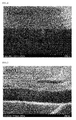
- Figs. 4 to 6 are pictures depicting changes in surface roughness due to increase in heat treatment temperature in the method of improving hydrophilicity according to the present invention.
- a titanium oxide coating layer not subjected to heat treatment has a thickness of 97.3 nm and 98.3 nm.
- a thickness of 113 nm and 107 nm was obtained in adjacent areas and surface roughness was high.
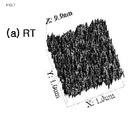
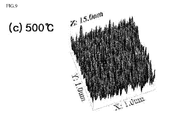
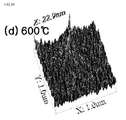
- Figs. 7 to 10 are three-dimensional images depicting changes in surface roughness due to increase in heat treatment temperature in the method of improving hydrophilicity according to the present invention.
- Fig. 7 shows a result in which heat treatment was not performed at room temperature (RT), and it can be seen that the same results as in Fig. 4 were obtained. That is, it can be seen that surface roughness did not substantially appear and thus hydrophilic effects were deteriorated.
- RT room temperature
- Fig. 8 shows a result in which heat treatment was performed at 400°C, and it can be seen that high surface roughness did not appear and hydrophilicity was deteriorated, irrespective of change in surface morphology. Although not shown in this graph, it can be seen that, when heat treatment was performed at 700°C, high surface roughness did not appear, thereby deteriorating hydrophilicity.
- Figs. 9 and 10 show results in which heat treatment was performed at 500°C and 600°C under conditions according to the present invention, and it can be seen that high surface roughness appeared.
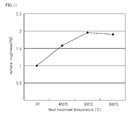
- Fig. 11 is a graph depicting surface roughness according to heat treatment temperature in the method of improving hydrophilicity according to the invention.
- Fig. 11 is a result in which heat treatment was performed at 500°C and 600°C under conditions according to the present invention, and it can be seen that the super-hydrophilic glass coating layer had a surface roughness (RMS) of 1.5 nm or higher. On the contrary, when heat treatment was performed at a temperature deviating from the temperature range of the present invention, the super-hydrophilic glass coating layer generally had a surface roughness (RMS) of 1.5 nm or less.
- RMS surface roughness
- the super-hydrophilic glass coating layer had a surface roughness (RMS) of 1.5 nm or higher, but did not influence hydrophilicity, and when heat treatment was performed at 700°C, the super-hydrophilic glass coating layer had a surface roughness (RMS) of 1.5 nm or less.
- the coating layer may exhibit high strength by maintaining a surface hardness of 7H or higher.
- the super-hydrophilic glass coating layer according to the present invention may be easily applied to buildings or outdoor advertisements in order to secure a clean outer appearance while facilitating maintenance of the building or outdoor advertisement through natural purification.
Landscapes
- Chemical & Material Sciences (AREA)
- Engineering & Computer Science (AREA)
- Materials Engineering (AREA)
- Organic Chemistry (AREA)
- Chemical Kinetics & Catalysis (AREA)
- Mechanical Engineering (AREA)
- Metallurgy (AREA)
- Physics & Mathematics (AREA)
- General Chemical & Material Sciences (AREA)
- Geochemistry & Mineralogy (AREA)
- Life Sciences & Earth Sciences (AREA)
- Thermal Sciences (AREA)
- Plasma & Fusion (AREA)
- Health & Medical Sciences (AREA)
- Optics & Photonics (AREA)
- Toxicology (AREA)
- Surface Treatment Of Glass (AREA)
- Catalysts (AREA)
- Application Of Or Painting With Fluid Materials (AREA)
- Laminated Bodies (AREA)
- Physical Vapour Deposition (AREA)
Abstract
Description
- The present invention relates to a method of improving hydrophilicity of a coating layer through surface morphology treatment and a super-hydrophilic glass coating layer produced using the same, and more particularly, to a technology of performing super-hydrophilic coating to secure a clean appearance of a building or outdoor advertisement while facilitating maintenance of the building or outdoor advertisement through natural purification.
- In recent years, window glass having good transmittance is applied to a building to secure field of view and natural lighting while finishing the building. However, due to such high transmittance of the window glass, contaminants attached to the window glass can be easily recognized, thereby deteriorating aesthetics of the outer appearance or reducing transmittance in the case where contaminants are severely attached to the window glass.
- To solve such disadvantages, various attempts have been made to apply a special coating layer to a glass surface in order to maintain a clean outer appearance. In particular, hydrophilic coating has been suggested in that it can provide natural purification of contaminants with rain.
- Thus, hydrophilic coating is performed on a glass substrate to finish an exterior of a building. In the related art, a hydrophilic coating glass is coated with a photocatalytic material on the surface thereof to realize hydrophilicity under conditions of UV irradiation.
- However, when the hydrophilic coating glass is applied to the exterior of a building in practice, hydrophilic characteristics do not appear as in experimental data due to inconstant intensity of sunlight and low intensity of UV light.
- Thus, coating layers based on fractal structure theory have been proposed to exhibit hydrophilic characteristics even under conditions of non-UV irradiation.
- However, the coating layer based on fractal structure theory is subjected to wet coating, such as spraying, dipping, and slitting.
- Since such wet coating has technical difficulty securing uniform quality of a coating layer in production of a large area coating layer, wet coating is generally directly performed upon a glass window attached to a building.
- However, even in this case, since it is difficult to properly manage quality during in-field construction, the coating layer is deteriorated in durability over time. Moreover, the coating layer provides a foggy surface and makes it difficult to secure a transparent outer appearance.
- An aspect of the present invention is to provide a method of improving hydrophilicity of a coating layer through surface morphology treatment, in which heat treatment is performed at an optimized temperature for a short period of time after a photocatalytic layer is formed at room temperature, thereby ensuring transparency and low UV dependency to provide super-hydrophilic characteristics in which the coating layer has a surface contact angle of 30 degrees or less.
- Another aspect of the present invention is to provide a super-hydrophilic glass coating layer, which has a high pencil hardness of 7 or higher through surface morphology thereof and has high-transmittance super-hydrophilic characteristics.
- In accordance with one aspect of the present invention, a method of improving hydrophilicity of a coating layer through surface morphology treatment includes: forming a photocatalyst layer on a substrate; and heating the substrate having the photocatalyst layer formed thereon to a temperature of 500°C to 600°C to perform post-heat treatment while increasing surface roughness of the photocatalyst layer such that the photocatalyst layer has a surface contact angle of 30 degrees or less.
- The forming a photocatalyst layer may be performed by RF magnetron sputtering at room temperature, and the photocatalyst layer may include at least one oxide layer selected from among titanium oxide, silicon oxide, aluminum oxide, iron oxide, silver oxide, copper oxide, tungsten oxide, zinc/tin alloy oxide, zinc titanate, molybdenum oxide, zinc oxide, strontium titanate, cobalt oxide, and chromium oxide layers.
- The method may further include forming a barrier layer between the substrate and the photocatalyst layer.
- The post heat treatment may be performed for 1 to 10 minutes.
- Another aspect of the present invention provides a super-hydrophilic glass coating layer subjected to surface morphology treatment to have a surface roughness (RMS) of 1.5 nm or higher by the method according to the present invention.
- The hydrophilic glass coating layer may have a pencil hardness of 7H to 9H.
- With the method of improving hydrophilicity of a coating layer through surface morphology treatment according to embodiments of the present invention, the coating layer may exhibit super hydrophilicity of a contact angle of 30 degrees without being influenced by UV irradiation conditions, thereby enabling maintenance of excellent photocatalyst activity.
- Further, even after hydrophilic treatment, the coating layer may have high strength characteristics by maintaining surface hardness of 7H or higher.
- Thus, the super-hydrophilic glass coating layer according to the present invention may be easily applied to buildings or outdoor advertisement in order to secure a clean outer appearance while facilitating maintenance of the building or outdoor advertisement through natural purification.
-
-
Fig. 1 is a side-sectional view of a hydrophilic glass coating layer according to one embodiment of the present invention. -
Fig. 2 is a graph depicting changes in water contact angle and pencil hardness according to heat treatment temperature in a method of improving hydrophilicity according to the present invention. -
Fig. 3 is a graph depicting changes in water contact angle upon UV irradiation according to heat treatment temperature in the method of improving hydrophilicity according to the present invention. -
Figs. 4 to 6 are pictures depicting changes in surface roughness due to increase in heat treatment temperature in the method of improving hydrophilicity according to the present invention. -
Figs. 7 to 10 are three-dimensional images depicting changes in surface roughness due to increase in heat treatment temperature in the method of improving hydrophilicity according to the present invention. -
Fig. 11 is a graph depicting surface roughness according to heat treatment temperature in the method of improving hydrophilicity according to the present invention. - Now, a method of improving hydrophilicity of a coating layer through surface morphology treatment and a super-hydrophilic glass coating layer produced using the same according to the present invention will be described in detail with reference to the accompanying drawings.
- The above and other aspects, features, and advantages of the invention will become apparent from the detailed description of the following embodiments in conjunction with the accompanying drawings. It should be understood that the present invention is not limited to the following embodiments and may be embodied in different ways, and that the embodiments are provided for complete disclosure and thorough understanding of the invention by those skilled in the art. The scope of the invention is defined only by the claims. Like components will be denoted by like reference numerals throughout the specification.
- A method of improving hydrophilicity of a coating layer through surface morphology treatment according to one embodiment of the present invention includes: forming a photocatalyst layer on a substrate; and heating the substrate having the photocatalyst layer formed thereon to a temperature of 500°C to 600°C to perform post-heat treatment while increasing surface roughness of the photocatalyst layer such that the photocatalyst layer has a surface contact angle of 30 degrees or less.
- According to the embodiment of the present invention, the photocatalyst layer is first formed on the substrate for hydrophilic treatment. Here, a vacuum thin film deposition process such as room temperature RF magnetron sputtering is performed to form a large area coating layer having high permeability and a uniform thickness. Here, in particular, the RF magnetron sputtering may be performed at room temperature. Although it is within a general range, room temperature ranges from 18°C to 25°C in the present invention.
- Sputtering is generally performed in a temperature range exceeding room temperature, and when the photocatalyst coating layer is formed on the substrate, crystallinity of the photocatalytic material can be obtained but it is difficult to obtain hydrophilic effects.
- Further, since production can be conducted only when equipment for heating the substrate is provided to meet high temperature conditions, there are problems of a complex manufacturing process and high manufacturing costs.
- According to the present invention, sputtering is performed at room temperature, enabling economical and easy formation of the photocatalyst coating layer, ensuring crystallinity through post-heat treatment and facilitating morphology control through increase in surface roughness while realizing excellent hydrophilicity.
- Now, a super-hydrophilic glass coating layer and hydrophiliation conditions according to the present invention will be described.
-
Fig. 1 is a side-sectional view of a hydrophilic glass coating layer according to one embodiment of the present invention. - Referring to
Fig. 1 , a super-hydrophiliccoating layer 120 according to one embodiment of the present invention is formed on aglass substrate 100. Here, abarrier layer 110 may be further formed between theglass substrate 100 and the super-hydrophiliccoating layer 120. Thebarrier layer 110 serves to prevent alkali elements of theglass substrate 100 from diffusing into the super-hydrophiliccoating layer 120 to act as impurities over time after coating. - Here, the glass substrate is one example of the substrate in the present invention and may be realized as an interior or exterior component of a vehicle or a window glass product for a building.
- The super-hydrophilic coating layer may be comprised of at least one oxide layer selected from among titanium oxide, silicon oxide, aluminum oxide, iron oxide, silver oxide, copper oxide, tungsten oxide, zinc/tin alloy oxide, zinc titanate, molybdenum oxide, zinc oxide, strontium titanate, cobalt oxide, and chromium oxide layers. In some embodiments, a titanium oxide layer may be used as a material for the super-hydrophilic coating layer. Further, at least one of these oxide layers may be used as the barrier layer.
- In the present invention, the photocatalyst coating layer of the above structure is formed through RF magnetron sputtering. Here, the super-hydrophilic
coating layer 120 may be formed through the following heat treatment process. - In the present invention, heat treatment temperature and heat treatment time are essential factors in improving surface morphology, and it can be seen from the following experimental results that the coating layer exhibits optimal hydrophilicity upon heat treatment in a temperature range from 500°C to 600°C.
- First, for an exemplary example of a super-hydrophilic glass coating layer according to the present invention, a soda-lime glass substrate having an area of 100 mm x 100 mm and a thickness of 0.7 t was prepared.
- Then, a titanium oxide layer TiO2 was formed on the soda-lime substrate. Here, the sputtering apparatus was maintained at RF 4.3 W/cm2 and a pressure of 3 mtorr was maintained in a 100% argon (Ar) gas atmosphere.
- Next, the following experimental results were obtained through heat treatment performed at room temperature (RT), 200°C, 300°C, 400°C, 500°C, and 600°C for five minutes while increasing temperature at a temperature increasing rate of 10°C/min under sintering conditions in an air atmosphere.
-
Fig. 2 is a graph depicting changes in water contact angle and pencil hardness according to heat treatment temperature in a method of improving hydrophilicity according to the present invention. - First, referring to
Fig. 2 , it can be seen that the water contact angle was 30 degrees or less in a post-heat treatment temperature range from 500°C to 600°C after formation of the photocatalyst coating layer - In addition, it can be seen that the pencil hardness was maintained at 8 H, that is, within the range of 7H to 9H.
- Then, it can be seen that, when heat treatment was performed at a temperature below 500°C, the water contact angle exceeded 30 degrees, causing deterioration in hydrophilic characteristics.
- Although not shown in the graph, heat treatment at a temperature exceeding 600°C results in a water contact angle of 30 degrees or more, thereby causing deterioration in hydrophilic characteristics and hardness. Furthermore, heat treatment at a temperature exceeding 700°C can cause deformation of the glass substrate. Accordingly, heat treatment at a temperature exceeding 600°C is not economical.
- Thus, considering the surface hardness and hydrophilicity, optimal heat treatment may be performed in a temperature range from 500°C to 600°C.
-
Fig. 3 is a graph depicting changes in water contact angle upon UV irradiation according to heat treatment temperature in the method of improving hydrophilicity according to the present invention. - Referring to
Fig. 3 , general photocatalytic materials did not provide hydrophilicity under conditions of a short UV irradiation time and low intensity of light. - In the present invention, however, the coating layer exhibits super-hydrophilicity even in interior conditions in which UV light is shielded, through change of surface morphology according to heat treatment temperature, thereby maximizing utilization of existing photocatalysts.
- In particular, referring to
Fig 3 , it can be seen that, when heat treatment was performed at 500°C under conditions according to the present invention, a (water) contact angle was 30 degrees or less. Thus, it can be seen that such surface morphology treatment according to the present invention provides super-hydrophilic characteristics even under an interior condition (UV Ohr) in which UV light is shielded. - As shown in
Fig. 3 , it can be seen that, since heat treatment at a temperature of less than 500°C resulted in a water contact angle of 30 degrees or more and heat treatment at a temperature exceeding 600°C resulted in a water contact angle of more than 30 degrees, the hydrophilic characteristics were deteriorated. - Referring to
Fig. 3 , it can be seen that, when UV irradiation duration is adjusted within a range from 1 minute to 2 hours, super hydrophilicity of a contact angle of 10 degrees or less may be realized. - Now, characteristics of a super-hydrophilic glass coating layer according to the present invention will be described with reference to pictures of specimens thereof.
-
Figs. 4 to 6 are pictures depicting changes in surface roughness due to increase in heat treatment temperature in the method of improving hydrophilicity according to the present invention. - In general, it can be seen that the super-hydrophilic characteristics are observed according to change in surface morphology, and that contact angle decreases with increasing roughness and according to characteristics of a porous structure.
- Referring first to
Fig. 4 , a titanium oxide coating layer not subjected to heat treatment has a thickness of 97.3 nm and 98.3 nm. - Thus, it can be seen that roughness and crystallinity did not substantially appear and hydrophilic characteristics also did not substantially appear.
- Next, referring to
Fig. 5 , it can be seen that, when heat treatment was performed at 400°C, a thickness of 109 nm and 105 nm was obtained over a relatively wide area and the hydrophilic characteristics did not substantially appear. - Although not shown in the figures, it can be seen that, when heat treatment was performed at 700°C, a thickness of less than 100 nm was obtained over a relatively wide area and the hydrophilic characteristics did not substantially appear.
- Referring to
Fig. 6 , it can be seen that, when heat treatment was performed at 600°C under conditions according to the present invention, a thickness of 113 nm and 107 nm was obtained in adjacent areas and surface roughness was high. - Thus, it can be seen that hydrophilic characteristics also appeared high.
- In addition, such change in a cross-section will be described with reference to three-dimensional results.
-
Figs. 7 to 10 are three-dimensional images depicting changes in surface roughness due to increase in heat treatment temperature in the method of improving hydrophilicity according to the present invention. -
Fig. 7 shows a result in which heat treatment was not performed at room temperature (RT), and it can be seen that the same results as inFig. 4 were obtained. That is, it can be seen that surface roughness did not substantially appear and thus hydrophilic effects were deteriorated. - Next,
Fig. 8 shows a result in which heat treatment was performed at 400°C, and it can be seen that high surface roughness did not appear and hydrophilicity was deteriorated, irrespective of change in surface morphology. Although not shown in this graph, it can be seen that, when heat treatment was performed at 700°C, high surface roughness did not appear, thereby deteriorating hydrophilicity. -
Figs. 9 and10 show results in which heat treatment was performed at 500°C and 600°C under conditions according to the present invention, and it can be seen that high surface roughness appeared. -
Fig. 11 is a graph depicting surface roughness according to heat treatment temperature in the method of improving hydrophilicity according to the invention. -
Fig. 11 is a result in which heat treatment was performed at 500°C and 600°C under conditions according to the present invention, and it can be seen that the super-hydrophilic glass coating layer had a surface roughness (RMS) of 1.5 nm or higher. On the contrary, when heat treatment was performed at a temperature deviating from the temperature range of the present invention, the super-hydrophilic glass coating layer generally had a surface roughness (RMS) of 1.5 nm or less. Referring toFig. 11 , it can be seen that, when heat treatment was performed at 400°C, the super-hydrophilic glass coating layer had a surface roughness (RMS) of 1.5 nm or higher, but did not influence hydrophilicity, and when heat treatment was performed at 700°C, the super-hydrophilic glass coating layer had a surface roughness (RMS) of 1.5 nm or less. - As described above, with the method of improving hydrophilicity of a coating layer through surface morphology treatment according to the embodiments of the present invention, super hydrophilicity of a contact angle of 30 degrees or less may be obtained without being influenced by UV irradiation conditions, while maintaining excellent activity as a photocatalyst.
- Further, even after hydrophilic treatment, the coating layer may exhibit high strength by maintaining a surface hardness of 7H or higher.
- Thus, the super-hydrophilic glass coating layer according to the present invention may be easily applied to buildings or outdoor advertisements in order to secure a clean outer appearance while facilitating maintenance of the building or outdoor advertisement through natural purification.
- Although some embodiments have been described herein, it will be understood by those skilled in the art that these embodiments are provided for illustration only, and various modifications, changes, alterations and equivalent embodiments can be made without departing from the scope of the present invention. Therefore, the scope and sprit of the present invention should be defined only by the accompanying claims and equivalents thereof.
Claims (7)
- A method of improving hydrophilicity of a coating layer through surface morphology treatment, comprising:forming a photocatalyst layer on a substrate; andheating the substrate having the photocatalyst layer formed thereon to a temperature of 500°C to 600°C to perform post-heat treatment while increasing surface roughness of the photocatalyst layer, such that the photocatalyst layer has a surface contact angle of 30 degrees or less.
- The method according to claim 1, wherein the forming a photocatalyst layer is performed by room temperature RF magnetron sputtering.
- The method according to claim 1, wherein the photocatalyst layer comprises at least one oxide layer selected from among titanium oxide, silicon oxide, aluminum oxide, iron oxide, silver oxide, copper oxide, tungsten oxide, zinc/tin alloy oxide, zinc titanate, molybdenum oxide, zinc oxide, strontium titanate, cobalt oxide, and chromium oxide layers.
- The method according to claim 1, further comprising: forming a barrier layer between the substrate and the photocatalyst layer.
- The method according to claim 1, wherein the post heat treatment is performed for 1 to 10 minutes.
- A super-hydrophilic glass coating layer subjected to surface morphology treatment to have a surface roughness (RMS) of 1.5 nm or higher by the method according to any one of claims 1 to 5.
- The super-hydrophilic glass coating layer according to claim 6, wherein the hydrophilic glass coating layer has a pencil hardness from 7H to 9H.
Applications Claiming Priority (2)
| Application Number | Priority Date | Filing Date | Title |
|---|---|---|---|
| KR1020100091975A KR20120029872A (en) | 2010-09-17 | 2010-09-17 | Method for improving hydrophilic coating using treatment surface morphology and ultra-higt hydrophilic coating for glass |
| PCT/KR2011/006888 WO2012036525A2 (en) | 2010-09-17 | 2011-09-16 | Method for improving hydrophilicity of a coating film through treatment on a surface morphology and super hydrophilic glass coating layer produced by the method |
Publications (2)
| Publication Number | Publication Date |
|---|---|
| EP2617864A2 true EP2617864A2 (en) | 2013-07-24 |
| EP2617864A4 EP2617864A4 (en) | 2014-07-09 |
Family
ID=45832139
Family Applications (1)
| Application Number | Title | Priority Date | Filing Date |
|---|---|---|---|
| EP11825485.3A Withdrawn EP2617864A4 (en) | 2010-09-17 | 2011-09-16 | METHOD FOR IMPROVING THE HYDROPHILY OF A COATING FILM BY TREATMENT ON SURFACE MORPHOLOGY AND SUPER-HYDROPHILIC GLASS COATING LAYER PRODUCED BY THE PROCESS |
Country Status (6)
| Country | Link |
|---|---|
| US (1) | US20130142995A1 (en) |
| EP (1) | EP2617864A4 (en) |
| JP (1) | JP2013543054A (en) |
| KR (1) | KR20120029872A (en) |
| CN (1) | CN103108979B (en) |
| WO (1) | WO2012036525A2 (en) |
Families Citing this family (5)
| Publication number | Priority date | Publication date | Assignee | Title |
|---|---|---|---|---|
| US10867887B2 (en) * | 2014-07-29 | 2020-12-15 | Massachusetts Institute Of Technology | Enhanced flow boiling heat transfer in microchannels with structured surfaces |
| KR101891369B1 (en) | 2014-08-06 | 2018-08-27 | (주)엘지하우시스 | Photo catalyst functional films and method of manufacturing the same |
| CN105177503B (en) * | 2015-09-19 | 2018-04-27 | 苏州柯利达集团有限公司 | A kind of film plating process for being used to improve narrow slit type coating mold surface wettability |
| CN109012221B (en) * | 2018-08-28 | 2021-06-18 | 重庆大学 | Method for preparing highly hydrophilic PVDF filter membrane by magnetron sputtering SiO2 nanoparticles and product thereof |
| CN109133669A (en) * | 2018-09-11 | 2019-01-04 | 大连理工大学 | A kind of Ag/AgCl/WO3Nano film material and preparation method thereof |
Family Cites Families (13)
| Publication number | Priority date | Publication date | Assignee | Title |
|---|---|---|---|---|
| US6830785B1 (en) * | 1995-03-20 | 2004-12-14 | Toto Ltd. | Method for photocatalytically rendering a surface of a substrate superhydrophilic, a substrate with a superhydrophilic photocatalytic surface, and method of making thereof |
| JP3190984B2 (en) * | 1998-06-24 | 2001-07-23 | 経済産業省産業技術総合研究所長 | Titanium dioxide thin film containing silicon dioxide and method for producing the same |
| JP3912976B2 (en) * | 2000-06-20 | 2007-05-09 | 三菱重工業株式会社 | Method for producing titanium substrate having photocatalyst film and method for hydrophilizing titanium substrate surface |
| JP2002320917A (en) * | 2001-04-27 | 2002-11-05 | Toto Ltd | Production method for photocatalytic coating film and photocatalytic material |
| JP2003027039A (en) * | 2001-07-12 | 2003-01-29 | Central Glass Co Ltd | Photocatalytic hydrophilic film and method for producing the same |
| US7799731B2 (en) * | 2001-09-28 | 2010-09-21 | Shibaura Mechatronics Corporation | Photocatalyst element, method and device for preparing the same |
| US7462578B2 (en) * | 2001-11-29 | 2008-12-09 | Shibaura Mechatronics Corporation | Method and apparatus for producing photocatalyst |
| EP1466665B1 (en) * | 2001-12-21 | 2012-10-10 | Nippon Sheet Glass Co., Ltd. | Member having photocatalytic function and method for manufacture thereof |
| JP2003231966A (en) * | 2002-02-08 | 2003-08-19 | Central Glass Co Ltd | Method of forming titanium oxide film |
| JP4030045B2 (en) * | 2002-03-08 | 2008-01-09 | 株式会社村上開明堂 | Hydrophilic composites |
| FR2868770B1 (en) * | 2004-04-09 | 2006-06-02 | Saint Gobain | SUBSTRATE, IN PARTICULAR GLASS SUBSTRATE, HAVING A MODIFIED PHOTOCATALYTIC LAYER TO ABSORB PHOTONS OF THE VISIBLE |
| DE102007025577B4 (en) * | 2007-06-01 | 2011-08-25 | Fraunhofer-Gesellschaft zur Förderung der angewandten Forschung e.V., 80686 | Process for the preparation of titanium oxide layers with high photocatalytic activity |
| US8318589B2 (en) * | 2009-06-08 | 2012-11-27 | Applied Materials, Inc. | Method for forming transparent conductive oxide |
-
2010
- 2010-09-17 KR KR1020100091975A patent/KR20120029872A/en not_active Ceased
-
2011
- 2011-09-16 JP JP2013529075A patent/JP2013543054A/en active Pending
- 2011-09-16 US US13/814,430 patent/US20130142995A1/en not_active Abandoned
- 2011-09-16 EP EP11825485.3A patent/EP2617864A4/en not_active Withdrawn
- 2011-09-16 WO PCT/KR2011/006888 patent/WO2012036525A2/en not_active Ceased
- 2011-09-16 CN CN201180044749.0A patent/CN103108979B/en not_active Expired - Fee Related
Also Published As
| Publication number | Publication date |
|---|---|
| CN103108979B (en) | 2015-07-15 |
| WO2012036525A2 (en) | 2012-03-22 |
| KR20120029872A (en) | 2012-03-27 |
| WO2012036525A3 (en) | 2012-05-31 |
| EP2617864A4 (en) | 2014-07-09 |
| CN103108979A (en) | 2013-05-15 |
| US20130142995A1 (en) | 2013-06-06 |
| JP2013543054A (en) | 2013-11-28 |
Similar Documents
| Publication | Publication Date | Title |
|---|---|---|
| JP5101789B2 (en) | Visible light-responsive photoactive coating, coated article, and method for producing the same | |
| CN1898172B (en) | Substrates with a layer having photocatalytic properties covered by a protective thin layer, especially glass substrates | |
| JP6247141B2 (en) | Light-induced hydrophilic article and method for producing the same | |
| JP2005507974A6 (en) | Visible light-responsive photoactive coating, coated article, and method for producing the same | |
| US20100124643A1 (en) | Undercoating layers providing improved photoactive topcoat functionality | |
| JP2004535922A (en) | Photoactive coatings, coated articles and methods of making the same | |
| US20130142995A1 (en) | Method for improving hydrophilicity of a coating film through treatment on a surface morphology and super-hydrophilic glass coating layer produced by the same | |
| RU2481364C2 (en) | Intermediate layers providing improved top layer functionality | |
| JP2005199275A (en) | Base material having photocatalyst coating | |
| US20100124642A1 (en) | Undercoating layers providing improved conductive topcoat functionality | |
| CN101356132A (en) | Coated substrates with primer layers exhibiting improved photocatalytic activity | |
| RU2526298C2 (en) | Silicon thin-film solar cell having improved haze and methods of making same | |
| CN1826296A (en) | Method for preparing a photocatalytic coating integrated into glazing heat treatment | |
| KR102075074B1 (en) | Laminate for self cleaning glass, self cleaning glass and method of preparing self cleaning glass | |
| CN103370441B (en) | For obtaining the method for photocatalyst material | |
| JP3925179B2 (en) | Anti-fogging and antifouling article and method for producing the same | |
| JP2023148631A (en) | Photocatalyst member | |
| JPH1060665A (en) | Hydrophilic coating and method for producing the same | |
| JP3400259B2 (en) | Hydrophilic coating and method for producing the same | |
| JP3989668B2 (en) | Method for producing functional member | |
| CN101291887B (en) | Antifouling material and method for producing same | |
| CN119735382A (en) | A highly efficient heat-insulating LOW-E coated glass for buildings | |
| KR20170029751A (en) | Silica-tin oxide compound and method thereof | |
| JP2009173546A (en) | Photo-induced hydrophilic article and method of producing the same |
Legal Events
| Date | Code | Title | Description |
|---|---|---|---|
| PUAI | Public reference made under article 153(3) epc to a published international application that has entered the european phase |
Free format text: ORIGINAL CODE: 0009012 |
|
| 17P | Request for examination filed |
Effective date: 20130128 |
|
| AK | Designated contracting states |
Kind code of ref document: A2 Designated state(s): AL AT BE BG CH CY CZ DE DK EE ES FI FR GB GR HR HU IE IS IT LI LT LU LV MC MK MT NL NO PL PT RO RS SE SI SK SM TR |
|
| DAX | Request for extension of the european patent (deleted) | ||
| A4 | Supplementary search report drawn up and despatched |
Effective date: 20140605 |
|
| RIC1 | Information provided on ipc code assigned before grant |
Ipc: C23C 14/58 20060101ALI20140530BHEP Ipc: C23C 14/08 20060101ALI20140530BHEP Ipc: C23C 14/35 20060101AFI20140530BHEP |
|
| STAA | Information on the status of an ep patent application or granted ep patent |
Free format text: STATUS: THE APPLICATION IS DEEMED TO BE WITHDRAWN |
|
| 18D | Application deemed to be withdrawn |
Effective date: 20150106 |