EP2617723A2 - Novel compound acting as a cannabinoid receptor-1 inhibitor - Google Patents
Novel compound acting as a cannabinoid receptor-1 inhibitor Download PDFInfo
- Publication number
- EP2617723A2 EP2617723A2 EP11822145.6A EP11822145A EP2617723A2 EP 2617723 A2 EP2617723 A2 EP 2617723A2 EP 11822145 A EP11822145 A EP 11822145A EP 2617723 A2 EP2617723 A2 EP 2617723A2
- Authority
- EP
- European Patent Office
- Prior art keywords
- pyrazolo
- pyrimidin
- methanol
- pyrrolidin
- methyl
- Prior art date
- Legal status (The legal status is an assumption and is not a legal conclusion. Google has not performed a legal analysis and makes no representation as to the accuracy of the status listed.)
- Withdrawn
Links
- 0 CC(*O)(CCC1)N1c(cc(-c(cc1)cc(F)c1F)[n]1nc2C)nc1c2-c(cc1)ccc1OC Chemical compound CC(*O)(CCC1)N1c(cc(-c(cc1)cc(F)c1F)[n]1nc2C)nc1c2-c(cc1)ccc1OC 0.000 description 8
- WERWILOIYBIWMZ-NIXKLOTASA-N CC(C(C=C1)c(c(COC)n[n]2C(C3C)c4cc(C(F)(F)F)ccc4)c2N=C3N2[C@H](CO)CCC2)C=C1OC Chemical compound CC(C(C=C1)c(c(COC)n[n]2C(C3C)c4cc(C(F)(F)F)ccc4)c2N=C3N2[C@H](CO)CCC2)C=C1OC WERWILOIYBIWMZ-NIXKLOTASA-N 0.000 description 1
- JXQJWKFUPULVJT-UHFFFAOYSA-N CCc1n[n]2c(-c(cc3)ccc3F)cc(Cl)nc2c1-c1ccc(C)cc1 Chemical compound CCc1n[n]2c(-c(cc3)ccc3F)cc(Cl)nc2c1-c1ccc(C)cc1 JXQJWKFUPULVJT-UHFFFAOYSA-N 0.000 description 1
- CBSYYGGWTXTUOE-UHFFFAOYSA-N Cc(c(-c(cc1)cc2c1OCO2)c1N2)n[n]1C(c1ccccc1)=CC2=O Chemical compound Cc(c(-c(cc1)cc2c1OCO2)c1N2)n[n]1C(c1ccccc1)=CC2=O CBSYYGGWTXTUOE-UHFFFAOYSA-N 0.000 description 1
- PBXKDWLWGNNDMT-UHFFFAOYSA-N Cc(c(-c1ccc(C)cc1)c1N2)n[n]1C(c(cc1)ccc1F)=CC2=O Chemical compound Cc(c(-c1ccc(C)cc1)c1N2)n[n]1C(c(cc1)ccc1F)=CC2=O PBXKDWLWGNNDMT-UHFFFAOYSA-N 0.000 description 1
- SVAZHDRCOMMLBA-UHFFFAOYSA-N Cc(c(-c1ccc(C)cc1)c1N2)n[n]1C(c1cccc(C)c1)=CC2=O Chemical compound Cc(c(-c1ccc(C)cc1)c1N2)n[n]1C(c1cccc(C)c1)=CC2=O SVAZHDRCOMMLBA-UHFFFAOYSA-N 0.000 description 1
- FHUWWDOWXRSJIM-UHFFFAOYSA-N Cc(cc1N2)n[n]1C(c1cc(C)ccc1)=CC2=O Chemical compound Cc(cc1N2)n[n]1C(c1cc(C)ccc1)=CC2=O FHUWWDOWXRSJIM-UHFFFAOYSA-N 0.000 description 1
- HVVNJUAVDAZWCB-YFKPBYRVSA-N OC[C@H]1NCCC1 Chemical compound OC[C@H]1NCCC1 HVVNJUAVDAZWCB-YFKPBYRVSA-N 0.000 description 1
Images

Classifications
-
- C—CHEMISTRY; METALLURGY
- C07—ORGANIC CHEMISTRY
- C07D—HETEROCYCLIC COMPOUNDS
- C07D487/00—Heterocyclic compounds containing nitrogen atoms as the only ring hetero atoms in the condensed system, not provided for by groups C07D451/00 - C07D477/00
- C07D487/02—Heterocyclic compounds containing nitrogen atoms as the only ring hetero atoms in the condensed system, not provided for by groups C07D451/00 - C07D477/00 in which the condensed system contains two hetero rings
- C07D487/04—Ortho-condensed systems
-
- A—HUMAN NECESSITIES
- A61—MEDICAL OR VETERINARY SCIENCE; HYGIENE
- A61P—SPECIFIC THERAPEUTIC ACTIVITY OF CHEMICAL COMPOUNDS OR MEDICINAL PREPARATIONS
- A61P1/00—Drugs for disorders of the alimentary tract or the digestive system
- A61P1/04—Drugs for disorders of the alimentary tract or the digestive system for ulcers, gastritis or reflux esophagitis, e.g. antacids, inhibitors of acid secretion, mucosal protectants
-
- A—HUMAN NECESSITIES
- A61—MEDICAL OR VETERINARY SCIENCE; HYGIENE
- A61P—SPECIFIC THERAPEUTIC ACTIVITY OF CHEMICAL COMPOUNDS OR MEDICINAL PREPARATIONS
- A61P15/00—Drugs for genital or sexual disorders; Contraceptives
-
- A—HUMAN NECESSITIES
- A61—MEDICAL OR VETERINARY SCIENCE; HYGIENE
- A61P—SPECIFIC THERAPEUTIC ACTIVITY OF CHEMICAL COMPOUNDS OR MEDICINAL PREPARATIONS
- A61P25/00—Drugs for disorders of the nervous system
-
- A—HUMAN NECESSITIES
- A61—MEDICAL OR VETERINARY SCIENCE; HYGIENE
- A61P—SPECIFIC THERAPEUTIC ACTIVITY OF CHEMICAL COMPOUNDS OR MEDICINAL PREPARATIONS
- A61P25/00—Drugs for disorders of the nervous system
- A61P25/18—Antipsychotics, i.e. neuroleptics; Drugs for mania or schizophrenia
-
- A—HUMAN NECESSITIES
- A61—MEDICAL OR VETERINARY SCIENCE; HYGIENE
- A61P—SPECIFIC THERAPEUTIC ACTIVITY OF CHEMICAL COMPOUNDS OR MEDICINAL PREPARATIONS
- A61P25/00—Drugs for disorders of the nervous system
- A61P25/22—Anxiolytics
-
- A—HUMAN NECESSITIES
- A61—MEDICAL OR VETERINARY SCIENCE; HYGIENE
- A61P—SPECIFIC THERAPEUTIC ACTIVITY OF CHEMICAL COMPOUNDS OR MEDICINAL PREPARATIONS
- A61P25/00—Drugs for disorders of the nervous system
- A61P25/24—Antidepressants
-
- A—HUMAN NECESSITIES
- A61—MEDICAL OR VETERINARY SCIENCE; HYGIENE
- A61P—SPECIFIC THERAPEUTIC ACTIVITY OF CHEMICAL COMPOUNDS OR MEDICINAL PREPARATIONS
- A61P25/00—Drugs for disorders of the nervous system
- A61P25/28—Drugs for disorders of the nervous system for treating neurodegenerative disorders of the central nervous system, e.g. nootropic agents, cognition enhancers, drugs for treating Alzheimer's disease or other forms of dementia
-
- A—HUMAN NECESSITIES
- A61—MEDICAL OR VETERINARY SCIENCE; HYGIENE
- A61P—SPECIFIC THERAPEUTIC ACTIVITY OF CHEMICAL COMPOUNDS OR MEDICINAL PREPARATIONS
- A61P29/00—Non-central analgesic, antipyretic or antiinflammatory agents, e.g. antirheumatic agents; Non-steroidal antiinflammatory drugs [NSAID]
-
- A—HUMAN NECESSITIES
- A61—MEDICAL OR VETERINARY SCIENCE; HYGIENE
- A61P—SPECIFIC THERAPEUTIC ACTIVITY OF CHEMICAL COMPOUNDS OR MEDICINAL PREPARATIONS
- A61P3/00—Drugs for disorders of the metabolism
- A61P3/04—Anorexiants; Antiobesity agents
-
- A—HUMAN NECESSITIES
- A61—MEDICAL OR VETERINARY SCIENCE; HYGIENE
- A61P—SPECIFIC THERAPEUTIC ACTIVITY OF CHEMICAL COMPOUNDS OR MEDICINAL PREPARATIONS
- A61P3/00—Drugs for disorders of the metabolism
- A61P3/06—Antihyperlipidemics
-
- A—HUMAN NECESSITIES
- A61—MEDICAL OR VETERINARY SCIENCE; HYGIENE
- A61P—SPECIFIC THERAPEUTIC ACTIVITY OF CHEMICAL COMPOUNDS OR MEDICINAL PREPARATIONS
- A61P3/00—Drugs for disorders of the metabolism
- A61P3/08—Drugs for disorders of the metabolism for glucose homeostasis
- A61P3/10—Drugs for disorders of the metabolism for glucose homeostasis for hyperglycaemia, e.g. antidiabetics
-
- A—HUMAN NECESSITIES
- A61—MEDICAL OR VETERINARY SCIENCE; HYGIENE
- A61P—SPECIFIC THERAPEUTIC ACTIVITY OF CHEMICAL COMPOUNDS OR MEDICINAL PREPARATIONS
- A61P35/00—Antineoplastic agents
-
- A—HUMAN NECESSITIES
- A61—MEDICAL OR VETERINARY SCIENCE; HYGIENE
- A61P—SPECIFIC THERAPEUTIC ACTIVITY OF CHEMICAL COMPOUNDS OR MEDICINAL PREPARATIONS
- A61P43/00—Drugs for specific purposes, not provided for in groups A61P1/00-A61P41/00
-
- A—HUMAN NECESSITIES
- A61—MEDICAL OR VETERINARY SCIENCE; HYGIENE
- A61P—SPECIFIC THERAPEUTIC ACTIVITY OF CHEMICAL COMPOUNDS OR MEDICINAL PREPARATIONS
- A61P9/00—Drugs for disorders of the cardiovascular system
-
- A—HUMAN NECESSITIES
- A61—MEDICAL OR VETERINARY SCIENCE; HYGIENE
- A61P—SPECIFIC THERAPEUTIC ACTIVITY OF CHEMICAL COMPOUNDS OR MEDICINAL PREPARATIONS
- A61P9/00—Drugs for disorders of the cardiovascular system
- A61P9/04—Inotropic agents, i.e. stimulants of cardiac contraction; Drugs for heart failure
-
- A—HUMAN NECESSITIES
- A61—MEDICAL OR VETERINARY SCIENCE; HYGIENE
- A61P—SPECIFIC THERAPEUTIC ACTIVITY OF CHEMICAL COMPOUNDS OR MEDICINAL PREPARATIONS
- A61P9/00—Drugs for disorders of the cardiovascular system
- A61P9/10—Drugs for disorders of the cardiovascular system for treating ischaemic or atherosclerotic diseases, e.g. antianginal drugs, coronary vasodilators, drugs for myocardial infarction, retinopathy, cerebrovascula insufficiency, renal arteriosclerosis
-
- A—HUMAN NECESSITIES
- A61—MEDICAL OR VETERINARY SCIENCE; HYGIENE
- A61P—SPECIFIC THERAPEUTIC ACTIVITY OF CHEMICAL COMPOUNDS OR MEDICINAL PREPARATIONS
- A61P9/00—Drugs for disorders of the cardiovascular system
- A61P9/12—Antihypertensives
-
- C—CHEMISTRY; METALLURGY
- C07—ORGANIC CHEMISTRY
- C07D—HETEROCYCLIC COMPOUNDS
- C07D403/00—Heterocyclic compounds containing two or more hetero rings, having nitrogen atoms as the only ring hetero atoms, not provided for by group C07D401/00
- C07D403/02—Heterocyclic compounds containing two or more hetero rings, having nitrogen atoms as the only ring hetero atoms, not provided for by group C07D401/00 containing two hetero rings
- C07D403/04—Heterocyclic compounds containing two or more hetero rings, having nitrogen atoms as the only ring hetero atoms, not provided for by group C07D401/00 containing two hetero rings directly linked by a ring-member-to-ring-member bond
-
- A—HUMAN NECESSITIES
- A61—MEDICAL OR VETERINARY SCIENCE; HYGIENE
- A61K—PREPARATIONS FOR MEDICAL, DENTAL OR TOILETRY PURPOSES
- A61K31/00—Medicinal preparations containing organic active ingredients
- A61K31/33—Heterocyclic compounds
- A61K31/395—Heterocyclic compounds having nitrogen as a ring hetero atom, e.g. guanethidine or rifamycins
- A61K31/495—Heterocyclic compounds having nitrogen as a ring hetero atom, e.g. guanethidine or rifamycins having six-membered rings with two or more nitrogen atoms as the only ring heteroatoms, e.g. piperazine or tetrazines
- A61K31/505—Pyrimidines; Hydrogenated pyrimidines, e.g. trimethoprim
- A61K31/519—Pyrimidines; Hydrogenated pyrimidines, e.g. trimethoprim ortho- or peri-condensed with heterocyclic rings
Definitions
- the present disclosure relates to a novel compound acting as a cannabinoid receptor 1 inhibitor, a prodrug thereof, an isomer thereof, a pharmaceutically acceptable salt thereof, a hydrate thereof or a solvate thereof.
- Obesity in general refers to a fat state, but more accurately it means a medical condition in which excess fat has accumulated in the body. Since it is known that overweight and obesity are known to cause various health problems including chronic diseases such as hypertension, type 2 diabetes, cardiovascular diseases, fatty liver and hyperlipidemia, various drugs for treating obesity are being developed worldwide.
- Reductil ® Sibutramine
- Xenical ® Orlistat
- the present disclosure is directed to providing a novel compound acting as an cannabinoid receptor 1 inhibitor, which is a pyrazolo[1,5-a]pyrimidine derivative, a prodrug thereof, an isomer thereof, a pharmaceutically acceptable salt thereof, a hydrate thereof or a solvate thereof.
- a novel compound acting as an cannabinoid receptor 1 inhibitor which is a pyrazolo[1,5-a]pyrimidine derivative, a prodrug thereof, an isomer thereof, a pharmaceutically acceptable salt thereof, a hydrate thereof or a solvate thereof.
- R 1 is selected from a group consisting of hydrogen, C 1 -C 5 alkyl, haloalkyl, C 1 -C 5 cycloalkyl and C 1 -C 5 alkoxyalkyl; each of R 2 , R 3 , R 4 , R 5 and R 6 is independently selected from a group consisting of hydrogen, fluoro, chloro, bromo, iodo, nitro, cyano, C 1 -C 5 alkyl, hydroxy C 1 -C 5 alkyl, C 1 -C 5 alkoxy, C 1 -C 5 alkoxy alkyl, halo C 1 -C 3 alkyl, halo C 1 -C 5 alkoxy, haloalkoxy C 2 -C 5 alkenyl, C 2 -C 5 alkenyl, alkynyl, carboxyl, C 1 -C 5 alkylcarbonyl, C 1
- a pharmaceutical composition containing the compound, the prodrug thereof, the isomer thereof, the pharmaceutically acceptable salt thereof, the hydrate thereof or the solvate thereof.
- a method for preparing pyrazolo[1,5-a]pyrimidine having an aryl substituent bound at 7-position including reacting aminopyrazole and a diketoester in a pyridine solvent, wherein at least one of the aminopyrazole and the diketoester contains an aryl group.
- a pyrazolo[1,5-a]pyrimidine compound having an aryl substituent bound at 7-position prepared by the method for preparing pyrazolo[1,5-a]pyrimidine having an aryl substituent bound at 7-position, an isomer thereof, a pharmaceutically acceptable salt thereof, a hydrate thereof or a solvate thereof.
- a compound, a prodrug thereof, an isomer thereof, a pharmaceutically acceptable salt thereof, a hydrate thereof or a solvate thereof according to an aspect of the present disclosure may act as a cannabinoid receptor 1 inhibitor. Accordingly, the compound, the prodrug thereof, the isomer thereof, the pharmaceutically acceptable salt thereof, the hydrate thereof or the solvate thereof according to an aspect of the present disclosure may be used to prevent or treat diseases mediated by the cannabinoid receptor.
- the compound, the prodrug thereof, the isomer thereof, the pharmaceutically acceptable salt thereof, the hydrate thereof or the solvate thereof is useful for prevention or treatment of inflammatory diseases, immune diseases, neurological and mental disorders, cancers of the immune system, respiratory diseases or cardiovascular disease.
- the compound, the prodrug thereof, the isomer thereof, the pharmaceutically acceptable salt thereof, the hydrate thereof or the solvate thereof may be used to prevent or treat inflammatory pain, psycopathy, anxiety, depression, attention deficiency, memory or cognitive disorder, neuropathic pain disorder, sexual dysfunction, impulse control disorder, obesity, neurological or obsessive eating disorder, metabolic disorder such as morning sickness, nausea, gastric ulcer, diabetes, hypertension and hyperlipidemia or cardiac dysfunction such as valvular heart disease, myocardial infarction, cardiomegaly or congestive heart failure.
- the endocannabinoid system is known to play an important role in regulation of appetite and energy metabolism.
- This system includes a variety of enzymes, endocannabinoids and cannabinoid receptors involved in the synthesis and breakdown of endogenous ligands.
- cannabinoid (CB) receptors CB1 and CB2 consisting of 7 transmembrane domains.
- the CB2 receptor is primarily expressed in the spleen, tonsils, B cells, T cells, monocytes, etc. of the immune system and is involved in the recognition of inflammatory and neuropathic pain as well as allergy, asthma, multiple sclerosis, osteoporosis and inflammatory conditions.
- the CB1 receptor is directly involved in various metabolic diseases including obesity through facilitation of energy metabolism, control of appetite, regulation of processes related with fat metabolism, or the like. Indeed, it is known that CB1 receptor-deficient mice are resistant against obesity induced with high-fat diet and maintain body weight similarly to the control group fed with normal diet. The effect of suppression of appetite and reduction of body weight is also achieved when the CB1 receptor is inhibited with drugs.
- CB1 receptor inhibitors such as rimonabant are known to have an excellent effect of suppressing appetite and reducing body weight also in human.
- the CB1 receptor inhibitors may cause vomiting and mental side effects depression and anxiety in some people, many drugs were ceased to be developed during clinical stages.
- a CB1 receptor inhibitor is to be developed for treatment of obesity, development of a drug having a pharmacological and clinical profile different from that of the first-generation drug rimonabant will be necessary to avoid side effects.
- a strategy for developing a safe CB1 receptor inhibitor without adversely affecting the central nervous system (CNS) development of an inhibitor targeting only the CB1 receptors in the peripheral tissues such as the adipose tissue, liver, muscle and gastrointestinal tract without acting on the brain may be conceived.
- a drug chemically modified not to pass the blood-brain barrier may ensure both safety and efficacy since it can be distributed only in the peripheral tissues without acting on the CB1 receptors existing in the brain.
- the peripheral effect of the CB1 receptor can be controlled according to various target tissues with different mechanisms. Examples include: i) liver: inhibition of fat biosynthesis, ii) muscle: promotion of glucose absorption, iii) adipose tissue: facilitation of expression and secretion of adiponectin and inhibition of fat biosynthesis and iv) gastrointestinal tract: secretion of signals inducing satiety.
- alkyl refers to a saturated, monovalent aliphatic hydrocarbon chain.
- the hydrocarbon chain may be straight or branched.
- alkyl may have 1-5 carbon atoms ("C 1 -C 5 alkyl”). In another exemplary embodiment, it may have 1-4 carbon atoms ("C 1 -C 4 alkyl”). In another exemplary embodiment, it may have 1-3 carbon atoms ("C 1 -C 3 alkyl”).
- alkyl includes methyl, ethyl, n-propyl, isopropyl, n-butyl, isobutyl, tert-butyl or t-amyl, but is not limited thereto.
- alkoxy refers to an -OR group wherein R is an alkyl group defined above. Specifically, “alkoxy” includes methoxy, ethoxy, n-propoxy, isopropoxy, n-butoxy, tert-butoxy, sec-butoxy, n-pentoxy or 1,2-dimethylbutoxy, but is not limited thereto.
- alkoxyalkyl refers to an -ROR' wherein R and R' are alkyl groups defined above and may be identical or different.
- alkynyl refers to an unsaturated hydrocarbon group having at least one triple bond.
- cycloalkyl refers to a saturated, cyclic aliphatic hydrocarbon group. A number attached to C means the number of carbon atoms forming the ring. For example, “C 3 -C 6 cycloalkyl” means cycloalkyl having 3-6 ring-forming C atoms. In an exemplary embodiment of the present disclosure, “cycloalkyl” includes cyclopropyl, cyclobutyl, cyclopentyl or cyclohexyl, but is not limited thereto.
- cycloalkyl may be substituted with at least one alkyl group, for example, a C 1 -C 6 alkyl group, specifically a C 1 -C 3 alkyl group, more specifically methyl.
- cycloalkyl has more than one substituents, these substituent may be identical or different.
- cycloalkoxy refers to an -OR group wherein R is a “cycloalkyl” group defined above.
- halo or “halogen” includes fluoro, chloro, bromo or iodo.
- a halo group may be fluoro or chloro.
- hydroxy refers to an -OH radical
- hydroxyalkyl refers to an “alkyl” group defined above which is substituted with at least one hydroxy group.
- amino refers to an -NH 2 radical.
- nitro refers to an -NO 2 radical
- alkylamino refers to an -NHR group wherein R is the “alkyl” group defined above.
- dialkylamino refers to an -NRR' group wherein R and R' are the alkyl groups defined above and may be identical or different.
- aryl refers to an aromatic hydrocarbon radical.
- examples of the “aryl” group include phenyl, naphthyl, indenyl, azulenyl or anthracenyl. Phenyl may be preferred among them.
- arylamino refers to an -NHAr group wherein Ar is the aryl group defined above.
- alkylsulfonyl refers to an -SO 2 R radical wherein R is the alkyl group defined above.
- alkylsulfonyl includes methylsulfonyl, ethylsulfonyl, propylsulfonyl or butylsulfonyl, but is not limited thereto.
- alkylthio refers to an -S-R radical wherein R is the alkyl group defined above.
- alkylthio includes methylthio, ethylthio or propylthio, but is not limited thereto.
- isomers includes not only optical isomers (e.g., essentially pure enantiomers, essentially pure diastereomers or a mixture thereof) but also conformational isomers (i.e., isomers that can be interconverted by rotations about single bonds), positional isomers (particularly, tautomers) or geometric isomers (e.g., cis-trans isomers).
- optical isomers e.g., essentially pure enantiomers, essentially pure diastereomers or a mixture thereof
- conformational isomers i.e., isomers that can be interconverted by rotations about single bonds
- positional isomers particularly, tautomers
- geometric isomers e.g., cis-trans isomers
- essentially pure means, when used, for example, with regard to enantiomers or diastereomers, that specific compounds, e.g. enantiomers or diastereomers, are present in an amount of about 90% (w/w) or more, specifically about 95% or more, more specifically about 97% or more or about 98% or more, more specifically about 99% or more, more specifically about 99.5% or more.
- pharmaceutically acceptable means being devoid of substantial toxic effects when used in a usually employed medicinal dosage and thereby being approvable or approved by the government or an international organization comparable thereto for use in animals, and more particularly in humans or being listed in the pharmacopeia.
- salts refers to a salt according to an aspect of the present disclosure that is pharmaceutically acceptable and possesses the desired pharmacological activity of the parent compound.
- Such salts include: (1) acid addition salts formed with inorganic acids such as hydrochloric acid, hydrobromic acid, sulfuric acid, nitric acid, phosphoric acid, etc.
- organic acids such as acetic acid, propionic acid, hexanoic acid, cyclopentanepropionic acid, glycolic acid, pyruvic acid, lactic acid, malonic acid, succinic acid, malic acid, maleic acid, fumaric acid, tartaric acid, citric acid, benzoic acid, 3-(4-hydroxybenzoyl)benzoic acid, cinnamic acid, mandelic acid, methanesulfonic acid, ethanesulfonic acid, 1,2-ethane-disulfonic acid, 2-hydroxyethanesulfonic acid, benzenesulfonic acid, 4-chlorobenzenesulfonic acid, 2-naphthalenesulfonic acid, 4-toluenesulfonic acid, camphorsulfonic acid, 4-methylbicyclo[2,2,2]-oct-2-ene-1-carboxylic acid, glucoheptonic acid, 3-phenylpropionic acid, 4-methyl
- pharmaceutically acceptable carrier refers to a pharmaceutically acceptable carrier that can be administered together with the compound of the present disclosure.
- subject includes human.
- human includes human and “human” may be used interchangeably.
- preventing or “prevention” refers to a reduction in the risk of acquiring a disease or disorder (i.e., causing at least one of the clinical symptoms of the disease not to develop in a subject that is exposed to or predisposed to the disease but does not yet experience or display the symptoms of the disease).
- therapeutically effective amount refers to an amount of a compound that, when administered to a patient for treatment of a disease, is sufficient to effect such treatment of the disease.
- the “therapeutically effective amount” can vary depending on the compound, the disease and severity thereof, the age, body weight, etc. of the patient to be treated, or the like.
- “treating" or “treatment” of a disease or a disorder refers to ameliorating at least one of the clinical symptoms of the disease or disorder (i.e., arresting or reducing the development of the disease or at least one of the clinical symptoms of the disease).
- treating refers to ameliorating at least one physical parameter, which may not be discernible by the patient.
- treating or “treatment” refers to modulating the disease or disorder physically (e.g., stabilization of a discernible symptom), physiologically (e.g., stabilization of a physical parameter) or both.
- treating or “treatment” refers to delaying the onset of the disease or disorder.
- prodrug refers to a drug whose physical and chemical properties have been changed chemically such that it does not exhibit a physiological activity as it is but is converted to an active drug through chemical or enzymatic processes after being administered.
- hydrate refers to a compound to which water is bound.
- the binding between water and the compound includes non-covalent binding.
- solvate refers to a complex formed by a solute molecule or ion and a solvent molecule or ion.
- 2-methyl-5-arylpyrazolo[1,5-a]pyridin-7(4H)-one was synthesized by reacting 5-aminopyrazole with an arylketoester in an acetic acid, alcohol or toluene solvent to which an acid has been added under heating ( Bioorg. Med. Chem. Lett., 2004, 14, 3669-3673 ). Then, 2-methyl-5-arylpyrazolo[1,5-a]pyridin-7(4H)-one was chlorinated in a POCl 3 solvent to synthesize a pyridine in which a substituent is attached at 5-position (see Scheme 1).
- 2-methyl-7-arylpyrazolo[1,5-a]pyrimidin-5(4H)-one can be synthesized by reacting 2-methyl-5-aminopyrazole with a 4-chlorophenylketoester in a pyridine solvent by stirring overnight at 90-95 oC (see Scheme 2).
- arylpyrazolo[1.5-a]pyridin-5(4H)-one in which an aryl is substituted at 7-position, not at the 5-position can be synthesized in accordance with the method of the inventors of the present disclosure.
- an isomer having the aryl substituent at different position is obtained from that prepared by the previously known method in an organic solvent or under an acidic condition.
- the inventors of the present disclosure have identified the structure of the synthesized compound by X-ray crystallography. From the compound, a novel compound 3-aryl-7-aryl-5-dialkylaminopyrazolo[1,5-a]pyrimidine can be synthesized.
- Scheme 3 describes a method for synthesizing pyrazolo[1,5]pyridine of Chemical Formula 1.
- 5-Aminopyrazole (1) is a starting material that can be easily obtained in the art.
- 5-aminopyrazole (1) and an arylketoester (2) are reacted in a pyridine solvent to synthesize pyrazolopyridin-5(4H)-one (3).
- the compound (3) is reacted in a POCl 3 solvent to synthesize 5-chloro-pyrazolopyridine-5(4H) (4), which is then reacted with a secondary amine in an acetonitrile solvent to prepare a novel compound pyrazolo[1,5]pyridine (5).
- Most of the synthesis procedure is based on the known organic synthesis methods.
- Scheme 4 describes another method for synthesizing novel pyrazolo[1,5]pyridine.
- novel pyrazolo[1,5]pyridine can be synthesized more easily using the Suzuki cross-coupling reaction ( J. Org. Chem., 1995, 60, 7508 ).
- An arylketoester (2) is reacted with aminopyrazole in a pyridine solvent to synthesize a compound (6).
- the compound (6) is reacted in a POCl 3 solvent under heating to synthesize 5-chloro-pyrazolopyridine-5(4H) (7).
- the compound (7) is halogenated with N-iodosuccinimide (NIS) in a dichloromethane solvent by stirring at room temperature to synthesize iodo-5-chloro-pyrazolopyridine-5(4H) (8).
- NIS N-iodosuccinimide
- the compound (8) is reacted with a secondary amine to synthesize a compound (9).
- the compound (9) is Suzuki cross-coupled to synthesize aryl-substituted pyrazolopyridine-5(4H) (11).
- iodo-5-chloro-pyrazolopyridine-5(4H) (8) may be Suzuki cross-coupled to synthesize a compound (10) and then it may be aminated to obtain the novel pyrazolopyridine-5(4H) compound (11).
- Scheme 5 describes another method for synthesizing novel pyrazolopyridine-5(4H) (5).
- Aminopyrazole (1) is reacted with diethylmalonate to synthesize pyrazolo[1,5-a]pyrimidin-5,7(4H,6H)-dione (12).
- the compound (12) is reacted in POCl 3 to obtain a compound (13).
- the compound (13) is reacted with an aryl Grignard reagent under anhydrous condition to obtain a compound (4).
- the compound (4) may be aminated to obtain novel pyrazolopyridine-5(4H) (5). This procedure may be more suited for large-scale preparation.
- Scheme 6 describes a method for synthesizing a compound having a pyrrolidinemethanol or secondary amine group as a preferred compound among derivatives of novel pyrazolopyridine-5(4H).
- Aminopyrazole (14) with aryl substituted at 3-position is reacted with arylketoester to synthesize diarylpyrazolo[1,5-a]pyrimidin-5(4H)-one (16).
- the compound (16) is converted to a compound (17) by heating in POCl 3 .
- a substituted cyclic amine is reacted with the compound (17) to obtain a novel pyrazolopyridine-5(4H) compound (18).
- the compound (17) may be reacted with a linear secondary amine to obtain a compound (19).
- Diarylpyrazolo[1,5-a]pyrimidine having various substituents is synthesized using aminopyrazole having an alkyl or alkoxyalkyl substituent at 3-position as a starting material ( Bioorg. Med. Chem., 2000, 8, 181-189 ).
- the substituent R 1 may be C 1 -C 5 alkyl, halo C 1 -C 5 alkyl, C 1 -C 5 alkoxy or C 1 -C 5 alkoxy C 1 -C 5 alkyl, more specifically methyl, ethyl, propyl, butyl, methoxy methyl, ethoxyethyl, ethoxymethyl or trifluoromethyl.
- a substituted phenylacetonitrile (20) is stirred with an ester in the presence of NaH at room temperature to synthesize a compound (21).
- the compound (21) may be synthesized by stirring with an ester in the presence of EtONa and another base in an ethanol solvent.
- the compound (21) is reacted with hydrazine to synthesize aminopyrazole (22) having various C 1 -C 5 alkyl or C 1 -C 5 alkoxy C 1 -C 5 alkyl substituents at 3-position. From the aminopyrazole having various substituents at 3-position, compounds (25) and (26) are synthesized under conditions similar to those of Schemes 3-5.
- the present disclosure provides a compound represented by Chemical Formula 1, a prodrug thereof, an isomer thereof, a pharmaceutically acceptable salt thereof, a hydrate thereof or a solvate thereof.
- R 1 is selected from a group consisting of hydrogen, C 1 -C 5 alkyl, haloalkyl, C 1 -C 5 cycloalkyl and C 1 -C 5 alkoxyalkyl; each of R 2 , R 3 , R 4 , R 5 and R 6 is independently selected from a group consisting of hydrogen, fluoro, chloro, bromo, iodo, nitro, cyano, C 1 -C 5 alkyl, hydroxy C 1 -C 5 alkyl, C 1 -C 5 alkoxy, C 1 -C 5 alkoxy alkyl, halo C 1 -C 3 alkyl, halo C 1 -C 5 alkoxy, haloalkoxy C 2 -C 5 alkenyl, C 2 -C 5 alkenyl, alkynyl, carboxyl, C 1 -C 5 alkylcarbonyl, C 1 -C 5 alkoxycarbonyl, C 1 -C
- the compound may be prepared based on Schemes 3-7.
- the present disclosure provides a compound represented by Chemical Formula 2, as a compound related with the compound of Chemical Formula 1, a prodrug thereof, an isomer thereof, a pharmaceutically acceptable salt thereof, a hydrate thereof or a solvate thereof.
- R 1 is selected from a group consisting of hydrogen, C 1 -C 5 alkyl, haloalkyl, C 1 -C 5 cycloalkyl and C 1 -C 5 alkoxyalkyl; each of R 2 , R 3 , R 4 , R 5 and R 6 is independently selected from a group consisting of hydrogen, fluoro, chloro, bromo, iodo, nitro, cyano, C 1 -C 5 alkyl, hydroxy C 1 -C 5 alkyl, C 1 -C 5 alkoxy, C 1 -C 5 alkoxy alkyl, halo C 1 -C 3 alkyl, halo C 1 -C 5 alkoxy, haloalkoxy C 2 -C 5 alkenyl, C 2 -C 5 alkenyl, alkynyl, carboxyl, C 1 -C 5 alkylcarbonyl, C 1 -C 5 alkoxycarbonyl, C 1 -C
- the present disclosure provides a compound represented by Chemical Formula 3, as a compound related with the compound of Chemical Formula 1, a prodrug thereof, an isomer thereof, a pharmaceutically acceptable salt thereof, a hydrate thereof or a solvate thereof.
- R 1 is selected from a group consisting of methyl, ethyl, propyl, butyl, isobutyl, difluoromethyl, trifluoromethyl, cyclopropyl, ethoxymethyl, methoxymethyl and ethoxyethyl; each of R 3 , R 4 and R 5 is independently selected from a group consisting of hydrogen, fluoro, chloro, bromo, iodo, nitro, cyano, methyl, ethyl, propyl, isopropyl, butyl, tert-butyl, methoxy, ethoxy, propoxy, isopropoxy, butoxy, hydroxymethyl, hydroxyethyl, trifluoromethyl, difluoromethyl, fluoromethyl, trifluoromethoxyvinyl, acetylenyl, carboxyl, methoxycarbonyl, ethoxycarbonyl, acetyl, methylsulfanyl,
- the present disclosure provides a compound represented by Chemical Formula 3, a prodrug thereof, an isomer thereof, a pharmaceutically acceptable salt thereof, a hydrate thereof or a solvate thereof, wherein:
- the present disclosure provides a compound selected from the followings, an isomer thereof, a pharmaceutically acceptable salt thereof, a hydrate thereof or a solvate thereof:
- the present disclosure provides a compound represented by Chemical Formula 4, as a compound related with the compound of Chemical Formula 1, a prodrug thereof, an isomer thereof, a pharmaceutically acceptable salt thereof, a hydrate thereof or a solvate thereof.
- R 1 is selected from a group consisting of methyl, ethyl, propyl, butyl, isobutyl, difluoromethyl, trifluoromethyl, cyclopropyl, ethoxymethyl, methoxymethyl and ethoxyethyl; each of R 3 , R 4 and R 5 is independently selected from a group consisting of hydrogen, fluoro, chloro, bromo, iodo, nitro, cyano, methyl, ethyl, propyl, isopropyl, butyl, tert-butyl, methoxy, ethoxy, propoxy, isopropoxy, butoxy, hydroxymethyl, hydroxyethyl, trifluoromethyl, difluoromethyl, fluoromethyl, trifluoromethoxyvinyl, vinyl, acetylenyl, carboxyl, methoxycarbonyl, ethoxycarbonyl, acetyl, methylsulfany
- the present disclosure provides a compound represented by Chemical Formula 4, a prodrug thereof, an isomer thereof, a pharmaceutically acceptable salt thereof, a hydrate thereof or a solvate thereof, wherein:
- the present disclosure provides a compound selected from the followings, an isomer thereof, a pharmaceutically acceptable salt thereof, a hydrate thereof or a solvate thereof:
- the arylpyrazolo[1,5-a]pyrimidin-5(4H)-one compound having an aryl group substituted at 7-position have an effect of inhibiting the cannabinoid receptor 1 and the effect is very superior to the existing compound having an aryl group substituted at 5-position.
- the present disclosure provides a pharmaceutical composition containing the compound, the prodrug thereof, the isomer thereof, the pharmaceutically acceptable salt thereof, the hydrate thereof or the solvate thereof.
- the pharmaceutical composition may be used for prevention or treatment of a disease mediated by the cannabinoid receptor-1.
- the pharmaceutical composition may be used for prevention or treatment of inflammatory pain, psycopathy, anxiety, depression, attention deficiency, memory or cognitive disorder, neuropathic pain disorder, sexual dysfunction, impulse control disorder, metabolic disorders such as obesity, neurological or obsessive eating disorder, morning sickness, nausea, gastric ulcer, diabetes, hypertension and hyperlipidemia or cardiac dysfunctions such as valvular heart disease, myocardial infarction, cardiomegaly or congestive heart failure.
- the pharmaceutical composition may be used for prevention or treatment of obesity and this effect may be achieved through facilitation of energy metabolism, control of appetite or regulation of processes related with fat metabolism.
- the pharmaceutical composition may further contain a pharmaceutical adjuvant such as an antiseptic, a stabilizer, a hydrating agent, an emulsifying accelerator, a salt for control of osmotic pressure, a buffer, etc. and other therapeutically useful substance.
- a pharmaceutical adjuvant such as an antiseptic, a stabilizer, a hydrating agent, an emulsifying accelerator, a salt for control of osmotic pressure, a buffer, etc. and other therapeutically useful substance.
- the pharmaceutical composition may be prepared into various formulations for oral or parenteral administration according to commonly employed methods.
- the formulation for oral administration may include, for example, tablet, pill, hard or soft capsule, liquid, suspension, emulsion, syrup, powder, dust, fine granule, granule, pellet, elixir, or the like, without being limited thereto.
- These formulations may include, in addition to the active ingredient, a diluent (e.g., lactose, dextrose, sucrose, mannitol, sorbitol, cellulose and glycine), a lubricant (e.g., silica, talc, stearic acid or its magnesium, calcium, and polyethylene glycol).
- a diluent e.g., lactose, dextrose, sucrose, mannitol, sorbitol, cellulose and glycine
- a lubricant e.g., silica, talc, stearic acid or its magnesium, calcium, and polyethylene glycol.
- the tablet may further include a binder such as magnesium aluminum silicate, starch paste, gelatin, tragacanth, methyl cellulose, sodium carboxymethyl cellulose and polyvinylpyrrolidine. As occasion demands, it may further include a pharmaceutical additive such as a disintegrant, e.g., starch, agar, alginic acid or its sodium salt, an absorbent, a colorant, a flavor, a sweetener, or the like.
- a disintegrant e.g., starch, agar, alginic acid or its sodium salt, an absorbent, a colorant, a flavor, a sweetener, or the like.
- the tablet may be prepared according to the commonly employed mixing, granulation or coating methods.
- the formulation for parenteral administration may include, for example, injection, medicinal drop, ointment, lotion, gel, cream, spray, suspension, emulsion, suppository, patch, or the like, without being limited thereto.
- composition according to the present disclosure may be administered orally or parenterally, for example, rectally, topically, transdermally, intravenously, intramuscularly, intraperitoneally or subcutaneously.
- a pharmaceutically acceptable dosage i.e. an administration dosage
- an administration dosage of the active ingredient will vary depending on the age, gender and body weight of the subject to be treated, particular disease or pathological condition to be treated, or severity of the disease or pathological condition, administration route and discretion of a diagnoser. Determination of the administration dosage considering these factors is in the level of those skilled in the art.
- a general dosage may be 0.01-2000 mg/kg/day, specifically 1-100 mg/kg/day. However, the scope of the present disclosure is not limited by the administration dosage by any means.
- Aminopyrazole was reacted with a diketoester in a pyridine solvent according to one of Schemes 3-7 to prepare pyrazolo[1,5-a]pyrimidine having an aryl group substituent at 7-position, which was used in Examples described below. At least one of the aminopyrazole and the diketoester had the aryl group.
- Fig. 1 shows the solid crystal structure of the pyrazolo[1,5-a]pyrimidine.
- the pyrazolo[1,5-a]pyrimidine prepared in Preparation Example was identified as 5-chloro-7-(4-chlorophenyl)-2-methylpyrazolo[1,5-a]pyrimidine (Chemical Formula 5) having an aryl group at 7-position. That is to say, the pyrazolo[1,5-a]pyrimidine having an aryl group at 7-position could be prepared by the above method.
- Step 1 Preparation of 3-(4-chlorophenyl)-7-(4-methoxyphenyl)-2-methylpyrazolo[1,5-a]pyrimidin-5(4H)-one (Chemical Formula 7)
- Step 2 Preparation of 5-chloro-3-(4-chlorophenyl)-7-(4-methoxyphenyl)-2-methylpyrazolo[1,5-a]pyridine
- Step 3 Preparation of (S)-(1-(3-(4-chlorophenyl)-7-(4-methoxyphenyl)-2-methylpyrazolo[1,5-a]pyrimidin-5-yl )pyrrolidin-yl)methanol
- Step 1 Preparation of 3-(4-chlorophenyl)-7-(3-chlorophenyl)-2-methylpyrazolo[1,5-a]pyrimidin-5(4H)-one
- Step 3 Preparation of (S)-(1-(3-(4-chlorophenyl)-7-(3-chlorophenyl)-2-methylpyrazolo[1,5-a]pyrimidin-5-yl)p yrrolidin-2-yl)methanol
- Step 1 Preparation of 3-(4-methylphenyl)-7-(3-methoxyphenyl)-2-methylpyrazolo[1,5-a]pyrimidin-5(4H)-one (Chemical Formula 14)
- Step 2 Preparation of 5-chloro-3-(4-methylphenyl)-7-(3-methoxyphenyl)-2-methylpyrazolo[1,5-a]pyridine (Chemical Formula 15)
- Step 3 Preparation of (S)-(1-(3-(4-methylphenyl)-7-(3-methoxyphenyl)-2-methylpyrazolo[1,5-a]pyrimidin-5-y l)pyrrolidin-2-yl)methanol
- Step 1 Preparation of 7-(3,4-difluorophenyl)-2-methylpyrazolo[1,5-a]pyrimidin-5(4H)-one (Chemical Formula 17)
- Step 3 Preparation of 5-chloro-7-(3,4-difluorophenyl)-3-iodo-2-methylpyrazolo[1,5-a]pyrimidine (Chemical Formula 19)
- Step 4 Preparation of (S)-(1-(7-(3,4-difluorophenyl)-3-iodo-2-methylpyrazolo[1,5-a]pyrimidin-5-yl)pyrrolidin-2-yl)methanol (Chemical Formula 20)
- Step 5 Preparation of (S)-(1-(3-(4-methylphenyl)-7-(3,4-difluorophenyl)-2-methylpyrazolo[1,5-a]pyrimidin-5-yl)pyrrolidin-2-yl)methanol
- Step 1 Preparation of 3-(4-methoxyphenyl)-7-phenyl-2-methylpyrazolo[1,5-a]pyrimidin-5(4H)-one (Chemical Formula 23)
- Step 2 Preparation of 5-chloro-3-(4-methoxyphenyl)-7-phenyl-2-methylpyrazolo[1,5-a]pyridine (Chemical Formula 24)
- Step 3 Preparation of (S)-(1-(3-(4-methoxyphenyl)-7-phenyl-2-methylpyrazolo[1,5-a]pyrimidin-5-yl)pyrrolidi n-2-yl)methanol
- Step 1 Preparation of 3-(4-ethoxyphenyl)-7-phenyl-2-methylpyrazolo[1,5-a]pyrimidin-5(4H)-one (Chemical Formula 28)
- Step 3 Preparation of (S)-(1-(3-(4-ethoxyphenyl)-7-phenyl-2-methylpyrazolo[1,5-a]pyrimidin-5-yl)pyrrolidin-2-yl)methanol
- Step 1 Preparation of 3-(3,4-methylenedioxyphenyl)-7-phenyl-2-methylpyrazolo[1,5-a]pyrimidin-5(4H)-one (Chemical Formula 33)
- Step 2 Preparation of 5-chloro-3-(3,4-methylenedioxyphenyl)-7-phenyl-2-methylpyrazolo[1,5-a]pyridine (Chemical Formula 34)
- Step 3 Preparation of (S)-(1-(3-(3,4-methylenedioxyphenyl)-7-(phenyl)-2-methylpyrazolo[1,5-a]pyrimidin-5-yl)pyrrolidin-2-yl)methanol
- Step 1 Preparation of 7-(3,5-difluorophenyl)-2-methylpyrazolo[1,5-a]pyrimidin-5(4H)-one (Chemical Formula 36)
- Step 3 Preparation of 5-chloro-7-(3,5-difluorophenyl)-3-iodo-2-methylpyrazolo[1,5-a]pyrimidine (Chemical Formula 38)
- N-Iodosuccinimide N-Iodosuccinimide
- the reaction mixture is stirred at room temperature for about 16 hours.
- the reaction solvent is removed by distillation under reduced pressure.
- the remainder is extracted with ethyl acetate and water.
- the extracted organic layer is washed with 1 M NaHCO 3 aqueous solution and brine and dehydrated with anhydrous MgSO 4 .
- the dehydrated organic layer is distilled under reduced pressure and purified by column chromatography to yield the target compound (301 mg).
- Step 4 Preparation of (S)-(1-(7-(3,5-difluorophenyl)-3-iodo-2-methylpyrazolo[1,5-a]pyrimidin-5-yl)pyrrolidin-2-yl)methanol (Chemical Formula 39)
- Step 5 Preparation of (S)-(1-(3-(3,4-methylenedioxyphenyl)-7-(3,5-difluorophenyl)-2-methylpyrazolo[1,5-a]p yrimidin-5-yl)pyrrolidin-2-yl)methanol
- the remainder is extracted with ethyl acetate and water.
- the organic layer is washed with brine and dehydrated with anhydrous MgSO 4 .
- the dehydrated organic layer is concentrated by distillation under reduced pressure and purified by column chromatography to yield the target compound (36 mg).
- Step 1 Preparation of 3-(4-methylphenyl)-7-(4-fluorophenyl)-2-methylpyrazolo[1,5-a]pyrimidin-5(4H)-one (Chemical Formula 42)
- Step 2 Preparation of 5-chloro-3-(4-methylphenyl)-7-(4-fluorophenyl)-2-methylpyrazolo[1,5-a]pyridine (Chemical Formula 43)
- Step 3 Preparation of (S)-(1-(3-(4-methylphenyl)-7-(4-fluorophenyl)-2-methylpyrazolo[1,5-a]pyrimidin-5-yl)p yrrolidin-2-yl)methanol
- Step 1 Preparation of 7-(4-difluorophenyl)-2-methylpyrazolo[1,5-a]pyrimidin-5(4H)-one (Chemical Formula 45)
- Step 3 Preparation of 5-chloro-7-(4-difluorophenyl)-3-iodo-2-methylpyrazolo[1,5-a]pyrimidine (Chemical Formula 47)
- Step 4 Preparation of (S)-(1-(7-(4-fluorophenyl)-3-iodo-2-methylpyrazolo[1,5-a]pyrimidin-5-yl)pyrrolidin-2-yl) methanol (Chemical Formula 48)
- Step 5 Preparation of (S)-(1-(3-(4-methoxyphenyl)-7-(4-fluorophenyl)-2-methylpyrazolo[1,5-a]pyrimidin-5-yl )pyrrolidin-2-yl)methanol
- Step 1 Preparation of 3-(4-methylphenyl)-7-(3-fluorophenyl)-2-methylpyrazolo[1,5-a]pyrimidin-5(4H)-one (Chemical Formula 51)
- Step 2 Preparation of 5-chloro-3-(4-methylphenyl)-7-(3-fluorophenyl)-2-methylpyrazolo[1,5-a]pyridine (Chemical Formula 52)
- Step 3 Preparation of (S)-(1-(3-(4-methylphenyl)-7-(3-fluorophenyl)-2-methylpyrazolo[1,5-a]pyrimidin-5-yl)p yrrolidin-2-yl)methanol
- Step 1 Preparation of 3-(4-methylphenyl)-7-(3-(trifluoromethyl)phenyl)-2-methylpyrazolo[1,5-a]pyrimidin-5(4 H)-one (Chemical Formula 55)
- Step 2 Preparation of 5-chloro-3-(4-methylphenyl)-7-(3-(trifluoromethyl)phenyl)-2-methylpyrazolo[1,5-a]pyri dine (Chemical Formula 56)
- Step 3 Preparation of (S)-(1-(3-(4-methylphenyl)-7-(3-(trifluoromethyl)phenyl)-2-methylpyrazolo[1,5-a]pyrim idin-5-yl)pyrrolidin-2-yl)methanol
- Step 1 Preparation of 3-(4-methoxyphenyl)-7-(3-(trifluoromethyl)phenyl)-2-methylpyrazolo[1,5-a]pyrimidin-5 (4H)-one (Chemical Formula 58)
- Step 2 Preparation of 5-chloro-3-(4-methoxyphenyl)-7-(3-(trifluoromethyl)phenyl)-2-methylpyrazolo[1,5-a]p yridine (Chemical Formula 59)
- Step 3 Preparation of (S)-(1-(3-(4-methoxyphenyl)-7-(3-(trifluoromethyl)phenyl)-2-methylpyrazolo[1,5-a]pyri midin-5-yl)pyrrolidin-2-yl)methanol
- Step 1 Preparation of 3-(4-methylphenyl)-7-(3-methylphenyl)-2-methylpyrazolo[1,5-a]pyrimidin-5(4H)-one (Chemical Formula 62)
- Step 2 Preparation of 5-chloro-3-(4-methylphenyl)-7-(3-methylphenyl)-2-methylpyrazolo[1,5-a]pyridine (Chemical Formula 63)
- Step 3 Preparation of (S)-(1-(3-(4-methylphenyl)-7-(3-methylphenyl)-2-methylpyrazolo[1,5-a]pyrimidin-5-yl) pyrrolidin-2-yl)methanol
- Step 1 Preparation of 7-(3-methylphenyl)-2-methylpyrazolo[1,5-a]pyrimidin-5(4H)-one (Chemical Formula 65)
- Step 3 Preparation of 5-chloro-7-(3-methylphenyl)-3-iodo-2-methylpyrazolo[1,5-a]pyrimidine (Chemical Formula 67)
- Step 4 Preparation of (S)-(1-(7-(3-methylphenyl)-3-iodo-2-methylpyrazolo[1,5-a]pyrimidin-5-yl)pyrrolidin-2-y l)methanol (Chemical Formula 68)
- Step 1 Preparation of 5-chloro-7-(3-chlorophenyl)-2-methylpyrazolo[1,5-a]pyrimidine (Chemical Formula 71)
- Step 2 Preparation of 5-chloro-7-(3-chlorophenyl)-3-iodo-2-methylpyrazolo[1,5-a]pyrimidine (Chemical Formula 72)
- Step 3 Preparation of (S)-(1-(7-(3-chlorophenyl)-3-iodo-2-methylpyrazolo[1,5-a]pyrimidin-5-yl)pyrrolidin-2-yl )methanol (Chemical Formula 73)
- Step 4 Preparation of (S)-(1-(3-(4-methoxyphenyl)-7-(3-chlorophenyl)-2-methylpyrazolo[1,5-a]pyrimidin-5-yl )pyrrolidin-2-yl)methanol
- the remainder is extracted with ethyl acetate and water.
- the organic layer is washed with brine and dehydrated with anhydrous MgSO 4 .
- the dehydrated organic layer is concentrated by distillation under reduced pressure and purified by column chromatography to yield the target compound (51 mg).
- Step 1 Preparation of 2-(4-chlorophenyl)-3-cyclopropyl-3-oxopropanenitrile (Chemical Formula 78)
- 2-(4-Chlorophenyl)acetonitrile (5.74 g) is dissolved in 120 mL of THF at 0 oC. After adding 60% NaH (4.2 g, 2.7 eq), the reaction mixture is stirred for 10 minutes. Ethylcyclopropane carboxylate is added and the mixture is stirred overnight. The reaction is stopped by adding acetic acid (5 mL) and water. The aqueous layer is extracted with ethyl acetate (50 mL x 3). The collected organic layer is washed with brine and dehydrated with MgSO 4 . The dehydrated organic layer is concentrated by distillation under reduced pressure and purified by column chromatography to yield 7.74g of the target compound.
- Step 2 Preparation of 4-(4-chlorophenyl)-3-cyclopropyl-1H-pyrazol-5-amine (Chemical Formula 79)
- Step 3 Preparation of 2-cyclopropyl3-(4-chlorophenyl)-7-(4-fluorophenyl)-pyrazolo[1,5-a]pyrimidin-5(4H)-on e (Chemical Formula 80)
- Step 4 Preparation of 5-chloro-2-cyclopropyl-3-(4-chlorophenyl)-7-(4-fluorophenyl)-pyrazolo[1,5-a]pyridine (Chemical Formula 81)
- Example 197 A compound of Example 197 is prepared in a similar manner as Example 196.
- Step 1 Preparation of 2-ethyl3-(4-methylphenyl)-7-(4-fluorophenyl)-pyrazolo[1,5-a]pyrimidin-5(4H)-one (Chemical Formula 84)
- Step 2 Preparation of 5-chloro-2-ethyl-3-(4-methylphenyl)-7-(4-fluorophenyl)-pyrazolo[1,5-a]pyridine (Chemical Formula 85)
- Step 1 Preparation of 4-ethoxy-2-(4-methylphenyl)-3-oxobutanenitrile (Chemical Formula 88)
- Step 3 Preparation of 2-(ethoxymethyl)-7-(4-fluorophenyl)-3-(4-methylphenyl)pyrazolo[1,5-a]pyrimidin-5(4H )-one (Chemical Formula 90)
- Step 4 Preparation of 5-chloro-2-(ethoxymethyl)-7-(4-fluorophenyl)-3-(4-methylphenyl)pyrazolo[1,5-a]pyrimi dine (Chemical Formula 91)
- Step 5 Preparation of (S)- ⁇ 1-[2-ethoxymethyl-7-(4-fluorophenyl)-3-(4-methylphenyl)-pyrazolo[1,5-a]pyrimidi n-5-yl]pyrrolidin-2-yl ⁇ methanol
- Step 1 Preparation of 4-ethoxy-2-(4-methoxyphenyl)-3-oxobutanenitrile (Chemical Formula 94)
- Step 3 Preparation of 2-(methoxymethyl)-7-(3-(trifluoromethyl)phenyl)-3-(4-methylphenyl)pyrazolo[1,5-a]py rimidin-5(4H)-one (Chemical Formula 96)
- Step 4 Preparation of 5-chloro-2-(methoxymethyl)-7-(4-(trifluoromethylphenyl)-3-(4-methoxyphenyl)pyrazol o[1,5-a]pyrimidine (Chemical Formula 97)
- Step 5 Preparation of (S)- ⁇ 1-[2-methoxymethyl-7-(3-(trifluoromethyl)phenyl)-3-(4-methoxyphenyl)-pyrazolo[ 1,5-a]pyrimidin-5-yl]pyrrolidin-2-yl ⁇ methanol (Chemical Formula 98)
- Step 1 Preparation of 3-(4-methylphenyl)-7-(4-fluorophenyl)-pyrazolo[1,5-a]pyrimidin-5(4H)-one (Chemical Formula 107)
- Step 2 Preparation of 5-chloro-3-(4-methylphenyl)-7-(4-fluorophenyl)-pyrazolo[1,5-a]pyridine (Chemical Formula 108)
- Step 3 Preparation of (S)-(1-(3-(4-methylphenyl)-7-(4-fluorophenyl)-pyrazolo[1,5-a]pyrimidin-5-yl)pyrrolidin-2-yl)methanol (Chemical Formula 109)
- Step 1 Preparation of 2-butyl-3-(4-methylphenyl)-7-(4-fluorophenyl)-pyrazolo[1,5-a]pyrimidin-5(4H)-one (Chemical Formula 114)
- Step 2 Preparation of 5-chloro-2-butyl3-(4-methylphenyl)-7-(4-fluorophenyl)-pyrazolo[1,5-a]pyridine (Chemical Formula 115)
- Step 3 Preparation of (S)-(1-(3-(4-methylphenyl)-7-(4-fluorophenyl)-2-butylpyrazolo[1,5-a]pyrimidin-5-yl)pyr rolidin-2-yl)methanol
- Step 1 Preparation of 2-butyl-3-(4-methylphenyl)-7-(4-fluorophenyl)-pyrazolo[1,5-a]pyrimidin-5(4H)-one (Chemical Formula 118)
- Step 2 Preparation of 5-chloro-2-butyl-3-(4-methylphenyl)-7-(4-fluorophenyl)-pyrazolo[1,5-a]pyridine (Chemical Formula 119)
- Step 3 Preparation of (S)-(1-(3-(4-methylphenyl)-7-(4-fluorophenyl)-2-butylpyrazolo[1,5-a]pyrimidin-5-yl)pyr rolidin-2-yl)methanol
- Chem-1 cells (Chemicon International, #HTS019C) in which human CB1 cDNA is expressed stably were seeded onto a 96-well cell culture plate at a density of ⁇ 50,000 cells/well and incubated overnight in a 5% CO 2 incubator at 37 oC. The next day, the culture medium was discarded and the cells were cautiously washed once using an assay buffer (HBSS containing 20 mM HEPES and 2.5 mM probenecid) with 200 ⁇ L/well. Calcium ion influx was measured using an assay kit (Fluo-4 NW calcium assay kit: Molecular Probes TM , #F36206) according to the manufacturer's instructions.
- an assay kit Fruo-4 NW calcium assay kit: Molecular Probes TM , #F36206
- the compounds of Examples of desired concentration to be measured were comprised to 0.5%DMSO.
- 0.5% DMSO was used without the compounds of Examples.
- Reaction time was 10 minutes.
- a CB1 receptor agonist, calcium ion (Ca 2+ ) flux induced thereby was measured for 80 seconds using Flex Station 3 (Molecular Device, USA).
- % inhibition 1 - ⁇ RFU Compound - ⁇ RFU Blank / ⁇ RFU Control - ⁇ RFU Blank ⁇ 100 wherein ⁇ RFU: maximum relative fluorescence units - minimum relative fluorescence units ⁇ RFU Compound : difference in maximum and minimum RFUs in the well where the compounds of Examples dissolved in DMSO to a final concentration of 0.5% and 1 ⁇ M R-(+)-WIN55212-2 dissolved in DMSO to a final concentration of 0.5% were added ⁇ RFU Blank : difference in maximum and minimum RFUs in the well to which only 1 % DMSO was added ⁇ RFU Control : difference in maximum and minimum RFUs in the well where 0.5% DMSO and 1 ⁇ M R-(+)-WIN55212-2 dissolved in DMSO to a final concentration of 0.5% were added
- IC 50 values of the compounds of Examples are given in Table 24.
- Table 24 Ex. No. IC 50 ( ⁇ M) Ex. No. IC 50 ( ⁇ M) 2 0.10 101 0.16 3 0.093 106 0.25 4 0.36 110 0.08 5 0.096 111 0.06 6 0.2 112 0.13 9 0.12 113 0.049 11 0.27 114 0.077 12 0.21 115 0.14 13 0.30 116 0.160 14 0.09 117 0.24 15 0.35 119 0.45 21 0.051 122 0.045 22 0.11 123 0.076 25 0.039 124 0.07 26 0.053 125 0.09 27 0.24 126 0.069 28 0.12 127 0.062 30 0.16 128 0.066 31 0.13 129 0.073 32 0.14 132 0.230 33 0.082 133 0.28 34 0.22 134 0.19 35 0.41 135 0.12 36 0.10 137 0.09 37 0.14 138 0.21 38 0.10 139 0.14 39 0.25 144 0.3 40 0.35 145 0.2 41 0.26 156
- Examples 305 and 306 which are (R)-isomers of the compounds of Examples 5 and 222, respectively, showed lower CB1 receptor inhibition effect than the compounds of Examples 5 and 222. This means that (S)-isomers exhibit better CB1 receptor inhibition effect than (R)-isomers.
- Obesity was induced for 4 weeks in 6-week-old C57/BL mice (Central Lab. Animal), 10 per group, using a high-fat diet (fat 60%). The mice were re-grouped such that each group had similar average body weight.
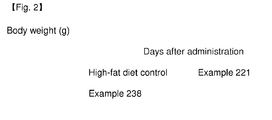
- the compounds of Examples 221 and 238 were homogeneously suspended in 1% methyl cellulose solution and orally administered for 4 weeks, once a day and five days a week, at a dosage of 10 mg/10 mL/kg. For control, only the 1% methyl cellulose solution was orally administered at 10 mL/kg. Change in body weight of the test and control groups was measured with 7-day intervals. The result is shown in Fig. 2 .
- the administration of the compounds of Examples resulted in decreased body weight of the high-fat diet-induced obese mice. Accordingly, the compounds of Examples may exhibit excellent anti-obesity effect.
- the above ingredients are mixed and prepared into a tablet according to a commonly employed method.
- the above ingredients are mixed and filled in a gelatin capsule according to a commonly employed method.
- the above ingredients are dissolved in purified water and an adequate amount of lemon flavor is added.
- the total volume is adjusted to 100 mL by adding purified water.
- the resulting liquid is filled in a brown bottle and sterilized.
- a cream may be prepared according to a commonly employed method as described in Table 25.
- Table 25 Ingredients wt% Compound of Example 2.0 Polysorbate 60 1.5 Sorbitan sesquioleate 0.5 PEG 60 hydrogenated castor oil 2.0 Liquid paraffin 10 Squalane 5.0 Caprylic/capric triglyceride 5.0 Glycerin 5.0 Butylene glycol 3.0 Propylene glycol 3.0 Triethanolamine 0.2 Antiseptic adequate Pigment adequate Flavor adequate Purified water to 100
Landscapes
- Health & Medical Sciences (AREA)
- Chemical & Material Sciences (AREA)
- Organic Chemistry (AREA)
- Engineering & Computer Science (AREA)
- Bioinformatics & Cheminformatics (AREA)
- Veterinary Medicine (AREA)
- Public Health (AREA)
- General Health & Medical Sciences (AREA)
- Animal Behavior & Ethology (AREA)
- Life Sciences & Earth Sciences (AREA)
- Medicinal Chemistry (AREA)
- Pharmacology & Pharmacy (AREA)
- General Chemical & Material Sciences (AREA)
- Nuclear Medicine, Radiotherapy & Molecular Imaging (AREA)
- Chemical Kinetics & Catalysis (AREA)
- Neurology (AREA)
- Biomedical Technology (AREA)
- Neurosurgery (AREA)
- Diabetes (AREA)
- Cardiology (AREA)
- Heart & Thoracic Surgery (AREA)
- Psychiatry (AREA)
- Hematology (AREA)
- Obesity (AREA)
- Pain & Pain Management (AREA)
- Endocrinology (AREA)
- Hospice & Palliative Care (AREA)
- Urology & Nephrology (AREA)
- Child & Adolescent Psychology (AREA)
- Emergency Medicine (AREA)
- Vascular Medicine (AREA)
- Rheumatology (AREA)
- Reproductive Health (AREA)
- Epidemiology (AREA)
- Nitrogen Condensed Heterocyclic Rings (AREA)
- Pharmaceuticals Containing Other Organic And Inorganic Compounds (AREA)
Abstract
Description
- The present disclosure relates to a novel compound acting as a cannabinoid receptor 1 inhibitor, a prodrug thereof, an isomer thereof, a pharmaceutically acceptable salt thereof, a hydrate thereof or a solvate thereof.
- Obesity in general refers to a fat state, but more accurately it means a medical condition in which excess fat has accumulated in the body. Since it is known that overweight and obesity are known to cause various health problems including chronic diseases such as hypertension, type 2 diabetes, cardiovascular diseases, fatty liver and hyperlipidemia, various drugs for treating obesity are being developed worldwide.
- At present, only two drugs, Reductil® (Sibutramine) and Xenical® (Orlistat) are approved by the FDA. However, Reductil has been withdrawn from the market in Europe by the because the recent SCOUT clinical study with 9,880 patients with cardiovascular diseases revealed higher incidence of side effects in the patients who took Reductil (11.4%) than those who received placebo (10%), and use of Xenical is recommended to be stopped if symptoms of liver damage occur after taking the drug due to the risk of severe liver damage.
- Accordingly, development of an obesity- drug exhibiting excellent effect without side effects is necessary.
- The present disclosure is directed to providing a novel compound acting as an cannabinoid receptor 1 inhibitor, which is a pyrazolo[1,5-a]pyrimidine derivative, a prodrug thereof, an isomer thereof, a pharmaceutically acceptable salt thereof, a hydrate thereof or a solvate thereof.
- In a general aspect, there is provided a compound represented by Chemical Formula 1:

R1 is selected from a group consisting of hydrogen, C1-C5 alkyl, haloalkyl, C1-C5 cycloalkyl and C1-C5 alkoxyalkyl;
each of R2, R3, R4, R5 and R6 is independently selected from a group consisting of hydrogen, fluoro, chloro, bromo, iodo, nitro, cyano, C1-C5 alkyl, hydroxy C1-C5 alkyl, C1-C5 alkoxy, C1-C5 alkoxy alkyl, halo C1-C3 alkyl, halo C1-C5 alkoxy, haloalkoxy C2-C5 alkenyl, C2-C5 alkenyl, alkynyl, carboxyl, C1-C5 alkylcarbonyl, C1-C5 alkoxycarbonyl, C1-C5 alkylcarbonylamino, C1-C5 alkylaminocarbonyl, C1-C5 alkylsulfanyl, C1-C5 alkylsulfonyl, C1-C5 alkoxysulfonyl, C1-C5 alkylsulfamoyl, aryl, aryl C1-C3 alkyl, aryl C1-C5 alkoxy, aminosulfonyl, C1-C5 alkylamino, C1-C5 alkylaminosulfonyl, C1-C5 alkylsulfonylamino, C1-C5 alkylthio, C3-C7 cycloalkylsulfonylaminophenyl,

each of R7, R8, R9, R10 and R11 is independently selected from a group consisting of hydrogen, fluoro, chloro, bromo, iodo, nitro, cyano, C1-C5 alkyl, C1-C5 alkoxy, halo C1-C3 alkyl, haloalkoxy C2-C5 alkenyl, C2-C5 alkenyl and alkynyl; and
each of R12 and R13 is independently selected from a group consisting of hydrogen, C1-C5 alkyl, hydroxy C1-C5 alkyl, C3-C7 cycloalkyl and halo C1-C5 alkyl, or R12 and R13 form a 5- to 7-membered ring together with the nitrogen atom which they are bound and the ring contains 0-2 N, O or S atoms or at least one substituent selected from a group consisting of hydrogen, hydroxy, hydroxy C1-C5 alkyl, C1-C5 alkoxy, C1-C5 alkoxy alkyl, halo C1-C5 alkyl, halo C1-C5 alkoxy and carboxyl,
a prodrug thereof, an isomer thereof, a pharmaceutically acceptable salt thereof, a hydrate thereof or a solvate thereof. - In another general aspect, there is provided a pharmaceutical composition containing the compound, the prodrug thereof, the isomer thereof, the pharmaceutically acceptable salt thereof, the hydrate thereof or the solvate thereof.
- In another general aspect, there is provided a method for preparing pyrazolo[1,5-a]pyrimidine having an aryl substituent bound at 7-position, including reacting aminopyrazole and a diketoester in a pyridine solvent, wherein at least one of the aminopyrazole and the diketoester contains an aryl group.
- In another general aspect, there is provided a pyrazolo[1,5-a]pyrimidine compound having an aryl substituent bound at 7-position prepared by the method for preparing pyrazolo[1,5-a]pyrimidine having an aryl substituent bound at 7-position, an isomer thereof, a pharmaceutically acceptable salt thereof, a hydrate thereof or a solvate thereof.
- A compound, a prodrug thereof, an isomer thereof, a pharmaceutically acceptable salt thereof, a hydrate thereof or a solvate thereof according to an aspect of the present disclosure may act as a cannabinoid receptor 1 inhibitor. Accordingly, the compound, the prodrug thereof, the isomer thereof, the pharmaceutically acceptable salt thereof, the hydrate thereof or the solvate thereof according to an aspect of the present disclosure may be used to prevent or treat diseases mediated by the cannabinoid receptor. Specifically, the compound, the prodrug thereof, the isomer thereof, the pharmaceutically acceptable salt thereof, the hydrate thereof or the solvate thereof according to an aspect of the present disclosure is useful for prevention or treatment of inflammatory diseases, immune diseases, neurological and mental disorders, cancers of the immune system, respiratory diseases or cardiovascular disease. More specifically, the compound, the prodrug thereof, the isomer thereof, the pharmaceutically acceptable salt thereof, the hydrate thereof or the solvate thereof according to an aspect of the present disclosure may be used to prevent or treat inflammatory pain, psycopathy, anxiety, depression, attention deficiency, memory or cognitive disorder, neuropathic pain disorder, sexual dysfunction, impulse control disorder, obesity, neurological or obsessive eating disorder, metabolic disorder such as morning sickness, nausea, gastric ulcer, diabetes, hypertension and hyperlipidemia or cardiac dysfunction such as valvular heart disease, myocardial infarction, cardiomegaly or congestive heart failure.
-
-
Fig. 1 shows a structure of 5-chloro-7-(4-chlorophenyl)-2-methylpyrazolo[1,5-a]pyrimidine solid crystal obtained from X-ray analysis. -
Fig. 2 shows change in the body weight of obese mice after administration of compounds according to exemplary embodiments. - Obesity may be prevented or treated by drugs participating in various mechanisms, including suppression of appetite, promotion of energy metabolism through enhanced thermogenesis, control of metabolism through inhibition or alteration of fat absorption, inhibition of fat biosynthesis, facilitation of fat breakdown, or the like.
- In particular, the endocannabinoid system is known to play an important role in regulation of appetite and energy metabolism. This system includes a variety of enzymes, endocannabinoids and cannabinoid receptors involved in the synthesis and breakdown of endogenous ligands. There are two cannabinoid (CB) receptors CB1 and CB2 consisting of 7 transmembrane domains.
- The CB1 receptor is distributed in several parts of the brain that regulate energy homeostasis and in peripheral parts including the liver, adipose tissue, gastrointestinal tract, pancreas and muscle tissue. An antagonist, inhibitor or modulator of the CB1 receptor is known to have various potentially therapeutic effects for treatment of neurological or mental disorders including psycopathy, anxiety, depression, attention deficiency, memory or cognitive disorder, etc., metabolic disorders or related conditions such as obesity, neurological or obsessive eating disorder, diabetes, hypertension and hyperlipidemia, cardiac dysfunctions such as valvular heart disease, myocardial infarction, cardiomegaly or congestive heart failure, neuropathic pain disorder, cancer, morning sickness, nausea, gastric ulcer, sexual dysfunction, impulse control disorder, and so forth. The CB2 receptor is primarily expressed in the spleen, tonsils, B cells, T cells, monocytes, etc. of the immune system and is involved in the recognition of inflammatory and neuropathic pain as well as allergy, asthma, multiple sclerosis, osteoporosis and inflammatory conditions.
- As described above, the CB1 receptor is directly involved in various metabolic diseases including obesity through facilitation of energy metabolism, control of appetite, regulation of processes related with fat metabolism, or the like. Indeed, it is known that CB1 receptor-deficient mice are resistant against obesity induced with high-fat diet and maintain body weight similarly to the control group fed with normal diet. The effect of suppression of appetite and reduction of body weight is also achieved when the CB1 receptor is inhibited with drugs. Specifically, CB1 receptor inhibitors such as rimonabant are known to have an excellent effect of suppressing appetite and reducing body weight also in human. However, since the CB1 receptor inhibitors may cause vomiting and mental side effects depression and anxiety in some people, many drugs were ceased to be developed during clinical stages.
- Therefore, if a CB1 receptor inhibitor is to be developed for treatment of obesity, development of a drug having a pharmacological and clinical profile different from that of the first-generation drug rimonabant will be necessary to avoid side effects. As a strategy for developing a safe CB1 receptor inhibitor without adversely affecting the central nervous system (CNS), development of an inhibitor targeting only the CB1 receptors in the peripheral tissues such as the adipose tissue, liver, muscle and gastrointestinal tract without acting on the brain may be conceived. A drug chemically modified not to pass the blood-brain barrier may ensure both safety and efficacy since it can be distributed only in the peripheral tissues without acting on the CB1 receptors existing in the brain. The peripheral effect of the CB1 receptor can be controlled according to various target tissues with different mechanisms. Examples include: i) liver: inhibition of fat biosynthesis, ii) muscle: promotion of glucose absorption, iii) adipose tissue: facilitation of expression and secretion of adiponectin and inhibition of fat biosynthesis and iv) gastrointestinal tract: secretion of signals inducing satiety.
- As used herein, "alkyl" refers to a saturated, monovalent aliphatic hydrocarbon chain. The hydrocarbon chain may be straight or branched. In an exemplary embodiment of the present disclosure, "alkyl" may have 1-5 carbon atoms ("C1-C5 alkyl"). In another exemplary embodiment, it may have 1-4 carbon atoms ("C1-C4 alkyl"). In another exemplary embodiment, it may have 1-3 carbon atoms ("C1-C3 alkyl"). Specifically, "alkyl" includes methyl, ethyl, n-propyl, isopropyl, n-butyl, isobutyl, tert-butyl or t-amyl, but is not limited thereto.
- As used herein, "alkoxy" refers to an -OR group wherein R is an alkyl group defined above. Specifically, "alkoxy" includes methoxy, ethoxy, n-propoxy, isopropoxy, n-butoxy, tert-butoxy, sec-butoxy, n-pentoxy or 1,2-dimethylbutoxy, but is not limited thereto.
- As used herein, "alkoxyalkyl" refers to an -ROR' wherein R and R' are alkyl groups defined above and may be identical or different.
- As used herein, "alkenyl" refers to an unsaturated, monovalent olefin-based hydrocarbon group having at least one double bond and may be straight or branched. In an exemplary embodiment of the present disclosure, "alkenyl" has 2-5 carbon atoms ("C2-C5 alkenyl"). Specifically, the alkenyl group includes ethenyl (-CH=CH2), n-propenyl (-CH2CH=CH2) or isopropenyl (-C(CH3)=CH2).
- As used herein, "vinyl" may also be referred to as "ethenyl" and refers to -CH=CH2.
- As used herein, "alkynyl" refers to an unsaturated hydrocarbon group having at least one triple bond. In an exemplary embodiment of the present disclosure, "alkynyl" may have 2-5 carbon atoms ("C2-C5 alkynyl"). In another exemplary embodiment, it may be ethynyl (acetylenyl). As used herein, "ethynyl" refers to -C=CH.
- As used herein, "cycloalkyl" refers to a saturated, cyclic aliphatic hydrocarbon group. A number attached to C means the number of carbon atoms forming the ring. For example, "C3-C6 cycloalkyl" means cycloalkyl having 3-6 ring-forming C atoms. In an exemplary embodiment of the present disclosure, "cycloalkyl" includes cyclopropyl, cyclobutyl, cyclopentyl or cyclohexyl, but is not limited thereto. In another exemplary embodiment of the present disclosure, "cycloalkyl" may be substituted with at least one alkyl group, for example, a C1-C6 alkyl group, specifically a C1-C3 alkyl group, more specifically methyl. When "cycloalkyl" has more than one substituents, these substituent may be identical or different.
- As used herein, "cycloalkoxy" refers to an -OR group wherein R is a "cycloalkyl" group defined above.
- As used herein, "halo" or "halogen" includes fluoro, chloro, bromo or iodo. In an exemplary embodiment of the present disclosure, a halo group may be fluoro or chloro.
- As used herein, "haloalkyl" refers to an "alkyl" group defined above which is substituted with at least one halogen that are identical (e.g., trifluoromethyl or pentafluoroethyl) or different.
- As used herein, "hydroxy" refers to an -OH radical.
- As used herein, "hydroxyalkyl" refers to an "alkyl" group defined above which is substituted with at least one hydroxy group.
- As used herein, "amino" refers to an -NH2 radical.
- As used herein, "cyano" refers to a -C=N radical.
- As used herein, "nitro" refers to an -NO2 radical.
- As used herein, "alkylamino" refers to an -NHR group wherein R is the "alkyl" group defined above.
- As used herein, "dialkylamino" refers to an -NRR' group wherein R and R' are the alkyl groups defined above and may be identical or different.
- As used herein, "aryl" refers to an aromatic hydrocarbon radical. Examples of the "aryl" group include phenyl, naphthyl, indenyl, azulenyl or anthracenyl. Phenyl may be preferred among them.
- As used herein, "arylamino" refers to an -NHAr group wherein Ar is the aryl group defined above.
- As used herein, "alkoxycarbonyl" refers to a -C(=O)-O-R radical wherein R is the alkyl group defined above.
- As used herein, "carboxy(I)" refers to a -C(=O)OH radical.
- As used herein, "alkylsulfonyl" refers to an -SO2R radical wherein R is the alkyl group defined above. In an exemplary embodiment of the present disclosure, "alkylsulfonyl" includes methylsulfonyl, ethylsulfonyl, propylsulfonyl or butylsulfonyl, but is not limited thereto.
- As used herein, "alkylthio" refers to an -S-R radical wherein R is the alkyl group defined above. In an exemplary embodiment of the present disclosure, "alkylthio" includes methylthio, ethylthio or propylthio, but is not limited thereto.
- As used herein, "isomer" includes not only optical isomers (e.g., essentially pure enantiomers, essentially pure diastereomers or a mixture thereof) but also conformational isomers (i.e., isomers that can be interconverted by rotations about single bonds), positional isomers (particularly, tautomers) or geometric isomers (e.g., cis-trans isomers).
- As used herein, "essentially pure" means, when used, for example, with regard to enantiomers or diastereomers, that specific compounds, e.g. enantiomers or diastereomers, are present in an amount of about 90% (w/w) or more, specifically about 95% or more, more specifically about 97% or more or about 98% or more, more specifically about 99% or more, more specifically about 99.5% or more.
- As used herein, "pharmaceutically acceptable" means being devoid of substantial toxic effects when used in a usually employed medicinal dosage and thereby being approvable or approved by the government or an international organization comparable thereto for use in animals, and more particularly in humans or being listed in the pharmacopeia.
- As used herein, "pharmaceutically acceptable salt" refers to a salt according to an aspect of the present disclosure that is pharmaceutically acceptable and possesses the desired pharmacological activity of the parent compound. Such salts include: (1) acid addition salts formed with inorganic acids such as hydrochloric acid, hydrobromic acid, sulfuric acid, nitric acid, phosphoric acid, etc. or formed with organic acids such as acetic acid, propionic acid, hexanoic acid, cyclopentanepropionic acid, glycolic acid, pyruvic acid, lactic acid, malonic acid, succinic acid, malic acid, maleic acid, fumaric acid, tartaric acid, citric acid, benzoic acid, 3-(4-hydroxybenzoyl)benzoic acid, cinnamic acid, mandelic acid, methanesulfonic acid, ethanesulfonic acid, 1,2-ethane-disulfonic acid, 2-hydroxyethanesulfonic acid, benzenesulfonic acid, 4-chlorobenzenesulfonic acid, 2-naphthalenesulfonic acid, 4-toluenesulfonic acid, camphorsulfonic acid, 4-methylbicyclo[2,2,2]-oct-2-ene-1-carboxylic acid, glucoheptonic acid, 3-phenylpropionic acid, trimethylacetic acid, tert-butylacetic acid, lauryl sulfuric acid, gluconic acid, glutamic acid, hydroxynaphthoic acid, salicylic acid, stearic acid and muconic acid; or (2) salts formed when an acidic proton present in the parent compound is replaced.
- As used herein, "pharmaceutically acceptable carrier" refers to a pharmaceutically acceptable carrier that can be administered together with the compound of the present disclosure.
- As used herein, "subject" includes human. The terms "human", "patient" and "subject" may be used interchangeably.
- As used herein, "preventing" or "prevention" refers to a reduction in the risk of acquiring a disease or disorder (i.e., causing at least one of the clinical symptoms of the disease not to develop in a subject that is exposed to or predisposed to the disease but does not yet experience or display the symptoms of the disease).
- As used herein, "therapeutically effective amount" refers to an amount of a compound that, when administered to a patient for treatment of a disease, is sufficient to effect such treatment of the disease. The "therapeutically effective amount" can vary depending on the compound, the disease and severity thereof, the age, body weight, etc. of the patient to be treated, or the like. In an exemplary embodiment of the present disclosure, "treating" or "treatment" of a disease or a disorder refers to ameliorating at least one of the clinical symptoms of the disease or disorder (i.e., arresting or reducing the development of the disease or at least one of the clinical symptoms of the disease). In another exemplary embodiment of the present disclosure, "treating" or "treatment" refers to ameliorating at least one physical parameter, which may not be discernible by the patient. In another exemplary embodiment of the present disclosure, "treating" or "treatment" refers to modulating the disease or disorder physically (e.g., stabilization of a discernible symptom), physiologically (e.g., stabilization of a physical parameter) or both. In another exemplary embodiment of the present disclosure, "treating" or "treatment" refers to delaying the onset of the disease or disorder.
- As used herein, "prodrug" refers to a drug whose physical and chemical properties have been changed chemically such that it does not exhibit a physiological activity as it is but is converted to an active drug through chemical or enzymatic processes after being administered.
- As used herein, "hydrate" refers to a compound to which water is bound. The binding between water and the compound includes non-covalent binding.
- As used herein, "solvate" refers to a complex formed by a solute molecule or ion and a solvent molecule or ion.
- Formerly, 2-methyl-5-arylpyrazolo[1,5-a]pyridin-7(4H)-one was synthesized by reacting 5-aminopyrazole with an arylketoester in an acetic acid, alcohol or toluene solvent to which an acid has been added under heating (Bioorg. Med. Chem. Lett., 2004, 14, 3669-3673). Then, 2-methyl-5-arylpyrazolo[1,5-a]pyridin-7(4H)-one was chlorinated in a POCl3 solvent to synthesize a pyridine in which a substituent is attached at 5-position (see Scheme 1).


- In contrast, the inventors of the present disclosure have found that 2-methyl-7-arylpyrazolo[1,5-a]pyrimidin-5(4H)-one can be synthesized by reacting 2-methyl-5-aminopyrazole with a 4-chlorophenylketoester in a pyridine solvent by stirring overnight at 90-95 ºC (see Scheme 2).

- That is to say, by changing the solvent, arylpyrazolo[1.5-a]pyridin-5(4H)-one in which an aryl is substituted at 7-position, not at the 5-position, can be synthesized in accordance with the method of the inventors of the present disclosure. In other words, an isomer having the aryl substituent at different position is obtained from that prepared by the previously known method in an organic solvent or under an acidic condition. The inventors of the present disclosure have identified the structure of the synthesized compound by X-ray crystallography. From the compound, a novel compound 3-aryl-7-aryl-5-dialkylaminopyrazolo[1,5-a]pyrimidine can be synthesized.
- The synthesis method will be described in further detail.
- Scheme 3 describes a method for synthesizing pyrazolo[1,5]pyridine of Chemical Formula 1.


- 5-Aminopyrazole (1) is a starting material that can be easily obtained in the art. First, 5-aminopyrazole (1) and an arylketoester (2) are reacted in a pyridine solvent to synthesize pyrazolopyridin-5(4H)-one (3). The compound (3) is reacted in a POCl3 solvent to synthesize 5-chloro-pyrazolopyridine-5(4H) (4), which is then reacted with a secondary amine in an acetonitrile solvent to prepare a novel compound pyrazolo[1,5]pyridine (5). Most of the synthesis procedure is based on the known organic synthesis methods.
- Scheme 4 describes another method for synthesizing novel pyrazolo[1,5]pyridine.


- According to Scheme 4, novel pyrazolo[1,5]pyridine can be synthesized more easily using the Suzuki cross-coupling reaction (J. Org. Chem., 1995, 60, 7508). An arylketoester (2) is reacted with aminopyrazole in a pyridine solvent to synthesize a compound (6). The compound (6) is reacted in a POCl3 solvent under heating to synthesize 5-chloro-pyrazolopyridine-5(4H) (7). The compound (7) is halogenated with N-iodosuccinimide (NIS) in a dichloromethane solvent by stirring at room temperature to synthesize iodo-5-chloro-pyrazolopyridine-5(4H) (8). The compound (8) is reacted with a secondary amine to synthesize a compound (9). The compound (9) is Suzuki cross-coupled to synthesize aryl-substituted pyrazolopyridine-5(4H) (11). Alternatively, iodo-5-chloro-pyrazolopyridine-5(4H) (8) may be Suzuki cross-coupled to synthesize a compound (10) and then it may be aminated to obtain the novel pyrazolopyridine-5(4H) compound (11).
- Scheme 5 describes another method for synthesizing novel pyrazolopyridine-5(4H) (5).

- Aminopyrazole (1) is reacted with diethylmalonate to synthesize pyrazolo[1,5-a]pyrimidin-5,7(4H,6H)-dione (12). The compound (12) is reacted in POCl3 to obtain a compound (13). The compound (13) is reacted with an aryl Grignard reagent under anhydrous condition to obtain a compound (4). As described in Scheme 3, the compound (4) may be aminated to obtain novel pyrazolopyridine-5(4H) (5). This procedure may be more suited for large-scale preparation.
- Scheme 6 describes a method for synthesizing a compound having a pyrrolidinemethanol or secondary amine group as a preferred compound among derivatives of novel pyrazolopyridine-5(4H).


- Aminopyrazole (14) with aryl substituted at 3-position is reacted with arylketoester to synthesize diarylpyrazolo[1,5-a]pyrimidin-5(4H)-one (16). The compound (16) is converted to a compound (17) by heating in POCl3. A substituted cyclic amine is reacted with the compound (17) to obtain a novel pyrazolopyridine-5(4H) compound (18). Alternatively, the compound (17) may be reacted with a linear secondary amine to obtain a compound (19).
- Scheme 7 describes a method for synthesizing novel diarylpyrazolo[1,5-a]pyrimidine having various substituents at 2-position of pyrazole.

- Diarylpyrazolo[1,5-a]pyrimidine having various substituents is synthesized using aminopyrazole having an alkyl or alkoxyalkyl substituent at 3-position as a starting material (Bioorg. Med. Chem., 2000, 8, 181-189). The substituent R1 may be C1-C5 alkyl, halo C1-C5 alkyl, C1-C5 alkoxy or C1-C5 alkoxy C1-C5 alkyl, more specifically methyl, ethyl, propyl, butyl, methoxy methyl, ethoxyethyl, ethoxymethyl or trifluoromethyl. A substituted phenylacetonitrile (20) is stirred with an ester in the presence of NaH at room temperature to synthesize a compound (21). Alternatively, the compound (21) may be synthesized by stirring with an ester in the presence of EtONa and another base in an ethanol solvent. The compound (21) is reacted with hydrazine to synthesize aminopyrazole (22) having various C1-C5 alkyl or C1-C5 alkoxy C1-C5 alkyl substituents at 3-position. From the aminopyrazole having various substituents at 3-position, compounds (25) and (26) are synthesized under conditions similar to those of Schemes 3-5.
- In an aspect, the present disclosure provides a compound represented by Chemical Formula 1, a prodrug thereof, an isomer thereof, a pharmaceutically acceptable salt thereof, a hydrate thereof or a solvate thereof.
- In Chemical Formula 1,
R1 is selected from a group consisting of hydrogen, C1-C5 alkyl, haloalkyl, C1-C5 cycloalkyl and C1-C5 alkoxyalkyl;
each of R2, R3, R4, R5 and R6 is independently selected from a group consisting of hydrogen, fluoro, chloro, bromo, iodo, nitro, cyano, C1-C5 alkyl, hydroxy C1-C5 alkyl, C1-C5 alkoxy, C1-C5 alkoxy alkyl, halo C1-C3 alkyl, halo C1-C5 alkoxy, haloalkoxy C2-C5 alkenyl, C2-C5 alkenyl, alkynyl, carboxyl, C1-C5 alkylcarbonyl, C1-C5 alkoxycarbonyl, C1-C5 alkylcarbonylamino, C1-C5 alkylaminocarbonyl, C1-C5 alkylsulfanyl, C1-C5 alkylsulfonyl, C1-C5 alkoxysulfonyl, C1-C5 alkylsulfamoyl, aryl, aryl C1-C3 alkyl, aryl C1-C5 alkoxy, aminosulfonyl, C1-C5 alkylamino, C1-C5 alkylaminosulfonyl, C1-C5 alkylsulfonylamino, C1-C5 alkylthio, C3-C7 cycloalkylsulfonylamonophenyl,

each of R7, R8, R9, R10 and R11 is independently selected from a group consisting of hydrogen, fluoro, chloro, bromo, iodo, nitro, cyano, C1-C5 alkyl, C1-C5 alkoxy, halo C1-C3 alkyl, haloalkoxy C2-C5 alkenyl, C2-C5 alkenyl and alkynyl; and
each of R12 and R13 is independently selected from a group consisting of hydrogen, C1-C5 alkyl, hydroxy C1-C5 alkyl, C3-C7 cycloalkyl and halo C1-C5 alkyl, or R12 and R13 form a 5- to 7-membered ring together with the nitrogen atom which they are bound and the ring contains 0-2 N, O or S atoms or at least one substituent selected from a group consisting of hydrogen, hydroxy, hydroxy C1-C5 alkyl, C1-C5 alkoxy, C1-C5 alkoxy alkyl, halo C1-C5 alkyl, halo C1-C5 alkoxy and carboxyl. - The compound may be prepared based on Schemes 3-7.
- In another aspect, the present disclosure provides a compound represented by Chemical Formula 2, as a compound related with the compound of Chemical Formula 1, a prodrug thereof, an isomer thereof, a pharmaceutically acceptable salt thereof, a hydrate thereof or a solvate thereof.

- In Chemical Formula 2,
R1 is selected from a group consisting of hydrogen, C1-C5 alkyl, haloalkyl, C1-C5 cycloalkyl and C1-C5 alkoxyalkyl;
each of R2, R3, R4, R5 and R6 is independently selected from a group consisting of hydrogen, fluoro, chloro, bromo, iodo, nitro, cyano, C1-C5 alkyl, hydroxy C1-C5 alkyl, C1-C5 alkoxy, C1-C5 alkoxy alkyl, halo C1-C3 alkyl, halo C1-C5 alkoxy, haloalkoxy C2-C5 alkenyl, C2-C5 alkenyl, alkynyl, carboxyl, C1-C5 alkylcarbonyl, C1-C5 alkoxycarbonyl, C1-C5 alkylcarbonylamino, C1-C5 alkylaminocarbonyl, C1-C5 alkylsulfanyl, C1-C5 alkylsulfonyl, C1-C5 alkoxysulfonyl, C1-C5 alkylsulfamoyl, aryl, aryl C1-C3 alkyl, aryl C1-C5 alkoxy, aminosulfonyl, C1-C5 alkylamino, C1-C5 alkylaminosulfonyl, C1-C5 alkylsulfonylamino, C1-C5 alkylthio, C3-C7 cycloalkylsulfonylamonophenyl,

each of R7, R8, R9, R10 and R11 is independently selected from a group consisting of hydrogen, fluoro, chloro, bromo, iodo, nitro, cyano, C1-C5 alkyl, C1-C5 alkoxy, halo C1-C3 alkyl, haloalkoxy C2-C5 alkenyl, C2-C5 alkenyl and alkynyl;
R14 is selected from a group consisting of hydrogen, hydroxy, hydroxy C1-C5 alkyl, C1-C5 alkoxy, C1-C5 alkoxy alkyl, halo C1-C5 alkyl, halo C1-C5 alkoxy and carboxyl; and
n is an integer selected from 1 to 3. - In another aspect, the present disclosure provides a compound represented by Chemical Formula 3, as a compound related with the compound of Chemical Formula 1, a prodrug thereof, an isomer thereof, a pharmaceutically acceptable salt thereof, a hydrate thereof or a solvate thereof.


- In Chemical Formula 3,
R1 is selected from a group consisting of methyl, ethyl, propyl, butyl, isobutyl, difluoromethyl, trifluoromethyl, cyclopropyl, ethoxymethyl, methoxymethyl and ethoxyethyl;
each of R3, R4 and R5 is independently selected from a group consisting of hydrogen, fluoro, chloro, bromo, iodo, nitro, cyano, methyl, ethyl, propyl, isopropyl, butyl, tert-butyl, methoxy, ethoxy, propoxy, isopropoxy, butoxy, hydroxymethyl, hydroxyethyl, trifluoromethyl, difluoromethyl, fluoromethyl, trifluoromethoxyvinyl, acetylenyl, carboxyl, methoxycarbonyl, ethoxycarbonyl, acetyl, methylsulfanyl, ethylsulfanyl, methylsulfonyl, methylsulfonylamino, cyclopropylaminosulfonyl, methylaminosulfonyl, ethylaminosulfonyl, dimethylaminocarbonyl, diethylaminocarbonyl, methylcarbonylamino, methylsulfamoyl, phenylmethyl, phenylethyl, phenylmethoxy, phenylacetyl, aminosulfonyl, methylaminosulfonyl, ethylaminosulfonyl, dimethylamino, diethylamino, cyclopropylamino and methylthio, or two selected from R3 through R5 form a 5- to 7-membered ring fused with an aryl group together with the carbon atoms to which they are bound and the ring includes 0-2 double bonds and contains 0-2 N, O or S atoms; and
each of R8, R9 and R10 is independently selected from a group consisting of hydrogen, fluoro, chloro, bromo, iodo, nitro, cyano, methyl, ethyl, propyl, butyl, isopropyl, methoxy, ethoxy, propoxy, isopropoxy, hydroxymethyl, trifluoromethyl, difluoromethyl, fluoromethyl, trifluoromethoxyvinyl and acetylenyl. - In another aspect, the present disclosure provides a compound represented by Chemical Formula 3, a prodrug thereof, an isomer thereof, a pharmaceutically acceptable salt thereof, a hydrate thereof or a solvate thereof, wherein:
- R1 is selected from a group consisting of methyl, ethyl, propyl, butyl, isobutyl, trifluoromethyl, cyclopropyl, ethoxymethyl, methoxymethyl and ethoxyethyl;
- each of R3, R4 and R5 is independently selected from a group consisting of hydrogen, fluoro, chloro, nitro, cyano, methyl, ethyl, propyl, isopropyl, butyl, tert-butyl, methoxy, ethoxy, propoxy, methylenedioxy, isopropoxy, hydroxymethyl, hydroxyethyl, trifluoromethyl, difluoromethyl, fluoromethyl, trifluoromethoxyvinyl, acetylenyl, carboxyl, methoxycarbonyl, ethoxycarbonyl, acetyl, methylsulfonyl, methylsulfamoyl, phenylmethyl, phenylethyl and methylthio, or two selected from R3 through R5 form a 5- to 7-membered ring fused with an aryl group together with the carbon atoms to which they are bound and the ring includes 0-2 double bonds and contains 0-2 N, O or S atoms; and
- each of R8, R9 and R10 is independently selected from a group consisting of hydrogen, fluoro, chloro, bromo, iodo, nitro, cyano, methyl, ethyl, propyl, butyl, isopropyl, methoxy, ethoxy, propoxy, isopropoxy, butoxy, hydroxymethyl, trifluoromethyl, difluoromethyl, fluoromethyl, trifluoromethoxyvinyl and acetylenyl.
- In another aspect, the present disclosure provides a compound selected from the followings, an isomer thereof, a pharmaceutically acceptable salt thereof, a hydrate thereof or a solvate thereof:
- {1-[7-(3-chloro-4-fluorophenyl)-2-methyl-3-p-tolyl-pyrazolo[1,5-a]pyrimidin-5-yl]-pyrrolidin-2-yl}-methanol,
- {1-[7-(3-chloro-4-fluorophenyl)-3-(4-fluorophenyl)-2-methyl-pyrazolo[1,5-a]pyrimidin-5-yl]-pyrrolidin-2-yl}-methanol,
- {1-[3-(3-fluoro-4-methylphenyl)-7-(3-methoxyphenyl)-2-methyl-pyrazolo[1,5-a]pyrimidin-5-yl]-pyrrolidin-2-yl}-methanol,
- {1-[3-(2,4-difluorophenyl)-7-(3-methoxyphenyl)-2-methyl-pyrazolo[1,5-a]pyrimidin-5-yl]pyrrolidin-2-yl}-methanol,
- {1-[3-(3-fluoro-4-methylphenyl)-2-methyl-7-(3-trifluoromethylphenyl)-pyrazolo[1,5-a]pyrimidin-5-yl]-pyrrolidin-2-yl}-methanol,
- {1-[3-(2,4-difluorophenyl)-2-methyl-7-(3-trifluoromethylphenyl)-pyrazolo[1,5-a]pyrimidin-5-yl]-pyrrolidin-2-yl}-methanol,
- {1-[7-(3-chloro-4-fluorophenyl)-3-(4-methoxyphenyl)-2-methyl-pyrazolo[1,5-a]pyrimidin-5-yl]-pyrrolidin-2-yl}-methanol,
- {1-[7-(3,4-difluorophenyl-3-(3-fluoro-4-methyl-phenyl)-2-methyl-pyrazolo[1,5-a]pyrimidin-5-yl]-pyrrolidin-2-yl}-methanol,
- {1-[7-(3-ethylphenyl)-2-methyl-3-p-tolyl-pyrazolo[1,5-a]pyrimidin-5-yl]-pyrrolidin-2-yl}-methanol,
- {1-[3-(4-chlorophenyl)-7-(3-ethylphenyl)-2-methyl-pyrazolo[1,5-a]pyrimidin-5-yl]-pyrrolidin-2-yl}-methanol,
- {1-[7-(3,5-difluorophenyl)-3-(4-methoxyphenyl)-2-methyl-pyrazolo[1,5-a]pyrimidin-5-yl]-pyrrolidin-2-yl}-methanol,
- {1-[3-(3,4-difluorophenyl)-2-methyl-7-(3-trifluoromethylphenyl)-pyrazolo[1,5-a]pyrimidin-5-yl]-pyrrolidin-2-yl}-methanol,
- {1-[3-(4-fluorophenyl)-2-methyl-7-(3-trifluoromethylphenyl)-pyrazolo[1,5-a]pyrimidin-5-yl]-pyrrolidin-2-yl}-methanol,
- {1-[3-(3,4-difluorophenyl)-2-methyl-7-(3-trifluoromethylphenyl)-pyrazolo[1,5-a]pyrimidin-5-yl]-pyrrolidin-2-yl}-methanol,
- {1-[3-benzo-1,3]dioxol-5-yl-7-(3,5-difluorophenyl)-2-methyl-pyrazolo[1,5-a]pyrimidin-5-yl]-pyrrolidin-2-yl}-methanol,
- {1-[2-ethoxymethyl-3-(4-methoxyphenyl)-7-(3-trifluoromethylphenyl)-pyrazolo[1,5-a]pyrimidin-5-yl]-pyrrolidin-2-yl}-methanol,
- {1-[7-(3,5-difluorophenyl)-3-(4-methoxyphenyl)-2-methyl-pyrazolo[1,5-a]pyrimidin-5-yl]-pyrrolidin-2-yl}-methanol,
- {1-[3-(4-methoxyphenyl)-2-trifluoromethyl-7-(3-trifluoromethylphenyl)-pyrazolo[1,5-a]pyrimidin-5-yl]-pyrrolidin-2-yl}-methanol,
- {1-[2-ethoxymethyl-3-(4-methoxyphenyl)-7-(3-methoxyphenyl)-pyrazolo[1,5-a]pyrimidin-5-yl]-pyrrolidin-2-yl}-methanol,
- {1-[2-ethoxymethyl-7-(4-fluorophenyl)-3-(4-methoxyphenyl)-pyrazolo[1,5-a]pyrimidin-5-yl]-pyrrolidin-2-yl}-methanol,
- {1-[2-difluoromethyl-3-(4-methoxyphenyl)-7-(3-trifluoromethylphenyl)-pyrazolo[1,5-a]pyrimidin-5-yl]-pyrrolidin-2-yl}-methanol,
- {1-[3-benzo-[1,3]dioxol-5-yl-2-ethoxymethyl-7-(3-fluorophenyl)-pyrazolo[1,5-a]pyrimidin-5-yl]-pyrrolidin-2-yl}-methanol,
- {1-[2-ethyl-7-(4-fluorophenyl)-3-p-tolyl-pyrazolo[1,5-a]pyrimidin-5-yl]-pyrrolidin-2-yl}-methanol,
- {1-[7-(3-chlorophenyl)-2-ethyl-3-p-tolyl-pyrazolo[1,5-a]pyrimidin-5-yl]-pyrrolidin-2-yl}-methanol,
- {1-[2-ethyl-7-(3-fluorophenyl)-3-p-tolylpyrazolo[1,5-a]pyrimidin-5-yl]-pyrrolidin-2-yl}-methanol,
- {1-[3-benzo[1,3]dioxol-5-yl-2-ethoxymethyl-7-(3-trifluoromethylphenyl)-pyrazolo[1,5-a]pyrimidin-5-yl]-pyrrolidin-2-yl}-methanol,
- {1-[3-benzo[1,3]dioxol-5-yl-7-(3-chlorophenyl)-2-ethoxymethyl-pyrazolo[1,5-a]pyrimidin-5-yl]-pyrrolidin-2-yl}-methanol,
- {1-[2-ethoxymethyl-3-p-tolyl-7-(3-trifluoromethylphenyl)-pyrazolo[1,5-a]pyrimidin-5-yl]-pyrrolidin-2-yl}-methanol,
- {1-[2-ethoxymethyl-7-(3-fluorophenyl)-3-p-tolyl-pyrazolo[1,5-a]pyrimidin-5-yl]-pyrrolidin-2-yl}-methanol,
- {1-[2-ethoxymethyl-3-p-tolyl-7-(3-trifluoromethylphenyl)-pyrazolo[1,5-a]pyrimidin-5-yl]-pyrrolidin-2-yl}-methanol,
- {1-[2-ethoxymethyl-7-m-tolyl-3-p-tolyl-pyrazolo[1,5-a]pyrimidin-5-yl]-pyrrolidin-2-yl}-methanol,
- {1-[2-ethoxymethyl-7-(3-fluorophenyl)-3-(4-methoxyphenyl)-pyrazolo[1,5-a]pyrimidin-5-yl]-pyrrolidin-2-yl}-methanol,
- {1-[2-ethoxymethyl-7-(4-fluorophenyl)-3-(4-methoxyphenyl)-pyrazolo[1,5-a]pyrimidin-5-yl]-pyrrolidin-2-yl}-methanol,
- {1-[2-methoxymethyl-3-(4-methoxyphenyl)-7-(3-trifluoromethylphenyl)-pyrazolo[1,5-a]pyrimidin-5-yl]-pyrrolidin-2-yl}-methanol,
- {1-[2-butyl-3-p-tolyl-7-(3-trifluoromethylphenyl)-pyrazolo[1,5-a]pyrimidin-5-yl]-pyrrolidin-2-yl}-methanol,
- {1-[2-ethoxymethyl-7-(3-methoxyphenyl)-3-p-tolyl-pyrazolo[1,5-a]pyrimidin-5-yl]-pyrrolidin-2-yl}-methanol,
- {1-[3-(4-chlorophenyl)-2-ethoxymethyl-7-(3-trifluoromethylphenyl)-pyrazolo[1,5-a]pyrimidin-5-yl]-pyrrolidin-2-yl}-methanol,
- {1-[3-(4-chlorophenyl)-2-ethoxymethyl-7-(4-fluorophenyl)-pyrazolo[1,5-a]pyrimidin-5-yl]-pyrrolidin-2-yl}-methanol,
- {1-[3-(4-chlorophenyl)-2-ethoxymethyl-7-(3-fluorophenyl)-pyrazolo[1,5-a]pyrimidin-5-yl]-pyrrolidin-2-yl}-methanol,
- {1-[3-(4-chlorophenyl)-2-ethoxymethyl-7-(3-trifluoromethylphenyl)-pyrazolo[1,5-a]pyrimidin-5-yl]-pyrrolidin-2-yl}-methanol,
- 2-{[3-(4-chlorophenyl)-2-methoxymethyl-7-(3-trifluoromethylphenyl)-pyrazolo[1,5-a]pyrimidin-5-yl]-pyrrolidin-2-yl}-methanol,
- {1-[3-(4-chlorophenyl)-7-(4-fluorophenyl)-2-methoxymethyl-pyrazolo[1,5-a]pyrimidin-5-yl]-pyrrolidin-2-yl}-methanol,
- {1-[3-(4-chlorophenyl)-7-(3-fluorophenyl)-2-methoxymethyl-pyrazolo[1,5-a]pyrimidin-5-yl]-pyrrolidin-2-yl}-methanol,
- 2-{[2-methoxymethyl-3-(4-methoxyphenyl)-7-(3-trifluoromethylphenyl)-pyrazolo[1,5-a]pyrimidin-5-yl]-pyrrolidin-2-yl}-methanol,
- {1-[7-(4-fluorophenyl)-2-methoxymethyl-3-(4-methoxyphenyl)-pyrazolo[1,5-a]pyrimidin-5-yl]-pyrrolidin-2-yl}-methanol,
- {1-[3-benzo[1,3]dioxol-5-yl-7-(3-fluorophenyl)-2-methoxymethyl-pyrazolo[1,5-a]pyrimidin-5-yl]-pyrrolidin-2-yl}-methanol,
- {1-[3-benzo[1,3]dioxol-5-yl-7-(4-fluorophenyl)-2-methoxymethyl-pyrazolo[1,5-a]pyrimidin-5-yl]-pyrrolidin-2-yl}-methanol,
- {1-[3-benzo[1,3]dioxol-5-yl-2-methoxymethyl-7-(3-trifluoromethylphenyl)-pyrazolo[1,5-a]pyrimidin-5-yl]-pyrrolidin-2-yl}-methanol,
- (s)-3-(5-(2-hydroxymethyl)pyrrolidin-1-yl)-2-(methoxymethyl)-3(4-methoxyphenyl)-pyrazolo[1,5-a]pyrimidin-7-yl)benzonitrile,
- (S)-[{1-(2-methoxymethyl)-3-(methoxyphenyl)-7-(m-tolyl)-pyrazolo[1,5-a]-pyridin-5-yl}-pyrrolidin-2-yl]-methanol,
- (S)-{[1-(2-methoxymethyl)-7-(3-methoxyphenyl)-3-(4-methoxyphenyl)-pyrazolo[1,5-a]pyrimidin-5-yl]-pyrrolidin-2-yl}-methanol,
- {1-[3-(4-chlorophenyl)-7-(2,4-difluorophenyl)-2-methyl-pyrazolo[1,5-a]pyrimidin-5-yl]-pyrrolidin-2-yl}-methanol,
- [1-(3-benzo[1,3]dioxol-5-yl-2-methyl-7-phenyl-pyrazolo[1,5-a]pyrimidin-5-yl)-pyrrolidin-2-yl]-methanol,
- {1-[3-(4-ethoxyphenyl)-2-methyl-7-phenyl-pyrazolo[1,5-a]pyrimidin-5-yl]-pyrrolidin-2-yl}-methanol,
- {1-[3-(4-methoxyphenyl)-2-methyl-7-phenyl-pyrazolo[1,5-a]pyrimidin-5-yl]-pyrrolidin-2-yl}-methanol,
- (S)-(1-(7-(3,4-difluorophenyl)-3-(4-ethoxyphenyl)-2-methyl-pyrazolo[1,5-a]pyrimidin-5-yl)-pyrrolidin-2-yl)-methanol,
- {1-[2-methyl-3-(4-methylsulfanylphenyl)-7-(3-trifluoromethylphenyl)-pyrazolo[1,5-a]pyrimidin-5-yl]-pyrrolidin-2-yl}-methanol,
- {1-[7-(3,4-difluorophenyl)-3-(4-methoxyphenyl)-2-methyl-pyrazolo[1,5-a]pyrimidin-5-yl]-pyrrolidin-2-yl}-methanol,
- {1-[7-(3,4-difluorophenyl)-2-methyl-3-p-tolyl-pyrazolo[1,5-a]pyrimidin-5-yl]-pyrrolidin-2-yl}-methanol,
- {1-[7-(3,4-difluorophenyl)-2-methyl-3-p-tolyl-pyrazolo[1,5-a]pyrimidin-5-yl]-pyrrolidin-2-yl}-methanol,
- {1-[7-(3,4-difluorophenyl)-2-methyl-3-p-tolyl-pyrazolo[1,5-a]pyrimidin-5-yl]-pyrrolidin-2-yl}-methanol,
- {1-[3-(4-chlorophenyl)-7-(3,4-difluorophenyl)-2-methyl-pyrazolo[1,5-a]pyrimidin-5-yl]-pyrrolidin-2-yl}-methanol,
- {1-[7-(4-fluorophenyl)-2-methyl-3-p-tolyl-pyrazolo[1,5-a]pyrimidin-5-yl]-pyrrolidin-2-yl}-methanol,
- [1-(2-methyl-7-phenyl-3-p-tolyl-pyrazolo[1,5-a]pyrimidin-5-yl]-pyrrolidin-2-yl]-methanol,
- [1-[3-(4-difluoromethylphenyl)-7-(3-fluorophenyl)-2-methyl-pyrazolo[1,5-a]pyrimidin-5-yl]-pyrrolidin-2-yl}-methanol,
- {1-[3-(4-difluoromethylphenyl)-7-(3-methoxyphenyl)-2-methyl-pyrazolo[1,5-a]pyrimidin-5-yl]-pyrrolidin-2-yl}-methanol,
- {1-[3-(4-difluoromethylphenyl)-2-methyl-7-(3-trifluoromethylphenyl)-pyrazolo[1,5-a]pyrimidin-5-yl]-pyrrolidin-2-yl}-methanol,
- {1-[3-(4-difluoromethylphenyl)-7-(4-fluorophenyl)-2-methyl-pyrazolo[1,5-a]pyrimidin-5-yl]-pyrrolidin-2-yl}-methanol,
- {1-[3-(4-difluoromethylphenyl)-2-methyl-7-m-tolyl-pyrazolo[1,5-a]pyrimidin-5-yl]-pyrrolidin-2-yl}-methanol,
- {1-[7-(4-chlorophenyl)-3-(4-methoxyphenyl)-2-methyl-pyrazolo[1,5-a]pyrimidin-5-yl]-pyrrolidin-2-yl}-methanol,
- {1-[7-(3-methoxyphenyl)-2-methyl-3-(4-trifluoromethylphenyl)-pyrazolo[1,5-a]pyrimidin-5-yl]-pyrrolidin-2-yl}-methanol,
- {1-[3-(4-ethylphenyl)-2-methyl-7-(3-trifluoromethylphenyl)-pyrazolo[1,5-a]pyrimidin-5-yl]-pyrrolidin-2-yl}-methanol,
- {1-[3-(4-ethylphenyl)-2-methyl-7-(3-trifluoromethylphenyl)-pyrazolo[1,5-a]pyrimidin-5-yl]-pyrrolidin-2-yl}-methanol,
- {1-[2-methyl-3-(4-trifluoromethylphenyl)-7-(3-trifluoromethylphenyl)-pyrazolo[1,5-a]pyrimidin-5-yl]-pyrrolidin-2-yl}-methanol,
- {1-[7-(4-chlorophenyl)-2-methyl-3-p-tolyl-pyrazolo[1,5-a]pyrimidin-5-yl]-pyrrolidin-2-yl}-methanol,
- [1-(2-methyl-3,7-di-p-tolyl-pyrazolo[1,5-a]pyrimidin-5-yl)-pyrrolidin-2-yl]-methanol,
- {1-[7-(3-chlorophenyl)-2-methyl-3-p-tolyl-pyrazolo[1,5-a]pyrimidin-5-yl]-pyrrolidin-2-yl}-methanol,
- {1-[7-(3-chlorophenyl)-2-methyl-3-p-tolyl-pyrazolo[1,5-a]pyrimidin-5-yl]-pyrrolidin-2-yl}-methanol,
- [1-(2-methyl-7-m-tolyl-3-p-tolyl-pyrazolo[1,5-a]pyrimidin-5-yl)-pyrrolidin-2-yl]-methanol,
- {1-[7-(3-methoxyphenyl)-2-methyl-3-p-tolyl-pyrazolo[1,5-a]pyrimidin-5-yl]-pyrrolidin-2-yl}-methanol,
- {1-[7-(4-methoxyphenyl)-2-methyl-3-p-tolyl-pyrazolo[1,5-a]pyrimidin-5-yl]-pyrrolidin-2-yl}-methanol,
- {1-[7-(2-fluorophenyl)-2-methyl-3-p-tolyl-pyrazolo[1,5-a]pyrimidin-5-yl]-pyrrolidin-2-yl}-methanol,
- {1-[3-benzo[1,3]dioxol-5-yl-7-(3-fluorophenyl)-2-methyl-pyrazolo[1,5-a]pyrimidin-5-yl]-pyrrolidin-2-yl}-methanol,
- {1-[7-(3-fluorophenyl)-3-(4-methoxyphenyl)-2-methyl-pyrazolo[1,5-a]pyrimidin-5-yl]-pyrrolidin-2-yl}-methanol,
- {1-[3-(4-ethoxyphenyl)-7-(3-fluoromethylphenyl)-2-methyl-pyrazolo[1,5-a]pyrimidin-5-yl]-pyrrolidin-2-yl}-methanol,
- {1-[2-methyl-3-p-tolyl-7-(3-trifluoromethylphenyl)-pyrazolo[1,5-a]pyrimidin-5-yl]-pyrrolidin-2-yl}-methanol,
- {1-[3-(4-methoxyphenyl)-2-methyl-7-(3-trifluoromethylphenyl)-pyrazolo[1,5-a]pyrimidin-5-yl]-pyrrolidin-2-yl}-methanol,
- {1-[7-(3-chlorophenyl)-3-(4-methoxyphenyl)-2-methyl-pyrazolo[1,5-a]pyrimidin-5-yl]-pyrrolidin-2-yl}-methanol,
- {1-[3-benzo[1,3]dioxol-5-yl-7-(3-chloro-phenyl)-2-methyl-pyrazolo[1,5-a]pyrimidin-5-yl]-pyrrolidin-2-yl}-methanol,
- {1-[7-(4-fluorophenyl)-2-methyl-3-(4-vinylphenyl)-pyrazolo[1,5-a]-pyrrolidin-2-yl}-methanol,
- {1-[3-(4-ethoxyphenyl)-2-methyl-7-(3-trifluoromethylphenyl)-pyrazolo[1,5-a]pyrimidin-5-yl]-pyrrolidin-2-yl}-methanol,
- {1-[3-benzo[1,3]dioxol-5-yl-2-methyl-7-(3-trifluoromethylphenyl)-pyrazolo[1,5-a]pyrimidin-5-yl]-pyrrolidin-2-yl}-methanol,
- {1-[3-(4-fluoro-3-methylphenyl)-7-(4-fluorophenyl)-2-methyl-pyrazolo[1,5-a]pyrimidin-5-yl]-pyrrolidin-2-yl}-methanol,
- {1-[3-(3-fluoro-4-methylphenyl)-7-(4-fluorophenyl)-2-methyl-pyrazolo[1,5-a]pyrimidin-5-yl]-pyrrolidin-2-yl}-methanol,
- {1-[3-(4-ethoxyphenyl)-7-(4-fluorophenyl)-2-methyl-pyrazolo[1,5-a]pyrimidin-5-yl]-pyrrolidin-2-yl}-methanol,
- {1-[7-(4-fluorophenyl)-2-methyl-3-p-tolyl-pyrazolo[1,5-a]pyrimidin-5-yl]-pyrrolidin-2-yl}methanol,
- {1-[7-(4-fluorophenyl)-2-methyl-3-(4-propoxyphenyl)-pyrazolo[1,5-a]pyrimidin-5-yl]-pyrrolidin-2-yl}methanol,
- {1-[3-biphenyl-4-yl-7-(4-fluorophenyl)-2-methyl-pyrazolo[1,5-a]pyrimidin-5-yl]-pyrrolidin-2-yl}methanol,
- {1-[3-(2,4-difluorophenyl)-7-(4-fluorophenyl)-2-methyl-pyrazolo[1,5-a]pyrimidin-5-yl]-pyrrolidin-2-yl}methanol,
- {1-[3-(4-ethylsulfanylphenyl)-7-(4-fluorophenyl)-2-methyl-pyrazolo[1,5-a]pyrimidin-5-yl]-pyrrolidin-2-yl}methanol,
- {1-[3-(4-butoxyphenyl)-7-(4-fluorophenyl)-2-methyl-pyrazolo[1,5-a]pyrimidin-5-yl]-pyrrolidin-2-yl}methanol,
- {1-[7-(4-fluorophenyl)-2-methyl-3-(4-methylsulfanylphenyl)-pyrazolo[1,5-a]pyrimidin-5-yl]-pyrrolidin-2-yl}methanol,
- {1-[3-(4-benzoyloxyphenyl)-7-(4-fluorophenyl)-2-methyl-pyrazolo[1,5-a]pyrimidin-5-yl]-pyrrolidin-2-yl}methanol,
- {1-[7-(4-fluorophenyl)-2-methyl-3-(3-trifluoromethoxy-phenyl)-pyrazolo[1,5-a]pyrimidin-5-yl]-pyrrolidin-2-yl}methanol,
- {1-[7-(4-fluorophenyl)-2-methyl-3-(4-trifluoromethoxyphenyl)-pyrazolo[1,5-a]pyrimidin-5-yl]-pyrrolidin-2-yl}-methanol,
- {1-[3-(4-ethylphenyl)-7-(4-fluorophenyl)-2-methyl-pyrazolo[1,5-a]pyrimidin-5-yl]-pyrrolidin-2-yl}-methanol,
- {1-[7-(4-fluorophenyl)-2-methyl-3-(4-trifluoromethylphenyl)-pyrazolo[1,5-a]pyrimidin-5-yl]-pyrrolidin-2-yl}-methanol,
- 1-{4-[7-(4-fluorophenyl)-5-(2-hydroxymethyl-pyrrolidin-1-yl)-2-methyl-pyrazolo[1,5-a]pyrimidin-3-yl]phenyl}-ethanol,
- {1-[3-(4-tert-butylphenyl)-7-(4-fluorophenyl)-2-methyl-pyrazolo[1,5-a]pyrimidin-5-yl]pyrrolidin-2-yl}-methanol,
- [1-(2-methyl-7-phenyl-3-p-tolyl-pyrazolo[1,5-a]pyrimidin-5-yl]-pyrrolidin-2-yl}-methanol,
- {1-[7-(3-fluorophenyl)-2-methyl-3-p-tolyl-pyrazolo[1,5-a]pyrimidin-5-yl]-pyrrolidin-2-yl}-methanol,
- {1-[3-(4-chlorophenyl)-2-methyl-7-m-tolyl-pyrazolo[1,5-a]pyrimidin-5-yl]-pyrrolidin-2-yl}-methanol,
- {1-[3-benzo[1,3]dioxol-5-yl-7-(4-fluorophenyl)-2-methyl-pyrazolo[1,5-a]pyrimidin-5-yl]-pyrrolidin-2-yl}-methanol,
- {1-[7-(4-fluorophenyl)-3-(4-methoxyphenyl)-2-methyl-pyrazolo[1,5-a]pyrimidin-5-yl]-pyrrolidin-2-yl}-methanol,
- {1-[3-(4-chlorophenyl)-7-(4-fluorophenyl)-2-methyl-pyrazolo[1,5-a]pyrimidin-5-yl]-pyrrolidin-2-yl}-methanol,
- {1-[3-(4-chlorophenyl)-2-cyclopropyl-7-(3-fluorophenyl)-pyrazolo[1,5-a]pyridin-5-yl]-pyrrolidin-2-yl}-methanol,
- {1-[3-(4-chlorophenyl)-2-methyl-7-(3-trifluoromethylphenyl)-pyrazolo[1,5-a]pyridin-5-yl]-pyrrolidin-2-yl}-methanol,
- {1-[3-(4-chlorophenyl)-7-(3-fluorophenyl)-2-methyl-pyrazolo[1,5-a]pyrimidin-5-yl]-pyrrolidin-2-yl}-methanol,
- {1-[3-(4-chlorophenyl)-7-(3-chlorophenyl)-2-methyl-pyrazolo[1,5-a]pyrimidin-5-yl]-pyrrolidin-2-yl}-methanol,
- {1-[3,7-bis-(4-chlorophenyl)-2-methyl-pyrazolo[1,5-a]pyrimidin-5-yl]-pyrrolidin-2-yl}-methanol,
- {1-[3-(2,4-dichlorophenyl)-2-cyclopropyl-7-(2-fluorophenyl)-pyrazolo[1,5-a]pyrimidin-5-yl]-pyrrolidin-2-yl}-methanol,
- {1-[3-(2,4-dichlorophenyl)-2-cyclopropyl-7-(4-fluorophenyl)-pyrazolo[1,5-a]pyrimidin-5-yl]-pyrrolidin-2-yl}-methanol,
- (S)-{1-[3-(4-chlorophenyl)-2-methyl-7-phenyl-pyrazolo[1,5-a]pyrimidin-5-yl]-pyrrolidin-2-yl}-methanol,
- (S)-{1-[7-(2-fluorophenyl)-2-(methoxymethyl)-3-(4-methoxyphenyl)-pyrazolo[1,5-a]pyrimidin-5-yl]-pyrrolidin-2-yl}-methanol,
- (S)-{1-[2-ethoxymethyl-3-(4-methoxyphenyl)-7-(3-tolyl)-pyrazolo[1,5-a]pyrimidin-5-yl]-pyrrolidin-2-yl}-methanol,
- (S)-{1-[7-(3-chlorophenyl)-2-(methoxymethyl)-3-(4-methoxyphenyl)-pyrazolo[1,5-a]pyridin-5-yl]-pyrrolidin-2-yl}-methanol,
- (S)-{1-[7-(4-chlorophenyl)-2-(methoxymethyl)-3-(4-methoxyphenyl)-pyrazolo[1,5-a]pyrimidin-5-yl]-pyrrolidin-2-yl}-methanol,
- (S)-{1-[3-(4-chlorophenyl)-2-(methoxymethyl)-7-(3-fluorophenyl)-pyrazolo[1,5-a]pyrimidin-5-yl]-pyrrolidin-2-yl}-methanol,
- (S)-{1-[3-(4-chlorophenyl)-2-(methoxymethyl)-7-(3-methylphenyl)-pyrazolo[1,5-a]pyrimidin-5-yl]-pyrrolidin-2-yl}-methanol,
- (S)-{1-[2-butyl-7-(3-tolyl)-3-(4-tolyl)-pyrazolo[1,5-a]pyrimidin-5-yl]-pyrrolidin-2-yl}-methanol,
- (S)-{1-[2-butyl-3-(p-tolyl)-7-(3-trifluoromethylphenyl)-pyrazolo[1,5-a]pyrimidin-5-yl]-pyrrolidin-2-yl}-methanol,
- (S)-{1-[2-propyl-3-(p-tolyl)-7-(3-trifluoromethylphenyl)-pyrazolo[1,5-a]pyridin-5-yl]-pyrrolidin-2-yl}-methanol and
- (S)-{1-[2-propyl-7-(m-tolyl)-3-(p-tolyl)-pyrazolo[1,5-a]pyrimidin-5-yl]-pyrrolidin-2-yl}-methanol.
- In another aspect, the present disclosure provides a compound represented by Chemical Formula 4, as a compound related with the compound of Chemical Formula 1, a prodrug thereof, an isomer thereof, a pharmaceutically acceptable salt thereof, a hydrate thereof or a solvate thereof.

- In Chemical Formula 4,
R1 is selected from a group consisting of methyl, ethyl, propyl, butyl, isobutyl, difluoromethyl, trifluoromethyl, cyclopropyl, ethoxymethyl, methoxymethyl and ethoxyethyl;
each of R3, R4 and R5 is independently selected from a group consisting of hydrogen, fluoro, chloro, bromo, iodo, nitro, cyano, methyl, ethyl, propyl, isopropyl, butyl, tert-butyl, methoxy, ethoxy, propoxy, isopropoxy, butoxy, hydroxymethyl, hydroxyethyl, trifluoromethyl, difluoromethyl, fluoromethyl, trifluoromethoxyvinyl, vinyl, acetylenyl, carboxyl, methoxycarbonyl, ethoxycarbonyl, acetyl, methylsulfanyl, ethylsulfanyl, methylsulfonyl, methylsulfonylamino, cyclopropylaminosulfonyl, methylaminosulfonyl, ethylaminosulfonyl, dimethylaminocarbonyl, diethylaminocarbonyl, methylcarbonylamino, methylsulfamoyl, phenylmethyl, phenylethyl, phenylmethoxy, phenylacetyl, aminosulfonyl, methylaminosulfonyl, ethylaminosulfonyl, dimethylamino, diethylamino, cyclopropylamino and methylthio, or two selected from R3 through R5 form a 5- to 7-membered ring fused with an aryl group together with the carbon atoms to which they are bound and the ring includes 0-2 double bonds and contains 0-2 N, O or S atoms;
each of R8, R9 and R10 is independently selected from a group consisting of hydrogen, fluoro, chloro, bromo, iodo, nitro, cyano, methyl, ethyl, propyl, butyl, isopropyl, methoxy, ethoxy, propoxy, isopropoxy, hydroxymethyl, trifluoromethyl, difluoromethyl, fluoromethyl, trifluoromethoxyvinyl and acetylenyl; and
each of R12 and R15 is independently selected from a group consisting of hydrogen, methyl, ethyl, propyl, methoxy, ethoxy and hydroxy. - In another aspect, the present disclosure provides a compound represented by Chemical Formula 4, a prodrug thereof, an isomer thereof, a pharmaceutically acceptable salt thereof, a hydrate thereof or a solvate thereof, wherein:
- R1 is selected from a group consisting of methyl, ethyl, propyl, butyl, isobutyl, trifluoromethyl, cyclopropyl, ethoxymethyl, methoxymethyl and ethoxyethyl;
- each of R3, R4 and R5 is independently selected from a group consisting of hydrogen, fluoro, chloro, nitro, cyano, methyl, ethyl, propyl, isopropyl, butyl, tert-butyl, methoxy, ethoxy, propoxy, methylenedioxy, isopropoxy, hydroxymethyl, hydroxyethyl, trifluoromethyl, difluoromethyl, fluoromethyl, trifluoromethoxyvinyl, acetylenyl, carboxyl, methoxycarbonyl, ethoxycarbonyl, acetyl, methylsulfonyl, methylsulfamoyl, phenylmethyl, phenylethyl and methylthio, or two selected from R3 through R5 form a 5- to 7-membered ring fused with an aryl group together with the carbon atoms to which they are bound and the ring includes 0-2 double bonds and contains 0-2 N, O or S atoms; and
- each of R8, R9 and R10 is independently selected from a group consisting of hydrogen, fluoro, chloro, bromo, iodo, nitro, cyano, methyl, ethyl, propyl, butyl, isopropyl, methoxy, ethoxy, propoxy, isopropoxy, butoxy, hydroxymethyl, trifluoromethyl, difluoromethyl, fluoromethyl, trifluoromethoxyvinyl and acetylenyl.
- In another aspect, the present disclosure provides a compound selected from the followings, an isomer thereof, a pharmaceutically acceptable salt thereof, a hydrate thereof or a solvate thereof:
- 2-{[3-(4-methoxyphenyl)-2-methyl-7-(3-trifluoromethylphenyl)-pyrazolo[1,5-a]pyrimidin-5-yl]-methylamino}-ethanol,
- 2-{[3-benzo[1,3]dioxol-5-yl-2-ethoxymethyl-7-(3-methoxyphenyl)-pyrazolo[1,5-a]pyrimidin-5-yl]-methylamino}-ethanol,
- 2-{[7-(3-fluorophenyl)-2-methyl-3-p-tolyl-pyrazolo[1,5-a]pyrimidin-5-yl]-methylamino}-ethanol,
- 2-{[7-(4-fluorophenyl)-2-methyl-3-p-tolyl-pyrazolo[1,5-a]pyrimidin-5-yl]-methylamino}-ethanol,
- 2-{[7-(3-chlorophenyl)-2-methyl-3-p-tolyl-pyrazolo[1,5-a]pyrimidin-5-yl]-amino}-ethanol,
- 2-[2-ethoxymethyl-3-(4-methoxyphenyl)-7-(3-trifluoromethylphenyl)-pyrazolo[1,5-a]pyrimidin-5-yl]-methylamino}-ethanol,
- 2-{[2-ethoxymethyl-7-(4-fluorophenyl)-3-p-tolyl-pyrazolo[1,5-a]pyrimidin-5-yl]-amino}-ethanol,
- 2-{3-benzo[1,3]dioxol-5-yl-2-ethoxymethyl-7-(3-trifluoromethylphenyl)-pyrazol o[1,5-a]pyrimidin-5-yl]-methylamino}-ethanol,
- 2-{[3-benzo[1,3]dioxol-5-yl-7-(3-chlorophenyl)-2-ethoxymethyl-pyrazolo[1,5-a]pyrimidin-5-yl]-methylamino}-ethanol,
- 2-{[2-ethoxymethyl-7-(3-fluorophenyl)-3-p-tolyl-pyrazolo[1,5-a]pyrimidin-5-yl]-methylamino}-ethanol,
- 2-{[2-ethoxymethyl-3-p-tolyl-7-(3-trifluoromethylphenyl)-pyrazolo[1,5-a]pyrimidin-5-yl]-methylamino}-ethanol,
- {2-[2-butyl-3-p-tolyl-7-(3-trifluoromethylphenyl)-pyrazolo[1,5-a]pyrimidin-5-yl]-methylamino}-ethanol,
- 2-{[3-(4-chlorophenyl)-2-ethoxymethyl-7-(4-fluorophenyl)-pyrazolo[1,5-a]pyrimidin-5-yl]-methylamino}-ethanol,
- 2-{[3-(4-chlorophenyl)-2-ethoxymethyl-7-(3-fluorophenyl)-pyrazolo[1,5-a]pyrimidin-5-yl]-methylamino}-ethanol,
- 2-{[3-(4-chlorophenyl)-2-ethoxymethyl-7-(3-trifluoromethylphenyl)-pyrazolo[1,5-a]pyrimidin-5-yl]-methylamino}-ethanol,
- 2-{[3-(4-chlorophenyl)-2-methoxymethyl-7-(3-trifluoromethylphenyl)-pyrazolo[1,5-a]pyrimidin-5-yl]-methylamino}-ethanol,
- 2-{[3-(4-chlorophenyl)-7-(4-fluorophenyl)-2-methoxymethyl-pyrazolo[1,5-a]pyrimidin-5-yl]-methylamino}-ethanol,
- 2-{[3-(4-chlorophenyl)-7-(3-fluorophenyl)-2-methoxymethyl-pyrazolo[1,5-a]pyrimidin-5-yl]-methylamino}-ethanol,
- 2-{[2-methoxymethyl-3-(4-methoxyphenyl)-7-(3-trifluoromethylphenyl)-pyrazolo[1,5-a]pyrimidin-5-yl]-methylamino}-ethanol,
- 2-{[3-(4-chlorophenyl)-2-ethoxymethyl-7-(4-fluorophenyl)-pyrazolo[1,5-a]pyri midin-5-yl]-ethylamino}-ethanol and
- 2-{[3-(4-chlorophenyl)-2-methoxymethyl-7-(m-tolyl)-pyrazolo[1,5-a]pyrimidin-5-yl]-methylamino}-ethanol.
- The arylpyrazolo[1,5-a]pyrimidin-5(4H)-one compound having an aryl group substituted at 7-position have an effect of inhibiting the cannabinoid receptor 1 and the effect is very superior to the existing compound having an aryl group substituted at 5-position.
- In another aspect, the present disclosure provides a pharmaceutical composition containing the compound, the prodrug thereof, the isomer thereof, the pharmaceutically acceptable salt thereof, the hydrate thereof or the solvate thereof.
- In an exemplary embodiment of the present disclosure, the pharmaceutical composition may be used for prevention or treatment of a disease mediated by the cannabinoid receptor-1. In another exemplary embodiment of the present disclosure, the pharmaceutical composition may be used for prevention or treatment of inflammatory pain, psycopathy, anxiety, depression, attention deficiency, memory or cognitive disorder, neuropathic pain disorder, sexual dysfunction, impulse control disorder, metabolic disorders such as obesity, neurological or obsessive eating disorder, morning sickness, nausea, gastric ulcer, diabetes, hypertension and hyperlipidemia or cardiac dysfunctions such as valvular heart disease, myocardial infarction, cardiomegaly or congestive heart failure.
- In another exemplary embodiment of the present disclosure, the pharmaceutical composition may be used for prevention or treatment of obesity and this effect may be achieved through facilitation of energy metabolism, control of appetite or regulation of processes related with fat metabolism.
- The pharmaceutical composition may further contain a pharmaceutical adjuvant such as an antiseptic, a stabilizer, a hydrating agent, an emulsifying accelerator, a salt for control of osmotic pressure, a buffer, etc. and other therapeutically useful substance. The pharmaceutical composition may be prepared into various formulations for oral or parenteral administration according to commonly employed methods.
- The formulation for oral administration may include, for example, tablet, pill, hard or soft capsule, liquid, suspension, emulsion, syrup, powder, dust, fine granule, granule, pellet, elixir, or the like, without being limited thereto. These formulations may include, in addition to the active ingredient, a diluent (e.g., lactose, dextrose, sucrose, mannitol, sorbitol, cellulose and glycine), a lubricant (e.g., silica, talc, stearic acid or its magnesium, calcium, and polyethylene glycol). The tablet may further include a binder such as magnesium aluminum silicate, starch paste, gelatin, tragacanth, methyl cellulose, sodium carboxymethyl cellulose and polyvinylpyrrolidine. As occasion demands, it may further include a pharmaceutical additive such as a disintegrant, e.g., starch, agar, alginic acid or its sodium salt, an absorbent, a colorant, a flavor, a sweetener, or the like. The tablet may be prepared according to the commonly employed mixing, granulation or coating methods.
- The formulation for parenteral administration may include, for example, injection, medicinal drop, ointment, lotion, gel, cream, spray, suspension, emulsion, suppository, patch, or the like, without being limited thereto.
- The pharmaceutical composition according to the present disclosure may be administered orally or parenterally, for example, rectally, topically, transdermally, intravenously, intramuscularly, intraperitoneally or subcutaneously.
- A pharmaceutically acceptable dosage, i.e. an administration dosage, of the active ingredient will vary depending on the age, gender and body weight of the subject to be treated, particular disease or pathological condition to be treated, or severity of the disease or pathological condition, administration route and discretion of a diagnoser. Determination of the administration dosage considering these factors is in the level of those skilled in the art. A general dosage may be 0.01-2000 mg/kg/day, specifically 1-100 mg/kg/day. However, the scope of the present disclosure is not limited by the administration dosage by any means.
- Hereinafter, the present disclosure will be described in detail through preparation example, examples and test examples. However, the following preparation example, examples and test examples are for illustrative purposes only and it will be apparent to those of ordinary skill in the art that the scope of the present disclosure is not limited by thereby.
- Aminopyrazole was reacted with a diketoester in a pyridine solvent according to one of Schemes 3-7 to prepare pyrazolo[1,5-a]pyrimidine having an aryl group substituent at 7-position, which was used in Examples described below. At least one of the aminopyrazole and the diketoester had the aryl group.
- The solid crystal structure of the pyrazolo[1,5-a]pyrimidine prepared in Preparation Example was identified by X-ray crystallography. The X-ray data and structure are summarized in Table 1.
Fig. 1 shows the solid crystal structure of the pyrazolo[1,5-a]pyrimidine.[Table 1] Empirical formula C13H9Cl2N3 Formula weight 278.14 Temperature 296(2) K Wavelength 0.71073 Å Crystal system/space group Orthorhombic/Pca21 Unit cell diameter a = 27.779(10) Å, α = 90 deg. b = 3.9341 (15) Å, β = 90 deg. c = 11.195(4) Å, γ = 90 deg. Volume 1223.5(8) Å3 Z, calculated density 4, 1.510 Mg/m3 Absorption coefficient 0.513 mm-1 F(000) 568 Crystal size 0.14 x 0.04 x 0.04 mm Theta range for data collection 3.64-25.50 deg. Index ranges -32≤h≤29, -4≤k≤1, -10≤l≤13 Reflections collected/unique 4220/1955 [R(int) = 0.0574] Completeness to theta =28.34 deg. 94.9 % Absorption correction Semi-empirical from equivalents Max. and min. transmission 0.980 and 0.976 Refinement method Full-matrix least-squares on F2 Data/restraints/parameters 1955/1/164 Goodness-of-fit on F2 0.999 Final R indices [I > 2sigma(I)] R1 = 0.0513, wR2 = 0.1070 R indices (all data) R1 = 0.1055, wR2 = 0.1333 Largest diff. peak and hole 0.232 and -0.227 e.Å-3 - As seen from Table 1, the pyrazolo[1,5-a]pyrimidine prepared in Preparation Example was identified as 5-chloro-7-(4-chlorophenyl)-2-methylpyrazolo[1,5-a]pyrimidine (Chemical Formula 5) having an aryl group at 7-position. That is to say, the pyrazolo[1,5-a]pyrimidine having an aryl group at 7-position could be prepared by the above method.

-


-

- 3-Methyl-4-(4-chlorophenyl)-1H-pyrazol-5-amine (166 mg) and ethyl 3-(4-methoxyphenyl)-3-oxopropanoate (266 mg) are stirred overnight at 95 ºC in a pyridine (10 mL) solvent. After lowering reaction temperature to room temperature, the reaction solvent is removed by distillation under reduced pressure. The remainder is extracted with ethyl acetate and water. The extracted organic layer is washed with brine and dehydrated with anhydrous MgSO4. The dehydrated organic layer is distilled under reduced pressure and 141 mg of the target compound is obtained by column chromatography. 1H NMR (CDCl3, 300 MHz) δ 11.40 (br, 1 H), 7.98 (d, J = 8.7 Hz, 2H), 7.44 (m, 4H), 6.97 (d, J = 8.7 Hz, 2H), 4.06 (br, 1 H), 3.89 (s, 3H), 2.17 (s, 3H), 2.25 (s, 1 H).
-

- 3-(4-Chlorophenyl)-7-(4-methoxyphenyl)-2-methylpyrazolo[1,5-a]pyrimidin-5( 4H)-one (200 mg) is added to POCl3 (3 mL) and pyridine (0.1 mL) and stirred for 2 hours while heating. The reaction mixture is cooled to room temperature and POCl3 is removed by distillation under reduced pressure. After the distillation, ethyl acetate (20 mL) and ice are added to the remainder. After the organic layer is extracted, it is extracted once again with water and ethyl acetate. The organic layer is washed with 1 M NaHCO3 aqueous solution and brine. The organic layer is dehydrated with anhydrous MgSO4. The solvent is removed from the organic layer by distillation under reduced pressure. The remainder is purified by column chromatography to yield 160 mg of the target compound. 1H NMR (CDCl3, 300 MHz) δ 8.09 (m, 2H), 7.64 (m, 2H), 7.45 (m, 2H), 7.08 (m, 2H), 6.84 (s, 1 H), 3.91 (s, 3H), 2.61 (s, 3H).
- 5-Chloro-3-(4-chlorophenyl)-7-(4-methoxyphenyl)-2-methylpyrazolo[1,5-a]pyri midine (50 mg), (S)-pyrrolin-2-ylmethanol (16 mg) and DIPEA (0.2 mL) are added to acetonitrile (10 mL) and stirred overnight at 80 ºC. After cooling to room temperature, the solvent and volatile substance are removed by distillation under reduced pressure. The remainder is extracted 3 times with ethyl acetate (20 mL) and water. The collected organic layer is washed with brine. The organic layer is dehydrated with anhydrous MgSO4 and the solvent is removed by distillation under reduced pressure. The remainder is purified by column chromatography to yield 53 mg of the target compound. 1H NMR (CDCl3, 300 MHz) δ 7.91 (m, 2H), 7.52 (m, 2H), 7.40 (m, 2H), 7.03 (m, 2H), 6.12 (s, 1 H), 4.43 (br, 1 H), 3.89 (s, 3H), 3.78-3.52 (m, 4H), 2.45 (s, 3H), 2.15-1.99 (m, 3H), 1.78-1.69 (m, 1 H).
-

-

- 3-Methyl-4-(4-chlorophenyl)-1H-pyrazol-5-amine (578 mg) and ethyl 3-(3-chlorophenyl)-3-oxopropanoate (728 mg) are stirred overnight in a pyridine (30 mL) solvent at 95 ºC. After cooling to room temperature, the reaction solvent is removed by distillation under reduced pressure. The remainder is extracted with ethyl acetate and water. The extracted organic layer is washed with brine and dehydrated with anhydrous MgSO4. The dehydrated organic layer is distilled under reduced pressure and concentrated and then 424 mg of the target compound is yielded by column chromatography. 1H NMR (CDCl3, 300 MHz) δ 9.90 (br, 1 H), 7.88 (m, 1 H), 7.75 (m, 1 H), 7.53 (m, 1 H), 7.33 (m, 5H), 3.99 (br, 1 H), 2.23 (s, 3H).
-


- 3-(4-Chlorophenyl)-7-(3-chlorophenyl)-2-methylpyrazolo[1,5-a]pyrimidin-5(4H )-one (382 mg) is added to POCl3 (10 mL) and pyridine (0.2 mL) and stirred for 5 hours while heating. After cooling to room temperature, POCl3 is removed by distillation under reduced pressure. After the distillation, ethyl acetate (20 mL) and ice water are added to the remainder. After the organic layer is extracted, it is extracted once again with water and ethyl acetate. The organic layer is washed with 1 M NaHCO3 aqueous solution and brine. The organic layer is dehydrated with anhydrous MgSO4. The solvent is removed from the organic layer by distillation under reduced pressure. The remainder is purified by column chromatography to yield the target compound (324 mg). 1H NMR (CDCl3, 300 MHz) δ 8.04 (s, 1 H), 7.94 (d, J = 7.8 Hz, 1 H), 7.65 (m, 2H), 7.52 (m, 2H), 7.46 (m, 2H), 6.86 (s, 1 H), 2.61 (s, 3H).
- 5-Chloro-3-(4-chlorophenyl)-7-(4-methoxyphenyl)-2-methylpyrazolo[1,5-a]pyri midine (210 mg), (S)-pyrrolin-2-ylmethanol (254 mg) and DIPEA (0.6 mL) are added to acetonitrile (30 mL) and stirred overnight at 80 ºC. After cooling to room temperature, the solvent is removed by distillation under reduced pressure. The remainder is extracted 3 times with ethyl acetate (20 mL) and water. The collected organic layer is washed with brine. The organic layer is dehydrated with anhydrous MgSO4 and the solvent is removed by distillation under reduced pressure. The remainder is purified by column chromatography to yield the target compound (235 mg). 1H NMR (CDCl3, 300 MHz) δ 7.90 (m, 1 H), 7.84 (m, 1 H), 7.55-7.47 (m, 4H), 7.41 (d, J = 8.4 Hz, 2H), 6.15 (s, 1 H), 4.44 (br, 1 H), 3.75-3.54 (m, 5H), 2.45 (s, 3H), 2.14-2.02 (m, 2H), 1.78 (m, 1 H).
- Compounds of Examples 3-24 are prepared in a similar manner as Examples 1 and 2.
- Chemical formula and NMR analysis data for the compounds of Examples 1-24 are shown in Chemical Formula 12 and Table 2.

[Table 2] Ex. No. R 1H NMR (CDCl3, 300 MHz) 1 4-OMe 7.91 (m, 2H), 7.52 (m, 2H), 7.40 (m, 2H), 7.03 (m, 2H), 6.12 (s, 1 H), 4.43 (br, 1H), 3.89 (s, 3H), 3.78-3.52 (m, 4H), 2.45 (s, 3H), 2.15-1.99 (m, 3H), 1.78-1.69 (m, 1H) 2 3-Cl 7.90 (m, 1H), 7.84 (m, 1H), 7.55-7.47 (m, 4H), 7.41 (d, J = 8.4 Hz, 2H), 6.15 (s, 1H), 4.44 (br, 1H), 3.75-3.54 (m, 5H), 2.45 (s, 3H), 2.14-2.02 (m, 2H), 1.78 (m, 1H) 3 3-F 7.71 (d, J = 7.8 Hz, 2H), 7.53 (m, 3H), 7.40 (d, J = 7.8 Hz, 2H), 7.20 (m, 1H), 6.17 (s, 1 H), 4.44 (br, 1H), 3.75-3.53 (m, 5H), 2.47 (s, 3H), 2.14-2.01 (m, 2H), 1.80 (m, 1H) 4 2-F 7.75 (m, 1H), 7.53 (m, 3H), 7.40 (d, J = 8.4 Hz, 2H), 7.29 (m, 2H), 6.21 (s, 1H), 4.45 (br, 1H), 3.78-3.52 (m, 4H), 2.44 (s, 3H), 2.15-1.99 (m, 3H), 1.78-1.69 (m, 1H) 5 H 7.94 (m, 2H), 7.55 (m, 5H), 7.40 (d, J = 8.4 Hz, 2H), 6.17 (s, 1H), 4.46 (br, 1H), 3.78-3.52 (m, 4H), 2.47 (s, 3H), 2.15-1.99 (m, 3H), 1.78-1.69 (m, 1H) 6 3-OMe 7.51 (m, 4H), 7.38 (d, J = 8.4 Hz, 2H), 7.07 (m, 2H), 6.15 (s, 1H), 5.50 (bs, 1H), 4.40 (bs, 1H), 3.80 (s, 3H), 3.60 (m, 4H), 2.42 (s, 3H), 2.06 (m, 3H), 1.76 (m, 1H) 7 2-OMe 7.53 (dd, J = 8.1, 6.3 Hz, 3H), 7.44 (d, J = 8.1 Hz, 2H), 7.38 (d, J = 8.4 Hz, 2H), 7.06 (m, 1H), 6.15 (s, 1H), 5.25 (bs, 1H), 4.42 (bs, 1H), 3.86 (s, 3H), 3.60 (m, 4H), 2.46 (s, 3H), 2.06 (m, 3H), 1.76 (m, 1H) 8 4-CF3 8.04 (d, J = 8.1 Hz, 2H), 7.78 (d, J = 8.4 Hz, 2H), 7.52 (d, J = 8.1 Hz, 2H), 7.37 (d, J = 8.4 Hz, 2H), 6.15 (s, 1H), 5.98 (bs, 1H), 4.43 (m, 1H), 3.63 (m, 4H), 2.43 (s, 3H), 2.06 (m, 3H), 1.78 (m, 1H) 9 3-CF3 8.17 (d, J = 8.4 Hz, 2H), 7.80 (d, J = 7.8 Hz, 1H), 7.67 (dd, J = 7.8, 7.5 Hz, 1H), 7.54 (d, J = 8.4 Hz, 2H), 7.40 (d, J = 8.4 Hz, 2H), 6.18 (s, 1H), 5.15 (bs, 1H), 4.44 (m, 1H), 3.63 (m, 4H), 2.46 (s, 3H), 2.06 (m, 3H), 1.81 (m, 1H) 10 2-CF3 7.85 (d, J = 7.5 Hz, 1H), 7.68 (dd, J = 8.1, 6.9 Hz, 2H), 7.56 (m, 3H), 7.40 (m, 2H), 6.09 (s, 1H), 5.29 (bs, 1H), 4.44 (m, 1H), 3.73 (m, 2H), 3.57 (m, 1H), 3.47 (m, 1H), 2.39 (s, 3H), 2.06 (m, 3H), 1.81 (m, 1H) 11 4-Me 7.80 (d, J = 7.8 Hz, 2H), 7.51 (d, J = 8.4 Hz, 2H), 7.36 (d, J = 8.7 Hz, 2H), 7.31 (d, J = 7.8 Hz, 2H), 6.12 (s, 1H), 4.41 (br, 1H), 3.78-3.52 (m, 4H), 2.44 (s, 3H), 2.42 (s, 3H), 2.15-1.99 (m, 3H), 1.78-1.69 (m, 1H) 12 3-Me 7.70 (m, 2H), 7.55 (d, J = 8.7 Hz, 2H), 7.44 (m, 4H), 6.14 (s, 1H), 4.44 (br, 1H), 3.89 (s, 3H), 3.78-3.52 (m, 4H), 2.47 (s, 3H), 2.46 (s, 3H), 2.15-1.99 (m, 3H), 1.78-1.69 (m, 1H) 13 2-Me 7.56 (d, J = 8.5 Hz, 2H ), 7.47-7.33 (m, 6H), 6.06 (s, 1H), 4.47 (br, 1H), 3.77 (m, 1H), 3.69 (m, 1H), 3.60 (m, 1H), 3.51 (m, 1H), 2.42 (s, 3H), 2.25 (s, 3H), 2.15-1.99 (m, 3H), 1.79 (m, 1H) 14 3-Et 7.74 (d, J = 8.7 Hz, 2H), 7.55 (d, J = 8.4 Hz, 2H), 7.41 (m, 4H), 6.15 (s, 1H), 5.39 (bs, 1H), 4.45 (m, 1H), 3.66 (m, 4H), 2.76 (q, J = 7.5 Hz, 2H), 2.46 (s, 3H), 2.09 (m, 3H), 1.77 (m, 1H), 1.29 (dd, J = 7.5, 7.8 Hz, 3H) 15 4-Cl 7.90 (d, J = 8.7 Hz, 2H), 7.53 (m, 4H), 7.40 (d, J = 8.7 Hz, 2H), 6.15 (s, 1H), 4.44 (br, 1H), 3.75-3.56 (m, 5H), 2.47 (s, 3H), 2.13-2.02 (m, 2H), 1.78 (m, 1H) 16 4-F 7.96 (m, 2H), 7.54 (d, J = 8.7 Hz, 2H), 7.40 (d, J = 8.7 Hz, 2H), 7.22 (d, J = 8.7 Hz, 2H), 6.14 (s, 1H), 4.45 (br, 1H), 3.78-3.52 (m, 4H), 2.47 (s, 3H), 2.15-1.99 (m, 3H), 1.78-1.69 (m, 1H) 17 2-Cl 7.56-7.53 (m, 4H), 7.45-7.39 (m, 4H), 6.13 (s, 1H), 4.44 (br, 1H), 3.77-3.52 (m, 5H), 2.42 (s, 3H), 2.11-2.00 (m, 2H), 1.78 (m, 1H) 18 4-Br 7.91 (d, J = 8.1 Hz, 2H), 7.77 (d, J = 8.4 Hz, 2H), 7.58 (d, J = 8.7 Hz, 2H), 7.42 (d, J = 8.4 Hz, 2H), 6.27 (s, 1H), 5.77 (m, 1H), 4.45 (m, 1H), 3.80 (m, 2H), 3.67 (m, 2H), 2.58 (s, 3H), 2.13 (m, 3H), 1.94 (m, 1H) 19 3-Br 8.14 (s, 1H), 7.97 (d, J = 7.8 Hz, 1H), 7.77 (d, J = 8.4 Hz, 2H), 7.55 (d, J = 8.1 Hz, 1H), 7.44 (d, J = 8.1 Hz, 2H), 7.32 (t, J = 7.8 Hz, 1H), 6.24 (s, 1H), 5.77 (m, 1 H), 4.45 (m, 1H), 3.80 (m, 2H), 3.67 (m, 2H), 2.58 (s, 3H), 2.13 (m, 3H), 1.94 (m, 1H) 20 2-Br 7.76 (m, 1H), 7.54 (m, 4H), 7.41 (m, 3H), 6.12 (s, 1H), 5.76 (m, 1H), 4.46 (m, 1H), 3.72 (m, 2H), 3.53 (m, 2H), 2.42 (s, 3H), 2.09 (m, 3H), 1.80 (m, 1H) 21 3-F, 4-F 7.89 (m, 1H), 7.69 (m, 1H), 7.54 (d, J = 8.1 Hz, 2H), 7.39 (d, J = 8.1 Hz, 2H), 7.31 (m, 1H), 6.15 (s, 1 H), 4.45 (br, 1H), 3.75-3.56 (m, 4H), 2.47 (s, 3H), 2.13-2.02 (m, 2H), 1.77 (m, 1H) 22 2-F, 4-F 7.79 (m, 1H), 7.54 (d, J = 8.4 Hz, 2H), 7.26 (d, J = 8.4 Hz, 2H), 7.04 (m, 2H), 6.78 (m, 1H), 6.18 (s, 1 H), 4.45 (bs, 1H), 3.64 (m, 4H), 2.44 (s, 3H), 2.03 (m, 3H), 1.80 (m, 1H) 23 3-F, 5-F 7.73 (d, J = 8.7 Hz, 2H), 7.54 (d, J = 6.6 Hz, 2H), 7.43 (d, J = 8.4 Hz, 2H), 6.84 (m, 1H), 6.19 (s, 1H), 5.77 (bs, 1H), 4.43 (m, 1H), 3.66 (m, 4H), 2.57 (s, 3H), 2.13 (m, 3H), 1.95 (m, 1H) 24 3-MeO, 4-MeO 7.59 (s, 1H), 7.54 (d, J =8.1 Hz, 1H), 7.50 (t, J = 8.4 Hz, 2H), 7.38 (d, J = 8.1 Hz, 2H), 6.98 (d, J = 8.4 Hz, 1H), 6.13 (s, 1H), 5.36 (bs, 1H), 4.42 (bs, 1H), 3.94 (s, 6H), 3.61 (m, 4H), 2.46 (s, 3H), 2.06 (m, 3H), 1.76 (m, 1H) -

-


- 3-Methyl-4-(4-methylphenyl)-1H-pyrazol-5-amine and ethyl 3-(3-methoxyphenyl)-3-oxopropanoate are stirred overnight in a pyridine (10 mL) solvent at 95 ºC. After cooling to room temperature, the reaction solvent is removed by distillation under reduced pressure. The remainder is extracted with ethyl acetate and water. The extracted organic layer is washed with brine and dehydrated with anhydrous MgSO4. The dehydrated organic layer is distilled under reduced pressure and the target compound is yielded by column chromatography.
-

- 3-(4-Methylphenyl)-7-(3-methoxyphenyl)-2-methylpyrazolo[1,5-a]pyrimidin-5( 4H)-one is added to POCl3 (3 mL) and pyridine (0.1 mL) and stirred for 2 hours while heating. After cooling to room temperature, POCl3 is removed by distillation under reduced pressure. After the distillation, ethyl acetate (20 mL) and ice are added to the remainder. The organic layer is extracted and it is extracted once again with water and ethyl acetate. The organic layer is washed with 1 M NaHCO3 aqueous solution and brine. The organic layer is dehydrated with anhydrous MgSO4. The solvent is removed from the organic layer by distillation under reduced pressure. The remainder is purified by column chromatography to yield the target compound.
- 5-Chloro-3-(4-methylphenyl)-7-(3-methoxyphenyl)-2-methylpyrazolo[1,5-a]pyr idine, (S)-pyrrolin-2-ylmethanol and DIPEA (0.2 mL) are added to acetonitrile (10 mL) and stirred overnight at 80 ºC. After cooling to room temperature, the solvent and volatile substance are removed by distillation under reduced pressure. The remainder is extracted 3 times with ethyl acetate (20 mL) and water. The collected organic layer is washed with brine. The organic layer is dehydrated with anhydrous MgSO4 and the solvent is removed by distillation under reduced pressure. The remainder is purified by column chromatography to yield the target compound.
-


-

- 3-Methylpyrazol-5-amine (670 mg) and ethyl 3-(3,4-difluorophenyl)-3-oxopropanoate (1.12 g) are stirred overnight in a pyridine (30 mL) solvent at 85 ºC. After cooling to room temperature, the reaction solvent is removed by distillation under reduced pressure. The remainder is extracted with ethyl acetate and water. The extracted organic layer is washed with brine and dehydrated with anhydrous MgSO4. The dehydrated organic layer is distilled under reduced pressure and the target compound (821 mg) is yielded by column chromatography. 1H NMR (CDCl3, 300 MHz) δ 10.80 (br, 1 H), 8.01 (m, 1 H), 7.54 (m, 1 H), 7.30 (m, 1 H), 6.45 (s, 1 H), 5.88 (s, 1 H), 2.31 (s, 3H).
-
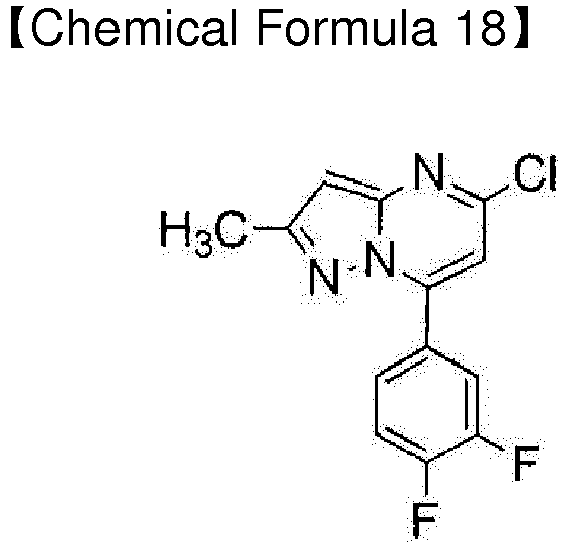
- 7-(3,4-Difluorophenyl)-2-methylpyrazolo[1,5-a]pyrimidin-5(4H)-one (821 mg) is dissolved in POCl3 (15 mL) and pyridine (0.2 mL) and stirred overnight while heating. After cooling to room temperature, the reaction solvent is removed by distillation under reduced pressure. The remainder is extracted with ethyl acetate and water. The extracted organic layer is washed with 1 M NaHCO3 aqueous solution and brine and dehydrated with anhydrous MgSO4. The dehydrated organic layer is distilled under reduced pressure and the target compound (301 mg) is yielded by column chromatography. 1H NMR (CDCl3, 300 MHz) δ 8.08 (m, 1 H), 7.78 (m, 1 H), 7.36 (q, J = 8.7 Hz, 1 H), 6.73 (s, 1 H), 6.40 (s, 1 H), 2.51 (s, 3H).
-


- 5-Chloro-7-(3,4-difluorophenyl)-2-methylpyrazolo[1,5-a]pyrimidine (301 mg) is dissolved in CH2Cl2 (50 mL). N-Iodosuccinimide (NIS, 500 mg) is added to the reaction solution. The reaction mixture is stirred at room temperature for about 16 hours. The reaction solvent is removed by distillation under reduced pressure. The remainder is extracted with ethyl acetate and water. The extracted organic layer is washed with 1 M NaHCO3 aqueous solution and brine and dehydrated with anhydrous MgSO4. The dehydrated organic layer is distilled under reduced pressure and the target compound (301 mg) is yielded by column chromatography. 1H NMR (CDCl3, 300 MHz) δ 8.04 (m, 1 H), 7.78 (m, 1 H), 7.38 (q, J = 8.7 Hz, 1 H), 6.85 (s, 1H), 2.51 (s, 3H).
-

- 5-Chloro-7-(3,4-difluorophenyl)-3-iodo-2-methylpyrazolo[1,5-a]pyrimidine (401 mg), DIPEA (0.35 mL) and (S)-2-pyrrolidinemethanol (401 mg) are stirred for 2.5 hours in an acetonitrile (60 mL) solvent at 90 ºC. The reaction solvent is removed by distillation under reduced pressure. The remainder is purified by column chromatography to yield the target compound (395 mg). 1H NMR (CDCl3, 300 MHz) δ 7.82 (m, 1 H), 7.67 (m, 1 H), 7.29 (q, J = 8.7 Hz, 1 H), 6.11 (s, 1 H), 4.45 (br, 1 H), 3.85 (m, 1 H), 3.77 (m, 1 H), 3.57 (m, 2H), 2.38 (s, 3H), 2.08-2.01 (m, 3H), 1.70 (m, 1 H).
- (S)-(1-(7-(3,4-Difluorophenyl)-3-iodo-2-methylpyrazolo[1,5-a]pyrimidin-5-yl)py rrolidin-2-yl)methanol (74 mg), 4-methylphenylboronic acid (27 mg) and tetrakis(triphenylphosphine)palladium (10 mg) are added to toluene (7 mL), ethanol (3 mL) and 1 N NaHCO3 aqueous solution (1.5 mL) and stirred overnight under argon atmosphere at 85 ºC. After cooling to room temperature, the reaction solvent is removed by distillation under reduced pressure. The remainder is extracted with ethyl acetate and water. The organic layer is washed with brine and dehydrated with anhydrous MgSO4. The dehydrated organic layer is distilled under reduced pressure, concentrated and purified by column chromatography to yield the target compound (41 mg).
- Chemical formula and NMR analysis data for the compounds of Examples 25-36 are shown in Chemical Formula 21 and Table 3.

[Table 3] Ex. No. R 1H NMR (CDCl3, 300 MHz) 25 3-OMe 7.47 (m, 4H), 7.26 (m, 3H), 7.07 (m, 1H), 6.15 (s, 1H), 5.60 (bs, 1H), 4.41 (m, 1H), 3.88 (s, 3H), 3.63 (m, 4H), 2.47 (s, 3H), 2.38 (s, 3H), 2.05 (m, 3H), 1.75 (m, 1H) 26 3-F, 4-F 7.94 (m, 1H), 7.71 (m, 1H), 7.47 (d, J = 7.8 Hz, 2H), 7.31 (m, 1H), 7.27 (d, 2H), 6.11 (s, 1H), 4.43 (br, 1H), 3.74-3.52 (m, 4H), 2.47 (s, 3H), 2.38 (s, 3H), 2.10-1.97 (m, 2H), 1.75 (m, 1H) 27 4-OMe 7.96 (m, 1H), 7.48 (d, J = 7.8 Hz, 1H), 7.26 (m, 2H), 7.06 (m, 2H), 6.11 (s, 1H), 5.70 (bs, 1H), 4.41 (m, 1H), 3.89 (s, 3H), 3.63 (m, 4H), 2.48 (s, 3H), 2.38 (s, 3H), 2.05 (m, 3H), 1.75 (m, 1H) 28 H 7.92 (m,2), 7.51 (m, 5H), 7.23 (bs, 2H), 6.11 (s, 1H), 5.60 (bs, 1H), 4.39 (m, 1H), 3.63 (m, 4H), 2.46 (s, 3H), 2.37 (s, 3H), 2.06 (m, 3H), 1.73 (m, 1H) 29 4-CF3 8.07 (d, J = 7.8 Hz, 2H), 7.80 (d, J = 8.1 Hz, 2H), 7.47 (d, J = 7.8 Hz, 2H), 7.25 (m, 2H), 6.15 (s, 1H), 5.42 (bs, 1H), 4.42 (m, 1H), 3.63 (m, 4H), 2.46 (s, 3H), 2.38 (s, 3H), 2.05 (m, 3H), 1.75 (m, 1H) 30 4-Me 7.84 (d, J = 7.8 Hz, 2H), 7.48 (d, J = 7.8 Hz, 2H), 7.33 (d, J = 8.1 Hz, 2H), 7.25 (m, 2H), 6.11 (s, 1H), 5.67 (bs, 1H), 4.40 (m, 1H), 3.63 (m, 4H), 2.46 (s, 3H), 2.44 (s, 3H) 31 3-Et 7.75 (d, J = 8.4 Hz, 2H), 7.45 (m, 3H), 7.37 (d, J = 7.5 Hz, 1H), 7.26 (d, J = 6.3 Hz, 2H), 6.12 (s, 1H), 5.70 (bs, 1H), 4.42 (m, 1H), 3.66 (m, 4H), 2.75 (dd, J = 7.5 Hz, 2H), 2.47 (s, 3H), 2.38 (s, 3H), 2.09 (m, 3H), 1.77 (m, 1H), 1.28 (m, 3H) 32 4-Cl 7.91 (d, J = 8.7 Hz, 2H), 7.49 (dd, J = 8.7, 8.1 Hz, 4H), 7.25 (m, 2H), 6.11 (s, 1H), 5.49 (bs, 1H), 4.40 (m, 1H), 3.63 (m, 4H), 2.46 (s, 3H), 2.37 (s, 3H), 2.05 (m, 3H), 1.75 (m, 1H) 33 2-F 7.77 (t, J = 7.2 Hz, 1H), 7.53 (m, 1H), 7.48 (d, J = 6.6 Hz, 2H), 7.26 (m, 4H), 6.18 (s, 1H), 5.55 (bs, 1H), 4.41 (m, 1 H), 3.63 (m, 4H), 2.48 (s, 3H), 2.38 (s, 3H), 2.05 (m, 3H), 1.75 (m, 1H) 34 2-F, 4-F 7.57 (dd, J = 8.1, 6.9 Hz, 1H), 7.47 (d, J = 7.8 Hz, 2H), 7.25 (d, J = 7.5 Hz, 2H), 6.78 (m, 2H), 6.15 (s, 1H), 5.71 (bs, 1H), 4.42 (m, 1H), 3.79 (m, 2H), 3.54 (m, 2H), 2.42 (s, 3H), 2.37 (s, 3H), 2.06 (m, 3H), 1.74 (m, 1H) 35 3-F, 5-F 7.68 (d, J = 7.8 Hz, 2H), 7.57 (d, J = 6.6 Hz, 2H), 7.29 (d, J = 7.8 Hz, 2H), 6.84 (m, 1H), 6.19 (s, 1H), 5.79 (bs, 1H), 4.63 (m, 1H), 3.66 (m, 4H), 2.59 (s, 3H), 2.41 (s, 3H), 2.13 (m, 3H), 1.93 (m, 1H) 36 3-Cl, 4-F 8.04 (m, 1H), 7.88 (m, 1H), 7.48 (m, 2H), 7.31 (m, 3H), 6.10 (s, 1H), 5.50 (br, 1H), 4.42 (br, 1H), 3.62 (m, 5H), 2.47 (s, 3H), 2.13(s, 3H), 1.73 (m, 1H), -

-

- 3-Methyl-4-(4-methoxyphenyl)-1H-pyrazol-5-amine (200 mg) and ethyl 3-phenyl-3-oxopropanoate (227 mg) are stirred overnight in a pyridine (10 mL) solvent at 95 ºC. After cooling to room temperature, the reaction solvent is removed by distillation under reduced pressure. The remainder is extracted with ethyl acetate and water. The extracted organic layer is washed with brine and dehydrated with anhydrous MgSO4. The dehydrated organic layer is distilled under reduced pressure and 270 mg of the target compound is yielded by column chromatography.
-

- 3-(4-Methoxyphenyl)-7-phenyl-2-methylpyrazolo[1,5-a]pyrimidin-5(4H)-one (150 mg) is added to POCl3 (3 mL) and pyridine (0.1 mL) and stirred for 2 hours while heating. After cooling to room temperature, POCl3 is removed by distillation under reduced pressure. After the distillation, ethyl acetate (20 mL) and ice are added to the remainder. The organic layer is extracted and it is extracted once again with water and ethyl acetate. The organic layer is washed with 1 M NaHCO3 aqueous solution and brine. The organic layer is dehydrated with anhydrous MgSO4. The solvent is removed from the organic layer by distillation under reduced pressure. The remainder is purified by column chromatography to yield 119 mg of the target compound. 1H NMR (CDCl3, 300 MHz) δ 8.10 (m, 2H), 7.50 (m, 5H), 7.09 (m, 2H), 6.82 (s, 1 H), 3.87 (s, 3H) 2.47 (s, 3H).
- 5-Chloro-3-(4-methoxyphenyl)-7-phenyl-2-methylpyrazolo[1,5-a]pyrimidine (50 mg), (S)-pyrrolin-2-ylmethanol (17 mg) and DIPEA (0.2 mL) are added to acetonitrile (10 mL) and stirred overnight at 80 ºC. After cooling to room temperature, the solvent and volatile substance are removed by distillation under reduced pressure. The remainder is extracted 3 times with ethyl acetate (20 mL) and water. The collected organic layer is washed with brine. The organic layer is dehydrated with anhydrous MgSO4 and the solvent is removed by distillation under reduced pressure. The remainder is purified by column chromatography to yield 48 mg of the target compound.
-

- (S)-(1-(7-(3,4-Difluorophenyl)-3-iodo-2-methylpyrazolo[1,5-a]pyrimidin-5-yl)py rrolidin-2-yl)methanol (62 mg), 4-methoxyphenylboronic acid (27 mg) and tetrakis(triphenylphosphine)palladium (10 mg) are added to toluene (8 mL), ethanol (3 mL) and 1 N NaHCO3 aqueous solution (1.5 mL) and stirred for 6 hours under argon atmosphere at 85 ºC. After cooling to room temperature, the reaction solvent is removed by distillation under reduced pressure. The remainder is extracted with ethyl acetate and water. The organic layer is washed with brine and dehydrated with anhydrous MgSO4. The dehydrated organic layer is distilled under reduced pressure, concentrated and purified by column chromatography to yield the target compound (58 mg).
- Chemical formula and NMR analysis data for the compounds of Examples 37-46 are shown in Chemical Formula 26 and Table 4.

[Table 4] Ex. No. R 1H NMR (CDCl3, 300 MHz) 37 H 7.92 (m, 2H), 7.50 (m, 3H), 7.47 (d, J = 8.4 Hz, 2H), 6.98 (d, J = 8.4 Hz, 2H), 6.10 (s, 1H), 5.94 (s, 2H), 4.39 (br, 1H), 3.82 (s, 3H), 3.69-3.50 (m, 4H), 2.43 (s, 3H), 2.15-1.99 (m, 3H), 1.78-1.69 (m, 1H) 38 3-F, 4-F 7.90 (m, 1H), 7.70 (m, 1H), 7.51 (d, J = 8.7 Hz, 2H), 7.31 (m, 1H), 7.00 (d, J = 8.1 Hz, 2H), 6.11 (s, 1H), 4.42 (br, 1H), 3.84 (s, 3H), 3.74-3.50 (m, 4H), 2.45 (s, 3H), 2.13-2.00 (m, 2H), 1.77 (m, 1H) 39 2-F 8.12 (m, 1H), 7.37 (d, J = 7.8 Hz, 2H), 7.36 (m, 1H), 7.25 (m, 1H), 7.13 (dd, J = 11.7, 11.4 Hz, 1H), 7.01 (d, J = 8.4 Hz, 2H), 6.46 (s, 1H), 5.78 (bs, 1H), 4.81 (dd, J = 2.7, 7.8 Hz, 1H), 3.85 (s, 3H), 3.79 (m, 2H), 3.69 (m, 2H), 2.59 (s, 3H), 2.12 (m, 3H), 1.91 (m, 1H) 40 4-OMe 7.95 (d, J = 9.0 Hz, 2H), 7.50 (d, J = 8.4 Hz, 2H), 7.02 (dd, J = 9.0 Hz, 4H), 6.10 (s, 1H), 5.71 (bs, 1H), 4.42 (m, 1H), 3.89 (s, 3H), 3.84 (s, 3H), 3.63 (m, 4H), 2.46 (s, 3H), 2.05 (m, 3H), 1.75 (m, 1H) 41 3-OMe 7.49 (m, 5H), 7.02 (m, 1H), 6.97 (d, J = 8.7 Hz, 2H), 6.11 (s, 1H), 4.38 (br, 1H), 3.85 (s, 3H), 3.81 (s, 3H), 3.69-3.50 (m, 4H), 2.42 (s, 3H), 2.15-1.99 (m, 3H), 1.78-1.69 (m, 1H) 42 4-Me 7.84 (d, J = 8.1 Hz, 2H), 7.49 (d, J = 8.7 Hz, 2H), 7.33 (d, J = 7.8 Hz, 2H), 7.00 (d, J = 6.0 Hz, 2H), 6.12 (s, 1 H), 4.42 (br, 1H), 3.84 (s, 3H), 3.43.74-3.49 (m, 4H), 2.45 (s, 3H), 2.10-1.97 (m, 3H), 1.78-1.69 (m, 1H) 43 3-Et 7.74 (dd, J = 10.2, 6.6 Hz, 2H), 7.45 (m, 4H), 6.99 (d, J = 8.4 Hz, 2H), 6.12 (s, 1H), 5.71 (bs, 1H), 4.42 (m, 1H), 3.84 (s, 3H), 3.66 (m, 4H), 2.74 (m, 2H), 2.45 (s, 3H), 2.09 (m, 3H), 1.77 (m, 1H), 1.28 (m, 3H) 44 4-Cl 7.91 (d, J = 8.4 Hz, 2H), 7.50 (dd, J = 8.4, 7.8 Hz, 4H), 6.99 (d, J = 8.7 Hz, 4H), 6.11 (s, 1H), 5.51 (bs, 1H), 4.42 (m, 1H), 3.84 (s, 3H), 3.63 (m, 4H), 2.45 (s, 3H), 2.05 (m, 3H), 1.75 (m, 1H) 45 3-F, 5-F 7.54 (d, J = 6.0 Hz, 2H), 7.48 (d, J = 8.7 Hz, 2H), 6.99 (dd, J = 8.7, 6.0 Hz, 2H), 6.96 (m, 1H), 6.14 (s, 1H), 5.36 (bs, 1H), 4.42 (m, 1H), 3.84 (s, 3H), 3.66 (m, 4H), 2.46 (s, 3H), 2.09 (m, 3H), 1.80 (m, 1H) 46 3-Cl, 4-F 8.15 (m, 1H), 8.01 (m, 1H), 7.89 (m, 1H), 7.50 (m, 1H), 7.30 (m, 1H), 7.01 (m, 2H), 6.10 (s, 1H), 4.42 (br, 1H), 3.89 (s, 3H), 3.60 (m, 4H), 2.45 (s, 3H), 2.13 (m, 2H), 1.75 (m, 1H) -

-


- 3-Methyl-4-(4-ethoxyphenyl)-1H-pyrazol-5-amine and ethyl 3-phenyl-3-oxopropanoate are stirred overnight in a pyridine (10 mL) solvent at 95 ºC. After cooling to room temperature, the reaction solvent is removed by distillation under reduced pressure. The remainder is extracted with ethyl acetate and water. The extracted organic layer is washed with brine and dehydrated with anhydrous MgSO4. The dehydrated organic layer is distilled under reduced pressure and the target compound is yielded by column chromatography.
-

- 3-(4-Ethoxyphenyl)-7-phenyl-2-methylpyrazolo[1,5-a]pyrimidin-5(4H)-one is added to POCl3 (3 mL) and pyridine (0.1 mL) and stirred for 2 hours while heating. After cooling to room temperature, POCl3 is removed by distillation under reduced pressure. After the distillation, ethyl acetate (20 mL) and ice are added to the remainder. The organic layer is extracted and it is extracted once again with water and ethyl acetate. The organic layer is washed with 1 M NaHCO3 aqueous solution and brine. The organic layer is dehydrated with anhydrous MgSO4. The solvent is removed from the organic layer by distillation under reduced pressure. The remainder is purified by column chromatography to yield the target compound.
- 5-Chloro-3-(4-ethoxyphenyl)-7-phenyl-2-methylpyrazolo[1,5-a]pyrimidine, (S)-pyrrolin-2-ylmethanol and DIPEA (0.2 mL) are added to acetonitrile (10 mL) and stirred overnight at 80 ºC. After cooling to room temperature, the solvent and volatile substance are removed by distillation under reduced pressure. The remainder is extracted 3 times with ethyl acetate (20 mL) and water. The collected organic layer is washed with brine. The organic layer is dehydrated with anhydrous MgSO4 and the solvent is removed by distillation under reduced pressure. The remainder is purified by column chromatography to yield the target compound.
-


- (S)-(1-(7-(3,4-Difluorophenyl)-3-iodo-2-methylpyrazolo[1,5-a]pyrimidin-5-yl)py rrolidin-2-yl)methanol (27 mg), 4-ethoxyphenylboronic acid (16 mg) and tetrakis(triphenylphosphine)palladium (10 mg) are added to toluene (8 mL), ethanol (3 mL) and 1 N NaHCO3 aqueous solution (1.5 mL) and stirred at 85 ºC for 6 hours under argon atmosphere. After cooling to room temperature, the reaction solvent is removed by distillation under reduced pressure. The remainder is extracted with ethyl acetate and water. The organic layer is washed with brine and dehydrated with anhydrous MgSO4. The dehydrated organic layer is distilled under reduced pressure, concentrated and purified by column chromatography to yield the target compound (20 mg).
- Chemical formula and NMR analysis data for the compounds of Examples 47-55 are shown in Chemical Formula 31 and Table 5.


[Table 5] Ex. No. R 1H NMR (CDCl3, 300 MHz) 47 H 7.92 (m, 2H), 7.50 (m, 3H), 7.45 (d, J = 8.7 Hz, 1H), 6.98 (d, J = 8.7 Hz, 2H), 6.10 (s, 1H), 5.94 (s, 2H), 4.39 (br, 1H), 4.04 (q, J = 7.2 Hz, 2H), 3.69-3.50 (m, 4H), 2.43 (s, 3H), 2.15-1.99 (m, 3H), 1.78-1.69 (m, 1H), 1.40 (t, 6.9 Hz, 3H) 48 3-F, 4-F 7.91 (m, 1H), 7.70 (m, 1H), 7.45 (d, J = 8.4 Hz, 1H), 7.31 (m, 1H), 6.99 (d, J = 8.4 Hz, 2H), 6.11 (s, 1H), 5.74 (bs, 1H), 4.42 (br, 1H), 4.06 (d, J = 6.9 Hz, 2H), 3.73-3.68 (m, 4H), 2.50 (s, 3H), 2.09 (m, 2H), 1.77 (m, 1H), 1.43 (dd, J = 6.9 Hz, 3H) 49 2-F 8.12 (dt, J = 1.2, 7.8 Hz, 1H), 7.71 (d, J = 8.7 Hz, 2H), 7.36 (m, 1H), 7.25 (m, 1H), 7.11 (dd, J = 11.4 Hz, 1H), 6.99 (d, J = 8.7 Hz, 2H), 6.45 (s, 1H), 5.74 (bs, 1H), 4.83 (bs, 1H), 4.07 (dd, J = 7.2, 6.9 Hz, 2H), 3.79 (m, 2H), 3.68 (m, 2H), 2.58 (s, 3H), 2.10 (m, 3H), 1.92 (m, 1H), 1.43 (dd, J = 7.2, 6.6 Hz, 3H) 50 4-OMe 8.07 (d, J = 9.0 Hz, 2H), 7.48 (d, J = 8.1 Hz, 2H), 7.04 (d, J = 8.4 Hz, 2H), 6.99 (d, J = 8.1 Hz, 2H), 6.09 (s, 1H), 5.65 (bs, 1H), 4.40 (m, 1H), 4.08 (q, J = 6.9 Hz, 2H), 3.88 (s, 3H), 3.63 (m, 4H), 2.46 (s, 3H), 2.04 (m, 3H), 1.73 (m, 1H), 1.42 (t, J = 6.9 Hz, 3H) 51 3-OMe 7.44 (m, 5H), 7.03 (m, 1H), 6.97 (d, J = 8.4 Hz, 2H), 6.11 (s, 1H), 4.38 (br, 1H), 4.06 (q, J = 7.5 Hz, 2H), 3.85 (s, 3H), 3.69-3.50 (m, 4H), 2.42 (s, 3H), 2.15-1.99 (m, 3H), 1.78-1.69 (m, 1H), 1.23 (t, J = 6.6 Hz, 3H) 52 4-CF3 8.07 (d, J = 8.1 Hz, 2H), 7.79 (d, J = 8.1 Hz, 2H), 7.48 (d, J = 8.7 Hz, 2H), 6.99 (d, J = 8.4 Hz, 2H), 6.14 (s, 1H), 5.39 (bs, 1H), 4.41 (m, 1H), 4.08 (q, J = 6.9 Hz, 2H), 3.63 (m, 4H), 2.45 (s, 3H), 2.07 (m, 3H), 1.75 (m, 1H), 1.42 (m, 3H) 53 4-Me 7.85 (d, J = 8.1 Hz, 2H), 7.48 (d, J = 8.4 Hz, 2H), 7.33 (d, J = 7.8 Hz, 2H), 6.99 (d, J = 8.4 Hz, 2H), 6.11 (s, 1H), 4.41 (br, 1H), 4.07 (q, J = 6.9 Hz, 2H), 3.78-3.52 (m, 4H), 2.45 (s, 3H), 2.44 (s, 3H), 2.15-1.99 (m, 3H), 1.78-1.69 (m, 1H), 1.42 (t, J = 6.9 Hz, 3H) 54 4-Cl 7.91 (d, J = 8.4 Hz, 2H), 7.49 (dd, J = 9.9, 8.4 Hz, 4H), 6.98 (d, J = 8.4 Hz, 2H), 6.11 (s, 1H), 5.47 (bs, 1H), 4.41 (m, 1H), 4.08 (dt, J = 6.6, 6.9 Hz, 2H), 3.63 (m, 4H), 2.45 (s, 3H), 2.05 (m, 3H), 1.75 (m, 1H), 1.42 (t, J = 6.9 Hz, 3H) 55 3-F, 5-F 7.73 (m, 2H), 7.48 (d, J = 8.4 Hz, 2H), 6.98 (d, J = 8.4 Hz, 3H), 6.14 (s, 1H), 5.29 (bs, 1H), 4.41 (m, 1H), 4.08 (m, 2H), 3.66 (m, 4H), 2.46 (s, 3H), 2.09 (m, 3H), 1.77 (m, 1H), 1.42 (t, J = 6.9 Hz, 3H) -

-

- 3-Methyl-4-(3,4-methylenedioxyphenyl)-1H-pyrazol-5-amine (300 mg) and ethyl 3-phenyl-3-oxopropanoate (318 mg) are stirred overnight in a pyridine (10 mL) solvent at 95 ºC. After cooling to room temperature, the reaction solvent is removed by distillation under reduced pressure. The remainder is extracted with ethyl acetate and water. The extracted organic layer is washed with brine and dehydrated with anhydrous MgSO4. The dehydrated organic layer is distilled under reduced pressure 330 mg of the target compound is yielded by column chromatography.
-
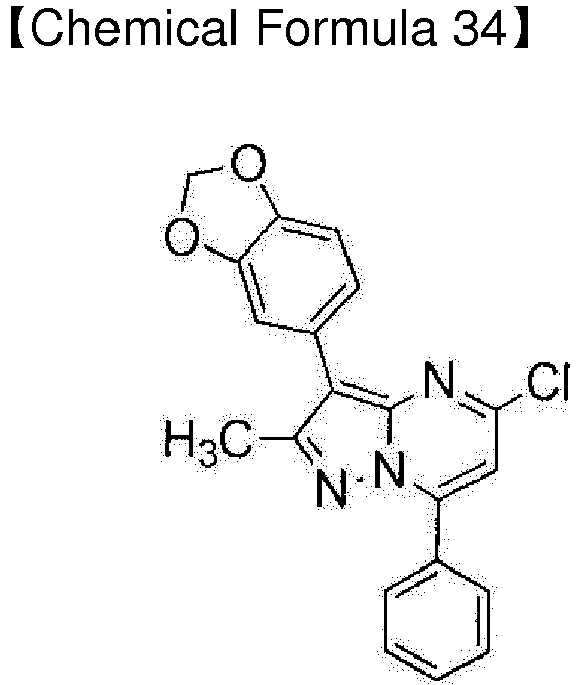
- 3-(3,4-Methylenedioxyphenyl)-7-phenyl-2-methylpyrazolo[1,5-a]pyrimidin-5(4 H)-one (150 mg) is added to POCl3 (3 mL) and pyridine (0.1 mL) and stirred for 2 hours while heating. After cooling to room temperature, POCl3 is removed by distillation under reduced pressure. After the distillation, ethyl acetate (20 mL) and ice are added to the remainder. The organic layer is extracted and it is extracted once again with water and ethyl acetate. The organic layer is washed with 1 M NaHCO3 aqueous solution and brine. The organic layer is dehydrated with anhydrous MgSO4. The solvent is removed from the organic layer by distillation under reduced pressure. The remainder is purified by column chromatography to yield 115 mg of the target compound. 1H NMR (CDCl3, 300 MHz) δ 7.92 (m, 2H), 7.50 (m, 5H), 7.05 (s, 1 H), 6.85 (s, 1 H), 5.94 (s, 2H), 2.40 (s, 3H).
- 5-Chloro-3-(3,4-methylenedioxyphenyl)-7-phenyl-2-methylpyrazolo[1,5-a]pyri midine (50 mg), (S)-pyrrolin-2-ylmethanol (16 mg) and DIPEA (0.2 mL) are added to acetonitrile (10 mL) and stirred overnight at 80 ºC. After cooling to room temperature, the solvent and volatile substance are removed by distillation under reduced pressure. The remainder is extracted 3 times with ethyl acetate (20 mL) and water. The collected organic layer is washed with brine. The organic layer is dehydrated with anhydrous MgSO4 and the solvent is removed by distillation under reduced pressure. The remainder is purified by column chromatography to yield 45 mg of the target compound.
- Compounds of Examples 57-61 are prepared in a similar manner as Example 56.
-

-

- 3-Methylpyrazol-5-amine (526 mg) and ethyl 3-(3,5-difluorophenyl)-3-oxopropanoate (879 g) are stirred overnight in a pyridine (30 mL) solvent at 85 ºC. After cooling to room temperature, the reaction solvent is removed by distillation under reduced pressure. The remainder is extracted with ethyl acetate and water. The extracted organic layer is washed with brine and dehydrated with anhydrous MgSO4. The dehydrated organic layer is distilled under reduced pressure and purified by column chromatography to yield the target compound (521 mg).
-

- 7-(3,5-Difluorophenyl)-2-methylpyrazolo[1,5-a]pyrimidin-5(4H)-one (521 mg) is dissolved in POCl3 (15 mL) and pyridine (0.2 mL) and stirred overnight while heating at 100 ºC. After cooling to room temperature, the reaction solvent is removed by distillation under reduced pressure. The remainder is extracted with ethyl acetate and water. The extracted organic layer is washed with 1 M NaHCO3 aqueous solution and brine and dehydrated with anhydrous MgSO4. The dehydrated organic layer is distilled under reduced pressure and purified by column chromatography to yield the target compound (327 mg). 1H NMR (CDCl3, 300 MHz) δ 7.63 (m, 2H), 7.02 (m, 1 H), 6.82 (m, 1 H), 6.52 (m, 1 H), 2.52 (s, 3H).
-

- 5-Chloro-7-(3,5-difluorophenyl)-2-methylpyrazolo[1,5-a]pyrimidine (327 mg) is dissolved in CH2Cl2 (50 mL). N-Iodosuccinimide (NIS, 304 mg) is added to the reaction solution. The reaction mixture is stirred at room temperature for about 16 hours. The reaction solvent is removed by distillation under reduced pressure. The remainder is extracted with ethyl acetate and water. The extracted organic layer is washed with 1 M NaHCO3 aqueous solution and brine and dehydrated with anhydrous MgSO4. The dehydrated organic layer is distilled under reduced pressure and purified by column chromatography to yield the target compound (301 mg).
-

- 5-Chloro-7-(3,5-difluorophenyl)-3-iodo-2-methylpyrazolo[1,5-a]pyrimidine obtained in Step 3, DIPEA (0.35 mL) and (S)-2-pyrrolidinemethanol (401 mg) are stirred in an acetonitrile (60 mL) solvent for 2.5 hours at 90 ºC. The reaction solvent is removed by distillation under reduced pressure. The remainder is purified by column chromatography to yield the target compound. 1H NMR (CDCl3, 300 MHz); δ 7.46 (m, 2H), 6.98 (m, 1 H), 6.13 (s, 1 H), 4.45 (br, 1 H), 3.85-3.57 (m, 5H), 2.38 (s, 3H), 2.08-2.04 (m, 3H), 1.77 (m, 1 H).
- (S)-(1-(7-(3,5-Difluorophenyl)-3-iodo-2-methylpyrazolo[1,5-a]pyrimidin-5-yl)py rrolidin-2-yl)methanol (40 mg), 3,4-methylenedioxyphenylboronic acid (23 mg) and tetrakis(triphenylphosphine)palladium (10 mg) are added to toluene (5 mL), ethanol (3 mL) and 1 N NaHCO3 aqueous solution (1.5 mL) and stirred at 85 ºC for 4 hours under argon atmosphere. After cooling to room temperature, the reaction solvent is removed by distillation under reduced pressure. The remainder is extracted with ethyl acetate and water. The organic layer is washed with brine and dehydrated with anhydrous MgSO4. The dehydrated organic layer is concentrated by distillation under reduced pressure and purified by column chromatography to yield the target compound (36 mg).
- Chemical formula and NMR analysis data for the compounds of Examples 56-62 are shown in Chemical Formula 40 and Table 6.

[Table 6] Ex. No. R 1H NMR (CDCl3, 300 MHz) 56 H 7.88 (m, 2H), 7.50 (m, 3H), 7.05 (s, 1H), 6.98 (m, 1H), 6.87 (d, J = 7.8 Hz, 1H), 6.10 (s, 1H), 5.94 (s, 2H), 4.36 (br, 1H), 3.78-3.52 (m, 4H), 2.40 (s, 3H), 2.15-1.99 (m, 3H), 1.78-1.69 (m, 1H) 57 2-F 8.10 (t, J = 7.8 Hz, 1H), 8.37 (s, 2H), 7.19 (m, 3H), 6.91 (d, J = 8.1 Hz, 1H), 6.45 (s, 1H), 5.98 (s, 2H), 5.75 (bs, 1H), 4.74 (bs, 1H), 3.82 (m, 2H), 3.69 (m, 2H), 2.57 (s, 3H), 2.11 (bs, 3H), 1.93 (m, 1H) 58 3-OMe 7.44 (m, 3H), 7.03 (m, 3H), 6.88 (d, J = 8.1 Hz, 2H), 6.12 (s, 1H), 5.96 (s, 2H), 4.38 (br, 1H), 3.85 (s, 3H), 3.81 (s, 3H), 3.69-3.50 (m, 4H), 2.42 (s, 3H), 2.15-1.99 (m, 3H), 1.78-1.69 (m, 1H) 59 4-Me 7.83 (d, J = 7.8 Hz, 2H), 7.34 (d, J = 7.8 Hz, 2H), 7.10 (s, 1H), 7.03 (d, J = 7.8 Hz, 1H), 6.91 (d, J = 7.8 Hz, 1H), 6.12 (s, 1H), 5.98 (s, 2H), 4.41 (br, 1H), 3.78-3.52 (m, 4H), 2.45 (s, 3H), 2.44 (s, 3H), 2.15-1.99 (m, 3H), 1.78-1.69 (m, 1H) 60 3-Et 7.73 (m, 2H), 7.44 (dd, J = 7.5, 7.2 Hz, 2H), 7.37 (d, J = 6.6 Hz, 1H), 7.10 (s, 1H), 7.03 (d, J = 7.8 Hz, 1H), 6.90 (d, J = 8.1 Hz, 1H), 6.12 (s, 1H), 5.98 (s, 2H), 5.61 (bs, 1H), 4.42 (m, 1H), 3.66 (m, 4H), 2.77 (m, 2H), 2.45 (s, 3H), 2.09 (m, 3H), 1.77 (m, 1H), 1.29 (m, 3H) 61 3-F, 4-F 7.89 (m, 1H), 7.70 (m, 2H), 7.45 (m, 2H), 7.03 (s, 1H), 7.01 (d, J = 8.4 Hz, 1H), 6.90 (d, J = 8.4 Hz, 1H), 6.12 (s, 1H), 5.99 (s, 2H), 5.74 (bs, 1H), 4.44 (br, 1H), 3.74-3.53 (m, 4H), 2.46 (s, 3H), 2.17-2.02 (m, 2H), 1.78 (m, 1H) 62 3-F, 5-F 7.54 (m, 2H), 7.09 (s, 1H), 7.01 (m, 2H), 6.92 (m, 1H), 6.14 (s, 1H), 5.99 (s, 2H), 4.42 (br, 1H), 3.75-3.56 (m, 4H), 2.47 (s, 3H), 2.17-2.00 (m, 2H), 1.87 (m, 1H) -


-

- 3-Methyl-4-(4-methylphenyl)-1H-pyrazol-5-amine and ethyl 3-(4-fluorophenyl)-3-oxopropanoate are stirred overnight in a pyridine (10 mL) solvent at 95 ºC. After cooling to room temperature, the reaction solvent is removed by distillation under reduced pressure. The remainder is extracted with ethyl acetate and water. The extracted organic layer is washed with brine and dehydrated with anhydrous MgSO4. The dehydrated organic layer is distilled under reduced pressure and purified by column chromatography to yield the target compound.
-

- 3-(4-Methylphenyl)-7-(4-fluorophenyl)-2-methylpyrazolo[1,5-a]pyrimidin-5(4H) -one is added to POCl3 (3 mL) and pyridine (0.1 mL) and stirred for 2 hours while heating. After cooling to room temperature, POCl3 is removed by distillation under reduced pressure. After the distillation, ethyl acetate (20 mL) and ice are added to the remainder. The organic layer is extracted and it is extracted once again with water and ethyl acetate. The organic layer is washed with 1 M NaHCO3 aqueous solution and brine. The organic layer is dehydrated with anhydrous MgSO4. The solvent is removed from the organic layer by distillation under reduced pressure. The remainder is purified by column chromatography to yield the target compound.
- 5-Chloro-3-(4-methylphenyl)-7-(4-fluorophenyl)-2-methylpyrazolo[1,5-a]pyrimi dine, (S)-pyrrolin-2-ylmethanol and DIPEA (0.2 mL) are added to acetonitrile (10 mL) and stirred overnight at 80 ºC. After cooling to room temperature, the solvent and volatile substance are removed by distillation under reduced pressure. The remainder is extracted 3 times with ethyl acetate (20 mL) and water. The collected organic layer is washed with brine. The organic layer is dehydrated with anhydrous MgSO4 and the solvent is removed by distillation under reduced pressure. The remainder is purified by column chromatography to yield the target compound.
-

-

- 3-Methylpyrazol-5-amine (245 mg) and methyl 3-(4-fluorophenyl)-3-oxopropanoate (453 mg) are stirred overnight in a pyridine (10 mL) solvent at 95 ºC. After cooling to room temperature, the reaction solvent is removed by distillation under reduced pressure. The remainder is extracted with ethyl acetate and water. The extracted organic layer is washed with brine and dehydrated with anhydrous MgSO4. The dehydrated organic layer is distilled under reduced pressure and purified by column chromatography to yield the target compound (151 mg). 1H NMR (CDCl3, 300 MHz) δ 10.20 (br, 1 H), 8.10 (m, 1 H), 7.94 (m, 1 H), 7.11 (m, 3H), 6.39 (s, 1 H), 4.04 (s, 1 H), 2.30 (s, 3H).
-

- 7-(4-Fluorophenyl)-2-methylpyrazolo[1,5-a]pyrimidin-5(4H)-one (151 mg) is dissolved in POCl3 (10 mL) and pyridine (0.1 mL) and stirred overnight while heating. After cooling to room temperature, the reaction solvent is removed by distillation under reduced pressure. The remainder is extracted with ethyl acetate and water. The extracted organic layer is washed with 1 M NaHCO3 aqueous solution and brine and dehydrated with anhydrous MgSO4. The dehydrated organic layer is distilled under reduced pressure and purified by column chromatography to yield the target compound (156 mg). 1H NMR (CDCl3, 300 MHz); δ 8.07 (m, 2H), 7.26 (m, 2H), 6.78 (m, 1H), 6.48 (s, 1H), 2.50 (s, 3H).
-

- 5-Chloro-7-(4-fluorophenyl)-2-methylpyrazolo[1,5-a]pyrimidine (128 mg) is dissolved in CH2Cl2 (50 mL). N-Iodosuccinimide (NIS, 165 mg) is added to the reaction solution. The reaction mixture is stirred at room temperature for about 16 hours. The reaction solvent is removed by distillation under reduced pressure. The remainder is extracted with ethyl acetate and water. The extracted organic layer is washed with 1 M NaHCO3 aqueous solution and brine and dehydrated with anhydrous MgSO4. The dehydrated organic layer is distilled under reduced pressure and purified by column chromatography to yield the target compound (182 mg). 1H NMR (CDCl3, 300 MHz); δ 8.05 (m, 2H), 7.26 (m, 2H), 6.84 (s, 1 H), 2.51 (s, 3H).
-

- 5-Chloro-7-(4-fluorophenyl)-3-iodo-2-methylpyrazolo[1,5-a]pyrimidine (241 mg), DIPEA (0.2 mL) and (S)-2-pyrrolidinemethanol (152 mg) are stirred at 90 ºC for 16 hours in an acetonitrile (60 mL) solvent. The reaction solvent is removed by distillation under reduced pressure. The remainder is purified by column chromatography to yield the target compound (172 mg). 1H NMR (CDCl3, 300 MHz); δ 7.92 (m, 2H), 7.22 (m, 2H), 6.10 (s, 1 H), 4.45 (br, 1 H), 3.85 -3.57 (m, 4H), 2.38 (s, 3H), 2.08-2.01 (m, 3H), 1.72 (m, 1 H).
- (S)-(1-(7-(4-Fluorophenyl)-3-iodo-2-methylpyrazolo[1,5-a]pyrimidin-5-yl)pyrrol idin-2-yl)methanol (56 mg), 4-methoxyphenylboronic acid (30 mg) and tetrakis(triphenylphosphine)palladium (10 mg) are added to toluene (10 mL), ethanol (5 mL) and 1 N NaHCO3 aqueous solution (1.5 mL) and stirred overnight at 90 ºC under argon atmosphere. After cooling to room temperature, the reaction solvent is removed by distillation under reduced pressure. The remainder is extracted with ethyl acetate and water. The organic layer is washed with brine and dehydrated with anhydrous MgSO4. The dehydrated organic layer is concentrated by distillation under reduced pressure and purified by column chromatography to yield the target compound (27 mg).
- Chemical formula and NMR analysis data for the compounds of Examples 63-109 are shown in Chemical Formula 49 and Table 7.

[Table 7] Ex. No. R1 1H NMR (CDCl3, 300 MHz) 63 4-Me 7.96 (dd, J = 8.7, 8.4 Hz, 2H), 7.47 (d, J = 7.8 Hz, 2H), 7.26 (m, 4H), 6.10 (s, 1H), 5.54 (bs, 1H), 4.41 (m, 1H), 3.63 (m, 4H), 2.46 (s, 3H), 2.38 (s, 3H), 2.05 (m, 3H), 1.75 (m, 1H) 64 4-MeO 7.96 (m, 2H), 7.46 (m, 2H), 7.23 (m, 2H), 7.00 (m, 2H), 6.09 (s, 1H), 4.42 (br, 1H), 3.82 (s, 3H), 3.71-3.59 (m, 4H), 2.44 (s, 3H), 2.11-2.00 (m, 3H), 1.77 (m, 1H) 65 4-EtO 7.96 (dd, J = 8.7 Hz, 2H), 7.47 (d, J = 8.4 Hz, 2H), 7.26 (m, 2H), 6.99 (d, J = 8.7 Hz, 2H), 6.10 (s, 1H), 5.55 (bs, 1H), 4.41 (m, 1H), 4.07 (td, J = 6.9, 7.2 Hz, 2H), 3.63 (m, 4H), 2.45 (s, 3H), 2.05 (m, 3H), 1.75 (m, 1H), 1.42 (t, J = 6.9 Hz, 3H) 66 3,4-methylenedioxy 7.96 (m, 2H), 7.21 (d, J = 8.7 Hz, 2H), 7.09 (s, 1H), 7.00 (m, 1H), 6.90 (d, J = 8.4 Hz, 2H), 6.10 (s, 1H), 5.98 (s, 2H), 4.43 (br, 1H), 3.73-3.52 (m, 4H), 2.44 (s, 3H), 2.10-2.01 (m, 3H), 1.77 (m, 1H) 67 4-CF2H 7.94 (m, 2H), 7.69 (d, J = 8.1 Hz, 2H), 7.55 (d, J = 8.1 Hz, 2H), 7.19 (d, J = 8.7 Hz, 2H), 6.64 (s, 1H), 6.10 (s, 1H), 4.44 (br, 1H), 3.72-3.50 (m, 4H), 2.47 (s, 3H), 2.38 (s, 3H), 2.15-1.99 (m, 3H), 1.78-1.69 (m, 1H) 68 4-CH3S 7.96 (dd, J = 8.7 Hz, 2H), 7.53 (d, J = 8.4 Hz, 2H), 7.34 (d, J = 8.4 Hz, 2H), 7.20 (d, J = 9.0 Hz, 2H), 6.12 (s, 1H), 5.30 (bs, 1H), 4.44 (m, 1H), 3.63 (m, 4H), 2.51 (s, 3H), 2.47 (s, 3H), 2.06 (m, 3H), 1.78 (m, 1H) 69 4-CF3 7.97(dd, J = 8.1 Hz, 2H), 7.77 (d, J = 8.4 Hz, 2H), 7.68 (d, J = 8.4 Hz, 2H), 7.21 (d, J = 8.4 Hz, 2H), 6.17 (s, 1H), 5.01 (bs, 1H), 4.49 (m, 1H), 3.62 (m, 4H), 2.51 (s, 3H), 2.05 (m, 3H), 1.83 (m, 1H) 70 4-Et 7.97(dd, J = 8.7 Hz, 2H), 7.90 (m, 1H), 7.52 (d, J = 8.1 Hz, 2H), 7.25 (m, 4H), 6.10 (s, 1H), 5.41 (bs, 1H), 4.42 (m, 1H), 3.62 (m, 4H), 2.70 (q, J = 7.5 Hz, 2H), 2.48 (s, 3H), 2.05 (m, 3H), 1.78 (m, 1H), 1.28 (t, J = 7.8 Hz, 3H) 71 4-vinyl 7.96 (m, 2H), 7.58 (d, J = 8.4 Hz, 2H), 7.50 (d, J = 8.4 Hz, 2H), 7.20 (d, J = 8.4 Hz, 2H), 6.74 (m, 1H), 6.13 (s, 1H), 5.76 (d, J = 8.4 Hz, 1H), 5.21 (d, J = 8.1 Hz, 1H), 4.46 (br, 1H), 3.69-3.50 (m, 4H), 2.49 (s, 3H), 2.10-1.97 (m, 3H), 1.78-1.69 (m, 1H) 72 4-propyl 7.76 M, 2H), 7.50 (d, J = 7.8 Hz, 2H), 7.25 (m, 2H), 7.20 (d, J = 8.7 Hz, 2H), 6.11 (s, 1H), 4.43 (br, 1H), 3.78-3.49 (m, 4H), 2.62 (t, J = 7.8 Hz, 2H), 2.49 (s, 3H), 2.17-1.97 (m, 3H), 1.78-1.69 (m, 1H), 1.68 (m, 2H), 0.99 (t, J = 7.8 Hz, 3H) 73 4-n-butyl 7.98 (m, 2H), 7.50 (d, J = 8.4 Hz, 2H), 7.25 (m, 4H), 6.11 (s, 1H), 4.43 (br, 1H), 3.74-3.55 (m, 4H), 2.64 (t, J = 7.8 Hz, 2H), 2.48 (s, 3H), 2.13-1.99 (m, 3H), 1.77 (m, 1H), 1.65 (m, 2H), 1.44 (m, 2H), 0.95 (t, J = 6.9 Hz, 3H) 74 4-n-PrO 7.96 (dd, J = 8.7, 8.4 Hz, 2H), 7.47 (d, J = 8.7 Hz, 2H), 7.26 (m, 2H), 6.99 (d, J = 8.4 Hz, 2H) 6.10 (s, 1H), 5.52 (bs, 1H), 4.41 (m, 1H), 3.96 (t, J = 6.6 Hz, 2H), 3.63 (m, 4H), 2.45 (s, 3H), 2.05 (m, 3H), 1.75 (m, 3H), 1.05 (t, J = 7.2 Hz, 3H) 75 4-n-BuO 7.96 (m, 2H), 7.47 (d, J = 8.4 Hz, 2H), 7.25 (m, 2H), 6.98 (d, J = 8.7 Hz, 2H), 6.10 (s, 1H), 5.56 (bs, 1H), 4.42 (m, 1H), 3.99 (dd, J = 6.3, 6.6 Hz, 2H), 3.63 (m, 4H), 2.99 (m, 2H), 2.45 (s, 3H), 2.06 (m, 3H), 1.78 (m, 3H), 1.49 (m, 2H), 0.98 (dd, J = 7.2, 7.5 Hz, 3H) 76 3,4-diF 7.96 (m, 2H), 7.48 (m, 1H), 7.33 (m, 1H), 7.20 (m, 3H), 6.15 (s, 1H), 4.48 (br, 1H), 3.78-3.52 (m, 4H), 2.47 (s, 3H), 2.15-1.99 (m, 3H), 1.78-1.69 (m, 1H) 77 2,4-diF 7.96 (m, 2H), 7.23 (m, 4H), 6.66 (m, 1H), 6.15 (s, 1H), 4.48 (br, 1H), 3.78-3.52 (m, 4H), 2.47 (s, 3H), 2.15-1.99 (m, 3H), 1.78-1.69 (m, 1H) 78 3,5-diF 7.96 (m, 2H), 7.23 (m, 4H), 6.66 (m, 1H), 6.16 (s, 1H), 4.48 (br, 1H), 3.78-3.52 (m, 4H), 2.52 (s, 3H), 2.15-1.99 (m, 3H), 1.78-1.69 (m, 1H) 79 3-F, 4-Me 7.97 (m, 2H), 7.29 (m, 2H), 7.22 (m, 2H), 6.13 (s, 1H), 4.45 (br, 1H), 3.75-3.53 (m, 4H), 2.48 (s, 3H), 2.30 (s, 3H), 2.115-1.99 (m, 3H), 1.78 (m, 1H) 80 3-F, 4-MeO 7.96 (m, 2H), 7.38 (m, 2H), 7.20 (d, J = 8.4 Hz, 2H), 7.05 (m, 1H), 6.13 (s, 1H), 4.45 (br, 1H), 3.92 (s, 3H), 3.78-3.52 (m, 4H), 2.47 (s, 3H), 2.15-1.99 (m, 3H), 1.78-1.69 (m, 1H) 81 4-EtO, 3-F 7.96 (m, 2H), 7.38 (m, 1H), 7.30 (d, J = 8.7 Hz, 1H), 7.22 (m, 2H), 7.04 (m, 1H), 6.13 (s, 1H), 4.45 (br, 1H), 4.15 (q, J = 6.9 Hz, 2H), 3.78-3.52 (m, 4H), 2.47 (s, 3H), 2.17 (s, 3H), 2.15-1.99 (m, 3H), 1.78-1.69 (m, 1H), 1.47 (t, J = 7.2 Hz, 3H) 82 4-F 7.96 (m, 2H), 7.52 (m, 2H), 7.22 (m, 2H), 7.13 (m, 2H), 6.12 (s, 1H), 4.42 (br, 1H), 3.76-3.52 (m, 4H), 2.44 (s, 3H), 2.13-2.00 (m, 3H), 1.77 (m, 1H) 83 H 7.97 (m, 2H), 7.59 (d, J = 7.8 Hz, 1H), 7.45 (t, J = 7.5 Hz, 2H), 7.26 (m, 3H), 6.12 (s, 1H), 5.35 (bs, 1H), 4.42 (m, 1H), 3.63 (m, 4H), 2.49 (s, 3H), 2.05 (m, 3H), 1.75 (m, 1H) 84 4-CF3O 7.96 (m, 3H), 7.64 (d, J = 8.4 Hz, 2H), 7.22 (m, 3H), 6.14 (s, 1H), 5.07 (bs, 1H), 4.46 (m, 1H), 3.62 (m, 4H), 2.48 (s, 3H), 2.05 (m, 3H), 1.78 (m, 1H) 85 4-iso-PrO 7.94 (m, 1H), 7.87 (m, 1H), 7.44 (d, J = 7.8 Hz, 2H), 7.17 (d, J = 8.4 Hz, 2H), 6.93 (d, J = 8.4 Hz, 2H), 6.10 (s, 1H), 5.40 (bs, 1H), 4.58 (m, 1H), 4.44 (m, 1H), 3.62 (m, 4H), 2.43 (s, 3H), 2.01 (m, 3H), 1.73 (m, 1H), 1.34 (s, 3H), 1.32 (s, 3H) 86 4-acetyl 8.04 (d, J = 8.4 Hz, 2H), 7.95 (dd, J = 9.0, 8.7 Hz, 2H), 7.78 (d, J = 8.1 Hz, 2H), 7.21 (d, J = 8.7 Hz, 2H), 6.16 (s, 1H), 4.99 (bs, 1H), 4.50 (m, 1H), 3.62 (m, 4H), 2.62 (s, 3H), 2.52 (s, 3H), 2.05 (m, 3H), 1.83 (m, 1H) 87 2-F 7.98 (m, 2H), 7.45 (m, 1H), 7.30 (m, 1H), 7.21 (m, 4H), 6.11 (s, 1H), 4.43 (br, 1H), 3.63-3.54 (m, 4H), 2.36 (s, 3H), 2.13-2.04 (m, 3H), 1.80 (m, 1H) 88 4-HOCH2 7.96 (dd, J = 8.4, 9.0 Hz, 2H), 7.63 (m, 2H), 7.52 (m, 0.5H), 7.46 (m, 2.5H), 6.20 (d, J = 8.7 Hz, 2H), 6.12 (s, 1H), 5.48 (bs, 1H), 4.78 (s, 2H), 4.41 (m, 1H), 4.07 (td, J = 6.9, 7.2 Hz, 2H), 3.63 (m, 4H), 2.48 (s, 3H), 2.05 (m, 3H), 1.75 (m, 1H) 89 4-tert-Bu 7.96 (m, 2H), 7.56 (d, J = 8.1 Hz, 2H), 7.46 (d, J = 8.1 Hz, 2H), 7.20 (d, J = 8.4 Hz, 2H), 6.12 (s, 1H), 5.06 (bs, 1H), 4.47 (m, 1H), 3.62 (m, 4H), 2.49 (s, 3H), 2.05 (m, 3H), 1.78 (m, 1H), 1.36 (s, 9H) 90 4-EtS 7.96 (m, 2H), 7.54 (d, J = 7.2 Hz, 2H), 7.40 (d, J = 7.8 Hz, 2H), 7.22 (m, 2H), 6.12 (s, 1H), 5.16 (bs, 1H), 4.45 (m, 1H), 3.63 (m, 4H), 2.99 (m, 2H), 2.48 (s, 3H), 2.06 (m, 3H), 1.78 (m, 1H), 1.35 (t, J = 7.2 Hz, 3H), 91 4-PhCH2O 7.96 (dd, J = 9.0, 8.7 Hz, 2H), 7.49 (m, 4H), 7.35 (m, 3H), 7.20 (d, J = 8.7 Hz, 2H), 7.08 (d, J = 8.4 Hz, 2H), 6.10 (s, 1H), 5.53 (bs, 1H), 5.09 (s, 2H), 4.43 (m, 1H), 3.63 (m, 4H), 2.45 (s, 3H), 2.06 (m, 3H), 1.78 (m, 1H) 92 4-Ph 7.98 (m, 2H), 7.70 (m, 6H), 7.43 (t, J = 7.8 Hz, 2H), 7.32 (d, J = 7.8 Hz, 1H), 7.21 (t, J = 8.4 Hz, 2H), 6.14 (s, 1H), 4.48 (br, 1H), 3.76-3.54 (m, 4H), 2.54 (s, 3H), 2.13-2.04 (m, 3H), 1.80 (m, 1H) 93 3-Cl 7.96 (m, 2H), 7.71 (bs, 1H), 7.53 (d, J = 7.8 Hz, 1H), 7.36 (m, 1H), 7.22 (m, 3H), 6.14 (s, 1H), 4.74 (bs, 1H), 4.46 (m, 1H), 3.75 (m, 2H), 3.57 (m, 2H), 2.50 (s, 3H), 2.06 (m, 3H), 1.83 (m, 1H) 94 3-MeO 7.96 (m, 2H), 7.59 (d, J = 8.1 Hz, 2H), 7.44 (m, 1H), 7.20 (d, J = 8.7 Hz, 2H), 7.07 (d, J = 7.8 Hz, 1H), 6.15 (s, 1H), 4.48 (br, 1H), 3.89 (s, 3H), 3.78-3.52 (m, 4H), 2.51 (s, 3H), 2.15-1.99 (m, 3H), 1.78-1.69 (m, 1H) 95 3-CF3O 7.96 (m, 2H), 7.59 (d, J = 7.5 Hz, 2H), 7.44 (m, 1H), 7.20 (d, J = 7.5 Hz, 2H), 7.07 (d, J = 7.8 Hz, 1H), 6.15 (s, 1H), 4.48 (br, 1H), 3.78-3.52 (m, 4H), 2.51 (s, 3H), 2.15-1.99 (m, 3H), 1.78-1.69 (m, 1H) 96 3,4-diCl 7.95 (dd, J = 7.8, 8.1 Hz, 2H), 7.48 (m, 1H), 7.20 (d, J = 8.4 Hz, 2H), 6.15 (s, 1H), 5.64 (bs, 1H), 4.47 (m, 1H), 3.63 (m, 4H), 2.49 (s, 3H), 2.05 (m, 3H), 1.85 (m, 1H) 97 2,4-diCl 7.96 (m, 2H), 7.50 (s, 1H), 7.28 (s, 2H), 7.17 (m, 2H), 6.09 (s, 1H), 4.29 (m, 1H), 3.57 (m, 4H), 2.25 (s, 3H), 2.01 (m, 3H), 1.68 (m, 1H) 98 2-CN 7.97 (m, 2H), 7.80 (d, J = 7.8 Hz, 1H), 7.65 (t, J = 7.5 Hz, 1H), 7.50 (d, J = 7.8 Hz, 1 H), 7.40 (t, J = 7.5 Hz, 1H), 7.22 (m, 2H), 6.15 (s, 1H), 4.43 (br, 1H), 3.66-3.55 (m, 4H), 2.41 (s, 3H), 2.30 (s, 3H), 2.15-1.99 (m, 3H), 1.77 (m, 1H) 99 3-Cl, 4-F 7.97 (m, 2H), 7.72 (m, 1H), 7.49 (m, 1H),7.23 (m, 3H), 6.16 (s, 1H), 4.47 (br, 1H), 3.78-3.54 (m, 4H), 2.49 (s, 3H), 2.18 -2.05 (m, 3H), 1.84 (m, 1H) 100 3-F, 4-PrO 7.96 (m, 2H), 7.36 (m, 2H), 7.22 (d, J = 8.7 Hz, 2H), 7.03 (t, J = 9.0 Hz, 1H), 6.13 (s, 1H), 4.45 (br, 1H), 4.03 (t, J = 6.6 Hz, 2H), 3.75-3.53 (m, 4H), 2.47 (s, 3H), 2.10-1.99 (m, 3H), 1.85 (m, 3H), 1.06 (t, J = 7.5 Hz, 3H) 101 3-Me, 4-F 7.97 (m, 2H), 7.29 (m, 2H), 7.22 (m, 3H), 6.13 (s, 1H), 4.45 (br, 1H), 3.75-3.55 (m, 4H), 2.48 (s, 3H), 2.30 (s, 3H), 2.08-2.01 (m, 3H), 1.80 (m, 1H) 102 3-Me, 4-MeO 7.96 (m, 2H), 7.36 (m, 2H), 7.22 (m, 2H), 6.93 (d, J = 8.4 Hz, 1H), 6.10 (s, 1H), 4.42 (br, 1H), 3.86 (s, 3H), 3.78-3.52 (m, 4H), 2.52 (s, 3H), 2.15-1.99 (m, 3H), 1.78-1.69 (m, 1H) 103 3-MeO, 4-MeO 7.97 (m, 2H), 7.21 (m, 3H), 7.09 (d, J = 8.1 Hz, 1H), 6.95 (d, J = 8.4 Hz, 1H), 6.11 (s, 1H), 5.35 (bs, 1H), 4.44 (m, 1H), 3.96 (s, 3H), 3.91 (s, 3H), 3.63 (m, 4H), 2.48 (s, 3H), 2.05 (m, 3H), 1.75 (m, 1H) 104 2-F, 5-EtO 7.96 (m, 2H), 7.22 (m, 2H), 7.08 (m, 1H), 6.96 (m, 1H), 6.82 (m, 1H), 6.11 (s, 1H), 4.37 (br, 1H), 4.08 (q, J = 7.2 Hz, 2H), 3.78-3.52 (m, 4H), 2.37 (s, 3H), 2.17 (s, 3H), 2.15-1.99 (m, 3H), 1.78-1.69 (m, 1H), 1.41 (t, J = 6.9 Hz, 3H) 105 4-acetylamino 7.96 (m, 2H), 7.54 (m, 4H), 7.21 (d, J = 8.4 Hz, 2H), 6.12 (s, 1H), 4.45 (br, 1H), 3.75-3.53 (m, 4H), 2.46 (s, 3H), 2.13 (s, 3H), 2.10-1.99 (m, 3H), 1.85 (m, 1H) 106 4-CN 7.90 (m, 3H), 7.77 (d, J = 7.8 Hz, 1H), 7.66 (d, J = 8.4 Hz, 1H), 7.17 (m, 3H), 6.15 (s, 1H), 4.37 (br, 1H), 3.78-3.52 (m, 4H), 2.49 (s, 3H), 2.15-1.99 (m, 3H), 1.78-1.69 (m, 1H) 107 4-CH3OSO2 7.96 (m, 2H), 7.68 (d, J = 8.4 Hz, 2H), 7.36 (d, J = 8.4 Hz, 2H), 7.22 (d, J = 8.7 Hz, 2H), 6.15 (s, 1H), 5.08 (bs, 1H), 4.45 (bs, 1H), 3.66 (m, 4H), 3.16 (s, 3H), 2.49 (s, 3H), 2.09 (m, 3H), 1.80 (m, 1H) 108 4-NH2SO2 7.96 (m, 2H), 7.94 (m, 1H), 7.67 (m, 1H), 7.48 (m, 1H), 7.46 (m, 2H), 7.23 (m, 1H), 6.18 (s, 1H), 4.95 (s, 2H), 4.45 (br, 1H), 3.75-3.53 (m, 4H), 2.51 (s, 3H), 2.13-1.99 (m, 3H), 1.87 (m, 1H) 109 
7.94 (m, 3H), 7.34 (s, 1H), 7.19 (m, 3H), 6.85 (d, J = 8.4 Hz, 1H), 6.07(s, 1H), 4.56 (t, J = 8.7 Hz, 2H), 4.38 (br, 1H), 3.78-3.52 (m, 4H), 3.24 (t, J = 6.9 Hz, 2H), 2.41 (s, 3H), 2.15-1.99 (m, 3H), 1.78-1.69 (m, 1H) -


-

- 3-Methyl-4-(4-methylphenyl)-1H-pyrazol-5-amine and ethyl 3-(3-fluorophenyl)-3-oxopropanoate are stirred overnight in a pyridine (10 mL) solvent at 95 ºC. After cooling to room temperature, the reaction solvent is removed by distillation under reduced pressure. The remainder is extracted with ethyl acetate and water. The extracted organic layer is washed with brine and dehydrated with anhydrous MgSO4. The dehydrated organic layer is distilled under reduced pressure and purified by column chromatography to yield the target compound.
-

- 3-(4-Methylphenyl)-7-(3-fluorophenyl)-2-methylpyrazolo[1,5-a]pyrimidin-5(4H) -one is added to POCl3 (3 mL) and pyridine (0.1 mL) and stirred for 2 hours while heating. After cooling to room temperature, POCl3 is removed by distillation under reduced pressure. After the distillation, ethyl acetate (20 mL) and ice are added to the remainder. The organic layer is extracted and it is extracted once again with water and ethyl acetate. The organic layer is washed with 1 M NaHCO3 aqueous solution and brine. The organic layer is dehydrated with anhydrous MgSO4. The solvent is removed from the organic layer by distillation under reduced pressure. The remainder is purified by column chromatography to yield the target compound.
- 5-Chloro-3-(4-methylphenyl)-7-(3-fluorophenyl)-2-methylpyrazolo[1,5-a]pyrimi dine, (S)-pyrrolin-2-ylmethanol and DIPEA (0.2 mL) are added to acetonitrile (10 mL) and stirred overnight at 80 ºC. After cooling to room temperature, the solvent and volatile substance are removed by distillation under reduced pressure. The remainder is extracted 3 times with ethyl acetate (20 mL) and water. The collected organic layer is washed with brine. The organic layer is dehydrated with anhydrous MgSO4 and the solvent is removed by distillation under reduced pressure. The remainder is purified by column chromatography to yield the target compound.
- Chemical formula and NMR analysis data for the compounds of Examples 110-121 are shown in Chemical Formula 53 and Table 8.

[Table 8] Ex. No. R' 1H NMR (CDCl3, 300 MHz) 110 4-Me 7.72 (d, J = 8.7 Hz, 2H), 7.48 (d, J = 7.8 Hz, 3H), 7.22 (m, 3H), 6.13 (s, 1H), 5.47 (bs, 1H), 4.40 (m, 1H), 3.63 (m, 4H), 2.48 (s, 3H), 2.38 (s, 3H), 2.06 (m, 3H), 1.76 (m, 1H) 111 4-MeO 7.70 (d, J = 8.4 Hz, 2H), 7.48 (m, 3H), 7.20 (m, 1H), 6.95 (d, J = 8.4 Hz, 2H), 6.11 (s, 1H), 4.37 (br, 1H), 3.81 (s, 3H), 3.78-3.52 (m, 4H), 2.43 (s, 3H), 2.15-1.99 (m, 3H), 1.78-1.69 (m, 1H) 112 4-EtO 7.69 (d, J = 7.8 Hz, 2H), 7.46 (m, 3H), 7.20 (m, 1H), 6.95 (d, J = 8.7 Hz, 2H), 6.11 (s, 1H), 4.39 (br, 1H), 4.04 (q, J = 7.2 Hz, 2H), 3.78-3.52 (m, 4H), 2.43 (s, 3H), 2.15-1.99 (m, 3H), 1.78-1.69 (m, 1H), 1.40 (t, J = 6.9 Hz, 3H) 113 3,4-methylenedioxy 7.68 (d, J = 8.1 Hz, 2H), 7.48 (m, 1H), 7.06 (s, 1H), 7.00 (m, 1H), 6.95 (d, J = 8.1 Hz, 2H), 6.12 (s, 1H), 5.95 (s, 2H), 4.37 (br, 1H), 3.78-3.52 (m, 4H), 2.43 (s, 3H), 2.15-1.99 (m, 3H), 1.78-1.69 (m, 1H) 114 4-CF2H 7.70 (m, 4H), 7.55 (d, J = 8.1 Hz, 2H), 7.48 (m, 1H), 7.19 (m, 1H), 6.65 (s, 1H), 6.16 (s, 1H), 4.44 (br, 1H), 3.77-3.51 (m, 4H), 2.48 (s, 3H), 2.15-1.99 (m, 3H), 1.78-1.69 (m, 1H) 115 4-CF3 7.73 (m, 5H), 7.51 (m, 2H), 7.23 (m, 2H), 6.20 (s, 1H), 4.49 (br, 1H), 3.79-3.53 (m, 4H), 2.52 (s, 3H), 2.10-1.97 (m, 3H), 1.84 (m, 2H), 1.78-1.69 (m, 1H), 1.23 (t, J = 7.8 Hz, 3H) 116 4-Et 8.15 (d, J = 6.9 Hz, 2H), 7.73 (d, J = 8.1 Hz, 2H), 7.51 (d, J = 7.2 Hz, 2H), 7.32 (m, 2H), 6.15 (s, 1H), 4.43 (br, 1H), 3.79-3.53 (m, 4H), 2.70 (q, J = 7.8 Hz, 2H), 2.49 (s, 3H), 2.10-1.97 (m, 3H), 1.78-1.69 (m, 1H), 1.23 (t, J = 7.8 Hz, 3H) 117 4-vinyl 7.73 (d, J = 7.8 Hz, 2H), 7.58 (d, J = 7.8 Hz, 2H), 7.49(d, J = 7.8 Hz, 2H), 7.48 (m, 1 H), 7.23 (m, 1 H), 6.74 (m, 1H), 6.16 (s, 1H), 5.76 (d, J = 8.7 Hz, 1H), 5.21 (d, J = 8.1 Hz, 1H), 4.46 (br, 1H), 3.69-3.50 (m, 4H), 2.50 (s, 3H), 2.10-1.97 (m, 3H), 1.78-1.69 (m, 1H) 118 4-propyl 7.70 (d, J = 7.8 Hz, 2H), 7.49 (m, 1H), 7.47 (d, J = 7.8, 2H), 7.23 (d, J = 6.0 Hz, 2H), 7.22 (m, 1H), 6.12 (s, 1H), 4.41 (br, 1H), 3.69-3.50 (m, 4H), 2.43 (s, 3H), 2.59 (t, J = 8.1 Hz, 2H), 2.10-1.97 (m, 3H), 1.84 (m, 2H), 1.78-1.69 (m, 1H), 1.65 (m, 2H), 0.96 (t, J = 7.2 Hz, 3H) 119 4-n-PrO 7.70 (d, J = 8.1 Hz, 2H), 7.49 (m, 1H), 7.44 (d, J = 8.7, 2H), 7.20 (m, 1H), 6.96 (d, J = 9.0 Hz, 2H), 6.11 (s, 1H), 4.38 (br, 1H), 3.92 (t, J = 7.2 Hz, 2H), 3.69-3.50 (m, 4H), 2.43 (s, 3H), 2.15-1.99 (m, 3H), 1.84 (m, 2H), 1.78-1.69 (m, 1H), 1.02 (t, J = 7.2 Hz, 3H) 120 H 7.73 (d, J = 7.2 Hz, 2H), 7.60 (d, J = 7.5 Hz, 2H), 7.48 (m, 3H), 7.25 (m, 2H), 6.15 (s, 1H), 5.29 (bs, 1H), 4.42 (m, 1H), 3.63 (m, 4H), 2.49 (s, 3H), 2.06 (m, 3H), 1.77 (m, 1H) 121 3-Cl 7.71 (d, J = 6.9 Hz, 3H), 7.51 (m, 2H), 7.36 (m, 1H), 7.22 (m, 2H), 6.17 (s, 1H), 4.62 (bs, 1H), 4.44 (bs, 1H), 3.74 (bs, 2H), 3.62 (m, 1H), 3.54 (m, 1H), 2.51 (s, 3H), 2.06 (m, 3H), 1.84 (m, 1H) -

-

- 3-Methyl-4-(4-methylphenyl)-1 H-pyrazol-5-amine (300 mg) and ethyl 3-(3-(trifluoromethyl)phenyl)-3-oxopropanoate (500 mg) are stirred overnight in a pyridine (10 mL) solvent at 95 ºC. After cooling to room temperature, the reaction solvent is removed by distillation under reduced pressure. The remainder is extracted with ethyl acetate and water. The extracted organic layer is washed with brine and dehydrated with anhydrous MgSO4. The dehydrated organic layer is distilled under reduced pressure and purified by column chromatography to yield 405 mg of the target compound.
-

- 3-(4-Methylphenyl)-7-(3-(trifluoromethyl)phenyl)-2-methylpyrazolo[1,5-a]pyrim idin-5(4H)-one (150 mg) is added to POCl3 (3 mL) and pyridine (0.1 mL) and stirred for 2 hours while heating. After cooling to room temperature, POCl3 is removed by distillation under reduced pressure. After the distillation, ethyl acetate (20 mL) and ice are added to the remainder. The organic layer is extracted and it is extracted once again with water and ethyl acetate. The organic layer is washed with 1 M NaHCO3 aqueous solution and brine. The organic layer is dehydrated with anhydrous MgSO4. The solvent is removed from the organic layer by distillation under reduced pressure. The remainder is purified by column chromatography to yield 130 mg of the target compound. 1H NMR (CDCl3, 300 MHz) δ 8.14 (m, 2H), 7.83 (m, 1 H), 7.64 (m, 1 H), 7.47 (m, 1 H), 7.24 (m, 2H), 6.85 (s, 1 H), 2.48 (s, 3H), 2.40 (s, 3H).
- 5-Chloro-3-(4-methylphenyl)-7-(3-(trifluoromethyl)phenyl)-2-methylpyrazolo[1, 5-a]pyrimidine (50 mg), (S)-pyrrolin-2-ylmethanol (15 mg) and DIPEA (0.2 mL) are added to acetonitrile (10 mL) and stirred overnight at 80 ºC. After cooling to room temperature, the solvent and volatile substance are removed by distillation under reduced pressure. The remainder is extracted 3 times with ethyl acetate (20 mL) and water. The collected organic layer is washed with brine. The organic layer is dehydrated with anhydrous MgSO4 and the solvent is removed by distillation under reduced pressure. The remainder is purified by column chromatography to yield 32 mg of the target compound.
-

-


- 3-Methyl-4-(4-methoxyphenyl)-1H-pyrazol-5-amine (200 mg) and ethyl 3-(3-(trifluoromethyl)phenyl)-3-oxopropanoate (307 mg) are stirred overnight in a pyridine (10 mL) solvent at 95 ºC. After cooling to room temperature, the reaction solvent is removed by distillation under reduced pressure. The remainder is extracted with ethyl acetate and water. The extracted organic layer is washed with brine and dehydrated with anhydrous MgSO4. The dehydrated organic layer is distilled under reduced pressure and purified by column chromatography to yield 270 mg of the target compound.
-

- 3-(4-Methoxyphenyl)-7-(3-(trifluoromethyl)phenyl)-2-methylpyrazolo[1,5-a]pyri midin-5(4H)-one (150 mg) is added to POCl3 (3 mL) and pyridine (0.1 mL) and stirred for 2 hours while heating. After cooling to room temperature, POCl3 is removed by distillation under reduced pressure. After the distillation, ethyl acetate (20 mL) and ice are added to the remainder. The organic layer is extracted and it is extracted once again with water and ethyl acetate. The organic layer is washed with 1 M NaHCO3 aqueous solution and brine. The organic layer is dehydrated with anhydrous MgSO4. The solvent is removed from the organic layer by distillation under reduced pressure. The remainder is purified by column chromatography to yield 130 mg of the target compound. 1H NMR (CDCl3, 300 MHz) δ 8.22 (m, 2H), 7.80 (m, 1 H), 7.64 (m, 1 H), 7.56 (m, 2H), 7.03 (m, 2H), 6.86 (s, 1 H), 3.83 (s, 3H), 2.47 (s, 3H).
- 5-Chloro-3-(4-methoxyphenyl)-7-(3-(trifluoromethyl)phenyl)-2-methylpyrazolo[ 1,5-a]pyrimidine (50 mg), (S)-pyrrolin-2-ylmethanol (15 mg) and DIPEA (0.2 mL) are added to acetonitrile (10 mL) and stirred overnight at 80 ºC. After cooling to room temperature, the solvent and volatile substance are removed by distillation under reduced pressure. The remainder is extracted 3 times with ethyl acetate (20 mL) and water. The collected organic layer is washed with brine. The organic layer is dehydrated with anhydrous MgSO4 and the solvent is removed by distillation under reduced pressure. The remainder is purified by column chromatography to yield 50 mg of the target compound.
- Chemical formula and NMR analysis data for the compounds of Examples 122-155 are shown in Chemical Formula 60 and Table 9.

[Table 9] Ex. No. R' 1H NMR (CDCl3, 300 MHz) 122 4-Me 8.12 (m, 2H), 7.76 (d, J = 7.5 Hz, 1H), 7.64 (m, 1H), 7.44 (d, J = 6.9 Hz, 1H), 7.24 (d, J = 6.3 Hz, 2H), 6.11 (s, 1H), 4.39 (br, 1H), 3.78-3.52 (m, 4H), 2.44 (s, 3H), 2.36 (s, 3H), 2.15-1.99 (m, 3H), 1.78-1.69 (m, 1H) 123 4-MeO 8.15 (m, 2H), 7.76 (d, J = 7.8 Hz, 1H), 7.64 (m, 1H), 7.46 (d, J = 9.0 Hz, 2H), 6.97 (d, J = 9.0 Hz, 2H), 6.12 (s, 1H), 4.39(br, 1H), 3.81 (s, 3H), 3.78-3.52 (m, 4H), 2.43 (s, 3H), 2.15-1.99 (m, 3H), 1.78-1.69 (m, 1H) 124 4-EtO 8.15 (m, 2H), 7.78 (d, J = 7.5 Hz, 1H), 7.66 (m, 1H), 7.47 (d, J = 8.4 Hz, 2H), 6.97 (d, J = 8.1 Hz, 2H), 6.15(s, 1H), 4.38 (br, 1H), 4.07 (q, J = 6.9 Hz, 2H), 3.78-3.52 (m, 4H), 2.44 (s, 3H), 2.15-1.99 (m, 3H), 1.78-1.69 (m, 1H), 1.41 (t, J = 6.9 Hz, 3H) 125 3,4-methylenedioxy 8.17 (m, 2H), 7.80 (d, J = 7.8 Hz, 1H), 7.66 (m, 1H), 7.10 (s, 1H), 7.03 (m, 1H), 6.90 (d, J = 8.1 Hz, 2H), 6.15(s, 1H), 5.99 (s, 2H), 4.43 (br, 1H), 3.78-3.52 (m, 4H), 2.45 (s, 3H), 2.15-1.99 (m, 3H), 1.78-1.69 (m, 1H) 126 4-CF2H 8.14 (m, 2H), 7.78 (d, J = 7.8 Hz, 2H), 7.68 (m, 3H), 7.54 (d, J = 7.8 Hz, 2H), 6.65 (s, 1H), 6.17 (s, 1H), 4.44 (br, 1H), 3.77-3.51 (m, 4H), 2.44 (s, 3H), 2.15-1.99 (m, 3H), 1.78-1.69 (m, 1H) 127 4-CH3S 8.18 (m, 2H), 7.80 (d, J = 7.5 Hz, 1H), 7.54 (d, J = 7.8 Hz, 2H), 7.35 (d, J = 7.8 Hz, 2H), 6.17 (s, 1H), 4.47 (br, 1H), 3.69-3.50 (m, 4H), 2.52 (s, 3H), 2.47 (s, 3H), 2.15-1.99 (m, 3H), 1.78-1.69 (m, 1H) 128 4-CF3 8.22 (m, 2H), 7.76 (m, 2H), 7.49 (m, 2H), 7.20 (m, 2H), 6.20 (s, 1H), 4.44 (br, 1H), 3.69-3.50 (m, 4H), 2.37 (s, 3H), 2.15-1.99 (m, 3H), 1.78-1.69 (m, 1H) 129 4-Et 8.19 (m, 2H), 7.80 (d, J = 7.8 Hz, 1H), 7.68 (m, 1H), 7.52 (d, J = 7.8 Hz, 2H), 7.29 (d, J = 7.8 Hz, 2H), 6.16 (s, 1H), 4.45 (br, 1H), 3.69-3.50 (m, 4H), 2.68 (q, J = 7.8 Hz, 2H), 2.48 (s, 3H), 2.15-1.99 (m, 3H), 1.78-1.69 (m, 1H), 1.28 (t, J = 7.8 Hz, 3H) 130 4-CF3CH2 8.19 (d, J = 7.8 Hz, 1H), 8.15 (s, 1H), 7.80 (d, J = 7.8 Hz, 1H), 7.68 (t, J = 7.8 Hz, 1H), 7.53 (d, J = 8.7 Hz, 2H), 7.03 (d, J = 8.7 Hz, 2H), 6.16 (s, 1H), 5.46 (bs, 1H), 4.40 (m, 3H), 3.68 (m, 4H), 2.45 (s, 3H), 2.04 (m, 3H), 1.78 (m, 1H) 131 4-CH3OCH2 8.15 (m, 2H), 7.75 (m, 1H), 7.67 (m, 1H), 7.65 (m, 1H), 7.54 (m, 2H), 7.38 (m, 2H), 6.13 (s, 1H), 5.10 (br, 1H), 4.50 (s, 2H), 4.21 (br, 1H), 3.64 (m, 4H), 2.44 (s, 3H), 2.03 (m, 2H), 1.75 (m, 1H) 132 4-EtOCH2 8.17 (m, 2H), 7.75 (m, 1H), 7.65 (m, 1H), 7.54 (m, 2H), 7.42 (m, 2H), 6.14 (s, 1H), 4.51 (s, 2H), 4.42 (br, 1H), 3.73-3.52 (m, 4H), 2.45 (s, 3H), 2.17-1.98 (m, 2H), 1.77 (m, 1H) 133 4-n-PrO 8.18 (m, 2H), 7.79 (d, J = 7.8 Hz, 1H), 7.67 (m, 1H), 7.48 (d, J = 8.4 Hz, 2H), 7.00 (d, J = 8.7 Hz, 2H), 6.14 (s, 1H), 4.41 (br, 1H), 3.98 (t, J = 6.9 Hz, 2H), 3.78-3.52 (m, 4H), 2.44 (s, 3H), 2.15-1.99 (m, 3H), 1.80 (m, 2H), 1.78-1.69 (m, 1H), 1.05 (t, J = 6.9 Hz, 3H) 134 3,4-diF 8.12 (m, 2H), 7.76 (m, 1H), 7.69 (m, 1H), 7.45 (m, 1H), 7.28 (m, 1H), 7.22 (m, 1H), 6.16 (s, 1H), 4.43 (br, 1H), 3.75-3.50 (m, 4H), 2.45 (s, 3H), 2.12-1.99 (m, 3H), 1.85-1.73 (m, 1H) 135 2,4-diF 8.18 (m, 2H), 7.80 (d, J = 7.8 Hz, 1H), 7.68 (m, 1H), 7.42 (m, 1H), 7.00 (m, 2H), 6.17 (s, 1H), 4.38 (br, 1H), 3.78-3.52 (m, 4H), 2.34 (s, 3H), 2.15-1.99 (m, 3H), 1.78-1.69 (m, 1H) 136 3,5-diF 8.12 (m, 2H), 7.76 (m, 1H), 7.65 (m, 1H), 7.25 (m, 2H), 6.66 (m, 1H), 6.19 (s, 1H), 4.47 (br, 1H), 3.75-3.50 (m, 4H), 2.47 (s, 3H), 2.12-1.99 (m, 3H), 1.85-1.73 (m, 1H) 137 3-F, 4-Me 8.18 (m, 2H), 7.80 (d, J = 7.5 Hz, 1H), 7.68 (m, 1H), 7.27 (m, 3H), 6.17 (s, 1H), 4.47 (br, 1H), 3.78-3.52 (m, 4H), 2.49 (s, 3H), 2.31 (s, 3H), 2.15-1.99 (m, 3H), 1.78-1.69 (m, 1H) 138 3-F, 4-MeO 8.18 (m, 2H), 7.80 (d, J = 7.5 Hz, 1H), 7.68 (m, 1H), 7.35 (m, 2H), 7.05 (m, 1H), 6.17 (s, 1H), 4.47 (br, 1H), 3.98 (s, 3H), 3.78-3.52 (m, 4H), 2.47 (s, 3H), 2.15-1.99 (m, 4H), 1.78-1.69 (m, 1H) 139 4-F 8.12 (m, 2H), 7.76 (m, 1H), 7.65 (m, 1H), 7.52 (m, 2H), 7.11 (m, 2H), 6.14 (s, 1H), 4.40 (br, 1H), 3.75-3.50 (m, 4H), 2.42 (s, 3H), 2.12-1.99 (m, 3H), 1.85-1.73 (m, 1H) 140 4-MeO, 3-CF3 8.19 (d, J = 7.5 Hz, 1H), 8.13 (d, J = 9.3 Hz, 1H), 7.94 (s, 1H), 7.73 (m, 3H), 7.10 (d, J = 8.4 Hz, 1H), 6.19 (s, 1H), 6.10 (s, 0.5H), 5.98 (s, 0.5H), 4.47 (bs, 1H), 3.94 (s, 3H), 3.74 (m, 4H), 2.48 (s, 3H), 2.08 (m, 3H), 1.80 (m, 1H) 141 4-CH3SO 8.18 (m, 2H), 7.83 (m, 2H), 7.75-7.66 (m, 4H), 6.23 (s, 1H), 4.45 (br, 1H), 3.80-3.60 (m, 4H), 2.79 (s, 3H), 2.52 (s, 3H), 2.17-1.99 (m, 3H), 1.85-1.73 (m, 1H) 142 4-CH3SO2 8.12 (m, 2H), 8.01 (m, 1H), 7.92 (m, 2H), 7.79 (m, 1H), 7.45 (m, 2H), 6.25 (s, 1H), 4.45 (br, 1H), 3.75-3.50 (m, 4H), 3.08 (s, 3H), 2.52 (s, 3H), 2.12-1.99 (m, 3H), 1.85-1.73 (m, 1H) 143 3-CH3SO 9.10 (s, 1H), 8.20 (m, 2H), 7.72 (m, 3H), 7.48 (m, 1H), 7.16 (d, J = 7.5 Hz, 1H), 6.17 (s, 1H), 5.10 (br, 1H), 4.59 (br, 1H), 4.22 (m, 1H), 3.62 (m, 1H), 3.45 (m, 1H), 3.24 (m, 1H), 2.82 (d, J = 3.9 Hz, 3H), 2.64 (s, 3H), 2.24 (m, 1H), 2.06 (m, 2H), 144 4-CH3OSO2 8.19 (m, 2H), 7.81 (d, J = 7.8 Hz, 1H), 7.68 (m, 3H), 7.36 (d, J = 8.4 Hz, 2H), 6.20 (s, 1H), 5.00 (bs, 1H), 4.46 (m, 1H), 3.68 (m, 4H), 3.12 (s, 3H), 2.49 (s, 3H), 2.10 (m, 3H), 1.25 (m, 1H) 145 4-CH3OSO2 8.13 (m, 4H), 7.74 (m, 4H), 6.20 (s, 1H), 4.85 (bs, 1H), 4.49 (bs, 1H), 3.91 (s, 3H), 3.69 (m, 4H), 2.52 (s, 3H), 2.10 (m, 3H), 1.84 (m, 1H), 146 4-(CH3)2N 8.37 (s, 1H), 8.19 (d, J = 7.8 Hz, 1H), 8.14 (s, 1H), 7.78 (m, 1H), 7.67 (m, 1H), 7.54 (m, 1H), 7.48 (m, 1H), 6.65 (d, J = 8.4 Hz, 1H), 6.14 (s, 1H), 5.29 (bs, 1H), 4.45 (bs, 1H), 3.63 (m, 4H), 3.12 (s, 6H), 2.44 (s, 3H), 2.06 (m, 3H), 1.78 (m, 1H) 147 3-(CH3)2N 8.12 (m, 2H), 7.78 (m, 1H), 7.68 (m, 1H), 7.32 (m, 2H), 7.04 (s, 1H), 6.69 (m, 1H), 6.15 (s, 1H), 4.45 (br, 1H), 3.75-3.50 (m, 4H), 3.08 (s, 6H), 2.50 (s, 3H), 2.12-1.99 (m, 3H), 1.85-1.73 (m, 1H) 148 
8.18 (m, 2H), 7.80 (m, 1H), 7.68 (m, 1H), 7.57 (d, J = 8.1 Hz, 2H), 7.40 (d, J = 8.1 Hz, 2H), 6.17 (s, 1H), 4.45 (br, 1H), 3.75-3.65 (m, 6H), 3.53 (s, 2H), 2.49 (s, 5H), 2.12-1.99 (m, 3H), 1.85-1.73 (m, 1H) 149 
8.12 (s, 1H), 7.75 (s, 1H), 7.62 (m, 2H), 7.48 (m, 2H), 7.43 (m, 2H), 6.15 (s, 1H), 4.43 (br, 1H), 4.01 (m, 1H), 3.76-3.50 (m, 4H), 2.48 (m, 2H), 2.43 (s, 3H), 2.15-1.99 (m, 4H), 1.78-1.69 (m, 1H) 150 4-CH3NHSO2 8.12 (s, 1H), 7.83 (s, 1H), 7.62 (m, 3H), 7.48 (m, 3H), 6.20 (s, 1H), 4.46 (br, 1H), 3.72-3.50 (m, 4H), 2.68 (s, 3H), 2.49 (s, 3H), 2.15-1.99 (m, 4H) 151 4-CH3SO2NH 8.20 (m, 2H), 7.82 (m, 1H), 7.68 (m, 2H), 7.54 (m, 2H), 7.20 (m, 2H), 6.19 (s, 1H), 4.45 (br, 1H), 3.82-3.60 (m, 4H), 3.03 (s, 3H), 2.45 (s, 3H), 2.17-2.03 (m, 2H), 1.77 (m, 1H) 152 4-(CH3)2NCO 8.16 (d, J = 11.0 Hz, 1H), 7.80 (d, J = 7.5 Hz, 0.5H), 7.65 (dd. J = 7.5, 7.2 Hz, 3.5H), 7.51 (d, J = 8.1 Hz, 3H), 6.20 (s, 1H), 4.86 (bs, 1H), 4.47 (bs, 1H), 3.69 (m, 4H), 3.10 (m, 6H), 2.50 (s, 3H), 2.08 (m, 3H), 1.83 (m, 1H) 153 4-(CH3CH2)2NCO 8.18 (m, 1H), 7.80 (d, J = 7.8 Hz, 0.5H), 7.65 (m, 3.5H), 7.54 (m, 0.5H), 7.46 (d, J = 7.2 Hz, 2.5H), 6.19 (s, 1H), 4.71 (bs, 1H), 4.47 (bs, 1H), 3.69 (m, 8H), 2.50 (s, 3H), 2.08 (m, 3H), 1.82 (m, 1H), 1.23 (m, 6H) 154 
8.26 (s, 1H), 8.18 (d, J = 12.3 Hz, 1H), 7.79 (d, J = 7.5 Hz, 1H), 7.67 (m, 2H), 7.55 (m, 1H), 7.47 (m, 1H), 7.13 (m, 1H), 6.87 (m, 1H), 6.16 (s, 1H), 4.92 (bs, 1H), 4.44 (bs, 1H), 4.05 (bs, 1H), 3.80 (m, 4H), 3.65 (m, 4H), 3.48 (bs, 2H), 3.36 (m, 2H), 2.54 (s, 3H), 2.08 (bs, 4H) 155 
8.19 (m, 2H), 7.80 (m, 2H), 7.67 (m, 4H), 6.19 (s, 1H), 4.47 (br, 1H), 3.77-3.53 (m, 8H), 2.50 (s, 3H), 2.07 (m, 2H), 1.82-1.84 (m, 6H) -

-

- 3-Methyl-4-(4-methylphenyl)-1 H-pyrazol-5-amine and ethyl 3-(3-methylphenyl)-3-oxopropanoate are stirred overnight in a pyridine (10 mL) solvent at 95 ºC. After cooling to room temperature, the reaction solvent is removed by distillation under reduced pressure. The remainder is extracted with ethyl acetate and water. The extracted organic layer is washed with brine and dehydrated with anhydrous MgSO4. The dehydrated organic layer is distilled under reduced pressure and purified by column chromatography to yield the target compound.
-
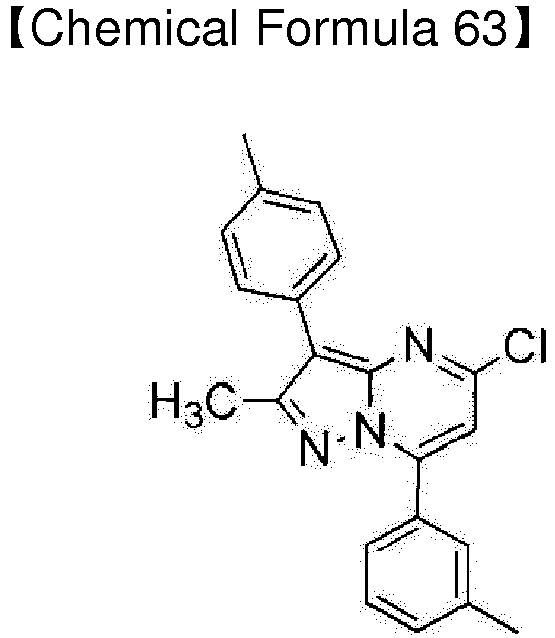
- 3-(4-Methylphenyl)-7-(3-methylphenyl)-2-methylpyrazolo[1,5-a]pyrimidin-5(4H )-one is added to POCl3 (3 mL) and pyridine (0.1 mL) and stirred for 2 hours while heating. After cooling to room temperature, POCl3 is removed by distillation under reduced pressure. After the distillation, ethyl acetate (20 mL) and ice are added to the remainder. The organic layer is extracted and it is extracted once again with water and ethyl acetate. The organic layer is washed with 1 M NaHCO3 aqueous solution and brine. The organic layer is dehydrated with anhydrous MgSO4. The solvent is removed from the organic layer by distillation under reduced pressure. The remainder is purified by column chromatography to yield the target compound.
- 5-Chloro-3-(4-methylphenyl)-7-(3-methylphenyl)-2-methylpyrazolo[1,5-a]pyri midine, (S)-pyrrolin-2-ylmethanol and DIPEA (0.2 mL) are added to acetonitrile (10 mL) and stirred overnight at 80 ºC. After cooling to room temperature, the solvent and volatile substance are removed by distillation under reduced pressure. The remainder is extracted 3 times with ethyl acetate (20 mL) and water. The collected organic layer is washed with brine. The organic layer is dehydrated with anhydrous MgSO4 and the solvent is removed by distillation under reduced pressure. The remainder is purified by column chromatography to yield the target compound.
-

-


- 3-Methylpyrazol-5-amine (431 mg) and methyl 3-methylphenyl-3-oxopropanoate (812 mg) are stirred overnight at 93 ºC in a pyridine (10 mL) solvent. After cooling to room temperature, the reaction solvent is removed by distillation under reduced pressure. The remainder is extracted with ethyl acetate and water. The extracted organic layer is washed with brine and dehydrated with anhydrous MgSO4. The dehydrated organic layer is distilled under reduced pressure and purified by column chromatography to yield the target compound (673 mg).
-

- 7-(3-Methylphenyl)-2-methylpyrazolo[1,5-a]pyrimidin-5(4H)-one (673 mg) is dissolved in POCl3 (15 mL) and pyridine (0.2 mL) and stirred overnight while heating. After cooling to room temperature, the reaction solvent is removed by distillation under reduced pressure. The remainder is extracted with ethyl acetate and water. The extracted organic layer is washed with 1 M NaHCO3 aqueous solution and brine and dehydrated with anhydrous MgSO4. The dehydrated organic layer is distilled under reduced pressure and purified by column chromatography to yield the target compound (381 mg). 1H NMR (CDCl3, 300 MHz): δ 7.79 (m, 2H), 7.45 (m, 3H), 6.77 (m, 1 H), 6.46 (s, 1 H), 2.50 (s, 3H), 2.46 (s, 3H).
-

- 5-Chloro-7-(3-methylphenyl)-2-methylpyrazolo[1,5-a]pyrimidine (381 mg) is dissolved in CH2Cl2 (70 mL) and N-iodosuccinimide (NIS, 467 mg) is added to the reaction solution. The reaction mixture is stirred at room temperature for 16 hours. The reaction solvent is removed by distillation under reduced pressure. The remainder is extracted with ethyl acetate and water. The extracted organic layer is washed with 1 M NaHCO3 aqueous solution and brine and dehydrated with anhydrous MgSO4. The dehydrated organic layer is distilled under reduced pressure and purified by column chromatography to yield the target compound (580 mg). 1H NMR (CDCl3, 300 MHz) δ 7.76 (m, 2H), 7.45 (m, 3H), 6.84 (s, 1 H), 2.50 (s, 3H), 2.46 (s, 3H).
-

- 5-Chloro-7-(3-methylphenyl)-3-iodo-2-methylpyrazolo[1,5-a]pyrimidine (580 mg), DIPEA (0.4 mL) and (S)-2-pyrrolidinemethanol (400 mg) are stirred at 90 ºC in an acetonitrile (60 mL) solvent for 6 hours. The reaction solvent is removed by distillation under reduced pressure. The remainder is purified by column chromatography to yield the target compound (360 mg). 1H NMR (CDCl3, 300 MHz): δ 7.67 (m, 2H), 7.40 (m, 2H), 7.27 (s, 1 H), 6.10 (s, 1 H), 4.48 (br, 1 H), 3.88 -3.55 (m, 4H), 2.44 (s, 3H), 2.38 (s, 3H), 2.08-1.97 (m, 3H), 1.76 (m, 1 H).
- (S)-(1-(7-(3-Methylphenyl)-3-iodo-2-methylpyrazolo[1,5-a]pyrimidin-5-yl)pyrrol idin-2-yl)methanol (22 mg), 4-methoxyphenylboronic acid (17 mg) and tetrakis(triphenylphosphine)palladium (10 mg) are added to toluene (10 mL), ethanol (3 mL) and 1 N NaHCO3 aqueous solution (1.5 mL) and stirred overnight at 90 ºC under argon atmosphere. After cooling to room temperature, the reaction solvent is removed by distillation under reduced pressure. The remainder is extracted with ethyl acetate and water. The organic layer is washed with brine and dehydrated with anhydrous MgSO4. The dehydrated organic layer is concentrated by distillation under reduced pressure and purified by column chromatography to yield the target compound (12 mg).
- Chemical formula and NMR analysis data for the compounds of Examples 156-168 are shown in Chemical Formula 69 and Table 10.

[Table 10] Ex. No. R' 1H NMR (CDCl3, 300 MHz) 156 4-Me 7.72 (s, 2H), 7.48 (d, J = 7.8 Hz, 2H), 7.42 (m, 1H), 7.34 (d, J = 7.2 Hz, 1H), 7.26 (m, 2H), 6.12 (s, 1H), 5.65 (bs, 1H), 4.41 (m, 1H), 3.63 (m, 4H), 2.47 (s, 3H), 2.46 (s, 3H), 2.38 (s, 3H), 2.05 (m, 3H), 1.75 (m, 1H) 157 4-MeO 8.18 (d, J = 8.1 Hz, 1H), 7.71 (br, 2H), 7.48 (d, J = 8.7 Hz, 1H), 7.42 (m, 1H), 7.35 (m, 1H), 7.02 (m, 2H), 6.11 (s, 1H), 5.98 (s, 2H), 4.54 (br, 1H), 3.84 (s, 3H), 4.07 (q, J = 7.2 Hz, 2H), 3.73-3.50 (m, 4H), 2.46 (s, 3H), 2.15-1.99 (m, 3H), 1.78 (m, 1H) 158 4-EtO 7.72 (s, 2H), 7.48 (d, J = 8.4 Hz, 2H), 7.42 (m, 1H), 7.35 (m, 1H), 6.11 (s, 1H), 5.98 (s, 2H), 4.87 (br, 1H), 4.07 (q, J = 7.2 Hz, 2H), 3.76-3.50 (m, 4H), 2.46 (s, 3H), 2.15-1.99 (m, 3H), 1.70 (m, 1H) 159 3,4-methylenedioxy 7.70 (m, 2H), 7.42 (m, 1H), 7.395 (m, 1H), 7.05(s, 1H), 7.02 (d, J = 7.8 Hz, 1H), 6.90 (d, J = 7.8 Hz, 1H), 6.11 (s, 1H), 5.98 (s, 2H), 4.46 (br, 1H), 3.76-3.52 (m, 4H), 2.46 (s, 3H), 2.09-1.99 (m, 3H), 1.78 (m, 1H) 160 4-CF2H 7.74 (m, 4H), 7.56 (d, J = 7.5 Hz, 2H), 7.44 (m, 1H), 7.36 (m, 1H), 6.76 (J = 56.4 Hz, 1H), 6.15 (s, 3H), 4.45 (br, 1H), 3.75-3.56 (m, 4H), 2.50 (s, 3H), 2.46 (s, 3H), 2.12-2.01 (m, 3H), 1.78 (m, 1H) 161 4-CFH2 7.68 (m, 2H), 7.43 (m, 2H), 7.34 (d, 2H), 7.25 (m, 1H), 6.06 (s, 3H), 5.98 (s, 3H), 4.43 (br, 1H), 3.78-3.62 (m, 4H), 2.44 (s, 3H), 2.37 (s, 3H), 2.12-2.04 (m, 3H), 1.78 (m, 1H) 162 4-CH3S 7.70 (m, 2H), 7.54 (d, J = 8.4 Hz, 2H), 7.42 (m, 1H), 7.35 (d, J = 8.1 Hz, 2H), 6.13 (s, 1H), 4.47 (br, 1H), 3.75-3.55 (m, 4H), 2.52 (s, 3H), 2.47 (s, 3H), 2.45 (s, 3H), 2.12-2.00 (m, 2H), 1.77 (m, 1H) 163 4-CF3 7.78 (d, J = 8.4 Hz, 2H), 7.71 (m, 4H), 7.46 (m, 1H), 7.34 (d, J = 8.1 Hz, 1H), 6.17 (s, 1H), 4.49 (br, 1H), 3.79-3.57 (m, 4H), 2.51 (s, 3H), 2.47 (s, 3H), 2.14-2.02 (m, 3H), 1.81 (m, 1H) 164 4-Et 8.14 (d, J = 7.8 Hz, 1H), 7.67 (m, 2H), 7.63 (d, J = 8.1 Hz, 2H), 7.50 (m, 1H), 7.35 (m, 2H), 7.27 (m, 2H), 6.11 (s, 1H), 4.43 (br, 1H), 3.73-3.55 (m, 4H), 2.47 (s, 3H), 2.45 (s, 3H), 2.07-1.98 (m, 3H), 1.78 (m, 1H) 165 4-vinyl 7.70 (s, 2H), 7.58 (d, J = 8.1 Hz, 2H), 7.48 (d, J = 8.1 Hz, 2H), 7.42 (m, 1H), 7.34 (m, 1H), 6.74 (dd, J = 10.8, 17.4 Hz, 1H), 6.12 (s, 1H), 5.75 (d, J = 17.4 Hz, 1H), 5.20 (d, J = 11.1 Hz, 1H) 4.45 (br, 1H), 3.74-3.52 (m, 4H), 2.49 (s, 3H), 2.45 (s, 3H), 2.17-1.99 (m, 3H), 1.77 (m, 1H) 166 4-propyl 7.72 (m, 2H), 7.51 (d, J = 8.1 Hz, 2H), 7.45 (m, 1H), 7.35 (m,, 1H), 7.27 (m, 2H), 6.12 (s, 1H), 4.46 (br, 1H), 3.76-3.52 (m, 4H), 2.64 (t, J = 7.5 Hz, 2H), 2.48 (s, 3H), 2.46 (s, 3H), 2.09-1.99 (m, 3H), 1.78-1.66 (m, 3H), 0.98 (t, J = 7.5 Hz, 3H) 167 4-F 7.73 (m, 2H), 7.56 (m, 2H), 7.42 (m, 1H), 7.33 (m, 1H), 7.13 (m, 2H), 6.13 (s, 1H), 4.42 (br, 1H), 3.74-3.53 (m, 4H), 2.45 (s, 3H), 2.13-1.99 (m, 3H), 1.77 (m, 1H) 168 4-CF3O 7.73 (m, 2H), 7.63 (d, J = 8.7 Hz, 2H), 7.45 (m, 1H), 7.36 (m, 1H), 7.27 (m, 2H), 6.15 (s, 1H), 4.46 (br, 1H), 3.75-3.53 (m, 4H), 2.48 (s, 3H), 2.46 (s, 3H), 2.12-2.01 (m, 3H), 1.78 (m, 1H) -

-
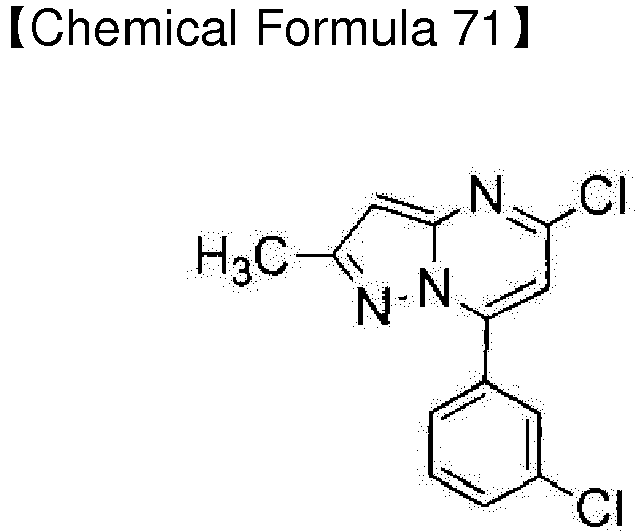
- 3-Methylpyrazol-5-amine (321 mg) and methyl 3-chlorophenyl-3-oxopropanoate (623 mg) are stirred overnight in a pyridine (10 mL) solvent at 95 ºC. After cooling to room temperature, the reaction solvent is removed by distillation under reduced pressure. The remainder is extracted with ethyl acetate and water. The extracted organic layer is washed with brine and dehydrated with anhydrous MgSO4. The dehydrated organic layer is distilled under reduced pressure. The remainder is dissolved in POCl3 (15 mL) and pyridine (0.2 mL) and stirred overnight while heating. After cooling to room temperature, the reaction solvent is removed by distillation under reduced pressure. The remainder is extracted with ethyl acetate and water. The extracted organic layer is washed with 1 M NaHCO3 aqueous solution and brine and dehydrated with anhydrous MgSO4. The dehydrated organic layer is distilled under reduced pressure and purified by column chromatography to yield the target compound (188 mg). 1H NMR (CDCl3, 300 MHz): δ 8.03 (s, 1 H), 7.91 (d, J = 6.3 Hz, 1 H), 7.52 (m, 2H), 7.42 (m, 1 H), 6.79(s, 1 H), 6.49 (s, 1 H), 2.51 (s, 3H).
-

- 5-Chloro-7-(3-chlorophenyl)-2-methylpyrazolo[1,5-a]pyrimidine (186 mg) is dissolved in CH2Cl2 (40 mL) and N-iodosuccinimide (NIS, 323 mg) is added to the reaction solution. The reaction mixture is stirred at room temperature for 16 hours. The reaction solvent is removed by distillation under reduced pressure. The remainder is extracted with ethyl acetate and water. The extracted organic layer is washed with 1 M NaHCO3 aqueous solution and brine and dehydrated with anhydrous MgSO4. The dehydrated organic layer is distilled under reduced pressure and purified by column chromatography to yield the target compound (237 mg). 1H NMR (CDCl3, 300 MHz) δ 7.99 (s, 1 H), 7.89 (d, J = 7.5 Hz, 1 H), 7.53 (m, 3H), 6.85(s, 1H), 2.51 (s, 3H).
-
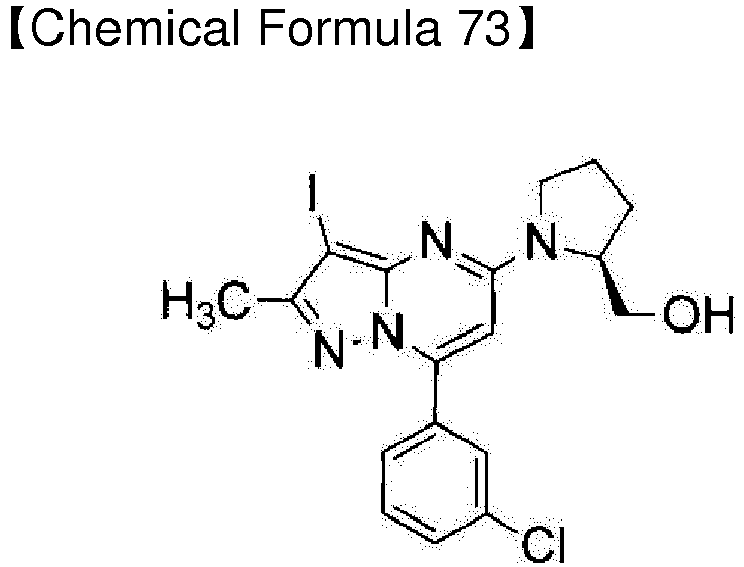
- 5-Chloro-7-(3-chlorophenyl)-3-iodo-2-methylpyrazolo[1,5-a]pyrimidine (237 mg), DIPEA (0.2 mL) and (S)-2-pyrrolidinemethanol (120 mg) are stirred at 90 ºC for 2 hours in an acetonitrile (15 mL) solvent. The reaction solvent is removed by distillation under reduced pressure. The remainder is purified by column chromatography to yield the target compound (360 mg). 1H NMR (CDCl3, 300 MHz): δ 7.84 (s, 1 H), 7.76 (d, J = 7.2 Hz, 1 H), 7.45 (m, 3H), 6.10(s, 1 H), 4.47 (bs, 1 H), 3.83-3.53 (m, 4H), 2.36 (s, 3H) 2.18 -1.98 (m, 3H), 1.78 (m, 1 H).
- (S)-(1-(7-(3-Chlorophenyl)-3-iodo-2-methylpyrazolo[1,5-a]pyrimidin-5-yl)pyrrol idin-2-yl)methanol (30 mg), 4-methoxyphenylboronic acid (15 mg) and tetrakis(triphenylphosphine)palladium (10 mg) are added to toluene (10 mL), ethanol (3 mL) and 1 N NaHCO3 aqueous solution (1.5 mL) and stirred overnight at 90 ºC under argon atmosphere. After cooling to room temperature, the reaction solvent is removed by distillation under reduced pressure. The remainder is extracted with ethyl acetate and water. The organic layer is washed with brine and dehydrated with anhydrous MgSO4. The dehydrated organic layer is concentrated by distillation under reduced pressure and purified by column chromatography to yield the target compound (21 mg).
- Chemical formula and NMR analysis data for the compounds of Examples 170-176 are shown in Chemical Formula 74 and Table 11.

[Table 11] Ex. No. R' 1H NMR (CDCl3, 300 MHz) 169 4-MeO 7.92 (s, 1H), 7.86 (d, J = 7.2 Hz, 1H), 7.50 (m, 4H), 6.99 (d, J = 8.7 Hz, 2H), 6.13 (s, 1H), 4.43 (br, 1H), 3.85 (s, 3H), 3.73-3.56 (m, 4H), 2.46 (s, 3H), 2.09-2.00 (m, 3H), 1.78 (m, 1H) 170 4-Me 7.91 (s, 1H), 7.86 (d, J = 6.9 Hz, 1H), 7.47 (m, 3H), 7.25 (m, 3H), 6.13 (s, 1H), 5.47 (bs, 1H), 4.41 (m, 1H), 3.63 (m, 4H), 2.47 (s, 3H), 2.38 (s, 3H), 2.05 (m, 3H), 1.75 (m, 1H) 171 4-EtO 7.92 (s, 1H), 7.86 (d, J = 6.9 Hz, 1H), 7.49 (m, 4H), 7.20 (m, 2H), 6.12 (s, 1H), 4.40 (br, 1H), 4.11 (q, J = 7.2 Hz, 2H), 3.64-3.56 (m, 4H), 2.46 (s, 3H), 2.09-2.00 (m, 3H), 1.78 (m, 1H), 1.40 (t, J = 6.9 Hz, 3H) 172 3,4-methylenedioxy 7.92 (s, 1H), 7.86 (d, J = 7.2 Hz, 1H), 7.50 (m, 3H), 7.10 (s, 1H), 7.02 (m, 1H), 6.92 (d, J = 8.1 Hz, 1H), 6.13 (s, 1H), 5.99 (s, 2H), 4.46 (br, 1H), 3.75-3.54 (m, 4H), 2.46 (s, 3H), 2.14-2.00 (m, 3H), 1.78 (m, 1H) 173 4-CF3 7.92 (br, 1H), 7.86 (m, 1H), 7.84 (m, 2H), 7.70 (m, 2H), 7.48 (m, 2H), 6.18 (s, 1H), 4.49 (br, 1H), 3.79-3.58 (m, 4H), 2.52 (s, 3H), 2.15-2.05 (m, 3H), 1.83 (m, 1H) 174 4-Et 7.92 (s, 1H), 7.86 (d, J = 7.2 Hz, 1H), 7.50 (m, 4H), 7.27 (d, J = 7.2 Hz, 1H), 7.25 (m, 1H), 6.13 (s, 1H), 4.45 (br, 1H), 3.78-3.56 (m, 4H), 2.68 (q, J = 7.8 Hz, 2H), 2.49 (s, 3H), 2.10-2.00 (m, 3H), 1.69 (m, 1H), 1.28 (t, J = 8.1 Hz, 3H) 175 4-propyl 7.92 (s, 1H), 7.85 (d, J = 7.2 Hz, 1H), 7.53 (m, 4H), 7.27 (m, 2H), 6.13 (s, 1H), 4.44 (br, 1H), 3.76-3.53 (m, 4H), 2.62 (t, J = 7.2 Hz, 2H), 2.48 (s, 3H), 2.46 (s, 3H), 2.17-1.99 (m, 3H), 1.78-1.63 (m, 3H), 0.98 (t, J = 7.5 Hz, 3H) 176 4-Me, 3-F 7.92 (s, 1H), 7.85 (d, J = 7.2 Hz, 1 H), 7.50 (m, 2H), 7.33 (m, 2H), 7.24 (m, 1H), 6.15 (s, 1H), 4.46 (br 1H), 3.75-3.56 (m, 4H), 2.49 (s, 3H), 2.30 (s, 3H), 2.15-2.04 (m, 4H), 1.78 (m, 1H) -

- (S)-(1-(7-(3,5-Difluorophenyl)-3-iodo-2-methylpyrazolo[1,5-a]pyrimidin-5-yl)py rrolidin-2-yl)methanol (55 mg), 4-(difluoromethyl)phenylboronic acid (34 mg) and tetrakis(triphenylphosphine)palladium (10 mg) are added to toluene (8 mL), ethanol (3 mL) and 1 N NaHCO3 aqueous solution (1.5 mL) and stirred at 85 ºC for 4 hours under argon atmosphere. After cooling to room temperature, the reaction solvent is removed by distillation under reduced pressure. The remainder is extracted with ethyl acetate and water. The organic layer is washed with brine and dehydrated with anhydrous MgSO4. The dehydrated organic layer is concentrated by distillation under reduced pressure and purified by column chromatography to yield the target compound (51 mg).
- Chemical formula and NMR analysis data for the compounds of Examples 177-195 are shown in Chemical Formula 76 and Table 12.

[Table 12] Ex. No. R R' 1H NMR (CDCl3, 300 MHz) 177 3-F, 4-F 4-CHF2 7.90 (m, 1H), 7.73 (m, 3H), 7.58 (d, J = 7.8 Hz, 2H), 7.40 (m, 1H), 7.35 (m, 1H), 7.68 (t, J = 56.7 Hz, 2H), 6.16 (s, 1H), 4.47 (br, 1H), 3.78-3.54 (m, 4H), 2.51 (s, 3H), 2.17-2.00 (m, 3H), 1.83 (m, 1H) 178 3-OMe 4-CHF2 7.70 (d, J = 7.8 Hz, 2H), 7.55 (d, J = 7.8 Hz, 2H), 7.44 (m, 2H), 7.05 (d, J = 7.2 Hz, 2H), 6.64 (s, 1H), 6.16 (s, 1H), 4.44 (br, 1H), 3.86 (s, 3H), 3.72-3.50 (m, 4H), 2.47 (s, 3H), 2.15-1.99 (m, 3H), 1.78-1.69 (m, 1H) 179 3-OMe 4-CF3 7.78 (d, J = 8.1 Hz, 2H), 7.68 (d, J = 8.4 Hz, 2H), 7.48 (m, 3H), 7.08 (m, 1H), 6.20 (s, 1H), 4.49 (br, 1H), 3.89 (s, 3H), 3.69-3.50 (m, 4H), 2.51 (s, 3H), 2.15-1.99 (m, 3H), 1.78-1.69 (m, 1H) 180 4-Me 4-CF3 7.84 (d, J = 8.1 Hz, 2H), 7.77 (d, J = 8.1 Hz, 2H), 7.67 (d, J = 8.1 Hz, 2H), 7.33 (d, J = 8.1 Hz, 2H), 6.17 (s, 1H), 4.48 (br, 1H), 3.74-3.49 (m, 4H), 2.51 (s, 3H), 2.45 (s, 3H), 2.10-1.97 (m, 3H), 1.78-1.69 (m, 1H) 181 3-OMe 4-Et 8.16 (m, 2H), 7.52 (d, J = 7.8 Hz, 2H), 7.44 (m, 1H), 7.31 (d, J = 7.8 Hz, 2H), 7.07 (m, 1H), 6.51 (s, 1H), 4.47 (br, 1H), 3.86 (s, 3H), 3.69-3.50 (m, 4H), 2.73 (q, J = 7.8 Hz, 2H), 2.48 (s, 3H), 2.15-1.99 (m, 3H), 1.78-1.69 (m, 1H), 1.26 (t, J = 7.8 Hz, 3H) 182 4-Me 4-Et 7.84 (d, J = 8.1 Hz, 2H), 7.52 (d, J = 8.1 Hz, 2H), 7.33 (d, J = 7.8 Hz, 2H), 7.28 (d, J = 8.1 Hz, 2H), 6.12 (s, 1H), 4.43 (br, 1H), 3.74-3.49 (m, 4H), 2.68 (q, J = 7.5 Hz, 2H), 2.48 (s, 3H), 2.44 (s, 3H), 2.10-1.97 (m, 3H), 1.78-1.69 (m, 1H), 1.28 (t, J = 7.8 Hz, 3H) 183 3-OMe 3-F, 4-Me 7.50 (m, 3H), 7.32 (d, J = 9.0 Hz, 2H), 7.26 (m, 1H), 7.07 (m, 1H), 6.17 (s, 1H), 4.47 (br, 1H), 3.88 (s, 3H), 3.78-3.52 (m, 4H), 2.49 (s, 3H), 2.30 (s, 3H), 2.15-1.99 (m, 3H), 1.78-1.69 (m, 1H) 184 3-F, 4-F 3-F, 4-Me 7.90 (m, 1H), 7.69 (m, 1H), 7.29 (m, 4H), 6.14 (s, 1H), 4.46 (br, 1H), 3.65 (m, 4H), 2.49 (s, 3H), 2.15 (s, 3H), 2.09 (m, 2H), 1.82 (m, 1H) 185 3-Cl, 4-F 3-F, 4-Me 8.04 (m, 1H), 7.88 (m, 1H), 7.31 (m, 4H), 6.13 (s, 1H), 5.20 (br, 1H), 4.46 (br, 1H), 3.64 (m, 4H), 2.49 (s, 3H), 2.15 (s, 3H), 2.34 (m, 2H), 1.79 (m, 1H), 186 3-OMe 3-F, 4-MeO 8.49 (m, 3H), 7.39 (m, 1H), 7.29 (m, 1H), 7.00 (m, 2H), 6.17 (s, 1H), 4.47 (br, 1H), 3.92 (s, 3H), 3.88 (s, 3H), 3.78-3.52 (m, 4H), 2.47 (s, 3H), 2.15-1.99 (m, 3H), 1.78-1.69 (m, 1H) 187 3-F, 4-F 3-F, 4-MeO 7.90 (m, 1H), 7.70 (m, 1H), 7.37 (m, 3H), 7.05 (m, 1H), 6.14 (s, 1H), 4.46 (br, 1H), 3.92 (s, 3H), 3.65 (m, 4H), 2.48 (s, 3H), 2.09 (m, 2H), 1.82 (m, 1H) 188 3-F, 5-F 3-F, 4-MeO 7.54 (m, 2H), 7.34 (m, 2H), 7.05 (m, 2H), 6.16 (s, 1H), 4.45 (br, 1H), 3.92 (s, 3H), 3.77-3.56 (m, 4H), 2.48 (s, 3H), 2.17-2.08 (m, 2H), 1.87 (m, 1H) 189 3-Cl, 4-F 3-F, 4-MeO 8.02 (m, 1H), 7.87 (m, 1H), 7.65 (m, 1H), 7.46 (m, 1H), 7.32 (m, 1H), 7.05 (m, 1H), 6.13 (s, 1H), 4.38 (br, 1H), 3.92 (s, 3H), 3.78-3.52 (m, 4H), 2.47 (s, 3H), 2.09 (m, 2H), 1.80 (m, 1H) 190 3-OMe 2-F, 4-F 7.54-7.38 (m, 3H), 7.00 (m, 1H), 6.94 (m, 2H), 6.79 (m, 1H), 6.16 (s, 1H), 4.35 (br, 1H), 3.89 (s, 3H), 3.78-3.52 (m, 4H), 2.40 (s, 3H), 2.15-1.99 (m, 4H), 1.78-1.69 (m, 1H) 191 3-Et 2-F, 4-F 7.72 (d, J = 8.7 Hz, 2H), 7.40 (m, 3H), 7.25 (m, 1H), 6.28 (m, 1H), 6.07 (s, 1 H), 5.96 (s, 1H), 4.44 (m, 1H), 3.67 (m, 4H), 2.75 (m, 2H), 2.37 (s, 3H), 2.08 (m, 3H), 1.75 (m, 1H), 1.30 (s, 3H) 192 3-Cl, 4-F 4-F 8.04 (m, 1H), 7.87 (m, 1H), 7.52 (m, 2H), 7.28 (m, 2H), 7.11 (m, 2H), 6.12 (s, 1H), 4.43 (br, 1H), 3.66 (m, 4H), 2.45 (s, 3H), 2.11 (s, 2H), 1.77 (m, 1H), 193 4-Me 4-Pr 7.82 (d, J = 7.8 Hz, 2H), 7.47 (d, J = 7.8 Hz, 2H), 7.30 (d, J = 7.8 Hz, 2H), 7.2 (d, J = 7.5 Hz, 2H), 6.09 (s, 1H), 4.40 (br, 1H), 3.69-3.50 (m, 4H), 2.58 (t, J = 7.8 Hz, 2H), 2.45 (s, 3H), 2.41 (s, 3H), 2.15-1.99 (m, 3H), 1.78-1.69 (m, 1H), 1.65 (m, 2H), 0.95 (t, J = 7.2 Hz, 3H) 194 4-Me 4-PrO 7.82 (d, J = 8.1 Hz, 2H), 7.45 (d, J = 8.4 Hz, 2H), 7.30 (d, J = 7.8 Hz, 2H), 6.96 (d, J = 9.0 Hz, 2H), 6.08 (s, 1H), 4.38 (br, 1H), 3.93 (t, J = 8.4 Hz, 2H), 3.69-3.50 (m, 4H), 2.42 (s, 3H), 2.15-1.99 (m, 3H), 1.78 (m, 2H), 1.78-1.69 (m, 1H), 1.02 (t, J = 7.5 Hz, 3H) 195 H 4-H 7.94 (m, 2H), 7.60 (d, J = 7.5 Hz, 2H), 7.53 (bs, 3H), 7.44 (dd, J = 7.2, 7.5 Hz, 2H), 7.25 (m, 1H), 6.14 (s, 1H), 5.42 (bs, 1H), 4.41 (m, 1H), 3.63 (m, 4H), 2.49 (s, 3H), 2.06 (m, 3H), 1.76 (m, 1H) -

-

- 2-(4-Chlorophenyl)acetonitrile (5.74 g) is dissolved in 120 mL of THF at 0 ºC. After adding 60% NaH (4.2 g, 2.7 eq), the reaction mixture is stirred for 10 minutes. Ethylcyclopropane carboxylate is added and the mixture is stirred overnight. The reaction is stopped by adding acetic acid (5 mL) and water. The aqueous layer is extracted with ethyl acetate (50 mL x 3). The collected organic layer is washed with brine and dehydrated with MgSO4. The dehydrated organic layer is concentrated by distillation under reduced pressure and purified by column chromatography to yield 7.74g of the target compound. 1H NMR (CDCl3, 300 MHz): δ 7.42 (d, J = 8.7 Hz, 2H), 7.34 (d, J = 8.7 Hz, 2H), 4.79 (s, 1 H), 2.10 (m, 1 H) 1.16 (m, 2H), 1.03 (m, 2H).
-

- 2-(4-Chlorophenyl)-3-cyclopropyl-3-oxopropanenitrile(7.74g), hydrazine hydrate (3.5 mL) and acetic acid (7.5 mL) are dissolved in a toluene solvent and stirred for 16 hours while heating. Upon completion of reaction, after cooling to room temperature, the solvent is removed by distillation under reduced pressure. The remainder is extracted with water and ethyl acetate. The extracted organic layer is dehydrated and distilled under reduced pressure. The remainder is purified by column chromatography to yield 5.2 g of the target compound. 1H NMR (CDCl3, 300 MHz): δ 7.40 (m, 4H), 3.75 (br, 2H), 1.86 (m, 1 H) 0.93 (m, 2H), 0.65 (m, 2H).
-

- 4-(4-Chlorophenyl)-3-cyclopropyl-1H-pyrazol-5-amine (121 mg) and ethyl 3-(4-fluorophenyl)-3-oxopropanoate (0.095 mL) are stirred overnight in a pyridine (7 mL) solvent at 95 ºC. After cooling to room temperature, the reaction solvent is removed by distillation under reduced pressure. The remainder is extracted with ethyl acetate and water. The extracted organic layer is washed with brine and dehydrated with anhydrous MgSO4. The dehydrated organic layer is distilled under reduced pressure and purified by column chromatography to yield 75 mg of the target compound. 1H NMR (CDCl3, 300 MHz): δ 10.15 (br, 1 H), 8.02 (m, 2H), 7.42 (m, 4H), 7.18 (m, 2H), 4.08 (br, 1 H), 1.80 (m, 1 H) 0.89 (m, 4H).
-


- 2-Cyclopropyl-3-(4-chlorophenyl)-7-(4-fluorophenyl)-pyrazolo[1,5-a]pyrimidin-5(4H)-one (257 mg) is added to POCl3 (10 mL) and pyridine (0.2 mL) and stirred for 3 hours while heating. After cooling to room temperature, POCl3 is removed by distillation under reduced pressure. After the distillation, ethyl acetate (20 mL) and ice are added to the remainder. The organic layer is extracted and it is extracted once again with water and ethyl acetate. The organic layer is washed with 1 M NaHCO3 aqueous solution and brine. The organic layer is dehydrated with anhydrous MgSO4. The solvent is removed from the organic layer by distillation under reduced pressure. The remainder is purified by column chromatography to yield the target compound (143 mg). 1H NMR (CDCl3, 300 MHz): δ 8.09 (m, 2H), 7.79 (d, J = 8.7 Hz, 2H), 7.46 (d, J = 8.4 Hz, 2H), 7.26 (m, 2H), 6.83 (s, 1 H), 2.17 (m, 1 H), 1.13 (m, 2H), 1.06 (m, 2H).
- 5-Chloro-2-ethyl3-(4-methylphenyl)-7-(4-fluorophenyl)-pyrazolo[1,5-a]pyrimidi ne (48 mg), (S)-pyrrolin-2-ylmethanol (0.02 mL) and DIPEA (0.1 mL) are added to acetonitrile (15 mL) and stirred overnight at 80 ºC. After cooling to room temperature, the solvent and volatile substance are removed by distillation under reduced pressure. The remainder is extracted 3 times with ethyl acetate (20 mL) and water. The collected organic layer is washed with brine. The organic layer is dehydrated with anhydrous MgSO4 and the solvent is removed by distillation under reduced pressure. The remainder is purified by column chromatography to yield the target compound (36 mg).
- A compound of Example 197 is prepared in a similar manner as Example 196.
- Chemical formula and NMR analysis data for the compounds of Examples 196 and 197 are shown in Chemical Formula 82 and Table 13.
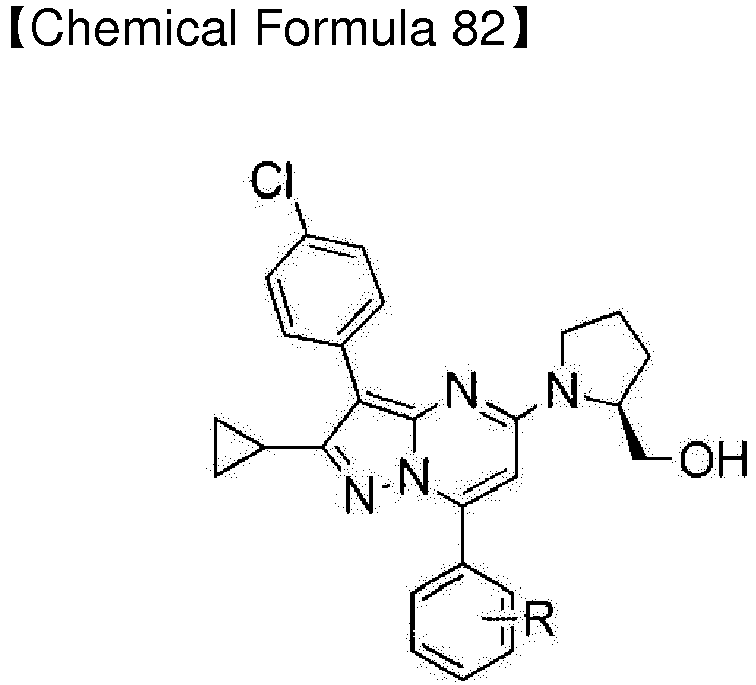
[Table 13] Ex. No. R 1H NMR (CDCl3, 300 MHz) 196 4-F 7.98 (m, 2H), 7.70 (d, J = 8.4 Hz, 2H), 7.41 (d, J = 8.4 Hz, 2H), 7.23 (m, 2H), 6.13 (s, 1H), 4.44 (br, 1H), 3.75-3.55 (m, 4H), 2.13-2.03 (m, 3H), 1.79 (m, 1H), 1.05-0.93 (m, 5H). 197 3-F 7.75 (m, 4H), 7.48 (m, 1H), 7.41 (d, J = 8.4 Hz, 2H), 7.23 (m, 1H), 6.17 (s, 1H), 4.44 (br, 1H), 3.74-3.53 (m, 4H), 2.13-2.03 (m, 4H), 1.79 (m, 1H), 1.04-0.87 (m, 4H). -

-

- 3-Ethyl-4-(4-methylphenyl)-1H-pyrazol-5-amine (200 mg) and ethyl 3-(4-fluorophenyl)-3-oxopropanoate (250 mg) are stirred overnight in a pyridine (10 mL) solvent at 95 ºC. After cooling to room temperature, the reaction solvent is removed by distillation under reduced pressure. The remainder is extracted with ethyl acetate and water. The extracted organic layer is washed with brine and dehydrated with anhydrous MgSO4. The dehydrated organic layer is distilled under reduced pressure and purified by column chromatography to yield 280 mg of the target compound.
-

- 2-Ethyl-3-(4-methylphenyl)-7-(4-fluorophenyl)-pyrazolo[1,5-a]pyrimidin-5(4H)-one (150 mg) is added to POCl3 (3 mL) and pyridine (0.1 mL) and stirred for 2 hours while heating. After cooling to room temperature, POCl3 is removed by distillation under reduced pressure. After the distillation, ethyl acetate (20 mL) and ice are added to the remainder. The organic layer is extracted and it is extracted once again with water and ethyl acetate. The organic layer is washed with 1 M NaHCO3 aqueous solution and brine. The organic layer is dehydrated with anhydrous MgSO4. The solvent is removed from the organic layer by distillation under reduced pressure. The remainder is purified by column chromatography to yield 70 mg of the target compound. 1H NMR (CDCl3, 300 MHz) δ 7.96 (m, 2H), 7.53 (m, 3H), 7.24 (m, 3H), 6.85 (s, 1 H), 2.90 (q, J = 7.8 Hz, 2H), 2.42 (s, 3H), 1.23 (t, J = 7.8 Hz, 3H).
- 5-Chloro-2-ethyl3-(4-methylphenyl)-7-(4-fluorophenyl)-pyrazolo[1,5-a]pyrimidi ne (50 mg), (S)-pyrrolin-2-ylmethanol (17 mg) and DIPEA (0.2 mL) are added to acetonitrile (10 mL) and stirred overnight at 80 ºC. After cooling to room temperature, the solvent and volatile substance are removed by distillation under reduced pressure. The remainder is extracted 3 times with ethyl acetate (20 mL) and water. The collected organic layer is washed with brine. The organic layer is dehydrated with anhydrous MgSO4 and the solvent is removed by distillation under reduced pressure. The remainder is purified by column chromatography to yield 48 mg of the target compound.
- Chemical formula and NMR analysis data for the compounds of Examples 198-200 are shown in Chemical Formula 86 and Table 14.
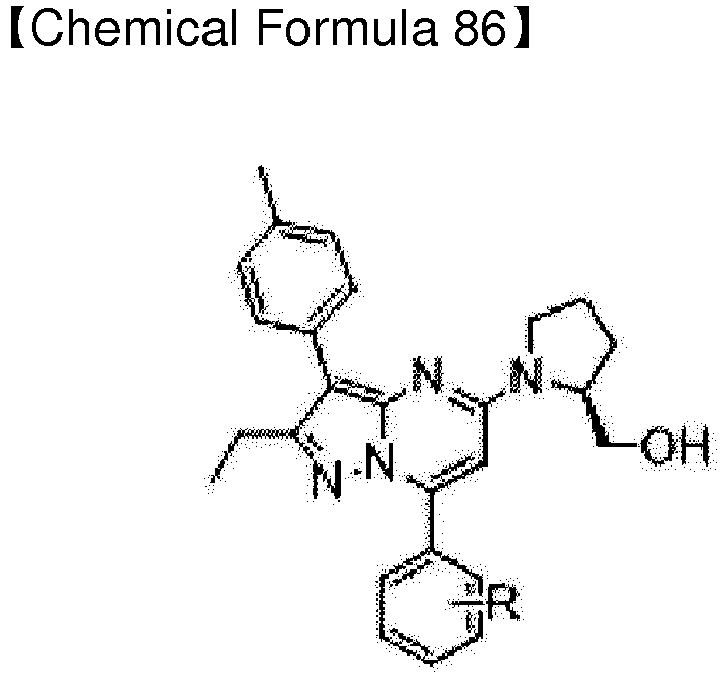
[Table 14] Ex. No. R 1H NMR (CDCl3, 300 MHz) 198 3-Cl 7.76 (m, 2H), 7.51 (m, 1H), 7.42 (m, 2H), 7.24 (m,3H), 6.15 (s, 1H), 5.54 (br, 1H), 4.38 (m, 1H), 3.61 (m, 4H), 2.88 (q, J = 7.8 Hz, 2H), 2.38 (s, 3H), 2.08 (m, 4H), 1.74 (m, 1H), 1.23 (m, 3H) 199 4-F 8.02 (m, 2H), 7.43 (d, J = 7.8 Hz, 2H), 7.25 (m, 2H), 7.20 (d, J = 7.8 Hz, 2H), 6.11 (s, 1H), 4.38 (m, 1H), 4.12 (q, J = 7.2 Hz, 2H), 3.78-3.50 (m, 3H), 2.38 (s, 3H), 2.15-1.99 (m, 3H), 1.75-1.69 (m, 1H), 1.23 (t, J =6.9 Hz, 3H) 200 3-F 7.96 (s, 1H), 7.91 (d, J = 7.2 Hz, 1H), 7.46 (m, 4H), 7.25 (d, J = 7.5 Hz, 2H), 6.13 (s, 1H), 5.56 (bs, 1H), 4.38 (m, 1H), 3.61 (m, 4H), 2.86 (dd, J = 7.5 Hz, 2H), 2.38 (s, 3H), 2.05 (m, 3H), 1.74 (m, 1H), 1.23 (dd, J = 7.5, 7.8 Hz) -

-

- Sodium ethoxide (2 eq) is dissolved in ethanol (200 mL) and 4-methylphenylacetonitrile (10.0) and ethyl ethoxyacetate (1.5 eq) are slowly added. The reaction mixture is stirred for 1 hour under reflux. Upon completion of the reaction, ethanol is removed under reduced pressure and water (100 mL) and ethyl acetate are added. The organic layer is removed and the aqueous layer is acidified by adding acetic acid (10 mL) and extracted 3 times with ethyl acetate. The extracted organic layer is collected, washed with water and dehydrated with MgSO4. After concentration under reduced pressure, the produced solid is recrystallized with Hx:EA = 20:1 to obtain the target compound (70-95%).
-

- 4-Ethoxy-2-(4-methylphenyl)-3-oxobutanenitrile (1.493 g) is dissolved in ethanol (50 mL). After adding hydrazine 2HCl (1.10 g), TEA (0.85 mL) and molecular sieve, the reaction mixture is heated to 80 ºC. After stirring for 15 hours and cooling to room temperature, the molecular sieve is removed by filtering. The reaction solvent is removed under reduced pressure. After the reaction is terminated by adding saturated aq. NaHCO3, the reaction mixture is extracted 3 times with ethyl acetate. The organic layer is washed with water and dehydrated with MgSO4. After concentration under reduced pressure, the produced solid is recrystallized to obtain the target compound (90%). 1H NMR (CDCl3, 300 MHz): δ 7.26 (m, 2H), 7.02 (m, 2H), 6.80 (br, 2H), 4.20 (s, 2H), 3.38 (m, 2H), 2.24 (s, 3H), 1.06 (t, 3H).
-


- 3-(Ethoxymethyl)-4-(4-methylphenyl)-1H-pyrazol-5-amine (133 mg) and ethyl 3-(4-fluorophenyl)-3-oxopropanoate (0.2 mL) are stirred at 84 ºC for 14 hours in a pyridine (10 mL) solvent. After cooling to room temperature, the reaction solvent is removed by distillation under reduced pressure. The remainder is extracted with ethyl acetate and water. The extracted organic layer is washed with brine and dehydrated with anhydrous MgSO4. The dehydrated organic layer is distilled under reduced pressure and purified by column chromatography to yield 132 mg of the target compound. 1H NMR (CDCl3, 300 MHz): δ 10.08 (s, 1 H), 7.98 (m, 2H), 7.28 (m, 4H), 7.13 (m, 2H), 4.43 (s, 2H), 4.04 (br, 1 H), 3.50 (m, 2H), 2.35 (s, 3H), 1.06 (t, 3H).
-


- 2-(Ethoxymethyl)-7-(4-fluorophenyl)-3-(4-methylphenyl)pyrazolo[1,5-a]pyrimi din-5(4H)-one (132 mg) is dissolved in POCl3 (15 mL) and pyridine (0.2 mL) and stirred overnight while heating. After cooling to room temperature, the reaction solvent is removed by distillation under reduced pressure. The remainder is extracted with ethyl acetate and water. The extracted organic layer is washed with 1 M NaHCO3 aqueous solution and brine and dehydrated with anhydrous MgSO4. The dehydrated organic layer is distilled under reduced pressure and purified by column chromatography to yield the target compound (381 mg). 1H NMR (CDCl3, 300 MHz): δ 8.11 (m, 2H), 7.73 (d, J = .8.1 Hz, 2H), 7.26 (m, 4H), 6.87(s, 1 H), 4.70 (s, 2H), 6.66 (m, 2H), 2.41 (s, 3H), 1.26 (3H).
- 5-Chloro-2-(ethoxymethyl)-7-(4-fluorophenyl)-3-(4-methylphenyl)pyrazolo[1,5 -a]pyrimidine (22 mg), DIPEA (0.1 mL) and (S)-2-pyrrolidinemethanol (0.1 mL) are stirred for 2 hours in an acetonitrile (7 mL) solvent at 84 ºC. The reaction solvent is removed by distillation under reduced pressure. The remainder is purified by column chromatography to yield the target compound (24 mg).
- Compounds of Examples 202-220 are prepared in a similar manner as Example 201.
- Chemical formula and NMR analysis data for the compounds of Examples 201-220 are shown in Chemical Formula 92 and Table 15.

[Table 15] Ex. No. R R' 1H NMR (CDCl3, 300 MHz) 201 4-F 4-Me 7.99 (m, 2H), 7.63 (m, 2H), 7.22 (m, 4H), 6.18 (s, 1H), 4.58 (s, 2H), 4.42 (br, 1H), 3.62 (m, 6H), 3.38 (s, 3H), 2.15 (m, 3H), 1.80 (m, 1H), 1.26 (t, J = 6.9 Hz, 3H) MS(M+1): 461.4 202 3-F 4-Me 7.85 (m, 1H), 7.83 (m, 1H), 7.75 (m, 2H), 7.43 (m, 2H), 7.25 (m, 2H), 6.87 (s, 1H), 4.71 (s, 2H), 3.66 (q, J = 6.9 Hz, 2H), 2.47 (s, 3H), 2.41 (s, 3H), 1.26 (t, J = 6.9 Hz, 3H) 203 3-OMe 4-Me 7.65 (m, 2H), 7.55 (s, 1H), 7.46 (m, 2H), 7.27 (m, 2H), 7.08 (m, 1H), 6.22 (s, 1H), 4.59 (s, 2H), 4.45 (br, 1H), 3.88 (s, 3H), 3.63 (m, 6H), 2.38 (s, 3H), 2.11 (m, 2H), 1.23 (m, 3H) 204 3-CF3 4-Me 8.21 (m, 1H), 8.19 (m, 1H), 7.80 (m, 1H), 7.67 (m, 3H), 7.26 (m, 1H), 6.24 (s, 1H), 5.35 (br, 1H), 4.59 (s, 2H), 3.63 (m, 6H), 2.38 (s, 3H), 2.06 (m, 3H), 1.80 (m, 1H), 1.25 (t, J = 6.9 Hz, 3H) 205 3-Me 4-Me 7.74 (m, 2H), 7.64 (m, 2H), 7.42 (m, 2H), 7.32 (m, 2H), 6.12 (s, 1H), 4.59 (s, 2H), 4.43 (m, 1H), 3.59 (m, 6H), 2.46 (s, 3H), 2.38 (m, 3H), 2.10 (m, 3H), 1.79 (m, 1H), 1.25 (t, J = 6.9 Hz, 3H) 206 4-F 4-Cl 7.98 (m, 2H), 7.74 (d, J = 8.4 Hz, 2H), 7.40 (d, J = 8.4 Hz, 2H), 7.22 (t, J = 8.7 Hz, 2H), 6.21 (s, 1H), 5.06 (bs, 1H), 4.75 (s, 2H), 4.68 (m, 1H), 3.65 (m, 6H), 2.09 (m, 3H), 1.82 (m, 1H), 1.25 (dd, J = 6.9, 7.2 Hz, 3H) 207 3-F 4-Cl 7.73 (m, 4H), 7.50 (m, 1H), 7.40 (d, J = 8.4 Hz, 2H), 7.06 (m, 1H) 6.25 (s, 1H), 4.99 (bs, 1H), 4.58 (s, 2H), 4.46 (bs, 1H), 3.63 (m, 6H), 2.09 (m, 3H), 1.82 (m, 1H), 1.24 (dd, J = 6.6, 7.2 Hz, 3H) 208 3-CF3 4-Cl 8.18 (s, 1H), 8.16 (d, J = 9.6 Hz, 1H), 7.80 (d, J =7.8 Hz, 2H), 7.74 (d, J = 8.4 Hz, 1H), 7.66 (t, J = 7.8 Hz, 1H), 7.40 (d, J = 8.7 Hz, 2H), 6.26 (s, 1H), 5.03 (bs, 1H), 4.57 (s, 2H), 4.45 (bs, 1H), 3.63 (m, 6H), 2.06 (m, 3H), 1.82 (m, 1H), 1.24 (m, 3H) 209 4-F 4-MeO 7.95 (d, J = 8.7 Hz, 2H), 7.76 (m, 2H), 7.50 (m, 2H) 6.98 (d, J = 8.7 Hz, 2H), 6.27 (s, 1H), 4.65 (s, 2H), 4.44 (br, 1H), 3.85 (s, 3H), 3.66 (q, J = 7.2 Hz, 2H), 3.72-3.42 (m, 4H), 2.15-1.99 (m, 4H), 1.27 (t, J =6.9 Hz, 3H) 210 3-F 4-MeO 7.78 (m, 4H), 7.38 (m, 1H), 7.08 (m, 1H), 7.02 (d, J = 8.7 Hz, 2H), 6.23 (s, 1H), 5.70 (br, 1H), 4.73 (s, 2H), 3.84 (s, 3H), 3.73 (m, 5H), 3.65 (q, J = 8.1 Hz, 2H), 2.09 (m, 3H), 1.99 (m, 1H), 1.27 (t, J = 6.9 Hz, 3H) 211 3-OMe 4-MeO 7.99 (m, 2H), 7.76 (m, 2H), 7.31 (m, 1H), 7.06 (m, 1H), 6.91 (d, J = 8.1 Hz, 1H), 6.30 (s, 1H), 4.60 (s, 2H), 4.45 (br, 1H), 3.87 (s, 3H), 3.78-3.50 (m, 5H), 3.45 (s, 3H), 3.63 (q, J = 6.9 Hz, 2H), 2.15-1.99 (m, 3H), 1.85-1.78 (m, 1H), 1.25 (t, J =7.2 Hz, 3H) 212 3-CF3 4-MeO 8.20 (m, 2H), 7.79 (m, 1H), 7.68 (m, 3H), 6.99 (d, J = 8.4 Hz, 2H), 6.24 (s, 1H), 4.58 (s, 2H), 4.45 (br, 1H), 3.85 (s, 3H), 3.78-3.50 (m, 5H), 3.63 (q, J = 6.9 Hz, 2H), 2.15-1.99 (m, 3H), 1.85-1.78 (m, 1H), 1.25 (t, J =7.2 Hz, 3H) 213 3-Cl 4-MeO 7.99 (s, 1H), 7.90 (m, 1H), 7.78 (d, J = 8.7 Hz, 2H), 7.35 (m, 2H), 7.00 (d, J = 8.7 Hz, 2H), 6.22 (s, 1H), 4.73(s, 2H), 4.28 (br, 1H), 3.84 (s, 3H), 3.72 (m, 5H), 3.66 (q, J = 7.2 Hz, 2H), 2.09 (m, 3H), 1.99 (m, 1H), 1.27 (t, J = 6.9 Hz, 3H) 214 3-F 3,4-methylenedioxy 7.73 (d, J = 8.4 Hz, 2H), 7.50 (m, 1H), 7.25 (m, 2H), 6.91 (d, J = 7.8 Hz, 2H), 6.23 (s, 1H), 5.98 (s, 2H), 4.58 (s, 2H), 4.47 (m, 1H), 3.72 (m, 5H), 2.04 (m, 3H), 1.79 (m, 1H), 1.25(t,J=6.9Hz,3H) 215 3-OMe 3,4-methylenedioxy 7.54 (m, 1H), 7.47 (m, 3H), 7.31 (m, 1H), 7.06 (m, 1H), 6.91 (d, J = 8.1 Hz, 1H), 6.35 (s, 1H), 5.98 (s, 2H), 4.60 (s, 2H), 4.45 (br, 1H), 3.87 (s, 3H), 3.78-3.50 (m, 5H), 3.63 (q, J = 6.9 Hz, 2H), 2.15-1.99 (m, 3H), 1.85-1.78 (m, 1H), 1.25 (t, J =7.2 Hz, 3H) 216 3-CF3 3,4-methylenedioxy 8.26 (d, J = 7.5 Hz, 1H), 8.21 (s, 1H), 7.65 (d, J = 8.1 Hz, 1H), 7.55 (m, 1H), 7.44 (m, 1H), 7.29 (m, 1H), 6.91 (d, J = 8.1 Hz, 1H), 6.26 (s, 1H), 5.50 (br, 1H), 4.72 (s, 2H), 3.76 (m, 5H), 3.66 (q, J = 7.2 Hz, 2H), 2.09 (m, 3H), 2.00 (m, 1H), 1.27 (t, J = 6.9 Hz, 3H) 217 3-Cl 3,4-methylenedioxy 7.97(s, 1H), 7.92 (m, 1H), 7.43 (s, 1H), 7.36 (d, J = 4.5 Hz, 2H), 7.28 (d, J = 8.1 Hz, 1H), 6.91 (d, J = 8.1 Hz, 1 H), 6.22 (s, 1H), 5.97 (s, 2H), 4.71 (s, 2H), 4.18 (br, 1H), 3.72 (m, 5H), 3.66 (q, J = 7.2 Hz, 2H), 2.09 (m, 3H), 2.00 (m, 1H), 1.27 (t, J = 6.9 Hz, 3H) 218 3-F 4-F 8.25 (m, 2H), 7.77 (m, 2H), 7.39 (m, 1H), 7.14 (m, 3H), 6.25 (s, 1H), 4.71 (s, 2H), 4.15 (br, 1H), 3.75 (m, 5H), 3.65 (q, J = 6.9 Hz, 2H), 2.11 (m, 4H), 1.25 (t, J = 9.6 Hz, 3H) 219 3-CF3 4-F 8.23 (m, 2H), 7.84 (m, 2H), 7.65 (d, J = 7.8 Hz, 1H), 7.55 (m, 1H), 7.14 (m, 2H), 6.27 (s, 1H), 4.71 (s, 2H), 4.15 (br, 1H), 3.75 (m, 5H), 3.68 (q, J = 7.2 Hz, 2H), 2.11 (m, 4H), 1.25 (t, J = 9.6 Hz, 3H) 220 3-Me 4-MeO 7.74 (s, 2H), 7.68 (d, J = 8.7 Hz, 2H), 7.42 (m, 1H), 7.35 (m, 1H), 7.00 (d, J = 8.7 Hz, 2H), 6.20 (s, 1H), 5.40 (br, 1H), 4.58 (s, 2H), 4.44 (br, 1H), 3.84 (s, 3H), 3.60 (m, 5H), 2.45 (s, 2H), 2.02 (m, 4H), 1.72 (m, 1H), 1.24 (t, 3H) -

-

- Sodium ethoxide (2 eq) is dissolved in ethanol (200 mL) and 4-methylphenylacetonitrile (10.0) and ethyl ethoxyacetate (1.5 eq) are slowly added. The reaction mixture is stirred for 1 hour under reflux. Upon completion of the reaction, ethanol is removed under reduced pressure and water (100 mL) and ethyl acetate are added. The organic layer is removed and the aqueous layer is acidified by adding acetic acid (10 mL) and extracted 3 times with ethyl acetate. The extracted organic layer is collected, washed with water and dehydrated with MgSO4. After concentration under reduced pressure, the produced solid is recrystallized with Hx:EA = 20:1 to obtain the target compound (70-95%).
-

- 4-Ethoxy-2-(4-methylphenyl)-3-oxobutanenitrile (1.493 g) is dissolved in ethanol (150 mL) and hydrazine hydrate (∼40%, 7.8 mL, 2 eq) and acetic acid (5.9 mL, 2 eq) are slowly added. The reaction mixture is stirred at 80 ºC for 1 hour under reflux. Upon completion of the reaction, ethanol is removed under reduced pressure. After the reaction is terminated by adding saturated aq. NaHCO3, the reaction mixture is extracted 3 times with ethyl acetate. The organic layer is washed with water and dehydrated with MgSO4. After concentration under reduced pressure, the produced solid is recrystallized with Hx:EA:MC = 20:1:0.1 to obtain the target compound (90%). 1H NMR (CDCl3, 300 MHz): δ 7.25 (m, 2H), 6.95 (m, 2H), 4.43 (s, 3H), 3.82 (s, 3H), 3.38 (s, 3H).
-


- 3-(Methoxymethyl)-4-(4-methoxyphenyl)-1H-pyrazol-5-amine (1.4 g, 6.0 mmol) and methyl 3-(trifluoromethyl)phenyloxopropanoate (2.2 g, 1.5 eq) are dissolved in pyridine (10 mL) and stirred at 95 ºC for 12 hours under reflux. Upon completion of the reaction, 2.1 g of the target compound is obtained by purification by column chromatography (ethyl acetate 100%).
-

- 2-(Methoxymethyl)-7-(3-(trifluoromethyl)phenyl)-3-(4-methylphenyl)pyrazolo[1 ,5-a]pyrimidin-5(4H)-one (1.0 g, 2.33 mmol) is dissolved in POCl3 (3 mL) and pyridine (0.03 mL) and stirred for 1 hour while refluxing at 95 ºC. Upon completion of the reaction, POCl3 is removed under reduced pressure and ethyl acetate and ice water (5 mL) are added. The extracted organic layer is washed with saturated aq. NaHCO3 and dehydrated with MgSO4. 800 mg of the target compound is obtained by purification by column chromatography (ethyl acetate 10%). 1H NMR (CDCl3, 300 MHz): δ 8.20 (m, 2H), 7.80 (m, 1 H), 7.69 (m, 1 H), 7.64 (m, 2H), 7.00 (d, J = 8.4 Hz, 2H), 6.86 (s, 1 H), 4.55 (s, 2H), 3.85 (s, 3H), 3.44 (s, 3H).
-

- 5-Chloro-2-(methoxymethyl)-7-(4-(trifluoromethylphenyl)-3-(4-methoxyphenyl) pyrazolo[1,5-a]pyrimidine (50 mg), DIPEA (0.2 mL) and (S)-2-pyrrolidinemethanol (0.02 mL) are stirred for 2 hours in an acetonitrile (7 mL) solvent at 84 ºC. The reaction solvent is removed by distillation under reduced pressure. The remainder is purified by column chromatography to yield 43 mg of the target compound.
- Compounds of Examples 222-238 are prepared in a similar manner as Example 221.
- Chemical formula and NMR analysis data for the compounds of Examples 222-238 are shown in Chemical Formula 99 and Table 16.

[Table 16] Ex. No. R R' 1H NMR (CDCl3, 300 MHz) 221 3-CF3 4-MeO 8.20 (m, 2H), 7.80 (d, J = 7.8 Hz, 1H), 7.69 (d, J = 7.8 Hz, 1H), 7.64 (d, J = 8.4 Hz, 2H), 7.00 (d, J = 8.4 Hz, 2H), 6.25 (s, 1H), 4.55 (s, 2H), 4.46 (br, 1H), 3.85 (s, 3H), 3.62 (m, 5H), 3.44 (s, 3H), 2.09 (m, 3H), 1.82 (m, 1H) 222 4-F 4-MeO 8.00 (m, 2H), 7.64 (d, J = 8.7 Hz, 2H), 7.26 (m, 2H), 7.00 (d, J = 8.7 Hz, 2H), 6.21 (s, 1H), 4.55 (s, 2H), 4.45 (br, 1H), 3.85 (s, 3H), 3.62 (m, 5H), 3.44 (s, 3H), 2.08 (m, 3H), 1.78 (m, 1H) 223 3-F 4-MeO 7.75 (m, 2H), 7.65 (d, J = 8.7 Hz, 2H), 7.50 (m, 1H), 7.26 (s, 1H), 7.00 (d, J = 8.7 Hz, 2H), 6.24 (s, 1H), 4.56 (s, 2H), 4.46 (br, 1H), 3.85 (s, 3H), 3.62 (m, 5H), 3.44 (s, 3H), 2.08 (m, 3H), 1.80 (m, 1H) 224 2-F 4-MeO 7.77 (t, J = 7.2 Hz, 1H), 7.65 (d, J = 6.9 Hz, 2H), 7.49 (m, 1H), 7.25 (m, 2H), 6.99 (d, J = 6.6 Hz, 2H), 6.26 (s, 1H), 5.38 (bs, 1H), 4.51 (s, 2H), 4.41 (bs, 1H), 3.83 (s, 3H), 3.60 (m, 4H), 3.39 (d, J = 1.8 Hz, 3H), 2.03 (m, 3H), 1.76 (m, 1H) 225 4-MeO 4-MeO 7.93 (dd, J = 8.7 Hz, 2H), 7.61 (d, J = 6.9 Hz, 2H), 6.99 (m, 4H), 6.16 (d, J = 1.8 Hz, 1H), 5.42 (bs, 1H), 4.52 (s, 2H), 4.40 (m, 1H), 3.86 (s, 3H), 3.81 (s, 3H), 3.60 (m, 4H), 3.40 (d, J = 2.1 Hz, 3H), 2.03 (m. 3H), 1.73 (m, 1H) 226 3-MeO 4-MeO 7.66 (d, J = 8.7 Hz, 2H), 7.56 (m, 1H), 7.52 (d, J = 7.8 Hz, 1H), 7.44 (d, J = 7.8 Hz, 1H), 7.09 (m, 1H), 7.02 (d, J = 8.7 Hz, 2H), 6.25 (s, 1H), 5.38 (bs, 1H), 4.56 (s, 2H), 4.45 (m, 1H), 3.89 (s, 3H), 3.85 (s, 3H), 3.64 (m, 4H), 3.44 (s, 3H), 2.06 (m, 3H), 1.79 (m, 1H) 227 3-CH3 4-MeO 7.74 (d, J = 7.8 Hz, 2H), 7.65 (d, J = 9.0 Hz, 2H), 7.41 (dd, J = 7.8, 7.5 Hz, 1H), 7.34 (d, J = 7.8 Hz, 1 H), 7.01 (d, J = 8.4 Hz, 2H), 6.20 (s, 1H), 5.41 (bs, 1H), 4.54 (s, 2H), 4.45 (m, 1H), 3.84 (s, 3H), 3.64 (m, 4H), 3.43 (s, 3H), 2.45 (s, 3H), 2.06 (m, 3H), 1.79 (m, 1H) 228 3-CN 4-MeO 8.28 (m, 2H), 7.81 (m, 1H), 7.63 (m, 2H), 7.01 (m, 2H), 6.24 (ms, 1H), 5.11 (bs, 1H), 4.54 (s, 2H), 4.45 (s, 1H), 3.85 (s, 3H), 3.68 (m, 4H), 3.44 (s, 3H), 2.08 (m, 3H), 1.80 (m, 1H) 229 4-Cl 4-MeO 7.89 (d, J = 7.8 Hz, 2H), 7.60 (d, J = 8.4 Hz, 2H), 7.46 (d, J = 7.5 Hz, 2H), 6.97 (d, J = 8.4 Hz, 2H), 6.19 (s, 1H), 5.25 (bs, 1H), 4.50 (s. 2H), 4.39 (m, 1H), 3.80 (s, 3H), 3.60 (m, 4H), 3.39 (s, 3H), 2.01 (m, 3H), 1.75 (m, 1H) 230 3-Cl 4-MeO 7.92 (s, 1H), 7.86 (d, J = 7.5 Hz, 1H), 7.64 (d, J = 8.4 Hz, 2H), 7.47 (m, 2H), 7.00 (d, J = 8.7 Hz, 2H), 6.21 (s, 1H), 5.28 (bs, 1H), 4.56 (s, 2H), 4.29 (m, 1H), 3.83 (s. 3H), 3.66 (m, 4H), 3.43 (s, 3H), 2.06 (m, 3H), 1.78 (m, 1H) 231 4-F 4-Cl 7.98 (m, 2H), 7.70 (d, J = 8.4 Hz, 2H), 7.41 (d, J = 8.4 Hz, 2H), 7.20 (d, J = 8.7 Hz, 2H), 6.23 (s, 1H), 4.54 (s, 2H), 4.48 (br, 1H), 3.62 (m, 5H), 3.44 (s, 3H), 2.08 (m, 3H), 1.78 (m, 1H) 232 3-F 4-Cl 7.72 (m, 4H), 7.50 (m, 1H), 7.41 (d, J = 7.8 Hz, 2H), 7.26 (s, 1H), 6.26 (s, 1H), 4.54 (s, 2H), 4.47 (br, 1H), 3.62 (m, 5H), 3.44 (s, 3H), 2.08 (m, 3H), 1.80 (m, 1H) 233 3-CF3 4-Cl 8.16 (m, 2H), 7.78 (d, J = 7.8 Hz, 1H), 7.66 (m, 3H), 7.38 (d, J = 8.7 Hz, 2H), 6.25 (s, 1H), 4.50 (s, 2H), 4.47 (br, 1H), 3.67 (m, 5H), 3.41 (s, 3H), 2.06 (m, 3H), 1.80 (m, 1H) 234 3-CH3 4-Cl 7.72 (m, 4H), 7.42 (m, 4H), 6.23 (s, 1H), 4.55 (s, 2H), 4.47 (br, 1H), 3.86 (m, 4H), 3.43 (s, 3H), 2.46 (s, 3H), 2.08 (m, 3H), 1.80 (m, 1H) 235 4-F 3,4-methylenedioxy 8.00 (m, 2H), 7.28-7.17 (m, 4H), 6.91 (d, J = 8.7 Hz, 1H), 6.21 (s, 1H), 5.99 (s, 2H), 4.55 (s, 2H), 4.45 (br, 1H), 3.78-3.50 (m, 5H), 3.44 (s, 3H), 2.15-1.99 (m, 3H), 1.83-1.78 (m, 1H) 236 3-F 3,4- methylenedioxy 7.75 (s, 1H), 7.72 (s, 1H), 7.50 (m, 1H), 7.21 (m, 3H), 6.91 (d, J = 8.7 Hz, 1H), 6.24 (s, 1H), 5.99 (s, 2H), 4.55 (s, 2H), 4.45 (br, 1H), 3.78-3.50 (m, 5H), 3.44 (s, 3H), 2.17-2.02 (m, 3H), 1.83-1.78 (m, 1H) 237 4-CF3 3,4- methylenedioxy 8.05 (d, J = 7.8 Hz, 2H), 7.76 (d, J = 7.2 Hz, 2H), 7.60 (d, J = 7.2 Hz, 2H), 6.96 (ds, J = 8.4 Hz, 2H), 6.20 (s, 2H), 5.12 (bs, 1H), 4.50 (s, 2H), 4.42 (m, 1H), 3.81 (s, 3H), 3.68 (m, 4H), 3.39 (s, 3H), 2.05 (m, 3H), 1.76 (m, 1H) 238 3-CF3 3,4- methylenedioxy 8.20 (m, 2H), 7.80 (d, J = 7.8 Hz, 1H), 7.62 (m, 1H), 7.27 (d, J = 6.9 Hz, 1H), 7.20 (m, 1H), 6.91 (d, J = 7.8 Hz, 1H), 6.25 (s, 1H), 5.99 (s, 2H), 4.55 (s, 2H), 4.45 (br, 1H), 3.78-3.50 (m, 5H), 3.44 (s, 3H), 2.15-1.99 (m, 3H), 1.83-1.78 (m, 1H) -

- 5-Chloro-2-(ethoxymethyl)-7-(4-fluorophenyl)-3-(4-methylphenyl)pyrazolo[1,5 -a]pyrimidine (22 mg), DIPEA (0.1 mL) and N-methylaminoethanol (0.1 mL) are stirred for 12 hours in an acetonitrile (7 mL) solvent at 84 ºC. The reaction solvent is removed by distillation under reduced pressure. The remainder is extracted with ethyl acetate and water. The collected organic layer is washed with brine and dehydrated with anhydrous MgSO4. The solvent is removed by distillation under reduced pressure and the remainder is purified by column chromatography to yield the target compound (18 mg).
- Compounds of Examples 240-256 are prepared in a similar manner as Example 239.
- Chemical formula and NMR analysis data for the compounds of Examples 240-256 are shown in Chemical Formula 101 and Table 17.

[Table 17] Ex. No. R R' 1H NMR (CDCl3, 300 MHz) 239 4-F 4-Me 7.99 (m, 2H), 7.73 (m, 2H), 7.24 (m, 4H), 6.31 (s, 1H), 4.60 (s, 2H), 3.88 (m, 2H), 3.83 (m, 2H), 3.63 (q, J = 6.9 Hz, 2H), 3.23 (s, 3H), 2.39 (s, 3H), 1.26 (t, J = 6.9 Hz, 3H) 240 3-F 4-Me 7.76-7.26 (m, 4H), 7.51 (m, 1H), 7.24 (m, 3H), 6.35 (s, 1H), 4.62 (s, 2H), 3.89 (m, 2H), 3.85 (m, 2H), 3.42 (br, 1H), 3.23 (s, 3H), 2.39 (s, 3H). 241 3-CF3 4-Me 8.19 (m, 2H), 7.78-7.67 (m, 4H), 7.28 (m, 4H), 6.36 (s, 1H), 4.61 (s, 2H), 3.92 (m, 2H), 3.88 (m, 2H), 3.41 (br, 1H), 3.25 (s, 3H), 2.39 (s, 3H). 242 4-F 4-Cl 7.96 (dd, J = 5.4 Hz, 2H), 7.83 (d, J = 8.4 Hz, 2H), 7.40 (d, J = 8.4 Hz, 2H), 7.22 (t, J = 8.7 Hz, 2H), 6.33 (s, 1H), 4.59 (s, 1H), 3.89 (m, 2H), 3.83 (m, 2H), 3.63 (dd, J = 6.9 Hz, 2H), 3.24 (s, 3H), 3.17 (m, 1H), 1.25 (dd, J = 6.9, 7.2 Hz, 3H) 243 3-F 4-Cl 7.83 (d, J = 8.7 Hz, 2H), 7.73 (m, 1H), 7.71 (bs, 1H), 7.50 (m, 1H), 7.40 (d, J = 8.7 Hz, 2H), 7.24 (m, 1H), 6.37 (s, 1H), 4.60 (s, 2H), 3.91 (m, 2H), 3.84 (d, J = 4.5 Hz, 2H), 3.63 (dd, J = 7.2, 6.9 Hz, 2H), 3.25 (s, 3H), 3.08 (bs, 1H), 1.25 (dd, J = 7.2, 6.9 Hz, 3H) 244 3-CF3 4-Cl 8.18 (s, 1H), 8.16 (d, J = 9.3 Hz, 1H), 7.83 (d, J =8.4 Hz, 2H), 7.79 (d, J = 8.7 Hz, 1H), 7.66 (t, J = 7.8 Hz, 1H), 7.40 (d, J = 8.4 Hz, 2H), 6.38 (s, 1H), 4.60 (s, 2H), 3.88 (m, 2H), 3.82 (m, 2H), 3.63 (dd, J = 7.2, 6.6 Hz, 2H), 3.25 (s, 3H), 1.25 (dd, J = 7.2, 6.9 Hz, 3H) 245 4-F 4-MeO 8.06 (m, 2H), 7.86 (d, J = 9.0 Hz, 2H), 7.13 (m, 2H), 7.00 (d, J = 9.0 Hz, 2H), 6.50 (s, 1H), 4.71 (s, 2H), 4.00 (br, 4H), 3.84 (s, 3H), 3.63 (q, J = 6.9 Hz, 2H), 3.17 (s, 3H), 1.25 (t, J = 6.9 Hz, 3H) 246 3-F 4-MeO 7.84 (m, 4H), 7.41 (m, 1 H), 7.11 (m, 1H), 7.02 (d, J = 8.7 Hz, 2H), 6.52 (s, 1H), 4.71 (s, 2H), 4.01 (br, 4H), 3.84 (s, 3H), 3.63 (q, J = 6.9 Hz, 2H), 3.19 (s, 3H), 1.25 (t, J = 6.9 Hz, 3H) 247 3-CF3 4-MeO 8.15 (m, 2H), 7.41 (m, 3H), 7.60 (m, 1H), 6.98 (d, J = 8.7 Hz, 2H), 6.08 (s, 1H), 5.22 (br, 1H), 4.57 (s, 2H), 3.84 (m, 2H), 3.83 (s, 3H), 3.65 (m, 2H), 3.63 (q, J = 6.6 Hz, 2H), 1.26 (t, J =6.9 Hz, 3H) 248 3-Cl 4-MeO 8.03 (s, 1H), 7.96 (m, 1H), 7.86 (d, J = 8.7 Hz, 2H), 7.40 (m, 2H), 7.00 (d, J = 8.7 Hz, 2H), 6.50 (s, 1H), 4.71 (s, 2H), 4.02 (br, 4H), 3.84 (s, 3H), 3.63 (q, J = 6.9 Hz, 2H), 3.20 (s, 3H), 1.25 (t, J = 6.9 Hz, 3H) 249 H 3,4-methylenedioxy 8.07 (m, 2H), 7.55 (s, 1H), 7.44 (m, 4H), 6.92 (d, J = 8.1 Hz, 1H), 6.57 (s, 1H), 5.97 (s, 2H), 5.84 (br, 1H), 4.69 (s, 2H), 3.99 (m, 4H), 3.63 (q, J = 6.9 Hz, 2H), 3.18 (s, 3H), 1.25 (t, J =7.2 Hz, 3H) 250 4-F 3,4- methylenedioxy 8.03 (m, 2H), 7.51 (s, 1H), 7.37 (m, 1H), 7.13 (m, 2H), 6.91 (d, J = 7.8 Hz, 1H), 6.50 (s, 1H), 5.97 (s, 2H), 4.69 (s, 2H), 4.01 (m, 4H), 3.62 (q, J = 6.9 Hz, 2H), 3.18 (s, 3H), 1.25 (t, J =6.9 Hz, 3H) 251 3-F 3,4- methylenedioxy 7.54 (m, 1H), 7.45 (m, 3H), 7.31 (m, 1H), 7.07 (m, 1H), 6.90 (d, J = 8.7 Hz, 1H), 6.51 (s, 1H), 5.98 (s, 2H), 4.70 (s, 2H), 4.02 (m, 4H), 3.63 (q, J = 6.9 Hz, 2H), 3.20 (s, 3H), 1.27 (t, J =7.2 Hz, 3H) 252 3-OMe 3,4- methylenedioxy 7.54 (m, 1H), 7.47 (m, 3H), 7.31 (m, 1H), 7.06 (m, 1H), 6.91 (d, J = 8.1 Hz, 1H), 6.35 (s, 1H), 5.98 (s, 2H), 4.60 (s, 2H), 3.87 (s, 3H), 3.85 (m, 4H), 3.63 (q, J = 6.9 Hz, 2H), 3.23 (s, 3H), 1.25 (t, J =7.2 Hz, 3H) 253 3-CF3 3,4- methylenedioxy 8.29 (d, J = 7.8 Hz, 1H), 8.24 (s, 1H), 7.69 (d, J = 7.8 Hz, 1H), 7.59 (m, 1H), 7.50 (m, 1H), 7.38 (m, 1H), 6.92 (d, J = 7.8 Hz, 1H), 6.53 (s, 1H), 5.98 (s, 2H), 5.61 (br, 1H), 4.70 (s, 2H), 4.05 (br, 4H), 3.64 (q, J = 6.9 Hz, 2H), 3.22 (s, 3H), 1.26 (t, J = 7.2 Hz, 3H) 254 3-Cl 3,4- methylenedioxy 8.01 (s, 1H), 7.96 (m, 1H), 7.49 (s, 1H), 7.38 (m, 3H), 6.91 (d, J = 8.1 Hz, 1H), 6.50 (s, 1H), 5.98 (s, 2H), 5.66 (br, 1H), 4.70 (s, 2H), 4.02 (br, 4H), 3.63 (q, J = 7.2 Hz, 2H), 3.20 (s, 3H), 1.27 (t, J = 6.9 Hz, 3H) 255 3-F 4-F 7.91 (m, 2H), 7.80 (m, 2H), 7.42 (m, 1H), 7.15 (m, 3H), 6.53 (s, 1H), 4.71 (s, 2H), 4.05 (br, 4H), 3.63 (q, J = 6.6 Hz, 2H), 3.20 (s, 3H), 1.25 (t, J = 6.9 Hz, 3H) 256 3-CF3 4-F 8.28 (m, 2H), 7.91 (m, 2H), 7.68 (d, J = 7.8 Hz, 1H), 7.60 (m, 1H), 7.15 (m, 2H), 6.56 (s, 1H), 4.71 (s, 2H), 4.05 (br, 4H), 3.63 (q, J = 6.9 Hz, 2H), 3.23 (s, 3H), 1.25 (t, J = 7.2 Hz, 3H) -


- 5-Chloro-2-(methoxymethyl)-7-[3-(trifluoromethyl)phenyl]-3-(4-methoxyphenyl )pyrazolo[1,5-a]pyrimidine (50 mg), DIPEA (0.2 mL) and N-methylaminoethanol (0.02 mL) are stirred for 12 hours in an acetonitrile (7 mL) solvent at 84 ºC. The reaction solvent is removed by distillation under reduced pressure. The remainder is extracted with ethyl acetate and water. The collected organic layer is washed with brine and dehydrated with anhydrous MgSO4. The solvent is removed by distillation under reduced pressure and the remainder is purified by column chromatography to yield 37 mg of the target compound.
- Compounds of Examples 258-262 are prepared in a similar manner as Example 257.
- Chemical formula and NMR analysis data for the compounds of Examples 257-262 are shown in Chemical Formula 103 and Table 18.

[Table 18] Ex. No. R R' 1H NMR (CDCl3, 300 MHz) 257 3-CF3 4-MeO 8.20 (m, 2H), 7.30 (m, 2H), 7.29 (d, J = 8.4 Hz, 2H), 7.00 (d, J = 8.4 Hz, 2H), 6.38 (s, 1H), 4.58 (s, 2H), 3.91 (m, 2H), 3.86 (s, 3H), 3.85 (m, 2H), 3.45 (s, 3H), 3.26 (s, 3H) 258 4-F 4-MeO 7.99 (m, 2H), 7.73 (d, J = 8.7 Hz, 2H), 7.21 (d, J = 8.7 Hz, 2H), 7.00 (d, J = 8.7 Hz, 2H), 6.33 (s, 1H), 4.57 (s, 2H), 3.91 (m, 2H), 3.85 (s, 3H), 3.83 (m, 2H), 3.45 (s, 3H), 3.25 (s, 3H) 259 3-F 4-MeO 7.74 (m, 3H), 7.50 (m, 1H), 7.00 (d, J = 9.0 Hz, 2H), 6.37 (s, 1H), 4.58 (s, 2H), 3.91 (t, J = 4.2 Hz, 2H), 3.85 (s, 3H), 3.83 (m, 2H), 3.45 (s, 3H), 3.25 (s, 3H) 260 4-F 4-Cl 7.99 (m, 2H), 7.78 (d, J = 7.2 Hz, 2H), 7.40 (d, J = 7.2 Hz, 2H), 7.20 (d, J = 7.4 Hz, 2H), 6.35 (s, 1H), 4.56 (s, 2H), 3.91 (m, 2H), 3.86 (m, 2H), 3.45 (s, 3H), 3.25 (s, 3H) 261 3-F 4-Cl 7.79 (d, J = 7.2 Hz, 2H), 7.72 (d, J = 8.7 Hz, 2H), 7.50 (m, 1H), 7.40 (d, J = 7.2 Hz, 2H), 7.22 (m, 1H), 6.39 (s, 1H), 4.58 (s, 2H), 3.91 (m, 2H), 3.85 (m, 2H), 3.46 (s, 3H), 3.25 (s, 3H) 262 3-Me 4-Cl 7.81 (d, J = 8.7 Hz, 2H), 7.72 (m, 2H), 7.38 (m, 4H), 6.34 (s, 1H), 4.58 (s, 2H), 3.88 (m, 2H), 3.83 (m, 2H), 3.44 (s, 3H), 3.23 (s, 3H), 2.46 (s, 3H) -

- 5-Chloro-2-(ethoxymethyl)-7-(4-fluorophenyl)-3-(4-methylphenyl)pyrazolo[1,5 -a]pyrimidine (20 mg), DIPEA (0.1 mL) and aminoethanol (0.1 mL) are stirred for 12 hours in an acetonitrile (7 mL) solvent at 84 ºC. The solvent is removed by distillation under reduced pressure. The remainder is extracted with ethyl acetate and water. The collected organic layer is washed with brine and dehydrated with anhydrous MgSO4. The solvent is removed by distillation under reduced pressure and the remainder is purified by column chromatography to yield the target compound (15 mg).
- Compounds of Examples 264-268 are prepared in a similar manner as Example 263.
- Chemical formula and NMR analysis data for the compounds of Examples 263-268 are shown in Chemical Formula 105 and Table 19.

[Table 19] Ex. No. R R' 1H NMR (CDCl3, 300 MHz) 263 4-F 4-Me 7.83 (m, 2H), 7.71 (m, 2H), 7.23 (m, 4H), 5.96 (s, 1H), 4.60 (s, 2H), 4.42 (br, 1H), 3.67 (m, 2H), 3.56 (m, 2H), 2.40 (s, 3H), 1.27 (t, J = 6.9 Hz, 3H) 264 3-CF3 4-OMe 8.20 (m, 2H), 7.30 (m, 2H), 7.29 (d, J = 8.4 Hz, 2H), 7.00 (d, J = 8.4 Hz, 2H), 6.38 (s, 1H), 4.58 (s, 2H), 3.91 (m, 2H), 3.86 (s, 3H), 3.85 (m, 2H), 3.63 (q, J = 6.9 Hz, 2H), 3.26 (s, 3H), 1.26 (t, J =6.9 Hz, 3H) 265 H 3,4-methylenedioxy 8.05 (m, 2H), 7.51 (s, 1H), 7.42 (m, 4H), 6.91 (d, J = 8.1 Hz, 1H), 6.66 (br, 1H), 6.42 (s, 1H), 5.97 (s, 2H), 4.69 (s, 2H), 3.96 (m, 2H), 3.67 (q, J = 7.2 Hz, 2H), 3.62 (m, 2H), 1.27 (t, J =6.9 Hz, 3H) 266 4-F 3,4- methylenedioxy 8.03 (m, 2H), 7.47 (s, 1H), 7.34 (d, J = 7.1 Hz, 1H), 7.10 (m, 2H), 6.91 (d, J = 8.1 Hz, 1H), 6.69 (br, 1H), 6.36 (s, 1H), 5.97 (s, 2H), 4.69 (s, 2H), 3.97 (m, 2H), 3.67 (q, J = 7.2 Hz, 2H), 3.64 (m, 2H), 1.27 (t, J =6.9 Hz, 3H) 267 3-F 3,4- methylenedioxy 7.80 (m, 2H), 7.47 (s, 1H), 7.36 (m, 2H), 7.06 (m, 1H), 6.91 (d, J = 8.1 Hz, 1H), 6.71 (br, 1H), 6.38 (s, 1H), 5.97 (s, 2H), 4.69 (s, 2H), 3.96 (m, 2H), 3.66 (q, J = 7.2 Hz, 2H), 3.62 (m, 2H), 1.27 (t, J =6.9 Hz, 3H) 268 3-OMe 3,4- methylenedioxy 7.52 (m, 1H), 7.39 (m, 3H), 7.31 (m, 1H), 7.06 (m, 1H), 6.91 (d, J = 8.1 Hz, 1H), 6.09 (s, 1H), 5.98 (s, 2H), 5.23 (br, 1H), 4.60 (s, 2H), 3.83 (s, 3H), 3.82 (m, 2H), 3.66 (q, J = 6.9 Hz, 2H), 3.62 (m, 2H), 3.37 (br, 1H), 1.25 (t, J =7.2 Hz, 3H) -


-

- 4-(4-Methylphenyl)-1H-pyrazol-5-amine (170 mg) and ethyl 3-(4-fluorophenyl)-3-oxopropanoate (250 mg) are stirred overnight in a pyridine (10 mL) solvent at 95 ºC. After cooling to room temperature, the reaction solvent is removed by distillation under reduced pressure. The remainder is extracted with ethyl acetate and water. The extracted organic layer is washed with brine and dehydrated with anhydrous MgSO4. The dehydrated organic layer is distilled under reduced pressure and purified by column chromatography to yield 180 mg of the target compound.
-

- 3-(4-Methylphenyl)-7-(4-fluorophenyl)-pyrazolo[1,5-a]pyrimidin-5(4H)-one (180 mg) is added to POCl3 (3 mL) and pyridine (0.1 mL) and stirred for 2 hours while heating. After cooling to room temperature, POCl3 is removed by distillation under reduced pressure. After the distillation, ethyl acetate (20 mL) and ice are added to the remainder. The organic layer is extracted and it is extracted once again with water and ethyl acetate. The organic layer is washed with 1 M NaHCO3 aqueous solution and brine. The organic layer is dehydrated with anhydrous MgSO4. The solvent is removed from the organic layer by distillation under reduced pressure. The remainder is purified by column chromatography to yield 170 mg of the target compound. 1H NMR (CDCl3, 300 MHz) δ 8.15 (s, 1 H), 7.92 (m, 2H), 7.80 (m, 2H), 7.33 (m, 4H), 6.91 (s, 1 H), 2.45 (s, 3H).
-
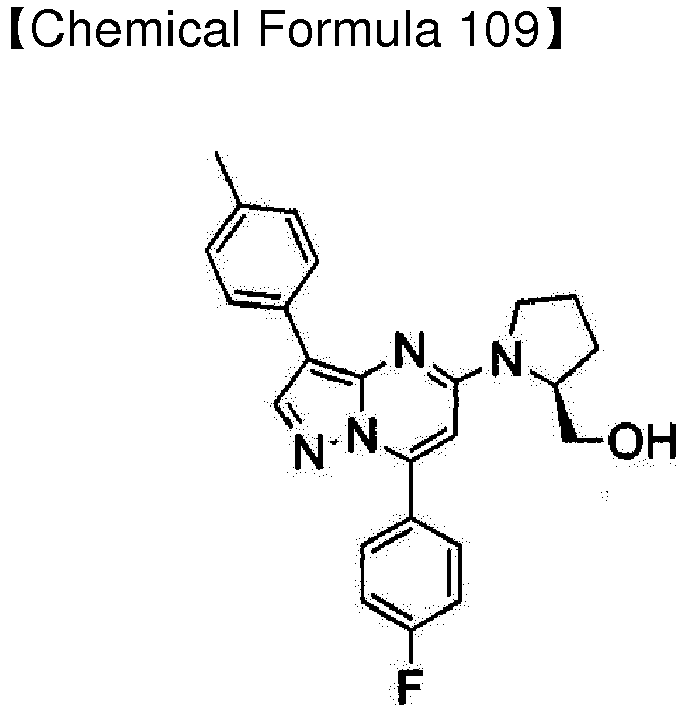
- 5-Chloro-3-(4-methylphenyl)-7-(4-fluorophenyl)-pyrazolo[1,5-a]pyrimidine (50 mg), (S)-pyrrolin-2-ylmethanol (15 mg) and DIPEA (0.2 mL) are added to acetonitrile (10 mL) and stirred overnight at 80 ºC. After cooling to room temperature, the solvent and volatile substance are removed by distillation under reduced pressure. The remainder is extracted 3 times with ethyl acetate (20 mL) and water. The collected organic layer is washed with brine. The organic layer is dehydrated with anhydrous MgSO4 and the solvent is removed by distillation under reduced pressure. The remainder is purified by column chromatography to yield 32 mg of the target compound.
- Compounds of Examples 270-276 are prepared in a similar manner as Example 269.
- Chemical formula and NMR analysis data for the compounds of Examples 269-276 are shown in Chemical Formula 110 and Table 20.


[Table 20] Ex. No. R R' 1H NMR (CDCl3, 300 MHz) 269 4-F 4-Me 8.15 (s, 1H), 7.92 (m, 2H), 7.76 (d, J = 8.18 Hz, 2H), 7.23 (m, 4H), 6.21 (s, 1H), 4.59 (br, 1H), 3.87-3.57 (m, 4H), 2.36 (s, 3H), 2.13-1.99 (m, 3H), 1.85-1.73 (m, 1H) 270 3-F 4-Me 8.16 (s, 1H), 7.76 (d, J = 7.8 Hz, 2H), 7.67 (m, 3H), 7.51 (m, 1H), 7.23 (d, J = 7.8 Hz, 2H), 6.23 (s, 1H), 4.57 (br, 1H), 3.87-3.57 (m, 4H), 2.36 (s, 3H), 2.13-1.99 (m, 3H), 1.85-1.73 (m, 1H) 271 3-MeO 4-Me 8.15 (s, 1H), 7.75 (d, J = 7.2 Hz, 2H), 7.43 (m, 3H), 7.23 (d, J = 7.2 Hz, 2H), 7.06 (m, 1H), 6.23 (s, 1H), 4.55 (br, 1H), 3.87 (s, 3H), 3.87-3.57 (m, 4H), 2.36 (s, 3H), 2.13-1.99 (m, 3H), 1.85-1.73 (m, 1H) 272 3-F, 4-F 4-Me 8.16 (s, 1H), 7.84 (m, 1H), 7.76 (d, J = 7.8 Hz, 2H), 7.70 (m, 1H), 7.34 (m, 1H), 7.25 (d, J = 7.8 Hz, 2H), 6.22 (s, 1H), 4.59 (br, 1H), 3.89-3.57 (m, 4H), 2.36 (s, 3H), 2.17-1.99 (m, 3H), 1.85-1.73 (m, 1H) 273 3-F, 5-F 4-Me 8.18 (s, 1H), 7.76 (d, J = 7.8 Hz, 2H), 7.45 (m, 2H), 7.23 (s, 1H), 7.00 (s, 1H), 6.25 (s, 1H), 4.45 (br, 1H), 3.85-3.57 (m, 4H), 2.36 (s, 3H), 2.17-1.99 (m, 3H), 1.85-1.73 (m, 1H) 274 3-CF3 4-MeO 8.13 (m, 2H), 7.79 (m, 2H), 7.69 (m, 1H), 7.25 (m, 1H), 6.99 (d, J = 7.2 Hz, 2H), 6.25 (s, 1H), 4.60 (br, 1H), 3.85 (s, 3H), 3.80-3.50 (m, 5H), 2.15-1.99 (m, 3H), 1.85-1.78 (m, 1H) 275 3-MeO 4-F 8.13 (m, 1H), 7.84 (m, 2H), 7.44 (m, 3H), 7.11 (m, 3H), 6.26 (s, 1H), 4.59 (br, 1H), 3.88 (s, 3H), 3.79-3.56 (m, 4H), 2.15-2.08 (m, 2H), 1.87 (m, 1H) 276 3-CF3 4-F 8.15 (m, 3H), 7.82 (m, 3H), 7.69 (m, 1H), 7.11 (m, 2H), 6.27 (s, 1H), 4.59 (br, 1H), 3.80-3.50 (m, 4H), 2.15-2.04 (m, 2H), 1.89 (m, 1H) -

- 5-Chloro-3-(4-methylphenyl)-7-(3-fluorophenyl)-2-methylpyrazolo[1,5-a]pyrimi dine (50 mg), (S)-2-methoxymethylpyrrolidine (0.02 mL) and DIPEA (0.2 mL) are added to acetonitrile (10 mL) and stirred overnight at 80 ºC. After cooling to room temperature, the solvent and volatile substance are removed by distillation under reduced pressure. The remainder is extracted 3 times with ethyl acetate (20 mL) and water. The collected organic layer is washed with brine. The organic layer is dehydrated with anhydrous MgSO4 and the solvent is removed by distillation under reduced pressure. The remainder is purified by column chromatography to yield 53 mg of the target compound.
- Compounds of Examples 278-284 are prepared in a similar manner as Example 277.
- Chemical formula and NMR analysis data for the compounds of Examples 278-284 are shown in Chemical Formula 112 and Table 21.

[Table 21] Ex. No. R R' 1H NMR (CDCl3, 300 MHz) 277 4-F Me 7.95 (d, J = 8.4 Hz, 2H), 7.76-7.47 (m, 3H), 7.15 (m, 1H), 6.98 (d, J = 8.4 Hz, 2H), 6.30 (s, 1H), 4.44 (br, 1H), 3.85 (s, 3H), 3.72-3.60 (m, 2H), 3.56-3.43 (m, 2H), 3.39 (s, 3H), 2.38 (s, 3H), 2.15-1.99 (m, 4H) 278 3-MeO Me 7.76 (d, J = 6.6 Hz, 2H), 7.53 (s, 1H), 7.44 (m, 2H), 7.22 (d, J = 7.2 Hz, 2H), 7.04 (d, J = 7.5 Hz, 1H), 6.18 (s, 1H), 4.42 (bs, 1H), 3.86 (s, 3H), 3.65 (m, 2H), 3.45 (m, 2H), 3.96 (s, 3H), 2.56 (s, 3H), 2.38 (s, 3H), 2.03 (m, 4H) 279 3-Me Me 7.76 (s, 1H), 7.73 (d, J = 6.9 Hz, 2H), 7.75 (s, 1H), 7.39 (t, J = 7.5 Hz, 1H), 7.30 (d, J = 7.2 Hz, 1H), 7.20 (d, J = 7.8 Hz, 2H), 6.13 (s, 1H), 4.41 (bs, 1H), 3.65 (m, 2H), 3.48 (m, 2H), 3.90 (s, 3H), 2.55 (s, 3H), 2.46 (s, 3H), 2.37 (s, 3H), 2.03 (m, 4H) 280 3-Cl Me 7.92 (s, 1H), 7.84 (d, J = 6.6 Hz, 1H), 7.71 (d, J = 6.6 Hz, 2H), 7.46 (m, 2H), 7.21 (d, J = 7.21 Hz, 2H), 6.16 (s, 1H), 4.41 (bs, 1H), 3.65 (m, 2H), 3.46 (m, 2H), 3.39 (s, 3H), 2.55 (s, 3H), 2.37 (s, 3H), 2.03 (m, 4H) 281 3-F, 4-F Me 7.90 (dd, J = 8.7, 9.9 Hz, 1H), 7.72 (d, J = 7.8 Hz, 2H), 7.68 (s, 1H), 7.30 (t, J = 8.7 Hz, 1H), 7.21 (d, J = 7.8 Hz, 2H), 6.15 (s, 1H), 4.40 (bs, 1H), 3.63 (m, 2H), 3.46 (m, 2H), 3.38 (s, 3H), 2.55 (s, 3H), 2.37 (m, 3H), 2.03 (m, 4H) 282 3-F 3,4-methylenedi oxy 7.72 (d, J = 8.4 Hz, 2H), 7.50 (dd, J = 7.8, 7.5 Hz, 1H), 7.45 (s, 1H), 7.22 (m, 2H), 6.88 (d, J = 7.8 Hz, 1H), 6.19 (s, 1H), 5.96 (s, 2H), 4.42 (bs, 1H), 3.66 (m, 2H), 3.47 (m, 2H), 3.40 (s, 3H), 2.54 (s, 3H), 2.07 (m, 4H) 283 3-MeO 3,4-methylenedioxy 7.46 (m, 4H), 7.23 (d, J = 1.5 Hz, 1H), 7.05 (d, J = 7.8 Hz, 1H), 6.87 (d, J = 8.1 Hz, 1H), 6.18 (s, 1H), 5.96 (s, 2H), 4.30 (bs, 1H), 3.87 (s, 3H), 3.65 (m, 2H), 3.45 (m, 2H), 3.40 (s, 3H), 2.54 (s, 3H), 2.07 (m, 4H) 284 3-Cl 3,4-methylenedioxy 8.00 (s, 1H), 7.95 (m, 1H), 7.38 (m, 3H), 7.24 (m, 1H), 6.93 (d, J = 7.8 Hz, 1H), 6.24 (s, 1H), 5.99 (s, 2H), 3.96 (m, 1H), 3.72 (m, 1H (dd, J = 3.3, 3.6 Hz, 1H), 3.40 (m, 2H), 3.34 (s, 3H), 2.57 (s, 3H), 2.17 (bs, 3H), 2.04 (m, 1H) -


-

- 3-Butyl-4-(4-methylphenyl)-1H-pyrazol-5-amine (200 mg) and ethyl 3-(4-fluorophenyl)-3-oxopropanoate (250 mg) are stirred overnight in a pyridine (10 mL) solvent at 95 ºC. After cooling to room temperature, the reaction solvent is removed by distillation under reduced pressure. The remainder is extracted with ethyl acetate and water. The extracted organic layer is washed with brine and dehydrated with anhydrous MgSO4. The dehydrated organic layer is distilled under reduced pressure and 215 mg of the target compound is yielded by column chromatography.
-

- 2-Butyl-3-(4-methylphenyl)-7-(4-fluorophenyl)-pyrazolo[1,5-a]pyrimidin-5(4H)-one (150 mg) is added to POCl3 (3 mL) and pyridine (0.1 mL) and stirred for 2 hours while heating. After cooling to room temperature, POCl3 is removed by distillation under reduced pressure. After the distillation, ethyl acetate (20 mL) and ice are added to the remainder. The organic layer is extracted and it is extracted once again with water and ethyl acetate. The organic layer is washed with 1 M NaHCO3 aqueous solution and brine. The organic layer is dehydrated with anhydrous MgSO4. The solvent is removed from the organic layer by distillation under reduced pressure. The remainder is purified by column chromatography to yield 100 mg of the target compound. 1H NMR (CDCl3, 300 MHz) δ 7.96 (m, 2H), 7.47 (m, 2H), 7.39 (d, J = 8.1 Hz, 2H), 7.21 (m, 2H), 6.85 (s, 1 H), 2.81 (q, J = 8.4 Hz, 2H), 2.44 (s, 3H), 1.62 (m, 2H), 1.32 (m, 2H), 0.84 (t, J = 7.2 Hz, 3H).
- 5-Chloro-2-butyl-3-(4-methylphenyl)-7-(4-fluorophenyl)-pyrazolo[1,5-a]pyridin e (50 mg), (S)-pyrrolin-2-ylmethanol (17 mg) and DIPEA (0.2 mL) are added to acetonitrile (10 mL) and stirred overnight at 80 ºC. After cooling to room temperature, the solvent and volatile substance are removed by distillation under reduced pressure. The remainder is extracted 3 times with ethyl acetate (20 mL) and water. The collected organic layer is washed with brine. The organic layer is dehydrated with anhydrous MgSO4 and the solvent is removed by distillation under reduced pressure. The remainder is purified by column chromatography to yield 58 mg of the target compound.
- Compounds of Examples 288-293 are prepared in a similar manner as Example 287.
- Chemical formula and NMR analysis data for the compounds of Examples 288-293 are shown in Chemical Formula 116 and Table 22.

[Table 22] Ex. No. R R' 1H NMR (CDCl3, 300 MHz) 287 3-F 4-Me δ 7.30 (m, 2H), 7.47 (m, 2H), 7.39 (d, J = 8.1 Hz, 2H), 7.21 (m, 2H), 6.11 (s, 1H), 4.34 (m, 1H), 3.67-3.48 (m, 5H), 2.78 (t, J = 7.8 Hz, 2H), 2.35 (s, 3H), 2.22-1.95 (m, 3H), 1.77-1.70 (m, 1H), 1.60 (m, 2H), 1.32 (m, 2H), 0.84 (t, J = 7.2 Hz, 3H) 288 3-CF3 4-Me 8.22 (m, 2H), 7.78 (m, 1H), 7.67 (m, 1H), 7.43 (m, 2H), 7.25 (m, 2H), 6.16 (s, 1H), 5.60 (br, 1H), 4.38 (m, 1H), 3.67 (m, 4H), 2.82 (m, 2H), 2.38 (s, 3H), 2.06 (m, 4H), 1.65 (m, 2H), 1.37 (m, 2H), 0.89 (m, 3H) 289 3-Me 4-Me δ 7.72 (m, 2H), 7.39 (d, J = 7.8 Hz, 2H), 7.35 (m, 2H), 7.21 (m, 2H), 6.08 (s, 1H), 4.33 (m, 1H), 3.81-3.53 (m, 5H), 2.80 (t, J = 7.8 Hz, 2H), 2.14 (s, 3H), 2.34 (s, 3H), 2.22-1.95 (m, 3H), 1.77-1.70 (m, 1H), 1.60 (m, 2H), 1.32 (m, 2H), 0.83 (t, J = 7.2 Hz, 3H) 290 3-F 4-Cl δ 7.70 (m, 3H), 7.52 (d, J = 8.1 Hz, 2H), 7.44 (m, 1H), 7.36 (d, J = 8.1 Hz, 2H), 6.13 (s, 1 H), 4.36 (br, 1H), 3.81-3.53 (m, 5H), 2.77 (t, J = 6.6 Hz, 2H), 2.22-1.95 (m, 3H), 1.77-1.70 (m, 1H), 1.58 (m, 2H), 1.32 (m, 2H), 0.85 (t, J = 7.2 Hz, 3H) 291 3-CF3 4-Cl δ 8.22 (s, 1H), 8.15 (d, J = 7.8 Hz, 7.75 (d, J = 8.4 Hz, 1H), 7.64 (m, 1H), 7.45 (d, J = 8.4 Hz, 2H), 7.35 (d, J = 8.4 Hz, 2H), 6.15 (s, 1H), 4.37 (m, 1H), 3.69-3.40 (m, 5H), 2.80 (t, J = 7.8 Hz, 2H), 2.12-1.95 (m, 3H), 1.77-1.67 (m, 1H), 1.58 (m, 2H), 1.34 (m, 2H), 0.85 (t, J = 7.2 Hz, 3H) 292 3-Me 4-Cl δ 7.71 (m, 2H), 7.46 (d, J = 8.4 Hz, 2H), 7.35 (m, 4H), 6.10 (s, 1H), 4.37 (m, 1H), 3.81-3.53 (m, 5H), 2.80 (t, J = 7.8 Hz, 2H), 2.39 (s, 3H), 2.22-1.95 (m, 3H), 1.77-1.70 (m, 1H), 1.56 (m, 2H), 1.32 (m, 2H), 0.83 (t, J = 7.2 Hz, 3H) 293 3-Me 4-MeO δ 7.72 (m, 2H), 7.40 (d, J = 8.7 Hz, 2H), 7.37 (m, 1H), 7.31 (m, 2H), 6.95 (d, J = 8.7 Hz, 2H), 6.08 (s, 1H), 4.35 (m, 1H), 3.80 (s, 3H), 3.67-3.48 (m, 5H), 2.76 (t, J = 8.1 Hz, 2H), 2.41 (s, 3H), 2.22-1.95 (m, 3H), 1.77-1.70 (m, 1H), 1.60 (m, 2H), 1.32 (m, 2H), 0.83 (t, J = 7.2 Hz, 3H) -

-


- 3-Butyl-4-(4-methylphenyl)-1H-pyrazol-5-amine (200 mg) and ethyl 3-(4-fluorophenyl)-3-oxopropanoate (250 mg) are stirred overnight in a pyridine (10 mL) solvent at 95 ºC. After cooling to room temperature, the reaction solvent is removed by distillation under reduced pressure. The remainder is extracted with ethyl acetate and water. The extracted organic layer is washed with brine and dehydrated with anhydrous MgSO4. The dehydrated organic layer is distilled under reduced pressure and 215 mg of the target compound is yielded by column chromatography.
-

- 2-Butyl-3-(4-methylphenyl)-7-(4-fluorophenyl)-pyrazolo[1,5-a]pyrimidin-5(4H)-one (150 mg) is added to POCl3 (3 mL) and pyridine (0.1 mL) and stirred for 2 hours while heating. After cooling to room temperature, POCl3 is removed by distillation under reduced pressure. After the distillation, ethyl acetate (20 mL) and ice are added to the remainder. The organic layer is extracted and it is extracted once again with water and ethyl acetate. The organic layer is washed with 1 M NaHCO3 aqueous solution and brine. The organic layer is dehydrated with anhydrous MgSO4. The solvent is removed from the organic layer by distillation under reduced pressure. The remainder is purified by column chromatography to yield 100 mg of the target compound. 1H NMR (CDCl3, 300 MHz) δ 7.96 (m, 2H), 7.47 (m, 2H), 7.39 (d, J = 8.1 Hz, 2H), 7.21 (m, 2H), 6.85 (s, 1 H), 2.81 (q, J = 8.4 Hz, 2H), 2.44 (s, 3H), 1.62 (m, 2H), 1.32 (m, 2H), 0.84 (t, J = 7.2 Hz, 3H).
- 5-Chloro-2-butyl-3-(4-methylphenyl)-7-(4-fluorophenyl)-pyrazolo[1,5-a]pyridin e (50 mg), (S)-pyrrolin-2-ylmethanol (17 mg) and DIPEA (0.2 mL) are added to acetonitrile (10 mL) and stirred overnight at 80 ºC. After cooling to room temperature, the solvent and volatile substance are removed by distillation under reduced pressure. The remainder is extracted 3 times with ethyl acetate (20 mL) and water. The collected organic layer is washed with brine. The organic layer is dehydrated with anhydrous MgSO4 and the solvent is removed by distillation under reduced pressure. The remainder is purified by column chromatography to yield 58 mg of the target compound.
- Compounds of Examples 295-304 are prepared in a similar manner as Example 294.
- Chemical formula and NMR analysis data for the compounds of Examples 295-304 are shown in Chemical Formula 120 and Table 23.

[Table 23] Ex. No. R R' 1H NMR (CDCl3, 300 MHz) 294 4-F 4-Me δ 8.01 (m, 2H), 7.42 (d, J = 8.1 Hz, 2H), 7.22 (m, 4H), 6.11 (s, 1H), 4.40 (m, 1H), 3.81-3.53 (m, 5H), 2.80 (t, J = 7.8 Hz, 2H), 2.39 (s, 3H), 2.22-1.95 (m, 3H), 1.77-1.70 (m, 3H), 0.93 (t, J = 7.2 Hz, 3H) 295 3-F 4-Me δ 7.78 (d, J = 8.4 Hz, 2H), 7.51 (m, 1H), 7.44 (d, J = 8.4 Hz, 2H), 7.26 (m, 3H), 6.15 (s, 1H), 4.37 (m, 1H), 3.81-3.53 (m, 5H), 2.80 (t, J = 7.8 Hz, 2H), 2.39 (s, 3H), 2.22-1.95 (m, 3H), 1.77-1.70 (m, 3H), 0.93 (t, J = 7.2 Hz, 3H) 296 3-CF3 4-Me δ 8.19 (s, 1H), 8.18 (d, J = 9.9 Hz, 1H), 7.75 (10.8 Hz, 1H), 7.63 (m, 1H), 7.40 (d, J = 6.9 Hz, 2H), 6.97 (d, J = 6.9 Hz, 2H), 6.13 (s, 1H), 4.33 (m, 1H), 3.81 (s, 3H), 3.72-3.51 (m, 5H), 2.73 (t, J = 7.2 Hz, 2H), 2.00 (s, 3H), 2.032-1.95 (m, 3H), 1.77-1.70 (m, 1H), 0.89(t, J = 7.2 Hz, 3H) 297 3-Me 4-Me 7.76 (m, 2H), 7.44 (m, 2H), 7.39 (m, 1H), 7.34 (m, 1H), 7.24 (m, 2H), 6.12 (s, 1H), 4.37 (br, 1H), 3.65 (m, 4H), 2.80 (t, J = 7.5 Hz, 2H), 2.45 (s, 3H), 2.39 (s, 3H), 2.02 (m, 3H), 1.70 (m, 4H), 0.93 (t, J = 6.6 Hz, 3H) 298 4-F 4-Cl 8.00 (dd, J = 8.7 Hz, 2H), 7.49 (d, J = 8.4 Hz, 2H), 7.40 (d, J = 8.4 Hz, 2H), 7.21 (d, J = 8.7 Hz, 2H), 6.14 (s, 1H), 4.41 (m, 1H), 3.65 (m, 4H), 2.79 (dd, J = 7.5, 8.1 Hz, 2H), 2.01 (m, 3H), 1.79 (m, 1H), 1.68 (m, 2H), 0.93 (dd, J = 7.5, 7.2 Hz, 3H) 299 3-F 4-Cl 7.76 (s, 1H), 7.73 (m, 1H), 7.49 (m, 2H), 7.40 (d, J = 8.4 Hz, 2H), 7.22 (m, 2H), 6.18 (s, 1H), 4.42 (m, 1H), 3.65 (m, 4H), 2.79 (dd, J = 7.5, 7.8 Hz, 2H), 2.04 (m, 3H), 1.80 (m, 1H), 1.75 (m, 2H), 0.93 (dd, J = 7.5, 7.2 Hz, 3H) 300 3-Me 4-Cl 7.73 (m, 4H), 7.40 (m, 4H), 6.23 (s, 1H), 4.55 (s, 2H), 4.50 (br, 1H), 3.69 (m, 4H), 3.57 (s, 3H), 2.46 (s, 3H), 2.07 (m, 3H), 1.80 (m, 1H), 0.93 (t, 3H) 301 4-F 4-MeO 7.99 (m, 2H), 7.44 (d, J = 8.4 Hz, 2H), 7.20 (m, 2H), 6.99 (d, J = 8.7 Hz, 2H), 6.10 (s, 1H), 5.64 (bs, 1H), 4.36 (bs, 1H), 3.83 (s, 3H), 3.62 (m, 4H), 2.78 (dd, J = 7.8, 7.5 Hz, 2H), 1.99 (m, 3H), 1.68 (m, 3H), 0.92 (dd, J = 6.9, 7.5 Hz, 3H) 302 3-F 4-MeO 7.71 (d. J = 7.8 Hz, 2H), 7.46 (m, 1H), 7.41 (s, 1 H), 7.38 (s, 1H), 7.17 (m, 1H), 6.95 (d, J = 8.4 Hz, 2H), 6.10 (s, 1H), 5.54 (bs, 1H), 4.33 (m, 1H), 3.80 (s, 3H), 3.56 (m, 4H), 2.74 (dd, J = 7.5, 7.8 Hz, 2H), 2.00 (m, 3H), 1.67 (m, 3H), 0.88 (dd, J = 7.5, 7.2 Hz, 3H) 303 3-CF3 4-MeO δ 8.19 (s, 1H), 8.18 (d, J = 9.9 Hz, 1H), 7.75 (10.8 Hz, 1H), 7.63 (m, 1H), 7.40 (d, J = 6.9 Hz, 2H), 6.97 (d, J = 6.9 Hz, 2H), 6.13 (s, 1H), 4.33 (m, 1H), 3.81 (s, 3H), 3.72-3.51 (m, 5H), 2.73 (t, J = 7.2 Hz, 2H), 2.00 (s, 3H), 2..32-1.95 (m, 3H), 1.77-1.70 (m, 1H), 0.89(t, J = 7.2 Hz, 3H) 304 3-Me 4-MeO 7.75 (m, 2H), 7.53 (m, 1H), 7.44 (m, 2H), 7.35 (m, 1H), 7.00 (m, 2H), 6.12 (s, 1H), 4.39 (br, 1H), 3.84 (s, 3H), 3.61 (m, 3H), 2.78 (t, J = 7.5 Hz, 2H), 2.45 (s, 3H), 2.02 (m, 3H), 1.68 (m, 3H), 0.93 (t, J = 7.8 Hz, 3H) -

- 5-Chloro-3-(4-chlorophenyl)-7-phenyl-2-methylpyrazolo[1,5-a]pyrimidine (60 mg), (R)-pyrrolin-2-ylmethanol (17 mg) and DIPEA (0.2 mL) are added to acetonitrile (10 mL) and stirred overnight at 80 ºC. After cooling to room temperature, the solvent and volatile substance are removed by distillation under reduced pressure. The remainder is extracted 3 times with ethyl acetate (20 mL) and water. The collected organic layer is washed with brine. The organic layer is dehydrated with anhydrous MgSO4 and the solvent is removed by distillation under reduced pressure. The remainder is purified by column chromatography to yield 40 mg of the target compound. 1H NMR (CDCl3, 300 MHz) δ 7.94 (m, 2H), 7.55 (m, 5H), 7.40 (d, J = 8.4 Hz, 2H), 6.17 (s, 1 H), 4.46 (br, 1 H), 3.78-3.52 (m, 4H), 2.47 (s, 3H), 2.15-1.99 (m, 3H), 1.78-1.69 (m, 1 H).
-

- 5-Chloro-3-(4-methoxyphenyl)-7-(4-fluorophenyl)-2-methoxymethylpyrazolo[1 ,5-a]pyrimidine (60 mg), (R)-pyrrolin-2-ylmethanol (18 mg) and DIPEA (0.2 mL) are added to acetonitrile (10 mL) and stirred overnight at 80 ºC. After cooling to room temperature, the solvent and volatile substance are removed by distillation under reduced pressure. The remainder is extracted 3 times with ethyl acetate (20 mL) and water. The collected organic layer is washed with brine. The organic layer is dehydrated with anhydrous MgSO4 and the solvent is removed by distillation under reduced pressure. The remainder is purified by column chromatography to yield 56 mg of the target compound.
- When cells in which the cannabinoid receptor 1 (CB1) is stably expressed are treated with a CB1 receptor agonist, the CB1 receptor is activated and influx of calcium ions into the cells increases. CB1 receptor inhibition effect of a test compound can be evaluated by measuring the degree of calcium influx inhibition after treating with the test compound.
- First, Chem-1 cells (Chemicon International, #HTS019C) in which human CB1 cDNA is expressed stably were seeded onto a 96-well cell culture plate at a density of ~50,000 cells/well and incubated overnight in a 5% CO2 incubator at 37 ºC. The next day, the culture medium was discarded and the cells were cautiously washed once using an assay buffer (HBSS containing 20 mM HEPES and 2.5 mM probenecid) with 200 µL/well. Calcium ion influx was measured using an assay kit (Fluo-4 NW calcium assay kit: Molecular Probes™, #F36206) according to the manufacturer's instructions. The compounds of Examples of desired concentration to be measured were comprised to 0.5%DMSO. For control, only 0.5% DMSO was used without the compounds of Examples. Reaction time was 10 minutes. After treating the Chem-1 cells stably expressing the CB1 receptor with 1 µM R-(+)-WIN55212-2 (Sigma, #W102), a CB1 receptor agonist, calcium ion (Ca2+) flux induced thereby was measured for 80 seconds using Flex Station 3 (Molecular Device, USA).
- The difference in calcium ion concentration of the cells treated with the compounds of Examples or those treated with 1 µM R-(+)-WIN55212-2 was obtained from the difference of the maximum and minimum values during the 80 seconds. Then, % inhibition of the compounds for the CB1 receptor was calculated using the following equation.

wherein
ΔRFU: maximum relative fluorescence units - minimum relative fluorescence units
ΔRFUCompound: difference in maximum and minimum RFUs in the well where the compounds of Examples dissolved in DMSO to a final concentration of 0.5% and 1 µM R-(+)-WIN55212-2 dissolved in DMSO to a final concentration of 0.5% were added
ΔRFUBlank: difference in maximum and minimum RFUs in the well to which only 1 % DMSO was added
ΔRFUControl: difference in maximum and minimum RFUs in the well where 0.5% DMSO and 1 µM R-(+)-WIN55212-2 dissolved in DMSO to a final concentration of 0.5% were added - IC50 values of the compounds of Examples are given in Table 24.
[Table 24] Ex. No. IC50 (µM) Ex. No. IC50 (µM) 2 0.10 101 0.16 3 0.093 106 0.25 4 0.36 110 0.08 5 0.096 111 0.06 6 0.2 112 0.13 9 0.12 113 0.049 11 0.27 114 0.077 12 0.21 115 0.14 13 0.30 116 0.160 14 0.09 117 0.24 15 0.35 119 0.45 21 0.051 122 0.045 22 0.11 123 0.076 25 0.039 124 0.07 26 0.053 125 0.09 27 0.24 126 0.069 28 0.12 127 0.062 30 0.16 128 0.066 31 0.13 129 0.073 32 0.14 132 0.230 33 0.082 133 0.28 34 0.22 134 0.19 35 0.41 135 0.12 36 0.10 137 0.09 37 0.14 138 0.21 38 0.10 139 0.14 39 0.25 144 0.3 40 0.35 145 0.2 41 0.26 156 0.046 42 0.35 157 0.21 43 0.21 158 0.21 44 0.16 159 0.2 45 0.12 160 0.110 46 0.19 162 0.11 47 0.13 163 0.26 48 0.18 164 0.320 51 0.25 165 0.330 53 0.39 167 0.25 55 0.2 168 0.45 56 0.09 169 0.033 57 0.24 170 0.16 58 0.3 171 0.24 60 0.21 172 0.19 62 0.07 173 0.25 63 0.041 174 0.22 64 0.17 175 0.35 65 0.10 176 0.27 66 0.14 178 0.120 67 0.094 180 0.41 68 0.170 182 0.31 69 0.22 183 0.13 70 0.230 184 0.15 71 0.210 185 0.21 72 0.35 186 0.22 74 0.16 187 0.39 77 0.35 190 0.18 79 0.10 192 0.15 81 0.30 194 0.2 83 0.22 195 0.78 84 0.53 196 0.14 85 0.470 197 0.15 87 0.43 198 0.05 96 0.31 199 0.15 100 0.31 200 0.11 202 0.005 241 0.01 203 0.03 243 0.007 204 0.006 244 0.007 206 0.008 245 0.44 208 0.007 247 0.016 209 0.053 248 0.6 210 0.17 252 0.10 212 0.026 253 0.190 214 0.08 254 0.13 217 0.15 257 0.014 220 0.03 260 0.007 221 0.007 261 0.009 222 0.008 262 0.018 223 0.005 263 0.09 226 0.05 268 0.3 227 0.048 269 0.45 228 0.022 270 0.44 230 0.018 272 0.69 231 0.007 273 0.23 232 0.004 276 0.34 233 0.006 288 0.008 234 0.015 289 0.03 238 0.024 305 3 µM ~5% inhibition 239 0.028 306 1 µM < 5% inhibition 240 0.01 - As seen from Table 24, calcium flux was inhibited when the cells were treated with the compounds of Examples. Accordingly, the compounds of Examples have superior CB1 receptor inhibition effect.
- The compounds of Examples 305 and 306, which are (R)-isomers of the compounds of Examples 5 and 222, respectively, showed lower CB1 receptor inhibition effect than the compounds of Examples 5 and 222. This means that (S)-isomers exhibit better CB1 receptor inhibition effect than (R)-isomers.
- Obesity was induced for 4 weeks in 6-week-old C57/BL mice (Central Lab. Animal), 10 per group, using a high-fat diet (fat 60%). The mice were re-grouped such that each group had similar average body weight. The compounds of Examples 221 and 238 were homogeneously suspended in 1% methyl cellulose solution and orally administered for 4 weeks, once a day and five days a week, at a dosage of 10 mg/10 mL/kg. For control, only the 1% methyl cellulose solution was orally administered at 10 mL/kg. Change in body weight of the test and control groups was measured with 7-day intervals. The result is shown in
Fig. 2 . - As seen from
Fig. 2 , the administration of the compounds of Examples resulted in decreased body weight of the high-fat diet-induced obese mice. Accordingly, the compounds of Examples may exhibit excellent anti-obesity effect. - Hereinafter, formulation examples of a pharmaceutical composition containing the compound, the prodrug thereof, the isomer thereof, the pharmaceutically acceptable salt thereof, the hydrate thereof or the solvate thereof according to the present disclosure will be described in detail. However, the following formulation examples are for illustrative purposes only and it will be apparent to those of ordinary skill in the art that the scope of the present disclosure is not limited by thereby.
-
Compound of Example 50 mg Cornstarch 100 mg Lactose 100 mg Magnesium stearate 2 mg Vitamin C 50 mg - The above ingredients are mixed and prepared into a tablet according to a commonly employed method.
-
Compound of Example 50 mg Cornstarch 100 mg Lactose 100 mg Magnesium stearate 2 mg Vitamin C 50 mg Serine 50 mg - The above ingredients are mixed and filled in a gelatin capsule according to a commonly employed method.
-
Compound of Example 100 mg High-fructose corn syrup 10 g Mannitol 5 g Vitamin C 50 mg Serine 50 mg Fat and oil adequate Purified water balance - According to a commonly employed method, the above ingredients are dissolved in purified water and an adequate amount of lemon flavor is added. The total volume is adjusted to 100 mL by adding purified water. The resulting liquid is filled in a brown bottle and sterilized.
- A cream may be prepared according to a commonly employed method as described in Table 25.
[Table 25] Ingredients wt% Compound of Example 2.0 Polysorbate 60 1.5 Sorbitan sesquioleate 0.5 PEG 60 hydrogenated castor oil 2.0 Liquid paraffin 10 Squalane 5.0 Caprylic/capric triglyceride 5.0 Glycerin 5.0 Butylene glycol 3.0 Propylene glycol 3.0 Triethanolamine 0.2 Antiseptic adequate Pigment adequate Flavor adequate Purified water to 100
Claims (15)
- A compound of Chemical Formula 1, a prodrug thereof, an isomer thereof, a pharmaceutically acceptable salt thereof, a hydrate thereof or a solvate thereof:

R1 is selected from a group consisting of hydrogen, C1-C5 alkyl, haloalkyl, C1-C5 cycloalkyl and C1-C5 alkoxyalkyl;
each of R2, R3, R4, R5 and R6 is independently selected from a group consisting of hydrogen, fluoro, chloro, bromo, iodo, nitro, cyano, C1-C5 alkyl, hydroxy C1-C5 alkyl, C1-C5 alkoxy, C1-C5 alkoxy alkyl, halo C1-C3 alkyl, halo C1-C5 alkoxy, haloalkoxy C2-C5 alkenyl, C2-C5 alkenyl, alkynyl, carboxyl, C1-C5 alkylcarbonyl, C1-C5 alkoxycarbonyl, C1-C5 alkylcarbonylamino, C1-C5 alkylaminocarbonyl, C1-C5 alkylsulfanyl, C1-C5 alkylsulfonyl, C1-C5 alkoxysulfonyl, C1-C5 alkylsulfamoyl, aryl, aryl C1-C3 alkyl, aryl C1-C5 alkoxy, aminosulfonyl, C1-C5 alkylamino, C1-C5 alkylaminosulfonyl, C1-C5 alkylsulfonylamino, C1-C5 alkylthio, C3-C7 cycloalkylsulfonylaminophenyl,
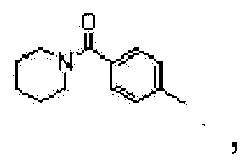
each of R7, R8, R9, R10 and R11 is independently selected from a group consisting of hydrogen, fluoro, chloro, bromo, iodo, nitro, cyano, C1-C5 alkyl, C1-C5 alkoxy, halo C1-C3 alkyl, haloalkoxy C1-C5 alkenyl, C2-C5 alkenyl and alkynyl; and
each of R12 and R13 is independently selected from a group consisting of hydrogen, C1-C5 alkyl, hydroxy C2-C5 alkyl, C3-C7 cycloalkyl and halo C1-C5 alkyl, or R12 and R13 form a 5- to 7-membered ring together with the nitrogen atom which they are bound and the ring contains 0-2 N, O or S atoms or at least one substituent selected from a group consisting of hydrogen, hydroxy, hydroxy C1-C5 alkyl, C1-C5 alkoxy, C1-C5 alkoxy alkyl, halo C1-C5 alkyl, halo C1-C5 alkoxy and carboxyl. - The compound, the prodrug thereof, the isomer thereof, the pharmaceutically acceptable salt thereof, the hydrate thereof or the solvate thereof according to claim 1, wherein the compound is represented by Chemical Formula 2:

R1 is selected from a group consisting of hydrogen, C1-C5 alkyl, haloalkyl, C1-C5 cycloalkyl and C1-C5 alkoxyalkyl;
each of R2, R3, R4, R5 and R6 is independently selected from a group consisting of hydrogen, fluoro, chloro, bromo, iodo, nitro, cyano, C1-C5 alkyl, hydroxy C1-C5 alkyl, C1-C5 alkoxy, C1-C5 alkoxy alkyl, halo C1-C3 alkyl, halo C1-C5 alkoxy, haloalkoxy C2-C5 alkenyl, C2-C5 alkenyl, alkynyl, carboxyl, C1-C5 alkylcarbonyl, C1-C5 alkoxycarbonyl, C1-C5 alkylcarbonylamino, C1-C5 alkylaminocarbonyl, C1-C5 alkylsulfanyl, C1-C5 alkylsulfonyl, C1-C5 alkoxysulfonyl, C1-C5 alkylsulfamoyl, aryl, aryl C1-C3 alkyl, aryl C1-C5 alkoxy, aminosulfonyl, C1-C5 alkylamino, C1-C5 alkylaminosulfonyl, C1-C5 alkylsulfonylamino, C1-C5 alkylthio, C3-C7 cycloalkylsulfonylaminophenyl,

each of R7, R8, R9, R10 and R11 is independently selected from a group consisting of hydrogen, fluoro, chloro, bromo, iodo, nitro, cyano, C1-C5 alkyl, C1-C5 alkoxy, halo C1-C3 alkyl, haloalkoxy C2-C5 alkenyl, C2-C5 alkenyl and alkynyl;
R14 is selected from a group consisting of hydrogen, hydroxy, hydroxy C1-C5 alkyl, C1-C5 alkoxy, C1-C5 alkoxy alkyl, halo C1-C5 alkyl, halo C1-C5 alkoxy and carboxyl; and
n is an integer selected from 1 to 3. - The compound, the prodrug thereof, the isomer thereof, the pharmaceutically acceptable salt thereof, the hydrate thereof or the solvate thereof according to claim 1, wherein the compound is represented by Chemical Formula 3:

R1 is selected from a group consisting of methyl, ethyl, propyl, butyl, isobutyl, difluoromethyl, trifluoromethyl, cyclopropyl, ethoxymethyl, methoxymethyl and ethoxyethyl;
each of R3, R4 and R5 is independently selected from a group consisting of hydrogen, fluoro, chloro, bromo, iodo, nitro, cyano, methyl, ethyl, propyl, isopropyl, butyl, tert-butyl, methoxy, ethoxy, propoxy, isopropoxy, butoxy, hydroxymethyl, hydroxyethyl, trifluoromethyl, difluoromethyl, fluoromethyl, trifluoromethoxyvinyl, acetylenyl, carboxyl, methoxycarbonyl, ethoxycarbonyl, acetyl, methylsulfanyl, ethylsulfanyl, methylsulfonyl, methylsulfonylamino, cyclopropylaminosulfonyl, methylaminosulfonyl, ethylaminosulfonyl, dimethylaminocarbonyl, diethylaminocarbonyl, methylcarbonylamino, methylsulfamoyl, phenylmethyl, phenylethyl, phenylmethoxy, phenylacetyl, aminosulfonyl, methylaminosulfonyl, ethylaminosulfonyl, dimethylamino, diethylamino, cyclopropylamino and methylthio, or two selected from R3 through R5 form a 5- to 7-membered ring fused with an aryl group together with the carbon atoms to which they are bound and the ring includes 0-2 double bonds and contains 0-2 N, O or S atoms; and
each of R8, R9 and R10 is independently selected from a group consisting of hydrogen, fluoro, chloro, bromo, iodo, nitro, cyano, methyl, ethyl, propyl, butyl, isopropyl, methoxy, ethoxy, propoxy, isopropoxy, hydroxymethyl, trifluoromethyl, difluoromethyl, fluoromethyl, trifluoromethoxyvinyl and acetylenyl. - The compound, the prodrug thereof, the isomer thereof, the pharmaceutically acceptable salt thereof, the hydrate thereof or the solvate thereof according to claim 3, wherein:R1 is selected from a group consisting of methyl, ethyl, propyl, butyl, isobutyl, trifluoromethyl, cyclopropyl, ethoxymethyl, methoxymethyl and ethoxyethyl;each of R3, R4 and R5 is independently selected from a group consisting of hydrogen, fluoro, chloro, nitro, cyano, methyl, ethyl, propyl, isopropyl, butyl, tert-butyl, methoxy, ethoxy, propoxy, methylenedioxy, isopropoxy, hydroxymethyl, hydroxyethyl, trifluoromethyl, difluoromethyl, fluoromethyl, trifluoromethoxyvinyl, acetylenyl, carboxyl, methoxycarbonyl, ethoxycarbonyl, acetyl, methylsulfonyl, methylsulfamoyl, phenylmethyl, phenylethyl and methylthio, or two selected from R3 through R5 form a 5- to 7-membered ring fused with an aryl group together with the carbon atoms to which they are bound and the ring includes 0-2 double bonds and contains 0-2 N, O or S atoms; andeach of R8, R9 and R10 is independently selected from a group consisting of hydrogen, fluoro, chloro, bromo, iodo, nitro, cyano, methyl, ethyl, propyl, butyl, isopropyl, methoxy, ethoxy, propoxy, isopropoxy, butoxy, hydroxymethyl, trifluoromethyl, difluoromethyl, fluoromethyl, trifluoromethoxyvinyl and acetylenyl.
- The compound, the prodrug thereof, the isomer thereof, the pharmaceutically acceptable salt thereof, the hydrate thereof or the solvate thereof according to claim 1, wherein the compound is selected from a group consisting of:{1-[7-(3-chloro-4-fluorophenyl)-2-methyl-3-p-tolyl-pyrazolo[1,5-a]pyrimidin-5-yl]-pyrrolidin-2-yl}-methanol,{1-[7-(3-chloro-4-fluorophenyl)-3-(4-fluorophenyl)-2-methyl-pyrazolo[1,5-a]pyrimidin-5-yl]-pyrrolidin-2-yl}-methanol,{1-[3-(3-fluoro-4-methylphenyl)-7-(3-methoxyphenyl)-2-methyl-pyrazolo[1,5-a]pyrimidin-5-yl]-pyrrolidin-2-yl}-methanol,{1-[3-(2,4-difluorophenyl)-7-(3-methoxyphenyl)-2-methyl-pyrazolo[1,5-a]pyrimidin-5-yl]-pyrrolidin-2-yl}-methanol,{1-[3-(3-fluoro-4-methylphenyl)-2-methyl-7-(3-trifluoromethylphenyl)-pyrazolo[1,5-a]pyrimidin-5-yl]-pyrrolidin-2-yl}-methanol,{1-[3-(2,4-difluorophenyl)-2-methyl-7-(3-trifluoromethylphenyl)-pyrazolo[1,5-a]pyrimidin-5-yl]-pyrrolidin-2-yl}-methanol,{1-[7-(3-chloro-4-fluorophenyl)-3-(4-methoxyphenyl)-2-methyl-pyrazolo[1,5-a]pyrimidin-5-yl]-pyrrolidin-2-yl}-methanol,{1-[7-(3,4-difluorophenyl-3-(3-fluoro-4-methyl-phenyl)-2-methyl-pyrazolo[1,5-a ]pyrimidin-5-yl]-pyrrolidin-2-yl}-methanol,{1-[7-(3-ethylphenyl)-2-methyl-3-p-tolyl-pyrazolo[1,5-a]pyrimidin-5-yl]-pyrrolidin-2-yl}-methanol,{1-[3-(4-chlorophenyl)-7-(3-ethylphenyl)-2-methyl-pyrazolo[1,5-a]pyrimidin-5-yl]-pyrrolidin-2-yl}-methanol,{1-[7-(3,5-difluorophenyl)-3-(4-methoxyphenyl)-2-methyl-pyrazolo[1,5-a]pyrimidin-5-yl]-pyrrolidin-2-yl}-methanol,{1-[3-(3,4-difluorophenyl)-2-methyl-7-(3-trifluoromethylphenyl)-pyrazolo[1,5-a]pyrimidin-5-yl]-pyrrolidin-2-yl}-methanol,{1-[3-(4-fluorophenyl)-2-methyl-7-(3-trifluoromethylphenyl)-pyrazolo[1,5-a]pyrimidin-5-yl]-pyrrolidin-2-yl}-methanol,{1-[3-(3,4-difluorophenyl)-2-methyl-7-(3-trifluoromethylphenyl)-pyrazolo[1,5-a]pyrimidin-5-yl]-pyrrolidin-2-yl}-methanol,{1-[3-benzo-1,3]dioxol-5-yl-7-(3,5-difluorophenyl)-2-methyl-pyrazolo[1,5-a]pyrimidin-5-yl]-pyrrolidin-2-yl}-methanol,{1-[2-ethoxymethyl-3-(4-methoxyphenyl)-7-(3-trifluoromethylphenyl)-pyrazolo[1,5-a]pyrimidin-5-yl]-pyrrolidin-2-yl}-methanol,{1-[7-(3,5-difluorophenyl)-3-(4-methoxyphenyl)-2-methyl-pyrazolo[1,5-a]pyrimidin-5-yl]-pyrrolidin-2-yl}-methanol,{1-[3-(4-methoxyphenyl)-2-trifluoromethyl-7-(3-trifluoromethylphenyl)-pyrazolo[1,5-a]pyrimidin-5-yl]-pyrrolidin-2-yl}-methanol,{1-[2-ethoxymethyl-3-(4-methoxyphenyl)-7-(3-methoxyphenyl)-pyrazolo[1,5-a]pyrimidin-5-yl]-pyrrolidin-2-yl}-methanol,{1-[2-ethoxymethyl-7-(4-fluorophenyl)-3-(4-methoxyphenyl)-pyrazolo[1,5-a]py rimidin-5-yl]-pyrrolidin-2-yl}-methanol,{1-[2-difluoromethyl-3-(4-methoxyphenyl)-7-(3-trifluoromethylphenyl)-pyrazolo[1,5-a]pyrimidin-5-yl]-pyrrolidin-2-yl}-methanol,{1-[3-benzo[1,3]dioxol-5-yl-2-ethoxymethyl-7-(3-fluorophenyl)-pyrazolo[1,5-a]pyrimidin-5-yl]-pyrrolidin-2-yl}-methanol,{1-[2-ethyl-7-(4-fluorophenyl)-3-p-tolyl-pyrazolo[1,5-a]pyrimidin-5-yl]-pyrrolidin-2-yl}-methanol,{1-[7-(3-chlorophenyl)-2-ethyl-3-p-tolyl-pyrazolo[1,5-a]pyrimidin-5-yl]-pyrrolidin-2-yl}-methanol,{1-[2-ethyl-7-(3-fluorophenyl)-3-p-tolylpyrazolo[1,5-a]pyrimidin-5-yl]-pyrrolidin-2-yl}-methanol,{1-[3-benzo[1,3]dioxol-5-yl-2-ethoxymethyl-7-(3-trifluoromethylphenyl)-pyrazolo[1,5-a]pyrimidin-5-yl]-pyrrolidin-2-yl}-methanol,{1-[3-benzo[1,3]dioxol-5-yl-7-(3-chlorophenyl)-2-ethoxymethyl-pyrazolo[1,5-a]pyrimidin-5-yl]-pyrrolidin-2-yl}-methanol,{1-[2-ethoxymethyl-3-p-tolyl-7-(3-trifluoromethylphenyl)-pyrazolo[1,5-a]pyrimidin-5-yl]-pyrrolidin-2-yl}-methanol,{1-[2-ethoxymethyl-7-(3-fluorophenyl)-3-p-tolyl-pyrazolo[1,5-a]pyrimidin-5-yl]-pyrrolidin-2-yl}-methanol,{1-[2-ethoxymethyl-3-p-tolyl-7-(3-trifluoromethylphenyl)-pyrazolo[1,5-a]pyrimidin-5-yl]-pyrrolidin-2-yl}-methanol,{1-[2-ethoxymethyl-7-m-tolyl-3-p-tolyl-pyrazolo[1,5-a]pyrimidin-5-yl]-pyrrolidin-2-yl}-methanol,{1-[2-ethoxymethyl-7-(3-fluorophenyl)-3-(4-methoxyphenyl)-pyrazolo[1,5-a]py rimidin-5-yl]-pyrrolidin-2-yl}-methanol,{1-[2-ethoxymethyl-7-(4-fluorophenyl)-3-(4-methoxyphenyl)-pyrazolo[1,5-a]pyrimidin-5-yl]-pyrrolidin-2-yl}-methanol,{1-[2-methoxymethyl-3-(4-methoxyphenyl)-7-(3-trifluoromethylphenyl)-pyrazolo[1,5-a]pyrimidin-5-yl]-pyrrolidin-2-yl}-methanol,{1-[2-butyl-3-p-tolyl-7-(3-trifluoromethylphenyl)-pyrazolo[1,5-a]pyrimidin-5-yl]-pyrrolidin-2-yl}-methanol,{1-[2-ethoxymethyl-7-(3-methoxyphenyl)-3-p-tolyl-pyrazolo[1,5-a]pyrimidin-5-yl]-pyrrolidin-2-yl}-methanol,{1-[3-(4-chlorophenyl)-2-ethoxymethyl-7-(3-trifluoromethylphenyl)-pyrazolo[1,5-a]pyrimidin-5-yl]-pyrrolidin-2-yl}-methanol,{1-[3-(4-chlorophenyl)-2-ethoxymethyl-7-(4-fluorophenyl)-pyrazolo[1,5-a]pyrimidin-5-yl]-pyrrolidin-2-yl}-methanol,{1-[3-(4-chlorophenyl)-2-ethoxymethyl-7-(3-fluorophenyl)-pyrazolo[1,5-a]pyrimidin-5-yl]-pyrrolidin-2-yl}-methanol,{1-[3-(4-chlorophenyl)-2-ethoxymethyl-7-(3-trifluoromethylphenyl)-pyrazolo[1,5-a]pyrimidin-5-yl]-pyrrolidin-2-yl}-methanol,2-{[3-(4-chlorophenyl)-2-methoxymethyl-7-(3-trifluoromethylphenyl)-pyrazolo[1,5-a]pyrimidin-5-yl]-pyrrolidin-2-yl}-methanol,{1-[3-(4-chlorophenyl)-7-(4-fluorophenyl)-2-methoxymethyl-pyrazolo[1,5-a]pyrimidin-5-yl]-pyrrolidin-2-yl}-methanol,{1-[3-(4-chlorophenyl)-7-(3-fluorophenyl)-2-methoxymethyl-pyrazolo[1,5-a]pyrimidin-5-yl]-pyrrolidin-2-yl}-methanol,2-{[2-methoxymethyl-3-(4-methoxyphenyl)-7-(3-trifluoromethyl-phenyl)-pyraz olo[1,5-a]pyrimidin-5-yl]-pyrrolidin-2-yl}-methanol,{1-[7-(4-fluorophenyl)-2-methoxymethyl-3-(4-methoxyphenyl)-pyrazolo[1,5-a]pyrimidin-5-yl]-pyrrolidin-2-yl}-methanol,{1-[3-benzo[1,3]dioxol-5-yl-7-(3-fluorophenyl)-2-methoxymethyl-pyrazolo[1,5-a]pyrimidin-5-yl]-pyrrolidin-2-yl}-methanol,{1-[3-benzo[1,3]dioxol-5-yl-7-(4-fluorophenyl)-2-methoxymethyl-pyrazolo[1,5-a]pyrimidin-5-yl]-pyrrolidin-2-yl}-methanol,{1-[3-benzo[1,3]dioxol-5-yl-2-methoxymethyl-7-(3-trifluoromethyl-phenyl)-pyrazolo[1,5-a]pyrimidin-5-yl]-pyrrolidin-2-yl}-methanol,(S)-3-(5-(2-hydroxymethyl)pyrrolidin-1-yl)-2-(methoxymethyl)-3-(4-methoxyphenyl)-pyrazolo[1,5-a]pyrimidin-7-yl)benzonitrile,(S)-[{1-(2-methoxymethyl)-3-(methoxyphenyl)-7-(m-tolyl)-pyrazolo[1,5-a]-pyridin-5-yl}-pyrrolidin-2-yl]-methanol,(S)-{[1-(2-methoxymethyl)-7-(3-methoxyphenyl)-3-(4-methoxyphenyl)-pyrazolo[1,5-a]pyrimidin-5-yl]-pyrrolidin-2-yl}-methanol,{1-[3-(4-chlorophenyl)-7-(2,4-difluorophenyl)-2-methyl-pyrazolo[1,5-a]pyrimidin-5-yl]-pyrrolidin-2-yl}-methanol,[1-(3-benzo[1,3]dioxol-5-yl-2-methyl-7-phenyl-pyrazolo[1,5-a]pyrimidin-5-yl)-pyrrolidin-2-yl]-methanol,{1-[3-(4-ethoxyphenyl)-2-methyl-7-phenyl-pyrazolo[1,5-a]pyrimidin-5-yl]-pyrrolidin-2-yl}-methanol,{1-[3-(4-methoxyphenyl)-2-methyl-7-phenyl-pyrazolo[1,5-a]pyrimidin-5-yl]-pyrrolidin-2-yl}-methanol,(S)-(1-(7-(3,4-difluorophenyl)-3-(4-ethoxyphenyl)-2-methyl-pyrazolo[1,5-a]pyri midin-5-yl)-pyrrolidin-2-yl)-methanol,{1-[2-methyl-3-(4-methylsulfanylphenyl)-7-(3-trifluoromethylphenyl)-pyrazolo[1,5-a]pyrimidin-5-yl]-pyrrolidin-2-yl}-methanol,{1-[7-(3,4-difluorophenyl)-3-(4-methoxyphenyl)-2-methyl-pyrazolo[1,5-a]pyrimidin-5-yl]-pyrrolidin-2-yl}-methanol,{1-[7-(3,4-difluorophenyl)-2-methyl-3-p-tolyl-pyrazolo[1,5-a]pyrimidin-5-yl]-pyrrolidin-2-yl}-methanol,{1-[7-(3,4-difluorophenyl)-2-methyl-3-p-tolyl-pyrazolo[1,5-a]pyrimidin-5-yl]-pyrrolidin-2-yl}-methanol,{1-[7-(3,4-difluorophenyl)-2-methyl-3-p-tolyl-pyrazolo[1,5-a]pyrimidin-5-yl]-pyrrolidin-2-yl}-methanol,{1-[3-(4-chlorophenyl)-7-(3,4-difluorophenyl)-2-methyl-pyrazolo[1,5-a]pyrimidin-5-yl]-pyrrolidin-2-yl}-methanol,{1-[7-(4-fluorophenyl)-2-methyl-3-p-tolyl-pyrazolo[1,5-a]pyrimidin-5-yl]-pyrrolidin-2-yl}-methanol,[1-(2-methyl-7-phenyl-3-p-tolyl-pyrazolo[1,5-a]pyrimidin-5-yl]-pyrrolidin-2-yl]-methanol,[1-[3-(4-difluoromethylphenyl)-7-(3-fluorophenyl)-2-methyl-pyrazolo[1,5-a]pyrimidin-5-yl]-pyrrolidin-2-yl}-methanol,{1-[3-(4-difluoromethylphenyl)-7-(3-methoxyphenyl)-2-methyl-pyrazolo[1,5-a]pyrimidin-5-yl]-pyrrolidin-2-yl}-methanol,{1-[3-(4-difluoromethylphenyl)-2-methyl-7-(3-trifluoromethylphenyl)-pyrazolo[1,5-a]pyrimidin-5-yl]-pyrrolidin-2-yl}-methanol,{1-[3-(4-difluoromethylphenyl)-7-(4-fluorophenyl)-2-methyl-pyrazolo[1,5-a]pyri midin-5-yl]-pyrrolidin-2-yl}-methanol,{1-[3-(4-difluoromethylphenyl)-2-methyl-7-m-tolyl-pyrazolo[1,5-a]pyrimidin-5-yl]-pyrrolidin-2-yl}-methanol,{1-[7-(4-chlorophenyl)-3-(4-methoxyphenyl)-2-methyl-pyrazolo[1,5-a]pyrimidin-5-yl]-pyrrolidin-2-yl}-methanol,{1-[7-(3-methoxyphenyl)-2-methyl-3-(4-trifluoromethylphenyl)-pyrazolo[1,5-a]pyrimidin-5-yl]-pyrrolidin-2-yl}-methanol,{1-[3-(4-ethylphenyl)-2-methyl-7-(3-trifluoromethylphenyl)-pyrazolo[1,5-a]pyrimidin-5-yl]-pyrrolidin-2-yl}-methanol,{1-[3-(4-ethylphenyl)-2-methyl-7-(3-trifluoromethylphenyl)-pyrazolo[1,5-a]pyrimidin-5-yl]-pyrrolidin-2-yl}-methanol,{1-[2-methyl-3-(4-trifluoromethylphenyl)-7-(3-trifluoromethylphenyl)-pyrazolo[1,5-a]pyrimidin-5-yl]-pyrrolidin-2-yl}-methanol,{1-[7-(4-chlorophenyl)-2-methyl-3-p-tolyl-pyrazolo[1,5-a]pyrimidin-5-yl]-pyrrolidin-2-yl}-methanol,[1-(2-methyl-3,7-di-p-tolyl-pyrazolo[1,5-a]pyrimidin-5-yl)-pyrrolidin-2-yl]-methanol,{1-[7-(3-chlorophenyl)-2-methyl-3-p-tolyl-pyrazolo[1,5-a]pyrimidin-5-yl]-pyrrolidin-2-yl}-methanol,{1-[7-(3-chlorophenyl)-2-methyl-3-p-tolyl-pyrazolo[1,5-a]pyrimidin-5-yl]-pyrrolidin-2-yl}-methanol[1-(2-methyl-7-m-tolyl-3-p-tolyl-pyrazolo[1,5-a]pyrimidin-5-yl)-pyrrolidin-2-yl]-methanol,{1-[7-(3-methoxyphenyl)-2-methyl-3-p-tolyl-pyrazolo[1,5-a]pyrimidin-5-yl]-pyrr olidin-2-yl}-methanol,{1-[7-(4-methoxyphenyl)-2-methyl-3-p-tolyl-pyrazolo[1,5-a]pyrimidin-5-yl]-pyrrolidin-2-yl}-methanol,{1-[7-(2-fluorophenyl)-2-methyl-3-p-tolyl-pyrazolo[1,5-a]pyrimidin-5-yl]-pyrrolidin-2-yl}-methanol,{1-[3-benzo[1,3]dioxol-5-yl-7-(3-fluorophenyl)-2-methyl-pyrazolo[1,5-a]pyrimidin-5-yl]-pyrrolidin-2-yl}-methanol,{1-[7-(3-fluorophenyl)-3-(4-methoxyphenyl)-2-methyl-pyrazolo[1,5-a]pyrimidin-5-yl]-pyrrolidin-2-yl}-methanol,{1-[3-(4-ethoxyphenyl)-7-(3-fluoromethylphenyl)-2-methyl-pyrazolo[1,5-a]pyrimidin-5-yl]-pyrrolidin-2-yl}-methanol,{1-[2-methyl-3-p-tolyl-7-(3-trifluoromethylphenyl)-pyrazolo[1,5-a]pyrimidin-5-yl]-pyrrolidin-2-yl}-methanol,{1-[3-(4-methoxyphenyl)-2-methyl-7-(3-trifluoromethylphenyl)-pyrazolo[1,5-a]pyrimidin-5-yl]-pyrrolidin-2-yl}-methanol,{1-[7-(3-chlorophenyl)-3-(4-methoxyphenyl)-2-methyl-pyrazolo[1,5-a]pyrimidin-5-yl]-pyrrolidin-2-yl}-methanol,{1-[3-benzo[1,3]dioxol-5-yl-7-(3-chlorophenyl)-2-methyl-pyrazolo[1,5-a]pyrimidin-5-yl]-pyrrolidin-2-yl}-methanol,{1-[7-(4-fluorophenyl)-2-methyl-3-(4-vinylphenyl)-pyrazolo[1,5-a]-pyrrolidin-2-yl}-methanol,{1-[3-(4-ethoxyphenyl)-2-methyl-7-(3-trifluoromethylphenyl)-pyrazolo[1,5-a]pyrimidin-5-yl]-pyrrolidin-2-yl}-methanol,{1-[3-benzo[1,3]dioxol-5-yl-2-methyl-7-(3-trifluoromethylphenyl)-pyrazolo[1,5-a]pyrimidin-5-yl]-pyrrolidin-2-yl}-methanol,{1-[3-(4-fluoro-3-methylphenyl)-7-(4-fluorophenyl)-2-methyl-pyrazolo[1,5-a]pyrimidin-5-yl]-pyrrolidin-2-yl}-methanol,{1-[3-(3-fluoro-4-methylphenyl)-7-(4-fluorophenyl)-2-methyl-pyrazolo[1,5-a]pyrimidin-5-yl]-pyrrolidin-2-yl}-methanol,{1-[3-(4-ethoxyphenyl)-7-(4-fluorophenyl)-2-methyl-pyrazolo[1,5-a]pyrimidin-5-yl]-pyrrolidin-2-yl}methanol,{1-[7-(4-fluorophenyl)-2-methyl-3-p-tolyl-pyrazolo[1,5-a]pyrimidin-5-yl]-pyrrolidin-2-yl}methanol,{1-[7-(4-fluorophenyl)-2-methyl-3-(4-propoxyphenyl)-pyrazolo[1,5-a]pyrimidin-5-yl]-pyrrolidin-2-yl}methanol,{1-[3-biphenyl-4-yl-7-(4-fluorophenyl)-2-methyl-pyrazolo[1,5-a]pyrimidin-5-yl]-pyrrolidin-2-yl}methanol,{1-[3-(2,4-difluorophenyl)-7-(4-fluorophenyl)-2-methyl-pyrazolo[1,5-a]pyrimidin-5-yl]-pyrrolidin-2-yl}methanol,{1-[3-(4-ethylsulfanylphenyl)-7-(4-fluorophenyl)-2-methyl-pyrazolo[1,5-a]pyrimidin-5-yl]-pyrrolidin-2-yl}methanol,{1-[3-(4-butoxyphenyl)-7-(4-fluorophenyl)-2-methyl-pyrazolo[1,5-a]pyrimidin-5-yl]-pyrrolidin-2-yl}methanol,{1-[7-(4-fluorophenyl)-2-methyl-3-(4-methylsulfanylphenyl)-pyrazolo[1,5-a]pyrimidin-5-yl]-pyrrolidin-2-yl}methanol,{1-[3-(4-benzoyloxyphenyl)-7-(4-fluorophenyl)-2-methyl-pyrazolo[1,5-a]pyrimidin-5-yl]-pyrrolidin-2-yl}methanol,{1-[7-(4-fluorophenyl)-2-methyl-3-(3-trifluoromethoxyphenyl)-pyrazolo[1,5-a]p yrimidin-5-yl]-pyrrolidin-2-yl}methanol,{1-[7-(4-fluorophenyl)-2-methyl-3-(4-trifluoromethoxyphenyl)-pyrazolo[1,5-a]pyrimidin-5-yl]-pyrrolidin-2-yl}methanol,{1-[3-(4-ethylphenyl)-7-(4-fluorophenyl)-2-methyl-pyrazolo[1,5-a]pyrimidin-5-yl]-pyrrolidin-2-yl}methanol,{1-[7-(4-fluorophenyl)-2-methyl-3-(4-trifluoromethylphenyl)-pyrazolo[1,5-a]pyrimidin-5-yl]-pyrrolidin-2-yl}methanol,1-{4-[7-(4-fluorophenyl)-5-(2-hydroxymethyl-pyrrolidin-1-yl)-2-methyl-pyrazolo[1,5-a]pyrimidin-3-yl]phenyl}-ethanol,{1-[3-(4-tert-butylphenyl)-7-(4-fluorophenyl)-2-methyl-pyrazolo[1,5-a]pyrimidin-5-yl]pyrrolidin-2-yl}-methanol,[1-(2-methyl-7-phenyl-3-p-tolyl-pyrazolo[1,5-a]pyrimidin-5-yl]-pyrrolidin-2-yl}-methanol,{1-[7-(3-fluorophenyl)-2-methyl-3-p-tolyl-pyrazolo[1,5-a]pyrimidin-5-yl]-pyrrolidin-2-yl}-methanol,{1-[3-(4-chlorophenyl)-2-methyl-7-m-tolyl-pyrazolo[1,5-a]pyrimidin-5-yl]-pyrrolidin-2-yl}-methanol,{1-[3-benzo[1,3]dioxol-5-yl-7-(4-fluorophenyl)-2-methyl-pyrazolo[1,5-a]pyrimidin-5-yl]-pyrrolidin-2-yl}-methanol,{1-[7-(4-fluorophenyl)-3-(4-methoxyphenyl)-2-methyl-pyrazolo[1,5-a]pyrimidin-5-yl]-pyrrolidin-2-yl}-methanol,{1-[3-(4-chlorophenyl)-7-(4-fluorophenyl)-2-methyl-pyrazolo[1,5-a]pyrimidin-5-yl]-pyrrolidin-2-yl}methanol,{1-[3-(4-chlorophenyl)-2-cyclopropyl-7-(3-fluorophenyl)-pyrazolo[1,5-a]pyridin -5-yl]-pyrrolidin-2-yl}-methanol,{1-[3-(4-chlorophenyl)-2-methyl-7-(3-trifluoromethylphenyl)-pyrazolo[1,5-a]pyridin-5-yl]-pyrrolidin-2-yl}-methanol,{1-[3-(4-chlorophenyl)-7-(3-fluorophenyl)-2-methyl-pyrazolo[1,5-a]pyrimidin-5-yl]-pyrrolidin-2-yl}-methanol,{1-[3-(4-chlorophenyl)-7-(3-chlorophenyl)-2-methyl-pyrazolo[1,5-a]pyrimidin-5-yl]-pyrrolidin-2-yl}-methanol,{1-[3,7-bis-(4-chlorophenyl)-2-methyl-pyrazolo[1,5-a]pyrimidin-5-yl]-pyrrolidin-2-yl}-methanol,{1-[3-(2,4-dichlorophenyl)-2-cyclopropyl-7-(2-fluorophenyl)-pyrazolo[1,5-a]pyrimidin-5-yl]-pyrrolidin-2-yl}-methanol,{1-[3-(2,4-dichlorophenyl)-2-cyclopropyl-7-(4-fluorophenyl)-pyrazolo[1,5-a]pyrimidin-5-yl]-pyrrolidin-2-yl}-methanol,(S)-{1-[3-(4-chlorophenyl)-2-methyl-7-phenyl-pyrazolo[1,5-a]pyrimidin-5-yl]-pyrrolidin-2-yl}methanol,(S)-{1-[7-(2-fluorophenyl)-2-(methoxymethyl)-3-(4-methoxyphenyl)-pyrazolo[1,5-a]pyrimidin-5-yl]-pyrrolidin-2-yl}-methanol,(S)-{1-[2-ethoxymethyl-3-(4-methoxyphenyl)-7-(3-tolyl)-pyrazolo[1,5-a]pyrimidin-5-yl]-pyrrolidin-2-yl}-methanol,(S)-{1-[7-(3-chlorophenyl)-2-(methoxymethyl)-3-(4-methoxyphenyl)-pyrazolo[1,5-a]pyridin-5-yl]-pyrrolidin-2-yl}-methanol,(S)-{1-[7-(4-chlorophenyl)-2-(methoxymethyl)-3-(4-methoxyphenyl)-pyrazolo[1,5-a]pyrimidin-5-yl]-pyrrolidin-2-yl}-methanol,(S)-{1-[3-(4-chlorophenyl)-2-(methoxymethyl)-7-(3-fluorophenyl)-pyrazolo[1,5-a]pyrimidin-5-yl]-pyrrolidin-2-yl}-methanol,(S)-{1-[3-(4-chlorophenyl)-2-(methoxymethyl)-7-(3-methylphenyl)-pyrazolo[1,5-a]pyrimidin-5-yl]-pyrrolidin-2-yl}-methanol,(S)-{1-[2-butyl-7-(3-tolyl)-3-(4-tolyl)-pyrazolo[1,5-a]pyrimidin-5-yl]-pyrrolidin-2-yl}-methanol,(S)-{1-[2-butyl-3-(p-tolyl)-7-(3-trifluoromethylphenyl)-pyrazolo[1,5-a]pyrimidin-5-yl]-pyrrolidin-2-yl}-methanol,(S)-{1-[2-propyl-3-(p-tolyl)-7-(3-trifluoromethylphenyl)-pyrazolo[1,5-a]pyridin-5-yl]-pyrrolidin-2-yl}-methanol and(S)-{1-[2-propyl-7-(m-tolyl)-3-(p-tolyl)-pyrazolo[1,5-a]pyrimidin-5-yl]-pyrrolidin-2-yl}-methanol.
- The compound, the prodrug thereof, the isomer thereof, the pharmaceutically acceptable salt thereof, the hydrate thereof or the solvate thereof according to claim 1, wherein the compound is represented by Chemical Formula 4:

R1 is selected from a group consisting of methyl, ethyl, propyl, butyl, isobutyl, difluoromethyl, trifluoromethyl, cyclopropyl, ethoxymethyl, methoxymethyl and ethoxyethyl;
each of R3, R4 and R5 is independently selected from a group consisting of hydrogen, fluoro, chloro, bromo, iodo, nitro, cyano, methyl, ethyl, propyl, isopropyl, butyl, tert-butyl, methoxy, ethoxy, propoxy, isopropoxy, butoxy, hydroxymethyl, hydroxyethyl, trifluoromethyl, difluoromethyl, fluoromethyl, trifluoromethoxyvinyl, vinyl, acetylenyl, carboxyl, methoxycarbonyl, ethoxycarbonyl, acetyl, methylsulfanyl, ethylsulfanyl, methylsulfonyl, methylsulfonylamino, cyclopropylaminosulfonyl, methylaminosulfonyl, ethylaminosulfonyl, dimethylaminocarbonyl, diethylaminocarbonyl, methylcarbonylamino, methylsulfamoyl, phenylmethyl, phenylethyl, phenylmethoxy, phenylacetyl, aminosulfonyl, methylaminosulfonyl, ethylaminosulfonyl, dimethylamino, diethylamino, cyclopropylamino and methylthio, or two selected from R3 through R5 form a 5- to 7-membered ring fused with an aryl group together with the carbon atoms to which they are bound and the ring includes 0-2 double bonds and contains 0-2 N, O or S atoms;
each of R8, R9 and R10 is independently selected from a group consisting of hydrogen, fluoro, chloro, bromo, iodo, nitro, cyano, methyl, ethyl, propyl, butyl, isopropyl, methoxy, ethoxy, propoxy, isopropoxy, hydroxymethyl, trifluoromethyl, difluoromethyl, fluoromethyl, trifluoromethoxyvinyl and acetylenyl; and
each of R12 and R15 is independently selected from a group consisting of hydrogen, methyl, ethyl, propyl, methoxy, ethoxy and hydroxy. - The compound, the prodrug thereof, the isomer thereof, the pharmaceutically acceptable salt thereof, the hydrate thereof or the solvate thereof according to claim 6, wherein:R1 is selected from a group consisting of methyl, ethyl, propyl, butyl, isobutyl, trifluoromethyl, cyclopropyl, ethoxymethyl, methoxymethyl and ethoxyethyl;each of R3, R4 and R5 is independently selected from a group consisting of hydrogen, fluoro, chloro, nitro, cyano, methyl, ethyl, propyl, isopropyl, butyl, tert-butyl, methoxy, ethoxy, propoxy, methylenedioxy, isopropoxy, hydroxymethyl, hydroxyethyl, trifluoromethyl, difluoromethyl, fluoromethyl, trifluoromethoxyvinyl, acetylenyl, carboxyl, methoxycarbonyl, ethoxycarbonyl, acetyl, methylsulfonyl, methylsulfamoyl, phenylmethyl, phenylethyl and methylthio, or two selected from R3 through R5 form a 5- to 7-membered ring fused with an aryl group together with the carbon atoms to which they are bound and the ring includes 0-2 double bonds and contains 0-2 N, O or S atoms; andeach of R8, R9 and R10 is independently selected from a group consisting of hydrogen, fluoro, chloro, bromo, iodo, nitro, cyano, methyl, ethyl, propyl, butyl, isopropyl, methoxy, ethoxy, propoxy, isopropoxy, butoxy, hydroxymethyl, trifluoromethyl, difluoromethyl, fluoromethyl, trifluoromethoxyvinyl and acetylenyl.
- The compound, the prodrug thereof, the isomer thereof, the pharmaceutically acceptable salt thereof, the hydrate thereof or the solvate thereof according to claim 6, wherein the compound is selected from a group consisting of:2-{[3-(4-methoxyphenyl)-2-methyl-7-(3-trifluoromethylphenyl)-pyrazolo[1,5-a] pyrimidin-5-yl]-methylamino}-ethanol,2-{[3-benzo[1,3]dioxol-5-yl-2-ethoxymethyl-7-(3-methoxyphenyl)-pyrazolo[1,5-a]pyrimidin-5-yl]-methylamino}-ethanol,2-{[7-(3-fluorophenyl)-2-methyl-3-p-tolyl-pyrazolo[1,5-a]pyrimidin-5-yl]-methylamino}-ethanol,2-{[7-(4-fluorophenyl)-2-methyl-3-p-tolyl-pyrazolo[1,5-a]pyrimidin-5-yl]-methylamino}-ethanol,2-{[7-(3-chlorophenyl)-2-methyl-3-p-tolyl-pyrazolo[1,5-a]pyrimidin-5-yl]-amino}-ethanol,2-[2-ethoxymethyl-3-(4-methoxyphenyl)-7-(3-trifluoromethylphenyl)-pyrazolo[1,5-a]pyrimidin-5-yl]-methylamino}-ethanol,2-{[2-ethoxymethyl-7-(4-fluorophenyl)-3-p-tolyl-pyrazolo[1,5-a]pyrimidin-5-yl]-amino}-ethanol,2-{3-benzo[1,3]dioxol-5-yl-2-ethoxymethyl-7-(3-trifluoromethylphenyl)-pyrazolo[1,5-a]pyrimidin-5-yl]-methylamino}-ethanol,2-{[3-benzo[1,3]dioxol-5-yl-7-(3-chlorophenyl)-2-ethoxymethyl-pyrazolo[1,5-a]pyrimidin-5-yl]-methylamino}-ethanol,2-{[2-ethoxymethyl-7-(3-fluorophenyl)-3-p-tolyl-pyrazolo[1,5-a]pyrimidin-5-yl]-methylaminol-ethanol,2-{[2-ethoxymethyl-3-p-tolyl-7-(3-trifluoromethylphenyl)-pyrazolo[1,5-a]pyrimidin-5-yl]-methylamino}-ethanol,2-{[2-butyl-3-p-tolyl-7-(3-trifluoromethylphenyl)-pyrazolo[1,5-a]pyrimidin-5-yl]-methylaminol-ethanol,2-{[3-(4-chlorophenyl)-2-ethoxymethyl-7-(4-fluorophenyl)-pyrazolo[1,5-a]pyri midin-5-yl]-methylamino}-ethanol,2-{[3-(4-chlorophenyl)-2-ethoxymethyl-7-(3-fluorophenyl)-pyrazolo[1,5-a]pyrimidin-5-yl]-methylamino}-ethanol,2-{[3-(4-chlorophenyl)-2-ethoxymethyl-7-(3-trifluoromethylphenyl)-pyrazolo[1,5-a]pyrimidin-5-yl]-methylamino}-ethanol,2-{[3-(4-chlorophenyl)-2-methoxymethyl-7-(3-trifluoromethylphenyl)-pyrazolo[1,5-a]pyrimidin-5-yl]-methylamino}-ethanol,2-{[3-(4-chlorophenyl)-7-(4-fluorophenyl)-2-methoxymethyl-pyrazolo[1,5-a]pyrimidin-5-yl]-methylamino}-ethanol,2-{[3-(4-chlorophenyl)-7-(3-fluorophenyl)-2-methoxymethyl-pyrazolo[1,5-a]pyrimidin-5-yl]-methylamino}-ethanol,2-{[2-methoxymethyl-3-(4-methoxyphenyl)-7-(3-trifluoromethylphenyl)-pyrazolo[1,5-a]pyrimidin-5-yl]-methylamino}-ethanol,2-{[3-(4-chlorophenyl)-2-ethoxymethyl-7-(4-fluorophenyl)-pyrazolo[1,5-a]pyrimidin-5-yl]-ethylaminol-ethanol and2-{[3-(4-chlorophenyl)-2-methoxymethyl-7-(m-tolyl)-pyrazolo[1,5-a]pyrimidin-5-yl]-methylamino}-ethanol.
- A pharmaceutical composition comprising the compound, the prodrug thereof, the isomer thereof, the pharmaceutically acceptable salt thereof, the hydrate thereof or the solvate thereof according to any one of claims 1 to 8.
- The pharmaceutical composition according to claim 9, wherein the pharmaceutical composition is for preventing or treating a disease mediated by the cannabinoid receptor-1.
- The pharmaceutical composition according to claim 10, wherein the disease mediated by the cannabinoid receptor-1 is at least one selected from a group consisting of inflammatory pain, psycopathy, anxiety, depression, attention deficiency, memory or cognitive disorder, neuropathic pain disorder, sexual dysfunction, impulse control disorder, obesity, neurological or obsessive eating disorder, cancer, morning sickness, nausea, gastric ulcer, diabetes, hypertension, hyperlipidemia, valvular heart disease, myocardial infarction, cardiomegaly and congestive heart failure.
- The pharmaceutical composition according to claim 10, wherein the disease mediated by the cannabinoid receptor-1 is obesity.
- The pharmaceutical composition according to claim 12, wherein the pharmaceutical composition prevents or treats obesity through control of appetite, facilitation of energy metabolism or regulation of processes related with fat metabolism.
- A method for preparing pyrazolo[1,5-a]pyrimidine having an aryl substituent bound at 7-position, comprising reacting aminopyrazole and a diketoester in a pyridine solvent, wherein at least one of the aminopyrazole and the diketoester contains an aryl group.
- A pyrazolo[1,5-a]pyrimidine compound having an aryl substituent bound at 7-position prepared by the method for preparing pyrazolo[1,5-a]pyrimidine having an aryl substituent bound at 7-position according to claim 14, a prodrug thereof, an isomer thereof, a pharmaceutically acceptable salt thereof, a hydrate thereof or a solvate thereof.
Applications Claiming Priority (2)
| Application Number | Priority Date | Filing Date | Title |
|---|---|---|---|
| KR20100085042 | 2010-08-31 | ||
| PCT/KR2011/006474 WO2012030170A2 (en) | 2010-08-31 | 2011-08-31 | Novel compound acting as a cannabinoid receptor-1 inhibitor |
Publications (2)
| Publication Number | Publication Date |
|---|---|
| EP2617723A2 true EP2617723A2 (en) | 2013-07-24 |
| EP2617723A4 EP2617723A4 (en) | 2014-07-02 |
Family
ID=45773400
Family Applications (1)
| Application Number | Title | Priority Date | Filing Date |
|---|---|---|---|
| EP11822145.6A Withdrawn EP2617723A4 (en) | 2010-08-31 | 2011-08-31 | Novel compound acting as a cannabinoid receptor-1 inhibitor |
Country Status (6)
| Country | Link |
|---|---|
| US (1) | US8975264B2 (en) |
| EP (1) | EP2617723A4 (en) |
| JP (1) | JP5859544B2 (en) |
| KR (1) | KR101914161B1 (en) |
| CN (1) | CN103153999B (en) |
| WO (1) | WO2012030170A2 (en) |
Cited By (2)
| Publication number | Priority date | Publication date | Assignee | Title |
|---|---|---|---|---|
| EP3672597A4 (en) * | 2017-08-21 | 2021-09-22 | Navigen, Inc. | Arf6 inhibitors and related methods |
| JP2023536197A (en) * | 2020-08-05 | 2023-08-23 | リヒター ゲデオン ニュイルヴァーノシャン ミューコェデー レースヴェーニュタールシャシャーグ | Pharmacologically active heterocyclic substituted pyrazolo[1,5-a]pyrimidine derivatives |
Families Citing this family (5)
| Publication number | Priority date | Publication date | Assignee | Title |
|---|---|---|---|---|
| CN109856394B (en) * | 2019-04-16 | 2022-04-19 | 浙江诺迦生物科技有限公司 | Detection method and detection kit for cannabinoids active substances based on cell dopamine release effect |
| WO2020232350A1 (en) * | 2019-05-15 | 2020-11-19 | The Regents Of The University Of Colorado, A Body Corporate | Assays for synthetic cannabinoids |
| CN112007156A (en) * | 2019-05-30 | 2020-12-01 | 复旦大学 | Application of cannabinoid receptor drug in preparation of drug for treating myocardial cell necrotic apoptosis |
| CN112755189A (en) * | 2019-11-02 | 2021-05-07 | 复旦大学 | Use of type 1 cannabinoid receptor antagonists for the preparation of a medicament for the treatment of myocardial cell apoptosis |
| KR102912267B1 (en) * | 2023-04-20 | 2026-01-15 | 한국화학연구원 | Novel heterocyclic compounds or pharmaceutically acceptable salt thereof and pharmaceutical composition for prevention or treatment of viral disease comprising the same as an active ingredient |
Family Cites Families (5)
| Publication number | Priority date | Publication date | Assignee | Title |
|---|---|---|---|---|
| US7176210B2 (en) * | 2003-02-10 | 2007-02-13 | Pfizer Inc. | Cannabinoid receptor ligands and uses thereof |
| GB0515026D0 (en) * | 2005-07-21 | 2005-08-31 | Novartis Ag | Organic compounds |
| AR061793A1 (en) * | 2006-07-05 | 2008-09-24 | Mitsubishi Tanabe Pharma Corp | PIRAZOLO COMPOUND [1,5-A] PYRIMIDINE AND PHARMACEUTICAL COMPOSITION |
| TWI419889B (en) * | 2006-07-05 | 2013-12-21 | Mitsubishi Tanabe Pharma Corp | A pyrazolo [1,5-a] pyrimidine compound |
| CN101671336B (en) * | 2009-09-23 | 2013-11-13 | 辽宁利锋科技开发有限公司 | Aromatic heterocyclic pyrimidine derivatives and analogs, preparation methods and uses thereof |
-
2011
- 2011-08-31 KR KR1020137005744A patent/KR101914161B1/en not_active Expired - Fee Related
- 2011-08-31 CN CN201180049022.1A patent/CN103153999B/en not_active Expired - Fee Related
- 2011-08-31 EP EP11822145.6A patent/EP2617723A4/en not_active Withdrawn
- 2011-08-31 JP JP2013527016A patent/JP5859544B2/en not_active Expired - Fee Related
- 2011-08-31 US US13/819,601 patent/US8975264B2/en not_active Expired - Fee Related
- 2011-08-31 WO PCT/KR2011/006474 patent/WO2012030170A2/en not_active Ceased
Cited By (4)
| Publication number | Priority date | Publication date | Assignee | Title |
|---|---|---|---|---|
| EP3672597A4 (en) * | 2017-08-21 | 2021-09-22 | Navigen, Inc. | Arf6 inhibitors and related methods |
| US11414442B2 (en) | 2017-08-21 | 2022-08-16 | Navigen, Inc. | ARF6 inhibitors and related methods |
| JP2023536197A (en) * | 2020-08-05 | 2023-08-23 | リヒター ゲデオン ニュイルヴァーノシャン ミューコェデー レースヴェーニュタールシャシャーグ | Pharmacologically active heterocyclic substituted pyrazolo[1,5-a]pyrimidine derivatives |
| JP7835729B2 (en) | 2020-08-05 | 2026-03-25 | リヒター ゲデオン ニュイルヴァーノシャン ミューコェデー レースヴェーニュタールシャシャーグ | Pharmacologically active heterocyclic substituted pyrazolo[1,5-a]pyrimidine derivatives |
Also Published As
| Publication number | Publication date |
|---|---|
| KR20130099930A (en) | 2013-09-06 |
| JP2013536836A (en) | 2013-09-26 |
| WO2012030170A2 (en) | 2012-03-08 |
| JP5859544B2 (en) | 2016-02-10 |
| KR101914161B1 (en) | 2018-11-02 |
| CN103153999A (en) | 2013-06-12 |
| EP2617723A4 (en) | 2014-07-02 |
| CN103153999B (en) | 2016-06-01 |
| US20130158025A1 (en) | 2013-06-20 |
| WO2012030170A3 (en) | 2012-06-28 |
| US8975264B2 (en) | 2015-03-10 |
Similar Documents
| Publication | Publication Date | Title |
|---|---|---|
| EP3269370B1 (en) | Novel condensed pyrimidine compound or salt thereof | |
| CN104837825B (en) | Shandong tyrosine kinase inhibitor | |
| EP2757884B1 (en) | Pyrazolopyridyl compounds as aldosterone synthase inhibitors | |
| US8975264B2 (en) | Compound acting as a cannabinoid receptor-1 inhibitor | |
| TWI322809B (en) | Substituted 8-perfluoroalkyl-6,7,8,9-tetrahydropyrimido[1,2-a] pyrimidin-4-one derivatives | |
| CN112236416B (en) | Pyrimidine cyclohexenyl glucocorticoid receptor modulator | |
| WO2006070943A1 (en) | Condensed imidazole compound and use thereof | |
| EA028815B1 (en) | Substituted xanthines and methods of use thereof | |
| WO1998029397A1 (en) | Fused pyrimidine compounds and medicinal use thereof | |
| KR100800250B1 (en) | 2-pyridinyl-6,7,8,9-tetrahydropyrimido [1,2-α] pyrimidin-4-one and 7-pyridinyl-2,3-dihydroimidazo [1,2-α ] Pyrimidine-5 (1H) warm derivative | |
| EA031201B1 (en) | Imidazopyridazine compounds | |
| CN104903297A (en) | Novel Pyrazole Derivatives | |
| JP2018508542A (en) | Triazolylpyrimidinone compounds as PDE2 inhibitors | |
| TW200825079A (en) | Antidepressant, neuroprotectant, amyloid β deposition inhibitor or age retardant containing heterocyclic compound having specific structure | |
| WO2022199503A1 (en) | Use of heterocyclic compound in treating diseases related to kinase drug-resistant mutation and method therefor | |
| WO2019085894A1 (en) | Nitrogen-containing fused ring compound, preparation method therefor, and use thereof | |
| CN114262322A (en) | Apoptosis inhibitor and preparation method and application thereof | |
| JP7507892B2 (en) | 3,4-Dihydroisoquinoline compounds and their uses | |
| TW200418859A (en) | 1-[alkyl], 1-[(heteroaryl)alkyl] and 1-[(aryl)alkyl]-7-(pyrimidin)-4-yl)-imidazo[1,2,a]pyrimidin-5(1H)-one derivatives | |
| JP4958379B2 (en) | 1- [alkyl], 1-[(heteroaryl) alkyl] and 1-[(aryl) alkyl] -7-pyridinyl-imidazo [1,2-a] pyrimidin-5 (1H) -one derivatives | |
| CN111320633B (en) | Pyrrole/imidazo six-membered heteroaromatic ring compound and preparation method and medical application thereof | |
| EP2986605B1 (en) | Rohitukine analogs as cyclin-dependent kinase inhibitors and a process for the preparation thereof | |
| WO2024240017A1 (en) | Use of heterocyclic compound for treating diseases related to ret genetic change and method therefor | |
| WO2025098445A1 (en) | Parg inhibitor, and preparation method and use thereof | |
| CN114929675A (en) | Novel adamantane derivatives as inhibitors of focal adhesion kinase |
Legal Events
| Date | Code | Title | Description |
|---|---|---|---|
| PUAI | Public reference made under article 153(3) epc to a published international application that has entered the european phase |
Free format text: ORIGINAL CODE: 0009012 |
|
| 17P | Request for examination filed |
Effective date: 20130401 |
|
| AK | Designated contracting states |
Kind code of ref document: A2 Designated state(s): AL AT BE BG CH CY CZ DE DK EE ES FI FR GB GR HR HU IE IS IT LI LT LU LV MC MK MT NL NO PL PT RO RS SE SI SK SM TR |
|
| DAX | Request for extension of the european patent (deleted) | ||
| A4 | Supplementary search report drawn up and despatched |
Effective date: 20140604 |
|
| RIC1 | Information provided on ipc code assigned before grant |
Ipc: A61P 29/00 20060101ALI20140528BHEP Ipc: C07D 403/04 20060101ALI20140528BHEP Ipc: C07D 487/04 20060101AFI20140528BHEP Ipc: A61K 31/519 20060101ALI20140528BHEP |
|
| 17Q | First examination report despatched |
Effective date: 20150625 |
|
| GRAP | Despatch of communication of intention to grant a patent |
Free format text: ORIGINAL CODE: EPIDOSNIGR1 |
|
| INTG | Intention to grant announced |
Effective date: 20160212 |
|
| STAA | Information on the status of an ep patent application or granted ep patent |
Free format text: STATUS: THE APPLICATION IS DEEMED TO BE WITHDRAWN |
|
| 18D | Application deemed to be withdrawn |
Effective date: 20160623 |