EP2617374A1 - Wound protector including flexible and rigid liners - Google Patents
Wound protector including flexible and rigid liners Download PDFInfo
- Publication number
- EP2617374A1 EP2617374A1 EP13151772.4A EP13151772A EP2617374A1 EP 2617374 A1 EP2617374 A1 EP 2617374A1 EP 13151772 A EP13151772 A EP 13151772A EP 2617374 A1 EP2617374 A1 EP 2617374A1
- Authority
- EP
- European Patent Office
- Prior art keywords
- liner
- wound
- wound protector
- longitudinally extending
- protector
- Prior art date
- Legal status (The legal status is an assumption and is not a legal conclusion. Google has not performed a legal analysis and makes no representation as to the accuracy of the status listed.)
- Withdrawn
Links
- 230000001012 protector Effects 0.000 title claims abstract description 76
- 238000001356 surgical procedure Methods 0.000 claims description 9
- 238000000034 method Methods 0.000 claims description 6
- 238000011109 contamination Methods 0.000 abstract description 4
- 239000000463 material Substances 0.000 description 6
- 238000003780 insertion Methods 0.000 description 4
- 230000037431 insertion Effects 0.000 description 4
- 238000002324 minimally invasive surgery Methods 0.000 description 3
- 238000004873 anchoring Methods 0.000 description 2
- 230000000844 anti-bacterial effect Effects 0.000 description 2
- 230000000845 anti-microbial effect Effects 0.000 description 2
- 230000008901 benefit Effects 0.000 description 2
- 230000008878 coupling Effects 0.000 description 2
- 238000010168 coupling process Methods 0.000 description 2
- 238000005859 coupling reaction Methods 0.000 description 2
- -1 e.g. Substances 0.000 description 2
- 230000000694 effects Effects 0.000 description 2
- 239000012530 fluid Substances 0.000 description 2
- 239000007788 liquid Substances 0.000 description 2
- 238000012986 modification Methods 0.000 description 2
- 230000004048 modification Effects 0.000 description 2
- 208000035143 Bacterial infection Diseases 0.000 description 1
- 239000004599 antimicrobial Substances 0.000 description 1
- 210000000436 anus Anatomy 0.000 description 1
- 208000022362 bacterial infectious disease Diseases 0.000 description 1
- 230000002939 deleterious effect Effects 0.000 description 1
- 238000009413 insulation Methods 0.000 description 1
- 230000003993 interaction Effects 0.000 description 1
- 238000012423 maintenance Methods 0.000 description 1
- 238000012978 minimally invasive surgical procedure Methods 0.000 description 1
- 210000000214 mouth Anatomy 0.000 description 1
- 230000035515 penetration Effects 0.000 description 1
- 229920002635 polyurethane Polymers 0.000 description 1
- 239000004814 polyurethane Substances 0.000 description 1
- 238000011084 recovery Methods 0.000 description 1
- 229910052709 silver Inorganic materials 0.000 description 1
- 239000004332 silver Substances 0.000 description 1
- 239000000126 substance Substances 0.000 description 1
- 230000007704 transition Effects 0.000 description 1
- 210000001215 vagina Anatomy 0.000 description 1
Images




Classifications
-
- A—HUMAN NECESSITIES
- A61—MEDICAL OR VETERINARY SCIENCE; HYGIENE
- A61B—DIAGNOSIS; SURGERY; IDENTIFICATION
- A61B17/00—Surgical instruments, devices or methods
- A61B17/02—Surgical instruments, devices or methods for holding wounds open, e.g. retractors; Tractors
- A61B17/0218—Surgical instruments, devices or methods for holding wounds open, e.g. retractors; Tractors for minimally invasive surgery
-
- A—HUMAN NECESSITIES
- A61—MEDICAL OR VETERINARY SCIENCE; HYGIENE
- A61B—DIAGNOSIS; SURGERY; IDENTIFICATION
- A61B17/00—Surgical instruments, devices or methods
- A61B17/34—Trocars; Puncturing needles
- A61B17/3417—Details of tips or shafts, e.g. grooves, expandable, bendable; Multiple coaxial sliding cannulas, e.g. for dilating
- A61B17/3421—Cannulas
- A61B17/3423—Access ports, e.g. toroid shape introducers for instruments or hands
-
- A—HUMAN NECESSITIES
- A61—MEDICAL OR VETERINARY SCIENCE; HYGIENE
- A61B—DIAGNOSIS; SURGERY; IDENTIFICATION
- A61B90/00—Instruments, implements or accessories specially adapted for surgery or diagnosis and not covered by any of the groups A61B1/00 - A61B50/00, e.g. for luxation treatment or for protecting wound edges
- A61B90/08—Accessories or related features not otherwise provided for
- A61B2090/0801—Prevention of accidental cutting or pricking
- A61B2090/08021—Prevention of accidental cutting or pricking of the patient or his organs
Definitions
- the present disclosure relates to a surgical device for protecting a bodily opening, e.g., a wound or naturally occurring orifice, through which a surgical procedure is performed. More particularly, a wound protector for use during a minimally invasive surgical procedure is disclosed.
- Minimally invasive surgery e.g., laparoscopic, endoscopic, and thoroscopic surgery
- minimally invasive surgery eliminates the need for a large incision, thereby reducing discomfort, recovery time, and many of the deleterious side effects associated with traditional open surgery.
- Minimally invasive surgeries are performed through small openings in a patient's skin. These openings may be incisions in the skin or may be naturally occurring body orifices (e.g., mouth, anus, or vagina).
- body orifices e.g., mouth, anus, or vagina.
- the initial puncture is usually very small so that a needle or trocar can achieve the desired penetration without excessive damage to nearby tissue. It may be necessary for the initial access hole to be subsequently enlarged to provide a working diameter to permit introduction of surgical instruments and the performance of the desired medical procedure.
- the wound protection system includes a liner that is insertable into a bodily opening and includes a longitudinally extending lumen.
- a wound protector is insertable into the lumen of the liner and a seal anchor is insertable into the wound protector.
- a wound protection system includes a seal anchor member including a port member, a housing, member, and a cover.
- the port member is placeable within the housing member, and the cover is secureable to the housing member.
- the port member includes one or more longitudinally extending ports.
- the cover includes an aperture to facilitate access to the one or more longitudinally extending ports of the port member through the cover.
- the wound protection system also includes a wound protector that is insertable into a tissue tract.
- the wound protector includes a longitudinally extending lumen into which the seal anchor member is placeable.
- the wound protection system includes a liner that is placeable within a tissue tract and that is transitionable between a contracted condition and an expanded condition.
- a contracted condition placement of the liner is facilitated by its reduced width.
- the expanded condition access to the underlying body cavity is facilitated by the increased width of the lumen of the liner.
- a tool or expander is provided to facilitate transitioning of the liner to the expanded condition.
- the tool or expander may include a balloon that expands after placement within the lumen of the liner.
- a method for deploying a wound protection device into a bodily opening includes providing a wound protection system such as the one described above.
- the liner is placed within the bodily opening and the wound protector is translated distally through the lumen of the liner.
- the seal anchor member is then inserted into the wound protector, and one or more surgical instruments are inserted into the one or more longitudinally extending ports of the seal anchor member.
- the desired surgical procedure is performed, and then the surgical instruments are removed, and the wound protection system is removed from the bodily opening.
- Fig. 1 is a perspective view of an embodiment wound protector system in accordance with the present disclosure with parts separated;
- Fig. 2 is a perspective view of an embodiment of a wound protector system in accordance with the present disclosure with parts separated;
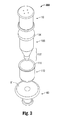
- Fig. 3 is a perspective view of an embodiment of a wound protector system in accordance with the present disclosure with parts separated;
- Fig. 4 is a perspective view of an embodiment of a wound protector system in accordance with the present disclosure with parts separated;
- Fig. 4A is a front view of the wound protector system of Fig. 4 ;
- Fig. 4B is a top view of a flexible liner shown in a first condition
- Fig. 4C is a top view of the flexible liner of FIG. 4B shown in a second condition
- Fig. 4D is a top view of an embodiment of a flexible liner shown in a first condition
- Fig. 4E is a top view of the flexible liner of Fig. 4D shown in a second condition
- Fig. 5 is a cross-sectional view of an embodiment of a wound protector system in accordance with the present disclosure
- Fig. 6 is a cross-sectional view of a wound protector shown positioned within an opening within tissue
- Fig. 7 is a cross-sectional view of the wound protector of Fig. 5 shown with a liner and tool partially positioned therein;
- Fig. 8 is a cross-sectional view of the wound protector of Fig. 5 shown with the liner of Fig. 5 and a seal anchor partially inserted therein.
- proximal will refer to the end of a device that is closest to the operator, while the term “distal” will refer to end of the device that is farthest from the operator.
- a wound protector system 100 includes a liner 40, a wound protector 20, and a seal anchor member 10 that are operatively engageable with one another for placement within a bodily opening.
- the wound protector system 100 also includes a tool 30 that is configured and adapted to engage the liner 40.
- the liner 40 is configured and adapted to be placed within a tissue tract "I" that is defined within a tissue "T" ( Fig. 8 ).
- the liner 40 functions to protect the sides and edges of the tissue tract "I” that is defined within the tissue "T”.
- the liner 40 may form a seal with the tissue tract "I” to minimize contamination of the sides or edges of the tissue tract "I”.
- the liner 40 may be formed from a material having non-reactive or inert properties, e.g., polyurethane.
- the liner 40 may be formed from a material having anti-bacterial or anti-microbial properties, such as a material having an oligodynamic effect, e.g., a material including silver.
- the liner 40 may also be infused or lined with an anti-bacterial or anti-microbial substance, e.g., gel.
- the liner 40 includes an elongated section 41 that includes threading 43 disposed along the length of the elongated section 41.
- the tool 30 is configured and adapted to engage the liner 40 to facilitate placement of the liner 40 within the tissue tract "I" within the tissue "T".
- the tool 30 includes a tapered distal end 32 that facilitates insertion of the tool 30 into a lumen 47 defined within the liner 40.
- the tool 30 also includes a proximal end 33 that is configured to engage a complimentary proximal end 45 of the liner 40.
- the proximal end 33 of the tool 30 may have a regular hexagon shape that fits within a regular hexagon shaped groove within the proximal end 45 of the liner 40.
- the proximal end 33 of the tool 30 may have a length that is greater than the depth of the proximal end 45 of the liner 40, thereby permitting grasping of the proximal end 33 of the tool 30 while the tool 30 is seated within the liner 40.
- the tool 30 may be used to push the liner 40 or to rotate the liner to cause the threading 43 to engage the surfaces of the tissue tract "I” and cause placement of the liner 40 therein.
- rotation of the tool 30 will cause a corresponding rotation of the liner 40, thereby engaging the threading 43 with the tissue tract "I” when the liner 40 is placed within the tissue tract "I".
- the interaction of the threading 43 with the tissue tract "I” facilitates securing the liner 40 within the tissue tract "I”.
- the wound protector 20 is inserted into the lumen 47 of the liner 40.
- the wound protector 20 includes a proximal end 22, a distal end 28, and an intermediate section 26 disposed between the proximal and distal ends 22, 28.
- a lumen 24 extends longitudinally through the length of the wound protector.
- the wound protector 20 may be formed from a compressible material, such that the wound protector compresses as it is inserted through the liner 40.
- the diameters of the proximal and distal ends 22, 28 of the wound protector 20 may be larger than the diameter of the elongated section 41 of the liner 40.
- the larger diameter of the distal end 28 of the wound protector may facilitate securing of the wound protector 20 relative to the liner 40.
- the seal anchor member 10 is insertable into the wound protector 20.
- the seal anchor member 10 is formed from a compressible material and includes a proximal portion 12, a distal portion 14, and an intermediate portion 16 positioned therebetween.
- One or more longitudinally extending ports 18 extend through and between the proximal and distal portions 12, 14 of the seal anchor member 10. Each port 18 is configured and adapted to facilitate reception of a surgical instrument therethrough.
- An example of a seal anchor member is found in U.S. App. No. 12/244,024, filed on October 2, 2008 , the entire contents of which is hereby incorporated by reference.
- a wound protector system 200 includes a seal anchor member 210 and a wound protector 80.
- the seal anchor member 210 includes a port member 60, a housing member 70, and a cover 50
- the port member 60 includes a proximal end 62, an elongated intermediate section 64, and one or more longitudinally extending ports 66.
- the elongated intermediate section 64 of the port member 60 is configured and adapted to be received within the lumen 74 of housing member 70.
- the housing member 70 includes an insufflation port 73 to facilitate insufflation of the surgical working site.
- the housing member 70 includes a tubular section 75.
- the tubular section 75 may include threading 77.
- a cover 50 is securable to the housing member 70.
- the housing member 70 includes securement holes 72 that correspond with securement holes 52 of the cover 50.
- the securement holes 52, 72 are configured and adapted to receive a screw or other suitable fastener (not shown) to facilitate operably coupling the cover 50 to the housing member 70.
- the cover includes an aperture 54 to facilitate access to ports 66 through the cover 60.
- the seal anchor member 210 is insertable into the wound protector 80.
- the wound protector 80 includes a longitudinally extending port 85.
- the longitudinally extending port 85 is configured and adapted to receive the seal anchor member 210 therein.
- the proximal end of the longitudinally extending port 85 may include a tapered region 87 to facilitate insertion of the seal anchor member 210 within the longitudinally extending port 85.
- the threading 77 of the tubular section 75 of the housing member 70 may facilitate anchoring of the seal anchor member 210 within the wound protector 80.
- a wound protector system 300 includes a wound protector 80 that is positionable within tissue tract "I" of tissue "T".
- the wound protector system 300 includes the seal anchor member 10 that is configured and adapted to be placed within a liner 110, and the wound protector 80.
- a tapered tool 103 includes a tapered region 102 to facilitate placement of the liner 110 into the wound protector 80.
- the tool 103 includes a proximal end 104 that engages the proximal lip 111 of the liner 110.
- a wound protector system 400 includes the seal anchor member 20 that is placeable within liner 110, which is placed in turn in flexible liner 170.
- the flexible liner 170 includes a longitudinally extending lumen 171. Expansion of the flexible liner 170 is achievable through several means.
- the flexible liner 170 can be expanded by stretching and deforming the flexible liner 170 such that it transitions to an expanded state. In embodiments, expansion of the flexible liner 170 results in a permanent deformation and stretching of the flexible liner 170 to an expanded state.
- a flexible liner 170A may include a plurality of interconnected members 173 that are repositionable, e.g., slidable, relative to one another such that the interconnected members 173 can be moved apart to expand the flexible liner 170.
- the interconnected members 173 may be slidably movable relative to one another such that the flexible liner 170 is transitionable from a first state as shown in Fig. 4B to a second state as shown in Fig. 4C .
- flexible liner 170B includes a plurality of interconnected members 173 that are foldable relative to one another to collapse ( Fig. 4D ) and expand ( Fig. 4E ) in an accordion-like fashion.
- an expander 160 may be placed within lumen 171 to expand the flexible liner 170.
- the expander 160 includes a balloon 162 and a valve 161 that is fluidly coupled to the balloon 162 to facilitate the flow of fluid, e.g., gas or liquid, into the balloon 162.
- a tapered distal region 163 of the expander 160 may facilitate insertion of the expander 160 into the lumen 171 of the flexible liner 170.
- a wound protector system 500 includes a wound protector 120 that is positionable within tissue tract "I" of tissue "T".
- the wound protector system 500 includes a sheath 570 defining a longitudinally extending lumen 572.
- the sheath 570 includes threading 574 to facilitate frictional engagement and securement of the sheath 570 within the tissue tract "I" of tissue "T".
- a gasket 91 may be placed about the proximal portion of the sheath 570 to inhibit loss of insufflation gas between the sheath 570 and the tissue tract "I" of tissue "T”.
- a nut 90 may be placed atop of the gasket 91 to facilitate maintenance of the sheath 570 and the gasket 91 in the desired positions relative the tissue "T”.
- a port member 550 is insertable into lumen 572.
- the port member includes one or more longitudinally extending ports 551, each adapted and configured for the substantially sealed reception of a surgical instrument.
- the port member 550 includes a proximal portion 550a that is configured and adapted to be secured onto the proximal portion 570a of the sheath 570.
- the proximal portion 550a of the port member 550 can snap onto the proximal portion 570a of the sheath 570.
- wound protector 80 is placed within the tissue tract "I", e.g., an incision or a naturally occurring orifice, in the tissue "T".
- a substantially rigid cannula, such as housing member 70 may then be placed within the wound protector 80 to facilitate maintaining the wound protector 80 in an expanded state. Insertion of the housing member 70 may be facilitated by using tool 30 as shown in Fig. 7 .
- port member 60 may be placed within the housing member 70. As needed, the port member 60 may be removed and re-inserted during the course of the surgical procedure. Once the procedure is completed, the tool 30 may be used to facilitate removal of the housing member 70 by placing the tool 30 within the housing member 70, frictionally engaging the housing member 70, and withdrawing the tool 30 along with the housing member 70 from the wound protector 80.
Landscapes
- Health & Medical Sciences (AREA)
- Surgery (AREA)
- Life Sciences & Earth Sciences (AREA)
- Biomedical Technology (AREA)
- Nuclear Medicine, Radiotherapy & Molecular Imaging (AREA)
- Engineering & Computer Science (AREA)
- Heart & Thoracic Surgery (AREA)
- Medical Informatics (AREA)
- Molecular Biology (AREA)
- Animal Behavior & Ethology (AREA)
- General Health & Medical Sciences (AREA)
- Public Health (AREA)
- Veterinary Medicine (AREA)
- Pathology (AREA)
- Surgical Instruments (AREA)
Abstract
Description
- The present application claims the benefit of and priority to
U.S. Provisional Application Serial No. 61/588,324, filed on January 19, 2012 - The present disclosure relates to a surgical device for protecting a bodily opening, e.g., a wound or naturally occurring orifice, through which a surgical procedure is performed. More particularly, a wound protector for use during a minimally invasive surgical procedure is disclosed.
- Minimally invasive surgery, e.g., laparoscopic, endoscopic, and thoroscopic surgery, has many advantages over traditional open surgeries. In particular, minimally invasive surgery eliminates the need for a large incision, thereby reducing discomfort, recovery time, and many of the deleterious side effects associated with traditional open surgery.
- Minimally invasive surgeries are performed through small openings in a patient's skin. These openings may be incisions in the skin or may be naturally occurring body orifices (e.g., mouth, anus, or vagina).
- When an incision is required, the initial puncture is usually very small so that a needle or trocar can achieve the desired penetration without excessive damage to nearby tissue. It may be necessary for the initial access hole to be subsequently enlarged to provide a working diameter to permit introduction of surgical instruments and the performance of the desired medical procedure.
- As with any incision, the creation of a wound presents a risk of contamination of the wound, e.g., a bacterial infection. It may therefore be desirable to protect the wound edges with a wound protector to minimize contamination of the wound. In addition, during a surgical procedure, it may be desirable to protect the inner surfaces of a bodily opening to minimize damage and/or minimize discomfort. A continuing need exists for improved bodily opening protection devices.
- Disclosed herein is a wound protection system. In a first embodiment, the wound protection system includes a liner that is insertable into a bodily opening and includes a longitudinally extending lumen. A wound protector is insertable into the lumen of the liner and a seal anchor is insertable into the wound protector. In another embodiment, a wound protection system includes a seal anchor member including a port member, a housing, member, and a cover. The port member is placeable within the housing member, and the cover is secureable to the housing member. The port member includes one or more longitudinally extending ports. The cover includes an aperture to facilitate access to the one or more longitudinally extending ports of the port member through the cover. The wound protection system also includes a wound protector that is insertable into a tissue tract. The wound protector includes a longitudinally extending lumen into which the seal anchor member is placeable.
- In an embodiment, the wound protection system includes a liner that is placeable within a tissue tract and that is transitionable between a contracted condition and an expanded condition. In the contracted condition, placement of the liner is facilitated by its reduced width. In the expanded condition, access to the underlying body cavity is facilitated by the increased width of the lumen of the liner. A tool or expander is provided to facilitate transitioning of the liner to the expanded condition. The tool or expander may include a balloon that expands after placement within the lumen of the liner.
- A method for deploying a wound protection device into a bodily opening includes providing a wound protection system such as the one described above. The liner is placed within the bodily opening and the wound protector is translated distally through the lumen of the liner. The seal anchor member is then inserted into the wound protector, and one or more surgical instruments are inserted into the one or more longitudinally extending ports of the seal anchor member. The desired surgical procedure is performed, and then the surgical instruments are removed, and the wound protection system is removed from the bodily opening.
- These and other embodiments of the present disclosure will be described in detail below with reference to the accompanying figures.
- Embodiments of the present disclosure are described herein with reference to the accompanying drawings, wherein:
-
Fig. 1 is a perspective view of an embodiment wound protector system in accordance with the present disclosure with parts separated; -
Fig. 2 is a perspective view of an embodiment of a wound protector system in accordance with the present disclosure with parts separated; -
Fig. 3 is a perspective view of an embodiment of a wound protector system in accordance with the present disclosure with parts separated; -
Fig. 4 is a perspective view of an embodiment of a wound protector system in accordance with the present disclosure with parts separated; -
Fig. 4A is a front view of the wound protector system ofFig. 4 ; -
Fig. 4B is a top view of a flexible liner shown in a first condition; -
Fig. 4C is a top view of the flexible liner ofFIG. 4B shown in a second condition; -
Fig. 4D is a top view of an embodiment of a flexible liner shown in a first condition; -
Fig. 4E is a top view of the flexible liner ofFig. 4D shown in a second condition; -
Fig. 5 is a cross-sectional view of an embodiment of a wound protector system in accordance with the present disclosure; -
Fig. 6 is a cross-sectional view of a wound protector shown positioned within an opening within tissue; -
Fig. 7 is a cross-sectional view of the wound protector ofFig. 5 shown with a liner and tool partially positioned therein; and -
Fig. 8 is a cross-sectional view of the wound protector ofFig. 5 shown with the liner ofFig. 5 and a seal anchor partially inserted therein. - Embodiments of the present disclosure will now be described in detail with reference to the drawings, wherein the reference numerals identify similar or identical elements. In the drawings and in the description that follows, the term "proximal," will refer to the end of a device that is closest to the operator, while the term "distal" will refer to end of the device that is farthest from the operator.
- A first embodiment of a wound protector system will be described with reference to
Fig. 1 . As shown inFig. 1 , awound protector system 100 includes aliner 40, awound protector 20, and aseal anchor member 10 that are operatively engageable with one another for placement within a bodily opening. Thewound protector system 100 also includes atool 30 that is configured and adapted to engage theliner 40. - The
liner 40 is configured and adapted to be placed within a tissue tract "I" that is defined within a tissue "T" (Fig. 8 ). Theliner 40 functions to protect the sides and edges of the tissue tract "I" that is defined within the tissue "T". Theliner 40 may form a seal with the tissue tract "I" to minimize contamination of the sides or edges of the tissue tract "I". Theliner 40 may be formed from a material having non-reactive or inert properties, e.g., polyurethane. Moreover, theliner 40 may be formed from a material having anti-bacterial or anti-microbial properties, such as a material having an oligodynamic effect, e.g., a material including silver. Theliner 40 may also be infused or lined with an anti-bacterial or anti-microbial substance, e.g., gel. Theliner 40 includes anelongated section 41 that includes threading 43 disposed along the length of theelongated section 41. - The
tool 30 is configured and adapted to engage theliner 40 to facilitate placement of theliner 40 within the tissue tract "I" within the tissue "T". Thetool 30 includes a tapereddistal end 32 that facilitates insertion of thetool 30 into alumen 47 defined within theliner 40. Thetool 30 also includes aproximal end 33 that is configured to engage a complimentaryproximal end 45 of theliner 40. For example, as shown inFig. 1 , theproximal end 33 of thetool 30 may have a regular hexagon shape that fits within a regular hexagon shaped groove within theproximal end 45 of theliner 40. Theproximal end 33 of thetool 30 may have a length that is greater than the depth of theproximal end 45 of theliner 40, thereby permitting grasping of theproximal end 33 of thetool 30 while thetool 30 is seated within theliner 40. Thetool 30 may be used to push theliner 40 or to rotate the liner to cause the threading 43 to engage the surfaces of the tissue tract "I" and cause placement of theliner 40 therein. By operatively engaging theproximal end 32 of thetool 30 with theproximal end 45 of theliner 40, rotation of thetool 30 will cause a corresponding rotation of theliner 40, thereby engaging the threading 43 with the tissue tract "I" when theliner 40 is placed within the tissue tract "I". As the threading 43 is engaged with the tissue tract "I", the interaction of the threading 43 with the tissue tract "I" facilitates securing theliner 40 within the tissue tract "I". - After the
liner 40 is placed within the tissue tract "I" of the tissue "T", thewound protector 20 is inserted into thelumen 47 of theliner 40. Thewound protector 20 includes aproximal end 22, adistal end 28, and anintermediate section 26 disposed between the proximal and distal ends 22, 28. Alumen 24 extends longitudinally through the length of the wound protector. Thewound protector 20 may be formed from a compressible material, such that the wound protector compresses as it is inserted through theliner 40. Once fully placed within theliner 40, theintermediate section 26 of the wound protector is positioned within theelongated section 41 of theliner 40, and theelongated section 41 is positioned between the proximal and distal ends 22, 28 of thewound protector 20. In an at rest state, the diameters of the proximal and distal ends 22, 28 of thewound protector 20 may be larger than the diameter of theelongated section 41 of theliner 40. The larger diameter of thedistal end 28 of the wound protector may facilitate securing of thewound protector 20 relative to theliner 40. - The
seal anchor member 10 is insertable into thewound protector 20. Theseal anchor member 10 is formed from a compressible material and includes aproximal portion 12, adistal portion 14, and anintermediate portion 16 positioned therebetween. One or more longitudinally extendingports 18 extend through and between the proximal anddistal portions seal anchor member 10. Eachport 18 is configured and adapted to facilitate reception of a surgical instrument therethrough. An example of a seal anchor member is found inU.S. App. No. 12/244,024, filed on October 2, 2008 - A second embodiment of a wound protector system will now be described with reference to
Fig. 2 . As shown inFig. 2 , awound protector system 200 includes aseal anchor member 210 and awound protector 80. Theseal anchor member 210 includes aport member 60, ahousing member 70, and acover 50 Theport member 60 includes aproximal end 62, an elongatedintermediate section 64, and one or more longitudinally extendingports 66. The elongatedintermediate section 64 of theport member 60 is configured and adapted to be received within thelumen 74 ofhousing member 70. Thehousing member 70 includes aninsufflation port 73 to facilitate insufflation of the surgical working site. Thehousing member 70 includes atubular section 75. Thetubular section 75 may include threading 77. Acover 50 is securable to thehousing member 70. Thehousing member 70 includes securement holes 72 that correspond withsecurement holes 52 of thecover 50. The securement holes 52, 72 are configured and adapted to receive a screw or other suitable fastener (not shown) to facilitate operably coupling thecover 50 to thehousing member 70. The cover includes anaperture 54 to facilitate access toports 66 through thecover 60. - The
seal anchor member 210 is insertable into thewound protector 80. Thewound protector 80 includes alongitudinally extending port 85. Thelongitudinally extending port 85 is configured and adapted to receive theseal anchor member 210 therein. The proximal end of thelongitudinally extending port 85 may include a taperedregion 87 to facilitate insertion of theseal anchor member 210 within thelongitudinally extending port 85. The threading 77 of thetubular section 75 of thehousing member 70 may facilitate anchoring of theseal anchor member 210 within thewound protector 80. Thewound protector 80 includes aproximal section 83 that includes aballoon 82 and adistal section 85 that includes aguide member 84 that forms a flange to facilitate anchoring of the wound protector within the tissue tract "I" of the tissue "T". Inflation of theballoon 82 may be accomplished by operably coupling a source of insulation fluid (e.g., gas or liquid) to aport 81 that is fluidly coupled to theballoon 82. - A third embodiment of a wound protector system will now be described with reference to
Fig. 3 . As shown inFig. 3 , awound protector system 300 includes awound protector 80 that is positionable within tissue tract "I" of tissue "T". Thewound protector system 300 includes theseal anchor member 10 that is configured and adapted to be placed within aliner 110, and thewound protector 80. Atapered tool 103 includes a taperedregion 102 to facilitate placement of theliner 110 into thewound protector 80. Thetool 103 includes aproximal end 104 that engages theproximal lip 111 of theliner 110. Once theliner 110 is inserted into thewound protector 80, theseal anchor member 10 is placed within theliner 110. - A fourth embodiment of a wound protector system will now be described with reference to
Figs. 4 and4A . Awound protector system 400 includes theseal anchor member 20 that is placeable withinliner 110, which is placed in turn inflexible liner 170. Theflexible liner 170 includes alongitudinally extending lumen 171. Expansion of theflexible liner 170 is achievable through several means. For example, theflexible liner 170 can be expanded by stretching and deforming theflexible liner 170 such that it transitions to an expanded state. In embodiments, expansion of theflexible liner 170 results in a permanent deformation and stretching of theflexible liner 170 to an expanded state. - In an embodiment of a flexible liner, a flexible liner 170A may include a plurality of
interconnected members 173 that are repositionable, e.g., slidable, relative to one another such that theinterconnected members 173 can be moved apart to expand theflexible liner 170. For example, theinterconnected members 173 may be slidably movable relative to one another such that theflexible liner 170 is transitionable from a first state as shown inFig. 4B to a second state as shown inFig. 4C . In another embodiment, flexible liner 170B includes a plurality ofinterconnected members 173 that are foldable relative to one another to collapse (Fig. 4D ) and expand (Fig. 4E ) in an accordion-like fashion. - Subsequent to placement of the
flexible liner 170 within the tissue tract "I" of the tissue "T" in a generally collapsed or contracted state, anexpander 160 may be placed withinlumen 171 to expand theflexible liner 170. Theexpander 160 includes aballoon 162 and avalve 161 that is fluidly coupled to theballoon 162 to facilitate the flow of fluid, e.g., gas or liquid, into theballoon 162. A tapereddistal region 163 of theexpander 160 may facilitate insertion of theexpander 160 into thelumen 171 of theflexible liner 170. - A fifth embodiment of a wound protector system will now be described with reference to
Fig. 5 . As shown inFig. 5 , awound protector system 500 includes a wound protector 120 that is positionable within tissue tract "I" of tissue "T". - The
wound protector system 500 includes asheath 570 defining alongitudinally extending lumen 572. Thesheath 570 includes threading 574 to facilitate frictional engagement and securement of thesheath 570 within the tissue tract "I" of tissue "T". Agasket 91 may be placed about the proximal portion of thesheath 570 to inhibit loss of insufflation gas between thesheath 570 and the tissue tract "I" of tissue "T". Anut 90 may be placed atop of thegasket 91 to facilitate maintenance of thesheath 570 and thegasket 91 in the desired positions relative the tissue "T". Aport member 550 is insertable intolumen 572. The port member includes one or more longitudinally extendingports 551, each adapted and configured for the substantially sealed reception of a surgical instrument. Theport member 550 includes aproximal portion 550a that is configured and adapted to be secured onto theproximal portion 570a of thesheath 570. For example, theproximal portion 550a of theport member 550 can snap onto theproximal portion 570a of thesheath 570. - A method of placing a wound protection system into a tissue tract "T" will now be described with reference to
Figs. 6-8 . As shown inFig. 6 , woundprotector 80 is placed within the tissue tract "I", e.g., an incision or a naturally occurring orifice, in the tissue "T". A substantially rigid cannula, such ashousing member 70, may then be placed within thewound protector 80 to facilitate maintaining thewound protector 80 in an expanded state. Insertion of thehousing member 70 may be facilitated by usingtool 30 as shown inFig. 7 . - As shown in
Fig. 8 , once thehousing member 70 is placed within thewound protector 80,port member 60 may be placed within thehousing member 70. As needed, theport member 60 may be removed and re-inserted during the course of the surgical procedure. Once the procedure is completed, thetool 30 may be used to facilitate removal of thehousing member 70 by placing thetool 30 within thehousing member 70, frictionally engaging thehousing member 70, and withdrawing thetool 30 along with thehousing member 70 from thewound protector 80. - Each of the embodiments described above are provided for illustrative purposes only. It will be understood that various modifications may be made to the embodiments of the present disclosure. Therefore, the above description should not be construed as limiting, but merely as exemplifications of embodiments. Those skilled in the art will envision other modifications within the scope and spirit of the present disclosure.
- The invention may be described by reference to the following numbered paragraphs:-
- 1. A wound protection system, comprising:
- a liner, the liner insertable into a bodily opening, the liner including a longitudinally extending lumen;
- a wound protector insertable into the lumen of the liner; and
- a seal anchor member insertable into the wound protector.
- 2. A wound protection system, comprising:
- a seal anchor member including a port member, a housing member, and a cover, the port member placeable within the housing member, and the cover secureable to the housing member, the port member including one or more longitudinally extending ports, the cover including an aperture to facilitate access to the one or more longitudinally extending ports through the cover; and
- a wound protector including a longitudinally extending lumen, the seal anchor member placeable within the wound protector.
- 3. The wound protection system of paragraph 1, wherein the liner is transitionable between a contracted condition and an expanded condition, the liner defining a first width in the contracted condition and a second width in the expanded condition, the second width greater than the first width.
- 4. The wound protection device of paragraph 1, further comprising a tool configured and adapted to engage the liner to facilitate transitioning of the liner to the expanded condition.
- 5. The wound protection device of paragraph of paragraph 3, wherein the tool includes a balloon transitionable between a first width and a second width.
- 6. The wound protection device of paragraph 1, further comprising a tool configured and adapted to facilitate placement of the liner within a tissue tract.
- 7. The wound protection device of paragraph 1, wherein the tool includes a proximal portion and the liner includes a proximal portion, the proximal portions of the liner and the tool having a corresponding configuration.
- 8. A method for deploying a wound protection device into a bodily opening, comprising:
- providing a wound protection system, the wound protection system including:
- a liner, the liner insertable into a bodily opening, the liner including a longitudinally extending lumen;
- a wound protector insertable into the lumen of the liner; and
- a seal anchor member insertable into the wound protector;
- placing the liner within the bodily opening;
- distally translating the wound protector through the lumen of the liner;
- inserting the seal anchor member into the wound protector, the seal anchor member including one or more longitudinally extending ports;
- placing surgical instruments through the one or more longitudinally extending ports;
- performing a desired surgical procedure;
- removing the surgical instruments; and
- removing the wound protection system from the bodily opening.
- providing a wound protection system, the wound protection system including:
Claims (8)
- A wound protection system, comprising:a liner, the liner insertable into a bodily opening, the liner including a longitudinally extending lumen;a wound protector insertable into the lumen of the liner; anda seal anchor member insertable into the wound protector.
- A wound protection system, comprising:a seal anchor member including a port member, a housing member, and a cover, the port member placeable within the housing member, and the cover secureable to the housing member, the port member including one or more longitudinally extending ports, the cover including an aperture to facilitate access to the one or more longitudinally extending ports through the cover; anda wound protector including a longitudinally extending lumen, the seal anchor member placeable within the wound protector.
- The wound protection system of claim 1, wherein the liner is transitionable between a contracted condition and an expanded condition, the liner defining a first width in the contracted condition and a second width in the expanded condition, the second width greater than the first width.
- The wound protection device of claim 3, further comprising a tool configured and adapted to engage the liner to facilitate transitioning of the liner to the expanded condition.
- The wound protection device of claim of claim 4, wherein the tool includes a balloon transitionable between a first width and a second width.
- The wound protection device of any preceding claim further comprising a tool configured and adapted to facilitate placement of the liner within a tissue tract.
- The wound protection device of claim 6, wherein the tool includes a proximal portion and the liner includes a proximal portion, the proximal portions of the liner and the tool having a corresponding configuration.
- A method for deploying a wound protection device into a bodily opening, comprising:providing a wound protection system, the wound protection system including:a liner, the liner insertable into a bodily opening, the liner including a longitudinally extending lumen;a wound protector insertable into the lumen of the liner; anda seal anchor member insertable into the wound protector;placing the liner within the bodily opening;distally translating the wound protector through the lumen of the liner;inserting the seal anchor member into the wound protector, the seal anchor member including one or more longitudinally extending ports;placing surgical instruments through the one or more longitudinally extending ports;performing a desired surgical procedure;removing the surgical instruments; andremoving the wound protection system from the bodily opening.
Applications Claiming Priority (2)
| Application Number | Priority Date | Filing Date | Title |
|---|---|---|---|
| US201261588324P | 2012-01-19 | 2012-01-19 | |
| US13/729,085 US20130190573A1 (en) | 2012-01-19 | 2012-12-28 | Wound protector including flexible and rigid liners |
Publications (1)
| Publication Number | Publication Date |
|---|---|
| EP2617374A1 true EP2617374A1 (en) | 2013-07-24 |
Family
ID=47628007
Family Applications (1)
| Application Number | Title | Priority Date | Filing Date |
|---|---|---|---|
| EP13151772.4A Withdrawn EP2617374A1 (en) | 2012-01-19 | 2013-01-18 | Wound protector including flexible and rigid liners |
Country Status (3)
| Country | Link |
|---|---|
| US (1) | US20130190573A1 (en) |
| EP (1) | EP2617374A1 (en) |
| CA (1) | CA2802090A1 (en) |
Cited By (1)
| Publication number | Priority date | Publication date | Assignee | Title |
|---|---|---|---|---|
| WO2015198032A1 (en) * | 2014-06-27 | 2015-12-30 | Isis Innovation Limited | Apparatus for providing and maintaining access to a surgical site |
Families Citing this family (21)
| Publication number | Priority date | Publication date | Assignee | Title |
|---|---|---|---|---|
| ATE524121T1 (en) | 2004-11-24 | 2011-09-15 | Abdou Samy | DEVICES FOR PLACING AN ORTHOPEDIC INTERVERTEBRAL IMPLANT |
| US8764806B2 (en) | 2009-12-07 | 2014-07-01 | Samy Abdou | Devices and methods for minimally invasive spinal stabilization and instrumentation |
| US9265526B1 (en) * | 2010-03-27 | 2016-02-23 | Samy Abdou | Variable-shaped, expandable device and method for minimally-invasive use |
| KR101082762B1 (en) * | 2011-02-18 | 2011-11-10 | 이정삼 | Laparoscopic Traction System |
| US8845728B1 (en) | 2011-09-23 | 2014-09-30 | Samy Abdou | Spinal fixation devices and methods of use |
| US20130226240A1 (en) | 2012-02-22 | 2013-08-29 | Samy Abdou | Spinous process fixation devices and methods of use |
| US9017249B2 (en) * | 2012-03-26 | 2015-04-28 | Covidien Lp | Surgical access assembly and method of use therefor |
| TWD152546S (en) * | 2012-07-26 | 2013-03-21 | 常廣股份有限公司; | Wound Protector |
| US9198767B2 (en) | 2012-08-28 | 2015-12-01 | Samy Abdou | Devices and methods for spinal stabilization and instrumentation |
| US9320617B2 (en) | 2012-10-22 | 2016-04-26 | Cogent Spine, LLC | Devices and methods for spinal stabilization and instrumentation |
| US9149294B2 (en) | 2013-01-24 | 2015-10-06 | Hybrid Cannula LP | Hybrid cannula and methods for manufacturing the same |
| US9119663B2 (en) * | 2013-01-24 | 2015-09-01 | Hybrid Cannula LP | Hybrid cannula and methods for manufacturing the same |
| US10172640B2 (en) * | 2015-04-17 | 2019-01-08 | Life Care Medical Devices, Ltd. | Device for lifting abdominal wall during medical procedure |
| WO2016025791A1 (en) * | 2014-08-15 | 2016-02-18 | Applied Medical Resources Corporation | Natural orifice surgery system |
| US10857003B1 (en) | 2015-10-14 | 2020-12-08 | Samy Abdou | Devices and methods for vertebral stabilization |
| US10413322B2 (en) * | 2015-10-27 | 2019-09-17 | Intai Technology Corp. | Assembling surgical access device |
| US10973648B1 (en) | 2016-10-25 | 2021-04-13 | Samy Abdou | Devices and methods for vertebral bone realignment |
| US10744000B1 (en) | 2016-10-25 | 2020-08-18 | Samy Abdou | Devices and methods for vertebral bone realignment |
| USD872287S1 (en) * | 2017-10-16 | 2020-01-07 | Seoul National University R&Db Foundation | Wound protector for surgery |
| US11179248B2 (en) | 2018-10-02 | 2021-11-23 | Samy Abdou | Devices and methods for spinal implantation |
| US11931070B1 (en) | 2020-01-30 | 2024-03-19 | Hybrid Cannula LP | Half pipe cannula and methods of manufacturing and using half pipe cannula |
Citations (5)
| Publication number | Priority date | Publication date | Assignee | Title |
|---|---|---|---|---|
| US5871474A (en) * | 1995-05-19 | 1999-02-16 | General Surgical Innovations, Inc. | Screw-type skin seal with inflatable membrane |
| US20060247498A1 (en) | 1998-12-01 | 2006-11-02 | Frank Bonadio | Instrument access device |
| EP2238926A2 (en) | 2009-03-31 | 2010-10-13 | Ethicon Endo-Surgery, Inc. | Devices for providing access into a body cavity |
| US20110006601A1 (en) | 2009-07-12 | 2011-01-13 | Ramin Rostami | Configurable apparatus and methods for supplying power and data to electronic devices |
| US20110066001A1 (en) * | 2009-03-31 | 2011-03-17 | Shelton Iv Frederick E | Access Method With Insert |
Family Cites Families (32)
| Publication number | Priority date | Publication date | Assignee | Title |
|---|---|---|---|---|
| US6827710B1 (en) * | 1996-11-26 | 2004-12-07 | Edwards Lifesciences Corporation | Multiple lumen access device |
| US6447489B1 (en) * | 2000-01-18 | 2002-09-10 | Ethicon Endo-Surgey, Inc. | Laparoscopic access tool with gas seal |
| WO2004043275A1 (en) * | 2002-11-08 | 2004-05-27 | Tyco Healthcare Group, Lp | Self sealing cannula |
| US20050059934A1 (en) * | 2003-04-25 | 2005-03-17 | Thomas Wenchell | Surgical access apparatus |
| US20060161050A1 (en) * | 2003-10-15 | 2006-07-20 | John Butler | A surgical sealing device |
| US8147453B2 (en) * | 2006-03-13 | 2012-04-03 | Applied Medical Resources Corporation | Balloon trocar |
| US9005116B2 (en) * | 2006-04-05 | 2015-04-14 | Ethicon Endo-Surgery, Inc. | Access device |
| US8518024B2 (en) * | 2006-04-24 | 2013-08-27 | Transenterix, Inc. | System and method for multi-instrument surgical access using a single access port |
| US20080064927A1 (en) * | 2006-06-13 | 2008-03-13 | Intuitive Surgical, Inc. | Minimally invasrive surgery guide tube |
| US8795235B2 (en) * | 2006-10-06 | 2014-08-05 | Surgiquest, Inc. | Devices for and methods of performing minimally-invasive surgical procedures through a single incision |
| US20080097332A1 (en) * | 2006-10-18 | 2008-04-24 | Stout Medical Group L.P. | Surgical access port |
| US20080171984A1 (en) * | 2007-01-11 | 2008-07-17 | Miller Peter C | Cannula driver and system |
| WO2008130950A1 (en) * | 2007-04-17 | 2008-10-30 | Tyco Healthcare Group Lp | Rigidizable endoluminal access device |
| US20090093752A1 (en) * | 2007-10-05 | 2009-04-09 | Tyco Healthcare Group Lp | Seal anchor for use in surgical procedures |
| US20090204081A1 (en) * | 2008-02-13 | 2009-08-13 | Depuy Mitek, Inc. | Compression expanded cannula |
| US8114053B2 (en) * | 2008-07-17 | 2012-02-14 | Tyco Healthcare Group Lp | Port fixation with interlocking structure |
| US8425406B2 (en) * | 2008-12-19 | 2013-04-23 | Boston Scientific Scimed, Inc. | Systems and methods for directing instruments to varying positions at the distal end of a guide tube |
| US20110230723A1 (en) * | 2008-12-29 | 2011-09-22 | Salvatore Castro | Active Instrument Port System for Minimally-Invasive Surgical Procedures |
| US20110112434A1 (en) * | 2009-11-06 | 2011-05-12 | Ethicon Endo-Surgery, Inc. | Kits and procedures for natural orifice translumenal endoscopic surgery |
| US20110118552A1 (en) * | 2009-11-18 | 2011-05-19 | Tyco Healthcare Group Lp | Port fixation device |
| US20110124968A1 (en) * | 2009-11-24 | 2011-05-26 | Tyco Healthcare Group Lp | Surgical portal and introducer assembly |
| US8414483B2 (en) * | 2009-12-11 | 2013-04-09 | Ethicon Endo-Surgery, Inc. | Methods and devices for providing access into a body cavity |
| US8517932B2 (en) * | 2009-12-11 | 2013-08-27 | Ethicon Endo-Surgery, Inc. | Methods and devices for providing access through tissue to a surgical site |
| US8435174B2 (en) * | 2009-12-11 | 2013-05-07 | Ethicon Endo-Surgery, Inc. | Methods and devices for accessing a body cavity |
| US20110196206A1 (en) * | 2010-02-05 | 2011-08-11 | Tyco Healthcare Group Lp | Port fixation with varying thread diameter |
| US9877744B2 (en) * | 2010-02-12 | 2018-01-30 | Intuitive Surgical Operations, Inc. | Entry guide for multiple instruments in a single port surgical system |
| US9289115B2 (en) * | 2010-10-01 | 2016-03-22 | Applied Medical Resources Corporation | Natural orifice surgery system |
| US8562520B2 (en) * | 2010-10-01 | 2013-10-22 | Covidien Lp | Access port |
| US8968191B2 (en) * | 2010-11-24 | 2015-03-03 | Covidien Lp | Expandable access assembly including an internal thread mechanism |
| US20120253136A1 (en) * | 2011-03-30 | 2012-10-04 | Rodrigues Jr Anibal | Access port and flexible sleeve with attached cord |
| DE102011055129A1 (en) * | 2011-11-08 | 2013-05-08 | Aesculap Ag | Surgical Access Device and Surgical Access System |
| US9028403B2 (en) * | 2012-01-19 | 2015-05-12 | Covidien Lp | Access port having rollable proximal end |
-
2012
- 2012-12-28 US US13/729,085 patent/US20130190573A1/en not_active Abandoned
-
2013
- 2013-01-15 CA CA2802090A patent/CA2802090A1/en not_active Abandoned
- 2013-01-18 EP EP13151772.4A patent/EP2617374A1/en not_active Withdrawn
Patent Citations (5)
| Publication number | Priority date | Publication date | Assignee | Title |
|---|---|---|---|---|
| US5871474A (en) * | 1995-05-19 | 1999-02-16 | General Surgical Innovations, Inc. | Screw-type skin seal with inflatable membrane |
| US20060247498A1 (en) | 1998-12-01 | 2006-11-02 | Frank Bonadio | Instrument access device |
| EP2238926A2 (en) | 2009-03-31 | 2010-10-13 | Ethicon Endo-Surgery, Inc. | Devices for providing access into a body cavity |
| US20110066001A1 (en) * | 2009-03-31 | 2011-03-17 | Shelton Iv Frederick E | Access Method With Insert |
| US20110006601A1 (en) | 2009-07-12 | 2011-01-13 | Ramin Rostami | Configurable apparatus and methods for supplying power and data to electronic devices |
Cited By (1)
| Publication number | Priority date | Publication date | Assignee | Title |
|---|---|---|---|---|
| WO2015198032A1 (en) * | 2014-06-27 | 2015-12-30 | Isis Innovation Limited | Apparatus for providing and maintaining access to a surgical site |
Also Published As
| Publication number | Publication date |
|---|---|
| US20130190573A1 (en) | 2013-07-25 |
| CA2802090A1 (en) | 2013-07-19 |
Similar Documents
| Publication | Publication Date | Title |
|---|---|---|
| EP2617374A1 (en) | Wound protector including flexible and rigid liners | |
| EP2277464B1 (en) | Surgical port and frangible introducer assembly | |
| EP2630929B1 (en) | Multi-portion wound protector | |
| CA2475213C (en) | Introducer assembly for medical instruments | |
| EP2621348B1 (en) | Natural orifice surgery system | |
| EP2465450A1 (en) | Self Deploying Bodily Opening Protector | |
| CN105592809B (en) | Switch surgical access port assembly and method of use | |
| US9028403B2 (en) | Access port having rollable proximal end | |
| EP2502588A1 (en) | Wound protector including pocket for reusable distal ring | |
| EP2374422A2 (en) | Surgical access assembly including sleeve and port | |
| US9149178B2 (en) | Surgical access assembly and method of use therefor | |
| EP2609880A1 (en) | Wound protector with reinforced ring | |
| EP2457523A2 (en) | Access device including expanding distal flange | |
| EP2292165A2 (en) | A foam port introducer | |
| EP2609879B1 (en) | Surgical access assembly | |
| EP2505152A1 (en) | Access port and flexible sleeve with attached cord | |
| EP2644137A2 (en) | Surgical access assembly | |
| EP2793718B1 (en) | Laparoscopic seal bridge | |
| KR102268211B1 (en) | Exchanger surgical access port assembly and methods of use | |
| EP2630926B1 (en) | Two-part access port |
Legal Events
| Date | Code | Title | Description |
|---|---|---|---|
| PUAI | Public reference made under article 153(3) epc to a published international application that has entered the european phase |
Free format text: ORIGINAL CODE: 0009012 |
|
| AK | Designated contracting states |
Kind code of ref document: A1 Designated state(s): AL AT BE BG CH CY CZ DE DK EE ES FI FR GB GR HR HU IE IS IT LI LT LU LV MC MK MT NL NO PL PT RO RS SE SI SK SM TR |
|
| AX | Request for extension of the european patent |
Extension state: BA ME |
|
| 17P | Request for examination filed |
Effective date: 20140114 |
|
| RBV | Designated contracting states (corrected) |
Designated state(s): AL AT BE BG CH CY CZ DE DK EE ES FI FR GB GR HR HU IE IS IT LI LT LU LV MC MK MT NL NO PL PT RO RS SE SI SK SM TR |
|
| 17Q | First examination report despatched |
Effective date: 20161223 |
|
| STAA | Information on the status of an ep patent application or granted ep patent |
Free format text: STATUS: THE APPLICATION IS DEEMED TO BE WITHDRAWN |
|
| 18D | Application deemed to be withdrawn |
Effective date: 20180801 |