EP2615581A1 - Authoring method and system for extracting a foreground object from a video sequence - Google Patents
Authoring method and system for extracting a foreground object from a video sequence Download PDFInfo
- Publication number
- EP2615581A1 EP2615581A1 EP12305034.6A EP12305034A EP2615581A1 EP 2615581 A1 EP2615581 A1 EP 2615581A1 EP 12305034 A EP12305034 A EP 12305034A EP 2615581 A1 EP2615581 A1 EP 2615581A1
- Authority
- EP
- European Patent Office
- Prior art keywords
- point
- scribble
- spatial
- energy
- image
- Prior art date
- Legal status (The legal status is an assumption and is not a legal conclusion. Google has not performed a legal analysis and makes no representation as to the accuracy of the status listed.)
- Withdrawn
Links
Images


Classifications
-
- G—PHYSICS
- G06—COMPUTING OR CALCULATING; COUNTING
- G06T—IMAGE DATA PROCESSING OR GENERATION, IN GENERAL
- G06T7/00—Image analysis
- G06T7/10—Segmentation; Edge detection
- G06T7/174—Segmentation; Edge detection involving the use of two or more images
-
- G—PHYSICS
- G06—COMPUTING OR CALCULATING; COUNTING
- G06T—IMAGE DATA PROCESSING OR GENERATION, IN GENERAL
- G06T7/00—Image analysis
- G06T7/10—Segmentation; Edge detection
- G06T7/149—Segmentation; Edge detection involving deformable models, e.g. active contour models
-
- G—PHYSICS
- G06—COMPUTING OR CALCULATING; COUNTING
- G06T—IMAGE DATA PROCESSING OR GENERATION, IN GENERAL
- G06T2207/00—Indexing scheme for image analysis or image enhancement
- G06T2207/10—Image acquisition modality
- G06T2207/10016—Video; Image sequence
-
- G—PHYSICS
- G06—COMPUTING OR CALCULATING; COUNTING
- G06T—IMAGE DATA PROCESSING OR GENERATION, IN GENERAL
- G06T2207/00—Indexing scheme for image analysis or image enhancement
- G06T2207/20—Special algorithmic details
- G06T2207/20092—Interactive image processing based on input by user
Definitions
- the technical domain is the domain of video sequence authoring. Particularly it concerns a method and a system to extract a foreground object from a video sequence.
- the aim is to extract a selected foreground object from a video sequence out of its background, to e.g. replace it over a different background. By doing so, a user can create new video contents.
- Some image or video authoring systems are able to extract a foreground object. However they are either too complicated to use or/and they can need a long learning process before they can be used. Also they often need a lot of computing power and are not able to extract a foreground object in real time. The result is they are not well adapted to new small devices such as smart-phones or mobile pads.
- Some extracting methods are fine to extract an object from an image. But when applied to a video sequence such methods need to be re-applied to each image, that is, about to 25 times per second. Such methods then become rather repetitive and thus boring for a user.
- An embodiment addresses and solves this problem without the drawbacks of prior art.
- the object of an embodiment is an authoring method, for extracting a foreground object from a video sequence comprising the steps of: displaying an image of said video sequence to a user, pointing said foreground object to extract by detecting the user drawing at least one scribble onto said object, propagating said at least one scribble through each successive image of said video sequence, using said at least one drawn or propagated scribble to constraint an extraction of said pointed foreground object from each said successive image.
- said propagating step comprises: discretizing a scribble into a set of points, estimating a new position for each point in said set of points in the next image of said video sequence, by selecting the point that minimizes a global energy function, expressed as a sum of at least one elementary energy weighted by weights, repeating said estimating step recursively through the following successive images of said video sequence.
- said weights are dynamically adapted, relatively increasing the weight of the energy flow proportionally to a length of a longest segment of uniform colour starting from said point.
- said propagating step further comprises displaying said at least one drawn or propagated scribble over the corresponding image.
- said propagating step further comprises allowing the user to correct any of said at least one scribble.
- the propagating step and the extracting step are done by two separate processes.
- Another object of an embodiment is a system comprising means to implement the steps of the method according to any one of the previous embodiments.
- Said system is advantageously parted into two separate processing segments: a user segment in charge of the scribble propagation and a server segment in charge of the object extraction.
- Another object of an embodiment is a computer software executing the steps of such a method.
- the aim of the invention is to extract a foreground object 3 from a video sequence 1.
- Illustrated in figure 1 is a simplified video sequence 1, comprising four images 2.
- Said images 2 are comprised in the same video sequence 1 and are timely ordered a, b, c, d.
- Said video sequence 1 shows a character 3 moving in front of a background 4. Let us consider, that the user of the method wants to extract a foreground object 3, e.g. said character 3, from the video sequence 1.
- the user uses an authoring method / system.
- said authoring method comprises the following steps.
- the video sequence 1 is displayed to the attention of the user. Since the extracting method/system can be implemented on any computer system, the video sequence can be displayed e.g. on a graphical display.
- the method is computationally light enough to be implemented on a light computer system such as a smartphone or a portable pad.
- said display can advantageously be managed by usual video sequence tools, as for a VCR, comprising normal display, reverse, slow motion, image by image displays.
- the user can point an object 3 the user wants to extract from the background 4. Since, a quick pointing method is preferred, said pointing is done by roughly drawing at least one scribble over the object 3. Some samples of scribbles 5, 6, 7 can be seen in figure 1 .
- a scribble 5-7 broadly designates an object 3. The only constraint is that the scribble 5-7 must be wholly contained in the object 3. But on the contrary, the scribble does not have to fully cover the object 3.
- Scribbles 5-7 are only intended to help an image extracting process, as will be more visible in a later part describing the image extracting process in detail.
- One of the advantages of the method is the fact that no fine work is needed and a rough scribbling is sufficient to point a candidate object 3.
- the pointing step can, most of the time, be applied in real time by a user, over a video sequence 1 displayed at normal speed of e.g. 25 images per second.
- Such a scribbling/pointing action can be done by any pointing means, such as a mouse, a joystick, or directly on a display screen equipped with a tactical screen, touching it either directly with a digit or with a stylus.
- pointing means such as a mouse, a joystick, or directly on a display screen equipped with a tactical screen, touching it either directly with a digit or with a stylus.
- the at least one scribble 5-7 drawn on a given initial image 2 is automatically propagated through the successive images 2 of said video sequence 1.
- the object 3 is pointed by its at least one scribble 5-7, be it drawn scribble(s), as in the initial image a, or propagated scribble(s), as in the following images b-d.
- the image extracting process can process to the extraction of said object 3, as will be now explained with reference to figure 4 .
- any image extracting method can be used.
- the one described here is only indicative, but is a method that takes a great benefit of the constraint provided by a scribble 5-7, and thus is perfectly adapted to the video sequence extracting method described herein.
- Each elementary mask 31-39 is an "intensity" mask, that is, an array of the image size, where each "pixel” is allocated an “intensity” value ranging from 0 to N.
- each mask 31-39 is displayed as an image with the "intensity" value figured as a grey level, where 0 is black and N is full white.
- the intensity of each pixel of the image 30 is multiplied by said "intensity" value, and provides a partial image.
- Each such mask 31-39 is determined so that the partial image so provided corresponds to a homogeneous area of the original image 30, as can be seen on figure 4 .
- said decomposition into a number of elementary masks 31-39 is a partition, that is, the sum of all mask values equal N for all pixels.
- This feature provides better results when applied to an object 3 to extract. Especially the object 3 is better delineated from the background 4 and is thus better suited to be later superimposed over a new different background.
- Such an at least one scribble 41 is provided here for said original image 30.
- said scribble 41 has been either drawn by the user, if the original image 30 is an initial image a, or has been propagated, if the original image 30 is a following image b-d in a video sequence 1.
- the image extracting process carries on, checking for each elementary mask 31-39, if it contains, at least partially, a piece of said at least one scribble 41. If an elementary mask 31-39 is overwritten by at least a point from at least one of the scribble 41, said mask 31-39 is kept. If not, it is rejected.
- Said kept elementary masks are then gathered and summed to provide a final mask 40 that determine the object to extract, and that can be used to mask the original image 30 to provide the extracted object.
- the elementary masks lying under at least one scribble 41 are indicated by an oval 42. These masks are the 35, 32, 33, 36, 38, 39. When gathered and summed, as figured on the bottom line of figure 4 , they provide a final mask 40, delineating the object to extract, that is, the scribbled character in image 30.
- Said image extracting method can be easily applied to a video sequence 1 so as to produce a video sequence extracting method, as soon as each image 2 from a video sequence 1 is scribbled.
- the initial image is scribbled by the user, then the at least one scribble 5-7 is propagated automatically through the video sequence 1.
- the propagation is an important step of the method. It comprises the following steps.
- Said step depends on the form of scribbles, as provided by the man machine interface used by the user to draw the scribbles 5-7.
- Said interface may either provide a curve, e.g. a cubic spline. In that case said curve is discretized into a set C i,t of points P i,t .
- said interface may directly provide a set C i,t of points P i,t , in which case said discretizing step is already done per se.
- the index i is a spatial index and describes all the scribble points in one image 2
- the index t is a temporal index and describes the time, that is the image It at each instant t through the video sequence 1.
- the propagation step derives, for each point P i,t in said set C i,t , a new position point P i,t+1 in the next image I t+1 in said video sequence 1.
- a set C i,t of points is propagated into a set C i,t+1 .
- Said new position point P i,t+1 is determined by selecting the point P i,t+1 that minimizes a global energy function E global ⁇
- Said propagating step determines, from the scribbles 5-7 figured by set C i,t in image It at instant t, point by point, the resulting scribbles figured by set C i,t+1 in the next image I t+1 .
- the method carries on onto the next image I t+2 , by recursively applying the same propagating step over the obtained set C i,t+1 of points P i,t+1 to obtain the next set C i,t+2 of points P i,t+2 , figuring the scribbles for the next image I t+2 .
- This process can be repeated recursively through the successive following images 2 of said video sequence 1, or until the user decides to stop it before.
- At least one elementary energy E j may be used. However several such elementary energies E j together may better express a physical reality by having each elementary energy E j modelling a trend, all trends cooperating to provide a right behaviour of the scribble.
- Figure 2 explains notations used.
- at least one scribble 5-7 is modelled by a set C i,t of points P i,t .
- Said points are spatially ordered along a scribble/curve, according to an ordered i index.
- a given point P i,t has a spatial antecedent P i-1,t and a spatial successor P i+1,t .
- the final image point P i,t+1 then results from the contributions of all energies.
- point P i-1,t is propagated into an image point P i-1,t+1 and point P i+1,t is propagated into an image point P i+1,t+1 .
- Point P i-1,t+1 is the spatial antecedent of P i,t+1 .
- Point P i+1,t+1 is the spatial successor of P i,t+1 . All these points P i-1,t+1 ,P i,t+1 ,P i+1,t+1 pertain to the propagated set C i,t+1 corresponding to image I t+1 .
- a possible elementary energy is a uniformity energy E unif .
- Such an energy E unif is intended to limit the excursion of a point away from the curve.
- a uniformity energy E unif computes a spatial distance between a point P i,t+1 and the spatial successor P i+1,t+1 of said point P i,t+1 in the set C i,t+1 of points.
- an spatial average of said distance is determined by having an index j spanning said spatial index i, by averaging all distances between a point P i,t+1 and its spatial successor P i+1,t+1 in the set C i,t+1 .
- Another possible elementary energy is a curvilinear energy E curv .
- Such an energy E curv is intended to control the curvature of the curve.
- a curvilinear energy E curv is expressed by "cross computing" two vectors u, v.
- the first vector u is a vector ending on a given point P i,t+1 .
- Said first vector u joins a spatial antecedent P i-1,t+1 of a point P i,t+1 to said point P i,t+1 .
- the second vector v is a vector starting from said point P i,t+1 .
- Said second vector v joins said point P i,t+1 to its spatial successor P i+1,t+1 .
- Said two vectors u and v are "cross computed" by square summing the respective first spatial coordinate U x of first vector u and V x of second vector v and then divide the result by the squared sum of the respective second spatial coordinate u y of first vector u and v y of second vector v.
- the spatial antecedent is the point P i-1,t+1 , preceding said point P i,t+1 in the set C i,t+1 of points.
- the spatial successor is the point P i+1,t+1 , following said point P i,t+1 in the set C i,t+1 of points. Otherwise said, spatial antecedent point P i-1,t+1 and spatial successor point P i+1,t+1 are both neighbours of point P i,t+1 in a scribble/curve.
- the two preceding energies are typical of a classical active contours algorithm.
- a flow energy E flow Another possible elementary energy is a flow energy E flow .
- Such a flow energy E flow is intended to model the fact that an object 3 generally does not move too quickly in a video sequence 1.
- Such a flow energy E flow thus acts as an inertial weight tending to maintain a point immobile.
- colour energy E colour Another possible elementary energy is a colour energy E colour .
- a colour energy E colour is intended to figure the fact that an object 3, even moving along the video sequence 1, generally maintains its colour. Since a scribble points normally sticks to an object 3, the same applies to its colour.
- a stability energy E stab Another possible elementary energy is a stability energy E stab .
- Such a stability energy E stab derives from the fact that a scribble 5-7, as drawn by a user, tends to be well within the middle zones of different object's regions, or in other words distant from the boundaries of object 3. This is a property of a scribble 5-7 that must be kept when propagating.
- the aim of said stability energy E stab is to pull the point toward the "centre" of the object, away from detected boundaries.
- the region around a point P i,t is analysed in order to detect local homogeneity around the point, normally to the curve. Homogeneity is here detected based on the colour. Homogeneity according to an embodiment is measured by considering segments of uniform colour, starting from said considered point P i,t . To simplify such segments are considered only along a given direction, such as, e.g. the direction orthogonal to the curve at point P i,t , that is, the normal. By doing so two segments can be found starting from a given point P i,t . Among these two segments, the longest one, that is the longest segment S i of uniform colour, of length LS i , is kept.
- Uniformity of the colour can be here considered with a small tolerance threshold, in order to take into account some possible noise in the image 2 of the video sequence 1.
- Said longest segment S i of uniform colour which is also known as a similarity line segment, can e.g. be determined by an area growing algorithm, known by a one skilled in the art.
- the longest segment determines one direction among the two.
- the extremity of such a longest segment S i is called P ext,i,t .
- a, b, and L coordinates are considered for a given point itself.
- a, b, and L coordinates can be determined by spatially averaging their respective values over a neighbouring area around said given point.
- said neighbouring area can advantageously be taken along a similarity line segment S i , as previously defined.
- a global energy E global can be built by summing these elementary energies. This sum can advantageously be weighted in order to change the relative importance of one energy with respect to the other ones.
- a propagating means participating to a video sequence extracting method, can be trimmed, by changing said weights ⁇ j , until a satisfactory behaviour of the propagation means is obtained, e.g. by trial and error.
- these weights ⁇ j can be dynamically adapted, that is, recomputed depending on the parameters.
- such a dynamic adaptation can be the following.
- the adaptation of the weights ⁇ j is directed to change, point by point the set of weights ⁇ j and particularly the last three relative weights: ⁇ flow , ⁇ colour and ⁇ stab depending on the point P i,t location and especially depending on the area colour or homogeneity around said point P i,t .
- the goal here is to create a repulsive effect for a point P i,t coming near a contour of the object 3. This can be done by noticing that when the length LS i of the longest segment S i , as previously computed for the stability energy E stab , becomes small, the probability that the point P i,t is coming near a boundary of the object 3 is high. Accordingly, to correct this, a greater confidence, and thus a greater weight, could be given to the flow energy E flow . Thus the corresponding weight ⁇ flow can be increased proportionally to a decrease of the length LS i of the longest segment S i .
- E global (P i,t+1 ,P i,t ) ⁇ unif .E unif + ⁇ curv .E curv + (1-LS i ). ⁇ flow ⁇ E flow + LS i . ⁇ colour .E colour + LS i . ⁇ stab .E stab .
- E global (P i,t+1 ,P i,t ) ⁇ unif .E unif + ⁇ curv .E curv + ((1-LS i )/max(LS i )).
- the propagated scribbles 5-7 can advantageously be displayed over the object 3, while any corresponding image 2 of the video sequence 1 is displayed.
- the corresponding image 2 is here the image 2 associated to a given scribble 5-7.
- Such a display has the advantage of showing to the user the result of its scribbling action, helping said user to rightly point an object 3. Since this process can be applied in real time, the user gets an immediate feedback. The user can thus check the propagation of the scribbles 5-7, e.g. by basically verifying that said scribbles 5-7 stay in the object 3 the user wanted to point.
- the user is allowed to interactively adapt its scribbling, by either moving or redrawing a scribble or by adding an additional scribble to e.g. extend an extracted object, if it appears that e.g. a part of said extracted object 3 is missing in the extraction step.
- the propagating step allows the user to interactively correct any of said at least one scribble 5-7, either by editing at least one of them or by adding or removing one of them.
- the present invention also concerns a system comprising means to implement the steps of such a method.
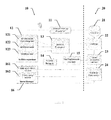
- a possible implementation of such a system is illustrated in figure 3 .
- the system is parted into two main processing segments: a server segment 20 ran on e.g. a network server, figured on the right, and a client/user segment 10 typically ran on a user equipment, such as a portable device: smartphone, pad, or equivalent, figured on the left.
- a server segment 20 ran on e.g. a network server, figured on the right
- a client/user segment 10 typically ran on a user equipment, such as a portable device: smartphone, pad, or equivalent, figured on the left.
- Such a partition is important in that it allows the implementation of the method on a small computing power device, such as a user device. This is possible because the method is divided into lighter steps, mainly concerning the scribbling of the object 3 to extract, that can be implemented on a user device, and heavier steps, mainly concerning the extraction of the object 3, that can advantageously be implemented on a more powerful network server.
- a video server 21 provides a video sequence 1 to a video sequence displayer 11.
- the system further comprises a scribble supervisor 12 in charge of providing editing and modifying means to the user to define the scribbles 5-7.
- Said scribble supervisor 12 further comprises a scribble object designator 121, in charge of defining, from the user's input, the drawn scribbles 5-7, a scribble corrector 122 allowing the user to modify a scribble 5-7, be it a drawn scribble or a propagated scribble, and a scribble eraser 123 allowing a user to delete a scribble 5-7.
- Said scribble supervisor 12 feeds a scribble propagator 13 with the drawn scribbles.
- Said scribble propagator 13 propagates the scribbles 5-7 through the images 2 of the video sequence 1, and may return back to the scribble supervisor 12 the so obtained propagated scribbles 5-7, for them to be either modified or erased.
- the scribble propagator 13 also provides a scribble renderer 14 with said scribbles 5-7, in order to have them displayed over the object 3 in images 2 of the displayed video sequence 1, so that the user can interactively checks the result of the propagation on scribbles 5-7.
- the scribble propagator 13 also provides said scribbles 5-7 to an extracting/matting module 22.
- Said extracting module 22 also receive the video sequence 1 from the video server 21. It is in charge of extracting a scribbled object 3 from an image 2 of the video sequence 1 based on said at least one scribbles 5-7 provided. Since the extracting 22 process can be resource consuming, it is advantageously deported and realized on server segment 20, instead than on user segment 10.
- the system can also comprise a propagation object validator 23.
- the principle of such a validator 23 is to check that an object 3 extracted from an image I t+1 at instant t+1 does not differs too much from the corresponding object 3 extracted from the preceding image It at instant t.
- Such a propagation object validator 23 can be implemented by any valuated comparison of two objects method, such as a distance between the images comprising the extracted objects 3.
- One sample of such a valuated comparison method is the Hausdorff distance as described e.g. in: "D. Huttenlocher and W. Rucklidge. A multi-resolution technique for comparing images using the Hausdorff distance. IEEE Conference on CVPR, pages 705-706,1993".
- the system can also comprise an extraction feedback manager 15 in charge of warning the user when the previous propagation object validator 23 detects a too important difference between an object extracted at instant t+1 and an object extracted at instant t. Such a warning is then a opportunity for the user to amend the scribbles 5-7, by modifying at least one of them or even add at least one more scribble, in order said scribbles better point the intended object 3 to extract.
- Figure 3 further shows a scene manager 16, comprising an animation specifier 161 and an overlay selector 162.
- Said scene manager 16 dialogs with a video writer 24 to define and realize a new video sequence, by replacing an extracted object 3 on overlay over another background.
Landscapes
- Engineering & Computer Science (AREA)
- Computer Vision & Pattern Recognition (AREA)
- Physics & Mathematics (AREA)
- General Physics & Mathematics (AREA)
- Theoretical Computer Science (AREA)
- Software Systems (AREA)
- Processing Or Creating Images (AREA)
Abstract
An authoring method, for extracting a foreground object (3) from a video sequence (1) comprising the following steps:
- displaying an image (2) of said video sequence (1) to a user,
- pointing said object (3) to extract by detecting the user drawing at least one scribble (5-7) onto said object (3),
- propagating said at least one scribble (5-7) through each successive image (2) of said video sequence (1),
- using said at least one drawn or propagated scribble (5-7) to constraint an extraction of said pointed object (3) from each said successive image (2).
- displaying an image (2) of said video sequence (1) to a user,
- pointing said object (3) to extract by detecting the user drawing at least one scribble (5-7) onto said object (3),
- propagating said at least one scribble (5-7) through each successive image (2) of said video sequence (1),
- using said at least one drawn or propagated scribble (5-7) to constraint an extraction of said pointed object (3) from each said successive image (2).
Description
- The technical domain is the domain of video sequence authoring. Particularly it concerns a method and a system to extract a foreground object from a video sequence.
- The aim is to extract a selected foreground object from a video sequence out of its background, to e.g. replace it over a different background. By doing so, a user can create new video contents.
- Some image or video authoring systems are able to extract a foreground object. However they are either too complicated to use or/and they can need a long learning process before they can be used. Also they often need a lot of computing power and are not able to extract a foreground object in real time. The result is they are not well adapted to new small devices such as smart-phones or mobile pads.
- Some extracting methods are fine to extract an object from an image. But when applied to a video sequence such methods need to be re-applied to each image, that is, about to 25 times per second. Such methods then become rather repetitive and thus boring for a user.
- An embodiment addresses and solves this problem without the drawbacks of prior art.
- The object of an embodiment is an authoring method, for extracting a foreground object from a video sequence comprising the steps of: displaying an image of said video sequence to a user, pointing said foreground object to extract by detecting the user drawing at least one scribble onto said object, propagating said at least one scribble through each successive image of said video sequence, using said at least one drawn or propagated scribble to constraint an extraction of said pointed foreground object from each said successive image.
- According to another feature, said propagating step comprises: discretizing a scribble into a set of points, estimating a new position for each point in said set of points in the next image of said video sequence, by selecting the point that minimizes a global energy function, expressed as a sum of at least one elementary energy weighted by weights, repeating said estimating step recursively through the following successive images of said video sequence.
- According to another feature, one of said elementary energy comprises a uniformity energy expressed by comparing a spatial distance between a point and its spatial successor in said set of points with the average value of the distance between two spatially successive points in said set of points, according to the formula Eunif(i,t) = Avgj=∀i(ds(Pj,t+1,Pj+1,t+1)) - ds(Pi,t+1,Pi+1,t+1).
- According to another feature, one of said elementary energy comprises a curvilinear energy expressed by the squared sum of a first spatial coordinate of a first vector joining a spatial antecedent of a point to said point and a first spatial coordinates of a second vector joining said point to its spatial successor, divided by the squared sum of a second spatial coordinate of said first vector and a second spatial coordinate of said second vector, according to the formula Ecurv(i,t) = (ux+vx)2/(uy+vy)2, where (ux,uy) are respectively first and second spatial coordinates of said first vector u = (Pi-1,t+1,Pi,t+1) and (Vx,Vy) are respectively first and second spatial coordinates of said second vector v = (Pi,t+1,Pi+1,t+1).
- According to another feature, one of said elementary energy comprises a flow energy expressed by a spatial distance between a point and its image, according to the formula Eflow(i,t)= ds(Pi,t,Pi,t+1).
- According to another feature, one of said elementary energy comprises a colour energy expressed by a colour distance between a point and its image, according to the formula Ecolour(i,t) = dc(Pi,t,Pi,t+1).
- According to another feature, one of said elementary energy comprises a stability energy expressed by a spatial distance between a point and the end of the longest segment of uniform colour starting from said point, according to the formula Estab(i,t) = ds(Pi,t,Pext,i,t).
- According to another feature, said spatial distance may be expressed by ds(P1,P2) = ds((x1,y1),(x2,y2)) = [(x1-x2)2 + (y1-y2)2]1/2, where (x1,y1), respectively (x2,y2), are spatial coordinates of point P1, respectively of point P2.
- According to another feature, said colour distance may be expressed by dc(P1,P2) = dc((L1,a1,b1),(L2,a2,b2)) = [kL(L1-L2) 2 + ka(a1-a2)2 + kb(b1-b2)2]1/2, where (L1,a1,bi), respectively (L2,a2,b2), are colorimetric coordinates of point P1 respectively of point P2, in a L*a*b colorimetric model, and kL, ka, kb are weights used for each respective coordinate.
- According to another feature, said weights are dynamically adapted, relatively increasing the weight of the energy flow proportionally to a length of a longest segment of uniform colour starting from said point.
- According to another feature, said propagating step further comprises displaying said at least one drawn or propagated scribble over the corresponding image.
- According to another feature, said propagating step further comprises allowing the user to correct any of said at least one scribble.
- According to another feature, the propagating step and the extracting step are done by two separate processes.
- Another objet of an embodiment is a system comprising means to implement the steps of the method according to any one of the previous embodiments.
- Said system is advantageously parted into two separate processing segments: a user segment in charge of the scribble propagation and a server segment in charge of the object extraction.
- Another objet of an embodiment is a computer software executing the steps of such a method.
- Others features, details and advantages of the invention will become more apparent from the detailed illustrating description given hereafter with respect to the drawings on which:
-
figure 1 is a illustrative video sequence with some scribbles drawn or propagated through the images, -
figure 2 details the use of energies in the propagation, -
figure 3 shows a global flow chart of an embodiment of a system implementing the video extracting method, -
figure 4 is explaining an image extracting method. - The aim of the invention is to extract a
foreground object 3 from avideo sequence 1. Illustrated infigure 1 is asimplified video sequence 1, comprising fourimages 2. Saidimages 2 are comprised in thesame video sequence 1 and are timely ordered a, b, c, d. Saidvideo sequence 1 shows acharacter 3 moving in front of abackground 4. Let us consider, that the user of the method wants to extract aforeground object 3, e.g. saidcharacter 3, from thevideo sequence 1. - To do such an extraction, the user uses an authoring method / system. According to an embodiment, said authoring method comprises the following steps. First, the
video sequence 1 is displayed to the attention of the user. Since the extracting method/system can be implemented on any computer system, the video sequence can be displayed e.g. on a graphical display. - Advantageously, the method is computationally light enough to be implemented on a light computer system such as a smartphone or a portable pad.
- For convenience, and in order the user can rightly point the
object 3 in next step, said display can advantageously be managed by usual video sequence tools, as for a VCR, comprising normal display, reverse, slow motion, image by image displays. - On said displayed
video sequence 1, and advantageously on afirst image 2, the user can point anobject 3 the user wants to extract from thebackground 4. Since, a quick pointing method is preferred, said pointing is done by roughly drawing at least one scribble over theobject 3. Some samples ofscribbles figure 1 . - A scribble 5-7 broadly designates an
object 3. The only constraint is that the scribble 5-7 must be wholly contained in theobject 3. But on the contrary, the scribble does not have to fully cover theobject 3. - Scribbles 5-7 are only intended to help an image extracting process, as will be more visible in a later part describing the image extracting process in detail. One of the advantages of the method is the fact that no fine work is needed and a rough scribbling is sufficient to point a
candidate object 3. - Moreover the scribbling action appears to be a very natural and intuitive way of designating a displayed
object 3. - Accordingly, the pointing step can, most of the time, be applied in real time by a user, over a
video sequence 1 displayed at normal speed of e.g. 25 images per second. - Such a scribbling/pointing action can be done by any pointing means, such as a mouse, a joystick, or directly on a display screen equipped with a tactical screen, touching it either directly with a digit or with a stylus.
- Several scribbles 5-7 can be used, as the user considers convenient, to rightly point a given
object 3. - Referring again to
figure 1 , one can see afirst scribble 5 drawn over the face of theobject 3. Asecond scribble 6 is drawn over both the torso and the left arm of theobject 3. Finally athird scribble 7 is drawn over the right arm of theobject 3. - One could imagine, reproducing said pointing step over each
image 2 of thevideo sequence 1. But such a process would rapidly become boring for the user. - Instead, according to an essential step of the proposed extracting method, the at least one scribble 5-7 drawn on a given
initial image 2 is automatically propagated through thesuccessive images 2 of saidvideo sequence 1. - By doing so, in each image a-d of the
video sequence 1, theobject 3 is pointed by its at least one scribble 5-7, be it drawn scribble(s), as in the initial image a, or propagated scribble(s), as in the following images b-d. Thus the image extracting process can process to the extraction of saidobject 3, as will be now explained with reference tofigure 4 . - It must be understood that any image extracting method can be used. The one described here is only indicative, but is a method that takes a great benefit of the constraint provided by a scribble 5-7, and thus is perfectly adapted to the video sequence extracting method described herein.
- One can differentiate an image extracting method in which an
object 3 to extract must be (re) defined for eachimage 2, from a video sequence extracting method in which anobject 3 to extract is mainly defined once in an initial image, and where the image flow is advantageously used to automatically find said object through theimages 2 of thevideo sequence 1. - Starting from an
original image 30, a first step decomposes it in an arbitrary number, here nine, of elementary masks 31-39. Each elementary mask 31-39 is an "intensity" mask, that is, an array of the image size, where each "pixel" is allocated an "intensity" value ranging from 0 to N. - Here, for comprehensive display purpose, each mask 31-39 is displayed as an image with the "intensity" value figured as a grey level, where 0 is black and N is full white. Thus when a mask 31-39 is applied to the
original image 30, the intensity of each pixel of theimage 30 is multiplied by said "intensity" value, and provides a partial image. - Each such mask 31-39 is determined so that the partial image so provided corresponds to a homogeneous area of the
original image 30, as can be seen onfigure 4 . - According to an important feature, said decomposition into a number of elementary masks 31-39 is a partition, that is, the sum of all mask values equal N for all pixels.
- Here it must be noted, that the use of a non-binary intensity, as in some extraction methods, allows for a smooth transition between two partial neighbouring areas of the
image 30. This can be seen, e.g. for the hair boundary of the character inmasks - This feature provides better results when applied to an
object 3 to extract. Especially theobject 3 is better delineated from thebackground 4 and is thus better suited to be later superimposed over a new different background. - Once said partition into a number of elementary masks 31-39 is done, there exists some automatic methods to determine the object to extract. However, such an extracting method is far more efficient when it takes benefit of a constraint given e.g. by at least one
scribble 41. - Such an at least one
scribble 41 is provided here for saidoriginal image 30. According to the video sequence extracting method saidscribble 41 has been either drawn by the user, if theoriginal image 30 is an initial image a, or has been propagated, if theoriginal image 30 is a following image b-d in avideo sequence 1. - Starting from said elementary masks 31-39, the image extracting process carries on, checking for each elementary mask 31-39, if it contains, at least partially, a piece of said at least one
scribble 41. If an elementary mask 31-39 is overwritten by at least a point from at least one of thescribble 41, said mask 31-39 is kept. If not, it is rejected. - Said kept elementary masks are then gathered and summed to provide a
final mask 40 that determine the object to extract, and that can be used to mask theoriginal image 30 to provide the extracted object. - In the example of
figure 4 , the elementary masks lying under at least onescribble 41 are indicated by an oval 42. These masks are the 35, 32, 33, 36, 38, 39. When gathered and summed, as figured on the bottom line offigure 4 , they provide afinal mask 40, delineating the object to extract, that is, the scribbled character inimage 30. - Said image extracting method can be easily applied to a
video sequence 1 so as to produce a video sequence extracting method, as soon as eachimage 2 from avideo sequence 1 is scribbled. The initial image is scribbled by the user, then the at least one scribble 5-7 is propagated automatically through thevideo sequence 1. - The propagation is an important step of the method. It comprises the following steps.
- First the first at least one scribble drawn by the user on the
initial image 2 is discretized into a set Ci,t of points Pi,t. Said step depends on the form of scribbles, as provided by the man machine interface used by the user to draw the scribbles 5-7. Said interface may either provide a curve, e.g. a cubic spline. In that case said curve is discretized into a set Ci,t of points Pi,t. Or said interface may directly provide a set Ci,t of points Pi,t, in which case said discretizing step is already done per se. - In said set Ci,t of points Pi,t, the index i is a spatial index and describes all the scribble points in one
image 2, and the index t is a temporal index and describes the time, that is the image It at each instant t through thevideo sequence 1. From said set Ci,t of points Pi,t, populated at least at time/image t, the propagation step derives, for each point Pi,t in said set Ci,t, a new position point Pi,t+1 in the next image It+1 in saidvideo sequence 1. Thus a set Ci,t of points is propagated into a set Ci,t+1. - Said new position point Pi,t+1 is determined by selecting the point Pi,t+1 that minimizes a global energy function Eglobal · According to an embodiment said energy function Eglobal is expressed as a weighted sum of at least one elementary energy Ej, where the weights are correspondingly denoted ωj, according to the formula Eglobal (Pi,t+1Pi,t) = Σ ωj.Ej.
- Said propagating step determines, from the scribbles 5-7 figured by set Ci,t in image It at instant t, point by point, the resulting scribbles figured by set Ci,t+1 in the next image It+1.
- A this point, if necessary, the set Ci,t+1 of propagated points Pi,t+1 can be modelled in a curve.
- The method carries on onto the next image It+2, by recursively applying the same propagating step over the obtained set Ci,t+1 of points Pi,t+1 to obtain the next set Ci,t+2 of points Pi,t+2, figuring the scribbles for the next image It+2.
- This process can be repeated recursively through the successive following
images 2 of saidvideo sequence 1, or until the user decides to stop it before. - Elementary energies Ej are a convenient and intuitive mean to express different trends that may impact the propagation of a scribble point, while trying to follow an
object 3 in animage 2. It is intended here to automatically propagate a scribble 5-7 so that it rightly stays within saidobject 3. - To do so at least one elementary energy Ej may be used. However several such elementary energies Ej together may better express a physical reality by having each elementary energy Ej modelling a trend, all trends cooperating to provide a right behaviour of the scribble.
-
Figure 2 explains notations used. In an image It at time t, at least one scribble 5-7 is modelled by a set Ci,t of points Pi,t. Said points are spatially ordered along a scribble/curve, according to an ordered i index. A given point Pi,t has a spatial antecedent Pi-1,t and a spatial successor Pi+1,t. Said point Pi,t is propagated into an image point Pi,t+1 in the next image It+1 attime t+ 1. Since propagation may use several energies, points P(k)i,t+1 with k={1..5} are figuring the image point of Pi,t if only energy Ek were used. The final image point Pi,t+1 then results from the contributions of all energies. - Accordingly, point Pi-1,t is propagated into an image point Pi-1,t+1 and point Pi+1,t is propagated into an image point Pi+1,t+1. Point Pi-1,t+1 is the spatial antecedent of Pi,t+1. Point Pi+1,t+1 is the spatial successor of Pi,t+1. All these points Pi-1,t+1,Pi,t+1,Pi+1,t+1 pertain to the propagated set Ci,t+1 corresponding to image It+1.
- A possible elementary energy is a uniformity energy Eunif. Such an energy Eunif is intended to limit the excursion of a point away from the curve.
- To get such a result, a uniformity energy Eunif computes a spatial distance between a point Pi,t+1 and the spatial successor Pi+1,t+1 of said point Pi,t+1 in the set Ci,t+1 of points. Out off all the distances so computed through an image It+1 at instant t+1, for all points Pj,t+1, an spatial average of said distance is determined by having an index j spanning said spatial index i, by averaging all distances between a point Pi,t+1 and its spatial successor Pi+1,t+1 in the set Ci,t+1. Then for each point Pi,t+1 its distance to its spatial successor Pi+1,t+1 is compared by subtracting it from said spatial average distance. The uniformity energy Eunif can thus be expressed according to the formula Eunif(i,t) = Avgj=∀i(ds(Pi,t+1,Pi+1,t+1)) - ds(Pi,t+1,Pi+1,t+1).
- Another possible elementary energy is a curvilinear energy Ecurv. Such an energy Ecurv is intended to control the curvature of the curve.
- To get such a result, a curvilinear energy Ecurv is expressed by "cross computing" two vectors u, v. The first vector u is a vector ending on a given point Pi,t+1. Said first vector u joins a spatial antecedent Pi-1,t+1 of a point Pi,t+1 to said point Pi,t+1. The second vector v is a vector starting from said point Pi,t+1. Said second vector v joins said point Pi,t+1 to its spatial successor Pi+1,t+1. Said two vectors u and v are "cross computed" by square summing the respective first spatial coordinate Ux of first vector u and Vx of second vector v and then divide the result by the squared sum of the respective second spatial coordinate uy of first vector u and vy of second vector v.
- The curvilinear energy Ecurv can thus be expressed by the formula Ecurv(i,t) = (ux+vx)2/(uy+vy)2, where (ux,uy) are respectively first, that is e.g. abscissa, and second, that is e.g. ordinate, spatial coordinates of vector u = (Pi- 1,t+1,Pi,t+1) and (vx,vy) are respectively first and second spatial coordinates of vector v = (Pi,t+1,Pi+1,t+1).
- In the current description, the spatial antecedent is the point Pi-1,t+1, preceding said point Pi,t+1 in the set Ci,t+1 of points. The spatial successor is the point Pi+1,t+1, following said point Pi,t+1 in the set Ci,t+1 of points. Otherwise said, spatial antecedent point Pi-1,t+1 and spatial successor point Pi+1,t+1 are both neighbours of point Pi,t+1 in a scribble/curve.
- The two preceding energies are typical of a classical active contours algorithm.
- The three energies described now are more specific of the particular extraction/propagation problem to which they are particularly suitable.
- Another possible elementary energy is a flow energy Eflow. Such a flow energy Eflow is intended to model the fact that an
object 3 generally does not move too quickly in avideo sequence 1. Such a flow energy Eflow thus acts as an inertial weight tending to maintain a point immobile. Such a flow energy Eflow can be simply expressed by a spatial distance, according to the formula: Eflow(i,t) = ds(Pi,t,Pi,t+1). Since said flow energy is minimized, this tends to maintain a point Pi,t where it is, thus choosing a point Pi,t+1 as close as possible. - Another possible elementary energy is a colour energy Ecolour. Such a colour energy Ecolour is intended to figure the fact that an
object 3, even moving along thevideo sequence 1, generally maintains its colour. Since a scribble points normally sticks to anobject 3, the same applies to its colour. Such a colour stability, even under some tolerance, can be expressed by a colour distance, according to the formula: Eeolour(i,t) = dc(Pi,t,Pi,t+1). Since said colour energy is minimized, this tends to attract a point Pi,t to a point Pi,t+1 with the closest colour possible. - Another possible elementary energy is a stability energy Estab. Such a stability energy Estab derives from the fact that a scribble 5-7, as drawn by a user, tends to be well within the middle zones of different object's regions, or in other words distant from the boundaries of
object 3. This is a property of a scribble 5-7 that must be kept when propagating. The aim of said stability energy Estab is to pull the point toward the "centre" of the object, away from detected boundaries. - One possible embodiment to do this is the following. The region around a point Pi,t is analysed in order to detect local homogeneity around the point, normally to the curve. Homogeneity is here detected based on the colour. Homogeneity according to an embodiment is measured by considering segments of uniform colour, starting from said considered point Pi,t. To simplify such segments are considered only along a given direction, such as, e.g. the direction orthogonal to the curve at point Pi,t, that is, the normal. By doing so two segments can be found starting from a given point Pi,t. Among these two segments, the longest one, that is the longest segment Si of uniform colour, of length LSi, is kept. Uniformity of the colour can be here considered with a small tolerance threshold, in order to take into account some possible noise in the
image 2 of thevideo sequence 1. Said longest segment Si of uniform colour, which is also known as a similarity line segment, can e.g. be determined by an area growing algorithm, known by a one skilled in the art. - The longest segment determines one direction among the two. The extremity of such a longest segment Si is called Pext,i,t. The stability energy Estab tends to pull the point Pi,t toward the point Pext,i,t. Otherwise said, the stability energy Estab can be expressed by a spatial distance between Pi,t and Pext,i,t, according to the formula Estab(i,t) = ds(Pi,t,Pext,i,t).
- So, minimizing said stability energy Estab tends to pull the point Pi,t toward the point Pext,i,t, and thus toward an area of greater homogeneity.
- With respect to the previous energies, said spatial distance ds may be expressed by any known spatial distance. E.g. it can be a Euclidian distance. Said spatial distance ds can then be expressed by : the distance between two points P1,P2, defined by their respective spatial coordinates (x1,y1) and (x2,y2), in a same Cartesian space, is ds(P1,P2) = ds((x1,y1), (x2,y2)) = [(x1-x2)2 + (y1-y2)2]1/2.
- Accordingly, said colour distance dc may be expressed by any known colour distance. E.g. it can be a weighted Euclidian distance expressed in a given colorimetric space. Said colour distance dc can then be expressed by: the distance between two points P1, P2, defined by their colorimetric coordinates (L1,a1,b1), and respectively (L2,a2,b2) in a L*a*b colorimetric model/space, as defined by CIE, is dc(P1,P2) = dc((L1,a1,b1), (L2,a2,b2)) = [kL(L1-L2)2 + ka(a1-a2)2 + kb(b1-b2)2]1/2. In the previous formula, kL, ka, kb are weights used for each respective coordinate. Since a and b are figuring color tints and L is figuring intensity, the following values kL=1/4, ka = kb = 1 give a good result. As a matter of fact said values advantageously greatly reduce the prejudicial effects of contrast change often found in video sequences.
- According to a first embodiment, a, b, and L coordinates are considered for a given point itself. Alternately, according to another embodiment, a, b, and L coordinates can be determined by spatially averaging their respective values over a neighbouring area around said given point.
- According to a preferred embodiment, said neighbouring area can advantageously be taken along a similarity line segment Si, as previously defined.
- By using any of these elementary energies or others energies a person skilled in the art would derives from them, a global energy Eglobal can be built by summing these elementary energies. This sum can advantageously be weighted in order to change the relative importance of one energy with respect to the other ones.
- As mentioned before, said energy function Eglobal is thus expressed as a weighted sum of at least one elementary energy Ej, where the weights are correspondingly denoted ωj, according to the formula Eglobal (Pi,t+1,Pi,t) = Σ ωj.Ej.
- E.g. when the five described elementary energies are used, the formula becomes Eglobal (Pi,t+1,Pi,t) = Σ ωj.Ej = ωunif.Eunif + ωcurv.Ecurv + ωflow.Eflow + ωcolour.Ecolour + ωstab·Estab
- Thus a propagating means, participating to a video sequence extracting method, can be trimmed, by changing said weights ωj, until a satisfactory behaviour of the propagation means is obtained, e.g. by trial and error.
- As an example, the following set of weights has been found to provide good results: ωunif=0.45, ωcurv=0.6, ωflow=1.1, ωcolour= 0.5, ωstab= 0.5.
- According to another embodiment, these weights ωj can be dynamically adapted, that is, recomputed depending on the parameters.
- According to a particular embodiment, such a dynamic adaptation can be the following.
- Here the adaptation of the weights ωj is directed to change, point by point the set of weights ωj and particularly the last three relative weights: ωflow, ωcolour and ωstab depending on the point Pi,t location and especially depending on the area colour or homogeneity around said point Pi,t.
- The goal here is to create a repulsive effect for a point Pi,t coming near a contour of the
object 3. This can be done by noticing that when the length LSi of the longest segment Si, as previously computed for the stability energy Estab, becomes small, the probability that the point Pi,t is coming near a boundary of theobject 3 is high. Accordingly, to correct this, a greater confidence, and thus a greater weight, could be given to the flow energy Eflow. Thus the corresponding weight ωflow can be increased proportionally to a decrease of the length LSi of the longest segment Si. - This can be done, e.g. by decreasing the two other weights ωcolour and ωstab accordingly. So, if the two first weight ωunif and ωcurv are left unchanged, the global energy Eglobal can be expressed by the following formula: Eglobal (Pi,t+1,Pi,t) = ωunif.Eunif + ωcurv.Ecurv + (1-LSi).ωflow·Eflow + LSi.ωcolour.Ecolour + LSi.ωstab.Estab. In practice, the lengths of all similarity segments LSi among the points Pi,t pertaining to a same scribble 5-7, can be normalized by the maximum length and the formula becomes: Eglobal(Pi,t+1,Pi,t) = ωunif.Eunif + ωcurv.Ecurv + ((1-LSi)/max(LSi)). ωflow.Eflow + LSi/max(LSi). ωcolour.Ecolour + LSi/max(LSi). ωstab.Estab.
- Once the propagation is done, according to another important feature, the propagated scribbles 5-7 can advantageously be displayed over the
object 3, while anycorresponding image 2 of thevideo sequence 1 is displayed. Thecorresponding image 2 is here theimage 2 associated to a given scribble 5-7. - Such a display has the advantage of showing to the user the result of its scribbling action, helping said user to rightly point an
object 3. Since this process can be applied in real time, the user gets an immediate feedback. The user can thus check the propagation of the scribbles 5-7, e.g. by basically verifying that said scribbles 5-7 stay in theobject 3 the user wanted to point. - Moreover, by showing to the user the result of its scribbling action, the user is allowed to interactively adapt its scribbling, by either moving or redrawing a scribble or by adding an additional scribble to e.g. extend an extracted object, if it appears that e.g. a part of said extracted
object 3 is missing in the extraction step. - In accordance with the last rendering step, the propagating step allows the user to interactively correct any of said at least one scribble 5-7, either by editing at least one of them or by adding or removing one of them.
- The present invention also concerns a system comprising means to implement the steps of such a method. A possible implementation of such a system is illustrated in
figure 3 . - The system is parted into two main processing segments: a
server segment 20 ran on e.g. a network server, figured on the right, and a client/user segment 10 typically ran on a user equipment, such as a portable device: smartphone, pad, or equivalent, figured on the left. - Such a partition is important in that it allows the implementation of the method on a small computing power device, such as a user device. This is possible because the method is divided into lighter steps, mainly concerning the scribbling of the
object 3 to extract, that can be implemented on a user device, and heavier steps, mainly concerning the extraction of theobject 3, that can advantageously be implemented on a more powerful network server. - A
video server 21 provides avideo sequence 1 to avideo sequence displayer 11. The system further comprises ascribble supervisor 12 in charge of providing editing and modifying means to the user to define the scribbles 5-7. Saidscribble supervisor 12 further comprises ascribble object designator 121, in charge of defining, from the user's input, the drawn scribbles 5-7, ascribble corrector 122 allowing the user to modify a scribble 5-7, be it a drawn scribble or a propagated scribble, and ascribble eraser 123 allowing a user to delete a scribble 5-7. - Said
scribble supervisor 12 feeds ascribble propagator 13 with the drawn scribbles. Saidscribble propagator 13 propagates the scribbles 5-7 through theimages 2 of thevideo sequence 1, and may return back to thescribble supervisor 12 the so obtained propagated scribbles 5-7, for them to be either modified or erased. - The
scribble propagator 13 also provides ascribble renderer 14 with said scribbles 5-7, in order to have them displayed over theobject 3 inimages 2 of the displayedvideo sequence 1, so that the user can interactively checks the result of the propagation on scribbles 5-7. - The
scribble propagator 13 also provides said scribbles 5-7 to an extracting/matting module 22. Said extractingmodule 22, also receive thevideo sequence 1 from thevideo server 21. It is in charge of extracting a scribbledobject 3 from animage 2 of thevideo sequence 1 based on said at least one scribbles 5-7 provided. Since the extracting 22 process can be resource consuming, it is advantageously deported and realized onserver segment 20, instead than onuser segment 10. - The system can also comprise a
propagation object validator 23. The principle of such avalidator 23 is to check that anobject 3 extracted from an image It+1 at instant t+1 does not differs too much from thecorresponding object 3 extracted from the preceding image It at instant t. - Such a
propagation object validator 23 can be implemented by any valuated comparison of two objects method, such as a distance between the images comprising the extracted objects 3. One sample of such a valuated comparison method is the Hausdorff distance as described e.g. in: "D. Huttenlocher and W. Rucklidge. A multi-resolution technique for comparing images using the Hausdorff distance. IEEE Conference on CVPR, pages 705-706,1993". - The system can also comprise an
extraction feedback manager 15 in charge of warning the user when the previouspropagation object validator 23 detects a too important difference between an object extracted at instant t+1 and an object extracted at instant t. Such a warning is then a opportunity for the user to amend the scribbles 5-7, by modifying at least one of them or even add at least one more scribble, in order said scribbles better point the intendedobject 3 to extract. -
Figure 3 further shows ascene manager 16, comprising ananimation specifier 161 and anoverlay selector 162. Saidscene manager 16 dialogs with avideo writer 24 to define and realize a new video sequence, by replacing an extractedobject 3 on overlay over another background.
Claims (16)
- An authoring method, for extracting a foreground object (3) from a video sequence (1) characterized in that it comprises the following steps:- displaying an image (2) of said video sequence (1) to a user,- pointing said foreground object (3) to extract by detecting the user drawing at least one scribble (5-7) onto said object (3),- propagating said at least one scribble (5-7) through each successive image (2) of said video sequence (1),- using said at least one drawn or propagated scribble (5-7) to constraint an extraction of said pointed foreground object (3) from each said successive image (2).
- The method of claim 1, wherein said propagating step comprises:- discretizing a scribble (5-7) into a set (Ci,t) of points,- estimating a new position (Pi,t+1) for each point (Pi,t) in said set (Ci,t) of points in the next image (It+1) of said video sequence (1), by selecting the point (Pi,t+1) that minimizes a global energy function (Eglobal), expressed as a sum of at least one elementary energy (Ej) weighted by weights (ωj),- repeating said estimating step recursively through the following successive images (2) of said video sequence (1).
- The method of claim 2, wherein one of said elementary energy comprises a uniformity energy (Eunif) expressed by comparing a spatial distance between a point (Pi,t+1) and its spatial successor (Pi+1,t+1) in said set (Ci,t+1) of points with the average value of the distance between two spatially successive points (Pi,t+1) and (Pi+1,t+1) in said set (Ci,t+1) of points, according to the formula Eunif(i,t) = Avgj=∀i (ds(Pj,t+1,Pj+1,t+1)) - ds(Pi,t+1,Pi+1,t+1).
- The method of claim 2 or 3, wherein one of said elementary energy comprises a curvilinear energy (Ecurv) expressed by the squared sum of a first spatial coordinate (ux) of a first vector (u) joining a spatial antecedent (Pi-1,t+1) of a point (Pi,t+1) to said point (Pi,t+1) and a first spatial coordinates (vx) of a second vector (v) joining said point (Pi,t+1) to its spatial successor (Pi+1,t+1), divided by the squared sum of a second spatial coordinate (uy) of said first vector (u) and a second spatial coordinate (vy) of said second vector (v), according to the formula Ecurv(i,t) = (ux+vx)2/(uy+vy)2, where (ux,uy) are respectively first and second spatial coordinates of said first vector u = (Pi-1,t+1,Pi,t+1) and (vx,vy) are respectively first and second spatial coordinates of said second vector v = (Pi,t+1,Pi+1,t+1).
- The method of any one of claims 2 to 4, wherein one of said elementary energy comprises a flow energy (Eflow) expressed by a spatial distance between a point (Pi,t) and its image (Pi,t+1), according to the formula Eflow(i,t) = ds(Pi,t,Pi,t+1).
- The method of any one of claims 2 to 5, wherein one of said elementary energy comprises a colour energy (Ecolour) expressed by a colour distance between a point (Pi,t) and its image (Pi,t+1), according to the formula Ecolour(i,t) = dc(Pi,t,Pi,t+1).
- The method of any one of claims 2 to 6, wherein one of said elementary energy comprises a stability energy (Estab) expressed by a spatial distance between a point (Pi,t) and the end (Pext,i,t) of the longest segment (Si) of uniform colour starting from said point (Pi,t), according to the formula Estab(i,t) = ds(Pi,t,Pext,i,t).
- The method of any one of claims 3 to 7, wherein said spatial distance (ds) may be expressed by ds(P1,P2) = ds((x1,y1), (x2,y2)) = [(x1-x2)2 + (y1-y2)2]1/2, where (x1,y1), respectively (x2, y2), are spatial coordinates of point P1, respectively of point P2.
- The method of any one of claims 3 to 8, wherein said colour distance (dc) may be expressed by dc(P1,P2) = dc((L1,a1,b1) (L2,a2,b2)) = [kL(L1-L2) 2 + ka(a1-a2) 2 + kb(b1-b2)2]1/2, where (L1,a1,b1), respectively (L2,a2,b2), are colorimetric coordinates of point P1 respectively of point P2, in a L*a*b colorimetric model, and kL, ka, kb are weights used for each respective coordinate.
- The method of any one of claims 2 to 9, wherein said weights (ωj) are dynamically adapted, relatively increasing the weight (ωflow) of the energy flow (Eflow) proportionally to a length (LSi) of a longest segment (Si) of uniform colour starting from said point (Pi,t).
- The method of any one of claims 1 to 10, wherein said propagating step further comprises displaying said at least one drawn or propagated scribble (5-7) over the corresponding image (2).
- The method of any one of claims 1 to 11, wherein said propagating step further comprises allowing the user to correct any of said at least one scribble (5-7).
- The method of any one of claims 1 to 12, wherein the propagating step and the extracting step are done by two separate processes.
- A system, characterized in that it comprises means to implement the steps of the method according to any one of claims 1 to 13.
- The system of claim 14, parted into two separate processing segments: a user segment in charge of the scribble propagation and a server segment in charge of the object extraction.
- A computer software, stored on a non-transitory medium, comprising computer readable instructions which when executed on at least one computer realize the steps of the method according to any one of claims 1 to 13.
Priority Applications (1)
| Application Number | Priority Date | Filing Date | Title |
|---|---|---|---|
| EP12305034.6A EP2615581A1 (en) | 2012-01-10 | 2012-01-10 | Authoring method and system for extracting a foreground object from a video sequence |
Applications Claiming Priority (1)
| Application Number | Priority Date | Filing Date | Title |
|---|---|---|---|
| EP12305034.6A EP2615581A1 (en) | 2012-01-10 | 2012-01-10 | Authoring method and system for extracting a foreground object from a video sequence |
Publications (1)
| Publication Number | Publication Date |
|---|---|
| EP2615581A1 true EP2615581A1 (en) | 2013-07-17 |
Family
ID=45507635
Family Applications (1)
| Application Number | Title | Priority Date | Filing Date |
|---|---|---|---|
| EP12305034.6A Withdrawn EP2615581A1 (en) | 2012-01-10 | 2012-01-10 | Authoring method and system for extracting a foreground object from a video sequence |
Country Status (1)
| Country | Link |
|---|---|
| EP (1) | EP2615581A1 (en) |
-
2012
- 2012-01-10 EP EP12305034.6A patent/EP2615581A1/en not_active Withdrawn
Non-Patent Citations (4)
| Title |
|---|
| MARWEN NOURI ET AL: "Moving object selection based on an active curve approach", IMAGE PROCESSING (ICIP), 2011 18TH IEEE INTERNATIONAL CONFERENCE ON, IEEE, 11 September 2011 (2011-09-11), pages 813 - 816, XP032080616, ISBN: 978-1-4577-1304-0, DOI: 10.1109/ICIP.2011.6116680 * |
| WILLIAMS D J ET AL: "A Fast algorithm for active contours and curvature estimation", CVGIP IMAGE UNDERSTANDING, ACADEMIC PRESS, DULUTH, MA, US, vol. 55, no. 1, 1 January 1992 (1992-01-01), pages 14 - 26, XP026968134, ISSN: 1049-9660, [retrieved on 19920101] * |
| XUE BAI ET AL: "Distancecut: Interactive Segmentation and Matting of Images and Videos", IMAGE PROCESSING, 2007. ICIP 2007. IEEE INTERNATIONAL CONFERENCE ON, IEEE, PI, 1 September 2007 (2007-09-01), pages II - 249, XP031157908, ISBN: 978-1-4244-1436-9 * |
| XUE BAI ET AL: "Geodesic Matting: A Framework for Fast Interactive Image and Video Segmentation and Matting", INTERNATIONAL JOURNAL OF COMPUTER VISION, vol. 82, no. 2, 1 April 2009 (2009-04-01), pages 113 - 132, XP055013242, ISSN: 0920-5691, DOI: 10.1007/s11263-008-0191-z * |
Similar Documents
| Publication | Publication Date | Title |
|---|---|---|
| US10984558B2 (en) | Learning-based sampling for image matting | |
| US8478072B2 (en) | Device, method, and program for image processing | |
| CN116018617B (en) | System and method for generating a splash-based differentiable two-dimensional rendering | |
| JP5985910B2 (en) | Multi-view video processing method and apparatus using hall rendering | |
| US20200134365A1 (en) | Instance segmentation methods and apparatuses, electronic devices, programs, and media | |
| CN112233215B (en) | Contour rendering method, device, equipment and storage medium | |
| CN111179159B (en) | Method and device for eliminating target image in video, electronic equipment and storage medium | |
| US20100073364A1 (en) | Conversion method and apparatus with depth map generation | |
| CN111768356B (en) | A method, device, electronic device and storage medium for face image fusion | |
| CN102449664A (en) | A method and device for generating gradient animation | |
| GB2586547A (en) | Automatic and interactive animation driven by change-based heuristics | |
| CN108509917A (en) | Video scene dividing method and device based on shot cluster correlation analysis | |
| US9786055B1 (en) | Method and apparatus for real-time matting using local color estimation and propagation | |
| CN108446694A (en) | A kind of object detection method and device | |
| US20020085754A1 (en) | Interactive frame segmentation with dynamic programming | |
| CN113822817A (en) | Document image enhancement method, device and electronic device | |
| CN108140251A (en) | Video cycle generation | |
| JP7144384B2 (en) | Object detection device, method and program | |
| CN117078817A (en) | Video generation methods, devices, equipment and media | |
| KR101316848B1 (en) | Apparatus and method for automatic object segmentation for background composition | |
| JPH11510351A (en) | Apparatus and method for object tracking | |
| EP2615581A1 (en) | Authoring method and system for extracting a foreground object from a video sequence | |
| CN112907750A (en) | Indoor scene layout estimation method and system based on convolutional neural network | |
| Liu et al. | Video cloning for paintings via artistic style transfer | |
| EP4524899A1 (en) | Learning device, server device, and program |
Legal Events
| Date | Code | Title | Description |
|---|---|---|---|
| PUAI | Public reference made under article 153(3) epc to a published international application that has entered the european phase |
Free format text: ORIGINAL CODE: 0009012 |
|
| 17P | Request for examination filed |
Effective date: 20120110 |
|
| AK | Designated contracting states |
Kind code of ref document: A1 Designated state(s): AL AT BE BG CH CY CZ DE DK EE ES FI FR GB GR HR HU IE IS IT LI LT LU LV MC MK MT NL NO PL PT RO RS SE SI SK SM TR |
|
| AX | Request for extension of the european patent |
Extension state: BA ME |
|
| STAA | Information on the status of an ep patent application or granted ep patent |
Free format text: STATUS: THE APPLICATION IS DEEMED TO BE WITHDRAWN |
|
| 18D | Application deemed to be withdrawn |
Effective date: 20140118 |