EP2615416A2 - Electronic Bias Compensation for a Gyroscope - Google Patents
Electronic Bias Compensation for a Gyroscope Download PDFInfo
- Publication number
- EP2615416A2 EP2615416A2 EP13150472.2A EP13150472A EP2615416A2 EP 2615416 A2 EP2615416 A2 EP 2615416A2 EP 13150472 A EP13150472 A EP 13150472A EP 2615416 A2 EP2615416 A2 EP 2615416A2
- Authority
- EP
- European Patent Office
- Prior art keywords
- gyroscope
- bias
- equations
- axis
- model
- Prior art date
- Legal status (The legal status is an assumption and is not a legal conclusion. Google has not performed a legal analysis and makes no representation as to the accuracy of the status listed.)
- Granted
Links
- 238000005259 measurement Methods 0.000 claims abstract description 70
- 238000000034 method Methods 0.000 claims abstract description 70
- 230000008569 process Effects 0.000 description 34
- 238000004891 communication Methods 0.000 description 20
- 238000012545 processing Methods 0.000 description 19
- 238000013016 damping Methods 0.000 description 15
- 230000002085 persistent effect Effects 0.000 description 13
- 230000006870 function Effects 0.000 description 7
- 238000010586 diagram Methods 0.000 description 6
- 230000009466 transformation Effects 0.000 description 4
- 230000001133 acceleration Effects 0.000 description 3
- 238000004519 manufacturing process Methods 0.000 description 3
- 230000003287 optical effect Effects 0.000 description 3
- 238000012986 modification Methods 0.000 description 2
- 230000004048 modification Effects 0.000 description 2
- 230000004044 response Effects 0.000 description 2
- 238000012546 transfer Methods 0.000 description 2
- 238000000844 transformation Methods 0.000 description 2
- 208000031872 Body Remains Diseases 0.000 description 1
- 230000006399 behavior Effects 0.000 description 1
- 239000003990 capacitor Substances 0.000 description 1
- 238000004590 computer program Methods 0.000 description 1
- 230000007423 decrease Effects 0.000 description 1
- 230000000694 effects Effects 0.000 description 1
- 230000007246 mechanism Effects 0.000 description 1
- 229910001092 metal group alloy Inorganic materials 0.000 description 1
- 239000013307 optical fiber Substances 0.000 description 1
- 230000010355 oscillation Effects 0.000 description 1
- 230000000644 propagated effect Effects 0.000 description 1
- 239000004065 semiconductor Substances 0.000 description 1
- 238000012360 testing method Methods 0.000 description 1
- 210000003813 thumb Anatomy 0.000 description 1
- 230000001131 transforming effect Effects 0.000 description 1
Images



Classifications
-
- G—PHYSICS
- G01—MEASURING; TESTING
- G01C—MEASURING DISTANCES, LEVELS OR BEARINGS; SURVEYING; NAVIGATION; GYROSCOPIC INSTRUMENTS; PHOTOGRAMMETRY OR VIDEOGRAMMETRY
- G01C19/00—Gyroscopes; Turn-sensitive devices using vibrating masses; Turn-sensitive devices without moving masses; Measuring angular rate using gyroscopic effects
- G01C19/56—Turn-sensitive devices using vibrating masses, e.g. vibratory angular rate sensors based on Coriolis forces
- G01C19/5776—Signal processing not specific to any of the devices covered by groups G01C19/5607 - G01C19/5719
-
- G—PHYSICS
- G01—MEASURING; TESTING
- G01C—MEASURING DISTANCES, LEVELS OR BEARINGS; SURVEYING; NAVIGATION; GYROSCOPIC INSTRUMENTS; PHOTOGRAMMETRY OR VIDEOGRAMMETRY
- G01C25/00—Manufacturing, calibrating, cleaning, or repairing instruments or devices referred to in the other groups of this subclass
- G01C25/005—Manufacturing, calibrating, cleaning, or repairing instruments or devices referred to in the other groups of this subclass initial alignment, calibration or starting-up of inertial devices
Definitions
- the present disclosure relates generally to vibratory gyroscopes and, in particular, to a method and apparatus for electronically compensating for bias in vibratory gyroscopes.
- Gyroscopes are used for measuring and/or maintaining orientation.
- a “gyroscope” is a sensor configured to detect and measure the angular motion of an object relative to an inertial frame of reference.
- an “inertial frame of reference” may be a coordinate system or set of axes that is non-accelerating.
- an inertial frame of reference is a frame of reference in which Newton's first law of motion is true. Newton's first law of motion states that the velocity of a body remains constant unless the body is acted upon by an external force.
- a Coriolis vibratory gyroscope is configured to be driven to vibrate along a first axis. Vibration along the first axis while the Coriolis vibratory gyroscope is being rotated about a fixed input axis generates a Coriolis force that induces vibrations along a second axis. These vibrations may be measured and used to determine an angular velocity for the rotation of the Coriolis vibratory gyroscope about the fixed input axis.
- bias may contribute to the measurements of the vibrations.
- Bias may be the error in the measurements due to factors such as, for example, without limitation, temperature, part inconsistencies, and other suitable factors. Calibration of these gyroscopes during manufacturing of the gyroscopes may be less accurate than desired.
- calibration of these gyroscopes during manufacturing processes may use test data as compared to substantially real-time data.
- these calibration techniques may not take into account the effects of the temperature in the environment in which a gyroscope is being operated and/or inconsistencies that may develop over time from the time at which the gyroscope was manufactured.
- some currently available systems for compensating for this bias may be unable to reduce the bias from these vibration measurements to within selected tolerances.
- a method for compensating for bias of a gyroscope is provided. Bias measurements for a plurality of drive angles are generated using the gyroscope. A set of equations for the bias of the gyroscope is identified using a model for motion of the gyroscope. The set of equations includes a set of parameters for the bias of the gyroscope. A set of values for the set of parameters is identified using the bias measurements and the set of equations.
- an apparatus comprises a compensation system.
- the compensation system is configured to receive bias measurements for a plurality of drive angles from a gyroscope.
- the compensation system is configured to identify a set of equations for the bias of the gyroscope using a model for motion of the gyroscope.
- the set of equations includes a set of parameters for the bias of the gyroscope.
- the compensation system is configured to identify a set of values for the set of parameters using the bias measurements and the set of equations.
- a method for electronically compensating for bias of a gyroscope is provided. Bias measurements for a plurality of drive angles are generated using the gyroscope. A set of equations for the bias of the gyroscope is identified using a model for motion of the gyroscope and an assumption that an inertial rate for the gyroscope is substantially zero. The set of equations includes a set of parameters for the bias of the gyroscope. A set of values for the set of parameters is identified using the bias measurements and the set of equations. The bias of the gyroscope at a selected drive angle is estimated using the set of equations with the set of values for the set of parameters to form an estimated bias. The estimated bias is subtracted from a measurement generated by the gyroscope for the selected drive angle to substantially compensate for the bias of the gyroscope.
- the different illustrative embodiments recognize and take into account different considerations. For example, the different illustrative embodiments recognize and take into account that some currently available methods for compensating for bias of a gyroscope may use a mechanical system to estimate the bias of the gyroscope. In some cases, this mechanical system may be used to operate the gyroscope and rotate the gyroscope at an angular velocity. Further, this type of mechanical system may introduce additional contributors to the bias of the gyroscope. Consequently, these types of systems may be unable to estimate the bias of the gyroscope within a desired level of accuracy.
- the different illustrative embodiments provide a method and apparatus for electronically compensating for the bias of a gyroscope.
- a method for compensating for bias of a gyroscope is provided. Bias measurements for a plurality of drive angles are generated using the gyroscope. A set of equations for the bias of the gyroscope is identified using a model for motion of the gyroscope. The set of equations includes a set of parameters for the bias of the gyroscope. A set of values for the set of parameters is identified using the bias measurements and the set of equations.
- bias compensation environment 100 is an example of an environment in which the different illustrative embodiments may be implemented to compensate for bias 101 of gyroscope 102.
- gyroscope 102 takes the form of vibrating structure gyroscope (VSG) 104 in these examples.
- vibrating structure gyroscope 104 may be referred to as Coriolis vibratory gyroscope (CVG) 106.
- CVG Coriolis vibratory gyroscope
- gyroscope 102 is a sensor configured to measure angular motion relative to inertial frame of reference 108.
- Inertial frame of reference 108 is a coordinate system or set of axes that is non-accelerating.
- gyroscope 102 comprises element 110 and frame 112.
- Element 110 may be a structure comprising a number of metallic alloys.
- Element 110 may be configured to vibrate, or resonate, at number of resonant frequencies 114 for element 110.
- number of resonant frequencies 114 may be substantially equal to number of natural frequencies 115 for element 110.
- a natural frequency in number of natural frequencies 115 may be the frequency at which element 110 vibrates along a particular axis when a substantially continuous external force is not being applied to element 110.
- element 110 may be referred to as a "proof mass" or a resonator in some illustrative examples.
- Element 110 may be associated with frame 112.
- the association between element 110 and frame 112 is a physical association in these depicted examples.
- a first component, such as element 110 may be considered to be associated with a second component, such as frame 112, by being secured to the second component, bonded to the second component, mounted to the second component, welded to the second component, fastened to the second component, and/or connected to the second component in some other suitable manner.
- the first component also may be connected to the second component using a third component.
- the first component also may be considered to be associated with the second component by being formed as part of and/or an extension of the second component.
- element 110 may be associated with frame 112 through spring system 116.
- Spring system 116 may comprise first set of springs 118 and second set of springs 119.
- a "set of" items means one or more items.
- a set of springs means one or more springs.
- first set of springs 118 may attach element 110 to frame 112 in a direction along first axis 120.
- first set of springs 118 allows element 110 to move linearly in a direction along first axis 120.
- second set of springs 119 may attach element 110 to frame 112 in a direction along second axis 122.
- Second set of springs 119 allows element 110 to move linearly in a direction along second axis 122.
- spring system 116 may constrain movement of element 110 to within plane 124 formed by first axis 120 and second axis 122.
- element 110 may have two degrees of freedom.
- Frame 112, with element 110 attached to frame 112 through spring system 116 may, may be configured to move with respect to third axis 126.
- frame 112, with element 110 attached to frame 112 may rotate about third axis 126.
- Third axis 126 is a fixed axis that is substantially perpendicular to plane 124 formed by first axis 120 and second axis 122. In this manner, first axis 120, second axis 122, and third axis 126 are substantially orthogonal to each other.
- first axis 120, second axis 122, and third axis 126 may be referred to as an x-axis, a y-axis, and a z-axis, respectively.
- Frame 112 may rotate about third axis 126 with angular velocity 128.
- Angular velocity 128 also may be referred to as an inertial rate.
- angular velocity 128 for frame 112, with element 110 attached to frame 112 is the rate of rotation for frame 112 with respect to inertial frame of reference 108.
- Angular velocity 128 may be expressed in radians per second, revolutions per second, degrees per second, or in other suitable units.
- gyroscope 102 also includes control unit 130.
- Control unit 130 is configured to control operation of gyroscope 102.
- Control unit 130 may be implemented using at least one of a processor, a circuit, an integrated circuit (IC), a microchip, a microprocessor, a computer, and some other suitable type of controller.
- gyroscope 102 may include a number of additional components, such as, for example, at least one of an electrode, a capacitor, and other suitable components.
- the phrase "at least one of”, when used with a list of items, means that different combinations of one or more of the listed items may be used and only one of each item in the list may be needed.
- “at least one of item A, item B, and item C” may include, without limitation, item A, or item A and item B. This example also may include item A, item B, and item C, or item B and item C.
- "at least one of” may be, for example, without limitation, two of item A, one of item B, and ten of item C; four of item B and seven of item C; and other suitable combinations.
- Control unit 130 controls gyroscope 102 such that element 110 moves linearly in a direction along drive axis 121 in plane 124. In these illustrative examples, this movement of element 110 is vibration of element 110 along drive axis 121.
- the angle of drive axis 121 with respect to first axis 120 may be referred to as a drive angle.
- Control unit 130 may control gyroscope 102 to operate at a selected drive angle such that the actual drive angle is within selected tolerances.
- Drive axis 121 may be first axis 120 in some illustrative examples.
- control unit 130 may drive element 110 to vibrate along first axis 120 at number of resonant frequencies 114 using drive control signal 131.
- drive control signal 131 may be sent to a number of electrodes attached to element 110 to cause element 110 to vibrate along first axis 120 at number of resonant frequencies 114.
- force 132 is a Coriolis force in these examples. Force 132 acts at substantially right angles to angular velocity 128 for frame 112.
- Sense axis 123 is an axis that is substantially orthogonal to drive axis 121. In other words, sense axis 123 is oriented at about 90 degrees with respect to drive axis 121. Sense axis 123 is the axis along which linear movement of element 110 is induced in response to force 132. For example, simultaneous vibration of element 110 in the direction along drive axis 121 and rotation of frame 112 about third axis 126 generates force 132, which induces vibration of element 110 in the direction along sense axis 123.
- Drive axis 121 and sense axis 123 are substantially orthogonal to third axis 126. When drive axis 121 is first axis 120, sense axis 123 may be second axis 122.
- control unit 130 uses force rebalance signal 133 to cause the amplitude of vibrations of element 110 along second axis 122 to be substantially zero.
- control unit 130 uses force rebalance signal 133 to substantially nullify the movement of element 110 along second axis 122 based on drive control signal 131.
- Control unit 130 generates measurements 134 of force rebalance signal 133. Measurements 134 may be used to determine angular velocity 128.
- Measurements 134 may be less accurate than desired when bias 101 of gyroscope 102 contributes to measurements 134.
- Bias 101 is the error for gyroscope 102.
- bias 101 is the difference between measurements 134 and the measurements that should actually be generated.
- Bias 101 may be the contribution to measurements 134 when angular velocity 128 is substantially zero. In this manner, bias 101 may be referred to as a zero-rate bias.
- Bias 101 may be caused by a number of different factors. These factors may include, for example, without limitation, temperature, inconsistencies in the fabrication of the different components for gyroscope 102, characteristics of element 110, characteristics of a sensing system in gyroscope 102, characteristics of control unit 130, and other suitable factors. These factors also may include damping and stiffness asymmetry between first axis 120 and second axis 122, asymmetry between drive axis 121 and sense axis 123 alignment, and/or other suitable types of asymmetry.
- Compensation system 136 may be used to electronically compensate for bias 101. Compensation system 136 may be implemented using hardware, software, or a combination of the two. For example, compensation system 136 may be implemented within computer system 138. Computer system 138 may comprise a number of computers. When computer system 138 comprises more than one computer, these computers may be in communication with each other.
- Compensation system 136 identifies set of equations 140 for bias 101 of gyroscope 102 using model 142 for the motion of gyroscope 102 with respect to non-inertial frame of reference 144 and assumption 146.
- Non-inertial frame of reference 144 is a rotating frame of reference.
- non-inertial frame of reference 144 may be formed by first axis 120 and second axis 122.
- plane 124 formed by first axis 120 and second axis 122 may rotate with respect to inertial frame of reference 108.
- Model 142 may be a model for the motion of gyroscope 102 along first axis 120 and second axis 122.
- model 142 takes the form of a number of equations that describe the motion of gyroscope 102 with respect to first axis 120 and second axis 122.
- Assumption 146 is an assumption that angular velocity 128 for gyroscope 102 is substantially zero within selected tolerances. In other words, assumption 146 assumes that frame 112 is not rotating about third axis 126 and has a substantially zero inertial rate. Compensation system 136 modifies model 142 based on assumption 146 to form modified model 148. In particular, modified model 148 is simplified as compared to model 142.
- Compensation system 136 identifies set of equations 140 using modified model 148.
- Set of equations 140 may include first equation 150 and second equation 152.
- First equation 150 is for the portion of bias 101 that is in-phase bias 154.
- In-phase bias 154 may be the portion of bias 101 that is substantially in-phase with the linear velocity of the vibrations of gyroscope 102.
- Second equation 152 is for the portion of bias 101 that is in-quadrature bias 156.
- In-quadrature bias 156 may be the portion of bias 101 that is substantially in-quadrature with the linear velocity of the vibrations of gyroscope 102.
- In-quadrature bias 156 also may be referred to as quadrature bias.
- set of equations 140 includes set of parameters 158.
- Set of parameters 158 includes one or more parameters that contribute to bias 101. These parameters may include, for example, at least one of a drive axis misalignment angle, a sense axis misalignment angle, a damping azimuth angle, a damping asymmetry term, a difference between the natural frequencies of drive axis 121 and sense axis 123, an azimuth angle of drive axis 121 with respect to first axis 120, and some other suitable parameters. Values for these parameters may be unknown.
- Compensation system 136 identifies set of values 160 for set of parameters 158 using set of equations 140, bias measurements 161, and iterative algorithm 162. Compensation system 136 identifies set of values 160 for set of parameters 158 within selected tolerances. In other words, compensation system 136 uses set of equations 140, bias measurements 161, and iterative algorithm 162 to estimate set of values 160 for set of parameters 158.
- Bias measurements 161 may be measurements generated by control unit 130 at plurality of drive angles 164.
- a drive angle in plurality of drive angles 164 is the angle of drive axis 121 with respect to first axis 120 along which control unit 130 drives element 110 to move linearly.
- the drive angle may be selected from a range between about 0 degrees and about 360 degrees with respect to first axis 120.
- plurality of drive angles 164 may include about 0 degrees, about 45 degrees, and about 90 degrees with respect to first axis 120.
- Iterative algorithm 162 may be, for example, without limitation, a least-squares algorithm. Iterative algorithm 162 may be used to solve at least one value in set of values 160 using set of equations 140 and bias measurements 161.
- Set of values 160 may be used to identify a particular drive angle at which in-quadrature bias 156 is substantially zero. In other words, set of values 160 may be used to identify the drive angle that substantially zeros out in-quadrature bias 156 within selected tolerances. Gyroscope 102 may be operated at this particular drive angle to calibrate the output of gyroscope 102 using set of equations 140.
- compensation system 136 may estimate bias 101 of gyroscope 102 at a selected drive angle using set of equations 140 to form an estimated bias. Compensation system 136 may subtract the estimated bias from measurements generated by gyroscope 102 for the selected drive angle to electronically compensate for bias 101 of gyroscope 102.
- bias compensation environment in Figure 1 is not meant to imply physical or architectural limitations to the manner in which an illustrative embodiment may be implemented.
- Other components in addition to and/or in place of the ones illustrated may be used. Some components may be unnecessary.
- the blocks are presented to illustrate some functional components. One or more of these blocks may be combined, divided, or combined and divided into different blocks when implemented in an illustrative embodiment.
- gyroscope 102 may have elements in addition to and/or in place of element 110.
- element 110 may be attached to a case, a housing, a number of structures, or some other suitable type of structure in addition to and/or in place of frame 112.
- Model 200 is an example of a function model for a gyroscope, such as, for example, gyroscope 102 in Figure 1 .
- model 200 includes element 202 and frame 203.
- model 200 may include other components for the gyroscope in addition to the ones described in Figure 2 .
- Element 202 is associated with frame 203 by first set of springs 204 along the direction of x-axis 206.
- Element 202 is associated with frame 203 by second set of springs 208 along the direction of y-axis 210.
- x-axis 206 and y-axis 210 are examples of implementations for first axis 120 and second axis 122, respectively, in Figure 1 .
- x-axis 206 and y-axis 210 form plane 212.
- Element 202 may vibrate along x-axis 206 at a first natural frequency. Further, element 202 may vibrate along y-axis at a second natural frequency. The first natural frequency may be the same or different from the second natural frequency, depending on the implementation. Vibration of element 202 along x-axis 206 may be a first mode, while vibration of element 202 along y-axis 210 may be a second mode. The first mode and the second mode may be referred to as, for example, a drive mode and a sense mode, respectively.
- Element 202 may vibrate along x-axis 206 and/or y-axis 210 independently of movement of frame 203 in this illustrative example.
- first set of springs 204 and second set of springs 208 may allow element 202 to move along x-axis 206 and y-axis 210 independently of the movement of frame 203.
- Motion of element 202 is constrained to within plane 212 in this illustrative example.
- a control unit such as control unit 130 in Figure 1
- Frame 203 may be rotated about a z-axis 211 that is substantially perpendicular to plane 212. Rotation of frame 203 about z-axis 211 while element 202 is moved along the direction of x-axis 206 generates a Coriolis force that causes element 202 to vibrate along the direction of y-axis 210.
- element 202 may be moved in the direction of arrow 218 along y-axis 210. If element 202 is moved in the direction of arrow 220 along x-axis 206 while frame 203 is rotated about z-axis 211 in the direction of arrow 216, element 202 may be moved in the direction of arrow 222 along y-axis 210.
- element 202 may be moved in the direction of arrow 222 along y-axis 210. If element 202 is moved in the direction of arrow 220 along x-axis 206 while frame 203 is rotated about z-axis 211 in the direction of arrow 224, element 202 may be moved in the direction of arrow 218 along y-axis 210.
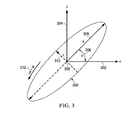
- FIG. 3 an illustration of the orbit of an element for a gyroscope is depicted in accordance with an illustrative embodiment.
- orbit 300 of an element such as element 202 from Figure 2
- x-axis 302 is depicted with respect to x-axis 302 and y-axis 304.
- X-axis 302 is the same as x-axis 206 in Figure 2 .
- Y-axis is the same as y-axis 210 in Figure 2 .
- Element 202 may oscillate about origin 305 at the intersection of x-axis 302 and y-axis 304. Oscillation of element 202 may follow a pendulum-type behavior. In this manner, orbit 300 may be a pendulum orbit in this illustrative example.
- Parameters for orbit 300 include pendulum angle 306, principal amplitude 308, quadrature amplitude 310, and phase 312.
- pendulum angle 306, ⁇ is an angle with respect to x-axis 302 and defines an axis relative to x-axis 302 along which element 202 may vibrate.
- Principal amplitude 308, A is the amplitude of vibrations for element 202 along the axis defined by pendulum angle 306.
- Quadrature amplitude 310, q is the amplitude of vibrations for element 202 along the axis in-quadrature to the axis defined by pendulum angle 306.
- quadrature amplitude 310 is the amplitude of vibrations for element 202 along the axis substantially orthogonal to the axis defined by pendulum angle 306.
- phase 312, ⁇ ' is the phase for orbit 300.
- a control unit such as control unit 130 in Figure 1 , may be configured to control external force components applied to element 202 and/or frame 203 in Figure 2 to control pendulum angle 306, principal amplitude 308, quadrature amplitude 310, and phase 312.
- the control unit may control forces exerted on element 202 such that these forces have a same phase as the phase of the natural frequency for element 202.
- control unit may control forces exerted on element 202 such that principal amplitude 308, A, remains substantially constant during operation of the gyroscope against any damping forces.
- the rate at which principal amplitude 308, A, decreases because of damping is proportional to A/ ⁇ , in which ⁇ is a damping time constant.
- control unit may control the forces exerted on element 202 such that pendulum angle 306 and quadrature amplitude 310 remain substantially zero with selected tolerances during operation of the gyroscope.
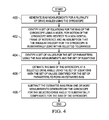
- FIG. 4 an illustration of a process for compensating for bias of a gyroscope in the form of a flowchart is depicted in accordance with an illustrative embodiment.
- the process illustrated in Figure 4 may be implemented using compensation system 136 to compensate for bias 101 of gyroscope 102 in Figure 1 .
- the process begins by generating bias measurements for a plurality of drive angles using the gyroscope (operation 400).
- the bias measurements are generated with the angular velocity for the gyroscope substantially equal to zero within selected tolerances.
- the process then identifies a set of equations for the bias of the gyroscope using a model for motion of the gyroscope with respect to a non-inertial frame of reference and an assumption that the angular velocity for the gyroscope is substantially zero within selected tolerances (operation 402).
- the angular velocity for the gyroscope is with respect to an inertial frame of reference.
- the set of equations includes a set of parameters.
- the one or more parameters in the set of parameters have unknown values.
- the set of equations includes a first equation for in-phase bias of the gyroscope and a second equation for in-quadrature bias of the gyroscope.
- Operation 404 identifies a set of values for the set of parameters using the bias measurements and the set of equations (operation 404).
- Operation 404 may be performed using an iterative algorithm, such as, for example, without limitation, a least-squares algorithm.
- the process estimates the bias of the gyroscope at a selected drive angle using the set of equations with the set of values identified for the set of parameters to form an estimated bias (operation 406).
- the selected drive angle may be, for example, the current drive angle at which the gyroscope is being operated.
- the bias of the gyroscope may be estimated in substantially real-time during operation of the gyroscope.
- the process then subtracts the estimated bias from one or more measurements generated by the gyroscope for the selected drive angle to substantially compensate for the bias of the gyroscope (operation 408), with the process terminating thereafter.
- the estimated bias is subtracted from a measurement to substantially remove the contribution of the bias of the gyroscope from the measurement within selected tolerances. In this manner, the bias of the gyroscope may be electronically compensated in substantially real-time.
- FIG. 5 an illustration of a process for identifying a set of equations for the bias of a gyroscope in the form of a flowchart is depicted in accordance with an illustrative embodiment.
- the process illustrated in Figure 5 may be an example of one process that may be used to implement operation 402 in Figure 4 .
- the process begins by identifying a model for the motion of the gyroscope (operation 500).
- the gyroscope comprises an element associated with a frame.
- the process modifies the model for the motion of the gyroscope based on an assumption that the angular velocity for the gyroscope is substantially zero within selected tolerances to form a modified model (operation 502).
- an assumption is also made that the contribution of the linear acceleration components for the frame are negligible.
- the process identifies a misalignment model for the misalignment of the drive axis (operation 504).
- the misalignment of the drive axis occurs when the axis along which the element of the gyroscope is driven to vibrate is different from the drive axis indicated by the drive control signal generated by the control unit for the gyroscope.
- control unit may generate a drive control signal to control the element to move along the drive axis.
- the actual movement of the element may be along an axis offset from the drive axis by angle a.
- This angle, a may be referred to as a drive axis misalignment angle.
- the axis along which the element is induced to vibrate in response to a Coriolis force may be offset from the sense axis by angle b.
- This angle, b may be referred to as a sense axis misalignment angle.
- these angles, a and b may be in radians (rads).
- the process then identifies a number of transformations for transforming the model for the motion of the gyroscope to take into account a drive axis between the x-axis and the y-axis (operation 506).
- the gyroscope may be driven to vibrate along an axis between the x-axis and the y-axis.
- the angle between this drive axis and the x-axis is the drive angle.
- the drive axis and the sense axis that is substantially orthogonal to the drive axis form a rotated frame of reference with respect to the frame of reference formed by the x-axis and the y-axis.
- x ⁇ y ⁇ dM ⁇ dt x s y s + M ⁇ ⁇ x ⁇ s y ⁇ s
- x ⁇ y ⁇ d 2 ⁇ M ⁇ dt 2 x s y s + 2 ⁇ dM ⁇ dt x ⁇ s y ⁇ s + M ⁇ ⁇ x ⁇ s y ⁇ s
- the process uses the modified model for the motion of the gyroscope and the number of transformations identified to form a transformed model for the motion of the gyroscope (operation 508).
- operation 508 an assumption is made that the angular velocity for the gyroscope is at a lower rate than the rate at which the vibrations of the sense axis are being measured.
- the process then uses the force-rebalance model to identify the set of equations for the bias of the gyroscope (operation 512), with the process terminating thereafter.
- the set of equations identified in operation 512 includes a first equation for an in-phase bias and a second equation for an in-quadrature bias.
- the process illustrated in Figure 5 provides a method for identifying a set of equations, such as equation (25) and equation (26) for the bias of the gyroscope.
- the unknown parameters in these equations include a , b , ⁇ 1 ⁇ , ⁇ ⁇ ⁇ , and ⁇ ⁇ .
- these equations may be used in operation 404 in Figure 4 to identify values for these parameters.
- FIG. 6 an illustration of a process for identifying a set of values for a set of parameters in a set of equations for the bias of a gyroscope in the form of a flowchart is depicted in accordance with an illustrative embodiment.
- the process illustrated in Figure 6 may be an example of one process that may be used to implement operation 404 in Figure 4 .
- the process begins by making a group of assumptions (operation 600).
- the group of assumptions includes assumptions with respect to the in-phase bias of the gyroscope. These assumptions are as follows: ⁇ ab ⁇ 0 ⁇ 1 ⁇ ⁇ a ⁇ 0 ⁇ 1 ⁇ ⁇ b ⁇ 0 cos 2 ⁇ ⁇ ⁇ ⁇ 1 sin 2 ⁇ ⁇ ⁇ ⁇ 2 ⁇ ⁇ ⁇ ⁇ 1 ⁇ ⁇ 2 ⁇ ⁇ ⁇ 0
- the process then uses the set of assumptions to modify the set of equations to form a modified set of equations (operation 602).
- the modified set of equations includes a first modified equation for the in-phase bias and a second modified equation for the in-quadrature bias.
- quad c 0 - ⁇ ⁇ ⁇ ⁇ ⁇ sin 2 ⁇ ⁇ ⁇ cos 2 ⁇ ⁇ ⁇ ⁇ 0 - cos 2 ⁇ ⁇ ⁇ sin 2 ⁇ ⁇ ⁇ ⁇ 0 ⁇ - ⁇ ⁇ ⁇ ⁇ ⁇ sin 2 ⁇ ⁇ ⁇ ⁇ 0 ⁇ - ⁇ ⁇ ⁇ ⁇ ⁇ sin 2 ⁇ ⁇ ⁇ ⁇ ⁇
- the process then identifies a set of values for the set of parameters in the modified set of equations using the bias measurements for the plurality of drive angles and an iterative algorithm (operation 604), with the process terminating thereafter.
- the bias measurements in operation 604 may be the bias measurements generated by the gyroscope for the plurality of drive angles in operation 400 in Figure 4 .
- the plurality of drive angles may include angles of about 0 degrees, about 45 degrees, and about 90 degrees with respect to the x-axis.
- angles of about 0 degrees, about 45 degrees, and about 90 degrees with respect to the x-axis may be selected.
- any angles between about 0 degrees and about 90 degrees with respect to the x-axis may be selected.
- the iterative algorithm may be used to solve for ⁇ ⁇ .
- the set of values identified in operation 604 for the set of parameters in the set of equations for the bias of the gyroscope may be used to estimate the bias of the gyroscope for any drive angle.
- the in-phase bias and in-quadrature bias may be estimated for any drive angle.
- the estimated azimuth angle, ⁇ ⁇ 0 may be used to identify the particular drive angle identified in operation 406 in Figure 4 .
- each block in the flowcharts or block diagrams may represent a module, segment, function, and/or a portion of an operation or step.
- one or more of the blocks may be implemented as program code, in hardware, or a combination of the program code and hardware.
- the hardware may, for example, take the form of integrated circuits that are manufactured or configured to perform one or more operations in the flowcharts or block diagrams.
- the function or functions noted in the blocks may occur out of the order noted in the figures.
- two blocks shown in succession may be executed substantially concurrently, or the blocks may sometimes be performed in the reverse order, depending upon the functionality involved.
- other blocks may be added in addition to the illustrated blocks in a flowchart or block diagram.
- Data processing system 700 may be used to implement computer system 138 in Figure 1 .
- data processing system 700 includes communications framework 702, which provides communications between processor unit 704, memory 706, persistent storage 708, communications unit 710, input/output (I/O) unit 712, and display 714.
- communications framework 702 provides communications between processor unit 704, memory 706, persistent storage 708, communications unit 710, input/output (I/O) unit 712, and display 714.
- Processor unit 704 serves to execute instructions for software that may be loaded into memory 706.
- Processor unit 704 may be a number of processors, a multi-processor core, or some other type of processor, depending on the particular implementation.
- a "number", as used herein with reference to an item, means one or more items.
- processor unit 704 may be implemented using a number of heterogeneous processor systems in which a main processor is present with secondary processors on a single chip.
- processor unit 704 may be a symmetric multi-processor system containing multiple processors of the same type.
- Memory 706 and persistent storage 708 are examples of storage devices 716.
- a storage device is any piece of hardware that is capable of storing information, such as, for example, without limitation, data, program code in functional form, and other suitable information either on a temporary basis or a permanent basis.
- Storage devices 716 also may be referred to as computer readable storage devices in these examples.
- Memory 706, in these examples, may be, for example, a random access memory or any other suitable volatile or non-volatile storage device.
- Persistent storage 708 may take various forms, depending on the particular implementation.
- persistent storage 708 may contain one or more components or devices.
- persistent storage 708 may be a hard drive, a flash memory, a rewritable optical disk, a rewritable magnetic tape, or some combination of the above.
- the media used by persistent storage 708 also may be removable.
- a removable hard drive may be used for persistent storage 708.
- Communications unit 710 in these examples, provides for communications with other data processing systems or devices.
- communications unit 710 is a network interface card.
- Communications unit 710 may provide communications through the use of either or both physical and wireless communications links.
- Input/output unit 712 allows for input and output of data with other devices that may be connected to data processing system 700.
- input/output unit 712 may provide a connection for user input through a keyboard, a mouse, and/or some other suitable input device. Further, input/output unit 712 may send output to a printer.
- Display 714 provides a mechanism to display information to a user.
- Instructions for the operating system, applications, and/or programs may be located in storage devices 716, which are in communication with processor unit 704 through communications framework 702. In these illustrative examples, the instructions are in a functional form on persistent storage 708. These instructions may be loaded into memory 706 for execution by processor unit 704. The processes of the different embodiments may be performed by processor unit 704 using computer-implemented instructions, which may be located in a memory, such as memory 706.
- program code computer usable program code
- computer readable program code that may be read and executed by a processor in processor unit 704.
- the program code in the different embodiments may be embodied on different physical or computer readable storage media, such as memory 706 or persistent storage 708.
- Program code 718 is located in a functional form on computer readable media 720 that is selectively removable and may be loaded onto or transferred to data processing system 700 for execution by processor unit 704.
- Program code 718 and computer readable media 720 form computer program product 722 in these examples.
- computer readable media 720 may be computer readable storage media 724 or computer readable signal media 726.
- Computer readable storage media 724 may include, for example, an optical or magnetic disk that is inserted or placed into a drive or other device that is part of persistent storage 708 for transfer onto a storage device, such as a hard drive, that is part of persistent storage 708.
- Computer readable storage media 724 also may take the form of a persistent storage, such as a hard drive, a thumb drive, or a flash memory, that is connected to data processing system 700. In some instances, computer readable storage media 724 may not be removable from data processing system 700.
- computer readable storage media 724 is a physical or tangible storage device used to store program code 718 rather than a medium that propagates or transmits program code 718.
- Computer readable storage media 724 also is referred to as a computer readable tangible storage device or a computer readable physical storage device. In other words, computer readable storage media 724 is a media that can be touched by a person.
- program code 718 may be transferred to data processing system 700 using computer readable signal media 726.
- Computer readable signal media 726 may be, for example, a propagated data signal containing program code 718.
- Computer readable signal media 726 may be an electromagnetic signal, an optical signal, and/or any other suitable type of signal. These signals may be transmitted over communications links, such as wireless communications links, optical fiber cable, coaxial cable, a wire, and/or any other suitable type of communications link.
- the communications link and/or the connection may be physical or wireless in the illustrative examples.
- program code 718 may be downloaded over a network to persistent storage 708 from another device or data processing system through computer readable signal media 726 for use within data processing system 700.
- program code stored in a computer readable storage medium in a server data processing system may be downloaded over a network from the server to data processing system 700.
- the data processing system providing program code 718 may be a server computer, a client computer, or some other device capable of storing and transmitting program code 718.
- the different components illustrated for data processing system 700 are not meant to provide physical or architectural limitations to the manner in which different embodiments may be implemented.
- the different illustrative embodiments may be implemented in a data processing system including components in addition to or in place of those illustrated for data processing system 700.
- Other components shown in Figure 7 can be varied from the illustrative examples shown.
- the different embodiments may be implemented using any hardware device or system capable of running program code.
- the data processing system may include organic components integrated with inorganic components and/or may be comprised entirely of organic components excluding a human being.
- a storage device may be comprised of an organic semiconductor.
- processor unit 704 may take the form of a hardware unit that has circuits that are manufactured or configured for a particular use. This type of hardware may perform operations without needing program code to be loaded into a memory from a storage device to be configured to perform the operations.
- processor unit 704 when processor unit 704 takes the form of a hardware unit, processor unit 704 may be a circuit system, an application specific integrated circuit (ASIC), a programmable logic device, or some other suitable type of hardware configured to perform a number of operations.
- ASIC application specific integrated circuit
- a programmable logic device the device is configured to perform the number of operations. The device may be reconfigured at a later time or may be permanently configured to perform the number of operations.
- Examples of programmable logic devices include, for example, a programmable logic array, a field programmable logic array, a field programmable gate array, and other suitable hardware devices.
- program code 718 may be omitted because the processes for the different embodiments are implemented in a hardware unit.
- processor unit 704 may be implemented using a combination of processors found in computers and hardware units.
- Processor unit 704 may have a number of hardware units and a number of processors that are configured to run program code 718. With this depicted example, some of the processes may be implemented in the number of hardware units, while other processes may be implemented in the number of processors.
- a bus system may be used to implement communications framework 702 and may be comprised of one or more buses, such as a system bus or an input/output bus.
- the bus system may be implemented using any suitable type of architecture that provides for a transfer of data between different components or devices attached to the bus system.
- a communications unit may include a number of devices that transmit data, receive data, or transmit and receive data.
- a communications unit may be, for example, a modem or a network adapter, two network adapters, or some combination thereof.
- a memory may be, for example, memory 706, or a cache, such as found in an interface and memory controller hub, that may be present in communications framework 702.
- a method for compensating for bias of a gyroscope includes generating bias measurements 161 for a plurality of drive angles 164 using the gyroscope 102; identifying a set of equations 140 for the bias 101 of the gyroscope 102 using a model 142 for motion of the gyroscope 102 in which the set of equations includes a set of parameters 158 for the bias 101 of the gyroscope 102; and identifying a set of values 160 for the set of parameters 158 using the bias measurements 161 and the set of equations 140.
- the method includes wherein the step of identifying the set of equations 140 for the bias 101 of the gyroscope 102 using the model 142 for the motion of the gyroscope 102 includes identifying the set of equations 140 for the bias 101 of the gyroscope 102 using the model 142 for the motion of the gyroscope 102 and an assumption 146 that an inertial rate for the gyroscope 102 is substantially zero.
- the method includes estimating the bias 101 of the gyroscope 102 at a selected drive angle using the set of equations 140 with the set of values 160 for the set of parameters 158 to form an estimated bias.
- the method further includes subtracting the estimated bias from a measurement generated by the gyroscope 102 for the selected drive angle to substantially compensate for the bias 101 of the gyroscope 102.
- the method includes wherein the step of identifying the set of equations 140 for the bias 101 of the gyroscope 102 using the model for the motion of the gyroscope 102 and the assumption 146 that the inertial rate for the gyroscope 102 is substantially zero includes identifying the model 142 for the motion of the gyroscope 102; modifying the model 142 for the motion of the gyroscope 102 based on the assumption 146 that the inertial rate for the gyroscope 102 is substantially zero to form a modified model 148; and identifying the set of equations 140 for the bias 101 of the gyroscope 102 using the modified model 148 for the motion of the gyroscope 102.
- the method includes wherein the step of identifying the set of equations 140 for the bias 101 of the gyroscope 102 using the model 142 for the motion of the gyroscope 102 and the assumption 146 that the inertial rate for the gyroscope 102 is substantially zero includes identifying a first equation 150 in the set of equations for an in-phase bias 101 of the gyroscope 102 using the model for the motion of the gyroscope 102 and the assumption 146 that the inertial rate for the gyroscope 102 is substantially zero; and identifying a second equation 152 in the set of equations 140 for an in-quadrature bias 156 of the gyroscope 102 using the model for the motion of the gyroscope 102 and the assumption 146 that the inertial rate for the gyroscope 102 is substantially zero.
- the method further includes identifying a drive angle that reduces the in-quadrature bias 156 of the gyroscope 102 to substantially zero using the set of equations 140; and operating the gyroscope 102 at the drive angle identified.
- the method includes wherein the step of generating the bias measurements 161 for the plurality of drive angles using the gyroscope 102 includes generating the bias measurements 161 for the plurality of drive angles 164 using the gyroscope 102, wherein the plurality of drive angles 164 includes angles selected from a range between about 0 degrees and about 360 degrees with respect to a first axis 120.
- the method includes wherein the step of identifying the set of values 160 for the set of parameters 158 using the bias measurements 161 and the set of equations 140 includes identifying the set of values 160 for the set of parameters 158 using the bias measurements 161, the set of equations 140, and an iterative algorithm 162, wherein the set of parameters 158 includes at least one of a drive axis misalignment angle, a sense axis misalignment angle, a damping azimuth angle, a damping asymmetry term, a difference between natural frequencies of a drive axis 121 for the gyroscope and a sense axis for the gyroscope, and an azimuth angle of the drive axis 121 with respect to a first axis 120.
- the method includes wherein the gyroscope 102 is a Coriolis vibratory gyroscope 106.
- an apparatus including a compensation system 136 configured to receive bias measurements 161 for a plurality of drive angles 164 from a gyroscope 102; identify a set of equations 140 for the bias 101 of the gyroscope 102 using a model for motion of the gyroscope 102 in which the set of equations 140 includes a set of parameters 158 for the bias 101 of the gyroscope 102; and identify a set of values 160 for the set of parameters 158 using the bias measurements 161 and the set of equations 140.
- the apparatus includes wherein in being configured to identify the set of equations 140 for the bias 101 of the gyroscope 102 using the model 142 for the motion of the gyroscope 102, the compensation system 136 is configured to identify the set of equations 140 for the bias 101 of the gyroscope 102 using the model 142 for the motion of the gyroscope 102 and an assumption 146 that an inertial rate for the gyroscope 102 is substantially zero. In one variant, the apparatus includes wherein the compensation system 136 is further configured to estimate the bias 101 of the gyroscope 102 at a selected drive angle using the set of equations 140 with the set of values 160 for the set of parameters 158 to form an estimated bias. In yet another variant, the apparatus includes wherein the compensation system 136 is further configured to subtract the estimated bias 101 from a measurement generated by the gyroscope 102 for the selected drive angle to substantially compensate for the bias 101 of the gyroscope 102.
- the apparatus includes wherein in being configured to identify the set of equations 140 for the bias 101 of the gyroscope 102 using the model 142 for the motion of the gyroscope 102 and the assumption 146 that the inertial rate for the gyroscope 102 is substantially zero, the compensation system 136 is configured to identify the model 142 for the motion of the gyroscope 102; modify the model 142 for the motion of the gyroscope 102 based on the assumption 146 that the inertial rate for the gyroscope 102 is substantially zero to form a modified model 148; and identify the set of equations 140 for the bias 101 of the gyroscope 102 using the modified model 148 for the motion of the gyroscope 102.
- the apparatus includes wherein in being configured to identify the set of equations 140 for the bias 101 of the gyroscope 102 using the model 142 for the motion of the gyroscope 102 and the assumption that the inertial rate for the gyroscope 102 is substantially zero, the compensation system 136 is configured to: identify a first equation 150 in the set of equations 140 for an in-phase bias 101 of the gyroscope 102 using the model 142 for the motion of the gyroscope 102 and the assumption 146 that the inertial rate for the gyroscope 102 is substantially zero; and identify a second equation 152 in the set of equations 140 for an in-quadrature bias 156 of the gyroscope 102 using the model 142 for the motion of the gyroscope 102 and the assumption 146 that the inertial rate for the gyroscope 102 is substantially zero.
- the apparatus includes wherein in being configured to receive the bias measurements 161 for the plurality of drive angles 164 from the gyroscope 102, the compensation system 136 is configured to receive the bias measurements 161 for the plurality of drive angles 164 from the gyroscope 102, wherein the plurality of drive angles includes angles selected from a range between about 0 degrees and about 360 degrees with respect to a first axis 120.
- the apparatus includes wherein in being configured to identify the set of values 160 for the set of parameters 158 using the bias measurements 161 and the set of equations 140, the compensation system 136 is configured to identify the set of values 160 for the set of parameters 158 using the bias measurements 161, the set of equations 140, and an iterative algorithm 162.
- a method for electronically compensating for bias 101 of a gyroscope 102 including generating bias measurements 161 for a plurality of drive angles 164 using the gyroscope 102; identifying a set of equations 140 for the bias 101 of the gyroscope 102 using a model 142 for motion of the gyroscope 102 and an assumption 146 that an inertial rate for the gyroscope 102 is substantially zero in which the set of equations 140 includes a set of parameters 158 for the bias 101 of the gyroscope 102; identifying a set of values 160 for the set of parameters 158 using the bias measurements 161 and the set of equations 140; estimating the bias 101 of the gyroscope 102 at a selected drive angle using the set of equations with the set of values 160 for the set of parameters 158 to form an estimated bias; and subtracting the estimated bias from a measurement generated by the gyroscope 102 for the selected drive angle
- the different illustrative embodiments provide a method and apparatus for electronic bias compensation of a gyroscope.
- a method for electronically compensating for bias of a gyroscope is provided. Bias measurements for a plurality of drive angles are generated using the gyroscope.
- a set of equations for the bias of the gyroscope is identified using a model for motion of the gyroscope with respect to a non-inertial frame of reference and an assumption that an inertial rate for the gyroscope is substantially zero.
- the set of equations includes a set of parameters for the bias of the gyroscope.
- a set of values for the set of parameters is identified using the bias measurements and the set of equations.
- a drive angle that reduces the in-quadrature bias of the gyroscope to substantially zero is identified using the set of equations.
- the gyroscope is operated at the drive angle identified.
- the bias of the gyroscope at a selected drive angle is estimated using the set of equations with the set of values for the set of parameters to form an estimated bias.
- the estimated bias is subtracted from a measurement generated by the gyroscope for the selected drive angle to substantially compensate for the bias of the gyroscope.
Landscapes
- Engineering & Computer Science (AREA)
- Physics & Mathematics (AREA)
- General Physics & Mathematics (AREA)
- Radar, Positioning & Navigation (AREA)
- Remote Sensing (AREA)
- Signal Processing (AREA)
- Manufacturing & Machinery (AREA)
- Gyroscopes (AREA)
Abstract
Description
- The present disclosure relates generally to vibratory gyroscopes and, in particular, to a method and apparatus for electronically compensating for bias in vibratory gyroscopes.
- Gyroscopes are used for measuring and/or maintaining orientation. As used herein, a "gyroscope" is a sensor configured to detect and measure the angular motion of an object relative to an inertial frame of reference. Further, as used herein, an "inertial frame of reference" may be a coordinate system or set of axes that is non-accelerating. In other words, an inertial frame of reference is a frame of reference in which Newton's first law of motion is true. Newton's first law of motion states that the velocity of a body remains constant unless the body is acted upon by an external force.
- A Coriolis vibratory gyroscope (CVG) is configured to be driven to vibrate along a first axis. Vibration along the first axis while the Coriolis vibratory gyroscope is being rotated about a fixed input axis generates a Coriolis force that induces vibrations along a second axis. These vibrations may be measured and used to determine an angular velocity for the rotation of the Coriolis vibratory gyroscope about the fixed input axis.
- However, bias may contribute to the measurements of the vibrations. Bias may be the error in the measurements due to factors such as, for example, without limitation, temperature, part inconsistencies, and other suitable factors. Calibration of these gyroscopes during manufacturing of the gyroscopes may be less accurate than desired.
- For example, calibration of these gyroscopes during manufacturing processes may use test data as compared to substantially real-time data. In particular, these calibration techniques may not take into account the effects of the temperature in the environment in which a gyroscope is being operated and/or inconsistencies that may develop over time from the time at which the gyroscope was manufactured. Further, some currently available systems for compensating for this bias may be unable to reduce the bias from these vibration measurements to within selected tolerances.
- Therefore, it would be desirable to have a method and apparatus that takes into account one or more of the issues discussed above as well as possibly other issues.
- In one illustrative embodiment, a method for compensating for bias of a gyroscope is provided. Bias measurements for a plurality of drive angles are generated using the gyroscope. A set of equations for the bias of the gyroscope is identified using a model for motion of the gyroscope. The set of equations includes a set of parameters for the bias of the gyroscope. A set of values for the set of parameters is identified using the bias measurements and the set of equations.
- In another illustrative embodiment, an apparatus comprises a compensation system. The compensation system is configured to receive bias measurements for a plurality of drive angles from a gyroscope. The compensation system is configured to identify a set of equations for the bias of the gyroscope using a model for motion of the gyroscope. The set of equations includes a set of parameters for the bias of the gyroscope. The compensation system is configured to identify a set of values for the set of parameters using the bias measurements and the set of equations.
- In yet another illustrative embodiment, a method for electronically compensating for bias of a gyroscope is provided. Bias measurements for a plurality of drive angles are generated using the gyroscope. A set of equations for the bias of the gyroscope is identified using a model for motion of the gyroscope and an assumption that an inertial rate for the gyroscope is substantially zero. The set of equations includes a set of parameters for the bias of the gyroscope. A set of values for the set of parameters is identified using the bias measurements and the set of equations. The bias of the gyroscope at a selected drive angle is estimated using the set of equations with the set of values for the set of parameters to form an estimated bias. The estimated bias is subtracted from a measurement generated by the gyroscope for the selected drive angle to substantially compensate for the bias of the gyroscope.
- The features, functions, and benefits can be achieved independently in various embodiments of the present disclosure or may be combined in yet other embodiments in which further details can be seen with reference to the following description and drawings.
- The novel features believed characteristic of the illustrative embodiments are set forth in the appended claims. The illustrative embodiments, however, as well as a preferred mode of use, further objectives, and features thereof will best be understood by reference to the following detailed description of an illustrative embodiment of the present disclosure when read in conjunction with the accompanying drawings, wherein:
-
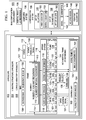
Figure 1 is an illustration of a bias compensation environment in the form of a block diagram in accordance with an illustrative embodiment; -
Figure 2 is an illustration of a functional model for a gyroscope in accordance with an illustrative embodiment; -
Figure 3 is an illustration of the orbit of an element for a gyroscope in accordance with an illustrative embodiment; -
Figure 4 is an illustration of a process for compensating for bias of a gyroscope in the form of a flowchart in accordance with an illustrative embodiment; -
Figure 5 is an illustration of a process for identifying a set of equations for the bias of a gyroscope in the form of a flowchart in accordance with an illustrative embodiment; -
Figure 6 is an illustration of a process for identifying a set of values for a set of parameters in a set of equations for the bias of a gyroscope in the form of a flowchart in accordance with an illustrative embodiment; and -
Figure 7 is an illustration of a data processing system in accordance with an illustrative embodiment. - The different illustrative embodiments recognize and take into account different considerations. For example, the different illustrative embodiments recognize and take into account that some currently available methods for compensating for bias of a gyroscope may use a mechanical system to estimate the bias of the gyroscope. In some cases, this mechanical system may be used to operate the gyroscope and rotate the gyroscope at an angular velocity. Further, this type of mechanical system may introduce additional contributors to the bias of the gyroscope. Consequently, these types of systems may be unable to estimate the bias of the gyroscope within a desired level of accuracy.
- Thus, the different illustrative embodiments provide a method and apparatus for electronically compensating for the bias of a gyroscope. In one illustrative embodiment, a method for compensating for bias of a gyroscope is provided. Bias measurements for a plurality of drive angles are generated using the gyroscope. A set of equations for the bias of the gyroscope is identified using a model for motion of the gyroscope. The set of equations includes a set of parameters for the bias of the gyroscope. A set of values for the set of parameters is identified using the bias measurements and the set of equations.
- With reference now to
Figure 1 , an illustration of a bias compensation environment in the form of a block diagram is depicted in accordance with an illustrative embodiment. In these illustrative examples,bias compensation environment 100 is an example of an environment in which the different illustrative embodiments may be implemented to compensate forbias 101 ofgyroscope 102. - As depicted,
gyroscope 102 takes the form of vibrating structure gyroscope (VSG) 104 in these examples. In particular,vibrating structure gyroscope 104 may be referred to as Coriolis vibratory gyroscope (CVG) 106. In these illustrative examples,gyroscope 102 is a sensor configured to measure angular motion relative to inertial frame ofreference 108. Inertial frame ofreference 108 is a coordinate system or set of axes that is non-accelerating. - In one illustrative example,
gyroscope 102 compriseselement 110 andframe 112.Element 110 may be a structure comprising a number of metallic alloys.Element 110 may be configured to vibrate, or resonate, at number of resonant frequencies 114 forelement 110. In some cases, number of resonant frequencies 114 may be substantially equal to number of natural frequencies 115 forelement 110. A natural frequency in number of natural frequencies 115 may be the frequency at whichelement 110 vibrates along a particular axis when a substantially continuous external force is not being applied toelement 110. In this illustrative example,element 110 may be referred to as a "proof mass" or a resonator in some illustrative examples. -
Element 110 may be associated withframe 112. The association betweenelement 110 andframe 112 is a physical association in these depicted examples. A first component, such aselement 110, may be considered to be associated with a second component, such asframe 112, by being secured to the second component, bonded to the second component, mounted to the second component, welded to the second component, fastened to the second component, and/or connected to the second component in some other suitable manner. The first component also may be connected to the second component using a third component. The first component also may be considered to be associated with the second component by being formed as part of and/or an extension of the second component. - For example, without limitation,
element 110 may be associated withframe 112 throughspring system 116.Spring system 116 may comprise first set ofsprings 118 and second set ofsprings 119. As used herein, a "set of" items means one or more items. For example, a set of springs means one or more springs. - As one specific example, first set of
springs 118 may attachelement 110 to frame 112 in a direction alongfirst axis 120. In particular, first set ofsprings 118 allowselement 110 to move linearly in a direction alongfirst axis 120. Further, second set ofsprings 119 may attachelement 110 to frame 112 in a direction alongsecond axis 122. Second set ofsprings 119 allowselement 110 to move linearly in a direction alongsecond axis 122. In this manner,spring system 116 may constrain movement ofelement 110 to withinplane 124 formed byfirst axis 120 andsecond axis 122. In other words,element 110 may have two degrees of freedom. -
Frame 112, withelement 110 attached to frame 112 throughspring system 116 may, may be configured to move with respect tothird axis 126. In particular,frame 112, withelement 110 attached to frame 112, may rotate aboutthird axis 126.Third axis 126 is a fixed axis that is substantially perpendicular to plane 124 formed byfirst axis 120 andsecond axis 122. In this manner,first axis 120,second axis 122, andthird axis 126 are substantially orthogonal to each other. In some illustrative examples,first axis 120,second axis 122, andthird axis 126 may be referred to as an x-axis, a y-axis, and a z-axis, respectively. -
Frame 112 may rotate aboutthird axis 126 withangular velocity 128.Angular velocity 128 also may be referred to as an inertial rate. In other words,angular velocity 128 forframe 112, withelement 110 attached to frame 112, is the rate of rotation forframe 112 with respect to inertial frame ofreference 108.Angular velocity 128 may be expressed in radians per second, revolutions per second, degrees per second, or in other suitable units. - In these illustrative examples,
gyroscope 102 also includescontrol unit 130.Control unit 130 is configured to control operation ofgyroscope 102.Control unit 130 may be implemented using at least one of a processor, a circuit, an integrated circuit (IC), a microchip, a microprocessor, a computer, and some other suitable type of controller. Further,gyroscope 102 may include a number of additional components, such as, for example, at least one of an electrode, a capacitor, and other suitable components. - As used herein, the phrase "at least one of", when used with a list of items, means that different combinations of one or more of the listed items may be used and only one of each item in the list may be needed. For example, "at least one of item A, item B, and item C" may include, without limitation, item A, or item A and item B. This example also may include item A, item B, and item C, or item B and item C. In other examples, "at least one of" may be, for example, without limitation, two of item A, one of item B, and ten of item C; four of item B and seven of item C; and other suitable combinations.
-
Control unit 130 controls gyroscope 102 such thatelement 110 moves linearly in a direction alongdrive axis 121 inplane 124. In these illustrative examples, this movement ofelement 110 is vibration ofelement 110 alongdrive axis 121. The angle ofdrive axis 121 with respect tofirst axis 120 may be referred to as a drive angle.Control unit 130 may controlgyroscope 102 to operate at a selected drive angle such that the actual drive angle is within selected tolerances. -
Drive axis 121 may befirst axis 120 in some illustrative examples. For example,control unit 130 may driveelement 110 to vibrate alongfirst axis 120 at number of resonant frequencies 114 usingdrive control signal 131. In one illustrative example, drivecontrol signal 131 may be sent to a number of electrodes attached toelement 110 to causeelement 110 to vibrate alongfirst axis 120 at number of resonant frequencies 114. - In these illustrative examples, vibration of
element 110 in the direction alongfirst axis 120, whileframe 112, withelement 110 attached to frame 112, is rotating aboutthird axis 126, generatesforce 132 in a direction alongsense axis 123 inplane 124. In particular,force 132 is a Coriolis force in these examples.Force 132 acts at substantially right angles toangular velocity 128 forframe 112. -
Sense axis 123 is an axis that is substantially orthogonal to driveaxis 121. In other words,sense axis 123 is oriented at about 90 degrees with respect to driveaxis 121.Sense axis 123 is the axis along which linear movement ofelement 110 is induced in response toforce 132. For example, simultaneous vibration ofelement 110 in the direction alongdrive axis 121 and rotation offrame 112 aboutthird axis 126 generatesforce 132, which induces vibration ofelement 110 in the direction alongsense axis 123.Drive axis 121 andsense axis 123 are substantially orthogonal tothird axis 126. Whendrive axis 121 isfirst axis 120,sense axis 123 may besecond axis 122. - As depicted,
control unit 130 usesforce rebalance signal 133 to cause the amplitude of vibrations ofelement 110 alongsecond axis 122 to be substantially zero. In other words,control unit 130 usesforce rebalance signal 133 to substantially nullify the movement ofelement 110 alongsecond axis 122 based ondrive control signal 131.Control unit 130 generatesmeasurements 134 offorce rebalance signal 133.Measurements 134 may be used to determineangular velocity 128. -
Measurements 134 may be less accurate than desired whenbias 101 ofgyroscope 102 contributes tomeasurements 134.Bias 101 is the error forgyroscope 102. For example,bias 101 is the difference betweenmeasurements 134 and the measurements that should actually be generated.Bias 101 may be the contribution tomeasurements 134 whenangular velocity 128 is substantially zero. In this manner,bias 101 may be referred to as a zero-rate bias. -
Bias 101 may be caused by a number of different factors. These factors may include, for example, without limitation, temperature, inconsistencies in the fabrication of the different components forgyroscope 102, characteristics ofelement 110, characteristics of a sensing system ingyroscope 102, characteristics ofcontrol unit 130, and other suitable factors. These factors also may include damping and stiffness asymmetry betweenfirst axis 120 andsecond axis 122, asymmetry betweendrive axis 121 andsense axis 123 alignment, and/or other suitable types of asymmetry. -
Compensation system 136 may be used to electronically compensate forbias 101.Compensation system 136 may be implemented using hardware, software, or a combination of the two. For example,compensation system 136 may be implemented withincomputer system 138.Computer system 138 may comprise a number of computers. Whencomputer system 138 comprises more than one computer, these computers may be in communication with each other. -
Compensation system 136 identifies set ofequations 140 forbias 101 ofgyroscope 102 usingmodel 142 for the motion ofgyroscope 102 with respect to non-inertial frame ofreference 144 andassumption 146. Non-inertial frame ofreference 144 is a rotating frame of reference. In this illustrative example, non-inertial frame ofreference 144 may be formed byfirst axis 120 andsecond axis 122. In other words,plane 124 formed byfirst axis 120 andsecond axis 122 may rotate with respect to inertial frame ofreference 108. -
Model 142 may be a model for the motion ofgyroscope 102 alongfirst axis 120 andsecond axis 122. In this illustrative example,model 142 takes the form of a number of equations that describe the motion ofgyroscope 102 with respect tofirst axis 120 andsecond axis 122. -
Assumption 146 is an assumption thatangular velocity 128 forgyroscope 102 is substantially zero within selected tolerances. In other words,assumption 146 assumes thatframe 112 is not rotating aboutthird axis 126 and has a substantially zero inertial rate.Compensation system 136 modifiesmodel 142 based onassumption 146 to form modifiedmodel 148. In particular, modifiedmodel 148 is simplified as compared tomodel 142. -
Compensation system 136 identifies set ofequations 140 using modifiedmodel 148. Set ofequations 140 may includefirst equation 150 andsecond equation 152.First equation 150 is for the portion ofbias 101 that is in-phase bias 154. In-phase bias 154 may be the portion ofbias 101 that is substantially in-phase with the linear velocity of the vibrations ofgyroscope 102.Second equation 152 is for the portion ofbias 101 that is in-quadrature bias 156. In-quadrature bias 156 may be the portion ofbias 101 that is substantially in-quadrature with the linear velocity of the vibrations ofgyroscope 102. In-quadrature bias 156 also may be referred to as quadrature bias. - As depicted, set of
equations 140 includes set ofparameters 158. Set ofparameters 158 includes one or more parameters that contribute tobias 101. These parameters may include, for example, at least one of a drive axis misalignment angle, a sense axis misalignment angle, a damping azimuth angle, a damping asymmetry term, a difference between the natural frequencies ofdrive axis 121 andsense axis 123, an azimuth angle ofdrive axis 121 with respect tofirst axis 120, and some other suitable parameters. Values for these parameters may be unknown. -
Compensation system 136 identifies set ofvalues 160 for set ofparameters 158 using set ofequations 140,bias measurements 161, anditerative algorithm 162.Compensation system 136 identifies set ofvalues 160 for set ofparameters 158 within selected tolerances. In other words,compensation system 136 uses set ofequations 140,bias measurements 161, anditerative algorithm 162 to estimate set ofvalues 160 for set ofparameters 158. -
Bias measurements 161 may be measurements generated bycontrol unit 130 at plurality of drive angles 164. A drive angle in plurality of drive angles 164 is the angle ofdrive axis 121 with respect tofirst axis 120 along whichcontrol unit 130 driveselement 110 to move linearly. For example, the drive angle may be selected from a range between about 0 degrees and about 360 degrees with respect tofirst axis 120. In one illustrative example, plurality of drive angles 164 may include about 0 degrees, about 45 degrees, and about 90 degrees with respect tofirst axis 120. -
Iterative algorithm 162 may be, for example, without limitation, a least-squares algorithm.Iterative algorithm 162 may be used to solve at least one value in set ofvalues 160 using set ofequations 140 andbias measurements 161. - Set of
values 160 may be used to identify a particular drive angle at which in-quadrature bias 156 is substantially zero. In other words, set ofvalues 160 may be used to identify the drive angle that substantially zeros out in-quadrature bias 156 within selected tolerances.Gyroscope 102 may be operated at this particular drive angle to calibrate the output ofgyroscope 102 using set ofequations 140. - Further, with set of
values 160 for set ofparameters 158,compensation system 136 may estimatebias 101 ofgyroscope 102 at a selected drive angle using set ofequations 140 to form an estimated bias.Compensation system 136 may subtract the estimated bias from measurements generated bygyroscope 102 for the selected drive angle to electronically compensate forbias 101 ofgyroscope 102. - The illustration of bias compensation environment in
Figure 1 is not meant to imply physical or architectural limitations to the manner in which an illustrative embodiment may be implemented. Other components in addition to and/or in place of the ones illustrated may be used. Some components may be unnecessary. Also, the blocks are presented to illustrate some functional components. One or more of these blocks may be combined, divided, or combined and divided into different blocks when implemented in an illustrative embodiment. - For example, in some illustrative examples,
gyroscope 102 may have elements in addition to and/or in place ofelement 110. Further, in some case,element 110 may be attached to a case, a housing, a number of structures, or some other suitable type of structure in addition to and/or in place offrame 112. - With reference now to
Figure 2 , an illustration of a functional model for a gyroscope is depicted in accordance with an illustrative embodiment.Model 200 is an example of a function model for a gyroscope, such as, for example,gyroscope 102 inFigure 1 . In this illustrative example,model 200 includeselement 202 andframe 203. Of course, in other illustrative examples,model 200 may include other components for the gyroscope in addition to the ones described inFigure 2 . -
Element 202 is associated withframe 203 by first set ofsprings 204 along the direction ofx-axis 206.Element 202 is associated withframe 203 by second set ofsprings 208 along the direction of y-axis 210. In this illustrative example,x-axis 206 and y-axis 210 are examples of implementations forfirst axis 120 andsecond axis 122, respectively, inFigure 1 . - As depicted,
x-axis 206 and y-axis 210form plane 212.Element 202 may vibrate alongx-axis 206 at a first natural frequency. Further,element 202 may vibrate along y-axis at a second natural frequency. The first natural frequency may be the same or different from the second natural frequency, depending on the implementation. Vibration ofelement 202 alongx-axis 206 may be a first mode, while vibration ofelement 202 along y-axis 210 may be a second mode. The first mode and the second mode may be referred to as, for example, a drive mode and a sense mode, respectively. -
Element 202 may vibrate alongx-axis 206 and/or y-axis 210 independently of movement offrame 203 in this illustrative example. In particular, first set ofsprings 204 and second set ofsprings 208 may allowelement 202 to move alongx-axis 206 and y-axis 210 independently of the movement offrame 203. - Motion of
element 202 is constrained to withinplane 212 in this illustrative example. In one illustrative example, a control unit, such ascontrol unit 130 inFigure 1 , may driveelement 202 to vibrate along the direction ofx-axis 206.Frame 203 may be rotated about a z-axis 211 that is substantially perpendicular toplane 212. Rotation offrame 203 about z-axis 211 whileelement 202 is moved along the direction ofx-axis 206 generates a Coriolis force that causeselement 202 to vibrate along the direction of y-axis 210. - For example, if
element 202 is moved in the direction ofarrow 214 alongx-axis 206 whileframe 203 is rotated about z-axis 211 in the direction ofarrow 216,element 202 may be moved in the direction ofarrow 218 along y-axis 210. Ifelement 202 is moved in the direction ofarrow 220 alongx-axis 206 whileframe 203 is rotated about z-axis 211 in the direction ofarrow 216,element 202 may be moved in the direction ofarrow 222 along y-axis 210. - Similarly, if
element 202 is moved in the direction ofarrow 214 alongx-axis 206 whileframe 203 is rotated about z-axis 211 in the direction ofarrow 224,element 202 may be moved in the direction ofarrow 222 along y-axis 210. Ifelement 202 is moved in the direction ofarrow 220 alongx-axis 206 whileframe 203 is rotated about z-axis 211 in the direction ofarrow 224,element 202 may be moved in the direction ofarrow 218 along y-axis 210. - With reference now to
Figure 3 , an illustration of the orbit of an element for a gyroscope is depicted in accordance with an illustrative embodiment. In this illustrative example,orbit 300 of an element, such aselement 202 fromFigure 2 , is depicted with respect tox-axis 302 and y-axis 304.X-axis 302 is the same asx-axis 206 inFigure 2 . Y-axis is the same as y-axis 210 inFigure 2 . -
Element 202 may oscillate aboutorigin 305 at the intersection ofx-axis 302 and y-axis 304. Oscillation ofelement 202 may follow a pendulum-type behavior. In this manner,orbit 300 may be a pendulum orbit in this illustrative example. - Parameters for
orbit 300 includependulum angle 306,principal amplitude 308,quadrature amplitude 310, andphase 312. As depicted,pendulum angle 306, θ, is an angle with respect tox-axis 302 and defines an axis relative tox-axis 302 along whichelement 202 may vibrate.Principal amplitude 308, A, is the amplitude of vibrations forelement 202 along the axis defined bypendulum angle 306. -
Quadrature amplitude 310, q, is the amplitude of vibrations forelement 202 along the axis in-quadrature to the axis defined bypendulum angle 306. In other words,quadrature amplitude 310 is the amplitude of vibrations forelement 202 along the axis substantially orthogonal to the axis defined bypendulum angle 306. Further,phase 312, φ', is the phase fororbit 300. - A control unit, such as
control unit 130 inFigure 1 , may be configured to control external force components applied toelement 202 and/orframe 203 inFigure 2 to controlpendulum angle 306,principal amplitude 308,quadrature amplitude 310, andphase 312. For example, the control unit may control forces exerted onelement 202 such that these forces have a same phase as the phase of the natural frequency forelement 202. - Further, the control unit may control forces exerted on
element 202 such thatprincipal amplitude 308, A, remains substantially constant during operation of the gyroscope against any damping forces. The rate at whichprincipal amplitude 308, A, decreases because of damping is proportional to A/τ, in which τ is a damping time constant. Additionally, the control unit may control the forces exerted onelement 202 such thatpendulum angle 306 andquadrature amplitude 310 remain substantially zero with selected tolerances during operation of the gyroscope. - With reference now to
Figure 4 , an illustration of a process for compensating for bias of a gyroscope in the form of a flowchart is depicted in accordance with an illustrative embodiment. The process illustrated inFigure 4 may be implemented usingcompensation system 136 to compensate forbias 101 ofgyroscope 102 inFigure 1 . - The process begins by generating bias measurements for a plurality of drive angles using the gyroscope (operation 400). In
operation 400, the bias measurements are generated with the angular velocity for the gyroscope substantially equal to zero within selected tolerances. - The process then identifies a set of equations for the bias of the gyroscope using a model for motion of the gyroscope with respect to a non-inertial frame of reference and an assumption that the angular velocity for the gyroscope is substantially zero within selected tolerances (operation 402). The angular velocity for the gyroscope is with respect to an inertial frame of reference. The set of equations includes a set of parameters. The one or more parameters in the set of parameters have unknown values. In this illustrative example, in
operation 402, the set of equations includes a first equation for in-phase bias of the gyroscope and a second equation for in-quadrature bias of the gyroscope. - Thereafter, the process identifies a set of values for the set of parameters using the bias measurements and the set of equations (operation 404).
Operation 404 may be performed using an iterative algorithm, such as, for example, without limitation, a least-squares algorithm. - Next, the process estimates the bias of the gyroscope at a selected drive angle using the set of equations with the set of values identified for the set of parameters to form an estimated bias (operation 406). The selected drive angle may be, for example, the current drive angle at which the gyroscope is being operated. In this manner, the bias of the gyroscope may be estimated in substantially real-time during operation of the gyroscope.
- The process then subtracts the estimated bias from one or more measurements generated by the gyroscope for the selected drive angle to substantially compensate for the bias of the gyroscope (operation 408), with the process terminating thereafter. In
operation 408, the estimated bias is subtracted from a measurement to substantially remove the contribution of the bias of the gyroscope from the measurement within selected tolerances. In this manner, the bias of the gyroscope may be electronically compensated in substantially real-time. - With reference now to
Figure 5 , an illustration of a process for identifying a set of equations for the bias of a gyroscope in the form of a flowchart is depicted in accordance with an illustrative embodiment. The process illustrated inFigure 5 may be an example of one process that may be used to implementoperation 402 inFigure 4 . - The process begins by identifying a model for the motion of the gyroscope (operation 500). The gyroscope comprises an element associated with a frame. In this illustrative example, the model comprises the following equations:


- The process then modifies the model for the motion of the gyroscope based on an assumption that the angular velocity for the gyroscope is substantially zero within selected tolerances to form a modified model (operation 502). In
operation 502, an assumption is also made that the contribution of the linear acceleration components for the frame are negligible. The modified model comprises the following equations:
- Thereafter, the process identifies a misalignment model for the misalignment of the drive axis (operation 504). The misalignment of the drive axis occurs when the axis along which the element of the gyroscope is driven to vibrate is different from the drive axis indicated by the drive control signal generated by the control unit for the gyroscope.
- In other words, the control unit may generate a drive control signal to control the element to move along the drive axis. However, the actual movement of the element may be along an axis offset from the drive axis by angle a. This angle, a, may be referred to as a drive axis misalignment angle. Further, with this type of misalignment, the axis along which the element is induced to vibrate in response to a Coriolis force may be offset from the sense axis by angle b. This angle, b, may be referred to as a sense axis misalignment angle. In this illustrative example, these angles, a and b, may be in radians (rads).
- The misalignment model may be defined by the following equations:

- The process then identifies a number of transformations for transforming the model for the motion of the gyroscope to take into account a drive axis between the x-axis and the y-axis (operation 506). For example, the gyroscope may be driven to vibrate along an axis between the x-axis and the y-axis. The angle between this drive axis and the x-axis is the drive angle. The drive axis and the sense axis that is substantially orthogonal to the drive axis form a rotated frame of reference with respect to the frame of reference formed by the x-axis and the y-axis.
- A first transformation is defined as follows:

- A second transformation needed for deriving the model for the motion of the gyroscope with respect to the rotated frame of reference is defined as follows:




s is the external force component exerted on the element in the direction of the drive axis through xs , and fys is the external force component exerted on the element in the direction of the sense axis through ys . - The process uses the modified model for the motion of the gyroscope and the number of transformations identified to form a transformed model for the motion of the gyroscope (operation 508). In
operation 508, an assumption is made that the angular velocity for the gyroscope is at a lower rate than the rate at which the vibrations of the sense axis are being measured. - Consequently, the first and second derivatives in equations (8) and (9) may be negligible. Equations (8) and (9) may be simplified as follows:


- The new matrices may be defined as follows:


- Thereafter, the process identifies a force-rebalance model for the force-rebalance signal that substantially nullifies the vibrations with respect to the sense axis (operation 510). For example, when the vibrations with respect to the sense axis are substantially nullified,


- The process then uses the force-rebalance model to identify the set of equations for the bias of the gyroscope (operation 512), with the process terminating thereafter. In
operation 512, the following assumption is made:
- The set of equations identified in
operation 512 includes a first equation for an in-phase bias and a second equation for an in-quadrature bias. The in-phase bias may be represented by the following equation:

- The in-quadrature bias may be represented by the following equation:

- In this manner, the process illustrated in
Figure 5 provides a method for identifying a set of equations, such as equation (25) and equation (26) for the bias of the gyroscope. The unknown parameters in these equations include a, b,
operation 404 inFigure 4 to identify values for these parameters. - With reference now to
Figure 6 , an illustration of a process for identifying a set of values for a set of parameters in a set of equations for the bias of a gyroscope in the form of a flowchart is depicted in accordance with an illustrative embodiment. The process illustrated inFigure 6 may be an example of one process that may be used to implementoperation 404 inFigure 4 . - The process begins by making a group of assumptions (operation 600). In
operation 600, the group of assumptions includes assumptions with respect to the in-phase bias of the gyroscope. These assumptions are as follows:
- Further, the group of assumptions also includes assumptions with respect to the in-quadrature bias of the gyroscope. These assumptions are as follows:

- The process then uses the set of assumptions to modify the set of equations to form a modified set of equations (operation 602). The modified set of equations includes a first modified equation for the in-phase bias and a second modified equation for the in-quadrature bias. The first modified equation for the in-phase bias is defined as follows:

- The second modified equation for the in-quadrature bias is defined as follows:

- The process then identifies a set of values for the set of parameters in the modified set of equations using the bias measurements for the plurality of drive angles and an iterative algorithm (operation 604), with the process terminating thereafter. The bias measurements in
operation 604 may be the bias measurements generated by the gyroscope for the plurality of drive angles inoperation 400 inFigure 4 . - As one illustrative example, the plurality of drive angles may include angles of about 0 degrees, about 45 degrees, and about 90 degrees with respect to the x-axis. Of course, in other illustrative examples, any angles between about 0 degrees and about 90 degrees with respect to the x-axis may be selected.
- For the angles about 0 degrees, about 45 degrees, and about 90 degrees with respect to the x-axis, equation (29) may be rewritten as follows:
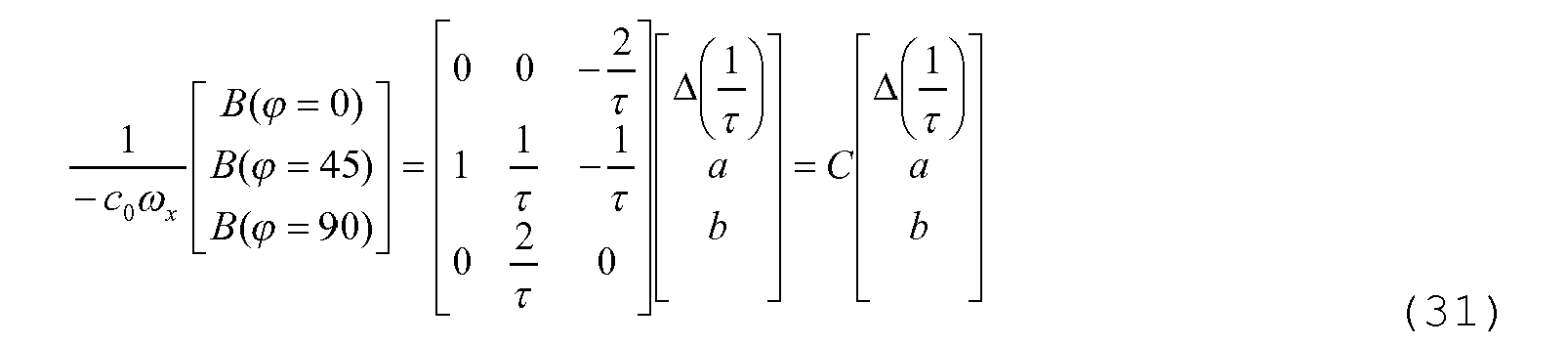

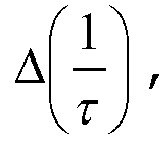

- Further, in
operation 604, equation (25) may be rewritten as follows:
- Further, in solving for the parameters in the second modified equation for the in-quadrature bias, equation (30), bias measurements for the angles of about 0 degrees and about 45 degrees with respect to the x-axis may be selected. Consequently, equation (30) may be rewritten as follows:

- If the natural frequencies in the drive axis and the sense axis are asymmetrical, Δω≠0, then the azimuth angle, θω0, may be estimated as follows:


- The set of values identified in
operation 604 for the set of parameters in the set of equations for the bias of the gyroscope may be used to estimate the bias of the gyroscope for any drive angle. In particular, the in-phase bias and in-quadrature bias may be estimated for any drive angle. - Further, in these illustrative examples, the estimated azimuth angle, θ̂ω0, may be used to identify the particular drive angle identified in
operation 406 inFigure 4 . For example, the particular drive angle may be identified as follows:

- Still further, the output of the gyroscope may be calibrated during operation of the gyroscope in
operation 408 inFigure 4 using the following equation:
- The flowcharts and block diagrams in the different depicted embodiments illustrate the architecture, functionality, and operation of some possible implementations of apparatuses and methods in an illustrative embodiment. In this regard, each block in the flowcharts or block diagrams may represent a module, segment, function, and/or a portion of an operation or step. For example, one or more of the blocks may be implemented as program code, in hardware, or a combination of the program code and hardware. When implemented in hardware, the hardware may, for example, take the form of integrated circuits that are manufactured or configured to perform one or more operations in the flowcharts or block diagrams.
- In some alternative implementations of an illustrative embodiment, the function or functions noted in the blocks may occur out of the order noted in the figures. For example, in some cases, two blocks shown in succession may be executed substantially concurrently, or the blocks may sometimes be performed in the reverse order, depending upon the functionality involved. Also, other blocks may be added in addition to the illustrated blocks in a flowchart or block diagram.
- Turning now to
Figure 7 , an illustration of a data processing system is depicted in accordance with an illustrative embodiment.Data processing system 700 may be used to implementcomputer system 138 inFigure 1 . - In this illustrative example,
data processing system 700 includescommunications framework 702, which provides communications betweenprocessor unit 704,memory 706,persistent storage 708,communications unit 710, input/output (I/O)unit 712, anddisplay 714. -
Processor unit 704 serves to execute instructions for software that may be loaded intomemory 706.Processor unit 704 may be a number of processors, a multi-processor core, or some other type of processor, depending on the particular implementation. A "number", as used herein with reference to an item, means one or more items. Further,processor unit 704 may be implemented using a number of heterogeneous processor systems in which a main processor is present with secondary processors on a single chip. As another illustrative example,processor unit 704 may be a symmetric multi-processor system containing multiple processors of the same type. -
Memory 706 andpersistent storage 708 are examples ofstorage devices 716. A storage device is any piece of hardware that is capable of storing information, such as, for example, without limitation, data, program code in functional form, and other suitable information either on a temporary basis or a permanent basis.Storage devices 716 also may be referred to as computer readable storage devices in these examples.Memory 706, in these examples, may be, for example, a random access memory or any other suitable volatile or non-volatile storage device.Persistent storage 708 may take various forms, depending on the particular implementation. - For example,
persistent storage 708 may contain one or more components or devices. For example,persistent storage 708 may be a hard drive, a flash memory, a rewritable optical disk, a rewritable magnetic tape, or some combination of the above. The media used bypersistent storage 708 also may be removable. For example, a removable hard drive may be used forpersistent storage 708. -
Communications unit 710, in these examples, provides for communications with other data processing systems or devices. In these examples,communications unit 710 is a network interface card.Communications unit 710 may provide communications through the use of either or both physical and wireless communications links. - Input/
output unit 712 allows for input and output of data with other devices that may be connected todata processing system 700. For example, input/output unit 712 may provide a connection for user input through a keyboard, a mouse, and/or some other suitable input device. Further, input/output unit 712 may send output to a printer.Display 714 provides a mechanism to display information to a user. - Instructions for the operating system, applications, and/or programs may be located in
storage devices 716, which are in communication withprocessor unit 704 throughcommunications framework 702. In these illustrative examples, the instructions are in a functional form onpersistent storage 708. These instructions may be loaded intomemory 706 for execution byprocessor unit 704. The processes of the different embodiments may be performed byprocessor unit 704 using computer-implemented instructions, which may be located in a memory, such asmemory 706. - These instructions are referred to as program code, computer usable program code, or computer readable program code that may be read and executed by a processor in
processor unit 704. The program code in the different embodiments may be embodied on different physical or computer readable storage media, such asmemory 706 orpersistent storage 708. -
Program code 718 is located in a functional form on computerreadable media 720 that is selectively removable and may be loaded onto or transferred todata processing system 700 for execution byprocessor unit 704.Program code 718 and computerreadable media 720 formcomputer program product 722 in these examples. In one example, computerreadable media 720 may be computerreadable storage media 724 or computerreadable signal media 726. - Computer
readable storage media 724 may include, for example, an optical or magnetic disk that is inserted or placed into a drive or other device that is part ofpersistent storage 708 for transfer onto a storage device, such as a hard drive, that is part ofpersistent storage 708. Computerreadable storage media 724 also may take the form of a persistent storage, such as a hard drive, a thumb drive, or a flash memory, that is connected todata processing system 700. In some instances, computerreadable storage media 724 may not be removable fromdata processing system 700. - In these examples, computer
readable storage media 724 is a physical or tangible storage device used to storeprogram code 718 rather than a medium that propagates or transmitsprogram code 718. Computerreadable storage media 724 also is referred to as a computer readable tangible storage device or a computer readable physical storage device. In other words, computerreadable storage media 724 is a media that can be touched by a person. - Alternatively,
program code 718 may be transferred todata processing system 700 using computerreadable signal media 726. Computerreadable signal media 726 may be, for example, a propagated data signal containingprogram code 718. For example, computerreadable signal media 726 may be an electromagnetic signal, an optical signal, and/or any other suitable type of signal. These signals may be transmitted over communications links, such as wireless communications links, optical fiber cable, coaxial cable, a wire, and/or any other suitable type of communications link. In other words, the communications link and/or the connection may be physical or wireless in the illustrative examples. - In some illustrative embodiments,
program code 718 may be downloaded over a network topersistent storage 708 from another device or data processing system through computerreadable signal media 726 for use withindata processing system 700. For instance, program code stored in a computer readable storage medium in a server data processing system may be downloaded over a network from the server todata processing system 700. The data processing system providingprogram code 718 may be a server computer, a client computer, or some other device capable of storing and transmittingprogram code 718. - The different components illustrated for
data processing system 700 are not meant to provide physical or architectural limitations to the manner in which different embodiments may be implemented. The different illustrative embodiments may be implemented in a data processing system including components in addition to or in place of those illustrated fordata processing system 700. Other components shown inFigure 7 can be varied from the illustrative examples shown. The different embodiments may be implemented using any hardware device or system capable of running program code. As one example, the data processing system may include organic components integrated with inorganic components and/or may be comprised entirely of organic components excluding a human being. For example, a storage device may be comprised of an organic semiconductor. - In another illustrative example,
processor unit 704 may take the form of a hardware unit that has circuits that are manufactured or configured for a particular use. This type of hardware may perform operations without needing program code to be loaded into a memory from a storage device to be configured to perform the operations. - For example, when
processor unit 704 takes the form of a hardware unit,processor unit 704 may be a circuit system, an application specific integrated circuit (ASIC), a programmable logic device, or some other suitable type of hardware configured to perform a number of operations. With a programmable logic device, the device is configured to perform the number of operations. The device may be reconfigured at a later time or may be permanently configured to perform the number of operations. Examples of programmable logic devices include, for example, a programmable logic array, a field programmable logic array, a field programmable gate array, and other suitable hardware devices. With this type of implementation,program code 718 may be omitted because the processes for the different embodiments are implemented in a hardware unit. - In still another illustrative example,
processor unit 704 may be implemented using a combination of processors found in computers and hardware units.Processor unit 704 may have a number of hardware units and a number of processors that are configured to runprogram code 718. With this depicted example, some of the processes may be implemented in the number of hardware units, while other processes may be implemented in the number of processors. - In another example, a bus system may be used to implement
communications framework 702 and may be comprised of one or more buses, such as a system bus or an input/output bus. Of course, the bus system may be implemented using any suitable type of architecture that provides for a transfer of data between different components or devices attached to the bus system. - Additionally, a communications unit may include a number of devices that transmit data, receive data, or transmit and receive data. A communications unit may be, for example, a modem or a network adapter, two network adapters, or some combination thereof. Further, a memory may be, for example,
memory 706, or a cache, such as found in an interface and memory controller hub, that may be present incommunications framework 702. - In the text and the figures, a method is disclosed for compensating for bias of a gyroscope, the method includes generating
bias measurements 161 for a plurality of drive angles 164 using thegyroscope 102; identifying a set ofequations 140 for thebias 101 of thegyroscope 102 using amodel 142 for motion of thegyroscope 102 in which the set of equations includes a set ofparameters 158 for thebias 101 of thegyroscope 102; and identifying a set ofvalues 160 for the set ofparameters 158 using thebias measurements 161 and the set ofequations 140. - In one variant, the method includes wherein the step of identifying the set of
equations 140 for thebias 101 of thegyroscope 102 using themodel 142 for the motion of thegyroscope 102 includes identifying the set ofequations 140 for thebias 101 of thegyroscope 102 using themodel 142 for the motion of thegyroscope 102 and anassumption 146 that an inertial rate for thegyroscope 102 is substantially zero. In another variant, the method includes estimating thebias 101 of thegyroscope 102 at a selected drive angle using the set ofequations 140 with the set ofvalues 160 for the set ofparameters 158 to form an estimated bias. In yet another variant, the method further includes subtracting the estimated bias from a measurement generated by thegyroscope 102 for the selected drive angle to substantially compensate for thebias 101 of thegyroscope 102. - In one alternative, the method includes wherein the step of identifying the set of
equations 140 for thebias 101 of thegyroscope 102 using the model for the motion of thegyroscope 102 and theassumption 146 that the inertial rate for thegyroscope 102 is substantially zero includes identifying themodel 142 for the motion of thegyroscope 102; modifying themodel 142 for the motion of thegyroscope 102 based on theassumption 146 that the inertial rate for thegyroscope 102 is substantially zero to form a modifiedmodel 148; and identifying the set ofequations 140 for thebias 101 of thegyroscope 102 using the modifiedmodel 148 for the motion of thegyroscope 102. - In another alternative, the method includes wherein the step of identifying the set of
equations 140 for thebias 101 of thegyroscope 102 using themodel 142 for the motion of thegyroscope 102 and theassumption 146 that the inertial rate for thegyroscope 102 is substantially zero includes identifying afirst equation 150 in the set of equations for an in-phase bias 101 of thegyroscope 102 using the model for the motion of thegyroscope 102 and theassumption 146 that the inertial rate for thegyroscope 102 is substantially zero; and identifying asecond equation 152 in the set ofequations 140 for an in-quadrature bias 156 of thegyroscope 102 using the model for the motion of thegyroscope 102 and theassumption 146 that the inertial rate for thegyroscope 102 is substantially zero. - In one variant, the method further includes identifying a drive angle that reduces the in-
quadrature bias 156 of thegyroscope 102 to substantially zero using the set ofequations 140; and operating thegyroscope 102 at the drive angle identified. In yet another variant, the method includes wherein the step of generating thebias measurements 161 for the plurality of drive angles using thegyroscope 102 includes generating thebias measurements 161 for the plurality of drive angles 164 using thegyroscope 102, wherein the plurality of drive angles 164 includes angles selected from a range between about 0 degrees and about 360 degrees with respect to afirst axis 120. In another variant, the method includes wherein the step of identifying the set ofvalues 160 for the set ofparameters 158 using thebias measurements 161 and the set ofequations 140 includes identifying the set ofvalues 160 for the set ofparameters 158 using thebias measurements 161, the set ofequations 140, and aniterative algorithm 162, wherein the set ofparameters 158 includes at least one of a drive axis misalignment angle, a sense axis misalignment angle, a damping azimuth angle, a damping asymmetry term, a difference between natural frequencies of adrive axis 121 for the gyroscope and a sense axis for the gyroscope, and an azimuth angle of thedrive axis 121 with respect to afirst axis 120. In one variant, the method includes wherein thegyroscope 102 is a Coriolisvibratory gyroscope 106. - In one aspect, an apparatus is disclosed including a
compensation system 136 configured to receivebias measurements 161 for a plurality of drive angles 164 from agyroscope 102; identify a set ofequations 140 for thebias 101 of thegyroscope 102 using a model for motion of thegyroscope 102 in which the set ofequations 140 includes a set ofparameters 158 for thebias 101 of thegyroscope 102; and identify a set ofvalues 160 for the set ofparameters 158 using thebias measurements 161 and the set ofequations 140. In one variant, the apparatus includes wherein in being configured to identify the set ofequations 140 for thebias 101 of thegyroscope 102 using themodel 142 for the motion of thegyroscope 102, thecompensation system 136 is configured to identify the set ofequations 140 for thebias 101 of thegyroscope 102 using themodel 142 for the motion of thegyroscope 102 and anassumption 146 that an inertial rate for thegyroscope 102 is substantially zero. In one variant, the apparatus includes wherein thecompensation system 136 is further configured to estimate thebias 101 of thegyroscope 102 at a selected drive angle using the set ofequations 140 with the set ofvalues 160 for the set ofparameters 158 to form an estimated bias. In yet another variant, the apparatus includes wherein thecompensation system 136 is further configured to subtract the estimatedbias 101 from a measurement generated by thegyroscope 102 for the selected drive angle to substantially compensate for thebias 101 of thegyroscope 102. - In one alternative, the apparatus includes wherein in being configured to identify the set of
equations 140 for thebias 101 of thegyroscope 102 using themodel 142 for the motion of thegyroscope 102 and theassumption 146 that the inertial rate for thegyroscope 102 is substantially zero, thecompensation system 136 is configured to identify themodel 142 for the motion of thegyroscope 102; modify themodel 142 for the motion of thegyroscope 102 based on theassumption 146 that the inertial rate for thegyroscope 102 is substantially zero to form a modifiedmodel 148; and identify the set ofequations 140 for thebias 101 of thegyroscope 102 using the modifiedmodel 148 for the motion of thegyroscope 102. - In one example, the apparatus includes wherein in being configured to identify the set of
equations 140 for thebias 101 of thegyroscope 102 using themodel 142 for the motion of thegyroscope 102 and the assumption that the inertial rate for thegyroscope 102 is substantially zero, thecompensation system 136 is configured to: identify afirst equation 150 in the set ofequations 140 for an in-phase bias 101 of thegyroscope 102 using themodel 142 for the motion of thegyroscope 102 and theassumption 146 that the inertial rate for thegyroscope 102 is substantially zero; and identify asecond equation 152 in the set ofequations 140 for an in-quadrature bias 156 of thegyroscope 102 using themodel 142 for the motion of thegyroscope 102 and theassumption 146 that the inertial rate for thegyroscope 102 is substantially zero. - In another example, the apparatus includes wherein in being configured to receive the
bias measurements 161 for the plurality of drive angles 164 from thegyroscope 102, thecompensation system 136 is configured to receive thebias measurements 161 for the plurality of drive angles 164 from thegyroscope 102, wherein the plurality of drive angles includes angles selected from a range between about 0 degrees and about 360 degrees with respect to afirst axis 120. In one instance, the apparatus includes wherein in being configured to identify the set ofvalues 160 for the set ofparameters 158 using thebias measurements 161 and the set ofequations 140, thecompensation system 136 is configured to identify the set ofvalues 160 for the set ofparameters 158 using thebias measurements 161, the set ofequations 140, and aniterative algorithm 162. - In another aspect, a method is disclosed for electronically compensating for
bias 101 of agyroscope 102, the method including generatingbias measurements 161 for a plurality of drive angles 164 using thegyroscope 102; identifying a set ofequations 140 for thebias 101 of thegyroscope 102 using amodel 142 for motion of thegyroscope 102 and anassumption 146 that an inertial rate for thegyroscope 102 is substantially zero in which the set ofequations 140 includes a set ofparameters 158 for thebias 101 of thegyroscope 102; identifying a set ofvalues 160 for the set ofparameters 158 using thebias measurements 161 and the set ofequations 140; estimating thebias 101 of thegyroscope 102 at a selected drive angle using the set of equations with the set ofvalues 160 for the set ofparameters 158 to form an estimated bias; and subtracting the estimated bias from a measurement generated by thegyroscope 102 for the selected drive angle to substantially compensate for thebias 101 of thegyroscope 102. In one variant, The method includes wherein thegyroscope 102 is a Coriolisvibratory gyroscope 106. - Thus, the different illustrative embodiments provide a method and apparatus for electronic bias compensation of a gyroscope. In one illustrative embodiment, a method for electronically compensating for bias of a gyroscope is provided. Bias measurements for a plurality of drive angles are generated using the gyroscope. A set of equations for the bias of the gyroscope is identified using a model for motion of the gyroscope with respect to a non-inertial frame of reference and an assumption that an inertial rate for the gyroscope is substantially zero. The set of equations includes a set of parameters for the bias of the gyroscope. A set of values for the set of parameters is identified using the bias measurements and the set of equations.
- Further, a drive angle that reduces the in-quadrature bias of the gyroscope to substantially zero is identified using the set of equations. The gyroscope is operated at the drive angle identified. The bias of the gyroscope at a selected drive angle is estimated using the set of equations with the set of values for the set of parameters to form an estimated bias. The estimated bias is subtracted from a measurement generated by the gyroscope for the selected drive angle to substantially compensate for the bias of the gyroscope.
- The description of the different illustrative embodiments has been presented for purposes of illustration and description and is not intended to be exhaustive or limited to the embodiments in the form disclosed. Many modifications and variations will be apparent to those of ordinary skill in the art. Further, different illustrative embodiments may provide different features as compared to other illustrative embodiments. The embodiment or embodiments selected are chosen and described in order to best explain the principles of the embodiments, the practical application, and to enable others of ordinary skill in the art to understand the disclosure for various embodiments with various modifications as are suited to the particular use contemplated.
Claims (15)
- A method for compensating for bias of a gyroscope, the method comprising:generating bias measurements (161) for a plurality of drive angles (164) using the gyroscope (102);identifying a set of equations (140) for the bias (101) of the gyroscope (102) using a model (142) for motion of the gyroscope (102) in which the set of equations includes a set of parameters (158) for the bias (101) of the gyroscope (102); andidentifying a set of values (160) for the set of parameters (158) using the bias measurements (161) and the set of equations (140).
- The method of claim 1, wherein the step of identifying the set of equations (140) for the bias (101) of the gyroscope (102) using the model (142) for the motion of the gyroscope (102) comprises:identifying the set of equations (140) for the bias (101) of the gyroscope (102) using the model (142) for the motion of the gyroscope (102) and an assumption (146) that an inertial rate for the gyroscope (102) is substantially zero.
- The method of claim 1 further comprising:estimating the bias (101) of the gyroscope (102) at a selected drive angle using the set of equations (140) with the set of values (160) for the set of parameters (158) to form an estimated bias.
- The method of claim 3 further comprising:subtracting the estimated bias from a measurement generated by the gyroscope (102) for the selected drive angle to substantially compensate for the bias (101) of the gyroscope (102).
- The method of any of claims 2-4, wherein the step of identifying the set of equations (140) for the bias (101) of the gyroscope (102) using the model for the motion of the gyroscope (102) and the assumption (146) that the inertial rate for the gyroscope (102) is substantially zero comprises:identifying the model (142) for the motion of the gyroscope (102);modifying the model (142) for the motion of the gyroscope (102) based on the assumption (146) that the inertial rate for the gyroscope (102) is substantially zero to form a modified model (148); andidentifying the set of equations (140) for the bias(101) of the gyroscope (102) using the modified model (148) for the motion of the gyroscope (102).
- The method of any of claims 2-4, wherein the step of identifying the set of equations (140) for the bias (101) of the gyroscope (102) using the model (142) for the motion of the gyroscope (102) and the assumption (146) that the inertial rate for the gyroscope (102) is substantially zero comprises:identifying a first equation (150) in the set of equations for an in-phase bias (101) of the gyroscope (102) using the model for the motion of the gyroscope (102) and the assumption (146) that the inertial rate for the gyroscope (102) is substantially zero; andidentifying a second equation (152) in the set of equations (140) for an in-quadrature bias (156) of the gyroscope (102) using the model for the motion of the gyroscope (102) and the assumption (146) that the inertial rate for the gyroscope (102) is substantially zero.
- The method of claim 6 further comprising:identifying a drive angle that reduces the in-quadrature bias (156) of the gyroscope (102) to substantially zero using the set of equations (140); andoperating the gyroscope (102) at the drive angle identified.
- The method of any of claims 1-7, wherein the step of generating the bias measurements (161) for the plurality of drive angles using the gyroscope (102) comprises:generating the bias measurements (161) for the plurality of drive angles (164) using the gyroscope (102), wherein the plurality of drive angles (164) includes angles selected from a range between about 0 degrees and about 360 degrees with respect to a first axis (120).
- An apparatus comprising:a compensation system (136) configured to:receive bias measurements (161) for a plurality of drive angles (164) from a gyroscope (102);identify a set of equations (140) for the bias (101) of the gyroscope (102) using a model for motion of the gyroscope (102) in which the set of equations (140) includes a set of parameters (158) for the bias (101) of the gyroscope (102); andidentify a set of values (160) for the set of parameters (158) using the bias measurements (161) and the set of equations (140).
- The apparatus of claim 9, wherein in being configured to identify the set of equations (140) for the bias (101) of the gyroscope (102) using the model (142) for the motion of the gyroscope (102), the compensation system (136) is configured to identify the set of equations (140) for the bias (101) of the gyroscope (102) using the model (142) for the motion of the gyroscope (102) and an assumption (146) that an inertial rate for the gyroscope (102) is substantially zero.
- The apparatus of any of claims 9 or 10, wherein the compensation system (136) is further configured to estimate the bias (101) of the gyroscope (102) at a selected drive angle using the set of equations (140) with the set of values (160) for the set of parameters (158) to form an estimated bias.
- The apparatus of claim 11, wherein the compensation system (136) is further configured to subtract the estimated bias (101) from a measurement generated by the gyroscope (102) for the selected drive angle to substantially compensate for the bias (101) of the gyroscope (102).
- The apparatus of any of claims 10-12, wherein in being configured to identify the set of equations (140) for the bias (101) of the gyroscope (102) using the model (142) for the motion of the gyroscope (102) and the assumption (146) that the inertial rate for the gyroscope (102) is substantially zero, the compensation system (136) is configured to:identify the model (142) for the motion of the gyroscope;modify the model (142) for the motion of the gyroscope (102) based on the assumption (146) that the inertial rate for the gyroscope (102) is substantially zero to form a modified model (148); andidentify the set of equations (140) for the bias (101) of the gyroscope (102) using the modified model (148) for the motion of the gyroscope (102).
- The apparatus of any of claims 10-12, wherein in being configured to identify the set of equations (140) for the bias (101) of the gyroscope (102) using the model (142) for the motion of the gyroscope (102) and the assumption that the inertial rate for the gyroscope (102) is substantially zero, the compensation system (136) is configured to:identify a first equation (150) in the set of equations (140) for an in-phase bias (101) of the gyroscope (102) using the model (142) for the motion of the gyroscope (102) and the assumption (146) that the inertial rate for the gyroscope (102) is substantially zero; andidentify a second equation (152) in the set of equations (140) for an in-quadrature bias (156) of the gyroscope (102) using the model (142) for the motion of the gyroscope (102) and the assumption (146) that the inertial rate for the gyroscope (102) is substantially zero.
- The apparatus of any of claims 9-14, wherein in being configured to receive the bias measurements (161) for the plurality of drive angles (164) from the gyroscope (102), the compensation system (136) is configured to receive the bias measurements (161) for the plurality of drive angles (164) from the gyroscope (102), wherein the plurality of drive angles includes angles selected from a range between about 0 degrees and about 360 degrees with respect to a first axis (120).
Applications Claiming Priority (1)
| Application Number | Priority Date | Filing Date | Title |
|---|---|---|---|
| US13/348,263 US9417066B2 (en) | 2012-01-11 | 2012-01-11 | Electronic bias compensation for a gyroscope |
Publications (3)
| Publication Number | Publication Date |
|---|---|
| EP2615416A2 true EP2615416A2 (en) | 2013-07-17 |
| EP2615416A3 EP2615416A3 (en) | 2016-06-29 |
| EP2615416B1 EP2615416B1 (en) | 2020-01-08 |
Family
ID=47757300
Family Applications (1)
| Application Number | Title | Priority Date | Filing Date |
|---|---|---|---|
| EP13150472.2A Active EP2615416B1 (en) | 2012-01-11 | 2013-01-08 | Electronic bias compensation for a gyroscope |
Country Status (4)
| Country | Link |
|---|---|
| US (1) | US9417066B2 (en) |
| EP (1) | EP2615416B1 (en) |
| CA (1) | CA2793048C (en) |
| ES (1) | ES2774781T3 (en) |
Families Citing this family (7)
| Publication number | Priority date | Publication date | Assignee | Title |
|---|---|---|---|---|
| US9417067B1 (en) | 2012-01-11 | 2016-08-16 | The Boeing Company | Electronic bias compensation for a gyroscope |
| US10082404B1 (en) | 2014-09-29 | 2018-09-25 | The Boeing Company | Electronic self calibration design for disk resonator gyroscopes using electrode time multiplexing |
| US9709399B2 (en) * | 2015-01-12 | 2017-07-18 | The Boeing Company | Approach for control redistribution of coriolis vibratory gyroscope (CVG) for performance improvement |
| US11835339B1 (en) * | 2022-04-05 | 2023-12-05 | Hrl Laboratories, Llc | Continuous online self-calibration for gyroscopes through modulation of damping axes |
| US12607463B1 (en) * | 2022-06-08 | 2026-04-21 | Inertialwave, Inc. | Universal resonator controller |
| CN116539065B (en) * | 2023-05-06 | 2025-09-26 | 朝阳上为软件科技有限公司 | A calibration correction method for a gyro inclinometer and a gyro inclinometer |
| CN118111477B (en) * | 2024-04-26 | 2024-07-09 | 中国船舶集团有限公司第七〇七研究所 | Method for controlling azimuth damping parameters of inertial navigation system |
Family Cites Families (11)
| Publication number | Priority date | Publication date | Assignee | Title |
|---|---|---|---|---|
| US3355954A (en) * | 1965-06-25 | 1967-12-05 | Sperry Rand Corp | Stabilized platform |
| US5218867A (en) * | 1989-07-29 | 1993-06-15 | British Aerospace Public Limited Company | Single axis attitude sensor |
| JP3603501B2 (en) | 1996-09-25 | 2004-12-22 | 株式会社村田製作所 | Angular velocity detector |
| US6629460B2 (en) | 2001-08-10 | 2003-10-07 | The Boeing Company | Isolated resonator gyroscope |
| US7040163B2 (en) | 2002-08-12 | 2006-05-09 | The Boeing Company | Isolated planar gyroscope with internal radial sensing and actuation |
| US7168318B2 (en) | 2002-08-12 | 2007-01-30 | California Institute Of Technology | Isolated planar mesogyroscope |
| US6934660B2 (en) | 2003-02-20 | 2005-08-23 | The Regents Of The University Of California | Multi stage control architecture for error suppression in micromachined gyroscopes |
| US7437253B2 (en) * | 2004-07-29 | 2008-10-14 | The Boeing Company | Parametrically disciplined operation of a vibratory gyroscope |
| US7565839B2 (en) * | 2005-08-08 | 2009-07-28 | Northrop Grumman Guidance And Electronics Company, Inc. | Bias and quadrature reduction in class II coriolis vibratory gyros |
| US7739896B2 (en) * | 2007-03-15 | 2010-06-22 | Northrop Grumman Guidance And Electronics Company, Inc. | Self-calibration of scale factor for dual resonator class II coriolis vibratory gyros |
| DE102008057281A1 (en) | 2008-11-14 | 2010-05-20 | Northrop Grumman Litef Gmbh | Simulation method for the operating behavior of a Coriolis gyro |
-
2012
- 2012-01-11 US US13/348,263 patent/US9417066B2/en not_active Expired - Fee Related
- 2012-10-17 CA CA2793048A patent/CA2793048C/en active Active
-
2013
- 2013-01-08 ES ES13150472T patent/ES2774781T3/en active Active
- 2013-01-08 EP EP13150472.2A patent/EP2615416B1/en active Active
Non-Patent Citations (1)
| Title |
|---|
| None |
Also Published As
| Publication number | Publication date |
|---|---|
| US20130179105A1 (en) | 2013-07-11 |
| CA2793048A1 (en) | 2013-07-11 |
| EP2615416A3 (en) | 2016-06-29 |
| US9417066B2 (en) | 2016-08-16 |
| CA2793048C (en) | 2017-05-30 |
| EP2615416B1 (en) | 2020-01-08 |
| ES2774781T3 (en) | 2020-07-22 |
Similar Documents
| Publication | Publication Date | Title |
|---|---|---|
| EP2615416B1 (en) | Electronic bias compensation for a gyroscope | |
| US8843345B2 (en) | Motion determination | |
| US8645063B2 (en) | Method and system for initial quaternion and attitude estimation | |
| WO2011091083A1 (en) | Apparatus and methodology for calibration of a gyroscope and a compass included in a handheld device | |
| JP6799920B2 (en) | High bandwidth Coriolis vibrating gyroscope (CVG) with in-situ (IN-SITU) bias self-calibration | |
| US9417067B1 (en) | Electronic bias compensation for a gyroscope | |
| CN103630146B (en) | The laser gyro IMU scaling method that a kind of discrete parsing is combined with Kalman filter | |
| Solouk et al. | Parametric topology optimization of a MEMS gyroscope for automotive applications | |
| JP2019158476A (en) | Physical quantity sensor device, clinometer using physical quantity sensor device, inertia measuring device, structure monitoring device, and moving body | |
| CN103782180A (en) | Method and system for recalibrating inertial sensors | |
| Baranov et al. | A novel multiple-axis MEMS gyroscope-accelerometer with decoupling frames | |
| CN103868527B (en) | A kind of method for demarcating strap down inertial navigation combination accelerometer combination | |
| EP3043146B1 (en) | Approach for control redistribution of coriolis vibratory gyroscope ("cvg") for performance improvement | |
| EP3948313B1 (en) | Method and system for measuring g-sensitivity of quartz oscillators | |
| US20250297859A1 (en) | Gyroscopic measurement method and sensor | |
| Chi et al. | MEMS gyroscope control systems for direct angle measurements | |
| US20180347985A1 (en) | Simplified Time Domain Switched Ring/Disk Resonant Gyroscope | |
| Filatov et al. | Dynamic calibration method of inertial measurement units | |
| Král et al. | Nonlinear estimator design for MEMS gyroscope with time-varying angular rate | |
| Sai Nitish et al. | Characterisation of Multi-sensor 6D Pose Determination System for Underslung Winged Body | |
| Du Plessis | An alternative gyroscope calibration methodology | |
| Nguyen | LOW-COST INERTIAL SENSORS CALIBRATION | |
| Liu et al. | Design and evaluation of a vibration sensor for measurement-while-drilling | |
| Madeira | Characterization Of Mems Coriolis Vibratory Gyroscopes | |
| Trung Giap | Analysis of Error Mechanisms of Vibrating Gyroscopes Operating in a Slowly Changing Environment |
Legal Events
| Date | Code | Title | Description |
|---|---|---|---|
| PUAI | Public reference made under article 153(3) epc to a published international application that has entered the european phase |
Free format text: ORIGINAL CODE: 0009012 |
|
| 17P | Request for examination filed |
Effective date: 20130108 |
|
| AK | Designated contracting states |
Kind code of ref document: A2 Designated state(s): AL AT BE BG CH CY CZ DE DK EE ES FI FR GB GR HR HU IE IS IT LI LT LU LV MC MK MT NL NO PL PT RO RS SE SI SK SM TR |
|
| AX | Request for extension of the european patent |
Extension state: BA ME |
|
| PUAL | Search report despatched |
Free format text: ORIGINAL CODE: 0009013 |
|
| AK | Designated contracting states |
Kind code of ref document: A3 Designated state(s): AL AT BE BG CH CY CZ DE DK EE ES FI FR GB GR HR HU IE IS IT LI LT LU LV MC MK MT NL NO PL PT RO RS SE SI SK SM TR |
|
| AX | Request for extension of the european patent |
Extension state: BA ME |
|
| RIC1 | Information provided on ipc code assigned before grant |
Ipc: G01C 25/00 20060101ALI20160526BHEP Ipc: G01C 19/56 20120101AFI20160526BHEP Ipc: G01C 19/5776 20120101ALI20160526BHEP |
|
| STAA | Information on the status of an ep patent application or granted ep patent |
Free format text: STATUS: EXAMINATION IS IN PROGRESS |
|
| 17Q | First examination report despatched |
Effective date: 20180322 |
|
| GRAP | Despatch of communication of intention to grant a patent |
Free format text: ORIGINAL CODE: EPIDOSNIGR1 |
|
| STAA | Information on the status of an ep patent application or granted ep patent |
Free format text: STATUS: GRANT OF PATENT IS INTENDED |
|
| INTG | Intention to grant announced |
Effective date: 20190808 |
|
| GRAS | Grant fee paid |
Free format text: ORIGINAL CODE: EPIDOSNIGR3 |
|
| GRAA | (expected) grant |
Free format text: ORIGINAL CODE: 0009210 |
|
| STAA | Information on the status of an ep patent application or granted ep patent |
Free format text: STATUS: THE PATENT HAS BEEN GRANTED |
|
| AK | Designated contracting states |
Kind code of ref document: B1 Designated state(s): AL AT BE BG CH CY CZ DE DK EE ES FI FR GB GR HR HU IE IS IT LI LT LU LV MC MK MT NL NO PL PT RO RS SE SI SK SM TR |
|
| REG | Reference to a national code |
Ref country code: GB Ref legal event code: FG4D |
|
| REG | Reference to a national code |
Ref country code: CH Ref legal event code: EP |
|
| REG | Reference to a national code |
Ref country code: IE Ref legal event code: FG4D |
|
| REG | Reference to a national code |
Ref country code: DE Ref legal event code: R096 Ref document number: 602013064774 Country of ref document: DE |
|
| REG | Reference to a national code |
Ref country code: AT Ref legal event code: REF Ref document number: 1223243 Country of ref document: AT Kind code of ref document: T Effective date: 20200215 |
|
| REG | Reference to a national code |
Ref country code: NL Ref legal event code: MP Effective date: 20200108 |
|
| REG | Reference to a national code |
Ref country code: LT Ref legal event code: MG4D |
|
| REG | Reference to a national code |
Ref country code: ES Ref legal event code: FG2A Ref document number: 2774781 Country of ref document: ES Kind code of ref document: T3 Effective date: 20200722 |
|
| PG25 | Lapsed in a contracting state [announced via postgrant information from national office to epo] |
Ref country code: NO Free format text: LAPSE BECAUSE OF FAILURE TO SUBMIT A TRANSLATION OF THE DESCRIPTION OR TO PAY THE FEE WITHIN THE PRESCRIBED TIME-LIMIT Effective date: 20200408 Ref country code: LT Free format text: LAPSE BECAUSE OF FAILURE TO SUBMIT A TRANSLATION OF THE DESCRIPTION OR TO PAY THE FEE WITHIN THE PRESCRIBED TIME-LIMIT Effective date: 20200108 Ref country code: NL Free format text: LAPSE BECAUSE OF FAILURE TO SUBMIT A TRANSLATION OF THE DESCRIPTION OR TO PAY THE FEE WITHIN THE PRESCRIBED TIME-LIMIT Effective date: 20200108 Ref country code: PT Free format text: LAPSE BECAUSE OF FAILURE TO SUBMIT A TRANSLATION OF THE DESCRIPTION OR TO PAY THE FEE WITHIN THE PRESCRIBED TIME-LIMIT Effective date: 20200531 Ref country code: RS Free format text: LAPSE BECAUSE OF FAILURE TO SUBMIT A TRANSLATION OF THE DESCRIPTION OR TO PAY THE FEE WITHIN THE PRESCRIBED TIME-LIMIT Effective date: 20200108 Ref country code: FI Free format text: LAPSE BECAUSE OF FAILURE TO SUBMIT A TRANSLATION OF THE DESCRIPTION OR TO PAY THE FEE WITHIN THE PRESCRIBED TIME-LIMIT Effective date: 20200108 |
|
| PG25 | Lapsed in a contracting state [announced via postgrant information from national office to epo] |
Ref country code: BG Free format text: LAPSE BECAUSE OF FAILURE TO SUBMIT A TRANSLATION OF THE DESCRIPTION OR TO PAY THE FEE WITHIN THE PRESCRIBED TIME-LIMIT Effective date: 20200408 Ref country code: HR Free format text: LAPSE BECAUSE OF FAILURE TO SUBMIT A TRANSLATION OF THE DESCRIPTION OR TO PAY THE FEE WITHIN THE PRESCRIBED TIME-LIMIT Effective date: 20200108 Ref country code: GR Free format text: LAPSE BECAUSE OF FAILURE TO SUBMIT A TRANSLATION OF THE DESCRIPTION OR TO PAY THE FEE WITHIN THE PRESCRIBED TIME-LIMIT Effective date: 20200409 Ref country code: LV Free format text: LAPSE BECAUSE OF FAILURE TO SUBMIT A TRANSLATION OF THE DESCRIPTION OR TO PAY THE FEE WITHIN THE PRESCRIBED TIME-LIMIT Effective date: 20200108 Ref country code: IS Free format text: LAPSE BECAUSE OF FAILURE TO SUBMIT A TRANSLATION OF THE DESCRIPTION OR TO PAY THE FEE WITHIN THE PRESCRIBED TIME-LIMIT Effective date: 20200508 Ref country code: SE Free format text: LAPSE BECAUSE OF FAILURE TO SUBMIT A TRANSLATION OF THE DESCRIPTION OR TO PAY THE FEE WITHIN THE PRESCRIBED TIME-LIMIT Effective date: 20200108 |
|
| REG | Reference to a national code |
Ref country code: CH Ref legal event code: PL |
|
| REG | Reference to a national code |
Ref country code: DE Ref legal event code: R097 Ref document number: 602013064774 Country of ref document: DE |
|
| REG | Reference to a national code |
Ref country code: BE Ref legal event code: MM Effective date: 20200131 |
|
| PG25 | Lapsed in a contracting state [announced via postgrant information from national office to epo] |
Ref country code: DK Free format text: LAPSE BECAUSE OF FAILURE TO SUBMIT A TRANSLATION OF THE DESCRIPTION OR TO PAY THE FEE WITHIN THE PRESCRIBED TIME-LIMIT Effective date: 20200108 Ref country code: CZ Free format text: LAPSE BECAUSE OF FAILURE TO SUBMIT A TRANSLATION OF THE DESCRIPTION OR TO PAY THE FEE WITHIN THE PRESCRIBED TIME-LIMIT Effective date: 20200108 Ref country code: RO Free format text: LAPSE BECAUSE OF FAILURE TO SUBMIT A TRANSLATION OF THE DESCRIPTION OR TO PAY THE FEE WITHIN THE PRESCRIBED TIME-LIMIT Effective date: 20200108 Ref country code: EE Free format text: LAPSE BECAUSE OF FAILURE TO SUBMIT A TRANSLATION OF THE DESCRIPTION OR TO PAY THE FEE WITHIN THE PRESCRIBED TIME-LIMIT Effective date: 20200108 Ref country code: SM Free format text: LAPSE BECAUSE OF FAILURE TO SUBMIT A TRANSLATION OF THE DESCRIPTION OR TO PAY THE FEE WITHIN THE PRESCRIBED TIME-LIMIT Effective date: 20200108 Ref country code: LU Free format text: LAPSE BECAUSE OF NON-PAYMENT OF DUE FEES Effective date: 20200108 Ref country code: SK Free format text: LAPSE BECAUSE OF FAILURE TO SUBMIT A TRANSLATION OF THE DESCRIPTION OR TO PAY THE FEE WITHIN THE PRESCRIBED TIME-LIMIT Effective date: 20200108 Ref country code: MC Free format text: LAPSE BECAUSE OF FAILURE TO SUBMIT A TRANSLATION OF THE DESCRIPTION OR TO PAY THE FEE WITHIN THE PRESCRIBED TIME-LIMIT Effective date: 20200108 |
|
| PLBE | No opposition filed within time limit |
Free format text: ORIGINAL CODE: 0009261 |
|
| STAA | Information on the status of an ep patent application or granted ep patent |
Free format text: STATUS: NO OPPOSITION FILED WITHIN TIME LIMIT |
|
| REG | Reference to a national code |
Ref country code: AT Ref legal event code: MK05 Ref document number: 1223243 Country of ref document: AT Kind code of ref document: T Effective date: 20200108 |
|
| PG25 | Lapsed in a contracting state [announced via postgrant information from national office to epo] |
Ref country code: BE Free format text: LAPSE BECAUSE OF NON-PAYMENT OF DUE FEES Effective date: 20200131 Ref country code: LI Free format text: LAPSE BECAUSE OF NON-PAYMENT OF DUE FEES Effective date: 20200131 Ref country code: CH Free format text: LAPSE BECAUSE OF NON-PAYMENT OF DUE FEES Effective date: 20200131 |
|
| 26N | No opposition filed |
Effective date: 20201009 |
|
| PG25 | Lapsed in a contracting state [announced via postgrant information from national office to epo] |
Ref country code: AT Free format text: LAPSE BECAUSE OF FAILURE TO SUBMIT A TRANSLATION OF THE DESCRIPTION OR TO PAY THE FEE WITHIN THE PRESCRIBED TIME-LIMIT Effective date: 20200108 Ref country code: IE Free format text: LAPSE BECAUSE OF NON-PAYMENT OF DUE FEES Effective date: 20200108 |
|
| PG25 | Lapsed in a contracting state [announced via postgrant information from national office to epo] |
Ref country code: PL Free format text: LAPSE BECAUSE OF FAILURE TO SUBMIT A TRANSLATION OF THE DESCRIPTION OR TO PAY THE FEE WITHIN THE PRESCRIBED TIME-LIMIT Effective date: 20200108 Ref country code: SI Free format text: LAPSE BECAUSE OF FAILURE TO SUBMIT A TRANSLATION OF THE DESCRIPTION OR TO PAY THE FEE WITHIN THE PRESCRIBED TIME-LIMIT Effective date: 20200108 |
|
| PG25 | Lapsed in a contracting state [announced via postgrant information from national office to epo] |
Ref country code: TR Free format text: LAPSE BECAUSE OF FAILURE TO SUBMIT A TRANSLATION OF THE DESCRIPTION OR TO PAY THE FEE WITHIN THE PRESCRIBED TIME-LIMIT Effective date: 20200108 Ref country code: MT Free format text: LAPSE BECAUSE OF FAILURE TO SUBMIT A TRANSLATION OF THE DESCRIPTION OR TO PAY THE FEE WITHIN THE PRESCRIBED TIME-LIMIT Effective date: 20200108 Ref country code: CY Free format text: LAPSE BECAUSE OF FAILURE TO SUBMIT A TRANSLATION OF THE DESCRIPTION OR TO PAY THE FEE WITHIN THE PRESCRIBED TIME-LIMIT Effective date: 20200108 |
|
| PG25 | Lapsed in a contracting state [announced via postgrant information from national office to epo] |
Ref country code: MK Free format text: LAPSE BECAUSE OF FAILURE TO SUBMIT A TRANSLATION OF THE DESCRIPTION OR TO PAY THE FEE WITHIN THE PRESCRIBED TIME-LIMIT Effective date: 20200108 Ref country code: AL Free format text: LAPSE BECAUSE OF FAILURE TO SUBMIT A TRANSLATION OF THE DESCRIPTION OR TO PAY THE FEE WITHIN THE PRESCRIBED TIME-LIMIT Effective date: 20200108 |
|
| PGFP | Annual fee paid to national office [announced via postgrant information from national office to epo] |
Ref country code: FR Payment date: 20230125 Year of fee payment: 11 Ref country code: ES Payment date: 20230201 Year of fee payment: 11 |
|
| PGFP | Annual fee paid to national office [announced via postgrant information from national office to epo] |
Ref country code: IT Payment date: 20230120 Year of fee payment: 11 Ref country code: GB Payment date: 20230127 Year of fee payment: 11 Ref country code: DE Payment date: 20230127 Year of fee payment: 11 |
|
| P01 | Opt-out of the competence of the unified patent court (upc) registered |
Effective date: 20230516 |
|
| REG | Reference to a national code |
Ref country code: DE Ref legal event code: R119 Ref document number: 602013064774 Country of ref document: DE |
|
| GBPC | Gb: european patent ceased through non-payment of renewal fee |
Effective date: 20240108 |
|
| PG25 | Lapsed in a contracting state [announced via postgrant information from national office to epo] |
Ref country code: DE Free format text: LAPSE BECAUSE OF NON-PAYMENT OF DUE FEES Effective date: 20240801 |
|
| PG25 | Lapsed in a contracting state [announced via postgrant information from national office to epo] |
Ref country code: GB Free format text: LAPSE BECAUSE OF NON-PAYMENT OF DUE FEES Effective date: 20240108 |
|
| PG25 | Lapsed in a contracting state [announced via postgrant information from national office to epo] |
Ref country code: FR Free format text: LAPSE BECAUSE OF NON-PAYMENT OF DUE FEES Effective date: 20240131 |
|
| PG25 | Lapsed in a contracting state [announced via postgrant information from national office to epo] |
Ref country code: GB Free format text: LAPSE BECAUSE OF NON-PAYMENT OF DUE FEES Effective date: 20240108 Ref country code: FR Free format text: LAPSE BECAUSE OF NON-PAYMENT OF DUE FEES Effective date: 20240131 Ref country code: DE Free format text: LAPSE BECAUSE OF NON-PAYMENT OF DUE FEES Effective date: 20240801 |
|
| PG25 | Lapsed in a contracting state [announced via postgrant information from national office to epo] |
Ref country code: IT Free format text: LAPSE BECAUSE OF NON-PAYMENT OF DUE FEES Effective date: 20240108 |
|
| REG | Reference to a national code |
Ref country code: ES Ref legal event code: FD2A Effective date: 20250226 |
|
| PG25 | Lapsed in a contracting state [announced via postgrant information from national office to epo] |
Ref country code: ES Free format text: LAPSE BECAUSE OF NON-PAYMENT OF DUE FEES Effective date: 20240109 |