EP2613781B1 - Indazole derivatives for use in the treatment of influenza virus infection - Google Patents
Indazole derivatives for use in the treatment of influenza virus infection Download PDFInfo
- Publication number
- EP2613781B1 EP2613781B1 EP11755310.7A EP11755310A EP2613781B1 EP 2613781 B1 EP2613781 B1 EP 2613781B1 EP 11755310 A EP11755310 A EP 11755310A EP 2613781 B1 EP2613781 B1 EP 2613781B1
- Authority
- EP
- European Patent Office
- Prior art keywords
- oxazol
- methyl
- indazol
- compound
- pharmaceutically acceptable
- Prior art date
- Legal status (The legal status is an assumption and is not a legal conclusion. Google has not performed a legal analysis and makes no representation as to the accuracy of the status listed.)
- Active
Links
- 0 *Cc1cnc(-c2c(CNN3*)c3cc(Cl)c2)[o]1 Chemical compound *Cc1cnc(-c2c(CNN3*)c3cc(Cl)c2)[o]1 0.000 description 1
- VJRPFJUDHXLBPG-IYBDPMFKSA-N C[C@H]1O[C@@H](C)CN(Cc2cnc(-c3c(cn[nH]4)c4cc(-c(cn4)cc(NS(c(ccc(F)c5)c5F)(=O)=O)c4O)c3)[o]2)C1 Chemical compound C[C@H]1O[C@@H](C)CN(Cc2cnc(-c3c(cn[nH]4)c4cc(-c(cn4)cc(NS(c(ccc(F)c5)c5F)(=O)=O)c4O)c3)[o]2)C1 VJRPFJUDHXLBPG-IYBDPMFKSA-N 0.000 description 1
Images





Classifications
-
- A—HUMAN NECESSITIES
- A61—MEDICAL OR VETERINARY SCIENCE; HYGIENE
- A61K—PREPARATIONS FOR MEDICAL, DENTAL OR TOILETRY PURPOSES
- A61K31/00—Medicinal preparations containing organic active ingredients
- A61K31/33—Heterocyclic compounds
- A61K31/395—Heterocyclic compounds having nitrogen as a ring hetero atom, e.g. guanethidine or rifamycins
- A61K31/535—Heterocyclic compounds having nitrogen as a ring hetero atom, e.g. guanethidine or rifamycins having six-membered rings with at least one nitrogen and one oxygen as the ring hetero atoms, e.g. 1,2-oxazines
- A61K31/5375—1,4-Oxazines, e.g. morpholine
- A61K31/5377—1,4-Oxazines, e.g. morpholine not condensed and containing further heterocyclic rings, e.g. timolol
-
- A—HUMAN NECESSITIES
- A61—MEDICAL OR VETERINARY SCIENCE; HYGIENE
- A61K—PREPARATIONS FOR MEDICAL, DENTAL OR TOILETRY PURPOSES
- A61K31/00—Medicinal preparations containing organic active ingredients
- A61K31/33—Heterocyclic compounds
- A61K31/395—Heterocyclic compounds having nitrogen as a ring hetero atom, e.g. guanethidine or rifamycins
- A61K31/41—Heterocyclic compounds having nitrogen as a ring hetero atom, e.g. guanethidine or rifamycins having five-membered rings with two or more ring hetero atoms, at least one of which being nitrogen, e.g. tetrazole
- A61K31/415—1,2-Diazoles
- A61K31/416—1,2-Diazoles condensed with carbocyclic ring systems, e.g. indazole
-
- A—HUMAN NECESSITIES
- A61—MEDICAL OR VETERINARY SCIENCE; HYGIENE
- A61K—PREPARATIONS FOR MEDICAL, DENTAL OR TOILETRY PURPOSES
- A61K31/00—Medicinal preparations containing organic active ingredients
- A61K31/33—Heterocyclic compounds
- A61K31/395—Heterocyclic compounds having nitrogen as a ring hetero atom, e.g. guanethidine or rifamycins
- A61K31/41—Heterocyclic compounds having nitrogen as a ring hetero atom, e.g. guanethidine or rifamycins having five-membered rings with two or more ring hetero atoms, at least one of which being nitrogen, e.g. tetrazole
- A61K31/42—Oxazoles
- A61K31/422—Oxazoles not condensed and containing further heterocyclic rings
-
- A—HUMAN NECESSITIES
- A61—MEDICAL OR VETERINARY SCIENCE; HYGIENE
- A61K—PREPARATIONS FOR MEDICAL, DENTAL OR TOILETRY PURPOSES
- A61K31/00—Medicinal preparations containing organic active ingredients
- A61K31/33—Heterocyclic compounds
- A61K31/395—Heterocyclic compounds having nitrogen as a ring hetero atom, e.g. guanethidine or rifamycins
- A61K31/41—Heterocyclic compounds having nitrogen as a ring hetero atom, e.g. guanethidine or rifamycins having five-membered rings with two or more ring hetero atoms, at least one of which being nitrogen, e.g. tetrazole
- A61K31/4245—Oxadiazoles
-
- A—HUMAN NECESSITIES
- A61—MEDICAL OR VETERINARY SCIENCE; HYGIENE
- A61K—PREPARATIONS FOR MEDICAL, DENTAL OR TOILETRY PURPOSES
- A61K31/00—Medicinal preparations containing organic active ingredients
- A61K31/33—Heterocyclic compounds
- A61K31/395—Heterocyclic compounds having nitrogen as a ring hetero atom, e.g. guanethidine or rifamycins
- A61K31/41—Heterocyclic compounds having nitrogen as a ring hetero atom, e.g. guanethidine or rifamycins having five-membered rings with two or more ring hetero atoms, at least one of which being nitrogen, e.g. tetrazole
- A61K31/425—Thiazoles
- A61K31/427—Thiazoles not condensed and containing further heterocyclic rings
-
- A—HUMAN NECESSITIES
- A61—MEDICAL OR VETERINARY SCIENCE; HYGIENE
- A61K—PREPARATIONS FOR MEDICAL, DENTAL OR TOILETRY PURPOSES
- A61K31/00—Medicinal preparations containing organic active ingredients
- A61K31/33—Heterocyclic compounds
- A61K31/395—Heterocyclic compounds having nitrogen as a ring hetero atom, e.g. guanethidine or rifamycins
- A61K31/435—Heterocyclic compounds having nitrogen as a ring hetero atom, e.g. guanethidine or rifamycins having six-membered rings with one nitrogen as the only ring hetero atom
- A61K31/4353—Heterocyclic compounds having nitrogen as a ring hetero atom, e.g. guanethidine or rifamycins having six-membered rings with one nitrogen as the only ring hetero atom ortho- or peri-condensed with heterocyclic ring systems
- A61K31/437—Heterocyclic compounds having nitrogen as a ring hetero atom, e.g. guanethidine or rifamycins having six-membered rings with one nitrogen as the only ring hetero atom ortho- or peri-condensed with heterocyclic ring systems the heterocyclic ring system containing a five-membered ring having nitrogen as a ring hetero atom, e.g. indolizine, beta-carboline
-
- A—HUMAN NECESSITIES
- A61—MEDICAL OR VETERINARY SCIENCE; HYGIENE
- A61K—PREPARATIONS FOR MEDICAL, DENTAL OR TOILETRY PURPOSES
- A61K31/00—Medicinal preparations containing organic active ingredients
- A61K31/33—Heterocyclic compounds
- A61K31/395—Heterocyclic compounds having nitrogen as a ring hetero atom, e.g. guanethidine or rifamycins
- A61K31/435—Heterocyclic compounds having nitrogen as a ring hetero atom, e.g. guanethidine or rifamycins having six-membered rings with one nitrogen as the only ring hetero atom
- A61K31/44—Non condensed pyridines; Hydrogenated derivatives thereof
- A61K31/4427—Non condensed pyridines; Hydrogenated derivatives thereof containing further heterocyclic ring systems
- A61K31/4439—Non condensed pyridines; Hydrogenated derivatives thereof containing further heterocyclic ring systems containing a five-membered ring with nitrogen as a ring hetero atom, e.g. omeprazole
-
- A—HUMAN NECESSITIES
- A61—MEDICAL OR VETERINARY SCIENCE; HYGIENE
- A61K—PREPARATIONS FOR MEDICAL, DENTAL OR TOILETRY PURPOSES
- A61K31/00—Medicinal preparations containing organic active ingredients
- A61K31/33—Heterocyclic compounds
- A61K31/395—Heterocyclic compounds having nitrogen as a ring hetero atom, e.g. guanethidine or rifamycins
- A61K31/435—Heterocyclic compounds having nitrogen as a ring hetero atom, e.g. guanethidine or rifamycins having six-membered rings with one nitrogen as the only ring hetero atom
- A61K31/44—Non condensed pyridines; Hydrogenated derivatives thereof
- A61K31/445—Non condensed piperidines, e.g. piperocaine
- A61K31/4523—Non condensed piperidines, e.g. piperocaine containing further heterocyclic ring systems
- A61K31/454—Non condensed piperidines, e.g. piperocaine containing further heterocyclic ring systems containing a five-membered ring with nitrogen as a ring hetero atom, e.g. pimozide, domperidone
-
- A—HUMAN NECESSITIES
- A61—MEDICAL OR VETERINARY SCIENCE; HYGIENE
- A61K—PREPARATIONS FOR MEDICAL, DENTAL OR TOILETRY PURPOSES
- A61K31/00—Medicinal preparations containing organic active ingredients
- A61K31/33—Heterocyclic compounds
- A61K31/395—Heterocyclic compounds having nitrogen as a ring hetero atom, e.g. guanethidine or rifamycins
- A61K31/495—Heterocyclic compounds having nitrogen as a ring hetero atom, e.g. guanethidine or rifamycins having six-membered rings with two or more nitrogen atoms as the only ring heteroatoms, e.g. piperazine or tetrazines
- A61K31/496—Non-condensed piperazines containing further heterocyclic rings, e.g. rifampin, thiothixene or sparfloxacin
-
- A—HUMAN NECESSITIES
- A61—MEDICAL OR VETERINARY SCIENCE; HYGIENE
- A61K—PREPARATIONS FOR MEDICAL, DENTAL OR TOILETRY PURPOSES
- A61K31/00—Medicinal preparations containing organic active ingredients
- A61K31/33—Heterocyclic compounds
- A61K31/395—Heterocyclic compounds having nitrogen as a ring hetero atom, e.g. guanethidine or rifamycins
- A61K31/535—Heterocyclic compounds having nitrogen as a ring hetero atom, e.g. guanethidine or rifamycins having six-membered rings with at least one nitrogen and one oxygen as the ring hetero atoms, e.g. 1,2-oxazines
- A61K31/5375—1,4-Oxazines, e.g. morpholine
- A61K31/5386—1,4-Oxazines, e.g. morpholine spiro-condensed or forming part of bridged ring systems
-
- A—HUMAN NECESSITIES
- A61—MEDICAL OR VETERINARY SCIENCE; HYGIENE
- A61P—SPECIFIC THERAPEUTIC ACTIVITY OF CHEMICAL COMPOUNDS OR MEDICINAL PREPARATIONS
- A61P31/00—Antiinfectives, i.e. antibiotics, antiseptics, chemotherapeutics
- A61P31/12—Antivirals
- A61P31/14—Antivirals for RNA viruses
- A61P31/16—Antivirals for RNA viruses for influenza or rhinoviruses
-
- C—CHEMISTRY; METALLURGY
- C07—ORGANIC CHEMISTRY
- C07D—HETEROCYCLIC COMPOUNDS
- C07D413/00—Heterocyclic compounds containing two or more hetero rings, at least one ring having nitrogen and oxygen atoms as the only ring hetero atoms
- C07D413/14—Heterocyclic compounds containing two or more hetero rings, at least one ring having nitrogen and oxygen atoms as the only ring hetero atoms containing three or more hetero rings
Definitions
- the present invention is directed to compounds for use in the treatment or prevention of influenza virus infection.
- the invention is directed to compounds which are inhibitors of the activity or function of phosphoinositide 3'OH kinase isoform delta (hereinafter PI3K ⁇ ) for use in the treatment or prevention of influenza virus infection.
- PI3K ⁇ phosphoinositide 3'OH kinase isoform delta
- PI3Ks Phosphoinositide 3'OH kinases
- a wide variety of retroviruses and DNA-based viruses activate the PI3K pathway as a way of preventing host cell death during viral infection and ultimately exploiting the host cell synthesis machinery for its replication ( Virology 344(1) p. 131-8 (2006 ) by Vogt et al.; and Nat. Rev. Microbiol. 6(4) p. 265-75 (2008 ) by Buchkovich et al .). It has therefore been postulated that PI3K inhibitors may have potential therapeutic benefit in the treatment of viral infections such as influenza virus infection, in addition to the more established treatment of cancer and inflammatory diseases.
- the Influenza NS1 protein activates Class Ia PI3Ks by binding to their regulatory subunit p85beta but not to other Class Ia regulatory subunits such as p85alpha.
- the recent crystal structure of the NS1-p85beta complex ( Hale et al. Proc. Natl. Acad. Sci. USA. 107(5) p.1954-1959 (2010 )) is also suggestive of an interaction with the p110 kinase subunit providing a mechanism for catalytic activation of the kinase domain. This observation provides a rationale for isoform specificity not only with the p85 regulatory subunit but also potentially with the p110 catalytic subunit too.
- the invention is directed to compounds which are inhibitors of the activity or function of PI3K ⁇ for use in the treatment or prevention of influenza virus infection.
- the invention is directed to compounds of formula (VI) wherein
- R 1 is 9-membered bicyclic heteroaryl wherein the 9-membered bicyclic heteroaryl contains one or two nitrogen atoms, or pyridinyl optionally substituted by one or two substituents independently selected from -OR 6 and -NHSO 2 R 7 .
- R 1 is 9- or 10-membered bicyclic heteroaryl wherein the 9- or 10-membered bicyclic heteroaryl contains from one to three heteroatoms independently selected from oxygen and nitrogen and is optionally substituted by C 1-6 alkyl, C 3-6 cycloalkyl, halo, -CN or -NHSO 2 R 5 .
- R 1 is 9- or 10-membered bicyclic heteroaryl wherein the 9- or 10-membered bicyclic heteroaryl contains one or two nitrogen atoms and is optionally substituted by C 1-6 alkyl or halo.
- R 1 is 9-membered bicyclic heteroaryl wherein the 9-membered bicyclic heteroaryl contains one or two nitrogen atoms.
- R 1 is indolyl, for example 1 H -indol-4-yl.
- R 1 is pyridinyl optionally substituted by one or two substituents independently selected from C 1-6 alkyl, -OR 6 , halo and -NHSO 2 R 7 .
- R 1 is pyridinyl optionally substituted by one or two substituents independently selected from -OR 6 and -NHSO 2 R 7 . In a further embodiment, R 1 is pyridinyl substituted by -OR 6 and -NHSO 2 R 7 .
- R 2 and R 3 together with the nitrogen atom to which they are attached, are linked to form a 6-membered heterocyclyl wherein the 6-membered heterocyclyl optionally contains an oxygen atom or a further nitrogen atom and is optionally substituted by one or two substituents independently selected from C 1-6 alkyl.
- R 2 and R 3 together with the nitrogen atom to which they are attached, are linked to form a 6-membered heterocyclyl wherein the 6-membered heterocyclyl optionally contains an oxygen atom or a further nitrogen atom and is substituted by one or two substituents independently selected from C 1-4 alkyl, for example methyl.
- R 2 and R 3 together with the nitrogen atom to which they are attached, are linked to form a 6-membered heterocyclyl wherein the 6-membered heterocyclyl contains an oxygen atom and is optionally substituted by one or two substituents independently selected from C 1-4 alkyl, for example methyl.
- R 2 and R 3 together with the nitrogen atom to which they are attached, are linked to form a 6-membered heterocyclyl wherein the 6-membered heterocyclyl contains an oxygen atom and is substituted by one or two substituents independently selected from C 1-6 alkyl.
- R 2 and R 3 together with the nitrogen atom to which they are attached, are linked to form a 6-membered heterocyclyl wherein the 6-membered heterocyclyl contains a further nitrogen atom and is optionally substituted by C 1-4 alkyl, for example isopropyl.
- R 2 and R 3 together with the nitrogen atom to which they are attached, are linked to form a 6-membered heterocyclyl wherein the 6-membered heterocyclyl contains a further nitrogen atom and is substituted by C 1-4 alkyl, for example isopropyl.
- R 4 is hydrogen
- R 5 is C 1-4 alkyl such as methyl.
- R 6 is C 1-4 alkyl such as methyl.
- R 7 is C 1-6 alkyl. In another embodiment, R 7 is C 1-4 alkyl such as methyl. In a further embodiment, R 7 is phenyl optionally substituted by one or two substituents independently selected from halo, for example fluoro.
- Compounds suitable for use according to the invention include the compounds of Preparative Examples 1 to 9 and pharmaceutically acceptable salts thereof.
- the compound for use according to the invention is a compound of formula (VI) which is:
- the compound for use according to the invention is a compound of formula (VI) which is :
- the compound for use according to the invention is a compound of formula (VI) which is:
- the compound for use according to the invention is a compound of formula (VI) which is:
- the compound for use according to the invention is a compound of formula (VI) which is:
- the compound for use according to the invention is a compound of formula (VI) which is:
- the compound for use according to the invention is a compound of formula (VI) which is:
- the compound for use according to the invention is a compound of formula (VI) which is:
- the compound for use according to the invention is a compound of formula (VI) which is:
- the compound for use according to the invention is a compound of formula (VI) which is:
- Alkyl refers to a saturated hydrocarbon chain having the specified number of member atoms.
- C 1-6 alkyl refers to an alkyl group having from 1 to 6 member atoms, for example 1 to 4 member atoms.
- Alkyl groups may be optionally substituted with one or more substituents if so defined herein.
- Alkyl groups may be straight or branched. Representative branched alkyl groups have one, two, or three branches.
- Alkyl includes methyl, ethyl, propyl (n-propyl and isopropyl), butyl (n-butyl, isobutyl, and t-butyl), pentyl (n-pentyl, isopentyl, and neopentyl), and hexyl.
- Cycloalkyl refers to a saturated hydrocarbon ring having the specified number of member atoms. Cycloalkyl groups are monocyclic ring systems. For example, C 3-6 cycloalkyl refers to a cycloalkyl group having from 3 to 6 member atoms. In one embodiment, the cycloalkyl groups have 3 or 4 member atoms. In a further embodiment, the cycloalkyl groups have 5 or 6 member atoms. Cycloalkyl groups may be optionally substituted with one or more substituents if so defined herein. It will be appreciated that the substituent may be at any position on the ring, including the carbon atom which is the point of attachment to the rest of the molecule. Cycloalkyl includes cyclopropyl, cyclobutyl, cyclopentyl, and cyclohexyl.
- Enantiomerically enriched refers to products whose enantiomeric excess is greater than zero.
- enantiomerically enriched refers to products whose enantiomeric excess is greater than 50% ee, greater than 75% ee, and greater than 90% ee.
- Enantiomeric excess or "ee” is the excess of one enantiomer over the other expressed as a percentage. As a result, since both enantiomers are present in equal amounts in a racemic mixture, the enantiomeric excess is zero (0% ee). However, if one enantiomer was enriched such that it constitutes 95% of the product, then the enantiomeric excess would be 90% ee (the amount of the enriched enantiomer, 95%, minus the amount of the other enantiomer, 5%).
- Enantiomerically pure refers to products whose enantiomeric excess is 99% ee or greater.
- Half-life refers to the time required for half of a quantity of a substance to be converted to another chemically distinct species in vitro or in vivo.
- Halo refers to the halogen radical fluoro, chloro, bromo, or iodo. In one embodiment, the halogen radical is fluoro, chloro or bromo.
- Heteroaryl refers to an aromatic group containing from 1 to 3 heteroatoms, for example 1 or 2 heteroatoms, as member atoms in the ring or rings. Heteroaryl groups containing more than one heteroatom may contain different heteroatoms. Heteroaryl groups may be optionally substituted if so defined herein.
- the heteroaryl groups herein are monocyclic ring systems or are fused bicyclic ring systems. The monocyclic heteroaryl rings 5 or 6 member atoms. The bicyclic heteroaryl rings have 9 or 10 member atoms.
- Monocyclic heteroaryl includes pyrrolyl, pyrazolyl, imidazolyl, oxazolyl, isoxazolyl, thiazolyl, isothiazolyl, furanyl, thienyl, furazanyl, triazolyl, thiadiazolyl, pyridinyl, pyrimidinyl, pyridazinyl and pyrazinyl.
- Bicyclic heteroaryl includes indolyl, isoindolyl, indolizinyl, benzofuranyl, isobenzofuranyl, indazolyl, purinyl, benzimidazolyl, pyrrolopyridinyl, pyrazolopyridinyl, pyrrolopyrimidinyl, quinolyl, isoquinolinyl, quinoxalinyl, quinazolinyl, cinnolinyl, benzopyranyl, benzoxazolyl, furopyridinyl and naphthridinyl.
- Heteroatom refers to a nitrogen, sulphur, or oxygen atom.
- Heterocyclyl refers to a saturated or unsaturated ring containing 1 or 2 heteroatoms as member atoms in the ring. However, heterocyclyl rings are not aromatic. In certain embodiments, heterocyclyl is saturated. In other embodiments, heterocyclyl is unsaturated but not aromatic. Heterocyclyl groups containing more than one heteroatom may contain different heteroatoms. Heterocyclyl groups may be optionally substituted with one or more substituents if so defined herein.
- heterocyclyl groups herein are monocyclic ring systems having 5, 6 or 7 member atoms, bicyclic ring systems having 9 or 10 member atoms, bridged ring systems having 7 member atoms, or spiro bicyclic ring systems having 10 member atoms.
- Monocyclic heterocyclyl includes pyrrolidinyl, pyrazolidinyl, inidazolidinyl, isoxazolidinyl, oxazolidinyl, isothiazoldinyl, thiazolidinyl, piperidinyl, piperazinyl, morpholinyl, thiomorpholinyl, hexahydro-1,4-oxazepinyl and tetrahydro-1,4-oxazepin-4(5 H )-yl.
- Bicyclic heterocyclyl includes octahydropyrrolo[1,2-a]pyrazinyl and octahydro-2 H -1,4-benzoxazinyl.
- Bridged heterocyclyl includes 7-azabicylo[2.2.1]heptyl and 2,5-diazabicyclo[2.2.1]heptyl.
- Spiro bicyclic ring systems include 6-oxa-9-azaspiro[4.5]decyl.
- Influenza virus refers to a member of the orthomyxoviridae family of RNA viruses and includes any strain of influenza virus, for example influenza A or influenza B.
- Member atoms refers to the atom or atoms that form a chain or ring. Where more than one member atom is present in a chain and within a ring, each member atom is covalently bound to an adjacent member atom in the chain or ring. Atoms that make up a substituent group on a chain or ring are not member atoms in the chain or ring.
- Optionally substituted indicates that a group, such as heteroaryl, may be unsubstituted or substituted with one or more substituents as defined herein.
- Substituted in reference to a group indicates that a hydrogen atom attached to a member atom within a group is replaced. It should be understood that the term “substituted” includes the implicit provision that such substitution be in accordance with the permitted valence of the substituted atom and the substituent and that the substitution results in a stable compound (i.e. one that does not spontaneously undergo transformation such as by rearrangement, cyclization, or elimination). In certain embodiments, a single atom may be substituted with more than one substituent as long as such substitution is in accordance with the permitted valence of the atom. Suitable substituents are defined herein for each substituted or optionally substituted group.
- “Pharmaceutically acceptable” refers to those compounds, salts, materials, compositions, and dosage forms which are, within the scope of sound medical judgment, suitable for use in contact with the tissues of human beings and animals without excessive toxicity, irritation, or other problem or complication, commensurate with a reasonable benefit/risk ratio.
- the compounds for use according to the invention may exist in solid or liquid form. In the solid state, the compounds may exist in crystalline or noncrystalline form, or as a mixture thereof.
- pharmaceutically acceptable solvates may be formed wherein solvent molecules are incorporated into the crystalline lattice during crystallization.
- Solvates may involve nonaqueous solvents such as ethanol, isopropanol, DMSO, acetic acid, ethanolamine, and EtOAc, or they may involve water as the solvent that is incorporated into the crystalline lattice.
- Solvates wherein water is the solvent that is incorporated into the crystalline lattice are typically referred to as "hydrates". Hydrates include stoichiometric hydrates as well as compositions containing variable amounts of water.
- the compounds for use according to the invention include all such solvates.
- polymorphs may exhibit polymorphism (i.e. the capacity to occur in different crystalline structures). These different crystalline forms are typically known as "polymorphs".
- the compounds and pharmaceutically acceptable salts thereof for use according to the invention include all such polymorphs. Polymorphs have the same chemical composition but differ in packing, geometrical arrangement, and other descriptive properties of the crystalline solid state. Polymorphs, therefore, may have different physical properties such as shape, density, hardness, deformability, stability, and dissolution properties. Polymorphs typically exhibit different melting points, IR spectra, and X-ray powder diffraction patterns, which may be used for identification.
- polymorphs may be produced, for example, by changing or adjusting the reaction conditions or reagents, used in making the compound. For example, changes in temperature, pressure, or solvent may result in polymorphs. In addition, one polymorph may spontaneously convert to another polymorph under certain conditions.
- the present invention provides 6-(1 H -indol-4-yl)-4-(5- ⁇ [4-(1-methylethyl)-1-piperazinyl]methyl ⁇ -1,3-oxazol-2-yl)-1 H -indazole or a pharmaceutically acceptable salt thereof in crystalline form for use in the treatment or prevention of influenza virus infection.
- the present invention provides a polymorph of 6-(1 H -indol-4-yl)-4-(5- ⁇ [4-(1-methylethyl)-1-piperazinyl]methyl ⁇ -1,3-oxazol-2-yl)-1 H -indazole characterised in that it provides an XRPD pattern comprising peaks (°2 ⁇ ) at about 9.0, about 9.6, about 10.4 and/or about 12.5 for use in the treatment or prevention of influenza virus infection.
- the present invention provides a polymorph of 6-(1 H -indol-4-yl)-4-(5- ⁇ [4-(1-methylethyl)-1-piperazinyl]methyl ⁇ -1,3-oxazol-2-yl)-1 H -indazole characterised in that it provides an XRPD pattern comprising peaks substantially as set out in Table 6 for use in the treatment or prevention of influenza virus infection.
- the present invention provides a polymorph of 6-(1 H -indol-4-yl)-4-(5- ⁇ [4-(1-methylethyl)-1-piperazinyl]methyl ⁇ -1,3-oxazol-2-yl)-1 H -indazole characterised in that it provides an XRPD pattern substantially in accordance with Figure 6 for use in the treatment or prevention of influenza virus infection.
- the present invention provides 6-(1 H -indol-4-yl)-4-(5- ⁇ [4-(1-methylethyl)-1-piperazinyl]methyl ⁇ -1,3-oxazol-2-yl)-1 H -indazole tosylate in crystalline form for use in the treatment or prevention of influenza virus infection.
- the present invention provides a polymorph of the tosylate salt of 6-(1 H -indol-4-yl)-4-(5- ⁇ [4-(1-methylethyl)-1-piperazinyl]methyl ⁇ -1,3-oxazol-2-yl)-1 H- indazole characterised in that it provides an XRPD pattern comprising peaks (°2 ⁇ ) at about 6.3, about 9.3, about 11.3 and/or about 12.7 for use in the treatment or prevention of influenza virus infection.
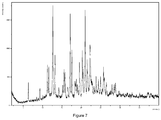
- the present invention provides a polymorph of the tosylate salt of 6-(1 H -indol-4-yl)-4-(5- ⁇ [4-(1-methylethyl)-1-piperazinyl]methyl ⁇ -1,3-oxazol-2-yl)-1 H- indazole characterised in that it provides an XRPD pattern comprising peaks substantially as set out in Table 7 for use in the treatment or prevention of influenza virus infection.
- the present invention provides a polymorph of the tosylate salt of 6-(1 H -indol-4-yl)-4-(5- ⁇ [4-(1-methylethyl)-1-piperazinyl]methyl ⁇ -1,3-oxazol-2-yl)-1 H- indazole characterised in that it provides an XRPD pattern substantially in accordance with Figure 7 for use in the treatment or prevention of influenza virus infection.
- the present invention provides 6-(1 H -indol-4-yl)-4-(5- ⁇ [4-(1-methylethyl)-1-piperazinyl]methyl ⁇ -1,3-oxazol-2-yl)-1 H -indazole hemi fumarate in crystalline form for use in the treatment or prevention of influenza virus infection.
- the present invention provides a polymorph of the hemi fumarate salt of 6-(1 H -indol-4-yl)-4-(5- ⁇ [4-(1-methylethyl)-1-piperazinyl]methyl ⁇ -1,3-oxazol-2-yl)-1 H- indazole characterised in that it provides an XRPD pattern comprising peaks (°2 ⁇ ) at about 6.9, about 13.8 and/or about 14.4 for use in the treatment or prevention of influenza virus infection.
- the invention provides a polymorph of the hemi fumarate salt of 6-(1 H -indol-4-yl)-4-(5- ⁇ [4-(1-methylethyl)-1-piperazinyl]methyl ⁇ -1,3-oxazol-2-yl)-1 H- indazole characterised in that it provides an XRPD pattern comprising peaks substantially as set out in Table 8 for use in the treatment or prevention of influenza virus infection.
- the invention provides a polymorph of the hemi fumarate salt of 6-(1 H -indol-4-yl)-4-(5- ⁇ [4-(1-methylethyl)-1-piperazinyl]methyl ⁇ -1,3-oxazol-2-yl)-1 H- indazole characterised in that it provides an XRPD pattern substantially in accordance with Figure 8 for use in the treatment or prevention of influenza virus infection.
- the present invention provides 6-(1 H -indol-4-yl)-4-(5- ⁇ 4-(1-methylethyl)-1-piperazinyl]methyl ⁇ -1,3-oxazol-2-yl)-1 H -indazole hemi succinate in crystalline form for use in the treatment or prevention of influenza virus infection.
- the invention provides a polymorph of the hemi succinate salt of 6-(1 H -indol-4-yl)-4-(5- ⁇ [4-(1-methylethyl)-1-piperazinyl]methyl ⁇ -1,3-oxazol-2-yl)-1 H- indazole characterised in that it provides an XRPD pattern comprising peaks (°2 ⁇ ) at about 7.2, about 13.2 and/or about 14.0 for use in the treatment or prevention of influenza virus infection.
- the invention provides a polymorph of the hemi succinate salt of 6-(1 H -indol-4-yl)-4-(5- ⁇ [4-(1-methylethyl)-1-piperazinyl]methyl ⁇ -1,3-oxazol-2-yl)-1 H- indazole characterised in that it provides an XRPD pattern comprising peaks substantially as set out in Table 9 for use in the treatment or prevention of influenza virus infection.
- the invention provides a polymorph of the hemi succinate salt of 6-(1 H -indol-4-yl)-4-(5- ⁇ [4-(1-methylethyl)-1-piperazinyl]methyl ⁇ -1,3-oxazol-2-yl)-1 H- indazole characterised in that it provides an XRPD pattern substantially in accordance with Figure 9 for use in the treatment or prevention of influenza virus infection.
- the present invention provides 6-(1 H -indol-4-yl)-4-(5- ⁇ [4-(1-methylethyl)-1-piperazinyl]methyl ⁇ -1,3-oxazol-2-yl)-1 H -indazole hydrochloride in crystalline form for use in the treatment or prevention of influenza virus infection.
- the present invention provides crystalline 6-(1 H -indol-4-yl)-4-(5- ⁇ [4-(1-methylethyl)-1-piperazinyl]methyl ⁇ -1,3-oxazol-2-yl)-1 H -indazole hydrochloride characterised in that it provides an XRPD (X-ray powder diffraction) pattern having peaks (°2 ⁇ ) at about 5.2, about 10.3 and/or about 12.8 for use in the treatment or prevention of influenza virus infection.
- XRPD X-ray powder diffraction
- the present invention provides crystalline 6-(1 H -indol-4-yl)-4-(5- ⁇ [4-(1-methylethyl)-1-piperazinyl]methyl ⁇ -1,3-oxazol-2-yl)-1 H -indazole hydrochloride characterised in that it provides an XRPD pattern comprising peaks substantially as set out in Table 1 for use in the treatment or prevention of influenza virus infection.
- the present invention provides crystalline 6-(1 H -indol-4-yl)-4-(5- ⁇ [4-(1-methylethyl)-1-piperazinyl]methyl ⁇ -1,3-oxazol-2-yl)-1 H -indazole hydrochloride characterised in that it provides an XRPD pattern substantially in accordance with Figure 1 for use in the treatment or prevention of influenza virus infection.
- the present invention provides N -[5-[4-(5- ⁇ [(2 R ,6 S )-2,6-dimethyl-4-morpholinyl]methyl ⁇ -1,3-oxazol-2-yl)-1 H -indazol-6-yl]-2-(methyloxy)-3-pyridinyl]methanesulfonamide or a pharmaceutically acceptable salt thereof in crystalline form for use in the treatment or prevention of influenza virus infection.
- the present invention provides N -[5-[4-(5- ⁇ [(2 R ,6 S )-2,6-dimethyl-4-morpholinyl]methyl ⁇ -1,3-oxazol-2-yl)-1 H -indazol-6-yl]-2-(methyloxy)-3-pyridinyl]methanesulfonamide in crystalline form for use in the treatment or prevention of influenza virus infection.
- the present invention provides crystalline (Form (I)) N -[5-[4-(5- ⁇ [(2 R ,6 S )-2,6-dimethyl-4-morpholinyl]methyl ⁇ -1,3-oxazol-2-yl)-1 H -indazol-6-yl]-2-(methyloxy)-3-pyridinyl]methanesulfonamide characterised in that it provides an XRPD (X-ray powder diffraction) pattern having peaks (°2 ⁇ ) at about 4.5, about 11.7 and/or about 12.9 for use in the treatment or prevention of influenza virus infection.
- XRPD X-ray powder diffraction
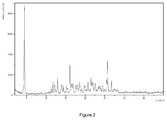
- the present invention provides crystalline (Form (I)) N -[5-[4-(5- ⁇ [(2 R ,6 S )-2,6-dimethyl-4-morpholinyl]methyl ⁇ -1,3-oxazol-2-yl)-1 H -indazol-6-yl]-2-(methyloxy)-3-pyridinyl]methanesulfonamide characterised in that it provides an XRPD pattern comprising peaks substantially as set out in Table 2 for use in the treatment or prevention of influenza virus infection.
- the present invention provides crystalline (Form (I)) N -[5-[4-(5- ⁇ [(2 R ,6 S )-2,6-dimethyl-4-morpholinyl]methyl ⁇ -1,3-oxazol-2-yl)-1 H -indazol-6-yl]-2-(methyloxy)-3-pyridinyl]methanesulfonamide characterised in that it provides an XRPD pattern substantially in accordance with Figure 2 for use in the treatment or prevention of influenza virus infection.
- the invention provides crystalline (Form II) N -[5-[4-(5- ⁇ [(2 R ,6 S )-2,6-dimethyl-4-morpholinyl]methyl ⁇ -1,3-oxazol-2-yl)-1 H -indazol-6-yl]-2-(methyloxy)-3-pyridinyl]methanesulfonamide characterised in that it provides an XRPD pattern comprising peaks (°2 ⁇ ) at about 4.6, about 9.2, about 11.4 and/or about 12.7 for use in the treatment or prevention of influenza virus infection.
- the invention provides crystalline (Form II) N -[5-[4-(5- ⁇ [(2 R ,6 S )-2,6-dimethyl-4-morpholinyl]methyl ⁇ -1,3-oxazol-2-yl)-1 H -indazol-6-yl]-2-(methyloxy)-3-pyridinyl]methanesulfonamide characterised in that it provides an XRPD pattern comprising peaks substantially as set out in Table 3 for use in the treatment or prevention of influenza virus infection.
- the invention provides crystalline (Form II) N -[5-[4-(5- ⁇ [(2 R ,6 S )-2,6-dimethyl-4-morpholinyl]methyl ⁇ -1,3-oxazol-2-yl)-1 H -indazol-6-yl]-2-(methyloxy)-3-pyridinyl]methanesulfonamide characterised in that it provides an XRPD pattern substantially in accordance with Figure 3 for use in the treatment or prevention of influenza virus infection.
- the invention provides crystalline (Form III) N -[5-[4-(5- ⁇ [(2 R ,6 S )-2,6-dimethyl-4-morpholinyl]methyl ⁇ -1,3-oxazol-2-yl)-1 H -indazol-6-yl]-2-(methyloxy)-3-pyridinyl]methanesulfonamide characterised in that it provides an XRPD pattern comprising peaks (°2 ⁇ ) at about 6.7, about 8.2, about 9.7 and/or about 12.6 for use in the treatment or prevention of influenza virus infection.
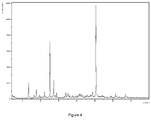
- the invention provides crystalline (Form III) N -[5-[4-(5- ⁇ [(2 R ,6 S )-2,6-dimethyl-4-morpholinyl]methyl ⁇ -1,3-oxazol-2-yl)-1 H -indazol-6-yl]-2-(methyloxy)-3-pyridinyl]methanesulfonamide characterised in that it provides an XRPD pattern comprising peaks substantially as set out in Table 4 for use in the treatment or prevention of influenza virus infection.
- the invention provides crystalline (Form III) N -[5-[4-(5- ⁇ [(2 R ,6 S )-2,6-dimethyl-4-morpholinyl]methyl ⁇ -1,3-oxazol-2-yl)-1 H -indazol-6-yl]-2-(methyloxy)-3-pyridinyl]methanesulfonamide characterised in that it provides an XRPD pattern substantially in accordance with Figure 4 for use in the treatment or prevention of influenza virus infection.
- the invention provides crystalline (Form IV) N -[5-[4-(5- ⁇ [(2 R ,6 S )-2,6-dimethyl-4-morpholinyl]methyl ⁇ -1,3-oxazol-2-yl)-1 H -indazol-6-yl]-2-(methyloxy)-3-pyridinyl]methanesulfonamide characterised in that it provides an XRPD pattern comprising peaks (°2 ⁇ ) at about 5.8, and/or about 11.6 for use in the treatment or prevention of influenza virus infection.
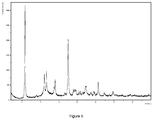
- the invention provides crystalline (Form IV) N -[5-[4-(5- ⁇ [(2 R ,6 S )-2,6-dimethyl-4-morpholinyl]methyl ⁇ -1,3-oxazol-2-yl)-1 H -indazol-6-yl]-2-(methyloxy)-3-pyridinyl]methanesulfonamide characterised in that it provides an XRPD pattern comprising peaks substantially as set out in Table 5 for use in the treatment or prevention of influenza virus infection.
- the invention provides crystalline (Form IV) N -[5-[4-(5- ⁇ [(2 R ,6 S )-2,6-dimethyl-4-morpholinyl]methyl ⁇ -1,3-oxazol-2-yl)-1 H -indazol-6-yl]-2-(methyloxy)-3-pyridinyl]methanesulfonamide characterised in that it provides an XRPD pattern substantially in accordance with Figure 5 for use in the treatment or prevention of influenza virus infection.
- the invention encompasses the use of polymorphs and salts and polymorphs thereof isolated in pure form or when admixed with other materials, for example other polymorphs, or salts or solvates (inclusive of their polymorphs), or any other material.
- a polymorph or salt or a polymorph thereof in isolated or pure form refers to a sample in which the polymorph or salt or a polymorph thereof is present in an amount of >75%, particularly >90%, more particularly >95% and even more particularly >99% relative to other materials which may be present in the sample.
- the compounds for use according to the invention also include isotopically-labelled compounds, which are identical to the compounds of formula (VI) and pharmaceutically acceptable salts thereof, but for the fact that one or more atoms are replaced by an atom having an atomic mass or mass number different from the atomic mass or mass number most commonly found in nature.
- isotopes that can be incorporated into the compounds of the invention include isotopes of hydrogen, carbon, nitrogen, oxygen and fluorine, such as 2 H, 3 H, 11 C, 14 C and 18 F.
- the compounds for use according to the invention may contain one or more asymmetric centers (also referred to as a chiral center) and may, therefore, exist as individual enantiomers, diastereomers, or other stereoisomeric forms, or as mixtures thereof.
- Chiral centers such as chiral carbon atoms, may also be present in a substituent such as an alkyl group.
- the stereochemistry of a chiral center present in formula (VI), or in any chemical structure illustrated herein, is not specified the structure is intended to encompass any stereoisomer and all mixtures thereof.
- compounds according to formula (VI) containing one or more chiral center may be used as racemic mixtures, enantiomerically enriched mixtures, or as enantiomerically pure individual stereoisomers.
- Individual stereoisomers of a compound according to formula (VI) which contain one or more asymmetric center may be resolved by methods known to those skilled in the art. For example, such resolution may be carried out (1) by formation of diastereoisomeric salts, complexes or other derivatives; (2) by selective reaction with a stereoisomer-specific reagent, for example by enzymatic oxidation or reduction; or (3) by gas-liquid or liquid chromatography in a chiral enviornment, for example, on a chiral support such as silica with a bound chiral ligand or in the presence of a chiral solvent.
- stereoisomers may be synthesized by asymmetric synthesis using optically active reagents, substrates, catalysts or solvents, or by converting one enantiomer to the other by asymmetric transformation.
- the compounds according to formula (VI) may also contain centers of geometric asymmetry. Where the stereochemistry of a center of geometric asymmetry present in formula (VI), or in any chemical structure illustrated herein, is not specified, the structure is intended to encompass the trans geometric isomer, the cis geometric isomer, and all mixtures thereof. Likewise, all tautomeric forms are also included in formula (VI) whether such tautomers exist in equilibrium or predominately in one form.
- references herein to compounds of formula (VI) and pharmaceutically acceptable salts thereof covers the compounds of formula (VI) as free acids or free bases, or as pharmaceutically acceptable salts thereof.
- the invention is directed to the use of compounds of formula (VI) as the free acid or free base.
- the invention is directed to the use of compounds of formula (VI) and pharmaceutically acceptable salts thereof.
- pharmaceutically acceptable salts of the compounds according to formula (VI) may be prepared. Indeed, in certain embodiments of the invention, pharmaceutically acceptable salts of the compounds according to formula (VI) may be preferred over the respective free base or free acid because such salts may impart greater stability or solubility to the molecule thereby facilitating formulation into a dosage form.
- pharmaceutically acceptable salts refers to salts that retain the desired biological activity of the subject compound and exhibit minimal undesired toxicological effects. These pharmaceutically acceptable salts may be prepared in situ during the final isolation and purification of the compound, or by separately reacting the purified compound in its free acid or free base form, or a non-pharmaceutically acceptable salt, with a suitable base or acid, respectively.
- Salts and solvates having non-pharmaceutically acceptable counter-ions or associated solvents may be used as intermediates in the preparation of compounds of formula (VI) and their pharmaceutically acceptable salts.
- compounds according to formula (VI) may contain an acidic functional group.
- suitable pharmaceutically acceptable salts include salts of such acidic functional groups.
- Representative salts include pharmaceutically acceptable metal salts such as sodium, potassium, lithium, calcium, magnesium, aluminum, and zinc salts; carbonates and bicarbonates of a pharmaceutically acceptable metal cation such as sodium, potassium, lithium, calcium, magnesium, aluminum, and zinc; pharmaceutically acceptable organic primary, secondary, and tertiary amines including aliphatic amines, aromatic amines, aliphatic diamines, and hydroxy alkylamines such as methylamine, ethylamine, 2-hydroxyethylamine, diethylamine, TEA, ethylenediamine, ethanolamine, diethanolamine, and cyclohexylamine.
- compounds according to formula (VI) may contain a basic functional group and are therefore capable of forming pharmaceutically acceptable acid addition salts by treatment with a suitable acid.
- suitable acids include pharmaceutically acceptable inorganic acids and pharmaceutically acceptable organic acids.
- Representative pharmaceutically acceptable acid addition salts include hydrochloride, hydrobromide, nitrate, methylnitrate, sulfate, bisulfate, sulfamate, phosphate, acetate, hydroxyacetate, phenylacetate, propionate, butyrate, isobutyrate, valerate, maleate, hydroxymaleate, acrylate, fumarate, malate, tartrate, citrate, salicylate, p-aminosalicyclate, glycollate, lactate, heptanoate, phthalate, oxalate, succinate, benzoate, o-acetoxybenzoate, chlorobenzoate, methylbenzoate, dinitrobenzoate, hydroxybenzoate, methoxybenzoate, nap
- the invention provides a salt of N -[5-[4-(5- ⁇ [(2 R ,6 S )-2,6-dimethyl-4-morpholinyl]methyl ⁇ -1,3-oxazol-2-yl)-1 H -indazol-6-yl]-2-(methyloxy)-3-pyridinyl]methanesulfonamide selected from sodium, tosylate, maleate, hemi pamoate, hemi naphthalenedisulfonate, mesitylenesulfonate, hemi biphenyldisulfonate, 2-naphthalenesulfonate (napsylate), hemi cinnamate, hemi sebacate, hemi pyromellitate and hemi benzenediacrylate for use in the treatment or prevention of influenza virus infection.
- the invention provides a salt of N -[5-[4-(5- ⁇ [(2 R ,6 S )-2,6-dimethyl-4-morpholinyl]methyl ⁇ -1,3-oxazol-2-yl)-1 H -indazol-6-yl]-2-(methyloxy)-3-pyridinyl]methanesulfonamide selected from sodium, tosylate, maleate, hemi pamoate and hemi naphthalenedisulfonate for use in the treatment or prevention of influenza virus infection.
- the sodium salt is the salt formed between N -[5-[4-(5- ⁇ [(2 R ,6 S )-2,6-dimethyl-4-morpholinyl]methyl ⁇ -1,3-oxazol-2-yl)-1 H -indazol-6-yl]-2-(methyloxy)-3-pyridinyl]methanesulfonamide and sodium hydroxide in a stoichiometric ratio of about 1:1.
- the tosylate salt is the mono tosylate salt formed between N-[5-[4-(5- ⁇ [(2 R ,6 S )-2,6-dimethyl-4-morpholinyl]methyl ⁇ -1,3-oxazol-2-yl)-1 H -indazol-6-yl]-2-(methyloxy)-3-pyridinyl]methanesulfonamide and p-toluenesulfonic acid in a stoichiometric ratio of about 1:1.
- the maleate salt is the mono maleate salt formed between N -[5-[4-(5- ⁇ [(2 R ,6 S )-2,6-dimethyl-4-morpholinyl]methyl ⁇ -1,3-oxazol-2-yl)-1 H -indazol-6-yl]-2-(methyloxy)-3-pyridinyl]methanesulfonamide and maleic acid in a stoichiometric ratio of about 1:1.
- the hemipamoate salt is the salt formed between M-[5-[4-(5- ⁇ [(2 R ,6 S )-2,6-dimethyl-4-morpholinyl]methyl ⁇ -1,3-oxazol-2-yl)-1 H -indazol-6-yl]-2-(methyloxy)-3-pyridinyl]methanesulfonamide and pamoic acid in a stoichiometric ratio of about 2:1.
- the hemi naphthalenedisulfonate salt is the salt formed between N -[5-[4-(5- ⁇ [(2 R ,6 S )-2,6-dimethyl-4-morpholinyl]methyl ⁇ -1,3-oxazol-2-yl)-1 H -indazol-6-yl]-2-(methyloxy)-3-pyridinyl]methanesulfonamide and naphthalenedisulfonic acid in a stoichiometric ratio of about 2:1.
- the mesitylenesulfonate salt is the mono mesitylenesulfonate salt formed between N -[5-[4-(5- ⁇ [(2 R ,6 S )-2,6-dimethyl-4-morpholinyl]methyl ⁇ -1,3-oxazol-2-yl)-1 H -indazol-6-yl]-2-(methyloxy)-3-pyridinyl]methanesulfonamide and mesitylenesulfonic acid dihydrate in a stoichiometric ratio of about 1:1.
- the hemi biphenyldisulfonate salt is the salt formed between N -[5-[4-(5- ⁇ [(2 R ,6 S )-2,6-dimethyl-4-morpholinyl]methyl ⁇ -1,3-oxazol-2-yl)-1 H-indazol-6-yl]-2-(methyloxy)-3-pyridinyl]methanesulfonamide and biphenyldisulfonic acid in a stoichiometric ratio of about 2:1.
- the 2-naphthalenesulfonate (napsylate) salt is the mono 2-naphthalenesulfonate (napsylate) salt formed between N -[5-[4-(5- ⁇ [(2 R ,6 S )-2,6-dimethyl-4-morpholinyl]methyl ⁇ -1,3-oxazol-2-yl)-1 H-indazol-6-yl]-2-(methyloxy)-3-pyridinyl]methanesulfonamide and 2-naphthalenesulfonic acid in a stoichiometric ratio of about 1:1.
- the hemi cinnamate salt is the salt formed between N -[5-[4-(5- ⁇ [(2 R ,6 S )-2,6-dimethyl-4-morpholinyl]methyl ⁇ -1,3-oxazol-2-yl)-1 H -indazol-6-yl]-2-(methyloxy)-3-pyridinyl]methanesulfonamide and transcinnamic acid in a stoichiometric ratio of about 2:1.
- the hemi sebacate salt is the salt formed between N -[5-[4-(5- ⁇ [(2 R ,6 S )-2,6-dimethyl-4-morpholinyl]methyl ⁇ -1,3-oxazol-2-yl)-1 H -indazol-6-yl]-2-(methyloxy)-3-pyridinyl]methanesulfonamide and sebacic acid in a stoichiometric ratio of about 2:1.
- the hemi pyromellitate salt is the salt formed between N -[5-[4-(5- ⁇ [(2 R ,6 S )-2,6-dimethyl-4-morpholinyl]methyl ⁇ -1,3-oxazol-2-yl)-1 H -indazol-6-yl]-2-(methyloxy)-3-pyridinyl]methanesulfonamide and pyromellitic acid in a stoichiometric ratio of about 2:1.
- the hemi benzenediacrylate salt is the salt formed between N- [5-[4-(5- ⁇ [(2 R, 6 S)- 2,6-dimethyl-4-morpholinyl]methyl ⁇ -1,3-oxazol-2-yl)-1 H- indazol-6-yl]-2-(methyloxy)-3-pyridinyl]methanesulfonamide and 1,4-benzenediacrylic acid in a stoichiometric ratio of about 2:1.
- the invention provides a salt of 6-(1 H -indol-4-yl)-4-(5- ⁇ [4-(1-methylethyl)-1-piperazinyl]methyl ⁇ -1,3-oxazol-2-yl)-1 H -indazole selected from tosylate, hemi fumarate and hemi succinate for use in the treatment or prevention of influenza virus infection.
- the invention provides a salt of 6-(1 H -indol-4-yl)-4-(5- ⁇ [4-(1-methylethyl)-1-piperazinyl]methyl ⁇ -1,3-oxazol-2-yl)-1 H -indazole selected from hemi fumarate and hemi succinate for use in the treatment or prevention of influenza virus infection.
- the invention provides the hemi fumarate salt of 6-(1 H -indol-4-yl)-4-(5- ⁇ [4-(1-methylethyl)-1-piperazinyl]methyl ⁇ -1,3-oxazol-2-yl)-1 H -indazole for use in the treatment or prevention of influenza virus infection.
- the invention provides the hemi succinate salt of 6-(1 H -indol-4-yl)-4-(5- ⁇ [4-(1-methylethyl)-1-piperazinyl]methyl ⁇ -1,3-oxazol-2-yl)-1 H -indazole for use in the treatment or prevention of influenza virus infection.
- the tosylate salt is the mono tosylate salt formed between 6-(1 H -indol-4-yl)-4-(5- ⁇ [4-(1-methylethyl)-1-piperazinyl]methyl ⁇ -1,3-oxazol-2-yl)-1 H -indazole and p-toluenesulfonic acid in a stoichiometric ratio of about 1:1.
- the hemi fumarate salt is the salt formed between 6-(1 H -indol-4-yl)-4-(5- ⁇ [4-(1-methylethyl)-1-piperazinyl]methyl ⁇ -1,3-oxazol-2-yl)-1 H- indazole and fumaric acid in a stoichiometric ratio of about 2:1.
- the hemi succinate salt is the salt formed between 6-(1 H -indol-4-yl)-4-(5- ⁇ [4-(1-methylethyl)-1-piperazinyl]methyl ⁇ -1,3-oxazol-2-yl)-1 H -indazole and succinic acid in a stoichiometric ratio of about 2:1.
- the compounds for use according to the invention may be made by a variety of methods, including standard chemistry. Any previously defined variable will continue to have the previously defined meaning unless otherwise indicated. Illustrative general synthetic methods are set out below and then specific compounds for use according to the invention are prepared in the Examples section.
- the R 1 group introduced via the boronic acid or boronate ester may be protected by a suitable protecting group such as a tert -butyldimethylsilyl group and an additional deprotection step may be required, for example treatment with a suitable fluoride such as tetra- n -butylammonium fluoride, in a suitable solvent such as tetrahydrofuran, and at a suitable temperature such as room temperature, for example about 20°C.
- a suitable protecting group such as a tert -butyldimethylsilyl group
- an additional deprotection step may be required, for example treatment with a suitable fluoride such as tetra- n -butylammonium fluoride, in a suitable solvent such as tetrahydrofuran, and at a suitable temperature such as room temperature, for example about 20°C.
- the protecting group such as benzenesulphonyl may subsequently be removed by treatment with a suitable aqueous inorganic base such as aqueous sodium hydroxide, in a suitable solvent such as isopropanol, and at a suitable temperature such as room temperature, for example about 20°C.
- a suitable aqueous inorganic base such as aqueous sodium hydroxide
- a suitable solvent such as isopropanol
- Compounds of formula (XXXV), wherein R 2 and R 3 are as defined for compounds of formula (VI) and R 4a' is as defined above, may be prepared from compounds of formula (XXXVI) wherein R 4a' is as defined above and X 1 is a suitable leaving group such as Br, by treatment with an amine of formula HNR 2 R 3 , wherein R 2 and R 3 are as defined for compounds of formula (VI), in a suitable solvent such as dichloromethane, and at a suitable temperature such as room temperature, for example about 20°C.
- Compounds of formula (XXXVI), wherein R 4a' is as defined above and X 1 is Br, may be prepared from compounds of formula (XXXVII) wherein R 4a' is as defined above, by treatment with a suitable brominating agent such as carbon tetrabromide and a suitable phosphine such as triphenylphosphine, in a suitable solvent such as dichloromethane, and at a suitable temperature such as from about 0°C to about 50°C, for example about 0°C warming to about 20°C after addition.
- a suitable brominating agent such as carbon tetrabromide
- a suitable phosphine such as triphenylphosphine
- compounds of formula (XXXVI), wherein R 4a' is as defined above and X 1 is Br may be prepared from compounds of formula (XXXVII) wherein R 4a' is as defined above, by treatment with a suitable brominating agent such as triphenylphosphine dibromide, in a suitable solvent such as dichloromethane, and at a suitable temperature such as from about 0°C to about 50°C, for example about 0°C.
- a suitable brominating agent such as triphenylphosphine dibromide
- Compounds of formula (XXXVII), wherein R 4a' is as defined above, may be prepared from compounds of formula (XXXVIII) wherein R 4a' is as defined above, by treatment with a suitable reducing agent such as diisobutylaluminium hydride, in a suitable solvent such as tetrahydrofuran, and at a suitable temperature such as from about -50°C to about 0°C, for example about 0°C.
- a suitable reducing agent such as diisobutylaluminium hydride
- a suitable solvent such as tetrahydrofuran
- Compounds of formula (XXXVIII), wherein R 4a' is as defined above, may be prepared from compounds of formula (XXXIX) wherein R 4a' is as defined above, by treatment with a suitable halide such as ethyl 2-chloro-1,3-oxazole-5-carboxylate (commercially available), in the presence of a suitable palladium catalyst such as tetrakis(triphenylphosphine)palladium (0), in a suitable solvent such as a N,N -dimethylformamide, in the presence of a suitable iodide such as sodium iodide, and under microwave irradiation at a suitable temperature such as from about 80°C to about 150°C, for example about 100°C.
- a suitable halide such as ethyl 2-chloro-1,3-oxazole-5-carboxylate (commercially available)
- a suitable palladium catalyst such as tetrakis(triphen
- compounds of formula (XXXVIII), wherein R 4a' is as defined above may be prepared from compounds of formula (XXXX) as defined below, by treatment with a suitable stannane such as hexamethylditin, in the presence of a suitable palladium catalyst such as tetrakis(triphenylphosphine)palladium (0) and a suitable base such as triethylamine, in a suitable solvent such as toluene, and at a suitable temperature such as from about 100°C to about 200°C, for example about 120°C, followed by treatment with a suitable halide such as methyl 2-chloro-1,3-oxazole-5-carboxylate (commercially available), in the presence of a suitable iodide such as copper (I) iodide, and a suitable palladium catalyst such as tetrakis(triphenylphosphine)palladium (0), in a suitable solvent such as 1,3-
- Compounds of formula (XXXIX), wherein R 4a' is as defined above, may be prepared from compounds of formula (XXXX) wherein R 4a' is as defined above, by treatment with a suitable stannane such as hexamethylditin, in the presence of a suitable palladium catalyst such as tetrakis(triphenylphosphine)palladium (0), in a suitable solvent such as xylene, in the presence of a suitable base such as triethylamine, and at a suitable temperature such as from about 100°C to about 200°C, for example about 150°C.
- a suitable stannane such as hexamethylditin
- a suitable palladium catalyst such as tetrakis(triphenylphosphine)palladium (0)
- a suitable solvent such as xylene
- a suitable base such as triethylamine
- Compounds of formula (XXXX), wherein R 4a' is methyl may be prepared from compounds such as the compound of formula (XXXXI) by methylation using a suitable base such as sodium hydride, in a suitable solvent such as tetrahydrofuran, and at a suitable temperature such as about 0°C, followed by addition of an alkylating agent such as iodomethane and stirring at a suitable temperature such as room temperature, for example about 20°C.
- a suitable base such as sodium hydride
- a suitable solvent such as tetrahydrofuran
- Compounds of formula (XXXX), wherein R 4a' is a suitable protecting group such as benzenesulphonyl may be prepared from the compound with formula (XXXXI) as defined above, by treatment with a suitable base such as sodium hydride in a suitable solvent such as N,N -dimethylformamide, and at a suitable temperature such as from about 0°C to about 20°C, for example about 0°C, followed by treatment with a suitable sulphonylating agent such as benzensulphonyl chloride, at a suitable temperature such as from about 0°C to about 50°C, for example about 0°C warming to about 20°C after addition.
- a suitable base such as sodium hydride in a suitable solvent such as N,N -dimethylformamide
- a suitable sulphonylating agent such as benzensulphonyl chloride
- compounds of formula (XXXX), wherein R 4a' is a suitable protecting group such as benzenesulphonyl may be prepared from the compound with formula (XXXXI) as defined above, by treatment with a suitable base, such as sodium hydroxide and a suitable phase transfer catalyst such as tetra-n-butylammonium bisulphate, in a suitable solvent such as tetrahydrofuran and at a suitable temperature such as from about 0°C to about 20°C, for example about 20°C, followed by treatment with a suitable sulphonylating agent such as benzene sulphonyl chloride, at a suitable temperature such as from about 0°C to about 50°C, for example about 25°C.
- a suitable base such as sodium hydroxide and a suitable phase transfer catalyst such as tetra-n-butylammonium bisulphate
- a suitable solvent such as tetrahydrofuran
- Compounds of formula (VI), wherein R 1 , R 2 and R 3 are as defined for compounds of formula (VI) and R 4 is hydrogen, or salts thereof, may be prepared from compounds of formula (XXXXII) wherein R 1 , R 2 and R 3 are as defined for compounds of formula (VI) and R 4b' is a suitable protecting group such as benzenesulphonyl, by treatment with a suitable aqueous inorganic base such as aqueous sodium hydroxide, in a suitable solvent such as 1,4-dioxane, and at a suitable temperature such as room temperature, for example about 20°C.
- a suitable aqueous inorganic base such as aqueous sodium hydroxide
- a suitable solvent such as 1,4-dioxane
- Compounds of formula (XXXXII), wherein R 1 , R 2 and R 3 are as defined for compounds of formula (VI) and R 4b' are as defined above, may be prepared from compounds of formula (XXXXIII) wherein, R 1 is as defined for compounds of formula (VI), R 4b' is as defined above and X 2 is a suitable leaving group such as Br, by treatment with an amine of formula HNR 2 R 3 , wherein R 2 and R 3 are as defined for compounds of formula (VI), in a suitable solvent such as dichloromethane, and at a suitable temperature such as room temperature, for example about 20°C.
- Compounds of formula (XXXXIII), wherein R 1 is as defined for compounds of formula (VI), R 4b' is as defined above and X 2 is Br, may be prepared from compounds of formula (XXXXIV) wherein R 1 is as defined for compounds of formula (VI) and R 4b' is as defined above, by treatment with a suitable brominating agent such as carbon tetrabromide and a suitable phosphine such as triphenylphosphine, in a suitable solvent such as dichloromethane, and at a suitable temperature such as from about 0°C to about 50°C, for example about 0°C warming to room temperature after addition.
- a suitable brominating agent such as carbon tetrabromide
- a suitable phosphine such as triphenylphosphine
- Compounds of formula (XXXXIV), wherein R 1 is as defined for compounds of formula (VI) and R 4b' is as defined above, may be prepared from compounds of formula (XXXXV) wherein R 1 is as defined for compounds of formula (VI) and R 4b' is as defined above, by treatment with a suitable reducing agent such as diisobutylaluminium hydride, in a suitable solvent such as dichloromethane, and at a suitable temperature such as from about -50°C to about 0°C, for example about -20°C.
- a suitable reducing agent such as diisobutylaluminium hydride
- Compounds of formula (XXXXV), wherein R 1 is as defined for compounds of formula (VI) and R 4b' is as defined above, may be prepared from compounds of formula (XXXXVI) wherein R 4b' is as defined above, by treatment with a suitable boronic acid or boronate ester such as ⁇ 1-[(1,1-dimethylethyl)(dimethyl)silyl]-1 H -indol-4-yl ⁇ boronic acid (commercially available), in the presence of a suitable palladium catalyst such as chloro[2'-(dimethylamino)-2-biphenylyl]palladium-(1 R ,4 S )-bicyclo[2.2.1]hept-2-yl[(1 S ,4 R )-bicyclo[2.2.1]hept-2-yl]phosphane, in a suitable solvent such as a mixture of 1,4-dioxane and water in a suitable ratio, for example about 10:1,
- a suitable borolane such as 4,4,
- the uses of the invention comprise administering a safe and effective amount of a compound of formula (VI) as defined above or a pharmaceutically acceptable salt thereof to a patient in need thereof.
- Individual embodiments of the invention include the use of a safe and effective amount of a compound of formula (VI) as defined above or a pharmaceutically acceptable salt thereof in treating or preventing influenza virus infection in a patient in need thereof.
- treat or prevent in reference to a disorder means: (1) to ameliorate or prevent the disorder or one or more of the biological manifestations of the disorder, (2) to interfere with (a) one or more points in the biological cascade that leads to or is responsible for the disorder or (b) one or more of the biological manifestations of the disorder, (3) to alleviate one or more of the symptoms or effects associated with the disorder, or (4) to slow the progression of the disorder or one or more of the biological manifestations of the disorder.
- prevention is not an absolute term. In medicine, “prevention” is understood to refer to the prophylactic administration of a drug to substantially diminish the likelihood or severity of a disorder or biological manifestation thereof, or to delay the onset of such disorder or biological manifestation thereof.
- the uses of the invention are directed to treating influenza virus infection. In another embodiment, the uses of the invention are directed to preventing influenza virus infection.
- safe and effective amount in reference to a compound of formula (VI) as defined above or a pharmaceutically acceptable salt thereof or other pharmaceutically-active agent means an amount of the compound sufficient to treat the patient's condition but low enough to avoid serious side effects (at a reasonable benefit/risk ratio) within the scope of sound medical judgment.
- a safe and effective amount of a compound will vary with the particular compound chosen (e.g.
- patient refers to a human (including adults and children) or other animal. In one embodiment, “patient” refers to a human.
- the compounds of formula (VI) or pharmaceutically acceptable salts thereof may be administered by any suitable route of administration, including both systemic administration and topical administration.
- Systemic administration includes oral administration, parenteral administration, transdermal administration and rectal administration.
- Parenteral administration refers to routes of administration other than enteral or transdermal, and is typically by injection or infusion.
- Parenteral administration includes intravenous, intramuscular, and subcutaneous injection or infusion.
- Topical administration includes application to the skin as well as intraocular, otic, intravaginal, inhaled and intranasal administration.
- Inhalation refers to administration into the patient's lungs whether inhaled through the mouth or through the nasal passages.
- the compounds of formula (VI) or pharmaceutically acceptable salts thereof may be administered orally.
- the compounds of formula (VI) or pharmaceutically acceptable salts thereof may be administered by inhalation.
- the compounds of formula (VI) or pharmaceutically acceptable salts thereof may be administered intranasally.
- the compounds of formula (VI) or pharmaceutically acceptable salts thereof may be administered once or according to a dosing regimen wherein a number of doses are administered at varying intervals of time for a given period of time. For example, doses may be administered one, two, three, or four times per day. In one embodiment, a dose is administered once per day. In a further embodiment, a dose is administered twice per day. Doses may be administered until the desired therapeutic effect is achieved or indefinitely to maintain the desired therapeutic effect. Suitable dosing regimens for a compound of formula (VI) or a pharmaceutically acceptable salt thereof depend on the pharmacokinetic properties of that compound, such as absorption, distribution, and half-life, which can be determined by the skilled artisan.
- suitable dosing regimens including the duration such regimens are administered, for a compound of formula (VI) or a pharmaceutically acceptable salt thereof depend on the disorder being treated, the severity of the disorder being treated, the age and physical condition of the patient being treated, the medical history of the patient to be treated, the nature of concurrent therapy, the desired therapeutic effect, and like factors within the knowledge and expertise of the skilled artisan. It will be further understood by such skilled artisans that suitable dosing regimens may require adjustment given an individual patient's response to the dosing regimen or over time as individual patient needs change.
- Typical daily dosages may vary depending upon the particular route of administration chosen. Typical daily dosages for oral administration range from 0.001 mg to 50mg per kg of total body weight, for example from 1mg to 10mg per kg of total body weight. For example, daily dosages for oral administration may be from 0.5mg to 2g per patient, such as 10mg to 1 g per patient.
- a prodrug of a compound of formula (VI) is a functional derivative of the compound which, upon administration to a patient, eventually liberates the compound of formula (VI) in vivo.
- Administration of a compound of formula (VI) as a prodrug may enable the skilled artisan to do one or more of the following: (a) modify the onset of the activity of the compound in vivo; (b) modify the duration of action of the compound in vivo; (c) modify the transportation or distribution of the compound in vivo; (d) modify the solubility of the compound in vivo; and (e) overcome a side effect or other difficulty encountered with the compound.
- Typical functional derivatives used to prepare prodrugs include modifications of the compound that are chemically or enzymatically cleavable in vivo. Such modifications, which include the preparation of phosphates, amides, esters, thioesters, carbonates, and carbamates, are well known to those skilled in the art.
- the invention provides a compound of formula (VI) or a pharmaceutically acceptable salt thereof for use in the treatment or prevention of influenza virus infection.
- the invention provides N -[5-[4-(5- ⁇ [(2 R ,6 S )-2,6-dimethyl-4-morpholinyl]methyl ⁇ -1,3-oxazol-2-yl)-1 H -indazol-6-yl]-2-(methyloxy)-3-pyridinyl]methanesulfonamide or a pharmaceutically acceptable salt thereof for use in the treatment or prevention of influenza virus infection.
- the invention provides N -[5-[4-(5- ⁇ [(2 R ,6 S )-2,6-dimethyl-4-morpholinyl]methyl ⁇ -1,3-oxazol-2-yl)-1 H- indazol-6-yl]-2-(methyloxy)-3-pyridinyl]methanesulfonamide ( R )-mandelate for use in the treatment or prevention of influenza virus infection.
- the invention provides N -[5-[4-(5- ⁇ [(2 R ,6 S )-2,6-dimethyl-4-morpholinyl]methyl ⁇ -1,3-oxazol-2-yl)-1 H- indazol-6-yl]-2-(methyloxy)-3-pyridinyl]methanesulfonamide for use in the treatment or prevention of influenza virus infection.
- the invention provides 6-(1 H -indol-4-yl)-4-(5- ⁇ [4-(1-methylethyl)-1-piperazinyl]methyl ⁇ -1,3-oxazol-2-yl)-1 H -indazole or a pharmaceutically acceptable salt thereof for use in the treatment or prevention of influenza virus infection.
- the invention provides 6-(1 H -indol-4-yl)-4-(5- ⁇ [4-(1-methylethyl)-1-piperazinyl]methyl ⁇ -1,3-oxazol-2-yl)-1 H -indazole hemi succinate or a pharmaceutically acceptable salt thereof for use in the treatment or prevention of influenza virus infection.
- the invention provides 6-(1 H -indol-4-yl)-4-(5- ⁇ [4-(1-methylethyl)-1-piperazinyl]methyl ⁇ -1,3-oxazol-2-yl)-1 H -indazole hydrochloride for use in the treatment or prevention of influenza virus infection.
- the invention provides the use of a compound of formula (VI) or a pharmaceutically acceptable salt thereof in the manufacture of a medicament for use in the treatment or prevention of influenza virus infection.
- the invention provides the use of N -[5-[4-(5- ⁇ [(2 R ,6 S )-2,6-dimethyl-4-morpholinyl]methyl ⁇ -1,3-oxazol-2-yl)-1 H -indazol-6-yl]-2-(methyloxy)-3-pyridinyl]methanesulfonamide or a pharmaceutically acceptable salt thereof in the manufacture of a medicament for use in the treatment or prevention of influenza virus infection.
- the invention provides the use of N -[5-[4-(5- ⁇ [(2 R ,6 S )-2,6-dimethyl-4-morpholinyl]methyl ⁇ -1,3-oxazol-2-yl)-1 H- indazol-6-yl]-2-(methyloxy)-3-pyridinyl]methanesulfonamide ( R )-mandelate in the manufacture of a medicament for use in the treatment or prevention of influenza virus infection.
- the invention provides the use of N -[5-[4-(5- ⁇ [(2 R ,6 S )-2,6-dimethyl-4-morpholinyl]methyl ⁇ -1,3-oxazol-2-yl)-1 H -indazol-6-yl]-2-(methyloxy)-3-pyridinyl]methanesulfonamide in the manufacture of a medicament for use in the treatment or prevention of influenza virus infection.
- the invention provides the use of 6-(1 H -indol-4-yl)-4-(5- ⁇ [4-(1-methylethyl)-1-piperazinyl]methyl ⁇ -1,3-oxazol-2-yl)-1 H -indazole or a pharmaceutically acceptable salt thereof in the manufacture of a medicament for use in the treatment or prevention of influenza virus infection.
- the invention provides the use of 6-(1 H -indol-4-yl)-4-(5- ⁇ [4-(1-methylethyl)-1-piperazinyl]methyl ⁇ -1,3-oxazol-2-yl)-1 H -indazole hemi succinate or a pharmaceutically acceptable salt thereof in the manufacture of a medicament for use in the treatment or prevention of influenza virus infection.
- the invention provides the use of 6-(1 H -indol-4-yl)-4-(5- ⁇ [4-(1-methylethyl)-1-piperazinyl]methyl ⁇ -1,3-oxazol-2-yl)-1 H -indazole hydrochloride in the manufacture of a medicament for use in the treatment or prevention of influenza virus infection.
- the compounds of formula (VI) and pharmaceutically acceptable salts thereof will normally, but not necessarily, be formulated into pharmaceutical compositions prior to administration to a patient.
- compositions comprising a compound of formula (VI) or a pharmaceutically acceptable salt thereof, and one or more pharmaceutically acceptable excipients for use in the treatment or prevention of influenza virus infection.
- the present disclosure provides a pharmaceutical composition
- a pharmaceutical composition comprising N -[5-[4-(5- ⁇ [(2 R ,6 S )-2,6-dimethyl-4-morpholinyl]methyl ⁇ -1,3-oxazol-2-yl)-1H-indazol-6-yl]-2-(methyloxy)-3-pyridinyl]methanesulfonamide or a pharmaceutically acceptable salt thereof, and one or more pharmaceutically acceptable excipients for use in the treatment or prevention of influenza virus infection.
- the present disclosure provides a pharmaceutical composition
- a pharmaceutical composition comprising N -[5-[4-(5- ⁇ [(2 R ,6 S )-2,6-dimethyl-4-morpholinyl]methyl ⁇ -1,3-oxazol-2-yl)-1 H- indazol-6-yl]-2-(methyloxy)-3-pyridinyl]methanesulfonamide, and one or more pharmaceutically acceptable excipients for use in the treatment or prevention of influenza virus infection.
- the present disclosure provides a pharmaceutical composition
- a pharmaceutical composition comprising N -[5-[4-(5- ⁇ [(2 R ,6 S )-2,6-dimethyl-4-morpholinyl]methyl ⁇ -1,3-oxazol-2-yl)-1 H- indazol-6-yl]-2-(methyloxy)-3-pyridinyl]methanesulfonamide ( R ) mandelate, and one or more pharmaceutically acceptable excipients for use in the treatment or prevention of influenza virus infection.
- the present disclosure provides a pharmaceutical composition
- a pharmaceutical composition comprising 6-(1 H -indol-4-yl)-4-(5- ⁇ [4-(1-methylethyl)-1-piperazinyl]methyl ⁇ -1,3-oxazol-2-yl)-1 H -indazole or a pharmaceutically acceptable salt thereof, and one or more pharmaceutically acceptable excipients for use in the treatment or prevention of influenza virus infection.
- the present disclosure provides a pharmaceutical composition
- a pharmaceutical composition comprising 6-(1 H -indol-4-yl)-4-(5- ⁇ [4-(1-methylethyl)-1-piperazinyl]methyl ⁇ -1,3-oxazol-2-yl)-1 H -indazole hemi succinate or a pharmaceutically acceptable salt thereof, and one or more pharmaceutically acceptable excipients for use in the treatment or prevention of influenza virus infection.
- the present disclosure provides a pharmaceutical composition
- a pharmaceutical composition comprising 6-(1 H -indol-4-yl)-4-(5- ⁇ [4-(1-methylethyl)-1-piperazinyl]methyl ⁇ -1,3-oxazol-2-yl)-1 H -indazole hydrochloride, and one or more pharmaceutically acceptable excipients for use in the treatment or prevention of influenza virus infection.
- compositions comprising 0.05 to 1000mg of a compound of formula (VI) or a pharmaceutically acceptable salt thereof and 0.1 to 2g of one or more pharmaceutically acceptable excipients for use in the treatment or prevention of influenza virus infection.
- the disclosure is directed to a pharmaceutical composition for the treatment or prevention of influenza virus infection comprising a compound of formula (VI) or a pharmaceutically acceptable salt thereof.
- the present disclosure is provides a pharmaceutical composition for the treatment or prevention of influenza virus infection comprising N -[5-[4-(5- ⁇ [(2 R ,6 S )-2,6-dimethyl-4-morpholinyl]methyl ⁇ -1,3-oxazol-2-yl)-1 H -indazol-6-yl]-2-(methyloxy)-3-pyridinyl]methanesulfonamide or a pharmaceutically acceptable salt thereof.
- the present disclosure provides a pharmaceutical composition for the treatment or prevention of influenza virus infection comprising N -[5-[4-(5- ⁇ [(2 R ,6 S )-2,6-dimethyl-4-morpholinyl]methyl ⁇ -1,3-oxazol-2-yl)-1 H- indazol-6-yl]-2-(methyloxy)-3-pyridinyl]methanesulfonamide ( R ) mandelate.
- the present disclosure provides a pharmaceutical composition for the treatment or prevention of influenza virus infection comprising N -[5-[4-(5- ⁇ [(2 R ,6 S )-2,6-dimethyl-4-morpholinyl]methyl ⁇ -1,3-oxazol-2-yl)-1 H -indazol-6-yl]-2-(methyloxy)-3-pyridinyl]methanesulfonamide.
- the present disclosure provides a pharmaceutical composition for the treatment or prevention of influenza virus infection comprising 6-(1 H -indol-4-yl)-4-(5- ⁇ [4-(1-methylethyl)-1-piperazinyl]methyl ⁇ -1,3-oxazol-2-yl)-1 H -indazole or a pharmaceutically acceptable salt thereof.
- the present disclosure provides a pharmaceutical composition for the treatment or prevention of influenza virus infection comprising 6-(1 H -indol-4-yl)-4-(5- ⁇ [4-(1-methylethyl)-1-piperazinyl]methyl ⁇ -1,3-oxazol-2-yl)-1 H -indazole hemi succinate.
- the present disclosure provides a pharmaceutical composition for the treatment or prevention of influenza virus infection comprising 6-(1 H -indol-4-yl)-4-(5- ⁇ [4-(1-methylethyl)-1-piperazinyl]methyl ⁇ -1,3-oxazol-2-yl)-1 H -indazole hydrochloride.
- compositions for use according to the disclosure may be prepared and packaged in bulk form wherein a safe and effective amount of a compound of formula (VI) or a pharmaceutically acceptable salt thereof can be extracted and then given to the patient such as with powders or syrups.
- the pharmaceutical compositions for use according to the disclosure may be prepared and packaged in unit dosage form wherein each physically discrete unit contains a compound of formula (VI) or a pharmaceutically acceptable salt thereof.
- the pharmaceutical compositions for use according to the disclosure typically may contain, for example, from 0.5mg to 1 g, or from 1 mg to 700mg, or from 5mg to 100mg of a compound of formula (VI) or a pharmaceutically acceptable salt thereof.
- compositions for use according to the disclosure typically contain one compound of formula (VI) or a pharmaceutically acceptable salt thereof.
- pharmaceutically acceptable excipient means a pharmaceutically acceptable material, composition or vehicle involved in giving form or consistency to the pharmaceutical composition.
- Each excipient must be compatible with the other ingredients of the pharmaceutical composition when commingled such that interactions which would substantially reduce the efficacy of the compound of formula (VI) or a pharmaceutically acceptable salt thereof when administered to a patient and interactions which would result in pharmaceutical compositions that are not pharmaceutically acceptable are avoided.
- each excipient must of course be pharmaceutically-acceptable eg of sufficiently high purity.
- dosage forms include those adapted for (1) oral administration such as tablets, capsules, caplets, pills, troches, powders, syrups, elixers, suspensions, solutions, emulsions, sachets, and cachets; (2) parenteral administration such as sterile solutions, suspensions, and powders for reconstitution; (3) transdermal administration such as transdermal patches; (4) rectal administration such as suppositories; (5) inhalation such as aerosols, solutions, and dry powders; and (6) topical administration such as creams, ointments, lotions, solutions, pastes, sprays, foams, and gels.
- Suitable pharmaceutically acceptable excipients will vary depending upon the particular dosage form chosen.
- suitable pharmaceutically acceptable excipients may be chosen for a particular function that they may serve in the composition.
- certain pharmaceutically acceptable excipients may be chosen for their ability to facilitate the production of uniform dosage forms.
- Certain pharmaceutically acceptable excipients may be chosen for their ability to facilitate the production of stable dosage forms.
- Certain pharmaceutically acceptable excipients may be chosen for their ability to facilitate the carrying or transporting of the compound or compounds of formula (VI) or pharmaceutically acceptable salts thereof once administered to the patient from one organ, or portion of the body, to another organ, or portion of the body.
- Certain pharmaceutically acceptable excipients may be chosen for their ability to enhance patient compliance.
- Suitable pharmaceutically acceptable excipients include the following types of excipients: diluents, fillers, binders, disintegrants, lubricants, glidants, granulating agents, coating agents, wetting agents, solvents, co-solvents, suspending agents, emulsifiers, sweetners, flavoring agents, flavor masking agents, coloring agents, anticaking agents, hemectants, chelating agents, plasticizers, viscosity increasing agents, antioxidants, preservatives, stabilizers, surfactants, and buffering agents.
- excipients include the following types of excipients: diluents, fillers, binders, disintegrants, lubricants, glidants, granulating agents, coating agents, wetting agents, solvents, co-solvents, suspending agents, emulsifiers, sweetners, flavoring agents, flavor masking agents, coloring agents, anticaking agents, hemectants, chelating agents
- Skilled artisans possess the knowledge and skill in the art to enable them to select suitable pharmaceutically-acceptable excipients in appropriate amounts for use according to the disclosure.
- resources that are available to the skilled artisan which describe pharmaceutically acceptable excipients and may be useful in selecting suitable pharmaceutically acceptable excipients. Examples include Remington's Pharmaceutical Sciences (Mack Publishing Company ), The Handbook of Pharmaceutical Additives (Gower Publishing Limited ), and The Handbook of Pharmaceutical Excipients (the American Pharmaceutical Association and the Pharmaceutical Press ).
- compositions for use according to the disclosure are prepared using techniques and methods known to those skilled in the art. Some of the methods commonly used in the art are described in Remington's Pharmaceutical Sciences (Mack Publishing Company ).
- a pharmaceutical composition comprising a compound of formula (VI) or a pharmaceutically acceptable salt thereof may be prepared by, for example, admixture at ambient temperature and atmospheric pressure.
- the compounds of formula (VI) or pharmaceutically acceptable salts thereof will be formulated for oral administration. In another embodiment, the compounds of formula (VI) or pharmaceutically acceptable salts thereof will be formulated for inhaled administration. In a further embodiment, the compounds of formula (VI) or pharmaceutically acceptable salts thereof will be formulated for intranasal administration.
- the composition for use according to the disclosure is a solid oral dosage form such as a tablet or capsule comprising a safe and effective amount of a compound of formula (VI) or a pharmaceutically acceptable salt thereof and a diluent or filler.
- Suitable diluents and fillers include lactose, sucrose, dextrose, mannitol, sorbitol, starch (e.g. corn starch, potato starch, and pre-gelatinized starch), cellulose and its derivatives (e.g. microcrystalline cellulose), calcium sulfate, and dibasic calcium phosphate.
- the oral solid dosage form may further comprise a binder. Suitable binders include starch (e.g.
- the oral solid dosage form may further comprise a disintegrant. Suitable disintegrants include crospovidone, sodium starch glycolate, croscarmelose, alginic acid, and sodium carboxymethyl cellulose.
- the oral solid dosage form may further comprise a lubricant. Suitable lubricants include stearic acid, magnesuim stearate, calcium stearate, and talc.
- dosage unit formulations for oral administration can be microencapsulated.
- the composition can also be prepared to prolong or sustain the release as for example by coating or embedding particulate material in polymers, wax or the like.
- the compounds of formula (VI) or pharmaceutically acceptable salts thereof may also be coupled with soluble polymers as targetable drug carriers.
- soluble polymers can include polyvinylpyrrolidone, pyran copolymer, polyhydroxypropylmethacrylamide -phenol, polyhydroxyethylaspartamidephenol, or polyethyleneoxidepolylysine substituted with palmitoyl residues.
- the compounds of formula (VI) or pharmaceutically acceptable salts thereof may be coupled to a class of biodegradable polymers useful in achieving controlled release of a drug, for example, polylactic acid, polepsilon caprolactone, polyhydroxy butyric acid, polyorthoesters, polyacetals, polydihydropyrans, polycyanoacrylates and cross-linked or amphipathic block copolymers of hydrogels.
- biodegradable polymers useful in achieving controlled release of a drug
- a drug for example, polylactic acid, polepsilon caprolactone, polyhydroxy butyric acid, polyorthoesters, polyacetals, polydihydropyrans, polycyanoacrylates and cross-linked or amphipathic block copolymers of hydrogels.
- composition for use according to the disclosure is a liquid oral dosage form.
- Oral liquids such as solution, syrups and elixirs can be prepared in dosage unit form so that a given quantity contains a predetermined amount of a compound of formula (VI) or a pharmaceutically acceptable salt thereof.
- Syrups can be prepared by dissolving the compound of formula (VI) or a pharmaceutically acceptable salt thereof in a suitably flavored aqueous solution, while elixirs are prepared through the use of a non-toxic alcoholic vehicle.
- Suspensions can be formulated by dispersing the compound of formula (VI) or a pharmaceutically acceptable salt thereof in a non-toxic vehicle.
- Solubilizers and emulsifiers such as ethoxylated isostearyl alcohols and polyoxy ethylene sorbitol ethers, preservatives, flavor additive such as peppermint oil or natural sweeteners or saccharin or other artificial sweeteners, and the like can also be added.
- the composition for use according to the disclosure is a dosage form adapted for administration to a patient by inhalation, for example as a dry powder, an aerosol, a suspension, or a solution composition.
- the composition for use according to the disclosure is a dosage form adapted for administration to a patient by inhalation as a dry powder.
- the composition for use according to the invention is a dosage form adapted for administration to a patient by inhalation via a nebulizer.
- Dry powder compositions for delivery to the lung by inhalation typically comprise a compound of formula (VI) or a pharmaceutically acceptable salt thereof as a finely divided powder together with one or more pharmaceutically-acceptable excipients as finely divided powders.
- Pharmaceutically-acceptable excipients particularly suited for use in dry powders are known to those skilled in the art and include lactose, starch, mannitol, and mono-, di-, and polysaccharides.
- the finely divided powder may be prepared by, for example, micronisation and milling.
- the size-reduced (eg micronised) compound can be defined by a D 50 value of about 1 to about 10 microns (for example as measured using laser diffraction).
- the dry powder may be administered to the patient via a reservoir dry powder inhaler (RDPI) having a reservoir suitable for storing multiple (un-metered doses) of medicament in dry powder form.
- RDPIs typically include a means for metering each medicament dose from the reservoir to a delivery position.
- the metering means may comprise a metering cup, which is movable from a first position where the cup may be filled with medicament from the reservoir to a second position where the metered medicament dose is made available to the patient for inhalation.
- the dry powder may be presented in capsules (e.g. gelatin or plastic), cartridges, or blister packs for use in a multi-dose dry powder inhaler (MDPI).
- MDPIs are inhalers wherein the medicament is comprised within a multi-dose pack containing (or otherwise carrying) multiple defined doses (or parts thereof) of medicament.
- the dry powder is presented as a blister pack, it comprises multiple blisters for containment of the medicament in dry powder form.
- the blisters are typically arranged in regular fashion for ease of release of the medicament therefrom.
- the blisters may be arranged in a generally circular fashion on a disc-form blister pack, or the blisters may be elongate in form, for example comprising a strip or a tape.
- Each capsule, cartridge, or blister may, for example, contain between 20 ⁇ g-10mg of the compound of formula (VI) or a pharmaceutically acceptable salt thereof.
- Aerosols may be formed by suspending or dissolving a compound of formula (VI) or a pharmaceutically acceptable salt thereof in a liquified propellant.
- Suitable propellants include halocarbons, hydrocarbons, and other liquified gases.
- propellants include: trichlorofluoromethane (propellant 11), dichlorofluoromethane (propellant 12), dichlorotetrafluoroethane (propellant 114), tetrafluoroethane (HFA-134a), 1,1-difluoroethane (HFA-152a), difluoromethane (HFA-32), pentafluoroethane (HFA-12), heptafluoropropane (HFA-227a), perfluoropropane, perfluorobutane, perfluoropentane, butane, isobutane, and pentane.
- Aerosols comprising a compound of formula (VI) or a pharmaceutically acceptable salt thereof will typically be administered to a patient via a metered dose inhaler (MDI). Such devices are known to those skilled in the art.
- MDI metered dose inhaler
- the aerosol may contain additional pharmaceutically-acceptable excipients typically used with MDIs such as surfactants, lubricants, cosolvents and other excipients to improve the physical stability of the formulation, to improve valve performance, to improve solubility, or to improve taste.
- additional pharmaceutically-acceptable excipients typically used with MDIs such as surfactants, lubricants, cosolvents and other excipients to improve the physical stability of the formulation, to improve valve performance, to improve solubility, or to improve taste.
- composition for use according to the disclosure may be a pharmaceutical aerosol formulation comprising a compound of formula (VI) or a pharmaceutically acceptable salt thereof and a fluorocarbon or hydrogen-containing chlorofluorocarbon as propellant, optionally in combination with a surfactant and/or a cosolvent.
- composition for use according to the disclosure may be a pharmaceutical aerosol formulation wherein the propellant is selected from 1,1,1,2-tetrafluoroethane, 1,1,1,2,3,3,3-heptafluoro-n-propane and mixtures thereof.
- formulations for use according to the disclosure may be buffered by the addition of suitable buffering agents.
- Capsules and cartridges for use in an inhaler or insufflator may be formulated containing a powder mix for inhalation of a compound of formula (VI) or a pharmaceutically acceptable salt thereof and a suitable powder base such as lactose or starch.
- a powder mix for inhalation of a compound of formula (VI) or a pharmaceutically acceptable salt thereof and a suitable powder base such as lactose or starch.
- Each capsule or cartridge may generally contain from 20 ⁇ g to 10mg of the compound of formula (VI) or pharmaceutically acceptable salt thereof.
- the compound of formula (VI) or pharmaceutically acceptable salt thereof may be presented without excipients such as lactose.
- the proportion of the active compound of formula (VI) or pharmaceutically acceptable salt thereof in the local compositions for use according to the disclosure depends on the precise type of formulation to be prepared but will generally be within the range of from 0.001 to 10% by weight. Generally, for most types of preparations, the proportion used will be within the range of from 0.005 to 1%, for example from 0.01 to 0.5%. However, in powders for inhalation or insufflation the proportion used will normally be within the range of from 0.1 to 5%.
- Aerosol formulations are preferably arranged so that each metered dose or "puff" of aerosol contains from 20 ⁇ g to 10mg, preferably from 20 ⁇ g to 2000 ⁇ g, more preferably from about 20 ⁇ g to 500 ⁇ g of a compound of formula (VI). Administration may be once daily or several times daily, for example 2, 3, 4 or 8 times, giving for example 1, 2 or 3 doses each time.
- the overall daily dose with an aerosol will be within the range from 100 ⁇ g to 10mg, preferably from 200 ⁇ g to 2000 ⁇ g.
- the overall daily dose and the metered dose delivered by capsules and cartridges in an inhaler or insufflator will generally be double that delivered with aerosol formulations.
- the particle size of the particulate (e.g., micronised) drug should be such as to permit inhalation of substantially all the drug into the lungs upon administration of the aerosol formulation and will thus be less than 100 microns, desirably less than 20 microns, and in particular in the range of from 1 to 10 microns, such as from 1 to 5 microns, more preferably from 2 to 3 microns.
- the formulations for use according to the disclosure may be prepared by dispersal or dissolution of the medicament and a compound of formula (VI) or a pharmaceutically acceptable salt thereof in the selected propellant in an appropriate container, for example, with the aid of sonication or a high-shear mixer.
- the process is desirably carried out under controlled humidity conditions.
- the chemical and physical stability and the pharmaceutical acceptability of the aerosol formulations for use according to the disclosure may be determined by techniques well known to those skilled in the art.
- the chemical stability of the components may be determined by HPLC assay, for example, after prolonged storage of the product.
- Physical stability data may be gained from other conventional analytical techniques such as, for example, by leak testing, by valve delivery assay (average shot weights per actuation), by dose reproducibility assay (active ingredient per actuation) and spray distribution analysis.
- the stability of the suspension aerosol formulations for use according to the disclosure may be measured by conventional techniques, for example, by measuring flocculation size distribution using a back light scattering instrument or by measuring particle size distribution by cascade impaction or by the "twin impinger” analytical process.
- twin impinger assay means "Determination of the deposition of the emitted dose in pressurised inhalations using apparatus A” as defined in British Pharmacopaeia 1988, pages A204-207 , Appendix XVII C.
- Such techniques enable the "respirable fraction" of the aerosol formulations to be calculated.
- MDI means a unit comprising a can, a secured cap covering the can and a formulation metering valve situated in the cap.
- MDI system includes a suitable channelling device. Suitable channelling devices comprise for example, a valve actuator and a cylindrical or cone-like passage through which medicament may be delivered from the filled canister via the metering valve to the nose or mouth of a patient such as a mouthpiece actuator.
- MDI canisters generally comprise a container capable of withstanding the vapour pressure of the propellant used such as a plastic or plastic-coated glass bottle or preferably a metal can, for example, aluminium or an alloy thereof which may optionally be anodised, lacquer-coated and/or plastic-coated (for example WO96/32099 wherein part or all of the internal surfaces are coated with one or more fluorocarbon polymers optionally in combination with one or more non-fluorocarbon polymers), which container is closed with a metering valve.
- the cap may be secured onto the can via ultrasonic welding, screw fitting or crimping.
- MDIs taught herein may be prepared by methods of the art (e.g. see Byron, above and WO96/32099 ).
- the canister is fitted with a cap assembly, wherein a drug-metering valve is situated in the cap, and said cap is crimped in place.
- the metallic internal surface of the can is coated with a fluoropolymer, more preferably blended with a non-fluoropolymer.
- the metallic internal surface of the can is coated with a polymer blend of polytetrafluoroethylene (PTFE) and polyethersulfone (PES).
- the whole of the metallic internal surface of the can is coated with a polymer blend of polytetrafluoroethylene (PTFE) and polyethersulfone (PES).
- the metering valves are designed to deliver a metered amount of the formulation per actuation and incorporate a gasket to prevent leakage of propellant through the valve.
- the gasket may comprise any suitable elastomeric material such as, for example, low density polyethylene, chlorobutyl, bromobutyl, EPDM, black and white butadiene-acrylonitrile rubbers, butyl rubber and neoprene.
- Suitable valves are commercially available from manufacturers well known in the aerosol industry, for example, from Valois, France (e.g. DF10, DF30, DF60), Bespak plc, UK (e.g. BK300, BK357) and 3M-Neotechnic Ltd, UK (e.g. Spraymiser TM ).
- the MDIs may also be used in conjunction with other structures such as overwrap packages for storing and containing the MDIs, including those described in U.S. Patent Nos. 6,119,853 ; 6,179,118 ; 6,315,112 ; 6,352,152 ; 6,390,291 ; and 6,679,374 , as well as dose counter units such as those described in U.S. Patent Nos. 6,360,739 and 6,431,168 .
- a metering valve is crimped onto an aluminium can to form an empty canister.
- the particulate medicament is added to a charge vessel and liquefied propellant together with the optional excipients is pressure filled through the charge vessel into a manufacturing vessel.
- the drug suspension is mixed before recirculation to a filling machine and an aliquot of the drug suspension is then filled through the metering valve into the canister.
- a metering valve is crimped onto an aluminium can to form an empty canister.
- the liquefied propellant together with the optional excipients and the dissolved medicament is pressure filled through the charge vessel into a manufacturing vessel.
- an aliquot of the liquefied formulation is added to an open canister under conditions which are sufficiently cold to ensure the formulation does not vaporise, and then a metering valve crimped onto the canister.
- each filled canister is check-weighed, coded with a batch number and packed into a tray for storage before release testing.
- Suspensions and solutions comprising a compound of formula (VI) or a pharmaceutically acceptable salt thereof may also be administered to a patient via a nebulizer.
- the solvent or suspension agent utilized for nebulization may be any pharmaceutically-acceptable liquid such as water, aqueous saline, alcohols or glycols, e.g., ethanol, isopropylalcohol, glycerol, propylene glycol, polyethylene glycol, etc. or mixtures thereof.
- Saline solutions utilize salts which display little or no pharmacological activity after administration.
- organic salts such as alkali metal or ammonium halogen salts, e.g., sodium chloride, potassium chloride or organic salts, such as potassium, sodium and ammonium salts or organic acids, e.g., ascorbic acid, citric acid, acetic acid, tartaric acid, etc. may be used for this purpose.
- alkali metal or ammonium halogen salts e.g., sodium chloride, potassium chloride or organic salts, such as potassium, sodium and ammonium salts or organic acids, e.g., ascorbic acid, citric acid, acetic acid, tartaric acid, etc.
- organic acids e.g., ascorbic acid, citric acid, acetic acid, tartaric acid, etc.
- the compound of formula (VI) or pharmaceutically acceptable salt thereof may be stabilized by the addition of an inorganic acid, e.g., hydrochloric acid, nitric acid, sulphuric acid and/or phosphoric acid; an organic acid, e.g., ascorbic acid, citric acid, acetic acid, and tartaric acid, etc., a complexing agent such as EDTA or citric acid and salts thereof; or an antioxidant such as antioxidant such as vitamin E or ascorbic acid. These may be used alone or together to stabilize the compound of formula (VI) or pharmaceutically acceptable salt thereof.
- an inorganic acid e.g., hydrochloric acid, nitric acid, sulphuric acid and/or phosphoric acid
- an organic acid e.g., ascorbic acid, citric acid, acetic acid, and tartaric acid, etc.
- a complexing agent such as EDTA or citric acid and salts thereof
- an antioxidant such as antioxidant such as vitamin E or as
- Preservatives may be added such as benzalkonium chloride or benzoic acid and salts thereof.
- Surfactant may be added particularly to improve the physical stability of suspensions. These include lecithin, disodium dioctylsulphosuccinate, oleic acid and sorbitan esters.
- composition for use according to the disclosure is a dosage form adapted for intranasal administration.
- Formulations for administration to the nose may include pressurised aerosol formulations and aqueous formulations administered to the nose by pressurised pump. Formulations which are non-pressurised and adapted to be administered topically to the nasal cavity are of particular interest. Suitable formulations contain water as the diluent or carrier for this purpose. Aqueous formulations for administration to the lung or nose may be provided with conventional excipients such as buffering agents, tonicity modifying agents and the like. Aqueous formulations may also be administered to the nose by nebulisation.
- the compounds of formula (VI) or pharmaceutically acceptable salts thereof may be formulated as a fluid formulation for delivery from a fluid dispenser, for example a fluid dispenser having a dispensing nozzle or dispensing orifice through which a metered dose of the fluid formulation is dispensed upon the application of a user-applied force to a pump mechanism of the fluid dispenser.
- a fluid dispenser for example a fluid dispenser having a dispensing nozzle or dispensing orifice through which a metered dose of the fluid formulation is dispensed upon the application of a user-applied force to a pump mechanism of the fluid dispenser.
- Such fluid dispensers are generally provided with a reservoir of multiple metered doses of the fluid formulation, the doses being dispensable upon sequential pump actuations.
- the dispensing nozzle or orifice may be configured for insertion into the nostrils of the user for spray dispensing of the fluid formulation into the nasal cavity.
- a fluid dispenser of the aforementioned type is described and illustrated in WO05/044354
- the dispenser has a housing which houses a fluid discharge device having a compression pump mounted on a container for containing a fluid formulation.
- the housing has at least one finger-operable side lever which is movable inwardly with respect to the housing to cam the container upwardly in the housing to cause the pump to compress and pump a metered dose of the formulation out of a pump stem through a nasal nozzle of the housing.
- the fluid dispenser is of the general type illustrated in Figures 30-40 of WO05/044354 .
- compositions adapted for intranasal administration wherein the carrier is a solid include a coarse powder having a particle size for example in the range 20 to 500 microns which is administered by rapid inhalation through the nasal passage from a container of the powder held close up to the nose.
- suitable compositions wherein the carrier is a liquid, for administration as a nasal spray or as nasal drops include aqueous or oil solutions of the compound of formula (VI) or a pharmaceutically acceptable salt thereof.
- compositions adapted for transdermal administration may be presented as discrete patches intended to remain in intimate contact with the epidermis of the patient for a prolonged period of time.
- the active ingredient may be delivered from the patch by iontophoresis as generally described in Pharmaceutical Research, 3(6), 318 (1986 ).
- compositions adapted for topical administration may be formulated as ointments, creams, suspensions, lotions, powders, solutions, pastes, gels, sprays, aerosols or oils.
- Ointments, creams and gels may, for example, be formulated with an aqueous or oily base with the addition of suitable thickening and/or gelling agent and/or solvents.
- bases may thus, for example, include water and/or an oil such as liquid paraffin or a vegetable oil such as arachis oil or castor oil, or a solvent such as polyethylene glycol.
- Thickening agents and gelling agents which may be used according to the nature of the base include soft paraffin, aluminium stearate, cetostearyl alcohol, polyethylene glycols, woolfat, beeswax, carboxypolymethylene and cellulose derivatives, and/or glyceryl monostearate and/or non-ionic emulsifying agents.
- Lotions may be formulated with an aqueous or oily base and will in general also contain one or more emulsifying agents, stabilising agents, dispersing agents, suspending agents or thickening agents.
- Powders for external application may be formed with the aid of any suitable powder base, for example, talc, lactose or starch.
- Drops may be formulated with an aqueous or non-aqueous base also comprising one or more dispersing agents, solubilising agents, suspending agents or preservatives.
- Topical preparations may be administered by one or more applications per day to the affected area; over skin areas occlusive dressings may advantageously be used. Continuous or prolonged delivery may be achieved by an adhesive reservoir system.
- compositions may be applied as a topical ointment or cream.
- the compound of formula (VI) or a pharmaceutically acceptable salt thereof may be employed with either a paraffinic or a water-miscible ointment base.
- the compound of formula (VI) or pharmaceutically acceptable salt thereof may be formulated in a cream with an oil-in-water cream base or a water-in-oil base.
- compositions adapted for parenteral administration include aqueous and non-aqueous sterile injection solutions which may contain anti-oxidants, buffers, bacteriostats and solutes which render the formulation isotonic with the blood of the intended recipient; and aqueous and non-aqueous sterile suspensions which may include suspending agents and thickening agents.
- the compositions may be presented in unit-dose or multi-dose containers, for example sealed ampoules and vials, and may be stored in a freeze-dried (lyophilized) condition requiring only the addition of the sterile liquid carrier, for example water for injections, immediately prior to use.
- Extemporaneous injection solutions and suspensions may be prepared from sterile powders, granules and tablets.
- compounds of formula (VI) and pharmaceutically acceptable salts thereof may be used in combination with one or more other therapeutic agents, for example selected from anti-infective agents, anti-inflammatory agents and immunomodulators, in the treatment or prevention of influenza virus infection.
- the disclosure thus provides, in a further aspect, a compound of formula (VI) or a pharmaceutically acceptable salt thereof together with one or more other therapeutically active agents for use in the treatment or prevention of influenza virus infection.
- the disclosure encompasses a combination comprising a compound of formula (VI) or a pharmaceutically acceptable salt thereof together with one or more therapeutically active agents for use in treating or preventing influenza virus infection.
- One embodiment of the disclosure encompasses the use of combinations comprising one or two other therapeutic agents.
- the other therapeutic ingredient(s) may be used in the form of salts, for example as alkali metal or amine salts or as acid addition salts, or prodrugs, or as esters, for example lower alkyl esters, or as solvates, for example hydrates to optimise the activity and/or stability and/or physical characteristics, such as solubility, of the therapeutic ingredient. It will be clear also that, where appropriate, the therapeutic ingredients may be used in optically pure form.
- Suitable anti-infective agents include antibiotics and antivirals.
- Suitable anti-inflammatory agents include corticosteroids.
- Suitable corticosteroids which may be used in combination with the compounds of formula (VI) or pharmaceutically acceptable salts thereof are those oral and inhaled corticosteroids and their pro-drugs which have anti-inflammatory activity.
- Examples include methyl prednisolone, prednisolone, dexamethasone, fluticasone propionate, 6 ⁇ ,9 ⁇ -difluoro-11 ⁇ -hydroxy-16 ⁇ -methyl-17 ⁇ -[(4-methyl-1,3-thiazole-5-carbonyl)oxy]-3-oxo-androsta-1,4-diene-17 ⁇ -carbothioic acid S-fluoromethyl ester, 6 ⁇ ,9 ⁇ -difluoro-17 ⁇ -[(2-furanylcarbonyl)oxy]-11 ⁇ -hydroxy-16 ⁇ -methyl-3-oxo-androsta-1,4-diene-17 ⁇ -carbothioic acid S-fluoromethyl ester (fluticasone furoate), 6 ⁇ ,9 ⁇ -difluoro-11 ⁇ -hydroxy-16 ⁇ -methyl-3-oxo-17 ⁇ -propionyloxy-androsta-1,4-diene-17 ⁇ -carbothioic acid S-(2-oxo-tetrahydro-furan-3S-y
- Preferred corticosteroids include fluticasone propionate, 6 ⁇ ,9 ⁇ -difluoro-11 ⁇ -hydroxy-16 ⁇ -methyl-17 ⁇ -[(4-methyl-1,3-thiazole-5-carbonyl)oxy]-3-oxo-androsta-1,4-diene-17 ⁇ -carbothioic acid S-fluoromethyl ester, 6 ⁇ ,9 ⁇ -difluoro-17 ⁇ -[(2-furanylcarbonyl)oxy]-11 ⁇ -hydroxy-16 ⁇ -methyl-3-oxo-androsta-1,4-diene-17 ⁇ -carbothioic acid S-fluoromethyl ester, 6 ⁇ ,9 ⁇ -difluoro-11 ⁇ -hydroxy-16 ⁇ -methyl-3-oxo-17 ⁇ -(2,2,3,3- tetramethycyclopropylcarbonyl)oxy-androsta-1,4-diene-17 ⁇ -carbothioic acid S-cyanomethyl ester and 6 ⁇ ,9 ⁇ -difluoro-11 ⁇ -hydroxy-16 ⁇ -
- the corticosteroid is 6 ⁇ ,9 ⁇ -difluoro-17 ⁇ -[(2-furanylcarbonyl)oxy]-11 ⁇ -hydroxy-16 ⁇ -methyl-3-oxo-androsta-1,4-diene-17 ⁇ -carbothioic acid S-fluoromethyl ester.
- corticosteroids may include those described in WO2002/088167 , WO2002/100879 , WO2002/12265 , WO2002/12266 , WO2005/005451 , WO2005/005452 , WO2006/072599 and WO2006/072600 .
- Non-steroidal compounds having glucocorticoid agonism that may possess selectivity for transrepression over transactivation and that may be useful in combination therapy include those covered in the following patents: WO03/082827 , WO98/54159 , WO04/005229 , WO04/009017 , WO04/018429 , WO03/104195 , WO03/082787 , WO03/082280 , WO03/059899 , WO03/101932 , WO02/02565 , WO01/16128 , WO00/66590 , WO03/086294 , WO04/026248 , WO03/061651 and WO03/08277 . Further non-steroidal compounds are covered in: WO2006/000401 , WO2006/000398 and WO2006/015870 .
- anti-inflammatory agents include non-steroidal anti-inflammatory drugs (NSAID's).
- NSAID's non-steroidal anti-inflammatory drugs
- NSAID's examples include sodium cromoglycate, nedocromil sodium, phosphodiesterase (PDE) inhibitors (for example, theophylline, PDE4 inhibitors or mixed PDE3/PDE4 inhibitors), leukotriene antagonists, inhibitors of leukotriene synthesis (for example montelukast), iNOS inhibitors, tryptase and elastase inhibitors, beta-2 integrin antagonists and adenosine receptor agonists or antagonists (e.g.
- adenosine 2a agonists adenosine 2a agonists
- cytokine antagonists for example chemokine antagonists, such as a CCR3 antagonist
- inhibitors of cytokine synthesis or 5-lipoxygenase inhibitors.
- An iNOS (inducible nitric oxide synthase inhibitor) is preferably for oral administration.
- iNOS inhibitors include those disclosed in WO93/13055 , WO98/30537 , WO02/50021 , WO95/34534 and WO99/62875 .
- CCR3 inhibitors include those disclosed in WO02/26722 .
- the disclosure provides the use of the compounds of formula (VI) in combination with a phosphodiesterase 4 (PDE4) inhibitor, especially in the case of a formulation adapted for inhalation.
- PDE4-specific inhibitor useful in this aspect of the disclosure may be any compound that is known to inhibit the PDE4 enzyme or which is discovered to act as a PDE4 inhibitor, and which are only PDE4 inhibitors, not compounds which inhibit other members of the PDE family, such as PDE3 and PDE5, as well as PDE4.
- Compounds include cis-4-cyano-4-(3-cyclopentyloxy-4-methoxyphenyl)cyclohexan-1-carboxylic acid, 2-carbomethoxy-4-cyano-4-(3-cyclopropylmethoxy-4-difluoromethoxyphenyl)cyclohexan-1-one and cis- [4-cyano-4-(3-cyclopropylmethoxy-4-difluoromethoxyphenyl)cyclohexan-1-ol].
- cis -4-cyano-4-[3-(cyclopentyloxy)-4-methoxyphenyl]cyclohexane-1-carboxylic acid also known as cilomilast
- its salts, esters, pro-drugs or physical forms which is described in U.S. patent 5,552,438 issued 03 September, 1996 ;
- Suitable immunomodulators include COX-2 inhibitors.
- the disclosure thus provides, in one aspect, a combination comprising a compound of formula (VI) or a pharmaceutically acceptable salt thereof together with an anti-infective agent for use in the treatment or prevention of influenza virus infection.
- the disclosure thus provides, in another aspect, a combination comprising a compound of formula (VI) or a pharmaceutically acceptable salt thereof together with an anti-inflammatory agent for use in the treatment or prevention of influenza virus infection.
- the disclosure thus provides, in a further aspect, a combination comprising a compound of formula (VI) or a pharmaceutically acceptable salt thereof together with an immunomodulator for use in the treatment or prevention of influenza virus infection.
- compositions comprising a combination as defined above together with a pharmaceutically acceptable diluent or carrier for use in the treatment or prevention of influenza virus infection represent a further aspect of the disclosure.
- the individual compounds of such combinations may be administered either sequentially or simultaneously in separate or combined pharmaceutical formulations.
- the individual compounds will be administered simultaneously in a combined pharmaceutical formulation.
- Appropriate doses of known therapeutic agents will readily be appreciated by those skilled in the art.
- composition comprising a combination of a compound of formula (VI) or a pharmaceutically acceptable salt thereof together with another therapeutically active agent for use in the treatment or prevention of influenza virus infection.
- composition comprising a combination of a compound of formula (VI) or a pharmaceutically acceptable salt thereof together with an anti-infective agent for use in the treatment or prevention of influenza virus infection.
- composition comprising a combination of a compound of formula (VI) or a pharmaceutically acceptable salt thereof together with an anti-inflammatory agent for use in the treatment or prevention of influenza virus infection.
- composition comprising a combination of a compound of formula (VI) or a pharmaceutically acceptable salt thereof together with an immunomodulator for use in the treatment or prevention of influenza virus infection.
- compound X is obtainable from a commercial supplier, such as the commercial supplier named.
- the compound or reagent can be purchased from a standard supplier such as Sigma Aldrich, Lancaster, Fluorochem, TCl etc.
- the names of the Examples have been obtained using a compound naming programme which matches structure to name (e.g. ACD/Name Batch v 9.0).
- LCMS instrumentation consists of the following: Column: Acquity UPLC BEH C 18 1.7 ⁇ m 2.1 mm x 50mm. Column oven set to 40 degrees centigrade Solvent A: Water 0.1% Formic Acid + 10mM Ammonium Acetate Solvent B: MeCN: Water 95:5 + 0.05% Formic Acid Injection volume: 0.5 ⁇ l Injection technique: Partial loop overfill UV detection: 220 to 330 nm UV sampling rate: 40 points per second MS scan range: 100 to 1000 amu MS scanning rate: 0.2 second scan with a 0.1 second inter scan delay MS scan function: Electrospray with pos neg switching Cycle time: 2minutes and 30 seconds Gradient: Time Flow ml/min %A %B 0 1 97 3 0.1 1 97 3 1.4 1 0 100 1.9 1 0 100 2 1 97 3
- HPLC analysis was conducted on a Sunfire C18 column (30mm x 4.6mm i.d. 3.5 ⁇ m packing diameter) at 30 degrees centigrade.
- the gradient employed was: Time (min) Flow Rate (ml/min) % A % B 0 3 97 3 0.1 3 97 3 4.2 3 0 100 4.8 3 0 100 4.9 3 97 3 5.0 3 97 3
- the UV detection was an averaged signal from wavelength of 210nm to 350nm and mass spectra were recorded on a mass spectrometer using alternate-scan positive and negative mode electrospray ionization.
- HPLC analysis was conducted on a Phenomenex Luma C18(2) (50mm x 2mm i.d. 3 ⁇ m packing diameter, or validated equivalent) at 40 degrees centigrade.
- the UV detection wavelength was analyte dependent and mass spectra were recorded on a mass spectrometer using positive ion electrospray.
- HPLC analysis was conducted on a Phenomenex Luma C18(2) (50mm x 2mm i.d. 3 ⁇ m packing diameter, or validated equivalent) at 60 degrees centigrade.
- the gradient employed was: Time (min) Flow Rate (ml/min) % A % B 0 1.5 100 0 2.5 1.5 5 95 2.7 1.5 5 95 2.9 1.5 100 0
- the UV detection wavelength was analyte dependent and mass spectra were recorded on a mass spectrometer using positive ion electrospray.
- the HPLC analysis was conducted on a Acquity UPLC BEH C18 column (50mmx2.1mm i.d. 1.7 ⁇ m packing diameter) at 40 degrees centigrade.
- the gradient employed was: Time (min) Flow Rate (ml/min) % A % B 0 1 97 3 1.5 1 0 100 1.9 1 0 100 2.0 1 97 3
- the UV detection was an averaged signal from wavelength of 210nm to 350nm and mass spectra were recorded on a mass spectrometer using alternate-scan positive and negative mode electrospray ionization.
- Waters ZQ mass spectrometer operating in positive ion electrospray mode, mass range 100 - 1000 amu.
- the column used is typically a Supelco LCABZ++ column whose dimensions are 20mm internal diameter by 100mm in length.
- the stationary phase particle size is 5 ⁇ m.
- Supelcosil ABZ+Plus column whose dimensions are 21.2mm internal diameter by 100mm in length.
- the stationary phase particle size is 5 ⁇ m.
- Supelcosil ABZ+Plus column whose dimensions are 30.0mm internal diameter by 150mm in length.
- the stationary phase particle size is 12 ⁇ m.
- the UV detection was an averaged signal from wavelength of 210 nm to 350 nm and mass spectra were recorded on a mass spectrometer using an alternate-scan positive and negative mode electrospray ionization.
- UV detection was at a selected wavelength generally 230nm, 210 nm or 254 nm.
- Mass spectra were recorded on a mass spectrometer using an alternate-scan positive and negative mode electrospray ionization.
- UV detection was at a selected wavelength generally 230nm, 210 nm or 254 nm.
- Mass spectra were recorded on a mass spectrometer using an alternate-scan positive and negative mode electrospray ionization.
- UV detection was at a selected wavelength generally 230nm, 210 nm or 254 nm.
- Mass spectra were recorded on a mass spectrometer using an alternate-scan positive and negative mode electrospray ionization.
- HPLC purification was conducted on a Sunfire C18 column (100mm x 19mm i.d. 5 ⁇ m packing diameter) at ambient temperature.
- the gradient employed was: Time (min) Flow Rate (ml/min) % A % B 0 20 85 15 1 20 85 15 10 20 45 55 10.5 20 1 99 15 20 1 99
- the UV detection was an averaged signal from wavelength of 210nm to 350nm.
- UV detection was an averaged signal from wavelength of 210nm to 350nm.
- Mass spectra were recorded on a mass spectrometer using an alternate-scan positive and negative mode electrospray ionization.
- UV detection was an averaged signal from wavelength of 210nm to 350nm.
- Mass spectra were recorded on a mass spectrometer using an alternate-scan positive and negative mode electrospray ionization.
- UV detection was an averaged signal from wavelength of 210nm to 350nm.
- Mass spectra were recorded on a mass spectrometer using an alternate-scan positive and negative mode electrospray ionization.
- the stationary phase used for this purification was Sunfire C18 with a particle size of 5 ⁇ m.
- Small scale prep methods contain a 10 minute gradient over a specified organic range, followed by a 5 minute flush, except the most polar method which contains a 7 minute gradient over a specified organic range followed by an 8 minute flush.
- the total run time is 15 minutes.
- Extended small scale prep methods contain a 20 minute gradient over the specified organic range followed by a 5 minute flush, except the most polar method which contains a 14 minute gradient over the specified organic range followed by an 11 minute flush. The total run time is 25 minutes.
- Flow rates for all small scale methods are 20 ml/min and the purification is performed at ambient temperature.
- the injection volume for small scale prep is 500 ⁇ l.
- the 10 small scale prep methods and the organic ranges of the gradients are shown below.
- the gradients are the same for normal or extended runs. 5-30% B 15-55% B 30-85% B 50-99% B 80-99% B
- eluent B is raised to 99% in 0.5 minutes then held there for a further 4.5 minutes.
- Flow rates for all large scale methods are 40 ml/min and the purification is performed at ambient temperature.
- the injection volume for large scale prep is 980 ⁇ l.
- the 5 large scale method names and the organic ranges of the gradients are shown below.
- the gradients are the same for either normal or extended runs. 5-30% B 15-55% B 30-85% B 50-99% B 80-99% B
- eluent B is raised to 99% in 0.5 minutes then held there for a further 4.5 minutes.
- the UV detection for all methods is an averaged signal from all wavelengths from 210nm to 350nm.
- MS Waters ZQ lonisation mode: Alternate-scan positive and negative electrospray Scan range: 100 to 1000 amu Scan time: 0.50 seconds Inter scan delay: 0.20 seconds
- UV detection was at a selected wavelength generally 230nm, 210 nm or 254 nm.
- Mass spectra were recorded on a mass spectrometer using an alternate-scan positive and negative mode electrospray ionization.
- UV detection was at a selected wavelength generally 230nm, 210 nm or 254 nm.
- Mass spectra were recorded on a mass spectrometer using an alternate-scan positive and negative mode electrospray ionization.
- UV detection was at a selected wavelength generally 230nm, 210 nm or 254 nm.
- Mass spectra were recorded on a mass spectrometer using an alternate-scan positive and negative mode electrospray ionization.
- UV detection was at a selected wavelength generally 230nm, 210 nm or 254 nm.
- Mass spectra were recorded on a mass spectrometer using an alternate-scan positive and negative mode electrospray ionization.
- UV detection was at a selected wavelength generally 230nm, 210 nm or 254 nm.
- Mass spectra were recorded on a mass spectrometer using an alternate-scan positive and negative mode electrospray ionization.
- UV detection was at a selected wavelength generally 230nm, 210 nm or 254 nm.
- Mass spectra were recorded on a mass spectrometer using an alternate-scan positive and negative mode electrospray ionization.
- UV detection was at a selected wavelength generally 230nm, 210 nm or 254 nm.
- Mass spectra were recorded on a mass spectrometer using an alternate-scan positive and negative mode electrospray ionization.
- UV detection was at a selected wavelength generally 230nm, 210 nm or 254 nm.
- Mass spectra were recorded on a mass spectrometer using an alternate-scan positive and negative mode electrospray ionization.
- UV detection was at a selected wavelength generally 230nm, 210 nm or 254 nm.
- Mass spectra were recorded on a mass spectrometer using an alternate-scan positive and negative mode electrospray ionization.
- UV detection was at a selected wavelength generally 230nm, 210 nm or 254 nm.
- Mass spectra were recorded on a mass spectrometer using an alternate-scan positive and negative mode electrospray ionization.
- 6-Chloro-4-iodo-1 H-indazole 1.0 eq., 1 wt, 50 g
- sodium hydroxide (2.25 eq., 0.324 wt, 16.16 g)
- tetrabutylammonium hydrogensulphate 0.05 eq., 0.061 wt, 3.05 g
- the mixture is cooled to 15 ⁇ 3 °C and benzenesulfonyl chloride (1.10 eq., 0.51 vols, 25.5 ml) was added dropwise over 20 mins maintaining the reaction temperature at ⁇ 25 °C and is washed in with THF (0.5 vols, 25 ml).
- the resulting mixture is then stirred under a nitrogen atmosphere at 20 ⁇ 3 °C for at least 1 hr before checking for completion by HPLC.
- the reaction mixture is then added to 0.25 M hydrochloric acid solution (18 vols, 900 ml) cooled to 0 ⁇ 3°C over 15 minutes maintaining the temperature of the aqueous suspension at ⁇ 20°C.
- the mixture was allowed to cool to 20 ⁇ 3°C, filtered, then washed with toluene (4.95 L).
- the filtrate was transferred to a clean vessel through a 5 ⁇ m Dominick hunter in-line filter, rinsing with further toluene (550 ml).
- the batch was then washed with 50% aqueous KF solution (5.5 L), the aqueous slurry filtered and the filtrate recombined with the organic phase.
- the aqueous was separated and the organics washed successively with 50% aqueous KF (5.5 L), followed by water (5.5 L).
- the organic layer was diluted with DMPU (2.75 L) then concentrated by vacuum distillation to ca. 5.4vols.
- Zinc chloride (3.6 eq, 1.17 wt, 52.7 g) in tetrahydrofuran (5 vols, 225 ml) is cooled to 0 to 5 °C.
- a solution of the ethyl oxazole-5-carboxylate (1.1 eq, 0.37 wt, 18.1 g, corrected for 92 wt% assay) in tetrahydrofuran (5 vols, 225 ml) is added to the vessel.
- the suspension is cooled to -10 °C (+/-5 °C) under a nitrogen atmosphere and a 1M solution of bis-(trimethylsilyl)-lithiumamide in tetrahydrofuran (1.80 eq, 4.30 vols, 193 ml) is added over 15 minutes maintaining the temperature at -10 °C (+/-5 °C).
- the resulting solution is stirred under a nitrogen atmosphere at -10 °C (+/-5 °C) for 1 hour.
- 6-chloro-4-iodo-1-(phenylsulfonyl)-1 H-indazole 1.0 eq, 1.0 wt, 45.0 g
- tetrakis triphenylphosphine palladium 0.03 eq, 0.083 wt, 3.73 g
- the reaction is then checked by HPLC for completion.
- reaction solution is cooled to 0 °C (+/-3 °C) and a solution of 25% w/w diisobutylaluminium hydride in toluene (4.0 eq, 6.4 vols, 288 ml) is added maintaining the temperature at ⁇ 5°C.
- the resulting reaction solution is then stirred at 0°C (+/-3°C) for at least 1 hour.
- HPLC HPLC (generic) for completion.
- the reaction mixture is added portion wise to a solution of citric acid (4.0 eq, 2.0 wt, 90 g) in water (10 vols, 450 ml) at 0 °C (+/-5 °C) over ⁇ 1h.
- the resulting solution is stirred at 20 °C for 15 minutes, extracted with ethyl acetate (10 vols, 450 ml), the organic layer is washed with water (2 x 3 vols, 2 x 135 ml) and filtered through a porosity 4 sinter. The organic layer is then evaporated under reduced pressure (45 °C, 100 mbar) to 2 to 3 volumes, dimethyl sulphoxide (10 vols, 450 ml) is added and the solution evaporated under reduced pressure (45 °C, 50 mbar) to remove all traces of other solvents.
- Triphenylphosphine dibromide (20.60 g, 48.8 mmol) was added to a suspension of ⁇ 2-[6-chloro-1-(phenylsulfonyl)-1 H -indazol-4-yl]-1,3-oxazol-5-yl ⁇ methanol (9.06 g, 23.2 mmol) in dichloromethane (181 ml) at 0°C. The reaction mixture was stirred at 0°C until completion. Water (91 ml) and saturated sodium bicarbonate solution (91 ml) were added and the mixture stirred, then separated.
- Triphenylphosphine dibromide (1.2 kg) was added to a suspension of ⁇ 2-[6-chloro-1-(phenylsulfonyl)-1 H -indazol-4-yl]-1,3-oxazol-5-yl ⁇ methanol (544.7 g) in dichloromethane (3.8 L) stirred under nitrogen at 10 ⁇ 3°C. The reaction mixture was stirred at 10 ⁇ 3°C for 20 min. Water (2.7 L) and saturated sodium bicarbonate solution (5.4 L) were added and the mixture stirred, then separated. The aqueous layer was extracted with further dichloromethane (2.7 L) and the organics combined and washed with water (2.7 L).
- the resulting suspension is aged at ⁇ 25°C for at least 0.5 hr, then the solids are collected by vacuum filtration, washed with water/acetone (2:1 v/v, 2 x 2.2 vol, 2 x 1.2 L) and dried in vacuo with a nitrogen bleed at 45 ⁇ 5 °C.
- the resulting clear solution is transferred to a crystallising vessel via a 5 ⁇ m Domnick hunter in line filter, then the line is washed with further DMSO (1.0 vol, 30 ml).
- the hot solution is allowed to cool to 20-25°C over at least 2 hr, then the resulting suspension is aged at this temperature for at least 1 hr.
- the resulting solids are filtered, washed with DMSO (1.5vol, 45 ml), followed by water/acetone (2:1 v/v, 2 x 2 vol, 2 x 60 ml) before being sucked dry for 0.5 hr.
- the batch is dried in vacuo at 45°C to constant probe temperature to afford ((2-(6-chloro-1-(phenylsulfonyl)-1H-indazol-4-yl)oxazol-5-yl)methyl)-cis-2,6-dimethylmorpholine as an off-white solid.
- the reaction mixture was heated to 100°C for 3 h, the solvent removed in vacuo and the residue partitioned between dichloromethane (20 ml) and water (10 ml). Saturated sodium chloride solution (100 ml) was added and the organic phase separated and dried over anhydrous sodium sulphate.
- the crude product was purified by silica gel chromatography, eluting with a gradient of cyclohexane and ethyl acetate. The desired fractions were concentrated to give the title compound as a white solid (0.846 g), which by LCMS contained some unreacted starting material.
- 1,1-Dimethylethyl 1-piperazinecarboxylate (185 mg, 0.994 mmol) was dissolved in 1ml of DCM and triethylamine (0.185 mL, 1.325 mmol) was added dropwise. The mixture was stirred for 1 h, then concentrated in vacuo to afford a yellow solid. This was dissolved in water/DCM (1:1, 50ml) and the organic phase was collected then concentrated in vacuo to afford the title compound as a yellow gum (347mg).
- LCMS Methodhod A) Rt 1.16 min (poor ionisation, (M+MeCN) + 599 observed).
- the reaction mixture was heated and stirred at 120°C under microwave irradiation for 1 h. Additional chloro[2'-(dimethylamino)-2-biphenylyl]palladium-1(1 R ,4 S )-bicyclo[2.2.1]hept-2-yl[(1 S ,4 R )-bicyclo[2.2.1]hept-2-yl]phosphane (11.5 mg, 0.021 mmol) and potassium phosphate tribasic (80 mg) were added and the reaction heated to 120°C under microwave irradiation for 1 h. Additional potassium phospate tribasic (80 mg) was added and the reaction heated under the same conditions for a further 1 h.
- the reaction mixture was filtered through a silica SPE and eluted with methanol.
- the solvent was removed in vacuo and the residue partitioned between dichloromethane (5 ml) and water (5 ml).
- the layers were separated and the aqueous extracted with further dichloromethane (2x 2 ml).
- the combined organics were concentrated under a stream of nitrogen and the residue dissolved in MeOH:DMSO (3ml, 1:1, v/v) and purified by MDAP (method H) in 3 injections.
- the appropriate fractions were combined and concentrated to give a white solid which was dissolved in MeOH:DMSO (1ml, 1:1, v/v) and further purified by MDAP (method I).
- the reaction mixture was cooled to 45°C, sodium hydroxide 2M aq. (770 ml, 1540 mmol) added and the reaction heated to 45 °C for 4 hours.
- the mixture was cooled to RT and diluted with water (610 mL).
- Dichloromethane (920 mL) was added, and the mixture was filtered twice through Celite (washed with 200 mL 1,4-dioxane/DCM 2:1 each time). The phases were separated, and aqueous washed with 1,4-dioxane/DCM 2:1 (500 mL).
- the aqueous phase was neutralised with hydrochloric acid to pH ⁇ 7 and extracted with 1,4-dioxane/DCM 2:1 (1 L), then 1,4 dioxane/DCM 1:1 (2x500 mL).
- the organics were washed with brine (500 mL), and filtered through Celite (washed with 200 mL 1,4 dioxane/DCM 2:1), and evaporated to yield a dark black solid, which was purified in 4 batches:
- the pH of the basic aqueous phase is adjusted to pH 6.6 using 2M hydrochloric acid (1.4L), maintaining the temperature below 30 °C.
- the mixture is then extracted with MeTHF (2 x 4.8 L), and the combined MeTHF extracts are washed with water (1.2 L).
- the mixture is concentrated to approx 2.4 L and EtOAc (3 L) is added. This put and take distillation is repeated a further 3 times.
- the mixture is adjusted to 60 ⁇ 3 °C and seeded twice (2 x 3 g) 35 mins apart.
- the resultant is aged for 1 h 10 mins then cooled over 2 h to 20-25 °C, and aged for a further 15 h 50 min.
- the slurry is filtered, washed with EtOAc (2 x 1.2L) and dried in vacuo at 45 ⁇ 5 °C for approx 3 day to give the title compound.
- the reaction mixture was heated and stirred at 120°C under microwave irradiation for 3 h.
- the reaction mixture was filtered through a silica SPE and eluted with methanol.
- the solvent was removed in vacuo and the residue partitioned between dichloromethane (5 ml) and water (5 ml).
- the layers were separated and the aqueous extracted with further dichloromethane (2x 2 ml).
- the combined organics were concentrated under a stream of nitrogen and the residue dissolved in MeOH:DMSO (2ml, 1:1, v/v) and purified by MDAP (method H) in 2 injections.
- reaction mixture was heated under microwave irradiation at 100°C for 40 min.
- the solvent was removed and the residue dissolved in 10% methanol in dichloromethane (2 ml) and purified by silica gel chromatography, eluting with a gradient of cyclohexane and ethyl acetate.
- the appropriate fractions were concentrated to give a brown gum which was treated directly with tetra- n -butylammonium fluoride (0.2 ml, 0.2 mmol, 1M in tetrahydrofuran) and allowed to stand at 20°C for 18 h.
- the reaction mixture was cooled to 45°C and then treated with 2M aqueous sodium hydroxide (376 mL, 752 mmol). After stirring at 45°C overnight ( ⁇ 13h), the mixture was cooled to RT and DCM (600 ml) and water (400 ml) were added. The layers were separated and the aqueous re-extracted with DCM:1,4-dioxane (1:1). Brine was added and the mixture filtered through Celite, washing with DCM:1,4-dioxane (1:1). The layers were separated and 2M HCl (1000 ml) added to the organic. The mixture was again filtered through Celite washing with 500 ml 2M HCl keeping the washings separate.
- the filtrate layers were then separated and the organic layer was washed with the acid washings from the Celite. Layers were separated and the acidic aqueous combined. This was then back-washed with 2x500 ml of DCM; each wash requiring a Celite filtration. The acidic aqueous was then given a final filtration through Celite washing the Celite pad with 150 ml of 2M HCl.
- the acidic aqueous was transfered to a beaker (5000 ml) and with vigorous stirring 2M NaOH was added to basify the mixture to pH 10-11.
- the mixture was then extracted using 1,4-dioxane:DCM (1:1) (5 x 500 ml).
- the combined organics were washed with brine, dried over magnesium sulphate, filtered and evaporated to yield a brown foam that was dried in vacuo at 50°C overnight.
- Potassium hydroxide 145.6 g was added to a suspension of 6-(1H-indol-4-yl)-4-(5- ⁇ [4-(1-methylethyl)-1-piperazinyl]methyl ⁇ -1,3-oxazol-2-yl)-1-(phenylsulfonyl)-1H-indazole (300.7 g) and cetyltrimethylammonium bromide (9.3 g) in tetrahydrofuran (6.0 L) and water (30 ml) stirring under nitrogen at ambient temperature. The mixture was heated at reflux for 17 hours and was then cooled to 20-25°C.
- the reaction vessel was sealed and heated in Biotage Initiator microwave at 150 °C for 30 min.
- Aqueous 2M NaOH (5 ml) was then added and the mixture stirred for 2 hours.
- An additional portion of aqueous 2M NaOH (3ml) was added and stirring continued until deprotection appeared complete by LCMS analysis.
- DCM was then added and the mixture was passed through a phase separator. The organic phase was collected. The aqueous phase was back extracted with DCM then the organic phases were combined and evaporated to give a brown oil. This was dissolved in 5ml of 4M HCl in 1,4 dioxane and left stirring. The mixture was concentrated in vacuo and the resultant solid partitioned between DCM and 2M acqueous HCl.
- N -[5-[4-(5- ⁇ [(2 R ,6 S )-2,6-dimethyl-4-morpholinyl]methyl ⁇ -1,3-oxazol-2-yl)-1H-indazol-6-yl]-2-(methyloxy)-3-pyridinyl]methanesulfonamide (3.17 mg) was suspended in 5% dextrose/water (3 ml). A 100 mg/ml aqueous solution of (R)-mandelic acid (10 ⁇ l) was added and the mixture stirred for 45 min to give the title compound as a clear solution.
- the data were acquired on a PANalytical X'Pert Pro powder diffractometer, model PW3040/60, serial number DY1850 using an X'Celerator detector.
- the acquisition conditions were: radiation: Cu K ⁇ , generator tension: 40 kV, generator current: 45 mA, start angle: 2.0 °2 ⁇ , end angle: 40.0 ° ⁇ 2 ⁇ , step size: 0.0167 °2 ⁇ , time per step: 31.75 seconds.
- the sample was prepared by mounting a few milligrams of sample on a Si wafer (zero background) plates, resulting in a thin layer of powder.
- XRPD X-ray powder diffraction
- the data were acquired using a similar method to that described above.
- XRPD X-ray powder diffraction
- Tetrahydrofuran was saturated with N -[5-[4-(5- ⁇ [(2 R ,6 S )-2,6-dimethyl-4-morpholinyl]methyl ⁇ -1,3-oxazol-2-yl)-1 H -indazol-6-yl]-2-(methyloxy)-3-pyridinyl]methanesulfonamide at room temperature and heated. The suspension was cooled to room temperature and solids filtered, washed with THF and dried under vacuum at 30°C to give a new solid state form.
- the data were acquired on a PANalytical X'Pert Pro powder diffractometer, model PW3040/60 using an X'Celerator detector.
- the acquisition conditions were: radiation: Cu K ⁇ , generator tension: 40 kV, generator current: 45 mA, start angle: 2.0° 2 ⁇ , end angle: 40.0° 2 ⁇ , step size: 0.0167° 2 ⁇ , time per step: 31.75 seconds.
- the sample was prepared by mounting a few milligrams of sample on a silicon wafer (zero background) plate, resulting in a thin layer of powder.
- Form (III) was lightly ground with pestle and mortar to reduce preferred orientation.
- the XRPD data are shown in Figure 3 .
- the XRPD data are shown in Figure 4 .
- the XRPD data are shown in Figure 5 .
- Tetrahydrofuran (1ml) was added to pamoic acid (0.0759g) to give a suspension. This suspension was added to N -[5-[4-(5- ⁇ [(2 R ,6 S )-2,6-dimethyl-4-morpholinyl]methyl ⁇ -1,3-oxazol-2-yl)-1 H -indazol-6-yl]-2-(methyloxy)-3-pyridinyl]methanesulfonamide (0.2g). Further tetrahydrofuran (7ml) and water (12ml) were added before the solution was reduced in volume by ca. 10% under a nitrogen flow. The resultant suspension was sonicated and stirred at ambient conditions overnight.
- the white solid formed was triturated in water and sonicated before being filtered and washed with water.
- the damp solids were dried further in vacuo at 40-50°C for 5 days to give the napsylate salt (254.8mg, 91 %th).
- NMR consistent with salt formation
- 1,4-Benzenediacrylic acid (0.0431 g, 0.197mmol, 0.5eq) was dissolved in dimethylsulfoxide (0.5ml) with heating, this was added to N -[5-[4-(5- ⁇ [(2 R ,6 S )-2,6-dimethyl-4-morpholinyl]methyl ⁇ -1,3-oxazol-2-yl)-1 H -indazol-6-yl]-2-(methyloxy)-3-pyridinyl]methanesulfonamide (0.2003g, 0.391mmol) and heated to give a solution. Tetrahydrofuran (1ml) was added to the solution and it was then heated and sonicated before being allowed to stir at room temperature overnight.
- Tetrahydrofuran signals are 3.60ppm (m, 2.7H) and 1.78ppm (m, 2.7H) corresponding to 0.68 molar equivalent.
- Dimethylsulfoxide signal is 2.54ppm (s, 0.7H) corresponding to 0.12 molar equivalents.
- 6-(1 H -Indol-4-yl)-4-(5- ⁇ [4-(1-methylethyl)-1-piperazinyl]methyl ⁇ -1,3-oxazol-2-yl)-1 H- indazole 25g was dissolved in dimethylformamide (DMF, 240ml) and filtered (porosity 4 filter). DMF (10ml) was used as a line rinse to wash the glassware and filtered. The material was chromatographed in 14 x 17-18ml injections and a final injection of ca. 10ml.
- 6-(1 H -Indol-4-yl)-4-(5- ⁇ [4-(1-methylethyl)-1-piperazinyl]methyl ⁇ -1,3-oxazol-2-yl)-1 H- indazole (1.5013g) was suspended in acetonitrile (10ml) and stirred. Separately, p-toluenesulfonic acid monohydrate (679.5mg, 1.05eq) was dissolved in acetonitrile (5ml) and added. Immediately a gummy precipitate formed and was sonicated and triturated to mobilise the solid mass. The suspension was seeded with crystalline tosylate salt and allowed to stir overnight. The solids were isolated and dried under vacuum at 50°C. NMR concordant with expected spectrum:
- the crystalline tosylate salt seed may be prepared by the following method:
- XRPD X-Ray Powder Diffraction
- the data were acquired on a PANalytical X'Pert Pro powder diffractometer, model PW3040/60 using an X'Celerator detector.
- the acquisition conditions were: radiation: Cu K ⁇ , generator tension: 40 kV, generator current: 45 mA, start angle: 2.0° 2 ⁇ , end angle: 40.0° 2 ⁇ , step size: 0.0167° 2 ⁇ , time per step: 31.75 seconds.
- the sample was prepared by mounting a few milligrams of sample on a silicon wafer (zero background) plate, resulting in a thin layer of powder.
- the XRPD data are shown in Figure 6 .
- Characteristic XRPD angles and d-spacings for the solid state form are summarised in Table 6. Peak positions were measured using Highscore software. Table 6 2 ⁇ / ° d-spacing / ⁇ 8.0 11.0 9.0 9.9 9.6 9.2 10.4 8.5 12.5 7.1 13.3 6.7 14.4 6.1 16.5 5.4 19.3 4.6 19.7 4.5 20.3 4.4 21.6 4.1 22.7 3.9 24.4 3.6
- the XRPD data are shown in Figure 7 .
- the XRPD data are shown in Figure 8 .
- the XRPD data are shown in Figure 9 .
- the assay readout exploits the specific and high affinity binding of PIP3 to an isolated pleckstrin homology (PH) domain in the generation of a signal.
- the PIP3 product is detected by displacement of biotinylated PIP3 from an energy transfer complex consisting of Europium (Eu)-labelled anti-GST monoclonal antibody, a GST-tagged PH domain, biotin-PIP3 and Streptavidin-APC. Excitation of Eu leads to a transfer of energy to APC and a sensitized fluorescence emission at 665nm.
- PIP3 formed by PI3kinase activity competes for the binding site on the PH domain, resulting in a loss of energy transfer and a decrease in signal.
- Solid compounds are typically plated with 0.1 ⁇ l of 100% DMSO in all wells (except column 6 and 18) of a 384-well, v bottom, low volume Greiner plate.
- the compounds are serially diluted (4-fold in 100% DMSO) across the plate from column 1 to column 12 and column 13 to column 24 and leave column 6 and 18 containing only DMSO to yield 11 concentrations for each test compound.
- the assays are run using specific PI3 kinase kits from Millipore (Cat# 33-001)
- the assay kit consist of the following:
- Examples 1 to 72 and 74 to 105 were tested in the PI3K Alpha, Beta, Delta and/or Gamma assays above or similar assays and were found to have a mean pIC 50 in the PI3K Delta assay of at least 5 or greater.
- test compounds on influenza virus infection is evaluated using cytoprotection assays in A549 cells. Briefly, virus is incubated in the presence or absence of test compound with A549 cells for 7 days at a virus titre chosen to induce 85 to 95% loss of cell viability due to virus replication. Cytoprotection is a measure of antiviral efficacy as it is observed when compounds prevent virus replication. Cytoprotection and compound cytotoxicity are assessed by MTS dye reduction (CellTiter®96 Reagent, Promega, Madison WI). The % reduction in viral cytopathic effects is determined and the IC 50 determined.
- the % reduction in viability induced by compound in the absence of virus is determined as a measure of cytotoxicity and a TC 50 determined (concentration resulting in 50% cell death).
- Each assay includes ribavirin (RBV) and zinamavir as positive controls.
- A549 cells (human epithelial) are obtained from the American Type Culture Collection (ATCC, Rockville, Maryland) and are grown in DMEM/F-12K supplemented with 10% fetal bovine serum (FBS), 0.1 mM non-essential amino acids, 2.0 mM L-Glutamine, 100 units/ml Penicillin and 100 ⁇ g/ml Streptomycin ("growth medium"). Cells are sub-cultured twice a week at a split ratio of 1:4 using standard cell culture techniques. Total cell number and percent viability determinations are performed using a hemacytometer and trypan blue exclusion. Cell viability must be greater than 95% for the cells to be utilized in the assay.
- A/Hong Kong/8/68 (H3N2), A/PR/8/34 (H1N1), A/Victoria/3/75 (H3N2), A/WS/33 (H1N1), B/Lee/40, and B/ Russian/69 are obtained from the American Type Culture Collection (ATCC) and are grown in MDCK cells for the production of stock virus pools and titres determined in A549 cells.
- the A549 cells are seeded in 96-well tissue culture plates the day before the assay at a concentration of 1 x 10 4 cells/well in DMEM/F-12K supplemented with 2% fetal bovine serum (FBS), 0.1 mM non-essential amino acids, 2.0 mM L-Glutamine, 100 units/ml Penicillin and 100 ⁇ g/ml Streptomycin, and 1.0 ⁇ g/mL TPCK trypsin and incubated at 37°C 5%CO2. On the day of assay, an aliquot of virus is removed from the -80 freezer and allowed to thaw slowly to room temperature.
- FBS fetal bovine serum
- the virus is resuspended and diluted into tissue culture medium such that the amount of virus added to each well is the amount determined to induce between 85 and 95% cell death at 7 days post-infection.
- Compounds are dissolved in DMSO at 10mM concentrations and diluted in neat DMSO to prepare the appropriate dilution series. 5 ⁇ L of the dilution is transferred into 995 ⁇ L of media to prepare the 2X compound. 50 ⁇ L of the 2X compound is added to a 96-well plate, where it is mixed 1:1 with 50 ⁇ L of either virus or media, resulting in 1X compound in the wells (0.1, 1 and 10 ⁇ M compound, 0.25% DMSO final in-assay concentration).
- the assay plates are stained with the soluble tetrazolium-based dye MTS (3-(4,5-dimethylthiazol-2-yl)-5-(3-carboxymethoxyphenyl)-2-(4-sulfophenyl)-2H-tetrazolium; CellTiter 96 Reagent, Promega) to determine cell viability and quantify compound toxicity.
- MTS is metabolized by the mitochondrial enzymes of metabolically active cells to yield a soluble formazan product, allowing the rapid quantitative analysis of cell viability and compound cytotoxicity.
- MTS reagent 20-25 ⁇ L of MTS reagent is added per well and the microtiter plates are then incubated for 4-6 hrs at 37°C, 5% CO 2 to assess cell viability.
- Adhesive plate sealers are used in place of the lids, the sealed plate is inverted several times to mix the soluble formazan product and the plate is read spectrophotometrically at 490/650 nm with a Molecular Devices Vmax or SpectraMax Plus plate reader.
- Table 1 The results obtained for two compounds in the above or a similar assay are shown in Table 1 below.
- Compound A is 6-(1 H -indol-4-yl)-4-(5- ⁇ [4-(1-methylethyl)-1-piperazinyl]methyl ⁇ -1,3-oxazol-2-yl)-1 H -indazole hydrochloride and
- Compound B is N-[5-[4-(5- ⁇ [(2 R ,6 S )-2,6-dimethyl-4-morpholinyl]methyl ⁇ -1,3-oxazol-2-yl)-1 H -indazol-6-yl]-2-(methyloxy)-3-pyridinyl]methanesulfonamide.
Landscapes
- Health & Medical Sciences (AREA)
- Chemical & Material Sciences (AREA)
- Life Sciences & Earth Sciences (AREA)
- Medicinal Chemistry (AREA)
- Pharmacology & Pharmacy (AREA)
- Animal Behavior & Ethology (AREA)
- General Health & Medical Sciences (AREA)
- Public Health (AREA)
- Veterinary Medicine (AREA)
- Epidemiology (AREA)
- Organic Chemistry (AREA)
- Virology (AREA)
- Pulmonology (AREA)
- Molecular Biology (AREA)
- Communicable Diseases (AREA)
- Oncology (AREA)
- Chemical Kinetics & Catalysis (AREA)
- General Chemical & Material Sciences (AREA)
- Nuclear Medicine, Radiotherapy & Molecular Imaging (AREA)
- Pharmaceuticals Containing Other Organic And Inorganic Compounds (AREA)
- Nitrogen Condensed Heterocyclic Rings (AREA)
- Plural Heterocyclic Compounds (AREA)
Description
- The present invention is directed to compounds for use in the treatment or prevention of influenza virus infection. Specifically, the invention is directed to compounds which are inhibitors of the activity or function of phosphoinositide 3'OH kinase isoform delta (hereinafter PI3Kδ) for use in the treatment or prevention of influenza virus infection.
- Phosphoinositide 3'OH kinases (hereinafter PI3Ks) are a family of signal transducer enzymes which are involved in various cellular functions including cell growth, proliferation and differentiation. A wide variety of retroviruses and DNA-based viruses activate the PI3K pathway as a way of preventing host cell death during viral infection and ultimately exploiting the host cell synthesis machinery for its replication (Virology 344(1) p. 131-8 (2006) by Vogt et al.; and Nat. Rev. Microbiol. 6(4) p. 265-75 (2008) by Buchkovich et al.). It has therefore been postulated that PI3K inhibitors may have potential therapeutic benefit in the treatment of viral infections such as influenza virus infection, in addition to the more established treatment of cancer and inflammatory diseases.
- The Influenza NS1 protein activates Class Ia PI3Ks by binding to their regulatory subunit p85beta but not to other Class Ia regulatory subunits such as p85alpha. The recent crystal structure of the NS1-p85beta complex (Hale et al. Proc. Natl. Acad. Sci. USA. 107(5) p.1954-1959 (2010)) is also suggestive of an interaction with the p110 kinase subunit providing a mechanism for catalytic activation of the kinase domain. This observation provides a rationale for isoform specificity not only with the p85 regulatory subunit but also potentially with the p110 catalytic subunit too. The function of PI3K during influenza virus infection has also been investigated by, for example, Ehrhardt et al. (Cell. Microbiol. 8(8) p. 1336-1348 (2006)), and the role of PI3Kδ signalling in morbidity and lung pathology induced by influenza virus infection has been reported in
WO 2010/083163 . - The documents
WO 98/03487 WO 2006/135383 disclose indazole derivatives for treating influenza virus infection. - There remains a need to provide compounds which are inhibitors of the activity or function of PI3Kδ which may be useful in the treatment or prevention of influenza virus infection.
- The invention is directed to compounds which are inhibitors of the activity or function of PI3Kδ for use in the treatment or prevention of influenza virus infection.
-
-
Figure 1 shows an X-ray powder diffraction (XRPD) pattern for Example 10 (6-(1H-indol-4-yl)-4-(5-{[4-(1-methylethyl)-1-piperazinyl]methyl}-1,3-oxazol-2-yl)-1H-indazole hydrochloride). -
Figure 2 shows an XRPD pattern for the Form (I) polymorph of Example 1 (N-[5-[4-(5-{[(2R,6S)-2,6-dimethyl-4-morpholinyl]methyl}-1,3-oxazol-2-yl)-1H-indazol-6-yl]-2-(methyloxy)-3-pyridinyl]methanesulfonamide). -
Figure 3 shows an XRPD pattern for the Form (II) polymorph of N-[5-[4-(5-{[(2R,6S)-2,6-dimethyl-4-morpholinyl]methyl}-1,3-oxazol-2-yl)-1H-indazol-6-yl]-2-(methyloxy)-3-pyridinyl]methanesulfonamide. -
Figure 4 shows an XRPD pattern for the Form (III) polymorph of N-[5-[4-(5-{[(2R,6S)-2,6-dimethyl-4-morpholinyl]methyl}-1,3-oxazol-2-yl)-1H-indazol-6-yl]-2-(methyloxy)-3-pyridinyl]methanesulfonamide. -
Figure 5 shows an XRPD pattern for the Form (IV) polymorph of N-[5-[4-(5-{[(2R,6S)-2,6-dimethyl-4-morpholinyl]methyl}-1,3-oxazol-2-yl)-1H-indazol-6-yl]-2-(methyloxy)-3-pyridinyl]methanesulfonamide. -
Figure 6 shows an XRPD pattern for a polymorph of 6-(1H-indol-4-yl)-4-(5-{[4-(1-methylethyl)-1-piperazinyl]methyl}-1,3-oxazol-2-yl)-1H-indazole. -
Figure 7 shows an XRPD pattern for a polymorph of the tosylate salt of 6-(1H-indol-4-yl)-4-(5-{[4-(1-methylethyl)-1-piperazinyl]methyl}-1,3-oxazol-2-yl)-1H-indazole. -
Figure 8 shows an XRPD pattern for a polymorph of the hemi fumarate salt of 6-(1H-indol-4-yl)-4-(5-{[4-(1-methylethyl)-1-piperazinyl]methyl}-1,3-oxazol-2-yl)-1H-indazole. -
Figure 9 shows an XRPD pattern for a polymorph of the hemi succinate salt of 6-(1H-indol-4-yl)-4-(5-{[4-(1-methylethyl)-1-piperazinyl]methyl}-1,3-oxazol-2-yl)-1H-indazole. - In one embodiment, the invention is directed to compounds of formula (VI)

- R1 is 9- or 10-membered bicyclic heteroaryl wherein the 9- or 10-membered bicyclic heteroaryl contains from one to three heteroatoms independently selected from oxygen and nitrogen and is optionally substituted by C1-6alkyl, C3-6cycloalkyl, halo, -CN or - NHSO2R5 or
- pyridinyl optionally substituted by one or two substituents independently selected from C1-6alkyl, -OR6, halo and -NHSO2R7;
- R2 and R3, together with the nitrogen atom to which they are attached, are linked to form a 6- or 7-membered heterocyclyl wherein the 6- or 7-membered heterocyclyl optionally contains an oxygen atom or a further nitrogen atom and is optionally substituted by one or two substituents independently selected from C1-6alkyl;
- R4 is hydrogen or methyl;
- R6 is hydrogen or C1-4alkyl; and
- R5 and R7 are each independently C1-6alkyl, or phenyl optionally substituted by one or two substituents independently selected from halo;
- and pharmaceutically acceptable salts thereof for use in the treatment or prevention of influenza virus infection.
- In one embodiment, in the compounds of formula (VI), R1 is 9-membered bicyclic heteroaryl wherein the 9-membered bicyclic heteroaryl contains one or two nitrogen atoms, or pyridinyl optionally substituted by one or two substituents independently selected from -OR6 and -NHSO2R7. In another embodiment, R1 is 9- or 10-membered bicyclic heteroaryl wherein the 9- or 10-membered bicyclic heteroaryl contains from one to three heteroatoms independently selected from oxygen and nitrogen and is optionally substituted by C1-6alkyl, C3-6cycloalkyl, halo, -CN or -NHSO2R5. In another embodiment, R1 is 9- or 10-membered bicyclic heteroaryl wherein the 9- or 10-membered bicyclic heteroaryl contains one or two nitrogen atoms and is optionally substituted by C1-6alkyl or halo. In another embodiment, R1 is 9-membered bicyclic heteroaryl wherein the 9-membered bicyclic heteroaryl contains one or two nitrogen atoms. In another embodiment, R1 is indolyl, for example 1H-indol-4-yl. In another embodiment, R1 is pyridinyl optionally substituted by one or two substituents independently selected from C1-6alkyl, -OR6, halo and -NHSO2R7. In another embodiment, R1 is pyridinyl optionally substituted by one or two substituents independently selected from -OR6 and -NHSO2R7. In a further embodiment, R1 is pyridinyl substituted by -OR6 and -NHSO2R7.
- In one embodiment, in the compounds of formula (VI), R2 and R3, together with the nitrogen atom to which they are attached, are linked to form a 6-membered heterocyclyl wherein the 6-membered heterocyclyl optionally contains an oxygen atom or a further nitrogen atom and is optionally substituted by one or two substituents independently selected from C1-6alkyl. In another embodiment, R2 and R3, together with the nitrogen atom to which they are attached, are linked to form a 6-membered heterocyclyl wherein the 6-membered heterocyclyl optionally contains an oxygen atom or a further nitrogen atom and is substituted by one or two substituents independently selected from C1-4alkyl, for example methyl. In another embodiment, R2 and R3, together with the nitrogen atom to which they are attached, are linked to form a 6-membered heterocyclyl wherein the 6-membered heterocyclyl contains an oxygen atom and is optionally substituted by one or two substituents independently selected from C1-4alkyl, for example methyl. In another embodiment, R2 and R3, together with the nitrogen atom to which they are attached, are linked to form a 6-membered heterocyclyl wherein the 6-membered heterocyclyl contains an oxygen atom and is substituted by one or two substituents independently selected from C1-6alkyl. In another embodiment, R2 and R3, together with the nitrogen atom to which they are attached, are linked to form a 6-membered heterocyclyl wherein the 6-membered heterocyclyl contains a further nitrogen atom and is optionally substituted by C1-4alkyl, for example isopropyl. In a further embodiment, R2 and R3, together with the nitrogen atom to which they are attached, are linked to form a 6-membered heterocyclyl wherein the 6-membered heterocyclyl contains a further nitrogen atom and is substituted by C1-4alkyl, for example isopropyl.
- In one embodiment, in the compounds of formula (VI), R4 is hydrogen.
- In one embodiment, in the compounds of formula (VI), R5 is C1-4alkyl such as methyl.
- In one embodiment, in the compounds of formula (VI), R6 is C1-4alkyl such as methyl.
- In one embodiment, in the compounds of formula (VI), R7 is C1-6alkyl. In another embodiment, R7 is C1-4alkyl such as methyl. In a further embodiment, R7 is phenyl optionally substituted by one or two substituents independently selected from halo, for example fluoro.
- It is to be understood that the present invention covers the use of compounds having all combinations of substituent groups described hereinabove.
- Compounds suitable for use according to the invention include the compounds of Preparative Examples 1 to 9 and pharmaceutically acceptable salts thereof.
- In one embodiment, the compound for use according to the invention is a compound of formula (VI) which is:
- N-[5-[4-(5-{[(2R,6S)-2,6-dimethyl-4-morpholinyl]methyl}-1,3-oxazol-2-yl)-1H-indazol-6-yl]-2-(methyloxy)-3-pyridinyl]methanesulfonamide;
- N-[5-[4-(5-{[4-(1-methylethyl)-1-piperazinyl]methyl}-1,3-oxazol-2-yl)-1H-indazol-6-yl]-2-(methyloxy)-3-pyridinyl]methanesulfonamide;
- N-[5-[4-(5-{[(2R,6S)-2,6-dimethyl-4-morpholinyl]methyl}-1,3-oxazol-2-yl)-1H-indazol-6-yl]-2-(methyloxy)-3-pyridinyl]-2,4-difluorobenzenesulfonamide;
- 2,4-difluoro-N-[5-[4-(5-{[4-(1-methylethyl)-1-piperazinyl]methyl}-1,3-oxazol-2-yl)-1H-indazol-6-yl]-2-(methyloxy)-3-pyridinyl]benzenesulfonamide;
- 4-(5-{[(2R,6S)-2,6-dimethyl-4-morpholinyl]methyl}-1,3-oxazol-2-yl)-6-(1H-indol-4-yl)-1H-indazole;
- 6-(1 H-indol-4-yl)-4-(5-{[4-(1-methylethyl)-1-piperazinyl]methyl}-1,3-oxazol-2-yl)-1H-indazole;
- 6-(1H-indol-4-yl)-4-[5-(4-morpholinylmethyl)-1,3-oxazol-2-yl]-1H-indazole;
- N-[5-[4-(5-{[(2R,6R)-2,6-dimethyl-4-morpholinyl]methyl}-1,3-oxazol-2-yl)-1H-indazol-6-yl]-2-(methyloxy)-3-pyridinyl]methanesulfonamide;
- 6-(1 H-indol-4-yl)-4-[5-(1-piperazinylmethyl)-1,3-oxazol-2-yl]-1H-indazole; or a pharmaceutically acceptable salt thereof.
- In another embodiment, the compound for use according to the invention is a compound of formula (VI) which is :
- N-[5-[4-(5-{[(2R,6S)-2,6-dimethyl-4-morpholinyl]methyl}-1,3-oxazol-2-yl)-1H-indazol-6-yl]-2-(methyloxy)-3-pyridinyl]methanesulfonamide;
- N-[5-[4-(5-{[4-(1-methylethyl)-1-piperazinyl]methyl}-1,3-oxazol-2-yl)-1H-indazol-6-yl]-2-(methyloxy)-3-pyridinyl]methanesulfonamide;
- N-[5-[4-(5-{[(2R,6S)-2,6-dimethyl-4-morpholinyl]methyl}-1,3-oxazol-2-yl)-1H-indazol-6-yl]-2-(methyloxy)-3-pyridinyl]-2,4-difluorobenzenesulfonamide;
- 2,4-difluoro-N-[5-[4-(5-{[4-(1-methylethyl)-1-piperazinyl]methyl}-1,3-oxazol-2-yl)-1H-indazol-6-yl]-2-(methyloxy)-3-pyridinyl]benzenesulfonamide;
- 4-(5-{[(2R,6S)-2,6-dimethyl-4-morpholinyl]methyl}-1,3-oxazol-2-yl)-6-(1H-indol-4-yl)-1H-indazole;
- 6-(1 H-indol-4-yl)-4-(5-{[4-(1-methylethyl)-1-piperazinyl]methyl}-1,3-oxazol-2-yl)-1H-indazole;
- 6-(1H-indol-4-yl)-4-[5-(4-morpholinylmethyl)-1,3-oxazol-2-yl]-1H-indazole;
- In another embodiment, the compound for use according to the invention is a compound of formula (VI) which is:
- N-[5-[4-(5-{[2,6-dimethyl-4-morpholinyl]methyl}-1,3-oxazol-2-yl)-1H-indazol-6-yl]-2-(methyloxy)-3-pyridinyl]methanesulfonamide;
- In another embodiment, the compound for use according to the invention is a compound of formula (VI) which is:
- N-[5-[4-(5-{[(2R,6S)-2,6-dimethyl-4-morpholinyl]methyl}-1,3-oxazol-2-yl)-1H-indazol-6-yl]-2-(methyloxy)-3-pyridinyl]methanesulfonamide;
- In another embodiment, the compound for use according to the invention is a compound of formula (VI) which is:
- M-[5-[4-(5-{[(2R,6S)-2,6-dimethyl-4-morpholinyl]methyl}-1,3-oxazol-2-yl)-1H-indazol-6-yl]-2-(methyloxy)-3-pyridinyl]methanesulfonamide (R)-mandelate.
- In another embodiment, the compound for use according to the invention is a compound of formula (VI) which is:
- N-[5-[4-(5-{[(2R,6S)-2,6-dimethyl-4-morpholinyl]methyl}-1,3-oxazol-2-yl)-1H-indazol-6-yl]-2-(methyloxy)-3-pyridinyl]methanesulfonamide.
- In another embodiment, the compound for use according to the invention is a compound of formula (VI) which is:
- 6-(1 H-indol-4-yl)-4-(5-{[4-(1-methylethyl)-1-piperazinyl]methyl}-1,3-oxazol-2-yl)-1H-indazole;
- In another embodiment, the compound for use according to the invention is a compound of formula (VI) which is:
- 6-(1H-indol-4-yl)-4-(5-{[4-(1-methylethyl)-1-piperazinyl]methyl}-1,3-oxazol-2-yl)-1H-indazole hemi succinate.
- In another embodiment, the compound for use according to the invention is a compound of formula (VI) which is:
- 6-(1H-indol-4-yl)-4-(5-{[4-(1-methylethyl)-1-piperazinyl]methyl}-1,3-oxazol-2-yl)-1H-indazole hydrochloride.
- In another embodiment, the compound for use according to the invention is a compound of formula (VI) which is:
- 6-(1H-indol-4-yl)-4-(5-{[4-(1-methylethyl)-1-piperazinyl]methyl}-1,3-oxazol-2-yl)-1H-indazole.
- "Alkyl" refers to a saturated hydrocarbon chain having the specified number of member atoms. For example, C1-6alkyl refers to an alkyl group having from 1 to 6 member atoms, for example 1 to 4 member atoms. Alkyl groups may be optionally substituted with one or more substituents if so defined herein. Alkyl groups may be straight or branched. Representative branched alkyl groups have one, two, or three branches. Alkyl includes methyl, ethyl, propyl (n-propyl and isopropyl), butyl (n-butyl, isobutyl, and t-butyl), pentyl (n-pentyl, isopentyl, and neopentyl), and hexyl.
- "Cycloalkyl" refers to a saturated hydrocarbon ring having the specified number of member atoms. Cycloalkyl groups are monocyclic ring systems. For example, C3-6cycloalkyl refers to a cycloalkyl group having from 3 to 6 member atoms. In one embodiment, the cycloalkyl groups have 3 or 4 member atoms. In a further embodiment, the cycloalkyl groups have 5 or 6 member atoms. Cycloalkyl groups may be optionally substituted with one or more substituents if so defined herein. It will be appreciated that the substituent may be at any position on the ring, including the carbon atom which is the point of attachment to the rest of the molecule. Cycloalkyl includes cyclopropyl, cyclobutyl, cyclopentyl, and cyclohexyl.
- "Enantiomerically enriched" refers to products whose enantiomeric excess is greater than zero. For example, enantiomerically enriched refers to products whose enantiomeric excess is greater than 50% ee, greater than 75% ee, and greater than 90% ee.
- "Enantiomeric excess" or "ee" is the excess of one enantiomer over the other expressed as a percentage. As a result, since both enantiomers are present in equal amounts in a racemic mixture, the enantiomeric excess is zero (0% ee). However, if one enantiomer was enriched such that it constitutes 95% of the product, then the enantiomeric excess would be 90% ee (the amount of the enriched enantiomer, 95%, minus the amount of the other enantiomer, 5%).
- "Enantiomerically pure" refers to products whose enantiomeric excess is 99% ee or greater.
- "Half-life" (or "half-lives") refers to the time required for half of a quantity of a substance to be converted to another chemically distinct species in vitro or in vivo.
- "Halo" refers to the halogen radical fluoro, chloro, bromo, or iodo. In one embodiment, the halogen radical is fluoro, chloro or bromo.
- "Heteroaryl", unless otherwise defined, refers to an aromatic group containing from 1 to 3 heteroatoms, for example 1 or 2 heteroatoms, as member atoms in the ring or rings. Heteroaryl groups containing more than one heteroatom may contain different heteroatoms. Heteroaryl groups may be optionally substituted if so defined herein. The heteroaryl groups herein are monocyclic ring systems or are fused bicyclic ring systems. The monocyclic heteroaryl rings 5 or 6 member atoms. The bicyclic heteroaryl rings have 9 or 10 member atoms. Monocyclic heteroaryl includes pyrrolyl, pyrazolyl, imidazolyl, oxazolyl, isoxazolyl, thiazolyl, isothiazolyl, furanyl, thienyl, furazanyl, triazolyl, thiadiazolyl, pyridinyl, pyrimidinyl, pyridazinyl and pyrazinyl. Bicyclic heteroaryl includes indolyl, isoindolyl, indolizinyl, benzofuranyl, isobenzofuranyl, indazolyl, purinyl, benzimidazolyl, pyrrolopyridinyl, pyrazolopyridinyl, pyrrolopyrimidinyl, quinolyl, isoquinolinyl, quinoxalinyl, quinazolinyl, cinnolinyl, benzopyranyl, benzoxazolyl, furopyridinyl and naphthridinyl.
- "Heteroatom" refers to a nitrogen, sulphur, or oxygen atom.
- "Heterocyclyl", unless otherwise defined, refers to a saturated or unsaturated ring containing 1 or 2 heteroatoms as member atoms in the ring. However, heterocyclyl rings are not aromatic. In certain embodiments, heterocyclyl is saturated. In other embodiments, heterocyclyl is unsaturated but not aromatic. Heterocyclyl groups containing more than one heteroatom may contain different heteroatoms. Heterocyclyl groups may be optionally substituted with one or more substituents if so defined herein. The heterocyclyl groups herein are monocyclic ring systems having 5, 6 or 7 member atoms, bicyclic ring systems having 9 or 10 member atoms, bridged ring systems having 7 member atoms, or spiro bicyclic ring systems having 10 member atoms. Monocyclic heterocyclyl includes pyrrolidinyl, pyrazolidinyl, inidazolidinyl, isoxazolidinyl, oxazolidinyl, isothiazoldinyl, thiazolidinyl, piperidinyl, piperazinyl, morpholinyl, thiomorpholinyl, hexahydro-1,4-oxazepinyl and tetrahydro-1,4-oxazepin-4(5H)-yl. Bicyclic heterocyclyl includes octahydropyrrolo[1,2-a]pyrazinyl and octahydro-2H-1,4-benzoxazinyl. Bridged heterocyclyl includes 7-azabicylo[2.2.1]heptyl and 2,5-diazabicyclo[2.2.1]heptyl. Spiro bicyclic ring systems include 6-oxa-9-azaspiro[4.5]decyl.
- "Influenza virus" refers to a member of the orthomyxoviridae family of RNA viruses and includes any strain of influenza virus, for example influenza A or influenza B.
- "Member atoms" refers to the atom or atoms that form a chain or ring. Where more than one member atom is present in a chain and within a ring, each member atom is covalently bound to an adjacent member atom in the chain or ring. Atoms that make up a substituent group on a chain or ring are not member atoms in the chain or ring.
- "Optionally substituted" indicates that a group, such as heteroaryl, may be unsubstituted or substituted with one or more substituents as defined herein.
- "Substituted" in reference to a group indicates that a hydrogen atom attached to a member atom within a group is replaced. It should be understood that the term "substituted" includes the implicit provision that such substitution be in accordance with the permitted valence of the substituted atom and the substituent and that the substitution results in a stable compound (i.e. one that does not spontaneously undergo transformation such as by rearrangement, cyclization, or elimination). In certain embodiments, a single atom may be substituted with more than one substituent as long as such substitution is in accordance with the permitted valence of the atom. Suitable substituents are defined herein for each substituted or optionally substituted group.
- "Pharmaceutically acceptable" refers to those compounds, salts, materials, compositions, and dosage forms which are, within the scope of sound medical judgment, suitable for use in contact with the tissues of human beings and animals without excessive toxicity, irritation, or other problem or complication, commensurate with a reasonable benefit/risk ratio.
- As used herein the symbols and conventions used in these processes, schemes and examples are consistent with those used in the contemporary scientific literature, for example, the Journal of the American Chemical Society or the Journal of Biological Chemistry. Standard single-letter or three-letter abbreviations are generally used to designate amino acid residues, which are assumed to be in the L-configuration unless otherwise noted. Unless otherwise noted, all starting materials were obtained from commercial suppliers and used without further purification. Specifically, the following abbreviations may be used in the examples and throughout the specification:
- Aq
- Aqueous
- DCM
- Dichloromethane
- DIPEA
- Diisopropylethylamine
- DMF
- Dimethylformamide
- DMPU
- 1,3-Dimethyl-3,4,5,6-tetrahydo-2-(1H)-pyrimidinone
- DMSO
- Dimethylsulfoxide
- Et
- Ethyl
- EtOAc
- Ethyl acetate
- g
- Grams
- h
- hour(s)
- HATU
- O-(7-Azabenzotriazol-1-yl)-N,N,N',N'-tetramethyluronium hexafluorophosphate
- HPLC
- High performance liquid chromatography
- IPA
- Isopropanol
- LCMS
- Liquid chromatography mass spectroscopy
- L
- Litre
- M
- Molar
- MDAP
- Mass directed automated preparative HPLC
- Me
- Methyl
- MeCN
- Acetonitrile
- MeOH
- Methanol
- mg
- Milligrams
- mins
- Minutes
- ml
- Millilitres
- mmol
- Millimoles
- mp
- Melting point
- Pd(dppf)Cl2
- [1,1'-bis(diphenylphosphino)ferrocene] dichloropalladium(II)
- Pd(dppf)Cl2-CH2Cl2
- [1,1'-Bis(diphenylphosphino)ferrocene] dichloropalladium(II) dichloromethane adduct
- Pd(PPh3)4
- Tetrakis(triphenylphosphine)palladium(0)
- Rt
- Retention time
- RT
- Room temperature
- s
- Seconds
- SCX
- Strong Cation Exchange
- Solvias Catalyst
- chloro[2'-(dimethylamino)-2-biphenylyl]palladium-(1R,4S)-bicyclo[2.2.1]hept-2-yl[(1S,4R)-bicyclo[2.2.1]hept-2-yl]phosphane (1:1)
- SPE
- Solid Phase Extraction
- TEA
- Triethylamine
- TFA
- Trifluoroacetic acid
- THF
- Tetrahydrofuran
- UPLC
- Ultra high performance liquid chromatography
- UV
- Ultraviolet
- All references to brine are to a saturated aqueous solution of NaCl.
- Included within the scope of the compounds for use according to the invention are all solvates (including hydrates), complexes, polymorphs, radiolabelled derivatives, stereoisomers and optical isomers of the compounds of formula (VI) and pharmaceutically acceptable salts thereof.
- The compounds for use according to the invention may exist in solid or liquid form. In the solid state, the compounds may exist in crystalline or noncrystalline form, or as a mixture thereof. For compounds that are in crystalline form, the skilled artisan will appreciate that pharmaceutically acceptable solvates may be formed wherein solvent molecules are incorporated into the crystalline lattice during crystallization. Solvates may involve nonaqueous solvents such as ethanol, isopropanol, DMSO, acetic acid, ethanolamine, and EtOAc, or they may involve water as the solvent that is incorporated into the crystalline lattice. Solvates wherein water is the solvent that is incorporated into the crystalline lattice are typically referred to as "hydrates". Hydrates include stoichiometric hydrates as well as compositions containing variable amounts of water. The compounds for use according to the invention include all such solvates.
- The skilled artisan will further appreciate that certain compounds and pharmaceutically acceptable salts thereof for use according to the invention which exist in crystalline form, including the various solvates thereof, may exhibit polymorphism (i.e. the capacity to occur in different crystalline structures). These different crystalline forms are typically known as "polymorphs". The compounds and pharmaceutically acceptable salts thereof for use according to the invention include all such polymorphs. Polymorphs have the same chemical composition but differ in packing, geometrical arrangement, and other descriptive properties of the crystalline solid state. Polymorphs, therefore, may have different physical properties such as shape, density, hardness, deformability, stability, and dissolution properties. Polymorphs typically exhibit different melting points, IR spectra, and X-ray powder diffraction patterns, which may be used for identification. The skilled artisan will appreciate that different polymorphs may be produced, for example, by changing or adjusting the reaction conditions or reagents, used in making the compound. For example, changes in temperature, pressure, or solvent may result in polymorphs. In addition, one polymorph may spontaneously convert to another polymorph under certain conditions.
- In one aspect, the present invention provides 6-(1H-indol-4-yl)-4-(5-{[4-(1-methylethyl)-1-piperazinyl]methyl}-1,3-oxazol-2-yl)-1H-indazole or a pharmaceutically acceptable salt thereof in crystalline form for use in the treatment or prevention of influenza virus infection.
- In one embodiment, the present invention provides a polymorph of 6-(1H-indol-4-yl)-4-(5-{[4-(1-methylethyl)-1-piperazinyl]methyl}-1,3-oxazol-2-yl)-1H-indazole characterised in that it provides an XRPD pattern comprising peaks (°2θ) at about 9.0, about 9.6, about 10.4 and/or about 12.5 for use in the treatment or prevention of influenza virus infection.
- In another embodiment, the present invention provides a polymorph of 6-(1H-indol-4-yl)-4-(5-{[4-(1-methylethyl)-1-piperazinyl]methyl}-1,3-oxazol-2-yl)-1H-indazole characterised in that it provides an XRPD pattern comprising peaks substantially as set out in Table 6 for use in the treatment or prevention of influenza virus infection.
- In another embodiment, the present invention provides a polymorph of 6-(1H-indol-4-yl)-4-(5-{[4-(1-methylethyl)-1-piperazinyl]methyl}-1,3-oxazol-2-yl)-1H-indazole characterised in that it provides an XRPD pattern substantially in accordance with
Figure 6 for use in the treatment or prevention of influenza virus infection. - In another embodiment, the present invention provides 6-(1H-indol-4-yl)-4-(5-{[4-(1-methylethyl)-1-piperazinyl]methyl}-1,3-oxazol-2-yl)-1H-indazole tosylate in crystalline form for use in the treatment or prevention of influenza virus infection.
- In another embodiment, the present invention provides a polymorph of the tosylate salt of 6-(1 H-indol-4-yl)-4-(5-{[4-(1-methylethyl)-1-piperazinyl]methyl}-1,3-oxazol-2-yl)-1H-indazole characterised in that it provides an XRPD pattern comprising peaks (°2θ) at about 6.3, about 9.3, about 11.3 and/or about 12.7 for use in the treatment or prevention of influenza virus infection.
- In another embodiment, the present invention provides a polymorph of the tosylate salt of 6-(1 H-indol-4-yl)-4-(5-{[4-(1-methylethyl)-1-piperazinyl]methyl}-1,3-oxazol-2-yl)-1H-indazole characterised in that it provides an XRPD pattern comprising peaks substantially as set out in Table 7 for use in the treatment or prevention of influenza virus infection.
- In another embodiment, the present invention provides a polymorph of the tosylate salt of 6-(1 H-indol-4-yl)-4-(5-{[4-(1-methylethyl)-1-piperazinyl]methyl}-1,3-oxazol-2-yl)-1H-indazole characterised in that it provides an XRPD pattern substantially in accordance with
Figure 7 for use in the treatment or prevention of influenza virus infection. - In another embodiment, the present invention provides 6-(1H-indol-4-yl)-4-(5-{[4-(1-methylethyl)-1-piperazinyl]methyl}-1,3-oxazol-2-yl)-1H-indazole hemi fumarate in crystalline form for use in the treatment or prevention of influenza virus infection.
- In another embodiment, the present invention provides a polymorph of the hemi fumarate salt of 6-(1H-indol-4-yl)-4-(5-{[4-(1-methylethyl)-1-piperazinyl]methyl}-1,3-oxazol-2-yl)-1H-indazole characterised in that it provides an XRPD pattern comprising peaks (°2θ) at about 6.9, about 13.8 and/or about 14.4 for use in the treatment or prevention of influenza virus infection.
- In another embodiment, the invention provides a polymorph of the hemi fumarate salt of 6-(1H-indol-4-yl)-4-(5-{[4-(1-methylethyl)-1-piperazinyl]methyl}-1,3-oxazol-2-yl)-1H-indazole characterised in that it provides an XRPD pattern comprising peaks substantially as set out in Table 8 for use in the treatment or prevention of influenza virus infection.
- In another embodiment, the invention provides a polymorph of the hemi fumarate salt of 6-(1 H-indol-4-yl)-4-(5-{[4-(1-methylethyl)-1-piperazinyl]methyl}-1,3-oxazol-2-yl)-1H-indazole characterised in that it provides an XRPD pattern substantially in accordance with
Figure 8 for use in the treatment or prevention of influenza virus infection. - In another embodiment, the present invention provides 6-(1H-indol-4-yl)-4-(5-{4-(1-methylethyl)-1-piperazinyl]methyl}-1,3-oxazol-2-yl)-1H-indazole hemi succinate in crystalline form for use in the treatment or prevention of influenza virus infection.
- In another embodiment, the invention provides a polymorph of the hemi succinate salt of 6-(1H-indol-4-yl)-4-(5-{[4-(1-methylethyl)-1-piperazinyl]methyl}-1,3-oxazol-2-yl)-1H-indazole characterised in that it provides an XRPD pattern comprising peaks (°2θ) at about 7.2, about 13.2 and/or about 14.0 for use in the treatment or prevention of influenza virus infection.
- In another embodiment, the invention provides a polymorph of the hemi succinate salt of 6-(1H-indol-4-yl)-4-(5-{[4-(1-methylethyl)-1-piperazinyl]methyl}-1,3-oxazol-2-yl)-1H-indazole characterised in that it provides an XRPD pattern comprising peaks substantially as set out in Table 9 for use in the treatment or prevention of influenza virus infection.
- In another embodiment, the invention provides a polymorph of the hemi succinate salt of 6-(1H-indol-4-yl)-4-(5-{[4-(1-methylethyl)-1-piperazinyl]methyl}-1,3-oxazol-2-yl)-1H-indazole characterised in that it provides an XRPD pattern substantially in accordance with
Figure 9 for use in the treatment or prevention of influenza virus infection. - In another embodiment, the present invention provides 6-(1H-indol-4-yl)-4-(5-{[4-(1-methylethyl)-1-piperazinyl]methyl}-1,3-oxazol-2-yl)-1H-indazole hydrochloride in crystalline form for use in the treatment or prevention of influenza virus infection.
- In another embodiment, the present invention provides crystalline 6-(1H-indol-4-yl)-4-(5-{[4-(1-methylethyl)-1-piperazinyl]methyl}-1,3-oxazol-2-yl)-1H-indazole hydrochloride characterised in that it provides an XRPD (X-ray powder diffraction) pattern having peaks (°2θ) at about 5.2, about 10.3 and/or about 12.8 for use in the treatment or prevention of influenza virus infection.
- In another embodiment, the present invention provides crystalline 6-(1H-indol-4-yl)-4-(5-{[4-(1-methylethyl)-1-piperazinyl]methyl}-1,3-oxazol-2-yl)-1H-indazole hydrochloride characterised in that it provides an XRPD pattern comprising peaks substantially as set out in Table 1 for use in the treatment or prevention of influenza virus infection.
- In a further embodiment, the present invention provides crystalline 6-(1H-indol-4-yl)-4-(5-{[4-(1-methylethyl)-1-piperazinyl]methyl}-1,3-oxazol-2-yl)-1H-indazole hydrochloride characterised in that it provides an XRPD pattern substantially in accordance with
Figure 1 for use in the treatment or prevention of influenza virus infection. - In a further aspect, the present invention provides N-[5-[4-(5-{[(2R,6S)-2,6-dimethyl-4-morpholinyl]methyl}-1,3-oxazol-2-yl)-1H-indazol-6-yl]-2-(methyloxy)-3-pyridinyl]methanesulfonamide or a pharmaceutically acceptable salt thereof in crystalline form for use in the treatment or prevention of influenza virus infection.
- In one embodiment, the present invention provides N-[5-[4-(5-{[(2R,6S)-2,6-dimethyl-4-morpholinyl]methyl}-1,3-oxazol-2-yl)-1H-indazol-6-yl]-2-(methyloxy)-3-pyridinyl]methanesulfonamide in crystalline form for use in the treatment or prevention of influenza virus infection.
- In another embodiment, the present invention provides crystalline (Form (I)) N-[5-[4-(5-{[(2R,6S)-2,6-dimethyl-4-morpholinyl]methyl}-1,3-oxazol-2-yl)-1H-indazol-6-yl]-2-(methyloxy)-3-pyridinyl]methanesulfonamide characterised in that it provides an XRPD (X-ray powder diffraction) pattern having peaks (°2θ) at about 4.5, about 11.7 and/or about 12.9 for use in the treatment or prevention of influenza virus infection.
- In another embodiment, the present invention provides crystalline (Form (I)) N-[5-[4-(5-{[(2R,6S)-2,6-dimethyl-4-morpholinyl]methyl}-1,3-oxazol-2-yl)-1H-indazol-6-yl]-2-(methyloxy)-3-pyridinyl]methanesulfonamide characterised in that it provides an XRPD pattern comprising peaks substantially as set out in Table 2 for use in the treatment or prevention of influenza virus infection.
- In another embodiment, the present invention provides crystalline (Form (I)) N-[5-[4-(5-{[(2R,6S)-2,6-dimethyl-4-morpholinyl]methyl}-1,3-oxazol-2-yl)-1H-indazol-6-yl]-2-(methyloxy)-3-pyridinyl]methanesulfonamide characterised in that it provides an XRPD pattern substantially in accordance with
Figure 2 for use in the treatment or prevention of influenza virus infection. - In another embodiment, the invention provides crystalline (Form II) N-[5-[4-(5-{[(2R,6S)-2,6-dimethyl-4-morpholinyl]methyl}-1,3-oxazol-2-yl)-1H-indazol-6-yl]-2-(methyloxy)-3-pyridinyl]methanesulfonamide characterised in that it provides an XRPD pattern comprising peaks (°2θ) at about 4.6, about 9.2, about 11.4 and/or about 12.7 for use in the treatment or prevention of influenza virus infection.
- In another embodiment, the invention provides crystalline (Form II) N-[5-[4-(5-{[(2R,6S)-2,6-dimethyl-4-morpholinyl]methyl}-1,3-oxazol-2-yl)-1H-indazol-6-yl]-2-(methyloxy)-3-pyridinyl]methanesulfonamide characterised in that it provides an XRPD pattern comprising peaks substantially as set out in Table 3 for use in the treatment or prevention of influenza virus infection.
- In another embodiment, the invention provides crystalline (Form II) N-[5-[4-(5-{[(2R,6S)-2,6-dimethyl-4-morpholinyl]methyl}-1,3-oxazol-2-yl)-1H-indazol-6-yl]-2-(methyloxy)-3-pyridinyl]methanesulfonamide characterised in that it provides an XRPD pattern substantially in accordance with
Figure 3 for use in the treatment or prevention of influenza virus infection. - In another embodiment, the invention provides crystalline (Form III) N-[5-[4-(5-{[(2R,6S)-2,6-dimethyl-4-morpholinyl]methyl}-1,3-oxazol-2-yl)-1H-indazol-6-yl]-2-(methyloxy)-3-pyridinyl]methanesulfonamide characterised in that it provides an XRPD pattern comprising peaks (°2θ) at about 6.7, about 8.2, about 9.7 and/or about 12.6 for use in the treatment or prevention of influenza virus infection.
- In another embodiment, the invention provides crystalline (Form III) N-[5-[4-(5-{[(2R,6S)-2,6-dimethyl-4-morpholinyl]methyl}-1,3-oxazol-2-yl)-1H-indazol-6-yl]-2-(methyloxy)-3-pyridinyl]methanesulfonamide characterised in that it provides an XRPD pattern comprising peaks substantially as set out in Table 4 for use in the treatment or prevention of influenza virus infection.
- In another embodiment, the invention provides crystalline (Form III) N-[5-[4-(5-{[(2R,6S)-2,6-dimethyl-4-morpholinyl]methyl}-1,3-oxazol-2-yl)-1H-indazol-6-yl]-2-(methyloxy)-3-pyridinyl]methanesulfonamide characterised in that it provides an XRPD pattern substantially in accordance with
Figure 4 for use in the treatment or prevention of influenza virus infection. - In another embodiment, the invention provides crystalline (Form IV) N-[5-[4-(5-{[(2R,6S)-2,6-dimethyl-4-morpholinyl]methyl}-1,3-oxazol-2-yl)-1H-indazol-6-yl]-2-(methyloxy)-3-pyridinyl]methanesulfonamide characterised in that it provides an XRPD pattern comprising peaks (°2θ) at about 5.8, and/or about 11.6 for use in the treatment or prevention of influenza virus infection.
- In another embodiment, the invention provides crystalline (Form IV) N-[5-[4-(5-{[(2R,6S)-2,6-dimethyl-4-morpholinyl]methyl}-1,3-oxazol-2-yl)-1H-indazol-6-yl]-2-(methyloxy)-3-pyridinyl]methanesulfonamide characterised in that it provides an XRPD pattern comprising peaks substantially as set out in Table 5 for use in the treatment or prevention of influenza virus infection.
- In a further embodiment, the invention provides crystalline (Form IV) N-[5-[4-(5-{[(2R,6S)-2,6-dimethyl-4-morpholinyl]methyl}-1,3-oxazol-2-yl)-1H-indazol-6-yl]-2-(methyloxy)-3-pyridinyl]methanesulfonamide characterised in that it provides an XRPD pattern substantially in accordance with
Figure 5 for use in the treatment or prevention of influenza virus infection. - When it is indicated herein that there is a peak in an XRPD pattern at a given value, it is typically meant that the peak is within ± 0.2 of the value quoted, for example within ± 0.1 of the value quoted.
- The invention encompasses the use of polymorphs and salts and polymorphs thereof isolated in pure form or when admixed with other materials, for example other polymorphs, or salts or solvates (inclusive of their polymorphs), or any other material.
- Thus, in one aspect there is provided a polymorph or salt or a polymorph thereof in isolated or pure form. "Isolated" or "pure" form refers to a sample in which the polymorph or salt or a polymorph thereof is present in an amount of >75%, particularly >90%, more particularly >95% and even more particularly >99% relative to other materials which may be present in the sample.
- The compounds for use according to the invention also include isotopically-labelled compounds, which are identical to the compounds of formula (VI) and pharmaceutically acceptable salts thereof, but for the fact that one or more atoms are replaced by an atom having an atomic mass or mass number different from the atomic mass or mass number most commonly found in nature. Examples of isotopes that can be incorporated into the compounds of the invention include isotopes of hydrogen, carbon, nitrogen, oxygen and fluorine, such as 2H, 3H, 11C, 14C and 18F.
- The compounds for use according to the invention may contain one or more asymmetric centers (also referred to as a chiral center) and may, therefore, exist as individual enantiomers, diastereomers, or other stereoisomeric forms, or as mixtures thereof. Chiral centers, such as chiral carbon atoms, may also be present in a substituent such as an alkyl group. Where the stereochemistry of a chiral center present in formula (VI), or in any chemical structure illustrated herein, is not specified the structure is intended to encompass any stereoisomer and all mixtures thereof. Thus, compounds according to formula (VI) containing one or more chiral center may be used as racemic mixtures, enantiomerically enriched mixtures, or as enantiomerically pure individual stereoisomers.
- Individual stereoisomers of a compound according to formula (VI) which contain one or more asymmetric center may be resolved by methods known to those skilled in the art. For example, such resolution may be carried out (1) by formation of diastereoisomeric salts, complexes or other derivatives; (2) by selective reaction with a stereoisomer-specific reagent, for example by enzymatic oxidation or reduction; or (3) by gas-liquid or liquid chromatography in a chiral enviornment, for example, on a chiral support such as silica with a bound chiral ligand or in the presence of a chiral solvent. The skilled artisan will appreciate that where the desired stereoisomer is converted into another chemical entity by one of the separation procedures described above, a further step is required to liberate the desired form. Alternatively, specific stereoisomers may be synthesized by asymmetric synthesis using optically active reagents, substrates, catalysts or solvents, or by converting one enantiomer to the other by asymmetric transformation.
- The compounds according to formula (VI) may also contain centers of geometric asymmetry. Where the stereochemistry of a center of geometric asymmetry present in formula (VI), or in any chemical structure illustrated herein, is not specified, the structure is intended to encompass the trans geometric isomer, the cis geometric isomer, and all mixtures thereof. Likewise, all tautomeric forms are also included in formula (VI) whether such tautomers exist in equilibrium or predominately in one form.
- It is to be understood that the references herein to compounds of formula (VI) and pharmaceutically acceptable salts thereof covers the compounds of formula (VI) as free acids or free bases, or as pharmaceutically acceptable salts thereof. Thus, in one embodiment, the invention is directed to the use of compounds of formula (VI) as the free acid or free base. In a further embodiment, the invention is directed to the use of compounds of formula (VI) and pharmaceutically acceptable salts thereof.
- The skilled artisan will appreciate that pharmaceutically acceptable salts of the compounds according to formula (VI) may be prepared. Indeed, in certain embodiments of the invention, pharmaceutically acceptable salts of the compounds according to formula (VI) may be preferred over the respective free base or free acid because such salts may impart greater stability or solubility to the molecule thereby facilitating formulation into a dosage form.
- As used herein, the term "pharmaceutically acceptable salts" refers to salts that retain the desired biological activity of the subject compound and exhibit minimal undesired toxicological effects. These pharmaceutically acceptable salts may be prepared in situ during the final isolation and purification of the compound, or by separately reacting the purified compound in its free acid or free base form, or a non-pharmaceutically acceptable salt, with a suitable base or acid, respectively.
- Salts and solvates having non-pharmaceutically acceptable counter-ions or associated solvents may be used as intermediates in the preparation of compounds of formula (VI) and their pharmaceutically acceptable salts.
- In certain embodiments, compounds according to formula (VI) may contain an acidic functional group. Suitable pharmaceutically acceptable salts include salts of such acidic functional groups. Representative salts include pharmaceutically acceptable metal salts such as sodium, potassium, lithium, calcium, magnesium, aluminum, and zinc salts; carbonates and bicarbonates of a pharmaceutically acceptable metal cation such as sodium, potassium, lithium, calcium, magnesium, aluminum, and zinc; pharmaceutically acceptable organic primary, secondary, and tertiary amines including aliphatic amines, aromatic amines, aliphatic diamines, and hydroxy alkylamines such as methylamine, ethylamine, 2-hydroxyethylamine, diethylamine, TEA, ethylenediamine, ethanolamine, diethanolamine, and cyclohexylamine.
- In certain embodiments, compounds according to formula (VI) may contain a basic functional group and are therefore capable of forming pharmaceutically acceptable acid addition salts by treatment with a suitable acid. Suitable acids include pharmaceutically acceptable inorganic acids and pharmaceutically acceptable organic acids. Representative pharmaceutically acceptable acid addition salts include hydrochloride, hydrobromide, nitrate, methylnitrate, sulfate, bisulfate, sulfamate, phosphate, acetate, hydroxyacetate, phenylacetate, propionate, butyrate, isobutyrate, valerate, maleate, hydroxymaleate, acrylate, fumarate, malate, tartrate, citrate, salicylate, p-aminosalicyclate, glycollate, lactate, heptanoate, phthalate, oxalate, succinate, benzoate, o-acetoxybenzoate, chlorobenzoate, methylbenzoate, dinitrobenzoate, hydroxybenzoate, methoxybenzoate, naphthoate, hydroxynaphthoate, mandelate, tannate, formate, stearate, ascorbate, palmitate, oleate, pyruvate, pamoate, malonate, laurate, glutarate, glutamate, estolate, methanesulfonate (mesylate), ethanesulfonate (esylate), 2-hydroxyethanesulfonate, benzenesulfonate (besylate), p-aminobenzenesulfonate, p-toluenesulfonate (tosylate), napthalene-2-sulfonate and naphthalenedisulfonate. In one embodiment, the pharmaceutically acceptable addition salt is a hydrochloride. In a further embodiment, the pharmaceutically acceptable addition salt is a mandelate such as the (R)-mandelate.
- In one aspect, the invention provides a salt of N-[5-[4-(5-{[(2R,6S)-2,6-dimethyl-4-morpholinyl]methyl}-1,3-oxazol-2-yl)-1H-indazol-6-yl]-2-(methyloxy)-3-pyridinyl]methanesulfonamide selected from sodium, tosylate, maleate, hemi pamoate, hemi naphthalenedisulfonate, mesitylenesulfonate, hemi biphenyldisulfonate, 2-naphthalenesulfonate (napsylate), hemi cinnamate, hemi sebacate, hemi pyromellitate and hemi benzenediacrylate for use in the treatment or prevention of influenza virus infection.
- In one embodiment, the invention provides a salt of N-[5-[4-(5-{[(2R,6S)-2,6-dimethyl-4-morpholinyl]methyl}-1,3-oxazol-2-yl)-1H-indazol-6-yl]-2-(methyloxy)-3-pyridinyl]methanesulfonamide selected from sodium, tosylate, maleate, hemi pamoate and hemi naphthalenedisulfonate for use in the treatment or prevention of influenza virus infection.
- In one embodiment, the sodium salt is the salt formed between N-[5-[4-(5-{[(2R,6S)-2,6-dimethyl-4-morpholinyl]methyl}-1,3-oxazol-2-yl)-1H-indazol-6-yl]-2-(methyloxy)-3-pyridinyl]methanesulfonamide and sodium hydroxide in a stoichiometric ratio of about 1:1. In another embodiment, the tosylate salt is the mono tosylate salt formed between N-[5-[4-(5-{[(2R,6S)-2,6-dimethyl-4-morpholinyl]methyl}-1,3-oxazol-2-yl)-1H-indazol-6-yl]-2-(methyloxy)-3-pyridinyl]methanesulfonamide and p-toluenesulfonic acid in a stoichiometric ratio of about 1:1. In another embodiment, the maleate salt is the mono maleate salt formed between N-[5-[4-(5-{[(2R,6S)-2,6-dimethyl-4-morpholinyl]methyl}-1,3-oxazol-2-yl)-1H-indazol-6-yl]-2-(methyloxy)-3-pyridinyl]methanesulfonamide and maleic acid in a stoichiometric ratio of about 1:1. In another embodiment, the hemipamoate salt is the salt formed between M-[5-[4-(5-{[(2R,6S)-2,6-dimethyl-4-morpholinyl]methyl}-1,3-oxazol-2-yl)-1H-indazol-6-yl]-2-(methyloxy)-3-pyridinyl]methanesulfonamide and pamoic acid in a stoichiometric ratio of about 2:1. In another embodiment, the hemi naphthalenedisulfonate salt is the salt formed between N-[5-[4-(5-{[(2R,6S)-2,6-dimethyl-4-morpholinyl]methyl}-1,3-oxazol-2-yl)-1H-indazol-6-yl]-2-(methyloxy)-3-pyridinyl]methanesulfonamide and naphthalenedisulfonic acid in a stoichiometric ratio of about 2:1. In another embodiment, the mesitylenesulfonate salt is the mono mesitylenesulfonate salt formed between N-[5-[4-(5-{[(2R,6S)-2,6-dimethyl-4-morpholinyl]methyl}-1,3-oxazol-2-yl)-1H-indazol-6-yl]-2-(methyloxy)-3-pyridinyl]methanesulfonamide and mesitylenesulfonic acid dihydrate in a stoichiometric ratio of about 1:1. In another embodiment, the hemi biphenyldisulfonate salt is the salt formed between N-[5-[4-(5-{[(2R,6S)-2,6-dimethyl-4-morpholinyl]methyl}-1,3-oxazol-2-yl)-1 H-indazol-6-yl]-2-(methyloxy)-3-pyridinyl]methanesulfonamide and biphenyldisulfonic acid in a stoichiometric ratio of about 2:1. In another embodiment, the 2-naphthalenesulfonate (napsylate) salt is the mono 2-naphthalenesulfonate (napsylate) salt formed between N-[5-[4-(5-{[(2R,6S)-2,6-dimethyl-4-morpholinyl]methyl}-1,3-oxazol-2-yl)-1 H-indazol-6-yl]-2-(methyloxy)-3-pyridinyl]methanesulfonamide and 2-naphthalenesulfonic acid in a stoichiometric ratio of about 1:1. In another embodiment, the hemi cinnamate salt is the salt formed between N-[5-[4-(5-{[(2R,6S)-2,6-dimethyl-4-morpholinyl]methyl}-1,3-oxazol-2-yl)-1H-indazol-6-yl]-2-(methyloxy)-3-pyridinyl]methanesulfonamide and transcinnamic acid in a stoichiometric ratio of about 2:1. In another embodiment, the hemi sebacate salt is the salt formed between N-[5-[4-(5-{[(2R,6S)-2,6-dimethyl-4-morpholinyl]methyl}-1,3-oxazol-2-yl)-1H-indazol-6-yl]-2-(methyloxy)-3-pyridinyl]methanesulfonamide and sebacic acid in a stoichiometric ratio of about 2:1. In another embodiment, the hemi pyromellitate salt is the salt formed between N-[5-[4-(5-{[(2R,6S)-2,6-dimethyl-4-morpholinyl]methyl}-1,3-oxazol-2-yl)-1H-indazol-6-yl]-2-(methyloxy)-3-pyridinyl]methanesulfonamide and pyromellitic acid in a stoichiometric ratio of about 2:1. In further embodiment, the hemi benzenediacrylate salt is the salt formed between N-[5-[4-(5-{[(2R,6S)-2,6-dimethyl-4-morpholinyl]methyl}-1,3-oxazol-2-yl)-1H-indazol-6-yl]-2-(methyloxy)-3-pyridinyl]methanesulfonamide and 1,4-benzenediacrylic acid in a stoichiometric ratio of about 2:1.
- In a further aspect, the invention provides a salt of 6-(1H-indol-4-yl)-4-(5-{[4-(1-methylethyl)-1-piperazinyl]methyl}-1,3-oxazol-2-yl)-1H-indazole selected from tosylate, hemi fumarate and hemi succinate for use in the treatment or prevention of influenza virus infection.
- In one embodiment, the invention provides a salt of 6-(1H-indol-4-yl)-4-(5-{[4-(1-methylethyl)-1-piperazinyl]methyl}-1,3-oxazol-2-yl)-1H-indazole selected from hemi fumarate and hemi succinate for use in the treatment or prevention of influenza virus infection.
- In another embodiment, the invention provides the hemi fumarate salt of 6-(1H-indol-4-yl)-4-(5-{[4-(1-methylethyl)-1-piperazinyl]methyl}-1,3-oxazol-2-yl)-1H-indazole for use in the treatment or prevention of influenza virus infection.
- In a further embodiment, the invention provides the hemi succinate salt of 6-(1H-indol-4-yl)-4-(5-{[4-(1-methylethyl)-1-piperazinyl]methyl}-1,3-oxazol-2-yl)-1H-indazole for use in the treatment or prevention of influenza virus infection.
- The tosylate salt is the mono tosylate salt formed between 6-(1H-indol-4-yl)-4-(5-{[4-(1-methylethyl)-1-piperazinyl]methyl}-1,3-oxazol-2-yl)-1H-indazole and p-toluenesulfonic acid in a stoichiometric ratio of about 1:1. The hemi fumarate salt is the salt formed between 6-(1 H-indol-4-yl)-4-(5-{[4-(1-methylethyl)-1-piperazinyl]methyl}-1,3-oxazol-2-yl)-1H-indazole and fumaric acid in a stoichiometric ratio of about 2:1. The hemi succinate salt is the salt formed between 6-(1H-indol-4-yl)-4-(5-{[4-(1-methylethyl)-1-piperazinyl]methyl}-1,3-oxazol-2-yl)-1H-indazole and succinic acid in a stoichiometric ratio of about 2:1.
- The compounds for use according to the invention may be made by a variety of methods, including standard chemistry. Any previously defined variable will continue to have the previously defined meaning unless otherwise indicated. Illustrative general synthetic methods are set out below and then specific compounds for use according to the invention are prepared in the Examples section.
- Compounds of formula (VI) may be prepared as described in
WO 2010/125082 . - Compounds of formula (VI), wherein R1, R2, R3 and R4 are as defined for compounds of formula (VI), or salts thereof, may be prepared from compounds of formula (XXXV)

- The R1 group introduced via the boronic acid or boronate ester may be protected by a suitable protecting group such as a tert-butyldimethylsilyl group and an additional deprotection step may be required, for example treatment with a suitable fluoride such as tetra-n-butylammonium fluoride, in a suitable solvent such as tetrahydrofuran, and at a suitable temperature such as room temperature, for example about 20°C.
- If necessary, for compounds of formula (XXXV) wherein R4a' is a suitable protecting group, the protecting group such as benzenesulphonyl may subsequently be removed by treatment with a suitable aqueous inorganic base such as aqueous sodium hydroxide, in a suitable solvent such as isopropanol, and at a suitable temperature such as room temperature, for example about 20°C.
- Compounds of formula (XXXV), wherein R2 and R3 are as defined for compounds of formula (VI) and R4a' is as defined above, may be prepared from compounds of formula (XXXVI)

- Compounds of formula (XXXVI), wherein R4a' is as defined above and X1 is Br, may be prepared from compounds of formula (XXXVII)

- Or, alternatively, compounds of formula (XXXVI), wherein R4a' is as defined above and X1 is Br, may be prepared from compounds of formula (XXXVII) wherein R4a' is as defined above, by treatment with a suitable brominating agent such as triphenylphosphine dibromide, in a suitable solvent such as dichloromethane, and at a suitable temperature such as from about 0°C to about 50°C, for example about 0°C.
- Compounds of formula (XXXVII), wherein R4a' is as defined above, may be prepared from compounds of formula (XXXVIII)

- Compounds of formula (XXXVIII), wherein R4a' is as defined above, may be prepared from compounds of formula (XXXIX)

- Or, alternatively, compounds of formula (XXXVIII), wherein R4a' is as defined above, may be prepared from compounds of formula (XXXX) as defined below, by treatment with a suitable stannane such as hexamethylditin, in the presence of a suitable palladium catalyst such as tetrakis(triphenylphosphine)palladium (0) and a suitable base such as triethylamine, in a suitable solvent such as toluene, and at a suitable temperature such as from about 100°C to about 200°C, for example about 120°C, followed by treatment with a suitable halide such as methyl 2-chloro-1,3-oxazole-5-carboxylate (commercially available), in the presence of a suitable iodide such as copper (I) iodide, and a suitable palladium catalyst such as tetrakis(triphenylphosphine)palladium (0), in a suitable solvent such as 1,3-dimethyl-3,4,5,6-tetrahydro-2(1 H)-pyrimidinone, and at a suitable temperature such as from about 50°C to about 150°C, for example about 85°C.
- Compounds of formula (XXXIX), wherein R4a' is as defined above, may be prepared from compounds of formula (XXXX)

- Compounds of formula (XXXX), wherein R4a' is methyl, may be prepared from compounds such as the compound of formula (XXXXI)

- The compound of formula (XXXXI) is commercially available.
- Compounds of formula (XXXX), wherein R4a' is a suitable protecting group such as benzenesulphonyl, may be prepared from the compound with formula (XXXXI) as defined above, by treatment with a suitable base such as sodium hydride in a suitable solvent such as N,N-dimethylformamide, and at a suitable temperature such as from about 0°C to about 20°C, for example about 0°C, followed by treatment with a suitable sulphonylating agent such as benzensulphonyl chloride, at a suitable temperature such as from about 0°C to about 50°C, for example about 0°C warming to about 20°C after addition.
- Or alternatively, compounds of formula (XXXX), wherein R4a' is a suitable protecting group such as benzenesulphonyl, may be prepared from the compound with formula (XXXXI) as defined above, by treatment with a suitable base, such as sodium hydroxide and a suitable phase transfer catalyst such as tetra-n-butylammonium bisulphate, in a suitable solvent such as tetrahydrofuran and at a suitable temperature such as from about 0°C to about 20°C, for example about 20°C, followed by treatment with a suitable sulphonylating agent such as benzene sulphonyl chloride, at a suitable temperature such as from about 0°C to about 50°C, for example about 25°C.
- Compounds of formula (VI), wherein R1, R2 and R3 are as defined for compounds of formula (VI) and R4 is hydrogen, or salts thereof, may be prepared from compounds of formula (XXXXII)

- Compounds of formula (XXXXII), wherein R1, R2 and R3 are as defined for compounds of formula (VI) and R4b' are as defined above, may be prepared from compounds of formula (XXXXIII)

- Compounds of formula (XXXXIII), wherein R1 is as defined for compounds of formula (VI), R4b' is as defined above and X2 is Br, may be prepared from compounds of formula (XXXXIV)

- Compounds of formula (XXXXIV), wherein R1 is as defined for compounds of formula (VI) and R4b' is as defined above, may be prepared from compounds of formula (XXXXV)

- Compounds of formula (XXXXV), wherein R1 is as defined for compounds of formula (VI) and R4b' is as defined above, may be prepared from compounds of formula (XXXXVI)

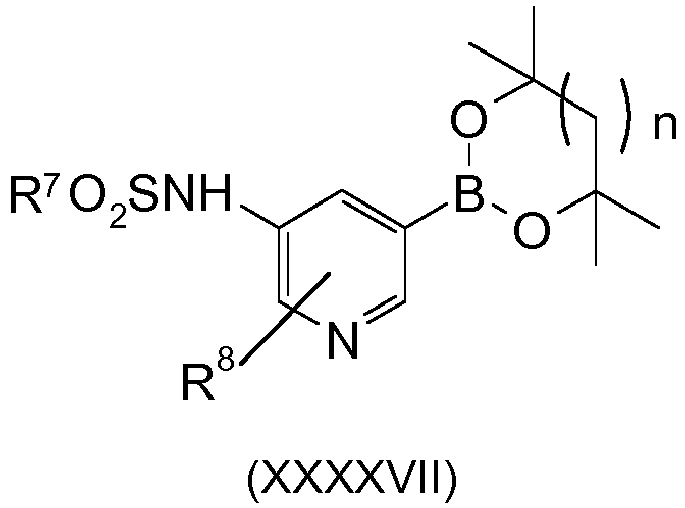
- Boronate esters of formula (XXXXVII), wherein R7 is as defined for compounds of formula (VI), R8 is C1-6alkyl, -OR6 or halo, wherein R6 is as defined for compounds of formula (VI) and n = 0 or 1, may be prepared from compounds of formula (XXXXVIII)

- Compounds of formula (XXXXVIII) wherein R8 is as defined for compounds of formula (VI) and n = 0 or 1, may be prepared from compounds of formula (XXXXIX)

- The uses of the invention comprise administering a safe and effective amount of a compound of formula (VI) as defined above or a pharmaceutically acceptable salt thereof to a patient in need thereof. Individual embodiments of the invention include the use of a safe and effective amount of a compound of formula (VI) as defined above or a pharmaceutically acceptable salt thereof in treating or preventing influenza virus infection in a patient in need thereof.
- As used herein, "treat or prevent" in reference to a disorder means: (1) to ameliorate or prevent the disorder or one or more of the biological manifestations of the disorder, (2) to interfere with (a) one or more points in the biological cascade that leads to or is responsible for the disorder or (b) one or more of the biological manifestations of the disorder, (3) to alleviate one or more of the symptoms or effects associated with the disorder, or (4) to slow the progression of the disorder or one or more of the biological manifestations of the disorder.
- The skilled artisan will appreciate that "prevention" is not an absolute term. In medicine, "prevention" is understood to refer to the prophylactic administration of a drug to substantially diminish the likelihood or severity of a disorder or biological manifestation thereof, or to delay the onset of such disorder or biological manifestation thereof.
- In one embodiment, the uses of the invention are directed to treating influenza virus infection. In another embodiment, the uses of the invention are directed to preventing influenza virus infection.
- As used herein, "safe and effective amount" in reference to a compound of formula (VI) as defined above or a pharmaceutically acceptable salt thereof or other pharmaceutically-active agent means an amount of the compound sufficient to treat the patient's condition but low enough to avoid serious side effects (at a reasonable benefit/risk ratio) within the scope of sound medical judgment. A safe and effective amount of a compound will vary with the particular compound chosen (e.g. consider the potency, efficacy, and half-life of the compound); the route of administration chosen; the disorder being treated; the severity of the disorder being treated; the age, size, weight, and physical condition of the patient being treated; the medical history of the patient to be treated; the duration of the treatment; the nature of concurrent therapy; the desired therapeutic effect; and like factors, but can nevertheless be routinely determined by the skilled artisan.
- As used herein, "patient" refers to a human (including adults and children) or other animal. In one embodiment, "patient" refers to a human.
- The compounds of formula (VI) or pharmaceutically acceptable salts thereof may be administered by any suitable route of administration, including both systemic administration and topical administration. Systemic administration includes oral administration, parenteral administration, transdermal administration and rectal administration. Parenteral administration refers to routes of administration other than enteral or transdermal, and is typically by injection or infusion. Parenteral administration includes intravenous, intramuscular, and subcutaneous injection or infusion. Topical administration includes application to the skin as well as intraocular, otic, intravaginal, inhaled and intranasal administration. Inhalation refers to administration into the patient's lungs whether inhaled through the mouth or through the nasal passages. In one embodiment, the compounds of formula (VI) or pharmaceutically acceptable salts thereof may be administered orally. In another embodiment, the compounds of formula (VI) or pharmaceutically acceptable salts thereof may be administered by inhalation. In a further embodiment, the compounds of formula (VI) or pharmaceutically acceptable salts thereof may be administered intranasally.
- The compounds of formula (VI) or pharmaceutically acceptable salts thereof may be administered once or according to a dosing regimen wherein a number of doses are administered at varying intervals of time for a given period of time. For example, doses may be administered one, two, three, or four times per day. In one embodiment, a dose is administered once per day. In a further embodiment, a dose is administered twice per day. Doses may be administered until the desired therapeutic effect is achieved or indefinitely to maintain the desired therapeutic effect. Suitable dosing regimens for a compound of formula (VI) or a pharmaceutically acceptable salt thereof depend on the pharmacokinetic properties of that compound, such as absorption, distribution, and half-life, which can be determined by the skilled artisan. In addition, suitable dosing regimens, including the duration such regimens are administered, for a compound of formula (VI) or a pharmaceutically acceptable salt thereof depend on the disorder being treated, the severity of the disorder being treated, the age and physical condition of the patient being treated, the medical history of the patient to be treated, the nature of concurrent therapy, the desired therapeutic effect, and like factors within the knowledge and expertise of the skilled artisan. It will be further understood by such skilled artisans that suitable dosing regimens may require adjustment given an individual patient's response to the dosing regimen or over time as individual patient needs change.
- Typical daily dosages may vary depending upon the particular route of administration chosen. Typical daily dosages for oral administration range from 0.001 mg to 50mg per kg of total body weight, for example from 1mg to 10mg per kg of total body weight. For example, daily dosages for oral administration may be from 0.5mg to 2g per patient, such as 10mg to 1 g per patient.
- Additionally, the compounds of formula (VI) may be administered as prodrugs. As used herein, a "prodrug" of a compound of formula (VI) is a functional derivative of the compound which, upon administration to a patient, eventually liberates the compound of formula (VI) in vivo. Administration of a compound of formula (VI) as a prodrug may enable the skilled artisan to do one or more of the following: (a) modify the onset of the activity of the compound in vivo; (b) modify the duration of action of the compound in vivo; (c) modify the transportation or distribution of the compound in vivo; (d) modify the solubility of the compound in vivo; and (e) overcome a side effect or other difficulty encountered with the compound. Typical functional derivatives used to prepare prodrugs include modifications of the compound that are chemically or enzymatically cleavable in vivo. Such modifications, which include the preparation of phosphates, amides, esters, thioesters, carbonates, and carbamates, are well known to those skilled in the art.
- In one aspect, the invention provides a compound of formula (VI) or a pharmaceutically acceptable salt thereof for use in the treatment or prevention of influenza virus infection. In one embodiment, the invention provides N-[5-[4-(5-{[(2R,6S)-2,6-dimethyl-4-morpholinyl]methyl}-1,3-oxazol-2-yl)-1H-indazol-6-yl]-2-(methyloxy)-3-pyridinyl]methanesulfonamide or a pharmaceutically acceptable salt thereof for use in the treatment or prevention of influenza virus infection. In another embodiment, the invention provides N-[5-[4-(5-{[(2R,6S)-2,6-dimethyl-4-morpholinyl]methyl}-1,3-oxazol-2-yl)-1H-indazol-6-yl]-2-(methyloxy)-3-pyridinyl]methanesulfonamide (R)-mandelate for use in the treatment or prevention of influenza virus infection. In another embodiment, the invention provides N-[5-[4-(5-{[(2R,6S)-2,6-dimethyl-4-morpholinyl]methyl}-1,3-oxazol-2-yl)-1H-indazol-6-yl]-2-(methyloxy)-3-pyridinyl]methanesulfonamide for use in the treatment or prevention of influenza virus infection. In another embodiment, the invention provides 6-(1 H-indol-4-yl)-4-(5-{[4-(1-methylethyl)-1-piperazinyl]methyl}-1,3-oxazol-2-yl)-1H-indazole or a pharmaceutically acceptable salt thereof for use in the treatment or prevention of influenza virus infection. In another embodiment, the invention provides 6-(1H-indol-4-yl)-4-(5-{[4-(1-methylethyl)-1-piperazinyl]methyl}-1,3-oxazol-2-yl)-1H-indazole hemi succinate or a pharmaceutically acceptable salt thereof for use in the treatment or prevention of influenza virus infection. In a further embodiment, the invention provides 6-(1H-indol-4-yl)-4-(5-{[4-(1-methylethyl)-1-piperazinyl]methyl}-1,3-oxazol-2-yl)-1H-indazole hydrochloride for use in the treatment or prevention of influenza virus infection.
- In a further aspect, the invention provides the use of a compound of formula (VI) or a pharmaceutically acceptable salt thereof in the manufacture of a medicament for use in the treatment or prevention of influenza virus infection. In one embodiment, the invention provides the use of N-[5-[4-(5-{[(2R,6S)-2,6-dimethyl-4-morpholinyl]methyl}-1,3-oxazol-2-yl)-1H-indazol-6-yl]-2-(methyloxy)-3-pyridinyl]methanesulfonamide or a pharmaceutically acceptable salt thereof in the manufacture of a medicament for use in the treatment or prevention of influenza virus infection. In another embodiment, the invention provides the use of N-[5-[4-(5-{[(2R,6S)-2,6-dimethyl-4-morpholinyl]methyl}-1,3-oxazol-2-yl)-1H-indazol-6-yl]-2-(methyloxy)-3-pyridinyl]methanesulfonamide (R)-mandelate in the manufacture of a medicament for use in the treatment or prevention of influenza virus infection. In another embodiment, the invention provides the use of N-[5-[4-(5-{[(2R,6S)-2,6-dimethyl-4-morpholinyl]methyl}-1,3-oxazol-2-yl)-1H-indazol-6-yl]-2-(methyloxy)-3-pyridinyl]methanesulfonamide in the manufacture of a medicament for use in the treatment or prevention of influenza virus infection. In another embodiment, the invention provides the use of 6-(1H-indol-4-yl)-4-(5-{[4-(1-methylethyl)-1-piperazinyl]methyl}-1,3-oxazol-2-yl)-1H-indazole or a pharmaceutically acceptable salt thereof in the manufacture of a medicament for use in the treatment or prevention of influenza virus infection. In another embodiment, the invention provides the use of 6-(1H-indol-4-yl)-4-(5-{[4-(1-methylethyl)-1-piperazinyl]methyl}-1,3-oxazol-2-yl)-1H-indazole hemi succinate or a pharmaceutically acceptable salt thereof in the manufacture of a medicament for use in the treatment or prevention of influenza virus infection. In a further embodiment, the invention provides the use of 6-(1H-indol-4-yl)-4-(5-{[4-(1-methylethyl)-1-piperazinyl]methyl}-1,3-oxazol-2-yl)-1H-indazole hydrochloride in the manufacture of a medicament for use in the treatment or prevention of influenza virus infection.
- The compounds of formula (VI) and pharmaceutically acceptable salts thereof will normally, but not necessarily, be formulated into pharmaceutical compositions prior to administration to a patient.
- Accordingly, in one aspect the disclosure is directed to pharmaceutical compositions comprising a compound of formula (VI) or a pharmaceutically acceptable salt thereof, and one or more pharmaceutically acceptable excipients for use in the treatment or prevention of influenza virus infection.
- In one embodiment, the present disclosure provides a pharmaceutical composition comprising N-[5-[4-(5-{[(2R,6S)-2,6-dimethyl-4-morpholinyl]methyl}-1,3-oxazol-2-yl)-1H-indazol-6-yl]-2-(methyloxy)-3-pyridinyl]methanesulfonamide or a pharmaceutically acceptable salt thereof, and one or more pharmaceutically acceptable excipients for use in the treatment or prevention of influenza virus infection.
- In another embodiment, the present disclosure provides a pharmaceutical composition comprising N-[5-[4-(5-{[(2R,6S)-2,6-dimethyl-4-morpholinyl]methyl}-1,3-oxazol-2-yl)-1H-indazol-6-yl]-2-(methyloxy)-3-pyridinyl]methanesulfonamide, and one or more pharmaceutically acceptable excipients for use in the treatment or prevention of influenza virus infection.
- In another embodiment, the present disclosure provides a pharmaceutical composition comprising N-[5-[4-(5-{[(2R,6S)-2,6-dimethyl-4-morpholinyl]methyl}-1,3-oxazol-2-yl)-1H-indazol-6-yl]-2-(methyloxy)-3-pyridinyl]methanesulfonamide (R) mandelate, and one or more pharmaceutically acceptable excipients for use in the treatment or prevention of influenza virus infection.
- In another embodiment, the present disclosure provides a pharmaceutical composition comprising 6-(1H-indol-4-yl)-4-(5-{[4-(1-methylethyl)-1-piperazinyl]methyl}-1,3-oxazol-2-yl)-1H-indazole or a pharmaceutically acceptable salt thereof, and one or more pharmaceutically acceptable excipients for use in the treatment or prevention of influenza virus infection.
- In another embodiment, the present disclosure provides a pharmaceutical composition comprising 6-(1H-indol-4-yl)-4-(5-{[4-(1-methylethyl)-1-piperazinyl]methyl}-1,3-oxazol-2-yl)-1H-indazole hemi succinate or a pharmaceutically acceptable salt thereof, and one or more pharmaceutically acceptable excipients for use in the treatment or prevention of influenza virus infection.
- In a further embodiment, the present disclosure provides a pharmaceutical composition comprising 6-(1H-indol-4-yl)-4-(5-{[4-(1-methylethyl)-1-piperazinyl]methyl}-1,3-oxazol-2-yl)-1H-indazole hydrochloride, and one or more pharmaceutically acceptable excipients for use in the treatment or prevention of influenza virus infection.
- In another aspect the disclosure is directed to pharmaceutical compositions comprising 0.05 to 1000mg of a compound of formula (VI) or a pharmaceutically acceptable salt thereof and 0.1 to 2g of one or more pharmaceutically acceptable excipients for use in the treatment or prevention of influenza virus infection.
- In a further aspect the disclosure is directed to a pharmaceutical composition for the treatment or prevention of influenza virus infection comprising a compound of formula (VI) or a pharmaceutically acceptable salt thereof.
- In one embodiment, the present disclosure is provides a pharmaceutical composition for the treatment or prevention of influenza virus infection comprising N-[5-[4-(5-{[(2R,6S)-2,6-dimethyl-4-morpholinyl]methyl}-1,3-oxazol-2-yl)-1H-indazol-6-yl]-2-(methyloxy)-3-pyridinyl]methanesulfonamide or a pharmaceutically acceptable salt thereof.
- In one embodiment, the present disclosure provides a pharmaceutical composition for the treatment or prevention of influenza virus infection comprising N-[5-[4-(5-{[(2R,6S)-2,6-dimethyl-4-morpholinyl]methyl}-1,3-oxazol-2-yl)-1H-indazol-6-yl]-2-(methyloxy)-3-pyridinyl]methanesulfonamide (R) mandelate.
- In one embodiment, the present disclosure provides a pharmaceutical composition for the treatment or prevention of influenza virus infection comprising N-[5-[4-(5-{[(2R,6S)-2,6-dimethyl-4-morpholinyl]methyl}-1,3-oxazol-2-yl)-1H-indazol-6-yl]-2-(methyloxy)-3-pyridinyl]methanesulfonamide.
- In one embodiment, the present disclosure provides a pharmaceutical composition for the treatment or prevention of influenza virus infection comprising 6-(1H-indol-4-yl)-4-(5-{[4-(1-methylethyl)-1-piperazinyl]methyl}-1,3-oxazol-2-yl)-1H-indazole or a pharmaceutically acceptable salt thereof.
- In one embodiment, the present disclosure provides a pharmaceutical composition for the treatment or prevention of influenza virus infection comprising 6-(1H-indol-4-yl)-4-(5-{[4-(1-methylethyl)-1-piperazinyl]methyl}-1,3-oxazol-2-yl)-1H-indazole hemi succinate.
- In a further embodiment, the present disclosure provides a pharmaceutical composition for the treatment or prevention of influenza virus infection comprising 6-(1H-indol-4-yl)-4-(5-{[4-(1-methylethyl)-1-piperazinyl]methyl}-1,3-oxazol-2-yl)-1H-indazole hydrochloride.
- The pharmaceutical compositions for use according to the disclosure may be prepared and packaged in bulk form wherein a safe and effective amount of a compound of formula (VI) or a pharmaceutically acceptable salt thereof can be extracted and then given to the patient such as with powders or syrups. Alternatively, the pharmaceutical compositions for use according to the disclosure may be prepared and packaged in unit dosage form wherein each physically discrete unit contains a compound of formula (VI) or a pharmaceutically acceptable salt thereof. When prepared in unit dosage form, the pharmaceutical compositions for use according to the disclosure typically may contain, for example, from 0.5mg to 1 g, or from 1 mg to 700mg, or from 5mg to 100mg of a compound of formula (VI) or a pharmaceutically acceptable salt thereof.
- The pharmaceutical compositions for use according to the disclosure typically contain one compound of formula (VI) or a pharmaceutically acceptable salt thereof.
- As used herein, "pharmaceutically acceptable excipient" means a pharmaceutically acceptable material, composition or vehicle involved in giving form or consistency to the pharmaceutical composition. Each excipient must be compatible with the other ingredients of the pharmaceutical composition when commingled such that interactions which would substantially reduce the efficacy of the compound of formula (VI) or a pharmaceutically acceptable salt thereof when administered to a patient and interactions which would result in pharmaceutical compositions that are not pharmaceutically acceptable are avoided. In addition, each excipient must of course be pharmaceutically-acceptable eg of sufficiently high purity.
- The compound of formula (VI) or a pharmaceutically acceptable salt thereof and the pharmaceutically acceptable excipient or excipients will typically be formulated into a dosage form adapted for administration to the patient by the desired route of administration. For example, dosage forms include those adapted for (1) oral administration such as tablets, capsules, caplets, pills, troches, powders, syrups, elixers, suspensions, solutions, emulsions, sachets, and cachets; (2) parenteral administration such as sterile solutions, suspensions, and powders for reconstitution; (3) transdermal administration such as transdermal patches; (4) rectal administration such as suppositories; (5) inhalation such as aerosols, solutions, and dry powders; and (6) topical administration such as creams, ointments, lotions, solutions, pastes, sprays, foams, and gels.
- Suitable pharmaceutically acceptable excipients will vary depending upon the particular dosage form chosen. In addition, suitable pharmaceutically acceptable excipients may be chosen for a particular function that they may serve in the composition. For example, certain pharmaceutically acceptable excipients may be chosen for their ability to facilitate the production of uniform dosage forms. Certain pharmaceutically acceptable excipients may be chosen for their ability to facilitate the production of stable dosage forms. Certain pharmaceutically acceptable excipients may be chosen for their ability to facilitate the carrying or transporting of the compound or compounds of formula (VI) or pharmaceutically acceptable salts thereof once administered to the patient from one organ, or portion of the body, to another organ, or portion of the body. Certain pharmaceutically acceptable excipients may be chosen for their ability to enhance patient compliance.
- Suitable pharmaceutically acceptable excipients include the following types of excipients: diluents, fillers, binders, disintegrants, lubricants, glidants, granulating agents, coating agents, wetting agents, solvents, co-solvents, suspending agents, emulsifiers, sweetners, flavoring agents, flavor masking agents, coloring agents, anticaking agents, hemectants, chelating agents, plasticizers, viscosity increasing agents, antioxidants, preservatives, stabilizers, surfactants, and buffering agents. The skilled artisan will appreciate that certain pharmaceutically acceptable excipients may serve more than one function and may serve alternative functions depending on how much of the excipient is present in the formulation and what other excipients are present in the formulation.
- Skilled artisans possess the knowledge and skill in the art to enable them to select suitable pharmaceutically-acceptable excipients in appropriate amounts for use according to the disclosure. In addition, there are a number of resources that are available to the skilled artisan which describe pharmaceutically acceptable excipients and may be useful in selecting suitable pharmaceutically acceptable excipients. Examples include Remington's Pharmaceutical Sciences (Mack Publishing Company), The Handbook of Pharmaceutical Additives (Gower Publishing Limited), and The Handbook of Pharmaceutical Excipients (the American Pharmaceutical Association and the Pharmaceutical Press).
- The pharmaceutical compositions for use according to the disclosure are prepared using techniques and methods known to those skilled in the art. Some of the methods commonly used in the art are described in Remington's Pharmaceutical Sciences (Mack Publishing Company).
- A pharmaceutical composition comprising a compound of formula (VI) or a pharmaceutically acceptable salt thereof may be prepared by, for example, admixture at ambient temperature and atmospheric pressure.
- In one embodiment, the compounds of formula (VI) or pharmaceutically acceptable salts thereof will be formulated for oral administration. In another embodiment, the compounds of formula (VI) or pharmaceutically acceptable salts thereof will be formulated for inhaled administration. In a further embodiment, the compounds of formula (VI) or pharmaceutically acceptable salts thereof will be formulated for intranasal administration.
- In one aspect, the composition for use according to the disclosure is a solid oral dosage form such as a tablet or capsule comprising a safe and effective amount of a compound of formula (VI) or a pharmaceutically acceptable salt thereof and a diluent or filler. Suitable diluents and fillers include lactose, sucrose, dextrose, mannitol, sorbitol, starch (e.g. corn starch, potato starch, and pre-gelatinized starch), cellulose and its derivatives (e.g. microcrystalline cellulose), calcium sulfate, and dibasic calcium phosphate. The oral solid dosage form may further comprise a binder. Suitable binders include starch (e.g. corn starch, potato starch, and pre-gelatinized starch), gelatin, acacia, sodium alginate, alginic acid, tragacanth, guar gum, povidone, and cellulose and its derivatives (e.g. microcrystalline cellulose). The oral solid dosage form may further comprise a disintegrant. Suitable disintegrants include crospovidone, sodium starch glycolate, croscarmelose, alginic acid, and sodium carboxymethyl cellulose. The oral solid dosage form may further comprise a lubricant. Suitable lubricants include stearic acid, magnesuim stearate, calcium stearate, and talc.
- Where appropriate, dosage unit formulations for oral administration can be microencapsulated. The composition can also be prepared to prolong or sustain the release as for example by coating or embedding particulate material in polymers, wax or the like.
- The compounds of formula (VI) or pharmaceutically acceptable salts thereof may also be coupled with soluble polymers as targetable drug carriers. Such polymers can include polyvinylpyrrolidone, pyran copolymer, polyhydroxypropylmethacrylamide -phenol, polyhydroxyethylaspartamidephenol, or polyethyleneoxidepolylysine substituted with palmitoyl residues. Furthermore, the compounds of formula (VI) or pharmaceutically acceptable salts thereof may be coupled to a class of biodegradable polymers useful in achieving controlled release of a drug, for example, polylactic acid, polepsilon caprolactone, polyhydroxy butyric acid, polyorthoesters, polyacetals, polydihydropyrans, polycyanoacrylates and cross-linked or amphipathic block copolymers of hydrogels.
- In another aspect, the composition for use according to the disclosure is a liquid oral dosage form. Oral liquids such as solution, syrups and elixirs can be prepared in dosage unit form so that a given quantity contains a predetermined amount of a compound of formula (VI) or a pharmaceutically acceptable salt thereof. Syrups can be prepared by dissolving the compound of formula (VI) or a pharmaceutically acceptable salt thereof in a suitably flavored aqueous solution, while elixirs are prepared through the use of a non-toxic alcoholic vehicle. Suspensions can be formulated by dispersing the compound of formula (VI) or a pharmaceutically acceptable salt thereof in a non-toxic vehicle. Solubilizers and emulsifiers such as ethoxylated isostearyl alcohols and polyoxy ethylene sorbitol ethers, preservatives, flavor additive such as peppermint oil or natural sweeteners or saccharin or other artificial sweeteners, and the like can also be added.
- In another aspect, the composition for use according to the disclosure is a dosage form adapted for administration to a patient by inhalation, for example as a dry powder, an aerosol, a suspension, or a solution composition. In one embodiment, the composition for use according to the disclosure is a dosage form adapted for administration to a patient by inhalation as a dry powder. In a further embodiment, the composition for use according to the invention is a dosage form adapted for administration to a patient by inhalation via a nebulizer.
- Dry powder compositions for delivery to the lung by inhalation typically comprise a compound of formula (VI) or a pharmaceutically acceptable salt thereof as a finely divided powder together with one or more pharmaceutically-acceptable excipients as finely divided powders. Pharmaceutically-acceptable excipients particularly suited for use in dry powders are known to those skilled in the art and include lactose, starch, mannitol, and mono-, di-, and polysaccharides. The finely divided powder may be prepared by, for example, micronisation and milling. Generally, the size-reduced (eg micronised) compound can be defined by a D50 value of about 1 to about 10 microns (for example as measured using laser diffraction).
- The dry powder may be administered to the patient via a reservoir dry powder inhaler (RDPI) having a reservoir suitable for storing multiple (un-metered doses) of medicament in dry powder form. RDPIs typically include a means for metering each medicament dose from the reservoir to a delivery position. For example, the metering means may comprise a metering cup, which is movable from a first position where the cup may be filled with medicament from the reservoir to a second position where the metered medicament dose is made available to the patient for inhalation.
- Alternatively, the dry powder may be presented in capsules (e.g. gelatin or plastic), cartridges, or blister packs for use in a multi-dose dry powder inhaler (MDPI). MDPIs are inhalers wherein the medicament is comprised within a multi-dose pack containing (or otherwise carrying) multiple defined doses (or parts thereof) of medicament. When the dry powder is presented as a blister pack, it comprises multiple blisters for containment of the medicament in dry powder form. The blisters are typically arranged in regular fashion for ease of release of the medicament therefrom. For example, the blisters may be arranged in a generally circular fashion on a disc-form blister pack, or the blisters may be elongate in form, for example comprising a strip or a tape. Each capsule, cartridge, or blister may, for example, contain between 20µg-10mg of the compound of formula (VI) or a pharmaceutically acceptable salt thereof.
- Aerosols may be formed by suspending or dissolving a compound of formula (VI) or a pharmaceutically acceptable salt thereof in a liquified propellant. Suitable propellants include halocarbons, hydrocarbons, and other liquified gases. Representative propellants include: trichlorofluoromethane (propellant 11), dichlorofluoromethane (propellant 12), dichlorotetrafluoroethane (propellant 114), tetrafluoroethane (HFA-134a), 1,1-difluoroethane (HFA-152a), difluoromethane (HFA-32), pentafluoroethane (HFA-12), heptafluoropropane (HFA-227a), perfluoropropane, perfluorobutane, perfluoropentane, butane, isobutane, and pentane. Aerosols comprising a compound of formula (VI) or a pharmaceutically acceptable salt thereof will typically be administered to a patient via a metered dose inhaler (MDI). Such devices are known to those skilled in the art.
- The aerosol may contain additional pharmaceutically-acceptable excipients typically used with MDIs such as surfactants, lubricants, cosolvents and other excipients to improve the physical stability of the formulation, to improve valve performance, to improve solubility, or to improve taste.
- Thus the composition for use according to the disclosure may be a pharmaceutical aerosol formulation comprising a compound of formula (VI) or a pharmaceutically acceptable salt thereof and a fluorocarbon or hydrogen-containing chlorofluorocarbon as propellant, optionally in combination with a surfactant and/or a cosolvent.
- In another aspect the composition for use according to the disclosure may be a pharmaceutical aerosol formulation wherein the propellant is selected from 1,1,1,2-tetrafluoroethane, 1,1,1,2,3,3,3-heptafluoro-n-propane and mixtures thereof.
- The formulations for use according to the disclosure may be buffered by the addition of suitable buffering agents.
- Capsules and cartridges for use in an inhaler or insufflator, of for example gelatine, may be formulated containing a powder mix for inhalation of a compound of formula (VI) or a pharmaceutically acceptable salt thereof and a suitable powder base such as lactose or starch. Each capsule or cartridge may generally contain from 20µg to 10mg of the compound of formula (VI) or pharmaceutically acceptable salt thereof. Alternatively, the compound of formula (VI) or pharmaceutically acceptable salt thereof may be presented without excipients such as lactose.
- The proportion of the active compound of formula (VI) or pharmaceutically acceptable salt thereof in the local compositions for use according to the disclosure depends on the precise type of formulation to be prepared but will generally be within the range of from 0.001 to 10% by weight. Generally, for most types of preparations, the proportion used will be within the range of from 0.005 to 1%, for example from 0.01 to 0.5%. However, in powders for inhalation or insufflation the proportion used will normally be within the range of from 0.1 to 5%.
- Aerosol formulations are preferably arranged so that each metered dose or "puff" of aerosol contains from 20µg to 10mg, preferably from 20µg to 2000µg, more preferably from about 20µg to 500µg of a compound of formula (VI). Administration may be once daily or several times daily, for example 2, 3, 4 or 8 times, giving for example 1, 2 or 3 doses each time. The overall daily dose with an aerosol will be within the range from 100µg to 10mg, preferably from 200µg to 2000µg. The overall daily dose and the metered dose delivered by capsules and cartridges in an inhaler or insufflator will generally be double that delivered with aerosol formulations.
- In the case of suspension aerosol formulations, the particle size of the particulate (e.g., micronised) drug should be such as to permit inhalation of substantially all the drug into the lungs upon administration of the aerosol formulation and will thus be less than 100 microns, desirably less than 20 microns, and in particular in the range of from 1 to 10 microns, such as from 1 to 5 microns, more preferably from 2 to 3 microns.
- The formulations for use according to the disclosure may be prepared by dispersal or dissolution of the medicament and a compound of formula (VI) or a pharmaceutically acceptable salt thereof in the selected propellant in an appropriate container, for example, with the aid of sonication or a high-shear mixer. The process is desirably carried out under controlled humidity conditions.
- The chemical and physical stability and the pharmaceutical acceptability of the aerosol formulations for use according to the disclosure may be determined by techniques well known to those skilled in the art. Thus, for example, the chemical stability of the components may be determined by HPLC assay, for example, after prolonged storage of the product. Physical stability data may be gained from other conventional analytical techniques such as, for example, by leak testing, by valve delivery assay (average shot weights per actuation), by dose reproducibility assay (active ingredient per actuation) and spray distribution analysis.
- The stability of the suspension aerosol formulations for use according to the disclosure may be measured by conventional techniques, for example, by measuring flocculation size distribution using a back light scattering instrument or by measuring particle size distribution by cascade impaction or by the "twin impinger" analytical process. As used herein reference to the "twin impinger" assay means "Determination of the deposition of the emitted dose in pressurised inhalations using apparatus A" as defined in British Pharmacopaeia 1988, pages A204-207, Appendix XVII C. Such techniques enable the "respirable fraction" of the aerosol formulations to be calculated. One method used to calculate the "respirable fraction" is by reference to "fine particle fraction" which is the amount of active ingredient collected in the lower impingement chamber per actuation expressed as a percentage of the total amount of active ingredient delivered per actuation using the twin impinger method described above.
- The term "metered dose inhaler" or MDI means a unit comprising a can, a secured cap covering the can and a formulation metering valve situated in the cap. MDI system includes a suitable channelling device. Suitable channelling devices comprise for example, a valve actuator and a cylindrical or cone-like passage through which medicament may be delivered from the filled canister via the metering valve to the nose or mouth of a patient such as a mouthpiece actuator.
- MDI canisters generally comprise a container capable of withstanding the vapour pressure of the propellant used such as a plastic or plastic-coated glass bottle or preferably a metal can, for example, aluminium or an alloy thereof which may optionally be anodised, lacquer-coated and/or plastic-coated (for example
WO96/32099 WO96/32099 - In one embodiment the metallic internal surface of the can is coated with a fluoropolymer, more preferably blended with a non-fluoropolymer. In another embodiment the metallic internal surface of the can is coated with a polymer blend of polytetrafluoroethylene (PTFE) and polyethersulfone (PES). In a further embodiment the whole of the metallic internal surface of the can is coated with a polymer blend of polytetrafluoroethylene (PTFE) and polyethersulfone (PES).
- The metering valves are designed to deliver a metered amount of the formulation per actuation and incorporate a gasket to prevent leakage of propellant through the valve. The gasket may comprise any suitable elastomeric material such as, for example, low density polyethylene, chlorobutyl, bromobutyl, EPDM, black and white butadiene-acrylonitrile rubbers, butyl rubber and neoprene. Suitable valves are commercially available from manufacturers well known in the aerosol industry, for example, from Valois, France (e.g. DF10, DF30, DF60), Bespak plc, UK (e.g. BK300, BK357) and 3M-Neotechnic Ltd, UK (e.g. Spraymiser™).
- In various embodiments, the MDIs may also be used in conjunction with other structures such as overwrap packages for storing and containing the MDIs, including those described in
U.S. Patent Nos. 6,119,853 ;6,179,118 ;6,315,112 ;6,352,152 ;6,390,291 ; and6,679,374 , as well as dose counter units such as those described inU.S. Patent Nos. 6,360,739 and6,431,168 . - Conventional bulk manufacturing methods and machinery well known to those skilled in the art of pharmaceutical aerosol manufacture may be employed for the preparation of large-scale batches for the commercial production of filled canisters. Thus, for example, in one bulk manufacturing method for preparing suspension aerosol formulations a metering valve is crimped onto an aluminium can to form an empty canister. The particulate medicament is added to a charge vessel and liquefied propellant together with the optional excipients is pressure filled through the charge vessel into a manufacturing vessel. The drug suspension is mixed before recirculation to a filling machine and an aliquot of the drug suspension is then filled through the metering valve into the canister. In one example bulk manufacturing method for preparing solution aerosol formulations a metering valve is crimped onto an aluminium can to form an empty canister. The liquefied propellant together with the optional excipients and the dissolved medicament is pressure filled through the charge vessel into a manufacturing vessel.
- In an alternative process, an aliquot of the liquefied formulation is added to an open canister under conditions which are sufficiently cold to ensure the formulation does not vaporise, and then a metering valve crimped onto the canister.
- Typically, in batches prepared for pharmaceutical use, each filled canister is check-weighed, coded with a batch number and packed into a tray for storage before release testing.
- Suspensions and solutions comprising a compound of formula (VI) or a pharmaceutically acceptable salt thereof may also be administered to a patient via a nebulizer. The solvent or suspension agent utilized for nebulization may be any pharmaceutically-acceptable liquid such as water, aqueous saline, alcohols or glycols, e.g., ethanol, isopropylalcohol, glycerol, propylene glycol, polyethylene glycol, etc. or mixtures thereof. Saline solutions utilize salts which display little or no pharmacological activity after administration. Both organic salts, such as alkali metal or ammonium halogen salts, e.g., sodium chloride, potassium chloride or organic salts, such as potassium, sodium and ammonium salts or organic acids, e.g., ascorbic acid, citric acid, acetic acid, tartaric acid, etc. may be used for this purpose.
- Other pharmaceutically-acceptable excipients may be added to the suspension or solution. The compound of formula (VI) or pharmaceutically acceptable salt thereof may be stabilized by the addition of an inorganic acid, e.g., hydrochloric acid, nitric acid, sulphuric acid and/or phosphoric acid; an organic acid, e.g., ascorbic acid, citric acid, acetic acid, and tartaric acid, etc., a complexing agent such as EDTA or citric acid and salts thereof; or an antioxidant such as antioxidant such as vitamin E or ascorbic acid. These may be used alone or together to stabilize the compound of formula (VI) or pharmaceutically acceptable salt thereof. Preservatives may be added such as benzalkonium chloride or benzoic acid and salts thereof. Surfactant may be added particularly to improve the physical stability of suspensions. These include lecithin, disodium dioctylsulphosuccinate, oleic acid and sorbitan esters.
- In a further aspect, the composition for use according to the disclosure is a dosage form adapted for intranasal administration.
- Formulations for administration to the nose may include pressurised aerosol formulations and aqueous formulations administered to the nose by pressurised pump. Formulations which are non-pressurised and adapted to be administered topically to the nasal cavity are of particular interest. Suitable formulations contain water as the diluent or carrier for this purpose. Aqueous formulations for administration to the lung or nose may be provided with conventional excipients such as buffering agents, tonicity modifying agents and the like. Aqueous formulations may also be administered to the nose by nebulisation.
- The compounds of formula (VI) or pharmaceutically acceptable salts thereof may be formulated as a fluid formulation for delivery from a fluid dispenser, for example a fluid dispenser having a dispensing nozzle or dispensing orifice through which a metered dose of the fluid formulation is dispensed upon the application of a user-applied force to a pump mechanism of the fluid dispenser. Such fluid dispensers are generally provided with a reservoir of multiple metered doses of the fluid formulation, the doses being dispensable upon sequential pump actuations. The dispensing nozzle or orifice may be configured for insertion into the nostrils of the user for spray dispensing of the fluid formulation into the nasal cavity. A fluid dispenser of the aforementioned type is described and illustrated in
WO05/044354 WO05/044354 - Pharmaceutical compositions adapted for intranasal administration wherein the carrier is a solid include a coarse powder having a particle size for example in the
range 20 to 500 microns which is administered by rapid inhalation through the nasal passage from a container of the powder held close up to the nose. Suitable compositions wherein the carrier is a liquid, for administration as a nasal spray or as nasal drops, include aqueous or oil solutions of the compound of formula (VI) or a pharmaceutically acceptable salt thereof. - Pharmaceutical compositions adapted for transdermal administration may be presented as discrete patches intended to remain in intimate contact with the epidermis of the patient for a prolonged period of time. For example, the active ingredient may be delivered from the patch by iontophoresis as generally described in Pharmaceutical Research, 3(6), 318 (1986).
- Pharmaceutical compositions adapted for topical administration may be formulated as ointments, creams, suspensions, lotions, powders, solutions, pastes, gels, sprays, aerosols or oils.
- Ointments, creams and gels, may, for example, be formulated with an aqueous or oily base with the addition of suitable thickening and/or gelling agent and/or solvents. Such bases may thus, for example, include water and/or an oil such as liquid paraffin or a vegetable oil such as arachis oil or castor oil, or a solvent such as polyethylene glycol. Thickening agents and gelling agents which may be used according to the nature of the base include soft paraffin, aluminium stearate, cetostearyl alcohol, polyethylene glycols, woolfat, beeswax, carboxypolymethylene and cellulose derivatives, and/or glyceryl monostearate and/or non-ionic emulsifying agents.
- Lotions may be formulated with an aqueous or oily base and will in general also contain one or more emulsifying agents, stabilising agents, dispersing agents, suspending agents or thickening agents.
- Powders for external application may be formed with the aid of any suitable powder base, for example, talc, lactose or starch. Drops may be formulated with an aqueous or non-aqueous base also comprising one or more dispersing agents, solubilising agents, suspending agents or preservatives.
- Topical preparations may be administered by one or more applications per day to the affected area; over skin areas occlusive dressings may advantageously be used. Continuous or prolonged delivery may be achieved by an adhesive reservoir system.
- For treatments of the eye or other external tissues, for example mouth and skin, the compositions may be applied as a topical ointment or cream. When formulated in an ointment, the compound of formula (VI) or a pharmaceutically acceptable salt thereof may be employed with either a paraffinic or a water-miscible ointment base. Alternatively, the compound of formula (VI) or pharmaceutically acceptable salt thereof may be formulated in a cream with an oil-in-water cream base or a water-in-oil base.
- Pharmaceutical compositions adapted for parenteral administration include aqueous and non-aqueous sterile injection solutions which may contain anti-oxidants, buffers, bacteriostats and solutes which render the formulation isotonic with the blood of the intended recipient; and aqueous and non-aqueous sterile suspensions which may include suspending agents and thickening agents. The compositions may be presented in unit-dose or multi-dose containers, for example sealed ampoules and vials, and may be stored in a freeze-dried (lyophilized) condition requiring only the addition of the sterile liquid carrier, for example water for injections, immediately prior to use. Extemporaneous injection solutions and suspensions may be prepared from sterile powders, granules and tablets.
- According to the disclosure, compounds of formula (VI) and pharmaceutically acceptable salts thereof may be used in combination with one or more other therapeutic agents, for example selected from anti-infective agents, anti-inflammatory agents and immunomodulators, in the treatment or prevention of influenza virus infection.
- The disclosure thus provides, in a further aspect, a compound of formula (VI) or a pharmaceutically acceptable salt thereof together with one or more other therapeutically active agents for use in the treatment or prevention of influenza virus infection.
- In one embodiment, the disclosure encompasses a combination comprising a compound of formula (VI) or a pharmaceutically acceptable salt thereof together with one or more therapeutically active agents for use in treating or preventing influenza virus infection.
- One embodiment of the disclosure encompasses the use of combinations comprising one or two other therapeutic agents.
- It will be clear to a person skilled in the art that, where appropriate, the other therapeutic ingredient(s) may be used in the form of salts, for example as alkali metal or amine salts or as acid addition salts, or prodrugs, or as esters, for example lower alkyl esters, or as solvates, for example hydrates to optimise the activity and/or stability and/or physical characteristics, such as solubility, of the therapeutic ingredient. It will be clear also that, where appropriate, the therapeutic ingredients may be used in optically pure form.
- Suitable anti-infective agents include antibiotics and antivirals.
- Suitable anti-inflammatory agents include corticosteroids. Suitable corticosteroids which may be used in combination with the compounds of formula (VI) or pharmaceutically acceptable salts thereof are those oral and inhaled corticosteroids and their pro-drugs which have anti-inflammatory activity. Examples include methyl prednisolone, prednisolone, dexamethasone, fluticasone propionate, 6α,9α-difluoro-11β-hydroxy-16α-methyl-17α-[(4-methyl-1,3-thiazole-5-carbonyl)oxy]-3-oxo-androsta-1,4-diene-17β-carbothioic acid S-fluoromethyl ester, 6α,9α-difluoro-17α-[(2-furanylcarbonyl)oxy]-11β-hydroxy-16α-methyl-3-oxo-androsta-1,4-diene-17β-carbothioic acid S-fluoromethyl ester (fluticasone furoate), 6α,9α-difluoro-11β-hydroxy-16α-methyl-3-oxo-17α-propionyloxy-androsta-1,4-diene-17β-carbothioic acid S-(2-oxo-tetrahydro-furan-3S-yl) ester, 6α,9α-difluoro-11 β-hydroxy-16α-methyl-3-oxo-17α-(2,2,3,3-tetramethycyclopropylcarbonyl)oxy-androsta-1,4-diene-17β-carbothioic acid S-cyanomethyl ester and 6α,9α-difluoro-11β-hydroxy-16α-methyl-17α-(1-methycyclopropylcarbonyl)oxy-3-oxo-androsta-1,4-diene-17β-carbothioic acid S-fluoromethyl ester, beclomethasone esters (for example the 17-propionate ester or the 17,21-dipropionate ester), budesonide, flunisolide, mometasone esters (for example mometasone furoate), triamcinolone acetonide, rofleponide, ciclesonide (16α,17-[[(R)-cyclohexylmethylene]bis(oxy)]-11β,21-dihydroxy-pregna-1,4-diene-3,20-dione), butixocort propionate, RPR-106541, and ST-126. Preferred corticosteroids include fluticasone propionate, 6α,9α-difluoro-11β-hydroxy-16α-methyl-17α-[(4-methyl-1,3-thiazole-5-carbonyl)oxy]-3-oxo-androsta-1,4-diene-17β-carbothioic acid S-fluoromethyl ester, 6α,9α-difluoro-17α-[(2-furanylcarbonyl)oxy]-11β-hydroxy-16α-methyl-3-oxo-androsta-1,4-diene-17β-carbothioic acid S-fluoromethyl ester, 6α,9α-difluoro-11 β-hydroxy-16α-methyl-3-oxo-17α-(2,2,3,3- tetramethycyclopropylcarbonyl)oxy-androsta-1,4-diene-17β-carbothioic acid S-cyanomethyl ester and 6α,9α-difluoro-11β-hydroxy-16α-methyl-17α-(1-methycyclopropylcarbonyl)oxy-3-oxo-androsta-1,4-diene-17β-carbothioic acid S-fluoromethyl ester. In one embodiment the corticosteroid is 6α,9α-difluoro-17α-[(2-furanylcarbonyl)oxy]-11β-hydroxy-16α-methyl-3-oxo-androsta-1,4-diene-17β-carbothioic acid S-fluoromethyl ester.
- Examples of corticosteroids may include those described in
WO2002/088167 ,WO2002/100879 ,WO2002/12265 WO2002/12266 WO2005/005451 ,WO2005/005452 ,WO2006/072599 andWO2006/072600 . - Non-steroidal compounds having glucocorticoid agonism that may possess selectivity for transrepression over transactivation and that may be useful in combination therapy include those covered in the following patents:
WO03/082827 WO98/54159 WO04/005229 WO04/009017 WO04/018429 WO03/104195 WO03/082787 WO03/082280 WO03/059899 WO03/101932 WO02/02565 WO01/16128 WO00/66590 WO03/086294 WO04/026248 WO03/061651 WO03/08277 WO2006/000401 ,WO2006/000398 andWO2006/015870 . - Examples of anti-inflammatory agents include non-steroidal anti-inflammatory drugs (NSAID's).
- Examples of NSAID's include sodium cromoglycate, nedocromil sodium, phosphodiesterase (PDE) inhibitors (for example, theophylline, PDE4 inhibitors or mixed PDE3/PDE4 inhibitors), leukotriene antagonists, inhibitors of leukotriene synthesis (for example montelukast), iNOS inhibitors, tryptase and elastase inhibitors, beta-2 integrin antagonists and adenosine receptor agonists or antagonists (e.g. adenosine 2a agonists), cytokine antagonists (for example chemokine antagonists, such as a CCR3 antagonist) or inhibitors of cytokine synthesis, or 5-lipoxygenase inhibitors. An iNOS (inducible nitric oxide synthase inhibitor) is preferably for oral administration. Examples of iNOS inhibitors include those disclosed in
WO93/13055 WO98/30537 WO02/50021 WO95/34534 WO99/62875 WO02/26722 - In one embodiment, the disclosure provides the use of the compounds of formula (VI) in combination with a phosphodiesterase 4 (PDE4) inhibitor, especially in the case of a formulation adapted for inhalation. The PDE4-specific inhibitor useful in this aspect of the disclosure may be any compound that is known to inhibit the PDE4 enzyme or which is discovered to act as a PDE4 inhibitor, and which are only PDE4 inhibitors, not compounds which inhibit other members of the PDE family, such as PDE3 and PDE5, as well as PDE4.
- Compounds include cis-4-cyano-4-(3-cyclopentyloxy-4-methoxyphenyl)cyclohexan-1-carboxylic acid, 2-carbomethoxy-4-cyano-4-(3-cyclopropylmethoxy-4-difluoromethoxyphenyl)cyclohexan-1-one and cis-[4-cyano-4-(3-cyclopropylmethoxy-4-difluoromethoxyphenyl)cyclohexan-1-ol]. Also, cis-4-cyano-4-[3-(cyclopentyloxy)-4-methoxyphenyl]cyclohexane-1-carboxylic acid (also known as cilomilast) and its salts, esters, pro-drugs or physical forms, which is described in
U.S. patent 5,552,438 issued 03 September, 1996 ; - Other compounds include AWD-12-281 from Elbion (Hofgen, N. et al. 15th EFMC Int Symp Med Chem (Sept 6-10, Edinburgh) 1998, Abst P.98; CAS reference No. 247584020-9); a 9-benzyladenine derivative nominated NCS-613 (INSERM); D-4418 from Chiroscience and Schering-Plough; a benzodiazepine PDE4 inhibitor identified as Cl-1018 (PD-168787) and attributed to Pfizer; a benzodioxole derivative disclosed by Kyowa Hakko in
WO99/16766 WO99/47505 - Further compounds are disclosed in the published international patent application
WO04/024728 WO04/056823 WO04/103998 WO2005/058892 ,WO2005/090348 ,WO2005/090353 , andWO2005/090354 , all in the name of Glaxo Group Limited. - Suitable immunomodulators include COX-2 inhibitors.
- The disclosure thus provides, in one aspect, a combination comprising a compound of formula (VI) or a pharmaceutically acceptable salt thereof together with an anti-infective agent for use in the treatment or prevention of influenza virus infection.
- The disclosure thus provides, in another aspect, a combination comprising a compound of formula (VI) or a pharmaceutically acceptable salt thereof together with an anti-inflammatory agent for use in the treatment or prevention of influenza virus infection.
- The disclosure thus provides, in a further aspect, a combination comprising a compound of formula (VI) or a pharmaceutically acceptable salt thereof together with an immunomodulator for use in the treatment or prevention of influenza virus infection.
- The combinations referred to above may conveniently be presented for use in the form of a pharmaceutical composition and thus pharmaceutical compositions comprising a combination as defined above together with a pharmaceutically acceptable diluent or carrier for use in the treatment or prevention of influenza virus infection represent a further aspect of the disclosure.
- The individual compounds of such combinations may be administered either sequentially or simultaneously in separate or combined pharmaceutical formulations. In one embodiment, the individual compounds will be administered simultaneously in a combined pharmaceutical formulation. Appropriate doses of known therapeutic agents will readily be appreciated by those skilled in the art.
- The disclosure thus provides, in a further aspect, a pharmaceutical composition comprising a combination of a compound of formula (VI) or a pharmaceutically acceptable salt thereof together with another therapeutically active agent for use in the treatment or prevention of influenza virus infection.
- The disclosure thus provides, in one aspect, a pharmaceutical composition comprising a combination of a compound of formula (VI) or a pharmaceutically acceptable salt thereof together with an anti-infective agent for use in the treatment or prevention of influenza virus infection.
- The disclosure thus provides, in another aspect, a pharmaceutical composition comprising a combination of a compound of formula (VI) or a pharmaceutically acceptable salt thereof together with an anti-inflammatory agent for use in the treatment or prevention of influenza virus infection.
- The disclosure thus provides, in a further aspect, a pharmaceutical composition comprising a combination of a compound of formula (VI) or a pharmaceutically acceptable salt thereof together with an immunomodulator for use in the treatment or prevention of influenza virus infection.
- The following examples illustrate the invention.
- When the name of a commercial supplier is given after the name of a compound or a reagent, for instance "compound X (Aldrich)" or "compound X/Aldrich", this means that compound X is obtainable from a commercial supplier, such as the commercial supplier named. If not referenced herein the compound or reagent can be purchased from a standard supplier such as Sigma Aldrich, Lancaster, Fluorochem, TCl etc.
- The names of the Examples have been obtained using a compound naming programme which matches structure to name (e.g. ACD/Name Batch v 9.0).
- LCMS analysis has been carried out using one of the methods listed below.
-
LCMS instrumentation consists of the following: Column: Acquity UPLC BEH C18 1.7µm 2.1 mm x 50mm. Column oven set to 40 degrees centigrade Solvent A: Water 0.1% Formic Acid + 10mM Ammonium Acetate Solvent B: MeCN: Water 95:5 + 0.05% Formic Acid Injection volume: 0.5µl Injection technique: Partial loop overfill UV detection: 220 to 330 nm UV sampling rate: 40 points per second MS scan range: 100 to 1000 amu MS scanning rate: 0.2 second scan with a 0.1 second inter scan delay MS scan function: Electrospray with pos neg switching Cycle time: 2minutes and 30 seconds Gradient: Time Flow ml/min % A %B 0 1 97 3 0.1 1 97 3 1.4 1 0 100 1.9 1 0 100 2 1 97 3 - The HPLC analysis was conducted on a Sunfire C18 column (30mm x 4.6mm i.d. 3.5µm packing diameter) at 30 degrees centigrade.
- Solvent A = 0.1 % v/v solution of Formic Acid in Water.
- Solvent B = 0.1% v/v solution of Formic Acid in Acetonitrile.
- The gradient employed was:
Time (min) Flow Rate (ml/min) % A % B 0 3 97 3 0.1 3 97 3 4.2 3 0 100 4.8 3 0 100 4.9 3 97 3 5.0 3 97 3 - The UV detection was an averaged signal from wavelength of 210nm to 350nm and mass spectra were recorded on a mass spectrometer using alternate-scan positive and negative mode electrospray ionization.
- The HPLC analysis was conducted on a Phenomenex Luma C18(2) (50mm x 2mm i.d. 3µm packing diameter, or validated equivalent) at 40 degrees centigrade.
- Solvent A = 0.05% v/v solution of TFA in Water.
- Solvent B = 0.05% v/v solution of TFA in Acetonitrile.
- The gradient employed was:
Time (min) Flow Rate (ml/min) % A % B 0 1 100 0 8 1 5 95 8.01 1 100 0 - The UV detection wavelength was analyte dependent and mass spectra were recorded on a mass spectrometer using positive ion electrospray.
- The HPLC analysis was conducted on a Phenomenex Luma C18(2) (50mm x 2mm i.d. 3µm packing diameter, or validated equivalent) at 60 degrees centigrade.
- Solvent A = 0.05% v/v solution of TFA in Water.
- Solvent B = 0.05% v/v solution of TFA in Acetonitrile.
- The gradient employed was:
Time (min) Flow Rate (ml/min) % A % B 0 1.5 100 0 2.5 1.5 5 95 2.7 1.5 5 95 2.9 1.5 100 0 - The UV detection wavelength was analyte dependent and mass spectra were recorded on a mass spectrometer using positive ion electrospray.
- The HPLC analysis was conducted on a Acquity UPLC BEH C18 column (50mmx2.1mm i.d. 1.7µm packing diameter) at 40 degrees centigrade.
- Solvent A = 0.1 % v/v solution of Formic Acid in Water.
- Solvent B = 0.1 % v/v solution of Formic Acid in Acetonitrile.
- The gradient employed was:
Time (min) Flow Rate (ml/min) % A % B 0 1 97 3 1.5 1 0 100 1.9 1 0 100 2.0 1 97 3 - The UV detection was an averaged signal from wavelength of 210nm to 350nm and mass spectra were recorded on a mass spectrometer using alternate-scan positive and negative mode electrospray ionization.
- Waters ZQ mass spectrometer operating in positive ion electrospray mode, mass range 100 - 1000 amu.
- UV wavelength: 215 - 330 nm
- Column: 3.3 cm x 4.6 mm i.d., 3 µm ABZ+PLUS
- Flow Rate: 3 ml/min
- Injection Volume: 5 µl
- Solvent A: 95% MeCN + 0.05% of a 1% v/v solution of formic acid in water
- Solvent B: 0.1% v/v solution of formic acid in 10 mmol ammonium acetate (aq)
- Gradient: Mixtures of Solvent A and Solvent B are used according to the following gradient profiles (expressed as % Solvent A in the mixture): 0% A; 0.7 min, 0 - 100% A; 3.5 min, 100% A; 0.4 min, 100 - 0% A; 0.2 min.
- The methods for the mass-directed automated preparative HPLC used for the purification of compounds are described below:
- The column used is typically a Supelco LCABZ++ column whose dimensions are 20mm internal diameter by 100mm in length. The stationary phase particle size is 5µm.
-
- A:. Aqueous solvent = Water + 0.1% Formic Acid
- B:. Organic solvent = MeCN: Water 95:5 +0.05% Formic Acid
- Make up solvent = MeOH: Water 80:20 +50mMol Ammonium Acetate
- Needle rinse solvent = MeOH: Water: DMSO 80:10:10
- There are five methods used depending on the analytical retention time of the compound of interest.
- They all have a 15-minute runtime, which comprises of a 10-minute gradient followed by a 5-minute column flush and re-equilibration step.
- MDP 1.5-2.2 = 0-30% B
- MDP 2.0-2.8 = 5-30% B
- MDP 2.5-3.0 = 15-55% B
- MDP 2.8-4.0 = 30-80% B
- MDP 3.8-5.5 = 50-90% B
- All of the above methods have a flow rate of 20ml/min
- It is thought that basic compounds isolated by this method are formate salts.
- Supelcosil ABZ+Plus column whose dimensions are 21.2mm internal diameter by 100mm in length. The stationary phase particle size is 5µm.
- Supelcosil ABZ+Plus column whose dimensions are 30.0mm internal diameter by 150mm in length. The stationary phase particle size is 12µm.
-
- A: Aqueous solvent = Water + 0.1% Formic Acid
- B: Organic solvent = MeCN: Water 95:5 +0.05% Formic Acid
- Make up solvent to ZQ = MeOH: Water 80:20 +50mMol Ammonium Acetate
- 2767 Needle rinse solvent = MeOH: Water: DMSO 80:10:10
- There are ten methods available for use. The choice of method is dependant on the analytical retention time of the compound of interest (MDP = retention time as determined by LCMS Method A above).
- Five methods have a 15-minute runtime, this comprises of a 10-minute gradient followed by a 5-minute column flush and re-equilibration step. The other five have a 25-minute runtime. Here the methods have the same starting and end points for the organic content of B but the gradients have been extended over a 20-minute period to provide greater chromatographic resolution.
- • MDP 1.5-2.2 = 00-30% B
- • MDP 2.0-2.8 = 10-40% B
- • MDP 2.5-3.0 = 15-55% B
- • MDAP 2.8-4.0 = 30-80% B
- • MDAP 3.8-5.5 = 60-90% B
- Flow rates for the above methods are 20 ml/min
- Due to the different column dimension and the phase particle size the percentage organic content varies slightly to the small scale methods. As for small scale there are ten methods available for use. The choice of method is dependant on the analytical retention time of the compound of interest interest (MDP = retention time as determined by LCMS Method A above).
Five methods have a 15-minute runtime, which comprises of a 10-minute gradient followed by a 5-minute column flush and re-equilibration step. The other five have a 25-minute runtime. Here the methods have the same starting and end points for the organic content of B but the gradients have been extended over a 20-minute period to provide greater chromatographic resolution. - • MDP 1.5-2.2 = 00-30% B
- • MDP 2.0-2.8 = 10-40% B
- • MDP 2.5-3.0 = 25-55% B
- • MDP 2.8-4.0 = 40-75% B
- • MDP 3.8-5.5 = 60-90% B
- It is thought that basic compounds isolated by this method are formate salts.
-
- Column details : Zorbax Eclipse XDB-C18 prep HT (dimensions 212 x 100mm, 5um packing)
- Software/hardware: Agilent 1100 series LC/MSD hardware, chemstation 32 purification software. Collects on uv/mass ion trigger
-
- A= 0.1 % v/v solution of Trifluoroacetic Acid in Water.
- B= 0.1 % v/v solution of Trifluoroacetic Acid in Acetontrile.
- 20ml/min solvent speed, gradient elution:
- 1 min 90%Water (0.1 % TFA):10% MECN (0.1%TFA) increasing over 9 mins to 5% Water (0.1%TFA):95%MECN (0.1%TFA) to elute compounds.
- Column Details: XBRIDGE C18 column (100 mm x 19
mm id 5 uM packing diameter) -
- A=10 mM ammonium bicarbonate in water adjusted to
pH 10 with aq. ammonia solution - B= Acetontrile
- The UV detection was an averaged signal from wavelength of 210 nm to 350 nm and mass spectra were recorded on a mass spectrometer using an alternate-scan positive and negative mode electrospray ionization.
- Column Details: Waters_XBRIDGE Prep C18 column 5um OBD (19 x 100mm)
- The solvents employed were:
- A=10 mM Ammonium Bicarbonate in water adjusted to
pH 10 with aq. Ammonia solution - B= Acetontrile + 0.1 % aq. Ammonia
- Collection was triggered by uv, ms or a combination of the two. The UV detection was at a selected wavelength generally 230nm, 210 nm or 254 nm. Mass spectra were recorded on a mass spectrometer using an alternate-scan positive and negative mode electrospray ionization.
- Collection was triggered by uv, ms or a combination of the two.
The UV detection was at a selected wavelength generally 230nm, 210 nm or 254 nm. Mass spectra were recorded on a mass spectrometer using an alternate-scan positive and negative mode electrospray ionization. - Column Details: SUNFIRE C18 column (100 mm x 19
mm id 5 uM packing diameter) - The solvents employed were:
- A=0.1 % v/v solution of Trifluoroacetic Acid in Water.
- B= 0.1 % v/v solution of Trifluoroacetic Acid in Acetontrile.
- Collection was triggered by uv, ms or a combination of the two.
The UV detection was at a selected wavelength generally 230nm, 210 nm or 254 nm. Mass spectra were recorded on a mass spectrometer using an alternate-scan positive and negative mode electrospray ionization. - The HPLC purification was conducted on a Sunfire C18 column (100mm x 19mm i.d. 5µm packing diameter) at ambient temperature.
- The solvents employed were:
- A = 0.1 % v/v solution of Formic Acid in Water.
- B = 0.1 % v/v solution of Formic Acid in Acetonitrile.
- The gradient employed was:
Time (min) Flow Rate (ml/min) % A % B 0 20 85 15 1 20 85 15 10 20 45 55 10.5 20 1 99 15 20 1 99 - The UV detection was an averaged signal from wavelength of 210nm to 350nm.
- Column Details: Waters_XBRIDGE Prep C18 column 5um OBD (30 x 150 mm)
- The solvents employed were:
- A=10 mM Ammonium Bicarbonate in water adjusted to
pH 10 with aq. Ammonia solution - B= Acetontrile + 0.1 % aq. Ammonia
- Collection was triggered by uv, ms or a combination of the two. The UV detection was an averaged signal from wavelength of 210nm to 350nm. Mass spectra were recorded on a mass spectrometer using an alternate-scan positive and negative mode electrospray ionization.
- Column Details: SUNFIRE C18 column (30 x 150
mm id 5 uM packing diameter) - The solvents employed were:
- A=0.1% v/v solution of Formic Acid in Water.
- B= 0.1 % v/v solution of Formic Acid in Acetontrile.
- Collection was triggered by uv, ms or a combination of the two. The UV detection was an averaged signal from wavelength of 210nm to 350nm. Mass spectra were recorded on a mass spectrometer using an alternate-scan positive and negative mode electrospray ionization.
- Column Details: XBRIDGE Shield RP18 column (100 x 19mm, 5 uM packing diameter
- The solvents employed were:
- A=10 mM Ammonium Bicarbonate in water adjusted to
pH 10 with aq. Ammonia solution - B= Methanol
- Collection was triggered by uv, ms or a combination of the two. The UV detection was an averaged signal from wavelength of 210nm to 350nm. Mass spectra were recorded on a mass spectrometer using an alternate-scan positive and negative mode electrospray ionization.
- The stationary phase used for this purification was Sunfire C18 with a particle size of 5µm.
- Column Dimension : 100mm x 19mm i.d.
- Column Dimension : 150mm x 30mm i.d.
- The eluents employed were:
- A = 0.1 % v/v solution of formic acid in water.
- B = 0.1 % v/v solution of formic acid in acetonitrile.
- There are ten focused small scale preparative methods available for use. The choice of method is dependent on two factors
- 1. The retention time (RT) of the component/s of interest on the generic analytical LCMS method.
- 2. The presence of closely eluting impurities to the component/s of interest.
- From the analytical RT the choice of one of five small scale focused prep methods is made. Small scale prep methods contain a 10 minute gradient over a specified organic range, followed by a 5 minute flush, except the most polar method which contains a 7 minute gradient over a specified organic range followed by an 8 minute flush. The total run time is 15 minutes.
- If there are closely eluting impurities to the component/s of interest then there are five extended small scale focused prep methods available. Extended small scale prep methods contain a 20 minute gradient over the specified organic range followed by a 5 minute flush, except the most polar method which contains a 14 minute gradient over the specified organic range followed by an 11 minute flush. The total run time is 25 minutes.
- Flow rates for all small scale methods are 20 ml/min and the purification is performed at ambient temperature.
- The injection volume for small scale prep is 500 µl.
- The 10 small scale prep methods and the organic ranges of the gradients are shown below. The gradients are the same for normal or extended runs.
5-30% B
15-55% B
30-85% B
50-99% B
80-99% B - In the flush step eluent B is raised to 99% in 0.5 minutes then held there for a further 4.5 minutes.
- There are ten focused large scale prep methods available for use. The choice of method is dependent on the same two factors as for small scale prep. The run times (gradient and flush) are the same as for small scale prep methods.
- Flow rates for all large scale methods are 40 ml/min and the purification is performed at ambient temperature.
- The injection volume for large scale prep is 980 µl.
- The 5 large scale method names and the organic ranges of the gradients are shown below. The gradients are the same for either normal or extended runs.
5-30% B
15-55% B
30-85% B
50-99% B
80-99% B - In the flush step eluent B is raised to 99% in 0.5 minutes then held there for a further 4.5 minutes.
- The UV detection for all methods is an averaged signal from all wavelengths from 210nm to 350nm.
-
MS: Waters ZQ lonisation mode: Alternate-scan positive and negative electrospray Scan range: 100 to 1000 amu Scan time: 0.50 seconds Inter scan delay: 0.20 seconds - The solvents employed were:
- A=0.1% v/v solution of Formic Acid in Water.
- B= 0.1 % v/v solution of Formic Acid in Acetontrile.
-
Time (min) Flow Rate (ml/min) %A %B 0.0 20 95 5 1.0 20 95 5 10 20 70 30 10.5 20 5 95 12.5 20 5 95 13 20 95 5 14 20 95 5 - Collection was triggered by uv, ms or a combination of the two.
The UV detection was at a selected wavelength generally 230nm, 210 nm or 254 nm. Mass spectra were recorded on a mass spectrometer using an alternate-scan positive and negative mode electrospray ionization. -
Time (min) Flow Rate (ml/min) %A %B 0.0 20 85 15 1.0 20 85 15 10 20 45 55 10.5 20 5 95 12.5 20 5 95 13 20 85 15 14 20 85 15 - Collection was triggered by uv, ms or a combination of the two.
The UV detection was at a selected wavelength generally 230nm, 210 nm or 254 nm. Mass spectra were recorded on a mass spectrometer using an alternate-scan positive and negative mode electrospray ionization. -
Time (min) Flow Rate (ml/min) %A %B 0.0 20 70 30 1.0 70 70 30 10 20 15 85 10.5 20 5 95 12.5 20 5 95 13 20 70 30 14 20 70 30 - Collection was triggered by uv, ms or a combination of the two.
The UV detection was at a selected wavelength generally 230nm, 210 nm or 254 nm. Mass spectra were recorded on a mass spectrometer using an alternate-scan positive and negative mode electrospray ionization. -
Time (min) Flow Rate (ml/min) %A %B 0.0 20 50 50 1.0 20 50 50 10 20 1 99 12.5 20 1 99 13 20 50 50 14 20 50 50 - Collection was triggered by uv, ms or a combination of the two.
The UV detection was at a selected wavelength generally 230nm, 210 nm or 254 nm. Mass spectra were recorded on a mass spectrometer using an alternate-scan positive and negative mode electrospray ionization. -
Time (min) Flow Rate (ml/min) %A %B 0.0 20 20 80 1.0 20 20 80 7.0 20 1 99 12.5 20 1 99 13 20 20 80 14 20 20 80 - Collection was triggered by uv, ms or a combination of the two.
The UV detection was at a selected wavelength generally 230nm, 210 nm or 254 nm. Mass spectra were recorded on a mass spectrometer using an alternate-scan positive and negative mode electrospray ionization. - The solvents employed were:
- A=0.1 % v/v solution of Trifluoroacetic Acid in Water.
- B= 0.1 % v/v solution of Trifluoroacetic Acid in Acetontrile.
- Methods below are selected based on the analytical retention time of the compounds being purified.
-
Time (min) Flow Rate (ml/min) %A %B 0.0 20 95 5 1.0 20 95 5 10 20 70 30 10.5 20 5 95 12.5 20 5 95 13 20 95 5 14 20 95 5 - Collection was triggered by uv, ms or a combination of the two.
The UV detection was at a selected wavelength generally 230nm, 210 nm or 254 nm. Mass spectra were recorded on a mass spectrometer using an alternate-scan positive and negative mode electrospray ionization. -
Time (min) Flow Rate (ml/min) %A %B 0.0 20 85 15 1.0 20 85 15 10 20 45 55 10.5 20 5 95 12.5 20 5 95 13 20 85 15 14 20 85 15 - Collection was triggered by uv, ms or a combination of the two.
The UV detection was at a selected wavelength generally 230nm, 210 nm or 254 nm. Mass spectra were recorded on a mass spectrometer using an alternate-scan positive and negative mode electrospray ionization. -
Time (min) Flow Rate (ml/min) %A %B 0.0 20 70 30 1.0 70 70 30 10 20 15 85 10.5 20 5 95 12.5 20 5 95 13 20 70 30 14 20 70 30 - Collection was triggered by uv, ms or a combination of the two.
The UV detection was at a selected wavelength generally 230nm, 210 nm or 254 nm. Mass spectra were recorded on a mass spectrometer using an alternate-scan positive and negative mode electrospray ionization. -
Time (min) Flow Rate (ml/min) %A %B 0.0 20 50 50 1.0 20 50 50 10 20 1 99 12.5 20 1 99 13 20 50 50 14 20 50 50 - Collection was triggered by uv, ms or a combination of the two.
The UV detection was at a selected wavelength generally 230nm, 210 nm or 254 nm. Mass spectra were recorded on a mass spectrometer using an alternate-scan positive and negative mode electrospray ionization. -
Time (min) Flow Rate (ml/min) %A %B 0.0 20 20 80 1.0 20 20 80 7.0 20 1 99 12.5 20 1 99 13 20 20 80 14 20 20 80 - Collection was triggered by uv, ms or a combination of the two.
The UV detection was at a selected wavelength generally 230nm, 210 nm or 254 nm. Mass spectra were recorded on a mass spectrometer using an alternate-scan positive and negative mode electrospray ionization. -

- 6-Chloro-4-iodo-1H-indazole (30 g, 108 mmol, available from Sinova) was dissolved in N,N-dimethylformamide (300 ml) and cooled in an ice water bath under nitrogen. Sodium hydride (5.17 g, 129 mmol) was added portionwise, maintaining the temperature below 10°C. After full addition the reaction mixture was stirred for 20 mins then benzenesulfonyl chloride (16.5 ml, 129 mmol) was added dropwise over 15 mins. The reaction was left to warm to RT overnight then poured onto ice water (2 L). The precipitated product was collected by filtration, washed with water (ca. 400 ml) and dried in a vacuum oven overnight to give the title compound (43.3 g).
LCMS (Method A): Rt 1.38 mins, MH+419. - To a stirred solution of 6-chloro-4-iodo-1H-indazole (633.6 g) in THF (5.7L) was added sodium hydroxide (227.4 g) followed by tetra-n-butylammonium bisulphate (38.0 g) at 20±3°C, under a nitrogen atmosphere. The mixture was stirred at 20±3°C for 1 h 3 min, then benzenesulphonyl chloride (319 ml) was added at such a rate as to maintain the internal temperature at <25°C. Residual benzenesulphonyl chloride was rinsed into the vessel with THF (630 mL), then the mixture stirred for 1
h 10 min. The mixture was cooled to <5°C and water (12.7 L) added at such a rate as to maintain internal temperature below 5±3°C, then the mixture stirred at 0-5°C for 1h 20 min. The solids were collected by vacuum filtration, washed with water (2x 1.9 L), sucked dry then further dried under vacuum with a nitrogen bleed at 40°C±3°C overnight to give the title compound (780.8 g).
LCMS (Method C): Rt 6.28 min, MH+ 419. - All weights, volumes and equivalents are relative to 6-chloro-4-iodo-1 H-indazole.
- 6-Chloro-4-iodo-1 H-indazole (1.0 eq., 1 wt, 50 g), sodium hydroxide (2.25 eq., 0.324 wt, 16.16 g) and tetrabutylammonium hydrogensulphate (0.05 eq., 0.061 wt, 3.05 g) are stirred in THF (9.5 vols, 475 ml) at 20±3 °C under a nitrogen atmosphere for 1 hr. The mixture is cooled to 15±3 °C and benzenesulfonyl chloride (1.10 eq., 0.51 vols, 25.5 ml) was added dropwise over 20 mins maintaining the reaction temperature at <25 °C and is washed in with THF (0.5 vols, 25 ml). The resulting mixture is then stirred under a nitrogen atmosphere at 20±3 °C for at least 1 hr before checking for completion by HPLC. The reaction mixture is then added to 0.25 M hydrochloric acid solution (18 vols, 900 ml) cooled to 0±3°C over 15 minutes maintaining the temperature of the aqueous suspension at <20°C. This is washed in with 0.25M hydrochloric acid solution (2 vols, 100 ml). The resulting orange suspension is then stirred at 2±3 °C for at least 1 hr. The solid is filtered, washed with water (2 x 3 vols, 2 x 150 ml) and sucked dry for 20 mins, then dried under high vacuum at 40 °C (±3 °C) to constant probe temperature to afford 6-chloro-4-iodo-1-(phenylsulfonyl)-1H-indazole as an orange solid.
-

- 6-Chloro-4-iodo-1-(phenylsulfonyl)-1H-indazole (30 g, 71.7 mmol), tetrakis(triphenylphosphine)palladium(0) (8.1 g, 7.01 mmol), xylene (200 ml), triethylamine (19.98 ml, 143 mmol) and hexamethylditin (21.8 ml, 105 mmol) were heated at 150°C for 2 h. The reaction mixture was filtered hot through Celite, washing with further xylene and the solvent was evaporated in vacuo. The residue was triturated with cyclohexane and the precipitate collected by filtration and dried in a vacuum oven to give the title compound (14.4 g).
LCMS (Method A): Rt 1.51 mins, MH+ 457. -

- In 4 batches, tetrakis(triphenylphosphine)palladium(0) (3.37 g, 2.92 mmol), ethyl 2-chloro-1,3-oxazole-5-carboxylate (6.65 g, 37.9 mmol, available from Apollo Scientific) and copper(I) iodide (1.11 g, 5.83 mmol) were added to a solution of 6-chloro-1-(phenylsulfonyl)-4-(trimethylstannanyl)-1H-indazole (13.28 g, 29.2 mmol) in N,N-dimethylformamide (52 ml). In 3 of the batches, tetrakis(triphenylphosphine)palladium(0) (1.03 g, 0.89 mmol), ethyl 2-chloro-1,3-oxazole-5-carboxylate (2.03 g, 11.59 mmol) and copper(I) iodide (0.34 g, 1.78 mmol) were added to a solution of 6-chloro-1-(phenylsulfonyl)-4-(trimethylstannanyl)-1H-indazole (4.06 g, 8.91 mmol) in N,N-dimethylformamide (16 ml). In the fourth batch, tetrakis(triphenylphosphine)palladium(0) (0.28 g, 0.24 mmol), ethyl 2-chloro-1,3-oxazole-5-carboxylate (0.55 g, 3.14 mmol) and copper(I) iodide (0.09 g, 0.48 mmol) were added to a solution of 6-chloro-1-(phenylsulfonyl)-4-(trimethylstannanyl)-1H-indazole (1.10 g, 2.42 mmol) in N,N-dimethylformamide (4 ml). Each batch was heated and stirred at 100°C under microwave irradiation for 30 min. The mixtures were allowed to cool to RT and the combined precipitated product suspended in diethyl ether and collected by filtration, washing with further diethyl ether then drying in a vacuum oven for 72 h. Approximately 5.2 g of the resultant solid was dissolved in dichloromethane and passed through Celite, eluting with further dichloromethane. The solvent was evaporated in vacuo to give the title compound as a pale orange solid (4.95 g).
LCMS (Method A): Rt 1.38 mins, MH+ 432. -

- To a stirred solution of 6-chloro-4-iodo-1-(phenylsulphonyl)-1H-indazole (549.8 g) in toluene (1.43 L) was added triethylamine (380 ml) at 20±3°C under an atmosphere of nitrogen. Hexamethylditin (385 ml) in toluene (825 ml) was added, followed by toluene (275 ml) then tetrakis(triphenylphosphine) palladium (0) (154.7 g). The reaction mixture was heated to 120°C and stirred at this temperature for 3 h. The mixture was allowed to cool to 20±3°C, filtered, then washed with toluene (4.95 L). The filtrate was transferred to a clean vessel through a 5µm Dominick hunter in-line filter, rinsing with further toluene (550 ml). The batch was then washed with 50% aqueous KF solution (5.5 L), the aqueous slurry filtered and the filtrate recombined with the organic phase. The aqueous was separated and the organics washed successively with 50% aqueous KF (5.5 L), followed by water (5.5 L). The organic layer was diluted with DMPU (2.75 L) then concentrated by vacuum distillation to ca. 5.4vols. To the resultant solution was added copper (I) iodide (25.5 g) followed by methyl 2-chloro-1,3-oxazole-5-carboxylate (279 g, available from Apollo Scientific) at 20±3°C. The solution was degassed via vacuum and nitrogen purges (x3). Tetrakis(triphenylphosphine) palladium (0) (78 g) was added, the mixture degassed (x3) and then heated to 85-90°C for 10 h. The mixture was diluted with DMSO (13.75 L) and cooled to 20±3°C, then water (2.75 L) added in ca. 1vol portions over ca. 15 mins until crystallisation was initiated. The resultant suspension was aged at 20°C±3°C for 1.5 h.. The solids were collected by vacuum filtration, washed with water (2x 2.75 L), sucked dry and then further dried in vacuo with a nitrogen bleed at 45°C±5°C overnight to give the title compound (341.1 g).
LCMS (Method C): Rt 6.08 mins, MH+418 -

- A solution of ethyl 2-[6-chloro-1-(phenylsulfonyl)-1H-indazol-4-yl]-1,3-oxazole-5-carboxylate (5.11 g, 11.8 mmol) in dichloromethane (80 ml) was cooled to -25°C in an oven dried round bottomed flask. Diisobutylaluminium hydride (25 ml, 37.5 mmol, 1.5M solution in toluene) was added dropwise and the reaction stirred at -20°C for 3 h. A 10% aqueous solution of potassium sodium tartrate (80 ml) was added and the reaction mixture stirred for 5 min. The precipitated solid was filtered off and partitioned between ethyl acetate (500 ml) and water (500 ml). The layers were separated and the aqueous washed with further ethyl acetate (3x 150 ml). The combined organics were dried and evaporated in vacuo to give the title compound as a yellow solid (1.1 g).
LCMS (Method A): Rt 1.09 mins, MH+ 390. - The remaining filtrate was largely concentrated in vacuo and the residue partitioned between ethyl acetate (500 ml) and water (500 ml). The layers were separated and the aqueous extracted with further ethyl acetate (3x 150 ml). The combined organics were washed with water (2x 150 ml), dried over anhydrous sodium sulfate and evaporated to give the title compound as a yellow solid (1.9 g).
LCMS (Method A): Rt 1.09 mins, MH+ 390. - To a solution of ethyl 2-[6-chloro-1-(phenylsulfonyl)-1H-indazol-4-yl]-1,3-oxazole-5-carboxylate (1.15 g) in THF (17.25 ml), stirred under nitrogen in an ice bath was added a solution of diisobutylaluminium hydride (5.08 ml, 5.64 mmol) in toluene. The reaction mixture was stirred at 0°C for 2 h. Sodium sulphate decahydrate (2.5 g) was added, the mixture stirred at RT for 1 h, then filtered, washed with THF (
2x 5 vols) and concentrated under reduced pressure to give the title compound (0.98 g).
LCMS (Method D): Rt 2.20 mins, MH+ 390. - To a solution of ethyl 2-[6-chloro-1-(phenylsulfonyl)-1H-indazol-4-yl]-1,3-oxazole-5-carboxylate (604.5 g) in THF (8.7 L), stirred under nitrogen at 0±3°C was added a solution of approximately 1.3M diisobutylaluminium hydride (1.8 kg) in toluene. The reaction mixture was stirred at 0±3°C for 30 mins and then diluted with THF (3 L). Sodium sulphate decahydrate (1.3 kg) was added, maintaining the temperature below 5°C. The mixture was stirred at 0±3°C for 10 mins and was then warmed to 20±3°C and held at this temperature for 1 h. The suspension was filtered, washed with THF (4 x 3 L) and concentrated under reduced pressure to give the title compound (529.6 g).
LCMS (Method C): Rt 5.18 min, MH+ 390. - All weights, volumes and equivalents are relative to 6-chloro-4-iodo-1-(phenylsulfonyl)-1 H-indazole.
- Zinc chloride (3.6 eq, 1.17 wt, 52.7 g) in tetrahydrofuran (5 vols, 225 ml) is cooled to 0 to 5 °C. A solution of the ethyl oxazole-5-carboxylate (1.1 eq, 0.37 wt, 18.1 g, corrected for 92 wt% assay) in tetrahydrofuran (5 vols, 225 ml) is added to the vessel. The suspension is cooled to -10 °C (+/-5 °C) under a nitrogen atmosphere and a 1M solution of bis-(trimethylsilyl)-lithiumamide in tetrahydrofuran (1.80 eq, 4.30 vols, 193 ml) is added over 15 minutes maintaining the temperature at -10 °C (+/-5 °C). The resulting solution is stirred under a nitrogen atmosphere at -10 °C (+/-5 °C) for 1 hour. To the solution is added 6-chloro-4-iodo-1-(phenylsulfonyl)-1 H-indazole (1.0 eq, 1.0 wt, 45.0 g) and tetrakis triphenylphosphine palladium (0.03 eq, 0.083 wt, 3.73 g) (the mixture is degassed with vacuum/nitrogen 3 times) and then heated to 60°C (+/-3°C) for at least 6 hours. The reaction is then checked by HPLC for completion. The reaction solution is cooled to 0 °C (+/-3 °C) and a solution of 25% w/w diisobutylaluminium hydride in toluene (4.0 eq, 6.4 vols, 288 ml) is added maintaining the temperature at <5°C. The resulting reaction solution is then stirred at 0°C (+/-3°C) for at least 1 hour. The reaction is then checked by HPLC (generic) for completion. The reaction mixture is added portion wise to a solution of citric acid (4.0 eq, 2.0 wt, 90 g) in water (10 vols, 450 ml) at 0 °C (+/-5 °C) over ∼1h. The resulting solution is stirred at 20 °C for 15 minutes, extracted with ethyl acetate (10 vols, 450 ml), the organic layer is washed with water (2 x 3 vols, 2 x 135 ml) and filtered through a porosity 4 sinter. The organic layer is then evaporated under reduced pressure (45 °C, 100 mbar) to 2 to 3 volumes, dimethyl sulphoxide (10 vols, 450 ml) is added and the solution evaporated under reduced pressure (45 °C, 50 mbar) to remove all traces of other solvents. To the solution at 45 °C is added water (5 vols, 225 ml) dropwise over 30 minutes, the resulting reaction mixture is cooled to 20 °C over 3hr and stirred at 20 °C for at least 15 hrs. The product is filtered, washed with a solution of dimethylsulphoxide:water (1:2) (2 vols, 90 ml), then washed with water (3 vols, 135 ml), then dried under high vacuum at 60 °C (±3 °C) to constant probe temperature to afford (2-(6-chloro-1-(phenylsulfonyl)-1H-indazol-4-yl)oxazol-5-yl)methanol as a beige solid.
-

- {2-[6-Chloro-1-(phenylsulfonyl)-1H-indazol-4-yl]-1,3-oxazol-5-yl}methanol (1.626 g, 4.17 mmol) was dissolved in anhydrous dichloromethane (20 ml) and carbon tetrabromide (2.77 g, 8.34 mmol) added. The reaction mixture was cooled to 0°C and a solution of triphenylphosphine (2.188 g, 8.34 mmol) in dichloromethane (20 ml) added dropwise. After allowing to warm to RT and stirring for a further 3 h, the solvent was partially removed in vacuo and the solution purified directly by silica gel chromatography, eluting with 0-100% ethyl acetate in dichloromethane. The appropriate fractions were combined to give the title compound as a cream solid (1.16 g).
LCMS (Method B): Rt 3.70 mins, MH+ 454. - Triphenylphosphine dibromide (20.60 g, 48.8 mmol) was added to a suspension of {2-[6-chloro-1-(phenylsulfonyl)-1H-indazol-4-yl]-1,3-oxazol-5-yl}methanol (9.06 g, 23.2 mmol) in dichloromethane (181 ml) at 0°C. The reaction mixture was stirred at 0°C until completion. Water (91 ml) and saturated sodium bicarbonate solution (91 ml) were added and the mixture stirred, then separated. The aqueous layer was extracted with further dichloromethane (45 ml) and the organics combined and washed with water (91 ml). The layers were separated and the organic concentrated to dryness then redissolved in methanol (136 ml). After stirring for 30 mins the resultant white suspension was filtered and the solid dried under vacuum to give the title compound as an off-white solid (9.58 g). LCMS (Method D): Rt 2.57min, MH+ 452/454.
- Triphenylphosphine dibromide (1.2 kg) was added to a suspension of {2-[6-chloro-1-(phenylsulfonyl)-1H-indazol-4-yl]-1,3-oxazol-5-yl}methanol (544.7 g) in dichloromethane (3.8 L) stirred under nitrogen at 10±3°C. The reaction mixture was stirred at 10±3°C for 20 min. Water (2.7 L) and saturated sodium bicarbonate solution (5.4 L) were added and the mixture stirred, then separated. The aqueous layer was extracted with further dichloromethane (2.7 L) and the organics combined and washed with water (2.7 L). The layers were separated and the organic concentrated to dryness then redissolved in methanol (6.5 L). After stirring for 5 hours the resultant white suspension was filtered, washed with methanol (2 x 1.1 L) and the solid dried under vacuum at 40±5°C to give the title compound as an off-white solid (514.0 g).
LCMS (Method C): Rt 6.40 min, MH+ 453/455. - All weights, volumes and equivalents are relative to (2-(6-chloro-1-(phenylsulfonyl)-1H-indazol-4-yl)oxazol-5-yl)methanol.
- (2-(6-Chloro-1-(phenylsulfonyl)-1H-indazol-4-yl)oxazol-5-yl)methanol (1.0 eq., 1 wt, 34.0 g) and triphenylphosphine dibromide (1.3 eq., 1.32 wt, 45.0 g) are stirred in dichloromethane (15 vols, 510 ml) at 20 (±3°C) under a nitrogen atmosphere for 1 hr. The reaction is then checked by HPLC for completion. Once complete methanol (0.8 vols, 27.2 ml) is added to the reaction, with vigorous stirring 8%w/w sodium hydrogen carbonate solution (10 vols, 340 ml) is added drop wise over 15 minutes (check aqueous pH >7). The mixture is heated to 30°C (±3°C) and stirred together for 10 minutes, then separated, the aqueous is back extracted with dichloromethane (5 vols, 170 ml) and the combined dichloromethane layers are washed with water (5 vols, 170 ml). The dichloromethane solution is then evaporated under reduced pressure to a volume of approximately 4 vols. To the solution is added methanol (15 vols, 510 ml) and the solution evaporated under reduced pressure at 260 mbar, 20 °C to remove the remaining dichloromethane down to -15 vols. The suspension is then stirred at 20 °C for at least 6 hrs. The solid is filtered, washed with methanol (2x 1 vols, 2 x 34 ml), sucked dry for 20 minutes, then dried under high vacuum at 30 °C (±3°C) to constant probe temperature to afford 5-(bromomethyl)-2-(6-chloro-1-(phenylsulfonyl)-1 H-indazol-4-yl)oxazole as a beige solid.
-

- 4-[5-(Bromomethyl)-1,3-oxazol-2-yl]-6-chloro-1-(phenylsulfonyl)-1 H-indazole (0.580 g, 1.28 mmol) was dissolved in dichloromethane (5 ml) and (2R, 6S)-2,6-dimethylmorpholine (0.317 ml, 2.56 mmol) added. The reaction mixture was stirred at RT for 3 h then the solvent removed under a stream of nitrogen. The resultant yellow solid was dissolved in dichloromethane (5 ml) and washed with water (2x 2.5 ml). The layers were separated (hydrophobic frit) and the organic evaporated in vacuo to give the title compound as a pale yellow solid (0.60 g).
LCMS (Method A): Rt 0.86 mins, MH+ 487.
1H NMR (400MHz ,Chloroform-d) δ (ppm) 8.93 (d, J = 1.0 Hz, 1 H), 8.33 (dd, J = 1.0, 1.5 Hz, 1 H), 8.04 - 8.00 (m, 2 H), 7.98 (d, J = 1.5 Hz, 1 H), 7.62 (tt, J = 1.5, 7.5 Hz, 1 H), 7.51 (t, J = 7.5 Hz, 2 H), 7.15 (s, 1 H), 3.67 (s, 2 H), 3.75 - 3.66 (m, 2 H), 2.79 - 2.72 (m, 2 H), 1.86 (dd, J= 10.5, 11.0 Hz, 2 H), 1.16 (d, J= 6.5 Hz, 6 H). - Similarly prepared using the appropriate amine was:
Intermediate Number Name Structure Amine LC/MS Rt min LC/MS MH+ 6b 6-chloro-4-(5-{[4-(1-methylethyl)-1-piperazinyl]me thyl}-1,3-oxazol-2-yl)-1-(phenylsulfony l)-1H-indazole 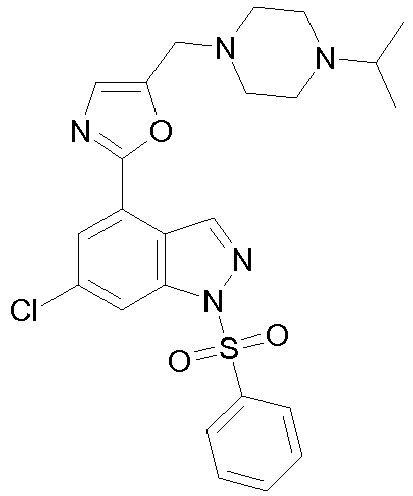
1-(1-methylethyl)pi perazine 0.77 500 - (2R, 6S)-2,6-dimethylmorpholine (160 ml) and then triethylamine (180 ml) were added to a suspension of 4-[5-(Bromomethyl)-1,3-oxazol-2-yl]-6-chloro-1-(phenylsulfonyl)-1H-indazole (478.1 g) in acetone (3.8 L) stirred under nitrogen at less than 25°C. The reaction mixture was stirred at 20-25°C for 2.5 hours and then water (3.8 L) was added. The resultant suspension was stirred at than 25°C for 35 min and was then filtered, washed with a mixture of 2:1v/v water:acetone (2 x 1.0L) and the solid dried under vacuum at 45±5°C to give the title compound as an off-white solid (500.5 g).
LCMS (Method B): Rt 3.43 min, MH+ 487. - All weights, volumes and equivalents are relative to 5-(bromomethyl)-2-(6-chloro-1-(phenylsulfonyl)-1H-indazol-4-yl)oxazole (corrected for assay).
- To a suspension of 5-(bromomethyl)-2-(6-chloro-1-(phenylsulfonyl)-1 H-indazol-4-yl)oxazole (1wt, 540 g) in acetone (8.7 vol, 4.7 L) is added 2,6-dimethylmorpholine (0.33 vol, 1.2 eq, 178 ml), followed by triethylamine (0.37 vol, 1.2 eq, 200 ml) at <25°C under a nitrogen atmosphere. The resulting mixture is stirred at 20-25°C for at least 0.5 hr, then monitored for completion by HPLC. Water (8.7 vol, 4.7 L) is then added to the mixture over
ca 5 minutes. The resulting suspension is aged at <25°C for at least 0.5 hr, then the solids are collected by vacuum filtration, washed with water/acetone (2:1 v/v, 2 x 2.2 vol, 2 x 1.2 L) and dried in vacuo with a nitrogen bleed at 45±5 °C. - Recrystallisation - All weights, volumes and equivalents are relative to ((2-(6-chloro-1-(phenylsulfonyl)-1H-indazol-4-yl)oxazol-5-yl)methyl)-cis-2,6-dimethylmorpholine. A stirred suspension of ((2-(6-chloro-1-(phenylsulfonyl)-1H-indazol-4-yl)oxazol-5-yl)methyl)-cis-2,6-dimethylmorpholine (1wt, 30 g) in DMSO (9 vol, 270 ml) is heated to 75-80 °C under a nitrogen atmosphere. The resulting clear solution is transferred to a crystallising vessel via a 5µm Domnick hunter in line filter, then the line is washed with further DMSO (1.0 vol, 30 ml). The hot solution is allowed to cool to 20-25°C over at least 2 hr, then the resulting suspension is aged at this temperature for at least 1 hr. The resulting solids are filtered, washed with DMSO (1.5vol, 45 ml), followed by water/acetone (2:1 v/v, 2 x 2 vol, 2 x 60 ml) before being sucked dry for 0.5 hr. The batch is dried in vacuo at 45°C to constant probe temperature to afford ((2-(6-chloro-1-(phenylsulfonyl)-1H-indazol-4-yl)oxazol-5-yl)methyl)-cis-2,6-dimethylmorpholine as an off-white solid.
- Isopropylpiperazine (165 ml) was added to a suspension of 4-[5-(Bromomethyl)-1,3-oxazol-2-yl]-6-chloro-1-(phenylsulfonyl)-1H-indazole (250.1 g) in dichloromethane (2.5 L) stirred under nitrogen at 22±3°C. The reaction mixture was stirred at 22±3°C for 1.25 hours and then water (2.5 L) was added, the mixture was stirred, then separated. The aqueous layer was extracted with further dichloromethane (0.5 L) and the organics combined and washed with water (2.5 L). The layers were separated and the organic concentrated to dryness, under vacuum, to give the title compound as a yellow solid (274.6 g).
LCMS (Method B): Rt 3.33 min,MH + 500. -

- To 5-bromo-2-(methyloxy)-3-pyridinamine (18.93 g, 93 mmol, available from Asymchem International) in a 1 L round-bottom flask was added nitrogen-purged 1,4-dioxane (500 ml) followed by 4,4,4',4',5,5,5',5'-octamethyl-2,2'-bi-1,3,2-dioxaborolane (47.4 g, 186 mmol), potassium acetate (27.5 g, 280 mmol) and dichloro{1,1'-bis(diphenylphosphino)ferrocene]palladium (II) dichloromethane adduct (7.61 g, 9.32 mmol). The mixture was then stirred at 80°C under nitrogen for 2 h. The reaction mixture was allowed to cool then partitioned between ethyl acetate and water and filtered through a Celite pad. The aqueous layer was extracted further with ethyl acetate (2X) and the combined organics washed with water, brine and dried over magnesium sulphate overnight. The mixture was filtered and the filtrate concentrated in vacuo to give a dark brown solid. The residue was purified by silica gel chromatography, eluting in 0-50% ethyl acetate/dichloromethane. The appropriate fractions were combined and evaporated to dryness and the residue triturated with cyclohexane. The resultant solid was filtered off and dried in vacuo to give the title compound as a light pink solid (11.1 g).
LCMS (Method A) Rt 0.91 mins, MH+ 251. -

- To a solution of 2-(methyloxy)-5-(4,4,5,5-tetramethyl-1,3,2-dioxaborolan-2-yl)-3-pyridinamine (0.5 g, 1.999 mmol) in pyridine (5 ml) was added methanesulphonyl chloride (0.309 ml, 4.00 mmol) and the mixture stirred at 20 °C for 18 hr then the solvent was removed in vacuo. The residue was partitioned between saturated sodium bicarbonate solution (10 ml) and dichloromethane (20 ml), separated by hydrophobic frit and purified by silica gel chromatography, eluting with a gradient of dichloromethane and methanol to give the title compound as a brown solid (0.46g).
LCMS (Method A): Rt 0.98mins, MH+ 329. -

- To a stirred solution of 2-(methyloxy)-5-(4,4,5,5-tetramethyl-1,3,2-dioxaborolan-2-yl)-3-pyridinamine (3 g, 12.00 mmol) in pyridine (12 ml), 2,4-difluorobenzenesulfonyl chloride (1.774 ml, 13.19 mmol) was added and the reaction mixture stirred at RT for 2 h. 2 N hydrogen chloride (aq) (20 ml) and dichloromethane (20 ml) were added and the layers separated. The aqueous layer was washed with additional dichloromethane (
2x 15 ml) and the organic layers combined, dried (hydrophobic frit) and evaporated in vacuo to give a brown oil. There was still some pyridine in the reaction mixture so 2M hydrogen chloride (aq) and dichloromethane (15 ml) were added to extract one more time. The solvent was removed in vacuo to give the title compound as an orange solid (4.3g).
LCMS (Method A): Rt 1.20 min, MH+ 427 [NB. also observe Rt 0.73 min, MH+ 345 consistent with boronic acid (hydrolysis product due to HPLC eluent)]. -

- To a solution of 6-chloro-4-(5-{[(2R,6S)-2,6-dimethyl-4-morpholinyl]methyl}-1,3-oxazol-2-yl)-1-(phenylsulfonyl)-1H-indazole (0.2 g, 0.411 mmol) and 2,4-difluoro-N-[2-(methoxy)-5-(4,4,5,5-tetramethyl-1,3,2-dioxaborolan-2-yl)-3-pyridinyl]benzenesulfonamide (0.228mg, 0.534 mmol) in 1,4-dioxane (2 ml) was added chloro[2'-(dimethylamino)-2-biphenylyl]palladium-1(1R,4S)-bicyclo[2.2.1]hept-2-yl[(1S,4R)-bicyclo[2.2.1]hept-2-yl]phosphane (11.5 mg, 0.021 mmol), potassium phosphate tribasic (0.262 g, 1.23 mmol) and water (0.2 ml). The reaction mixture was heated to 120°C with stirring for 3 h under microwave irradiation, then filtered through a silica SPE, eulting with methanol. The solvent was removed and the residue partitioned between dichloromethane (5 ml) and water (5 ml). The layers were separated and the aqueous extracted with further dichloromethane (2x 2.5 ml). The combined organics were concentrated under a stream of nitrogen and the residue dissolved in DMSO and a few drops of dichloromethane (3 ml) and purified by MDAP (method H) in 3 injections. The appropriate fractions were evaporated in vacuo to give the title compound as a pale brown solid (0.105 g).
LCMS (Method A): Rt 0.93 mins, MH+751. -

- To a solution of 6-chloro-4-(5-{[4-(1-methylethyl)-1-piperazinyl]methyl}-1,3-oxazol-2-yl)-1-(phenylsulfonyl)-1H-indazole (0.2 g, 0.40 mmol) and 2,4-difluoro-N-[2-(methoxy)-5-(4,4,5,5-tetramethyl-1,3,2-dioxaborolan-2-yl)-3-pyridinyl]benzenesulfonamide (0.222 g, 0.52 mmol) in 1,4-dioxane (2 ml) was added chloro[2'-(dimethylamino)-2-biphenylyl]palladium-1(1R,4S)-bicyclo[2.2.1]hept-2-yl[(1S,4R)-bicyclo[2.2.1]hept-2-yl]phosphane (11.2 g, 0.020 mmol), potassium phosphate tribasic (0.255 g, 1.20 mmol) and water (0.2 ml). The reaction mixture was heated to 120°C with stirring for 3 h under microwave irradiation then filtered through a silica SPE, eluting with methanol. The solvent was removed in vacuo and the residue partitioned between dichloromethane (5 ml) and water (5 ml). The layers were separated and the aqueous extracted with further dichloromethane (2x 2 ml). The combined organics were concentrated under a stream of nitrogen and the residue purified using silica gel chromatography, eluting with 0-25% methanol in dichloromethane. The appropriate fractions were evaporated in vacuo to give the title compound as a brown solid (0.081 g).
LCMS (Method A): Rt 0.85 mins, MH+764. -

- To a solution of ethyl 2-[6-chloro-1-(phenylsulfonyl)-1H-indazol-4-yl]-1,3-oxazole-5-carboxylate (1.5 g, 3.47 mmol) in 1,4-dioxane (15 ml) and water (1.5 ml) was added {1-[(1,1-dimethylethyl)(dimethyl)silyl]-1H-indol-4-yl}boronic acid (1.243 g, 4.52 mmol, available from Combi-Blocks Inc.), chloro[2'-(dimethylamino)-2-biphenylyl]palladium-1(1R,4S)-bicyclo[2.2.1]hept-2-yl[(1S,4R)-bicyclo[2.2.1]hept-2-yl]phosphane (0.097 g, 0.174 mmol) and potassium phosphate tribasic (2.212 g, 10.42 mmol). The reaction mixture was heated to 100°C for 3 h, the solvent removed in vacuo and the residue partitioned between dichloromethane (20 ml) and water (10 ml). Saturated sodium chloride solution (100 ml) was added and the organic phase separated and dried over anhydrous sodium sulphate. The crude product was purified by silica gel chromatography, eluting with a gradient of cyclohexane and ethyl acetate. The desired fractions were concentrated to give the title compound as a white solid (0.846 g), which by LCMS contained some unreacted starting material.
LCMS (Method A): Rt 1.71 mins, MH+627 (and Rt 1.39 min, MH+ 432 consistent with ethyl 2-[6-{1-[(1,1-dimethylethyl)(dimethyl)silyl]-1H-indol-4-yl}-1-(phenylsulfonyl)-1H-indazol-4-yl]-1,3-oxazole-5-carboxylate). -

- To a solution of ethyl 2-[6-{1-[(1,1-dimethylethyl)(dimethyl)silyl]-1H-indol-4-yl}-1-(phenylsulfonyl)-1H-indazol-4-yl]-1,3-oxazole-5-carboxylate (containing an impurity consistent with ethyl 2-[6-chloro-1-(phenylsulfonyl)-1H-indazol-4-yl]-1,3-oxazole-5-carboxylate)(0.84 g) in dichloromethane (10 ml) at -20°C was added diisobutylaluminium hydride (2.68 ml, 2.68 mmol, 1 M in hexanes). The reaction mixture was stirred at -20°C for 2 h then 10% ammonium chloride solution (10 ml) added. The mixture was stirred for 5 min then extracted with dichloromethane (10 ml), the layers separated (hydrophobic frit) and the organic purified by silica gel chromatography, eluting with a gradient of cyclohexane and ethyl acetate. The desired fractions were concentrated to give the title compound as a pale yellow solid (0.36 g), which by LCMS contained an impurity consistent with 2-[6-chloro-1-(phenylsulfonyl)-1H-indazol-4-yl]-1,3-oxazol-5-yl}methanol. LCMS (Method A): Rt 1.55 mins, MH+ 585 (and Rt 1.11 mins, MH+ 390 consistent with {2-[6-chloro-1-(phenylsulfonyl)-1H-indazol-4-yl]-1,3-oxazol-5-yl}methanol impurity).
-

- To a solution of 4-[5-(bromomethyl)-1,3-oxazol-2-yl]-6-chloro-1-(phenylsulfonyl)-1H-indazole (750 mg, 1.657 mmol) in dichloromethane (50 mL) stirred in air at room temp, was added neat 2,6-dimethylmorpholine (191 mg, 1.657 mmol, available from Aldrich as a mixture of isomers). The reaction mixture was stirred at 20 °C for 20 hr. Volatiles were removed using a rotary evaporator then the crude material was pre-absorbed onto Fluorosil™ and purified by column chromatography on silica (100g) using a 0-100% ethyl acetate-cyclohexane gradient over 60 mins. Two diastereoisomers were isolated. Appropriate fractions were combined and evaporated in vacuo to give the title compound as a yellow oil (226 mg).
1H NMR confirmed the structure as the trans isomer. 1H NMR (400MHz ,Chloroform-d) δ (ppm) 8.92 (d, J = 1.0 Hz, 1 H), 8.32 (dd, J = 1.0, 1.5 Hz, 1 H), 8.04 - 8.00 (m, 2 H), 7.97 (d, J = 1.5 Hz, 1 H), 7.62 (tt, J = 1.5, 7.5 Hz, 1 H), 7.54 - 7.48 (m, 2 H), 7.13 (s, 1 H), 4.08 - 3.99 (m, J = 3.5, 6.0, 6.5, 6.5, 6.5 Hz, 2 H), 3.66 (d, J = 14.5 Hz, 1 H), 3.61 (d, J = 14.5 Hz, 1 H), 2.56 (dd, J = 3.0, 10.5 Hz, 2 H), 2.23 (dd, J = 6.0, 10.5 Hz, 2 H), 1.24 (d, J = 6.5 Hz, 6 H). -

- 1,1-Dimethylethyl 1-piperazinecarboxylate (185 mg, 0.994 mmol) was dissolved in 1ml of DCM and triethylamine (0.185 mL, 1.325 mmol) was added dropwise. The mixture was stirred for 1 h, then concentrated in vacuo to afford a yellow solid. This was dissolved in water/DCM (1:1, 50ml) and the organic phase was collected then concentrated in vacuo to afford the title compound as a yellow gum (347mg).
LCMS (Method A) Rt 1.16 min (poor ionisation, (M+MeCN)+ 599 observed). -

- To a solution of 6-chloro-4-(5-{[(2R,6S)-2,6-dimethyl-4-morpholinyl]methyl}-1,3-oxazol-2-yl)-1-(phenylsulfonyl)-1H-indazole (0.20 g, 0.411 mmol) and N-[2-(methoxy)-5-(4,4,5,5-tetramethyl-1,3,2-dioxaborolan-2-yl)-3-pyridyl]methanesulfonamide (0.175 g, 0.534 mmol) in 1,4-dioxane (2 ml) was added chloro[2'-(dimethylamino)-2-biphenylyl]palladium-1(1R,4S)-bicyclo[2.2.1]hept-2-yl[(1S,4R)-bicyclo[2.2.1]hept-2-yl]phosphane (11.5 mg, 0.021 mmol), potassium phosphate tribasic (0.262 g, 1.23 mmol) and water (0.2 ml). The reaction mixture was heated and stirred at 120°C under microwave irradiation for 1 h. Additional chloro[2'-(dimethylamino)-2-biphenylyl]palladium-1(1R,4S)-bicyclo[2.2.1]hept-2-yl[(1S,4R)-bicyclo[2.2.1]hept-2-yl]phosphane (11.5 mg, 0.021 mmol) and potassium phosphate tribasic (80 mg) were added and the reaction heated to 120°C under microwave irradiation for 1 h. Additional potassium phospate tribasic (80 mg) was added and the reaction heated under the same conditions for a further 1 h. The reaction mixture was filtered through a silica SPE and eluted with methanol. The solvent was removed in vacuo and the residue partitioned between dichloromethane (5 ml) and water (5 ml). The layers were separated and the aqueous extracted with further dichloromethane (2x 2 ml). The combined organics were concentrated under a stream of nitrogen and the residue dissolved in MeOH:DMSO (3ml, 1:1, v/v) and purified by MDAP (method H) in 3 injections. The appropriate fractions were combined and concentrated to give a white solid which was dissolved in MeOH:DMSO (1ml, 1:1, v/v) and further purified by MDAP (method I). The appropriate fractions were basified to pH 6 with saturated sodium bicarbonate solution and extracted with ethyl acetate (
2x 25 ml). The combined organics were dried and evaporated in vacuo to give a white solid which was further dried under nitrogen at 40°C for 3 h to give the title compound as a white solid (26 mg).
LCMS (Method A): Rt 0.53 mins, MH+513. - N-[2-(Methyloxy)-5-(4,4,5,5-tetramethyl-1,3,2-dioxaborolan-2-yl)-3-pyridinyl]methanesulfonamide (101 g, 308 mmol), 6-chloro-4-(5-{[(2R,6S)-2,6-dimethyl-4-morpholinyl]methyl}-1,3-oxazol-2-yl)-1-(phenylsulfonyl)-1H-indazole (83.3 g, 154 mmol) and sodium bicarbonate (38.8 g, 462 mmol) were suspended in 1,4-dioxane (1840 ml) and water (460 ml) under nitrogen and heated to 80°C. Chloro[2'-(dimethylamino)-2-biphenylyl]palladium-1(1R,4S)-bicyclo[2.2.1]hept-2-yl[(1S,4R)-bicyclo[2.2.1]hept-2-yl]phosphane (8.63 g, 15.40 mmol) was added and the mixture stirred overnight at 80°C.
- The reaction mixture was cooled to 45°C, sodium hydroxide 2M aq. (770 ml, 1540 mmol) added and the reaction heated to 45 °C for 4 hours. The mixture was cooled to RT and diluted with water (610 mL). Dichloromethane (920 mL) was added, and the mixture was filtered twice through Celite (washed with 200 mL 1,4-dioxane/DCM 2:1 each time). The phases were separated, and aqueous washed with 1,4-dioxane/DCM 2:1 (500 mL). The aqueous phase was neutralised with hydrochloric acid to pH ∼7 and extracted with 1,4-dioxane/DCM 2:1 (1 L), then 1,4 dioxane/DCM 1:1 (2x500 mL). The organics were washed with brine (500 mL), and filtered through Celite (washed with 200 mL 1,4 dioxane/DCM 2:1), and evaporated to yield a dark black solid, which was purified in 4 batches:
- Batch 1: 28g was dissolved in Toluene/Ethanol/Ammonia 80:20:2 (100 mL) and purified by column chromatography (1.5 kg silica column), eluting with Toluene/Ethanol/Ammonia 80:20:2 to give the title compound as an off-white solid (14.78 g).
- Batch 2: 30g was dissolved in methanol and mixed with Fluorisil. The solvent was then removed by evaporation and the solid purified by column chromatography (1.5 kg silica column, solid sample injection module), eluting with Toluene/Ethanol/Ammonia 80:20:2 to give the title compound as an off-white solid (9.44 g).
- Batch 3: 31g was dissolved in Toluene/Ethanol/Ammonia 80:20:2 (100 mL) and purified by column chromatography (1.5 kg silica column), eluting with Toluene/Ethanol/Ammonia 80:20:2 to give the title compound as an off-white solid (17 g).
- Batch 4: 29g was dissolved in Toluene/Ethanol/Ammonia 80:20:2 (100 mL) and purified by column chromatography (1.5 kg silica column), eluting with Toluene/Ethanol/Ammonia 80:20:2 to give the title compound as an off-white solid (21 g).
- The mixed fractions from the 4 columns were combined and evaporated to yield 19 g which was dissolved in 200 mL of Toluene/Ethanol/Ammonia 80:20:2 (+ additional 4ml of 0.88 NH3 to help solubility) then purified by column chromatography (1.5 kg silica column), eluting with Toluene/Ethanol/Ammonia 80:20:2 to give the title compound as an off-white solid (6.1 g).
- All pure batches were combined (68 g) and recrystallised from ethanol (1200 mL). The suspension was heated to reflux and a solution formed. The resulting solution was then cooled to room temperature overnight. The resulting solid was then collected by filtration, washed sparingly with ethanol and dried under vacuum to give the title compound as an off-white solid (56 g). This material was recrystallised again from ethanol (1100 mL). The suspension was heated to reflux and a solution formed. The resulting solution was then cooled to room temperature overnight with stirring. The resulting solid was collected by filtration and washed sparingly with ethanol. The solid was dried in vacuo at 60°C for 5hrs to give the title compound as an off-white solid (45.51 g).
LCMS (Method A): Rt 0.61 mins, MH+ 513. - The filtrate from the two recrystallisations was evaporated to yield -23 g of a solid residue that was dissolved in 200 mL of Toluene/Ethanol/Ammonia 80:20:2 (+ additional 4ml of 0.88 NH3 to help solubility) then purified by column chromatography (1.5 kg silica column), eluting with Toluene/Ethanol/Ammonia 80:20:2 to give a further crop of the title compound as an off-white solid (18.5 g). This solid was then recrystallised from ethanol (370 mL). The suspension was heated to reflux then the resulting solution stirred for 20 mins before being allowed to cool to room temperature naturally overnight. The solid was then dried in vacuo at 65°C overnight to give the title compound as an off-white solid (11.90 g).
LCMS (Method A): Rt 0.62 mins, MH+ 513. - 10M Sodium hydroxide solution (0.70 ml) was added to a stirred suspension of N-[5-[4-(5-{[(2R,6S)-2,6-dimethyl-4-morpholinyl]methyl}-1,3-oxazol-2-yl)-1-(phenylsulfonyl)-1H-indazol-6-yl]-2-(methyloxy)-3-pyridinyl]methanesulfonamide (1.17 g) in water (5.8 ml). The resulting mixture was stirred at room temperature for 3.75 hours and was then washed with ethyl acetate (2 x 6 ml). The layers were separated and the aqueous phase was acidified to pH 6 with 2M hydrochloric acid (0.8 ml). The acidified aqueous layer was extracted twice with ethyl acetate (11 ml then 5 ml). The combined ethyl acetate extracts were dried by azeotropic distillation and diluted with further ethyl acetate (11 ml). The misture was stirred at room temperature for 112 hours. The slurry was seeded and then stirred at room temperature for 48 hours. The resultant suspension was filtered, washed with ethyl acetate (2 x 2 ml) and the solid dried under vacuum at 40°C to give the title compound as a pale yellow solid (0.58 g).
LCMS (Method B): Rt 1.86 min, MH+ 513. - To a suspension of N-[5-[4-(5-{[(2R,6S)-2,6-dimethyl-4-morpholinyl]methyl}-1,3-oxazol-2-yl)-1-(phenylsulfonyl)-1 H-indazol-6-yl]-2-(methyloxy)-3-pyridinyl]methanesulfonamide (596.5 g, 0.91 mol) in water (3.8 L) is added 5M sodium hydroxide (715 ml, 3.56 mol) over 20 mins at <25 °C. The mixture is stirred at 20±3 °C for 2 h 45 min then washed with EtCN (3 L). The pH of the basic aqueous phase is adjusted to pH 6.6 using 2M hydrochloric acid (1.4L), maintaining the temperature below 30 °C. The mixture is then extracted with MeTHF (2 x 4.8 L), and the combined MeTHF extracts are washed with water (1.2 L). The mixture is concentrated to approx 2.4 L and EtOAc (3 L) is added. This put and take distillation is repeated a further 3 times. The mixture is adjusted to 60±3 °C and seeded twice (2 x 3 g) 35 mins apart. The resultant is aged for 1
h 10 mins then cooled over 2 h to 20-25 °C, and aged for a further 15 h 50 min. The slurry is filtered, washed with EtOAc (2 x 1.2L) and dried in vacuo at 45±5 °C for approx 3 day to give the title compound. -

- To a solution of 6-chloro-4-(5-{[4-(1-methylethyl)-1-piperazinyl]methyl}-1,3-oxazol-2-yl)-1-(phenylsulfonyl)-1H-indazole (200 mg, 0.400 mmol) and N-[2-(methoxy)-5-(4,4,5,5-tetramethyl-1,3,2-dioxaborolan-2-yl)-3-pyridyl]methanesulfonamide (171 mg, 0.520 mmol) in 1,4-dioxane (2 ml) was added chloro[2'-(dimethylamino)-2-biphenylyl]palladium-1(1R,4S)-bicyclo[2.2.1]hept-2-yl[(1S,4R)-bicyclo[2.2.1]hept-2-yl]phosphane (11.2 mg, 0.020 mmol), potassium phosphate tribasic (255 mg, 1.20 mmol) and water (0.2 ml). The reaction mixture was heated and stirred at 120°C under microwave irradiation for 3 h. The reaction mixture was filtered through a silica SPE and eluted with methanol. The solvent was removed in vacuo and the residue partitioned between dichloromethane (5 ml) and water (5 ml). The layers were separated and the aqueous extracted with further dichloromethane (2x 2 ml). The combined organics were concentrated under a stream of nitrogen and the residue dissolved in MeOH:DMSO (2ml, 1:1, v/v) and purified by MDAP (method H) in 2 injections. The appropriate fractions were combined and concentrated and the residue dissolved in MeOH:DMSO (1 ml, 1:1, v/v) and further purified by MDAP (method I). The appropriate fractions were basified to pH 7 with saturated sodium bicarbonate solution and extracted with dichloromethane (
2x 20 ml). The combined organics were dried (hydrophobic frit) and concentrated to give the title compound as a white solid (22 mg).
LCMS (Method A): Rt 0.51 mins, MH+526. -

- N-[5-[4-(5-{[(2R,6S)-2,6-dimethyl-4-morpholinyl]methyl}-1,3-oxazol-2-yl)-1-(phenylsulfonyl)-1H-indazol-6-yl]-2-(methyloxy)-3-pyridinyl]-2,4-difluorobenzenesulfonamide (105 mg, 0.140 mmol) was suspended in isopropanol (2 ml) and 2M sodium hydroxide (aq) (0.699 ml, 1.399 mmol) added. The reaction mixture was stirred at RT for 2 h, the solvent removed under a stream of nitrogen and the residue dissolved in water (1 ml) and acidified to pH∼6 by the addition of 2M hydrogen chloride (aq)(a black precipitate formed). The suspension was extracted with dichloromethane (3x 2 ml) and the combined organics dried to give a brown solid. This was combined with the black precipitate which remained insoluble in the extraction, dissolved in MeOH:DMSO (1 ml, 1:1, v/v) and purified by MDAP (method H). The appropriate fractions were concentrated in vacuo to give the title compound as a white solid (20 mg).
LCMS (Method A): Rt 0.69 mins, MH+611. -
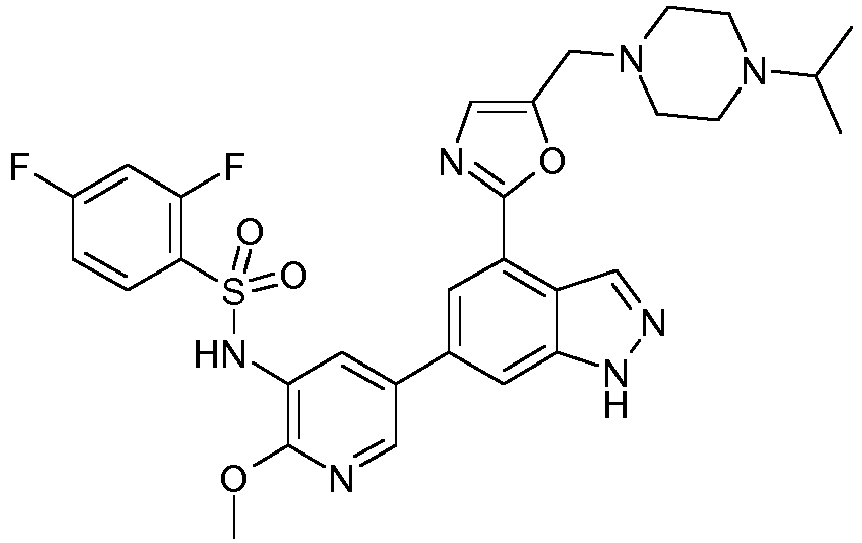
- 2,4-Difluoro-N-[5-[4-(5-{[4-(1-methylethyl)-1-piperazinyl]methyl}-1,3-oxazol-2-yl)-1-(phenylsulfonyl)-1H-indazol-6-yl]-2-(methyloxy)-3-pyridinyl]benzenesulfonamide (81 mg, 0.106 mmol) was suspended in isopropanol (2 ml) and 2M sodium hydroxide (aq) (0.53 ml, 1.060 mmol) was added. The reaction mixture was stirred at RT for 2 h, the solvent removed and the residue dissolved in water (1 ml) and acidified to pH∼6 by the addition of 2M hydrogen chloride (aq). The resultant suspension was extracted with dichloromethane (3x 2 ml), the organic layer separated (hydrophobic frit) and concentrated in vacuo to give a brown solid which dissolved in MeOH:DMSO (1ml, 1:1, v/v) and purified by MDAP (method H). The appropriate fractions were concentrated in vacuo to give the title compound as a white solid (45 mg).
LCMS (Method A): Rt 0.65 mins, MH+624. -

- To a solution of 6-chloro-4-(5-{[(2R,6S)-2,6-dimethyl-4-morpholinyl]methyl}-1,3-oxazol-2-yl)-1-(phenylsulfonyl)-1H-indazole (50 mg, 0.103 mmol) in 1,4-dioxane (1.5 ml) and water (0.15 ml) was added {1-[1,1,-dimethylethyl)(dimethl)silyl]1-Hindol-4-yl}boronic acid (37 mg, 0.133 mmol), chloro[2'-(dimethylamino)-2-biphenylyl]palladium-(1R,4S)-bicyclo[2.2.1]hept-2-yl[(1S,4R)-bicyclo[2.2.1]hept-2-yl]phosphane (5.75 mg, 10.27 µmol) and potassium phosphate tribasic (65 mg, 0.308 mmol). The reaction mixture was heated under microwave irradiation at 100°C for 40 min. The solvent was removed and the residue dissolved in 10% methanol in dichloromethane (2 ml) and purified by silica gel chromatography, eluting with a gradient of cyclohexane and ethyl acetate. The appropriate fractions were concentrated to give a brown gum which was treated directly with tetra-n-butylammonium fluoride (0.2 ml, 0.2 mmol, 1M in tetrahydrofuran) and allowed to stand at 20°C for 18 h. The solvent was removed and the residue dissolved in 1,4-dioxane (1 ml) and treated with 2M sodium hydroxide (1 ml) and allowed to stand at 20°C for 48 h. The solvent was removed and the residue triturated with 10% methanol in dichloromethane then purified by silica gel chromatography, eluting with a gradient of dichloromethane and methanol to give a pale brown solid which was further purified by SCX SPE (1 g), eluting with 0.5M ammonia in 1,4-dioxane. The solvent was removed and the residue further purified by MDAP to give the title compound as a white solid (14 mg).
LCMS (Method A): Rt 0.70 mins, MH+428. -

- 6-Chloro-4-(5-{[4-(1-methylethyl)-1-piperazinyl]methyl}-1,3-oxazol-2-yl)-1-(phenylsulfonyl)-1H-indazole (97 mg, 0.194 mmol), 4-(4,4,5,5-tetramethyl-1,3,2-dioxaborolan-2-yl)-1H-indole (61.3 mg, 0.252 mmol, available from Frontier Scientific Europe), chloro[2'-(dimethylamino)-2-biphenylyl]palladium-(1R,4S)-bicyclo[2.2.1]hept-2-yl[(1S,4R)-bicyclo[2.2.1]hept-2-yl]phosphane (10.87 mg, 0.019 mmol) and potassium phosphate tribasic (124 mg, 0.582 mmol) were dissolved in 1,4-dioxane (1 ml) and water (0.1 ml) and heated in a Biotage Initiator microwave at 100°C for 30 min. Additional 4-(4,4,5,5-tetramethyl-1,3,2-dioxabotolan-2-yl)-1 H-indole (61.3 mg, 0.252 mmol) and chloro[2'-(dimethylamino)-2-biphenylyl]palladium-(1R,4S)-bicyclo[2.2.1]hept-2-yl[(1S,4R)-bicyclo[2.2.1]hept-2-yl]phosphane (5 mg) were added and the reaction heated at 110°C for 30 min, then 140°C for 30 min. The solvent was removed in vacuo and the residue purified by silica gel chromatography, eluting with 0-25% methanol in dichloromethane. The appropriate fractions were combined and concentrated to give a brown solid which was dissolved in MeOH:DMSO (1ml, 1:1, v/v) and purified by MDAP (method H). The appropriate fractions were concentrated in vacuo to give the title compound as a white solid (30 mg).
LCMS (Method A): Rt 0.57 mins, MH+441. - 6-Chloro-4-(5-{[4-(1-methylethyl)-1-piperazinyl]methyl}-1,3-oxazol-2-yl)-1-(phenylsulfonyl)-1 H-indazole (75.17 g, 150 mmol), 4-(4,4,5,5-tetramethyl-1,3,2-dioxaborolan-2-yl)-1H-indole (73.1 g, 301 mmol), sodium bicarbonate (37.9 g, 451 mmol), and chloro[2'-(dimethylamino)-2-biphenylyl]palladium-(1R,4S)-bicyclo[2.2.1]hept-2-yl[(1S,4R)-bicyclo[2.2.1]hept-2-yl]phosphane (8.43 g, 15.03 mmol) were suspended in nitrogen purged 1,4-dioxane (1200 mL) and water (300 mL). The reaction vessel was placed under alternating vacuum and nitrogen five times with overhead stirring, then finally placed under a nitrogen atmosphere and heated to 120°C for 2.5 h.
- The reaction mixture was cooled to 45°C and then treated with 2M aqueous sodium hydroxide (376 mL, 752 mmol). After stirring at 45°C overnight (∼ 13h), the mixture was cooled to RT and DCM (600 ml) and water (400 ml) were added. The layers were separated and the aqueous re-extracted with DCM:1,4-dioxane (1:1). Brine was added and the mixture filtered through Celite, washing with DCM:1,4-dioxane (1:1). The layers were separated and 2M HCl (1000 ml) added to the organic. The mixture was again filtered through Celite washing with 500 ml 2M HCl keeping the washings separate. The filtrate layers were then separated and the organic layer was washed with the acid washings from the Celite. Layers were separated and the acidic aqueous combined. This was then back-washed with 2x500 ml of DCM; each wash requiring a Celite filtration. The acidic aqueous was then given a final filtration through Celite washing the Celite pad with 150 ml of 2M HCl.
- The acidic aqueous was transfered to a beaker (5000 ml) and with vigorous stirring 2M NaOH was added to basify the mixture to pH 10-11. The mixture was then extracted using 1,4-dioxane:DCM (1:1) (5 x 500 ml). The combined organics were washed with brine, dried over magnesium sulphate, filtered and evaporated to yield a brown foam that was dried in vacuo at 50°C overnight.
- This material was split into three batches and each was purified by reverse phase column chromatography (3x 1.9 kg C18 column), loading in DMF/TFA (1:1, 30 ml) then eluting with 3-40% MeCN in Water + 0.25% TFA (Note: Columns 2 & 3 used a different gradient starting with 10% MeCN).
- Appropriate fractions were combined, the acetotnitrile removed in vacuo and the acidic aqueous basified to pH10 by addition of saturated aqueous sodium carbonate solution to the stirred solution. The resultant solid was collected by filtration, washed with water then dried in vacuo at 65°C overnight to give the title compound (28.82 g) as a pale brown foam.
LCMS (Method A): Rt 0.68 mins, MH+ 441.
1H NMR (400MHz ,DMSO-d6) d = 13.41 (br. s., 1 H), 11.35 (br. s., 1 H), 8.59 (br. s., 1 H), 8.07 (d, J = 1.5 Hz, 1 H), 7.90 (br. s., 1 H), 7.51 - 7.44 (m, 2 H), 7.32 (s, 1 H), 7.27 - 7.21 (m, 2 H), 6.61 - 6.58 (m, 1 H), 3.73 (br. s., 2 H), 2.64 - 2.36 (m, 9 H), 0.97 - 0.90 (m, 6 H) - Potassium hydroxide (145.6 g) was added to a suspension of 6-(1H-indol-4-yl)-4-(5-{[4-(1-methylethyl)-1-piperazinyl]methyl}-1,3-oxazol-2-yl)-1-(phenylsulfonyl)-1H-indazole (300.7 g) and cetyltrimethylammonium bromide (9.3 g) in tetrahydrofuran (6.0 L) and water (30 ml) stirring under nitrogen at ambient temperature. The mixture was heated at reflux for 17 hours and was then cooled to 20-25°C. Ethyl acetate (3.0 L) and water (3.0 L) were added, stirred for 10 minutes and then separated. The organic layer was extracted with hydrochloric acid (1 M, 1 x 3.0 L, 2 x 1.5L) and the acidic extracts combined and basified to ∼pH 8 by the addition of saturated sodium carbonate solution (2.1 L). After ageing for 30 minutes the resultant suspension was filtered, washed with water (300 ml) and the solid dried under vacuum at 65°C to give the title compound as a pale yellow solid (127.9 g).
LCMS (Method B): Rt 2.44 min, MH+ 441. -

- To a solution of {2-[6-{1-[(1,1-dimethylethyl)(dimethyl)silyl]-1H-indol-4-yl}-1-(phenylsulfonyl)-1H-indazol-4-yl]-1,3-oxazol-5-yl}methanol (containing an impurity consistent with 2-[6-chloro-1-(phenylsulfonyl)-1H-indazol-4-yl]-1,3-oxazol-5-yl}methanol) (350 mg) in dichloromethane (10 ml) was added carbon tetrabromide (397 mg, 1.197 mmol). The reaction mixture was cooled to 0°C and triphenylphosphine (314 mg, 1.197 mmol) as a solution in dichloromethane (2 ml) was added dropwise. The reaction mixture was allowed to warm to RT then the solvent partially removed and the solution purified directly by silica gel chromatography, eluting with a gradient of dichloromethane and ethyl acetate. The desired fractions were concentrated to give a brown solid (37 mg).
- To a solution of the solid (30 mg, 0.056 mmol) in dichloromethane (5 ml) was added morpholine (9.8 mg, 0.112 mmol) and the mixture stirred at 20°C for 18 h. The solvent was removed and the residue dissolved in 1,4-dioxane (2 ml) and 2M sodium hydroxide solution (1 ml, 2.0 mmol) added. The reaction mixture was stirred at 20°C for 18 h then the solvent removed and the residue triturated with 10% methanol in dichloromethane (1 ml) and purified by silica gel chromatography, eulting with a gradient of dichloromethane and dichloromethane + 1% ammonia in methanol. The desired fractions were concentrated and purified by MDAP to give the title compound as a brown solid (3 mg).
LCMS (Method A): Rt 0.65 mins, MH+400. -

- To a solution of 6-chloro-4-(5-{[(2R,6R)-2,6-dimethyl-4-morpholinyl]methyl}-1,3-oxazol-2-yl)-1-(phenylsulfonyl)-1 H-indazole (109.5 mg, 0.225 mmol), N-[2-(methyloxy)-5-(4,4,5,5-tetramethyl-1,3,2-dioxaborolan-2-yl)-3-pyridinyl]methanesulfonamide (148 mg, 0.450 mmol) and sodium bicarbonate (56.7 mg, 0.675 mmol) in 1,4-Dioxane (5 mL) and Water (1.5mL) stirred in air at room temp was added solid Solvias Catalyst (12.60 mg, 0.022 mmol). The reaction mixture was stirred at 120 °C for 2 hr. After this time, sodium hydroxide solution (2N, 0.5 mL) was added and the reaction mixture left to stir at room temperature for two hours. On cooling, the reaction mixture was passed through a celite cartridge (10g) and washed with ethyl acetate. The resulting solution was evaporated and the crude residue purified by MDAP (Method J). Appropriate fractions were combined and concentrated in vacuo to afford the title compound (43 mg).
LCMS (Method A) Rt 0.63 mins, MH+ 513. -

- 1,1-Dimethylethyl 4-({2-[6-chloro-1-(phenylsulfonyl)-1H-indazol-4-yl]-1,3-oxazol-5-yl}methyl)-1-piperazinecarboxylate (303mg, 0.543 mmol), 4-(4,4,5,5-tetramethyl-1,3,2-dioxaborolan-2-yl)-1 H-indole (172 mg, 0.706 mmol, available from Frontier Scientific), chloro[2'-(dimethylamino)-2-biphenylyl]palladium - (1R,4S)-bicyclo[2.2.1]hept-2-yl[(1S,4R)-bicyclo[2.2.1]hept-2-yl]phosphane (1:1) (30 mg, 0.054 mmol, available from Fluka) and tripotassium phosphate (346 mg, 1.629 mmol) were dissolved in 1,4-Dioxane (10 mL) and Water (2.5 mL). The reaction vessel was sealed and heated in Biotage Initiator microwave at 150 °C for 30 min. Aqueous 2M NaOH (5 ml) was then added and the mixture stirred for 2 hours. An additional portion of aqueous 2M NaOH (3ml) was added and stirring continued until deprotection appeared complete by LCMS analysis. DCM was then added and the mixture was passed through a phase separator. The organic phase was collected. The aqueous phase was back extracted with DCM then the organic phases were combined and evaporated to give a brown oil. This was dissolved in 5ml of 4M HCl in 1,4 dioxane and left stirring. The mixture was concentrated in vacuo and the resultant solid partitioned between DCM and 2M acqueous HCl. The aqueous phase was basified with 2M aquous NaOH, then washed with DCM. The organic phase was concentrated in vacuo, then the residue dissolved in 2ml DMSO/MeOH (1:1) and purified by MDAP (Method H). Combining appropriate fractions and concentrating by blow down under nitrogen at 40°C, afforded the title compound (43mg).
LCMS (Method A) Rt 0.62 mins, MH+ 399. -

- A solution of 6-(1H-indol-4-yl)-4-(5-{[4-(1-methylethyl)-1-piperazinyl]methyl}-1,3-oxazol-2-yl)-1H-indazole in tetrahydrofuran (THF) (7.5 mL) was heated to 60°C under nitrogen. 2M hydrochloric acid in diethyl ether (0.567 mL, 1.135 mmol) and tetrahydrofuran (THF) (0.5 mL) were mixed and added via a dropping funnel. The solution was stirred at 60°C for 30 mins before being slowly cooled to RT. After stirring at RT for a further 30mins the solid was filtered off, then recombined with the liquors and evaporated to dryness. THF (10 mL) was added and the slurry was cycled from RT to reflux 3 times (30mins hold at higher/low temp). The slurry was stirred at RT for one hour then filtered under vacuum and the resultant solid dried in a vacuum oven at 50°C overnight to give the title compound as a an off-white solid (322 mg).
LCMS (Method A): Rt 0.66 mins, MH+ 441.1H NMR (400MHz ,DMSO-d6) d= 13.53 (s, 1 H), 11.44 (br. s., 1 H), 10.20 (br. s., 1 H), 8.61 (s, 1 H), 8.08 (s, 1 H), 7.92 (s, 1 H), 7.52 - 7.46 (m, 2 H), 7.41 (s, 1 H), 7.28 - 7.19 (m, 2 H), 6.60 (br. s., 1 H), 3.87 (s, 2 H), 3.41 - 3.32 (m, 3 H+, obscured by H2O), 3.10 - 2.93 (m, 4 H), 2.71 - 2.58 (m, 2 H), 1.23 (d, J = 6.5 Hz, 6 H). -

- 6-(1H-Indol-4-yl)-4-(5-{[4-(1-methylethyl)-1-piperazinyl]methyl}-1,3-oxazol-2-yl)-1H-indazole (19.4 mg, 0.044 mmol) was dissolved in tetrahydrofuran (THF) (0.5 ml) and 4M HCl in dioxane (0.022 ml, 0.088 mmol) added. The mixture was stirred at RT for 2 h, then the cream precipitate formed was filtered off and dried in a vacuum oven overnight to give the title compound as a beige solid (15.5 mg).
LCMS (Method A): Rt 0.65 mins, MH+ 441.
1H NMR (600MHz ,DMSO-d6) d = 13.47 (br. s., 1 H), 11.38 (br. s., 1 H), 10.17 (br. s., 1 H), 8.66 (s, 1 H), 8.13 (s, 1 H), 7.93 (s, 1 H), 7.51 (br. s., 1 H), 7.49 (dt, J = 1.0, 7.5 Hz, 1 H), 7.47 (t, J = 3.0 Hz, 1 H), 7.25 (t, J = 7.0 Hz, 1 H), 7.23 (dd, J = 1.5, 7.0 Hz, 1 H), 6.60 (ddd, J = 1.0, 2.0, 3.0 Hz, 1 H), 4.17 (br. s., 2 H), 3.50 - 3.39 (m, 3 H), 3.35 - 3.25 (m, 2 H), 3.22 - 3.11 (m, 2 H), 2.99 - 2.76 (m, 2 H), 1.24 (d, J = 6.5 Hz, 6 H). -

- N-[5-[4-(5-{[(2R,6S)-2,6-dimethyl-4-morpholinyl]methyl}-1,3-oxazol-2-yl)-1H-indazol-6-yl]-2-(methyloxy)-3-pyridinyl]methanesulfonamide (113 mg, 0.220 mmol) was suspended in water (18 ml) and (R)-mandelic acid (0.33M solution in water, 735 µl, 0.242 mmol) was added. The mixture was stirred at RT overnight then concentrated and dried in a vacuum oven at 50°C overnight to give the title compound as a white solid (133 mg).
LCMS (Method A): Rt 0.60 mins, MH+ 513.
1H NMR (400MHz ,DMSO-d6) d = 13.53 (br. s., 1 H), 9.43 (s, 1 H), 8.58 (s, 1 H), 8.43 (d, J = 2.5 Hz, 1 H), 7.99 (d, J = 2.5 Hz, 1 H), 7.93 (d, J = 1.5 Hz, 1 H), 7.89 (s, 1 H), 7.36 (s, 1 H), 7.43 - 7.24 (m, 5 H), 5.01 (s, 1 H), 3.99 (s, 3 H), 3.75 (s, 2 H), 3.63 - 3.52 (m, 2 H), 3.11 (s, 3 H), 2.81 (d, J = 10.5 Hz, 2 H), 1.78 (t, J = 10.5 Hz, 2 H), 1.04 (d, J = 6.5 Hz, 6 H). - Note - mandelate only present at a molar ratio of 0.8.
- N-[5-[4-(5-{[(2R,6S)-2,6-dimethyl-4-morpholinyl]methyl}-1,3-oxazol-2-yl)-1H-indazol-6-yl]-2-(methyloxy)-3-pyridinyl]methanesulfonamide (3.17 mg) was suspended in 5% dextrose/water (3 ml). A 100 mg/ml aqueous solution of (R)-mandelic acid (10 µl) was added and the mixture stirred for 45 min to give the title compound as a clear solution.
- The data were acquired on a PANalytical X'Pert Pro powder diffractometer, model PW3040/60, serial number DY1850 using an X'Celerator detector. The acquisition conditions were: radiation: Cu Kα, generator tension: 40 kV, generator current: 45 mA, start angle: 2.0 °2θ□, end angle: 40.0 °□2θ, step size: 0.0167 °2θ, time per step: 31.75 seconds. The sample was prepared by mounting a few milligrams of sample on a Si wafer (zero background) plates, resulting in a thin layer of powder.
- The X-ray powder diffraction (XRPD) data are shown in
Figure 1 . -
Table 1 2θ/° d-spacing / Å 5.2 17.0 10.3 8.6 12.8 6.9 14.8 6.0 15.1 5.9 15.6 5.7 16.8 5.3 17.2 5.2 18.3 4.9 19.6 4.5 20.9 4.2 21.3 4.2 21.7 4.1 23.2 3.8 24.0 3.7 24.9 3.6 26.0 3.4 27.1 3.3 27.5 3.2 28.2 3.2 28.5 3.1 - The data were acquired using a similar method to that described above.
- The X-ray powder diffraction (XRPD) data for Form (I) are shown in
Figure 2 . - Characteristic peaks for the solid state form are summarised in Table 2 with calculated lattice spacings. Peak positions were measured using Highscore software.
Table 2 2θ /° d-spacing / Å 4.5 19.8 6.3 13.9 7.8 11.3 8.8 10.1 9.9 8.9 10.4 8.5 10.7 8.3 11.3 7.8 11.7 7.5 12.2 7.3 12.9 6.9 14.0 6.3 14.5 6.1 15.2 5.8 15.4 5.7 16.1 5.5 16.5 5.4 16.8 5.3 17.7 5.0 17.9 5.0 18.5 4.8 19.0 4.7 20.7 4.3 21.4 4.1 22.4 4.0 22.6 3.9 23.4 3.8 23.7 3.8 24.9 3.6 25.4 3.5 25.7 3.5 - Ethyl acetate (15ml) was added to N-[5-[4-(5-{[(2R,6S)-2,6-dimethyl-4-morpholinyl]methyl}-1,3-oxazol-2-yl)-1H-indazol-6-yl]-2-(methyloxy)-3-pyridinyl]methanesulfonamide (2.1 g) and was stirred at ambient conditions overnight. The resultant slurry was filtered and dried under vacuum at 50°C to give a new solid state form (91%w/w).
1H NMR (400MHz, DMSO d6) d = 13.49 (br s, 1H), 9.39 (s, 1H), 8.58 (s, 1H), 8.42 (d, J = 2.2Hz, 1 H), 7.99 (d, J = 2.2Hz, 1 H), 7.93 (d, J=1.2Hz, 1 H), 7.88 (s, 1 H), 7.35 (s, 1 H), 4.00 (s, 3H), 3.74 (s, 2H), 3.58 (m, 2H), 3.11 (s, 3H), 2.80 (d, J = 10.3Hz, 2H), 1.78 (t, J = 10.3Hz, 2H), 1.05 (d, J = 6.4Hz, 6H) - Methanol (4ml) was added to N-[5-[4-(5-{[(2R,6S)-2,6-dimethyl-4-morpholinyl]methyl}-1,3-oxazol-2-yl)-1H-indazol-6-yl]-2-(methyloxy)-3-pyridinyl]methanesulfonamide (0.3g) followed by fumaric acid (0.0764g) in methanol (2ml). The resultant suspension was diluted further with methanol (3ml) and stirred overnight at ambient conditions. The suspension was filtered, washed with methanol and air dried to give a new solid state form (64%w/w).
1H NMR (400MHz, DMSO d6) d = 13.50 (br s, 1H), 9.39 (s, 1H), 8.58 (s, 1H), 8.42 (d, J = 2.2Hz, 1 H), 7.99 (d, J = 2.2Hz, 1 H), 7.93 (d, J=1.2Hz, 1 H), 7.88 (s, 1 H), 7.35 (s, 1 H), 4.00 (s, 3H), 3.74 (s, 2H), 3.58 (m, 2H), 3.11 (s, 3H), 2.80 (d, J = 10.3Hz, 2H), 1.78 (t, J = 10.5Hz, 2H), 1.05 (d, J = 6.4Hz, 6H) - Tetrahydrofuran was saturated with N-[5-[4-(5-{[(2R,6S)-2,6-dimethyl-4-morpholinyl]methyl}-1,3-oxazol-2-yl)-1H-indazol-6-yl]-2-(methyloxy)-3-pyridinyl]methanesulfonamide at room temperature and heated. The suspension was cooled to room temperature and solids filtered, washed with THF and dried under vacuum at 30°C to give a new solid state form.
1H NMR (400MHz, DMSO d6) d = 13.50 (br s, 1H), 9.39 (s, 1H), 8.58 (s, 1H), 8.41 (d, J = 2.0Hz, 1 H), 7.98 (d, J = 2.2Hz, 1 H), 7.93 (d, J=0.7Hz, 1 H), 7.88 (s, 1 H), 7.35 (s, 1 H), 4.00 (s, 3H), 3.74 (s, 2H), 3.58 (m, 2.4H), 3.11 (s, 3H), 2.80 (d, J = 10.5Hz, 2H), 1.78 (t, J = 10.5Hz, 2.4H), 1.05 (d, J = 6.1 Hz, 6H)
Sample contains 0.2 molar equivalents tetrahydrofuran - The data were acquired on a PANalytical X'Pert Pro powder diffractometer, model PW3040/60 using an X'Celerator detector. The acquisition conditions were: radiation: Cu Kα, generator tension: 40 kV, generator current: 45 mA, start angle: 2.0° 2θ, end angle: 40.0° 2θ, step size: 0.0167° 2θ, time per step: 31.75 seconds. The sample was prepared by mounting a few milligrams of sample on a silicon wafer (zero background) plate, resulting in a thin layer of powder.
- Form (III) was lightly ground with pestle and mortar to reduce preferred orientation.
- The XRPD data are shown in
Figure 3 . - Characteristic XRPD angles and d-spacings for the solid state form are summarised in Table 3. Peak positions were measured using Highscore software.
Table 3 2θ /° d-spacing / Å 4.6 19.1 9.2 9.6 11.4 7.8 12.1 7.3 12.7 7.0 13.7 6.5 14.0 6.3 16.0 5.5 17.1 5.2 17.9 5.0 18.5 4.8 18.8 4.7 22.3 4.0 20.8 4.3 23.8 3.7 25.9 3.4 - The XRPD data are shown in
Figure 4 . - Characteristic XRPD angles and d-spacings for the solid state form are summarised in Table 4. Peak positions were measured using Highscore software.
Table 4 2θ /° d-spacing / Å 6.7 13.2 8.2 10.8 8.8 10.0 9.7 9.1 11.1 8.0 12.6 7.0 13.6 6.5 14.4 6.1 17.0 5.2 17.7 5.0 18.8 4.7 20.9 4.2 21.3 4.2 22.8 3.9 24.4 3.6 25.3 3.5 - The XRPD data are shown in
Figure 5 . - Characteristic XRPD angles and d-spacings for the solid state form are summarised in Table 5. Peak positions were measured using Highscore software.
Table 5 2θ / ° d-spacing / Å 5.8 15.2 11.1 8.0 11.6 7.6 14.0 6.3 17.5 5.1 19.3 4.6 22.3 4.0 25.7 3.5 - Methanol (2ml) was added to N-[5-[4-(5-{[(2R,6S)-2,6-dimethyl-4-morpholinyl]methyl}-1,3-oxazol-2-yl)-1H-indazol-6-yl]-2-(methyloxy)-3-pyridinyl]methanesulfonamide (0.3g) followed by aqueous sodium hydroxide (0.129ml) to give a solution. Tert-butylmethylether (4ml) was added to the solution followed by seed crystals of the sodium salt and this suspension was stirred overnight at ambient conditions. The suspension was filtered, washed with tert-butylmethylether (2ml) and air dried to give the sodium salt (0.2312g) as a hydrate.
NMR: Consistent with salt formation
1H NMR (400MHz, DMSO d6) d = 13.35 (br s, 1 H), 8.53 (s, 1H),7.90 (d, J = 1.2Hz, 1 H), 7.73 (s, 1 H), 7.65 (d, J=2.5Hz, 1 H), 7.62 (d, J = 2.2Hz, 1 H), 7.33 (s, 1 H), 4.00 (s, 3H), 3.80 (s, 3H), 3.59 (m, 2H), 2.83 (d, J = 10.3, 2H), 2.61 (s,3H), 1.78 (t, J = 10.5Hz, 2H), 1.05 (d, J = 6.1Hz, 6H) - A solution of N-[5-[4-(5-{[(2R,6S)-2,6-dimethyl-4-morpholinyl]methyl}-1,3-oxazol-2-yl)-1H-indazol-6-yl]-2-(methyloxy)-3-pyridinyl]methanesulfonamide (0.3g) in tetrahydrofuran (3ml) was added to p-toluenesulfonic acid (0.1224g) to give initially a solution. A suspension formed on stirring and was diluted with tetrahydrofuran (2ml) and stirred overnight at ambient conditions. The suspension was filtered, washed with tetrahydrofuran (2ml) and air dried to give the tosylate (0.3759g).
NMR: Consistent with mono tosylate formation
1H NMR (400MHz, DMSO d6) d = 13.56 (br s, 1H),10.38 (br s, 1 H), 9.43 (s, 1 H), 8.69 (s, 1 H), 8.43 (d, J = 2.5Hz, 1 H), 8.03 (s, 1 H), 7.99 (d, J = 2.2Hz, 1 H), 7.96 (s, 1 H), 7.69 (s, 1 H), 7.46 (d, J = 7.8Hz, 2H), 7.11 (d, J = 7.8Hz, 2H), 4.69 (br s, 2H), 4.00 (s, 3H), 3.80 (br s, 2H), 3.50 (br s, 2H), 3.11 (s, 3H), 2.80 (br s, 2H), 2.28 (s, 3H), 1.05 (d, J = 6.1 Hz, 6H) Sample contains 0.5 molar equivalents tetrahydrofuran NMR signals 3.60 (m, 2H), 1.76 (m,2H) - Methanol (4ml) was added to N-[5-[4-(5-{[(2R,6S)-2,6-dimethyl-4-morpholinyl]methyl}-1,3-oxazol-2-yl)-1H-indazol-6-yl]-2-(methyloxy)-3-pyridinyl]methanesulfonamide (0.3g) followed by maleic acid (0.0749g) in methanol (2ml). The solution was allowed to crystallise overnight at ambient conditions. The resultant suspension was filtered, washed with methanol (1 ml) and air dried to give the maleate (0.1441 g).
NMR: Consistent with mono maleate formation
1H NMR (400MHz, DMSO d6) d = 13.53 (br s, 1H),9.41 (s, 1H), 8.63 (s, 1H), 8.42 (d, J = 2.4Hz, 1H), 7.99 (d, J = 2.4Hz, 1H), 7.98 (d, J=1.2Hz, 1H), 7.92 (s, 1H), 7.51 (s, 1H),6.16 (s, 2H), 4.16 (br s, 2H), 4.00 (s, 3H), 3.69 (br s, 2H)*, 3.11 (s + br s, 3H + 2H), 2.22 (br s, 2H), 1.10 (d, J = 6.4Hz, 6H)
*Partial increase in integral due to overlap with broad HOD peak - Tetrahydrofuran (1ml) was added to pamoic acid (0.0759g) to give a suspension. This suspension was added to N-[5-[4-(5-{[(2R,6S)-2,6-dimethyl-4-morpholinyl]methyl}-1,3-oxazol-2-yl)-1H-indazol-6-yl]-2-(methyloxy)-3-pyridinyl]methanesulfonamide (0.2g). Further tetrahydrofuran (7ml) and water (12ml) were added before the solution was reduced in volume by ca. 10% under a nitrogen flow. The resultant suspension was sonicated and stirred at ambient conditions overnight. The suspension was filtered, washed with water and dried under vacuum at 50°C to give the hemi pamoate (0.092g) containing 5%w/w water.
NMR: Consistent with hemi pamoate formation
1H NMR (400MHz, DMSO d6) d = 13.51 (br s, 1H), 9.40 (s, 1H), 8.60 (s, 1H), 8.42 (m, 2H), 8.13 (d, J = 8.8Hz, 1 H), 7.99 (d, J = 2.2Hz, 1 H), 7.95 (s, 1 H), 7.90 (s, 1 H), 7.85 (d, J = 8.0Hz, 1H), 7.42 (s, 1H), 7.33 (t, J = 7.3Hz, 1H), 7.18 (t, J = 7.1Hz, 1H), 4.78 (s, 1H), 4.00 (s, 3H), 3.92 (br s, 2H), 3.63 (m, 2H), 3.11 (s, 3H), 2.95 (d, J = 11.0Hz, 2H), 1.97 (m, 2H), 1.07 (d, J = 6.4Hz, 6H) - Isopropylacetate (12ml) was added to N-[5-[4-(5-{[(2R,6S)-2,6-dimethyl-4-morpholinyl]methyl}-1,3-oxazol-2-yl)-1H-indazol-6-yl]-2-(methyloxy)-3-pyridinyl]methanesulfonamide (0.2g) followed by naphthalenedisulfonic acid (0.0703g) in isopropylacetate (2ml). The suspension was stirred at ambient temperature for 9 days prior to filtration and dryed under vacuum at 40°C for 3hrs to give the hemi napthalenedisulfonate.
NMR Consistent with hemi naphthalenedisulfonate formation
1H NMR (400MHz, DMSO d6) d = 13.56 (br s, 1H), 10.38 (br s, 1H), 9.42 (s, 1H), 8.85 (d, J = 8.8Hz, 1 H), 8.69 (s, 1 H), 8.43 (d, J = 2.5, 1 H), 8.03 (s, 1 H), 7.99 (d, J = 2.2Hz, 1 H), 7.96 (s, 1 H), 7.93 (d, J = 7.1 Hz, 1 H), 7.69 (br s, 1 H), 7.40 (t, J = 7.8Hz, 1 H), 4.68 (br s, 2H), 4.00 (s, 3H), 3.80 (br s, 2H), 3.50 (br s, 2H), 3.11 (s, 3H), 2.80 (br s, 2H), 1.15 (d, J = 6.1 Hz, 6H)
Integrals at 4.68 and 2.80 are only at 1.6H not the expected 2H
Extra peaks due to ca. 0.1 eq isopropylacetate.
Raman: Not consistent with freebase forms known - A solution of mesitylenesulfonic acid dihydrate (0.0698g, 0.295mmol, 1.0eq) in tetrahydrofuran (0.5ml) was added to N-[5-[4-(5-{[(2R,6S)-2,6-dimethyl-4-morpholinyl]methyl}-1,3-oxazol-2-yl)-1H-indazol-6-yl]-2-(methyloxy)-3-pyridinyl]methanesulfonamide (0.1505g, 0.294mmol) and sonicated to give a clear solution. After stirring at ambient temperature for ca. 2mins the solution had formed a very thick suspension. This was held at ambient temperature overnight. The solids were collected by filtration and washed with tetrahydrofuran (1-2ml) before being dried in vacuo at 50°C overnight to give the mesitylenesulfonate salt (0.1399g, 66.8%th).
NMR: consistent with salt formation
NMR (400MHz, DMSO d6) d = 13.56 (s, 1 H), 10.39 (bs, 1 H), 9.42 (s, 1 H), 8.69 (s, 1 H), 8.43 (d, J = 2.2Hz, 1 H), 8.03 (s, 1 H), 7.99 (d, J = 2.2Hz, 1 H), 7.96 (s, 1 H), 7.69 (s, 1 H), 6.73 (s, 2H), 4.69 (bs, 2H), 4.01 (s, 3H), 3.81 (bs, 2H), 3.49 (bs, 4H), 3.11 (s, 3H), 2.79 (bs, 2H), 2.16 (s, 3H), 1.15 (d, J = 6.1 Hz, 6H).
Two methyl groups from mesitylenesulfonic acid are not seen as they overlap with resonance from d5H-DMSO. - A solution of biphenyldisulfonic acid (0.0465g, 0.148mmol, 0.5eq) in tetrahydrofuran (0.2ml) and water (0.2ml) was added to N-[5-[4-(5-{[(2R,6S)-2,6-dimethyl-4-morpholinyl]methyl}-1,3-oxazol-2-yl)-1H-indazol-6-yl]-2-(methyloxy)-3-pyridinyl]methanesulfonamide (0.1506g, 0.294mmol) and sonicated to give a solution which was stirred at ambient temperature overnight. After this time the solution set solid due to a precipitate. These solids were collected by filtration and washed with tetrahydrofuran (1-2ml) before being dried in vacuo at 50°C overnight to give the hemi-biphenyldisulfonate salt (0.117g, 59.5%th)
NMR: consistent with salt formation
NMR (400MHz, DMSO d6) d = 13.55 (s, 1 H), 10.37 (bs, 1 H), 9.42 (s, 1 H), 8.69 (s, 1 H), 8.43 (d, J = 2.2Hz, 1 H), 8.03 (s, 1 H), 7.99 (d, J = 2.2Hz, 1 H), 7.96 (s, 1 H), 7.66 (s + d, J = 8.1 Hz , 1 H + 2H), 7.61 (d, J = 8.3Hz, 2H), 4.69 (bs, 2H), 4.01 (s, 3H), 3.81 (bs, 2H), 3.50 (bs, 4H), 3.11 (s, 3H), 2.79 (bs, 2H), 1.16 (d, J = 6.1Hz, 6H). - N-[5-[4-(5-{[(2R,6S)-2,6-Dimethyl-4-morpholinyl]methyl}-1,3-oxazol-2-yl)-1H-indazol-6-yl]-2-(methyloxy)-3-pyridinyl]methanesulfonamide (0.200g, 0.390mmol) was dissolved in tetrahydrofuran (3.2ml) and water (0.8ml). Separately, 2-naphthalenesulfonic acid (0.081 mg, 0.390mmol, 1.0eq) was dissolved in tetrahydrofuran (0.8ml) and added to the N-[5-[4-(5-{[(2R,6S)-2,6-dimethyl-4-morpholinyl]methyl}-1,3-oxazol-2-yl)-1H-indazol-6-yl]-2-(methyloxy)-3-pyridinyl]methanesulfonamide solution. This was seeded with a previous napsylate salt, however these seeds dissolved. The solution was allowed to evaporate at ambient temperature for 2 days. The white solid formed was triturated in water and sonicated before being filtered and washed with water. The damp solids were dried further in vacuo at 40-50°C for 5 days to give the napsylate salt (254.8mg, 91 %th).
NMR: consistent with salt formation
NMR (400MHz, DMSO d6) d = 13.56 (s, 1 H), 10.38 (bs, 1 H), 9.42 (s, 1 H), 8.69 (s, 1 H), 8.43 (d, J = 2.2Hz, 1H), 8.15 (s, 1H), 8.03 (s, 1H), 8.00 (d, J = 2.0Hz, 1H), 7.96 (m, 2H), 7.86 (m, 2H), 7.71 (m, 2H), 7.53 (m, 2H), 4.68 (bs, 2H), 4.01 (s, 3H), 3.79 (bs, 2H), 3.50 (bs, 2H), 3.11 (s, 3H), 2.78 (bs, 2H), 1.14 (d, J = 6.1 Hz, 6H).
NMR also shows some unidentified low level impurities and residual tetrahydrofuran (0.1 molar equivalents). - N-[5-[4-(5-{[(2R,6S)-2,6-Dimethyl-4-morpholinyl]methyl}-1,3-oxazol-2-yl)-1H-indazol-6-yl]-2-(methyloxy)-3-pyridinyl]methanesulfonamide (0.02505g, 0.049mmol) was treated with trans-cinnamic acid (0.01453g, 0.098mmol, 2.0eq) in methanol (0.5ml). This was heated with a hot air gun until dissolution occurred then allowed to cool to room temperature. Solids precipitated on returning to room temperature and were allowed to stir overnight. The solids were filtered and solvent removed by pulling vacuum through the cake to give the salt.
- N-[5-[4-(5-{[(2R,6S)-2,6-Dimethyl-4-morpholinyl]methyl}-1,3-oxazol-2-yl)-1H-indazol-6-yl]-2-(methyloxy)-3-pyridinyl]methanesulfonamide (80g, 0.156mol) and trans-cinnamic acid (58.66g, 0.396mol, 2.5eq) were dissolved in methanol (3.2L) by heating to 65°C. The solution was cooled to 60°C and seeded with N-[5-[4-(5-{[(2R,6S)-2,6-dimethyl-4-morpholinyl]methyl}-1,3-oxazol-2-yl)-1H-indazol-6-yl]-2-(methyloxy)-3-pyridinyl]methanesulfonamide hemi-cinnamate (0.0802g), these dissolved so the solution was cooled further to 50°C and reseeded with N-[5-[4-(5-{[(2R,6S)-2,6-dimethyl-4-morpholinyl]methyl}-1,3-oxazol-2-yl)-1H-indazol-6-yl]-2-(methyloxy)-3-pyridinyl]methanesulfonamide hemi-cinnamate. This was stirred for 1hr at 50°C and then cooled at ~0.167°C/min to 20°C. After 2hrs a sample was taken and proved to be Form 3 by Raman analysis. The slurry was heated back to reflux to give a solution and extra methanol (100ml) was added to make up for solvent losses incurred during the extended high temperature process. The solution was cooled to 25°C and sample taken which was seeded with N-[5-[4-(5-{[(2R,6S)-2,6-dimethyl-4-morpholinyl]methyl}-1,3-oxazol-2-yl)-1H-indazol-6-yl]-2-(methyloxy)-3-pyridinyl]methanesulfonamide hemi-cinnamate. This seeded sample was aged for 20mins and then used to seed the bulk solution. This was allowed to stir at 25°C for 16hrs. The slurry was filtered and sucked dry before being dried in vacuo at 50°C to give the salt (75.4g, 82.5%th).
NMR: consistent with salt formation
NMR (400MHz, DMSO d6) d = 13.49 (bs, 1H), 9.40 (bs, 1H), 8.58 (s, 1H), 8.42 (d, J = 2.5Hz, 1 H), 7.99 (d, J = 2.2Hz, 1 H), 7.94 (s, 1 H), 7.88 (s, 1 H), 7.68 (m, 1 H), 7.57 (d, J = 16.1 Hz, 0.5H), 7.42 (m, 1.5H), 7.35 (s, 1 H), 6.55 (d, J = 15.9Hz, 0.5H), 4.01 (s, 3H), 3.74 (s, 2H), 3.58 (m, 2H), 3.12 (s, 3H), 2.80 (d, J = 10.5, 2H), 1.78 (t, J = 10.5, 2H), 1.05 (d, J = 6.1 Hz, 6H).
NMR also shows residual methanol (signal 3.18ppm) at <0.1 molar equivalents. - A solution of sebacic acid (118.6mg, 0.586mmol, 2.0eq) in THF (2ml) was made up and added to N-[5-[4-(5-{[(2R,6S)-2,6-dimethyl-4-morpholinyl]methyl}-1,3-oxazol-2-yl)-1H-indazol-6-yl]-2-(methyloxy)-3-pyridinyl]methanesulfonamide (150.6mg, 0.294mmol) and heated to give a clear solution. The solution was allowed to cool to room temperature with stirring and after 2hrs solids were present. A further aliquot of THF was added at this point and the suspension stirred overnight at ambient temperature. The solids were isolated by filtration and dried in vacuo at 50°C overnight to give the hemi-sebacate salt.
NMR: consistent with salt formation
NMR (400MHz, DMSO d6) d = 13.49 (s, 1 H), 11.94 (bs, 1 H), 10.38 (bs, 1 H), 9.38 (s, 1 H), 8.58 (s, 1 H), 8.42 (d, J = 2.2Hz, 1 H), 7.99 (d, J = 2.0Hz, 1 H), 7.93 (s, 1 H), 7.88 (s, 1 H), 7.35 (s, 1H), 4.00 (s, 3H), 3.74 (s, 2H), 3.11 (s, 3H), 2.80 (d, J = 10.5, 2H), 2.18 (t, J = 7.3Hz, 2H), 1.48 (t, J = 6.8Hz, 2H), 1.25 (s, 4H), 1.05 (d, J = 6.1Hz, 6H).
Sample contains 0.85 molar equivalents tetrahydrofuran - NMR signals 3.60ppm (m, 3.3H) and 1.76ppm (m, 3.4H). - A solution of pyromellitic acid (0.0546g, 0.215mmol, 0.55eq) was made up in tetrahydrofuran (1 ml) and added to N-[5-[4-(5-{[(2R,6S)-2,6-dimethyl-4-morpholinyl]methyl}-1,3-oxazol-2-yl)-1H-indazol-6-yl]-2-(methyloxy)-3-pyridinyl]methanesulfonamide (0.1999g, 0.390mmol) followed by further tetrahydrofuran (1ml). This suspension was sonicated at which point the solids changed physical character and set solid. A further aliquot of tetrahydrofuran (2ml) was added and the solution was heated and sonicated, however dissolution was not observed. The suspension was allowed to cool and stir overnight at room temperature. The solids were collected by filtration and washed with tetrahydrofuran (2ml) before drying in vacuo overnight at 50°C to give the hemi-pyromellitate salt as a tetrahydrofuran solvate.
NMR: consistent with salt formation
NMR (400MHz, DMSO d6) d = 13.52 (s, 1H), 9.39 (s, 1H), 8.61 (s, 1H), 8.42 (d, J = 2.2Hz, 1 H), 8.20 (s, 1 H), 7.99 (d, J = 2.2Hz, 1 H), 7.96 (s, 1 H), 7.91 (s, 1 H), 7.45 (s, 1 H), 4.01 (s, 5H), 3.60 (m, 6H), 3.11 (s, 3H), 3.02 (d, J = 10.8Hz, 2H), 2.06 (bs, 2H), 1.76 (m, 4H), 1.05 (d, J = 6.1 Hz, 6H).
Tetrahydrofuran signals are 3.60ppm (m, 4H) and 1.76ppm (M, 4H) corresponding to 1 molar equivalent. - 1,4-Benzenediacrylic acid (0.0431 g, 0.197mmol, 0.5eq) was dissolved in dimethylsulfoxide (0.5ml) with heating, this was added to N-[5-[4-(5-{[(2R,6S)-2,6-dimethyl-4-morpholinyl]methyl}-1,3-oxazol-2-yl)-1H-indazol-6-yl]-2-(methyloxy)-3-pyridinyl]methanesulfonamide (0.2003g, 0.391mmol) and heated to give a solution. Tetrahydrofuran (1ml) was added to the solution and it was then heated and sonicated before being allowed to stir at room temperature overnight. The solids were isolated by filtration and washed with tetrahydrofuran before being dried in vacuo at 65°C overnight to give the hemi-benzenediacrylate salt (0.1385g, 57%th).
NMR: consistent with salt formation
NMR (400MHz, DMSO d6) d = 13.49 (bs, 1 H), 12.40 (bs, 1 H), 9.38 (bs, 1 H), 8.58 (s, 1 H), 8.42 (d, J = 2.2Hz, 1 H), 7.99 (d, J = 2.2Hz, 1 H), 7.93 (s, 1 H), 7.88 (s, 1 H), 7.73 (s, 2H), 7.58 (d, J = 16.1Hz, 1H), 7.35 (s, 1H), 6.62 (d, J = 16.1Hz, 1H), 4.00 (s, 3H), 3.74 (s, 2H), 3.11 (s, 3H), 2.80 (d, J = 10.5Hz, 2H), 1.05 (d, J = 6.4Hz, 6H).
Tetrahydrofuran signals are 3.60ppm (m, 2.7H) and 1.78ppm (m, 2.7H) corresponding to 0.68 molar equivalent. Dimethylsulfoxide signal is 2.54ppm (s, 0.7H) corresponding to 0.12 molar equivalents. - 6-(1H-Indol-4-yl)-4-(5-{[4-(1-methylethyl)-1-piperazinyl]methyl}-1,3-oxazol-2-yl)-1H-indazole (25g) was dissolved in dimethylformamide (DMF, 240ml) and filtered (porosity 4 filter). DMF (10ml) was used as a line rinse to wash the glassware and filtered. The material was chromatographed in 14 x 17-18ml injections and a final injection of ca. 10ml. Fractions containing 6-(1H-indol-4-yl)-4-(5-{[4-(1-methylethyl)-1-piperazinyl]methyl}-1,3-oxazol-2-yl)-1 H-indazole were evaporated under vacuum at temperatures up to 40°C. The resulting solid was filtered, washed with water (100ml) and dried at 60°C under vacuum overnight.
- HPLC system Varian SD-1
- Column: Phenomenex Luna C18(II), 50x243mm
- Eluent A: 0.1 M ammonium acetate adjusted to pH 8.0 with 0.88 ammonia
- Eluent B: Acetonitrile
- Detector: 350nm range 12
- Injection: approx 17-18ml of solution in DMF (1g per 10ml DMF)
- NMR concordant with expected spectrum: NMR (400MHz, DMSO d6): 13.42 (br s, 1H), 11.35 (br s, 1H), 8.60 (s, 1H), 8.08 (d J = 1.2Hz, 1 H), 7.91 (s, 1 H), 7.48 (m, 2H), 7.32 (s, 1 H), 7.24 (m, 2H), 6.61 (s, 1 H), 3.73 (s, 1 H), 2.58 (m, 1 H), 2.45 (br s, 4H), 0.94 (d J = 6.6Hz, 6H)
- 6-(1H-Indol-4-yl)-4-(5-{[4-(1-methylethyl)-1-piperazinyl]methyl}-1,3-oxazol-2-yl)-1H-indazole (1.5013g) was suspended in acetonitrile (10ml) and stirred. Separately, p-toluenesulfonic acid monohydrate (679.5mg, 1.05eq) was dissolved in acetonitrile (5ml) and added. Immediately a gummy precipitate formed and was sonicated and triturated to mobilise the solid mass. The suspension was seeded with crystalline tosylate salt and allowed to stir overnight. The solids were isolated and dried under vacuum at 50°C.
NMR concordant with expected spectrum: - NMR (400MHz, DMSO d6): 13.45 (br s, 1H), 11.37 (br s, 1H), 8.92 (br s, 1H), 8.64 (s, 1H), 8.11 (s, 1H), 7.94 (s, 1H), 7.48 (m, 4H), 7.43 (s, 1H), 7.24 (m, 2H), 7.12 (d J = 8.1 Hz, 2H), 6.61 (s, 1 H), 3.97 (s, 2H), 3.42 (m, 3H), 3.13 (m, 4H), 2.54 (m, 1 H), 2.28 (s, 3H), 1.23 (d J = 6.4Hz, 6H)
- The crystalline tosylate salt seed may be prepared by the following method:
- 6-(1H-Indol-4-yl)-4-(5-{[4-(1-methylethyl)-1-piperazinyl]methyl}-1,3-oxazol-2-yl)-1H-indazole (0.1003g) was suspended in acetonitrile (1.5ml) and stirred. Separately, toluenesulfonic acid monohydrate (45.6mg, 1.05eq) was dissolved in acetonitrile (0.5ml) and added to the suspension of 6-(1H-indol-4-yl)-4-(5-{[4-(1-methylethyl)-1-piperazinyl]methyl}-1,3-oxazol-2-yl)-1H-indazole. A gummy precipitate formed which was allowed to stir for 10mins. The sample was heated to approximately 50°C and sonicated with little visual effect. The solids were manually agitated with a spatula to mobilise them and stirred for 4 days at room temperature. The solids were filtered and sucked dry.
- 6-(1H-Indol-4-yl)-4-(5-{[4-(1-methylethyl)-1-piperazinyl]methyl}-1,3-oxazol-2-yl)-1H-indazole (1.5014g) and fumaric acid (217.2mg, 0.56eq) were suspended in IMS (15ml) and stirred at room temperature overnight. The slurry was filtered and sucked dry before being dried under vacuum at 50°C overnight.
NMR concordant with expected spectrum: - NMR (400MHz, DMSO d6): 13.47 (br s, 1 H), 11.37 (br s, 1 H), 8.60 (s, 1 H), 8.08 (s, 1 H), 7.92 (s. 1 H), 7.48 (m, 2H), 7.34 (s, 1 H), 7.24 (m, 2H), 6.61 (s, 1 H), 6.56 (s, 1 H), 3.76 (s, 2H), 2.74 (m, 1 H), 2.58 (br s, 7H), 1.00 (d J = 6.6Hz, 6H)
- Industrial methylated spirits (IMS, 1ml) was added to 6-(1H-indol-4-yl)-4-(5-{[4-(1-methylethyl)-1-piperazinyl]methyl}-1,3-oxazol-2-yl)-1H-indazole (0.1006g) and stirred. Separately succinic acid (28.3mg, 1.05eq) was dissolved in IMS (1ml) and then added to the 6-(1H-indol-4-yl)-4-(5-{[4-(1-methylethyl)-1-piperazinyl]methyl}-1,3-oxazol-2-yl)-1H-indazole suspension and stirred at room temperature over the weekend (ca. 72hrs). The solids were isolated by filtration and washed with IMS (ca. 1ml) before being dried under vacuum at 50°C.
NMR concordant with expected spectrum: - NMR (400MHz, DMSO d6): 13.42 (br s, 1H), 11.36 (br s, 1H), 8.61 (s, 1H), 8.09 (d J = 1.2Hz, 1 H), 7.92 (s, 1 H), 7.48 (m, 2H), 7.34 (s, 1 H), 7.25 (m, 2H), 6.62 (s, 1 H), 3.76 (s, 2H), 2.67 (m, 1 H), 2.40 (s, 2H), 0.98 (d J = 6.6Hz, 6H)
- The data were acquired on a PANalytical X'Pert Pro powder diffractometer, model PW3040/60 using an X'Celerator detector. The acquisition conditions were: radiation: Cu Kα, generator tension: 40 kV, generator current: 45 mA, start angle: 2.0° 2θ, end angle: 40.0° 2θ, step size: 0.0167° 2θ, time per step: 31.75 seconds. The sample was prepared by mounting a few milligrams of sample on a silicon wafer (zero background) plate, resulting in a thin layer of powder.
- The XRPD data are shown in
Figure 6 . - Characteristic XRPD angles and d-spacings for the solid state form are summarised in Table 6. Peak positions were measured using Highscore software.
Table 6 2θ / ° d-spacing / Å 8.0 11.0 9.0 9.9 9.6 9.2 10.4 8.5 12.5 7.1 13.3 6.7 14.4 6.1 16.5 5.4 19.3 4.6 19.7 4.5 20.3 4.4 21.6 4.1 22.7 3.9 24.4 3.6 - The XRPD data are shown in
Figure 7 . - Characteristic XRPD angles and d-spacings for the solid state form are summarised in Table 7. Peak positions were measured using Highscore software.
Table 7 2θ / ° d-spacing / Å 6.3 13.9 9.3 9.5 11.3 7.9 11.6 7.6 12.7 7.0 13.2 6.7 14.2 6.2 15.6 5.7 15.8 5.6 17.1 5.2 18.7 4.7 19.5 4.5 20.3 4.4 21.0 4.2 22.3 4.0 25.7 3.5 - The XRPD data are shown in
Figure 8 . - Characteristic XRPD angles and d-spacings for the solid state form are summarised in Table 8. Peak positions were measured using Highscore software.
Table 8 2θ / ° d-spacing / Å 6.9 12.7 8.7 10.2 13.8 6.4 14.4 6.1 17.6 5.0 18.0 4.9 18.9 4.7 21.1 4.2 22.6 3.9 25.8 3.5 - The XRPD data are shown in
Figure 9 . - Characteristic XRPD angles and d-spacings for the solid state form are summarised in Table 9. Peak positions were measured using Highscore software.
Table 9 2θ / ° d-spacing / Å 7.2 12.3 13.2 6.7 14.0 6.3 18.0 4.9 19.1 4.6 19.7 4.5 20.7 4.3 23.2 3.8 26.3 3.4 - The assay readout exploits the specific and high affinity binding of PIP3 to an isolated pleckstrin homology (PH) domain in the generation of a signal. Briefly, the PIP3 product is detected by displacement of biotinylated PIP3 from an energy transfer complex consisting of Europium (Eu)-labelled anti-GST monoclonal antibody, a GST-tagged PH domain, biotin-PIP3 and Streptavidin-APC. Excitation of Eu leads to a transfer of energy to APC and a sensitized fluorescence emission at 665nm. PIP3 formed by PI3kinase activity competes for the binding site on the PH domain, resulting in a loss of energy transfer and a decrease in signal.
- Solid compounds are typically plated with 0.1 µl of 100% DMSO in all wells (except column 6 and 18) of a 384-well, v bottom, low volume Greiner plate. The compounds are serially diluted (4-fold in 100% DMSO) across the plate from column 1 to column 12 and column 13 to column 24 and leave column 6 and 18 containing only DMSO to yield 11 concentrations for each test compound.
- The assays are run using specific PI3 kinase kits from Millipore (Cat# 33-001)
The assay kit consist of the following: - 4x PI3K reaction buffer (Contains 200mM Hepes pH 7, 600mM NaCl, 40mM Mgcl2, <1% Cholate (w/v), <1% Chaps (w/v), 0.05% Sodium Azide (w/v))
- PIP2 (1mM)
- 3xBiotin PIP3 (50µM)
- Detection Mix C (Contains 267mM KF)
- Detection Mix A (Contains 60µg/ml streptavadin-APC)
- Detection Mix B (Contains 36µg/ml Europium-anti-GST(Anti-GST-K) and 90µg/ml GST-GRP1-PH-Domain and 1mM DTT)
- Stop Solution (Contains 150mM EDTA)
- Manually add 3µl of Reaction buffer (contains 1mM DTT) to column 18 only for 100% inhibition control (no activity)
Manually add 3µl of 2X Enzyme solution to all wells except column 18. Preincubate with compound for 15minutes.
Manually add 3µl of 2X Substrate solution to all wells.(column 6 represents 0% inhibition control)
Leave plate for 1hr (cover from light) (In the case of Gamma only a 50 min incubation is required)
Manually add 3µl Stop/Detection solution to all wells
Leave plate for 1 hour (cover from light)
The assay is read upon the BMG Rubystar and the ratio data is utilised to calculate 11 point curves.
NB The substrate solution (concentrations) differ with each isoform (see below) - 2x substrate solution containing 500µM ATP, 16µM PIP2 and 0.030µM 3X biotin-PIP3.
- 2x substrate solution containing 800µM ATP, 16µM PIP2 and 0.030µM 3X biotin-PIP3.
- 2X substrate solution containing 160µM ATP, 10µM PIP2 and 0.030µM 3X biotin-PIP3.
- 2X substrate solution containing 30µM ATP, 16µM PIP2 and 0.030µM 3X biotin-PIP3.
- Data processed through the XC50 4-parameter logistic curve fit algorithm in Activity Base.
- Normalise to % inhibition between the high and low controls (0% and 100% inhibition respectively)
Primary Module fit: Slope, Min and Max asymptotes varies
Secondary Module fits: (1) Fix Min asymptote, (2) Fix Max asymptote, (3) Fix Min and Max asymptotes
Curve Fit QC: pXC50 95% CL ratio >10
-20 < Min asymptote < 20
80 < Max asymptote < 120 - The compounds and salts of Examples 1 to 72 and 74 to 105 were tested in the PI3K Alpha, Beta, Delta and/or Gamma assays above or similar assays and were found to have a mean pIC50 in the PI3K Delta assay of at least 5 or greater.
- The impact of test compounds on influenza virus infection is evaluated using cytoprotection assays in A549 cells. Briefly, virus is incubated in the presence or absence of test compound with A549 cells for 7 days at a virus titre chosen to induce 85 to 95% loss of cell viability due to virus replication. Cytoprotection is a measure of antiviral efficacy as it is observed when compounds prevent virus replication. Cytoprotection and compound cytotoxicity are assessed by MTS dye reduction (CellTiter®96 Reagent, Promega, Madison WI). The % reduction in viral cytopathic effects is determined and the IC50 determined. The % reduction in viability induced by compound in the absence of virus is determined as a measure of cytotoxicity and a TC50 determined (concentration resulting in 50% cell death). Each assay includes ribavirin (RBV) and zinamavir as positive controls.
- A549 cells (human epithelial) are obtained from the American Type Culture Collection (ATCC, Rockville, Maryland) and are grown in DMEM/F-12K supplemented with 10% fetal bovine serum (FBS), 0.1 mM non-essential amino acids, 2.0 mM L-Glutamine, 100 units/ml Penicillin and 100 µg/ml Streptomycin ("growth medium"). Cells are sub-cultured twice a week at a split ratio of 1:4 using standard cell culture techniques. Total cell number and percent viability determinations are performed using a hemacytometer and trypan blue exclusion. Cell viability must be greater than 95% for the cells to be utilized in the assay.
- A/Hong Kong/8/68 (H3N2), A/PR/8/34 (H1N1), A/Victoria/3/75 (H3N2), A/WS/33 (H1N1), B/Lee/40, and B/Russia/69 are obtained from the American Type Culture Collection (ATCC) and are grown in MDCK cells for the production of stock virus pools and titres determined in A549 cells.
- The A549 cells are seeded in 96-well tissue culture plates the day before the assay at a concentration of 1 x 10⁴ cells/well in DMEM/F-12K supplemented with 2% fetal bovine serum (FBS), 0.1 mM non-essential amino acids, 2.0 mM L-Glutamine, 100 units/ml Penicillin and 100 µg/ml Streptomycin, and 1.0 µg/mL TPCK trypsin and incubated at 37°
C 5%CO2. On the day of assay, an aliquot of virus is removed from the -80 freezer and allowed to thaw slowly to room temperature. The virus is resuspended and diluted into tissue culture medium such that the amount of virus added to each well is the amount determined to induce between 85 and 95% cell death at 7 days post-infection. Compounds are dissolved in DMSO at 10mM concentrations and diluted in neat DMSO to prepare the appropriate dilution series. 5µL of the dilution is transferred into 995µL of media to prepare the 2X compound. 50µL of the 2X compound is added to a 96-well plate, where it is mixed 1:1 with 50µL of either virus or media, resulting in 1X compound in the wells (0.1, 1 and 10µM compound, 0.25% DMSO final in-assay concentration). Compounds are tested for antiviral efficacy in triplicate, whilst duplicate measurements are also made in the absence of virus as a measure of cellular cytotoxicity. DMSO is added to control wells. Assay plates are prepared to contain cell control wells (cells only), virus control wells (cells plus virus), compound toxicity control wells (cells plus compound only), compound colorimetric control wells (compound only), as well as experimental wells (compound plus cells plus virus). At assay termination (7 days post-infection), the assay plates are stained with the soluble tetrazolium-based dye MTS (3-(4,5-dimethylthiazol-2-yl)-5-(3-carboxymethoxyphenyl)-2-(4-sulfophenyl)-2H-tetrazolium; CellTiter 96 Reagent, Promega) to determine cell viability and quantify compound toxicity. MTS is metabolized by the mitochondrial enzymes of metabolically active cells to yield a soluble formazan product, allowing the rapid quantitative analysis of cell viability and compound cytotoxicity. At termination of the assay, 20-25 µL of MTS reagent is added per well and the microtiter plates are then incubated for 4-6 hrs at 37°C, 5% CO2 to assess cell viability. Adhesive plate sealers are used in place of the lids, the sealed plate is inverted several times to mix the soluble formazan product and the plate is read spectrophotometrically at 490/650 nm with a Molecular Devices Vmax or SpectraMax Plus plate reader. - The results obtained for two compounds in the above or a similar assay are shown in Table 1 below. In Table 1, Compound A is 6-(1H-indol-4-yl)-4-(5-{[4-(1-methylethyl)-1-piperazinyl]methyl}-1,3-oxazol-2-yl)-1H-indazole hydrochloride and Compound B is N-[5-[4-(5-{[(2R,6S)-2,6-dimethyl-4-morpholinyl]methyl}-1,3-oxazol-2-yl)-1H-indazol-6-yl]-2-(methyloxy)-3-pyridinyl]methanesulfonamide.
Table 1 Compound/ Units Influenza Virus Isolate IC50 TC50 Comment Compound A (µM) A/Hong Kong/8/68 (H3N2) - >10 40.4% inhibition observed at 10 µM Compound A (µM) A/PR/8/34 (H1N1) - >10 15.9% inhibition observed at 10 µM Compound A (µM) A/Victoria/3/75 (H3N2) 9.19 >10 Compound A (µM) A/WS/33 (H1N1) - >10 21.4% inhibition observed at 10 µM Compound A (µM) B/Lee/40 4.61 >10 Compound A (µM) B/Russia/69 3.53 >10 Compound B (µM) A/Hong Kong/8/68 (H3N2) - >10 13.7% inhibition observed at 10 µM Compound B (µM) A/PR/8/34 (H1N1) - >10 35% inhibition observed at 10 µM Compound B (µM) A/Victoria/3/75 (H3N2) - >10 11.4% inhibition observed at 10 µM Compound B (µM) A/WS/33 (H1N1) - >10 0.1% inhibition observed at 10 µM Compound B (µM) B/Lee/40 7.94 >10 Compound B (µM) B/Russia/69 4.65 >10 Ribavirin (µg/ml) A/Hong Kong/8/68 (H3N2) 6.59 >100 Active Control Compound Ribavirin (µg/ml) A/PR/8/34 (H1N1) 7.35 >100 Active Control Compound Ribavirin (µg/ml) A/Victoria/3/75 (H3N2) 6.01 >100 Active Control Compound Ribavirin (µg/ml) A/WS/33 (H1N1) 7.34 >100 Active Control Compound Ribavirin (µg/ml) B/Lee/40 6.65 >100 Active Control Compound Ribavirin (µg/ml) B/Russia/69 4.75 >100 Active Control Compound Zanamivir (µM) A/Hong Kong/8/68 (H3N2) 0.871 >100 Active Control Compound Zanamivir (µM) A/PR/8/34 (H1N1) 0.984 >100 Active Control Compound Zanamivir (µM) A/Victoria/3/75 (H3N2) 0.832 >100 Active Control Compound Zanamivir (µM) A/WS/33 (H1N1) 0.743 >100 Active Control Compound Zanamivir (µM) B/Lee/40 2.52 >100 Active Control Compound Zanamivir (µM) B/Russia/69 3.25 >100 Active Control Compound
Claims (7)
- A compound of formula (VI)
 R1 is 9- or 10-membered bicyclic heteroaryl wherein the 9- or 10-membered bicyclic heteroaryl contains from one to three heteroatoms independently selected from oxygen and nitrogen and is optionally substituted by C1-6alkyl, C3-6cycloalkyl, halo, -CN or - NHSO2R5, orpyridinyl optionally substituted by one or two substituents independently selected from C1-6alkyl, -OR6, halo and -NHSO2R7;R2 and R3, together with the nitrogen atom to which they are attached, are linked to form a 6- or 7-membered heterocyclyl wherein the 6- or 7-membered heterocyclyl optionally contains an oxygen atom or a further nitrogen atom and is optionally substituted by one or two substituents independently selected from C1-6alkyl;R4 is hydrogen or methyl;R6 is hydrogen or C1-4alkyl; andR5 and R7 are each independently C1-6alkyl, or phenyl optionally substituted by one or two substituents independently selected from halo;or a pharmaceutically acceptable salt thereof for use in the treatment or prevention of influenza virus infection.
 - A compound for use according to claim 1, wherein the compound is:N-[5-[4-(5-{[(2R,6S)-2,6-dimethyl-4-morpholinyl]methyl}-1,3-oxazol-2-yl)-1H-indazol-6-yl]-2-(methyloxy)-3-pyridinyl]methanesulfonamide;N-[5-[4-(5-{[4-(1-methylethyl)-1-piperazinyl]methyl}-1,3-oxazol-2-yl)-1H-indazol-6-yl]-2-(methyloxy)-3-pyridinyl]methanesulfonamide;N-[5-[4-(5-{[(2R,6S)-2,6-dimethyl-4-morpholinyl]methyl}-1,3-oxazol-2-yl)-1H-indazol-6-yl]-2-(methyloxy)-3-pyridinyl]-2,4-difluorobenzenesulfonamide;2,4-difluoro-N-[5-[4-(5-{[4-(1-methylethyl)-1-piperazinyl]methyl}-1,3-oxazol-2-yl)-1H-indazol-6-yl]-2-(methyloxy)-3-pyridinyl]benzenesulfonamide;4-(5-{[(2R,6S)-2,6-dimethyl-4-morpholinyl]methyl}-1,3-oxazol-2-yl)-6-(1H-indol-4-yl)-1H-indazole;6-(1H-indol-4-yl)-4-(5-{[4-(1-methylethyl)-1-piperazinyl]methyl}-1,3-oxazol-2-yl)-1H-indazole;6-(1H-indol-4-yl)-4-[5-(4-morpholinylmethyl)-1,3-oxazol-2-yl]-1H-indazole;N-[5-[4-(5-{[(2R,6R)-2,6-dimethyl-4-morpholinyl]methyl}-1,3-oxazol-2-yl)-1H-indazol-6-yl]-2-(methyloxy)-3-pyridinyl]methanesulfonamide;6-(1H-indol-4-yl)-4-[5-(1-piperazinylmethyl)-1,3-oxazol-2-yl]-1H-indazole;or a pharmaceutically acceptable salt thereof.
- A compound which is:N-[5-[4-(5-{[2,6-dimethyl-4-morpholinyl]methyl}-1,3-oxazol-2-yl)-1H-indazol-6-yl]-2-(methyloxy)-3-pyridinyl]methanesulfonamide;or a pharmaceutically acceptable salt thereof for use in the treatment or prevention of influenza virus infection.
- A compound which is:N-[5-[4-(5-{[(2R,6S)-2,6-dimethyl-4-morpholinyl]methyl}-1,3-oxazol-2-yl)-1H-indazol-6-yl]-2-(methyloxy)-3-pyridinyl]methanesulfonamide;or a pharmaceutically acceptable salt thereof for use in the treatment or prevention of influenza virus infection.
- A compound which is:6-(1H-indol-4-yl)-4-(5-{[4-(1-methylethyl)-1-piperazinyl]methyl}-1,3-oxazol-2-yl)-1H-indazole;or a pharmaceutically acceptable salt thereof for use in the treatment or prevention of influenza virus infection.
- A compound which is:6-(1H-indol-4-yl)-4-(5-{[4-(1-methylethyl)-1-piperazinyl]methyl}-1,3-oxazol-2-yl)-1H-indazole hemi succinate;for use in the treatment or prevention of influenza virus infection.
- The use of a compound of formula (VI) as defined in claim 1 or a pharmaceutically acceptable salt thereof in the manufacture of a medicament for use in the treatment or prevention of influenza virus infection.
Applications Claiming Priority (2)
| Application Number | Priority Date | Filing Date | Title |
|---|---|---|---|
| US38075210P | 2010-09-08 | 2010-09-08 | |
| PCT/EP2011/065417 WO2012032065A1 (en) | 2010-09-08 | 2011-09-06 | Indazole derivatives for use in the treatment of influenza virus infection |
Publications (2)
| Publication Number | Publication Date |
|---|---|
| EP2613781A1 EP2613781A1 (en) | 2013-07-17 |
| EP2613781B1 true EP2613781B1 (en) | 2016-08-24 |
Family
ID=44645690
Family Applications (1)
| Application Number | Title | Priority Date | Filing Date |
|---|---|---|---|
| EP11755310.7A Active EP2613781B1 (en) | 2010-09-08 | 2011-09-06 | Indazole derivatives for use in the treatment of influenza virus infection |
Country Status (5)
| Country | Link |
|---|---|
| US (1) | US9326987B2 (en) |
| EP (1) | EP2613781B1 (en) |
| JP (1) | JP5876051B2 (en) |
| ES (1) | ES2602972T3 (en) |
| WO (1) | WO2012032065A1 (en) |
Families Citing this family (59)
| Publication number | Priority date | Publication date | Assignee | Title |
|---|---|---|---|---|
| EP2300437B1 (en) | 2008-06-05 | 2013-11-20 | Glaxo Group Limited | Benzpyrazol derivatives as inhibitors of pi3 kinases |
| JP5502077B2 (en) | 2008-06-05 | 2014-05-28 | グラクソ グループ リミテッド | New compounds |
| EP2280705B1 (en) | 2008-06-05 | 2014-10-08 | Glaxo Group Limited | Novel compounds |
| EP2406255B1 (en) | 2009-03-09 | 2015-04-29 | Glaxo Group Limited | 4-oxadiazol-2-yl-indazoles as inhibitors of pi3 kinases |
| AR076435A1 (en) | 2009-04-30 | 2011-06-08 | Glaxo Group Ltd | COMPOUNDS OF REPLACED INDAZOLS, PHARMACEUTICAL COMPOSITIONS THAT CONTAIN THEM AND PROCESSES TO OBTAIN THEMSELVES |
| RS54286B1 (en) * | 2010-09-08 | 2016-02-29 | Glaxosmithkline Intellectual Property Development Limited | POLYMORPHS AND SALTS N- [5- [4- (5 - {[(2R, 6S) -2,6-DIMETHYL-4-MORPHOLINYL] METHYL} -1,3-OXAZOL-2-yl) -1H-INDAZZOL- 6-IL] -2 (methyloxy) -3-pyridinyl] -methanesulfonamide |
| US9102668B2 (en) * | 2010-09-08 | 2015-08-11 | Glaxo Group Limited | Polymorphs and salts |
| GB201018124D0 (en) * | 2010-10-27 | 2010-12-08 | Glaxo Group Ltd | Polymorphs and salts |
| JP6063870B2 (en) * | 2010-11-08 | 2017-01-18 | ライセラ・コーポレイション | Treatment of N-sulfonylated tetrahydroquinolines and related bicyclic compounds and diseases for inhibition of RORγ activity |
| WO2012088266A2 (en) | 2010-12-22 | 2012-06-28 | Incyte Corporation | Substituted imidazopyridazines and benzimidazoles as inhibitors of fgfr3 |
| WO2013169864A2 (en) | 2012-05-08 | 2013-11-14 | Lycera Corporation | TETRAHYDRO[1,8]NAPHTHYRIDINE SULFONAMIDE AND RELATED COMPOUNDS FOR USE AS AGONISTS OF RORƴ AND THE TREATMENT OF DISEASE |
| MX367341B (en) | 2012-05-08 | 2019-08-14 | Merck Sharp & Dohme | TETRAHYDRONAPHTHYRIDINE AND RELATED BICYCLIC COMPOUNDS FOR INHIBITION OF RORgamma ACTIVITY AND THE TREATMENT OF DISEASE. |
| LT3495367T (en) | 2012-06-13 | 2021-02-25 | Incyte Holdings Corporation | MODIFIED TRICYCLIC COMPOUNDS AS FGFR INHIBITORS |
| WO2014026125A1 (en) | 2012-08-10 | 2014-02-13 | Incyte Corporation | Pyrazine derivatives as fgfr inhibitors |
| US9266892B2 (en) | 2012-12-19 | 2016-02-23 | Incyte Holdings Corporation | Fused pyrazoles as FGFR inhibitors |
| LT2986610T (en) | 2013-04-19 | 2018-04-10 | Incyte Holdings Corporation | Bicyclic heterocycles as fgfr inhibitors |
| JP6441910B2 (en) | 2013-09-30 | 2018-12-19 | シャンハイ インリ ファーマシューティカル カンパニー リミティド | Fused pyrimidine compounds, intermediates, methods for their preparation, compositions and uses |
| WO2015055071A1 (en) | 2013-10-16 | 2015-04-23 | 上海璎黎药业有限公司 | Fused heterocyclic compound, preparation method therefor, pharmaceutical composition, and uses thereof |
| RU2016112266A (en) * | 2013-10-17 | 2017-11-20 | Глаксосмитклайн Интеллекчуал Проперти Дивелопмент Лимитед | PI3K inhibitor for the treatment of respiratory disease |
| US9809561B2 (en) | 2013-12-20 | 2017-11-07 | Merck Sharp & Dohme Corp. | Tetrahydronaphthyridine, benzoxazine, aza-benzoxazine and related bicyclic compounds for inhibition of RORgamma activity and the treatment of disease |
| US9663502B2 (en) | 2013-12-20 | 2017-05-30 | Lycera Corporation | 2-Acylamidomethyl and sulfonylamidomethyl benzoxazine carbamates for inhibition of RORgamma activity and the treatment of disease |
| WO2015095792A1 (en) | 2013-12-20 | 2015-06-25 | Merck Sharp & Dohme Corp. | Carbamate benzoxaxine propionic acids and acid derivatives for modulation of rorgamma activity and the treatment of disease |
| AU2015222917A1 (en) | 2014-02-27 | 2016-09-15 | Lycera Corporation | Adoptive cellular therapy using an agonist of retinoic acid receptor-related orphan receptor gamma and related therapeutic methods |
| JP6523337B2 (en) | 2014-05-05 | 2019-05-29 | リセラ・コーポレイションLycera Corporation | Benzenesulfonamides and related compounds for use as agonists of ROR.gamma. And disease treatment |
| JP6728061B2 (en) | 2014-05-05 | 2020-07-22 | リセラ・コーポレイションLycera Corporation | Tetrahydroquinoline sulfonamide and related compounds for use as RORγ agonists and treatment of diseases |
| CN104086538B (en) * | 2014-06-13 | 2016-07-06 | 南京药石科技股份有限公司 | Intermediate of a kind of PI3K inhibitors of kinases and preparation method thereof and application |
| SG11201700956VA (en) * | 2014-08-08 | 2017-03-30 | Janssen Sciences Ireland Uc | Indoles for use in influenza virus infection |
| US10851105B2 (en) | 2014-10-22 | 2020-12-01 | Incyte Corporation | Bicyclic heterocycles as FGFR4 inhibitors |
| WO2016130818A1 (en) | 2015-02-11 | 2016-08-18 | Merck Sharp & Dohme Corp. | SUBSTITUTED PYRAZOLE COMPOUNDS AS RORgammaT INHIBITORS AND USES THEREOF |
| SG11201706287PA (en) | 2015-02-20 | 2017-09-28 | Incyte Corp | Bicyclic heterocycles as fgfr inhibitors |
| MA41551A (en) | 2015-02-20 | 2017-12-26 | Incyte Corp | BICYCLIC HETEROCYCLES USED AS FGFR4 INHIBITORS |
| WO2016134294A1 (en) | 2015-02-20 | 2016-08-25 | Incyte Corporation | Bicyclic heterocycles as fgfr4 inhibitors |
| AU2016257997A1 (en) | 2015-05-05 | 2017-11-09 | Lycera Corporation | Dihydro-2H-benzo[b][1,4]oxazine sulfonamide and related compounds for use as agonists of RORy and the treatment of disease |
| GB201509492D0 (en) * | 2015-06-02 | 2015-07-15 | Glaxosmithkline Ip Dev Ltd | Novel processes |
| US10611740B2 (en) | 2015-06-11 | 2020-04-07 | Lycera Corporation | Aryl dihydro-2H-benzo[b][1,4]oxazine sulfonamide and related compounds for use as agonists of RORγ and the treatment of disease |
| WO2017075182A1 (en) | 2015-10-27 | 2017-05-04 | Merck Sharp & Dohme Corp. | Substituted indazole compounds as rorgammat inhibitors and uses thereof |
| US10344000B2 (en) | 2015-10-27 | 2019-07-09 | Merck Sharp & Dohme Corp. | Substituted bicyclic pyrazole compounds as RORgammaT inhibitors and uses thereof |
| WO2017075185A1 (en) | 2015-10-27 | 2017-05-04 | Merck Sharp & Dohme Corp. | Heteroaryl substituted benzoic acids as rorgammat inhibitors and uses thereof |
| HRP20211223T1 (en) | 2015-11-27 | 2021-11-12 | Janssen Sciences Ireland Unlimited Company | HETEROCYCLIC INDOLES FOR USE IN INFLUENZA VIRUS INFECTION |
| HUE053078T2 (en) | 2016-01-20 | 2021-06-28 | Janssen Sciences Ireland Unlimited Co | Aryl substituted pyrimidines for use in influenza virus infection |
| JP2019524792A (en) * | 2016-08-08 | 2019-09-05 | グラクソスミスクライン、インテレクチュアル、プロパティー、ディベロップメント、リミテッドGlaxosmithkline Intellectual Property Development Limited | Compound |
| AR111960A1 (en) | 2017-05-26 | 2019-09-04 | Incyte Corp | CRYSTALLINE FORMS OF A FGFR INHIBITOR AND PROCESSES FOR ITS PREPARATION |
| MD3762368T2 (en) | 2018-03-08 | 2022-07-31 | Incyte Corp | Aminopyrazine diol compounds as pi3k-y inhibitors |
| ES3061844T3 (en) | 2018-05-04 | 2026-04-07 | Incyte Corp | Salts of an fgfr inhibitor |
| MX2020011718A (en) | 2018-05-04 | 2021-02-15 | Incyte Corp | SOLID FORMS OF A FIBROBLAST GROWTH FACTOR RECEPTOR (FGFR) INHIBITOR AND PROCESSES FOR PREPARING THEM. |
| US11046658B2 (en) | 2018-07-02 | 2021-06-29 | Incyte Corporation | Aminopyrazine derivatives as PI3K-γ inhibitors |
| US11628162B2 (en) | 2019-03-08 | 2023-04-18 | Incyte Corporation | Methods of treating cancer with an FGFR inhibitor |
| US11591329B2 (en) | 2019-07-09 | 2023-02-28 | Incyte Corporation | Bicyclic heterocycles as FGFR inhibitors |
| CN110551101B (en) * | 2019-08-28 | 2020-11-24 | 沈阳药科大学 | 1. 6-disubstituted-benzo five-membered heterocyclic derivatives and their uses |
| US12122767B2 (en) | 2019-10-01 | 2024-10-22 | Incyte Corporation | Bicyclic heterocycles as FGFR inhibitors |
| TWI891666B (en) | 2019-10-14 | 2025-08-01 | 美商英塞特公司 | Bicyclic heterocycles as fgfr inhibitors |
| US11566028B2 (en) | 2019-10-16 | 2023-01-31 | Incyte Corporation | Bicyclic heterocycles as FGFR inhibitors |
| WO2021113462A1 (en) | 2019-12-04 | 2021-06-10 | Incyte Corporation | Derivatives of an fgfr inhibitor |
| CA3163875A1 (en) | 2019-12-04 | 2021-06-10 | Incyte Corporation | Tricyclic heterocycles as fgfr inhibitors |
| US12012409B2 (en) | 2020-01-15 | 2024-06-18 | Incyte Corporation | Bicyclic heterocycles as FGFR inhibitors |
| TW202304459A (en) | 2021-04-12 | 2023-02-01 | 美商英塞特公司 | Combination therapy comprising an fgfr inhibitor and a nectin-4 targeting agent |
| JP2024522189A (en) | 2021-06-09 | 2024-06-11 | インサイト・コーポレイション | Tricyclic Heterocycles as FGFR Inhibitors |
| EP4352060A1 (en) | 2021-06-09 | 2024-04-17 | Incyte Corporation | Tricyclic heterocycles as fgfr inhibitors |
| WO2025248032A1 (en) * | 2024-05-31 | 2025-12-04 | Syngenta Crop Protection Ag | Pesticidally active indazole compounds |
Family Cites Families (63)
| Publication number | Priority date | Publication date | Assignee | Title |
|---|---|---|---|---|
| GB9127376D0 (en) | 1991-12-24 | 1992-02-19 | Wellcome Found | Amidino derivatives |
| HU225869B1 (en) | 1992-04-02 | 2007-11-28 | Smithkline Beecham Corp | Compounds with antiallergic and antiinflammatory activity and pharmaceutical compns. contg. them |
| DK0957087T3 (en) | 1994-06-15 | 2003-03-24 | Wellcome Found | Intermediates useful for the preparation of enzyme inhibitors |
| SI0820279T1 (en) | 1995-04-14 | 2002-12-31 | Smithkline Beecham Corporation | Metered dose inhaler for albuterol |
| US5821243A (en) | 1996-07-22 | 1998-10-13 | Viropharma Incorporated | Compounds compositions and methods for treating influenza |
| MY117948A (en) | 1997-01-13 | 2004-08-30 | Glaxo Group Ltd | Nitride oxide synthase inhibitors. |
| DE19723722A1 (en) | 1997-05-30 | 1998-12-10 | Schering Ag | Nonsteroidal progestogens |
| TW533865U (en) | 1997-06-10 | 2003-05-21 | Glaxo Group Ltd | Dispenser for dispensing medicament and actuation indicating device |
| AU9281298A (en) | 1997-10-01 | 1999-04-23 | Kyowa Hakko Kogyo Co. Ltd. | Benzodioxole derivatives |
| US6506766B1 (en) | 1998-02-13 | 2003-01-14 | Abbott Laboratories | Glucocortiocoid-selective antinflammatory agents |
| DK1070056T3 (en) | 1998-03-14 | 2004-11-08 | Altana Pharma Ag | Phthalazinone PDE III / IV Inhibitors |
| GB9811599D0 (en) | 1998-05-30 | 1998-07-29 | Glaxo Group Ltd | Nitric oxide synthase inhibitors |
| US6315112B1 (en) | 1998-12-18 | 2001-11-13 | Smithkline Beecham Corporation | Method and package for storing a pressurized container containing a drug |
| US6119853A (en) | 1998-12-18 | 2000-09-19 | Glaxo Wellcome Inc. | Method and package for storing a pressurized container containing a drug |
| US6390291B1 (en) | 1998-12-18 | 2002-05-21 | Smithkline Beecham Corporation | Method and package for storing a pressurized container containing a drug |
| US6352152B1 (en) | 1998-12-18 | 2002-03-05 | Smithkline Beecham Corporation | Method and package for storing a pressurized container containing a drug |
| WO2000066590A2 (en) | 1999-05-04 | 2000-11-09 | Ligand Pharmaceuticals, Inc. | Tetracyclic progesterone receptor modulator compounds and methods |
| CO5180649A1 (en) | 1999-09-01 | 2002-07-30 | Abbott Lab | ANTAGONISTS OF GLUCOCORTICOID RECEPTORS FOR THE TREATMENT OF DIABETES FOR THE TREATMENT OF DIABETES |
| EP2067784A3 (en) | 2000-08-05 | 2012-08-22 | Glaxo Group Limited | 17.beta.-carbothioate 17.alpha.-arylcarbonyloxyloxy androstane derivatives as anti-inflammatory agents |
| IL155093A0 (en) | 2000-09-29 | 2003-10-31 | Glaxo Group Ltd | Morpholin-acetamide derivatives for the treatment on inflammatory diseases |
| GB0031179D0 (en) | 2000-12-21 | 2001-01-31 | Glaxo Group Ltd | Nitric oxide synthase inhibitors |
| US6484903B2 (en) | 2001-01-09 | 2002-11-26 | Riverwood International Corporation | Carton with an improved dispensing feature in combination with a unique handle |
| WO2002088167A1 (en) | 2001-04-30 | 2002-11-07 | Glaxo Group Limited | Anti-inflammatory 17.beta.-carbothioate ester derivatives of androstane with a cyclic ester group in position 17.alpha |
| ATE399174T1 (en) | 2001-06-12 | 2008-07-15 | Glaxo Group Ltd | NEW ANTI-INFLAMMATORY 17.ALPHA.-HETEROCYCLIC ESTERS OF 17.BETA.-CARBOTHIOATE ANDROSTANE DERIVATIVES |
| WO2003059899A1 (en) | 2002-01-14 | 2003-07-24 | Boehringer Ingelheim Pharmaceuticals, Inc. | Glucocorticoid mimetics, methods of making them, pharmaceutical formulations containing them and uses thereof |
| AU2003214879B2 (en) | 2002-01-22 | 2008-02-07 | The Regents Of The University Of California | Non-steroidal ligands for the glucocorticoid receptor, compositions and uses thereof |
| AU2003230700A1 (en) | 2002-03-26 | 2003-10-13 | Boehringer Ingelheim Pharmaceuticals, Inc. | Glucocorticoid mimetics, methods of making them, pharmaceutical compositions, and uses thereof |
| PL373043A1 (en) | 2002-03-26 | 2005-08-08 | Boehringer Ingelheim Pharmaceuticals, Inc. | Glucocorticoid mimetics, methods of making them, pharmaceutical compositions, and uses thereof |
| DE10215316C1 (en) | 2002-04-02 | 2003-12-18 | Schering Ag | Quinoline and isoquinoline derivatives, a pharmaceutical agent and their use as anti-inflammatory agents |
| AU2003221706B2 (en) | 2002-04-11 | 2008-02-28 | Merck Sharp & Dohme Corp. | 1H-Benzo[F]indazol-5-YL derivatives as selective glucocorticoid receptor modulators |
| US7186864B2 (en) | 2002-05-29 | 2007-03-06 | Boehringer Ingelheim Pharmaceuticals, Inc. | Glucocorticoid mimetics, methods of making them, pharmaceutical compositions, and uses thereof |
| US7074806B2 (en) | 2002-06-06 | 2006-07-11 | Boehringer Ingelheim Pharmaceuticals, Inc. | Glucocorticoid mimetics, methods of making them, pharmaceutical compositions, and uses thereof |
| ES2518940T3 (en) | 2002-07-08 | 2014-11-06 | Pfizer Products Inc. | Glucocorticoid Receptor Modulators |
| WO2004009017A2 (en) | 2002-07-18 | 2004-01-29 | Bristol-Myers Squibb Company | Modulators of the glucocorticoid receptor and method |
| DE60322713D1 (en) | 2002-08-21 | 2008-09-18 | Boehringer Ingelheim Pharma | SUBSTITUTED DIHYDROCHINOLINS AS GLUCOCORTICOID MMIMETICS, METHOD FOR THE PRODUCTION THEREOF, PHARMACEUTICAL PREPARATIONS AND THEIR USE |
| GB0230045D0 (en) | 2002-12-23 | 2003-01-29 | Glaxo Group Ltd | Compounds |
| PT1539753E (en) | 2002-09-16 | 2009-12-10 | Glaxo Group Ltd | Pyrazolo(3,4-b)pyridine compounds, and their use as phosphodiesterase inhibitors |
| CA2499150A1 (en) | 2002-09-20 | 2004-04-01 | Merck & Co., Inc. | Octahydro-2-h-naphtho[1,2-f] indole-4-carboxamide derivatives as selective glucocorticoid receptor modulators |
| TWI328009B (en) | 2003-05-21 | 2010-08-01 | Glaxo Group Ltd | Quinoline derivatives as phosphodiesterase inhibitors |
| GB0316290D0 (en) | 2003-07-11 | 2003-08-13 | Glaxo Group Ltd | Novel compounds |
| CN1901958B (en) | 2003-11-03 | 2011-03-09 | 葛兰素集团有限公司 | Fluid distribution device |
| JP2007514704A (en) | 2003-12-19 | 2007-06-07 | グラクソ グループ リミテッド | Pyrazolo [3,4-b] pyridine compounds and their use as phosphodiesterase inhibitors |
| CN1922150A (en) * | 2004-02-27 | 2007-02-28 | 霍夫曼-拉罗奇有限公司 | Indazole derivatives and pharmaceutical compositions containing them |
| EP1740590A1 (en) | 2004-03-16 | 2007-01-10 | Glaxo Group Limited | PYRAZOLO [3,4- b] PYRIDINE COMPOUNDS, AND THEIR USE AS PDE4 INHIBITORS |
| GB0405933D0 (en) | 2004-03-16 | 2004-04-21 | Glaxo Group Ltd | Compounds |
| GB0405937D0 (en) | 2004-03-16 | 2004-04-21 | Glaxo Group Ltd | Compounds |
| WO2006000398A1 (en) | 2004-06-28 | 2006-01-05 | Glaxo Group Limited | 2,3-benzoxazin derivatives as non-steroidal glucocorticoid receptor modulators |
| WO2006000401A1 (en) | 2004-06-28 | 2006-01-05 | Glaxo Group Limited | Substituted oxazines as glucocorticoid receptor modulators |
| WO2006135383A2 (en) | 2004-08-04 | 2006-12-21 | Myriad Genetics, Inc. | Indazoles |
| GB0418045D0 (en) | 2004-08-12 | 2004-09-15 | Glaxo Group Ltd | Compounds |
| EP1841780B1 (en) | 2005-01-10 | 2011-07-27 | Glaxo Group Limited | Androstane 17-alpha-carbonate derivatives for use in the treatment of allergic and inflammatory conditions |
| US20090124588A1 (en) | 2005-01-10 | 2009-05-14 | Glaxo Group Limited | Androstane 17-Alpha-Carbonate for Use in the Treatment of Inflammatory and Allergic Conditions |
| GB0709031D0 (en) * | 2007-05-10 | 2007-06-20 | Sareum Ltd | Pharmaceutical compounds |
| EP2300437B1 (en) | 2008-06-05 | 2013-11-20 | Glaxo Group Limited | Benzpyrazol derivatives as inhibitors of pi3 kinases |
| EP2280705B1 (en) | 2008-06-05 | 2014-10-08 | Glaxo Group Limited | Novel compounds |
| JP5502077B2 (en) | 2008-06-05 | 2014-05-28 | グラクソ グループ リミテッド | New compounds |
| JP5502858B2 (en) | 2008-06-05 | 2014-05-28 | グラクソ グループ リミテッド | 4-Carboxamide indazole derivatives useful as inhibitors of PI3 kinase |
| WO2010083163A1 (en) | 2009-01-13 | 2010-07-22 | Philadelphia Health And Education Corporation | The role of p110 delta signaling in morbidity and lung pathology induced by influenza virus infection |
| EP2406255B1 (en) | 2009-03-09 | 2015-04-29 | Glaxo Group Limited | 4-oxadiazol-2-yl-indazoles as inhibitors of pi3 kinases |
| AR076435A1 (en) * | 2009-04-30 | 2011-06-08 | Glaxo Group Ltd | COMPOUNDS OF REPLACED INDAZOLS, PHARMACEUTICAL COMPOSITIONS THAT CONTAIN THEM AND PROCESSES TO OBTAIN THEMSELVES |
| JP2013512878A (en) * | 2009-12-03 | 2013-04-18 | グラクソ グループ リミテッド | New compounds |
| RS54286B1 (en) * | 2010-09-08 | 2016-02-29 | Glaxosmithkline Intellectual Property Development Limited | POLYMORPHS AND SALTS N- [5- [4- (5 - {[(2R, 6S) -2,6-DIMETHYL-4-MORPHOLINYL] METHYL} -1,3-OXAZOL-2-yl) -1H-INDAZZOL- 6-IL] -2 (methyloxy) -3-pyridinyl] -methanesulfonamide |
| GB201018124D0 (en) * | 2010-10-27 | 2010-12-08 | Glaxo Group Ltd | Polymorphs and salts |
-
2011
- 2011-09-06 JP JP2013527582A patent/JP5876051B2/en not_active Expired - Fee Related
- 2011-09-06 EP EP11755310.7A patent/EP2613781B1/en active Active
- 2011-09-06 US US13/821,594 patent/US9326987B2/en active Active
- 2011-09-06 WO PCT/EP2011/065417 patent/WO2012032065A1/en not_active Ceased
- 2011-09-06 ES ES11755310.7T patent/ES2602972T3/en active Active
Also Published As
| Publication number | Publication date |
|---|---|
| US20130165433A1 (en) | 2013-06-27 |
| EP2613781A1 (en) | 2013-07-17 |
| JP5876051B2 (en) | 2016-03-02 |
| ES2602972T3 (en) | 2017-02-23 |
| WO2012032065A1 (en) | 2012-03-15 |
| JP2013539471A (en) | 2013-10-24 |
| US9326987B2 (en) | 2016-05-03 |
Similar Documents
| Publication | Publication Date | Title |
|---|---|---|
| US9326987B2 (en) | Indazole derivatives for use in the treatment of influenza virus infection | |
| US10350199B2 (en) | 3-(1h-pyrrolo[2,3-b]pyridin-2-yl)-1h-indazoles and therapeutic uses thereof | |
| EP2699573B1 (en) | 7-(3,5-dimethyl-4-isoxazolyl)-8-(methyloxy)-1h-imidazo[4,5-c]quinoline derivatives | |
| US10463651B2 (en) | 3-(1H-pyrrolo[3,2-C]pyridin-2-YL)-1H-indazoles and therapeutic uses thereof | |
| AU2010309832B2 (en) | Compounds | |
| EP2899191B1 (en) | Oxazole substituted indazoles as pi3-kinase inhibitors | |
| EP2231641B1 (en) | Quinoxaline and quinoline derivatives as kinase inhibitors | |
| EP3842420B1 (en) | Heteroaryl inhibitors of pde4 | |
| EP3426244B1 (en) | 3-phosphoglycerate dehydrogenase inhibitors and uses thereof | |
| CN105102450B (en) | N-(2,3-dihydro-1H-pyrrolo[2,3-b]pyridin-5-yl)-4-quinazolinamine and N-(2,3-dihydro- 1H-indol-5-yl)-4-quinazolinamine derivatives | |
| CA2918938A1 (en) | Substituted aminopyrimidine compounds and methods of use | |
| WO2017023986A1 (en) | 3-(1h-indol-2-yl)-1h-indazoles and therapeutic uses thereof | |
| JP2017515836A (en) | Pyrazolopyridine and pyrazolopyrimidine | |
| WO2017024013A1 (en) | 3-(1h-pyrrolo[2,3-c]pyridin-2-yl)-1h-indazoles and therapeutic uses thereof | |
| WO2016040449A1 (en) | 3-phosphoglycerate dehydrogenase inhibitors and uses thereof | |
| HUE034254T2 (en) | Substituted condensed pyrimidine compounds | |
| WO2022191092A1 (en) | Quinoline compound, hnmt inhibitor, and agent for preventing/treating adhd, narcolepsy, or alzheimer's disease | |
| CN117062817A (en) | Pyrazolo[3,4-D]pyrimidin-6-yl-sulfonamide derivatives for inhibiting SGK-1 | |
| HK1165801B (en) | Oxazole substituted indazoles as pi3-kinase inhibitors | |
| HK1234392A1 (en) | Pyrazolopyridines and pyrazolopyrimidines | |
| HK1240915A1 (en) | Oxazole substituted indazoles as pi3-kinase inhibitors | |
| HK1209102B (en) | Oxazole substituted indazoles as pi3-kinase inhibitors |
Legal Events
| Date | Code | Title | Description |
|---|---|---|---|
| PUAI | Public reference made under article 153(3) epc to a published international application that has entered the european phase |
Free format text: ORIGINAL CODE: 0009012 |
|
| 17P | Request for examination filed |
Effective date: 20130319 |
|
| AK | Designated contracting states |
Kind code of ref document: A1 Designated state(s): AL AT BE BG CH CY CZ DE DK EE ES FI FR GB GR HR HU IE IS IT LI LT LU LV MC MK MT NL NO PL PT RO RS SE SI SK SM TR |
|
| DAX | Request for extension of the european patent (deleted) | ||
| 17Q | First examination report despatched |
Effective date: 20150924 |
|
| GRAP | Despatch of communication of intention to grant a patent |
Free format text: ORIGINAL CODE: EPIDOSNIGR1 |
|
| INTG | Intention to grant announced |
Effective date: 20160413 |
|
| GRAS | Grant fee paid |
Free format text: ORIGINAL CODE: EPIDOSNIGR3 |
|
| GRAA | (expected) grant |
Free format text: ORIGINAL CODE: 0009210 |
|
| AK | Designated contracting states |
Kind code of ref document: B1 Designated state(s): AL AT BE BG CH CY CZ DE DK EE ES FI FR GB GR HR HU IE IS IT LI LT LU LV MC MK MT NL NO PL PT RO RS SE SI SK SM TR |
|
| REG | Reference to a national code |
Ref country code: GB Ref legal event code: FG4D |
|
| REG | Reference to a national code |
Ref country code: CH Ref legal event code: EP Ref country code: FR Ref legal event code: PLFP Year of fee payment: 6 |
|
| REG | Reference to a national code |
Ref country code: AT Ref legal event code: REF Ref document number: 822433 Country of ref document: AT Kind code of ref document: T Effective date: 20160915 |
|
| REG | Reference to a national code |
Ref country code: IE Ref legal event code: FG4D |
|
| REG | Reference to a national code |
Ref country code: DE Ref legal event code: R096 Ref document number: 602011029632 Country of ref document: DE |
|
| REG | Reference to a national code |
Ref country code: LT Ref legal event code: MG4D |
|
| REG | Reference to a national code |
Ref country code: NL Ref legal event code: MP Effective date: 20160824 |
|
| REG | Reference to a national code |
Ref country code: AT Ref legal event code: MK05 Ref document number: 822433 Country of ref document: AT Kind code of ref document: T Effective date: 20160824 |
|
| PG25 | Lapsed in a contracting state [announced via postgrant information from national office to epo] |
Ref country code: LT Free format text: LAPSE BECAUSE OF FAILURE TO SUBMIT A TRANSLATION OF THE DESCRIPTION OR TO PAY THE FEE WITHIN THE PRESCRIBED TIME-LIMIT Effective date: 20160824 Ref country code: FI Free format text: LAPSE BECAUSE OF FAILURE TO SUBMIT A TRANSLATION OF THE DESCRIPTION OR TO PAY THE FEE WITHIN THE PRESCRIBED TIME-LIMIT Effective date: 20160824 Ref country code: NL Free format text: LAPSE BECAUSE OF FAILURE TO SUBMIT A TRANSLATION OF THE DESCRIPTION OR TO PAY THE FEE WITHIN THE PRESCRIBED TIME-LIMIT Effective date: 20160824 Ref country code: RS Free format text: LAPSE BECAUSE OF FAILURE TO SUBMIT A TRANSLATION OF THE DESCRIPTION OR TO PAY THE FEE WITHIN THE PRESCRIBED TIME-LIMIT Effective date: 20160824 Ref country code: NO Free format text: LAPSE BECAUSE OF FAILURE TO SUBMIT A TRANSLATION OF THE DESCRIPTION OR TO PAY THE FEE WITHIN THE PRESCRIBED TIME-LIMIT Effective date: 20161124 Ref country code: HR Free format text: LAPSE BECAUSE OF FAILURE TO SUBMIT A TRANSLATION OF THE DESCRIPTION OR TO PAY THE FEE WITHIN THE PRESCRIBED TIME-LIMIT Effective date: 20160824 |
|
| REG | Reference to a national code |
Ref country code: ES Ref legal event code: FG2A Ref document number: 2602972 Country of ref document: ES Kind code of ref document: T3 Effective date: 20170223 |
|
| PG25 | Lapsed in a contracting state [announced via postgrant information from national office to epo] |
Ref country code: PT Free format text: LAPSE BECAUSE OF FAILURE TO SUBMIT A TRANSLATION OF THE DESCRIPTION OR TO PAY THE FEE WITHIN THE PRESCRIBED TIME-LIMIT Effective date: 20161226 Ref country code: LV Free format text: LAPSE BECAUSE OF FAILURE TO SUBMIT A TRANSLATION OF THE DESCRIPTION OR TO PAY THE FEE WITHIN THE PRESCRIBED TIME-LIMIT Effective date: 20160824 Ref country code: BE Free format text: LAPSE BECAUSE OF NON-PAYMENT OF DUE FEES Effective date: 20160930 Ref country code: AT Free format text: LAPSE BECAUSE OF FAILURE TO SUBMIT A TRANSLATION OF THE DESCRIPTION OR TO PAY THE FEE WITHIN THE PRESCRIBED TIME-LIMIT Effective date: 20160824 Ref country code: GR Free format text: LAPSE BECAUSE OF FAILURE TO SUBMIT A TRANSLATION OF THE DESCRIPTION OR TO PAY THE FEE WITHIN THE PRESCRIBED TIME-LIMIT Effective date: 20161125 Ref country code: SE Free format text: LAPSE BECAUSE OF FAILURE TO SUBMIT A TRANSLATION OF THE DESCRIPTION OR TO PAY THE FEE WITHIN THE PRESCRIBED TIME-LIMIT Effective date: 20160824 |
|
| PG25 | Lapsed in a contracting state [announced via postgrant information from national office to epo] |
Ref country code: RO Free format text: LAPSE BECAUSE OF FAILURE TO SUBMIT A TRANSLATION OF THE DESCRIPTION OR TO PAY THE FEE WITHIN THE PRESCRIBED TIME-LIMIT Effective date: 20160824 Ref country code: EE Free format text: LAPSE BECAUSE OF FAILURE TO SUBMIT A TRANSLATION OF THE DESCRIPTION OR TO PAY THE FEE WITHIN THE PRESCRIBED TIME-LIMIT Effective date: 20160824 |
|
| REG | Reference to a national code |
Ref country code: CH Ref legal event code: PL |
|
| REG | Reference to a national code |
Ref country code: DE Ref legal event code: R097 Ref document number: 602011029632 Country of ref document: DE |
|
| PG25 | Lapsed in a contracting state [announced via postgrant information from national office to epo] |
Ref country code: CZ Free format text: LAPSE BECAUSE OF FAILURE TO SUBMIT A TRANSLATION OF THE DESCRIPTION OR TO PAY THE FEE WITHIN THE PRESCRIBED TIME-LIMIT Effective date: 20160824 Ref country code: SK Free format text: LAPSE BECAUSE OF FAILURE TO SUBMIT A TRANSLATION OF THE DESCRIPTION OR TO PAY THE FEE WITHIN THE PRESCRIBED TIME-LIMIT Effective date: 20160824 Ref country code: DK Free format text: LAPSE BECAUSE OF FAILURE TO SUBMIT A TRANSLATION OF THE DESCRIPTION OR TO PAY THE FEE WITHIN THE PRESCRIBED TIME-LIMIT Effective date: 20160824 Ref country code: BG Free format text: LAPSE BECAUSE OF FAILURE TO SUBMIT A TRANSLATION OF THE DESCRIPTION OR TO PAY THE FEE WITHIN THE PRESCRIBED TIME-LIMIT Effective date: 20161124 Ref country code: PL Free format text: LAPSE BECAUSE OF FAILURE TO SUBMIT A TRANSLATION OF THE DESCRIPTION OR TO PAY THE FEE WITHIN THE PRESCRIBED TIME-LIMIT Effective date: 20160824 Ref country code: SM Free format text: LAPSE BECAUSE OF FAILURE TO SUBMIT A TRANSLATION OF THE DESCRIPTION OR TO PAY THE FEE WITHIN THE PRESCRIBED TIME-LIMIT Effective date: 20160824 Ref country code: BE Free format text: LAPSE BECAUSE OF FAILURE TO SUBMIT A TRANSLATION OF THE DESCRIPTION OR TO PAY THE FEE WITHIN THE PRESCRIBED TIME-LIMIT Effective date: 20160824 |
|
| REG | Reference to a national code |
Ref country code: IE Ref legal event code: MM4A |
|
| PG25 | Lapsed in a contracting state [announced via postgrant information from national office to epo] |
Ref country code: MC Free format text: LAPSE BECAUSE OF FAILURE TO SUBMIT A TRANSLATION OF THE DESCRIPTION OR TO PAY THE FEE WITHIN THE PRESCRIBED TIME-LIMIT Effective date: 20160824 |
|
| PLBE | No opposition filed within time limit |
Free format text: ORIGINAL CODE: 0009261 |
|
| STAA | Information on the status of an ep patent application or granted ep patent |
Free format text: STATUS: NO OPPOSITION FILED WITHIN TIME LIMIT |
|
| PG25 | Lapsed in a contracting state [announced via postgrant information from national office to epo] |
Ref country code: IE Free format text: LAPSE BECAUSE OF NON-PAYMENT OF DUE FEES Effective date: 20160906 Ref country code: LI Free format text: LAPSE BECAUSE OF NON-PAYMENT OF DUE FEES Effective date: 20160930 Ref country code: CH Free format text: LAPSE BECAUSE OF NON-PAYMENT OF DUE FEES Effective date: 20160930 |
|
| 26N | No opposition filed |
Effective date: 20170526 |
|
| REG | Reference to a national code |
Ref country code: FR Ref legal event code: PLFP Year of fee payment: 7 |
|
| PG25 | Lapsed in a contracting state [announced via postgrant information from national office to epo] |
Ref country code: LU Free format text: LAPSE BECAUSE OF NON-PAYMENT OF DUE FEES Effective date: 20160906 Ref country code: SI Free format text: LAPSE BECAUSE OF FAILURE TO SUBMIT A TRANSLATION OF THE DESCRIPTION OR TO PAY THE FEE WITHIN THE PRESCRIBED TIME-LIMIT Effective date: 20160824 |
|
| PG25 | Lapsed in a contracting state [announced via postgrant information from national office to epo] |
Ref country code: CY Free format text: LAPSE BECAUSE OF FAILURE TO SUBMIT A TRANSLATION OF THE DESCRIPTION OR TO PAY THE FEE WITHIN THE PRESCRIBED TIME-LIMIT Effective date: 20160824 Ref country code: HU Free format text: LAPSE BECAUSE OF FAILURE TO SUBMIT A TRANSLATION OF THE DESCRIPTION OR TO PAY THE FEE WITHIN THE PRESCRIBED TIME-LIMIT; INVALID AB INITIO Effective date: 20110906 |
|
| PG25 | Lapsed in a contracting state [announced via postgrant information from national office to epo] |
Ref country code: MT Free format text: LAPSE BECAUSE OF NON-PAYMENT OF DUE FEES Effective date: 20160930 Ref country code: TR Free format text: LAPSE BECAUSE OF FAILURE TO SUBMIT A TRANSLATION OF THE DESCRIPTION OR TO PAY THE FEE WITHIN THE PRESCRIBED TIME-LIMIT Effective date: 20160824 Ref country code: MK Free format text: LAPSE BECAUSE OF FAILURE TO SUBMIT A TRANSLATION OF THE DESCRIPTION OR TO PAY THE FEE WITHIN THE PRESCRIBED TIME-LIMIT Effective date: 20160824 Ref country code: IS Free format text: LAPSE BECAUSE OF FAILURE TO SUBMIT A TRANSLATION OF THE DESCRIPTION OR TO PAY THE FEE WITHIN THE PRESCRIBED TIME-LIMIT Effective date: 20160824 |
|
| REG | Reference to a national code |
Ref country code: FR Ref legal event code: PLFP Year of fee payment: 8 |
|
| PG25 | Lapsed in a contracting state [announced via postgrant information from national office to epo] |
Ref country code: AL Free format text: LAPSE BECAUSE OF FAILURE TO SUBMIT A TRANSLATION OF THE DESCRIPTION OR TO PAY THE FEE WITHIN THE PRESCRIBED TIME-LIMIT Effective date: 20160824 |
|
| PGFP | Annual fee paid to national office [announced via postgrant information from national office to epo] |
Ref country code: DE Payment date: 20240820 Year of fee payment: 14 |
|
| PGFP | Annual fee paid to national office [announced via postgrant information from national office to epo] |
Ref country code: GB Payment date: 20240822 Year of fee payment: 14 |
|
| PGFP | Annual fee paid to national office [announced via postgrant information from national office to epo] |
Ref country code: FR Payment date: 20240820 Year of fee payment: 14 |
|
| PGFP | Annual fee paid to national office [announced via postgrant information from national office to epo] |
Ref country code: IT Payment date: 20240820 Year of fee payment: 14 |
|
| PGFP | Annual fee paid to national office [announced via postgrant information from national office to epo] |
Ref country code: ES Payment date: 20241001 Year of fee payment: 14 |