EP2612898A1 - W/o nanoemulsion and method for producing same - Google Patents
W/o nanoemulsion and method for producing same Download PDFInfo
- Publication number
- EP2612898A1 EP2612898A1 EP11821839.5A EP11821839A EP2612898A1 EP 2612898 A1 EP2612898 A1 EP 2612898A1 EP 11821839 A EP11821839 A EP 11821839A EP 2612898 A1 EP2612898 A1 EP 2612898A1
- Authority
- EP
- European Patent Office
- Prior art keywords
- surfactant
- water
- weight
- type emulsion
- parts
- Prior art date
- Legal status (The legal status is an assumption and is not a legal conclusion. Google has not performed a legal analysis and makes no representation as to the accuracy of the status listed.)
- Withdrawn
Links
Images




Classifications
-
- C—CHEMISTRY; METALLURGY
- C10—PETROLEUM, GAS OR COKE INDUSTRIES; TECHNICAL GASES CONTAINING CARBON MONOXIDE; FUELS; LUBRICANTS; PEAT
- C10L—FUELS NOT OTHERWISE PROVIDED FOR; NATURAL GAS; SYNTHETIC NATURAL GAS OBTAINED BY PROCESSES NOT COVERED BY SUBCLASSES C10G OR C10K; LIQUIFIED PETROLEUM GAS; USE OF ADDITIVES TO FUELS OR FIRES; FIRE-LIGHTERS
- C10L1/00—Liquid carbonaceous fuels
- C10L1/32—Liquid carbonaceous fuels consisting of coal-oil suspensions or aqueous emulsions or oil emulsions
-
- C—CHEMISTRY; METALLURGY
- C10—PETROLEUM, GAS OR COKE INDUSTRIES; TECHNICAL GASES CONTAINING CARBON MONOXIDE; FUELS; LUBRICANTS; PEAT
- C10L—FUELS NOT OTHERWISE PROVIDED FOR; NATURAL GAS; SYNTHETIC NATURAL GAS OBTAINED BY PROCESSES NOT COVERED BY SUBCLASSES C10G OR C10K; LIQUIFIED PETROLEUM GAS; USE OF ADDITIVES TO FUELS OR FIRES; FIRE-LIGHTERS
- C10L1/00—Liquid carbonaceous fuels
- C10L1/32—Liquid carbonaceous fuels consisting of coal-oil suspensions or aqueous emulsions or oil emulsions
- C10L1/328—Oil emulsions containing water or any other hydrophilic phase
Definitions
- the present invention relates to a W/O nanoemulsion and a method for producing the W/O nanoemulsion, and a fuel comprising the W/O nanoemulsion.
- an emulsion fuel has effects to suppress generation of nitrogen oxides and particulate matters and to reduce the environmental load caused by gas exhausted from internal combustion engines. It is thought that, when the fuel is ignited in the internal combustion engine, water droplets evaporate first because of low boiling temperature and, at this time, the surrounding oil flies apart to make particles smaller in size. Since the area per their volume of the oil particles in contact with oxygen increases and the local imperfect combustion is suppressed, the efficiency of combustion increases and the generation of particulate matters (PMs) decreases. At the same time, since the temperature of the internal combustion engine decreases due to the influence of water contained, the generation of nitrogen oxides due to the production reaction of Zeldovich NO can also be suppressed. Increased combustion efficiency also leads to decrease of CO and reduction of CO 2 .
- the conventional emulsion fuel should be used immediately after production since it causes oil/water separation over time. Even the high-quality emulsion fuel which does not separate for a long time preserves its quality for about three months at the longest.
- An object of the present invention is to solve the above problems.
- an object of the present invention is to provide a W/O type nanoemulsion which remains stable even if stored for long periods, for example, six months.
- an object of the present invention is to provide a W/O type nanoemulsion having a combustion efficiency better than kerosene, light oil or the like, or a fuel comprising the W/O type nanoemulsion.
- an object of the present invention is to provide a W/O type nanoemulsion which can suppress the amount of NO x and/or CO generated by combustion, or a fuel comprising the W/O type nanoemulsion.
- the present invention can provide a W/O type nanoemulsion which remains stable even if stored for long periods, for example, six months.
- the present invention can provide a W/O type nanoemulsion having a combustion efficiency better than kerosene, light oil or the like, or a fuel comprising the W/O type nanoemulsion.
- the present invention can provide a W/O type nanoemulsion which can suppress the amount of NO x and/or CO generated by combustion, or a fuel comprising the W/O type nanoemulsion.
- the present invention provides a "W/O type emulsion", a fuel comprising the "W/O type emulsion”, a production method for the "W/O type emulsion", and the like.
- the present invention will be described in order hereinafter.
- the present application provides a W/O type emulsion in which the 50% average particle size of the water particle is 100 nm or less.
- 50 % average particle size means a median diameter at which the accumulated distribution is 0.5.
- the term "50% average particle size of the water particle in the W/O type emulsion" used herein means the following.
- the W/O type emulsion according to the present application has a structure as shown in Fig. 1.
- Fig. 1 shows, as an example, the W/O type emulsion formed firstly by mixing water and a nonionic surfactant to form a microemulsion, followed by further mixing an anionic surfactant to form the nanoemulsion according to the present application.
- the nanoemulsion in Fig. 1 is configured having a water particle at its center with a hydrocarbon chain arranged at its periphery.
- water particle in the W/O type emulsion is a water particle disposed at the center of the nanoemulsion in Fig. 1 . Therefore, "50% average particle size of the water particle in the W/O type emulsion” means a median diameter at which the accumulated distribution is 0.5 for a water particle disposed at the center of the nanoemulsion illustrated in Fig. 1 .
- the W/O type emulsion according to the present invention comprises a) water, b) oil, c) a nonionic surfactant having an HLB value of 1 to 10, preferably 3 to 8, and d) at least one selected from the group consisting of anionic surfactants, cationic surfactants and amphoteric surfactants, or consists essentially of a) to d), or consists of a) to d).
- a nonionic surfactant having an HLB value of 1 to 10, preferably 3 to 8, means that, when only one nonionic surfactant is used, the HLB value of such nonionic surfactant is within the above-mentioned range.
- the total HLB t value of the two or more nonionic surfactants used is calculated as the weight average of the HLB values of the two or more nonionic surfactants (see following equation (2), wherein W i and HLB i indicate the weight and the HLB value of the i-th nonionic surfactant, respectively.).
- HLB t W A ⁇ HLB A + W B ⁇ HLB B / W A + W B
- the mixing ratio of the above-mentioned a) to d) is preferably as follows.
- the oil b) may be at least one selected from the group consisting of kerosene, gasoline, light oil, heavy oil (including A-type heavy oil, B-type heavy oil and C-type heavy oil), alcohol, biofuel and ethyl tert-butyl ether, preferably at least one selected from the group consisting of kerosene, light oil, A-type heavy oil and B-type heavy oil, more preferably kerosene or light oil.
- the nonionic surfactant c) may be at least one selected from the group consisting of polyoxyethylene glycol, fatty acid sorbitan esters, alkyl polyglucosides, fatty acid diethanolamides, alkyl monoglyceryl ethers, alkyl glycosides, polyethylene glycol, and polyvinyl alcohol, preferably at least one selected from the group consisting of polyoxyethylene glycol, fatty acid sorbitan esters, and alkyl polyglucosides, more preferably polyoxyethylene glycol.
- the surfactant d) may comprise an anionic surfactant, or may consist of an anionic surfactant(s).
- the anionic surfactant may be at least one selected from the group consisting of fatty acid salts (for example, sodium linoleate, sodium oleate), monoalkyl sulfates (for example, sodium dodecylsulfonate), alkyl polyoxyethylene sulfates (for example, sodium polyoxyethylene lauryl ether sulfate), alkylbenezene sulfonates (for example, sodium dodecylbenzene sulfonate), monoalkyl phosphates (for example, sodium polyoxyethylene alkyl ether phosphate), and sulfosuccinate-type surfactants (such as ethylhexyl sulfosuccinate and the like), preferably at least one selected from the group consisting of fatty acid salts (for example, sodium linoleate), monoalky
- the surfactant d) may comprise a cationic surfactant, or may consist of a cationic surfactant(s).
- the cationic surfactant may be at least one selected from the group consisting of alkyltrimethyl ammonium salts (for example, C 12 H 25 -N + (CH 3 ) 3 Cl - and the like), dialkyldimethyl ammonium salts (for example, C 12 H 25 -N + (C 8 H 17 )(CH 3 ) 2 Cl - and the like), and alkylbenzyldimethyl ammonium salts (for example, decylisononyldimethyl ammonium salt), preferably alkyltrimethyl ammonium salts (for example, C 12 H 25 -N + (CH 3 ) 3 Cl - ).
- the surfactant d) may comprise an amphoteric surfactant, or may consist of an amphoteric surfactant(s).
- the amphoteric surfactant may be at least one selected from the group consisting of alkyldimethylamine oxides (for example, C 12 H 25 - (CH 3 ) 2 NO and the like) and alkylcarboxy betaines (for example, C 12 H 25 - (CH 3 ) 2 N + CH 2 COO - and the like).
- the present application provides i) a fuel comprising the above-mentioned W/O type emulsion; ii) a fuel consisting of the above-mentioned W/O type emulsion; or iii) a fuel essentially consisting of the above-mentioned W/O type emulsion.
- the fuel may contain alcohols (for example, methanol, ethanol and the like) other than the W/O type emulsion according to the present application.
- the component which may be contained other than the W/O type emulsion is not limited to them.
- the W/O type emulsion according to the present application may be produced, for example, according to the following method:
- the a) water, the b) oil, the c) nonionic surfactant and the d) surfactant used herein have the same definition as mentioned above.
- various techniques are utilized for production of the emulsion.
- the techniques may include, but are not limited to, mechanical emulsification, phase transition process, phase transfer emulsification, D-phase emulsification, gel emulsification and the like.
- a homogenizer, a counter impact machine, a screw type machine, an ultrasound type machine and the like based on the mechanical emulsification may be used in order to produce the emulsion in a large amount.
- components a) to d) prepared in the steps i) to iv) mentioned above may be sequentially mixed or may be mixed all together.
- the emulsion of the present application may be obtained by either method.
- the preferred method is, however, sequential mixing including the steps of: v-1) mixing the oil of the step ii) and the nonionic surfactant of the step iii);
- a nonionic surfactant DSK NL-15 polyoxyethylene lauryl ether, manufactured by Dai-ichi Kogyo Seiyaku Co., Ltd., HLB: 5.0, average molecular weight of polyoxyethylene moiety: 2,900
- DSK NL-50 polyoxyethylene lauryl ether, manufactured by Dai-ichi Kogyo Seiyaku Co., Ltd., HLB: 10.6
- the liquid A and the liquid B were mixed and stirred using a homogenizer (PH91 manufactured by SMT Company) for 5 minutes, to obtain a colorless clear liquid, i.e., a W/O nanoemulsion.
- a homogenizer PH91 manufactured by SMT Company
- the particle size distribution of the W/O nanoemulsion was determined by using the laser light scattering method (LS-200F manufactured by Otsuka Electronics Co., Ltd.), showing that the 50% average particle size of the water particle was about 10 nm.
- a W/O nanoemulsion was prepared using the liquids A and B in mixing ratio same as Example 1, except that a counter impact machine (manufactured by Kankyou Kakushin Kogyo Co., Ltd.) was used instead of the homogenizer (PH91 manufactured by SMT Company) used in Example 1.
- a counter impact machine manufactured by Kankyou Kakushin Kogyo Co., Ltd.
- the homogenizer PH91 manufactured by SMT Company
- the resulting nanoemulsion was tested for ignition/combustion properties using a fuel combustion analyzer FIA-100 manufactured by Fuel Tech Japan Ltd.
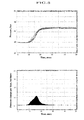
- the results are shown in Table 1 and Fig. 2 .
- the fuel ignition/combustion tests were done ten times in the upper graph of Fig.2 .
- the horizontal axis indicates time (ms) and the vertical axis indicates pressure (bar).
- the upper graph of Fig.2 shows the pressure at the beginning of and after combustion, and the average value of the pressure can be calculated from the graph.
- the horizontal axis indicates time (ms) and the vertical axis indicates pressure/time (bar/ms).
- the lower graph of Fig. 2 shows the temporal differentiation of the upper graph of Fig. 2 , for comparison of the combustion efficiency.
- Example 1 a W/O nanoemulsion was formed in a manner similar to Example 1, except that a blender (HBB type, manufactured by Yamato Scientific Co., Ltd.) was used instead of the homogenizer used in Example 1 (PH91 manufactured by SMT Company), to confirm that the results similar to the present Example were obtained.
- a blender HBB type, manufactured by Yamato Scientific Co., Ltd.
- PH91 manufactured by SMT Company the homogenizer used in Example 1
- a fuel consisting of kerosene was tested for ignition/combustion properties using a fuel combustion analyzer FIA-100 manufactured by Fuel Tech Japan Ltd.
- Tables 1 to 3 and Figs. 2 to 4 show that the W/O type nanoemulsion according to Example 2 ignites faster than kerosene alone (kerosene alone: 10.95 ms, W/O type nanoemulsion according to Example 2: 7.75 ms).
- MCP main combustion period
- cetane number of the W/O type nanoemulsion according to Example 2 is higher than kerosene (kerosene alone: 41, W/O type nanoemulsion according to Example 2: 48.5).
- a liquid of 900g of kerosene (90 wt% of kerosene, based on 100 wt% of the total of 100 g of water described later and 900 g of kerosene) were added 144 g of a nonionic surfactant DSK NL-15 (same as described above) (16 parts by weight, normalized in a case where an amount of kereosene is considered as 100 parts by weight) and 36 g of a nonionic surfactant DSK NL-50 (same as described above) (4 parts by weight, normalized in a case where an amount of kereosene is considered as 100 parts by weight), and mixed by stirring to obtain a liquid A.
- the total HLB value of the nonionic surfactants in the liquid A was 6.12, according to the above-mentioned equation (2).
- the liquids A and B were mixed in a manner similar to Example 1, to obtain a colorless clear liquid, i.e., a W/O nanoemulsion.
- the particle size distribution of the W/O nanoemulsion was determined by using the laser light scattering method similar to Example 1, showing that the 50% average particle size of the water particle was about 10 nm.
- Example 2 Regarding the stability, observation was done in a manner similar to Example 1, and separation was not observed. In addition, the W/O nanoemulsion was clear even after standing still at ambient temperature for one year.
- the liquids A and B were mixed in a manner similar to Example 1, to obtain a colorless clear liquid, i.e., a W/O nanoemulsion.
- the particle size distribution of the W/O nanoemulsion was determined by using the laser light scattering method similar to Example 1, showing that the 50% average particle size of the water particle was about 10 nm.
- Example 2 Regarding the stability, observation was done in a manner similar to Example 1, and separation was not observed. In addition, the W/O nanoemulsion was clear even after standing still at ambient temperature for one year.
- kerosene alone according to Comparative Example 1 a W/O type nanoemulsion according to Example 3 (water 10%), a W/O type nanoemulsion according to Example 2 (water 15%) and a W/O type nanoemulsion according to Example 4 (water 20%) were charged in a steam boiler tester (SF350-3 manufactured by Ogata Ironworks, Inc.) in this order and burned.
- the exhaust gas was analyzed qualitatively and quantitatively by gas chromatography (GC manufactured by Shimadzu Corporation) on a timely basis.
- a colorless clear liquid, W/O nanoemulsion was prepared by mixing the liquids A and B with the mixing ratio similar to Example 1 in a manner similar to Example 1, except that sulfosuccinic acid dioctyl ester (Aerosol OT manufactured by Wako Pure Industries, Ltd.) was used instead of the anionic surfactant, sodium dodecylsulfate used in Example 1.
- sulfosuccinic acid dioctyl ester Alosol OT manufactured by Wako Pure Industries, Ltd.
- the particle size distribution of the resulting W/O nanoemulsion was determined by using the laser light scattering method similar to Example 1, showing that the 50% average particle size of the water particle was about 10 nm.
- a colorless clear liquid, W/O nanoemulsion was prepared in a manner similar to Example 1, except that 7.5 g of sodium dodecyl sulfate and 7.5 g of sulfosuccinic acid dioctyl ester were used instead of 15 g of the anionic surfactant, sodium dodecyl sulfate used in Example 1 and that a stirrer (MS3 manufactured by IKA Company) was used instead of the homogenizer (PH91 manufactured by SMT Company) for mixing of the liquids A and B.
- a stirrer MS3 manufactured by IKA Company
- the particle size distribution of the resulting W/O nanoemulsion was determined by using the laser light scattering method similar to Example 1, showing that the 50% average particle size of the water particle was about 10 nm.
- the liquid A was prepared in a manner similar to Example 1.
- the liquid B was also prepared in a manner similar to Example 1, except that 0.75 g (0.5 parts by weight, normalized in a case where an amount of water is considered as 100 parts by weight) (Example 7), 4.2 g (2.8 parts by weight, normalized in a case where an amount of water is considered as 100 parts by weight) (Example 8), and 7.5 g (5 parts by weight, normalized in a case where an amount of water is considered as 100 parts by weight) (Example 9) of sodium dodecyl sulfate were used instead of 15 g for the liquid B in Example 1.
- the liquids A and B were mixed in a manner similar to Example 1, to obtain a colorless clear liquid, a W/O nanoemulsion.
- the particle size distribution of the resulting W/O nanoemulsion was determined by using the laser light scattering method similar to Example 1, and the results are shown in Fig. 5 (The point of 10 wt% of the ionic surfactant was derived from Example 1).
- Fig. 5 shows a trend that the smaller amount of the anionic surfactant causes larger average particle size of the emulsion and the larger amount of the anionic surfactant causes smaller average particle size of the emulsion in the formulation of Examples 1 and 7 to 9.
- a colorless clear liquid i.e., W/O nanoemulsion
- a nonionic surfactant DSK NL-40 (polyoxyethylene lauryl ether manufactured by Dai-ichi Kogyo Seiyaku Co., Ltd., HLB:9.5) was used instead of the nonionic surfactant, DSK NL-50 in Example 1.
- the total HLB value of the nonionic surfactants in the liquid A was 5.9 according to the above-mentioned equation (2).
- the particle size distribution of the resulting W/O nanoemulsion was determined in a manner similar to Example 1, showing that the 50% average particle size of the water particle was about 10 nm.
- a colorless clear liquid i.e., W/O nanoemulsion
- an anionic surfactant sodium oleate (manufactured by NACALAI) was used instead of the anionic surfactant, sodium dodecyl sulfate in Example 10.
- the total HLB value of the nonionic surfactants in the liquid A was 5.9, same as that of Example 10.
- the particle size distribution of the resulting W/O nanoemulsion was determined in a manner similar to Example 1, showing that the 50% average particle size of the water particle was about 50 nm.
- a colorless clear liquid i.e., W/O nanoemulsion
- W/O nanoemulsion was obtained in a manner similar to Example 3, except that the amount of sodium dodecyl sulfate was changed to 20 g (20 parts by weight, normalized in a case where an amount of water is considered as 100 parts by weight) from 10 g in Example 3.
- the particle size distribution of the resulting W/O nanoemulsion was determined in a manner similar to Example 1, showing that the 50% average particle size of the water particle was about 8 nm.
- a colorless clear liquid i.e., W/O nanoemulsion
- W/O nanoemulsion was obtained in a manner similar to Example 4, except that the amount of sodium dodecyl sulfate was changed to 40 g (20 parts by weight, normalized in a case where an amount of water is considered as 100 parts by weight) from 20 g in Example 4.
- the particle size distribution of the resulting W/O nanoemulsion was determined in a manner similar to Example 1, showing that the 50% average particle size of the water particle was about 20 nm.
- the liquids A and B were mixed and stirred using a homogenizer (PH91 manufactured by SMT Company) for 5 minutes, to obtain a colorless clear liquid, i.e., a W/O nanoemulsion.
- a homogenizer PH91 manufactured by SMT Company
- the particle size distribution of the resulting W/O nanoemulsion could not be determined in a manner similar to Example 1, due to its higher transmittance. However, since the resulting W/O emulsion was colorless and clear with no phase separation, it is estimated that the 50% average particle size of the water particle was 100 nm or less.
- Example 2 Regarding the stability, observation was done in a manner similar to Example 1, and separation was not observed. In addition, the W/O nanoemulsion was clear even after standing still at ambient temperature for one month.
- a liquid of 850g of gasoline 85 wt% of gasoline, based on 100 wt% of the total of 150 g of water described later and 850 g of gasoline
- a nonionic surfactant DSK NL-15 polyoxyethylene lauryl ether, manufactured by Dai-ichi Kogyo Seiyaku Co., Ltd., HLB: 5.0, average molecular weight of polyoxyethylene moiety: 2,900
- the liquids A and B were mixed and stirred using a homogenizer (PH91 manufactured by SMT Company) for 5 minutes, to obtain each of a colorless clear liquid, i.e., a W/O nanoemulsion.
- a homogenizer PH91 manufactured by SMT Company
- the particle size distribution of the resulting W/O nanoemulsion could not be determined in a manner similar to Example 1, due to its higher transmittance. However, since the resulting W/O emulsion was colorless and clear with no phase separation, it is estimated that the 50% average particle size of the water particle was 100 nm or less.
- Example 2 Regarding the stability, observation was done in a manner similar to Example 1, and separation was not observed. In addition, the W/O nanoemulsion was clear even after standing still at ambient temperature for one month.
- the liquids A and B were mixed and stirred using a homogenizer (PH91 manufactured by SMT Company) for 5 minutes, to obtain a colorless clear liquid, i.e., a W/O nanoemulsion.
- a homogenizer PH91 manufactured by SMT Company
- the particle size distribution of the resulting W/O nanoemulsion was determined in a manner similar to Example 1, showing that the 50% average particle size of the water particle was about 10 nm.
- Example 2 Regarding the stability, observation was done in a manner similar to Example 1, and separation was not observed. In addition, the W/O nanoemulsion was clear even after standing still at ambient temperature for one month.
- a liquid of 850g of light oil 85 wt% of light oil, based on 100 wt% of the total of 150 g of water described later and 850 g of light oil
- a nonionic surfactant DSK NL-15 polyoxyethylene lauryl ether, manufactured by Dai-ichi Kogyo Seiyaku Co., Ltd., HLB: 5.0, average molecular weight of polyoxyethylene moiety: 2,900
- liquid A Separately from the liquid A, to 150 g of water (15 wt% of water, based on 100 wt% of the total of 150 g of water and 850 g of light oil) were added 2.5 g and 7.5 g of anionic surfactant, sodium dodecyl sulfate (manufactured by NACALAI) (1.7 and 5 parts by weight, normalized in a case where an amount of water is considered as 100 parts by weight, respectively), and mixed by stirring to obtain a liquid B.
- anionic surfactant sodium dodecyl sulfate
- the liquids A and B were mixed and stirred using a homogenizer (PH91 manufactured by SMT Company) for 5 minutes, to obtain a colorless clear liquid, i.e., a W/O nanoemulsion.
- a homogenizer PH91 manufactured by SMT Company
- each of the resulting W/O nanoemulsions was determined in a manner similar to Example 1, showing that each 50% average particle size of the water particle was about 10 nm, respectively.
- Example 2 Regarding the stability, observation was done in a manner similar to Example 1, and separation was not observed. In addition, the W/O nanoemulsion was clear even after standing still at ambient temperature for one month.
- a colorless clear liquid i.e., a W/O nanoemulsion was obtained in a manner similar to Example 17, except that "A-type heavy oil” was used instead of "light oil” in Example 17.
- the particle size distribution of the resulting W/O nanoemulsion was determined in a manner similar to Example 1, showing that the 50% average particle size of the water particle was about 10 nm, respectively.
- Example 2 Regarding the stability, observation was done in a manner similar to Example 1, and separation was not observed. In addition, the W/O nanoemulsion was clear even after standing still at ambient temperature for one month.
- the liquids A and B were mixed and stirred using a homogenizer (PH91 manufactured by SMT Company) for 5 minutes, to obtain a colorless clear liquid, i.e., a W/O nanoemulsion.
- a homogenizer PH91 manufactured by SMT Company
- the particle size distribution of the resulting W/O nanoemulsion could not be determined in a manner similar to Example 1, due to its lower transmittance. However, since the resulting W/O emulsion was colorless and clear with no phase separation upon observation similar to Example 1 regarding the stability, it is estimated that the 50% average particle size of the water particle was 100 nm or less.
- the W/O nanoemulsion was clear even after standing still at ambient temperature for one month.
- the liquids A and B were mixed and stirred using a homogenizer (PH91 manufactured by SMT Company) for 5 minutes, to obtain a colorless clear liquid, i.e., a W/O nanoemulsion.
- a homogenizer PH91 manufactured by SMT Company
- the particle size distribution of the resulting W/O nanoemulsion could not be determined in a manner similar to Example 1, due to its lower transmittance. However, since the resulting W/O emulsion was colorless and clear with no phase separation upon observation similar to Example 1 regarding the stability, it is estimated that the 50% average particle size of the water particle was 100 nm or less.
- the W/O nanoemulsion was clear even after standing still at ambient temperature for one month.
- the liquids A and B were mixed and stirred using a homogenizer (PH91 manufactured by SMT Company) for 5 minutes, to obtain a colorless clear liquid, i.e., a W/O nanoemulsion.
- a homogenizer PH91 manufactured by SMT Company
- the particle size distribution of the resulting W/O nanoemulsion was determined by using the laser light scattering method similar to Example 1, showing that the 50% average particle size of the water particle was about 10 nm.
- Example 2 Regarding the stability, observation was done in a manner similar to Example 1, and separation was not observed. In addition, the W/O nanoemulsion was clear even after standing still at ambient temperature for one month.
Landscapes
- Chemical & Material Sciences (AREA)
- Oil, Petroleum & Natural Gas (AREA)
- Engineering & Computer Science (AREA)
- Chemical Kinetics & Catalysis (AREA)
- General Chemical & Material Sciences (AREA)
- Organic Chemistry (AREA)
- Liquid Carbonaceous Fuels (AREA)
- Colloid Chemistry (AREA)
Abstract
Description
- The present invention relates to a W/O nanoemulsion and a method for producing the W/O nanoemulsion, and a fuel comprising the W/O nanoemulsion.
- It is said that an emulsion fuel has effects to suppress generation of nitrogen oxides and particulate matters and to reduce the environmental load caused by gas exhausted from internal combustion engines. It is thought that, when the fuel is ignited in the internal combustion engine, water droplets evaporate first because of low boiling temperature and, at this time, the surrounding oil flies apart to make particles smaller in size. Since the area per their volume of the oil particles in contact with oxygen increases and the local imperfect combustion is suppressed, the efficiency of combustion increases and the generation of particulate matters (PMs) decreases. At the same time, since the temperature of the internal combustion engine decreases due to the influence of water contained, the generation of nitrogen oxides due to the production reaction of Zeldovich NO can also be suppressed. Increased combustion efficiency also leads to decrease of CO and reduction of CO2.
-
- Non-patent Document 1: CHIESA M et al.: Thermal conductivity and viscosity of water-in-oil nanoemulsions, Colloids Surf A, Vol.326 No.1-2 Page 67-72 (2008).
- Non-patent Document 2: MAGDASSI S. et al.: A new method for preparation of poly-lauryl acrylate nanoparticles from nanoemulsions obtained by the phase inversion temperature process, Polym. Adv. Technol., Vol.18 No. 9 Page 705-711 (2007).
- Non-patent Document 3: PORRAS M et al.: Studies of formation of W/O nanoemulsions, Colloids Surf A, Vol. 249 No.1/3 Page 115-118 (2004).
- However, in many cases, the conventional emulsion fuel should be used immediately after production since it causes oil/water separation over time. Even the high-quality emulsion fuel which does not separate for a long time preserves its quality for about three months at the longest.
- In addition, there were problems that the conventional technique can only produce and use microemulsion, but cannot produce nanoemulsion, even if possible, nanoemulsion is not stable for a long time.
- An object of the present invention is to solve the above problems.
- Specifically, an object of the present invention is to provide a W/O type nanoemulsion which remains stable even if stored for long periods, for example, six months.
- Further, other than or in addition to the above-described object, an object of the present invention is to provide a W/O type nanoemulsion having a combustion efficiency better than kerosene, light oil or the like, or a fuel comprising the W/O type nanoemulsion.
- More, other than or in addition to the above-described objects, an object of the present invention is to provide a W/O type nanoemulsion which can suppress the amount of NOx and/or CO generated by combustion, or a fuel comprising the W/O type nanoemulsion.
- The present inventors have found the following inventions:
- <1> A W/O type emulsion comprising:
- a) water: more than 0 wt% but no more than 30 wt%, preferably 5 to 20 wt%;
- b) oil: less than 100 wt% but no less than 70 wt%, preferably 95 to 80 wt%;
- c) at least one nonionic surfactant having an HLB value of 1 to 10, preferably 3 to 8: 1 to 30 parts by weight, preferably 10 to 20 parts by weight, which are normalized in a case where an amount of the oil is considered as 100 parts by weight; and
- d) at least one selected from the group consisting of anionic surfactants, cationic surfactants and amphoteric surfactants: 0.1 to 30 parts by weight, preferably 0.5 to 20 parts by weight, which are normalized in a case where an amount of the water is considered as 100 parts by weight,
- <2> In the above item <1>, the 50% average particle size of the water particle in the W/O type emulsion may be 5 to 100 nm, preferably 5 to 50 nm, more preferably 5 to 30 nm, most preferably 5 to 20 nm.
- <3> In the above item <1> or <2>, the b) oil may be at least one selected from the group consisting of kerosene, gasoline, light oil, heavy oil (including A-type heavy oil, B-type heavy oil and C-type heavy oil), alcohol, biofuel and ethyl tert-butyl ether, preferably at least one selected from the group consisting of kerosene, light oil, A-type heavy oil and B-type heavy oil, more preferably kerosene or light oil.
- <4> In any one of the above items <1> to <3>, the c) nonionic surfactant may be at least one selected from the group consisting of polyoxyethylene glycol, fatty acid sorbitan esters, alkyl polyglucosides, fatty acid diethanolamides, alkyl monoglyceryl ethers, alkyl glycosides, polyethylene glycol, and polyvinyl alcohol, preferably at least one selected from the group consisting of polyoxyethylene glycol, fatty acid sorbitan esters, and alkyl polyglucosides, more preferably polyoxyethylene glycol.
- <5> In any one of the above items <1> to <4>, the d) surfactant may comprise an anionic surfactant.
- <6> In any one of the above items <1> to <4>, the d) surfactant may consist of an anionic surfactant(s).
- <7> In any one of the above items <1> to <6>, the anionic surfactant may be at least one selected from the group consisting of fatty acid salts, monoalkyl sulfates, alkyl polyoxyethylene sulfates, alkylbenezene sulfonates, monoalkyl phosphates, and sulfosuccinate-type surfactants (such as ethylhexyl sulfosuccinate and the like), preferably at least one selected from the group consisting of fatty acid salts, monoalkyl sulfates, alkyl polyoxyethylene sulfates, and alkylbenezene sulfonates, more preferably monoalkyl sulfates.
- <8> In any one of the above items <1> to <5> and <7>, the d) surfactant may comprise a cationic surfactant.
- <9> In any one of the above items <1> to <4>, the d) surfactant may consist of a cationic surfactant(s).
- <10> In any one of the above items <1> to <5> and <7> to <9>, the cationic surfactant may be at least one selected from the group consisting of alkyltrimethyl ammonium salts, dialkyldimethyl ammonium salts, and alkylbenzyldimethyl ammonium salts, preferably alkyltrimethyl ammonium salts.
- <11> In any one of the above items <1> to <5>, <7>, <8> and <10>, the d) surfactant may comprise an amphoteric surfactant.
- <12> In any one of the above items <1> to <4>, the d) surfactant may consist of an amphoteric surfactant(s).
- <13> In any one of the above items <1> to <5>, <7>, <8> and <10> to <12>, the amphoteric surfactant may be at least one selected from the group consisting of alkyldimethylamine oxides and alkylcarboxy betaines.
- <14> A fuel comprising the W/O type emulsion described in the above items <1> to <13>.
- <15> A fuel consisting of the W/O type emulsion described in the above items <1> to <13>.
- <16> A fuel consisting essentially of the W/O type emulsion described in the above items <1> to <13>.
- <16> A method for producing a W/O type emulsion comprising:
- a) water: more than 0 wt% but no more than 30 wt%, preferably 5 to 20 wt%;
- b) oil: less than 100 wt% but no less than 70 wt%, preferably 95 to 80 wt%;
- c) at least one nonionic surfactant having an HLB value of 1 to 10, preferably 3 to 8: 1 to 30 parts by weight, preferably 10 to 20 parts by weight, which are normalized in a case where an amount of the oil is considered as 100 parts by weight; and
- d) at least one selected from the group consisting of anionic surfactants, a cationic surfactants and an amphoteric surfactants: 0.1 to 30 parts by weight, preferably 0.5 to 20 parts by weight, which are normalized in a case where an amount of the water is considered as 100 parts by weight,
wherein 50% average particle size of the water particle in the W/O type emulsion is 100 nm or less, preferably 5 to 100 nm, preferably 5 to 50 nm, more preferably 5 to 30 nm, most preferably 5 to 20 nm,
the method comprising the steps of:- i) preparing the a) water;
- ii) preparing the b) oil;
- iii) preparing the c) nonionic surfactant;
- iv) preparing the d) surfactant; and
- v) mixing the a) to d);
- <17> In the above item <16>, the mixing step v) may comprises the steps of
- v-1) mixing the oil of the step ii); and the nonionic surfactant of the step iii),
separately from the step v-1), v-2) mixing the water of the step i) and the surfactant of the step iv) and - v-3) mixing the mixture obtained in the step v-1) and the mixture obtained in the step v-2).
- v-1) mixing the oil of the step ii); and the nonionic surfactant of the step iii),
- <18> In the above item <16> or <17>, the b) oil may be at least one selected from the group consisting of kerosene, gasoline, light oil, heavy oil (including A-type heavy oil, B-type heavy oil and C-type heavy oil), alcohol, biofuel and ethyl tert-butyl ether, preferably at least one selected from the group consisting of kerosene, light oil, A-type heavy oil and B-type heavy oil, more preferably kerosene or light oil.
- <19> In any one of the above items <16> to <18>, the c) nonionic surfactant may be at least one selected from the group consisting of polyoxyethylene glycol, fatty acid sorbitan esters, alkyl polyglucosides, fatty acid diethanolamides, alkyl monoglyceryl ethers, alkyl glycosides, polyethylene glycol, and polyvinyl alcohol, preferably at least one selected from the group consisting of polyoxyethylene glycol, fatty acid sorbitan esters and alkyl polyglucosides, more preferably polyoxyethylene glycol.
- <20> In any one of the above items <16> to <19>, the d) surfactant may comprise an anionic surfactant.
- <21> In any one of the above items <16> to <19>, the d) surfactant may consist of an anionic surfactant(s).
- <22> In any one of the above items <16> to <21>, the anionic surfactant may be at least one selected from the group consisting of fatty acid salts, monoalkyl sulfates, alkyl polyoxyethylene sulfates, alkylbenezene sulfonates, monoalkyl phosphates, and sulfosuccinate-type surfactants (such as ethylhexyl sulfosuccinate and the like), preferably at least one selected from the group consisting of fatty acid salts, monoalkyl sulfates, alkyl polyoxyethylene sulfates and alkylbenezene sulfonates, more preferably monoalkyl sulfates.
- <23> In any one of the above items <16> to <20> and <22>, the d) surfactant may comprise a cationic surfactant.
- <24> In any one of the above items <16> to <19>, the d) surfactant may consist of a cationic surfactant(s).
- <25> In any one of the above items <16> to <20> and <22> to <24>, the cationic surfactant may be at least one selected from the group consisting of alkyltrimethyl ammonium salts, dialkyldimethyl ammonium salts, and alkylbenzyldimethyl ammonium salts, preferably alkyltrimethyl ammonium salts.
- <26> In any one of the above items <16> to <20>, <22>, <23> and <25>, the d) surfactant may comprise an amphoteric surfactant.
- <27> In any one of the above items <16> to <19>, the d) surfactant may consist of an amphoteric surfactant(s).
- <28> In any one of the above items <16> to <20>, <22>, <23> and <25> to <27>, the amphoteric surfactant may be at least one selected from the group consisting of alkyldimethylamine oxides and alkylcarboxy betaines.
- The present invention can provide a W/O type nanoemulsion which remains stable even if stored for long periods, for example, six months.
- Further, other than or in addition to the above-described effect, the present invention can provide a W/O type nanoemulsion having a combustion efficiency better than kerosene, light oil or the like, or a fuel comprising the W/O type nanoemulsion.
- More, other than or in addition to the above-described effects, the present invention can provide a W/O type nanoemulsion which can suppress the amount of NOx and/or CO generated by combustion, or a fuel comprising the W/O type nanoemulsion.
-
-
Fig. 1 shows a schematic view of the W/O type emulsion according to the present application. -
Fig. 2 shows the results of the ignition/combustion test for the W/O type emulsion of Example 2. -
Fig. 3 shows the results of the ignition/combustion test for Comparative Example 1 (kerosene alone). -
Fig. 4 shows the results of the ignition/combustion test for Comparative Example 2 (a combination of nonionic surfactants). -
Fig. 5 shows the average particle size dependent on the amount of the anionic surfactants for the W/O type emulsions of Examples 1 and 7 to 9. - The present invention will be described in detail hereinafter.
- The present invention provides a "W/O type emulsion", a fuel comprising the "W/O type emulsion", a production method for the "W/O type emulsion", and the like. The present invention will be described in order hereinafter.
- The present application provides a W/O type emulsion in which the 50% average particle size of the water particle is 100 nm or less.
- The term "50 % average particle size" used herein means a median diameter at which the accumulated distribution is 0.5.
- In addition, the term "50% average particle size of the water particle in the W/O type emulsion" used herein means the following. Namely, the W/O type emulsion according to the present application has a structure as shown in
Fig. 1. Fig. 1 shows, as an example, the W/O type emulsion formed firstly by mixing water and a nonionic surfactant to form a microemulsion, followed by further mixing an anionic surfactant to form the nanoemulsion according to the present application. The nanoemulsion inFig. 1 is configured having a water particle at its center with a hydrocarbon chain arranged at its periphery. Therefore, "water particle in the W/O type emulsion" is a water particle disposed at the center of the nanoemulsion inFig. 1 . Therefore, "50% average particle size of the water particle in the W/O type emulsion" means a median diameter at which the accumulated distribution is 0.5 for a water particle disposed at the center of the nanoemulsion illustrated inFig. 1 . - The W/O type emulsion according to the present invention comprises a) water, b) oil, c) a nonionic surfactant having an HLB value of 1 to 10, preferably 3 to 8, and d) at least one selected from the group consisting of anionic surfactants, cationic surfactants and amphoteric surfactants, or consists essentially of a) to d), or consists of a) to d).
- A nonionic surfactant having an HLB value of 1 to 10, preferably 3 to 8, means that, when only one nonionic surfactant is used, the HLB value of such nonionic surfactant is within the above-mentioned range. Note that the HLB value is defined according to the following equation (1):

- In addition, when two or more nonionic surfactants are added, the total HLBt value of the two or more nonionic surfactants used is calculated as the weight average of the HLB values of the two or more nonionic surfactants (see following equation (2), wherein Wi and HLBi indicate the weight and the HLB value of the i-th nonionic surfactant, respectively.). The HLBt value is used as the HLB value in this application.

- Furthermore, when two nonionic surfactants (nonionic surfactant A and nonionic surfactant B) are used, the total HLBt value is defined according to equation (3) which is derived from equation (2).

- In addition, the mixing ratio of the above-mentioned a) to d) is preferably as follows.
- a) water: more than 0 wt% but no more than 30 wt%, preferably 5 to 20 wt%;
- b) oil: less than 100 wt% but no less than 70 wt%, preferably 95 to 80 wt%;
- c) at least one nonionic surfactant having an HLB value of 1 to 10, preferably 3 to 8: 1 to 30 parts by weight, preferably 10 to 20 parts by weight, which are normalized in a case where an amount of the oil is considered as 100 parts by weight; and
- d) at least one selected from the group consisting of anionic surfactants, cationic surfactants and amphoteric surfactants: 0.1 to 30 parts by weight, preferably 0.5 to 20 parts by weight, which are normalized in a case where an amount of the water is considered as 100 parts by weight.
- The oil b) may be at least one selected from the group consisting of kerosene, gasoline, light oil, heavy oil (including A-type heavy oil, B-type heavy oil and C-type heavy oil), alcohol, biofuel and ethyl tert-butyl ether, preferably at least one selected from the group consisting of kerosene, light oil, A-type heavy oil and B-type heavy oil, more preferably kerosene or light oil.
- The nonionic surfactant c) may be at least one selected from the group consisting of polyoxyethylene glycol, fatty acid sorbitan esters, alkyl polyglucosides, fatty acid diethanolamides, alkyl monoglyceryl ethers, alkyl glycosides, polyethylene glycol, and polyvinyl alcohol, preferably at least one selected from the group consisting of polyoxyethylene glycol, fatty acid sorbitan esters, and alkyl polyglucosides, more preferably polyoxyethylene glycol.
- In one embodiment, the surfactant d) may comprise an anionic surfactant, or may consist of an anionic surfactant(s). In this case, the anionic surfactant may be at least one selected from the group consisting of fatty acid salts (for example, sodium linoleate, sodium oleate), monoalkyl sulfates (for example, sodium dodecylsulfonate), alkyl polyoxyethylene sulfates (for example, sodium polyoxyethylene lauryl ether sulfate), alkylbenezene sulfonates (for example, sodium dodecylbenzene sulfonate), monoalkyl phosphates (for example, sodium polyoxyethylene alkyl ether phosphate), and sulfosuccinate-type surfactants (such as ethylhexyl sulfosuccinate and the like), preferably at least one selected from the group consisting of fatty acid salts (for example, sodium linoleate, preferably sodium oleate), monoalkyl sulfates, alkyl polyoxyethylene sulfates, and alkylbenezene sulfonates, more preferably monoalkyl sulfates. Furthermore, examples of the salts may include sodium salts, ammonium salts, potassium salts and the like. Preferably, the salts may be sodium salts or ammonium salts, more preferably sodium salts.
- In one embodiment, the surfactant d) may comprise a cationic surfactant, or may consist of a cationic surfactant(s). In this case, the cationic surfactant may be at least one selected from the group consisting of alkyltrimethyl ammonium salts (for example, C12H25-N+(CH3)3Cl- and the like), dialkyldimethyl ammonium salts (for example, C12H25-N+(C8H17)(CH3)2Cl- and the like), and alkylbenzyldimethyl ammonium salts (for example, decylisononyldimethyl ammonium salt), preferably alkyltrimethyl ammonium salts (for example, C12H25-N+(CH3)3Cl-).
- In one embodiment, the surfactant d) may comprise an amphoteric surfactant, or may consist of an amphoteric surfactant(s). In this case, the amphoteric surfactant may be at least one selected from the group consisting of alkyldimethylamine oxides (for example, C12H25- (CH3)2NO and the like) and alkylcarboxy betaines (for example, C12H25- (CH3)2N+CH2COO- and the like).
- The present application provides i) a fuel comprising the above-mentioned W/O type emulsion; ii) a fuel consisting of the above-mentioned W/O type emulsion; or iii) a fuel essentially consisting of the above-mentioned W/O type emulsion.
- In case of the i) fuel comprising the above-mentioned W/O type emulsion, the fuel may contain alcohols (for example, methanol, ethanol and the like) other than the W/O type emulsion according to the present application. Furthermore, the component which may be contained other than the W/O type emulsion is not limited to them.
- The W/O type emulsion according to the present application may be produced, for example, according to the following method:
- i) the step of preparing the a) water;
- ii) the step of preparing the b) oil;
- iii) the step of preparing the c) nonionic surfactant;
- iv) the step of preparing the d) surfactant; and
- v) the step of mixing the a) to d);
- to obtain the above W/O type emulsion.
- Furthermore, the a) water, the b) oil, the c) nonionic surfactant and the d) surfactant used herein have the same definition as mentioned above.
- For the mixing step v), various techniques are utilized for production of the emulsion. Examples of the techniques may include, but are not limited to, mechanical emulsification, phase transition process, phase transfer emulsification, D-phase emulsification, gel emulsification and the like. Furthermore, a homogenizer, a counter impact machine, a screw type machine, an ultrasound type machine and the like based on the mechanical emulsification may be used in order to produce the emulsion in a large amount.
- As the mixing step v), components a) to d) prepared in the steps i) to iv) mentioned above may be sequentially mixed or may be mixed all together. The emulsion of the present application may be obtained by either method.
- The preferred method is, however, sequential mixing including the steps of: v-1) mixing the oil of the step ii) and the nonionic surfactant of the step iii);
- v-2) separately from the step v-1), mixing the water of the step i) and the surfactant of the step iv); and
- v-3) mixing the mixture obtained in the step v-1) and the mixture obtained in the step v-2).
- Conventional mixing techniques may be used for the steps v-1), v-2) and v-3).
- The present invention will be illustrated in more detail referring to the Examples, to which the present invention is not limited.
- To a liquid of 850g of kerosene (85 wt% of kerosene, based on 100 wt% of the total of 150 g of water described later and 850 g of kerosene), 136 g of a nonionic surfactant DSK NL-15 (polyoxyethylene lauryl ether, manufactured by Dai-ichi Kogyo Seiyaku Co., Ltd., HLB: 5.0, average molecular weight of polyoxyethylene moiety: 2,900) (16 parts by weight, normalized in a case where an amount of kerosene is considered as 100 parts by weight) and 34 g of a nonionic surfactant DSK NL-50 (polyoxyethylene lauryl ether, manufactured by Dai-ichi Kogyo Seiyaku Co., Ltd., HLB: 10.6) (4 parts by weight, normalized in a case where an amount of kerosene is considered as 100 parts by weight) were added, and mixed by stirring to obtain a liquid A. The total HLB value of the nonionic surfactants in the liquid A was 6.12, according to the above-mentioned equation (2).
- Separately from the liquid A, to 150 g of water (15 wt% of water, based on 100 wt% of the total of 150 g of water and 850 g of kerosene) was added 15 g of an anionic surfactant, sodium dodecyl sulfate (manufactured by NACALAI) (10 parts by weight, normalized in a case where an amount of water is considered as 100 parts by weight) and mixed by stirring to obtain a liquid B.
- The liquid A and the liquid B were mixed and stirred using a homogenizer (PH91 manufactured by SMT Company) for 5 minutes, to obtain a colorless clear liquid, i.e., a W/O nanoemulsion.
- The particle size distribution of the W/O nanoemulsion was determined by using the laser light scattering method (LS-200F manufactured by Otsuka Electronics Co., Ltd.), showing that the 50% average particle size of the water particle was about 10 nm.
- Regarding the stability, separation was not observed after centrifugation (Type 4000 manufactured by Kubota Corporation) at 2200 G at ambient temperature for 60 minutes. In addition, the W/O nanoemulsion was clear even after standing still at ambient temperature for one year.
- A W/O nanoemulsion was prepared using the liquids A and B in mixing ratio same as Example 1, except that a counter impact machine (manufactured by Kankyou Kakushin Kogyo Co., Ltd.) was used instead of the homogenizer (PH91 manufactured by SMT Company) used in Example 1.
- The resulting nanoemulsion was tested for ignition/combustion properties using a fuel combustion analyzer FIA-100 manufactured by Fuel Tech Japan Ltd.
- The results are shown in Table 1 and
Fig. 2 . The fuel ignition/combustion tests were done ten times in the upper graph ofFig.2 . In the upper graph ofFig.2 , the horizontal axis indicates time (ms) and the vertical axis indicates pressure (bar). The upper graph ofFig.2 shows the pressure at the beginning of and after combustion, and the average value of the pressure can be calculated from the graph. In the lower graph ofFig. 2 , the horizontal axis indicates time (ms) and the vertical axis indicates pressure/time (bar/ms). The lower graph ofFig. 2 shows the temporal differentiation of the upper graph ofFig. 2 , for comparison of the combustion efficiency. Furthermore, a W/O nanoemulsion was formed in a manner similar to Example 1, except that a blender (HBB type, manufactured by Yamato Scientific Co., Ltd.) was used instead of the homogenizer used in Example 1 (PH91 manufactured by SMT Company), to confirm that the results similar to the present Example were obtained. - A fuel consisting of kerosene was tested for ignition/combustion properties using a fuel combustion analyzer FIA-100 manufactured by Fuel Tech Japan Ltd.
- The results are shown in Table 2 and
Fig. 3 . The upper and lower graphs ofFig. 3 are similar to those inFig.2 , respectively. - A mixture of the nonionic surfactants DSK NL-15 (same as described above) and DSK NL-50 (same as described above) mixed in the weight ratio of 4:1 was tested for ignition/combustion properties using a fuel combustion analyzer FIA-100 manufactured by Fuel Tech Japan Ltd.
- The results are shown in Table 3 and
Fig. 4 . The upper and lower graphs ofFig. 4 are similar to those inFigs. 2 and3 , respectively.Table 1. Results of ignition/combustion test for W/O nanoemulsion of Example 2 Ignition (ID) dP=0.2bar 7.75ms Start of main combustion (MRD) dP=1.0bar 9.07ms Ignition to main combustion period (PCP) 1.32ms End of combustion (EC) 20.8ms Total combustion period (EMP) dP=1.0bar 14.30ms Main combustion period (MCP) dP=1.0bar 5.23ms MD standard deviation dP=1.0bar 0.44 FIA Cetane number (FIA CN) dP=1.0bar 48.5 ROHR index 152.9 ROHR maximum time 11.0ms After burning period (ABP) 6.5ms Table 2. Results of ignition/combustion test for kerosene alone (Comparative Example 1) Ignition (ID) dP=0.2bar 10.95ms Start of main combustion (MRD) dP=1.0bar 12.81ms Ignition to main combustion period (PCP) 1.86ms End of combustion (EC) 31.15ms Total combustion period (EMP) dP=1.0bar 20.15ms Main combustion period (MCP) dP=1.0bar 7.34ms MD standard deviation dP=1.0bar 0.67 FIA Cetane number (FIA CN) dP=1.0bar 41 ROHR index 144.4 ROHR maximum time 16.3ms After burning time (ABP) 9.00ms Table 3. Results of ignition/combustion test for nonionic surfactant alone (Comparative Example 2) Ignition (ID) dP=0.2bar 4.50ms Start of main combustion (MRD) dP=1.0bar 5.22ms Ignition to main combustion period (PCP) 0.72ms End of combustion (EC) 15.20ms Total combustion period (EMP) dP=1.0bar 11.00ms Main combustion period (MCP) dP=1.0bar 5.78ms MD standard deviation dP=1.0bar 0.41 FIA Cetane number (FIA CN) dP=1.0bar 71.5 ROHR index 174.7 ROHR maximum time 6.1ms After burning time (ABP) 4.20ms - Tables 1 to 3 and
Figs. 2 to 4 show that the W/O type nanoemulsion according to Example 2 ignites faster than kerosene alone (kerosene alone: 10.95 ms, W/O type nanoemulsion according to Example 2: 7.75 ms). - It is also shown that the main combustion period (MCP) of the W/O type nanoemulsion is shorter than kerosene alone and shorter than the nonionic surfactant alone (kerosene alone: 7.34 ms, nonionic surfactant alone: 5.78 ms, W/O type nanoemulsion according to Example 2: 5.23 ms).
- It is also shown that the cetane number of the W/O type nanoemulsion according to Example 2 is higher than kerosene (kerosene alone: 41, W/O type nanoemulsion according to Example 2: 48.5).
- These data show that the W/O type nanoemulsion according to Example 2 has the excellent combustion properties.
- To a liquid of 900g of kerosene (90 wt% of kerosene, based on 100 wt% of the total of 100 g of water described later and 900 g of kerosene) were added 144 g of a nonionic surfactant DSK NL-15 (same as described above) (16 parts by weight, normalized in a case where an amount of kereosene is considered as 100 parts by weight) and 36 g of a nonionic surfactant DSK NL-50 (same as described above) (4 parts by weight, normalized in a case where an amount of kereosene is considered as 100 parts by weight), and mixed by stirring to obtain a liquid A. The total HLB value of the nonionic surfactants in the liquid A was 6.12, according to the above-mentioned equation (2).
- Separately from the liquid A, to 100 g of water (10 wt% of water, based on 100 wt% of the total of 100 g of water and 900 g of kerosene) was added 10 g of an anionic surfactant, sodium dodecyl sulfate (manufactured by NACALAI) (10 parts by weight, normalized in a case where an amount of water is considered as 100 parts by weight), and mixed by stirring to obtain a liquid B.
- The liquids A and B were mixed in a manner similar to Example 1, to obtain a colorless clear liquid, i.e., a W/O nanoemulsion.
- The particle size distribution of the W/O nanoemulsion was determined by using the laser light scattering method similar to Example 1, showing that the 50% average particle size of the water particle was about 10 nm.
- Regarding the stability, observation was done in a manner similar to Example 1, and separation was not observed. In addition, the W/O nanoemulsion was clear even after standing still at ambient temperature for one year.
- To a liquid of 800g of kerosene (80 wt% of kerosene, based on 100 wt% of the total of 200 g of water described later and 800 g of kerosene) were added 128 g of a nonionic surfactant DSK NL-15 (same as described above) (16 parts by weight, normalized in a case where an amount of kereosene is considered as 100 parts by weight) and 32 g of a nonionic surfactant DSK NL-50 (same as described above) (4 parts by weight, normalized in a case where an amount of kereosene is considered as 100 parts by weight), and mixed by stirring to obtain a liquid A. The total HLB value of the nonionic surfactants in the liquid A was 6.12, according to the above-mentioned equation (2).
- Separately from the liquid A, to 200 g of water (20 wt% of water, based on 100 wt% of the total of 200 g of water and 800 g of kerosene) was added 20 g of an anionic surfactant, sodium dodecyl sulfate (manufactured by NACALAI) (10 parts by weight, normalized in a case where an amount of water is considered as 100 parts by weight), and mixed by stirring to obtain a liquid B.
- The liquids A and B were mixed in a manner similar to Example 1, to obtain a colorless clear liquid, i.e., a W/O nanoemulsion.
- The particle size distribution of the W/O nanoemulsion was determined by using the laser light scattering method similar to Example 1, showing that the 50% average particle size of the water particle was about 10 nm.
- Regarding the stability, observation was done in a manner similar to Example 1, and separation was not observed. In addition, the W/O nanoemulsion was clear even after standing still at ambient temperature for one year.
- Steam boiler test was carried out for kerosene alone according to Comparative Example 1, a W/O type nanoemulsion according to Example 3 (
water 10%), a W/O type nanoemulsion according to Example 2 (water 15%) and a W/O type nanoemulsion according to Example 4 (water 20%). - As the test, kerosene alone according to Comparative Example 1, a W/O type nanoemulsion according to Example 3 (
water 10%), a W/O type nanoemulsion according to Example 2 (water 15%) and a W/O type nanoemulsion according to Example 4 (water 20%) were charged in a steam boiler tester (SF350-3 manufactured by Ogata Ironworks, Inc.) in this order and burned. The exhaust gas was analyzed qualitatively and quantitatively by gas chromatography (GC manufactured by Shimadzu Corporation) on a timely basis. - The results are shown in Table 4.

- From Table 4, it was confirmed that the increase in water mixing ratio in the W/O type nanoemulsion causes reduction of NOx as well as CO, due to lowering of combustion temperature (Although "exhaust temperature" in Table 4 does not indicate the combustion temperature itself, low "exhaust temperature" means low combustion temperature.).
- Color test of black particles onto white paper was carried out simultaneously with the steam boiler test. As the result, black particles were very hardly observed in the test of the W/O type nanoemulsion (Examples 2 to 4). On the other hand, in the case of kerosene alone (Comparative Example 1), slightly gray color and a small number of black particles were observed.
- A colorless clear liquid, W/O nanoemulsion, was prepared by mixing the liquids A and B with the mixing ratio similar to Example 1 in a manner similar to Example 1, except that sulfosuccinic acid dioctyl ester (Aerosol OT manufactured by Wako Pure Industries, Ltd.) was used instead of the anionic surfactant, sodium dodecylsulfate used in Example 1.
- The particle size distribution of the resulting W/O nanoemulsion was determined by using the laser light scattering method similar to Example 1, showing that the 50% average particle size of the water particle was about 10 nm.
- Regarding the stability, observation was done in a manner similar to Example 1, and separation was not observed.
- A colorless clear liquid, W/O nanoemulsion, was prepared in a manner similar to Example 1, except that 7.5 g of sodium dodecyl sulfate and 7.5 g of sulfosuccinic acid dioctyl ester were used instead of 15 g of the anionic surfactant, sodium dodecyl sulfate used in Example 1 and that a stirrer (MS3 manufactured by IKA Company) was used instead of the homogenizer (PH91 manufactured by SMT Company) for mixing of the liquids A and B.
- The particle size distribution of the resulting W/O nanoemulsion was determined by using the laser light scattering method similar to Example 1, showing that the 50% average particle size of the water particle was about 10 nm.
- Regarding the stability, observation was done in a manner similar to Example 1, and separation was not observed.
- The liquid A was prepared in a manner similar to Example 1.
- The liquid B was also prepared in a manner similar to Example 1, except that 0.75 g (0.5 parts by weight, normalized in a case where an amount of water is considered as 100 parts by weight) (Example 7), 4.2 g (2.8 parts by weight, normalized in a case where an amount of water is considered as 100 parts by weight) (Example 8), and 7.5 g (5 parts by weight, normalized in a case where an amount of water is considered as 100 parts by weight) (Example 9) of sodium dodecyl sulfate were used instead of 15 g for the liquid B in Example 1. The liquids A and B were mixed in a manner similar to Example 1, to obtain a colorless clear liquid, a W/O nanoemulsion.
- The particle size distribution of the resulting W/O nanoemulsion was determined by using the laser light scattering method similar to Example 1, and the results are shown in
Fig. 5 (The point of 10 wt% of the ionic surfactant was derived from Example 1).Fig. 5 shows a trend that the smaller amount of the anionic surfactant causes larger average particle size of the emulsion and the larger amount of the anionic surfactant causes smaller average particle size of the emulsion in the formulation of Examples 1 and 7 to 9. - A colorless clear liquid, i.e., W/O nanoemulsion, was obtained in a manner similar to Example 1, except that a nonionic surfactant, DSK NL-40 (polyoxyethylene lauryl ether manufactured by Dai-ichi Kogyo Seiyaku Co., Ltd., HLB:9.5) was used instead of the nonionic surfactant, DSK NL-50 in Example 1. The total HLB value of the nonionic surfactants in the liquid A was 5.9 according to the above-mentioned equation (2).
- The particle size distribution of the resulting W/O nanoemulsion was determined in a manner similar to Example 1, showing that the 50% average particle size of the water particle was about 10 nm.
- Regarding the stability, observation was done in a manner similar to Example 1, and separation was not observed.
- A colorless clear liquid, i.e., W/O nanoemulsion, was obtained in a manner similar to Example 10, except that an anionic surfactant, sodium oleate (manufactured by NACALAI) was used instead of the anionic surfactant, sodium dodecyl sulfate in Example 10. The total HLB value of the nonionic surfactants in the liquid A was 5.9, same as that of Example 10.
- The particle size distribution of the resulting W/O nanoemulsion was determined in a manner similar to Example 1, showing that the 50% average particle size of the water particle was about 50 nm.
- Regarding the stability, observation was done in a manner similar to Example 1, and separation was not observed.
- A colorless clear liquid, i.e., W/O nanoemulsion, was obtained in a manner similar to Example 3, except that the amount of sodium dodecyl sulfate was changed to 20 g (20 parts by weight, normalized in a case where an amount of water is considered as 100 parts by weight) from 10 g in Example 3.
- The particle size distribution of the resulting W/O nanoemulsion was determined in a manner similar to Example 1, showing that the 50% average particle size of the water particle was about 8 nm.
- Regarding the stability, observation was done in a manner similar to Example 1, and separation was not observed.
- A colorless clear liquid, i.e., W/O nanoemulsion, was obtained in a manner similar to Example 4, except that the amount of sodium dodecyl sulfate was changed to 40 g (20 parts by weight, normalized in a case where an amount of water is considered as 100 parts by weight) from 20 g in Example 4.
- The particle size distribution of the resulting W/O nanoemulsion was determined in a manner similar to Example 1, showing that the 50% average particle size of the water particle was about 20 nm.
- Regarding the stability, observation was done in a manner similar to Example 1, and separation was not observed.
- To a liquid of 850g of gasoline (85 wt% of gasoline, based on 100 wt% of the total of 150 g of water described later and 850 g of gasoline) were added 136 g of a nonionic surfactant DSK NL-15 (polyoxyethylene lauryl ether, manufactured by Dai-ichi Kogyo Seiyaku Co., Ltd., HLB: 5.0, average molecular weight of polyoxyethylene moiety: 2,900) (16 parts by weight, normalized in a case where an amount of gasoline is considered as 100 parts by weight) and 34 g of a nonionic surfactant DSK NL-50 (polyoxyethylene lauryl ether, manufactured by Dai-ichi Kogyo Seiyaku Co., Ltd., HLB: 10.6) (4 parts by weight, normalized in a case where an amount of gasoline is considered as 100 parts by weight), and mixed by stirring to obtain a liquid A. The total HLB value of the nonionic surfactants in the liquid A was 6.12, according to the above-mentioned equation (2).
- Separately from the liquid A, to 150 g of water (15 wt% of water, based on 100 wt% of the total of 150 g of water and 850 g of gasoline) was added 15 g of an anionic surfactant, sodium dodecyl sulfate (manufactured by NACALAI) (10 parts by weight, normalized in a case where an amount of water is considered as 100 parts by weight), and mixed by stirring to obtain a liquid B.
- The liquids A and B were mixed and stirred using a homogenizer (PH91 manufactured by SMT Company) for 5 minutes, to obtain a colorless clear liquid, i.e., a W/O nanoemulsion.
- The particle size distribution of the resulting W/O nanoemulsion could not be determined in a manner similar to Example 1, due to its higher transmittance. However, since the resulting W/O emulsion was colorless and clear with no phase separation, it is estimated that the 50% average particle size of the water particle was 100 nm or less.
- Regarding the stability, observation was done in a manner similar to Example 1, and separation was not observed. In addition, the W/O nanoemulsion was clear even after standing still at ambient temperature for one month.
- To a liquid of 850g of gasoline (85 wt% of gasoline, based on 100 wt% of the total of 150 g of water described later and 850 g of gasoline) was added 170 g of a nonionic surfactant DSK NL-15 (polyoxyethylene lauryl ether, manufactured by Dai-ichi Kogyo Seiyaku Co., Ltd., HLB: 5.0, average molecular weight of polyoxyethylene moiety: 2,900) (20 parts by weight, normalized in a case where an amount of gasoline is considered as 100 parts by weight), and mixed by stirring to obtain a liquid A.
- Separately from the liquid A, to 150 g of water (15 wt% of water, based on 100 wt% of the total of 150 g of water and 850 g of gasoline) were added 10 g, 15 g and 30 g of an anionic surfactant, sodium dodecyl sulfate (manufactured by NACALAI) (7, 10 and 20 parts by weight, normalized in a case where an amount of water is considered as 100 parts by weight, respectively), and mixed by stirring to obtain a liquid B.
- The liquids A and B were mixed and stirred using a homogenizer (PH91 manufactured by SMT Company) for 5 minutes, to obtain each of a colorless clear liquid, i.e., a W/O nanoemulsion.
- The particle size distribution of the resulting W/O nanoemulsion could not be determined in a manner similar to Example 1, due to its higher transmittance. However, since the resulting W/O emulsion was colorless and clear with no phase separation, it is estimated that the 50% average particle size of the water particle was 100 nm or less.
- Regarding the stability, observation was done in a manner similar to Example 1, and separation was not observed. In addition, the W/O nanoemulsion was clear even after standing still at ambient temperature for one month.
- To a liquid of 850g of light oil (85 wt% of light oil, based on 100 wt% of the total of 150 g of water described later and 850 g of light oil) were added 136 g of a nonionic surfactant DSK NL-15 (polyoxyethylene lauryl ether, manufactured by Dai-ichi Kogyo Seiyaku Co., Ltd., HLB: 5.0, average molecular weight of polyoxyethylene moiety: 2,900) (16 parts by weight, normalized in a case where an amount of light oil is considered as 100 parts by weight) and 34 g of a nonionic surfactant DSK NL-50 (polyoxyethylene lauryl ether, manufactured by Dai-ichi Kogyo Seiyaku Co., Ltd., HLB: 10.6) (4 parts by weight, normalized in a case where an amount of light oil is considered as 100 parts by weight), and mixed by stirring to obtain a liquid A. The total HLB value of the nonionic surfactants in the liquid A was 6.12, according to the above-mentioned equation (2).
- Separately from the liquid A, to 150 g of water (15 wt% of water, based on 100 wt% of the total of 150 g of water and 850 g of light oil) was added 15 g of an anionic surfactant, sodium dodecyl sulfate (manufactured by NACALAI) (10 parts by weight, normalized in a case where an amount of water is considered as 100 parts by weight), and mixed by stirring to obtain a liquid B.
- The liquids A and B were mixed and stirred using a homogenizer (PH91 manufactured by SMT Company) for 5 minutes, to obtain a colorless clear liquid, i.e., a W/O nanoemulsion.
- The particle size distribution of the resulting W/O nanoemulsion was determined in a manner similar to Example 1, showing that the 50% average particle size of the water particle was about 10 nm.
- Regarding the stability, observation was done in a manner similar to Example 1, and separation was not observed. In addition, the W/O nanoemulsion was clear even after standing still at ambient temperature for one month.
- To a liquid of 850g of light oil (85 wt% of light oil, based on 100 wt% of the total of 150 g of water described later and 850 g of light oil) was added 170 g of a nonionic surfactant DSK NL-15 (polyoxyethylene lauryl ether, manufactured by Dai-ichi Kogyo Seiyaku Co., Ltd., HLB: 5.0, average molecular weight of polyoxyethylene moiety: 2,900) (20 parts by weight, normalized in a case where an amount of light oil is considered as 100 parts by weight), and mixed by stirring to obtain a liquid A.
- Separately from the liquid A, to 150 g of water (15 wt% of water, based on 100 wt% of the total of 150 g of water and 850 g of light oil) were added 2.5 g and 7.5 g of anionic surfactant, sodium dodecyl sulfate (manufactured by NACALAI) (1.7 and 5 parts by weight, normalized in a case where an amount of water is considered as 100 parts by weight, respectively), and mixed by stirring to obtain a liquid B.
- The liquids A and B were mixed and stirred using a homogenizer (PH91 manufactured by SMT Company) for 5 minutes, to obtain a colorless clear liquid, i.e., a W/O nanoemulsion.
- The particle size distribution of each of the resulting W/O nanoemulsions was determined in a manner similar to Example 1, showing that each 50% average particle size of the water particle was about 10 nm, respectively.
- Regarding the stability, observation was done in a manner similar to Example 1, and separation was not observed. In addition, the W/O nanoemulsion was clear even after standing still at ambient temperature for one month.
- A colorless clear liquid, i.e., a W/O nanoemulsion was obtained in a manner similar to Example 17, except that "A-type heavy oil" was used instead of "light oil" in Example 17.
- The particle size distribution of the resulting W/O nanoemulsion was determined in a manner similar to Example 1, showing that the 50% average particle size of the water particle was about 10 nm, respectively.
- Regarding the stability, observation was done in a manner similar to Example 1, and separation was not observed. In addition, the W/O nanoemulsion was clear even after standing still at ambient temperature for one month.
- To a liquid of 850g of C-type heavy oil (85 wt% of C-type heavy oil, based on 100 wt% of the total of 150 g of water described later and 850 g of C-type heavy oil) were added 136 g of a nonionic surfactant DSK NL-15 (polyoxyethylene lauryl ether, manufactured by Dai-ichi Kogyo Seiyaku Co., Ltd., HLB: 5.0, average molecular weight of polyoxyethylene moiety: 2,900) (16 parts by weight, normalized in a case where an amount of C-type heavy oil is considered as 100 parts by weight) and 34 g of a nonionic surfactant DSK NL-50 (polyoxyethylene lauryl ether, manufactured by Dai-ichi Kogyo Seiyaku Co., Ltd., HLB: 10.6) (4 parts by weight, normalized in a case where an amount of C-type heavy oil is considered as 100 parts by weight), and mixed by stirring to obtain a liquid A. The total HLB value of the nonionic surfactants in the liquid A was 6.12, according to the above-mentioned equation (2).
- Separately from the liquid A, to 150 g of water (15 wt% of water, based on 100 wt% of the total of 150 g of water and 850 g of C-type heavy oil) was added 15 g of an anionic surfactant, sodium dodecyl sulfate (manufactured by NACALAI) (10 parts by weight, normalized in a case where an amount of water is considered as 100 parts by weight), and mixed by stirring to obtain a liquid B.
- The liquids A and B were mixed and stirred using a homogenizer (PH91 manufactured by SMT Company) for 5 minutes, to obtain a colorless clear liquid, i.e., a W/O nanoemulsion.
- The particle size distribution of the resulting W/O nanoemulsion could not be determined in a manner similar to Example 1, due to its lower transmittance. However, since the resulting W/O emulsion was colorless and clear with no phase separation upon observation similar to Example 1 regarding the stability, it is estimated that the 50% average particle size of the water particle was 100 nm or less.
- In addition, the W/O nanoemulsion was clear even after standing still at ambient temperature for one month.
- To a liquid of 850g of C-type heavy oil (85 wt% of C-type heavy oil, based on 100 wt% of the total of 150 g of water described later and 850 g of C-type heavy oil) was added 170 g of a nonionic surfactant DSK NL-15 (polyoxyethylene lauryl ether, manufactured by Dai-ichi Kogyo Seiyaku Co., Ltd., HLB: 5.0, average molecular weight of polyoxyethylene moiety: 2,900) (20 parts by weight, normalized in a case where an amount of C-type heavy oil is considered as 100 parts by weight), and mixed by stirring to obtain a liquid A.
- Separately from the liquid A, to 150 g of water (15 wt% of water, based on 100 wt% of the total of 150 g of water and 850 g of C-type heavy oil) were added 2.5 g, 10 g and 15 g of anionic surfactant, sodium dodecyl sulfate (manufactured by NACALAI) (1.7, 6.7 and 10 parts by weight, normalized in a case where an amount of water is considered as 100 parts by weight, respectively), and mixed by stirring to obtain a liquid B.
- The liquids A and B were mixed and stirred using a homogenizer (PH91 manufactured by SMT Company) for 5 minutes, to obtain a colorless clear liquid, i.e., a W/O nanoemulsion.
- The particle size distribution of the resulting W/O nanoemulsion could not be determined in a manner similar to Example 1, due to its lower transmittance. However, since the resulting W/O emulsion was colorless and clear with no phase separation upon observation similar to Example 1 regarding the stability, it is estimated that the 50% average particle size of the water particle was 100 nm or less.
- In addition, the W/O nanoemulsion was clear even after standing still at ambient temperature for one month.
- To a liquid of 850g of kerosene (85 wt% of kerosene, based on 100 wt% of the total of 150 g of water described later and 850 g of kerosene) were added 136 g of a nonionic surfactant DSK NL-15 (polyoxyethylene lauryl ether, manufactured by Dai-ichi Kogyo Seiyaku Co., Ltd., HLB: 5.0, average molecular weight of polyoxyethylene moiety: 2,900) (16 parts by weight, normalized in a case where an amount of kerosene is considered as 100 parts by weight) and 34 g of a nonionic surfactant DSK NL-50 (polyoxyethylene lauryl ether, manufactured by Dai-ichi Kogyo Seiyaku Co., Ltd., HLB: 10.6) (4 parts by weight, normalized in a case where an amount of kerosene is considered as 100 parts by weight), and mixed by stirring to obtain a liquid A. The total HLB value of the nonionic surfactants in the liquid A was 6.12, according to the above-mentioned equation (2).
- Separately from the liquid A, to 150 g of water (15 wt% of water, based on 100 wt% of the total of 150 g of water and 850 g of kerosene) was added 15 g of an anionic surfactant, sodium oleate (manufactured by NACALAI) (10 parts by weight, normalized in a case where an amount of water is considered as 100 parts by weight), and mixed by stirring. Then, the aqueous solution of sodium oleate was placed in a direct current field across the cation exchange membrane, to obtain the aqueous alkaline solution containing oleate ion at the anode as a liquid B. The resulting liquid B contained no sulfur (S) and smaller amount of sodium ion compared to aqueous solution of sodium dodecyl sulfate.
- The liquids A and B were mixed and stirred using a homogenizer (PH91 manufactured by SMT Company) for 5 minutes, to obtain a colorless clear liquid, i.e., a W/O nanoemulsion.
- The particle size distribution of the resulting W/O nanoemulsion was determined by using the laser light scattering method similar to Example 1, showing that the 50% average particle size of the water particle was about 10 nm.
- Regarding the stability, observation was done in a manner similar to Example 1, and separation was not observed. In addition, the W/O nanoemulsion was clear even after standing still at ambient temperature for one month.
Claims (17)
- A W/O type emulsion comprising:a) water: more than 0 wt% but no more than 30 wt%;b) oil: less than 100 wt% but no less than 70 wt%;c) at least one nonionic surfactant having an HLB value of 1 to 10: 1 to 30 parts by weight, which are normalized in a case where an amount of the oil is considered as 100 parts by weight; andd) at least one selected from the group consisting of anionic surfactants, cationic surfactants and amphoteric surfactants: 0.1 to 30 parts by weight, which are normalized in a case where an amount of the water is considered as 100 parts by weight,
wherein 50% average particle size of the water particle in the W/O type emulsion is 100 nm or less. - The W/O type emulsion according to claim 1, wherein the 50% average particle size of the water particle in the W/O type emulsion is 5 to 100 nm.
- The W/O type emulsion according to claim 1 or 2, wherein the b) oil is at least one selected from the group consisting of kerosene, gasoline, light oil, heavy oil, alcohol, biofuel and ethyl tert-butyl ether.
- The W/O type emulsion according to any one of claims 1 to 3, wherein the c) nonionic surfactant is at least one selected from the group consisting of polyoxyethylene glycol, fatty acid sorbitan esters, alkyl polyglucosides, fatty acid diethanolamides, alkyl monoglyceryl ethers, alkyl glycosides, polyethylene glycol, and polyvinyl alcohol.
- The W/O type emulsion according to any one of claims 1 to 4, wherein the d) surfactant comprises an anionic surfactant.
- The W/O type emulsion according to any one of claims 1 to 4, wherein the d) surfactant consists of an anionic surfactant(s).
- The W/O type emulsion according to any one of claims 1 to 6, wherein the anionic surfactant is at least one selected from the group consisting of fatty acid salts, monoalkyl sulfates, alkyl polyoxyethylene sulfates, alkylbenezene sulfonates, monoalkyl phosphates, and sulfosuccinate-type surfactants.
- The W/O type emulsion according to any one of claims 1 to 5 and 7, wherein the surfactant d) comprises a cationic surfactant.
- The W/O type emulsion according to any one of claims 1 to 4, wherein the surfactant d) consists of a cationic surfactant(s).
- The W/O type emulsion according to any one of claims 1 to 5 and 7 to 9, wherein the cationic surfactant is at least one selected from the group consisting of alkyltrimethyl ammonium salts, dialkyldimethyl ammonium salts, and alkylbenzyldimethyl ammonium salts.
- The W/O type emulsion according to any one of claims 1 to 5, 7, 8 and 10, wherein the surfactant d) comprises an amphoteric surfactant.
- The W/O type emulsion according to any one of claims 1 to 4, wherein the surfactant d) consists of an amphoteric surfactant(s).
- The W/O type emulsion according to any one of claims 1 to 5, 7, 8, and 10 to 12, wherein the amphoteric surfactant is at least one selected from the group consisting of alkyldimethylamine oxides and alkylcarboxy betaines.
- A fuel comprising the W/O type emulsion according to any one of claims 1 to 13.
- A fuel consisting of the W/O type emulsion according to any one of claims 1 to 13.
- A method for producing a W/O type emulsion comprising:a) water: more than 0 wt% but no more than 30 wt%;b) oil: less than 100 wt% but no less than 70 wt%;c) at least one nonionic surfactant having an HLB value of 1 to 10: 1 to 30 parts by weight, which are normalized in a case where an amount of the oil is considered as 100 parts by weight; andd) at least one selected from the group consisting of anionic surfactants, cationic surfactants and amphoteric surfactants: 0.1 to 30 parts by weight, which are normalized in a case where an amount of the water is considered as 100 parts by weight,
wherein 50% average particle size of the water particle in the W/O type emulsion is 100 nm or less,
the method comprising the steps of:i) preparing the a) water;ii) preparing the b) oil;iii) preparing the c) nonionic surfactant;iv) preparing the d) surfactant; andv) mixing the a) to d);to obtain the W/O type emulsion. - The method according to claim 16, wherein the mixing step v) comprises the steps ofv-1) mixing the oil of the step ii); and the nonionic surfactant of the step iii),
separately from step v-1), v-2) mixing the water of the step i) and the surfactant of the step iv) andv-3) mixing the mixture obtained in the step v-1) and the mixture obtained in the step v-2).
Applications Claiming Priority (3)
| Application Number | Priority Date | Filing Date | Title |
|---|---|---|---|
| JP2010193523 | 2010-08-31 | ||
| JP2011052706A JP2012072349A (en) | 2010-08-31 | 2011-03-10 | W/o nanoemulsion and method for producing the same |
| PCT/JP2011/069698 WO2012029824A1 (en) | 2010-08-31 | 2011-08-31 | W/o nanoemulsion and method for producing same |
Publications (2)
| Publication Number | Publication Date |
|---|---|
| EP2612898A1 true EP2612898A1 (en) | 2013-07-10 |
| EP2612898A4 EP2612898A4 (en) | 2014-06-25 |
Family
ID=45772903
Family Applications (1)
| Application Number | Title | Priority Date | Filing Date |
|---|---|---|---|
| EP11821839.5A Withdrawn EP2612898A4 (en) | 2010-08-31 | 2011-08-31 | WATER / OIL NANOEMULSION AND METHOD FOR PRODUCING THE SAME |
Country Status (6)
| Country | Link |
|---|---|
| US (1) | US20130219772A1 (en) |
| EP (1) | EP2612898A4 (en) |
| JP (1) | JP2012072349A (en) |
| KR (1) | KR20140029350A (en) |
| CN (1) | CN103097500A (en) |
| WO (1) | WO2012029824A1 (en) |
Cited By (4)
| Publication number | Priority date | Publication date | Assignee | Title |
|---|---|---|---|---|
| WO2016074904A1 (en) * | 2014-11-10 | 2016-05-19 | Eme International Limited | Water in diesel oil fuel micro-emulsions. |
| US11015126B2 (en) | 2016-12-30 | 2021-05-25 | Eme International Limited | Apparatus and method for producing biomass derived liquid, bio-fuel and bio-material |
| US11084004B2 (en) | 2014-11-10 | 2021-08-10 | Eme International Lux S.A. | Device for mixing water and diesel oil, apparatus and process for producing a water/diesel oil micro-emulsion |
| WO2022096310A1 (en) * | 2020-11-04 | 2022-05-12 | Basf Se | Aqueous emulsifier package with anionic surfactant for fuel emulsion |
Families Citing this family (7)
| Publication number | Priority date | Publication date | Assignee | Title |
|---|---|---|---|---|
| JP5987779B2 (en) * | 2013-05-01 | 2016-09-07 | 信越化学工業株式会社 | Method for producing rare earth oxide powder |
| CN104130760B (en) * | 2014-07-04 | 2017-09-15 | 中国石油天然气股份有限公司 | A high pouring heavy oil activator for water plugging and oil well water plugging method |
| CN104962261B (en) * | 2015-05-21 | 2017-11-10 | 中国石油天然气股份有限公司 | Thickener for water shutoff and thin oil thickener for water shutoff made from it |
| CN105331396A (en) * | 2015-11-03 | 2016-02-17 | 谭人凤 | Energy-saving and emission-reducing nano oil production system and method |
| KR102022679B1 (en) * | 2016-04-21 | 2019-09-18 | 한양대학교 에리카산학협력단 | Fuel composition for diesel engine |
| WO2019036695A1 (en) * | 2017-08-18 | 2019-02-21 | Fuel Technology Llc | Water in fuel nanoemulsion and method of making the same |
| KR102494881B1 (en) * | 2022-08-29 | 2023-02-07 | 이공석 | Additives for fuel combustion |
Family Cites Families (5)
| Publication number | Priority date | Publication date | Assignee | Title |
|---|---|---|---|---|
| FR2800611B1 (en) * | 1999-11-08 | 2002-10-11 | Oreal | COMPOSITION FOR TOPICAL APPLICATION CONTAINING SUGAR, AND ITS COSMETIC USES |
| FR2847831B1 (en) * | 2002-11-29 | 2006-06-02 | Oreal | PROCESS FOR PREPARING CATIONIC NANOEMULSION AND COSMETIC COMPOSITION |
| US20040229765A1 (en) * | 2003-05-16 | 2004-11-18 | Xiomara Gutierrez | Surfactant package and water in hydrocarbon emulsion using same |
| CN1693426A (en) * | 2004-10-09 | 2005-11-09 | 卞元熙 | High quality fine water in oil type emulsifying diesel oil |
| ITMI20060618A1 (en) * | 2006-03-31 | 2007-10-01 | Enitecnologie Spa | PROCEDURE FOR THE PREPARATION OF NANOEMULSIONS WATER ION OIL AND OIL IN WATER |
-
2011
- 2011-03-10 JP JP2011052706A patent/JP2012072349A/en not_active Withdrawn
- 2011-08-31 WO PCT/JP2011/069698 patent/WO2012029824A1/en not_active Ceased
- 2011-08-31 KR KR1020137005774A patent/KR20140029350A/en not_active Withdrawn
- 2011-08-31 EP EP11821839.5A patent/EP2612898A4/en not_active Withdrawn
- 2011-08-31 US US13/819,537 patent/US20130219772A1/en not_active Abandoned
- 2011-08-31 CN CN2011800415911A patent/CN103097500A/en active Pending
Cited By (6)
| Publication number | Priority date | Publication date | Assignee | Title |
|---|---|---|---|---|
| WO2016074904A1 (en) * | 2014-11-10 | 2016-05-19 | Eme International Limited | Water in diesel oil fuel micro-emulsions. |
| US10316264B2 (en) | 2014-11-10 | 2019-06-11 | Eme International Limited | Water in diesel oil fuel micro-emulsions |
| US11084004B2 (en) | 2014-11-10 | 2021-08-10 | Eme International Lux S.A. | Device for mixing water and diesel oil, apparatus and process for producing a water/diesel oil micro-emulsion |
| US11015126B2 (en) | 2016-12-30 | 2021-05-25 | Eme International Limited | Apparatus and method for producing biomass derived liquid, bio-fuel and bio-material |
| WO2022096310A1 (en) * | 2020-11-04 | 2022-05-12 | Basf Se | Aqueous emulsifier package with anionic surfactant for fuel emulsion |
| US12534678B2 (en) | 2020-11-04 | 2026-01-27 | Basf Se | Aqueous emulsifier package with anionic surfactant for fuel emulsion |
Also Published As
| Publication number | Publication date |
|---|---|
| US20130219772A1 (en) | 2013-08-29 |
| KR20140029350A (en) | 2014-03-10 |
| EP2612898A4 (en) | 2014-06-25 |
| CN103097500A (en) | 2013-05-08 |
| WO2012029824A1 (en) | 2012-03-08 |
| JP2012072349A (en) | 2012-04-12 |
Similar Documents
| Publication | Publication Date | Title |
|---|---|---|
| EP2612898A1 (en) | W/o nanoemulsion and method for producing same | |
| Reham et al. | Study on stability, fuel properties, engine combustion, performance and emission characteristics of biofuel emulsion | |
| US9410102B2 (en) | Glycerol containing fuel mixture for direct injection engines | |
| Chen et al. | Effect of components on the emulsification characteristic of glucose solution emulsified heavy fuel oil | |
| Phasukarratchai | Phase behavior and biofuel properties of waste cooking oil-alcohol-diesel blending in microemulsion form | |
| Zhang et al. | Stability of emulsion fuels prepared from fast pyrolysis bio-oil and glycerol | |
| US20020092228A1 (en) | Diesel fuel composition | |
| Zhang et al. | Effect of major impurities in crude glycerol on solubility and properties of glycerol/methanol/bio-oil blends | |
| CA2445419A1 (en) | Fuel additives | |
| Abrar et al. | Effect of alcohols on water solubilization in surfactant-free diesel microemulsions | |
| Lisboa et al. | An easy and fast procedure for the determination of Ca, Cu, Fe, Mn, Mg, Na, K and Si in biodiesel by ICP OES using emulsification as sample preparation strategy | |
| Obunaonye et al. | A review on the effectiveness of water-in-diesel emulsions as an alternative fuel | |
| WO2016096879A1 (en) | In-situ production of fuel-water mixtures in internal combustion engines | |
| Dunn | Low-temperature flow properties of vegetable oil/cosolvent blend diesel fuels | |
| Ghosh et al. | Strategies for improved stability of methanol-in-diesel emulsions | |
| EP1227143B1 (en) | Fuel additives | |
| Arouni et al. | Limitations of monoolein in simulating water-in-fuel characteristics of EN590 diesel containing biodiesel in water separation testing | |
| Deepak et al. | A critical review on emulsion fuel formulation and its applicability in compression ignition engine | |
| JP2015172197A (en) | Additive for hydrated biofuel, hydrated biofuel and production method thereof | |
| US20120216447A1 (en) | Fuels, methods of making them and additives for use in fuels | |
| Telaumbanua et al. | Effect of ammonia concentration on emulsification characteristics of ammonia solution–biodiesel emulsion blends | |
| Wang et al. | Effect of multifactor on the stability of glucose solution emulsified heavy fuel oil | |
| Wadzer et al. | Impact of nanoparticles as an additive to biojet fuel on turbine aviation engine: A performance study | |
| EP3790945B1 (en) | Alkyliminoderivatives for use in diesel fuel emulsions | |
| Alsaadi et al. | Effect of pH, water percentage and surfactant percentage on stability of water in diesel emulsion |
Legal Events
| Date | Code | Title | Description |
|---|---|---|---|
| PUAI | Public reference made under article 153(3) epc to a published international application that has entered the european phase |
Free format text: ORIGINAL CODE: 0009012 |
|
| 17P | Request for examination filed |
Effective date: 20130321 |
|
| AK | Designated contracting states |
Kind code of ref document: A1 Designated state(s): AL AT BE BG CH CY CZ DE DK EE ES FI FR GB GR HR HU IE IS IT LI LT LU LV MC MK MT NL NO PL PT RO RS SE SI SK SM TR |
|
| RIN1 | Information on inventor provided before grant (corrected) |
Inventor name: SHIMIZU, TAKAYUKI Inventor name: FUJITA, TOYOHISA Inventor name: KOKUBUN, ASANA Inventor name: ARAMATA, MIKIO Inventor name: DODBIBA, GJERGI |
|
| DAX | Request for extension of the european patent (deleted) | ||
| A4 | Supplementary search report drawn up and despatched |
Effective date: 20140527 |
|
| RIC1 | Information provided on ipc code assigned before grant |
Ipc: C10L 1/32 20060101AFI20140521BHEP |
|
| STAA | Information on the status of an ep patent application or granted ep patent |
Free format text: STATUS: THE APPLICATION HAS BEEN WITHDRAWN |
|
| 18W | Application withdrawn |
Effective date: 20140922 |