EP2610304A1 - Flame retardant thermoplastic resin composition - Google Patents
Flame retardant thermoplastic resin composition Download PDFInfo
- Publication number
- EP2610304A1 EP2610304A1 EP12197187.3A EP12197187A EP2610304A1 EP 2610304 A1 EP2610304 A1 EP 2610304A1 EP 12197187 A EP12197187 A EP 12197187A EP 2610304 A1 EP2610304 A1 EP 2610304A1
- Authority
- EP
- European Patent Office
- Prior art keywords
- flame retardant
- unsubstituted
- substituted
- retardant thermoplastic
- copolymer
- Prior art date
- Legal status (The legal status is an assumption and is not a legal conclusion. Google has not performed a legal analysis and makes no representation as to the accuracy of the status listed.)
- Withdrawn
Links
- 239000003063 flame retardant Substances 0.000 title claims abstract description 41
- 239000011342 resin composition Substances 0.000 title claims abstract description 30
- RNFJDJUURJAICM-UHFFFAOYSA-N 2,2,4,4,6,6-hexaphenoxy-1,3,5-triaza-2$l^{5},4$l^{5},6$l^{5}-triphosphacyclohexa-1,3,5-triene Chemical compound N=1P(OC=2C=CC=CC=2)(OC=2C=CC=CC=2)=NP(OC=2C=CC=CC=2)(OC=2C=CC=CC=2)=NP=1(OC=1C=CC=CC=1)OC1=CC=CC=C1 RNFJDJUURJAICM-UHFFFAOYSA-N 0.000 title claims abstract description 29
- 229920005992 thermoplastic resin Polymers 0.000 title claims abstract description 18
- 229920005989 resin Polymers 0.000 claims abstract description 57
- 239000011347 resin Substances 0.000 claims abstract description 57
- 229920001577 copolymer Polymers 0.000 claims abstract description 48
- 229920002554 vinyl polymer Polymers 0.000 claims abstract description 32
- 125000004169 (C1-C6) alkyl group Chemical group 0.000 claims abstract description 9
- 239000004721 Polyphenylene oxide Substances 0.000 claims abstract description 7
- 229920006380 polyphenylene oxide Polymers 0.000 claims abstract description 7
- 125000006736 (C6-C20) aryl group Chemical group 0.000 claims abstract description 5
- 125000006833 (C1-C5) alkylene group Chemical group 0.000 claims abstract description 4
- 125000005913 (C3-C6) cycloalkyl group Chemical group 0.000 claims abstract description 4
- 125000001118 alkylidene group Chemical group 0.000 claims abstract description 4
- 125000005843 halogen group Chemical group 0.000 claims abstract description 4
- -1 glidants Substances 0.000 claims description 25
- 239000002253 acid Substances 0.000 claims description 20
- 229920001971 elastomer Polymers 0.000 claims description 12
- 239000005060 rubber Substances 0.000 claims description 12
- 239000000203 mixture Substances 0.000 claims description 11
- 239000000178 monomer Substances 0.000 claims description 11
- 239000003795 chemical substances by application Substances 0.000 claims description 9
- 229920000642 polymer Polymers 0.000 claims description 9
- 230000008859 change Effects 0.000 claims description 8
- 239000000654 additive Substances 0.000 claims description 6
- ZUOUZKKEUPVFJK-UHFFFAOYSA-N diphenyl Chemical group C1=CC=CC=C1C1=CC=CC=C1 ZUOUZKKEUPVFJK-UHFFFAOYSA-N 0.000 claims description 6
- 230000009477 glass transition Effects 0.000 claims description 4
- 239000003963 antioxidant agent Substances 0.000 claims description 3
- 235000010290 biphenyl Nutrition 0.000 claims description 3
- 239000004305 biphenyl Substances 0.000 claims description 3
- 239000000975 dye Substances 0.000 claims description 3
- 239000012760 heat stabilizer Substances 0.000 claims description 3
- 229910052500 inorganic mineral Inorganic materials 0.000 claims description 3
- 239000004611 light stabiliser Substances 0.000 claims description 3
- 239000011707 mineral Substances 0.000 claims description 3
- 239000000049 pigment Substances 0.000 claims description 3
- 239000004014 plasticizer Substances 0.000 claims description 3
- 229920001169 thermoplastic Polymers 0.000 claims 9
- 239000004416 thermosoftening plastic Substances 0.000 claims 9
- RTZKZFJDLAIYFH-UHFFFAOYSA-N Diethyl ether Chemical compound CCOCC RTZKZFJDLAIYFH-UHFFFAOYSA-N 0.000 description 30
- IISBACLAFKSPIT-UHFFFAOYSA-N bisphenol A Chemical compound C=1C=C(O)C=CC=1C(C)(C)C1=CC=C(O)C=C1 IISBACLAFKSPIT-UHFFFAOYSA-N 0.000 description 14
- 229920001955 polyphenylene ether Polymers 0.000 description 12
- 230000000704 physical effect Effects 0.000 description 11
- 150000002009 diols Chemical class 0.000 description 10
- 239000002585 base Substances 0.000 description 9
- VEXZGXHMUGYJMC-UHFFFAOYSA-N Hydrochloric acid Chemical compound Cl VEXZGXHMUGYJMC-UHFFFAOYSA-N 0.000 description 8
- 239000011574 phosphorus Substances 0.000 description 8
- 229910052698 phosphorus Inorganic materials 0.000 description 8
- OAICVXFJPJFONN-UHFFFAOYSA-N Phosphorus Chemical compound [P] OAICVXFJPJFONN-UHFFFAOYSA-N 0.000 description 7
- 239000000243 solution Substances 0.000 description 7
- PPBRXRYQALVLMV-UHFFFAOYSA-N Styrene Chemical compound C=CC1=CC=CC=C1 PPBRXRYQALVLMV-UHFFFAOYSA-N 0.000 description 6
- VSCWAEJMTAWNJL-UHFFFAOYSA-K aluminium trichloride Chemical compound Cl[Al](Cl)Cl VSCWAEJMTAWNJL-UHFFFAOYSA-K 0.000 description 6
- 238000006243 chemical reaction Methods 0.000 description 6
- MVPPADPHJFYWMZ-UHFFFAOYSA-N chlorobenzene Chemical compound ClC1=CC=CC=C1 MVPPADPHJFYWMZ-UHFFFAOYSA-N 0.000 description 6
- 230000000052 comparative effect Effects 0.000 description 6
- 229920005669 high impact polystyrene Polymers 0.000 description 6
- 239000004797 high-impact polystyrene Substances 0.000 description 6
- 238000000034 method Methods 0.000 description 6
- WUEAMTVQNGYLRI-UHFFFAOYSA-N 2-dichlorophosphoryl-1,3,5-tri(propan-2-yl)benzene Chemical compound CC(C)C1=CC(C(C)C)=C(P(Cl)(Cl)=O)C(C(C)C)=C1 WUEAMTVQNGYLRI-UHFFFAOYSA-N 0.000 description 5
- 238000000465 moulding Methods 0.000 description 5
- 238000006116 polymerization reaction Methods 0.000 description 5
- KAKZBPTYRLMSJV-UHFFFAOYSA-N Butadiene Chemical compound C=CC=C KAKZBPTYRLMSJV-UHFFFAOYSA-N 0.000 description 4
- NBIIXXVUZAFLBC-UHFFFAOYSA-N Phosphoric acid Chemical compound OP(O)(O)=O NBIIXXVUZAFLBC-UHFFFAOYSA-N 0.000 description 4
- 239000002245 particle Substances 0.000 description 4
- 239000008188 pellet Substances 0.000 description 4
- QHPQWRBYOIRBIT-UHFFFAOYSA-N 4-tert-butylphenol Chemical compound CC(C)(C)C1=CC=C(O)C=C1 QHPQWRBYOIRBIT-UHFFFAOYSA-N 0.000 description 3
- VCCBEIPGXKNHFW-UHFFFAOYSA-N biphenyl-4,4'-diol Chemical group C1=CC(O)=CC=C1C1=CC=C(O)C=C1 VCCBEIPGXKNHFW-UHFFFAOYSA-N 0.000 description 3
- 229920006026 co-polymeric resin Polymers 0.000 description 3
- 229910052736 halogen Inorganic materials 0.000 description 3
- 150000002367 halogens Chemical class 0.000 description 3
- VLKZOEOYAKHREP-UHFFFAOYSA-N n-Hexane Chemical compound CCCCCC VLKZOEOYAKHREP-UHFFFAOYSA-N 0.000 description 3
- 239000012044 organic layer Substances 0.000 description 3
- 238000005406 washing Methods 0.000 description 3
- OZAIFHULBGXAKX-UHFFFAOYSA-N 2-(2-cyanopropan-2-yldiazenyl)-2-methylpropanenitrile Chemical compound N#CC(C)(C)N=NC(C)(C)C#N OZAIFHULBGXAKX-UHFFFAOYSA-N 0.000 description 2
- HEDRZPFGACZZDS-UHFFFAOYSA-N Chloroform Chemical compound ClC(Cl)Cl HEDRZPFGACZZDS-UHFFFAOYSA-N 0.000 description 2
- 229920002943 EPDM rubber Polymers 0.000 description 2
- TWRXJAOTZQYOKJ-UHFFFAOYSA-L Magnesium chloride Chemical compound [Mg+2].[Cl-].[Cl-] TWRXJAOTZQYOKJ-UHFFFAOYSA-L 0.000 description 2
- ISWSIDIOOBJBQZ-UHFFFAOYSA-N Phenol Chemical compound OC1=CC=CC=C1 ISWSIDIOOBJBQZ-UHFFFAOYSA-N 0.000 description 2
- 239000004793 Polystyrene Substances 0.000 description 2
- QAOWNCQODCNURD-UHFFFAOYSA-N Sulfuric acid Chemical compound OS(O)(=O)=O QAOWNCQODCNURD-UHFFFAOYSA-N 0.000 description 2
- 229920002877 acrylic styrene acrylonitrile Polymers 0.000 description 2
- XECAHXYUAAWDEL-UHFFFAOYSA-N acrylonitrile butadiene styrene Chemical compound C=CC=C.C=CC#N.C=CC1=CC=CC=C1 XECAHXYUAAWDEL-UHFFFAOYSA-N 0.000 description 2
- 229920000122 acrylonitrile butadiene styrene Polymers 0.000 description 2
- 239000004676 acrylonitrile butadiene styrene Substances 0.000 description 2
- 229910000147 aluminium phosphate Inorganic materials 0.000 description 2
- 238000012662 bulk polymerization Methods 0.000 description 2
- 230000015556 catabolic process Effects 0.000 description 2
- 239000003054 catalyst Substances 0.000 description 2
- 238000006731 degradation reaction Methods 0.000 description 2
- 230000006866 deterioration Effects 0.000 description 2
- ZQMIGQNCOMNODD-UHFFFAOYSA-N diacetyl peroxide Chemical compound CC(=O)OOC(C)=O ZQMIGQNCOMNODD-UHFFFAOYSA-N 0.000 description 2
- IBDMRHDXAQZJAP-UHFFFAOYSA-N dichlorophosphorylbenzene Chemical compound ClP(Cl)(=O)C1=CC=CC=C1 IBDMRHDXAQZJAP-UHFFFAOYSA-N 0.000 description 2
- 229920003244 diene elastomer Polymers 0.000 description 2
- 230000007613 environmental effect Effects 0.000 description 2
- 150000002148 esters Chemical class 0.000 description 2
- 238000005227 gel permeation chromatography Methods 0.000 description 2
- 238000001746 injection moulding Methods 0.000 description 2
- 229920003049 isoprene rubber Polymers 0.000 description 2
- 239000011968 lewis acid catalyst Substances 0.000 description 2
- 238000002156 mixing Methods 0.000 description 2
- 229920002857 polybutadiene Polymers 0.000 description 2
- 239000003505 polymerization initiator Substances 0.000 description 2
- 239000011369 resultant mixture Substances 0.000 description 2
- 239000007787 solid Substances 0.000 description 2
- XLYOFNOQVPJJNP-UHFFFAOYSA-N water Chemical compound O XLYOFNOQVPJJNP-UHFFFAOYSA-N 0.000 description 2
- 125000006527 (C1-C5) alkyl group Chemical group 0.000 description 1
- VIOJQBMMOKZZMO-UHFFFAOYSA-N 2-(2,6-dimethylphenoxy)-1,3-dimethylbenzene Chemical compound CC1=CC=CC(C)=C1OC1=C(C)C=CC=C1C VIOJQBMMOKZZMO-UHFFFAOYSA-N 0.000 description 1
- SMZOUWXMTYCWNB-UHFFFAOYSA-N 2-(2-methoxy-5-methylphenyl)ethanamine Chemical compound COC1=CC=C(C)C=C1CCN SMZOUWXMTYCWNB-UHFFFAOYSA-N 0.000 description 1
- NIXOWILDQLNWCW-UHFFFAOYSA-N 2-Propenoic acid Natural products OC(=O)C=C NIXOWILDQLNWCW-UHFFFAOYSA-N 0.000 description 1
- XBQRPFBBTWXIFI-UHFFFAOYSA-N 2-chloro-4-[2-(3-chloro-4-hydroxyphenyl)propan-2-yl]phenol Chemical compound C=1C=C(O)C(Cl)=CC=1C(C)(C)C1=CC=C(O)C(Cl)=C1 XBQRPFBBTWXIFI-UHFFFAOYSA-N 0.000 description 1
- WJQOZHYUIDYNHM-UHFFFAOYSA-N 2-tert-Butylphenol Chemical compound CC(C)(C)C1=CC=CC=C1O WJQOZHYUIDYNHM-UHFFFAOYSA-N 0.000 description 1
- FRIBMENBGGCKPD-UHFFFAOYSA-N 3-(2,3-dimethoxyphenyl)prop-2-enal Chemical compound COC1=CC=CC(C=CC=O)=C1OC FRIBMENBGGCKPD-UHFFFAOYSA-N 0.000 description 1
- JLBJTVDPSNHSKJ-UHFFFAOYSA-N 4-Methylstyrene Chemical compound CC1=CC=C(C=C)C=C1 JLBJTVDPSNHSKJ-UHFFFAOYSA-N 0.000 description 1
- NIRYBKWMEWFDPM-UHFFFAOYSA-N 4-[3-(4-hydroxyphenyl)-3-methylbutyl]phenol Chemical compound C=1C=C(O)C=CC=1C(C)(C)CCC1=CC=C(O)C=C1 NIRYBKWMEWFDPM-UHFFFAOYSA-N 0.000 description 1
- NLHHRLWOUZZQLW-UHFFFAOYSA-N Acrylonitrile Chemical compound C=CC#N NLHHRLWOUZZQLW-UHFFFAOYSA-N 0.000 description 1
- 239000004342 Benzoyl peroxide Substances 0.000 description 1
- OMPJBNCRMGITSC-UHFFFAOYSA-N Benzoylperoxide Chemical compound C=1C=CC=CC=1C(=O)OOC(=O)C1=CC=CC=C1 OMPJBNCRMGITSC-UHFFFAOYSA-N 0.000 description 1
- 229930185605 Bisphenol Natural products 0.000 description 1
- SDDLEVPIDBLVHC-UHFFFAOYSA-N Bisphenol Z Chemical compound C1=CC(O)=CC=C1C1(C=2C=CC(O)=CC=2)CCCCC1 SDDLEVPIDBLVHC-UHFFFAOYSA-N 0.000 description 1
- YAAQEISEHDUIFO-UHFFFAOYSA-N C=CC#N.OC(=O)C=CC=CC1=CC=CC=C1 Chemical compound C=CC#N.OC(=O)C=CC=CC1=CC=CC=C1 YAAQEISEHDUIFO-UHFFFAOYSA-N 0.000 description 1
- CERQOIWHTDAKMF-UHFFFAOYSA-N Methacrylic acid Chemical compound CC(=C)C(O)=O CERQOIWHTDAKMF-UHFFFAOYSA-N 0.000 description 1
- GRYLNZFGIOXLOG-UHFFFAOYSA-N Nitric acid Chemical compound O[N+]([O-])=O GRYLNZFGIOXLOG-UHFFFAOYSA-N 0.000 description 1
- KYPYTERUKNKOLP-UHFFFAOYSA-N Tetrachlorobisphenol A Chemical compound C=1C(Cl)=C(O)C(Cl)=CC=1C(C)(C)C1=CC(Cl)=C(O)C(Cl)=C1 KYPYTERUKNKOLP-UHFFFAOYSA-N 0.000 description 1
- QROGIFZRVHSFLM-QHHAFSJGSA-N [(e)-prop-1-enyl]benzene Chemical compound C\C=C\C1=CC=CC=C1 QROGIFZRVHSFLM-QHHAFSJGSA-N 0.000 description 1
- 229920000800 acrylic rubber Polymers 0.000 description 1
- 229920001893 acrylonitrile styrene Polymers 0.000 description 1
- 125000005250 alkyl acrylate group Chemical group 0.000 description 1
- XYLMUPLGERFSHI-UHFFFAOYSA-N alpha-Methylstyrene Chemical compound CC(=C)C1=CC=CC=C1 XYLMUPLGERFSHI-UHFFFAOYSA-N 0.000 description 1
- 230000004075 alteration Effects 0.000 description 1
- AMARPPFNHQPNGB-UHFFFAOYSA-N benzene-1,3-diol;phenol;phosphoric acid Chemical compound OP(O)(O)=O.OC1=CC=CC=C1.OC1=CC=CC=C1.OC1=CC=CC(O)=C1 AMARPPFNHQPNGB-UHFFFAOYSA-N 0.000 description 1
- 235000019400 benzoyl peroxide Nutrition 0.000 description 1
- 230000015572 biosynthetic process Effects 0.000 description 1
- MPMBRWOOISTHJV-UHFFFAOYSA-N but-1-enylbenzene Chemical compound CCC=CC1=CC=CC=C1 MPMBRWOOISTHJV-UHFFFAOYSA-N 0.000 description 1
- 238000005266 casting Methods 0.000 description 1
- PBAYDYUZOSNJGU-UHFFFAOYSA-N chelidonic acid Natural products OC(=O)C1=CC(=O)C=C(C(O)=O)O1 PBAYDYUZOSNJGU-UHFFFAOYSA-N 0.000 description 1
- 150000001875 compounds Chemical class 0.000 description 1
- 239000000470 constituent Substances 0.000 description 1
- 239000004035 construction material Substances 0.000 description 1
- 238000011109 contamination Methods 0.000 description 1
- 230000003247 decreasing effect Effects 0.000 description 1
- 238000006356 dehydrogenation reaction Methods 0.000 description 1
- 238000004821 distillation Methods 0.000 description 1
- 239000012153 distilled water Substances 0.000 description 1
- 238000007720 emulsion polymerization reaction Methods 0.000 description 1
- 238000011156 evaluation Methods 0.000 description 1
- 238000001125 extrusion Methods 0.000 description 1
- 238000001914 filtration Methods 0.000 description 1
- 238000010528 free radical solution polymerization reaction Methods 0.000 description 1
- 239000003999 initiator Substances 0.000 description 1
- 230000000977 initiatory effect Effects 0.000 description 1
- 239000010410 layer Substances 0.000 description 1
- 229910001629 magnesium chloride Inorganic materials 0.000 description 1
- FPYJFEHAWHCUMM-UHFFFAOYSA-N maleic anhydride Chemical compound O=C1OC(=O)C=C1 FPYJFEHAWHCUMM-UHFFFAOYSA-N 0.000 description 1
- 239000000463 material Substances 0.000 description 1
- 239000000155 melt Substances 0.000 description 1
- 230000004048 modification Effects 0.000 description 1
- 238000012986 modification Methods 0.000 description 1
- 229910017604 nitric acid Inorganic materials 0.000 description 1
- 150000002978 peroxides Chemical class 0.000 description 1
- 150000003014 phosphoric acid esters Chemical class 0.000 description 1
- 229920003023 plastic Polymers 0.000 description 1
- 239000004033 plastic Substances 0.000 description 1
- 229920000058 polyacrylate Polymers 0.000 description 1
- 229920005668 polycarbonate resin Polymers 0.000 description 1
- 239000004431 polycarbonate resin Substances 0.000 description 1
- 238000002360 preparation method Methods 0.000 description 1
- 230000008569 process Effects 0.000 description 1
- SCUZVMOVTVSBLE-UHFFFAOYSA-N prop-2-enenitrile;styrene Chemical compound C=CC#N.C=CC1=CC=CC=C1 SCUZVMOVTVSBLE-UHFFFAOYSA-N 0.000 description 1
- 229920006395 saturated elastomer Polymers 0.000 description 1
- 238000010557 suspension polymerization reaction Methods 0.000 description 1
- 229920001897 terpolymer Polymers 0.000 description 1
- CIHOLLKRGTVIJN-UHFFFAOYSA-N tert‐butyl hydroperoxide Chemical compound CC(C)(C)OO CIHOLLKRGTVIJN-UHFFFAOYSA-N 0.000 description 1
- XZZNDPSIHUTMOC-UHFFFAOYSA-N triphenyl phosphate Chemical compound C=1C=CC=CC=1OP(OC=1C=CC=CC=1)(=O)OC1=CC=CC=C1 XZZNDPSIHUTMOC-UHFFFAOYSA-N 0.000 description 1
- 238000010792 warming Methods 0.000 description 1
Images
Classifications
-
- C—CHEMISTRY; METALLURGY
- C09—DYES; PAINTS; POLISHES; NATURAL RESINS; ADHESIVES; COMPOSITIONS NOT OTHERWISE PROVIDED FOR; APPLICATIONS OF MATERIALS NOT OTHERWISE PROVIDED FOR
- C09K—MATERIALS FOR MISCELLANEOUS APPLICATIONS, NOT PROVIDED FOR ELSEWHERE
- C09K21/00—Fireproofing materials
- C09K21/14—Macromolecular materials
-
- C—CHEMISTRY; METALLURGY
- C08—ORGANIC MACROMOLECULAR COMPOUNDS; THEIR PREPARATION OR CHEMICAL WORKING-UP; COMPOSITIONS BASED THEREON
- C08L—COMPOSITIONS OF MACROMOLECULAR COMPOUNDS
- C08L53/00—Compositions of block copolymers containing at least one sequence of a polymer obtained by reactions only involving carbon-to-carbon unsaturated bonds; Compositions of derivatives of such polymers
- C08L53/02—Compositions of block copolymers containing at least one sequence of a polymer obtained by reactions only involving carbon-to-carbon unsaturated bonds; Compositions of derivatives of such polymers of vinyl-aromatic monomers and conjugated dienes
-
- C—CHEMISTRY; METALLURGY
- C08—ORGANIC MACROMOLECULAR COMPOUNDS; THEIR PREPARATION OR CHEMICAL WORKING-UP; COMPOSITIONS BASED THEREON
- C08L—COMPOSITIONS OF MACROMOLECULAR COMPOUNDS
- C08L51/00—Compositions of graft polymers in which the grafted component is obtained by reactions only involving carbon-to-carbon unsaturated bonds; Compositions of derivatives of such polymers
- C08L51/04—Compositions of graft polymers in which the grafted component is obtained by reactions only involving carbon-to-carbon unsaturated bonds; Compositions of derivatives of such polymers grafted on to rubbers
-
- C—CHEMISTRY; METALLURGY
- C08—ORGANIC MACROMOLECULAR COMPOUNDS; THEIR PREPARATION OR CHEMICAL WORKING-UP; COMPOSITIONS BASED THEREON
- C08L—COMPOSITIONS OF MACROMOLECULAR COMPOUNDS
- C08L71/00—Compositions of polyethers obtained by reactions forming an ether link in the main chain; Compositions of derivatives of such polymers
- C08L71/08—Polyethers derived from hydroxy compounds or from their metallic derivatives
- C08L71/10—Polyethers derived from hydroxy compounds or from their metallic derivatives from phenols
- C08L71/12—Polyphenylene oxides
-
- C—CHEMISTRY; METALLURGY
- C08—ORGANIC MACROMOLECULAR COMPOUNDS; THEIR PREPARATION OR CHEMICAL WORKING-UP; COMPOSITIONS BASED THEREON
- C08L—COMPOSITIONS OF MACROMOLECULAR COMPOUNDS
- C08L85/00—Compositions of macromolecular compounds obtained by reactions forming a linkage in the main chain of the macromolecule containing atoms other than silicon, sulfur, nitrogen, oxygen and carbon; Compositions of derivatives of such polymers
- C08L85/02—Compositions of macromolecular compounds obtained by reactions forming a linkage in the main chain of the macromolecule containing atoms other than silicon, sulfur, nitrogen, oxygen and carbon; Compositions of derivatives of such polymers containing phosphorus
-
- C—CHEMISTRY; METALLURGY
- C09—DYES; PAINTS; POLISHES; NATURAL RESINS; ADHESIVES; COMPOSITIONS NOT OTHERWISE PROVIDED FOR; APPLICATIONS OF MATERIALS NOT OTHERWISE PROVIDED FOR
- C09K—MATERIALS FOR MISCELLANEOUS APPLICATIONS, NOT PROVIDED FOR ELSEWHERE
- C09K21/00—Fireproofing materials
- C09K21/06—Organic materials
- C09K21/12—Organic materials containing phosphorus
Definitions
- the present invention relates to a flame retardant thermoplastic resin composition. More particularly, the present invention relates to a flame retardant thermoplastic resin composition, which is environmentally-friendly and has an excellent balance of physical properties including not only flame retardancy but also transparency, heat resistance, impact strength, appearance and the like by containing, as a flame retardant, a polymerizable phosphorus compound with a specific structure having two or more repeat units in a backbone thereof.
- halogen flame retardants With increasing interest in environmental issues, regulation on existing halogen flame retardants has been reinforced in many countries. In line with this tendency, studies have been actively conducted to develop non-halogen flame retardants capable of replacing halogen flame retardants. Particularly, studies have focused on phosphorus flame retardants. Most common phosphorus flame retardants are phosphoric acid esters. For example, monomolecular phosphorus flame retardants such as triphenyl phosphate, resorcinol bisphenol phosphate and the like are usually used. However, such monomolecular phosphorus flame retardants have a low molecular weight and thus volatilize at high molding temperatures, causing deterioration in appearance of plastic products containing the same.
- polyphosphonates in the polymer form exhibit excellent properties in terms of flame retardancy, mechanical properties, heat resistance and transparency, as compared with monomolecular phosphorus flame retardants.
- polyphosphonates can be used in resins requiring high heat resistance and high transparency, such as polycarbonate resins.
- existing polyphosphonates are not satisfactory in terms of impact strength, heat resistance and appearance, and tend to partially degrade thermoplastic resins due to structural characteristics thereof, thereby causing deterioration in physical properties. Moreover, existing polyphosphonates exhibit unsatisfactory compatibility with resins and low dispersibility.
- thermoplastic resin composition which is environmentally-friendly without incurring gas formation or degradation issues and has an excellent balance of physical properties including not only flame retardancy but also transparency, heat resistance, impact strength, appearance and the like by containing as a flame retardant a polyphosphonate copolymer having two or more repeat units in a backbone thereof.
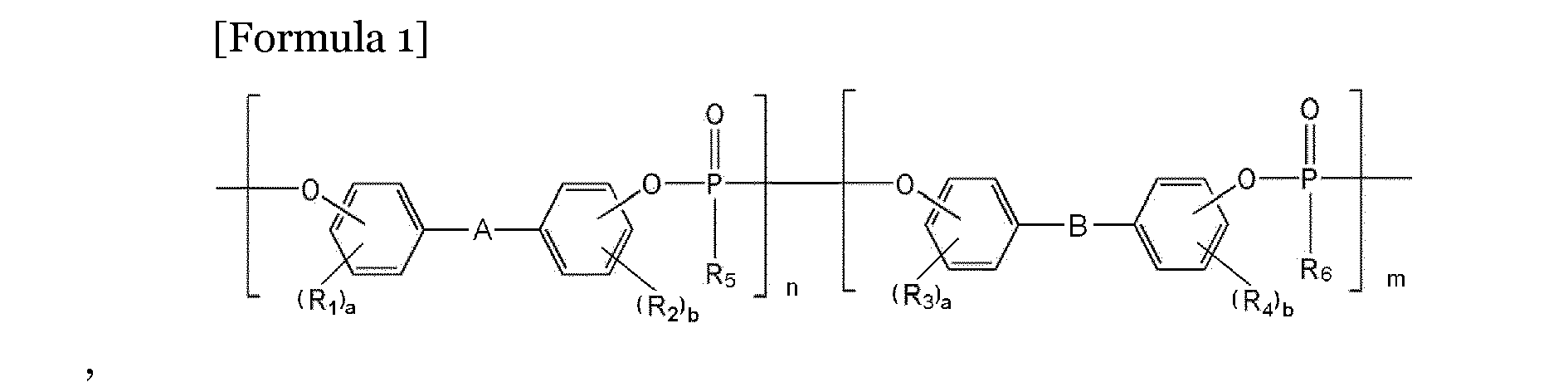
- the flame retardant thermoplastic resin composition includes 100 parts by weight of a base resin composed of an aromatic vinyl resin and a polyphenylene oxide resin; and 0.1 to 30 parts by weight of a polyphosphonate copolymer represented by Formula 1: wherein A and B are each independently a single bond, a C 1 -C 5 alkylene group, a C 1 -C 5 alkylidene group, a C 5 -C 6 cycloalkylidene group, -S- or -SO 2 -, provided that A and B are not identical to each other; R 5 and R 6 are each independently a substituted or unsubstituted C 1 -C 6 alkyl group, a substituted or unsubstituted C 6 -C 20 aryl group, or a substituted or unsubstituted C 6 -C 20 aryloxy group; R 1 , R 2 , R 3 and R 4 are each independently a substituted or unsubstituted C 6 -C 20 aryloxy
- the base resin may include 50 wt% to 99 wt% of an aromatic vinyl resin and 1 wt% to 50 wt% of a polyphenylene oxide resin.
- the aromatic vinyl resin may be composed of 1 wt% to 30 wt% of a rubber polymer and 70 wt% to 99 wt% of an aromatic vinyl monomer.
- n and m may range from 3 to 600.
- the polyphosphonate copolymer may have a weight average molecular weight of 1,000 g/mol to 50,000 g/mol.
- the polyphosphonate copolymer may have a glass transition temperature of 75°C to 90°C.
- the polyphosphonate copolymer may have biphenyl units in an amount of 0.5 mol% to 99.5 mol%, based on the total copolymer.
- thermoplastic resin composition may further include at least one of auxiliary flame retardants, glidants, plasticizers, heat stabilizers, anti-dripping agents, antioxidants, compatibilizers, light stabilizers, pigments, dyes, and mineral additives.
- the molded article may be molded from the flame retardant thermoplastic resin composition.
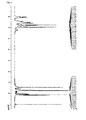
- Fig. 1 is NMR data of a polyphosphonate copolymer used in examples of the present invention.
- a flame retardant thermoplastic resin composition according to the present invention includes a base resin composed of an aromatic vinyl resin and a polyphenylene oxide resin, and a polyphosphonate copolymer.
- a base resin composed of an aromatic vinyl resin and a polyphenylene oxide resin
- a polyphosphonate copolymer a polyphosphonate copolymer
- the aromatic vinyl resin may be a polymer of an aromatic vinyl monomer, a copolymer of an aromatic vinyl monomer and another copolymerizable monomer, or a rubber modified aromatic vinyl resin that is a polymer of an aromatic vinyl monomer and a rubber polymer.
- aromatic vinyl monomer examples include styrene, ⁇ -methylstyrene, ⁇ -methylstyrene, p-methylstyrene, para-t-butylstyrene, ethylstyrene, and the like. These monomers may be used alone or in combination thereof.
- Examples of the other copolymerizable monomer include acrylonitrile, acrylic acid, methacrylic acid, maleic anhydride, N-substituted maleimide, and the like. These monomers may be used alone or in combination thereof.
- the rubber polymer examples include diene rubbers, such as butadiene rubbers, copolymers of butadiene and styrene, poly(acrylonitrile-butadiene), and the like, and saturated rubber obtained by hydrogenating the diene rubbers, isoprene rubbers, acrylic rubbers, ethylene-propylene-diene monomer terpolymers (EPDM), and the like.
- diene rubbers such as butadiene rubbers, copolymers of butadiene and styrene, poly(acrylonitrile-butadiene), and the like
- saturated rubber obtained by hydrogenating the diene rubbers isoprene rubbers, acrylic rubbers, ethylene-propylene-diene monomer terpolymers (EPDM), and the like.
- EPDM ethylene-propylene-diene monomer terpolymers
- the amount of the rubber polymers ranges from 1 wt% to 30 wt%, preferably from 5 wt% to 15 wt%, based on the total weight of the aromatic vinyl resin (A) (rubber modified aromatic vinyl resins).
- the aromatic vinyl monomer is present in an amount from 70 wt% to 99 wt%, preferably from 85 wt% to 95 wt%, based on the total weight of the aromatic vinyl resin (A).
- the resin composition can exhibit an excellent balance of physical properties of good impact strength and mechanical properties.
- rubber particles For a blend of the rubber modified aromatic vinyl resin and the polyphenylene oxide resin to exhibit appropriate physical properties, rubber particles have a particle size of 0.1 ⁇ m to 6.0 ⁇ m in Z-average. In order to exhibit preferred physical properties, the rubber particles have a particle size of 0.25 to 3.5 ⁇ m in Z-average.
- examples of the aromatic vinyl resin (A) include polystyrene (PS), high impact polystyrene (HIPS), acrylonitrile-butadiene-styrene copolymer resin (ABS), acrylonitrile-styrene copolymer resin (SAN), acrylonitrile-styrene-acrylate copolymer resin (ASA), and the like. They can be used alone or in combination thereof. Preferably, polystyrene (PS) or high impact polystyrene (HIPS) are preferred due to their good compatibility with polyphenylene ether resins.
- the aromatic vinyl resin (A) may be polymerized by heat polymerization in the presence of or in the absence of a polymerization initiator.
- the polymerization initiator may be at least one selected from peroxide initiators, such as benzoyl peroxide, t-butyl hydroperoxide, acetyl peroxide, cumene hydroperoxide and the like; and azo intiators such as azobis isobutyronitrile, without being limited thereto.
- the aromatic vinyl resin (A) may be prepared by mass polymerization, suspension polymerization, emulsion polymerization, or a mixed method thereof. Among these polymerization methods, mass polymerization is preferred.
- the aromatic vinyl resin (A) constitutes the base resin of the resin composition of the present invention.
- the aromatic vinyl resin (A) is present in an amount from 50 wt% to 99 wt%, preferably from 55 wt% to 80 wt%, more preferably from 55 wt% to 75 wt%, based on the weight of the base resin composed of (A) + (B).
- polyphenylene ether resin (B) examples include poly(2,6-dimethyl-1,4-phenylene)ether, poly(2,6-diethyl-1,4-phenylene)ether, poly(2,6-dipropyl-1,4-phenylene)ether, poly(2-methyl-6-ethyl-1,4-phenylene)ether, poly(2-methyl-6-propyl-1,4-phenylene)ether, poly(2-ethyl-6-propyl-1,4-phenylene)ether, poly(2,6-diphenyl-1,4-phenylene)ether, a copolymer of poly(2,6-dimethyl-1,4-phenylene)ether and poly(2,3,6-trimethyl-1,4-phenylene)ether, a copolymer of poly(2,6-dimethyl-1,4-phenylene)ether and poly(2,3,6-triethyl-1,4-phenylene)ether, and the like.
- poly(2,6-dimethyl-1,4-phenylene)ether or a copolymer of poly(2,6-dimethyl-1,4-phenylene)ether and poly(2,3,6-trimethyl-1,4-phenylene)ether are preferably used. Most preferably, poly(2,6-dimethyl-1,4-phenylene)ether is used.
- the degree of polymerization of the polyphenylene ether resin (B) used in the preparation of the resin composition of the present invention is not particularly limited.
- the polyphenylene ether resin having an intrinsic viscosity ranging from 0.2 dl/g to 0.8 dl/g, as measured in chloroform at 25°C, is preferably used when taking into consideration heat stability or workability of the resin composition.
- the polyphenylene ether resin (B) constitutes the base resin of the resin composition of the present invention.
- the amount of the polyphenylene ether resin (B) is from 1 to 50 wt% based on the weight of the base resin composed of (A) + (B). Within this range, the properties of the polyphenylene ether resin can be properly developed, which in turn give the resin composition good fluidity and impact resistance.
- the amount of the polyphenylene ether resin (B) is preferably from 20 to 45 wt%, more preferably 25 to 45 wt% based on the weight of the base resin composed of (A) + (B).
- the polyphosphonate copolymer used in the present invention is represented by Formula 1.
- a and B are each independently a single bond, a C 1 -C 5 alkylene group, a C 1 -C 5 alkylidene group, a C 5 -C 6 cycloalkylidene group, -S- or -SO 2 -, provided that A and B are not identical to each other;
- R 5 and R 6 are each independently a substituted or unsubstituted C 1 -C 6 alkyl group, a substituted or unsubstituted C 6 -C 20 aryl group, or a substituted or unsubstituted C 6 -C 20 aryloxy group;
- R 1 , R 2 , R 3 and R 4 are each independently a substituted or unsubstituted C 1 -C 6 alkyl group, a substituted or unsubstituted C 3 -C 6 cycloalkyl group, a substituted or unsubstituted C 6 -C 12 aryl group, or a halogen atom
- the sum of n and m is 3 to 600. Within this range, the resin composition exhibits much better flame retardancy.
- the polyphosphonate copolymer (C) may be prepared by reacting a diol represented by Formula 2-1, a diol represented by Formula 2-2 and a phosphonic dichloride represented by Formula 3.
- R is a substituted or unsubstituted C 1 -C 6 alkyl group, a substituted or unsubstituted C 6 -C 20 aryl group, or a substituted or unsubstituted C 6 -C 20 aryloxy group.
- R in Formula 3 corresponds to R 5 and R 6 in Formula 1.
- diols examples include 4,4'-dihydroxybiphenyl, 2,2-bis-(4-hydroxyphenyl)-propane, 2,4-bis-(4-hydroxyphenyl)-2-methylbutane, 1,1-bis-(4-hydroxyphenyl)-cyclohexane, 2,2-bis-(3-chloro-4-hydroxyphenyl)-propane, 2,2-bis-(3,5-dichloro-4-hydroxyphenyl)-propane, and the like. These diols may be used in combination thereof. Among these, 4,4'-dihydroxybiphenyl and 2,2-bis-(4-hydroxyphenyl)-propane are preferably used.
- the ratio between two types of diols may be properly adjusted in accordance with desired physical properties.
- the molar ratio between 4,4'-dihydroxybiphenyl and 2,2-bis-(4-hydroxyphenyl)-propane may be 5 to 95: 95 to 5.
- the resin composition of the present invention can exhibit much better flame retardancy.
- the polyphosphonate copolymer may be prepared by adding the phosphonic dichloride to a solution obtained by mixing two types of diols, a catalyst and a terminal capping agent.
- the phosphonic dichloride and the total of the diols may be reacted in an equivalent ratio of 1:1.
- the reaction between the diols and phosphonic dichloride may be carried out by a conventional polymerization in the presence of a Lewis acid catalyst.
- the polymerization is preferably carried out by solution polymerization.
- examples of the Lewis acid catalyst include aluminum chloride, and magnesium chloride, without being limited thereto.
- the catalyst may be added in an equivalent of 0.01 to 10, preferably 0.01 to 1, more preferably 0.01 to 0.1, based on 1 equivalent of the sum of the diols.
- the reaction may be carried out in the presence of a terminal capping agent.
- a terminal capping agent C 1 -C 5 alkyl group containing phenol is preferably used.
- phenol, 4-t-butylphenol, or 2-t-butylphenol may be used.
- the terminal capping agent may be added in an equivalent of 1 or less, preferably 0.01 to 0.5, based on 1 equivalent of the sum of the diols.
- the resultant may be washed with an acid solution.
- the acid solution include phosphoric acid, hydrochloric acid, nitric acid, sulfuric acid, and the like.
- phosphoric acid or hydrochloric acid is used.
- the acid solution may be used in a concentration of 0.1% to 10%, preferably 1% to 5%.
- the polyphosphonate copolymer in a white solid form may be obtained via washing and filtration.
- the polyphosphonate copolymer prepared as above is linear and does not contain a bisphenol structure.
- the polyphosphonate copolymer (C) may have a weight average molecular weight of 1,000 g/mol to 50,000 g/mol, preferably 1,000 g/mol to 20,000 g/mol, more preferably 1,000 g/mol to 10,000 g/mol, as measured by GPC (Gel Permeation Chromatography). Within this range, the resin composition can exhibit much better flame retardancy.
- the polyphosphonate copolymer may have an acid value from 0.005 KOH mg/g to 6 KOH mg/g, preferably from 0.01 KOH mg/g to 3 KOH mg/g. Within this range, the resin composition can prevent degradation of the thermoplastic resin.
- the polyphosphonate copolymer may have a polydispersity index (PDI) from 1.5 to 3.5, preferably from 1.8 to 3.5. Within this range, the resin composition can exhibit a good balance of physical properties of flame retardancy, fluidity, impact strength, heat resistance, and the like.
- PDI polydispersity index
- the polyphosphonate copolymer may have a glass transition temperature from 75°C to 90°C, preferably from 78°C to 87°C. Within this range, the resin composition can exhibit good processability.
- the polyphosphonate copolymer (C) may have a rate of change in acid value of 0.005 to 6, preferably 0.01 to 5, as calculated by Equation 1.
- ⁇ AV AVa - AVb AVb x 100
- Equation 1 ⁇ AV represents the rate of change in acid value, AVa represents the acid value measured after 10 g of the copolymer is left at 280°C for 1 hour, and AVb represents the initial acid value of the copolymer.
- the polyphosphonate copolymer (C) may have biphenyl units in an amount of 0.5 mol% to 99.5 mol%, preferably 1 mol% to 50 mol%, based on the total copolymer. Within this range, the resin composition can exhibit much better flame retardancy.
- the polyphosphonate copolymer (C) may be present in an amount of 0.1 to 30 parts by weight, preferably 1 to 25 parts by weight, based on 100 parts by weight of the base resin composed of (A) and (B). Within this range, the resin composition can exhibit a good balance of physical properties of flame retardancy, fluidity, impact strength, heat resistance, and the like.
- thermoplastic resin composition may additionally include additives, such as auxiliary flame retardants, glidants, plasticizers, heat stabilizers, anti-dripping agents, antioxidants, compatibilizers, light stabilizers, pigments, dyes, mineral additives, and the like. These additives may be used alone or in combination thereof.
- thermoplastic resin composition of the present invention may be formed into pellets by mixing the constituent components and other additives simultaneously and then melt extruding the resultant mixture in an extruder.
- the pellets may be molded by various molding processes such as injection molding, extrusion molding, vacuum molding, casting molding, and the like to produce molded articles.
- Another aspect of the invention provides molded articles made from the thermoplastic resin composition according to the present invention. Since these molded articles have excellent properties in terms of impact resistance, fluidity, flame retardancy and the like, the molded articles may be broadly used as components for electric-electronic products, exterior materials, automotive parts, miscellaneous goods, construction materials, and the like.
- the number average molecular weight and the weight average molecular weight of the prepared polyphosphonate copolymer were 2,100 g/mol and 4,400 g/mol, respectively.
- the prepared polyphosphonate copolymer had a PDI (polydispersity index) of 2.1, a glass transition temperature of 82°C, and an acid value of 0.01 KOH mg/g.
- the rate of change in acid value calculated from Equation 1 was 0.64.
- the prepared polymer (C-2) had a weight average molecular weight of 3,400 g/mol, PDI of 1.9 and an acid value of 0.01 KOH mg/g.
- the rate of change in acid value calculated from Equation 1 was 0.69.
- Each component defined as above was added in an amount shown in Table 1 to a conventional twin-screw extruder and then extruded at a temperature range from 200°C to 280°C to obtain pellets.
- the pellets were dried at 70°C for 2 hours and molded by a 10 oz injection molding machine at a molding temperature of 180°C to 280°C and a mold temperature of 40°C to 80°C to produce specimens.
- the prepared specimens were evaluated as to physical properties in accordance with the following methods. The results are provided in Table 1.
- Comparative Examples 3-6 using monomolecular flame retardants demonstrated deteriorated heat resistance, as compared to Comparative Examples 1 and 2 using polyphosphonates. Further, Examples 1 and 2 using the polyphosphonate copolymers of the present invention demonstrated excellent impact strength and heat resistance, as compared to Comparative Examples 1 and 2.
Landscapes
- Chemical & Material Sciences (AREA)
- Organic Chemistry (AREA)
- Health & Medical Sciences (AREA)
- Chemical Kinetics & Catalysis (AREA)
- Medicinal Chemistry (AREA)
- Polymers & Plastics (AREA)
- Engineering & Computer Science (AREA)
- Materials Engineering (AREA)
- Compositions Of Macromolecular Compounds (AREA)
Abstract
Description
- The present invention relates to a flame retardant thermoplastic resin composition. More particularly, the present invention relates to a flame retardant thermoplastic resin composition, which is environmentally-friendly and has an excellent balance of physical properties including not only flame retardancy but also transparency, heat resistance, impact strength, appearance and the like by containing, as a flame retardant, a polymerizable phosphorus compound with a specific structure having two or more repeat units in a backbone thereof.
- With increasing interest in environmental issues, regulation on existing halogen flame retardants has been reinforced in many countries. In line with this tendency, studies have been actively conducted to develop non-halogen flame retardants capable of replacing halogen flame retardants. Particularly, studies have focused on phosphorus flame retardants. Most common phosphorus flame retardants are phosphoric acid esters. For example, monomolecular phosphorus flame retardants such as triphenyl phosphate, resorcinol bisphenol phosphate and the like are usually used. However, such monomolecular phosphorus flame retardants have a low molecular weight and thus volatilize at high molding temperatures, causing deterioration in appearance of plastic products containing the same. Further, monomolecular phosphorus flame retardants may escape into the outside environment, which can cause environmental contamination. Accordingly, interest in polyphosphonates as polymerizable phosphorus flame retardants has been growing in the art. Polyphosphonates in the polymer form exhibit excellent properties in terms of flame retardancy, mechanical properties, heat resistance and transparency, as compared with monomolecular phosphorus flame retardants. In particular, polyphosphonates can be used in resins requiring high heat resistance and high transparency, such as polycarbonate resins.
- However, existing polyphosphonates are not satisfactory in terms of impact strength, heat resistance and appearance, and tend to partially degrade thermoplastic resins due to structural characteristics thereof, thereby causing deterioration in physical properties. Moreover, existing polyphosphonates exhibit unsatisfactory compatibility with resins and low dispersibility.
- Thus, it is the object of the present invention to overcome above disadvantages and to provide a flame retardant thermoplastic resin composition, which is environmentally-friendly without incurring gas formation or degradation issues and has an excellent balance of physical properties including not only flame retardancy but also transparency, heat resistance, impact strength, appearance and the like by containing as a flame retardant a polyphosphonate copolymer having two or more repeat units in a backbone thereof.
- This object has been achieved by the provision of a flame retardant thermoplastic resin composition. The flame retardant thermoplastic resin composition includes 100 parts by weight of a base resin composed of an aromatic vinyl resin and a polyphenylene oxide resin; and 0.1 to 30 parts by weight of a polyphosphonate copolymer represented by Formula 1:

- The base resin may include 50 wt% to 99 wt% of an aromatic vinyl resin and 1 wt% to 50 wt% of a polyphenylene oxide resin.
- The aromatic vinyl resin may be composed of 1 wt% to 30 wt% of a rubber polymer and 70 wt% to 99 wt% of an aromatic vinyl monomer.
- The sum of n and m may range from 3 to 600.
- The polyphosphonate copolymer may have a weight average molecular weight of 1,000 g/mol to 50,000 g/mol.
- The polyphosphonate copolymer may have a glass transition temperature of 75°C to 90°C.
- The polyphosphonate copolymer may have a rate of change in acid value of 0.005 to 6, as calculated by Equation 1:

wherein ΔAV represents the rate of change in acid value, AVa represents the acid value measured after 10 g of the copolymer is left at 280°C for 1 hour, and AVb represents the initial acid value of the copolymer. - The polyphosphonate copolymer may have biphenyl units in an amount of 0.5 mol% to 99.5 mol%, based on the total copolymer.
- The thermoplastic resin composition may further include at least one of auxiliary flame retardants, glidants, plasticizers, heat stabilizers, anti-dripping agents, antioxidants, compatibilizers, light stabilizers, pigments, dyes, and mineral additives.
- Another aspect of the present invention provides a molded article. The molded article may be molded from the flame retardant thermoplastic resin composition.
-
Fig. 1 is NMR data of a polyphosphonate copolymer used in examples of the present invention. - A flame retardant thermoplastic resin composition according to the present invention includes a base resin composed of an aromatic vinyl resin and a polyphenylene oxide resin, and a polyphosphonate copolymer. Hereinafter, each component of the flame retardant thermoplastic resin composition will be described in detail.
- The aromatic vinyl resin may be a polymer of an aromatic vinyl monomer, a copolymer of an aromatic vinyl monomer and another copolymerizable monomer, or a rubber modified aromatic vinyl resin that is a polymer of an aromatic vinyl monomer and a rubber polymer.
- Examples of the aromatic vinyl monomer include styrene, α-methylstyrene, β-methylstyrene, p-methylstyrene, para-t-butylstyrene, ethylstyrene, and the like. These monomers may be used alone or in combination thereof.
- Examples of the other copolymerizable monomer include acrylonitrile, acrylic acid, methacrylic acid, maleic anhydride, N-substituted maleimide, and the like. These monomers may be used alone or in combination thereof.
- Examples of the rubber polymer include diene rubbers, such as butadiene rubbers, copolymers of butadiene and styrene, poly(acrylonitrile-butadiene), and the like, and saturated rubber obtained by hydrogenating the diene rubbers, isoprene rubbers, acrylic rubbers, ethylene-propylene-diene monomer terpolymers (EPDM), and the like. Preferably, polybutadienes, copolymers of butadiene and styrene, isoprene rubbers, and alkyl acrylate rubbers are used.
- When using the rubber modified aromatic vinyl resins as an aromatic vinyl resin (A), the amount of the rubber polymers ranges from 1 wt% to 30 wt%, preferably from 5 wt% to 15 wt%, based on the total weight of the aromatic vinyl resin (A) (rubber modified aromatic vinyl resins). The aromatic vinyl monomer is present in an amount from 70 wt% to 99 wt%, preferably from 85 wt% to 95 wt%, based on the total weight of the aromatic vinyl resin (A). Within this range, the resin composition can exhibit an excellent balance of physical properties of good impact strength and mechanical properties.
- For a blend of the rubber modified aromatic vinyl resin and the polyphenylene oxide resin to exhibit appropriate physical properties, rubber particles have a particle size of 0.1 µm to 6.0 µm in Z-average. In order to exhibit preferred physical properties, the rubber particles have a particle size of 0.25 to 3.5 µm in Z-average.
- In one embodiment, examples of the aromatic vinyl resin (A) include polystyrene (PS), high impact polystyrene (HIPS), acrylonitrile-butadiene-styrene copolymer resin (ABS), acrylonitrile-styrene copolymer resin (SAN), acrylonitrile-styrene-acrylate copolymer resin (ASA), and the like. They can be used alone or in combination thereof. Preferably, polystyrene (PS) or high impact polystyrene (HIPS) are preferred due to their good compatibility with polyphenylene ether resins.
- Methods of preparing the aromatic vinyl resin (A) are well known to a person skilled in the art and the aromatic vinyl resin can be commercially obtained in the art.
- For example, the aromatic vinyl resin (A) may be polymerized by heat polymerization in the presence of or in the absence of a polymerization initiator. The polymerization initiator may be at least one selected from peroxide initiators, such as benzoyl peroxide, t-butyl hydroperoxide, acetyl peroxide, cumene hydroperoxide and the like; and azo intiators such as azobis isobutyronitrile, without being limited thereto.
- The aromatic vinyl resin (A) may be prepared by mass polymerization, suspension polymerization, emulsion polymerization, or a mixed method thereof. Among these polymerization methods, mass polymerization is preferred.
- The aromatic vinyl resin (A) constitutes the base resin of the resin composition of the present invention. The aromatic vinyl resin (A) is present in an amount from 50 wt% to 99 wt%, preferably from 55 wt% to 80 wt%, more preferably from 55 wt% to 75 wt%, based on the weight of the base resin composed of (A) + (B).
- Examples of the polyphenylene ether resin (B) include poly(2,6-dimethyl-1,4-phenylene)ether, poly(2,6-diethyl-1,4-phenylene)ether, poly(2,6-dipropyl-1,4-phenylene)ether, poly(2-methyl-6-ethyl-1,4-phenylene)ether, poly(2-methyl-6-propyl-1,4-phenylene)ether, poly(2-ethyl-6-propyl-1,4-phenylene)ether, poly(2,6-diphenyl-1,4-phenylene)ether, a copolymer of poly(2,6-dimethyl-1,4-phenylene)ether and poly(2,3,6-trimethyl-1,4-phenylene)ether, a copolymer of poly(2,6-dimethyl-1,4-phenylene)ether and poly(2,3,6-triethyl-1,4-phenylene)ether, and the like. Among these, poly(2,6-dimethyl-1,4-phenylene)ether, or a copolymer of poly(2,6-dimethyl-1,4-phenylene)ether and poly(2,3,6-trimethyl-1,4-phenylene)ether are preferably used. Most preferably, poly(2,6-dimethyl-1,4-phenylene)ether is used.
- The degree of polymerization of the polyphenylene ether resin (B) used in the preparation of the resin composition of the present invention is not particularly limited. However, the polyphenylene ether resin having an intrinsic viscosity ranging from 0.2 dl/g to 0.8 dl/g, as measured in chloroform at 25°C, is preferably used when taking into consideration heat stability or workability of the resin composition.
- The polyphenylene ether resin (B) constitutes the base resin of the resin composition of the present invention. The amount of the polyphenylene ether resin (B) is from 1 to 50 wt% based on the weight of the base resin composed of (A) + (B). Within this range, the properties of the polyphenylene ether resin can be properly developed, which in turn give the resin composition good fluidity and impact resistance. The amount of the polyphenylene ether resin (B) is preferably from 20 to 45 wt%, more preferably 25 to 45 wt% based on the weight of the base resin composed of (A) + (B).
- The polyphosphonate copolymer used in the present invention is represented by Formula 1.

- In Formula 1, A and B are each independently a single bond, a C1-C5 alkylene group, a C1-C5 alkylidene group, a C5-C6 cycloalkylidene group, -S- or -SO2-, provided that A and B are not identical to each other; R5 and R6 are each independently a substituted or unsubstituted C1-C6 alkyl group, a substituted or unsubstituted C6-C20 aryl group, or a substituted or unsubstituted C6-C20 aryloxy group; R1, R2, R3 and R4 are each independently a substituted or unsubstituted C1-C6 alkyl group, a substituted or unsubstituted C3-C6 cycloalkyl group, a substituted or unsubstituted C6-C12 aryl group, or a halogen atom; a and b are each independently an integer from 0 to 4; and n and m are each independently an integer from 1 to 500.
- In one embodiment, the sum of n and m is 3 to 600. Within this range, the resin composition exhibits much better flame retardancy.
- The polyphosphonate copolymer (C) may be prepared by reacting a diol represented by Formula 2-1, a diol represented by Formula 2-2 and a phosphonic dichloride represented by Formula 3.


- In Formulas 2-1 and 2-2, A, B, R1, R2, R3, R4, a and b are the same as defined in Formula 1.

- In Formula 3, R is a substituted or unsubstituted C1-C6 alkyl group, a substituted or unsubstituted C6-C20 aryl group, or a substituted or unsubstituted C6-C20 aryloxy group.
- As the phosphonic dichloride represented by Formula 3, two types of compounds wherein R is not identical may be used. R in Formula 3 corresponds to R5 and R6 in Formula 1.
- Examples of the diols include 4,4'-dihydroxybiphenyl, 2,2-bis-(4-hydroxyphenyl)-propane, 2,4-bis-(4-hydroxyphenyl)-2-methylbutane, 1,1-bis-(4-hydroxyphenyl)-cyclohexane, 2,2-bis-(3-chloro-4-hydroxyphenyl)-propane, 2,2-bis-(3,5-dichloro-4-hydroxyphenyl)-propane, and the like. These diols may be used in combination thereof. Among these, 4,4'-dihydroxybiphenyl and 2,2-bis-(4-hydroxyphenyl)-propane are preferably used. The ratio between two types of diols may be properly adjusted in accordance with desired physical properties. In one embodiment, the molar ratio between 4,4'-dihydroxybiphenyl and 2,2-bis-(4-hydroxyphenyl)-propane may be 5 to 95: 95 to 5. Within this range, the resin composition of the present invention can exhibit much better flame retardancy.
- In one embodiment, the polyphosphonate copolymer may be prepared by adding the phosphonic dichloride to a solution obtained by mixing two types of diols, a catalyst and a terminal capping agent.
- In one embodiment, the phosphonic dichloride and the total of the diols may be reacted in an equivalent ratio of 1:1.
- The reaction between the diols and phosphonic dichloride may be carried out by a conventional polymerization in the presence of a Lewis acid catalyst. The polymerization is preferably carried out by solution polymerization.
- In one embodiment, examples of the Lewis acid catalyst include aluminum chloride, and magnesium chloride, without being limited thereto. The catalyst may be added in an equivalent of 0.01 to 10, preferably 0.01 to 1, more preferably 0.01 to 0.1, based on 1 equivalent of the sum of the diols.
- Further, the reaction may be carried out in the presence of a terminal capping agent. As the terminal capping agent, C1-C5 alkyl group containing phenol is preferably used. For example, phenol, 4-t-butylphenol, or 2-t-butylphenol may be used. The terminal capping agent may be added in an equivalent of 1 or less, preferably 0.01 to 0.5, based on 1 equivalent of the sum of the diols.
- In one embodiment, after completing the reaction, the resultant may be washed with an acid solution. Examples of the acid solution include phosphoric acid, hydrochloric acid, nitric acid, sulfuric acid, and the like. Preferably, phosphoric acid or hydrochloric acid is used. The acid solution may be used in a concentration of 0.1% to 10%, preferably 1% to 5%.
- Then, the polyphosphonate copolymer in a white solid form may be obtained via washing and filtration. The polyphosphonate copolymer prepared as above is linear and does not contain a bisphenol structure.
- The polyphosphonate copolymer (C) may have a weight average molecular weight of 1,000 g/mol to 50,000 g/mol, preferably 1,000 g/mol to 20,000 g/mol, more preferably 1,000 g/mol to 10,000 g/mol, as measured by GPC (Gel Permeation Chromatography). Within this range, the resin composition can exhibit much better flame retardancy.
- The polyphosphonate copolymer may have an acid value from 0.005 KOH mg/g to 6 KOH mg/g, preferably from 0.01 KOH mg/g to 3 KOH mg/g. Within this range, the resin composition can prevent degradation of the thermoplastic resin.
- The polyphosphonate copolymer may have a polydispersity index (PDI) from 1.5 to 3.5, preferably from 1.8 to 3.5. Within this range, the resin composition can exhibit a good balance of physical properties of flame retardancy, fluidity, impact strength, heat resistance, and the like.
- The polyphosphonate copolymer may have a glass transition temperature from 75°C to 90°C, preferably from 78°C to 87°C. Within this range, the resin composition can exhibit good processability.
- The polyphosphonate copolymer (C) may have a rate of change in acid value of 0.005 to 6, preferably 0.01 to 5, as calculated by Equation 1.

- In Equation 1, ΔAV represents the rate of change in acid value, AVa represents the acid value measured after 10 g of the copolymer is left at 280°C for 1 hour, and AVb represents the initial acid value of the copolymer.
- The polyphosphonate copolymer (C) may have biphenyl units in an amount of 0.5 mol% to 99.5 mol%, preferably 1 mol% to 50 mol%, based on the total copolymer. Within this range, the resin composition can exhibit much better flame retardancy.
- The polyphosphonate copolymer (C) may be present in an amount of 0.1 to 30 parts by weight, preferably 1 to 25 parts by weight, based on 100 parts by weight of the base resin composed of (A) and (B). Within this range, the resin composition can exhibit a good balance of physical properties of flame retardancy, fluidity, impact strength, heat resistance, and the like.
- As needed, the thermoplastic resin composition may additionally include additives, such as auxiliary flame retardants, glidants, plasticizers, heat stabilizers, anti-dripping agents, antioxidants, compatibilizers, light stabilizers, pigments, dyes, mineral additives, and the like. These additives may be used alone or in combination thereof.
- The thermoplastic resin composition of the present invention may be formed into pellets by mixing the constituent components and other additives simultaneously and then melt extruding the resultant mixture in an extruder. The pellets may be molded by various molding processes such as injection molding, extrusion molding, vacuum molding, casting molding, and the like to produce molded articles.
- Another aspect of the invention provides molded articles made from the thermoplastic resin composition according to the present invention. Since these molded articles have excellent properties in terms of impact resistance, fluidity, flame retardancy and the like, the molded articles may be broadly used as components for electric-electronic products, exterior materials, automotive parts, miscellaneous goods, construction materials, and the like.
- Next, the constitution and functions of the present invention will be explained in more detail with reference to the following examples. It should be understood that these examples are provided for illustrative purposes only and are not to be in any way construed as limiting the present invention. A description of details apparent to those skilled in the art will be omitted herein.
- Specifications of the components used in examples and comparative examples were as follows:
- (A) Aromatic vinyl resin: HIPS resin (HG-1730, manufactured by CHEIL Industries) was used.
- (B) Polyphenylene ether (PPE) resin: Poly(2,6-dimethyl-phenylether (S-202, manufactured by Asahi Kasei Company, Japan) was used.
- (C) Flame retardant
- 7.18 kg (38.54 mol) of biphenol (Songwon Industrial Co., Ltd.), 8.80 kg (38.54 mol) of 2,2-bis-(4-hydroxyphenyl)-propane (Kumho Industries Co., Ltd.), 5.79 kg (38.54 mol) of 4-t-butylphenol (TCI Co., Ltd.) as a terminal capping agent, and 0.51 kg (3.82 mol) of aluminum chloride were added to 100 kg of chlorobenzene (Samchun Chemical Co. Ltd.) and then dissolved at 145°C. To the resultant solution, 15.45 kg (77.08 mol) of phenyl phosphonic dichloride (IDB Co., Ltd.) was slowly added dropwise and then stirred for 8 hours. The mixture was washed with an aqueous hydrochloric acid solution and distilledwater and the washing procedure was repeated twice to obtain an organic layer. After dehydrogenation of the organic layer, the resultant was precipitated in hexane (Samchun Chemical Co. Ltd.) to obtain a polyphosphonate copolymer in a white solid form. The NMR (Briker AVANCE III & Ultrashield Magnet Company, 300 MHz) data for the prepared copolymer are shown in
Figure 1 . The number average molecular weight and the weight average molecular weight of the prepared polyphosphonate copolymer were 2,100 g/mol and 4,400 g/mol, respectively. In addition, the prepared polyphosphonate copolymer had a PDI (polydispersity index) of 2.1, a glass transition temperature of 82°C, and an acid value of 0.01 KOH mg/g. The rate of change in acid value calculated from Equation 1 was 0.64. - 1 equivalent of bisphenol A (Songwon Industrial Co., Ltd.), 0.2 equivalent of 4-t-butylphenol as a terminal capping agent and 0.01 equivalent of aluminum chloride were added to chlorobenzene where chlorobenzene was used at 6 times greater than the amount of bisphenol. After warming to 131°C, 1 equivalent of phenylphosphonic dichloride (Acros Co., Ltd.) was added dropwise, thereby initiating the reaction. After completion of dropping, the resultant mixture was stirred for 2 hours and completed the reaction. After completion of the reaction, the temperature was decreased to 80°C, and the resultant was washed with a 10% aqueous hydrochloric acid solution and then with water twice. After washing, the aqueous layer was removed and the organic layer was removed by reduced pressure distillation to produce a bisphenol group containing polyphosphonate (C-2). The prepared polymer (C-2) had a weight average molecular weight of 3,400 g/mol, PDI of 1.9 and an acid value of 0.01 KOH mg/g. The rate of change in acid value calculated from Equation 1 was 0.69.
- Each component defined as above was added in an amount shown in Table 1 to a conventional twin-screw extruder and then extruded at a temperature range from 200°C to 280°C to obtain pellets. The pellets were dried at 70°C for 2 hours and molded by a 10 oz injection molding machine at a molding temperature of 180°C to 280°C and a mold temperature of 40°C to 80°C to produce specimens. The prepared specimens were evaluated as to physical properties in accordance with the following methods. The results are provided in Table 1.
- (1) Flame retardancy: Flame retardancy was measured on a 1/8" thick specimen in accordance with UL94 VB flame retardant standards.
(2) Heat resistance (VST): Heat resistance was measured under conditions of 5 kg, 50°C/HR in accordance with ISO R 306.
(3) Heat deformation temperature: Heat deformation temperature was measured by applying a surface pressure of 1.82 MPa in accordance with ASTM D648 (°C).
(4) Izod impact strength: Izod impact strength was measured on a 1/8" thick notched specimen at room temperature in accordance with ASTM D-256 (kgf·cm/cm).
(5) Melt flow index: The melt flow index was measured under conditions of 250°C, 10 kg (g/10 min).TABLE 1 Examples Comparative Examples 1 2 1 2 3 4 5 6 HIPS 55 55 55 55 55 55 55 55 PPE 45 45 45 45 45 45 45 45 Flame Retardant (C-1) 15 20 - - - - - - (C-2) - - 15 20 - - - - (C-3) - - - - 15 20 - - (C-4) - - - - - - 15 20 Flame retardancy V-1 V-1 V-1 V-1 V-1 Fail V-1 V-1 Vicat softening point (°C) 129.0 126.1 124.9 125.2 103.1 103.5 106 97.5 Heat deformation temperature (°C) 111.9 111.3 112.9 111.0 89.5 89 91 83.2 IZOD impact strength 7.9 6.6 6.2 3.9 8.1 6.9 8.3 6.8 Melt flow index 43 102 58 109 85 72 45 70 - As shown in Table 1, it could be seen that Comparative Examples 3-6 using monomolecular flame retardants demonstrated deteriorated heat resistance, as compared to Comparative Examples 1 and 2 using polyphosphonates. Further, Examples 1 and 2 using the polyphosphonate copolymers of the present invention demonstrated excellent impact strength and heat resistance, as compared to Comparative Examples 1 and 2.
- Although some embodiments have been disclosed herein, it should be understood that these embodiments are provided by way of illustration only, and that various modification, changes, and alterations can be made without departing from the spirit and scope of the invention. Therefore, the scope of the present invention should be limited only by the accompanying claims and equivalents thereof.
Claims (10)
- A flame retardant thermoplastic resin composition comprising: 100 parts by weight of a base resin composed of an aromatic vinyl resin and a polyphenylene oxide resin; and 0.1 to 30 parts by weight of a polyphosphonate copolymer represented by Formula 1:

R5 and R6 are each independently a substituted or unsubstituted C1-C6 alkyl group, a substituted or unsubstituted C6-C20 aryl group, or a substituted or unsubstituted C6-C20 aryloxy group;
R1, R2, R3 and R4 are each independently a substituted or unsubstituted C1-C6 alkyl group, a substituted or unsubstituted C3-C6 cycloalkyl group, a substituted or unsubstituted C6-C12 aryl group, or a halogen atom;
a and b are each independently an integer from 0 to 4; and
n and m are each independently an integer from 1 to 500.) - The flame retardant thermoplastic composition according to claim 1, wherein the base resin comprises 50 wt% to 99 wt% of an aromatic vinyl resin and 1 wt% to 50 wt% of a polyphenylene oxide resin.
- The flame retardant thermoplastic composition according to claim 1 or 2, wherein the aromatic vinyl resin is composed of 1 wt% to 30 wt% of a rubber polymer and 70 wt% to 99 wt% of an aromatic vinyl monomer.
- The flame retardant thermoplastic composition according to any of claims 1 to 3, wherein the sum of n and m ranges from 3 to 600.
- The flame retardant thermoplastic composition according to any of claims 1 to 4, wherein the polyphosphonate copolymer has a weight average molecular weight of 1,000 g/mol to 50,000 g/mol.
- The flame retardant thermoplastic composition according to any of claims 1 to 5, wherein the polyphosphonate copolymer has a glass transition temperature of 75°C to 90°C.
- The flame retardant thermoplastic composition according to any of claims 1 to 6, wherein the polyphosphonate copolymer has a rate of change in acid value of 0.005 to 6, as calculated by Equation 1:

(wherein ΔAV represents the rate of change in acid value, AVa represents the acid value measured after 10 g of the copolymer is left at 280°C for 1 hour, and AVb represents the initial acid value of the copolymer). - The flame retardant thermoplastic composition according to any of claims 1 to 7, wherein the polyphosphonate copolymer has biphenyl units in an amount of 0.5 mol% to 99.5 mol%, based on the total copolymer.
- The flame retardant thermoplastic composition according to any of claims 1 to 8, wherein the thermoplastic resin composition further comprises at least one of auxiliary flame retardants, glidants, plasticizers, heat stabilizers, anti-dripping agents, antioxidants, compatibilizers, light stabilizers, pigments, dyes, and mineral additives.
- A molded article obtainable from the flame retardant thermoplastic composition according to any one of claims 1 to 9.
Applications Claiming Priority (1)
| Application Number | Priority Date | Filing Date | Title |
|---|---|---|---|
| KR20110147917A KR101489956B1 (en) | 2011-12-30 | 2011-12-30 | Flame retardant thermoplastic resin composition |
Publications (1)
| Publication Number | Publication Date |
|---|---|
| EP2610304A1 true EP2610304A1 (en) | 2013-07-03 |
Family
ID=47355918
Family Applications (1)
| Application Number | Title | Priority Date | Filing Date |
|---|---|---|---|
| EP12197187.3A Withdrawn EP2610304A1 (en) | 2011-12-30 | 2012-12-14 | Flame retardant thermoplastic resin composition |
Country Status (4)
| Country | Link |
|---|---|
| US (1) | US20130168618A1 (en) |
| EP (1) | EP2610304A1 (en) |
| KR (1) | KR101489956B1 (en) |
| CN (1) | CN103183892A (en) |
Cited By (1)
| Publication number | Priority date | Publication date | Assignee | Title |
|---|---|---|---|---|
| CN111448256A (en) * | 2018-04-06 | 2020-07-24 | 株式会社Lg化学 | thermoplastic resin composition |
Families Citing this family (1)
| Publication number | Priority date | Publication date | Assignee | Title |
|---|---|---|---|---|
| FR3015504B1 (en) * | 2013-12-20 | 2016-01-01 | Michelin & Cie | RUBBER COMPOSITION COMPRISING A POLYPHENYLENE ETHER RESIN AS A PLASTICIZER |
Citations (3)
| Publication number | Priority date | Publication date | Assignee | Title |
|---|---|---|---|---|
| US5290836A (en) * | 1991-10-25 | 1994-03-01 | Dsm N.V. | Flame-retardant polymer composition |
| EP0767204A2 (en) * | 1995-09-30 | 1997-04-09 | General Electric Company | Flame-retardant resin composition |
| US20110218260A1 (en) * | 2008-10-21 | 2011-09-08 | Albemarle Corporation | Mixed Glycol Polyphosphonate Compounds |
Family Cites Families (9)
| Publication number | Priority date | Publication date | Assignee | Title |
|---|---|---|---|---|
| US3868434A (en) * | 1965-05-21 | 1975-02-25 | Foster Grant Co Inc | Polymer composition and process |
| US3830771A (en) * | 1970-06-29 | 1974-08-20 | Celanese Corp | Phosphorus-containing polyesters |
| DE3002792A1 (en) * | 1980-01-26 | 1981-07-30 | Bayer Ag, 5090 Leverkusen | FLAME-RETARDANT COMPOSITION OF POLYPHENYLENETHER, POLYSTYRENE RESIN AND POLYPHOSPHONATE |
| DE19907831A1 (en) * | 1999-02-24 | 2000-08-31 | Bayer Ag | Flame-retardant thermoplastic molding compound |
| KR100576326B1 (en) * | 2003-11-06 | 2006-05-03 | 제일모직주식회사 | Flame Retardant Thermoplastic Composition |
| US7838604B2 (en) * | 2005-12-01 | 2010-11-23 | Frx Polymers, Inc. | Method for the production of block copolycarbonate/phosphonates and compositions therefrom |
| JP5508013B2 (en) * | 2006-08-31 | 2014-05-28 | スプレスタ エルエルシー | Oligomer bisphosphate flame retardant and composition containing the same |
| KR101344807B1 (en) * | 2009-12-30 | 2013-12-26 | 제일모직주식회사 | Thermoplastic resin composition including polyphosphonate compound, plastic molded article produced therefrom and method for preparing polyphosphonate compound |
| KR101139864B1 (en) * | 2011-08-26 | 2012-05-02 | 제일모직주식회사 | Novel Phosphoric Compound, Method of Preparing the Same and Flameproof Thermoplastic Resin Composition Using the Same |
-
2011
- 2011-12-30 KR KR20110147917A patent/KR101489956B1/en active Active
-
2012
- 2012-12-10 US US13/709,134 patent/US20130168618A1/en not_active Abandoned
- 2012-12-14 CN CN2012105465148A patent/CN103183892A/en active Pending
- 2012-12-14 EP EP12197187.3A patent/EP2610304A1/en not_active Withdrawn
Patent Citations (3)
| Publication number | Priority date | Publication date | Assignee | Title |
|---|---|---|---|---|
| US5290836A (en) * | 1991-10-25 | 1994-03-01 | Dsm N.V. | Flame-retardant polymer composition |
| EP0767204A2 (en) * | 1995-09-30 | 1997-04-09 | General Electric Company | Flame-retardant resin composition |
| US20110218260A1 (en) * | 2008-10-21 | 2011-09-08 | Albemarle Corporation | Mixed Glycol Polyphosphonate Compounds |
Non-Patent Citations (1)
| Title |
|---|
| SCHMIDT M ET AL: "AROMATISCHE POLYPHOSPHONATE: THERMOPLASTISCHE POLYMERE VON EXTREMER BRANDWIDRIGKEIT//AROMATIC POLYPHOSPHONATES: EXCEPTIONALLY FLAME-RESISTANT THERMOPLASTIC POLYMERS", ANGEWANDTE MAKROMOLEKULARE CHEMIE. APPLIED MACROMOLECULARCHEMISTRY AND PHYSICS, WILEY VCH, WEINHEIM, DE, vol. 132, no. 2165, 1 January 1985 (1985-01-01), pages 1 - 18, XP009044253, ISSN: 0003-3146, DOI: 10.1002/APMC.1985.051320101 * |
Cited By (3)
| Publication number | Priority date | Publication date | Assignee | Title |
|---|---|---|---|---|
| CN111448256A (en) * | 2018-04-06 | 2020-07-24 | 株式会社Lg化学 | thermoplastic resin composition |
| US11459457B2 (en) | 2018-04-06 | 2022-10-04 | Lg Chem, Ltd. | Thermoplastic resin composition |
| CN111448256B (en) * | 2018-04-06 | 2023-03-14 | 株式会社Lg化学 | thermoplastic resin composition |
Also Published As
| Publication number | Publication date |
|---|---|
| KR101489956B1 (en) | 2015-02-06 |
| US20130168618A1 (en) | 2013-07-04 |
| KR20130078793A (en) | 2013-07-10 |
| CN103183892A (en) | 2013-07-03 |
Similar Documents
| Publication | Publication Date | Title |
|---|---|---|
| US6900256B2 (en) | Thermoplastic resin compositions containing polyphosphate ester morpholides as flame retardants | |
| US20130172471A1 (en) | Biphenyl Polyphosphonate, Method for Preparing the Same and Thermoplastic Resin Composition Including the Same | |
| EP1209163B1 (en) | Oligomeric phosphoric acid ester morpholide compound and flame retardant thermoplastic resin composition containing the same | |
| EP2143754B1 (en) | Flame retardent and impact modifier, method for preparing thereof, and thermoplastic resin composition containing the same | |
| CN1510081A (en) | flame retardant resin composition | |
| EP2857450A1 (en) | Thermoplastic resin composition and molded article including the same | |
| EP2471840A1 (en) | Cross-linked polyphosphonate, method of preparing the same, and flame retardant thermoplastic resin composition including the same | |
| EP2749600B1 (en) | Flame retardant thermoplastic resin composition and molded article produced from the same | |
| KR20190081630A (en) | Thermoplastic resin composition and article produced therefrom | |
| KR100962174B1 (en) | Steric hindrance phenolic phosphonate flame retardant and flame retardant polycarbonate resin composition comprising same | |
| EP2746317A1 (en) | Phosphorous copolymer, method for preparing the same, and flame retardant thermoplastic resin composition including the same | |
| KR101489956B1 (en) | Flame retardant thermoplastic resin composition | |
| EP2377870B1 (en) | Novel phosphonate compounds and flame retardant styrene resin compositions containing the same | |
| KR20190117383A (en) | Thermoplastic resin composition | |
| KR101211414B1 (en) | Non-halogen Flame-retarding Polycarbonate Resin Composition | |
| KR101447275B1 (en) | Flame retardant thermoplastic resin composition | |
| EP3572463B1 (en) | Thermoplastic resin composition and article produced therefrom | |
| KR20130078604A (en) | Flame retardant thermoplastic resin composition | |
| KR20140090290A (en) | Flame retardant thermoplastic resin composition and article produced therefrom | |
| KR101209103B1 (en) | Non-halogen Flame-retarding Polycarbonate Resin Composition | |
| KR101267268B1 (en) | Non-halogen Flame-retarding Polycarbonate Resin Composition | |
| KR101743324B1 (en) | Silane based compound, method for preparing the same and thermoplastic resin composition comprising the same | |
| JPS63503546A (en) | Flame-retardant polyphenylene ether-polystyrene blends with increased heat resistance and methods for achieving the same |
Legal Events
| Date | Code | Title | Description |
|---|---|---|---|
| PUAI | Public reference made under article 153(3) epc to a published international application that has entered the european phase |
Free format text: ORIGINAL CODE: 0009012 |
|
| 17P | Request for examination filed |
Effective date: 20121214 |
|
| AK | Designated contracting states |
Kind code of ref document: A1 Designated state(s): AL AT BE BG CH CY CZ DE DK EE ES FI FR GB GR HR HU IE IS IT LI LT LU LV MC MK MT NL NO PL PT RO RS SE SI SK SM TR |
|
| AX | Request for extension of the european patent |
Extension state: BA ME |
|
| 17Q | First examination report despatched |
Effective date: 20131205 |
|
| GRAP | Despatch of communication of intention to grant a patent |
Free format text: ORIGINAL CODE: EPIDOSNIGR1 |
|
| RIC1 | Information provided on ipc code assigned before grant |
Ipc: C08L 51/04 20060101AFI20150120BHEP Ipc: C08G 79/04 20060101ALN20150120BHEP Ipc: C08L 85/02 20060101ALI20150120BHEP Ipc: C08L 71/12 20060101ALI20150120BHEP |
|
| INTG | Intention to grant announced |
Effective date: 20150213 |
|
| STAA | Information on the status of an ep patent application or granted ep patent |
Free format text: STATUS: THE APPLICATION IS DEEMED TO BE WITHDRAWN |
|
| 18D | Application deemed to be withdrawn |
Effective date: 20150624 |