EP2609092B1 - Oxadiazole inhibitors of leukotriene production - Google Patents
Oxadiazole inhibitors of leukotriene production Download PDFInfo
- Publication number
- EP2609092B1 EP2609092B1 EP11749686.9A EP11749686A EP2609092B1 EP 2609092 B1 EP2609092 B1 EP 2609092B1 EP 11749686 A EP11749686 A EP 11749686A EP 2609092 B1 EP2609092 B1 EP 2609092B1
- Authority
- EP
- European Patent Office
- Prior art keywords
- alkyl
- phenyl
- cyclobutyl
- oxadiazol
- pyrimidin
- Prior art date
- Legal status (The legal status is an assumption and is not a legal conclusion. Google has not performed a legal analysis and makes no representation as to the accuracy of the status listed.)
- Active
Links
- 0 *C(*)(c1n[o]c(*)n1)c1ccc(*)cc1* Chemical compound *C(*)(c1n[o]c(*)n1)c1ccc(*)cc1* 0.000 description 5
- XVENLJJCQZXTPQ-UHFFFAOYSA-N N/C(/C1(CCC1)c(cc1)ccc1-c1cnc(N)nc1)=N\O Chemical compound N/C(/C1(CCC1)c(cc1)ccc1-c1cnc(N)nc1)=N\O XVENLJJCQZXTPQ-UHFFFAOYSA-N 0.000 description 4
- YHHCFENKUDXDOG-UHFFFAOYSA-N CC(CN(C)C)[n]1ncc(/C(/O)=N/C(C2(CCC2)c(cc2)ccc2-c2cnc(N)nc2)=N)c1 Chemical compound CC(CN(C)C)[n]1ncc(/C(/O)=N/C(C2(CCC2)c(cc2)ccc2-c2cnc(N)nc2)=N)c1 YHHCFENKUDXDOG-UHFFFAOYSA-N 0.000 description 2
- RDWFXGCLELWENF-UHFFFAOYSA-N COc(c(OC)c1)ccc1/C(/O)=N/C(C1(CCC1)c(cc1)ccc1-c1cnc(N)nc1)=N Chemical compound COc(c(OC)c1)ccc1/C(/O)=N/C(C1(CCC1)c(cc1)ccc1-c1cnc(N)nc1)=N RDWFXGCLELWENF-UHFFFAOYSA-N 0.000 description 2
- SZIAWPCGJWIRLA-UHFFFAOYSA-N N=C(C1(CCC1)c(cc1)ccc1Br)/N=C(/C(Cl)(Cl)Cl)\O Chemical compound N=C(C1(CCC1)c(cc1)ccc1Br)/N=C(/C(Cl)(Cl)Cl)\O SZIAWPCGJWIRLA-UHFFFAOYSA-N 0.000 description 2
- IMBBXSASDSZJSX-UHFFFAOYSA-N OC(c1c[nH]nc1)=O Chemical compound OC(c1c[nH]nc1)=O IMBBXSASDSZJSX-UHFFFAOYSA-N 0.000 description 2
- UVEAQHBUHRXCRO-UHFFFAOYSA-N CC(C)(C)N(C)C(C[n]1ncc(/C(/O)=N/C(C2(CCC2)c(cc2)ccc2-c2cnc(N)nc2)=N)c1)=O Chemical compound CC(C)(C)N(C)C(C[n]1ncc(/C(/O)=N/C(C2(CCC2)c(cc2)ccc2-c2cnc(N)nc2)=N)c1)=O UVEAQHBUHRXCRO-UHFFFAOYSA-N 0.000 description 1
- BXJVTMCVECFHLW-UHFFFAOYSA-N CC(C)(C)NC(C[n]1ncc(/C(/O)=N/C(C2(CCC2)c(cc2)ccc2-c2cnc(N)nc2)=N)c1)=O Chemical compound CC(C)(C)NC(C[n]1ncc(/C(/O)=N/C(C2(CCC2)c(cc2)ccc2-c2cnc(N)nc2)=N)c1)=O BXJVTMCVECFHLW-UHFFFAOYSA-N 0.000 description 1
- UKAZLXIHCKKCNL-UHFFFAOYSA-N CC(C)(C)OC(N(CC1)CCN1c1nc(/C(/O)=N/C(C2(CCC2)c(cc2)ccc2-c2cnc(N)nc2)=N)c[s]1)=O Chemical compound CC(C)(C)OC(N(CC1)CCN1c1nc(/C(/O)=N/C(C2(CCC2)c(cc2)ccc2-c2cnc(N)nc2)=N)c[s]1)=O UKAZLXIHCKKCNL-UHFFFAOYSA-N 0.000 description 1
- CWXPZXBSDSIRCS-UHFFFAOYSA-N CC(C)(C)OC(N1CCNCC1)=O Chemical compound CC(C)(C)OC(N1CCNCC1)=O CWXPZXBSDSIRCS-UHFFFAOYSA-N 0.000 description 1
- SCPGAZUTOXKIMM-UHFFFAOYSA-N CC(C)(C[n]1cnc(/C(/O)=N/C(C2(CCC2)c(cc2)ccc2-c2cnc(N)nc2)=N)c1)O Chemical compound CC(C)(C[n]1cnc(/C(/O)=N/C(C2(CCC2)c(cc2)ccc2-c2cnc(N)nc2)=N)c1)O SCPGAZUTOXKIMM-UHFFFAOYSA-N 0.000 description 1
- FSCUUIARRLMOBY-UHFFFAOYSA-N CC(C)(C[n]1ncc(/C(/O)=N/C(C2(CCC2)c(cc2)ccc2-c2cnc(N)nc2)=N)c1)O Chemical compound CC(C)(C[n]1ncc(/C(/O)=N/C(C2(CCC2)c(cc2)ccc2-c2cnc(N)nc2)=N)c1)O FSCUUIARRLMOBY-UHFFFAOYSA-N 0.000 description 1
- TYCOSPIQENBPLB-UHFFFAOYSA-N CC(C)N(C)C(C[n]1ncc(/C(/O)=N/C(C2(CCC2)c(cc2)ccc2-c2cnc(N)nc2)=N)c1)=O Chemical compound CC(C)N(C)C(C[n]1ncc(/C(/O)=N/C(C2(CCC2)c(cc2)ccc2-c2cnc(N)nc2)=N)c1)=O TYCOSPIQENBPLB-UHFFFAOYSA-N 0.000 description 1
- QRQPUOPWIKVDOK-UHFFFAOYSA-N CC(C)c1ccc(N)nn1 Chemical compound CC(C)c1ccc(N)nn1 QRQPUOPWIKVDOK-UHFFFAOYSA-N 0.000 description 1
- YKVWHWNSINXNPF-UHFFFAOYSA-N CC(C)c1cnc(N)nc1 Chemical compound CC(C)c1cnc(N)nc1 YKVWHWNSINXNPF-UHFFFAOYSA-N 0.000 description 1
- KHJCUDSKHMAYOW-UHFFFAOYSA-N CC(c(nc1)cnc1O)(O)O Chemical compound CC(c(nc1)cnc1O)(O)O KHJCUDSKHMAYOW-UHFFFAOYSA-N 0.000 description 1
- JPSZAZPRMYBNJY-UHFFFAOYSA-N CC(c1ccc(N)nc1)=C Chemical compound CC(c1ccc(N)nc1)=C JPSZAZPRMYBNJY-UHFFFAOYSA-N 0.000 description 1
- BPQVMIDUTRJYSC-UHFFFAOYSA-N CC1(C)OB(c2cnc(N)nc2)OC1(C)C Chemical compound CC1(C)OB(c2cnc(N)nc2)OC1(C)C BPQVMIDUTRJYSC-UHFFFAOYSA-N 0.000 description 1
- JJADJHVZICPMLO-UHFFFAOYSA-N CC1(C2(C)C=NC(N)=NC2)C=CC(C2(CC2)/C(/N)=N/O)=CC1 Chemical compound CC1(C2(C)C=NC(N)=NC2)C=CC(C2(CC2)/C(/N)=N/O)=CC1 JJADJHVZICPMLO-UHFFFAOYSA-N 0.000 description 1
- KSXDWKSGRTTXAW-UHFFFAOYSA-N CC[n]1ncc(-c2nc(C3(CCC3)c(cc3)ccc3-c3cnc(N)nc3)n[o]2)c1C Chemical compound CC[n]1ncc(-c2nc(C3(CCC3)c(cc3)ccc3-c3cnc(N)nc3)n[o]2)c1C KSXDWKSGRTTXAW-UHFFFAOYSA-N 0.000 description 1
- OQTNJLQWOVTCPV-UHFFFAOYSA-N CCc1ccc(N)nc1 Chemical compound CCc1ccc(N)nc1 OQTNJLQWOVTCPV-UHFFFAOYSA-N 0.000 description 1
- XBPPLECAZBTMMK-UHFFFAOYSA-N CN(C)C(CCl)=O Chemical compound CN(C)C(CCl)=O XBPPLECAZBTMMK-UHFFFAOYSA-N 0.000 description 1
- LODLDTBDBLKVSY-UHFFFAOYSA-N CN(C)C(C[n]1ncc(-c2nc(C3(CCC3)c(cc3)ccc3-c3cnc(N)nc3)n[o]2)c1)=O Chemical compound CN(C)C(C[n]1ncc(-c2nc(C3(CCC3)c(cc3)ccc3-c3cnc(N)nc3)n[o]2)c1)=O LODLDTBDBLKVSY-UHFFFAOYSA-N 0.000 description 1
- YNIMNNMECUBTOQ-UHFFFAOYSA-N CN(C)C(C[n]1ncc(/C(/O)=N/C(C2(CC2)c(cc2)ccc2-c2cnc(N)nc2)=N)c1)=O Chemical compound CN(C)C(C[n]1ncc(/C(/O)=N/C(C2(CC2)c(cc2)ccc2-c2cnc(N)nc2)=N)c1)=O YNIMNNMECUBTOQ-UHFFFAOYSA-N 0.000 description 1
- JMSNLWAVJDUCMK-UHFFFAOYSA-N CN(C)C(C[n]1ncc(/C(/O)=N/C(C2(CCC2)c(cc2)ccc2-c2cnc(N)nc2)=N)c1)=O Chemical compound CN(C)C(C[n]1ncc(/C(/O)=N/C(C2(CCC2)c(cc2)ccc2-c2cnc(N)nc2)=N)c1)=O JMSNLWAVJDUCMK-UHFFFAOYSA-N 0.000 description 1
- VGJSHXKKBRZKKL-UHFFFAOYSA-N CN(C)C(C[n]1ncc(/C(/O)=N/C(C2(CCC2)c(cc2)ccc2-c2ncc(N)nc2)=N)c1)=O Chemical compound CN(C)C(C[n]1ncc(/C(/O)=N/C(C2(CCC2)c(cc2)ccc2-c2ncc(N)nc2)=N)c1)=O VGJSHXKKBRZKKL-UHFFFAOYSA-N 0.000 description 1
- WXIONIWNXBAHRU-UHFFFAOYSA-N CN(C)C(O[n]1nnc2c1nccc2)=[N+](C)C Chemical compound CN(C)C(O[n]1nnc2c1nccc2)=[N+](C)C WXIONIWNXBAHRU-UHFFFAOYSA-N 0.000 description 1
- BWNIQYHIOUOCAA-UHFFFAOYSA-N CN(C)C([n]1ncc(/C(/O)=N/C(C2(CCC2)c(cc2)ccc2-c2cnc(N)nc2)=N)c1)=O Chemical compound CN(C)C([n]1ncc(/C(/O)=N/C(C2(CCC2)c(cc2)ccc2-c2cnc(N)nc2)=N)c1)=O BWNIQYHIOUOCAA-UHFFFAOYSA-N 0.000 description 1
- LEDIDYUXEHULHA-UHFFFAOYSA-N CN(C)CCN(C)c1ncc(/C(/O)=N/C(C2(CCC2)c(cc2)ccc2-c2cnc(N)nc2)=N)nc1 Chemical compound CN(C)CCN(C)c1ncc(/C(/O)=N/C(C2(CCC2)c(cc2)ccc2-c2cnc(N)nc2)=N)nc1 LEDIDYUXEHULHA-UHFFFAOYSA-N 0.000 description 1
- QGPIQGKZWJSQBC-UHFFFAOYSA-O CN(CCCC1)C1/C(/[OH2+])=N/C(C1(CCC1)c(cc1)ccc1-c1cnc(N)nc1)=N Chemical compound CN(CCCC1)C1/C(/[OH2+])=N/C(C1(CCC1)c(cc1)ccc1-c1cnc(N)nc1)=N QGPIQGKZWJSQBC-UHFFFAOYSA-O 0.000 description 1
- JYWTZAAGVHVGLY-UHFFFAOYSA-N CN(CCO)c1cc(/C(/O)=N/C(C2(CCC2)c(cc2)ccc2-c2cnc(N)nc2)=N)ccn1 Chemical compound CN(CCO)c1cc(/C(/O)=N/C(C2(CCC2)c(cc2)ccc2-c2cnc(N)nc2)=N)ccn1 JYWTZAAGVHVGLY-UHFFFAOYSA-N 0.000 description 1
- KLYQJJXLVGJRHA-UHFFFAOYSA-N CNC(CN(C=CC=C1/C(/O)=N/C(C2(CCC2)c(cc2)ccc2-c2cnc(N)nc2)=N)C1=O)=O Chemical compound CNC(CN(C=CC=C1/C(/O)=N/C(C2(CCC2)c(cc2)ccc2-c2cnc(N)nc2)=N)C1=O)=O KLYQJJXLVGJRHA-UHFFFAOYSA-N 0.000 description 1
- OGLSZSZCPDRZOZ-UHFFFAOYSA-N CNC(C[n]1ncc(-c2nc(C3(CCC3)c(cc3)ccc3-c3cnc(N)nc3)n[o]2)c1)=O Chemical compound CNC(C[n]1ncc(-c2nc(C3(CCC3)c(cc3)ccc3-c3cnc(N)nc3)n[o]2)c1)=O OGLSZSZCPDRZOZ-UHFFFAOYSA-N 0.000 description 1
- CYMXPPVACGFXLK-UHFFFAOYSA-N CNC([n]1ncc(/C(/O)=N/C(C2(CCC2)c(cc2)ccc2-c2cnc(N)nc2)=N)c1)=O Chemical compound CNC([n]1ncc(/C(/O)=N/C(C2(CCC2)c(cc2)ccc2-c2cnc(N)nc2)=N)c1)=O CYMXPPVACGFXLK-UHFFFAOYSA-N 0.000 description 1
- CPNWRXQLBQQEHH-UHFFFAOYSA-N CNc(nc1)ncc1-c1ccc(C2(CCC2)C(/N=C(/c2c[n](CC(N(C)C)=O)nc2)\O)=N)cc1 Chemical compound CNc(nc1)ncc1-c1ccc(C2(CCC2)C(/N=C(/c2c[n](CC(N(C)C)=O)nc2)\O)=N)cc1 CPNWRXQLBQQEHH-UHFFFAOYSA-N 0.000 description 1
- JOCTYAQRGYYQJN-UHFFFAOYSA-N CNc1ncc(/C(/O)=N/C(C2(CCC2)c(cc2)ccc2-c2cnc(N)nc2)=N)nc1 Chemical compound CNc1ncc(/C(/O)=N/C(C2(CCC2)c(cc2)ccc2-c2cnc(N)nc2)=N)nc1 JOCTYAQRGYYQJN-UHFFFAOYSA-N 0.000 description 1
- QAYQPMFRTPRVMP-UHFFFAOYSA-N COC(CC1)CN1C(C[n]1ncc(/C(/O)=N/C(C2(CCC2)c(cc2)ccc2-c2cnc(N)nc2)=N)c1)=O Chemical compound COC(CC1)CN1C(C[n]1ncc(/C(/O)=N/C(C2(CCC2)c(cc2)ccc2-c2cnc(N)nc2)=N)c1)=O QAYQPMFRTPRVMP-UHFFFAOYSA-N 0.000 description 1
- ITJNTNURUSTXSC-UHFFFAOYSA-N COCCNC(C[n]1ncc(/C(/O)=N/C(C2(CCC2)c(cc2)ccc2-c2cnc(N)nc2)=N)c1)=O Chemical compound COCCNC(C[n]1ncc(/C(/O)=N/C(C2(CCC2)c(cc2)ccc2-c2cnc(N)nc2)=N)c1)=O ITJNTNURUSTXSC-UHFFFAOYSA-N 0.000 description 1
- OFNJBQGXMJNCFQ-UHFFFAOYSA-N COCCNc(nc1)cnc1-c1nc(C2(CCC2)c(cc2)ccc2-c2cnc(N)nc2)n[o]1 Chemical compound COCCNc(nc1)cnc1-c1nc(C2(CCC2)c(cc2)ccc2-c2cnc(N)nc2)n[o]1 OFNJBQGXMJNCFQ-UHFFFAOYSA-N 0.000 description 1
- KBDULIMDMONTBK-UHFFFAOYSA-N COCCNc1ccc(/C(/O)=N/C(C2(CCC2)c(cc2)ccc2-c2cnc(N)nc2)=N)nn1 Chemical compound COCCNc1ccc(/C(/O)=N/C(C2(CCC2)c(cc2)ccc2-c2cnc(N)nc2)=N)nn1 KBDULIMDMONTBK-UHFFFAOYSA-N 0.000 description 1
- PLJQIEQNKUBHRE-UHFFFAOYSA-N COc(cc1)ccc1/C(/O)=N/C(C1(CCC1)c(cc1)ccc1-c1cnc(N)nc1)=N Chemical compound COc(cc1)ccc1/C(/O)=N/C(C1(CCC1)c(cc1)ccc1-c1cnc(N)nc1)=N PLJQIEQNKUBHRE-UHFFFAOYSA-N 0.000 description 1
- HVTQROJMZQZYDS-UHFFFAOYSA-N COc1cc(/C(/O)=N/C(C2(CCC2)c(cc2)ccc2-c2cnc(N)nc2)=N)ccc1 Chemical compound COc1cc(/C(/O)=N/C(C2(CCC2)c(cc2)ccc2-c2cnc(N)nc2)=N)ccc1 HVTQROJMZQZYDS-UHFFFAOYSA-N 0.000 description 1
- NIOQXZBBKQRIGW-UHFFFAOYSA-N COc1nccc(/C(/O)=N/C(C2(CCC2)c(cc2)ccc2-c2cnc(N)nc2)=N)c1 Chemical compound COc1nccc(/C(/O)=N/C(C2(CCC2)c(cc2)ccc2-c2cnc(N)nc2)=N)c1 NIOQXZBBKQRIGW-UHFFFAOYSA-N 0.000 description 1
- WSYLQGITGOPRJE-UHFFFAOYSA-N CS(C(CC1)CN1c(cc1)ncc1/C(/O)=N/C(C1(CCC1)c(cc1)ccc1-c1cnc(N)nc1)=N)(=O)=O Chemical compound CS(C(CC1)CN1c(cc1)ncc1/C(/O)=N/C(C1(CCC1)c(cc1)ccc1-c1cnc(N)nc1)=N)(=O)=O WSYLQGITGOPRJE-UHFFFAOYSA-N 0.000 description 1
- OOTGVADXIPBJEV-UHFFFAOYSA-N CS(CCNc(cc1)ncc1/C(/O)=N/C(C1(CCC1)c(cc1)ccc1-c1cnc(N)nc1)=N)(=O)=O Chemical compound CS(CCNc(cc1)ncc1/C(/O)=N/C(C1(CCC1)c(cc1)ccc1-c1cnc(N)nc1)=N)(=O)=O OOTGVADXIPBJEV-UHFFFAOYSA-N 0.000 description 1
- QIYNYSPWOAHQLT-UHFFFAOYSA-O CS(N(CC1)CCN1c1ncc(/C(/[OH2+])=N/C(C2(CCC2)c(cc2)ccc2-c2cnc(N)nc2)=N)nc1)(=O)=O Chemical compound CS(N(CC1)CCN1c1ncc(/C(/[OH2+])=N/C(C2(CCC2)c(cc2)ccc2-c2cnc(N)nc2)=N)nc1)(=O)=O QIYNYSPWOAHQLT-UHFFFAOYSA-O 0.000 description 1
- ZZZYUEUIXFBSTB-UHFFFAOYSA-N CS(Nc1nc(C2(CCC2)c(cc2)ccc2-c2cnc(N)nc2)n[o]1)(=O)=O Chemical compound CS(Nc1nc(C2(CCC2)c(cc2)ccc2-c2cnc(N)nc2)n[o]1)(=O)=O ZZZYUEUIXFBSTB-UHFFFAOYSA-N 0.000 description 1
- XTAZBHZGAXBWQL-UHFFFAOYSA-N CS(c1cccc(/C(/O)=N/C(C2(CCC2)c(cc2)ccc2-c2cnc(N)nc2)=N)c1)(=O)=O Chemical compound CS(c1cccc(/C(/O)=N/C(C2(CCC2)c(cc2)ccc2-c2cnc(N)nc2)=N)c1)(=O)=O XTAZBHZGAXBWQL-UHFFFAOYSA-N 0.000 description 1
- DDDVAOZQFLFNSJ-UHFFFAOYSA-N C[n](cc1)nc1/C(/O)=N/C(C1(CCC1)c(cc1)ccc1-c1cnc(N)nc1)=N Chemical compound C[n](cc1)nc1/C(/O)=N/C(C1(CCC1)c(cc1)ccc1-c1cnc(N)nc1)=N DDDVAOZQFLFNSJ-UHFFFAOYSA-N 0.000 description 1
- IAZFMLJBHWDNNN-UHFFFAOYSA-N C[n]1cnc(-c2nc(C3(CCC3)c(cc3)ccc3-c3cnc(N)nc3)n[o]2)c1 Chemical compound C[n]1cnc(-c2nc(C3(CCC3)c(cc3)ccc3-c3cnc(N)nc3)n[o]2)c1 IAZFMLJBHWDNNN-UHFFFAOYSA-N 0.000 description 1
- LIMBVZKBIGDVRK-UHFFFAOYSA-N C[n]1ncc(-c2nc(C3(CCC3)c(cc3)ccc3-c3cnc(N)nc3)n[o]2)c1 Chemical compound C[n]1ncc(-c2nc(C3(CCC3)c(cc3)ccc3-c3cnc(N)nc3)n[o]2)c1 LIMBVZKBIGDVRK-UHFFFAOYSA-N 0.000 description 1
- HXNJXCFOFIAOJA-UHFFFAOYSA-N C[n]1ncc(-c2nc(C3(CCC3)c(cc3)ccc3Br)n[o]2)c1 Chemical compound C[n]1ncc(-c2nc(C3(CCC3)c(cc3)ccc3Br)n[o]2)c1 HXNJXCFOFIAOJA-UHFFFAOYSA-N 0.000 description 1
- YHXFAQUBWVCCAV-UHFFFAOYSA-N C[n]1ncc(/C(/O)=N/C(C(CCC2)C2c(cc2)ccc2-c2cc(C#N)c(N)nc2)=N)c1 Chemical compound C[n]1ncc(/C(/O)=N/C(C(CCC2)C2c(cc2)ccc2-c2cc(C#N)c(N)nc2)=N)c1 YHXFAQUBWVCCAV-UHFFFAOYSA-N 0.000 description 1
- CFGDFXATSJSQRH-UHFFFAOYSA-N C[n]1nccc1/C(/O)=N/C(C1(CCC1)c(cc1)ccc1-c1cnc(N)nc1)=N Chemical compound C[n]1nccc1/C(/O)=N/C(C1(CCC1)c(cc1)ccc1-c1cnc(N)nc1)=N CFGDFXATSJSQRH-UHFFFAOYSA-N 0.000 description 1
- BOELBXJHCWLASF-UHFFFAOYSA-N Cc(cc1)ncc1-c1nc(C2(CCCC2)c(cc2)ccc2-c2cnc(N)nc2)n[o]1 Chemical compound Cc(cc1)ncc1-c1nc(C2(CCCC2)c(cc2)ccc2-c2cnc(N)nc2)n[o]1 BOELBXJHCWLASF-UHFFFAOYSA-N 0.000 description 1
- UEJGSDFATBITJK-UHFFFAOYSA-N Cc(cc1)ncc1C(N/C(/O)=N/C(C1(CCC1)c(cc1)ccc1Br)=N)=O Chemical compound Cc(cc1)ncc1C(N/C(/O)=N/C(C1(CCC1)c(cc1)ccc1Br)=N)=O UEJGSDFATBITJK-UHFFFAOYSA-N 0.000 description 1
- GECMAGXKUPLOCX-UHFFFAOYSA-N Cc1c(N)ncc(-c2ccc(C3(CCC3)C(/N=C(/c3c[n](C)nc3)\O)=N)cc2)c1 Chemical compound Cc1c(N)ncc(-c2ccc(C3(CCC3)C(/N=C(/c3c[n](C)nc3)\O)=N)cc2)c1 GECMAGXKUPLOCX-UHFFFAOYSA-N 0.000 description 1
- YXFVVABEGXRONW-UHFFFAOYSA-N Cc1ccccc1 Chemical compound Cc1ccccc1 YXFVVABEGXRONW-UHFFFAOYSA-N 0.000 description 1
- FDRNLGHCAVIZOY-UHFFFAOYSA-N Cc1n[o]c(-c2nc(C3(CCC3)c(cc3)ccc3-c3cnc(N)nc3)n[o]2)c1 Chemical compound Cc1n[o]c(-c2nc(C3(CCC3)c(cc3)ccc3-c3cnc(N)nc3)n[o]2)c1 FDRNLGHCAVIZOY-UHFFFAOYSA-N 0.000 description 1
- QRSMIBYLUUYBGJ-UHFFFAOYSA-N Cc1ncc(-c2nc(C3(CCC3)c(cc3)ccc3-c3cnc(N)nc3)n[o]2)[nH]1 Chemical compound Cc1ncc(-c2nc(C3(CCC3)c(cc3)ccc3-c3cnc(N)nc3)n[o]2)[nH]1 QRSMIBYLUUYBGJ-UHFFFAOYSA-N 0.000 description 1
- NLHJLQZXHOLSBX-UHFFFAOYSA-N N#CC1(CCCC1)c(cc1)ccc1Br Chemical compound N#CC1(CCCC1)c(cc1)ccc1Br NLHJLQZXHOLSBX-UHFFFAOYSA-N 0.000 description 1
- GLMXJHSVDIOSAE-UHFFFAOYSA-N N/C(/C1(CCC1)c(cc1)ccc1Br)=N\O Chemical compound N/C(/C1(CCC1)c(cc1)ccc1Br)=N\O GLMXJHSVDIOSAE-UHFFFAOYSA-N 0.000 description 1
- GLXLLTGXQLPPAH-UHFFFAOYSA-N N/C(/O)=N/C(C1(CCC1)c(cc1)ccc1Br)=N Chemical compound N/C(/O)=N/C(C1(CCC1)c(cc1)ccc1Br)=N GLXLLTGXQLPPAH-UHFFFAOYSA-N 0.000 description 1
- QPJUDDXTHMBLAK-UHFFFAOYSA-N N=C(C1(CCC1)c(cc1)ccc1Br)/N=C(/N1CCCC1)\O Chemical compound N=C(C1(CCC1)c(cc1)ccc1Br)/N=C(/N1CCCC1)\O QPJUDDXTHMBLAK-UHFFFAOYSA-N 0.000 description 1
- XFXAGPJXNRNKFK-UHFFFAOYSA-N N=C(C1(CCC1)c(cc1)ccc1Br)/N=C(/c1ccc(C(N2CCOCC2)=O)nc1)\O Chemical compound N=C(C1(CCC1)c(cc1)ccc1Br)/N=C(/c1ccc(C(N2CCOCC2)=O)nc1)\O XFXAGPJXNRNKFK-UHFFFAOYSA-N 0.000 description 1
- XTGJAIVPKUGQCJ-UHFFFAOYSA-N NC(NC1)=NC=C1c1ccc(C2(CCC2)C(/N=C(/c(nn2)ccc2Cl)\O)=N)cc1 Chemical compound NC(NC1)=NC=C1c1ccc(C2(CCC2)C(/N=C(/c(nn2)ccc2Cl)\O)=N)cc1 XTGJAIVPKUGQCJ-UHFFFAOYSA-N 0.000 description 1
- JPGZYGXIBFXYTJ-UHFFFAOYSA-N Nc(nc1)ncc1-c1ccc(C2(CC2)C#N)cc1 Chemical compound Nc(nc1)ncc1-c1ccc(C2(CC2)C#N)cc1 JPGZYGXIBFXYTJ-UHFFFAOYSA-N 0.000 description 1
- SQJIGRLTJRNXME-UHFFFAOYSA-N Nc(nc1)ncc1-c1ccc(C2(CCC2)C(/N=C(/C2=CC=CNC2=O)\O)=N)cc1 Chemical compound Nc(nc1)ncc1-c1ccc(C2(CCC2)C(/N=C(/C2=CC=CNC2=O)\O)=N)cc1 SQJIGRLTJRNXME-UHFFFAOYSA-N 0.000 description 1
- QDSCXVMECFMOLR-UHFFFAOYSA-N Nc(nc1)ncc1-c1ccc(C2(CCC2)C(/N=C(/C2=CNNC2)\O)=N)cc1 Chemical compound Nc(nc1)ncc1-c1ccc(C2(CCC2)C(/N=C(/C2=CNNC2)\O)=N)cc1 QDSCXVMECFMOLR-UHFFFAOYSA-N 0.000 description 1
- SMSHLQVYTMPSSB-UHFFFAOYSA-N Nc(nc1)ncc1-c1ccc(C2(CCC2)C(/N=C(/C2NCCCC2)\O)=N)cc1 Chemical compound Nc(nc1)ncc1-c1ccc(C2(CCC2)C(/N=C(/C2NCCCC2)\O)=N)cc1 SMSHLQVYTMPSSB-UHFFFAOYSA-N 0.000 description 1
- AOYJRGNSVSZODQ-UHFFFAOYSA-N Nc(nc1)ncc1-c1ccc(C2(CCC2)C(/N=C(/c(cc2)ccc2Cl)\O)=N)cc1 Chemical compound Nc(nc1)ncc1-c1ccc(C2(CCC2)C(/N=C(/c(cc2)ccc2Cl)\O)=N)cc1 AOYJRGNSVSZODQ-UHFFFAOYSA-N 0.000 description 1
- NOJQPQXHQGLTGO-UHFFFAOYSA-N Nc(nc1)ncc1-c1ccc(C2(CCC2)C(/N=C(/c(cc2)ccc2F)\O)=N)cc1 Chemical compound Nc(nc1)ncc1-c1ccc(C2(CCC2)C(/N=C(/c(cc2)ccc2F)\O)=N)cc1 NOJQPQXHQGLTGO-UHFFFAOYSA-N 0.000 description 1
- BOLFBEHNISFEJP-UHFFFAOYSA-N Nc(nc1)ncc1-c1ccc(C2(CCC2)C(/N=C(/c(cc2)ccc2O)\O)=N)cc1 Chemical compound Nc(nc1)ncc1-c1ccc(C2(CCC2)C(/N=C(/c(cc2)ccc2O)\O)=N)cc1 BOLFBEHNISFEJP-UHFFFAOYSA-N 0.000 description 1
- HWXDGTGLZJFEDW-UHFFFAOYSA-N Nc(nc1)ncc1-c1ccc(C2(CCC2)C(/N=C(/c(cc2)cnc2N2CCNCC2)\O)=N)cc1 Chemical compound Nc(nc1)ncc1-c1ccc(C2(CCC2)C(/N=C(/c(cc2)cnc2N2CCNCC2)\O)=N)cc1 HWXDGTGLZJFEDW-UHFFFAOYSA-N 0.000 description 1
- RKUBLCZMZPHITG-UHFFFAOYSA-N Nc(nc1)ncc1-c1ccc(C2(CCC2)C(/N=C(/c(nc2)cnc2Cl)\O)=N)cc1 Chemical compound Nc(nc1)ncc1-c1ccc(C2(CCC2)C(/N=C(/c(nc2)cnc2Cl)\O)=N)cc1 RKUBLCZMZPHITG-UHFFFAOYSA-N 0.000 description 1
- MIMGRWKCRCBZKY-UHFFFAOYSA-N Nc(nc1)ncc1-c1ccc(C2(CCC2)C(/N=C(/c(nc2)cnc2O)\O)=N)cc1 Chemical compound Nc(nc1)ncc1-c1ccc(C2(CCC2)C(/N=C(/c(nc2)cnc2O)\O)=N)cc1 MIMGRWKCRCBZKY-UHFFFAOYSA-N 0.000 description 1
- YFWWFUOVSCXJOO-UHFFFAOYSA-N Nc(nc1)ncc1-c1ccc(C2(CCC2)C(/N=C(/c2c[nH]nc2)\O)=N)cc1 Chemical compound Nc(nc1)ncc1-c1ccc(C2(CCC2)C(/N=C(/c2c[nH]nc2)\O)=N)cc1 YFWWFUOVSCXJOO-UHFFFAOYSA-N 0.000 description 1
- XNZRCOYFEXUHER-UHFFFAOYSA-N Nc(nc1)ncc1-c1ccc(C2(CCC2)C(/N=C(/c2c[n](C3COC3)nc2)\O)=N)cc1 Chemical compound Nc(nc1)ncc1-c1ccc(C2(CCC2)C(/N=C(/c2c[n](C3COC3)nc2)\O)=N)cc1 XNZRCOYFEXUHER-UHFFFAOYSA-N 0.000 description 1
- LBEOQPKAPBVNOK-UHFFFAOYSA-N Nc(nc1)ncc1-c1ccc(C2(CCC2)C(/N=C(/c2c[n](CC(N(CC3)CC3O)=O)nc2)\O)=N)cc1 Chemical compound Nc(nc1)ncc1-c1ccc(C2(CCC2)C(/N=C(/c2c[n](CC(N(CC3)CC3O)=O)nc2)\O)=N)cc1 LBEOQPKAPBVNOK-UHFFFAOYSA-N 0.000 description 1
- YXJNDNXSBROXME-UHFFFAOYSA-N Nc(nc1)ncc1-c1ccc(C2(CCC2)C(/N=C(/c2c[n](CC(N3CCCC3)=O)nc2)\O)=N)cc1 Chemical compound Nc(nc1)ncc1-c1ccc(C2(CCC2)C(/N=C(/c2c[n](CC(N3CCCC3)=O)nc2)\O)=N)cc1 YXJNDNXSBROXME-UHFFFAOYSA-N 0.000 description 1
- AMKFUQXCGHUFAG-UHFFFAOYSA-N Nc(nc1)ncc1-c1ccc(C2(CCC2)C(/N=C(/c2c[n](CC(NCC(F)(F)F)=O)nc2)\O)=N)cc1 Chemical compound Nc(nc1)ncc1-c1ccc(C2(CCC2)C(/N=C(/c2c[n](CC(NCC(F)(F)F)=O)nc2)\O)=N)cc1 AMKFUQXCGHUFAG-UHFFFAOYSA-N 0.000 description 1
- ICLXSDWKRTVNTA-UHFFFAOYSA-N Nc(nc1)ncc1-c1ccc(C2(CCC2)C(/N=C(/c2c[s]c(Cl)n2)\O)=N)cc1 Chemical compound Nc(nc1)ncc1-c1ccc(C2(CCC2)C(/N=C(/c2c[s]c(Cl)n2)\O)=N)cc1 ICLXSDWKRTVNTA-UHFFFAOYSA-N 0.000 description 1
- DIMLCTLFXNTHHP-UHFFFAOYSA-N Nc(nc1)ncc1-c1ccc(C2(CCC2)C(/N=C(/c2c[s]c(N3CCNCC3)n2)\O)=N)cc1 Chemical compound Nc(nc1)ncc1-c1ccc(C2(CCC2)C(/N=C(/c2c[s]c(N3CCNCC3)n2)\O)=N)cc1 DIMLCTLFXNTHHP-UHFFFAOYSA-N 0.000 description 1
- ROCQDMJLKRGACE-UHFFFAOYSA-N Nc(nc1)ncc1-c1ccc(C2(CCC2)C(/N=C(/c2cccc(Cl)c2)\O)=N)cc1 Chemical compound Nc(nc1)ncc1-c1ccc(C2(CCC2)C(/N=C(/c2cccc(Cl)c2)\O)=N)cc1 ROCQDMJLKRGACE-UHFFFAOYSA-N 0.000 description 1
- KCALKWVKVAPZTB-UHFFFAOYSA-N Nc(nc1)ncc1-c1ccc(C2(CCC2)C(/N=C(/c2cccnc2Cl)\O)=N)cc1 Chemical compound Nc(nc1)ncc1-c1ccc(C2(CCC2)C(/N=C(/c2cccnc2Cl)\O)=N)cc1 KCALKWVKVAPZTB-UHFFFAOYSA-N 0.000 description 1
- OHQIOCQBAKOZSG-UHFFFAOYSA-N Nc(nc1)ncc1-c1ccc(C2(CCC2)C(/N=C(/c2ccncc2)\O)=N)cc1 Chemical compound Nc(nc1)ncc1-c1ccc(C2(CCC2)C(/N=C(/c2ccncc2)\O)=N)cc1 OHQIOCQBAKOZSG-UHFFFAOYSA-N 0.000 description 1
- QESNLGMJPCBTHM-UHFFFAOYSA-N Nc(nc1)ncc1-c1ccc(C2(CCC2)C(/N=C(/c2ncncc2)\O)=N)cc1 Chemical compound Nc(nc1)ncc1-c1ccc(C2(CCC2)C(/N=C(/c2ncncc2)\O)=N)cc1 QESNLGMJPCBTHM-UHFFFAOYSA-N 0.000 description 1
- OWLZURGYJWYSDC-UHFFFAOYSA-N Nc(nc1)ncc1-c1ccc(C2(CCC2)c2n[o]c(-c(cc3)cc4c3[nH]nc4)n2)cc1 Chemical compound Nc(nc1)ncc1-c1ccc(C2(CCC2)c2n[o]c(-c(cc3)cc4c3[nH]nc4)n2)cc1 OWLZURGYJWYSDC-UHFFFAOYSA-N 0.000 description 1
- XEVJUCLWHZCROP-UHFFFAOYSA-N Nc(nc1)ncc1-c1ccc(C2(CCC2)c2n[o]c(-c3c(N4CCOCC4)nccc3)n2)cc1 Chemical compound Nc(nc1)ncc1-c1ccc(C2(CCC2)c2n[o]c(-c3c(N4CCOCC4)nccc3)n2)cc1 XEVJUCLWHZCROP-UHFFFAOYSA-N 0.000 description 1
- MQMUFERJUVWXEN-UHFFFAOYSA-N Nc(nc1)ncc1-c1ccc(C2(CCC2)c2n[o]c(-c3ccc(C(N4CCC4)=O)nc3)n2)cc1 Chemical compound Nc(nc1)ncc1-c1ccc(C2(CCC2)c2n[o]c(-c3ccc(C(N4CCC4)=O)nc3)n2)cc1 MQMUFERJUVWXEN-UHFFFAOYSA-N 0.000 description 1
- NQVVSGXTBPMVCG-UHFFFAOYSA-N Nc(nc1)ncc1-c1ccc(C2(CCC2)c2n[o]c(-c3ccnnc3)n2)cc1 Chemical compound Nc(nc1)ncc1-c1ccc(C2(CCC2)c2n[o]c(-c3ccnnc3)n2)cc1 NQVVSGXTBPMVCG-UHFFFAOYSA-N 0.000 description 1
- HHUPCRKHUQYXLJ-UHFFFAOYSA-N Nc(nc1)ncc1-c1ccc(C2(CCC2)c2n[o]c(C(N=C3)=CNC3=O)n2)cc1 Chemical compound Nc(nc1)ncc1-c1ccc(C2(CCC2)c2n[o]c(C(N=C3)=CNC3=O)n2)cc1 HHUPCRKHUQYXLJ-UHFFFAOYSA-N 0.000 description 1
- LPDXXKFGXHVNPQ-UHFFFAOYSA-N Nc(nc1)ncc1-c1ccc(C2(CCC2)c2n[o]c(N(CCC3)C3=O)n2)cc1 Chemical compound Nc(nc1)ncc1-c1ccc(C2(CCC2)c2n[o]c(N(CCC3)C3=O)n2)cc1 LPDXXKFGXHVNPQ-UHFFFAOYSA-N 0.000 description 1
- SWRSYLCJKPPAGO-UHFFFAOYSA-O Nc(nc1)ncc1-c1ccc(C2(CCOCC2)C(/N=C(/COCc2ccccc2)\[OH2+])=N)cc1 Chemical compound Nc(nc1)ncc1-c1ccc(C2(CCOCC2)C(/N=C(/COCc2ccccc2)\[OH2+])=N)cc1 SWRSYLCJKPPAGO-UHFFFAOYSA-O 0.000 description 1
- DRVYCQJRENUBJJ-UHFFFAOYSA-N Nc1nccc(/C(/O)=N/C(C2(CCC2)c(cc2)ccc2-c2cnc(N)nc2)=N)c1 Chemical compound Nc1nccc(/C(/O)=N/C(C2(CCC2)c(cc2)ccc2-c2cnc(N)nc2)=N)c1 DRVYCQJRENUBJJ-UHFFFAOYSA-N 0.000 description 1
- MEFKFJOEVLUFAY-UHFFFAOYSA-N O=C(C(Cl)(Cl)Cl)OC(C(Cl)(Cl)Cl)=O Chemical compound O=C(C(Cl)(Cl)Cl)OC(C(Cl)(Cl)Cl)=O MEFKFJOEVLUFAY-UHFFFAOYSA-N 0.000 description 1
- PYLMMZSGQZYUIL-UHFFFAOYSA-N O=C(c(nn1)ccc1Cl)Cl Chemical compound O=C(c(nn1)ccc1Cl)Cl PYLMMZSGQZYUIL-UHFFFAOYSA-N 0.000 description 1
- UVYJJJQMZPCYKY-UHFFFAOYSA-N OC(c1c[s]c(Cl)n1)=O Chemical compound OC(c1c[s]c(Cl)n1)=O UVYJJJQMZPCYKY-UHFFFAOYSA-N 0.000 description 1
Classifications
-
- C—CHEMISTRY; METALLURGY
- C07—ORGANIC CHEMISTRY
- C07D—HETEROCYCLIC COMPOUNDS
- C07D413/00—Heterocyclic compounds containing two or more hetero rings, at least one ring having nitrogen and oxygen atoms as the only ring hetero atoms
- C07D413/14—Heterocyclic compounds containing two or more hetero rings, at least one ring having nitrogen and oxygen atoms as the only ring hetero atoms containing three or more hetero rings
-
- A—HUMAN NECESSITIES
- A61—MEDICAL OR VETERINARY SCIENCE; HYGIENE
- A61K—PREPARATIONS FOR MEDICAL, DENTAL OR TOILETRY PURPOSES
- A61K31/00—Medicinal preparations containing organic active ingredients
- A61K31/33—Heterocyclic compounds
- A61K31/395—Heterocyclic compounds having nitrogen as a ring hetero atom, e.g. guanethidine or rifamycins
- A61K31/41—Heterocyclic compounds having nitrogen as a ring hetero atom, e.g. guanethidine or rifamycins having five-membered rings with two or more ring hetero atoms, at least one of which being nitrogen, e.g. tetrazole
- A61K31/4245—Oxadiazoles
-
- A—HUMAN NECESSITIES
- A61—MEDICAL OR VETERINARY SCIENCE; HYGIENE
- A61P—SPECIFIC THERAPEUTIC ACTIVITY OF CHEMICAL COMPOUNDS OR MEDICINAL PREPARATIONS
- A61P11/00—Drugs for disorders of the respiratory system
-
- A—HUMAN NECESSITIES
- A61—MEDICAL OR VETERINARY SCIENCE; HYGIENE
- A61P—SPECIFIC THERAPEUTIC ACTIVITY OF CHEMICAL COMPOUNDS OR MEDICINAL PREPARATIONS
- A61P13/00—Drugs for disorders of the urinary system
- A61P13/12—Drugs for disorders of the urinary system of the kidneys
-
- A—HUMAN NECESSITIES
- A61—MEDICAL OR VETERINARY SCIENCE; HYGIENE
- A61P—SPECIFIC THERAPEUTIC ACTIVITY OF CHEMICAL COMPOUNDS OR MEDICINAL PREPARATIONS
- A61P29/00—Non-central analgesic, antipyretic or antiinflammatory agents, e.g. antirheumatic agents; Non-steroidal antiinflammatory drugs [NSAID]
-
- A—HUMAN NECESSITIES
- A61—MEDICAL OR VETERINARY SCIENCE; HYGIENE
- A61P—SPECIFIC THERAPEUTIC ACTIVITY OF CHEMICAL COMPOUNDS OR MEDICINAL PREPARATIONS
- A61P35/00—Antineoplastic agents
-
- A—HUMAN NECESSITIES
- A61—MEDICAL OR VETERINARY SCIENCE; HYGIENE
- A61P—SPECIFIC THERAPEUTIC ACTIVITY OF CHEMICAL COMPOUNDS OR MEDICINAL PREPARATIONS
- A61P35/00—Antineoplastic agents
- A61P35/04—Antineoplastic agents specific for metastasis
-
- A—HUMAN NECESSITIES
- A61—MEDICAL OR VETERINARY SCIENCE; HYGIENE
- A61P—SPECIFIC THERAPEUTIC ACTIVITY OF CHEMICAL COMPOUNDS OR MEDICINAL PREPARATIONS
- A61P37/00—Drugs for immunological or allergic disorders
- A61P37/08—Antiallergic agents
-
- A—HUMAN NECESSITIES
- A61—MEDICAL OR VETERINARY SCIENCE; HYGIENE
- A61P—SPECIFIC THERAPEUTIC ACTIVITY OF CHEMICAL COMPOUNDS OR MEDICINAL PREPARATIONS
- A61P43/00—Drugs for specific purposes, not provided for in groups A61P1/00-A61P41/00
-
- A—HUMAN NECESSITIES
- A61—MEDICAL OR VETERINARY SCIENCE; HYGIENE
- A61P—SPECIFIC THERAPEUTIC ACTIVITY OF CHEMICAL COMPOUNDS OR MEDICINAL PREPARATIONS
- A61P9/00—Drugs for disorders of the cardiovascular system
-
- A—HUMAN NECESSITIES
- A61—MEDICAL OR VETERINARY SCIENCE; HYGIENE
- A61P—SPECIFIC THERAPEUTIC ACTIVITY OF CHEMICAL COMPOUNDS OR MEDICINAL PREPARATIONS
- A61P9/00—Drugs for disorders of the cardiovascular system
- A61P9/10—Drugs for disorders of the cardiovascular system for treating ischaemic or atherosclerotic diseases, e.g. antianginal drugs, coronary vasodilators, drugs for myocardial infarction, retinopathy, cerebrovascula insufficiency, renal arteriosclerosis
-
- C—CHEMISTRY; METALLURGY
- C07—ORGANIC CHEMISTRY
- C07D—HETEROCYCLIC COMPOUNDS
- C07D413/00—Heterocyclic compounds containing two or more hetero rings, at least one ring having nitrogen and oxygen atoms as the only ring hetero atoms
- C07D413/02—Heterocyclic compounds containing two or more hetero rings, at least one ring having nitrogen and oxygen atoms as the only ring hetero atoms containing two hetero rings
- C07D413/10—Heterocyclic compounds containing two or more hetero rings, at least one ring having nitrogen and oxygen atoms as the only ring hetero atoms containing two hetero rings linked by a carbon chain containing aromatic rings
-
- C—CHEMISTRY; METALLURGY
- C07—ORGANIC CHEMISTRY
- C07D—HETEROCYCLIC COMPOUNDS
- C07D417/00—Heterocyclic compounds containing two or more hetero rings, at least one ring having nitrogen and sulfur atoms as the only ring hetero atoms, not provided for by group C07D415/00
- C07D417/14—Heterocyclic compounds containing two or more hetero rings, at least one ring having nitrogen and sulfur atoms as the only ring hetero atoms, not provided for by group C07D415/00 containing three or more hetero rings
Definitions
- This invention relates to oxadiazoles that are useful as inhibitors of five lipoxygenase activating protein (FLAP) and are thus useful for treating a variety of diseases and disorders that are mediated or sustained through the activity of leukotrienes including asthma, allergy, rheumatoid arthritis, multiple sclerosis, inflammatory pain, acute chest syndrome and cardiovascular diseases including atherosclerosis, myocardial infarction and stroke.
- FLAP five lipoxygenase activating protein
- LTs Leukotrienes
- LTA4 5-lipoxygenase
- FLAP integral membrane protein 5-lipoxygenase-activating protein
- LTB 4 is a potent chemotactic agent for leukocytes, and stimulates adhesion, aggregation and enzyme release.
- LTs have been implicated as having a possible role in numerous diseases or conditions (for a review, see M. Peters-Golden and W.R. Henderson, Jr., M.D., N. Engl. J. Med., 2007, 357, 1841-1854 ).
- LTs have been implicated as having a possible role in numerous allergic, pulmonary, fibrotic, inflammatory and cardiovascular diseases, as well as cancer.
- Inhibition of FLAP is also reported to be useful for treating renal diseases such as diabetes-induced proteinuria (see for example J. M. Valdivieso et al., Journal of Nephrology, 2003, 16, 85-94 and A Montero et al., Journal of Nephrology, 2003, 16, 682-690 ).
- FLAP inhibitors have been reported in the scientific literature (see for example J.F. Evans et al., Trends in Pharmacological Sciences, 2008, 72-78 ) and in U.S. patents. Some have been evaluated in clinical trials for asthma, including MK-886, MK-591, and BAY X1005, also known as DG-031. More recently, the FLAP inhibitor AM-103 ( J.H. Hutchinson et al., J. Med. Chem. 52, 5803-5815 ) has been evaluated in clinical trials, based on its anti-inflammatory properties ( D.S. Lorrain et al., J. Pharm. Exp. Ther., 2009 , DOI: 10.1124/jpet.109.158089).
- DG-031 has also been in clinical trials to evaluate its effect on biomarkers for myocardial infarction risk and showed a dose-dependent suppression of several biomarkers for the disease ( H. Hakonarson et al., JAMA, 2005, 293, 2245-2256 ).
- MK-591 was shown in a clinical trial to reduce proteinuria in human glomerulonephritis (see for example A. Guash et al., Kidney International, 1999, 56, 291-267 ).
- WO 2006/044602 discloses diphenyl substituted alkanes as FLAP inhibitors, and US 2007/105866 describes indole based FLAP inhibitors. However, to date, no FLAP inhibitor has been approved as a marketed drug.
- the present invention provides novel compounds which inhibit 5-lipoxygenase activating protein (FLAP) and are thus useful for treating a variety of diseases and disorders that are mediated or sustained through the activity of leukotrienes, including allergic, pulmonary, fibrotic, inflammatory and cardiovascular diseases and cancer.
- FLAP 5-lipoxygenase activating protein
- This invention also relates to pharmaceutical compositions comprising these compounds and the use of these compounds in methods of treating various diseases and disorders.
- the present invention relates to a compound of formula I: wherein:
- the present invention relates to a compound as described in the broadest embodiment above, wherein:
- the present invention relates to a compound as described in any of the preceding embodiments above, wherein:
- the invention relates to any of the compounds depicted in Table I above and the pharmaceutically acceptable salt thereof.
- Representative compounds of the invention show activity in the FLAP binding assay and in the human whole blood LTB 4 production inhibition assay, described in the assessment of biological properties section, as shown in Table II.
- Table II Example FLAP SPA IC 50 (nM) hWB LTB 4 IC 50 (nM) 1 8.4 330 2 2.2 100 3 5.6 350 4 4.6 720 5 2.4 >5000 6 1.1 150 7 2.4 50 8 8.5 400 9 7.0 2000 10 2.1 290 11 120 1300 12 8.3 470 13 170 >5000 14 57 >5000 15 20 440 16 3.3 >5000 17 2.1 180 18 2.9 300 19 11 1400 20 1.9 63 21 3.1 160 22 2.6 140 23 4.2 73 24 11 460 25 21 690 26 160 1600 27 340 >5000 28 4.3 320 29 6.9 190 30 6.5 230 31 3 1300 32 4.6 77 33 4.0 550 34 7.7 780 35 3.6 600 36 4.3 260 37 3.7 340 38 2.4 >5000 39 12 800 40 4.7 2100 41
- the invention also relates to pharmaceutical preparations, containing as active substance one or more compounds of the invention, or the pharmaceutically acceptable derivatives thereof, optionally combined with conventional excipients and/or carriers.
- Compounds of the invention also include their isotopically-labelled forms.
- An isotopically-labelled form of an active agent of a combination of the present invention is identical to said active agent but for the fact that one or more atoms of said active agent have been replaced by an atom or atoms having an atomic mass or mass number different from the atomic mass or mass number of said atom which is usually found in nature.
- isotopes which are readily available commercially and which can be incorporated into an active agent of a combination of the present invention in accordance with well established procedures, include isotopes of hydrogen, carbon, nitrogen, oxygen, phosphorous, fluorine and chlorine, e.g ., 2 H, 3 H, 13 C, 14 C, 15 N, 18 O, 17 O, 31 P, 32 P, 35 S, 18 F, and 36 Cl, respectively.
- An active agent of a combination of the present invention, or a pharmaceutically acceptable salt thereof which contains one or more of the above-mentioned isotopes and/or other isotopes of other atoms is contemplated to be within the scope of the present invention.
- the invention includes the use of any compounds of described above containing one or more asymmetric carbon atoms may occur as racemates and racemic mixtures, single enantiomers, diastereomeric mixtures and individual diastereomers. Isomers shall be defined as being enantiomers and diastereomers. All such isomeric forms of these compounds are expressly included in the present invention.
- Each stereogenic carbon may be in the R or S configuration, or a combination of configurations.
- Some of the compounds of the invention can exist in more than one tautomeric form.
- the invention includes all such tautomers.
- C 1-6 alkoxy is a C 1-6 alkyl with a terminal oxygen, such as methoxy, ethoxy, propoxy, butoxy.
- All alkyl, alkenyl, and alkynyl groups shall be understood as being branched or unbranched where structurally possible and unless otherwise specified. Other more specific definitions are as follows:
- one or more carbon atoms can be optionally replaced by heteroatoms such as O, S or N. It shall be understood that if N is not substituted then it is NH. It shall also be understood that the heteroatoms may replace either terminal carbon atoms or internal carbon atoms within a branched or unbranched carbon chain.
- Such groups can be substituted as herein above described by groups such as oxo to result in definitions such as but not limited to: alkoxycarbonyl, acyl, amido and thioxo.
- nitrogen and sulfur include any oxidized form of nitrogen and sulfur and the quaternized form of any basic nitrogen.
- a -S-C 1-6 alkyl radical unless otherwise specified, shall be understood to include -S(O)-C 1-6 alkyl and -S(O) 2 -C 1-6 alkyl.
- C 1-3 hydroxy also means C 1-3 alkylhydroxy or C 1-3 alkyl-OH.
- C 3-10 carbocycle or C 3-10 cycloalkyl refers to a nonaromatic 3 to 10-membered (but preferably, 3 to 6-membered) monocyclic carbocyclic radical or a nonaromatic 6 to 10-membered fused bicyclic, bridged bicyclic, or spirocyclic carbocyclic radical.
- the C 3-10 carbocycle may be either saturated or partially unsaturated, and the carbocycle may be attached by any atom of the cycle which results in the creation of a stable structure.
- Non-limiting examples of 3 to 10-membered monocyclic carbocycles include cyclopropyl, cyclobutyl, cyclopentyl, cyclopentenyl, cyclohexyl, cyclohexenyl, cycloheptanyl, cycloheptenyl, and cyclohexanone.
- Non-limiting examples of 6 to 10-membered fused bicyclic carbocyclic radicals include bicyclo[3.3.0]octane, bicyclo[4.3.0]nonane, and bicyclo[4.4.0]decanyl (decahydronaphthalenyl).
- Non-limiting examples of 6 to 10-membered bridged bicyclic carbocyclic radicals include bicyclo [2.2.2]heptanyl, [2.2.1]heptanyl bicyclo[2.2.2]octanyl, and bicyclo[3.2.1]octanyl.
- Non-limiting examples of 6 to 10-membered spirocyclic carbocyclic radicals include but are not limited to spiro[3,3]heptanyl, spiro[3,4]octanyl and spiro[4,4]heptanyl.
- C 6-10 aryl refers to aromatic hydrocarbon rings containing from six to ten carbon ring atoms.
- the term C 6-10 aryl includes monocyclic rings and bicyclic rings where at least one of the rings is aromatic.
- Non-limiting examples of C 6-10 aryls include phenyl, indanyl, indenyl, benzocyclobutanyl, dihydronaphthyl, tetrahydronaphthyl, naphthyl, benzocycloheptanyl and benzocycloheptenyl.
- 5 to 11-membered heterocycle refers to a stable nonaromatic 4-8 membered monocyclic heterocyclic radical or a stable nonaromatic 6 to 11-membered fused bicyclic, bridged bicyclic or spirocyclic heterocyclic radical.
- the 5 to 11-membered heterocycle consists of carbon atoms and one or more, preferably from one to four heteroatoms chosen from nitrogen, oxygen and sulfur.
- the heterocycle may be either saturated or partially unsaturated.
- Non-limiting examples of nonaromatic 4-8 membered monocyclic heterocyclic radicals include tetrahydrofuranyl, tetrahydropyranyl, oxetanyl, azetidinyl, pyrrolidinyl, pyranyl, tetrahydropyranyl, dioxanyl, thiomorpholinyl, 1,1-dioxo-1 ⁇ 6 -thiomorpholinyl, morpholinyl, piperidinyl, piperazinyl, and azepinyl.
- Non-limiting examples of nonaromatic 6 to 11-membered fused bicyclic radicals include octahydroindolyl, octahydrobenzofuranyl, and octahydrobenzothiophenyl.
- Non-limiting examples of nonaromatic 6 to 11-membered bridged bicyclic radicals include 2-azabicyclo[2.2.1]heptanyl, 3-azabicyclo[3.1.0]hexanyl, and 3-azabicyclo[3.2.1]octanyl.
- Non-limiting examples of nonaromatic 6 to 11-membered spirocyclic heterocyclic radicals include 7-aza-spiro[3,3]heptanyl, 7-spiro[3,4]octanyl, and 7-azaspiro[3,4]octanyl.
- 5 to 11-membered heteroaryl shall be understood to mean an aromatic 5 to 6-membered monocyclic heteroaryl or an aromatic 7 to 11-membered heteroaryl bicyclic ring where at least one of the rings is aromatic, wherein the heteroaryl ring contains 1-4 heteroatoms such as N, O and S.
- Non-limiting examples of 5 to 6-membered monocyclic heteroaryl rings include furanyl, oxazolyl, isoxazolyl, oxadiazolyl, thiazolyl, pyrazolyl, pyrrolyl, imidazolyl, tetrazolyl, triazolyl, thienyl, thiadiazolyl, pyridinyl, pyrimidinyl, pyridazinyl, pyrazinyl, triazinyl, and purinyl.
- Non-limiting examples of 7 to 11-membered heteroaryl bicyclic heteroaryl rings include benzimidazolyl, quinolinyl, dihydro-2 H -quinolinyl, isoquinolinyl, quinazolinyl, indazolyl, thieno[2,3-d]pyrimidinyl, indolyl, isoindolyl, benzofuranyl, benzopyranyl, benzodioxolyl, benzoxazolyl, pyrazolopyrimidinyl, imidazopyridinyl, pyrrolopyridinyl, dihydropyrrolopyridinyl, pyrrolopyrimidinyl, pyrrolopyridazinyl, pyrrolopyrazinyl pyrazolopyridinyl, pyrazolopyrimidinyl, indazolyl and benzothiazolyl. It will be further understood that any of the above heteroaryl rings may be
- heteroatom as used herein shall be understood to mean atoms other than carbon such as O, N, and S.
- halogen as used in the present specification shall be understood to mean bromine, chlorine, fluorine or iodine.
- alkyl a non-limiting example would be -CH 2 CHF 2 , -CF 3 etc.
- the compounds of the invention are only those which are contemplated to be 'chemically stable' as will be appreciated by those skilled in the art.
- a compound which would have a 'dangling valency', or a 'carbanion' are not compounds contemplated by the inventive methods disclosed herein.
- the invention includes pharmaceutically acceptable derivatives of compounds of formula (I).
- a "pharmaceutically acceptable derivative” refers to any pharmaceutically acceptable salt or ester, or any other compound which, upon administration to a patient, is capable of providing (directly or indirectly) a compound useful for the invention, or a pharmacologically active metabolite or pharmacologically active residue thereof.
- a pharmacologically active metabolite shall be understood to mean any compound of the invention capable of being metabolized enzymatically or chemically. This includes, for example, hydroxylated or oxidized derivative compounds of the invention.
- Pharmaceutically acceptable salts include those derived from pharmaceutically acceptable inorganic and organic acids and bases.
- suitable acids include hydrochloric, hydrobromic, sulfuric, nitric, perchloric, fumaric, maleic, phosphoric, glycolic, lactic, salicylic, succinic, toluene-p-sulfuric, tartaric, acetic, citric, methanesulfonic, formic, benzoic, malonic, naphthalene-2-sulfuric and benzenesulfonic acids.
- Other acids such as oxalic acid, while not themselves pharmaceutically acceptable, may be employed in the preparation of salts useful as intermediates in obtaining the compounds and their pharmaceutically acceptable acid addition salts.
- Salts derived from appropriate bases include alkali metal (e.g., sodium), alkaline earth metal (e.g., magnesium), ammonium and N-(C 1 -C 4 alkyl) 4 + salts.
- the compounds of formula I may be made using the general synthetic methods described below, which also constitute part of the invention.
- the invention also provides processes for making compounds of Formula (I).
- R 1 , R 2 , R 3 , R 4 and R 5 in the Formulas below shall have the meaning of R 1 , R 2 , R 3 , R 4 and R 5 in Formula (I) of the invention described herein above.
- reaction conditions and reaction times may vary depending on the particular reactants used. Unless otherwise specified, solvents, temperatures, pressures, and other reaction conditions may be readily selected by one of ordinary skill in the art. Specific procedures are provided in the Synthetic Examples section. Typically, reaction progress may be monitored by thin layer chromatography (TLC) or LC-MS, if desired, and intermediates and products may be purified by chromatography on silica gel and/or by recrystallization.
- TLC thin layer chromatography
- LC-MS liquid phase separation
- reaction of a compound of formula II with a boronic acid or the corresponding boronic acid ester shown in the above scheme, in a suitable solvent, in the presence of a suitable a suitable catalyst, provides a compound of formula (I).
- Ra and Rb are hydrogen or Ra and Rb together with the oxygen atoms to which they are attached form a 5-6 membered ring optionally substituted with 2-4 methyl groups.
- reaction of a compound of formula II with a diborane provides a compound of formula III.
- Coupling the intermediate of formula III with a halide or triflate R 3 X, in a suitable solvent, in the presence of a suitable catalyst provides a compound of formula (I).
- X is chloro, bromo, triflate, or iodo.
- a compound of formula (I) may also be prepared by reacting a compound of formula (II) with a halide of formula R 3 X, wherein X is a halogen atom, in a suitable solvent, in the presence of a suitable palladium catalyst and hexamethylstannane.
- reaction of a compound of formula IV with an acid chloride R 5 COCl, in a suitable solvent, in the presence of a suitable base provides a compound of formula (I).
- reaction of a compound of formula IV with an acid R 5 COOH, in a suitable solvent, in the presence of carbonyl diimidazole, or other suitable amide coupling reagent provides a compound of formula (I).
- reaction of a nitrile of formula V with a dihalide VI wherein one of the carbon atoms in the alkyl chain may be optionally substituted with O, S or N, in a suitable solvent, in the presence of a suitable base such as sodium hydride provides a substituted nitrile of formula VII.
- X is chloro, bromo, or iodo.
- reaction of the compound of formula VIII with an acid chloride R 5 COCl, in a suitable solvent, in the presence of a suitable base provides a compound of formula II.
- reaction of a compound of formula VIII with an acid R 5 COOH, in a suitable solvent, in the presence of carbonyl diimidazole, or other suitable amide coupling reagent provides a compound of formula II.
- Intermediate of formula VIII may also be converted to the trichloromethyl intermediate of formula IX by standard procedures. Reaction of the intermediate IX with R 5 H when R 5 H contains a primary or secondary amino group, in a suitable solvent provides an intermediate of formula II
- reaction of a nitrile of formula VII with a boronic acid or the corresponding boronic acid ester shown in the above scheme, in a suitable solvent, in the presence of a suitable catalyst provides a compound of formula XII.
- Ra and Rb are hydrogen or Ra and Rb together with the oxygen atoms to which they are attached form a 5-6 membered ring optionally substituted with 2-4 methyl groups.
- Reaction of a compound of formula XI with hydroxylamine under standard reaction conditions, provides a compound of formula IV.
- R1 (10g, 51.009mmol) is dissolved in DMF (50mL) and cooled to 0 °C.
- NaH (4.451g, 102 mmol, 55% in oil) is added slowly and the mixture stirred for 30 minutes.
- R2 (20.593g, 102 mmol) is added slowly and stirred for 2 h at 0°C.
- the mixture is quenched with chilled water and extracted with Et 2 O.
- the organic layers are combined, washed with brine, dried over anhydrous Na 2 SO 4 , filtered and concentrated in vacuo. Purification is done by silica flash column to afford title compound (10g) as a liquid; m / z 236/238 [M, M+2]
- Step 1 Synthesis of 2,3,5,6-Tetrahydro-[1,2']bipyrazinyl-4,5'-dicarboxylic acid 4-tert-butyl ester 5'-methyl ester (R8)
- Step 2 Synthesis of 2,3,5,6-Tetrahydro-[1,2']bipyrazinyl-4,5'-dicarboxylic acid 4-tert-butyl ester
- R8 (5.0 g, 15.51 mmol) is treated with ethanol (150 ml) and 5N NaOH at room temperature. The mixture becomes homogenous before a persisting precipitate forms. At this time water is added (200 ml) and the resulting solid mass is broken up using a spatula. The reaction is stirred for 4 h and treated with water. The mixture is acidified using acetic acid (AcOH) and the product is extracted into DCM (2x). The combined organics are dried (MgSO4), filtered and concentrated to give the title compound. (4.3 g)
- Step 1 Synthesis of 4-(4-Ethoxycarbonyl-thiazol-2-yl)-piperidine-1-carboxylic acid tert-butyl ester (R11)
- Step 2 Synthesis of 4-(4-Carboxy-thiazol-2-yl)-piperidine-1-carboxylic acid tert-butyl ester (Intermediate I-3.2)
- Step 4 Synthesis of ⁇ 3-[1-(4-bromo-phenyl)-cyclobutyl]-1,2,4-oxadiazol-5-yl ⁇ -pyrrolidin-1-yl-methanone (Intermediate I-4.20)
- Step 1 Synthesis of 3-[1-(4-bromo-phenyl)-cyclobutyl]-5-trichloromethyl-1,2,4-oxadiazole (R19)
- Step 2 Synthesis of 3-[1-(4-bromo-phenyl)-cyclobutyl]-5-pyrrolidin-1-yl-1,2,4-oxadiazole (Intermediate I-4.21)
- Step 1 Synthesis of 5- ⁇ 3-[1-(4-bromo-phenyl)-cyclobutyl]-1,2,4-oxadiazol-5-yl ⁇ -pyridine-2-carbonitrile (R25)
- R25 is prepared according to General Intermediate method I-B; m / z 381/383
- Step 2 Synthesis of 5- ⁇ 3-[1-(4-bromo-phenyl)-cyclobutyl]-1,2,4-oxadiazol-5-yl ⁇ -pyridine-2-carboxylic acid (Intermediate I-4.25)
- Step 1 Synthesis of 3-[1-(4-bromo-phenyl)-cyclobutyl]-1,2,4-oxadiazol-5-ylamine (Intermediate I-4.24)
- Step 2 Synthesis of 1- ⁇ 3-[1-(4-bromo-phenyl)-cyclobutyl]-1,2,4-oxadiazol-5-yl ⁇ -pyrrolidin-2-one (I-4.26)
- Step 1 Synthesis of 5- ⁇ 3-[1-(4-bromo-phenyl)-cyclobutyl]-1,2,4-oxadiazol-5-yl ⁇ -1 H- pyrazin-2-one (R29)
- Synthesis of R29 employs conditions used for intermediate method I-B using the appropriate reagents.
- Step 1 Synthesis of 55- ⁇ 3-[1-(4-bromo-phenyl)-cyclobutyl]-1,2,4-oxadiazol-5-yl ⁇ -1-methyl-1 H -pyrazin-2-one (I-4.32)
- Step 1 Synthesis of 3-[1-(4-bromo-phenyl)-cyclobutyl]-5-(1 H -pyrazol-4-yl)-1,2,4-oxadiazole (R30)
- Synthesis employs intermediate method I-B from the appropriate reagents; m / z 345/347 [M, M+2].
- Step 2 Synthesis of 3-[1-(4-bromo-phenyl)-cyclobutyl]-5-[1-(2-methoxy-ethyl)-1 H- pyrazol-4-yl]-1,2,4-oxadiazole (Intermediate I-4.40)
- R30 (0.4 g, 0.382 mmol) is dissolved in dimethyl sulfoxide (DMSO) (10 mL) and sodium tert -butoxide (NaO t Bu) (0.074 g, 0.765 mmol) and R31 (0.029g, 0.210 mmol) are added.
- DMSO dimethyl sulfoxide
- NaO t Bu sodium tert -butoxide
- Step 1 Synthesis of (4- ⁇ 3-[1-(4-bromo-phenyl)-cyclobutyl]-1,2,4-oxadiazol-5-yl ⁇ -pyrazol-1-yl)-acetic acid methyl ester (R32)
- Step 1 employs intermediate method I-H from the appropriate reagents. m / z 417 [M].
- Step 2 Synthesis of 2-(4- ⁇ 3-[1-(4-bromo-phenyl)-cyclobutyl]-1,2,4-oxadiazol-5-yl ⁇ -pyrazol-1-yl)- N -methyl-acetamide (Intermediate I-4.47)
- Step 1 Synthesis of 2-(4- ⁇ 3-[1-(4-bromo-phenyl)-cyclobutyl]-1,2,4-oxadiazol-5-yl ⁇ -pyrazol-1-yl)-propionic acid ethyl ester (R34)
- Step 1 employs intermediate method I-H from the appropriate reagents; mlz 446 [M].
- Step 2 Synthesis of 2-(4- ⁇ 3-[1-(4-bromo-phenyl)-cyclobutyl]-1,2,4-oxadiazol-5-yl ⁇ -pyrazol-1-yl)-propan-1-ol (Intermediate I-4.48)
- Step 1 Synthesis of N - ⁇ 3-[1-(4-bromo-phenyl)-cyclobutyl]-1,2,4-oxadiazol-5-yl ⁇ -6-methyl-nicotinamide (Intermediate I-4.24))
- Synthesis of I-4.24 employs the conditions used in intermediate method I-E from the appropriate reagents.
- Step 2 Synthesis of N - ⁇ 3-[1-(4-bromo-phenyl)-cyclobutyl]-1,2,4-oxadiazol-5-yl ⁇ -6-methyl-nicotinamide (Intermediate I-4.54)
- Synthesis of I-4.54 employs the conditions used in intermediate method I-C from the appropriate reagents.
- Step 1 Synthesis of 5- ⁇ 3-[1-(4-bromo-phenyl)-cyclobutyl]-1,2,4-oxadiazol-5-yl ⁇ -2-methoxy-pyrimidine (R36)
- Step 2 Synthesis of 5- ⁇ 3-[1-(4-bromo-phenyl)-cyclobutyl]-1,2,4-oxadiazol-5-yl ⁇ -1 H- pyrimidin-2-one (R37)
- Step 3 Synthesis of 5- ⁇ 3-[1-(4-bromo-phenyl)-cyclobutyl]-1,2,4-oxadiazol-5-yl ⁇ -1-methyl-1 H -pyrimidin-2-one (Intermediate I-4.55)
- Pinacol boronates in table 6 are synthesized in a similar fashion from the appropriate reagents. Table 6. Pinacolboronate intermediates Reagent Structure m / z I-5.2 465 I-5.3 478 I-5.4 407 I-5.5 I-5.6 449
- Acid chlorides in Table 7 are made in a similar fashion from the appropriate reagents. Table 7. Acid chloride intermediates Reagent Structure R45
- Step 1 Synthesis of 5-(3- ⁇ 1-[4-(2-amino-pyrimidin-5-yl)-phenyl]-cyclobutyl ⁇ -1,2,4-oxadiazol-5-yl)-pyrazin-2-ol (R49)
- Step 2 Synthesis of 5-(4- ⁇ 1-[5-(5-chloro-pyrazin-2-yl)-1,2,4-oxadiazol-3-yl]-cyclobutyl ⁇ -phenyl)-pyrimidin-2-ylamine (Example 187)
- Example 187 (0.256 g, 0.448 mmoL) is dissolved in DMSO (3 mL) and R50 (0.107 mL, 1.344 mmol) is added. The mixture is stirred at room temperature for 1h, then purified directly by preparative HPLC to give title compound (0.055g); m / z 445 [M+1].
- Compounds in Table 8 listed with Method 7 are synthesized in a similar fashion. Examples 180-182 employ DMF as the solvent, Example 183 employs THF as solvent and 10 eq. of amine, Example 193 is neat, and Examples 194-203 and 307-309 employ NMP as solvent, 3 eq. diisopropylethylamine (DIEA), and are heated at 120°C for 3 days.
- DIEA diisopropylethylamine
- Step 1 Synthesis of 5- ⁇ 4-[1-(5-trichloromethyl-1,2,4-oxadiazol-3-yl)-cyclobutyl]-phenyl ⁇ -pyrimidin-2-ylamine (R51)
- Step 2 Synthesis of 2-(3- ⁇ 1-[4-(2-amino-pyrimidin-5-yl)-phenyl]-cyclobutyl ⁇ -1,2,4-oxadiazol-5-ylamino)-ethanol (Example 74)
- R51 (0.1 g, 0.243 mmol) is added to a solution of R52 (0.022 mL, 0.365 mmol) and KOH (0.020 g, 0.365 mmol) in DMSO (1.5 mL) and stirred at room temperature for 3h.
- the mixture is purified by preparative HPLC to afford title compound (0.05g); m / z 353 [M+1].
- Step 1 Synthesis of 4-(3- ⁇ 1-[4-(2-amino-pyrimidin-5-yl)-phenyl]-cyclobutyl ⁇ -1,2,4-oxadiazol-5-yl)-piperazine-1-carboxylic acid tert -butyl ester (R52)
- Step 2 Synthesis of 5- ⁇ 4-[1-(5-piperazin-1-yl-1,2,4-oxadiazol-3-yl)-cyclobutyl]-phenyl ⁇ -pyrimidin-2-ylamine (Example 104)
- Step 1 Synthesis of 5-(4- ⁇ 1-[5-(6-chloro-pyridazin-3-yl)-1,2,4-oxadiazol-3-yl]-cyclobutyl ⁇ -phenyl)-pyrimidin-2-ylamine (R55)
- Step 2 Synthesis of [6-(3- ⁇ 1-[4-(2-amino-pyrimidin-5-yl)-phenyl]-cyclobutyl ⁇ -1,2,4-oxadiazol-5-yl)-pyridazin-3-yl]-(2-methoxy-ethyl)-amine (Example 111)
- Step 1 Synthesis of 5-(4- ⁇ 1-[5-(6-chloro-pyridin-3-yl)-1,2,4-oxadiazol-3-yl]-cyclobutyl ⁇ -phenyl)-pyrimidin-2-ylamine (R58) and 5-(4- ⁇ 1-[5-(6-Imidazol-1-yl-pyridin-3-yl)-1,2,4-oxadiazol-3-yl]cyclobutyl ⁇ -phenyl)pyrimidin-2-ylamine (R59)
- Step 2 Synthesis of 4-[5-(3- ⁇ 1-[4-(2-amino-pyrimidin-5-yl)-phenyl]-cyclobutyl ⁇ -1,2,4-oxadiazol-5-yl)-pyridin-2-yl]-piperazine-1-carboxylic acid tert -butyl ester (R61)
- Step 3 Synthesis of 5-(4- ⁇ 1-[5-(6-piperazin-1-pyridin-3-yl)-1,2,4-oxadiazol-3-yl]-cyclobutyl ⁇ -phenyl)-pyrimidin-2-ylamine (Example 116)
- Step 1 Synthesis of 3- ⁇ 3-[1-(4-bromo-phenyl)-cyclobutyl]-1,2,4-oxadiazol-5-yl ⁇ -1 H- pyridin-2-one (R62)
- Step 2 Synthesis of (3- ⁇ 3-[1-(4-bromo-phenyl)-cyclobutyl]-1,2,4-oxadiazol-5-yl ⁇ -2-oxo-2 H -pyridin-1-yl)-acetic acid ethyl ester (R63)
- Step 3 Synthesis of [3-(3- ⁇ 1-[4-(2-amino-pyrimidin-5-yl)-phenyl]-cyclobutyl ⁇ -1,2,4-oxadiazol-5-yl)-2-oxo-2 H -pyridin-1-yl]-acetic acid ethyl ester (R64)
- Step 4 Synthesis of 2-[3-(3- ⁇ 1-[4-(2-amino-pyrimidin-5-yl)-phenyl]-cyclobutyl ⁇ -1,2,4-oxadiazol-5-yl)-2-oxo-2H-pyridin-1-yl]- N -methyl-acetamide (Example 118)
- Step 1 Synthesis of 5-(4- ⁇ 1-[5-(1 H -pyrazol-4-yl)-1,2,4-oxadiazol-3-yl]-cyclobutyl ⁇ -phenyl)-pyrimidin-2-ylamine (R66)
- Step 2 Synthesis of 2-[4-(3- ⁇ 1-[4-(2-amino-pyrimidin-5-phenyl]-cyclobutyl ⁇ -1,2,4-oxadiazol-5-yl)-pyrazol-1-yl]- N,N -dimethyl-acetamide (Example 188)
- Step 1 Synthesis of 2-[4-(3- ⁇ 1-[4-(2-amino-pyrimidin-5-yl)-phenyl]-cyclobutyl ⁇ -1,2,4-oxadiazol - 5 - yl )- pyrazol - 1 - yl] - 2 - methyl - propionic acid methyl ester (R69)
- Example 129 employs Cs 2 -CO 3 instead of KCO 3 .
- Step 2 Synthesis of 2-[4-(3- ⁇ 1-[4-(2-amino-pyrimidin-5-yl)-phenyl]-cyclobutyl ⁇ -1,2,4-oxadiazol-5-yl)-pyrazol-1-yl]-2-methyl-propionic acid (R70)
- Step 3 Synthesis of 2-[4-(3- ⁇ 1-[4-(2-amino-pyrimidin-5-yl)-phenyl]-cyclobutyl ⁇ -1,2,4-oxadiazol-5-yl)-pyrazol-1-yl]-N,N-dimethyl-isobutyramide (Example 128)
- R66 (0.065 g, 0.181 mmol) is dissolved in THF (2 mL) and treated with DBU (0.033 mL, 0.226 mmol).
- R72 (0.029mL, 0.271 mmol) is added dropwise and the reaction is stirred 1h at room temperature.
- Added a small amount of DMAP ( ⁇ 10 mg) and an additional 1 eq of R72 and DBU and stirred an additional hour.
- Example 167 and 169 employ NMP as a solvent.
- Step 1 Synthesis of 5-(3- ⁇ 1-[4-(2-amino-pyrimidin-5-yl)-phenyl]-cyclobutyl ⁇ -1,2,4-oxadiazol-5-yl)-pyrazin-2-ol (R75)
- Step 2 Synthesis of 5-(4- ⁇ 1-[5-(5-chloro-pyrazin-2-yl)-1,2,4-oxadiazol-3-yl]-cyclobutyl ⁇ -phenyl)-pyrimidin-2-ylamine (R76)
- Step 3 Synthesis of 5-(3- ⁇ 1-[4-(2-amino-pyrimidin-5-yl)-phenyl]-cyclobutyl ⁇ -1,2,4-oxadiazol-5-yl)-pyrazine-2-carboxylic acid methyl ester (Example 1)
- Step 1 Synthesis of 5-(4- ⁇ 1-[5-(1-Trityl-1H-imidazol-4-yl)-[1,2,4]oxadiazol-3-yl]-cyclobutyl ⁇ -phenyl)-pyrimidin-2-ylamine (R78)
- Step 2 Synthesis of 5-(4- ⁇ 1-[5-(1H-Imidazol-4-yl)-[1,2,4]oxadiazol-3-yl]-cyclobutyl ⁇ -phenyl)-pyrimidin-2-ylamine.
- Step 3 Syntheses of 5-(4- ⁇ 1-[5-(3-Oxetan-3-yl-3H-imidazol-4-yl)-[1,2,4]oxadiazol-3-yl]-cyclobutyl ⁇ -phenyl)-pyrimidin-2-ylamine (Example 264) and 5-(4- ⁇ 1-[5-(1-Oxetan-3-yl-1H-imidazol-4-yl)-[1,2,4]oxadiazol-3-yl]-cyclobutyl ⁇ -phenyl)-pyrimidin-2-ylamine
- Step 1 Synthesis of 5'-(3- ⁇ 1-[4-(2-Amino-pyrimidin-5-yl)-phenyl]-cyclobutyl ⁇ -[1,2,4]oxadiazol-5-yl)-2,3,5,6-tetrahydro-[1,2']bipyrazinyl-4-carboxylic acid tert-butyl ester (R81)
- Step 2 Synthesis of 5-(4- ⁇ 1-[5-(3,4,5,6-Tetrahydro-2H-[1,2']bipyrazinyl-5'-yl)-[1,2,4]oxadiazol-3-yl]-cyclobutyl ⁇ -phenyl)-pyrimidin-2-ylamine (Example 214)
- Step 1 Synthesis of 5-(4- ⁇ 1-[5-(2-Chloro-thiazol-4-yl)-[1,2,4]oxadiazol-3-yl]-cyclobutyl ⁇ - phenyl )- pyrimidin - 2 - ylamine (R83)
- Step 2 Synthesis of 4-[4-(3- ⁇ 1-[4-(2-Amino-pyrimidin-5-yl)-phenyl]-cyclobutyl ⁇ -[1,2,4]oxadiazol-5-yl)-thiazol-2-yl]-piperazine-1-carboxylic acid tert-butyl ester (R85)
- R83 120 mg, 0.29 mmol
- NMP 4ml
- R84 82 mg, 0.44 mmol
- potassium carbonate 101 mg, 0.73 mmol
- the vessel is capped and warmed to 80°C over night. After this time the reaction is cooled to ambient temperature and poured into water and EtOAc. The layers are separated and the aqueous phase is extracted with EtOAc (2x). The combined organics are dried (MgSO4), filtered and concentrated. The remaining residue is purified via flash chromatography (10g silica gel, 0-5%MeOH/DCM) and the product-containing fractions are combined and concentrated to give R85 (70 mg).
- Step 3 Synthesis of 5-(4- ⁇ 1-[5-(2-Piperazin-1-yl-thiazol-4-yl)-[1,2,4]oxadiazol-3-yl]-cyclobutyl ⁇ -phenyl)-pyrimidin-2-ylamine (Example 267)
- Step 1 Synthesis of 4-[4-(3- ⁇ 1-[4-(2-Amino-pyrimidin-5-yl)-phenyl]-cyclobutyl ⁇ -[1,2,4]oxadiazol-5-yl)-thiazol-2-yl]-piperidine-1-carboxylic acid tert-butyl ester (R87)
- Step 2 Synthesis of 5-(4- ⁇ 1-[5-(2-Piperidin-4-yl-thiazol-4-yl)-[1,2,4]oxadiazol-3-yl]-cyclobutyl ⁇ -phenyl)-pyrimidin-2-ylamine (Example 270)
- Step 1 Synthesis of 5'-(3- ⁇ 1-[4-(6-Amino-pyridin-3-yl)-phenyl]-cyclobutyl ⁇ -[1,2,4]oxadiazol-5-yl)-2,3,5,6-tetrahydro-[1,2']bipyrazinyl-4-carboxylic acid tert-butyl ester (R92)
- Step 2 Synthesis of 5-(4- ⁇ 1-[5-(3,4,5,6-Tetrahydro-2H-[1,2']bipyrazin-5'-yl)-[1,2,4]oxadiazol-3-yl]-cyclobutyl ⁇ -phenyl)-pyridin-2-ylamine (Example 297)
- Step 1 Synthesis of 5'-(3- ⁇ 1-[4-(5-Amino-pyrazin-2-yl)-phenyl]-cyclobutyl ⁇ -[1,2,4]oxadiazol-5-yl)-2,3,5,6-tetrahydro-[1,2']bipyrazinyl-4-carboxylic acid tert-butyl ester (R95)
- Step 2 Synthesis of 5-(4- ⁇ 1-[5-(3,4,5,6-Tetrahydro-2H-[1,2']bipyrazinyl-5'-yl)-[1,2,4]oxadiazol-3-yl]-cyclobutyl ⁇ -phenyl)-pyrazin-2-ylamine (Example 303)
- Example 226 is carried out at 70 °C.
- Example 230, 232, 238, 240 are carried out at 60 °C.
- Example 246 is carried out at 60 °C for 3 hours.
- Example 249 is carried out at 60 °C overnight.
- Example 250 is carried out at 60 °C for 5 hours.
- Example 253 required a second addition of alkylating reagent and base after 1 hour.
- Step 1 Synthesis of 2- ⁇ 2-[4-(3- ⁇ 1-[4-(2-Amino-pyrimidin-5-yl)-phenyl]-cyclobutyl ⁇ -[1,2,4]oxadiazol-5-yl)-pyrazol-1-yl]-ethyl ⁇ -isoindole-1,3-dione (R98)
- Step 2 Synthesis of 5-[4-(1- ⁇ 5-[1-(2-Amino-ethyl)-1H-pyrazol-4-yl]-[1,2,4]oxadiazol-3-yl ⁇ -cyclobutyl)-phenyl]-pyrimidin-2-ylamine (Example 227).
- Example 227 (70.0 mg, 0.136 mmol) is treated with DCM (1.0 mL), DIEA (60.0 mL, 0.339 mmol), and AcCl (13.3 mg, 0.169 mmol) and the resulting mixture is stirred for 1 hour. The reaction was treated with 0.5 mL ethanol and concentrated in vacuo. The residue was purified directly by reverse-phase preparative HPLC to give example 229 (19.5 mg); m / z 445.4 [M+1].
- Step 1 Synthesis of 5-[4-(1- ⁇ 5-[1-(2-Methylsulfanyl-ethyl)-1H-pyrazol-4-yl]-[1,2,4]oxadiazol-3-yl ⁇ -cyclobutyl)-phenyl]-pyrimidin-2-ylaine (R100).
- Step2 Synthesis of 5-[4-(1- ⁇ 5-[1-(2-Methanesulfonyl-ethyl)-1H-pyrazol-4-yl]-[1,2,4]oxadiazol-3-yl ⁇ cyclobutyl)-phenyl]-pyrimidin-2-ylamine (Example 231).
- Step 1 Synthesis of [4-(3- ⁇ 1-[4-(2-Amino-pyrimidin-5-yl)-phenyl]-cyclobutyl ⁇ -[1,2,4]oxadiazol-5-yl)-pyrazol-1-yl]-acetic acid ethyl ester (R102)
- Step 2 Synthesis of [4-(3- ⁇ 1-[4-(2-Amino-pyrimidin-5-yl)-phenyl]-cyclobutyl ⁇ -[1,2,4]oxadiazol-5-yl)-pyrazol-1-yl]-acetic acid (R103)
- R102 (784 mg, 1.76 mmol) is treated with THF (7.0 mL), methanol (1.5 mL), water (3.0 mL), and lithium hydroxide monohydrate (222 mg, 5.28 mmol) and the resulting mixture is stirred at 40 °C for 1.5 hours. The mixture is then treated with 1N hydrochloric acid (5.28 mL, 5.28 mmol) and concentrated in vacuo to afford R103 (960 mg).
- Step 3 Synthesis of 2-[4-(3- ⁇ 1-[4-(2-Amino-pyrimidin-5-yl)-phenyl]-cyclobutyl ⁇ -[1,2,4]oxadiazol-5-yl)-pyrazol-1-yl]-1-[3-(tetrahydro-pyran-2-yloxy)-pyrrolidin-1-yl]-ethanone (R105)
- Step 4 Synthesis of 2-[4-(3- ⁇ 1-[4-(2-Amino-pyrimidin-5-yl)-phenyl]-cyclobutyl ⁇ -[1,2,4]oxadiazol-5-yl)-pyrazol-1-yl]-1-(3-hydroxy-pyrrolidin-1-yl)-ethanone (Example 41).
- Step 1 Synthesis of 5-(4- ⁇ 1-[5-(1H-pyrazol-4-yl)-[1,2,4]oxadiazol-3-yl]-cyclobutyl ⁇ -phenyl)-pyrimidin-2-ylamine (R107)
- Step 2 Synthesis of 2-[4-(3- ⁇ 1-[4-(2-amino-pyrimidin-5-yl)-phenyl]-cyclopropyl ⁇ -[1,2,4]oxadiazol-5-yl)-pyrazol-1-yl]-N,N-dimethyl-acetamide (Example 269)
- Step 1 Synthesis of 3-[1-(4-bromo-phenyl)-cyclobutyl]-[1,2,4]oxadiazol-5-ol (R109)
- Step 2 Synthesis of 3-[1-(4-bromo-phenyl)-cyclobutyl]-5-chloro-[1,2,4]oxadiazole (R110)
- Step 3 Synthesis of 1-[3-[1-(4-bromo-phenyl)-cyclobutyl]-[1,2,4]oxadiazol-5-yl ⁇ -piperidin-4-ol (R112)
- Step 4 Synthesis of 1-(3- ⁇ 1-[4-(2-amino-pyrimidin-5-yl)-phenyl]-cyclobutyl ⁇ -[1,2,4]oxadiazol-5-yl)-piperidin-4-ol (Example 285)
- a reaction vessel is charged with I-4.6 (200 mg, 0.557 mmol) and R115 (0.127 mL, 0.613 mmol) and diluted with degassed toluene (3 mL).
- Pd(PPh 3 ) 4 64 mg, 0.056 mmol
- the vessel is sealed and heated at 115°C for 1 hour.
- the vessel is cooled and R114 (116 mg, 0.668 mmol) is added along with more Pd(PPh 3 ) 4 (64 mg, 0.056 mmol).
- the vessel is purged with argon, capped and heated at 115°C for 18 hours.
- the mixture is cooled and concentrated in vacuo. Purification by preparative HPLC then prep-TLC (10% MeOH/DCM) gives the title compound (9 mg); m / z 374.4 [M+1].
- Compounds are assessed for the ability to bind to FLAP in a binding assay that measures compound-specific displacement of an iodinated ( 125 I) FLAP inhibitor via a Scintillation Proximity Assay format (adapted from S. Charleson et al., Mol. Pharmacol., 1992, 41, 873-879 ).
- Cell pellets produced from sf9 insect cells expressing recombinant human FLAP protein are resuspended in buffer A [15 mM Tris-HCl (pH 7.5), 2 mM MgCl 2 , 0.3 mM EDTA, 1 mM PMSF].
- the cells are lysed with a Dounce homogenizer and the material is centrifuged at 10,000 x g for 10 minutes. The supernatant is then collected and centrifuged at 100,000 x g for 60 minutes.
- an aliquot of the 100,000 x g pellet is resuspended in 1 ml of buffer A, Dounce homogenized, and finally subjected to polytron mixing (30 seconds).
- Membrane protein (25 ⁇ l, 5 ⁇ g) is mixed with WGA SPA beads (Amersham) and stirred for 1h.
- WGA SPA beads Amersham
- To an assay plate (Perkin Elmer FlexiPlate) is added 25 ⁇ l of test compound prepared in Binding buffer [100 mM Tris (pH 7.5), 140 mM NaCl, 5% glycerol, 2 mM EDTA, 0.5 mM TCEP, 0.05% Tween 20], 25 ⁇ l of [ 125 I]L-691,831 (an iodinated analog of MK-591, Charleson et al. Mol. Pharmacol., 41, 873-879, 1992 ) and finally 50 ⁇ l of the bead/protein mixture.
- Binding buffer 100 mM Tris (pH 7.5), 140 mM NaCl, 5% glycerol, 2 mM EDTA, 0.5 mM TCEP, 0.05% T
- the preferred potency range (IC 50 ) of compounds in the above assay is between 0.1 nM to 10 ⁇ M, the more preferred potency range is 0.1 nM to 1 ⁇ M, and the most preferred potency range is 0.1 nM to 100 nM.
- Compounds are additionally tested in a human whole blood assay to determine their ability to inhibit the synthesis of LTB 4 in a cellular system.
- Compounds are combined with heparinized human whole blood and incubated for 15 minutes at 37°C.
- Calcimycin (20 ⁇ M final, prepared in phosphate-buffered saline, pH 7.4) is then added and the mixture is incubated for another 30 minutes at 37°C.
- the samples are centrifuged for 5 min at low speed (1500 x g) and the plasma layer is removed. Plasma LTB 4 concentrations are then measured using an antibody-based homogenous time-resolved fluorescence method (CisBio, Bedford, MA).
- the preferred potency range (IC 50 ) of compounds in the above assay is between 10 nM to 10 ⁇ M, the more preferred potency range is 10 nM to 1 ⁇ M, and the most preferred potency range is 10 nM to 100 nM.
- the compounds of the invention are effective inhibitors of 5-lipoxygenase activating protein (FLAP) and thus inhibit leukotriene production. Therefore, in one embodiment of the invention, there is provided the use of these compounds in methods of treating leukotriene-mediated disorders. In another embodiment, there is provided the use of the compounds of the invention in methods of treating cardiovascular, inflammatory, allergic, pulmonary and fibrotic diseases, renal diseases and cancer.
- FLAP 5-lipoxygenase activating protein
- the compounds of the invention block the production of LTs resulting from the oxidation of arachidonic acid by 5-LO and subsequent metabolism.
- the inhibition of FLAP activity is an attractive means for preventing and treating a variety of diseases mediated by LTs. These include:
- a therapeutically effective dose will generally be in the range from about 0.01 mg to about 100 mg/kg of body weight per dosage of a compound of the invention; preferably, from about 0.1 mg to about 20 mg/kg of body weight per dosage.
- the dosage range would be from about 0.7 mg to about 7000 mg per dosage of a compound of the invention, preferably from about 7.0 mg to about 1400 mg per dosage.
- Some degree of routine dose optimization may be required to determine an optimal dosing level and pattern.
- the active ingredient may be administered from 1 to 6 times a day.
- the compounds of the invention are typically administered in the form of a pharmaceutical composition.
- Such compositions can be prepared using procedures well known in the pharmaceutical art and comprise at least one compound of the invention.
- the compounds of the invention may also be administered alone or in combination with adjuvants that enhance stability of the compounds of the invention, facilitate administration of pharmaceutical compositions containing them in certain embodiments, provide increased dissolution or dispersion, increased antagonist activity, provide adjunct therapy, and the like.
- the compounds according to the invention may be used on their own or in conjunction with other active substances according to the invention, optionally also in conjunction with other pharmacologically active substances.
- the compounds of this invention are administered in a therapeutically or pharmaceutically effective amount, but may be administered in lower amounts for diagnostic or other purposes.
- Administration of the compounds of the invention, in pure form or in an appropriate pharmaceutical composition can be carried out using any of the accepted modes of administration of pharmaceutical compositions.
- administration can be, for example, orally, buccally (e.g., sublingually), nasally, parenterally, topically, transdermally, vaginally, or rectally, in the form of solid, semi-solid, lyophilized powder, or liquid dosage forms, such as, for example, tablets, suppositories, pills, soft elastic and hard gelatin capsules, powders, solutions, suspensions, or aerosols, or the like, preferably in unit dosage forms suitable for simple administration of precise dosages.
- the pharmaceutical compositions will generally include a conventional pharmaceutical carrier or excipient and a compound of the invention as the/an active agent, and, in addition, may include other medicinal agents, pharmaceutical agents, carriers, adjuvants, diluents, vehicles, or combinations thereof.
- Such pharmaceutically acceptable excipients, carriers, or additives as well as methods of making pharmaceutical compositions for various modes or administration are well-known to those of skill in the art. The state of the art is evidenced, e.g., by Remington: The Science and Practice of Pharmacy, 20th Edition, A.
- the forms of the compounds of the invention utilized in a particular pharmaceutical formulation will be selected (e.g., salts) that possess suitable physical characteristics (e.g., water solubility) that are required for the formulation to be efficacious.
Landscapes
- Health & Medical Sciences (AREA)
- Chemical & Material Sciences (AREA)
- Organic Chemistry (AREA)
- Veterinary Medicine (AREA)
- Public Health (AREA)
- General Health & Medical Sciences (AREA)
- Animal Behavior & Ethology (AREA)
- Life Sciences & Earth Sciences (AREA)
- Medicinal Chemistry (AREA)
- Pharmacology & Pharmacy (AREA)
- General Chemical & Material Sciences (AREA)
- Chemical Kinetics & Catalysis (AREA)
- Nuclear Medicine, Radiotherapy & Molecular Imaging (AREA)
- Bioinformatics & Cheminformatics (AREA)
- Engineering & Computer Science (AREA)
- Urology & Nephrology (AREA)
- Heart & Thoracic Surgery (AREA)
- Cardiology (AREA)
- Epidemiology (AREA)
- Pulmonology (AREA)
- Immunology (AREA)
- Vascular Medicine (AREA)
- Pain & Pain Management (AREA)
- Rheumatology (AREA)
- Oncology (AREA)
- Pharmaceuticals Containing Other Organic And Inorganic Compounds (AREA)
- Nitrogen Condensed Heterocyclic Rings (AREA)
- Plural Heterocyclic Compounds (AREA)
Description
- This invention relates to oxadiazoles that are useful as inhibitors of five lipoxygenase activating protein (FLAP) and are thus useful for treating a variety of diseases and disorders that are mediated or sustained through the activity of leukotrienes including asthma, allergy, rheumatoid arthritis, multiple sclerosis, inflammatory pain, acute chest syndrome and cardiovascular diseases including atherosclerosis, myocardial infarction and stroke. This invention also relates to pharmaceutical compositions comprising these compounds and the use of these compounds in methods of treating various diseases and disorders.
- Leukotrienes (LTs) and the biosynthetic pathway from arachidonic acid leading to their production have been the targets of drug discovery efforts for over twenty years. LTs are produced by several cell types including neutrophils, mast cells, eosinophils, basophils monocytes and macrophages. The first committed step in the intracellular synthesis of LTs involves oxidation of arachidonic acid by 5-lipoxygenase (5-LO) to LTA4, a process requiring the presence of the 18 kD integral membrane protein 5-lipoxygenase-activating protein (FLAP) (D.K. Miller et al., Nature, 1990, 343, 278-281; R.A.F. Dixon et al., Nature, 1990, 343, 282-284). Subsequent metabolism of LTA4 leads to LTB4, and the cysteinyl LTs- LTC4, LTD4 and LTE4 (B. Samuelsson, Science, 1983, 220, 568-575). The cysteinyl LTs have potent smooth muscle constricting and bronchoconstricting effects and they stimulate mucous secretion and vascular leakage. LTB4 is a potent chemotactic agent for leukocytes, and stimulates adhesion, aggregation and enzyme release.
- Much of the early drug discovery effort in the LT area was directed towards the treatment of allergy, asthma and other inflammatory conditions. Research efforts have been directed towards numerous targets in the pathway including antagonists of LTB4 and the cysteinyl leukotrienes LTC4, LTD4 and LTE4, as well as inhibitors of 5-lipoxygenase (5-LO), LTA4 hydrolase and inhibitors of 5-lipoxygenase activating protein (FLAP) (R.W. Friesen and D. Riendeau, Leukotriene Biosynthesis Inhibitors, Ann. Rep. Med. Chem., 2005, 40, 199-214). Years of effort in the above areas have yielded a few marketed products for the treatment of asthma including a 5-LO inhibitor, zileuton, and LT antagonists, montelukast, pranlukast and zafirlukast.
- More recent work has implicated LTs in cardiovascular disease, including myocardial infarction, stroke and atherosclerosis (G. Riccioni et al., J. Leukoc. Biol., 2008, 1374-1378). FLAP and 5-LO were among the components of the 5-LO and LT cascade found in atherosclerotic lesions, suggesting their involvement in atherogenesis (R. Spanbroek et al., Proc. Natl. Acad. Sci. U.S.A., 2003, 100, 1238-1243). Pharmacological inhibition of FLAP has been reported to decrease atherosclerotic lesion size in animal models. In one study, oral dosing of the FLAP inhibitor MK-886 to apoE/LDL-R double knockout mice fed a high-fat diet from 2 months of age to 6 months led to a 56% decrease in plaque coverage in the aorta and a 43% decrease in the aortic root (J. Jawien et al., Eur. J. Clin. Invest., 2006, 36, 141-146). This plaque effect was coupled with a decrease in plaque-macrophage content and a concomitant increase in collagen and smooth muscle content which suggests a conversion to a more stable plaque phenotype. In another study, it was reported that administration of MK-886 via infusion to ApoE-/-xCD4dnTβRII mice (apoE KO mice expressing a dominant-negative TGF-beta receptor which effectively removes all TGF-beta from the system) resulted in about a 40% decrease in plaque area in the aortic root (M. Back et al., Circ. Res., 2007, 100, 946-949). The mice were only treated for four weeks after plaque growth was already somewhat mature (12 weeks) thus raising the possibility of therapeutically treating atherosclerosis via this mechanism. In a study examining human atherosclerotic lesions, it was found that the expression of FLAP, 5-LO and LTA4 hydrolase was significantly increased compared to healthy controls (H. Qiu et al., Proc. Natl. Acad. Sci. U.S.A., 103, 21, 8161-8166). Similar studies suggest that inhibition of the LT pathway, for example by inhibition of FLAP, would be useful for the treatment of atherosclerosis (for reviews, see M. Back Curr. Athero. Reports, 2008 10, 244-251 and Curr. Pharm. Des., 2009, 15, 3116-3132).
- In addition to the work cited above, many other studies have been directed towards understanding the biological actions of LTs and the role of LTs in disease. These studies have implicated LTs as having a possible role in numerous diseases or conditions (for a review, see M. Peters-Golden and W.R. Henderson, Jr., M.D., N. Engl. J. Med., 2007, 357, 1841-1854). In addition to the specific diseases cited above, LTs have been implicated as having a possible role in numerous allergic, pulmonary, fibrotic, inflammatory and cardiovascular diseases, as well as cancer. Inhibition of FLAP is also reported to be useful for treating renal diseases such as diabetes-induced proteinuria (see for example J. M. Valdivieso et al., Journal of Nephrology, 2003, 16, 85-94 and A Montero et al., Journal of Nephrology, 2003, 16, 682-690).
- A number of FLAP inhibitors have been reported in the scientific literature (see for example J.F. Evans et al., Trends in Pharmacological Sciences, 2008, 72-78) and in U.S. patents. Some have been evaluated in clinical trials for asthma, including MK-886, MK-591, and BAY X1005, also known as DG-031. More recently, the FLAP inhibitor AM-103 (J.H. Hutchinson et al., J. Med. Chem. 52, 5803-5815) has been evaluated in clinical trials, based on its anti-inflammatory properties (D.S. Lorrain et al., J. Pharm. Exp. Ther., 2009, DOI: 10.1124/jpet.109.158089). Subsequently, it was replaced by the back-up compound AM-803 (GSK-2190915) for the treatment of respiratory diseases. DG-031 has also been in clinical trials to evaluate its effect on biomarkers for myocardial infarction risk and showed a dose-dependent suppression of several biomarkers for the disease (H. Hakonarson et al., JAMA, 2005, 293, 2245-2256). MK-591 was shown in a clinical trial to reduce proteinuria in human glomerulonephritis (see for example A. Guash et al., Kidney International, 1999, 56, 291-267).
WO 2006/044602 discloses diphenyl substituted alkanes as FLAP inhibitors, andUS 2007/105866 describes indole based FLAP inhibitors. However, to date, no FLAP inhibitor has been approved as a marketed drug. - The present invention provides novel compounds which inhibit 5-lipoxygenase activating protein (FLAP) and are thus useful for treating a variety of diseases and disorders that are mediated or sustained through the activity of leukotrienes, including allergic, pulmonary, fibrotic, inflammatory and cardiovascular diseases and cancer. This invention also relates to pharmaceutical compositions comprising these compounds and the use of these compounds in methods of treating various diseases and disorders.
- In its first broadest embodiment, the present invention relates to a compound of formula I:

- R1 and R2 together with the carbon atom to which they are attached form a C3-10 carbocyclic ring or a 5-11 membered heterocyclic ring, wherein each carbocycle or heterocycle is optionally independently substituted with one to two groups selected from C1-6 alkyl and halogen;
- R3 is 5-11 membered heteroaryl ring containing one to three heteroatoms selected from nitrogen, oxygen and sulfur, wherein each R3 is optionally independently substituted with one to three groups selected from C1-5 alkyl, C3-6 carbocycle, cyano, C1-5 alkoxy, C1-3alkyl-OH, amino, C1-3 alkylamino and C1-3 dialkylamino;
- R4 is hydrogen, halogen, C1-3 alkyl or nitrile;
- R5 is C1-6 alkyl, C3-10 carbocycle, 5-11 membered heterocycle, aryl, 5-11 membered heteroaryl, -C(O)-R6 or -NR7R8, wherein each R5 is optionally independently substituted with one to three groups selected from R9, R10 and R11;
- R6 is C3-8 heterocycle, amino, C1-3 alkylamino, C1-3 dialkylamino, -NH-5-6 membered heteroaryl or -NH-5-6 membered heterocycle, each optionally independently substituted with one to three groups selected from R9, R10 and R11;
- R7 and R8 are each independently hydrogen, 5-6 membered heterocyclic ring optionally substituted with one to three methyl groups,-S(O)nC1-6alkyl or C1-6 alkyl which is optionally substituted with 5-6 membered heterocycle;
- R9, R10 and R11 are independently selected from
- (a) -H,
- (b) -OH,
- (c) halogen,
- (d) -CN,
- (e) -CF3,
- (f) C1-6alkyl optionally substituted with one to three -OH, CN, -N(R12)(R13), aryl, - O-C1-2 alkyl-aryl, 3-6 membered heterocycle, -C(O)- 3-6 membered heterocycle, C1-6alkoxy , -S(O)nC1-6alkyl or -C(O)N(R12)(R13),
- (g) C1-6alkoxy,
- (h) -N(R12)(R13),
- (i) -S(O)nC1-6alkyl,
- -CO2R12,
- (k) -C(O)N(R12)(R13),
- (l) -S(O)2N(R12)(R13),
- (m) a 3-10 membered heterocyclic group optionally substituted with one to three groups selected from C1-6 alkyl, C1-6 alkylhydroxy, C1-6 alkyl-CO2R12, -S(O)nC1-6alkyl, oxo and -CO2R12,
- (n') oxo,
- (o) -C(O)-C1-3 alkyl,
- (p) -C(O)-3-6 membered heterocycle optionally substituted with one to three groups selected from halogen hydroxy and C1-6alkoxy,
- (q) 5-6 membered heteroaryl ring optionally substituted with one to three -C1-4alkyl groups,
- (r) aryl;
- R12 and R13 are each independently selected from -H, -C1-6alkyl, -C(O)-C1-6 alkyl and a 3-6 membered heterocyclic group, each of which is optionally independently substituted with one to three-OH, C1-6 alkyl, C1-6alkoxy, -C(O)N(R14)(R15), - N(R14)(R15), - S(O)nC1-6alkyl, CN, C3-10 carbocycle, -CO2R12, CF3, 3-6 membered heterocycle, halogen; or
- R12 and R13 together with the nitrogen atom to which they are attached form a heterocyclyl ring optionally substituted with one to three -OH, CN, C1-6alkyl, C1-6alkoxy, -C(O)-C1-3alkyl or oxo;
- R14 and R15 are each independently selected from -H and -C1-6alkyl;
- n is 0, 1 or 2;
- In a second embodiment, the present invention relates to a compound as described in the broadest embodiment above, wherein:
- R1 and R2 together with the carbon atom to which they are attached is cyclopropyl, cyclobutyl, cyclopentyl, cyclohexyl, cycloheptyl, cyclooctyl, 2.2.1 bicycloheptyl, oxetanyl, tetrahydrofuranyl, tetrahydropyranyl, pyrrolidinyl, piperidinyl, tetrahydrothienyl, wherein each carbocycle or heterocycle is optionally independently substituted with one to two groups selected from C1-6 alkyl and halogen;
- R3 is pyridinyl, pyrimidinyl, pyrazinyl, pyridazinyl, pyrrolyl, imidazolyl, thienyl, furanyl, thiazolyl, indolyl, pyrrolopyridinyl, pyrrolopyrimidinyl, pyrrolopyrazinyl, dihydropyrrolopyridinyl or pyrrolopyridazinyl wherein each R3 is optionally independently substituted with one to three groups selected from C1-3 alkyl, C3-6 carbocycle, cyano, C1-3 alkoxy, C1-3alkyl-OH, amino, C1-3 alkylamino and C1-3 dialkylamino;
- R4 is hydrogen, halogen, methyl or ethyl;
- R5 is methyl, ethyl, propyl, isopropyl, butyl, isobutyl, tert. butyl, pentyl, hexyl, cyclopropyl, cyclobutyl, cyclopentyl, cyclohexyl, cycloheptyl, cyclooctyl, phenyl, piperidinyl, piperazinyl, morpholinyl, thiomorpholinyl, pyrrolidinyl, tetrahydropyranyl, pyrrolyl, thienyl, furanyl, thiazolyl, oxazolyl, isoxazolyl, pyrazolyl, imidazolyl, triazolyl, pyridinyl, pyrimidinyl, pyrazinyl, pyridazinyl, quinolinyl, isoquinolinyl, indolyl, pyrrolopyridinyl, pyrrolopyrimidinyl, pyrazolopyrimidinyl, imidazopyridinyl, indazolyl, - C(O)-R6 or -NR7R8, wherein each R5 is optionally independently substituted with one to three groups selected from R9, R10 and R11;
- R6 is azetidinyl, pyrrolidinyl, piperidinyl, piperazinyl, tetrahydropyranyl, morpholinyl, thiomorpholinyl, amino, C1-3 alkylamino, C1-3 dialkylamino, -NH-pyridinyl or -NH-5-6 membered heterocycle, each optionally independently substituted with one to three groups selected from R9, R10 and R11;
- R7 and R8 are each independently hydrogen, 5-6 membered heterocyclic ring optionally substituted with one to three methyl groups, C1-5 alkyl which is optionally substituted with 5-6 membered heterocycle; or -S(O)nC1-6alkyl;
- R9, R10 and R11 are independently selected from
- (a) -H,
- (b) -OH,
- (c) halogen,
- (d) -CN,
- (e) -CF3,
- (f) C1-6alkyl optionally substituted with one to three -OH, CN, -N(R12)(R13), phenyl, benzyl, phenethyl, azetidinyl, pyrrolidinyl, piperidinyl, piperazinyl, moipholinyl, - C(O)- 3-6 membered heterocycle, C1-6alkoxy, -S(O)nC1-6alkyl or -C(O)N(R12)(R13),
- (g) C1-6alkoxy,
- (h) -N(R12)(R13),
- (i) -S(O)nC1-6alkyl,
- -CO2R12,
- (k) -C(O)N(R12)(R13),
- (l) -S(O)2N(R12)(R13),
- (m) oxetanyl, tetrahydrofuranyl, tetrahydropyranyl, tetrahydrothienyl, azetidinyl, pyrrolidinyl, piperidinyl, piperazinyl, morpholinyl or thiomorpholinyl, optionally substituted with one to three groups selected from C1-6 alkyl, C1-6 alkylhydroxy, C1-6 alkyl-CO2R12, -S(O)nC1-6alkyl, oxo and -CO2R12,
- (n') oxo,
- (o) -C(O)-C1-3 alkyl,
- (p) -C(O)-3-6 membered heterocycle optionally substituted with one to three groups selected from halogen hydroxy and C1-6alkoxy,
- (q) imidazolyl, pyrazolyl, thiazolyl,furanyl, pyridinyl, pyrimidinyl, pyridazinyl each optionally substituted with one to three -C1-4alkyl groups,
- (r) phenyl;
- R12 and R13 are each independently selected from -H, -C1-6alkyl, -C(O)-C1-6 alkyl and a 3-6 membered heterocyclic group, each of which is optionally independently substituted with one to three-OH, C1-6 alkyl, C1-6alkoxy, -C(O)N(R14)(R15), - N(R14)(R15), - S(O)nC1-6alkyl, CN, cyclopropyl, cyclobutyl, cyclopentyl, cyclohexyl, -CO)R12, CF3, 3-6 membered heterocycle, halogen; or
- R12 and R13 together with the nitrogen atom to which they are attached form a heterocyclyl ring optionally substituted with one to three -OH, CN, C1-6alkyl , C1-6alkoxy, -C(O)-C1-3alkyl or oxo;
- R14 and R15 are each independently selected from -H and -C1-6alkyl;
- n is 0 or 2;
- In a third embodiment, the present invention relates to a compound as described in any of the preceding embodiments above, wherein:
- R1 and R2 together with the carbon atom to which they are attached is cyclopropyl, cyclobutyl, cyclopentyl, cyclohexyl, 2.2.1 bicycloheptyl or tetrahydropyranyl wherein each carbocycle or heterocycle is optionally independently substituted with one to two groups selected from C1-3 alkyl and halogen;
- In a fourth embodiment there is provided a compound of formula (I) as described in any of the preceding embodiments above, wherein:
- R3 is pyridinyl, pyrimidinyl, pyrazinyl, pyrrolopyrazinyl, dihydropyrrolopyridinyl, pyrrolopyridinyl or pyridazinyl, wherein each R3 is optionally independently substituted with one to three groups selected from C1-3 alkyl, cyclopropyl, cyclobutyl, cyano, C1-3 alkoxy, C1-3alkyl-OH, amino, C1-3 alkylamino and C1-3 dialkylamino;
- In a fifth embodiment there is provided a compound as described in any of the preceding embodiments above, wherein:
- R5 is methyl, ethyl, propyl, isopropyl, butyl, isobutyl, tert. butyl, pentyl, hexyl, phenyl, piperidinyl, piperazinyl, morpholinyl, thiomorpholinyl, pyrrolidinyl, furanyl, thiazolyl, oxazolyl, isoxazolyl, pyrazolyl, imidazolyl, triazolyl, pyridinyl, pyrimidinyl, pyrazinyl, pyridazinyl, quinolinyl, isoquinolinyl, indolyl, pyrrolopyridinyl, pyrrolopyrimidinyl, pyrazolopyrimidinyl, imidazopyridinyl, indazolyl, -C(O)-R6 or -NR7R8, wherein each R5 is optionally independently substituted with one to three groups selected from R9, R10 and R11;
- R6 is azetidinyl, pyrrolidinyl, piperidinyl, piperazinyl, morpholinyl, amino, -NH-pyridinyl optionally substituted with a methyl group, C1-3 alkylamino or C1-3 dialkylamino;
- R7 and R8 are each independently hydrogen, 5-6 membered heterocyclic ring optionally substituted with one to three methyl groups, C1-5 alkyl which is optionally substituted with 5-6 membered heterocycle; or
- R7 and R8 are each independently -S(O)nC1-6alkyl;
- R9, R10 and R11 are independently selected from
- (a) -H,
- (b) -OH,
- (c) halogen,
- (d) -CN,
- (e) -CF3,
- (f) C1-6alkyl optionally substituted with one to three -OH, CN, -N(R12)(R13), phenyl, benzyl, azetidinyl, pyrrolidinyl, piperidinyl, piperazinyl, morpholinyl, -C(O)-piperidine, -C(O)-pyrrolidine, -C(O)-morpholine, C1-6alkoxy, -S(O)nC1-3alkyl or -C(O)N(R12)(R13 ),
- (g) C1-6alkoxy,
- (h) -N(R12)(R13),
- (i) -S(O)2C1-6alkyl,
- (j) -CO2R12,
- (k) -C(O)N(R12)(R13),
- (l) -S(O)2N(R12)(R13),
- (m) oxetanyl, tetrahydrofuranyl, tetrahydropyranyl, tetrahydrothienyl, azetidinyl, pyrrolidinyl, piperidinyl, piperazinyl, morpholinyl or thiomorpholinyl, optionally substituted with one to three groups selected from C1-6 alkyl, C1-6 alkylhydroxy, C1-6 alkyl-CO2R12, -S(O)2C1-6alkyl, oxo and -CO2R12,
- (n') oxo,
- (o) -C(O)-C1-3 alkyl,
- (p)-C(O)-azetidine, -C(O)- piperidine, -C(O)-pyrrolidine or -C(O)-morpholine optionally substituted with one to three groups selected from halogen, hydroxy and C1-6alkoxy,
- (q) imidazolyl, pyrazolyl, thiazolyl,furanyl, pyridinyl, pyrimidinyl, pyridazinyl each optionally substituted with one to three -C1-4 alkyl groups,
- (r) phenyl;
- R12 and R13 are each independently selected from -H, -C1-6alkyl, -C(O)-C1-6 alkyl , morpholinyl, piperidinyl, piperizinyl and tetrahydropyranyl, each of which is optionally independently substituted with one to three -OH, C1-6 alkyl, C1-6alkoxy, - C(O)N(R14)(R15), - N(R14)(R15), -S(O)2C1-6alkyl, CN, cyclopropyl, cyclobutyl, cyclopentyl, cyclohexyl, -CO2R12, CF3, morpholinyl, piperidinyl, piperizinyl, tetrahydrofuranyl, tetrahydropyranyl; or
- R12 and R13 together with the nitrogen atom to which they are attached form a 5-6 membered heterocyclyl ring optionally substituted with one to three -OH, CN, C1-6alkyl, C1-6alkoxy, -C(O)-C1-3alkyl or oxo;
- R14 and R15 are each independently selected from -H and -C1-4alkyl;
- In a sixth embodiment there is provided a compound of formula (I) as described in the second embodiment above, wherein:
- R1 and R2 together with the carbon atom to which they are attached is cyclopropyl, cyclobutyl, cyclopentyl, cyclohexyl, 2.2.1 bicycloheptyl or tetrahydropyranyl wherein each carbocycle or heterocycle is optionally independently substituted with one to two groups selected from methyl, ethyl and fluoro;
- R3 is pyridinyl, pyrimidinyl, pyrazinyl, pyrrolopyrazinyl, dihydropyrrolopyridinyl, pyrrolopyridinyl or pyridazinyl, wherein each R3 is optionally independently substituted with one to two amino, -NHCH3, -CH2-OH, cyclopropyl group, cyano or one to two methyl groups;
- R4 is hydrogen, methyl or fluoro;
- R5 is methyl, ethyl, phenyl, piperidinyl, piperazinyl, pyrrolidinyl, thiazolyl, oxazolyl, isoxazolyl, pyrazolyl, imidazolyl, triazolyl, pyridinyl, pyrimidinyl, pyrazinyl, pyridazinyl, pyrazolopyrimidinyl, imidazopyridinyl, indazolyl, -C(O)-R6 or -NR7R8, wherein each R5 is optionally independently substituted with one to three groups selected from R9, R10 and R11;
- R6 is azetidinyl, pyrrolidinyl, piperidinyl, piperazinyl, morpholinyl, amino, -NH-pyridinyl optionally substituted with a methyl group, C1-3 alkylamino or C1-3 dialkylamino;
- R7 and R8 are each independently hydrogen, piperidinyl optionally substituted with methyl, C1-3 alkyl which is optionally substituted with tetrahydropyranyl ring; or R7and R8 are each independently -S(O)2C1-6alkyl;
- R9, R10 and R11 are independently selected from
- (a) -H,
- (b) -OH,
- (c) halogen,
- (d) -CN,
- (e) -CF3,
- (f) C1-6alkyl optionally substituted with one to three -OH, CN, -N(R12)(R13), phenyl, benzyl, azetidinyl, pyrrolidinyl, piperidinyl, piperazinyl, morpholinyl, -C(O)-piperidine, -C(O)-pyrrolidine, -C(O)-morpholine, C1-6alkoxy, -S(O)nC1-3alkyl or -C(O)N(R12)(R13),
- (g) C1-6alkoxy,
- (h) -N(R12)(R13),
- (i) -S(O)2C1-6alkyl,
- (j) -CO2R12,
- (k) -C(O)N(R12)(R13),
- (l) -S(O)2N(R12)(R13),
- (m) oxetanyl, tetrahydrofuranyl, tetrahydropyranyl, tetrahydrothienyl, azetidinyl, pyrrolidinyl, piperidinyl, piperazinyl, morpholinyl or thiomorpholinyl, optionally substituted with one to three groups selected from C1-6 alkyl, C1-6 alkylhydroxy, C1-6 alkyl-CO2R12, -S(O)2C1-6alkyl, oxo and -CO2R12,
- (n') oxo,
- (o) -C(O)-C1-3 alkyl,
- (p)-C(O)-azetidine, -C(O)- piperidine, -C(O)-pyrrolidine or -C(O)-morpholine optionally substituted with one to three groups selected from halogen, hydroxy and C1-6alkoxy,
- (q) imidazolyl, pyrazolyl, thiazolyl optionally substituted with one to three methyl groups,
- (r) phenyl;
- R12 and R13 are each independently selected from -H, tetrahydropyranyl, piperidinyl, -C(O)methyl, and -C1-6alkyl, wherein the alkyl group is optionally independently substituted with one to three -OH, C1-6alkoxy, -C(O)N(R14)(R15), - N(R14)(R15),-S(O)2C1-6alkyl, cyclopropyl, morpholinyl, tetrahydrofuranyl, tetrahydropyranyl, - CO2R12, CN or halogen; or
- R12 and R13 together with the nitrogen atom to which they are attached form a pyrrolidinyl, piperidinyl, piperazinyl or morpholinyl ring optionally substituted with one to three -OH, CN, C1-3alkyl, C1-3alkoxy, -C(O)-C1-3alkyl or oxo;
- R14 and R15 are each independently selected from -H and -C1-4alkyl;
- In a seventh embodiment there is provided a compound as described in the embodiment immediately above, wherein:
- R1 and R2 together with the carbon atom to which they are attached is cyclobutyl, cyclopentyl, cyclohexyl or 2.2.1 bicycloheptyl wherein each carbocycle is optionally independently substituted with one to two groups selected from methyl and fluoro;
- In an eighth embodiment there is provided a compound as described in the sixth embodiment above, wherein:
- R1 and R2 together with the carbon atom to which they are attached is tetrahydropyranyl; or a pharmaceutically acceptable salt thereof.
- In a ninth embodiment there is provided a compound as described in the sixth embodiment above, wherein:
- R3 is selected from

- In a tenth embodiment there is provided a compound as described in the sixth embodiment above, wherein:
- R5 is selected from imidazolyl, pyrazolyl, triazolyl, thiazolyl, oxazolyl, pyrazolopyrimidinyl, imidazopyridinyl, indazolyl, pyridinyl, pyrimidinyl, pyrazinyl, pyridazinyl, pyrrolidinyl, piperidinyl and phenyl, wherein each R5 is optionally independently substituted with one to three groups selected from R9, R10 and R11;
- In an eleventh embodiment there is provided a compound as described in the sixth embodiment above, wherein:
- R5 is selected from -C(O)-R6 and -NR7R8, wherein each R5 is optionally independently substituted with one to three groups selected from R9, R10 and R11;
- In a twelfth embodiment there is provided a compound as described in the sixth embodiment above, wherein:
- R1 and R2 together with the carbon atom to which they are attached is cyclobutyl, cyclopentyl, cyclohexyl or tetrahydropyranyl wherein each carbocycle or is optionally independently substituted with one to two groups selected from methyl and fluoro;
- R3 is selected from

- R4 is hydrogen or fluoro;
- R5 is selected from imidazolyl, pyrazolyl, triazolyl, thiazolyl, oxazolyl, pyrazolopyrimidinyl, imidazopyridinyl, indazolyl, pyridinyl, pyrimidinyl, pyrazinyl, pyridazinyl, pyrrolidinyl, piperidinyl and phenyl, wherein each R5 is optionally independently substituted with one to three groups selected from R9, R10 and R11;
- In a thirteenth embodiment there is provided a compound as described in the sixth embodiment above, wherein:
- R1 and R2 together with the carbon atom to which they are attached is cyclobutyl, cyclopentyl, cyclohexyl or tetrahydropyranyl wherein each carbocycle or is optionally independently substituted with one to two groups selected from methyl and fluoro;
- R3 is selected from

- R4 is hydrogen or fluoro;
- R5 is selected from -C(O)-R6 and -NR7R8, wherein each R5 is optionally independently substituted with one to three groups selected from R9, R10 and R11;
- The following are representative compounds of the invention which can be made by the general synthetic schemes, the examples, and known methods in the art.
Table I Example Structure Name 1 
5-(3-{1-[4-(2-Amino-pyrimidin-5-yl)-phenyl]-cyclobutyl}-1,2,4-oxadiazol-5-yl)-pyrazine-2-carboxylic acid methyl ester 2 
5-(4-{1-[5-(1-Ethyl-5-methyl-1H-pyrazol-4-yl)-1,2,4-oxadiazol-3-yl]-cyclobutyl}-phenyl)-pyrimidin-2-ylamine 3 
5-(3-{1-[4-(2-Aminopyrimidin-5-yl)-phenyl]-cyclobutyl}-1,2,4-oxadiazol-5-yl)-1-methyl-1H-pyridin-2-one 4 
5-(4-{1-[5-(2-Amino-pyridin-3-yl)-1,2,4-oxadiazol-3-yl]-cyclobutyl}-phenyl)-pyrimidin-2-ylamine 5 
5-(4-{1-[5-(5-Methyl-2H-pyrazol-3-yl)-1,2,4-oxadiazol-3-yl]-cyclobutyl}-phenyl)-pyrimidin-2-ylamine 6 
5-(4-{1-[5-(3-Methyl-1H-pyrazol-4-yl)-1,2,4-oxadiazol-3-yl]-cyclobutyl}-phenyl)-pyrimidin-2-ylamine 7 
5-(4-{1-[5-(5-Amino-1-methyl-1H-pyrazol-4-yl)-1,2,4-oxadiazol-3-yl]-cyclobutyl}-phenyl)-pyrimidin-2-ylamine 8 
5-{4-[1-(5-Pyridazin-3-yl-1,2,4-oxadiazol-3-yl)-cyclobutyl]-phenyl}-pyrimidin-2-ylamine 9 
4-(3-{1-[4-(2-Aminopyrimidin-5-yl)-phenyl]-cyclobutyl}-1,2,4-oxadiazol-5-yl)-1,3-dihydro-imidazol-2-one 10 
5-(4-{1-[5-(2-Methyl-3H-imidazol-4-yl)-1,2,4-oxadiazol-3-yl]-cyclobutyl}-phenyl)-pyrimidin-2-ylamine 11 
(3-{1-[4-(2-Amino-pyrimidin-5-yl)-phenyl]-cyclobutyl}-1,2,4-oxadiazol-5-yl)-pyrrolidin-1-yl-methanone 12 
5-{4-[1-(5-Pyrrolidin-1-yl-1,2,4-oxadiazol-3-yl)-cyclobutyl]-phenyl}-pyrimidin-2-ylamine 13 
3-{1-[4-(2-Amino-pyrimidin-5-yl)-phenyl]-cyclobutyl}-1,2,4-oxadiazole-5-carboxylic acid ethylamide 14 
3-{1-[4-(2-Amino-pyrimidin-5-yl)-phenyl]-cyclobutyl}-1,2,4-oxadiazole-5-carboxylic acid dimethylamide 15 
5-{4-[1-(5-Amino-1,2,4-oxadiazol-3-yl)-cyclobutyl]-phenyl}-pyrimidin-2-ylamine 16 
5-(3-{1-[4-(2-Aminopyrimidin-5-yl)-phenyl]-cyclobutyl}-1,2,4-oxadiazol-5-yl)-1H-pyrazin-2-one 17 
5-(3-{1-[4-(2-Aminopyrimidin-5-yl)-phenyl]-cyclobutyl}-1,2,4-oxadiazol-5-yl)-pyridine-2-carboxylic acid amide 18 
5-(4-{1-[5-(2-Aminopyrimidine-5-yl)-1,2,4-oxadiazole-3-yl]-cyclobutyl}-phenyl)-pyrimidin-2-ylamine 19 
5-(4-{1-[5-(3-Amino-pyrazin-2-yl)-1,2,4-oxadiazol-3-yl]-cyclobutyl}-phenyl)-pyrimidin-2-ylamine 20 
5-(4-{1-[5-(6-Amino-pyridin-3-yl)-1,2,4-oxadiazol-3-yl]-cyclobutyl}-phenyl)-pyrimidin-2-ylamine 21 
4-(3-{1-[4-(2-Aminopyrimidin-5-yl)-phenyl]-cyclobutyl}-1,2,4-oxadiazol-5-yl)-1-methyl-1H-pyridin-2-one 22 
5-(4-{1-[5-(5-Methyl-pyrazin-2-yl)-1,2,4-oxadiazol-3-yl]-cyclobutyl}-phenyl)-pyrimidin-2-ylamine 23 
5-(4-{1-[5-(1-Methyl-1H-imidazol-4-yl)-1,2,4-oxadiazol-3-yl]-cyclobutyl}-phenyl)-pyrimidin-2-ylamine 24 
5-{4-[1-(5-Ethylamino-1,2,4-oxadiazol-3-yl)-cyclobutyl]-phenyl}-pyrimidin-2-ylamine 25 
5-{4-[1-(5-Dimethylamino-1,2,4-oxadiazol-3-yl)-cyclobutyl]-phenyl}-pyrimidin-2-ylamine 26 
1-(3-{1-[4-(2-Aminopyrimidin-5-yl)-phenyl]-cyclobutyl}-1,2,4-oxadiazol-5-yl)-pyrrolidin-2-one 27 
N-(3-{1-[4-(2-Aminopyrimidin-5-yl)-phenyl]-cyclobutyl}-1,2,4-oxadiazol-5-yl)-methanesulfonamide 28 
5-(3-{1-[4-(2-Aminopyrimidin-5-yl)-phenyl]-cyclobutyl}-1,2,4-oxadiazol-5-yl)-pyridine-2-carboxylic acid methylamide 29 
5-(3-{1-[4-(2-Aminopyrimidin-5-yl)-phenyl]-cyclobutyl}-1,2,4-oxadiazol-5-yl)-pyridine-2-carboxylic acid dimethylamide 30 
[5-(3-{1-[4-(2-Aminopyrimidin-5-yl)-phenyl]-cyclobutyl}-1,2,4-oxadiazol-5-yl)-pyridin-2-yl]-morpholin-4-yl-methanone 31 
5-(3-{1-[4-(2-Aminopyrimidin-5-yl)-phenyl]-cyclobutyl}-1,2,4-oxadiazol-5-yl)-1-methyl-1Hpyrazin-2-one 32 
3-(3-{1-[4-(2-Aminopyrimidin-5-yl)-phenyl]-cyclobutyl}-1,2,4-oxadiazol-5-yl)-1-methyl-1Hpyridin-2-one 33 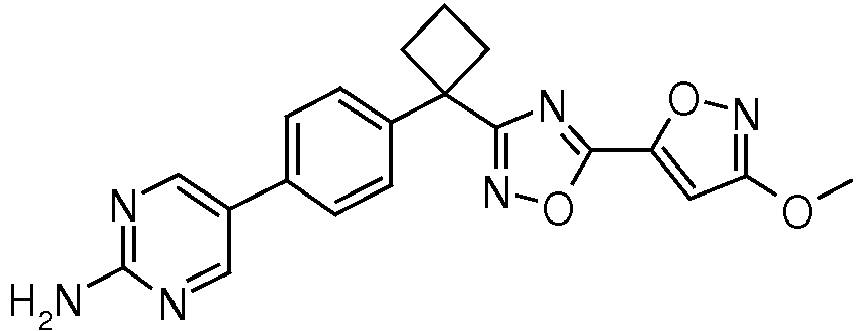
5-(4-{1-[5-(3-Methoxy-isoxazol-5-yl)-1,2,4-oxadiazol-3-yl]-cyclobutyl}-phenyl)-pyrimidin-2-ylamine 34 
5-{4-[1-(5-m-Tolyl-1,2,4-oxadiazol-3-yl)-cyclobutyl]-phenyl}-pyrimidin-2-ylamine 35 
5-{4-[1-(5p-Tolyl-1,2,4-oxadiazol-3-yl)-cyclobutyl]-phenyl}-pyrimidin-2-ylamine 36 
5-(4-{1-[5-(4-Methanesulfonyl-phenyl)-1,2,4-oxadiazol-3-yl]-cyclobutyl}-phenyl)-pyrimidin-2-ylamine 37 
5-(4-{1-[5-(2-Amino-pyridin-4-yl)-1,2,4-oxadiazol-3-yl]-cyclobutyl}-phenyl)-pyrimidin-2-ylamine 38 
4-(3-{1-[4-(2-Aminopyrimidin-5-yl)-phenyl]-cyclobutyl}-1,2,4-oxadiazol-5-yl)-benzenesulfonamide 39 
5-(4-{1-[5-(3-Methanesulfonyl-phenyl)-1,2,4-oxadiazol-3-yl]-cyclobutyl}-phenyl)-pyrimidin-2-ylamine 40 
5-(4-{1-[5-(1H-1,2,3-Triazol-4-yl)-1,2,4-oxadiazol-3-yl]-cyclobutyl}-phenyl)-pyrimidin-2-ylamine 41 
3-(3-{1-[4-(2-Aminopyrimidin-5-yl)-phenyl]-cyclobutyl}-1,2,4-oxadiazol-5-yl)-benzonitrile 42 
4-(3-{1-[4-(2-Aminopyrimidin-5-yl)-phenyl]-cyclobutyl}-1,2,4-oxadiazol-5-yl)-benzonitrile 43 
3-(3-{1-[4-(2-Aminopyrimidin-5-yl)-phenyl]-cyclobutyl}-1,2,4-oxadiazol-5-yl)-phenol 44 
4-(3-{1-[4-(2-Aminopyrimidin-5-yl)-phenyl]-cyclobutyl}-1,2,4-oxadiazol-5-yl)-phenol 45 
5-(4-{1-[5-(3-Chloro-phenyl)-1,2,4-oxadiazol-3-yl]-cyclobutyl}-phenyl)-pyrimidin-2-ylamine 46 
5-(4-{1-[5-(4-Chloro-phenyl)-1,2,4-oxadiazol-3-yl]-cyclobutyl}-phenyl)-pyrimidin-2-ylamine 47 
3-(3-{1-[4-(2-Aminopyrimidin-5-yl)-phenyl]-cyclobutyl}-1,2,4-oxadiazol-5-yl)-benzenesulfonamide 48 
5-(4-{1-[5-(4-Methoxyphenyl)-1,2,4-oxadiazol-3-yl]-cyclobutyl}-phenyl)-pyrimidin-2-ylamine 49 
5-(4-{1-[5-(3-Methoxyphenyl)-1,2,4-oxadiazol-3-yl]-cyclobutyl}-phenyl)-pyrimidin-2-ylamine 50 
5-(4-{1-[5-(3,4-Dimethoxyphenyl)-1,2,4-oxadiazol-3-yl]-cyclobutyl}-phenyl)-pyrimidin-2-ylamine 51 
5-(4-{1-[5-(4-Fluoro-phenyl)-1,2,4-oxadiazol-3-yl]-cyclobutyl}-phenyl)-pyrimidin-2-ylamine 52 
5-(4-{1-[5-(3-Fluoro-phenyl)-1,2,4-oxadiazol-3-yl]-cyclobutyl}-phenyl)-pyrimidin-2-ylamine 53 
5-(4-{1-[5-(3-Chloro-4-methyl-phenyl)-1,2,4-oxadiazol-3-yl]-cyclobutyl}-phenyl)-pyrimidin-2-ylamine 54 
5-(4-{1-[5-(4-tert-Butylphenyl)-1,2,4-oxadiazol-3-yl]-cyclobutyl}-phenyl)-pyrimidin-2-ylamine 55 
5-(4-{1-[5-(3,4-Dichlorophenyl)-1,2,4-oxadiazol-3-yl]-cyclobutyl}-phenyl)-pyrimidin-2-ylamine 56 
5-(4-{1-[5-(2-Chloro-pyridin-4-yl)-1,2,4-oxadiazol-3-yl]-cyclobutyl}-phenyl)-pyrimidin-2-ylamine 57 
5-(4-{1-[5-(2-Methyl-2H-pyrazol-3-yl)-1,2,4-oxadiazol-3-yl]-cyclobutyl}-phenyl)-pyrimidin-2-ylamine 58 
3-(3-{1-[4-(2-Aminopyrimidin-5-yl)-phenyl]-cyclobutyl}-1,2,4-oxadiazol-5-yl)-4,6-dimethyl-1H-pyridin-2-one 59 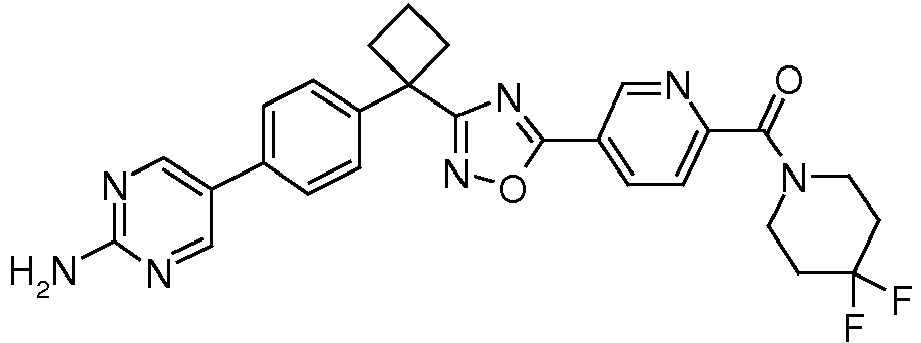
[5-(3-{1-[4-(2-Aminopyrimidin-5-yl)-phenyl]-cyclobutyl}-1,2,4-oxadiazol-5-yl)-pyridin-2-yl]-(4,4-difluoro-piperidin-1-yl)-methanone 60 
[5-(3-{1-[4-(2-Aminopyrimidin-5-yl)-phenyl]-cyclobutyl}-1,2,4-oxadiazol-5-yl)-pyridin-2-yl]-(3-hydroxy-pyrrolidin-1-yl)-methanone 61 
2-{[5-(3-{1-[4-(2-Aminopyrimidin-5-yl)-phenyl]-cyclobutyl}-1,2,4-oxadiazol-5-yl)-pyrazin-2-yl]-methylamino}-ethanol 62 
5-[4-(1-{5-[5-(2-Methoxyethylamino)-pyrazin-2-yl]-1,2,4-oxadiazol-3-yl}-cyclobutyl)-phenyl]-pyrimidin-2-ylamine 63 
5-(4-{1-[5-(5-Ethylaminopyrazin-2-yl)-1,2,4-oxadiazol-3-yl]-cyclobutyl}-phenyl)-pyrimidin-2-ylamine 64 
[5-(3-{1-[4-(2-Aminopyrimidin-5-yl)-phenyl]-cyclobutyl}-1,2,4-oxadiazol-5-yl)-pyridin-2-yl]-(3-hydroxy-azetidin-1-yl)-methanone 65 
3-(3-{1-[4-(2-Aminopyrimidin-5-yl)-phenyl]-cyclobutyl}-1,2,4-oxadiazol-5-yl)-1-ethyl-1H-pyridin-2-one 66 
3-(3-{1-[4-(2-Aminopyrimidin-5-yl)-phenyl]-cyclobutyl}-1,2,4-oxadiazol-5-yl)-1-(2-methoxy-ethyl)-1H-pyridin-2-one 67 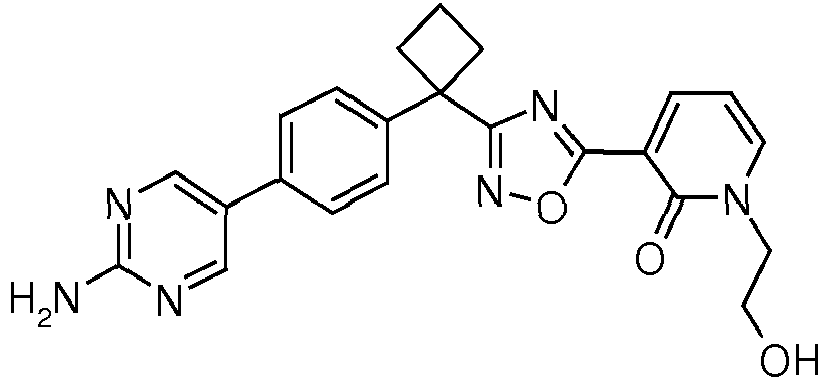
3-(3-{1-[4-(2-Aminopyrimidin-5-yl)-phenyl]-cyclobutyl}-1,2,4-oxadiazol-5-yl)-1-(2-hydroxy-ethyl)-1H-pyridin-2-one 68 
2-[5-(3-{1-[4-(2-Aminopyrimidin-5-yl)-phenyl]-cyclobutyl}-1,2,4-oxadiazol-5-yl)-pyrazin-2-ylamino]-ethanol 69 
5-[4-(1-{5-[1-(2-Methoxyethyl)-1H-pyrazol-4-yl]-1,2,4-oxadiazol-3-yl}-cyclobutyl)-phenyl]-pyrimidin-2-ylamine 70 
[5-(3-{1-[4-(2-Aminopyrimidin-5-yl)-phenyl]-cyclobutyl}-1,2,4-oxadiazol-5-yl)-pyridin-2-yl]-azetidin-1-yl-methanone 71 
5-{4-[1-(5-Thiazol-4-yl-1,2,4-oxadiazol-3-yl)-cyclobutyl]-phenyl}-pyrimidin-2-ylamine 72 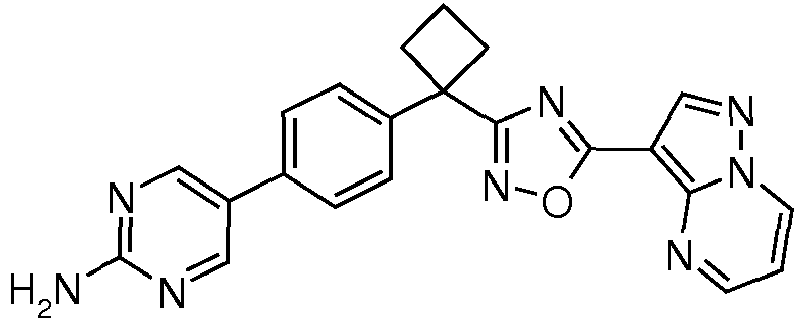
5-{4-[1-(5-Pyrazolo[1,5-a]pyrimidin-3-yl-1,2,4-oxadiazol-3-yl)-cyclobutyl]-phenyl}-pyrimidin-2-ylamine 73 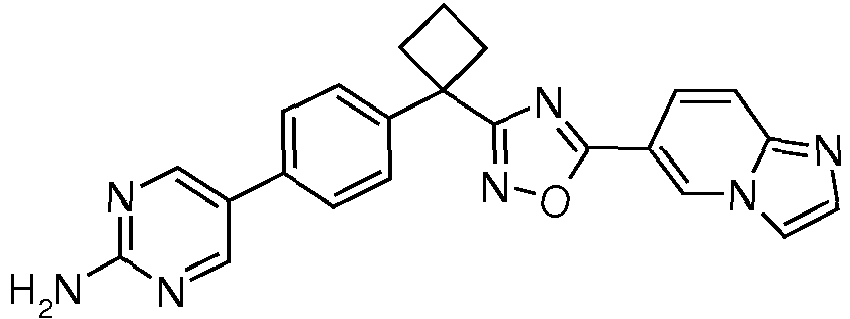
5-{4-[1-(5-Imidazo[1,2-a]pyridin-6-yl-1,2,4-oxadiazol-3-yl)-cyclobutyl]-phenyl}-pyrimidin-2-ylamine 74 
2-(3-{1-[4-(2-Aminopyrimidin-5-yl)-phenyl]-cyclobutyl}-1,2,4-oxadiazol-5-ylamino)-ethanol 75 
[5-(3-{1-[4-(2-Aminopyrimidin-5-yl)-phenyl]-cyclobutyl}-1,2,4-oxadiazol-5-yl)-pyridin-2-yl]-(3,3-difluoro-pyrrolidin-1-yl)-methanone 76 
5-(3-{1-[4-(2-Aminopyrimidin-5-yl)-phenyl]-cyclobutyl}-1,2,4-oxadiazol-5-yl)-pyridine-2-carboxylic acid (2-methoxy-ethyl)-amide 77 
5-(3-{1-[4-(2-Aminopyrimidin-5-yl)-phenyl]-cyclobutyl}-1,2,4-oxadiazol-5-yl)-pyridine-2-carboxylic acid (2-hydroxy-ethyl)-amide 78 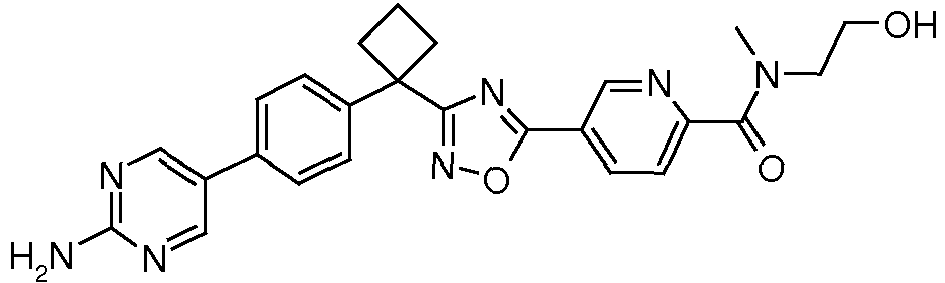
5-(3-{1-[4-(2-Aminopyrimidin-5-yl)-phenyl]-cyclobutyl}-1,2,4-oxadiazol-5-yl)-pyridine-2-carboxylic acid (2-hydroxy-ethyl)-methyl-amide 79 
1-[4-(3-{1-[4-(2-Aminopyrimidin-5-yl)-phenyl]-cyclobutyl}-1,2,4-oxadiazol-5-yl)-pyrazol-1-yl]-2-methylpropan-2-ol 80 
5-{4-[1-(5-Piperidin-1-yl-1,2,4-oxadiazol-3-yl)-cyclobutyl]-phenyl}-pyrimidin-2-ylamine 81 
2-[4-(3-{1-[4-(2-Aminopyrimidin-5-yl)-phenyl]-cyclobutyl}-1,2,4-oxadiazol-5-yl)-pyrazol-1-yl]-N-methyl-acetamide 82 
2-[4-(3-{1-[4-(2-Aminopyrimidin-5-yl)-phenyl]-cyclobutyl}-1,2,4-oxadiazol-5-yl)-pyrazol-1-yl]-propan-1-ol 83 
1-[4-(3-{1-[4-(2-Aminopyrimidin-5-yl)-phenyl]-cyclobutyl}-1,2,4-oxadiazol-5-yl)-pyrazol-1-yl]-propan-2-ol 84 
2-[4-(3-{1-[4-(2-Aminopyrimidin-5-yl)-phenyl]-cyclobutyl}-1,2,4-oxadiazol-5-yl)-pyrazol-1-yl]-2-methylpropan-1-ol 85 
5-(4-{1-(5-Morpholin-4-yl-pyrazin-2-yl)-1,2,4-oxadiazol-3-yl]-cyclobutyl}-phenyl)-pyrimidin-2-ylamine 86 
1-[5-(3-{1-[4-(2-Aminopyrimidin-5-yl)-phenyl]-cyclobutyl}-1,2,4-oxadiazol-5-yl)-pyrazin-2-yl]-azetidin-3-ol 87 
5-(4-{1-[5-(1-Ethyl-1H-imidazol-4-yl)-1,2,4-oxadiazol-3-yl]-cyclobutyl}-phenyl)-pyrimidin-2-ylamine 88 
5-[4-(1-{5-[1-(2-Methoxyethyl)-1H-imidazol-4-yl]-1,2,4-oxadiazol-3-yl}-cyclobutyl)-phenyl]-pyrimidin-2-ylamine 89 
5-(4-{1-[5-(1-Oxetan-3-yl-1H-pyrazol-4-yl)-1,2,4-oxadiazol-3-yl]-cyclobutyl}-phenyl)-pyrimidin-2-ylamine 90 
2-[5-(3-{1-[4-(2-Aminopyrimidin-5-yl)-phenyl]-cyclobutyl}-1,2,4-oxadiazol-5-yl)-pyrazin-2-ylamino]-2-methyl-propionic acid methyl ester 91 
5-(3-{1-[4-(2-Aminopyrimidin-5-yl)-phenyl]-cyclobutyl}-1,2,4-oxadiazol-5-yl)-1H-pyridin-2-one 92 
5-(4-{1-[5-(1-Methyl-1I-pyrazol-3-yl)-1,2,4-oxadiazol-3-yl]-cyclobutyl}-phenyl)-pyrimidin-2-ylamine 93 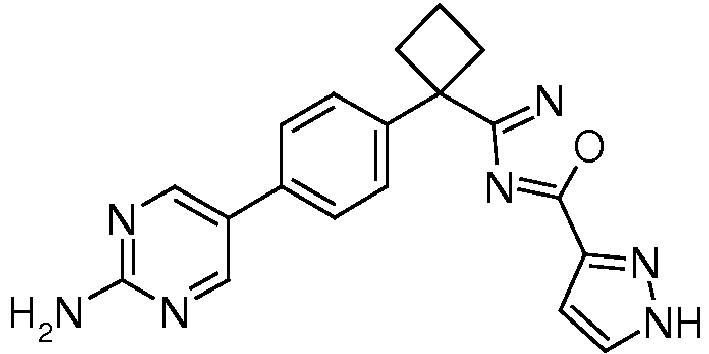
5-(4-{1-[5-(1H-Pyrazol-3-yl)-1,2,4-oxadiazol-3-yl]-cyclobutyl}-phenyl)-pyrimidin-2-ylamine 94 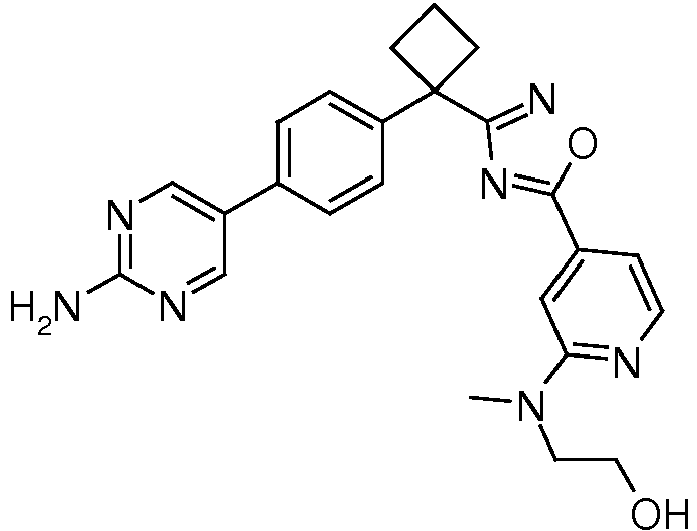
2-{[4-(3-{1-[4-(2-Aminopyrimidin-5-yl)-phenyl]-cyclobutyl}-1,2,4-oxadiazol-5-yl)-pyridin-2-yl]-methylamino}-ethanol 95 
2-[4-(3-{1-[4-(2-Aminopyrimidin-5-yl)-phenyl]-cyclobutyl}-1,2,4-oxadiazol-5-yl)-pyridin-2-ylamino]-ethanol 96 
5-(4-{1-[5-(1H-1,2,4-Triazol-3-yl)-1,2,4-oxadiazol-3-yl]-cyclobutyl}-phenyl)-pyrimidin-2-ylamine 97 
5-[4-(1-{5-[2-(2-Methoxyethylamino)-pyridin-4-yl]-1,2,4-oxadiazol-3-yl}-cyclobutyl)-phenyl]-pyrimidin-2-ylamine 98 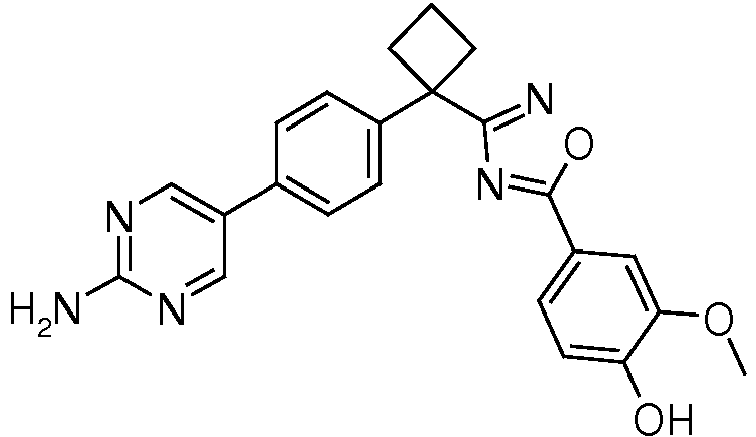
4-(3-{1-[4-(2-Aminopyrimidin-5-yl)-phenyl]-cyclobutyl}-1,2,4-oxadiazol-5-yl)-2-methoxy-phenol 99 
4-(3-{1-[4-(2-Aminopyrimidin-5-yl)-phenyl]-cyclobutyl}-1,2,4-oxadiazol-5-yl)-2-methyl-phenol 100 
4-(3-{1-[4-(2-Aminopyrimidin-5-yl)-phenyl]-cyclobutyl}-1,2,4-oxadiazol-5-yl)-2-chloro-phenol 101 
5-(4-{1-[5-(6-Chloro-pyridin-3-yl)-1,2,4-oxadiazol-3-yl]-cyclobutyl}-phenyl)-pyrimidin-2-ylamine 102 
{(R)-1-[5-(3-{1-[4-(2-Aminopyrimidin-5-yl)-phenyl]-cyclobutyl}-1,2,4-oxadiazol-5-yl)-pyridin-2-yl]-pyrrolidin-2-yl}-methanol 103 
(R)-1-[5-(3-{1-[4-(2-Aminopyrimidin-5-yl)-phenyl]-cyclobutyl}-1,2,4-oxadiazol-5-yl)-pyridin-2-yl]-pyrrolidin-3-ol 104 
5-(4-{1-[5-(4-Piperazin-1-yl-phenyl)-1,2,4-oxadiazol-3-yl]-cyclobutyl}-phenyl)-pyrimidin-2-ylamine 105 
(S)-1-[5-(3-{1-[4-(2-Aminopyrimidin-5-yl)-phenyl]-cyclobutyl}-1,2,4-oxadiazol-5-yl)-pyridin-2-yl]-pyrrolidin-3-ol 106 
3-{4-[5-(3-{1-[4-(2-Aminopyrimidin-5-yl)-phenyl]-cyclobutyl}-1,2,4-oxadiazol-5-yl)-pyridin-2-yl]-piperazin-1-yl}-propionic acid ethyl ester 107 
5-[4-(1-{5-[6-(1,1-Dioxo-1λ6-thiomorpholin-4-yl)-pyridin-3-yl]-1,2,4-oxadiazol-3-yl}-cyclobutyl)-phenyl]-pyrimidin-2-ylamine 108 
5-[4-(1-{5-[6-(2-Methanesulfonyl-ethylamino)-pyridin-3-yl]-1,2,4-oxadiazol-3-yl}-cyclobutyl)-phenyl]-pyrimidin-2-ylamine 109 
5-[4-(1-{5-[6-(4-Methanesulfonyl-piperazin-1-yl)-pyridin-3-yl]-1,2,4-oxadiazol-3-yl}-cyclobutyl)-phenyl] -pyrimidin-2-ylamine 110 
5-[4-(1-{5-[6-(3-Methanesulfonyl-pyrrolidin-1-yl)-pyridin-3-yl]-1,2,4-oxadiazol-3-yl}-cyclobutyl)-phenyl] -pyrimidin-2-ylamine 111 
[6-(3-{1-[4-(2-Amino-pyrimidin-5-yl)-phenyl]-cyclobutyl}-1,2,4-oxadiazol-5-yl)-pyridazin-3-yl]-(2-methoxy-ethyl)-amine 112 
2-[6-(3-{1-[4-(2-Amino-pyrimidin-5-yl)-phenyl]-cyclobutyl}-1,2,4-oxadiazol-5-yl)-pyridazin-3-ylamino]-ethanol 113 
2-{[6-(3-{1-[4-(2-Amino-pyrimidin-5-yl)-phenyl]-cyclobutyl}-1,2,4-oxadiazol-5-yl)-pyridazin-3-yl]-methyl-amino}-ethanol 114 
1-[6-(3-{1-[4-(2-Amino-pyrimidin-5-yl)-phenyl]-cyclobutyl}-1,2,4-oxadiazol-5-yl)-pyridazin-3-ylamino]-2-methyl-propan-2-ol 115 
[6-(3-{1-[4-(2-Amino-pyrimidin-5-yl)-phenyl]-cyclobutyl}-1,2,4-oxadiazol-5-yl)-pyridazin-3-yl]-(2-morpholin-4-yl-ethyl)-amine 116 
5-(4-{1-[5-(6-Piperazin-1-yl-pyridin-3-yl)-1,2,4-oxadiazol-3-yl]-cyclobutyl}-phenyl)-pyrimidin-2-ylamine 117 
5-(3-Fluoro-4-{1-[5-(1-methyl-1H-pyrazol-4-yl)-1,2,4-oxadiazol-3-yl]-cyclobutyl}-phenyl)-pyrimidin-2-ylamine 118 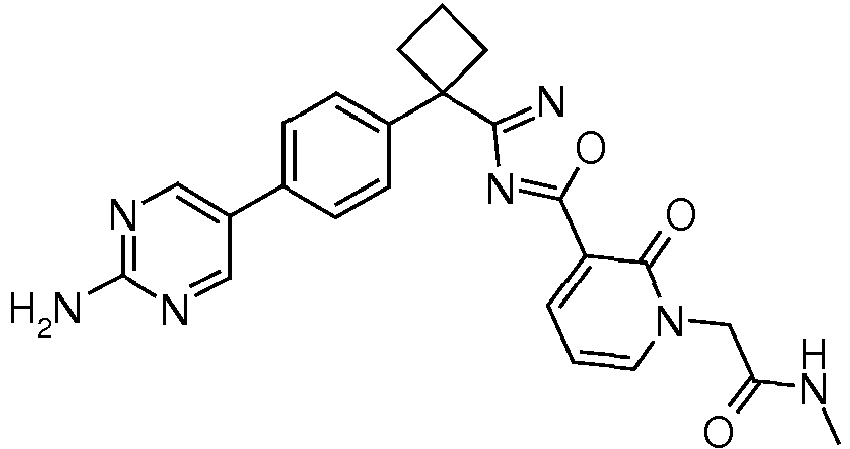
2-[3-(3-{1-[4-(2-Amino-pyrimidin-5-yl)-phenyl]-cyclobutyl}-1,2,4-oxadiazol-5-yl)-2-oxo-2H-pyridin-1-yl]-N-methyl-acetamide 119 
2-[3-(3-{1-[4-(2-Amino-pyrimidin-5-yl)-phenyl]-cyclobutyl}-1,2,4-oxadiazol-5-yl)-2-oxo-2H-pyridin-1-yl]-N,N-dimethyl-acetamide 120 
1-[5-(3-{1-[4-(2-Amino-pyrimidin-5-yl)-phenyl]-cyclobutyl}-1,2,4-oxadiazol-5-yl)-pyrazin-2-ylamino]-2-methyl-propan-2-ol 121 
2-[5-(3-{1-[4-(2-Amino-pyrimidin-5-yl)-phenyl]-cyclobutyl}-1,2,4-oxadiazol-5-yl)-pyrazin-2-ylamino]-2-methyl-propan-1-ol 122 
5-(4-{3,3-Difluoro-1-[5-(1-methyl-1H-pyrazol-4-yl)-1,2,4-oxadiazol-3-yl]-cyclobutyl}-phenyl)-pyrimidin-2-ylamine 123 
5-(4-{3,3-Dimethyl-1-[5-(1-methyl-1H-pyrazol-4-yl)-1,2,4-oxadiazol-3-yl]-cyclobutyl}-phenyl)-pyrimidin-2-ylamine 124 
5-(4-{1-[5-(3,4,5,6-Tetrahydro-2H-1,2'-bipyrazinyl-5'-yl)-1,2,4-oxadiazol-3-yl]-cyclobutyl}-phenyl)-pyrimidin-2-ylamine 125 
(R)-5'-(3-{1-[4-(2-Amino-pyrimidin-5-yl)-phenyl]-cyclobutyl}-1,2,4-oxadiazol-5-yl)-3,4,5,6-tetrahydro-2H-1,2'-bipyrazinyl-3-carboxylic acid methyl ester 126 
(S)-5'-(3-{1-[4-(2-Amino-pyrimidin-5-yl)-phenyl]-cyclobutyl}-1,2,4-oxadiazol-5-yl)-3,4,5,6-tetrahydro-2H-1,2'-bipyrazinyl-3-carboxylic acid methyl ester 127 
2-[4-(3-{1-[4-(2-Amino-pyrimidin-5-yl)-phenyl]-cyclobutyl}-1,2,4-oxadiazol-5-yl)-pyrazol-1-yl]-1-piperidin-1-yl-ethanone 128 
2-[4-(3-{1-[4-(2-Amino-pyrimidin-5-yl)-phenyl]-cyclobutyl}-1,2,4-oxadiazol-5-yl)-pyrazol-1-yl]-N,N-dimethyl-isobutyramide 129 
3-[4-(3-{1-[4-(2-Amino-pyrimidin-5-yl)-phenyl]-cyclobutyl}-1,2,4-oxadiazol-5-yl)-pyrazol-1-yl]-2,2,N,N-tetramethyl-propionamide 130 
2-[4-(3-{1-[4-(2-Amino-pyrimidin-5-yl)-phenyl]-cyclobutyl}-1,2,4-oxadiazol-5-yl)-pyrazol-1-yl]-N-ethyl-acetamide 131 
2-[4-(3-{1-[4-(2-Amino-pyrimidin-5-yl)-phenyl]-cyclobutyl}-1,2,4-oxadiazol-5-yl)-pyrazol-1-yl]-N,N-diethyl-acetamide 132 
2-[4-(3-{1-[4-(2-Amino-pyrimidin-5-yl)-phenyl]-cyclobutyl}-1,2,4-oxadiazol-5-yl)-pyrazol-1-yl]-N-cyclopropyl-acetamide 133 
2-[4-(3-{1-[4-(2-Amino-pyrimidin-5-yl)-phenyl]-cyclobutyl}-1,2,4-oxadiazol-5-yl)-pyrazol-1-yl]-N,N-dimethyl-propionamide 134 
2-[4-(3-{1-[4-(2-Amino-pyrimidin-5-yl)-phenyl]-cyclobutyl}-1,2,4-oxadiazol-5-yl)-pyrazol-1-yl]-1-morpholin-4-yl-ethanone 135 
4-(3-{1-[4-(2-Amino-pyrimidin-5-yl)-phenyl]-cyclobutyl}-1,2,4-oxadiazol-5-yl)-pyrazole-1-sulfonic acid dimethylamide 136 
4-(3-{1-[4-(2-Amino-pyrimidin-5-yl)-phenyl]-cyclobutyl}-1,2,4-oxadiazol-5-yl)-pyrazole-1-carboxylic acid dimethylamide 137 
2-[4-(3-{1-[4-(2-Amino-pyrimidin-5-yl)-phenyl]-cyclobutyl}-1,2,4-oxadiazol-5-yl)-pyrazol-1-yl]-1-pyrrolidin-1-yl-ethanone 138 
2-[4-(3-{1-[4-(2-Amino-pyrimidin-5-yl)-phenyl]-cyclobutyl}-1,2,4-oxadiazol-5-yl)-pyrazol-1-yl]-N-ethyl-N-methyl-acetamide 139 
2-[4-(3-{1-[4-(2-Amino-pyrimidin-5-yl)-phenyl]-cyclobutyl}-1,2,4-oxadiazol-5-yl)-pyrazol-1-yl]-N-isopropyl-N-methyl-acetamide 140 
2-[4-(3-{1-[4-(2-Amino-pyrimidin-5-yl)-phenyl]-cyclobutyl}-1,2,4-oxadiazol-5-yl)-pyrazol-1-yl]-N-(2,2,2-trifluoro-ethyl)-acetamide 141 
2-[4-(3-{1-[4-(2-Amino-pyrimidin-5-yl)-phenyl]-cyclobutyl}-1,2,4-oxadiazol-5-yl)-pyrazol-1-yl]-N-cyclopropyl-N-methyl-acetamide 142 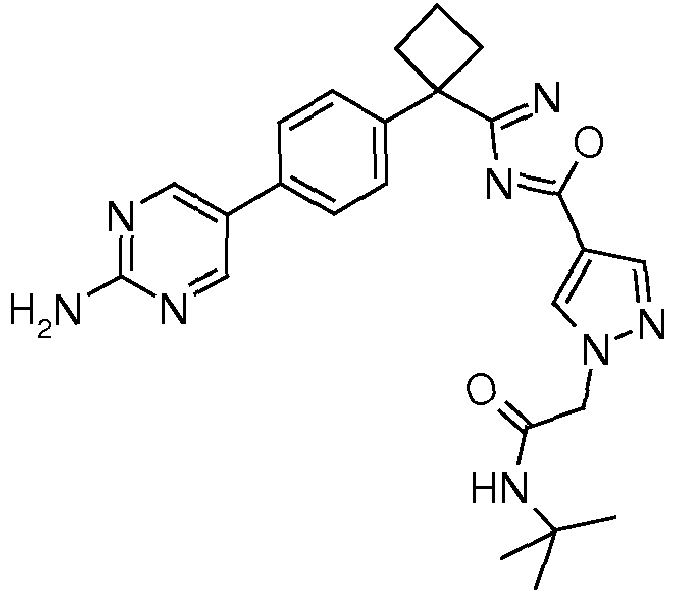
2-[4-(3-{1-[4-(2-Amino-pyrimidin-5-yl)-phenyl]-cyclobutyl}-1,2,4-oxadiazol-5-yl)-pyrazol-1-yl]-N-tert-butyl-acetamide 143 
5-{4-[1-(5-Pyridin-3-yl-1,2,4-oxadiazol-3-yl)-cyclobutyl]-phenyl}-pyrimidin-2-ylamine 144 
5-{4-[1-(5-Phenyl-1,2,4-oxadiazol-3-yl)-cyclobutyl]-phenyl}-pyrimidin-2-ylamine 145 
5-{4-[4-(5-Pyridin-2-yl-1,2,4-oxadiazol-3-yl)-tetrahydropyran-4-yl]-phenyl}-pyrimidin-2-ylamine 146 
5-{4-[4-(5-Pyridin-3-yl-1,2,4-oxadiazol-3-yl)-tetrahydro-pyran-4-yl]-phenyl}-pyrimidin-2-ylamine 147 
5-{4-[4-(5-Pyridin-4-yl-1,2,4-oxadiazol-3-yl)-tetrahydro-pyran-4-yl]-phenyl}-pyrimidin-2-ylamine 148 
5-(4-{4-[5-(2,5-Dimethyl-2H-pyrazol-3-yl)-1,2,4-oxadiazol-3-yl]-tetrahydro-pyran-4-yl}-phenyl)-pyrimidin-2-ylamine 149 
5-{4-[4-(5-Phenyl-1,2,4-oxadiazol-3-yl)-tetrahydropyran-4-yl]-phenyl}-pyrimidin-2-ylamine 150 
5-{4-[4-(5-Benzyl-1,2,4-oxadiazol-3-yl)-tetrahydropyran-4-yl]-phenyl}-pyrimidin-2-ylamine 151 
5-{4-[4-(5-Benzyloxymethyl-1,2,4-oxadiazol-3-yl)-tetrahydro-pyran-4-yl]-phenyl}-pyrimidin-2-ylamine 152 
5-(4-{1-[5-(6-Methyl-pyridin-3-yl)-1,2,4-oxadiazol-3-yl]-cyclobutyl}-phenyl)-pyrimidin-2-ylamine 153 
5-(4-{1-[5-(1H-Imidazol-4-yl)-1,2,4-oxadiazol-3-yl]-cyclobutyl}-phenyl)-pyrimidin-2-ylamine 154 
5-(4-{1-[5-(6-Methyl-pyridin-3-yl)-1,2,4-oxadiazol-3-yl]-cyclohexyl}-phenyl)-pyrimidin-2-ylamine 155 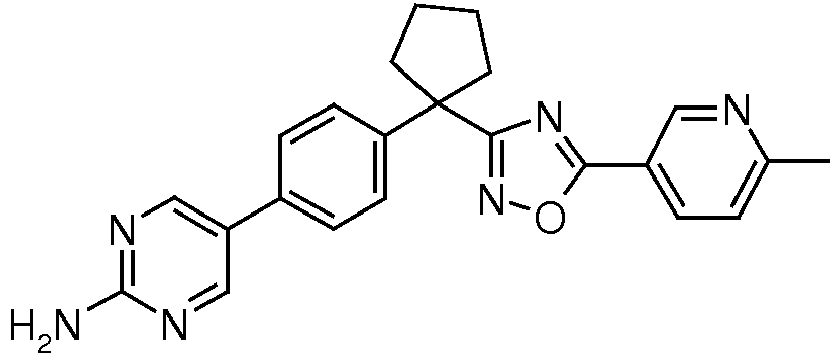
5-(4-{1-[5-(6-Methyl-pyridin-3-yl)-1,2,4-oxadiazol-3-yl]-cyclopentyl}-phenyl)-pyrimidin-2-ylamine 156 
5-(4-{1-[5-(2H-1,2,4-Triazol-3-yl)-1,2,4-oxadiazol-3-yl]-cyclobutyl}-phenyl)-pyrimidin-2-ylamine 157 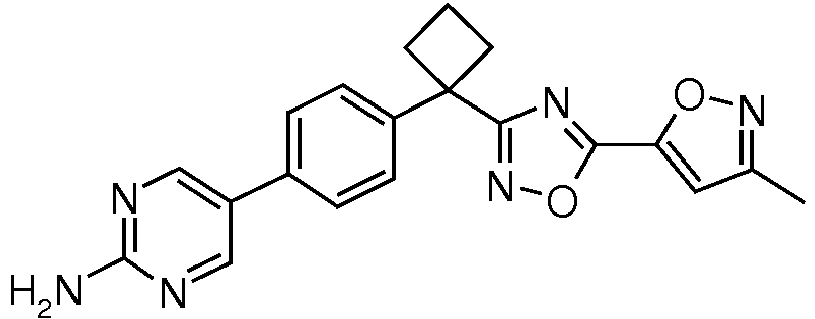
5-(4-{1-[5-(3-Methyl-isoxazol-5-yl)-1,2,4-oxadiazol-3-yl]-cyclobutyl}-phenyl)-pyrimidin-2-ylamine 158 
5-{4-[1-(5-Pyrazin-2-yl-1,2,4-oxadiazol-3-yl)-cyclobutyl]-phenyl}-pyrimidin-2-ylamine 159 
5-{4-[1-(5-Pyrimidin-5-yl-1,2,4-oxadiazol-3-yl)-cyclobutyl]-phenyl}-pyrimidin-2-ylamine 160 
5-{4-[1-(5-Pyridazin-4-yl-1,2,4-oxadiazol-3-yl)-cyclobutyl]-phenyl}-pyrimidin-2-ylamine 161 
5-(4-{1-[5-(2,5-Dimethyl-2H-pyrazol-3-yl)-1,2,4-oxadiazol-3-yl]-cyclobutyl}-phenyl)-pyrimidin-2-ylamine 162 
5-(4-{1-[5-(2-Ethyl-5-methyl-2H-pyrazol-3-yl)-1,2,4-oxadiazol-3-yl]-cyclobutyl}-phenyl)-pyrimidin-2-ylamine 163 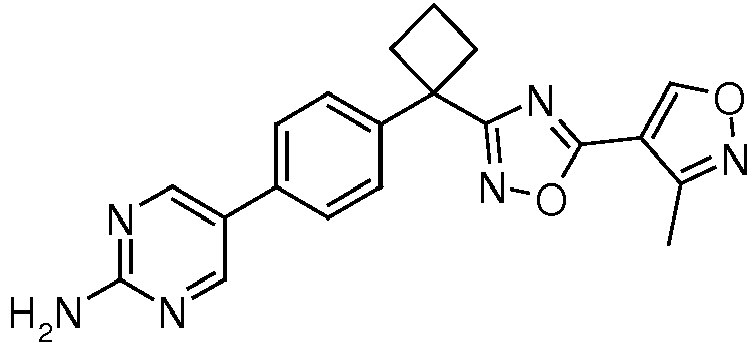
5-(4-{1-[5-(3-Methyl-isoxazol-4-yl)-1,2,4-oxadiazol-3-yl]-cyclobutyl}-phenyl)-pyrimidin-2-ylamine 164 
5-(4-{1-[5-(3,5-Dimethyl-isoxazol-4-yl)-1,2,4-oxadiazol-3-yl]-cyclobutyl}-phenyl)-pyrimidin-2-ylamine 165 
5-(4-{1-[5-(2-Methyl-pyrimidin-5-yl)-1,2,4-oxadiazol-3-yl]-cyclobutyl}-phenyl)-pyrimidin-2-ylamine 166 
5-(4-{1-[5-(1-Methyl-1H-pyrazol-4-yl)-1,2,4-oxadiazol-3-yl]-cyclobutyl}-phenyl)-pyrimidin-2-ylamine 167 
5-(4-{1-[5-(2-Methyl-pyridin-3-yl)-1,2,4-oxadiazol-3-yl]-cyclobutyl}-phenyl)-pyrimidin-2-ylamine 168 
5-(4-{1-[5-(4-Methoxy-pyridin-3-yl)-1,2,4-oxadiazol-3-yl]-cyclobutyl}-phenyl)-pyrimidin-2-ylamine 169 
5-(4-{1-[5-(2-Chloro-pyridin-3-yl)-1,2,4-oxadiazol-3-yl]-cyclobutyl}-phenyl)-pyrimidin-2-ylamine 170 
5-(3-{1-[4-(2-Amino-pyrimidin-5-yl)-phenyl]-cyclobutyl}-1,2,4-oxadiazol-5-yl)-pyridine-2-carboxylic acid methyl ester 171 
5-{4-[1-(5-Pyrimidin-4-yl-1,2,4-oxadiazol-3-yl)-cyclobutyl]-phenyl}-pyrimidin-2-ylamine 172 
2-[5-(3-{1-[4-(2-Amino-pyrimidin-5-yl)-phenyl]-cyclobutyl}-1,2,4-oxadiazol-5-yl)-pyridin-2-yl]-propan-2-ol 173 
3-(3-{1-[4-(2-Amino-pyrimidin-5-yl)-phenyl]-cyclobutyl}-1,2,4-oxadiazol-5-yl)-1H-pyridin-2-one 174 
5-(4-{1-[5-(2-Methoxy-pyridin-4-yl)-1,2,4-oxadiazol-3-yl]-cyclobutyl}-phenyl)-pyrimidin-2-ylamine 175 
5-(4-{1-[5-(1H-Pyrazol-4-yl)-1,2,4-oxadiazol-3-yl]-cyclobutyl}-phenyl)-pyrimidin-2-ylamine 176 
5-(4-{1-[5-(3-Methyl-3H-imidazol-4-yl)-1,2,4-oxadiazol-3-yl]-cyclobutyl}-phenyl)-pyrimidin-2-ylamine 177 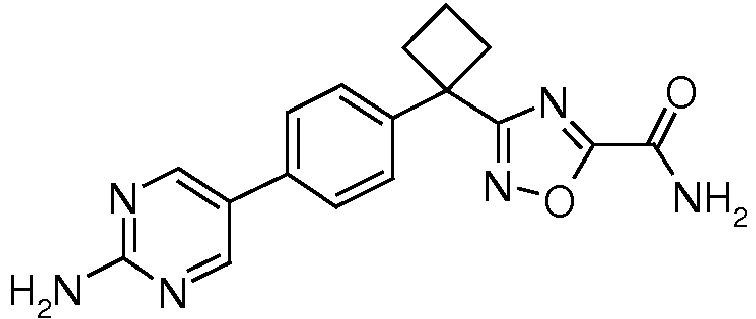
3-{1-[4-(2-Amino-pyrimidin-5-yl)-phenyl]-cyclobutyl}-1,2,4-oxadiazole-5-carboxylic acid amide 178 
N-(3-{1-[4-(2-Amino-pyrimidin-5-yl)-phenyl]-cyclobutyl}-1,2,4-oxadiazol-5-yl)-6-methyl-nicotinamide 179 
5-(4-{1-[5-(2-Morpholin-4-yl-pyridin-3-yl)-1,2,4-oxadiazol-3-yl]-cyclobutyl}-phenyl)-pyrimidin-2-ylamine 180 
2-[5-(3-{1-[4-(2-Amino-pyrimidin-5-yl)-phenyl]-cyclobutyl}-1,2,4-oxadiazol-5-yl)-pyridin-2-ylamino]-ethanol 181 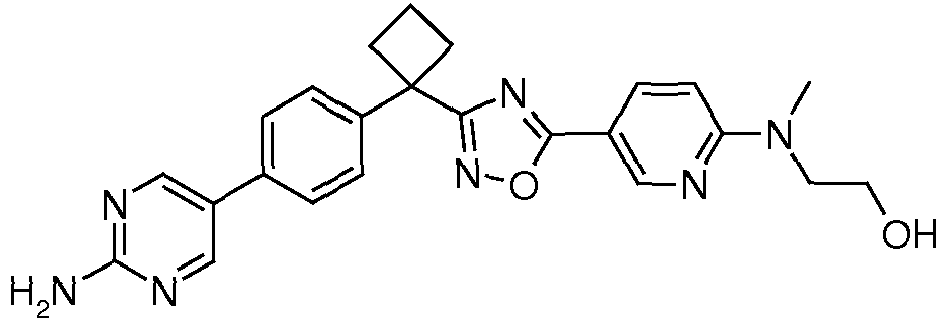
2-{[5-(3-{1-[4-(2-Amino-pyrimidin-5-yl)-phenyl]-cyclobutyl}-1,2,4-oxadiazol-5-yl)-pyridin-2-yl]-methyl-amino-ethanol 182 
5-[4-(1-{5-[6-(2-Methoxy-ethylamino)-pyridin-3-yl]-1,2,4-oxadiazol-3-yl}-cyclobutyl)-phenyl]-pyrimidin-2-ylamine 183 
5-(4-{1-[5-(6-Ethylamino-pyridin-3-yl)-1,2,4-oxadiazol-3-yl]-cyclobutyl}-phenyl)-pyrimidin-2-ylamine 184 
4-(3-{1-[4-(2-Amino-pyrimidin-5-yl)-phenyl]-cyclobutyl}-1,2,4-oxadiazol-5-yl)-1H-pyridin-2-one 185 
5-(3-{1-[4-(2-Amino-pyrimidin-5-yl)-phenyl]-cyclobutyl}-1,2,4-oxadiazol-5-yl)-1-methyl-1H-pyrimidin-2-one 186 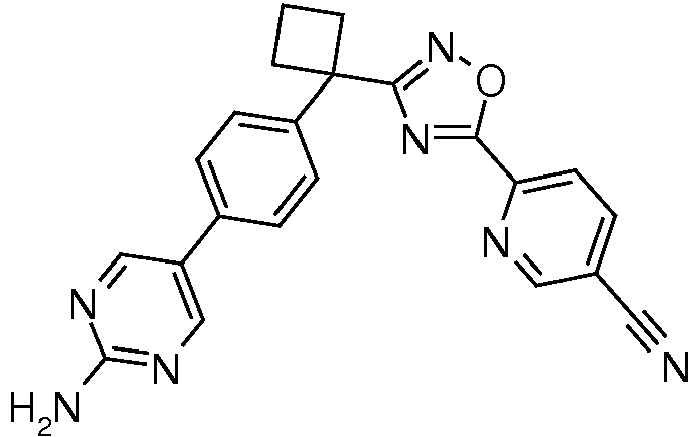
6-(3-{1-[4-(2-Amino-pyrimidin-5-yl)-phenyl]-cyclobutyl}-1,2,4-oxadiazol-5-yl)-nicotinonitrile 187 
5-(4-{1-[5-(5-Chloro-pyrazin-2-yl)-1,2,4-oxadiazol-3-yl]-cyclobutyl}-phenyl)-pyrimidin-2-ylamine 188 
2-[4-(3-{1-[4-(2-Amino-pyrimidin-5-yl)-phenyl]-cyclobutyl}-1,2,4-oxadiazol-5-yl)-pyrazol-1-yl]-N,N-dimethyl-acetamide 189 
5-{4-[1-(5-Oxazol-4-yl-1,2,4-oxadiazol-3-yl)-cyclobutyl]-phenyl}-pyrimidin-2-ylamine 190 
5-(4-{1-[5-(1H-Indazol-5-yl)-1,2,4-oxadiazol-3-yl]-cyclobutyl}-phenyl)-pyrimidin-2-ylamine 191 
3-(3-{1-[4-(2-Amino-pyrimidin-5-yl)-phenyl]-cyclobutyl}-1,2,4-oxadiazol-5-yl)-5-chloro-1H-pyridin-2-one 192 
3-(3-{1-[4-(2-Amino-pyrimidin-5-yl)-phenyl]-cyclobutyl}-1,2,4-oxadiazol-5-yl)-6-methyl-1H-pyridin-2-one 193 
5-(4-{1-[5-(5-Amino-pyrazin-2-yl)-1,2,4-oxadiazol-3-yl]-cyclobutyl}-phenyl)-pyrimidin-2-ylamine 194 
{(S)-1-[5-(3-{1-[4-(2-Amino-pyrimidin-5-yl)-phenyl]-cyclobutyl}-1,2,4-oxadiazol-5-yl)-pyrazin-2-yl]-pyrrolidin-2-yl}-methanol 195 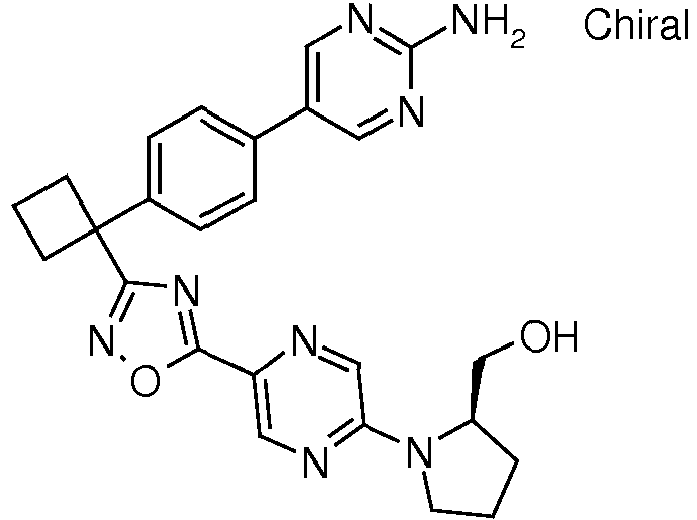
{(R)-1-[5-(3-{1-[4-(2-Amino-pyrimidin-5-yl)-phenyl]-cyclobutyl}-1,2,4-oxadiazol-5-yl)-pyrazin-2-yl]-pyrrolidin-2-yl}-methanol 196 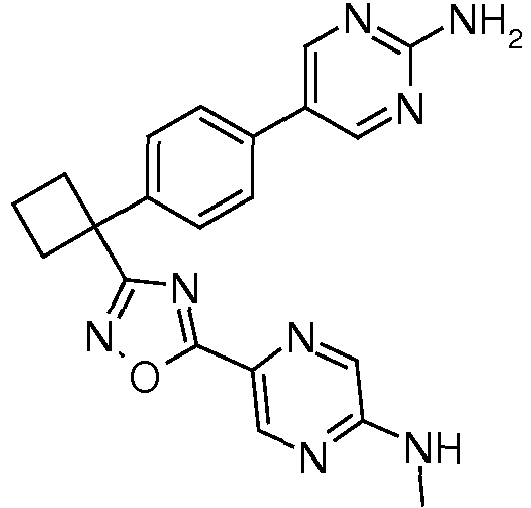
5-(4-{1-[5-(5-Methylamino-pyrazin-2-yl)-1,2,4-oxadiazol-3-yl]-cyclobutyl}-phenyl)-pyrimidin-2-ylamine 197 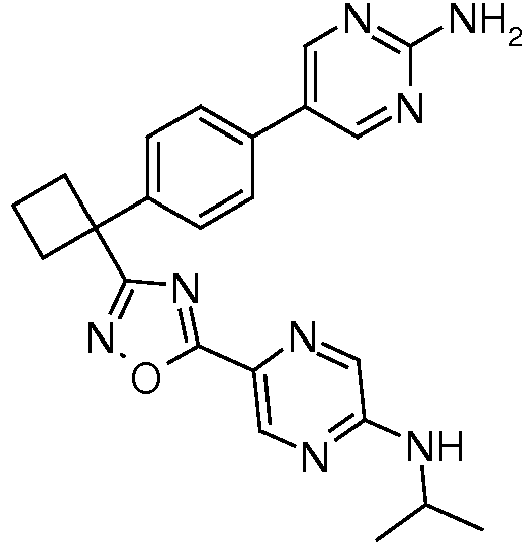
5-(4-{1-[5-(5-Isopropylamino-pyrazin-2-yl)-1,2,4-oxadiazol-3-yl]-cyclobutyl}-phenyl)-pyrimidin-2-ylamine 198 
5-{4-[1-(5-{5-[(2-Methoxyethyl)-methyl-amino] - pyrazin-2-yl}-1,2,4-oxadiazol-3-yl)-cyclobutyl]-phenyl}-pyrimidin-2-ylamine 199 
[5-(3-{1-[4-(2-Amino-pyrimidin-5-yl)-phenyl]-cyclobutyl}-1,2,4-oxadiazol-5-yl)-pyrazin-2-ylamino]-acetic acid ethyl ester 200 
1-[5-(3-{1-[4-(2-Amino-pyrimidin-5-yl)-phenyl]-cyclobutyl}-1,2,4-oxadiazol-5-yl)-pyrazin-2-ylamino]-propan-2-ol 201 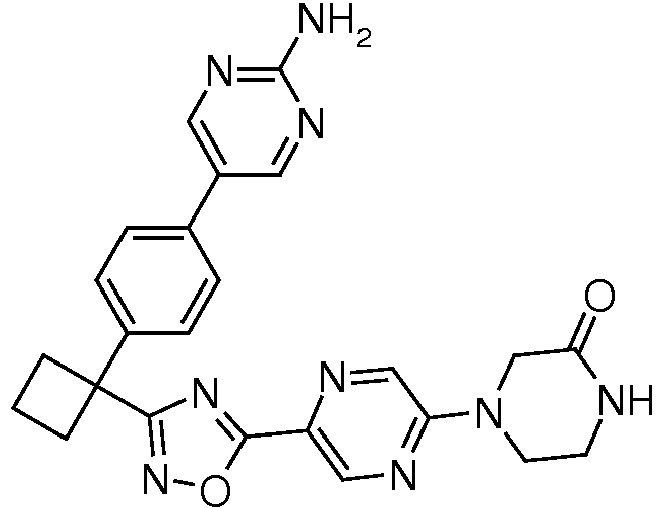
5'-(3-{1-[4-(2-Amino-pyrimidin-5-yl)-phenyl]-cyclobutyl}-1,2,4-oxadiazol-5-yl)-5,6-dihydro-4H-1,2'-bipyrazinyl-3-one 202 
5-(4-{1-[5-(4-Methanesulfonyl-3,4,5,6-tetrahydro-2H-1,2'-bipyrazinyl-5'-yl)-1,2,4-oxadiazol-3-yl]-cyclobutyl}-phenyl)-pyrimidin-2-ylamine 203 
5-[4-(1-{5-[5-(3-Methanesulfonyl-pyrrolidin-1-yl)-pyrazin-2-yl]-1,2,4-oxadiazol-3-yl}-cyclobutyl)-phenyl]-pyrimidin-2-ylamine 204 
2-[4-(3-{1-[4-(2-Amino-pyrimidin-5-yl)-phenyl]-cyclobutyl}-[1,2,4]oxadiazol-5-yl)-pyrazol-1-yl]-N-ethyl-acetamide 205 
2-[4-(3-{1-[4-(2-Amino-pyrimidin-5-yl)-phenyl]-cyclobutyl}-[1,2,4]oxadiazol-5-yl)-pyrazol-1-yl]-1-morpholin-4-yl-ethanone 206 
2-[4-(3-{1-[4-(2-Amino-pyrimidin-5-yl)-phenyl]-cyclobutyl}-[1,2,4]oxadiazol-5-yl)-pyrazol-1-yl]-N-ethyl-N-methyl-acetamide 207 
2-[4-(3-{1-[4-(2-Amino-pyrimidin-5-yl)-phenyl]-cyclobutyl}-[1,2,4]oxadiazol-5-yl)-pyrazol-1-yl]-N-tert-butyl-acetamide 208 
2-[4-(3-{1-[4-(2-Amino-pyrimidin-5-yl)-phenyl]-cyclobutyl}-[1,2,4]oxadiazol-5-yl)-pyrazol-1-yl]-N-isopropyl-acetamide 209 
2-[4-(3-{1-[4-(2-Amino-pyrimidin-5-yl)-phenyl]-cyclobutyl}-[1,2,4]oxadiazol-5-yl)-pyrazol-1-yl]-N-tert-butyl-N-methyl-acetamide 210 
2-[4-(3-{1-[4-(2-Amino-pyrimidin-5-yl)-phenyl]-cyclobutyl}-[1,2,4]oxadiazol-5-yl)-pyrazol-1-yl]-1-(3-methoxy-pyrrolidin-1-yl)-ethanone 211 
4-(3-{1-[4-(2-Amino-pyrimidin-5-yl)-phenyl]-cyclobutyl}-[1,2,4]oxadiazol-5-yl)-pyrazole-1-carboxylic acid diethylamide 212 
[4-(3-{1-[4-(2-Amino-pyrimidin-5-yl)-phenyl]-cyclobutyl}-[1,2,4]oxadiazol-5-yl)-pyrazol-l-yl]-morpholin-4-yl-methanone 213 
4-(3-{1-[4-(2-Amino-pyrimidin-5-yl)-phenyl]-cyclobutyl}-[1,2,4]oxadiazol-5-yl)-pyrazole-1-carboxylic acid methylamide 214 
5-(4-{1-[5-(3,4,5,6-Tetrahydro-2H-[1,2']bipyrazinyl-5'-yl)-[1,2,4]oxadiazol-3-yl]-cyclobutyl}-phenyl)-pyrimidin-2-ylamine 215 
5-(4-{1-[5-(1-Methyl-1H-pyrazol-4-yl)-[1,2,4]oxadiazol-3-yl]-cyclobutyl}-phenyl)-pyridin-2-ylamine 216 
1-{2-[4-(3-{1-[4-(2-Amino-pyrimidin-5-yl)-phenyl]-cyclobutyl}-[1,2,4]oxadiazol-5-yl)-pyrazol-1-yl]-ethyl}-pyrrolidin-2-one 217 
2-[4-(3-{1-[4-(2-Amino-pyrimidin-5-yl)-phenyl]-cyclobutyl}-[1,2,4]oxadiazol-5-yl)-pyrazol-1-yl]-N-isobutyl-acetamide 218 
2-[4-(3-{1-[4-(2-Amino-pyrimidin-5-yl)-phenyl]-cyclobutyl}-[1,2,4]oxadiazol-5-yl)-pyrazol-1-yl]-N-(tetrahydro-pyran-4-yl)-acetamide 219 
2-[4-(3-{1-[4-(2-Amino-pyrimidin-5-yl)-phenyl]-cyclobutyl}-[1,2,4]oxadiazol-5-yl)-pyrazol-1-yl]-1-(4-methyl-piperazin-1-yl)-ethanone 220 
5-(4-{1-[5-(1-Methyl-1H-pyrazol-4-yl)-[1,2,4]oxadiazol-3-yl]-cyclobutyl}-phenyl)-pyrazin-2-ylamine 221 
3-Methyl-5-(4-{1-[5-(1-methyl-1H-pyrazol-4-yl)-[1,2,4]oxadiazol-3-yl]-cyclobutyl}-phenyl)-pyridin-2-ylamine 222 
3-Methyl-5-(4-{1-[5-(1-methyl-1H-pyrazol-4-yl)-[1,2,4]oxadiazol-3-yl]-cyclobutyl}-phenyl)-pyrazin-2-ylamine 223 
2-[4-(3-{1-[4-(2-Amino-pyrimidin-5-yl)-phenyl]-cyclobutyl}-[1,2,4]oxadiazol-5-yl)-pyrazol-1-yl]-N-(cyano-dimethyl-methyl)-acetamide 224 
2-[4-(3-{1-[4-(2-Amino-pyrimidin-5-yl)-phenyl]-cyclobutyl}-[1,2,4]oxadiazol-5-yl)-pyrazol-1-yl]-N-(tetrahydro-furan-2-ylmethyl)-acetamide 225 
2-[4-(3-{1-[4-(2-Amino-pyrimidin-5-yl)-phenyl]-cyclobutyl}-[1,2,4]oxadiazol-5-yl)-pyrazol-1-yl]-N-(2-methanesulfonyl-ethyl)-acetamide 226 
5-[4-(1-{5-[1-(1,1-Dioxo-tetrahydro-1lambda6-thiophen-3-yl)-1H-pyrazol-4-yl]-[1,2,4]oxadiazol-3-yl}-cyclobutyl)-phenyl]-pyrimidin-2-ylamine 227 
5-[4-(1-{5-[1-(2-Amino-ethyl)-1H-pyrazol-4-yl]-[1,2,4]oxadiazol-3-yl}-cyclobutyl)-phenyl]-pyrimidin-2-ylamine 228 
2-[4-(3-{1-[4-(2-Amino-pyrimidin-5-yl)-phenyl]-cyclobutyl}-[1,2,4]oxadiazol-5-yl)-pyrazol-1-yl]-N-(2-methoxy-ethyl)-acetamide 229 
N-{2-[4-(3-{1-[4-(2-Amino-pyrimidin-5-yl)-phenyl]-cyclobutyl}-[1,2,4]oxadiazol-5-yl)-pyrazol-1-yl]-ethyl}-acetamide 230 
5-[4-(1-{5-[1-(2-Methylsulfanyl-ethyl)-1H-pyrazol-4-yl]-[1,2,4]oxadiazol-3-yl}-cyclobutyl)-phenyl]-pyrimidin-2-ylamine 231 
5-[4-(1-{5-[1-(2-Methanesulfonyl-ethyl)-1H-pyrazol-4-yl]-[1,2,4]oxadiazol-3-yl}-cyclobutyl)-phenyl]-pyrimidin-2-ylamine 232 
5-[4-(1-{5-[1-(2-Morpholin-4-yl-ethyl)-1H-pyrazol-4-yl]-[1,2,4]oxadiazol-3-yl}-cyclobutyl)-phenyl]-pyrimidin-2-ylamine 233 
5-(4-{1-[5-(1-Piperidin-4-yl-1H-pyrazol-4-yl)-[1,2,4]oxadiazol-3-yl]-cyclobutyl}-phenyl)-pyrimidin-2-ylamine 234 
2-[4-(3-{1-[4-(2-Amino-pyrimidin-5-yl)-phenyl]-cyclobutyl}-[1,2,4]oxadiazol-5-yl)-pyrazol-1-yl]-1-(4-methoxy-piperidin-1-yl)-ethanone 235 
2-[4-(3-{1-[4-(2-Amino-pyrimidin-5-yl)-phenyl]-cyclobutyl}-[1,2,4]oxadiazol-5-yl)-pyrazol-1-yl]-N-methyl-N-(tetrahydro-pyran-4-yl)-acetamide 236 
2-[4-(3-{1-[4-(2-Amino-pyrimidin-5-yl)-phenyl]-cyclobutyl}-[1,2,4]oxadiazol-5-yl)-pyrazol-1-yl]-1-(3-methoxy-azetidin-1-yl)-ethanone 237 
2-[4-(3-{1-[4-(2-Amino-pyrimidin-5-yl)-phenyl]-cyclobutyl}-[1,2,4]oxadiazol-5-yl)-pyrazol-1-yl]-N-piperidin-4-yl-acetamide 238 
[4-(3-{1-[4-(2-Amino-pyrimidin-5-yl)-phenyl]-cyclobutyl}-[1,2,4]oxadiazol-5-yl)-pyrazol-1-yl]-acetonitrile 239 
2-[4-(3-{1-[4-(2-Amino-pyrimidin-5-yl)-phenyl]-cyclobutyl}-[1,2,4]oxadiazol-5-yl)-pyrazol-1-yl]-1-(3-hydroxy-pyrrolidin-1-yl)-ethanone 240 
5-[4-(1-{5-[1-(2-Dimethylamino-ethyl)-1H-pyrazol-4-yl]-[1,2,4]oxadiazol-3-yl}-cyclobutyl)-phenyl]-pyrimidin-2-ylamine 241 
2-[4-(3-{1-[4-(2-Amino-pyrimidin-5-yl)-phenyl]-cyclobutyl}-[1,2,4]oxadiazol-5-yl)-pyrazol-1-yl]-N-(2-methoxy-ethyl)-N-methyl-acetamide 242 
2-[4-(3-{1-[4-(2-Amino-pyrimidin-5-yl)-phenyl]-cyclobutyl}-[1,2,4]oxadiazol-5-yl)-pyrazol-1-yl]-N-methyl-N-(tetrahydro-furan-2-ylmethyl)-acetamide 243 
2-[4-(3-{1-[4-(2-Amino-pyrimidin-5-yl)-phenyl]-cyclobutyl}-[1,2,4]oxadiazol-5-yl)-pyrazol-1-yl]-1-(4-isopropyl-piperazin-1-yl)-ethanone 244 
5-(4-{1-[5-(1-Trityl-1H-imidazol-4-yl)-[1,2,4]oxadiazol-3-yl]-cyclobutyl}-phenyl)-pyrimidin-2-ylamine 245 
5-(4-{1-[5-(1-Methyl-1H-imidazol-2-yl)-[1,2,4]oxadiazol-3-yl]-cyclobutyl}-phenyl)-pyrimidin-2-ylamine 246 
1-{2-[4-(3-{1-[4-(2-Amino-pyrimidin-5-yl)-phenyl]-cyclobutyl}-[1,2,4]oxadiazol-5-yl)-pyrazol-1-yl]-ethyl}-piperidine-4-carbonitrile 247 
2-[4-(3-{1-[4-(2-Amino-pyrimidin-5-yl)-phenyl]-cyclobutyl}-[1,2,4]oxadiazol-5-yl)-pyrazol-1-yl]-N-methyl-N-(tetrahydro-pyran-3-yl)-acetamide 248 
2-Cyclopropyl-5-(4-{ 1-[5-(1-methyl-1H-pyrazol-4-yl)-[1,2,4]oxadiazol-3-yl]-cyclobutyl}-phenyl)-pyridine 249 
5-[4-(1-{5-[1-(2-Dimethylamino-1-methyl-ethyl)-1H-pyrazol-4-yl]-[1,2,4]oxadiazol-3-yl}-cyclobutyl)-phenyl]-pyrimidin-2-ylamine 250 
1-(4-{2-[4-(3-{1-[4-(2-Amino-pyrimidin-5-yl)-phenyl]-cyclobutyl}-[1,2,4]oxadiazol-5-yl)-pyrazol-1-yl]-ethyl}-piperazin-1-yl)-ethanone 251 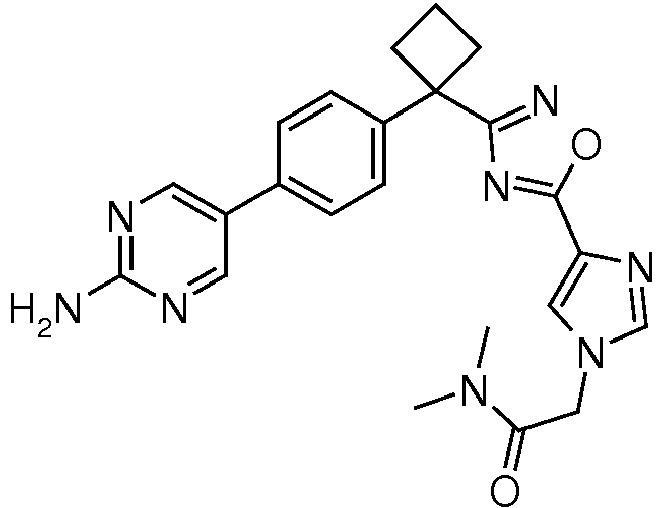
2-[4-(3-{1-[4-(2-Amino-pyrimidin-5-yl)-phenyl]-cyclobutyl}-[1,2,4]oxadiazol-5-yl)-imidazol-1-yl]-N,N-dimethyl-acetamide 252 
5-(4-{1-[5-(1-Oxetan-3-yl-1H-pyrazol-4-yl)-[1,2,4]oxadiazol-3-yl]-cyclobutyl}-phenyl)-pyridin-2-ylamine 253 
5-[4-(1-{5-[1-(2-Pyrrolidin-1-yl-ethyl)-1H-pyrazol-4-yl]-[1,2,4]oxadiazol-3-yl}-cyclobutyl)-phenyl]-pyrimidin-2-ylamine 254 
1-[4-(3-{1-[4-(2-Amino-pyrimidin-5-yl)-phenyl]-cyclopropyl}-[1,2,4]oxadiazol-5-yl)-pyrazol-1-yl]-2-methyl-propan-2-ol 255 
5-(4-{1-[5-(1-Oxetan-3-yl-1H-pyrazol-4-yl)-[1,2,4]oxadiazol-3-yl]-cyclopropyl}-phenyl)-pyrimidin-2-ylamine 256 
2-[4-(3-{1-[4-(2-Amino-pyrimidin-5-yl)-phenyl]-cyclobutyl}-[1,2,4]oxadiazol-5-yl)-pyrazol-1-yl]-1-((R)-3-methoxy-pyrrolidin-1-yl)-ethanone 257 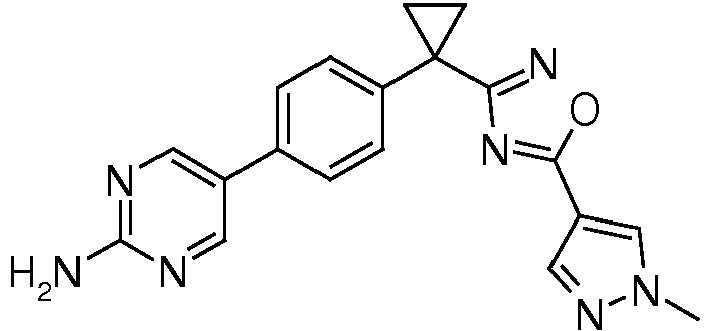
5-(4-{1-[5-(1-Methyl-1H-pyrazol-4-yl)-[1,2,4]oxadiazol-3-yl]-cyclopropyl-phenyl)-pyrimidin-2-ylamine 258 
6-(4-{1-[5-(1-Methyl-1H-pyrazol-4-yl)-[1,2,4]oxadiazol-3-yl]-cyclobutyl}-phenyl)-pyridazin-3-ylamine 259 
2-[4-(3-{1-[4-(2-Amino-pyrimidin-5-yl)-phenyl]-cyclobutyl}-[1,2,4]oxadiazol-5-yl)-pyrazol-1-yl]-1-((S)-3-methoxy-pyrrolidin-1-yl)-ethanone 260 261 
2-Amino-5-(4-{1-[5-(1-methyl-1H-pyrazol-4-yl)-[1,2,4]oxadiazol-3-yl]-cyclobutyl}-phenyl)-nicotinonitrile 262 
2-(4-{1-[5-(1-Methyl-1H-pyrazol-4-yl)-[1,2,4]oxadiazol-3-yl]-cyclobutyl}-phenyl)-5H-pyrrolo[2,3-b]pyrazine 263 
5-(4-{1-[5-(1-Oxetan-3-yl-1H-imidazol-4-yl)-[1,2,4]oxadiazol-3-yl]-cyclobutyl}-phenyl)-pyrimidin-2-ylamine 264 
5-(4-{1-[5-(3-Oxetan-3-yl-3H-imidazol-4-yl)-[1,2,4]oxadiazol-3-yl]-cyclobutyl}-phenyl)-pyrimidin-2-ylamine 265 
5-(4-{1-[5-(1-Methyl-1H-imidazol-4-yl)-[1,2,4]oxadiazol-3-yl]-cyclobutyl}-phenyl)-pyrazin-2-ylamine 266 
5-(4-{1-[5-(2-Piperazin-1-yl-thiazol-4-yl)-[1,2,4] oxadiazol-3-yl]-cyclobutyl-phenyl)-pyrimidin-2-ylamine 267 
-(4-{1-[5-(2-Piperazin-1-yl-thiazol-5-yl)-[1,2,4]oxadiazol-3-yl]-cyclobutyl}-phenyl)-pyrimidin-2-ylamine 268 
2-[4-(3-{1-[4-(2-Amino-pyrimidin-5-yl)-phenyl]-cyclopropyl}-[1,2,4]oxadiazol-5-yl)-pyrazol-1-yl]-N,N-dimethyl-acetamide 269 
5-(4-{1-[5-(2-Piperidin-4-yl-thiazol-4-yl)-[1,2,4]oxadiazol-3-yl]-cyclobutyl}-phenyl)-pyrimidin-2-ylamine 270 
N-[5-(3-{1-[4-(2-Amino-pyrimidin-5-yl)-phenyl]-cyclobutyl}-[1,2,4]oxadiazol-5-yl)-pyrazin-2-yl]-N',N'-dimethyl-ethane-1,2-diamine 271 
N-[5-(3-{1-[4-(2-Amino-pyrimidin-5-yl)-phenyl]-cyclobutyl}-[1,2,4]oxadiazol-5-yl)-pyrazin-2-yl]-N,N',N'-trimethyl-ethane-1,2-diamine 272 
5-(4-{1-[5-(1-Methyl-1H-pyrazol-4-yl)-[1,2,4]oxadiazol-3-yl]-cyclobutyl}-phenyl)-2,3-dihydro-1H-pyrrolo[2,3-b]pyridine 273 
5-(4-{1-[5-(1-Methyl-1H-pyrazol-4-yl)-[1,2,4]oxadiazol-3-yl]-cyclobutyl}-phenyl)-1H-pyrrolo[2,3-b]pyridine 274 
[2-Amino-5-(4-{1-[5-(1-methyl-1H-pyrazol-4-yl)-[1,2,4]oxadiazol-3-yl]-cyclobutyl}-phenyl)-pyridin-3-yl]-methanol 275 
N,N-Dimethyl-2-[4-(3-{1-[4-(5H-pyrrolo[2,3-b]pyrazin-2-yl)-phenyl]-cyclobutyl}-[1,2,4]oxadiazol-5-yl)-pyrazol-1-yl]-acetamide 276 
N,N-Dimethyl-2-[4-(3-{1-[4-(2-methylamino-pyrimidin-5-yl)-phenyl]-cyclobutyl-[1,2,4]oxadiazol-5-yl)-pyrazol-1-yl]-acetamide 277 
5-{4-[1(5-Imidazol-1-ylmethyl-[1,2,4]oxadiazol-3-yl)-cyclobutyl]-phenyl}-pyrimidin-2-ylamine 278 
1-(3-{1-[4-(2-Amino-pyrimidin-5-yl)-phenyl]-cyclobutyl}-[1,2,4]oxadiazol-5-yl)-2-methyl-propan-2-ol 279 
5-(4-{1-[5-(3,5-Dimethyl-1H-pyrazol-4-ylmethyl)-[1,2,4]oxadiazol-3-yl]-cyclobutyl}-phenyl)-pyrimidin-2-ylamine 280 
5-(4-{1-[5-(1-Methyl-piperidin-2-yl)-[1,2,4]oxadiazol-3-yl]-cyclobutyl}-phenyl)-pyrimidin-2-ylamine 281 
5-{4-[1-((S)-5-Piperidin-2-yl-[1,2,4]oxadiazol-3-yl)-cyclobutyl]-phenyl}-pyrimidin-2-ylamine 282 
5-{4-[1((R)-5-Piperidin-2-yl-[1,2,4]oxadiazol-3-yl)-cyclobutyl]-phenyl} - pyrimidin-2-ylamine 283 
5-{4-[1-(5-Piperidin-2-yl-[1,2,4]oxadiazol-3-yl)-cyclobutyl]-phenyl}-pyrimidin-2-ylamine 284 
1-(3-{1-[4-(2-Amino-pyrimidin-5-yl)-phenyl]-cyclobutyl}-[1,2,4]oxadiazol-5-yl)-piperidin-4-ol 285 
1-(3-{1-[4-(2-Amino-pyrimidin-5-yl)-phenyl]-cyclobutyl}-[1,2,4]oxadiazol-5-yl)-piperidin-3-ol 286 
[1-(3-{1-[4-(2-Amino-pyrimidin-5-yl)-phenyl]-cyclobutyl}-[1,2,4]oxadiazol-5-yl)-piperidin-3-yl]-methanol 287 
(S)-1-(3-{1-[4-(2-Amino-pyrimidin-5-yl)-phenyl]-cyclobutyl}-[1,2,4]oxadiazol-5-yl)-pyrrolidin-3-ol 288 
[(S)-1(3-{1[4-(2-Amino-pyrimidin-5-yl)-phenyl]-cyclobutyl}-[12,4]oxadiazol-5-yl)-pyrrolidin-2-yl]-methanol 289 
[(R)-1-(3-{1-[4-(2-Amino-pyrimidin-5-yl)-phenyl]-cyclobutyl}-[1,2,4]oxadiazol-5-yl)-pyrrolidin-2-yl]-methanol 290 
(R)-1-(3-{1-[4-(2-Amino-pyrimidin-5-yl)-phenyl]-cyclobutyl}-[1,2,4]oxadiazol-5-yl)-pyrrolidin-3-ol 291 
1-(3-{1-[4-(2-Amino-pyrimidin-5-yl)-phenyl]-cyclobutyl}-[1,2,4]oxadiazol-5-yl)-piperidine-4-carbonitrile 292 
5-[4-(1-{5-[Methyl-(tetrahydro-pyran-4-ylmethyl)-amino]-[1,2,4]oxadiazol-3-yl}-cyclobutyl)-phenyl]-pyrimidin-2-ylamine 293 
5-[4-(1-{5-[Methyl-(1-methyl-piperidin-4-yl)-amino]-[1,2,4]oxadiazol-3-yl}-cyclobutyl)-phenyl]-pyrimidin-2-ylamine 294 
Methyl-[5-(4-{1-[5-(1-methyl-1H-pyrazol-4-yl)-[1,2,4]oxadiazol-3-yl]-cyclobutyl}-phenyl)-pyrimidin-2-yl]-amine 295 
5-(3-Methyl-4-{1-[5-(1-methyl-1H-pyrazol-4-yl)-[1,2,4]oxadiazol-3-yl]-cyclobutyl}-phenyl)-pyrimidin-2-ylamine 296 
5-(4-{1-[5-(3,4,5,6-Tetrahydro-2H-[1,2']bipyrazinyl-5'-yl)-[1,2,4]oxadiazol-3-yl]-cyclobutyl}-phenyl)-pyridin-2-ylamine 297 
1-[4-(3-{1-[4-(2-Amino-pyrimidin-5-yl)-phenyl]-cyclobutyl}-[1,2,4] oxadiazol-5-yl)-imidazol-1-yl]-2-methyl-propan-2-ol 298 
1-[5-(3-{1-[4-(2-Amino-pyrimidin-5-yl)-phenyl]-cyclobutyl}-[1,2,4]oxadiazol-5-yl)-imidazol-1-yl]-2-methyl-propan-2-ol 299 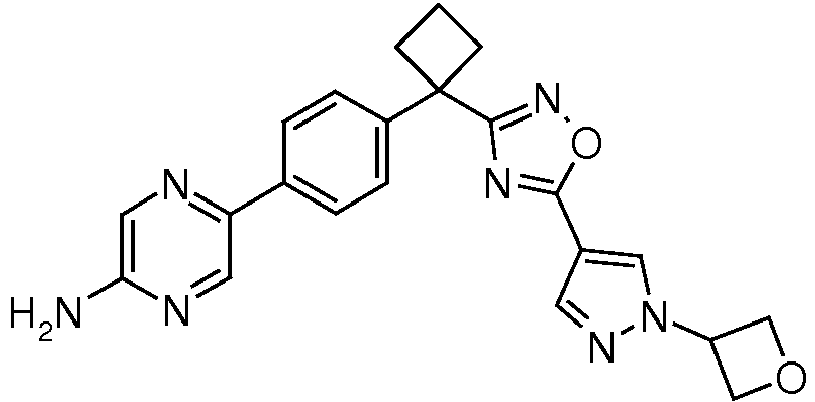
5-(4-{1-[5-(1-Oxetan-3-yl-1H-pyrazol-4-yl)-[1,2,4]oxadiazol-3-yl]-cyclobutyl}-phenyl)-pyrazin-2-ylamine; compound with trifluoro-acetic acid 300 
1-[4-(3-{1-[4-(6-Amino-pyridin-3-yl)-phenyl] - cyclobutyl}-[1,2,4]oxadiazol-5-yl)-pyrazol-1-yl]-2-methyl-propan-2-ol 301 
2-[4-(3-{1-[4-(6-Amino-pyridin-3-yl)-phenyl] - cyclobutyl}-[1,2,4]oxadiazol-5-yl)-pyrazol-1-yl]-N,N-dimethyl-acetamide 302 
5-(4-{1-[5-(3,4,5,6-Tetrahydro-2H-[1,2']bipyrazinyl-5'-yl)-[1,2,4]oxadiazol-3-yl]-cyclobutyl}-phenyl)-pyrazin-2-ylamine 303 
1-[4-(3-{1-[4-(5-Amino-pyrazin-2-yl)-phenyl] - cyclobutyl}-[1,2,4]oxadiazol-5-yl)-pyrazol-1-yl]-2-methyl-propan-2-ol 304 
2-[4-(3-{1-[4-(5-Amino-pyrazin-2-yl)-phenyl] - cyclobutyl}-[1,2,4]oxadiazol-5-yl)-pyrazol-1-yl]-N,N-dimethyl-acetamide 305 
5-(4-{1-[5-(1-Methyl-1H-imidazol-4-yl)-[1,2,4]oxadiazol-3-yl]-cyclobutyl}-phenyl)-pyridin-2-ylamine 306 
5-(4-{1-[5-(cis-2,6-Dimethyl-piperidin-1-yl)-[1,2,4]oxadiazol-3-yl]-cyclobutyl}-phenyl)-pyrimidin-2-ylamine 307 
5-(4-{1-[5-(3,4,5,6-Tetrahydro-2H-1,2'-bipyrazinyl-5'-yl)-1,2,4-oxadiazol-3-yl]-cyclobutyl}-phenyl)-pyrimidin-2-ylamine 308 
(R)-5'-(3-{1-[4-(2-Amino-pyrimidin-5-yl)-phenyl]-cyclobutyl}-1,2,4-oxadiazol-5-yl)-3,4,5,6-tetrahydro-2H-1,2'-bipyrazinyl-3-carboxylic acid methyl ester 309 
(S)-5'-(3-{1-[4-(2-Amino-pyrimidin-5-yl)-phenyl]-cyclobutyl}-1,2,4-oxadiazol-5-yl)-3,4,5,6-tetrahydro-2H-1,2'-bipyrazinyl-3-carboxylic acid methyl ester - In one embodiment, the invention relates to any of the compounds depicted in Table I above and the pharmaceutically acceptable salt thereof.
- Representative compounds of the invention show activity in the FLAP binding assay and in the human whole blood LTB4 production inhibition assay, described in the assessment of biological properties section, as shown in Table II.
Table II Example FLAP SPA IC50 (nM) hWB LTB4 IC50 (nM) 1 8.4 330 2 2.2 100 3 5.6 350 4 4.6 720 5 2.4 >5000 6 1.1 150 7 2.4 50 8 8.5 400 9 7.0 2000 10 2.1 290 11 120 1300 12 8.3 470 13 170 >5000 14 57 >5000 15 20 440 16 3.3 >5000 17 2.1 180 18 2.9 300 19 11 1400 20 1.9 63 21 3.1 160 22 2.6 140 23 4.2 73 24 11 460 25 21 690 26 160 1600 27 340 >5000 28 4.3 320 29 6.9 190 30 6.5 230 31 3 1300 32 4.6 77 33 4.0 550 34 7.7 780 35 3.6 600 36 4.3 260 37 3.7 340 38 2.4 >5000 39 12 800 40 4.7 2100 41 8.1 930 42 8.4 690 43 3.2 230 44 3.1 75 45 7.9 950 46 7.5 1500 47 15 2400 48 2.5 430 49 3.7 660 50 4.4 490 51 7.0 1000 52 4.3 780 53 6.2 580 54 15 1200 55 13 1100 56 8.4 990 57 1.8 45 58 2.0 >5000 59 5.1 130 60 4.7 150 61 1.5 53 62 1.3 13 63 1.0 25 64 7.7 310 65 5.9 97 66 8.4 120 67 12 290 68 1.1 130 69 2.4 65 70 3.0 220 71 2.4 200 72 1.9 18 73 6.8 450 74 71 520 75 3.5 190 76 3.9 190 77 2.6 160 78 8.8 160 79 3.5 69 80 6.5 390 81 6.4 130 82 3.1 99 83 4.0 110 84 4.0 160 85 1.3 71 86 1.2 79 87 4.5 150 88 6.3 160 89 1.9 43 90 3.4 210 91 3.7 151 92 4.9 150 93 2.4 160 94 6.1 560 95 3.2 130 96 13 2700 97 2.9 92 98 2.3 110 99 2.0 150 100 2.1 170 101 3.3 250 102 2.5 180 103 1.3 63 104 1.3 99 105 1.9 78 106 2.7 130 107 1.4 98 108 1.3 110 109 1.3 98 110 0.92 110 111 1.2 32 112 1.4 760 113 1.6 100 114 2.6 290 115 3.3 140 116 1.8 150 117 2.6 140 118 21 1700 119 40 790 120 9.1 740 121 4.9 450 122 14 360 123 35 1500 124 3.5 >5000 125 5.0 >5000 126 5.7 >5000 127 3.2 120 128 6.7 180 129 3.9 140 130 1.5 75 131 3.9 88 132 2.8 69 133 4.3 72 134 5.8 120 135 10.4 190 136 1.5 66 137 7.7 170 138 2.8 38 139 2.6 95 140 4.4 68 141 0.9 43 142 1.1 40 143 2.2 250 144 1.4 470 145 78 >5000 146 27 840 147 33 1700 148 46 3300 149 15 >5000 150 180 >5000 151 210 >5000 152 3.5 210 153 2.5 270 154 1.7 810 155 2.8 400 156 13 >5000 157 4.1 690 158 5.7 360 159 6.0 340 160 6.2 240 161 6.6 860 162 6.4 1000 163 4.0 450 164 5.5 570 165 6.0 450 166 1.9 45 167 5.1 660 168 5.5 230 169 2.1 130 170 2.9 390 171 14 820 172 4.3 260 173 2.9 >5000 174 5.3 510 175 2.3 110 176 5.6 410 177 98 1300 178 61 >5000 179 12 1400 180 0.85 73 181 1.2 62 182 1.1 40 183 0.88 53 184 2.6 140 185 7.3 230 186 12 710 187 8.4 3400 188 6.2 81 189 8.1 310 190 1.2 27 191 2.6 >5000 192 1.7 >5000 193 1.6 45 194 3.0 85 195 2.9 140 196 2.1 24 197 1.5 48 198 2.0 57 199 1.0 42 200 1.5 67 201 2.3 400 202 2.6 70 203 1.9 130 204 4.5 75 205 5.8 120 206 4.3 38 207 2.7 40 208 2.8 52 209 1.0 27 210 4.6 110 211 3.0 89 212 2.2 22 213 0.85 110 214 4.0 150 215 2.1 26 216 1.3 59 217 3.4 81 218 1.2 160 219 3.1 140 220 0.7 16 221 1.9 47 222 2.2 44 223 1.8 460 224 2.8 64 225 0.89 >5000 226 1.2 45 227 2.6 240 228 3.3 160 229 6.0 410 230 1.3 64 231 2.3 61 232 1.8 26 233 9.8 700 234 3.5 82 235 1.7 67 236 5.6 230 237 2.0 >5000 238 1.0 37 239 6.2 2500 240 3.6 47 241 3.5 140 242 5.4 120 243 8.5 200 244 250 >5000 245 38 1700 246 8.1 79 247 8.2 88 248 730 >5000 249 7.8 69 250 8.6 220 251 36 2200 252 5.3 34 253 8.1 75 254 190 4700 255 150 1900 256 22 220 257 100 2200 258 73 610 259 16 210 260 76 2000 261 9.3 240 262 2.4 27 263 16 190 264 8.3 280 265 6.2 55 266 6.5 160 267 4.0 60 268 670 >5000 269 5.6 320 270 5.4 46 271 5.3 44 272 3.8 79 273 3.9 79 274 8.8 220 275 2.8 140 276 7.0 110 277 260 2800 278 78 1700 279 29 >5000 280 17 1400 281 62 1400 282 26 1100 283 60 1400 284 18 120 285 22 330 286 14 200 287 36 200 288 26 310 289 31 500 290 35 230 291 19 210 292 22 330 293 150 750 294 4.4 35 295 12 100 296 2.1 230 297 46 520 298 16 510 299 2.9 24 300 8.4 89 301 6.0 140 302 2.6 150 303 7.3 31 304 10 65 305 15 120 306 12 580 307 3.5 150 308 5.0 480 309 5.7 760 - The invention also relates to pharmaceutical preparations, containing as active substance one or more compounds of the invention, or the pharmaceutically acceptable derivatives thereof, optionally combined with conventional excipients and/or carriers.
- Compounds of the invention also include their isotopically-labelled forms. An isotopically-labelled form of an active agent of a combination of the present invention is identical to said active agent but for the fact that one or more atoms of said active agent have been replaced by an atom or atoms having an atomic mass or mass number different from the atomic mass or mass number of said atom which is usually found in nature. Examples of isotopes which are readily available commercially and which can be incorporated into an active agent of a combination of the present invention in accordance with well established procedures, include isotopes of hydrogen, carbon, nitrogen, oxygen, phosphorous, fluorine and chlorine, e.g., 2H, 3H, 13C, 14C, 15N, 18O, 17O, 31P, 32P, 35S, 18F, and 36Cl, respectively. An active agent of a combination of the present invention, or a pharmaceutically acceptable salt thereof which contains one or more of the above-mentioned isotopes and/or other isotopes of other atoms is contemplated to be within the scope of the present invention.
- The invention includes the use of any compounds of described above containing one or more asymmetric carbon atoms may occur as racemates and racemic mixtures, single enantiomers, diastereomeric mixtures and individual diastereomers. Isomers shall be defined as being enantiomers and diastereomers. All such isomeric forms of these compounds are expressly included in the present invention. Each stereogenic carbon may be in the R or S configuration, or a combination of configurations.
- Some of the compounds of the invention can exist in more than one tautomeric form. The invention includes all such tautomers.
- All terms as used herein in this specification, unless otherwise stated, shall be understood in their ordinary meaning as known in the art. For example, "C1-6 alkoxy" is a C1-6 alkyl with a terminal oxygen, such as methoxy, ethoxy, propoxy, butoxy. All alkyl, alkenyl, and alkynyl groups shall be understood as being branched or unbranched where structurally possible and unless otherwise specified. Other more specific definitions are as follows:
- The term "alkyl" refers to both branched and unbranched alkyl groups. It should be understood that any combination term using an "alk" or "alkyl" prefix refers to analogs according to the above definition of "alkyl". For example, terms such as "alkoxy", "alkythio" refer to alkyl groups linked to a second group via an oxygen or sulfur atom. "Alkanoyl" refers to an alkyl group linked to a carbonyl group (C=O).
- In all alkyl groups or carbon chains, one or more carbon atoms can be optionally replaced by heteroatoms such as O, S or N. It shall be understood that if N is not substituted then it is NH. It shall also be understood that the heteroatoms may replace either terminal carbon atoms or internal carbon atoms within a branched or unbranched carbon chain. Such groups can be substituted as herein above described by groups such as oxo to result in definitions such as but not limited to: alkoxycarbonyl, acyl, amido and thioxo.
- As used herein, "nitrogen" and "sulfur" include any oxidized form of nitrogen and sulfur and the quaternized form of any basic nitrogen. For example, for a -S-C1-6 alkyl radical, unless otherwise specified, shall be understood to include -S(O)-C1-6 alkyl and -S(O)2-C1-6 alkyl.
- The term C1-3 hydroxy also means C1-3 alkylhydroxy or C1-3 alkyl-OH.
- The term "C3-10 carbocycle" or C3-10 cycloalkyl refers to a nonaromatic 3 to 10-membered (but preferably, 3 to 6-membered) monocyclic carbocyclic radical or a nonaromatic 6 to 10-membered fused bicyclic, bridged bicyclic, or spirocyclic carbocyclic radical. The C3-10 carbocycle may be either saturated or partially unsaturated, and the carbocycle may be attached by any atom of the cycle which results in the creation of a stable structure. Non-limiting examples of 3 to 10-membered monocyclic carbocycles include cyclopropyl, cyclobutyl, cyclopentyl, cyclopentenyl, cyclohexyl, cyclohexenyl, cycloheptanyl, cycloheptenyl, and cyclohexanone. Non-limiting examples of 6 to 10-membered fused bicyclic carbocyclic radicals include bicyclo[3.3.0]octane, bicyclo[4.3.0]nonane, and bicyclo[4.4.0]decanyl (decahydronaphthalenyl). Non-limiting examples of 6 to 10-membered bridged bicyclic carbocyclic radicals include bicyclo [2.2.2]heptanyl, [2.2.1]heptanyl bicyclo[2.2.2]octanyl, and bicyclo[3.2.1]octanyl. Non-limiting examples of 6 to 10-membered spirocyclic carbocyclic radicals include but are not limited to spiro[3,3]heptanyl, spiro[3,4]octanyl and spiro[4,4]heptanyl.
- The term "C6-10 aryl" or "aryl" refers to aromatic hydrocarbon rings containing from six to ten carbon ring atoms. The term C6-10 aryl includes monocyclic rings and bicyclic rings where at least one of the rings is aromatic. Non-limiting examples of C6-10 aryls include phenyl, indanyl, indenyl, benzocyclobutanyl, dihydronaphthyl, tetrahydronaphthyl, naphthyl, benzocycloheptanyl and benzocycloheptenyl.
- The term "5 to 11-membered heterocycle" refers to a stable nonaromatic 4-8 membered monocyclic heterocyclic radical or a stable nonaromatic 6 to 11-membered fused bicyclic, bridged bicyclic or spirocyclic heterocyclic radical. The 5 to 11-membered heterocycle consists of carbon atoms and one or more, preferably from one to four heteroatoms chosen from nitrogen, oxygen and sulfur. The heterocycle may be either saturated or partially unsaturated. Non-limiting examples of nonaromatic 4-8 membered monocyclic heterocyclic radicals include tetrahydrofuranyl, tetrahydropyranyl, oxetanyl, azetidinyl, pyrrolidinyl, pyranyl, tetrahydropyranyl, dioxanyl, thiomorpholinyl, 1,1-dioxo-1λ6-thiomorpholinyl, morpholinyl, piperidinyl, piperazinyl, and azepinyl. Non-limiting examples of nonaromatic 6 to 11-membered fused bicyclic radicals include octahydroindolyl, octahydrobenzofuranyl, and octahydrobenzothiophenyl. Non-limiting examples of nonaromatic 6 to 11-membered bridged bicyclic radicals include 2-azabicyclo[2.2.1]heptanyl, 3-azabicyclo[3.1.0]hexanyl, and 3-azabicyclo[3.2.1]octanyl. Non-limiting examples of nonaromatic 6 to 11-membered spirocyclic heterocyclic radicals include 7-aza-spiro[3,3]heptanyl, 7-spiro[3,4]octanyl, and 7-azaspiro[3,4]octanyl.
- The term "5 to 11-membered heteroaryl" shall be understood to mean an aromatic 5 to 6-membered monocyclic heteroaryl or an aromatic 7 to 11-membered heteroaryl bicyclic ring where at least one of the rings is aromatic, wherein the heteroaryl ring contains 1-4 heteroatoms such as N, O and S. Non-limiting examples of 5 to 6-membered monocyclic heteroaryl rings include furanyl, oxazolyl, isoxazolyl, oxadiazolyl, thiazolyl, pyrazolyl, pyrrolyl, imidazolyl, tetrazolyl, triazolyl, thienyl, thiadiazolyl, pyridinyl, pyrimidinyl, pyridazinyl, pyrazinyl, triazinyl, and purinyl. Non-limiting examples of 7 to 11-membered heteroaryl bicyclic heteroaryl rings include benzimidazolyl, quinolinyl, dihydro-2H-quinolinyl, isoquinolinyl, quinazolinyl, indazolyl, thieno[2,3-d]pyrimidinyl, indolyl, isoindolyl, benzofuranyl, benzopyranyl, benzodioxolyl, benzoxazolyl, pyrazolopyrimidinyl, imidazopyridinyl, pyrrolopyridinyl, dihydropyrrolopyridinyl, pyrrolopyrimidinyl, pyrrolopyridazinyl, pyrrolopyrazinyl pyrazolopyridinyl, pyrazolopyrimidinyl, indazolyl and benzothiazolyl. It will be further understood that any of the above heteroaryl rings may be partially hydrogenated.
- It will be understood that one to three carbon ring moieties in the each of the C3-10 carbocyclic rings, the 5 to 11-membered heterocyclic rings, the nonaromatic portion of the bicyclic aryl rings, and the nonaromatic portion of the bicyclic heteroaryl rings can independently be replaced with a carbonyl, thiocarbonyl, or iminyl moiety, i.e., -C(=O)-, -C(=S)- and -C(=NR8)-, respectively, where R8 is as defined above.
The term "heteroatom" as used herein shall be understood to mean atoms other than carbon such as O, N, and S. - The term "halogen" as used in the present specification shall be understood to mean bromine, chlorine, fluorine or iodine. The definitions "halogenated", "partially or fully halogenated"; partially or fully fluorinated; "substituted by one or more halogen atoms", includes for example, mono, di or tri halo derivatives on one or more carbon atoms. For alkyl, a non-limiting example would be -CH2CHF2, -CF3 etc.
- Each alkyl, carbocycle, heterocycle or heteroaryl, or the analogs thereof, described herein shall be understood to be optionally partially or fully halogenated.
- The compounds of the invention are only those which are contemplated to be 'chemically stable' as will be appreciated by those skilled in the art. For example, a compound which would have a 'dangling valency', or a 'carbanion' are not compounds contemplated by the inventive methods disclosed herein.
- The invention includes pharmaceutically acceptable derivatives of compounds of formula (I). A "pharmaceutically acceptable derivative" refers to any pharmaceutically acceptable salt or ester, or any other compound which, upon administration to a patient, is capable of providing (directly or indirectly) a compound useful for the invention, or a pharmacologically active metabolite or pharmacologically active residue thereof. A pharmacologically active metabolite shall be understood to mean any compound of the invention capable of being metabolized enzymatically or chemically. This includes, for example, hydroxylated or oxidized derivative compounds of the invention.
- Pharmaceutically acceptable salts include those derived from pharmaceutically acceptable inorganic and organic acids and bases. Examples of suitable acids include hydrochloric, hydrobromic, sulfuric, nitric, perchloric, fumaric, maleic, phosphoric, glycolic, lactic, salicylic, succinic, toluene-p-sulfuric, tartaric, acetic, citric, methanesulfonic, formic, benzoic, malonic, naphthalene-2-sulfuric and benzenesulfonic acids. Other acids, such as oxalic acid, while not themselves pharmaceutically acceptable, may be employed in the preparation of salts useful as intermediates in obtaining the compounds and their pharmaceutically acceptable acid addition salts. Salts derived from appropriate bases include alkali metal (e.g., sodium), alkaline earth metal (e.g., magnesium), ammonium and N-(C1-C4 alkyl)4 + salts.
- The compounds of formula I may be made using the general synthetic methods described below, which also constitute part of the invention.
- The invention also provides processes for making compounds of Formula (I). In all Schemes, unless specified otherwise, R1, R2, R3, R4 and R5 in the Formulas below shall have the meaning of R1, R2, R3, R4 and R5 in Formula (I) of the invention described herein above.
- Optimum reaction conditions and reaction times may vary depending on the particular reactants used. Unless otherwise specified, solvents, temperatures, pressures, and other reaction conditions may be readily selected by one of ordinary skill in the art. Specific procedures are provided in the Synthetic Examples section. Typically, reaction progress may be monitored by thin layer chromatography (TLC) or LC-MS, if desired, and intermediates and products may be purified by chromatography on silica gel and/or by recrystallization.
- The examples which follow are illustrative and, as recognized by one skilled in the art, particular reagents or conditions could be modified as needed for individual compounds without undue experimentation. Starting materials and intermediates used, in the Schemes below, are either commercially available or easily prepared from commercially available materials by those skilled in the art.
- The compounds of Formula (I) may be synthesized according to Scheme 1:

- As illustrated in scheme 1, reaction of a compound of formula II with a boronic acid or the corresponding boronic acid ester shown in the above scheme, in a suitable solvent, in the presence of a suitable a suitable catalyst, provides a compound of formula (I). Ra and Rb are hydrogen or Ra and Rb together with the oxygen atoms to which they are attached form a 5-6 membered ring optionally substituted with 2-4 methyl groups.
- Alternatively, reaction of a compound of formula II with a diborane, under standard reaction conditions, provides a compound of formula III. Coupling the intermediate of formula III with a halide or triflate R3X, in a suitable solvent, in the presence of a suitable catalyst, provides a compound of formula (I). X is chloro, bromo, triflate, or iodo.
- A compound of formula (I) may also be prepared by reacting a compound of formula (II) with a halide of formula R3X, wherein X is a halogen atom, in a suitable solvent, in the presence of a suitable palladium catalyst and hexamethylstannane.
- The compounds of Formula (I) may be prepared according to Scheme 2:

- As illustrated in scheme 2, reaction of a compound of formula IV with an acid chloride R5COCl, in a suitable solvent, in the presence of a suitable base, provides a compound of formula (I).
- Alternatively, reaction of a compound of formula IV with an acid R5COOH, in a suitable solvent, in the presence of carbonyl diimidazole, or other suitable amide coupling reagent, provides a compound of formula (I).
- The intermediate of formula II may be synthesized as outlined in Scheme 3:

- As illustrated in scheme 3, reaction of a nitrile of formula V with a dihalide VI wherein one of the carbon atoms in the alkyl chain may be optionally substituted with O, S or N, in a suitable solvent, in the presence of a suitable base such as sodium hydride, provides a substituted nitrile of formula VII. R1 and R2 together with the carbon atom to which they are attached form a C3-8 carbocyclic or heterocyclic ring. X is chloro, bromo, or iodo. Reaction of the compound of formula VII with hydroxylamine, under standard reaction conditions, provides a compound of formula VIII. Reaction of the compound of formula VIII with an acid chloride R5COCl, in a suitable solvent, in the presence of a suitable base, provides a compound of formula II. Alternatively, reaction of a compound of formula VIII with an acid R5COOH, in a suitable solvent, in the presence of carbonyl diimidazole, or other suitable amide coupling reagent, provides a compound of formula II.
- Intermediate of formula VIII may also be converted to the trichloromethyl intermediate of formula IX by standard procedures. Reaction of the intermediate IX with R5H when R5H contains a primary or secondary amino group, in a suitable solvent provides an intermediate of formula II
- The intermediate of formula II may also be synthesized as shown in Scheme 4:

- As shown in scheme 4, when X=H, reaction of a compound of formula X with a carbonyl compound, in a suitable solvent, provides a hydroxy compound of formula XI. Conversion of the hydroxyl group in compound of formula XI to a cyano group, using standard procedures, provides a compound of formula VII. The compound of formula VII is converted to the intermediate of formula II by the reactions shown in scheme 3.
- The intermediate of formula IV may be synthesized according to Scheme 5:

- As illustrated above in scheme 5, reaction of a nitrile of formula VII with a boronic acid or the corresponding boronic acid ester shown in the above scheme, in a suitable solvent, in the presence of a suitable catalyst, provides a compound of formula XII. Ra and Rb are hydrogen or Ra and Rb together with the oxygen atoms to which they are attached form a 5-6 membered ring optionally substituted with 2-4 methyl groups. Reaction of a compound of formula XI with hydroxylamine, under standard reaction conditions, provides a compound of formula IV.
- Further modification of the initial product of Formula (I), by methods known in the art and illustrated in the Examples below, may be used to prepare additional compounds of this invention.
-

- R1 (10g, 51.009mmol) is dissolved in DMF (50mL) and cooled to 0 °C. NaH (4.451g, 102 mmol, 55% in oil) is added slowly and the mixture stirred for 30 minutes. To this R2 (20.593g, 102 mmol) is added slowly and stirred for 2 h at 0°C. The mixture is quenched with chilled water and extracted with Et2O. The organic layers are combined, washed with brine, dried over anhydrous Na2SO4, filtered and concentrated in vacuo. Purification is done by silica flash column to afford title compound (10g) as a liquid; m/z 236/238 [M, M+2]
- The following compounds are synthesized in a similar fashion from the appropriate reagents:
- Intermediate I-1.4 is made using THF/DMSO (1:1) as the solvent and half the concentration.
-

- I-1.6 (0.6 g, 2.127 mmol) is dissolved in acetone (5 mL) and 6M HCl (3 mL) is added. The mixture is heated at 90°C for 5 hours. The mixture is concentrated in vacuo and diluted with EtOAc/ saturated aqueous NaHCO3. The organic phase is separated, washed with brine, dried over Na2SO4, filtered and concentrated in vacuo. The crude material is purified by flash chromatography (SiO2, 0-20% EtOAc/heptanes) to afford title compound (0.426 g) as an oil. Title compound does not ionize.
- I-1.8 (0.426g, 1.699 mmol) is dissolved in DCM (10 mL) and cooled to -10°C. DAST (0.6 mL, 4.578 mmol) is added and the mixture is warmed to room temperature and stirred overnight. The mixture is diluted with DCM and quenched with saturated aqueous NaHCO3 slowly. The organic layer is separated, washed with brine, dried over Na2SO4, filtered and concentrated in vacuo. The crude is purified by flash chromatography (SiO2, 0-15% EtOAc/heptanes) to afford title compound (0.385g) as an oil. Title compound does not ionize.
-

- To a suspension of I-1.1 (10g, 42.353 mmol) and R3 (11.235 g, 50.824 mmol) in THF (100 mL) is added Pd(PPh3)4 (4.894g, 4.235 mmol) and saturated aqueous Na2CO3. The mixture is heated to reflux overnight. The reaction is concentrated in vacuo and purified by flash chromatography (SiO2, 0-3% MeOH/DCM) to afford title compound (10.2g); m/z 251 [M+H].
- The following compounds are synthesized in similar fashion from the appropriate reagents:
Table 2: Nitrile intermediates Intermediate Structure m/z I-1.11 
312.4 I-1.12 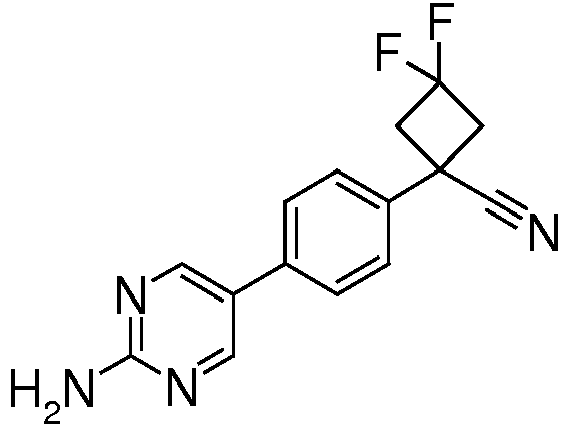
320.3 I-1.13 
281.5 -

- In a vial is added R4 (500 mg, 2.815 mmol), R3 (653 mg, 2.956 mmol), K3PO4 (945 mg, 4.45 mmol) and Pd2(dba)3 (128 mg, 0.14 mmol). The vial is evacuated and back filled with N2 three times. 1,4-Dioxane (10 mL, degassed with N2) is added to the vial followed by the addition of water (3.4 mL). The vial is evacuated and purged with N2 and then heated at 70°C for 18 hours. After this time, the reaction mixture is filtered and the solid is washed with methanol (MeOH), dichloromethane (DCM) and ethyl acetate (EtOAc). The filtrate is concentrated in vacuo. The resulting mixture is diluted with water and extracted with EtOAc twice. The organics are combined, washed with brine, dried over Na2SO4, filtered and concentrated in vacuo. The crude residue is purified by flash chromatography (SiO2, 1.2-10% MeOH/DCM) to afford the title compound (604 mg) as a solid; mlz 237.1 [M+1].
-

- The following compounds are synthesized in similar fashion from the appropriate reagents:
Table 3: Carboxamidine intermediates Intermediate Structure m/z I-2.2 
283/285 I-2.3 
297/299 I-2.4 
287/289 -

- Synthesis same as described for intermediate I-2.1; m/z 284 [M+H]
- The following compounds are synthesized in similar fashion from the appropriate reagents:
Table 4: Carboxamidine intermediates Intermediate Structure m/z I-2.6 
312.36 I-2.7 
320.3 I-2.8 
no data I-2.9 
270.16 -

- A 250ml RB flask is charged with R7 (2.8 g, 16.11 mmol) in 60mL of NMP. R6 (3.0 g, 16.11 mmol) is added followed by triethylamine (2.7 ml, 19.33 mmol). The reaction is warmed to 60 °C under nitrogen and stirred overnight. After 18 h, the reaction is cooled to room temperature, poured into ice water and the resulting solid R8 is isolated by filtration and used without further purification. (5.0 g)
- R8 (5.0 g, 15.51 mmol) is treated with ethanol (150 ml) and 5N NaOH at room temperature. The mixture becomes homogenous before a persisting precipitate forms. At this time water is added (200 ml) and the resulting solid mass is broken up using a spatula. The reaction is stirred for 4 h and treated with water. The mixture is acidified using acetic acid (AcOH) and the product is extracted into DCM (2x). The combined organics are dried (MgSO4), filtered and concentrated to give the title compound. (4.3 g)
-

- A solution of R9 (1.0 g, 4.09 mmol) in dimethylformamide (DMF) (5 ml) is cooled to 0°C under nitrogen. To this mixture is added R10 (0.63 ml, 4.50 mmol) as a DMF solution (5 ml, dropwise addition). Upon complete addition, the reaction is allowed to gradually warm to ambient temperature and stirred over night. After this time the reaction is treated with triethylamine (1 ml, dropwise) and stirred for 10 minutes. The reaction is then poured into water and the product is extracted into EtOAc (3x). The combined organics are dried (MgSO4), filtered and concentrated. The remaining residue is purified via column chromatography (25g silica gel, 5-50% EtOAc/heptane) to afford R11. (1.0 g)
- To a stirred solution of R11 (0.50 g, 1.47 mmol) in THF (15 ml) is added lithium hydroxide monohydrate (93 mg, 2.20 mmol). Enough water is added so as to dissolve the lithium hydroxide (∼1.5 ml). The reaction is stirred at room temperature for 5h and then acidified using AcOH. The reaction is poured into water and the product is extracted into EtOAc (3x). The combined organics are dried (MgSO4), filtered and concentrated to afford the title compound which is used without further purification. (400 mg)
-

- R12 (0.12 g, 0.78 mmol) is dissolved in pyridine (2 mL) and SOCl2 (0.065 mL, 0.892 mmol) is added and the mixture is stirred for 30 minutes. I-2.1 (0.2 g, 0.743 mmol) is added and the mixture stirred at room temperature for 15 minutes and 110°C overnight. The mixture is concentrated in vacuo, dissolved in DCM, washed with saturated aqueous NaHCO3 , dried over Na2SO4, filtered and concentrated in vacuo to afford title compound (0.24 g); m/z 387/389 [M, M+2].
- Intermediates listed with Method I-A in Table 5 are synthesized in similar fashion from the appropriate reagents.
-

- R13 (0.102 g, 0.743 mmol) is dissolved in DMF (2 mL) then HATU (0.282 g, 0.743 mmol) and TEA (0.103 mL, 0.743mmol) are added. The mixture is stirred at room temperature for 5 minutes, I-2.1 (0.2 g, 0.743 mmol) is added and the mixture stirred 2h at room temperature and then 90°C overnight. The mixture is concentrated in vacuo, partitioned between EtOAc and water, organics separated and dried over MgSO4, filtered and concentrated in vacuo. The residue is purified by flash chromatography (SiO2, 0-3%MeOH/DCM) to afford the title compound (0.222g); m/z373 [M+2]
- Intermediates listed with Method I-B in Table 5 are synthesized in similar fashion from the appropriate reagents.
-

- I-2.1 (0.2 g, 0.743 mmol) is dissolved in pyridine (2 mL) and R14 (0.105 g, 0.743 mmol) is added. The mixture is heated at 110°C overnight, then concentrated in vacuo, redissolved in DCM and washed with saturated aqueous NaHCO3. The organics are dried over Na2SO4, filtered and concentrated in vacuo to afford title compound (0.234 g); m/z 358 [M+1].
- Intermediates listed with Method I-C in Table 5 are synthesized in similar fashion from the appropriate reagents.
-

- R15 (0.7 mL, 8.464 mmol) and TEA (1.175 mL, 8.464 mmol) are dissolved in diethyl ether (Et2O) (15 mL) at 0°C and a solution of R16 (0.702 mL, 7.618 mmol) in Et2O (5 mL) is added slowly. The mixture is slowly warmed to room temperature over 2h. The mixture is filtered and the filtrate is concentrated in vacuo to afford title compound (2 g); m/z 158 [M+1].
- R17 (2 g, 12.725 mmol) is dissolved in tetrahydrofuran (THF) (15 mL) and MeOH (15 mL) and 2M NaOH (12.73 mL, 25.451 mmol) is added. The mixture is stirred at room temperature for 2h and then concentrated in vacuo. The crude is acidified to pH4-5 using 2M HCl and extracted with EtOAc, Et2O, and tert-butylmethyl ether (TBME). The mixture is acidified to pH 1 and extracted with DCM. The organics are combined to afford title compound (0.823 g); m/z 144 [M+1].
- R18 (0.2 g, 1.397 mmol) is dissolved in DCM (10 mL) and R19 (0.118 mL, 1.397 mmol) is added dropwise followed by DMF (0.050 mL). The mixture is stirred at room temperature for 1h and then concentrated in vacuo to afford title compound (0.250 g); m/z199 [M+1].
- R20 (0.126 g, 0.780 mmol) is dissolved in pyridine (2 mL) and I-2.1 (0.2 g, 0.743 mmol) is added. The mixture is stirred until homogeneous and then heated to 50°C for 17h. The crude is concentrated in vacuo, dissolved in DCM and washed with saturated aqueous NaHCO3. The organic is concentrated in vacuo and purified by flash chromatography to afford title compound (0.168 g); mlz 376/378 [M, M+2].
Note: The reaction is also performed in acetic acid (AcOH) (2mL) instead of pyridine with reaction time of 2h. - Intermediates listed with Method I-D in Table 5 are synthesized in similar fashion from the appropriate reagents.
-

- I-2.1 (0.5 g, 1.858 mmol) is dissolved in toluene (30 mL) and R21 (0.407 mL, 2.229 mmol) is added. The mixture is heated at 110°C for 2h, cooled to room temperature and washed with water followed by saturated aqueous NaHCO3. The organic is concentrated in vacuo to afford title compound (0.8 g); mlz 396 [M]
- To a stirred solution of R15 (0.044 mL, 0.530 mmol) in DMF (2 mL), is added R22 (0.2 g, 0.504 mmol) and the mixture is stirred at room temperature for 30 minutes. Water is added and the solution is extracted with EtOAc. The organics are combined and concentrated in vacuo to afford title compound (0.080 g); mlz 348/350 [M, M+2]. Intermediates listed with Method I-E in Table 5 are synthesized in similar fashion from the appropriate reagents.
-

- To a solution of R16 (0.208 mL, 2.452 mmol) and R20 (0.2 g, 2.452 mmol) in THF (20 mL) is added DIEA (0.849 mL, 4.905 mmol) at 0°C and stirred for 30 minutes. This solution is added to I-2.1 (0.3 g, 1.115 mmol) in pyridine (5 mL) and stirred for 30 minutes then heated at 50°C overnight. The mixture is purified by flash chromatography to afford title compound (0.240 g).; m/z 351 [M+1].
- Intermediates listed with Method I-F in Table 5 are synthesized in similar fashion from the appropriate reagents.
-

- R25 is prepared according to General Intermediate method I-B; m/z 381/383
- To a solution of R25 (1.4 g, 3.67 mmol) in ethanol (70 mL) is added 2M aqueous NaOH (9.2 mL, 18.3 mmol). The mixture is stirred at 80 °C for 4 h and then concentrated in vacuo before acidification to pH 5-6 with 1 M aqueous HCI. The precipitate formed is collection by filtration. The filtrate is extracted with EtOAc, dried over Na2SO4, filtered and concentrated in vacuo to give a solid which is combined with the precipitate isolated to give the title reagent (1.1 g); mlz 400/402 (M++1)
-

- Synthesis of Intermediate I-4.24 employs conditions found in intermediate method I-E
- I-4.24 (0.15 g, 0.510 mmol) is dissolved in THF (5 mL)and cooled to 0°C before adding TEA (0.11 mL, 0.76 mmol) and then R26 (0.06 mL, 0.56 mmol). The mixture slowly warms to room temperature over an hour. NaOH solution (1 mL, 50%w/v) and TBAI (0.0094 g, 0.03 mmol) are added and the mixture is stirred at room temperature overnight. Additional R26 is added and the mixture heated to 50°C for 8h before diluting with water and extracting with EtOAc. The organics are dried over Na2SO4, filtered and concentrated in vacuo to afford title compound (0.155 g); mlz 362/364 [M, M+2].
-

- To a solution of I-4.24 (0.2 g, 0.68 mmol) in DCM (5 mL) at 0 °C is added pyridine (0.06 mL, 0.75 mmol) followed by dropwise addition of R27 (0.06 mL, 0.75 mmol). After further addition of R27 and heating to 50 °C for 8 h, the mixture is diluted with water. Saturated aqueous NaHCO3 is added and the product is extracted into DCM. The organics are dried with Na2SO4, filtered and concentrated in vacuo. The residue is purified by flash chromatography (SiO2, 30% EtOAc/ heptane and 10% methanol/DCM) to give the title compound (100 mg); mlz 372/374 [M, M+2].
-

- Synthesis of R29 employs conditions used for intermediate method I-B using the appropriate reagents.
- To a solution of R29 (0.091 g, 0.247 mmol) in DMF (1 mL), is added NaH (60% in oil suspension, 0.011 g, 0.268 mmol) under N2 followed by methyl iodide (MeI) (0.016 mL, 0.256 mmol). After stirring at room temperature for 18 h, the reaction mixture is partitioned between EtOAc and saturated aqueous NaHCO3. The organics are washed with brine, dried over Na2SO4, filtered and concentrated in vacuo. The residue is purified by flash chromatography (SiO2, 10%-20% EtOAc/heptanes) to give the title intermediate (0.100 g); m/z 387/389 [M+1].
- Intermediates listed with Method I-G in Table 5 are synthesized in similar fashion from the appropriate reagents.
-

- Synthesis employs intermediate method I-B from the appropriate reagents; m/z 345/347 [M, M+2].
- R30 (0.4 g, 0.382 mmol) is dissolved in dimethyl sulfoxide (DMSO) (10 mL) and sodium tert-butoxide (NaOtBu) (0.074 g, 0.765 mmol) and R31 (0.029g, 0.210 mmol) are added.
- The reaction is stirred at room temperature for 2h, water is added (10 mL) and the solution is neutralized with 1N HCl. The solution is extracted with EtOAc (2 x 10 mL) and the organics are combined, dried over Na2SO4, filtered and concentrated in vacuo. The residue is purified by flash chromatography (SiO2, 30-50% EtOAc/heptanes) to afford title compound (0.180 g); m/z 403/405 [M, M+2].
- Intermediates listed with Method I-H in Table 5 are synthesized in similar fashion from the appropriate reagents. Intermediates listed with Method I-H* in Table 5 are synthesized in similar fashion using KOtBu and the appropriate reagents.
-

- Step 1 employs intermediate method I-H from the appropriate reagents. m/z 417 [M].
- R32 (0.542 mL, 2M in THF, 1.086 mmol) is dissolved in PhMe (3 mL) and AlCl3 (0.542 mL, 2M in toluene, 1.086 mmoL) is added. The mixture is stirred for 30 minutes, R32 (0.151 g, 0.362 mmol) is added and the reaction heated at 100°C for 1h. The mixture is cooled to room temperature and carefully quenched with water (∼1 mL). The mixture is filtered, rinsed with toluene and DCM and the filtrate concentrated in vacuo to afford the title compound (0.102 g); mlz 417 [M+1].
-

- Step 1 employs intermediate method I-H from the appropriate reagents; mlz 446 [M].
- R34 (0.1 g, 0.225 mmol) is dissolved in THF (2 mL), cooled to 0°C, and LiBH4 (0.010 g, 0.449 mmol) is added. The reaction is stirred at room temperature for 3h, and concentrated in vacuo. The residue is quenched with saturated aqueous NH4Cl and extracted with DCM. The organics are dried over Na2SO4, filtered and concentrated in vacuo to afford title compound (0.076 g); m/z 404 [M+1].
- Intermediates listed with Method I-I in Table 5 are synthesized in similar fashion from the appropriate reagents.
-

- NaH (0.014 g, 60% dispersion in mineral oil, 0.359 mmol) is added to R30 (0.118 g, 0.342 mmol) in acetonitrile (ACN) (2 mL) at 0°C. The mixture is stirred for 30 minutes and ethyl iodide (EtI) (0.030 mL, 0.376 mmol) is added. The reaction is stirred for 2h, then quenched with MeOH (∼1 mL) and concentrated in vacuo. The residue is dissolved in DCM, washed with saturated aqueous NaHCO3, dried over Na2SO4, filtered and concentrated in vacuo to afford title compound (0.105 g); mlz 374 [M+1].
- Intermediates listed with Method I-J in Table 5 are synthesized in similar fashion from the appropriate reagents.
-

- Synthesis of I-4.24 employs the conditions used in intermediate method I-E from the appropriate reagents.
- Synthesis of I-4.54 employs the conditions used in intermediate method I-C from the appropriate reagents.
-

- Synthesis of R36 employs conditions used in intermediate method I-B from the appropriate reagents; m/z 388 [M+1].
- R36 (0.184 g, 0.476 mmol) and pyridine hydrochloride (0.220 g, 1.903 mmol) are heated at 165°C for 15 minutes. The mixture is cooled and diluted with water (5 mL) and filtered to afford title compound (0.173 g) which is further washed with water and dried under vacuum; m/z 374 [M+1].
- Synthesis of I-6.53 employs conditions used in intermediate method I-G from the appropriate reagents; m/z 388 [M+1].
-

- To a microwave reactor was added 1-methyl-1H-pyrazole-4-carboxylic acid (258 mg, 2.04 mmol) in THF (10 ml), followed by the addition of 1,1'-carbonyldiimidazole (331 mg, 2.04 mmol). The reaction mixture was stirred at 50 °C for 30 minutes, followed by the addition of I-2.1 (500 mg, 1.86 mmol). The reaction mixture was reacted in microwave reactor at 150 °C for 1 hour. The reaction mixture was diluted with EtOAc, washed with water, brine, dried over Na2SO4, filtered, and concentrated. The residue was purified by flash chromatography (SiO2, 0-50% EtOAc/heptane) to afford title compound (484 mg); mlz 359,361 [M, M+2]
Table 5: Aryl bromide intermediates Intermediate Structure Method m/z I-6.4 
I-C 355/357 I-6.5 
I-A 398/400 I-6.6 
I-A 359/361 I-6.7 
I-C 356/358 I-6.8 
I-A 345/347 I-6.9 
I-A 377/379 I-6.10 
I-A 370/372 I-6.11 
I-C 384/386 I-6.12 
I-A 372/374 I-6.13 
I-B 372/374 I-6.14 
I-A 386/388 I-6.15 
I-A 357/359 I-6.16 
I-A 371/373 I-6.17 
I-A 357/359 I-6.18 
I-A 387/389 I-6.19 
I-A 373/375 I-6.22 
I-D 351 I-6.24 
I-E 294/296 I-6.27 
I-F 503/505 I-6.29 
I-F 413/415 I-6.30 
I-F 427/429 I-6.31 
I-F 469/471 I-6.33 
I-G 386/388 I-6.34 
I-F 503/505 I-6.35 
I-F 469/471 I-6.36 
I-F 455/457 I-6.37 
I-G 400/402 I-6.38 
I-G 430/432 I-6.39 
I-G 416/418 I-6.41 
I-F 439/441 I-6.42 
I-F 489/491 I-6.43 
I-F 457/459 I-6.44 
I-F 443/445 I-6.45 
I-F 457/459 I-6.46 
I-H 418 I-6.49 
I-H 404 I-6.51 
I-I 418 I-6.52 
I-J 404 I-6.53 
I-H 402 I-4.57 
I-M 430/432 I-4.58 
I-M 359/361 I-4.59 
I-M 543 -

- To a sealed vial was added I-4.56 (324 mg, 0.9 mmol), R39 (275 mg, 1.08 mmol), potassium acetate (354 mg, 3.6 mmol) and 1,1'-bis(diphenylphosphino) ferrocenedichloropalladium(II) dichloromethane (PdCl2(dppf)) (74 mg, 0.09 mmol) in 1,4-dioxane (5 ml). The reaction mixture was stirred under argon at 100 °C for 4 hours. The reaction mixture was diluted with EtOAc and washed with water. The organic layer was separated, washed with brine, dried over Na2SO4, filtered and concentrated. The residue was purified by flash chromatography (SiO2, 0-50% EtOAc/heptane) to afford the title compound (301 mg); m/z 407 [M+1]
- Pinacol boronates in table 6 are synthesized in a similar fashion from the appropriate reagents.
Table 6. Pinacolboronate intermediates Reagent Structure m/z I-5.2 
465 I-5.3 
478 I-5.4 
407 I-5.5 
I-5.6 
449 -

- R40 (0.2 g, 1.261 mmol) is heated in SOCl2 (2 mL) for 1h at reflux. The mixture is concentrated in vacuo to afford title compound which is used crude in subsequent reactions.
-

- To R42 (0.2 g, 1.1458 mmol) in DCM (5 mL) is added R43 (0.875 mL, 2 M in DCM, 1.75 mmol) followed by a drop of DMF. The reaction mixture is stirred for 30 minutes at room temperature, concentrated in vacuo, and used crude in subsequent reactions.
- Acid chlorides in Table 7 are made in a similar fashion from the appropriate reagents.
Table 7. Acid chloride intermediates Reagent Structure R45 
-

- To a solution of R46 (0.05 g, 0.367 mmoL), HATU (0.279 g, 0.734 mmol) and triethylamine (TEA) (0.205 mL, 1.469 mmol) in N-methylpyrrolidinone (NMP) (3 mL) which is prestirred for 5 minutes is added I-2.5 (0.104 g, 0.367 mmol) and the reaction is heated at 80°C overnight. The reaction is cooled and purified by flash chromatography (SiO2, 0-10% MeOH/DCM) to afford title compound (0.006 g); m/z 384.2 [M+H]. Compounds in Table 8 listed with Method 1 are synthesized in a similar fashion.
-

- To a solution of R47 (0.098 g, 0.776 mmol) in NMP (0.8 mL) is added CDI (0.126 g, 0.776 mmol) and the mixture is heated at 50°C for 20 minutes. I-2.5 (0.2 g, 0.706mmol) is added and the mixture is heated at 120°C for 2h. The mixture is cooled and 10 volumes of water is added. The resulting solid is filtered, slurried in MeOH (4 mL) at 70°C for 1h, cooled and filtered to afford title compound (0.115 g) as a solid; m/z 374.5 [M+H].
- Compounds in Table 8 listed with Method 2 are synthesized in a similar fashion.
-

- I-4.1 (0.24 g, 0.620 mmol), R3 (0.164 g, 0.744 mmol), bis(triphenylphosphino)dichloropalldium(II) (PdCl2(PPh3)2) (0.043 g, 0.062 mmol), and 2M Na2CO3 (0.619 mL, 1.239 mmol) is dissolved in DMF (2 mL). The mixture is heated at 80°C until completion, then filtered through a PTFE frit and concentrated in vacuo. The residue is dissolved in DCM, washed with saturated aqueous NaHCO3, dried over Na2SO4, filtered and concentrated in vacuo. The crude material is purified by preparative HPLC to afford title compound (0.111 g); m/z 402 [M+1].
- Compounds in Table 8 listed with Method 3 are synthesized in a similar fashion.
-

- To a suspension mixture of I-4.7 (0.13 g, 0.37 mmol), R3 (0.061 g, 0.44 mmol) and 2M Na2CO3 (0.55 mL, 1.1 mmol) in EtOH:PhMe (4:1, 3 mL) in a pressure tube is added PdCl2(dppf) (0.03 g, 0.04mmol) and diphenylphosphinoferrocene (dppf) (0.02 g, 0.04 mmol). The reaction mixture is stirred at 90 °C for 2 h. The reaction mixture is filtered through a pad of Celite®, washed with EtOAc and DCM. The collected filtrate is concentrated in vacuo. Purification by preparative HPLC gives the title compound (0.017 g); m/z 371.1 [M+1].
- Compounds in Table 8 listed with Method 4 are synthesized in a similar fashion.
-

- I-4.34 (0.16 g, 0.318 mmol), R3 (0.046 g, 0.334 mmol), PdCl2(PPh3)2 (0.011 g, 0.016 mmol), and 2M Na2CO3 (0.636 mL, 1.272 mmol) is dissolved in DMF (3 mL) and MeOH (0.5 mL). The mixture is heated at 100°C for 1h, then concentrated in vacuo. The residue is dissolved in EtOAc, washed with saturated aqueous NaHCO3, dried over Na2SO4, filtered and concentrated in vacuo. The crude material is purified by preparative HPLC to afford title compound (0.052 g); m/z 518 [M+1].
- Compounds in Table 8 listed with Method 5 are synthesized in a similar fashion.
-

- Conditions described in Method 1 are employed; m/z 388[M+1].
- POCl3 (3 mL) is added to R49 (0.1 g, 0.155 mmol) and the mixture heated at 50°C for 3h. The POCl3 is removed in vacuo and the residue purified by chromatography to afford title compound (0.012g); m/z 406.2 [M+1].
- Compounds in Table 8 listed with Method 6 are synthesized in a similar fashion.
-

- Example 187 (0.256 g, 0.448 mmoL) is dissolved in DMSO (3 mL) and R50 (0.107 mL, 1.344 mmol) is added. The mixture is stirred at room temperature for 1h, then purified directly by preparative HPLC to give title compound (0.055g); m/z 445 [M+1]. Compounds in Table 8 listed with Method 7 are synthesized in a similar fashion. Examples 180-182 employ DMF as the solvent, Example 183 employs THF as solvent and 10 eq. of amine, Example 193 is neat, and Examples 194-203 and 307-309 employ NMP as solvent, 3 eq. diisopropylethylamine (DIEA), and are heated at 120°C for 3 days.
-

- Conditions employed in Intermediate Method I-E Step 1 using the appropriate reagents are used.; m/z 411 [M+1].
- R51 (0.1 g, 0.243 mmol) is added to a solution of R52 (0.022 mL, 0.365 mmol) and KOH (0.020 g, 0.365 mmol) in DMSO (1.5 mL) and stirred at room temperature for 3h. The mixture is purified by preparative HPLC to afford title compound (0.05g); m/z 353 [M+1].
- Compounds in Table 8 listed with Method 8 are synthesized in a similar fashion.
-

- Synthesis similar to Method 7 except THF is used as the solvent; m/z 440.2 [M+1] Compounds in Table 8 listed with Method 9 are synthesized in a similar fashion. Examples 107-108 employ 1mL of NMP as a cosolvent. Examples 109, 110, and 121 employ NMP as a solvent instead of THF.
-

- Synthesis is similar to conditions used in Method 2.
- R53 (0.049 g, 0.089 mmol) is dissolved in 4M HCl in dioxane (0.221 mL, 0.885 mmol) and the mixture is stirred at room temperature overnight. The mixture is concentrated in vacuo, sonicated in MeOH and filtered to afford title compound (0.008 g); m/z 454.2 [M+1].
- Compounds in Table 8 listed with Method 10 are synthesized in a similar fashion.
-

- R54 (0.223 g, 1.261 mmol) and I-2.5 (0.356 g, 1.256 mmol) are stirred in NMP (1.3 mL) for 20 minutes then heated at 70°C for 2h. Water is added and the material is filtered to afford title compound (0.311 g).
- R55 (0.067 g, 0.165 mmoL) and R 56 (0.5 mL) are heated in at 70°C for 30 minutes then concentrated in vacuo and purified by preparative HPLC to afford title compound (0.022 g); m/z 445.6 [M+1].
- Compounds in Table 7 listed with Method 11 are synthesized in a similar fashion.
- Compounds 271 and 272 are carried out with DMSO as solvent at 115 °C
-

- Synthesis employs similar conditions described in Method 1 to afford both R58 and R59 which can be used as a mixture in the subsequent reaction
- The mixture of R58 and R59 (0.2 g, 0.494 mmol) and R60 (0.276 g, 1.482 mmol) are refluxed in NMP (3 mL) overnight. The mixture is then cooled and diluted with water and filtered to afford title compound (0.027 g) as a solid.
- Synthesis employs similar condition described in Method 10, Step 2 using the appropriate reagents; m/z 455.4 [M+1].
- Compounds in Table 8 listed with Method 12 are synthesized in a similar fashion.
-

- Synthesis employed is similar to that used in intermediate method I-B using the appropriate reagents; m/z 373 [M+1].
- Synthesis employed is similar to that used in intermediate method I-H* using the appropriate reagents; m/z 459 [M+1].
- Synthesis employed is similar to that used in Method 3 using the appropriate reagents; m/z 473 [M+1].
- Synthesis employed is similar to that used in the synthesis of Intermediate I-6.46 step 2 using the appropriate reagents; m/z 458 [M+1].
- Compounds in Table 8 listed with Method 13 are synthesized in a similar fashion.
-

- R65 (8.703 g, 77.648 mmol) and CDI (12.591 g, 77.648 mmol) are stirred at 50°C in NMP (80 mL) for 30 minutes. I-2.5 (20 g, 70.589 mmol) is added and the mixture heated at 130°C for 2 h. The reaction is cooled to room temperature and 1L of distilled water is added and allowed to stir for 48h. The water is decanted to afford title compound as an oil (24.566 g); m/z 360.4 [M+1].
- R66 (1 g, 2.783 mmol) is dissolved in DMF (5 mL) then K2CO3 (0.385 g, 2.783 mmol) and R67 (0.286 mL, 2.783 mmoL) are added. The mixture is stirred at room temperature overnight, diluted with water and extracted with EtOAc. The combined organics are washed sequentially with water and brine, dried over Na2SO4, filtered and concentrated in vacuo. The residue is purified by flash chromatography (SiO2, 5% MeOH/DCM) to afford title compound (0.519 g).; m/z 445.4 [M+1].
- Compounds in Table 8 listed with Method 14 are synthesized in a similar fashion.
-

- R66 (0.1 g, 0.278 mmoL) and K2CO3 (0.042 g, 0.306 mmol) are combined in NMP (2 mL) and R68 (0.108 g, 0.557 mmol) is added. The reaction is stirred for 4h at 50°C, diluted with water, and extracted with EtOAc. The combined organics are washed with water, then brine, dried over Na2SO4, filtered and concentrated in vacuo to afford title compound (0.012 g); m/z 474.3 [M+1]
- Example 129 employs Cs2-CO3 instead of KCO3.
- R69 (0.129 g, 0.272 mmol) is dissolved in THF/water/MeOH (1/0.5/0.2 mL) and LiOH (0.034 g, 0.817 mmol) is added. The reaction is stirred at 40°C for 1h, diluted with 1N HCl and extracted with EtOAc. The combined organics are washed with brine, dried over Na2SO4, filtered and concentrated in vacuo to afford title compound (0.087 g); m/z 446.2 [M+1]
- R70 (0.087 g, 0.195 mmol) is dissolved in NMP (2 mL) and HATU (0.089 g, 0.234 mmol) is added. The mixture stirs for 15 minutes before adding DIEA (0.102 mL, 0.586 mmol) and R71 (0.024g, 0.293 mmoL) then stirred for 2h. The reaction is purified directly by preparative HPLC to afford title compound (0.072 g); m/z 473.3 [M+1]. Compounds in Table 8 listed with Method 15 are synthesized in a similar fashion.
-

- R66 (0.065 g, 0.181 mmol) is dissolved in THF (2 mL) and treated with DBU (0.033 mL, 0.226 mmol). R72 (0.029mL, 0.271 mmol) is added dropwise and the reaction is stirred 1h at room temperature. Added a small amount of DMAP (<10 mg) and an additional 1 eq of R72 and DBU and stirred an additional hour. Concentrated in vacuo and redissolved in 1 mL ACN/water and quenched with a few drops ammonia in MeOH. Filtered and purified by reverse phase preparative HPLC to afford title compound (0.045 g); m/z 467.3 [M+1].
- Compounds in Table 8 listed with Method 16 are synthesized in a similar fashion.
-

- I-2.8 (0.1 g, 0.319 mmoL) is dissolved in DMF (1 mL) then DIEA (0.3 ml, 1.625 mmol) and R73 (0.071 g, 0.5 mmol) are added and the mixture is heated at 120°C for 2h. The solvent is removed in vacuo and the residue purified by flash chromatography (SiO2, 0-60% EtOAc/heptanes then 0-5%MeOH/DCM) to afford title compound (0.052 g); m/z 401.6 [M+1].
- Compounds in Table 8 listed with Method 17 are synthesized in a similar fashion. Example 167 and 169 employ NMP as a solvent.
-

- Ex 170 (0.3 g, 0.7 mmol) is dissolved in THF (5 mL) and R74 (2.334 mL, 3M, 7.002 mmol) is added. The mixture is stirred for 2h, then treated with water, and extracted with DCM. The combined organics are washed with brine, dried over MgSO4, filtered and concentrated in vacuo. The residue is purified by reverse phase preparative HPLC to afford title compound (0.020 g).; m/z 429.2 [M+1].
- Compounds in Table 8 listed with Method 18 are synthesized in a similar fashion.
-

- Ex 169 (0.1 g, 0.247 mmol) is dissolved in 1,4-dioxane (4 mL), LiOH (1 mL, 10% solution in water) is added and the reaction stirred at 70°C overnight. Additional LiOH is added (2mL of the 10% solution in water is added and several hours later 30 mg LiOH and 3 mL water) and the reaction is heated overnight, cooled to room temperature, and concentrated in vacuo. The residue is purified by flash chromatography (SiO2, 0-10% MeOH/DCM) to afford title compound (0.020 g); m/z 387.2 [M+1].
- Compounds in Table 8 listed with Method 19 are synthesized in a similar fashion.
-

- Synthesis of R75 employs conditions used in Method 2 from the appropriate reagents; m/z 388.2 [M+1].
- Synthesis of R76 employs conditions used in Example 6, step 2 from the appropriate reagents; m/z 406.2/408.2 [M+1, M+3 3:1]
- R76 (3g, 7.392 mmol), bis(benzonitrile)palladium (II) chloride (C6H5CN)2PdCl2, 0.008 g, 0.020 mmol), dppf (0.546 g, 0.986 mmol), anhydrous triethylamine (12.8 mL, 98.56 mmol), methanol (200 mL) and DMF (200 mL) are saturated with carbon monoxide and then heated at 65°C in an autoclave vessel under 20 psi CO atmosphere. After 5 h, the reaction is cooled to room temperature, filtered through Celite® bed, and the filter cake is rinsed with EtOAc. The organic layer is washed with chilled brine, dried over Na2SO4, filtered and concentrated in vacuo. The residue is purified by preparative HPLC to afford title compound (0.06 g); m/z 430.5 [M+1].
- Compounds in Table 8 listed with Method 20 are synthesized in a similar fashion.
-

- To a suspension of R77 (750 mg, 2.1 mmol) in THF (10 mL) is added 1,1'-carbonyldiimidazole (343 mg, 2.1 mmol) at room temperature. The mixture is stirred at 50 °C for 30 minutes. A suspension of I-2.5 (400 mg, 1.4 mmol) in THF (5 mL) is added to the above mixture and the resulting mixture is heated at 130 °C in a microwave reactor for 2 hours. The mixture is cooled down and is concentrated under vacuum. The residue is extracted with H2O (10 mL) and EtOAc (20 mL). The combined organic layers are dried with MgSO4 and is filtered. The filtrate is concentrated and the residue is purified by silica gel flash chromatography with 10% MeOH in CH2Cl2 as the eluent to afford R68 (760 mg) m/z: 602 [M+1]
- To a solution of R78 (760 mg, 1.2 mmol) in CH2Cl2 (20 mL) is added TFA (0.5 mL, 6.3 mmol) at room temperature. The solution is stirred at the same temperature for 24 hours. The solution is concentrated under vacuum to afford R79 (350 mg); m/z: 360 [M+1]. Step 3: Syntheses of 5-(4-{1-[5-(3-Oxetan-3-yl-3H-imidazol-4-yl)-[1,2,4]oxadiazol-3-yl]-cyclobutyl}-phenyl)-pyrimidin-2-ylamine (Example 264) and 5-(4-{1-[5-(1-Oxetan-3-yl-1H-imidazol-4-yl)-[1,2,4]oxadiazol-3-yl]-cyclobutyl}-phenyl)-pyrimidin-2-ylamine
- To a round bottom flask is added R79 (375 mg, 1.0 mmol), 3-iodooxetane (384 mg, 2.0 mmol) and K2CO3 (433 mg, 3.1 mmol) in DMF (10 mL). The reaction mixture is stirred at 80 °C for 12 hours. The reaction is cooled to room temperature and water (10 mL) is added. The solution is extracted with EtOAc (20 mL) and H2O (10 mL). The combined organic layer is dried with MgSO4 and is filtered. The filtrate is concentrated and the residue is purified by silica gel flash column chromatography with 10% MeOH in TBME as the eluent to afford the title compounds (264: 35 mg; 265: 25 mg). 264: m/z 416 [M+H]. 265: m/z 416 [M+H].
- Compounds in Table 8 listed with Method 21 are synthesized in a similar fashion.
-
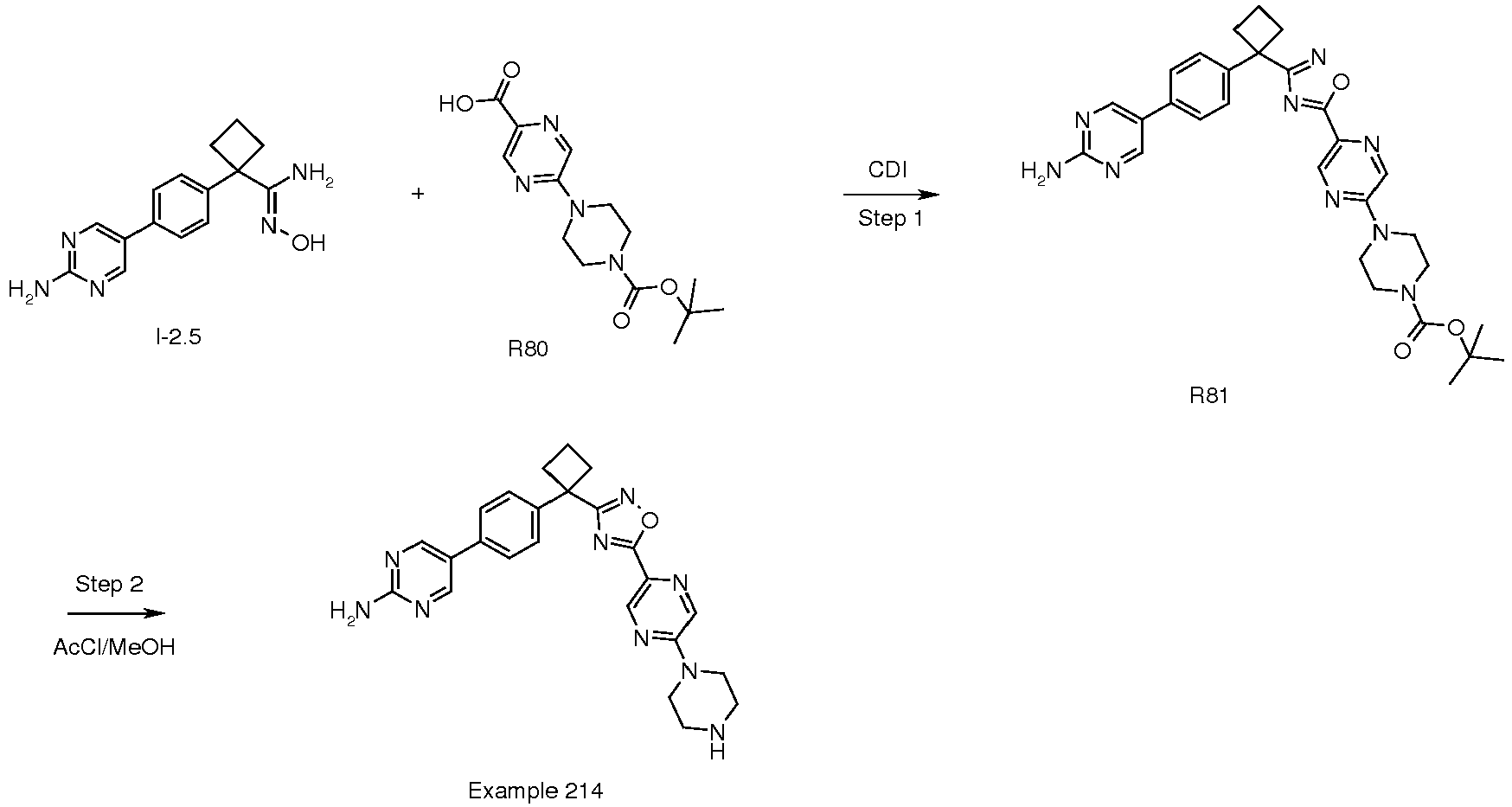
- To a suspension of R80 (490 mg, 1.59 mmol) in dioxane (10 ml) is added CDI (260 mg, 1.59 mmol) at room temperature. The mixture is stirred at 50 °C for 30 minutes. After this time I-2.5 (300 mg, 1.06 mmol) is added and the resulting mixture is heated at 80 °C for 18 hours. After this time the reaction appears complete and is cooled and poured into NaHCO3 (sat.) and EtOAc. The layers are separated and the aqueous phase is extracted with EtOAc (2x). The combined organics are dried (MgSO4), filtered and concentrated to give the crude product which is purified via flash chromatography (25g silica gel, 0-8% MeOH/DCM). Product-containing fractions are combined and concentrated to give R81. (210 mg)
- To a stirred suspension of R81 (210 mg, 0.38 mmol) in methanol (15 ml) is added acetyl chloride (0.50 ml, 7.00 mmol) in a dropwise manner. The resulting mixture is stirred at room temperature over night. After this time the reaction is basified with 2N ammonia in MeOH and concentrated. The remaining crude is purified via flash chromatography (10g silica gel, 0-10% MeOH/DCM) to afford the title compound (32 mg) m/z 456.3 [M+1] Compounds in Table 8 listed with Method 22 are synthesized in a similar fashion. For examples 282-284 THF was used in place of dioxane as the solvent in step 1.
-

- To a suspension of R82 (173 mg, 1.06 mmol) in THF (5 ml) is added CDI (72 mg, 1.06 mmol) at room temperature. The mixture is stirred at 50°C for 30 minutes. After this time I-2.5 (200 mg, 0.71 mmol) is added and the resulting mixture is heated 80°C for 3 hours. The mixture is cooled to ambient temperature and treated with AcOH (0.5 ml). After warming to 80°C the reaction is stirred over night. Upon cooling to room temperature the reaction is poured into water and EtOAc. The layers are separated and the aqueous phase is extracted with EtOAc. The combined organics are dried (MgSO4), filtered and concentrated to give the crude which is purified via column chromatography (25g silica gel, 0-8% MeOH/DCM). Product-containing fractions are concentrated to give R83 (120 mg) m/z 411.1
- To a solution of R83 (120 mg, 0.29 mmol) in NMP (4ml) is added R84 (82 mg, 0.44 mmol) and potassium carbonate (101 mg, 0.73 mmol). The vessel is capped and warmed to 80°C over night. After this time the reaction is cooled to ambient temperature and poured into water and EtOAc. The layers are separated and the aqueous phase is extracted with EtOAc (2x). The combined organics are dried (MgSO4), filtered and concentrated. The remaining residue is purified via flash chromatography (10g silica gel, 0-5%MeOH/DCM) and the product-containing fractions are combined and concentrated to give R85 (70 mg).
- To a stirred suspension of R85d (70 mg, 0.12 mmol) in methanol (5ml) is added acetyl chloride (0.20 ml, 2.80 mmol) in a dropwise manner. The resulting solution is stirred at ambient temperature over night. After this time the reaction is basified using 7N ammonia (in methanol) and concentrated. The remaining solids are diluted with 10% MeOH/DCM and filtered. The solids are washed with DCM and the combined filtrates are concentrated. The crude product is purified via column chromatography (15g Amine column, 0-8% MeOH/DCM) to afford the title compound (35 mg) m/z 461.4 [M+1]
- Compounds in Table 8 listed with Method 23 are synthesized in a similar fashion.
-
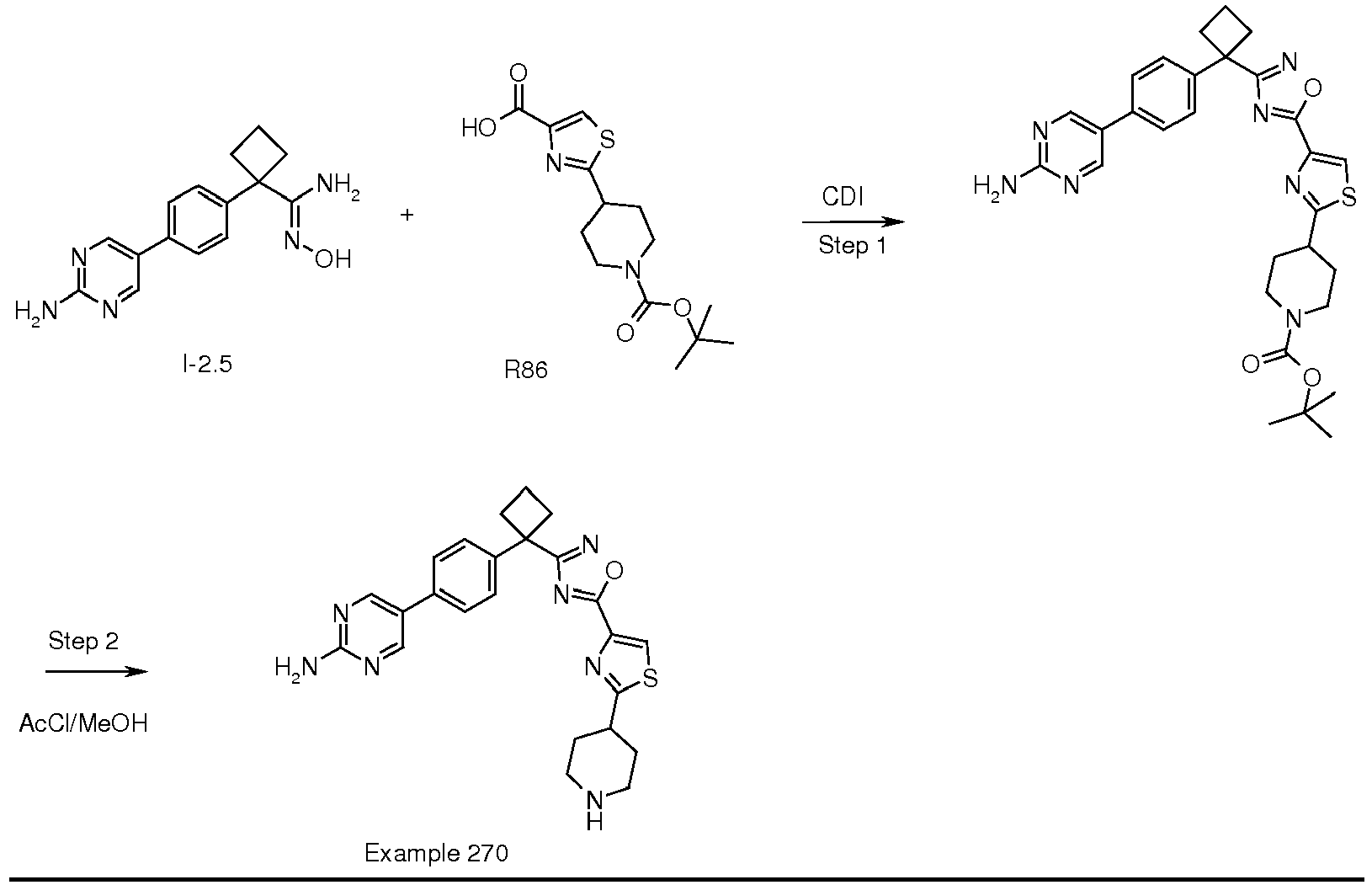
- To a suspension of R86 (400 mg, 1.28 mmol) in THF (10 ml) is added CDI (208 mg, 1.28 mmol) at room temperature. The mixture is stirred at 50° C for 30 minutes. After this time I-2.5 (300 mg, 1.06 mmol) is added and the resulting mixture is heated at 80° C for 3 hours. After this time the reaction is cooled to room temperature and treated with AcOH (1 ml). The reaction is warmed to 80°C for 16h and cooled to room temperature. The reaction is poured into water and EtOAc. The layers are separated and the aqueous phase is extracted with EtOAc (1x). The combined organics are dried (MgSO4), filtered and concentrated. The crude is purified via column chromatography (25g silica gel, 0-5% MeOH/DCM) to afford R87 (450 mg) which is used without further purification.
- To a stirred solution of R87 (450 mg, 0.80 mmol) in methanol (25ml) is added acetyl chloride (1.5 ml, 21.0 mmol, dropwise). The resulting mixture is stirred at room temperature over night. After this time the reaction is basified using 2N ammonia (in methanol) and concentrated. The remaining solid is purified via flash chromatography (15g amine column, 5-10% MeOH/DCM) to give the title compound (150 mg) m/z 460.4 [M+1]
-

- To a suspension of R88 (125 mg, 1.06 mmol) in THF (10 ml) is added CDI (172 mg, 1.06 mmol) at room temperature. The mixture is stirred at 50° C for 30 minutes. After this time I-2.5 (200 mg, 0.71 mmol) is added and the resulting mixture is heated at 80° C for 20 hours. After this time the reaction is cooled to ambient temperature and treated with AcOH (1 ml). The reaction is warmed to 80°C and stirred for 6h. The mixture is cooled to ambient temperature and stirred over night. The reaction is concentrated and the remaining residue is purified via column chromatography (25g silica gel, 0-5% MeOH/DCM). Product-containing fractions are combined and concentrated to afford the title compound (100 mg). m/z 366.4 [M+1]
-

- To a suspension of R89 (190 mg, 1.06 mmol) in dioxane (10 ml) is added DIEA (0.18 ml, 1.06 mmol) and CDI (172 mg, 1.06 mmol) at room temperature. The mixture is stirred at 50° C for 30 minutes. After this time I-2.5 (200 mg, 0.71 mmol) is added and the resulting mixture is heated at 100°C for 20 hours. After this time the reaction is concentrated and the remaining residue is purified via column chromatography (25g silica gel, 0-5% MeOH/DCM). The product-containing fractions are combined and concentrated to give the title compound (140 mg) m/z 391.4 [M+1]
-

- In a 100ml flask is added R90 (600 mg, 1.11 mmol) in DMF (25 ml), followed by the addition of R91 (268 mg, 1.22 mmol), tetrakis(triphenylphosphine)palladium(0) (128 mg, 0.11 mmol) and aq. 2M Na2CO3 (2.22 ml, 4.43 mmol). The reaction mixture is stirred at 100 °C for 16 hours after which time it is poured into brine and extracted with EtOAc (3x). The combined organic fractions are dried (MgSO4), filtered, then concentrated in vacuo to give the crude material. Purification via column chromatography (50g silica gel, 0-10% MeOH/DCM) afforded R92 (155 mg).
- In a 20ml scintillation vial is added methanol (10 ml) followed by acetyl chloride (1 ml, 14.01 mmol, dropwise). Upon complete addition, R92 (150 mg, 0.27 mmol) is added as a methanol suspension (5 ml). After stirring at ambient temperature over night the reaction is concentrated. The remaining residue is diluted with NaHCO3 (sat.) and DCM. The layers are separated and the aqueous phase is extracted twice more with DCM. The combined organics are dried (MgSO4), filtered and concentrated. The crude is purified via column chromatography (10g silica gel, 0-10% MeOH/DCM) to give the title compound (50 mg) m/z 455.4 [M+1]
-

- In a microwave reaction vessel is added R93 (600 mg, 1.02 mmol) in DMF (15 ml) followed by the addition of R94 (177 mg, 1.02 mmol), tetrakis(triphenylphosphine)palladium(0) (118 mg, 0.10 mmol) and 2M aq. Na2CO3 (2.04 ml, 4.08 mmol). The reaction mixture is capped and stirred at 85 °C for 16 hours. Upon cooling to ambient temperature the reaction mixture is poured into brine and extracted with EtOAc (3x). The combined organic fractions are dried with magnesium sulfate, filtered, and concentrated in vacuo to give the crude product. Purification via flash chromatography (25g silica gel, 0-8% MeOH/DCM) afforded R95. (550 mg)
- To a suspension of R95 (600 mg, 1.08 mmol) in methanol (10 ml) is added acetyl chloride (1.0 ml, 14.01 mmol) in a dropwise manner. The resulting mixture is stirred at room temperature over night. After this time the reaction is basified using 7N ammonia in methanol and concentrated. The remaining crude is purified via flash chromatography (25g silica gel, 0-10% MeOH/DCM, with 0.5% NH4OH) to give the title compound (20 mg) m/z 456.3 [M+1]
-

- To a solution of I-4.53 (125 mg, 0.312 mmol) in 3 ml of DMF was added R91 (82 mg, 0.374 mmol), tetrakis(triphenylphosphine)palladium(0) (36 mg, 0.031 mmol) and aq. Na2CO3 (0.623 mL, 1.246 mmol). The reaction mixture was stirred at 80 °C for 16 hours. The reaction mixture was allowed to cool to room temperature, poured into brine, and extracted with EtOAc. The combined organic fractions were dried sodium sulfate, filtered and concentrated in vacuo. The residue was purified by flash chromatography (SiO2, 0-5% MeOH/DCM) which yields the title compound (50 mg) as a white solid; m/z 416 [M+1].
-

- To a solution of I-5.6 (363 mg, 0.810 mmol) 3 ml of DMF, followed by the addition of R94 (211 mg, 1.215 mmol), tetrakis(triphenylphosphine)palladium(0) (94 mg, 0.081 mmol) and aq. Na2CO3 (1.619 mL, 3.240 mmol) and stirred at 80 °C for 16 hours. The reaction mixture was poured into water and brine, and product was extracted with EtOAc. The combined organic fractions were dried with sodium sulfate, filtered, and concentrated in vacuo. This is purified by flash chromatography (SiO2, 0-10% MeOH/DCM) followed by purification by preparative HPLC which yields the title compound (116 mgs) as a solid; m/z 416 [M+1].
-

- To a microwave vial was added I-4.56 (80 mg, 0.223 mmol) in DMF (2.5 ml), followed by the addition of R91 (54 mg, 0.245 mmol), tetrakis(triphenylphosphine)palladium(0) (26 mg, 0.022 mmol) and 2M aq. Na2CO3 (0.35 ml, 0.7 mmol). The reaction mixture was stirred in microwave reactor at 130 °C for 1 hour. The reaction mixture was diluted with EtOAc, washed with water, brine, dried over Na2SO4, filtered and concentrated. The residue was purified by flash chromatography (SiO2, 0-5% MeOH/CH2Cl2) to afford the title compound (33 mg); m/z 373 [M+1].
- Compounds in Table 8 listed with method 31 are synthesized in a similar fashion.
-

- To a vial was added I-5.1 (80 mg, 0.2 mmol), R94 (41 mg, 0.236 mmol), tetrakis(triphenylphosphine)palladium(0) (23 mg, 0.02 mmol) and 2M aqueous Na2CO3 (0.4 ml, 0.8 mmol) in DMF (2.5 ml). The vial was sealed under argon. The reaction mixture was stirred at 100 °C for 18 hours. The reaction mixture was diluted with EtOAc, washed with water. The organic layer was separated, washed with brine, dried over Na2SO4, filtered and concentrated. The residue was purified by flash chromatography (SiO2, 0-5% MeOH/CH2Cl2) to afford title compound (44 mg); m/z 374 [M+1]
- Compounds in Table 8 listed with method 32 are synthesized in a similar fashion.
-

- R79 (75 mg, 0.209 mmol) is treated with DMF (1.5 mL), R96 (51.2 mg, 0.313 mmol), and Cs2CO3 (153 mg, 0.470 mmol) and the resulting mixture is stirred for 2 hours. The reaction is purified by reverse-phase preparative HPLC to give Example 205 (47.0 mg); m/z 487.4 [M+1].
- Compounds in Table 8 listed with Method 33 are synthesized in a similar fashion.
- Example 226 is carried out at 70 °C.
- Example 230, 232, 238, 240 are carried out at 60 °C.
- Example 246 is carried out at 60 °C for 3 hours.
- Example 249 is carried out at 60 °C overnight.
- Example 250 is carried out at 60 °C for 5 hours.
- Example 253 required a second addition of alkylating reagent and base after 1 hour.
-

- R79 (200 mg, 0.557 mmol) is treated with DMF (5.0 mL), R97 (212 mg, 0.835 mmol), Cs2CO3 (408 mg, 1.25 mmol) and the resulting mixture is stirred for 3 hours. The mixture is then diluted with EtOAc and water and the phases are separated. The organic phase is washed with water and brine, dried over Na2SO4, filtered, and concentrated in vacuo. The resulting residue is purified by flash chromatography eluting 0-10% MeOH/DCM to afford R98 (224 mg); m/z 533.4 [M+1].
- R98 (224 mg, 0.421 mmol) is treated with ethanol (5.00 mL) and hydrazine hydrate (179 µL, 3.68 mmol) and the resulting mixture is heated at 50 °C for 2 hours. The reaction is filtered and the filtrate concentrated in vacuo. The residue is partitioned between ethyl acetate and water, and the phases separated. The aqueous phase is rendered basic by addition of solid Na2CO3 and extracted with ethyl acetate. The combined organic phases are dried over Na2SO4, filtered, and concentrated in vacuo. The residue is purified by reverse-phase preparative HPLC to give Example 227 (199.0 mg); m/z 403.3 [M+1].
-

- Example 227 (70.0 mg, 0.136 mmol) is treated with DCM (1.0 mL), DIEA (60.0 mL, 0.339 mmol), and AcCl (13.3 mg, 0.169 mmol) and the resulting mixture is stirred for 1 hour. The reaction was treated with 0.5 mL ethanol and concentrated in vacuo. The residue was purified directly by reverse-phase preparative HPLC to give example 229 (19.5 mg); m/z 445.4 [M+1].
-

- Synthesized according to method 34 step1 using R99 in place of R97 to afford R100 (77.6 mg).
- R100 (60.0 mg, 0.138 mmol) is treated with methanol (3.0 mL), water (1.0 mL), and oxone (340 mg, 0.554 mmol) and the resulting mixture is stirred 3 hours. The reaction mixture was filtered through a syringe filter and rinsed through with 1 mL of DMF. The resulting filtrate was concentrated in vacuo and purified directly by reverse-phase preparative HPLC to give Example 231 (19.5 mg); m/z 466.4 [M+1].
-

- Synthesized according to method 15 step 1 using the appropriate reagents to afford R102 (784 mg); m/z 446.4 [M+H]..
- R102 (784 mg, 1.76 mmol) is treated with THF (7.0 mL), methanol (1.5 mL), water (3.0 mL), and lithium hydroxide monohydrate (222 mg, 5.28 mmol) and the resulting mixture is stirred at 40 °C for 1.5 hours. The mixture is then treated with 1N hydrochloric acid (5.28 mL, 5.28 mmol) and concentrated in vacuo to afford R103 (960 mg).
- Synthesized according to method 15 step 3 using the appropriate reagents to afford R105 (65.0 mg); m/z 571.4 [M+H].
- R105 (65.0 mg, 0.114 mmol) is treated with ethanol (1.5 mL) and p-toluenesulfonic acid (5.7 mg, 0.20 mmol) and the resulting mixture is stirred at 60 °C for 2.5 hours. The reaction was cooled to room temperature and filtered. The resulting solid was purified by reverse-phase preparative HPLC eluting 10-90% acetonitrile/water/0.1% formic acid to give Example 239 (22.0 mg); m/z 487.4 [M+1].
-

- R108 (213 mg, 1.903 mmol) and CDI (309 mg, 1.903 mmol) in 1,4-dioxane (4 mL) are stirred at 55°C for 1 hour. I-2.9 (466 mg, 1.73 mmol) is added and the mixture is heated at 120°C for 18 hours. After this time, the reaction mixture is concentrated in vacuo and the resulting residue is suspended in the mixture of DCM and MeOH then filtered to afford the title compound (429 mg); m/z 346.4 [M+1].
- Synthesis is similar to conditions used in Method 14 Step 2 using the appropriate reagents; m/z 431.4 [M+1].
- Compounds in Table 8 listed with Method 38 are synthesized in a similar fashion.
-

- To a solution of I-2.1 (7 g, 26.009 mmol) in CH3CN (140 mL) is added CDI (10.543 g, 65.023 mmol) in a pressure flask. The reaction mixture is stirred at 75°C for 24 hours. After this time, the reaction mixture is concentrated in vacuo and the resulting residue is quenched 1N HCl aqueous solution and extracted with EA twice. The organics are combined and washed with brine, dried over Na2SO4, filtered and concentrated in vacuo to afford the title compound (7.629 g); m/z 295.2/297.2 [M/M+2].
- To a solution of R109 (500 mg, 1.694 mmol) in pyridine (1.618 mL, 20 mmol) is added POCl3 (1.551 mL, 16.94 mmol) in a pressure flask. The reaction mixture is stirred at 90°C for 18 hours. After this time, the reaction mixture is poured into ice water and extracted with EA twice. The organics are combined and washed with brine, dried over Na2SO4, filtered and concentrated in vacuo. The crude is purified by flash chromatography (SiO2, 5-40% EA/Heptane) to afford the title compound (316 mg); no ionization.
- To a solution of R110 (94.3 mg, 0.301 mmol) in DMSO (1 mL) is added R111 (36.5 mg, 0.361 mmol) and DIEA (0.131 mL, 0.75 mmol). The reaction mixture is stirred at room temperature for 1 hour. After this time, the reaction mixture is quenched with water and extracted with EA twice. The organics are combined and washed with brine, dried over Na2SO4, filtered and concentrated in vacuo to afford the title compound (114 mg); m/z 378.2/380.2 [M/M+2].
- To a mixture of R3 (79.8 mg, 0.361 mmol) and Pd(PPh3)4 (34.8 mg, 0.03 mmol) in a microwave vial is added the THF (1 mL) solution of R112 (114 mg, 0.301 mmol) and saturated Na2CO3 aqueous solution (0.5 mL). The reaction mixture is purged with argon and then heated in microwave oven at 110°C for 45 minutes. After this time, the reaction mixture is quenched with water and extracted with EA twice. The organics are combined and washed with brine, dried over Na2SO4, filtered and concentrated in vacuo. The crude is purified by flash chromatography (SiO2, 1.2-10% MeOH/DCM) to afford the title compound (36 mg); m/z 393.25 [M+1].
- Compounds in Table 8 listed with Method 39 are synthesized in a similar fashion.
-

- 1-4.6 (50 mg, 0.139 mmol), R113 (68 mg, 0.278 mmol), PdCl2(dppf) (11 mg, 0.014 mmol), potassium acetate (55 mg, 0.556 mmol) and 1,4-dioxane (1 mL, degassed) are mixed in a vial and the reaction mixture is heated at 100°C for 64 hours. After this time, the reaction mixture is cooled to room temperature and filtered through celite and the filtrate is concentrated in vacuo. Purification by preparative HPLC gives the title compound which is free based by dissolving in EA and washing with saturated NaHCO3 aqueous solution. The organics are combined and concentrated to give the title compound (8 mg); m/z 398.4 [M+I].
-

- A reaction vessel is charged with I-4.6 (200 mg, 0.557 mmol) and R115 (0.127 mL, 0.613 mmol) and diluted with degassed toluene (3 mL). Pd(PPh3)4 (64 mg, 0.056 mmol) is added and the vessel is purged with argon. The vessel is sealed and heated at 115°C for 1 hour. The vessel is cooled and R114 (116 mg, 0.668 mmol) is added along with more Pd(PPh3)4 (64 mg, 0.056 mmol). The vessel is purged with argon, capped and heated at 115°C for 18 hours. The mixture is cooled and concentrated in vacuo. Purification by preparative HPLC then prep-TLC (10% MeOH/DCM) gives the title compound (9 mg); m/z 374.4 [M+1].
- Compounds in Table 8 listed with Method 41 are synthesized in a similar fashion.
-

- R116 (39 mg, 0.209 mmol) and R39 (69 mg, 0.272 mmol) are added to a vial and degassed isopropanol (1 mL) is added. PdCl2(dppf):DCM (17 mg, 0.021 mmol) and potassium acetate (62 mg, 0.627 mmol) are added and the mixture is heated for 1 hour at 80°C. After this time, the reaction mixture is cooled and I-6.6 (75 mg, 0.209 mmol) and 2M Na2CO3 aqueous solution (0.418 mL, 0.836 mmol) are added and it is heated at 80°C for 18 hours. After this time, the mixture is cooled and concentrated in vacuo. Purification by preparative HPLC gives the title compound which is free based by dissolving in EA and washed with saturated NaHCO3 aqueous solution. The organics are combined and concentrated to give the title compound (8 mg); m/z 388.4 [M+1].
- Compounds in Table 8 listed with Method 42 are synthesized in a similar fashion (Ex 104).
Table 8: Final compounds Example Structure Method Retention time m/z LC MS method 1 
20 5.65 430.5 A 2 
3 4.12 402.4 B 3 
3 3.6 401.2 B 4 
1 3.63 386.2 B 5 
1 3.65 374.2 B 6 
1 3.65 374.2 B 7 
1 3.62 389.3 B 8 
1 3.52 372.2 B 9 
1 3.16 376.2 B 10 
1 3.09 374.2 B 11 
3 3.91 391 C 12 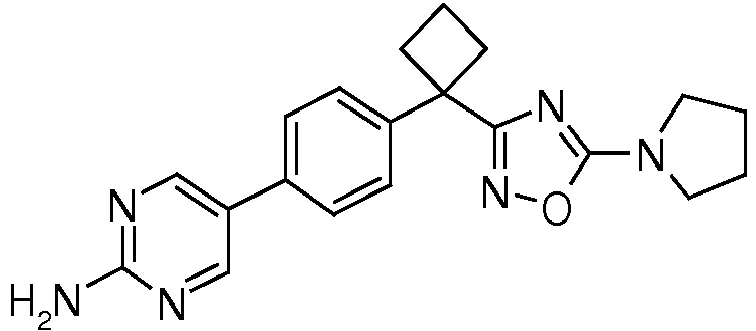
3 3.83 363.3 B 13 
3 3.9 365.2 B 14 
3 3.63 365.3 B 15 
3 3.1 309.2 B 16 
1 3.28 388.3 B 17 
3 3.7 414.2 B 18 
3 3.6 387.2 B 19 
1 3.77 387.2 B 20 
3 3.39 386.2 B 21 
1 3.7 401.2 B 22 
1 3.99 386.2 B 23 
1 3.46 374.2 B 24 
1 3.66 337.2 B 25 
1 3.7 337.2 B 26 
3 3.67 377.2 B 27 
3 3.14 387.2 B 28 
3 3.97 428.3 B 29 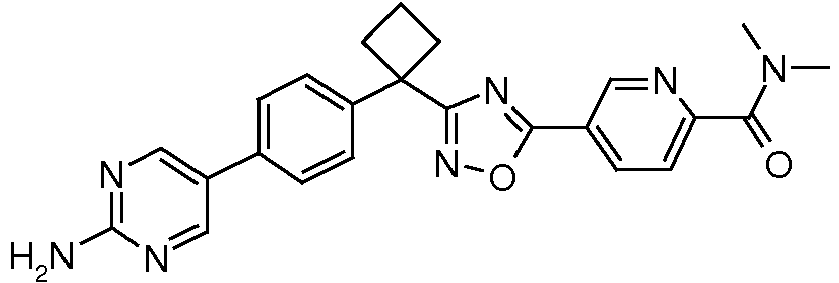
3 3.80 442.3 B 30 
3 3.79 484.3 B 31 
3 3.54 402.2 B 32 
3 3.53 401.4 B 33 
2 4.28 391.2 C 34 
1 2.72 384.2 D 35 
1 2.67 384.1 D 36 
1 1.94 447.9 D 37 
1 1.73 386.2 E 38 
1 2.29 449.2 E 39 
1 2.48 448.2 E 40 
1 4.88 361.6 D 41 
1 2.78 395.2 E 42 
1 2.26 395.0 E 43 
1 2.48 386.2 E 44 
1 2.44 386.2 E 45 
1 3.26 404.2 E 46 
1 3.26 404.2 E 47 
1 2.29 449.2 E 48 
1 2.87 400.2 E 49 
1 2.92 400.2 E 50 
1 2.7 430.2 E 51 
1 2.91 388.2 D 52 
1 2.95 388.2 D 53 
1 3.39 418.2 D 54 
1 3.61 426.2 D 55 
1 3.45 438.2 D 56 
1 2.76 405.2 D 57 
2 5.21 374.6 F 58 
1 3.48 415.3 B 59 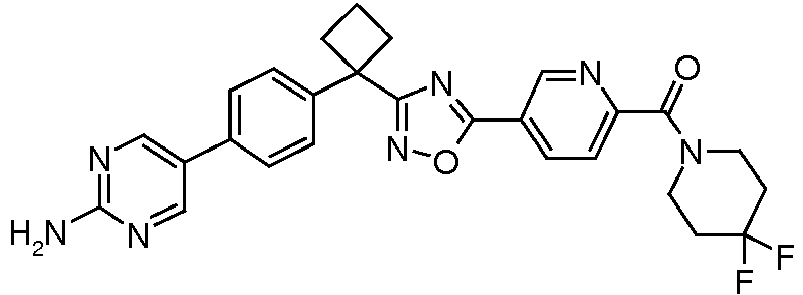
5 4.23 518.3 B 60 
5 3.46 484.4 B 61 
7 3.57 445.3 B 62 
7 3.79 445.3 B 63 
7 3.92 415.4 B 64 
5 3.52 470.4 B 65 
3 3.6 415.3 B 66 
3 3.6 445.3 B 67 
3 3.34 431.4 B 68 
7 3.39 431.3 B 69 
3 3.78 418.3 B 70 
3 4.06 454.3 B 71 
1 3.77 377.2 B 72 
1 3.63 411.3 B 73 
1 3.06 410.3 B 74 
8 3.06 353.2 B 75 
3 4.47 504.4 B 76 
3 4.16 472.4 B 77 
3 3.66 458.3 B 78 
3 3.52 472.4 B 79 
3 3.65 432.4 B 80 
8 4.25 377.3 B 81 
3 3.36 431.5 B 82 
3 3.54 418.5 B 83 
3 3.51 418.5 B 84 
3 3.73 432.5 B 85 
7 3.99 457.5 B 86 
7 3.47 443.3 B 87 
3 3.54 388.3 B 88 
3 3.49 418.3 B 89 
3 3.66 416.3 B 90 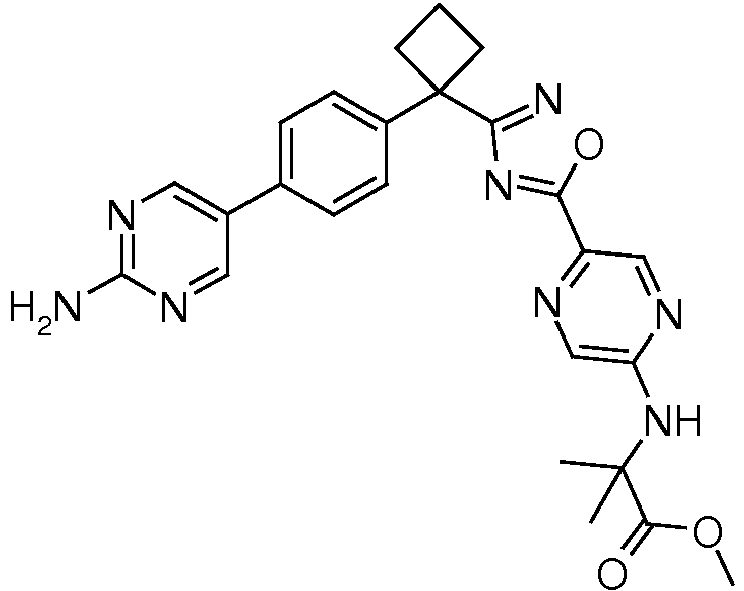
7 4.12 487.3 B 91 
3 3.46 387.3 B 92 
2 5.36 374.6 F 93 
2 5 360.6 F 94 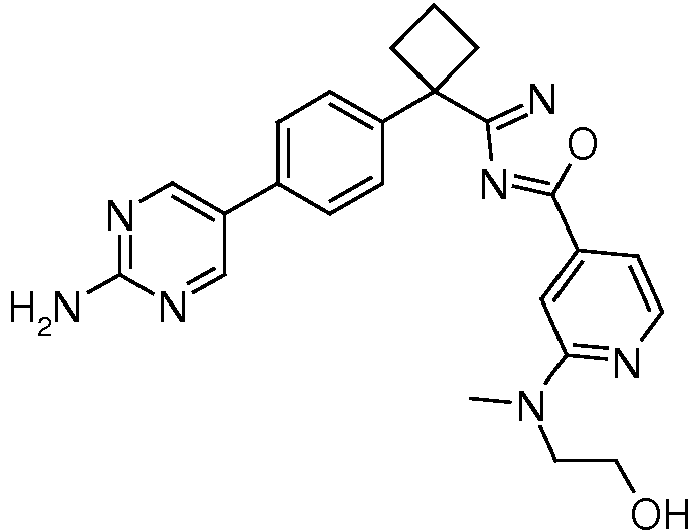
9 1.97 440.2 D 95 
9 1.21 430.3 G 96 
2 4.6 361.6 F 97 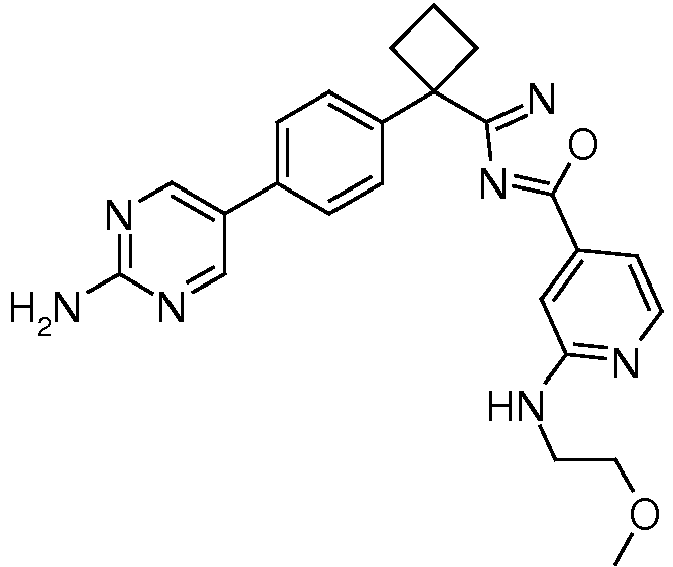
9 2.15 444.2 D 98 
2 2.49 416.2 D 99 
2 2.63 400.2 D 100 
2 2.7 420.2 D 101 
2 1.53 405.2 H 102 
9 2.35 470.2 D 103 
9 2.07 456.2 D 104 
10 1.67 454.2 D 105 
9 2.08 456.2 D 106 
9 1.91 555.2 D 107 
9 2.34 504.2 D 108 
9 2.14 492.2 D 109 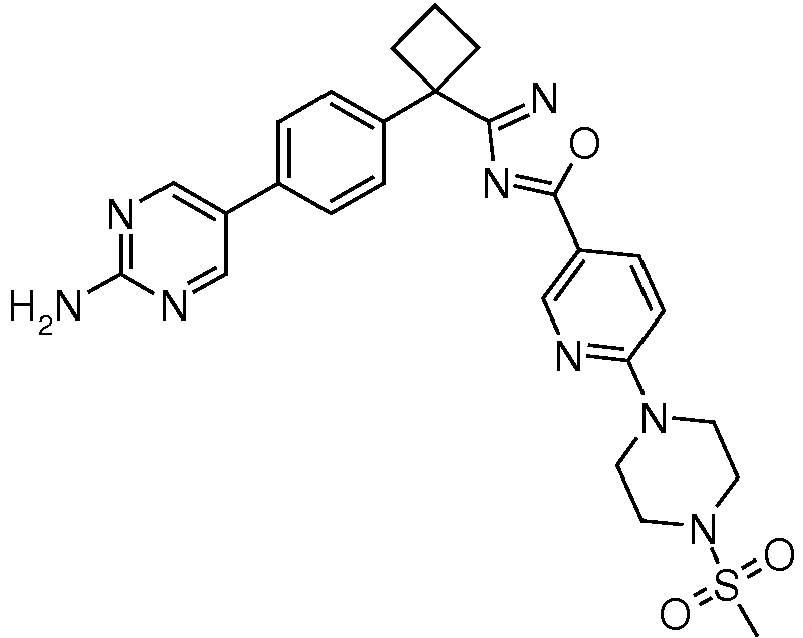
9 2.55 533.2 D 110 
9 2.26 518.2 D 111 
11 5.04 445.6 D 112 
11 4.54 431.6 D 113 
11 4.78 445.6 D 114 
11 4.87 459.6 D 115 
11 4.03 500.6 D 116 
12 1.91 455.4 D 117 
3 3.9 392.3 D 118 
13 3.32 458.4 D 119 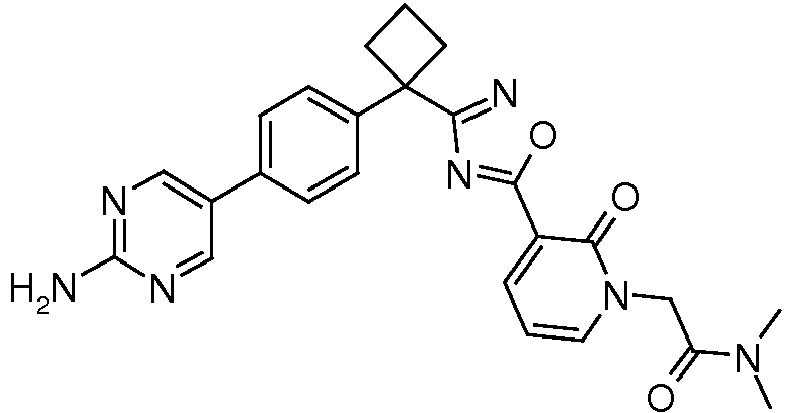
13 3.44 472.4 D 120 
7 3.76 459.4 D 121 
9 1.24 459 E 122 
2 1.41 410.4 I 123 
2 1.57 402.4 I 124 
7 0.64 456.2 J 125 
7 0.71 514.1 J 126 
7 0.71 514.1 J 127 
14 0.84 485.3 J 128 
15 0.85 473.3 J 129 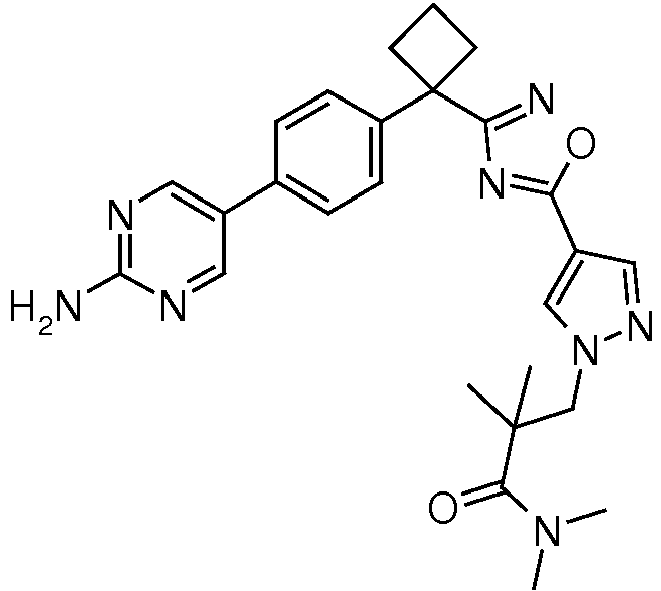
15 0.87 487.3 J 130 
15 0.73 445.2 J 131 
15 0.83 473.3 J 132 
15 0.73 457.2 J 133 
15 0.78 460.3 J 134 
14 0.73 487.3 J 135 
16 6.21 467.3 F 136 
16 5.59 431.3 F 137 
15 1.35 471.4 H 138 
15 1.35 459.4 H 139 
15 1.39 473.4 H 140 
15 1.38 499.2 H 141 
15 1.38 471.6 H 142 
15 1.42 473.4 H 143 
4 3.92 371.1 B 144 
4 4.36 370.1 B 145 
17 6.23 401.6 A 146 
17 6.25 401.6 A 147 
17 6.27 401.6 A 148 
17 6.67 418.6 A 149 
17 7.17 400.6 A 150 
17 7.88 532.5 A 151 
17 8.23 444.5 A 152 
3 4.08 385.1 A 153 
3 3.26 360.1 A 154 
3 4.55 413.1 A 155 
3 4.29 399.1 A 156 
1 3.28 361.2 A 157 
2 4.12 375.1 A 158 
3 3.73 372.1 A 159 
3 3.71 372.1 A 160 
3 3.58 372.1 A 161 
3 4.26 388.2 A 162 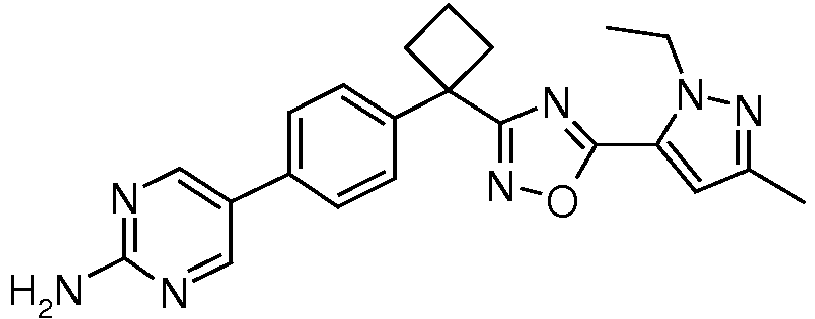
3 4.53 402.2 A 163 
2 4.13 375.3 A 164 
2 4.41 389.3 A 165 
3 3.81 386.4 A 166 
3 3.9 374.4 A 167 
17 2.66 385.2 D 168 
1 2.12 401.2 D 169 
17 2.65 405.2 D 170 
1 2.57 429.2 D 171 
1 3.66 372.2 B 172 
18 2.53 429.2 D 173 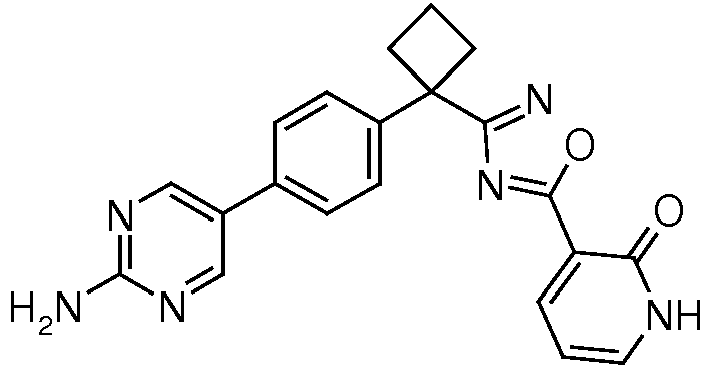
19 1.91 387.2 D 174 
1 2.86 401.2 D 175 
1 1.32 360.5 I 176 
1 3.46 374.3 B 177 
1 3.7 337.2 B 178 
3 3.33 428.2 B 179 
1 2.08 456 C 180 
7 3.38 430.3 B 181 
7 3.73 444.3 B 182 
7 3.82 444.3 B 183 
7 3.78 414.3 B 184 
1 3.42 387.3 B 185 
3 3.29 402.2 B 186 
1 3.9 396.1 B 187 
6 4.24 406.2 B 188 
14 1.13 445.4 E 189 
1 3.65 361.2 B 190 
1 4.09 410.2 B 191 
1 3.61 421.2 B 192 
1 3.33 401.4 B 193 
3 3.45 387.3 B 194 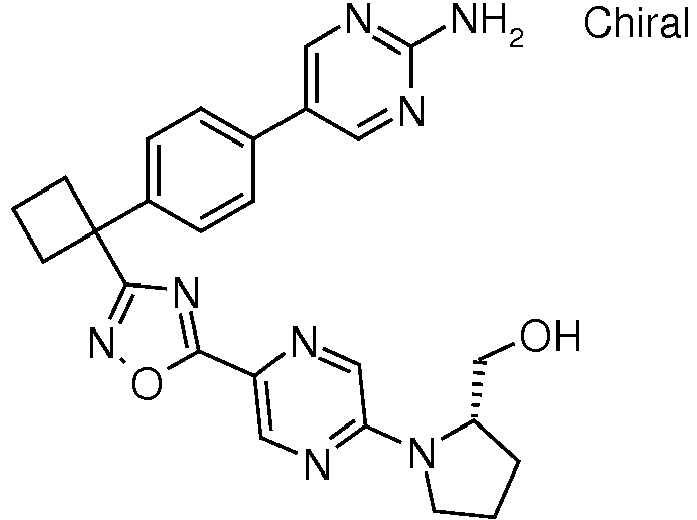
7 0.89 471.2 J 195 
7 0.89 471.2 J 196 
7 0.86 401.2 J 197 
7 1.01 429.2 J 198 
7 0.99 459.2 J 199 
7 0.95 473.2 J 200 
7 0.82 445.2 J 201 
7 0.79 470.2 J 202 
7 0.92 534.2 J 203 
7 0.84 519.2 J 204 
15 1.33 445.4 I 205 
33 1.13 487.4 K 206 
15 1.16 459.4 K 207 
15 1.25 473.4 K 208 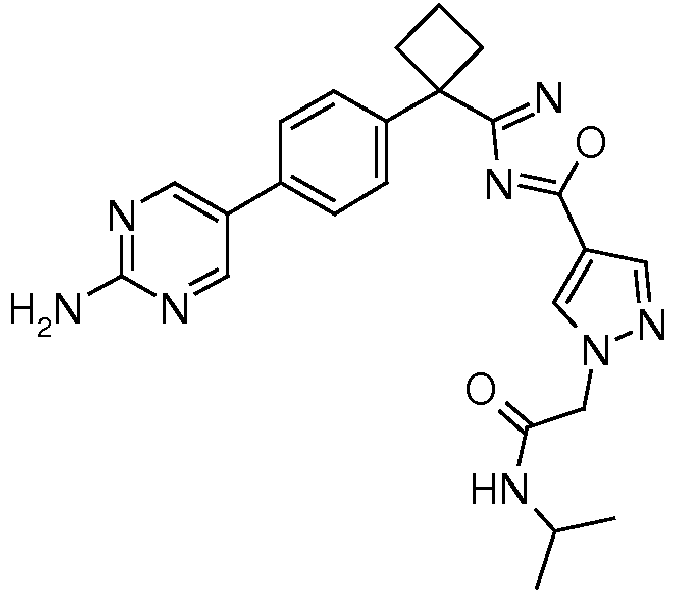
15 1.35 459.4 K 209 
15 1.46 487.4 K 210 
15 1.33 501.4 K 211 
16 1.42 459.4 K 212 
16 1.26 473.4 K 213 
16 1.23 417.4 K 214 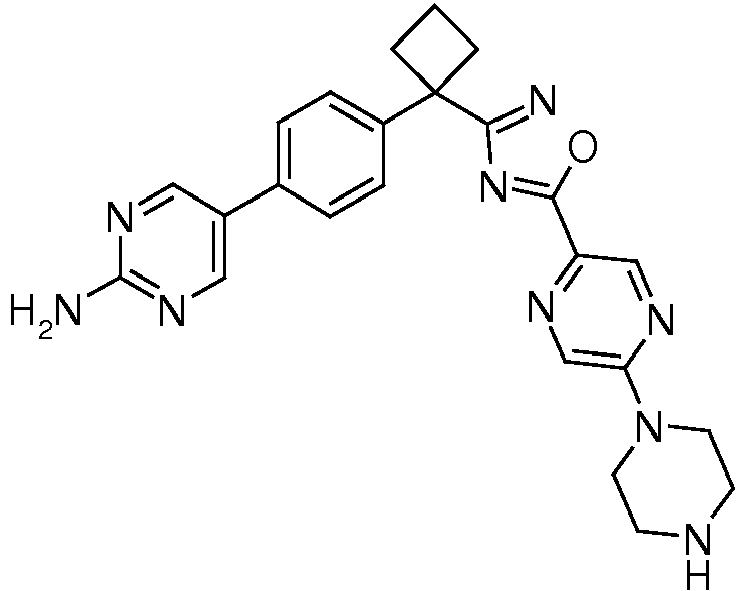
22 0.55 456.3 J 215 
31 4.24 373.3 F 216 
33 1.33 471.5 I 217 
15 1.24 473.4 K 218 
15 1.13 499.2 K 219 
15 0.97 500.4 K 220 
32 5.41 374.4 F 221 
32 4.44 387.4 F 222 
32 1.48 388.4 J 223 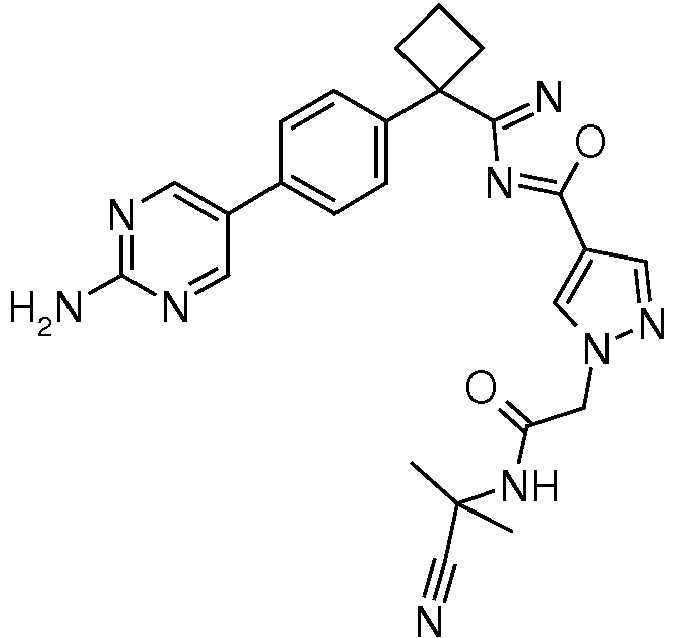
15 0.83 482.5 I 224 
15 0.81 501.35 I 225 
15 0.73 523.3 I 226 
33 0.83 478.3 I 227 
34 1.1 403.3 I 228 
15 0.74 475.3 J 229 
35 1.1 445.4 K 230 
33 1.3 434.4 K 231 
36 1.36 466.4 I 232 
33 1.17 473.5 I 233 
10 0.99 443.4 K 234 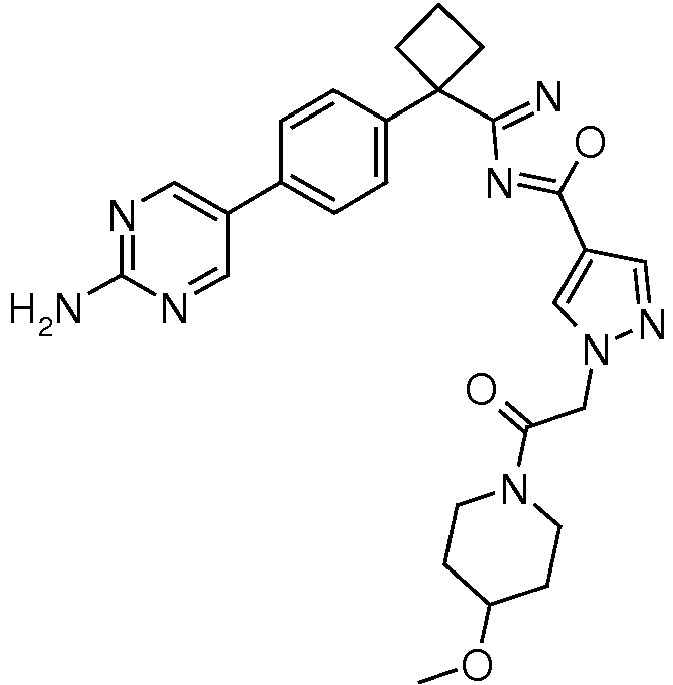
15 1.18 515.4 K 235 
15 1.18 515.4 K 236 
15 1.12 487.4 K 237 
10 0.97 500.4 K 238 
33 1.18 399.4 K 239 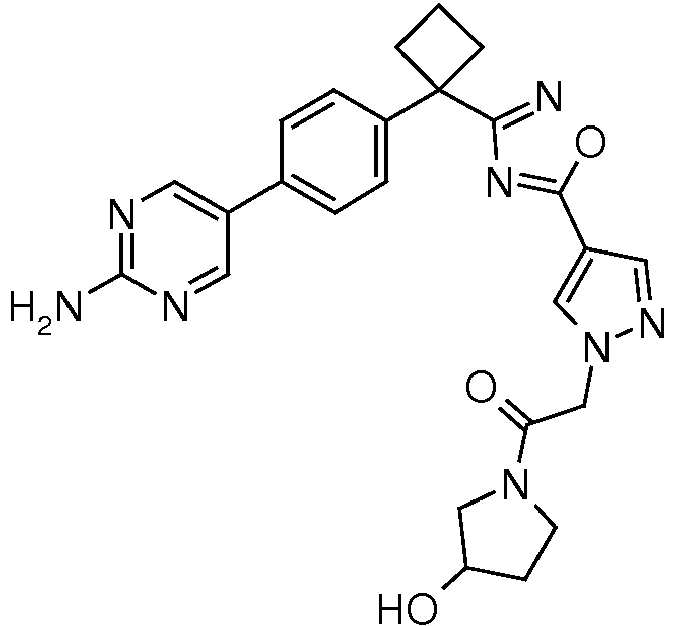
37 1.05 487.4 K 240 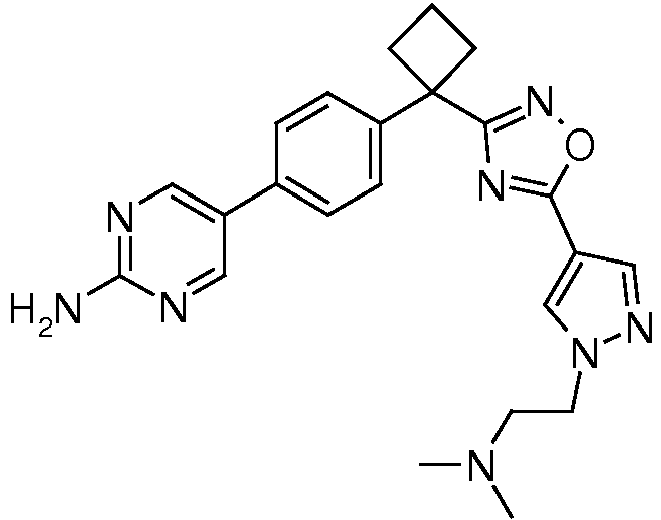
33 0.95 431.4 K 241 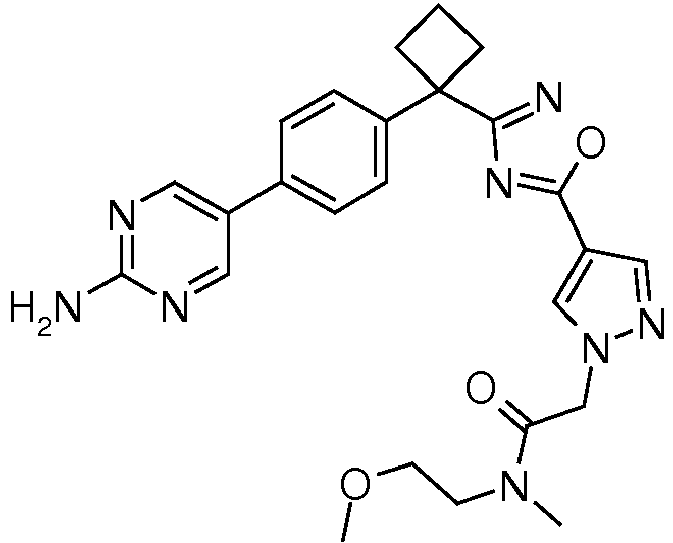
15 1.16 489.4 K 242 
15 1.21 515.4 K 243 
15 1.02 528.4 K 244 
2 1.71 360.4 I 245 
2 1.36 374.4 I 246 
33 1.04 496.4 K 247 
15 1.18 515.4 K 248 
40 1.32 398.4 E 249 
33 1.02 445.4 K 250 
33 1.01 514.4 K 251 
21 1.24 445.4 I 252 
29 0.61 416.4 J 253 
33 1.01 457.4 K 254 
38 1.32 418.4 K 255 
38 1.32 402.4 K 256 
15 1.17 501.4 K 257 
38 1.33 360.4 K 258 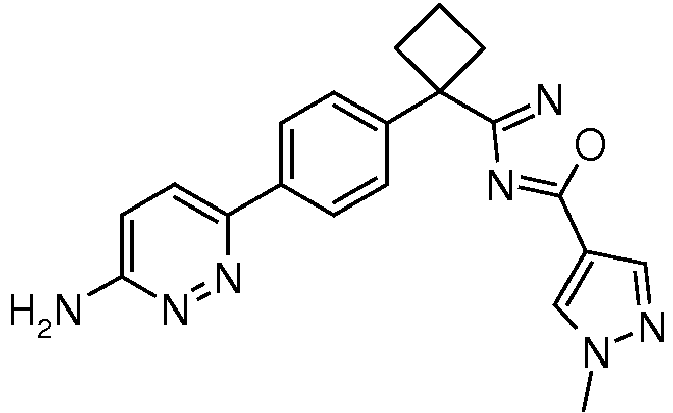
41 0.98 374.4 E 259 
15 1.15 501.4 K 260 
4 1.39 397.4 K 261 
4 1.32 398.4 K 262 
41 1.29 398.4 E 263 
21 0.67 416.31 J 264 
21 0.72 416.29 J 265 
32 0.71 374.2 J 266 
23 1 461.4 E 267 
23 0.99 461.4 E 268 
38 1.26 431.4 K 269 
24 1.04 460.4 E 270 
11 DMSO/ 115 1.03 458.4 E 271 
11 DMSO/ 115 0.99 472.4 E 272 
41 1.07 399.4 E 273 
41 1.34 397.4 E 274 
41 1.01 403.4 E 275 
41 1.21 469.4 E 276 
41 1.21 459.4 E 277 
2 0.51 374.18 J 278 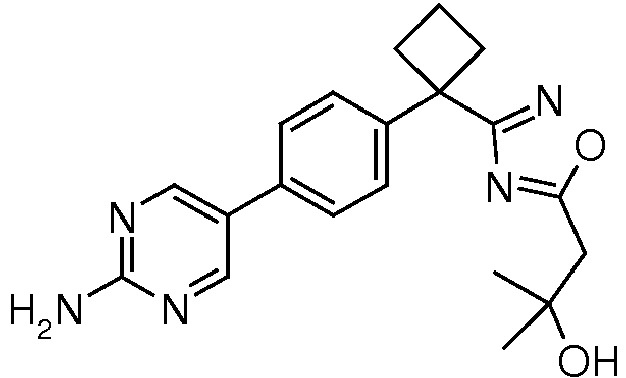
25 0.73 366.4 J 279 
2 1.32 402.4 I 280 
26 0.96 391.4 E 281 
22 0.88 377.4 E 282 
22 0.89 377.4 E 283 
22 0.89 377.4 E 284 
39 0.66 393.3 J 285 
39 0.68 393.2 J 286 
39 0.73 407.3 J 287 
39 1.22 379.4 K 288 
39 1.3 393.4 K 289 
39 0.75 393.2 J 290 
39 0.66 379.2 J 291 
39 0.83 402.2 J 292 
39 0.87 421.3 J 293 
39 1.09 420.4 K 294 
42 1.29 388.4 E 295 
2 1.25 388.4 E 296 
27 0.94 455.4 E 297 
21 0.65 432.31 J 298 
21 0.67 432.29 J 299 
30 0.78 416.3 J 300 
31 0.69 431.3 J 301 
31 0.63 444.3 J 302 
28 1.79 456.3 G 303 
32 0.81 432.3 J 304 
32 0.74 445.3 J 305 
31 0.59 373.2 J 306 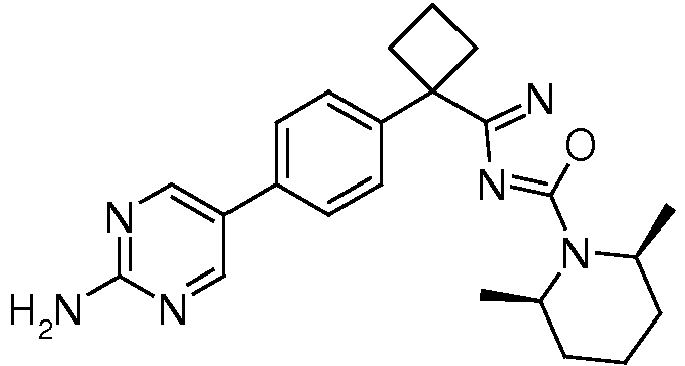
39 1.08 405.3 J 307 
7 0.64 456.2 J 308 
7 0.71 514.1 J 309 
7 0.71 514.1 J -
LC-MS Method A Column Agilent Zorbax Eclipse XDB-C8 5µm, 4.6x150mm Ambient temperature Mobile phase A = Formic acid (aq) 0.1% B = Formic acid (acetonitrile) 0.1% Flow rate 1.5 ml/min Injection volume 7ul Detector 200-600 nm (nominal) Gradient Time (mins) % B 0 1 2 20 7 95 9 95 9.3 1 10 1 LC-MS Method B Column Waters Atlantis C18 100 x 2.1mm, 3µm column 40 °C Mobile phase A - 0.1% Formic acid (water) B - 0.1% Formic acid (acetonitrile) Flow rate 0.6 ml/min Injection volume 3µl Detector 215nm (nominal) Gradient Time (mins) % B 0 5 5 100 5.4 100 5.42 5 LC-MS Method C Column Atlantis dC18 2.1 x 50mm, 3µm Mobile phase A = Formic acid (aq) 0.1% B = Formic acid (acetonitrile) 0.1% Flow rate 1 ml/min Injection volume 3µl Detector 215nm (nominal) Gradient Time (mins) % B 0 5 2.5 100 2.7 100 2.71 5 3 5 LC-MS Method D Column Agilent SB-C18 1.8µm, 3x50mm Ambient temperature Mobile phase A = Formic acid (aq) 0.1% B = Formic acid (acetonitrile) 0.1% Flow rate 1.5 ml/min Injection volume 3µL Detector 220 and 254 nm Gradient Time (mins) % B 0 5 3.8 90 4.5 100 LC-MS Method E Column Agilent SB-C18 1.8µm, 3x50mm column Ambient temperature Mobile phase A = Formic acid (aq) 0.1% B = Formic acid (acetonitrile) 0.1% Flow rate 1.5 ml/min Injection volume 3µL Detector 220 and 254 nm Gradient Time (mins) % B 0 12 0.25 30 0.3 40 1.19 95 1.75 100 LC-MS Method F Column Agilent Zorbax Eclipse XDB-C8 5µm, 4.6x150mm Ambient temperature Mobile phase A = Formic acid (aq) 0.1% B = Formic acid (acetonitrile) 0.1% Flow rate 1.5 ml/min Injection volume 7µL Detector 200-600 nm Gradient Time (mins) % B 0 5 7 95 9 95 9.3 5 10 5 LC-MS Method G Column Waters BEH C18 1.7µm, 2.1x50mm Ambient temperature Mobile phase A = Formic acid (aq) 0.1% B = Formic acid (acetonitrile) 0.1% Flow rate 0.8 ml/min Injection volume 1µL Detector 210-400 nm Gradient Time (mins) % B 0 10 4.5 95 4.58 95 LC-MS Method H Column Agilent SB-C18 1.8µm, 3x50mm Ambient temperature Mobile phase A = Formic acid (aq) 0.1% B = Formic acid (acetonitrile) 0.1% Flow rate 1.5 ml/min Injection volume 3µL Detector 220 and 254 nm Gradient Time (mins) % B 0 5 0.25 50 0.3 70 1.3 90 1.7 100 LC-MS Method I Column Agilent Zorbax XDB-C8 5µm, 4.6x150mm Ambient temperature Mobile phase A = Formic acid (aq) 0.1% B = Formic acid (acetonitrile) 0.1% Flow rate 1.5 ml/min Injection volume 7µL Detector 200-600 nm Gradient Time (mins) % B 0 5 1.7 95 2 95 2.1 5 2.3 5 LC-MS Method J Column Waters BEH C18 1.7µm, 2.1x50mm Ambient temperature Mobile phase A = Formic acid (aq) 0.1% B = Formic acid (acetonitrile) 0.1% Flow rate 0.8 ml/min Injection volume 1µL Detector 210-400 nm Gradient Time (mins) % B 0 10 1.19 95 1.7 95 LC-MS Method K Column Agilent SB-AQ 1.8µm, 3x50mm Ambient temperature Mobile phase A = Formic acid (aq) 0.1% B = Formic acid (acetonitrile) 0.1% Flow rate 1.5 ml/min Injection volume 3µL Detector 220 and 254 nm Gradient Time (mins) % B 0 5 0.25 50 0.3 70 1.3 90 1.7 100 - Compounds are assessed for the ability to bind to FLAP in a binding assay that measures compound-specific displacement of an iodinated (125I) FLAP inhibitor via a Scintillation Proximity Assay format (adapted from S. Charleson et al., Mol. Pharmacol., 1992, 41, 873-879).
- Cell pellets produced from sf9 insect cells expressing recombinant human FLAP protein are resuspended in buffer A [15 mM Tris-HCl (pH 7.5), 2 mM MgCl2, 0.3 mM EDTA, 1 mM PMSF]. The cells are lysed with a Dounce homogenizer and the material is centrifuged at 10,000 x g for 10 minutes. The supernatant is then collected and centrifuged at 100,000 x g for 60 minutes. To prepare membrane protein for an assay, an aliquot of the 100,000 x g pellet is resuspended in 1 ml of buffer A, Dounce homogenized, and finally subjected to polytron mixing (30 seconds). Membrane protein (25 µl, 5 µg) is mixed with WGA SPA beads (Amersham) and stirred for 1h. To an assay plate (Perkin Elmer FlexiPlate) is added 25 µl of test compound prepared in Binding buffer [100 mM Tris (pH 7.5), 140 mM NaCl, 5% glycerol, 2 mM EDTA, 0.5 mM TCEP, 0.05% Tween 20], 25 µl of [125I]L-691,831 (an iodinated analog of MK-591, Charleson et al. Mol. Pharmacol., 41, 873-879, 1992) and finally 50 µl of the bead/protein mixture. (final concentrations: beads, 200 µg/well; protein, 5µg/well; [125I] probe, 0 08 nM/well(17 nCi/well). The plates are shaken for 2h before reading on a Microbeta plate reader. Non-specific binding is determined by the addition of 10 µM cold L-691,831 compound.
- In general, the preferred potency range (IC50) of compounds in the above assay is between 0.1 nM to 10 µM, the more preferred potency range is 0.1 nM to 1 µM, and the most preferred potency range is 0.1 nM to 100 nM.
- Compounds are additionally tested in a human whole blood assay to determine their ability to inhibit the synthesis of LTB4 in a cellular system. Compounds are combined with heparinized human whole blood and incubated for 15 minutes at 37°C. Calcimycin (20µM final, prepared in phosphate-buffered saline, pH 7.4) is then added and the mixture is incubated for another 30 minutes at 37°C. The samples are centrifuged for 5 min at low speed (1500 x g) and the plasma layer is removed. Plasma LTB4 concentrations are then measured using an antibody-based homogenous time-resolved fluorescence method (CisBio, Bedford, MA).
- In general, the preferred potency range (IC50) of compounds in the above assay is between 10 nM to 10 µM, the more preferred potency range is 10 nM to 1 µM, and the most preferred potency range is 10 nM to 100 nM.
- The compounds of the invention are effective inhibitors of 5-lipoxygenase activating protein (FLAP) and thus inhibit leukotriene production. Therefore, in one embodiment of the invention, there is provided the use of these compounds in methods of treating leukotriene-mediated disorders. In another embodiment, there is provided the use of the compounds of the invention in methods of treating cardiovascular, inflammatory, allergic, pulmonary and fibrotic diseases, renal diseases and cancer.
- Without wishing to be bound by theory, by inhibiting the activity of FLAP, the compounds of the invention block the production of LTs resulting from the oxidation of arachidonic acid by 5-LO and subsequent metabolism. Thus, the inhibition of FLAP activity is an attractive means for preventing and treating a variety of diseases mediated by LTs. These include:
- Cardiovascular diseases including atherosclerosis, myocardial infarction, stroke, aortic aneurysm, sickle cell crisis, ischemia-reperfusion injury, pulmonary arterial hypertension and sepsis;
- Allergic diseases including asthma, allergic rhinitis, rhinosinusitis, atopic dermatitis and urticaria;
- Fibrotic diseases including airway remodeling in asthma, idiopathic pulmonary fibrosis, scleroderma, asbestosis;
- Pulmonary syndromes including adult respiratory distress syndrome, viral bronchiolitis, obstructive sleep apnea, chronic obstructive pulmonary disease, cystic fibrosis, and bronchopulmonary dysplasia;
- Inflammatory diseases including rheumatoid arthritis, osteoarthritis, gout, glomerulonephritis, interstitial cystitis, psoriasis, multiple sclerosis, inflammatory bowel disease systemic lupus erythematosus, transplant rejection, inflammatory and allergic ocular diseases;
- Cancer including solid tumors, leukemias and lymphomas; and
- Renal diseases such as glomerulonephritis.
- For treatment of the above-described diseases and conditions, a therapeutically effective dose will generally be in the range from about 0.01 mg to about 100 mg/kg of body weight per dosage of a compound of the invention; preferably, from about 0.1 mg to about 20 mg/kg of body weight per dosage. For example, for administration to a 70 kg person, the dosage range would be from about 0.7 mg to about 7000 mg per dosage of a compound of the invention, preferably from about 7.0 mg to about 1400 mg per dosage. Some degree of routine dose optimization may be required to determine an optimal dosing level and pattern. The active ingredient may be administered from 1 to 6 times a day.
- When used as pharmaceuticals, the compounds of the invention are typically administered in the form of a pharmaceutical composition. Such compositions can be prepared using procedures well known in the pharmaceutical art and comprise at least one compound of the invention. The compounds of the invention may also be administered alone or in combination with adjuvants that enhance stability of the compounds of the invention, facilitate administration of pharmaceutical compositions containing them in certain embodiments, provide increased dissolution or dispersion, increased antagonist activity, provide adjunct therapy, and the like. The compounds according to the invention may be used on their own or in conjunction with other active substances according to the invention, optionally also in conjunction with other pharmacologically active substances. In general, the compounds of this invention are administered in a therapeutically or pharmaceutically effective amount, but may be administered in lower amounts for diagnostic or other purposes.
- Administration of the compounds of the invention, in pure form or in an appropriate pharmaceutical composition, can be carried out using any of the accepted modes of administration of pharmaceutical compositions. Thus, administration can be, for example, orally, buccally (e.g., sublingually), nasally, parenterally, topically, transdermally, vaginally, or rectally, in the form of solid, semi-solid, lyophilized powder, or liquid dosage forms, such as, for example, tablets, suppositories, pills, soft elastic and hard gelatin capsules, powders, solutions, suspensions, or aerosols, or the like, preferably in unit dosage forms suitable for simple administration of precise dosages. The pharmaceutical compositions will generally include a conventional pharmaceutical carrier or excipient and a compound of the invention as the/an active agent, and, in addition, may include other medicinal agents, pharmaceutical agents, carriers, adjuvants, diluents, vehicles, or combinations thereof. Such pharmaceutically acceptable excipients, carriers, or additives as well as methods of making pharmaceutical compositions for various modes or administration are well-known to those of skill in the art. The state of the art is evidenced, e.g., by Remington: The Science and Practice of Pharmacy, 20th Edition, A. Gennaro (ed.), Lippincott Williams & Wilkins, 2000; Handbook of Pharmaceutical Additives, Michael & Irene Ash (eds.), Gower, 1995; Handbook of Pharmaceutical Excipients, A.H. Kibbe (ed.), American Pharmaceutical Ass'n, 2000; H.C. Ansel and N.G. Popovish, Pharmaceutical Dosage Forms and Drug Delivery Systems, 5th ed., Lea and Febiger, 1990.
- As one of skill in the art would expect, the forms of the compounds of the invention utilized in a particular pharmaceutical formulation will be selected (e.g., salts) that possess suitable physical characteristics (e.g., water solubility) that are required for the formulation to be efficacious.
| Intermediate | Structure | m/z |
| I-1.2 |  | no ionization |
| I-1.3 |  | no ionization |
| I-1.4 |  | 266.5/268.5 |
| I-1.5 |  | no ionization |
| I-1.6 |  | 296/298 |
| I-1.7 |  | no ionization |
Claims (21)
- A compound of Formula I:
 R1 and R2 together with the carbon atom to which they are attached form a C3-10 carbocyclic ring or a 5-11 membered heterocyclic ring, wherein each carbocycle or heterocycle is optionally independently substituted with one to two groups selected from C1-6 alkyl and halogen;R3 is 5-11 membered heteroaryl ring containing one to three heteroatoms selected from nitrogen, oxygen and sulfur, wherein each R3 is optionally independently substituted with one to three groups selected from C1-5 alkyl, C3-6 carbocycle, cyano, C1-5 alkoxy, C1-3alkyl-OH, amino, C1-3 alkylamino and C1-3 dialkylamino;R4 is hydrogen, halogen, C1-3 alkyl or nitrile;R5 is C1-6 alkyl, C3-10 carbocycle, 5-11 membered heterocycle, aryl, 5-11 membered heteroaryl, -C(O)-R6 or-NR7R8, wherein each R5 is optionally independently substituted with one to three groups selected from R9, R10 and R11;R6 is C3-8 heterocycle, amino, C1-3 alkylamino, C1-3 dialkylamino, -NH-5-6 membered heteroaryl or -NH-5-6 membered heterocycle, each optionally independently substituted with one to three groups selected from R9, R10 and R11;R7 and R8 are each independently hydrogen, 5-6 membered heterocyclic ring optionally substituted with one to three methyl groups,-S(O)nC1-6alkyl or C1-6 alkyl which is optionally substituted with 5-6 membered heterocycle;R9, R10 and R11 are independently selected from(a) -H,(b) -OH,(c) halogen,(d) -CN,(e) -CF3,(f) C1-6alkyl optionally substituted with one to three -OH, CN, -N(R12)(R13), aryl, -O-C1-2 alkyl-aryl, 3-6 membered heterocycle, -C(O)-3-6 membered heterocycle, C1-6alkoxy , -S(O)nC1-6alkyl or -C(O)N(R12)(R13),(g) C1-6alkoxy,(h) -N(R12)(R13),(i) -S(O)nC1-6alkyl,(j) -CO2R12,(k) -C(O)N(R12)(R13),(l) -S(O)2N(R12)(R13),(m) a 3-10 membered heterocyclic group optionally substituted with one to three groups selected from C1-6 alkyl, C1-6 alkylhydroxy, C1-6 alkyl-CO2R12, -S(O)nC1-6alkyl, oxo and -CO2R12,(n') oxo,(o) -C(O)-C1-3 alkyl,(p) -C(O)-3-6 membered heterocycle optionally substituted with one to three groups selected from halogen, hydroxy and C1-6alkoxy,(q) 5-6 membered heteroaryl ring optionally substituted with one to three -C1-4alkyl groups,(r) aryl;R12 and R13 are each independently selected from-H, -C1-6alkyl, -C(O)-C1-6 alkyl and a 3-6 membered heterocyclic group, each of which is optionally independently substituted with one to three -OH, C1-6 alkyl, C1-6alkoxy, -C(O)N(R14)(R15), - N(R14)(R15), -S(O)nC1-6alkyl, CN, C3-10 carbocycle, -CO2R12, CF3, 3-6 membered heterocycle or halogen; orR12 and R13 together with the nitrogen atom to which they are attached form a heterocyclyl ring optionally substituted with one to three -OH, CN, C1-6alkyl, C1-6alkoxy, -C(O)-C1-3alkyl or oxo;R14 and R15 are each independently selected from -H and -C1-6alkyl;n is 0, 1 or 2;or a pharmaceutically acceptable salt thereof
 - A compound according to claim 1, wherein:R3 and R2 together with the carbon atom to which they are attached is cyclopropyl, cyclobutyl, cyclopentyl, cyclohexyl, cycloheptyl, cyclooctyl, 2.2.1 bicycloheptyl, oxetanyl, tetrahydrofuranyl, tetrahydropyranyl, pyrrolidinyl, piperidinyl or tetrahydrothienyl, wherein each carbocycle or heterocycle is optionally independently substituted with one to two groups selected from C1-6 alkyl and halogen;R3 is pyridinyl, pyrimidinyl, pyrazinyl, pyridazinyl, pyrrolyl, imidazolyl, thienyl, furanyl, thiazolyl, indolyl, pyrrolopyridinyl, pyrrolopyrimidinyl, pyrrolopyrazinyl, dihydropyrrolopyridinyl or pyrrolopyridazinyl wherein each R3 is optionally independently substituted with one to three groups selected from C1-3 alkyl, C3-6 carbocycle, cyano, C1-3 alkoxy, C1-3alkyl-OH, amino, C1-3 alkylamino and C1-3 dialkylamino;R4 is hydrogen, halogen, methyl or ethyl;R5 is methyl, ethyl, propyl, isopropyl, butyl, isobutyl, tert. butyl, pentyl, hexyl, cyclopropyl, cyclobutyl, cyclopentyl, cyclohexyl, cycloheptyl, cyclooctyl, phenyl, piperidinyl, piperazinyl, morpholinyl, thiomorpholinyl, pyrrolidinyl, tetrahydropyranyl, pyrrolyl, thienyl, furanyl, thiazolyl, oxazolyl, isoxazolyl, pyrazolyl, imidazolyl, triazolyl, pyridinyl, pyrimidinyl, pyrazinyl, pyridazinyl, quinolinyl, isoquinolinyl, indolyl, pyrrolopyridinyl, pyrrolopyrimidinyl, pyrazolopyrimidinyl, imidazopyridinyl, indazolyl, -C(O)-R6 or -NR7R8, wherein each R5 is optionally independently substituted with one to three groups selected from R9, R10 and R11;R6 is azetidinyl, pyrrolidinyl, piperidinyl, piperazinyl, tetrahydropyranyl, morpholinyl, thiomorpholinyl, amino, C1-3 alkylamino, C1-3 dialkylamino, -NH-pyridinyl or-NH-5-6 membered heterocycle, each optionally independently substituted with one to three groups selected from R9, R10 and R11;R7 and R8 are each independently hydrogen, 5-6 membered heterocyclic ring optionally substituted with one to three methyl groups, C1-5 alkyl which is optionally substituted with 5-6 membered heterocycle; or -S(O)nC1-6alkyl;R9, R10 and R11 are independently selected from(a) -H,(b) -OH,(c) halogen,(d) -CN,(e) -CF3,(f) C1-6alkyl optionally substituted with one to three -OH, CN, -N(R12)(R13) , phenyl, benzyl, phenethyl, azetidinyl, pyrrolidinyl, piperidinyl, piperazinyl, morpholinyl, -C(O)-3-6 membered heterocycle, C1-6alkoxy, -S(O)nC1-6alkyl or -C(O)N(R12)(R13),(g) C1-6alkoxy,(h) -N(R12)(R13),(i) -S(O)nC1-6alkyl,(j) -CO2R12,(k) -C(O)N(R12)(R13),(l) -S(O)2N(R12)(R13),(m) oxetanyl, tetrahydrofuranyl, tetrahydropyranyl, tetrahydrothienyl, azetidinyl, pyrrolidinyl, piperidinyl, piperazinyl, morpholinyl or thiomorpholinyl, optionally substituted with one to three groups selected from C1-6 alkyl, C1-6 alkylhydroxy, C1-6 alkyl-CO2R12, -S(O)nC1-6alkyl, oxo and -CO2R12,(n') oxo,(o) -C(O)-C1-3 alkyl,(p) -C(O)-3-6 membered heterocycle optionally substituted with one to three groups selected from halogen, hydroxy and C1-6alkoxy,(q) imidazolyl, pyrazolyl, thiazolyl, furanyl, pyridinyl, pyrimidinyl, pyridazinyl each optionally substituted with one to three -C1-4alkyl groups,(r) phenyl;R12 and R13 are each independently selected from-H, -C1-6alkyl, -C(O)-C1-6 alkyl and a 3-6 membered heterocyclic group, each of which is optionally independently substituted with one to three -OH, C1-6 alkyl, C1-6alkoxy, -C(O)N(R14)(R15), - N(R14)(R15), -S(O)nC1-6alkyl, CN, cyclopropyl, cyclobutyl, cyclopentyl, cyclohexyl, -CO2R12, CF3, 3-6 membered heterocycle or halogen; orR12 and R13 together with the nitrogen atom to which they are attached form a heterocyclyl ring optionally substituted with one to three -OH, CN, C1-6alkyl , C1-6alkoxy, -C(O)-C1-3alkyl or oxo;R14 and R15 are each independently selected from -H and -C1-6alkyl;n is 0 or 2;or a pharmaceutically acceptable salt thereof.
- A compound according to claim 1 or 2, wherein:R1 and R2 together with the carbon atom to which they are attached is cyclopropyl, cyclobutyl, cyclopentyl, cyclohexyl, 2.2.1 bicycloheptyl or tetrahydropyranyl wherein each carbocycle or heterocycle is optionally independently substituted with one to two groups selected from C1-3 alkyl and halogen;or a pharmaceutically acceptable salt thereof.
- A compound according to any of the claims 1-3, wherein:R3 is pyridinyl, pyrimidinyl, pyrazinyl, pyrrolopyrazinyl, dihydropyrrolopyridinyl, pyrrolopyridinyl or pyridazinyl, wherein each R3 is optionally independently substituted with one to three groups selected from C1-3 alkyl, cyclopropyl, cyclobutyl, cyano, C1-3 alkoxy, C1-3alkyl-OH, amino, C1-3 alkylamino and C1-3 dialkylamino;or a pharmaceutically acceptable salt thereof.
- A compound according to any of the claims 1-4, wherein:R5 is methyl, ethyl, propyl, isopropyl, butyl, isobutyl, tert. butyl, pentyl, hexyl, phenyl, piperidinyl, piperazinyl, morpholinyl, thiomorpholinyl, pyrrolidinyl, furanyl, thiazolyl, oxazolyl, isoxazolyl, pyrazolyl, imidazolyl, triazolyl, pyridinyl, pyrimidinyl, pyrazinyl, pyridazinyl, quinolinyl, isoquinolinyl, indolyl, pyrrolopyridinyl, pyrrolopyrimidinyl, pyrazolopyrimidinyl, imidazopyridinyl, indazolyl, -C(O)-R6 or -NR7R8, wherein each R5 is optionally independently substituted with one to three groups selected from R9, R10 and R11;R6 is azetidinyl, pyrrolidinyl, piperidinyl, piperazinyl, morpholinyl, amino, -NH-pyridinyl optionally substituted with a methyl group, C1-3 alkylamino or C1-3 dialkylamino;R7 and R8 are each independently hydrogen, 5-6 membered heterocyclic ring optionally substituted with one to three methyl groups, C1-5 alkyl which is optionally substituted with 5-6 membered heterocycle; orR7 and R8 are each independently -S(O)nC1-6alkyl;R9, R10 and R11 are independently selected from(a) -H,(b) -OH,(c) halogen,(d) -CN,(e) -CF3,(f) C1-6alkyl optionally substituted with one to three -OH, CN, -N(R12)(R13) , phenyl, benzyl, azetidinyl, pyrrolidinyl, piperidinyl, piperazinyl, morpholinyl, -C(O)-piperidine, -C(O)-pyrrolidine, -C(O)-morpholine, C1-6alkoxy, -S(O)nC1-3alkyl or -C(O)N(R12)(R13),(g) C1-6alkoxy,(h) -N(R12)(R13),(i) -S(O)2C1-6alkyl,(j) -CO2R12,(k) -C(O)N(R12)(R13),(l) -S(O)2N(R12)(R13),(m) oxetanyl, tetrahydrofuranyl, tetrahydropyranyl, tetrahydrothienyl, azetidinyl, pyrrolidinyl, piperidinyl, piperazinyl, morpholinyl or thiomorpholinyl, optionally substituted with one to three groups selected from C1-6 alkyl, C1-6 alkylhydroxy, C1-6 alkyl-CO2R12, -S(O)2C1-6alkyl, oxo and -CO2R12,(n') oxo,(o) -C(O)-C1-3 alkyl,(p) -C(O)-azetidine, -C(O)- piperidine, -C(O)-pyrrolidine or -C(O)-morpholine optionally substituted with one to three groups selected from halogen, hydroxy and C1-6alkoxy,(q) imidazolyl, pyrazolyl, thiazolyl, furanyl, pyridinyl, pyrimidinyl, pyridazinyl each optionally substituted with one to three -C1-4alkyl groups,(r) phenyl;R12 and R13 are each independently selected from-H, -C1-6alkyl, -C(O)-C1-6 alkyl , morpholinyl, piperidinyl, piperizinyl and tetrahydropyranyl, each of which is optionally independently substituted with one to three -OH, C1-6 alkyl, C1-6alkoxy, -C(O)N(R14)(R15), - N(R14)(R15), -S(O)2C1-6alkyl, CN, cyclopropyl, cyclobutyl, cyclopentyl, cyclohexyl, -CO2R12, CF3 , morpholinyl, piperidinyl, piperizinyl, tetrahydrofuranyl or tetrahydropyranyl; orR12 and R13 together with the nitrogen atom to which they are attached form a 5-6 membered heterocyclyl ring optionally substituted with one to three -OH, CN, C1-6alkyl, C1-6alkoxy, -C(O)-C1-3alkyl or oxo;R14 and R15 are each independently selected from -H and -C1-4alkyl;or a pharmaceutically acceptable salt thereof
- A compound according to claim 1 or 2, wherein:R1 and R2 together with the carbon atom to which they are attached is cyclopropyl, cyclobutyl, cyclopentyl, cyclohexyl, 2.2.1 bicycloheptyl or tetrahydropyranyl wherein each carbocycle or heterocycle is optionally independently substituted with one to two groups selected from methyl, ethyl and fluoro;R3 is pyridinyl, pyrimidinyl, pyrazinyl, pyrrolopyrazinyl, dihydropyrrolopyridinyl, pyrrolopyridinyl or pyridazinyl, wherein each R3 is optionally independently substituted with one to two amino, -NHCH3, -CH2-OH, cyclopropyl group, cyano or one to two methyl groups;R4 is hydrogen, methyl or fluoro;R5 is methyl, ethyl, phenyl, piperidinyl, piperazinyl, pyrrolidinyl, thiazolyl, oxazolyl, isoxazolyl, pyrazolyl, imidazolyl, triazolyl, pyridinyl, pyrimidinyl, pyrazinyl, pyridazinyl, pyrazolopyrimidinyl, imidazopyridinyl, indazolyl, -C(O)-R6 or -NR7R8, wherein each R5 is optionally independently substituted with one to three groups selected from R9, R10 and R11;R6 is azetidinyl, pyrrolidinyl, piperidinyl, piperazinyl, morpholinyl, amino, -NH-pyridinyl optionally substituted with a methyl group, C1-3 alkylamino or C1-3 dialkylamino;R7 and R8 are each independently hydrogen, piperidinyl optionally substituted with methyl, C1-3 alkyl which is optionally substituted with tetrahydropyranyl ring; orR7 and R8 are each independently -S(O)2C1-6alkyl;R9, R10 and R11 are independently selected from(a) -H,(b) -OH,(c) halogen,(d) -CN,(e) -CF3,(f) C1-6alkyl optionally substituted with one to three -OH, CN, -N(R12)(R13) , phenyl, benzyl, azetidinyl, pyrrolidinyl, piperidinyl, piperazinyl, morpholinyl, -C(O)-piperidine, -C(O)-pyrrolidine, -C(O)-morpholine, C1-6alkoxy, -S(O)nC1-3alkyl or -C(O)N(R12)(R13),(g) C1-6alkoxy,(h) -N(R12)(R13),(i) -S(O)2C1-6alkyl,(j) -CO2R12,(k) -C(O)N(R12)(R13),(l) -S(O)2N(R12)(R13),(m) oxetanyl, tetrahydrofuranyl, tetrahydropyranyl, tetrahydrothienyl, azetidinyl, pyrrolidinyl, piperidinyl, piperazinyl, morpholinyl or thiomorpholinyl, optionally substituted with one to three groups selected from C1-6 alkyl, C1-6 alkylhydroxy, C1-6 alkyl-CO2R12, -S(O)2C1-6alkyl, oxo and -CO2R12 ,(n') oxo,(o) -C(O)-C1-3 alkyl,(p) -C(O)-azetidine, -C(O)-piperidine, -C(O)-pyrrolidine or -C(O)-morpholine optionally substituted with one to three groups selected from halogen, hydroxy and C1-6alkoxy,(q) imidazolyl, pyrazolyl, thiazolyl optionally substituted with one to three methyl groups,(r) phenyl;R12 and R13 are each independently selected from-H, tetrahydropyranyl, piperidinyl, -C(O)methyl, and -C1-6alkyl, wherein the alkyl group is optionally independently substituted with one to three -OH, C1-6alkoxy, -C(O)N(R14)(R15), - N(R14)(R15), -S(O)2C1-6alkyl, cyclopropyl, morpholinyl, tetrahydrofuranyl, tetrahydropyranyl, -CO2R12, CN or halogen; orR12 and R13 together with the nitrogen atom to which they are attached form a pyrrolidinyl, piperidinyl, piperazinyl or morpholinyl ring optionally substituted with one to three -OH, CN, C1-3alkyl, C1-3alkoxy, -C(O)-C1-3alkyl or oxo;R14 and R15 are each independently selected from -H and -C1-4alkyl;or a pharmaceutically acceptable salt thereof
- A compound according to claim 6, wherein:R1 and R2 together with the carbon atom to which they are attached is cyclobutyl, cyclopentyl, cyclohexyl or 2.2.1 bicycloheptyl wherein each carbocycle is optionally independently substituted with one to two groups selected from methyl and fluoro;or a pharmaceutically acceptable salt thereof.
- A compound according to claim 6, wherein:R1 and R2 together with the carbon atom to which they are attached is tetrahydropyranyl;or a pharmaceutically acceptable salt thereof.
- A compound according to claim 6, wherein:R3 is selected fromor a pharmaceutically acceptable salt thereof.

- A compound according to claim 6, wherein:R5 is selected from imidazolyl, pyrazolyl, triazolyl, thiazolyl, oxazolyl, pyrazolopyrimidinyl, imidazopyridinyl, indazolyl, pyridinyl, pyrimidinyl, pyrazinyl, pyridazinyl, pyrrolidinyl, piperidinyl and phenyl, wherein each R5 is optionally independently substituted with one to three groups selected from R9, R10 and R11;or a pharmaceutically acceptable salt thereof.
- A compound according to claim 6, wherein:R5 is selected from -C(O)-R6 and -NR7R8, wherein each R5 is optionally independently substituted with one to three groups selected from R9, R10 and R11;or a pharmaceutically acceptable salt thereof.
- A compound according to claim 6, wherein:R1 and R2 together with the carbon atom to which they are attached is cyclobutyl, cyclopentyl, cyclohexyl or tetrahydropyranyl wherein each carbocycle or is optionally independently substituted with one to two groups selected from methyl and fluoro;R3 is selected from
 R4 is hydrogen or fluoro;R5 is selected from imidazolyl, pyrazolyl, triazolyl, thiazolyl, oxazolyl, pyrazolopyrimidinyl, imidazopyridinyl, indazolyl, pyridinyl, pyrimidinyl, pyrazinyl, pyridazinyl, pyrrolidinyl, piperidinyl and phenyl, wherein each R5 is optionally independently substituted with one to three groups selected from R9, R10 and R11;or a pharmaceutically acceptable salt thereof.
 - A compound according to claim 6, wherein:R1 and R2 together with the carbon atom to which they are attached is cyclobutyl, cyclopentyl, cyclohexyl or tetrahydropyranyl wherein each carbocycle or is optionally independently substituted with one to two groups selected from methyl and fluoro;R3 is selected from
 R4 is hydrogen or fluoro;R5 is selected from -C(O)-R6 and -NR7R8, wherein each R5 is optionally independently substituted with one to three groups selected from R9, R10 and R11;or a pharmaceutically acceptable salt thereof
 - A compound according to claim 1 selected from a group consisting of:


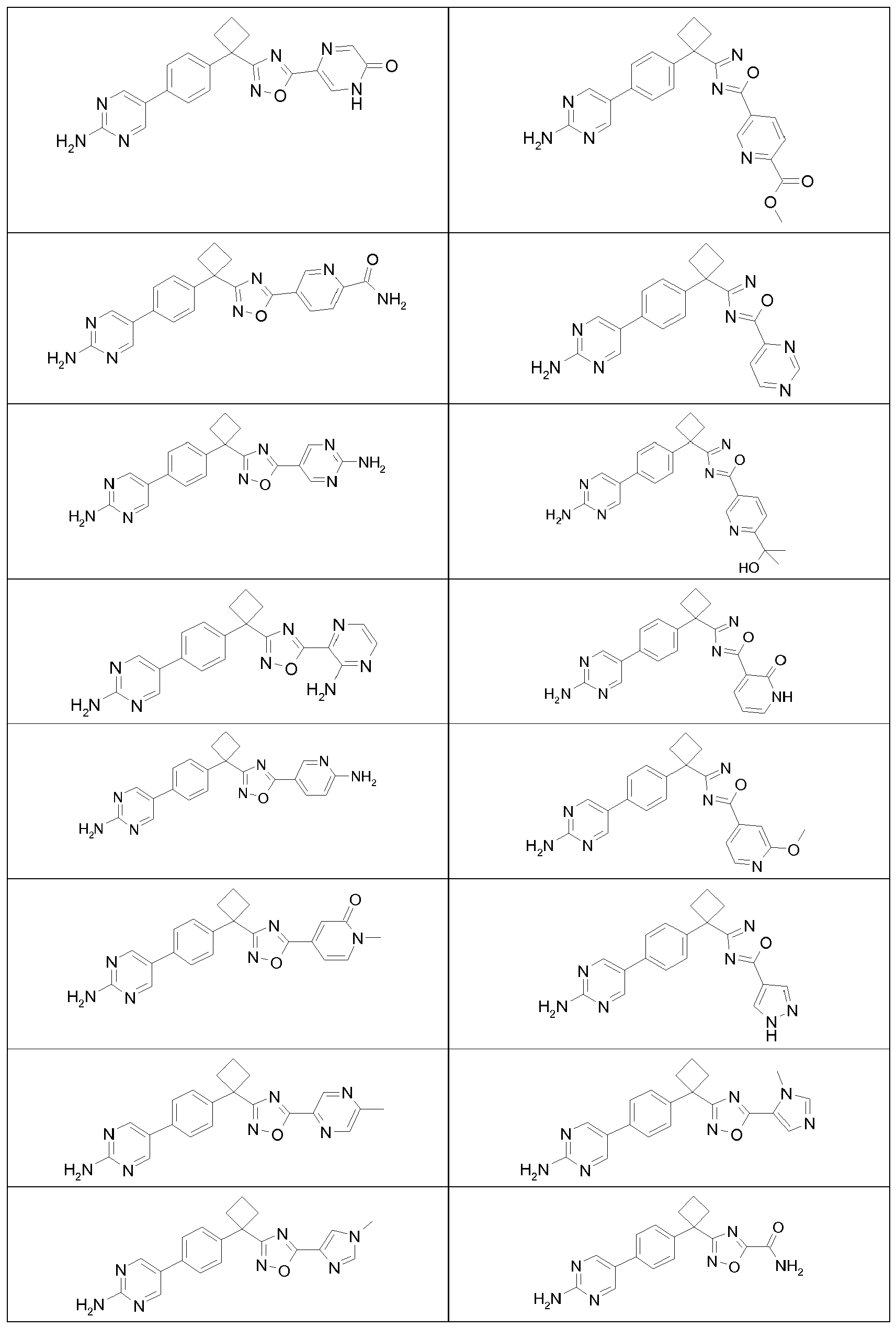


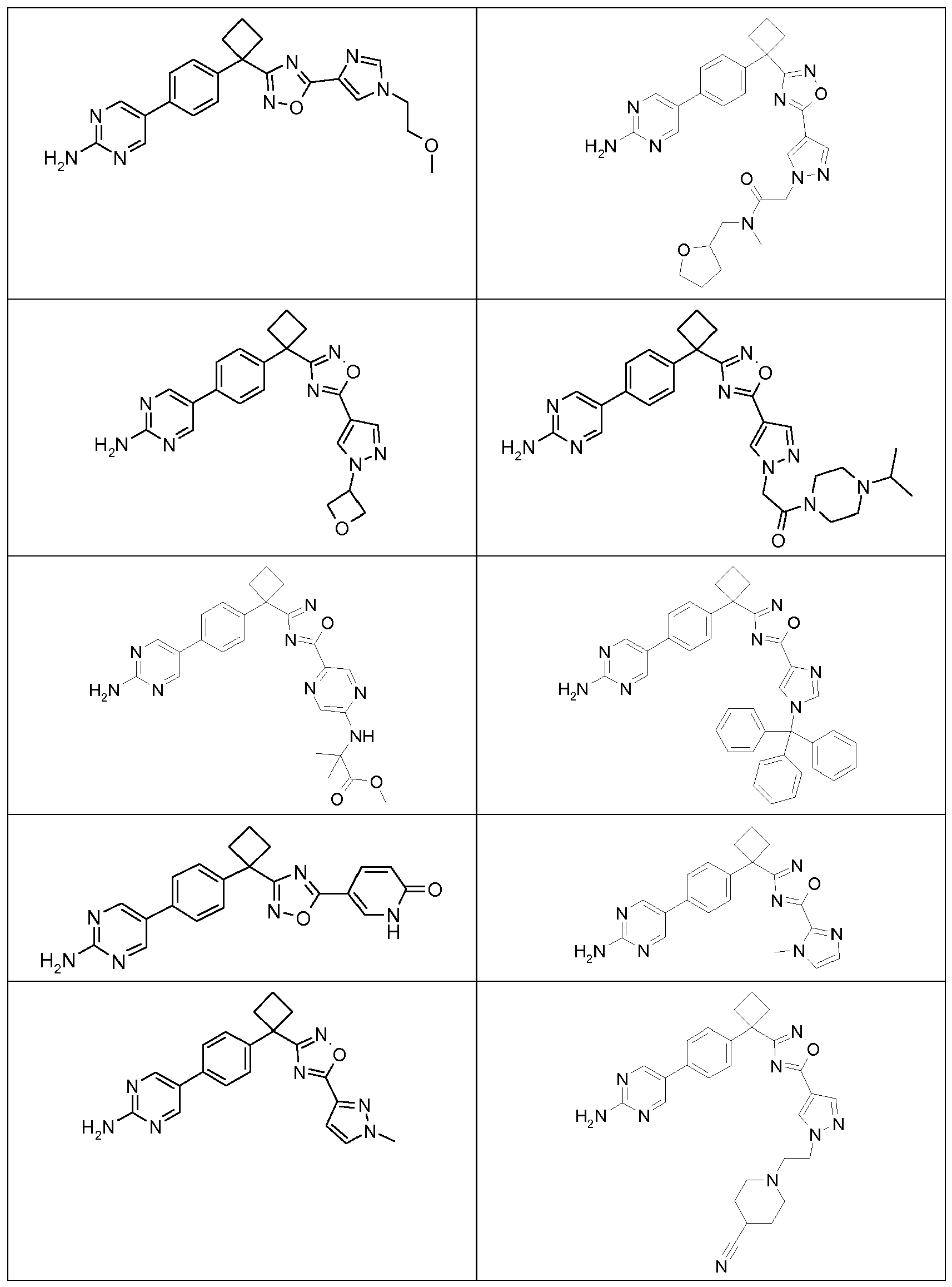


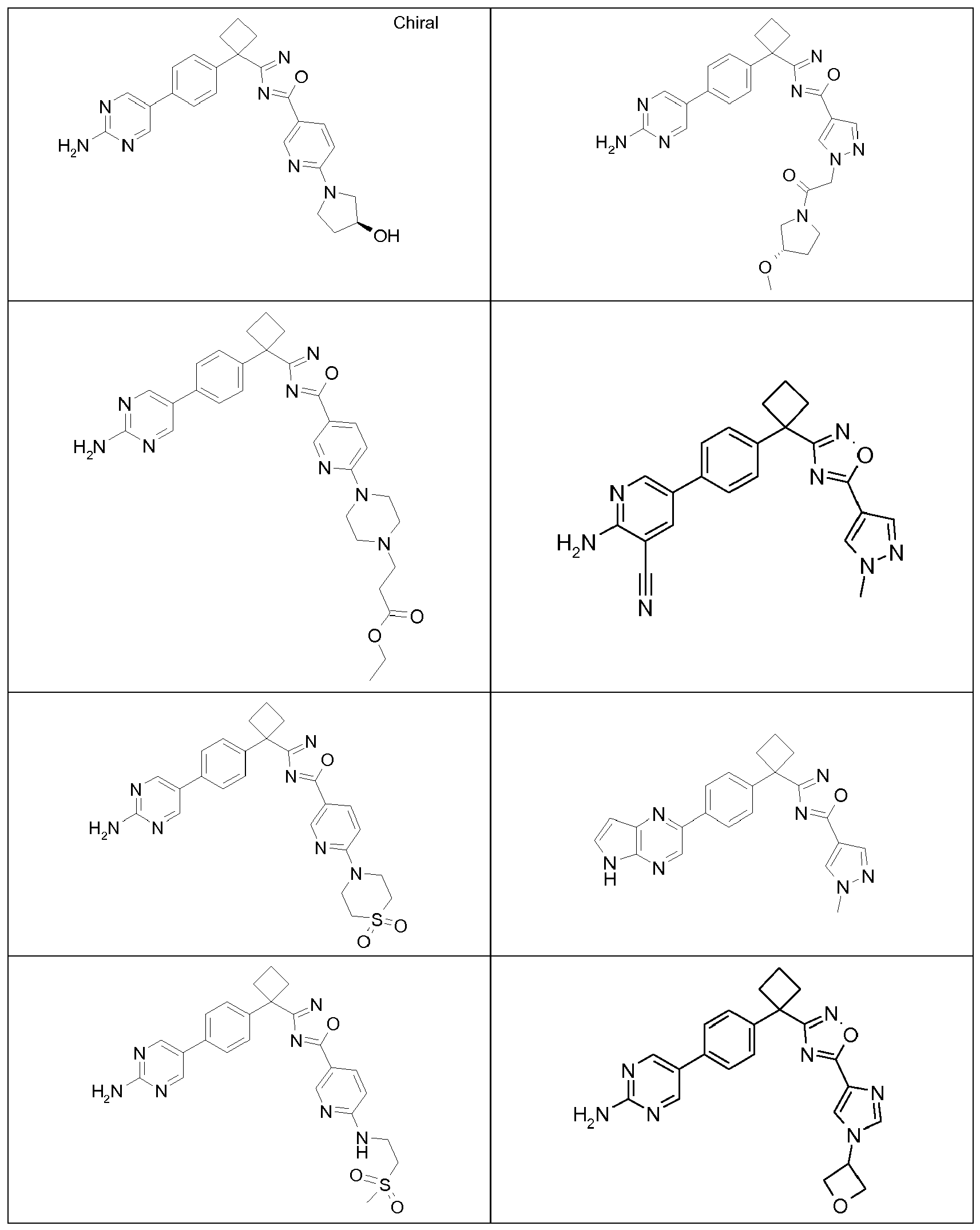


 or a pharmaceutically acceptable salt thereof.
- A compound according to claim 14, selected from a group consisting of:


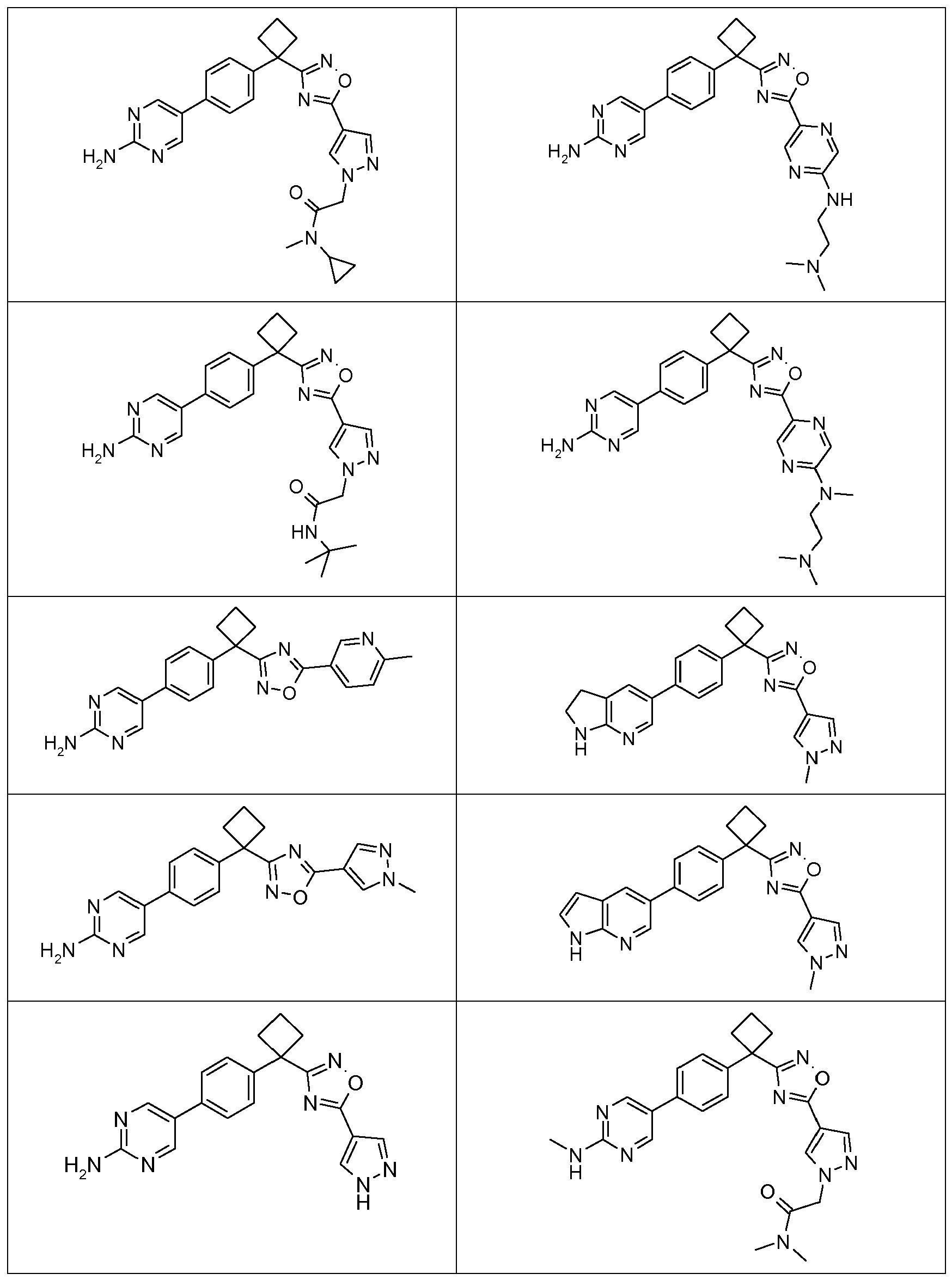
 or a pharmaceuticaaly acceptable salt thereof.
- A compound according to claim 14, selected from a group consisting of:

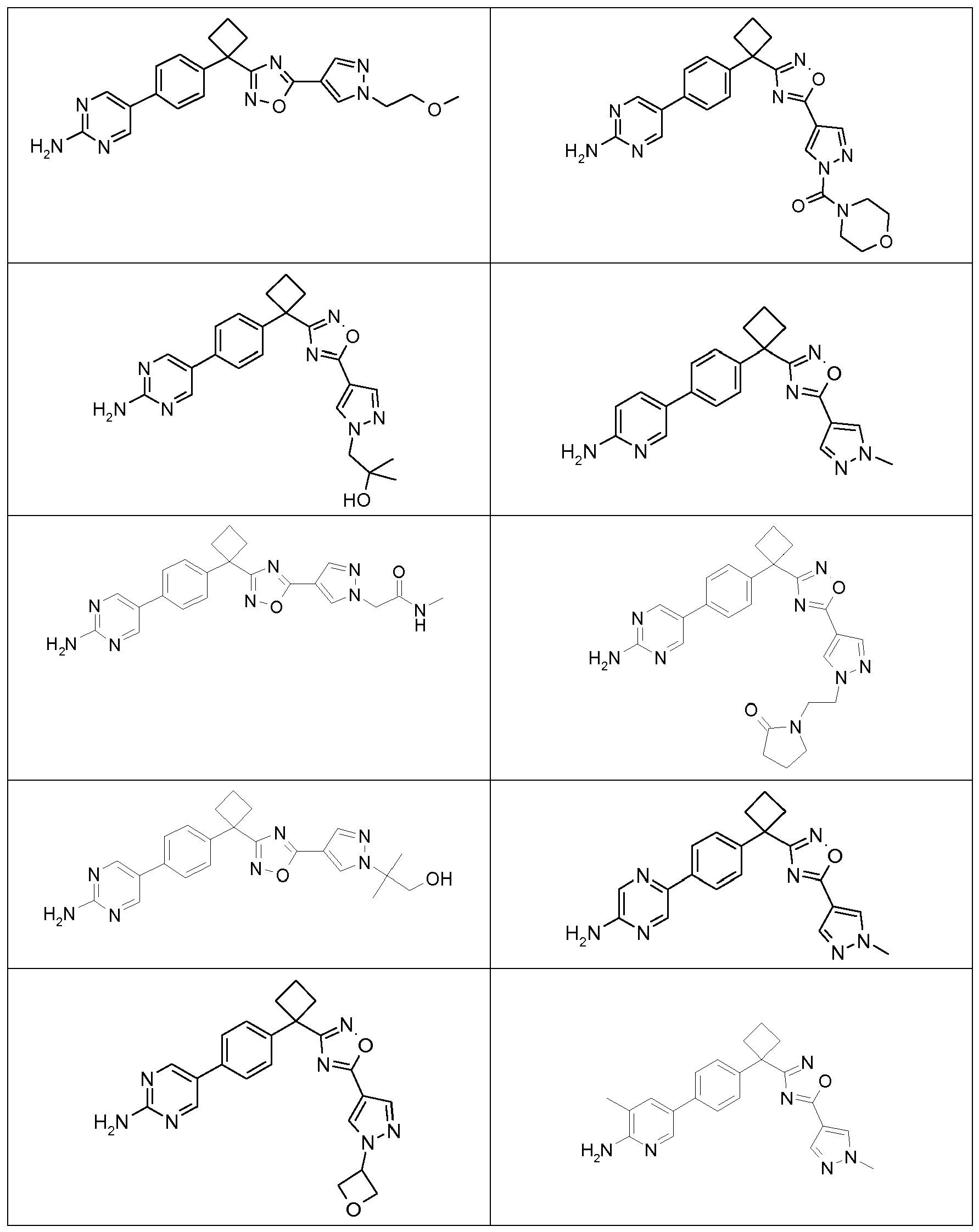

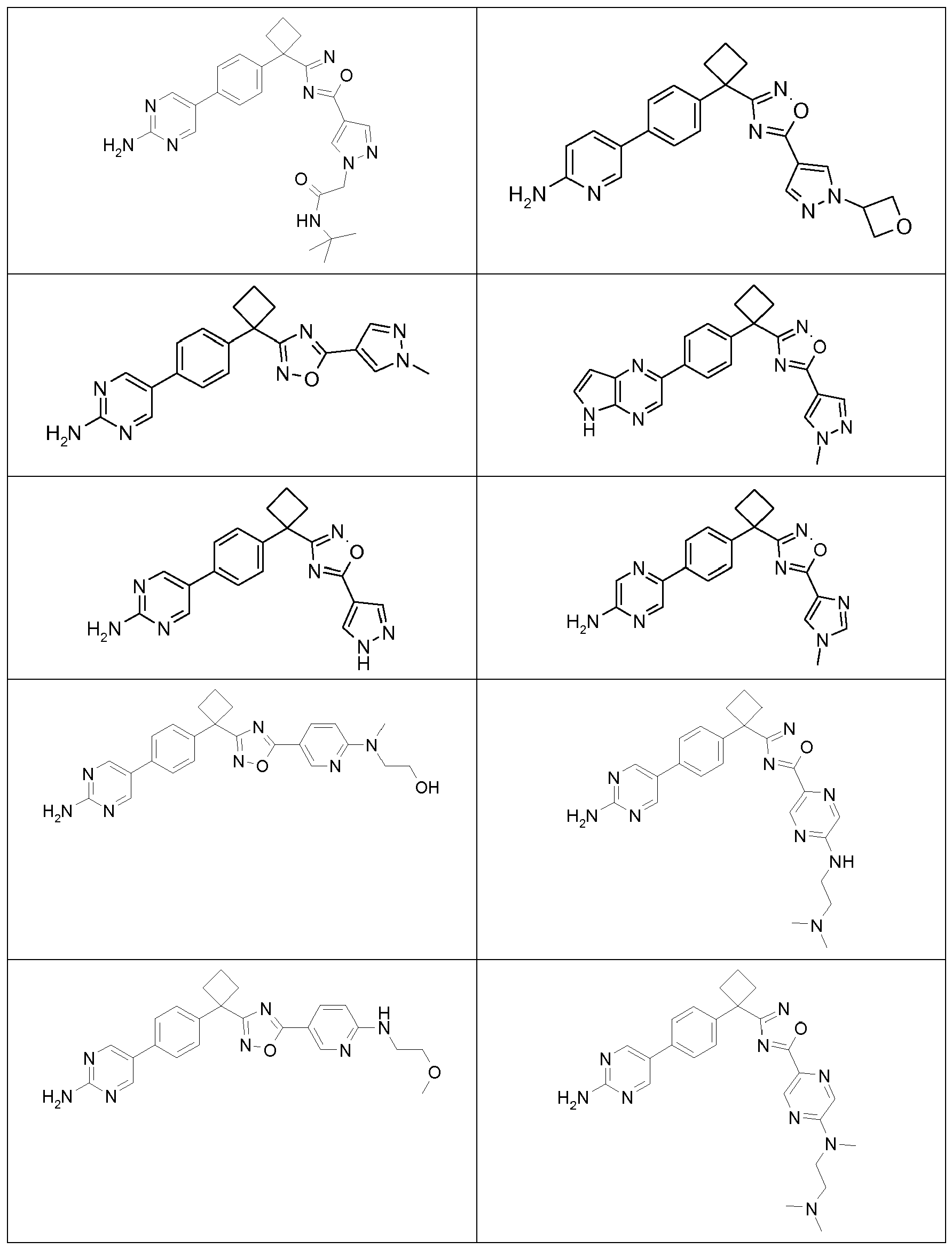
 or a pharmaceuticaaly acceptable salt thereof.
- A pharmaceutical composition comprising a compound according to any of the claims 1 to 16, or a pharmaceutically acceptable salt thereof, and a pharmaceutically acceptable excipient and/or carrier.
- A compound of any of claims 1 to 16 or a pharmaceutically acceptable salt thereof for use as a medicament.
- A compound of any of claims 1 to 16 or a pharmaceutically acceptable salt thereof for treatment of a leukotriene-mediated disorder.
- A compound for use according to claim 19 , wherein said leukotriene-mediated disorder is selected from cardiovascular, inflammatory, allergic, pulmonary and fibrotic diseases, renal diseases and cancer.
- A compound for use according to claim 20, wherein said cardiovascular disease is Atherosclerosis.
Applications Claiming Priority (3)
| Application Number | Priority Date | Filing Date | Title |
|---|---|---|---|
| US37718110P | 2010-08-26 | 2010-08-26 | |
| US201161511247P | 2011-07-25 | 2011-07-25 | |
| PCT/US2011/048743 WO2012027322A1 (en) | 2010-08-26 | 2011-08-23 | Oxadiazole inhibitors of leukotriene production |
Publications (2)
| Publication Number | Publication Date |
|---|---|
| EP2609092A1 EP2609092A1 (en) | 2013-07-03 |
| EP2609092B1 true EP2609092B1 (en) | 2015-04-01 |
Family
ID=44533215
Family Applications (1)
| Application Number | Title | Priority Date | Filing Date |
|---|---|---|---|
| EP11749686.9A Active EP2609092B1 (en) | 2010-08-26 | 2011-08-23 | Oxadiazole inhibitors of leukotriene production |
Country Status (4)
| Country | Link |
|---|---|
| US (1) | US8580829B2 (en) |
| EP (1) | EP2609092B1 (en) |
| JP (1) | JP5862669B2 (en) |
| WO (1) | WO2012027322A1 (en) |
Families Citing this family (19)
| Publication number | Priority date | Publication date | Assignee | Title |
|---|---|---|---|---|
| AU2011292285A1 (en) | 2010-08-16 | 2013-01-31 | Boehringer Ingelheim International Gmbh | Oxadiazole inhibitors of leukotriene production |
| EP2609092B1 (en) | 2010-08-26 | 2015-04-01 | Boehringer Ingelheim International GmbH | Oxadiazole inhibitors of leukotriene production |
| BR112013008638A2 (en) * | 2010-09-23 | 2016-06-21 | Boehringer Ingelheim Int | oxadiazole inhibitors of leukotriene production |
| US8580825B2 (en) * | 2010-09-23 | 2013-11-12 | Boehringer Ingelheim International Gmbh | Oxadiazole inhibitors of leukotriene production |
| WO2013116182A1 (en) * | 2012-01-31 | 2013-08-08 | Boehringer Ingelheim International Gmbh | Heterocyclic compounds as inhibitors of leukotriene production |
| AR089853A1 (en) | 2012-02-01 | 2014-09-24 | Boehringer Ingelheim Int | OXADIAZOL INHIBITORS FROM THE PRODUCTION OF LEUCOTRIENS FOR COMBINATION THERAPY, PHARMACEUTICAL COMPOSITION, USE |
| US8716226B2 (en) | 2012-07-18 | 2014-05-06 | Saint Louis University | 3,5 phenyl-substituted beta amino acid derivatives as integrin antagonists |
| US9085606B2 (en) | 2012-07-18 | 2015-07-21 | Saint Louis University | Beta amino acid derivatives as integrin antagonists |
| WO2014121055A2 (en) * | 2013-02-04 | 2014-08-07 | Janssen Pharmaceutica Nv | Flap modulators |
| TWI624467B (en) | 2013-10-14 | 2018-05-21 | 衛材R&D企管股份有限公司 | Selective substituted quinoline compound |
| US9663486B2 (en) | 2013-10-14 | 2017-05-30 | Eisai R&D Management Co., Ltd. | Selectively substituted quinoline compounds |
| JP6244036B2 (en) * | 2014-01-21 | 2017-12-06 | エフ.ホフマン−ラ ロシュ アーゲーF. Hoffmann−La Roche Aktiengesellschaft | Imidazole for treatment and prevention of respiratory syncytial virus infection |
| JP6195684B2 (en) | 2014-06-03 | 2017-09-13 | アクテリオン ファーマシューティカルズ リミテッドActelion Pharmaceuticals Ltd | Pyrazole compounds and their use as T-type calcium channel blockers |
| AU2016381336A1 (en) | 2015-12-30 | 2018-06-28 | Saint Louis University | Meta-azacyclic amino benzoic acid derivatives as pan integrin antagonists |
| LT3554490T (en) | 2016-12-16 | 2022-04-25 | Idorsia Pharmaceuticals Ltd | PHARMACEUTICAL COMBINATION INCLUDING TYPE CALCIUM CHANNEL BLOCKER |
| CA3050348A1 (en) | 2017-02-06 | 2018-08-09 | Idorsia Pharmaceuticals Ltd | A novel process for the synthesis of 1-aryl-1-trifluoromethylcyclopropanes |
| WO2019027856A1 (en) * | 2017-08-02 | 2019-02-07 | Merck Sharp & Dohme Corp. | Novel substituted pyridine compounds as indoleamine 2,3-dioxygenase (ido) inhibitors |
| WO2019027855A1 (en) * | 2017-08-02 | 2019-02-07 | Merck Sharp & Dohme Corp. | Novel substituted phenyl compounds as indoleamine 2,3-dioxygenase (ido) inhibitors |
| JP7805983B2 (en) | 2022-03-22 | 2026-01-26 | アッヴィ・インコーポレイテッド | Pyrimidines for degrading Bruton's tyrosine kinase |
Family Cites Families (19)
| Publication number | Priority date | Publication date | Assignee | Title |
|---|---|---|---|---|
| TR200200310T2 (en) | 1999-08-06 | 2002-08-21 | Janssen Pharmaceutica N.V. | 6-azauracil derivatives that inhibit interleukin-5. |
| US7319108B2 (en) | 2004-01-25 | 2008-01-15 | Sanofi-Aventis Deutschland Gmbh | Aryl-substituted heterocycles, process for their preparation and their use as medicaments |
| WO2006044602A2 (en) * | 2004-10-18 | 2006-04-27 | Merck & Co., Inc. | Diphenyl substituted alkanes as flap inhiibitors |
| US8399666B2 (en) | 2005-11-04 | 2013-03-19 | Panmira Pharmaceuticals, Llc | 5-lipoxygenase-activating protein (FLAP) inhibitors |
| GB2431927B (en) | 2005-11-04 | 2010-03-17 | Amira Pharmaceuticals Inc | 5-Lipoxygenase-activating protein (FLAP) inhibitors |
| US7977359B2 (en) * | 2005-11-04 | 2011-07-12 | Amira Pharmaceuticals, Inc. | 5-lipdxygenase-activating protein (FLAP) inhibitors |
| EP2013174B1 (en) | 2006-04-11 | 2013-05-08 | Merck Sharp & Dohme Corp. | Diaryl substituted alkanes |
| ATE540681T1 (en) | 2006-06-26 | 2012-01-15 | Amgen Inc | METHOD FOR TREATING ATHEROSCLERosis |
| JP2010502615A (en) | 2006-09-01 | 2010-01-28 | メルク エンド カムパニー インコーポレーテッド | Inhibitors of 5-lipoxygenase activating protein (FLAP) |
| CA2683948A1 (en) | 2007-04-20 | 2008-10-30 | Merck Frosst Canada Ltd. | Novel heteroaromatic compounds as inhibitors of stearoyl-coenzyme a delta-9 desaturase |
| AU2008266960A1 (en) | 2007-06-20 | 2008-12-24 | Merck Sharp & Dohme Corp. | Diphenyl substituted alkanes |
| EP2209761A4 (en) | 2007-10-10 | 2012-01-04 | Merck Sharp & Dohme | CYCLOALCANES SUBSTITUTED WITH DIPHENYLS |
| US8598209B2 (en) * | 2008-10-31 | 2013-12-03 | Merck Sharp & Dohme Corp. | P2X3, receptor antagonists for treatment of pain |
| EP2393811A1 (en) | 2009-02-04 | 2011-12-14 | Pfizer Inc. | 4-amino-7,8-dihydropyrido[4,3-d]pyrimidin-5(6h)-one derivatives |
| RU2012154447A (en) | 2010-05-12 | 2014-06-20 | Вандербилт Юниверсити | HETEROCYCLIC SULPHON ALLOSTERIC POTENTIATORS MGLUR4, COMPOSITIONS AND METHODS FOR TREATING NEUROLOGICAL DYSFUNCTIONS |
| AU2011292285A1 (en) * | 2010-08-16 | 2013-01-31 | Boehringer Ingelheim International Gmbh | Oxadiazole inhibitors of leukotriene production |
| EP2609092B1 (en) | 2010-08-26 | 2015-04-01 | Boehringer Ingelheim International GmbH | Oxadiazole inhibitors of leukotriene production |
| US8580825B2 (en) * | 2010-09-23 | 2013-11-12 | Boehringer Ingelheim International Gmbh | Oxadiazole inhibitors of leukotriene production |
| BR112013008638A2 (en) * | 2010-09-23 | 2016-06-21 | Boehringer Ingelheim Int | oxadiazole inhibitors of leukotriene production |
-
2011
- 2011-08-23 EP EP11749686.9A patent/EP2609092B1/en active Active
- 2011-08-23 JP JP2013526084A patent/JP5862669B2/en active Active
- 2011-08-23 WO PCT/US2011/048743 patent/WO2012027322A1/en not_active Ceased
- 2011-08-23 US US13/215,654 patent/US8580829B2/en active Active
Also Published As
| Publication number | Publication date |
|---|---|
| EP2609092A1 (en) | 2013-07-03 |
| US8580829B2 (en) | 2013-11-12 |
| JP2013536235A (en) | 2013-09-19 |
| WO2012027322A1 (en) | 2012-03-01 |
| US20120214787A1 (en) | 2012-08-23 |
| JP5862669B2 (en) | 2016-02-16 |
Similar Documents
| Publication | Publication Date | Title |
|---|---|---|
| US8580829B2 (en) | Oxadiazole inhibitors of leukotriene production | |
| EP2509975B1 (en) | Benzimidazole inhibitors of leukotriene production | |
| ES3034100T3 (en) | 4,6-diamino-quinoline-3-carbonitrile derivatives as cancer osaka thyroid (cot) modulators for treating crohn's disease and ulcerative colitis | |
| CN105339368B (en) | Imidazo [1,2 a] pyridine of 3 aryl substitution and application thereof | |
| EP2606045B1 (en) | Oxadiazole inhibitors of leukotriene production | |
| US9174980B2 (en) | Heterocyclic compounds as inhibitors of leukotriene production | |
| US20200039960A1 (en) | Rorc2 inhibitors and methods of use thereof | |
| CN106459090A (en) | 3-(pyrimidine-2-yl)imidazo[1,2-A]pyridines | |
| US8580825B2 (en) | Oxadiazole inhibitors of leukotriene production | |
| US8575201B2 (en) | Oxadiazole inhibitors of leukotriene production | |
| EP2632915B1 (en) | Benzimidazole inhibitors of leukotriene production | |
| HK1183300A (en) | Oxadiazole inhibitors of leukotriene production | |
| OA16344A (en) | Oxadiazole inhibitors of leukotriene production. |
Legal Events
| Date | Code | Title | Description |
|---|---|---|---|
| PUAI | Public reference made under article 153(3) epc to a published international application that has entered the european phase |
Free format text: ORIGINAL CODE: 0009012 |
|
| 17P | Request for examination filed |
Effective date: 20130326 |
|
| AK | Designated contracting states |
Kind code of ref document: A1 Designated state(s): AL AT BE BG CH CY CZ DE DK EE ES FI FR GB GR HR HU IE IS IT LI LT LU LV MC MK MT NL NO PL PT RO RS SE SI SK SM TR |
|
| RIN1 | Information on inventor provided before grant (corrected) |
Inventor name: BARTOLOZZI, ALESSANDRA Inventor name: WU, LIFEN Inventor name: MORWICK, TINA MARIE Inventor name: CHEN, ZHIDONG Inventor name: BOSANAC, TODD Inventor name: NEMOTO, PETER ALLEN Inventor name: OLAGUE, ALAN Inventor name: HUBER, JOHN, D. Inventor name: LO, HO YIN Inventor name: DE LOMBAERT, STEPHANE Inventor name: RIETHER, DORIS Inventor name: TYE, HEATHER Inventor name: DINES, JONATHON ALAN Inventor name: LIU, WEIMIN Inventor name: LOKE, PUI LENG Inventor name: ZINDELL, RENEE, M. |
|
| DAX | Request for extension of the european patent (deleted) | ||
| 17Q | First examination report despatched |
Effective date: 20131219 |
|
| GRAP | Despatch of communication of intention to grant a patent |
Free format text: ORIGINAL CODE: EPIDOSNIGR1 |
|
| INTG | Intention to grant announced |
Effective date: 20140708 |
|
| RIN1 | Information on inventor provided before grant (corrected) |
Inventor name: CHEN, ZHIDONG Inventor name: LOKE, PUI LENG Inventor name: LO, HO YIN Inventor name: HUBER, JOHN, D. Inventor name: OLAGUE, ALAN Inventor name: DE LOMBAERT, STEPHANE Inventor name: LIU, WEIMIN Inventor name: DINES, JONATHON ALAN Inventor name: ZINDELL, RENEE, M. Inventor name: WU, LIFEN Inventor name: TYE, HEATHER Inventor name: BARTOLOZZI, ALESSANDRA Inventor name: BOSANAC, TODD Inventor name: NEMOTO, PETER ALLEN Inventor name: RIETHER, DORIS Inventor name: MORWICK, TINA MARIE |
|
| GRAP | Despatch of communication of intention to grant a patent |
Free format text: ORIGINAL CODE: EPIDOSNIGR1 |
|
| INTG | Intention to grant announced |
Effective date: 20141126 |
|
| GRAS | Grant fee paid |
Free format text: ORIGINAL CODE: EPIDOSNIGR3 |
|
| GRAA | (expected) grant |
Free format text: ORIGINAL CODE: 0009210 |
|
| AK | Designated contracting states |
Kind code of ref document: B1 Designated state(s): AL AT BE BG CH CY CZ DE DK EE ES FI FR GB GR HR HU IE IS IT LI LT LU LV MC MK MT NL NO PL PT RO RS SE SI SK SM TR |
|
| REG | Reference to a national code |
Ref country code: GB Ref legal event code: FG4D |
|
| REG | Reference to a national code |
Ref country code: CH Ref legal event code: EP |
|
| REG | Reference to a national code |
Ref country code: IE Ref legal event code: FG4D |
|
| REG | Reference to a national code |
Ref country code: DE Ref legal event code: R096 Ref document number: 602011015277 Country of ref document: DE Effective date: 20150513 |
|
| REG | Reference to a national code |
Ref country code: AT Ref legal event code: REF Ref document number: 719008 Country of ref document: AT Kind code of ref document: T Effective date: 20150515 |
|
| REG | Reference to a national code |
Ref country code: FR Ref legal event code: PLFP Year of fee payment: 5 |
|
| REG | Reference to a national code |
Ref country code: NL Ref legal event code: VDEP Effective date: 20150401 |
|
| REG | Reference to a national code |
Ref country code: AT Ref legal event code: MK05 Ref document number: 719008 Country of ref document: AT Kind code of ref document: T Effective date: 20150401 |
|
| REG | Reference to a national code |
Ref country code: LT Ref legal event code: MG4D |
|
| PG25 | Lapsed in a contracting state [announced via postgrant information from national office to epo] |
Ref country code: NL Free format text: LAPSE BECAUSE OF FAILURE TO SUBMIT A TRANSLATION OF THE DESCRIPTION OR TO PAY THE FEE WITHIN THE PRESCRIBED TIME-LIMIT Effective date: 20150401 |
|
| PG25 | Lapsed in a contracting state [announced via postgrant information from national office to epo] |
Ref country code: PT Free format text: LAPSE BECAUSE OF FAILURE TO SUBMIT A TRANSLATION OF THE DESCRIPTION OR TO PAY THE FEE WITHIN THE PRESCRIBED TIME-LIMIT Effective date: 20150803 Ref country code: FI Free format text: LAPSE BECAUSE OF FAILURE TO SUBMIT A TRANSLATION OF THE DESCRIPTION OR TO PAY THE FEE WITHIN THE PRESCRIBED TIME-LIMIT Effective date: 20150401 Ref country code: NO Free format text: LAPSE BECAUSE OF FAILURE TO SUBMIT A TRANSLATION OF THE DESCRIPTION OR TO PAY THE FEE WITHIN THE PRESCRIBED TIME-LIMIT Effective date: 20150701 Ref country code: CZ Free format text: LAPSE BECAUSE OF FAILURE TO SUBMIT A TRANSLATION OF THE DESCRIPTION OR TO PAY THE FEE WITHIN THE PRESCRIBED TIME-LIMIT Effective date: 20150401 Ref country code: LT Free format text: LAPSE BECAUSE OF FAILURE TO SUBMIT A TRANSLATION OF THE DESCRIPTION OR TO PAY THE FEE WITHIN THE PRESCRIBED TIME-LIMIT Effective date: 20150401 Ref country code: HR Free format text: LAPSE BECAUSE OF FAILURE TO SUBMIT A TRANSLATION OF THE DESCRIPTION OR TO PAY THE FEE WITHIN THE PRESCRIBED TIME-LIMIT Effective date: 20150401 Ref country code: ES Free format text: LAPSE BECAUSE OF FAILURE TO SUBMIT A TRANSLATION OF THE DESCRIPTION OR TO PAY THE FEE WITHIN THE PRESCRIBED TIME-LIMIT Effective date: 20150401 |
|
| PG25 | Lapsed in a contracting state [announced via postgrant information from national office to epo] |
Ref country code: AT Free format text: LAPSE BECAUSE OF FAILURE TO SUBMIT A TRANSLATION OF THE DESCRIPTION OR TO PAY THE FEE WITHIN THE PRESCRIBED TIME-LIMIT Effective date: 20150401 Ref country code: RS Free format text: LAPSE BECAUSE OF FAILURE TO SUBMIT A TRANSLATION OF THE DESCRIPTION OR TO PAY THE FEE WITHIN THE PRESCRIBED TIME-LIMIT Effective date: 20150401 Ref country code: LV Free format text: LAPSE BECAUSE OF FAILURE TO SUBMIT A TRANSLATION OF THE DESCRIPTION OR TO PAY THE FEE WITHIN THE PRESCRIBED TIME-LIMIT Effective date: 20150401 Ref country code: IS Free format text: LAPSE BECAUSE OF FAILURE TO SUBMIT A TRANSLATION OF THE DESCRIPTION OR TO PAY THE FEE WITHIN THE PRESCRIBED TIME-LIMIT Effective date: 20150801 Ref country code: GR Free format text: LAPSE BECAUSE OF FAILURE TO SUBMIT A TRANSLATION OF THE DESCRIPTION OR TO PAY THE FEE WITHIN THE PRESCRIBED TIME-LIMIT Effective date: 20150702 |
|
| REG | Reference to a national code |
Ref country code: DE Ref legal event code: R097 Ref document number: 602011015277 Country of ref document: DE |
|
| PG25 | Lapsed in a contracting state [announced via postgrant information from national office to epo] |
Ref country code: DK Free format text: LAPSE BECAUSE OF FAILURE TO SUBMIT A TRANSLATION OF THE DESCRIPTION OR TO PAY THE FEE WITHIN THE PRESCRIBED TIME-LIMIT Effective date: 20150401 Ref country code: EE Free format text: LAPSE BECAUSE OF FAILURE TO SUBMIT A TRANSLATION OF THE DESCRIPTION OR TO PAY THE FEE WITHIN THE PRESCRIBED TIME-LIMIT Effective date: 20150401 |
|
| PLBE | No opposition filed within time limit |
Free format text: ORIGINAL CODE: 0009261 |
|
| STAA | Information on the status of an ep patent application or granted ep patent |
Free format text: STATUS: NO OPPOSITION FILED WITHIN TIME LIMIT |
|
| PG25 | Lapsed in a contracting state [announced via postgrant information from national office to epo] |
Ref country code: RO Free format text: LAPSE BECAUSE OF NON-PAYMENT OF DUE FEES Effective date: 20150401 Ref country code: SK Free format text: LAPSE BECAUSE OF FAILURE TO SUBMIT A TRANSLATION OF THE DESCRIPTION OR TO PAY THE FEE WITHIN THE PRESCRIBED TIME-LIMIT Effective date: 20150401 Ref country code: PL Free format text: LAPSE BECAUSE OF FAILURE TO SUBMIT A TRANSLATION OF THE DESCRIPTION OR TO PAY THE FEE WITHIN THE PRESCRIBED TIME-LIMIT Effective date: 20150401 |
|
| 26N | No opposition filed |
Effective date: 20160105 |
|
| PG25 | Lapsed in a contracting state [announced via postgrant information from national office to epo] |
Ref country code: LU Free format text: LAPSE BECAUSE OF FAILURE TO SUBMIT A TRANSLATION OF THE DESCRIPTION OR TO PAY THE FEE WITHIN THE PRESCRIBED TIME-LIMIT Effective date: 20150823 Ref country code: MC Free format text: LAPSE BECAUSE OF FAILURE TO SUBMIT A TRANSLATION OF THE DESCRIPTION OR TO PAY THE FEE WITHIN THE PRESCRIBED TIME-LIMIT Effective date: 20150401 |
|
| REG | Reference to a national code |
Ref country code: CH Ref legal event code: PL |
|
| PG25 | Lapsed in a contracting state [announced via postgrant information from national office to epo] |
Ref country code: LI Free format text: LAPSE BECAUSE OF NON-PAYMENT OF DUE FEES Effective date: 20150831 Ref country code: IT Free format text: LAPSE BECAUSE OF FAILURE TO SUBMIT A TRANSLATION OF THE DESCRIPTION OR TO PAY THE FEE WITHIN THE PRESCRIBED TIME-LIMIT Effective date: 20150401 Ref country code: CH Free format text: LAPSE BECAUSE OF NON-PAYMENT OF DUE FEES Effective date: 20150831 |
|
| PG25 | Lapsed in a contracting state [announced via postgrant information from national office to epo] |
Ref country code: SI Free format text: LAPSE BECAUSE OF FAILURE TO SUBMIT A TRANSLATION OF THE DESCRIPTION OR TO PAY THE FEE WITHIN THE PRESCRIBED TIME-LIMIT Effective date: 20150401 |
|
| REG | Reference to a national code |
Ref country code: IE Ref legal event code: MM4A |
|
| PG25 | Lapsed in a contracting state [announced via postgrant information from national office to epo] |
Ref country code: IE Free format text: LAPSE BECAUSE OF NON-PAYMENT OF DUE FEES Effective date: 20150823 |
|
| REG | Reference to a national code |
Ref country code: FR Ref legal event code: PLFP Year of fee payment: 6 |
|
| PG25 | Lapsed in a contracting state [announced via postgrant information from national office to epo] |
Ref country code: BE Free format text: LAPSE BECAUSE OF FAILURE TO SUBMIT A TRANSLATION OF THE DESCRIPTION OR TO PAY THE FEE WITHIN THE PRESCRIBED TIME-LIMIT Effective date: 20150401 |
|
| PG25 | Lapsed in a contracting state [announced via postgrant information from national office to epo] |
Ref country code: MT Free format text: LAPSE BECAUSE OF FAILURE TO SUBMIT A TRANSLATION OF THE DESCRIPTION OR TO PAY THE FEE WITHIN THE PRESCRIBED TIME-LIMIT Effective date: 20150401 |
|
| PG25 | Lapsed in a contracting state [announced via postgrant information from national office to epo] |
Ref country code: BG Free format text: LAPSE BECAUSE OF FAILURE TO SUBMIT A TRANSLATION OF THE DESCRIPTION OR TO PAY THE FEE WITHIN THE PRESCRIBED TIME-LIMIT Effective date: 20150401 Ref country code: HU Free format text: LAPSE BECAUSE OF FAILURE TO SUBMIT A TRANSLATION OF THE DESCRIPTION OR TO PAY THE FEE WITHIN THE PRESCRIBED TIME-LIMIT; INVALID AB INITIO Effective date: 20110823 Ref country code: SM Free format text: LAPSE BECAUSE OF FAILURE TO SUBMIT A TRANSLATION OF THE DESCRIPTION OR TO PAY THE FEE WITHIN THE PRESCRIBED TIME-LIMIT Effective date: 20150401 |
|
| PG25 | Lapsed in a contracting state [announced via postgrant information from national office to epo] |
Ref country code: CY Free format text: LAPSE BECAUSE OF FAILURE TO SUBMIT A TRANSLATION OF THE DESCRIPTION OR TO PAY THE FEE WITHIN THE PRESCRIBED TIME-LIMIT Effective date: 20150401 Ref country code: SE Free format text: LAPSE BECAUSE OF FAILURE TO SUBMIT A TRANSLATION OF THE DESCRIPTION OR TO PAY THE FEE WITHIN THE PRESCRIBED TIME-LIMIT Effective date: 20150401 |
|
| REG | Reference to a national code |
Ref country code: FR Ref legal event code: PLFP Year of fee payment: 7 |
|
| PG25 | Lapsed in a contracting state [announced via postgrant information from national office to epo] |
Ref country code: MK Free format text: LAPSE BECAUSE OF FAILURE TO SUBMIT A TRANSLATION OF THE DESCRIPTION OR TO PAY THE FEE WITHIN THE PRESCRIBED TIME-LIMIT Effective date: 20150401 Ref country code: TR Free format text: LAPSE BECAUSE OF FAILURE TO SUBMIT A TRANSLATION OF THE DESCRIPTION OR TO PAY THE FEE WITHIN THE PRESCRIBED TIME-LIMIT Effective date: 20150401 |
|
| REG | Reference to a national code |
Ref country code: FR Ref legal event code: PLFP Year of fee payment: 8 |
|
| PG25 | Lapsed in a contracting state [announced via postgrant information from national office to epo] |
Ref country code: AL Free format text: LAPSE BECAUSE OF FAILURE TO SUBMIT A TRANSLATION OF THE DESCRIPTION OR TO PAY THE FEE WITHIN THE PRESCRIBED TIME-LIMIT Effective date: 20150401 |
|
| PGFP | Annual fee paid to national office [announced via postgrant information from national office to epo] |
Ref country code: DE Payment date: 20250820 Year of fee payment: 15 |
|
| PGFP | Annual fee paid to national office [announced via postgrant information from national office to epo] |
Ref country code: GB Payment date: 20250820 Year of fee payment: 15 |
|
| PGFP | Annual fee paid to national office [announced via postgrant information from national office to epo] |
Ref country code: FR Payment date: 20250829 Year of fee payment: 15 |