EP2608059A1 - Method and apparatus for prioritizing metadata - Google Patents
Method and apparatus for prioritizing metadata Download PDFInfo
- Publication number
- EP2608059A1 EP2608059A1 EP11306747.4A EP11306747A EP2608059A1 EP 2608059 A1 EP2608059 A1 EP 2608059A1 EP 11306747 A EP11306747 A EP 11306747A EP 2608059 A1 EP2608059 A1 EP 2608059A1
- Authority
- EP
- European Patent Office
- Prior art keywords
- metadata
- fid
- priority
- items
- face
- Prior art date
- Legal status (The legal status is an assumption and is not a legal conclusion. Google has not performed a legal analysis and makes no representation as to the accuracy of the status listed.)
- Withdrawn
Links
Images




Classifications
-
- G—PHYSICS
- G06—COMPUTING OR CALCULATING; COUNTING
- G06F—ELECTRIC DIGITAL DATA PROCESSING
- G06F16/00—Information retrieval; Database structures therefor; File system structures therefor
- G06F16/70—Information retrieval; Database structures therefor; File system structures therefor of video data
- G06F16/78—Retrieval characterised by using metadata, e.g. metadata not derived from the content or metadata generated manually
- G06F16/783—Retrieval characterised by using metadata, e.g. metadata not derived from the content or metadata generated manually using metadata automatically derived from the content
- G06F16/7837—Retrieval characterised by using metadata, e.g. metadata not derived from the content or metadata generated manually using metadata automatically derived from the content using objects detected or recognised in the video content
- G06F16/784—Retrieval characterised by using metadata, e.g. metadata not derived from the content or metadata generated manually using metadata automatically derived from the content using objects detected or recognised in the video content the detected or recognised objects being people
Definitions
- the invention relates to a method and an apparatus for prioritizing metadata, and more specifically to a method and an apparatus for prioritizing metadata associated to video data based on an analysis of priority variables.
- US 7,916,894 discloses a method for generating a summary of a video using faces.
- a plurality of sets of face images associated with a video is obtained, where each set of face images corresponds to a particular person depicted in the video.
- the persons associated with the plurality of sets of face images one or more of those persons are selected to be included in a facial summary by analyzing the plurality of sets of face images and/or the video.
- the determination which faces to include in the summary is based on the number of times that a face appears in the video, a face size, or an importance of a face. Though this approach allows to assign a certain priority to the detected faces, it only constitutes an inchoate solution for prioritizing metadata.
- a method for determining priority values of metadata items of a first set of metadata items associated to a video data item, the first set of metadata items being of a first type comprises the steps of:
- the invention provides a method for prioritizing metadata, e.g. metadata retrieved from a metadata repository.
- metadata e.g. metadata retrieved from a metadata repository.
- priority variables are used. These priority variables are calculated from the different types of metadata and/or from relationships between the types of metadata. Once the priority variables have been determined, they are analyzed to automatically classify the metadata items into different categories, e.g. important and non-important.
- the proposed method allows to increase the data access efficiency for video essence. Based on the metadata prioritization, a high performance application system for video essence access and query can easily be realized.
- both the first type of metadata and the second type of metadata are one of temporal segmentation metadata, spatial segmentation metadata, quality metadata, impairment metadata, and semantic metadata.
- temporal segmentation metadata preferably designates at least one of scenes, shots, and sub-shots of the video data item
- spatial segmentation metadata is related to at least one of faces, face groups, and objects of the video data item.
- semantic metadata designates at least one of annotations and genre of the video data item.
- the analysis of the one or more priority variables is performed by a cluster analysis, e.g. a k-means cluster analysis.
- Cluster analysis has the advantage that is allows to perform a quick review of data. Furthermore, it is very helpful when unusual similarity measures are needed.
- an apparatus for determining priority values of metadata items of a first set of metadata items associated to a video data item is adapted to perform a method as described above for determining the priority values.
- a first type of metadata is temporal segmentation metadata, which is based on the detection of scenes, shots, sub-shots, and the like.
- a second type of metadata is spatial segmentation metadata, which is obtained, for example, by face detection or face group segmentation, or more generally by object detection.
- Another type of metadata is quality metadata, such as contrast, brightness, sharpness, information about blocking artifacts and compression artifacts, overall-quality, or noise. Impairment metadata gives information about dropouts, dirt, and scratches, etc.
- semantic metadata includes, inter alia, text-annotations, subtitles and the genre of the video data.
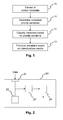
- Fig. 1 illustrates a method according to the general idea of the invention.
- metadata are extracted or collected.
- metadata priority variables are determined.
- the metadata priority variables are determined from feature parameters within the metadata types as well as from relationships among the different metadata types.
- the extracted or collected metadata are then classified 12 into different clusters with the help of cluster analysis.
- the metadata are prioritized 13 based on the cluster analysis results.
- Fig. 2 schematically illustrates an apparatus 20 adapted to perform the method of Fig. 1 .
- the apparatus has an input 21 for receiving data.
- data may be provided from a storage device 22, e.g. a harddisk or a device for playback of removable storage media.
- a metadata collector or extractor 23 retrieves metadata from the data.
- the metadata are either already provided together with the data, or they are determined by analyzing the data.
- the retrieved metadata are provided to an analyzing unit 24, which performs a cluster analysis based on metadata priority variables and prioritizes the metadata based on the cluster analysis results.
- the prioritization results are then output for further processing or stored locally.
- the metadata collector or extractor 23 and the analyzing unit 24 may likewise be combined into a single processing unit.
- a physical prioritization may be determined from video essence. This physical prioritization preferably makes use of temporal priority variables, spatial priority variables, and spatial-temporal priority variables.
- An example of a temporal priority variable is the ratio of the duration of a certain feature relative to the duration of the movie.
- An example of a spatial priority variable is the size of a certain object relative to the size of the image where the object occurs.
- an example of a spatial-temporal priority variable is the change of the size of an object within a scene, e.g. due to zooming-in or -out.
- different priority variables are defined for preferred metadata, i.e. different priority variables are determined for face metadata, for scene or shot metadata, for annotation metadata, etc.
- Cluster analysis refers to a class of techniques used to classify cases into groups that are relatively homogeneous within themselves and heterogeneous between each other, on the basis of a defined set of variables. These groups are called clusters.
- a cluster analysis consists of several steps. First a distance measure and a clustering algorithm are selected. Then the number of clusters is determined. Finally, the analysis is validated.
- Hierarchical procedures include agglomerative procedures, which start with n clusters to get to 1 cluster, and divisive procedures, which start with 1 cluster to get to n clusters.
- An example of a non-hierarchical procedure is k-means clustering, which starts with a given number of clusters.
- Hierarchical clustering has the advantage that no decision about the number of clusters is necessary. However, these procedures are prone to problems when the data contain a high level of error. Also, they are sometimes very slow and much more influenced by the initial decision.
- Non-hierarchical clustering has the advantage of being faster and more reliable. However, the number of clusters and the initial seeds have to be specified.
- k-means clustering For k-means clustering the number k of cluster is fixed. An initial set of k 'seeds' or aggregation centers is provided. Given a certain threshold, all units are assigned to the nearest cluster seed. Then new seeds are computed and the step of assigning the units to the nearest clusters is performed once more. This is repeated until no reclassification of the units is necessary.
- Fig. 3 shows an example of some metadata extracted from a plurality of frames 1 of video data.
- the extracted metadata include annotations 2, object groups 3, and face groups 4, which are grouping results derived from face detection metadata 5.
- annotations 2 annotations 2, object groups 3, and face groups 4, which are grouping results derived from face detection metadata 5.
- face groups 4 which are grouping results derived from face detection metadata 5.
- further metadata relate to scenes 6 as well as shot and sub-shot metadata 7.
- the face group metadata shall be considered as an example for the proposed metadata prioritization solution.
- the invention can likewise be realized with other metadata types, e.g. other detected objects.
- Basic parameters for face group metadata are their 'start-time' and 'duration' values.
- a face group with a longer duration should in general be more meaningful than a face group with a shorter duration. Therefore, the variable 'duration' is an important parameter for estimating the metadata priority of a face group.
- Scene segmentation metadata, shot segmentation metadata, and sub-shot segmentation metadata reflect background, object and event changes within the video essence, respectively. Face detection within the video frames is relevant for object changes. Therefore, the face group metadata are also relevant for these scene, shot, and sub-shot segmentation metadata. If a face object appears longer during any scene, shot, or sub-shot of the video essence, it can be assumed that the corresponding face object should be a meaningful object. Therefore, the following temporal priority variables are preferably used for estimating the face group metadata priority:
- the scene, shot, and sub-shot segmentation metadata are obtained with a different metadata extracting algorithm than the face group metadata, they are physically or logically relevant to their associated metadata parts. Making full use of the relevant parameters among these metadata types allows to prioritize the associated metadata.
- semantic metadata can be used for prioritizing face group metadata.
- the ratio between the numbers of subtitle metadata within a face group and the number of subtitle metadata within the corresponding scene (or shot) is suitable as a priority variable for calculating the face group priority.
- a face group with a larger amount of subtitle metadata should be more important than a face group with a smaller amount of subtitle metadata.
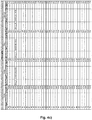
- the table illustrated in Figs. 4a ) to c) shows segmentation metadata (scene, shot, and sub-shot segmentation metadata) retrieved from a news program. For each detected segment, i.e. for each scene, shot, and sub-shot, the start time, the duration (in frames), and an ID (SCID_n, SHID_n, and SSHID_n) are indicated.
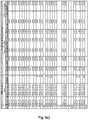
- Figs. 5a ) to c) depict face detection metadata obtained from this news program. Again, for each detected face the start time, the duration (in frames), and an ID (FID_n) are indicated. Also included in the table are the relevant resulting temporal priority variables (RD_face_movie, RD_face_scene, RD_face_shot, and N face subshot).
- a k-means clustering was performed to classify the detected faces into the categories "high importance”, “normal importance”, and “low importance”.
- Cluster analysis was done using the initial cluster centers as specified in Table 1.
- the initial cluster centers are generally automatically determined by the cluster analysis tool.
- Table 1 Initial Cluster Centers Cluster 1 2 3 RD_face_movie , 267 , 997 , 001 RD_face_scene , 239 , 891 , 001 RD_face_shot , 995 , 999 , 001 N_face_subshot , 990 , 330 , 330
- Table 2 Cluster Membership Case Number Face ID Cluster Distance 1 FID_1 3 , 145 2 FID_2 2 , 263 3 FID_3 3 , 001 4 FID_4 3 , 006 5 FID_5 1 , 429 6 FID_6 1 , 519 7 FID_8 3 , 170 8 FID_7 1 , 690 9 FID_9 3 , 381 10 FID 10 1 , 381 11 FID 11 3 , 043 12 FID 13 3 , 312 13 FID 12 3 , 037 14 FID 14 3 , 067 15 FID 15 3 , 499 16 FID 16 3 , 136 17 FID 17 3 , 156 18 FID 18 3 , 352 19 FID 19 3 , 059 20 FID 20 3 , 522 21 FID 21 3 ,
- the cases belonging to cluster 1 and cluster 2 are important cases, they have a high priority.
- the cases belonging to cluster 3 are non-important, they have a low priority.
Landscapes
- Engineering & Computer Science (AREA)
- Multimedia (AREA)
- Library & Information Science (AREA)
- Theoretical Computer Science (AREA)
- Data Mining & Analysis (AREA)
- Databases & Information Systems (AREA)
- Physics & Mathematics (AREA)
- General Engineering & Computer Science (AREA)
- General Physics & Mathematics (AREA)
- Information Retrieval, Db Structures And Fs Structures Therefor (AREA)
- Television Signal Processing For Recording (AREA)
Abstract
A method and an apparatus for prioritizing metadata associated to a video data item based on an analysis of priority variables are proposed. A first set of metadata items of a first type and a second set of metadata items of a second type different from the first type are retrieved (10). One or more of a plurality of predetermined priority variables for the first set of metadata items are then calculated (11) from metadata items of the first set of metadata items and metadata items of the second set of metadata items. These one or more priority variables; are then analyzed (12) and the priority values of the metadata items of the first set of metadata items are determined (13) based on results of the analysis (12) of the one or more priority variables.
Description
- The invention relates to a method and an apparatus for prioritizing metadata, and more specifically to a method and an apparatus for prioritizing metadata associated to video data based on an analysis of priority variables.
- Today huge amounts of data are available in libraries, archives and databases. Digitalization and metadata, i.e. data about data, have simplified the use of these data. During digitization or content analysis different metadata extracting methods are used to extract and save these metadata to an internal metadata repository. With the help of metadata, the underlying data can be accessed efficiently. However, with the increasing number of available methods for extracting metadata, the amount of metadata in the repositories increases accordingly. This enormous increase of metadata amount somewhat decreases the efficiency for data access. In order to enable an efficient data access, it would be desirable to have a solution for prioritizing the existing metadata.
- In this regard,
US 7,916,894 discloses a method for generating a summary of a video using faces. A plurality of sets of face images associated with a video is obtained, where each set of face images corresponds to a particular person depicted in the video. Of the persons associated with the plurality of sets of face images, one or more of those persons are selected to be included in a facial summary by analyzing the plurality of sets of face images and/or the video. The determination which faces to include in the summary is based on the number of times that a face appears in the video, a face size, or an importance of a face. Though this approach allows to assign a certain priority to the detected faces, it only constitutes an inchoate solution for prioritizing metadata. - It is thus an object of the present invention to propose an improved solution for prioritizing metadata.
- According to the invention, a method for determining priority values of metadata items of a first set of metadata items associated to a video data item, the first set of metadata items being of a first type, comprises the steps of:
- retrieving the first set of metadata items;
- retrieving a second set of metadata items associated to the video data item, the second set of metadata items being of a second type different from the first type;
- calculating one or more of a plurality of predetermined priority variables for the first set of metadata items, wherein the one or more priority variables are calculated from metadata items of the first set of metadata items and metadata items of the second set of metadata items;
- performing an analysis of the one or more priority variables; and
- determining the priority values of the metadata items of the first set of metadata items based on results of the analysis of the one or more priority variables.
- The invention provides a method for prioritizing metadata, e.g. metadata retrieved from a metadata repository. In order to prioritize the metadata priority variables are used. These priority variables are calculated from the different types of metadata and/or from relationships between the types of metadata. Once the priority variables have been determined, they are analyzed to automatically classify the metadata items into different categories, e.g. important and non-important. The proposed method allows to increase the data access efficiency for video essence. Based on the metadata prioritization, a high performance application system for video essence access and query can easily be realized.
- Advantageously, both the first type of metadata and the second type of metadata are one of temporal segmentation metadata, spatial segmentation metadata, quality metadata, impairment metadata, and semantic metadata. While temporal segmentation metadata preferably designates at least one of scenes, shots, and sub-shots of the video data item, spatial segmentation metadata is related to at least one of faces, face groups, and objects of the video data item. Finally, semantic metadata designates at least one of annotations and genre of the video data item. Especially the relationships between the spatial segmentation metadata or annotations and the temporal segmentation metadata allow to derive qualitative conclusions on the importance of the spatial segmentation metadata or the annotations.
- Favorably, the analysis of the one or more priority variables is performed by a cluster analysis, e.g. a k-means cluster analysis. Cluster analysis has the advantage that is allows to perform a quick review of data. Furthermore, it is very helpful when unusual similarity measures are needed.
- Advantageously, an apparatus for determining priority values of metadata items of a first set of metadata items associated to a video data item is adapted to perform a method as described above for determining the priority values.
- For a better understanding the invention shall now be explained in more detail in the following description with reference to the figures. It is understood that the invention is not limited to this exemplary embodiment and that specified features can also expediently be combined and/or modified without departing from the scope of the present invention as defined in the appended claims. In the figures:
- Fig. 1
- illustrates a method according to the general idea of the invention,
- Fig. 2
- schematically illustrates an apparatus adapted to perform the method of
Fig. 1 , - Fig. 3
- shows an example of some metadata extracted from a plurality of frames of video data
- Fig. 4
- depicts a table with segmentation metadata retrieved from a news program, and
- Fig. 5
- shows face group metadata obtained from the news program.
- In the following the invention shall be explained for metadata extracted from video data. Of course, the invention is not limited to this type of data.
- During an automatic metadata extraction from video data, a plurality of types of metadata are generated. A first type of metadata is temporal segmentation metadata, which is based on the detection of scenes, shots, sub-shots, and the like. A second type of metadata is spatial segmentation metadata, which is obtained, for example, by face detection or face group segmentation, or more generally by object detection. Another type of metadata is quality metadata, such as contrast, brightness, sharpness, information about blocking artifacts and compression artifacts, overall-quality, or noise. Impairment metadata gives information about dropouts, dirt, and scratches, etc. Finally, semantic metadata includes, inter alia, text-annotations, subtitles and the genre of the video data. Currently, these metadata are handled without discrimination for metadata browsing and metadata queries. However, for developing high performance metadata applications, it would be desirable to prioritize these metadata.
-
Fig. 1 illustrates a method according to the general idea of the invention. In afirst step 10 metadata are extracted or collected. In thenext step 11 metadata priority variables are determined. The metadata priority variables are determined from feature parameters within the metadata types as well as from relationships among the different metadata types. Based on these metadata priority variables the extracted or collected metadata are then classified 12 into different clusters with the help of cluster analysis. Finally, the metadata are prioritized 13 based on the cluster analysis results. -
Fig. 2 schematically illustrates anapparatus 20 adapted to perform the method ofFig. 1 . The apparatus has aninput 21 for receiving data. Alternatively or in addition, data may be provided from astorage device 22, e.g. a harddisk or a device for playback of removable storage media. A metadata collector orextractor 23 retrieves metadata from the data. The metadata are either already provided together with the data, or they are determined by analyzing the data. The retrieved metadata are provided to an analyzingunit 24, which performs a cluster analysis based on metadata priority variables and prioritizes the metadata based on the cluster analysis results. The prioritization results are then output for further processing or stored locally. Of course, the metadata collector orextractor 23 and the analyzingunit 24 may likewise be combined into a single processing unit. - A large number of feature parameters are available for determining 11 the priority variables. For example, a physical prioritization may be determined from video essence. This physical prioritization preferably makes use of temporal priority variables, spatial priority variables, and spatial-temporal priority variables. An example of a temporal priority variable is the ratio of the duration of a certain feature relative to the duration of the movie. An example of a spatial priority variable is the size of a certain object relative to the size of the image where the object occurs. Finally, an example of a spatial-temporal priority variable is the change of the size of an object within a scene, e.g. due to zooming-in or -out.
- Advantageously, different priority variables are defined for preferred metadata, i.e. different priority variables are determined for face metadata, for scene or shot metadata, for annotation metadata, etc.
- As indicated above, the extracted or collected metadata are classified 12 into different clusters with the help of cluster analysis. Cluster analysis refers to a class of techniques used to classify cases into groups that are relatively homogeneous within themselves and heterogeneous between each other, on the basis of a defined set of variables. These groups are called clusters. A cluster analysis consists of several steps. First a distance measure and a clustering algorithm are selected. Then the number of clusters is determined. Finally, the analysis is validated.
- Clustering procedures are classified into two different categories, namely hierarchical procedures and non hierarchical procedures. Hierarchical procedures include agglomerative procedures, which start with n clusters to get to 1 cluster, and divisive procedures, which start with 1 cluster to get to n clusters. An example of a non-hierarchical procedure is k-means clustering, which starts with a given number of clusters.
- Hierarchical clustering has the advantage that no decision about the number of clusters is necessary. However, these procedures are prone to problems when the data contain a high level of error. Also, they are sometimes very slow and much more influenced by the initial decision.
- Non-hierarchical clustering has the advantage of being faster and more reliable. However, the number of clusters and the initial seeds have to be specified.
- For k-means clustering the number k of cluster is fixed. An initial set of k 'seeds' or aggregation centers is provided. Given a certain threshold, all units are assigned to the nearest cluster seed. Then new seeds are computed and the step of assigning the units to the nearest clusters is performed once more. This is repeated until no reclassification of the units is necessary.
-
Fig. 3 shows an example of some metadata extracted from a plurality offrames 1 of video data. The extracted metadata includeannotations 2,object groups 3, andface groups 4, which are grouping results derived fromface detection metadata 5. Apart from these rather content related metadata, further metadata relate toscenes 6 as well as shot andsub-shot metadata 7. - In the following the face group metadata shall be considered as an example for the proposed metadata prioritization solution. Of course, the invention can likewise be realized with other metadata types, e.g. other detected objects. Basic parameters for face group metadata are their 'start-time' and 'duration' values. A face group with a longer duration should in general be more meaningful than a face group with a shorter duration. Therefore, the variable 'duration' is an important parameter for estimating the metadata priority of a face group.
- Scene segmentation metadata, shot segmentation metadata, and sub-shot segmentation metadata reflect background, object and event changes within the video essence, respectively. Face detection within the video frames is relevant for object changes. Therefore, the face group metadata are also relevant for these scene, shot, and sub-shot segmentation metadata. If a face object appears longer during any scene, shot, or sub-shot of the video essence, it can be assumed that the corresponding face object should be a meaningful object. Therefore, the following temporal priority variables are preferably used for estimating the face group metadata priority:
- Ratio of face duration with regard to movie duration (RD_face_movie; value: 0∼1)
- Ratio of face duration with regard to scene duration (RD_face_scene; value: 0∼1)
- Ratio of face duration with regard to shot duration (RD_face_shot; value: 0∼1)
- Number of sub-shots during face duration (N_face_subshot; value: 1, 2, 3...) .
- Although the scene, shot, and sub-shot segmentation metadata are obtained with a different metadata extracting algorithm than the face group metadata, they are physically or logically relevant to their associated metadata parts. Making full use of the relevant parameters among these metadata types allows to prioritize the associated metadata.
- In addition to the above temporal priority variables, at least the following spatial priority variables are available:
- Ratio of face size with regard to frame size (value: 0∼1)
- Face property (value: frontal=1, profile-right=0.5, half-right=0.2...)
- Face position (value: center=1, left/right=0.5...).
- Also, at least the following spatial-temporal variables can be used:
- Change of face size (moving-vector: zoom-in or -out)
- Change of face property
- Change of face position (moving-vector: pan(left-right), tilt (up-down)) .
- Also semantic metadata can be used for prioritizing face group metadata. For example, the ratio between the numbers of subtitle metadata within a face group and the number of subtitle metadata within the corresponding scene (or shot) is suitable as a priority variable for calculating the face group priority. Within a scene or shot, a face group with a larger amount of subtitle metadata should be more important than a face group with a smaller amount of subtitle metadata.
- The table illustrated in
Figs. 4a ) to c) shows segmentation metadata (scene, shot, and sub-shot segmentation metadata) retrieved from a news program. For each detected segment, i.e. for each scene, shot, and sub-shot, the start time, the duration (in frames), and an ID (SCID_n, SHID_n, and SSHID_n) are indicated.Figs. 5a ) to c) depict face detection metadata obtained from this news program. Again, for each detected face the start time, the duration (in frames), and an ID (FID_n) are indicated. Also included in the table are the relevant resulting temporal priority variables (RD_face_movie, RD_face_scene, RD_face_shot, and N face subshot). - In order to scale the temporal priority variables to values between 0 and 1, scale coefficients are defined for these temporal priority variables.
- Based on the scaled temporal priority variables a k-means clustering was performed to classify the detected faces into the categories "high importance", "normal importance", and "low importance". Cluster analysis was done using the initial cluster centers as specified in Table 1. The initial cluster centers are generally automatically determined by the cluster analysis tool.
Table 1 Initial Cluster Centers Cluster 1 2 3 RD_face_movie , 267 , 997 , 001 RD_face_scene , 239 , 891 , 001 RD_face_shot , 995 , 999 , 001 N_face_subshot , 990 , 330 , 330 - The clustering result of the originally identified 83 cases (Face IDs) is summarized in Table 2. Table 3 and Table 4 show the resulting final cluster centers and the distances between the final cluster centers, respectively.
Table 2 Cluster Membership Case Number Face ID Cluster Distance 1 FID_1 3 , 145 2 FID_2 2 , 263 3 FID_3 3 , 001 4 FID_4 3 , 006 5 FID_5 1 , 429 6 FID_6 1 , 519 7 FID_8 3 , 170 8 FID_7 1 , 690 9 FID_9 3 , 381 10 FID 10 1 , 381 11 FID 11 3 , 043 12 FID 13 3 , 312 13 FID 12 3 , 037 14 FID 14 3 , 067 15 FID 15 3 , 499 16 FID 16 3 , 136 17 FID 17 3 , 156 18 FID 18 3 , 352 19 FID 19 3 , 059 20 FID 20 3 , 522 21 FID 21 3 , 009 22 FID 22 3 , 039 23 FID 23 3 , 281 24 FID 24 3 , 009 25 FID 25 2 , 000 26 FID 26 3 , 010 27 FID 27 3 , 000 28 FID 28 3 , 036 29 FID 29 3 , 030 30 FID 30 3 , 000 31 FID 31 3 , 012 32 FID 32 3 , 027 33 FID 33 3 , 003 34 FID 34 3 , 005 35 FID 35 3 , 000 36 FID 36 3 , 000 37 FID 37 3 , 003 38 FID 38 3 , 000 39 FID 39 3 , 000 40 FID 40 3 , 000 41 FID 41 3 , 000 42 FID 42 3 , 000 43 FID 43 3 , 020 44 FID 44 3 , 010 45 FID 45 3 , 005 46 FID 46 3 , 005 47 FID 47 3 , 016 48 FID 48 3 , 003 49 FID 49 3 , 000 50 FID 50 3 , 000 51 FID 51 3 , 000 52 FID 52 3 , 007 53 FID 53 3 , 003 54 FID 54 3 , 000 55 FID 55 3 , 000 56 FID 56 3 , 000 57 FID 57 3 , 000 58 FID 58 3 , 023 59 FID 59 3 , 000 60 FID 60 3 , 000 61 FID 61 3 , 000 62 FID 62 3 , 000 63 FID 63 3 , 012 64 FID 64 3 , 000 65 FID 65 3 , 000 66 FID 66 3 , 007 67 FID 67 3 , 000 68 FID 68 3 , 000 69 FID 70 1 , 693 70 FID 69 3 , 312 71 FID 71 3 , 588 72 FID 72 3 , 323 73 FID 73 1 , 418 74 FID 74 1 , 000 75 FID 75 3 , 004 76 FID 76 3 , 004 77 FID 77 3 , 004 78 FID 78 3 , 004 79 FID 79 3 , 018 80 FID 80 1 , 668 81 FID 81 1 , 668 82 FID 82 3 , 006 83 FID 83 3 , 737 Table 3 Final Cluster Centers Cluster 1 2 3 RD_face_movie , 153 , 885 , 013 RD_face_scene , 258 , 943 , 026 RD_face_shot , 927 , 956 , 070 N_face_subshot , 550 , 330 , 330 Table 4 Distances between Final Cluster Centers Cluster 1 2 3 1 1, 027 , 925 2 1, 027 1,545 3 , 925 1,545 - The test results, which are summarized in Table 5, show that nine cases are in
cluster 1. Two cases are incluster cluster 3. Apparently, all cases could be validly assigned to one of the three clusters.Table 5 Number of Cases in each Cluster Cluster 1 9, 000 2 2,000 3 72,000 Valid 83,000 Missing , 000 - The cases belonging to
cluster 1 andcluster 2 are important cases, they have a high priority. The cases belonging tocluster 3 are non-important, they have a low priority.
Claims (10)
- A method for determining priority values of metadata items of a first set of metadata items associated to a video data item, the first set of metadata items being of a first type, the method comprising the steps of:- retrieving (10) the first set of metadata items;- retrieving (10) a second set of metadata items associated to the video data item, the second set of metadata items being of a second type different from the first type;- calculating (11) one or more of a plurality of predetermined priority variables for the first set of metadata items, wherein the one or more priority variables are calculated from metadata items of the first set of metadata items and metadata items of the second set of metadata items;- performing an analysis (12) of the one or more priority variables; and- determining (13) the priority values of the metadata items of the first set of metadata items based on results of the analysis (12) of the one or more priority variables.
- The method according to claim 1, wherein the first type of metadata is one of temporal segmentation metadata, spatial segmentation metadata, quality metadata, impairment metadata, and semantic metadata.
- The method according to claim 1 or 2, wherein the second type of metadata is one of temporal segmentation metadata, spatial segmentation metadata, quality metadata, impairment metadata, and semantic metadata.
- The method according to claim 2 or 3, wherein the temporal segmentation metadata designates at least one of scenes, shots, and sub-shots of the video data item.
- The method according to one of claim 2 to 4, wherein the spatial segmentation metadata designates at least one of faces, face groups, and objects of the video data item.
- The method according to one of claim 2 to 5, wherein the semantic metadata designates at least one of annotations and genre of the video data item.
- The method according to one of claims 1 to 6, wherein the analysis (12) of the one or more priority variables is performed by a cluster analysis.
- The method according to claim 7, wherein the cluster analysis is a k-means cluster analysis.
- The method according to one of claims 1 to 8, wherein the one or more priority variables are based on relationships between the types of metadata.
- An apparatus (20) for determining priority values of metadata items of a first set of metadata items associated to a video data item, characterized in that the apparatus (20) is adapted to perform a method according to one of claim 1 to 9 for determining the priority values.
Priority Applications (1)
| Application Number | Priority Date | Filing Date | Title |
|---|---|---|---|
| EP11306747.4A EP2608059A1 (en) | 2011-12-22 | 2011-12-22 | Method and apparatus for prioritizing metadata |
Applications Claiming Priority (1)
| Application Number | Priority Date | Filing Date | Title |
|---|---|---|---|
| EP11306747.4A EP2608059A1 (en) | 2011-12-22 | 2011-12-22 | Method and apparatus for prioritizing metadata |
Publications (1)
| Publication Number | Publication Date |
|---|---|
| EP2608059A1 true EP2608059A1 (en) | 2013-06-26 |
Family
ID=45524310
Family Applications (1)
| Application Number | Title | Priority Date | Filing Date |
|---|---|---|---|
| EP11306747.4A Withdrawn EP2608059A1 (en) | 2011-12-22 | 2011-12-22 | Method and apparatus for prioritizing metadata |
Country Status (1)
| Country | Link |
|---|---|
| EP (1) | EP2608059A1 (en) |
Cited By (2)
| Publication number | Priority date | Publication date | Assignee | Title |
|---|---|---|---|---|
| US9720997B2 (en) | 2012-07-05 | 2017-08-01 | Thomson Licensing | Method and apparatus for prioritizing metadata |
| US10056110B2 (en) | 2014-12-12 | 2018-08-21 | Thomson Licensing | Method and apparatus for rearrangement of media data using visual representations of the same |
Citations (2)
| Publication number | Priority date | Publication date | Assignee | Title |
|---|---|---|---|---|
| US20090169065A1 (en) * | 2007-12-28 | 2009-07-02 | Tao Wang | Detecting and indexing characters of videos by NCuts and page ranking |
| US7916894B1 (en) | 2007-01-29 | 2011-03-29 | Adobe Systems Incorporated | Summary of a video using faces |
-
2011
- 2011-12-22 EP EP11306747.4A patent/EP2608059A1/en not_active Withdrawn
Patent Citations (2)
| Publication number | Priority date | Publication date | Assignee | Title |
|---|---|---|---|---|
| US7916894B1 (en) | 2007-01-29 | 2011-03-29 | Adobe Systems Incorporated | Summary of a video using faces |
| US20090169065A1 (en) * | 2007-12-28 | 2009-07-02 | Tao Wang | Detecting and indexing characters of videos by NCuts and page ranking |
Cited By (3)
| Publication number | Priority date | Publication date | Assignee | Title |
|---|---|---|---|---|
| US9720997B2 (en) | 2012-07-05 | 2017-08-01 | Thomson Licensing | Method and apparatus for prioritizing metadata |
| US10056110B2 (en) | 2014-12-12 | 2018-08-21 | Thomson Licensing | Method and apparatus for rearrangement of media data using visual representations of the same |
| US10347287B2 (en) | 2014-12-12 | 2019-07-09 | Interdigital Ce Patent Holdings | Method and apparatus for rearrangement of media data using visual representations of the same |
Similar Documents
| Publication | Publication Date | Title |
|---|---|---|
| US8467610B2 (en) | Video summarization using sparse basis function combination | |
| US7016540B1 (en) | Method and system for segmentation, classification, and summarization of video images | |
| CN101281540B (en) | Apparatus, method and computer program for processing information | |
| US8467611B2 (en) | Video key-frame extraction using bi-level sparsity | |
| US8731286B2 (en) | Video detection system and methods | |
| US6606409B2 (en) | Fade-in and fade-out temporal segments | |
| US20120148149A1 (en) | Video key frame extraction using sparse representation | |
| Zhu et al. | InsightVideo: toward hierarchical video content organization for efficient browsing, summarization and retrieval | |
| CN111460961B (en) | A Static Video Summarization Method Based on CDVS Similarity Graph Clustering | |
| US8391355B2 (en) | Method and device for online dynamic semantic video compression and video indexing | |
| US7312819B2 (en) | Robust camera motion analysis for home video | |
| WO2016182665A1 (en) | Entity based temporal segmentation of video streams | |
| Sabbar et al. | Video summarization using shot segmentation and local motion estimation | |
| Sebastian et al. | A survey on video summarization techniques | |
| US9720997B2 (en) | Method and apparatus for prioritizing metadata | |
| Kiani et al. | Flexible soccer video summarization in compressed domain | |
| Ballan et al. | Enriching and localizing semantic tags in internet videos | |
| Bendraou | Video shot boundary detection and key-frame extraction using mathematical models | |
| Liang et al. | Design of video retrieval system using MPEG-7 descriptors | |
| WO2003105489A1 (en) | Method and device for online dynamic semantic video compression and video indexing | |
| Srilakshmi et al. | Shot boundary detection using structural similarity index | |
| Sakarya et al. | Graph-based multilevel temporal segmentation of scripted content videos | |
| Bescós et al. | Gradual shot transition detection based on multidimensional clustering | |
| Fegade et al. | Content-based video retrieval by genre recognition using tree pruning technique | |
| Jang et al. | Semantic classification of sports news video using color and motion features |
Legal Events
| Date | Code | Title | Description |
|---|---|---|---|
| AK | Designated contracting states |
Kind code of ref document: A1 Designated state(s): AL AT BE BG CH CY CZ DE DK EE ES FI FR GB GR HR HU IE IS IT LI LT LU LV MC MK MT NL NO PL PT RO RS SE SI SK SM TR |
|
| AX | Request for extension of the european patent |
Extension state: BA ME |
|
| PUAI | Public reference made under article 153(3) epc to a published international application that has entered the european phase |
Free format text: ORIGINAL CODE: 0009012 |
|
| STAA | Information on the status of an ep patent application or granted ep patent |
Free format text: STATUS: THE APPLICATION IS DEEMED TO BE WITHDRAWN |
|
| 18D | Application deemed to be withdrawn |
Effective date: 20140103 |