EP2608014B1 - Device and method for terminating music reproduction in a wireless terminal - Google Patents
Device and method for terminating music reproduction in a wireless terminal Download PDFInfo
- Publication number
- EP2608014B1 EP2608014B1 EP12197937.1A EP12197937A EP2608014B1 EP 2608014 B1 EP2608014 B1 EP 2608014B1 EP 12197937 A EP12197937 A EP 12197937A EP 2608014 B1 EP2608014 B1 EP 2608014B1
- Authority
- EP
- European Patent Office
- Prior art keywords
- key
- wireless terminal
- music reproduction
- music
- terminating
- Prior art date
- Legal status (The legal status is an assumption and is not a legal conclusion. Google has not performed a legal analysis and makes no representation as to the accuracy of the status listed.)
- Not-in-force
Links
Images

Classifications
-
- G—PHYSICS
- G06—COMPUTING OR CALCULATING; COUNTING
- G06F—ELECTRIC DIGITAL DATA PROCESSING
- G06F3/00—Input arrangements for transferring data to be processed into a form capable of being handled by the computer; Output arrangements for transferring data from processing unit to output unit, e.g. interface arrangements
- G06F3/16—Sound input; Sound output
- G06F3/165—Management of the audio stream, e.g. setting of volume, audio stream path
-
- G—PHYSICS
- G06—COMPUTING OR CALCULATING; COUNTING
- G06F—ELECTRIC DIGITAL DATA PROCESSING
- G06F1/00—Details not covered by groups G06F3/00 - G06F13/00 and G06F21/00
- G06F1/16—Constructional details or arrangements
- G06F1/1613—Constructional details or arrangements for portable computers
- G06F1/1633—Constructional details or arrangements of portable computers not specific to the type of enclosures covered by groups G06F1/1615 - G06F1/1626
- G06F1/1684—Constructional details or arrangements related to integrated I/O peripherals not covered by groups G06F1/1635 - G06F1/1675
-
- G—PHYSICS
- G06—COMPUTING OR CALCULATING; COUNTING
- G06F—ELECTRIC DIGITAL DATA PROCESSING
- G06F3/00—Input arrangements for transferring data to be processed into a form capable of being handled by the computer; Output arrangements for transferring data from processing unit to output unit, e.g. interface arrangements
- G06F3/01—Input arrangements or combined input and output arrangements for interaction between user and computer
-
- G—PHYSICS
- G06—COMPUTING OR CALCULATING; COUNTING
- G06F—ELECTRIC DIGITAL DATA PROCESSING
- G06F3/00—Input arrangements for transferring data to be processed into a form capable of being handled by the computer; Output arrangements for transferring data from processing unit to output unit, e.g. interface arrangements
- G06F3/16—Sound input; Sound output
- G06F3/167—Audio in a user interface, e.g. using voice commands for navigating, audio feedback
-
- G—PHYSICS
- G10—MUSICAL INSTRUMENTS; ACOUSTICS
- G10H—ELECTROPHONIC MUSICAL INSTRUMENTS; INSTRUMENTS IN WHICH THE TONES ARE GENERATED BY ELECTROMECHANICAL MEANS OR ELECTRONIC GENERATORS, OR IN WHICH THE TONES ARE SYNTHESISED FROM A DATA STORE
- G10H1/00—Details of electrophonic musical instruments
- G10H1/0033—Recording/reproducing or transmission of music for electrophonic musical instruments
- G10H1/0083—Recording/reproducing or transmission of music for electrophonic musical instruments using wireless transmission, e.g. radio, light, infrared
-
- G—PHYSICS
- G10—MUSICAL INSTRUMENTS; ACOUSTICS
- G10H—ELECTROPHONIC MUSICAL INSTRUMENTS; INSTRUMENTS IN WHICH THE TONES ARE GENERATED BY ELECTROMECHANICAL MEANS OR ELECTRONIC GENERATORS, OR IN WHICH THE TONES ARE SYNTHESISED FROM A DATA STORE
- G10H1/00—Details of electrophonic musical instruments
- G10H1/46—Volume control
-
- H—ELECTRICITY
- H03—ELECTRONIC CIRCUITRY
- H03G—CONTROL OF AMPLIFICATION
- H03G3/00—Gain control in amplifiers or frequency changers
- H03G3/20—Automatic control
-
- H—ELECTRICITY
- H04—ELECTRIC COMMUNICATION TECHNIQUE
- H04M—TELEPHONIC COMMUNICATION
- H04M1/00—Substation equipment, e.g. for use by subscribers
- H04M1/72—Mobile telephones; Cordless telephones, i.e. devices for establishing wireless links to base stations without route selection
- H04M1/724—User interfaces specially adapted for cordless or mobile telephones
-
- H—ELECTRICITY
- H04—ELECTRIC COMMUNICATION TECHNIQUE
- H04M—TELEPHONIC COMMUNICATION
- H04M1/00—Substation equipment, e.g. for use by subscribers
- H04M1/72—Mobile telephones; Cordless telephones, i.e. devices for establishing wireless links to base stations without route selection
- H04M1/724—User interfaces specially adapted for cordless or mobile telephones
- H04M1/72403—User interfaces specially adapted for cordless or mobile telephones with means for local support of applications that increase the functionality
- H04M1/72442—User interfaces specially adapted for cordless or mobile telephones with means for local support of applications that increase the functionality for playing music files
-
- G—PHYSICS
- G10—MUSICAL INSTRUMENTS; ACOUSTICS
- G10H—ELECTROPHONIC MUSICAL INSTRUMENTS; INSTRUMENTS IN WHICH THE TONES ARE GENERATED BY ELECTROMECHANICAL MEANS OR ELECTRONIC GENERATORS, OR IN WHICH THE TONES ARE SYNTHESISED FROM A DATA STORE
- G10H2240/00—Data organisation or data communication aspects, specifically adapted for electrophonic musical tools or instruments
- G10H2240/171—Transmission of musical instrument data, control or status information; Transmission, remote access or control of music data for electrophonic musical instruments
- G10H2240/201—Physical layer or hardware aspects of transmission to or from an electrophonic musical instrument, e.g. voltage levels, bit streams, code words or symbols over a physical link connecting network nodes or instruments
- G10H2240/241—Telephone transmission, i.e. using twisted pair telephone lines or any type of telephone network
- G10H2240/251—Mobile telephone transmission, i.e. transmitting, accessing or controlling music data wirelessly via a wireless or mobile telephone receiver, analogue or digital, e.g. DECT, GSM, UMTS
-
- H—ELECTRICITY
- H04—ELECTRIC COMMUNICATION TECHNIQUE
- H04M—TELEPHONIC COMMUNICATION
- H04M1/00—Substation equipment, e.g. for use by subscribers
- H04M1/66—Substation equipment, e.g. for use by subscribers with means for preventing unauthorised or fraudulent calling
- H04M1/667—Preventing unauthorised calls from a telephone set
- H04M1/67—Preventing unauthorised calls from a telephone set by electronic means
-
- H—ELECTRICITY
- H04—ELECTRIC COMMUNICATION TECHNIQUE
- H04S—STEREOPHONIC SYSTEMS
- H04S2400/00—Details of stereophonic systems covered by H04S but not provided for in its groups
- H04S2400/13—Aspects of volume control, not necessarily automatic, in stereophonic sound systems
Definitions
- the present invention relates to the field of wireless devices and more particularly, to a device and a method for terminating music reproduction in a wireless terminal.
- wireless terminals e.g., cellular telephones, tablets, netbooks, ultrabooks, etc.
- wireless terminals e.g., cellular telephones, tablets, netbooks, ultrabooks, etc.
- wireless networks have increased their capabilities, reliability and performance.
- wireless terminals As wireless terminals have increased their functionality, (e.g., including a music player function), they also have been adapted to contain large -capacity memory for storage of musical tracks.
- the wireless terminal that can implement multiprocessing can perform other applications while reproducing music as a background task.
- the user needs to first depress a home key or a power key to activate a turned-off display unit, and input a pattern or a password for releasing the locked state of the wireless terminal.
- the music may be stopped by selecting a music application that is being currently executed.
- US 2008/249643 A1 discloses a portable media player with a physical button or switch that provides for the selective enabling or disabling of input controls. In a lock state, various buttons may still be enabled.
- US 2007/186758 A1 discloses a method and apparatus for controlling a background music play operation of a mobile device. Pressing a hotkey may bring up a control box for the play operation.
- buttons may have different functions depending on a duration of the button press.
- an aspect of the present invention is to solve the above-mentioned problems occurring in the prior art, and to provide a device and a method for conveniently terminating music being reproduced in the wireless terminal.
- Another aspect of the present invention is to provide a device and a method for conveniently terminating music being reproduced as a background task regardless of a current operating mode of the wireless terminal.
- Still another aspect of the present invention is to provide a device and a method for conveniently terminating music applications that are being executed as a background task regardless of a current operating mode of the wireless terminal.
- a device for terminating music reproduction in a wireless terminal comprising a key input unit including at least one specific key terminating music reproduction and a controller adapted to terminate the music reproduction when an input of at least one of the least one specific key is maintained for at least a predetermined amount of time.
- music reproduction is meant the steps or process of obtaining or receiving (digital) audio data, performing any necessary decompression, decrypting, and/or decoding steps, and preparing the processed audio data for analog or digital output.
- Terminating the music reproduction may involve stopping or at least temporarily halting any or all of these steps.
- Terminating the music reproduction may or may not involve terminating the application which controls the music reproduction steps. Terminating the music reproduction thus advantageously frees processing and storage resources of the wireless terminal, allowing other tasks to be performed and/or reducing energy consumption.
- Terminating the music application, which controls the music reproduction may free more resources than merely terminating the music reproduction.
- Example values for the predetermined amount of time are at least 1 second, or at least 2 seconds, or at least 3 seconds.
- the key is activated, e.g. by pressing it in case of a push-button type key.
- a method for terminating music reproduction in a wireless terminal comprising: reproducing music; and terminating the music reproduction when an input of at least one of a specific key is maintained for at least a predetermined time during the music reproduction.
- a device comprising a key input unit and a processor in communication with a memory, the memory including code which when accessed by the processor causes the processor to monitor an input from the key input unit, responsive to an input from the key input unit associated with a specific key, adjusting a volume of a music item being reproduced, determine whether the input from the key input unit is maintained for a predetermined amount of time and terminate an application associated with the music item being reproduced when the input from the key input unit is determined to be maintained for the predetermined amount of time.
- a portable terminal refers to any kind of device capable of processing data that is transmitted or received to, or from, an external entity or device.
- the terminal may display icons or menus on a screen to which stored data and various executable functions are assigned or mapped.
- the terminal may represent a computer, a notebook, a tablet PC, a mobile device, and the like.
- FIG. 1 shows a configuration of a wireless terminal according to an exemplary embodiment of the present invention.
- an RF unit 123 performs a wireless communication function of a wireless terminal.
- the RF unit 123 may include an RF transmitter (not shown) for up-converting a frequency of a transmitted signal and amplifying the transmitted signal, an RF receiver (not shown) for low-noise amplifying and downconverting a received signal, and the like.
- a data processor 120 may include a transmitter (not shown) for encoding and modulating the transmitted signal, a receiver (not shown) for demodulating and decoding the received signal, and the like. That is, the data processor 120 may be configured with a modem (modulator/demodulator) and a codec (coder/decoder).
- the codec may include a data codec for processing packet data and an audio codec for processing audio signals, such as voice data.
- An audio processor 125 serves to reproduce the received audio signals output from the audio codec of the data processor 120 or to transmit the audio signals generated from a microphone to the audio codec of the data processor 120.
- a key input unit 127 may include keys for inputting alphanumeric information and function keys for setting various keys.
- the key input unit 127 may include at least one specific key that can terminate music reproduction.
- the at least one specific key may be represented by the volume control keys that provide for controlling a volume of the wireless device.
- the volume control keys (one for increasing volume 128 and a second for decreasing volume 129) may be keys that are positioned along a side of the wireless device.
- the specific key may be a specific key that has been designated to be a music reproduction termination key when music reproduction is in progress.
- a power-on key (not shown) may represent a music termination key when the wireless terminal is performing a music reproduction task.
- Memory 130 may include a program memory (not shown) and a data memory (not shown).
- the program memory may store programs for controlling a general operation of the wireless terminal.
- the program memory may store programs for controlling the termination of music reproduction when the input of a specific key is maintained for at least a predetermined amount of time.
- the data memory serves to temporarily store data generated during the execution of the programs.
- a controller 110 serves to control a general operation of the wireless terminal.
- the controller 110 may control the termination of music reproduction when the specific key is input for at least a predetermined amount of time during reproduction of music in the wireless terminal.
- the controller 110 controls the termination of the music reproduction, possibly also terminating the background task or application controlling the music reproduction, when the input of one or more of the specific keys, (e.g., the volume control keys) is maintained for at least a predetermined time when the wireless terminal is in the locked state.
- the specific keys e.g., the volume control keys
- the controller 110 controls termination of music being reproduced as a background task when an input of the volume down key is continuously maintained for at least a predetermined amount time, in the case the volume down key is designated as the specific key for music reproduction termination. That is, when the wireless terminal is in a locked state and the volume control down key is input for at least a predetermined time, the volume is reduced to a "0" state and the music reproduction is subsequently terminated. In this case, the user does not have to take the usual steps of unlocking the wireless terminal, which saves time.
- termination of the music being reproduced may involve termination of a music reproduction application that is being performed as a foreground or background task in the wireless terminal.
- the controller 110 controls termination of the music being reproduced (e.g. as a background task) when the wireless terminal is in a standby mode or a specific applications mode and the input of the specific key(s), (e.g., the volume control down key) is maintained for at least a predetermined amount of time.
- the specific key(s) e.g., the volume control down key
- the controller 110 controls termination of the music being reproduced as a background task when the input of the volume down key is continuously maintained for at least a predetermined time, in the case that the volume down key is the specific key.
- the volume level may be reduced to a "0" state and the music reproduction is terminated.
- the controller 110 controls termination of a music application being used to reproduce the music as a background task when the input of the specific key(s) is maintained for at least a predetermined amount of time.
- the camera unit 140 may include a camera sensor for photographing image data and converting photographed image data into electrical signals and a signal processor converting image data signals photographed by the camera sensor into digital data.
- the camera sensor may be one of a CCD or a CMOS sensor and the signal processor may be implemented by a digital signal processor. Further, the camera sensor and the signal processor may be integrally implemented or separately implemented.
- the image processor 150 performs image signal processing (ISP) for displaying the image signals output from the camera unit 140 on a display unit 160, wherein the ISP performs functions such as gamma calibration, interpolation, spatial variation, image effect, image scale, AWB, AE, AF, and the like. Therefore, the image processor 150 processes the image signals output from the camera unit 140 in a frame unit and outputs the frame image data in response to a feature and size of the display unit 160. Further, the image processor 150 includes a video codec and serves to compress the frame image data displayed on the display unit 160 in an established manner or reconstruct the compressed frame image data into original frame image data.
- ISP image signal processing
- the video codec may be a JPEG codec, an MPEG4 codec, a Wavelet codec, or the like.
- the image processor 150 is assumed to include an on-screen display (OSD) function and may output on-screen display data according to a screen size displayed under the control of the controller 110.
- OSD on-screen display
- the display unit 160 displays the image signal output from the image processor 150 on the screen and displays user data output from the controller 110.
- the display unit 160 may use an LCD, an LED or an OLED.
- the display unit 160 may include a display controller, a display memory storing the image data, an LCD (LED, OLED) display device, and the like (all of which are not shown).
- the display unit may be implemented as a touch screen device and, thus, the display unit may be operated as an input unit.
- the display unit 160 may display keys similar to that of the key input unit 127, or the like.
- the display unit may operate as the sole input unit or may operate in conjunction with the key input unit 127.
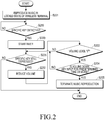
- FIG. 2 is a flow chart showing a process of terminating music reproduction in the wireless terminal according to the exemplary embodiment of the present invention.
- the controller 110 switches the wireless terminal to a locked state and reproduces the music as a background task even though the wireless terminal is in a locked state.
- the volume is reduced, in response to the volume down key, at S230.
- the controller 110 does not temporarily stop the reproduced music but may terminate the music application, when the input of the volume down key is maintained for at least a predetermined amount of time and the volume level is in the "0" state.
- the embodiment of the present invention describes, by way of example, the case in which the music being reproduced as a background task is terminated through the input of a specific key when the wireless terminal is in a locked state.
- the controller 110 may terminate the music being reproduced as a background task through the input of a specific key, regardless of the current operation mode of the wireless terminal (i.e., a locked state, a standby mode or a specific application mode).
- the check (S203) whether the volume level is "0" may be omitted.
- the exemplary embodiment of the present invention describes, by way of example, the case in which the music being reproduced as a background task is terminated through, for example, the input of the volume down key.
- the music being reproduced as a background task may be terminated even when a volume up key and a volume down key are simultaneously input (i.e., the predetermined time being a zero amount of time) or the volume up key and the volume down key are simultaneously input for at least the predetermined time.
- the wireless terminal can be adapted to log timestamps of key press and release events, and by comparing the timestamps determine the amount of time elapsed.
- the present invention provides a device and a method for terminating music reproduction in a wireless terminal, by which it is possible to conveniently terminate music being reproduced (e.g. as a background task) regardless of the current status of the wireless terminal and to reduce power consumption by terminating a music application.
- the above-described methods according to the present invention can be implemented in hardware, firmware or as software or computer code that can be stored in a recording medium such as a CD ROM, an RAM, a floppy disk, a hard disk, or a magneto-optical disk or computer code downloaded over a network originally stored on a remote recording medium or a non-transitory machine readable medium and to be stored on a local recording medium, so that the methods described herein can be rendered in such software that is stored on the recording medium using a general purpose computer, or a special processor or in programmable or dedicated hardware, such as an ASIC or FPGA.
- a recording medium such as a CD ROM, an RAM, a floppy disk, a hard disk, or a magneto-optical disk or computer code downloaded over a network originally stored on a remote recording medium or a non-transitory machine readable medium and to be stored on a local recording medium, so that the methods described herein can be rendered in such software that is stored on the recording medium using a
- the computer, the processor, microprocessor controller or the programmable hardware include memory components, e.g., RAM, ROM, Flash, etc. that may store or receive software or computer code that when accessed and executed by the computer, processor or hardware implement the processing methods described herein.
- memory components e.g., RAM, ROM, Flash, etc.
- the execution of the code transforms the general purpose computer into a special purpose computer for executing the processing shown herein.
Landscapes
- Engineering & Computer Science (AREA)
- Theoretical Computer Science (AREA)
- Multimedia (AREA)
- Physics & Mathematics (AREA)
- Human Computer Interaction (AREA)
- General Engineering & Computer Science (AREA)
- Computer Networks & Wireless Communication (AREA)
- General Physics & Mathematics (AREA)
- Acoustics & Sound (AREA)
- General Health & Medical Sciences (AREA)
- Audiology, Speech & Language Pathology (AREA)
- Health & Medical Sciences (AREA)
- Signal Processing (AREA)
- Computer Hardware Design (AREA)
- Telephone Function (AREA)
- Electrophonic Musical Instruments (AREA)
Description
- The present invention relates to the field of wireless devices and more particularly, to a device and a method for terminating music reproduction in a wireless terminal.
- As wireless terminals (e.g., cellular telephones, tablets, netbooks, ultrabooks, etc.) have changed from simple voice communications to complex internet access devices as the wireless networks have increased their capabilities, reliability and performance.
- As wireless terminals have increased their functionality, (e.g., including a music player function), they also have been adapted to contain large -capacity memory for storage of musical tracks.
- Further, the wireless terminal that can implement multiprocessing can perform other applications while reproducing music as a background task.
- However, in specific situations in which a user intends to terminate a music reproduction, the user needs to perform several input task so as to terminate the reproduced music.
- For example, to terminate the music reproduction when the wireless terminal is in a locked state, the user needs to first depress a home key or a power key to activate a turned-off display unit, and input a pattern or a password for releasing the locked state of the wireless terminal. After the wireless terminal has been released from the locked state, and switched to a standby mode, the music may be stopped by selecting a music application that is being currently executed.
- Thus, in order to terminate music being reproduced as a background task, when the display unit is in an inactive or locked state, the user needs to execute four processes, including activating the display, entering a password, recalling the music reproduction application and then terminating the music reproduction.
-
US 2008/249643 A1 discloses a portable media player with a physical button or switch that provides for the selective enabling or disabling of input controls. In a lock state, various buttons may still be enabled. -
US 2007/186758 A1 discloses a method and apparatus for controlling a background music play operation of a mobile device. Pressing a hotkey may bring up a control box for the play operation. - The anonymous publication "Next Track AndroLib By EP Dev | Media & Video", retrieved from the Internet at http://www.androlib.com/android, discloses that volume buttons may have different functions depending on a duration of the button press.
- Accordingly, an aspect of the present invention is to solve the above-mentioned problems occurring in the prior art, and to provide a device and a method for conveniently terminating music being reproduced in the wireless terminal.
- Another aspect of the present invention is to provide a device and a method for conveniently terminating music being reproduced as a background task regardless of a current operating mode of the wireless terminal.
- Still another aspect of the present invention is to provide a device and a method for conveniently terminating music applications that are being executed as a background task regardless of a current operating mode of the wireless terminal.
- In accordance with an aspect of the present invention, there is provided a device for terminating music reproduction in a wireless terminal, comprising a key input unit including at least one specific key terminating music reproduction and a controller adapted to terminate the music reproduction when an input of at least one of the least one specific key is maintained for at least a predetermined amount of time.
- With music reproduction is meant the steps or process of obtaining or receiving (digital) audio data, performing any necessary decompression, decrypting, and/or decoding steps, and preparing the processed audio data for analog or digital output. Terminating the music reproduction may involve stopping or at least temporarily halting any or all of these steps. Terminating the music reproduction may or may not involve terminating the application which controls the music reproduction steps. Terminating the music reproduction thus advantageously frees processing and storage resources of the wireless terminal, allowing other tasks to be performed and/or reducing energy consumption. Terminating the music application, which controls the music reproduction, may free more resources than merely terminating the music reproduction.
- Example values for the predetermined amount of time are at least 1 second, or at least 2 seconds, or at least 3 seconds.
- With maintaining an input of a key is meant that the key is activated, e.g. by pressing it in case of a push-button type key.
- In accordance with another aspect of the present invention, there is provided a method for terminating music reproduction in a wireless terminal, comprising: reproducing music; and terminating the music reproduction when an input of at least one of a specific key is maintained for at least a predetermined time during the music reproduction.
- In accordance with another aspect of the present invention, there is provided a device comprising a key input unit and a processor in communication with a memory, the memory including code which when accessed by the processor causes the processor to monitor an input from the key input unit, responsive to an input from the key input unit associated with a specific key, adjusting a volume of a music item being reproduced, determine whether the input from the key input unit is maintained for a predetermined amount of time and terminate an application associated with the music item being reproduced when the input from the key input unit is determined to be maintained for the predetermined amount of time.
- The scope of the invention is defined by the appended claims.
- The above and other aspects, features and advantages of the present invention will be more apparent from the following detailed description taken in conjunction with the accompanying drawings, in which:
-
FIG. 1 illustrates a wireless terminal; and -
FIG. 2 is a flow chart illustrating a process of terminating music reproduction in the wireless terminal according to the exemplary embodiment of the present invention. - Exemplary embodiments of the present invention are described with reference to the accompanying drawings. In the following description, the same elements will be designated by the same reference numerals although they are shown in different drawings. In the following description, well-known functions or constructions are not described in detail since they would obscure the invention in unnecessary detail.
- Also, terms described herein, which are defined considering the functions of the present invention, may be implemented differently depending on a user's and operator's intention and practice. Therefore, the terms should be understood on the basis of the disclosure throughout the specification. The principles and features of this invention may be employed in varied and numerous embodiments without departing from the scope of the invention.
- Furthermore, although the drawings represent exemplary embodiments of the invention, the drawings are not necessarily to scale and certain features may be exaggerated or omitted in order to more clearly illustrate and explain the present invention.
- Among the terms set forth herein, a portable terminal (or terminal) refers to any kind of device capable of processing data that is transmitted or received to, or from, an external entity or device. The terminal may display icons or menus on a screen to which stored data and various executable functions are assigned or mapped. The terminal may represent a computer, a notebook, a tablet PC, a mobile device, and the like.
-
FIG. 1 shows a configuration of a wireless terminal according to an exemplary embodiment of the present invention. - Referring to
FIG. 1 , anRF unit 123 performs a wireless communication function of a wireless terminal. TheRF unit 123 may include an RF transmitter (not shown) for up-converting a frequency of a transmitted signal and amplifying the transmitted signal, an RF receiver (not shown) for low-noise amplifying and downconverting a received signal, and the like. Adata processor 120 may include a transmitter (not shown) for encoding and modulating the transmitted signal, a receiver (not shown) for demodulating and decoding the received signal, and the like. That is, thedata processor 120 may be configured with a modem (modulator/demodulator) and a codec (coder/decoder). In this configuration, the codec may include a data codec for processing packet data and an audio codec for processing audio signals, such as voice data. Anaudio processor 125 serves to reproduce the received audio signals output from the audio codec of thedata processor 120 or to transmit the audio signals generated from a microphone to the audio codec of thedata processor 120. - A
key input unit 127 may include keys for inputting alphanumeric information and function keys for setting various keys. - Further, the
key input unit 127 may include at least one specific key that can terminate music reproduction. For example, the at least one specific key may be represented by the volume control keys that provide for controlling a volume of the wireless device. In a conventional wireless transmission device, such as a cellular telephone, the volume control keys (one for increasingvolume 128 and a second for decreasing volume 129) may be keys that are positioned along a side of the wireless device. In another aspect of the invention, the specific key may be a specific key that has been designated to be a music reproduction termination key when music reproduction is in progress. For example, a power-on key (not shown) may represent a music termination key when the wireless terminal is performing a music reproduction task. -
Memory 130 may include a program memory (not shown) and a data memory (not shown). The program memory may store programs for controlling a general operation of the wireless terminal. In addition, according to the exemplary embodiment of the present invention, the program memory may store programs for controlling the termination of music reproduction when the input of a specific key is maintained for at least a predetermined amount of time. Further, the data memory serves to temporarily store data generated during the execution of the programs. - A
controller 110 serves to control a general operation of the wireless terminal. - According to the exemplary embodiment of the present invention, the
controller 110 may control the termination of music reproduction when the specific key is input for at least a predetermined amount of time during reproduction of music in the wireless terminal. - Further, according to an exemplary embodiment of the present invention, the
controller 110 controls the termination of the music reproduction, possibly also terminating the background task or application controlling the music reproduction, when the input of one or more of the specific keys, (e.g., the volume control keys) is maintained for at least a predetermined time when the wireless terminal is in the locked state. - For example, according to an exemplary embodiment of the present invention, the
controller 110 controls termination of music being reproduced as a background task when an input of the volume down key is continuously maintained for at least a predetermined amount time, in the case the volume down key is designated as the specific key for music reproduction termination. That is, when the wireless terminal is in a locked state and the volume control down key is input for at least a predetermined time, the volume is reduced to a "0" state and the music reproduction is subsequently terminated. In this case, the user does not have to take the usual steps of unlocking the wireless terminal, which saves time. - As would be recognized, termination of the music being reproduced may involve termination of a music reproduction application that is being performed as a foreground or background task in the wireless terminal.
- In addition according to an exemplary embodiment of the present invention, the
controller 110 controls termination of the music being reproduced (e.g. as a background task) when the wireless terminal is in a standby mode or a specific applications mode and the input of the specific key(s), (e.g., the volume control down key) is maintained for at least a predetermined amount of time. - Further, according to an exemplary embodiment of the present invention, the
controller 110 controls termination of the music being reproduced as a background task when the input of the volume down key is continuously maintained for at least a predetermined time, in the case that the volume down key is the specific key. Alternatively, when one or more of the volume control keys of the wireless terminal is input for at least a predetermined time, when the wireless terminal is in a standby mode or the specific applications mode of the wireless terminal, then the volume level may be reduced to a "0" state and the music reproduction is terminated. - Thus, according to an exemplary embodiment of the present invention, the
controller 110 controls termination of a music application being used to reproduce the music as a background task when the input of the specific key(s) is maintained for at least a predetermined amount of time. - The
camera unit 140 may include a camera sensor for photographing image data and converting photographed image data into electrical signals and a signal processor converting image data signals photographed by the camera sensor into digital data. In this configuration, the camera sensor may be one of a CCD or a CMOS sensor and the signal processor may be implemented by a digital signal processor. Further, the camera sensor and the signal processor may be integrally implemented or separately implemented. - The
image processor 150 performs image signal processing (ISP) for displaying the image signals output from thecamera unit 140 on adisplay unit 160, wherein the ISP performs functions such as gamma calibration, interpolation, spatial variation, image effect, image scale, AWB, AE, AF, and the like. Therefore, theimage processor 150 processes the image signals output from thecamera unit 140 in a frame unit and outputs the frame image data in response to a feature and size of thedisplay unit 160. Further, theimage processor 150 includes a video codec and serves to compress the frame image data displayed on thedisplay unit 160 in an established manner or reconstruct the compressed frame image data into original frame image data. Here, the video codec may be a JPEG codec, an MPEG4 codec, a Wavelet codec, or the like. Theimage processor 150 is assumed to include an on-screen display (OSD) function and may output on-screen display data according to a screen size displayed under the control of thecontroller 110. - The
display unit 160 displays the image signal output from theimage processor 150 on the screen and displays user data output from thecontroller 110. Herein, thedisplay unit 160 may use an LCD, an LED or an OLED. In this case, thedisplay unit 160 may include a display controller, a display memory storing the image data, an LCD (LED, OLED) display device, and the like (all of which are not shown). Herein, when the display unit may be implemented as a touch screen device and, thus, the display unit may be operated as an input unit. In this case, thedisplay unit 160 may display keys similar to that of thekey input unit 127, or the like. The display unit may operate as the sole input unit or may operate in conjunction with thekey input unit 127. - In the above-mentioned wireless terminal, an operation of terminating music reproduction will be described with reference to
FIG. 2 . -
FIG. 2 is a flow chart showing a process of terminating music reproduction in the wireless terminal according to the exemplary embodiment of the present invention. - Referring to
FIG. 2 , at S201, thecontroller 110 switches the wireless terminal to a locked state and reproduces the music as a background task even though the wireless terminal is in a locked state. - At S215 a determination is made whether a specific key has been inputted (by being detected by a processor, for example). If the specific key is detected (for example, the specific key is a volume down key (129,
FIG. 1 ), then a timer is started at block 220. At block 225, a determination is made whether the specific key is still depressed. If the answer is negative, then processing is ended. - However, if the specific key is determined to be still depressed, then the volume is reduced, in response to the volume down key, at S230.
- At S203, a determination is made whether the volume level is reduced to "0." If the answer is negative, then processing continues to S225 to determine whether the specific key is still depressed. If yes, then volume is again reduced and processing continues to S203.
- At S203, when the volume is determined to be at a "0" level, then a determination is made when the specific key (in this exemplary case, the volume down key 129) is input for a predetermined or more. If the answer is negative, then processing continues to S225 to determine whether the specific key (i.e., the volume down key 129) is still depressed.
- However, if at S204, it is determined that the specific key has been depressed for the predetermined time or more, then the music being played as a background task is terminated.
- At S205, the
controller 110 does not temporarily stop the reproduced music but may terminate the music application, when the input of the volume down key is maintained for at least a predetermined amount of time and the volume level is in the "0" state. - As shown in
FIG. 2 , the embodiment of the present invention describes, by way of example, the case in which the music being reproduced as a background task is terminated through the input of a specific key when the wireless terminal is in a locked state. In addition, thecontroller 110 may terminate the music being reproduced as a background task through the input of a specific key, regardless of the current operation mode of the wireless terminal (i.e., a locked state, a standby mode or a specific application mode). As is also noted, the check (S203) whether the volume level is "0" may be omitted. - Further, the exemplary embodiment of the present invention describes, by way of example, the case in which the music being reproduced as a background task is terminated through, for example, the input of the volume down key. However, it would be recognized that the music being reproduced as a background task may be terminated even when a volume up key and a volume down key are simultaneously input (i.e., the predetermined time being a zero amount of time) or the volume up key and the volume down key are simultaneously input for at least the predetermined time.
- It is noted that means to measure a predetermined amount of time other than the timer of S220 are available to the skilled person. For example, the wireless terminal can be adapted to log timestamps of key press and release events, and by comparing the timestamps determine the amount of time elapsed. The present invention provides a device and a method for terminating music reproduction in a wireless terminal, by which it is possible to conveniently terminate music being reproduced (e.g. as a background task) regardless of the current status of the wireless terminal and to reduce power consumption by terminating a music application.
- The above-described methods according to the present invention can be implemented in hardware, firmware or as software or computer code that can be stored in a recording medium such as a CD ROM, an RAM, a floppy disk, a hard disk, or a magneto-optical disk or computer code downloaded over a network originally stored on a remote recording medium or a non-transitory machine readable medium and to be stored on a local recording medium, so that the methods described herein can be rendered in such software that is stored on the recording medium using a general purpose computer, or a special processor or in programmable or dedicated hardware, such as an ASIC or FPGA. As would be understood in the art, the computer, the processor, microprocessor controller or the programmable hardware include memory components, e.g., RAM, ROM, Flash, etc. that may store or receive software or computer code that when accessed and executed by the computer, processor or hardware implement the processing methods described herein. In addition, it would be recognized that when a general purpose computer accesses code for implementing the processing shown herein, the execution of the code transforms the general purpose computer into a special purpose computer for executing the processing shown herein.
- While the invention has been shown and described with reference to certain exemplary embodiments thereof, it will be understood by those skilled in the art that various changes in form and details may be made therein without departing from the scope of the invention as defined by the appended claims.
Claims (9)
- A wireless terminal for terminating music reproduction, the wireless terminal comprising:a key input unit (127) adapted to include at least one specific key for terminating music reproduction; anda controller (110) adapted to terminate an application which controls the music reproduction,characterized in that:the at least one specific key is a volume down key,the controller is further adapted to, when inputting of the volume down key is detected, start a timer and reduce the volume down up to volume level "0",if the volume down key is input for a predetermined time or more, determine termination of the music reproduction (S205), andterminate the application controlling the music reproduction (S204) when the input of the volume down key is maintained for at least the predetermined amount of time (S205), and when the wireless terminal is in a locked state.
- The wireless terminal of claim 1 , wherein the controller (110) is adapted to control termination of the music reproduction when the input of the volume down key is maintained for at least the predetermined amount of time (S205), and when the wireless terminal is in one of: a standby mode and executing a specific application mode.
- The wireless terminal of claim 1, wherein the lowest value is "0".
- The wireless terminal of any of the preceding claims, wherein the controller (110) is adapted to control termination of the music reproduction when a volume up key and the volume down key of the wireless terminal are simultaneously input.
- A method for terminating music reproduction in a wireless terminal comprising a key input unit (127) adapted to include at least one specific key, the method comprising:reproducing music (S201); andterminating a music application which controls the music reproduction (S205),characterized in that:the at least one specific key is a volume down key,the method further comprising, when inputting of the volume down key is detected, starting a timer and reducing the volume down up to volume level "0",if the volume down key is input for a predetermined time or more, determining termination of the music reproduction; andterminating the application controlling the music reproduction (S205) when the input of the volume down key is maintained for at least the predetermined amount of time, and when the wireless terminal is in a locked state.
- The method of claim 5, wherein terminating the music reproduction comprises terminating the music being reproduced (205) when the input of the volume down key is maintained for at least the predetermined amount of time, and when the wireless terminal is in one of: a standby mode and executing a specific application mode.
- The method of claim 5, wherein terminating the music reproduction comprises:in response to the input of the volume down key, reducing a volume level of the reproduced music; anddetermining whether the reduced volume level is in a "0" (S204) state.
- The method of any of the claims 5-7, wherein terminating the music reproduction comprises terminating the music application (S205).
- The method of any of the claims 5-8, wherein terminating the music reproduction comprises terminating the music reproduction when a volume up key and the volume down key of the wireless terminal are simultaneously input, or terminating the music reproduction when the volume up key and the volume down key are simultaneously input for at least the predetermined amount of time.
Applications Claiming Priority (1)
| Application Number | Priority Date | Filing Date | Title |
|---|---|---|---|
| KR1020110139113A KR101867618B1 (en) | 2011-12-21 | 2011-12-21 | Device and method for terminating music play in wireless terminal |
Publications (3)
| Publication Number | Publication Date |
|---|---|
| EP2608014A2 EP2608014A2 (en) | 2013-06-26 |
| EP2608014A3 EP2608014A3 (en) | 2014-11-05 |
| EP2608014B1 true EP2608014B1 (en) | 2019-03-13 |
Family
ID=47747274
Family Applications (1)
| Application Number | Title | Priority Date | Filing Date |
|---|---|---|---|
| EP12197937.1A Not-in-force EP2608014B1 (en) | 2011-12-21 | 2012-12-19 | Device and method for terminating music reproduction in a wireless terminal |
Country Status (5)
| Country | Link |
|---|---|
| US (1) | US9477439B2 (en) |
| EP (1) | EP2608014B1 (en) |
| JP (1) | JP6178570B2 (en) |
| KR (1) | KR101867618B1 (en) |
| CN (1) | CN103220405B (en) |
Families Citing this family (2)
| Publication number | Priority date | Publication date | Assignee | Title |
|---|---|---|---|---|
| KR102058461B1 (en) * | 2013-04-30 | 2019-12-23 | 삼성전자 주식회사 | Method and apparatus for processing function of a user device |
| CN105930175A (en) * | 2016-05-31 | 2016-09-07 | 京东方科技集团股份有限公司 | Method and device for closing application tool |
Family Cites Families (18)
| Publication number | Priority date | Publication date | Assignee | Title |
|---|---|---|---|---|
| JP3935697B2 (en) * | 2001-09-21 | 2007-06-27 | ソフトバンクモバイル株式会社 | Telephone capable of executing application program, key control method for telephone, and control program used for telephone |
| JP2004135177A (en) * | 2002-10-11 | 2004-04-30 | Sharp Corp | Mobile phone |
| EP1615465A3 (en) * | 2004-07-08 | 2016-07-27 | LG Electronics, Inc. | Music play control apparatus with an earphone comprising at least one earphone function key, and method thereof |
| JP4172438B2 (en) * | 2004-08-27 | 2008-10-29 | 株式会社デンソー | Sound playback device |
| JP2006315507A (en) * | 2005-05-12 | 2006-11-24 | Fujitsu Ten Ltd | Vehicle-mounted device and information device |
| KR100753804B1 (en) | 2006-06-08 | 2007-08-31 | 삼성전자주식회사 | Apparatus and method for background music control in mobile communication system |
| KR20070010589A (en) * | 2005-07-19 | 2007-01-24 | 엘지전자 주식회사 | Mobile communication terminal provided with a turntable and its operation method |
| KR100703455B1 (en) | 2005-11-30 | 2007-04-03 | 삼성전자주식회사 | Mobile communication terminal having display modes according to the position of the key input unit and image information display method according to the display modes |
| US20070135091A1 (en) * | 2005-12-08 | 2007-06-14 | Wassingbo Tomas K | Electronic equipment with call key lock and program for providing the same |
| US20070271513A1 (en) * | 2006-05-22 | 2007-11-22 | Nike, Inc. | User Interface for Remotely Controlling a Digital Music Player |
| US20080039072A1 (en) * | 2006-08-11 | 2008-02-14 | Bloebaum L Scott | Mobile radio terminal with headset assembly having multi-function user input button and method |
| JP4990582B2 (en) * | 2006-08-25 | 2012-08-01 | 京セラ株式会社 | Portable electronic devices |
| CN100581276C (en) | 2006-11-13 | 2010-01-13 | 华为技术有限公司 | Method and terminal device for supporting playing background music |
| US8843222B2 (en) * | 2007-01-08 | 2014-09-23 | Varia Holdings Llc | Selective locking of input controls for a portable media player |
| US8265709B2 (en) * | 2007-06-22 | 2012-09-11 | Apple Inc. | Single user input mechanism for controlling electronic device operations |
| CN101834929B (en) | 2009-03-13 | 2014-03-26 | 深圳富泰宏精密工业有限公司 | Audio playing system and method |
| KR20110079384A (en) | 2009-12-31 | 2011-07-07 | 사단법인 한국전자정보통신산업진흥회 | Portable digital audio player |
| US9448761B2 (en) * | 2011-06-30 | 2016-09-20 | Nokia Technologies Oy | Method and apparatus for providing audio-based control |
-
2011
- 2011-12-21 KR KR1020110139113A patent/KR101867618B1/en not_active Expired - Fee Related
-
2012
- 2012-10-17 US US13/653,626 patent/US9477439B2/en active Active
- 2012-12-19 EP EP12197937.1A patent/EP2608014B1/en not_active Not-in-force
- 2012-12-20 CN CN201210558606.8A patent/CN103220405B/en not_active Expired - Fee Related
- 2012-12-21 JP JP2012279076A patent/JP6178570B2/en not_active Expired - Fee Related
Non-Patent Citations (1)
| Title |
|---|
| ANONYMOUS: "keyboard shortcuts - Super key to pause, mute mic, and mute speakers in windows - Super User", 15 October 2009 (2009-10-15), XP055428493, Retrieved from the Internet <URL:https://superuser.com/questions/55598/super-key-to-pause-mute-mic-and-mute-speakers-in-windows> [retrieved on 20171124] * |
Also Published As
| Publication number | Publication date |
|---|---|
| US20130166054A1 (en) | 2013-06-27 |
| KR101867618B1 (en) | 2018-06-18 |
| KR20130071730A (en) | 2013-07-01 |
| EP2608014A2 (en) | 2013-06-26 |
| CN103220405A (en) | 2013-07-24 |
| US9477439B2 (en) | 2016-10-25 |
| JP6178570B2 (en) | 2017-08-09 |
| CN103220405B (en) | 2018-03-30 |
| EP2608014A3 (en) | 2014-11-05 |
| JP2013132059A (en) | 2013-07-04 |
Similar Documents
| Publication | Publication Date | Title |
|---|---|---|
| KR101665277B1 (en) | Method for controlling smart terminal device, system, program and recording medium thereof | |
| KR101832492B1 (en) | Device and method for confirming remaining amount of battery in wireless terminal | |
| CN108966008B (en) | Live video playback method and device | |
| US9961393B2 (en) | Method and device for playing multimedia file | |
| KR100630204B1 (en) | Apparatus and method for performing multitasking of a mobile terminal | |
| WO2019127868A1 (en) | Screen orientation switching method, device, and terminal | |
| CN107122158A (en) | The method and device of broadcast information prompting audio, electronic equipment | |
| KR102148001B1 (en) | Display apparatus and method for controlling of display apparatus | |
| CN104636110A (en) | Method and device for controlling volume | |
| US20110050578A1 (en) | Electronic device with switchable input modes and method thereof | |
| WO2015078349A1 (en) | Microphone sound-reception status switching method and apparatus | |
| WO2014082553A1 (en) | Multimedia playing method, device and terminal | |
| TW201427404A (en) | System and method for controlling smart televisions | |
| KR101342210B1 (en) | Device and method for controlling screen brightness in wireless terminal | |
| CN110989816B (en) | Application processing method and device and storage medium | |
| CN105451049A (en) | Multi-key interaction method and set top box | |
| EP2608014A2 (en) | Device and method for terminating music reproduction in a wireless terminal | |
| KR101454484B1 (en) | Digital television to add annexation function and execution method of the annexation function | |
| KR20120065770A (en) | Device and method for performing menu in wireless terminal | |
| KR20040093330A (en) | Method for button lock according to function in wireless terminal | |
| KR20050023558A (en) | Method for displaying of constructing background image in wireless terminal | |
| KR100594167B1 (en) | How to control your mobile device through external memory | |
| KR20080109553A (en) | Mobile terminal and how to play his multimedia files | |
| KR100790070B1 (en) | Key input device and method of mobile terminal | |
| US20120044148A1 (en) | Apparatus and method for performing word spacing in a portable terminal |
Legal Events
| Date | Code | Title | Description |
|---|---|---|---|
| AK | Designated contracting states |
Kind code of ref document: A2 Designated state(s): AL AT BE BG CH CY CZ DE DK EE ES FI FR GB GR HR HU IE IS IT LI LT LU LV MC MK MT NL NO PL PT RO RS SE SI SK SM TR |
|
| AX | Request for extension of the european patent |
Extension state: BA ME |
|
| PUAI | Public reference made under article 153(3) epc to a published international application that has entered the european phase |
Free format text: ORIGINAL CODE: 0009012 |
|
| PUAL | Search report despatched |
Free format text: ORIGINAL CODE: 0009013 |
|
| AK | Designated contracting states |
Kind code of ref document: A3 Designated state(s): AL AT BE BG CH CY CZ DE DK EE ES FI FR GB GR HR HU IE IS IT LI LT LU LV MC MK MT NL NO PL PT RO RS SE SI SK SM TR |
|
| AX | Request for extension of the european patent |
Extension state: BA ME |
|
| RIC1 | Information provided on ipc code assigned before grant |
Ipc: H04M 1/725 20060101ALI20140930BHEP Ipc: G06F 3/16 20060101AFI20140930BHEP Ipc: H04M 1/247 20060101ALI20140930BHEP |
|
| 17P | Request for examination filed |
Effective date: 20150506 |
|
| RBV | Designated contracting states (corrected) |
Designated state(s): AL AT BE BG CH CY CZ DE DK EE ES FI FR GB GR HR HU IE IS IT LI LT LU LV MC MK MT NL NO PL PT RO RS SE SI SK SM TR |
|
| STAA | Information on the status of an ep patent application or granted ep patent |
Free format text: STATUS: EXAMINATION IS IN PROGRESS |
|
| 17Q | First examination report despatched |
Effective date: 20170117 |
|
| GRAP | Despatch of communication of intention to grant a patent |
Free format text: ORIGINAL CODE: EPIDOSNIGR1 |
|
| STAA | Information on the status of an ep patent application or granted ep patent |
Free format text: STATUS: GRANT OF PATENT IS INTENDED |
|
| INTG | Intention to grant announced |
Effective date: 20181001 |
|
| GRAS | Grant fee paid |
Free format text: ORIGINAL CODE: EPIDOSNIGR3 |
|
| GRAA | (expected) grant |
Free format text: ORIGINAL CODE: 0009210 |
|
| STAA | Information on the status of an ep patent application or granted ep patent |
Free format text: STATUS: THE PATENT HAS BEEN GRANTED |
|
| AK | Designated contracting states |
Kind code of ref document: B1 Designated state(s): AL AT BE BG CH CY CZ DE DK EE ES FI FR GB GR HR HU IE IS IT LI LT LU LV MC MK MT NL NO PL PT RO RS SE SI SK SM TR |
|
| REG | Reference to a national code |
Ref country code: GB Ref legal event code: FG4D |
|
| REG | Reference to a national code |
Ref country code: CH Ref legal event code: EP Ref country code: AT Ref legal event code: REF Ref document number: 1108615 Country of ref document: AT Kind code of ref document: T Effective date: 20190315 |
|
| REG | Reference to a national code |
Ref country code: DE Ref legal event code: R096 Ref document number: 602012057701 Country of ref document: DE |
|
| REG | Reference to a national code |
Ref country code: IE Ref legal event code: FG4D |
|
| REG | Reference to a national code |
Ref country code: NL Ref legal event code: FP |
|
| REG | Reference to a national code |
Ref country code: LT Ref legal event code: MG4D |
|
| PG25 | Lapsed in a contracting state [announced via postgrant information from national office to epo] |
Ref country code: SE Free format text: LAPSE BECAUSE OF FAILURE TO SUBMIT A TRANSLATION OF THE DESCRIPTION OR TO PAY THE FEE WITHIN THE PRESCRIBED TIME-LIMIT Effective date: 20190313 Ref country code: LT Free format text: LAPSE BECAUSE OF FAILURE TO SUBMIT A TRANSLATION OF THE DESCRIPTION OR TO PAY THE FEE WITHIN THE PRESCRIBED TIME-LIMIT Effective date: 20190313 Ref country code: NO Free format text: LAPSE BECAUSE OF FAILURE TO SUBMIT A TRANSLATION OF THE DESCRIPTION OR TO PAY THE FEE WITHIN THE PRESCRIBED TIME-LIMIT Effective date: 20190613 Ref country code: FI Free format text: LAPSE BECAUSE OF FAILURE TO SUBMIT A TRANSLATION OF THE DESCRIPTION OR TO PAY THE FEE WITHIN THE PRESCRIBED TIME-LIMIT Effective date: 20190313 |
|
| PG25 | Lapsed in a contracting state [announced via postgrant information from national office to epo] |
Ref country code: BG Free format text: LAPSE BECAUSE OF FAILURE TO SUBMIT A TRANSLATION OF THE DESCRIPTION OR TO PAY THE FEE WITHIN THE PRESCRIBED TIME-LIMIT Effective date: 20190613 Ref country code: RS Free format text: LAPSE BECAUSE OF FAILURE TO SUBMIT A TRANSLATION OF THE DESCRIPTION OR TO PAY THE FEE WITHIN THE PRESCRIBED TIME-LIMIT Effective date: 20190313 Ref country code: HR Free format text: LAPSE BECAUSE OF FAILURE TO SUBMIT A TRANSLATION OF THE DESCRIPTION OR TO PAY THE FEE WITHIN THE PRESCRIBED TIME-LIMIT Effective date: 20190313 Ref country code: LV Free format text: LAPSE BECAUSE OF FAILURE TO SUBMIT A TRANSLATION OF THE DESCRIPTION OR TO PAY THE FEE WITHIN THE PRESCRIBED TIME-LIMIT Effective date: 20190313 Ref country code: GR Free format text: LAPSE BECAUSE OF FAILURE TO SUBMIT A TRANSLATION OF THE DESCRIPTION OR TO PAY THE FEE WITHIN THE PRESCRIBED TIME-LIMIT Effective date: 20190614 |
|
| REG | Reference to a national code |
Ref country code: AT Ref legal event code: MK05 Ref document number: 1108615 Country of ref document: AT Kind code of ref document: T Effective date: 20190313 |
|
| PG25 | Lapsed in a contracting state [announced via postgrant information from national office to epo] |
Ref country code: AL Free format text: LAPSE BECAUSE OF FAILURE TO SUBMIT A TRANSLATION OF THE DESCRIPTION OR TO PAY THE FEE WITHIN THE PRESCRIBED TIME-LIMIT Effective date: 20190313 Ref country code: CZ Free format text: LAPSE BECAUSE OF FAILURE TO SUBMIT A TRANSLATION OF THE DESCRIPTION OR TO PAY THE FEE WITHIN THE PRESCRIBED TIME-LIMIT Effective date: 20190313 Ref country code: ES Free format text: LAPSE BECAUSE OF FAILURE TO SUBMIT A TRANSLATION OF THE DESCRIPTION OR TO PAY THE FEE WITHIN THE PRESCRIBED TIME-LIMIT Effective date: 20190313 Ref country code: SK Free format text: LAPSE BECAUSE OF FAILURE TO SUBMIT A TRANSLATION OF THE DESCRIPTION OR TO PAY THE FEE WITHIN THE PRESCRIBED TIME-LIMIT Effective date: 20190313 Ref country code: PT Free format text: LAPSE BECAUSE OF FAILURE TO SUBMIT A TRANSLATION OF THE DESCRIPTION OR TO PAY THE FEE WITHIN THE PRESCRIBED TIME-LIMIT Effective date: 20190713 Ref country code: EE Free format text: LAPSE BECAUSE OF FAILURE TO SUBMIT A TRANSLATION OF THE DESCRIPTION OR TO PAY THE FEE WITHIN THE PRESCRIBED TIME-LIMIT Effective date: 20190313 Ref country code: RO Free format text: LAPSE BECAUSE OF FAILURE TO SUBMIT A TRANSLATION OF THE DESCRIPTION OR TO PAY THE FEE WITHIN THE PRESCRIBED TIME-LIMIT Effective date: 20190313 Ref country code: IT Free format text: LAPSE BECAUSE OF FAILURE TO SUBMIT A TRANSLATION OF THE DESCRIPTION OR TO PAY THE FEE WITHIN THE PRESCRIBED TIME-LIMIT Effective date: 20190313 |
|
| PG25 | Lapsed in a contracting state [announced via postgrant information from national office to epo] |
Ref country code: SM Free format text: LAPSE BECAUSE OF FAILURE TO SUBMIT A TRANSLATION OF THE DESCRIPTION OR TO PAY THE FEE WITHIN THE PRESCRIBED TIME-LIMIT Effective date: 20190313 Ref country code: PL Free format text: LAPSE BECAUSE OF FAILURE TO SUBMIT A TRANSLATION OF THE DESCRIPTION OR TO PAY THE FEE WITHIN THE PRESCRIBED TIME-LIMIT Effective date: 20190313 |
|
| REG | Reference to a national code |
Ref country code: DE Ref legal event code: R097 Ref document number: 602012057701 Country of ref document: DE |
|
| PG25 | Lapsed in a contracting state [announced via postgrant information from national office to epo] |
Ref country code: IS Free format text: LAPSE BECAUSE OF FAILURE TO SUBMIT A TRANSLATION OF THE DESCRIPTION OR TO PAY THE FEE WITHIN THE PRESCRIBED TIME-LIMIT Effective date: 20190713 Ref country code: AT Free format text: LAPSE BECAUSE OF FAILURE TO SUBMIT A TRANSLATION OF THE DESCRIPTION OR TO PAY THE FEE WITHIN THE PRESCRIBED TIME-LIMIT Effective date: 20190313 |
|
| PLBE | No opposition filed within time limit |
Free format text: ORIGINAL CODE: 0009261 |
|
| STAA | Information on the status of an ep patent application or granted ep patent |
Free format text: STATUS: NO OPPOSITION FILED WITHIN TIME LIMIT |
|
| PG25 | Lapsed in a contracting state [announced via postgrant information from national office to epo] |
Ref country code: DK Free format text: LAPSE BECAUSE OF FAILURE TO SUBMIT A TRANSLATION OF THE DESCRIPTION OR TO PAY THE FEE WITHIN THE PRESCRIBED TIME-LIMIT Effective date: 20190313 |
|
| 26N | No opposition filed |
Effective date: 20191216 |
|
| PG25 | Lapsed in a contracting state [announced via postgrant information from national office to epo] |
Ref country code: SI Free format text: LAPSE BECAUSE OF FAILURE TO SUBMIT A TRANSLATION OF THE DESCRIPTION OR TO PAY THE FEE WITHIN THE PRESCRIBED TIME-LIMIT Effective date: 20190313 |
|
| PG25 | Lapsed in a contracting state [announced via postgrant information from national office to epo] |
Ref country code: TR Free format text: LAPSE BECAUSE OF FAILURE TO SUBMIT A TRANSLATION OF THE DESCRIPTION OR TO PAY THE FEE WITHIN THE PRESCRIBED TIME-LIMIT Effective date: 20190313 |
|
| REG | Reference to a national code |
Ref country code: CH Ref legal event code: PL |
|
| REG | Reference to a national code |
Ref country code: BE Ref legal event code: MM Effective date: 20191231 |
|
| PG25 | Lapsed in a contracting state [announced via postgrant information from national office to epo] |
Ref country code: MC Free format text: LAPSE BECAUSE OF FAILURE TO SUBMIT A TRANSLATION OF THE DESCRIPTION OR TO PAY THE FEE WITHIN THE PRESCRIBED TIME-LIMIT Effective date: 20190313 |
|
| PG25 | Lapsed in a contracting state [announced via postgrant information from national office to epo] |
Ref country code: LU Free format text: LAPSE BECAUSE OF NON-PAYMENT OF DUE FEES Effective date: 20191219 Ref country code: FR Free format text: LAPSE BECAUSE OF NON-PAYMENT OF DUE FEES Effective date: 20191231 Ref country code: IE Free format text: LAPSE BECAUSE OF NON-PAYMENT OF DUE FEES Effective date: 20191219 |
|
| PG25 | Lapsed in a contracting state [announced via postgrant information from national office to epo] |
Ref country code: BE Free format text: LAPSE BECAUSE OF NON-PAYMENT OF DUE FEES Effective date: 20191231 Ref country code: CH Free format text: LAPSE BECAUSE OF NON-PAYMENT OF DUE FEES Effective date: 20191231 Ref country code: LI Free format text: LAPSE BECAUSE OF NON-PAYMENT OF DUE FEES Effective date: 20191231 |
|
| PGFP | Annual fee paid to national office [announced via postgrant information from national office to epo] |
Ref country code: NL Payment date: 20201123 Year of fee payment: 9 |
|
| PGFP | Annual fee paid to national office [announced via postgrant information from national office to epo] |
Ref country code: GB Payment date: 20201125 Year of fee payment: 9 Ref country code: DE Payment date: 20201120 Year of fee payment: 9 |
|
| PG25 | Lapsed in a contracting state [announced via postgrant information from national office to epo] |
Ref country code: CY Free format text: LAPSE BECAUSE OF FAILURE TO SUBMIT A TRANSLATION OF THE DESCRIPTION OR TO PAY THE FEE WITHIN THE PRESCRIBED TIME-LIMIT Effective date: 20190313 |
|
| PG25 | Lapsed in a contracting state [announced via postgrant information from national office to epo] |
Ref country code: HU Free format text: LAPSE BECAUSE OF FAILURE TO SUBMIT A TRANSLATION OF THE DESCRIPTION OR TO PAY THE FEE WITHIN THE PRESCRIBED TIME-LIMIT; INVALID AB INITIO Effective date: 20121219 Ref country code: MT Free format text: LAPSE BECAUSE OF FAILURE TO SUBMIT A TRANSLATION OF THE DESCRIPTION OR TO PAY THE FEE WITHIN THE PRESCRIBED TIME-LIMIT Effective date: 20190313 |
|
| PG25 | Lapsed in a contracting state [announced via postgrant information from national office to epo] |
Ref country code: MK Free format text: LAPSE BECAUSE OF FAILURE TO SUBMIT A TRANSLATION OF THE DESCRIPTION OR TO PAY THE FEE WITHIN THE PRESCRIBED TIME-LIMIT Effective date: 20190313 |
|
| REG | Reference to a national code |
Ref country code: DE Ref legal event code: R119 Ref document number: 602012057701 Country of ref document: DE |
|
| REG | Reference to a national code |
Ref country code: NL Ref legal event code: MM Effective date: 20220101 |
|
| GBPC | Gb: european patent ceased through non-payment of renewal fee |
Effective date: 20211219 |
|
| PG25 | Lapsed in a contracting state [announced via postgrant information from national office to epo] |
Ref country code: NL Free format text: LAPSE BECAUSE OF NON-PAYMENT OF DUE FEES Effective date: 20220101 |
|
| PG25 | Lapsed in a contracting state [announced via postgrant information from national office to epo] |
Ref country code: GB Free format text: LAPSE BECAUSE OF NON-PAYMENT OF DUE FEES Effective date: 20211219 Ref country code: DE Free format text: LAPSE BECAUSE OF NON-PAYMENT OF DUE FEES Effective date: 20220701 |