EP2607364A1 - Tetraaza-cyclopenta[a]indenyl and their use as positive allosteric modulators - Google Patents
Tetraaza-cyclopenta[a]indenyl and their use as positive allosteric modulators Download PDFInfo
- Publication number
- EP2607364A1 EP2607364A1 EP11195214.9A EP11195214A EP2607364A1 EP 2607364 A1 EP2607364 A1 EP 2607364A1 EP 11195214 A EP11195214 A EP 11195214A EP 2607364 A1 EP2607364 A1 EP 2607364A1
- Authority
- EP
- European Patent Office
- Prior art keywords
- formula
- title compound
- compound
- tetraaza
- hal
- Prior art date
- Legal status (The legal status is an assumption and is not a legal conclusion. Google has not performed a legal analysis and makes no representation as to the accuracy of the status listed.)
- Withdrawn
Links
- 230000003281 allosteric effect Effects 0.000 title abstract description 7
- 125000003454 indenyl group Chemical group C1(C=CC2=CC=CC=C12)* 0.000 title description 4
- YBYIRNPNPLQARY-UHFFFAOYSA-N 1H-indene Natural products C1=CC=C2CC=CC2=C1 YBYIRNPNPLQARY-UHFFFAOYSA-N 0.000 title 1
- 150000001875 compounds Chemical class 0.000 claims abstract description 214
- 208000037265 diseases, disorders, signs and symptoms Diseases 0.000 claims abstract description 13
- 238000011282 treatment Methods 0.000 claims abstract description 13
- 238000000034 method Methods 0.000 claims description 109
- 239000000203 mixture Substances 0.000 claims description 73
- 239000008194 pharmaceutical composition Substances 0.000 claims description 18
- 150000003839 salts Chemical class 0.000 claims description 17
- 239000004480 active ingredient Substances 0.000 claims description 16
- 125000002887 hydroxy group Chemical group [H]O* 0.000 claims description 14
- 125000004432 carbon atom Chemical group C* 0.000 claims description 12
- 239000012453 solvate Substances 0.000 claims description 12
- 125000003118 aryl group Chemical group 0.000 claims description 11
- 208000024827 Alzheimer disease Diseases 0.000 claims description 10
- 239000003814 drug Substances 0.000 claims description 7
- 125000001424 substituent group Chemical group 0.000 claims description 7
- 239000007821 HATU Substances 0.000 claims description 6
- 125000000217 alkyl group Chemical group 0.000 claims description 6
- 208000015114 central nervous system disease Diseases 0.000 claims description 6
- 208000035475 disorder Diseases 0.000 claims description 6
- 125000004435 hydrogen atom Chemical group [H]* 0.000 claims description 6
- 238000002360 preparation method Methods 0.000 claims description 6
- 230000008569 process Effects 0.000 claims description 6
- 201000000980 schizophrenia Diseases 0.000 claims description 6
- 239000000546 pharmaceutical excipient Substances 0.000 claims description 5
- 229920006395 saturated elastomer Polymers 0.000 claims description 5
- 125000004008 6 membered carbocyclic group Chemical group 0.000 claims description 4
- 208000026139 Memory disease Diseases 0.000 claims description 4
- 208000016285 Movement disease Diseases 0.000 claims description 4
- 208000018737 Parkinson disease Diseases 0.000 claims description 4
- 229910052799 carbon Inorganic materials 0.000 claims description 4
- 230000001684 chronic effect Effects 0.000 claims description 4
- 206010015037 epilepsy Diseases 0.000 claims description 4
- 125000005842 heteroatom Chemical group 0.000 claims description 4
- 208000004296 neuralgia Diseases 0.000 claims description 4
- 208000021722 neuropathic pain Diseases 0.000 claims description 4
- 229910052760 oxygen Inorganic materials 0.000 claims description 4
- 208000019116 sleep disease Diseases 0.000 claims description 4
- 229910052717 sulfur Inorganic materials 0.000 claims description 4
- OKTJSMMVPCPJKN-UHFFFAOYSA-N Carbon Chemical group [C] OKTJSMMVPCPJKN-UHFFFAOYSA-N 0.000 claims description 3
- 208000000094 Chronic Pain Diseases 0.000 claims description 3
- 208000002193 Pain Diseases 0.000 claims description 3
- 239000007822 coupling agent Substances 0.000 claims description 3
- 125000004191 (C1-C6) alkoxy group Chemical group 0.000 claims description 2
- 125000004169 (C1-C6) alkyl group Chemical group 0.000 claims description 2
- 125000001845 4 membered carbocyclic group Chemical group 0.000 claims description 2
- 125000001054 5 membered carbocyclic group Chemical group 0.000 claims description 2
- 239000002671 adjuvant Substances 0.000 claims description 2
- 125000002619 bicyclic group Chemical group 0.000 claims description 2
- 125000002837 carbocyclic group Chemical group 0.000 claims description 2
- 150000001721 carbon Chemical group 0.000 claims description 2
- 229910002091 carbon monoxide Inorganic materials 0.000 claims description 2
- 125000001072 heteroaryl group Chemical group 0.000 claims description 2
- 125000002496 methyl group Chemical group [H]C([H])([H])* 0.000 claims description 2
- 125000002950 monocyclic group Chemical group 0.000 claims description 2
- 125000004430 oxygen atom Chemical group O* 0.000 claims description 2
- 125000001997 phenyl group Chemical group [H]C1=C([H])C([H])=C(*)C([H])=C1[H] 0.000 claims description 2
- 208000012902 Nervous system disease Diseases 0.000 claims 2
- 238000011321 prophylaxis Methods 0.000 claims 2
- 238000004519 manufacturing process Methods 0.000 claims 1
- 201000010099 disease Diseases 0.000 abstract description 7
- 230000001404 mediated effect Effects 0.000 abstract description 3
- 230000003551 muscarinic effect Effects 0.000 abstract description 3
- 102000017927 CHRM1 Human genes 0.000 abstract 1
- 101150073075 Chrm1 gene Proteins 0.000 abstract 1
- WEVYAHXRMPXWCK-UHFFFAOYSA-N Acetonitrile Chemical compound CC#N WEVYAHXRMPXWCK-UHFFFAOYSA-N 0.000 description 112
- IAZDPXIOMUYVGZ-WFGJKAKNSA-N Dimethyl sulfoxide Chemical compound [2H]C([2H])([2H])S(=O)C([2H])([2H])[2H] IAZDPXIOMUYVGZ-WFGJKAKNSA-N 0.000 description 86
- YMWUJEATGCHHMB-UHFFFAOYSA-N Dichloromethane Chemical compound ClCCl YMWUJEATGCHHMB-UHFFFAOYSA-N 0.000 description 84
- 238000005160 1H NMR spectroscopy Methods 0.000 description 72
- 238000004128 high performance liquid chromatography Methods 0.000 description 72
- 239000000543 intermediate Substances 0.000 description 72
- 238000004949 mass spectrometry Methods 0.000 description 71
- 238000001946 ultra-performance liquid chromatography-mass spectrometry Methods 0.000 description 69
- XEKOWRVHYACXOJ-UHFFFAOYSA-N Ethyl acetate Chemical compound CCOC(C)=O XEKOWRVHYACXOJ-UHFFFAOYSA-N 0.000 description 60
- HEDRZPFGACZZDS-MICDWDOJSA-N Trichloro(2H)methane Chemical compound [2H]C(Cl)(Cl)Cl HEDRZPFGACZZDS-MICDWDOJSA-N 0.000 description 54
- 238000000746 purification Methods 0.000 description 49
- 239000007787 solid Substances 0.000 description 48
- QTBSBXVTEAMEQO-UHFFFAOYSA-N Acetic acid Chemical compound CC(O)=O QTBSBXVTEAMEQO-UHFFFAOYSA-N 0.000 description 44
- LFQSCWFLJHTTHZ-UHFFFAOYSA-N Ethanol Chemical compound CCO LFQSCWFLJHTTHZ-UHFFFAOYSA-N 0.000 description 43
- XLYOFNOQVPJJNP-UHFFFAOYSA-N water Substances O XLYOFNOQVPJJNP-UHFFFAOYSA-N 0.000 description 40
- 239000000243 solution Substances 0.000 description 39
- 239000000843 powder Substances 0.000 description 37
- OKKJLVBELUTLKV-UHFFFAOYSA-N Methanol Chemical compound OC OKKJLVBELUTLKV-UHFFFAOYSA-N 0.000 description 33
- -1 hexafluorophosphate methanaminium Chemical compound 0.000 description 27
- RTZKZFJDLAIYFH-UHFFFAOYSA-N Diethyl ether Chemical compound CCOCC RTZKZFJDLAIYFH-UHFFFAOYSA-N 0.000 description 22
- VEXZGXHMUGYJMC-UHFFFAOYSA-N Hydrochloric acid Chemical compound Cl VEXZGXHMUGYJMC-UHFFFAOYSA-N 0.000 description 22
- CSNNHWWHGAXBCP-UHFFFAOYSA-L Magnesium sulfate Chemical compound [Mg+2].[O-][S+2]([O-])([O-])[O-] CSNNHWWHGAXBCP-UHFFFAOYSA-L 0.000 description 22
- 239000002904 solvent Substances 0.000 description 21
- 238000009472 formulation Methods 0.000 description 19
- HEMHJVSKTPXQMS-UHFFFAOYSA-M Sodium hydroxide Chemical compound [OH-].[Na+] HEMHJVSKTPXQMS-UHFFFAOYSA-M 0.000 description 18
- ZMANZCXQSJIPKH-UHFFFAOYSA-N Triethylamine Chemical compound CCN(CC)CC ZMANZCXQSJIPKH-UHFFFAOYSA-N 0.000 description 18
- 238000002425 crystallisation Methods 0.000 description 18
- 230000008025 crystallization Effects 0.000 description 18
- BWHMMNNQKKPAPP-UHFFFAOYSA-L potassium carbonate Chemical compound [K+].[K+].[O-]C([O-])=O BWHMMNNQKKPAPP-UHFFFAOYSA-L 0.000 description 18
- 239000002244 precipitate Substances 0.000 description 17
- 238000002953 preparative HPLC Methods 0.000 description 17
- RYHBNJHYFVUHQT-UHFFFAOYSA-N 1,4-Dioxane Chemical compound C1COCCO1 RYHBNJHYFVUHQT-UHFFFAOYSA-N 0.000 description 16
- DTQVDTLACAAQTR-UHFFFAOYSA-N Trifluoroacetic acid Chemical compound OC(=O)C(F)(F)F DTQVDTLACAAQTR-UHFFFAOYSA-N 0.000 description 16
- 238000006243 chemical reaction Methods 0.000 description 16
- IXCSERBJSXMMFS-UHFFFAOYSA-N hydrogen chloride Substances Cl.Cl IXCSERBJSXMMFS-UHFFFAOYSA-N 0.000 description 16
- 239000011541 reaction mixture Substances 0.000 description 16
- WYURNTSHIVDZCO-UHFFFAOYSA-N Tetrahydrofuran Chemical compound C1CCOC1 WYURNTSHIVDZCO-UHFFFAOYSA-N 0.000 description 15
- 239000003826 tablet Substances 0.000 description 15
- 235000002639 sodium chloride Nutrition 0.000 description 14
- CSCPPACGZOOCGX-UHFFFAOYSA-N Acetone Chemical compound CC(C)=O CSCPPACGZOOCGX-UHFFFAOYSA-N 0.000 description 12
- 238000002844 melting Methods 0.000 description 12
- 230000008018 melting Effects 0.000 description 12
- IAZDPXIOMUYVGZ-UHFFFAOYSA-N Dimethylsulphoxide Chemical compound CS(C)=O IAZDPXIOMUYVGZ-UHFFFAOYSA-N 0.000 description 11
- 229910052943 magnesium sulfate Inorganic materials 0.000 description 11
- 239000000725 suspension Substances 0.000 description 11
- 239000012267 brine Substances 0.000 description 10
- 239000012044 organic layer Substances 0.000 description 10
- HPALAKNZSZLMCH-UHFFFAOYSA-M sodium;chloride;hydrate Chemical compound O.[Na+].[Cl-] HPALAKNZSZLMCH-UHFFFAOYSA-M 0.000 description 10
- 239000002585 base Substances 0.000 description 9
- 150000002148 esters Chemical class 0.000 description 9
- 238000003818 flash chromatography Methods 0.000 description 9
- 235000019341 magnesium sulphate Nutrition 0.000 description 9
- 229910000027 potassium carbonate Inorganic materials 0.000 description 9
- WSLDOOZREJYCGB-UHFFFAOYSA-N 1,2-Dichloroethane Chemical compound ClCCCl WSLDOOZREJYCGB-UHFFFAOYSA-N 0.000 description 8
- BZLVMXJERCGZMT-UHFFFAOYSA-N Methyl tert-butyl ether Chemical compound COC(C)(C)C BZLVMXJERCGZMT-UHFFFAOYSA-N 0.000 description 8
- CDBYLPFSWZWCQE-UHFFFAOYSA-L Sodium Carbonate Chemical compound [Na+].[Na+].[O-]C([O-])=O CDBYLPFSWZWCQE-UHFFFAOYSA-L 0.000 description 8
- 230000015572 biosynthetic process Effects 0.000 description 8
- 238000001914 filtration Methods 0.000 description 8
- 239000007788 liquid Substances 0.000 description 8
- HQKMJHAJHXVSDF-UHFFFAOYSA-L magnesium stearate Chemical compound [Mg+2].CCCCCCCCCCCCCCCCCC([O-])=O.CCCCCCCCCCCCCCCCCC([O-])=O HQKMJHAJHXVSDF-UHFFFAOYSA-L 0.000 description 8
- 239000003921 oil Substances 0.000 description 8
- PAQZWJGSJMLPMG-UHFFFAOYSA-N 2,4,6-tripropyl-1,3,5,2$l^{5},4$l^{5},6$l^{5}-trioxatriphosphinane 2,4,6-trioxide Chemical compound CCCP1(=O)OP(=O)(CCC)OP(=O)(CCC)O1 PAQZWJGSJMLPMG-UHFFFAOYSA-N 0.000 description 7
- 102000014415 Muscarinic acetylcholine receptor Human genes 0.000 description 7
- 108050003473 Muscarinic acetylcholine receptor Proteins 0.000 description 7
- 238000007792 addition Methods 0.000 description 7
- 239000002775 capsule Substances 0.000 description 7
- 239000003208 petroleum Substances 0.000 description 7
- 239000012071 phase Substances 0.000 description 7
- BEVRTOCHMXNPLY-UHFFFAOYSA-N tert-butyl 3-amino-4,6-dihydro-1h-pyrrolo[3,4-c]pyrazole-5-carboxylate Chemical compound N1N=C(N)C2=C1CN(C(=O)OC(C)(C)C)C2 BEVRTOCHMXNPLY-UHFFFAOYSA-N 0.000 description 7
- LMDZBCPBFSXMTL-UHFFFAOYSA-N 1-Ethyl-3-(3-dimethylaminopropyl)carbodiimide Substances CCN=C=NCCCN(C)C LMDZBCPBFSXMTL-UHFFFAOYSA-N 0.000 description 6
- XDZMPRGFOOFSBL-UHFFFAOYSA-N 2-ethoxybenzoic acid Chemical compound CCOC1=CC=CC=C1C(O)=O XDZMPRGFOOFSBL-UHFFFAOYSA-N 0.000 description 6
- JGFZNNIVVJXRND-UHFFFAOYSA-N N,N-Diisopropylethylamine (DIPEA) Chemical compound CCN(C(C)C)C(C)C JGFZNNIVVJXRND-UHFFFAOYSA-N 0.000 description 6
- KWYUFKZDYYNOTN-UHFFFAOYSA-M Potassium hydroxide Chemical compound [OH-].[K+] KWYUFKZDYYNOTN-UHFFFAOYSA-M 0.000 description 6
- VYPSYNLAJGMNEJ-UHFFFAOYSA-N Silicium dioxide Chemical compound O=[Si]=O VYPSYNLAJGMNEJ-UHFFFAOYSA-N 0.000 description 6
- UIIMBOGNXHQVGW-UHFFFAOYSA-M Sodium bicarbonate Chemical compound [Na+].OC([O-])=O UIIMBOGNXHQVGW-UHFFFAOYSA-M 0.000 description 6
- 239000002253 acid Substances 0.000 description 6
- 125000002252 acyl group Chemical group 0.000 description 6
- 150000001412 amines Chemical class 0.000 description 6
- 239000011230 binding agent Substances 0.000 description 6
- 239000006260 foam Substances 0.000 description 6
- 238000010438 heat treatment Methods 0.000 description 6
- 239000000314 lubricant Substances 0.000 description 6
- 235000019198 oils Nutrition 0.000 description 6
- VLTRZXGMWDSKGL-UHFFFAOYSA-N perchloric acid Chemical compound OCl(=O)(=O)=O VLTRZXGMWDSKGL-UHFFFAOYSA-N 0.000 description 6
- 239000007858 starting material Substances 0.000 description 6
- 102000013455 Amyloid beta-Peptides Human genes 0.000 description 5
- 108010090849 Amyloid beta-Peptides Proteins 0.000 description 5
- KFZMGEQAYNKOFK-UHFFFAOYSA-N Isopropanol Chemical compound CC(C)O KFZMGEQAYNKOFK-UHFFFAOYSA-N 0.000 description 5
- 102000007207 Muscarinic M1 Receptor Human genes 0.000 description 5
- 108010008406 Muscarinic M1 Receptor Proteins 0.000 description 5
- KDLHZDBZIXYQEI-UHFFFAOYSA-N Palladium Chemical compound [Pd] KDLHZDBZIXYQEI-UHFFFAOYSA-N 0.000 description 5
- FAPWRFPIFSIZLT-UHFFFAOYSA-M Sodium chloride Chemical compound [Na+].[Cl-] FAPWRFPIFSIZLT-UHFFFAOYSA-M 0.000 description 5
- 229920002472 Starch Polymers 0.000 description 5
- 238000004440 column chromatography Methods 0.000 description 5
- 239000006071 cream Substances 0.000 description 5
- 229920000159 gelatin Polymers 0.000 description 5
- 235000019322 gelatine Nutrition 0.000 description 5
- 239000012442 inert solvent Substances 0.000 description 5
- 230000037361 pathway Effects 0.000 description 5
- 239000000651 prodrug Substances 0.000 description 5
- 229940002612 prodrug Drugs 0.000 description 5
- 125000006239 protecting group Chemical group 0.000 description 5
- 235000019698 starch Nutrition 0.000 description 5
- 239000008107 starch Substances 0.000 description 5
- 239000000126 substance Substances 0.000 description 5
- 238000004808 supercritical fluid chromatography Methods 0.000 description 5
- UCYNEWGETFFMQY-UHFFFAOYSA-N 2-(4-methyl-1,4-diazepan-1-yl)benzoic acid;hydrochloride Chemical compound Cl.C1CN(C)CCCN1C1=CC=CC=C1C(O)=O UCYNEWGETFFMQY-UHFFFAOYSA-N 0.000 description 4
- JZLYEZGHBQFRLU-UHFFFAOYSA-N 2-[2-(dimethylamino)ethoxy]benzoic acid Chemical compound CN(C)CCOC1=CC=CC=C1C(O)=O JZLYEZGHBQFRLU-UHFFFAOYSA-N 0.000 description 4
- WMFOQBRAJBCJND-UHFFFAOYSA-M Lithium hydroxide Chemical compound [Li+].[OH-] WMFOQBRAJBCJND-UHFFFAOYSA-M 0.000 description 4
- NTIZESTWPVYFNL-UHFFFAOYSA-N Methyl isobutyl ketone Chemical compound CC(C)CC(C)=O NTIZESTWPVYFNL-UHFFFAOYSA-N 0.000 description 4
- UIHCLUNTQKBZGK-UHFFFAOYSA-N Methyl isobutyl ketone Natural products CCC(C)C(C)=O UIHCLUNTQKBZGK-UHFFFAOYSA-N 0.000 description 4
- 238000005481 NMR spectroscopy Methods 0.000 description 4
- 230000002378 acidificating effect Effects 0.000 description 4
- 150000001408 amides Chemical class 0.000 description 4
- 125000001797 benzyl group Chemical group [H]C1=C([H])C([H])=C(C([H])=C1[H])C([H])([H])* 0.000 description 4
- FJDQFPXHSGXQBY-UHFFFAOYSA-L caesium carbonate Chemical compound [Cs+].[Cs+].[O-]C([O-])=O FJDQFPXHSGXQBY-UHFFFAOYSA-L 0.000 description 4
- 150000001732 carboxylic acid derivatives Chemical class 0.000 description 4
- 210000004027 cell Anatomy 0.000 description 4
- 239000007884 disintegrant Substances 0.000 description 4
- 239000000796 flavoring agent Substances 0.000 description 4
- 235000019634 flavors Nutrition 0.000 description 4
- 239000008187 granular material Substances 0.000 description 4
- 229910052739 hydrogen Inorganic materials 0.000 description 4
- 239000010410 layer Substances 0.000 description 4
- 235000019359 magnesium stearate Nutrition 0.000 description 4
- 238000003825 pressing Methods 0.000 description 4
- 238000012545 processing Methods 0.000 description 4
- 229910000029 sodium carbonate Inorganic materials 0.000 description 4
- 238000003756 stirring Methods 0.000 description 4
- 238000003786 synthesis reaction Methods 0.000 description 4
- 239000003643 water by type Substances 0.000 description 4
- 125000003088 (fluoren-9-ylmethoxy)carbonyl group Chemical group 0.000 description 3
- BDNKZNFMNDZQMI-UHFFFAOYSA-N 1,3-diisopropylcarbodiimide Chemical compound CC(C)N=C=NC(C)C BDNKZNFMNDZQMI-UHFFFAOYSA-N 0.000 description 3
- PFSTUXCXMBDZRM-UHFFFAOYSA-N 1-(2-bromoethyl)pyrazole Chemical compound BrCCN1C=CC=N1 PFSTUXCXMBDZRM-UHFFFAOYSA-N 0.000 description 3
- WHVUGPXBYGXZCU-UHFFFAOYSA-N 2-ethoxy-4-fluorobenzoic acid Chemical compound CCOC1=CC(F)=CC=C1C(O)=O WHVUGPXBYGXZCU-UHFFFAOYSA-N 0.000 description 3
- UHOVQNZJYSORNB-UHFFFAOYSA-N Benzene Chemical compound C1=CC=CC=C1 UHOVQNZJYSORNB-UHFFFAOYSA-N 0.000 description 3
- QGJOPFRUJISHPQ-UHFFFAOYSA-N Carbon disulfide Chemical compound S=C=S QGJOPFRUJISHPQ-UHFFFAOYSA-N 0.000 description 3
- QOSSAOTZNIDXMA-UHFFFAOYSA-N Dicylcohexylcarbodiimide Chemical compound C1CCCCC1N=C=NC1CCCCC1 QOSSAOTZNIDXMA-UHFFFAOYSA-N 0.000 description 3
- ZAFNJMIOTHYJRJ-UHFFFAOYSA-N Diisopropyl ether Chemical compound CC(C)OC(C)C ZAFNJMIOTHYJRJ-UHFFFAOYSA-N 0.000 description 3
- 239000001828 Gelatine Substances 0.000 description 3
- PEDCQBHIVMGVHV-UHFFFAOYSA-N Glycerine Chemical compound OCC(O)CO PEDCQBHIVMGVHV-UHFFFAOYSA-N 0.000 description 3
- 241000124008 Mammalia Species 0.000 description 3
- FXHOOIRPVKKKFG-UHFFFAOYSA-N N,N-Dimethylacetamide Chemical compound CN(C)C(C)=O FXHOOIRPVKKKFG-UHFFFAOYSA-N 0.000 description 3
- ZMXDDKWLCZADIW-UHFFFAOYSA-N N,N-Dimethylformamide Chemical compound CN(C)C=O ZMXDDKWLCZADIW-UHFFFAOYSA-N 0.000 description 3
- PMZURENOXWZQFD-UHFFFAOYSA-L Sodium Sulfate Chemical compound [Na+].[Na+].[O-]S([O-])(=O)=O PMZURENOXWZQFD-UHFFFAOYSA-L 0.000 description 3
- QAOWNCQODCNURD-UHFFFAOYSA-N Sulfuric acid Chemical compound OS(O)(=O)=O QAOWNCQODCNURD-UHFFFAOYSA-N 0.000 description 3
- YXFVVABEGXRONW-UHFFFAOYSA-N Toluene Chemical compound CC1=CC=CC=C1 YXFVVABEGXRONW-UHFFFAOYSA-N 0.000 description 3
- 125000002777 acetyl group Chemical group [H]C([H])([H])C(*)=O 0.000 description 3
- 150000001298 alcohols Chemical class 0.000 description 3
- 230000006399 behavior Effects 0.000 description 3
- 210000004556 brain Anatomy 0.000 description 3
- 125000003178 carboxy group Chemical group [H]OC(*)=O 0.000 description 3
- 239000001768 carboxy methyl cellulose Substances 0.000 description 3
- 150000001735 carboxylic acids Chemical class 0.000 description 3
- 239000000969 carrier Substances 0.000 description 3
- 210000003169 central nervous system Anatomy 0.000 description 3
- 239000003795 chemical substances by application Substances 0.000 description 3
- 230000001713 cholinergic effect Effects 0.000 description 3
- BGRWYRAHAFMIBJ-UHFFFAOYSA-N diisopropylcarbodiimide Natural products CC(C)NC(=O)NC(C)C BGRWYRAHAFMIBJ-UHFFFAOYSA-N 0.000 description 3
- 239000000975 dye Substances 0.000 description 3
- 230000000694 effects Effects 0.000 description 3
- 238000001704 evaporation Methods 0.000 description 3
- 230000008020 evaporation Effects 0.000 description 3
- 238000007327 hydrogenolysis reaction Methods 0.000 description 3
- 239000007924 injection Substances 0.000 description 3
- 238000002347 injection Methods 0.000 description 3
- BDAGIHXWWSANSR-UHFFFAOYSA-N methanoic acid Natural products OC=O BDAGIHXWWSANSR-UHFFFAOYSA-N 0.000 description 3
- 238000002156 mixing Methods 0.000 description 3
- VLKZOEOYAKHREP-UHFFFAOYSA-N n-Hexane Chemical compound CCCCCC VLKZOEOYAKHREP-UHFFFAOYSA-N 0.000 description 3
- 231100000252 nontoxic Toxicity 0.000 description 3
- 230000003000 nontoxic effect Effects 0.000 description 3
- 239000006072 paste Substances 0.000 description 3
- 229920000642 polymer Polymers 0.000 description 3
- 125000002924 primary amino group Chemical group [H]N([H])* 0.000 description 3
- 238000001953 recrystallisation Methods 0.000 description 3
- 239000000377 silicon dioxide Substances 0.000 description 3
- 229910000030 sodium bicarbonate Inorganic materials 0.000 description 3
- 239000011780 sodium chloride Substances 0.000 description 3
- 229910052938 sodium sulfate Inorganic materials 0.000 description 3
- 235000011152 sodium sulphate Nutrition 0.000 description 3
- 235000000346 sugar Nutrition 0.000 description 3
- 239000006188 syrup Substances 0.000 description 3
- 235000020357 syrup Nutrition 0.000 description 3
- FZQLPFUATCGVEL-UHFFFAOYSA-N tert-butyl 2,3-dimethyl-7,9-dihydropyrrolo[2,3]pyrazolo[2,4-a]pyrimidine-8-carboxylate Chemical compound N1=C(C)C(C)=CN2N=C(CN(C3)C(=O)OC(C)(C)C)C3=C21 FZQLPFUATCGVEL-UHFFFAOYSA-N 0.000 description 3
- 230000000699 topical effect Effects 0.000 description 3
- 238000005406 washing Methods 0.000 description 3
- 239000001993 wax Substances 0.000 description 3
- CIWAFAAKHBNGPF-UHFFFAOYSA-N (3-chloro-2,4-dimethyl-7,9-dihydropyrrolo[2,3]pyrazolo[2,4-a]pyrimidin-8-yl)-(2-ethoxy-3,5-difluorophenyl)methanone Chemical compound CCOC1=C(F)C=C(F)C=C1C(=O)N1CC2=C3N=C(C)C(Cl)=C(C)N3N=C2C1 CIWAFAAKHBNGPF-UHFFFAOYSA-N 0.000 description 2
- GKOGWPXQGHBHNV-UHFFFAOYSA-N (3-chloro-2,4-dimethyl-7,9-dihydropyrrolo[2,3]pyrazolo[2,4-a]pyrimidin-8-yl)-(2-ethoxy-4-fluorophenyl)methanone Chemical compound CCOC1=CC(F)=CC=C1C(=O)N1CC2=C3N=C(C)C(Cl)=C(C)N3N=C2C1 GKOGWPXQGHBHNV-UHFFFAOYSA-N 0.000 description 2
- LDVZSCGKKVSSDG-UHFFFAOYSA-N (3-chloro-2,4-dimethyl-7,9-dihydropyrrolo[2,3]pyrazolo[2,4-a]pyrimidin-8-yl)-(2-piperidin-4-yloxyphenyl)methanone Chemical compound C1C2=NN3C(C)=C(Cl)C(C)=NC3=C2CN1C(=O)C1=CC=CC=C1OC1CCNCC1 LDVZSCGKKVSSDG-UHFFFAOYSA-N 0.000 description 2
- YAEJTLZCEMQKFE-UHFFFAOYSA-N (3-chloro-2,4-dimethyl-7,9-dihydropyrrolo[2,3]pyrazolo[2,4-a]pyrimidin-8-yl)-[2-(trifluoromethoxy)phenyl]methanone Chemical compound C1C2=NN3C(C)=C(Cl)C(C)=NC3=C2CN1C(=O)C1=CC=CC=C1OC(F)(F)F YAEJTLZCEMQKFE-UHFFFAOYSA-N 0.000 description 2
- VFLQQZCRHPIGJU-UHFFFAOYSA-N 1-(2-chloroethyl)piperidine;hydron;chloride Chemical compound Cl.ClCCN1CCCCC1 VFLQQZCRHPIGJU-UHFFFAOYSA-N 0.000 description 2
- XWWNIAAADXPKIN-UHFFFAOYSA-N 2-(1-methylpiperidin-4-yl)oxybenzoic acid;hydrochloride Chemical compound Cl.C1CN(C)CCC1OC1=CC=CC=C1C(O)=O XWWNIAAADXPKIN-UHFFFAOYSA-N 0.000 description 2
- JMYSPFGUBNENSE-UHFFFAOYSA-N 2-(trifluoromethoxy)benzoic acid Chemical compound OC(=O)C1=CC=CC=C1OC(F)(F)F JMYSPFGUBNENSE-UHFFFAOYSA-N 0.000 description 2
- ZWEHNKRNPOVVGH-UHFFFAOYSA-N 2-Butanone Chemical compound CCC(C)=O ZWEHNKRNPOVVGH-UHFFFAOYSA-N 0.000 description 2
- UABHETFCVNRGNL-UHFFFAOYSA-N 2-butoxybenzoic acid Chemical compound CCCCOC1=CC=CC=C1C(O)=O UABHETFCVNRGNL-UHFFFAOYSA-N 0.000 description 2
- JBVYNBCXQPSNCY-UHFFFAOYSA-N 2-ethoxy-3,5-difluorobenzoic acid Chemical compound CCOC1=C(F)C=C(F)C=C1C(O)=O JBVYNBCXQPSNCY-UHFFFAOYSA-N 0.000 description 2
- WWPLDSOFBMZGIJ-UHFFFAOYSA-N 2-propan-2-yloxybenzoic acid Chemical compound CC(C)OC1=CC=CC=C1C(O)=O WWPLDSOFBMZGIJ-UHFFFAOYSA-N 0.000 description 2
- MZHXAPNTKGXUFO-UHFFFAOYSA-N 3-bromo-8,9-dihydro-7h-pyrrolo[2,3]pyrazolo[2,4-a]pyrimidine;hydrochloride Chemical compound Cl.C1=C(Br)C=NC2=C(CNC3)C3=NN21 MZHXAPNTKGXUFO-UHFFFAOYSA-N 0.000 description 2
- SNXZQQCEMRBUDB-UHFFFAOYSA-N 3-chloro-8,9-dihydro-7h-pyrrolo[2,3]pyrazolo[2,4-a]pyrimidine;hydrochloride Chemical compound Cl.C1=C(Cl)C=NC2=C(CNC3)C3=NN21 SNXZQQCEMRBUDB-UHFFFAOYSA-N 0.000 description 2
- TTZOLDXHOCCNMF-UHFFFAOYSA-N 4-fluoro-2-hydroxybenzoic acid Chemical compound OC(=O)C1=CC=C(F)C=C1O TTZOLDXHOCCNMF-UHFFFAOYSA-N 0.000 description 2
- DLFVBJFMPXGRIB-UHFFFAOYSA-N Acetamide Chemical compound CC(N)=O DLFVBJFMPXGRIB-UHFFFAOYSA-N 0.000 description 2
- 229920001817 Agar Polymers 0.000 description 2
- NLXLAEXVIDQMFP-UHFFFAOYSA-N Ammonia chloride Chemical compound [NH4+].[Cl-] NLXLAEXVIDQMFP-UHFFFAOYSA-N 0.000 description 2
- 108010043324 Amyloid Precursor Protein Secretases Proteins 0.000 description 2
- 102000002659 Amyloid Precursor Protein Secretases Human genes 0.000 description 2
- 0 CC=C(C(F)(F)F)C(C(N1C*2c3nc(C)c(C)c(C)[n]3nc2C1)=O)=CC Chemical compound CC=C(C(F)(F)F)C(C(N1C*2c3nc(C)c(C)c(C)[n]3nc2C1)=O)=CC 0.000 description 2
- VTYYLEPIZMXCLO-UHFFFAOYSA-L Calcium carbonate Chemical compound [Ca+2].[O-]C([O-])=O VTYYLEPIZMXCLO-UHFFFAOYSA-L 0.000 description 2
- 229920002134 Carboxymethyl cellulose Polymers 0.000 description 2
- HEDRZPFGACZZDS-UHFFFAOYSA-N Chloroform Chemical compound ClC(Cl)Cl HEDRZPFGACZZDS-UHFFFAOYSA-N 0.000 description 2
- XDTMQSROBMDMFD-UHFFFAOYSA-N Cyclohexane Chemical compound C1CCCCC1 XDTMQSROBMDMFD-UHFFFAOYSA-N 0.000 description 2
- 206010012239 Delusion Diseases 0.000 description 2
- 206010012289 Dementia Diseases 0.000 description 2
- XTHFKEDIFFGKHM-UHFFFAOYSA-N Dimethoxyethane Chemical compound COCCOC XTHFKEDIFFGKHM-UHFFFAOYSA-N 0.000 description 2
- ROSDSFDQCJNGOL-UHFFFAOYSA-N Dimethylamine Chemical compound CNC ROSDSFDQCJNGOL-UHFFFAOYSA-N 0.000 description 2
- ZHNUHDYFZUAESO-UHFFFAOYSA-N Formamide Chemical compound NC=O ZHNUHDYFZUAESO-UHFFFAOYSA-N 0.000 description 2
- 108010010803 Gelatin Proteins 0.000 description 2
- WQZGKKKJIJFFOK-GASJEMHNSA-N Glucose Natural products OC[C@H]1OC(O)[C@H](O)[C@@H](O)[C@@H]1O WQZGKKKJIJFFOK-GASJEMHNSA-N 0.000 description 2
- 208000004547 Hallucinations Diseases 0.000 description 2
- UFHFLCQGNIYNRP-UHFFFAOYSA-N Hydrogen Chemical compound [H][H] UFHFLCQGNIYNRP-UHFFFAOYSA-N 0.000 description 2
- TWRXJAOTZQYOKJ-UHFFFAOYSA-L Magnesium chloride Chemical compound [Mg+2].[Cl-].[Cl-] TWRXJAOTZQYOKJ-UHFFFAOYSA-L 0.000 description 2
- LRHPLDYGYMQRHN-UHFFFAOYSA-N N-Butanol Chemical compound CCCCO LRHPLDYGYMQRHN-UHFFFAOYSA-N 0.000 description 2
- SECXISVLQFMRJM-UHFFFAOYSA-N N-Methylpyrrolidone Chemical compound CN1CCCC1=O SECXISVLQFMRJM-UHFFFAOYSA-N 0.000 description 2
- 206010033864 Paranoia Diseases 0.000 description 2
- 208000027099 Paranoid disease Diseases 0.000 description 2
- NQRYJNQNLNOLGT-UHFFFAOYSA-N Piperidine Chemical compound C1CCNCC1 NQRYJNQNLNOLGT-UHFFFAOYSA-N 0.000 description 2
- 229920003171 Poly (ethylene oxide) Polymers 0.000 description 2
- 239000002202 Polyethylene glycol Substances 0.000 description 2
- JUJWROOIHBZHMG-UHFFFAOYSA-N Pyridine Chemical compound C1=CC=NC=C1 JUJWROOIHBZHMG-UHFFFAOYSA-N 0.000 description 2
- DKGAVHZHDRPRBM-UHFFFAOYSA-N Tert-Butanol Chemical compound CC(C)(C)O DKGAVHZHDRPRBM-UHFFFAOYSA-N 0.000 description 2
- 238000009825 accumulation Methods 0.000 description 2
- 230000004913 activation Effects 0.000 description 2
- 239000000443 aerosol Substances 0.000 description 2
- 235000010419 agar Nutrition 0.000 description 2
- 239000000556 agonist Substances 0.000 description 2
- 239000003513 alkali Substances 0.000 description 2
- 150000001447 alkali salts Chemical class 0.000 description 2
- 238000010640 amide synthesis reaction Methods 0.000 description 2
- 125000003277 amino group Chemical group 0.000 description 2
- 238000004458 analytical method Methods 0.000 description 2
- 125000003710 aryl alkyl group Chemical group 0.000 description 2
- 235000012216 bentonite Nutrition 0.000 description 2
- 239000000440 bentonite Substances 0.000 description 2
- 229910000278 bentonite Inorganic materials 0.000 description 2
- SVPXDRXYRYOSEX-UHFFFAOYSA-N bentoquatam Chemical compound O.O=[Si]=O.O=[Al]O[Al]=O SVPXDRXYRYOSEX-UHFFFAOYSA-N 0.000 description 2
- 229920002988 biodegradable polymer Polymers 0.000 description 2
- 239000004621 biodegradable polymer Substances 0.000 description 2
- 239000008280 blood Substances 0.000 description 2
- 210000004369 blood Anatomy 0.000 description 2
- 230000037396 body weight Effects 0.000 description 2
- 239000000872 buffer Substances 0.000 description 2
- 229910000024 caesium carbonate Inorganic materials 0.000 description 2
- 125000002915 carbonyl group Chemical group [*:2]C([*:1])=O 0.000 description 2
- 235000010948 carboxy methyl cellulose Nutrition 0.000 description 2
- 239000008112 carboxymethyl-cellulose Substances 0.000 description 2
- 239000003054 catalyst Substances 0.000 description 2
- 210000003710 cerebral cortex Anatomy 0.000 description 2
- 239000003153 chemical reaction reagent Substances 0.000 description 2
- 239000007810 chemical reaction solvent Substances 0.000 description 2
- HVYWMOMLDIMFJA-DPAQBDIFSA-N cholesterol Chemical compound C1C=C2C[C@@H](O)CC[C@]2(C)[C@@H]2[C@@H]1[C@@H]1CC[C@H]([C@H](C)CCCC(C)C)[C@@]1(C)CC2 HVYWMOMLDIMFJA-DPAQBDIFSA-N 0.000 description 2
- 238000000576 coating method Methods 0.000 description 2
- 230000001149 cognitive effect Effects 0.000 description 2
- 231100000868 delusion Toxicity 0.000 description 2
- 239000003085 diluting agent Substances 0.000 description 2
- 238000001035 drying Methods 0.000 description 2
- 239000000839 emulsion Substances 0.000 description 2
- 150000002081 enamines Chemical class 0.000 description 2
- 150000002170 ethers Chemical class 0.000 description 2
- TTYYCWGLGQSZFQ-UHFFFAOYSA-N ethyl 2-ethoxy-3,5-difluorobenzoate Chemical compound CCOC(=O)C1=CC(F)=CC(F)=C1OCC TTYYCWGLGQSZFQ-UHFFFAOYSA-N 0.000 description 2
- BXPGPEKCYSSETC-UHFFFAOYSA-N ethyl 2-ethoxy-4-fluorobenzoate Chemical compound CCOC(=O)C1=CC=C(F)C=C1OCC BXPGPEKCYSSETC-UHFFFAOYSA-N 0.000 description 2
- 238000002474 experimental method Methods 0.000 description 2
- 238000011049 filling Methods 0.000 description 2
- 235000019253 formic acid Nutrition 0.000 description 2
- 239000000499 gel Substances 0.000 description 2
- 239000008273 gelatin Substances 0.000 description 2
- 235000011852 gelatine desserts Nutrition 0.000 description 2
- 239000008103 glucose Substances 0.000 description 2
- 238000005469 granulation Methods 0.000 description 2
- 230000003179 granulation Effects 0.000 description 2
- 210000001320 hippocampus Anatomy 0.000 description 2
- 239000001257 hydrogen Substances 0.000 description 2
- 239000003446 ligand Substances 0.000 description 2
- 239000002502 liposome Substances 0.000 description 2
- KWGKDLIKAYFUFQ-UHFFFAOYSA-M lithium chloride Chemical compound [Li+].[Cl-] KWGKDLIKAYFUFQ-UHFFFAOYSA-M 0.000 description 2
- LQNUZADURLCDLV-UHFFFAOYSA-N nitrobenzene Chemical compound [O-][N+](=O)C1=CC=CC=C1 LQNUZADURLCDLV-UHFFFAOYSA-N 0.000 description 2
- 229910052757 nitrogen Inorganic materials 0.000 description 2
- QIQXTHQIDYTFRH-UHFFFAOYSA-N octadecanoic acid Chemical compound CCCCCCCCCCCCCCCCCC(O)=O QIQXTHQIDYTFRH-UHFFFAOYSA-N 0.000 description 2
- 239000002674 ointment Substances 0.000 description 2
- 230000000144 pharmacologic effect Effects 0.000 description 2
- 229920001223 polyethylene glycol Polymers 0.000 description 2
- 239000002861 polymer material Substances 0.000 description 2
- 239000001267 polyvinylpyrrolidone Substances 0.000 description 2
- 235000013855 polyvinylpyrrolidone Nutrition 0.000 description 2
- 239000003755 preservative agent Substances 0.000 description 2
- BDERNNFJNOPAEC-UHFFFAOYSA-N propan-1-ol Chemical compound CCCO BDERNNFJNOPAEC-UHFFFAOYSA-N 0.000 description 2
- YGSDEFSMJLZEOE-UHFFFAOYSA-N salicylic acid Chemical compound OC(=O)C1=CC=CC=C1O YGSDEFSMJLZEOE-UHFFFAOYSA-N 0.000 description 2
- 230000020341 sensory perception of pain Effects 0.000 description 2
- WXMKPNITSTVMEF-UHFFFAOYSA-M sodium benzoate Chemical compound [Na+].[O-]C(=O)C1=CC=CC=C1 WXMKPNITSTVMEF-UHFFFAOYSA-M 0.000 description 2
- 239000004299 sodium benzoate Substances 0.000 description 2
- 235000010234 sodium benzoate Nutrition 0.000 description 2
- 229910000104 sodium hydride Inorganic materials 0.000 description 2
- 239000007790 solid phase Substances 0.000 description 2
- 239000007921 spray Substances 0.000 description 2
- 150000008163 sugars Chemical class 0.000 description 2
- 150000003460 sulfonic acids Chemical class 0.000 description 2
- 239000000454 talc Substances 0.000 description 2
- 229910052623 talc Inorganic materials 0.000 description 2
- 235000012222 talc Nutrition 0.000 description 2
- DYHSDKLCOJIUFX-UHFFFAOYSA-N tert-butoxycarbonyl anhydride Chemical compound CC(C)(C)OC(=O)OC(=O)OC(C)(C)C DYHSDKLCOJIUFX-UHFFFAOYSA-N 0.000 description 2
- MMSLJUPQFZYXCY-UHFFFAOYSA-N tert-butyl 2,3,4-trimethyl-7,9-dihydropyrrolo[2,3]pyrazolo[2,4-a]pyrimidine-8-carboxylate Chemical compound CC1=C(C)C(C)=NC2=C(CN(C3)C(=O)OC(C)(C)C)C3=NN21 MMSLJUPQFZYXCY-UHFFFAOYSA-N 0.000 description 2
- XRWBFVHNFKEYFX-UHFFFAOYSA-N tert-butyl 3,4-dimethyl-7,9-dihydropyrrolo[2,3]pyrazolo[2,4-a]pyrimidine-8-carboxylate Chemical compound CC1=C(C)C=NC2=C(CN(C3)C(=O)OC(C)(C)C)C3=NN21 XRWBFVHNFKEYFX-UHFFFAOYSA-N 0.000 description 2
- FXKZUJQLQAYVPQ-UHFFFAOYSA-N tert-butyl 4-[2-(3-chloro-2,4-dimethyl-7,9-dihydropyrrolo[2,3]pyrazolo[2,4-a]pyrimidine-8-carbonyl)phenoxy]piperidine-1-carboxylate Chemical compound C1C2=NN3C(C)=C(Cl)C(C)=NC3=C2CN1C(=O)C1=CC=CC=C1OC1CCN(C(=O)OC(C)(C)C)CC1 FXKZUJQLQAYVPQ-UHFFFAOYSA-N 0.000 description 2
- 125000000999 tert-butyl group Chemical group [H]C([H])([H])C(*)(C([H])([H])[H])C([H])([H])[H] 0.000 description 2
- YLQBMQCUIZJEEH-UHFFFAOYSA-N tetrahydrofuran Natural products C=1C=COC=1 YLQBMQCUIZJEEH-UHFFFAOYSA-N 0.000 description 2
- JOXIMZWYDAKGHI-UHFFFAOYSA-N toluene-4-sulfonic acid Chemical compound CC1=CC=C(S(O)(=O)=O)C=C1 JOXIMZWYDAKGHI-UHFFFAOYSA-N 0.000 description 2
- 239000002691 unilamellar liposome Substances 0.000 description 2
- 239000003981 vehicle Substances 0.000 description 2
- 239000000230 xanthan gum Substances 0.000 description 2
- 235000010493 xanthan gum Nutrition 0.000 description 2
- 229920001285 xanthan gum Polymers 0.000 description 2
- 229940082509 xanthan gum Drugs 0.000 description 2
- JCWHJXDTSFTYJZ-UHFFFAOYSA-N (2,3-dimethyl-7,9-dihydropyrrolo[2,3]pyrazolo[2,4-a]pyrimidin-8-yl)-(2-ethoxyphenyl)methanone Chemical compound CCOC1=CC=CC=C1C(=O)N1CC2=C3N=C(C)C(C)=CN3N=C2C1 JCWHJXDTSFTYJZ-UHFFFAOYSA-N 0.000 description 1
- AKJBRXBZNWFNRT-UHFFFAOYSA-N (2,3-dimethyl-7,9-dihydropyrrolo[2,3]pyrazolo[2,4-a]pyrimidin-8-yl)-[2-(4-methyl-1,4-diazepan-1-yl)phenyl]methanone Chemical compound C1CN(C)CCCN1C1=CC=CC=C1C(=O)N1CC2=C3N=C(C)C(C)=CN3N=C2C1 AKJBRXBZNWFNRT-UHFFFAOYSA-N 0.000 description 1
- UDCYBNYJVCMTIK-UHFFFAOYSA-N (2-bromophenyl)-(2,3,4-trimethyl-7,9-dihydropyrrolo[2,3]pyrazolo[2,4-a]pyrimidin-8-yl)methanone Chemical compound C1C2=NN3C(C)=C(C)C(C)=NC3=C2CN1C(=O)C1=CC=CC=C1Br UDCYBNYJVCMTIK-UHFFFAOYSA-N 0.000 description 1
- RHJHNUFOIHKWJI-UHFFFAOYSA-N (2-butoxyphenyl)-(2,3,4-trimethyl-7,9-dihydropyrrolo[2,3]pyrazolo[2,4-a]pyrimidin-8-yl)methanone Chemical compound CCCCOC1=CC=CC=C1C(=O)N1CC2=C3N=C(C)C(C)=C(C)N3N=C2C1 RHJHNUFOIHKWJI-UHFFFAOYSA-N 0.000 description 1
- LSHUKAZHMOXUIS-UHFFFAOYSA-N (2-butoxyphenyl)-(3-chloro-2,4-dimethyl-7,9-dihydropyrrolo[2,3]pyrazolo[2,4-a]pyrimidin-8-yl)methanone Chemical compound CCCCOC1=CC=CC=C1C(=O)N1CC2=C3N=C(C)C(Cl)=C(C)N3N=C2C1 LSHUKAZHMOXUIS-UHFFFAOYSA-N 0.000 description 1
- IWZUROUJXBHRND-UHFFFAOYSA-N (2-ethoxyphenyl)-(3-ethyl-2,4-dimethyl-7,9-dihydropyrrolo[2,3]pyrazolo[2,4-a]pyrimidin-8-yl)methanone Chemical compound CCOC1=CC=CC=C1C(=O)N1CC2=C3N=C(C)C(CC)=C(C)N3N=C2C1 IWZUROUJXBHRND-UHFFFAOYSA-N 0.000 description 1
- YFPGPNRBVZBUIC-UHFFFAOYSA-N (2-hydroxyphenyl)-(2,3,4-trimethyl-7,9-dihydropyrrolo[2,3]pyrazolo[2,4-a]pyrimidin-8-yl)methanone Chemical compound C1C2=NN3C(C)=C(C)C(C)=NC3=C2CN1C(=O)C1=CC=CC=C1O YFPGPNRBVZBUIC-UHFFFAOYSA-N 0.000 description 1
- WYDZLTDLOBTPGD-UHFFFAOYSA-N (2-methylsulfanylphenyl)-(2,3,4-trimethyl-7,9-dihydropyrrolo[2,3]pyrazolo[2,4-a]pyrimidin-8-yl)methanone Chemical compound CSC1=CC=CC=C1C(=O)N1CC2=C3N=C(C)C(C)=C(C)N3N=C2C1 WYDZLTDLOBTPGD-UHFFFAOYSA-N 0.000 description 1
- UKPHHQBJMCDNFN-UHFFFAOYSA-N (2-phenylmethoxyphenyl)-(2,3,4-trimethyl-7,9-dihydropyrrolo[2,3]pyrazolo[2,4-a]pyrimidin-8-yl)methanone Chemical compound C1C2=NN3C(C)=C(C)C(C)=NC3=C2CN1C(=O)C1=CC=CC=C1OCC1=CC=CC=C1 UKPHHQBJMCDNFN-UHFFFAOYSA-N 0.000 description 1
- HIPOUBMSKONLPL-UHFFFAOYSA-N (2-propan-2-yloxyphenyl)-(2,3,4-trimethyl-7,9-dihydropyrrolo[2,3]pyrazolo[2,4-a]pyrimidin-8-yl)methanone Chemical compound CC(C)OC1=CC=CC=C1C(=O)N1CC2=C3N=C(C)C(C)=C(C)N3N=C2C1 HIPOUBMSKONLPL-UHFFFAOYSA-N 0.000 description 1
- OEFTUELQCPLCFW-UHFFFAOYSA-N (2-pyrazol-1-ylphenyl)-(2,3,4-trimethyl-7,9-dihydropyrrolo[2,3]pyrazolo[2,4-a]pyrimidin-8-yl)methanone Chemical compound C1C2=NN3C(C)=C(C)C(C)=NC3=C2CN1C(=O)C1=CC=CC=C1N1C=CC=N1 OEFTUELQCPLCFW-UHFFFAOYSA-N 0.000 description 1
- USGPYWQGLZTDDE-UHFFFAOYSA-N (3-chloro-2,4-dimethyl-7,9-dihydropyrrolo[2,3]pyrazolo[2,4-a]pyrimidin-8-yl)-(2-ethoxyphenyl)methanone Chemical compound CCOC1=CC=CC=C1C(=O)N1CC2=C3N=C(C)C(Cl)=C(C)N3N=C2C1 USGPYWQGLZTDDE-UHFFFAOYSA-N 0.000 description 1
- UFWPFHPVVIWWPJ-UHFFFAOYSA-N (3-chloro-2,4-dimethyl-7,9-dihydropyrrolo[2,3]pyrazolo[2,4-a]pyrimidin-8-yl)-(2-propan-2-yloxyphenyl)methanone Chemical compound CC(C)OC1=CC=CC=C1C(=O)N1CC2=C3N=C(C)C(Cl)=C(C)N3N=C2C1 UFWPFHPVVIWWPJ-UHFFFAOYSA-N 0.000 description 1
- TWCFWPULYCYPCL-UHFFFAOYSA-N (3-chloro-2,4-dimethyl-7,9-dihydropyrrolo[2,3]pyrazolo[2,4-a]pyrimidin-8-yl)-(2-pyrrolidin-1-ylphenyl)methanone Chemical compound C1C2=NN3C(C)=C(Cl)C(C)=NC3=C2CN1C(=O)C1=CC=CC=C1N1CCCC1 TWCFWPULYCYPCL-UHFFFAOYSA-N 0.000 description 1
- JJYLFFYXZKFYAN-UHFFFAOYSA-N (3-chloro-2,4-dimethyl-7,9-dihydropyrrolo[2,3]pyrazolo[2,4-a]pyrimidin-8-yl)-(3,5-difluoro-2-methoxyphenyl)methanone Chemical compound COC1=C(F)C=C(F)C=C1C(=O)N1CC2=C3N=C(C)C(Cl)=C(C)N3N=C2C1 JJYLFFYXZKFYAN-UHFFFAOYSA-N 0.000 description 1
- YRHILECQBJPNBW-UHFFFAOYSA-N (3-chloro-2,4-dimethyl-7,9-dihydropyrrolo[2,3]pyrazolo[2,4-a]pyrimidin-8-yl)-(4-fluoro-2-hydroxyphenyl)methanone Chemical compound C1C2=NN3C(C)=C(Cl)C(C)=NC3=C2CN1C(=O)C1=CC=C(F)C=C1O YRHILECQBJPNBW-UHFFFAOYSA-N 0.000 description 1
- DKHSBPUEWKFTLV-UHFFFAOYSA-N (3-chloro-2,4-dimethyl-7,9-dihydropyrrolo[2,3]pyrazolo[2,4-a]pyrimidin-8-yl)-[2-(1-methylpiperidin-4-yl)oxyphenyl]methanone Chemical compound C1CN(C)CCC1OC1=CC=CC=C1C(=O)N1CC2=C3N=C(C)C(Cl)=C(C)N3N=C2C1 DKHSBPUEWKFTLV-UHFFFAOYSA-N 0.000 description 1
- WTCIJYNGLVAZEY-UHFFFAOYSA-N (3-chloro-2,4-dimethyl-7,9-dihydropyrrolo[2,3]pyrazolo[2,4-a]pyrimidin-8-yl)-[2-(2-methylpropoxy)phenyl]methanone Chemical compound CC(C)COC1=CC=CC=C1C(=O)N1CC2=C3N=C(C)C(Cl)=C(C)N3N=C2C1 WTCIJYNGLVAZEY-UHFFFAOYSA-N 0.000 description 1
- DECFDAZZFCWFID-UHFFFAOYSA-N (3-chloro-2,4-dimethyl-7,9-dihydropyrrolo[2,3]pyrazolo[2,4-a]pyrimidin-8-yl)-[2-[2-(dimethylamino)ethoxy]phenyl]methanone Chemical compound CN(C)CCOC1=CC=CC=C1C(=O)N1CC2=C3N=C(C)C(Cl)=C(C)N3N=C2C1 DECFDAZZFCWFID-UHFFFAOYSA-N 0.000 description 1
- BMOJSHTVIQLPMC-UHFFFAOYSA-N (3-chloro-2,4-dimethyl-7,9-dihydropyrrolo[2,3]pyrazolo[2,4-a]pyrimidin-8-yl)-[4-fluoro-2-(2-pyrazol-1-ylethoxy)phenyl]methanone Chemical compound C1C2=NN3C(C)=C(Cl)C(C)=NC3=C2CN1C(=O)C1=CC=C(F)C=C1OCCN1C=CC=N1 BMOJSHTVIQLPMC-UHFFFAOYSA-N 0.000 description 1
- PSLORKJXXPJRFS-UHFFFAOYSA-N (3-chloro-7,9-dihydropyrrolo[2,3]pyrazolo[2,4-a]pyrimidin-8-yl)-(2-ethoxyphenyl)methanone Chemical compound CCOC1=CC=CC=C1C(=O)N1CC2=C3N=CC(Cl)=CN3N=C2C1 PSLORKJXXPJRFS-UHFFFAOYSA-N 0.000 description 1
- VRHSYYDKPWPNKH-UHFFFAOYSA-N (3-chloro-7,9-dihydropyrrolo[2,3]pyrazolo[2,4-a]pyrimidin-8-yl)-(2-propan-2-yloxyphenyl)methanone Chemical compound CC(C)OC1=CC=CC=C1C(=O)N1CC2=C3N=CC(Cl)=CN3N=C2C1 VRHSYYDKPWPNKH-UHFFFAOYSA-N 0.000 description 1
- AXZHZEWHELXCCU-UHFFFAOYSA-N (5-bromo-2-ethoxyphenyl)-(2,3,4-trimethyl-7,9-dihydropyrrolo[2,3]pyrazolo[2,4-a]pyrimidin-8-yl)methanone Chemical compound CCOC1=CC=C(Br)C=C1C(=O)N1CC2=C3N=C(C)C(C)=C(C)N3N=C2C1 AXZHZEWHELXCCU-UHFFFAOYSA-N 0.000 description 1
- WQANMBHKXCXTRA-UHFFFAOYSA-N (5-chloro-2-ethoxyphenyl)-(2,3,4-trimethyl-7,9-dihydropyrrolo[2,3]pyrazolo[2,4-a]pyrimidin-8-yl)methanone Chemical compound CCOC1=CC=C(Cl)C=C1C(=O)N1CC2=C3N=C(C)C(C)=C(C)N3N=C2C1 WQANMBHKXCXTRA-UHFFFAOYSA-N 0.000 description 1
- GRYBUZVQFHGFHA-ONEGZZNKSA-N (e)-4-hydroxy-3-methylbut-3-en-2-one Chemical compound CC(=O)C(\C)=C\O GRYBUZVQFHGFHA-ONEGZZNKSA-N 0.000 description 1
- GETTZEONDQJALK-UHFFFAOYSA-N (trifluoromethyl)benzene Chemical compound FC(F)(F)C1=CC=CC=C1 GETTZEONDQJALK-UHFFFAOYSA-N 0.000 description 1
- XTYLJMKJLMHFJK-UHFFFAOYSA-N 1,1,3,3-tetraethoxy-2-methylpropane Chemical compound CCOC(OCC)C(C)C(OCC)OCC XTYLJMKJLMHFJK-UHFFFAOYSA-N 0.000 description 1
- NWUYHJFMYQTDRP-UHFFFAOYSA-N 1,2-bis(ethenyl)benzene;1-ethenyl-2-ethylbenzene;styrene Chemical compound C=CC1=CC=CC=C1.CCC1=CC=CC=C1C=C.C=CC1=CC=CC=C1C=C NWUYHJFMYQTDRP-UHFFFAOYSA-N 0.000 description 1
- IXPNQXFRVYWDDI-UHFFFAOYSA-N 1-methyl-2,4-dioxo-1,3-diazinane-5-carboximidamide Chemical compound CN1CC(C(N)=N)C(=O)NC1=O IXPNQXFRVYWDDI-UHFFFAOYSA-N 0.000 description 1
- NKMHEITVRMFTRF-UHFFFAOYSA-N 2,3,4-trimethyl-8,9-dihydro-7h-pyrrolo[2,3]pyrazolo[2,4-a]pyrimidine;hydrochloride Chemical compound Cl.CC1=C(C)C(C)=NC2=C(CNC3)C3=NN21 NKMHEITVRMFTRF-UHFFFAOYSA-N 0.000 description 1
- SKLLNTQHBPZMDI-UHFFFAOYSA-N 2-(1,1,2,2-tetrafluoroethoxy)benzoic acid Chemical compound OC(=O)C1=CC=CC=C1OC(F)(F)C(F)F SKLLNTQHBPZMDI-UHFFFAOYSA-N 0.000 description 1
- SUSANQWSCSKXPF-UHFFFAOYSA-N 2-(2-methylpropoxy)benzoic acid Chemical compound CC(C)COC1=CC=CC=C1C(O)=O SUSANQWSCSKXPF-UHFFFAOYSA-N 0.000 description 1
- OAAYBUQEBBHLGB-UHFFFAOYSA-N 2-(2-methylsulfanylethoxy)benzoic acid Chemical compound CSCCOC1=CC=CC=C1C(O)=O OAAYBUQEBBHLGB-UHFFFAOYSA-N 0.000 description 1
- WKGFDTBUUBBWJZ-UHFFFAOYSA-N 2-(4-methylpiperazin-1-yl)benzoic acid Chemical compound C1CN(C)CCN1C1=CC=CC=C1C(O)=O WKGFDTBUUBBWJZ-UHFFFAOYSA-N 0.000 description 1
- SPEGUNZOHLFGCL-UHFFFAOYSA-N 2-(ethylamino)benzoic acid Chemical compound CCNC1=CC=CC=C1C(O)=O SPEGUNZOHLFGCL-UHFFFAOYSA-N 0.000 description 1
- AVRDARROMNUMER-UHFFFAOYSA-N 2-(oxan-4-yloxy)benzoic acid Chemical compound OC(=O)C1=CC=CC=C1OC1CCOCC1 AVRDARROMNUMER-UHFFFAOYSA-N 0.000 description 1
- XNWFRZJHXBZDAG-UHFFFAOYSA-N 2-METHOXYETHANOL Chemical group COCCO XNWFRZJHXBZDAG-UHFFFAOYSA-N 0.000 description 1
- VWAGIWCLJAQLAL-UHFFFAOYSA-N 2-[(5-chloronaphthalen-1-yl)sulfonylamino]ethylazanium;chloride Chemical compound [Cl-].C1=CC=C2C(S(=O)(=O)NCC[NH3+])=CC=CC2=C1Cl VWAGIWCLJAQLAL-UHFFFAOYSA-N 0.000 description 1
- HBDLOZGENWWDQG-UHFFFAOYSA-N 2-[1-[(2-methylpropan-2-yl)oxycarbonyl]piperidin-4-yl]oxybenzoic acid Chemical compound C1CN(C(=O)OC(C)(C)C)CCC1OC1=CC=CC=C1C(O)=O HBDLOZGENWWDQG-UHFFFAOYSA-N 0.000 description 1
- NGNBDVOYPDDBFK-UHFFFAOYSA-N 2-[2,4-di(pentan-2-yl)phenoxy]acetyl chloride Chemical compound CCCC(C)C1=CC=C(OCC(Cl)=O)C(C(C)CCC)=C1 NGNBDVOYPDDBFK-UHFFFAOYSA-N 0.000 description 1
- XBGOEQNXBNEWTI-UHFFFAOYSA-N 2-[2-(dimethylamino)ethoxy]benzoic acid;hydrochloride Chemical compound Cl.CN(C)CCOC1=CC=CC=C1C(O)=O XBGOEQNXBNEWTI-UHFFFAOYSA-N 0.000 description 1
- JKMHFZQWWAIEOD-UHFFFAOYSA-N 2-[4-(2-hydroxyethyl)piperazin-1-yl]ethanesulfonic acid Chemical compound OCC[NH+]1CCN(CCS([O-])(=O)=O)CC1 JKMHFZQWWAIEOD-UHFFFAOYSA-N 0.000 description 1
- XRXMNWGCKISMOH-UHFFFAOYSA-N 2-bromobenzoic acid Chemical compound OC(=O)C1=CC=CC=C1Br XRXMNWGCKISMOH-UHFFFAOYSA-N 0.000 description 1
- JRQAAYVLPPGEHT-UHFFFAOYSA-N 2-bromoethylcyclohexane Chemical compound BrCCC1CCCCC1 JRQAAYVLPPGEHT-UHFFFAOYSA-N 0.000 description 1
- SURMYNZXHKLDFO-UHFFFAOYSA-N 2-bromopropanedial Chemical compound O=CC(Br)C=O SURMYNZXHKLDFO-UHFFFAOYSA-N 0.000 description 1
- KTRZQCIGJUWSGE-UHFFFAOYSA-N 2-chloropropanedial Chemical compound O=CC(Cl)C=O KTRZQCIGJUWSGE-UHFFFAOYSA-N 0.000 description 1
- LWJQGKJCZOGGPJ-UHFFFAOYSA-N 2-methylsulfanylbenzoic acid Chemical compound CSC1=CC=CC=C1C(O)=O LWJQGKJCZOGGPJ-UHFFFAOYSA-N 0.000 description 1
- GMOYUTKNPLBTMT-UHFFFAOYSA-N 2-phenylmethoxybenzoic acid Chemical compound OC(=O)C1=CC=CC=C1OCC1=CC=CC=C1 GMOYUTKNPLBTMT-UHFFFAOYSA-N 0.000 description 1
- RQWGPTKBRMVUIO-UHFFFAOYSA-N 2-piperidin-4-yloxybenzoic acid;hydrochloride Chemical compound Cl.OC(=O)C1=CC=CC=C1OC1CCNCC1 RQWGPTKBRMVUIO-UHFFFAOYSA-N 0.000 description 1
- MHACZVWKWUMHRR-UHFFFAOYSA-N 2-pyrazol-1-ylbenzoic acid Chemical compound OC(=O)C1=CC=CC=C1N1N=CC=C1 MHACZVWKWUMHRR-UHFFFAOYSA-N 0.000 description 1
- SSALRORMOVCZTK-UHFFFAOYSA-N 2-pyrrolidin-1-ylbenzoic acid Chemical compound OC(=O)C1=CC=CC=C1N1CCCC1 SSALRORMOVCZTK-UHFFFAOYSA-N 0.000 description 1
- GZPCNALAXFNOBT-UHFFFAOYSA-N 3,5-difluoro-2-hydroxybenzoic acid Chemical compound OC(=O)C1=CC(F)=CC(F)=C1O GZPCNALAXFNOBT-UHFFFAOYSA-N 0.000 description 1
- MEVHLVDNBMQMNH-UHFFFAOYSA-N 3,5-difluoro-2-methoxybenzoic acid Chemical compound COC1=C(F)C=C(F)C=C1C(O)=O MEVHLVDNBMQMNH-UHFFFAOYSA-N 0.000 description 1
- FPQQSJJWHUJYPU-UHFFFAOYSA-N 3-(dimethylamino)propyliminomethylidene-ethylazanium;chloride Chemical compound Cl.CCN=C=NCCCN(C)C FPQQSJJWHUJYPU-UHFFFAOYSA-N 0.000 description 1
- KDFQKGBHACMHCE-UHFFFAOYSA-N 3-chloro-2,4-dimethyl-8,9-dihydro-7h-pyrrolo[2,3]pyrazolo[2,4-a]pyrimidine;hydrochloride Chemical compound Cl.CC1=C(Cl)C(C)=NC2=C(CNC3)C3=NN21 KDFQKGBHACMHCE-UHFFFAOYSA-N 0.000 description 1
- VLRGXXKFHVJQOL-UHFFFAOYSA-N 3-chloropentane-2,4-dione Chemical compound CC(=O)C(Cl)C(C)=O VLRGXXKFHVJQOL-UHFFFAOYSA-N 0.000 description 1
- GUARKOVVHJSMRW-UHFFFAOYSA-N 3-ethylpentane-2,4-dione Chemical compound CCC(C(C)=O)C(C)=O GUARKOVVHJSMRW-UHFFFAOYSA-N 0.000 description 1
- PDBUIFUWLSVYRY-UHFFFAOYSA-N 3-methyl-8,9-dihydro-7h-pyrrolo[2,3]pyrazolo[2,4-a]pyrimidine;hydrochloride Chemical compound Cl.C1=C(C)C=NC2=C(CNC3)C3=NN21 PDBUIFUWLSVYRY-UHFFFAOYSA-N 0.000 description 1
- GSOHKPVFCOWKPU-UHFFFAOYSA-N 3-methylpentane-2,4-dione Chemical compound CC(=O)C(C)C(C)=O GSOHKPVFCOWKPU-UHFFFAOYSA-N 0.000 description 1
- OSWFIVFLDKOXQC-UHFFFAOYSA-N 4-(3-methoxyphenyl)aniline Chemical compound COC1=CC=CC(C=2C=CC(N)=CC=2)=C1 OSWFIVFLDKOXQC-UHFFFAOYSA-N 0.000 description 1
- 125000004217 4-methoxybenzyl group Chemical group [H]C1=C([H])C(=C([H])C([H])=C1OC([H])([H])[H])C([H])([H])* 0.000 description 1
- ZCFIATVCNUJMDP-UHFFFAOYSA-N 5-bromo-2-ethoxybenzoic acid Chemical compound CCOC1=CC=C(Br)C=C1C(O)=O ZCFIATVCNUJMDP-UHFFFAOYSA-N 0.000 description 1
- IVXINMFQXFEZGO-UHFFFAOYSA-N 5-chloro-2-ethoxybenzoic acid Chemical compound CCOC1=CC=C(Cl)C=C1C(O)=O IVXINMFQXFEZGO-UHFFFAOYSA-N 0.000 description 1
- FHVDTGUDJYJELY-UHFFFAOYSA-N 6-{[2-carboxy-4,5-dihydroxy-6-(phosphanyloxy)oxan-3-yl]oxy}-4,5-dihydroxy-3-phosphanyloxane-2-carboxylic acid Chemical compound O1C(C(O)=O)C(P)C(O)C(O)C1OC1C(C(O)=O)OC(OP)C(O)C1O FHVDTGUDJYJELY-UHFFFAOYSA-N 0.000 description 1
- HBAQYPYDRFILMT-UHFFFAOYSA-N 8-[3-(1-cyclopropylpyrazol-4-yl)-1H-pyrazolo[4,3-d]pyrimidin-5-yl]-3-methyl-3,8-diazabicyclo[3.2.1]octan-2-one Chemical class C1(CC1)N1N=CC(=C1)C1=NNC2=C1N=C(N=C2)N1C2C(N(CC1CC2)C)=O HBAQYPYDRFILMT-UHFFFAOYSA-N 0.000 description 1
- QBODXAXZYPRYRB-UHFFFAOYSA-N 9,10-dimethyl-4,7,8,12-tetrazatricyclo[6.4.0.02,6]dodeca-1,6,9,11-tetraene dihydrochloride Chemical compound Cl.Cl.Cc1cnc2c3CNCc3nn2c1C QBODXAXZYPRYRB-UHFFFAOYSA-N 0.000 description 1
- 239000005995 Aluminium silicate Substances 0.000 description 1
- BSYNRYMUTXBXSQ-UHFFFAOYSA-N Aspirin Chemical compound CC(=O)OC1=CC=CC=C1C(O)=O BSYNRYMUTXBXSQ-UHFFFAOYSA-N 0.000 description 1
- 241000416162 Astragalus gummifer Species 0.000 description 1
- GUBGYTABKSRVRQ-DCSYEGIMSA-N Beta-Lactose Chemical compound OC[C@H]1O[C@@H](O[C@H]2[C@H](O)[C@@H](O)[C@H](O)O[C@@H]2CO)[C@H](O)[C@@H](O)[C@H]1O GUBGYTABKSRVRQ-DCSYEGIMSA-N 0.000 description 1
- 102100021257 Beta-secretase 1 Human genes 0.000 description 1
- XPVRILNVEPXRQC-BFERMSBCSA-N CC(C)CO/C(/C(/C(N(Cc1c2nc3C)Cc1n[n]2c(C)c3Cl)=O)=C\C=C)=C/C Chemical compound CC(C)CO/C(/C(/C(N(Cc1c2nc3C)Cc1n[n]2c(C)c3Cl)=O)=C\C=C)=C/C XPVRILNVEPXRQC-BFERMSBCSA-N 0.000 description 1
- XRIUTKXGWDPTBC-UHFFFAOYSA-N CCOc1ccccc1C(N1Cc2n[n]3c(C)c(C)c(C)nc3c2C1)=O Chemical compound CCOc1ccccc1C(N1Cc2n[n]3c(C)c(C)c(C)nc3c2C1)=O XRIUTKXGWDPTBC-UHFFFAOYSA-N 0.000 description 1
- UXVMQQNJUSDDNG-UHFFFAOYSA-L Calcium chloride Chemical compound [Cl-].[Cl-].[Ca+2] UXVMQQNJUSDDNG-UHFFFAOYSA-L 0.000 description 1
- BIBCVVFEIOWSTO-UHFFFAOYSA-N Cc1c[n]2nc(CNC3)c3c2nc1 Chemical compound Cc1c[n]2nc(CNC3)c3c2nc1 BIBCVVFEIOWSTO-UHFFFAOYSA-N 0.000 description 1
- FBPFZTCFMRRESA-FSIIMWSLSA-N D-Glucitol Natural products OC[C@H](O)[C@H](O)[C@@H](O)[C@H](O)CO FBPFZTCFMRRESA-FSIIMWSLSA-N 0.000 description 1
- FBPFZTCFMRRESA-KVTDHHQDSA-N D-Mannitol Chemical compound OC[C@@H](O)[C@@H](O)[C@H](O)[C@H](O)CO FBPFZTCFMRRESA-KVTDHHQDSA-N 0.000 description 1
- 206010012735 Diarrhoea Diseases 0.000 description 1
- 235000019739 Dicalciumphosphate Nutrition 0.000 description 1
- 241000792859 Enema Species 0.000 description 1
- 108090000790 Enzymes Proteins 0.000 description 1
- 102000004190 Enzymes Human genes 0.000 description 1
- 108091006027 G proteins Proteins 0.000 description 1
- 102000030782 GTP binding Human genes 0.000 description 1
- 108091000058 GTP-Binding Proteins 0.000 description 1
- 241000206672 Gelidium Species 0.000 description 1
- 239000007995 HEPES buffer Substances 0.000 description 1
- 101000894895 Homo sapiens Beta-secretase 1 Proteins 0.000 description 1
- 101000801643 Homo sapiens Retinal-specific phospholipid-transporting ATPase ABCA4 Proteins 0.000 description 1
- 208000008454 Hyperhidrosis Diseases 0.000 description 1
- 238000003071 IP-One HTRF Assay Methods 0.000 description 1
- 235000010643 Leucaena leucocephala Nutrition 0.000 description 1
- 240000007472 Leucaena leucocephala Species 0.000 description 1
- 229930195725 Mannitol Natural products 0.000 description 1
- 241001465754 Metazoa Species 0.000 description 1
- 229920000168 Microcrystalline cellulose Polymers 0.000 description 1
- FNJSWIPFHMKRAT-UHFFFAOYSA-N Monomethyl phthalate Chemical compound COC(=O)C1=CC=CC=C1C(O)=O FNJSWIPFHMKRAT-UHFFFAOYSA-N 0.000 description 1
- 229920000715 Mucilage Polymers 0.000 description 1
- NQTADLQHYWFPDB-UHFFFAOYSA-N N-Hydroxysuccinimide Chemical compound ON1C(=O)CCC1=O NQTADLQHYWFPDB-UHFFFAOYSA-N 0.000 description 1
- 206010028813 Nausea Diseases 0.000 description 1
- CTQNGGLPUBDAKN-UHFFFAOYSA-N O-Xylene Chemical compound CC1=CC=CC=C1C CTQNGGLPUBDAKN-UHFFFAOYSA-N 0.000 description 1
- REYJJPSVUYRZGE-UHFFFAOYSA-N Octadecylamine Chemical compound CCCCCCCCCCCCCCCCCCN REYJJPSVUYRZGE-UHFFFAOYSA-N 0.000 description 1
- 108010038807 Oligopeptides Proteins 0.000 description 1
- 102000015636 Oligopeptides Human genes 0.000 description 1
- 108010039918 Polylysine Proteins 0.000 description 1
- 102100033617 Retinal-specific phospholipid-transporting ATPase ABCA4 Human genes 0.000 description 1
- 229920001800 Shellac Polymers 0.000 description 1
- VMHLLURERBWHNL-UHFFFAOYSA-M Sodium acetate Chemical compound [Na+].CC([O-])=O VMHLLURERBWHNL-UHFFFAOYSA-M 0.000 description 1
- BCKXLBQYZLBQEK-KVVVOXFISA-M Sodium oleate Chemical compound [Na+].CCCCCCCC\C=C/CCCCCCCC([O-])=O BCKXLBQYZLBQEK-KVVVOXFISA-M 0.000 description 1
- 235000021355 Stearic acid Nutrition 0.000 description 1
- 229930006000 Sucrose Natural products 0.000 description 1
- CZMRCDWAGMRECN-UGDNZRGBSA-N Sucrose Chemical compound O[C@H]1[C@H](O)[C@@H](CO)O[C@@]1(CO)O[C@@H]1[C@H](O)[C@@H](O)[C@H](O)[C@@H](CO)O1 CZMRCDWAGMRECN-UGDNZRGBSA-N 0.000 description 1
- 229920001615 Tragacanth Polymers 0.000 description 1
- XSTXAVWGXDQKEL-UHFFFAOYSA-N Trichloroethylene Chemical group ClC=C(Cl)Cl XSTXAVWGXDQKEL-UHFFFAOYSA-N 0.000 description 1
- 240000008042 Zea mays Species 0.000 description 1
- 235000016383 Zea mays subsp huehuetenangensis Nutrition 0.000 description 1
- 235000002017 Zea mays subsp mays Nutrition 0.000 description 1
- WTJZKWOSZJENHZ-UHFFFAOYSA-N [2-(1-methylpiperidin-4-yl)oxyphenyl]-(2,3,4-trimethyl-7,9-dihydropyrrolo[2,3]pyrazolo[2,4-a]pyrimidin-8-yl)methanone Chemical compound C1CN(C)CCC1OC1=CC=CC=C1C(=O)N1CC2=C3N=C(C)C(C)=C(C)N3N=C2C1 WTJZKWOSZJENHZ-UHFFFAOYSA-N 0.000 description 1
- IEPFLZUSZZCSKV-UHFFFAOYSA-N [2-(2-cyclohexylethoxy)phenyl]-(2,3,4-trimethyl-7,9-dihydropyrrolo[2,3]pyrazolo[2,4-a]pyrimidin-8-yl)methanone Chemical compound C1C2=NN3C(C)=C(C)C(C)=NC3=C2CN1C(=O)C1=CC=CC=C1OCCC1CCCCC1 IEPFLZUSZZCSKV-UHFFFAOYSA-N 0.000 description 1
- KHEWXOHJTUQZCD-UHFFFAOYSA-N [2-(2-piperidin-1-ylethoxy)phenyl]-(2,3,4-trimethyl-7,9-dihydropyrrolo[2,3]pyrazolo[2,4-a]pyrimidin-8-yl)methanone Chemical compound C1C2=NN3C(C)=C(C)C(C)=NC3=C2CN1C(=O)C1=CC=CC=C1OCCN1CCCCC1 KHEWXOHJTUQZCD-UHFFFAOYSA-N 0.000 description 1
- NABOXBNNNIKSDQ-UHFFFAOYSA-N [2-(4-methyl-1,4-diazepan-1-yl)phenyl]-(2,3,4-trimethyl-7,9-dihydropyrrolo[2,3]pyrazolo[2,4-a]pyrimidin-8-yl)methanone Chemical compound C1CN(C)CCCN1C1=CC=CC=C1C(=O)N1CC2=C3N=C(C)C(C)=C(C)N3N=C2C1 NABOXBNNNIKSDQ-UHFFFAOYSA-N 0.000 description 1
- LJLOOMAGANQWDT-UHFFFAOYSA-N [2-(4-methylpiperazin-1-yl)phenyl]-(2,3,4-trimethyl-7,9-dihydropyrrolo[2,3]pyrazolo[2,4-a]pyrimidin-8-yl)methanone Chemical compound C1CN(C)CCN1C1=CC=CC=C1C(=O)N1CC2=C3N=C(C)C(C)=C(C)N3N=C2C1 LJLOOMAGANQWDT-UHFFFAOYSA-N 0.000 description 1
- HUESVZUSZBWBRW-UHFFFAOYSA-N [2-(ethylamino)phenyl]-(2,3,4-trimethyl-7,9-dihydropyrrolo[2,3]pyrazolo[2,4-a]pyrimidin-8-yl)methanone Chemical compound CCNC1=CC=CC=C1C(=O)N1CC2=C3N=C(C)C(C)=C(C)N3N=C2C1 HUESVZUSZBWBRW-UHFFFAOYSA-N 0.000 description 1
- KMLNYKQMEDNMOG-UHFFFAOYSA-N [2-(trifluoromethyl)phenyl]-(2,3,4-trimethyl-7,9-dihydropyrrolo[2,3]pyrazolo[2,4-a]pyrimidin-8-yl)methanone Chemical compound C1C2=NN3C(C)=C(C)C(C)=NC3=C2CN1C(=O)C1=CC=CC=C1C(F)(F)F KMLNYKQMEDNMOG-UHFFFAOYSA-N 0.000 description 1
- MUFFXIXXYXNPDV-UHFFFAOYSA-N [2-[2-(dimethylamino)ethoxy]phenyl]-(2,3,4-trimethyl-7,9-dihydropyrrolo[2,3]pyrazolo[2,4-a]pyrimidin-8-yl)methanone Chemical compound CN(C)CCOC1=CC=CC=C1C(=O)N1CC2=C3N=C(C)C(C)=C(C)N3N=C2C1 MUFFXIXXYXNPDV-UHFFFAOYSA-N 0.000 description 1
- LNTOUURTRPGARX-UHFFFAOYSA-N [2-[2-(dimethylamino)ethoxy]phenyl]-(2,3-dimethyl-7,9-dihydropyrrolo[2,3]pyrazolo[2,4-a]pyrimidin-8-yl)methanone Chemical compound CN(C)CCOC1=CC=CC=C1C(=O)N1CC2=C3N=C(C)C(C)=CN3N=C2C1 LNTOUURTRPGARX-UHFFFAOYSA-N 0.000 description 1
- SVRMSKXPEYCPGL-UHFFFAOYSA-N [2-[2-(dimethylamino)ethoxy]phenyl]-(3,4-dimethyl-7,9-dihydropyrrolo[2,3]pyrazolo[2,4-a]pyrimidin-8-yl)methanone Chemical compound CN(C)CCOC1=CC=CC=C1C(=O)N1CC2=C3N=CC(C)=C(C)N3N=C2C1 SVRMSKXPEYCPGL-UHFFFAOYSA-N 0.000 description 1
- IMMFFKGTZYMABG-UHFFFAOYSA-N [2-[2-(dimethylamino)ethoxy]phenyl]-(3-methyl-7,9-dihydropyrrolo[2,3]pyrazolo[2,4-a]pyrimidin-8-yl)methanone Chemical compound CN(C)CCOC1=CC=CC=C1C(=O)N1CC2=C3N=CC(C)=CN3N=C2C1 IMMFFKGTZYMABG-UHFFFAOYSA-N 0.000 description 1
- 239000003655 absorption accelerator Substances 0.000 description 1
- DPXJVFZANSGRMM-UHFFFAOYSA-N acetic acid;2,3,4,5,6-pentahydroxyhexanal;sodium Chemical compound [Na].CC(O)=O.OCC(O)C(O)C(O)C(O)C=O DPXJVFZANSGRMM-UHFFFAOYSA-N 0.000 description 1
- OIPILFWXSMYKGL-UHFFFAOYSA-N acetylcholine Chemical compound CC(=O)OCC[N+](C)(C)C OIPILFWXSMYKGL-UHFFFAOYSA-N 0.000 description 1
- 229960004373 acetylcholine Drugs 0.000 description 1
- 229960001138 acetylsalicylic acid Drugs 0.000 description 1
- 150000001263 acyl chlorides Chemical class 0.000 description 1
- 238000005917 acylation reaction Methods 0.000 description 1
- 239000000853 adhesive Substances 0.000 description 1
- 239000008272 agar Substances 0.000 description 1
- 230000001476 alcoholic effect Effects 0.000 description 1
- 229940072056 alginate Drugs 0.000 description 1
- 235000010443 alginic acid Nutrition 0.000 description 1
- 229920000615 alginic acid Polymers 0.000 description 1
- 125000001931 aliphatic group Chemical group 0.000 description 1
- 125000003545 alkoxy group Chemical group 0.000 description 1
- 125000004453 alkoxycarbonyl group Chemical group 0.000 description 1
- 125000005278 alkyl sulfonyloxy group Chemical group 0.000 description 1
- 229940125516 allosteric modulator Drugs 0.000 description 1
- 235000012211 aluminium silicate Nutrition 0.000 description 1
- 150000001413 amino acids Chemical class 0.000 description 1
- VZTDIZULWFCMLS-UHFFFAOYSA-N ammonium formate Chemical compound [NH4+].[O-]C=O VZTDIZULWFCMLS-UHFFFAOYSA-N 0.000 description 1
- 150000008064 anhydrides Chemical class 0.000 description 1
- 125000000129 anionic group Chemical group 0.000 description 1
- 230000000561 anti-psychotic effect Effects 0.000 description 1
- 239000003963 antioxidant agent Substances 0.000 description 1
- 238000013459 approach Methods 0.000 description 1
- 239000012736 aqueous medium Substances 0.000 description 1
- 239000007864 aqueous solution Substances 0.000 description 1
- 239000003125 aqueous solvent Substances 0.000 description 1
- 125000003435 aroyl group Chemical group 0.000 description 1
- 239000008122 artificial sweetener Substances 0.000 description 1
- 235000021311 artificial sweeteners Nutrition 0.000 description 1
- 125000005161 aryl oxy carbonyl group Chemical group 0.000 description 1
- 125000005279 aryl sulfonyloxy group Chemical group 0.000 description 1
- 238000003556 assay Methods 0.000 description 1
- 125000004429 atom Chemical group 0.000 description 1
- 230000037424 autonomic function Effects 0.000 description 1
- 239000000022 bacteriostatic agent Substances 0.000 description 1
- 230000003385 bacteriostatic effect Effects 0.000 description 1
- SRSXLGNVWSONIS-UHFFFAOYSA-N benzenesulfonic acid Chemical compound OS(=O)(=O)C1=CC=CC=C1 SRSXLGNVWSONIS-UHFFFAOYSA-N 0.000 description 1
- 125000003236 benzoyl group Chemical group [H]C1=C([H])C([H])=C(C([H])=C1[H])C(*)=O 0.000 description 1
- 125000001584 benzyloxycarbonyl group Chemical group C(=O)(OCC1=CC=CC=C1)* 0.000 description 1
- WQZGKKKJIJFFOK-VFUOTHLCSA-N beta-D-glucose Chemical compound OC[C@H]1O[C@@H](O)[C@H](O)[C@@H](O)[C@@H]1O WQZGKKKJIJFFOK-VFUOTHLCSA-N 0.000 description 1
- 229920001400 block copolymer Polymers 0.000 description 1
- 230000000903 blocking effect Effects 0.000 description 1
- LHHCSNFAOIFYRV-DOVBMPENSA-N boceprevir Chemical compound O=C([C@@H]1[C@@H]2[C@@H](C2(C)C)CN1C(=O)[C@@H](NC(=O)NC(C)(C)C)C(C)(C)C)NC(C(=O)C(N)=O)CC1CCC1 LHHCSNFAOIFYRV-DOVBMPENSA-N 0.000 description 1
- 125000004063 butyryl group Chemical group O=C([*])C([H])([H])C([H])([H])C([H])([H])[H] 0.000 description 1
- 229910000019 calcium carbonate Inorganic materials 0.000 description 1
- 239000001110 calcium chloride Substances 0.000 description 1
- 229910001628 calcium chloride Inorganic materials 0.000 description 1
- 239000001506 calcium phosphate Substances 0.000 description 1
- CJZGTCYPCWQAJB-UHFFFAOYSA-L calcium stearate Chemical compound [Ca+2].CCCCCCCCCCCCCCCCCC([O-])=O.CCCCCCCCCCCCCCCCCC([O-])=O CJZGTCYPCWQAJB-UHFFFAOYSA-L 0.000 description 1
- 235000013539 calcium stearate Nutrition 0.000 description 1
- 239000008116 calcium stearate Substances 0.000 description 1
- FFGPTBGBLSHEPO-UHFFFAOYSA-N carbamazepine Chemical compound C1=CC2=CC=CC=C2N(C(=O)N)C2=CC=CC=C21 FFGPTBGBLSHEPO-UHFFFAOYSA-N 0.000 description 1
- 125000003739 carbamimidoyl group Chemical group C(N)(=N)* 0.000 description 1
- 125000001589 carboacyl group Chemical group 0.000 description 1
- 150000001720 carbohydrates Chemical class 0.000 description 1
- 235000014633 carbohydrates Nutrition 0.000 description 1
- 229950005499 carbon tetrachloride Drugs 0.000 description 1
- 229940105329 carboxymethylcellulose Drugs 0.000 description 1
- 230000009084 cardiovascular function Effects 0.000 description 1
- 238000005266 casting Methods 0.000 description 1
- 125000002091 cationic group Chemical group 0.000 description 1
- 239000001913 cellulose Substances 0.000 description 1
- 229920002678 cellulose Polymers 0.000 description 1
- 235000010980 cellulose Nutrition 0.000 description 1
- PBAYDYUZOSNJGU-UHFFFAOYSA-N chelidonic acid Natural products OC(=O)C1=CC(=O)C=C(C(O)=O)O1 PBAYDYUZOSNJGU-UHFFFAOYSA-N 0.000 description 1
- 125000003636 chemical group Chemical group 0.000 description 1
- 150000008280 chlorinated hydrocarbons Chemical class 0.000 description 1
- 235000012000 cholesterol Nutrition 0.000 description 1
- 210000002932 cholinergic neuron Anatomy 0.000 description 1
- DERZBLKQOCDDDZ-JLHYYAGUSA-N cinnarizine Chemical compound C1CN(C(C=2C=CC=CC=2)C=2C=CC=CC=2)CCN1C\C=C\C1=CC=CC=C1 DERZBLKQOCDDDZ-JLHYYAGUSA-N 0.000 description 1
- 238000003776 cleavage reaction Methods 0.000 description 1
- 239000011248 coating agent Substances 0.000 description 1
- 239000000470 constituent Substances 0.000 description 1
- 238000013270 controlled release Methods 0.000 description 1
- 229920001577 copolymer Polymers 0.000 description 1
- 230000008878 coupling Effects 0.000 description 1
- 238000010168 coupling process Methods 0.000 description 1
- 238000005859 coupling reaction Methods 0.000 description 1
- 230000006735 deficit Effects 0.000 description 1
- 230000007850 degeneration Effects 0.000 description 1
- 238000010511 deprotection reaction Methods 0.000 description 1
- 239000011903 deuterated solvents Substances 0.000 description 1
- NEFBYIFKOOEVPA-UHFFFAOYSA-K dicalcium phosphate Chemical compound [Ca+2].[Ca+2].[O-]P([O-])([O-])=O NEFBYIFKOOEVPA-UHFFFAOYSA-K 0.000 description 1
- 229940038472 dicalcium phosphate Drugs 0.000 description 1
- 229910000390 dicalcium phosphate Inorganic materials 0.000 description 1
- HPNMFZURTQLUMO-UHFFFAOYSA-N diethylamine Chemical compound CCNCC HPNMFZURTQLUMO-UHFFFAOYSA-N 0.000 description 1
- SBZXBUIDTXKZTM-UHFFFAOYSA-N diglyme Chemical compound COCCOCCOC SBZXBUIDTXKZTM-UHFFFAOYSA-N 0.000 description 1
- 150000004683 dihydrates Chemical class 0.000 description 1
- 125000000118 dimethyl group Chemical group [H]C([H])([H])* 0.000 description 1
- 239000002270 dispersing agent Substances 0.000 description 1
- 239000006185 dispersion Substances 0.000 description 1
- 238000004090 dissolution Methods 0.000 description 1
- 239000002552 dosage form Substances 0.000 description 1
- 238000009510 drug design Methods 0.000 description 1
- 238000000921 elemental analysis Methods 0.000 description 1
- 239000003480 eluent Substances 0.000 description 1
- 239000003995 emulsifying agent Substances 0.000 description 1
- 239000007920 enema Substances 0.000 description 1
- 229940079360 enema for constipation Drugs 0.000 description 1
- 210000002615 epidermis Anatomy 0.000 description 1
- 125000003754 ethoxycarbonyl group Chemical group C(=O)(OCC)* 0.000 description 1
- LKHYFCSSVZVVNF-UHFFFAOYSA-N ethyl hexanoate;sodium Chemical compound [Na].CCCCCC(=O)OCC LKHYFCSSVZVVNF-UHFFFAOYSA-N 0.000 description 1
- LYCAIKOWRPUZTN-UHFFFAOYSA-N ethylene glycol Natural products OCCO LYCAIKOWRPUZTN-UHFFFAOYSA-N 0.000 description 1
- 239000003889 eye drop Substances 0.000 description 1
- 229940012356 eye drops Drugs 0.000 description 1
- 239000005454 flavour additive Substances 0.000 description 1
- 235000013305 food Nutrition 0.000 description 1
- 235000013355 food flavoring agent Nutrition 0.000 description 1
- 235000003599 food sweetener Nutrition 0.000 description 1
- 239000012634 fragment Substances 0.000 description 1
- 239000012458 free base Substances 0.000 description 1
- 230000006870 function Effects 0.000 description 1
- 230000007661 gastrointestinal function Effects 0.000 description 1
- 238000007429 general method Methods 0.000 description 1
- 239000001963 growth medium Substances 0.000 description 1
- 150000008282 halocarbons Chemical class 0.000 description 1
- 150000004677 hydrates Chemical class 0.000 description 1
- 229930195733 hydrocarbon Natural products 0.000 description 1
- 150000002430 hydrocarbons Chemical class 0.000 description 1
- 239000000017 hydrogel Substances 0.000 description 1
- 230000007062 hydrolysis Effects 0.000 description 1
- 238000006460 hydrolysis reaction Methods 0.000 description 1
- 239000008309 hydrophilic cream Substances 0.000 description 1
- WGCNASOHLSPBMP-UHFFFAOYSA-N hydroxyacetaldehyde Natural products OCC=O WGCNASOHLSPBMP-UHFFFAOYSA-N 0.000 description 1
- NPZTUJOABDZTLV-UHFFFAOYSA-N hydroxybenzotriazole Substances O=C1C=CC=C2NNN=C12 NPZTUJOABDZTLV-UHFFFAOYSA-N 0.000 description 1
- JBFYUZGYRGXSFL-UHFFFAOYSA-N imidazolide Chemical compound C1=C[N-]C=N1 JBFYUZGYRGXSFL-UHFFFAOYSA-N 0.000 description 1
- 238000001727 in vivo Methods 0.000 description 1
- 238000011065 in-situ storage Methods 0.000 description 1
- 125000004125 inden-2-yl group Chemical group [H]C1=C(*)C([H])([H])C2=C([H])C([H])=C([H])C([H])=C12 0.000 description 1
- 230000010365 information processing Effects 0.000 description 1
- 239000002198 insoluble material Substances 0.000 description 1
- 230000003834 intracellular effect Effects 0.000 description 1
- 238000007918 intramuscular administration Methods 0.000 description 1
- 238000001990 intravenous administration Methods 0.000 description 1
- 239000003456 ion exchange resin Substances 0.000 description 1
- 229920003303 ion-exchange polymer Polymers 0.000 description 1
- FMKOJHQHASLBPH-UHFFFAOYSA-N isopropyl iodide Chemical compound CC(C)I FMKOJHQHASLBPH-UHFFFAOYSA-N 0.000 description 1
- NLYAJNPCOHFWQQ-UHFFFAOYSA-N kaolin Chemical compound O.O.O=[Al]O[Si](=O)O[Si](=O)O[Al]=O NLYAJNPCOHFWQQ-UHFFFAOYSA-N 0.000 description 1
- 150000002576 ketones Chemical class 0.000 description 1
- 230000003907 kidney function Effects 0.000 description 1
- 238000004895 liquid chromatography mass spectrometry Methods 0.000 description 1
- 239000006210 lotion Substances 0.000 description 1
- 239000007937 lozenge Substances 0.000 description 1
- 229910001629 magnesium chloride Inorganic materials 0.000 description 1
- 235000009973 maize Nutrition 0.000 description 1
- 239000000594 mannitol Substances 0.000 description 1
- 235000010355 mannitol Nutrition 0.000 description 1
- 238000001819 mass spectrum Methods 0.000 description 1
- 230000007246 mechanism Effects 0.000 description 1
- 206010027175 memory impairment Diseases 0.000 description 1
- 239000001525 mentha piperita l. herb oil Substances 0.000 description 1
- 125000000956 methoxy group Chemical group [H]C([H])([H])O* 0.000 description 1
- AVKUTKFTXIQIHM-UHFFFAOYSA-N methyl 2-(2,3,4-trimethyl-7,9-dihydropyrrolo[2,3]pyrazolo[2,4-a]pyrimidine-8-carbonyl)benzoate Chemical compound COC(=O)C1=CC=CC=C1C(=O)N1CC2=C3N=C(C)C(C)=C(C)N3N=C2C1 AVKUTKFTXIQIHM-UHFFFAOYSA-N 0.000 description 1
- AXLHVTKGDPVANO-UHFFFAOYSA-N methyl 2-amino-3-[(2-methylpropan-2-yl)oxycarbonylamino]propanoate Chemical compound COC(=O)C(N)CNC(=O)OC(C)(C)C AXLHVTKGDPVANO-UHFFFAOYSA-N 0.000 description 1
- 229920000609 methyl cellulose Polymers 0.000 description 1
- 239000001923 methylcellulose Substances 0.000 description 1
- 235000010981 methylcellulose Nutrition 0.000 description 1
- 239000003094 microcapsule Substances 0.000 description 1
- 239000008108 microcrystalline cellulose Substances 0.000 description 1
- 229940016286 microcrystalline cellulose Drugs 0.000 description 1
- 235000019813 microcrystalline cellulose Nutrition 0.000 description 1
- 239000002480 mineral oil Substances 0.000 description 1
- 235000010446 mineral oil Nutrition 0.000 description 1
- 150000007522 mineralic acids Chemical class 0.000 description 1
- 239000011259 mixed solution Substances 0.000 description 1
- 150000004682 monohydrates Chemical class 0.000 description 1
- 239000012452 mother liquor Substances 0.000 description 1
- 230000007659 motor function Effects 0.000 description 1
- 239000002324 mouth wash Substances 0.000 description 1
- XDJCAQBTSCRBHS-UHFFFAOYSA-N n-(10-aminodecyl)-5-chloronaphthalene-1-sulfonamide;hydrochloride Chemical compound [Cl-].C1=CC=C2C(S(=O)(=O)NCCCCCCCCCC[NH3+])=CC=CC2=C1Cl XDJCAQBTSCRBHS-UHFFFAOYSA-N 0.000 description 1
- 229940100662 nasal drops Drugs 0.000 description 1
- 229940097496 nasal spray Drugs 0.000 description 1
- 239000007922 nasal spray Substances 0.000 description 1
- 229920003052 natural elastomer Polymers 0.000 description 1
- 229920001194 natural rubber Polymers 0.000 description 1
- 235000021096 natural sweeteners Nutrition 0.000 description 1
- 230000008693 nausea Effects 0.000 description 1
- 210000001577 neostriatum Anatomy 0.000 description 1
- 230000004770 neurodegeneration Effects 0.000 description 1
- 208000015122 neurodegenerative disease Diseases 0.000 description 1
- 210000002682 neurofibrillary tangle Anatomy 0.000 description 1
- 230000000324 neuroprotective effect Effects 0.000 description 1
- 150000002825 nitriles Chemical class 0.000 description 1
- 150000002828 nitro derivatives Chemical class 0.000 description 1
- 125000004433 nitrogen atom Chemical group N* 0.000 description 1
- LYGJENNIWJXYER-UHFFFAOYSA-N nitromethane Chemical compound C[N+]([O-])=O LYGJENNIWJXYER-UHFFFAOYSA-N 0.000 description 1
- 229910000510 noble metal Inorganic materials 0.000 description 1
- OQCDKBAXFALNLD-UHFFFAOYSA-N octadecanoic acid Natural products CCCCCCCC(C)CCCCCCCCC(O)=O OQCDKBAXFALNLD-UHFFFAOYSA-N 0.000 description 1
- 239000012074 organic phase Substances 0.000 description 1
- 150000002905 orthoesters Chemical class 0.000 description 1
- 150000004866 oxadiazoles Chemical class 0.000 description 1
- 125000003232 p-nitrobenzoyl group Chemical group [N+](=O)([O-])C1=CC=C(C(=O)*)C=C1 0.000 description 1
- 229910052763 palladium Inorganic materials 0.000 description 1
- FJKROLUGYXJWQN-UHFFFAOYSA-N papa-hydroxy-benzoic acid Natural products OC(=O)C1=CC=C(O)C=C1 FJKROLUGYXJWQN-UHFFFAOYSA-N 0.000 description 1
- 239000012188 paraffin wax Substances 0.000 description 1
- 238000007911 parenteral administration Methods 0.000 description 1
- 239000002245 particle Substances 0.000 description 1
- 239000011236 particulate material Substances 0.000 description 1
- 235000010603 pastilles Nutrition 0.000 description 1
- 230000007310 pathophysiology Effects 0.000 description 1
- 235000019477 peppermint oil Nutrition 0.000 description 1
- 229940124531 pharmaceutical excipient Drugs 0.000 description 1
- 150000008105 phosphatidylcholines Chemical class 0.000 description 1
- 150000003904 phospholipids Chemical class 0.000 description 1
- 230000004962 physiological condition Effects 0.000 description 1
- 239000011505 plaster Substances 0.000 description 1
- 229920000747 poly(lactic acid) Polymers 0.000 description 1
- 229920001610 polycaprolactone Polymers 0.000 description 1
- 229920002721 polycyanoacrylate Polymers 0.000 description 1
- 239000004626 polylactic acid Substances 0.000 description 1
- 229920000656 polylysine Polymers 0.000 description 1
- 229920006324 polyoxymethylene Polymers 0.000 description 1
- 229920000036 polyvinylpyrrolidone Polymers 0.000 description 1
- 230000002335 preservative effect Effects 0.000 description 1
- 108090000765 processed proteins & peptides Proteins 0.000 description 1
- 230000000750 progressive effect Effects 0.000 description 1
- 125000001501 propionyl group Chemical group O=C([*])C([H])([H])C([H])([H])[H] 0.000 description 1
- 210000004129 prosencephalon Anatomy 0.000 description 1
- 239000011241 protective layer Substances 0.000 description 1
- UMJSCPRVCHMLSP-UHFFFAOYSA-N pyridine Natural products COC1=CC=CN=C1 UMJSCPRVCHMLSP-UHFFFAOYSA-N 0.000 description 1
- 150000003254 radicals Chemical class 0.000 description 1
- 239000000376 reactant Substances 0.000 description 1
- 230000035484 reaction time Effects 0.000 description 1
- 238000011160 research Methods 0.000 description 1
- 239000013557 residual solvent Substances 0.000 description 1
- 235000019204 saccharin Nutrition 0.000 description 1
- CVHZOJJKTDOEJC-UHFFFAOYSA-N saccharin Chemical compound C1=CC=C2C(=O)NS(=O)(=O)C2=C1 CVHZOJJKTDOEJC-UHFFFAOYSA-N 0.000 description 1
- 229940081974 saccharin Drugs 0.000 description 1
- 239000000901 saccharin and its Na,K and Ca salt Substances 0.000 description 1
- 229960004889 salicylic acid Drugs 0.000 description 1
- 238000007127 saponification reaction Methods 0.000 description 1
- 230000007017 scission Effects 0.000 description 1
- 238000007789 sealing Methods 0.000 description 1
- 230000028327 secretion Effects 0.000 description 1
- 230000037152 sensory function Effects 0.000 description 1
- 239000004208 shellac Substances 0.000 description 1
- 229940113147 shellac Drugs 0.000 description 1
- ZLGIYFNHBLSMPS-ATJNOEHPSA-N shellac Chemical compound OCCCCCC(O)C(O)CCCCCCCC(O)=O.C1C23[C@H](C(O)=O)CCC2[C@](C)(CO)[C@@H]1C(C(O)=O)=C[C@@H]3O ZLGIYFNHBLSMPS-ATJNOEHPSA-N 0.000 description 1
- 235000013874 shellac Nutrition 0.000 description 1
- RMAQACBXLXPBSY-UHFFFAOYSA-N silicic acid Chemical compound O[Si](O)(O)O RMAQACBXLXPBSY-UHFFFAOYSA-N 0.000 description 1
- 235000012239 silicon dioxide Nutrition 0.000 description 1
- 210000003491 skin Anatomy 0.000 description 1
- 230000008454 sleep-wake cycle Effects 0.000 description 1
- 239000002002 slurry Substances 0.000 description 1
- 239000001632 sodium acetate Substances 0.000 description 1
- 235000017281 sodium acetate Nutrition 0.000 description 1
- 235000010413 sodium alginate Nutrition 0.000 description 1
- 239000000661 sodium alginate Substances 0.000 description 1
- 229940005550 sodium alginate Drugs 0.000 description 1
- 235000019812 sodium carboxymethyl cellulose Nutrition 0.000 description 1
- 229920001027 sodium carboxymethylcellulose Polymers 0.000 description 1
- RYYKJJJTJZKILX-UHFFFAOYSA-M sodium octadecanoate Chemical compound [Na+].CCCCCCCCCCCCCCCCCC([O-])=O RYYKJJJTJZKILX-UHFFFAOYSA-M 0.000 description 1
- 238000003797 solvolysis reaction Methods 0.000 description 1
- 239000000600 sorbitol Substances 0.000 description 1
- 239000008117 stearic acid Substances 0.000 description 1
- 230000000638 stimulation Effects 0.000 description 1
- 238000007920 subcutaneous administration Methods 0.000 description 1
- 125000000547 substituted alkyl group Chemical group 0.000 description 1
- 125000003107 substituted aryl group Chemical group 0.000 description 1
- 239000005720 sucrose Substances 0.000 description 1
- 125000000472 sulfonyl group Chemical group *S(*)(=O)=O 0.000 description 1
- 150000003462 sulfoxides Chemical class 0.000 description 1
- 239000000829 suppository Substances 0.000 description 1
- 230000035900 sweating Effects 0.000 description 1
- 239000003765 sweetening agent Substances 0.000 description 1
- 230000005062 synaptic transmission Effects 0.000 description 1
- 230000016978 synaptic transmission, cholinergic Effects 0.000 description 1
- 229920003051 synthetic elastomer Polymers 0.000 description 1
- 239000005061 synthetic rubber Substances 0.000 description 1
- 102000013498 tau Proteins Human genes 0.000 description 1
- 108010026424 tau Proteins Proteins 0.000 description 1
- YELVWYXBNFOZAX-UHFFFAOYSA-N tert-butyl 3-bromo-7,9-dihydropyrrolo[2,3]pyrazolo[2,4-a]pyrimidine-8-carboxylate Chemical compound C1=C(Br)C=NC2=C(CN(C(=O)OC(C)(C)C)C3)C3=NN21 YELVWYXBNFOZAX-UHFFFAOYSA-N 0.000 description 1
- VVLPOYMXFLLYFU-UHFFFAOYSA-N tert-butyl 3-chloro-2,4-dimethyl-7,9-dihydropyrrolo[2,3]pyrazolo[2,4-a]pyrimidine-8-carboxylate Chemical compound CC1=C(Cl)C(C)=NC2=C(CN(C3)C(=O)OC(C)(C)C)C3=NN21 VVLPOYMXFLLYFU-UHFFFAOYSA-N 0.000 description 1
- RHMBSDNSYXPPJD-UHFFFAOYSA-N tert-butyl 3-chloro-7,9-dihydropyrrolo[2,3]pyrazolo[2,4-a]pyrimidine-8-carboxylate Chemical compound C1=C(Cl)C=NC2=C(CN(C(=O)OC(C)(C)C)C3)C3=NN21 RHMBSDNSYXPPJD-UHFFFAOYSA-N 0.000 description 1
- HSMAXSNXRXSTGT-UHFFFAOYSA-N tert-butyl 3-methyl-7,9-dihydropyrrolo[2,3]pyrazolo[2,4-a]pyrimidine-8-carboxylate Chemical compound C1=C(C)C=NC2=C(CN(C3)C(=O)OC(C)(C)C)C3=NN21 HSMAXSNXRXSTGT-UHFFFAOYSA-N 0.000 description 1
- YZUAOVCUGSBIPP-UHFFFAOYSA-N tert-butyl N-[1-([1,2,4]triazolo[4,3-a]pyridin-3-yl)ethyl]carbamate Chemical compound C1=CC=CN2C(C(NC(=O)OC(C)(C)C)C)=NN=C21 YZUAOVCUGSBIPP-UHFFFAOYSA-N 0.000 description 1
- 125000005931 tert-butyloxycarbonyl group Chemical group [H]C([H])([H])C(OC(*)=O)(C([H])([H])[H])C([H])([H])[H] 0.000 description 1
- VZGDMQKNWNREIO-UHFFFAOYSA-N tetrachloromethane Chemical compound ClC(Cl)(Cl)Cl VZGDMQKNWNREIO-UHFFFAOYSA-N 0.000 description 1
- 238000002560 therapeutic procedure Methods 0.000 description 1
- 239000002562 thickening agent Substances 0.000 description 1
- 210000001519 tissue Anatomy 0.000 description 1
- 125000003944 tolyl group Chemical group 0.000 description 1
- 238000011200 topical administration Methods 0.000 description 1
- 229940100611 topical cream Drugs 0.000 description 1
- 229940100615 topical ointment Drugs 0.000 description 1
- 235000010487 tragacanth Nutrition 0.000 description 1
- 239000000196 tragacanth Substances 0.000 description 1
- 229940116362 tragacanth Drugs 0.000 description 1
- YNJBWRMUSHSURL-UHFFFAOYSA-N trichloroacetic acid Chemical compound OC(=O)C(Cl)(Cl)Cl YNJBWRMUSHSURL-UHFFFAOYSA-N 0.000 description 1
- UBOXGVDOUJQMTN-UHFFFAOYSA-N trichloroethylene Natural products ClCC(Cl)Cl UBOXGVDOUJQMTN-UHFFFAOYSA-N 0.000 description 1
- WTVXIBRMWGUIMI-UHFFFAOYSA-N trifluoro($l^{1}-oxidanylsulfonyl)methane Chemical group [O]S(=O)(=O)C(F)(F)F WTVXIBRMWGUIMI-UHFFFAOYSA-N 0.000 description 1
- 238000000825 ultraviolet detection Methods 0.000 description 1
- 125000005500 uronium group Chemical group 0.000 description 1
- 239000008215 water for injection Substances 0.000 description 1
- 238000005303 weighing Methods 0.000 description 1
- 238000009736 wetting Methods 0.000 description 1
- 238000010626 work up procedure Methods 0.000 description 1
- 239000008096 xylene Substances 0.000 description 1
- 229930195724 β-lactose Natural products 0.000 description 1
Classifications
-
- C—CHEMISTRY; METALLURGY
- C07—ORGANIC CHEMISTRY
- C07D—HETEROCYCLIC COMPOUNDS
- C07D471/00—Heterocyclic compounds containing nitrogen atoms as the only ring hetero atoms in the condensed system, at least one ring being a six-membered ring with one nitrogen atom, not provided for by groups C07D451/00 - C07D463/00
- C07D471/12—Heterocyclic compounds containing nitrogen atoms as the only ring hetero atoms in the condensed system, at least one ring being a six-membered ring with one nitrogen atom, not provided for by groups C07D451/00 - C07D463/00 in which the condensed system contains three hetero rings
- C07D471/14—Ortho-condensed systems
-
- A—HUMAN NECESSITIES
- A61—MEDICAL OR VETERINARY SCIENCE; HYGIENE
- A61P—SPECIFIC THERAPEUTIC ACTIVITY OF CHEMICAL COMPOUNDS OR MEDICINAL PREPARATIONS
- A61P25/00—Drugs for disorders of the nervous system
-
- C—CHEMISTRY; METALLURGY
- C07—ORGANIC CHEMISTRY
- C07D—HETEROCYCLIC COMPOUNDS
- C07D519/00—Heterocyclic compounds containing more than one system of two or more relevant hetero rings condensed among themselves or condensed with a common carbocyclic ring system not provided for in groups C07D453/00 or C07D455/00
Definitions
- the invention is directed to a class of tetraaza-cyclopenta[a]indenyl compounds, their salts, pharmaceutical compositions comprising them and their use in therapy of the human body.
- the invention is directed to a class of tetraaza-cyclopenta[a]indenyl compounds, which are muscarinic M1 receptor positive allosteric modulators, and hence are useful in the treatment of Alzheimer's disease, schizophrenia and other diseases mediated by the muscarinic M1 receptor.
- Alzheimer's disease is a common neurodegenerative disease affecting the elderly, resulting in progressive memory impairment, loss of language and visuospatial skills, and behavior deficits. Characteristics of the disease include degeneration of cholinergic neurons in the cerebral cortex, hippocampus, basal forebrain, and other regions of the brain, neurofibrillary tangles, and accumulation of the amyloid ⁇ peptide (A ⁇ is a 39-43 amino acid produced in the brain by processing of the beta-amyloid precursor protein (APP) by the beta-amyloid protein cleaving enzyme ("beta secretase" or "BACE”) and gamma-secretase. The processing leads to accumulation of A ⁇ in the brain.
- APP beta-amyloid precursor protein
- BACE beta-amyloid protein cleaving enzyme
- the cholinergic pathway is involved in a variety of Central Nervous System (CNS) functions like information processing, attention, learning and memory, nociception, regulation of sleep-wake cycles, motor control.
- CNS Central Nervous System
- Agents that regulate cholinergic transmission are used to treat various CNS disorders including chronic and neuropathic pain, sleep disorders, epilepsy, schizophrenia, Alzheimer's disease, Parkinson's disease, and other movement disorders and memory disorders ( Jeffrey Conn et al. Trends in Pharmacological Sciences Vol 30, N° 30, p148, 2009 , Gregory Digby et al. Mol Biosystems 2010, 6, 1345-1354 ).
- Muscarinic receptors are prevalent throughout the body. Five distinct muscarinic receptors (M1-M5) have been identified in mammals. In the central nervous system, muscarinic receptors are involved in cognitive, behavior, sensory, motor and autonomic functions like cardiovascular functions, renal and gastrointestinal functions. The muscarinic M1 receptor, which is prevalent in the cerebral cortex, hippocampus and striatum, has been found to have a major role in cognitive processing and in the pathophysiology of Alzheimer's disease ( Eglen et al, TRENDS in Pharmacological Sciences, 2001, 22:8, 409-414 ).
- M1 agonists have the potential to treat the underlying disease mechanism of Alzheimer's disease.
- the cholinergic hypothesis of Alzheimer's disease is linked to both ⁇ -amyloid and hyperphosphorylated tau protein. Formation of ⁇ -amyloid may impair the coupling of the muscarinic receptor with G-proteins. Stimulation of the M1 muscarinic receptor has been shown to increase formation of the neuroprotective aAPPs fragment, thereby preventing the formation of the A ⁇ peptide.
- M1 agonists may alter APP processing and enhance aAPPs secretion ( Fisher, Jpn J Pharmacol, 2000, 84:101-112 ).
- Non selective muscarinic ligands which have been developed and studied for Alzheimer's disease have produced side effects, such as sweating, nausea and diarrhea ( Spalding et al, Mol Pharmacol, 2002, 61:6, 1297-1302 ).
- the muscarinic receptors are known to contain one or more allosteric sites, which may alter the affinity with which muscarinic ligands bind to the primary binding or orthosteric sites ( S. Lazareno et al, Mol Pharmacol, 2002, 62:6, 1491-1505 ; S. Lazareno et al, Mol Pharmacol, 2000, 58, 194-207 ).
- Positive allosteric modulation has several advantages in the treatment of CNS disorders. In particular, it mimics neurotransmission under physiological conditions, with greater subtype selectivity. Also, the maximum effect reached by an allosteric modulator is not exceeded by increasing the dose ( Jan Jakubik, Pharmaceuticals, 2010, 3, 2838 ).
- M1 allosteric modulation provides a promising way of treating schizophrenia, dementia, and related disorders like hallucination, delusions, paranoia and other disorganized behaviors ( Thomas Bridge et al. Drugnews&perspectives 2010, 23, 229 ).
- the compounds of the present invention which are muscarinic M1 receptor positive allosteric modulators, are useful in the treatment of CNS disorders including Alzheimer's disease, Parkinson's disease, schizophrenia, and other diseases mediated by the muscarinic M1 receptor like movement disorders and memory disorders, chronic and neuropathic pain, sleep disorders, epilepsy.
- the present invention also provides a method of synthesis of the compounds of Formula (I) as well as pharmaceutical formulations containing them.
- the compounds of the present invention are compounds of Formula (I) wherein
- the present invention provides compounds of Formula (I) and related Formulae wherein Q bears R 4 and the rest of the molecule on two adjacent atoms.
- the group is selected from one of the following groups
- the compounds according to Formula (I) and related formulae of this invention can be prepared from readily available starting materials. If such starting materials are not commercially available, they may be prepared by standard synthetic techniques. In general, the synthesis pathways for any individual compound of Formula (I) and related formulae will depend on the specific substituent of each molecule, such factors being appreciated by those of ordinary skilled in the art. The following general methods and procedures described hereinafter in the examples may be employed to prepare compounds of Formula (I) and related formulae. Reaction conditions depicted in the following schemes, such as temperatures, solvents, or co-reagents, are given as examples only and are not restrictive. It will be appreciated that where typical or preferred experimental conditions (i.e.
- reaction temperatures, time, moles of reagents, solvents etc. are given, other experimental conditions can also be used unless otherwise stated.
- Optimum reaction conditions may vary with the particular reactants or solvents used, but such conditions can be determined by the person skilled in the art, using routine optimisation procedures. For all the protection and deprotection methods, see Philip J. Kocienski, in "Protecting Groups", Georg Thieme Verlag Stuttgart, New York, 1994 and, Theodora W. Greene and Peter G. M. Wuts in "Protective Groups in Organic Synthesis", Wiley Interscience, 3rd Edition 1999 .
- a “leaving group” denotes a chemical moiety which can be removed or replaced by another chemical group.
- leaving group preferably denotes Cl, Br, I or a reactively modified OH group, such as, for example, an activated ester, an imidazolide or alkylsulfonyloxy having 1 to 6 carbon atoms (preferably methylsulfonyloxy or trifluoromethylsulfonyloxy) or arylsulfonyloxy having 6 to 10 carbon atoms (preferably phenyl- or p tolylsulfonyloxy).
- a reactively modified OH group such as, for example, an activated ester, an imidazolide or alkylsulfonyloxy having 1 to 6 carbon atoms (preferably methylsulfonyloxy or trifluoromethylsulfonyloxy) or arylsulfonyloxy having 6 to 10 carbon atoms (preferably phenyl- or p tolylsulfonyloxy).
- Activated esters are advantageously formed in situ, for example through addition of HOBt or N hydroxysuccinimide.
- R 1 , R 2 , R 3 , R 4 , R a , R b , and Q different synthetic strategies may be selected for the synthesis of compounds of Formula (I).
- R 1 , R 2 , R 3 , R 4 , R a , R b , and Q are as above defined in the description unless otherwise mentioned.
- tetraaza-cyclopenta[a]indenyl compounds of Formula (I) wherein R 1 , R 2 , R 3 , R 4 , R a , R b , and Q are defined as above can be prepared following the synthetic pathway described in the general scheme 1.
- compounds of Formula (I) wherein R 1 , R 2 , R 3 , R 4 , R a , R b , and Q are as above defined, may be prepared by reaction between an amine of Formula (A) and a carboxylic acid of Formula (B) following usual conditions for the formation of an amide starting from a carboxylic acid and an amine by using coupling agents such as EDC, HATU, DCC, DIC or via the formation of an acid chloride or an activated ester.
- coupling agents such as EDC, HATU, DCC, DIC or via the formation of an acid chloride or an activated ester.
- Preferred conditions consist in the treatment of compounds of Formula (A) wherein R 1 , R 2 and R 3 are as above defined with HATU or EDC followed by the addition of the amine of Formula (B) wherein R 4 , R a , R b , and Q are as above defined, in the presence of a base such as TEA or DIEA in a suitable solvent such as DMF or DCM at room temperature.
- a base such as TEA or DIEA
- suitable solvent such as DMF or DCM at room temperature.
- Compounds of Formula (A) wherein R 1 , R 2 and R 3 are as above defined may be prepared from the corresponding Boc protected amines of Formula (C), by treatment with an acid such TFA in DCM or HCl in dioxane or HCl in AcOH.
- Compounds of Formula (C) wherein R 1 , R 2 and R 3 are as above defined may be prepared by reacting compounds of Formula (D) and compounds of Formula (E) in a suitable solvent such as AcOH at a temperature ranging from 25°C to 75°C, for 30 minutes to 48 hours.
- a suitable solvent such as AcOH
- Compound of Formula (D) may be prepared as described in Bioorg. Med. Chem. Lett. 2010, 20(14), 4273-4278 .
- Compounds of Formula (I) wherein R 1 , R 2 , R 3 , R a , R b , and Q are as above defined and R 4 is OG may be prepared by reaction between a compound of Formula (I) wherein R 4 is OH and a compound of Formula (F) wherein LG is a leaving group, preferably selected from Hal or an activated ester, in the presence of a base such as K 2 CO 3 , Cs 2 CO 3 , Na 2 CO 3 , NaH, in a solvent such as DMF, DMA, THF, 1,4-dioxane, acetone, ACN at a temperature ranging from 20°C to 200°C for few minutes to several hours.
- a base such as K 2 CO 3 , Cs 2 CO 3 , Na 2 CO 3 , NaH
- a solvent such as DMF, DMA, THF, 1,4-dioxane, acetone
- ACN at a temperature ranging from 20°C to 200°C for
- Preferred conditions consist in the treatment compound of Formula (I) wherein R 4 is OH by a compound of Formula (F) in the presence of K 2 CO 3 , in a solvent such as DMF at a temperature of about 150°C using microwave heating for 10 minutes to 1 hour.
- Compounds of Formula (B) wherein R 4 is OG may be prepared by saponification of esters of Formula (J) wherein R a , R b , G and Q are as above defined, using LiOH, NaOH or KOH in water, water/THF, water/THF/ethanol orwater/1,4-dioxane, at temperatures between 0 and 100°C.
- ester can be hydrolyzed, for example, using acetic acid, TFA or HCl.
- Compounds of Formula (J) wherein R a , R b , G and Q are as above defined may be prepared by reacting compounds of Formula (H) with compounds of Formula (F) in the presence of a base such as K 2 CO 3 , Cs 2 CO 3 , Na 2 CO 3 , NaH, in a solvent such as DMF, DMA, THF, 1,4-dioxane, acetone, ACN or mixtures thereof at a temperature ranging from 20°C to 200°C for few minutes to several hours.
- a base such as K 2 CO 3 , Cs 2 CO 3 , Na 2 CO 3 , NaH
- a solvent such as DMF, DMA, THF, 1,4-dioxane, acetone, ACN or mixtures thereof at a temperature ranging from 20°C to 200°C for few minutes to several hours.
- Compounds of this invention can be isolated in association with solvent molecules by crystallization from an appropriate solvent or by evaporation of an appropriate solvent.
- the pharmaceutically acceptable anionic salts of the compounds of Formula (I), which contain a basic center may be prepared in a conventional manner. For example, a solution of the free base may be treated with a suitable acid, either neat or in a suitable solution, and the resulting salt isolated either by filtration or by evaporation under vacuum of the reaction solvent.
- the pharmaceutically acceptable cationic salts of the compounds of Formula (I), which contain an acidic center may be prepared in a conventional manner.
- a solution of the free acid may be treated with a suitable base, either neat or in a suitable solution, and the resulting salt isolated either by filtration or by evaporation under vacuum of the reaction solvent.
- salts can be prepared by mixing a solution of the acid with a solution of an alkali or earth alkali salt (such as sodium ethylhexanoate, magnesium oleate), employing a solvent in which the desired alkali or earth alkali salt of the compounds of formula (I) precipitates, or can be otherwise isolated by concentration and addition of a non-solvent.
- an alkali or earth alkali salt such as sodium ethylhexanoate, magnesium oleate
- Both types of salts may be formed or interconverted using ion-exchange resin techniques.
- reaction times are generally between a few minutes and 14 days.
- the reaction temperature is between about -30°C and about 140°C, normally between -10°C and 90°C, in particular between about 0°C and 70°C.
- Compounds of the formula (I) and related formulae can furthermore be obtained by liberating compounds of the formula (I) from one of their functional derivatives by treatment with a solvolysing or hydrogenolysing agent.
- Preferred starting materials for the solvolysis or hydrogenolysis are those which conform to the formula I and related formulae, but contain corresponding protected amino and/or hydroxyl groups instead of one or more free amino and/or hydroxyl groups, preferably those which carry an amino-protecting group instead of an H atom bonded to an N atom, in particular those which carry an R*-N group, in which R* denotes an amino-protecting group, instead of an HN group, and/or those which carry a hydroxyl-protecting group instead of the H atom of a hydroxyl group, for example those which conform to the formula I, but carry a -COOR** group, in which R** denotes a hydroxyl-protecting group, instead of a -COOH group.
- amino-protecting group is known in general terms and relates to groups which are suitable for protecting (blocking) an amino group against chemical reactions, but which are easy to remove after the desired chemical reaction has been carried out elsewhere in the molecule. Typical of such groups are, in particular, unsubstituted or substituted acyl, aryl, aralkoxymethyl or aralkyl groups. Since the amino-protecting groups are removed after the desired reaction (or reaction sequence), their type and size are furthermore not crucial; however, preference is given to those having 1-20, in particular 1-8, carbon atoms.
- acyl group is to be understood in the broadest sense in connection with the present process.
- acyl groups derived from aliphatic, araliphatic, aromatic or heterocyclic carboxylic acids or sulfonic acids, and, in particular, alkoxy ⁇ carbonyl, aryloxycarbonyl and especially aralkoxycarbonyl groups.
- acyl groups are alkanoyl, such as acetyl, propionyl and butyryl; aralkanoyl, such as phenylacetyl; aroyl, such as benzoyl and tolyl; aryloxyalkanoyl, such as POA; alkoxycarbonyl, such as methoxy ⁇ carbonyl, ethoxycarbonyl, 2,2,2-trichloroethoxycarbonyl, BOC (tert-butoxycarbonyl) and 2-iodoethoxycarbonyl; aralkoxycarbonyl, such as CBZ ("carbobenzoxy”), 4-methoxybenzyloxycarbonyl and FMOC; and aryl ⁇ sulfonyl, such as Mtr.
- Preferred amino-protecting groups are BOC and Mtr, further ⁇ more CBZ, Fmoc, benzyl and acetyl.
- hydroxyl-protecting group is likewise known in general terms and relates to groups which are suitable for protecting a hydroxyl group against chemical reactions, but are easy to remove after the desired chemical reaction has been carried out elsewhere in the molecule. Typical of such groups are the above-mentioned unsubstituted or substituted aryl, aralkyl or acyl groups, furthermore also alkyl groups.
- the nature and size of the hydroxyl-protecting groups are not crucial since they are removed again after the desired chemical reaction or reaction sequence; preference is given to groups having 1-20, in particular 1-10, carbon atoms.
- hydroxyl-protecting groups are, inter alia, benzyl, 4-methoxybenzyl, p-nitrobenzoyl, p-toluenesulfonyl, tert-butyl and acetyl, where benzyl and tert-butyl are particularly preferred.
- the compounds of the formula I and related formulae are liberated from their functional derivatives - depending on the protecting group used - for example strong inorganic acids, such as hydrochloric acid, perchloric acid or sulfuric acid, strong organic carboxylic acids, such as trichloroacetic acid, TFA or sulfonic acids, such as benzene- or p-toluenesulfonic acid.
- strong inorganic acids such as hydrochloric acid, perchloric acid or sulfuric acid
- strong organic carboxylic acids such as trichloroacetic acid, TFA or sulfonic acids, such as benzene- or p-toluenesulfonic acid.
- Suitable inert solvents are preferably organic, for example carboxylic acids, such as acetic acid, ethers, such as tetrahydrofuran or dioxane, amides, such as DMF, halogenated hydrocarbons, such as dichloromethane, furthermore also alcohols, such as methanol, ethanol or isopropanol, and water. Mixtures of the above-mentioned solvents are furthermore suitable. TFA is preferably used in excess without addition of a further solvent, and perchloric acid is preferably used in the form of a mixture of acetic acid and 70% perchloric acid in the ratio 9:1.
- the reaction temperatures for the cleavage are advantageously between about 0 and about 50°C, preferably between 15 and 30°C (room temperature).
- the BOC, OtBut and Mtr groups can, for example, preferably be cleaved off using TFA in dichloromethane or using approximately 3 to 5N HCl in dioxane at 15-30°C, and the FMOC group can be cleaved off using an approximately 5 to 50% solution of dimethylamine, diethylamine or piperidine in DMF at 15-30°C.
- Protecting groups which can be removed hydrogenolytically can be cleaved off, for example, by treatment with hydrogen in the presence of a catalyst (for example a noble-metal catalyst, such as palladium, advantageously on a support, such as carbon).
- a catalyst for example a noble-metal catalyst, such as palladium, advantageously on a support, such as carbon.
- Suitable solvents are those indicated above, in particular, for example, alcohols, such as methanol or ethanol, or amides, such as DMF.
- the hydrogenolysis is generally carried out at temperatures between about 0 and 100°C and pressures between about 1 and 200 bar, preferably at 20-30°C and 1-10 bar.
- Hydrogenolysis of the CBZ group succeeds well, for example, on 5 to 10% Pd/C in methanol or using ammonium formate (instead of hydrogen) on Pd/C in methanol/DMF at 20-30°C.
- suitable inert solvents are hydrocarbons, such as hexane, petroleum ether, benzene, toluene or xylene; chlorinated hydrocarbons, such as trichloroethylene, 1,2-dichloroethane, tetrachloromethane, trifluoromethylbenzene, chloroform or dichloromethane; alcohols, such as methanol, ethanol, isopropanol, n-propanol, n-butanol or tert-butanol; ethers, such as diethyl ether, diisopropyl ether, tetrahydrofuran (THF) or dioxane; glycol ethers, such as ethylene glycol mono
- Esters can be hydrolysed, for example, using HCl, H 2 SO 4 , or using LiOH, NaOH or KOH in water, water/THF, water/THF/ethanol or water/dioxane, at temperatures between 0 and 100°C.
- Free amino groups can furthermore be acylated in a conventional manner using an acyl chloride or anhydride or alkylated using an unsubstituted or substituted alkyl halide, advantageously in an inert solvent, such as dichloromethane or THF and/or in the presence of a base, such as triethylamine or pyridine, at temperatures between -60°C and +30°C.
- an inert solvent such as dichloromethane or THF
- a base such as triethylamine or pyridine
- the formula (I) and related formulae also encompasses the optically active forms (stereoisomers), the enantiomers, the racemates, the diastereomers and the hydrates and solvates of these compounds.
- solvates of the compounds is taken to mean adductions of inert solvent molecules onto the compounds which form owing to their mutual attractive force. Solvates are, for example, mono- or dihydrates or alcoholates.
- pharmaceutically usable derivatives is taken to mean, for example, the salts of the compounds of the formula I and so-called pro ⁇ drug compounds.
- prodrug derivatives is taken to mean compounds of the formula I which have been modified with, for example, alkyl or acyl groups, sugars or oligopeptides and which are rapidly cleaved in the organism to form the active compounds.
- prodrug as of the compounds of formula I, refers to derivative compounds that are rapidly transformed in vivo to yield the parent compound of the formula I, as for example by hydrolysis in blood.
- T. Higuchi and V. Stella provide a thorough discussion of the prodrug concept in "Pro-drugs as Novel Delivery Systems", Vol 14 of the A.C.S. Symposium Series, American Chemical Society (1975 ).
- esters useful as prodrugs for compounds containing carboxyl groups can be found on pages 14-21 of " Bioreversible Carriers in Drug Design: Theory and Application", edited by E. B. Roche, Pergamon Press: New York (1987 ). It is intended that these references, and any others cited throughout this specification, are incorporated herein by reference.
- biodegradable polymer derivatives of the compounds according to the invention as described, for example, in Int. J. Pharm. 115, 61-67 (1995 ).
- the formula (I) and related formulae also encompasses mixtures of the compounds of the formula I, for example mixtures of two diastereomers, for example in the ratio 1:1, 1:2, 1:3, 1:4, 1:5, 1:10, 1:100 or 1:1000.
- Pharmaceutical formulations can be administered in the form of dosage units, which comprise a predetermined amount of active ingredient per dosage unit.
- a unit can comprise, for example, 0.5 mg to 1 g, preferably 1 mg to 700 mg, particularly preferably 5 mg to 100 mg, of a compound according to the invention, depending on the disease condition treated, the method of administration and the age, weight and condition of the patient, or pharmaceutical formulations can be administered in the form of dosage units which comprise a predetermined amount of active ingredient per dosage unit.
- Preferred dosage unit formulations are those which comprise a daily dose or part-dose, as indicated above, or a corresponding fraction thereof of an active ingredient.
- pharmaceutical formulations of this type can be prepared using a process, which is generally known in the pharmaceutical art.
- compositions can be adapted for administration via any desired suitable method, for example by oral (including buccal or sublingual), rectal, nasal, topical (including buccal, sublingual or transdermal), vaginal or parenteral (including subcutaneous, intramuscular, intravenous or intradermal) methods.
- oral including buccal or sublingual
- rectal nasal
- topical including buccal, sublingual or transdermal
- vaginal or parenteral including subcutaneous, intramuscular, intravenous or intradermal
- parenteral including subcutaneous, intramuscular, intravenous or intradermal
- compositions adapted for oral administration can be administered as separate units, such as, for example, capsules or tablets; powders or granules; solutions or suspensions in aqueous or non-aqueous liquids; edible foams or foam foods; or oil-in-water liquid emulsions or water-in-oil liquid emulsions.
- the active-ingredient component in the case of oral administration in the form of a tablet or capsule, can be combined with an oral, non-toxic and pharmaceutically acceptable inert excipient, such as, for example, ethanol, glycerol, water and the like.
- an oral, non-toxic and pharmaceutically acceptable inert excipient such as, for example, ethanol, glycerol, water and the like.
- Powders are prepared by comminuting the compound to a suitable fine size and mixing it with a pharmaceutical excipient comminuted in a similar manner, such as, for example, an edible carbohydrate, such as, for example, starch or mannitol.
- a flavour, preservative, dispersant and dye may likewise be present.
- Capsules are produced by preparing a powder mixture as described above and filling shaped gelatine shells therewith.
- Glidants and lubricants such as, for example, highly disperse silicic acid, talc, magnesium stearate, calcium stearate or polyethylene glycol in solid form, can be added to the powder mixture before the filling operation.
- a disintegrant or solubiliser such as, for example, agar-agar, calcium carbonate or sodium carbonate, may likewise be added in order to improve the availability of the medica-ment after the capsule has been taken.
- suitable binders include starch, gelatine, natural sugars, such as, for example, glucose or beta-lactose, sweeteners made from maize, natural and synthetic rubber, such as, for example, acacia, tragacanth or sodium alginate, carboxymethylcellulose, polyethylene glycol, waxes, and the like.
- the lubricants used in these dosage forms include sodium oleate, sodium stearate, magnesium stearate, sodium benzoate, sodium acetate, sodium chloride and the like.
- the disintegrants include, without being restricted thereto, starch, methylcellulose, agar, bentonite, xanthan gum and the like.
- the tablets are formulated by, for example, preparing a powder mixture, granulating or dry-pressing the mixture, adding a lubricant and a disintegrant and pressing the entire mixture to give tablets.
- a powder mixture is prepared by mixing the compound comminuted in a suitable manner with a diluent or a base, as described above, and optionally with a binder, such as, for example, carboxymethylcellulose, an alginate, gelatine or polyvinyl-pyrrolidone, a dissolution retardant, such as, for example, paraffin, an absorption accelerator, such as, for example, a quaternary salt, and/or an absorbant, such as, for example, bentonite, kaolin or dicalcium phosphate.
- a binder such as, for example, carboxymethylcellulose, an alginate, gelatine or polyvinyl-pyrrolidone
- a dissolution retardant such as, for example, paraffin
- an absorption accelerator such as, for example, a quaternary salt
- an absorbant such as, for example, bentonite, kaolin or dicalcium phosphate.
- the powder mixture can be granulated by wetting it with a binder, such as, for example, syrup, starch paste, acadia mucilage or solutions of cellulose or polymer materials and pressing it through a sieve.
- a binder such as, for example, syrup, starch paste, acadia mucilage or solutions of cellulose or polymer materials
- the powder mixture can be run through a tableting machine, giving lumps of non-uniform shape which are broken up to form granules.
- the granules can be lubricated by addition of stearic acid, a stearate salt, talc or mineral oil in order to prevent sticking to the tablet casting moulds. The lubricated mixture is then pressed to give tablets.
- the active ingredients can also be combined with a free-flowing inert excipient and then pressed directly to give tablets without carrying out the granulation or dry-pressing steps.
- a transparent or opaque protective layer consisting of a shellac sealing layer, a layer of sugar or polymer material and a gloss layer of wax may be present. Dyes can be added to these coatings in order to be able to differentiate between different dosage units.
- Oral liquids such as, for example, solution, syrups and elixirs, can be prepared in the form of dosage units so that a given quantity comprises a pre-specified amount of the compounds.
- Syrups can be prepared by dissolving the compounds in an aqueous solution with a suitable flavour, while elixirs are prepared using a non-toxic alcoholic vehicle.
- Suspensions can be for-mulated by dispersion of the compounds in a non-toxic vehicle.
- Solubilisers and emulsifiers such as, for example, ethoxylated isostearyl alcohols and polyoxyethylene sorbitol ethers, preservatives, flavour additives, such as, for example, peppermint oil or natural sweeteners or saccharin, or other artificial sweeteners and the like, can likewise be added.
- the dosage unit formulations for oral administration can, if desired, be encapsulated in microcapsules.
- the formulation can also be prepared in such a way that the release is extended or retarded, such as, for example, by coating or embedding of particulate material in polymers, wax and the like.
- the compounds of the formula (I), and related formulae and salts, solvates and physiologically functional derivatives thereof and the other active ingredients can also be administered in the form of liposome delivery systems, such as, for example, small unilamellar vesicles, large unilamellar vesicles and multilamellar vesicles.
- liposomes can be formed from various phospholipids, such as, for example, cholesterol, stearylamine or phosphatidylcholines.
- the compounds of the formula (I), and related formulae and the salts, solvates and physiologically functional derivatives thereof and the other active ingredients can also be delivered using monoclonal antibodies as individual carriers to which the compound molecules are coupled.
- the compounds can also be coupled to soluble polymers as targeted medicament carriers.
- Such polymers may encompass polyvinylpyrrolidone, pyran copolymer, polyhydroxypropyl-methacrylamidophenol, polyhydroxyethylaspartamido-phenol or polyethylene oxide polylysine, substituted by palmitoyl radicals.
- the compounds may furthermore be coupled to a class of biodegradable polymers which are suitable for achieving controlled release of a medicament, for example polylactic acid, poly-epsilon-caprolactone, polyhydroxybutyric acid, poly-orthoesters, polyacetals, polydihydroxypyrans, polycyanoacrylates and crosslinked or amphipathic block copolymers of hydrogels.
- a class of biodegradable polymers which are suitable for achieving controlled release of a medicament, for example polylactic acid, poly-epsilon-caprolactone, polyhydroxybutyric acid, poly-orthoesters, polyacetals, polydihydroxypyrans, polycyanoacrylates and crosslinked or amphipathic block copolymers of hydrogels.
- compositions adapted for transdermal administration can be administered as independent plasters for extended, close contact with the epidermis of the recipient.
- the active ingredient can be delivered from the plaster by iontophoresis, as described in general terms in Pharmaceutical Research, 3(6), 318 (1986 ).
- Pharmaceutical compounds adapted for topical administration can be formulated as ointments, creams, suspensions, lotions, powders, solutions, pastes, gels, sprays, aerosols or oils.
- the formulations are preferably applied as topical ointment or cream.
- the active ingredient can be employed either with a paraffinic or a water-miscible cream base.
- the active ingredient can be formulated to give a cream with an oil-in-water cream base or a water-in-oil base.
- Pharmaceutical formulations adapted for topical application to the eye include eye drops, in which the active ingredient is dissolved or sus-pended in a suitable carrier, in particular an aqueous solvent.
- compositions adapted for topical application in the mouth encompass lozenges, pastilles and mouthwashes.
- compositions adapted for rectal administration can be administered in the form of suppositories or enemas.
- compositions adapted for nasal administration in which the carrier substance is a solid comprise a coarse powder having a particle size, for example, in the range 20-500 microns, which is administered in the manner in which snuff is taken, i.e. by rapid inhalation via the nasal passages from a container containing the powder held close to the nose.
- Suitable formulations for administration as nasal spray or nose drops with a liquid as carrier substance encompass active-ingredient solutions in water or oil.
- Pharmaceutical formulations adapted for administration by inhalation encompass finely particulate dusts or mists, which can be generated by various types of pressurised dispensers with aerosols, nebulisers or insuf-flators.
- compositions adapted for vaginal administration can be administered as pessaries, tampons, creams, gels, pastes, foams or spray formulations.
- compositions adapted for parenteral administration include aqueous and non-aqueous sterile injection solutions comprising antioxidants, buffers, bacteriostatics and solutes, by means of which the formulation is rendered isotonic with the blood of the recipient to be treated; and aqueous and non-aqueous sterile suspensions, which may comprise suspension media and thickeners.
- the formulations can be administered in single-dose or multidose containers, for example sealed ampoules and vials, and stored in freeze-dried (lyophilised) state, so that only the addition of the sterile carrier liquid, for example water for injection purposes, immediately before use is necessary.
- injection solutions and suspensions prepared in accordance with the recipe can be prepared from sterile powders, granules and tablets.
- formulations may also comprise other agents usual in the art with respect to the particular type of formulation; thus, for example, formulations which are suitable for oral administration may comprise flavours.
- a therapeutically effective amount of a compound of the formula (I), and related formulae and of the other active ingredient depends on a number of factors, including, for example, the age and weight of the animal, the precise disease condition which requires treatment, and its severity, the nature of the formulation and the method of administration, and is ultimately determined by the treating doctor or vet.
- an effective amount of a compound is generally in the range from 0.1 to 100 mg/kg of body weight of the recipient (mammal) per day and particularly typically in the range from 1 to 10 mg/kg of body weight per day.
- the actual amount per day for an adult mammal weighing 70 kg is usually between 70 and 700 mg, where this amount can be administered as an individual dose per day or usually in a series of part-doses (such as, for example, two, three, four, five or six) per day, so that the total daily dose is the same.
- An effective amount of a salt or solvate or of a physiologically functional derivative thereof can be determined as the fraction of the effective amount of the compound per se.
- the present invention furthermore relates to a method for treating a subject suffering from a M1 related disorder, comprising administering to said subject an effective amount of a compound of formula (I) and related formulae.
- the present invention preferably relates to a method, wherein the M1 associated disorder is Alzheimer's disease, Parkinson disease, schizophrenia, movement disorders, memory disorders, chronic neuropathic pain, sleep disorders, epilepsy. Nociception disorder, dementia, hallucination, delusion, paranoia.
- the compounds according to formula (I) can be prepared from readily available starting materials by several synthetic approaches, using both solution-phase and solid-phase chemistry protocols or mixed solution and solid phase protocols. Examples of synthetic pathways are described below in the examples.
- the SFC purifications were performed with a Prep SFC 100 UV from Thar-Waters.
- the mass directed preparative HPLC purifications were performed with a mass directed autopurification Fractionlynx from Waters equipped with a Sunfire Prep C18 OBD column 19x100 mm 5 ⁇ m, unless otherwise reported. All purifications were performed with a gradient of ACN/H 2 O or ACN/H 2 O/HCOOH (0.1 %).
- the microwave chemistry was performed on a single mode microwave reactor EmrysTM Optimiser or InitiatorTM Sixty from Biotage.
- HATU 1.0-1.2 eq.
- carboxylic acid 1.0-1.2 eq.
- DIEA 2-4 eq.
- the reaction mixture was stirred at room temperature for 15 min to 1 hour whereupon the amine (1 eq.) was added. The resulting mixture was stirred at room temperature until completion.
- Step 1 5,6,7-trimethyl-1H,3H-2,4,7a,8-tetraaza-cyclopenta[a]indene-2-carboxylic acid tert-butyl ester
- Step 2 5,6,7-trimethyl-2,3-dihydro-1 H-2,4,7a,8-tetraaza-cyclopentaralindene hydrochloride
- Step 1 6-chloro-5,7-dimethyl-1H,3H-2,4,7a,8-tetraaza-cyclopentaralindene-2-carboxylic acid tert-butyl ester
- Step 2 6-chloro-5,7-dimethyl-2,3-dihydro-1 H-2,4,7a,8-tetraaza-cyclopentaralindene hydrochloride
- Step 1 6-chloro-1H,3H-2,4,7a,8-tetraaza-cyclopenta[a]lindene-2-carboxylic acid tert-butyl ester
- Step 2 6-chloro-2,3-dihydro-1 H-2,4,7a,8-tetraaza-cyclopenta[a]indene hydrochloride
- Step 1 6-methyl-1H,3H-2,4,7a,8-tetraaza-cyclopentaralindene-2-carboxylic acid tert-butyl ester
- Step 2 6-methyl-2,3-dihvdro-1H-2,4,7a,8-tetraaza-cyclopentaralindene hydrochloride
- Step 1 6-bromo-1H,3H-2,4,7a,8-tetraaza-cyclopenta[a]lindene-2-carboxylic acid tert-butyl ester
- Step 2 6-bromo-2,3-dihydro-1H-2,4,7a,8-tetraaza-cyclopenta[a]indene hydrochloride
- Step 1 2-ethoxy-4-fluoro-benzoic acid ethyl ester
- lodoethane (2.56 mL; 32.03 mmol; 2.5 eq.) was added to a suspension of 4-fluoro-2-hydroxybenzoic acid (2 g; 12.81 mmol; 1 eq.) and potassium carbonate (5.31 g; 38.43 mmol; 3 eq.) in DMF (20 mL) and the resulting mixture was stirred at 80°C for 3 hours then partitioned between MTBE (100 mL) and water (100 mL). The organic layer was washed with water then brine, dried over sodium sulfate and concentrated in vacuo to afford the title compound (2.3 g, 85%) as a pale yellow oil.
- Step 1 2-ethoxy-3,5-difluoro-benzoic acid ethyl ester
- lodoethane (1.15 mL; 14.36 mmol; 2.5 eq.) was added to a suspension of 3,5-difluoro-2-hydroxybenzoic acid (1 g; 5.74 mmol; 1 eq.) and potassium carbonate (2.38 g; 17.23 mmol; 3 eq.) in DMF (20 mL) and the resulting mixture was stirred at 80°C for 20 hours then partitioned between MTBE (100 mL) and water (50 mL). The organic layer was washed with water then brine, dried over sodium sulfate and concentrated in vacuo to afford the title compound (1.16 g, 88%) as a colorless liquid.
- Example 1 (6-chloro-5,7-dimethyl-1H,3H-2,4,7a,8-tetraaza-cyclopenta[a]inden-2-yl)-[2-(1-methyl-piperidin-4-yloxy)-phenyl]-methanone
- Example 2 (6-chloro-5,7-dimethyl-1H,3H-2,4,7a,8-tetraaza-cyclopenta[a]inden-2-yi)-[2-(1,1,2,2-tetrafluoro-ethoxy)-phenyl]-methanone
- Example 3 (6-chloro-5,7-dimethyl-1H,3H-2,4,7a,8-tetraaza-cyclopenta[a]inden-2-yl)-[2-(piperidin-4-yloxy)-phenyl]-methanone
- Step 1 4-[2-(6-chloro-5,7-dimethyl-1H,3H-2,4,7a,8-tetraaza-cyclopenta[a]indene-2-carbonyl)-phenoxy]-piperidine-1-carboxylic acid tert-butyl ester
- Step 2 (6-chloro-5,7-dimethyl-1H,3H-2,4,7a,8-tetraaza-cyclopenta[a]inden-2-yl)-[2-(piperidin-4-yloxy)-phenyl]-methanone
- Example 5 (6-chloro-5,7-dimethyl-1H,3H-2,4,7a,8-tetraaza-cyclopenta[a]inden-2-yl)-(2-ethoxy-4-fluoro-phenyl)-methanone
- Example 6 (6-chloro-5,7-dimethyl-1H,3H-2,4,7a,8-tetraaza-cyclopenta[a]inden-2-v)-[2-(4-methyl-[1,4]diazepan-1-yl)-phenyl]-methanone
- Example 7 (6-chloro-5,7-dimethyl-1H,3H-2,4,7a,8-tetraaza-cyclopenta[a]inden-2-yl)-(2-pyrrolidin-1-yl-phenyl)-methanone
- Example 8 (6-chloro-5,7-dimethyl-1H,3H-2,4,7a,8-tetraaza-cyclopenta[a]inden-2-yl)-[2-(2-dimethylamino-ethoxy)-phenyl]-methanone
- Example 10 (6-chloro-5,7-dimethyl-1H,3H-2,4,7a,8-tetraaza-cyclopenta[a]inden-2-yl)-(2-ethoxy-phenyl)-methanone
- Example 12 (2-ethoxy-phenyl)-(5,6,7-trimethyl-1H,3H-2,4,7a,8-tetraaza-cyclopentafalinden-2-yl)-methanone
- Example 13 (2-ethoxy-5-fluoro-phenyl)-(5,6,7-trimethyl-1H,3H-2,4,7a,8-tetraaza-cyclopentar[a]inden-2-yl)-methanone
- Example 14 (6-chloro-5,7-dimethyl-1H,3H-2,4,7a,8-tetraaza-cyclopenta[a]inden-2-yl)-(2-trifluoromethoxy-phenyl)-methanone
- Example 15 (6-chloro-5,7-dimethyl-1H,3H-2,4,7a,8-tetraaza-cyclopentaralinden-2-yl)-[2-(2-methylsulfanyl-ethoxy)-phenyl]-methanone
- Example 16 (6-chloro-5,7-dimethyl-1H,3H-2,4,7a,8-tetraaza-cyclopenta[a]inden-2-yl)-(3,5-difluoro-2-methoxy-phenyl)-methanone
- Example 17 (2-trifluoromethoxy-phenyl)-(5,6,7-trimethyl-1H,3H-2,4,7a,8-tetraaza-cyclopentafalinden-2-yl)-methanone
- Example 18 (6-chloro-5,7-dimethyl-1H,3H-2,4,7a,8-tetraaza-cyclopenta[a]inden-2-yl)-[4-fluoro-2-(2-pyrazol-1-yl-ethoxy)-phenyl]-methanone
- Example 19 [2-(4-methyl-[1,4]diazepan-1-yl)-phenyl]-(5,6,7-trimethyl-1H,3H-2,4,7a,8-tetraaza-cyclopenta[a]inden-2-yl)-methanone
- Example 20 [2-(2-piperidin-1-yl-ethoxy)-phenyl]-(5,6,7-trimethyl-1H,3H-2,4,7a,8-tetraaza-cyclopenta[a]inden-2-yl)-methanone
- Example 22 [2-(2-dimethylamino-ethoxy)-phenyl]-(5,6,7-trimethyl-1H,3H-2,4,7a,8-tetraaza-cyclopenta[a]inden-2-yl)-methanone
- Example 23 acetic acid 2-(5,6,7-trimethyl-1H,3H-2,4,7a,8-tetraaza-cvclopenta[a]indene-2-carbonyl)-phenyl ester
- Example 25 (2-methylsulfanyl-phenyl)-(5,6,7-trimethyl-1H,3H-2,4,7a,8-tetraaza-cyclopenta[a]inden-2-yl)-methanone
- Example 26 (2-isopropoxy-phenyl)-(5,6,7-trimethyl-1H,3H-2,4,7a,8-tetraaza-cyclopenta[a]inden-2-yl)-methanone
- T3P (50% in DMF) (0.18 mL; 0.62 mmol; 1.3 eq.) was added to a solution of Intermediate A2 (100 mg; 0.46 mmol; 1 eq.), 2-ethoxy-benzoic acid (85 mg; 0.51 mmol; 1.1 eq.) and DIEA (243 ⁇ L; 1.43 mmol; 3.1 eq.) in DCE (10 mL) and the resulting mixture was stirred at room temperature for 16 hours. The solution was diluted with DCM and washed successively with sat. aq. NH 4 Cl, sat. aq. NaHCO 3 and brine, dried over magnesium sulfate and concentrated in vacuo.
- Example 28 (6-chloro-5,7-dimethYl-1H,3H-2,4,7a,8-tetraaza-cyclopenta[a]inden-2-yl)-(2-ethoxy-3,5-difluoro-phenyl)-methanone
- Example 30 (6-Chloro-5,7-dimethyl-1H,3H-2,4,7a,8-tetraaza-cyclopenta[a]inden-2-yl)-(2-isobutoxy-phenyl)-methanone
- Example 31 (5,6-Dimethyl-1H,3H-2,4,7a,8-tetraaza-cyclopenta[a]inden-2-yl)-(2-ethoxy-phenyl)-methanone
- Example 32 [2-(2-dimethylamino-ethoxy)-phenyl]-(5,6-dimethyl-1H,3H-2,4,7a,8-tetraaza-cyclopenta[a]inden-2-yl)-methanone
- Example 33 (5.6-dimethyl-1H,3H-2,4,7a,8-tetraaza-cyclopenta[a]inden-2-yl)-[2-(4-methyl-[1,4]diazepan-1-yl)-phenyl]-methanone
- Example 34 (5-chloro-2-ethoxy-phenyl)-(5,6,7-trimethyl-1H,3H-2,4,7a,8-tetraaza-cyclopenta[a]inden-2-yl)-methanone
- the title compound was prepared following procedure described in Method A starting from Intermediate A1 and 5-chloro-2-ethoxy-benzoic acid (Ukrorgsynthesis Ltd.), and has precipitated out from the reaction mixture. After filtration and slurry in hot ACN, the title compound was obtained as a white powder (40 mg, 29%).
- Example 35 (6-chloro-5,7-dimethyl-1H,3H-2,4,7a,8-tetraaza-cyclopenta[a]inden-2-Vl)-[2-(tetrahydro-pyran-4-yloxy)-phenyl]-methanone
- Example 36 [2-(4-methyl-piperazin-1-yl)-phenyl]-(5,6,7-trimethyl-1H,3H-2,4,7a,8-tetraaza-cyclopenta[a]inden-2-yl)-methanone
- Example 37 (2-ethylamino-phenyl)-(5,6,7-trimethyl-1H,3H-2,4,7a,8-tetraaza-cyclopenta[a]inden-2-yl)-methanone
- Example 38 [2-(2-dimethylamino-ethoxy)-phenyl]-(6,7-dimethyl-1H,3H-2,4,7a,8-tetraaza-cyclopenta[a]inden-2-yl)-methanone
- Example 40 [2-(2-cyclohexyl-ethoxy)-phenyl]-(5,6,7-trimethyl-1H,3H-2,4,7a,8-tetraaza-cyclopenta[a]inden-2-yl)-methanone
- Example 41 (6,7-dimethyl-1H,3H-2,4,7a,8-tetraaza-cyclopenta[a]inden-2-inden-[2-(4- methyl-[1,4]diazepan-1-y)-phenyl]-methanone
- Example 42 (6-chloro-1H,3H-2,4,7a,8-tetraaza-cyclopenta[a]inden-2-yl)-(2-isopropoxy-phenyl)-methanone
- Example 43 (2-trifluoromethyl-phenyl)-(5,6,7-trimethyl-1H,3H-2,4,7a,8-tetraaza-cyclopenta[a]inden-2-yl)-methanone
- T3P (50% in DMF) (0.18 mL; 0.62 mmol; 3 eq.) was added to a solution of Intermediate A1 (50 mg; 0.21 mmol; 1 eq.), 2-trifluoromethyl-benzoic acid (43 mg; 0.23 mmol; 1.1 eq.) and DIEA (109 ⁇ L; 0.64 mmol; 3.1 eq.) in DCE and the resulting mixture was stirred at room temperature for 16 hours. The solution was diluted with DCM and washed successively with sat. aq. NH 4 Cl, sat. aq. NaHCO 3 and brine, dried over magnesium sulfate and concentrated in vacuo.
- Example 45 (5-bromo-2-ethoxy-phenyl)-(5,6,7-trimethyl-1H,3H-2,4,7a,8-tetraaza-cyclopenta[a]inden-2-yl)-methanone
- Example 46 (6-chloro-1H,3H-2,4,7a,8-tetraaza-cyclopenta[a]inden-2-yl)-(2-ethoxy-phenyl)-methanone
- Example 48 (6-bromo-1H.3H-2,4,7a,8-tetraaza-cyclopenta[a]inden-2-yl)-(2-ethoxy-phenyl)-methanone
- the title compound was prepared following procedure described in Method A starting from Intermediate A8 and 2-ethoxybenzoic acid, and has precipitated out from the reaction mixture.
- the reaction mixture was diluted with water and the precipitate was filtered off to give the title compound as a pale beige powder (1.97 g, 94%).
- M1-CHO cells are plated in culture medium (HAM'sF12,P/S,10%FCS) on the day before the experiment with 10 000 cells/well in a 384 well plate (3750 Corning White 384w plate with lid).
- IPone buffer is added (glucose 5.5 mM, NaCl 146 mM, MgCl 2 0.5 mM, HEPES 10 mM, LiCl 50 mM, CaCl 2 1 mM, KCl 4.2 mM).
- diluted compounds 1%DMSO final concentration
- IP1 is then measured using the IP-One HTRF assay from Cisbio.
- Activity range of the compounds of Formula (I) is the following: Ex Structures M1 PAM EC 50 (nM) 1 *** 2 *** 3 *** 4 ** 5 ** 6 ** 7 ** 8 ** 9 ** 10 ** 11 ** 12 ** 13 ** 14 ** 15 ** 16 ** 17 ** 18 ** 19 ** 20 ** 21 ** 22 ** 23 ** 24 ** 25 ** 26 ** 27 * 28 * 29 * 30 * 31 * 32 * 33 * 34 * 35 * 36 * 37 * 38 * 39 * 40 * 41 * 42 * 43 * 44 * 45 * 46 * 47 * 48 * 49 * * * 1 to 2 ⁇ M ** 0.2 to 1 ⁇ M *** below 0.2 ⁇ M
- a compound of formula (I) is admixed as a dry powder with a dry gelatin binder in an approximate 1:2 weight ratio.
- a minor amount of magnesium stearate is added as a lubricant.
- the mixture is formed into 240-270 mg tablets (80-90 mg of active compound according to the invention per tablet) in a tablet press.
- a compound of formula (I) is admixed as a dry powder with a starch diluent in an approximate 1:1 weight ratio. The mixture is filled into 250 mg capsules (125 mg of active compound according to the invention per capsule).
- a compound of formula (1) (1250 mg), sucrose (1.75 g) and xanthan gum (4 mg) are blended, passed through a No. 10 mesh U.S. sieve, and then mixed with a previously prepared solution of microcrystalline cellulose and sodium carboxymethyl cellulose (11:89, 50 mg) in water.
- Sodium benzoate (10 mg) flavor, and color are diluted with water and added with stirring. Sufficient water is then added to produce a total volume of 5 mL.
- a compound of formula (I) is admixed as a dry powder with a dry gelatin binder in an approximate 1:2 weight ratio.
- a minor amount of magnesium stearate is added as a lubricant.
- the mixture is formed into 450-900 mg tablets (150-300 mg of active compound according to the invention) in a tablet press.
- a compound of formula (I) is dissolved in a buffered sterile saline injectable aqueous medium to a concentration of approximately 5 mg/mL.
Landscapes
- Chemical & Material Sciences (AREA)
- Organic Chemistry (AREA)
- Health & Medical Sciences (AREA)
- Engineering & Computer Science (AREA)
- Bioinformatics & Cheminformatics (AREA)
- Biomedical Technology (AREA)
- Neurology (AREA)
- Neurosurgery (AREA)
- Chemical Kinetics & Catalysis (AREA)
- General Chemical & Material Sciences (AREA)
- Medicinal Chemistry (AREA)
- Nuclear Medicine, Radiotherapy & Molecular Imaging (AREA)
- Pharmacology & Pharmacy (AREA)
- Life Sciences & Earth Sciences (AREA)
- Animal Behavior & Ethology (AREA)
- General Health & Medical Sciences (AREA)
- Public Health (AREA)
- Veterinary Medicine (AREA)
- Pharmaceuticals Containing Other Organic And Inorganic Compounds (AREA)
Abstract
Description
- The invention is directed to a class of tetraaza-cyclopenta[a]indenyl compounds, their salts, pharmaceutical compositions comprising them and their use in therapy of the human body. In particular, the invention is directed to a class of tetraaza-cyclopenta[a]indenyl compounds, which are muscarinic M1 receptor positive allosteric modulators, and hence are useful in the treatment of Alzheimer's disease, schizophrenia and other diseases mediated by the muscarinic M1 receptor.
- Alzheimer's disease is a common neurodegenerative disease affecting the elderly, resulting in progressive memory impairment, loss of language and visuospatial skills, and behavior deficits. Characteristics of the disease include degeneration of cholinergic neurons in the cerebral cortex, hippocampus, basal forebrain, and other regions of the brain, neurofibrillary tangles, and accumulation of the amyloid β peptide (Aβ is a 39-43 amino acid produced in the brain by processing of the beta-amyloid precursor protein (APP) by the beta-amyloid protein cleaving enzyme ("beta secretase" or "BACE") and gamma-secretase. The processing leads to accumulation of Aβ in the brain.
- The cholinergic pathway is involved in a variety of Central Nervous System (CNS) functions like information processing, attention, learning and memory, nociception, regulation of sleep-wake cycles, motor control. Agents that regulate cholinergic transmission are used to treat various CNS disorders including chronic and neuropathic pain, sleep disorders, epilepsy, schizophrenia, Alzheimer's disease, Parkinson's disease, and other movement disorders and memory disorders (Jeffrey Conn et al. Trends in Pharmacological Sciences Vol 30, N° 30, p148, 2009, Gregory Digby et al. Mol Biosystems 2010, 6, 1345-1354).
- Activation of muscarinic receptors is a way to counteract cholinergic hypofunction. Muscarinic receptors are prevalent throughout the body. Five distinct muscarinic receptors (M1-M5) have been identified in mammals. In the central nervous system, muscarinic receptors are involved in cognitive, behavior, sensory, motor and autonomic functions like cardiovascular functions, renal and gastrointestinal functions. The muscarinic M1 receptor, which is prevalent in the cerebral cortex, hippocampus and striatum, has been found to have a major role in cognitive processing and in the pathophysiology of Alzheimer's disease (Eglen et al, TRENDS in Pharmacological Sciences, 2001, 22:8, 409-414).
- M1 agonists have the potential to treat the underlying disease mechanism of Alzheimer's disease. The cholinergic hypothesis of Alzheimer's disease is linked to both β-amyloid and hyperphosphorylated tau protein. Formation of β-amyloid may impair the coupling of the muscarinic receptor with G-proteins. Stimulation of the M1 muscarinic receptor has been shown to increase formation of the neuroprotective aAPPs fragment, thereby preventing the formation of the Aβ peptide. Thus, M1 agonists may alter APP processing and enhance aAPPs secretion (Fisher, Jpn J Pharmacol, 2000, 84:101-112).
- Non selective muscarinic ligands which have been developed and studied for Alzheimer's disease have produced side effects, such as sweating, nausea and diarrhea (Spalding et al, Mol Pharmacol, 2002, 61:6, 1297-1302).
- The muscarinic receptors are known to contain one or more allosteric sites, which may alter the affinity with which muscarinic ligands bind to the primary binding or orthosteric sites ( S. Lazareno et al, Mol Pharmacol, 2002, 62:6, 1491-1505; S. Lazareno et al, Mol Pharmacol, 2000, 58, 194-207).
- Positive allosteric modulation has several advantages in the treatment of CNS disorders. In particular, it mimics neurotransmission under physiological conditions, with greater subtype selectivity. Also, the maximum effect reached by an allosteric modulator is not exceeded by increasing the dose (Jan Jakubik, Pharmaceuticals, 2010, 3, 2838).
- Furthermore, the antipsychotic potential of M1 allosteric modulation provides a promising way of treating schizophrenia, dementia, and related disorders like hallucination, delusions, paranoia and other disorganized behaviors (Thomas Bridge et al. Drugnews&perspectives 2010, 23, 229).
- Thus the compounds of the present invention, which are muscarinic M1 receptor positive allosteric modulators, are useful in the treatment of CNS disorders including Alzheimer's disease, Parkinson's disease, schizophrenia, and other diseases mediated by the muscarinic M1 receptor like movement disorders and memory disorders, chronic and neuropathic pain, sleep disorders, epilepsy.
- The present invention also provides a method of synthesis of the compounds of Formula (I) as well as pharmaceutical formulations containing them.
- More particularly the compounds of the present invention are compounds of Formula (I)

- R1, R2, R3
- are independently from each other selected from H, linear or branched C1-C6-alkyl, linear or branched C1-C6-alkoxy, Hal, or hydroxyl;
- Ra, Rb
- are independently from each other selected from H, Hal, hydroxyl or A;
- Q
- denotes a 6-membered aromatic group or a 5-6-membered heteroaromatic group having 1 to 4 heteroatoms independently selected from N, O and S.
- R4
- denotes G, OG, SG, NR5G, -COOG, or OCOG;
- R5
- denotes H or a linear or branched alkyl having 1 to 6 carbon atoms.
- G
- denotes -CH3, -CF3, -CH2-A, Het, Cyc, Ar, -CH2-Het, -CH2-Cyc, -CH2-Ar, Hal, hydroxyl;
- Hal
- denotes F, Cl, Br or I, preferably F, Cl or Br;
- A
- is a linear or branched carbon chain having 1 to 6 carbon atoms, wherein 1 to 3 non adjacent -CH2-groups may be independently from each other replaced by a group selected from O, NR5, S, SO, SO2, CO, and wherein 1 to 5 hydrogen atoms may be independently from each other replaced by Het, Cyc, Ar, or Hal;
- Het
- denotes a saturated, unsaturated or aromatic ring, being monocyclic or bicyclic or fused-bicyclic and having 3- to 8- members and containing 1 to 4 heteroatoms independently selected from N, NR5, O, S, CO, SO or SO2, which may be substituted by 1 to 3 substituents independently selected from A, Hal, OH and Het1;
- Het1
- denotes a 4, 5 or 6 membered carbocyclic ring wherein 1 or 2 carbon atom are replaced by Oxygen atoms.
- Ar
- denotes a 6-membered carbocyclic aromatic ring or a fused or non fused byclic aromatic ring, and optionally substituted by 1 to 3 substituents independently selected from A or Hal;
- Cyc
- denotes a saturated or unsaturated carbocyclic ring having from 3 to 8 carbon atoms and optionally substituted by 1 to 3 substituents independently selected from A or Hal;
- In a specific embodiment, the compounds of the present invention are compounds of Formula (I) wherein
- Q
- is a phenyl ring;
- Ra,
- Rb are independently selected from H, Hal, Hydroxy, or a linear or branched alkyl group having 1 to 6 carbon atoms and wherein 1 to 3 hydrogen atoms may be replaced by Hal;
- R4
- is G or OG;
- In another specific embodiment, the present invention provides compounds of Formula (I) and related Formulae wherein Q bears R4 and the rest of the molecule on two adjacent atoms.
- In another specific embodiment, the group

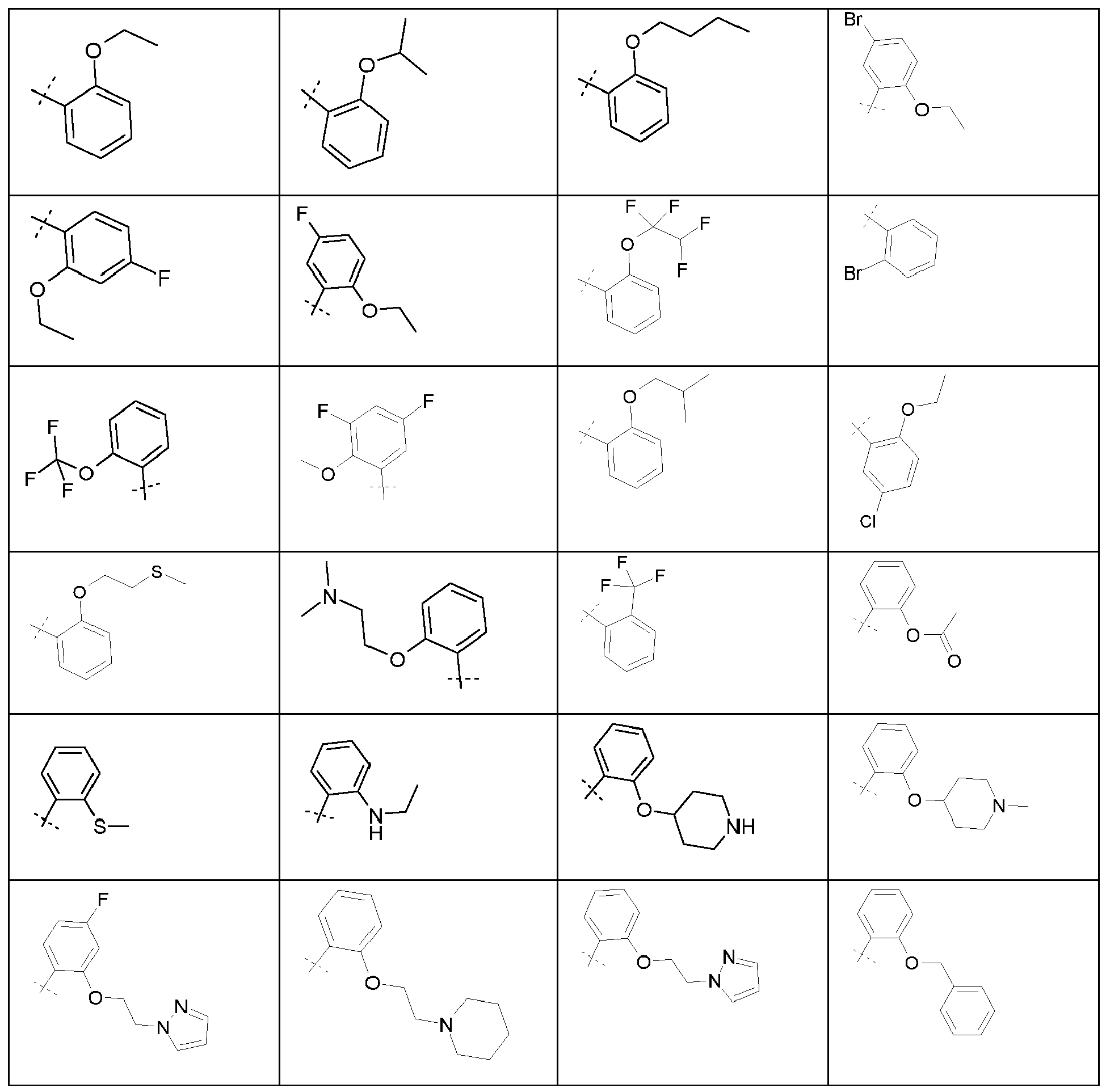


- Examples of compounds provided by the present invention are the following:


- The following abbreviations refer to the abbreviations used below:
- ACN (acetonitrile), AcOH (acetic acid), aq. (aqueous), DCC (dicyclohexylcarbodiimide), DCM (dichloromethane), DIC (diisopropylcarbodiimide), DIEA (di-isopropyl ethylamine), DMSO (dimethyl sulfoxide), DMF (N,N-dimethylformamide), EA (ethyl acetate), EDC (1-ethyl-3-(3-dimethylaminopropyl)carbodiimide hydrochloride), eq. (equivalent), EtOH (ethanol), g (gram), HATU (2-(1H-7-azabenzotriazol-1-yl)--1,1,3,3-tetramethyl uronium hexafluorophosphate methanaminium), cHex (cyclohexane), HPLC (high performance liquid chromatography), LG (leaving group), MeOH (methanol), MHz (Megahertz), MIBK (methyl isobutyl ketone), min (minute), mL (milliliter), mmol (millimole), MS (mass spectrometry), MTBE (tert-butyl methyl ether), MW (microwave), NMR (nuclear magnetic resonance), ppm (part per million), sat. (saturated), SFC (supercritical fluid chromatography), T3P (2,4,6-Tripropyl-[1,3,5,2,4,6]trioxatriphosphinane 2,4,6-trioxide), TEA (triethylamine), TFA (trifluoroacetic acid), THF (tetrahydrofurane), UV (ultraviolet).
- In general, the compounds according to Formula (I) and related formulae of this invention can be prepared from readily available starting materials. If such starting materials are not commercially available, they may be prepared by standard synthetic techniques. In general, the synthesis pathways for any individual compound of Formula (I) and related formulae will depend on the specific substituent of each molecule, such factors being appreciated by those of ordinary skilled in the art. The following general methods and procedures described hereinafter in the examples may be employed to prepare compounds of Formula (I) and related formulae. Reaction conditions depicted in the following schemes, such as temperatures, solvents, or co-reagents, are given as examples only and are not restrictive. It will be appreciated that where typical or preferred experimental conditions (i.e. reaction temperatures, time, moles of reagents, solvents etc.) are given, other experimental conditions can also be used unless otherwise stated. Optimum reaction conditions may vary with the particular reactants or solvents used, but such conditions can be determined by the person skilled in the art, using routine optimisation procedures. For all the protection and deprotection methods, see Philip J. Kocienski, in "Protecting Groups", Georg Thieme Verlag Stuttgart, New York, 1994 and, Theodora W. Greene and Peter G. M. Wuts in "Protective Groups in Organic Synthesis", Wiley Interscience, 3rd Edition 1999.
- A "leaving group" denotes a chemical moiety which can be removed or replaced by another chemical group.
- Throughout the specification, the term leaving group preferably denotes Cl, Br, I or a reactively modified OH group, such as, for example, an activated ester, an imidazolide or alkylsulfonyloxy having 1 to 6 carbon atoms (preferably methylsulfonyloxy or trifluoromethylsulfonyloxy) or arylsulfonyloxy having 6 to 10 carbon atoms (preferably phenyl- or p tolylsulfonyloxy).
- Radicals of this type for activation of the carboxyl group in typical acylation reactions are described in the literature (for example in the standard works, such as Houben-Weyl, Methoden der organischen Chemie [Methods of Organic Chemistry], Georg-Thieme-Verlag, Stuttgart).
- Activated esters are advantageously formed in situ, for example through addition of HOBt or N hydroxysuccinimide.
- Depending on the nature of R1, R2, R3, R4, Ra, Rb, and Q, different synthetic strategies may be selected for the synthesis of compounds of Formula (I). In the process illustrated in the following schemes, R1, R2, R3, R4, Ra, Rb, and Q are as above defined in the description unless otherwise mentioned.
- Generally, tetraaza-cyclopenta[a]indenyl compounds of Formula (I) wherein R1, R2, R3, R4, Ra, Rb, and Q are defined as above can be prepared following the synthetic pathway described in the general scheme 1.

- According to a preferred synthetic pathway, compounds of Formula (I) wherein R1, R2, R3, R4, Ra, Rb, and Q are as above defined, may be prepared by reaction between an amine of Formula (A) and a carboxylic acid of Formula (B) following usual conditions for the formation of an amide starting from a carboxylic acid and an amine by using coupling agents such as EDC, HATU, DCC, DIC or via the formation of an acid chloride or an activated ester. Preferred conditions consist in the treatment of compounds of Formula (A) wherein R1, R2 and R3 are as above defined with HATU or EDC followed by the addition of the amine of Formula (B) wherein R4, Ra, Rb, and Q are as above defined, in the presence of a base such as TEA or DIEA in a suitable solvent such as DMF or DCM at room temperature.
- Compounds of Formula (A) wherein R1, R2 and R3 are as above defined may be prepared from the corresponding Boc protected amines of Formula (C), by treatment with an acid such TFA in DCM or HCl in dioxane or HCl in AcOH.
- Compounds of Formula (C) wherein R1, R2 and R3 are as above defined may be prepared by reacting compounds of Formula (D) and compounds of Formula (E) in a suitable solvent such as AcOH at a temperature ranging from 25°C to 75°C, for 30 minutes to 48 hours.
- Compound of Formula (D) may be prepared as described in Bioorg. Med. Chem. Lett. 2010, 20(14), 4273-4278.
- Alternatively, compounds of general Formula (I) wherein R1, R2, R3, Ra, Rb, and Q are as above defined and R4 is OG, may be prepared as depicted in general scheme 2.

- Compounds of Formula (I) wherein R1, R2, R3, Ra, Rb, and Q are as above defined and R4 is OG, may be prepared by reaction between a compound of Formula (I) wherein R4 is OH and a compound of Formula (F) wherein LG is a leaving group, preferably selected from Hal or an activated ester, in the presence of a base such as K2CO3, Cs2CO3, Na2CO3, NaH, in a solvent such as DMF, DMA, THF, 1,4-dioxane, acetone, ACN at a temperature ranging from 20°C to 200°C for few minutes to several hours. Preferred conditions consist in the treatment compound of Formula (I) wherein R4 is OH by a compound of Formula (F) in the presence of K2CO3, in a solvent such as DMF at a temperature of about 150°C using microwave heating for 10 minutes to 1 hour.
- Compounds of Formula (B) wherein Ra, Rb, and Q are as above defined and R4 is OG may be prepared according to general scheme 3.

- Compounds of Formula (B) wherein R4 is OG may be prepared by saponification of esters of Formula (J) wherein Ra, Rb, G and Q are as above defined, using LiOH, NaOH or KOH in water, water/THF, water/THF/ethanol orwater/1,4-dioxane, at temperatures between 0 and 100°C. Furthermore, ester can be hydrolyzed, for example, using acetic acid, TFA or HCl.
- Compounds of Formula (J) wherein Ra, Rb, G and Q are as above defined may be prepared by reacting compounds of Formula (H) with compounds of Formula (F) in the presence of a base such as K2CO3, Cs2CO3, Na2CO3, NaH, in a solvent such as DMF, DMA, THF, 1,4-dioxane, acetone, ACN or mixtures thereof at a temperature ranging from 20°C to 200°C for few minutes to several hours.
- Compounds of this invention can be isolated in association with solvent molecules by crystallization from an appropriate solvent or by evaporation of an appropriate solvent. The pharmaceutically acceptable anionic salts of the compounds of Formula (I), which contain a basic center, may be prepared in a conventional manner. For example, a solution of the free base may be treated with a suitable acid, either neat or in a suitable solution, and the resulting salt isolated either by filtration or by evaporation under vacuum of the reaction solvent.
- The pharmaceutically acceptable cationic salts of the compounds of Formula (I), which contain an acidic center, may be prepared in a conventional manner. For example, a solution of the free acid may be treated with a suitable base, either neat or in a suitable solution, and the resulting salt isolated either by filtration or by evaporation under vacuum of the reaction solvent. In some cases, salts can be prepared by mixing a solution of the acid with a solution of an alkali or earth alkali salt (such as sodium ethylhexanoate, magnesium oleate), employing a solvent in which the desired alkali or earth alkali salt of the compounds of formula (I) precipitates, or can be otherwise isolated by concentration and addition of a non-solvent.
- Both types of salts may be formed or interconverted using ion-exchange resin techniques.
- Depending on the conditions used, the reaction times are generally between a few minutes and 14 days. The reaction temperature is between about -30°C and about 140°C, normally between -10°C and 90°C, in particular between about 0°C and 70°C. Compounds of the formula (I) and related formulae can furthermore be obtained by liberating compounds of the formula (I) from one of their functional derivatives by treatment with a solvolysing or hydrogenolysing agent.
- Preferred starting materials for the solvolysis or hydrogenolysis are those which conform to the formula I and related formulae, but contain corresponding protected amino and/or hydroxyl groups instead of one or more free amino and/or hydroxyl groups, preferably those which carry an amino-protecting group instead of an H atom bonded to an N atom, in particular those which carry an R*-N group, in which R* denotes an amino-protecting group, instead of an HN group, and/or those which carry a hydroxyl-protecting group instead of the H atom of a hydroxyl group, for example those which conform to the formula I, but carry a -COOR** group, in which R** denotes a hydroxyl-protecting group, instead of a -COOH group.
- It is also possible for a plurality of - identical or different - protected amino and/or hydroxyl groups to be present in the molecule of the starting material. If the protecting groups present are different from one another, they can in many cases be cleaved off selectively.
- The term "amino-protecting group" is known in general terms and relates to groups which are suitable for protecting (blocking) an amino group against chemical reactions, but which are easy to remove after the desired chemical reaction has been carried out elsewhere in the molecule. Typical of such groups are, in particular, unsubstituted or substituted acyl, aryl, aralkoxymethyl or aralkyl groups. Since the amino-protecting groups are removed after the desired reaction (or reaction sequence), their type and size are furthermore not crucial; however, preference is given to those having 1-20, in particular 1-8, carbon atoms. The term "acyl group" is to be understood in the broadest sense in connection with the present process. It includes acyl groups derived from aliphatic, araliphatic, aromatic or heterocyclic carboxylic acids or sulfonic acids, and, in particular, alkoxy¬carbonyl, aryloxycarbonyl and especially aralkoxycarbonyl groups. Examples of such acyl groups are alkanoyl, such as acetyl, propionyl and butyryl; aralkanoyl, such as phenylacetyl; aroyl, such as benzoyl and tolyl; aryloxyalkanoyl, such as POA; alkoxycarbonyl, such as methoxy¬carbonyl, ethoxycarbonyl, 2,2,2-trichloroethoxycarbonyl, BOC (tert-butoxycarbonyl) and 2-iodoethoxycarbonyl; aralkoxycarbonyl, such as CBZ ("carbobenzoxy"), 4-methoxybenzyloxycarbonyl and FMOC; and aryl¬sulfonyl, such as Mtr. Preferred amino-protecting groups are BOC and Mtr, further¬more CBZ, Fmoc, benzyl and acetyl.
- The term "hydroxyl-protecting group" is likewise known in general terms and relates to groups which are suitable for protecting a hydroxyl group against chemical reactions, but are easy to remove after the desired chemical reaction has been carried out elsewhere in the molecule. Typical of such groups are the above-mentioned unsubstituted or substituted aryl, aralkyl or acyl groups, furthermore also alkyl groups. The nature and size of the hydroxyl-protecting groups are not crucial since they are removed again after the desired chemical reaction or reaction sequence; preference is given to groups having 1-20, in particular 1-10, carbon atoms. Examples of hydroxyl-protecting groups are, inter alia, benzyl, 4-methoxybenzyl, p-nitrobenzoyl, p-toluenesulfonyl, tert-butyl and acetyl, where benzyl and tert-butyl are particularly preferred.
- The compounds of the formula I and related formulae are liberated from their functional derivatives - depending on the protecting group used - for example strong inorganic acids, such as hydrochloric acid, perchloric acid or sulfuric acid, strong organic carboxylic acids, such as trichloroacetic acid, TFA or sulfonic acids, such as benzene- or p-toluenesulfonic acid. The presence of an additional inert solvent is possible, but is not always necessary. Suitable inert solvents are preferably organic, for example carboxylic acids, such as acetic acid, ethers, such as tetrahydrofuran or dioxane, amides, such as DMF, halogenated hydrocarbons, such as dichloromethane, furthermore also alcohols, such as methanol, ethanol or isopropanol, and water. Mixtures of the above-mentioned solvents are furthermore suitable. TFA is preferably used in excess without addition of a further solvent, and perchloric acid is preferably used in the form of a mixture of acetic acid and 70% perchloric acid in the ratio 9:1. The reaction temperatures for the cleavage are advantageously between about 0 and about 50°C, preferably between 15 and 30°C (room temperature).
- The BOC, OtBut and Mtr groups can, for example, preferably be cleaved off using TFA in dichloromethane or using approximately 3 to 5N HCl in dioxane at 15-30°C, and the FMOC group can be cleaved off using an approximately 5 to 50% solution of dimethylamine, diethylamine or piperidine in DMF at 15-30°C.
- Protecting groups which can be removed hydrogenolytically (for example CBZ, benzyl or the liberation of the amidino group from the oxadiazole derivative thereof) can be cleaved off, for example, by treatment with hydrogen in the presence of a catalyst (for example a noble-metal catalyst, such as palladium, advantageously on a support, such as carbon). Suitable solvents here are those indicated above, in particular, for example, alcohols, such as methanol or ethanol, or amides, such as DMF. The hydrogenolysis is generally carried out at temperatures between about 0 and 100°C and pressures between about 1 and 200 bar, preferably at 20-30°C and 1-10 bar. Hydrogenolysis of the CBZ group succeeds well, for example, on 5 to 10% Pd/C in methanol or using ammonium formate (instead of hydrogen) on Pd/C in methanol/DMF at 20-30°C. Examples of suitable inert solvents are hydrocarbons, such as hexane, petroleum ether, benzene, toluene or xylene; chlorinated hydrocarbons, such as trichloroethylene, 1,2-dichloroethane, tetrachloromethane, trifluoromethylbenzene, chloroform or dichloromethane; alcohols, such as methanol, ethanol, isopropanol, n-propanol, n-butanol or tert-butanol; ethers, such as diethyl ether, diisopropyl ether, tetrahydrofuran (THF) or dioxane; glycol ethers, such as ethylene glycol monomethyl or monoethyl ether or ethylene glycol dimethyl ether (diglyme); ketones, such as acetone or butanone; amides, such as acetamide, dimethylacetamide, N-methylpyrrolidone (NMP) or dimethyl¬formamide (DMF); nitriles, such as acetonitrile; sulfoxides, such as dimethyl sulfoxide (DMSO); carbon disulfide; carboxylic acids, such as formic acid or acetic acid; nitro compounds, such as nitromethane or nitrobenzene; esters, such as ethyl acetate, or mixtures of the said solvents.
- Esters can be hydrolysed, for example, using HCl, H2SO4, or using LiOH, NaOH or KOH in water, water/THF, water/THF/ethanol or water/dioxane, at temperatures between 0 and 100°C.
- Free amino groups can furthermore be acylated in a conventional manner using an acyl chloride or anhydride or alkylated using an unsubstituted or substituted alkyl halide, advantageously in an inert solvent, such as dichloromethane or THF and/or in the presence of a base, such as triethylamine or pyridine, at temperatures between -60°C and +30°C.
- The formula (I) and related formulae also encompasses the optically active forms (stereoisomers), the enantiomers, the racemates, the diastereomers and the hydrates and solvates of these compounds. The term "solvates of the compounds" is taken to mean adductions of inert solvent molecules onto the compounds which form owing to their mutual attractive force. Solvates are, for example, mono- or dihydrates or alcoholates.
- The term "pharmaceutically usable derivatives" is taken to mean, for example, the salts of the compounds of the formula I and so-called pro¬drug compounds.
- The term "prodrug derivatives" is taken to mean compounds of the formula I which have been modified with, for example, alkyl or acyl groups, sugars or oligopeptides and which are rapidly cleaved in the organism to form the active compounds. Preferably "prodrug", as of the compounds of formula I, refers to derivative compounds that are rapidly transformed in vivo to yield the parent compound of the formula I, as for example by hydrolysis in blood. T. Higuchi and V. Stella provide a thorough discussion of the prodrug concept in "Pro-drugs as Novel Delivery Systems", Vol 14 of the A.C.S. Symposium Series, American Chemical Society (1975). Examples of esters useful as prodrugs for compounds containing carboxyl groups can be found on pages 14-21 of "Bioreversible Carriers in Drug Design: Theory and Application", edited by E. B. Roche, Pergamon Press: New York (1987). It is intended that these references, and any others cited throughout this specification, are incorporated herein by reference.
- These also include biodegradable polymer derivatives of the compounds according to the invention, as described, for example, in Int. J. Pharm. 115, 61-67 (1995).
- The formula (I) and related formulae also encompasses mixtures of the compounds of the formula I, for example mixtures of two diastereomers, for example in the ratio 1:1, 1:2, 1:3, 1:4, 1:5, 1:10, 1:100 or 1:1000.
- These are particularly preferably mixtures of stereoisomeric compounds. Pharmaceutical formulations can be administered in the form of dosage units, which comprise a predetermined amount of active ingredient per dosage unit. Such a unit can comprise, for example, 0.5 mg to 1 g, preferably 1 mg to 700 mg, particularly preferably 5 mg to 100 mg, of a compound according to the invention, depending on the disease condition treated, the method of administration and the age, weight and condition of the patient, or pharmaceutical formulations can be administered in the form of dosage units which comprise a predetermined amount of active ingredient per dosage unit. Preferred dosage unit formulations are those which comprise a daily dose or part-dose, as indicated above, or a corresponding fraction thereof of an active ingredient. Furthermore, pharmaceutical formulations of this type can be prepared using a process, which is generally known in the pharmaceutical art.
- Pharmaceutical formulations can be adapted for administration via any desired suitable method, for example by oral (including buccal or sublingual), rectal, nasal, topical (including buccal, sublingual or transdermal), vaginal or parenteral (including subcutaneous, intramuscular, intravenous or intradermal) methods. Such formulations can be prepared using all processes known in the pharmaceutical art by, for example, combining the active ingredient with the excipient(s) or adjuvant(s).
- Pharmaceutical formulations adapted for oral administration can be administered as separate units, such as, for example, capsules or tablets; powders or granules; solutions or suspensions in aqueous or non-aqueous liquids; edible foams or foam foods; or oil-in-water liquid emulsions or water-in-oil liquid emulsions.
- Thus, for example, in the case of oral administration in the form of a tablet or capsule, the active-ingredient component can be combined with an oral, non-toxic and pharmaceutically acceptable inert excipient, such as, for example, ethanol, glycerol, water and the like. Powders are prepared by comminuting the compound to a suitable fine size and mixing it with a pharmaceutical excipient comminuted in a similar manner, such as, for example, an edible carbohydrate, such as, for example, starch or mannitol. A flavour, preservative, dispersant and dye may likewise be present.
- Capsules are produced by preparing a powder mixture as described above and filling shaped gelatine shells therewith. Glidants and lubricants, such as, for example, highly disperse silicic acid, talc, magnesium stearate, calcium stearate or polyethylene glycol in solid form, can be added to the powder mixture before the filling operation. A disintegrant or solubiliser, such as, for example, agar-agar, calcium carbonate or sodium carbonate, may likewise be added in order to improve the availability of the medica-ment after the capsule has been taken.
- In addition, if desired or necessary, suitable binders, lubricants and disintegrants as well as dyes can likewise be incorporated into the mixture. Suitable binders include starch, gelatine, natural sugars, such as, for example, glucose or beta-lactose, sweeteners made from maize, natural and synthetic rubber, such as, for example, acacia, tragacanth or sodium alginate, carboxymethylcellulose, polyethylene glycol, waxes, and the like. The lubricants used in these dosage forms include sodium oleate, sodium stearate, magnesium stearate, sodium benzoate, sodium acetate, sodium chloride and the like. The disintegrants include, without being restricted thereto, starch, methylcellulose, agar, bentonite, xanthan gum and the like. The tablets are formulated by, for example, preparing a powder mixture, granulating or dry-pressing the mixture, adding a lubricant and a disintegrant and pressing the entire mixture to give tablets. A powder mixture is prepared by mixing the compound comminuted in a suitable manner with a diluent or a base, as described above, and optionally with a binder, such as, for example, carboxymethylcellulose, an alginate, gelatine or polyvinyl-pyrrolidone, a dissolution retardant, such as, for example, paraffin, an absorption accelerator, such as, for example, a quaternary salt, and/or an absorbant, such as, for example, bentonite, kaolin or dicalcium phosphate. The powder mixture can be granulated by wetting it with a binder, such as, for example, syrup, starch paste, acadia mucilage or solutions of cellulose or polymer materials and pressing it through a sieve. As an alternative to granulation, the powder mixture can be run through a tableting machine, giving lumps of non-uniform shape which are broken up to form granules. The granules can be lubricated by addition of stearic acid, a stearate salt, talc or mineral oil in order to prevent sticking to the tablet casting moulds. The lubricated mixture is then pressed to give tablets. The active ingredients can also be combined with a free-flowing inert excipient and then pressed directly to give tablets without carrying out the granulation or dry-pressing steps. A transparent or opaque protective layer consisting of a shellac sealing layer, a layer of sugar or polymer material and a gloss layer of wax may be present. Dyes can be added to these coatings in order to be able to differentiate between different dosage units.
- Oral liquids, such as, for example, solution, syrups and elixirs, can be prepared in the form of dosage units so that a given quantity comprises a pre-specified amount of the compounds. Syrups can be prepared by dissolving the compounds in an aqueous solution with a suitable flavour, while elixirs are prepared using a non-toxic alcoholic vehicle. Suspensions can be for-mulated by dispersion of the compounds in a non-toxic vehicle. Solubilisers and emulsifiers, such as, for example, ethoxylated isostearyl alcohols and polyoxyethylene sorbitol ethers, preservatives, flavour additives, such as, for example, peppermint oil or natural sweeteners or saccharin, or other artificial sweeteners and the like, can likewise be added.
- The dosage unit formulations for oral administration can, if desired, be encapsulated in microcapsules. The formulation can also be prepared in such a way that the release is extended or retarded, such as, for example, by coating or embedding of particulate material in polymers, wax and the like.
- The compounds of the formula (I), and related formulae and salts, solvates and physiologically functional derivatives thereof and the other active ingredients can also be administered in the form of liposome delivery systems, such as, for example, small unilamellar vesicles, large unilamellar vesicles and multilamellar vesicles. Liposomes can be formed from various phospholipids, such as, for example, cholesterol, stearylamine or phosphatidylcholines.
- The compounds of the formula (I), and related formulae and the salts, solvates and physiologically functional derivatives thereof and the other active ingredients can also be delivered using monoclonal antibodies as individual carriers to which the compound molecules are coupled. The compounds can also be coupled to soluble polymers as targeted medicament carriers. Such polymers may encompass polyvinylpyrrolidone, pyran copolymer, polyhydroxypropyl-methacrylamidophenol, polyhydroxyethylaspartamido-phenol or polyethylene oxide polylysine, substituted by palmitoyl radicals. The compounds may furthermore be coupled to a class of biodegradable polymers which are suitable for achieving controlled release of a medicament, for example polylactic acid, poly-epsilon-caprolactone, polyhydroxybutyric acid, poly-orthoesters, polyacetals, polydihydroxypyrans, polycyanoacrylates and crosslinked or amphipathic block copolymers of hydrogels.
- Pharmaceutical formulations adapted for transdermal administration can be administered as independent plasters for extended, close contact with the epidermis of the recipient. Thus, for example, the active ingredient can be delivered from the plaster by iontophoresis, as described in general terms in Pharmaceutical Research, 3(6), 318 (1986).
- Pharmaceutical compounds adapted for topical administration can be formulated as ointments, creams, suspensions, lotions, powders, solutions, pastes, gels, sprays, aerosols or oils.
- For the treatment of the eye or other external tissue, for example mouth and skin, the formulations are preferably applied as topical ointment or cream. In the case of formulation to give an ointment, the active ingredient can be employed either with a paraffinic or a water-miscible cream base. Alternatively, the active ingredient can be formulated to give a cream with an oil-in-water cream base or a water-in-oil base. Pharmaceutical formulations adapted for topical application to the eye include eye drops, in which the active ingredient is dissolved or sus-pended in a suitable carrier, in particular an aqueous solvent.
- Pharmaceutical formulations adapted for topical application in the mouth encompass lozenges, pastilles and mouthwashes.
- Pharmaceutical formulations adapted for rectal administration can be administered in the form of suppositories or enemas.
- Pharmaceutical formulations adapted for nasal administration in which the carrier substance is a solid comprise a coarse powder having a particle size, for example, in the range 20-500 microns, which is administered in the manner in which snuff is taken, i.e. by rapid inhalation via the nasal passages from a container containing the powder held close to the nose. Suitable formulations for administration as nasal spray or nose drops with a liquid as carrier substance encompass active-ingredient solutions in water or oil. Pharmaceutical formulations adapted for administration by inhalation encompass finely particulate dusts or mists, which can be generated by various types of pressurised dispensers with aerosols, nebulisers or insuf-flators.
- Pharmaceutical formulations adapted for vaginal administration can be administered as pessaries, tampons, creams, gels, pastes, foams or spray formulations.
- Pharmaceutical formulations adapted for parenteral administration include aqueous and non-aqueous sterile injection solutions comprising antioxidants, buffers, bacteriostatics and solutes, by means of which the formulation is rendered isotonic with the blood of the recipient to be treated; and aqueous and non-aqueous sterile suspensions, which may comprise suspension media and thickeners. The formulations can be administered in single-dose or multidose containers, for example sealed ampoules and vials, and stored in freeze-dried (lyophilised) state, so that only the addition of the sterile carrier liquid, for example water for injection purposes, immediately before use is necessary. injection solutions and suspensions prepared in accordance with the recipe can be prepared from sterile powders, granules and tablets.
- It goes without saying that, in addition to the above particularly mentioned constituents, the formulations may also comprise other agents usual in the art with respect to the particular type of formulation; thus, for example, formulations which are suitable for oral administration may comprise flavours.
- A therapeutically effective amount of a compound of the formula (I), and related formulae and of the other active ingredient depends on a number of factors, including, for example, the age and weight of the animal, the precise disease condition which requires treatment, and its severity, the nature of the formulation and the method of administration, and is ultimately determined by the treating doctor or vet. However, an effective amount of a compound is generally in the range from 0.1 to 100 mg/kg of body weight of the recipient (mammal) per day and particularly typically in the range from 1 to 10 mg/kg of body weight per day. Thus, the actual amount per day for an adult mammal weighing 70 kg is usually between 70 and 700 mg, where this amount can be administered as an individual dose per day or usually in a series of part-doses (such as, for example, two, three, four, five or six) per day, so that the total daily dose is the same. An effective amount of a salt or solvate or of a physiologically functional derivative thereof can be determined as the fraction of the effective amount of the compound per se.
- The present invention furthermore relates to a method for treating a subject suffering from a M1 related disorder, comprising administering to said subject an effective amount of a compound of formula (I) and related formulae. The present invention preferably relates to a method, wherein the M1 associated disorder is Alzheimer's disease, Parkinson disease, schizophrenia, movement disorders, memory disorders, chronic neuropathic pain, sleep disorders, epilepsy. Nociception disorder, dementia, hallucination, delusion, paranoia.
- The compounds of invention have been named according to the standards used in the program AutoNom (v1.0.1.1).
- The compounds according to formula (I) can be prepared from readily available starting materials by several synthetic approaches, using both solution-phase and solid-phase chemistry protocols or mixed solution and solid phase protocols. Examples of synthetic pathways are described below in the examples.
- The commercially available starting materials used in the following experimental description were purchased from Aldrich, Sigma, ACROS or ABCR unless otherwise reported.
- 1H NMR analyses were carried out using BRUKER NMR, model DPX-300 MHz FT-NMR. Residual signal of deuterated solvent was used as internal reference. Chemical shifts (δ) are reported in ppm in relative to the residual solvent signal (δ = 2.50 for 1H NMR in DMSO-d6, and 7.26 in CDCl3). s (singlet), d (doublet), t (triplet), q (quadruplet), br (broad). Some compounds in the experimental part exist as mixture of rotamers in different ratios as described in the 1H NMR descriptions.
- The MS data provided in the examples described below were obtained as followed: Mass spectrum: LC/MS Waters ZMD (ESI).
- HPLC analyses were obtained as followed using a Waters XbridgeTM C8 50 mm x 4.6 mm column at a flow of 2 mL/min; 8 min gradient H2O:CH3CN:TFA from 100:0:0.1 % to 0:100:0.05 % with UV detection (maxplot).
- The SFC purifications were performed with a Prep SFC 100 UV from Thar-Waters.
- The mass directed preparative HPLC purifications were performed with a mass directed autopurification Fractionlynx from Waters equipped with a Sunfire Prep C18 OBD column 19x100 mm 5 µm, unless otherwise reported. All purifications were performed with a gradient of ACN/H2O or ACN/H2O/HCOOH (0.1 %).
- The microwave chemistry was performed on a single mode microwave reactor Emrys™ Optimiser or Initiator™ Sixty from Biotage.
- HATU (1.0-1.2 eq.) was added to a solution of the carboxylic acid (1.0-1.2 eq.) and DIEA (2-4 eq.) in DMF and the reaction mixture was stirred at room temperature for 15 min to 1 hour whereupon the amine (1 eq.) was added. The resulting mixture was stirred at room temperature until completion.
- EDC (1.0-1.2 eq.) was added to a solution of the carboxylic acid (1.0-1.2 eq.) and TEA (2-4 eq.) in DCM and the reaction mixture was stirred at room temperature for 15 min to 1 hour whereupon the amine (1 eq.) was added. The resulting mixture was stirred at room temperature until completion.
-

- A mixture of 3-amino-2,6-dihydro-4H-pyrrolo[3,4-c]pyrazole-5-carboxylic acid tert-butyl ester (2.4 g; 10.7 mmol; 1 eq.) and 3-methyl-2,4-pentanedione (1.75 mL; 15 mmol; 1.4 eq.) in AcOH (25 mL) was stirred at room temperature for 18 hours. The solvent was evaporated in vacuo and the residue partitioned between ethyl acetate and sat. aq. NaHCO3. The organic layer was dried over sodium sulfate and concentrated in vacuo. The residue was triturated in ACN and the precipitate filtered off to afford the title compound (1.7 g, 52%) as a white solid. The mother liquor was concentrated in vacuo and the residue purified by column chromatography (DCM/EtOH, 95/5) to afford the title compound (1.5 g, 46%) as a white solid. 1H NMR (DMSO-d6) δ 4.59-4.53 (m, 4H), 3.34 (s, 6H), 2.27 (s, 3H), 1.47 (s, 9H). HPLC (max plot) 96.1%; Rt 3.92 min. UPLC/MS:
(MS+) 303.1 ([M+H]+). - A 4M solution of HCl in 1,4-dioxane (1.24 mL; 4.96 mmol; 15 eq.) was added to a solution of 5,6,7-trimethyl-1H,3H-2,4,7a,8-tetraaza-cyclopenta[a]indene-2-carboxylic acid tert-butyl ester (100 mg; 0.33 mmol; 1 eq.) in 1,4-dioxane (5 mL) and the resulting mixture was stirred at room temperature for 18 hours. The solvent was evaporated in vacuo and the residue was triturated in 1,4-dioxane. Concentration to dryness afforded the title compound (65 mg, 82%) as a white solid. 1H NMR (DMSO-d6) δ 10.40-10.30 (m, 1H), 4.57-4.50 (m, 4H), 2.73 (s, 3H), 2.54 (s, 3H), 2.28 (s, 3H). HPLC (max plot) 100.0%; Rt 1.26 min. UPLC/MS: (MS+) 203.1 ([M+H]+).
-

- A mixture of 3-amino-2,6-dihydro-4H-pyrrolo[3,4-c]pyrazole-5-carboxylic acid tert-butyl ester (0.6 g; 2.68 mmol; 1 eq.) and 3-ethyl-2,4-pentanedione (0.36 mL; 2.68 mmol; 1 eq.) in AcOH (8 mL) was stirred at room temperature for 32 hours. Aq. 32% HCl (1.05 mL; 10.7 mmol; 4 eq.) was added and the resulting mixture stirred for a further 16 hours. After concentration in vacuo, the residue was triturated in MTBE and the precipitate filtered off and dried. The solid was taken up in ethyl acetate and washed with 1 M aq. NaOH (2x), dried over magnesium sulfate and concentrated in vacuo to afford the title compound (450 mg, 94%) as a beige solid. 1H NMR (DMSO-d6) δ 4.05-4.00 (m, 4H), 2.73-2.63 (m, 5H), 2.51 (s, 3H), 1.12 (t, J = 7.4 Hz, 3H). UPLC/MS: (MS+) 217.3
([M+H]+). -

- A solution of 3-amino-2,6-dihydro-4H-pyrrolo[3,4-c]pyrazole-5-carboxylic acid tert-butyl ester (1 g; 4.46 mmol; 1 eq.) and 3-chloroacetylacetone (0.71 mL; 6.24 mmol; 1.4 eq.) in AcOH (10 mL) was stirred at room temperature for 18 hours. The reaction was poured into water (100 mL) under vigorous stirring and the precipitate filtered off, washed with water (3x) and dried to afford the title compound (1298 mg, 90%) as an off-white solid. 1 H NMR (DMSO-d6) δ 4.60-4.52 (m, 4H), 2.81 (br s, 3H), 2.60-2.57 (m, 3H), 1.48 (s, 9H). HPLC (max plot) 98.4%; Rt 3.96 min. UPLC/MS: (MS+) 323 ([M+H]+).
- Aq. 32% HCl (1.14 mL; 11.62 mmol; 3 eq.) was added to a suspension of 6-chloro-5,7-dimethyl-1H,3H-2,4,7a,8-tetraaza-cyclopenta[a]indene-2-carboxylic acid tert-butyl ester (1.25 g; 3.87 mmol; 1 eq.) in AcOH (6.25 mL) and the resulting mixture was stirred at room temperature for 2 hours then poured into MTBE (40 mL). The precipitate was filtered off, washed with MTBE (3x) and dried to afford the title compound (1 g, 100%) as an off-white solid. 1H NMR (DMSO-d6) δ 10.55 (s, 2H), 4.57-4.52 (m, 4H), 2.83 (s, 3H), 2.61 (s, 3H). HPLC (max plot) 100.0%; Rt 1.38 min. UPLC/MS: (MS+) 222.9 ([M+H]+).
-

- A mixture of 3-amino-2,6-dihydro-4H-pyrrolo[3,4-c]pyrazole-5-carboxylic acid tert-butyl ester (2 g; 8.92 mmol; 1 eq.) and 2-chloromalonaldehyde (1.04 g; 9.81 mmol; 1.1 eq.) in AcOH was stirred at room temperature for 18 hours then diluted with water (30 mL). The precipitate was filtered off and purified by column chromatography (DCM/EA, from 95/5 to 80/20) to afford the title compound (1.24 g, 47%) as a white solid. 1H NMR (DMSO-d6) δ 9.57 (d, J = 2.3 Hz, 1 H), 8.59 (d, J = 2.3 Hz, 1H), 4.63-4.57 (m, 4H), 1.47 (s, 9H). HPLC (max plot) 99.1%; Rt 3.75 min.
- Aq. 32% HCl (1.2 mL; 12.2 mmol; 3 eq.) was added to a suspension 6-chloro-1H,3H-2,4,7a,8-tetraaza-cyclopenta[a]indene-2-carboxylic acid tert-butyl ester (1.2 g; 4.07 mmol; 1 eq.) in AcOH (6 mL) and the resulting mixture was stirred at room temperature for 2 hours then poured dropwise into ACN (40 mL) under vigorous stirring. The precipitate was filtered off, washed with ACN (2x) and dried to afford the title compound (0.85 g, 78%) as a white solid. 1H NMR (DMSO) δ 10.49 (s, 2H), 9.65 (d, J = 2.3 Hz, 1H), 8.68 (d, J = 2.3 Hz, 1H), 4.58 (s, 4H). HPLC (max plot) 100.0%; Rt 3.76 min. UPLC/MS: (MS+) 195 ([M+H]+).
-

- A mixture of 3-amino-2,6-dihydro-4H-pyrrolo[3,4-c]pyrazole-5-carboxylic acid tert-butyl ester (5 g; 22.3 mmol; 1 eq.) and 1,1,3,3-tetraethoxy-2-methylpropane (4.32 mL; 22.3 mmol; 1 eq.) in AcOH (50 mL) was stirred at 50°C for 20 hours then diluted with water (250 mL). The precipitate was filtered off and dried to afford the title compound (3.5 g, 57%) as a pale beige solid. 1H NMR (DMSO-d6) δ 8.98-8.95 (m, 1 H), 8.43 (d, J = 2.1 Hz, 1H), 4.61-4.54 (m, 4H), 2.31 (s, 3H), 1.47 (s, 9H). HPLC (max plot) 99.7%; Rt 3.27 min. UPLC/MS: (MS+) 275.0 ([M+H]+).
- Aq. 32% HCl (1.61 mL; 16.4 mmol; 3 eq.) was added to a solution of 6-methyl-1H,3H-2,4,7a,8-tetraaza-cyclopenta[a]indene-2-carboxylic acid tert-butyl ester (1.5 g; 5.47 mmol; 1 eq.) in AcOH (7.5 mL) and the resulting mixture was stirred at room temperature for 28 hours then poured dropwise into EtOH (40 mL) under vigorous stirring. The precipitate was filtered off, washed with EtOH then MTBE and dried to afford the title compound (0.75 g, 65%) as a white solid. 1H NMR (DMSO-d6) δ 10.50 (s, 2H), 9.06-9.02 (m, 1H), 8.51 (d, J = 2.1 Hz, 1H), 4.55-4.52 (m, 4H), 2.33 (s, 3H). HPLC (max plot) 100.0%; Rt 4.36 min.
-

- A mixture of 3-amino-2,6-dihydro-4H-pyrrolo[3,4-c]pyrazole-5-carboxylic acid tert-butyl ester (1 g; 4.46 mmol; 1 eq.) and (3E)-4-hydroxy-3-methylbut-3-en-2-one (prepared according to J. Het. Chem. 1980, 17(1), 33-37) (0.6 g; 4.91 mmol; 1.1 eq.) in AcOH (5 mL) was stirred at room temperature for 18 hours then concentrated in vacuo. The residue was partitioned between 1M NaOH and DCM, the organic layer was dried over magnesium sulfate and concentrated in vacuo. The resulting oil was triturated in Et2O, the precipitate filtered off and the solution concentrated in vacuo. The residue was purified by SFC (column : Chiralpak IC, eluent 25% MeOH) to afford successively the title compound (140 mg, 11 %) as a white solid and Intermediate C2. 1H NMR (CDCl3) δ 8.33 (s, 1H), 4.72-4.62 (m, 4H), 2.54 (d, J = 3.1 Hz, 3H), 2.29 (d, J = 0.7 Hz, 3H), 1.52 (d, J = 3.3 Hz, 9H). HPLC (max plot) 87.3%; Rt 3.27 min. UPLC/MS: (MS+) 289.1
([M+H]+). -

- Second eluting compound isolated (170 mg, 13%) as a white solid during the preparation of Intermediate C1. 1H NMR (CDCl3) δ 8.27 (d, J = 3.0 Hz, 1H), 4.75-4.66 (m, 4H), 2.74 (s, 3H), 2.36 (s, 3H), 1.53 (s, 9H). UPLC/MS: (MS+) 289.1 ([M+H]+).
-

- A 4M solution of HCl in 1,4-dioxane (10 mL; 40 mmol; 82.4 eq.) was added to a solution 6,7-dimethyl-1H,3H-2,4,7a,8-tetraaza-cyclopenta[a]indene-2-carboxylic acid tert-butyl ester (140 mg; 0.49 mmol; 1 eq.) in MeOH (2 mL) and the resulting mixture was stirred at room temperature for 18 hours then concentrated in vacuo. The residue was triturated in EtOH and the precipitate filtered off and dried to afford the title compound (78 mg, 62%) as a pale yellow solid. 1H NMR (DMSO-d6) δ 10.39 (br s, 2H), 8.91 (d, J = 0.9 Hz, 1H), 6.24 (br s, 1H), 4.51-4.48 (m, 4H), 2.49 (s, 3H), 2.26 (s, 3H). HPLC (max plot) 99.9%; Rt 1.03 min. UPLC/MS: (MS+) 189.0 ([M+H]+).
-
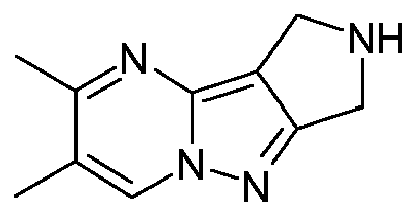
- A 4M solution of HCl in 1,4-dioxane (10 mL; 40 mmol; 67.8 eq.) was added to a solution of 5,6-dimethyl-1H,3H-2,4,7a,8-tetraaza-cyclopenta[a]indene-2-carboxylic acid tert-butyl ester (170 mg; 0.59 mmol; 1 eq.) in MeOH (2 mL) and the resulting mixture was stirred at room temperature for 18 hours then concentrated in vacuo. The residue was triturated in EtOH and the precipitate filtered off and dried to afford the title compound (90 mg, 58%) as a pale yellow solid. 1H NMR (DMSO-d6) δ 10.41 (br s, 2H), 8.66-8.17 (br s, 1H), 8.45 (s, 1H), 4.57-4.53 (m, 4H), 2.70 (s, 3H), 2.35 (s, 3H). HPLC (max plot) 99.6%; Rt 1.03 min. UPLC/MS: (MS+) 189.0 ([M+H]+).
-

- The title compound was prepared following procedure described in Method B starting Intermediate A1 and salicylic acid. After purification by recrystallization (ACN), the title compound was obtained as a white solid (463 mg, 34%). 1H NMR (CDCl3) δ 10.90 (s, 1H), 7.65-7.62 (m, 1H), 7.41-7.35 (m, 1H), 7.04-7.01 (m, 1H), 6.92-6.87 (m, 1H), 5.14-5.09 (m, 4H), 2.77 (s, 3H), 2.56 (s, 3H), 2.31 (s, 3H). HPLC (max plot) 94.4%; Rt 2.44 min. UPLC/MS: (MS+) 323.0 ([M+H]+), (MS-) 321.2 ([M-H]-).
-

- A mixture of bromomalonaldehyde (2.02 g; 13.38 mmol; 1 eq.) and 3-amino-2,6-dihydro-4H-pyrrolo[3,4-c]pyrazole-5-carboxylic acid tert-butyl ester (3 g; 13.38 mmol; 1 eq.) in AcOH (21 mL) was stirred at room temperature for 40 minutes. The insoluble material was removed by filtration and the solution diluted with water (60 mL). The precipitate was filtered off, washed with water (3x) and dried. Recrystallization from iPrOH afforded the title compound (2.02 g, 45%) as beige solid. 1H NMR (DMSO-d6) δ 9.60 (d, J = 2.2 Hz, 1H), 8.60 (d, J = 2.2 Hz, 1H), 4.62-4.55 (m, 4H), 1.47 (s, 9H). HPLC (max plot) 99.8%; Rt 3.54 min. UPLC/MS: (MS+) 339.3 and 341.3 ([M+H]+).
- A 4M solution of HCl in 1,4-dioxane (35 mL; 140 mmol; 23.7 eq.) was added to 6-bromo-1 H,3H-2,4,7a,8-tetraaza-cyclopenta[a]indene-2-carboxylic acid tert-butyl ester (2 g; 5.9 mmol; 1 eq.) and the resulting mixture was stirred at room temperature for 18 hours. The precipitate was filtered off, washed with Et2O and dried to afford the title compound (1.56 g, 96%) as beige solid. 1H NMR (DMSO-d6) δ 10.61 (br s, 2H), 9.68 (d, J = 2.2 Hz, 1 H), 8.69 (d, J = 2.2 Hz, 1 H), 4.56 (s, 4H). UPLC/MS: (MS+) 239.1 and 241.1 ([M+H]+).
-

- lodoethane (2.56 mL; 32.03 mmol; 2.5 eq.) was added to a suspension of 4-fluoro-2-hydroxybenzoic acid (2 g; 12.81 mmol; 1 eq.) and potassium carbonate (5.31 g; 38.43 mmol; 3 eq.) in DMF (20 mL) and the resulting mixture was stirred at 80°C for 3 hours then partitioned between MTBE (100 mL) and water (100 mL). The organic layer was washed with water then brine, dried over sodium sulfate and concentrated in vacuo to afford the title compound (2.3 g, 85%) as a pale yellow oil. 1H NMR (DMSO-d6) δ 7.71 (dd, J = 7.0, 8.6 Hz, 1 H), 7.03 (dd, J = 2.4, 11.7 Hz, 1H), 6.83 (dt, J = 2.4, 8.5 Hz, 1H), 4.23 (q, J = 7.1 Hz, 2H), 4.09 (q, J = 7.0 Hz, 2H), 1.33 (t, J = 7.0 Hz, 3H), 1.27 (t, J = 7.1 Hz, 3H). HPLC (max plot) 94.3%; Rt 4.04 min. UPLC/MS: (MS+) 213.2 ([M+H]+)
- A 5M solution of sodium hydroxide (6.5 mL; 32.5 mmol; 3 eq.) was added to a solution of 2-ethoxy-4-fluoro-benzoic acid ethyl ester (2.3 g; 10.8 mmol; 1 eq.) in EtOH (46 mL) and the resulting mixture was stirred at 40°C for 18 hours then concentrated in vacuo. The residue was taken up in water and the pH made acidic with 5M HCl. The precipitate was filtered off, washed with water and dried to afford the title compound (1.8 g, 90%) as a white solid. 1H NMR (DMSO-d6) δ 12.56 (s, 1H), 7.71 (dd, J = 7.0, 8.6 Hz, 1H), 7.01 (dd, J = 2.4, 11.7 Hz, 1H), 6.80 (dt, J = 2.4, 8.5 Hz, 1H), 4.09 (q, J = 7.0 Hz, 2H), 1.32 (t, J = 7.0 Hz, 3H). HPLC (max plot) 99.3%; Rt 2.71 min. UPLC/MS: (MS+) 185.2 ([M+H]+).
-
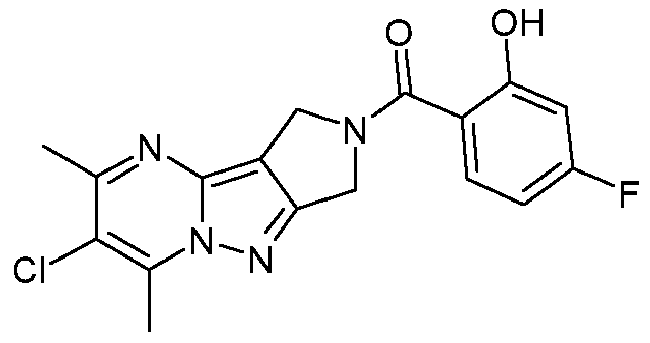
- The title compound was prepared following procedure described in Method A starting from Intermediate A3 and 4-fluoro-2-hydroxybenzoic acid and the compound has precipitated out. After filtration, washing with DMF and drying the title compound was obtained as a white solid (1.14 g, 82%). 1H NMR (CDCl3) δ 11.47 (s, 1 H), 7.68-7.63 (m, 1H), 6.76-6.71 (m, 1H), 6.69-6.59 (m, 1H), 5.15-5.09 (m, 4H), 2.91 (s, 3H), 2.68 (s, 3H). HPLC (max plot) 91.9%; Rt 3.16 min. UPLC/MS: (MS+) 361.4 ([M+H]+), (MS-) 359.4 ([M-H]-).
-

- lodoethane (1.15 mL; 14.36 mmol; 2.5 eq.) was added to a suspension of 3,5-difluoro-2-hydroxybenzoic acid (1 g; 5.74 mmol; 1 eq.) and potassium carbonate (2.38 g; 17.23 mmol; 3 eq.) in DMF (20 mL) and the resulting mixture was stirred at 80°C for 20 hours then partitioned between MTBE (100 mL) and water (50 mL). The organic layer was washed with water then brine, dried over sodium sulfate and concentrated in vacuo to afford the title compound (1.16 g, 88%) as a colorless liquid. 1H NMR (DMSO-d6) δ 7.67-7.58 (m, 1 H), 7.38-7.32 (m, 1 H), 4.31 (q, J = 7.2 Hz, 2H), 4.05 (dq, J = 7.0, 0.6 Hz, 2H), 1.35-1.26 (m, 6H). HPLC (max plot) 99.8%; Rt 4.47 min. UPLC/MS: (MS+) 231.2 ([M+H]+).
- A 5M solution of sodium hydroxide (3.2 mL; 16 mmol; 3.2 eq.) was added to a solution of 2-ethoxy-3,5-difluoro-benzoic acid ethyl ester (1.16 g; 5.04 mmol; 1 eq.) in EtOH (23 mL) and the resulting mixture was stirred at 40°C for 18 hours then concentrated in vacuo. The residue was taken up in water and the pH made acidic with 5M HCl. The precipitate was filtered off, washed with water and dried to afford the title compound (1.8 g, 90%) as a white solid. 1H NMR (DMSO-d6) δ 13.44 (s, 1 H), 7.61-7.52 (m, 1H), 7.35-7.28 (m, 1H), 4.04 (q, J = 7.0 Hz, 2H), 1.28 (t, J = 7.0 Hz, 3H). HPLC (max plot) 79.5%; Rt 3.13 min.
-

- Di-tert-butyldicarbonate (2.03 g; 9.31 mmol; 1.2 eq.) was added to a solution of 2-(piperidin-4-yloxy)-benzoic acid hydrochloride (2 g; 7.76 mmol; 1 eq.) and TEA (2.16 mL; 15.5 mmol; 2 eq.) in DCM (20 mL) and the resulting mixture was stirred at room temperature for 16 hours. Water (150 mL) was added and the pH made acidic. The two phases were separated and the aqueous layer extracted with DCM. The combined organic phase was washed with brine, dried over magnesium sulfate and concentrated in vacuo to afford the title compound (1.03 g, 41%) as an off-white solid. 1H NMR (DMSO-d6) δ 12.62 (s, 1H), 7.49-7.44 (m, 1H), 7.18 (dd, J = 7.7, 1.8 Hz, 1H), 7.18 (d, J = 8.2 Hz, 1H), 7.02-6.97 (m, 1 H), 4.74-4.67 (m, 1H), 3.55-3.45 (m, 2H), 3.39-3.31 (m, 2H), 1.86-1.77 (m, 2H), 1.67-1.57 (m, 2H), 1.40 (s, 9H). HPLC (max plot) 99.8%; Rt 3.57 min. UPLC/MS: (MS-) 320.4 ([M-H]-).
-

- The title compound was prepared following procedure described in Method A starting Intermediate A3 and 2-(1-methyl-piperidin-4-yloxy)-benzoic acid hydrochloride. After purification by recrystallization from ACN, the title compound was obtained as a white solid (72 mg, 42%). 1H NMR (CDCl3) δ 7.39-7.32 (m, 2H), 7.07-6.95 (m, 2H), 5.02-5.01 (m, 2H), 4.67 (br s, 2H), 4.39 (br s, 1H), 2.91 (s, 2H), 2.85 (s, 1H), 2.69 (s, 1H), 2.62 (s, 2H), 2.57-2.47 (m, 2H), 2.31-2.21 (m, 2H), 2.19 (s, 3H), 2.01-1.75 (m, 4H). HPLC (max plot) 99.2%; Rt 2.56 min. UPLC/MS: (MS+) 440.4 ([M+H]+).
-

- The title compound was prepared following procedure described in Method A starting from Intermediate A3 and 2-(1,1,2,2-tetrafluoroethoxy)benzoic acid. After purification by crystallization (ACN), the title compound was obtained as a white powder (59 mg, 23%). 1H NMR (DMSO-d6) δ 7.66-7.58 (m, 2H), 7.54-7.43 (m, 2H), 6.73 (t, J = 51.6 Hz, 1H), 4.84 (s, 1H), 4.82 (s, 1H), 4.55 (s, 1H), 4.51 (s, 1 H), 2.84 (s, 1.5H), 2.80 (s, 1.5H), 2.62 (s, 1.5H), 2.55 (s, 1.5H). HPLC (max plot) 99.9%, Rt 4.31 min. UPLC/MS: (MS+) 443.4 ([M+H]+), (MS-) 441.4 ([M-H]-). Melting point: 184-186°C (ACN).
-

- The title compound was prepared following procedure described in Method A starting from Intermediate A3 and Intermediate B3. After aqueous work-up the crude title compound was obtained (2.78 g) as a pale yellow solid and was used in the next step without further purification. 1H NMR (CDCl3) δ 7.40-7.33 (m, 2H), 7.09-6.96 (m, 2H), 5.00-4.99 (m, 2H), 4.65 (br s, 2H), 4.56-4.49 (m, 1H), 3.56-3.46 (m, 2H), 3.38-3.28 (m, 2H), 2.90 (s, 2H), 2.85 (s, 1H), 2.69 (s, 1H), 2.61 (s, 2H), 1.90-1.65 (m, 4H), 1.41 (s, 9H). HPLC (max plot) 95.6%, Rt 4.39 min. UPLC/MS: (MS+) 426.4 ([M-Boc+2H]+).
- A 4M solution of HCl in 1,4-dioxane (6.6 mL; 26.4 mmol; 5 eq.) was added to a solution of 4-[2-(6-chloro-5,7-dimethyl-1H,3H-2,4,7a,8-tetraaza-cyclopenta[a]indene-2-carbonyl)-phenoxy]-piperidine-1-carboxylic acid tert-butyl ester (2.78 g; 5.28 mmol; 1 eq.) in 1,4-dioxane (30 mL) and the reaction mixture was stirred at room temperature for 18 hours then concentrated in vacuo. The residue was partitioned between DCM and sat. aq. Na2CO3 and the two phases separated. The organic layer was dried over magnesium sulfate and concentrated in vacuo to afford the title compound (1.78 g, 79%) as a yellow solid. 1H NMR (DMSO-d6) δ 7.46-7.39 (m, 1H), 7.33-7.29 (m, 1H), 7.21-7.19 (m, 1H), 7.07-7.01 (m, 1H), 4.85 (s, 1H), 4.82 (s, 1H), 4.58-4.49 (m, 3H), 2.92-2.76 (m, 2H), 2.84 (s, 1.5H), 2.80 (s, 1.5H), 2.69-2.58 (m, 2H), 2.62 (s, 1.5H), 2.55 (s, 1.5H), 1.93-1.68 (m, 2H), 1.54-1.43 (m, 2H). HPLC (max plot) 92.5%; Rt 2.69 min. UPLC/MS: (MS+) 426.4 ([M+H]+).
-

- The title compound was prepared following procedure described in Method A starting from Intermediate A1 and 2-(1-methyl-piperidin-4-yloxy)-benzoic acid hydrochloride. After purification by mass directed preparative HPLC, the title compound was obtained as a white solid (65 mg, 31%). 1H NMR (CDCl3) δ 7.45-7.34 (m, 2H), 7.13-6.99 (m, 2H), 5.00 (s, 0.7H), 4.97 (s, 1.3H), 4.76 (s, 1H), 4.62 (s, 1.3H), 4.59 (s, 0.7H), 3.32-3.24 (m, 2H), 3.14-3.10 (m, 2H), 2.78-2.77 (m, 5H), 2.72 (s, 1H), 2.59 (s, 1H), 2.51 (s, 2H), 2.31 (s, 1H), 2.30 (s, 2H), 2.27-2.23 (m, 2H), 2.13-2.08 (m, 2H). HPLC (max plot) 99.5%; Rt 2.25 min. UPLC/MS: (MS+) 420.5 ([M+H]+).
-

- The title compound was prepared following procedure described in Method A starting from Intermediate A3 and Intermediate B1. After purification by crystallization (ACN), the title compound was obtained as a white powder (135 mg, 60%). 1H NMR (DMSO-d6) δ 7.39-7.31 (m, 1 H), 7.06 (d, J = 11.2 Hz, 1H), 6.91-6.81 (m, 1H), 4.82 (s, 1H), 4.79 (s, 1H), 4.56 (s, 1H), 4.51 (s, 1H), 4.14 (q, J = 6.9 Hz, 1 H), 4.13 (q, J = 6.9 Hz, 1H), 2.83 (s, 1.5H), 2.80 (s, 1.5H), 2.61 (s, 1.5H), 2.55 (s, 1.5H), 1.24 (t, J = 6.9 Hz, 1.5H), 1.23 (t, J = 6.9 Hz, 1.5H). HPLC (max plot) 99.2%, Rt 4.05 min. UPLC/MS: (MS+) 389.4 ([M+H]+).
-

- The title compound was prepared following procedure described in Method A starting from Intermediate A3 and 2-(4-methylperhydro-1,4-diazepin-1-yl)benzoic acid hydrochloride hemihydrate. After purification by crystallization (ACN), the title compound was obtained as a white powder (45 mg, 31 %). HPLC (max plot) 95.6%, Rt 2.74 min. UPLC/MS: (MS+) 439.4 ([M+H]+), (MS-) 437.5 ([M-H]-).
-
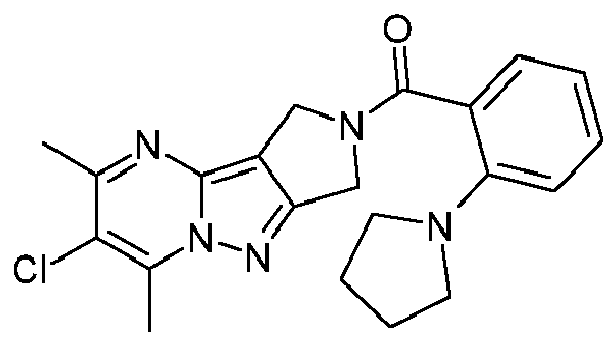
- The title compound was prepared following procedure described in Method A starting from Intermediate A3 and 2-(pyrrolidin-1-yl)benzoic acid (Ukrorgsynthesis Ltd.), and has precipitated out from the reaction mixture. After filtration, washing twice with DMF and purification by crystallization (ACN), the title compound was obtained as a white powder (15 mg, 7%). 1H NMR (DMSO-d6) δ 7.31-7.16 (m, 2H), 6.80-6.68 (m, 2H), 4.84 (s, 1H), 4.81 (s, 1H), 4.78-4.63 (m, 1H), 4.55-4.38 (m, 1H), 3.31-3.20 (m, 2H), 3.19-3.06 (m, 2H), 2.83 (s, 1.5H), 2.80 (s, 1.5H), 2.61 (s, 1.5H), 2.55 (s, 1.5H), 1.90-1.75 (m, 4H). HPLC (max plot) 99.3%, Rt 3.65 min. UPLC/MS: (MS+) 396.4 ([M+H]+).
-

- The title compound was prepared following procedure described in Method A starting from Intermediate A3 and 2-[2-(dimethylamino)ethoxy]benzoic acid hydrochloride (Enamine). After purification by flash chromatography (silica, DCM/EtOH/aqueous NH3), followed by crystallization (MIBK), the title compound was obtained as a white powder (542 mg, 34%).1H NMR (CDCl3) δ 7.42-7.31 (m, 2H), 7.10-7.00 (m, 1H), 7.00-6.91 (m, 1H), 5.01-4.96 (m, 2H), 4.65 (s, 2H), 4.17 (t, J = 5.8 Hz, 2H), 2.91 (s, 1.8H), 2.85 (s, 1.2H), 2.72 (t, J = 5.8 Hz, 2H), 2.69 (s, 1.2H), 2.61 (s, 1.8H), 2.26 (s, 6H). HPLC (max plot) 99.4%, Rt 2.69 min. UPLC/MS: (MS+) 414.4 ([M+H]+). Melting point: 156-159°C (MIBK). Elemental analysis (C21H24ClN5O2): calculated: C 60.94%, H 5.84%, N 16.92%; found: C 60.85%, H 5.94%, N 16.75%.
-

- The title compound was prepared following procedure described in Method A starting from Intermediate A3 and 2-isopropoxybenzoic acid (Ukrorgsynthesis Ltd.). After purification by crystallization (ACN), the title compound was obtained as a pale beige powder (44 mg, 35%). 1H NMR (DMSO-d6) δ 7.46-7.38 (m, 1H), 7.31-7.26 (m, 1H), 7.14 (d, J = 8.3 Hz, 1H), 7.05-6.99 (m, 1H), 4.83 (s, 1H), 4.80 (s, 1H), 4.73-4.60 (m, 1H), 4.55 (s, 1H), 4.49 (s, 1H), 2.83 (s, 1.5H), 2.79 (s, 1.5H), 2.61 (s, 1.5H), 2.54 (s, 1.5H), 1.21 (d, J = 6.0 Hz, 3H), 1.20 (d, J = 6.0 Hz, 3H). HPLC (max plot) 98.0%, Rt 4.17 min. UPLC/MS: (MS+) 385.1 ([M+H]+), (MS-) 383.1 ([M-H]-).
-

- The title compound was prepared following procedure described in Method A starting from Intermediate A3 and 2-ethoxybenzoic acid. After purification by crystallization (ACN), the title compound was obtained as a white powder (184 mg, 66%).1H NMR (DMSO-d6) δ 7.47-7.39 (m, 1H), 7.32-7.27 (m, 1H), 7.13 (d, J = 8.4 Hz, 1H), 7.06-6.99 (m, 1H), 4.83(s, 1H), 4.80(s, 1H), 4.55(s, 1H), 4.50(s, 1H), 4.13(q, J = 6.9 Hz, 1H), 4.12 (q, J = 6.9 Hz, 1H), 2.82 (s, 1.5H), 2.78 (s, 1.5H), 2.61 (s, 1.5H), 2.54 (s, 1.5H), 1.24 (t, J = 6.9 Hz, 1.5H), 1.23 (t, J = 6.9 Hz, 1.5H). HPLC (max plot) 98.6%, Rt 3.87 min. UPLC/MS: (MS+) 371.0 ([M+H]+). Melting point: 164-167°C (ACN).
-
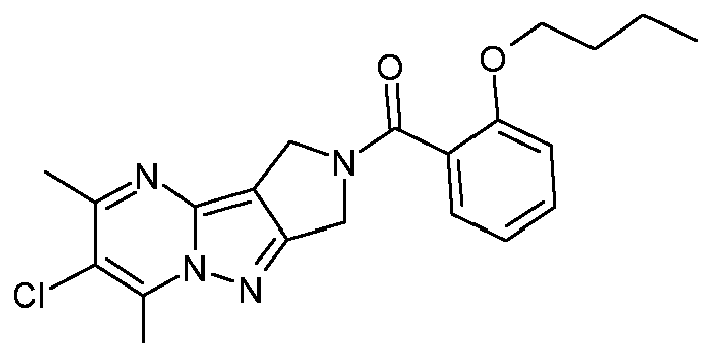
- The title compound was prepared following procedure described in Method A starting from Intermediate A3 and 2-butoxybenzoic acid. After purification by crystallization (ACN), the title compound was obtained as a white powder (142 mg, 61%). 1H NMR (DMSO-d6) δ 7.47-7.39 (m, 1H), 7.32-7.27 (m, 1H), 7.14 (d, J = 8.4 Hz, 1H), 7.07-7.00 (m, 1H), 4.82 (s, 1H), 4.79 (s, 1H), 4.53 (s, 1H), 4.48 (s, 1H), 4.05 (t, J = 6.4 Hz, 1H), 4.04 (t, J = 6.4 Hz, 1H), 2.83 (s, 1.5H), 2.79 (s, 1.5H), 2.61 (s, 1.5H), 2.54 (s, 1.5H), 1.65-1.53 (m, 2H), 1.35-1.20 (m, 2H), 0.77 (t, J = 7.3 Hz, 1.5H), 0.75 (t, J = 7.3 Hz, 1.5H). HPLC (max plot) 99.1 %, Rt 4.55 min. UPLC/MS: (MS+) 399.4 ([M+H]+). Melting point: 167-169°C (ACN).
-

- The title compound was prepared following procedure described in Method B starting from Intermediate A1 and 2-ethoxybenzoic acid. After purification by flash chromatography (petroleum ether/EA, 50/50 to EA) the title compound was obtained as an white solid (29 mg, 38%). 1H NMR (CDCl3) δ 7.39-7.28 (m, 2H), 7.01-6.88 (m, 2H), 5.10-4.95 (m, 2H), 4.68-4.60 (m, 2H), 4.16-4.06 (m, 2H), 2.74-2.68 (m, 3H), 2.54-2.48 (m, 3H), 2.26 (m, 3H), 1.35-1.19 (m, 3H). HPLC (max plot) 95.3%; Rt 3.22 min. UPLC/MS: (MS+) 351.0 ([M+H]+).
-

- The title compound was prepared following procedure described in Method B starting from Intermediate A1 and 2-ethoxy-5-flurorobenzoic acid. After purification by flash chromatography (petroleum ether/EA, 50/50 to EA), the title compound was obtained as a white solid (82 mg, 70%). 1H NMR (CDCl3) δ 7.04-6.95 (m, 2H), 6.85-6.77 (m, 1H), 4.97-4.90 (m, 2H), 4.63-4.55 (m, 2H), 4.02-3.94 (m, 2H), 2.71-2.66 (m, 3H), 2.51-2.45 (m, 3H), 2.23 (s, 3H), 1.25-1.16 (m, 3H). HPLC (max plot) 96.7%; Rt 3.77 min. UPLC/MS: (MS+) 369.2 ([M+H]+).
-

- The title compound was prepared following procedure described in Method A starting from Intermediate A3 and 2-(trifluoromethoxy)benzoic acid. After purification by crystallization (ACN), the title compound was obtained as a white powder (97 mg, 41%). 1H NMR (DMSO-d6) δ 7.71-7.61 (m, 2H), 7.57-7.50 (m, 2H), 4.89 (s, 1H), 4.85 (s, 1H), 4.58 (s, 1H), 4.53 (s, 1H), 2.84 (s, 1.5H), 2.80 (s, 1.5H), 2.62 (s, 1.5H), 2.55 (s, 1.5H). HPLC (max plot) 100%, Rt 4.25 min. UPLC/MS: (MS+) 411.0 ([M+H]+). Melting point: 179-181°C (ACN).
-

- The title compound was prepared following procedure described in Method A starting from Intermediate A3 and 2-(2-methylsulfanyl-ethoxy)-benzoic acid (Ukrorgsynthesis Ltd.). After purification by crystallization (ACN), the title compound was obtained as a white powder (325 mg, 81%). 1H NMR (DMSO-d6) δ 7.48-7.41 (m, 1H), 7.33-7.28 (m, 1H), 7.16 (d, J = 8.3 Hz, 1H), 7.09-7.02 (m, 1H), 4.81 (s, 1H), 4.78 (s, 1H), 4.59 (s, 1H), 4.53 (s, 1H), 4.24 (t, J = 6.1 Hz, 2H), 2.83(s, 1.5H), 2.79 (s, 1.5H), 2.77 (t, J = 6.1 Hz, 1H), 2.76 (t, J = 6.1 Hz, 1H), 2.61 (s, 1.5H), 2.54 (s, 1.5H), 2.01 (s, 1.5H), 1.99 (s, 1.5H). HPLC (max plot) 99.4%, Rt 4.02 min. UPLC/MS: (MS+) 417.3 ([M+H]+), (MS-) 415.5 ([M-H]-). Melting point: 183-185°C (ACN).
-

- The title compound was prepared following procedure described in Method A starting from Intermediate A3 and 3,5-difluoro-2-methoxybenzoic acid (JRD Fluorochemicals Ltd.). After purification by crystallization (ACN), the title compound was obtained as a pale beige powder (80 mg, 35%). 1H NMR (DMSO-d6) δ 7.54-7.45 (m, 1H), 7.25-7.17 (m, 1H), 4.86 (s, 1H), 4.83 (s, 1H), 4.62 (s, 1H), 4.57 (s, 1H), 3.84 (t, J = 1.3 Hz, 3H), 2.84 (s, 1.5H), 2.81 (s, 1.5H), 2.62 (s, 1.5H), 2.56 (s, 1.5H). HPLC (max plot) 98.7%, Rt 3.99 min. UPLC/MS: (MS+) 393.4 ([M+H]+). Melting point: 185-187°C (ACN).
-

- The title compound was prepared following procedure described in Method B starting from Intermediate A1 and 2-(trifluoromethoxy)benzoic acid. After purification by flash chromatography (petroleum ether/EA, 50/50 to EA) the title compound was obtained as a colourless oil (30 mg, 37%). 1H NMR (CDCl3) δ 7.53-7.46 (m, 2H), 7.43-7.33 (m, 2H), 5.06-5.01 (m, 2H), 4.65-4.58 (m, 2H), 2.79-2.77 (m, 3H), 2.59-2.58 (m, 3H), 2.32 (s, 3H). HPLC (max plot) 94.6%; Rt 4.02 min. UPLC/MS: (MS+) 391.1 ([M+H]+).
-

- A mixture of Intermediate Z2 (100 mg; 0.28 mmol; 1 eq.), 1-(2-bromoethyl)-1H-pyrazole (97 mg; 0.55 mmol; 2 eq.) and K2CO3 (115 mg; 0.83 mmol; 3 eq.) in DMF (2.5 mL) was stirred at 150°C for 20 min (MW heating). The reaction mixture was diluted with water and extracted with DCM. The organic layer was washed with brine, dried over MgSO4 and concentrated in vacuo. Purification by mass directed preparative HPLC afforded the title compound (24 mg, 19%) as an off-white solid. 1H NMR (CDCl3) δ 7.33-7.19 (m, 3H), 6.78-6.71 (m, 1H), 6.65-6.60 (m, 1H), 5.63-5.61 (m, 1H), 4.96 (s, 0.7H), 4.94 (s, 1.3H), 4.49-4.45 (m, 2H), 4.38-4.34 (m, 2H), 4.23 (s, 1.3H), 4.19 (s, 0.7H), 2.93 (s, 2H), 2.88 (s, 1H), 2.71 (s, 1H), 2.63 (s, 2H). HPLC (max plot) 96.3%; Rt 3.31 min. UPLC/MS: (MS+) 455.4 ([M+H]+).
-
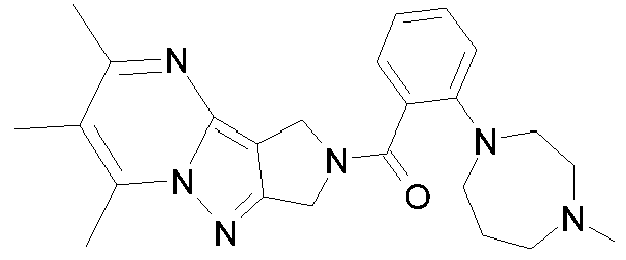
- The title compound was prepared following procedure described in Method A starting from Intermediate A1 and 2-(4-methylperhydro-1,4-diazepin-1-yl)benzoic acid hydrochloride hemihydrate. After purification by mass directed preparative HPLC, the title compound was obtained as an off-white powder (80 mg, 46%).1H NMR (CDCl3) δ 7.35-7.27 (m, 2H), 6.99-6.89 (m, 2H), 5.10-4.77 (m, 3H), 4.52-4.28 (m, 1H), 3.57-3.39 (m, 4H), 2.79 (s, 2H), 2.73 (s, 1H), 2.70-2.58 (m, 4H), 2.59 (s, 1H), 2.52 (s, 2H), 2.34-2.26 (m, 6H), 1.97-1.87 (m, 2H). HPLC (max plot) 96.2%; Rt 2.25 min. UPLC/MS: (MS+) 419.2 ([M+H]+).
-

- Intermediate Z1 (100 mg; 0.31 mmol; 1 eq.) was added to a suspension of NaH (60% in oil, 17.6 mg; 0.4 mmol; 1.3 eq.) in THF (3 mL) and DMF (2 mL) and the resulting mixture was stirred at room temperature for 10 minutes whereupon 1-(2-chloroethyl)piperidine hydrochloride (86 mg; 0.47 mmol; 1.5 eq.) was added. The reaction mixture was stirred at room temperature for 7 days, during which time several additions of NaH and 1-(2-chloroethyl)piperidine hydrochloride were made. The reaction mixture was partitioned between water and DCM and the two phases separated. The organic layer was washed with brine, dried over magnesium sulphate and concentrated in vacuo. Purification by mass directed preparative HPLC afforded the title compound (66 mg, 49%) as a white solid. 1H NMR (CDCl3) δ 7.40-7.31 (m, 2H), 7.05-6.92 (m, 2H), 5.01 (s, 0.7H), 4.98 (s, 1.3H), 4.65 (s, 2H), 4.17-4.14 (m, 2H), 2.78 (s, 2H), 2.75-2.69 (m, 3H), 2.59 (s, 1H), 2.51 (s, 2H), 2.42 (br s, 2H), 2.31 (s, 1H), 2.30 (s, 2H), 1.59-1.26 (m, 8H). HPLC (max plot) 98.4%; Rt 2.33 min. UPLC/MS: (MS+) 434.5 ([M+H]+).
-

- The title compound was prepared following procedure described in Method A starting from Intermediate A1 and 2-butoxybenzoic acid. After purification by mass directed preparative HPLC, the title compound was obtained as a yellow solid (77 mg, 49%). 1H NMR (CDCl3) δ 7.40-7.31 (m, 2H), 7.04-6.92 (m, 2H), 5.02 (s, 0.7H), 5.00 (s, 1.3H), 4.63 (br s, 2H), 4.04-3.98 (m, 2H), 2.79 (s, 2H), 2.73 (s, 1H), 2.59 (s, 1H), 2.52 (s, 2H), 2.31 (s, 1H), 2.30 (s, 2H), 1.73-1.64 (m, 2H), 1.42-1.30 (m, 2H), 0.86-0.81 (m, 3H). HPLC (max plot) 98.8%; Rt 3.74 min. UPLC/MS: (MS+) 379.1 ([M+H]+).
-

- The title compound was prepared following procedure described in Method A starting from Intermediate A1 and 2-[2-(dimethylamino)ethoxy]benzoic acid. After purification by crystallization (DCM/Et2O), the title compound was obtained as an off-white powder (110 mg, 21 %). 1H NMR (DMSO-d6) δ 7.47-7.39 (m, 1H), 7.32-7.27 (m, 1H), 7.14 (d, J = 8.1 Hz, 1H), 7.07-7.00 (m, 1H), 4.77 (s, 1H), 4.75 (s, 1H), 4.56 (br s, 1H), 4.52 (br s, 1H), 4.12 (t, J = 5.5 Hz, 2H), 2.72 (s, 1.5H), 2.68 (s, 1.5H), 2.55-2.50 (m, 3.5H), 2.45 (s, 1.5H), 2.26 (s, 1.5H), 2.25 (s, 1.5H), 2.05 (s, 3H), 2.04 (s, 3H). HPLC (max plot) 99.1%, Rt 2.22 min. UPLC/MS: (MS+) 394.2 ([M+H]+). Melting point: 148-150°C (DCM/Et2O).
-

- The title compound was prepared following procedure described in Method B starting from Intermediate A1 and acetylsalicylic acid. After purification by flash chromatography (petroleum ether/EA, 50/50 to EA) the title compound was obtained as a white solid (200 mg, 66%). 1H NMR (DMSO) δ 7.66-7.49 (m, 2H), 7.41-7.37 (m, 1H), 7.28-7.25 (m, 1H), 4.85-4.78 (m, 2H), 4.58-4.54 (m, 2H), 2.71 (s, 1.5H), 2.68 (s, 1.5H), 2.52 (s, 1.5H), 2.45 (s, 1.5H), 2.27 (s, 1.5H), 2.25 (s, 1.5H), 2.17 (s, 3H). HPLC (max plot) 89.1%; Rt 3.27 min. UPLC/MS: (MS+) 365.15 ([M+H]+).
-

- A mixture of Intermediate Z1 (100 mg; 0.31 mmol; 1 eq.), 1-(2-bromoethyl)-1H-pyrazole (81 mg; 0.47 mmol; 1.5 eq.) and K2CO3 (129 mg; 0.93 mmol; 3 eq.) in DMF (2.5 mL) was stirred at 140°C for 40 minutes (MW heating). 1-(2-bromoethyl)-1H-pyrazole (54.3 mg; 0.31 mmol; 1 eq.) was added and the reaction mixture was stirred at 140°C for a further 20 minutes (MW heating). The reaction mixture was partitioned between DCM and water and the two phases separated. The organic layer was washed with brine, dried over MgSO4 and concentrated in vacuo. Purification by mass directed preparative HPLC afforded the title compound (46 mg, 36%) as a white solid. 1H NMR (CDCl3) δ 7.38-7.27 (m, 3.3H), 7.20-7.19 (m, 0.7H), 7.06-6.99 (m, 1H), 6.90-6.87 (m, 1H), 5.63-5.62 (m, 0.7H), 5.61-5.59 (m, 0.3H), 5.00 (s, 0.7H), 4.97 (s, 1.3H), 4.48-4.45 (m, 2H), 4.37-4.34 (m, 2H), 4.26 (s, 1.3H), 4.22 (s, 0.7H), 2.80 (s, 2H), 2.74 (s, 1H), 2.61 (s, 1H), 2.52 (s, 2H), 2.33 (s, 1H), 2.32 (s, 2H). HPLC (max plot) 90.6%; Rt 2.69 min. UPLC/MS: (MS+) 417.4 ([M+H]+).
-
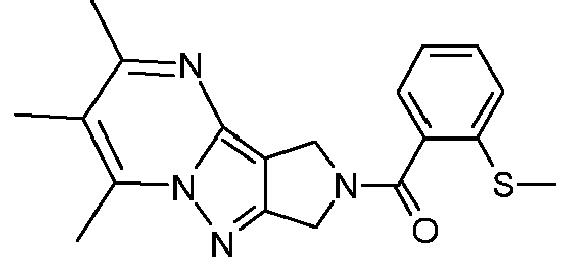
- The title compound was prepared following procedure described in Method B starting from Intermediate A1 and 2-(methylthio)benzoic acid. After purification by flash chromatography (petroleum ether/EA, 50/50 to EA) the title compound was obtained as a white solid (31 mg, 42%). 1H NMR (CDCl3) δ 7.38-7.20 (m, 4H), 5.04-5.02 (m, 2H), 4.59-4.56 (m, 2H), 2.76 (s, 2H), 2.70 (s, 1H), 2.57 (s, 1H), 2.52-2.45 (m, 5H). HPLC (max plot) 94.0%; Rt 3.56 min. UPLC/MS: (MS+) 353.14 ([M+H]+).
-

- A mixture of Intermediate Z1 (50 mg; 0.15 mmol; 1 eq.), 2-iodopropane (77 mg; 0.45 mmol; 3 eq.) and K2CO3 (62 mg; 0.45 mmol; 3 eq.) in DMF (2.5 mL) was stirred at 140°C for 20 minutes (MW heating). The reaction mixture was partitioned between DCM and water and the two phases separated. The organic layer was washed with brine, dried over MgSO4 and concentrated in vacuo. Purification by mass directed preparative HPLC afforded the title compound (3.7 mg, 7%) as a brown solid. HPLC (max plot) 99.0%; Rt 3.89 min. UPLC/MS: (MS+) 365.1 ([M+H]+).
-

- T3P (50% in DMF) (0.18 mL; 0.62 mmol; 1.3 eq.) was added to a solution of Intermediate A2 (100 mg; 0.46 mmol; 1 eq.), 2-ethoxy-benzoic acid (85 mg; 0.51 mmol; 1.1 eq.) and DIEA (243 µL; 1.43 mmol; 3.1 eq.) in DCE (10 mL) and the resulting mixture was stirred at room temperature for 16 hours. The solution was diluted with DCM and washed successively with sat. aq. NH4Cl, sat. aq. NaHCO3 and brine, dried over magnesium sulfate and concentrated in vacuo. Purification by column chromatography (EA) afforded the title compound (105 mg, 63%) as a white foam. 1H NMR (DMSO-d6) δ 7.47-7.39 (m, 1H), 7.32-7.26 (m, 1H), 7.13 (d, J = 8.3 Hz, 1H), 7.03 (t, J = 7.4 Hz, 1H), 4.82-4.77 (m, 2H), 4.52 (br s, 1H), 4.47 (br s, 1H), 4.17-4.07 (m, 2H), 2.76-2.65 (m, 5H), 2.57 (s, 1.5H), 2.51 (s, 1.5H), 1.26-1.19 (m, 3H), 1.16-1.08 (m, 3H). HPLC (max plot) 98.6%; Rt 3.59 min. UPLC/MS: (MS+) 365.4 ([M+H]+).
-

- The title compound was prepared following procedure described in Method A starting from Intermediate A3 and Intermediate B2. After purification by crystallization (ACN/iPr2O), the title compound was obtained as a pale beige powder (60 mg, 25%). 1H NMR (DMSO-d6) δ 7.54-7.44 (m, 1H), 7.23-7.16 (m, 1H), 4.86 (s, 1H), 4.83 (s, 1H), 4.62
- (s, 1H), 4.58 (s, 1H), 4.07 (q, J = 7.0 Hz, 2H), 2.84 (s, 1.5H), 2.81 (s, 1.5H), 2.62 (s, 1.5H), 2.56 (s, 1.5H), 1.18 (t, J = 7.0 Hz, 3H). HPLC (max plot) 99.9%, Rt 4.32 min. UPLC/MS: (MS+) 407.4 ([M+H]+), (MS-) 405.4 ([M-H]-). Melting point: 153-155°C (ACN/iPr2O).
-

- The title compound was prepared following procedure described in Method B starting from Intermediate A1 and 2-benzyloxybenzoic acid. After purification by mass directed preparative HPLC the title compound was obtained as an off-white powder (76 mg, 44%). 1H NMR (CDCl3) δ 7.39-7.32 (m, 4H), 7.29-7.21 (m, 3H), 7.07-6.99 (m, 2H), 5.15 (s, 0.7H), 5.14 (s, 1.3H), 5.04 (s, 0.7H), 5.01 (s, 1.3H), 4.64 (s, 1.3H), 4.63 (s, 0.7H), 2.77 (s, 2H), 2.71 (s, 1H), 2.58 (s, 1H), 2.50 (s, 2H), 2.30 (s, 1H), 2.29 (s, 2H). HPLC (max plot) 99.8%; Rt 3.69 min. UPLC/MS: (MS+) 419.2 ([M+H]+).
-

- The title compound was prepared following procedure described in Method A starting from Intermediate A3 and 2-(2-methylpropoxy)benzoic acid (Enamine Ltd.). After purification by crystallization (ACN), the title compound was obtained as a white powder (192 mg, 83%). 1H NMR (DMSO-d6) δ 7.47-7.36 (m, 1H), 7.32-7.27 (m, 1H), 7.12 (d, J = 8.4 Hz, 1H), 7.07-7.00 (m, 1H), 4.83 (s, 1H), 4.80 (s, 1H), 4.53 (s, 1H), 4.48 (s, 1H), 3.82 (d, J = 6.2 Hz, 2H), 2.83 (s, 1.5H), 2.79 (s, 1.5H), 2.61 (s, 1.5H), 2.54 (s, 1.5H), 1.98-1.83 (m, 1H), 0.83 (d, J = 6.7 Hz, 3H), 0.82 (d, J = 6.7 Hz, 3H). HPLC (max plot) 99.7%, Rt 4.56 min. UPLC/MS: (MS+) 399.4 ([M+H]+). Melting point: 184-187°C (ACN).
-

- The title compound was prepared following procedure described in Method A starting from Intermediate A7 and 2-ethoxybenzoic acid. After purification by mass directed preparative HPLC the title compound was obtained as a white solid (28 mg, 36%). 1H NMR (CDCl3) δ 8.40 (s, 0.5H), 8.35 (s, 0.5H), 7.46-7.40 (m, 1H), 7.31-7.28 (m, 1H), 7.15-7.12 (m, 1H), 7.05-7.00 (m, 1H), 4.83-4.82 (m, 2H), 4.55-4.51 (m, 2H), 4.16-4.08 (m, 2H), 2.70 (s, 1.5H), 2.67 (s, 1.5H), 2.33 (s, 1.5H), 2.32 (s, 1.5H), 1.26-1.20 (m, 3H). HPLC (max plot) 96.2%; Rt 3.02 min. UPLC/MS: (MS+) 337.4 ([M+H]+).
-

- The title compound was prepared following procedure described in Method A starting from Intermediate A7 and 2-[2-(dimethylamino)ethoxy]benzoic acid. After purification by mass directed preparative HPLC the title compound was obtained as a yellow solid (80 mg, 61%). 1H NMR (DMSO-d6) δ 8.40 (s, 0.5H), 8.35 (s, 0.5H), 7.46-7.40 (m, 1H), 7.32-7.28 (m, 1H), 7.17-7.14 (m, 1H), 7.06-7.01 (m, 1H), 4.80-4.39 (m, 2H), 4.59 (br s, 2H), 4.13 (t, J = 5.5 Hz, 2H), 2.71 (s, 1.5H), 2.61 (s, 1.5H), 2.58-2.52 (m, 2H), 2.34 (s, 1.5H), 2.32 (s, 1.5H), 2.07 (s, 3H), 2.05 (s, 3H). HPLC (max plot) 94.8%; Rt 2.02 min. UPLC/MS: (MS+) 380.2 ([M+H]+).
-
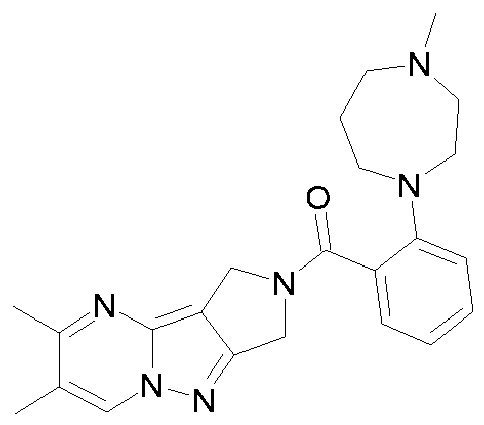
- The title compound was prepared following procedure described in Method A starting from Intermediate A7 and 2-(4-methylperhydro-1,4-diazepin-1-yl)benzoic acid hydrochloride. After purification mass directed preparative HPLC, the title compound was obtained as a pale brown solid (42 mg, 45%). 1H NMR (DMSO-d6) δ 8.40 (s, 0.5H), 8.34 (s, 0.5H), 7.33-7.29 (m, 1H), 7.24-7.19 (m, 1H), 7.04-7.01 (m, 1H), 6.92-6.87 (m, 1H), 4.90-4.67 (m, 3H), 4.44-4.24 (m, 1H), 3.40-3.21 (m, 6H), 2.71 (s, 1.5H), 2.67 (s, 1.5H), 2.45-2.32 (m, 5H), 2.09 (s, 1.5H), 2.08 (s, 1.5H), 1.81-1.72 (m, 2H). HPLC (max plot) 96.8%; Rt 2.11 min. UPLC/MS: (MS+) 405.5 ([M+H]+).
-

- The title compound was prepared following procedure described in Method A starting from Intermediate A1 and 5-chloro-2-ethoxy-benzoic acid (Ukrorgsynthesis Ltd.), and has precipitated out from the reaction mixture. After filtration and slurry in hot ACN, the title compound was obtained as a white powder (40 mg, 29%). 1H NMR (DMSO-d6) δ 7.50-7.44 (m, 1H), 7.38-7.35 (m, 1H), 7.17 (d, J = 8.9 Hz, 1H), 4.80 (s, 1H), 4.78 (s, 1H), 4.55 (s, 1H), 4.51 (s, 1H), 4.13 (q, J = 6.9 Hz, 1H), 4.12 (q, J = 6.9 Hz, 1H), 2.72 (s, 1.5H), 2.69 (s, 1.5H), 2.52 (s, 1.5H), 2.46 (s, 1.5H), 2.27 (s, 1.5H), 2.26 (s, 1.5H), 1.23 (t, J = 6.9 Hz, 1.5H), 1.22 (t, J = 6.9 Hz, 1.5H). HPLC (max plot) 99.5%, Rt 3.66 min. UPLC/MS: (MS+) 385.3 ([M+H]+).
-

- The title compound was prepared following procedure described in Method A starting from Intermediate A3 and 2-(tetrahydropyran-4-yloxy)benzoic acid and has precipitated out from the reaction mixture. After filtration and drying, the title compound was obtained as a beige solid (138 mg, 84%). 1H NMR (CDCl3) δ 7.40-7.33 (m, 2H), 7.09-6.96 (m, 2H), 5.02-5.01 (m, 2H), 4.67 (s, 2H), 4.58-4.50 (m, 1H), 3.89-3.81 (m, 2H), 3.56-3.49 (m, 2H), 2.91 (s, 2H), 2.85 (s, 1H), 2.69 (s, 1H), 2.62 (s, 2H), 2.00-1.93 (m, 2H), 1.80-1.69 (m, 2H). HPLC (max plot) 98.8%; Rt 3.42 min. UPLC/MS: (MS+) 427.4 ([M+H]+).
-

- The title compound was prepared following procedure described in Method A starting from Intermediate A1 and 2-(4-methylpiperazin-1-yl)benzoic acid. After purification by flash chromatography (silica, DCM/acetone), followed by crystallization (EtOH), the title compound was obtained as a white powder (10 mg, 6%). 1H NMR (DMSO-d6) δ 7.45-7.37 (m, 1H), 7.29-7.22 (m, 1H), 7.13-7.05 (m, 2H), 4.97-4.65 (br m, 3H), 4.27 (br s, 1H), 3.16 (br s, 2H), 2.89 (br s, 2H), 2.73 (s, 1.5H), 2.69 (s, 1.5H), 2.53 (s, 1.5H), 2.46 (s, 1.5H), 2.31-2.20 (m, 7H), 2.03 (s, 1.5H), 2.02 (s, 1.5H). HPLC (max plot) 96.7%; Rt 2.25 min. UPLC/MS: (MS+) 405.2 ([M+H]+).
-

- The title compound was prepared following procedure described in Method B starting from Intermediate A1 and 2-ethylaminobenzoic acid. After purification by mass directed preparative HPLC, the title compound was obtained as a white solid (22 mg, 25%). 1H NMR (CDCl3) δ 7.33-7.26 (m, 2H), 6.78-6.67 (m, 2H), 5.05-4.85 (m, 4H), 3.16 (q, J = 7.0 Hz, 2H), 2.78 (br s, 3H), 2.55 (br s, 3H), 2.32 (s, 3H), 1.26 (t, J = 7.0 Hz, 3H). HPLC (max plot) 91.6%; Rt 3.02 min. UPLC/MS: (MS+) 350.2 ([M+H]+).
-

- The title compound was prepared following procedure described in Method A starting from Intermediate A6 and 2-[2-(dimethylamino)ethoxy]benzoic acid. After purification by mass directed preparative HPLC, the title compound was obtained as a yellow solid (80 mg, 70%). 1H NMR (DMSO-d6) δ 8.86 (s, 0.5H), 8.85 (s, 0.5H), 7.46-7.39 (m, 1H), 7.30-7.27 (m, 1H), 7.15-7.12 (m, 1H), 7.05-7.00 (m, 1H), 4.74 (s, 2H), 4.54-4.50 (m, 2H), 4.13 (t, J = 4.5 Hz, 2H), 2.56-2.52 (m, 2H), 2.48 (s, 1.5H), 2.43 (s, 1.5H), 2.24 (br s, 3H), 2.06 (s, 3H), 2.05 (s, 3H). HPLC (max plot) 95.6%; Rt 1.95 min. UPLC/MS: (MS+) 380.2 ([M+H]+).
-

- The title compound was prepared following procedure described in Method A starting from Intermediate A1 and 2-(1H-pyrazol-1-yl)benzoic acid. After purification by mass directed preparative HPLC, the title compound was obtained as an off-white solid (91 mg, 49%). 1H NMR (CDCl3) δ 7.91-7.89 (m, 1H), 7.68-7.40 (m, 5H), 6.38-6.36 (m, 1H), 4.89 (s, 2H), 4.37 (s, 1.3H), 4.31 (s, 0.7H), 2.74 (s, 2H), 2.69 (s, 1H), 2.56 (s, 1H), 2.48 (s, 2H), 2.28 (s, 1H), 2.27 (s, 2H). HPLC (max plot) 99.4%; Rt 2.81 min. UPLC/MS: (MS+) 373.4 ([M+H]+).
-

- A mixture of Intermediate Z1 (100 mg; 0.31 mmol; 1 eq.), (2-bromoethyl)cyclohexane, (74 µL; 0.47 mmol; 1.5 eq.) and K2CO3 (129 mg; 0.93 mmol; 3 eq.) in DMF (2.5 mL) was stirred at 140°C for 20 minutes (MW heating). The reaction mixture was partitioned between DCM and water and the two phases separated. The organic layer was washed with brine, dried over MgSO4 and concentrated in vacuo. Purification by mass directed preparative HPLC afforded the title compound (93 mg, 69%) as a white solid. 1H NMR (CDCl3) δ 7.39-7.31 (m, 2H), 7.04-6.91 (m, 2H), 5.02 (s, 0.7H), 5.00 (s, 1.3H), 4.62 (s, 2H), 4.06-4.01 (m, 2H), 2.78 (s, 2H), 2.72 (s, 1H), 2.59 (s, 1H), 2.51 (s, 2H), 2.31 (s, 1 H), 2.30 (s, 2H), 1.65-1.28 (m, 8H), 1.00-0.79 (m, 5H). HPLC (max plot) 99.6%; Rt 4.46 min. UPLC/MS: (MS+) 433.4 ([M+H]+).
-

- The title compound was prepared following procedure described in Method A starting from Intermediate A6 and 2-(4-methylperhydro-1,4-diazepin-1-yl)benzoic acid hydrochloride hemihydrate. After purification by mass directed preparative HPLC, the title compound was obtained as a pale brown solid (19 mg, 31%). 1H NMR (DMSO-d6) δ 8.88 (m, 0.5H), 8.85 (m, 0.5H), 7.34-7.29 (m, 1H), 7.23-7.18 (m, 1H), 7.04-7.01 (m, 1H), 6.92-6.87 (m, 1H), 4.79-4.64 (m, 3H), 4.33-4.21 (m, 1H), 3.29-3.23 (m, 6H), 2.50-2.43 (m, 3H), 2.41-2.30 (m, 2H), 2.25-2.24 (m, 3H), 2.09 (s, 1.5H), 2.08 (s, 1.5H), 1.80-1.73 (m, 2H). HPLC (max plot) 98.2%; Rt 2.06 min. UPLC/MS: (MS+) 405.5 ([M+H]+).
-

- The title compound was prepared following procedure described in Method A starting from Intermediate A4 and 2-isopropoxybenzoic acid (Ukrorgsynthesis Ltd.). After purification by crystallization (ACN), the title compound was obtained as a pale yellow powder (49 mg, 27%). 1H NMR (DMSO-d6) δ 9.59 (d, J = 2.3 Hz, 0.5H), 9.56 (d, J = 2.3 Hz, 0.5H), 8.62 (d, J = 2.3 Hz, 0.5H), 8.57 (d, J = 2.3 Hz, 0.5H), 7.46-7.38 (m, 1H), 7.32-7.26 (m, 1H), 7.15 (d, J = 8.3 Hz, 1 H), 7.06-6.98 (m, 1H), 4.87-4.81 (m, 2H), 4.74-4.61 (m, 1H), 4.56 (s, 1H), 4.53 (s, 1H), 1.21 (d, J = 6.0 Hz, 3H), 1.20 (d, J = 6.0 Hz, 3H). HPLC (max plot) 100%, Rt 3.65 min. UPLC/MS: (MS+) 357.0 ([M+H]+). Melting point: 160°C-161°C (ACN).
-

- T3P (50% in DMF) (0.18 mL; 0.62 mmol; 3 eq.) was added to a solution of Intermediate A1 (50 mg; 0.21 mmol; 1 eq.), 2-trifluoromethyl-benzoic acid (43 mg; 0.23 mmol; 1.1 eq.) and DIEA (109 µL; 0.64 mmol; 3.1 eq.) in DCE and the resulting mixture was stirred at room temperature for 16 hours. The solution was diluted with DCM and washed successively with sat. aq. NH4Cl, sat. aq. NaHCO3 and brine, dried over magnesium sulfate and concentrated in vacuo. Purification by column chromatography (EA) afforded the title compound (35 mg, 45%) as a white foam. 1H NMR (DMSO-d6) δ 7.92-7.77 (m, 2H), 7.76-7.66 (m, 2H), 4.86-4.81 (m, 2H), 4.50-4.40 (m, 2H), 2.73 (s, 1.6H), 2.68 (s, 1.4H), 2.53 (s, 1.4H), 2.46 (s, 1.6H), 2.27 (s, 1.4H), 2.26 (s,1.6H). HPLC (max plot) 97.3%, Rt 3.45 min. UPLC/MS: (MS+) 375.4 ([M+H]+).
-

- The title compound was prepared following procedure described in Method B starting from Intermediate A1 and monomethyl phthalate. After purification by flash chromatography (petroleum ether/EA, 50/50 to EA), the title compound was obtained as an off-white solid (203 mg, 66%). 1H NMR (CDCl3) δ 8.04-8.01 (m, 1H), 7.63-7.38 (m, 3H), 5.02-5.00 (m, 2H), 4.45-4.42 (m, 2H), 3.80-3.65 (m, 3H), 2.72-2.65 (s, 3H), 2.53-2.44 (s, 3H), 2.25-2.24 (s, 3H). HPLC (max plot) 91.8%; Rt 3.20 min. UPLC/MS: (MS+) 365.2 ([M+H]+).
-
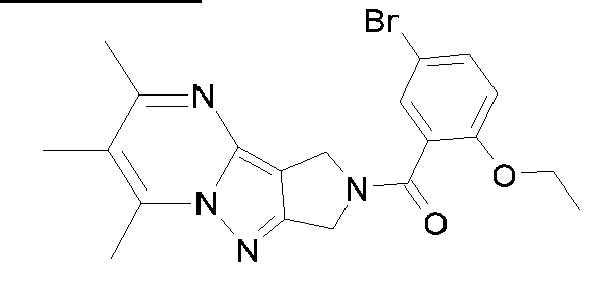
- The title compound was prepared following procedure described in Method B starting from Intermediate A1 and 5-bromo-2-ethoxy-benzoic acid. After purification by crystallization (ACN), the title compound was obtained as an off-white solid (99 mg, 55%). 1H NMR (CDCl3) δ 7.48-7.43 (m, 2H), 6.85-6.81 (m, 1H), 5.01-4.63 (m, 4H), 4.11-4.02 (m, 2H), 2.78-2.73 (m, 3H), 2.58-2.52 (m, 3H), 2.30 (s, 3H), 1.36-1.30 (m, 3H). HPLC (max plot) 98.0%; Rt 3.63 min. UPLC/MS: (MS+) 429.0 ([M+H]+). Melting point: 208-215°C (ACN).
-

- The title compound was prepared following procedure described in Method A starting from Intermediate A4 and 2-ethoxybenzoic acid, and has precipitated out from the reaction mixture. After filtration and washing with water (3x), the title compound was obtained as a white powder (132 mg, 48%). 1H NMR (DMSO-d6) δ 9.60 (d, J = 2.3 Hz, 0.5H), 9.57 (d, J = 2.3 Hz, 0.5H), 8.63 (d, J = 2.3 Hz, 0.5H), 8.58 (d, J = 2.3 Hz, 0.5H), 7.47-7.40 (m, 1H), 7.33-7.27 (m, 1H), 7.14 (d, J = 8.2 Hz, 1H), 7.06-7.00 (m, 1H), 4.85 (s, 1H), 4.84 (s, 1H), 4.57(s, 1H), 4.54 (s, 1H), 4.13 (q, J = 7.0 Hz, 1H), 4.12 (q, J = 7.0 Hz, 1H), 1.24 (t, J = 7.0 Hz, 1.5H), 1.23 (t, J = 7.0 Hz, 1.5H). HPLC (max plot) 99.1%, Rt 3.35 min. UPLC/MS: (MS+) 343.0 ([M+H]+).
-

- The title compound was prepared following procedure described in Method A starting from Intermediate A5 and 2-[2-(dimethylamino)ethoxy]benzoic acid. After purification by flash chromatography (silica, DCM/EtOH/aqueous NH3), the title compound was obtained as a beige foam (28 mg, 9%). 1H NMR (DMSO-d6) δ 9.01-8.97 (m, 1H), 8.46 (d, J = 2.1 Hz, 0.5H), 8.41 (d, J = 2.1 Hz, 0.5H), 7.47-7.40 (m, 1H), 7.32-7.28 (m, 1H), 7.16 (d, J = 8.3 Hz, 1H), 7.07-7.01 (m, 1H), 4.79 (s, 2H), 4.58 (br s, 2H), 4.14 (t, J = 5.2 Hz, 2H), 2.61-2.55 (m, 2H), 2.34-2.29 (m, 3H), 2.09 (s, 3H), 2.07 (s, 3H). HPLC (max plot) 98.5%, Rt 1.87 min. UPLC/MS: (MS+) 366.4 ([M+H]+).
-

- The title compound was prepared following procedure described in Method A starting from Intermediate A8 and 2-ethoxybenzoic acid, and has precipitated out from the reaction mixture. The reaction mixture was diluted with water and the precipitate was filtered off to give the title compound as a pale beige powder (1.97 g, 94%).1H NMR (DMSO-d6) δ 9.63 (d, J = 2.2 Hz, 0.5H), 9.61 (d, J = 2.2 Hz, 0.5H), 8.64 (d, J = 2.2 Hz, 0.5H), 8.59 (d, J = 2.2 Hz, 0.5H), 7.47-7.40 (m, 1H), 7.33-7.27 (m, 1H), 7.14 (d, J = 8.2 Hz, 1H), 7.06-7.00 (m, 1H), 4.84 (s, 2H), 4.56 (s, 1H), 4.53(s, 1H), 4.13 (q, J = 7.0 Hz, 1H), 4.13 (q, J = 7.0 Hz, 1H), 1.24 (t, J = 7.0 Hz, 1.5H), 1.24 (t, J = 7.0 Hz, 1.5H). HPLC (max plot) 99.5%, Rt 3.20 min. UPLC/MS: (MS+) 387.3 and 389.3 ([M+H]+).
-

- The title compound was prepared following procedure described in Method B starting from Intermediate A1 and 2-bromobenzoic acid. After purification by column chromatography (DCM/MeOH), the title compound was obtained as an off-white powder (570 mg, 35%). 1H NMR (CDCl3) δ 7.65-7.61 (m, 1H), 7.45-7.36 (m, 2H), 7.33-7.27 (m, 1H), 5.05-5.03 (m, 2H), 4.59-4.56 (m, 2H), 2.78-2.72 (m, 3H), 2.59-2.51 (m, 3H), 2.31-2.30 (m, 3H). HPLC (max plot) 96.0%, Rt 3.09 min. UPLC/MS: (MS+) 385.0 and 387.0 ([M+H]+).
- M1-CHO cells are plated in culture medium (HAM'sF12,P/S,10%FCS) on the day before the experiment with 10 000 cells/well in a 384 well plate (3750 Corning White 384w plate with lid). On the day of experiment, cells are washed with PBS and IPone buffer is added (glucose 5.5 mM, NaCl 146 mM, MgCl2 0.5 mM, HEPES 10 mM, LiCl 50 mM, CaCl2 1 mM, KCl 4.2 mM). Then diluted compounds (1%DMSO final concentration) are added together with EC20 of acetylcholine and incubated with the cells for 1 hour at room temperature. The intracellular concentration of IP1 is then measured using the IP-One HTRF assay from Cisbio.
- Activity range of the compounds of Formula (I) is the following:
Ex Structures M1 PAM EC50 (nM) 1 
*** 2 
*** 3 
*** 4 
** 5 
** 6 
** 7 
** 8 
** 9 
** 10 
** 11 
** 12 
** 13 
** 14 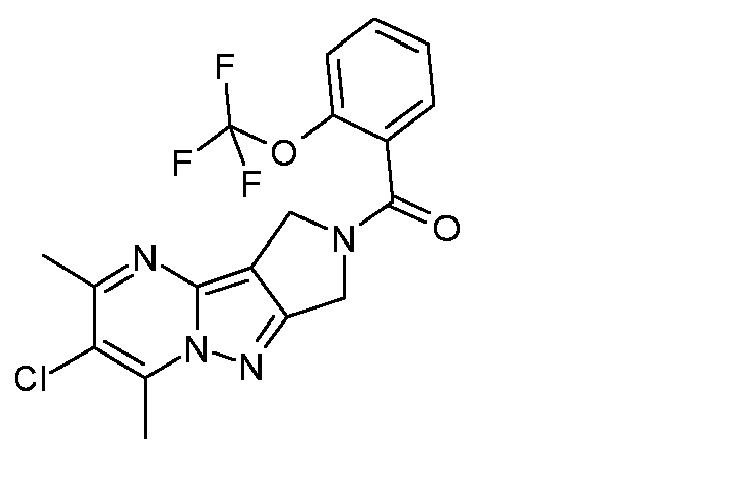
** 15 
** 16 
** 17 
** 18 
** 19 
** 20 
** 21 
** 22 
** 23 
** 24 
** 25 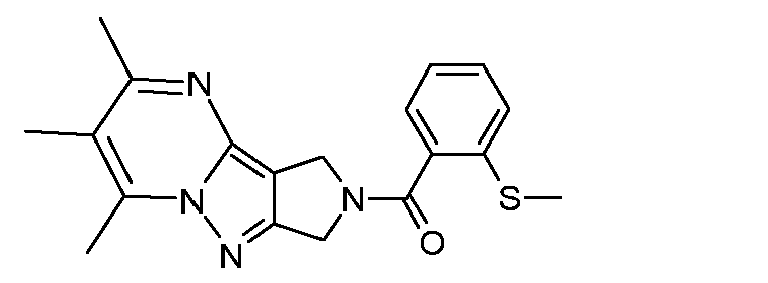
** 26 
** 27 
* 28 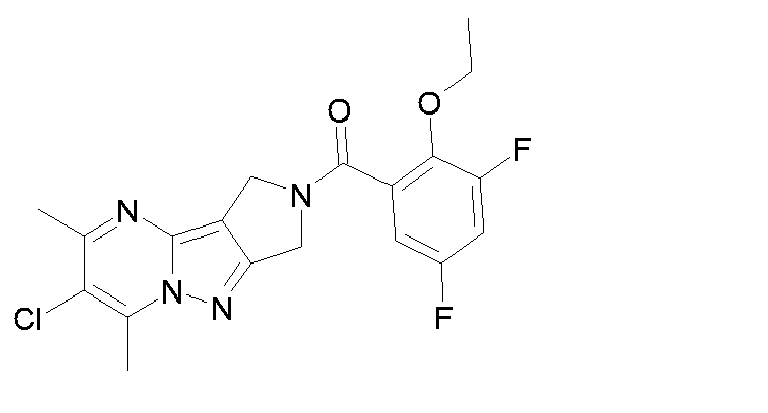
* 29 
* 30 
* 31 
* 32 
* 33 
* 34 
* 35 
* 36 
* 37 
* 38 
* 39 
* 40 
* 41 
* 42 
* 43 
* 44 
* 45 
* 46 
* 47 
* 48 
* 49 
* * 1 to 2 µM
** 0.2 to 1 µM
*** below 0.2 µM - A compound of formula (I) is admixed as a dry powder with a dry gelatin binder in an approximate 1:2 weight ratio. A minor amount of magnesium stearate is added as a lubricant. The mixture is formed into 240-270 mg tablets (80-90 mg of active compound according to the invention per tablet) in a tablet press.
- A compound of formula (I) is admixed as a dry powder with a starch diluent in an approximate 1:1 weight ratio. The mixture is filled into 250 mg capsules (125 mg of active compound according to the invention per capsule).
- A compound of formula (1) (1250 mg), sucrose (1.75 g) and xanthan gum (4 mg) are blended, passed through a No. 10 mesh U.S. sieve, and then mixed with a previously prepared solution of microcrystalline cellulose and sodium carboxymethyl cellulose (11:89, 50 mg) in water. Sodium benzoate (10 mg), flavor, and color are diluted with water and added with stirring. Sufficient water is then added to produce a total volume of 5 mL.
- A compound of formula (I) is admixed as a dry powder with a dry gelatin binder in an approximate 1:2 weight ratio. A minor amount of magnesium stearate is added as a lubricant. The mixture is formed into 450-900 mg tablets (150-300 mg of active compound according to the invention) in a tablet press.
- A compound of formula (I) is dissolved in a buffered sterile saline injectable aqueous medium to a concentration of approximately 5 mg/mL.
Claims (12)
- A compound of Formula (I)
 R1, R2, R3 are independently from each other selected from H, linear or branched C1-C6-alkyl, linear or branched C1-C6-alkoxy, Hal, or hydroxyl;Ra, Rb are independently from each other selected from H, Hal, hydroxy or A;Q denotes a 6-membered aromatic group or a 5-6-membered heteroaromatic group having 1 to 4 heteroatoms independently selected from N, O and S.R4 denotes G, OG, SG, NR5G, -COOG, or OCOG;R5 denotes H or a linear or branched alkyl having 1 to 6 carbon atoms.G denotes -CH3, -CF3, -CH2-A, Het, Cyc, Ar, -CH2-Het, -CH2-Cyc, -CH2-Ar, Hal, hydroxy;Hal denotes F, Cl, Br or I, preferably F, Cl or Br;A is a linear or branched carbon chain having 1 to 6 carbon atoms, wherein 1 to 3 non adjacent -CH2-groups may be independently from each other replaced by a group selected from O, NR5 S, SO, SO2, CO, and wherein 1 to 5 hydrogen atoms may be independently from each other replaced by Het, Cyc, Ar, or Hal;Het denotes a saturated, unsaturated or aromatic ring, being monocyclic or bicyclic or fused-bicyclic and having 3- to 8- members and containing 1 to 4 heteroatoms independently selected from N, NR5, O, S, CO, SO or SO2, which may be substituted by 1 to 3 substituents independently selected from A, Hal, OH and Het1;Het1 denotes a 4, 5 or 6 membered carbocyclic ring wherein 1 or 2 carbon atom are replaced by Oxygen atoms.Ar denotes a 6-membered carbocyclic aromatic ring or a fused or non fused byclic aromatic ring, and optionally substituted by 1 to 3 substituents independently selected from A or Hal;Cyc denotes a saturated or unsaturated carbocyclic ring having from 3 to 8 carbon atoms and optionally substituted by 1 to 3 substituents independently selected from A or Hal;and/or pharmaceutically usable derivatives, tautomers, salts, solvates and stereoisomers thereof.
 - A compound of Formula (I) as defined in claim 1 whereinQ is a phenyl ring;Ra, Rb are independently selected from H, Hal, Hydroxy, or a linear or branched alkyl group having 1 to 6 carbon atoms and wherein 1 to 3 hydrogen atoms may be replaced by Hal;R4 is G or OG;
- A compound of Formula (I) as defined in claims 1 or 2 wherein the group


- A compound of Formula (I) according to claims 1 to 3 wherein the compound is selected from the following group:
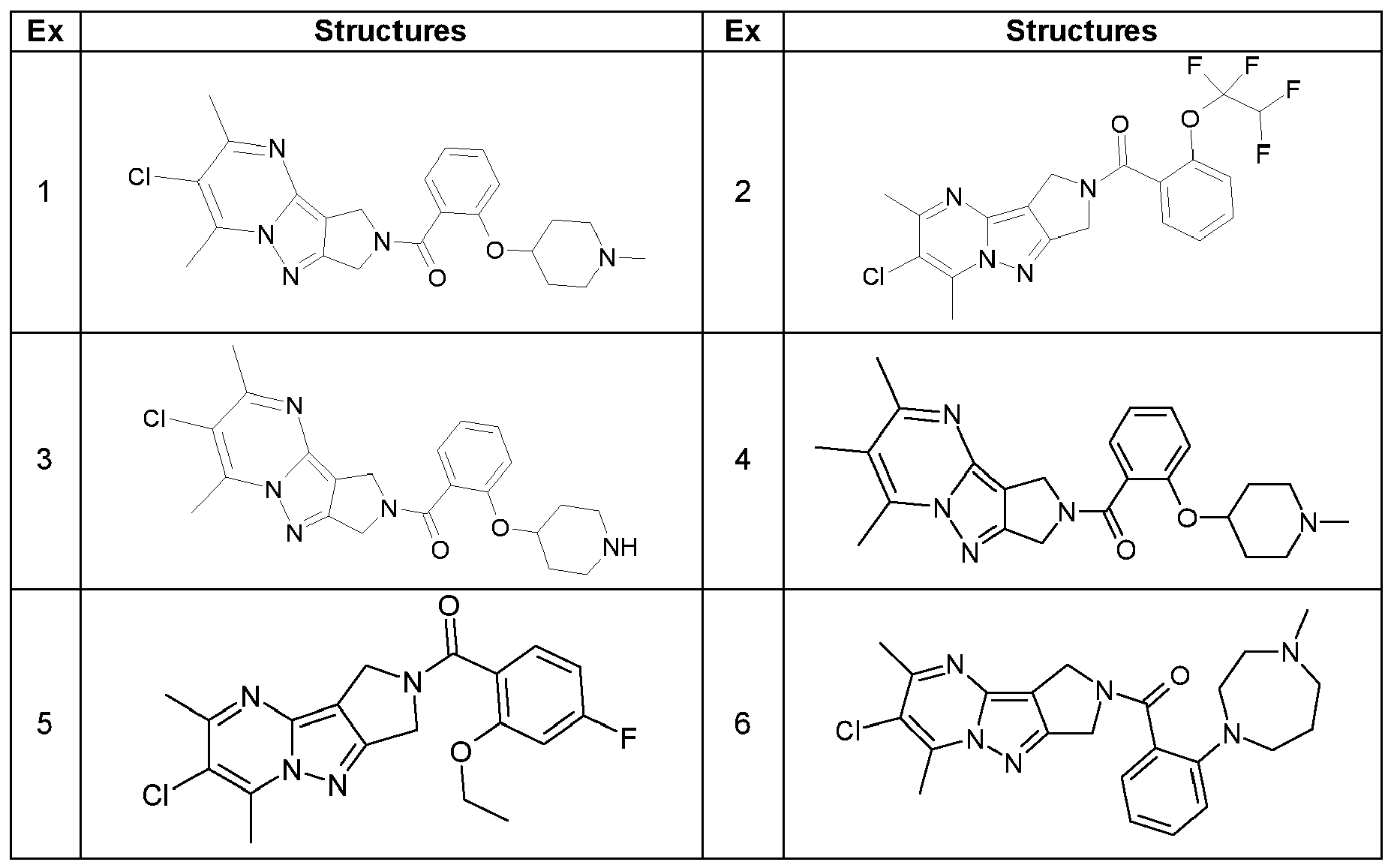


- A pharmaceutical composition comprising at least one compound of Formula (I) according to one or more of claims 1 to 4 and/or pharmaceutically usable derivatives, tautomers, salts, solvates and stereoisomers thereof, including mixtures thereof in all ratios, and optionally excipients and/or adjuvants.
- A pharmaceutical composition comprising at least one compound of Formula (I) according to one or more of claims 1 to 4 and/or pharmaceutically usable derivatives, tautomers, salts, solvates and stereoisomers thereof, including mixtures thereof in all ratios, and at least one further active ingredient.
- Set (kit) consisting of separate packs of(a) an effective amount of a compound of Formula (I) according to one or more of claims 1 to 4 and/or pharmaceutically usable derivatives, tautomers, salts, solvates and stereoisomers thereof, including mixtures thereof in all ratios, and(b) an effective amount of a further medicament active ingredient.
- Compounds according to one or more of claims 1 to 4 and pharmaceutically usable derivatives, salts, tautomers, solvates and stereoisomers thereof, including mixtures thereof in all ratios, for use in the preparation of a medicament for the treatment and/or prophylaxis of a M1 associated disorder.
- Compounds according to claim 8, wherein the M1 associated disorder is selected from central nervous system disorders.
- Compounds according to one or more of claims 1 to 4, and pharmaceutically usable derivatives, salts, tautomers, solvates and stereoisomers thereof, including mixtures thereof in all ratios, for use in the preparation of a medicament for the treatment and/or prophylaxis of a central nervous system disorder.
- Compounds according to claim 10, wherein the central nervous system disorder is Alzheimer's disease, Parkinson disease, schizophrenia, movement disorders and memory disorders, chronic and neuropathic pain, sleep disorders, epilepsy.
- A process to manufacture the compounds of Formula (I) as defined in claims 1 to 4 comprising the step of reacting a compound of Formula (A)


Priority Applications (9)
| Application Number | Priority Date | Filing Date | Title |
|---|---|---|---|
| EP11195214.9A EP2607364A1 (en) | 2011-12-22 | 2011-12-22 | Tetraaza-cyclopenta[a]indenyl and their use as positive allosteric modulators |
| AU2012357169A AU2012357169B2 (en) | 2011-12-22 | 2012-11-30 | Tetraaza-cyclopenta[a]indenyl and their use as positive allosteric modulators |
| CN201280062522.3A CN104039789B (en) | 2011-12-22 | 2012-11-30 | Four azepines-cyclopenta [a] indenyl and the purposes as forward allosteric modulators thereof |
| US14/366,901 US9403835B2 (en) | 2011-12-22 | 2012-11-30 | Tetraaza-cyclopenta[a]indenyl and their use as positive allosteric modulators |
| ES12798612.3T ES2606839T3 (en) | 2011-12-22 | 2012-11-30 | Tetraaza-cyclopenta [a] indenyl and its use as positive allosteric modulators |
| CA2860008A CA2860008C (en) | 2011-12-22 | 2012-11-30 | Tetraaza-cyclopenta[a]indenyl and their use as positive allosteric modulators |
| JP2014547736A JP6112316B2 (en) | 2011-12-22 | 2012-11-30 | Tetraaza-cyclopenta [a] indenyl and their use as positive allosteric modulators |
| EP12798612.3A EP2794608B1 (en) | 2011-12-22 | 2012-11-30 | Tetraaza-cyclopenta[a]indenyl and their use as positive allosteric modulators |
| PCT/EP2012/004968 WO2013091773A1 (en) | 2011-12-22 | 2012-11-30 | Tetraaza-cyclopenta[a]indenyl and their use as positive allosteric modulators |
Applications Claiming Priority (1)
| Application Number | Priority Date | Filing Date | Title |
|---|---|---|---|
| EP11195214.9A EP2607364A1 (en) | 2011-12-22 | 2011-12-22 | Tetraaza-cyclopenta[a]indenyl and their use as positive allosteric modulators |
Publications (1)
| Publication Number | Publication Date |
|---|---|
| EP2607364A1 true EP2607364A1 (en) | 2013-06-26 |
Family
ID=45464304
Family Applications (1)
| Application Number | Title | Priority Date | Filing Date |
|---|---|---|---|
| EP11195214.9A Withdrawn EP2607364A1 (en) | 2011-12-22 | 2011-12-22 | Tetraaza-cyclopenta[a]indenyl and their use as positive allosteric modulators |
Country Status (1)
| Country | Link |
|---|---|
| EP (1) | EP2607364A1 (en) |
Cited By (1)
| Publication number | Priority date | Publication date | Assignee | Title |
|---|---|---|---|---|
| EP2813505A1 (en) * | 2013-06-14 | 2014-12-17 | Asceneuron SA | Tetraaza-cyclopenta[a]indenyl derivatives |
Citations (2)
| Publication number | Priority date | Publication date | Assignee | Title |
|---|---|---|---|---|
| WO2008060488A1 (en) * | 2006-11-14 | 2008-05-22 | Merck & Co., Inc. | Tricyclic heteroaromatic compounds as dipeptidyl peptidase-iv inhibitors for the treatment or prevention of diabetes |
| WO2011137049A1 (en) * | 2010-04-30 | 2011-11-03 | Merck Sharp & Dohme Corp. | Heterocyclic quinolizine derived m1 receptor positive allosteric modulators |
-
2011
- 2011-12-22 EP EP11195214.9A patent/EP2607364A1/en not_active Withdrawn
Patent Citations (2)
| Publication number | Priority date | Publication date | Assignee | Title |
|---|---|---|---|---|
| WO2008060488A1 (en) * | 2006-11-14 | 2008-05-22 | Merck & Co., Inc. | Tricyclic heteroaromatic compounds as dipeptidyl peptidase-iv inhibitors for the treatment or prevention of diabetes |
| WO2011137049A1 (en) * | 2010-04-30 | 2011-11-03 | Merck Sharp & Dohme Corp. | Heterocyclic quinolizine derived m1 receptor positive allosteric modulators |
Non-Patent Citations (17)
| Title |
|---|
| "Bioreversible Carriers in Drug Design: Theory and Application", 1987, PERGAMON PRESS, pages: 14 - 21 |
| BIOORG. MED. CHEM. LETT., vol. 20, no. 14, 2010, pages 4273 - 4278 |
| EGLEN ET AL., TRENDS IN PHARMACOLOGICAL SCIENCES, vol. 22, no. 8, 2001, pages 409 - 414 |
| FISHER, JPN J PHARMACOL, vol. 84, 2000, pages 101 - 112 |
| GREGORY DIGBY ET AL., MOL BIOSYSTEMS, vol. 6, 2010, pages 1345 - 1354 |
| INT. J. PHARM., vol. 115, 1995, pages 61 - 67 |
| J. HET. CHEM., vol. 17, no. 1, 1980, pages 33 - 37 |
| JAN JAKUBIK, PHARMACEUTICALS, vol. 3, 2010, pages 2838 |
| JEFFREY CONN ET AL., TRENDS IN PHARMACOLOGICAL SCIENCES, vol. 30, no. 30, 2009, pages 148 |
| PHARMACEUTICAL RESEARCH, vol. 3, no. 6, 1986, pages 318 |
| PHILIP J. KOCIENSKI: "Protecting Groups", 1994, GEORG THIEME VERLAG |
| S. LAZARENO ET AL., MOL PHARMACOL, vol. 58, 2000, pages 194 - 207 |
| S. LAZARENO ET AL., MOL PHARMACOL, vol. 62, no. 6, 2002, pages 1491 - 1505 |
| SPALDING ET AL., MOL PHARMACOL, vol. 61, no. 6, 2002, pages 1297 - 1302 |
| T. HIGUCHI; V. STELLA: "Pro-drugs as Novel Delivery Systems", vol. 14, 1975, AMERICAN CHEMICAL SOCIETY |
| THEODORA W. GREENE; PETER G. M. WUTS: "Protective Groups in Organic Synthesis", 1999, WILEY INTERSCIENCE |
| THOMAS BRIDGE ET AL., DRUGNEWS&PERSPECTIVES, vol. 23, 2010, pages 229 |
Cited By (2)
| Publication number | Priority date | Publication date | Assignee | Title |
|---|---|---|---|---|
| EP2813505A1 (en) * | 2013-06-14 | 2014-12-17 | Asceneuron SA | Tetraaza-cyclopenta[a]indenyl derivatives |
| US9505769B2 (en) | 2013-06-14 | 2016-11-29 | Asceneuron Sa | Tetraaza-cyclopenta[a]indenyl derivatives |
Similar Documents
| Publication | Publication Date | Title |
|---|---|---|
| CA3124898C (en) | Heterocyclic compound, intermediate, preparation method therefor and application thereof | |
| AU2015371294B2 (en) | Compounds, compositions, and methods for increasing CFTR activity | |
| JP6916795B2 (en) | LSD1 inhibitor | |
| EP3377060B1 (en) | Pyrazole derivatives, processes for their preparation and uses thereof | |
| CA2993450C (en) | Compounds, compositions and methods of increasing cftr activity | |
| AU2012357169B2 (en) | Tetraaza-cyclopenta[a]indenyl and their use as positive allosteric modulators | |
| EP3116501A1 (en) | Compounds, compositions, and methods for increasing cftr activity | |
| JP2025084759A (en) | Piperidinyl-3-(aryloxy)propanamides and propanoates | |
| WO2023187677A1 (en) | N-(pyrrolidin-3-yl or piperidin-4-yl)acetamide derivatives | |
| AU2025201400A1 (en) | Glycyrrhetinic acid derivatives for treating hyperkalemia | |
| CA3231743A1 (en) | Pyridinylacetamide derivatives as sodium channel activators | |
| CN115380030B (en) | N-Heteroarylalkyl-2-(heterocyclyl and heterocyclylmethyl)acetamide derivatives as SSTR4 agonists | |
| EP2875025A1 (en) | Fused triazole derivatives as gamma secretase modulators | |
| EP4562001A1 (en) | Substituted pyridine derivatives as sarm1 inhibitors | |
| WO2013182274A1 (en) | Imidazo-oxadiazole and imidazo-thiadiazole derivatives | |
| EP3008068B1 (en) | Tetraaza-cyclopenta[a]indenyl derivatives | |
| JP2022519714A (en) | Glycyrrhetinic acid derivative for use in the treatment of hyperkalemia | |
| EP2674434A1 (en) | Tetraaza-cyclopenta[a]indenyl and their use as positive allosteric modulators |
Legal Events
| Date | Code | Title | Description |
|---|---|---|---|
| AK | Designated contracting states |
Kind code of ref document: A1 Designated state(s): AL AT BE BG CH CY CZ DE DK EE ES FI FR GB GR HR HU IE IS IT LI LT LU LV MC MK MT NL NO PL PT RO RS SE SI SK SM TR |
|
| AX | Request for extension of the european patent |
Extension state: BA ME |
|
| PUAI | Public reference made under article 153(3) epc to a published international application that has entered the european phase |
Free format text: ORIGINAL CODE: 0009012 |
|
| 17P | Request for examination filed |
Effective date: 20131212 |
|
| RBV | Designated contracting states (corrected) |
Designated state(s): AL AT BE BG CH CY CZ DE DK EE ES FI FR GB GR HR HU IE IS IT LI LT LU LV MC MK MT NL NO PL PT RO RS SE SI SK SM TR |
|
| STAA | Information on the status of an ep patent application or granted ep patent |
Free format text: STATUS: THE APPLICATION IS DEEMED TO BE WITHDRAWN |
|
| 18D | Application deemed to be withdrawn |
Effective date: 20140128 |