EP2607351B1 - Continuous process for the alkylation of cyclic tertiary amines - Google Patents
Continuous process for the alkylation of cyclic tertiary amines Download PDFInfo
- Publication number
- EP2607351B1 EP2607351B1 EP11195419.4A EP11195419A EP2607351B1 EP 2607351 B1 EP2607351 B1 EP 2607351B1 EP 11195419 A EP11195419 A EP 11195419A EP 2607351 B1 EP2607351 B1 EP 2607351B1
- Authority
- EP
- European Patent Office
- Prior art keywords
- bromide
- alkylating agent
- methyl
- cyclic
- solvent
- Prior art date
- Legal status (The legal status is an assumption and is not a legal conclusion. Google has not performed a legal analysis and makes no representation as to the accuracy of the status listed.)
- Active
Links
- FGMUSNHTKNGVQD-UHFFFAOYSA-N COC(C(C1CCCC1)(c1ccccc1)O)=O Chemical compound COC(C(C1CCCC1)(c1ccccc1)O)=O FGMUSNHTKNGVQD-UHFFFAOYSA-N 0.000 description 1
- OLEWRQVKIUHEJP-UHFFFAOYSA-N COC(C(CO)c1ccccc1)=O Chemical compound COC(C(CO)c1ccccc1)=O OLEWRQVKIUHEJP-UHFFFAOYSA-N 0.000 description 1
- SYHWYWHVEQQDMO-UHFFFAOYSA-N COC(C(c1ccc[s]1)(c1ccc[s]1)O)=O Chemical compound COC(C(c1ccc[s]1)(c1ccc[s]1)O)=O SYHWYWHVEQQDMO-UHFFFAOYSA-N 0.000 description 1
Classifications
-
- C—CHEMISTRY; METALLURGY
- C07—ORGANIC CHEMISTRY
- C07D—HETEROCYCLIC COMPOUNDS
- C07D451/00—Heterocyclic compounds containing 8-azabicyclo [3.2.1] octane, 9-azabicyclo [3.3.1] nonane, or 3-oxa-9-azatricyclo [3.3.1.0<2,4>] nonane ring systems, e.g. tropane or granatane alkaloids, scopolamine; Cyclic acetals thereof
-
- C—CHEMISTRY; METALLURGY
- C07—ORGANIC CHEMISTRY
- C07D—HETEROCYCLIC COMPOUNDS
- C07D207/00—Heterocyclic compounds containing five-membered rings not condensed with other rings, with one nitrogen atom as the only ring hetero atom
- C07D207/02—Heterocyclic compounds containing five-membered rings not condensed with other rings, with one nitrogen atom as the only ring hetero atom with only hydrogen or carbon atoms directly attached to the ring nitrogen atom
- C07D207/04—Heterocyclic compounds containing five-membered rings not condensed with other rings, with one nitrogen atom as the only ring hetero atom with only hydrogen or carbon atoms directly attached to the ring nitrogen atom having no double bonds between ring members or between ring members and non-ring members
- C07D207/10—Heterocyclic compounds containing five-membered rings not condensed with other rings, with one nitrogen atom as the only ring hetero atom with only hydrogen or carbon atoms directly attached to the ring nitrogen atom having no double bonds between ring members or between ring members and non-ring members with hetero atoms or with carbon atoms having three bonds to hetero atoms with at the most one bond to halogen, e.g. ester or nitrile radicals, directly attached to ring carbon atoms
- C07D207/12—Oxygen or sulfur atoms
-
- C—CHEMISTRY; METALLURGY
- C07—ORGANIC CHEMISTRY
- C07D—HETEROCYCLIC COMPOUNDS
- C07D209/00—Heterocyclic compounds containing five-membered rings, condensed with other rings, with one nitrogen atom as the only ring hetero atom
- C07D209/56—Ring systems containing three or more rings
- C07D209/80—[b, c]- or [b, d]-condensed
- C07D209/94—[b, c]- or [b, d]-condensed containing carbocyclic rings other than six-membered
-
- C—CHEMISTRY; METALLURGY
- C07—ORGANIC CHEMISTRY
- C07D—HETEROCYCLIC COMPOUNDS
- C07D451/00—Heterocyclic compounds containing 8-azabicyclo [3.2.1] octane, 9-azabicyclo [3.3.1] nonane, or 3-oxa-9-azatricyclo [3.3.1.0<2,4>] nonane ring systems, e.g. tropane or granatane alkaloids, scopolamine; Cyclic acetals thereof
- C07D451/02—Heterocyclic compounds containing 8-azabicyclo [3.2.1] octane, 9-azabicyclo [3.3.1] nonane, or 3-oxa-9-azatricyclo [3.3.1.0<2,4>] nonane ring systems, e.g. tropane or granatane alkaloids, scopolamine; Cyclic acetals thereof containing not further condensed 8-azabicyclo [3.2.1] octane or 3-oxa-9-azatricyclo [3.3.1.0<2,4>] nonane ring systems, e.g. tropane; Cyclic acetals thereof
- C07D451/04—Heterocyclic compounds containing 8-azabicyclo [3.2.1] octane, 9-azabicyclo [3.3.1] nonane, or 3-oxa-9-azatricyclo [3.3.1.0<2,4>] nonane ring systems, e.g. tropane or granatane alkaloids, scopolamine; Cyclic acetals thereof containing not further condensed 8-azabicyclo [3.2.1] octane or 3-oxa-9-azatricyclo [3.3.1.0<2,4>] nonane ring systems, e.g. tropane; Cyclic acetals thereof with hetero atoms directly attached in position 3 of the 8-azabicyclo [3.2.1] octane or in position 7 of the 3-oxa-9-azatricyclo [3.3.1.0<2,4>] nonane ring system
- C07D451/06—Oxygen atoms
- C07D451/12—Oxygen atoms acylated by aromatic or heteroaromatic carboxylic acids, e.g. cocaine
-
- C—CHEMISTRY; METALLURGY
- C07—ORGANIC CHEMISTRY
- C07D—HETEROCYCLIC COMPOUNDS
- C07D491/00—Heterocyclic compounds containing in the condensed ring system both one or more rings having oxygen atoms as the only ring hetero atoms and one or more rings having nitrogen atoms as the only ring hetero atoms, not provided for by groups C07D451/00 - C07D459/00, C07D463/00, C07D477/00 or C07D489/00
- C07D491/02—Heterocyclic compounds containing in the condensed ring system both one or more rings having oxygen atoms as the only ring hetero atoms and one or more rings having nitrogen atoms as the only ring hetero atoms, not provided for by groups C07D451/00 - C07D459/00, C07D463/00, C07D477/00 or C07D489/00 in which the condensed system contains two hetero rings
- C07D491/04—Ortho-condensed systems
Definitions
- cyclic quaternary ammonium salts such as, for example, tiotropium bromide (chemical name: 1 ⁇ ,2 ⁇ ,4 ⁇ ,7 ⁇ )-7-[(hydroxy-di-2-thienylacetyl)oxy]-9,9-dimethyl-3-oxa-9-azonia-tricyclo[3.3.1.0 2,4 ]nonane bromide) of formula marketed under the trademark Spiriva ® , glycopyrronium bromide (chemical name: 3-(2-cyclopentyl-2-hydroxy-2-phenylacetoxy)-1,1-dimethylpyrrolidinium bromide) of formula
- WO 2011/091197 describes the preparation of quaternized N,N-dialkylaminoethyl(meth)acrylates useful as intermediates for cationic flocculant polymers.
- the preparation includes a two-phase process for the quaternization of N,N-dialkylaminoethyl(meth)acrylates wherein the phase containing the product is continuously removed from the tank reactor.
- cyclic quaternary ammonium salts such as, for example, tiotropium bromide (chemical name: 1 ⁇ ,2 ⁇ ,4 ⁇ ,7 ⁇ -7-[(hydroxy-di-2-thienylacetyl)oxy]-9,9-dimethyl-3-oxa-9-azonia-tricyclo[3.3.1.0 2,4 ]nonane bromide) of formula marketed under the trademark Spiriva ® , glycopyrronium bromide (chemical name: 3-(2-cyclopentyl-2-hydroxy-2-phenylacetoxy)-1,1-dimethylpyrrolidinium bromide) of formula marketed under the trademark Robinul ® , and ipratropium bromide (chemical name: [8-methyl-8-(1-methylethyl)-8-azoniabicyclo[3.2.1]oct-3-yl]-3-hydroxy-2-phenyl-propanoate) of formula marketed under the trademark Atrovent ® , are known anticholinergic
- US 5,610,163 describes the preparation of tiotropium bromide and its analogs by reaction of the corresponding cyclic tertiary amines dissolved in methylene chloride/acetonitrile with a solution of methyl bromide in acetonitrile at room temperature for 24 hours.
- cyclic tertiary amine and cyclic quaternary ammonium compounds are compounds of general formula respectively, wherein
- R 1 preferred meanings of R 1 are methyl, ethyl, propyl, and isopropyl, methyl being particularly preferred.
- Examples of particularly preferred monocyclic, bicyclic and tricyclic ring are the rings of formula and the corresponding quaternary ammonium salts wherein R, R 1 and X have the above reported meanings and Y is a substituent selected among (cyclo)alkyl, aryl, heteroaryl, arylalkyl, heteroarylalkyl, (cyclo)alkoxy, aryloxy, heteroaryloxy, (cyclo)alkylcarbonyl, arylcarbonyl, heteroarylcarbonyl, (cyclo)alkylcarbonyloxy, arylcarbonyloxy, heteroarylcarbonyloxy, arylalkylcarbonyloxy, and heteroarylalkylcarbonyloxy.
- Y is selected among (cyclo)alkylcarbonyloxy, arylalkylcarbonyloxy and heteroarylalkylcarbonyloxy groups.
- R 2 , R 3 and R 4 are hydrogen, hydroxy, hydroxyalkyl, preferably hydroxymethyl, phenyl, cycloalkyl, preferably cyclopentyl, and heteroaryl, preferably thienyl.
- the alkylating agent useful in the method according to the present invention is a compound of formula R 1 X wherein R 1 and X have the above reported meanings.
- the alkylating agent is a compound of formula R 1 X wherein X is a halogen atom selected among Cl, Br and I, still more preferably X is Br.
- alkylating agents useful in the method according to the present invention are methyl chloride, methyl bromide, methyl iodide, ethyl chloride, ethyl bromide, ethyl iodide, n-propyl chloride, n-propyl bromide, n-propyl iodide, isopropyl chloride, isopropyl bromide, and isopropyl iodide.
- Methyl chloride, methyl bromide and methyl iodide are particularly preferred, methyl bromide being still more preferred.
- the Applicant has carried out several experiments to maximize conversion while maintaining a high level of purity in the final compound and found that better results are achieved by using polar aprotic solvents selected among amides, nitriles and sulphoxides, such as for example acetonitrile, dimethylformamide, dimethylacetamide, N-methylpyrrolidone and dimethylsulphoxide.
- polar aprotic solvents selected among amides, nitriles and sulphoxides, such as for example acetonitrile, dimethylformamide, dimethylacetamide, N-methylpyrrolidone and dimethylsulphoxide.
- the polar aprotic solvent is used for the preparation of the solution of the cyclic tertiary amine to be quaternized according to the process object of the present invention.
- the alkylating agent can be used neat or as a solution in a suitable solvent.
- Said solvent can be the same solvent used to dissolve the cyclic tertiary amine or a different solvent.
- the solvent is a polar aprotic solvent different from the solvent used for the dissolution of the amine.
- Acetonitrile is particularly preferred for the preparation of the solution of the alkylating agent to be used in the method according to the present invention.
- Particularly preferred solvents for the dissolution of the cyclic tertiary amine are dimethylacetamide, dimethylsulphoxide and N-methylpyrrolidone.
- N-methylpyrrolidone for the dissolution of the cyclic tertiary amine and of acetonitrile for the dissolution of the alkylating agent is still more preferred.
- the solution of the cyclic tertiary amine and the alkylating agent as neat or as a solution can be introduced into the continuous-flow reactor separately or, as an alternative, the solution the cyclic tertiary amine and the alkylating agent as neat or as a solution can be pre-mixed before the introduction into the continuous-flow reactor.
- the reaction temperature ranges from 20 to 200°C, preferably from 40 to 85°C.
- the flow rate has to be properly adjusted in order to obtain an optimal residence time of the reaction mixture in the continuous flow reactor with the aim of completing the reaction.
- Flow and pressure ranges used are characteristics of the reaction model. For example, in the case of Corning Advanced Flow G1, tipically the flow is in the range of 1 to 30 g/min and the pressure is in the range from 1 to 20 bar.
- the method according to the present invention is particularly useful for the preparation of anticholinergic drugs such as tiotropium bromide, glycopyrronium bromide and ipratropium bromide.
- dichloromethane is a poor solvent for the final product, which may precipitate in the continuous-flow reactor and obstruct the channels.
- the replacement of dichloromethane with methanol allows to increase the temperature but conversion is rather low.
- the use of polar aprotic solvents selected among amides, nitriles and sulphoxides, according to the present invention results in very high conversions.
- the process is very clean and the final product can be isolated with a very high purity fulfilling the requirement of pharmaceutical applications with no need of further purification.
- Ipratropium bromide was prepared by working in a similar way as described in example 3.
Landscapes
- Chemical & Material Sciences (AREA)
- Organic Chemistry (AREA)
- Nitrogen Condensed Heterocyclic Rings (AREA)
- Organic Low-Molecular-Weight Compounds And Preparation Thereof (AREA)
- Pyrrole Compounds (AREA)
Description
- The present invention relates to a continuous process for the alkylation of tertiary amines and, in particular, to a continuous process for the quaternization of cyclic tertiary amines useful for the preparation of cyclic quaternary ammonium salts with high purity.
- Several quaternary ammonium salts are known in the literature and useful in different technical fields. Their preparation usually includes the alkylation of tertiary amines as final step but most of these preparation methods require long reaction times.
- For example,
US 2,956,062 describes batch synthetic methods for the alkylation of cyclic tertiary amines (N-substituted 3-pyrrolidinols) by reaction with an excess of an alkylating agent in a suitable solvent such as ether or ethyl acetate. The reaction requires several hours and even days to be completed. -
US 3,813,441 describes a continuous process for the production of quaternary aliphatic ammonium chlorides from aliphatic amines having a long chain by reaction with methyl chloride and an aqueous solution of an alkali hydroxide in a low-boiling solvent under pressure. The reaction by-product sodium chloride has to be removed continuously by filtration. -
EP 0 288 857 describes a solvent-free process for the quaternization of tertiary amines with alkyl halides in a molar ratio ranging from 1:3 to 1:8 at elevated pressures (up to 27.5 bar). -
US 5,041,664 describes a continuous process for the quaternization of long chain tertiary amines with alkyl chlorides, heterogeneously catalyzed by a metal oxide. -
US 5,491,240 describes the preparation of quaternary ammonium compounds useful as fabric softeners and/or conditioning agents for the skin or hair. The preparation includes the quaternization of tertiary amines wherein the alkylating agent is added stage wise. The reaction time is about 10 hours. -
EP 0 869 114 describes a batch process for the quaternization of ester-amines which requires reaction times of at least 24 hours. The resultant quaternary compounds are useful for softening applications. -
WO 2011/091197 describes the preparation of quaternized N,N-dialkylaminoethyl(meth)acrylates useful as intermediates for cationic flocculant polymers. The preparation includes a two-phase process for the quaternization of N,N-dialkylaminoethyl(meth)acrylates wherein the phase containing the product is continuously removed from the tank reactor. -
WO 03/053908 -
JP 2004 155669 - Some cyclic quaternary ammonium salts such as, for example, tiotropium bromide (chemical name: 1α,2β,4β,7β)-7-[(hydroxy-di-2-thienylacetyl)oxy]-9,9-dimethyl-3-oxa-9-azonia-tricyclo[3.3.1.02,4]nonane bromide) of formula

glycopyrronium bromide (chemical name: 3-(2-cyclopentyl-2-hydroxy-2-phenylacetoxy)-1,1-dimethylpyrrolidinium bromide) of formula
-
WO 2011/091197 describes the preparation of quaternized N,N-dialkylaminoethyl(meth)acrylates useful as intermediates for cationic flocculant polymers. The preparation includes a two-phase process for the quaternization of N,N-dialkylaminoethyl(meth)acrylates wherein the phase containing the product is continuously removed from the tank reactor. - Some cyclic quaternary ammonium salts such as, for example, tiotropium bromide (chemical name: 1α,2β,4β,7β-7-[(hydroxy-di-2-thienylacetyl)oxy]-9,9-dimethyl-3-oxa-9-azonia-tricyclo[3.3.1.02,4]nonane bromide) of formula
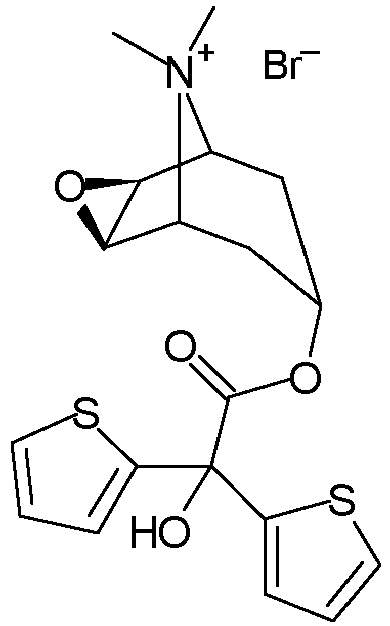
glycopyrronium bromide (chemical name: 3-(2-cyclopentyl-2-hydroxy-2-phenylacetoxy)-1,1-dimethylpyrrolidinium bromide) of formula
and ipratropium bromide (chemical name: [8-methyl-8-(1-methylethyl)-8-azoniabicyclo[3.2.1]oct-3-yl]-3-hydroxy-2-phenyl-propanoate) of formula
- For example,
US 5,610,163 describes the preparation of tiotropium bromide and its analogs by reaction of the corresponding cyclic tertiary amines dissolved in methylene chloride/acetonitrile with a solution of methyl bromide in acetonitrile at room temperature for 24 hours. - There is still the need of an efficient improved process, particularly of an efficient continuous process for the preparation of cyclic quaternary ammonium compounds. We have now found a method for the continuous alkylation of cyclic tertiary amines, particularly useful for the production of cyclic quaternary ammonium compounds with high purity as required for pharmaceutical use, which is more efficient than the known quaternization processes.
- Object of the present invention is a method for the continuous alkylation of cyclic tertiary amines comprising:
- continuously feeding a solution of a cyclic tertiary amine in a suitable solvent or mixture of solvents and an alkylating agent, optionally dissolved in a suitable solvent or mixture of solvents, into a continuous-flow reactor;
- maintaining the temperature within the range of 20-140°C;
- collecting the solution containing the pure quaternary cyclic ammonium compound;
- isolating the pure quaternary cyclic ammonium compound,
- The method object of the present invention allows to directly obtain the quaternary cyclic ammonium compound with high purity without the need of any further purification step. Moreover, the method offers several additional advantages over the known methods such as better reaction control, better temperature control of the reaction and easy scale up for larger output.
- For the purpose of the present application, cyclic tertiary amine and cyclic quaternary ammonium compounds are compounds of general formula


wherein - R is a linear or branched C1-C12 alkyl group;
- R1 is a linear or branched C1-C3 alkyl group;
- X is a halogen atom or a carbonate, sulfate or triflate;
- and A is a radical forming an optionally substituted monocyclic, bicyclic or tricyclic ring with the nitrogen atom.
- In the compounds of formula (II), preferred meanings of R1 are methyl, ethyl, propyl, and isopropyl, methyl being particularly preferred.
- In the compounds of formula (I) and (II), said rings are selected among optionally substituted monocyclic rings having from 4 to 7 atoms, optionally including 1 or 2 heteroatoms selected among N, O and S, in addition to the nitrogen atom to which they are linked; optionally substituted bicyclic rings having from 6 to 9 atoms, optionally including 1 or 2 heteroatoms selected among N, O and S, in addition to the nitrogen atom to which they are linked; and optionally substituted tricyclic rings having from 8 to 12 atoms, optionally including 1 or 2 heteroatoms selected among N, O and S, in addition to the nitrogen atom to which they are linked.
- Examples of particularly preferred monocyclic, bicyclic and tricyclic ring are the rings of formula


- In a particularly preferred embodiment of the present invention, Y is selected among (cyclo)alkylcarbonyloxy, arylalkylcarbonyloxy and heteroarylalkylcarbonyloxy groups.
- Examples of particularly preferred meanings of the substituent Y are the groups of formula:

- Specific examples are

- The alkylating agent useful in the method according to the present invention is a compound of formula R1X wherein R1 and X have the above reported meanings.
- Preferably the alkylating agent is a compound of formula R1X wherein X is a halogen atom selected among Cl, Br and I, still more preferably X is Br.
- Examples of alkylating agents useful in the method according to the present invention are methyl chloride, methyl bromide, methyl iodide, ethyl chloride, ethyl bromide, ethyl iodide, n-propyl chloride, n-propyl bromide, n-propyl iodide, isopropyl chloride, isopropyl bromide, and isopropyl iodide.
- Methyl chloride, methyl bromide and methyl iodide are particularly preferred, methyl bromide being still more preferred.
- The method object of the present invention is characterized by the use of a suitable solvent or mixture of solvents to dissolve the cyclic tertiary amine and optionally also the alkylating agent.
- The selection of the solvent is critical to achieve the desired results, that is high conversion and high purity.
- The Applicant has carried out several experiments to maximize conversion while maintaining a high level of purity in the final compound and found that better results are achieved by using polar aprotic solvents selected among amides, nitriles and sulphoxides, such as for example acetonitrile, dimethylformamide, dimethylacetamide, N-methylpyrrolidone and dimethylsulphoxide.
- The polar aprotic solvent is used for the preparation of the solution of the cyclic tertiary amine to be quaternized according to the process object of the present invention.
- The alkylating agent can be used neat or as a solution in a suitable solvent.
- Said solvent can be the same solvent used to dissolve the cyclic tertiary amine or a different solvent.
- When the alkylating agent is used as a solution in the method object of the present invention, preferably the solvent is a polar aprotic solvent different from the solvent used for the dissolution of the amine.
- Acetonitrile is particularly preferred for the preparation of the solution of the alkylating agent to be used in the method according to the present invention. Particularly preferred solvents for the dissolution of the cyclic tertiary amine are dimethylacetamide, dimethylsulphoxide and N-methylpyrrolidone.
- The combination of N-methylpyrrolidone for the dissolution of the cyclic tertiary amine and of acetonitrile for the dissolution of the alkylating agent is still more preferred.
- The solution of the cyclic tertiary amine and the alkylating agent as neat or as a solution can be introduced into the continuous-flow reactor separately or, as an alternative, the solution the cyclic tertiary amine and the alkylating agent as neat or as a solution can be pre-mixed before the introduction into the continuous-flow reactor.
- The reaction temperature ranges from 20 to 200°C, preferably from 40 to 85°C. The flow rate has to be properly adjusted in order to obtain an optimal residence time of the reaction mixture in the continuous flow reactor with the aim of completing the reaction.
- Flow and pressure ranges used are characteristics of the reaction model. For example, in the case of Corning Advanced Flow G1, tipically the flow is in the range of 1 to 30 g/min and the pressure is in the range from 1 to 20 bar.
- The method according to the present invention is particularly useful for the preparation of anticholinergic drugs such as tiotropium bromide, glycopyrronium bromide and ipratropium bromide.
- In a particularly preferred embodiment, the method according to the present invention is useful for the preparation of tiotropium bromide.
- The present invention is now illustrated without limiting it by the following examples.
- In a 250 ml flask under nitrogen, N-demethyltiotropium (10.0 g) was dissolved in N-methylpyrrolidone (33 ml) at room temperature. A 1:1 (w/w) mixture methylbromide/acetonitrile (25 g) was added. After 22 hours under stirring at room temperature, the white precipitate was filtered, washed with acetone, and dried.
HPLC purity: 99.66% - A solution of N-demethyltiotropium (12 g) in acetonitrile (139.4 ml) and dichloromethane (180 ml) was injected into a continuous-flow reactor at a rate of 10 g/min. Liquid methyl bromide was injected at a rate of 0.5 g/min. The reactor temperature was 40°C.
- The solution coming out from the continuous-flow reactor was collected and stirred overnight at room temperature. The precipitate was filtered, washed with dichloromethane, and dried under reduced pressure.
- A 1:1 (w/w) mixture methylbromide/acetonitrile (15 g) was added to a solution of N-demethyltiotropium (6.0 g) in N-methylpyrrolidone (20 ml). The solution was injected into a continuous-flow reactor at a rate of 10 g/min. The reactor temperature was 80°C. The solution coming out from the continuous-flow reactor was collected, cooled to room temperature, then to 0°C. Acetone (100 ml) was added. The resulting suspension was stirred for an additional hour, then stored at 0-5°C overnight. The product was filtered, washed twice with acetone, and dried under reduced pressure.
HPLC purity: 99.98%
1H-NMR (300 MHz, d6-DMSO): 7.52 (dd, J=5.0 Hz, 1.1, 2H), 7.41 (s, 1H), 7.13 (dd, J=3.6, 1.1 Hz, 2H), 7.01 (dd, J=5.0, 3.7 Hz, 2H), 5.12 (t, J=5.8 Hz, 1H), 4.13 (bd, J=5.8 Hz, 2H), 3.50 (s, 2H), 3.25 (s, 3H), 3.05 (s, 3H), 1.93 (s, 1 H), 1.87 (s, 1 H). 13C-NMR (75.5 MHz, d6-DMSO): 170.2, 147.1, 127.3, 126.7, 126.3, 76.8, 65.0, 64.2, 56.5, 54.1, 47.6, 28.7. - X-ray spectrum is identical with the x-ray spectrum of tiotropium bromide obtained according to the procedure described in
US 5,610,163 . - The procedure of examples 2 and 3 has been repeated with different solvents or mixture of solvents.
- The results are summarized in the following table.
Table 1 Solvent amine/MeBr Pressure Temperature Conversion Purity CH2Cl2+MeCN/- 0.35 bar (liquid) 41 °C 17% n.d. CH2Cl2/MeCN 12.3 bar 70 °C 25% 99.1% MeOH/MeCN 15.6 bar 81 °C 61% 73.9% MeOH/MeCN 3.4 bar 80 °C 84% n.d. DMF/MeCN 10.6 bar 81 °C 97% n.d. DMA/MeCN 10.6 bar 81 °C 97% 99.95% DMSO/MeCN 10.8 bar 81 °C 94% 98.20% NMP/MeCN 10.3 bar 81 °C 99.7% 99.98% - The obtained results show that dichloromethane is a poor solvent for the final product, which may precipitate in the continuous-flow reactor and obstruct the channels. The replacement of dichloromethane with methanol allows to increase the temperature but conversion is rather low. The use of polar aprotic solvents selected among amides, nitriles and sulphoxides, according to the present invention, results in very high conversions. Moreover, the process is very clean and the final product can be isolated with a very high purity fulfilling the requirement of pharmaceutical applications with no need of further purification.
- Glycopyrronium bromide was prepared by working in a similar way as described in example 3.
1H-NMR (300 MHz, D2O): 7.71-7.63 (m, 2H), 7.53-7.38 (m, 3H), 5.54 (s, 1H), 3.92-3.68 (m, 2H), 3.67-3.49 (m, 2H), 3.23-3.14 (m, 1H), 3.22 (s, 3Ha), 3.18 (s, 3Hb), 3.06 (s, 3Ha), 2.90 (s, 3Hb), 2.84-2.64 (m, 1H), 2.45-2.31 (m, 1Hb), 2.23-2.09 (m, 1 Ha), 1.81-1.46 (m, 8H), 1.34-1.20 (m, 1 H).
13C-NMR (75.5 MHz, D2O): 174.4, 140.6+140.5 (1 Ca+b), 128.7 (2 C), 128.3, 126.2+126.0 (2 Ca+b), 80.7+80.5 (1 Ca+b), 74.0, 70.1, 64.8, 53.5, 52.9, 44.9+44.7 (1 Ca+b), 29.9+29.7 (1 Ca+b), 26.6+26.5 (1 Ca+b), 26.1+26.0 (2 Ca+b), 25.8+25.7 (1 Ca+b). a = (R,S)/(S,R)
b = (S,S)/(R,R) - Ipratropium bromide was prepared by working in a similar way as described in example 3.
1H-NMR (300 MHz, D2O): 7.41-7.25 (m, 5H), 5.09-5.02 (m, 1 H), 4.19-4.07 (m, 1 H), 3.97-3.87 (m, 2H), 3.87-3.79 (m, 1 H), 3.76-3.68 (m, 1 H), 2.71 (s, 3H), 2.61-2.41 (m, 2H), 2.30-1.91 (m, 3H), 1.71 (d, J=17 Hz, 1 H).
13C-NMR (75.5 MHz, D2O): 173.0, 135.2, 129.2 (2 C), 128.3 (2 C), 128.2, 65.5, 65.4, 64.1, 62.1, 55.5, 53.5, 39.0, 30.7 (2 C), 24.4, 24.1, 15.5 (2 C).
Claims (19)
- A method for the continuous alkylation of cyclic tertiary amines comprising:- continuously feeding a solution of a cyclic tertiary amine in a suitable solvent or mixture of solvents and an alkylating agent, dissolved in a suitable solvent or mixture of solvents which are aprotic solvents selected among amides, nitriles and sulphoxides, into a continuous-flow reactor;- maintaining the temperature within the range of 20-200°C;- collecting the solution containing the pure quaternary cyclic ammonium compound;- isolating the pure quaternary cyclic ammonium compound;wherein said cyclic tertiary amines and quaternary cyclic quaternary ammonium compounds are compounds of general formula


whereinR is a linear or branched C1-C12 alkyl group;R1 is linear or branched C1-C3 alkyl groups;X is a halogen atom or a carbonate, sulfate or triflate;and A is a radical forming an optionally substituted monocyclic, bicyclic or tricyclic ring with the nitrogen atom, said ring being selected among optionally substituted monocyclic rings having from 4 to 7 atoms, optionally including 1 or 2 heteroatoms selected among N, O and S, in addition to the nitrogen atom to which they are linked; optionally substituted bicyclic rings having from 6 to 9 atoms, optionally including 1 or 2 heteroatoms selected among N, O and S, in addition to the nitrogen atom to which they are linked; and optionally substituted tricyclic ring having from 8 to 12 atoms, optionally including 1 or 2 heteroatoms selected among N, O and S, in addition to the nitrogen atom to which they are linked. - A method according to claim 1 wherein R is a C1-C4 alkyl group.
- A method according to claim 2 wherein R is methyl or isopropyl.
- A method according to claim 1 wherein R1 is methyl.
- A method according to claim 1 wherein said monocyclic, bicyclic and tricyclic rings are the rings of formula


- A method according to claim 5 wherein Y is selected among (cyclo)alkylcarbonyloxy, arylalkylcarbonyloxy and heteroarylalkylcarbonyloxy groups.
- A method according to claim 6 wherein Y is a group of formula:

- A method according to claim 1 wherein the alkylating agent is a compound of formula R1X wherein R1 and X have the above reported meanings.
- A method according to claim 8 wherein the alkylating agent is a compound of formula R1X wherein X is a halogen atom selected among Cl, Br and I.
- A method according to claim 9 wherein the alkylating agent is selected among methyl chloride, methyl bromide, methyl iodide, ethyl chloride, ethyl bromide, ethyl iodide, n-propyl chloride, n-propyl bromide, n-propyl iodide, isopropyl chloride, isopropyl bromide, and isopropyl iodide.
- A method according to claim 10 wherein the alkylating agent is methyl bromide.
- A method according to claim 1 wherein said polar aprotic solvent are selected among acetonitrile, dimethylformamide, dimethylacetamide, N-methylpyrrolidone and dimethylsulphoxide.
- A method according to claim 1 wherein the alkylating agent is introduced into the continuous-flow reactor neat.
- A method according to claim 1 wherein the alkylating agent is introduced into the continuous-flow reactor as a solution, optionally pre-mixed with the solution of the cyclic tertiary amine.
- A method according to claim 14 wherein the solvent for the preparation of the solution of the alkylating agent is acetonitrile.
- A method according to claim 1 wherein the solvent for the dissolution of the cyclic tertiary amine is selected among dimethylacetamide, dimethylsulphoxide and N-methylpyrrolidone.
- A method according to claim 16 wherein the solvent is N-methylpyrrolidone.
- A method according to claim 1 wherein the temperature ranges from 20 to 200°C, preferably from 40 to 85°C.
- A method according to anyone of the preceding claims for the preparation of tiotropium bromide, glycopyrronium bromide and ipratropium bromide.
Priority Applications (20)
| Application Number | Priority Date | Filing Date | Title |
|---|---|---|---|
| SI201131185A SI2607351T1 (en) | 2011-12-22 | 2011-12-22 | Continuous process for the alkylation of cyclic tertiary amines |
| RS20170460A RS55996B1 (en) | 2011-12-22 | 2011-12-22 | CONTINUOUS PROCEDURE FOR THE ALKYLATION OF CYCLIC Tertiary Amines |
| PL11195419T PL2607351T3 (en) | 2011-12-22 | 2011-12-22 | Continuous process for the alkylation of cyclic tertiary amines |
| ES11195419.4T ES2625498T3 (en) | 2011-12-22 | 2011-12-22 | Continuous process for the alkylation of cyclic tertiary amines |
| SM20170269T SMT201700269T1 (en) | 2011-12-22 | 2011-12-22 | Continuous process for the alkylation of cyclic tertiary amines |
| HUE11195419A HUE034540T2 (en) | 2011-12-22 | 2011-12-22 | A continuous process for alkylating cyclic tertiary amines |
| LTEP11195419.4T LT2607351T (en) | 2011-12-22 | 2011-12-22 | Continuous process for the alkylation of cyclic tertiary amines |
| PT111954194T PT2607351T (en) | 2011-12-22 | 2011-12-22 | Continuous process for the alkylation of cyclic tertiary amines |
| EP11195419.4A EP2607351B1 (en) | 2011-12-22 | 2011-12-22 | Continuous process for the alkylation of cyclic tertiary amines |
| DK11195419.4T DK2607351T3 (en) | 2011-12-22 | 2011-12-22 | CONTINUOUS PROCEDURE FOR ALKYLICATION OF CYCLIC TERTIARY AMINES |
| AU2012244237A AU2012244237B2 (en) | 2011-12-22 | 2012-10-26 | Continuous process for the alkylation of cyclic tertiary amines |
| CA2793619A CA2793619C (en) | 2011-12-22 | 2012-10-29 | Continuous process for the alkylation of cyclic tertiary amines |
| CN201210467838.2A CN103172481B (en) | 2011-12-22 | 2012-11-19 | Continuous process for the alkylation of cyclic tertiary amines |
| US13/683,448 US8865903B2 (en) | 2011-12-22 | 2012-11-21 | Continuous process for the alkylation of cyclic tertiary amines |
| IL223230A IL223230B (en) | 2011-12-22 | 2012-11-25 | A continuous process for the alkylation of quaternary ring amines |
| JP2012261150A JP6045320B2 (en) | 2011-12-22 | 2012-11-29 | Continuous process for alkylating cyclic tertiary amines |
| RU2012152600A RU2614412C2 (en) | 2011-12-22 | 2012-12-06 | Continuous process for alkylation of cyclic tertiary amine |
| BR102012032754A BR102012032754B8 (en) | 2011-12-22 | 2012-12-20 | method for continuous alkylation of cyclic tertiary amines |
| HRP20170711TT HRP20170711T1 (en) | 2011-12-22 | 2017-05-12 | Continuous process for the alkylation of cyclic tertiary amines |
| CY20171100518T CY1118937T1 (en) | 2011-12-22 | 2017-05-16 | Ongoing alkylation of cyclic tertiary amines |
Applications Claiming Priority (1)
| Application Number | Priority Date | Filing Date | Title |
|---|---|---|---|
| EP11195419.4A EP2607351B1 (en) | 2011-12-22 | 2011-12-22 | Continuous process for the alkylation of cyclic tertiary amines |
Publications (2)
| Publication Number | Publication Date |
|---|---|
| EP2607351A1 EP2607351A1 (en) | 2013-06-26 |
| EP2607351B1 true EP2607351B1 (en) | 2017-03-15 |
Family
ID=45445872
Family Applications (1)
| Application Number | Title | Priority Date | Filing Date |
|---|---|---|---|
| EP11195419.4A Active EP2607351B1 (en) | 2011-12-22 | 2011-12-22 | Continuous process for the alkylation of cyclic tertiary amines |
Country Status (20)
| Country | Link |
|---|---|
| US (1) | US8865903B2 (en) |
| EP (1) | EP2607351B1 (en) |
| JP (1) | JP6045320B2 (en) |
| CN (1) | CN103172481B (en) |
| AU (1) | AU2012244237B2 (en) |
| BR (1) | BR102012032754B8 (en) |
| CA (1) | CA2793619C (en) |
| CY (1) | CY1118937T1 (en) |
| DK (1) | DK2607351T3 (en) |
| ES (1) | ES2625498T3 (en) |
| HR (1) | HRP20170711T1 (en) |
| HU (1) | HUE034540T2 (en) |
| IL (1) | IL223230B (en) |
| LT (1) | LT2607351T (en) |
| PL (1) | PL2607351T3 (en) |
| PT (1) | PT2607351T (en) |
| RS (1) | RS55996B1 (en) |
| RU (1) | RU2614412C2 (en) |
| SI (1) | SI2607351T1 (en) |
| SM (1) | SMT201700269T1 (en) |
Families Citing this family (8)
| Publication number | Priority date | Publication date | Assignee | Title |
|---|---|---|---|---|
| EP2789611A1 (en) * | 2013-04-08 | 2014-10-15 | Cerbios-Pharma S.A. | A crystalline form of tiotropium bromide |
| CN106831753B (en) * | 2017-01-10 | 2019-02-22 | 武汉先路医药科技股份有限公司 | A kind of synthetic method of Ipratropium Bromide |
| CN108911994A (en) * | 2018-06-11 | 2018-11-30 | 上海华银日用品有限公司 | A kind of environmental protection long chain alkyl ammonium salt solution and its continuous preparation method |
| RU2677273C1 (en) * | 2018-07-30 | 2019-01-16 | Федеральное государственное бюджетное образовательное учреждение высшего образования "Чувашский государственный университет имени И.Н. Ульянова" | Methyl dicyano acetate quarterly ammonium compounds production method |
| CN110183438A (en) * | 2019-05-17 | 2019-08-30 | 南京望知星医药科技有限公司 | A kind of preparation method of Ipratropium Bromide |
| PT115583B (en) * | 2019-06-17 | 2022-05-02 | Hovione Farm S A | CONTINUOUS PROCESS FOR THE PREPARATION OF ANTICHOLINERGIC DRUGS |
| CN111269226B (en) * | 2020-04-13 | 2021-09-21 | 石家庄四药有限公司 | Synthesis method of ipratropium bromide |
| CN111978316B (en) * | 2020-08-21 | 2021-06-04 | 华润双鹤药业股份有限公司沧州分公司 | Synthesis method of ipratropium bromide |
Family Cites Families (20)
| Publication number | Priority date | Publication date | Assignee | Title |
|---|---|---|---|---|
| US2956062A (en) | 1959-02-26 | 1960-10-11 | Robins Co Inc A H | Esters of amino alcohols |
| NL172322C (en) | 1969-02-25 | 1983-08-16 | Hoechst Ag | METHOD FOR PREPARING QUATERNARY AMMONIUM COMPOUNDS. |
| JPS58174349A (en) * | 1982-04-08 | 1983-10-13 | Yotsukaichi Gosei Kk | Preparation of aqueous solution of 3-chloro-2- oxypropyltrimethylammonium chloride |
| DE3713996A1 (en) | 1987-04-27 | 1988-11-10 | Henkel Kgaa | METHOD FOR PRODUCING QUARTAINE AMMONIUM HALOGENIDES |
| US5610163A (en) | 1989-09-16 | 1997-03-11 | Boehringer Ingelheim Gmbh | Esters of thienyl carboxylic acids and amino alcohols and their quaternization products |
| DE3931041C2 (en) * | 1989-09-16 | 2000-04-06 | Boehringer Ingelheim Kg | Esters of thienyl carboxylic acids with amino alcohols, their quaternization products, processes for their preparation and medicaments containing them |
| US5041664A (en) | 1990-07-23 | 1991-08-20 | Texaco Chemical Company | Continuous process for preparing quaternary ammonium salts |
| JP2886990B2 (en) * | 1990-12-20 | 1999-04-26 | 三井化学株式会社 | Method for producing unsaturated quaternary ammonium salt |
| US5491240A (en) | 1994-09-29 | 1996-02-13 | Witco Corporation | Quaternary compound of a tertiary amine and methyl chloride |
| DE69724967D1 (en) * | 1996-04-24 | 2003-10-23 | Novo Nordisk As | HETEROCYCLIC CONNECTIONS, THEIR PRODUCTION AND THEIR USE |
| EP0869114A1 (en) | 1997-04-04 | 1998-10-07 | Dow Europe S.A. | Composition useful for softening applications and processes for the preparation thereof |
| JP4774604B2 (en) * | 2000-02-14 | 2011-09-14 | 和光純薬工業株式会社 | Method for producing quaternary ammonium salt |
| DE10064816A1 (en) * | 2000-12-22 | 2002-06-27 | Boehringer Ingelheim Pharma | Production of tiotropium bromide useful as an anticholinergic comprises oxidation of di-(2-thienyl)-glycolic acid tropenol ester and subsequent quaternisation |
| FR2824062B1 (en) * | 2001-04-27 | 2004-10-15 | Atofina | PROCESS FOR PRODUCING AQUEOUS SOLUTIONS OF QUATERNARY AMMONIUM UNSATURATED SALTS |
| US6610849B2 (en) * | 2001-06-28 | 2003-08-26 | Boehringer Ingelheim Pharma Kg | Process for the manufacture of tropenol |
| SE0104346L (en) * | 2001-12-21 | 2003-06-22 | Akzo Nobel Nv | Process for continuous quaternization of tertiary amines with an alkyl halide |
| JP4178837B2 (en) * | 2002-05-29 | 2008-11-12 | 東亞合成株式会社 | Method for producing dialkylaminoalkyl (meth) acrylate quaternary salt |
| JP4062055B2 (en) * | 2002-11-01 | 2008-03-19 | 東亞合成株式会社 | Method for producing dialkylaminoalkyl (meth) acrylate quaternary salt |
| AT412088B (en) * | 2002-12-18 | 2004-09-27 | Pharmacon Forschung & Beratung Gmbh | METHOD FOR PRODUCING THE R, R OR S, S CONFIGURED GLYCOPYRRONIUM ISOMERS |
| US8247597B2 (en) | 2010-01-21 | 2012-08-21 | Nalco Company | Continuous production of DMAEA quaternary salts |
-
2011
- 2011-12-22 LT LTEP11195419.4T patent/LT2607351T/en unknown
- 2011-12-22 EP EP11195419.4A patent/EP2607351B1/en active Active
- 2011-12-22 PL PL11195419T patent/PL2607351T3/en unknown
- 2011-12-22 RS RS20170460A patent/RS55996B1/en unknown
- 2011-12-22 ES ES11195419.4T patent/ES2625498T3/en active Active
- 2011-12-22 SM SM20170269T patent/SMT201700269T1/en unknown
- 2011-12-22 SI SI201131185A patent/SI2607351T1/en unknown
- 2011-12-22 DK DK11195419.4T patent/DK2607351T3/en active
- 2011-12-22 PT PT111954194T patent/PT2607351T/en unknown
- 2011-12-22 HU HUE11195419A patent/HUE034540T2/en unknown
-
2012
- 2012-10-26 AU AU2012244237A patent/AU2012244237B2/en not_active Ceased
- 2012-10-29 CA CA2793619A patent/CA2793619C/en active Active
- 2012-11-19 CN CN201210467838.2A patent/CN103172481B/en active Active
- 2012-11-21 US US13/683,448 patent/US8865903B2/en active Active
- 2012-11-25 IL IL223230A patent/IL223230B/en active IP Right Grant
- 2012-11-29 JP JP2012261150A patent/JP6045320B2/en active Active
- 2012-12-06 RU RU2012152600A patent/RU2614412C2/en active
- 2012-12-20 BR BR102012032754A patent/BR102012032754B8/en active IP Right Grant
-
2017
- 2017-05-12 HR HRP20170711TT patent/HRP20170711T1/en unknown
- 2017-05-16 CY CY20171100518T patent/CY1118937T1/en unknown
Non-Patent Citations (1)
| Title |
|---|
| None * |
Also Published As
| Publication number | Publication date |
|---|---|
| AU2012244237A1 (en) | 2013-07-11 |
| LT2607351T (en) | 2017-06-12 |
| ES2625498T3 (en) | 2017-07-19 |
| CN103172481A (en) | 2013-06-26 |
| SMT201700269T1 (en) | 2017-07-18 |
| RU2012152600A (en) | 2014-06-20 |
| AU2012244237B2 (en) | 2016-11-03 |
| CA2793619C (en) | 2019-02-05 |
| JP2013133335A (en) | 2013-07-08 |
| PT2607351T (en) | 2017-05-26 |
| CA2793619A1 (en) | 2013-06-22 |
| CN103172481B (en) | 2017-05-10 |
| RS55996B1 (en) | 2017-09-29 |
| BR102012032754A2 (en) | 2013-11-12 |
| US8865903B2 (en) | 2014-10-21 |
| US20130165656A1 (en) | 2013-06-27 |
| PL2607351T3 (en) | 2017-08-31 |
| RU2614412C2 (en) | 2017-03-28 |
| CY1118937T1 (en) | 2018-01-10 |
| JP6045320B2 (en) | 2016-12-14 |
| SI2607351T1 (en) | 2017-07-31 |
| HRP20170711T1 (en) | 2017-07-28 |
| EP2607351A1 (en) | 2013-06-26 |
| BR102012032754B8 (en) | 2021-03-23 |
| BR102012032754B1 (en) | 2020-12-29 |
| DK2607351T3 (en) | 2017-06-06 |
| HUE034540T2 (en) | 2018-02-28 |
| IL223230B (en) | 2018-02-28 |
Similar Documents
| Publication | Publication Date | Title |
|---|---|---|
| US8865903B2 (en) | Continuous process for the alkylation of cyclic tertiary amines | |
| AU2026200160A1 (en) | Process for preparing enantiomerically enriched jak inhibitors | |
| AU2013217467B2 (en) | Process for preparing tiotropium bromide | |
| CA2930744A1 (en) | Methods of manufacturing benzoquinoline compounds | |
| EP3156391B1 (en) | Method for preparing sitagliptin intermediate via asymmetrical reduction method | |
| EP2688888B1 (en) | Process for the production of disodium pemetrexed | |
| CA2399377C (en) | New positive allosteric ampa receptor modulators (paarm), processes for preparing them and their use as pharmaceutical compositions | |
| US8735585B2 (en) | Indenopyridine derivatives | |
| AT414125B (en) | NEW DERIVATIVES OF 4A, 5,9,10,11,12-HEXAHYDRO-BENZOFURO (3A, 3,2) (2) BENZAZEPINE, PROCESS FOR THE PRODUCTION THEREOF AND THEIR USE FOR THE PRODUCTION OF MEDICAMENTS | |
| KR102518994B1 (en) | Processes for the preparation of azd5363 and novel intermediate used therein | |
| CZ288587B6 (en) | Process for preparing 5-amino-2,4,6-triiodoisophthalic acid dichloride | |
| CN107673984B (en) | Preparation method of levetiracetam key intermediate (S) -2-aminobutanamide salt | |
| EP2999693B1 (en) | A process for preparing ivabradine | |
| KR101694262B1 (en) | Process for preparing crystalline forms of silodosin | |
| KR101485418B1 (en) | A synthetic method of high purity mirtazapine | |
| JP6122034B2 (en) | Method for preparing 2-phenyl- [1,2,4] triazolo [1,5-a] pyridine derivative | |
| CN108727214B (en) | A kind of synthetic method of anesthetic bupivacaine impurity | |
| EP4686721A1 (en) | Crystalline naloxone-dimethylformamide solvate, methods for its preparation and its use as a reagent in a method of making naloxone | |
| EP3902779A1 (en) | Process for the preparation exo-tert-butyl n-(3-azabicyclo[3.2.1]octan-8-yl)carbamate | |
| WO2025115034A1 (en) | A process for the preparation of a triaminopyrimidine compound and novel intermediates thereof | |
| EP4375282A1 (en) | Preparation method for hepatitis b virus nucleocapsid inhibitor | |
| EP2354133B1 (en) | Method for producing 1-(3-Cyano-3,3-diphenylpropyl)-4-(1-piperidyl)-piperidine-4-carboxamide (Piritramide) | |
| CN103497166A (en) | Synthesis method of cetirizine hydrochloride intermediate | |
| KR20130077391A (en) | Efficient process of solifenacin and it's salt |
Legal Events
| Date | Code | Title | Description |
|---|---|---|---|
| AK | Designated contracting states |
Kind code of ref document: A1 Designated state(s): AL AT BE BG CH CY CZ DE DK EE ES FI FR GB GR HR HU IE IS IT LI LT LU LV MC MK MT NL NO PL PT RO RS SE SI SK SM TR |
|
| AX | Request for extension of the european patent |
Extension state: BA ME |
|
| PUAI | Public reference made under article 153(3) epc to a published international application that has entered the european phase |
Free format text: ORIGINAL CODE: 0009012 |
|
| RAP1 | Party data changed (applicant data changed or rights of an application transferred) |
Owner name: CERBIOS-PHARMA S.A. |
|
| 17P | Request for examination filed |
Effective date: 20131217 |
|
| RBV | Designated contracting states (corrected) |
Designated state(s): AL AT BE BG CH CY CZ DE DK EE ES FI FR GB GR HR HU IE IS IT LI LT LU LV MC MK MT NL NO PL PT RO RS SE SI SK SM TR |
|
| 17Q | First examination report despatched |
Effective date: 20160422 |
|
| GRAP | Despatch of communication of intention to grant a patent |
Free format text: ORIGINAL CODE: EPIDOSNIGR1 |
|
| INTG | Intention to grant announced |
Effective date: 20161014 |
|
| STAA | Information on the status of an ep patent application or granted ep patent |
Free format text: STATUS: GRANT OF PATENT IS INTENDED |
|
| GRAS | Grant fee paid |
Free format text: ORIGINAL CODE: EPIDOSNIGR3 |
|
| GRAA | (expected) grant |
Free format text: ORIGINAL CODE: 0009210 |
|
| STAA | Information on the status of an ep patent application or granted ep patent |
Free format text: STATUS: THE PATENT HAS BEEN GRANTED |
|
| AK | Designated contracting states |
Kind code of ref document: B1 Designated state(s): AL AT BE BG CH CY CZ DE DK EE ES FI FR GB GR HR HU IE IS IT LI LT LU LV MC MK MT NL NO PL PT RO RS SE SI SK SM TR |
|
| REG | Reference to a national code |
Ref country code: CH Ref legal event code: EP Ref country code: GB Ref legal event code: FG4D |
|
| REG | Reference to a national code |
Ref country code: IE Ref legal event code: FG4D |
|
| REG | Reference to a national code |
Ref country code: AT Ref legal event code: REF Ref document number: 875382 Country of ref document: AT Kind code of ref document: T Effective date: 20170415 |
|
| REG | Reference to a national code |
Ref country code: DE Ref legal event code: R096 Ref document number: 602011035911 Country of ref document: DE |
|
| REG | Reference to a national code |
Ref country code: HR Ref legal event code: TUEP Ref document number: P20170711 Country of ref document: HR |
|
| REG | Reference to a national code |
Ref country code: RO Ref legal event code: EPE |
|
| REG | Reference to a national code |
Ref country code: NL Ref legal event code: FP |
|
| REG | Reference to a national code |
Ref country code: PT Ref legal event code: SC4A Ref document number: 2607351 Country of ref document: PT Date of ref document: 20170526 Kind code of ref document: T Free format text: AVAILABILITY OF NATIONAL TRANSLATION Effective date: 20170517 |
|
| REG | Reference to a national code |
Ref country code: SE Ref legal event code: TRGR |
|
| REG | Reference to a national code |
Ref country code: CH Ref legal event code: NV Representative=s name: MICHELI AND CIE SA, CH |
|
| REG | Reference to a national code |
Ref country code: DK Ref legal event code: T3 Effective date: 20170531 |
|
| REG | Reference to a national code |
Ref country code: NO Ref legal event code: T2 Effective date: 20170315 |
|
| REG | Reference to a national code |
Ref country code: EE Ref legal event code: FG4A Ref document number: E013754 Country of ref document: EE Effective date: 20170517 |
|
| REG | Reference to a national code |
Ref country code: ES Ref legal event code: FG2A Ref document number: 2625498 Country of ref document: ES Kind code of ref document: T3 Effective date: 20170719 |
|
| REG | Reference to a national code |
Ref country code: HR Ref legal event code: T1PR Ref document number: P20170711 Country of ref document: HR |
|
| REG | Reference to a national code |
Ref country code: GR Ref legal event code: EP Ref document number: 20170401376 Country of ref document: GR Effective date: 20171023 |
|
| REG | Reference to a national code |
Ref country code: SK Ref legal event code: T3 Ref document number: E 24320 Country of ref document: SK |
|
| REG | Reference to a national code |
Ref country code: FR Ref legal event code: PLFP Year of fee payment: 7 |
|
| REG | Reference to a national code |
Ref country code: DE Ref legal event code: R097 Ref document number: 602011035911 Country of ref document: DE |
|
| PLBE | No opposition filed within time limit |
Free format text: ORIGINAL CODE: 0009261 |
|
| STAA | Information on the status of an ep patent application or granted ep patent |
Free format text: STATUS: NO OPPOSITION FILED WITHIN TIME LIMIT |
|
| 26N | No opposition filed |
Effective date: 20171218 |
|
| REG | Reference to a national code |
Ref country code: HU Ref legal event code: AG4A Ref document number: E034540 Country of ref document: HU |
|
| REG | Reference to a national code |
Ref country code: HR Ref legal event code: ODRP Ref document number: P20170711 Country of ref document: HR Payment date: 20181211 Year of fee payment: 8 |
|
| REG | Reference to a national code |
Ref country code: AT Ref legal event code: UEP Ref document number: 875382 Country of ref document: AT Kind code of ref document: T Effective date: 20170315 |
|
| REG | Reference to a national code |
Ref country code: HR Ref legal event code: ODRP Ref document number: P20170711 Country of ref document: HR Payment date: 20191218 Year of fee payment: 9 |
|
| REG | Reference to a national code |
Ref country code: HR Ref legal event code: ODRP Ref document number: P20170711 Country of ref document: HR Payment date: 20201208 Year of fee payment: 10 |
|
| REG | Reference to a national code |
Ref country code: HR Ref legal event code: ODRP Ref document number: P20170711 Country of ref document: HR Payment date: 20211207 Year of fee payment: 11 |
|
| REG | Reference to a national code |
Ref country code: HR Ref legal event code: ODRP Ref document number: P20170711 Country of ref document: HR Payment date: 20221212 Year of fee payment: 12 |
|
| REG | Reference to a national code |
Ref country code: HR Ref legal event code: ODRP Ref document number: P20170711 Country of ref document: HR Payment date: 20231221 Year of fee payment: 13 |
|
| PGFP | Annual fee paid to national office [announced via postgrant information from national office to epo] |
Ref country code: SK Payment date: 20231219 Year of fee payment: 13 |
|
| PGFP | Annual fee paid to national office [announced via postgrant information from national office to epo] |
Ref country code: MC Payment date: 20231207 Year of fee payment: 13 |
|
| PGFP | Annual fee paid to national office [announced via postgrant information from national office to epo] |
Ref country code: IS Payment date: 20231229 Year of fee payment: 13 |
|
| PGFP | Annual fee paid to national office [announced via postgrant information from national office to epo] |
Ref country code: SM Payment date: 20231219 Year of fee payment: 13 Ref country code: SI Payment date: 20231220 Year of fee payment: 13 Ref country code: RS Payment date: 20231218 Year of fee payment: 13 Ref country code: RO Payment date: 20231220 Year of fee payment: 13 Ref country code: LV Payment date: 20231227 Year of fee payment: 13 Ref country code: LU Payment date: 20231225 Year of fee payment: 13 Ref country code: LT Payment date: 20231123 Year of fee payment: 13 Ref country code: EE Payment date: 20231228 Year of fee payment: 13 Ref country code: BG Payment date: 20231228 Year of fee payment: 13 |
|
| PGFP | Annual fee paid to national office [announced via postgrant information from national office to epo] |
Ref country code: MK Payment date: 20231218 Year of fee payment: 13 |
|
| PGFP | Annual fee paid to national office [announced via postgrant information from national office to epo] |
Ref country code: HU Payment date: 20240118 Year of fee payment: 13 Ref country code: CY Payment date: 20231215 Year of fee payment: 13 |
|
| PGFP | Annual fee paid to national office [announced via postgrant information from national office to epo] |
Ref country code: AL Payment date: 20231228 Year of fee payment: 13 |
|
| PGFP | Annual fee paid to national office [announced via postgrant information from national office to epo] |
Ref country code: PT Payment date: 20241202 Year of fee payment: 14 |
|
| REG | Reference to a national code |
Ref country code: HR Ref legal event code: ODRP Ref document number: P20170711 Country of ref document: HR Payment date: 20241202 Year of fee payment: 14 |
|
| PGFP | Annual fee paid to national office [announced via postgrant information from national office to epo] |
Ref country code: NO Payment date: 20241220 Year of fee payment: 14 |
|
| PGFP | Annual fee paid to national office [announced via postgrant information from national office to epo] |
Ref country code: DK Payment date: 20241224 Year of fee payment: 14 |
|
| PGFP | Annual fee paid to national office [announced via postgrant information from national office to epo] |
Ref country code: PL Payment date: 20241206 Year of fee payment: 14 Ref country code: FI Payment date: 20241220 Year of fee payment: 14 Ref country code: GR Payment date: 20241220 Year of fee payment: 14 |
|
| PGFP | Annual fee paid to national office [announced via postgrant information from national office to epo] |
Ref country code: GB Payment date: 20241219 Year of fee payment: 14 |
|
| PGFP | Annual fee paid to national office [announced via postgrant information from national office to epo] |
Ref country code: FR Payment date: 20241224 Year of fee payment: 14 |
|
| PGFP | Annual fee paid to national office [announced via postgrant information from national office to epo] |
Ref country code: AT Payment date: 20241223 Year of fee payment: 14 |
|
| PGFP | Annual fee paid to national office [announced via postgrant information from national office to epo] |
Ref country code: IE Payment date: 20241219 Year of fee payment: 14 Ref country code: CZ Payment date: 20241213 Year of fee payment: 14 Ref country code: HR Payment date: 20241202 Year of fee payment: 14 |
|
| PGFP | Annual fee paid to national office [announced via postgrant information from national office to epo] |
Ref country code: IT Payment date: 20241119 Year of fee payment: 14 |
|
| PGFP | Annual fee paid to national office [announced via postgrant information from national office to epo] |
Ref country code: SE Payment date: 20241219 Year of fee payment: 14 |
|
| PGFP | Annual fee paid to national office [announced via postgrant information from national office to epo] |
Ref country code: MT Payment date: 20241211 Year of fee payment: 14 |
|
| PGFP | Annual fee paid to national office [announced via postgrant information from national office to epo] |
Ref country code: TR Payment date: 20241203 Year of fee payment: 14 |
|
| PGFP | Annual fee paid to national office [announced via postgrant information from national office to epo] |
Ref country code: NL Payment date: 20241223 Year of fee payment: 14 |
|
| PGFP | Annual fee paid to national office [announced via postgrant information from national office to epo] |
Ref country code: DE Payment date: 20241225 Year of fee payment: 14 |
|
| PGFP | Annual fee paid to national office [announced via postgrant information from national office to epo] |
Ref country code: ES Payment date: 20250121 Year of fee payment: 14 |
|
| PGFP | Annual fee paid to national office [announced via postgrant information from national office to epo] |
Ref country code: BE Payment date: 20241220 Year of fee payment: 14 Ref country code: CH Payment date: 20250122 Year of fee payment: 14 |
|
| PG25 | Lapsed in a contracting state [announced via postgrant information from national office to epo] |
Ref country code: MC Free format text: LAPSE BECAUSE OF NON-PAYMENT OF DUE FEES Effective date: 20241231 |
|
| REG | Reference to a national code |
Ref country code: LT Ref legal event code: MM4D Effective date: 20241222 |
|
| PG25 | Lapsed in a contracting state [announced via postgrant information from national office to epo] |
Ref country code: LV Free format text: LAPSE BECAUSE OF NON-PAYMENT OF DUE FEES Effective date: 20241222 |
|
| PG25 | Lapsed in a contracting state [announced via postgrant information from national office to epo] |
Ref country code: BG Free format text: LAPSE BECAUSE OF NON-PAYMENT OF DUE FEES Effective date: 20241222 |
|
| PG25 | Lapsed in a contracting state [announced via postgrant information from national office to epo] |
Ref country code: RO Free format text: LAPSE BECAUSE OF NON-PAYMENT OF DUE FEES Effective date: 20241222 |
|
| PG25 | Lapsed in a contracting state [announced via postgrant information from national office to epo] |
Ref country code: CY Free format text: LAPSE BECAUSE OF NON-PAYMENT OF DUE FEES Effective date: 20241222 |
|
| PG25 | Lapsed in a contracting state [announced via postgrant information from national office to epo] |
Ref country code: HU Free format text: LAPSE BECAUSE OF NON-PAYMENT OF DUE FEES Effective date: 20241223 |
|
| REG | Reference to a national code |
Ref country code: SK Ref legal event code: MM4A Ref document number: E 24320 Country of ref document: SK Effective date: 20241222 |
|
| PG25 | Lapsed in a contracting state [announced via postgrant information from national office to epo] |
Ref country code: LU Free format text: LAPSE BECAUSE OF NON-PAYMENT OF DUE FEES Effective date: 20241222 |
|
| REG | Reference to a national code |
Ref country code: SI Ref legal event code: KO00 Effective date: 20241223 |
|
| PG25 | Lapsed in a contracting state [announced via postgrant information from national office to epo] |
Ref country code: SM Free format text: LAPSE BECAUSE OF NON-PAYMENT OF DUE FEES Effective date: 20250716 |
|
| PG25 | Lapsed in a contracting state [announced via postgrant information from national office to epo] |
Ref country code: LT Free format text: LAPSE BECAUSE OF NON-PAYMENT OF DUE FEES Effective date: 20241222 |
|
| PG25 | Lapsed in a contracting state [announced via postgrant information from national office to epo] |
Ref country code: EE Free format text: LAPSE BECAUSE OF NON-PAYMENT OF DUE FEES Effective date: 20241231 Ref country code: RS Free format text: LAPSE BECAUSE OF NON-PAYMENT OF DUE FEES Effective date: 20241222 |
|
| PG25 | Lapsed in a contracting state [announced via postgrant information from national office to epo] |
Ref country code: SK Free format text: LAPSE BECAUSE OF NON-PAYMENT OF DUE FEES Effective date: 20241222 |