EP2606886A1 - Composition containing tetracyclic compound - Google Patents
Composition containing tetracyclic compound Download PDFInfo
- Publication number
- EP2606886A1 EP2606886A1 EP11818237.7A EP11818237A EP2606886A1 EP 2606886 A1 EP2606886 A1 EP 2606886A1 EP 11818237 A EP11818237 A EP 11818237A EP 2606886 A1 EP2606886 A1 EP 2606886A1
- Authority
- EP
- European Patent Office
- Prior art keywords
- group
- substituted
- alkyl
- oxo
- dimethyl
- Prior art date
- Legal status (The legal status is an assumption and is not a legal conclusion. Google has not performed a legal analysis and makes no representation as to the accuracy of the status listed.)
- Granted
Links
- 0 C*(C)(C(C)=C1C=CC(C#*)=C)C(C(C)(C)*(cc2)c3cc2OC)=C1C3=O Chemical compound C*(C)(C(C)=C1C=CC(C#*)=C)C(C(C)(C)*(cc2)c3cc2OC)=C1C3=O 0.000 description 3
- XZHFZAUNGNWXDA-HGVJVXJZSA-O CC(C)(C1=C2C3C=CC(C#N)=CC3N1)c(ccc(O[S@@+](C(F)(F)F)O)c1)c1C2=O Chemical compound CC(C)(C1=C2C3C=CC(C#N)=CC3N1)c(ccc(O[S@@+](C(F)(F)F)O)c1)c1C2=O XZHFZAUNGNWXDA-HGVJVXJZSA-O 0.000 description 1
- RCCYLVAGAJQSHQ-UHFFFAOYSA-N CC(C)(c([nH]c1c2)c3c1ccc2C#N)c(cc(c(Br)c1)N(CC2)CCC2N2CCOCC2)c1C3=O Chemical compound CC(C)(c([nH]c1c2)c3c1ccc2C#N)c(cc(c(Br)c1)N(CC2)CCC2N2CCOCC2)c1C3=O RCCYLVAGAJQSHQ-UHFFFAOYSA-N 0.000 description 1
- VLTLJDAACHZTEL-UHFFFAOYSA-N CC(C)(c([nH]c1c2)c3c1ccc2C#N)c(cc(c(Cl)c1)O)c1C3=O Chemical compound CC(C)(c([nH]c1c2)c3c1ccc2C#N)c(cc(c(Cl)c1)O)c1C3=O VLTLJDAACHZTEL-UHFFFAOYSA-N 0.000 description 1
- AMPWXZFRDSJWSN-UHFFFAOYSA-N CC(C)(c([nH]c1c2)c3c1ccc2C#N)c(cc(cc1)O)c1C3=O Chemical compound CC(C)(c([nH]c1c2)c3c1ccc2C#N)c(cc(cc1)O)c1C3=O AMPWXZFRDSJWSN-UHFFFAOYSA-N 0.000 description 1
- WGSXDNMJZAWHSG-UHFFFAOYSA-N CC(C)(c([nH]c1cc(C#N)ccc11)c1C(c1c2)=O)c1cc(OS(C(F)(F)F)(=O)=O)c2Cl Chemical compound CC(C)(c([nH]c1cc(C#N)ccc11)c1C(c1c2)=O)c1cc(OS(C(F)(F)F)(=O)=O)c2Cl WGSXDNMJZAWHSG-UHFFFAOYSA-N 0.000 description 1
- OGVGUCMTQXQCMO-UHFFFAOYSA-N CC(C)(c1c(C2)c(ccc(Br)c3)c3[nH]1)c1c2ccc(OC)c1 Chemical compound CC(C)(c1c(C2)c(ccc(Br)c3)c3[nH]1)c1c2ccc(OC)c1 OGVGUCMTQXQCMO-UHFFFAOYSA-N 0.000 description 1
- OZTBUPVCWURVJD-UHFFFAOYSA-N CC(C)(c1c2c(ccc(C#N)c3)c3[nH]1)C(CC(C(Br)=C1)N(CC3)CCC3N3CCCC3)=C1C2=O Chemical compound CC(C)(c1c2c(ccc(C#N)c3)c3[nH]1)C(CC(C(Br)=C1)N(CC3)CCC3N3CCCC3)=C1C2=O OZTBUPVCWURVJD-UHFFFAOYSA-N 0.000 description 1
Images






Classifications
-
- A—HUMAN NECESSITIES
- A61—MEDICAL OR VETERINARY SCIENCE; HYGIENE
- A61K—PREPARATIONS FOR MEDICAL, DENTAL OR TOILETRY PURPOSES
- A61K31/00—Medicinal preparations containing organic active ingredients
- A61K31/33—Heterocyclic compounds
- A61K31/395—Heterocyclic compounds having nitrogen as a ring hetero atom, e.g. guanethidine or rifamycins
- A61K31/40—Heterocyclic compounds having nitrogen as a ring hetero atom, e.g. guanethidine or rifamycins having five-membered rings with one nitrogen as the only ring hetero atom, e.g. sulpiride, succinimide, tolmetin, buflomedil
- A61K31/403—Heterocyclic compounds having nitrogen as a ring hetero atom, e.g. guanethidine or rifamycins having five-membered rings with one nitrogen as the only ring hetero atom, e.g. sulpiride, succinimide, tolmetin, buflomedil condensed with carbocyclic rings, e.g. carbazole
-
- A—HUMAN NECESSITIES
- A61—MEDICAL OR VETERINARY SCIENCE; HYGIENE
- A61K—PREPARATIONS FOR MEDICAL, DENTAL OR TOILETRY PURPOSES
- A61K31/00—Medicinal preparations containing organic active ingredients
- A61K31/33—Heterocyclic compounds
- A61K31/335—Heterocyclic compounds having oxygen as the only ring hetero atom, e.g. fungichromin
- A61K31/34—Heterocyclic compounds having oxygen as the only ring hetero atom, e.g. fungichromin having five-membered rings with one oxygen as the only ring hetero atom, e.g. isosorbide
- A61K31/343—Heterocyclic compounds having oxygen as the only ring hetero atom, e.g. fungichromin having five-membered rings with one oxygen as the only ring hetero atom, e.g. isosorbide condensed with a carbocyclic ring, e.g. coumaran, bufuralol, befunolol, clobenfurol, amiodarone
-
- A—HUMAN NECESSITIES
- A61—MEDICAL OR VETERINARY SCIENCE; HYGIENE
- A61K—PREPARATIONS FOR MEDICAL, DENTAL OR TOILETRY PURPOSES
- A61K31/00—Medicinal preparations containing organic active ingredients
- A61K31/33—Heterocyclic compounds
- A61K31/38—Heterocyclic compounds having sulfur as a ring hetero atom
- A61K31/381—Heterocyclic compounds having sulfur as a ring hetero atom having five-membered rings
-
- A—HUMAN NECESSITIES
- A61—MEDICAL OR VETERINARY SCIENCE; HYGIENE
- A61K—PREPARATIONS FOR MEDICAL, DENTAL OR TOILETRY PURPOSES
- A61K31/00—Medicinal preparations containing organic active ingredients
- A61K31/33—Heterocyclic compounds
- A61K31/395—Heterocyclic compounds having nitrogen as a ring hetero atom, e.g. guanethidine or rifamycins
- A61K31/435—Heterocyclic compounds having nitrogen as a ring hetero atom, e.g. guanethidine or rifamycins having six-membered rings with one nitrogen as the only ring hetero atom
- A61K31/44—Non condensed pyridines; Hydrogenated derivatives thereof
- A61K31/4427—Non condensed pyridines; Hydrogenated derivatives thereof containing further heterocyclic ring systems
- A61K31/4439—Non condensed pyridines; Hydrogenated derivatives thereof containing further heterocyclic ring systems containing a five-membered ring with nitrogen as a ring hetero atom, e.g. omeprazole
-
- A—HUMAN NECESSITIES
- A61—MEDICAL OR VETERINARY SCIENCE; HYGIENE
- A61K—PREPARATIONS FOR MEDICAL, DENTAL OR TOILETRY PURPOSES
- A61K31/00—Medicinal preparations containing organic active ingredients
- A61K31/33—Heterocyclic compounds
- A61K31/395—Heterocyclic compounds having nitrogen as a ring hetero atom, e.g. guanethidine or rifamycins
- A61K31/435—Heterocyclic compounds having nitrogen as a ring hetero atom, e.g. guanethidine or rifamycins having six-membered rings with one nitrogen as the only ring hetero atom
- A61K31/44—Non condensed pyridines; Hydrogenated derivatives thereof
- A61K31/445—Non condensed piperidines, e.g. piperocaine
- A61K31/4523—Non condensed piperidines, e.g. piperocaine containing further heterocyclic ring systems
- A61K31/454—Non condensed piperidines, e.g. piperocaine containing further heterocyclic ring systems containing a five-membered ring with nitrogen as a ring hetero atom, e.g. pimozide, domperidone
-
- A—HUMAN NECESSITIES
- A61—MEDICAL OR VETERINARY SCIENCE; HYGIENE
- A61K—PREPARATIONS FOR MEDICAL, DENTAL OR TOILETRY PURPOSES
- A61K31/00—Medicinal preparations containing organic active ingredients
- A61K31/33—Heterocyclic compounds
- A61K31/395—Heterocyclic compounds having nitrogen as a ring hetero atom, e.g. guanethidine or rifamycins
- A61K31/435—Heterocyclic compounds having nitrogen as a ring hetero atom, e.g. guanethidine or rifamycins having six-membered rings with one nitrogen as the only ring hetero atom
- A61K31/44—Non condensed pyridines; Hydrogenated derivatives thereof
- A61K31/445—Non condensed piperidines, e.g. piperocaine
- A61K31/4523—Non condensed piperidines, e.g. piperocaine containing further heterocyclic ring systems
- A61K31/4545—Non condensed piperidines, e.g. piperocaine containing further heterocyclic ring systems containing a six-membered ring with nitrogen as a ring hetero atom, e.g. pipamperone, anabasine
-
- A—HUMAN NECESSITIES
- A61—MEDICAL OR VETERINARY SCIENCE; HYGIENE
- A61K—PREPARATIONS FOR MEDICAL, DENTAL OR TOILETRY PURPOSES
- A61K31/00—Medicinal preparations containing organic active ingredients
- A61K31/33—Heterocyclic compounds
- A61K31/395—Heterocyclic compounds having nitrogen as a ring hetero atom, e.g. guanethidine or rifamycins
- A61K31/495—Heterocyclic compounds having nitrogen as a ring hetero atom, e.g. guanethidine or rifamycins having six-membered rings with two or more nitrogen atoms as the only ring heteroatoms, e.g. piperazine or tetrazines
- A61K31/496—Non-condensed piperazines containing further heterocyclic rings, e.g. rifampin, thiothixene or sparfloxacin
-
- A—HUMAN NECESSITIES
- A61—MEDICAL OR VETERINARY SCIENCE; HYGIENE
- A61K—PREPARATIONS FOR MEDICAL, DENTAL OR TOILETRY PURPOSES
- A61K31/00—Medicinal preparations containing organic active ingredients
- A61K31/33—Heterocyclic compounds
- A61K31/395—Heterocyclic compounds having nitrogen as a ring hetero atom, e.g. guanethidine or rifamycins
- A61K31/535—Heterocyclic compounds having nitrogen as a ring hetero atom, e.g. guanethidine or rifamycins having six-membered rings with at least one nitrogen and one oxygen as the ring hetero atoms, e.g. 1,2-oxazines
- A61K31/5375—1,4-Oxazines, e.g. morpholine
- A61K31/5377—1,4-Oxazines, e.g. morpholine not condensed and containing further heterocyclic rings, e.g. timolol
-
- A—HUMAN NECESSITIES
- A61—MEDICAL OR VETERINARY SCIENCE; HYGIENE
- A61K—PREPARATIONS FOR MEDICAL, DENTAL OR TOILETRY PURPOSES
- A61K47/00—Medicinal preparations characterised by the non-active ingredients used, e.g. carriers or inert additives; Targeting or modifying agents chemically bound to the active ingredient
- A61K47/02—Inorganic compounds
-
- A—HUMAN NECESSITIES
- A61—MEDICAL OR VETERINARY SCIENCE; HYGIENE
- A61K—PREPARATIONS FOR MEDICAL, DENTAL OR TOILETRY PURPOSES
- A61K47/00—Medicinal preparations characterised by the non-active ingredients used, e.g. carriers or inert additives; Targeting or modifying agents chemically bound to the active ingredient
- A61K47/06—Organic compounds, e.g. natural or synthetic hydrocarbons, polyolefins, mineral oil, petrolatum or ozokerite
- A61K47/08—Organic compounds, e.g. natural or synthetic hydrocarbons, polyolefins, mineral oil, petrolatum or ozokerite containing oxygen, e.g. ethers, acetals, ketones, quinones, aldehydes, peroxides
- A61K47/10—Alcohols; Phenols; Salts thereof, e.g. glycerol; Polyethylene glycols [PEG]; Poloxamers; PEG/POE alkyl ethers
-
- A—HUMAN NECESSITIES
- A61—MEDICAL OR VETERINARY SCIENCE; HYGIENE
- A61K—PREPARATIONS FOR MEDICAL, DENTAL OR TOILETRY PURPOSES
- A61K47/00—Medicinal preparations characterised by the non-active ingredients used, e.g. carriers or inert additives; Targeting or modifying agents chemically bound to the active ingredient
- A61K47/06—Organic compounds, e.g. natural or synthetic hydrocarbons, polyolefins, mineral oil, petrolatum or ozokerite
- A61K47/08—Organic compounds, e.g. natural or synthetic hydrocarbons, polyolefins, mineral oil, petrolatum or ozokerite containing oxygen, e.g. ethers, acetals, ketones, quinones, aldehydes, peroxides
- A61K47/12—Carboxylic acids; Salts or anhydrides thereof
-
- A—HUMAN NECESSITIES
- A61—MEDICAL OR VETERINARY SCIENCE; HYGIENE
- A61K—PREPARATIONS FOR MEDICAL, DENTAL OR TOILETRY PURPOSES
- A61K47/00—Medicinal preparations characterised by the non-active ingredients used, e.g. carriers or inert additives; Targeting or modifying agents chemically bound to the active ingredient
- A61K47/06—Organic compounds, e.g. natural or synthetic hydrocarbons, polyolefins, mineral oil, petrolatum or ozokerite
- A61K47/20—Organic compounds, e.g. natural or synthetic hydrocarbons, polyolefins, mineral oil, petrolatum or ozokerite containing sulfur, e.g. dimethyl sulfoxide [DMSO], docusate, sodium lauryl sulfate or aminosulfonic acids
-
- A—HUMAN NECESSITIES
- A61—MEDICAL OR VETERINARY SCIENCE; HYGIENE
- A61K—PREPARATIONS FOR MEDICAL, DENTAL OR TOILETRY PURPOSES
- A61K47/00—Medicinal preparations characterised by the non-active ingredients used, e.g. carriers or inert additives; Targeting or modifying agents chemically bound to the active ingredient
- A61K47/06—Organic compounds, e.g. natural or synthetic hydrocarbons, polyolefins, mineral oil, petrolatum or ozokerite
- A61K47/22—Heterocyclic compounds, e.g. ascorbic acid, tocopherol or pyrrolidones
-
- A—HUMAN NECESSITIES
- A61—MEDICAL OR VETERINARY SCIENCE; HYGIENE
- A61K—PREPARATIONS FOR MEDICAL, DENTAL OR TOILETRY PURPOSES
- A61K47/00—Medicinal preparations characterised by the non-active ingredients used, e.g. carriers or inert additives; Targeting or modifying agents chemically bound to the active ingredient
- A61K47/06—Organic compounds, e.g. natural or synthetic hydrocarbons, polyolefins, mineral oil, petrolatum or ozokerite
- A61K47/26—Carbohydrates, e.g. sugar alcohols, amino sugars, nucleic acids, mono-, di- or oligo-saccharides; Derivatives thereof, e.g. polysorbates, sorbitan fatty acid esters or glycyrrhizin
-
- A—HUMAN NECESSITIES
- A61—MEDICAL OR VETERINARY SCIENCE; HYGIENE
- A61K—PREPARATIONS FOR MEDICAL, DENTAL OR TOILETRY PURPOSES
- A61K47/00—Medicinal preparations characterised by the non-active ingredients used, e.g. carriers or inert additives; Targeting or modifying agents chemically bound to the active ingredient
- A61K47/06—Organic compounds, e.g. natural or synthetic hydrocarbons, polyolefins, mineral oil, petrolatum or ozokerite
- A61K47/28—Steroids, e.g. cholesterol, bile acids or glycyrrhetinic acid
-
- A—HUMAN NECESSITIES
- A61—MEDICAL OR VETERINARY SCIENCE; HYGIENE
- A61K—PREPARATIONS FOR MEDICAL, DENTAL OR TOILETRY PURPOSES
- A61K47/00—Medicinal preparations characterised by the non-active ingredients used, e.g. carriers or inert additives; Targeting or modifying agents chemically bound to the active ingredient
- A61K47/30—Macromolecular organic or inorganic compounds, e.g. inorganic polyphosphates
- A61K47/32—Macromolecular compounds obtained by reactions only involving carbon-to-carbon unsaturated bonds, e.g. carbomers, poly(meth)acrylates, or polyvinyl pyrrolidone
-
- A—HUMAN NECESSITIES
- A61—MEDICAL OR VETERINARY SCIENCE; HYGIENE
- A61K—PREPARATIONS FOR MEDICAL, DENTAL OR TOILETRY PURPOSES
- A61K47/00—Medicinal preparations characterised by the non-active ingredients used, e.g. carriers or inert additives; Targeting or modifying agents chemically bound to the active ingredient
- A61K47/30—Macromolecular organic or inorganic compounds, e.g. inorganic polyphosphates
- A61K47/36—Polysaccharides; Derivatives thereof, e.g. gums, starch, alginate, dextrin, hyaluronic acid, chitosan, inulin, agar or pectin
-
- A—HUMAN NECESSITIES
- A61—MEDICAL OR VETERINARY SCIENCE; HYGIENE
- A61K—PREPARATIONS FOR MEDICAL, DENTAL OR TOILETRY PURPOSES
- A61K47/00—Medicinal preparations characterised by the non-active ingredients used, e.g. carriers or inert additives; Targeting or modifying agents chemically bound to the active ingredient
- A61K47/30—Macromolecular organic or inorganic compounds, e.g. inorganic polyphosphates
- A61K47/36—Polysaccharides; Derivatives thereof, e.g. gums, starch, alginate, dextrin, hyaluronic acid, chitosan, inulin, agar or pectin
- A61K47/38—Cellulose; Derivatives thereof
-
- A—HUMAN NECESSITIES
- A61—MEDICAL OR VETERINARY SCIENCE; HYGIENE
- A61K—PREPARATIONS FOR MEDICAL, DENTAL OR TOILETRY PURPOSES
- A61K47/00—Medicinal preparations characterised by the non-active ingredients used, e.g. carriers or inert additives; Targeting or modifying agents chemically bound to the active ingredient
- A61K47/44—Oils, fats or waxes according to two or more groups of A61K47/02-A61K47/42; Natural or modified natural oils, fats or waxes, e.g. castor oil, polyethoxylated castor oil, montan wax, lignite, shellac, rosin, beeswax or lanolin
-
- A—HUMAN NECESSITIES
- A61—MEDICAL OR VETERINARY SCIENCE; HYGIENE
- A61K—PREPARATIONS FOR MEDICAL, DENTAL OR TOILETRY PURPOSES
- A61K9/00—Medicinal preparations characterised by special physical form
- A61K9/0012—Galenical forms characterised by the site of application
- A61K9/0053—Mouth and digestive tract, i.e. intraoral and peroral administration
-
- A—HUMAN NECESSITIES
- A61—MEDICAL OR VETERINARY SCIENCE; HYGIENE
- A61K—PREPARATIONS FOR MEDICAL, DENTAL OR TOILETRY PURPOSES
- A61K9/00—Medicinal preparations characterised by special physical form
- A61K9/14—Particulate form, e.g. powders, Processes for size reducing of pure drugs or the resulting products, Pure drug nanoparticles
- A61K9/16—Agglomerates; Granulates; Microbeadlets ; Microspheres; Pellets; Solid products obtained by spray drying, spray freeze drying, spray congealing,(multiple) emulsion solvent evaporation or extraction
- A61K9/1605—Excipients; Inactive ingredients
- A61K9/1629—Organic macromolecular compounds
- A61K9/1641—Organic macromolecular compounds obtained otherwise than by reactions only involving carbon-to-carbon unsaturated bonds, e.g. polyethylene glycol, poloxamers
-
- A—HUMAN NECESSITIES
- A61—MEDICAL OR VETERINARY SCIENCE; HYGIENE
- A61K—PREPARATIONS FOR MEDICAL, DENTAL OR TOILETRY PURPOSES
- A61K9/00—Medicinal preparations characterised by special physical form
- A61K9/14—Particulate form, e.g. powders, Processes for size reducing of pure drugs or the resulting products, Pure drug nanoparticles
- A61K9/19—Particulate form, e.g. powders, Processes for size reducing of pure drugs or the resulting products, Pure drug nanoparticles lyophilised, i.e. freeze-dried, solutions or dispersions
-
- A—HUMAN NECESSITIES
- A61—MEDICAL OR VETERINARY SCIENCE; HYGIENE
- A61P—SPECIFIC THERAPEUTIC ACTIVITY OF CHEMICAL COMPOUNDS OR MEDICINAL PREPARATIONS
- A61P25/00—Drugs for disorders of the nervous system
- A61P25/24—Antidepressants
-
- A—HUMAN NECESSITIES
- A61—MEDICAL OR VETERINARY SCIENCE; HYGIENE
- A61P—SPECIFIC THERAPEUTIC ACTIVITY OF CHEMICAL COMPOUNDS OR MEDICINAL PREPARATIONS
- A61P25/00—Drugs for disorders of the nervous system
- A61P25/28—Drugs for disorders of the nervous system for treating neurodegenerative disorders of the central nervous system, e.g. nootropic agents, cognition enhancers, drugs for treating Alzheimer's disease or other forms of dementia
-
- A—HUMAN NECESSITIES
- A61—MEDICAL OR VETERINARY SCIENCE; HYGIENE
- A61P—SPECIFIC THERAPEUTIC ACTIVITY OF CHEMICAL COMPOUNDS OR MEDICINAL PREPARATIONS
- A61P35/00—Antineoplastic agents
-
- A—HUMAN NECESSITIES
- A61—MEDICAL OR VETERINARY SCIENCE; HYGIENE
- A61P—SPECIFIC THERAPEUTIC ACTIVITY OF CHEMICAL COMPOUNDS OR MEDICINAL PREPARATIONS
- A61P35/00—Antineoplastic agents
- A61P35/02—Antineoplastic agents specific for leukemia
-
- A—HUMAN NECESSITIES
- A61—MEDICAL OR VETERINARY SCIENCE; HYGIENE
- A61P—SPECIFIC THERAPEUTIC ACTIVITY OF CHEMICAL COMPOUNDS OR MEDICINAL PREPARATIONS
- A61P35/00—Antineoplastic agents
- A61P35/04—Antineoplastic agents specific for metastasis
-
- A—HUMAN NECESSITIES
- A61—MEDICAL OR VETERINARY SCIENCE; HYGIENE
- A61P—SPECIFIC THERAPEUTIC ACTIVITY OF CHEMICAL COMPOUNDS OR MEDICINAL PREPARATIONS
- A61P43/00—Drugs for specific purposes, not provided for in groups A61P1/00-A61P41/00
-
- C—CHEMISTRY; METALLURGY
- C07—ORGANIC CHEMISTRY
- C07D—HETEROCYCLIC COMPOUNDS
- C07D209/00—Heterocyclic compounds containing five-membered rings, condensed with other rings, with one nitrogen atom as the only ring hetero atom
- C07D209/56—Ring systems containing three or more rings
-
- C—CHEMISTRY; METALLURGY
- C07—ORGANIC CHEMISTRY
- C07D—HETEROCYCLIC COMPOUNDS
- C07D401/00—Heterocyclic compounds containing two or more hetero rings, having nitrogen atoms as the only ring hetero atoms, at least one ring being a six-membered ring with only one nitrogen atom
- C07D401/02—Heterocyclic compounds containing two or more hetero rings, having nitrogen atoms as the only ring hetero atoms, at least one ring being a six-membered ring with only one nitrogen atom containing two hetero rings
- C07D401/10—Heterocyclic compounds containing two or more hetero rings, having nitrogen atoms as the only ring hetero atoms, at least one ring being a six-membered ring with only one nitrogen atom containing two hetero rings linked by a carbon chain containing aromatic rings
-
- C—CHEMISTRY; METALLURGY
- C07—ORGANIC CHEMISTRY
- C07D—HETEROCYCLIC COMPOUNDS
- C07D405/00—Heterocyclic compounds containing both one or more hetero rings having oxygen atoms as the only ring hetero atoms, and one or more rings having nitrogen as the only ring hetero atom
- C07D405/02—Heterocyclic compounds containing both one or more hetero rings having oxygen atoms as the only ring hetero atoms, and one or more rings having nitrogen as the only ring hetero atom containing two hetero rings
- C07D405/12—Heterocyclic compounds containing both one or more hetero rings having oxygen atoms as the only ring hetero atoms, and one or more rings having nitrogen as the only ring hetero atom containing two hetero rings linked by a chain containing hetero atoms as chain links
-
- C—CHEMISTRY; METALLURGY
- C07—ORGANIC CHEMISTRY
- C07D—HETEROCYCLIC COMPOUNDS
- C07D405/00—Heterocyclic compounds containing both one or more hetero rings having oxygen atoms as the only ring hetero atoms, and one or more rings having nitrogen as the only ring hetero atom
- C07D405/14—Heterocyclic compounds containing both one or more hetero rings having oxygen atoms as the only ring hetero atoms, and one or more rings having nitrogen as the only ring hetero atom containing three or more hetero rings
-
- Y—GENERAL TAGGING OF NEW TECHNOLOGICAL DEVELOPMENTS; GENERAL TAGGING OF CROSS-SECTIONAL TECHNOLOGIES SPANNING OVER SEVERAL SECTIONS OF THE IPC; TECHNICAL SUBJECTS COVERED BY FORMER USPC CROSS-REFERENCE ART COLLECTIONS [XRACs] AND DIGESTS
- Y02—TECHNOLOGIES OR APPLICATIONS FOR MITIGATION OR ADAPTATION AGAINST CLIMATE CHANGE
- Y02A—TECHNOLOGIES FOR ADAPTATION TO CLIMATE CHANGE
- Y02A50/00—TECHNOLOGIES FOR ADAPTATION TO CLIMATE CHANGE in human health protection, e.g. against extreme weather
- Y02A50/30—Against vector-borne diseases, e.g. mosquito-borne, fly-borne, tick-borne or waterborne diseases whose impact is exacerbated by climate change
Definitions
- the present invention relates to a composition of a tetracyclic compound having an ALK inhibitory activity, and in particular to a composition for oral administration.
- Anaplastic Lymphoma Kinase is one of the receptor type tyrosine kinases belonging to an insulin receptor family (Non-Patent Document Nos. 1 and 2). It is reported that gene alteration of ALK causes production of abnormal kinase fused with other gene. Examples of the disorders accompanied with ALK abnormality include cancer and cancer metastasis (Non-Patent Document 1 and Patent Document 1), depression and cognitive function disorder (Non-Patent Document 2). Thus, an inhibitor for ALK will provide pharmaceuticals that are effective for treatment and prevention of the disorders. Such pharmaceuticals are required to be developed in the form of orally administrable formulation.
- Patent Document 2 discloses a composition which comprises a poorly water-soluble ingredient such as steroids, sodium lauryl sulfate and an organic polymer for improving solubility and oral absorbability of a poorly water-soluble ingredient, that is obtained by wet granulation in the presence of water.
- Non-Patent Document 3 tricyclic compounds (Patent Document 2) or the like have been reported as an ALK inhibiting substance.
- the tetracyclic compounds that are represented by the following Formula (I) or salts thereof are not described in any document.
- ellipticine derivatives are known as tetracyclic compound (Non-Patent Document 3).
- the tetracyclic compounds used in the present invention have an excellent ALK inhibitory activity, due to their poorly water-soluble or insoluble property in water, further studies have been needed to develop them in the form of orally administrable formulation.
- the inventors of the present invention extensively studied to solve the problems described above, and as a result, unexpectedly found that, by allowing a dissolution aid to co-exist with a poorly water-soluble or insoluble substance represented by the Formula (I), solubility of the substance can be significantly improved.
- the inventors carried out further studies based on these fmdings, and completed the present invention accordingly.
- the present invention relates to the followings.
- composition of the present invention improves solubility, oral absorbability and/or absorbability in blood of the poorly water-soluble or water insoluble tetracyclic compounds having an ALK inhibitory activity which are useful as a prophylactic and/or therapeutic agent for cancer, depression, and cognitive function disorder.
- pharmaceutically acceptable carrier means one or more acceptable solid or liquid filler/diluents or encapsulating substances which are suitable for administration to a mammal.
- acceptable means that the ingredients of the composition are capable of being miscible with the subject compound, and with each other, in a manner such that there is no interaction which would substantially reduce the pharmaceutical efficacy of the composition under ordinary use situations.
- Pharmaceutically acceptable carriers should, of course, be of sufficiently high purity and sufficiently low toxicity to render them suitable for administration preferably to an animal, more preferably mammal being treated.
- the "dissolution aid" used in the present invention includes a surfactant, an organic polymer, and a pH adjusting agent, etc., and specific examples thereof are the substances given in Table 2 below.
- Preferred examples thereof include casein, sodium caseinate, skimmed milk powder, sodium lauryl sulfate (herein below, also referred to as SLS), dioctyl sodium sulfosuccinate, polyoxyl 40 stearate, sorbitan trioleate, polyoxyethylene (105) polyoxypropylene (5) glycol, polyoxyethylene hydrogenated castor oil 60, polyoxyl 35 castor oil, lauromacrogol, sodium lauroylsarcosine, sodium tetradecyl sulfate, sodium hexadecyl sulfate, sodium octadecyl sulfate, sodium methyl sulfate, sodium ethyl sulfate, sodium butyl sulfate, sodium oc
- the dissolution aid may be used in combination of two or more types that are mixed at an appropriate ratio. Particularly preferred is a surfactant.
- a surfactant is particularly preferred.
- preferred examples of the combination of dissolution aids include a combination of sodium lauryl sulfate and polyoxyethylene (105) polyoxypropylene (5) glycol and a combination of sodium lauryl sulfate and sodium polystyrene sulfonate. More preferred examples include a combination of sodium lauryl sulfate, sodium polystyrene sulfonate, and polyoxyethylene (105) polyoxypropylene (5) glycol.
- sodium polystyrene sulfonate examples include CAS ( Chemical Abstract) registration number of 9080-79-9 (a cationic exchange resin wherein a sulfonic acid group attached to a copolymer of styrene and divinyl benzene is present in the form of a sodium, as defined in Pharmacopoeia of Japan, 15th revised edition) and poly(sodium 4-styrene sulfonate) [CAS registration number of 25704-18-1, a homopolymer obtained by polymerization of 4-ethenylbenzene sodium sulfonate], and poly(sodium 4-styrene sulfonate) is preferable.
- the term "surfactant” indicates a substance which has both a hydrophilic group and a hydrophobic group in a molecule.
- the surfactant includes an ionic surfactant and a non-ionic surfactant.
- the ionic surfactant means an ionic surfactant which dissociates to give an ion (i.e., an atom or an atomic group having a charge) when it is dissolved in water.
- the ionic surfactant is further classified into an anionic surfactant, a cationic surfactant, and an amphoteric surfactant.
- a non-ionic surfactant and an anionic surfactant are preferable.
- non-ionic surfactant examples include sugar ester type surfactant such as sorbitan fatty acid ester (C 12-18 ), POE sorbitan fatty acid ester (C 12-18 ), and sucrose fatty acid ester; fatty acid ester type such as POE fatty acid ester (C 12-18 ), POE resin acid ester, and POE fatty acid diester (C 12-18 ); alcohol type such as POE alkyl ether (C 12-18 ); alkyl phenol type surfactant such as POE alkyl (C 8-12 ) phenyl ether, POE dialkyl (C 8-12) phenyl ether, and POE alkyl (C 8-12 ) phenyl ether formalin condensate; polyoxyethylene ⁇ polyoxypropylene block polymer type surfactant such as polyoxyethylene ⁇ polyoxypropylene block polymer and alkyl (C 12-18 ) polyoxyethylene ⁇ polyoxypropylene block polymer ether; alkylamine type such
- anionic surfactant examples include sulfate type surfactant such as alkyl sulfate (C 12-18 , Na, NH 4 , alkanolamine), POE alkyl ether sulfate (C 12-18 , Na, NH 4 , alkanolamine), POE alkylphenyl ether sulfate (C 12-18 , NH 4 , alkanolamine, Ca), POE benzyl (or styryl) phenyl (or phenylphenyl) ether sulfate (Na, NH 4 , alkanolamine), polyoxyethylene, and polyoxypropylene block polymer sulfate (Na, NH 4 , alkanolamine); sulfonate type surfactant such as paraffin (alkane) sulfonate (C 12-22 , Na, Ca, alkanolamine), AOS (C 14-16 , Na, alkanolamine), dialkyl
- Preferred examples include monoalkyl sulfate such as sodium lauryl sulfate, sodium tetradecyl sulfate, sodium hexadecyl sulfate, and sodium octadecyl sulfate, dioctyl sodium sulfosuccinate, sodium lauroylsarcosine, and sodium dodecylbenzene sulfonate.
- monoalkyl sulfate such as sodium lauryl sulfate, sodium tetradecyl sulfate, sodium hexadecyl sulfate, and sodium octadecyl sulfate, dioctyl sodium sulfosuccinate, sodium lauroylsarcosine, and sodium dodecylbenzene sulfonate.
- the organic polymer indicates a substance having molecular weight of at least 10,000 and the skeleton mainly composed of a carbon.
- the organic polymer includes a protein derived from an animal or a plant, polysaccharides, synthetic resin, and the like. Specific examples of the organic polymer include polysaccharides such as hydroxypropyl cellulose (herein below, also referred to as HPC), hydroxypropylmethyl cellulose, methyl cellulose, propylene glycol alginate ester, powdered agar, guar gum, zein, and hydroxyethylmethyl cellulose, a synthetic resin such as a carboxyvinyl polymer, polyvinyl alcohol, or a vinyl acetate resin, and sodium polystyrene sulfonate, and phosphorus protein such as casein and sodium caseinate.
- HPC hydroxypropyl cellulose
- HPC hydroxypropylmethyl cellulose
- propylene glycol alginate ester powdered agar, gu
- organic polymers those having water solubility of 1 g/100 g or higher are called water soluble polymer. Specific examples thereof include hydroxypropyl cellulose, hydroxypropylmethyl cellulose, methyl cellulose, propylene glycol alginate ester, sodium caseinate, a carboxyvinyl polymer, powdered agar, guar gum, copolyvidone, hydroxyethylmethyl cellulose, and polyvinyl alcohol.
- organic polymers those soluble under acidic condition of pH 1.2 to 3.5, which is the pH of gastric juice, are called gastric-soluble polymer, while those quickly soluble at enteric pH of 6 to 8 are called enteric-soluble polymer.
- gastric soluble polymer examples include amino alkylmethacrylate copolymer E and polyvinylacetal diethylaminoacetate
- enteric-soluble polymer examples include methacrylic acid copolymer LD (emulsion), methacrylic acid copolymer S, purified shellac, carboxymethylethyl cellulose, cellulose acetate phthalate (cellaphate), hydroxypropylmethyl cellulose acetate succinate, casein, and zein.
- the pH adjusting agent indicates a substance which controls the pH of a solution with addition of an acid agent or an alkali agent so as to improve the solubility of a poorly water-soluble substance.
- the pH adjusting agent is appropriately selected according to the property of a substance to be dissolved. For example, in case of a basic poorly water-soluble substance, an acid agent is added to adjust the pH to be acidic and to improve the solubility.
- Examples of the pH adjusting agent include adipic acid, citric acid, trisodium citrate, gluconic acid, sodium gluconate, glucono deltalactone, potassium gluconate, succinic acid, monosodium succinate, disodium succinate, sodium acetate, L-tartaric acid, potassium hydrogen L-tartrate, sodium L-tartrate, DL-tartaric acid, potassium hydrogen DL-tartrate, sodium DL-tartrate, sodium hydrogencarbonate, potassium carbonate (anhydrous), sodium carbonate, carbon dioxide, lactic acid, sodium lactate, glacial acetic acid, disodium dihydrogen pyrophosphate, fumaric acid, monosodium fumarate, DL-malic acid, sodium DL-malate, phosphoric acid, monobasic potassium phosphate, sodium dihydrogen phosphate, dipotassium hydrogen phosphate, and disodium hydrogen phosphate.
- Preferred examples include an acid agent such as adipic acid, citric acid, gluconic acid, glucono deltalactone, succinic acid, L-tartaric acid, DL-tartaric acid, carbon dioxide, lactic acid, glacial acetic acid, fumaric acid, DL-malic acid, and phosphoric acid.
- an acid agent such as adipic acid, citric acid, gluconic acid, glucono deltalactone, succinic acid, L-tartaric acid, DL-tartaric acid, carbon dioxide, lactic acid, glacial acetic acid, fumaric acid, DL-malic acid, and phosphoric acid.
- the formulation of the present invention comprises a dissolution aid that is selected from casein, sodium caseinate, skimmed milk powder, sodium lauryl sulfate, sodium tetradecyl sulfate, sodium hexadecyl sulfate, and sodium octadecyl sulfate.
- a dissolution aid that is selected from casein, sodium caseinate, skimmed milk powder, sodium lauryl sulfate, sodium tetradecyl sulfate, sodium hexadecyl sulfate, and sodium octadecyl sulfate.
- orally administrable formulation indicates a formulation which can be administered orally.
- the oral administration means that the formulation is swallowed to enter a gastrointestinal tract, and the active ingredient is absorbed mainly in an intestinal tract.
- Specific examples of the orally administrable formulation include a solid formulation such as a tablet, a capsule, a liquid, powder, a troche, a chewing formulation, granules, a gel formulation, a film formulation, and a spray formulation as well as a liquid formulation.
- the liquid formulation include a suspension, a liquid, a syrup, and an elixir.
- formulations can be used as a filler for a soft or hard capsule, and as a carrier, water, ethanol, polyethylene glycol, propylene glycol, methyl cellulose, or suitable oil, and one or more emulsifying agent and/or a suspending agent are generally used.
- the liquid formulation can be prepared, for example, by dissolving solid state pharmaceutical formulation, for example, an individually packaged pharmaceutical formulation, in water, etc.
- the term “poorly water-soluble or insoluble in water” indicates that the solubility in water is less than 100 ⁇ g/mL, preferably less than 10 ⁇ g/mL at 25°C, for example.
- the solubility can be determined according to a method well known in the art.
- the expression “water solubility is improved” indicates that the solubility in FaSSIF, which is fasted state simulated intestinal fluid of human, is improved. Specifically, it indicates that the solubility is increased in significant sense (p ⁇ 0.05) when a T-test is carried out for a comparative example.
- water solubility is improved in significant sense indicates that the solubility is increased in significant sense (p ⁇ 0.01) when a significant difference test is carried out.
- water solubility is improved in particularly significant sense indicates that the solubility is increased in significant sense (p ⁇ 0.001) when a significant difference test is carried out.
- the term "ALK” indicates "a receptor type tyrosine kinase which means anaplastic lymphoma kinase and belongs to an insulin receptor family.”
- the "substance” represented by the Formula (I) or specific chemical name means a compound represented by a certain structure, the salts, or solvates or prodrugs thereof.
- the term “halogen atom” means a fluorine atom, a chlorine atom, a bromine atom, an iodine atom and the like.
- the preferred halogen atom when the halogen atom is a substituent group for an aromatic carbon ring, an aromatic heterocycle and the like, the preferred halogen atom includes a fluorine atom, a chlorine atom and a bromine atom.
- the halogen atom when the halogen atom is a substituent group for an alkyl group or a group which comprises the alkyl as at least a part of the group (e.g., alkoxy, alkenyl, unsaturated carbocycle, unsaturated heterocycle and the like), the preferred halogen atom includes a fluorine atom.
- Specific examples thereof include a trifluoromethyl group, a pentafluoroethyl group, a heptafluoropropyl group, a nonafluorobutyl group, a trifluoromethoxy group, a pentafluoroethoxy group, a heptafluoropropoxy group, a nonafluorobutoxy group, a trifluoroacetyl group, a pentafluoropropionyl group, a heptafluorobutyryl group and a nonafluoropentanoyl group.
- the "C 1-8 alkyl group” means a monovalent group which is derived by removing any one of hydrogen atoms from a linear or branched aliphatic hydrocarbon having 1 to 8 carbon atoms. Specific examples thereof include a methyl group, an ethyl group, an isopropyl group, a butyl group, an n-butyl group, an isobutyl group, a sec-butyl group, a t-butyl group, a pentyl group, an isopentyl group, a 2,3-dimethyl propyl group, a hexyl group, a 2,3-dimethyl hexyl group, a 1,1-dimethyl pentyl group, a heptyl group and an octyl group.
- it is a C 1-6 alkyl group, more preferably a C 1-5 alkyl group, still more preferably a C 1-4 alkyl group, and even still more a
- C 1-8 alkyl group which may be substituted means an unsubstituted C 1-8 alkyl group or a C 1-8 alkyl group of which at least one hydrogen atom on the alkyl group is substituted by a certain substituent group.
- each substituent group may be the same or different from each other.
- the alkyl group may be substituted by a cyclic substituent group through a spiro bond.
- it is a C 1-8 alkyl group which may be substituted by certain 1 to 3 substituent group(s).
- the "C 2-8 alkenyl group” means a monovalent group wherein at least one double bond (two adjacent SP2 carbon atoms) is comprised in a linear or branched aliphatic hydrocarbon group having 2 to 8 carbon atoms.
- Specific examples of the C 2-8 alkenyl group include a vinyl group, an allyl group, a 1-propenyl group, a 2-propenyl group, a 1-butenyl group, a 2-butenyl group (including both cis and trans), a 3-butenyl group, a pentenyl group and a hexenyl group.
- C 2-6 alkenyl group is a C 2-6 alkenyl group, more preferably a C 2-5 alkenyl group, still more preferably a C 2-4 alkenyl group, and even still more preferably a C 2-3 alkenyl group.
- the "C 2-8 alkenyl group which may be substituted” means the unsubstituted C 2-8 alkenyl group as defined above or a C 2-8 alkenyl group of which at least one hydrogen atom on the alkenyl group is substituted by a certain substituent group. When two or more substituent groups are present, each substituent group may be the same or different from each other. In addition, the single-bonded carbon atom may be substituted by a cyclic substituent group through a spiro bond.
- it is a C 2-8 alkenyl group which may be substituted by 1 to 3 certain substituent group(s). More preferably, there are 1 to 3 substituent groups for a C 2-6 alkenyl group and a C 2-5 alkenyl group and 1 to 2 substituent groups for a C 2-3 alkenyl group.
- the "C 2-8 alkynyl group” means a monovalent group wherein at least one triple bond (two adjacent SP carbon atoms) is comprised in a linear or branched aliphatic hydrocarbon group having 2 to 8 carbon atoms.
- Specific examples of the C 2-8 alkynyl group include an ethynyl group, a 1-propynyl group, a propargyl group and a 3-butynyl group.
- it is a C 2-6 alkynyl group, more preferably a C 2-5 alkynyl group, still more preferably a C 2-4 alkynyl group, and even still more preferably a C 2-3 alkynyl group.
- C 2-8 alkynyl group which may be substituted means the unsubstituted C 2-8 alkynyl group as defined above or a C 2-8 alkynyl group of which at least one hydrogen atom on the alkynyl group is substituted by a certain substituent group.
- each substituent group may be the same or different from each other.
- the single-bonded carbon atom may be substituted by a cyclic substituent group through a spiro bond.
- it is a C 2-8 alkynyl group which may be substituted by certain 1 to 3 substituent group(s). More preferably, there are 1 to 3 substituent groups for a C 2-6 alkynyl group and a C 2-5 alkynyl group and 1 to 2 substituent groups for a C 2-3 alkynyl group.
- the "C 3-8 cycloalkyl group” means an aliphatic hydrocarbon group in cyclic form. Preferably, it includes a C 3-6 cycloalkyl group. Specific examples thereof include a cyclopropyl group, a cyclobutyl group, a cyclopentyl group, a cyclohexyl group, a cycloheptyl group and a cyclooctyl group. Preferably, it is a C 3-6 cycloalkyl group.
- C 3-8 cycloalkyl group which may be substituted means the unsubstituted C 3-8 cycloalkyl group as defined above or the C 3-8 cycloalkyl group in which one or more hydrogen atoms are substituted by a certain substituent group.
- each substituent group may be the same or different from each other.
- it is a C 3-8 cycloalkyl group which may be substituted by certain 1 to 3 substituent group(s).
- the "4- to 10-membered heterocycloalkyl group” means a saturated or partially unsaturated heterocyclic group which consists of 4 to 10 ring-constituting atoms and comprises 1 to 3 hetero atoms that are selected from O, S and N.
- the heterocycloalkyl group can be a monocyclic, a bicyclic or a spirocyclic type heterocycloalkyl group.
- oxetanyl group a tetrahydrofuryl group, a tetrahydrothienyl group, a tetrahydropyranyl group, a pyrrolidino group, a pyrrolidinyl group, a piperidino group, a piperidinyl group, a piperazino group, a piperazinyl group, a morpholino group, a morpholinyl group, a tetrahydrothiopyranyl group, a thiomorpholino group, an imidazolidinyl group, a 1,3-dioxadinyl group, a tetrahydropyranyl group, a 1,3-dioxadinyl group, a 1,2,3,6-tetrahydropyridinyl group, a 1-oxa-8-aza-spiro[4.5]decanyl group, and a 1,4-dioxa
- the "4- to 10-membered heterocycloalkyl group which may be substituted” means the unsubstituted 4- to 10-membered heterocycloalkyl group as defmed above or a 4- to 10-membered heterocycloalkyl group of which at least one hydrogen atom on the heterocycloalkyl group is substituted by a certain substituent group.
- each substituent group may be the same or different from each other.
- the alkyl moiety which may be substituted by a cyclic substituent group through a spiro bond Preferably, it is a 4- to 10-membered heterocycloalkyl group which may be substituted by 1 to 4 certain substituent group(s).
- substituent groups there are 1 to 4 substituent groups for a 4- to 8-membered heterocycloalkyl group and 1 to 3 substituent group(s) for a 4- to 6-membered heterocycloalkyl group.
- substituent group is an oxo group
- two oxo groups may bind to the same sulfur atom.
- a quaternary ammonium salt is formed, two alkyl groups may bind to the nitrogen atom.
- the "C 6-10 aryl group” means a monovalent aromatic hydrocarbon ring. Specific examples of the C 6-10 aryl group include a phenyl group, a 1-naphthyl group and a 2-naphthyl group.
- C 6-10 aryl group which may be substituted means the unsubstituted C 6-10 aryl group as defined above or a C 6-10 aryl group of which at least one hydrogen atom is substituted by a certain substituent group.
- each substituent group may be the same or different from each other.
- it is a C 6-10 aryl group which may be substituted by certain 1 to 3 substituent group(s).
- the "5- to 14-membered heteroaryl group” means an aromatic cyclic group comprising one or more hetero atoms among 5 to 14 ring-constituting atoms.
- the cycle can be a monocyclic or bicyclic heteroaryl group fused to a benzene ring or a monocyclic heteroaryl ring.
- a furyl group a thienyl group, a pyrrolyl group, an imidazolyl group, a pyrazolyl group, a thiazolyl group, an isothiazolyl group, an oxazolyl group, an isooxazolyl group, an oxadiazolyl group, a thiadiazolyl group, a triazolyl group, a tetrazolyl group, a pyridyl group, a pyrimidyl group, a pyridazinyl group, a pyrazinyl group, a triazinyl group, a benzofuranyl group, a benzothienyl group, a benzothiadiazolyl group, a benzothiazolyl group, a benzoxazolyl group, a benzoxadiazolyl group, a benzoimidazolyl group, an indolyl group, an iso
- the "5- to 14-membered heteroaryl group which may be substituted” means the unsubstituted 5- to 14-membered heteroaryl group as defined above or a 5- to 14-membered heteroaryl group of which at least one hydrogen atom on the heteroaryl group is substituted by a certain substituent group.
- each substituent group may be the same or different from each other.
- it is a 5- to 14-membered heteroaryl group which may be substituted by certain 1 to 3 substituent group(s). More preferably, there are 1 to 3 substituent group(s) or 1 to 2 substituent group(s) for a 5- to 6-membered heteroaryl group.
- C 1-8 alkanoyl group means a C 1-8 alkyl-C(O)- group, wherein the C 1-8 alkyl group is as defmed above. Specific examples thereof include acetyl, propionyl, butyryl, isobutyryl, pentanoyl, tert-butylcarbonyl and a hexanoyl group. Preferably, it is a C 1-6 alkanoyl group, and more preferably a C 1-3 alkanoyl group.
- C 1-8 alkanoyl group which may be substituted means the unsubstituted C 1-8 alkanoyl group as defined above or a C 1-8 alkanoyl group of which at least one hydrogen atom on the alkanoyl group is substituted by a certain substituent group.
- each substituent group may be the same or different from each other.
- it is a C 1-8 alkanoyl group which may be substituted by certain 1 to 3 substituent group(s). More preferably, there are 1 to 2 substituent group(s) for a C 1-6 alkanoyl group and a C 1-3 alkanoyl group.
- the "C 3-8 cycloalkylcarbonyl group” means a C 3-8 cycloalkyl-C(O)- group, wherein the C 3-8 cycloalkyl group is as defmed above. Specific examples thereof include a cyclopropylcarbonyl group, a cyclobutylcarbonyl group, a cyclopentylcarbonyl group, a cyclohexylcarbonyl group, a cycloheptylcarbonyl group and a cyclooctylcarbonyl group.
- the "4- to 10-membered heterocycloalkylcarbonyl group” means a 4- to 10-membered heterocycloalkyl-CO- group, and it contains the 4- to 10-membered heterocycloalkyl as defmed above.
- C 3-8 cycloalkyl (C 0-8 alkyl) aminocarbonyloxy group means a C 3-8 cycloalkyl-NHC(O)O- group or a C 3-8 cycloalkyl-N(C 1-8 alkyl) C(O)O- group, wherein the C 3-8 cycloalkyl group is as defined above.
- Specific examples thereof include a cyclopropylaminocarbonyloxy group, a cyclobutylaminocarbonyloxy group, a cyclopentylaminocarbonyloxy group, a cyclohexylaminocarbonyloxy group, a cyclopropyl (N-methyl) aminocarbonyloxy group, and a cyclobutyl (N-methyl) aminocarbonyloxy group.
- (C 1-8 alkyl) x -aminocarbonyl group means a NH 2 -C(O)- group, a (C 1-8 alkyl)-N-C(O)- group or a (C 1-8 alkyl) 2 -N-C(O)- group. Specific examples thereof include an N-methylaminocarbonyl group, an N-ethylaminocarbonyl group, an N-n-butyl-aminocarbonyl group, and a N,N-dimethylaminocarbonyl group.
- (C 1-8 alkyl) x -aminocarbonyl group which may be substituted means the unsubstituted (C 1-8 alkyl) x aminocarbonyl group or the group in which at least one hydrogen atom of the nitrogen atom or the alkyl moiety is substituted by a certain substituent group.
- each substituent group may be the same or different from each other.
- C 6-10 aryl (C 0-8 alkyl) aminocarbonyl group means a C 6-10 aryl NHC(O)-group or a C 6-10 aryl N(C 1-8 alkyl)C(O)- group. Specific examples thereof include a phenyl-NHC(O)- group and a phenyl-(N-methyl)-aminocarbonyl group.
- the C 6-10 aryl and C 1-8 alkyl are as defined above. Specific examples thereof include a phenylaminocarbonyl group and a phenyl(N-methyl)aminocarbonyl group.
- the "nitrogen-containing 4- to 10-membered heterocycloalkylcarbonyl group” means a carbonyl group to which a nitrogen-containing 4- to 10-membered heterocycloalkyl group is bonded.
- the a nitrogen-containing 4- to 10-membered heterocycloalkyl group (a nitrogen-containing 4- to 10-membered heterocycloalkyl group) means a heterocycloalkyl group which consists of 4 to 10 ring-constituting atoms and comprises at least one nitrogen atom as a hetero atom. Preferably, it is bonded to the carbonyl group via nitrogen atom that is comprised in the heterocycloalkyl ring.
- heterocycloalkyl group examples include a pyrrolidinyl group, an imidazolidinyl group, a morpholino group, a piperazino group and a piperidino group.
- nitrogen-containing 4- to 10-membered heterocycloalkylcarbonyl group examples thereof include a pyrrolidinocarbonyl group, a piperidinocarbonyl group, a piperazinocarbonyl group and a morpholinocarbonyl group.
- the "nitrogen-containing 4- to 10-membered heterocycloalkylcarbonyl group which may be substituted” means the unsubstituted nitrogen-containing 4- to 10-membered heterocycloalkylcarbonyl group or the group in which at least one hydrogen atom of the heterocycloalkyl moiety is substituted by a certain substituent group.
- each substituent group may be the same or different from each other.
- the heterocycloalkyl moiety may be substituted by a cyclic substituent group through a spiro bond.
- it is a nitrogen-containing 4- to 10-membered heterocycloalkylcarbonyl group which may be substituted by certain 1 to 3 substituent group(s).
- the "4- to 10-membered heterocycloalkyl (C 0-8 alkyl) aminocarbonyl group” means a 4- to 10-membered heterocycloalkyl NHC(O)- group or a 4- to 10-membered heterocycloalkyl N(C 1-8 alkyl) C(O)- group. Specific examples thereof include oxetan-3-yl-amide group and a (1,1-dioxo-tetrahydrothiophen-3-yl) amide group.
- the "4- to 10-membered heterocycloalkylaminocarbonyl group which may be substituted by one or more oxo group” means the unsubstituted 4- to 10-membered heterocycloalkylaminocarbonyl group or the group in which the heterocycloalkyl moiety is substituted by at least one oxo group.
- the "C 6-10 arylsulfonyl group” means a C 6-10 aryl-S(O) 2 - group, wherein the C 6-10 aryl group is as defmed above. Specific examples thereof include a phenylsulfonyl group.
- the "5- to 14-membered heteroarylsulfonyl group” means a 5- to 14-memebred heteroaryl-S(O) 2 - group, wherein the 5- to 14-membered heteroaryl group is as defined above. Specific examples thereof include an imidazole sulfonyl group.
- C 1-8 alkylC 6-10 arylsulfonyl group means a C 1-8 alkyl-C 6-10 aryl-S(O) 2 -group, wherein the C 1-8 alkyl and C 6-10 aryl group are as defined above. Specific examples thereof include a 4-methyl-phenylsulfonyl group.
- the "(C 1-8 alkyl) x -amino group” (wherein, x represents the symbol as defmed in the claims) means an amino group, a NH (C 1-8 alkyl) group, or a NH (C 1-8 alkyl) 2 group. Specific examples thereof include amino, methylamino, ethylamino, butylamino, isopropylamino, dimethylamino, and diethylamino. Preferably, it is a C 1-3 alkylamino group.
- (C 1-8 alkyl) x -amino group which may be substituted means the unsubstituted (C 1-8 alkyl) x amino group or the group in which at least one hydrogen atom of the nitrogen atom or the alkyl moiety is substituted by a certain substituent group.
- each substituent group may be the same or different from each other.
- C 1-8 alkylcarbonyl (C 0-8 alkyl) amino group means a C 1-8 alkyl-C(O)-NH-group, or a C 1-8 alkyl-C(O)-N(C 1-8 alkyl)- group, wherein the C 1-8 alkyl is as defined above. Specific examples thereof include a methylcarbonylamino group, an ethylcarbonylamino group, a propylcarbonylamino group, and a butylcarbonylamino group.
- C 1-8 alkylcarbonyl (C 0-8 alkyl) amino group which may be substituted means the unsubstituted C 1-8 alkylcarbonyl (C 0-8 alkyl) amino group or the group in which at least one hydrogen atom on the terminal alkyl moiety of the C 1-8 alkylcarbonyl (C 0-8 alkyl) amino group is substituted by a certain substituent group.
- each substituent group may be the same or different from each other.
- the alkyl group may be substituted by a cyclic substituent group through a spiro bond.
- C 1-8 alkylcarbonyl (C 0-8 alkyl) amino group which may be substituted by certain 1 to 3 substituent group(s).
- the "C 6-10 arylcarbonyl (C 0-8 alkyl) amino group” means a C 6-10 aryl-C(O)-NH-group, or a C 6-10 aryl-C(O)-N(C 1-8 alkyl)- group, wherein the C 6-10 aryl group and C 1-8 alkyl group are as defined above. Specific examples thereof include a phenylcarbonylamino group.
- C 6-10 arylcarbonyl (C 0-8 alkyl) amino group which may be substituted means the unsubstituted C 6-10 arylcarbonyl (C 0-8 alkyl) amino group or the group in which at least one hydrogen atom of the aryl moiety of the C 6-10 arylcarbonyl (C 0-8 alkyl) amino group is substituted by a certain substituent group.
- each substituent group may be the same or different from each other.
- it is a C 6-10 arylcarbonyl (C 0-8 alkyl) amino group which may be substituted by certain 1 to 3 substituent group(s).
- (C 1-8 alkyl) x -aminocarbonyl (C 0-8 alkyl) amino group means a NH 2 C(O)NH- group, a (C 1-8 alkyl)NHC(O)NH- group, a NH 2 C(O)N(C 1-8 alky)- group, or a (C 1-8 alkyl)NHC(O)N(C 1-8 alkyl)- group, wherein the C 1-8 alkyl group is as defmed above.
- Specific examples thereof include aminocarbonyl-(N-methyl) amino and (N-methyl) aminocarbonyl-(N'-methyl) amino.
- the "(C 1-8 alkyl) x -aminocarbonyl (C 0-8 alkyl) amino group which may be substituted” means the unsubstituted (C 1-8 alkyl) x -aminocarbonyl (C 0-8 alkyl) amino group or the (C 1-8 alkyl) x -aminocarbonyl (C 0-8 alkyl) amino group in which at least one hydrogen atom of the nitrogen atom or the alkyl moiety of the (C 1-8 alkyl) x -aminocarbonyl (C 0-8 alkyl) amino group is substituted by a certain substituent group.
- it is a (C 1-8 alkyl) x -aminocarbonyl (C 0-8 alkyl) amino group which may be substituted by a phenyl group.
- the "(C 1-8 alkyl) x aminosulfonyl (C 0-8 alkyl) amino group (wherein, x represents the symbol as defmed in the claims) means a NH 2 S(O) 2 NH group, a NH(C 1-8 alkyl)-S(O) 2 NH group, a N(C 1-8 alkyl) 2 -S(O) 2 NH group, a NH 2 S(O) 2 N(C 1-8 alkyl)-group, a NH (C 1-8 akyl)-S(O) 2 (C 1-8 alkyl)N- group, or a N(C 1-8 alkyl) 2 -S(O) 2 (C 1-8 alkyl)N- group wherein the C 1-8 alkyl is as defmed above. Specific examples thereof include a methylaminosulfonylamino group and a dimethylaminomethylsulfonylamino group.
- the "C 1-8 alkoxy group” means a C 1-8 alkyl-O- group. Specific examples thereof include a methoxy group, an ethoxy group, a 1-propoxy group, a 2-propoxy group, an n-butoxy group, an i-butoxy group, a sec-butoxy group, a t-butoxy group, a 1-pentyloxy group, a 2-pentyloxy group, a 3-pentyloxy group, a 2-methyl-1-butyloxy group, a 3-methyl-1-butyloxy group, a 2-methyl-2-butyloxy group, a 3-methyl-2-butyloxy group, a 2,2-dimethyl-1-propyloxy group, a 1-hexyloxy group, a 2-hexyloxy group, a 3-hexyloxy group, a 2-methyl-1-pentyloxy group, a 3-methyl-1-pentyloxy group, a 4-methyl-1-pentyloxy group, a 2-
- it is a C 1-6 alkoxy group. More preferably, it is a C 1-5 alkoxy group. Still more preferably, it is a C 1-4 alkoxy group, and even still more preferably it is a C 1-3 alkoxy group.
- C 1-8 alkoxy group which may be substituted means the unsubstituted C 1-8 alkoxy group or the group in which at least one hydrogen atom of the alkyl moiety is substituted by a certain substituent group.
- each substituent group may be the same or different from each other.
- the alkyl moiety may be substituted by a cyclic substituent group through a spiro bond.
- it is a C 1-8 alkoxy group which may be substituted by certain 1 to 3 substituent group(s). More preferably, there are 1 to 3 substituent group(s) for the C 1-6 alkoxy group and a C 1-4 alkoxy group or 1 to 2 substituent group(s) for a C 1-3 alkoxy group.
- the "C 1-8 alkoxycarbonyl group” means a C 1-8 alkyl-O-C(O)- group, wherein the C 1-8 alkyl group is as defmed above. Specific examples thereof include a methoxycarbonyl group, an ethoxycarbonyl group, an n-propoxycarbonyl group and an i-propoxycarbonyl group. Preferably, it is a C 1-6 alkoxycarbonyl group, and more preferably a C 1-3 alkoxycarbonyl group.
- C 1-8 alkoxycarbonyl group which may be substituted means the unsubstituted C 1-8 alkoxycarbonyl group or the group in which at least one hydrogen atom of the C 1-8 alkoxycarbonyl group is substituted by a certain substituent group.
- each substituent group may be the same or different from each other.
- the alkyl moiety of the alkoxycarbonyl group may be substituted by a cyclic substituent group through a spiro bond.
- it is a C 1-8 alkoxycarbonyl group which may be substituted by certain 1 to 3 substituent group(s).
- C 0-8 alkoxy (C 0-8 alkyl) aminocarbonyl group means a HO-NH-C(O)-group, a C 1-8 alkyl-NH-C(O)- group, a HO-N(C 1-8 alkyl)-C(O)- group, or a C 1-8 alkyl-N(C 1-8 alkyl)-C(O)- group, wherein the C 1-8 alkoxy group and C 1-8 alkyl group are as defmed above.
- Specific examples thereof include a methoxyaminocarbonyl group, an ethoxyaminocarbonyl group, an n-propoxyaminocarbonyl group, and an i-propoxyaminocarbonyl group.
- it is a C 1-6 alkoxyaminocarbonyl group. More preferably, it is a C 1-3 alkoxyaminocarbonyl group.
- C 0-8 alkoxy (C 0-8 alkyl) aminocarbonyl group which may be substituted means the unsubstituted hydroxyaminocarbonyl group, C 1-8 alkoxyaminocarbonyl group, or a hydroxy (C 1-8 alkyl) aminocarbonyl group or the group in which or at least one hydrogen atom of the alkyl moiety of the C 1-8 alkoxy (C 1-8 alkyl) aminocarbonyl group is substituted by a certain substituent group.
- each substituent group may be the same or different from each other.
- the alkyl moiety may be substituted by a cyclic substituent group through a spiro bond.
- it is a C 1-8 alkoxyaminocarbonyl group which may be substituted by certain 1 to 3 substituent group(s).
- the "4- to 10-membered heterocycloalkyloxy group” means a 4- to 10-membered heterocycloalkyl-O- group having the 4- to 10-membered heterocycloalkyl defined above.
- the "4- to 10-membered heterocycloalkyloxy group which may be substituted” means the unsubstituted 4- to 10-membered heterocycloalkyloxy group as defined above or a 4- to 10-membered heterocycloalkyloxy group in which at least one hydrogen atom of the heterocycloalkyl moiety is substituted by a certain substituent group.
- each substituent group may be the same or different from each other.
- the heterocycloalkyl moiety may be substituted by a cyclic substituent group through a spiro bond.
- it is a 4-to 10-membered heterocycloalkyloxy group which may be substituted by 1 to 3 certain substituent group.
- C 6-10 aryloxy group means a C 6-10 aryl-O- group, wherein the C 6-10 aryl group is as defined above.
- the "5- to 14-membered heteroaryloxy group” means a 5- to 14-membered heteroaryl-O- group having the 5- to 14-membered heteroaryl described above. Specific examples thereof include a pyrimidinyloxy group.
- C 1-8 alkylcarbonyloxy group means a C 1-8 alkyl-C(O)-O- group having the C 1-8 alkyl described above. Specific examples thereof include a methylcarbonyloxy group, an ethylcarbonyloxy group and a propylcarbonyloxy group.
- the "C 2-8 alkenylcarbonyloxy group” means a C 2-8 alkenyl-C(O)-O- group having the C 2-8 alkenyl described above. Specific examples thereof include a 2-methyl-2-butenoyloxy group.
- the "4- to 10-membered heterocycloalkylcarbonyloxy group” means a 4- to 10-membered heterocycloalkyl-C(O)-O- group having the 4- to 10-membered heterocycloalkyl described above.
- (C 1-8 alkyl) x -aminocarbonyloxy group (wherein, x represents the symbol as defined in the claims) means a NHC(O)-O- group, a N(C 1-8 alkyl)C(O)-O- group, or a N(C 1-8 alkyl) 2 C(O)-O- group. Specific examples thereof include a methyl-aminocarbonyloxy group, an ethyl-aminocarbonyloxy group, and a propyl-aminocarbonyloxy group.
- the "(C 1-8 alkyl) x -aminocarbonyloxy group which may be substituted” means the unsubstituted (C 1-8 alkyl) aminocarbonyloxy group or the group in which at least one hydrogen atom on the nitrogen atom or the alkyl moiety is substituted by a certain substituent group. When two or more substituent groups are present, each substituent group may be the same or different from each other.
- the "nitrogen-containing 4- to 10-membered heterocycloalkylsulfonyl group” means the nitrogen-containing 4- to 10-membered heterocycloalkyl-S(O) 2 - group. Specific examples thereof include a morpholino-sulfonyl group.
- nitrogen-containing 4- to 10-membered heterocycloalkylsulfonyl group which may be substituted means the unsubstituted nitrogen-containing 4- to 10-membered heterocycloalkylsulfonyl group or the group in which at least one hydrogen atom of the nitrogen-containing 4- to 10-membered heterocycloalkyl moiety is substituted by a certain substituent group.
- each substituent group may be the same or different from each other.
- it is a nitrogen-containing 4- to 10-membered heterocycloalkylsulfonyl group which may be substituted by certain 1 to 3 substituent group(s).
- the "nitrogen-containing 4- to 10-membered heterocycloalkylsulfonyloxy group” means a nitrogen-containing 4- to 10-membered heterocycloalkyl-S(O) 2 -O-group. Specific examples thereof include a morpholino-sulfonyloxy group and a piperazino-sulfonyloxy group.
- the "nitrogen-containing 4- to 10-membered heterocycloalkylsulfonyloxy group which may be substituted” means the unsubstituted nitrogen-containing 4- to 10-membered heterocycloalkylsulfonyloxy group or the group in which at least one hydrogen atom of the nitrogen-containing 4- to 10-membered heterocycloalkyl moiety is substituted by a certain substituent group.
- each substituent group may be the same or different from each other.
- it is a nitrogen-containing 4- to 10-membered heterocycloalkylsulfonyloxy group which may be substituted by certain 1 to 3 substituent group(s).
- the "C 1-8 alkylsulfonyloxy group” means a C 1-8 alkyl-S(O) 2 -O- group, wherein the C 1-8 alkyl is as defmed above.
- C 1-8 alkylsulfonyloxy group which may be substituted means the unsubstituted C 1-8 alkylsulfonyloxy group or the group in which at least one hydrogen atom of the alkyl moiety is substituted by a certain substituent group.
- each substituent group may be the same or different from each other.
- the alkyl moiety may be substituted by a cyclic substituent group through a spiro bond.
- it is a C 1-8 alkylsulfonyloxy group which may be substituted by certain 1 to 3 substituent group(s). Specific examples thereof include a trifluoromethylsulfonyloxy group.
- (C 1-8 alkyl) x -aminosulfonyloxy group (wherein, x represents the symbol as defmed in the claims) means a NH 2 S(O) 2 O- group, a N(C 1-8 alkyl)S(O) 2 O- group, or a N(C 1-8 alkyl) 2 S(O) 2 O- group. Specific examples thereof include an N-methylaminosulfonyloxy group.
- C 1-8 alkylthio group means a C 1-8 alkyl-S- group, wherein the C 1-8 alkyl group is as defined above. Examples thereof include methylthio, ethylthio, n-propylthio, i-propylthio, n-butylthio, s-butylthio, i-butylthio, t-butylthio, n-pentylthio, 3-methylbutylthio, 2-methylbutylthio, 1-methylbutylthio, 1-ethylpropylthio, n-hexylthio, 4-methylpentylthio, 3-methylpentylthio, 2-methylpentylthio, 1-methylpentylthio, 3-ethylbutylthio, and 2-ethylbutylthio and the like.
- it is a C 1-6 alkylthio group, and more preferably a C 1-3
- C 1-8 alkylthio group which may be substituted means the unsubstituted C 1-8 alkylthio group or the group in which at least one hydrogen atom of the alkyl moiety is substituted by a certain substituent group.
- each substituent group may be the same or different from each other.
- the alkyl moiety may be substituted by a cyclic substituent group through a spiro bond.
- it is a C 1-8 alkylthio group which may be substituted by certain 1 to 3 substituent group(s).
- the "C 1-8 alkylsulfonyl group” means a C 1-8 alkyl-S(O) 2 - group, wherein the C 1- 8 alkyl group is as defmed above. Specific examples thereof include a methylsulfonyl group, an ethylsulfonyl group and an n-propylsulfonyl group. Preferably, it is a C 1-6 alkylsulfonyl group, and more preferably a C 1-3 alkylsulfonyl group.
- the "C 1-8 alkylsulfinyl group” means a C 1-8 alkyl-S(O)- group, wherein the C 1-8 alkyl group is as defmed above.
- methylsulfmyl group an ethylsulfmyl group and an n-propylsulfinyl group.
- it is a C 1-6 alkylsulfinyl group, and more preferably a C 1-3 alkylsulfinyl group.
- C 1-8 alkylsulfonyl group which may be substituted means the unsubstituted C 1-8 alkylsulfonyl group or the group in which at least one hydrogen atom of the alkyl moiety is substituted by a certain substituent group.
- each substituent group may be the same or different from each other.
- it is a C 1-8 alkylsulfonyl group which may be substituted by certain 1 to 3 substituent group(s).
- C 1-8 alkylsulfmyl group which may be substituted means the unsubstituted C 1-8 alkylsulfmyl group or the group in which at least one hydrogen atom of the alkyl moiety is substituted by a certain substituent group.
- each substituent group may be the same or different from each other.
- it is a C 1-8 alkylsulfinyl group which may be substituted by certain 1 to 3 substituent group(s).
- the "4- to 10-membered heterocycloalkylsulfonyl group” means a 4- to 10-membered heterocycloalkyl-S(O) 2 - group having the 4- to 10-membered heterocycloalkyl defined above.
- the "4- to 10-membered heterocycloalkylsulfonyl group which may be substituted” means the unsubstituted 4- to 10-membered heterocycloalkylsulfonyl group or the group in which at least one hydrogen atom of the heterocycloalkyl moiety is substituted by a certain substituent group.
- each substituent group may be the same or different from each other.
- the heterocycloalkyl moiety may be substituted by a cyclic substituent group through a spiro bond.
- it is a 4- to 10-membered heterocycloalkylsulfonyl group which may be substituted by certain 1 to 3 substituent group(s).
- (C 1-8 alkyl) x -aminosulfonyl group (wherein, x represents the symbol as defined in the claims) means a NH 2 -S(O) 2 - group, a C 1-8 alkylamino-S(O) 2 - group or a (C 1-8 alkyl) 2 amino-S(O) 2 - group, wherein the C 1-8 alkyl is as defined above. Specific examples thereof include an aminosulfonyl group, a methylaminosulfonyl group, and a dimethylaminosulfonyl group.
- the "(C 1-8 alkyl) x -aminosulfonyl group which may be substituted” means the unsubstituted aminosulfonyl group or the group in which at least one hydrogen atom on the nitrogen atom or the alkyl moiety is substituted by a certain substituent group. When two or more substituent groups are present, each substituent group may be the same or different from each other.
- the "C 1-8 alkoxycarbonyl (C 0-8 alkyl) amino group” means a C 1-8 alkoxy-C(O)-NH group, or a C 1-8 alkoxy-C(O)-N(C 1-8 alkyl) group, wherein the C 1-8 alkoxy and C 1-8 alkyl are as defmed above.
- C 1-8 alkoxycarbonyl (C 0-8 alkyl) amino group which may be substituted means the unsubstituted C 1-8 alkoxycarbonyl (C 0-8 alkyl) amino group or the C 1-8 alkoxycarbonyl (C 0-8 alkyl) amino group in which at least one hydrogen atom on the nitrogen atom or the alkyl moiety may be substituted by a certain substituent group.
- it is a C 1-8 alkoxycarbonyl (C 0-8 alkyl) amino group which is substituted by certain 1 to 3 substituent group(s).
- C 1-8 alkoxycarbonyl (C 0-8 alkyl) aminosulfonyl group means a C 1-8 alkoxy-C(O)-NHS(O) 2 - group, or C 1-8 alkoxy-C(O)-N(C 1-8 alkyl)S(O) 2 - group, wherein the C 1-8 alkoxy and C 1-8 alkyl are as defined above.
- the specific examples thereof include a methoxycarbonylaminosulfonyl group and an ethoxycarbonyl-N-methylaminosulfonyl group.
- C 6-10 aryloxycarbonyl (C 0-8 alkyl) amino group means a C 6-10 aryl-O-C(O)-NH group, or C 6-10 aryl-O-C(O)-N(C 1-8 alkyl) group, wherein the C 6-10 aryl and C 1-8 alkyl group are as defmed above.
- the specific examples thereof include a phenyloxycarbonylamino group and an N-methyl-N-phenyloxycarbonylamino group.
- C 6-10 aryloxycarbonyl (C 0-8 alkyl) amino group which may be substituted means the unsubstituted C 6-10 aryloxycarbonyl (C 0-8 alkyl) amino group or the C 6-10 aryloxycarbonyl (C 0-8 alkyl) amino group in which at least one hydrogen atom on the nitrogen atom or the alkyl moiety is substituted by a certain substituent group.
- each substituent group may be the same or different from each other.
- it is a C 6-10 aryloxycarbonyl (C 0-8 alkyl) amino group which may be substituted by certain 1 to 3 substituent group(s).
- C 6-10 aryl (C 0-8 alkyl) aminocarbonyl (C 0-8 alkyl) amino group means a C 6-10 aryl-NH-C(O)-NH group, a C 6-10 aryl-N(C 1-8 alkyl)-C(O)-NH group, or C 6-10 aryl-N(C 1-8 alkyl)-C(O)-N(C 1-8 alkyl) group, wherein the C 6-10 aryl and C 1-8 alkyl group are as defined above. Specific examples thereof include a phenylaminocarbonylamino group and a phenylaminocarbonyl (N-methyl) amino group.
- C 6-10 aryl (C 0-8 alkyl) aminocarbonyl (C 0-8 alkyl) amino group which may be substituted means the unsubstituted C 6-10 aryl (C 0-8 alkyl) aminocarbonyl (C 0-8 alkyl) amino group or the C 6-10 aryl (C 0-8 alkyl) aminocarbonyl (C 0-8 alkyl) amino group in which at least one hydrogen atom on the nitrogen atom or the alkyl moiety is substituted by a certain substituent group.
- each substituent group may be the same or different from each other.
- C 6-10 aryl (C 0-8 alkyl) aminocarbonyl (C 0-8 alkyl) amino group which may be substituted by certain 1 to 3 substituent group(s).
- the "C 6-10 aryl (C 0-8 alkyl) aminocarbonyloxy group” means a C 6-10 aryl-NH-C(O)-O- group, or a C 6-10 aryl-N(C 1-8 alkyl)-C(O)-O- group, wherein the C 6-10 aryl and C 1-8 alkyl group are as defined above. Specific examples thereof include a phenylaminocarbonyloxy group and a phenyl (N-methyl) aminocarbonyloxy group.
- C 6-10 aryl (C 0-8 alkyl) aminocarbonyloxy group which may be substituted means the unsubstituted C 6-10 aryl (C 0-8 alkyl) aminocarbonyloxy group or the C 6-10 aryl (C 0-8 alkyl) aminocarbonyloxy group in which at least one hydrogen atom on the nitrogen atom or the alkyl moiety is substituted by a certain substituent group.
- each substituent group may be the same or different from each other.
- it is a C 6-10 aryl (C 0-8 alkyl) aminocarbonyloxy group which may be substituted by certain 1 to 3 substituent group(s).
- C 1-8 alkylsulfonyl (C 0-8 alkyl) amino group means a C 1-8 alkyl-S(O) 2 -NH-group or a C 1-8 alkyl-S(O) 2 -N(C 1-8 alkyl)- group, wherein the C 1-8 alkyl group is as defmed above. Specific examples thereof include a methylsulfonylamino group, an ethylsulfonylamino group, and a methylsulfonyl (N-methyl) amino group.
- the "C 2-8 alkenyloxy group” means a C 2-8 alkenyl-O- group, wherein the C 2-8 alkenyl is as defined above. Specific examples of C 2-8 alkenyloxy group include a vinyloxy group and an aryloxy group.
- Preferred examples of the substance represented by the Formula (I) include a substance in which A 1 to A 4 and A 6 to A 7 are a carbon atom, R 3 is cyano, and A 5 is NH. More preferred examples of the substance represented by the Formula (I) include a substance in which A 1 to A 4 and A 6 to A 7 are a carbon atom, R 3 is cyano, A 5 is NH, R 8 is a 4- to 10-membered heterocycloalkyl group or a 4- to 10-membered heterocycloalkyl group which may be substituted by a C 3-8 cycloalkyl group.
- Specific examples of the preferred substance represented by the Formula (I) include 9-(4-isopropyl-piperazin-1-yl)-6,6-dimethyl-11-oxo-6,11-dihydro-5H-benzo[b]carbazole-3-carbonitrile; 6,6-dimethyl-8-(4-oxetan-3-yl-piperazin-1-yl)-11-oxo-9-prop-1-ynyl-6,11-dihydro-5H-benzo[b]carbazole-3-carbonitrile; 9-cyclopropylethynyl-6,6-dimethyl-8-(4-oxetan-3-yl-piperazin-1-yl)-11-oxo-6,11-dihydro-5H-benzo[b]carbazole-3-carbonitrile; 6,6-dimethyl-8-(1-oxetan-3-yl-piperidin-4-yl)-11-oxo-6,11-dihydr
- Specific examples of the more preferred substance represented by the Formula (I) include (i) 6,6-dimethyl-8-(1-oxetan-3-yl-piperidin-4-yl)-11-oxo-6,11-dihydro-5H-benzo[b]carbazole-3-carbonitrile, (ii) 8-(4-cyclobutyl-piperazin-1-yl)-9-cyclopropyl-6,6-dimethyl-11-oxo-6,11-dihydro-5H-benzo[b]carbazole-3-carbonitrile, (iii) 8-(4-cyclobutyl-piperazin-1-yl)-9-ethyl-6,6-dimethyl-11-oxo-6,11-dihydro-5H-benzo[b]carbazole-3-carbonitrile, or (iv) 9-ethyl-6,6-dimethyl-8-(4-morpholin-4-yl-piperidin-1-yl)-11-
- the substances represented by the Formula (I) of the present invention can be produced by the method described below, for example.
- method of producing the compounds used in the present invention is not limited thereto.
- order of the reaction step such as introduction of a substituent group, etc. can be changed.
- the compounds used in the present invention are novel compounds which have not been described in literatures, the compounds can be produced according to a chemical method that is well known in the art.
- the reacting compounds that are used for the production commercially available ones can be used or they can be produced according to a method that is generally known in the art depending on necessity.
- a 1 to A 10 and R 1 to R 10 are as defined in the Formula (I).
- PR 1 to PR 10 are the same as R 1 to R 10 that are defmed in the Formula (I) or represent a group which can be converted to R 1 to R 10 according to modification or deprotection of a functional group.
- the step can be carried out by reacting cyclic ketone derivative Ia with an alkylating agent corresponding to R 6 and R 6' in the presence of a base.
- an alkylating agent corresponding to R 6 and R 6' for example, it can be carried out in view of the method described in Journal of the American Chemical Society, 115(23), 10628-36; 1993 and Organic Letters, 9(24), 5027-5029; 2007 , etc.
- the reaction is carried out in a solvent under the condition of a reaction temperature of -20°C to boiling point of the solvent, in the presence or the absence of a catalyst.
- R 6 and R 6' are atomic groups other than a hydrogen atom, the reaction order can be optionally selected, and separation and purification can be carried out at each step or the reaction can be carried out continuously.
- alkylating agent examples thereof include an alkyl halide such as MeI, ethyl iodide, 2-iodopropane, 1,4-dibromobutane, 1,1'-oxybis (2-bromoethane) and the like, dimethyl sulfate, and sulfonic acid ester such as dimethyl sulfuric acid methylmethane sulfonate, methyl tosylate and methyltrifluoromethane sulfonate.
- it is an alkyl halide such as MeI and the like.
- examples thereof include a phase transfer catalyst such as tetrabutylammonium chloride and tetrabutylammonium hydrogen sulfate.
- a phase transfer catalyst such as tetrabutylammonium chloride and tetrabutylammonium hydrogen sulfate.
- it is tetrabutylammonium hydrogen sulfate.
- examples thereof include an inorganic base such as sodium hydroxide, potassium hydroxide, sodium carbonate, potassium carbonate, cesium carbonate, sodium hydride, potassium hydride, calcium hydride and the like or an organic base such as t-BuOK, t-BuONa, pyridine, TEA (trifluoroacetic acid), DIPEA (N,N-diisopropylethylamine), LDA (lithium diisopropylamide), LiHMDS (lithium hexamethyl disilazide) and n-BuLi.
- it is potassium hydroxide, potassium t-butoxy, or sodium t-butoxy.
- examples thereof include toluene, xylene, n-hexane, cyclohexane, DMF (N,N-dimethyl formamide), DMA (N,N-dimethyl acetamide), EtOAc, DMSO (dimethyl sulfoxide), dichloromethane, carbon tetrachloride, THF (tetrahydrofuran), dioxane, acetonitrile, water, methanol, ethanol and a mixture thereof Preferably, it is a mixture solvent of water-THF or THF.
- the reaction includes a step of producing phenyl hydrazone and a step of sigmatropic rearrangement. Separation and purification can be carried out at each step or the reaction can be carried out continuously. Further, according to the structure of aryl hydrazine, which is a reacting material of this reaction step, mixture of a position isomer can be obtained as a reaction product. Such position isomer can be separated from each other or used as a mixture for the next reaction step.
- examples thereof include formic acid, acetic acid, methane sulfonic acid, p-toluene sulfonic acid, benzene sulfonic acid, TFA, hydrochloric acid, sulfuric acid and pyridinium p-toluene sulfonate.
- it is acetic acid, sulfuric acid, or TFA.
- examples thereof include toluene, xylene, NMP (N-methyl pyrrolidone), DMF, DMA, DMSO, sulfolane, dioxane, DME (dimethoxyethane), TFE (trifuloroethanol), diethylene glycol, triethylene glycol and a mixture thereof.
- This step is carried out by applying an oxidizing agent to a substrate in a solvent in the presence or absence of a catalyst under the condition of a reaction temperature of -20°C to boiling point of the solvent.
- the reaction condition the method described in Journal of Medicinal Chemistry, 51(13), 3814-3824; 2008 , etc. can be considered.
- DDQ peracid such as, mCPBA and the like, cerium ammonium nitrate (IV) (CAN), permanganate such as potassium permanganate, barium permanganate and the like, sodium chlorite, hydrogen peroxide, or N-hydroxyphthalimide and the like
- peracid such as, mCPBA and the like, cerium ammonium nitrate (IV) (CAN)
- permanganate such as potassium permanganate, barium permanganate and the like, sodium chlorite, hydrogen peroxide, or N-hydroxyphthalimide and the like
- it is DDQ (2,3-dichloro-5,6-dicyano-p-benzoquinone) or N-hydroxyphthalimide.
- solvent used for the reaction examples thereof include water, t-butanol, acetonitrile, THF, dichloromethane, ethyl acetate and a mixture thereof
- it is THF.
- examples of the salts of the compounds that are represented by the Formula (I) include hydrochloric acid salt, hydrobromic acid salt, hydriodic acid salt, phosphoric acid salt, phosphonic acid salt, sulfuric acid salt, sulfonic acid salt such as methane sulfonic acid salt, p-toluene sulfonic acid salt and the like, carboxylic acid salt such as acetic acid salt, citric acid salt, malic acid salt, tartaric acid salt, succinic acid salt, salicylic acid salt and the like, or alkali metal salt such as sodium salt, potassium salt and the like; alkaline earth metal salt such as magnesium salt, calcium salt and the like; ammonium salt such as ammonium salt, alkyl ammonium salt, dialkyl ammonium salt, trialkyl ammonium salt, and tetraalkyl ammonium salt.
- the compounds that are represented by the Formula (I) or salts thereof can be an anhydride or a solvate such as a hydrate and the like.
- the term "solvate” indicates a phenomenon by which solute molecules or ions contained in a solution strongly attract neighboring solvent molecules to form a huge group of molecules.
- the solvent is water, it is called "hydrate.”
- the solvate can be any one of a hydrate and a non-hydrate.
- alcohol for example, methanol, ethanol, n-propanol
- the compounds of the present invention and salts thereof may be present in several tautomer forms, for example, enol and imine form, keto and enamine form, and a mixture thereof
- a tautomer is present as a mixture of tautomeric set.
- one type of tautomer is generally present in dominant ratio.
- the present invention includes all types of tautomer of the compounds of the present invention.
- the present invention includes all types of stereoisomer of the compounds represented by the Formula (I) (for example, enantiomer, diastereomer (including cis and trans geometric isomer)), racemate of the isomer and a mixture thereof
- the compounds having the Formula (I) of the present invention may have one or more asymmetric center, and the present invention includes a racemic mixture, a diastereomer mixture and enantiomer of such compound.
- the compounds of the present invention When the compounds of the present invention are obtained in free form, the compounds can be converted into a salt, a hydrate or solvate thereof which can be formed from the compounds according to a method generally known in the art. Further, when the compounds of the present invention are obtained in the form of a salt, hydrate or solvate of the compounds, the compounds can be converted to free form according to a method generally known in the art.
- the substances used in the present invention can be administered in the form of prodrug of the compounds having the Formula (I).
- prodrug indicates the derivatives of the compounds having the Formula (I) that can be converted to the compounds having the Formula (I) or pharmaceutically acceptable salts thereof after administration by enzymatic or non-enzymatic degradation under a physiological condition.
- the prodrug can be in an inactive form when it is administered to a patient. However, in living organisms, it converts to the compounds having the Formula (I) and present therein in the active form.
- the prodrug converts into a desired drug form at specific pH or by an enzymatic action.
- Typical prodrug is a compound having a hydrolyzable ester residue which produces a free acid in living organisms.
- hydrolyzable ester residue include a residue having a carboxyl moiety of which free hydrogen (for example, a free hydrogen in a carboxyl group when Y in the Formula (I) has a carboxyl group) is substituted by a C 1-4 alkyl group, a C 2-7 alkanoyloxymethyl group, a 1-(alkanoyloxy)ethyl group having 4 to 9 carbon atoms, a 1-methyl-1-(alkanoyloxy)-ethyl group having 5 to 10 carbon atoms, an alkoxycarbonyloxymethyl group having 3 to 6 carbon atoms, a 1-(alkoxycarbonyloxy)ethyl group having 4 to 7 carbon atoms, a 1-methyl-1-(alkoxycarbonyl
- the formulation of the present invention is produced according to a method well known in the art by using additives such as a filler, a lubricating agent, a coating agent, a binding agent, a disintegrating agent, a stabilizing agent, a flavoring agent, or a diluent.
- additives such as a filler, a lubricating agent, a coating agent, a binding agent, a disintegrating agent, a stabilizing agent, a flavoring agent, or a diluent.
- the filler examples include starch such as corn starch, potato starch, wheat starch, rice starch, partially pregelatinized starch, pregelatinized starch, and porous starch; sugars or sugar alcohols such as lactose hydrate, fructose, glucose, mannitol, and sorbitol; and anhydrous dibasic calcium phosphate, microcrystalline cellulose, precipitated calcium carbonate, and calcium silicate.
- starch such as corn starch, potato starch, and corn starch, lactose hydrate, microcrystalline cellulose, and anhydrous dibasic calcium phosphate.
- lactose hydrate and microcrystalline cellulose are preferably used as a filler.
- the used amount of lactose hydrate is preferably 5 to 60 parts by weight, and more preferably 10 to 50 parts by weight with respect to 100 parts by weight of the formulation.
- the used amount of microcrystalline cellulose is preferably 5 to 60 parts by weight, and more preferably 10 to 50 parts by weight with respect to 100 parts by weight of the formulation.
- disintegrating agent examples include the compounds mentioned above as a filler above, and chemically modified starch and celluloses such as Crosscarmellose sodium, sodium starch glycolate, and crosslinked polyvinyl pyrrolidone.
- specific examples of disintegrating agent include sodium starch glycolate, carboxymethyl cellulose, calcium carboxymethyl cellulose, sodium carboxymethyl starch, Crosscarmellose sodium, crospovidone, low-substituted hydroxypropyl cellulose, and hydroxypropyl starch.
- the used amount of the disintegrating agent is preferably 0.5 to 25 parts by weight, and more preferably 1 to 15 parts by weight with respect to 100 parts by weight of the formulation.
- binding agent examples include polyvinyl pyrrolidone, Macrogol, and the compounds mentioned above as a filler above.
- Specific examples of binding agent include hydroxypropyl cellulose, hydroxypropylmethyl cellulose, methyl cellulose, povidone (polyvinyl pyrrolidone), and gum Arabic powder.
- the used amount of the binding agent is preferably 0.1 to 50 parts by weight, and more preferably 0.5 to 40 parts by weight with respect to 100 parts by weight of the formulation.
- lubricating agent suitable examples thereof include magnesium stearate, calcium stearate, talc, sucrose fatty acid ester, and sodium stearyl fumarate.
- surfactant or an emulsifying agent examples thereof include polysorbate 80, polyoxyl 40 stearate and lauromacrogol.
- coloring agent any of those allowed to be used in a pharmaceutical can be used. Examples thereof include a dye used for food such as Food Yellow No. 5 (Sunset yellow, US Food Yellow No. 6), Food Red No. 2, and Food Blue No. 2, Food Lake dye, and iron trioxide.
- examples thereof include paraoxy benzoic acid esters such as methyl paraben, propyl paraben and the like; alcohols such as chlorobutanol, benzyl alcohol, phenylethyl alcohol and the like; benzalkonium chloride; phenols such as phenol, cresol and the like; thimerosal; dehydroacetic acid; and sorbic acid.
- examples thereof include a sweetener, an acid tasting agent, a flavor and the like that are commonly used in the art.
- the fluidizing agent it is used for the purpose of improving the fluidity of mixed powder or granules, and representative examples include talc, light anhydrous silicic acid, i.e., silicon dioxide, and hydrated silicon dioxide.
- the light anhydrous silicic acid is only required to contain hydrated silicon dioxide (SiO2 ⁇ nH2O) (n represents an integer) as a main ingredient, and specific examples thereof include SYLYSIA 320 (trade name, manufactured by FUJI SILYSIA CHEMICAL LTD.), and AEROSIL 200 (trade name, manufactured by Nippon Aerosil Co., Ltd.).
- Suitable examples of the preservatives include paraoxy benzoic acid esters, chlorobutanol, benzyl alcohol, phenethyl alcohol, dehydroacetic acid, and sorbic acid.
- Suitable examples of the anti-oxidant include sulfite salt and ascorbic acid. These additives may be used in combination of two or more types that are mixed at appropriate ratio.
- examples thereof include ethanol, phenol, chlorocresol, purified water and distilled water.
- the solid formulation of the present invention can be produced by mixing the substance used for the present invention with a dissolution aid and a pharmaceutically acceptable carrier, and performing a production method generally carried out in the art. Preferably, it is produced according to the production method decribed below.
- a sugar-coated pellet or a film-coated pellet using a more appropriate coating agent.
- a base material for sugars include sugars or sugar alcohols such as white sugar and erythritol.
- one kind or a combination of two or more kinds that are selected from talc, precipitated calcium carbonate, gelatin, gum Arabic, pullulan, carnauba wax, and the like may be used.
- a coating agent examples thereof include ethyl cellulose, hydroxypropyl cellulose, hydroxypropylmethyl cellulose, shellac, talc, carnauba wax and paraffin.
- Examples of the base material for enteric film coating include cellulose polymers such as hydroxypropylmethyl cellulose phthalate, hydroxypropylmethyl cellulose acetate succinate, carboxymethylethyl cellulose, and cellulose acetate phthalate; acrylic polymers such as methacrylic acid copolymer L [Eudragit L (trade name), Evonik Degussa Co., Ltd.], methacrylic acid copolymer LD [Eudragit L-30 D55 (trade name), Evonik Degussa Co., Ltd.], methacrylic acid copolymer S [Eudragit S (trade name), and Evonik Degussa Co., Ltd.]; and natural products such as shellac.
- cellulose polymers such as hydroxypropylmethyl cellulose phthalate, hydroxypropylmethyl cellulose acetate succinate, carboxymethylethyl cellulose, and cellulose acetate phthalate
- acrylic polymers such as methacrylic acid copolymer
- Examples of the base material for extended-release film coating include cellulose polymers such as ethyl cellulose; acrylate polymers such as amino alkylmethacrylate copolymer RS [Eudragit RS (trade name), Evonik Degussa Co., Ltd.], ethylacrylate methyl methacrylate copolymer suspension [Eudragit NE (trade name), Evonik Degussa Co., Ltd.]; and cellulose acetate.
- cellulose polymers such as ethyl cellulose
- acrylate polymers such as amino alkylmethacrylate copolymer RS [Eudragit RS (trade name), Evonik Degussa Co., Ltd.], ethylacrylate methyl methacrylate copolymer suspension [Eudragit NE (trade name), Evonik Degussa Co., Ltd.]
- cellulose acetate examples include cellulose acetate.
- the base material for coating may be used in combination of two or more types that are mixed at appropriate ratio. If necessary, a water soluble substance and a plasticizer, etc. may be added to the coating agent for controlling dissolution rate.
- a water soluble substance and a plasticizer, etc. may be added to the coating agent for controlling dissolution rate.
- the water soluble substance include at least one selected from water soluble polymers such as hydroxypropylmethyl cellulose, sugar alcohols such as mannitol, sugars such as white sugar and anhydrous maltose, and surfactants such as sucrose fatty acid ester, polyoxyethylene polyoxypropylene glycol, polysorbate, and sodium lauryl sulfate.
- plasticizer examples include acetylated monoglyceride, trimethyl citrate, triacetin, dibutyl sebacate, dimethyl sebacate, medium chain fatty acid triglyceride, acetyltriethyl citrate, tributyl citrate, acetyltributyl citrate, dibutyl adipate, oleic acid, and oleanolic acid.
- a method for coating a tablet with a coating layer a method commonly used in the field can be used and the examples thereof include pan coating, fluid coating, tumbling coating, and fluid tumbling coating.
- the coating liquid used for such method is obtained by mixing the base material for coating as described above with the talc and solvent (preferably, ethanol or a mixture of ethanol and water). Further, the concentration of solid matters in the coating liquid is within the range of 5 to 15% by mass with respect to the total mass of the coating liquid.
- the method comprises a step of administering a pharmaceutically effective amount of a pharmaceutical composition containing the substance used in the disclosed present invention to a subject who is in need of treatment or in the state of having a disorder or a symptom.
- the substance used in the present invention has an excellent ALK inhibitory activity and has excellent stability in a body and excellent solubility in water, and therefore, it is useful as a prophylactic or therapeutic agent (in particular, a therapeutic agent) for a proliferative disorder.
- the compounds of the present invention or their pharmaceutically acceptable salts are useful as a prophylactic or therapeutic agent (in particular, a therapeutic agent) for disorders including leukemia (acute myelogenous leukemia, chronic myelogenous leukemia, acute lymphatic leukemia, and chronic lymphatic leukemia, etc.), malignant lymphoma (Hodgkin's lymphoma and Non-Hodgkin's lymphoma, etc.), and various cancers such as brain tumor, neuroblastoma, neuroglioma, thyroid cancer, myelodysplastic syndrome, head and neck cancer, esophageal cancer, stomach cancer, colon cancer, colorectal cancer, breast cancer, ovarian cancer, lung cancer, pancreas cancer, liver cancer, gallbladder cancer, skin cancer, malignant myeloma, kidney cancer, renal pelvis-ureter cancer, urinary bladder cancer, ovarian cancer, uterine cancer, testicular cancer, and prostate cancer.
- leukemia acute myelogenous
- the compounds of the present invention are useful as a prophylactic or therapeutic agent (in particular, a therapeutic agent) for infiltration and metastasis of solid tumors.
- a prophylactic or therapeutic agent for infiltration and metastasis of solid tumors.
- the substance used in the present invention is effective as a prophylactic or therapeutic agent for other disorders related to ALK, for example, depression and cognitive function disorder.
- the administration method includes oral, rectal, parenteral (intravenous, intramuscular, and subcutaneous), intracisternal, intravaginal, intraperitoneal, intravesical, topical (drops, powder, ointment, gel or cream) administration and inhalation (buccal or nasal spray), etc.
- parenteral intravenous, intramuscular, and subcutaneous
- intracisternal intravaginal
- intraperitoneal intravesical
- topical drops, powder, ointment, gel or cream
- administration and inhalation inhalation
- the administration form include a tablet, a capsule, granules, powder, a pill, an aqueous or non-aqueous oral solution and suspension, and a non-oral solution that is filled in a container appropriate for small divided dose.
- the formulation form can be adapted to various administration methods including a regimen for release control such as subcutaneous implant, etc.
- a regimen for release control such as subcutaneous implant, etc.
- it is an oral administration of a tablet, capsule, granules, powder, pill, or the like.
- the formulation of the present invention is produced according to a method well known in the art by using additives such as a filler, a lubricating agent (i.e., coating agent), a binding agent, a disintegrating agent, a stabilizing agent, a flavoring agent, a diluent and the like.
- the pharmaceutical composition of the present invention is used as an ALK inhibitor, or a prophylactic or therapeutic agent for a proliferative disorder, or depression and cognitive function disorder
- the used amount of the compounds of the present invention or their pharmaceutically acceptable salts varies depending on the symptoms, age, body weight, relative health condition, presence of other medication, and administration method, etc.
- the used amount of the compounds of the present invention or their pharmaceutically acceptable salts or solvates thereof varies depending on the symptoms, age, body weight, relative health condition, presence of other medication, and administration method, etc.
- the generally effective amount is, in terms of active ingredient (i.e., the compounds of the present invention that are represented by the Formula (I)), preferably 0.001 to 1000 mg per kg of body weight per day, and more preferably 0.01 to 300 mg per kg of body weight per day for an orally administrable formulation, for example.
- the daily dosage is preferably in the range of 1 to 800 mg for an adult patient with normal body weight. In case of a parenteral formulation, it is preferably 0.001 to 1000 mg per kg of body weight per day, and more preferably 0.01 to 300 mg per kg of body weight per day. It is preferably administered once or in dose divided several times per day depending on the symptoms.
- composition of the present invention may be combined with other chemotherapeutic agents, hormonal therapeutic agents, immunotherapeutic agents, molecular targeting agents, or the like.
- chemotherapeutic agents include an alkylating agent, a platinum formulation, a metabolic antagonist, a topoisomerase inhibitor, an anticancer antibiotic substance, and an anticancer agent derived from plant, etc.
- alkylating agent include nitrogen mustard, nitrogen mustard-N-oxide hydrochloride, chlorambucil, cyclophosphamide, ifosfamide, thiotepa, carboquone, improsulfan tosylate, busulfan, nimustin hydrochloride, mitobronitol, melphalan, dacarbazine, ranimustin, estramustin sodium phosphate, triethylene melamine, carmustin, lomustin, streptozocin, pipobroman, etoglucid, altretamin, ambamustin, dibrospidium hydrochloride, fotemustin, prednimustin, pumitepa, rib
- platinum formulation examples include carboplatin, cisplatin, miboplatin, nedaplatin, and oxaliplatin.
- examples of the "metabolic antagonist” include mercaptopurine, 6-mercaptopurine riboside, thioinosine, methotrexate, enocitabin, cytarabin, cytarabin ocfosfate, ancitabin hydrochloride, 5-FU based pharmaceuticals (for example, fluorouracil, tegafur, UFT, doxifluridin, carmofur, galocitabin, and emitefur, etc.), aminopterin, calcium leucovorin, tabloid, butocin, calcium folinate, calcium levofolinate, cladribin, emitefur, fludarabin, gemcitabin, hydrocycarbamide, pentostatin, piritrexim, idoxuridin, mitoguazon, tiazo
- Topoisomerase I inhibitor for example, irinotecan and topotecan, etc.
- topoisomerase II inhibitor for example, sobuzoxan, etc.
- anticancer antiobiotic material examples include anthracycline-based anticancer agent (doxorubicin hydrochloride, daunorubicin hydrochloride, acrarubicin hydrochloride, pirarubicin hydrochloride, and epirubicin hydrochloride, etc.), actinomycin D, actinomycin C, mitomycin C, chromomycin A3, bleomycin hydrochloride, bleomycin sulfate, peplomycin sulfate, neocarzinostatin, mitramycin, sarcomycin, carzinophyllin, mitotam, zorubicin hydrochloride, mitoxantrone hydrochloride, and idarubicin hydrochloride, etc.
- anticancer agent derived from a plant examples include vincalkaloid anticancer agent (vinblatin sulfate, vincristin sulfate, andêtin sulfate), taxan anticancer agent (paclitaxel and docetaxel, etc), etoposide, etoposide phosphate, teniposide, and vinorelbin.
- hormones examples include adrenocortical hormone-based pharmaceuticals (for example, dexamethasone, prednisolone, betamethasone, and triamcinolone, etc.). Of these, prednisolone is preferable.
- immunotherapeutic agents examples include picibanil, krestin, sizofiran, lentinan, ubenimex, interferon, interleukin, macrophage colony stimulating factor, granulocyte colony stimulating factor, lymphotoxin, BCG vaccine, Corynebacterium parvum, levamisole, polysaccharide K, and procodazole.
- the “molecular targeting agents” include a “pharmaceutical which inhibits the function of a cell proliferation factor and its receptor," or the like.
- the "cell proliferation factor” can be any substance if only it can promote proliferation of a cell, and the included are a peptide having molecular weight of 20,000 or less which exhibits its activity at low concentration via binding to a receptor.
- EGF epidermal growth factor
- IGF insulin receptor ase B
- IGF insulin receptor ase B
- FGF fibroblast growth factor
- VEGF vascular endothelial growth factor
- CSF colony stimulating factor
- EPO erythropoietin
- IL-2 interleukin-2
- NGF nerve growth factor
- PDGF platelet-derived growth factor
- TGF ⁇ transforming growth factor ⁇
- HGF hepatocyte growth factor
- the "receptor for cell proliferation factor” can be any receptor if only it has an ability of binding to the cell proliferation factor described above. Specific examples thereof include EGF receptor, heregulin receptor (HER2), insulin receptor, IGF receptor, FGF receptor-1 or FGF receptor-2, HGF receptor (c-met), VEGF receptor, and SCF receptor (c-kit). Examples of the "pharmaceuticals which inhibit the activity of cell proliferation factor” include herceptin (HER2 antibody), GLEEVEC (c-kit, abl inhibitor), and Iressa (EGF receptor inhibitor). Further, a pharmaceutical which inhibits the activity of a plurality of cell proliferation factors even as a single formulation, or a pharmaceutical which blocks cellular signal produced by cell proliferation factor are also included.
- L-asparaginase, aceglaton, procarbazine hydrochloride, protoporphyrin ⁇ cobalt complex, mercury hematoporphyrin ⁇ sodium, differentiation-promoting agent (e.g., retinoid, vitamin D, etc.), angiogenesis inhibitor, and ⁇ -blocker (e.g., tamsulosin hydrochloride, etc.), etc. can be also used.
- a concomitant medicine include a platinum complex (e.g., carboplatin, cisplatin, and oxaliplatin, etc.), taxan-based pharmaceuticals (e.g., paclitaxel and docetaxel), topoisomerase I inhibitor (e.g., irinotecan and topotecan, etc.), vinorelbin, gemcitabin, an anticancer antibiotic material (e.g., mitomycin C), and a molecular targeting agent (e.g., VEGF inhibitor), etc. Further, they can be used in combination of the combination therapy for said pharmaceuticals.
- a platinum complex e.g., carboplatin, cisplatin, and oxaliplatin, etc.
- taxan-based pharmaceuticals e.g., paclitaxel and docetaxel
- topoisomerase I inhibitor e.g., irinotecan and topotecan, etc.
- vinorelbin e.g.
- combination therapy such as cisplatin and vinblastin and mitonycin C, cisplatin and vinorelbin, cisplatin and paclitaxel, cisplatin and gemcitabin, and carboplatin and paclitaxel, etc. can be mentioned.
- the time in which the solid formulation of the present invention and a pharmaceutical for coadministration is not limited. They can be administered to a subject either simultaneously or with time interval. Further, the solid formulation of the present invention and a pharmaceutical for coadministration can be administered to a subject in the form of single formulation comprising both of them. For example, there is multi-drug combination therapy by which a plurality of pharmaceuticals are instilled over a period of 3 to 6 months, and a method of taking an oral formulation over two years approximately.
- a pre-operative adjuvant therapy such as "chemical therapy” may be carried out before performing operation.
- a post-operative adjuvant therapy such as "chemical therapy” may be carried out.
- the anticancer agent used in combination also exhibits its activity on normal cells as well as cancer cells, therefore showing a side effect.
- Representative examples of the side effect include nausea, vomiting, lack of appetite, stomatitis, diarrhea or constipation, and dysgeusia due to mucosal disease in digestive organ, and reduction in leucocyte ⁇ erythrocyte ⁇ blood platelet, acomia and reduced immunity due to bone marrow disorder.
- a pharmaceutical for reducing a side effect like them can be also used in combination.
- Examples thereof include an antiemetic pharmaceutical agent which can effectively inhibit nausea (e.g., granisetron hydrochloride salt) or a pharmaceutical agent for promoting recovery from a bone marrow disorder (e.g., erythropoietin, G-CSF and GM-CSF).
- nausea e.g., granisetron hydrochloride salt
- a pharmaceutical agent for promoting recovery from a bone marrow disorder e.g., erythropoietin, G-CSF and GM-CSF.
- Dosage of the pharmaceutical for coadministration can be appropriately selected with reference to the dosage that is clinically used. Further, the mixing ratio between the solid formulation of the present invention and the pharmaceutical for coadministration can be appropriately selected depending on the subject for administration, administration route, disease to be treated, symptoms, and combination, etc. When the subject for administration is a human, the pharmaceutical for coadministration can be used in an amount of 0.01 to 100 parts by weight with respect to 1 part by weight of the solid formulation.
- NMR analysis was carried out by using JNM-EX270 (270 MHz, manufactured by JEOL), JNM-GSX400 (400 MHz, manufactured by JEOL), or 400 MR (400 MHz, manufactured by Varian). NMR data was expressed in ppm (parts per million; ⁇ ), while it was compared with the deuterium lock signal obtained from a sample solvent.
- the measurement was carried out by using JMS-DX303 or JMS-SX/SX102A (both manufactured by JEOL).
- Measurement was carried out by using Micromass (ZMD, manufactured by Micromass) equipped with 996-600E gradient high performance liquid chromatography (manufactured by Waters) or Micromass (ZQ, manufactured by Micromass) equipped with Waters 2525 (manufactured by Waters) gradient high performance liquid chromatography.
- ZMD manufactured by Micromass
- ZQ manufactured by Micromass
- Table 1 Analysis condition Apparatus Column used Column temperature Mobile phase, gradient Rate (mL/min) Detection wavelength S ZQ Sunfire C18 (Waters) 4.5mmI.D. x50mm, 5um Room Temp. TFA, MeCN (A/B): 90/10 ⁇ 5/95(3.1min) ⁇ 90/10(1min) ⁇ 90/10(0.5min) A) 0.05% TFA, H2O B) 0.05% 4.0 200-400nm PDA total U ZQ WAKOsil 3C18 AR, (WAKO) 4.6mmI.D x 30mm Room Temp.
- the crude product obtained from the above i.e., mixture of A3-1 and A3-2 was dissolved in a mixture solvent of THF (450 ml) and distilled water (50 ml), added once with DDQ (115 g, 509 mmol), and then stirred at room temperature for 1 hour.
- the reaction mixture was diluted with CPME (3 L), and the organic layer was washed three times with 0.5 N aqueous solution of sodium hydroxide (1 L) and twice with distilled water (1 L) in order and dried over anhydrous sodium sulfate.
- the organic layer was concentrated to 500 ml under reduced pressure.
- the organic layer was washed once with aqueous solution of disodium EDTA (200 ml) and twice with saturated brine (200 ml) in order, and then dried over anhydrous sodium sulfate.
- the organic layer was concentrated under reduced pressure, and the resultant was suspended and washed with a small amount of CPME to give the title compound as a colorless crystal (6.58 g, 73%).
- the combined organic layer was washed twice with distilled water (100 mL) and once with saturated brine (100 mL) in order, and dried over anhydrous sodium sulfate.
- the organic layer was concentrated under reduced pressure to yield a product, which was suspended and washed with a small amount of CPME to obtain the title compound as a colorless crystal (5.91 g, 93%).
- B4-8 was dissolved in 5 v/w of dimethyl sulfoxide and 0.41 v/w of aqueous hydrochloric acid solution (6 N), and then the dissolved solution was subjected to freeze-drying. To the freeze-dried product, a mixture of 3.7 v/w of water and 1.3 v/w of acetonitrile was added. After stirring at room temperature all night and all day, the precipitated crystals were filtered and dried to give the B4-8 monohydrochloride salt.
- B4-8 was dissolved in 4 v/w of dimethyl sulfoxide and 1.2 v/w of aqueous solution of mesylic acid (2 N), and then the dissolved solution was subjected to freeze-drying. To the freeze-dried product, 0.1 v/w of water and 5 v/w of ethyl acetate were added. After stirring at room temperature all night and all day, the precipitated crystals were filtered and dried to give the B4-8 monomesylate salt.
- B4-8 and L-tartaric acid which is added in an amount of 0.81 times the weight of B4-8, were dissolved in 10 v/w of tetrahydrofuran and 2 v/w of water at 80°C. The dissolved solution was added with 30 v/w of ethanol. The mixture was stirred at room temperature all night and all day, and the precipitated crystals were filtered and dried to give the B4-8 hemi-L-tartrate salt. The B4-8 hemi-L-tartrate salt obtained was pulverized by using a jet mill.
- B4-8 was dissolved in 14 v/w of N,N-dimethylacetamide and 5.9 v/w of aqueous solution of phosphoric acid (2 N) under reflux with heating. The dissolved solution was added with 43 v/w of ethanol. The mixture was stirred at room temperature all night and all day, and the precipitated crystals were filtered and dried to give the B4-8 monophosphate salt.
- the B4-8 monophosphate salt obtained was pulverized by using a jet mill.
- the Compound E4-2-1 (9-bromo-8-methoxy-6,6-dimethyl-11-oxo-6,11-dihydro-5H-benzo[b]carbazole-3-carbonitrile (Compound E3-1-1, 50 mg, 0.13 mmol), bis (acetonitrile)dichloropalladium (II) (1.64 mg, 0.05 eq.), XPhos (9.05 mg, 0.15 eq.), cesium carbonate (185 mg, 4.5 eq.) and 3-methyl-1-butyn-1-ol (18.6 ⁇ l, 1.5 eq.) were dissolved in acetonitrile and stirred at 85°C for 2 hours.
- Trifluoro-methane sulfonic acid 9-bromo-3-cyano-6,6-dimethyl-11-oxo-6,11-dihydro-5H-benzo[b]carbazol-8-yl ester
- the drying agent was removed by filtration and the residues obtained after concentration under reduced pressure were added with ethyl acetate. After stirring at room temperature, the precipitated solid was separated by filtration. The filtrate was concentrated under reduced pressure to obtain the target compound as a mixture with I1-3 (red powder, 6.46 g).
- Trifluoro-methane sulfonic acid 9-chloro-3-cyano-6,6-dimethyl-11-oxo-6,11-dihydro-5H-benzo[b]carbazol-8-yl ester
- F5-51 was dissolved in 5 v/w of dimethyl sulfoxide and 0.37 v/w of aqueous solution of hydrochloric acid (6 N), and then the dissolved solution was subjected to freeze-drying. To the freeze-dried product, 5 v/w of ethanol was added. The precipitated crystals were filtered and dried to give the F5-51 hydrochloride salt.
- F6-4 was dissolved in 5 v/w of dimethyl sulfoxide and 1.2 v/w of aqueous solution of mesylic acid (2 N), and then the dissolved solution was subjected to freeze-drying. To the freeze-dried product, a mixture of 3.8 v/w of water and 1.3 v/w of ethanol was added. The precipitated crystals were filtered and dried to give the F6-4 mesylate salt.
- F6-20 was dissolved in 33 v/w of dimethyl acetamide at 90°C. The dissolved solution was added with 1.2 v/w of aqueous solution of mesylic acid (2 N) and 168 v/w of ethyl acetate followed by stirring for 4 hours. The precipitated crystals were filtered and dried to give the F6-20 monomesylate salt.
- the F6-20 monomesylate salt obtained was pulverized by using a jet mill.
- F6-17 was dissolved in 5 v/w of dimethyl sulfoxide and 0.39 v/w of aqueous solution of hydrochloric acid (6 N), and then the dissolved solution was subjected to freeze-drying. To the freeze-dried product, a mixture of 4.0 v/w of water and 1.3 v/w of ethanol was added. The precipitated crystals were filtered and dried to give the F6-17 hydrochloride salt.
- the F6-17 citrate salt obtained was pulverized by using a jet mill.
- the Compound E4-2-2 (9-(3-hydroxy-3-methyl-but-1-ynyl)-8-methoxy-6,6-dimethyl-11-oxo-6,11-dihydro-5H-benzo[b]carbazole-3-carbonitrile (Compound E4-2-1, 21.3 mg, 0.05 mmol) and sodium hydride (3.2 mg, 1.5 eq.) were dissolved in THF, and the mixture was stirred overnight at 50°C.
- Trifluoro-methane sulfonic acid 3-cyano-6,6-dimethyl-11-oxo-6,11-dihydro-5H-benzo[b]carbazol-8-yl ester (Compound B1, 40 mg, 0.0921 mmol) was dissolved in NMP (1 ml) and added with 1-isopropylpiperazine (236 mg, 20 eq.). The mixture was stirred at 120°C for 3 hours. After cooling to room temperature, purification was carried out by HPLC to obtain the target compound (white powder, 12.8 mg, 34%).
- the mixture was subjected to reduced pressure under ultrasonication treatment, followed by filling with nitrogen. This procedure was repeated five times to remove air.
- the mixture was stirred at 80°C for 80 minutes under nitrogen atmosphere.
- Pd(PPh 3 ) 2 Cl 2 (26.6 mg, 0.0379 mmol, 0.05 eq.) was added and the mixture was further stirred at 80°C for 20 minutes. Then, the mixture was cooled to room temperature, and added with water and ethyl acetate. The insoluble matters were filtered through Celite. The organic layer was dried over sodium sulfate.
- 8-(4-Cyclobutyl-piperazin-1-yl)-9-cyclopropyl-6,6-dimethyl-11-oxo-6,11-dihydro-5H-benzo[b]carbazole-3-carbonitrile was added with 1.05 eq. of 6 N hydrochloric acid and DMSO and dissolved therein. After freeze-drying, the mixture was crystallized from ethanol containing 25% water to give 8-(4-cyclobutyl-piperazin-1-yl)-9-cyclopropyl-6,6-dimethyl-11-oxo-6,11-dihydro-5H-benzo[b]carbazole-3-carbonitrile monohydrochloride salt.
- F5-46 was dissolved in 5 v/w of dimethyl sulfoxide and 1.1 v/w of aqueous solution of mesylic acid (2 N), and then the dissolved solution was subjected to freeze-drying. To the freeze-dried product, 5 v/w of benzyl alcohol was added. The precipitated crystals were filtered and dried to give the F5-46 monomesylate salt.
- the drying agent was removed by filtration and the residues obtained after concentration under reduced pressure were purified by amino silica gel column chromatography (ethyl acetate/hexane) to obtain the Compound A7-17 ( 8-(2-diethylamino-ethoxy)-6,6-dimethyl-11-oxo-6,11-dihydro-5H-benzo[b]carbazole-3-carbonitrile ) (11 mg, 32%)), the title compound was synthesized from the Compound A7-24 and tert-butyl amine.
- the Compound F6-20 was dissolved in DMSO to the concentration of 0.5 mg/mL and added with hydrochloric acid in the same molar equivalent of the Compound F6-20. Then, various dissolution aids which have been dissolved or dispersed in the solvent shown in Table 2 were added to the Compound F6-20 to have 100% weight ratio. The resultant was freeze-dried to obtain a mixture of the Compound F6-20 and various dissolution aids.
- Dissolution aids and solvents for dissolving them Example Dissolution aid Manufacturer Solvent 1 D-Sorbitol B Food Science DMSO 2 D-Mannitol Towa Chemical Co. Ltd DMSO 3 Pregelatinized starch Nippon Starch Chemical Co., Ltd. DMSO 4 Ethylcellulose Colorcon DMSO 5 Sodium carboxymethyl starch DMV water 6 Citric acid Showa Kako Corporation DMSO 7 Sodium citrate Showa Kako Corporation water 8 Crosscarmellose sodium Asahi Kasei Chemicals Corporation DMSO 9 Microcrystalline cellulose Asahi Kasei Chemicals Corporation water 10 Titanium oxide Freund Industrial Co., Ltd.
- DMSO 11 Stearic acid NOF Corporation DMSO 12 Magnesium stearate Merck & Co., Inc. DMSO 13 Sucrose Ensuiko Sugar Refining DMSO 14 Tocopherol Eisai Co., Ltd. DMSO 15 Lactose DMV DMSO 16 Hydroxypropyl cellulose Nippon Soda Co., Ltd. DMSO 17 Hydroxypropylmethyl cellulose 2910 Shin-Etsu Chemical Co., Ltd. DMSO 18 Sodium stearyl fumarate Kimura Sangyo Co., Ltd. DMSO 19 Propylene glycol Kanto Chemical Co., Inc.
- DMSO 59 L-Aspartic acid Kanto Chemical Co., Inc.
- DMSO 60 L-Glutamine Wako Pure Chemical Industries Ltd. water 61 Sodium L-tartrate Wako Pure Chemical Industries Ltd. water 62 L-Phenylalanine Kanto Chemical Co., Inc.
- DMSO 63 N-Cocoyl-L-arginineethylester DL-pyrrolidonecarboxylate Ajinomoto Co., Inc.
- DMSO 64 Ethyl actylrate • methyl methacrylate copolymer dispersion
- EVONIK DMSO 65 Starch grafted acrylate 1000 Sanyo Chemical Industries, Ltd. water 66 Adipic acid Kanto Chemical Co., Inc.
- DMSO 67 Aminoalkyl methacrylate copolymer E Rohm GmbH DMSO 68 Taurine Wako Pure Chemical Industries Ltd. DMSO 69 Powdered acacia San-Ei Yakuhin Boeki Co., Ltd. water 70 Sodium bisulfite Junsei Chemical Co., Ltd. DMSO 71 Sodium sulfite Kanto Chemical Co., Inc. water 72 Alginic acid Wako Pure Chemical Industries Ltd. DMSO/water 73 Propylene glycol alginate Wako Pure Chemical Industries Ltd. water 74 Alpha thioglycerol Wako Pure Chemical Industries Ltd. DMSO 75 Ammonia water Wako Pure Chemical Industries Ltd.
- DMSO 76 Inositol Wako Pure Chemical Industries Ltd. DMSO 77 Erythorbic acid Wako Pure Chemical Industries Ltd. DMSO 78 Hydrochloric acid Junsei Chemical Co., Ltd. DMSO 79 Cysteine hydrochloride Sigma DMSO 80 Olive oil Nikko Chemicals Co., Ltd. DMSO 81 Casein Wako Pure Chemical Industries Ltd. DMSO 82 Sodium caseinate Wako Pure Chemical Industries Ltd. water 83 Fructose Wako Pure Chemical Industries Ltd. DMSO 84 Carnauba wax Freund Corporation DMSO 85 Carboxy vinyl polymer Lubrizol DMSO 86 Carboxymethyl ethyl cellulose Sanyo Chemical Industries, Ltd.
- DMSO 87 Carmellose Nichirin Chemical Industries Ltd. DMSO/water 88 Powdered agar Ina Food Industry Co., Ltd. DMSO 89 Xylitol Mitsubishi Shoji Foodtech Co., Ltd. DMSO 90 Guar gum San-Ei Yakuhin Boeki Co., Ltd. DMSO 91 Monobasic sodium citrate Kanto Chemical Co., Inc. DMSO 92 Dibasic sodium citrate Kanto Chemical Co., Inc. water 93 Glycine Wako Pure Chemical Industries Ltd. water 94 Glycerol esters of fatty acids Sasol Germany DMSO 95 Calcium glycerophosphate Kanto Chemical Co., Inc. water 96 Glucono- ⁇ -lactone Wako Pure Chemical Industries Ltd.
- DMSO 97 Gluconic acid Kanto Chemical Co., Inc. DMSO 98 Calcium gluconate Wako Pure Chemical Industries Ltd. water 99 Sodium gluconate Wako Pure Chemical Industries Ltd. water 100 Magnesium aluminosilicate Fuji Chemical Industry Co., Ltd. DMSO 101 Calcium silicate Tomita Pharmaceutical Co., Ltd. DMSO 102 Magnesium silicate Kyowa Chemical Industry Co., Ltd. DMSO 103 Synthetic aluminum silicate Kyowa Chemical Industry Co., Ltd. DMSO 104 Concentrated glycerin NOF Corporation DMSO 105 Powdered hydrogenated maltose starch syrup Mitsubishi Shoji Foodtech Co., Ltd. DMSO 106 Succinic acid Wako Pure Chemical Industries Ltd.
- DMSO 107 Copolyvidone BASF DMSO 108 Sesame oil Kaneda DMSO 109 Acetic acid Kanto Chemical Co., Inc.
- DMSO 110 Calcium acetate Nacalai Tesque water 111 Tocopherol acetate Eisai Co., Ltd.
- DMSO 112 Cellulose acetate phthalate Sigma
- DMSO 113 Tartaric acid Wako Pure Chemical Industries Ltd.
- DMSO 114 Potassium bitartrate Wako Pure Chemical Industries Ltd. water 115 Safflower oil Nikko Chemicals Co., Ltd.
- DMSO 116 Diisopropanolamine Wako Pure Chemical Industries Ltd.
- DMSO 117 Dioctyl sodium sulfosuccinate Sanyo Chemical Industries, Ltd.
- DMSO 118 Dihydroxy aluminum aminoacetate Kyowa Chemical Industry Co., Ltd. DMSO 119 Dimethyl polysiloxane Sigma DMSO/water 120 Potassium sodium tartrate Wako Pure Chemical Industries Ltd. water 121 Sucrose esters of fatty acids Dai-ichi Kogyo Seiyaku Co., Ltd. DMSO 122 Potassium hydroxide Junsei Chemical Co., Ltd. water 123 Calcium hydroxide Junsei Chemical Co., Ltd. DMSO/water 124 Magnesium hydroxide Kyowa Chemical Industry Co., Ltd. DMSO 125 Squalane Mitsuba Trading Co., Ltd. DMSO 126 Aluminum stearate Wako Pure Chemical Industries Ltd.
- DMSO 127 Purified gelatin Nippi Inc. DMSO 128 Zein Wako Pure Chemical Industries Ltd. DMSO 129 Sorbitan sesquioleate Nihon Surfactant Kogyo K.K. DMSO 130 Cetanol Nikko Chemicals Co., Ltd. DMSO 131 Cetomacrogol 1000 Nihon Surfactant Kogyo K.K. DMSO 132 Diethyl sebacate Nihon Surfactant Kogyo K.K. DMSO 133 Sorbitan esters of fatty acids Lion Corporation DMSO 134 Tribasic calcium phosphate Kanto Chemical Co., Inc. DMSO 135 Soybean lecithin Tsuji Oil Mill Co., Ltd.
- DMSO 156 Hydroxypropylmethyl cellulose acetate succinate Shin-Etsu Chemical Co., Ltd.
- DMSO 157 Hydroxypropylmethyl cellulose phthalate Shin-Etsu Chemical Co., Ltd.
- DMSO 158 Piperonyl butoxide Wako Pure Chemical Industries Ltd.
- DMSO 159 Castor oil Itoh Oil Chemicals Co., Ltd.
- DMSO 160 Sunflower oil Nikko Chemicals Co., Ltd.
- DMSO 161 Sodium pyrosulfite Wako Pure Chemical Industries Ltd.
- DMSO 162 Phytic acid Wako Pure Chemical Industries Ltd.
- DMSO 163 Diethyl phthalate Wako Pure Chemical Industries Ltd.
- DMSO 164 Dibutyl phthalate Wako Pure Chemical Industries Ltd. DMSO 165 Butylhydroxy anisole Wako Pure Chemical Industries Ltd. DMSO 166 Butyl phthalyl butyl glycolate Wako Pure Chemical Industries Ltd. DMSO 167 Glucose Kanto Chemical Co., Inc. DMSO 168 Monosodium fumarate Wako Pure Chemical Industries Ltd. water 169 Pullulan Hayashibara Co., Ltd. DMSO 170 Sodium propionate Wako Pure Chemical Industries Ltd. DMSO 171 Pectin Wako Pure Chemical Industries Ltd. water 172 Benzotriazole Wako Pure Chemical Industries Ltd. DMSO 173 Boric acid Junsei Chemical Co., Ltd.
- DMSO 181 Polyoxyethylene hydrogenated castor oil 20 NOF Corporation DMSO 182 Polyoxyethylene hydrogenated castor oil 60 Nikko Chemicals Co., Ltd. DMSO 183 Polyoxyethylene stearyl ether Nihon Surfactant Kogyo K.K. DMSO 184 Polyoxyethylene cetyl ether Nihon Surfactant Kogyo K.K. DMSO 185 Polyoxyl 35 castor oil Sigma DMSO 186 Poly(sodium 4-styrene sulfonate) Sigma water 187 Polysorbate 20 Nacalai Tesque DMSO 188 Polysorbate 40 Nihon Surfactant Kogyo K.K. DMSO 189 Polysorbate 60 Nihon Surfactant Kogyo K.K.
- DMSO 190 Polyvinyl acetal diethyl aminoacetate Mitsubishi-Kagaku Foods Corporation DMSO 191 Polyvinyl alcohol Japan Vam & Poval Co., Ltd. DMSO 192 Polybutene NOF Corporation water 193 Sodium polyphosphate Wako Pure Chemical Industries Ltd. water 194 Macrogol 1540 NOF Corporation DMSO 195 Macrogol 20000 Sanyo Chemical Industries, Ltd. water 196 Macrogol 4000 NOF Corporation DMSO 197 Macrogol 600 NOF Corporation DMSO 198 Maltitol Mitsubishi Shoji Foodtech Co., Ltd. DMSO 199 Maltose Hayashibara Shoji Inc. DMSO 200 Maleic acid Wako Pure Chemical Industries Ltd.
- DMSO 210 Cotton seed oil Okamura Oil Mill Ltd. DMSO 211 Monoethanolamine Wako Pure Chemical Industries Ltd. DMSO 212 Sorbitan monooleate Nihon Surfactant Kogyo K.K. DMSO 213 Sorbitan monostearate Nihon Surfactant Kogyo K.K. DMSO 214 Lauryl dimethylamine oxide solution Sigma DMSO 215 Lauric acid diethanolamide Kao Corporation DMSO 216 Lauromacrogol NOF Corporation DMSO 217 Peanut oil Kaneda DMSO 218 Isopropyl linolate Nihon Surfactant Kogyo K.K. DMSO 219 Sulfuric acid Junsei Chemical Co., Ltd.
- DMSO 220 Aluminum sulfate Wako Pure Chemical Industries Ltd. water 221 Aluminum potassium sulfate Wako Pure Chemical Industries Ltd. DMSO 222 Calcium sulfate Wako Pure Chemical Industries Ltd. water 223 Phosphoric acid Kanto Chemical Co., Inc. DMSO 224 Calcium monohydrogen phosphate Wako Pure Chemical Industries Ltd. DMSO/water 225 Trisodium phosphate Sigma DMSO 226 Dibasic calcium phosphate Fuji Chemical Industry Co., Ltd. DMSO/water 227 Dibasic sodium phosphate hydrate Wako Pure Chemical Industries Ltd. water 228 Dibasic potassium phosphate Wako Pure Chemical Industries Ltd. water 229 Monobasic potassium phosphate Wako Pure Chemical Industries Ltd.
- DMSO 230 Monobasic calcium phosphate Wako Pure Chemical Industries Ltd. water 231 Powdered hydrolyzed gelatin Nippi Inc. DMSO 232 Hydrated silicon dioxide Freund Industrial Co., Ltd. DMSO 233 Light anhydrous silicic acid Freund Industrial Co., Ltd. DMSO/water 234 Partly pregelatinized starch Asahi Kasei Chemicals Corporation DMSO 235 Propyl gallate Wako Pure Chemical Industries Ltd. DMSO 236 Amylopectin Nippon Starch Chemical Co., Ltd. DMSO 237 Epoxydation soybean oil Kao Corporation DMSO 238 Ammonium acetate Kanto Chemical Co., Inc.
- DMSO 239 Magnesia alumina hydrate Kyowa Chemical Industry Co., Ltd.
- DMSO 240 Sodium dodecyl benzene sulfonate Kao Corporation
- DMSO 241 Vinyl pyrrolidone vinyl acetate copolymer Sigma
- DMSO 242 Ammonium pentaborate Kanto Chemical Co., Inc.
- DMSO 243 Polyoxyethylene sorbitan monolaurate Nihon Surfactant Kogyo K.K. DMSO 244 Anhydrous sodium acetate Wako Pure Chemical Industries Ltd.
- DMSO 245 Sodium lauroyl sarcosinate Nikko Chemicals Co., Ltd.
- DMSO 246 Sodium polyoxyethylene laurylether phosphate Nihon Surfactant Kogyo K.K. DMSO 247 Amorphous silicon oxide hydrate DSL.Japan Co., Ltd. DMSO 248 DL-Alanine Showa Chemical Industry Co., Ltd. water 249 Sodium L-ascorbate Wako Pure Chemical Industries Ltd. DMSO 250 Sodium L-aspartate Wako Pure Chemical Industries Ltd. water 251 L-Arginine Kanto Chemical Co., Inc. water 252 L-Arginine hydrochloride Wako Pure Chemical Industries Ltd. water 253 Acetyl tryptophan Wako Pure Chemical Industries Ltd. DMSO 254 Acetanilide Wako Pure Chemical Industries Ltd.
- DMSO 255 Benzoic acid Junsei Chemical Co., Ltd.
- DMSO 256 Sodium benzoate Wako Pure Chemical Industries Ltd.
- DMSO 257 Hydroxypropyl cyclodextrin Nihon Shokuhin Kako Co., Ltd.
- DMSO 258 Sodium ß-cyclodextrin sulfobutyl ether
- CYDEX DMSO 259 Polyoxyethylene (54) polyoxypropylene (39) glycol ADEKA DMSO 260 Sodium methyl sulfate Tokyo Chemical Industry Co., Ltd.
- DMSO 261 Sodium ethyl sulfate Tokyo Chemical Industry Co., Ltd.
- DMSO 262 Sodium butyl sulfate Sigma DMSO 263 Sodium octyl sulfate Sigma DMSO 264 Sodium decyl sulfate Kanto Chemical Co., Inc.
- DMSO 265 Sodium tetradecyl sulfate Wako Pure Chemical Industries Ltd.
- DMSO 266 Sodium hexadecylsulfate Wako Pure Chemical Industries Ltd.
- DMSO 267 Sodium octadecyl sulfate Wako Pure Chemical Industries Ltd.
- DMSO 268 Sodium chondroitin sulfate Wako Pure Chemical Industries Ltd. water 269 Dodecane Wako Pure Chemical Industries Ltd. DMSO
- the Compound F6-20 was dissolved in DMSO to the concentration of 0.5 mg/mL, added with hydrochloric acid in the same molar equivalent of the Compound F6-20, and freeze-dried.
- FaSSIF Fested state simulated intestinal fluid, E. Galia et al. Pharm. Res. 15: 698Y705 (1998)), which is simulating fasted human intestinal fluids, was added and stirred with a shaker (trade name: Bio Shaker, manufactured by TAITEC) at stirring rate of 200 rpm. After stirring for 10 minutes and 240 minutes, respectively, the concentration was measured with high performance liquid chromatography (trade name; UFLC, manufactured by Shimadzu).
- Hydrochloride salt crystal of the Compound F6-20 was obtained according a method generally known in the art (for example, the method described in the Production example 30).
- hydrochloride salt crystal of the Compound F6-20 was prepared according to dry blending method using agate mortar and pestle with the formula shown in Tables 4 to 8. Sodium lauryl sulfate passed with 100 mesh was used.
- hydrochloride salt crystal of the Compound F6-20 and lactose were mixed with each other at weight ratio of 1 : 9.
- Test example 2 small scale dissolution test
- Example 272 Compound F6-20 hydrochloride salt 20.0% 20.0% 20.0% Lactose hydrate 60.0% 75.0% 79.0% Sodium lauryl sulfate 20.0% 5.0% 1.0%
- Example 273 Example 274 Example 275 Compound F6-20 hydrochloride salt 21.5% 21.5% 21.5% Lactose hydrate 67.5% 67.5% 67.5% Sodium lauryl sulfate 1.0% 1.0% 1.0% Low substituted hydroxypropyl cellulose 5.0% 5.0% 5.0% Methyl cellulose 5.0% 0.0% 0.0% Hydroxypropylmethyl cellulose 0.0% 5.0% 0.0% Hydroxypropyl cellulose 0.0% 0.0% 5.0%
- Example 276 Example 277
- Example 278 Compound F6-20 hydrochloride salt 21.5% 21.5% 21.5% Lactose hydrate 68.5% 63.5% 53.5% Low substituted hydroxypropyl cellulose 5.0% 5.0% 5.0% Hydroxypropyl cellulose 5.0% 10.0% 20.0%
- Example 279 shown in Table 7, the solubility of the Compound F6-20 hydrochloride salt crystal when SLS and HPC were added thereto was determined. As a result, as illustrated in FIG. 4 , it was found that the solubility was higher than the Example 276 in which only HPC was added, and the higher solubility was maintained compared to the Example 270 in which only SLS was added.
- Example 279 Compound F6-20 hydrochloride salt 21.5% Lactose hydrate 48.5% Sodium lauryl sulfate 20.0% Low substituted hydroxypropyl cellulose 5.0% Hydroxypropyl cellulose 5.0%
- Example 280 Compound F6-20 hydrochloride salt 20.0% 20.0% Lactose hydrate 41.5% 41.5% Microcrystalline cellulose 20.0% 20.0% Crosscarmellose sodium 3.0% 3.0% Hydroxypropyl cellulose 5.0% 5.0% Sodium lauryl sulfate 10.0% 10.0% Magnesium stearate 0.5% 0.5% Production method Dry blending Wet granulation
- mesylate salt crystal of the Compound F6-20 was used in preparing the Compound according to dry production method using agate mortar and pestle with the formula shown in Table 9.
- mesylate salt crystal of the Compound F6-20 and lactose were mixed with each other at weight ratio of 1 : 9.
- the effect of the additive amount of SLS on solubility of the Compound F6-20 mesylate salt crystal was determined. As a result, it was found that the solubility of the Compound F6-20 mesylate salt is improved in accordance with the additive amount of sodium lauryl sulfate as shown in FIG. 6 .
- Example 283 Compound F6-20 mesylate salt 20.0% 20.0% 20.0% Lactose hydrate 60.0% 75.0% 79.0% Sodium lauryl sulfate 20.0% 5.0% 1.0%
- Solubility of the Compound F6-20 mesylate salt crystal in the case when SLS and HPC were added using the Example 285 shown in Table 10 and the above Comparative Example 3 was determined. As a result, it was found that high solubility was obtained by adding SLS and HPC, as shown in FIG. 7 .
- Example 285 Compound F6-20 mesylate salt 24.0% Lactose hydrate 46.0% Sodium lauryl sulfate 20.0% Low substituted hydroxypropyl cellulose 5.0% Hydroxypropyl cellulose 5.0%
- Example 416 Example 417
- Example 418 Compound B4-8 hydrochloride salt 10.0% 10.0% 10.0% Lactose hydrate 80.0% 80.0% 70.0% Polyvinyl pyrrolidone 0.0% 10.0% 10.0% Sodium lauryl sulfate 10.0% 0.0% 10.0%
- Example 419 Example 420
- Example 421 Compound B4-8 mesylate salt 10.0% 10.0% 10.0% Lactose hydrate 80.0% 80.0% 70.0% Polyvinyl pyrrolidone 0.0% 10.0% 10.0% Sodium lauryl sulfate 10.0% 0.0% 10.0%
- Example 422 Example 423
- Example 424 Compound B4-8 sulfate salt 24.6% 24.6% 24.6% Lactose hydrate 55.4% 70.4% 50.4%
- Example 425 Example 426
- Example 427 Compound B4-8 L-tartrate salt 24.4% 24.4% 24.4% Lactose hydrate 55.6% 70.6% 50.6%
- Example 428 Compound B4-8 phosphate salt 26.3% 26.3% Lactose hydrate 53.7% 48.7% Sodium lauryl sulfate 20.0% 20.0% Hydroxypropyl cellulose 0.0% 5.0%
- Example 430 the effect of polyoxyethylene (105) polyoxypropylene (5) glycol on solubility of the Compound F6-4 hydrochloride salt crystal was determined based on a small scale dissolution test.
- the Compound F6-4 hydrochloride salt crystal and lactose were mixed at weight ratio of 1 : 9. The results are shown in FIG. 13 .
- Example 431 the effect of polyoxyethylene (105) polyoxypropylene (5) glycol on solubility of the Compound F6-4 mesylate salt crystal was determined based on a small scale dissolution test.
- the Compound F6-4 mesylate salt crystal and lactose were mixed at weight ratio of 1 : 9. The results are shown in FIG. 14 .
- Example 432 the effect of SLS on solubility of the Compound F6-17 hydrochloride salt crystal was determined based on a small scale dissolution test.
- the Compound F6-17 hydrochloride salt crystal and lactose were mixed at weight ratio of 1 : 9. The results are shown in FIG. 15 .
- Example 434 Example 435 Compound F6-17 mesylate salt 20.0% 20.0% 20.0% Lactose hydrate 60.0% 75.0% 79.0% Sodium lauryl sulfate 20.0% 5.0% 1.0%
- Example 436 Example 437 Compound F6-17 mesylate salt 24.2% 24.2% Lactose hydrate 70.8% 50.8% Sodium lauryl sulfate 0.0% 20.0% Polyvinyl pyrrolidone 5.0% 5.0%
- Example 438 the effect of SLS on solubility of the Compound F6-17 maleate salt crystal was determined based on a small scale dissolution test.
- the Compound F6-17 maleate salt crystal and lactose were mixed at weight ratio of 1 : 9. The results are shown in FIG. 18 .
- Example 439 Example 440 Compound F6-17 L-tartrate salt 26.6% 26.6% Lactose hydrate 53.4% 48.4% Sodium lauryl sulfate 20.0% 20.0% Polyvinyl pyrrolidone 0.0% 5.0%
- Example 441 Example 442
- Example 443 Compound F6-17 citrate salt 24.1% 24.1% 24.1% Lactose hydrate 55.9% 70.9% 74.9% Sodium lauryl sulfate 20.0% 5.0% 1.0%
- Example 444 Example 445
- Example 446 Compound F6-17 malate salt 25.9% 25.9% 25.9% Lactose hydrate 54.1% 69.1% 73.1%
- Example 447 the effect of SLS on solubility of the Compound F5-46 hydrochloride salt crystal was determined based on a small scale dissolution test.
- the Compound F5-46 hydrochloride salt crystal and lactose were mixed at weight ratio of 1 : 9. The results are shown in FIG. 22 .
- Example 448 the effect of SLS on solubility of the Compound F5-46 mesylate salt crystal was determined based on small scale dissolution test.
- the Compound F5-46 mesylate salt crystal and lactose were mixed at weight ratio of 1 : 9. The results are shown in FIG. 23 .
- Example 449 the effect of SLS on solubility of the Compound F5-51 hydrochloride salt crystal was determined based on a small scale dissolution test.
- the Compound F5-51 hydrochloride salt crystal and lactose were mixed at weight ratio of 1 : 9. The results are shown in FIG. 24 .
- Example 450 the effect of SLS on solubility of the Compound F5-51 mesylate salt crystal was determined based on a small scale dissolution test.
- the Compound F5-51 mesylate salt crystal and lactose were mixed at weight ratio of 1 : 9. The results are shown in FIG. 25 .
- Example 451 Example 452
- Example 453 Compound F6-20 hydrochloride salt crystal 10.8% 10.8% 10.8% Lactose hydrate 79.2% 79.2% 79.2%
- Sodium lauryl sulfate 10.0% 0.0% 0.0%
- Polyoxyethylene (105) polyoxyp ropylene (5) glycol 0.0% 10.0% 0.0%
- Poly(sodium 4-styrene sulfonate) 0.0% 0.0% 10.0% Total 100.0% 100.0% 100.0% 100.0% 100.0%
- Example 454 Example 455
- Example 456 Example 457 Compound F6-20 hydrochloride salt crystal 10.8% 10.8% 10.8% Lactose hydrate 84.2% 83.2% 81.7% 74.2% Sodium lauryl sulfate 5.0% 5.0% 5.0% 5.0% Polyoxyethylene (105) polyoxypr opylene (5) glycol 0.0% 1.0% 2.5% 10.0% Total 100.0% 100.0% 100.0% 100.0% 100.0%
- Example 458 Example 459
- Example 460 Compound F6-20 hydrochloride salt crystal 10.8% 10.8% 10.8% Lactose hydrate 83.2% 81.7% 74.2% Sodium lauryl sulfate 5.0% 5.0% 5.0% Poly(sodium 4-styrene sulfonate) 1.0% 2.5% 10.0% Total 100.0% 100.0% 100.0% 100.0%
- Example 466 Example 467 Compound F6-20 hydrochloride salt crystal 16.5% 16.5% Lactose hydrate 27.3% 31.2% Microcrystalline cellulose 20.0% 20.0% Sodium glycolate starch 6.0% 6.0% Hydroxy propyl cellulose 5.0% 5.0% Sodium lauryl sulfate 7.7% 3.8% Polyoxyethylene (105) polyoxypropylene (5) glycol 1.5% 1.5% Poly(sodium 4-styrene sulfonate) 15.4% 15.4% Magnesium stearate 0.5% 0.5% Total 100.0% 100.0%
Landscapes
- Health & Medical Sciences (AREA)
- Chemical & Material Sciences (AREA)
- Life Sciences & Earth Sciences (AREA)
- Veterinary Medicine (AREA)
- Medicinal Chemistry (AREA)
- Pharmacology & Pharmacy (AREA)
- Animal Behavior & Ethology (AREA)
- General Health & Medical Sciences (AREA)
- Public Health (AREA)
- Epidemiology (AREA)
- Organic Chemistry (AREA)
- Engineering & Computer Science (AREA)
- Chemical Kinetics & Catalysis (AREA)
- General Chemical & Material Sciences (AREA)
- Bioinformatics & Cheminformatics (AREA)
- Oil, Petroleum & Natural Gas (AREA)
- Nuclear Medicine, Radiotherapy & Molecular Imaging (AREA)
- Inorganic Chemistry (AREA)
- Neurosurgery (AREA)
- Biomedical Technology (AREA)
- Neurology (AREA)
- Oncology (AREA)
- Psychiatry (AREA)
- Physiology (AREA)
- Nutrition Science (AREA)
- Biochemistry (AREA)
- Molecular Biology (AREA)
- Pain & Pain Management (AREA)
- Hospice & Palliative Care (AREA)
- Hematology (AREA)
- Pharmaceuticals Containing Other Organic And Inorganic Compounds (AREA)
- Medicinal Preparation (AREA)
- Nitrogen And Oxygen Or Sulfur-Condensed Heterocyclic Ring Systems (AREA)
- Proteomics, Peptides & Aminoacids (AREA)
- Medicines That Contain Protein Lipid Enzymes And Other Medicines (AREA)
Abstract

Description
- The present invention relates to a composition of a tetracyclic compound having an ALK inhibitory activity, and in particular to a composition for oral administration.
- Anaplastic Lymphoma Kinase (ALK) is one of the receptor type tyrosine kinases belonging to an insulin receptor family (Non-Patent Document Nos. 1 and 2). It is reported that gene alteration of ALK causes production of abnormal kinase fused with other gene.
Examples of the disorders accompanied with ALK abnormality include cancer and cancer metastasis (Non-Patent Document 1 and Patent Document 1), depression and cognitive function disorder (Non-Patent Document 2). Thus, an inhibitor for ALK will provide pharmaceuticals that are effective for treatment and prevention of the disorders.
Such pharmaceuticals are required to be developed in the form of orally administrable formulation. However, propriety of development of an orally administrable formulation depends on the level of bioavailability of a pharmaceutical compound. As a factor which affects bioavailability, water solubility of a pharmaceutical compound can be considered. In general, when a compound which is poorly water-soluble or insoluble in water is orally administered, it shows poor bioavailability. Improving an oral absorbability by increasing the bioavailability of an active ingredient is also important in terms of obtaining stable exhibition of pharmaceutical effect of the active ingredient.Patent Document 2 discloses a composition which comprises a poorly water-soluble ingredient such as steroids, sodium lauryl sulfate and an organic polymer for improving solubility and oral absorbability of a poorly water-soluble ingredient, that is obtained by wet granulation in the presence of water.
Until now, for example, tricyclic compounds (Patent Document 2) or the like have been reported as an ALK inhibiting substance.
However, the tetracyclic compounds that are represented by the following Formula (I) or salts thereof are not described in any document.
Meanwhile, ellipticine derivatives are known as tetracyclic compound (Non-Patent Document 3).
Although the tetracyclic compounds used in the present invention have an excellent ALK inhibitory activity, due to their poorly water-soluble or insoluble property in water, further studies have been needed to develop them in the form of orally administrable formulation. -
- [Patent Document 1]
JP2009100783 (A - [Patent Document 2] Japanese Patent Application Laid-Open (JP-A) No.
2008-280352 -
- [Non-Patent Document 1] Nature, Vol. 448, pages 561-566, 2007
- [Non-Patent Document 2] Neuropsychopharmacology, Vol. 33, pages 685-700, 2008
- [Non-Patent Document 3] Current Medicinal Chemistry: Anti-Cancer Agents, Vol. 4, Issue No. 2, pages 149-172, 2004
- The inventors of the present invention extensively studied to solve the problems described above, and as a result, unexpectedly found that, by allowing a dissolution aid to co-exist with a poorly water-soluble or insoluble substance represented by the Formula (I), solubility of the substance can be significantly improved. The inventors carried out further studies based on these fmdings, and completed the present invention accordingly.
- Specifically, the present invention relates to the followings.
- [1] A composition comprising a substance represented by the Formula (I), a pharmaceutically acceptable carrier, and a dissolution aid,

A1, A2, A3, A4, A7, A8, A9 and A10 all represent C, or any one of A2, A3, A4, A7, A8 and A9 represents N (with the proviso that, when it represents N, no substituent group exists therefor) and the remainings represent C;
A5 is selected from NR5, O and S;
R 1 and R 10 each independently represent [1] a hydrogen atom, [2] a cyano group, [3] a halogen atom or [4] a 4- to 10-membered heterocycloalkyl group which may be substituted by 4- to 10-membered heterocycloalkyl group(s);
R 2 is selected from the group consisting of:- (1) a hydrogen atom,
- (2) a C1-8 alkyl group,
- (3) a C2-8 alkenyl group,
- (4) a C2-8 alkynyl group,
- (5) a cyano group,
- (6) a halogen atom,
- (7) a (C1-8 alkyl) m2-amino group which may be substituted by C1-8 alkylsulfonyl group(s),
m2: 0~2, and - (8) a nitro group;
- (1) a hydrogen atom,
- (2) a C1-8 alkyl group which may be substituted by [1] halogen atom(s), [2] hydroxy group(s) or [3] C1-8 alkoxy group(s),
- (3) a C6-10 aryl group,
- (4) a cyano group,
- (5) a C1-8 alkanoyl group which may be substituted by C6-10 aryl group(s),
- (6) a (C1-8 alkyl)m3a-aminocarbonyl group which may be substituted by one or more R3A,
R3A: [1] a C6-10 aryl group, [2] a C1-8 alkoxy group, [3] a 5- to 14-membered heteroaryl group, or [4] a C6-10 arylsulfonyl group,
m3a: 0~2, - (7) a hydroxycarbonyl group,
- (8) a C1-8 alkoxycarbonyl group which may be substituted by [1] hydroxy group(s) or
- [2] C1-8 alkoxy group(s),
- (9) a halogen atom,
- (10) a (C1-8 alkyl)m3b-amino group which may be substituted by C6-10 aryl group(s), m3b: 0~2,
- (11) a C1-8 alkylcarbonyl (C0-8 alkyl) amino group which may be substituted by [1] C6-10 aryl group(s) or [2] C6-10 aryloxy group(s),
- (12) a C6-10 arylcarbonyl (C0-8 alkyl) amino group which may be substituted by C1-8 alkyl group(s) which may be substituted by halogen atom(s),
- (13) a (C1-8 alkyl)m3c-aminocarbonyl (C0-8 alkyl) amino group which may be substituted by C6-10 aryl group(s),
m3c: 0~2, - (14) a nitro group,
- (15) a hydroxy group,
- (16) a C1-8 alkoxy group which may be substituted by one or more R3B,
R3B: [1] a hydroxy group, [2] a C1-8 alkoxy group, [3] a C6-10 aryl (C0-8 alkyl) aminocarbonyl group, [4] a (C1-8 alkyl)m3d-amino group, or [5] a halogen atom,
m3d: 0~2, - (17) a 4- to 10-membered heterocycloalkyloxy group,
- (18) a 5- to 14-membered heteroaryloxy group,
- (19) a (C1-8 alkyl)m3e-aminocarbonyloxy group which may be substituted by C6-10 aryl group(s)
m3e: 0~2, - (20) a 4- to 10-membered nitrogen-containing heterocycloalkylcarbonyl group,
- (21) a C1-8 alkylsulfonyloxy group which may be substituted by halogen atom(s),
- (22) a C1-8 alkylthio group,
- (23) a C1-8 alkylsulfonyl group which may be substituted by C6-10 aryl group(s),
- (24) a 5- to 14-membered heteroaryl group which may be substituted by C1-8 alkyl group(s) which may be substituted by C1-8 alkoxy group(s),
- (25) a C1-8 alkoxycarbonyl (C0-8 alkyl) amino group which may be substituted by C1-8 alkoxy group(s),
- (26) a C6-10 aryloxycarbonyl (C0-8 alkyl) amino group which may be substituted by C1-8 alkyl group(s) which may be substituted by halogen atom(s),
- (27) a C6-10 aryl (C0-8 alkyl) aminocarbonyl (C0-8 alkyl) amino group which may be substituted by one or more R3C,
R3C: [1] a C1-8 alkyl group which may be substituted by halogen atom(s), or [2] a C1-8 alkoxy group, - (28) a C3-8 cycloalkyl (C0-8 alkyl) aminocarbonyloxy group, and
- (29) a C6-10 aryl (C0-8 alkyl) aminocarbonyloxy group which may be substituted by substituent group(s) selected from the group consisting of [1] a C1-8 alkyl group and [2] a C1-8 alkoxy group;
- (1) a hydrogen atom,
- (2) a C1-8 alkyl group which may be substituted by halogen atom(s),
- (3) a C2-8 alkenyl group,
- (4) a C2-8 alkynyl group,
- (5) a C3-8 cycloalkyl group,
- (6) a cyano group,
- (7) an aminocarbonyl group,
- (8) a (C1-8 alkyl)m4a-aminocarbonyl group,
m4a: 1~2, - (9) a hydroxycarbonyl group,
- (10) a C1-8 alkoxycarbonyl group,
- (11) a halogen atom,
- (12) a (C1-8 alkyl)m4b- amino group,
m4b: 0~2, - (13) a hydroxy group, and
- (14) a C1-8 alkoxy group which may be substituted by hydroxy group(s);
- (1) a hydrogen atom,
- (2) a C1-8 alkyl group which may be substituted by one or more R5A,
R5A: [1] a hydroxycarbonyl group, [2] a C1-8 alkoxycarbonyl group, [3] a hydroxy group, [4] a C1-8 alkoxy group, [5] a (C1-8 alkyl)m5-amino group, [6] a C6-10 aryl group, or [7] a C1-8 alkylthio group,
m5: 0~2, - (3) a C2-8 alkenyl group,
- (4) a C2-8 alkynyl group,
- (5) a C3-8 cycloalkyl group, and
- (6) a C1-8 alkylsulfonyl group;
- (1) a C1-8 alkyl group which may be substituted by halogen atom(s),
- (2) a C2-8 alkenyl group, and
- (3) a C2-8 alkynyl group; or
R6 and R6' are taken together with the carbon atoms to which they are bound to form: - (4) a C3-8 cycloalkyl group, or
- (5) a 4- to 10-membered heterocycloalkyl group which may be substituted by C1-8 alkyl C6-10 aryl sulfonyl group(s) which may be substituted by C1-8 alkyl group(s);
- (1) a hydrogen atom,
- (2) a halogen atom,
- (3) a C1-8 alkoxy group which may be substituted by one or more R7A,
R7A: [1] a (C1-8 alkyl)m7a-amino group, [2] a hydroxy, [3] a 4- to 10-memberd heterocycloalkyl group which may be substituted by C1-8 alkyl group(s),
m7a: 0~2, - (4) a C1-8 alkylsulfonyl group,
- (5) a nitro group, and
- (6) a hydroxyl group;
- (1) a hydrogen atom,
- (2) a C1-8 alkyl group which may be substituted by one or more R8A,
R8A: [1] a 4- to 10-membered heterocycloalkyl group which may be substituted by one or more R8A1, [2] a (C1-8 alkyl)m8a- amino group which may be substituted by a halogen atom, or
- [3] a hydroxy group,
m8a:0~2,
R8A1: [1] a C1-8 alkyl group, [2] a C1-8 alkylsulfonyl group, [3] a (C1-8 alkyl)m8b-aminosulfonyl group, [4] an oxo group, [5] a C1-8 alkoxycarbonyl, or [6] a C1-8 alkoxycarbonyl (C0-8 alkyl) aminosulfonyl,
m8b: 0~2,- (3) a C2-8 alkenyl group,
- (4) a 4- to 10-membered heterocycloalkyl group which may be substituted by one or more R8B,
R8B:- <1> a C1-8 alkyl group which may be substituted by one or more R8B1,
- <2> a C2-8 alkeynyl group,
- <3> a C2-8 alkynyl group,
- <4> a C3-8 cycloalkyl group which may be substituted by [1] cyano group(s) or [2] C1-8 alkyl group(s),
- <5> a 4- to 10-membered heterocycloalkyl group which may be substituted by one or more R8B2,
- <6> a C1-8 alkoxy group which may be substituted by substituent group(s) selected from the group consisting of [1] a C1-8 alkoxy group and [2] a C3-8 cycloalkyl group,
- <7> a C1-8 alkoxycarbonyl group,
- <8> a C1-8 alkylsulfonyl group,
- <9> a 5- to 14-membered heteroarylsulfonyl group,
- <10> an oxo group,
- <11> a cyano group,
- <12> a C1-8 alkanoyl group which may be substituted by one or more R8B3,
- <13> a C3-8 cycloalkylcarbonyl group,
- <14> a (C1-8 alkyl)m8c-aminosulfonyl group,
- <15> a C1-8 alkylsulfonyl (C0-8 alkyl) amino group,
- <16> a (C1-8 alkyl)m8d-amino group which may be substituted by one or more R8B4,
- <17> a hydroxy group,
- <18> a (C1-8 alkyl)m8e-aminocarbonyl group, or
- <19> a C1-8 alkoxycarbonyl (C0-8 alkyl) amino group
m8c: 0~2
m8d: 0~2
m8e: 0~2
R8B1: [1] a C3-8 cycloalkyl group, [2] a hydroxy group, or [3] a C1-8 alkoxy group(s),
R8B2: [1] a halogen atom, [2] a C1-8 alkyl group, [3] an oxo group, [4] a hydroxy group, or [5] a deuterium atom,
R8B3: a (C1-8 alkyl)m8f-amino group,
m8f: 0~2,
R8B4: [1] a C3-8 cycloalkyl group, or [2] a hydroxy group,
- (5) a 5- to 14-membered heteroaryl group which may be substituted by a C1-8 alkyl group,
- (6) a (C1-8 alkyl)m8g-aminocarbonyl group which may be substituted by one or more R8C, m8g: 0~2,
R8C:[1] a hydroxy group, [2] a (C1-8 alkyl)m8h-amino group which may be substituted by substituent group(s) selected from the group consisting of <1> a (C1-8 alkyl)m8i-aminosulfonyl group, <2> a C1-8 alkylsulfonyl group, <3> a C1-8 alkoxycarbonyl group and <4> a C1-8 alkoxycarbonyl(C0-8 alkyl) aminosulfonyl group, [3] a C1-8 alkylsulfonyl group, or [4] a C1-8 alkoxy group which may be substituted by a hydroxy group,
m8h: 0~2,
m8i: 0~2, - (7) a 4- to 10-membered heterocycloalkyl (C0-8 alkyl) aminocarbonyl group which may be substituted by oxo group(s),
- (8) a 4- to 10-membered nitrogen-containing heterocycloalkylcarbonyl group which may be substituted by one or more R8D,
R8D: [1] a C1-8 alkyl group which may be substituted by one or more R8D1, [2] a hydroxy group, [3] a C1-8 alkylsulfonyl group, or [4] a C1-8 alkoxycarbonyl group,
R8D1: [1] a hydroxy group, or [2] a C1-8 alkoxy group, - (9) a hydroxycarbonyl group,
- (10) a C0-8 alkoxy (C0-8 alkyl) aminocarbonyl group which may be substituted by hydroxy group(s),
- (11) a halogen atom,
- (12) a (C1-8 alkyl)m8j-amino group which may be substituted by one or more R8H, m8j: 0~2,
R8H: [1] a hydroxy group, or [2] a 4- to 10-membered heterocycloalkyl group, - (13) a hydroxyl group,
- (14) a C1-8 alkoxy group which may be substituted by one or more R8E,
R8E:- <1> a hydroxy group,
- <2> halogen atom,
- <3> a hydroxycarbonyl group,
- <4> a C1-8 alkoxycarbonyl group,
- <5> a 4- to 10-membered nitrogen-containing heterocycloalkylcarbonyl group which may be substituted by one or more R8E1,
- <6> a (C1-8 alkyl)m8k1-amino group which may be substituted by one or more R8E2, m8k1: 0~2,
- <7> a 4- to 10-membered heterocycloalkyl group which may be substituted by one or more R8E3,
- <8> a 5- to 14-membered heteroaryl group,
- <9> a (C1-8 alkyl)m8k2-aminocarbonyl group which may be substituted by one or more R8E6, m8k2: 0~2,
- <10> a C1-8 alkoxy group which may be substituted by one or more R8E7,
- <11> a C1-8 alkylthio group,
- <12> a C1-8 alkylsulfinyl group,
- <13> a C1-8 alkylsulfonyl group,
- <1> a C1-8 alkoxycarbonyl group,
- <2> a C1-8 alkanoyl group,
- <3> a C1-8 alkylsulfonyl group,
- <4> a (C1-8 alkyl)m8k3-aminosulfonyl group,
m8k3: 0~2, or - <5> a 4- to 10-membered heterocycloalkyl group,
- <1> a hydroxy group,
- <2> a C1-8 alkoxycarbonyl group which may be substituted by halogen atom(s),
- <3> a C3-8 cycloalkyl group which may be substituted by C1-8 alkyl group(s) which may be substituted by hydroxy group(s),
- <4> a C1-8 alkanoyl group which may be substituted by substituent group(s) selected from the group consisting of [1] a (C1-8 alkyl)m8k4-amino group and [2] a halogen atom(s),
m8k4: 0~2, - <5> a (C1-8 alkyl)m8k5-aminocarbonyl group,
m8k5: 0~2, - <6> a C1-8 alkylsulfonyl group,
- <7> a 4- to 10-membered nitrogen-containing heterocycloalkylsulfonyl group which may be substituted by C1-8 alkyl group(s),
- <8> a (C1-8 alkyl)m8k6-aminosulfonyl group which may be substituted by C1-8 alkoxycarbonyl group(s),
m8k6: 0~2, or
- <1> a C1-8 alkyl group which may be substituted by substituent group(s) selected from the group consisting of [1] a hydroxy group and [2] a C1-8 alkylcarbonyloxy group,
- <2> a C1-8 alkylcarbonyloxy group,
- <3> a hydroxy group,
- <4> a C3-8 cycloalkyl group,
- <5> a C1-8 alkoxy group,
- <6> a C1-8 alkoxycarbonyl group,
- <7> a C1-8 alkylsulfonyl group,
- <8> a (C1-8 alkyl)m8k8-aminocarbonyl group
m8k8: 0~2, - <9> a C1-8 alkanoyl group which may be substituted by hydroxy group(s),
- <10> an oxo group, or
- <11> a 4- to 10-membered heterocycloalkyl group which may be substituted by substituent group(s) selected from the group consisting of [1] a C1-8 alkanoyl group, [2] a C1-8 alkoxycarbonyl group and [3] a C1-8 alkylsulfonyl group,
- <1> a C2-8 alkenylcarbonyloxy group,
- <2> a hydroxy group,
- <3> a cyano group,
- <4> a (C1-8 alkyl)m8k9-amino group which may be substituted by hydroxy group(s)
m8k9: 0~2, - <5> a C1-8 alkoxy group which may be substituted by hydroxy group(s),
- <6> a C1-8 alkylcarbonyloxy group,
- <7> a 4- to 10-membered heterocycloalkyl group which may be substituted by C1-8 alkyl group(s), or
- <8> a 5- to 14-membered heteroaryl group,
- <1> a hydroxy group, or
- <2> a C1-8 alkoxy group which may be substituted by hydroxy group(s),
- (15) a 4- to 10-membered heterocycloalkyloxy group which may be substituted by one or more R8F,
R8F:- <1> a C1-8 alkyl group which may be substituted by one or more R8F1,
- <2> a C3-8 cycloalkyl group,
- <3> a C1-8 alkanoyl group which may be substituted by halogen atom(s),
- <4> a C1-8 alkylcarbonyloxy group,
- <5> a C1-8 alkoxycarbonyl group,
- <6> a 4- to 10-membered heterocycloalkyl group which may be substituted by one or more R8F2,
- <7> a C1-8 alkyl sulfonyl group,
- <8> a hydroxy group, or
- <9> a C6-10 aryl group,
R8F1: [1]a hydroxy group, [2] a C1-8 alkoxy group, or [3] a halogen atom,
R8F2: [1] a 4- to 10-membered heterocycloalkyl group, [2] a C1-8 alkoxycarbonyl group, or [3] a C1-8 alkylsulfonyl group,
- (16) a 5- to 14-membered heteroaryloxy group,
- (17) a 4- to 10-membered heterocycloalkylcarbonyloxy group,
- (18) a (C1-8 alkyl)m8l1-aminosulfonyloxy group,
m8l1: 0~2, - (19) a C1-8 alkyl thio group which may be substituted by [1] (C1-8 alkyl) m8l2-amino group(s), [2] hydroxy group(s) or [3] hydroxycarbonyl group(s),
m8l2: 0~2, - (20) a C1-8 alkylsulfonyl group which may be substituted by one or more R8G,
R8G: [1] a hydroxycarbonyl group, [2] a hydroxy group, or [3] a (C1-8 alkyl)m8l3-amino group,
m8l3: 0~2, - (21) a 4- to 10-membered nitrogen-containing heterocycloalkylsulfonyloxy group which may be substituted by C1-8 alkyl group(s),
- (22) a C2-8 alkenyloxy group, and
- (23) a C1-8 alkylsulfonyloxy group which may be substituted by halogen atom(s);
- (1) a hydrogen atom,
- (2) a C1-8 alkyl group which may be substituted by one or more R9A,
R9A: [1] a C3-8 cycloalkyl group, [2] a 4- to 10-membered heterocycloalkyl group which may be substituted by one or more R9A1, [3] a hydroxy group, [4] a C1-8 alkoxy group, or [5] a hydroxycarbonyl group,
R9A1: [1] a C1-8 alkyl group, [2] a C3-8 cycloalkyl group, or [3] a 4- to 10-membered heterocycloalkyl group, - (3) a C2-8 alkenyl group which may be substituted by one or more R9B,
R9B: [1] a (C1-8 alkyl)m9a-amino group, [2] a 4- to 10-membered heterocycloalkyl group which may be substituted by one or more R9B1,
R9B1: [1] a C3-8 cycloalkyl group, or [2] a 4- to 10-membered heterocycloalkyl group,
m9a: 0~2, - (4) a C2-8 alkynyl group which may be substituted by one or more R9C,
R9C: [1] a C1-8 alkoxy group, [2] a (C1-8 alkyl)m9b-amino group which may be substituted by C6-10 aryl group(s), [3] a 4- to 10-membered heterocycloalkyl group which may be substituted by one or more R9C1, [4] a C3-8 cycloalkyl group, [5] a hydroxy group, [6] a hydroxycarbonyl group, or [7] a C1-8 alkyloxycarbonyl group,
m9b: 0~2,
R9C1: [1] a C3-8 cycloalkyl group, [2] a 4- to 10-membered heterocycloalkyl group, or [3] an oxo group, - (5) a C3-8 cycloalkyl group,
- (6) a 4- to 10-membered heterocycloalkyl group which may be substituted by one or more R9D,
R9D: [1] a C1-8 alkyl group which may be substituted by 4- to 10-membered heterocycloalkyl group(s), [2] a C3-8 cycloalkyl group, [3] a 4- to 10-membered heterocycloalkyl group, or [4] a C1-6 alkylsulfonyl group, or [5] a C1-8 alkoxycarbonyl group, - (7) a C6-10 aryl group which may be substituted by one or more R9E,
R9E: [1] a halogen atom, [2] a hydroxy group, [3] a hydroxycarbonyl group, or [4] a C1-8 alkyl group which may be substituted by hydroxy group(s), or [5] a C1-8 alkoxy group, - (8) a 5- to 14-membered heteroaryl group which may be substituted by C1-8 alkyl group(s),
- (9) a cyano group,
- (10) a C1-8 alkanoyl group,
- (11) a 4- to 10-membered nitrogen-containing heterocycloalkylcarbonyl group which may be substituted by C1-8 alkyl group(s),
- (12) a halogen atom,
- (13) a (C1-8 alkyl)m9c- amino group which may be substituted by one or more R9F, m9c: 0~2,
- (14) a C1-8 alkylcarbonyl(C0-8 alkyl)amino group which may be substituted by (C1-8 alkyl)m9d- amino group(s),
m9d: 0~2, - (15) a C1-8 alkylsulfonyl(C0-8 alkyl)amino group,
- (16) a (C1-8 alkyl)m9e- aminosulfonyl(C0-8 alkyl)amino group,
m9e: 0~2, - (17) a nitro group,
- (18) a hydroxy group,
- (19) a C1-8 alkoxy group which may be substituted by one or more R9G,
R9G: [1] a hydroxy group, [2] a hydroxycarbonyl group, [3] a C6-10 aryl group which may be substituted by C1-8 alkoxy group(s), [4] a (C1-8 alkyl)m9g1-amino group, [5] a C1-8 alkoxy group which may be substituted by one or more R9G1, [6] a 5- to 14-membered heteroaryl group, or [7] a 4- to 10-membered heterocycloalkyloxy group which may be substituted by C1-8 alkyl group(s),
m9g1: 0~2,
R9G1: [1] a C1-8 alkoxy group, or [2] a hydroxycarbonyl group, - (20) a 4- to 10-membered heterocycloalkyloxy group which may be substituted by [1] 4- to 10-membered heterocycloalkyl group(s), or [2] C1-8 alkoxycarbonyl group(s),
- (21) a C1-8 alkylsulfonyloxy group which may be substituted by halogen atom(s),
- (22) a C1-8 alkylthio group which may be substituted by (C1-8 alkyl)m9f- amino group(s), m9f: 0~2,
- (23) a C1-8 alkylsulfonyl group which may be substituted by (C1-8 alkyl)m9g-amino group(s),
m9g: 0~2, - (24) a (C1-8 alkyl)m9h-aminosulfonyl group,
m9h: 0~2, - (25) a 4- to 10-membered nitrogen-containing heterocycloalkylsulfonyl group which may be substituted by C1-8 alkyl group(s), and
- (26) a hydroxycarbonyl group].
-
- [2] The composition according to [1] above, wherein the dissolution aid is a surfactant,
- [3] The composition according to [2] above, wherein the surfactant is a non-ionic or an anionic surfactant,
- [4] The composition according to [2] or [3] above, wherein the surfactant is selected from a group consisting of monoalkyl sulfate,
polyoxyl 40 stearate, sorbitan trioleate, polyoxyethylene (105) polyoxypropylene (5) glycol, polyoxyethylene hydrogenatedcastor oil 60,polyoxyl 35 castor oil, lauromacrogol, dioctyl sodium sulfosuccinate, sodium lauroylsarcosine, sodium dodecylbenzene sulfonate, and a mixture thereof, - [4-1] The composition according to [2] or [3] above, wherein the surfactant is selected from a group consisting of monoalkyl sulfate, sorbitan trioleate, polyoxyethylene (105) polyoxypropylene (5) glycol, polyoxyethylene hydrogenated
castor oil 60,polyoxyl 35 castor oil, dioctyl sodium sulfosuccinate, sodium lauroylsarcosine, sodium dodecylbenzene sulfonate and a mixture thereof, - [4-2] The composition according to [2] to [4] above, wherein the surfactant is selected from a group consisting of sodium lauryl sulfate, sodium tetradecyl sulfate, sodium hexadecyl sulfate, sodium octadecyl sulfate, and a mixture thereof,
- [4-3] The composition according to [2] to [4] above, wherein the surfactant is a mixture of sodium lauryl sulfate and polyoxyethylene (105) polyoxypropylene (5) glycol,
- [4-4] The composition according to [2] to [4] above, wherein the surfactant is sodium lauryl sulfate,
- [4-5] The composition according to [2] to [4-4] above, wherein content of the surfactant is 0.5 to 25 parts by weight,
- [4-6] The composition according to [2] to [4-4] above, wherein content of the surfactant is 1.5 to 15 parts by weight,
- [5] The composition according to [2] to [4-6] above, wherein the composition further comprises an organic polymer,
- [6] The composition according to [5] above, wherein the organic polymer is selected from a group consisting of a synthetic resin, a water soluble polymer, a gastric-soluble polymer, an enteric-soluble polymer, and a mixture thereof,
- [7] The composition according to [5] above, wherein the organic polymer is a synthetic resin,
- [7-1] The composition according to [6] above, wherein the water soluble polymer is hydroxypropyl cellulose, hydroxypropylmethyl cellulose, methyl cellulose, propylene glycol alginate ester, sodium caseinate, a carboxyvinyl polymer, powdered agar, guar gum, copolyvidone, hydroxyethylmethyl cellulose, or polyvinyl alcohol, the gastric-soluble polymer is amino alkylmethacrylate copolymer E, or polyvinylacetal diethylaminoacetate, and the enteric-soluble polymer is methacrylic acid copolymer LD, purified shellac, carboxymethylethyl cellulose, cellulose acetate phthalate, hydroxypropylmethyl cellulose acetate succinate, methacrylic acid copolymer S, casein, or zein,
- [7-2] The composition according to [6] above, wherein the water soluble polymer is , propylene glycol alginate ester, sodium caseinate, a carboxyvinyl polymer, powdered agar, guar gum, copolyvidone, hydroxyethylmethyl cellulose, or polyvinyl alcohol, the gastric -soluble polymer is amino alkylmethacrylate copolymer E or polyvinylacetal diethylaminoacetate, and the enteric -soluble polymer is methacrylic acid copolymer LD, carboxymethylethyl cellulose, cellulose acetate phthalate, hydroxypropylmethyl cellulose acetate succinate, methacrylic acid copolymer S, casein, or zein,
- [7-3] The composition according to [6] above, wherein the organic polymer is selected from a group consisting of casein, sodium caseinate, sodium polystyrene sulfonate, polyvinylacetal diethylaminoacetate, carboxymethylethyl cellulose, cellulose acetate phthalate, hydroxypropylmethyl cellulose acetate succinate, methacrylic acid copolymer S, and a mixture thereof,
- [7-4] The composition according to [5] to [7-3] above, wherein the surfactant is selected from sodium lauryl sulfate and the organic polymer is selected from sodium polystyrene sulfonate,
- [7-5] The composition according to [5] to [7-3] above, wherein the surfactant is a mixture of sodium lauryl sulfate and polyoxyethylene (105) polyoxypropylene (5) glycol and the organic polymer is selected from sodium polystyrene sulfonate, [7-6] The composition according to [7] above, wherein the synthetic resin is sodium polystyrene sulfonate or a vinyl acetate resin,
-
- [7-7] The composition according to [5] to [7-6] above, wherein the content of the organic polymer is 1 to 20 parts by weight,
- [7-8] The composition according to [5] to [7-6] above, wherein the content of the organic polymer is 2 to 10 parts by weight,
- [8] The composition according to [2] to [7-5] above, wherein the composition comprises further one or more additives which are selected from the following additive group A: additive A: citric acid, fumaric acid, DL-malic acid, adipic acid, succinic acid, tartaric acid, lactic acid, maleic acid, sulfuric acid, phosphoric acid, sodium dehydroacetate, sodium stearyl fumarate, stearic L-ascorbate ester, L-aspartic acid, skimmed milk powder, aluminum lactate, ascorbic acid palmitate, aluminum sulfate, monobasic calcium phosphate, or acetyl tryptophan.
- [8-2] The composition according to [8] above, wherein the additive group A is citric acid, fumaric acid, DL-malic acid, adipic acid, succinic acid, tartaric acid, lactic acid, maleic acid, phosphoric acid, sodium dehydroacetate, sodium stearyl fumarate, stearic L-ascorbate ester, L-aspartic acid, skimmed milk powder, or monobasic calcium phosphate,
- [8-3] The composition according to [8] above, wherein the additive selected from the additive group A is sodium dehydroacetate, or skimmed milk powder,
- [8-4] The composition according to [8] to [8-3] above, wherein the total content of one or more additives that are selected from the additive group A is 1 to 20 parts by weight,
- [9] The composition according to [1] to [8-4] above, wherein the water solubility of the substance is less than 100 µg/mL at 25°C,
- [9-1] The composition according to [1], characterized in that the dissolution aid is selected from the following group
Group:- citric acid, sodium stearyl fumarate, methacrylic acid copolymer LD, sodium lauryl sulfate, sodium dehydroacetate, fumaric acid, DL-malic acid, stearic L-ascorbate ester, L-aspartic acid, adipic acid, amino alkylmethacrylate copolymer E, propylene glycol alginate ester, casein, sodium caseinate, a carboxyvinyl polymer, carboxymethylethyl cellulose, powdered agar, guar gum, succinic acid, copolyvidone, cellulose acetate phthalate, tartaric acid, dioctyl sodium sulfosuccinate, zein, skimmed milk powder, sorbitan trioleate, lactic acid, aluminum lactate, ascorbic acid palmitate, hydroxyethylmethyl cellulose, hydroxypropylmethyl cellulose acetate succinate, polyoxyethylene (105) polyoxypropylene (5) glycol, polyoxyethylene hydrogenated
castor oil 60,polyoxyl 35 castor oil, sodium polystyrene sulfonate, polyvinylacetal diethylaminoacetate, polyvinyl alcohol, maleic acid, methacrylic acid copolymer S, sulfuric acid, aluminum sulfate, phosphoric acid, monobasic calcium phosphate, sodium dodecylbenzene sulfonate, a vinyl pyrrolidone · vinyl acetate copolymer, sodium lauroylsarcosine, acetyl tryptophan, sodium methyl sulfate, sodium ethyl sulfate, sodium butyl sulfate, sodium octyl sulfate, sodium decyl sulfate, sodium tetradecyl sulfate, sodium hexadecyl sulfate, and sodium octadecyl sulfate.
- citric acid, sodium stearyl fumarate, methacrylic acid copolymer LD, sodium lauryl sulfate, sodium dehydroacetate, fumaric acid, DL-malic acid, stearic L-ascorbate ester, L-aspartic acid, adipic acid, amino alkylmethacrylate copolymer E, propylene glycol alginate ester, casein, sodium caseinate, a carboxyvinyl polymer, carboxymethylethyl cellulose, powdered agar, guar gum, succinic acid, copolyvidone, cellulose acetate phthalate, tartaric acid, dioctyl sodium sulfosuccinate, zein, skimmed milk powder, sorbitan trioleate, lactic acid, aluminum lactate, ascorbic acid palmitate, hydroxyethylmethyl cellulose, hydroxypropylmethyl cellulose acetate succinate, polyoxyethylene (105) polyoxypropylene (5) glycol, polyoxyethylene hydrogenated
- [9-2] The composition according to [1], characterized in that the dissolution aid is selected from the following group
Group:- citric acid, methacrylic acid copolymer LD, sodium lauryl sulfate, sodium dehydroacetate, fumaric acid, DL-malic acid, stearic L-ascorbate ester, L-aspartic acid, adipic acid, propylene glycol alginate ester, casein, sodium caseinate, carboxymethylethyl cellulose, succinic acid, copolyvidone, dioctyl sodium sulfosuccinate, lactic acid, aluminum lactate, ascorbic acid palmitate, hydroxyethylmethyl cellulose, hydroxypropylmethyl cellulose acetate succinate, polyoxyethylene hydrogenated
castor oil 60,polyoxyl 35 castor oil, sodium polystyrene sulfonate, polyvinylacetal diethylaminoacetate, polyvinyl alcohol, methacrylic acid copolymer S, sulfuric acid, aluminum sulfate, sodium dodecylbenzene sulfonate, a vinyl pyrrolidone · vinyl acetate copolymer, acetyl tryptophan, sodium decyl sulfate, sodium tetradecyl sulfate, and sodium octadecyl sulfate.
- citric acid, methacrylic acid copolymer LD, sodium lauryl sulfate, sodium dehydroacetate, fumaric acid, DL-malic acid, stearic L-ascorbate ester, L-aspartic acid, adipic acid, propylene glycol alginate ester, casein, sodium caseinate, carboxymethylethyl cellulose, succinic acid, copolyvidone, dioctyl sodium sulfosuccinate, lactic acid, aluminum lactate, ascorbic acid palmitate, hydroxyethylmethyl cellulose, hydroxypropylmethyl cellulose acetate succinate, polyoxyethylene hydrogenated
- [9-3] The composition according to [1], characterized in that the dissolution aid is selected from the following group
Group:- citric acid, methacrylic acid copolymer LD, sodium lauryl sulfate, sodium dehydroacetate, fumaric acid, DL-malic acid, L-aspartic acid, adipic acid, propylene glycol alginate ester, sodium caseinate, carboxymethylethyl cellulose, succinic acid, copolyvidone, dioctyl sodium sulfosuccinate, lactic acid, aluminum lactate, hydroxyethylmethyl cellulose, hydroxypropylmethyl cellulose acetate succinate, sodium polystyrene sulfonate, polyvinylacetal diethylaminoacetate, methacrylic acid copolymer S, sulfuric acid, aluminum sulfate, a vinyl pyrrolidone · vinyl acetate copolymer, and sodium decyl sulfate.
- [9-4] The composition according to [1], wherein the dissolution aid which is selected from the following group is used for improving a solubility of a substan ce of the formula (I).
Group:- citric acid, hydroxypropyl cellulose, hydroxypropylmethyl cellulose, sodium stearyl fumarate, methacrylic acid copolymer LD, methyl cellulose, sodium lauryl sulfate, purified shellac, sodium dehydroacetate, fumaric acid, DL-malic acid, stearic L-ascorbate ester, L-aspartic acid, adipic acid, amino alkylmethacrylate copolymer E, propylene glycol alginate ester, casein, sodium caseinate, a carboxyvinyl polymer, carboxymethylethyl cellulose, powdered agar, guar gum, succinic acid, copolyvidone, cellulose acetate phthalate, tartaric acid, dioctyl sodium sulfosuccinate, zein, skimmed milk powder, sorbitan trioleate, lactic acid, aluminum lactate, ascorbic acid palmitate, hydroxyethylmethyl cellulose, hydroxypropylmethyl cellulose acetate succinate, polyoxyethylene (105) polyoxypropylene (5) glycol, polyoxyethylene hydrogenated
castor oil 60,polyoxyl 35 castor oil, sodium polystyrene sulfonate, polyvinylacetal diethylaminoacetate, polyvinyl alcohol, maleic acid, methacrylic acid copolymer S, sulfuric acid, aluminum sulfate, phosphoric acid, monobasic calcium phosphate, sodium dodecylbenzene sulfonate, a vinyl pyrrolidone · vinyl acetate copolymer, sodium lauroylsarcosine, acetyl tryptophan, sodium methyl sulfate, sodium ethyl sulfate, sodium butyl sulfate, sodium octyl sulfate, sodium decyl sulfate, sodium tetradecyl sulfate, sodium hexadecyl sulfate, and sodium octadecyl sulfate,
- citric acid, hydroxypropyl cellulose, hydroxypropylmethyl cellulose, sodium stearyl fumarate, methacrylic acid copolymer LD, methyl cellulose, sodium lauryl sulfate, purified shellac, sodium dehydroacetate, fumaric acid, DL-malic acid, stearic L-ascorbate ester, L-aspartic acid, adipic acid, amino alkylmethacrylate copolymer E, propylene glycol alginate ester, casein, sodium caseinate, a carboxyvinyl polymer, carboxymethylethyl cellulose, powdered agar, guar gum, succinic acid, copolyvidone, cellulose acetate phthalate, tartaric acid, dioctyl sodium sulfosuccinate, zein, skimmed milk powder, sorbitan trioleate, lactic acid, aluminum lactate, ascorbic acid palmitate, hydroxyethylmethyl cellulose, hydroxypropylmethyl cellulose acetate succinate, polyoxyethylene (105) polyoxypropylene (5) glycol, polyoxyethylene hydrogenated
- [9-5] The composition according to [1], wherein the dissolution aid which is selected from the following group is used for improving a solubility of a substance of the formula (I).
Group:- citric acid, hydroxypropyl cellulose, hydroxypropylmethyl cellulose, methacrylic acid copolymer LD, methyl cellulose, sodium lauryl sulfate, purified shellac, sodium dehydroacetate, fumaric acid, DL-malic acid, stearic L-ascorbate ester, L-aspartic acid, adipic acid, propylene glycol alginate ester, casein, sodium caseinate, carboxymethylethyl cellulose, succinic acid, copolyvidone, dioctyl sodium sulfosuccinate, lactic acid, aluminum lactate, ascorbic acid palmitate, hydroxyethylmethyl cellulose, hydroxypropylmethyl cellulose acetate succinate, polyoxyethylene hydrogenated
castor oil 60,polyoxyl 35 castor oil, sodium polystyrene sulfonate, polyvinylacetal diethylaminoacetate, polyvinyl alcohol, methacrylic acid copolymer S, sulfuric acid, aluminum sulfate, sodium dodecylbenzene sulfonate, a vinyl pyrrolidone · vinyl acetate copolymer, acetyl tryptophan, sodium decyl sulfate, sodium tetradecyl sulfate, and sodium octadecyl sulfate,
- citric acid, hydroxypropyl cellulose, hydroxypropylmethyl cellulose, methacrylic acid copolymer LD, methyl cellulose, sodium lauryl sulfate, purified shellac, sodium dehydroacetate, fumaric acid, DL-malic acid, stearic L-ascorbate ester, L-aspartic acid, adipic acid, propylene glycol alginate ester, casein, sodium caseinate, carboxymethylethyl cellulose, succinic acid, copolyvidone, dioctyl sodium sulfosuccinate, lactic acid, aluminum lactate, ascorbic acid palmitate, hydroxyethylmethyl cellulose, hydroxypropylmethyl cellulose acetate succinate, polyoxyethylene hydrogenated
- [9-6] The composition according to [1], wherein the dissolution aid which is selected from the following group is used for improving a solubility of a substance of the formula (I).
Group:- citric acid, hydroxypropyl cellulose, hydroxypropylmethyl cellulose, methacrylic acid copolymer LD, methyl cellulose, sodium lauryl sulfate, purified shellac, sodium dehydroacetate, fumaric acid, DL-malic acid, L-aspartic acid, adipic acid, propylene glycol alginate ester, sodium caseinate, carboxymethylethyl cellulose, succinic acid, copolyvidone, dioctyl sodium sulfosuccinate, lactic acid, aluminum lactate, hydroxyethylmethyl cellulose, hydroxypropylmethyl cellulose acetate succinate, sodium polystyrene sulfonate, polyvinylacetal diethylaminoacetate, methacrylic acid copolymer S, sulfuric acid, aluminum sulfate, a vinyl pyrrolidone · vinyl acetate copolymer, and sodium decyl sulfate,
-
- [10] The composition according to [1] to [9-3] above, wherein A1 to A4, A6, and A7 are a carbon atom, A5 is NH, R3 is cyano, R6 and R6' are both methyl for the substance,
- [10-1] The composition according to [1] to [10] above, wherein A1 to A4, A6, and A7 are a carbon atom, A5 is NH, R3 is cyano, R8 is a 4- to 10-membered heterocycloalkyl group or a 4- to 10-membered heterocycloalkyl group which may be substituted by a C3-8 cycloalkyl group for the substance,
-
- [11] The composition according to any one of [1] to [9-6], wherein the substance is selected from a group consisting of
9-(4-isopropyl-piperazin-1-yl)-6,6-dimethyl-11-oxo-6,11-dihydro-5H-benzo[b]carbazole-3-carbonitrile;
6,6-dimethyl-8-(4-oxetan-3-yl-piperazin-1-yl)-11-oxo-9-prop-1-ynyl-6,11-dihydro-5H-benzo[b]carbazole-3-carbonitrile;
9-cyclopropylethynyl-6,6-dimethyl-8-(4-oxetan-3-yl-piperazin-1-yl)-11-oxo-6,11-dihydro-5H-benzo[b]carbazole-3-carbonitrile;
6,6-dimethyl-8-(1-oxetan-3-yl-piperidin-4-yl)-11-oxo-6,11-dihydro-5H-benzo[b]carbazole-3-carbonitrile;
9-bromo-6,6-dimethyl-8-(4-oxetan-3-yl-piperazin-1-yl)-11-oxo-6,11-dihydro-5H-benzo[b]carbazole-3-carbonitrile;
9-bromo-8-(4-cyclopropyl-piperazin-1-yl)-6,6-dimethyl-11-oxo-6,11-dihydro-5H-benzo[b]carbazole-3-carbonitrile;
9-chloro-6,6-dimethyl-8-(4-morpholin-4-yl-piperidin-1-yl)-11-oxo-6,11-dihydro-5H-benzo[b]carbazole-3-carbonitrile;
8-(4-cyclobutyl-piperazin-1-yl)-6,6-dimethyl-11-oxo-9-prop-1-ynyl-6,11-dihydro-5H-benzo[b]carbazole-3-carbonitrile;
6,6,9-trimethyl-8-(4-morpholin-4-yl-piperidin-1-yl)-11-oxo-6,11-dihydro-5H-benzo[b]carbazole-3 -carbonitrile;
9-ethyl-6,6-dimethyl-8-(4-oxetan-3-yl-piperazin-1-yl)-11-oxo-6,11-dihydro-5H-benzo[b]carbazole-3-carbonitrile;
9-ethyl-6,6-dimethyl-8-(4-morpholin-4-yl-piperidin-1-yl)-11-oxo-6,11-dihydro-5H-benzo[b]carbazole-3-carbonitrile;
9-ethynyl-6,6-dimethyl-8-(4-oxetan-3-yl-piperazin-1-yl)-11-oxo-6,11-dihydro-5H-benzo[b]carbazole-3-carbonitrile;
8-(4-cyclobutyl-piperazin-1-yl)-9-ethyl-6,6-dimethyl-11-oxo-6,11-dihydro-5H-benzo[b]carbazole-3-carbonitrile;
9-ethynyl-6,6-dimethyl-11-oxo-8-(4-pyrrolidin-1-yl-piperidin-1-yl)-6,11-dihydro-5H-benzo[b]carbazole-3-carbonitrile;
6,6-dimethyl-11-oxo-8-(4-pyrrolidin-1-yl-piperidin-1-yl)-6,11-dihydro-5H-benzo[b]carbazole-3-carbonitrile;
8-(4-cyclobutyl-piperazin-1-yl)-9-ethynyl-6,6-dimethyl-11-oxo-6,11-dihydro-5H-benzo[b]carbazole-3-carbonitrile;
8-(4-cyclobutyl-piperazin-1-yl)-6,6-dimethyl-11-oxo-9-propyl-6,11-dihydro-5H-benzo[b]carbazole-3-carbonitrile;
8-(1-isopropyl-piperidin-4-yl)-6,6-dimethyl-11-oxo-6,11-dihydro-5H-benzo[b]carbazole-3-carbonitrile;
8-(4-isopropyl-piperazin-1-yl)-6,6-dimethyl-11-oxo-6,11-dihydro-5H-benzo[b]carbazole-3-carbonitrile;
8-(4-cyclobutyl-piperazin-1-yl)-9-cyclopropyl-6,6-dimethyl-11-oxo-6,11-dihydro-5H-benzo[b]carbazole-3-carbonitrile;
8-(2-tert-butylamino-ethoxy)-6,6-dimethyl-11-oxo-6,11-dihydro-5H-benzo[b]carbazole-3-carbonitrile;
9-ethynyl-8-(4-methanesulfonyl-piperazin-1-yl)-6,6-dimethyl-11-oxo-6,11-dihydro-5H-benzo[b]carbazole-3-carbonitrile;
9-bromo-8-(4-cyclobutyl-piperazin-1-yl)-6,6-dimethyl-11-oxo-6,11-dihydro-5H-benzo[b]carbazole-3-carbonitrile;
6,6-dimethyl-8-(4-oxetan-3-yl-piperazin-1-yl)-11-oxo-9-propyl-6,11-dihydro-5H-benzo[b]carbazole-3-carbonitrile; and
9-ethynyl-6,6-dimethyl-8-morpholin-4-yl-11-oxo-6,11-dihydro-5H-benzo[b]carbazole-3-carbonitrile. -
- [11-1] The composition according to any one of [1] to [8], wherein the substance is selected from a group consisting of (i) 6,6-dimethyl-8-(1-oxetan-3-yl-piperidin-4-yl)-11-oxo-6,11-dihydro-5H-benzo[b]carbazole-3-carbonitrile, (ii) 8-(4-cyclobutyl-piperazin-1-yl)-9-cyclopropyl-6,6-dimethyl-11-oxo-6,11-dihydro-5H-benzo[b]carbazole-3-carbonitrile, (iii) 8-(4-cyclobutyl-piperazin-1-yl)-9-ethyl-6,6-dimethyl-11-oxo-6,11-dihydro-5H-benzo[b]carbazole-3-carbonitrile, and (iv) 9-ethyl-6,6-dimethyl-8-(4-morpholin-4-yl-piperidin-1-yl)-11-oxo-6,11-dihydro-5H-benzo[b]carbazole-3-carbonitrile.
-
- [11-2] The composition according to [1] to [11-1] above, characterized in that the content of the substance is 1 to 50 parts by weight.
- [11-3] The composition according to [1] to [11-1] above, characterized in that the content of the substance is 3 to 30 parts by weight.
- [11-4] The composition according to [2] to [8] above, wherein the weight ratio between the substance and the surfactant is 1 : 0.01 to 1 : 25,
- [11-5] The composition according to [2] to [8] above, wherein the weight ratio between the substance and the surfactant is 1 : 0.05 to 1 : 1,
- [11-6] The composition according to [9] to [11-5] above, wherein the weight ratio between the substance and the organic polymer is 1 : 0.02 to 1 : 20,
- [11-7] The composition according to [9] to [11-6] above, wherein the weight ratio between the substance and the organic polymer is 1 : 0.25 to 1 : 1,
- [11-8] The composition according to [8] to [11-7] above, wherein the weight ratio between the substance and the total amount of one or more additives selected from the additive group A is 1 : 0.02 to 1 : 20.
- [12] A pharmaceutical formulation comprising the composition according to [1] to [11-8],
- [13] The pharmaceutical formulation according to [12] above, which is an orally administrable formulation,
- [14] The pharmaceutical formulation according to [12] above, wherein the orally administrable formulation is a solid formulation, and
- [15] The pharmaceutical formulation according to [13] above, wherein the orally administrable formulation is a tablet, a capsule, a granule, powder, a pill, a water soluble or insoluble liquid or a suspension for oral administration.
- [16-1] A dissolution aid consisting of a substance selected from the following gr oup for use in the improvement of a solubility of a substance of the formula (I). Group:
- citric acid, hydroxypropyl cellulose, hydroxypropylmethyl cellulose, sodium stearyl fumarate, methacrylic acid copolymer LD, methyl cellulose, sodium lauryl sulfate, purified shellac, sodium dehydroacetate, fumaric acid, DL-malic acid, stearic L-ascorbate ester, L-aspartic acid, adipic acid, amino alkylmethacrylate copolymer E, propylene glycol alginate ester, casein, sodium caseinate, a carboxyvinyl polymer, carboxymethylethyl cellulose, powdered agar, guar gum, succinic acid, copolyvidone, cellulose acetate phthalate, tartaric acid, dioctyl sodium sulfosuccinate, zein, skimmed milk powder, sorbitan trioleate, lactic acid, aluminum lactate, ascorbic acid palmitate, hydroxyethylmethyl cellulose, hydroxypropylmethyl cellulose acetate succinate, polyoxyethylene (105) polyoxypropylene (5) glycol, polyoxyethylene hydrogenated
castor oil 60,polyoxyl 35 castor oil, sodium polystyrene sulfonate, polyvinylacetal diethylaminoacetate, polyvinyl alcohol, maleic acid, methacrylic acid copolymer S, sulfuric acid, aluminum sulfate, phosphoric acid, monobasic calcium phosphate, sodium dodecylbenzene sulfonate, a vinyl pyrrolidone · vinyl acetate copolymer, sodium lauroylsarcosine, acetyl tryptophan, sodium methyl sulfate, sodium ethyl sulfate, sodium butyl sulfate, sodium octyl sulfate, sodium decyl sulfate, sodium tetradecyl sulfate, sodium hexadecyl sulfate, and sodium octadecyl sulfate,
- citric acid, hydroxypropyl cellulose, hydroxypropylmethyl cellulose, sodium stearyl fumarate, methacrylic acid copolymer LD, methyl cellulose, sodium lauryl sulfate, purified shellac, sodium dehydroacetate, fumaric acid, DL-malic acid, stearic L-ascorbate ester, L-aspartic acid, adipic acid, amino alkylmethacrylate copolymer E, propylene glycol alginate ester, casein, sodium caseinate, a carboxyvinyl polymer, carboxymethylethyl cellulose, powdered agar, guar gum, succinic acid, copolyvidone, cellulose acetate phthalate, tartaric acid, dioctyl sodium sulfosuccinate, zein, skimmed milk powder, sorbitan trioleate, lactic acid, aluminum lactate, ascorbic acid palmitate, hydroxyethylmethyl cellulose, hydroxypropylmethyl cellulose acetate succinate, polyoxyethylene (105) polyoxypropylene (5) glycol, polyoxyethylene hydrogenated
- [16-2] A dissolution aid consisting of a substance selected from the following gr oup for use in the improvement of a solubility of a substande of the formula (I).
Group:- citric acid, hydroxypropyl cellulose, hydroxypropylmethyl cellulose, methacrylic acid copolymer LD, methyl cellulose, sodium lauryl sulfate, purified shellac, sodium dehydroacetate, fumaric acid, DL-malic acid, stearic L-ascorbate ester, L-aspartic acid, adipic acid, propylene glycol alginate ester, casein, sodium caseinate, carboxymethylethyl cellulose, succinic acid, copolyvidone, dioctyl sodium sulfosuccinate, lactic acid, aluminum lactate, ascorbic acid palmitate, hydroxyethylmethyl cellulose, hydroxypropylmethyl cellulose acetate succinate, polyoxyethylene hydrogenated
castor oil 60,polyoxyl 35 castor oil, sodium polystyrene sulfonate, polyvinylacetal diethylaminoacetate, polyvinyl alcohol, methacrylic acid copolymer S, sulfuric acid, aluminum sulfate, sodium dodecylbenzene sulfonate, a vinyl pyrrolidone · vinyl acetate copolymer, acetyl tryptophan, sodium decyl sulfate, sodium tetradecyl sulfate, and sodium octadecyl sulfate,
- citric acid, hydroxypropyl cellulose, hydroxypropylmethyl cellulose, methacrylic acid copolymer LD, methyl cellulose, sodium lauryl sulfate, purified shellac, sodium dehydroacetate, fumaric acid, DL-malic acid, stearic L-ascorbate ester, L-aspartic acid, adipic acid, propylene glycol alginate ester, casein, sodium caseinate, carboxymethylethyl cellulose, succinic acid, copolyvidone, dioctyl sodium sulfosuccinate, lactic acid, aluminum lactate, ascorbic acid palmitate, hydroxyethylmethyl cellulose, hydroxypropylmethyl cellulose acetate succinate, polyoxyethylene hydrogenated
- [16-3] A dissolution aid consisting of a substance selected from the following gr oup for use in the improvement of a solubility of a substance of the formula (I).
Group:- citric acid, hydroxypropyl cellulose, hydroxypropylmethyl cellulose, methacrylic acid copolymer LD, methyl cellulose, sodium lauryl sulfate, purified shellac, sodium dehydroacetate, fumaric acid, DL-malic acid, L-aspartic acid, adipic acid, propylene glycol alginate ester, sodium caseinate, carboxymethylethyl cellulose, succinic acid, copolyvidone, dioctyl sodium sulfosuccinate, lactic acid, aluminum lactate, hydroxyethylmethyl cellulose, hydroxypropylmethyl cellulose acetate succinate, sodium polystyrene sulfonate, polyvinylacetal diethylaminoacetate, methacrylic acid copolymer S, sulfuric acid, aluminum sulfate, a vinyl pyrrolidone · vinyl acetate copolymer, and sodium decyl sulfate.
- The composition of the present invention improves solubility, oral absorbability and/or absorbability in blood of the poorly water-soluble or water insoluble tetracyclic compounds having an ALK inhibitory activity which are useful as a prophylactic and/or therapeutic agent for cancer, depression, and cognitive function disorder.
-
- [
FIG. 1 ] It is a graph to compare the effect of the additive amount of sodium lauryl sulfate on the solubility of the Compound F6-20. - [
FIG. 2 ] It is a graph to illustrate the effect of various cellulose polymers on the solubility of the Compound F6-20 hydrochloride salt. - [
FIG. 3 ] It is a graph to illustrate the effect of the additive amount of hydroxypropyl cellulose on the solubility of the Compound F6-20 hydrochloride salt. - [
FIG. 4 ] It is a graph to illustrate the solubility of the Compound F6-20 hydrochloride salt when sodium lauryl sulfate and hydroxypropyl cellulose are blended in. - [
FIG. 5 ] It is a graph to compare the effect of the manufacturing method on the solubility of the Compound F6-20 hydrochloride salt. - [
FIG. 6 ] It is a graph to illustrate the effect of the additive amount of sodium lauryl sulfate on the solubility of the Compound F6-20 mesylate salt. - [
FIG. 7 ] It is a graph to illustrate the solubility of the Compound F6-20 mesylate salt when sodium lauryl sulfate and hydroxypropyl cellulose are blended in. - [
FIG. 8 ] It is a graph to illustrate the effect of SLS and polyvinyl pyrrolidone on the solubility of the Compound B4-8 hydrochloride salt crystal. - [
FIG. 9 ] It is a graph to illustrate the effect of SLS and polyvinyl pyrrolidone on the solubility of the Compound B4-8 mesylate salt crystal. - [
FIG. 10 ] It is a graph to illustrate the effect of SLS and HPC on the solubility of the Compound B4-8 sulfate salt crystal. - [
FIG. 11 ] It is a graph to illustrate the effect of SLS and HPC on the solubility of the Compound B4-8 L-tartrate salt crystal. - [
FIG. 12 ] It is a graph to illustrate the effect of SLS and HPC on the solubility of the Compound B4-8 phosphate salt crystal. - [
FIG. 13 ] It is a graph to illustrate the effect ofpolyoxyethylene (105) polyoxypropylene (5) glycol on the solubility of the Compound F6-4 hydrochloride salt crystal. - [
FIG. 14 ] It is a graph to illustrate the effect ofpolyoxyethylene (105) polyoxypropylene (5) glycol on the solubility of the Compound F6-4 mesylate salt crystal. - [
FIG. 15 ] It is a graph to illustrate the effect of SLS on the solubility of the Compound F6-17 hydrochloride salt crystal. - [
FIG. 16 ] It is a graph to illustrate the effect of SLS on the solubility of the Compound F6-17 mesylate salt crystal. - [
FIG. 17 ] It is a graph to illustrate the effect of SLS and polyvinyl pyrrolidone on the solubility of the Compound F6-17 mesylate salt crystal. - [
FIG. 18 ] It is a graph to illustrate the effect of SLS on the solubility of the Compound F6-17 maleate salt crystal. - [
FIG. 19 ] It is a graph to illustrate the effect of SLS and polyvinyl pyrrolidone on the solubility of the Compound F6-17 L-tartrate salt crystal. - [
FIG. 20 ] It is a graph to illustrate the effect of SLS on the solubility of the Compound F6-17 citrate salt crystal. - [
FIG. 21 ] It is a graph to illustrate the effect of SLS on the solubility of the Compound F6-17 malate salt crystal. - [
FIG. 22 ] It is a graph to illustrate the effect of SLS on the solubility of the Compound F5-46 hydrochloride salt crystal. - [
FIG. 23 ] It is a graph to illustrate the effect of SLS on the solubility of the Compound F5-46 mesylate salt crystal. - [
FIG. 24 ] It is a graph to illustrate the effect of SLS on the solubility of the Compound F5-51 hydrochloride salt crystal. - [
FIG. 25 ] It is a graph to illustrate the effect of SLS on the solubility of the Compound F5-51 mesylate salt crystal. - [
FIG. 26 ] It is a graph to illustrate the effect of SLS, polyoxyethylene (105) polyoxypropylene (5) glycol, and poly(sodium 4-styrene sulfonate) on the solubility of the Compound F6-20 hydrochloride salt crystal. - [
FIG. 27 ] It is a graph to illustrate the effect of a combination of SLS and polyoxyethylene (105) polyoxypropylene (5) glycol on the solubility of the Compound F6-20 hydrochloride salt crystal. - [
FIG. 28 ] It is a graph to illustrate the effect of a combination of SLS and poly(sodium 4-styrene sulfonate) on the solubility of the Compound F6-20 hydrochloride salt crystal. - [
FIG. 29 ] It is a graph to illustrate the effect of a combination of SLS, polyoxyethylene (105) polyoxypropylene (5) glycol, and poly(sodium 4-styrene sulfonate) on the solubility of the Compound F6-20 hydrochloride salt crystal. - [
FIG. 30 ] It is a graph to illustrate the effect of amount of SLS on the solubility of the formulation of the Compound F6-20 hydrochloride salt crystal containing polyoxyethylene (105) polyoxypropylene (5) glycol and poly(sodium 4-styrene sulfonate). - The term "pharmaceutically acceptable carrier", as used in the present specification, means one or more acceptable solid or liquid filler/diluents or encapsulating substances which are suitable for administration to a mammal. The term "acceptable", as used herein, means that the ingredients of the composition are capable of being miscible with the subject compound, and with each other, in a manner such that there is no interaction which would substantially reduce the pharmaceutical efficacy of the composition under ordinary use situations. Pharmaceutically acceptable carriers should, of course, be of sufficiently high purity and sufficiently low toxicity to render them suitable for administration preferably to an animal, more preferably mammal being treated.
- The "dissolution aid" used in the present invention includes a surfactant, an organic polymer, and a pH adjusting agent, etc., and specific examples thereof are the substances given in Table 2 below. Preferred examples thereof include casein, sodium caseinate, skimmed milk powder, sodium lauryl sulfate (herein below, also referred to as SLS), dioctyl sodium sulfosuccinate, polyoxyl 40 stearate, sorbitan trioleate, polyoxyethylene (105) polyoxypropylene (5) glycol, polyoxyethylene hydrogenated
castor oil 60,polyoxyl 35 castor oil, lauromacrogol, sodium lauroylsarcosine, sodium tetradecyl sulfate, sodium hexadecyl sulfate, sodium octadecyl sulfate, sodium methyl sulfate, sodium ethyl sulfate, sodium butyl sulfate, sodium octyl sulfate, sodium decyl sulfate, and sodium dodecylbenzene sulfonate. - According to the present invention, the dissolution aid may be used in combination of two or more types that are mixed at an appropriate ratio.
Particularly preferred is a surfactant.
In the present invention, when two or more dissolution aids are used as a combination, preferred examples of the combination of dissolution aids include a combination of sodium lauryl sulfate and polyoxyethylene (105) polyoxypropylene (5) glycol and a combination of sodium lauryl sulfate and sodium polystyrene sulfonate. More preferred examples include a combination of sodium lauryl sulfate, sodium polystyrene sulfonate, and polyoxyethylene (105) polyoxypropylene (5) glycol.
Examples of sodium polystyrene sulfonate include CAS (Chemical Abstract) registration number of 9080-79-9 (a cationic exchange resin wherein a sulfonic acid group attached to a copolymer of styrene and divinyl benzene is present in the form of a sodium, as defined in Pharmacopoeia of Japan, 15th revised edition) and poly(sodium 4-styrene sulfonate) [CAS registration number of 25704-18-1, a homopolymer obtained by polymerization of 4-ethenylbenzene sodium sulfonate], and poly(sodium 4-styrene sulfonate) is preferable. - The term "surfactant" indicates a substance which has both a hydrophilic group and a hydrophobic group in a molecule. The surfactant includes an ionic surfactant and a non-ionic surfactant.
The ionic surfactant means an ionic surfactant which dissociates to give an ion (i.e., an atom or an atomic group having a charge) when it is dissolved in water. Depending on the charge of generated ion, the ionic surfactant is further classified into an anionic surfactant, a cationic surfactant, and an amphoteric surfactant. According to the present invention, a non-ionic surfactant and an anionic surfactant are preferable.
Examples of the non-ionic surfactant include sugar ester type surfactant such as sorbitan fatty acid ester (C12-18), POE sorbitan fatty acid ester (C12-18), and sucrose fatty acid ester; fatty acid ester type such as POE fatty acid ester (C12-18), POE resin acid ester, and POE fatty acid diester (C12-18); alcohol type such as POE alkyl ether (C12-18); alkyl phenol type surfactant such as POE alkyl (C8-12) phenyl ether, POE dialkyl (C8-12) phenyl ether, and POE alkyl (C8-12) phenyl ether formalin condensate; polyoxyethylene · polyoxypropylene block polymer type surfactant such as polyoxyethylene · polyoxypropylene block polymer and alkyl (C12-18) polyoxyethylene · polyoxypropylene block polymer ether; alkylamine type such as POE alkylamine (C12-18) and POE fatty acid amide (C12-18); bisphenol type surfactant such as POE fatty acid bisphenyl ether; polyaromatic type surfactant such as POA benzylphenyl (or phenylphenyl) ether and POA styrylphenyl (or phenylphenyl) ether; POE ether and ester type silicon and fluorine-based surfactant, and; plant oil type surfactant such as POE castor oil and POE hydrogenated castor oil. Preferred examples includepolyoxyl 40 stearate, sorbitan trioleate, polyoxyethylene (105) polyoxypropylene (5) glycol, polyoxyethylene hydrogenatedcastor oil 60,polyoxyl 35 castor oil, and lauromacrogol. - Examples of the anionic surfactant include sulfate type surfactant such as alkyl sulfate (C12-18, Na, NH4, alkanolamine), POE alkyl ether sulfate (C12-18, Na, NH4, alkanolamine), POE alkylphenyl ether sulfate (C12-18, NH4, alkanolamine, Ca), POE benzyl (or styryl) phenyl (or phenylphenyl) ether sulfate (Na, NH4, alkanolamine), polyoxyethylene, and polyoxypropylene block polymer sulfate (Na, NH4, alkanolamine); sulfonate type surfactant such as paraffin (alkane) sulfonate (C12-22, Na, Ca, alkanolamine), AOS (C14-16, Na, alkanolamine), dialkylsulfosuccinate (C8-12, Na, Ca, Mg), alkylbenzene sulfonate (C12, Na, Ca, Mg, NH4, alkylamine, alkanol, amine, cyclohexylamine), mono or dialkyl (C3-6) naphthalene sulfonate (Na, NH4, alkanolamine, Ca, Mg), naphthalene sulfonate formalin condensate (Na, NH4), alkyl (C8-12) diphenyl ether disulfonate (Na, NH4), lignin sulfonate (Na, Ca), POE alkyl (C8-12) phenyl ether sulfonate (Na), and POE alkyl (C12-18) ether sulfosuccinic acid half ester (Na); carboxylic acid type surfactant such as fatty acid salt (C12-18, Na, K, NH4, alkanolamine), N-methyl-fatty acid sarcocinate (C12-18, Na), and resin acid salt (Na, K); and phosphate type surfactant like POE alkyl (C12-18) ether phosphate (Na, alkanolamine), POE mono or dialkyl (C8-12) phenyl ether phosphate (Na, alkanolamine), POE benzyl (or styryl)ated phenyl (or phenylphenyl) ether phosphate (Na, alkanolamine), polyoxyethylene · polyoxypropylene block polymer (Na, alkanolamine), phosphatidylcholine · phosphatidyl ethanolimine (lecithine), and alkyl (C8-12) phosphate. Preferred examples include monoalkyl sulfate such as sodium lauryl sulfate, sodium tetradecyl sulfate, sodium hexadecyl sulfate, and sodium octadecyl sulfate, dioctyl sodium sulfosuccinate, sodium lauroylsarcosine, and sodium dodecylbenzene sulfonate.
- The organic polymer indicates a substance having molecular weight of at least 10,000 and the skeleton mainly composed of a carbon. The organic polymer includes a protein derived from an animal or a plant, polysaccharides, synthetic resin, and the like.
Specific examples of the organic polymer include polysaccharides such as hydroxypropyl cellulose (herein below, also referred to as HPC), hydroxypropylmethyl cellulose, methyl cellulose, propylene glycol alginate ester, powdered agar, guar gum, zein, and hydroxyethylmethyl cellulose, a synthetic resin such as a carboxyvinyl polymer, polyvinyl alcohol, or a vinyl acetate resin, and sodium polystyrene sulfonate, and phosphorus protein such as casein and sodium caseinate.
Among the organic polymers, those having water solubility of 1 g/100 g or higher are called water soluble polymer. Specific examples thereof include hydroxypropyl cellulose, hydroxypropylmethyl cellulose, methyl cellulose, propylene glycol alginate ester, sodium caseinate, a carboxyvinyl polymer, powdered agar, guar gum, copolyvidone, hydroxyethylmethyl cellulose, and polyvinyl alcohol.
Among the organic polymers, those soluble under acidic condition of pH 1.2 to 3.5, which is the pH of gastric juice, are called gastric-soluble polymer, while those quickly soluble at enteric pH of 6 to 8 are called enteric-soluble polymer. Examples of the gastric soluble polymer include amino alkylmethacrylate copolymer E and polyvinylacetal diethylaminoacetate, and examples of the enteric-soluble polymer include methacrylic acid copolymer LD (emulsion), methacrylic acid copolymer S, purified shellac, carboxymethylethyl cellulose, cellulose acetate phthalate (cellaphate), hydroxypropylmethyl cellulose acetate succinate, casein, and zein. - The pH adjusting agent indicates a substance which controls the pH of a solution with addition of an acid agent or an alkali agent so as to improve the solubility of a poorly water-soluble substance. The pH adjusting agent is appropriately selected according to the property of a substance to be dissolved. For example, in case of a basic poorly water-soluble substance, an acid agent is added to adjust the pH to be acidic and to improve the solubility.
Examples of the pH adjusting agent include adipic acid, citric acid, trisodium citrate, gluconic acid, sodium gluconate, glucono deltalactone, potassium gluconate, succinic acid, monosodium succinate, disodium succinate, sodium acetate, L-tartaric acid, potassium hydrogen L-tartrate, sodium L-tartrate, DL-tartaric acid, potassium hydrogen DL-tartrate, sodium DL-tartrate, sodium hydrogencarbonate, potassium carbonate (anhydrous), sodium carbonate, carbon dioxide, lactic acid, sodium lactate, glacial acetic acid, disodium dihydrogen pyrophosphate, fumaric acid, monosodium fumarate, DL-malic acid, sodium DL-malate, phosphoric acid, monobasic potassium phosphate, sodium dihydrogen phosphate, dipotassium hydrogen phosphate, and disodium hydrogen phosphate.
Preferred examples include an acid agent such as adipic acid, citric acid, gluconic acid, glucono deltalactone, succinic acid, L-tartaric acid, DL-tartaric acid, carbon dioxide, lactic acid, glacial acetic acid, fumaric acid, DL-malic acid, and phosphoric acid. - It is particularly preferable that the formulation of the present invention comprises a dissolution aid that is selected from casein, sodium caseinate, skimmed milk powder, sodium lauryl sulfate, sodium tetradecyl sulfate, sodium hexadecyl sulfate, and sodium octadecyl sulfate.
- The term "orally administrable formulation" indicates a formulation which can be administered orally. The oral administration means that the formulation is swallowed to enter a gastrointestinal tract, and the active ingredient is absorbed mainly in an intestinal tract.
Specific examples of the orally administrable formulation include a solid formulation such as a tablet, a capsule, a liquid, powder, a troche, a chewing formulation, granules, a gel formulation, a film formulation, and a spray formulation as well as a liquid formulation. Examples of the liquid formulation include a suspension, a liquid, a syrup, and an elixir. These formulations can be used as a filler for a soft or hard capsule, and as a carrier, water, ethanol, polyethylene glycol, propylene glycol, methyl cellulose, or suitable oil, and one or more emulsifying agent and/or a suspending agent are generally used. Furthermore, the liquid formulation can be prepared, for example, by dissolving solid state pharmaceutical formulation, for example, an individually packaged pharmaceutical formulation, in water, etc. - In the present specification, the term "poorly water-soluble or insoluble in water" indicates that the solubility in water is less than 100 µg/mL, preferably less than 10 µg/mL at 25°C, for example. The solubility can be determined according to a method well known in the art.
In the present specification, the expression "water solubility is improved" indicates that the solubility in FaSSIF, which is fasted state simulated intestinal fluid of human, is improved. Specifically, it indicates that the solubility is increased in significant sense (p<0.05) when a T-test is carried out for a comparative example. Similarly, the expression "water solubility is improved in significant sense" indicates that the solubility is increased in significant sense (p<0.01) when a significant difference test is carried out. Similarly, the expression "water solubility is improved in particularly significant sense" indicates that the solubility is increased in significant sense (p<0.001) when a significant difference test is carried out. - In the present specification, the term "ALK" indicates "a receptor type tyrosine kinase which means anaplastic lymphoma kinase and belongs to an insulin receptor family."
In the present specification, the "substance" represented by the Formula (I) or specific chemical name means a compound represented by a certain structure, the salts, or solvates or prodrugs thereof.
In the present specification, the term "halogen atom" means a fluorine atom, a chlorine atom, a bromine atom, an iodine atom and the like. According to the present invention, when the halogen atom is a substituent group for an aromatic carbon ring, an aromatic heterocycle and the like, the preferred halogen atom includes a fluorine atom, a chlorine atom and a bromine atom. According to the present invention, when the halogen atom is a substituent group for an alkyl group or a group which comprises the alkyl as at least a part of the group (e.g., alkoxy, alkenyl, unsaturated carbocycle, unsaturated heterocycle and the like), the preferred halogen atom includes a fluorine atom. Specific examples thereof include a trifluoromethyl group, a pentafluoroethyl group, a heptafluoropropyl group, a nonafluorobutyl group, a trifluoromethoxy group, a pentafluoroethoxy group, a heptafluoropropoxy group, a nonafluorobutoxy group, a trifluoroacetyl group, a pentafluoropropionyl group, a heptafluorobutyryl group and a nonafluoropentanoyl group. - The "C1-8 alkyl group" means a monovalent group which is derived by removing any one of hydrogen atoms from a linear or branched aliphatic hydrocarbon having 1 to 8 carbon atoms. Specific examples thereof include a methyl group, an ethyl group, an isopropyl group, a butyl group, an n-butyl group, an isobutyl group, a sec-butyl group, a t-butyl group, a pentyl group, an isopentyl group, a 2,3-dimethyl propyl group, a hexyl group, a 2,3-dimethyl hexyl group, a 1,1-dimethyl pentyl group, a heptyl group and an octyl group. Preferably, it is a C1-6 alkyl group, more preferably a C1-5 alkyl group, still more preferably a C1-4 alkyl group, and even still more preferably a C1-3 alkyl group.
- The "C1-8 alkyl group which may be substituted" means an unsubstituted C1-8 alkyl group or a C1-8 alkyl group of which at least one hydrogen atom on the alkyl group is substituted by a certain substituent group. When two or more substituent groups are present, each substituent group may be the same or different from each other. In addition, the alkyl group may be substituted by a cyclic substituent group through a spiro bond. Preferably, it is a C1-8 alkyl group which may be substituted by certain 1 to 3 substituent group(s).
- The "C2-8 alkenyl group" means a monovalent group wherein at least one double bond (two adjacent SP2 carbon atoms) is comprised in a linear or branched aliphatic hydrocarbon group having 2 to 8 carbon atoms. Specific examples of the C2-8 alkenyl group include a vinyl group, an allyl group, a 1-propenyl group, a 2-propenyl group, a 1-butenyl group, a 2-butenyl group (including both cis and trans), a 3-butenyl group, a pentenyl group and a hexenyl group. Preferably, it is a C2-6 alkenyl group, more preferably a C2-5 alkenyl group, still more preferably a C2-4 alkenyl group, and even still more preferably a C2-3 alkenyl group.
The "C2-8 alkenyl group which may be substituted" means the unsubstituted C2-8 alkenyl group as defined above or a C2-8 alkenyl group of which at least one hydrogen atom on the alkenyl group is substituted by a certain substituent group. When two or more substituent groups are present, each substituent group may be the same or different from each other. In addition, the single-bonded carbon atom may be substituted by a cyclic substituent group through a spiro bond. Preferably, it is a C2-8 alkenyl group which may be substituted by 1 to 3 certain substituent group(s). More preferably, there are 1 to 3 substituent groups for a C2-6 alkenyl group and a C2-5 alkenyl group and 1 to 2 substituent groups for a C2-3 alkenyl group. - The "C2-8 alkynyl group" means a monovalent group wherein at least one triple bond (two adjacent SP carbon atoms) is comprised in a linear or branched aliphatic hydrocarbon group having 2 to 8 carbon atoms. Specific examples of the C2-8 alkynyl group include an ethynyl group, a 1-propynyl group, a propargyl group and a 3-butynyl group. Preferably, it is a C2-6 alkynyl group, more preferably a C2-5 alkynyl group, still more preferably a C2-4 alkynyl group, and even still more preferably a C2-3 alkynyl group.
The "C2-8 alkynyl group which may be substituted" means the unsubstituted C2-8 alkynyl group as defined above or a C2-8 alkynyl group of which at least one hydrogen atom on the alkynyl group is substituted by a certain substituent group. When two or more substituent groups are present, each substituent group may be the same or different from each other. In addition, the single-bonded carbon atom may be substituted by a cyclic substituent group through a spiro bond. Preferably, it is a C2-8 alkynyl group which may be substituted by certain 1 to 3 substituent group(s). More preferably, there are 1 to 3 substituent groups for a C2-6 alkynyl group and a C2-5 alkynyl group and 1 to 2 substituent groups for a C2-3 alkynyl group. - The "C3-8 cycloalkyl group" means an aliphatic hydrocarbon group in cyclic form. Preferably, it includes a C3-6 cycloalkyl group. Specific examples thereof include a cyclopropyl group, a cyclobutyl group, a cyclopentyl group, a cyclohexyl group, a cycloheptyl group and a cyclooctyl group. Preferably, it is a C3-6 cycloalkyl group.
The "C3-8 cycloalkyl group which may be substituted" means the unsubstituted C3-8 cycloalkyl group as defined above or the C3-8 cycloalkyl group in which one or more hydrogen atoms are substituted by a certain substituent group. When there are two or more substituent groups, each substituent group may be the same or different from each other. Preferably, it is a C3-8 cycloalkyl group which may be substituted by certain 1 to 3 substituent group(s). - The "4- to 10-membered heterocycloalkyl group" means a saturated or partially unsaturated heterocyclic group which consists of 4 to 10 ring-constituting atoms and comprises 1 to 3 hetero atoms that are selected from O, S and N. The heterocycloalkyl group can be a monocyclic, a bicyclic or a spirocyclic type heterocycloalkyl group. Specific examples thereof include an oxetanyl group, a tetrahydrofuryl group, a tetrahydrothienyl group, a tetrahydropyranyl group, a pyrrolidino group, a pyrrolidinyl group, a piperidino group, a piperidinyl group, a piperazino group, a piperazinyl group, a morpholino group, a morpholinyl group, a tetrahydrothiopyranyl group, a thiomorpholino group, an imidazolidinyl group, a 1,3-dioxadinyl group, a tetrahydropyranyl group, a 1,3-dioxadinyl group, a 1,2,3,6-tetrahydropyridinyl group, a 1-oxa-8-aza-spiro[4.5]decanyl group, and a 1,4-dioxa-8-aza-spiro[4.5]decanyl group. Preferably, it is a 4-to 8-membered heterocycloalkyl group, more preferably, 4- to 6-membered heterocycloalkyl group.
- The "4- to 10-membered heterocycloalkyl group which may be substituted" means the unsubstituted 4- to 10-membered heterocycloalkyl group as defmed above or a 4- to 10-membered heterocycloalkyl group of which at least one hydrogen atom on the heterocycloalkyl group is substituted by a certain substituent group. When two or more substituent groups are present, each substituent group may be the same or different from each other. In addition, the alkyl moiety which may be substituted by a cyclic substituent group through a spiro bond. Preferably, it is a 4- to 10-membered heterocycloalkyl group which may be substituted by 1 to 4 certain substituent group(s). More preferably, there are 1 to 4 substituent groups for a 4- to 8-membered heterocycloalkyl group and 1 to 3 substituent group(s) for a 4- to 6-membered heterocycloalkyl group. When the substituent group is an oxo group, two oxo groups may bind to the same sulfur atom. When a quaternary ammonium salt is formed, two alkyl groups may bind to the nitrogen atom.
The "C6-10 aryl group" means a monovalent aromatic hydrocarbon ring. Specific examples of the C6-10 aryl group include a phenyl group, a 1-naphthyl group and a 2-naphthyl group. - The "C6-10 aryl group which may be substituted" means the unsubstituted C6-10 aryl group as defined above or a C6-10 aryl group of which at least one hydrogen atom is substituted by a certain substituent group. When two or more substituent groups are present, each substituent group may be the same or different from each other. Preferably, it is a C6-10 aryl group which may be substituted by certain 1 to 3 substituent group(s).
- The "5- to 14-membered heteroaryl group" means an aromatic cyclic group comprising one or more hetero atoms among 5 to 14 ring-constituting atoms. The cycle can be a monocyclic or bicyclic heteroaryl group fused to a benzene ring or a monocyclic heteroaryl ring. Specific examples thereof include a furyl group, a thienyl group, a pyrrolyl group, an imidazolyl group, a pyrazolyl group, a thiazolyl group, an isothiazolyl group, an oxazolyl group, an isooxazolyl group, an oxadiazolyl group, a thiadiazolyl group, a triazolyl group, a tetrazolyl group, a pyridyl group, a pyrimidyl group, a pyridazinyl group, a pyrazinyl group, a triazinyl group, a benzofuranyl group, a benzothienyl group, a benzothiadiazolyl group, a benzothiazolyl group, a benzoxazolyl group, a benzoxadiazolyl group, a benzoimidazolyl group, an indolyl group, an isoindolyl group, an indazolyl group, a quinolyl group, an isoquinolyl group, a cinnolinyl group, a quinazolinyl group, a quinoxalinyl group, a benzodioxolyl group, an indolizinyl group, an imidazopyridyl group and the like. Preferably, it is a 5- to 6-memebred heteroaryl group.
- The "5- to 14-membered heteroaryl group which may be substituted" means the unsubstituted 5- to 14-membered heteroaryl group as defined above or a 5- to 14-membered heteroaryl group of which at least one hydrogen atom on the heteroaryl group is substituted by a certain substituent group. When two or more substituent groups are present, each substituent group may be the same or different from each other. Preferably, it is a 5- to 14-membered heteroaryl group which may be substituted by certain 1 to 3 substituent group(s). More preferably, there are 1 to 3 substituent group(s) or 1 to 2 substituent group(s) for a 5- to 6-membered heteroaryl group.
- The "C1-8 alkanoyl group" means a C1-8 alkyl-C(O)- group, wherein the C1-8 alkyl group is as defmed above. Specific examples thereof include acetyl, propionyl, butyryl, isobutyryl, pentanoyl, tert-butylcarbonyl and a hexanoyl group. Preferably, it is a C1-6 alkanoyl group, and more preferably a C1-3 alkanoyl group.
The "C1-8 alkanoyl group which may be substituted" means the unsubstituted C1-8 alkanoyl group as defined above or a C1-8 alkanoyl group of which at least one hydrogen atom on the alkanoyl group is substituted by a certain substituent group. When two or more substituent groups are present, each substituent group may be the same or different from each other. Preferably, it is a C1-8 alkanoyl group which may be substituted by certain 1 to 3 substituent group(s). More preferably, there are 1 to 2 substituent group(s) for a C1-6 alkanoyl group and a C1-3 alkanoyl group. - The "C3-8 cycloalkylcarbonyl group" means a C3-8 cycloalkyl-C(O)- group, wherein the C3-8 cycloalkyl group is as defmed above. Specific examples thereof include a cyclopropylcarbonyl group, a cyclobutylcarbonyl group, a cyclopentylcarbonyl group, a cyclohexylcarbonyl group, a cycloheptylcarbonyl group and a cyclooctylcarbonyl group.
The "4- to 10-membered heterocycloalkylcarbonyl group" means a 4- to 10-membered heterocycloalkyl-CO- group, and it contains the 4- to 10-membered heterocycloalkyl as defmed above. - The "C3-8 cycloalkyl (C0-8 alkyl) aminocarbonyloxy group" means a C3-8 cycloalkyl-NHC(O)O- group or a C3-8 cycloalkyl-N(C1-8 alkyl) C(O)O- group, wherein the C3-8 cycloalkyl group is as defined above. Specific examples thereof include a cyclopropylaminocarbonyloxy group, a cyclobutylaminocarbonyloxy group, a cyclopentylaminocarbonyloxy group, a cyclohexylaminocarbonyloxy group, a cyclopropyl (N-methyl) aminocarbonyloxy group, and a cyclobutyl (N-methyl) aminocarbonyloxy group.
The "(C1-8 alkyl)x-aminocarbonyl group" (wherein, x represents the symbol as defined in the claims) means a NH2-C(O)- group, a (C1-8 alkyl)-N-C(O)- group or a (C1-8 alkyl)2-N-C(O)- group. Specific examples thereof include an N-methylaminocarbonyl group, an N-ethylaminocarbonyl group, an N-n-butyl-aminocarbonyl group, and a N,N-dimethylaminocarbonyl group. - The "(C1-8 alkyl)x-aminocarbonyl group which may be substituted" means the unsubstituted (C1-8 alkyl)x aminocarbonyl group or the group in which at least one hydrogen atom of the nitrogen atom or the alkyl moiety is substituted by a certain substituent group. When there are two or more substituent groups, each substituent group may be the same or different from each other.
- The "C6-10 aryl (C0-8 alkyl) aminocarbonyl group" means a C6-10 aryl NHC(O)-group or a C6-10 aryl N(C1-8 alkyl)C(O)- group. Specific examples thereof include a phenyl-NHC(O)- group and a phenyl-(N-methyl)-aminocarbonyl group. The C6-10 aryl and C1-8 alkyl are as defined above. Specific examples thereof include a phenylaminocarbonyl group and a phenyl(N-methyl)aminocarbonyl group.
- The "nitrogen-containing 4- to 10-membered heterocycloalkylcarbonyl group" means a carbonyl group to which a nitrogen-containing 4- to 10-membered heterocycloalkyl group is bonded. Herein, the a nitrogen-containing 4- to 10-membered heterocycloalkyl group (a nitrogen-containing 4- to 10-membered heterocycloalkyl group) means a heterocycloalkyl group which consists of 4 to 10 ring-constituting atoms and comprises at least one nitrogen atom as a hetero atom. Preferably, it is bonded to the carbonyl group via nitrogen atom that is comprised in the heterocycloalkyl ring. Specific examples of the heterocycloalkyl group include a pyrrolidinyl group, an imidazolidinyl group, a morpholino group, a piperazino group and a piperidino group. As for the nitrogen-containing 4- to 10-membered heterocycloalkylcarbonyl group, examples thereof include a pyrrolidinocarbonyl group, a piperidinocarbonyl group, a piperazinocarbonyl group and a morpholinocarbonyl group.
- The "nitrogen-containing 4- to 10-membered heterocycloalkylcarbonyl group which may be substituted" means the unsubstituted nitrogen-containing 4- to 10-membered heterocycloalkylcarbonyl group or the group in which at least one hydrogen atom of the heterocycloalkyl moiety is substituted by a certain substituent group. When two or more substituent groups are present, each substituent group may be the same or different from each other. Further, the heterocycloalkyl moiety may be substituted by a cyclic substituent group through a spiro bond. Preferably, it is a nitrogen-containing 4- to 10-membered heterocycloalkylcarbonyl group which may be substituted by certain 1 to 3 substituent group(s).
- The "4- to 10-membered heterocycloalkyl (C0-8 alkyl) aminocarbonyl group" means a 4- to 10-membered heterocycloalkyl NHC(O)- group or a 4- to 10-membered heterocycloalkyl N(C1-8 alkyl) C(O)- group. Specific examples thereof include oxetan-3-yl-amide group and a (1,1-dioxo-tetrahydrothiophen-3-yl) amide group.
The "4- to 10-membered heterocycloalkylaminocarbonyl group which may be substituted by one or more oxo group" means the unsubstituted 4- to 10-membered heterocycloalkylaminocarbonyl group or the group in which the heterocycloalkyl moiety is substituted by at least one oxo group. - The "C6-10 arylsulfonyl group" means a C6-10 aryl-S(O)2- group, wherein the C6-10 aryl group is as defmed above. Specific examples thereof include a phenylsulfonyl group.
The "5- to 14-membered heteroarylsulfonyl group" means a 5- to 14-memebred heteroaryl-S(O)2- group, wherein the 5- to 14-membered heteroaryl group is as defined above. Specific examples thereof include an imidazole sulfonyl group.
The "C1-8 alkylC6-10 arylsulfonyl group" means a C1-8 alkyl-C6-10 aryl-S(O)2-group, wherein the C1-8 alkyl and C6-10 aryl group are as defined above. Specific examples thereof include a 4-methyl-phenylsulfonyl group. - The "(C1-8 alkyl)x-amino group" (wherein, x represents the symbol as defmed in the claims) means an amino group, a NH (C1-8 alkyl) group, or a NH (C1-8 alkyl)2 group. Specific examples thereof include amino, methylamino, ethylamino, butylamino, isopropylamino, dimethylamino, and diethylamino. Preferably, it is a C1-3 alkylamino group.
- The "(C1-8 alkyl)x-amino group which may be substituted" means the unsubstituted (C1-8 alkyl)x amino group or the group in which at least one hydrogen atom of the nitrogen atom or the alkyl moiety is substituted by a certain substituent group. When two or more substituent groups are present, each substituent group may be the same or different from each other.
- The "C1-8 alkylcarbonyl (C0-8 alkyl) amino group" means a C1-8 alkyl-C(O)-NH-group, or a C1-8 alkyl-C(O)-N(C1-8 alkyl)- group, wherein the C1-8 alkyl is as defined above. Specific examples thereof include a methylcarbonylamino group, an ethylcarbonylamino group, a propylcarbonylamino group, and a butylcarbonylamino group.
- The "C1-8 alkylcarbonyl (C0-8 alkyl) amino group which may be substituted" means the unsubstituted C1-8 alkylcarbonyl (C0-8 alkyl) amino group or the group in which at least one hydrogen atom on the terminal alkyl moiety of the C1-8 alkylcarbonyl (C0-8 alkyl) amino group is substituted by a certain substituent group. When two or more substituent groups are present, each substituent group may be the same or different from each other. Further, the alkyl group may be substituted by a cyclic substituent group through a spiro bond. Preferably, it is a C1-8 alkylcarbonyl (C0-8 alkyl) amino group which may be substituted by certain 1 to 3 substituent group(s).
The "C6-10 arylcarbonyl (C0-8 alkyl) amino group" means a C6-10 aryl-C(O)-NH-group, or a C6-10 aryl-C(O)-N(C1-8 alkyl)- group, wherein the C6-10 aryl group and C1-8 alkyl group are as defined above. Specific examples thereof include a phenylcarbonylamino group. - The "C6-10 arylcarbonyl (C0-8 alkyl) amino group which may be substituted" means the unsubstituted C6-10 arylcarbonyl (C0-8 alkyl) amino group or the group in which at least one hydrogen atom of the aryl moiety of the C6-10 arylcarbonyl (C0-8 alkyl) amino group is substituted by a certain substituent group. When two or more substituent groups are present, each substituent group may be the same or different from each other. Preferably, it is a C6-10 arylcarbonyl (C0-8 alkyl) amino group which may be substituted by certain 1 to 3 substituent group(s).
The "(C1-8 alkyl)x-aminocarbonyl (C0-8 alkyl) amino group" (wherein, x represents the symbol as defmed in the claims) means a NH2C(O)NH- group, a (C1-8 alkyl)NHC(O)NH- group, a NH2C(O)N(C1-8 alky)- group, or a (C1-8 alkyl)NHC(O)N(C1-8 alkyl)- group, wherein the C1-8 alkyl group is as defmed above. Specific examples thereof include aminocarbonyl-(N-methyl) amino and (N-methyl) aminocarbonyl-(N'-methyl) amino.
The "(C1-8 alkyl)x-aminocarbonyl (C0-8 alkyl) amino group which may be substituted" means the unsubstituted (C1-8 alkyl)x-aminocarbonyl (C0-8 alkyl) amino group or the (C1-8 alkyl)x-aminocarbonyl (C0-8 alkyl) amino group in which at least one hydrogen atom of the nitrogen atom or the alkyl moiety of the (C1-8 alkyl)x-aminocarbonyl (C0-8 alkyl) amino group is substituted by a certain substituent group. Preferably, it is a (C1-8 alkyl)x-aminocarbonyl (C0-8 alkyl) amino group which may be substituted by a phenyl group. - The "(C1-8 alkyl)xaminosulfonyl (C0-8 alkyl) amino group" (wherein, x represents the symbol as defmed in the claims) means a NH2S(O)2NH group, a NH(C1-8 alkyl)-S(O)2NH group, a N(C1-8 alkyl)2-S(O)2NH group, a NH2S(O)2N(C1-8 alkyl)-group, a NH (C1-8 akyl)-S(O)2(C1-8 alkyl)N- group, or a N(C1-8 alkyl)2-S(O)2(C1-8 alkyl)N- group wherein the C1-8 alkyl is as defmed above. Specific examples thereof include a methylaminosulfonylamino group and a dimethylaminomethylsulfonylamino group.
- The "C1-8 alkoxy group" means a C1-8 alkyl-O- group. Specific examples thereof include a methoxy group, an ethoxy group, a 1-propoxy group, a 2-propoxy group, an n-butoxy group, an i-butoxy group, a sec-butoxy group, a t-butoxy group, a 1-pentyloxy group, a 2-pentyloxy group, a 3-pentyloxy group, a 2-methyl-1-butyloxy group, a 3-methyl-1-butyloxy group, a 2-methyl-2-butyloxy group, a 3-methyl-2-butyloxy group, a 2,2-dimethyl-1-propyloxy group, a 1-hexyloxy group, a 2-hexyloxy group, a 3-hexyloxy group, a 2-methyl-1-pentyloxy group, a 3-methyl-1-pentyloxy group, a 4-methyl-1-pentyloxy group, a 2-methyl-2-pentyloxy group, a 3-methyl-2-pentyloxy group, a 4-methyl-2-pentyloxy group, a 2-methyl-3-pentyloxy group, a 3-methyl-3-pentyloxy group, a 2,3-dimethyl-1-butyloxy group, a 3,3-dimethyl-1-butyloxy group, a 2,2-dimethyl-1-butyloxy group, a 2-ethyl-1-butyloxy group, a 3,3-dimethyl-2-butyloxy group, a 2,3-dimethyl-2-butyloxy group and a 1-methyl-cyclopropylmethoxy group. Preferably, it is a C1-6 alkoxy group. More preferably, it is a C1-5 alkoxy group. Still more preferably, it is a C1-4 alkoxy group, and even still more preferably it is a C1-3 alkoxy group.
- The "C1-8 alkoxy group which may be substituted" means the unsubstituted C1-8 alkoxy group or the group in which at least one hydrogen atom of the alkyl moiety is substituted by a certain substituent group. When two or more substituent groups are present, each substituent group may be the same or different from each other. In addition, the alkyl moiety may be substituted by a cyclic substituent group through a spiro bond. Preferably, it is a C1-8 alkoxy group which may be substituted by certain 1 to 3 substituent group(s). More preferably, there are 1 to 3 substituent group(s) for the C1-6 alkoxy group and a C1-4 alkoxy group or 1 to 2 substituent group(s) for a C1-3 alkoxy group.
- The "C1-8 alkoxycarbonyl group" means a C1-8 alkyl-O-C(O)- group, wherein the C1-8 alkyl group is as defmed above. Specific examples thereof include a methoxycarbonyl group, an ethoxycarbonyl group, an n-propoxycarbonyl group and an i-propoxycarbonyl group. Preferably, it is a C1-6 alkoxycarbonyl group, and more preferably a C1-3 alkoxycarbonyl group.
- The "C1-8 alkoxycarbonyl group which may be substituted" means the unsubstituted C1-8 alkoxycarbonyl group or the group in which at least one hydrogen atom of the C1-8 alkoxycarbonyl group is substituted by a certain substituent group. When two or more substituent groups are present, each substituent group may be the same or different from each other. In addition, the alkyl moiety of the alkoxycarbonyl group may be substituted by a cyclic substituent group through a spiro bond. Preferably, it is a C1-8 alkoxycarbonyl group which may be substituted by certain 1 to 3 substituent group(s).
- The "C0-8 alkoxy (C0-8 alkyl) aminocarbonyl group" means a HO-NH-C(O)-group, a C1-8 alkyl-NH-C(O)- group, a HO-N(C1-8 alkyl)-C(O)- group, or a C1-8 alkyl-N(C1-8 alkyl)-C(O)- group, wherein the C1-8 alkoxy group and C1-8 alkyl group are as defmed above. Specific examples thereof include a methoxyaminocarbonyl group, an ethoxyaminocarbonyl group, an n-propoxyaminocarbonyl group, and an i-propoxyaminocarbonyl group. Preferably, it is a C1-6 alkoxyaminocarbonyl group. More preferably, it is a C1-3 alkoxyaminocarbonyl group.
- The "C0-8 alkoxy (C0-8 alkyl) aminocarbonyl group which may be substituted" means the unsubstituted hydroxyaminocarbonyl group, C1-8 alkoxyaminocarbonyl group, or a hydroxy (C1-8 alkyl) aminocarbonyl group or the group in which or at least one hydrogen atom of the alkyl moiety of the C1-8 alkoxy (C1-8 alkyl) aminocarbonyl group is substituted by a certain substituent group. When two or more substituent groups are present, each substituent group may be the same or different from each other. In addition, the alkyl moiety may be substituted by a cyclic substituent group through a spiro bond. Preferably, it is a C1-8 alkoxyaminocarbonyl group which may be substituted by certain 1 to 3 substituent group(s).
- The "4- to 10-membered heterocycloalkyloxy group" means a 4- to 10-membered heterocycloalkyl-O- group having the 4- to 10-membered heterocycloalkyl defined above.
- The "4- to 10-membered heterocycloalkyloxy group which may be substituted" means the unsubstituted 4- to 10-membered heterocycloalkyloxy group as defined above or a 4- to 10-membered heterocycloalkyloxy group in which at least one hydrogen atom of the heterocycloalkyl moiety is substituted by a certain substituent group. When two or more substituent groups are present, each substituent group may be the same or different from each other. In addition, the heterocycloalkyl moiety may be substituted by a cyclic substituent group through a spiro bond. Preferably, it is a 4-to 10-membered heterocycloalkyloxy group which may be substituted by 1 to 3 certain substituent group.
- The "C6-10 aryloxy group" means a C6-10 aryl-O- group, wherein the C6-10 aryl group is as defined above.
- The "5- to 14-membered heteroaryloxy group" means a 5- to 14-membered heteroaryl-O- group having the 5- to 14-membered heteroaryl described above. Specific examples thereof include a pyrimidinyloxy group.
- The "C1-8 alkylcarbonyloxy group" means a C1-8 alkyl-C(O)-O- group having the C1-8 alkyl described above. Specific examples thereof include a methylcarbonyloxy group, an ethylcarbonyloxy group and a propylcarbonyloxy group.
- The "C2-8 alkenylcarbonyloxy group" means a C2-8 alkenyl-C(O)-O- group having the C2-8 alkenyl described above. Specific examples thereof include a 2-methyl-2-butenoyloxy group.
The "4- to 10-membered heterocycloalkylcarbonyloxy group" means a 4- to 10-membered heterocycloalkyl-C(O)-O- group having the 4- to 10-membered heterocycloalkyl described above. - The "(C1-8 alkyl)x-aminocarbonyloxy group" (wherein, x represents the symbol as defined in the claims) means a NHC(O)-O- group, a N(C1-8 alkyl)C(O)-O- group, or a N(C1-8 alkyl)2C(O)-O- group. Specific examples thereof include a methyl-aminocarbonyloxy group, an ethyl-aminocarbonyloxy group, and a propyl-aminocarbonyloxy group.
The "(C1-8 alkyl)x-aminocarbonyloxy group which may be substituted" means the unsubstituted (C1-8 alkyl) aminocarbonyloxy group or the group in which at least one hydrogen atom on the nitrogen atom or the alkyl moiety is substituted by a certain substituent group. When two or more substituent groups are present, each substituent group may be the same or different from each other.
The "nitrogen-containing 4- to 10-membered heterocycloalkylsulfonyl group" means the nitrogen-containing 4- to 10-membered heterocycloalkyl-S(O)2- group. Specific examples thereof include a morpholino-sulfonyl group.
The "nitrogen-containing 4- to 10-membered heterocycloalkylsulfonyl group which may be substituted" means the unsubstituted nitrogen-containing 4- to 10-membered heterocycloalkylsulfonyl group or the group in which at least one hydrogen atom of the nitrogen-containing 4- to 10-membered heterocycloalkyl moiety is substituted by a certain substituent group. When two or more substituent groups are present, each substituent group may be the same or different from each other. Preferably, it is a nitrogen-containing 4- to 10-membered heterocycloalkylsulfonyl group which may be substituted by certain 1 to 3 substituent group(s).
The "nitrogen-containing 4- to 10-membered heterocycloalkylsulfonyloxy group" means a nitrogen-containing 4- to 10-membered heterocycloalkyl-S(O)2-O-group. Specific examples thereof include a morpholino-sulfonyloxy group and a piperazino-sulfonyloxy group.
The "nitrogen-containing 4- to 10-membered heterocycloalkylsulfonyloxy group which may be substituted" means the unsubstituted nitrogen-containing 4- to 10-membered heterocycloalkylsulfonyloxy group or the group in which at least one hydrogen atom of the nitrogen-containing 4- to 10-membered heterocycloalkyl moiety is substituted by a certain substituent group. When two or more substituent groups are present, each substituent group may be the same or different from each other. Preferably, it is a nitrogen-containing 4- to 10-membered heterocycloalkylsulfonyloxy group which may be substituted by certain 1 to 3 substituent group(s).
The "C1-8 alkylsulfonyloxy group" means a C1-8 alkyl-S(O)2-O- group, wherein the C1-8 alkyl is as defmed above. - The "C1-8 alkylsulfonyloxy group which may be substituted" means the unsubstituted C1-8 alkylsulfonyloxy group or the group in which at least one hydrogen atom of the alkyl moiety is substituted by a certain substituent group. When two or more substituent groups are present, each substituent group may be the same or different from each other. In addition, the alkyl moiety may be substituted by a cyclic substituent group through a spiro bond. Preferably, it is a C1-8 alkylsulfonyloxy group which may be substituted by certain 1 to 3 substituent group(s). Specific examples thereof include a trifluoromethylsulfonyloxy group.
- The "(C1-8 alkyl)x-aminosulfonyloxy group" (wherein, x represents the symbol as defmed in the claims) means a NH2S(O)2O- group, a N(C1-8 alkyl)S(O)2O- group, or a N(C1-8 alkyl)2S(O)2O- group. Specific examples thereof include an N-methylaminosulfonyloxy group.
- The "C1-8 alkylthio group" means a C1-8 alkyl-S- group, wherein the C1-8 alkyl group is as defined above. Examples thereof include methylthio, ethylthio, n-propylthio, i-propylthio, n-butylthio, s-butylthio, i-butylthio, t-butylthio, n-pentylthio, 3-methylbutylthio, 2-methylbutylthio, 1-methylbutylthio, 1-ethylpropylthio, n-hexylthio, 4-methylpentylthio, 3-methylpentylthio, 2-methylpentylthio, 1-methylpentylthio, 3-ethylbutylthio, and 2-ethylbutylthio and the like. Preferably, it is a C1-6 alkylthio group, and more preferably a C1-3 alkylthio group.
- The "C1-8 alkylthio group which may be substituted" means the unsubstituted C1-8 alkylthio group or the group in which at least one hydrogen atom of the alkyl moiety is substituted by a certain substituent group. When two or more substituent groups are present, each substituent group may be the same or different from each other. In addition, the alkyl moiety may be substituted by a cyclic substituent group through a spiro bond. Preferably, it is a C1-8 alkylthio group which may be substituted by certain 1 to 3 substituent group(s).
- The "C1-8 alkylsulfonyl group" means a C1-8 alkyl-S(O)2- group, wherein the C1- 8 alkyl group is as defmed above. Specific examples thereof include a methylsulfonyl group, an ethylsulfonyl group and an n-propylsulfonyl group. Preferably, it is a C1-6 alkylsulfonyl group, and more preferably a C1-3 alkylsulfonyl group.
The "C1-8 alkylsulfinyl group" means a C1-8 alkyl-S(O)- group, wherein the C1-8 alkyl group is as defmed above. Specific examples thereof include a methylsulfmyl group, an ethylsulfmyl group and an n-propylsulfinyl group. Preferably, it is a C1-6 alkylsulfinyl group, and more preferably a C1-3 alkylsulfinyl group. - The "C1-8 alkylsulfonyl group which may be substituted" means the unsubstituted C1-8 alkylsulfonyl group or the group in which at least one hydrogen atom of the alkyl moiety is substituted by a certain substituent group. When two or more substituent groups are present, each substituent group may be the same or different from each other. Preferably, it is a C1-8 alkylsulfonyl group which may be substituted by certain 1 to 3 substituent group(s).
The "C1-8 alkylsulfmyl group which may be substituted" means the unsubstituted C1-8 alkylsulfmyl group or the group in which at least one hydrogen atom of the alkyl moiety is substituted by a certain substituent group. When two or more substituent groups are present, each substituent group may be the same or different from each other. Preferably, it is a C1-8 alkylsulfinyl group which may be substituted by certain 1 to 3 substituent group(s). - The "4- to 10-membered heterocycloalkylsulfonyl group" means a 4- to 10-membered heterocycloalkyl-S(O)2- group having the 4- to 10-membered heterocycloalkyl defined above.
- The "4- to 10-membered heterocycloalkylsulfonyl group which may be substituted" means the unsubstituted 4- to 10-membered heterocycloalkylsulfonyl group or the group in which at least one hydrogen atom of the heterocycloalkyl moiety is substituted by a certain substituent group. When two or more substituent groups are present, each substituent group may be the same or different from each other. In addition, the heterocycloalkyl moiety may be substituted by a cyclic substituent group through a spiro bond. Preferably, it is a 4- to 10-membered heterocycloalkylsulfonyl group which may be substituted by certain 1 to 3 substituent group(s).
- The "(C1-8 alkyl)x-aminosulfonyl group" (wherein, x represents the symbol as defined in the claims) means a NH2-S(O)2- group, a C1-8 alkylamino-S(O)2- group or a (C1-8 alkyl)2amino-S(O)2- group, wherein the C1-8 alkyl is as defined above. Specific examples thereof include an aminosulfonyl group, a methylaminosulfonyl group, and a dimethylaminosulfonyl group.
- The "(C1-8 alkyl)x-aminosulfonyl group which may be substituted" means the unsubstituted aminosulfonyl group or the group in which at least one hydrogen atom on the nitrogen atom or the alkyl moiety is substituted by a certain substituent group. When two or more substituent groups are present, each substituent group may be the same or different from each other.
The "C1-8 alkoxycarbonyl (C0-8 alkyl) amino group" means a C1-8 alkoxy-C(O)-NH group, or a C1-8 alkoxy-C(O)-N(C1-8 alkyl) group, wherein the C1-8 alkoxy and C1-8 alkyl are as defmed above. Specific examples thereof include a methoxycarbamoyl group and an N-ethylcarbonyl-N-methylamino group.
The "C1-8 alkoxycarbonyl (C0-8 alkyl) amino group which may be substituted" means the unsubstituted C1-8 alkoxycarbonyl (C0-8 alkyl) amino group or the C1-8 alkoxycarbonyl (C0-8 alkyl) amino group in which at least one hydrogen atom on the nitrogen atom or the alkyl moiety may be substituted by a certain substituent group. Preferably, it is a C1-8 alkoxycarbonyl (C0-8 alkyl) amino group which is substituted by certain 1 to 3 substituent group(s).
The "C1-8 alkoxycarbonyl (C0-8 alkyl) aminosulfonyl group" means a C1-8 alkoxy-C(O)-NHS(O)2- group, or C1-8 alkoxy-C(O)-N(C1-8 alkyl)S(O)2- group, wherein the C1-8 alkoxy and C1-8 alkyl are as defined above. The specific examples thereof include a methoxycarbonylaminosulfonyl group and an ethoxycarbonyl-N-methylaminosulfonyl group.
The "C6-10 aryloxycarbonyl (C0-8 alkyl) amino group" means a C6-10 aryl-O-C(O)-NH group, or C6-10 aryl-O-C(O)-N(C1-8 alkyl) group, wherein the C6-10 aryl and C1-8 alkyl group are as defmed above. The specific examples thereof include a phenyloxycarbonylamino group and an N-methyl-N-phenyloxycarbonylamino group.
The "C6-10 aryloxycarbonyl (C0-8 alkyl) amino group which may be substituted" means the unsubstituted C6-10 aryloxycarbonyl (C0-8 alkyl) amino group or the C6-10 aryloxycarbonyl (C0-8 alkyl) amino group in which at least one hydrogen atom on the nitrogen atom or the alkyl moiety is substituted by a certain substituent group. When two or more substituent groups are present, each substituent group may be the same or different from each other. Preferably, it is a C6-10 aryloxycarbonyl (C0-8 alkyl) amino group which may be substituted by certain 1 to 3 substituent group(s).
The "C6-10 aryl (C0-8 alkyl) aminocarbonyl (C0-8 alkyl) amino group" means a C6-10 aryl-NH-C(O)-NH group, a C6-10 aryl-N(C1-8 alkyl)-C(O)-NH group, or C6-10 aryl-N(C1-8 alkyl)-C(O)-N(C1-8 alkyl) group, wherein the C6-10 aryl and C1-8 alkyl group are as defined above. Specific examples thereof include a phenylaminocarbonylamino group and a phenylaminocarbonyl (N-methyl) amino group.
The "C6-10 aryl (C0-8 alkyl) aminocarbonyl (C0-8 alkyl) amino group which may be substituted" means the unsubstituted C6-10 aryl (C0-8 alkyl) aminocarbonyl (C0-8 alkyl) amino group or the C6-10 aryl (C0-8 alkyl) aminocarbonyl (C0-8 alkyl) amino group in which at least one hydrogen atom on the nitrogen atom or the alkyl moiety is substituted by a certain substituent group. When two or more substituent groups are present, each substituent group may be the same or different from each other. Preferably, it is a C6-10 aryl (C0-8 alkyl) aminocarbonyl (C0-8 alkyl) amino group which may be substituted by certain 1 to 3 substituent group(s).
The "C6-10 aryl (C0-8 alkyl) aminocarbonyloxy group" means a C6-10 aryl-NH-C(O)-O- group, or a C6-10 aryl-N(C1-8 alkyl)-C(O)-O- group, wherein the C6-10 aryl and C1-8 alkyl group are as defined above. Specific examples thereof include a phenylaminocarbonyloxy group and a phenyl (N-methyl) aminocarbonyloxy group.
The "C6-10 aryl (C0-8 alkyl) aminocarbonyloxy group which may be substituted" means the unsubstituted C6-10 aryl (C0-8 alkyl) aminocarbonyloxy group or the C6-10 aryl (C0-8 alkyl) aminocarbonyloxy group in which at least one hydrogen atom on the nitrogen atom or the alkyl moiety is substituted by a certain substituent group. When two or more substituent groups are present, each substituent group may be the same or different from each other. Preferably, it is a C6-10 aryl (C0-8 alkyl) aminocarbonyloxy group which may be substituted by certain 1 to 3 substituent group(s).
The "C1-8 alkylsulfonyl (C0-8 alkyl) amino group" means a C1-8 alkyl-S(O)2-NH-group or a C1-8 alkyl-S(O)2-N(C1-8 alkyl)- group, wherein the C1-8 alkyl group is as defmed above. Specific examples thereof include a methylsulfonylamino group, an ethylsulfonylamino group, and a methylsulfonyl (N-methyl) amino group.
The "C2-8 alkenyloxy group" means a C2-8 alkenyl-O- group, wherein the C2-8 alkenyl is as defined above. Specific examples of C2-8 alkenyloxy group include a vinyloxy group and an aryloxy group. - Preferred examples of the substance represented by the Formula (I) include a substance in which A1 to A4 and A6 to A7 are a carbon atom, R3 is cyano, and A5 is NH.
More preferred examples of the substance represented by the Formula (I) include a substance in which A1 to A4 and A6 to A7 are a carbon atom, R3 is cyano, A5 is NH, R8 is a 4- to 10-membered heterocycloalkyl group or a 4- to 10-membered heterocycloalkyl group which may be substituted by a C3-8 cycloalkyl group. - Specific examples of the preferred substance represented by the Formula (I) include
9-(4-isopropyl-piperazin-1-yl)-6,6-dimethyl-11-oxo-6,11-dihydro-5H-benzo[b]carbazole-3-carbonitrile;
6,6-dimethyl-8-(4-oxetan-3-yl-piperazin-1-yl)-11-oxo-9-prop-1-ynyl-6,11-dihydro-5H-benzo[b]carbazole-3-carbonitrile;
9-cyclopropylethynyl-6,6-dimethyl-8-(4-oxetan-3-yl-piperazin-1-yl)-11-oxo-6,11-dihydro-5H-benzo[b]carbazole-3-carbonitrile;
6,6-dimethyl-8-(1-oxetan-3-yl-piperidin-4-yl)-11-oxo-6,11-dihydro-5H-benzo[b]carbazole-3-carbonitrile;
9-bromo-6,6-dimethyl-8-(4-oxetan-3-yl-piperazin-1-yl)-11-oxo-6,11-dihydro-5H-benzo[b]carbazole-3-carbonitrile;
9-bromo-8-(4-cyclopropyl-piperazin-1-yl)-6,6-dimethyl-11-oxo-6,11-dihydro-5H-benzo[b]carbazole-3-carbonitrile;
9-chloro-6,6-dimethyl-8-(4-morpholin-4-yl-piperidin-1-yl)-11-oxo-6,11-dihydro-5H-benzo[b]carbazole-3-carbonitrile;
8-(4-cyclobutyl-piperazin-1-yl)-6,6-dimethyl-11-oxo-9-prop-1-ynyl-6,11-dihydro-5H-benzo[b]carbazole-3-carbonitrile;
6,6,9-trimethyl-8-(4-morpholin-4-yl-piperidin-1-yl)-11-oxo-6,11-dihydro-5H-benzo [b] carbazole-3-carbonitrile;
9-ethyl-6,6-dimethyl-8-(4-oxetan-3-yl-piperazin-1-yl)-11-oxo-6,11-dihydro-5H-benzo[b]carbazole-3-carbonitrile;
9-ethyl-6,6-dimethyl-8-(4-morpholin-4-yl-piperidin-1-yl)-11-oxo-6,11-dihydro-5H-benzo[b]carbazo le-3-carbonitrile;
9-ethynyl-6,6-dimethyl-8-(4-oxetan-3-yl-piperazin-1-yl)-11-oxo-6,11-dihydro-5H-benzo[b]carbazole-3-carbonitrile;
8-(4-cyclobutyl-piperazin-1-yl)-9-ethyl-6,6-dimethyl-11-oxo-6,11-dihydro-5H-benzo[b]carbazole-3-carbonitrile;
9-ethynyl-6,6-dimethyl-11-oxo-8-(4-pyrrolidin-1-yl-piperidin-1-yl)-6,11-dihydro-5H-benzo[b]carbazole-3-carbonitrile;
6,6-dimethyl-11-oxo-8-(4-pyrrolidin-1-yl-piperidin-1-yl)-6,11-dihydro-5H-benzo [b] carbazo le-3 -carbonitrile;
8-(4-cyclobutyl-piperazin-1-yl)-9-ethynyl-6,6-dimethyl-11-oxo-6,11-dihydro-5H-benzo[b]carbazole-3-carbonitrile;
8-(4-cyclobutyl-piperazin-1-yl)-6,6-dimethyl-11-oxo-9-propyl-6,11-dihydro-5H-benzo[b]carbazole-3-carbonitrile;
8-(1-isopropyl-piperidin-4-yl)-6,6-dimethyl-11-oxo-6,11-dihydro-5H-benzo[b]carbazole-3-carbonitrile;
8-(4-isopropyl-piperazin-1-yl)-6, 6-dimethyl-11-oxo-6,11-dihydro-5H-benzo[b]carbazole-3-carbonitrile;
8-(4-cyclobutyl-piperazin-1-yl)-9-cyclopropyl-6,6-dimethyl-11-oxo-6,11-dihydro-5H-benzo[b]carbazo le-3-carbonitrile;
8-(2-tert-butylamino-ethoxy)-6,6-dimethyl-11-oxo-6,11-dihydro-5H-benzo[b]carbazole-3-carbonitrile;
9-ethynyl-8-(4-methanesulfonyl-piperazin-1-yl)-6,6-dimethyl-11-oxo-6,11-dihydro-5H-benzo[b]carbazole-3-carbonitrile;
9-bromo-8-(4-cyclobutyl-piperazin-1-yl)-6,6-dimethyl-11-oxo-6,11-dihydro-5H-benzo [b]carbazole-3-carbonitrile;
6,6-dimethyl-8-(4-oxetan-3-yl-piperazin-1-yl)-11-oxo-9-propyl-6,11-dihydro-5H-benzo[b]carbazole-3-carbonitrile; and
9-ethynyl-6,6-dimethyl-8-morpholin-4-yl-11-oxo-6,11-dihydro-5H-benzo[b]carbazole-3-carbonitrile. - Specific examples of the more preferred substance represented by the Formula (I) include (i) 6,6-dimethyl-8-(1-oxetan-3-yl-piperidin-4-yl)-11-oxo-6,11-dihydro-5H-benzo[b]carbazole-3-carbonitrile, (ii) 8-(4-cyclobutyl-piperazin-1-yl)-9-cyclopropyl-6,6-dimethyl-11-oxo-6,11-dihydro-5H-benzo[b]carbazole-3-carbonitrile, (iii) 8-(4-cyclobutyl-piperazin-1-yl)-9-ethyl-6,6-dimethyl-11-oxo-6,11-dihydro-5H-benzo[b]carbazole-3-carbonitrile, or (iv) 9-ethyl-6,6-dimethyl-8-(4-morpholin-4-yl-piperidin-1-yl)-11-oxo-6,11-dihydro-5H-benzo[b]carbazole-3-carbonitrile or the salts thereof
- The substances represented by the Formula (I) of the present invention can be produced by the method described below, for example. However, method of producing the compounds used in the present invention is not limited thereto. Further, depending on necessity, order of the reaction step such as introduction of a substituent group, etc. can be changed. Although the compounds used in the present invention are novel compounds which have not been described in literatures, the compounds can be produced according to a chemical method that is well known in the art. Still further, as for the reacting compounds that are used for the production, commercially available ones can be used or they can be produced according to a method that is generally known in the art depending on necessity.
- In the following reaction schemes showing the reaction step, A1 to A10 and R1 to R10 are as defined in the Formula (I). PR1 to PR10 are the same as R1 to R10 that are defmed in the Formula (I) or represent a group which can be converted to R1 to R10 according to modification or deprotection of a functional group.
- Other abbreviated symbols described in the following reaction schemes have the general meanings that can be understood by a skilled person in the art.
- This is one of the methods for producing the skeletons of the Formula (I) in which A5 is N and R5 is H.

- It is an alkylation step of a cyclic ketone derivative Ia. The step can be carried out by reacting cyclic ketone derivative Ia with an alkylating agent corresponding to R6 and R6' in the presence of a base. For example, it can be carried out in view of the method described in Journal of the American Chemical Society, 115(23), 10628-36; 1993 and Organic Letters, 9(24), 5027-5029; 2007, etc. The reaction is carried out in a solvent under the condition of a reaction temperature of -20°C to boiling point of the solvent, in the presence or the absence of a catalyst. When R6 and R6' are atomic groups other than a hydrogen atom, the reaction order can be optionally selected, and separation and purification can be carried out at each step or the reaction can be carried out continuously.
- As for the alkylating agent, examples thereof include an alkyl halide such as MeI, ethyl iodide, 2-iodopropane, 1,4-dibromobutane, 1,1'-oxybis (2-bromoethane) and the like, dimethyl sulfate, and sulfonic acid ester such as dimethyl sulfuric acid methylmethane sulfonate, methyl tosylate and methyltrifluoromethane sulfonate. Preferably, it is an alkyl halide such as MeI and the like. As for the catalyst, examples thereof include a phase transfer catalyst such as tetrabutylammonium chloride and tetrabutylammonium hydrogen sulfate. Preferably, it is tetrabutylammonium hydrogen sulfate. As for the base, examples thereof include an inorganic base such as sodium hydroxide, potassium hydroxide, sodium carbonate, potassium carbonate, cesium carbonate, sodium hydride, potassium hydride, calcium hydride and the like or an organic base such as t-BuOK, t-BuONa, pyridine, TEA (trifluoroacetic acid), DIPEA (N,N-diisopropylethylamine), LDA (lithium diisopropylamide), LiHMDS (lithium hexamethyl disilazide) and n-BuLi. Preferably, it is potassium hydroxide, potassium t-butoxy, or sodium t-butoxy. As for the solvent, examples thereof include toluene, xylene, n-hexane, cyclohexane, DMF (N,N-dimethyl formamide), DMA (N,N-dimethyl acetamide), EtOAc, DMSO (dimethyl sulfoxide), dichloromethane, carbon tetrachloride, THF (tetrahydrofuran), dioxane, acetonitrile, water, methanol, ethanol and a mixture thereof Preferably, it is a mixture solvent of water-THF or THF.
- It is the synthesis of carbazole skeleton Id according to Fischer method. This step is generally carried out by using cyclic ketone Ib in the presence ofhydrazine compound Ic and an acid in a solvent or by using an acid as a solvent under the condition of a reaction temperature of 0°C to boiling point of the solvent, and also can be carried out in view of the method described in Journal of Heterocyclic Chemistry, 28(2), 321-3; 1991 and Bioorganic & Medicinal Chemistry Letters (2008), 18(24), 6479-6481. Further, when the reaction proceeds slowly, a zinc chloride catalyst and the like can be also used in view of the reaction condition disclosed in Organic Letters (2006), 8(3), 367-370. The reaction includes a step of producing phenyl hydrazone and a step of sigmatropic rearrangement. Separation and purification can be carried out at each step or the reaction can be carried out continuously. Further, according to the structure of aryl hydrazine, which is a reacting material of this reaction step, mixture of a position isomer can be obtained as a reaction product. Such position isomer can be separated from each other or used as a mixture for the next reaction step.
- As for the acid used for the reaction, examples thereof include formic acid, acetic acid, methane sulfonic acid, p-toluene sulfonic acid, benzene sulfonic acid, TFA, hydrochloric acid, sulfuric acid and pyridinium p-toluene sulfonate. Preferably, it is acetic acid, sulfuric acid, or TFA. As for the solvent, examples thereof include toluene, xylene, NMP (N-methyl pyrrolidone), DMF, DMA, DMSO, sulfolane, dioxane, DME (dimethoxyethane), TFE (trifuloroethanol), diethylene glycol, triethylene glycol and a mixture thereof.
- It is a step of oxidation at benzyl at 11-position of carbazole skeleton Id. This step is carried out by applying an oxidizing agent to a substrate in a solvent in the presence or absence of a catalyst under the condition of a reaction temperature of -20°C to boiling point of the solvent. As for the reaction condition, the method described in Journal of Medicinal Chemistry, 51(13), 3814-3824; 2008, etc. can be considered.
- As for the oxidizing agent and the catalyst used for the reaction, DDQ, peracid such as, mCPBA and the like, cerium ammonium nitrate (IV) (CAN), permanganate such as potassium permanganate, barium permanganate and the like, sodium chlorite, hydrogen peroxide, or N-hydroxyphthalimide and the like can be used alone or in a combination thereof Preferably, it is DDQ (2,3-dichloro-5,6-dicyano-p-benzoquinone) or N-hydroxyphthalimide. As for the solvent used for the reaction, examples thereof include water, t-butanol, acetonitrile, THF, dichloromethane, ethyl acetate and a mixture thereof Preferably, it is THF.
- According to the present invention, examples of the salts of the compounds that are represented by the Formula (I) include hydrochloric acid salt, hydrobromic acid salt, hydriodic acid salt, phosphoric acid salt, phosphonic acid salt, sulfuric acid salt, sulfonic acid salt such as methane sulfonic acid salt, p-toluene sulfonic acid salt and the like, carboxylic acid salt such as acetic acid salt, citric acid salt, malic acid salt, tartaric acid salt, succinic acid salt, salicylic acid salt and the like, or alkali metal salt such as sodium salt, potassium salt and the like; alkaline earth metal salt such as magnesium salt, calcium salt and the like; ammonium salt such as ammonium salt, alkyl ammonium salt, dialkyl ammonium salt, trialkyl ammonium salt, and tetraalkyl ammonium salt. Preferred examples thereof include hydrochloride salt and methane sulfonate salt. More preferred examples thereof include hydrochloride salt.
These salts are produced by bringing the compounds described above in contact with an acid or a base which can be used for the production of a pharmaceutical product.
According to the present invention, the compounds that are represented by the Formula (I) or salts thereof can be an anhydride or a solvate such as a hydrate and the like. Herein, the term "solvate" indicates a phenomenon by which solute molecules or ions contained in a solution strongly attract neighboring solvent molecules to form a huge group of molecules. When the solvent is water, it is called "hydrate." The solvate can be any one of a hydrate and a non-hydrate. For the non-hydrate, alcohol (for example, methanol, ethanol, n-propanol), dimethylformamide and the like can be used. - The compounds of the present invention and salts thereof may be present in several tautomer forms, for example, enol and imine form, keto and enamine form, and a mixture thereof In a solution, a tautomer is present as a mixture of tautomeric set. In case of solid form, one type of tautomer is generally present in dominant ratio. In this regard, even if only one type of tautomer is described, the present invention includes all types of tautomer of the compounds of the present invention.
- The present invention includes all types of stereoisomer of the compounds represented by the Formula (I) (for example, enantiomer, diastereomer (including cis and trans geometric isomer)), racemate of the isomer and a mixture thereof For example, the compounds having the Formula (I) of the present invention may have one or more asymmetric center, and the present invention includes a racemic mixture, a diastereomer mixture and enantiomer of such compound.
- When the compounds of the present invention are obtained in free form, the compounds can be converted into a salt, a hydrate or solvate thereof which can be formed from the compounds according to a method generally known in the art.
Further, when the compounds of the present invention are obtained in the form of a salt, hydrate or solvate of the compounds, the compounds can be converted to free form according to a method generally known in the art. - Further, the substances used in the present invention can be administered in the form of prodrug of the compounds having the Formula (I). Herein, the term "prodrug" indicates the derivatives of the compounds having the Formula (I) that can be converted to the compounds having the Formula (I) or pharmaceutically acceptable salts thereof after administration by enzymatic or non-enzymatic degradation under a physiological condition. The prodrug can be in an inactive form when it is administered to a patient. However, in living organisms, it converts to the compounds having the Formula (I) and present therein in the active form.
- For example, the prodrug converts into a desired drug form at specific pH or by an enzymatic action. Typical prodrug is a compound having a hydrolyzable ester residue which produces a free acid in living organisms. Examples of such hydrolyzable ester residue include a residue having a carboxyl moiety of which free hydrogen (for example, a free hydrogen in a carboxyl group when Y in the Formula (I) has a carboxyl group) is substituted by a C1-4 alkyl group, a C2-7 alkanoyloxymethyl group, a 1-(alkanoyloxy)ethyl group having 4 to 9 carbon atoms, a 1-methyl-1-(alkanoyloxy)-ethyl group having 5 to 10 carbon atoms, an alkoxycarbonyloxymethyl group having 3 to 6 carbon atoms, a 1-(alkoxycarbonyloxy)ethyl group having 4 to 7 carbon atoms, a 1-methyl-1-(alkoxycarbonyloxy)ethyl group having 5 to 8 carbon atoms, an N-(alkoxycarbonyl) aminomethyl having 3 to 9 carbon atoms, a 1-(N-(alkoxycarbonyl) amino) ethyl group having 4 to 10 carbon atoms, a 3-phthalidyl group, a 4-crotonolactonyl group, a γ-butyrolacton-4-yl group, a di-N,N-(C1-2)alkylamino(C2-3)alkyl group (for example, N,N-dimethylaminoethyl group), a carbamoyl(C1-2)alkyl group, a N,N-di(C1-2)alkylcarbamoyl-(C1-2)alkyl group, a piperidino(C2-3)alkyl group, a pyrrolidino(C2-3)alkyl group, or a morpholino(C2-3)alkyl group, but not limited thereto.
- The formulation of the present invention is produced according to a method well known in the art by using additives such as a filler, a lubricating agent, a coating agent, a binding agent, a disintegrating agent, a stabilizing agent, a flavoring agent, or a diluent.
- Examples of the filler include starch such as corn starch, potato starch, wheat starch, rice starch, partially pregelatinized starch, pregelatinized starch, and porous starch; sugars or sugar alcohols such as lactose hydrate, fructose, glucose, mannitol, and sorbitol; and anhydrous dibasic calcium phosphate, microcrystalline cellulose, precipitated calcium carbonate, and calcium silicate. Preferred examples of the filler include starch such as starch, potato starch, and corn starch, lactose hydrate, microcrystalline cellulose, and anhydrous dibasic calcium phosphate.
- For the formulation of the present invention, lactose hydrate and microcrystalline cellulose are preferably used as a filler. Herein, the used amount of lactose hydrate is preferably 5 to 60 parts by weight, and more preferably 10 to 50 parts by weight with respect to 100 parts by weight of the formulation. Further, the used amount of microcrystalline cellulose is preferably 5 to 60 parts by weight, and more preferably 10 to 50 parts by weight with respect to 100 parts by weight of the formulation.
- Examples of the disintegrating agent include the compounds mentioned above as a filler above, and chemically modified starch and celluloses such as Crosscarmellose sodium, sodium starch glycolate, and crosslinked polyvinyl pyrrolidone. Specific examples of disintegrating agent include sodium starch glycolate, carboxymethyl cellulose, calcium carboxymethyl cellulose, sodium carboxymethyl starch, Crosscarmellose sodium, crospovidone, low-substituted hydroxypropyl cellulose, and hydroxypropyl starch. The used amount of the disintegrating agent is preferably 0.5 to 25 parts by weight, and more preferably 1 to 15 parts by weight with respect to 100 parts by weight of the formulation.
- Examples of the binding agent include polyvinyl pyrrolidone, Macrogol, and the compounds mentioned above as a filler above. Specific examples of binding agent include hydroxypropyl cellulose, hydroxypropylmethyl cellulose, methyl cellulose, povidone (polyvinyl pyrrolidone), and gum Arabic powder. The used amount of the binding agent is preferably 0.1 to 50 parts by weight, and more preferably 0.5 to 40 parts by weight with respect to 100 parts by weight of the formulation.
- As for the lubricating agent, suitable examples thereof include magnesium stearate, calcium stearate, talc, sucrose fatty acid ester, and sodium stearyl fumarate.
As for the surfactant or an emulsifying agent, examples thereof includepolysorbate 80,polyoxyl 40 stearate and lauromacrogol.
As for the coloring agent, any of those allowed to be used in a pharmaceutical can be used. Examples thereof include a dye used for food such as Food Yellow No. 5 (Sunset yellow, US Food Yellow No. 6), Food Red No. 2, and Food Blue No. 2, Food Lake dye, and iron trioxide. - As a stabilizing agent, examples thereof include paraoxy benzoic acid esters such as methyl paraben, propyl paraben and the like; alcohols such as chlorobutanol, benzyl alcohol, phenylethyl alcohol and the like; benzalkonium chloride; phenols such as phenol, cresol and the like; thimerosal; dehydroacetic acid; and sorbic acid.
As a flavoring agent, examples thereof include a sweetener, an acid tasting agent, a flavor and the like that are commonly used in the art.
With respect to the fluidizing agent, it is used for the purpose of improving the fluidity of mixed powder or granules, and representative examples include talc, light anhydrous silicic acid, i.e., silicon dioxide, and hydrated silicon dioxide. Herein, the light anhydrous silicic acid is only required to contain hydrated silicon dioxide (SiO2 · nH2O) (n represents an integer) as a main ingredient, and specific examples thereof include SYLYSIA 320 (trade name, manufactured by FUJI SILYSIA CHEMICAL LTD.), and AEROSIL 200 (trade name, manufactured by Nippon Aerosil Co., Ltd.).
Suitable examples of the preservatives include paraoxy benzoic acid esters, chlorobutanol, benzyl alcohol, phenethyl alcohol, dehydroacetic acid, and sorbic acid.
Suitable examples of the anti-oxidant include sulfite salt and ascorbic acid.
These additives may be used in combination of two or more types that are mixed at appropriate ratio.
Further, as a solvent to produce a liquid formulation, examples thereof include ethanol, phenol, chlorocresol, purified water and distilled water. - The solid formulation of the present invention can be produced by mixing the substance used for the present invention with a dissolution aid and a pharmaceutically acceptable carrier, and performing a production method generally carried out in the art. Preferably, it is produced according to the production method decribed below.
- 1) The substance used for the present invention is mixed with the ingredients such as additive, filler, disintegrating agent, and lubricating agent that are selected from the additive group A, and then filled in a capsule or subjected to compression molding to produce the solid formulation of the present invention.
- 2) The substance used for the present invention is mixed with the ingredients such as additive, filler, and binding agent that are selected from the additive group A, and then granulated while adding or spraying a solvent (for example, purified water, ethanol, or their mixture, and the like). To the granulate obtained, a suitable amount of a lubricating agent, and if necessary, a disintegrating agent, etc., are added and mixed, and then the mixture is filled in a capsule or subjected to compression molding to produce the solid formulation of the present invention.
- 3) The substance used for the present invention is mixed with the ingredients such as additive, and filler that are selected from the additive group A, and then granulated while adding or spraying a liquid that is obtained by dispersing or dissolving a binding agent, and if necessary, other additives to a solvent (for example, purified water, ethanol, or their mixture, and the like). To the granulate obtained, a suitable amount of a lubricating agent, and if necessary, a disintegrating agent, etc., are added and mixed, and then the mixture is filled in a capsule or subjected to compression molding to produce the solid formulation of the present invention.
- It is also possible to obtain a sugar-coated pellet or a film-coated pellet using a more appropriate coating agent.
Examples of a base material for sugars include sugars or sugar alcohols such as white sugar and erythritol. In addition, one kind or a combination of two or more kinds that are selected from talc, precipitated calcium carbonate, gelatin, gum Arabic, pullulan, carnauba wax, and the like may be used.
As a coating agent, examples thereof include ethyl cellulose, hydroxypropyl cellulose, hydroxypropylmethyl cellulose, shellac, talc, carnauba wax and paraffin. - Examples of the base material for enteric film coating include cellulose polymers such as hydroxypropylmethyl cellulose phthalate, hydroxypropylmethyl cellulose acetate succinate, carboxymethylethyl cellulose, and cellulose acetate phthalate; acrylic polymers such as methacrylic acid copolymer L [Eudragit L (trade name), Evonik Degussa Co., Ltd.], methacrylic acid copolymer LD [Eudragit L-30 D55 (trade name), Evonik Degussa Co., Ltd.], methacrylic acid copolymer S [Eudragit S (trade name), and Evonik Degussa Co., Ltd.]; and natural products such as shellac.
Examples of the base material for extended-release film coating include cellulose polymers such as ethyl cellulose; acrylate polymers such as amino alkylmethacrylate copolymer RS [Eudragit RS (trade name), Evonik Degussa Co., Ltd.], ethylacrylate methyl methacrylate copolymer suspension [Eudragit NE (trade name), Evonik Degussa Co., Ltd.]; and cellulose acetate. - The base material for coating may be used in combination of two or more types that are mixed at appropriate ratio.
If necessary, a water soluble substance and a plasticizer, etc. may be added to the coating agent for controlling dissolution rate. Examples of the water soluble substance include at least one selected from water soluble polymers such as hydroxypropylmethyl cellulose, sugar alcohols such as mannitol, sugars such as white sugar and anhydrous maltose, and surfactants such as sucrose fatty acid ester, polyoxyethylene polyoxypropylene glycol, polysorbate, and sodium lauryl sulfate. Examples of the plasticizer that can be used include acetylated monoglyceride, trimethyl citrate, triacetin, dibutyl sebacate, dimethyl sebacate, medium chain fatty acid triglyceride, acetyltriethyl citrate, tributyl citrate, acetyltributyl citrate, dibutyl adipate, oleic acid, and oleanolic acid. - Further, as a method for coating a tablet with a coating layer, a method commonly used in the field can be used and the examples thereof include pan coating, fluid coating, tumbling coating, and fluid tumbling coating. Further, the coating liquid used for such method is obtained by mixing the base material for coating as described above with the talc and solvent (preferably, ethanol or a mixture of ethanol and water). Further, the concentration of solid matters in the coating liquid is within the range of 5 to 15% by mass with respect to the total mass of the coating liquid.
- The method comprises a step of administering a pharmaceutically effective amount of a pharmaceutical composition containing the substance used in the disclosed present invention to a subject who is in need of treatment or in the state of having a disorder or a symptom.
The substance used in the present invention has an excellent ALK inhibitory activity and has excellent stability in a body and excellent solubility in water, and therefore, it is useful as a prophylactic or therapeutic agent (in particular, a therapeutic agent) for a proliferative disorder. The compounds of the present invention or their pharmaceutically acceptable salts are useful as a prophylactic or therapeutic agent (in particular, a therapeutic agent) for disorders including leukemia (acute myelogenous leukemia, chronic myelogenous leukemia, acute lymphatic leukemia, and chronic lymphatic leukemia, etc.), malignant lymphoma (Hodgkin's lymphoma and Non-Hodgkin's lymphoma, etc.), and various cancers such as brain tumor, neuroblastoma, neuroglioma, thyroid cancer, myelodysplastic syndrome, head and neck cancer, esophageal cancer, stomach cancer, colon cancer, colorectal cancer, breast cancer, ovarian cancer, lung cancer, pancreas cancer, liver cancer, gallbladder cancer, skin cancer, malignant myeloma, kidney cancer, renal pelvis-ureter cancer, urinary bladder cancer, ovarian cancer, uterine cancer, testicular cancer, and prostate cancer. Further, the compounds of the present invention are useful as a prophylactic or therapeutic agent (in particular, a therapeutic agent) for infiltration and metastasis of solid tumors. Further, the substance used in the present invention is effective as a prophylactic or therapeutic agent for other disorders related to ALK, for example, depression and cognitive function disorder. - When the pharmaceutical composition of the present invention is used as an ALK inhibitor, or a prophylactic or therapeutic agent for a proliferative disorder, or depression and cognitive function disorder, the administration method includes oral, rectal, parenteral (intravenous, intramuscular, and subcutaneous), intracisternal, intravaginal, intraperitoneal, intravesical, topical (drops, powder, ointment, gel or cream) administration and inhalation (buccal or nasal spray), etc. Examples of the administration form include a tablet, a capsule, granules, powder, a pill, an aqueous or non-aqueous oral solution and suspension, and a non-oral solution that is filled in a container appropriate for small divided dose. Further, the formulation form can be adapted to various administration methods including a regimen for release control such as subcutaneous implant, etc.
Preferably, it is an oral administration of a tablet, capsule, granules, powder, pill, or the like.
The formulation of the present invention is produced according to a method well known in the art by using additives such as a filler, a lubricating agent (i.e., coating agent), a binding agent, a disintegrating agent, a stabilizing agent, a flavoring agent, a diluent and the like.
When the pharmaceutical composition of the present invention is used as an ALK inhibitor, or a prophylactic or therapeutic agent for a proliferative disorder, or depression and cognitive function disorder, the used amount of the compounds of the present invention or their pharmaceutically acceptable salts varies depending on the symptoms, age, body weight, relative health condition, presence of other medication, and administration method, etc. - When the pharmaceutical composition of the present invention is used as an ALK inhibitor, or a prophylactic or therapeutic agent for a proliferative disorder, or depression and cognitive function disorder, the used amount of the compounds of the present invention or their pharmaceutically acceptable salts or solvates thereof varies depending on the symptoms, age, body weight, relative health condition, presence of other medication, and administration method, etc. For a patient (i.e., warm blooded animal, in particular, human), the generally effective amount is, in terms of active ingredient (i.e., the compounds of the present invention that are represented by the Formula (I)), preferably 0.001 to 1000 mg per kg of body weight per day, and more preferably 0.01 to 300 mg per kg of body weight per day for an orally administrable formulation, for example. The daily dosage is preferably in the range of 1 to 800 mg for an adult patient with normal body weight. In case of a parenteral formulation, it is preferably 0.001 to 1000 mg per kg of body weight per day, and more preferably 0.01 to 300 mg per kg of body weight per day. It is preferably administered once or in dose divided several times per day depending on the symptoms.
- Further, the pharmaceutical composition of the present invention may be combined with other chemotherapeutic agents, hormonal therapeutic agents, immunotherapeutic agents, molecular targeting agents, or the like.
- Examples of the "chemotherapeutic agents" include an alkylating agent, a platinum formulation, a metabolic antagonist, a topoisomerase inhibitor, an anticancer antibiotic substance, and an anticancer agent derived from plant, etc. Examples of the "alkylating agent" include nitrogen mustard, nitrogen mustard-N-oxide hydrochloride, chlorambucil, cyclophosphamide, ifosfamide, thiotepa, carboquone, improsulfan tosylate, busulfan, nimustin hydrochloride, mitobronitol, melphalan, dacarbazine, ranimustin, estramustin sodium phosphate, triethylene melamine, carmustin, lomustin, streptozocin, pipobroman, etoglucid, altretamin, ambamustin, dibrospidium hydrochloride, fotemustin, prednimustin, pumitepa, ribomustin, temozolomid, treosulfan, trophosphamide, zinostatin stimalamer, carboquone, adozelesin, cystemstin, and bizelecin. Examples of the "platinum formulation" include carboplatin, cisplatin, miboplatin, nedaplatin, and oxaliplatin. Examples of the "metabolic antagonist" include mercaptopurine, 6-mercaptopurine riboside, thioinosine, methotrexate, enocitabin, cytarabin, cytarabin ocfosfate, ancitabin hydrochloride, 5-FU based pharmaceuticals (for example, fluorouracil, tegafur, UFT, doxifluridin, carmofur, galocitabin, and emitefur, etc.), aminopterin, calcium leucovorin, tabloid, butocin, calcium folinate, calcium levofolinate, cladribin, emitefur, fludarabin, gemcitabin, hydrocycarbamide, pentostatin, piritrexim, idoxuridin, mitoguazon, tiazofurin, and ambamustin. Topoisomerase I inhibitor (for example, irinotecan and topotecan, etc.), topoisomerase II inhibitor (for example, sobuzoxan, etc.). Examples of the "anticancer antiobiotic material" include anthracycline-based anticancer agent (doxorubicin hydrochloride, daunorubicin hydrochloride, acrarubicin hydrochloride, pirarubicin hydrochloride, and epirubicin hydrochloride, etc.), actinomycin D, actinomycin C, mitomycin C, chromomycin A3, bleomycin hydrochloride, bleomycin sulfate, peplomycin sulfate, neocarzinostatin, mitramycin, sarcomycin, carzinophyllin, mitotam, zorubicin hydrochloride, mitoxantrone hydrochloride, and idarubicin hydrochloride, etc. Examples of the "anticancer agent derived from a plant" include vincalkaloid anticancer agent (vinblatin sulfate, vincristin sulfate, and vindecin sulfate), taxan anticancer agent (paclitaxel and docetaxel, etc), etoposide, etoposide phosphate, teniposide, and vinorelbin.
- Examples of the "hormonal therapeutic agents" include adrenocortical hormone-based pharmaceuticals (for example, dexamethasone, prednisolone, betamethasone, and triamcinolone, etc.). Of these, prednisolone is preferable.
- Examples of the "immunotherapeutic agents (BRM)" include picibanil, krestin, sizofiran, lentinan, ubenimex, interferon, interleukin, macrophage colony stimulating factor, granulocyte colony stimulating factor, lymphotoxin, BCG vaccine, Corynebacterium parvum, levamisole, polysaccharide K, and procodazole.
- The "molecular targeting agents" include a "pharmaceutical which inhibits the function of a cell proliferation factor and its receptor," or the like. Examples of the "cell proliferation factor" can be any substance if only it can promote proliferation of a cell, and the included are a peptide having molecular weight of 20,000 or less which exhibits its activity at low concentration via binding to a receptor. Specific examples thereof include (1) EGF (epidermal growth factor) or a substance which has substantially the same activity [e.g., EGF, heregulin (HER2 ligand) etc.], (2) insulin or a substance which has substantially the same activity [e.g., insulin, IGF (insulin-like growth factor)-1, IGF-2, etc.], (3) FGF (fibroblast growth factor) or a substance which has substantially the same activity [e.g., acidic FGF, basic FGF, KGF (keratinocyte growth factor), FGF-10 etc.], (4) VEGF (vascular endothelial growth factor), (5) other cell proliferation factors [e.g., CSF (colony stimulating factor), EPO (erythropoietin), IL-2 (interleukin-2), NGF (nerve growth factor), PDGF(platelet-derived growth factor), TGFβ (transforming growth factor β), HGF (hepatocyte growth factor), etc.], etc.
- The "receptor for cell proliferation factor" can be any receptor if only it has an ability of binding to the cell proliferation factor described above. Specific examples thereof include EGF receptor, heregulin receptor (HER2), insulin receptor, IGF receptor, FGF receptor-1 or FGF receptor-2, HGF receptor (c-met), VEGF receptor, and SCF receptor (c-kit). Examples of the "pharmaceuticals which inhibit the activity of cell proliferation factor" include herceptin (HER2 antibody), GLEEVEC (c-kit, abl inhibitor), and Iressa (EGF receptor inhibitor).
Further, a pharmaceutical which inhibits the activity of a plurality of cell proliferation factors even as a single formulation, or a pharmaceutical which blocks cellular signal produced by cell proliferation factor are also included.
In addition to the pharmaceuticals described above, L-asparaginase, aceglaton, procarbazine hydrochloride, protoporphyrin · cobalt complex, mercury hematoporphyrin · sodium, differentiation-promoting agent (e.g., retinoid, vitamin D, etc.), angiogenesis inhibitor, and α-blocker (e.g., tamsulosin hydrochloride, etc.), etc. can be also used.
Among the above, preferred examples of a concomitant medicine include a platinum complex (e.g., carboplatin, cisplatin, and oxaliplatin, etc.), taxan-based pharmaceuticals (e.g., paclitaxel and docetaxel), topoisomerase I inhibitor (e.g., irinotecan and topotecan, etc.), vinorelbin, gemcitabin, an anticancer antibiotic material (e.g., mitomycin C), and a molecular targeting agent (e.g., VEGF inhibitor), etc. Further, they can be used in combination of the combination therapy for said pharmaceuticals. For examples, coadministration with combination therapy such as cisplatin and vinblastin and mitonycin C, cisplatin and vinorelbin, cisplatin and paclitaxel, cisplatin and gemcitabin, and carboplatin and paclitaxel, etc. can be mentioned. - The time in which the solid formulation of the present invention and a pharmaceutical for coadministration is not limited. They can be administered to a subject either simultaneously or with time interval. Further, the solid formulation of the present invention and a pharmaceutical for coadministration can be administered to a subject in the form of single formulation comprising both of them. For example, there is multi-drug combination therapy by which a plurality of pharmaceuticals are instilled over a period of 3 to 6 months, and a method of taking an oral formulation over two years approximately.
- Further, in order to prevent recurrence caused by metastasis by inhibiting already-propagating cancer cells, or to limit an area for operation, a pre-operative adjuvant therapy such as "chemical therapy" may be carried out before performing operation.
- Further, when topical treatment such as operation or radiation is not sufficient, in order to prevent recurrence caused by metastasis by inhibiting the growth of remaining cancer cells, a post-operative adjuvant therapy such as "chemical therapy" may be carried out.
- Meanwhile, the anticancer agent used in combination also exhibits its activity on normal cells as well as cancer cells, therefore showing a side effect. Representative examples of the side effect include nausea, vomiting, lack of appetite, stomatitis, diarrhea or constipation, and dysgeusia due to mucosal disease in digestive organ, and reduction in leucocyte · erythrocyte · blood platelet, acomia and reduced immunity due to bone marrow disorder. Thus, a pharmaceutical for reducing a side effect like them can be also used in combination. Examples thereof include an antiemetic pharmaceutical agent which can effectively inhibit nausea (e.g., granisetron hydrochloride salt) or a pharmaceutical agent for promoting recovery from a bone marrow disorder (e.g., erythropoietin, G-CSF and GM-CSF).
- Dosage of the pharmaceutical for coadministration can be appropriately selected with reference to the dosage that is clinically used. Further, the mixing ratio between the solid formulation of the present invention and the pharmaceutical for coadministration can be appropriately selected depending on the subject for administration, administration route, disease to be treated, symptoms, and combination, etc. When the subject for administration is a human, the pharmaceutical for coadministration can be used in an amount of 0.01 to 100 parts by weight with respect to 1 part by weight of the solid formulation.
- Herein below, the present invention will be explained in greater detail in view of the following examples and test examples. However, the present invention is not limited by these.
- NMR analysis was carried out by using JNM-EX270 (270 MHz, manufactured by JEOL), JNM-GSX400 (400 MHz, manufactured by JEOL), or 400 MR (400 MHz, manufactured by Varian). NMR data was expressed in ppm (parts per million; δ), while it was compared with the deuterium lock signal obtained from a sample solvent.
- The measurement was carried out by using JMS-DX303 or JMS-SX/SX102A (both manufactured by JEOL).
- Measurement was carried out by using Micromass (ZMD, manufactured by Micromass) equipped with 996-600E gradient high performance liquid chromatography (manufactured by Waters) or Micromass (ZQ, manufactured by Micromass) equipped with Waters 2525 (manufactured by Waters) gradient high performance liquid chromatography.
- One of the following conditions that are described in the Table 1 below was taken as a condition for high performance liquid chromatography.
Table 1 Analysis condition Apparatus Column used Column temperature Mobile phase, gradient Rate (mL/min) Detection wavelength S ZQ Sunfire C18 (Waters) 4.5mmI.D. x50mm, 5um Room Temp. TFA, MeCN (A/B): 90/10 ⇒ 5/95(3.1min) ⇒ 90/10(1min) ⇒ 90/10(0.5min) A) 0.05% TFA, H2O B) 0.05% 4.0 200-400nm PDA total U ZQ WAKOsil 3C18 AR, (WAKO) 4.6mmI.D x 30mm Room Temp. TFA, MeCN (A/B): 90/10 ⇒ 90/10(0.2min) ⇒ 5/95(3.1 min) ⇒ 5/95(1.4min) A) 0.05% TFA, H2O B) 0.05% 2.0 210-400nm PDA total W ZMD Sunfire C18 (Waters) 4.5mmI.D. x50mm, Sum Room Temp. TFA, MeCN (A/B): 90/10 ⇒ 5/95(3.1min) ⇒ 90/10(1min) ⇒ 90/10(0.5min) 4.0 200-400nm PDA total
The room temperature indicates the temperature range of about 20 to 25°C. All the non-aqueous reaction was carried out in anhydrous solvent under nitrogen or argon atmosphere. For concentration under reduced pressure or removal of a solvent by distillation, a rotary evaporator was used. - Herein below, production examples for the substances that are used in the present invention as represented by the Formula (I) are given.
-

- With the same condition as the method for synthesizing the Compound B1 (7-methoxy-3,4-dihydro-1H-naphthalen-2-one (Compound A1, 209 g, 1.18 mol), tetrabutylammonium hydrogen sulfate (40 g, 0.118 mol) and methyl iodide (162 g, 2.60 mol) were suspended in THF (500 ml) at room temperature. Under stirring, the mixture was added with 50% aqueous solution of potassium hydroxide (400 g) over 5 minutes. Reflux occurred as the inner temperature rapidly increases. Once the inner temperature stopped to increase, stirring was continued for 45 minutes. The reaction solution was diluted with distilled water (1 L) and extracted twice with CPME (1.5L). The combined organic layer was washed (distilled water 1 L x 3), dried over anhydrous sodium sulfate, and concentrated under reduced pressure. The resulting crude product was recrystallized with MeOH (1 L) and distilled water (500 ml) to obtain the Compound B1 (7-methoxy-1,1-dimethyl-3,4-dihydro-1H-naphthalen-2-one) as a colorless needle-like crystal (177 g, 73%)), and the title compound was synthesized from 6-methoxy-3,4-dihydro-1H-naphthalen-2-one and iodomethane.
LCMS: m/z 205 [M+H]+
HPLC retention time: 1.54 minutes (analysis condition S) -
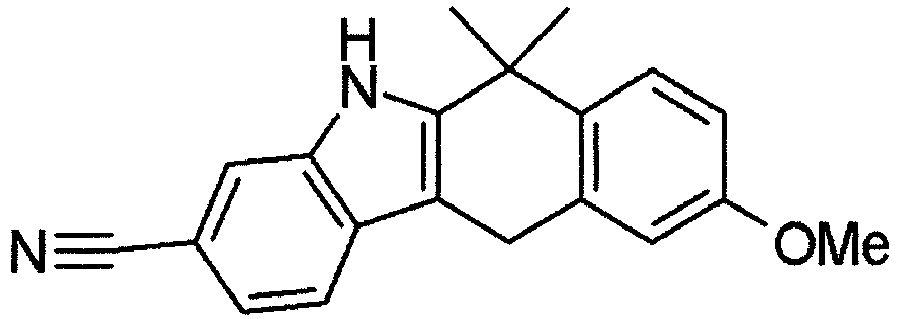
LCMS: m/z 303 [M+H]+
HPLC retention time: 2.73 minutes (analysis condition S) -

LCMS: m/z 303 [M+H]+
HPLC retention time: 2.67 minutes (analysis condition S) -

1H-NMR (DMSO-D6) δ: 12.79 (1H, s), 8.33 (1H, d, J = 8.2 Hz), 8.02 (1H, s), 7.81 (1H, d, J = 8.6 Hz), 7.69 (1H, d, J = 3.0 Hz), 7.63 (1H, dd, J = 8.3, 1.4 Hz), 7.28 (1H, dd, J = 8.7, 3.0 Hz), 3.87 (3H, s), 1.74 (6H, s).
LCMS: m/z 317 [M+H]+
HPLC retention time: 2.25 minutes (analysis condition S) -

1H-NMR (DMSO-D6) δ: 12.75 (1H, s), 9.77 (1H, s), 8.32 (1H, dd, J = 8.2, 0.7 Hz), 8.01 (1H, s), 7.68 (1H, d, J = 8.6 Hz), 7.62 (1H, dd, J = 8.2, 1.4 Hz), 7.58 (1H, d, J = 2.8 Hz), 7.10 (1H, dd, J = 8.6, 2.8 Hz), 1.72 (6H, s).
LCMS: m/z 303 [M+H]+
HPLC retention time: 1.75 minutes (analysis condition S) -

1H-NMR (DMSO-D6) δ: 12.95 (1H, s), 8.31 (1H, d, J = 8.2 Hz), 8.15 (2H,m), 8.05 (1H, s), 7.87 (1H, dd, J = 9.0, 2.7 Hz), 7.65 (1H, d, J = 8.2 Hz), 1.80 (6H, s).
LCMS: m/z 435 [M+H]+
HPLC retention time: 2.75 minutes (analysis condition S) -

thiomorpholine 1,1-dioxide (19 mg, 2 eq.), Pd2dba3 (6.3 mg, 0.1 eq.), BINAP (8.6 mg, 0.2 eq.) and K3PO4 (29 mg, 2 eq.), and stirred at 100°C all night and all day. The reaction solution was poured into water, and then extracted with ethyl acetate. The organic layer was washed with saturated brine and dried over sodium sulfate. The drying agent was removed by filtration and the residues obtained after concentration under reduced pressure were purified by silica gel column chromatography (ethyl acetate/hexane) to obtain the Compound B2-10 (8-(1,1-dioxothiomorpholino)-6,6-dimethyl-11-oxo-6,11-dihydro-5H-benzo[b]carbazole-3-carbonitrile) (white powder, 2.1 mg, 7%)), the title compound was synthesized from the Compound J6 and 1-isopropyl-piperazine.
1H-NMR (270MHz,DMSO-d6) δ: 12.80 (1H, s), 8.33 (1H, d, J = 7.6 Hz), 8.02 (1H, s), 7.66 (3H, m), 7.33 (1H, d, J = 8.2 Hz), 3.21 (4H, br), 2.66 (5H, m), 1.72 (6H, s), 1.02 (6H, d, J = 6.3 Hz).
LCMS: m/z 413 [M+H]+
HPLC retention time: 1.38 minutes (analysis condition S) -

1H-NMR(400 MHz, CDCl3) δ : 1. 43 (6 H, s), 2. 65 (2 H, t, 12 Hz), 3. 02 (2 H, t, 12 Hz), 3. 79 (3 H, s), 6. 74 (1 H, m), 6. 87 (1 H, m), 7. 24 (1 H, m).
LCMS: m/z 205 [M+H]+ -

-

1H-NMR(400 MHz, DMSO-d6) δ : 1. 73 (6 H, s), 3. 90 (3 H, s), 7. 06-7. 09 (1 H, m), 7. 32-7. 38 (2 H, m), 7. 65-7. 66 (1 H, m), 8. 09-8.17 (2 H, m), 12. 32 (1 H, br. s).
LCMS: m/z 370, 372 [M+H]+ -

1H-NMR(400MHz, DMSO-d6) δ: 1.71 (6 H, s), 3.89 (3H, s), 7.07-7.09 (1H, m), 7.34 (1H, s), 7.58-7.60 (1H, m), 7.99 (1H, s), 8.14-8.16 (1H, m),8.30-8.32 (1H, m), 12.32 (1H, br.s),
LCMS: m/z 317 [M+H]+
HPLC retention time: 2.56 minutes (analysis condition U) -

1H-NMR(400MHz, DMSO-d6) δ: 1.73 (6 H, s), 6.87-6.90 (1H, m), 7.11 (1H, s), 7.57-7.59 (1H, m), 7.97 (1H, s), 8.04-8.06 (1H, m),8.29-8.31 (1H, m), 10.27 (1H, s), 12.66 (1H, br.s),
LCMS: m/z 303 [M+H]+ -
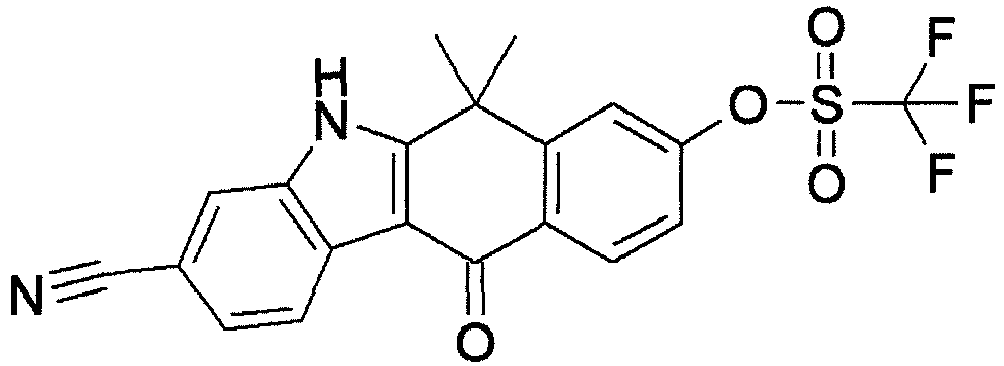
- 8-Hydroxy-6,6-dimethyl-11-oxo-6,11-dihydro-5H-benzo[b]carbazole-3-carbonitrile (Compound A6, 550 mg, 0.189 mmol) was dissolved in pyridine (18 mL), added with anhydrous trifluoromethane sulfonic acid (0.758 ml, 3 eq.), and stirred at room temperature for 30 minutes. The reaction solution was poured into water and then extracted with dichloromethane. The organic layer was dried over magnesium sulfate. The drying agent was removed by filtration and the residues obtained after concentration under reduced pressure were purified by silica gel column chromatography (ethyl acetate/hexane) to obtain the target compound (white powder, 641 mg, 81 %).
1H-NMR(400MHz,DMSO-d6) δ: 12.89 (1H, br. s), 8.36 (1H, d, J = 8.8 Hz), 8.31 (1H, dd, J = 8.1, 0.7 Hz), 8.11 (1H, d, J = 2.3 Hz), 8.04 (1H, dd, J = 1.5, 0.7 Hz), 7.65-7.60 (2H,m). 1.76 (6H,s)
LCMS: m/z 435 [M+H]+
HPLC retention time: 3. 10 minutes (analysis condition U) -

- To trifluoro-methane sulfonic acid 3-cyano-6,6-dimethyl-11-oxo-6,11-dihydro-5H-benzo[b]carbazol-8-yl ester (Compound B1, 7.80 g, 18.0 mmol), 4-(4,4,5,5-tetramethyl-[1,3,2]dioxaborolan-2-yl)-3,6-dihydro-2H-pyridine-1-carboxylic acid tert-butyl ester (6.11 g, 19.8 mmol, 1.1 eq.), Pd(PPh3)2Cl2(630 mg, 0.898 mmol, 0.05 eq.), and sodium carbonate (5.71 g, 53.9 mmol, 3.0 eq.), DME (125 ml) and water (25 ml) were added. The mixture was subjected to reduced pressure under ultrasonication treatment, followed by filling with nitrogen. This procedure was repeated five times to remove air. After further stirring at 80°C for 2 hours under nitrogen atmosphere, the mixture was cooled to room temperature, added with water (250 ml), and further stirred for 30 minutes. The precipitates were filtered and washed with water (50 ml). They were further washed with CH3CN (50 ml) to obtain the target compound as a crude product (gray powder, 7.54 g, 90%).
LCMS:m/z 468 [M+H]+
HPLC retention time: 2.90 minutes (analysis condition S) -

- 4-(3-Cyano-6,6-dimethyl-11-oxo-6,11-dihydro-5H-benzo[b]carbazol-8-yl)-3,6-dihydro-2H-pyridine-1-carboxylic acid tert-butyl ester (Compound B2-22-1, 16.2 g, 34.6 mmol) was dissolved in THF (800 ml) and methanol (230 ml), added with 10 wt% Pd/C (3.2 g), and stirred under hydrogen atmosphere for 19 hours. The solid was filtered through Celite, eluted with a mixture solvent (400 ml; THF/methanol = 4/1), and concentrated under reduced pressure. The residues were dissolved in ethyl acetate (400 ml), and then washed with 1% aqueous solution of N-acetylcysteine, saturated aqueous solution of NaHCO3 and saturated brine. The organic layer was dried over sodium sulfate. The drying agent was removed by filtration and the residues were concentrated under reduced pressure to obtain the title compound as a crude product (white powder, 14.0 g, 86%).
LCMS:m/z 470 [M+H]+
HPLC retention time: 2.88 minutes (analysis condition S) -

- With the same condition as the method for synthesizing the Compound A8-1 (THF (0.5 mL) and TFA (0.5 mL) were added to 4-(3-cyano-6,6-dimethyl-11-oxo-6,11-dihydro-5H-benzo[b]carbazol-8-yloxy)-piperidine-1-carboxylic acid tert-butyl ester (Compound A7-1, 35 mg, 0.072 mmol), and the mixture was stirred at room temperature until Compound A7-1 disappears. The reaction solution was concentrated under reduced pressure and the residue was desalinated by using anionic exchange resin PL StratoSpheres (trademark) PL-HCO3 MP to obtain the Compound A8-1 (37 mg, 76%)), the title compound was synthesized from the Compound B3-13-1.
LCMS: m/z 370 [M+H]+
HPLC retention time: 1.30 minutes (analysis condition S) -
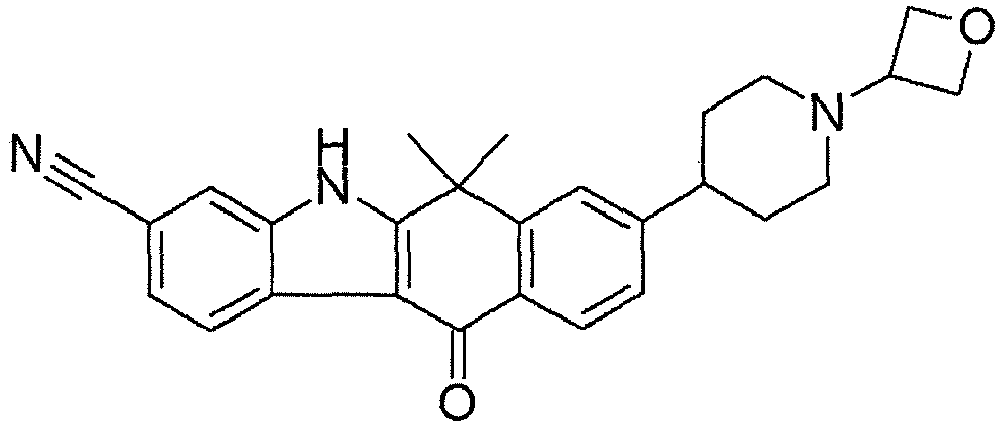
- With the same condition as the method for synthesizing the Compound B3-32 (morpholine (6 µl, 1.5 eq.) and sodium triacetoxy borohydride (81 mg, 2.0 eq.) were added to THF (1 ml) solution of the Compound B2-29: 8-formyl-6,6-dimethyl-11-oxo-6,11-dihydro-5H-benzo[b]carbazole-3-carbonitrile (30 mg, 0.095 mmol), and stirred at room temperature for 1 hour. The reaction solution was filtered to remove insoluble matters. The residues obtained after concentration under reduced pressure were purified by high performance liquid chromatography to obtain the Compound B3-32 (6,6-dimethyl-8-morpholin-4-yl methyl-11-oxo-6,11-dihydro-5H-benzo[b]carbazole-3-carbonitrile) (19 mg, 50%)), the title compound was synthesized from the Compound B3-13-2 and oxetan-3-one.
1H-NMR(400 MHz, DMSO-d6) δ: 12.74 (1H, s), 8.32 (1H, d, 7.9Hz), 8.13 (1H, d, 7.9Hz), 8.00 (1H, s), 7.74 (1H, s), 7.61 (1H, d, 9.8Hz), 7.40 (1H, d, 7.9Hz), 4.56 (2H, t, 6.7Hz), 4.46 (2H, t, 6.1Hz), 3.46-3.39 (1H, m), 2.85-2.82 (2H, m), 2.71-2.64 (1H, m), 1.92-1.86 (2H, m), 1.82-1.79 (4H, m), 1.77 (6H, s)
LCMS: m/z 426 [M+H]+
HPLC retention time: 1.53 minutes (analysis condition S) - 6,6-Dimethyl-8-(1-oxetan-3-yl-piperidin-4-yl)-11-oxo-6,11-dihydro-5H-benzo[b]carbazole-3-carbonitrile was dissolved at 80°C in a mixture of 5 v/w of DMA and 1.4 v/w of 2 N sulfuric acid. After cooling to room temperature, 15 v/w of acetone were added dropwise, and the precipitated solids were filtered and dried to obtain sulfuric acid salt of 6,6-dimethyl-8-(1-oxetan-3-yl-piperidin-4-yl)-11-oxo-6,11-dihydro-5H-benzo[b]carbazole-3-carbonitrile.
1H-NMR(400 MHz, DMSO-d6) δ: 12.81 (1H, s), 10.26 (1H,br.s),8.33 (1H, d, 8.3Hz), 8.21 (1H, d, 8.3Hz), 8.04 (1H, s), 7.75 (1H, s), 7.63 (1H, d, 8.3Hz), 7.41 (1H, d, 8.3Hz), 4.85-4.70 (4H, m), 4.50-4.40 (1H, br.s), 3.60-3.00(6H, br.m), 2.20-2.10 (2H, m), 2.05-1.90 (2H, m), 1.79 (6H, s)
LCMS: m/z 426 [M+H]+ - B4-8 was dissolved in 5 v/w of dimethyl sulfoxide and 0.41 v/w of aqueous hydrochloric acid solution (6 N), and then the dissolved solution was subjected to freeze-drying. To the freeze-dried product, a mixture of 3.7 v/w of water and 1.3 v/w of acetonitrile was added. After stirring at room temperature all night and all day, the precipitated crystals were filtered and dried to give the B4-8 monohydrochloride salt.
- B4-8 was dissolved in 4 v/w of dimethyl sulfoxide and 1.2 v/w of aqueous solution of mesylic acid (2 N), and then the dissolved solution was subjected to freeze-drying. To the freeze-dried product, 0.1 v/w of water and 5 v/w of ethyl acetate were added. After stirring at room temperature all night and all day, the precipitated crystals were filtered and dried to give the B4-8 monomesylate salt.
- B4-8 and L-tartaric acid, which is added in an amount of 0.81 times the weight of B4-8, were dissolved in 10 v/w of tetrahydrofuran and 2 v/w of water at 80°C. The dissolved solution was added with 30 v/w of ethanol. The mixture was stirred at room temperature all night and all day, and the precipitated crystals were filtered and dried to give the B4-8 hemi-L-tartrate salt. The B4-8 hemi-L-tartrate salt obtained was pulverized by using a jet mill.
- B4-8 was dissolved in 14 v/w of N,N-dimethylacetamide and 5.9 v/w of aqueous solution of phosphoric acid (2 N) under reflux with heating. The dissolved solution was added with 43 v/w of ethanol. The mixture was stirred at room temperature all night and all day, and the precipitated crystals were filtered and dried to give the B4-8 monophosphate salt. The B4-8 monophosphate salt obtained was pulverized by using a jet mill.
-

1H-NMR(400 MHz, CD3OD) δ: 8.37 (1H, d, J = 8.2 Hz), 8.18 (1H, s), 7.84 (1H, s), 7.53 (1H, d, J = 8.2 Hz), 7.19 (1H, s), 4.70-4.77 (2H, m), 4.62-4.68 (2H, m), 3.57-3.63 (1H, m), 3.38-3.45 (4H, m), 2.54-2.61 (4H, m), 2.10 (3H, s), 1.79 (6H, s) LCMS: m/z 465 [M+H]+
HPLC retention time: 1.90 minutes (analysis condition U) -

LCMS: m/z 491 [M+H]+ -

1H-NMR (270MHz,CDCl3) δ: 7.36 (1H, s), 6.84 (1H, s), 3.91 (3H, s), 3.02 (2H, t, J = 6.8 Hz), 2.66 (2H, t, J = 6.8 Hz), 1.42 (6H, s).
LCMS: m/z 283,285 [M+H]+
HPLC retention time: 2.67 minutes (analysis condition S) -

LCMS: m/z 381,383 [M+H]+
HPLC retention time: 3.03 minutes (analysis condition S) -

- With the same condition as the method for synthesizing the Compound A4, the title compound was synthesized from the Compound E2-1.
1H-NMR (270MHz,DMSO-D6) δ: 12.82 (1H, s), 8.30 (2H, s+d), 8.03 (1H, s), 7.61 (1H, dd, J = 8.2, 1.4 Hz), 7.49 (1H, s), 4.04 (3H, s), 1.81 (6H, s).
LCMS: m/z 395,397 [M+H]+
HPLC retention time: 2.77 minutes (analysis condition S) -

1H-NMR (400MHz,DMSO-d6) δ: 12.77 (1H, s), 11.13 (1H, d, J = 2.4 Hz), 8.31 (1H, dd, J = 7.9, 2.4 Hz), 8.25 (1H, d, J = 3.0 Hz), 8.01 (1H, s), 7.61 (1H, d, J = 7.9 Hz), 7.28 (1H, d, J = 2.4 Hz), 1.74 (6H, s).
LCMS: m/z 381,383 [M+H]+
HPLC retention time: 2.40 minutes (analysis condition S) -

1H-NMR (270MHz,DMSO-d6) δ: 12.99 (1H, s), 8.51 (1H, s), 8.31 (1H, dd, J = 8.2, 0.7 Hz), 8.17 (1H, s), 8.07 (1H, s), 7.67 (1 H, dd, J = 8.2, 1.4 Hz), 1.81 (6H, s).
LCMS: m/z 513,515 [M+H]+
HPLC retention time: 3.13 minutes (analysis condition S) -
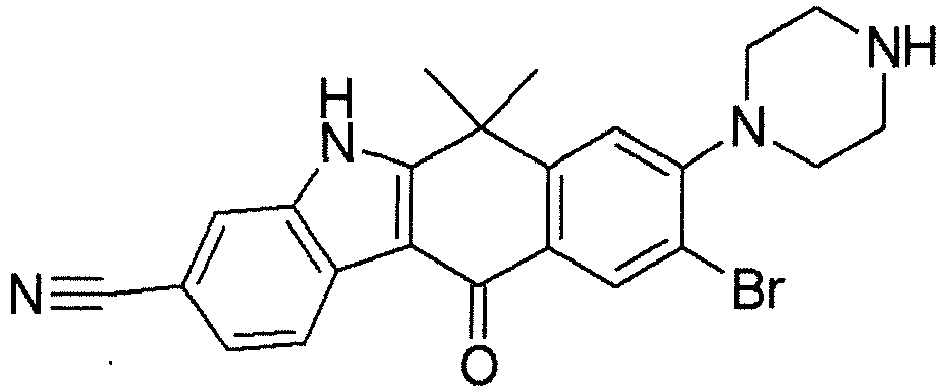
1H-NMR (DMSO-D6) δ: 8.30-8.24 (2H, m), 8.00 (1H, s), 7.63-7.58 (1H, m), 7.37 (1H, s), 3.10-3.01 (4H, m), 2.91-2.85 (4H,m), 1.76 (6H, s)
LCMS: m/z 449,451 [M+H]+
HPLC retention time: 1.45 minutes (analysis condition S) -

- With the same condition as the Compound B3-32, the title compound was synthesized from the Compound F3-9 and 1-oxetan-3-one.
1H-NMR (270MHz,DMSO-d6) δ: 12.83 (1H, br.s), 8.31-8.32 (1H, m), 8.27-8.29 (1H, m), 8.01-8.04 (1H, m), 7.59-7.64 (1H, m), 7.48 (1H, s), 4.59 (2H, dd, J = 6.3, 6.3 Hz), 4.48 (2H, dd, J = 6.3, 6.3 Hz), 3.52 (1H, t, J = 6.3 Hz), 3.12-3.25 (4H, m), 2.44-2.54 (4H, m), 1.78 (6H, s).
LCMS: m/z 505,507 [M+H]+
HPLC retention time: 1.45 minutes (analysis condition S) - 9-Bromo-6,6-dimethyl-8-(4-oxetan-3-yl-piperazin-1-yl)-11-oxo-6,11-dihydro-5H-benzo[b]carbazole-3-carbonitrile was added with 1.05 eq. of 6 N hydrochloric acid and DMSO and dissolved therein. After freeze-drying, the mixture was crystallized from ethanol containing 25% water to give 9-bromo-6,6-dimethyl-8-(4-oxetan-3-yl-piperazin-1-yl)-11-oxo-6,11-dihydro-5H-benzo[b]carbazole-3-carbonitrile monohydrochloride salt.
1H-NMR (270MHz,DMSO-d6) δ: 12.91 (1H,br,s),11.70(1H,br.s),8.32-8.29(2H, m),8.04(1H, s),7.64-7.62(1H, m),7.52(1H,s),4.89-4.62(4H,br.m),3.66-3.39(1H,m),3.31-3.05(8H, br.m),1.81 (6H,s)
LCMS: m/z 505,507 [M+H]+ -

1H-NMR (270MHz,DMSO-D6) δ: 8.22-8.30 (2H, m), 8.00 (1H, s), 7.56 (1H, d, J = 7.9 Hz), 7.43 (1H, s), 3.30(1H, d, J = 5.8 Hz), 3.11 (4H, s), 2.75 (4H, s), 1.75 (6H, s), 0.47 (2H, d, J = 5.8 Hz), 0.34 (2H, d, J = 5.8 Hz)
LCMS: m/z 489,491 [M+H]+
HPLC retention time: 1.68 minutes (analysis condition S) -

1H-NMR(400 MHz, CDCl3) δ: 7.16 (1H, s), 6.85 (1H, s), 3.90 (3H, s), 3.00 (2H, t, J = 6.8 Hz), 2.65 (2H, t, J = 6.8 Hz), 1.42 (6H, s).
LCMS: m/z 239 [M+H]+
HPLC retention time: 2.80 minutes (analysis condition U) -

-

1H-NMR(400 MHz, DMSO-d6) δ: 12.79 (1H, s), 8.27-8.31 (1H, m), 8.12 (1H, s), 8.00-8.02 (1H, m), 7.58-7.63 (1H, m), 7.51 (1H, s), 4.03 (3H, s), 1.80 (6H, s).
LCMS: m/z 351 [M+H]+
HPLC retention time: 2.87 minutes (analysis condition U) -

LCMS: m/z 337 [M+H]+
HPLC retention time: 2.47 minutes (analysis condition U) -

LCMS: m/z 469 [M+H]+
HPLC retention time: 3.40 minutes (analysis condition U) -

- With the same condition as the method for synthesizing the Compound B2-1, the title compound was synthesized from the
Compound 15 and 4-piperidin-4-yl-morpholine.
1H-NMR(400 MHz, DMSO-d6) δ: 12.75 (1H, s), 8.28 (1H, d, 8.0 Hz), 8.07 (1H, s), 8.00 (1H, s), 7.59 (1H, d, 8.0 Hz), 7.41 (1H, s), 3.55-3.62 (4H, m), 3.47-3.56 (4H, m), 2.75-2.86 (2H, m), 2.45-2.55 (4H, m), 2.28-2.39 (1H, m), 1.86-1.96 (2H, m), 1.76 (6H, s), 1.52-1.66 (2H, m)
LCMS: m/z 489 [M+H]+
HPLC retention time: 1.97 minutes (analysis condition U) -

1H-NMR(400 MHz, DMSO-d6) δ: 12.71 (1 H,s), 8.30 (1 H, d, 7.9 Hz), 8.06 (1 H, s),8.00 (1 H, s), 7.59 (1 H, d, 7.9 Hz), 7.20 (1 H, s), 2.75-2.83 (1 H, m), 2.40-2.48 (4 H, m), 2.11 (3 H, s), 1.97-2.06 (2 H, m), 1.76 (6 H, s), 1.62-1.71 (2 H, m) LCMS: m/z 463 [M+H]+
HPLC retention time: 2.80 minutes (analysis condition W) -

1H-NMR(DMSO-D6) δ: 8.30-8.24 (2H,m), 8.00 (1H, s), 7.59 (1H, d, J=8.2Hz), 7.42 (1H, s), 3.66-3.45 (6H, m), 2.80 (2H, t, J=11.1 Hz), 2.38-2.28 (1H, m), 1.96-1.87 (2H, m), 1.75 (6H, s), 1.66-1.56 (2H, m)
LCMS: m/z 533,535 [M+H]+
HPLC retention time: 1.53 minutes (analysis condition S) -

- With the same condition as the method for synthesizing the Compound F5-47 (under nitrogen atmosphere, to the N,N-dimethyl formamide (1.5 ml) solution of 9-bromo-8-(4-cyclobutyl-piperazin-1-yl)-6,6-dimethyl-11-oxo-6,11-dihydro-5H-benzo[b]carbazole-3-carbonitrile (Compound F4-10, 50 mg, 0.099 mmol), trimethyl boroxine (12 mg, 0.1 eq.), tetrakis triphenylphosphine palladium (39 mg, 0.2 eq.), and potassium carbonate (41 mg, 3.0 eq.) were added, and the mixture was stirred at 100°C for 24 hours. Upon the completion of the reaction, distilled water was poured into the reaction solution, which was then extracted with ethyl acetate. The organic layer was washed with aqueous solution of sodium chloride and dried over sodium sulfate. The drying agent was removed by filtration and the residues obtained after concentration under reduced pressure were purified by silica gel column chromatography (ethyl acetate/methanol) to obtain the Compound F5-47 (8-(4-cyclobutyl-piperazin-1-yl)-6,6,9-trimethyl-11-oxo-6,11-dihydro-5H-benzo[b]carbazole-3-carbonitrile) (25 mg, 58%)), the title compound was synthesized from the Compound F3-11. 1H-NMR(270 MHz, DMSO-d6) δ: 12.70 (1 H, br.s), 8.33-8.30 (1 H, d, 8.08 Hz), 8.00 (1 H, s), 7.95 (1 H, s), 7.61-7.58 (1 H, m), 7.28 (1 H, s),, 3.60 (4 H, m), 3.32-3.26 (2 H, m), 2.79-2.69 (2 H, m), 2.32 (3 H, s), 1.95-1.90 (2 H, m), 1.74 (6 H, s), 1.65-1.52 (2 H, m), LCMS: m/z 469 [M+H]+
- 6,6,9-Trimethyl-8-(4-morpholin-4-yl-piperidin-1-yl)-11-oxo-6,11-dihydro-5H-benzo[b]carbazole-3-carbonitrile was added with 1.05 eq. of 2 N methane sulfonic acid and DMSO and dissolved therein. After freeze-drying, the mixture was crystallized from ethanol to give 6,6,9-trimethyl-8-(4-morpholin-4-yl-piperidin-1-yl)-11-oxo-6,11-dihydro-5H-benzo[b]carbazole-3-carbonitrile methane sulfonic acid salt.
1H-NMR(270 MHz, DMSO-d6) δ: 12.72(1H,br.s),9.60(1H,br.s),8.33-8.31(1H,d,9.8Hz), 8.01(1H,s),7.99(1H,s),7.61-7.59(1H,m),7.31 (1H,s),4.07-4.04 (2H,m),3.73-3.67(2H,m), 3.55-3.40(8H,m),3.32-3.26(1H,m),2.70-2.60(2H,m),2.34(3H,s),2.30(3H,s),1.95-1.90 (2 H,m),1.75(6H,s)
LCMS: m/z 469 [M+H]+ - F5-51 was dissolved in 5 v/w of dimethyl sulfoxide and 0.37 v/w of aqueous solution of hydrochloric acid (6 N), and then the dissolved solution was subjected to freeze-drying. To the freeze-dried product, 5 v/w of ethanol was added. The precipitated crystals were filtered and dried to give the F5-51 hydrochloride salt.
-

LCMS: m/z 455 [M+H]+
HPLC retention time: 1.92 minutes (analysis condition U) - 9-Ethyl-6,6-dimethyl-8-(4-oxetan-3-yl-piperazin-1-yl)-11-oxo-6,11-dihydro-5H-benzo[b]carbazole-3-carbonitrile was added with 1.05 eq. of 6 N hydrochloric acid and DMSO and dissolved therein. After freeze-drying, the mixture was crystallized from ethanol containing 25% water to give 9-ethyl-6,6-dimethyl-8-(4-oxetan-3-yl-piperazin-1-yl)-11-oxo-6,11-dihydro-5H-benzo[b]carbazole-3-carbonitrile monohydrochloride salt.
1H-NMR (270MHz,DMSO-d6) δ: 12.83 (1H,br.s),11.59(1H,br.s),8.33-8.31(1H,m), 8.09(1H,s),8.02(1H,s),7.63-7.61(1H,m),7.39(1H,s),4.91-4.60(4H,br.m),3.58-3.40(1H,m), 3.31-3.05(8H, br.m),2.73(2H,q,,J=7.3),1.81(6H,s),1.29(3H,t,J=7.3) LCMS: m/z 455 [M+H]+ - F6-4 was dissolved in 5 v/w of dimethyl sulfoxide and 1.2 v/w of aqueous solution of mesylic acid (2 N), and then the dissolved solution was subjected to freeze-drying. To the freeze-dried product, a mixture of 3.8 v/w of water and 1.3 v/w of ethanol was added. The precipitated crystals were filtered and dried to give the F6-4 mesylate salt.
-

LCMS: m/z 479 [M+H]+
HPLC retention time: 1.90 minutes (analysis condition U) -

- With the same condition as the method for synthesizing the Compound B3-13-1, the title compound was synthesized from the Compound F5-49.
1H-NMR (400MHz,DMSO-D6) δ: 12.70 (1H, s), 8.32 (1H, d, J = 7.9 Hz), 8.04 (1H, s), 8.00 (1H, s), 7.61 (1H, d, J = 8.5 Hz), 7.34 (1H, s), 3.64-3.57 (4H, m), 3.27-3.18(2H, m), 2.82-2.66 (4H, m), 2.39-2.28 (1H,m), 1.96-1.87 (2H, m), 1.76 (6H, s), 1.69-1.53 (2H, m), 1.29 (3H, t, J = 7.3 Hz)
LCMS: m/z 483 [M+H]+
HPLC retention time: 1.98 minutes (analysis condition U) - 9-Ethyl-6,6-dimethyl-8-(4-morpholin-4-yl-piperidin-1-yl)-11-oxo-6,11-dihydro-5H-benzo[b]carbazole-3-carbonitrile was dissolved in a mixture of 10 v/w of methyl ethyl ketone, 4 v/w of water, and 3 v/w of acetic acid at 60°C. To the dissolved solution, 1 v/w of hydrochloric acid (2 N) was added dropwise. After stirring at 60°C for 30 minutes, 25 v/w of ethanol was added dropwise. The precipitated solid was filtered and dried to give 9-ethyl-6,6-dimethyl-8-(4-morpholin-4-yl-piperidin-1-yl)-11-oxo-6,11-dihydro-5H-benzo[b]carbazole-3-carbonitrile monohydrochloride salt. 9-Ethyl-6,6-dimethyl-8-(4-morpholin-4-yl-piperidin-1-yl)-11-oxo-6,11-dihydro-5H-benzo[b]carbazole-3-carbonitrile monohydrochloride salt obtained was pulverized by using a jet mill.
1H-NMR (400MHz,DMSO-D6) δ: 12.78(1H,s),10.57(1H,br.s),8.30(1H,J = 8.4 Hz),8.05(1H,s),7.99(1H,s),7.59(1H,d,J = 7.9 Hz),7.36(1H,s),4.02-3.99(2H,m),3.84-3.78(2H,m),3.51-3.48(2H,m),3.15-3.13(H,s),2.83-2.73(2H,s),2.71-2.67(2H,s),2.23-2.20(2H,m),1.94-1.83(2H,m),1.75(6H,s),1.27(3H,t,J = 7.5 Hz)
FABMS: m/z 483 [M+H]+ - F6-20 was dissolved in 33 v/w of dimethyl acetamide at 90°C. The dissolved solution was added with 1.2 v/w of aqueous solution of mesylic acid (2 N) and 168 v/w of ethyl acetate followed by stirring for 4 hours. The precipitated crystals were filtered and dried to give the F6-20 monomesylate salt. The F6-20 monomesylate salt obtained was pulverized by using a jet mill.
-

1H-NMR (270MHz,DMSO-D6) δ: 12.77 (1H, br.s), 8.31 (1H, d, J = 8.2 Hz), 8.16 (1H, s), 8.02 (1H, s), 7.61 (1H, dd, J = 8.2, 1.3 Hz), 7.27 (1H, s), 4.59 (2H, dd, J = 6.6, 6.6 Hz), 4.51 (1H, s), 4.49 (2H, dd, J = 6.6, 6.6 Hz), 3.51 (1H, t, J = 6.6 Hz), 3.35-3.43 (4H, m), 2.43-2.50 (4H, s), 1.78 (6H, s).
LCMS: m/z 451 [M+H]+ -

1H-NMR(400 MHz, DMSO-d6) δ: 12.80 (1 H,s), 8.32 (1 H, d, 7.9 Hz), 8.10 (1 H, s),8.02 (1 H, s), 7.62 (1 H, d, 7.9 Hz), 7.38 (1 H, s), 3.78-3.88 (1 H, m), 3.79-3.89 (1 H, m), 3.48-3.54 (2 H, m), 3.40-3.47 (2 H, m), 3.30-3.39 (2 H, m), 3.02-3.24 (4 H, m), 2.73 (2 H, q, 7.3 Hz), 2.30-2.41 (2 H, m), 2.17-2.26 (2 H, m), 1.71-1.86 (8 H, m), 1.29 (3 H, t, 7.3 Hz)
LCMS: m/z 453 [M+H]+
HPLC retention time: 2.76 minutes (analysis condition W) - 8-(4-Cyclobutyl-piperazin-1-yl)-9-ethyl-6,6-dimethyl-11-oxo-6,11-dihydro-5H-benzo[b]carbazole-3-carbonitrile was dissolved at room temperature and added with 6 v/w of DMF and added dropwise with 1.05 eq. of an aqueous solution of methane sulfonic acid (2 M). The resulting solution was added dropwise to 60 v/w of acetonitrile. The precipitated solid was filtered and dried to give 8-(4-cyclobutyl-piperazin-1-yl)-9-ethyl-6,6-dimethyl-11-oxo-6,11-dihydro-5H-benzo[b]carbazole-3-carbonitrile monomethane sulfonic acid salt.
1H-NMR (400MHz,DMSO-D6) δ: 12.75(1H,s),8.31(1H,J = 8.4 Hz),8.07(1H,s), 8.01(1H,s),7.59(1H,d,J = 7.9 Hz),7.38(1H,s),3.58-2.84(10H,m),2.71(2H,q,J = 7.5 Hz),2.34(3H,s),2.20-2.04(4H,m),1.76-1.68(8H,m),1.26(3H,t,J = 7.5 Hz)
FABMS: m/z 453 [M+H]+ - F6-17 was dissolved in 5 v/w of dimethyl sulfoxide and 0.39 v/w of aqueous solution of hydrochloric acid (6 N), and then the dissolved solution was subjected to freeze-drying. To the freeze-dried product, a mixture of 4.0 v/w of water and 1.3 v/w of ethanol was added. The precipitated crystals were filtered and dried to give the F6-17 hydrochloride salt.
- A mixture containing F6-17 and maleic acid, which is added in an amount of 0.38 times the weight of F6-17, was dissolved in 10 v/w of dimethyl acetamide at 80°C. The dissolved solution was cooled to room temperature, and added dropwise with a mixture of 5.8 v/w of acetone and 5.8 v/w of water followed by stirring at room temperature. 3.5 v/w of water was further added dropwise, and the precipitated crystals were filtered and dried to give the F6-17 maleate salt.
- A mixture containing F6-17 and L-tartaric acid, which is added in an amount of 0.51 times the weight of F6-17, was dissolved in 6 v/w of dimethyl acetamide at 80°C. The dissolved solution was cooled to room temperature, and added dropwise with 37 v/w of acetonitrile followed by stirring at room temperature all night and all day. The precipitated crystals were filtered and dried to give the F6-17 tartrate salt. The F6-17 tartrate salt obtained was pulverized by using a jet mill.
- A mixture containing F6-17 and citric acid, which is added in an amount of 0.50 times the weight of F6-17, was dissolved in 6 v/w of dimethyl acetamide at 80°C. The dissolved solution was cooled to room temperature, and added dropwise with 12 v/w of acetonitrile. The precipitated crystals were filtered and dried to give the F6-17 citrate salt. The F6-17 citrate salt obtained was pulverized by using a jet mill.
- A mixture containing F6-17 and L-malic acid, which is added in an amount of 0.46 times the weight of F6-17, was dissolved in 8 v/w of dimethyl acetamide at 80°C. The dissolved solution was cooled to room temperature, and added dropwise with 62 v/w of acetonitrile. The precipitated crystals were filtered and dried to give the F6-17 malate salt.
-

LCMS: m/z 517,519 [M+H]+
HPLC retention time: 1.70 minutes (analysis condition S) -

- With the same condition as the method for synthesizing the Compound E4-2-1, the Compound E4-2-2 (9-(3-hydroxy-3-methyl-but-1-ynyl)-8-methoxy-6,6-dimethyl-11-oxo-6,11-dihydro-5H-benzo[b]carbazole-3-carbonitrile (Compound E4-2-1, 21.3 mg, 0.05 mmol) and sodium hydride (3.2 mg, 1.5 eq.) were dissolved in THF, and the mixture was stirred overnight at 50°C. Water was added to the reaction solution and the residues obtained after concentration under reduced pressure were purified by HPLC to obtain the Compound E4-2-2 (9-ethynyl-8-methoxy-6,6-dimethyl-11-oxo-6,11-dihydro-5H-benzo[b]carbazole-3-carbonitrile) (brown solid, 9.6 mg, 31%)), the title compound was synthesized from the Compound F3-2.
1H-NMR (270MHz,DMSO-D6) δ: 8.29 (1H, d, J = 8.2 Hz), 8.14 (1H, s), 8.00 (1H, s), 7.58 (1H, dd, J = 8.1, 1.3 Hz), 7.24 (1H, s), 4.50 (1H, s), 3.70-3.83 (2H, m), 3.34-3.48 (1H, m), 2.83-2.98 (2H, m), 2.45-2.58 (2H, m), 2.10-2.23 (2H, m), 1.90-2.03 (2H, m), 1.76 (6H, s), 1.51-1.74 (6H, m).
LCMS: m/z 463 [M+H]+
HPLC retention time: 1.60 minutes (analysis condition S) -

1H-NMR(270 MHz, DMSO-d6) δ: 8.30 (1H, d, 8.1Hz), 8.01 (1H, d, 8.7Hz), 7.97 (1H, s), 7.56 (1H, d, 8.6Hz), 7.20 (1H, s), 3.94-3.90 (2H, m), 3.30-3.28 (4H, m), 2.95 (2H, t, 11.8Hz), 2.24-2.20 (1H, m), 1.95-1.91 (2H, m), 1.75 (6H, s), 1.70-1.66 (4H, m), 1.54-1.52 (2H, m)
LCMS: m/z 439 [M+H]+ -

1H-NMR(400 MHz, DMSO-d6) δ: 12.85 (1 H,s), 8.31 (1 H, d, 7.9 Hz), 8.20 (1 H, s),8.03 (1 H, s), 7.62 (1 H, d, 7.9 Hz), 7.35 (1 H, s), 4.62 (1 H, s), 3.94-4.03 (2 H, m), 3.79-3.89 (1 H, m), 3.48-3.54 (2 H, m), 3.27-3.38 (2 H, m), 2.96-3.16 (2 H, m), 2.30-2.41 (2 H, m), 2.16-2.26 (2 H, m), 1.72-1.85 (8 H, m)
LCMS: m/z 449 [M+H]+
HPLC retention time: 2.69 minutes (analysis condition W) -

1H-NMR(400 MHz, DMSO-d6) δ: 12.69 (1 H,s), 8.31 (1 H, d, 7.9 Hz), 8.01 (1 H, s),7.99 (1 H, s), 7.60 (1 H, d, 7.9 Hz), 7.39 (1 H, s), 2.92-3.02 (4 H, m), 2.75-2.84 (1 H, m), 2.65 (2 H, t, 7.3 Hz), 2.38-2.48 (4 H, m), 1.96-2.06 (2 H, m), 1.78-1.87 (2 H, m), 1.75 (6 H, s), 1.62-1.73 (4 H, m), 0.97 (3 H, t, 7.3 Hz)
LCMS: m/z 467 [M+H]+
HPLC retention time: 2.96 minutes (analysis condition W) -

1H-NMR(400 MHz, DMSO-d6) δ: 12.77 (1H, s), 8.32 (1H, d, 7.9Hz), 8.13 (1H, d, 7.9Hz), 8.01 (1H, s), 7.73 (1H, s), 7.61 (1H, d, 9.1Hz), 7.39 (1H, d, 9.8Hz), 2.93 (2H, d, 11.0Hz), 2.77-2.71 (1H, m), 2.67- 2.62 (1H, m), 2.25 (2H, t, 10.1Hz), 1.80-1.73 (10H, m), 1.02 (6H, d, 6.7 Hz)
LCMS: m/z 412 [M+H]+
HPLC retention time: 1.60 minutes (analysis condition S) -

1H-NMR(270 MHz, DMSO-d6) δ: 8.30 (1H, d, 8.1Hz), 8.03 (1H, d, 8.6Hz), 7.98 (1H, s), 7.56 (1H, d, 8.6Hz), 7.21 (1H, s), 7.04 (1H, d, 9.1Hz), 3.40-3.37 (4H, m), 2.73-2.65 (1H, m), 2.61-2.58 (4H, m), 1.75 (6H, s), 1.02 (6H, d, 6.6Hz)
LCMS: m/z 413 [M+H]+ -

LCMS: m/z 549,551 [M+H]+
HPLC retention time: 4.61 minutes (analysis condition W) -

1H-NMR(400 MHz, DMSO-d6) δ: 8.55(1H,s), 8.28-8.25(1H, m), 7.98-7.95(1H, m), 7.62(1H, s), 7.32(1H, s), 3.56-3.53(4h, m),3.09-3.07(4H, m), 2.22-2.18(1H, m), 1.73(6H, br s), 1.44(9H, s), 1.08-1.05(2H, m), 0.77-0.76(2H,m)
LCMS: m/z 511 [M+H]+
HPLC retention time: 4.50 minutes (analysis condition W) -

LCMS: m/z 411 [M+H]+
HPLC retention time: 2.67 minutes (analysis condition W) -

- With the same condition as the method for synthesizing the Compound B3-32, the title compound was synthesized from the Compound F5-15-2 and cyclobutanone. 1H-NMR(400 MHz, DMSO-d6) δ:8.23(1H, d, 8Hz), 7.92(1H, br.s), 7.59(1H, s), 7.47(1H, br.d, 8Hz), 7.28(1H, s), 3.12(4H, br.s), 2.80(1H, dddd, 8,8,8,8Hz), 2.20-2.13(1H, m), 2.01(2H, br.s), 1.86-1.68(10H, m), 1.05(2H, d, 8Hz), 0.76(2H, d, 4Hz) LCMS: m/z 465 [M+H]+
HPLC retention time: 2.79 minutes (analysis condition W) - 8-(4-Cyclobutyl-piperazin-1-yl)-9-cyclopropyl-6,6-dimethyl-11-oxo-6,11-dihydro-5H-benzo[b]carbazole-3-carbonitrile was added with 1.05 eq. of 6 N hydrochloric acid and DMSO and dissolved therein. After freeze-drying, the mixture was crystallized from ethanol containing 25% water to give 8-(4-cyclobutyl-piperazin-1-yl)-9-cyclopropyl-6,6-dimethyl-11-oxo-6,11-dihydro-5H-benzo[b]carbazole-3-carbonitrile monohydrochloride salt.
1H-NMR(400 MHz, DMSO-d6)δ:12.81(1H,s),10.64(1H,br.s),8.32-8.29(1H, m),8.01(1H, s),7.67(1H,s),7.61-7.60(1H,m),7.33(1H,s),4.00-3.39(6H,m),3.28-3.02(3H,m),2.45-2.05(5H,m),1.83-1.77(8H,m),1.09-1.07(2H,m),0.81-0.80(2H,m) LCMS: m/z 465 [M+H]+ - F5-46 was dissolved in 5 v/w of dimethyl sulfoxide and 1.1 v/w of aqueous solution of mesylic acid (2 N), and then the dissolved solution was subjected to freeze-drying. To the freeze-dried product, 5 v/w of benzyl alcohol was added. The precipitated crystals were filtered and dried to give the F5-46 monomesylate salt.
-

1H-NMR(270MHz,DMSO-d6) δ: 12.75 (1H, br.s), 8.32 (1H, d, J = 8.2 Hz), 8.17 (1H, d, J = 8.6 Hz), 8.01 (1H, s), 7.61 (1H, dd, J = 8.2, 1.4 Hz), 7.40 (1H, d, J = 2.2 Hz), 7.12 (1H, dd, J = 8.6, 2.2 Hz), 4.50 (2H, t, J = 5.3 Hz), 3.88 (2H, t, J = 5.3 Hz), 1.77 (6H, s).
LCMS: m/z 409,411 [M+H]+
HPLC retention time: 2.48 minutes (analysis condition S) -

- With the same synthesis condition as the Compound A7-17 (8-hydroxy-6,6-dimethyl-11-oxo-6,11-dihydro-5H-benzo[b]carbazole-3-carbonitrile (Compound A6, 25 mg, 0.083 mmol) was dissolved in N,N-dimethylacetamide (1 mL), added with 2-chloroethyldiethylamine (16 mg, 1.1 eq.) and cesium carbonate (54 mg, 2 eq.) in order and stirred at 100°C for 4 hours. The reaction solution was poured into water and extracted with ethyl acetate. The organic layer was washed with brine and dried over sodium sulfate. The drying agent was removed by filtration and the residues obtained after concentration under reduced pressure were purified by amino silica gel column chromatography (ethyl acetate/hexane) to obtain the Compound A7-17 (8-(2-diethylamino-ethoxy)-6,6-dimethyl-11-oxo-6,11-dihydro-5H-benzo[b]carbazole-3-carbonitrile) (11 mg, 32%)), the title compound was synthesized from the Compound A7-24 and tert-butyl amine.
1H-NMR(400MHz, DMSO-d6) δ: 12.71 (1 H, s), 8.32 (1 H, d, 7.9 Hz), 8.15 (1 H, d, 9.1 Hz),8.07 (1 d, 1.8 Hz), 7.60 (1 H, dd, 1.8, 7.9 Hz), 7.35 (1 H, d, 2.4 Hz),7.09 (1 H, dd, 2.4, 9.1 Hz), 4.16 (2 H, t, 6.1 Hz), 2.91 (2 H, t, 6.1 Hz), 1.77 (6 H, s), 1.08 (9 H, s) LCMS: m/z 402 [M+H]+
HPLC retention time: 2.55 minutes (analysis condition W) -
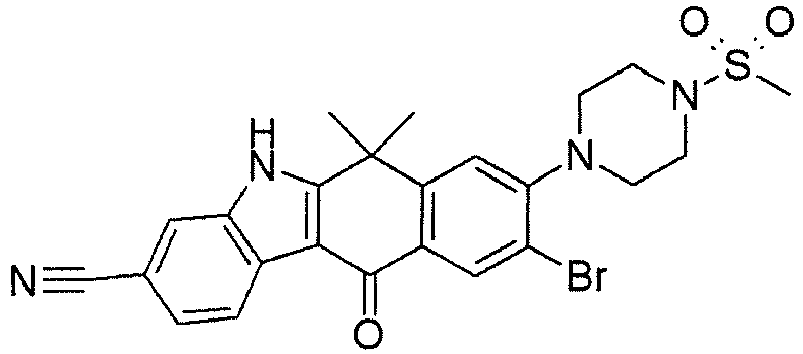
LCMS: m/z 527, 529 [M+H]+
HPLC retention time: 2.48 minutes (analysis condition S) -

- With the same condition as the method for synthesizing the Compound F5-43, the title compound was synthesized from the Compound F3-3.
1H-NMR (270MHz,DMSO-D6) δ: 12.78 (1H, s), 8.31 (1H, dd, J = 8.1, 0.7 Hz), 8.19 (1H, s), 8.02 (1H, dd, J = 1.4, 0.7 Hz), 7.61 (1H, dd, J = 8.2, 1.4 Hz), 7.33 (1H, s), 4.55 (1H, s), 3.43 (4H, br), 2.98 (3H, s), 1.79 (6H, s).
LCMS: m/z 473 [M+H]+
HPLC retention time: 2.27 minutes (analysis condition S) -

1H-NMR(400 MHz, DMSO-d6) δ: 8.23-8.29 (2 H, m), 8.00 (1 H, s),7.55 (1 H, d, 7.9 Hz), 7.45 (1 H, s), 4.04-4.15 (1 H, m), 3.10-3.20 (4 H, m), 2.39-2.48 (4 H, m), 1.97-2.06 (2 H, m), 1.78-1.88 (2 H, m), 1.77 (6 H, s), 1.61-1.72 (2 H, m)LCMS: m/z 503, 505 [M+H]+
HPLC retention time: 2.78 minutes (analysis condition W) -

1H-NMR (270mHz DMSO-D6) δ: 12.75 (1H, s), 8.30 (1H, d, J = 8.2 Hz), 8.01-7.97 (2H, m), 7.59 (1H, d, J = 7.1 Hz), 7.38 (1H, s), 4.51 (4H, dt, J = 27.7, 6.3 Hz), 3.55-3.49 (1H, m), 3.02-2.96 (4H, m), 2.63 (2H, t, J = 7.3 Hz), 2.47-2.41 (4H, m), 1.73 (6H, s), 1.70-1.61 (2H, m), 0.94 (3H, t, J = 7.4 Hz).
LCMS: m/z 469 [M+H]+
HPLC retention time: 1.57 minutes (analysis condition S) -

LCMS: m/z 450, 452 [M+H]+
HPLC retention time: 2.65 minutes (analysis condition S) -

- With the same condition as the method for synthesizing the Compound E4-2-1 and the Compound E4-2-2, the title compound was synthesized from the Compound F3-4.
1H-NMR (400MHz, DMSO-d6) δ: 12.82 (1H, s), 8.31 (1H, d, J = 7.9 Hz), 8.18 (1H, s), 8.02 (1H, s), 7.61 (1H, d, J = 7.9 Hz), 7.28 (1H, s), 4.53 (1H, s), 3.80 (4H, s), 3.36 (4H, s), 1.79 (6H, s).
LCMS: m/z 396 [M+H]+
HPLC retention time: 2.32 minutes (analysis condition S) - Materials for the Compound F6-20 (free form) were produced according to the method described in the Production example 30 and used. Additives shown in Table 2 were used as additives for the formulation.
- For the Examples 1 to 269, the Compound F6-20 was dissolved in DMSO to the concentration of 0.5 mg/mL and added with hydrochloric acid in the same molar equivalent of the Compound F6-20. Then, various dissolution aids which have been dissolved or dispersed in the solvent shown in Table 2 were added to the Compound F6-20 to have 100% weight ratio. The resultant was freeze-dried to obtain a mixture of the Compound F6-20 and various dissolution aids.
-
Table 2 Dissolution aids and solvents for dissolving them Example Dissolution aid Manufacturer Solvent 1 D-Sorbitol B Food Science DMSO 2 D-Mannitol Towa Chemical Co. Ltd DMSO 3 Pregelatinized starch Nippon Starch Chemical Co., Ltd. DMSO 4 Ethylcellulose Colorcon DMSO 5 Sodium carboxymethyl starch DMV water 6 Citric acid Showa Kako Corporation DMSO 7 Sodium citrate Showa Kako Corporation water 8 Crosscarmellose sodium Asahi Kasei Chemicals Corporation DMSO 9 Microcrystalline cellulose Asahi Kasei Chemicals Corporation water 10 Titanium oxide Freund Industrial Co., Ltd. DMSO 11 Stearic acid NOF Corporation DMSO 12 Magnesium stearate Merck & Co., Inc. DMSO 13 Sucrose Ensuiko Sugar Refining DMSO 14 Tocopherol Eisai Co., Ltd. DMSO 15 Lactose DMV DMSO 16 Hydroxypropyl cellulose Nippon Soda Co., Ltd. DMSO 17 Hydroxypropylmethyl cellulose 2910 Shin-Etsu Chemical Co., Ltd. DMSO 18 Sodium stearyl fumarate Kimura Sangyo Co., Ltd. DMSO 19 Propylene glycol Kanto Chemical Co., Inc. DMSO 20 Povidone BASF DMSO 21 Polysorbate 80Nihon Surfactant Kogyo K.K. DMSO 22 Methacrylic acid copolymer LD Rohm GmbH DMSO 23 Methyl cellulose Shin-Etsu Chemical Co., Ltd. DMSO 24 Sodium lauryl sulfate Nikko Chemicals Co., Ltd. DMSO 25 Ascorbic acid Wako Pure Chemical Industries Ltd. DMSO 26 Sodium alginate Wako Pure Chemical Industries Ltd. water 27 Disodium edetate Wako Pure Chemical Industries Ltd. water 28 Caramel Semba Tohka Industries DMSO 29 Carmellose calcium Nichirin Chemical Industries, Ltd. water 30 Dried aluminum hydroxide gel Kyowa Chemical Industry Co., Ltd. water 31 Calcium citrate Kanto Chemical Co., Inc. DMSO 32 Triethyl citrate Wako Pure Chemical Industries Ltd. DMSO 33 Cholesterol Wako Pure Chemical Industries Ltd. DMSO 34 Magnesium oxide Kyowa Chemical Industry Co., Ltd. DMSO 35 Dibutylhydroxy toluene Kanto Chemical Co., Inc. DMSO 36 Sodium hydroxide Wako Pure Chemical Industries Ltd. water 37 Stearyl alcohol NOF Corporation DMSO 38 Polyoxyl 40 stearateNikko Chemicals Co., Ltd. DMSO 39 Purified shellac The Japan Shellac Industries, Ltd. DMSO 40 Cetostearyl alcohol NOF Corporation DMSO 41 Soy bean oil Kaneda DMSO 42 Sodium hydrogencarbonate Wako Pure Chemical Industries Ltd. water 43 Magnesium carbonate Kyowa Chemical Industry Co., Ltd. DMSO 44 Sodium dehydroacetate Wako Pure Chemical Industries Ltd. DMSO 45 Triacetin Yuki Gosei Kogyo Co., Ltd. DMSO 46 Fumaric acid Kanto Chemical Co., Inc. DMSO 47 Macrogol 1500 NOF Corporation DMSO 48 Macrogol 400 Wako Pure Chemical Industries Ltd. DMSO 49 Macrogol 6000 Sanyo Chemical Industries, Ltd. water 50 Sorbitan monolaurate Kao Corporation DMSO 51 Magnesium sulfate Wako Pure Chemical Industries Ltd. water 52 Sodium dihydrogen phosphate Nacalai Tesque water 53 1,3-Butylene glycol Daicel Chemical Industries Ltd. DMSO 54 2-Mercaptobenzimidazole Kawaguchi Chemical Industry Co., Ltd. DMSO 55 β-Cyclodextrin Funakoshi Co., Ltd. DMSO 56 Tocopherol Tama Biochemical Co., Ltd. DMSO 57 DL-Malic acid Wako Pure Chemical Industries Ltd. DMSO 58 Stearic L-ascorbate ester Tokyo Chemical Industry Co., Ltd. DMSO 59 L-Aspartic acid Kanto Chemical Co., Inc. DMSO 60 L-Glutamine Wako Pure Chemical Industries Ltd. water 61 Sodium L-tartrate Wako Pure Chemical Industries Ltd. water 62 L-Phenylalanine Kanto Chemical Co., Inc. DMSO 63 N-Cocoyl-L-arginineethylester DL-pyrrolidonecarboxylate Ajinomoto Co., Inc. DMSO 64 Ethyl actylrate • methyl methacrylate copolymer dispersion EVONIK DMSO 65 Starch grafted acrylate 1000 Sanyo Chemical Industries, Ltd. water 66 Adipic acid Kanto Chemical Co., Inc. DMSO 67 Aminoalkyl methacrylate copolymer E Rohm GmbH DMSO 68 Taurine Wako Pure Chemical Industries Ltd. DMSO 69 Powdered acacia San-Ei Yakuhin Boeki Co., Ltd. water 70 Sodium bisulfite Junsei Chemical Co., Ltd. DMSO 71 Sodium sulfite Kanto Chemical Co., Inc. water 72 Alginic acid Wako Pure Chemical Industries Ltd. DMSO/water 73 Propylene glycol alginate Wako Pure Chemical Industries Ltd. water 74 Alpha thioglycerol Wako Pure Chemical Industries Ltd. DMSO 75 Ammonia water Wako Pure Chemical Industries Ltd. DMSO 76 Inositol Wako Pure Chemical Industries Ltd. DMSO 77 Erythorbic acid Wako Pure Chemical Industries Ltd. DMSO 78 Hydrochloric acid Junsei Chemical Co., Ltd. DMSO 79 Cysteine hydrochloride Sigma DMSO 80 Olive oil Nikko Chemicals Co., Ltd. DMSO 81 Casein Wako Pure Chemical Industries Ltd. DMSO 82 Sodium caseinate Wako Pure Chemical Industries Ltd. water 83 Fructose Wako Pure Chemical Industries Ltd. DMSO 84 Carnauba wax Freund Corporation DMSO 85 Carboxy vinyl polymer Lubrizol DMSO 86 Carboxymethyl ethyl cellulose Sanyo Chemical Industries, Ltd. DMSO 87 Carmellose Nichirin Chemical Industries Ltd. DMSO/water 88 Powdered agar Ina Food Industry Co., Ltd. DMSO 89 Xylitol Mitsubishi Shoji Foodtech Co., Ltd. DMSO 90 Guar gum San-Ei Yakuhin Boeki Co., Ltd. DMSO 91 Monobasic sodium citrate Kanto Chemical Co., Inc. DMSO 92 Dibasic sodium citrate Kanto Chemical Co., Inc. water 93 Glycine Wako Pure Chemical Industries Ltd. water 94 Glycerol esters of fatty acids Sasol Germany DMSO 95 Calcium glycerophosphate Kanto Chemical Co., Inc. water 96 Glucono-δ-lactone Wako Pure Chemical Industries Ltd. DMSO 97 Gluconic acid Kanto Chemical Co., Inc. DMSO 98 Calcium gluconate Wako Pure Chemical Industries Ltd. water 99 Sodium gluconate Wako Pure Chemical Industries Ltd. water 100 Magnesium aluminosilicate Fuji Chemical Industry Co., Ltd. DMSO 101 Calcium silicate Tomita Pharmaceutical Co., Ltd. DMSO 102 Magnesium silicate Kyowa Chemical Industry Co., Ltd. DMSO 103 Synthetic aluminum silicate Kyowa Chemical Industry Co., Ltd. DMSO 104 Concentrated glycerin NOF Corporation DMSO 105 Powdered hydrogenated maltose starch syrup Mitsubishi Shoji Foodtech Co., Ltd. DMSO 106 Succinic acid Wako Pure Chemical Industries Ltd. DMSO 107 Copolyvidone BASF DMSO 108 Sesame oil Kaneda DMSO 109 Acetic acid Kanto Chemical Co., Inc. DMSO 110 Calcium acetate Nacalai Tesque water 111 Tocopherol acetate Eisai Co., Ltd. DMSO 112 Cellulose acetate phthalate Sigma DMSO 113 Tartaric acid Wako Pure Chemical Industries Ltd. DMSO 114 Potassium bitartrate Wako Pure Chemical Industries Ltd. water 115 Safflower oil Nikko Chemicals Co., Ltd. DMSO 116 Diisopropanolamine Wako Pure Chemical Industries Ltd. DMSO 117 Dioctyl sodium sulfosuccinate Sanyo Chemical Industries, Ltd. DMSO 118 Dihydroxy aluminum aminoacetate Kyowa Chemical Industry Co., Ltd. DMSO 119 Dimethyl polysiloxane Sigma DMSO/ water 120 Potassium sodium tartrate Wako Pure Chemical Industries Ltd. water 121 Sucrose esters of fatty acids Dai-ichi Kogyo Seiyaku Co., Ltd. DMSO 122 Potassium hydroxide Junsei Chemical Co., Ltd. water 123 Calcium hydroxide Junsei Chemical Co., Ltd. DMSO/water 124 Magnesium hydroxide Kyowa Chemical Industry Co., Ltd. DMSO 125 Squalane Mitsuba Trading Co., Ltd. DMSO 126 Aluminum stearate Wako Pure Chemical Industries Ltd. DMSO 127 Purified gelatin Nippi Inc. DMSO 128 Zein Wako Pure Chemical Industries Ltd. DMSO 129 Sorbitan sesquioleate Nihon Surfactant Kogyo K.K. DMSO 130 Cetanol Nikko Chemicals Co., Ltd. DMSO 131 Cetomacrogol 1000 Nihon Surfactant Kogyo K.K. DMSO 132 Diethyl sebacate Nihon Surfactant Kogyo K.K. DMSO 133 Sorbitan esters of fatty acids Lion Corporation DMSO 134 Tribasic calcium phosphate Kanto Chemical Co., Inc. DMSO 135 Soybean lecithin Tsuji Oil Mill Co., Ltd. water 136 Skimmed milk powder Wako Pure Chemical Industries Ltd. DMSO/water 137 Ammonium carbonate Wako Pure Chemical Industries Ltd. DMSO 138 Calcium carbonate Kanto Chemical Co., Inc. DMSO 139 Sodium carbonate Wako Pure Chemical Industries Ltd. water 140 Sodium thioglycolate Wako Pure Chemical Industries Ltd. water 141 Dextran 40Wako Pure Chemical Industries Ltd. water 142 Dextrin Nippon Starch Chemical Co., Ltd. DMSO 143 Starch Wako Pure Chemical Industries DMSO 144 Tragacanth Suzu Pharmaceutical Co., Ltd. DMSO 145 Triisopropanolamine Wako Pure Chemical Industries Ltd. DMSO 146 Triethanolamine Wako Pure Chemical Industries Ltd. DMSO 147 Sorbitan trioleate Nihon Surfactant Kogyo K.K. DMSO 148 Lactic acid Acros DMSO 149 Aluminum lactate Wako Pure Chemical Industries Ltd. DMSO 150 Calcium lactate Wako Pure Chemical Industries Ltd. DMSO 151 Sodium lactate solution Wako Pure Chemical Industries Ltd. DMSO 152 Ascorbic acid palmitate Wako Pure Chemical Industries Ltd. DMSO 153 Hydroxyethyl cellulose Wako Pure Chemical Industries Ltd. DMSO 154 Hydroxyethyl methyl cellulose Tokyo Chemical Co., Ltd. DMSO 155 Hydroxypropyl starch Freund Industrial Co., Ltd. DMSO 156 Hydroxypropylmethyl cellulose acetate succinate Shin-Etsu Chemical Co., Ltd. DMSO 157 Hydroxypropylmethyl cellulose phthalate Shin-Etsu Chemical Co., Ltd. DMSO 158 Piperonyl butoxide Wako Pure Chemical Industries Ltd. DMSO 159 Castor oil Itoh Oil Chemicals Co., Ltd. DMSO 160 Sunflower oil Nikko Chemicals Co., Ltd. DMSO 161 Sodium pyrosulfite Wako Pure Chemical Industries Ltd. DMSO 162 Phytic acid Wako Pure Chemical Industries Ltd. DMSO 163 Diethyl phthalate Wako Pure Chemical Industries Ltd. DMSO 164 Dibutyl phthalate Wako Pure Chemical Industries Ltd. DMSO 165 Butylhydroxy anisole Wako Pure Chemical Industries Ltd. DMSO 166 Butyl phthalyl butyl glycolate Wako Pure Chemical Industries Ltd. DMSO 167 Glucose Kanto Chemical Co., Inc. DMSO 168 Monosodium fumarate Wako Pure Chemical Industries Ltd. water 169 Pullulan Hayashibara Co., Ltd. DMSO 170 Sodium propionate Wako Pure Chemical Industries Ltd. DMSO 171 Pectin Wako Pure Chemical Industries Ltd. water 172 Benzotriazole Wako Pure Chemical Industries Ltd. DMSO 173 Boric acid Junsei Chemical Co., Ltd. DMSO 174 Borax Wako Pure Chemical Industries Ltd. DMSO 175 Sodium polyacrylate Wako Pure Chemical Industries Ltd. water 176 Polyoxyethylene (105) polyoxypropylene (5) glycol Freund Industrial Co., Ltd. DMSO 177 Polyoxyethylene (160) polyoxypropylene (30) glycol ADEKA DMSO 178 Polyoxyethylene (20) polyoxypropylene (20) glycol ADEKA DMSO 179 Polyoxyethylene alkyl ether Dai-ichi Kogyo Seiyaku Co., Ltd. DMSO 180 Polyoxyethylene octyl phenyl ether Wako Pure Chemical Industries Ltd. DMSO 181 Polyoxyethylene hydrogenated castor oil 20NOF Corporation DMSO 182 Polyoxyethylene hydrogenated castor oil 60Nikko Chemicals Co., Ltd. DMSO 183 Polyoxyethylene stearyl ether Nihon Surfactant Kogyo K.K. DMSO 184 Polyoxyethylene cetyl ether Nihon Surfactant Kogyo K.K. DMSO 185 Polyoxyl 35 castor oilSigma DMSO 186 Poly(sodium 4-styrene sulfonate) Sigma water 187 Polysorbate 20Nacalai Tesque DMSO 188 Polysorbate 40Nihon Surfactant Kogyo K.K. DMSO 189 Polysorbate 60Nihon Surfactant Kogyo K.K. DMSO 190 Polyvinyl acetal diethyl aminoacetate Mitsubishi-Kagaku Foods Corporation DMSO 191 Polyvinyl alcohol Japan Vam & Poval Co., Ltd. DMSO 192 Polybutene NOF Corporation water 193 Sodium polyphosphate Wako Pure Chemical Industries Ltd. water 194 Macrogol 1540 NOF Corporation DMSO 195 Macrogol 20000 Sanyo Chemical Industries, Ltd. water 196 Macrogol 4000 NOF Corporation DMSO 197 Macrogol 600 NOF Corporation DMSO 198 Maltitol Mitsubishi Shoji Foodtech Co., Ltd. DMSO 199 Maltose Hayashibara Shoji Inc. DMSO 200 Maleic acid Wako Pure Chemical Industries Ltd. DMSO 201 Strach syrup Hayashibara Shoji Inc. DMSO 202 Isopropyl myristate Nihon Surfactant Kogyo K.K. DMSO 203 Anhydrous sodium sulfate Wako Pure Chemical Industries Ltd. water 204 Meglumine Tokyo Chemical Industry Co., Ltd. DMSO 205 Methacrylic acid copolymer L Rohm GmbH DMSO 206 Methacrylic acid copolymer S Rohm GmbH DMSO 207 Magnesium aluminometasilicate Fuji Chemical Industry Co., Ltd. DMSO/water 208 Sodium metaphosphate Kanto Chemical Co., Inc. DMSO 209 Methane sulfonic acid Wako Pure Chemical Industries Ltd. DMSO 210 Cotton seed oil Okamura Oil Mill Ltd. DMSO 211 Monoethanolamine Wako Pure Chemical Industries Ltd. DMSO 212 Sorbitan monooleate Nihon Surfactant Kogyo K.K. DMSO 213 Sorbitan monostearate Nihon Surfactant Kogyo K.K. DMSO 214 Lauryl dimethylamine oxide solution Sigma DMSO 215 Lauric acid diethanolamide Kao Corporation DMSO 216 Lauromacrogol NOF Corporation DMSO 217 Peanut oil Kaneda DMSO 218 Isopropyl linolate Nihon Surfactant Kogyo K.K. DMSO 219 Sulfuric acid Junsei Chemical Co., Ltd. DMSO 220 Aluminum sulfate Wako Pure Chemical Industries Ltd. water 221 Aluminum potassium sulfate Wako Pure Chemical Industries Ltd. DMSO 222 Calcium sulfate Wako Pure Chemical Industries Ltd. water 223 Phosphoric acid Kanto Chemical Co., Inc. DMSO 224 Calcium monohydrogen phosphate Wako Pure Chemical Industries Ltd. DMSO/water 225 Trisodium phosphate Sigma DMSO 226 Dibasic calcium phosphate Fuji Chemical Industry Co., Ltd. DMSO/water 227 Dibasic sodium phosphate hydrate Wako Pure Chemical Industries Ltd. water 228 Dibasic potassium phosphate Wako Pure Chemical Industries Ltd. water 229 Monobasic potassium phosphate Wako Pure Chemical Industries Ltd. DMSO 230 Monobasic calcium phosphate Wako Pure Chemical Industries Ltd. water 231 Powdered hydrolyzed gelatin Nippi Inc. DMSO 232 Hydrated silicon dioxide Freund Industrial Co., Ltd. DMSO 233 Light anhydrous silicic acid Freund Industrial Co., Ltd. DMSO/water 234 Partly pregelatinized starch Asahi Kasei Chemicals Corporation DMSO 235 Propyl gallate Wako Pure Chemical Industries Ltd. DMSO 236 Amylopectin Nippon Starch Chemical Co., Ltd. DMSO 237 Epoxydation soybean oil Kao Corporation DMSO 238 Ammonium acetate Kanto Chemical Co., Inc. DMSO 239 Magnesia alumina hydrate Kyowa Chemical Industry Co., Ltd. DMSO 240 Sodium dodecyl benzene sulfonate Kao Corporation DMSO 241 Vinyl pyrrolidone vinyl acetate copolymer Sigma DMSO 242 Ammonium pentaborate Kanto Chemical Co., Inc. DMSO 243 Polyoxyethylene sorbitan monolaurate Nihon Surfactant Kogyo K.K. DMSO 244 Anhydrous sodium acetate Wako Pure Chemical Industries Ltd. DMSO 245 Sodium lauroyl sarcosinate Nikko Chemicals Co., Ltd. DMSO 246 Sodium polyoxyethylene laurylether phosphate Nihon Surfactant Kogyo K.K. DMSO 247 Amorphous silicon oxide hydrate DSL.Japan Co., Ltd. DMSO 248 DL-Alanine Showa Chemical Industry Co., Ltd. water 249 Sodium L-ascorbate Wako Pure Chemical Industries Ltd. DMSO 250 Sodium L-aspartate Wako Pure Chemical Industries Ltd. water 251 L-Arginine Kanto Chemical Co., Inc. water 252 L-Arginine hydrochloride Wako Pure Chemical Industries Ltd. water 253 Acetyl tryptophan Wako Pure Chemical Industries Ltd. DMSO 254 Acetanilide Wako Pure Chemical Industries Ltd. DMSO 255 Benzoic acid Junsei Chemical Co., Ltd. DMSO 256 Sodium benzoate Wako Pure Chemical Industries Ltd. DMSO 257 Hydroxypropyl cyclodextrin Nihon Shokuhin Kako Co., Ltd. DMSO 258 Sodium ß-cyclodextrin sulfobutyl ether CYDEX DMSO 259 Polyoxyethylene (54) polyoxypropylene (39) glycol ADEKA DMSO 260 Sodium methyl sulfate Tokyo Chemical Industry Co., Ltd. DMSO 261 Sodium ethyl sulfate Tokyo Chemical Industry Co., Ltd. DMSO 262 Sodium butyl sulfate Sigma DMSO 263 Sodium octyl sulfate Sigma DMSO 264 Sodium decyl sulfate Kanto Chemical Co., Inc. DMSO 265 Sodium tetradecyl sulfate Wako Pure Chemical Industries Ltd. DMSO 266 Sodium hexadecylsulfate Wako Pure Chemical Industries Ltd. DMSO 267 Sodium octadecyl sulfate Wako Pure Chemical Industries Ltd. DMSO 268 Sodium chondroitin sulfate Wako Pure Chemical Industries Ltd. water 269 Dodecane Wako Pure Chemical Industries Ltd. DMSO - For Comparative example 1, the Compound F6-20 was dissolved in DMSO to the concentration of 0.5 mg/mL, added with hydrochloric acid in the same molar equivalent of the Compound F6-20, and freeze-dried.
- To Nos. 1 to 269 and Comparative example 1, FaSSIF (Fasted state simulated intestinal fluid, E. Galia et al. Pharm. Res. 15: 698Y705 (1998)), which is simulating fasted human intestinal fluids, was added and stirred with a shaker (trade name: Bio Shaker, manufactured by TAITEC) at stirring rate of 200 rpm. After stirring for 10 minutes and 240 minutes, respectively, the concentration was measured with high performance liquid chromatography (trade name; UFLC, manufactured by Shimadzu).
As a result, as shown in Table 3, it was found that solubility of the Compound F6-20 was significantly increased for citric acid (Example 6), hydroxypropyl cellulose (Example 16), hydroxypropylmethyl cellulose (Example 17), sodium stearyl fumarate (Example 18), methacrylate copolymer LD (Example 22), methyl cellulose (Example 23), sodium lauryl sulfate (Example 24), polyoxyl 40 stearate (Example 38), purified shellac (Example 39), sodium dehydroacetate (Example 44), fumaric acid (Example 46), DL-malic acid (Example 57), stearic L-ascorbate ester (Example 58), L-aspartic acid (Example 59), adipic acid (Example 66), amino alkylmethacrylate copolymer E (Example 67), propylene glycol alginate ester (Example 73), casein (Example 81), sodium caseinate (Example 82), a carboxyvinyl polymer (Example 85), carboxymethylethyl cellulose (Example 86), powdered agar (Example 88), guar gum (Example 90), succinic acid (Example 106), copolyvidone (Example 107), cellulose acetate phthalate (Example 112), tartaric acid (Example 113), dioctyl sodium sulfosuccinate (Example 117), zein (Example 128), skimmed milk powder (Example 136), sorbitan trioleate (Example 147), lactic acid (Example 148), aluminum lactate (Example 149), ascorbic acid palmitate (Example 152), hydroxyethylmethyl cellulose (Example 154), hydroxypropylmethyl cellulose acetate succinate (Example 156), polyoxyethylene (105) polyoxypropylene (5) glycol (Example 176), polyoxyethylene hydrogenated castor oil 60 (Example 182), polyoxyl 35 castor oil (Example 185), poly(sodium 4-styrene sulfonate) (Example 186), polyvinylacetal diethylaminoacetate (Example 190), polyvinyl alcohol (Example 191), maleic acid (Example 200), methacrylate copolymer S (Example 206), lauromacrogol (Example 216), sulfuric acid (Example 219), aluminum sulfate (Example 220), phosphoric acid (Example 223), monobasic calcium phosphate (Example 230), sodium dodecylbenzene sulfonate (Example 240), vinyl pyrrolidone · vinyl acetate copolymer (Example 241), sodium lauroylsarcosine (Example 245), acetyl tryptophan (Example 253), sodium methyl sulfate (Example 260), sodium ethyl sulfate (Example 261), sodium butyl sulfate (Example 262), sodium octyl sulfate (Example 263), sodium decyl sulfate (Example 264), sodium tetradecyl sulfate (Example 265), sodium hexadecyl sulfate (Example 266), and sodium octadecyl sulfate (Example 267). - Among them, the effect was remarkable for citric acid (Example 6), hydroxypropyl cellulose (Example 16), hydroxypropylmethyl cellulose (Example 17), methacrylate copolymer LD (Example 22), methyl cellulose (Example 23), sodium lauryl sulfate (Example 24), purified shellac (Example 39), sodium dehydroacetate (Example 44), fumaric acid (Example 46), DL-malic acid (Example 57), stearic L-ascorbate ester (Example 58), L-aspartic acid (Example 59), adipic acid (Example 66), propylene glycol alginate ester (Example 73), casein (Example 81), sodium caseinate (Example 82), carboxymethylethyl cellulose (Example 86), succinic acid (Example 106), copolyvidone (Example 107), dioctyl sodium sulfosuccinate (Example 117), lactic acid (Example 148), aluminum lactate (Example 149), ascorbic acid palmitate (Example 152), hydroxyethylmethyl cellulose (Example 154), hydroxypropylmethyl cellulose acetate succinate (Example 156), polyoxyethylene hydrogenated castor oil 60 (Example 182), polyoxyl 35 castor oil (Example 185), poly(sodium 4-styrene sulfonate) (Example 186), polyvinylacetal diethylaminoacetate (Example 190), polyvinyl alcohol (Example 191), methacrylate copolymer S (Example 206), lauromacrogol (Example 216), sulfuric acid (Example 219), aluminum sulfate (Example 220), sodium dodecylbenzene sulfonate (Example 240), vinyl pyrrolidone · vinyl acetate copolymer (Example 241), acetyl tryptophan (Example 253), sodium decyl sulfate (Example 264), sodium tetradecyl sulfate (Example 265), and sodium octadecyl sulfate (Example 267).
- Among them, the effect was particularly remarkable for citric acid (Example 6), hydroxypropyl cellulose (Example 16), hydroxypropylmethyl cellulose (Example 17), methacrylate copolymer LD (Example 22), methyl cellulose (Example 23), sodium lauryl sulfate (Example 24), purified shellac (Example 39), sodium dehydroacetate (Example 44), fumaric acid (Example 46), DL-malic acid (Example 57), L-aspartic acid (Example 59), adipic acid (Example 66), propylene glycol alginate ester (Example 73), sodium caseinate (Example 82), carboxymethylethyl cellulose (Example 86), succinic acid (Example 106), copolyvidone (Example 107), dioctyl sodium sulfosuccinate (Example 117), lactic acid (Example 148), aluminum lactate (Example 149), hydroxyethylmethyl cellulose (Example 154), hydroxypropylmethyl cellulose acetate succinate (Example 156), poly(sodium 4-styrene sulfonate) (Example 186), polyvinylacetal diethylaminoacetate (Example 190), methacrylate copolymer S (Example 206), sulfuric acid (Example 219), aluminum sulfate (Example 220), vinyl pyrrolidone · vinyl acetate copolymer (Example 241), and sodium decyl sulfate
-
Table 3 Effect of various dissolution aids on the solubility of Compound F6-20 hydrochloride salt (* p<0.05, **p<0.01, ***p<0.001) Example Dissolution aid Concentration after 10 min (µg/mL) Concentration after 240 min (µg/mL) Comparative example 1 Not added 5.0 ± 2.4 0.8 ± 0.3 1 D-Sorbitol 1.1 ± 0.3 0.6 ± 0.1 2 D-Mannitol 1.0 ± 0.1 0.5 ± 0.0 3 Pregelatinized starch 2.6 ± 0.5 0.5 ± 0.0 4 Ethylcellulose 3.1 ± 0.2 0.9 ± 0.1 5 Sodium carboxymethyl starch 2.0 ± 0.7 0.4 ± 0.1 6 Citric acid 5.1 ± 1.0 3.2 ± 0.1 *** 7 Sodium citrate 1.0 ± 0.3 0.3 ± 0.1 8 Crosscarmellose sodium 4.1 ± 2.6 1.2 ± 0.1 9 Microcrystalline cellulose 4.4 ± 0.7 0.3 ± 0.1 10 Titanium oxide 2.5 ± 0.3 1.1 ± 0.0 11 Stearic acid 1.9 ± 0.8 0.4 ± 0.0 12 Magnesium stearate 1.6 ± 0.3 0.5 ± 0.1 13 Purified sucrose 1.1 ± 0.2 0.5 + 0.1 14 Tocopherol 1.9 ± 0.4 0.8 ± 0.1 15 Lactose 1.3 ± 0.4 0.4 ± 0.0 16 Hydroxypropyl cellulose 9.4 ± 2.5 ** 2.9 ± 0.6 *** 17 Hydroxypropylmethyl cellulose 2910 7.3 ± 2.1 2.2 ± 0.3 *** 18 Sodium stearyl fumarate 3.0 ± 0.3 1.3 ± 0.2 * 19 Propylene glycol 1.3 ± 0.1 0.6 ± 0.2 20 Povidone 5.8 ± 1.3 0.6 ± 0.1 21 Polysorbate 80 2.9 ± 0.8 0.5 ± 0.0 22 Methacrylic acid copolymer LD 4.9 ± 0.5 6.0 ± 0.5 *** 23 Methyl cellulose 7.2 ± 4.0 2.5 ± 0.0 *** 24 Sodium lauryl sulfate 19.6 ± 2.2 *** 6.3 ± 1.0 *** 25 Ascorbic acid 1.9 ± 0.6 0.6 ± 0.1 26 Sodium alginate 4.3 ± 0.4 0.3 ± 0.1 27 Disodium edetate 4.9 ± 2.1 0.3 ± 0.0 28 Caramel 3.0 ± 0.4 0.8 ± 0.1 29 Carmellose calcium 7.5 ± 1.7 0.7 ± 0.1 30 Dried aluminum hydroxide gel 3.2 ± 0.3 0.3 ± 0.1 31 Calcium citrate 0.5 ± 0.1 0.3 ± 0.2 32 Triethyl citrate 2.1 ± 0.4 0.6 ± 0.0 33 Cholesterol 2.3 ± 0.9 0.4 ± 0.1 34 Magnesium oxide 1.1 ± 0.1 0.1 ± 0.0 35 Dibutylhydroxy toluene 2.2 ± 0.3 0.5 ± 0.1 36 Sodium hydroxide 2.2 ± 0.2 0.4 ± 0.3 37 Stearyl alcohol 1.8 ± 0.1 0.6 ± 0.0 38 Polyoxyl 40 stearate 2.6 ± 0.4 1.4 ± 0.5 * 39 Purified shellac 2.7 ± 0.2 2.6 ± 0.3 *** 40 Cetostearyl alcohol 1.9 ± 0.1 0.3 ± 0.0 41 Soy bean oil 1.5 ± 0.4 0.4 ± 0.0 42 Sodium hydrogencarbonate 1.9 ± 0.7 1.1 ± 0.8 43 Magnesium carbonate 1.5 ± 0.0 0.5 ± 0.2 44 Sodium dehydroacetate 12.7 ± 1.7 *** 14.8 ± 1.3 *** 45 Triacetin 2.4 ± 0.2 0.4 ± 0.0 46 Fumaric acid 5.5 ± 0.9 1.9 ± 0.0 *** 47 Macrogol 1500 1.7 ± 0.2 0.6 ± 0.1 48 Macrogol 400 1.7 + 0.3 0.9 ± 0.1 49 Macrogol 6000 3.8 ± 0.9 0.3 ± 0.1 50 Sorbitan monolaurate 0.7 ± 0.1 0.4 ± 0.0 51 Magnesium sulfate 2.4 ± 0.2 0.2 ± 0.1 52 Sodium dihydrogen phosphate 2.7 ± 0.2 0.3 ± 0.1 53 1,3-Butylene glycol 1.3 ± 0.1 0.6 ± 0.0 54 2-Mercaptobenzimidazole 0.7 ± 0.1 0.6 ± 0.1 55 β-Cyclodextrin 1.1 ± 0.3 0.6 ± 0.1 56 Tocopherol 1.5 ± 0.0 0.9 ± 0.1 57 DL-Malic acid 5.2 ± 0.6 2.8 ± 0.4 *** 58 Stearic L-ascorbate ester 2.6 ± 0.3 1.7 ± 0.2 ** 59 L-Aspartic acid 5.2 ± 1.0 1.8 ± 0.2 *** 60 L-Glutamine 1.6 ± 0.4 0.2 ± 0.1 61 Sodium L-tartrate 4.8 ± 0.4 0.2 ± 0.1 62 L-Phenylalanine 2.7 ± 0.2 0.6 ± 0.1 63 N-Cocoyl-L-arginineethylester DL-pyrrolidonecarboxylate 0.3 ± 0.1 0.3 ± 0.0 64 Ethyl actylrate • methyl methacrylate copolymer dispersion 1.4 ± 0.0 0.7 ± 0.2 65 Starch grafted acrylate 1000 1.8 ± 0.8 0.4 ± 0.2 66 Adipic acid 5.4 ± 0.6 1.9 ± 0.2 *** 67 Aminoalkyl methacrylate copolymer E 2.8 ± 1.0 1.3 ± 0.2 * 68 Taurine 1.1 + 0.2 0.6 ± 0.1 69 Powdered acacia 7.2 ± 2.3 0.6 ± 0.1 70 Sodium bisulfite 3.3 ± 0.3 0.9 ± 0.1 71 Sodium sulfite 2.8 ± 1.2 0.6 ± 0.1 72 Alginic acid 2.4 ± 1.1 1.0 ± 0.4 73 Propylene glycol alginate 15.7 ± 0.5 *** 1.1 ± 0.2 74 Alpha thioglycerol 1.5 ± 0.3 0.7 ± 0.2 75 Ammonia water 1.3 ± 0.2 0.4 ± 0.0 76 Inositol 1.2 ± 0.1 0.5 + 0.0 77 Erythorbic acid 1.2 ± 0.1 0.5 + 0.0 78 Hydrochloric acid 1.4 ± 0.2 0.6 ± 0.1 79 Cysteine hydrochloride 2.3 ± 0.2 1.1 ± 0.1 80 Olive oil 1.7 ± 0.5 0.8 ± 0.0 81 Casein 14.1 ± 2.5 *** 7.1 ± 0.9 ** 82 Sodium caseinate 17.1 ± 3.0 *** 15.8 ± 4.8 *** 83 Fructose 0.7 ± 0.1 0.7 ± 0.2 84 Carnauba wax 2.8 ± 0.5 2.0 ± 2.1 85 Carboxy vinyl polymer 7.4 ± 0.4 * 1.1 ± 0.2 86 Carboxymethyl ethyl cellulose 8.7 ± 3.1 9.5 ± 2.2 *** 87 Carmellose 1.9 ± 0.3 0.9 ± 0.1 88 Powdered agar 3.2 ± 0.1 1.3 ± 0.1 * 89 Xylitol 1.3 ± 0.1 0.5 ± 0.0 90 Guar gum 2.8 ± 0.3 1.3 ± 0.1 * 91 Monobasic sodium citrate 4.1 ± 0.6 0.7 ± 0.1 92 Dibasic sodium citrate 2.2 ± 0.5 0.9 ± 0.3 93 Glycine 2.7 ± 1.2 0.4 ± 0.0 94 Glycerol esters of fatty acids 1.1 ± 0.1 0.5 ± 0.1 95 Calcium glycerophosphate 0.9 ± 0.1 0.3 ± 0.0 96 Glucono-δ-lactone 1.6 ± 0.5 0.7 ± 0.0 97 Gluconic acid 1.0 ± 0.1 3.3 ± 2.0 98 Calcium gluconate 2.3 ± 0.9 0.3 ± 0.1 99 Sodium gluconate 5.7 ± 0.6 0.5 ± 0.2 100 Magnesium aluminosilicate 2.2 ± 0.1 0.5 ± 0.1 101 Calcium silicate 3.1 ± 1.2 0.5 ± 0.2 102 Magnesium silicate 2.8 ± 0.9 0.7 ± 0.2 103 Synthetic aluminum silicate 2.2 ± 0.5 0.5 ± 0.1 104 Concentrated glycerin 0.9 ± 0.0 1.9 ± 1.3 105 Powdered hydrogenated maltose starch syrup 0.8 ± 0.1 0.6 ± 0.1 106 Succinic acid 5.6 ± 0.5 3.8 ± 0.2 *** 107 Copolyvidone 14.1 ± 2.7 *** 2.0 ± 0.1 *** 108 Sesame oil 0.8 ± 0.1 1.0 ± 0.1 109 Acetic acid 1.0 ± 0.1 0.8 ± 0.0 110 Calcium acetate 2.5 ± 1.1 0.5 ± 0.1 111 Tocopherol acetate 1.1 ± 0.1 1.1 ± 0.1 112 Cellulose acetate phthalate 5.4 ± 0.6 19.0 ± 5.1 * 113 Tartaric acid 3.3 ± 0.5 1.4 ± 0.2 * 114 Potassium bitartrate 5.1 ± 0.8 0.4 ± 0.2 115 Safflower oil 0.8 ± 0.1 1.0 ± 0.1 116 Diisopropanolamine 0.3 ± 0.1 0.6 ± 0.1 117 Dioctyl sodium sulfosuccinate 4.9 ± 1.7 2.3 ± 0.1 *** 118 Dihydroxy aluminum aminoacetate 1.8 ± 0.2 0.4 ± 0.1 119 Dimethyl polysiloxane 1.6 ± 0.3 0.8 ± 0.1 120 Potassium sodium tartrate 46 ± 0.1 0.3 ± 0.1 121 Sucrose esters of fatty acids 2.4 ± 0.2 0.8 ± 0.1 122 Potassium hydroxide 3.4 ± 0.5 0.2 ± 0.1 123 Calcium hydroxide 0.7 ± 0.1 0.9 ± 0.1 124 Magnesium hydroxide 1.4 ± 0.1 0.5 ± 0.1 125 Squalane 1.2 ± 0.1 0.7 ± 0.3 126 Aluminum stearate 23 ± 0.5 0.6 ± 0.0 127 Purified gelatin 1.7 ± 0.2 0.7 ± 0.3 128 Zein 1.2 ± 0.1 1.4 ± 0.3 * 129 Sorbitan sesquioleate 0.9 ± 0.2 0.7 ± 0.2 130 Cetanol 1.7 ± 0.1 0.3 ± 0.1 131 Cetomacrogol 1000 4.5 ± 0.5 0.7 ± 0.1 132 Diethyl sebacate 1.0 ± 0.1 0.9 ± 0.0 133 Sorbitan esters of fatty acids 0.6 ± 0.1 0.7 ± 0.0 134 Tribasic calcium phosphate 5.0 ± 1.8 0.6 ± 0.1 135 Soybean lecithin 7.0 ± 1.4 0.4 ± 0.2 136 Skimmed milk powder 7.3 ± 3.3 10.0 ± 2.0 * 137 Ammonium carbonate 1.1 ± 0.3 0.9 ± 0.1 138 Calcium carbonate 2.1 ± 0.4 0.5 ± 0.1 139 Sodium carbonate 2.5 ± 1.0 0.8 ± 0.2 140 Sodium thioglycolate 3.5 ± 0.2 0.3 ± 0.0 141 Dextran 40 3.9 ± 1.0 0.4 ± 0.0 142 Dextrin 2.2 ± 0.1 0.9 ± 0.1 143 Starch 2.6 ± 0.3 1.0 ± 0.1 144 Tragacanth 6.7 ± 6.0 0.5 ± 0.1 145 Triisopropanolamine 0.2 ± 0.0 0.5 ± 0.1 146 Triethanolamine 1.2 ± 0.1 1.1 ± 0.0 147 Sorbitan trioleate 1.0 ± 0.2 1.4 ± 0.1 * 148 Lactic acid 2.7 ± 0.2 1.8 ± 0.2 *** 149 Aluminum lactate 3.5 ± 0.7 2.5 ± 0.3 *** 150 Calcium lactate 1.9 ± 0.2 0.5 ± 0.1 151 Sodium lactate solution 1.4 ± 0.2 0.5 + 0.1 152 Ascorbic acid palmitate 3.6 ± 0.2 1.8 ± 0.2 ** 153 Hydroxyethyl cellulose 1.8 ± 0.2 0.6 ± 0.1 154 Methyl hydroxylethylcellulose 4.3 ± 1.2 43 ± 0.7 *** 155 Hydroxypropyl starch 1.5 ± 0.2 0.6 ± 0.1 156 Hydroxypropylmethyl cellulose acetate succinate 6.1 ± 1.3 16.0 ± 3.5 *** 157 Hydroxypropylmethyl cellulose phthalate 7.6 ± 3.2 2.8 ± 1.4 158 Piperonyl butoxide 1.7 ± 0.3 0.6 ± 0.0 159 Castor oil 1.4 ± 0.3 0.4 ± 0.1 160 Sunflower oil 1.8 ± 0.2 0.4 ± 0.1 161 Sodium pyrosulfite 3.4 ± 0.2 0.8 ± 0.0 162 Phytic acid 4.9 ± 0.2 1.2 ± 0.1 163 Diethyl phthalate 0.9 ± 0.0 0.5 ± 0.0 164 Dibutyl phthalate 0.9 ± 0.1 0.4 ± 0.1 165 Butylhydroxy anisole 1.3 ± 0.1 0.5 ± 0.1 166 Butyl phthalyl butyl glycolate 0.7 ± 0.0 0.5 ± 0.1 167 Glucose 0.8 ± 0.1 0.5 ± 0.0 168 Monosodium fumarate 6.8 ± 1.6 0.5 ± 0.0 169 Pullulan 1.5 ± 0.3 0.5 + 0.0 170 Sodium propionate 0.7 ± 0.1 0.4 ± 0.1 171 Pectin 2.5 ± 1.7 0.5 ± 0.2 172 Benzotriazole 1.0 ± 0.3 0.7 ± 0.0 173 Boric acid 0.7 ± 0.1 0.4 ± 0.0 174 Borax 1.0 ± 0.1 0.5 ± 0.1 175 Sodium polyacrylate 2.4 ± 0.5 0.5 ± 0.2 176 Polyoxyethylene (105) polyoxypropylene (5) glycol 1.7 ± 0.1 4.9 ± 1.7 * 177 Polyoxyethylene (160) polyoxypropylene (30) glycol 0.7 ± 0.1 0.5 + 0.1 178 Polyoxyethylene (20) polyoxypropylene (20) glycol 2.2 ± 0.1 0.7 ± 0.1 179 Polyoxyethylene alkyl ether 1.5 ± 0.1 0.6 ± 0.1 180 Polyoxyethylene octyl phenyl ether 1.0 ± 0.3 0.6 ± 0.0 181 Polyoxyethylene hydrogenated castor oil 20 1.8 ± 0.2 1.4 ± 0.9 182 Polyoxyethylene hydrogenated castor oil 60 3.3 ± 0.5 1.8 ± 0.3 ** 183 Polyoxyethylene stearyl ether 1.1 ± 0.2 0.3 ± 0.0 184 Polyoxyethylene cetyl ether 1.8 ± 0.3 0.4 ± 0.0 185 Polyoxyl 35 castor oil 4.5 ± 0.5 2.2 ± 0.6 ** 186 Poly(sodium 4-styrene sulfonate) 11.2 ± 2.3 *** 63.7 ± 14.6 *** 187 Polysorbate 20 2.4 ± 0.5 0.5 ± 0.1 188 Polysorbate 40 3.1 ± 0.2 0.8 ± 0.1 189 Polysorbate 60 2.5 ± 0.1 0.7 ± 0.1 190 Polyvinyl acetal diethyl aminoacetate 8.4 ± 1.1 * 11.2 ± 0.3 *** 191 Polyvinyl alcohol 1.7 ± 0.6 1.5 ± 0.2 ** 192 Polybutene 4.4 ± 1.8 0.5 + 0.0 193 Sodium polyphosphate 1.5 ± 0.5 0.7 ± 0.4 194 Macrogol 1540 2.1 ± 0.1 0.5 ± 0.1 195 Macrogol 20000 2.6 ± 0.3 0.5 + 0.1 196 Macrogol 4000 2.0 ± 0.2 0.4 ± 0.1 197 Macrogol 600 1.7 ± 0.1 0.6 ± 0.1 198 Maltitol 0.8 ± 0.0 0.5 + 0.0 199 Maltose 0.9 ± 0.1 0.5 ± 0.1 200 Maleic acid 1.4 ± 0.3 1.3 ± 0.1 * 201 Starch syrup 1.3 ± 0.1 0.4 ± 0.0 202 Isopropyl myristate 1.3 ± 0.0 0.4 ± 0.1 203 Anhydrous sodium sulfate 1.6 ± 0.8 0.4 ± 0.1 204 Meglumine 1.0 ± 0.1 0.4 ± 0.0 205 Methacrylic acid copolymer L 5.1 ± 0.1 0.9 ± 0.1 206 Methacrylic acid copolymer S 2.3 ± 0.6 6.6 ± 0.4 *** 207 Magnesium aluminometasilicate 2.9 ± 0.7 0.7 ± 0.1 208 Sodium metaphosphate 1.2 ± 0.1 0.5 ± 0.0 209 Methane sulfonic acid 4.9 ± 0.9 1.1 ± 0.5 210 Cotton seed oil 0.5 ± 0.1 0.5 ± 0.0 211 Monoethanolamine 1.1 ± 0.0 0.4 ± 0.0 212 Sorbitan monooleate 1.0 ± 0.3 0.5 ± 0.1 213 Sorbitan monostearate 1.5 ± 0.2 0.4 ± 0.0 214 Lauryl dimethylamine oxide solution 0.3 ± 0.1 0.4 ± 0.0 215 Lauric acid diethanolamide 03 ± 0.1 0.3 ± 0.1 216 Lauromacrogol 10.1 ± 2.3 ** 0.8 ± 0.0 217 Peanut oil 0.8 ± 0.0 0.4 ± 0.1 218 Isopropyl linolate 0.9 ± 0.1 0.5 ± 0.1 219 Sulfuric acid 12.5 ± 2.2 *** 3.0 ± 0.0 *** 220 Aluminum sulfate 5.7 0.5 3.5 ± 0.6 *** 221 Aluminum potassium sulfate 2.0 ± 0.5 0.8 ± 0.0 222 Calcium sulfate 5.3 ± 0.4 0.7 ± 0.4 223 Phosphoric acid 3.8 ± 1.1 1.3 ± 0.2 * 224 Potassium monohydrogen phosphate 1.8 ± 0.3 0.6 ± 0.1 225 Trisodium phosphate 1.5 ± 0.3 0.5 ± 0.1 226 Dibasic calcium phosphate 1.6 ± 0.3 0.6 ± 0.0 227 Dibasic sodium phosphate hydrate 1.2 ± 0.0 1.2 ± 0.8 228 Dibasic potassium phosphate 1.1 ± 0.3 0.7 ± 0.1 229 Monobasic potassium phosphate 1.4 ± 0.1 0.6 ± 0.2 230 Monobasic calcium phosphate 4.5 ± 0.0 1.5 ± 0.6 * 231 Powdered hydrolyzed gelatin 3.3 ± 0.1 0.6 ± 0.1 232 Hydrated silicon dioxide 1.1 ± 0.1 0.6 ± 0.1 233 Light anhydrous silicic acid 1.8 ± 0.3 0.7 ± 0.4 234 Partly pregelatinized starch 1.3 ± 0.0 0.5 ± 0.1 235 Propyl gallate 4.9 ± 0.7 0.7 ± 0.1 236 Amylopectin 1.2 ± 0.1 5.5 ± 2.9 237 Epoxydation soybean oil 0.5 ± 0.0 0.7 ± 0.1 238 Ammonium acetate 0.8 ± 0.1 0.4 ± 0.1 239 Magnesia alumina hydrate 3.9 ± 1.5 0.4 ± 0.0 240 Sodium dodecyl benzene sulfonate 4.5 ± 1.1 2.1 ± 0.4 ** 241 Vinyl pyrrolidone · vinyl acetate copolymer 14.7 ± 4.1 *** 2.0 ± 0.8 242 Ammonium pentaborate 0.6 ± 0.0 5.5 ± 3.1 243 Polyoxyethylene sorbitan monolaurate 1.6 ± 0.2 0.5 ± 0.1 244 Anhydrous sodium acetate 1.5 ± 0.2 0.2 ± 0.1 245 Sodium N-lauroyl sarcosinate 5.4 ± 0.5 1.3 ± 0.1 * 246 Sodium polyoxyethylene laurylether phosphate 3.6 ± 1.0 0.7 ± 0.0 247 Amorphous silicon oxide hydrate 2.5 ± 0.7 0.5 ± 0.0 248 DL-Alanine 3.6 ± 1.7 0.7 ± 0.4 249 Sodium L-ascorbate 1.1 ± 0.1 1.7 ± 1.2 250 Sodium L-aspartate 13 ± 0.3 0.4 ± 0.2 251 L-Arginine 1.5 ± 0.6 0.4 ± 0.1 252 L-Arginine hydrochloride 1.1 ± 0.2 1.0 ± 0.4 253 Acetyl tryptophan 3.9 ± 0.7 1.5 ± 0.1 ** 254 Acetanilide 0.6 ± 0.0 1.1 ± 0.1 255 Benzoic acid 2.8 ± 0.2 1.3 ± 0.5 256 Sodium benzoate 1.1 0.4 0.4 ± 0.2 257 Hydroxypropyl cyclodextrin 2.1 ± 0.2 0.4 ± 0.1 258 Sodium β-cyclodextrin sulfobutyl ether 2.4 ± 0.4 0.6 ± 0.3 Polyoxyethylene (54) 259 polyoxypropylene (39) 3.7 ± 0.8 0.8 ± 0.1 glycol 260 Methyl sodium sulfate 1.0 ± 0.1 1.5 ± 0.3 * 261 Ethyl sodium sulfate 0.9 ± 0.0 1.3 ± 0.2 * 262 Butyl sodium sulfate 2.4 ± 0.5 1.3 ± 0.3 * 263 Octyl sodium sulfate 4.2 ± 0.4 1.3 ± 0.1 * 264 Decyl sodium sulfate 18.8 ± 2.0 *** 3.4 ± 0.4 *** 265 Tetradecyl sodium sulfate 46.5 ± 17.9 ** 19.8 ± 9.0 ** 266 Hexadecyl sodium sulfate 32.1 ± 18.3 * 13.2 ± 8.3 * 267 Octadecyl sodium sulfate 20.9 ± 7.1 ** 8.1 ± 2.8 ** 268 Sodium chondroitin sulfate 3.0 ± 1.0 0.5 ± 0.1 269 Dodecane 23 ± 0.3 0.8 ± 0.1 - Hydrochloride salt crystal of the Compound F6-20 was obtained according a method generally known in the art (for example, the method described in the Production example 30). For the Examples 270 to 281, hydrochloride salt crystal of the Compound F6-20 was prepared according to dry blending method using agate mortar and pestle with the formula shown in Tables 4 to 8. Sodium lauryl sulfate passed with 100 mesh was used. For the Comparative example 2, hydrochloride salt crystal of the Compound F6-20 and lactose were mixed with each other at weight ratio of 1 : 9.
- For the small dissolution scale test (R. Takano et al, Pharm. Res.23: 1144-1156 (2006)), a small scale dissolution tester (Vankel Technologies, Inc.) was used and the solubilities in FaSSIF were determined at 37°C with paddle stirred rate of 50 rpm. For each test sample, after 5, 10, 15, 20, 25, 30, 45, 60, 120, and 240 minutes lapse, concentration of the Compound F6-20 in FaSSIF was measured by high performance liquid chromatography.
- Using the Examples 270 to 272 shown in Table 4 and the above Comparative Example 2, the effect of the additive amount of SLS on solubility of the Compound F6-20 hydrochloride salt crystal was determined. As a result, it was found that the solubility of the Compound F6-20 is improved in accordance with the additive amount of sodium lauryl sulfate as shown in
FIG. 1 . -
Table 4 Example 270 Example 271 Example 272 Compound F6-20 hydrochloride salt 20.0% 20.0% 20.0% Lactose hydrate 60.0% 75.0% 79.0% Sodium lauryl sulfate 20.0% 5.0% 1.0% - Using the Examples 273 to 275 shown in Table 5 and the above Comparative Example 2, the effect of various cellulose polymers on solubility of the Compound F6-20 hydrochloride salt crystal was determined. As a result, it was found that, among the various cellulose polymers, HPC exhibits the most excellent effect of improving the solubility of the Compound F6-20 as shown in
FIG. 2 , even though it is slightly. -
Table 5 Example 273 Example 274 Example 275 Compound F6-20 hydrochloride salt 21.5% 21.5% 21.5% Lactose hydrate 67.5% 67.5% 67.5% Sodium lauryl sulfate 1.0% 1.0% 1.0% Low substituted hydroxypropyl cellulose 5.0% 5.0% 5.0% Methyl cellulose 5.0% 0.0% 0.0% Hydroxypropylmethyl cellulose 0.0% 5.0% 0.0% Hydroxypropyl cellulose 0.0% 0.0% 5.0% - Using the Examples 276 to 278 shown in Table 6 and the above Comparative Example 2, the effect of additive amount of HPC on solubility of the Compound F6-20 hydrochloride salt crystal was determined. As a result, it was found that the Examples 276 to 278 have higher solubility than Comparative example 2 as shown in
FIG. 3 . Thus, at least by adding the HPC in an amount of 25 to 100% by weight compared to the Compound F6-20, the solubility improving effect can be obtained. -
Table 6 Example 276 Example 277 Example 278 Compound F6-20 hydrochloride salt 21.5% 21.5% 21.5% Lactose hydrate 68.5% 63.5% 53.5% Low substituted hydroxypropyl cellulose 5.0% 5.0% 5.0% Hydroxypropyl cellulose 5.0% 10.0% 20.0% - Using the Example 279 shown in Table 7, the solubility of the Compound F6-20 hydrochloride salt crystal when SLS and HPC were added thereto was determined. As a result, as illustrated in
FIG. 4 , it was found that the solubility was higher than the Example 276 in which only HPC was added, and the higher solubility was maintained compared to the Example 270 in which only SLS was added. -
Table 7 Example 279 Compound F6-20 hydrochloride salt 21.5% Lactose hydrate 48.5% Sodium lauryl sulfate 20.0% Low substituted hydroxypropyl cellulose 5.0% Hydroxypropyl cellulose 5.0% - Using the Examples 280 to 281 shown in Table 8 and the above Comparative Example 2, effect of the difference in manufacturing method on the solubility of the Compound F6-20 hydrochloride salt crystal was determined. For the dry blending method, Compound F6-20 hydrochloride salt crystal and each formula ingredient were mixed by using agate mortar and pestle. For the wet granulation method, the dissolution aids other than magnesium stearate and the Compound F6-20 were mixed using agate mortar and pestle. After adding water dropwise, the wet powder was subjected to granulating using a mesh with sieve opening of 850 µm. After drying at 60°C for 3 hours, particle size regulating was carried out by using an 850 µm mesh again. As a result, it was found that there is no significant difference in the solubility of the Compound F6-20 hydrochloride salt crystal between different production methods, as shown in
FIG. 5 . Thus, it was shown that the effect of improving the solubility by SLS and the polymer does not depend on production method. -
Table 8 Example 280 Example 281 Compound F6-20 hydrochloride salt 20.0% 20.0% Lactose hydrate 41.5% 41.5% Microcrystalline cellulose 20.0% 20.0% Crosscarmellose sodium 3.0% 3.0% Hydroxypropyl cellulose 5.0% 5.0% Sodium lauryl sulfate 10.0% 10.0% Magnesium stearate 0.5% 0.5% Production method Dry blending Wet granulation - For the Examples 282 to 284 and Comparative example 3, mesylate salt crystal of the Compound F6-20 was used in preparing the Compound according to dry production method using agate mortar and pestle with the formula shown in Table 9. For the Comparative example 3, mesylate salt crystal of the Compound F6-20 and lactose were mixed with each other at weight ratio of 1 : 9.
The effect of the additive amount of SLS on solubility of the Compound F6-20 mesylate salt crystal was determined. As a result, it was found that the solubility of the Compound F6-20 mesylate salt is improved in accordance with the additive amount of sodium lauryl sulfate as shown inFIG. 6 . -
Table 9 Example 282 Example 283 Example 284 Compound F6-20 mesylate salt 20.0% 20.0% 20.0% Lactose hydrate 60.0% 75.0% 79.0% Sodium lauryl sulfate 20.0% 5.0% 1.0% - Solubility of the Compound F6-20 mesylate salt crystal in the case when SLS and HPC were added using the Example 285 shown in Table 10 and the above Comparative Example 3 was determined. As a result, it was found that high solubility was obtained by adding SLS and HPC, as shown in
FIG. 7 . -
Table 10 Example 285 Compound F6-20 mesylate salt 24.0% Lactose hydrate 46.0% Sodium lauryl sulfate 20.0% Low substituted hydroxypropyl cellulose 5.0% Hydroxypropyl cellulose 5.0% - For the Comparative example 4 and the Examples 286 to 298, the effect of various dissolution aids on the solubility of the Compound B4-8 (Production example 12) was determined in the same manner as the Examples 1 to 269. The results are shown in Table 11.
-
Table 11 Effect of various dissolution aids on the solubility of Compound B4-8 hydrochloride salt Example Dissolution aid Dissolved concentration after 10 min (µg/mL) Dissolved concentration after 240 min (µg/ML) Comparative example 4 Not added 83 ± 1.5 3.8 ± 2.6 286 Methyl cellulose 5.8 ± 1.3 1.9 ± 0.6 287 Hydroxypropylme thyl cellulose 6.8 ± 0.9 1.4 ± 0.1 288 Hydroxypropyl cellulose 14.2 ± 3.2 * 3.2 ± 2.7 289 Povidone 4.8 ± 0.4 1.1 ± 0.3 290 Macrogol 6000 3.8 ± 0.2 0.9 ± 0.1 291 Glycerin monostearate 4.8 ± 0.8 1.5 ± 0.1 292 Sodium lauryl sulfate 31.7 ± 7.3 ** 7.2 ± 1.0 293 Sucrose esters of fatty acids 6.8 ± 2.7 3.5 ± 2.0 294 Polyoxyl 40 stearate5.6 ± 1.2 2.3 ± 0.2 295 Sorbitan esters of fatty acids 4.6 ± 0.3 1.6 ± 0.1 296 Polyoxyethylene hydrogenated castor oil 603.3 ± 0.1 2.7 ± 0.5 297 Polyoxyethylene (105) polyoxypropylene (5) glycol 4.1 ± 0.4 3.5 ± 0.6 298 Polyoxyethylene (160) polyoxypropylene (30) glycol 3.2 ± 0.2 1.9 ± 0.1 - For the Comparative example 5 and the Examples 299 to 311, the effect of various dissolution aids on the solubility of the Compound F4-3 (Production example 19) was determined in the same manner as the Examples 1 to 269. The results are shown in Table 12.
-
Table 12 Effect of various dissolution aids on the solubility of Compound F4-3 hydrochloride salt Example Dissolution aid Dissolved concentration after 10 min (µg/mL) Dissolved concentration after 240 min (µg/mL) Comparative example 5 Not added 4.4 ± 0.4 4.8 ± 0.3 299 Methyl cellulose 17.8 ± 3.7 * 13.9 ± 5.8 300 Hydroxypropylmethyl cellulose 16.9 ± 11.1 23.7 ± 6.1 * 301 Hydroxypropyl cellulose 13.7 ± 4.0 8.8 ± 7.8 302 Povidone 48.1 ± 19.7 22.5 ± 3.8 * 303 Macrogol 6000 4.6 ± 0.5 4.6 ± 0.8 304 Glycerin monostearate 3.8 ± 0.4 3.0 ± 0.6 305 Sodium lauryl sulfate 8.1 ± 0.2 *** 6.8 ± 1.3 306 Sucrose esters of fatty acids 4.9 ± 0.7 5.2 ± 0.5 307 Polyoxyl 40 stearate11.6 ± 1.5 ** 20.3 ± 1.4 *** 308 Sorbitan esters of fatty acids 2.2 ± 0.7 3.1 ± 0.3 309 Polyoxyethylene hydrogenated castor oil 6010.4 ± 2.5 * 21.0 ± 8.4 310 Polyoxyethylene (105) polyoxypropylene (5) glycol 90.0 ± 5.1 ** 43.2 ± 8.5 * 311 Polyoxyethylene (160) polyoxypropylene (30) glycol 54.9 ± 18.9 * 6.7 ± 1.4 - For the Comparative example 6 and the Examples 312 to 324, the effect of various dissolution aids on the solubility of the Compound F4-9 (Production example 20) was determined in the same manner as the Examples 1 to 269. The results are shown in Table 13.
-
Table 13 Effect of various dissolution aids on the solubility of Compound F4-9 hydrochloride salt Example Dissolution aid Dissolved concentration after 10 min (µg/mL) Dissolved concentration after 240 min (µg/mL) Comparative example 6 Not added 18.2 ± 0.1 3.7 ± 0.5 312 Methyl cellulose 21.0 ± 4.6 6.4 ± 0.5 ** 313 Hydroxypropylmethyl cellulose 26.1 ± 3.7 9.9 ± 1.0 *** 314 Hydroxypropyl cellulose 28.8 ± 3.4 * 7.4 ± 6.4 315 Povidone 82.6 ± 10.4 *** 40.0 ± 15.8 316 Macrogol 6000 18.8 ± 0.6 9.8 ± 0.8 *** 317 Glycerin monostearate 8.7 ± 0.4 7.2 ± 1.3 * 318 Sodium lauryl sulfate 72.7 ± 2.0 *** 37.6 ± 3.1 ** 319 Sucrose esters of fatty acids 31.9 ± 7.5 9.1 ± 0.7 *** 320 Polyoxyl 40 stearate24.9 ± 14.8 55.4 ± 21.0 321 Sorbitan esters of fatty acids 6.3 ± 2.3 4.6 ± 0.6 322 Polyoxyethylene hydrogenated castor oil 6062.2 ± 58.9 77.6 ± 68.1 323 Polyoxyethylene (105) polyoxypropylene (5) glycol 50.4 ± 13.1 14.3 ± 4.0 * 324 Polyoxyethylene (160) polyoxypropylene (30) glycol 60.1 ± 18.1 31.1 ± 14.5 - For the Comparative example 7 and the Examples 325 to 337, the effect of various dissolution aids on the solubility of the Compound F6-4 (Production example 28) was determined in the same manner as the Examples 1 to 269. The results are shown in Table 14.
-
Table 14 Effect of various dissolution aids on the solubility of Compound F6-4 hydrochloride salt Example Dissolution aid Dissolved concentration after 10 min (µg/mL) Dissolved concentration after 240 min (µg/mL) Comparative example 7 Not added 0.4 ± 0.2 0.4 ± 0.4 325 Methyl cellulose 10.8 ± 2.9 * 8.3 ± 4.0 326 Hydroxypropylmethyl cellulose 16.8 ± 12.7 18.4 ± 7.7 327 Hydroxypropyl cellulose 3.6 ± 0.4 *** 2.6 ± 0.5 ** 328 Povidone 12.9 ± 3.8 * 24.5 ± 5.0 329 Macrogol 6000 0.7 ± 0.5 0.4 ± 0.1 330 Glycerin monostearate 0.3 ± 0.1 0.7 ± 0.2 331 Sodium lauryl sulfate 1.8 ± 0.3 ** 3.7 ± 0.9 ** 332 Sucrose esters of fatty acids 1.2 ± 0.9 1.6 ± 0.7 333 Polyoxyl 40 stearate36.0 ± 6.5 * 43.9 ± 6.8 ** 334 Sorbitan esters of fatty acids 0.3 ± 0.2 0.1 ± 0.0 335 Polyoxyethylene hydrogenated castor oil 6016.3 ± 2.2 ** 27.1 ± 4.5 ** 336 Polyoxyethylene (105) polyoxypropylene (5) glycol 50.1 ± 8.3 ** 52.6 ± 8.9 ** 337 Polyoxyethylene (160) polyoxypropylene (30) glycol 19.3 ± 2.3 ** 15.4 ± 4.0 * - For the Comparative example 8 and the Examples 338 to 350, the effect of various dissolution aids on the solubility of the Compound F5-43 (Production example 36) was determined in the same manner as the Examples 1 to 269. The results are shown in Table 15.
-
Table 15 Effect of various dissolution aids on the solubility of Compound F5-43 hydrochloride salt Example Dissolution aid Dissolved concentration after 10 min (µg/mL) Dissolved concentration after 240 min (µg/mL) Comparative example 8 Not added 12.7 ± 1.8 5.5 ± 0.6 338 Methyl cellulose 32.5 ± 3.8 ** 5.8 ± 1.3 339 Hydroxypropylmethyl cellulose 35.4 ± 5.8 ** 7.9 ± 0.7 * 340 Hydroxypropyl cellulose 17.6 ± 4.2 6.8 ± 0.5 * 341 Povidone 40.9 ± 0.6 *** 5.0 ± 0.7 342 Macrogol 6000 37.4 ± 1.1 *** 3.4 ± 0.3 343 Glycerin monostearate 9.9 ± 2.0 2.5 ± 0.4 344 Sodium lauryl sulfate 35.8 ± 5.5 ** 39.5 ± 1.4 *** 345 Sucrose esters of fatty acids 24.1 ± 1.8 ** 2.6 ± 0.1 346 Polyoxyl 40 stearate23.6 ± 2.4 ** 3.5 ± 0.1 347 Sorbitan esters of fatty acids 8.6 ± 2.0 2.3 ± 0.6 348 Polyoxyethylene hydrogenated castor oil 6015.1 ± 2.1 3.2 ± 0.1 349 Polyoxyethylene (105) polyoxypropylene (5) glycol 38.9 ± 4.4 *** 3.4 ± 0.6 350 Polyoxyethylene (160) polyoxypropylene (30) glycol 37.8 ± 1.5 *** 4.4 ± 0.9 - For the Comparative example 9 and the Examples 351 to 363, the effect of various dissolution aids on the solubility of the Compound F6-17 (Production example 32) was determined in the same manner as the Examples 1 to 269. The results are shown in Table 16.
-
Table 16 Effect of various dissolution aids on the solubility of Compound F6-17 hydrochloride salt Example Dissolution aid Dissolved concentration after 10 min (µg/mL) Dissolved concentration after 240 min (µg/mL) Comparative example 9 Not added 9.2 ± 1.3 5.2 ± 0.5 351 Methyl cellulose 16.9 ± 3.2 8.7 ± 2.4 352 Hydroxypropylmethyl cellulose 20.6 ± 4.9 10.6 ± 1.5 ** 353 Hydroxypropyl cellulose 8.8 ± 3.3 7.7 ± 0.6 ** 354 Povidone 20.8 ± 1.4 * 5.2 ± 0.6 355 Macrogol 6000 23.2 ± 2.2 ** 3.3 ± 0.2 356 Glycerin monostearate 8.7 ± 0.7 2.4 ± 0.5 357 Sodium lauryl sulfate 36.6 ± 5.4 ** 40.5 ± 4.4 ** 358 Sucrose esters of fatty acids 13.6 ± 1.4 * 5.3 ± 0.5 359 Polyoxyl 40 stearate22.6 ± 1.4 ** 8.7 ± 8.0 360 Sorbitan esters of fatty acids 5.3 ± 0.3 4.2 ± 1.1 361 Polyoxyethylene hydrogenated castor oil 6018.1 ± 1.6 ** 8.0 ± 1.2 * 362 Polyoxyethylene (105) polyoxypropylene (5) glycol 23.6 ± 3.7 * 9.1 ± 0.6 *** 363 Polyoxyethylene (160) polyoxypropylene (30) glycol 30.0 ± 3.9 ** 4.6 ± 0.6 - For the Comparative example 10 and the Examples 364 to 376, the effect of various dissolution aids on the solubility of the Compound F5-46 (Production example 43) was determined in the same manner as the Examples 1 to 269. The results are shown in Table 17.
-
Table 17 Effect of various dissolution aids on the solubility of Compound F5-46 hydrochloride salt Example Dissolution aid Dissolved concentration after 10 min Dissolved concentration after 240 min (µg/mL) (µg/mL) Comparative example 10 Not added 7.5 ± 0.6 5.6 ± 0.8 364 Methyl cellulose 13.1 ± 1.1 ** 4.0 ± 0.9 365 Hydroxypropylmethyl cellulose 12.3 ± 0.7 *** 5.2 ± 0.4 366 Hydroxypropyl cellulose 10.0 ± 1.3 * 5.5 ± 1.2 367 Povidone 14.5 ± 1.8 ** 4.3 ± 1.3 368 Macrogol 6000 25.7 ± 3.4 *** 5.8 ± 0.8 369 Glycerin monostearate 8.5 ± 1.0 2.3 ± 0.4 370 Sodium lauryl sulfate 33.4 ± 4.1 ** 23.1 ± 1.1 *** 371 Sucrose esters of fatty acids 10.8 ± 0.3 *** 3.0 ± 0.7 372 Polyoxyl 40 stearate9.8 ± 1.6 4.1 ± 0.3 373 Sorbitan esters of fatty acids 1.8 ± 0.8 1.5 ± 0.9 374 Polyoxyethylene hydrogenated castor oil 609.3 ± 3.0 3.4 ± 0.4 375 Polyoxyethylene (105) polyoxypropylene (5) glycol 18.3 ± 7.6 11.7 ± 6.6 376 Polyoxyethylene (160) polyoxypropylene (30) glycol 12.6 ± 0.9 *** 3.0 ± 0.2 - For the Comparative example 11 and the Examples 377 to 389, the effect of various dissolution aids on the solubility of the Compound F6-18 (Production example 37) was determined in the same manner as the Examples 1 to 269. The results are shown in Table 18.
-
Table 18 Effect of various dissolution aids on the solubility of Compound F6-18 hydrochloride salt Example Dissolution aid Dissolved concentration after 10 min Dissolved concentration after 240 min (µg/mL) (µg/mL) Comparative example 11 Not added 10.0 ± 2.0 1.8 ± 0.2 377 Methyl cellulose 6.3 ± 0.3 2.9 ± 0.2 ** 378 Hydroxypropylmethyl cellulose 6.0 ± 5.2 3.5 ± 0.9 * 379 Hydroxypropyl cellulose 7.8 ± 1.7 5.1 ± 0.6 *** 380 Povidone 8.2 ± 0.1 1.9 ± 1.7 381 Macrogol 6000 7.1 ± 1.4 1.3 ± 0.1 382 Glycerin monostearate 1.8 ± 0.4 0.7 ± 0.1 383 Sodium lauryl sulfate 19.0 ± 0.8 ** 23.4 ± 3.3 ** 384 Sucrose esters of fatty acids 9.2 ± 7.1 3.7 ± 0.3 *** 385 Polyoxyl 40 stearate5.4 ± 0.2 3.9 ± 0.4 *** 386 Sorbitan esters of fatty acids 1.0 ± 0.1 1.4 ± 0.2 387 Polyoxyethylene hydrogenated castor oil 606.3 ± 1.6 3.1 ± 0.8 388 Polyoxyethylene (105) polyoxypropylene (5) glycol 9.8 ± 4.0 1.4 ± 2.4 389 Polyoxyethylene (160) polyoxypropylene (30) glycol 3.7 ± 0.4 1.5 ± 0.8 - For the Comparative example 12 and the Examples 390 to 402, the effect of various dissolution aids on the solubility of the Compound F5-51 (Production example 27) was determined in the same manner as the Examples 1 to 269. The results are shown in Table 19.
-
Table 19 Effect of various dissolution aids on the solubility of Compound F5-51 hydrochloride salt Example Dissolution aid Dissolved concentration after 10 min Dissolved concentration after 240 min (µg/mL) (µg/mL) Comparative example 12 Not added 7.1 ± 0.9 0.0 ± 0.1 390 Methyl cellulose 8.5 ± 0.4 0.5 ± 0.8 391 Hydroxypropylmethyl cellulose 10.8 ± 1.5 * 0.5 ± 0.2 * 392 Hydroxypropyl cellulose 11.2 ± 0.3 ** 0.5 ± 0.2 * 393 Povidone 10.8 ± 1.5 * 0.0 ± 0.1 394 Macrogol 6000 4.6 ± 0.7 0.0 ± 0.1 395 Glycerin monostearate 2.4 ± 0.2 0.1 ± 0.1 396 Sodium lauryl sulfate 20.2 ± 1.3 *** 15.7 ± 0.8 *** 397 Sucrose esters of fatty acids 6.8 ± 1.5 0.1 ± 0.1 398 Polyoxyl 40 stearate1.2 ± 0.4 0.4 ± 0.3 399 Sorbitan esters of fatty acids 0.5 ± 0.3 0.8 ± 0.3 ** 400 Polyoxyethylene hydrogenated castor oil 607.0 ± 0.5 0.8 ± 1.0 401 Polyoxyethylene (105) polyoxypropylene (5) glycol 2.7 ± 1.0 0.1 ± 0.2 402 Polyoxyethylene (160) polyoxypropylene (30) glycol 3.9 ± 0.4 0.0 ± 0.1 - For the Comparative example 13 and the Examples 403 to 415, the effect of various dissolution aids on the solubility of the Compound I6-4 (Production example 24) was determined in the same manner as the Examples 1 to 269. The results are shown in Table 20.
-
Table 20 Effect of various dissolution aids on the solubility of Compound I6-4 hydrochloride salt Example Dissolution aid Dissolved concentration after 10 min Dissolved concentration after 240 min (µg/mL) (µg/mL) Comparative example 13 Not added 9.3 ± 3.4 0.0 ± 0.1 403 Methyl cellulose 1.6 ± 0.3 0.0 ± 0.1 404 Hydroxypropylmethyl cellulose 2.9 ± 1.7 0.0 ± 0.1 405 Hydroxypropyl cellulose 8.9 ± 1.3 0.7 ± 0.3 * 406 Povidone 9.9 ± 3.1 0.0 ± 0.1 407 Macrogol 6000 3.4 ± 0.2 0.0 ± 0.1 408 Glycerin monostearate 1.3 ± 0.1 0.0 ± 0.1 409 Sodium lauryl sulfate 35.0 ± 5.9 ** 30.0 ± 2.7 ** 410 Sucrose esters of fatty acids 0.6 ± 0.3 0.0 ± 0.1 411 Polyoxyl 40 stearate0.3 ± 0.3 0.3 ± 0.2 * 412 Sorbitan esters of fatty acids 1.9 ± 0.3 0.1 ± 0.1 413 Polyoxyethylene hydrogenated castor oil 600.4 ± 0.2 0.3 ± 0.2 414 Polyoxyethylene (105) polyoxypropylene (5) glycol 2.5 ± 2.6 0.0 ± 0.1 415 Polyoxyethylene (160) polyoxypropylene (30) glycol 1.9 ± 0.9 0.2 ± 0.2 - With the Examples 416 to 418 shown in Table 21, the effect of SLS and polyvinyl pyrrolidone on solubility of the Compound B4-8 hydrochloride salt crystal was determined based on a small scale dissolution test. For the Comparative example 14, the Compound B4-8 hydrochloride salt crystal and lactose were mixed at weight ratio of 1 : 9. The results are shown in
FIG. 8 . -
Table 21 Example 416 Example 417 Example 418 Compound B4-8 hydrochloride salt 10.0% 10.0% 10.0% Lactose hydrate 80.0% 80.0% 70.0% Polyvinyl pyrrolidone 0.0% 10.0% 10.0% Sodium lauryl sulfate 10.0% 0.0% 10.0% - With the Examples 419 to 421 shown in Table 22, the effect of SLS and polyvinyl pyrrolidone on solubility of the Compound B4-8 mesylate salt crystal was determined based on a small scale dissolution test. For the Comparative example 15, the Compound B4-8 mesylate salt crystal and lactose were mixed at weight ratio of 1 : 9. The results are shown in
FIG. 9 . -
Table 22 Example 419 Example 420 Example 421 Compound B4-8 mesylate salt 10.0% 10.0% 10.0% Lactose hydrate 80.0% 80.0% 70.0% Polyvinyl pyrrolidone 0.0% 10.0% 10.0% Sodium lauryl sulfate 10.0% 0.0% 10.0% - With the Examples 422 to 424 shown in Table 23, the effect of SLS and HPC on solubility of the Compound B4-8 sulfate salt crystal was determined based on a small scale dissolution test. For the Comparative example 16, the Compound B4-8 sulfate salt crystal and lactose were mixed at weight ratio of 1 : 9. The results are shown in
FIG. 10 . -
Table 23 Example 422 Example 423 Example 424 Compound B4-8 sulfate salt 24.6% 24.6% 24.6% Lactose hydrate 55.4% 70.4% 50.4% Sodium lauryl sulfate 20.0% 0.0% 20.0% Hydroxypropyl cellulose 0.0% 5.0% 5.0% - With the Examples 425 to 427 shown in Table 24, the effect of SLS and HPC on solubility of the Compound B4-8 L-tartrate salt crystal was determined based on a small scale dissolution test. For the Comparative example 17, the Compound B4-8 L-tartrate salt crystal and lactose were mixed at weight ratio of 1 : 9. The results are shown in
FIG. 11 . -
Table 24 Example 425 Example 426 Example 427 Compound B4-8 L-tartrate salt 24.4% 24.4% 24.4% Lactose hydrate 55.6% 70.6% 50.6% Sodium lauryl sulfate 20.0% 0.0% 20.0% Hydroxypropyl cellulose 0.0% 5.0% 5.0% - With the Examples 428 to 429 shown in Table 25, the effect of SLS and HPC on solubility of the Compound B4-8L-phosphate salt crystal was determined based on a small scale dissolution test. For the Comparative example 18, the Compound B4-8 phosphate salt crystal and lactose were mixed at weight ratio of 1 : 9. The results are shown in
FIG. 12 . -
Table 25 Example 428 Example 429 Compound B4-8 phosphate salt 26.3% 26.3% Lactose hydrate 53.7% 48.7% Sodium lauryl sulfate 20.0% 20.0% Hydroxypropyl cellulose 0.0% 5.0% - With the Example 430 shown in Table 26, the effect of polyoxyethylene (105) polyoxypropylene (5) glycol on solubility of the Compound F6-4 hydrochloride salt crystal was determined based on a small scale dissolution test. For the Comparative example 19, the Compound F6-4 hydrochloride salt crystal and lactose were mixed at weight ratio of 1 : 9. The results are shown in
FIG. 13 . -
Table 26 Example 430 Compound F6-4 hydrochloride salt 8.3% Lactose hydrate 83.3% Polyoxyethylene (105) polyoxypropylene (5) glycol 8.3% - With the Example 431 shown in Table 27, the effect of polyoxyethylene (105) polyoxypropylene (5) glycol on solubility of the Compound F6-4 mesylate salt crystal was determined based on a small scale dissolution test. For the Comparative example 20, the Compound F6-4 mesylate salt crystal and lactose were mixed at weight ratio of 1 : 9. The results are shown in
FIG. 14 . -
Table 27 Example 431 Compound F6-4 mesylate salt 8.3% Lactose hydrate 83.3% Polyoxyethylene (105) polyoxypropylene (5) glycol 8.3% - With the Example 432 shown in Table 28, the effect of SLS on solubility of the Compound F6-17 hydrochloride salt crystal was determined based on a small scale dissolution test. For the Comparative example 21, the Compound F6-17 hydrochloride salt crystal and lactose were mixed at weight ratio of 1 : 9. The results are shown in
FIG. 15 . -
Table 28 Example 432 Compound F6-17 hydrochloride salt 8.3% Lactose hydrate 83.3% Sodium lauryl sulfate 8.3% - With the Examples 433 to 435 shown in Table 29, the effect of SLS on solubility of the Compound F6-17 mesylate salt crystal was determined based on a small scale dissolution test. For the Comparative example 22, the Compound F6-17 mesylate salt crystal and lactose were mixed at weight ratio of 1 : 9. The results are shown in
FIG. 16 . -
Table 29 Example 433 Example 434 Example 435 Compound F6-17 mesylate salt 20.0% 20.0% 20.0% Lactose hydrate 60.0% 75.0% 79.0% Sodium lauryl sulfate 20.0% 5.0% 1.0% - With the Examples 436 to 437 shown in Table 30 and the above Comparative Example 22, the effect of SLS and polyvinyl pyrrolidone on solubility of the Compound F6-17 mesylate salt crystal was determined based on a small scale dissolution test. The results are shown in
FIG. 17 . -
Table 30 Example 436 Example 437 Compound F6-17 mesylate salt 24.2% 24.2% Lactose hydrate 70.8% 50.8% Sodium lauryl sulfate 0.0% 20.0% Polyvinyl pyrrolidone 5.0% 5.0% - With the Example 438 shown in Table 31, the effect of SLS on solubility of the Compound F6-17 maleate salt crystal was determined based on a small scale dissolution test. For the Comparative example 23, the Compound F6-17 maleate salt crystal and lactose were mixed at weight ratio of 1 : 9. The results are shown in
FIG. 18 . -
Table 31 Example 438 Compound F6-17 maleate salt 8.3% Lactose hydrate 83.3% Sodium lauryl sulfate 8.3% - With the Examples 439 to 440 shown in Table 32, the effect of SLS and polyvinyl pyrrolidone on solubility of the Compound F6-17 L-tartrate salt crystal was determined based on small scale dissolution test. For the Comparative example 24, the Compound F6-17 L-tartrate salt crystal and lactose were mixed at weight ratio of 1 : 9. The results are shown in
FIG. 19 . -
Table 32 Example 439 Example 440 Compound F6-17 L-tartrate salt 26.6% 26.6% Lactose hydrate 53.4% 48.4% Sodium lauryl sulfate 20.0% 20.0% Polyvinyl pyrrolidone 0.0% 5.0% - With the Examples 441 to 443 shown in Table 33, the effect of SLS on solubility of the Compound F6-17 citrate salt crystal was determined based on a small scale dissolution test. For the Comparative example 25, the Compound F6-17 citrate salt crystal and lactose were mixed at weight ratio of 1 : 9. The results are shown in
FIG. 20 . -
Table 33 Example 441 Example 442 Example 443 Compound F6-17 citrate salt 24.1% 24.1% 24.1% Lactose hydrate 55.9% 70.9% 74.9% Sodium lauryl sulfate 20.0% 5.0% 1.0% - With the Examples 444 to 446 shown in Table 34, the effect of SLS on solubility of the Compound F6-17 malate salt crystal was determined based on a small scale dissolution test. For the Comparative example 26, the Compound F6-17 malate salt crystal and lactose were mixed at weight ratio of 1 : 9. The results are shown in
FIG. 21 . -
Table 34 Example 444 Example 445 Example 446 Compound F6-17 malate salt 25.9% 25.9% 25.9% Lactose hydrate 54.1% 69.1% 73.1% Sodium lauryl sulfate 20.0% 5.0% 1.0% - With the Example 447 shown in Table 35, the effect of SLS on solubility of the Compound F5-46 hydrochloride salt crystal was determined based on a small scale dissolution test. For the Comparative example 27, the Compound F5-46 hydrochloride salt crystal and lactose were mixed at weight ratio of 1 : 9. The results are shown in
FIG. 22 . -
Table 35 Example 447 Compound F5-46 hydrochloride salt 8.3% Lactose hydrate 83.3% Sodium lauryl sulfate 8.3% - With the Example 448 shown in Table 36, the effect of SLS on solubility of the Compound F5-46 mesylate salt crystal was determined based on small scale dissolution test. For the Comparative example 28, the Compound F5-46 mesylate salt crystal and lactose were mixed at weight ratio of 1 : 9. The results are shown in
FIG. 23 . -
Table 36 Example 448 Compound F5-46 mesylate salt 8.3% Lactose hydrate 83.3% Sodium lauryl sulfate 8.3% - With the Example 449 shown in Table 37, the effect of SLS on solubility of the Compound F5-51 hydrochloride salt crystal was determined based on a small scale dissolution test. For the Comparative example 29, the Compound F5-51 hydrochloride salt crystal and lactose were mixed at weight ratio of 1 : 9. The results are shown in
FIG. 24 . -
Table 37 Example 449 Compound F5-51 hydrochloride salt 8.3% Lactose hydrate 83.3% Sodium lauryl sulfate 8.3% - With the Example 450 shown in Table 38, the effect of SLS on solubility of the Compound F5-51 mesylate salt crystal was determined based on a small scale dissolution test. For the Comparative example 30, the Compound F5-51 mesylate salt crystal and lactose were mixed at weight ratio of 1 : 9. The results are shown in
FIG. 25 . -
Table 38 Example 450 Compound F5-51 mesylate salt 8.3% Lactose hydrate 83.3% Sodium lauryl sulfate 8.3% - Each component described in Tables 39 to 41 (except the lubricating agent) was added to a high speed mixing granulator for pre-mixing. The resulting mixture was sprayed with purified water and granulated under stirring. After drying under vacuum, dried powder was obtained. The dried powder was then granulated using a granulator. The granule powder obtained and the lubricating agent were admixed with each other with a V-type mixer to obtain powder blend, which was then filled in a capsule to produce a capsule formulation which contains 20 mg of active ingredient per capsule.
-
Table 39 Component name Mixing ratio (%) F1 F2 F3 F4 F5 F6 F7 F8 Compound F6-20 hydrochloride salt 20 20 20 20 20 20 20 20 Lactose hydrate 46.5 46.5 46.5 46.5 46.5 46.5 46.5 46.5 Microcrystalline cellulose 15 15 15 15 15 15 15 15 Crosscarmellose sodium 3 3 3 3 Crospovidone 3 3 3 3 Hydroxypropyl cellulose 5 5 Hydroxypropylmethyl cellulose 5 5 Methyl cellulose 5 5 Sodium caseinate 5 5 Sodium lauryl sulfate 10 10 10 10 10 10 10 10 Magnesium stearate 0.5 0.5 0.5 0.5 0.5 0.5 0.5 0.5 Total 100 100 100 100 100 100 100 100 -
Table 40 Component name Mixing ratio (%) F9 F10 F11 F12 F13 F14 F15 F16 Compound F6-20 mesylate salt 20 20 20 20 20 20 20 20 Lactose hydrate 46.5 46.5 46.5 46.5 46.5 46.5 46.5 46.5 Microcrystalline cellulose 15 15 15 15 15 15 15 15 Sodium glycolate starch 3 3 3 3 3 3 3 3 Hydroxypropyl cellulose 5 Hydroxypropylmethyl cellulose 5 Methyl cellulose 5 Sodium caseinate 5 Aminoalkyl methacrylate copolymer E 5 Polyvinyl acetal diethyl aminoacetate 5 Methacrylic acid copolymer S 5 Hydroxypropylmethyl cellulose acetate succinate 5 Sodium lauryl sulfate 10 10 10 10 10 10 10 10 Magnesium stearate 0.5 0.5 0.5 0.5 0.5 0.5 0.5 0.5 Total 100 100 100 100 100 100 100 100 -
Table 41 Component name Mixing ratio (%) F17 F18 F19 F20 F21 F22 F23 F24 Compound B4-8 L- tartrate salt 20 20 20 20 Compound F6-17 citrate salt 20 20 20 20 Lactose hydrate 46.5 46.5 46.5 46.5 46.5 46.5 46.5 46.5 Microcrystalline cellulose 15 15 15 15 15 15 15 15 Sodium glycolate starch 3 3 3 3 3 3 3 3 Hydroxypropyl cellulose 5 5 Hydroxypropylmethyl cellulose 5 5 Methyl cellulose 5 5 Sodium caseinate 5 5 Sodium lauryl sulfate 10 10 10 10 10 10 10 10 Magnesium stearate 0.5 0.5 0.5 0.5 0.5 0.5 0.5 0.5 Total 100 100 100 100 100 100 100 100 - For the Examples 451 to 453, preparation was carried out by using hydrochloride salt crystal of the Compound F6-20 according to dry production method using agate mortar and pestle with the formula shown in Table 42. The Comparative example 31 was prepared by mixing hydrochloride salt crystal of the Compound F6-20 with lactose.
Effect of SLS, polyoxyethylene (105) polyoxypropylene (5) glycol, and poly(sodium 4-styrene sulfonate) on the solubility of the Compound F6-20 hydrochloride salt crystal was determined. As a result, as it is shown inFIG. 26 , it was evident that the solubility of the Compound F6-20 hydrochloride salt crystal is improved by addition of SLS and poly(sodium 4-styrene sulfonate). It was also evident that the initial solubility of the Compound F6-20 hydrochloride salt crystal is improved by addition of polyoxyethylene (105) polyoxypropylene (5) glycol.
As for the poly(sodium 4-styrene sulfonate), the compound from Sigma Chemical Company was used (i.e., product number 243051). -
Table 42 Example 451 Example 452 Example 453 Compound F6-20 hydrochloride salt crystal 10.8% 10.8% 10.8% Lactose hydrate 79.2% 79.2% 79.2% Sodium lauryl sulfate 10.0% 0.0% 0.0% Polyoxyethylene (105) polyoxyp ropylene (5) glycol 0.0% 10.0% 0.0% Poly(sodium 4-styrene sulfonate) 0.0% 0.0% 10.0% Total 100.0% 100.0% 100.0% - With the Examples 454 to 457 shown in Table 43, the effect of a combination of SLS and polyoxyethylene (105) polyoxypropylene (5) glycol on the solubility of the Compound F6-20 hydrochloride salt crystal was determined. As a result, as it is shown in
FIG. 27 , it was evident that the solubility of the Compound F6-20 hydrochloride salt crystal improved by SLS is further enhanced by adding at least 1% of polyoxyethylene (105) polyoxypropylene (5) glycol to the formulation, especially in the early phase. -
Table 43 Example 454 Example 455 Example 456 Example 457 Compound F6-20 hydrochloride salt crystal 10.8% 10.8% 10.8% 10.8% Lactose hydrate 84.2% 83.2% 81.7% 74.2% Sodium lauryl sulfate 5.0% 5.0% 5.0% 5.0% Polyoxyethylene (105) polyoxypr opylene (5) glycol 0.0% 1.0% 2.5% 10.0% Total 100.0% 100.0% 100.0% 100.0% - With the Examples 458 to 460 shown in Table 44, the effect of a combination of SLS and poly(sodium 4-styrene sulfonate) on the solubility of the Compound F6-20 hydrochloride salt crystal was determined. As a result, as it is shown in
FIG. 28 , it was evident that the effect of improving the solubility of the Compound F6-20 hydrochloride salt crystal by SLS is further enhanced depending on the additive amount of poly(sodium 4-styrene sulfonate).
As for the poly(sodium 4-styrene sulfonate), the compound from Sigma Chemical Company was used (i.e., product number 243051). -
Table 44 Example 458 Example 459 Example 460 Compound F6-20 hydrochloride salt crystal 10.8% 10.8% 10.8% Lactose hydrate 83.2% 81.7% 74.2% Sodium lauryl sulfate 5.0% 5.0% 5.0% Poly(sodium 4-styrene sulfonate) 1.0% 2.5% 10.0% Total 100.0% 100.0% 100.0% - With the Examples 461 to 465 shown in Table 45, the effect of a combination of SLS, polyoxyethylene (105) polyoxypropylene (5) glycol, and poly(sodium 4-styrene sulfonate) on the solubility of the Compound F6-20 hydrochloride salt crystal was determined. As a result, as it is shown in
FIG. 29 , it was evident that the solubility of the Compound F6-20 hydrochloride salt crystal is improved by the combination of SLS, polyoxyethylene (105) polyoxypropylene (5) glycol, and poly(sodium 4-styrene sulfonate).
As for the poly(sodium 4-styrene sulfonate), the compound from Sigma Chemical Company was used (i.e., product number 243051). -
Table 45 Example 461 Example 462 Example 463 Example 464 Example 465 Compound F6-20 hydrochloride salt crystal 16.5% 16.5% 16.5% 16.5% 16.5% Lactose hydrate 52.0% 44.3% 40.5% 21.2% 2.0% Microcrystalline cellulose 20.0% 20.0% 20.0% 20.0% 20.0% Sodium glycolate starch 6.0% 6.0% 6.0% 6.0% 6.0% Hydroxy propyl cellulose 5.0% 5.0% 5.0% 5.0% 5.0% Sodium lauryl sulfate 0.0% 7.7% 0.0% 0.0% 7.7% Polyoxyethylene (105) polyoxy propylene (5) glycol 0.0% 0.0% 11.5% 0.0% 11.5% Poly(sodium 4-styrene sulfonate) 0.0% 0.0% 0.0% 30.8% 30.8% Magnesium stearate 0.5% 0.5% 0.5% 0.5% 0.5% Total 100.0% 100.0% 100.0% 100.0% 100.0% - With the Examples 466 and 467 shown in Table 46, the effect of the amount of SLS on the solubility of the formulation of the Compound F6-20 hydrochloride salt crystal containing polyoxyethylene (105) polyoxypropylene (5) glycol and poly(sodium 4-styrene sulfonate) was determined. As a result, as it is shown in
FIG 30 , it was evident that the solubility of the formulation of the Compound F6-20 hydrochloride salt crystal containing polyoxyethylene (105) polyoxypropylene (5) glycol and poly(sodium 4-styrene sulfonate) remained the same even when the amount of SLS was cut to half.
As for the poly(sodium 4-styrene sulfonate), the compound from Sigma Chemical Company was used (i.e., product number 243051). -
Table 46 Example 466 Example 467 Compound F6-20 hydrochloride salt crystal 16.5% 16.5% Lactose hydrate 27.3% 31.2% Microcrystalline cellulose 20.0% 20.0% Sodium glycolate starch 6.0% 6.0% Hydroxy propyl cellulose 5.0% 5.0% Sodium lauryl sulfate 7.7% 3.8% Polyoxyethylene (105) polyoxypropylene (5) glycol 1.5% 1.5% Poly(sodium 4-styrene sulfonate) 15.4% 15.4% Magnesium stearate 0.5% 0.5% Total 100.0% 100.0%
Claims (12)
- A composition comprising a substance represented by the Formula (I), a pharmaceutically acceptable carrier, and a dissolution aid,

A1, A2, A3, A4, A7, A8, A9 and A10 all represent C, or any one of A2, A3, A4, A7, A8 and A9 represents N (with the proviso that, when it represents N, no substituent group exists therefor) and the remainings represent C;
A5 is selected from NR5, O and S;
R 1 and R 10 each independently represent [1] a hydrogen atom, [2] a cyano group, [3] a halogen atom or [4] a 4- to 10-membered heterocycloalkyl group which may be substituted by 4- to 10-membered heterocycloalkyl group(s);
R 2 is selected from the group consisting of:(1) a hydrogen atom,(2) a C1-8 alkyl group,(3) a C2-8 alkenyl group,(4) a C2-8 alkynyl group,(5) a cyano group,(6) a halogen atom,(7) a (C1-8 alkyl) m2-amino group which may be substituted by C1-8 alkylsulfonyl group(s),
m2: 0~2, and(8) a nitro group;R 3 is selected from the group consisting of:(1) a hydrogen atom,(2) a C1-8 alkyl group which may be substituted by [1] halogen atom(s), [2] hydroxy group(s) or [3] C1-8 alkoxy group(s),(3) a C6-10 aryl group,(4) a cyano group,(5) a C1-8 alkanoyl group which may be substituted by C6-10 aryl group(s),(6) a (C1-8 alkyl)m3a-aminocarbonyl group which may be substituted by one or more R3A,
R3A: [1] a C6-10 aryl group, [2] a C1-8 alkoxy group, [3] a 5- to 14-membered heteroaryl group, or [4] a C6-10 arylsulfonyl group,
m3a: 0~2,(7) a hydroxycarbonyl group,(8) a C1-8 alkoxycarbonyl group which may be substituted by [1] hydroxy group(s) or [2] C1-8 alkoxy group(s),(9) a halogen atom,(10) a (C1-8 alkyl)m3b-amino group which may be substituted by C6-10 aryl group(s), m3b: 0~2,(11) a C1-8 alkylcarbonyl (C0-8 alkyl) amino group which may be substituted by [1] C6-10 aryl group(s) or [2] C6-10 aryloxy group(s),(12) a C6-10 arylcarbonyl (C0-8 alkyl) amino group which may be substituted by C1-8 alkyl group(s) which may be substituted by halogen atom(s),(13) a (C1-8 alkyl)m3c-aminocarbonyl (C0-8 alkyl) amino group which may be substituted by C6-10 aryl group(s),
m3c: 0~2,(14) a nitro group,(15) a hydroxy group,(16) a C1-8 alkoxy group which may be substituted by one or more R3B,
R3B: [1] a hydroxy group, [2] a C1-8 alkoxy group, [3] a C6-10 aryl (C0-8 alkyl) aminocarbonyl group, [4] a (C1-8 alkyl)m3d-amino group, or [5] a halogen atom,
m3d: 0~2,(17) a 4- to 10-membered heterocycloalkyloxy group,(18) a 5- to 14-membered heteroaryloxy group,(19) a (C1-8 alkyl)m3e-aminocarbonyloxy group which maybe substituted by C6-10 aryl group(s)
m3e: 0~2,(20) a 4- to 10-membered nitrogen-containing heterocycloalkylcarbonyl group,(21) a C1-8 alkylsulfonyloxy group which may be substituted by halogen atom(s),(22) a C1-8 alkylthio group,(23) a C1-8 alkylsulfonyl group which may be substituted by C6-10 aryl group(s),(24) a 5- to 14-membered heteroaryl group which may be substituted by C1-8 alkyl group(s) which may be substituted by C1-8 alkoxy group(s),(25) a C1-8 alkoxycarbonyl (C0-8 alkyl) amino group which may be substituted by C1-8 alkoxy group(s),(26) a C6-10 aryloxycarbonyl (C0-8 alkyl) amino group which may be substituted by C1-8 alkyl group(s) which may be substituted by halogen atom(s),(27) a C6-10 aryl (C0-8 alkyl) aminocarbonyl (C0-8 alkyl) amino group which may be substituted by one or more R3c,
R3C: [1] a C1-8 alkyl group which may be substituted by halogen atom(s), or [2] a C1-8 alkoxy group,(28) a C3-8 cycloalkyl (C0-8 alkyl) aminocarbonyloxy group, and(29) a C6-10 aryl (C0-8 alkyl) aminocarbonyloxy group which may be substituted by substituent group(s) selected from the group consisting of [1] a C1-8 alkyl group and [2] a C1-8 alkoxy group;R 4 is selected from the group consisting of:(1) a hydrogen atom,(2) a C1-8 alkyl group which may be substituted by halogen atom(s),(3) a C2-8 alkenyl group,(4) a C2-8 alkynyl group,(5) a C3-8 cycloalkyl group,(6) a cyano group,(7) an aminocarbonyl group,(8) a (C1-8 alkyl)m4a-aminocarbonyl group,
m4a: 1~2,(9) a hydroxycarbonyl group,(10) a C1-8 alkoxycarbonyl group,(11) a halogen atom,(12) a (C1-8 alkyl)m4b-amino group,
m4b: 0~2,(13) a hydroxy group, and(14) a C1-8 alkoxy group which may be substituted by hydroxy group(s);R 5 is selected from the group consisting of:(1) a hydrogen atom,(2) a C1-8 alkyl group which may be substituted by one or more R5A,
R5A: [1] a hydroxycarbonyl group, [2] a C1-8 alkoxycarbonyl group, [3] a hydroxy group, [4] a C1-8 alkoxy group, [5] a (C1-8 alkyl)m5-amino group, [6] a C6-10 aryl group, or [7] a C1-8 alkylthio group,
m5: 0~2,(3) a C2-8 alkenyl group,(4) a C2-8 alkynyl group,(5) a C3-8 cycloalkyl group, and(6) a C1-8 alkylsulfonyl group;R 6 and R 6' are each independently selected from the group consisting of:(1) a C1-8 alkyl group which may be substituted by halogen atom(s),(2) a C2-8 alkenyl group, and(3) a C2-8 alkynyl group; or
R6 and R6' are taken together with the carbon atoms to which they are bound to form:(4) a C3-8 cycloalkyl group, or(5) a 4- to 10-membered heterocycloalkyl group which may be substituted by C1-8 alkyl C6-10 aryl sulfonyl group(s) which may be substituted by C1-8 alkyl group(s);R 7 is selected from the group consisting of:(1) a hydrogen atom,(2) a halogen atom,(3) a C1-8 alkoxy group which may be substituted by one or more R7A,
R7A: [1] a (C1-8 alkyl)m7a-amino group, [2] a hydroxy, [3] a 4- to 10-memberd heterocycloalkyl group which may be substituted by C1-8 alkyl group(s),
m7a: 0~2,(4) a C1-8 alkylsulfonyl group,(5) a nitro group, and(6) a hydroxyl group;R 8 is selected from the group consisting of:(1) a hydrogen atom,(2) a C1-8 alkyl group which may be substituted by one or more R8A,
R8A: [1] a 4- to 10-membered heterocycloalkyl group which may be substituted by one or more R8A1, [2] a (C1-8 alkyl)m8a- amino group which may be substituted by a halogen atom, or [3] a hydroxy group,
m8a:0~2, R8A1: [1] a C1-8 alkyl group, [2] a C1-8 alkylsulfonyl group, [3] a (C1-8 alkyl)m8b-aminosulfonyl group, [4] an oxo group, [5] a C1-8 alkoxycarbonyl, or [6] a C1-8 alkoxycarbonyl (C0-8 alkyl) aminosulfonyl,
m8b: 0~2,(3) a C2-8 alkenyl group,(4) a 4- to 10-membered heterocycloalkyl group which may be substituted by one or more R8B,
R8B:<1> a C1-8 alkyl group which may be substituted by one or more R8B1,<2> a C2-8 alkeynyl group,<3> a C2-8 alkynyl group,<4> a C3-8 cycloalkyl group which may be substituted by [1] cyano group(s) or [2] C1-8 alkyl group(s),<5> a 4- to 10-membered heterocycloalkyl group which may be substituted by one or more R8B2,<6> a C1-8 alkoxy group which may be substituted by substituent group(s) selected from the group consisting of [1] a C1-8 alkoxy group and [2] a C3-8 cycloalkyl group,<7> a C1-8 alkoxycarbonyl group,<8> a C1-8 alkylsulfonyl group,<9> a 5- to 14-membered heteroarylsulfonyl group,<10> an oxo group,<11> a cyano group,<12> a C1-8 alkanoyl group which may be substituted by one or more R8B3,<13> a C3-8 cycloalkylcarbonyl group,<14> a (C1-8 alkyl)m8c-aminosulfonyl group,<15> a C1-8 alkylsulfonyl (C0-8 alkyl) amino group,<16> a (C1-8 alkyl)m8d-amino group which may be substituted by one or more R8B4,<17> a hydroxy group,<18> a (C1-8 alkyl)m8e-aminocarbonyl group, or<19> a C1-8 alkoxycarbonyl (C0-8 alkyl) amino groupm8c: 0~2
m8d: 0~2
m8e: 0~2
R8B1: [1] a C3-8 cycloalkyl group, [2] a hydroxy group, or [3] a C1-8 alkoxy group(s),
R8B2: [1] a halogen atom, [2] a C1-8 alkyl group, [3] an oxo group, [4] a hydroxy group, or [5] a deuterium atom,
R8B3: a (C1-8 alkyl)m8f-amino group,
m8f: 0~2,
R8B4: [1] a C3-8 cycloalkyl group, or [2] a hydroxy group,(5) a 5- to 14-membered heteroaryl group which may be substituted by a C1-8 alkyl group,(6) a (C1-8 alkyl)m8g-aminocarbonyl group which may be substituted by one or more R8C,
m8g: 0~2,
R8C:[1] a hydroxy group, [2] a (C1-8 alkyl)m8h-amino group which may be substituted by substituent group(s) selected from the group consisting of <1> a (C1-8 alkyl)m8i-aminosulfonyl group, <2> a C1-8 alkylsulfonyl group, <3> a C1-8 alkoxycarbonyl group and <4> a C1-8 alkoxycarbonyl(C0-8 alkyl) aminosulfonyl group, [3] a C1-8 alkylsulfonyl group, or [4] a C1-8 alkoxy group which may be substituted by a hydroxy group,
m8h: 0~2,
m8i: 0~2,(7) a 4- to 10-membered heterocycloalkyl (C0-8 alkyl) aminocarbonyl group which may be substituted by oxo group(s),(8) a 4- to 10-membered nitrogen-containing heterocycloalkylcarbonyl group which may be substituted by one or more R8D,
R8D : [1] a C1-8 alkyl group which may be substituted by one or more R8D1, [2] a hydroxy group, [3] a C1-8 alkylsulfonyl group, or [4] a C1-8 alkoxycarbonyl group,
R8D1: [1] a hydroxy group, or [2] a C1-8 alkoxy group,(9) a hydroxycarbonyl group,(10) a C0-8 alkoxy (C0-8alkyl) aminocarbonyl group which may be substituted by hydroxy group(s),(11) a halogen atom,(12) a (C1-8 alkyl)m8j-amino group which may be substituted by one or more R8H, m8j: 0~2,
R8H: [1] a hydroxy group, or [2] a 4- to 10-membered heterocycloalkyl group,(13) a hydroxyl group,(14) a C1-8 alkoxy group which may be substituted by one or more R8E,
R8E:<1> a hydroxy group,<2> halogen atom,<3> a hydroxycarbonyl group,<4> a C1-8 alkoxycarbonyl group,<5> a 4- to 10-membered nitrogen-containing heterocycloalkylcarbonyl group which may be substituted by one or more R8E1,<6> a (C1-8 alkyl)m8k1-amino group which may be substituted by one or more R8E2, m8k1: 0~2,<7> a 4- to 10-membered heterocycloalkyl group which may be substituted by one or more R8E3,<8> a 5- to 14-membered heteroaryl group,<9> a (C1-8 alkyl)m8k2-aminocarbonyl group which may be substituted by one or more R8E6, m8k2: 0~2,<10> a C1-8 alkoxy group which may be substituted by one or more R8E7,<11> a C1-8 alkylthio group,<12> a C1-8 alkylsulfinyl group,<13> a C1-8 alkylsulfonyl group,R8E1:<1> a C1-8 alkoxycarbonyl group,<2> a C1-8 alkanoyl group,<3> a C1-8 alkylsulfonyl group,<4> a (C1-8 alkyl)m8k3-aminosulfonyl group,
m8k3: 0~2, or<5> a 4- to 10-membered heterocycloalkyl group,R8E2:<1> a hydroxy group,<2> a C1-8 alkoxycarbonyl group which may be substituted by halogen atom(s),<3> a C3-8 cycloalkyl group which may be substituted by C1-8 alkyl group(s) which may be substituted by hydroxy group(s),<4> a C1-8 alkanoyl group which may be substituted by substituent group(s) selected from the group consisting of [1] a (C1-8 alkyl)m8k4-amino group and [2] a halogen atom(s),
m8k4: 0~2,<5> a (C1-8 alkyl)msk5-aminocarbonyl group,
m8k5: 0~2,<6> a C1-8 alkylsulfonyl group,<7> a 4- to 10-membered nitrogen-containing heterocycloalkylsulfonyl group which may be substituted by C1-8 alkyl group(s),<8> a (C1-8 alkyl)m8k6-aminosulfonyl group which may be substituted by C1-8 alkoxycarbonyl group(s),R8E3:
m8k6: 0~2, or<1> a C1-8 alkyl group which may be substituted by substituent group(s) selected from the group consisting of [1] a hydroxy group and [2] a C1-8 alkylcarbonyloxy group,<2> a C1-8 alkylcarbonyloxy group,<3> a hydroxy group,<4> a C3-8 cycloalkyl group,<5> a C1-8 alkoxy group,<6> a C1-8 alkoxycarbonyl group,<7> a C1-8 alkylsulfonyl group,<8> a (C1-8 alkyl)m8k8-aminocarbonyl group
m8k8: 0~2,<9> a C1-8 alkanoyl group which may be substituted by hydroxy group(s),<10> an oxo group, or<11> a 4- to 10-membered heterocycloalkyl group which may be substituted by substituent group(s) selected from the group consisting of [1] a C1-8 alkanoyl group, [2] a C1-8 alkoxycarbonyl group and [3] a C1-8 alkylsulfonyl group,R8E6:<1> a C2-8 alkenylcarbonyloxy group,<2> a hydroxy group,<3> a cyano group,<4> a (C1-8 alkyl)m8k9-amino group which may be substituted by hydroxy group(s) m8k9: 0~2,<5> a C1-8 alkoxy group which may be substituted by hydroxy group(s),<6> a C1-8 alkylcarbonyloxy group,<7> a 4- to 10-membered heterocycloalkyl group which may be substituted by C1-8 alkyl group(s), or<8> a 5- to 14-membered heteroaryl group,R8E7:<1> a hydroxy group, or<2> a C1-8 alkoxy group which may be substituted by hydroxy group(s),(15) a 4- to 10-membered heterocycloalkyloxy group which may be substituted by one
or more R8F,
R8F:<1> a C1-8 alkyl group which may be substituted by one or more R8F1,<2> a C3-8 cycloalkyl group,<3> a C1-8 alkanoyl group which may be substituted by halogen atom(s),<4> a C1-8 alkylcarbonyloxy group,<5> a C1-8 alkoxycarbonyl group,<6> a 4- to 10-membered heterocycloalkyl group which may be substituted by one or more R8F2,<7> a C1-8 alkyl sulfonyl group,<8> a hydroxy group, or<9> a C6-10 aryl group,R8F1: [1]a hydroxy group, [2] a C1-8 alkoxy group, or [3] a halogen atom,
R8F2 : [1] a 4- to 10-membered heterocycloalkyl group, [2] a C1-8 alkoxycarbonyl group, or [3] a C1-8 alkylsulfonyl group,(16) a 5- to 14-membered heteroaryloxy group,(17) a 4- to 10-membered heterocycloalkylcarbonyloxy group,(18) a (C1-8 alkyl)m811-aminosulfonyloxy group,
m811: 0~2,(19) a C1-8 alkyl thio group which may be substituted by [1] (C1-8 alkyl)m812-amino group(s), [2] hydroxy group(s) or [3] hydroxycarbonyl group(s),
m812: 0~2,(20) a C1-8 alkylsulfonyl group which may be substituted by one or more R8G,
R8G: [1] a hydroxycarbonyl group, [2] a hydroxy group, or [3] a (C1-8 alkyl)m813-amino group,
m813: 0~2,(21) a 4- to 10-membered nitrogen-containing heterocycloalkylsulfonyloxy group which may be substituted by C1-8 alkyl group(s),(22) a C2-8 alkenyloxy group, and(23) a C1-8 alkylsulfonyloxy group which maybe substituted by halogen atom(s);R 9 is selected from the group consisting of:(1) a hydrogen atom,(2) a C1-8 alkyl group which may be substituted by one or more R9A,
R9A: [1] a C3-8 cycloalkyl group, [2] a 4- to 10-membered heterocycloalkyl group which may be substituted by one or more R9A1, [3] a hydroxy group, [4] a C1-8 alkoxy group, or [5] a hydroxycarbonyl group,
R9A1: [1] a C1-8 alkyl group, [2] a C3-8 cycloalkyl group, or [3] a 4- to 10-membered heterocycloalkyl group,(3) a C2-8 alkenyl group which may be substituted by one or more R9B,
R9B: [1] a (C1-8 alkyl)m9a-amino group, [2] a 4- to 10-membered heterocycloalkyl group which may be substituted by one or more R9B1,
R9B1: [1] a C3-8 cycloalkyl group, or [2] a 4- to 10-membered heterocycloalkyl group,
m9a: 0~2,(4) a C2-8 alkynyl group which may be substituted by one or more R9C,
R9C: [1] a C1-8 alkoxy group, [2] a (C1-8 alkyl)m9b-amino group which may be substituted by C6-10 aryl group(s), [3] a 4- to 10-membered heterocycloalkyl group which may be substituted by one or more R9C1, [4] a C3-8 cycloalkyl group, [5] a hydroxy group, [6] a hydroxycarbonyl group, or [7] a C1-8 alkyloxycarbonyl group,
m9b: 0~2,
R9C1: [1] a C3-8 cycloalkyl group, [2] a 4- to 10-membered heterocycloalkyl group, or [3] an oxo group,(5) a C3-8 cycloalkyl group,(6) a 4- to 10-membered heterocycloalkyl group which may be substituted by one or more R9D,
R9D: [1] a C1-8 alkyl group which may be substituted by 4- to 10-membered heterocycloalkyl group(s), [2] a C3-8 cycloalkyl group, [3] a 4- to 10-membered heterocycloalkyl group, or [4] a C1-6 alkylsulfonyl group, or [5] a C1-8 alkoxycarbonyl group,(7) a C6-10 aryl group which may be substituted by one or more R9E,
R9E: [1] a halogen atom, [2] a hydroxy group, [3] a hydroxycarbonyl group, or [4] a C1-8 alkyl group which may be substituted by hydroxy group(s), or [5] a C1-8 alkoxy group,(8) a 5- to 14-membered heteroaryl group which may be substituted by C1-8 alkyl group(s),(9) a cyano group,(10) a C1-8 alkanoyl group,(11) a 4- to 10-membered nitrogen-containing heterocycloalkylcarbonyl group which may be substituted by C1-8 alkyl group(s),(12) a halogen atom,(13) a (C1-8 alkyl)m9c- amino group which may be substituted by one or more R9F, m9c: 0~2,(14) a C1-8 alkylcarbonyl(C0-8 alkyl)amino group which may be substituted by (C1-8 alkyl)m9d- amino group(s),
m9d: 0~2,(15) a C1-8 alkylsulfonyl(C0-8 alkyl)amino group,(16) a (C1-8 alkyl)m9e- aminosulfonyl(C0-8 alkyl)amino group,
m9e: 0~2,(17) a nitro group,(18) a hydroxy group,(19) a C1-8 alkoxy group which may be substituted by one or more R9G,
R9G: [1] a hydroxy group, [2] a hydroxycarbonyl group, [3] a C6-10 aryl group which may be substituted by C1-8 alkoxy group(s), [4] a (C1-8 alkyl)m9g1-amino group, [5] a C1-8 alkoxy group which may be substituted by one or more R9G1, [6] a 5- to 14-membered heteroaryl group, or [7] a 4- to 10-membered heterocycloalkyloxy group which may be substituted by C1-8 alkyl group(s),
m9g1: 0~2,
R9G1: [1] a C1-8 alkoxy group, or [2] a hydroxycarbonyl group,(20) a 4- to 10-membered heterocycloalkyloxy group which may be substituted by [1] 4- to 10-membered heterocycloalkyl group(s), or [2] C1-8 alkoxycarbonyl group(s),(21) a C1-8 alkylsulfonyloxy group which may be substituted by halogen atom(s),(22) a C1-8 alkylthio group which may be substituted by (C1-8 alkyl)m9f- amino group(s), m9f: 0~2,(23) a C1-8 alkylsulfonyl group which may be substituted by (C1-8 alkyl)m9g-amino group(s),
m9g: 0~2,(24) a (C1-8 alkyl)m9h-aminosulfonyl group,
m9h: 0~2,(25) a 4- to 10-membered nitrogen-containing heterocycloalkylsulfonyl group which may be substituted by C1-8 alkyl group(s), and(26) a hydroxycarbonyl group]. - The composition according to Claim 1, wherein said dissolution aid is a surfactant.
- The composition according to Claim 2, wherein said surfactant is a non-ionic or an anionic surfactant.
- The composition according to Claim 2 or 3, wherein said surfactant is selected from a group consisting of monoalkyl sulfate, polyoxyl 40 stearate, sorbitan trioleate, polyoxyethylene (105) polyoxypropylene (5) glycol, polyoxyethylene hydrogenated castor oil 60, polyoxyl 35 castor oil, lauromacrogol, dioctyl sodium sulfosuccinate, sodium lauroylsarcosine, sodium dodecylbenzene sulfonate, and a mixture thereof
- The composition according to any one of Claims 2 to 4, wherein said composition further comprises an organic polymer.
- The composition according to Claim 5, wherein said organic polymer is selected from a group consisting of a synthetic resin, a water soluble polymer, a gastric-soluble polymer, an enteric-soluble polymer, and a mixture thereof
- The composition according to Claim 5, wherein said organic polymer is a synthetic resin.
- The composition according to any one of Claims 2 to 7, wherein said composition further comprises one or more additives which are selected from the following additive group A:additive A: citric acid, fumaric acid, DL-malic acid, adipic acid, succinic acid, tartaric acid, lactic acid, maleic acid, sulfuric acid, phosphoric acid, sodium dehydroacetate,sodium stearyl fumarate, stearic L-ascorbate ester, L-aspartic acid, skimmed milk powder, aluminum lactate, ascorbic acid palmitate, aluminum sulfate, monobasic calcium phosphate, or acetyl tryptophan.
- The composition according to any one of Claims 1 to 8, wherein said water solubility of the substance is less than 100 µg/mL at 25°C.
- The composition according to any one of Claims 1 to 8, wherein A1 to A4, A6, and A7 are a carbon atom, A5 is NH, R3 is cyano, R6 and R6' are both methyl for the substance.
- The composition according to any one of Claims 1 to 8, wherein said substance is selected from
9-(4-isopropyl-piperazin-1-yl)-6,6-dimethyl-11-oxo-6,11-dihydro-5H-benzo[b]carbazole-3-carbonitrile;
6,6-dimethyl-8-(4-oxetan-3-yl-piperazin-1-yl)-11-oxo-9-prop-1-ynyl-6,11-dihydro-5H-benzo[b]carbazole-3-carbonitrile;
9-cyclopropylethynyl-6,6-dimethyl-8-(4-oxetan-3-yl-piperazin-1-yl)-11-oxo-6,11-dihydro-5H-benzo[b]carbazole-3-carbonitrile;
6,6-dimethyl-8-(1-oxetan-3-yl-piperidin-4-yl)-11-oxo-6,11-dihydro-5H-benzo[b]carbazole-3-carbonitrile;
9-bromo-6,6-dimethyl-8-(4-oxetan-3-yl-piperazin-1-yl)-11-oxo-6,11-dihydro-5H-benzo[b]carbazole-3-carbonitrile;
9-bromo-8-(4-cyclopropyl-piperazin-1-yl)-6,6-dimethyl-11-oxo-6,11-dihydro-5H-benzo[b]carbazole-3-carbonitrile;
9-chloro-6,6-dimethyl-8-(4-morpholin-4-yl-piperidin-1-yl)-11-oxo-6,11-dihydro-5H-benzo[b]carbazole-3-carbonitrile;
8-(4-cyclobutyl-piperazin-1-yl)-6,6-dimethyl-11-oxo-9-prop-1-ynyl-6,11-dihydro-5H-benzo[b]carbazole-3-carbonitrile;
6,6,9-trimethyl-8-(4-morpholin-4-yl-piperidin-1-yl)-11-oxo-6,11-dihydro-5H-benzo[b]carbazole-3-carbonitrile;
9-ethyl-6,6-dimethyl-8-(4-oxetan-3-yl-piperazin-1-yl)-11-oxo-6,11-dihydro-5H-benzo[b]carbazole-3-carbonitrile;
9-ethyl-6,6-dimethyl-8-(4-morpholin-4-yl-piperidin-1-yl)-11-oxo-6,11-dihydro-5H-benzo[b]carbazole-3-carbonitrile;
9-ethynyl-6,6-dimethyl-8-(4-oxetan-3-yl-piperazin-1-yl)-11-oxo-6,11-dihydro-5H-benzo[b]carbazole-3-carbonitrile;
8-(4-cyclobutyl-piperazin-1-yl)-9-ethyl-6,6-dimethyl-11-oxo-6,11-dihydro-5H-benzo[b]carbazole-3-carbonitrile;
9-ethynyl-6,6-dimethyl-11-oxo-8-(4-pyrrolidin-1-yl-piperidin-1-yl)-6,11-dihydro-5H-benzo[b]carbazole-3-carbonitrile;
6,6-dimethyl-11-oxo-8-(4-pyrrolidin-1-yl-piperidin-1-yl)-6,11-dihydro-5H-benzo[b]carbazole-3-carbonitrile;
8-(4-cyclobutyl-piperazin-1-yl)-9-ethynyl-6,6-dimethyl-11-oxo-6,11-dihydro-5H-benzo[b]carbazole-3-carbonitrile;
8-(4-cyclobutyl-piperazin-1-yl)-6,6-dimethyl-11-oxo-9-propyl-6,11-dihydro-5H-benzo[b]carbazole-3-carbonitrile;
8-(1-isopropyl-piperidin-4-yl)-6,6-dimethyl-11-oxo-6,11-dihydro-5H-benzo[b]carbazole-3-carbonitrile;
8-(4-isopropyl-piperazin-1-yl)-6,6-dimethyl-11-oxo-6,11-dihydro-5H-benzo[b]carbazole-3-carbonitrile;
8-(4-cyclobutyl-piperazin-1-yl)-9-cyclopropyl-6,6-dimethyl-11-oxo-6,11-dihydro-5H-benzo [b]carbazole-3-carbonitrile;
8-(2-tert-butylamino-ethoxy)-6,6-dimethyl-11-oxo-6,11-dihydro-5H-benzo[b]carbazole-3-carbonitrile;
9-ethynyl-8-(4-methanesulfonyl-piperazin-1-yl)-6,6-dimethyl-11-oxo-6,11-dihydro-5H-benzo[b]carbazole-3-carbonitrile;
9-bromo-8-(4-cyclobutyl-piperazin-1-yl)-6,6-dimethyl-11-oxo-6,11-dihydro-5H-benzo[b]carbazole-3-carbonitrile;
6,6-dimethyl-8-(4-oxetan-3-yl-piperazin-1-yl)-11-oxo-9-propyl-6,11-dihydro-5H-benzo[b]carbazole-3-carbonitrile; and
9-ethynyl-6,6-dimethyl-8-morpholin-4-yl-11-oxo-6,11-dihydro-5H-benzo[b]carbazole-3-carbonitrile. - An orally administrable formulation comprising the composition described in any one of Claims 1 to 11.
Priority Applications (2)
| Application Number | Priority Date | Filing Date | Title |
|---|---|---|---|
| EP20150229.1A EP3698788A1 (en) | 2010-08-20 | 2011-08-19 | Composition comprising tetracyclic compound |
| PL11818237T PL2606886T3 (en) | 2010-08-20 | 2011-08-19 | Composition comprising tetracyclic compound |
Applications Claiming Priority (2)
| Application Number | Priority Date | Filing Date | Title |
|---|---|---|---|
| JP2010185385 | 2010-08-20 | ||
| PCT/JP2011/068735 WO2012023597A1 (en) | 2010-08-20 | 2011-08-19 | Composition containing tetracyclic compound |
Related Child Applications (1)
| Application Number | Title | Priority Date | Filing Date |
|---|---|---|---|
| EP20150229.1A Division EP3698788A1 (en) | 2010-08-20 | 2011-08-19 | Composition comprising tetracyclic compound |
Publications (3)
| Publication Number | Publication Date |
|---|---|
| EP2606886A1 true EP2606886A1 (en) | 2013-06-26 |
| EP2606886A4 EP2606886A4 (en) | 2014-03-05 |
| EP2606886B1 EP2606886B1 (en) | 2020-01-08 |
Family
ID=45605249
Family Applications (2)
| Application Number | Title | Priority Date | Filing Date |
|---|---|---|---|
| EP11818237.7A Active EP2606886B1 (en) | 2010-08-20 | 2011-08-19 | Composition comprising tetracyclic compound |
| EP20150229.1A Withdrawn EP3698788A1 (en) | 2010-08-20 | 2011-08-19 | Composition comprising tetracyclic compound |
Family Applications After (1)
| Application Number | Title | Priority Date | Filing Date |
|---|---|---|---|
| EP20150229.1A Withdrawn EP3698788A1 (en) | 2010-08-20 | 2011-08-19 | Composition comprising tetracyclic compound |
Country Status (20)
| Country | Link |
|---|---|
| US (5) | US9365514B2 (en) |
| EP (2) | EP2606886B1 (en) |
| JP (1) | JP4918630B1 (en) |
| KR (1) | KR101362589B1 (en) |
| CN (1) | CN103052386B (en) |
| AR (2) | AR083246A1 (en) |
| AU (1) | AU2011291708B2 (en) |
| BR (1) | BR112013003879B1 (en) |
| CA (1) | CA2808210C (en) |
| ES (1) | ES2769550T3 (en) |
| IL (1) | IL223892B (en) |
| MX (1) | MX355836B (en) |
| MY (1) | MY160110A (en) |
| NZ (1) | NZ608312A (en) |
| PL (1) | PL2606886T3 (en) |
| RU (1) | RU2573392C3 (en) |
| SG (1) | SG187614A1 (en) |
| TW (1) | TWI526441B (en) |
| WO (1) | WO2012023597A1 (en) |
| ZA (1) | ZA201300020B (en) |
Cited By (4)
| Publication number | Priority date | Publication date | Assignee | Title |
|---|---|---|---|---|
| EP3135287A4 (en) * | 2014-04-25 | 2018-01-03 | Chugai Seiyaku Kabushiki Kaisha | Preparation containing tetracyclic compound at high dose |
| US10344014B2 (en) * | 2014-08-08 | 2019-07-09 | Chugai Seiyaku Kabushiki Kaisha | Amorphous form of tetracyclic compound |
| WO2023161233A1 (en) * | 2022-02-22 | 2023-08-31 | Synthon B.V. | Solid forms of alectinib and alectinib salts |
| EP3815688B1 (en) | 2018-06-29 | 2023-12-06 | Chugai Seiyaku Kabushiki Kaisha | Pharmaceutical composition containing poorly-soluble basic medicine |
Families Citing this family (33)
| Publication number | Priority date | Publication date | Assignee | Title |
|---|---|---|---|---|
| ES2668775T3 (en) * | 2009-06-10 | 2018-05-22 | Chugai Seiyaku Kabushiki Kaisha | Tetracyclic compounds |
| EP2606886B1 (en) | 2010-08-20 | 2020-01-08 | Chugai Seiyaku Kabushiki Kaisha | Composition comprising tetracyclic compound |
| PL2902029T3 (en) | 2012-09-25 | 2019-01-31 | Chugai Seiyaku Kabushiki Kaisha | RET inhibitor |
| CN104109168B (en) * | 2013-04-20 | 2017-02-15 | 山东轩竹医药科技有限公司 | Tetra-cyclo-kinase inhibitor |
| CN104177332A (en) * | 2013-05-20 | 2014-12-03 | 中国科学院上海药物研究所 | Amido substituted indolonaphthalenone derivatives and medicinal uses thereof |
| CN104177342B (en) * | 2013-05-21 | 2018-01-05 | 中国科学院上海药物研究所 | The indoles and naphthalene ketone derivant and its medical usage of heterocyclic radical substitution |
| CN105579459B (en) * | 2013-06-01 | 2018-03-13 | 山东轩竹医药科技有限公司 | Four and ring class anaplastic lymphoma kinase inhibitor |
| RU2016146119A (en) | 2014-04-25 | 2018-05-29 | Чугаи Сейяку Кабусики Кайся | NEW CRYSTAL OF TETRACYCLIC COMPOUND |
| MX2017015936A (en) * | 2014-06-18 | 2018-04-18 | Chugai Pharmaceutical Co Ltd | New pharmaceutical composition comprising non-ionic surfactants. |
| CN105566307B (en) * | 2014-10-11 | 2019-04-23 | 中国科学院上海药物研究所 | A class of heterocyclic substituted indolinone derivatives, preparation method, pharmaceutical composition and use thereof |
| CN104402862B (en) * | 2014-11-12 | 2016-10-05 | 苏州明锐医药科技有限公司 | Ai Li is for the preparation method of Buddhist nun |
| TWI752901B (en) | 2015-01-16 | 2022-01-21 | 日商中外製藥股份有限公司 | Combined medicine |
| CN105777710B (en) * | 2016-04-05 | 2018-09-04 | 湖南欧亚药业有限公司 | A kind of Ai Le replaces the synthetic method of Buddhist nun |
| CN106518842A (en) * | 2016-09-20 | 2017-03-22 | 北京万全德众医药生物技术有限公司 | Alectinib preparation method |
| AU2017363161B2 (en) * | 2016-11-18 | 2020-05-28 | The Regents Of The University Of Michigan | 5,6-dihydro-11H-indolo[2,3-b]quinolin-11-ones as ALK inhibitors |
| CN106892860B (en) * | 2017-04-21 | 2019-08-02 | 湖南博奥德药业有限公司 | A kind of Ai Le replaces the preparation method of Buddhist nun's intermediate |
| CN107129488A (en) * | 2017-04-21 | 2017-09-05 | 湖南博奥德生物医药技术开发有限公司 | A kind of Ai Le replaces the preparation method of Buddhist nun |
| CN106892861A (en) * | 2017-04-21 | 2017-06-27 | 湖南博奥德生物医药技术开发有限公司 | A kind of Ai Le replaces the preparation method of Buddhist nun's intermediate |
| CN107011245A (en) * | 2017-04-21 | 2017-08-04 | 湖南博奥德生物医药技术开发有限公司 | A kind of Ai Le replaces the preparation method of Buddhist nun's intermediate |
| CN106928125A (en) * | 2017-04-21 | 2017-07-07 | 湖南博奥德生物医药技术开发有限公司 | A kind of Ai Le replaces the preparation method of Buddhist nun's intermediate |
| WO2019008520A1 (en) | 2017-07-05 | 2019-01-10 | Fresenius Kabi Oncology Limited | A process for preparing alectinib or a pharmaceutically acceptable salt thereof |
| JP7054134B2 (en) * | 2017-12-07 | 2022-04-13 | 国立大学法人京都大学 | Benzo [b] carbazole compound and imaging using it |
| TWI825163B (en) | 2018-09-04 | 2023-12-11 | 日商中外製藥股份有限公司 | Method for producing tetracyclic compound |
| EP3556754A1 (en) | 2018-12-07 | 2019-10-23 | Fresenius Kabi iPSUM S.r.l. | Process for the preparation of alectinib |
| CA3129665A1 (en) | 2019-03-21 | 2020-09-24 | Onxeo | A dbait molecule in combination with kinase inhibitor for the treatment of cancer |
| KR20220098759A (en) | 2019-11-08 | 2022-07-12 | 인쎄름 (엥스띠뛰 나씨오날 드 라 쌍떼 에 드 라 흐쉐르슈 메디깔) | A method of treating cancer that has acquired resistance to a kinase inhibitor |
| AR121187A1 (en) * | 2019-12-27 | 2022-04-27 | Chugai Pharmaceutical Co Ltd | METHOD TO CLASSIFY, EVALUATE OR MANUFACTURE SODIUM LAURYL SULFATE FROM RAW MATERIAL OR PHARMACEUTICAL FORMULATION CONTAINING IT |
| WO2021148581A1 (en) | 2020-01-22 | 2021-07-29 | Onxeo | Novel dbait molecule and its use |
| US12398116B2 (en) | 2020-09-10 | 2025-08-26 | Suzhou Fude Zhaofeng Biochemical Technology Co., Ltd | Total synthesis of alectinib |
| CN116806152A (en) | 2021-01-29 | 2023-09-26 | 中外制药株式会社 | Pharmaceutical composition for treating children cancer |
| WO2023074785A1 (en) * | 2021-10-28 | 2023-05-04 | 中外製薬株式会社 | Syrup preparation |
| KR20260056240A (en) | 2023-08-31 | 2026-04-24 | 에프. 호프만-라 로슈 아게 | Treatment of non-small cell lung cancer using alectinib |
| WO2025104045A1 (en) | 2023-11-15 | 2025-05-22 | F. Hoffmann-La Roche Ag | Alectinib for the treatment of alk fusion-positive solid or cns tumours |
Family Cites Families (47)
| Publication number | Priority date | Publication date | Assignee | Title |
|---|---|---|---|---|
| US5028433A (en) | 1988-11-30 | 1991-07-02 | Banyu Pharmaceutical Co., Ltd. | Readily absorbable drug formulation of NB-818 |
| JPH0667840B2 (en) | 1988-11-30 | 1994-08-31 | 萬有製薬株式会社 | NB-818 easily absorbable formulation |
| JPH0892090A (en) | 1994-07-26 | 1996-04-09 | Tanabe Seiyaku Co Ltd | Pharmaceutical composition |
| EP0695755B1 (en) | 1994-08-04 | 1998-10-21 | F. Hoffmann-La Roche AG | Pyrrolocarbazole |
| JPH09202728A (en) | 1995-12-11 | 1997-08-05 | Hisamitsu Pharmaceut Co Inc | Solid preparation |
| BR9709301A (en) | 1996-05-01 | 1999-08-10 | Univ Mississipi | Halo-substituted protein kinase inhibitors |
| US6632822B1 (en) | 1999-05-14 | 2003-10-14 | The Australian National University | Compounds and therapeutic methods |
| US7125565B2 (en) | 2000-12-01 | 2006-10-24 | Kyowa Hakko Kogyo Co., Ltd. | Composition improved in the solubility or oral absorbability |
| US7807197B2 (en) * | 2002-09-28 | 2010-10-05 | Mcneil-Ppc, Inc. | Composite dosage forms having an inlaid portion |
| CN100398519C (en) | 2003-02-28 | 2008-07-02 | 伊诺泰克制药公司 | Tetracyclic benzamide derivatives and their usage |
| EP1454992B1 (en) | 2003-03-07 | 2006-05-31 | Istituto Nazionale Per Lo Studio E La Cura Dei Tumori | Anaplastic lymphoma kinase assay, reagents and compositions thereof |
| GB0305929D0 (en) | 2003-03-14 | 2003-04-23 | Novartis Ag | Organic compounds |
| US7872014B2 (en) | 2003-07-23 | 2011-01-18 | Exelixis, Inc. | Anaplastic lymphoma kinase modulators and methods of use |
| US7378414B2 (en) | 2003-08-25 | 2008-05-27 | Abbott Laboratories | Anti-infective agents |
| EP1671962A1 (en) * | 2003-10-10 | 2006-06-21 | Ono Pharmaceutical Co., Ltd. | Novel fused heterocyclic compound and use thereof |
| RU2006121646A (en) | 2003-11-21 | 2008-01-10 | Новартис АГ (CH) | 1H-IMIDAZOCHINOLINE DERIVATIVES AS PROTEINKINASE INHIBITORS |
| CA2548600A1 (en) | 2003-12-12 | 2005-06-23 | Merck Frosst Canada & Co. | Cathepsin cysteine protease inhibitors |
| WO2005090304A1 (en) | 2004-03-19 | 2005-09-29 | Speedel Experimenta Ag | Organic compounds |
| CA2559866A1 (en) | 2004-03-31 | 2005-10-20 | Exelixis, Inc. | Anaplastic lymphoma kinase modulators and methods of use |
| JP4242911B2 (en) | 2004-08-26 | 2009-03-25 | ファイザー・インク | Enantiopure aminoheteroaryl compounds as protein kinase inhibitors |
| GB0517329D0 (en) | 2005-08-25 | 2005-10-05 | Merck Sharp & Dohme | Stimulation of neurogenesis |
| RU2008122547A (en) | 2005-11-07 | 2009-12-20 | Айрм Ллк (Bm) | COMPOUNDS AND COMPOSITIONS AS MODULATORS OF ARPP (ACTIVATED RECEPTORS OF PROLIFERATOR PEROXIS) |
| PT1963302E (en) | 2005-12-05 | 2013-04-09 | Pfizer Prod Inc | Polymorphs of a c-met/hgfr inhibitor |
| US7601716B2 (en) | 2006-05-01 | 2009-10-13 | Cephalon, Inc. | Pyridopyrazines and derivatives thereof as ALK and c-Met inhibitors |
| US8063225B2 (en) | 2006-08-14 | 2011-11-22 | Chembridge Corporation | Tricyclic compound derivatives useful in the treatment of neoplastic diseases, inflammatory disorders and immunomodulatory disorders |
| EP2062599A4 (en) | 2006-09-14 | 2013-03-27 | Astellas Pharma Inc | ORALALLY DISINTEGRATING TABLET AND METHOD OF MANUFACTURING THE SAME |
| CA2598893C (en) | 2006-10-11 | 2012-04-10 | Astellas Pharma Inc. | Eml4-alk fusion gene |
| EP1914240B1 (en) | 2006-10-11 | 2009-12-02 | Astellas Pharma Inc. | EML4-ALK fusion gene |
| MX2009004426A (en) | 2006-10-23 | 2009-08-12 | Cephalon Inc | Fused bicyclic derivatives of 2,4-diaminopyrimidine as alk and c-met inhibitors. |
| US8546394B2 (en) | 2007-04-17 | 2013-10-01 | Bristol-Myers Squibb Company | Substituted [1,2,4]triazolo[4,3-A]pyrazine 11-beta-hydroxysteroid dehydrogenase inhibitors |
| TWI389893B (en) | 2007-07-06 | 2013-03-21 | Astellas Pharma Inc | Di (arylamino) ary1 compound |
| EA018503B1 (en) | 2007-07-20 | 2013-08-30 | НЕРВИАНО МЕДИКАЛ САЙЕНСИЗ С.р.л. | Substituted indazole derivatives active as kinase inhibitors |
| WO2009073620A2 (en) | 2007-11-30 | 2009-06-11 | Newlink Genetics | Ido inhibitors |
| US20090214648A1 (en) | 2008-02-15 | 2009-08-27 | Malathi Kandakatla | Pharmaceutical formulations comprising ibuprofen and diphenhydramine |
| EA201190235A1 (en) | 2009-05-07 | 2012-05-30 | Астразенека Аб | SUBSTITUTED 1-CYANOETHYLGETHERO CYCLILCARBOXAMIDE COMPOUNDS 750 |
| US8609097B2 (en) | 2009-06-10 | 2013-12-17 | Hoffmann-La Roche Inc. | Use of an anti-Tau pS422 antibody for the treatment of brain diseases |
| ES2668775T3 (en) | 2009-06-10 | 2018-05-22 | Chugai Seiyaku Kabushiki Kaisha | Tetracyclic compounds |
| GB0910046D0 (en) | 2009-06-10 | 2009-07-22 | Glaxosmithkline Biolog Sa | Novel compositions |
| EP2606886B1 (en) | 2010-08-20 | 2020-01-08 | Chugai Seiyaku Kabushiki Kaisha | Composition comprising tetracyclic compound |
| TWI564008B (en) | 2010-09-30 | 2017-01-01 | 鹽野義製藥股份有限公司 | Solubility improving preparation for poorly soluble drugs |
| JP5006987B2 (en) | 2010-11-22 | 2012-08-22 | 中外製薬株式会社 | Medicine containing tetracyclic compound |
| PL2902029T3 (en) | 2012-09-25 | 2019-01-31 | Chugai Seiyaku Kabushiki Kaisha | RET inhibitor |
| WO2015035410A1 (en) | 2013-09-09 | 2015-03-12 | Triact Therapeutic, Inc. | Cancer therapy |
| WO2015163448A1 (en) | 2014-04-25 | 2015-10-29 | 中外製薬株式会社 | Preparation containing tetracyclic compound at high dose |
| RU2016146119A (en) | 2014-04-25 | 2018-05-29 | Чугаи Сейяку Кабусики Кайся | NEW CRYSTAL OF TETRACYCLIC COMPOUND |
| MX2017015936A (en) | 2014-06-18 | 2018-04-18 | Chugai Pharmaceutical Co Ltd | New pharmaceutical composition comprising non-ionic surfactants. |
| TWI718102B (en) | 2014-08-08 | 2021-02-11 | 日商中外製藥股份有限公司 | Amorphous body of tetracyclic compound |
-
2011
- 2011-08-19 EP EP11818237.7A patent/EP2606886B1/en active Active
- 2011-08-19 JP JP2011536692A patent/JP4918630B1/en active Active
- 2011-08-19 RU RU2013112011A patent/RU2573392C3/en active Protection Beyond IP Right Term
- 2011-08-19 WO PCT/JP2011/068735 patent/WO2012023597A1/en not_active Ceased
- 2011-08-19 MY MYPI2013000145A patent/MY160110A/en unknown
- 2011-08-19 AU AU2011291708A patent/AU2011291708B2/en active Active
- 2011-08-19 KR KR1020137006780A patent/KR101362589B1/en active Active
- 2011-08-19 TW TW100129707A patent/TWI526441B/en active
- 2011-08-19 US US13/816,804 patent/US9365514B2/en active Active
- 2011-08-19 AR ARP110103045A patent/AR083246A1/en not_active Application Discontinuation
- 2011-08-19 ES ES11818237T patent/ES2769550T3/en active Active
- 2011-08-19 EP EP20150229.1A patent/EP3698788A1/en not_active Withdrawn
- 2011-08-19 SG SG2013006408A patent/SG187614A1/en unknown
- 2011-08-19 NZ NZ608312A patent/NZ608312A/en unknown
- 2011-08-19 CA CA2808210A patent/CA2808210C/en active Active
- 2011-08-19 BR BR112013003879-9A patent/BR112013003879B1/en active IP Right Grant
- 2011-08-19 PL PL11818237T patent/PL2606886T3/en unknown
- 2011-08-19 MX MX2013001989A patent/MX355836B/en active IP Right Grant
- 2011-08-19 CN CN201180040147.8A patent/CN103052386B/en active Active
-
2012
- 2012-12-26 IL IL223892A patent/IL223892B/en active IP Right Grant
-
2013
- 2013-01-02 ZA ZA2013/00020A patent/ZA201300020B/en unknown
-
2016
- 2016-05-11 US US15/151,601 patent/US10646468B2/en active Active
-
2020
- 2020-04-07 US US16/842,023 patent/US20210052550A1/en not_active Abandoned
-
2021
- 2021-10-28 AR ARP210102994A patent/AR125013A2/en not_active Application Discontinuation
-
2022
- 2022-12-14 US US18/081,390 patent/US20230398096A1/en not_active Abandoned
-
2024
- 2024-05-07 US US18/656,920 patent/US20250114327A1/en active Pending
Cited By (12)
| Publication number | Priority date | Publication date | Assignee | Title |
|---|---|---|---|---|
| EP3135287A4 (en) * | 2014-04-25 | 2018-01-03 | Chugai Seiyaku Kabushiki Kaisha | Preparation containing tetracyclic compound at high dose |
| IL283152A (en) * | 2014-04-25 | 2021-06-30 | Chugai Pharmaceutical Co Ltd | High dose tetracyclic compound containing compositions methods of producing same and uses thereof |
| IL283152B2 (en) * | 2014-04-25 | 2023-05-01 | Chugai Pharmaceutical Co Ltd | High dose tetracyclic compound containing compositions methods of producing same and uses thereof |
| EP4397659A3 (en) * | 2014-04-25 | 2024-10-02 | Chugai Seiyaku Kabushiki Kaisha | Preparation containing tetracyclic compound at high dose |
| EP3135287B1 (en) | 2014-04-25 | 2024-11-20 | Chugai Seiyaku Kabushiki Kaisha | Preparation containing tetracyclic compound at high dose |
| US10344014B2 (en) * | 2014-08-08 | 2019-07-09 | Chugai Seiyaku Kabushiki Kaisha | Amorphous form of tetracyclic compound |
| EP3660009A1 (en) * | 2014-08-08 | 2020-06-03 | Chugai Seiyaku Kabushiki Kaisha | Amorphous form of tetracyclic compound |
| US10774067B2 (en) | 2014-08-08 | 2020-09-15 | Chugai Seiyaku Kabushiki Kaisha | Amorphous form of tetracyclic compound |
| EP3815688B1 (en) | 2018-06-29 | 2023-12-06 | Chugai Seiyaku Kabushiki Kaisha | Pharmaceutical composition containing poorly-soluble basic medicine |
| EP4316598B1 (en) | 2018-06-29 | 2025-06-18 | Chugai Seiyaku Kabushiki Kaisha | Pharmaceutical composition comprising a poorly soluble basic agent |
| US12564594B2 (en) | 2018-06-29 | 2026-03-03 | Chugai Seiyaku Kabushiki Kaisha | Pharmaceutical composition containing 9-ethyl-6, 6-dimethyl-8-(4-morpholin-4-yl-piperidin-1-yl)-11-oxo-6, 11-dihydro-5H-benzo[b]carbazole-3-carbonitrile |
| WO2023161233A1 (en) * | 2022-02-22 | 2023-08-31 | Synthon B.V. | Solid forms of alectinib and alectinib salts |
Also Published As
Similar Documents
| Publication | Publication Date | Title |
|---|---|---|
| US20250114327A1 (en) | Composition comprising tetracyclic compound | |
| WO2023246903A1 (en) | Selenium-containing heterocyclic compound, pharmaceutical composition thereof and use thereof | |
| JP5006987B2 (en) | Medicine containing tetracyclic compound | |
| EP3345903B1 (en) | Tetracyclic compounds | |
| CN113166110B (en) | 2-aminopyrimidine compounds and their applications | |
| WO2021057867A1 (en) | Class of cdk inhibitor based on organic arsine, preparation method and application thereof | |
| CN101001857A (en) | 2-(Pyridin-2-ylamino)-pyrido[2,3-d]pyrimidin-7-one | |
| EA029093B1 (en) | Compounds and compositions as inhibitors of mek | |
| WO2014004884A1 (en) | Compounds and therapeutic uses thereof | |
| CN105218548A (en) | A kind of novel heterocyclic compounds and preparation method thereof and the purposes as kinase inhibitor | |
| AU2022368823A1 (en) | Substituted triazoloheteroaryl compounds as usp1 inhibitors and the use thereof | |
| CN103608348B (en) | Crystals of fused heterocyclic compounds | |
| EA029789B1 (en) | IMIDAZOPYRIDAZINE DERIVATIVES AS PI3Kβ INHIBITORS | |
| WO2021004482A1 (en) | Substituted pyrazoloquinazolone compound and application thereof | |
| HK1179878B (en) | Composition containing tetracyclic compound | |
| HK40087990B (en) | Salts of rock inhibitor, crystal forms thereof, composition thereof and use thereof | |
| HK40087990A (en) | Salts of rock inhibitor, crystal forms thereof, composition thereof and use thereof | |
| KR20160147358A (en) | Novel kinase inhibitors |
Legal Events
| Date | Code | Title | Description |
|---|---|---|---|
| PUAI | Public reference made under article 153(3) epc to a published international application that has entered the european phase |
Free format text: ORIGINAL CODE: 0009012 |
|
| 17P | Request for examination filed |
Effective date: 20130306 |
|
| AK | Designated contracting states |
Kind code of ref document: A1 Designated state(s): AL AT BE BG CH CY CZ DE DK EE ES FI FR GB GR HR HU IE IS IT LI LT LU LV MC MK MT NL NO PL PT RO RS SE SI SK SM TR |
|
| DAX | Request for extension of the european patent (deleted) | ||
| A4 | Supplementary search report drawn up and despatched |
Effective date: 20140205 |
|
| RIC1 | Information provided on ipc code assigned before grant |
Ipc: A61K 47/34 20060101ALI20140130BHEP Ipc: A61K 31/403 20060101AFI20140130BHEP Ipc: A61K 31/343 20060101ALI20140130BHEP Ipc: A61K 31/496 20060101ALI20140130BHEP Ipc: A61K 31/454 20060101ALI20140130BHEP Ipc: A61K 31/381 20060101ALI20140130BHEP Ipc: A61P 35/00 20060101ALI20140130BHEP Ipc: A61K 31/4545 20060101ALI20140130BHEP Ipc: A61K 31/4439 20060101ALI20140130BHEP Ipc: A61P 25/24 20060101ALI20140130BHEP Ipc: A61K 47/14 20060101ALI20140130BHEP Ipc: A61P 35/02 20060101ALI20140130BHEP Ipc: A61P 35/04 20060101ALI20140130BHEP Ipc: A61P 43/00 20060101ALI20140130BHEP Ipc: A61P 25/28 20060101ALI20140130BHEP Ipc: A61K 47/10 20060101ALI20140130BHEP Ipc: A61K 47/20 20060101ALI20140130BHEP Ipc: A61K 47/22 20060101ALI20140130BHEP Ipc: A61K 31/5377 20060101ALI20140130BHEP |
|
| STAA | Information on the status of an ep patent application or granted ep patent |
Free format text: STATUS: EXAMINATION IS IN PROGRESS |
|
| 17Q | First examination report despatched |
Effective date: 20171026 |
|
| GRAP | Despatch of communication of intention to grant a patent |
Free format text: ORIGINAL CODE: EPIDOSNIGR1 |
|
| STAA | Information on the status of an ep patent application or granted ep patent |
Free format text: STATUS: GRANT OF PATENT IS INTENDED |
|
| INTG | Intention to grant announced |
Effective date: 20190718 |
|
| GRAS | Grant fee paid |
Free format text: ORIGINAL CODE: EPIDOSNIGR3 |
|
| GRAJ | Information related to disapproval of communication of intention to grant by the applicant or resumption of examination proceedings by the epo deleted |
Free format text: ORIGINAL CODE: EPIDOSDIGR1 |
|
| GRAL | Information related to payment of fee for publishing/printing deleted |
Free format text: ORIGINAL CODE: EPIDOSDIGR3 |
|
| GRAA | (expected) grant |
Free format text: ORIGINAL CODE: 0009210 |
|
| STAA | Information on the status of an ep patent application or granted ep patent |
Free format text: STATUS: THE PATENT HAS BEEN GRANTED |
|
| AK | Designated contracting states |
Kind code of ref document: B1 Designated state(s): AL AT BE BG CH CY CZ DE DK EE ES FI FR GB GR HR HU IE IS IT LI LT LU LV MC MK MT NL NO PL PT RO RS SE SI SK SM TR |
|
| INTG | Intention to grant announced |
Effective date: 20190718 |
|
| REG | Reference to a national code |
Ref country code: GB Ref legal event code: FG4D |
|
| REG | Reference to a national code |
Ref country code: CH Ref legal event code: EP |
|
| REG | Reference to a national code |
Ref country code: DE Ref legal event code: R096 Ref document number: 602011064536 Country of ref document: DE |
|
| REG | Reference to a national code |
Ref country code: IE Ref legal event code: FG4D |
|
| REG | Reference to a national code |
Ref country code: AT Ref legal event code: REF Ref document number: 1221834 Country of ref document: AT Kind code of ref document: T Effective date: 20200215 |
|
| REG | Reference to a national code |
Ref country code: NL Ref legal event code: FP |
|
| REG | Reference to a national code |
Ref country code: RO Ref legal event code: EPE |
|
| REG | Reference to a national code |
Ref country code: CH Ref legal event code: NV Representative=s name: VOSSIUS AND PARTNER PATENTANWAELTE RECHTSANWAE, CH |
|
| REG | Reference to a national code |
Ref country code: SE Ref legal event code: TRGR |
|
| REG | Reference to a national code |
Ref country code: GR Ref legal event code: EP Ref document number: 20200400707 Country of ref document: GR Effective date: 20200518 |
|
| REG | Reference to a national code |
Ref country code: ES Ref legal event code: FG2A Ref document number: 2769550 Country of ref document: ES Kind code of ref document: T3 Effective date: 20200626 |
|
| REG | Reference to a national code |
Ref country code: LT Ref legal event code: MG4D |
|
| PG25 | Lapsed in a contracting state [announced via postgrant information from national office to epo] |
Ref country code: PT Free format text: LAPSE BECAUSE OF FAILURE TO SUBMIT A TRANSLATION OF THE DESCRIPTION OR TO PAY THE FEE WITHIN THE PRESCRIBED TIME-LIMIT Effective date: 20200531 Ref country code: LT Free format text: LAPSE BECAUSE OF FAILURE TO SUBMIT A TRANSLATION OF THE DESCRIPTION OR TO PAY THE FEE WITHIN THE PRESCRIBED TIME-LIMIT Effective date: 20200108 Ref country code: RS Free format text: LAPSE BECAUSE OF FAILURE TO SUBMIT A TRANSLATION OF THE DESCRIPTION OR TO PAY THE FEE WITHIN THE PRESCRIBED TIME-LIMIT Effective date: 20200108 Ref country code: NO Free format text: LAPSE BECAUSE OF FAILURE TO SUBMIT A TRANSLATION OF THE DESCRIPTION OR TO PAY THE FEE WITHIN THE PRESCRIBED TIME-LIMIT Effective date: 20200408 Ref country code: FI Free format text: LAPSE BECAUSE OF FAILURE TO SUBMIT A TRANSLATION OF THE DESCRIPTION OR TO PAY THE FEE WITHIN THE PRESCRIBED TIME-LIMIT Effective date: 20200108 |
|
| PG25 | Lapsed in a contracting state [announced via postgrant information from national office to epo] |
Ref country code: LV Free format text: LAPSE BECAUSE OF FAILURE TO SUBMIT A TRANSLATION OF THE DESCRIPTION OR TO PAY THE FEE WITHIN THE PRESCRIBED TIME-LIMIT Effective date: 20200108 Ref country code: HR Free format text: LAPSE BECAUSE OF FAILURE TO SUBMIT A TRANSLATION OF THE DESCRIPTION OR TO PAY THE FEE WITHIN THE PRESCRIBED TIME-LIMIT Effective date: 20200108 Ref country code: IS Free format text: LAPSE BECAUSE OF FAILURE TO SUBMIT A TRANSLATION OF THE DESCRIPTION OR TO PAY THE FEE WITHIN THE PRESCRIBED TIME-LIMIT Effective date: 20200508 Ref country code: BG Free format text: LAPSE BECAUSE OF FAILURE TO SUBMIT A TRANSLATION OF THE DESCRIPTION OR TO PAY THE FEE WITHIN THE PRESCRIBED TIME-LIMIT Effective date: 20200408 |
|
| REG | Reference to a national code |
Ref country code: DE Ref legal event code: R097 Ref document number: 602011064536 Country of ref document: DE |
|
| REG | Reference to a national code |
Ref country code: AT Ref legal event code: UEP Ref document number: 1221834 Country of ref document: AT Kind code of ref document: T Effective date: 20200108 |
|
| PG25 | Lapsed in a contracting state [announced via postgrant information from national office to epo] |
Ref country code: DK Free format text: LAPSE BECAUSE OF FAILURE TO SUBMIT A TRANSLATION OF THE DESCRIPTION OR TO PAY THE FEE WITHIN THE PRESCRIBED TIME-LIMIT Effective date: 20200108 Ref country code: EE Free format text: LAPSE BECAUSE OF FAILURE TO SUBMIT A TRANSLATION OF THE DESCRIPTION OR TO PAY THE FEE WITHIN THE PRESCRIBED TIME-LIMIT Effective date: 20200108 Ref country code: SM Free format text: LAPSE BECAUSE OF FAILURE TO SUBMIT A TRANSLATION OF THE DESCRIPTION OR TO PAY THE FEE WITHIN THE PRESCRIBED TIME-LIMIT Effective date: 20200108 Ref country code: SK Free format text: LAPSE BECAUSE OF FAILURE TO SUBMIT A TRANSLATION OF THE DESCRIPTION OR TO PAY THE FEE WITHIN THE PRESCRIBED TIME-LIMIT Effective date: 20200108 Ref country code: CZ Free format text: LAPSE BECAUSE OF FAILURE TO SUBMIT A TRANSLATION OF THE DESCRIPTION OR TO PAY THE FEE WITHIN THE PRESCRIBED TIME-LIMIT Effective date: 20200108 |
|
| PLBE | No opposition filed within time limit |
Free format text: ORIGINAL CODE: 0009261 |
|
| STAA | Information on the status of an ep patent application or granted ep patent |
Free format text: STATUS: NO OPPOSITION FILED WITHIN TIME LIMIT |
|
| 26N | No opposition filed |
Effective date: 20201009 |
|
| PG25 | Lapsed in a contracting state [announced via postgrant information from national office to epo] |
Ref country code: SI Free format text: LAPSE BECAUSE OF FAILURE TO SUBMIT A TRANSLATION OF THE DESCRIPTION OR TO PAY THE FEE WITHIN THE PRESCRIBED TIME-LIMIT Effective date: 20200108 |
|
| PG25 | Lapsed in a contracting state [announced via postgrant information from national office to epo] |
Ref country code: MC Free format text: LAPSE BECAUSE OF FAILURE TO SUBMIT A TRANSLATION OF THE DESCRIPTION OR TO PAY THE FEE WITHIN THE PRESCRIBED TIME-LIMIT Effective date: 20200108 |
|
| PG25 | Lapsed in a contracting state [announced via postgrant information from national office to epo] |
Ref country code: LU Free format text: LAPSE BECAUSE OF NON-PAYMENT OF DUE FEES Effective date: 20200819 |
|
| PG25 | Lapsed in a contracting state [announced via postgrant information from national office to epo] |
Ref country code: IE Free format text: LAPSE BECAUSE OF NON-PAYMENT OF DUE FEES Effective date: 20200819 |
|
| PG25 | Lapsed in a contracting state [announced via postgrant information from national office to epo] |
Ref country code: MT Free format text: LAPSE BECAUSE OF FAILURE TO SUBMIT A TRANSLATION OF THE DESCRIPTION OR TO PAY THE FEE WITHIN THE PRESCRIBED TIME-LIMIT Effective date: 20200108 Ref country code: CY Free format text: LAPSE BECAUSE OF FAILURE TO SUBMIT A TRANSLATION OF THE DESCRIPTION OR TO PAY THE FEE WITHIN THE PRESCRIBED TIME-LIMIT Effective date: 20200108 |
|
| PG25 | Lapsed in a contracting state [announced via postgrant information from national office to epo] |
Ref country code: MK Free format text: LAPSE BECAUSE OF FAILURE TO SUBMIT A TRANSLATION OF THE DESCRIPTION OR TO PAY THE FEE WITHIN THE PRESCRIBED TIME-LIMIT Effective date: 20200108 Ref country code: AL Free format text: LAPSE BECAUSE OF FAILURE TO SUBMIT A TRANSLATION OF THE DESCRIPTION OR TO PAY THE FEE WITHIN THE PRESCRIBED TIME-LIMIT Effective date: 20200108 |
|
| P01 | Opt-out of the competence of the unified patent court (upc) registered |
Effective date: 20230515 |
|
| PGFP | Annual fee paid to national office [announced via postgrant information from national office to epo] |
Ref country code: NL Payment date: 20250704 Year of fee payment: 15 |
|
| PGFP | Annual fee paid to national office [announced via postgrant information from national office to epo] |
Ref country code: ES Payment date: 20250901 Year of fee payment: 15 |
|
| PGFP | Annual fee paid to national office [announced via postgrant information from national office to epo] |
Ref country code: DE Payment date: 20250724 Year of fee payment: 15 |
|
| PGFP | Annual fee paid to national office [announced via postgrant information from national office to epo] |
Ref country code: GR Payment date: 20250716 Year of fee payment: 15 |
|
| PGFP | Annual fee paid to national office [announced via postgrant information from national office to epo] |
Ref country code: TR Payment date: 20250807 Year of fee payment: 15 Ref country code: IT Payment date: 20250723 Year of fee payment: 15 Ref country code: PL Payment date: 20250714 Year of fee payment: 15 |
|
| PGFP | Annual fee paid to national office [announced via postgrant information from national office to epo] |
Ref country code: BE Payment date: 20250703 Year of fee payment: 15 Ref country code: GB Payment date: 20250724 Year of fee payment: 15 |
|
| PGFP | Annual fee paid to national office [announced via postgrant information from national office to epo] |
Ref country code: FR Payment date: 20250723 Year of fee payment: 15 Ref country code: AT Payment date: 20250725 Year of fee payment: 15 |
|
| PGFP | Annual fee paid to national office [announced via postgrant information from national office to epo] |
Ref country code: CH Payment date: 20250901 Year of fee payment: 15 Ref country code: SE Payment date: 20250702 Year of fee payment: 15 |
|
| PGFP | Annual fee paid to national office [announced via postgrant information from national office to epo] |
Ref country code: RO Payment date: 20250716 Year of fee payment: 15 |