EP2605324A2 - Non-aqueous electrolyte solution for a lithium secondary battery, and lithium secondary battery comprising same - Google Patents
Non-aqueous electrolyte solution for a lithium secondary battery, and lithium secondary battery comprising same Download PDFInfo
- Publication number
- EP2605324A2 EP2605324A2 EP11816645.3A EP11816645A EP2605324A2 EP 2605324 A2 EP2605324 A2 EP 2605324A2 EP 11816645 A EP11816645 A EP 11816645A EP 2605324 A2 EP2605324 A2 EP 2605324A2
- Authority
- EP
- European Patent Office
- Prior art keywords
- carbonate
- aqueous electrolyte
- group
- ether
- lithium secondary
- Prior art date
- Legal status (The legal status is an assumption and is not a legal conclusion. Google has not performed a legal analysis and makes no representation as to the accuracy of the status listed.)
- Granted
Links
- 0 CC(*)(C(*)(**)O1)OC1=O Chemical compound CC(*)(C(*)(**)O1)OC1=O 0.000 description 1
Images


Classifications
-
- H—ELECTRICITY
- H01—ELECTRIC ELEMENTS
- H01M—PROCESSES OR MEANS, e.g. BATTERIES, FOR THE DIRECT CONVERSION OF CHEMICAL ENERGY INTO ELECTRICAL ENERGY
- H01M10/00—Secondary cells; Manufacture thereof
- H01M10/05—Accumulators with non-aqueous electrolyte
- H01M10/056—Accumulators with non-aqueous electrolyte characterised by the materials used as electrolytes, e.g. mixed inorganic/organic electrolytes
-
- H—ELECTRICITY
- H01—ELECTRIC ELEMENTS
- H01M—PROCESSES OR MEANS, e.g. BATTERIES, FOR THE DIRECT CONVERSION OF CHEMICAL ENERGY INTO ELECTRICAL ENERGY
- H01M10/00—Secondary cells; Manufacture thereof
- H01M10/05—Accumulators with non-aqueous electrolyte
- H01M10/056—Accumulators with non-aqueous electrolyte characterised by the materials used as electrolytes, e.g. mixed inorganic/organic electrolytes
- H01M10/0564—Accumulators with non-aqueous electrolyte characterised by the materials used as electrolytes, e.g. mixed inorganic/organic electrolytes the electrolyte being constituted of organic materials only
- H01M10/0566—Liquid materials
- H01M10/0567—Liquid materials characterised by the additives
-
- C—CHEMISTRY; METALLURGY
- C07—ORGANIC CHEMISTRY
- C07C—ACYCLIC OR CARBOCYCLIC COMPOUNDS
- C07C255/00—Carboxylic acid nitriles
- C07C255/01—Carboxylic acid nitriles having cyano groups bound to acyclic carbon atoms
-
- H—ELECTRICITY
- H01—ELECTRIC ELEMENTS
- H01M—PROCESSES OR MEANS, e.g. BATTERIES, FOR THE DIRECT CONVERSION OF CHEMICAL ENERGY INTO ELECTRICAL ENERGY
- H01M10/00—Secondary cells; Manufacture thereof
- H01M10/05—Accumulators with non-aqueous electrolyte
- H01M10/052—Li-accumulators
-
- H—ELECTRICITY
- H01—ELECTRIC ELEMENTS
- H01M—PROCESSES OR MEANS, e.g. BATTERIES, FOR THE DIRECT CONVERSION OF CHEMICAL ENERGY INTO ELECTRICAL ENERGY
- H01M10/00—Secondary cells; Manufacture thereof
- H01M10/05—Accumulators with non-aqueous electrolyte
- H01M10/056—Accumulators with non-aqueous electrolyte characterised by the materials used as electrolytes, e.g. mixed inorganic/organic electrolytes
- H01M10/0564—Accumulators with non-aqueous electrolyte characterised by the materials used as electrolytes, e.g. mixed inorganic/organic electrolytes the electrolyte being constituted of organic materials only
- H01M10/0566—Liquid materials
- H01M10/0569—Liquid materials characterised by the solvents
-
- Y—GENERAL TAGGING OF NEW TECHNOLOGICAL DEVELOPMENTS; GENERAL TAGGING OF CROSS-SECTIONAL TECHNOLOGIES SPANNING OVER SEVERAL SECTIONS OF THE IPC; TECHNICAL SUBJECTS COVERED BY FORMER USPC CROSS-REFERENCE ART COLLECTIONS [XRACs] AND DIGESTS
- Y02—TECHNOLOGIES OR APPLICATIONS FOR MITIGATION OR ADAPTATION AGAINST CLIMATE CHANGE
- Y02E—REDUCTION OF GREENHOUSE GAS [GHG] EMISSIONS, RELATED TO ENERGY GENERATION, TRANSMISSION OR DISTRIBUTION
- Y02E60/00—Enabling technologies; Technologies with a potential or indirect contribution to GHG emissions mitigation
- Y02E60/10—Energy storage using batteries
-
- Y—GENERAL TAGGING OF NEW TECHNOLOGICAL DEVELOPMENTS; GENERAL TAGGING OF CROSS-SECTIONAL TECHNOLOGIES SPANNING OVER SEVERAL SECTIONS OF THE IPC; TECHNICAL SUBJECTS COVERED BY FORMER USPC CROSS-REFERENCE ART COLLECTIONS [XRACs] AND DIGESTS
- Y02—TECHNOLOGIES OR APPLICATIONS FOR MITIGATION OR ADAPTATION AGAINST CLIMATE CHANGE
- Y02T—CLIMATE CHANGE MITIGATION TECHNOLOGIES RELATED TO TRANSPORTATION
- Y02T10/00—Road transport of goods or passengers
- Y02T10/60—Other road transportation technologies with climate change mitigation effect
- Y02T10/70—Energy storage systems for electromobility, e.g. batteries
Definitions
- the present invention relates to a non-aqueous electrolyte for a lithium secondary battery including a dinitrile-based additive to improve the cycle life and suppress swelling, and a lithium secondary battery comprising the same.
- Lithium secondary batteries are given attention as the most favorable battery capable of meeting the demand, and currently studies are being actively made on lithium secondary batteries.
- Lithium secondary batteries developed in the early 1990's are made up of an anode of a carbon-based material capable of intercalating and deintercalating lithium ions, a cathode of lithium containing oxide, and a non-aqueous electrolyte containing a proper amount of lithium salts dissolved in a mixed organic solvent.
- lithium secondary batteries capable of safely charging in extreme conditions, such as high or low temperature and high voltage conditions, while maintaining excellent performance.
- Lithium secondary batteries use, as a cathode active material, lithium transition metal oxide or composite oxide of which the structural stability and the capacity are determined by the intercalation and deintercalation of lithium ions, and the capacity increases with the increasing charge potential, which accelerates the discharge of transition metal constituting the active material, resulting in structural instability.
- an organic solvent widely used in a non-aqueous electrolyte includes ethylene carbonate, propylene carbonate, dimethoxy ethane, ⁇ -buryrolactone, N,N-dimethylformamide, tetrahydrofuran, acetonitile, and the like.
- batteries may deteriorate due to gas generated by electrolyte oxidation and consequently swelling.
- the generated decomposition gas deforms a pouch-shaped electrode assembly or a cylindrical or prismatic electrode assembly, resulting in internal short circuit. In severe cases, ignition or explosion of batteries may occur.
- the electrolyte oxidation may be accelerated by the elution of transition metal under high voltage conditions.
- the present invention provides a non-aqueous electrolyte for a lithium secondary battery including an ionizable lithium salt and an organic solvent, and further including (a) 1 to 10 parts by weight of a compound having a vinylene group or vinyl group per 100 parts by weight of the non-aqueous electrolyte, and (b) 10 to 300 parts by weight of a dinitrile compound having an ether bond represented by the following chemical formula 1 per 100 parts by weight of the compound having the vinylene group or vinyl group: where R 1 to R 3 are each independently C 1 -C 5 alkylene or alkenylene, and m is an integer of 1 to 5.
- the compound having the vinylene group or vinyl group of the present invention may include any one of a vinylene carbonate-based compound, an acrylate-based compound having a vinyl group, a sulfonate-based compound having a vinyl group, and an ethylene carbonate-based compound having a vinyl group, or mixtures thereof.
- the vinylene carbonate-based compound is, for example, vinylene carbonate.
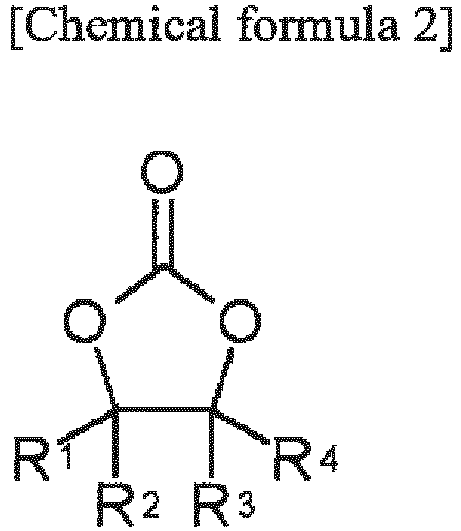
- the compound having the vinyl group may be represented by the following chemical formula 2: where at least one of R 1 to R 4 has a vinyl group, and the others are each independently hydrogen, halogen, a C 1 -C 6 alkyl group unsubstituted or substituted with halogen, a C 6 -C 12 aryl group, a C 2 -C 6 alkenyl group, or a sulfonate group.
- the dinitrile compound having an ether bond may include, but is not limited to, any one of 3,5-dioxa-heptanedinitrile, 1,4-bis(cyanoethoxy)butane, bis(2-cyanoethyl)-monoformal, bis(2-cyanoethyl)-diformal, bis(2-cyanoethyl)-triformal, ethyleneglycol bis(2-cyanoethyl)ether, diethyleneglycol bis(2-cyanoethyl)ether, triethyleneglycol bis(2-cyanoethyl)ether, tetraethyleneglycol bis(2-cyanoethyl)ether, 3,6,9,12,15,18-hexaoxaeicosane dinitrile, 1,3-bis(2-cyanoethoxy)propane, 1,4-bis(2-cyanoethoxy)butane, 1,5-bis(2-cyanoethoxy)
- non-aqueous electrolyte of the present invention may further include cyclic carbonate substituted with halogen represented by the following chemical formula 3: where X and Y are each independently hydrogen, chlorine, or boron, and both X and Y are not hydrogen.
- the content of a mixture of the cyclic carbonate substituted with halogen and the compound having the vinylene group or vinyl group may be 1 to 10 parts by weight per 100 parts by weight of the non-aqueous electrolyte.
- an anion of the lithium salt may be, for example, any one of F - , Cl - , Br - , I - , NO 3 - , N(CN) 2 - , BF 4 - , ClO 4 - , PF 6 - , (CF 3 ) 2 PF 4 - , (CF 3 ) 3 PF 3 - , (CF 3 ) 4 PF 2 - , (CF 3 ) 5 PF - , (CF 3 ) 6 P - , CF 3 SO 3 - , CF 3 CF 2 SO 3 - , (CF 3 SO 2 ) 2 N - , (FSO 2 ) 2 N - , CF 3 CF 2 (CF 3 ) 2 CO - , (CF 3 SO 2 ) 2 CH - , (SF 5 ) 3 C - , (CF 3 SO 2 ) 3 C - , CF 3 (CF 3 (CF 3 (CF 3 ) 2 CO - ,
- the organic solvent may include any one of ether, ester, amide, linear carbonate, cyclic carbonate, or mixtures thereof.
- the non-aqueous electrolyte of the present invention may be used in the type of a liquid electrolyte as it is, or a gel polymer electrolyte prepared by impregnating a polymer with a liquid electrolyte.
- the electrolyte of the present invention When the non-aqueous electrolyte of the present invention is used in the type of a liquid electrolyte, the electrolyte may be injected into a battery casing receiving an electrode assembly to fabricate a lithium secondary battery.
- a non-aqueous electrolyte for a lithium secondary battery according to the present invention includes an ionizable lithium salt and an organic solvent, and may further include (a) 1 to 10 parts by weight of a compound having a vinylene group or vinyl group per 100 parts by weight of the non-aqueous electrolyte, and (b) 10 to 300 parts by weight of a dinitrile compound having an ether bond represented by the following chemical formula 1 per 100 parts by weight of the compound having the vinylene group or vinyl group: where R 1 to R 3 are each independently C 1 -C 5 alkylene or alkenylene, and m is an integer of 1 to 5.
- a passive film called a solid electrolyte interface (SEI) film is formed on the surface of an anode during initial charge, which suppresses the reduction and decomposition of carbonate as a non-aqueous solvent and improves the charge/discharge efficiency, resulting in good cycling characteristics.
- SEI solid electrolyte interface
- the electrolyte is thermally weak and thus is susceptible to decomposition under high temperature conditions.
- the generated decomposition gas deforms a pouch-shaped electrode assembly or a cylindrical or prismatic electrode assembly, resulting in internal short circuit. In severe cases, ignition or explosion of batteries may occur.
- gas generation increases with the increasing content of an additive capable of forming a film on an anode.
- an additive capable of forming a film on an anode When vinylene carbonate (VC) is used as the additive capable of forming a film on an anode, VC remaining in the electrolyte after forming a SEI film on an anode oxidizes a cathode under high temperature conditions, resulting in rapid gas generation.
- VC vinylene carbonate
- the non-aqueous electrolyte of the present invention may further include a dinitrile compound having an ether bond.
- the dinitrile compound having an ether bond may form a complex on the surface of a cathode of lithium transition metal oxide to prevent an oxidation reaction between the electrolyte and the cathode, thereby suppressing heat generation, and to prevent the compound having the vinylene group or vinyl group and the electrolyte from decomposing when stored under high temperature conditions, thereby suppressing the swelling of the battery.
- the compound having the vinylene group or vinyl group may include any one of a vinylene carbonate-based compound, an acrylate-based compound having a vinyl group, a sulfonate-based compound having a vinyl group, and an ethylene carbonate-based compound having a vinyl group, or mixtures thereof.
- the vinylene carbonate-based compound may be vinylene carbonate.
- the compound having the vinyl group may be a compound represented by the following chemical formula 2: where at least one of R 1 to R 4 has a vinyl group, and the others are each independently hydrogen, halogen, a C 1 -C 6 alkyl group unsubstituted or substituted with halogen, a C 6 -C 12 aryl group, a C 2 -C 6 alkenyl group, or a sulfonate group.
- the content of the compound having the vinylene group or vinyl group may be 1 to 10 parts by weight, preferably 1 to 7 parts by weight, more preferably 1 to 5 parts by weight, per 100 parts by weight of the non-aqueous electrolyte.
- the content is less than 1 part by weight, the effect of suppressing the swelling under high temperature conditions is insufficient.
- the content exceeds 10 parts by weight, the high-temperature cycling characteristics considerably deteriorates during charge/discharge cycles under high temperature conditions.
- the non-aqueous electrolyte of the present invention may further include cyclic carbonate substituted with halogen.
- the cyclic carbonate substituted with halogen may be used with the compound having the vinylene group or vinyl group to improve the properties of a SEI film formed on the surface of an anode, thereby further suppressing the swelling of the battery.
- the cyclic carbonate substituted with halogen according to the present invention may be represented by the following chemical formula 3: where X and Y are each independently hydrogen, chlorine, or boron, and both X and Y are not hydrogen.
- the content of a mixture of the cyclic carbonate substituted with halogen and the compound having the vinylene group or vinyl group may be 1 to 10 parts by weight per 100 parts by weight of the non-aqueous electrolyte.
- the mixing content may vary depending on the use of the battery, for example, a weight ratio of the cyclic carbonate substituted with halogen relative to the compound having the vinylene group or vinyl group is 1:0.5 to 1:5, however the present invention is not limited in this regard.
- the proportion of the compound having the vinylene group or vinyl group relative to the cyclic carbonate substituted with halogen is less than 0.5, the high-temperature charge/discharge performance deteriorates.
- the organic solvent used in the non-aqueous electrolyte for a lithium secondary battery disadvantageously is oxidized and decomposes on the surface of a cathode during charge/discharge.
- the transition metal acts as an oxidizing agent to induce the electrolyte decomposition, which is accelerated under high temperature conditions.
- the dinitrile compound having an ether bond according to the present invention forms a complex on the surface of a cathode of lithium transition metal oxide to prevent an oxidation reaction between the electrolyte and the cathode, thereby suppressing the heat generation and preventing the internal short circuit that may occur due to the rapid temperature increase of the battery.
- a variety of compounds may exist in the non-aqueous electrolyte during charge/discharge.
- HF or PF 5 creates acidic conditions in the non-aqueous electrolyte.
- the acidic conditions accelerate the oxidation reaction of the non-aqueous electrolyte on the surface of the cathode.
- oxygen (-O-) in the dinitrile compound having an ether bond bonds with HF or PF 5 in the non-aqueous electrolyte to hinder the creation of acidic conditions, thereby preventing the oxidation and decomposition of the non-aqueous electrolyte.
- the dinitrile compound having an ether bond may improve the performance of a battery better than conventional additives. Specifically, the dinitrile compound having an ether bond may contribute to a battery with excellent capacity retention and excellent electrochemical characteristics including the extended charge/discharge cycle life.
- the dinitrile compound having an ether bond may include, but is not limited to, any one selected from the group consisting of 3,5-dioxa-heptanedinitrile, 1,4-bis(cyanoethoxy)butane, bis(2-cyanoethyl)-monoformal, bis(2-cyanoethyl)-diformal, bis(2-cyanoethyl)-triformal, ethyleneglycol bis(2-cyanoethyl)ether, diethyleneglycol bis(2-cyanoethyl)ether, triethyleneglycol bis(2-cyanoethyl)ether, tetraethyleneglycol bis(2-cyanoethyl)ether, 3,6,9,12,15,18-hexaoxaeicosane dinitrile, 1,3-bis(2-cyanoethoxy)propane, 1,4-bis(2-cyanoethoxy)butane, 1,5-bis(2-cyanoethoxy)pentane, and
- the content of the dinitrile compound having an ether bond may be 10 to 300 parts by weight per 100 parts by weight of the compound having the vinylene group or vinyl group.
- the content is less than 10 parts by weight, the swelling suppression effect is insufficient.
- the content exceeds 300 parts by weight the ionic conductivity of the non-aqueous electrolyte reduces and the high-rate charge/discharge characteristics deteriorates.
- the content of the dinitrile compound having an ether bond may be 30 to 300 parts by weight, most preferably 50 to 250 parts by weight, per 100 parts by weight of the compound having the vinylene group or vinyl group.
- the non-aqueous electrolyte of the present invention may further include a compound capable of forming a passive film on the surface of an anode, when needed, without departing from the scope of the present invention.
- a compound capable of forming a passive film on the surface of an anode, when needed, without departing from the scope of the present invention.
- examples of such a compound may include, but are not limited to, a sulfur-containing compound such as propane sultone, ethylene sulfite or propene sultone, and a lactam-based compound such as N-acetyl lactam.
- the lithium salt contained as an electrolyte solute is not particularly limited if it is conventionally used in an electrolyte for a lithium secondary battery.
- an anion of the lithium salt may include any one selected from the group consisting of F - , Cl - , Br - , I - , NO 3 - , N(CN) 2 - , BF 4 - , ClO 4 - , AlO 4 - , AlCl 4 - , PF 6 - , SbF 6 - , AsF 6 - , BF 2 C 2 O 4 - , BC 4 O 8 - , (CF 3 ) 2 PF 4 - , (CF 3 ) 3 PF 3 - , (CF 3 ) 4 PF 2 - , (CF 3 ) 5 PF - , (CF 3 ) 6 P - , CF 3 SO 3 - , C 4 F 9 SO 3
- the organic solvent is not particularly limited if it is conventionally used in an electrolyte for a lithium secondary battery.
- the organic solvent may include any one of ether, ester, amide, linear carbonate, cyclic carbonate, or mixtures thereof.
- cyclic carbonate linear carbonate, or mixtures thereof, that is, carbonate compounds may represent the organic solvent.
- cyclic carbonate may include, but is not limited to, any one selected from the group consisting of ethylene carbonate (EC), propylene carbonate (PC), 1,2-butylene carbonate, 2,3-butylene carbonate, 1,2-pentylene carbonate, 2,3-pentylene carbonate, vinylene carbonate (VC) and halide thereof, or mixtures thereof.
- linear carbonate may include, but are not limited to, any one selected from the group consisting of dimethyl carbonate (DMC), diethyl carbonate (DEC), dipropyl carbonate, ethylmethyl carbonate (EMC), methylpropyl carbonate and ethylpropyl carbonate, or mixtures thereof.
- DMC dimethyl carbonate
- DEC diethyl carbonate
- EMC ethylmethyl carbonate
- methylpropyl carbonate and ethylpropyl carbonate or mixtures thereof.
- cyclic carbonate in particular, ethylene carbonate and propylene carbonate are preferred since they have high viscosity and consequently a high dielectric constant, and thus can easily dissociate the lithium salt in the electrolyte.
- linear carbonate having low viscosity and a low dielectric constant such as dimethyl carbonate and diethyl carbonate
- the mixture contributes to a high electric conductivity of an electrolyte.
- the ether-based organic solvent may include, but is not limited to, any one selected from the group consisting of dimethyl ether, diethyl ether, dipropyl ether, methylethyl ether, methylpropyl ether, and ethylpropyl ether, or mixtures thereof.
- the ester-based organic solvent may include, but is not limited to, any one selected from the group consisting of methyl acetate, ethyl acetate, propyl acetate, methyl propionate, ethyl propionate, ⁇ -butyrolactone, ⁇ -valerolactone, ⁇ -caprolactone, ⁇ -valerolactone, and ⁇ -caprolactone, or mixtures thereof.
- the non-aqueous electrolyte of the present invention may be used in fabricating a lithium secondary battery by injecting into a battery casing receiving an electrode assembly comprising a cathode, an anode, and a separator interposed therebetween.
- the cathode, the anode, and the separator constituting the electrode assembly may include all typical ones conventionally used in fabricating lithium secondary batteries.
- carbon-based materials capable of intercalating and deintercalating lithium ions, lithium metals, silicon, or tin may be generally used.
- metal oxide having a potential of 2V or less based on lithium for example, TiO 2 or SnO 2 , may be used.
- the carbon-based materials are preferred, for example, low crystallinity carbon or high crystallinity carbon.
- low crystallinity carbon includes soft carbon and hard carbon
- high crystallinity carbon includes high temperature sintered carbon such as natural graphite, artificial graphite, Kish graphite, pyrolytic carbon, mesophase pitch based carbon fiber, meso-carbon microbeads, mesophase pitches, petroleum derived cokes, and tar pitch derived cokes.
- the cathode and/or the anode may include a binder
- the binder may be an organic binder such as polyvinylidenefluoride-hexafluoropropylene copolymer (PVDF-co-HFP), polyvinylidenefluoride, polyacrylonitrile or polymethylmethacrylate, or an aqueous binder such as styrene butadiene rubber (SBR).
- SBR styrene butadiene rubber
- the binder may be used with a thickening agent such as carboxymethyl cellulose (CMC).
- CMC carboxymethyl cellulose
- the aqueous binder is preferred since it has excellent adhesive strength and thus even a small amount can provide excellent adhesive performance.
- the separator may include, but is not limited to, a single-layered or multi-layered porous polymer film and a porous non-woven fabric, conventionally used as a separator.
- the porous polymer film may be made from polyolefin-based polymer, for example, ethylene homopolymer, propylene homopolymer, ethylene/butene copolymer, ethylene/hexene copolymer, and ethylene/methacrylate copolymer
- the porous non-woven fabric may be made from, for example, high-melting glass fibers or polyethylene terephthalate fibers.
- the present invention is not limited in this regard.
- the lithium secondary battery of the present invention is not limited to a specific shape, but may have a cylindrical shape, a prismatic shape, a pouch shape, or a coin shape.
- VC vinylene carbonate
- FEC fluoroethylene carbonate
- EGPN ethyleneglycol bis(2-cyanoethyl)ether
- LiCoO 2 as a cathode active material, polyvinylidene fluoride (PVdF) as a binder, and carbon as a conductive material were mixed at a weight ratio of 93:4:4, and then dispersed in N-methyl-2-pyrrolidone, to prepare a cathode slurry that was coated on an aluminum foil of 15 ⁇ m thickness, followed by drying and rolling, to manufacture a cathode.
- PVdF polyvinylidene fluoride
- Natural graphite as an anode active material styrene butadiene rubber (SBR) as a binder, and carboxymethyl cellulose as a thickening agent were mixed at a weight ratio of 96:2:2, and then dispersed in water, to prepare an anode slurry that was coated on a copper foil of 10 ⁇ m thickness, followed by drying and rolling, to manufacture a cathode.
- SBR styrene butadiene rubber
- the cathode and the anode were placed with a porous separator interposed therebetween, and the electrolyte was injected, to fabricate a pouch-type battery.
- VC vinylene carbonate
- FEC fluoroethylene carbonate
- EGPN ethyleneglycol bis(2-cyanoethyl)ether
- a battery comprising the electrolyte of Example 2 was fabricated in the same way as Example 1 except that the fabricated battery is a prismatic battery.
- a non-aqueous electrolyte and a battery were manufactured in the same way as Example 1 except that 2 parts by weight of ethyleneglycol bis(2-cyanoethyl)ether (EGPN) was added.
- EGPN ethyleneglycol bis(2-cyanoethyl)ether
- a non-aqueous electrolyte and a battery were manufactured in the same way as Example 1 except that 3 parts by weight of ethyleneglycol bis(2-cyanoethyl)ether (EGPN) was added.
- EGPN ethyleneglycol bis(2-cyanoethyl)ether
- a non-aqueous electrolyte and a battery were manufactured in the same way as Example 1 except that 2 parts by weight of vinylene carbonate (VC), 3 parts by weight of fluoroethylene carbonate (FEC), and 3 parts by weight of ethyleneglycol bis(2-cyanoethyl)ether (EGPN) were added per 100 parts by weight of the electrolyte.
- VC vinylene carbonate
- FEC fluoroethylene carbonate
- EGPN ethyleneglycol bis(2-cyanoethyl)ether
- a non-aqueous electrolyte and a battery were manufactured in the same way as Example 5 except that 5 parts by weight of ethyleneglycol bis(2-cyanoethyl)ether (EGPN) was added.
- EGPN ethyleneglycol bis(2-cyanoethyl)ether
- a non-aqueous electrolyte and a battery were manufactured in the same way as Example 5 except that 6 parts by weight of ethyleneglycol bis(2-cyanoethyl)ether (EGPN) was added.
- EGPN ethyleneglycol bis(2-cyanoethyl)ether
- a non-aqueous electrolyte and a battery were manufactured in the same way as Example 1 except that 3 parts by weight of vinylene carbonate (VC), 3 parts by weight of fluoroethylene carbonate (FEC), and 3 parts by weight of ethyleneglycol bis(2-cyanoethyl)ether (EGPN) were added per 100 parts by weight of the electrolyte.
- VC vinylene carbonate
- FEC fluoroethylene carbonate
- EGPN ethyleneglycol bis(2-cyanoethyl)ether
- a non-aqueous electrolyte and a battery were manufactured in the same way as Example 8 except that 6 parts by weight of ethyleneglycol bis(2-cyanoethyl)ether (EGPN) was added.
- EGPN ethyleneglycol bis(2-cyanoethyl)ether
- a non-aqueous electrolyte and a battery were manufactured in the same way as Example 9 except that 9 parts by weight of ethyleneglycol bis(2-cyanoethyl)ether (EGPN) was added.
- EGPN ethyleneglycol bis(2-cyanoethyl)ether
- An electrolyte and a battery were manufactured in the same way as Example 1 except that ethyleneglycol bis(2-cyanoethyl)ether (EGPN) was not added.
- EGPN ethyleneglycol bis(2-cyanoethyl)ether
- An electrolyte and a battery were manufactured in the same way as Example 5 except that ethyleneglycol bis(2-cyanoethyl)ether (EGPN) was not added.
- EGPN ethyleneglycol bis(2-cyanoethyl)ether
- An electrolyte and a battery were manufactured in the same way as Example 8 except that ethyleneglycol bis(2-cyanoethyl)ether (EGPN) was not added.
- EGPN ethyleneglycol bis(2-cyanoethyl)ether
- An electrolyte and a battery were manufactured in the same way as Example 6 except that 5 parts by weight of ethyleneglycol bis(2-cyanoethyl)ether (EGPN) was replaced with 5 parts by weight of succinonitrile (SN).
- EGPN ethyleneglycol bis(2-cyanoethyl)ether
- SN succinonitrile
- An electrolyte and a battery were manufactured in the same way as Example 2 except that 3 parts by weight of ethyleneglycol bis(2-cyanoethyl)ether (EGPN) was replaced with 3 parts by weight of succinonitrile (SN).
- EGPN ethyleneglycol bis(2-cyanoethyl)ether
- SN succinonitrile
- each battery was charged (charging voltage: 4.20 to 4.40V), then heated to raise the room temperature up to 90 °C at a rate of 1 °C /min, and then left at 90 °C for 4 hours before dropping the temperature down to room temperature for 1 hour.
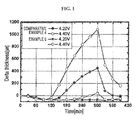
- FIGS. 1 and 2 graphically illustrate the change in thickness over time for Examples 6 and 2 and corresponding Comparative example 4 and 5 using succinonitrile (SN) in place of ethyleneglycol bis(2-cyanoethyl)ether (EGPN), respectively.
- SN succinonitrile
- EGPN ethyleneglycol bis(2-cyanoethyl)ether
- the batteries fabricated according to Example 6 and Comparative example 4 were charged and discharged within the voltage range of 3.0 to 4.2V at 45°C. The charge/discharge cycles were repeated. The capacity retention relative to initial capacity is shown in FIG. 3 .
- EGPN ethyleneglycol bis(2-cyanoethyl)ether
- the non-aqueous electrolyte of the present invention may contribute to a lithium secondary battery having suppression of swelling and improvement of charge/discharge cycle life.
- the effect of suppressing the swelling and improving the charge/discharge cycle life is remarkable under high temperature and high voltage conditions.
Landscapes
- Chemical & Material Sciences (AREA)
- Electrochemistry (AREA)
- Engineering & Computer Science (AREA)
- Manufacturing & Machinery (AREA)
- Chemical Kinetics & Catalysis (AREA)
- General Chemical & Material Sciences (AREA)
- Inorganic Chemistry (AREA)
- Physics & Mathematics (AREA)
- Condensed Matter Physics & Semiconductors (AREA)
- General Physics & Mathematics (AREA)
- Organic Chemistry (AREA)
- Secondary Cells (AREA)
- Battery Electrode And Active Subsutance (AREA)
Abstract
Description
- The present invention relates to a non-aqueous electrolyte for a lithium secondary battery including a dinitrile-based additive to improve the cycle life and suppress swelling, and a lithium secondary battery comprising the same.
- This application claims priority from Korean Patent Application No.
10-2010-0078417, filed on August 13, 2010 10-2011-0080493 filed on August 12, 2011 - Recently, there is an increasing interest in energy storage technologies. As the application fields of energy storage technologies have been extended to mobile phones, camcorders, lap-top computers, and even electric cars, the demand for high energy density of batteries used as power sources of electronic equipment has been increasing. Lithium secondary batteries are given attention as the most favorable battery capable of meeting the demand, and currently studies are being actively made on lithium secondary batteries.
- Lithium secondary batteries developed in the early 1990's are made up of an anode of a carbon-based material capable of intercalating and deintercalating lithium ions, a cathode of lithium containing oxide, and a non-aqueous electrolyte containing a proper amount of lithium salts dissolved in a mixed organic solvent.
- Recently, with the expanded use of lithium secondary batteries, there is an increasing demand for lithium secondary batteries capable of safely charging in extreme conditions, such as high or low temperature and high voltage conditions, while maintaining excellent performance.
- Lithium secondary batteries use, as a cathode active material, lithium transition metal oxide or composite oxide of which the structural stability and the capacity are determined by the intercalation and deintercalation of lithium ions, and the capacity increases with the increasing charge potential, which accelerates the discharge of transition metal constituting the active material, resulting in structural instability.
- At present, an organic solvent widely used in a non-aqueous electrolyte includes ethylene carbonate, propylene carbonate, dimethoxy ethane, γ-buryrolactone, N,N-dimethylformamide, tetrahydrofuran, acetonitile, and the like. However, when these organic solvents are stored at high temperature for a long time, batteries may deteriorate due to gas generated by electrolyte oxidation and consequently swelling. In this instance, the generated decomposition gas deforms a pouch-shaped electrode assembly or a cylindrical or prismatic electrode assembly, resulting in internal short circuit. In severe cases, ignition or explosion of batteries may occur. The electrolyte oxidation may be accelerated by the elution of transition metal under high voltage conditions.
- To solve these problems, a variety of additives used in a non-aqueous electrolyte have been suggested to prevent batteries from swelling, however to date, there is no effective solution. For example, when succinonitrile is added to an electrolyte, swelling may be suppressed to some extent but charge/discharge cycle life reduces.
- Accordingly, it is an object of the present invention to provide a non-aqueous electrolyte for a lithium secondary battery that may suppress swelling of the battery and improve the charge/discharge cycle life, and a lithium secondary battery comprising the same.
- In order to achieve this object, the present invention provides a non-aqueous electrolyte for a lithium secondary battery including an ionizable lithium salt and an organic solvent, and further including (a) 1 to 10 parts by weight of a compound having a vinylene group or vinyl group per 100 parts by weight of the non-aqueous electrolyte, and (b) 10 to 300 parts by weight of a dinitrile compound having an ether bond represented by the following chemical formula 1 per 100 parts by weight of the compound having the vinylene group or vinyl group:

- In the present invention, the "vinylene group" is defined as -CH=CH-, and the "vinyl group" is defined as CH2=CH-. The compound having the vinylene group or vinyl group of the present invention may include any one of a vinylene carbonate-based compound, an acrylate-based compound having a vinyl group, a sulfonate-based compound having a vinyl group, and an ethylene carbonate-based compound having a vinyl group, or mixtures thereof. Typically, the vinylene carbonate-based compound is, for example, vinylene carbonate. More specifically, the compound having the vinyl group may be represented by the following chemical formula 2:
- In the non-aqueous electrolyte of the present invention, the dinitrile compound having an ether bond may include, but is not limited to, any one of 3,5-dioxa-heptanedinitrile, 1,4-bis(cyanoethoxy)butane, bis(2-cyanoethyl)-monoformal, bis(2-cyanoethyl)-diformal, bis(2-cyanoethyl)-triformal, ethyleneglycol bis(2-cyanoethyl)ether, diethyleneglycol bis(2-cyanoethyl)ether, triethyleneglycol bis(2-cyanoethyl)ether, tetraethyleneglycol bis(2-cyanoethyl)ether, 3,6,9,12,15,18-hexaoxaeicosane dinitrile, 1,3-bis(2-cyanoethoxy)propane, 1,4-bis(2-cyanoethoxy)butane, 1,5-bis(2-cyanoethoxy)pentane, and ethyleneglycol bis(4-cyanobutyl)ether, or mixtures thereof.
- Optionally, the non-aqueous electrolyte of the present invention may further include cyclic carbonate substituted with halogen represented by the following chemical formula 3:

- The content of a mixture of the cyclic carbonate substituted with halogen and the compound having the vinylene group or vinyl group may be 1 to 10 parts by weight per 100 parts by weight of the non-aqueous electrolyte.
- In the non-aqueous electrolyte of the present invention, an anion of the lithium salt may be, for example, any one of F-, Cl-, Br-, I-, NO3 -, N(CN)2 -, BF4 -, ClO4 -, PF6 -, (CF3)2PF4 -, (CF3)3PF3 -, (CF3)4PF2 -, (CF3)5PF-, (CF3)6P-, CF3SO3 -, CF3CF2SO3 -, (CF3SO2)2N-, (FSO2)2N-, CF3CF2(CF3)2CO-, (CF3SO2)2CH-, (SF5)3C-, (CF3SO2)3C-, CF3(CF2)7SO3 -, CF3CO2 -, CH3CO2 -, SCN-, and (CF3CF2SO2)2N-.
- In the non-aqueous electrolyte of the present invention, the organic solvent may include any one of ether, ester, amide, linear carbonate, cyclic carbonate, or mixtures thereof.
- The non-aqueous electrolyte of the present invention may be used in the type of a liquid electrolyte as it is, or a gel polymer electrolyte prepared by impregnating a polymer with a liquid electrolyte.
- When the non-aqueous electrolyte of the present invention is used in the type of a liquid electrolyte, the electrolyte may be injected into a battery casing receiving an electrode assembly to fabricate a lithium secondary battery.
- The accompanying drawings illustrate preferred embodiments of the present disclosure and, together with the foregoing disclosure, serve to provide further understanding of the technical spirit of the present disclosure. However, the present disclosure is not to be construed as being limited to the drawings.
-
FIG. 1 is a graph illustrating the change in thickness over time to measure the swelling under high temperature and high voltage conditions for batteries according to Example 6 and Comparative Example 4. -
FIG. 2 is a graph illustrating the change in thickness over time to measure the swelling under high temperature and high voltage conditions for batteries according to Example 2 and Comparative Example 5. -
FIG. 3 is a graph illustrating the capacity retention relative to the initial capacity vs the charge/discharge cycle number under high temperature and high voltage conditions for batteries according to Example 6 and Comparative Example 4. - The present invention will now be described in detail. It should be understood that terms and words used in the specification and the appended claims should not be construed as having common and dictionary meanings, but should be interpreted as having meanings and concepts corresponding to technical ideas of the present invention in view of the principle that the inventor can properly define the concepts of the terms and words in order to describe his/her own invention as best as possible.
- A non-aqueous electrolyte for a lithium secondary battery according to the present invention includes an ionizable lithium salt and an organic solvent, and may further include (a) 1 to 10 parts by weight of a compound having a vinylene group or vinyl group per 100 parts by weight of the non-aqueous electrolyte, and (b) 10 to 300 parts by weight of a dinitrile compound having an ether bond represented by the following chemical formula 1 per 100 parts by weight of the compound having the vinylene group or vinyl group:

- When the compound having the vinylene group or vinyl group according to the present invention is used in a non-aqueous electrolyte for a battery, a passive film called a solid electrolyte interface (SEI) film is formed on the surface of an anode during initial charge, which suppresses the reduction and decomposition of carbonate as a non-aqueous solvent and improves the charge/discharge efficiency, resulting in good cycling characteristics.
- However, when the compound having the vinylene group or vinyl group is used in a carbonate-based electrolyte as described above, the electrolyte is thermally weak and thus is susceptible to decomposition under high temperature conditions. The generated decomposition gas deforms a pouch-shaped electrode assembly or a cylindrical or prismatic electrode assembly, resulting in internal short circuit. In severe cases, ignition or explosion of batteries may occur.
- Under high temperature conditions, gas generation increases with the increasing content of an additive capable of forming a film on an anode. In particular, when vinylene carbonate (VC) is used as the additive capable of forming a film on an anode, VC remaining in the electrolyte after forming a SEI film on an anode oxidizes a cathode under high temperature conditions, resulting in rapid gas generation.
- To solve this problem, the non-aqueous electrolyte of the present invention may further include a dinitrile compound having an ether bond. The dinitrile compound having an ether bond may form a complex on the surface of a cathode of lithium transition metal oxide to prevent an oxidation reaction between the electrolyte and the cathode, thereby suppressing heat generation, and to prevent the compound having the vinylene group or vinyl group and the electrolyte from decomposing when stored under high temperature conditions, thereby suppressing the swelling of the battery.
- In the present invention, the "vinylene group" is defined as -CH=CH-, and the "vinyl group" is defined as CH2=CH-. The compound having the vinylene group or vinyl group may include any one of a vinylene carbonate-based compound, an acrylate-based compound having a vinyl group, a sulfonate-based compound having a vinyl group, and an ethylene carbonate-based compound having a vinyl group, or mixtures thereof.
- For example, the vinylene carbonate-based compound may be vinylene carbonate. More specifically, the compound having the vinyl group may be a compound represented by the following chemical formula 2:

- In the non-aqueous electrolyte of the present invention, the content of the compound having the vinylene group or vinyl group may be 1 to 10 parts by weight, preferably 1 to 7 parts by weight, more preferably 1 to 5 parts by weight, per 100 parts by weight of the non-aqueous electrolyte. When the content is less than 1 part by weight, the effect of suppressing the swelling under high temperature conditions is insufficient. When the content exceeds 10 parts by weight, the high-temperature cycling characteristics considerably deteriorates during charge/discharge cycles under high temperature conditions.
- Optionally, the non-aqueous electrolyte of the present invention may further include cyclic carbonate substituted with halogen. The cyclic carbonate substituted with halogen may be used with the compound having the vinylene group or vinyl group to improve the properties of a SEI film formed on the surface of an anode, thereby further suppressing the swelling of the battery.
- The cyclic carbonate substituted with halogen according to the present invention may be represented by the following chemical formula 3:

- Preferably, the content of a mixture of the cyclic carbonate substituted with halogen and the compound having the vinylene group or vinyl group may be 1 to 10 parts by weight per 100 parts by weight of the non-aqueous electrolyte. The mixing content may vary depending on the use of the battery, for example, a weight ratio of the cyclic carbonate substituted with halogen relative to the compound having the vinylene group or vinyl group is 1:0.5 to 1:5, however the present invention is not limited in this regard. When the proportion of the compound having the vinylene group or vinyl group relative to the cyclic carbonate substituted with halogen is less than 0.5, the high-temperature charge/discharge performance deteriorates. When the proportion of the compound having the vinylene group or vinyl group exceeds 5, the interfacial resistance of an anode greatly increases and as a result, the initial performance of a battery deteriorates. This may be judged as the compound having the vinylene group or vinyl group forming a relatively dense SEI film, however this interpretation is not limited in this regard.
- As described above, the organic solvent used in the non-aqueous electrolyte for a lithium secondary battery disadvantageously is oxidized and decomposes on the surface of a cathode during charge/discharge. In particular, when lithium transition metal oxide is used as a cathode active material, the transition metal acts as an oxidizing agent to induce the electrolyte decomposition, which is accelerated under high temperature conditions.
- However, the dinitrile compound having an ether bond according to the present invention forms a complex on the surface of a cathode of lithium transition metal oxide to prevent an oxidation reaction between the electrolyte and the cathode, thereby suppressing the heat generation and preventing the internal short circuit that may occur due to the rapid temperature increase of the battery.
- A variety of compounds may exist in the non-aqueous electrolyte during charge/discharge. Among them, HF or PF5 creates acidic conditions in the non-aqueous electrolyte. The acidic conditions accelerate the oxidation reaction of the non-aqueous electrolyte on the surface of the cathode.
- According to the present invention, oxygen (-O-) in the dinitrile compound having an ether bond bonds with HF or PF5 in the non-aqueous electrolyte to hinder the creation of acidic conditions, thereby preventing the oxidation and decomposition of the non-aqueous electrolyte.
- Furthermore, the dinitrile compound having an ether bond may improve the performance of a battery better than conventional additives. Specifically, the dinitrile compound having an ether bond may contribute to a battery with excellent capacity retention and excellent electrochemical characteristics including the extended charge/discharge cycle life.
- For example, the dinitrile compound having an ether bond may include, but is not limited to, any one selected from the group consisting of 3,5-dioxa-heptanedinitrile, 1,4-bis(cyanoethoxy)butane, bis(2-cyanoethyl)-monoformal, bis(2-cyanoethyl)-diformal, bis(2-cyanoethyl)-triformal, ethyleneglycol bis(2-cyanoethyl)ether, diethyleneglycol bis(2-cyanoethyl)ether, triethyleneglycol bis(2-cyanoethyl)ether, tetraethyleneglycol bis(2-cyanoethyl)ether, 3,6,9,12,15,18-hexaoxaeicosane dinitrile, 1,3-bis(2-cyanoethoxy)propane, 1,4-bis(2-cyanoethoxy)butane, 1,5-bis(2-cyanoethoxy)pentane, and ethyleneglycol bis(4-cyanobutyl)ether, or mixtures thereof.
- Preferably, the content of the dinitrile compound having an ether bond may be 10 to 300 parts by weight per 100 parts by weight of the compound having the vinylene group or vinyl group. When the content is less than 10 parts by weight, the swelling suppression effect is insufficient. When the content exceeds 300 parts by weight, the ionic conductivity of the non-aqueous electrolyte reduces and the high-rate charge/discharge characteristics deteriorates. More preferably, the content of the dinitrile compound having an ether bond may be 30 to 300 parts by weight, most preferably 50 to 250 parts by weight, per 100 parts by weight of the compound having the vinylene group or vinyl group.
- In addition to the compound having the vinylene group or vinyl group and the cyclic carbonate substituted with halogen, the non-aqueous electrolyte of the present invention may further include a compound capable of forming a passive film on the surface of an anode, when needed, without departing from the scope of the present invention. Examples of such a compound may include, but are not limited to, a sulfur-containing compound such as propane sultone, ethylene sulfite or propene sultone, and a lactam-based compound such as N-acetyl lactam.
- In the non-aqueous electrolyte of the present invention, the lithium salt contained as an electrolyte solute is not particularly limited if it is conventionally used in an electrolyte for a lithium secondary battery. For example, an anion of the lithium salt may include any one selected from the group consisting of F-, Cl-, Br-, I-, NO3 -, N(CN)2 -, BF4 -, ClO4 -, AlO4 -, AlCl4 -, PF6 -, SbF6 -, AsF6 -, BF2C2O4 -, BC4O8 -, (CF3)2PF4 -, (CF3)3PF3 -, (CF3)4PF2 -, (CF3)5PF-, (CF3)6P-, CF3SO3 -, C4F9SO3 -, CF3CF2SO3 -, (CF3SO2)2N-, (FSO2) 2N-, CF3CF2(CF3)2CO-, (CF3SO2)2CH-, (SF5)3C-, (CF3SO2)3C-, CF3(CF2)7SO3 -, CF3CO2 -, CH3CO2 -, SCN-, and (CF3CF2SO2)2N-.
- In the non-aqueous electrolyte of the present invention, the organic solvent is not particularly limited if it is conventionally used in an electrolyte for a lithium secondary battery. For example, the organic solvent may include any one of ether, ester, amide, linear carbonate, cyclic carbonate, or mixtures thereof.
- Among them, cyclic carbonate, linear carbonate, or mixtures thereof, that is, carbonate compounds may represent the organic solvent. For example, cyclic carbonate may include, but is not limited to, any one selected from the group consisting of ethylene carbonate (EC), propylene carbonate (PC), 1,2-butylene carbonate, 2,3-butylene carbonate, 1,2-pentylene carbonate, 2,3-pentylene carbonate, vinylene carbonate (VC) and halide thereof, or mixtures thereof. Examples of linear carbonate may include, but are not limited to, any one selected from the group consisting of dimethyl carbonate (DMC), diethyl carbonate (DEC), dipropyl carbonate, ethylmethyl carbonate (EMC), methylpropyl carbonate and ethylpropyl carbonate, or mixtures thereof.
- Among these carbonate-based organic solvents, cyclic carbonate, in particular, ethylene carbonate and propylene carbonate are preferred since they have high viscosity and consequently a high dielectric constant, and thus can easily dissociate the lithium salt in the electrolyte. More preferably, when linear carbonate having low viscosity and a low dielectric constant, such as dimethyl carbonate and diethyl carbonate, is mixed with cyclic carbonate at a suitable ratio, the mixture contributes to a high electric conductivity of an electrolyte.
- The ether-based organic solvent may include, but is not limited to, any one selected from the group consisting of dimethyl ether, diethyl ether, dipropyl ether, methylethyl ether, methylpropyl ether, and ethylpropyl ether, or mixtures thereof.
- The ester-based organic solvent may include, but is not limited to, any one selected from the group consisting of methyl acetate, ethyl acetate, propyl acetate, methyl propionate, ethyl propionate, γ-butyrolactone, γ-valerolactone, γ -caprolactone, σ-valerolactone, and ε-caprolactone, or mixtures thereof.
- The non-aqueous electrolyte of the present invention may be used in fabricating a lithium secondary battery by injecting into a battery casing receiving an electrode assembly comprising a cathode, an anode, and a separator interposed therebetween. The cathode, the anode, and the separator constituting the electrode assembly may include all typical ones conventionally used in fabricating lithium secondary batteries.
- Specifically, lithium-containing transition metal oxide is preferably used as a cathode active material, for example, any one selected from the group consisting of LixCoO2(0.5<x<1.3), LixNiO2(0.5<x<1.3), LixMnO2(0.5<x<1.3), LixMn2O4(0.5<x<1.3), Lix(NiaCobMnc)O2(0.5<x<1.3, 0<a<1, 0<b<1, 0<c<1, a+b+c=1), LixNi1-yCoyO2(0.5<x<1.3, 0<y<1), LixCo1-yMnyO2(0.5<x<1.3, 0≤y<1), LixNi1- yMnyO2(0.5<x<1.3, 0≤y<1), Lix(NiaCobMnc)O4(0.5<x<1.3, 0<a<2, 0<b<2, 0<c<2, a+b+c=2), LixMn2-zNizO4(0.5<x<1.3, 0<z<2), LixMn2-zCozO4(0.5<x<1.3, 0<z<2), LixCoPO4(0.5<x<1.3), and LixFePO4(0.5<x<1.3), or their mixtures. The lithium-containing transition metal oxide may be coated with metal such as A1 or metal oxide. Also, lithium-containing transition metal sulfide, selenide, or halide may be used as well as lithium-containing transition metal oxide.
- As an anode active material, carbon-based materials capable of intercalating and deintercalating lithium ions, lithium metals, silicon, or tin may be generally used. Also, metal oxide having a potential of 2V or less based on lithium, for example, TiO2 or SnO2, may be used. Among them, the carbon-based materials are preferred, for example, low crystallinity carbon or high crystallinity carbon. Typically, low crystallinity carbon includes soft carbon and hard carbon, and high crystallinity carbon includes high temperature sintered carbon such as natural graphite, artificial graphite, Kish graphite, pyrolytic carbon, mesophase pitch based carbon fiber, meso-carbon microbeads, mesophase pitches, petroleum derived cokes, and tar pitch derived cokes.
- The cathode and/or the anode may include a binder, and the binder may be an organic binder such as polyvinylidenefluoride-hexafluoropropylene copolymer (PVDF-co-HFP), polyvinylidenefluoride, polyacrylonitrile or polymethylmethacrylate, or an aqueous binder such as styrene butadiene rubber (SBR). The binder may be used with a thickening agent such as carboxymethyl cellulose (CMC). The aqueous binder is preferred since it has excellent adhesive strength and thus even a small amount can provide excellent adhesive performance.
- The separator may include, but is not limited to, a single-layered or multi-layered porous polymer film and a porous non-woven fabric, conventionally used as a separator. The porous polymer film may be made from polyolefin-based polymer, for example, ethylene homopolymer, propylene homopolymer, ethylene/butene copolymer, ethylene/hexene copolymer, and ethylene/methacrylate copolymer, and the porous non-woven fabric may be made from, for example, high-melting glass fibers or polyethylene terephthalate fibers. However, the present invention is not limited in this regard.
- The lithium secondary battery of the present invention is not limited to a specific shape, but may have a cylindrical shape, a prismatic shape, a pouch shape, or a coin shape.
- Hereinafter, the present invention will be described in detail through specific examples. However, the description proposed herein is just a preferable example for the purpose of illustrations only, not intended to limit the scope of the invention, so it should be understood that the examples are provided for a more definite explanation to an ordinary person skilled in the art.
- 1 part by weight of vinylene carbonate (VC), 3 parts by weight of fluoroethylene carbonate (FEC), and 1 part by weight of ethyleneglycol bis(2-cyanoethyl)ether (EGPN) were added to an electrolyte of 1M LiPF6 dissolved in ethylene carbonate:propylene carbonate:diethyl carbonate (3:2:5 by weight) under an Ar atmosphere, per 100 parts by weight of the electrolyte.
- LiCoO2 as a cathode active material, polyvinylidene fluoride (PVdF) as a binder, and carbon as a conductive material were mixed at a weight ratio of 93:4:4, and then dispersed in N-methyl-2-pyrrolidone, to prepare a cathode slurry that was coated on an aluminum foil of 15 µm thickness, followed by drying and rolling, to manufacture a cathode.
- Natural graphite as an anode active material, styrene butadiene rubber (SBR) as a binder, and carboxymethyl cellulose as a thickening agent were mixed at a weight ratio of 96:2:2, and then dispersed in water, to prepare an anode slurry that was coated on a copper foil of 10 µm thickness, followed by drying and rolling, to manufacture a cathode.
- Next, the cathode and the anode were placed with a porous separator interposed therebetween, and the electrolyte was injected, to fabricate a pouch-type battery.
- 2 parts by weight of vinylene carbonate (VC), 2 parts by weight of fluoroethylene carbonate (FEC), and 3 parts by weight of ethyleneglycol bis(2-cyanoethyl)ether (EGPN) were added to an electrolyte of 1M LiPF6 dissolved in ethylene carbonate:ethyl propionate:diethyl carbonate (4:1:5 by weight) under an Ar atmosphere, per 100 parts by weight of the electrolyte.
- A battery comprising the electrolyte of Example 2 was fabricated in the same way as Example 1 except that the fabricated battery is a prismatic battery.
- A non-aqueous electrolyte and a battery were manufactured in the same way as Example 1 except that 2 parts by weight of ethyleneglycol bis(2-cyanoethyl)ether (EGPN) was added.
- A non-aqueous electrolyte and a battery were manufactured in the same way as Example 1 except that 3 parts by weight of ethyleneglycol bis(2-cyanoethyl)ether (EGPN) was added.
- A non-aqueous electrolyte and a battery were manufactured in the same way as Example 1 except that 2 parts by weight of vinylene carbonate (VC), 3 parts by weight of fluoroethylene carbonate (FEC), and 3 parts by weight of ethyleneglycol bis(2-cyanoethyl)ether (EGPN) were added per 100 parts by weight of the electrolyte.
- A non-aqueous electrolyte and a battery were manufactured in the same way as Example 5 except that 5 parts by weight of ethyleneglycol bis(2-cyanoethyl)ether (EGPN) was added.
- A non-aqueous electrolyte and a battery were manufactured in the same way as Example 5 except that 6 parts by weight of ethyleneglycol bis(2-cyanoethyl)ether (EGPN) was added.
- A non-aqueous electrolyte and a battery were manufactured in the same way as Example 1 except that 3 parts by weight of vinylene carbonate (VC), 3 parts by weight of fluoroethylene carbonate (FEC), and 3 parts by weight of ethyleneglycol bis(2-cyanoethyl)ether (EGPN) were added per 100 parts by weight of the electrolyte.
- A non-aqueous electrolyte and a battery were manufactured in the same way as Example 8 except that 6 parts by weight of ethyleneglycol bis(2-cyanoethyl)ether (EGPN) was added.
- A non-aqueous electrolyte and a battery were manufactured in the same way as Example 9 except that 9 parts by weight of ethyleneglycol bis(2-cyanoethyl)ether (EGPN) was added.
- An electrolyte and a battery were manufactured in the same way as Example 1 except that ethyleneglycol bis(2-cyanoethyl)ether (EGPN) was not added.
- An electrolyte and a battery were manufactured in the same way as Example 5 except that ethyleneglycol bis(2-cyanoethyl)ether (EGPN) was not added.
- An electrolyte and a battery were manufactured in the same way as Example 8 except that ethyleneglycol bis(2-cyanoethyl)ether (EGPN) was not added.
- An electrolyte and a battery were manufactured in the same way as Example 6 except that 5 parts by weight of ethyleneglycol bis(2-cyanoethyl)ether (EGPN) was replaced with 5 parts by weight of succinonitrile (SN).
- An electrolyte and a battery were manufactured in the same way as Example 2 except that 3 parts by weight of ethyleneglycol bis(2-cyanoethyl)ether (EGPN) was replaced with 3 parts by weight of succinonitrile (SN).
- The batteries fabricated according to Examples 1 to 10 and Comparative Examples 1 to 5 were tested to evaluate the swelling under high temperature and high voltage conditions.
- Specifically, each battery was charged (charging voltage: 4.20 to 4.40V), then heated to raise the room temperature up to 90 °C at a rate of 1 °C /min, and then left at 90 °C for 4 hours before dropping the temperature down to room temperature for 1 hour.
- The swelling was evaluated by measuring a maximum thickness change (ΔT) relative to an initial thickness, and the results are shown in Table 1.
Table 1 Additive Charging voltage (V) Thickness change (Δ T/µm) VC EGPN SN Example 1 1 1 0 4.20 127 Example 2 2 3 0 4.40 465 Example 3 1 2 0 4.20 01) Example 4 1 3 0 4.20 0 Example 5 2 3 0 4.20 86 Example 6 2 5 0 4.20 0 4.40 36 Example 7 2 6 0 4.20 0 Example 8 3 3 0 4.20 411 Example 9 3 6 0 4.20 18 Example 10 3 9 0 4.20 0 Comparative example 1 1 0 0 4.20 1017 Comparative example 2 2 0 0 4.20 1407 Comparative example 3 3 0 0 4.20 1878 Comparative example 4 2 0 5 4.20 448 4.40 1096 Comparative example 5 2 0 3 4.40 891 1): When swelling does not occur due to the weight of a thickness measuring machine and rather the change in thickness shows a minus value, such thickness change is indicated as "0". - As shown in Table 1, it was found that the higher the content of VC, the more the battery swells under high temperature conditions. However, the battery samples including ethyleneglycol bis(2-cyanoethyl)ether (EGPN) considerably reduced in swelling.
-
FIGS. 1 and2 graphically illustrate the change in thickness over time for Examples 6 and 2 and corresponding Comparative example 4 and 5 using succinonitrile (SN) in place of ethyleneglycol bis(2-cyanoethyl)ether (EGPN), respectively. - Referring to Table 1 and
FIGS. 1 and2 , it can be seen that the swelling suppression effect of ethyleneglycol bis(2-cyanoethyl)ether (EGPN) is superior to that of succinonitrile (SN). - The batteries fabricated according to Example 6 and Comparative example 4 were charged and discharged within the voltage range of 3.0 to 4.2V at 45°C. The charge/discharge cycles were repeated. The capacity retention relative to initial capacity is shown in
FIG. 3 . - As shown in
FIG. 3 , it is found that ethyleneglycol bis(2-cyanoethyl)ether (EGPN) is more effective in improving the charge/discharge cycle life under high temperature conditions than succinonitrile (SN). - According to teachings above, the non-aqueous electrolyte of the present invention may contribute to a lithium secondary battery having suppression of swelling and improvement of charge/discharge cycle life. In particular, the effect of suppressing the swelling and improving the charge/discharge cycle life is remarkable under high temperature and high voltage conditions.
Claims (14)
- A non-aqueous electrolyte for a lithium secondary battery comprising an ionizable lithium salt and an organic solvent, the non-aqueous electrolyte comprising:(a) 1 to 10 parts by weight of a compound having a vinylene group or vinyl group per 100 parts by weight of the non-aqueous electrolyte; and(b) 10 to 300 parts by weight of a dinitrile compound having an ether bond represented by the following chemical formula 1, per 100 parts by weight of the compound having the vinylene group or vinyl group:

- The non-aqueous electrolyte for a lithium secondary battery according to claim 1,
wherein the compound having the vinylene group or vinyl group is any one of a vinylene carbonate-based compound, an acrylate-based compound having a vinyl group, a sulfonate-based compound having a vinyl group, and an ethylene carbonate-based compound having a vinyl group, or mixtures thereof. - The non-aqueous electrolyte for a lithium secondary battery according to claim 1,
wherein the compound having the vinyl group is represented by the following chemical formula 2:
- The non-aqueous electrolyte for a lithium secondary battery according to claim 1,
wherein the dinitrile compound having an ether bond is any one of 3,5-dioxa-heptanedinitrile, 1,4-bis(cyanoethoxy)butane, bis(2-cyanoethyl)-monoformal, bis(2-cyanoethyl)-diformal, bis(2-cyanoethyl)-triformal, ethyleneglycol bis(2-cyanoethyl)ether, diethyleneglycol bis(2-cyanoethyl)ether, triethyleneglycol bis(2-cyanoethyl)ether, tetraethyleneglycol bis(2-cyanoethyl)ether, 3,6,9,12,15,18-hexaoxaeicosane dinitrile, 1,3-bis(2-cyanoethoxy)propane, 1,4-bis(2-cyanoethoxy)butane, 1,5-bis(2-cyanoethoxy)pentane, and ethyleneglycol bis(4-cyanobutyl)ether, or mixtures thereof. - The non-aqueous electrolyte for a lithium secondary battery according to claim 1, further comprising:cyclic carbonate substituted with halogen represented by the following chemical formula 3:

- The non-aqueous electrolyte for a lithium secondary battery according to claim 5,
wherein the content of a mixture of the cyclic carbonate substituted with halogen and the compound having the vinylene group or vinyl group is 1 to 10 parts by weight per 100 parts by weight of the non-aqueous electrolyte. - The non-aqueous electrolyte for a lithium secondary battery according to claim 1,
wherein an anion of the lithium salt is any one selected from the group consisting of F-, Cl-, Br-, I-, NO3 -, N(CN)2 -, BF4 -, ClO4 -, PF6 -, (CF3)2PF4 -, (CF3)3PF3 -, (CF3)4PF2 -, (CF3)5PF-, (CF3)6P-, CF3SO3 -, CF3CF2SO3 -, (CF3SO2)2N-, (FSO2)2N-, CF3CF2(CF3)2CO-, (CF3SO2)2CH-, (SF5)3C-, (CF3SO2)3C-, CF3(CF2)7SO3 -, CF3CO2 -, CH3CO2 -, SCN-, and (CF3CF2SO2)2N-. - The non-aqueous electrolyte for a lithium secondary battery according to claim 1,
wherein the organic solvent is any one selected from the group consisting of ether, ester, amide, cyclic carbonate, and linear carbonate, or mixtures thereof. - The non-aqueous electrolyte for a lithium secondary battery according to claim 8,
wherein the linear carbonate is any one selected from the group consisting of ethylene carbonate, propylene carbonate, 1,2-butylene carbonate, 2,3-butylene carbonate, 1,2-pentylene carbonate, 2,3-pentylene carbonate, vinylene carbonate, and halide thereof, or mixtures thereof. - The non-aqueous electrolyte for a lithium secondary battery according to claim 8,
wherein the linear carbonate is any one selected from the group consisting of dimethyl carbonate, diethyl carbonate, dipropyl carbonate, ethylmethyl carbonate, methylpropyl carbonate and ethylpropyl carbonate, or mixtures thereof. - The non-aqueous electrolyte for a lithium secondary battery according to claim 8,
wherein the ether-based organic solvent includes any one selected from the group consisting of dimethyl ether, diethyl ether, dipropyl ether, methylethyl ether, methylpropyl ether, and ethylpropyl ether, or mixtures thereof. - The non-aqueous electrolyte for a lithium secondary battery according to claim 8,
wherein the ester-based organic solvent includes any one selected from the group consisting of methyl acetate, ethyl acetate, propyl acetate, methyl propionate, ethyl propionate, γ-butyrolactone, γ-valerolactone, γ-caprolactone, σ-valerolactone, and ε-caprolactone, or mixtures thereof. - A lithium secondary battery comprising:an electrode assembly including a cathode, an anode, and a separator interposed therebetween;a battery casing receiving the electrode assembly; anda non-aqueous electrolyte injected in the battery casing,wherein the non-aqueous electrolyte is defined in any one of claims 1 to 12.
- The lithium secondary battery according to claim 13,
wherein the anode further includes an aqueous binder.
Priority Applications (1)
| Application Number | Priority Date | Filing Date | Title |
|---|---|---|---|
| PL11816645T PL2605324T3 (en) | 2010-08-13 | 2011-08-12 | Non-aqueous electrolyte solution for a lithium secondary battery, and lithium secondary battery comprising same |
Applications Claiming Priority (3)
| Application Number | Priority Date | Filing Date | Title |
|---|---|---|---|
| KR20100078417 | 2010-08-13 | ||
| KR1020110080493A KR101245287B1 (en) | 2010-08-13 | 2011-08-12 | Non-aqueous electrolyte solution for lithium secondary battery and lithium secondary battery comprising the same |
| PCT/KR2011/005953 WO2012021029A2 (en) | 2010-08-13 | 2011-08-12 | Non-aqueous electrolyte solution for a lithium secondary battery, and lithium secondary battery comprising same |
Publications (3)
| Publication Number | Publication Date |
|---|---|
| EP2605324A2 true EP2605324A2 (en) | 2013-06-19 |
| EP2605324A4 EP2605324A4 (en) | 2014-07-09 |
| EP2605324B1 EP2605324B1 (en) | 2018-10-03 |
Family
ID=45838545
Family Applications (1)
| Application Number | Title | Priority Date | Filing Date |
|---|---|---|---|
| EP11816645.3A Active EP2605324B1 (en) | 2010-08-13 | 2011-08-12 | Non-aqueous electrolyte solution for a lithium secondary battery, and lithium secondary battery comprising same |
Country Status (7)
| Country | Link |
|---|---|
| US (1) | US10763541B2 (en) |
| EP (1) | EP2605324B1 (en) |
| JP (1) | JP5605928B2 (en) |
| KR (1) | KR101245287B1 (en) |
| CN (1) | CN103069637B (en) |
| PL (1) | PL2605324T3 (en) |
| WO (1) | WO2012021029A2 (en) |
Cited By (1)
| Publication number | Priority date | Publication date | Assignee | Title |
|---|---|---|---|---|
| EP2899792A4 (en) * | 2013-09-30 | 2016-05-11 | Lg Chemical Ltd | Lithium secondary battery |
Families Citing this family (17)
| Publication number | Priority date | Publication date | Assignee | Title |
|---|---|---|---|---|
| KR101502656B1 (en) * | 2012-05-08 | 2015-03-16 | 주식회사 엘지화학 | Non-aqueous electrolyte solution for lithium secondary battery and lithium secondary battery comprising the same |
| KR101557549B1 (en) | 2012-05-31 | 2015-10-07 | 주식회사 엘지화학 | Lithium secondary battery |
| KR20140082573A (en) * | 2012-12-24 | 2014-07-02 | 주식회사 엘지화학 | Non-aqueous liquid electrolyte and lithium secondary battery comprising the same |
| KR101661560B1 (en) * | 2013-10-29 | 2016-10-04 | 주식회사 엘지화학 | Non-aqueous electrolyte solution for lithium secondary battery and lithium secondary battery comprising the same |
| CN103985904A (en) * | 2014-05-21 | 2014-08-13 | 珠海市赛纬电子材料有限公司 | Non-aqueous electrolyte capable of improving high-temperature performance for lithium ion battery |
| CN106033824B (en) * | 2015-03-18 | 2018-12-04 | 宁德时代新能源科技股份有限公司 | High-voltage lithium ion battery and electrolyte thereof |
| CN104752769A (en) * | 2015-04-10 | 2015-07-01 | 宁德新能源科技有限公司 | Non-aqueous electrolyte and lithium ion battery utilizing same |
| FR3038455B1 (en) * | 2015-07-01 | 2020-03-13 | Renault S.A.S. | COMPOUND USED AS AN ADDITIVE IN AN ELECTROLYTE FOR ION CIRCULATION BATTERY |
| CN105186036B (en) * | 2015-09-08 | 2018-03-20 | 宁德新能源科技有限公司 | Electrolyte and the lithium ion battery including the electrolyte |
| DE102015218634A1 (en) * | 2015-09-28 | 2017-03-30 | Wacker Chemie Ag | Nitriles and amines as electrolyte components for lithium-ion batteries |
| CN105355975B (en) * | 2015-10-20 | 2018-08-21 | 宁德新能源科技有限公司 | electrolyte and lithium ion battery including the electrolyte |
| JP7033455B2 (en) * | 2017-01-24 | 2022-03-10 | 三菱ケミカル株式会社 | Non-aqueous electrolyte solution and power storage device using it |
| JP6965173B2 (en) * | 2017-02-13 | 2021-11-10 | 三菱ケミカル株式会社 | Non-aqueous electrolyte solution and power storage device using it |
| CN109326823B (en) * | 2017-07-31 | 2020-04-21 | 深圳新宙邦科技股份有限公司 | Lithium-ion battery non-aqueous electrolyte and lithium-ion battery |
| CN111740160B (en) | 2018-09-21 | 2022-04-15 | 宁德新能源科技有限公司 | Electrolyte and electrochemical device comprising the same |
| WO2023225897A1 (en) * | 2022-05-25 | 2023-11-30 | 宁德新能源科技有限公司 | Electrochemical device and electronic device comprising same |
| CN118352632A (en) * | 2024-03-27 | 2024-07-16 | 惠州市豪鹏科技有限公司 | Electrolyte and lithium ion battery |
Family Cites Families (21)
| Publication number | Priority date | Publication date | Assignee | Title |
|---|---|---|---|---|
| JPH05336606A (en) * | 1992-05-29 | 1993-12-17 | Daifuku Co Ltd | Non-contact power supply equipment for mobile |
| JPH09213378A (en) * | 1996-01-30 | 1997-08-15 | Sumitomo Wiring Syst Ltd | Charge system for electric vehicle |
| JP3765041B2 (en) * | 1997-02-07 | 2006-04-12 | 小松リフト・ロジ・ソリューションズ株式会社 | Non-contact power feeding device for moving objects |
| JP3376894B2 (en) * | 1997-11-06 | 2003-02-10 | 株式会社豊田自動織機 | Rail member and non-contact power supply device using rail member |
| JPH11185808A (en) * | 1997-12-19 | 1999-07-09 | Sunstar Eng Inc | Organic electrolyte |
| JP3355476B2 (en) * | 1997-12-22 | 2002-12-09 | 日本航空電子工業株式会社 | Right angle connector |
| JP2000243444A (en) * | 1999-02-19 | 2000-09-08 | Mitsui Chemicals Inc | Nonaqueous electrolytic solution and secondary battery using same |
| JP4411691B2 (en) | 1999-06-30 | 2010-02-10 | パナソニック株式会社 | Non-aqueous electrolyte secondary battery, non-aqueous electrolyte secondary battery charge control system, and equipment using the same |
| KR100326467B1 (en) | 2000-07-25 | 2002-02-28 | 김순택 | A Electrolyte for Lithium Sulfur batteries |
| US7442471B1 (en) * | 2001-11-27 | 2008-10-28 | The United States Of America As Represented By The Secretary Of The Army | Solvent systems comprising a mixture of lactams and esters for non-aqueous electrolytes and non-aqueous electrolyte cells comprising the same |
| JP4442710B2 (en) * | 2003-06-10 | 2010-03-31 | 三菱化学株式会社 | Photopolymerizable composition, color filter and liquid crystal display device |
| KR100770082B1 (en) | 2005-08-18 | 2007-10-24 | 삼성에스디아이 주식회사 | Electrolyte for lithium secondary battery and lithium secondary battery comprising same |
| US8715852B2 (en) | 2005-08-18 | 2014-05-06 | Samsung Sdi Co., Ltd. | Electrolyte for lithium secondary battery and lithium secondary battery including the same |
| EP2768067B1 (en) * | 2006-12-06 | 2017-09-06 | Mitsubishi Chemical Corporation | Nonaqueous electrolytic solution and nonaqueous electrolyte secondary battery |
| KR100767427B1 (en) * | 2006-12-21 | 2007-10-17 | 제일모직주식회사 | Non-aqueous electrolyte solution for lithium secondary batteries and lithium secondary battery comprising same |
| JP5217200B2 (en) * | 2007-03-20 | 2013-06-19 | 三菱化学株式会社 | Non-aqueous electrolyte and non-aqueous electrolyte battery |
| KR100816208B1 (en) | 2007-03-27 | 2008-03-28 | 삼성에스디아이 주식회사 | Electrolyte for lithium ion secondary battery and lithium ion secondary battery comprising same |
| JP5217400B2 (en) * | 2007-06-28 | 2013-06-19 | 三菱化学株式会社 | Non-aqueous electrolyte for secondary battery and non-aqueous electrolyte secondary battery using the same |
| US8697293B2 (en) * | 2008-04-25 | 2014-04-15 | Lg Chem, Ltd. | Non-aqueous electrolyte solution for lithium secondary battery and lithium secondary battery having the same |
| KR20090113215A (en) * | 2008-04-25 | 2009-10-29 | 주식회사 엘지화학 | Non-aqueous electrolyte solution for lithium secondary batteries and lithium secondary battery containing same |
| WO2011132717A1 (en) * | 2010-04-22 | 2011-10-27 | 日油株式会社 | Non-aqueous electrolyte for electrical device and secondary battery using same |
-
2011
- 2011-08-12 WO PCT/KR2011/005953 patent/WO2012021029A2/en not_active Ceased
- 2011-08-12 JP JP2013524052A patent/JP5605928B2/en active Active
- 2011-08-12 KR KR1020110080493A patent/KR101245287B1/en active Active
- 2011-08-12 PL PL11816645T patent/PL2605324T3/en unknown
- 2011-08-12 EP EP11816645.3A patent/EP2605324B1/en active Active
- 2011-08-12 CN CN201180039765.0A patent/CN103069637B/en active Active
-
2013
- 2013-02-12 US US13/765,141 patent/US10763541B2/en active Active
Cited By (1)
| Publication number | Priority date | Publication date | Assignee | Title |
|---|---|---|---|---|
| EP2899792A4 (en) * | 2013-09-30 | 2016-05-11 | Lg Chemical Ltd | Lithium secondary battery |
Also Published As
| Publication number | Publication date |
|---|---|
| PL2605324T3 (en) | 2019-06-28 |
| US20130157116A1 (en) | 2013-06-20 |
| CN103069637A (en) | 2013-04-24 |
| CN103069637B (en) | 2016-08-31 |
| KR20120016019A (en) | 2012-02-22 |
| WO2012021029A3 (en) | 2012-06-07 |
| JP2013534355A (en) | 2013-09-02 |
| US10763541B2 (en) | 2020-09-01 |
| WO2012021029A2 (en) | 2012-02-16 |
| JP5605928B2 (en) | 2014-10-15 |
| EP2605324A4 (en) | 2014-07-09 |
| KR101245287B1 (en) | 2013-03-19 |
| EP2605324B1 (en) | 2018-10-03 |
Similar Documents
| Publication | Publication Date | Title |
|---|---|---|
| EP2605324B1 (en) | Non-aqueous electrolyte solution for a lithium secondary battery, and lithium secondary battery comprising same | |
| EP2683015B1 (en) | Non-aqueous electrolyte for lithium secondary battery and lithium secondary battery containing same | |
| EP2755272B1 (en) | Non-aqueous electrolyte solution for lithium secondary battery and lithium secondary battery comprising same | |
| EP2600460B1 (en) | Nonaqueous electrolyte solution for lithium secondary battery, and lithium secondary battery containing same | |
| JP2019536239A (en) | Electrolyte additive and non-aqueous electrolyte for lithium secondary battery containing the same | |
| KR101249350B1 (en) | Nonaqueous electrolyte and lithium secondary battery using the same | |
| KR20180083272A (en) | Non-aqueous electrolyte solution and lithium secondary battery comprising the same | |
| KR101195931B1 (en) | Non-aqueous electrolyte solution for lithium secondary battery and lithium secondary battery comprising the same | |
| KR101538485B1 (en) | Non-aqueous electrolyte solution for lithium secondary battery and lithium secondary battery comprising the same | |
| KR20130137941A (en) | Non-aqueous electrolyte solution for lithium secondary battery and lithium secondary battery comprising the same | |
| EP2733780A2 (en) | Nonaqueous electrolyte and lithium secondary battery using same | |
| KR101195930B1 (en) | Non-aqueous electrolyte solution for lithium secondary battery and lithium secondary battery comprising the same | |
| KR101279411B1 (en) | Non-aqueous electrolyte solution for lithium secondary battery and lithium secondary battery comprising the same | |
| KR20170052494A (en) | Additive for non-aqueous electrolyte, non-aqueous electrolyte comprising the same, and lithium secondary battery comprising the same | |
| KR101565533B1 (en) | Non-aqueous electrolyte solution for lithium secondary battery and lithium secondary battery comprising the same | |
| KR101278692B1 (en) | Nitrile-based compound, non-aqueous electrolyte and lithium secondary battery using the same | |
| KR102473691B1 (en) | Electrolyte for lithium secondary battery | |
| KR20220058026A (en) | Electrolyte for lithium secondary battery and lithium secondary battery comprising the same | |
| KR20240173547A (en) | Electrolyte solution for rechargeable lithium battery and rechargeable lithium battery including the same | |
| KR20130090663A (en) | Lithium secondary battery | |
| KR20220058014A (en) | Electrolyte for lithium secondary battery and lithium secondary battery comprising the same | |
| KR20150050057A (en) | Non-aqueous electrolyte solution for lithium secondary battery and lithium secondary battery comprising the same | |
| KR20200054623A (en) | Lithium secondary battery | |
| EP2770570A1 (en) | Lithium secondary battery |
Legal Events
| Date | Code | Title | Description |
|---|---|---|---|
| PUAI | Public reference made under article 153(3) epc to a published international application that has entered the european phase |
Free format text: ORIGINAL CODE: 0009012 |
|
| 17P | Request for examination filed |
Effective date: 20130207 |
|
| AK | Designated contracting states |
Kind code of ref document: A2 Designated state(s): AL AT BE BG CH CY CZ DE DK EE ES FI FR GB GR HR HU IE IS IT LI LT LU LV MC MK MT NL NO PL PT RO RS SE SI SK SM TR |
|
| DAX | Request for extension of the european patent (deleted) | ||
| A4 | Supplementary search report drawn up and despatched |
Effective date: 20140611 |
|
| RIC1 | Information provided on ipc code assigned before grant |
Ipc: H01M 10/052 20100101ALI20140605BHEP Ipc: H01M 10/0567 20100101AFI20140605BHEP Ipc: H01M 10/0569 20100101ALI20140605BHEP Ipc: H01M 4/62 20060101ALI20140605BHEP |
|
| STAA | Information on the status of an ep patent application or granted ep patent |
Free format text: STATUS: EXAMINATION IS IN PROGRESS |
|
| 17Q | First examination report despatched |
Effective date: 20170216 |
|
| GRAP | Despatch of communication of intention to grant a patent |
Free format text: ORIGINAL CODE: EPIDOSNIGR1 |
|
| STAA | Information on the status of an ep patent application or granted ep patent |
Free format text: STATUS: GRANT OF PATENT IS INTENDED |
|
| RIC1 | Information provided on ipc code assigned before grant |
Ipc: H01M 10/0567 20100101AFI20180601BHEP Ipc: H01M 10/0569 20100101ALI20180601BHEP Ipc: H01M 10/052 20100101ALI20180601BHEP |
|
| INTG | Intention to grant announced |
Effective date: 20180625 |
|
| GRAS | Grant fee paid |
Free format text: ORIGINAL CODE: EPIDOSNIGR3 |
|
| GRAA | (expected) grant |
Free format text: ORIGINAL CODE: 0009210 |
|
| STAA | Information on the status of an ep patent application or granted ep patent |
Free format text: STATUS: THE PATENT HAS BEEN GRANTED |
|
| RAP1 | Party data changed (applicant data changed or rights of an application transferred) |
Owner name: LG CHEM, LTD. |
|
| AK | Designated contracting states |
Kind code of ref document: B1 Designated state(s): AL AT BE BG CH CY CZ DE DK EE ES FI FR GB GR HR HU IE IS IT LI LT LU LV MC MK MT NL NO PL PT RO RS SE SI SK SM TR |
|
| REG | Reference to a national code |
Ref country code: GB Ref legal event code: FG4D |
|
| REG | Reference to a national code |
Ref country code: CH Ref legal event code: EP Ref country code: AT Ref legal event code: REF Ref document number: 1049622 Country of ref document: AT Kind code of ref document: T Effective date: 20181015 |
|
| REG | Reference to a national code |
Ref country code: IE Ref legal event code: FG4D Ref country code: DE Ref legal event code: R096 Ref document number: 602011052618 Country of ref document: DE |
|
| REG | Reference to a national code |
Ref country code: NL Ref legal event code: MP Effective date: 20181003 |
|
| REG | Reference to a national code |
Ref country code: LT Ref legal event code: MG4D |
|
| REG | Reference to a national code |
Ref country code: AT Ref legal event code: MK05 Ref document number: 1049622 Country of ref document: AT Kind code of ref document: T Effective date: 20181003 |
|
| PG25 | Lapsed in a contracting state [announced via postgrant information from national office to epo] |
Ref country code: NL Free format text: LAPSE BECAUSE OF FAILURE TO SUBMIT A TRANSLATION OF THE DESCRIPTION OR TO PAY THE FEE WITHIN THE PRESCRIBED TIME-LIMIT Effective date: 20181003 |
|
| PG25 | Lapsed in a contracting state [announced via postgrant information from national office to epo] |
Ref country code: LT Free format text: LAPSE BECAUSE OF FAILURE TO SUBMIT A TRANSLATION OF THE DESCRIPTION OR TO PAY THE FEE WITHIN THE PRESCRIBED TIME-LIMIT Effective date: 20181003 Ref country code: HR Free format text: LAPSE BECAUSE OF FAILURE TO SUBMIT A TRANSLATION OF THE DESCRIPTION OR TO PAY THE FEE WITHIN THE PRESCRIBED TIME-LIMIT Effective date: 20181003 Ref country code: BG Free format text: LAPSE BECAUSE OF FAILURE TO SUBMIT A TRANSLATION OF THE DESCRIPTION OR TO PAY THE FEE WITHIN THE PRESCRIBED TIME-LIMIT Effective date: 20190103 Ref country code: AT Free format text: LAPSE BECAUSE OF FAILURE TO SUBMIT A TRANSLATION OF THE DESCRIPTION OR TO PAY THE FEE WITHIN THE PRESCRIBED TIME-LIMIT Effective date: 20181003 Ref country code: CZ Free format text: LAPSE BECAUSE OF FAILURE TO SUBMIT A TRANSLATION OF THE DESCRIPTION OR TO PAY THE FEE WITHIN THE PRESCRIBED TIME-LIMIT Effective date: 20181003 Ref country code: IS Free format text: LAPSE BECAUSE OF FAILURE TO SUBMIT A TRANSLATION OF THE DESCRIPTION OR TO PAY THE FEE WITHIN THE PRESCRIBED TIME-LIMIT Effective date: 20190203 Ref country code: NO Free format text: LAPSE BECAUSE OF FAILURE TO SUBMIT A TRANSLATION OF THE DESCRIPTION OR TO PAY THE FEE WITHIN THE PRESCRIBED TIME-LIMIT Effective date: 20190103 Ref country code: ES Free format text: LAPSE BECAUSE OF FAILURE TO SUBMIT A TRANSLATION OF THE DESCRIPTION OR TO PAY THE FEE WITHIN THE PRESCRIBED TIME-LIMIT Effective date: 20181003 Ref country code: LV Free format text: LAPSE BECAUSE OF FAILURE TO SUBMIT A TRANSLATION OF THE DESCRIPTION OR TO PAY THE FEE WITHIN THE PRESCRIBED TIME-LIMIT Effective date: 20181003 Ref country code: FI Free format text: LAPSE BECAUSE OF FAILURE TO SUBMIT A TRANSLATION OF THE DESCRIPTION OR TO PAY THE FEE WITHIN THE PRESCRIBED TIME-LIMIT Effective date: 20181003 |
|
| PG25 | Lapsed in a contracting state [announced via postgrant information from national office to epo] |
Ref country code: AL Free format text: LAPSE BECAUSE OF FAILURE TO SUBMIT A TRANSLATION OF THE DESCRIPTION OR TO PAY THE FEE WITHIN THE PRESCRIBED TIME-LIMIT Effective date: 20181003 Ref country code: SE Free format text: LAPSE BECAUSE OF FAILURE TO SUBMIT A TRANSLATION OF THE DESCRIPTION OR TO PAY THE FEE WITHIN THE PRESCRIBED TIME-LIMIT Effective date: 20181003 Ref country code: RS Free format text: LAPSE BECAUSE OF FAILURE TO SUBMIT A TRANSLATION OF THE DESCRIPTION OR TO PAY THE FEE WITHIN THE PRESCRIBED TIME-LIMIT Effective date: 20181003 Ref country code: PT Free format text: LAPSE BECAUSE OF FAILURE TO SUBMIT A TRANSLATION OF THE DESCRIPTION OR TO PAY THE FEE WITHIN THE PRESCRIBED TIME-LIMIT Effective date: 20190203 Ref country code: GR Free format text: LAPSE BECAUSE OF FAILURE TO SUBMIT A TRANSLATION OF THE DESCRIPTION OR TO PAY THE FEE WITHIN THE PRESCRIBED TIME-LIMIT Effective date: 20190104 |
|
| REG | Reference to a national code |
Ref country code: DE Ref legal event code: R097 Ref document number: 602011052618 Country of ref document: DE |
|
| PG25 | Lapsed in a contracting state [announced via postgrant information from national office to epo] |
Ref country code: DK Free format text: LAPSE BECAUSE OF FAILURE TO SUBMIT A TRANSLATION OF THE DESCRIPTION OR TO PAY THE FEE WITHIN THE PRESCRIBED TIME-LIMIT Effective date: 20181003 Ref country code: IT Free format text: LAPSE BECAUSE OF FAILURE TO SUBMIT A TRANSLATION OF THE DESCRIPTION OR TO PAY THE FEE WITHIN THE PRESCRIBED TIME-LIMIT Effective date: 20181003 |
|
| PLBE | No opposition filed within time limit |
Free format text: ORIGINAL CODE: 0009261 |
|
| STAA | Information on the status of an ep patent application or granted ep patent |
Free format text: STATUS: NO OPPOSITION FILED WITHIN TIME LIMIT |
|
| PG25 | Lapsed in a contracting state [announced via postgrant information from national office to epo] |
Ref country code: RO Free format text: LAPSE BECAUSE OF FAILURE TO SUBMIT A TRANSLATION OF THE DESCRIPTION OR TO PAY THE FEE WITHIN THE PRESCRIBED TIME-LIMIT Effective date: 20181003 Ref country code: EE Free format text: LAPSE BECAUSE OF FAILURE TO SUBMIT A TRANSLATION OF THE DESCRIPTION OR TO PAY THE FEE WITHIN THE PRESCRIBED TIME-LIMIT Effective date: 20181003 Ref country code: SM Free format text: LAPSE BECAUSE OF FAILURE TO SUBMIT A TRANSLATION OF THE DESCRIPTION OR TO PAY THE FEE WITHIN THE PRESCRIBED TIME-LIMIT Effective date: 20181003 Ref country code: SK Free format text: LAPSE BECAUSE OF FAILURE TO SUBMIT A TRANSLATION OF THE DESCRIPTION OR TO PAY THE FEE WITHIN THE PRESCRIBED TIME-LIMIT Effective date: 20181003 |
|
| 26N | No opposition filed |
Effective date: 20190704 |
|
| PG25 | Lapsed in a contracting state [announced via postgrant information from national office to epo] |
Ref country code: SI Free format text: LAPSE BECAUSE OF FAILURE TO SUBMIT A TRANSLATION OF THE DESCRIPTION OR TO PAY THE FEE WITHIN THE PRESCRIBED TIME-LIMIT Effective date: 20181003 |
|
| PG25 | Lapsed in a contracting state [announced via postgrant information from national office to epo] |
Ref country code: TR Free format text: LAPSE BECAUSE OF FAILURE TO SUBMIT A TRANSLATION OF THE DESCRIPTION OR TO PAY THE FEE WITHIN THE PRESCRIBED TIME-LIMIT Effective date: 20181003 |
|
| PG25 | Lapsed in a contracting state [announced via postgrant information from national office to epo] |
Ref country code: MC Free format text: LAPSE BECAUSE OF FAILURE TO SUBMIT A TRANSLATION OF THE DESCRIPTION OR TO PAY THE FEE WITHIN THE PRESCRIBED TIME-LIMIT Effective date: 20181003 Ref country code: CH Free format text: LAPSE BECAUSE OF NON-PAYMENT OF DUE FEES Effective date: 20190831 Ref country code: LU Free format text: LAPSE BECAUSE OF NON-PAYMENT OF DUE FEES Effective date: 20190812 Ref country code: LI Free format text: LAPSE BECAUSE OF NON-PAYMENT OF DUE FEES Effective date: 20190831 |
|
| REG | Reference to a national code |
Ref country code: BE Ref legal event code: MM Effective date: 20190831 |
|
| PG25 | Lapsed in a contracting state [announced via postgrant information from national office to epo] |
Ref country code: IE Free format text: LAPSE BECAUSE OF NON-PAYMENT OF DUE FEES Effective date: 20190812 |
|
| PG25 | Lapsed in a contracting state [announced via postgrant information from national office to epo] |
Ref country code: BE Free format text: LAPSE BECAUSE OF NON-PAYMENT OF DUE FEES Effective date: 20190831 |
|
| PG25 | Lapsed in a contracting state [announced via postgrant information from national office to epo] |
Ref country code: CY Free format text: LAPSE BECAUSE OF FAILURE TO SUBMIT A TRANSLATION OF THE DESCRIPTION OR TO PAY THE FEE WITHIN THE PRESCRIBED TIME-LIMIT Effective date: 20181003 |
|
| PG25 | Lapsed in a contracting state [announced via postgrant information from national office to epo] |
Ref country code: HU Free format text: LAPSE BECAUSE OF FAILURE TO SUBMIT A TRANSLATION OF THE DESCRIPTION OR TO PAY THE FEE WITHIN THE PRESCRIBED TIME-LIMIT; INVALID AB INITIO Effective date: 20110812 Ref country code: MT Free format text: LAPSE BECAUSE OF FAILURE TO SUBMIT A TRANSLATION OF THE DESCRIPTION OR TO PAY THE FEE WITHIN THE PRESCRIBED TIME-LIMIT Effective date: 20181003 |
|
| PG25 | Lapsed in a contracting state [announced via postgrant information from national office to epo] |
Ref country code: MK Free format text: LAPSE BECAUSE OF FAILURE TO SUBMIT A TRANSLATION OF THE DESCRIPTION OR TO PAY THE FEE WITHIN THE PRESCRIBED TIME-LIMIT Effective date: 20181003 |
|
| P01 | Opt-out of the competence of the unified patent court (upc) registered |
Effective date: 20230323 |
|
| REG | Reference to a national code |
Ref country code: DE Ref legal event code: R081 Ref document number: 602011052618 Country of ref document: DE Owner name: LG ENERGY SOLUTION, LTD., KR Free format text: FORMER OWNER: LG CHEM, LTD., SEOUL, KR |
|
| REG | Reference to a national code |
Ref country code: GB Ref legal event code: 732E Free format text: REGISTERED BETWEEN 20230824 AND 20230831 |
|
| PGFP | Annual fee paid to national office [announced via postgrant information from national office to epo] |
Ref country code: DE Payment date: 20250721 Year of fee payment: 15 |
|
| PGFP | Annual fee paid to national office [announced via postgrant information from national office to epo] |
Ref country code: PL Payment date: 20250723 Year of fee payment: 15 |
|
| PGFP | Annual fee paid to national office [announced via postgrant information from national office to epo] |
Ref country code: GB Payment date: 20250722 Year of fee payment: 15 |
|
| PGFP | Annual fee paid to national office [announced via postgrant information from national office to epo] |
Ref country code: FR Payment date: 20250725 Year of fee payment: 15 |