EP2604637A1 - Rheology modifier - Google Patents
Rheology modifier Download PDFInfo
- Publication number
- EP2604637A1 EP2604637A1 EP20120192709 EP12192709A EP2604637A1 EP 2604637 A1 EP2604637 A1 EP 2604637A1 EP 20120192709 EP20120192709 EP 20120192709 EP 12192709 A EP12192709 A EP 12192709A EP 2604637 A1 EP2604637 A1 EP 2604637A1
- Authority
- EP
- European Patent Office
- Prior art keywords
- catalyst
- melt
- glycol
- branching agent
- diisocyanate
- Prior art date
- Legal status (The legal status is an assumption and is not a legal conclusion. Google has not performed a legal analysis and makes no representation as to the accuracy of the status listed.)
- Granted
Links
Classifications
-
- C—CHEMISTRY; METALLURGY
- C08—ORGANIC MACROMOLECULAR COMPOUNDS; THEIR PREPARATION OR CHEMICAL WORKING-UP; COMPOSITIONS BASED THEREON
- C08G—MACROMOLECULAR COMPOUNDS OBTAINED OTHERWISE THAN BY REACTIONS ONLY INVOLVING UNSATURATED CARBON-TO-CARBON BONDS
- C08G18/00—Polymeric products of isocyanates or isothiocyanates
- C08G18/06—Polymeric products of isocyanates or isothiocyanates with compounds having active hydrogen
- C08G18/08—Processes
-
- C—CHEMISTRY; METALLURGY
- C08—ORGANIC MACROMOLECULAR COMPOUNDS; THEIR PREPARATION OR CHEMICAL WORKING-UP; COMPOSITIONS BASED THEREON
- C08G—MACROMOLECULAR COMPOUNDS OBTAINED OTHERWISE THAN BY REACTIONS ONLY INVOLVING UNSATURATED CARBON-TO-CARBON BONDS
- C08G18/00—Polymeric products of isocyanates or isothiocyanates
- C08G18/06—Polymeric products of isocyanates or isothiocyanates with compounds having active hydrogen
-
- C—CHEMISTRY; METALLURGY
- C08—ORGANIC MACROMOLECULAR COMPOUNDS; THEIR PREPARATION OR CHEMICAL WORKING-UP; COMPOSITIONS BASED THEREON
- C08G—MACROMOLECULAR COMPOUNDS OBTAINED OTHERWISE THAN BY REACTIONS ONLY INVOLVING UNSATURATED CARBON-TO-CARBON BONDS
- C08G18/00—Polymeric products of isocyanates or isothiocyanates
- C08G18/06—Polymeric products of isocyanates or isothiocyanates with compounds having active hydrogen
- C08G18/08—Processes
- C08G18/10—Prepolymer processes involving reaction of isocyanates or isothiocyanates with compounds having active hydrogen in a first reaction step
-
- C—CHEMISTRY; METALLURGY
- C08—ORGANIC MACROMOLECULAR COMPOUNDS; THEIR PREPARATION OR CHEMICAL WORKING-UP; COMPOSITIONS BASED THEREON
- C08G—MACROMOLECULAR COMPOUNDS OBTAINED OTHERWISE THAN BY REACTIONS ONLY INVOLVING UNSATURATED CARBON-TO-CARBON BONDS
- C08G18/00—Polymeric products of isocyanates or isothiocyanates
- C08G18/06—Polymeric products of isocyanates or isothiocyanates with compounds having active hydrogen
- C08G18/08—Processes
- C08G18/16—Catalysts
- C08G18/22—Catalysts containing metal compounds
-
- C—CHEMISTRY; METALLURGY
- C08—ORGANIC MACROMOLECULAR COMPOUNDS; THEIR PREPARATION OR CHEMICAL WORKING-UP; COMPOSITIONS BASED THEREON
- C08G—MACROMOLECULAR COMPOUNDS OBTAINED OTHERWISE THAN BY REACTIONS ONLY INVOLVING UNSATURATED CARBON-TO-CARBON BONDS
- C08G18/00—Polymeric products of isocyanates or isothiocyanates
- C08G18/06—Polymeric products of isocyanates or isothiocyanates with compounds having active hydrogen
- C08G18/28—Polymeric products of isocyanates or isothiocyanates with compounds having active hydrogen characterised by the compounds used containing active hydrogen
- C08G18/2805—Compounds having only one group containing active hydrogen
-
- C—CHEMISTRY; METALLURGY
- C08—ORGANIC MACROMOLECULAR COMPOUNDS; THEIR PREPARATION OR CHEMICAL WORKING-UP; COMPOSITIONS BASED THEREON
- C08G—MACROMOLECULAR COMPOUNDS OBTAINED OTHERWISE THAN BY REACTIONS ONLY INVOLVING UNSATURATED CARBON-TO-CARBON BONDS
- C08G18/00—Polymeric products of isocyanates or isothiocyanates
- C08G18/06—Polymeric products of isocyanates or isothiocyanates with compounds having active hydrogen
- C08G18/28—Polymeric products of isocyanates or isothiocyanates with compounds having active hydrogen characterised by the compounds used containing active hydrogen
- C08G18/40—High-molecular-weight compounds
- C08G18/48—Polyethers
- C08G18/4833—Polyethers containing oxyethylene units
-
- C—CHEMISTRY; METALLURGY
- C08—ORGANIC MACROMOLECULAR COMPOUNDS; THEIR PREPARATION OR CHEMICAL WORKING-UP; COMPOSITIONS BASED THEREON
- C08G—MACROMOLECULAR COMPOUNDS OBTAINED OTHERWISE THAN BY REACTIONS ONLY INVOLVING UNSATURATED CARBON-TO-CARBON BONDS
- C08G18/00—Polymeric products of isocyanates or isothiocyanates
- C08G18/06—Polymeric products of isocyanates or isothiocyanates with compounds having active hydrogen
- C08G18/70—Polymeric products of isocyanates or isothiocyanates with compounds having active hydrogen characterised by the isocyanates or isothiocyanates used
- C08G18/72—Polyisocyanates or polyisothiocyanates
- C08G18/77—Polyisocyanates or polyisothiocyanates having heteroatoms in addition to the isocyanate or isothiocyanate nitrogen and oxygen or sulfur
- C08G18/78—Nitrogen
- C08G18/79—Nitrogen characterised by the polyisocyanates used, these having groups formed by oligomerisation of isocyanates or isothiocyanates
- C08G18/791—Nitrogen characterised by the polyisocyanates used, these having groups formed by oligomerisation of isocyanates or isothiocyanates containing isocyanurate groups
-
- C—CHEMISTRY; METALLURGY
- C08—ORGANIC MACROMOLECULAR COMPOUNDS; THEIR PREPARATION OR CHEMICAL WORKING-UP; COMPOSITIONS BASED THEREON
- C08G—MACROMOLECULAR COMPOUNDS OBTAINED OTHERWISE THAN BY REACTIONS ONLY INVOLVING UNSATURATED CARBON-TO-CARBON BONDS
- C08G18/00—Polymeric products of isocyanates or isothiocyanates
- C08G18/06—Polymeric products of isocyanates or isothiocyanates with compounds having active hydrogen
- C08G18/70—Polymeric products of isocyanates or isothiocyanates with compounds having active hydrogen characterised by the isocyanates or isothiocyanates used
- C08G18/72—Polyisocyanates or polyisothiocyanates
- C08G18/80—Masked polyisocyanates
-
- C—CHEMISTRY; METALLURGY
- C09—DYES; PAINTS; POLISHES; NATURAL RESINS; ADHESIVES; COMPOSITIONS NOT OTHERWISE PROVIDED FOR; APPLICATIONS OF MATERIALS NOT OTHERWISE PROVIDED FOR
- C09D—COATING COMPOSITIONS, e.g. PAINTS, VARNISHES OR LACQUERS; FILLING PASTES; CHEMICAL PAINT OR INK REMOVERS; INKS; CORRECTING FLUIDS; WOODSTAINS; PASTES OR SOLIDS FOR COLOURING OR PRINTING; USE OF MATERIALS THEREFOR
- C09D175/00—Coating compositions based on polyureas or polyurethanes; Coating compositions based on derivatives of such polymers
- C09D175/04—Polyurethanes
-
- C—CHEMISTRY; METALLURGY
- C09—DYES; PAINTS; POLISHES; NATURAL RESINS; ADHESIVES; COMPOSITIONS NOT OTHERWISE PROVIDED FOR; APPLICATIONS OF MATERIALS NOT OTHERWISE PROVIDED FOR
- C09D—COATING COMPOSITIONS, e.g. PAINTS, VARNISHES OR LACQUERS; FILLING PASTES; CHEMICAL PAINT OR INK REMOVERS; INKS; CORRECTING FLUIDS; WOODSTAINS; PASTES OR SOLIDS FOR COLOURING OR PRINTING; USE OF MATERIALS THEREFOR
- C09D7/00—Features of coating compositions, not provided for in group C09D5/00; Processes for incorporating ingredients in coating compositions
- C09D7/40—Additives
- C09D7/43—Thickening agents
Definitions
- the present invention relates to hydrophically modified urethane polymers, which are used as rheology modifiers in waterborne coatings formulations.
- Rheology modifiers are used in waterborne coatings formulations to control viscosity over a wide shear rate range. They may be associative (they associate with the dispersed phase) or non-associative (they thicken the water phase). Associative thickeners may be derived from natural products such as hydrophobically modified cellulose ethers, or prepared from synthetic polymers such as hydrophobically modified ethylene oxide urethane (HEUR) polymers.
- HEUR hydrophobically modified ethylene oxide urethane
- HEUR polymers and their preparation can be found in US 2009/0318595 A1 , which describes forming a combination of linear and branched HEUR polymers by reacting a polyglycol, a hydrophobic alcohol, a diisocyanate, and a triisocyanate together in a one-pot reaction.
- Rheology modifiers are typically classified as either low shear rate viscosity builders (Stormer viscosity builders, also known as KU viscosity builders) or high shear rate viscosity builders (ICI builders). It is desirable to increase ICI viscosity and the efficiency of ICI building rheology modifiers without concomitant increase in KU viscosity because such increase limits the formulator's ability to add a KU building rheology modifier to the formulation.
- Stormer viscosity builders also known as KU viscosity builders
- ICI builders high shear rate viscosity builders
- HEUR polymers ACRYSOLTM 5000 and ACRYSOLTM 6000 rheology modifiers exhibit ICI viscosities of 1.75 and 2.40 respectively and KU viscosities of 79.3 and 109.7 respectively in an acrylic semi-gloss white paint. It would be advantageous to obtain a hydrophobically modified urethane polymer formulation with an increased ICI/KU viscosity ratio in comparison to these known rheology modifiers.
- the present invention addresses a need in the art by providing a process comprising contacting a solvent-free melt of a polyisocyanate branching agent; a water-soluble polyalkylene glycol having an M w of from 2000 to 11,000 Daltons; and a diisocyanate with a polymerization promoting catalyst under conditions sufficient to form a hydrophobically modified alkylene oxide urethane polymer; with the proviso that either: 1) the solvent-free melt further includes a hydrophobic capping agent prior to contact of the melt with the catalyst; or 2) a hydrophobic capping agent is added to the melt after contact of the melt with the catalyst; wherein the molar equivalent ratio of glycol to polyisocyanate branching agent is from 4 to 20; and the molar equivalent ratio of total isocyanate groups to glycol hydroxyl groups is 1.1 to 1.6.
- hydrophobically modified alkylene oxide urethane polymer prepared by the process of the present invention is useful as a solvent-free thickener for coatings formulations.
- the present invention is a process comprising contacting a solvent-free melt of a polyisocyanate branching agent; a water-soluble polyalkylene glycol having an M w of from 2000 to 11,000 Daltons; and a diisocyanate with a polymerization promoting catalyst under conditions sufficient to form a hydrophobically modified alkylene oxide urethane polymer; with the proviso that either: 1) the solvent-free melt further includes a hydrophobic capping agent prior to contact of the melt with the catalyst; or 2) a hydrophobic capping agent is added to the melt after contact of the melt with the catalyst; wherein the molar equivalent ratio of glycol to polyisocyanate branching agent is from 4 to 20; and the molar equivalent ratio of total isocyanate groups to glycol hydroxyl groups is 1.1 to 1.6.
- polyisocyanate branching agent is a compound containing at least three isocyanate groups.
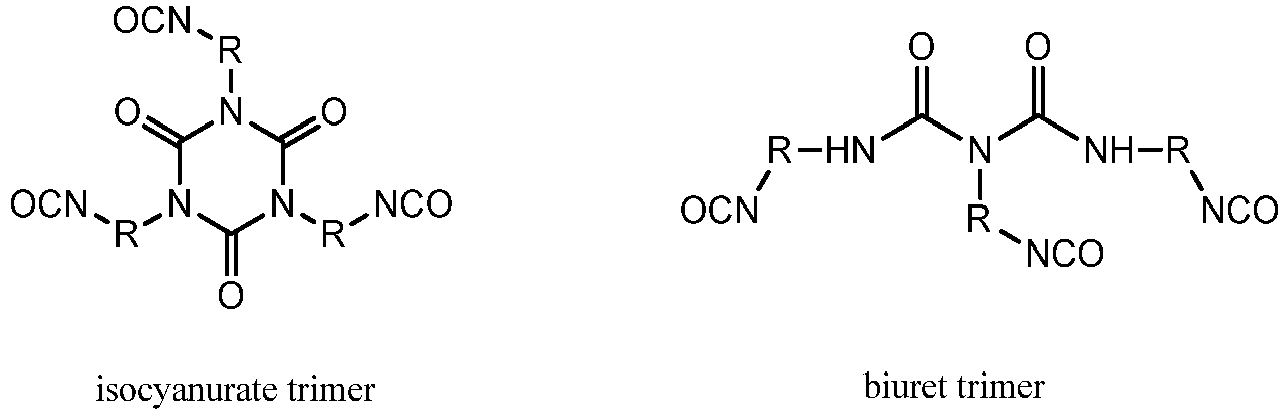
- examples of a preferred class of polyisocyanate branching agents include isocyanurate trimers and biuret trimers, which are characterized by the following formulas: where R is a C 4 -C 30 -alkylene group, more particularly a C 4 -C 20 -alkylene group.
- alkylene group refers to a biradical saturated or partially saturated hydrocarbyl group that is linear-, branched-, or cycloaliphatic or a combination thereof.
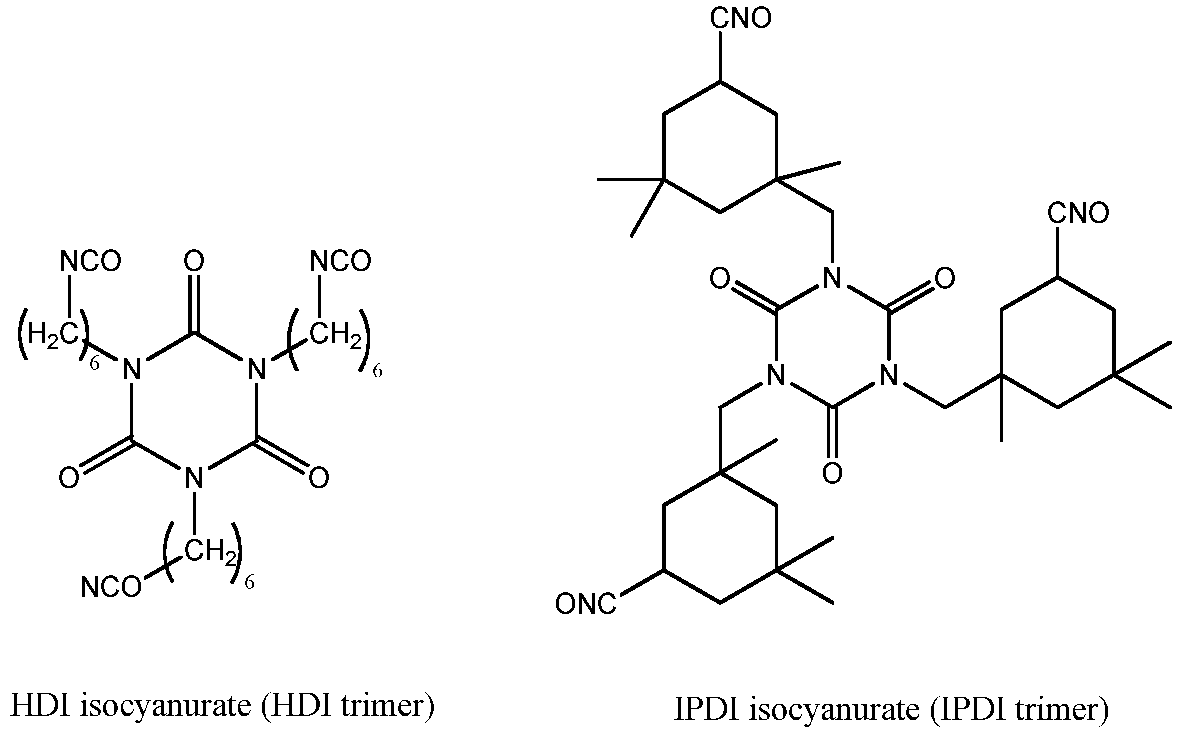
- suitable isocyanurate trimers which are preferred, include HDI isocyanurate (HDI trimer), and IPDI isocyanurate (IPDI trimer). The structures of these cyanurate compounds are illustrated:
- isocyanurate trimers generally include lower levels of oligomers (pentamers, heptamers, etc.) that impart higher order isocyanate functionality to the compound. Accordingly, the term "isocyanate trimer” may include the trimer by itself or as a mixture of trimer and other oligomers. In fact, the commercially available HDI trimer Desmodur N3600 polyisocyanate trimer has a stated equivalent weight of 183 g/mol, which is higher than the equivalent weight of pure trimer, 164 g/mol, due to the presence of small amounts of higher order oligomers.
- the polyisocyanate branching agent may also be a reaction product of a diisocyanate, preferably an aliphatic diisocyanate, and a polyol branching agent.
- a diisocyanate preferably an aliphatic diisocyanate
- a polyol branching agent refers to a compound with at least three hydroxyl groups.
- suitable polyol branching agents include trimethylol propane, pentaerythritol, glycerol, erythritol, sorbitol, and mannitol, as well as ethoxylates of these compounds.
- polyisocyanate branching agent formed from the reaction of an aliphatic diisocyanate, and a polyol branching agent is a polyisocyanate branching agent formed by the reaction of a glycerol ethoxylate and a diisocyanate.
- the structure of the glycerol ethoxylate is illustrated: where each R 1 is independently a C 4 -C 20 linear, branched, aromatic, or cycloaliphatic group, or a combination thereof; and x + y + z is from 0 to 200.
- water-soluble polyalkylene glycol refers to one or more water-soluble polyethylene oxides, water-soluble polyethylene oxide/polypropylene oxide copolymers, water-soluble polyethylene oxide/polybutylene oxide copolymers, and polyethylene oxide/polypropylene oxide/polybutylene oxide terpolymers.
- propylene oxide refers to either a polymer having - (OCH 2 CH 2 CH 2 )- and/or -(OCH(CH 3 )CH 2 )- repeating groups.
- Preferred water-soluble polyalkylene oxides are polyethylene glycols, particularly polyethylene glycols having a weight average molecular weight in the range of from 2000 to 11,000 Daltons, preferably in the range of from 4000 to 10,000 Daltons.
- An example of a suitable polyethylene glycol is PEG 8000, which is commercially available as CARBOWAXTM 8000 Polyethylene Glycol (a trademark of The Dow Chemical Company or its affiliates).
- the diisocyanate is preferably a C 4 -C 20 aliphatic or aromatic diisocyanate, or a combination thereof.
- aliphatic refers to saturated or partially unsaturated linear-, branched-, or cycloaliphatic, or combinations thereof.
- diisocyanates examples include 1,4-tetramethylene diisocyanate, 1,6-hexamethylene diisocyanate, 2,2,4-trimethyl-1,6-diisocyanatohexane, 1,10-decamethylene diisocyanate, 4,4'-methylenebis(isocyanatocyclohexane), 1,4-cyclohexylene diisocyanate, isophorone diisocyanate, m- and p-phenylene diisocyanate, 2,6- and 2,4-toluene diisocyanate, xylene diisocyanate, 4-chloro-1,3-phenylene diisocyanate, 4,4'-biphenylene diisocyanate, 4,4'-methylene diphenylisocyanate, 1,5-naphthylene diisocyanate, and 1,5-tetrahydronaphthylene diisocyanate. Aliphatic diisocyanates are preferred, with 1,6-
- the hydrophobic capping agent is a C 6 -C 18 alcohol or an ethoxylate thereof; a C 6 -C 18 amine or an ethoxylate thereof; or a C 6 -C 18 tertiary aminoalcohol or an ethoxylate thereof.
- suitable alcohols include n-octanol, n-nonanol, n-decanol, n-undecanol, n -dodecanol, 2-ethylhexanol, 2-butyl-1-octanol, and 3,7-dimethyl-1-octanol.
- Suitable amines include n-hexyl amine, n-octyl amine, n-decyl amine, n-dodecyl amine, benzyl amine, di-n-hexyl amine, 2-ethylhexyl amine, dicyclohexyl amine, and dibenzyl amine.
- Suitable tertiary aminoalcohols and alkoxylates thereof include reaction products of dialkyl amines and epoxies or alkyl glycidyl ethers;
- suitable dialkyl amines include dimethylamine, diethylamine, dipropylamine, diisopropylamine, dibutylamine, diamylamine, dihexylamine, bis-(2-ethylhexyl)amine, dicyclohexylamine, and dibenzylamine;
- examples of suitable epoxies include ethylene oxide, propylene oxide, butylenes oxide, 1,2-epoxydecane and 1,2-epoxydodecane;
- suitable alkyl glycidyl ethers include isopropyl glycidyl ether, butyl glycidyl ether, isobutyl glycidyl ether, 2-ethylhexyl glycidyl ether
- alkoxylated hydrophobic capping agents examples include the product of a branched alcohol such as 2-butyl-1-octanol or a linear alcohol such as n-dodecanol, with an ethylene oxide, a propylene oxide, or a butylene oxide.
- non-hydrophobic capping agent Small amounts of a non-hydrophobic capping agent may optionally be used along with the hydrophobic capping agent to tune thickening efficiencies and other paint formulation properties.
- An example of such a non-hydrophobic capping agent includes a methoxylated polyethylene glycol such as Polyglykol M2000 polyethylene glycol momomethyl ether.
- the molar equivalent ratio of diol to polyisocyanate branching agent is from 4 to 20, preferably 6 to 18, more preferably 6 to 15.
- the term molar equivalent ratio refers to the number of hydroxyl or isocyanate groups in the reactant.
- the hydrophobically modified alkylene oxide urethane polymer can be prepared in a one-stage reaction wherein the polyisocyanate branching agent, the water-soluble polyalkylene glycol, the diisocyanate, and capping agent are blended together and heated to a temperature sufficient to form a melt, typically to a temperature in the range of 70 °C to 120 °C, more preferably in the range of 85 °C to 115 °C, followed by addition of a suitable catalyst that promotes urethane linkage formation.
- a preferred catalyst in one-stage polymerization is a bismuth catalyst such as bismuth 2-ethylhexanoate, commercially available as bismuth octoate liquid MSF 28%.
- the polymer can be prepared in two stages: In a first stage, a mixture containing the polyisocyanate branching agent, the water-soluble polyalkylene glycol, the diisocyanate, and catalyst is heated to a temperature sufficient to form a melt and polymerize, preferably to a temperature in the range of 70 °C to 120 °C, more preferably 85 °C to 115 °C, to form the intermediate uncapped polymer.
- the capping agent is added after substantial consumption of the water-soluble polyalkylene glycol, and reaction is continued to completion to form the final polymer.
- the term "substantial consumption of the water-soluble polyalkylene glycol” means that at least 90%, more preferably at least 95%, and most preferably at least 99% of the water-soluble polyalkylene glycol is consumed.
- suitable catalysts in a two-stage polymerization include bismuth catalysts such as bismuth octoate; tin catalysts such as dibutyl tin dilaurate; mercury catalysts such as phenyl mercuric neodecanoate; zinc catalysts; lead catalysts; tertiary amines such as triethylamine, bis(2-dimethylaminoethyl)methylamine, 1,4-diazabicyclo[2.2.2]octane, dimethylcyclohexylamine, and 1,8-diazabicyclo[5.4.0]undec-7-ene.
- the hydrophobically modified alkylene oxide urethane polymer prepared by the process of the present invention is useful as solvent-free thickener for a coatings composition, which may include one or more of the following components: Fillers; pigments, such as titanium dioxide, mica, calcium carbonate, silica, zinc oxide, milled glass, aluminum trihydrate, talc, antimony trioxide, fly ash, and clay; polymer encapsulated pigments, such as polymer-encapsulated or partially encapsulated pigment particles such as titanium dioxide, zinc oxide, or lithopone particles; polymers or polymer emulsions adsorbing or bonding to the surface of pigments such as titanium dioxide; hollow pigments, including pigments having one or more voids; dispersants, such as aminoalcohols and polycarboxylates; surfactants; defoamers; preservatives, such as biocides, mildewcides, fungicides, algaecides, and combinations thereof; flow agents; leveling agents; and additional neutralizing
- thickener prepared by the process of the present invention is prepared in the absence of solvent, it may be desirable, in some instances, to add some solvent to the coatings composition to provide, for example, improved freeze-thaw properties of the coating.
- Desmodur N3600 polyisocyanate (HDI-trimer, 5.91 g, 0.0323 molar equivalents of NCO) and Desmodur H diisocyanate (HDI, 37.32 g, 0.4435 molar equivalents of NCO) was then added followed by 5 minutes of stirring.
- Bismuth octoate solution (28%, 3.80 g) was then added to the reactor and the resulting mixture was stirred for 10 min. The resulting molten polymer was removed from the reactor and cooled.
- Example 2-5 The procedures for Examples 2-5 were carried out substantially as described in Example 1 except the PEG:HDI-trimer molar equivalent ratio and the total NCO:Diol molar equivalent ratio were as specified in Table 1: Table 1 - Ratios of PEG:HDI and Total NCO:Diol PEG:HDI-Trimer Ratio Total NCO:Diol Ratio Example 2 6.0 1.28 Example 3 11.5 1.50 Example 4 6.0 1.50 Example 5 18.0 1.50
- the PEGariol ratio was 11.50 and total NCO:(diol+triol) ratio was 1.28.
- TMP trimethylolpropane
- HDI 51.48 g, 0.6118 molar equivalents of NCO
- PEG 1502.0 g, 0.3663 molar equivalent of OH
- BHT 0.157 g
- decanol 21.46 g, 0.1356 molar equivalent of OH
- the TMP/HDI reaction product mixture prepared above 44.38 g
- Bismuth octoate solution (28%, 3.76 g) was then added to the reactor and the resulting mixture was stirred for 10 min.
- the resulting molten polymer was removed from the reactor and cooled.
- the PEG:HDI-trimer ratio was 15.5 and total NCO:Diol was 1.25.
- Diamylamine (372.4 g), butyl glycidyl ether (346.2 g) and water (27 g) were heated to reflux (105-115 °C) under N 2 in a round bottom flask equipped with a condenser and mechanical stirrer. After 5 h, the mixture was cooled to 30 °C.
- the resulting aminoalcohol product was isolated after water and residual butyl glycidyl ether were removed via vacuum distillation (14 mm Hg) over a temperature range of 30-150° C.
- PEG (1708.7 g, 0.4168 molar equivalents of OH) was heated to 110 °C in vacuo in a batch melt reactor for 2 h. After cooling to 85 °C, BHT (0.18 g) and the aminoalcohol (36.04 g, 0.1255 molar equivalents of OH) were added and the reaction was stirred for 5 minutes.
- HDI-trimer (4.92 g, 0.0269 molar equivalents of NCO) and HDI (41.46 g, 0.4927 molar equivalents of NCO) were then added followed by 5 min of stirring.
- Bismuth octoate solution (28%, 4.27 g) was then added to the reactor and the resulting mixture was stirred for 10 min. The resulting molten polymer was removed from the reactor and cooled.
- the PEG:triol ratio was 11.50 and the total NCO:(diol + triol) was 1.28.
- PEG 1590.6 g, 0.3880 molar equivalents of OH
- BHT 0.166 g
- decanol 22.73 g, 0.1436 molar equivalents of OH
- TMP 1.51 g, 0.0338 molar equivalents of OH
- HDI 45.49 g, 0.5406 molar equivalents of NCO
- Bismuth octoate solution (28%, 3.98 g) was then added to the reactor and the resulting mixture was stirred for 10 min.
- the resulting molten polymer was removed from the reactor and cooled.
- a latex paint composition was prepared by combining the components of Table 2: Table 2 - Pre-paint #1 Formulation Kronos 4311 titanium dioxide slurry 262.8 g Water 180.1 g Ethylene glycol 24.3 g ROPAQUETM Ultra opaque polymer 49.7 g RHOPLEXTM SG-30 Binder 420.9 g Drewplus L-475 defoamer 4.0 g Texanol coalescent 19.2 g Triton X-405 surfactant 2.5 g Total 963.5 g ROPAQUE and RHOPLEX are Trademarks of The Dow Chemical Company or its affiliates.
- the formulated paint was obtained by adding aqueous thickener dispersion and water to Pre-paint #1 (963.5 g). To maintain constant solids of the fully formulated paint, the combined weight of the added thickener and water was 49.5 g. The density of the fully formulated paint was 1013 lbs/100 gal (1.2 Kg/L). The pH of the fully formulated paints was in the range of 8.5 to 9.0.
- Formulated paints were made as follows: To Pre-paint #1 (963.5 g) were slowly added aqueous thickener dispersion (40.0 g) and water (9.5 g). The mixture was stirred for 10 min. The aqueous thickener dispersions were made by adding dried solid thickener wax (10.0 g), methyl-beta-cyclodextrin (1.0 g of a 50% solution) and water (39.0 g) to a 50-mL plastic centrifuge tube. The tubes were capped and mounted on a rotator for continuous tumbling over 48 h until the aqueous thickener dispersions were homogeneous.
- Table 3 shows the KU, ICI, and ICI/KU values for paints formulated with HEUR thickeners of the examples. As Table 3 shows, the process of the present invention provides a solvent-free thickener that can be used to prepare coatings formulations with an excellent balance of ICI and KU properties. Table 3 - Paint data in a Semigloss White Paint. HEUR Example PEG:HDI Trimer (or Triol) Ratio Total NCO: (Diol+Triol) KU ICI ICI/KU(*100) Ex. 1 11.5 1.28 77.6 1.90 2.45 Ex.
- a latex paint composition was prepared by combining components of Table 4: Table 4: Pre-paint #2 Formulation Ti-Pure R-746 titanium dioxide slurry 349.8 g TAMOLTM 731A Dispersant 7.5 g BYK-348 surfactant 1.0 g Tego Foamex defoamer 0.5 g Mix the above on a Cowles dispersor and let down with the following water 20.9 g RHOPLEXTM VSR-2015 Binder 524.2 g BYK-348 surfactant 19.2 g Tego Foamex defoamer 1.0 g Total 905.4 g TAMOL and RHOPLEX are Trademarks of The Dow Chemical Company or its affiliates.
- the formulated VSR-2015 paint was obtained by adding aqueous thickener Example 7 dispersion and water to Pre-paint #2 (905.4 g). To maintain constant solids of the fully formulated paint, the combined weight of added thickener and water was 158.9 g. The density of the fully formulated paint was 1064 lbs/100 gal (1.3 Kg/L). The pH of the fully formulated paint was in the range of 8.5 to 9.0.
- the formulated paint was made as follows: To Pre-paint #2 (905.4 g) were slowly added aqueous thickener Example 7 dispersion (25.0 g), ammonia (1.0 g) and water (132.9 g). The mixture was stirred for 10 min. The aqueous thickener Example 8 dispersion was made by adding dried solid thickener wax (10.0 g), lactic acid (0.5 g, 85% solids) and water (39.5 g) to a 50-mL plastic centrifuge tube. The tube was capped and mounted on a rotator for continuous tumbling over 48 h until the aqueous thickener dispersions were homogeneous.
- the thickened paint was stirred for 1 min on a lab mixer before measuring viscosity values.
- the VSR-2015 paint thickened with Example 7 exhibited a KU value of 110.4 and an ICI value of 2.00 and an ICI/KU(*100) of 1.81.
- the results show excellent ICI and ICI/KU(*100) values for thickeners made using the process of the present invention.
- the process has the additional advantage of being free of solvent, resulting in the absence or substantial absence of volatile organic solvents (VOCs). While not bound theory, it is believed that the method of the present invention provides an improved ICI/KU balance due to a more random distribution of branching points in the polymer backbone, leading to higher molecular weight between branch points and higher molecular weight between end group hydrophobes.
Landscapes
- Chemical & Material Sciences (AREA)
- Organic Chemistry (AREA)
- Health & Medical Sciences (AREA)
- Chemical Kinetics & Catalysis (AREA)
- Medicinal Chemistry (AREA)
- Polymers & Plastics (AREA)
- Life Sciences & Earth Sciences (AREA)
- Engineering & Computer Science (AREA)
- Materials Engineering (AREA)
- Wood Science & Technology (AREA)
- Polyurethanes Or Polyureas (AREA)
Abstract
Description
- The present invention relates to hydrophically modified urethane polymers, which are used as rheology modifiers in waterborne coatings formulations.
- Rheology modifiers are used in waterborne coatings formulations to control viscosity over a wide shear rate range. They may be associative (they associate with the dispersed phase) or non-associative (they thicken the water phase). Associative thickeners may be derived from natural products such as hydrophobically modified cellulose ethers, or prepared from synthetic polymers such as hydrophobically modified ethylene oxide urethane (HEUR) polymers. A typical description of HEUR polymers and their preparation can be found in
US 2009/0318595 A1 , which describes forming a combination of linear and branched HEUR polymers by reacting a polyglycol, a hydrophobic alcohol, a diisocyanate, and a triisocyanate together in a one-pot reaction. -
U.S. 4,155,892 (Emmons et al. ) describes the preparation of linear as well as branched HEUR polymers in separate examples. - Rheology modifiers are typically classified as either low shear rate viscosity builders (Stormer viscosity builders, also known as KU viscosity builders) or high shear rate viscosity builders (ICI builders). It is desirable to increase ICI viscosity and the efficiency of ICI building rheology modifiers without concomitant increase in KU viscosity because such increase limits the formulator's ability to add a KU building rheology modifier to the formulation.
- The commercially available HEUR polymers ACRYSOL™ 5000 and ACRYSOL™ 6000 rheology modifiers (a trademark of The Dow Chemical Company or its Affiliates) exhibit ICI viscosities of 1.75 and 2.40 respectively and KU viscosities of 79.3 and 109.7 respectively in an acrylic semi-gloss white paint. It would be advantageous to obtain a hydrophobically modified urethane polymer formulation with an increased ICI/KU viscosity ratio in comparison to these known rheology modifiers.
- The present invention addresses a need in the art by providing a process comprising contacting a solvent-free melt of a polyisocyanate branching agent; a water-soluble polyalkylene glycol having an Mw of from 2000 to 11,000 Daltons; and a diisocyanate with a polymerization promoting catalyst under conditions sufficient to form a hydrophobically modified alkylene oxide urethane polymer; with the proviso that either: 1) the solvent-free melt further includes a hydrophobic capping agent prior to contact of the melt with the catalyst; or 2) a hydrophobic capping agent is added to the melt after contact of the melt with the catalyst; wherein the molar equivalent ratio of glycol to polyisocyanate branching agent is from 4 to 20; and the molar equivalent ratio of total isocyanate groups to glycol hydroxyl groups is 1.1 to 1.6.
- The hydrophobically modified alkylene oxide urethane polymer prepared by the process of the present invention is useful as a solvent-free thickener for coatings formulations.
- The present invention is a process comprising contacting a solvent-free melt of a polyisocyanate branching agent; a water-soluble polyalkylene glycol having an Mw of from 2000 to 11,000 Daltons; and a diisocyanate with a polymerization promoting catalyst under conditions sufficient to form a hydrophobically modified alkylene oxide urethane polymer; with the proviso that either: 1) the solvent-free melt further includes a hydrophobic capping agent prior to contact of the melt with the catalyst; or 2) a hydrophobic capping agent is added to the melt after contact of the melt with the catalyst; wherein the molar equivalent ratio of glycol to polyisocyanate branching agent is from 4 to 20; and the molar equivalent ratio of total isocyanate groups to glycol hydroxyl groups is 1.1 to 1.6.
- As used herein the term polyisocyanate branching agent is a compound containing at least three isocyanate groups. Examples of a preferred class of polyisocyanate branching agents include isocyanurate trimers and biuret trimers, which are characterized by the following formulas:
- Persons of ordinary skill in the art recognize that isocyanurate trimers generally include lower levels of oligomers (pentamers, heptamers, etc.) that impart higher order isocyanate functionality to the compound. Accordingly, the term "isocyanate trimer" may include the trimer by itself or as a mixture of trimer and other oligomers. In fact, the commercially available HDI trimer Desmodur N3600 polyisocyanate trimer has a stated equivalent weight of 183 g/mol, which is higher than the equivalent weight of pure trimer, 164 g/mol, due to the presence of small amounts of higher order oligomers.
- The polyisocyanate branching agent may also be a reaction product of a diisocyanate, preferably an aliphatic diisocyanate, and a polyol branching agent. As used herein, the term polyol branching agent refers to a compound with at least three hydroxyl groups. Examples of suitable polyol branching agents include trimethylol propane, pentaerythritol, glycerol, erythritol, sorbitol, and mannitol, as well as ethoxylates of these compounds.
- An example of a polyisocyanate branching agent formed from the reaction of an aliphatic diisocyanate, and a polyol branching agent is a polyisocyanate branching agent formed by the reaction of a glycerol ethoxylate and a diisocyanate. The structure of the glycerol ethoxylate is illustrated:

- The term "water-soluble polyalkylene glycol" refers to one or more water-soluble polyethylene oxides, water-soluble polyethylene oxide/polypropylene oxide copolymers, water-soluble polyethylene oxide/polybutylene oxide copolymers, and polyethylene oxide/polypropylene oxide/polybutylene oxide terpolymers. As used herein, the term propylene oxide refers to either a polymer having - (OCH2CH2CH2)- and/or -(OCH(CH3)CH2)- repeating groups.
- Preferred water-soluble polyalkylene oxides are polyethylene glycols, particularly polyethylene glycols having a weight average molecular weight in the range of from 2000 to 11,000 Daltons, preferably in the range of from 4000 to 10,000 Daltons. An example of a suitable polyethylene glycol is PEG 8000, which is commercially available as CARBOWAX™ 8000 Polyethylene Glycol (a trademark of The Dow Chemical Company or its Affiliates).
- The diisocyanate is preferably a C4-C20 aliphatic or aromatic diisocyanate, or a combination thereof. As used herein, "aliphatic" refers to saturated or partially unsaturated linear-, branched-, or cycloaliphatic, or combinations thereof. Examples of suitable diisocyanates include 1,4-tetramethylene diisocyanate, 1,6-hexamethylene diisocyanate, 2,2,4-trimethyl-1,6-diisocyanatohexane, 1,10-decamethylene diisocyanate, 4,4'-methylenebis(isocyanatocyclohexane), 1,4-cyclohexylene diisocyanate, isophorone diisocyanate, m- and p-phenylene diisocyanate, 2,6- and 2,4-toluene diisocyanate, xylene diisocyanate, 4-chloro-1,3-phenylene diisocyanate, 4,4'-biphenylene diisocyanate, 4,4'-methylene diphenylisocyanate, 1,5-naphthylene diisocyanate, and 1,5-tetrahydronaphthylene diisocyanate. Aliphatic diisocyanates are preferred, with 1,6-hexamethylene diisocyanate and isophorone diisocyanate being more preferred.
- As used herein, the term "hydrophobic capping agent" refers to a monofunctional compound comprising six or more carbon atoms that has a hydrophobic portion and that is capable of reacting with an isocyanate group; preferably the hydrophobic capping agent is an alcohol or an alkoxlyate thereof; an amine or an alkoxlyate thereof; or a tertiary aminoalcohol or an alkoxlyate thereof; more preferably, the hydrophobic capping agent is represented by the formula R1-X-(CH2CHR3-O)m-H; where X = O, NH, or NR2; R1 and R2 are independently C6 to C18, linear, branched, cyclic, aromatic, or combinations thereof; each R3 is independently H, C1-C6 linear or branched, C3-C6 cyclic, or phenyl; and m is 0 to 50, more preferably 0 to 30. More preferably still, the hydrophobic capping agent is a C6-C18 alcohol or an ethoxylate thereof; a C6-C18 amine or an ethoxylate thereof; or a C6-C18 tertiary aminoalcohol or an ethoxylate thereof. Examples of suitable alcohols include n-octanol, n-nonanol, n-decanol, n-undecanol, n-dodecanol, 2-ethylhexanol, 2-butyl-1-octanol, and 3,7-dimethyl-1-octanol. Examples of suitable amines include n-hexyl amine, n-octyl amine, n-decyl amine, n-dodecyl amine, benzyl amine, di-n-hexyl amine, 2-ethylhexyl amine, dicyclohexyl amine, and dibenzyl amine. Examples of suitable tertiary aminoalcohols and alkoxylates thereof include reaction products of dialkyl amines and epoxies or alkyl glycidyl ethers; examples of suitable dialkyl amines include dimethylamine, diethylamine, dipropylamine, diisopropylamine, dibutylamine, diamylamine, dihexylamine, bis-(2-ethylhexyl)amine, dicyclohexylamine, and dibenzylamine; examples of suitable epoxies include ethylene oxide, propylene oxide, butylenes oxide, 1,2-epoxydecane and 1,2-epoxydodecane; and examples of suitable alkyl glycidyl ethers include isopropyl glycidyl ether, butyl glycidyl ether, isobutyl glycidyl ether, 2-ethylhexyl glycidyl ether, phenyl glycidyl ether, t-butyl phenyl glycidyl ether. Examples of other suitable alkoxylated hydrophobic capping agents include the product of a branched alcohol such as 2-butyl-1-octanol or a linear alcohol such as n-dodecanol, with an ethylene oxide, a propylene oxide, or a butylene oxide.
- Small amounts of a non-hydrophobic capping agent may optionally be used along with the hydrophobic capping agent to tune thickening efficiencies and other paint formulation properties. An example of such a non-hydrophobic capping agent includes a methoxylated polyethylene glycol such as Polyglykol M2000 polyethylene glycol momomethyl ether.
- The molar equivalent ratio of diol to polyisocyanate branching agent is from 4 to 20, preferably 6 to 18, more preferably 6 to 15. As used herein, the term molar equivalent ratio refers to the number of hydroxyl or isocyanate groups in the reactant. Thus, for example, 10 moles of a polyethylene glycol has two hydroxyl groups per mole, and 1 mole of a triisocyanate has three isocyanate groups per mole; the molar equivalent ratio of glycol hydroxyl groups to triisocyanate groups is (10*2)/(1*3) = or 6.67.
- The hydrophobically modified alkylene oxide urethane polymer can be prepared in a one-stage reaction wherein the polyisocyanate branching agent, the water-soluble polyalkylene glycol, the diisocyanate, and capping agent are blended together and heated to a temperature sufficient to form a melt, typically to a temperature in the range of 70 °C to 120 °C, more preferably in the range of 85 °C to 115 °C, followed by addition of a suitable catalyst that promotes urethane linkage formation. A preferred catalyst in one-stage polymerization is a bismuth catalyst such as bismuth 2-ethylhexanoate, commercially available as bismuth octoate liquid MSF 28%.
- Alternatively, the polymer can be prepared in two stages: In a first stage, a mixture containing the polyisocyanate branching agent, the water-soluble polyalkylene glycol, the diisocyanate, and catalyst is heated to a temperature sufficient to form a melt and polymerize, preferably to a temperature in the range of 70 °C to 120 °C, more preferably 85 °C to 115 °C, to form the intermediate uncapped polymer. Preferably, the capping agent is added after substantial consumption of the water-soluble polyalkylene glycol, and reaction is continued to completion to form the final polymer. As used herein, the term "substantial consumption of the water-soluble polyalkylene glycol" means that at least 90%, more preferably at least 95%, and most preferably at least 99% of the water-soluble polyalkylene glycol is consumed. Examples of suitable catalysts in a two-stage polymerization include bismuth catalysts such as bismuth octoate; tin catalysts such as dibutyl tin dilaurate; mercury catalysts such as phenyl mercuric neodecanoate; zinc catalysts; lead catalysts; tertiary amines such as triethylamine, bis(2-dimethylaminoethyl)methylamine, 1,4-diazabicyclo[2.2.2]octane, dimethylcyclohexylamine, and 1,8-diazabicyclo[5.4.0]undec-7-ene.
- The hydrophobically modified alkylene oxide urethane polymer prepared by the process of the present invention is useful as solvent-free thickener for a coatings composition, which may include one or more of the following components: Fillers; pigments, such as titanium dioxide, mica, calcium carbonate, silica, zinc oxide, milled glass, aluminum trihydrate, talc, antimony trioxide, fly ash, and clay; polymer encapsulated pigments, such as polymer-encapsulated or partially encapsulated pigment particles such as titanium dioxide, zinc oxide, or lithopone particles; polymers or polymer emulsions adsorbing or bonding to the surface of pigments such as titanium dioxide; hollow pigments, including pigments having one or more voids; dispersants, such as aminoalcohols and polycarboxylates; surfactants; defoamers; preservatives, such as biocides, mildewcides, fungicides, algaecides, and combinations thereof; flow agents; leveling agents; and additional neutralizing agents, such as hydroxides, amines, ammonia, and carbonates.
- Although the thickener prepared by the process of the present invention is prepared in the absence of solvent, it may be desirable, in some instances, to add some solvent to the coatings composition to provide, for example, improved freeze-thaw properties of the coating.
- The following examples are for illustrative purposes only and are not intended to limit the scope of the invention.
- In the following procedure, the PEG:HDI-trimer ratio was 11.5 and the total NCO:Diol ratio was 1.28. CARBOWAX™ 8000 Polyethylene Glycol (PEG, a trademark of the Dow Chemical Company or its Affiliates, molecular weight 8200; 1521.8 g, 0.3712 molar equivalents of OH) was heated to 110 °C in vacuo in a batch melt reactor for 2 h. After cooling to 85 °C, butylated hydroxytoluene (BHT, 0.159 g) and decanol (19.8 g, 0.1251 molar equivalents of OH) were added and the reaction was stirred for 5 min. Desmodur N3600 polyisocyanate (HDI-trimer, 5.91 g, 0.0323 molar equivalents of NCO) and Desmodur H diisocyanate (HDI, 37.32 g, 0.4435 molar equivalents of NCO) was then added followed by 5 minutes of stirring. Bismuth octoate solution (28%, 3.80 g) was then added to the reactor and the resulting mixture was stirred for 10 min. The resulting molten polymer was removed from the reactor and cooled.
- The procedures for Examples 2-5 were carried out substantially as described in Example 1 except the PEG:HDI-trimer molar equivalent ratio and the total NCO:Diol molar equivalent ratio were as specified in Table 1:
Table 1 - Ratios of PEG:HDI and Total NCO:Diol PEG:HDI-Trimer Ratio Total NCO:Diol Ratio Example 2 6.0 1.28 Example 3 11.5 1.50 Example 4 6.0 1.50 Example 5 18.0 1.50 - In the following procedure, the PEGariol ratio was 11.50 and total NCO:(diol+triol) ratio was 1.28. To a 100-mL round bottom flask equipped with condenser, thermocouple, mechanical stirrer, and nitrogen inlet was added trimethylolpropane (TMP, 1.71 g, 0.0383 molar equivalents of OH) and HDI (51.48 g, 0.6118 molar equivalents of NCO). This reaction mixture was heated to 55 °C with stirring until the TMP was melted. After cooling to 45 °C, one drop of dibutyl tin dilaurate was added to the hazy reaction mixture. The appearance of the reaction mixture immediately turned clear and the exotherm was allowed to heat the reaction mixture to 55 °C, followed by holding at this temperature with stirring for 15 min. The reaction mixture was then cooled to room temperature.
- PEG (1502.0 g, 0.3663 molar equivalent of OH) was heated to 110 °C under vacuum in a batch melt reactor for 2 h. After cooling to 85 °C, BHT (0.157 g) and decanol (21.46 g, 0.1356 molar equivalent of OH) were added and the reaction was stirred for 5 minutes. The TMP/HDI reaction product mixture prepared above (44.38 g) was added followed by 5 min of stirring. Bismuth octoate solution (28%, 3.76 g) was then added to the reactor and the resulting mixture was stirred for 10 min. The resulting molten polymer was removed from the reactor and cooled.
- In the following procedure, the PEG:HDI-trimer ratio was 15.5 and total NCO:Diol was 1.25. Diamylamine (372.4 g), butyl glycidyl ether (346.2 g) and water (27 g) were heated to reflux (105-115 °C) under N2 in a round bottom flask equipped with a condenser and mechanical stirrer. After 5 h, the mixture was cooled to 30 °C. The resulting aminoalcohol product was isolated after water and residual butyl glycidyl ether were removed via vacuum distillation (14 mm Hg) over a temperature range of 30-150° C.
- PEG (1708.7 g, 0.4168 molar equivalents of OH) was heated to 110 °C in vacuo in a batch melt reactor for 2 h. After cooling to 85 °C, BHT (0.18 g) and the aminoalcohol (36.04 g, 0.1255 molar equivalents of OH) were added and the reaction was stirred for 5 minutes. HDI-trimer (4.92 g, 0.0269 molar equivalents of NCO) and HDI (41.46 g, 0.4927 molar equivalents of NCO) were then added followed by 5 min of stirring. Bismuth octoate solution (28%, 4.27 g) was then added to the reactor and the resulting mixture was stirred for 10 min. The resulting molten polymer was removed from the reactor and cooled.
- In the following example, the PEG:triol ratio was 11.50 and the total NCO:(diol + triol) was 1.28. PEG (1590.6 g, 0.3880 molar equivalents of OH) was heated to 110 °C in vacuo in a batch melt reactor for 2 h. After cooling to 85 °C, BHT (0.166 g), decanol (22.73 g, 0.1436 molar equivalents of OH), and TMP (1.51 g, 0.0338 molar equivalents of OH) were added and the reaction was stirred for 5 min. HDI (45.49 g, 0.5406 molar equivalents of NCO) was added followed by 5 min of stirring. Bismuth octoate solution (28%, 3.98 g) was then added to the reactor and the resulting mixture was stirred for 10 min. The resulting molten polymer was removed from the reactor and cooled.
- A latex paint composition, Pre-paint #1, was prepared by combining the components of Table 2:
Table 2 - Pre-paint #1 Formulation Kronos 4311 titanium dioxide slurry 262.8 g Water 180.1 g Ethylene glycol 24.3 g ROPAQUE™ Ultra opaque polymer 49.7 g RHOPLEX™ SG-30 Binder 420.9 g Drewplus L-475 defoamer 4.0 g Texanol coalescent 19.2 g Triton X-405 surfactant 2.5 g Total 963.5 g ROPAQUE and RHOPLEX are Trademarks of The Dow Chemical Company or its Affiliates. - The formulated paint was obtained by adding aqueous thickener dispersion and water to Pre-paint #1 (963.5 g). To maintain constant solids of the fully formulated paint, the combined weight of the added thickener and water was 49.5 g. The density of the fully formulated paint was 1013 lbs/100 gal (1.2 Kg/L). The pH of the fully formulated paints was in the range of 8.5 to 9.0.
- Formulated paints were made as follows: To Pre-paint #1 (963.5 g) were slowly added aqueous thickener dispersion (40.0 g) and water (9.5 g). The mixture was stirred for 10 min. The aqueous thickener dispersions were made by adding dried solid thickener wax (10.0 g), methyl-beta-cyclodextrin (1.0 g of a 50% solution) and water (39.0 g) to a 50-mL plastic centrifuge tube. The tubes were capped and mounted on a rotator for continuous tumbling over 48 h until the aqueous thickener dispersions were homogeneous. Following a 24 h equilibration at room temperature, the thickened paint was stirred for 1 min on a lab mixer before measuring viscosity values. Table 3 shows the KU, ICI, and ICI/KU values for paints formulated with HEUR thickeners of the examples. As Table 3 shows, the process of the present invention provides a solvent-free thickener that can be used to prepare coatings formulations with an excellent balance of ICI and KU properties.
Table 3 - Paint data in a Semigloss White Paint. HEUR Example PEG:HDI Trimer (or Triol) Ratio Total NCO: (Diol+Triol) KU ICI ICI/KU(*100) Ex. 1 11.5 1.28 77.6 1.90 2.45 Ex. 2 6.0 1.28 88.8 2.30 2.59 Ex. 3 11.50 1.50 79.0 2.00 2.53 Ex. 4 6.0 1.50 84.8 2.10 2.48 Ex. 5 18.0 1.50 76.6 1.80 2.35 Ex. 6 11.5 1.28 79.7 1.90 2.38 Comp. Ex 1 11.5 1.28 75.8 1.70 2.24 - A latex paint composition, Pre-paint #2, was prepared by combining components of Table 4:
Table 4: Pre-paint #2 Formulation Ti-Pure R-746 titanium dioxide slurry 349.8 g TAMOL™ 731A Dispersant 7.5 g BYK-348 surfactant 1.0 g Tego Foamex defoamer 0.5 g Mix the above on a Cowles dispersor and let down with the following water 20.9 g RHOPLEX™ VSR-2015 Binder 524.2 g BYK-348 surfactant 19.2 g Tego Foamex defoamer 1.0 g Total 905.4 g TAMOL and RHOPLEX are Trademarks of The Dow Chemical Company or its Affiliates. - The formulated VSR-2015 paint was obtained by adding aqueous thickener Example 7 dispersion and water to Pre-paint #2 (905.4 g). To maintain constant solids of the fully formulated paint, the combined weight of added thickener and water was 158.9 g. The density of the fully formulated paint was 1064 lbs/100 gal (1.3 Kg/L). The pH of the fully formulated paint was in the range of 8.5 to 9.0.
- The formulated paint was made as follows: To Pre-paint #2 (905.4 g) were slowly added aqueous thickener Example 7 dispersion (25.0 g), ammonia (1.0 g) and water (132.9 g). The mixture was stirred for 10 min. The aqueous thickener Example 8 dispersion was made by adding dried solid thickener wax (10.0 g), lactic acid (0.5 g, 85% solids) and water (39.5 g) to a 50-mL plastic centrifuge tube. The tube was capped and mounted on a rotator for continuous tumbling over 48 h until the aqueous thickener dispersions were homogeneous. Following a 24-h equilibration at room temperature, the thickened paint was stirred for 1 min on a lab mixer before measuring viscosity values. The VSR-2015 paint thickened with Example 7 exhibited a KU value of 110.4 and an ICI value of 2.00 and an ICI/KU(*100) of 1.81.
- The results show excellent ICI and ICI/KU(*100) values for thickeners made using the process of the present invention. The process has the additional advantage of being free of solvent, resulting in the absence or substantial absence of volatile organic solvents (VOCs). While not bound theory, it is believed that the method of the present invention provides an improved ICI/KU balance due to a more random distribution of branching points in the polymer backbone, leading to higher molecular weight between branch points and higher molecular weight between end group hydrophobes.
Claims (9)
- A process comprising contacting a solvent-free melt of a polyisocyanate branching agent; a water-soluble polyalkylene glycol having an Mw of from 2000 to 11,000 Daltons; and a diisocyanate with a polymerization promoting catalyst under conditions sufficient to form a hydrophobically modified alkylene oxide urethane polymer; with the proviso that either: 1) the solvent-free melt further includes a hydrophobic capping agent prior to contact of the melt with the catalyst; or 2) a hydrophobic capping agent is added to the melt after contact of the melt with the catalyst;
wherein the molar equivalent ratio of glycol to polyisocyanate branching agent is from 4 to 20; and the molar equivalent ratio of total isocyanate groups to glycol hydroxyl groups is 1.1 to 1.6. - The process of Claim 1 wherein the solvent-free melt further includes a hydrophobic capping agent prior to contact of the melt with the catalyst; the process is carried out at a temperature in the range of 70 °C to 120 °C; the water-soluble polyalkylene glycol is a polyethylene glycol having Mw of from 4000 to 10,000 Daltons; and the catalyst is a bismuth catalyst; wherein the hydrophobic capping agent is a C6-C18-alcohol or a C6-C18 tertiary aminoalcohol.
- The process of Claims 2 wherein the process is carried out at a temperature in the range of 85 °C to 115 °C; the polyisocyanate branching agent is hexamethylene diisocyanate isocyanurate; isophorone diisocyanate isocyanurate; tris(isocyanatohexyl)biuret; 1,6,11-undecane triisocyanate, or the reaction product of a diisocyanate and a polyol branching agent; the hydrophobic capping agent comprises at least one of n-octanol, n-nonanol, n-decanol, n-undecanol, n-dodecanol, 2-ethylhexanol, 2-butyl-1-octanol, or 3,7-dimethyl-1-octanol; and the catalyst is bismuth octoate;
wherein the molar equivalent ratio of hydroxyl groups in the glycol to isocyanate groups in the polyisocyanate branching agent is from 8 to 16; and the molar equivalent ratio of total isocyanate groupsto glycol hydroxyl groups is 1.2 to 1.4. - The process of Claim 3 wherein the polyisocyanate branching agent is hexamethylene diisocyanate isocyanurate, isophorone diisocyanate isocyanurate, or the reaction product of a diisocyanate and a glycerol ethoxylate, which reaction product has the following formula:

- The process of Claim 1 wherein the hydrophobic capping agent is a C6-C18 alcohol which is added to the melt after contact of the melt with the catalyst; the process is carried out at a temperature in the range of 70 °C to 120 °C; the water-soluble polyalkylene glycol is a polyethylene glycol having Mw of from 4000 to 10,000 Daltons; and the catalyst is a tertiary amine or a tin, bismuth, or zinc catalyst.
- The process of Claims 5 wherein the process is carried out at a temperature in the range of 85 °C to 115 °C; the polyisocyanate branching agent is hexamethylene diisocyanate isocyanurate; isophorone diisocyanate isocyanurate; tris(isocyanatohexyl)biuret; 1,6,11-undecane triisocyanate, or the reaction product of a diisocyanate and a polyol branching agent; the C6-C18 alcohol comprises at least one of n-octanol, n-nonanol, n-decanol, n-undecanol, n-dodecanol, 2-ethylhexanol, 2-butyl-1-octanol, or 3,7-dimethyl-1-octanol; and the catalyst is bismuth octoate;
wherein the molar equivalent ratio of glycol to polyisocyanate branching agent is from 8 to 16; and the molar equivalent ratio of total isocyanate groups to glycol hydroxyl groups is 1.2 to 1.4. - The process of either of Claims 5 or 6 wherein polyisocyanate branching agent is hexamethylene diisocyanate isocyanurate, isophorone diisocyanate isocyanurate, or the reaction product of a diisocyanate and a glycerol ethoxylate, which reaction product has the following formula:

- The process of Claim 2 wherein the C6-C18 tertiary amino alcohol is a reaction product of a diamylamine and a butyl glycidyl ether; and the catalyst is bismuth octoate.
- A composition comprising a binder, a pigment, and a hydrophobically modified alkylene oxide urethane polymer prepared by the process of any of Claims 1 to 7.
Applications Claiming Priority (1)
| Application Number | Priority Date | Filing Date | Title |
|---|---|---|---|
| US201161570332P | 2011-12-14 | 2011-12-14 |
Publications (2)
| Publication Number | Publication Date |
|---|---|
| EP2604637A1 true EP2604637A1 (en) | 2013-06-19 |
| EP2604637B1 EP2604637B1 (en) | 2017-05-17 |
Family
ID=47221163
Family Applications (1)
| Application Number | Title | Priority Date | Filing Date |
|---|---|---|---|
| EP12192709.9A Active EP2604637B1 (en) | 2011-12-14 | 2012-11-15 | Rheology modifier |
Country Status (9)
| Country | Link |
|---|---|
| US (1) | US9150683B2 (en) |
| EP (1) | EP2604637B1 (en) |
| JP (1) | JP5542897B2 (en) |
| KR (1) | KR101504488B1 (en) |
| CN (1) | CN103159911B (en) |
| AU (1) | AU2012258362B2 (en) |
| BR (1) | BR102012031525B1 (en) |
| CA (1) | CA2795088C (en) |
| MX (1) | MX338528B (en) |
Cited By (4)
| Publication number | Priority date | Publication date | Assignee | Title |
|---|---|---|---|---|
| EP3056550A1 (en) * | 2015-02-16 | 2016-08-17 | Rohm And Haas Company | Acid suppressible rheology modifier stabilized with phosphoric acid ester surfactant |
| EP3118232A1 (en) * | 2015-07-14 | 2017-01-18 | Rohm And Haas Company | Process for preparing hydrophobically modified alkylene oxide urethane polymer |
| WO2021195934A1 (en) * | 2020-03-31 | 2021-10-07 | Clariant International Ltd | Hydrophobically modified polyurethane thickener and process for its preparation |
| EP3696210B1 (en) * | 2019-02-15 | 2022-09-14 | Rohm and Haas Company | Alkylene oxide polymer endcapped with an aryl ether alkoxylate block copolymer |
Families Citing this family (18)
| Publication number | Priority date | Publication date | Assignee | Title |
|---|---|---|---|---|
| JP2546963Y2 (en) | 1993-04-08 | 1997-09-03 | 旭精機工業株式会社 | Hook raising device of spring forming machine |
| JP5349562B2 (en) * | 2010-11-19 | 2013-11-20 | ローム アンド ハース カンパニー | Hydrophobically modified alkylene oxide urethane polymer |
| CA2948961C (en) | 2015-12-28 | 2023-12-05 | Dow Global Technologies Llc | Polyether-urethane-urea additives for block resistance and open time |
| TWI572662B (en) | 2015-12-30 | 2017-03-01 | 奇美實業股份有限公司 | Thermoplastic resin composition and molding product made therefrom |
| CN109415477B (en) | 2016-07-05 | 2022-04-12 | 罗门哈斯公司 | Compositions containing polyether-urethane-urea additives for compressive tack and open time |
| FR3057871B1 (en) * | 2016-10-20 | 2018-11-02 | Coatex | URETHANE COMPOUND MODIFIER OF RHEOLOGY |
| CN109890917B (en) * | 2016-11-01 | 2022-01-04 | 科慕埃弗西有限公司 | Coatings incorporating non-fluorinated cleanability additives |
| AU2018253521B2 (en) * | 2017-11-03 | 2023-08-17 | Dow Global Technologies Llc | Tint base paint formulation with a poly(oxyalkylene-urethane) associative thickener modified with a hydrophobic oligomer |
| CN110713561A (en) * | 2018-07-12 | 2020-01-21 | 常州强力电子新材料股份有限公司 | Epoxy modified acrylic resin and preparation method thereof |
| BR112022020767A2 (en) | 2020-05-06 | 2022-11-29 | Dow Global Technologies Llc | ACRYLIC OR AQUEOUS VINYL COATING COMPOSITION AND SUBSTRATE |
| WO2021242437A1 (en) * | 2020-05-26 | 2021-12-02 | Rohm And Haas Company | Rheology modifier and aminosilane waterborne admixture |
| FR3111893B1 (en) * | 2020-06-30 | 2023-04-28 | Coatex Sas | Rheology modifier triurethane compound |
| CN112225877A (en) * | 2020-09-04 | 2021-01-15 | 华南理工大学 | Tri-functionality isocyanate modified polyurethane thickener and preparation method thereof |
| CN116323838A (en) | 2020-10-05 | 2023-06-23 | Ppg工业俄亥俄公司 | High transfer efficiency application method for low temperature curing coating composition and coated substrate formed therefrom |
| WO2022076269A1 (en) | 2020-10-05 | 2022-04-14 | Ppg Industries Ohio, Inc. | High transfer efficiency application methods and shear thinning coating compositions for application using the methods |
| CN114349874A (en) * | 2021-12-23 | 2022-04-15 | 大连理工大学 | A kind of preparation method of hydrophobically modified sodium carboxymethyl starch |
| AU2023367479A1 (en) | 2022-10-26 | 2025-04-24 | Ppg Industries Ohio, Inc. | Coating composition for use in high efficiency applicators |
| CN119930977A (en) * | 2025-04-09 | 2025-05-06 | 苏州博纳化学科技有限公司 | A hyperbranched polyurethane associative rheology modifier, preparation method and application thereof |
Citations (3)
| Publication number | Priority date | Publication date | Assignee | Title |
|---|---|---|---|---|
| US4155892A (en) | 1975-10-03 | 1979-05-22 | Rohm And Haas Company | Polyurethane thickeners for aqueous compositions |
| US4180491A (en) * | 1976-12-01 | 1979-12-25 | Rohm And Haas Company | Nonionic polyurethane thickener with surfactant cothickener and organic diluent, clear concentrates, aqueous print pastes, coloring compositions, methods of making and printing |
| US20090318595A1 (en) | 2008-06-19 | 2009-12-24 | Steinmetz Alan L | Tint-viscosity stabilization polymeric thickeners |
Family Cites Families (9)
| Publication number | Priority date | Publication date | Assignee | Title |
|---|---|---|---|---|
| US4079028A (en) * | 1975-10-03 | 1978-03-14 | Rohm And Haas Company | Polyurethane thickeners in latex compositions |
| DE10111794A1 (en) | 2001-03-12 | 2002-09-26 | Borchers Gmbh | New polyurethanes and their use for thickening aqueous systems |
| DE10111792A1 (en) | 2001-03-12 | 2002-09-26 | Borchers Gmbh | New polyurethanes and their use for thickening aqueous systems |
| DE10111793A1 (en) | 2001-03-12 | 2002-09-26 | Borchers Gmbh | New polyurethanes and their use for thickening aqueous systems |
| US7432325B2 (en) | 2004-11-15 | 2008-10-07 | Rohm And Haas Company | Nonionic associative thickener containing condensation polymer backbone |
| US7741402B2 (en) * | 2007-03-21 | 2010-06-22 | Rohm And Haas Company | Thickener composition and method for thickening aqueous systems |
| US20100261813A1 (en) * | 2007-03-21 | 2010-10-14 | Barrett Richard Bobsein | Thickener composition and method for thickening aqueous systems |
| US8871817B2 (en) * | 2010-10-22 | 2014-10-28 | Basf Se | Polyurethane thickeners |
| JP5813431B2 (en) | 2010-10-25 | 2015-11-17 | ローム アンド ハース カンパニーRohm And Haas Company | Rheology modifier |
-
2012
- 2012-11-13 JP JP2012248976A patent/JP5542897B2/en active Active
- 2012-11-14 CA CA2795088A patent/CA2795088C/en active Active
- 2012-11-15 EP EP12192709.9A patent/EP2604637B1/en active Active
- 2012-11-23 AU AU2012258362A patent/AU2012258362B2/en active Active
- 2012-11-29 MX MX2012013914A patent/MX338528B/en active IP Right Grant
- 2012-12-06 US US13/706,401 patent/US9150683B2/en active Active
- 2012-12-10 BR BR102012031525-4A patent/BR102012031525B1/en active IP Right Grant
- 2012-12-13 KR KR1020120145314A patent/KR101504488B1/en active Active
- 2012-12-13 CN CN201210541110.XA patent/CN103159911B/en active Active
Patent Citations (4)
| Publication number | Priority date | Publication date | Assignee | Title |
|---|---|---|---|---|
| US4155892A (en) | 1975-10-03 | 1979-05-22 | Rohm And Haas Company | Polyurethane thickeners for aqueous compositions |
| US4180491A (en) * | 1976-12-01 | 1979-12-25 | Rohm And Haas Company | Nonionic polyurethane thickener with surfactant cothickener and organic diluent, clear concentrates, aqueous print pastes, coloring compositions, methods of making and printing |
| US20090318595A1 (en) | 2008-06-19 | 2009-12-24 | Steinmetz Alan L | Tint-viscosity stabilization polymeric thickeners |
| US7868122B2 (en) * | 2008-06-19 | 2011-01-11 | Southern Clay Products, Inc. | Tint-viscosity stabilization polymeric thickeners |
Cited By (5)
| Publication number | Priority date | Publication date | Assignee | Title |
|---|---|---|---|---|
| EP3056550A1 (en) * | 2015-02-16 | 2016-08-17 | Rohm And Haas Company | Acid suppressible rheology modifier stabilized with phosphoric acid ester surfactant |
| EP3118232A1 (en) * | 2015-07-14 | 2017-01-18 | Rohm And Haas Company | Process for preparing hydrophobically modified alkylene oxide urethane polymer |
| AU2016204586B2 (en) * | 2015-07-14 | 2020-05-14 | Rohm And Haas Company | Process for preparing hydrophobically modified alkylene oxide urethane polymer |
| EP3696210B1 (en) * | 2019-02-15 | 2022-09-14 | Rohm and Haas Company | Alkylene oxide polymer endcapped with an aryl ether alkoxylate block copolymer |
| WO2021195934A1 (en) * | 2020-03-31 | 2021-10-07 | Clariant International Ltd | Hydrophobically modified polyurethane thickener and process for its preparation |
Also Published As
| Publication number | Publication date |
|---|---|
| US9150683B2 (en) | 2015-10-06 |
| CN103159911B (en) | 2016-03-02 |
| CN103159911A (en) | 2013-06-19 |
| US20130158194A1 (en) | 2013-06-20 |
| MX2012013914A (en) | 2013-06-17 |
| AU2012258362B2 (en) | 2014-06-26 |
| CA2795088C (en) | 2015-12-29 |
| BR102012031525B1 (en) | 2020-03-03 |
| KR20130069449A (en) | 2013-06-26 |
| JP5542897B2 (en) | 2014-07-09 |
| JP2013127056A (en) | 2013-06-27 |
| BR102012031525A2 (en) | 2013-10-01 |
| MX338528B (en) | 2016-04-20 |
| KR101504488B1 (en) | 2015-03-20 |
| AU2012258362A1 (en) | 2013-07-04 |
| EP2604637B1 (en) | 2017-05-17 |
| CA2795088A1 (en) | 2013-06-14 |
Similar Documents
| Publication | Publication Date | Title |
|---|---|---|
| EP2604637B1 (en) | Rheology modifier | |
| EP2455412B1 (en) | Hydrophobically modified alkylene oxide urethane polymer | |
| AU2018204626B2 (en) | Heur thickener and process for its preparation | |
| EP2759555B1 (en) | Processes for the preparation of rheoloy modifiers | |
| KR101509146B1 (en) | Dibenzylamine hydrophobe | |
| AU2016247126A1 (en) | Heur thickener | |
| EP2653464B1 (en) | Benzylamine hydrophobe | |
| US20240400844A1 (en) | Ici building rheology modifier | |
| CN115916911B (en) | Rheology-modified triurethane compounds |
Legal Events
| Date | Code | Title | Description |
|---|---|---|---|
| PUAI | Public reference made under article 153(3) epc to a published international application that has entered the european phase |
Free format text: ORIGINAL CODE: 0009012 |
|
| 17P | Request for examination filed |
Effective date: 20121115 |
|
| AK | Designated contracting states |
Kind code of ref document: A1 Designated state(s): AL AT BE BG CH CY CZ DE DK EE ES FI FR GB GR HR HU IE IS IT LI LT LU LV MC MK MT NL NO PL PT RO RS SE SI SK SM TR |
|
| AX | Request for extension of the european patent |
Extension state: BA ME |
|
| 17Q | First examination report despatched |
Effective date: 20131126 |
|
| GRAP | Despatch of communication of intention to grant a patent |
Free format text: ORIGINAL CODE: EPIDOSNIGR1 |
|
| INTG | Intention to grant announced |
Effective date: 20161201 |
|
| GRAS | Grant fee paid |
Free format text: ORIGINAL CODE: EPIDOSNIGR3 |
|
| GRAJ | Information related to disapproval of communication of intention to grant by the applicant or resumption of examination proceedings by the epo deleted |
Free format text: ORIGINAL CODE: EPIDOSDIGR1 |
|
| GRAL | Information related to payment of fee for publishing/printing deleted |
Free format text: ORIGINAL CODE: EPIDOSDIGR3 |
|
| GRAP | Despatch of communication of intention to grant a patent |
Free format text: ORIGINAL CODE: EPIDOSNIGR1 |
|
| INTC | Intention to grant announced (deleted) | ||
| GRAA | (expected) grant |
Free format text: ORIGINAL CODE: 0009210 |
|
| INTG | Intention to grant announced |
Effective date: 20170322 |
|
| AK | Designated contracting states |
Kind code of ref document: B1 Designated state(s): AL AT BE BG CH CY CZ DE DK EE ES FI FR GB GR HR HU IE IS IT LI LT LU LV MC MK MT NL NO PL PT RO RS SE SI SK SM TR |
|
| REG | Reference to a national code |
Ref country code: GB Ref legal event code: FG4D |
|
| REG | Reference to a national code |
Ref country code: CH Ref legal event code: EP |
|
| REG | Reference to a national code |
Ref country code: IE Ref legal event code: FG4D |
|
| REG | Reference to a national code |
Ref country code: AT Ref legal event code: REF Ref document number: 894403 Country of ref document: AT Kind code of ref document: T Effective date: 20170615 |
|
| REG | Reference to a national code |
Ref country code: DE Ref legal event code: R096 Ref document number: 602012032503 Country of ref document: DE |
|
| REG | Reference to a national code |
Ref country code: NL Ref legal event code: MP Effective date: 20170517 |
|
| REG | Reference to a national code |
Ref country code: LT Ref legal event code: MG4D |
|
| REG | Reference to a national code |
Ref country code: FR Ref legal event code: PLFP Year of fee payment: 6 |
|
| REG | Reference to a national code |
Ref country code: AT Ref legal event code: MK05 Ref document number: 894403 Country of ref document: AT Kind code of ref document: T Effective date: 20170517 |
|
| PG25 | Lapsed in a contracting state [announced via postgrant information from national office to epo] |
Ref country code: GR Free format text: LAPSE BECAUSE OF FAILURE TO SUBMIT A TRANSLATION OF THE DESCRIPTION OR TO PAY THE FEE WITHIN THE PRESCRIBED TIME-LIMIT Effective date: 20170818 Ref country code: LT Free format text: LAPSE BECAUSE OF FAILURE TO SUBMIT A TRANSLATION OF THE DESCRIPTION OR TO PAY THE FEE WITHIN THE PRESCRIBED TIME-LIMIT Effective date: 20170517 Ref country code: AT Free format text: LAPSE BECAUSE OF FAILURE TO SUBMIT A TRANSLATION OF THE DESCRIPTION OR TO PAY THE FEE WITHIN THE PRESCRIBED TIME-LIMIT Effective date: 20170517 Ref country code: NO Free format text: LAPSE BECAUSE OF FAILURE TO SUBMIT A TRANSLATION OF THE DESCRIPTION OR TO PAY THE FEE WITHIN THE PRESCRIBED TIME-LIMIT Effective date: 20170817 Ref country code: HR Free format text: LAPSE BECAUSE OF FAILURE TO SUBMIT A TRANSLATION OF THE DESCRIPTION OR TO PAY THE FEE WITHIN THE PRESCRIBED TIME-LIMIT Effective date: 20170517 Ref country code: FI Free format text: LAPSE BECAUSE OF FAILURE TO SUBMIT A TRANSLATION OF THE DESCRIPTION OR TO PAY THE FEE WITHIN THE PRESCRIBED TIME-LIMIT Effective date: 20170517 Ref country code: ES Free format text: LAPSE BECAUSE OF FAILURE TO SUBMIT A TRANSLATION OF THE DESCRIPTION OR TO PAY THE FEE WITHIN THE PRESCRIBED TIME-LIMIT Effective date: 20170517 |
|
| PG25 | Lapsed in a contracting state [announced via postgrant information from national office to epo] |
Ref country code: IS Free format text: LAPSE BECAUSE OF FAILURE TO SUBMIT A TRANSLATION OF THE DESCRIPTION OR TO PAY THE FEE WITHIN THE PRESCRIBED TIME-LIMIT Effective date: 20170917 Ref country code: BG Free format text: LAPSE BECAUSE OF FAILURE TO SUBMIT A TRANSLATION OF THE DESCRIPTION OR TO PAY THE FEE WITHIN THE PRESCRIBED TIME-LIMIT Effective date: 20170817 Ref country code: SE Free format text: LAPSE BECAUSE OF FAILURE TO SUBMIT A TRANSLATION OF THE DESCRIPTION OR TO PAY THE FEE WITHIN THE PRESCRIBED TIME-LIMIT Effective date: 20170517 Ref country code: NL Free format text: LAPSE BECAUSE OF FAILURE TO SUBMIT A TRANSLATION OF THE DESCRIPTION OR TO PAY THE FEE WITHIN THE PRESCRIBED TIME-LIMIT Effective date: 20170517 Ref country code: PL Free format text: LAPSE BECAUSE OF FAILURE TO SUBMIT A TRANSLATION OF THE DESCRIPTION OR TO PAY THE FEE WITHIN THE PRESCRIBED TIME-LIMIT Effective date: 20170517 Ref country code: RS Free format text: LAPSE BECAUSE OF FAILURE TO SUBMIT A TRANSLATION OF THE DESCRIPTION OR TO PAY THE FEE WITHIN THE PRESCRIBED TIME-LIMIT Effective date: 20170517 Ref country code: LV Free format text: LAPSE BECAUSE OF FAILURE TO SUBMIT A TRANSLATION OF THE DESCRIPTION OR TO PAY THE FEE WITHIN THE PRESCRIBED TIME-LIMIT Effective date: 20170517 |
|
| PG25 | Lapsed in a contracting state [announced via postgrant information from national office to epo] |
Ref country code: SK Free format text: LAPSE BECAUSE OF FAILURE TO SUBMIT A TRANSLATION OF THE DESCRIPTION OR TO PAY THE FEE WITHIN THE PRESCRIBED TIME-LIMIT Effective date: 20170517 Ref country code: DK Free format text: LAPSE BECAUSE OF FAILURE TO SUBMIT A TRANSLATION OF THE DESCRIPTION OR TO PAY THE FEE WITHIN THE PRESCRIBED TIME-LIMIT Effective date: 20170517 Ref country code: EE Free format text: LAPSE BECAUSE OF FAILURE TO SUBMIT A TRANSLATION OF THE DESCRIPTION OR TO PAY THE FEE WITHIN THE PRESCRIBED TIME-LIMIT Effective date: 20170517 Ref country code: CZ Free format text: LAPSE BECAUSE OF FAILURE TO SUBMIT A TRANSLATION OF THE DESCRIPTION OR TO PAY THE FEE WITHIN THE PRESCRIBED TIME-LIMIT Effective date: 20170517 Ref country code: RO Free format text: LAPSE BECAUSE OF FAILURE TO SUBMIT A TRANSLATION OF THE DESCRIPTION OR TO PAY THE FEE WITHIN THE PRESCRIBED TIME-LIMIT Effective date: 20170517 |
|
| REG | Reference to a national code |
Ref country code: DE Ref legal event code: R097 Ref document number: 602012032503 Country of ref document: DE |
|
| PG25 | Lapsed in a contracting state [announced via postgrant information from national office to epo] |
Ref country code: SM Free format text: LAPSE BECAUSE OF FAILURE TO SUBMIT A TRANSLATION OF THE DESCRIPTION OR TO PAY THE FEE WITHIN THE PRESCRIBED TIME-LIMIT Effective date: 20170517 Ref country code: IT Free format text: LAPSE BECAUSE OF FAILURE TO SUBMIT A TRANSLATION OF THE DESCRIPTION OR TO PAY THE FEE WITHIN THE PRESCRIBED TIME-LIMIT Effective date: 20170517 |
|
| PLBE | No opposition filed within time limit |
Free format text: ORIGINAL CODE: 0009261 |
|
| STAA | Information on the status of an ep patent application or granted ep patent |
Free format text: STATUS: NO OPPOSITION FILED WITHIN TIME LIMIT |
|
| 26N | No opposition filed |
Effective date: 20180220 |
|
| PG25 | Lapsed in a contracting state [announced via postgrant information from national office to epo] |
Ref country code: SI Free format text: LAPSE BECAUSE OF FAILURE TO SUBMIT A TRANSLATION OF THE DESCRIPTION OR TO PAY THE FEE WITHIN THE PRESCRIBED TIME-LIMIT Effective date: 20170517 |
|
| PG25 | Lapsed in a contracting state [announced via postgrant information from national office to epo] |
Ref country code: MC Free format text: LAPSE BECAUSE OF FAILURE TO SUBMIT A TRANSLATION OF THE DESCRIPTION OR TO PAY THE FEE WITHIN THE PRESCRIBED TIME-LIMIT Effective date: 20170517 |
|
| PG25 | Lapsed in a contracting state [announced via postgrant information from national office to epo] |
Ref country code: LI Free format text: LAPSE BECAUSE OF NON-PAYMENT OF DUE FEES Effective date: 20171130 Ref country code: CH Free format text: LAPSE BECAUSE OF NON-PAYMENT OF DUE FEES Effective date: 20171130 |
|
| PG25 | Lapsed in a contracting state [announced via postgrant information from national office to epo] |
Ref country code: LU Free format text: LAPSE BECAUSE OF NON-PAYMENT OF DUE FEES Effective date: 20171115 |
|
| REG | Reference to a national code |
Ref country code: BE Ref legal event code: MM Effective date: 20171130 |
|
| REG | Reference to a national code |
Ref country code: IE Ref legal event code: MM4A |
|
| PG25 | Lapsed in a contracting state [announced via postgrant information from national office to epo] |
Ref country code: MT Free format text: LAPSE BECAUSE OF NON-PAYMENT OF DUE FEES Effective date: 20171115 |
|
| REG | Reference to a national code |
Ref country code: FR Ref legal event code: PLFP Year of fee payment: 7 |
|
| PG25 | Lapsed in a contracting state [announced via postgrant information from national office to epo] |
Ref country code: IE Free format text: LAPSE BECAUSE OF NON-PAYMENT OF DUE FEES Effective date: 20171115 |
|
| PG25 | Lapsed in a contracting state [announced via postgrant information from national office to epo] |
Ref country code: BE Free format text: LAPSE BECAUSE OF NON-PAYMENT OF DUE FEES Effective date: 20171130 |
|
| PG25 | Lapsed in a contracting state [announced via postgrant information from national office to epo] |
Ref country code: HU Free format text: LAPSE BECAUSE OF FAILURE TO SUBMIT A TRANSLATION OF THE DESCRIPTION OR TO PAY THE FEE WITHIN THE PRESCRIBED TIME-LIMIT; INVALID AB INITIO Effective date: 20121115 |
|
| PG25 | Lapsed in a contracting state [announced via postgrant information from national office to epo] |
Ref country code: CY Free format text: LAPSE BECAUSE OF NON-PAYMENT OF DUE FEES Effective date: 20170517 |
|
| PG25 | Lapsed in a contracting state [announced via postgrant information from national office to epo] |
Ref country code: MK Free format text: LAPSE BECAUSE OF FAILURE TO SUBMIT A TRANSLATION OF THE DESCRIPTION OR TO PAY THE FEE WITHIN THE PRESCRIBED TIME-LIMIT Effective date: 20170517 |
|
| PG25 | Lapsed in a contracting state [announced via postgrant information from national office to epo] |
Ref country code: TR Free format text: LAPSE BECAUSE OF FAILURE TO SUBMIT A TRANSLATION OF THE DESCRIPTION OR TO PAY THE FEE WITHIN THE PRESCRIBED TIME-LIMIT Effective date: 20170517 |
|
| PG25 | Lapsed in a contracting state [announced via postgrant information from national office to epo] |
Ref country code: PT Free format text: LAPSE BECAUSE OF FAILURE TO SUBMIT A TRANSLATION OF THE DESCRIPTION OR TO PAY THE FEE WITHIN THE PRESCRIBED TIME-LIMIT Effective date: 20170517 |
|
| PG25 | Lapsed in a contracting state [announced via postgrant information from national office to epo] |
Ref country code: AL Free format text: LAPSE BECAUSE OF FAILURE TO SUBMIT A TRANSLATION OF THE DESCRIPTION OR TO PAY THE FEE WITHIN THE PRESCRIBED TIME-LIMIT Effective date: 20170517 |
|
| P01 | Opt-out of the competence of the unified patent court (upc) registered |
Effective date: 20230525 |
|
| PGFP | Annual fee paid to national office [announced via postgrant information from national office to epo] |
Ref country code: GB Payment date: 20250925 Year of fee payment: 14 |
|
| PGFP | Annual fee paid to national office [announced via postgrant information from national office to epo] |
Ref country code: FR Payment date: 20250908 Year of fee payment: 14 |
|
| PGFP | Annual fee paid to national office [announced via postgrant information from national office to epo] |
Ref country code: DE Payment date: 20250923 Year of fee payment: 14 |