EP2604611A1 - N-Biaryl substituted diazabicycloalkane derivatives as agonists of the alpha7 and alpha4beta2 nACh Receptor - Google Patents
N-Biaryl substituted diazabicycloalkane derivatives as agonists of the alpha7 and alpha4beta2 nACh Receptor Download PDFInfo
- Publication number
- EP2604611A1 EP2604611A1 EP20120194563 EP12194563A EP2604611A1 EP 2604611 A1 EP2604611 A1 EP 2604611A1 EP 20120194563 EP20120194563 EP 20120194563 EP 12194563 A EP12194563 A EP 12194563A EP 2604611 A1 EP2604611 A1 EP 2604611A1
- Authority
- EP
- European Patent Office
- Prior art keywords
- pyridin
- diazabicyclo
- heptan
- pyridinyl
- indole
- Prior art date
- Legal status (The legal status is an assumption and is not a legal conclusion. Google has not performed a legal analysis and makes no representation as to the accuracy of the status listed.)
- Withdrawn
Links
- 239000000556 agonist Substances 0.000 title claims description 14
- 108050006807 Nicotinic acetylcholine receptors Proteins 0.000 title description 45
- 102000019315 Nicotinic acetylcholine receptors Human genes 0.000 title description 45
- 150000001875 compounds Chemical class 0.000 claims abstract description 277
- 239000000203 mixture Substances 0.000 claims abstract description 65
- -1 benzo[d]imidazolyl Chemical group 0.000 claims description 314
- 125000000217 alkyl group Chemical group 0.000 claims description 83
- 125000003118 aryl group Chemical group 0.000 claims description 40
- 125000001188 haloalkyl group Chemical group 0.000 claims description 36
- 229910052739 hydrogen Inorganic materials 0.000 claims description 35
- 239000001257 hydrogen Substances 0.000 claims description 35
- 208000037265 diseases, disorders, signs and symptoms Diseases 0.000 claims description 29
- 229910052736 halogen Inorganic materials 0.000 claims description 27
- 150000002367 halogens Chemical class 0.000 claims description 27
- 125000001072 heteroaryl group Chemical group 0.000 claims description 27
- 125000003545 alkoxy group Chemical group 0.000 claims description 26
- 208000002193 Pain Diseases 0.000 claims description 21
- 208000024827 Alzheimer disease Diseases 0.000 claims description 20
- 208000035475 disorder Diseases 0.000 claims description 19
- 208000006096 Attention Deficit Disorder with Hyperactivity Diseases 0.000 claims description 17
- 208000036864 Attention deficit/hyperactivity disease Diseases 0.000 claims description 15
- 206010012289 Dementia Diseases 0.000 claims description 15
- 208000015802 attention deficit-hyperactivity disease Diseases 0.000 claims description 15
- 125000002887 hydroxy group Chemical group [H]O* 0.000 claims description 15
- 210000000056 organ Anatomy 0.000 claims description 15
- 208000010877 cognitive disease Diseases 0.000 claims description 14
- 125000004093 cyano group Chemical group *C#N 0.000 claims description 14
- 201000000980 schizophrenia Diseases 0.000 claims description 14
- 108700006085 alpha7 Nicotinic Acetylcholine Receptor Proteins 0.000 claims description 13
- 125000000335 thiazolyl group Chemical group 0.000 claims description 11
- 206010040070 Septic Shock Diseases 0.000 claims description 10
- 208000026278 immune system disease Diseases 0.000 claims description 10
- 108010052671 nicotinic receptor alpha4beta2 Proteins 0.000 claims description 10
- 125000001997 phenyl group Chemical group [H]C1=C([H])C([H])=C(*)C([H])=C1[H] 0.000 claims description 10
- 125000004076 pyridyl group Chemical group 0.000 claims description 10
- 238000002054 transplantation Methods 0.000 claims description 10
- 210000004204 blood vessel Anatomy 0.000 claims description 9
- 210000003169 central nervous system Anatomy 0.000 claims description 9
- 230000012010 growth Effects 0.000 claims description 9
- 230000001404 mediated effect Effects 0.000 claims description 9
- 230000004770 neurodegeneration Effects 0.000 claims description 9
- 125000003349 3-pyridyl group Chemical group N1=C([H])C([*])=C([H])C([H])=C1[H] 0.000 claims description 8
- 239000003693 atypical antipsychotic agent Substances 0.000 claims description 8
- 229940127236 atypical antipsychotics Drugs 0.000 claims description 8
- 229910052799 carbon Inorganic materials 0.000 claims description 8
- 239000003937 drug carrier Substances 0.000 claims description 8
- 208000035231 inattentive type attention deficit hyperactivity disease Diseases 0.000 claims description 8
- 125000001041 indolyl group Chemical group 0.000 claims description 8
- 239000008194 pharmaceutical composition Substances 0.000 claims description 8
- 125000002098 pyridazinyl group Chemical group 0.000 claims description 8
- 150000003839 salts Chemical class 0.000 claims description 8
- MJYFVDNMTKLGTH-UHFFFAOYSA-N 4-bromo-6-(3,4-dichlorophenyl)sulfanyl-1-[[4-(dimethylcarbamoyl)phenyl]methyl]indole-2-carboxylic acid Chemical compound BrC1=C2C=C(N(C2=CC(=C1)SC1=CC(=C(C=C1)Cl)Cl)CC1=CC=C(C=C1)C(N(C)C)=O)C(=O)O MJYFVDNMTKLGTH-UHFFFAOYSA-N 0.000 claims description 7
- FOHZPZZBMVVWJG-DOTOQJQBSA-N (1s,5s)-3-[5-(1-benzothiophen-5-yl)pyridin-3-yl]-3,6-diazabicyclo[3.2.0]heptane Chemical compound C1=C2SC=CC2=CC(C=2C=NC=C(C=2)N2C[C@H]3NC[C@H]3C2)=C1 FOHZPZZBMVVWJG-DOTOQJQBSA-N 0.000 claims description 6
- KWTSXDURSIMDCE-MRVPVSSYSA-N (R)-amphetamine Chemical compound C[C@@H](N)CC1=CC=CC=C1 KWTSXDURSIMDCE-MRVPVSSYSA-N 0.000 claims description 6
- 125000001781 1,3,4-oxadiazolyl group Chemical group 0.000 claims description 6
- 125000004520 1,3,4-thiadiazolyl group Chemical group 0.000 claims description 6
- 208000000094 Chronic Pain Diseases 0.000 claims description 6
- 208000023105 Huntington disease Diseases 0.000 claims description 6
- 206010061218 Inflammation Diseases 0.000 claims description 6
- 206010065390 Inflammatory pain Diseases 0.000 claims description 6
- 208000004550 Postoperative Pain Diseases 0.000 claims description 6
- 208000030886 Traumatic Brain injury Diseases 0.000 claims description 6
- 208000005298 acute pain Diseases 0.000 claims description 6
- 102000047725 alpha7 Nicotinic Acetylcholine Receptor Human genes 0.000 claims description 6
- 206010002026 amyotrophic lateral sclerosis Diseases 0.000 claims description 6
- 125000000499 benzofuranyl group Chemical group O1C(=CC2=C1C=CC=C2)* 0.000 claims description 6
- 230000003292 diminished effect Effects 0.000 claims description 6
- 230000004054 inflammatory process Effects 0.000 claims description 6
- 208000004296 neuralgia Diseases 0.000 claims description 6
- 208000021722 neuropathic pain Diseases 0.000 claims description 6
- 239000000651 prodrug Substances 0.000 claims description 6
- 229940002612 prodrug Drugs 0.000 claims description 6
- 125000003373 pyrazinyl group Chemical group 0.000 claims description 6
- 201000009032 substance abuse Diseases 0.000 claims description 6
- 231100000736 substance abuse Toxicity 0.000 claims description 6
- 208000011117 substance-related disease Diseases 0.000 claims description 6
- 230000009529 traumatic brain injury Effects 0.000 claims description 6
- 230000029663 wound healing Effects 0.000 claims description 6
- PRPQOUIYRIWCMI-DOTOQJQBSA-N 5-[5-[(1s,5s)-6-methyl-3,6-diazabicyclo[3.2.0]heptan-3-yl]pyridin-3-yl]-1h-pyrrolo[2,3-b]pyridine Chemical compound N1=C2NC=CC2=CC(C=2C=NC=C(C=2)N2C[C@@H]3CN([C@@H]3C2)C)=C1 PRPQOUIYRIWCMI-DOTOQJQBSA-N 0.000 claims description 5
- 208000030507 AIDS Diseases 0.000 claims description 5
- 206010002556 Ankylosing Spondylitis Diseases 0.000 claims description 5
- 206010009900 Colitis ulcerative Diseases 0.000 claims description 5
- 208000011231 Crohn disease Diseases 0.000 claims description 5
- 201000010374 Down Syndrome Diseases 0.000 claims description 5
- 201000011240 Frontotemporal dementia Diseases 0.000 claims description 5
- 208000022559 Inflammatory bowel disease Diseases 0.000 claims description 5
- 208000000609 Pick Disease of the Brain Diseases 0.000 claims description 5
- 206010039966 Senile dementia Diseases 0.000 claims description 5
- 206010053879 Sepsis syndrome Diseases 0.000 claims description 5
- 206010051379 Systemic Inflammatory Response Syndrome Diseases 0.000 claims description 5
- 206010044248 Toxic shock syndrome Diseases 0.000 claims description 5
- 231100000650 Toxic shock syndrome Toxicity 0.000 claims description 5
- 206010052779 Transplant rejections Diseases 0.000 claims description 5
- 206010044688 Trisomy 21 Diseases 0.000 claims description 5
- 201000006704 Ulcerative Colitis Diseases 0.000 claims description 5
- 230000001154 acute effect Effects 0.000 claims description 5
- 230000001684 chronic effect Effects 0.000 claims description 5
- 125000003453 indazolyl group Chemical group N1N=C(C2=C1C=CC=C2)* 0.000 claims description 5
- 208000027061 mild cognitive impairment Diseases 0.000 claims description 5
- 125000002971 oxazolyl group Chemical group 0.000 claims description 5
- 206010039073 rheumatoid arthritis Diseases 0.000 claims description 5
- 230000036303 septic shock Effects 0.000 claims description 5
- GVJHHUAWPYXKBD-UHFFFAOYSA-N (±)-α-Tocopherol Chemical compound OC1=C(C)C(C)=C2OC(CCCC(C)CCCC(C)CCCC(C)C)(C)CCC2=C1C GVJHHUAWPYXKBD-UHFFFAOYSA-N 0.000 claims description 4
- MFTVEBMBTBLCEF-KSFYIVLOSA-N 3-[5-[(1s,5s)-3,6-diazabicyclo[3.2.0]heptan-3-yl]pyridin-3-yl]-9h-carbazole Chemical compound C1=CC=C2C3=CC(C=4C=NC=C(C=4)N4C[C@H]5NC[C@H]5C4)=CC=C3NC2=C1 MFTVEBMBTBLCEF-KSFYIVLOSA-N 0.000 claims description 4
- ZDJGEEUIWQEMJB-OXJNMPFZSA-N 3-methyl-5-[5-[(1s,5s)-6-methyl-3,6-diazabicyclo[3.2.0]heptan-3-yl]pyridin-3-yl]-1h-indole Chemical compound C1=C2NC=C(C)C2=CC(C=2C=NC=C(C=2)N2C[C@@H]3CN([C@@H]3C2)C)=C1 ZDJGEEUIWQEMJB-OXJNMPFZSA-N 0.000 claims description 4
- UDSIKNZRAFEINB-KUHUBIRLSA-N 4-[5-[(1r,5r)-6-methyl-3,6-diazabicyclo[3.2.0]heptan-3-yl]pyridin-3-yl]-1h-indole Chemical compound C([C@H]1CN([C@H]1C1)C)N1C(C=1)=CN=CC=1C1=CC=CC2=C1C=CN2 UDSIKNZRAFEINB-KUHUBIRLSA-N 0.000 claims description 4
- UDSIKNZRAFEINB-IFXJQAMLSA-N 4-[5-[(1s,5s)-6-methyl-3,6-diazabicyclo[3.2.0]heptan-3-yl]pyridin-3-yl]-1h-indole Chemical compound C([C@@H]1CN([C@@H]1C1)C)N1C(C=1)=CN=CC=1C1=CC=CC2=C1C=CN2 UDSIKNZRAFEINB-IFXJQAMLSA-N 0.000 claims description 4
- KXCQSIUXKCJHCT-YVEFUNNKSA-N 4-[6-[(1s,5s)-6-methyl-3,6-diazabicyclo[3.2.0]heptan-3-yl]pyrazin-2-yl]-1h-indole Chemical compound C([C@@H]1CN([C@@H]1C1)C)N1C(N=1)=CN=CC=1C1=CC=CC2=C1C=CN2 KXCQSIUXKCJHCT-YVEFUNNKSA-N 0.000 claims description 4
- NTXBNOXYWQPPAA-MAUKXSAKSA-N 5-[5-[(1s,5s)-3,6-diazabicyclo[3.2.0]heptan-3-yl]pyridin-3-yl]-1h-indole Chemical compound C1=C2NC=CC2=CC(C=2C=NC=C(C=2)N2C[C@H]3NC[C@H]3C2)=C1 NTXBNOXYWQPPAA-MAUKXSAKSA-N 0.000 claims description 4
- BQINBAYTRRYGEK-QFBILLFUSA-N 5-[5-[(1s,5s)-6-methyl-3,6-diazabicyclo[3.2.0]heptan-3-yl]pyridin-3-yl]-1h-indole Chemical compound C1=C2NC=CC2=CC(C=2C=NC=C(C=2)N2C[C@@H]3CN([C@@H]3C2)C)=C1 BQINBAYTRRYGEK-QFBILLFUSA-N 0.000 claims description 4
- UVJCSUZUDBHPDK-WMLDXEAASA-N 5-[6-[(1s,5s)-6-methyl-3,6-diazabicyclo[3.2.0]heptan-3-yl]pyrazin-2-yl]-1h-indole Chemical compound C1=C2NC=CC2=CC(C=2C=NC=C(N=2)N2C[C@@H]3CN([C@@H]3C2)C)=C1 UVJCSUZUDBHPDK-WMLDXEAASA-N 0.000 claims description 4
- UQTGQCSHLNNFOZ-APWZRJJASA-N 6-[5-[(1r,5r)-6-methyl-3,6-diazabicyclo[3.2.0]heptan-3-yl]pyridin-3-yl]-1h-indole Chemical compound C1=C2C=CNC2=CC(C=2C=NC=C(C=2)N2C[C@H]3CN([C@H]3C2)C)=C1 UQTGQCSHLNNFOZ-APWZRJJASA-N 0.000 claims description 4
- CAKUREMUPMWCMU-VQIMIIECSA-N 6-[5-[(1r,5s)-3-methyl-3,6-diazabicyclo[3.2.0]heptan-6-yl]pyridin-3-yl]-1h-indole Chemical compound C1=C2C=CNC2=CC(C=2C=NC=C(C=2)N2C[C@H]3CN(C[C@H]32)C)=C1 CAKUREMUPMWCMU-VQIMIIECSA-N 0.000 claims description 4
- UQTGQCSHLNNFOZ-QFBILLFUSA-N 6-[5-[(1s,5s)-6-methyl-3,6-diazabicyclo[3.2.0]heptan-3-yl]pyridin-3-yl]-1h-indole Chemical compound C1=C2C=CNC2=CC(C=2C=NC=C(C=2)N2C[C@@H]3CN([C@@H]3C2)C)=C1 UQTGQCSHLNNFOZ-QFBILLFUSA-N 0.000 claims description 4
- YZBGKFBQMNMUDM-WMLDXEAASA-N 6-[6-[(1s,5s)-6-methyl-3,6-diazabicyclo[3.2.0]heptan-3-yl]pyrazin-2-yl]-1h-indole Chemical compound C1=C2C=CNC2=CC(C=2C=NC=C(N=2)N2C[C@@H]3CN([C@@H]3C2)C)=C1 YZBGKFBQMNMUDM-WMLDXEAASA-N 0.000 claims description 4
- KDTOIZLLWBQRLV-GOEBONIOSA-N 7-[5-[(1s,5s)-6-methyl-3,6-diazabicyclo[3.2.0]heptan-3-yl]pyridin-3-yl]-1h-pyrrolo[2,3-c]pyridine Chemical compound C([C@@H]1CN([C@@H]1C1)C)N1C(C=1)=CN=CC=1C1=NC=CC2=C1NC=C2 KDTOIZLLWBQRLV-GOEBONIOSA-N 0.000 claims description 4
- CIWBSHSKHKDKBQ-JLAZNSOCSA-N Ascorbic acid Chemical compound OC[C@H](O)[C@H]1OC(=O)C(O)=C1O CIWBSHSKHKDKBQ-JLAZNSOCSA-N 0.000 claims description 4
- 125000002541 furyl group Chemical group 0.000 claims description 4
- 208000000509 infertility Diseases 0.000 claims description 4
- 230000036512 infertility Effects 0.000 claims description 4
- 231100000535 infertility Toxicity 0.000 claims description 4
- 125000001786 isothiazolyl group Chemical group 0.000 claims description 4
- 125000000842 isoxazolyl group Chemical group 0.000 claims description 4
- 210000004558 lewy body Anatomy 0.000 claims description 4
- 125000003226 pyrazolyl group Chemical group 0.000 claims description 4
- 125000000714 pyrimidinyl group Chemical group 0.000 claims description 4
- 125000001544 thienyl group Chemical group 0.000 claims description 4
- GJJFMKBJSRMPLA-HIFRSBDPSA-N (1R,2S)-2-(aminomethyl)-N,N-diethyl-1-phenyl-1-cyclopropanecarboxamide Chemical compound C=1C=CC=CC=1[C@@]1(C(=O)N(CC)CC)C[C@@H]1CN GJJFMKBJSRMPLA-HIFRSBDPSA-N 0.000 claims description 3
- GGORNFPWDGXSDK-FUHWJXTLSA-N (1s,5s)-3-[5-(1-benzofuran-5-yl)pyridin-3-yl]-6-methyl-3,6-diazabicyclo[3.2.0]heptane Chemical compound C1=C2OC=CC2=CC(C=2C=NC=C(C=2)N2C[C@@H]3CN([C@@H]3C2)C)=C1 GGORNFPWDGXSDK-FUHWJXTLSA-N 0.000 claims description 3
- 125000004504 1,2,4-oxadiazolyl group Chemical group 0.000 claims description 3
- VACQPNANKMBSNB-UQBPGWFLSA-N 1-(benzenesulfonyl)-3-[5-[(1s,5s)-6-methyl-3,6-diazabicyclo[3.2.0]heptan-3-yl]pyridin-3-yl]indole Chemical compound C([C@@H]1CN([C@@H]1C1)C)N1C(C=1)=CN=CC=1C(C1=CC=CC=C11)=CN1S(=O)(=O)C1=CC=CC=C1 VACQPNANKMBSNB-UQBPGWFLSA-N 0.000 claims description 3
- YFGHCGITMMYXAQ-UHFFFAOYSA-N 2-[(diphenylmethyl)sulfinyl]acetamide Chemical compound C=1C=CC=CC=1C(S(=O)CC(=O)N)C1=CC=CC=C1 YFGHCGITMMYXAQ-UHFFFAOYSA-N 0.000 claims description 3
- DWNJQBZKEKQLFJ-IFXJQAMLSA-N 3-[5-[(1s,5s)-6-methyl-3,6-diazabicyclo[3.2.0]heptan-3-yl]pyridin-3-yl]-1h-indole Chemical compound C1=CC=C2C(C=3C=NC=C(C=3)N3C[C@@H]4CN([C@@H]4C3)C)=CNC2=C1 DWNJQBZKEKQLFJ-IFXJQAMLSA-N 0.000 claims description 3
- KVVLXOIUPBRXEQ-GAJHUEQPSA-N 3-[5-[(1s,5s)-6-methyl-3,6-diazabicyclo[3.2.0]heptan-3-yl]pyridin-3-yl]-9h-carbazole Chemical compound C1=CC=C2C3=CC(C=4C=NC=C(C=4)N4C[C@@H]5CN([C@@H]5C4)C)=CC=C3NC2=C1 KVVLXOIUPBRXEQ-GAJHUEQPSA-N 0.000 claims description 3
- UBOOKRVGOBKDMM-UHFFFAOYSA-N 3h-imidazo[4,5-c]pyridine Chemical compound C1=NC=C2NC=NC2=C1 UBOOKRVGOBKDMM-UHFFFAOYSA-N 0.000 claims description 3
- ZAHKXNPSTWYUOB-SCLBCKFNSA-N 4-[5-[(1s,5s)-3,6-diazabicyclo[3.2.0]heptan-3-yl]pyridin-3-yl]-1h-indole Chemical compound C([C@H]1NC[C@H]1C1)N1C(C=1)=CN=CC=1C1=CC=CC2=C1C=CN2 ZAHKXNPSTWYUOB-SCLBCKFNSA-N 0.000 claims description 3
- OVIFSFJSYUQAML-MEDUHNTESA-N 4-[6-[(1s,5s)-3,6-diazabicyclo[3.2.0]heptan-3-yl]pyrazin-2-yl]-1h-indole Chemical compound C([C@H]1NC[C@H]1C1)N1C(N=1)=CN=CC=1C1=CC=CC2=C1C=CN2 OVIFSFJSYUQAML-MEDUHNTESA-N 0.000 claims description 3
- ZZJBEQFBEQZAGH-CRAIPNDOSA-N 5-[5-[(1r,5s)-3,6-diazabicyclo[3.2.0]heptan-6-yl]pyridin-3-yl]-1h-indole Chemical compound C1=C2NC=CC2=CC(C=2C=NC=C(C=2)N2[C@@H]3CNC[C@@H]3C2)=C1 ZZJBEQFBEQZAGH-CRAIPNDOSA-N 0.000 claims description 3
- LSKTVVIWMLCMNP-VQIMIIECSA-N 5-[5-[(1r,5s)-3-methyl-3,6-diazabicyclo[3.2.0]heptan-6-yl]pyridin-3-yl]-1h-indole Chemical compound C1=C2NC=CC2=CC(C=2C=NC=C(C=2)N2C[C@H]3CN(C[C@H]32)C)=C1 LSKTVVIWMLCMNP-VQIMIIECSA-N 0.000 claims description 3
- SQPWIAQPQPYTDL-MAUKXSAKSA-N 5-[5-[(1s,5s)-6-methyl-3,6-diazabicyclo[3.2.0]heptan-3-yl]pyridin-3-yl]-1h-indazole Chemical compound C1=C2NN=CC2=CC(C=2C=NC=C(C=2)N2C[C@@H]3CN([C@@H]3C2)C)=C1 SQPWIAQPQPYTDL-MAUKXSAKSA-N 0.000 claims description 3
- BIEMHHVPBROVNK-MAUKXSAKSA-N 5-[5-[(1s,5s)-6-methyl-3,6-diazabicyclo[3.2.0]heptan-3-yl]pyridin-3-yl]-2-(trifluoromethyl)-1h-indole Chemical compound C1=C2NC(C(F)(F)F)=CC2=CC(C=2C=NC=C(C=2)N2C[C@@H]3CN([C@@H]3C2)C)=C1 BIEMHHVPBROVNK-MAUKXSAKSA-N 0.000 claims description 3
- KREVPSHBFINRCI-OXJNMPFZSA-N 5-[5-[(3as,6as)-5-methyl-2,3,3a,4,6,6a-hexahydropyrrolo[2,3-c]pyrrol-1-yl]pyridin-3-yl]-1h-indole Chemical compound C1=C2NC=CC2=CC(C=2C=NC=C(C=2)N2CC[C@H]3CN(C[C@H]32)C)=C1 KREVPSHBFINRCI-OXJNMPFZSA-N 0.000 claims description 3
- VBEBXUHETWTSPO-CRAIPNDOSA-N 6-[5-[(1r,5s)-3,6-diazabicyclo[3.2.0]heptan-6-yl]pyridin-3-yl]-1h-indole Chemical compound C1=C2C=CNC2=CC(C=2C=NC=C(C=2)N2[C@@H]3CNC[C@@H]3C2)=C1 VBEBXUHETWTSPO-CRAIPNDOSA-N 0.000 claims description 3
- XDFJLADYSXSGJX-MAUKXSAKSA-N 6-[5-[(1s,5s)-3,6-diazabicyclo[3.2.0]heptan-3-yl]pyridin-3-yl]-1h-indole Chemical compound C1=C2C=CNC2=CC(C=2C=NC=C(C=2)N2C[C@H]3NC[C@H]3C2)=C1 XDFJLADYSXSGJX-MAUKXSAKSA-N 0.000 claims description 3
- NPQLIXMTEVLIBP-KBXCAEBGSA-N 6-[5-[(1s,5s)-6-methyl-3,6-diazabicyclo[3.2.0]heptan-3-yl]pyridin-3-yl]-1h-benzimidazole Chemical compound C1=C2NC=NC2=CC(C=2C=NC=C(C=2)N2C[C@@H]3CN([C@@H]3C2)C)=C1 NPQLIXMTEVLIBP-KBXCAEBGSA-N 0.000 claims description 3
- XNXIVVMWOPEXJG-OXJNMPFZSA-N 6-[5-[(3as,6as)-5-methyl-2,3,3a,4,6,6a-hexahydropyrrolo[2,3-c]pyrrol-1-yl]pyridin-3-yl]-1h-indole Chemical compound C1=C2C=CNC2=CC(C=2C=NC=C(C=2)N2CC[C@H]3CN(C[C@H]32)C)=C1 XNXIVVMWOPEXJG-OXJNMPFZSA-N 0.000 claims description 3
- GJSURZIOUXUGAL-UHFFFAOYSA-N Clonidine Chemical compound ClC1=CC=CC(Cl)=C1NC1=NCCN1 GJSURZIOUXUGAL-UHFFFAOYSA-N 0.000 claims description 3
- DKNWSYNQZKUICI-UHFFFAOYSA-N amantadine Chemical compound C1C(C2)CC3CC2CC1(N)C3 DKNWSYNQZKUICI-UHFFFAOYSA-N 0.000 claims description 3
- 229960003805 amantadine Drugs 0.000 claims description 3
- 229960000959 amineptine Drugs 0.000 claims description 3
- VDPUXONTAVMIKZ-UHFFFAOYSA-N amineptine hydrochloride Chemical compound [Cl-].C1CC2=CC=CC=C2C([NH2+]CCCCCCC(=O)O)C2=CC=CC=C21 VDPUXONTAVMIKZ-UHFFFAOYSA-N 0.000 claims description 3
- 125000005873 benzo[d]thiazolyl group Chemical group 0.000 claims description 3
- YXKTVDFXDRQTKV-HNNXBMFYSA-N benzphetamine Chemical compound C([C@H](C)N(C)CC=1C=CC=CC=1)C1=CC=CC=C1 YXKTVDFXDRQTKV-HNNXBMFYSA-N 0.000 claims description 3
- 229960002837 benzphetamine Drugs 0.000 claims description 3
- SNPPWIUOZRMYNY-UHFFFAOYSA-N bupropion Chemical compound CC(C)(C)NC(C)C(=O)C1=CC=CC(Cl)=C1 SNPPWIUOZRMYNY-UHFFFAOYSA-N 0.000 claims description 3
- 229960001058 bupropion Drugs 0.000 claims description 3
- 239000000544 cholinesterase inhibitor Substances 0.000 claims description 3
- 229960002896 clonidine Drugs 0.000 claims description 3
- 229960004170 clozapine Drugs 0.000 claims description 3
- QZUDBNBUXVUHMW-UHFFFAOYSA-N clozapine Chemical compound C1CN(C)CCN1C1=NC2=CC(Cl)=CC=C2NC2=CC=CC=C12 QZUDBNBUXVUHMW-UHFFFAOYSA-N 0.000 claims description 3
- 229960000632 dexamfetamine Drugs 0.000 claims description 3
- 229960003162 iloperidone Drugs 0.000 claims description 3
- XMXHEBAFVSFQEX-UHFFFAOYSA-N iloperidone Chemical compound COC1=CC(C(C)=O)=CC=C1OCCCN1CCC(C=2C3=CC=C(F)C=C3ON=2)CC1 XMXHEBAFVSFQEX-UHFFFAOYSA-N 0.000 claims description 3
- 229950005223 levamfetamine Drugs 0.000 claims description 3
- 229960000600 milnacipran Drugs 0.000 claims description 3
- 229960001165 modafinil Drugs 0.000 claims description 3
- 229960005017 olanzapine Drugs 0.000 claims description 3
- KVWDHTXUZHCGIO-UHFFFAOYSA-N olanzapine Chemical compound C1CN(C)CCN1C1=NC2=CC=CC=C2NC2=C1C=C(C)S2 KVWDHTXUZHCGIO-UHFFFAOYSA-N 0.000 claims description 3
- NRNCYVBFPDDJNE-UHFFFAOYSA-N pemoline Chemical compound O1C(N)=NC(=O)C1C1=CC=CC=C1 NRNCYVBFPDDJNE-UHFFFAOYSA-N 0.000 claims description 3
- 229960000761 pemoline Drugs 0.000 claims description 3
- 229960001534 risperidone Drugs 0.000 claims description 3
- RAPZEAPATHNIPO-UHFFFAOYSA-N risperidone Chemical compound FC1=CC=C2C(C3CCN(CC3)CCC=3C(=O)N4CCCCC4=NC=3C)=NOC2=C1 RAPZEAPATHNIPO-UHFFFAOYSA-N 0.000 claims description 3
- MEZLKOACVSPNER-GFCCVEGCSA-N selegiline Chemical compound C#CCN(C)[C@H](C)CC1=CC=CC=C1 MEZLKOACVSPNER-GFCCVEGCSA-N 0.000 claims description 3
- 229960003946 selegiline Drugs 0.000 claims description 3
- 229960000607 ziprasidone Drugs 0.000 claims description 3
- MVWVFYHBGMAFLY-UHFFFAOYSA-N ziprasidone Chemical compound C1=CC=C2C(N3CCN(CC3)CCC3=CC=4CC(=O)NC=4C=C3Cl)=NSC2=C1 MVWVFYHBGMAFLY-UHFFFAOYSA-N 0.000 claims description 3
- 229960004496 zotepine Drugs 0.000 claims description 3
- HDOZVRUNCMBHFH-UHFFFAOYSA-N zotepine Chemical compound CN(C)CCOC1=CC2=CC=CC=C2SC2=CC=C(Cl)C=C12 HDOZVRUNCMBHFH-UHFFFAOYSA-N 0.000 claims description 3
- 125000004514 1,2,4-thiadiazolyl group Chemical group 0.000 claims description 2
- VOEPCSXVQGSKBI-AUUYWEPGSA-N 4-[5-[(1r,5s)-3-methyl-3,6-diazabicyclo[3.2.0]heptan-6-yl]pyridin-3-yl]-1h-indole Chemical compound C([C@H]1CN(C[C@H]11)C)N1C(C=1)=CN=CC=1C1=CC=CC2=C1C=CN2 VOEPCSXVQGSKBI-AUUYWEPGSA-N 0.000 claims description 2
- 229940100578 Acetylcholinesterase inhibitor Drugs 0.000 claims description 2
- XFCSRWJIILFYGQ-GGSJAKIISA-N CN1[C@H]2CN(C[C@H]2C1)C=1C=C(C=NC1)C=1C=C2C=CNC2=CC1.CN1[C@@H]2CN(C[C@@H]2C1)C1=CN=CC(=N1)C=1C=C2C=C(NC2=CC1)C(F)(F)F Chemical compound CN1[C@H]2CN(C[C@H]2C1)C=1C=C(C=NC1)C=1C=C2C=CNC2=CC1.CN1[C@@H]2CN(C[C@@H]2C1)C1=CN=CC(=N1)C=1C=C2C=C(NC2=CC1)C(F)(F)F XFCSRWJIILFYGQ-GGSJAKIISA-N 0.000 claims description 2
- ZZZCUOFIHGPKAK-UHFFFAOYSA-N D-erythro-ascorbic acid Natural products OCC1OC(=O)C(O)=C1O ZZZCUOFIHGPKAK-UHFFFAOYSA-N 0.000 claims description 2
- 229930003268 Vitamin C Natural products 0.000 claims description 2
- 229930003427 Vitamin E Natural products 0.000 claims description 2
- WIGCFUFOHFEKBI-UHFFFAOYSA-N gamma-tocopherol Natural products CC(C)CCCC(C)CCCC(C)CCCC1CCC2C(C)C(O)C(C)C(C)C2O1 WIGCFUFOHFEKBI-UHFFFAOYSA-N 0.000 claims description 2
- 239000003703 n methyl dextro aspartic acid receptor blocking agent Substances 0.000 claims description 2
- 235000019154 vitamin C Nutrition 0.000 claims description 2
- 239000011718 vitamin C Substances 0.000 claims description 2
- 235000019165 vitamin E Nutrition 0.000 claims description 2
- 229940046009 vitamin E Drugs 0.000 claims description 2
- 239000011709 vitamin E Substances 0.000 claims description 2
- 150000002431 hydrogen Chemical class 0.000 claims 4
- 230000000694 effects Effects 0.000 abstract description 36
- 102000015296 acetylcholine-gated cation-selective channel activity proteins Human genes 0.000 abstract description 33
- 108040006409 acetylcholine-gated cation-selective channel activity proteins Proteins 0.000 abstract description 33
- 125000005841 biaryl group Chemical group 0.000 abstract 1
- OKKJLVBELUTLKV-MZCSYVLQSA-N Deuterated methanol Chemical compound [2H]OC([2H])([2H])[2H] OKKJLVBELUTLKV-MZCSYVLQSA-N 0.000 description 124
- XEKOWRVHYACXOJ-UHFFFAOYSA-N Ethyl acetate Chemical compound CCOC(C)=O XEKOWRVHYACXOJ-UHFFFAOYSA-N 0.000 description 95
- 238000000034 method Methods 0.000 description 88
- 239000000047 product Substances 0.000 description 76
- 238000005160 1H NMR spectroscopy Methods 0.000 description 73
- 229910001868 water Inorganic materials 0.000 description 54
- KDLHZDBZIXYQEI-UHFFFAOYSA-N Palladium Chemical compound [Pd] KDLHZDBZIXYQEI-UHFFFAOYSA-N 0.000 description 50
- 235000019439 ethyl acetate Nutrition 0.000 description 46
- XLYOFNOQVPJJNP-UHFFFAOYSA-N water Chemical compound O XLYOFNOQVPJJNP-UHFFFAOYSA-N 0.000 description 43
- LFQSCWFLJHTTHZ-UHFFFAOYSA-N Ethanol Chemical compound CCO LFQSCWFLJHTTHZ-UHFFFAOYSA-N 0.000 description 34
- 125000004435 hydrogen atom Chemical class [H]* 0.000 description 33
- VYPSYNLAJGMNEJ-UHFFFAOYSA-N Silicium dioxide Chemical compound O=[Si]=O VYPSYNLAJGMNEJ-UHFFFAOYSA-N 0.000 description 31
- 102000005962 receptors Human genes 0.000 description 29
- 108020003175 receptors Proteins 0.000 description 29
- OKKJLVBELUTLKV-UHFFFAOYSA-N Methanol Chemical compound OC OKKJLVBELUTLKV-UHFFFAOYSA-N 0.000 description 24
- VLKZOEOYAKHREP-UHFFFAOYSA-N n-Hexane Chemical compound CCCCCC VLKZOEOYAKHREP-UHFFFAOYSA-N 0.000 description 24
- YMWUJEATGCHHMB-UHFFFAOYSA-N Dichloromethane Chemical compound ClCCl YMWUJEATGCHHMB-UHFFFAOYSA-N 0.000 description 22
- 239000000243 solution Substances 0.000 description 22
- YXFVVABEGXRONW-UHFFFAOYSA-N Toluene Chemical compound CC1=CC=CC=C1 YXFVVABEGXRONW-UHFFFAOYSA-N 0.000 description 21
- 239000003446 ligand Substances 0.000 description 21
- 239000002904 solvent Substances 0.000 description 21
- WSFSSNUMVMOOMR-UHFFFAOYSA-N Formaldehyde Chemical compound O=C WSFSSNUMVMOOMR-UHFFFAOYSA-N 0.000 description 19
- 229910002666 PdCl2 Inorganic materials 0.000 description 19
- DTQVDTLACAAQTR-UHFFFAOYSA-N Trifluoroacetic acid Chemical compound OC(=O)C(F)(F)F DTQVDTLACAAQTR-UHFFFAOYSA-N 0.000 description 19
- XMBWDFGMSWQBCA-UHFFFAOYSA-N hydrogen iodide Chemical compound I XMBWDFGMSWQBCA-UHFFFAOYSA-N 0.000 description 19
- PIBWKRNGBLPSSY-UHFFFAOYSA-L palladium(II) chloride Chemical compound Cl[Pd]Cl PIBWKRNGBLPSSY-UHFFFAOYSA-L 0.000 description 19
- WEVYAHXRMPXWCK-UHFFFAOYSA-N Acetonitrile Chemical compound CC#N WEVYAHXRMPXWCK-UHFFFAOYSA-N 0.000 description 18
- KZPYGQFFRCFCPP-UHFFFAOYSA-N 1,1'-bis(diphenylphosphino)ferrocene Chemical compound [Fe+2].C1=CC=C[C-]1P(C=1C=CC=CC=1)C1=CC=CC=C1.C1=CC=C[C-]1P(C=1C=CC=CC=1)C1=CC=CC=C1 KZPYGQFFRCFCPP-UHFFFAOYSA-N 0.000 description 17
- YNHIGQDRGKUECZ-UHFFFAOYSA-L PdCl2(PPh3)2 Substances [Cl-].[Cl-].[Pd+2].C1=CC=CC=C1P(C=1C=CC=CC=1)C1=CC=CC=C1.C1=CC=CC=C1P(C=1C=CC=CC=1)C1=CC=CC=C1 YNHIGQDRGKUECZ-UHFFFAOYSA-L 0.000 description 17
- 125000002915 carbonyl group Chemical group [*:2]C([*:1])=O 0.000 description 17
- 229910052757 nitrogen Inorganic materials 0.000 description 17
- JOXIMZWYDAKGHI-UHFFFAOYSA-N toluene-4-sulfonic acid Chemical compound CC1=CC=C(S(O)(=O)=O)C=C1 JOXIMZWYDAKGHI-UHFFFAOYSA-N 0.000 description 17
- CPELXLSAUQHCOX-UHFFFAOYSA-M Bromide Chemical compound [Br-] CPELXLSAUQHCOX-UHFFFAOYSA-M 0.000 description 16
- VEXZGXHMUGYJMC-UHFFFAOYSA-M Chloride anion Chemical compound [Cl-] VEXZGXHMUGYJMC-UHFFFAOYSA-M 0.000 description 16
- 239000003054 catalyst Substances 0.000 description 16
- 229910052763 palladium Inorganic materials 0.000 description 16
- 229910052717 sulfur Inorganic materials 0.000 description 16
- 125000004432 carbon atom Chemical group C* 0.000 description 15
- 238000004587 chromatography analysis Methods 0.000 description 15
- 239000000377 silicon dioxide Substances 0.000 description 14
- CDBYLPFSWZWCQE-UHFFFAOYSA-L Sodium Carbonate Chemical compound [Na+].[Na+].[O-]C([O-])=O CDBYLPFSWZWCQE-UHFFFAOYSA-L 0.000 description 13
- 230000027455 binding Effects 0.000 description 13
- 229910052681 coesite Inorganic materials 0.000 description 13
- 229910052906 cristobalite Inorganic materials 0.000 description 13
- 230000006870 function Effects 0.000 description 13
- 229910052682 stishovite Inorganic materials 0.000 description 13
- 229910052905 tridymite Inorganic materials 0.000 description 13
- FAPWRFPIFSIZLT-UHFFFAOYSA-M Sodium chloride Chemical compound [Na+].[Cl-] FAPWRFPIFSIZLT-UHFFFAOYSA-M 0.000 description 12
- 238000006243 chemical reaction Methods 0.000 description 12
- 125000000753 cycloalkyl group Chemical group 0.000 description 12
- 125000004430 oxygen atom Chemical group O* 0.000 description 12
- NFHFRUOZVGFOOS-UHFFFAOYSA-N Pd(PPh3)4 Substances [Pd].C1=CC=CC=C1P(C=1C=CC=CC=1)C1=CC=CC=C1.C1=CC=CC=C1P(C=1C=CC=CC=1)C1=CC=CC=C1.C1=CC=CC=C1P(C=1C=CC=CC=1)C1=CC=CC=C1.C1=CC=CC=C1P(C=1C=CC=CC=1)C1=CC=CC=C1 NFHFRUOZVGFOOS-UHFFFAOYSA-N 0.000 description 11
- 125000003342 alkenyl group Chemical group 0.000 description 11
- 125000000304 alkynyl group Chemical group 0.000 description 11
- SNICXCGAKADSCV-JTQLQIEISA-N (-)-Nicotine Chemical compound CN1CCC[C@H]1C1=CC=CN=C1 SNICXCGAKADSCV-JTQLQIEISA-N 0.000 description 10
- ZMXDDKWLCZADIW-UHFFFAOYSA-N N,N-Dimethylformamide Chemical compound CN(C)C=O ZMXDDKWLCZADIW-UHFFFAOYSA-N 0.000 description 10
- 125000004453 alkoxycarbonyl group Chemical group 0.000 description 10
- 125000004448 alkyl carbonyl group Chemical group 0.000 description 10
- 125000004414 alkyl thio group Chemical group 0.000 description 10
- IPWKHHSGDUIRAH-UHFFFAOYSA-N bis(pinacolato)diboron Chemical compound O1C(C)(C)C(C)(C)OB1B1OC(C)(C)C(C)(C)O1 IPWKHHSGDUIRAH-UHFFFAOYSA-N 0.000 description 10
- FJDQFPXHSGXQBY-UHFFFAOYSA-L caesium carbonate Chemical compound [Cs+].[Cs+].[O-]C([O-])=O FJDQFPXHSGXQBY-UHFFFAOYSA-L 0.000 description 10
- 201000010099 disease Diseases 0.000 description 10
- 229940079593 drug Drugs 0.000 description 10
- 239000003814 drug Substances 0.000 description 10
- 125000002911 monocyclic heterocycle group Chemical group 0.000 description 10
- 229960002715 nicotine Drugs 0.000 description 10
- YJVFFLUZDVXJQI-UHFFFAOYSA-L palladium(ii) acetate Chemical compound [Pd+2].CC([O-])=O.CC([O-])=O YJVFFLUZDVXJQI-UHFFFAOYSA-L 0.000 description 10
- 230000008569 process Effects 0.000 description 10
- 238000011282 treatment Methods 0.000 description 10
- RTZKZFJDLAIYFH-UHFFFAOYSA-N Diethyl ether Chemical class CCOCC RTZKZFJDLAIYFH-UHFFFAOYSA-N 0.000 description 9
- IAZDPXIOMUYVGZ-UHFFFAOYSA-N Dimethylsulphoxide Chemical compound CS(C)=O IAZDPXIOMUYVGZ-UHFFFAOYSA-N 0.000 description 9
- PEDCQBHIVMGVHV-UHFFFAOYSA-N Glycerine Chemical compound OCC(O)CO PEDCQBHIVMGVHV-UHFFFAOYSA-N 0.000 description 9
- DNIAPMSPPWPWGF-UHFFFAOYSA-N Propylene glycol Chemical compound CC(O)CO DNIAPMSPPWPWGF-UHFFFAOYSA-N 0.000 description 9
- 238000006555 catalytic reaction Methods 0.000 description 9
- 229940027564 cytisine Drugs 0.000 description 9
- 235000019441 ethanol Nutrition 0.000 description 9
- 125000004438 haloalkoxy group Chemical group 0.000 description 9
- 125000000623 heterocyclic group Chemical group 0.000 description 9
- SNICXCGAKADSCV-UHFFFAOYSA-N nicotine Natural products CN1CCCC1C1=CC=CN=C1 SNICXCGAKADSCV-UHFFFAOYSA-N 0.000 description 9
- 125000004433 nitrogen atom Chemical group N* 0.000 description 9
- 238000002360 preparation method Methods 0.000 description 9
- 239000007787 solid Substances 0.000 description 9
- 239000000126 substance Substances 0.000 description 9
- 125000004434 sulfur atom Chemical group 0.000 description 9
- HEDRZPFGACZZDS-UHFFFAOYSA-N Chloroform Chemical compound ClC(Cl)Cl HEDRZPFGACZZDS-UHFFFAOYSA-N 0.000 description 8
- TWRXJAOTZQYOKJ-UHFFFAOYSA-L Magnesium chloride Chemical compound [Mg+2].[Cl-].[Cl-] TWRXJAOTZQYOKJ-UHFFFAOYSA-L 0.000 description 8
- 210000004556 brain Anatomy 0.000 description 8
- 239000012267 brine Substances 0.000 description 8
- 238000004128 high performance liquid chromatography Methods 0.000 description 8
- 239000002502 liposome Substances 0.000 description 8
- 230000036407 pain Effects 0.000 description 8
- 238000002953 preparative HPLC Methods 0.000 description 8
- HPALAKNZSZLMCH-UHFFFAOYSA-M sodium;chloride;hydrate Chemical compound O.[Na+].[Cl-] HPALAKNZSZLMCH-UHFFFAOYSA-M 0.000 description 8
- 241000124008 Mammalia Species 0.000 description 7
- 239000002253 acid Substances 0.000 description 7
- 125000005083 alkoxyalkoxy group Chemical group 0.000 description 7
- 125000003178 carboxy group Chemical group [H]OC(*)=O 0.000 description 7
- 150000002148 esters Chemical class 0.000 description 7
- 125000002485 formyl group Chemical group [H]C(*)=O 0.000 description 7
- 239000012458 free base Substances 0.000 description 7
- 150000002430 hydrocarbons Chemical class 0.000 description 7
- 239000012071 phase Substances 0.000 description 7
- 239000000843 powder Substances 0.000 description 7
- 108090000623 proteins and genes Proteins 0.000 description 7
- 125000001424 substituent group Chemical group 0.000 description 7
- RYHBNJHYFVUHQT-UHFFFAOYSA-N 1,4-Dioxane Chemical compound C1COCCO1 RYHBNJHYFVUHQT-UHFFFAOYSA-N 0.000 description 6
- USJUQEVUEBCLLR-UHFFFAOYSA-N 1h-indol-4-ylboronic acid Chemical compound OB(O)C1=CC=CC2=C1C=CN2 USJUQEVUEBCLLR-UHFFFAOYSA-N 0.000 description 6
- VHADYSUJZAPXOW-UHFFFAOYSA-N 1h-indol-5-ylboronic acid Chemical compound OB(O)C1=CC=C2NC=CC2=C1 VHADYSUJZAPXOW-UHFFFAOYSA-N 0.000 description 6
- WYBQOWXCLDXZNR-UHFFFAOYSA-N 2-(1,3,2-benzodioxaborol-2-yl)-1,3,2-benzodioxaborole Chemical compound O1C2=CC=CC=C2OB1B1OC2=CC=CC=C2O1 WYBQOWXCLDXZNR-UHFFFAOYSA-N 0.000 description 6
- VHUUQVKOLVNVRT-UHFFFAOYSA-N Ammonium hydroxide Chemical compound [NH4+].[OH-] VHUUQVKOLVNVRT-UHFFFAOYSA-N 0.000 description 6
- VZCYOOQTPOCHFL-OWOJBTEDSA-N Fumaric acid Chemical compound OC(=O)\C=C\C(O)=O VZCYOOQTPOCHFL-OWOJBTEDSA-N 0.000 description 6
- GUBGYTABKSRVRQ-QKKXKWKRSA-N Lactose Natural products OC[C@H]1O[C@@H](O[C@H]2[C@H](O)[C@@H](O)C(O)O[C@@H]2CO)[C@H](O)[C@@H](O)[C@H]1O GUBGYTABKSRVRQ-QKKXKWKRSA-N 0.000 description 6
- 230000004913 activation Effects 0.000 description 6
- 125000004183 alkoxy alkyl group Chemical group 0.000 description 6
- 125000005196 alkyl carbonyloxy group Chemical group 0.000 description 6
- 125000006350 alkyl thio alkyl group Chemical group 0.000 description 6
- 230000033115 angiogenesis Effects 0.000 description 6
- 125000003710 aryl alkyl group Chemical group 0.000 description 6
- 125000001584 benzyloxycarbonyl group Chemical group C(=O)(OCC1=CC=CC=C1)* 0.000 description 6
- 229910000085 borane Inorganic materials 0.000 description 6
- 125000000392 cycloalkenyl group Chemical group 0.000 description 6
- 230000006735 deficit Effects 0.000 description 6
- 238000001914 filtration Methods 0.000 description 6
- 125000005843 halogen group Chemical group 0.000 description 6
- 125000005842 heteroatom Chemical group 0.000 description 6
- 125000002768 hydroxyalkyl group Chemical group 0.000 description 6
- XLTANAWLDBYGFU-UHFFFAOYSA-N methyllycaconitine hydrochloride Natural products C1CC(OC)C2(C3C4OC)C5CC(C(C6)OC)C(OC)C5C6(O)C4(O)C2N(CC)CC31COC(=O)C1=CC=CC=C1N1C(=O)CC(C)C1=O XLTANAWLDBYGFU-UHFFFAOYSA-N 0.000 description 6
- IJGRMHOSHXDMSA-UHFFFAOYSA-N nitrogen Substances N#N IJGRMHOSHXDMSA-UHFFFAOYSA-N 0.000 description 6
- 229910052760 oxygen Inorganic materials 0.000 description 6
- 229920001223 polyethylene glycol Polymers 0.000 description 6
- BWHMMNNQKKPAPP-UHFFFAOYSA-L potassium carbonate Chemical compound [K+].[K+].[O-]C([O-])=O BWHMMNNQKKPAPP-UHFFFAOYSA-L 0.000 description 6
- 230000002829 reductive effect Effects 0.000 description 6
- 239000000725 suspension Substances 0.000 description 6
- 230000001225 therapeutic effect Effects 0.000 description 6
- UORVGPXVDQYIDP-UHFFFAOYSA-N trihydridoboron Substances B UORVGPXVDQYIDP-UHFFFAOYSA-N 0.000 description 6
- CXNIUSPIQKWYAI-UHFFFAOYSA-N xantphos Chemical compound C=12OC3=C(P(C=4C=CC=CC=4)C=4C=CC=CC=4)C=CC=C3C(C)(C)C2=CC=CC=1P(C=1C=CC=CC=1)C1=CC=CC=C1 CXNIUSPIQKWYAI-UHFFFAOYSA-N 0.000 description 6
- ZVMHOIWRCCZGPZ-UHFFFAOYSA-N 1h-indol-6-ylboronic acid Chemical compound OB(O)C1=CC=C2C=CNC2=C1 ZVMHOIWRCCZGPZ-UHFFFAOYSA-N 0.000 description 5
- OCKGFTQIICXDQW-ZEQRLZLVSA-N 5-[(1r)-1-hydroxy-2-[4-[(2r)-2-hydroxy-2-(4-methyl-1-oxo-3h-2-benzofuran-5-yl)ethyl]piperazin-1-yl]ethyl]-4-methyl-3h-2-benzofuran-1-one Chemical compound C1=C2C(=O)OCC2=C(C)C([C@@H](O)CN2CCN(CC2)C[C@H](O)C2=CC=C3C(=O)OCC3=C2C)=C1 OCKGFTQIICXDQW-ZEQRLZLVSA-N 0.000 description 5
- 239000004215 Carbon black (E152) Substances 0.000 description 5
- BDAGIHXWWSANSR-UHFFFAOYSA-N Formic acid Chemical compound OC=O BDAGIHXWWSANSR-UHFFFAOYSA-N 0.000 description 5
- 125000005078 alkoxycarbonylalkyl group Chemical group 0.000 description 5
- 125000005138 alkoxysulfonyl group Chemical group 0.000 description 5
- 125000005093 alkyl carbonyl alkyl group Chemical group 0.000 description 5
- 125000004390 alkyl sulfonyl group Chemical group 0.000 description 5
- 125000002618 bicyclic heterocycle group Chemical group 0.000 description 5
- 229910000024 caesium carbonate Inorganic materials 0.000 description 5
- 150000001721 carbon Chemical group 0.000 description 5
- 125000004181 carboxyalkyl group Chemical group 0.000 description 5
- 239000003795 chemical substances by application Substances 0.000 description 5
- 230000019771 cognition Effects 0.000 description 5
- 230000003920 cognitive function Effects 0.000 description 5
- 125000004966 cyanoalkyl group Chemical group 0.000 description 5
- 229930195733 hydrocarbon Natural products 0.000 description 5
- 239000000543 intermediate Substances 0.000 description 5
- 239000000463 material Substances 0.000 description 5
- 125000000449 nitro group Chemical group [O-][N+](*)=O 0.000 description 5
- QJGQUHMNIGDVPM-UHFFFAOYSA-N nitrogen group Chemical group [N] QJGQUHMNIGDVPM-UHFFFAOYSA-N 0.000 description 5
- 102000004169 proteins and genes Human genes 0.000 description 5
- 229910000029 sodium carbonate Inorganic materials 0.000 description 5
- 239000011780 sodium chloride Substances 0.000 description 5
- 125000000999 tert-butyl group Chemical group [H]C([H])([H])C(*)(C([H])([H])[H])C([H])([H])[H] 0.000 description 5
- 125000001113 thiadiazolyl group Chemical group 0.000 description 5
- 125000003396 thiol group Chemical class [H]S* 0.000 description 5
- CCRMAATUKBYMPA-UHFFFAOYSA-N trimethyltin Chemical compound C[Sn](C)C.C[Sn](C)C CCRMAATUKBYMPA-UHFFFAOYSA-N 0.000 description 5
- PUPZLCDOIYMWBV-UHFFFAOYSA-N (+/-)-1,3-Butanediol Chemical compound CC(O)CCO PUPZLCDOIYMWBV-UHFFFAOYSA-N 0.000 description 4
- SOSPMXMEOFGPIM-UHFFFAOYSA-N 3,5-dibromopyridine Chemical compound BrC1=CN=CC(Br)=C1 SOSPMXMEOFGPIM-UHFFFAOYSA-N 0.000 description 4
- VHYFNPMBLIVWCW-UHFFFAOYSA-N 4-Dimethylaminopyridine Chemical compound CN(C)C1=CC=NC=C1 VHYFNPMBLIVWCW-UHFFFAOYSA-N 0.000 description 4
- HBAQYPYDRFILMT-UHFFFAOYSA-N 8-[3-(1-cyclopropylpyrazol-4-yl)-1H-pyrazolo[4,3-d]pyrimidin-5-yl]-3-methyl-3,8-diazabicyclo[3.2.1]octan-2-one Chemical class C1(CC1)N1N=CC(=C1)C1=NNC2=C1N=C(N=C2)N1C2C(N(CC1CC2)C)=O HBAQYPYDRFILMT-UHFFFAOYSA-N 0.000 description 4
- GUBGYTABKSRVRQ-XLOQQCSPSA-N Alpha-Lactose Chemical compound O[C@@H]1[C@@H](O)[C@@H](O)[C@@H](CO)O[C@H]1O[C@@H]1[C@@H](CO)O[C@H](O)[C@H](O)[C@H]1O GUBGYTABKSRVRQ-XLOQQCSPSA-N 0.000 description 4
- WWJVALQWZQPLBD-WUGUAYAESA-N CC1=CC=C(S(O)(=O)=O)C=C1.CC1=CC=C(S(O)(=O)=O)C=C1.C1=C2SC=CC2=CC(C=2C=NC=C(C=2)N2C[C@H]3NC[C@H]3C2)=C1 Chemical compound CC1=CC=C(S(O)(=O)=O)C=C1.CC1=CC=C(S(O)(=O)=O)C=C1.C1=C2SC=CC2=CC(C=2C=NC=C(C=2)N2C[C@H]3NC[C@H]3C2)=C1 WWJVALQWZQPLBD-WUGUAYAESA-N 0.000 description 4
- UXVMQQNJUSDDNG-UHFFFAOYSA-L Calcium chloride Chemical compound [Cl-].[Cl-].[Ca+2] UXVMQQNJUSDDNG-UHFFFAOYSA-L 0.000 description 4
- JGFZNNIVVJXRND-UHFFFAOYSA-N N,N-Diisopropylethylamine (DIPEA) Chemical compound CCN(C(C)C)C(C)C JGFZNNIVVJXRND-UHFFFAOYSA-N 0.000 description 4
- 229920002472 Starch Polymers 0.000 description 4
- WYURNTSHIVDZCO-UHFFFAOYSA-N Tetrahydrofuran Chemical compound C1CCOC1 WYURNTSHIVDZCO-UHFFFAOYSA-N 0.000 description 4
- ATJFFYVFTNAWJD-UHFFFAOYSA-N Tin Chemical compound [Sn] ATJFFYVFTNAWJD-UHFFFAOYSA-N 0.000 description 4
- 238000010521 absorption reaction Methods 0.000 description 4
- ILLGYRJAYAAAEW-QMMMGPOBSA-N abt-418 Chemical compound CN1CCC[C@H]1C1=CC(C)=NO1 ILLGYRJAYAAAEW-QMMMGPOBSA-N 0.000 description 4
- 125000002777 acetyl group Chemical group [H]C([H])([H])C(*)=O 0.000 description 4
- 230000030120 acrosome reaction Effects 0.000 description 4
- 125000004644 alkyl sulfinyl group Chemical group 0.000 description 4
- 239000005557 antagonist Substances 0.000 description 4
- 238000003556 assay Methods 0.000 description 4
- 239000002585 base Substances 0.000 description 4
- 125000001797 benzyl group Chemical group [H]C1=C([H])C([H])=C(C([H])=C1[H])C([H])([H])* 0.000 description 4
- 230000037396 body weight Effects 0.000 description 4
- ZADPBFCGQRWHPN-UHFFFAOYSA-N boronic acid Chemical compound OBO ZADPBFCGQRWHPN-UHFFFAOYSA-N 0.000 description 4
- 239000001110 calcium chloride Substances 0.000 description 4
- 229910001628 calcium chloride Inorganic materials 0.000 description 4
- 210000004027 cell Anatomy 0.000 description 4
- 230000007278 cognition impairment Effects 0.000 description 4
- NXQGGXCHGDYOHB-UHFFFAOYSA-L cyclopenta-1,4-dien-1-yl(diphenyl)phosphane;dichloropalladium;iron(2+) Chemical compound [Fe+2].Cl[Pd]Cl.[CH-]1C=CC(P(C=2C=CC=CC=2)C=2C=CC=CC=2)=C1.[CH-]1C=CC(P(C=2C=CC=CC=2)C=2C=CC=CC=2)=C1 NXQGGXCHGDYOHB-UHFFFAOYSA-L 0.000 description 4
- 238000009472 formulation Methods 0.000 description 4
- 125000004446 heteroarylalkyl group Chemical group 0.000 description 4
- 238000002347 injection Methods 0.000 description 4
- 239000007924 injection Substances 0.000 description 4
- 239000008101 lactose Substances 0.000 description 4
- 239000007788 liquid Substances 0.000 description 4
- 229910001629 magnesium chloride Inorganic materials 0.000 description 4
- HQKMJHAJHXVSDF-UHFFFAOYSA-L magnesium stearate Chemical compound [Mg+2].CCCCCCCCCCCCCCCCCC([O-])=O.CCCCCCCCCCCCCCCCCC([O-])=O HQKMJHAJHXVSDF-UHFFFAOYSA-L 0.000 description 4
- 230000015654 memory Effects 0.000 description 4
- 230000004048 modification Effects 0.000 description 4
- 238000012986 modification Methods 0.000 description 4
- 231100000252 nontoxic Toxicity 0.000 description 4
- 230000003000 nontoxic effect Effects 0.000 description 4
- 239000003921 oil Substances 0.000 description 4
- 235000019198 oils Nutrition 0.000 description 4
- 239000004031 partial agonist Substances 0.000 description 4
- SCVFZCLFOSHCOH-UHFFFAOYSA-M potassium acetate Chemical compound [K+].CC([O-])=O SCVFZCLFOSHCOH-UHFFFAOYSA-M 0.000 description 4
- 238000000159 protein binding assay Methods 0.000 description 4
- 230000011664 signaling Effects 0.000 description 4
- 235000019698 starch Nutrition 0.000 description 4
- 238000003786 synthesis reaction Methods 0.000 description 4
- 239000000454 talc Substances 0.000 description 4
- 235000012222 talc Nutrition 0.000 description 4
- 229910052623 talc Inorganic materials 0.000 description 4
- 238000012360 testing method Methods 0.000 description 4
- 239000001993 wax Substances 0.000 description 4
- 239000000080 wetting agent Substances 0.000 description 4
- NAWXUBYGYWOOIX-SFHVURJKSA-N (2s)-2-[[4-[2-(2,4-diaminoquinazolin-6-yl)ethyl]benzoyl]amino]-4-methylidenepentanedioic acid Chemical compound C1=CC2=NC(N)=NC(N)=C2C=C1CCC1=CC=C(C(=O)N[C@@H](CC(=C)C(O)=O)C(O)=O)C=C1 NAWXUBYGYWOOIX-SFHVURJKSA-N 0.000 description 3
- ZGOGMHWDDOACCI-DRKUOXCFSA-N 4-methylbenzenesulfonic acid 4-[6-[(1S,5S)-6-methyl-3,6-diazabicyclo[3.2.0]heptan-3-yl]pyrazin-2-yl]-1H-indole Chemical compound CC1=CC=C(S(O)(=O)=O)C=C1.CC1=CC=C(S(O)(=O)=O)C=C1.C([C@@H]1CN([C@@H]1C1)C)N1C(N=1)=CN=CC=1C1=CC=CC2=C1C=CN2 ZGOGMHWDDOACCI-DRKUOXCFSA-N 0.000 description 3
- KJSKMXVFYRIXFJ-MAUKXSAKSA-N 7-[5-[(1s,5s)-6-methyl-3,6-diazabicyclo[3.2.0]heptan-3-yl]pyridin-3-yl]-1h-indole Chemical compound C([C@@H]1CN([C@@H]1C1)C)N1C(C=1)=CN=CC=1C1=CC=CC2=C1NC=C2 KJSKMXVFYRIXFJ-MAUKXSAKSA-N 0.000 description 3
- 229920001817 Agar Polymers 0.000 description 3
- 241000416162 Astragalus gummifer Species 0.000 description 3
- XTHFKEDIFFGKHM-UHFFFAOYSA-N Dimethoxyethane Chemical compound COCCOC XTHFKEDIFFGKHM-UHFFFAOYSA-N 0.000 description 3
- 108010010803 Gelatin Proteins 0.000 description 3
- KFZMGEQAYNKOFK-UHFFFAOYSA-N Isopropanol Chemical compound CC(C)O KFZMGEQAYNKOFK-UHFFFAOYSA-N 0.000 description 3
- 241001465754 Metazoa Species 0.000 description 3
- CZMRCDWAGMRECN-UGDNZRGBSA-N Sucrose Chemical compound O[C@H]1[C@H](O)[C@@H](CO)O[C@@]1(CO)O[C@@H]1[C@H](O)[C@@H](O)[C@H](O)[C@@H](CO)O1 CZMRCDWAGMRECN-UGDNZRGBSA-N 0.000 description 3
- 229930006000 Sucrose Natural products 0.000 description 3
- 229920001615 Tragacanth Polymers 0.000 description 3
- ZMANZCXQSJIPKH-UHFFFAOYSA-N Triethylamine Chemical compound CCN(CC)CC ZMANZCXQSJIPKH-UHFFFAOYSA-N 0.000 description 3
- 239000007983 Tris buffer Substances 0.000 description 3
- 102100040247 Tumor necrosis factor Human genes 0.000 description 3
- 206010053648 Vascular occlusion Diseases 0.000 description 3
- 230000009471 action Effects 0.000 description 3
- 235000010419 agar Nutrition 0.000 description 3
- 235000010443 alginic acid Nutrition 0.000 description 3
- 229920000615 alginic acid Polymers 0.000 description 3
- 125000005081 alkoxyalkoxyalkyl group Chemical group 0.000 description 3
- 125000004687 alkyl sulfinyl alkyl group Chemical group 0.000 description 3
- 125000004688 alkyl sulfonyl alkyl group Chemical group 0.000 description 3
- 125000002102 aryl alkyloxo group Chemical group 0.000 description 3
- 125000005110 aryl thio group Chemical group 0.000 description 3
- 125000004104 aryloxy group Chemical group 0.000 description 3
- 230000009286 beneficial effect Effects 0.000 description 3
- 235000012216 bentonite Nutrition 0.000 description 3
- MUALRAIOVNYAIW-UHFFFAOYSA-N binap Chemical compound C1=CC=CC=C1P(C=1C(=C2C=CC=CC2=CC=1)C=1C2=CC=CC=C2C=CC=1P(C=1C=CC=CC=1)C=1C=CC=CC=1)C1=CC=CC=C1 MUALRAIOVNYAIW-UHFFFAOYSA-N 0.000 description 3
- 239000002775 capsule Substances 0.000 description 3
- 239000011203 carbon fibre reinforced carbon Substances 0.000 description 3
- 210000001638 cerebellum Anatomy 0.000 description 3
- 239000003085 diluting agent Substances 0.000 description 3
- 238000010790 dilution Methods 0.000 description 3
- 239000012895 dilution Substances 0.000 description 3
- 239000006185 dispersion Substances 0.000 description 3
- 239000003995 emulsifying agent Substances 0.000 description 3
- 239000000839 emulsion Substances 0.000 description 3
- 230000002708 enhancing effect Effects 0.000 description 3
- 125000001495 ethyl group Chemical group [H]C([H])([H])C([H])([H])* 0.000 description 3
- 239000000945 filler Substances 0.000 description 3
- 239000000706 filtrate Substances 0.000 description 3
- 125000004967 formylalkyl group Chemical group 0.000 description 3
- 239000001530 fumaric acid Substances 0.000 description 3
- 229920000159 gelatin Polymers 0.000 description 3
- 239000008273 gelatin Substances 0.000 description 3
- 235000019322 gelatine Nutrition 0.000 description 3
- 235000011852 gelatine desserts Nutrition 0.000 description 3
- 125000005553 heteroaryloxy group Chemical group 0.000 description 3
- 125000005368 heteroarylthio group Chemical group 0.000 description 3
- 229910003480 inorganic solid Inorganic materials 0.000 description 3
- 230000013016 learning Effects 0.000 description 3
- 150000002632 lipids Chemical class 0.000 description 3
- 239000002609 medium Substances 0.000 description 3
- 239000012528 membrane Substances 0.000 description 3
- 125000002496 methyl group Chemical group [H]C([H])([H])* 0.000 description 3
- XLTANAWLDBYGFU-VTLKBQQISA-N methyllycaconitine Chemical compound C([C@]12CN([C@@H]3[C@@]4(O)[C@]5(O)[C@H]6[C@@H](OC)[C@@H]([C@H](C5)OC)C[C@H]6[C@@]3([C@@H]1[C@@H]4OC)[C@@H](OC)CC2)CC)OC(=O)C1=CC=CC=C1N1C(=O)C[C@H](C)C1=O XLTANAWLDBYGFU-VTLKBQQISA-N 0.000 description 3
- 230000001537 neural effect Effects 0.000 description 3
- 208000015122 neurodegenerative disease Diseases 0.000 description 3
- 230000009871 nonspecific binding Effects 0.000 description 3
- 239000002674 ointment Substances 0.000 description 3
- 239000004006 olive oil Substances 0.000 description 3
- 125000001715 oxadiazolyl group Chemical group 0.000 description 3
- KJIFKLIQANRMOU-UHFFFAOYSA-N oxidanium;4-methylbenzenesulfonate Chemical compound O.CC1=CC=C(S(O)(=O)=O)C=C1 KJIFKLIQANRMOU-UHFFFAOYSA-N 0.000 description 3
- UYWQUFXKFGHYNT-UHFFFAOYSA-N phenylmethyl ester of formic acid Natural products O=COCC1=CC=CC=C1 UYWQUFXKFGHYNT-UHFFFAOYSA-N 0.000 description 3
- 239000006187 pill Substances 0.000 description 3
- 229920000642 polymer Polymers 0.000 description 3
- 229910000027 potassium carbonate Inorganic materials 0.000 description 3
- 239000003755 preservative agent Substances 0.000 description 3
- 229960004063 propylene glycol Drugs 0.000 description 3
- 125000006239 protecting group Chemical group 0.000 description 3
- 230000001105 regulatory effect Effects 0.000 description 3
- 229910002027 silica gel Inorganic materials 0.000 description 3
- 239000000741 silica gel Substances 0.000 description 3
- 239000007909 solid dosage form Substances 0.000 description 3
- 239000008247 solid mixture Substances 0.000 description 3
- 239000007921 spray Substances 0.000 description 3
- 239000005720 sucrose Substances 0.000 description 3
- 125000000472 sulfonyl group Chemical group *S(*)(=O)=O 0.000 description 3
- 239000000829 suppository Substances 0.000 description 3
- 239000000375 suspending agent Substances 0.000 description 3
- 230000009885 systemic effect Effects 0.000 description 3
- 239000003826 tablet Substances 0.000 description 3
- 125000005931 tert-butyloxycarbonyl group Chemical group [H]C([H])([H])C(OC(*)=O)(C([H])([H])[H])C([H])([H])[H] 0.000 description 3
- 235000010487 tragacanth Nutrition 0.000 description 3
- 239000000196 tragacanth Substances 0.000 description 3
- 229940116362 tragacanth Drugs 0.000 description 3
- VZCYOOQTPOCHFL-UHFFFAOYSA-N trans-butenedioic acid Natural products OC(=O)C=CC(O)=O VZCYOOQTPOCHFL-UHFFFAOYSA-N 0.000 description 3
- 125000004044 trifluoroacetyl group Chemical group FC(C(=O)*)(F)F 0.000 description 3
- 125000002221 trityl group Chemical group [H]C1=C([H])C([H])=C([H])C([H])=C1C([*])(C1=C(C(=C(C(=C1[H])[H])[H])[H])[H])C1=C([H])C([H])=C([H])C([H])=C1[H] 0.000 description 3
- 208000021331 vascular occlusion disease Diseases 0.000 description 3
- 239000003981 vehicle Substances 0.000 description 3
- JNYAEWCLZODPBN-JGWLITMVSA-N (2r,3r,4s)-2-[(1r)-1,2-dihydroxyethyl]oxolane-3,4-diol Chemical class OC[C@@H](O)[C@H]1OC[C@H](O)[C@H]1O JNYAEWCLZODPBN-JGWLITMVSA-N 0.000 description 2
- FIARMZDBEGVMLV-UHFFFAOYSA-N 1,1,2,2,2-pentafluoroethanolate Chemical group [O-]C(F)(F)C(F)(F)F FIARMZDBEGVMLV-UHFFFAOYSA-N 0.000 description 2
- VBICKXHEKHSIBG-UHFFFAOYSA-N 1-monostearoylglycerol Chemical compound CCCCCCCCCCCCCCCCCC(=O)OCC(O)CO VBICKXHEKHSIBG-UHFFFAOYSA-N 0.000 description 2
- AKMKIDQMKPFYDJ-UHFFFAOYSA-N 2,2-dimethyl-5-(6-phenylpyridazin-3-yl)-5-aza-2-azoniabicyclo[2.2.1]heptane Chemical compound C[N+]1(C)CC2CC1CN2C(N=N1)=CC=C1C1=CC=CC=C1 AKMKIDQMKPFYDJ-UHFFFAOYSA-N 0.000 description 2
- ZEMZPXWZVTUONV-UHFFFAOYSA-N 2-(2-dicyclohexylphosphanylphenyl)-n,n-dimethylaniline Chemical compound CN(C)C1=CC=CC=C1C1=CC=CC=C1P(C1CCCCC1)C1CCCCC1 ZEMZPXWZVTUONV-UHFFFAOYSA-N 0.000 description 2
- LTBWKAYPXIIVPC-UHFFFAOYSA-N 3-bromo-9h-carbazole Chemical compound C1=CC=C2C3=CC(Br)=CC=C3NC2=C1 LTBWKAYPXIIVPC-UHFFFAOYSA-N 0.000 description 2
- OSWFIVFLDKOXQC-UHFFFAOYSA-N 4-(3-methoxyphenyl)aniline Chemical compound COC1=CC=CC(C=2C=CC(N)=CC=2)=C1 OSWFIVFLDKOXQC-UHFFFAOYSA-N 0.000 description 2
- BCJVBDBJSMFBRW-UHFFFAOYSA-N 4-diphenylphosphanylbutyl(diphenyl)phosphane Chemical compound C=1C=CC=CC=1P(C=1C=CC=CC=1)CCCCP(C=1C=CC=CC=1)C1=CC=CC=C1 BCJVBDBJSMFBRW-UHFFFAOYSA-N 0.000 description 2
- LSGWGYFDTPJONB-ZKKBRJJYSA-N 4-methylbenzenesulfonic acid;6-[5-[(1s,5s)-6-methyl-3,6-diazabicyclo[3.2.0]heptan-3-yl]pyridin-3-yl]-1h-indole Chemical compound CC1=CC=C(S(O)(=O)=O)C=C1.C1=C2C=CNC2=CC(C=2C=NC=C(C=2)N2C[C@@H]3CN([C@@H]3C2)C)=C1 LSGWGYFDTPJONB-ZKKBRJJYSA-N 0.000 description 2
- AHXODLLZYIEMSM-PNMLTJCASA-N 4-methylbenzenesulfonic acid;7-[5-[(1s,5s)-6-methyl-3,6-diazabicyclo[3.2.0]heptan-3-yl]pyridin-3-yl]-1h-indole Chemical compound CC1=CC=C(S(O)(=O)=O)C=C1.CC1=CC=C(S(O)(=O)=O)C=C1.CC1=CC=C(S(O)(=O)=O)C=C1.C([C@@H]1CN([C@@H]1C1)C)N1C(C=1)=CN=CC=1C1=CC=CC2=C1NC=C2 AHXODLLZYIEMSM-PNMLTJCASA-N 0.000 description 2
- RKTJALSAZJUXFA-UHFFFAOYSA-N 5-(4,4,5,5-tetramethyl-1,3,2-dioxaborolan-2-yl)-2-(trifluoromethyl)-1h-indole Chemical compound O1C(C)(C)C(C)(C)OB1C1=CC=C(NC(=C2)C(F)(F)F)C2=C1 RKTJALSAZJUXFA-UHFFFAOYSA-N 0.000 description 2
- DOFGXCQOTFYKTQ-RZCPSWOESA-N 5-[5-[(1r,5r)-3,6-diazabicyclo[3.2.0]heptan-6-yl]pyridin-3-yl]-1h-indole;2,2,2-trifluoroacetic acid Chemical compound OC(=O)C(F)(F)F.OC(=O)C(F)(F)F.C1=C2NC=CC2=CC(C=2C=NC=C(C=2)N2[C@H]3CNC[C@@H]3C2)=C1 DOFGXCQOTFYKTQ-RZCPSWOESA-N 0.000 description 2
- BQINBAYTRRYGEK-APWZRJJASA-N 5-[5-[(1r,5r)-6-methyl-3,6-diazabicyclo[3.2.0]heptan-3-yl]pyridin-3-yl]-1h-indole Chemical compound C1=C2NC=CC2=CC(C=2C=NC=C(C=2)N2C[C@H]3CN([C@H]3C2)C)=C1 BQINBAYTRRYGEK-APWZRJJASA-N 0.000 description 2
- CXLAMJRNRMAXFX-HNAYVOBHSA-N 5-[5-[(1s,5s)-3,6-diazabicyclo[3.2.0]heptan-3-yl]pyridin-3-yl]-3-methyl-1h-indole Chemical compound N1=CC(N2C[C@H]3NC[C@H]3C2)=CC(C2=CC=C3NC=C(C3=C2)C)=C1 CXLAMJRNRMAXFX-HNAYVOBHSA-N 0.000 description 2
- UNKAPWUDRKEXBK-AOTNPOKMSA-N 5-[5-[(1s,5s)-6-methyl-3,6-diazabicyclo[3.2.0]heptan-3-yl]pyridin-3-yl]-2-(trifluoromethyl)-1h-indole;2,2,2-trifluoroacetic acid Chemical compound OC(=O)C(F)(F)F.OC(=O)C(F)(F)F.C1=C2NC(C(F)(F)F)=CC2=CC(C=2C=NC=C(C=2)N2C[C@@H]3CN([C@@H]3C2)C)=C1 UNKAPWUDRKEXBK-AOTNPOKMSA-N 0.000 description 2
- RDSIMGKJEYNNLF-UHFFFAOYSA-N 5-bromo-1-benzothiophene Chemical compound BrC1=CC=C2SC=CC2=C1 RDSIMGKJEYNNLF-UHFFFAOYSA-N 0.000 description 2
- GDQXDVJFMLNXHX-UHFFFAOYSA-N 5-bromo-3-methyl-1h-indole Chemical compound C1=C(Br)C=C2C(C)=CNC2=C1 GDQXDVJFMLNXHX-UHFFFAOYSA-N 0.000 description 2
- NGEOEJLZVQBZJL-AOTNPOKMSA-N 6-[5-[(1s,5s)-3,6-diazabicyclo[3.2.0]heptan-3-yl]pyridin-3-yl]-1h-indole;4-methylbenzenesulfonic acid Chemical compound CC1=CC=C(S(O)(=O)=O)C=C1.CC1=CC=C(S(O)(=O)=O)C=C1.C1=C2C=CNC2=CC(C=2C=NC=C(C=2)N2C[C@H]3NC[C@H]3C2)=C1 NGEOEJLZVQBZJL-AOTNPOKMSA-N 0.000 description 2
- GXXBCXHUZPQXLH-SQVDYUJVSA-N 6-[5-[(3as,6as)-5-methyl-2,3,3a,4,6,6a-hexahydropyrrolo[2,3-c]pyrrol-1-yl]pyridin-3-yl]-1h-indole;2,2,2-trifluoroacetic acid Chemical compound OC(=O)C(F)(F)F.OC(=O)C(F)(F)F.C1=C2C=CNC2=CC(C=2C=NC=C(C=2)N2CC[C@H]3CN(C[C@H]32)C)=C1 GXXBCXHUZPQXLH-SQVDYUJVSA-N 0.000 description 2
- RDSVSEFWZUWZHW-UHFFFAOYSA-N 7-bromo-1h-indole Chemical compound BrC1=CC=CC2=C1NC=C2 RDSVSEFWZUWZHW-UHFFFAOYSA-N 0.000 description 2
- 0 CC*CC(C(C)C1C)C(C*CC)C1=C Chemical compound CC*CC(C(C)C1C)C(C*CC)C1=C 0.000 description 2
- BERQAJZZNYLGPQ-PPQVVJRISA-N CC1=CC=C(S(O)(=O)=O)C=C1.CC1=CC=C(S(O)(=O)=O)C=C1.C([C@H]1NC[C@H]1C1)N1C(C=1)=CN=CC=1C1=CC=CC2=C1C=CN2 Chemical compound CC1=CC=C(S(O)(=O)=O)C=C1.CC1=CC=C(S(O)(=O)=O)C=C1.C([C@H]1NC[C@H]1C1)N1C(C=1)=CN=CC=1C1=CC=CC2=C1C=CN2 BERQAJZZNYLGPQ-PPQVVJRISA-N 0.000 description 2
- SXZLRBSQKIAIHP-WJMOHVQJSA-N CC1=CC=C(S(O)(=O)=O)C=C1.CC1=CC=C(S(O)(=O)=O)C=C1.C([C@H]1NC[C@H]1C1)N1C(N=1)=CN=CC=1C1=CC=CC2=C1C=CN2 Chemical compound CC1=CC=C(S(O)(=O)=O)C=C1.CC1=CC=C(S(O)(=O)=O)C=C1.C([C@H]1NC[C@H]1C1)N1C(N=1)=CN=CC=1C1=CC=CC2=C1C=CN2 SXZLRBSQKIAIHP-WJMOHVQJSA-N 0.000 description 2
- IVTGANUKMLRJEH-SQVDYUJVSA-N CC1=CC=C(S(O)(=O)=O)C=C1.CC1=CC=C(S(O)(=O)=O)C=C1.C1=C2NC=C(C)C2=CC(C=2C=NC=C(C=2)N2C[C@@H]3CN([C@@H]3C2)C)=C1 Chemical compound CC1=CC=C(S(O)(=O)=O)C=C1.CC1=CC=C(S(O)(=O)=O)C=C1.C1=C2NC=C(C)C2=CC(C=2C=NC=C(C=2)N2C[C@@H]3CN([C@@H]3C2)C)=C1 IVTGANUKMLRJEH-SQVDYUJVSA-N 0.000 description 2
- POOZLNVRDDWMRQ-GNQKOLAMSA-N CC1=CC=C(S(O)(=O)=O)C=C1.CC1=CC=C(S(O)(=O)=O)C=C1.C1=C2NC=CC2=CC(C=2C=NC=C(C=2)N2C[C@H]3CN([C@H]3C2)C)=C1 Chemical compound CC1=CC=C(S(O)(=O)=O)C=C1.CC1=CC=C(S(O)(=O)=O)C=C1.C1=C2NC=CC2=CC(C=2C=NC=C(C=2)N2C[C@H]3CN([C@H]3C2)C)=C1 POOZLNVRDDWMRQ-GNQKOLAMSA-N 0.000 description 2
- GYGDJGQQXAOEBI-XACZRVSISA-N CC1=CC=C(S(O)(=O)=O)C=C1.CC1=CC=C(S(O)(=O)=O)C=C1.C1=C2NC=NC2=CC(C=2C=NC=C(C=2)N2C[C@@H]3CN([C@@H]3C2)C)=C1 Chemical compound CC1=CC=C(S(O)(=O)=O)C=C1.CC1=CC=C(S(O)(=O)=O)C=C1.C1=C2NC=NC2=CC(C=2C=NC=C(C=2)N2C[C@@H]3CN([C@@H]3C2)C)=C1 GYGDJGQQXAOEBI-XACZRVSISA-N 0.000 description 2
- WTWZFGARNVGVBA-LNTXITHQSA-N CC1=CC=C(S(O)(=O)=O)C=C1.CC1=CC=C(S(O)(=O)=O)C=C1.CC1=CC=C(S(O)(=O)=O)C=C1.C([C@@H]1CN([C@@H]1C1)C)N1C(C=1)=CN=CC=1C1=NC=CC2=C1NC=C2 Chemical compound CC1=CC=C(S(O)(=O)=O)C=C1.CC1=CC=C(S(O)(=O)=O)C=C1.CC1=CC=C(S(O)(=O)=O)C=C1.C([C@@H]1CN([C@@H]1C1)C)N1C(C=1)=CN=CC=1C1=NC=CC2=C1NC=C2 WTWZFGARNVGVBA-LNTXITHQSA-N 0.000 description 2
- VTYYLEPIZMXCLO-UHFFFAOYSA-L Calcium carbonate Chemical compound [Ca+2].[O-]C([O-])=O VTYYLEPIZMXCLO-UHFFFAOYSA-L 0.000 description 2
- OKTJSMMVPCPJKN-UHFFFAOYSA-N Carbon Chemical compound [C] OKTJSMMVPCPJKN-UHFFFAOYSA-N 0.000 description 2
- 206010067889 Dementia with Lewy bodies Diseases 0.000 description 2
- 206010012335 Dependence Diseases 0.000 description 2
- LVGKNOAMLMIIKO-UHFFFAOYSA-N Elaidinsaeure-aethylester Natural products CCCCCCCCC=CCCCCCCCC(=O)OCC LVGKNOAMLMIIKO-UHFFFAOYSA-N 0.000 description 2
- 241000206672 Gelidium Species 0.000 description 2
- WQZGKKKJIJFFOK-GASJEMHNSA-N Glucose Natural products OC[C@H]1OC(O)[C@H](O)[C@@H](O)[C@@H]1O WQZGKKKJIJFFOK-GASJEMHNSA-N 0.000 description 2
- VEXZGXHMUGYJMC-UHFFFAOYSA-N Hydrochloric acid Chemical compound Cl VEXZGXHMUGYJMC-UHFFFAOYSA-N 0.000 description 2
- 201000002832 Lewy body dementia Diseases 0.000 description 2
- NVGFCUCDBZMPML-IMRYDZQPSA-N OC(=O)\C=C\C(O)=O.OC(=O)\C=C\C(O)=O.C1=C2NC=CC2=CC(C=2C=NC=C(C=2)N2C[C@@H]3CN([C@@H]3C2)C)=C1 Chemical compound OC(=O)\C=C\C(O)=O.OC(=O)\C=C\C(O)=O.C1=C2NC=CC2=CC(C=2C=NC=C(C=2)N2C[C@@H]3CN([C@@H]3C2)C)=C1 NVGFCUCDBZMPML-IMRYDZQPSA-N 0.000 description 2
- 208000018737 Parkinson disease Diseases 0.000 description 2
- ISWSIDIOOBJBQZ-UHFFFAOYSA-N Phenol Chemical compound OC1=CC=CC=C1 ISWSIDIOOBJBQZ-UHFFFAOYSA-N 0.000 description 2
- 102000004160 Phosphoric Monoester Hydrolases Human genes 0.000 description 2
- 108090000608 Phosphoric Monoester Hydrolases Proteins 0.000 description 2
- 108091000080 Phosphotransferase Proteins 0.000 description 2
- 239000002202 Polyethylene glycol Substances 0.000 description 2
- 208000028017 Psychotic disease Diseases 0.000 description 2
- DBMJMQXJHONAFJ-UHFFFAOYSA-M Sodium laurylsulphate Chemical compound [Na+].CCCCCCCCCCCCOS([O-])(=O)=O DBMJMQXJHONAFJ-UHFFFAOYSA-M 0.000 description 2
- XLOMVQKBTHCTTD-UHFFFAOYSA-N Zinc monoxide Chemical compound [Zn]=O XLOMVQKBTHCTTD-UHFFFAOYSA-N 0.000 description 2
- XLTANAWLDBYGFU-LSVDIXQKSA-N [3h]-mla Chemical compound C([C@]12[C@H]3[C@H](OC)[C@]4([C@]5(O)[C@H]6[C@@H](OC)[C@@H]([C@H](C5)OC)C[C@H]6[C@]3([C@@H]4N(CC)C2)[C@@H](OC)CC1)O)OC(=O)C=1C([3H])=CC=CC=1N1C(=O)C[C@H](C)C1=O XLTANAWLDBYGFU-LSVDIXQKSA-N 0.000 description 2
- 239000004480 active ingredient Substances 0.000 description 2
- 239000013543 active substance Substances 0.000 description 2
- 239000002671 adjuvant Substances 0.000 description 2
- 239000000783 alginic acid Substances 0.000 description 2
- 229960001126 alginic acid Drugs 0.000 description 2
- 150000004781 alginic acids Chemical class 0.000 description 2
- 125000004450 alkenylene group Chemical group 0.000 description 2
- 125000003302 alkenyloxy group Chemical group 0.000 description 2
- 125000002947 alkylene group Chemical group 0.000 description 2
- 125000004419 alkynylene group Chemical group 0.000 description 2
- 125000005133 alkynyloxy group Chemical group 0.000 description 2
- WNROFYMDJYEPJX-UHFFFAOYSA-K aluminium hydroxide Chemical compound [OH-].[OH-].[OH-].[Al+3] WNROFYMDJYEPJX-UHFFFAOYSA-K 0.000 description 2
- 125000003277 amino group Chemical group 0.000 description 2
- MWPLVEDNUUSJAV-UHFFFAOYSA-N anthracene Chemical compound C1=CC=CC2=CC3=CC=CC=C3C=C21 MWPLVEDNUUSJAV-UHFFFAOYSA-N 0.000 description 2
- 239000007864 aqueous solution Substances 0.000 description 2
- 125000005098 aryl alkoxy carbonyl group Chemical group 0.000 description 2
- 125000004659 aryl alkyl thio group Chemical group 0.000 description 2
- 125000005129 aryl carbonyl group Chemical group 0.000 description 2
- 125000005160 aryl oxy alkyl group Chemical group 0.000 description 2
- 125000005164 aryl thioalkyl group Chemical group 0.000 description 2
- 125000004429 atom Chemical group 0.000 description 2
- 239000000440 bentonite Substances 0.000 description 2
- 229910000278 bentonite Inorganic materials 0.000 description 2
- SVPXDRXYRYOSEX-UHFFFAOYSA-N bentoquatam Chemical compound O.O=[Si]=O.O=[Al]O[Al]=O SVPXDRXYRYOSEX-UHFFFAOYSA-N 0.000 description 2
- 125000003236 benzoyl group Chemical group [H]C1=C([H])C([H])=C(C([H])=C1[H])C(*)=O 0.000 description 2
- SESFRYSPDFLNCH-UHFFFAOYSA-N benzyl benzoate Chemical compound C=1C=CC=CC=1C(=O)OCC1=CC=CC=C1 SESFRYSPDFLNCH-UHFFFAOYSA-N 0.000 description 2
- 125000000440 benzylamino group Chemical group [H]N(*)C([H])([H])C1=C([H])C([H])=C([H])C([H])=C1[H] 0.000 description 2
- WQZGKKKJIJFFOK-VFUOTHLCSA-N beta-D-glucose Chemical compound OC[C@H]1O[C@@H](O)[C@H](O)[C@@H](O)[C@@H]1O WQZGKKKJIJFFOK-VFUOTHLCSA-N 0.000 description 2
- 150000005347 biaryls Chemical group 0.000 description 2
- 229920002988 biodegradable polymer Polymers 0.000 description 2
- 239000004621 biodegradable polymer Substances 0.000 description 2
- 230000004071 biological effect Effects 0.000 description 2
- 230000005540 biological transmission Effects 0.000 description 2
- 239000000872 buffer Substances 0.000 description 2
- 239000006172 buffering agent Substances 0.000 description 2
- 235000019437 butane-1,3-diol Nutrition 0.000 description 2
- 239000001768 carboxy methyl cellulose Substances 0.000 description 2
- 239000000969 carrier Substances 0.000 description 2
- 239000001913 cellulose Substances 0.000 description 2
- 235000010980 cellulose Nutrition 0.000 description 2
- 229920002678 cellulose Polymers 0.000 description 2
- 208000015114 central nervous system disease Diseases 0.000 description 2
- OSASVXMJTNOKOY-UHFFFAOYSA-N chlorobutanol Chemical compound CC(C)(O)C(Cl)(Cl)Cl OSASVXMJTNOKOY-UHFFFAOYSA-N 0.000 description 2
- 239000011248 coating agent Substances 0.000 description 2
- 238000000576 coating method Methods 0.000 description 2
- 229940110456 cocoa butter Drugs 0.000 description 2
- 235000019868 cocoa butter Nutrition 0.000 description 2
- 238000004440 column chromatography Methods 0.000 description 2
- 235000012343 cottonseed oil Nutrition 0.000 description 2
- 239000006071 cream Substances 0.000 description 2
- 125000000000 cycloalkoxy group Chemical group 0.000 description 2
- 125000001316 cycloalkyl alkyl group Chemical group 0.000 description 2
- 125000006254 cycloalkyl carbonyl group Chemical group 0.000 description 2
- 125000005366 cycloalkylthio group Chemical group 0.000 description 2
- NNBZCPXTIHJBJL-UHFFFAOYSA-N decalin Chemical compound C1CCCC2CCCCC21 NNBZCPXTIHJBJL-UHFFFAOYSA-N 0.000 description 2
- MXFYYFVVIIWKFE-UHFFFAOYSA-N dicyclohexyl-[2-[2,6-di(propan-2-yloxy)phenyl]phenyl]phosphane Chemical compound CC(C)OC1=CC=CC(OC(C)C)=C1C1=CC=CC=C1P(C1CCCCC1)C1CCCCC1 MXFYYFVVIIWKFE-UHFFFAOYSA-N 0.000 description 2
- 235000014113 dietary fatty acids Nutrition 0.000 description 2
- 239000002270 dispersing agent Substances 0.000 description 2
- ADEBPBSSDYVVLD-UHFFFAOYSA-N donepezil Chemical compound O=C1C=2C=C(OC)C(OC)=CC=2CC1CC(CC1)CCN1CC1=CC=CC=C1 ADEBPBSSDYVVLD-UHFFFAOYSA-N 0.000 description 2
- VYFYYTLLBUKUHU-UHFFFAOYSA-N dopamine Chemical compound NCCC1=CC=C(O)C(O)=C1 VYFYYTLLBUKUHU-UHFFFAOYSA-N 0.000 description 2
- 239000002552 dosage form Substances 0.000 description 2
- 230000008451 emotion Effects 0.000 description 2
- ANJTVLIZGCUXLD-UHFFFAOYSA-N ent-cytisine Natural products C1NCC2CN3C(=O)C=CC=C3C1C2 ANJTVLIZGCUXLD-UHFFFAOYSA-N 0.000 description 2
- MMXKVMNBHPAILY-UHFFFAOYSA-N ethyl laurate Chemical compound CCCCCCCCCCCC(=O)OCC MMXKVMNBHPAILY-UHFFFAOYSA-N 0.000 description 2
- LVGKNOAMLMIIKO-QXMHVHEDSA-N ethyl oleate Chemical compound CCCCCCCC\C=C/CCCCCCCC(=O)OCC LVGKNOAMLMIIKO-QXMHVHEDSA-N 0.000 description 2
- 229940093471 ethyl oleate Drugs 0.000 description 2
- 239000000284 extract Substances 0.000 description 2
- 239000000194 fatty acid Substances 0.000 description 2
- 229930195729 fatty acid Natural products 0.000 description 2
- 230000004720 fertilization Effects 0.000 description 2
- 239000000796 flavoring agent Substances 0.000 description 2
- 235000019253 formic acid Nutrition 0.000 description 2
- ASUTZQLVASHGKV-JDFRZJQESA-N galanthamine Chemical compound O1C(=C23)C(OC)=CC=C2CN(C)CC[C@]23[C@@H]1C[C@@H](O)C=C2 ASUTZQLVASHGKV-JDFRZJQESA-N 0.000 description 2
- 239000000499 gel Substances 0.000 description 2
- 239000003365 glass fiber Substances 0.000 description 2
- 239000008103 glucose Substances 0.000 description 2
- 239000008187 granular material Substances 0.000 description 2
- 125000005114 heteroarylalkoxy group Chemical group 0.000 description 2
- 125000005367 heteroarylalkylthio group Chemical group 0.000 description 2
- 125000005223 heteroarylcarbonyl group Chemical group 0.000 description 2
- 125000005326 heteroaryloxy alkyl group Chemical group 0.000 description 2
- 125000002883 imidazolyl group Chemical group 0.000 description 2
- 125000004857 imidazopyridinyl group Chemical group N1C(=NC2=C1C=CC=N2)* 0.000 description 2
- 230000001771 impaired effect Effects 0.000 description 2
- 238000000338 in vitro Methods 0.000 description 2
- 238000001727 in vivo Methods 0.000 description 2
- 239000003701 inert diluent Substances 0.000 description 2
- 239000007972 injectable composition Substances 0.000 description 2
- 125000000959 isobutyl group Chemical group [H]C([H])([H])C([H])(C([H])([H])[H])C([H])([H])* 0.000 description 2
- 125000001449 isopropyl group Chemical group [H]C([H])([H])C([H])(*)C([H])([H])[H] 0.000 description 2
- 239000000787 lecithin Substances 0.000 description 2
- 235000010445 lecithin Nutrition 0.000 description 2
- 239000008297 liquid dosage form Substances 0.000 description 2
- 239000000314 lubricant Substances 0.000 description 2
- 235000019359 magnesium stearate Nutrition 0.000 description 2
- 125000005358 mercaptoalkyl group Chemical group 0.000 description 2
- 125000004184 methoxymethyl group Chemical group [H]C([H])([H])OC([H])([H])* 0.000 description 2
- 239000004530 micro-emulsion Substances 0.000 description 2
- 125000002950 monocyclic group Chemical group 0.000 description 2
- 125000004108 n-butyl group Chemical group [H]C([H])([H])C([H])([H])C([H])([H])C([H])([H])* 0.000 description 2
- 125000004123 n-propyl group Chemical group [H]C([H])([H])C([H])([H])C([H])([H])* 0.000 description 2
- 125000001624 naphthyl group Chemical group 0.000 description 2
- 230000007472 neurodevelopment Effects 0.000 description 2
- 230000000324 neuroprotective effect Effects 0.000 description 2
- 101150033789 nnr gene Proteins 0.000 description 2
- 239000000346 nonvolatile oil Substances 0.000 description 2
- 235000008390 olive oil Nutrition 0.000 description 2
- 125000004043 oxo group Chemical group O=* 0.000 description 2
- 239000006072 paste Substances 0.000 description 2
- 125000006340 pentafluoro ethyl group Chemical group FC(F)(F)C(F)(F)* 0.000 description 2
- 239000002304 perfume Substances 0.000 description 2
- YNPNZTXNASCQKK-UHFFFAOYSA-N phenanthrene Chemical compound C1=CC=C2C3=CC=CC=C3C=CC2=C1 YNPNZTXNASCQKK-UHFFFAOYSA-N 0.000 description 2
- 150000003904 phospholipids Chemical class 0.000 description 2
- 102000020233 phosphotransferase Human genes 0.000 description 2
- 125000003386 piperidinyl group Chemical group 0.000 description 2
- YRVIKLBSVVNSHF-JTQLQIEISA-N pozanicline Chemical compound CC1=NC=CC=C1OC[C@H]1NCCC1 YRVIKLBSVVNSHF-JTQLQIEISA-N 0.000 description 2
- 230000002265 prevention Effects 0.000 description 2
- 230000000750 progressive effect Effects 0.000 description 2
- 230000004850 protein–protein interaction Effects 0.000 description 2
- 238000000746 purification Methods 0.000 description 2
- 125000000719 pyrrolidinyl group Chemical group 0.000 description 2
- 239000000018 receptor agonist Substances 0.000 description 2
- 238000001953 recrystallisation Methods 0.000 description 2
- 238000011160 research Methods 0.000 description 2
- 230000004044 response Effects 0.000 description 2
- YGSDEFSMJLZEOE-UHFFFAOYSA-N salicylic acid Chemical compound OC(=O)C1=CC=CC=C1O YGSDEFSMJLZEOE-UHFFFAOYSA-N 0.000 description 2
- 125000002914 sec-butyl group Chemical group [H]C([H])([H])C([H])([H])C([H])(*)C([H])([H])[H] 0.000 description 2
- 238000000926 separation method Methods 0.000 description 2
- QZAYGJVTTNCVMB-UHFFFAOYSA-N serotonin Chemical compound C1=C(O)C=C2C(CCN)=CNC2=C1 QZAYGJVTTNCVMB-UHFFFAOYSA-N 0.000 description 2
- 239000008159 sesame oil Substances 0.000 description 2
- 235000011803 sesame oil Nutrition 0.000 description 2
- RMAQACBXLXPBSY-UHFFFAOYSA-N silicic acid Chemical compound O[Si](O)(O)O RMAQACBXLXPBSY-UHFFFAOYSA-N 0.000 description 2
- 235000012239 silicon dioxide Nutrition 0.000 description 2
- 235000019333 sodium laurylsulphate Nutrition 0.000 description 2
- MFRIHAYPQRLWNB-UHFFFAOYSA-N sodium tert-butoxide Chemical compound [Na+].CC(C)(C)[O-] MFRIHAYPQRLWNB-UHFFFAOYSA-N 0.000 description 2
- SYXYWTXQFUUWLP-UHFFFAOYSA-N sodium;butan-1-olate Chemical compound [Na+].CCCC[O-] SYXYWTXQFUUWLP-UHFFFAOYSA-N 0.000 description 2
- 239000008107 starch Substances 0.000 description 2
- 239000008223 sterile water Substances 0.000 description 2
- 239000003206 sterilizing agent Substances 0.000 description 2
- 238000006467 substitution reaction Methods 0.000 description 2
- 235000000346 sugar Nutrition 0.000 description 2
- 150000008163 sugars Chemical class 0.000 description 2
- 125000000475 sulfinyl group Chemical group [*:2]S([*:1])=O 0.000 description 2
- 239000003765 sweetening agent Substances 0.000 description 2
- 208000024891 symptom Diseases 0.000 description 2
- YPCQQZHIBTVQAB-HTQZYQBOSA-N tert-butyl (1r,5s)-3,6-diazabicyclo[3.2.0]heptane-6-carboxylate Chemical compound C1NC[C@H]2N(C(=O)OC(C)(C)C)C[C@H]21 YPCQQZHIBTVQAB-HTQZYQBOSA-N 0.000 description 2
- 238000011285 therapeutic regimen Methods 0.000 description 2
- 238000013518 transcription Methods 0.000 description 2
- 230000035897 transcription Effects 0.000 description 2
- 230000009466 transformation Effects 0.000 description 2
- 238000000844 transformation Methods 0.000 description 2
- 125000002023 trifluoromethyl group Chemical group FC(F)(F)* 0.000 description 2
- 238000003828 vacuum filtration Methods 0.000 description 2
- UGOMMVLRQDMAQQ-UHFFFAOYSA-N xphos Chemical compound CC(C)C1=CC(C(C)C)=CC(C(C)C)=C1C1=CC=CC=C1P(C1CCCCC1)C1CCCCC1 UGOMMVLRQDMAQQ-UHFFFAOYSA-N 0.000 description 2
- ANJTVLIZGCUXLD-BDAKNGLRSA-N (-)-Cytisine Natural products C1NC[C@@H]2CN3C(=O)C=CC=C3[C@H]1C2 ANJTVLIZGCUXLD-BDAKNGLRSA-N 0.000 description 1
- SFLSHLFXELFNJZ-QMMMGPOBSA-N (-)-norepinephrine Chemical compound NC[C@H](O)C1=CC=C(O)C(O)=C1 SFLSHLFXELFNJZ-QMMMGPOBSA-N 0.000 description 1
- DUVYHIZCDHCKLV-KCJUWKMLSA-N (1r,5r)-3-(5-bromopyridin-3-yl)-6-methyl-3,6-diazabicyclo[3.2.0]heptane Chemical compound C([C@H]1CN([C@H]1C1)C)N1C1=CN=CC(Br)=C1 DUVYHIZCDHCKLV-KCJUWKMLSA-N 0.000 description 1
- OGULMRQWNAMFPB-GMSGAONNSA-N (1r,5s)-6-(5-bromopyridin-3-yl)-3,6-diazabicyclo[3.2.0]heptane Chemical compound BrC1=CN=CC(N2[C@@H]3CNC[C@@H]3C2)=C1 OGULMRQWNAMFPB-GMSGAONNSA-N 0.000 description 1
- GVEXLWBYZVDZNF-LDYMZIIASA-N (1r,5s)-6-(5-bromopyridin-3-yl)-3-methyl-3,6-diazabicyclo[3.2.0]heptane Chemical compound C([C@H]1CN(C[C@H]11)C)N1C1=CN=CC(Br)=C1 GVEXLWBYZVDZNF-LDYMZIIASA-N 0.000 description 1
- FHDXZGSLWZLETO-YYLIZZNMSA-M (1s,4s)-2,2-dimethyl-5-(6-phenylpyridazin-3-yl)-5-aza-2-azoniabicyclo[2.2.1]heptane;iodide Chemical compound [I-].C([C@@]1(C[C@]2(C[N+]1(C)C)[H])[H])N2C(N=N1)=CC=C1C1=CC=CC=C1 FHDXZGSLWZLETO-YYLIZZNMSA-M 0.000 description 1
- GJYSEBOVCLZXAI-KBPBESRZSA-N (1s,4s)-5-methyl-2-(6-phenylpyridazin-3-yl)-2,5-diazabicyclo[2.2.1]heptane Chemical compound C([C@]1(N(C[C@]2([H])C1)C)[H])N2C(N=N1)=CC=C1C1=CC=CC=C1 GJYSEBOVCLZXAI-KBPBESRZSA-N 0.000 description 1
- DUVYHIZCDHCKLV-GZMMTYOYSA-N (1s,5s)-3-(5-bromopyridin-3-yl)-6-methyl-3,6-diazabicyclo[3.2.0]heptane Chemical compound C([C@@H]1CN([C@@H]1C1)C)N1C1=CN=CC(Br)=C1 DUVYHIZCDHCKLV-GZMMTYOYSA-N 0.000 description 1
- FKJJMKVTVJVZKH-JGVFFNPUSA-N (1s,5s)-3-(6-chloropyrazin-2-yl)-6-methyl-3,6-diazabicyclo[3.2.0]heptane Chemical compound C([C@@H]1CN([C@@H]1C1)C)N1C1=CN=CC(Cl)=N1 FKJJMKVTVJVZKH-JGVFFNPUSA-N 0.000 description 1
- PUJJNHQIWOIEJP-XCRQGQIYSA-N (1s,5s)-3-[5-(1-benzofuran-5-yl)pyridin-3-yl]-6-methyl-3,6-diazabicyclo[3.2.0]heptane;2,2,2-trifluoroacetic acid Chemical compound OC(=O)C(F)(F)F.OC(=O)C(F)(F)F.C1=C2OC=CC2=CC(C=2C=NC=C(C=2)N2C[C@@H]3CN([C@@H]3C2)C)=C1 PUJJNHQIWOIEJP-XCRQGQIYSA-N 0.000 description 1
- NXVDLRZYGVQORS-JOYOIKCWSA-N (3as,6as)-1-(5-bromopyridin-3-yl)-5-methyl-2,3,3a,4,6,6a-hexahydropyrrolo[2,3-c]pyrrole Chemical compound C([C@H]1CN(C[C@H]11)C)CN1C1=CN=CC(Br)=C1 NXVDLRZYGVQORS-JOYOIKCWSA-N 0.000 description 1
- 125000006570 (C5-C6) heteroaryl group Chemical group 0.000 description 1
- HEVMDQBCAHEHDY-UHFFFAOYSA-N (Dimethoxymethyl)benzene Chemical compound COC(OC)C1=CC=CC=C1 HEVMDQBCAHEHDY-UHFFFAOYSA-N 0.000 description 1
- WRIDQFICGBMAFQ-UHFFFAOYSA-N (E)-8-Octadecenoic acid Natural products CCCCCCCCCC=CCCCCCCC(O)=O WRIDQFICGBMAFQ-UHFFFAOYSA-N 0.000 description 1
- VNYPYYJVPQUHKY-PYFWPZROSA-N (E)-but-2-enedioic acid 5-[6-[(1S,5S)-6-methyl-3,6-diazabicyclo[3.2.0]heptan-3-yl]pyrazin-2-yl]-2-(trifluoromethyl)-1H-indole Chemical compound OC(=O)\C=C\C(O)=O.OC(=O)\C=C\C(O)=O.C1=C2NC(C(F)(F)F)=CC2=CC(C=2C=NC=C(N=2)N2C[C@@H]3CN([C@@H]3C2)C)=C1 VNYPYYJVPQUHKY-PYFWPZROSA-N 0.000 description 1
- 229930182840 (S)-nicotine Natural products 0.000 description 1
- AEBWATHAIVJLTA-UHFFFAOYSA-N 1,2,3,3a,4,5,6,6a-octahydropentalene Chemical compound C1CCC2CCCC21 AEBWATHAIVJLTA-UHFFFAOYSA-N 0.000 description 1
- ODJQFZXHKPCJMD-UHFFFAOYSA-N 1,2,3,3a,4,5,6,7,8,8a-decahydroazulene Chemical compound C1CCCCC2CCCC21 ODJQFZXHKPCJMD-UHFFFAOYSA-N 0.000 description 1
- 125000004607 1,2,3,4-tetrahydroquinolinyl group Chemical group N1(CCCC2=CC=CC=C12)* 0.000 description 1
- CSNIZNHTOVFARY-UHFFFAOYSA-N 1,2-benzothiazole Chemical compound C1=CC=C2C=NSC2=C1 CSNIZNHTOVFARY-UHFFFAOYSA-N 0.000 description 1
- KTZQTRPPVKQPFO-UHFFFAOYSA-N 1,2-benzoxazole Chemical compound C1=CC=C2C=NOC2=C1 KTZQTRPPVKQPFO-UHFFFAOYSA-N 0.000 description 1
- 125000005871 1,3-benzodioxolyl group Chemical group 0.000 description 1
- BCMCBBGGLRIHSE-UHFFFAOYSA-N 1,3-benzoxazole Chemical compound C1=CC=C2OC=NC2=C1 BCMCBBGGLRIHSE-UHFFFAOYSA-N 0.000 description 1
- 229940058015 1,3-butylene glycol Drugs 0.000 description 1
- IGERFAHWSHDDHX-UHFFFAOYSA-N 1,3-dioxanyl Chemical group [CH]1OCCCO1 IGERFAHWSHDDHX-UHFFFAOYSA-N 0.000 description 1
- JPRPJUMQRZTTED-UHFFFAOYSA-N 1,3-dioxolanyl Chemical group [CH]1OCCO1 JPRPJUMQRZTTED-UHFFFAOYSA-N 0.000 description 1
- ILWJAOPQHOZXAN-UHFFFAOYSA-N 1,3-dithianyl Chemical group [CH]1SCCCS1 ILWJAOPQHOZXAN-UHFFFAOYSA-N 0.000 description 1
- FLOJNXXFMHCMMR-UHFFFAOYSA-N 1,3-dithiolanyl Chemical group [CH]1SCCS1 FLOJNXXFMHCMMR-UHFFFAOYSA-N 0.000 description 1
- AFIZGHIYECVCKC-CYZFKBSZSA-N 1-(benzenesulfonyl)-3-[5-[(1s,5s)-6-methyl-3,6-diazabicyclo[3.2.0]heptan-3-yl]pyridin-3-yl]indole;2,2,2-trifluoroacetic acid Chemical compound OC(=O)C(F)(F)F.OC(=O)C(F)(F)F.C([C@@H]1CN([C@@H]1C1)C)N1C(C=1)=CN=CC=1C(C1=CC=CC=C11)=CN1S(=O)(=O)C1=CC=CC=C1 AFIZGHIYECVCKC-CYZFKBSZSA-N 0.000 description 1
- WYXQQAYIAJRORT-UHFFFAOYSA-N 1-benzofuran-5-ylboronic acid Chemical compound OB(O)C1=CC=C2OC=CC2=C1 WYXQQAYIAJRORT-UHFFFAOYSA-N 0.000 description 1
- 125000004972 1-butynyl group Chemical group [H]C([H])([H])C([H])([H])C#C* 0.000 description 1
- IIZPXYDJLKNOIY-JXPKJXOSSA-N 1-palmitoyl-2-arachidonoyl-sn-glycero-3-phosphocholine Chemical compound CCCCCCCCCCCCCCCC(=O)OC[C@H](COP([O-])(=O)OCC[N+](C)(C)C)OC(=O)CCC\C=C/C\C=C/C\C=C/C\C=C/CCCCC IIZPXYDJLKNOIY-JXPKJXOSSA-N 0.000 description 1
- 125000000530 1-propynyl group Chemical group [H]C([H])([H])C#C* 0.000 description 1
- 125000003287 1H-imidazol-4-ylmethyl group Chemical group [H]N1C([H])=NC(C([H])([H])[*])=C1[H] 0.000 description 1
- YBYIRNPNPLQARY-UHFFFAOYSA-N 1H-indene Natural products C1=CC=C2CC=CC2=C1 YBYIRNPNPLQARY-UHFFFAOYSA-N 0.000 description 1
- 125000000453 2,2,2-trichloroethyl group Chemical group [H]C([H])(*)C(Cl)(Cl)Cl 0.000 description 1
- 125000003562 2,2-dimethylpentyl group Chemical group [H]C([H])([H])C([H])([H])C([H])([H])C(C([H])([H])[H])(C([H])([H])[H])C([H])([H])* 0.000 description 1
- 125000003660 2,3-dimethylpentyl group Chemical group [H]C([H])([H])C([H])([H])C([H])(C([H])([H])[H])C([H])(C([H])([H])[H])C([H])([H])* 0.000 description 1
- LSEAAPGIZCDEEH-UHFFFAOYSA-N 2,6-dichloropyrazine Chemical compound ClC1=CN=CC(Cl)=N1 LSEAAPGIZCDEEH-UHFFFAOYSA-N 0.000 description 1
- HUHXLHLWASNVDB-UHFFFAOYSA-N 2-(oxan-2-yloxy)oxane Chemical class O1CCCCC1OC1OCCCC1 HUHXLHLWASNVDB-UHFFFAOYSA-N 0.000 description 1
- 125000003821 2-(trimethylsilyl)ethoxymethyl group Chemical group [H]C([H])([H])[Si](C([H])([H])[H])(C([H])([H])[H])C([H])([H])C(OC([H])([H])[*])([H])[H] 0.000 description 1
- UXGVMFHEKMGWMA-UHFFFAOYSA-N 2-benzofuran Chemical compound C1=CC=CC2=COC=C21 UXGVMFHEKMGWMA-UHFFFAOYSA-N 0.000 description 1
- 125000000143 2-carboxyethyl group Chemical group [H]OC(=O)C([H])([H])C([H])([H])* 0.000 description 1
- 125000001731 2-cyanoethyl group Chemical group [H]C([H])(*)C([H])([H])C#N 0.000 description 1
- 125000004777 2-fluoroethyl group Chemical group [H]C([H])(F)C([H])([H])* 0.000 description 1
- 125000000954 2-hydroxyethyl group Chemical group [H]C([*])([H])C([H])([H])O[H] 0.000 description 1
- 125000004200 2-methoxyethyl group Chemical group [H]C([H])([H])OC([H])([H])C([H])([H])* 0.000 description 1
- 125000006022 2-methyl-2-propenyl group Chemical group 0.000 description 1
- 125000000094 2-phenylethyl group Chemical group [H]C1=C([H])C([H])=C(C([H])=C1[H])C([H])([H])C([H])([H])* 0.000 description 1
- 125000003903 2-propenyl group Chemical group [H]C([*])([H])C([H])=C([H])[H] 0.000 description 1
- 125000001494 2-propynyl group Chemical group [H]C#CC([H])([H])* 0.000 description 1
- LQJBNNIYVWPHFW-UHFFFAOYSA-N 20:1omega9c fatty acid Natural products CCCCCCCCCCC=CCCCCCCCC(O)=O LQJBNNIYVWPHFW-UHFFFAOYSA-N 0.000 description 1
- XKEYAOJRNJYJMM-UHFFFAOYSA-N 3,6-diazabicyclo[3.2.0]heptane Chemical group C1NCC2CNC21 XKEYAOJRNJYJMM-UHFFFAOYSA-N 0.000 description 1
- HPOIPOPJGBKXIR-UHFFFAOYSA-N 3,6-dimethoxy-10-methyl-galantham-1-ene Natural products O1C(C(=CC=2)OC)=C3C=2CN(C)CCC23C1CC(OC)C=C2 HPOIPOPJGBKXIR-UHFFFAOYSA-N 0.000 description 1
- WQLJIFNSRAECAP-YRRRDGBXSA-N 3-[5-[(1s,5s)-6-methyl-3,6-diazabicyclo[3.2.0]heptan-3-yl]pyridin-3-yl]-1h-indole;2,2,2-trifluoroacetic acid Chemical compound OC(=O)C(F)(F)F.OC(=O)C(F)(F)F.C1=CC=C2C(C=3C=NC=C(C=3)N3C[C@@H]4CN([C@@H]4C3)C)=CNC2=C1 WQLJIFNSRAECAP-YRRRDGBXSA-N 0.000 description 1
- INSLYWCAMPNDKR-NLKWXFQQSA-N 3-[5-[(1s,5s)-6-methyl-3,6-diazabicyclo[3.2.0]heptan-3-yl]pyridin-3-yl]-9h-carbazole;2,2,2-trifluoroacetic acid Chemical compound OC(=O)C(F)(F)F.OC(=O)C(F)(F)F.C1=CC=C2C3=CC(C=4C=NC=C(C=4)N4C[C@@H]5CN([C@@H]5C4)C)=CC=C3NC2=C1 INSLYWCAMPNDKR-NLKWXFQQSA-N 0.000 description 1
- 125000004975 3-butenyl group Chemical group C(CC=C)* 0.000 description 1
- 125000000474 3-butynyl group Chemical group [H]C#CC([H])([H])C([H])([H])* 0.000 description 1
- BUBRFWDEAVIFMV-UHFFFAOYSA-N 3-chloro-6-phenylpyridazine Chemical compound N1=NC(Cl)=CC=C1C1=CC=CC=C1 BUBRFWDEAVIFMV-UHFFFAOYSA-N 0.000 description 1
- QOXOZONBQWIKDA-UHFFFAOYSA-N 3-hydroxypropyl Chemical group [CH2]CCO QOXOZONBQWIKDA-UHFFFAOYSA-N 0.000 description 1
- 125000003469 3-methylhexyl group Chemical group [H]C([H])([H])C([H])([H])C([H])([H])C([H])(C([H])([H])[H])C([H])([H])C([H])([H])* 0.000 description 1
- 125000006201 3-phenylpropyl group Chemical group [H]C1=C([H])C([H])=C(C([H])=C1[H])C([H])([H])C([H])([H])C([H])([H])* 0.000 description 1
- CPGFQLIXICGYSN-UHFFFAOYSA-N 4,7-diazabicyclo[4.2.0]octane Chemical group C1NCCC2CNC21 CPGFQLIXICGYSN-UHFFFAOYSA-N 0.000 description 1
- 229960000549 4-dimethylaminophenol Drugs 0.000 description 1
- PGMNYLFNOLNYJL-FKDJPORYSA-N 4-methylbenzenesulfonic acid 4-[5-[(1R,5R)-6-methyl-3,6-diazabicyclo[3.2.0]heptan-3-yl]pyridin-3-yl]-1H-indole Chemical compound CC1=CC=C(S(O)(=O)=O)C=C1.CC1=CC=C(S(O)(=O)=O)C=C1.CC1=CC=C(S(O)(=O)=O)C=C1.C([C@H]1CN([C@H]1C1)C)N1C(C=1)=CN=CC=1C1=CC=CC2=C1C=CN2 PGMNYLFNOLNYJL-FKDJPORYSA-N 0.000 description 1
- JXXMUPFKCFOFSY-ZRRICIFFSA-N 4-methylbenzenesulfonic acid 5-[5-[(1R,5R)-6-methyl-3,6-diazabicyclo[3.2.0]heptan-3-yl]pyridin-3-yl]-1H-indole Chemical compound CC1=CC=C(S(O)(=O)=O)C=C1.CC1=CC=C(S(O)(=O)=O)C=C1.CC1=CC=C(S(O)(=O)=O)C=C1.C1=C2NC=CC2=CC(C=2C=NC=C(C=2)N2C[C@H]3CN([C@H]3C2)C)=C1 JXXMUPFKCFOFSY-ZRRICIFFSA-N 0.000 description 1
- AUAPZTDBVDNGEW-NMWSZSNKSA-N 4-methylbenzenesulfonic acid 5-[5-[(1R,5S)-3-methyl-3,6-diazabicyclo[3.2.0]heptan-6-yl]pyridin-3-yl]-1H-indole Chemical compound CC1=CC=C(S(O)(=O)=O)C=C1.CC1=CC=C(S(O)(=O)=O)C=C1.C1=C2NC=CC2=CC(C=2C=NC=C(C=2)N2C[C@H]3CN(C[C@H]32)C)=C1 AUAPZTDBVDNGEW-NMWSZSNKSA-N 0.000 description 1
- HXFICQMWLFBBSI-GNQKOLAMSA-N 4-methylbenzenesulfonic acid 6-[5-[(1R,5R)-6-methyl-3,6-diazabicyclo[3.2.0]heptan-3-yl]pyridin-3-yl]-1H-indole Chemical compound CC1=CC=C(S(O)(=O)=O)C=C1.CC1=CC=C(S(O)(=O)=O)C=C1.C1=C2C=CNC2=CC(C=2C=NC=C(C=2)N2C[C@H]3CN([C@H]3C2)C)=C1 HXFICQMWLFBBSI-GNQKOLAMSA-N 0.000 description 1
- KNLWBZWALHNYTD-NMWSZSNKSA-N 4-methylbenzenesulfonic acid 6-[5-[(1R,5S)-3-methyl-3,6-diazabicyclo[3.2.0]heptan-6-yl]pyridin-3-yl]-1H-indole Chemical compound CC1=CC=C(S(O)(=O)=O)C=C1.CC1=CC=C(S(O)(=O)=O)C=C1.C1=C2C=CNC2=CC(C=2C=NC=C(C=2)N2C[C@H]3CN(C[C@H]32)C)=C1 KNLWBZWALHNYTD-NMWSZSNKSA-N 0.000 description 1
- AIKRSBCQAMOGBN-LKCMVLIGSA-N 4-methylbenzenesulfonic acid 6-[6-[(1S,5S)-6-methyl-3,6-diazabicyclo[3.2.0]heptan-3-yl]pyrazin-2-yl]-1H-indole Chemical compound CC1=CC=C(S(O)(=O)=O)C=C1.CC1=CC=C(S(O)(=O)=O)C=C1.C1=C2C=CNC2=CC(C=2C=NC=C(N=2)N2C[C@@H]3CN([C@@H]3C2)C)=C1 AIKRSBCQAMOGBN-LKCMVLIGSA-N 0.000 description 1
- UGVLQHVUBHQLCR-HNJSCFAESA-N 4-methylbenzenesulfonic acid;4-[5-[(1r,5s)-3-methyl-3,6-diazabicyclo[3.2.0]heptan-6-yl]pyridin-3-yl]-1h-indole Chemical compound CC1=CC=C(S(O)(=O)=O)C=C1.C([C@H]1CN(C[C@H]11)C)N1C(C=1)=CN=CC=1C1=CC=CC2=C1C=CN2 UGVLQHVUBHQLCR-HNJSCFAESA-N 0.000 description 1
- MTMWTITYNXFKJK-YRRRDGBXSA-N 4-methylbenzenesulfonic acid;4-[5-[(1s,5s)-6-methyl-3,6-diazabicyclo[3.2.0]heptan-3-yl]pyridin-3-yl]-1h-indole Chemical compound CC1=CC=C(S(O)(=O)=O)C=C1.CC1=CC=C(S(O)(=O)=O)C=C1.C([C@@H]1CN([C@@H]1C1)C)N1C(C=1)=CN=CC=1C1=CC=CC2=C1C=CN2 MTMWTITYNXFKJK-YRRRDGBXSA-N 0.000 description 1
- VXEGFBAGKQOZHB-LWHGMNCYSA-N 4-methylbenzenesulfonic acid;4-[6-[(1s,5s)-6-methyl-3,6-diazabicyclo[3.2.0]heptan-3-yl]pyrazin-2-yl]-1h-indole Chemical compound CC1=CC=C(S(O)(=O)=O)C=C1.C([C@@H]1CN([C@@H]1C1)C)N1C(N=1)=CN=CC=1C1=CC=CC2=C1C=CN2 VXEGFBAGKQOZHB-LWHGMNCYSA-N 0.000 description 1
- JTRNEAKLQLOTAA-LJLRIERRSA-N 4-methylbenzenesulfonic acid;5-[5-[(1r,5s)-3-methyl-3,6-diazabicyclo[3.2.0]heptan-6-yl]pyridin-3-yl]-1h-indole Chemical compound CC1=CC=C(S(O)(=O)=O)C=C1.C1=C2NC=CC2=CC(C=2C=NC=C(C=2)N2C[C@H]3CN(C[C@H]32)C)=C1 JTRNEAKLQLOTAA-LJLRIERRSA-N 0.000 description 1
- CIKZMEIJDDBAGA-KPVRICSOSA-N 4-methylbenzenesulfonic acid;5-[5-[(1s,5s)-6-methyl-3,6-diazabicyclo[3.2.0]heptan-3-yl]pyridin-3-yl]-1h-pyrrolo[2,3-b]pyridine Chemical compound CC1=CC=C(S(O)(=O)=O)C=C1.N1=C2NC=CC2=CC(C=2C=NC=C(C=2)N2C[C@@H]3CN([C@@H]3C2)C)=C1 CIKZMEIJDDBAGA-KPVRICSOSA-N 0.000 description 1
- VZJVUAGXWFGCCM-SQQLFYIASA-N 4-methylbenzenesulfonic acid;5-[6-[(1s,5s)-6-methyl-3,6-diazabicyclo[3.2.0]heptan-3-yl]pyrazin-2-yl]-1h-indole Chemical compound CC1=CC=C(S(O)(=O)=O)C=C1.C1=C2NC=CC2=CC(C=2C=NC=C(N=2)N2C[C@@H]3CN([C@@H]3C2)C)=C1 VZJVUAGXWFGCCM-SQQLFYIASA-N 0.000 description 1
- SAGPUUKLGWNGOS-UHFFFAOYSA-N 5-(4,4,5,5-tetramethyl-1,3,2-dioxaborolan-2-yl)-1h-indazole Chemical compound O1C(C)(C)C(C)(C)OB1C1=CC=C(NN=C2)C2=C1 SAGPUUKLGWNGOS-UHFFFAOYSA-N 0.000 description 1
- UOXAMYZTYZLSCC-UHFFFAOYSA-N 5-(4,4,5,5-tetramethyl-1,3,2-dioxaborolan-2-yl)-1h-pyrrolo[2,3-b]pyridine Chemical compound O1C(C)(C)C(C)(C)OB1C1=CN=C(NC=C2)C2=C1 UOXAMYZTYZLSCC-UHFFFAOYSA-N 0.000 description 1
- INNDOFVRHKGZMU-AOTNPOKMSA-N 5-[5-[(1S,5S)-3,6-diazabicyclo[3.2.0]heptan-3-yl]pyridin-3-yl]-1H-indole 4-methylbenzenesulfonic acid Chemical compound CC1=CC=C(S(O)(=O)=O)C=C1.CC1=CC=C(S(O)(=O)=O)C=C1.C1=C2NC=CC2=CC(C=2C=NC=C(C=2)N2C[C@H]3NC[C@H]3C2)=C1 INNDOFVRHKGZMU-AOTNPOKMSA-N 0.000 description 1
- DYIUKESLWJBCSU-GMWJYZTKSA-N 5-[5-[(1s,5s)-3,6-diazabicyclo[3.2.0]heptan-3-yl]pyridin-3-yl]-3-methyl-1h-indole;2,2,2-trifluoroacetic acid Chemical compound OC(=O)C(F)(F)F.OC(=O)C(F)(F)F.N1=CC(N2C[C@H]3NC[C@H]3C2)=CC(C2=CC=C3NC=C(C3=C2)C)=C1 DYIUKESLWJBCSU-GMWJYZTKSA-N 0.000 description 1
- NPCIDOGOGXMOKZ-AOTNPOKMSA-N 5-[5-[(1s,5s)-6-methyl-3,6-diazabicyclo[3.2.0]heptan-3-yl]pyridin-3-yl]-1h-indazole;2,2,2-trifluoroacetic acid Chemical compound OC(=O)C(F)(F)F.OC(=O)C(F)(F)F.C1=C2NN=CC2=CC(C=2C=NC=C(C=2)N2C[C@@H]3CN([C@@H]3C2)C)=C1 NPCIDOGOGXMOKZ-AOTNPOKMSA-N 0.000 description 1
- MUYABXKYYURZSJ-XJKSGUPXSA-N 5-[6-[(1s,5s)-6-methyl-3,6-diazabicyclo[3.2.0]heptan-3-yl]pyrazin-2-yl]-2-(trifluoromethyl)-1h-indole Chemical compound C1=C2NC(C(F)(F)F)=CC2=CC(C=2C=NC=C(N=2)N2C[C@@H]3CN([C@@H]3C2)C)=C1 MUYABXKYYURZSJ-XJKSGUPXSA-N 0.000 description 1
- STVHMYNPQCLUNJ-UHFFFAOYSA-N 5-bromo-1h-indazole Chemical compound BrC1=CC=C2NN=CC2=C1 STVHMYNPQCLUNJ-UHFFFAOYSA-N 0.000 description 1
- LPTVWZSQAIDCEB-UHFFFAOYSA-N 5-bromo-1h-pyrrolo[2,3-b]pyridine Chemical compound BrC1=CN=C2NC=CC2=C1 LPTVWZSQAIDCEB-UHFFFAOYSA-N 0.000 description 1
- 125000006043 5-hexenyl group Chemical group 0.000 description 1
- JZUNDJWEEAFVPY-YXMFKPEJSA-N 6-[5-[(1r,5s)-3,6-diazabicyclo[3.2.0]heptan-6-yl]pyridin-3-yl]-1h-indole;2,2,2-trifluoroacetic acid Chemical compound OC(=O)C(F)(F)F.OC(=O)C(F)(F)F.C1=C2C=CNC2=CC(C=2C=NC=C(C=2)N2[C@@H]3CNC[C@@H]3C2)=C1 JZUNDJWEEAFVPY-YXMFKPEJSA-N 0.000 description 1
- HTQAZKOPQOXNHI-UHFFFAOYSA-N 7-bromo-1h-pyrrolo[2,3-c]pyridine Chemical compound BrC1=NC=CC2=C1NC=C2 HTQAZKOPQOXNHI-UHFFFAOYSA-N 0.000 description 1
- QSBYPNXLFMSGKH-UHFFFAOYSA-N 9-Heptadecensaeure Natural products CCCCCCCC=CCCCCCCCC(O)=O QSBYPNXLFMSGKH-UHFFFAOYSA-N 0.000 description 1
- 239000005995 Aluminium silicate Substances 0.000 description 1
- 102000013455 Amyloid beta-Peptides Human genes 0.000 description 1
- 108010090849 Amyloid beta-Peptides Proteins 0.000 description 1
- 235000003276 Apios tuberosa Nutrition 0.000 description 1
- 244000105624 Arachis hypogaea Species 0.000 description 1
- 235000010777 Arachis hypogaea Nutrition 0.000 description 1
- 235000010744 Arachis villosulicarpa Nutrition 0.000 description 1
- 125000006847 BOC protecting group Chemical group 0.000 description 1
- 108091003079 Bovine Serum Albumin Proteins 0.000 description 1
- QWOJMRHUQHTCJG-UHFFFAOYSA-N CC([CH2-])=O Chemical compound CC([CH2-])=O QWOJMRHUQHTCJG-UHFFFAOYSA-N 0.000 description 1
- BMIYSAGPOSHPAO-ZRRICIFFSA-N CC1=CC=C(S(O)(=O)=O)C=C1.CC1=CC=C(S(O)(=O)=O)C=C1.CC1=CC=C(S(O)(=O)=O)C=C1.C1=C2C=CNC2=CC(C=2C=NC=C(C=2)N2C[C@H]3CN([C@H]3C2)C)=C1 Chemical compound CC1=CC=C(S(O)(=O)=O)C=C1.CC1=CC=C(S(O)(=O)=O)C=C1.CC1=CC=C(S(O)(=O)=O)C=C1.C1=C2C=CNC2=CC(C=2C=NC=C(C=2)N2C[C@H]3CN([C@H]3C2)C)=C1 BMIYSAGPOSHPAO-ZRRICIFFSA-N 0.000 description 1
- 229920002134 Carboxymethyl cellulose Polymers 0.000 description 1
- LPCKPBWOSNVCEL-UHFFFAOYSA-N Chlidanthine Natural products O1C(C(=CC=2)O)=C3C=2CN(C)CCC23C1CC(OC)C=C2 LPCKPBWOSNVCEL-UHFFFAOYSA-N 0.000 description 1
- 102000009660 Cholinergic Receptors Human genes 0.000 description 1
- 108010009685 Cholinergic Receptors Proteins 0.000 description 1
- 208000028698 Cognitive impairment Diseases 0.000 description 1
- 229920002261 Corn starch Polymers 0.000 description 1
- 102000004127 Cytokines Human genes 0.000 description 1
- 108090000695 Cytokines Proteins 0.000 description 1
- FBPFZTCFMRRESA-FSIIMWSLSA-N D-Glucitol Natural products OC[C@H](O)[C@H](O)[C@@H](O)[C@H](O)CO FBPFZTCFMRRESA-FSIIMWSLSA-N 0.000 description 1
- FBPFZTCFMRRESA-KVTDHHQDSA-N D-Mannitol Chemical compound OC[C@@H](O)[C@@H](O)[C@H](O)[C@H](O)CO FBPFZTCFMRRESA-KVTDHHQDSA-N 0.000 description 1
- FBPFZTCFMRRESA-JGWLITMVSA-N D-glucitol Chemical compound OC[C@H](O)[C@@H](O)[C@H](O)[C@H](O)CO FBPFZTCFMRRESA-JGWLITMVSA-N 0.000 description 1
- 235000019739 Dicalciumphosphate Nutrition 0.000 description 1
- 102000002322 Egg Proteins Human genes 0.000 description 1
- 108010000912 Egg Proteins Proteins 0.000 description 1
- 241000196324 Embryophyta Species 0.000 description 1
- 239000001856 Ethyl cellulose Substances 0.000 description 1
- ZZSNKZQZMQGXPY-UHFFFAOYSA-N Ethyl cellulose Chemical compound CCOCC1OC(OC)C(OCC)C(OCC)C1OC1C(O)C(O)C(OC)C(CO)O1 ZZSNKZQZMQGXPY-UHFFFAOYSA-N 0.000 description 1
- 239000004606 Fillers/Extenders Substances 0.000 description 1
- AEMRFAOFKBGASW-UHFFFAOYSA-N Glycolic acid Polymers OCC(O)=O AEMRFAOFKBGASW-UHFFFAOYSA-N 0.000 description 1
- 239000004705 High-molecular-weight polyethylene Substances 0.000 description 1
- 241000282412 Homo Species 0.000 description 1
- 102000004310 Ion Channels Human genes 0.000 description 1
- 108090000862 Ion Channels Proteins 0.000 description 1
- 240000007472 Leucaena leucocephala Species 0.000 description 1
- 235000010643 Leucaena leucocephala Nutrition 0.000 description 1
- 240000003183 Manihot esculenta Species 0.000 description 1
- 235000016735 Manihot esculenta subsp esculenta Nutrition 0.000 description 1
- 229930195725 Mannitol Natural products 0.000 description 1
- 208000026139 Memory disease Diseases 0.000 description 1
- 229920000168 Microcrystalline cellulose Polymers 0.000 description 1
- HOKKHZGPKSLGJE-GSVOUGTGSA-N N-Methyl-D-aspartic acid Chemical compound CN[C@@H](C(O)=O)CC(O)=O HOKKHZGPKSLGJE-GSVOUGTGSA-N 0.000 description 1
- GXCLVBGFBYZDAG-UHFFFAOYSA-N N-[2-(1H-indol-3-yl)ethyl]-N-methylprop-2-en-1-amine Chemical compound CN(CCC1=CNC2=C1C=CC=C2)CC=C GXCLVBGFBYZDAG-UHFFFAOYSA-N 0.000 description 1
- 206010056677 Nerve degeneration Diseases 0.000 description 1
- 206010029350 Neurotoxicity Diseases 0.000 description 1
- GQDGZMISJAMRRB-XNPDBJODSA-N OC(=O)\C=C\C(O)=O.OC(=O)\C=C\C(O)=O.C1=C2NC=CC2=CC(C=2C=NC=C(C=2)N2CC[C@H]3CN(C[C@H]32)C)=C1 Chemical compound OC(=O)\C=C\C(O)=O.OC(=O)\C=C\C(O)=O.C1=C2NC=CC2=CC(C=2C=NC=C(C=2)N2CC[C@H]3CN(C[C@H]32)C)=C1 GQDGZMISJAMRRB-XNPDBJODSA-N 0.000 description 1
- 240000007817 Olea europaea Species 0.000 description 1
- 239000005642 Oleic acid Substances 0.000 description 1
- ZQPPMHVWECSIRJ-UHFFFAOYSA-N Oleic acid Natural products CCCCCCCCC=CCCCCCCCC(O)=O ZQPPMHVWECSIRJ-UHFFFAOYSA-N 0.000 description 1
- 235000019483 Peanut oil Nutrition 0.000 description 1
- 229920003171 Poly (ethylene oxide) Polymers 0.000 description 1
- 239000004952 Polyamide Substances 0.000 description 1
- 229920002732 Polyanhydride Polymers 0.000 description 1
- 229920000954 Polyglycolide Polymers 0.000 description 1
- 229920001710 Polyorthoester Polymers 0.000 description 1
- 241000288906 Primates Species 0.000 description 1
- 235000004443 Ricinus communis Nutrition 0.000 description 1
- XSVMFMHYUFZWBK-NSHDSACASA-N Rivastigmine Chemical compound CCN(C)C(=O)OC1=CC=CC([C@H](C)N(C)C)=C1 XSVMFMHYUFZWBK-NSHDSACASA-N 0.000 description 1
- 241000283984 Rodentia Species 0.000 description 1
- 235000019485 Safflower oil Nutrition 0.000 description 1
- 206010040047 Sepsis Diseases 0.000 description 1
- 235000002595 Solanum tuberosum Nutrition 0.000 description 1
- 244000061456 Solanum tuberosum Species 0.000 description 1
- SSZBUIDZHHWXNJ-UHFFFAOYSA-N Stearinsaeure-hexadecylester Natural products CCCCCCCCCCCCCCCCCC(=O)OCCCCCCCCCCCCCCCC SSZBUIDZHHWXNJ-UHFFFAOYSA-N 0.000 description 1
- NINIDFKCEFEMDL-UHFFFAOYSA-N Sulfur Chemical group [S] NINIDFKCEFEMDL-UHFFFAOYSA-N 0.000 description 1
- 206010044221 Toxic encephalopathy Diseases 0.000 description 1
- 240000008042 Zea mays Species 0.000 description 1
- 235000005824 Zea mays ssp. parviglumis Nutrition 0.000 description 1
- 235000002017 Zea mays subsp mays Nutrition 0.000 description 1
- 239000001089 [(2R)-oxolan-2-yl]methanol Substances 0.000 description 1
- BFPLMTPHDFFMTG-UHFFFAOYSA-N [1,3]oxazolo[5,4-b]pyridine Chemical compound C1=CN=C2OC=NC2=C1 BFPLMTPHDFFMTG-UHFFFAOYSA-N 0.000 description 1
- YKTZLHLBQGCFQX-UHFFFAOYSA-N [1-(benzenesulfonyl)indol-3-yl]boronic acid Chemical compound C12=CC=CC=C2C(B(O)O)=CN1S(=O)(=O)C1=CC=CC=C1 YKTZLHLBQGCFQX-UHFFFAOYSA-N 0.000 description 1
- QUXLJGWRDSFPTB-ZWNOBZJWSA-N [5-[(1r,5s)-6-[(2-methylpropan-2-yl)oxycarbonyl]-3,6-diazabicyclo[3.2.0]heptan-3-yl]pyridin-3-yl]boronic acid Chemical compound C([C@@H]1CN([C@@H]1C1)C(=O)OC(C)(C)C)N1C1=CN=CC(B(O)O)=C1 QUXLJGWRDSFPTB-ZWNOBZJWSA-N 0.000 description 1
- SSPWSYRTHFPGMW-GZMMTYOYSA-N [5-[(1s,5s)-6-methyl-3,6-diazabicyclo[3.2.0]heptan-3-yl]pyridin-3-yl]boronic acid Chemical compound C([C@@H]1CN([C@@H]1C1)C)N1C1=CN=CC(B(O)O)=C1 SSPWSYRTHFPGMW-GZMMTYOYSA-N 0.000 description 1
- 230000005856 abnormality Effects 0.000 description 1
- 239000002250 absorbent Substances 0.000 description 1
- 230000002745 absorbent Effects 0.000 description 1
- 239000003655 absorption accelerator Substances 0.000 description 1
- DHKHKXVYLBGOIT-UHFFFAOYSA-N acetaldehyde Diethyl Acetal Natural products CCOC(C)OCC DHKHKXVYLBGOIT-UHFFFAOYSA-N 0.000 description 1
- DPXJVFZANSGRMM-UHFFFAOYSA-N acetic acid;2,3,4,5,6-pentahydroxyhexanal;sodium Chemical compound [Na].CC(O)=O.OCC(O)C(O)C(O)C(O)C=O DPXJVFZANSGRMM-UHFFFAOYSA-N 0.000 description 1
- 125000001539 acetonyl group Chemical group [H]C([H])([H])C(=O)C([H])([H])* 0.000 description 1
- OIPILFWXSMYKGL-UHFFFAOYSA-N acetylcholine Chemical compound CC(=O)OCC[N+](C)(C)C OIPILFWXSMYKGL-UHFFFAOYSA-N 0.000 description 1
- 229960004373 acetylcholine Drugs 0.000 description 1
- 150000007513 acids Chemical class 0.000 description 1
- 239000012190 activator Substances 0.000 description 1
- 239000008272 agar Substances 0.000 description 1
- 229930013930 alkaloid Natural products 0.000 description 1
- 150000003797 alkaloid derivatives Chemical class 0.000 description 1
- 150000001343 alkyl silanes Chemical group 0.000 description 1
- 230000003281 allosteric effect Effects 0.000 description 1
- 125000005336 allyloxy group Chemical group 0.000 description 1
- HSFWRNGVRCDJHI-UHFFFAOYSA-N alpha-acetylene Natural products C#C HSFWRNGVRCDJHI-UHFFFAOYSA-N 0.000 description 1
- XAGFODPZIPBFFR-UHFFFAOYSA-N aluminium Chemical compound [Al] XAGFODPZIPBFFR-UHFFFAOYSA-N 0.000 description 1
- 229910052782 aluminium Inorganic materials 0.000 description 1
- PNEYBMLMFCGWSK-UHFFFAOYSA-N aluminium oxide Inorganic materials [O-2].[O-2].[O-2].[Al+3].[Al+3] PNEYBMLMFCGWSK-UHFFFAOYSA-N 0.000 description 1
- 235000012211 aluminium silicate Nutrition 0.000 description 1
- 230000001668 ameliorated effect Effects 0.000 description 1
- 238000004458 analytical method Methods 0.000 description 1
- 238000010171 animal model Methods 0.000 description 1
- 239000003242 anti bacterial agent Substances 0.000 description 1
- 230000000844 anti-bacterial effect Effects 0.000 description 1
- 239000003429 antifungal agent Substances 0.000 description 1
- 229940121375 antifungal agent Drugs 0.000 description 1
- 239000003963 antioxidant agent Substances 0.000 description 1
- 235000006708 antioxidants Nutrition 0.000 description 1
- 239000012736 aqueous medium Substances 0.000 description 1
- QVGXLLKOCUKJST-UHFFFAOYSA-N atomic oxygen Chemical group [O] QVGXLLKOCUKJST-UHFFFAOYSA-N 0.000 description 1
- 125000005334 azaindolyl group Chemical group N1N=C(C2=CC=CC=C12)* 0.000 description 1
- CELPHAGZKFMOMR-UHFFFAOYSA-N azanium;dichloromethane;methanol;hydroxide Chemical compound [NH4+].[OH-].OC.ClCCl CELPHAGZKFMOMR-UHFFFAOYSA-N 0.000 description 1
- GHQPBDDZGPAVJP-UHFFFAOYSA-N azanium;methanol;hydroxide Chemical compound N.O.OC GHQPBDDZGPAVJP-UHFFFAOYSA-N 0.000 description 1
- 125000003725 azepanyl group Chemical group 0.000 description 1
- 125000002393 azetidinyl group Chemical group 0.000 description 1
- 125000000852 azido group Chemical group *N=[N+]=[N-] 0.000 description 1
- 125000004069 aziridinyl group Chemical group 0.000 description 1
- 125000003828 azulenyl group Chemical group 0.000 description 1
- 230000008901 benefit Effects 0.000 description 1
- 125000003785 benzimidazolyl group Chemical group N1=C(NC2=C1C=CC=C2)* 0.000 description 1
- 125000002047 benzodioxolyl group Chemical group O1OC(C2=C1C=CC=C2)* 0.000 description 1
- 125000004196 benzothienyl group Chemical group S1C(=CC2=C1C=CC=C2)* 0.000 description 1
- RUJMOMNAFIWOQR-XPCCGILXSA-N benzyl (1S)-6-(5-bromopyridin-3-yl)-3,6-diazabicyclo[3.2.0]heptane-3-carboxylate Chemical compound BrC=1C=C(C=NC1)N1C2CN(C[C@@H]2C1)C(=O)OCC1=CC=CC=C1 RUJMOMNAFIWOQR-XPCCGILXSA-N 0.000 description 1
- ZKVMXSWYRAAHIY-ZVWHLABXSA-N benzyl (1s,5s)-3,6-diazabicyclo[3.2.0]heptane-3-carboxylate;4-methylbenzenesulfonic acid Chemical compound CC1=CC=C(S(O)(=O)=O)C=C1.C([C@H]1NC[C@H]1C1)N1C(=O)OCC1=CC=CC=C1 ZKVMXSWYRAAHIY-ZVWHLABXSA-N 0.000 description 1
- 229960002903 benzyl benzoate Drugs 0.000 description 1
- 125000002619 bicyclic group Chemical group 0.000 description 1
- AWYMFBJJKFTCFO-UHFFFAOYSA-N bicyclo[3.2.0]heptane Chemical compound C1CCC2CCC21 AWYMFBJJKFTCFO-UHFFFAOYSA-N 0.000 description 1
- RPZUBXWEQBPUJR-UHFFFAOYSA-N bicyclo[4.2.0]octane Chemical compound C1CCCC2CCC21 RPZUBXWEQBPUJR-UHFFFAOYSA-N 0.000 description 1
- TWONWILUDBHKQU-UHFFFAOYSA-N bicyclo[5.2.0]nonane Chemical compound C1CCCCC2CCC21 TWONWILUDBHKQU-UHFFFAOYSA-N 0.000 description 1
- 239000011230 binding agent Substances 0.000 description 1
- 230000036760 body temperature Effects 0.000 description 1
- 229940098773 bovine serum albumin Drugs 0.000 description 1
- 230000010336 brain pathway Effects 0.000 description 1
- 210000005013 brain tissue Anatomy 0.000 description 1
- 244000309464 bull Species 0.000 description 1
- 125000004369 butenyl group Chemical group C(=CCC)* 0.000 description 1
- 125000000484 butyl group Chemical group [H]C([*])([H])C([H])([H])C([H])([H])C([H])([H])[H] 0.000 description 1
- 125000000480 butynyl group Chemical group [*]C#CC([H])([H])C([H])([H])[H] 0.000 description 1
- 229910000019 calcium carbonate Inorganic materials 0.000 description 1
- 235000010216 calcium carbonate Nutrition 0.000 description 1
- 239000001506 calcium phosphate Substances 0.000 description 1
- 235000012241 calcium silicate Nutrition 0.000 description 1
- CJZGTCYPCWQAJB-UHFFFAOYSA-L calcium stearate Chemical compound [Ca+2].CCCCCCCCCCCCCCCCCC([O-])=O.CCCCCCCCCCCCCCCCCC([O-])=O CJZGTCYPCWQAJB-UHFFFAOYSA-L 0.000 description 1
- 239000008116 calcium stearate Substances 0.000 description 1
- 235000013539 calcium stearate Nutrition 0.000 description 1
- 125000003917 carbamoyl group Chemical group [H]N([H])C(*)=O 0.000 description 1
- 235000010948 carboxy methyl cellulose Nutrition 0.000 description 1
- 125000002057 carboxymethyl group Chemical group [H]OC(=O)C([H])([H])[*] 0.000 description 1
- 239000008112 carboxymethyl-cellulose Substances 0.000 description 1
- 239000004359 castor oil Substances 0.000 description 1
- 238000009903 catalytic hydrogenation reaction Methods 0.000 description 1
- 229920002301 cellulose acetate Polymers 0.000 description 1
- 229960000541 cetyl alcohol Drugs 0.000 description 1
- 239000003153 chemical reaction reagent Substances 0.000 description 1
- 229960004926 chlorobutanol Drugs 0.000 description 1
- 150000005827 chlorofluoro hydrocarbons Chemical class 0.000 description 1
- 125000004218 chloromethyl group Chemical group [H]C([H])(Cl)* 0.000 description 1
- 239000000064 cholinergic agonist Substances 0.000 description 1
- 230000001713 cholinergic effect Effects 0.000 description 1
- 125000004230 chromenyl group Chemical group O1C(C=CC2=CC=CC=C12)* 0.000 description 1
- 125000000259 cinnolinyl group Chemical group N1=NC(=CC2=CC=CC=C12)* 0.000 description 1
- 239000004927 clay Substances 0.000 description 1
- 230000001149 cognitive effect Effects 0.000 description 1
- 230000003931 cognitive performance Effects 0.000 description 1
- 239000003086 colorant Substances 0.000 description 1
- 238000007796 conventional method Methods 0.000 description 1
- 238000001816 cooling Methods 0.000 description 1
- 235000005822 corn Nutrition 0.000 description 1
- 235000005687 corn oil Nutrition 0.000 description 1
- 239000002285 corn oil Substances 0.000 description 1
- 239000008120 corn starch Substances 0.000 description 1
- 239000002385 cottonseed oil Substances 0.000 description 1
- 239000013078 crystal Substances 0.000 description 1
- 150000005676 cyclic carbonates Chemical class 0.000 description 1
- 125000004122 cyclic group Chemical group 0.000 description 1
- 125000001995 cyclobutyl group Chemical group [H]C1([H])C([H])([H])C([H])(*)C1([H])[H] 0.000 description 1
- 125000000582 cycloheptyl group Chemical group [H]C1([H])C([H])([H])C([H])([H])C([H])([H])C([H])(*)C([H])([H])C1([H])[H] 0.000 description 1
- 125000006639 cyclohexyl carbonyl group Chemical group 0.000 description 1
- 125000000113 cyclohexyl group Chemical group [H]C1([H])C([H])([H])C([H])([H])C([H])(*)C([H])([H])C1([H])[H] 0.000 description 1
- 125000004210 cyclohexylmethyl group Chemical group [H]C([H])(*)C1([H])C([H])([H])C([H])([H])C([H])([H])C([H])([H])C1([H])[H] 0.000 description 1
- 125000000640 cyclooctyl group Chemical group [H]C1([H])C([H])([H])C([H])([H])C([H])([H])C([H])(*)C([H])([H])C([H])([H])C1([H])[H] 0.000 description 1
- 125000004410 cyclooctyloxy group Chemical group C1(CCCCCCC1)O* 0.000 description 1
- 125000001511 cyclopentyl group Chemical group [H]C1([H])C([H])([H])C([H])([H])C([H])(*)C1([H])[H] 0.000 description 1
- 125000004851 cyclopentylmethyl group Chemical group C1(CCCC1)C* 0.000 description 1
- 125000006255 cyclopropyl carbonyl group Chemical group [H]C1([H])C([H])([H])C1([H])C(*)=O 0.000 description 1
- 125000001559 cyclopropyl group Chemical group [H]C1([H])C([H])([H])C1([H])* 0.000 description 1
- 125000004186 cyclopropylmethyl group Chemical group [H]C([H])(*)C1([H])C([H])([H])C1([H])[H] 0.000 description 1
- 229930017327 cytisine Natural products 0.000 description 1
- ANJTVLIZGCUXLD-DTWKUNHWSA-N cytisine Chemical compound C1NC[C@H]2CN3C(=O)C=CC=C3[C@@H]1C2 ANJTVLIZGCUXLD-DTWKUNHWSA-N 0.000 description 1
- 230000003247 decreasing effect Effects 0.000 description 1
- 230000003111 delayed effect Effects 0.000 description 1
- 238000001514 detection method Methods 0.000 description 1
- 238000011161 development Methods 0.000 description 1
- 230000018109 developmental process Effects 0.000 description 1
- 206010012601 diabetes mellitus Diseases 0.000 description 1
- 125000005959 diazepanyl group Chemical group 0.000 description 1
- NEFBYIFKOOEVPA-UHFFFAOYSA-K dicalcium phosphate Chemical compound [Ca+2].[Ca+2].[O-]P([O-])([O-])=O NEFBYIFKOOEVPA-UHFFFAOYSA-K 0.000 description 1
- 229940038472 dicalcium phosphate Drugs 0.000 description 1
- 229910000390 dicalcium phosphate Inorganic materials 0.000 description 1
- 125000004772 dichloromethyl group Chemical group [H]C(Cl)(Cl)* 0.000 description 1
- LCSNDSFWVKMJCT-UHFFFAOYSA-N dicyclohexyl-(2-phenylphenyl)phosphane Chemical compound C1CCCCC1P(C=1C(=CC=CC=1)C=1C=CC=CC=1)C1CCCCC1 LCSNDSFWVKMJCT-UHFFFAOYSA-N 0.000 description 1
- 125000004639 dihydroindenyl group Chemical group C1(CCC2=CC=CC=C12)* 0.000 description 1
- UGMCXQCYOVCMTB-UHFFFAOYSA-K dihydroxy(stearato)aluminium Chemical compound CCCCCCCCCCCCCCCCCC(=O)O[Al](O)O UGMCXQCYOVCMTB-UHFFFAOYSA-K 0.000 description 1
- 208000037765 diseases and disorders Diseases 0.000 description 1
- KPUWHANPEXNPJT-UHFFFAOYSA-N disiloxane Chemical class [SiH3]O[SiH3] KPUWHANPEXNPJT-UHFFFAOYSA-N 0.000 description 1
- 238000004090 dissolution Methods 0.000 description 1
- 238000004821 distillation Methods 0.000 description 1
- 238000009826 distribution Methods 0.000 description 1
- 229960003530 donepezil Drugs 0.000 description 1
- 229960003638 dopamine Drugs 0.000 description 1
- 239000008298 dragée Substances 0.000 description 1
- 239000006196 drop Substances 0.000 description 1
- 230000009977 dual effect Effects 0.000 description 1
- 230000004064 dysfunction Effects 0.000 description 1
- 239000003221 ear drop Substances 0.000 description 1
- 229940047652 ear drops Drugs 0.000 description 1
- 230000002526 effect on cardiovascular system Effects 0.000 description 1
- 230000001804 emulsifying effect Effects 0.000 description 1
- 238000005516 engineering process Methods 0.000 description 1
- 239000002702 enteric coating Substances 0.000 description 1
- 238000009505 enteric coating Methods 0.000 description 1
- 206010015037 epilepsy Diseases 0.000 description 1
- BEFDCLMNVWHSGT-UHFFFAOYSA-N ethenylcyclopentane Chemical compound C=CC1CCCC1 BEFDCLMNVWHSGT-UHFFFAOYSA-N 0.000 description 1
- 125000003754 ethoxycarbonyl group Chemical group C(=O)(OCC)* 0.000 description 1
- 229940093499 ethyl acetate Drugs 0.000 description 1
- 235000019325 ethyl cellulose Nutrition 0.000 description 1
- 229920001249 ethyl cellulose Polymers 0.000 description 1
- 125000000816 ethylene group Chemical group [H]C([H])([*:1])C([H])([H])[*:2] 0.000 description 1
- 125000006125 ethylsulfonyl group Chemical group 0.000 description 1
- 125000002534 ethynyl group Chemical group [H]C#C* 0.000 description 1
- 230000028023 exocytosis Effects 0.000 description 1
- 239000003885 eye ointment Substances 0.000 description 1
- 150000004665 fatty acids Chemical class 0.000 description 1
- 125000003983 fluorenyl group Chemical group C1(=CC=CC=2C3=CC=CC=C3CC12)* 0.000 description 1
- 125000004216 fluoromethyl group Chemical group [H]C([H])(F)* 0.000 description 1
- FATAVLOOLIRUNA-UHFFFAOYSA-N formylmethyl Chemical group [CH2]C=O FATAVLOOLIRUNA-UHFFFAOYSA-N 0.000 description 1
- 238000010575 fractional recrystallization Methods 0.000 description 1
- YRTCKZIKGWZNCU-UHFFFAOYSA-N furo[3,2-b]pyridine Chemical compound C1=CC=C2OC=CC2=N1 YRTCKZIKGWZNCU-UHFFFAOYSA-N 0.000 description 1
- 229960003980 galantamine Drugs 0.000 description 1
- BGLNUNCBNALFOZ-WMLDXEAASA-N galanthamine Natural products COc1ccc2CCCC[C@@]34C=CCC[C@@H]3Oc1c24 BGLNUNCBNALFOZ-WMLDXEAASA-N 0.000 description 1
- ASUTZQLVASHGKV-UHFFFAOYSA-N galanthamine hydrochloride Natural products O1C(=C23)C(OC)=CC=C2CN(C)CCC23C1CC(O)C=C2 ASUTZQLVASHGKV-UHFFFAOYSA-N 0.000 description 1
- 229960003692 gamma aminobutyric acid Drugs 0.000 description 1
- BTCSSZJGUNDROE-UHFFFAOYSA-N gamma-aminobutyric acid Chemical compound NCCCC(O)=O BTCSSZJGUNDROE-UHFFFAOYSA-N 0.000 description 1
- 230000002496 gastric effect Effects 0.000 description 1
- 210000001035 gastrointestinal tract Anatomy 0.000 description 1
- 239000007903 gelatin capsule Substances 0.000 description 1
- YQEMORVAKMFKLG-UHFFFAOYSA-N glycerine monostearate Natural products CCCCCCCCCCCCCCCCCC(=O)OC(CO)CO YQEMORVAKMFKLG-UHFFFAOYSA-N 0.000 description 1
- SVUQHVRAGMNPLW-UHFFFAOYSA-N glycerol monostearate Natural products CCCCCCCCCCCCCCCCC(=O)OCC(O)CO SVUQHVRAGMNPLW-UHFFFAOYSA-N 0.000 description 1
- 150000002334 glycols Chemical class 0.000 description 1
- 238000003306 harvesting Methods 0.000 description 1
- XLYOFNOQVPJJNP-ZSJDYOACSA-N heavy water Substances [2H]O[2H] XLYOFNOQVPJJNP-ZSJDYOACSA-N 0.000 description 1
- BXWNKGSJHAJOGX-UHFFFAOYSA-N hexadecan-1-ol Chemical compound CCCCCCCCCCCCCCCCO BXWNKGSJHAJOGX-UHFFFAOYSA-N 0.000 description 1
- 125000003707 hexyloxy group Chemical group [H]C([H])([H])C([H])([H])C([H])([H])C([H])([H])C([H])([H])C([H])([H])O* 0.000 description 1
- 239000003906 humectant Substances 0.000 description 1
- BNRNAKTVFSZAFA-UHFFFAOYSA-N hydrindane Chemical compound C1CCCC2CCCC21 BNRNAKTVFSZAFA-UHFFFAOYSA-N 0.000 description 1
- XLYOFNOQVPJJNP-UHFFFAOYSA-M hydroxide Chemical compound [OH-] XLYOFNOQVPJJNP-UHFFFAOYSA-M 0.000 description 1
- 125000004029 hydroxymethyl group Chemical group [H]OC([H])([H])* 0.000 description 1
- 208000013403 hyperactivity Diseases 0.000 description 1
- 125000002632 imidazolidinyl group Chemical group 0.000 description 1
- 125000002636 imidazolinyl group Chemical group 0.000 description 1
- 238000010348 incorporation Methods 0.000 description 1
- 125000003454 indenyl group Chemical group C1(C=CC2=CC=CC=C12)* 0.000 description 1
- 208000021267 infertility disease Diseases 0.000 description 1
- 238000001802 infusion Methods 0.000 description 1
- 238000007918 intramuscular administration Methods 0.000 description 1
- 238000007912 intraperitoneal administration Methods 0.000 description 1
- 238000001990 intravenous administration Methods 0.000 description 1
- INQOMBQAUSQDDS-UHFFFAOYSA-N iodomethane Chemical compound IC INQOMBQAUSQDDS-UHFFFAOYSA-N 0.000 description 1
- 208000028867 ischemia Diseases 0.000 description 1
- 125000000904 isoindolyl group Chemical group C=1(NC=C2C=CC=CC12)* 0.000 description 1
- QXJSBBXBKPUZAA-UHFFFAOYSA-N isooleic acid Natural products CCCCCCCC=CCCCCCCCCC(O)=O QXJSBBXBKPUZAA-UHFFFAOYSA-N 0.000 description 1
- 125000001972 isopentyl group Chemical group [H]C([H])([H])C([H])(C([H])([H])[H])C([H])([H])C([H])([H])* 0.000 description 1
- 125000002183 isoquinolinyl group Chemical group C1(=NC=CC2=CC=CC=C12)* 0.000 description 1
- 125000004628 isothiazolidinyl group Chemical group S1N(CCC1)* 0.000 description 1
- 125000005969 isothiazolinyl group Chemical group 0.000 description 1
- 239000007951 isotonicity adjuster Substances 0.000 description 1
- 125000003965 isoxazolidinyl group Chemical group 0.000 description 1
- 125000003971 isoxazolinyl group Chemical group 0.000 description 1
- RPCVIAXDAUMJJP-PZBABLGHSA-N ispronicline Chemical compound CN[C@@H](C)C\C=C\C1=CN=CC(OC(C)C)=C1 RPCVIAXDAUMJJP-PZBABLGHSA-N 0.000 description 1
- 229950001646 ispronicline Drugs 0.000 description 1
- NLYAJNPCOHFWQQ-UHFFFAOYSA-N kaolin Chemical compound O.O.O=[Al]O[Si](=O)O[Si](=O)O[Al]=O NLYAJNPCOHFWQQ-UHFFFAOYSA-N 0.000 description 1
- 229940067606 lecithin Drugs 0.000 description 1
- 239000004973 liquid crystal related substance Substances 0.000 description 1
- 239000006194 liquid suspension Substances 0.000 description 1
- 239000006210 lotion Substances 0.000 description 1
- IYVSXSLYJLAZAT-NOLJZWGESA-N lycoramine Natural products CN1CC[C@@]23CC[C@H](O)C[C@@H]2Oc4cccc(C1)c34 IYVSXSLYJLAZAT-NOLJZWGESA-N 0.000 description 1
- 210000002540 macrophage Anatomy 0.000 description 1
- VTHJTEIRLNZDEV-UHFFFAOYSA-L magnesium dihydroxide Chemical compound [OH-].[OH-].[Mg+2] VTHJTEIRLNZDEV-UHFFFAOYSA-L 0.000 description 1
- 239000000347 magnesium hydroxide Substances 0.000 description 1
- 229910001862 magnesium hydroxide Inorganic materials 0.000 description 1
- 238000012423 maintenance Methods 0.000 description 1
- 239000000594 mannitol Substances 0.000 description 1
- 235000010355 mannitol Nutrition 0.000 description 1
- 238000004519 manufacturing process Methods 0.000 description 1
- 230000007246 mechanism Effects 0.000 description 1
- 238000002483 medication Methods 0.000 description 1
- BUGYDGFZZOZRHP-UHFFFAOYSA-N memantine Chemical compound C1C(C2)CC3(C)CC1(C)CC2(N)C3 BUGYDGFZZOZRHP-UHFFFAOYSA-N 0.000 description 1
- 229960004640 memantine Drugs 0.000 description 1
- 206010027175 memory impairment Diseases 0.000 description 1
- 125000001160 methoxycarbonyl group Chemical group [H]C([H])([H])OC(*)=O 0.000 description 1
- 150000005217 methyl ethers Chemical class 0.000 description 1
- FRZAEBZEHFXWKR-UHFFFAOYSA-N methyllycaconitine Natural products CCN1CC2(COC(=O)c3ccccc3N4C(=O)CC(C)C4=O)CCC(O)C56C7CC8C(O)C7C(O)(CC8OC)C(O)(C(OC)C25)C16 FRZAEBZEHFXWKR-UHFFFAOYSA-N 0.000 description 1
- 125000006216 methylsulfinyl group Chemical group [H]C([H])([H])S(*)=O 0.000 description 1
- 125000004170 methylsulfonyl group Chemical group [H]C([H])([H])S(*)(=O)=O 0.000 description 1
- 125000004092 methylthiomethyl group Chemical group [H]C([H])([H])SC([H])([H])* 0.000 description 1
- 244000005700 microbiome Species 0.000 description 1
- 229940016286 microcrystalline cellulose Drugs 0.000 description 1
- 235000019813 microcrystalline cellulose Nutrition 0.000 description 1
- 239000008108 microcrystalline cellulose Substances 0.000 description 1
- 239000004005 microsphere Substances 0.000 description 1
- 238000002156 mixing Methods 0.000 description 1
- CQDGTJPVBWZJAZ-UHFFFAOYSA-N monoethyl carbonate Chemical compound CCOC(O)=O CQDGTJPVBWZJAZ-UHFFFAOYSA-N 0.000 description 1
- 230000036651 mood Effects 0.000 description 1
- 125000002757 morpholinyl group Chemical group 0.000 description 1
- 125000003136 n-heptyl group Chemical group [H]C([H])([H])C([H])([H])C([H])([H])C([H])([H])C([H])([H])C([H])([H])C([H])([H])* 0.000 description 1
- 125000001280 n-hexyl group Chemical group C(CCCCC)* 0.000 description 1
- 125000000740 n-pentyl group Chemical group [H]C([H])([H])C([H])([H])C([H])([H])C([H])([H])C([H])([H])* 0.000 description 1
- 125000001038 naphthoyl group Chemical group C1(=CC=CC2=CC=CC=C12)C(=O)* 0.000 description 1
- 125000004593 naphthyridinyl group Chemical group N1=C(C=CC2=CC=CN=C12)* 0.000 description 1
- 239000007922 nasal spray Substances 0.000 description 1
- 229940097496 nasal spray Drugs 0.000 description 1
- 125000001971 neopentyl group Chemical group [H]C([*])([H])C(C([H])([H])[H])(C([H])([H])[H])C([H])([H])[H] 0.000 description 1
- 210000000653 nervous system Anatomy 0.000 description 1
- 230000004766 neurogenesis Effects 0.000 description 1
- 230000007135 neurotoxicity Effects 0.000 description 1
- 231100000228 neurotoxicity Toxicity 0.000 description 1
- 239000002858 neurotransmitter agent Substances 0.000 description 1
- 231100000344 non-irritating Toxicity 0.000 description 1
- 239000012457 nonaqueous media Substances 0.000 description 1
- SFLSHLFXELFNJZ-UHFFFAOYSA-N norepinephrine Natural products NCC(O)C1=CC=C(O)C(O)=C1 SFLSHLFXELFNJZ-UHFFFAOYSA-N 0.000 description 1
- 229960002748 norepinephrine Drugs 0.000 description 1
- ZQPPMHVWECSIRJ-KTKRTIGZSA-N oleic acid Chemical compound CCCCCCCC\C=C/CCCCCCCC(O)=O ZQPPMHVWECSIRJ-KTKRTIGZSA-N 0.000 description 1
- 230000003287 optical effect Effects 0.000 description 1
- 239000000668 oral spray Substances 0.000 description 1
- 229940041678 oral spray Drugs 0.000 description 1
- 150000002895 organic esters Chemical class 0.000 description 1
- 239000012074 organic phase Substances 0.000 description 1
- 210000004681 ovum Anatomy 0.000 description 1
- 125000005963 oxadiazolidinyl group Chemical group 0.000 description 1
- 125000005882 oxadiazolinyl group Chemical group 0.000 description 1
- 125000000160 oxazolidinyl group Chemical group 0.000 description 1
- 125000005968 oxazolinyl group Chemical group 0.000 description 1
- 239000001301 oxygen Chemical group 0.000 description 1
- FJKROLUGYXJWQN-UHFFFAOYSA-N papa-hydroxy-benzoic acid Natural products OC(=O)C1=CC=C(O)C=C1 FJKROLUGYXJWQN-UHFFFAOYSA-N 0.000 description 1
- 239000012188 paraffin wax Substances 0.000 description 1
- 239000002245 particle Substances 0.000 description 1
- 239000000312 peanut oil Substances 0.000 description 1
- 239000008188 pellet Substances 0.000 description 1
- 230000008447 perception Effects 0.000 description 1
- 230000002093 peripheral effect Effects 0.000 description 1
- 229960003742 phenol Drugs 0.000 description 1
- WVDDGKGOMKODPV-ZQBYOMGUSA-N phenyl(114C)methanol Chemical compound O[14CH2]C1=CC=CC=C1 WVDDGKGOMKODPV-ZQBYOMGUSA-N 0.000 description 1
- 125000003356 phenylsulfanyl group Chemical group [*]SC1=C([H])C([H])=C([H])C([H])=C1[H] 0.000 description 1
- 125000003170 phenylsulfonyl group Chemical group C1(=CC=CC=C1)S(=O)(=O)* 0.000 description 1
- 239000008363 phosphate buffer Substances 0.000 description 1
- 150000008105 phosphatidylcholines Chemical class 0.000 description 1
- 230000001766 physiological effect Effects 0.000 description 1
- 230000035790 physiological processes and functions Effects 0.000 description 1
- 125000004193 piperazinyl group Chemical group 0.000 description 1
- 229920002647 polyamide Polymers 0.000 description 1
- 229920005862 polyol Polymers 0.000 description 1
- 150000003077 polyols Chemical class 0.000 description 1
- 229920001296 polysiloxane Polymers 0.000 description 1
- 229920001592 potato starch Polymers 0.000 description 1
- 239000002244 precipitate Substances 0.000 description 1
- 230000002035 prolonged effect Effects 0.000 description 1
- UFUASNAHBMBJIX-UHFFFAOYSA-N propan-1-one Chemical group CC[C]=O UFUASNAHBMBJIX-UHFFFAOYSA-N 0.000 description 1
- 239000003380 propellant Substances 0.000 description 1
- 125000004368 propenyl group Chemical group C(=CC)* 0.000 description 1
- 125000002568 propynyl group Chemical group [*]C#CC([H])([H])[H] 0.000 description 1
- 125000004309 pyranyl group Chemical group O1C(C=CC=C1)* 0.000 description 1
- 125000004307 pyrazin-2-yl group Chemical group [H]C1=C([H])N=C(*)C([H])=N1 0.000 description 1
- 125000003072 pyrazolidinyl group Chemical group 0.000 description 1
- 125000002755 pyrazolinyl group Chemical group 0.000 description 1
- ABMYEXAYWZJVOV-UHFFFAOYSA-N pyridin-3-ylboronic acid Chemical compound OB(O)C1=CC=CN=C1 ABMYEXAYWZJVOV-UHFFFAOYSA-N 0.000 description 1
- 125000001422 pyrrolinyl group Chemical group 0.000 description 1
- 125000000168 pyrrolyl group Chemical group 0.000 description 1
- 150000003856 quaternary ammonium compounds Chemical class 0.000 description 1
- 125000002943 quinolinyl group Chemical group N1=C(C=CC2=CC=CC=C12)* 0.000 description 1
- 125000001567 quinoxalinyl group Chemical group N1=C(C=NC2=CC=CC=C12)* 0.000 description 1
- 239000011541 reaction mixture Substances 0.000 description 1
- 210000000664 rectum Anatomy 0.000 description 1
- 239000003340 retarding agent Substances 0.000 description 1
- 229960004136 rivastigmine Drugs 0.000 description 1
- 235000005713 safflower oil Nutrition 0.000 description 1
- 239000003813 safflower oil Substances 0.000 description 1
- 229960004889 salicylic acid Drugs 0.000 description 1
- 230000000698 schizophrenic effect Effects 0.000 description 1
- OEBIHOVSAMBXIB-SJKOYZFVSA-N selitrectinib Chemical compound C[C@@H]1CCC2=NC=C(F)C=C2[C@H]2CCCN2C2=NC3=C(C=NN3C=C2)C(=O)N1 OEBIHOVSAMBXIB-SJKOYZFVSA-N 0.000 description 1
- 230000009151 sensory gating Effects 0.000 description 1
- 230000031893 sensory processing Effects 0.000 description 1
- 230000000862 serotonergic effect Effects 0.000 description 1
- 229940076279 serotonin Drugs 0.000 description 1
- 150000004760 silicates Chemical class 0.000 description 1
- 230000005586 smoking cessation Effects 0.000 description 1
- 235000019812 sodium carboxymethyl cellulose Nutrition 0.000 description 1
- 229920001027 sodium carboxymethylcellulose Polymers 0.000 description 1
- 239000001509 sodium citrate Substances 0.000 description 1
- NLJMYIDDQXHKNR-UHFFFAOYSA-K sodium citrate Chemical compound O.O.[Na+].[Na+].[Na+].[O-]C(=O)CC(O)(CC([O-])=O)C([O-])=O NLJMYIDDQXHKNR-UHFFFAOYSA-K 0.000 description 1
- 239000004334 sorbic acid Substances 0.000 description 1
- 235000010199 sorbic acid Nutrition 0.000 description 1
- 229940075582 sorbic acid Drugs 0.000 description 1
- 239000000600 sorbitol Substances 0.000 description 1
- 239000003549 soybean oil Substances 0.000 description 1
- 235000012424 soybean oil Nutrition 0.000 description 1
- 238000001228 spectrum Methods 0.000 description 1
- 210000000278 spinal cord Anatomy 0.000 description 1
- 239000003381 stabilizer Substances 0.000 description 1
- 239000007858 starting material Substances 0.000 description 1
- 230000004936 stimulating effect Effects 0.000 description 1
- 238000007920 subcutaneous administration Methods 0.000 description 1
- 238000000859 sublimation Methods 0.000 description 1
- 230000008022 sublimation Effects 0.000 description 1
- PXQLVRUNWNTZOS-UHFFFAOYSA-N sulfanyl Chemical compound [SH] PXQLVRUNWNTZOS-UHFFFAOYSA-N 0.000 description 1
- 239000011593 sulfur Chemical group 0.000 description 1
- 239000004094 surface-active agent Substances 0.000 description 1
- 239000006188 syrup Substances 0.000 description 1
- 235000020357 syrup Nutrition 0.000 description 1
- 229960001685 tacrine Drugs 0.000 description 1
- YLJREFDVOIBQDA-UHFFFAOYSA-N tacrine Chemical compound C1=CC=C2C(N)=C(CCCC3)C3=NC2=C1 YLJREFDVOIBQDA-UHFFFAOYSA-N 0.000 description 1
- MKTAGSRKQIGEBH-SSDOTTSWSA-N tebanicline Chemical compound C1=NC(Cl)=CC=C1OC[C@@H]1NCC1 MKTAGSRKQIGEBH-SSDOTTSWSA-N 0.000 description 1
- 125000004213 tert-butoxy group Chemical group [H]C([H])([H])C(O*)(C([H])([H])[H])C([H])([H])[H] 0.000 description 1
- ADAPFNDHNHVAIH-ZWNOBZJWSA-N tert-butyl (1r,5s)-3-(5-bromopyridin-3-yl)-3,6-diazabicyclo[3.2.0]heptane-6-carboxylate Chemical compound C([C@@H]1CN([C@@H]1C1)C(=O)OC(C)(C)C)N1C1=CN=CC(Br)=C1 ADAPFNDHNHVAIH-ZWNOBZJWSA-N 0.000 description 1
- PQJSXEYCOBOCPM-NXEZZACHSA-N tert-butyl (1r,5s)-3-(6-chloropyrazin-2-yl)-3,6-diazabicyclo[3.2.0]heptane-6-carboxylate Chemical compound C([C@@H]1CN([C@@H]1C1)C(=O)OC(C)(C)C)N1C1=CN=CC(Cl)=N1 PQJSXEYCOBOCPM-NXEZZACHSA-N 0.000 description 1
- YMJJRDQBSDVVLP-WIYYLYMNSA-N tert-butyl (1r,5s)-3-[5-(1h-indol-5-yl)pyridin-3-yl]-3,6-diazabicyclo[3.2.0]heptane-6-carboxylate Chemical compound C1=C2NC=CC2=CC(C=2C=NC=C(C=2)N2C[C@@H]3CN([C@@H]3C2)C(=O)OC(C)(C)C)=C1 YMJJRDQBSDVVLP-WIYYLYMNSA-N 0.000 description 1
- UXAWXZDXVOYLII-YUMQZZPRSA-N tert-butyl (1s,4s)-2,5-diazabicyclo[2.2.1]heptane-2-carboxylate Chemical compound C1[C@@H]2N(C(=O)OC(C)(C)C)C[C@H]1NC2 UXAWXZDXVOYLII-YUMQZZPRSA-N 0.000 description 1
- HJLDUAKTKQUCOL-HOTGVXAUSA-N tert-butyl (1s,4s)-5-(6-phenylpyridazin-3-yl)-2,5-diazabicyclo[2.2.1]heptane-2-carboxylate Chemical compound C([C@]1(N(C[C@]2([H])C1)C(=O)OC(C)(C)C)[H])N2C(N=N1)=CC=C1C1=CC=CC=C1 HJLDUAKTKQUCOL-HOTGVXAUSA-N 0.000 description 1
- YPCQQZHIBTVQAB-YUMQZZPRSA-N tert-butyl (1s,5r)-3,6-diazabicyclo[3.2.0]heptane-6-carboxylate Chemical compound C1NC[C@@H]2N(C(=O)OC(C)(C)C)C[C@@H]21 YPCQQZHIBTVQAB-YUMQZZPRSA-N 0.000 description 1
- ADAPFNDHNHVAIH-GWCFXTLKSA-N tert-butyl (1s,5r)-3-(5-bromopyridin-3-yl)-3,6-diazabicyclo[3.2.0]heptane-6-carboxylate Chemical compound C([C@H]1CN([C@H]1C1)C(=O)OC(C)(C)C)N1C1=CN=CC(Br)=C1 ADAPFNDHNHVAIH-GWCFXTLKSA-N 0.000 description 1
- GOVXGODWMBNBFR-SMDDNHRTSA-N tert-butyl (3as,6as)-1-(5-bromopyridin-3-yl)-2,3,3a,4,6,6a-hexahydropyrrolo[2,3-c]pyrrole-5-carboxylate Chemical compound C([C@H]1CN(C[C@H]11)C(=O)OC(C)(C)C)CN1C1=CN=CC(Br)=C1 GOVXGODWMBNBFR-SMDDNHRTSA-N 0.000 description 1
- NYGXZCRPVBPJTA-UHFFFAOYSA-N tert-butyl 2,3,3a,4,6,6a-hexahydro-1h-pyrrolo[2,3-c]pyrrole-5-carboxylate Chemical compound C1CNC2CN(C(=O)OC(C)(C)C)CC21 NYGXZCRPVBPJTA-UHFFFAOYSA-N 0.000 description 1
- ILMRJRBKQSSXGY-UHFFFAOYSA-N tert-butyl(dimethyl)silicon Chemical group C[Si](C)C(C)(C)C ILMRJRBKQSSXGY-UHFFFAOYSA-N 0.000 description 1
- YLQBMQCUIZJEEH-UHFFFAOYSA-N tetrahydrofuran Natural products C=1C=COC=1 YLQBMQCUIZJEEH-UHFFFAOYSA-N 0.000 description 1
- 125000003718 tetrahydrofuranyl group Chemical group 0.000 description 1
- BSYVTEYKTMYBMK-UHFFFAOYSA-N tetrahydrofurfuryl alcohol Chemical compound OCC1CCCO1 BSYVTEYKTMYBMK-UHFFFAOYSA-N 0.000 description 1
- 125000005958 tetrahydrothienyl group Chemical group 0.000 description 1
- 125000003831 tetrazolyl group Chemical group 0.000 description 1
- 238000011287 therapeutic dose Methods 0.000 description 1
- 230000004797 therapeutic response Effects 0.000 description 1
- 125000005304 thiadiazolidinyl group Chemical group 0.000 description 1
- 125000005305 thiadiazolinyl group Chemical group 0.000 description 1
- 125000001984 thiazolidinyl group Chemical group 0.000 description 1
- 125000002769 thiazolinyl group Chemical group 0.000 description 1
- 238000004809 thin layer chromatography Methods 0.000 description 1
- 125000004568 thiomorpholinyl group Chemical group 0.000 description 1
- 230000000699 topical effect Effects 0.000 description 1
- 125000004306 triazinyl group Chemical group 0.000 description 1
- 125000001425 triazolyl group Chemical group 0.000 description 1
- TUQOTMZNTHZOKS-UHFFFAOYSA-N tributylphosphine Chemical compound CCCCP(CCCC)CCCC TUQOTMZNTHZOKS-UHFFFAOYSA-N 0.000 description 1
- 125000003866 trichloromethyl group Chemical group ClC(Cl)(Cl)* 0.000 description 1
- 125000000169 tricyclic heterocycle group Chemical group 0.000 description 1
- 125000000876 trifluoromethoxy group Chemical group FC(F)(F)O* 0.000 description 1
- 125000000026 trimethylsilyl group Chemical group [H]C([H])([H])[Si]([*])(C([H])([H])[H])C([H])([H])[H] 0.000 description 1
- 125000005455 trithianyl group Chemical group 0.000 description 1
- 238000001665 trituration Methods 0.000 description 1
- 238000000825 ultraviolet detection Methods 0.000 description 1
- 235000015112 vegetable and seed oil Nutrition 0.000 description 1
- 235000019871 vegetable fat Nutrition 0.000 description 1
- 239000008158 vegetable oil Substances 0.000 description 1
- 125000000391 vinyl group Chemical group [H]C([*])=C([H])[H] 0.000 description 1
- 239000011787 zinc oxide Substances 0.000 description 1
- 235000014692 zinc oxide Nutrition 0.000 description 1
Classifications
-
- C—CHEMISTRY; METALLURGY
- C07—ORGANIC CHEMISTRY
- C07D—HETEROCYCLIC COMPOUNDS
- C07D487/00—Heterocyclic compounds containing nitrogen atoms as the only ring hetero atoms in the condensed system, not provided for by groups C07D451/00 - C07D477/00
- C07D487/02—Heterocyclic compounds containing nitrogen atoms as the only ring hetero atoms in the condensed system, not provided for by groups C07D451/00 - C07D477/00 in which the condensed system contains two hetero rings
- C07D487/04—Ortho-condensed systems
-
- A—HUMAN NECESSITIES
- A61—MEDICAL OR VETERINARY SCIENCE; HYGIENE
- A61P—SPECIFIC THERAPEUTIC ACTIVITY OF CHEMICAL COMPOUNDS OR MEDICINAL PREPARATIONS
- A61P1/00—Drugs for disorders of the alimentary tract or the digestive system
- A61P1/04—Drugs for disorders of the alimentary tract or the digestive system for ulcers, gastritis or reflux esophagitis, e.g. antacids, inhibitors of acid secretion, mucosal protectants
-
- A—HUMAN NECESSITIES
- A61—MEDICAL OR VETERINARY SCIENCE; HYGIENE
- A61P—SPECIFIC THERAPEUTIC ACTIVITY OF CHEMICAL COMPOUNDS OR MEDICINAL PREPARATIONS
- A61P15/00—Drugs for genital or sexual disorders; Contraceptives
-
- A—HUMAN NECESSITIES
- A61—MEDICAL OR VETERINARY SCIENCE; HYGIENE
- A61P—SPECIFIC THERAPEUTIC ACTIVITY OF CHEMICAL COMPOUNDS OR MEDICINAL PREPARATIONS
- A61P17/00—Drugs for dermatological disorders
- A61P17/02—Drugs for dermatological disorders for treating wounds, ulcers, burns, scars, keloids, or the like
-
- A—HUMAN NECESSITIES
- A61—MEDICAL OR VETERINARY SCIENCE; HYGIENE
- A61P—SPECIFIC THERAPEUTIC ACTIVITY OF CHEMICAL COMPOUNDS OR MEDICINAL PREPARATIONS
- A61P19/00—Drugs for skeletal disorders
- A61P19/02—Drugs for skeletal disorders for joint disorders, e.g. arthritis, arthrosis
-
- A—HUMAN NECESSITIES
- A61—MEDICAL OR VETERINARY SCIENCE; HYGIENE
- A61P—SPECIFIC THERAPEUTIC ACTIVITY OF CHEMICAL COMPOUNDS OR MEDICINAL PREPARATIONS
- A61P21/00—Drugs for disorders of the muscular or neuromuscular system
- A61P21/02—Muscle relaxants, e.g. for tetanus or cramps
-
- A—HUMAN NECESSITIES
- A61—MEDICAL OR VETERINARY SCIENCE; HYGIENE
- A61P—SPECIFIC THERAPEUTIC ACTIVITY OF CHEMICAL COMPOUNDS OR MEDICINAL PREPARATIONS
- A61P25/00—Drugs for disorders of the nervous system
-
- A—HUMAN NECESSITIES
- A61—MEDICAL OR VETERINARY SCIENCE; HYGIENE
- A61P—SPECIFIC THERAPEUTIC ACTIVITY OF CHEMICAL COMPOUNDS OR MEDICINAL PREPARATIONS
- A61P25/00—Drugs for disorders of the nervous system
- A61P25/04—Centrally acting analgesics, e.g. opioids
-
- A—HUMAN NECESSITIES
- A61—MEDICAL OR VETERINARY SCIENCE; HYGIENE
- A61P—SPECIFIC THERAPEUTIC ACTIVITY OF CHEMICAL COMPOUNDS OR MEDICINAL PREPARATIONS
- A61P25/00—Drugs for disorders of the nervous system
- A61P25/14—Drugs for disorders of the nervous system for treating abnormal movements, e.g. chorea, dyskinesia
-
- A—HUMAN NECESSITIES
- A61—MEDICAL OR VETERINARY SCIENCE; HYGIENE
- A61P—SPECIFIC THERAPEUTIC ACTIVITY OF CHEMICAL COMPOUNDS OR MEDICINAL PREPARATIONS
- A61P25/00—Drugs for disorders of the nervous system
- A61P25/14—Drugs for disorders of the nervous system for treating abnormal movements, e.g. chorea, dyskinesia
- A61P25/16—Anti-Parkinson drugs
-
- A—HUMAN NECESSITIES
- A61—MEDICAL OR VETERINARY SCIENCE; HYGIENE
- A61P—SPECIFIC THERAPEUTIC ACTIVITY OF CHEMICAL COMPOUNDS OR MEDICINAL PREPARATIONS
- A61P25/00—Drugs for disorders of the nervous system
- A61P25/18—Antipsychotics, i.e. neuroleptics; Drugs for mania or schizophrenia
-
- A—HUMAN NECESSITIES
- A61—MEDICAL OR VETERINARY SCIENCE; HYGIENE
- A61P—SPECIFIC THERAPEUTIC ACTIVITY OF CHEMICAL COMPOUNDS OR MEDICINAL PREPARATIONS
- A61P25/00—Drugs for disorders of the nervous system
- A61P25/24—Antidepressants
-
- A—HUMAN NECESSITIES
- A61—MEDICAL OR VETERINARY SCIENCE; HYGIENE
- A61P—SPECIFIC THERAPEUTIC ACTIVITY OF CHEMICAL COMPOUNDS OR MEDICINAL PREPARATIONS
- A61P25/00—Drugs for disorders of the nervous system
- A61P25/28—Drugs for disorders of the nervous system for treating neurodegenerative disorders of the central nervous system, e.g. nootropic agents, cognition enhancers, drugs for treating Alzheimer's disease or other forms of dementia
-
- A—HUMAN NECESSITIES
- A61—MEDICAL OR VETERINARY SCIENCE; HYGIENE
- A61P—SPECIFIC THERAPEUTIC ACTIVITY OF CHEMICAL COMPOUNDS OR MEDICINAL PREPARATIONS
- A61P29/00—Non-central analgesic, antipyretic or antiinflammatory agents, e.g. antirheumatic agents; Non-steroidal antiinflammatory drugs [NSAID]
-
- A—HUMAN NECESSITIES
- A61—MEDICAL OR VETERINARY SCIENCE; HYGIENE
- A61P—SPECIFIC THERAPEUTIC ACTIVITY OF CHEMICAL COMPOUNDS OR MEDICINAL PREPARATIONS
- A61P31/00—Antiinfectives, i.e. antibiotics, antiseptics, chemotherapeutics
- A61P31/04—Antibacterial agents
-
- A—HUMAN NECESSITIES
- A61—MEDICAL OR VETERINARY SCIENCE; HYGIENE
- A61P—SPECIFIC THERAPEUTIC ACTIVITY OF CHEMICAL COMPOUNDS OR MEDICINAL PREPARATIONS
- A61P37/00—Drugs for immunological or allergic disorders
- A61P37/02—Immunomodulators
- A61P37/06—Immunosuppressants, e.g. drugs for graft rejection
-
- A—HUMAN NECESSITIES
- A61—MEDICAL OR VETERINARY SCIENCE; HYGIENE
- A61P—SPECIFIC THERAPEUTIC ACTIVITY OF CHEMICAL COMPOUNDS OR MEDICINAL PREPARATIONS
- A61P39/00—General protective or antinoxious agents
- A61P39/02—Antidotes
-
- A—HUMAN NECESSITIES
- A61—MEDICAL OR VETERINARY SCIENCE; HYGIENE
- A61P—SPECIFIC THERAPEUTIC ACTIVITY OF CHEMICAL COMPOUNDS OR MEDICINAL PREPARATIONS
- A61P43/00—Drugs for specific purposes, not provided for in groups A61P1/00-A61P41/00
Definitions
- the invention relates to biaryl substituted diazabicycloalkanes, and more particularly to bicycloheteroaryl substituted fused diazabicycloalkane derivatives, compositions comprising such compounds, methods of preventing or treating conditions and disorders using such compounds and compositions, process for preparing such compounds, and intermediates obtained during preparation of the compounds.
- Nicotinic acetylcholine receptors are widely distributed throughout the central (CNS) and peripheral (PNS) nervous systems. Such receptors play an important role in regulating CNS function, particularly by modulating release of a wide range of neurotransmitters, such as acetylcholine, norepinephrine, dopamine, serotonin and GABA. Consequently, nicotinic receptors mediate a very wide range of physiological effects and have been targeted for therapeutic treatment of disorders relating to cognitive function, learning and memory, neurodegeneration, pain and inflammation, psychosis and sensory gating, mood and emotion, among others.
- the plant alkaloid nicotine interacts with all subtypes of the nAChRs. While nicotine has been demonstrated to have many biological activities, not all of the effects mediated by nicotine are desirable. For example, nicotine exerts gastrointestinal and cardiovascular side effects at therapeutic doses, and it is addictive and acutelyoxic. Ligands that are selective for interacting with only certain subtypes of the nAChRs offer potential for achieving beneficial therapeutic effects with an improved margin of safety.
- nAChRs are ion channels that are constructed from pentamers. At least 12 subunit proteins, ⁇ 2- ⁇ 10 and ⁇ 2- ⁇ 4, have been identified in neuronal tissue. These subunits provide for a great variety of homomeric and heteromeric combinations that account for the diverse receptor subtypes. For example, the predominant receptor that is responsible for high affinity binding of nicotine in brain tissue is ( ⁇ 4) 2 ( ⁇ 2) 3 (the ⁇ 4 ⁇ 2 subtype), while another major population of receptors is the homopentamer ( ⁇ 7) 5 (the ⁇ 7 subtype).
- ⁇ 7 and ⁇ 4 ⁇ 2 nAChRs Receptors with many roles
- the ⁇ 7 and ⁇ 4 ⁇ 2 nAChRs play roles in multifarious processes, including cognitive function, protection against neuron degeneration, pain relief and schizophrenia; as well as other functions that appear less related to neuronal activity, such as angiogenesis and the sperm acrosome reaction during egg fertilization.
- Alpha-7 nAChRs are implicated in aspects of neurodevelopment, for example neurogenesis of the brain.
- modulating ⁇ 7 nAChRs can be useful in preventing or treating conditions or disorders associated with impaired neurodevelopment, for example schizophrenia.
- Sawa A., Mol. Med. 9:3-9, 2003 Sawa A., Mol. Med. 9:3-9, 2003 ).
- ⁇ 7 and ⁇ 4 ⁇ 2 nAChRs play significant roles in enhancing cognitive function, including aspects of learning, memory and attention ( Levin, E.D., J. Neurobiol. 53: 633-640, 2002 ).
- ⁇ 7 nAChRs arc linked to conditions and disorders related to attention deficit disorder (ADD), attention deficit hyperactivity disorder (ADHD), Alzheimer's disease (AD), mild cognitive impairment, senile dementia, dementia associated with Lewy bodies, dementia associated with Down's syndrome, AIDS dementia, Pick's Disease, as well as cognitive deficits associated with schizophrenia, among other systemic activities.
- ADD attention deficit disorder
- ADHD attention deficit hyperactivity disorder
- AD Alzheimer's disease
- mild cognitive impairment senile dementia
- dementia associated with Lewy bodies dementia associated with Down's syndrome
- AIDS dementia Pick's Disease
- cognitive deficits associated with schizophrenia among other systemic activities.
- the ⁇ 4 ⁇ 2 receptor subtype is implicated in attention, cognition, schizophrenia, epilepsy, and pain control ( Paterson
- ⁇ 7-containing nAChRs are involved in the neuroprotective effects of nicotine both in vitro ( Jonnala, R. B. and Buccafusco, J. J., J. Neurosci. Res. 66: 565-572, 2001 ) and in vivo ( Shimohama, S. et al., Brain Res. 779: 359-363, 1998 ). More particularly, neurodegeneration underlies several progressive CNS disorders, such as Alzheimer's disease, Parkinson's disease, amyotrophic lateral sclerosis, Huntington's disease, dementia with Lewy bodies, as well as diminished CNS function resulting from traumatic brain injury.
- CNS disorders such as Alzheimer's disease, Parkinson's disease, amyotrophic lateral sclerosis, Huntington's disease, dementia with Lewy bodies, as well as diminished CNS function resulting from traumatic brain injury.
- the impaired function of ⁇ 7 nAChRs by ⁇ -amyloid peptides linked to Alzheimer's disease is implicated as a key factor in development of the cognitive deficits associated with the disease ( Liu, Q.-S., Kawai, H., Berg, D. K., PNAS 98: 4734-4739, 2001 ).
- the activation of ⁇ 7 nAChRs can block this neurotoxicity ( Kihara, T. et al., J. Biol. Chem. 276: 13541-13546, 2001 ).
- selective ligands that enhance ⁇ 7 activity can counter the deficits of Alzheimer's and other neurodegenerative diseases.
- Schizophrenia is a complex disease that is characterized by abnormalities in perception, cognition, and emotions. Significant evidence implicates the involvement of ⁇ 7 nAChRs in this disease, including a measured deficit of these receptors in post-mortem patients ( Leonard, S. Eur. J. Pharmacol. 393: 237-242, 2000 ). Deficits in sensory processing (gating) are one of the hallmarks of schizophrenia. These deficits can be normalized by nicotinic ligands that operate at the ⁇ 7 nAChR ( Adler L. E. et al., Schizophrenia Bull. 24: 189-202, 1998 ; Stevens, K. E. et al., Psychopharmacology 136: 320-327, 1998 ).
- Cognitive impairment associated with schizophrenia often limits the ability of patients to function normally, a symptom not adequately treated by commonly available treatments, for example, treatment with an atypical antipsychotic.
- Rowley, M. et al., J. Med. Chem. 44: 477-501, 2001 Such cognitive deficit is linked to dysfunction of the nicotinic cholinergic system, in particular with decreased activity receptors.
- Friedman, J. I. et al., Biol Psychiatry, 51: 349-357, 2002 Friedman, J. I. et al., Biol Psychiatry, 51: 349-357, 2002 ).
- Angiogenesis a process involved in the growth of new blood vessels, is important in beneficial systemic functions, such as wound healing, vascularization of skin grafts, and enhancement of circulation, for example, increased circulation around a vascular occlusion.
- Non-selective nAChR agonists like nicotine can stimulate angiogenesis ( Heeschen, C. et al., Nature Medicine 7: 833-839, 2001 ).
- Improved angiogenesis involves ⁇ 7 nAChR activation ( Heeschen, C. et al., J. Clin. Invest. 110: 527-536, 2002 ).
- a population of ⁇ 7 nAChRs in the spinal cord modulate serotonergic transmission that are associated with the pain-relieving effects of nicotinic compounds ( Cordero-Erausquin, M. and Changeux, J.-P. PNAS 98:2803-2807, 2001 ).
- the ⁇ 7 nAChR ligands are therapeutic targets for the treatment of pain states, including acute pain and post-surgical pain; as well as chronic pain states, including inflammatory pain and neuropathic pain.
- ⁇ 7 nAChRs are expressed on the surface of primary macrophages that are involved in the inflammation response. Activation of the ⁇ 7 receptor inhibits TNF release and other cytokines that trigger the inflammation response ( Wang, H.
- TNF-mediated diseases include, for example, rheumatoid arthritis, Crohn's disease, ulcerative colitis, inflammatory bowel disease, organ transplant rejection, acute immune disease associated with organ transplantation, chronic immune disease associated with organ transplantation, septic shock, toxic shock syndrome, sepsis syndrome, depression, and rheumatoid spondylitis.
- the mammalian sperm acrosome reaction is an exocytosis process important in fertilization of the ovum by sperm. Activation of an ⁇ 7 nAChR on sperm is essential for the acrosome reaction ( Son, J.-H. and Meizel, S. Biol. Reproduct. 68: 1348-1353 2003 ).
- the activity at both ⁇ 7 and ⁇ 4 ⁇ 2 nAChRs can be modified or regulated by the administration of subtype-selective nAChR ligands.
- the ligands can exhibit antagonist, agonist, or partial agonist properties.
- Compounds that function as positive allosteric modulators are also known.
- ADHD attention-deficit/hyperactivity disorder
- ABT-418 a full agonist at ⁇ 4 ⁇ 2 NNRs, is efficacious in a variety of preclinical cognition models.
- ABT-418 administered transdermally was shown in a controlled clinical trial in 32 adults to be effective in treating ADHD in general, and attentional/cognitive deficits in particular ( Wilens TE, Biederman J, Spencer TJ, Bostic J, Prince J, Monuteaux MC, Soriano J, Fine C, Abrams A, Rater M, Polisner D. 1999.
- ABT-418 showed a signal of efficacy in a pilot Alzheimer's disease trial.
- ABT-089 a ⁇ 4 ⁇ 2 selective partial agonist
- ispronicline has shown efficacy in a pilot clinical trials.
- compounds that interact with ⁇ 4 ⁇ 2 nAChRs such as ABT-594 and others are also efficacious in preclinical and clinical models of pain.
- ligands that modulate both ⁇ 7 and ⁇ 4 ⁇ 2 activity can have broader spectrum of therapeutic efficacy in disease states such as those involving cognitive and attentive deficits, pain, neurodegenerative diseases and others.
- nicotinic receptor subtypes including the ⁇ 4 ⁇ 2 and ⁇ 7 nAChRs
- compounds that interact selectively with the ⁇ 7-containing neuronal nAChRs, ⁇ 4 ⁇ 2 nAChRs, or both ⁇ 7 and ⁇ 4 ⁇ 2 nAChRs arc desirable because of these receptors' many roles in pain, cognition, disorders and diseases.
- the invention is directed to biaryl substituted diazabicycloalkancs, compositions comprising such compounds, processes for preparing such compounds, and intermediates obtained during such processes. More particularly, the invention relates particularly to bicycloheteroaryl substituted fused diazabicycloalkane compounds and related methods of use and processes thereof.
- R 1 is selected from group consisting of hydrogen, alkyl, cyclic alkyl, haloalkyl, aryl, heteroaryl; a and c are each independently selected from 0, 1, or 2; b and d are each independently selected from 1, 2, or 3, provided that when both b and d are 1, a and c cannot be 1 simultaneously; Ar 1 is from a 5- or 6-membered aromatic group of formula A 1 , A 2 , A 3 and A 4 are each independently -N-, or -CR a ; X 1 , X 3 , X 4 are independently selected from group consisting of -CR a ,-NR a , -O-, and -S-; X 2 is -C- or -N-, provided that when X 2 is -C-, at least one of X 1 , X 3 , and X 4 is other than -
- compositions comprising compounds of the invention.
- Such compositions can be administered in accordance with a method of the invention, typically as part of a therapeutic regimen for treatment or prevention of conditions and disorders related to nAChR activity, and more particularly ⁇ 7 nAChR activity, ⁇ 4 ⁇ 2 nAChR activity, or both ⁇ 7 nAChR activity and ⁇ 4 ⁇ 2 nAChR activity.
- Yet another aspect of the invention relates to a method of modulating both ⁇ 7 and ⁇ 4 ⁇ 2 nAChR activity.
- the method is useful for treating, preventing or both treating and preventing conditions and disorders related to both ⁇ 7 and ⁇ 4 ⁇ 2 nAChR activity, particularly in mammals.
- a further aspect of the invention relates to a method of selectively modulating nAChR activity, for example ⁇ 7 nAChR activity.
- the method is useful for treating, preventing or both treating and preventing conditions and disorders related to ⁇ 7 nAChR activity in mammals.
- the method is useful for conditions and disorders related to attention deficit disorder, attention deficit hyperactivity disorder (ADHD), Alzheimer's disease (AD), schizophrenia, mild cognitive impairment, age-associated memory impairment (AAMI), senile dementia, AIDS dementia, Pick's Disease, dementia associated with Lewy bodies, dementia associated with Down's syndrome, schizophrenia, amyotrophic lateral sclerosis, Huntington's disease, diminished CNS function associated with traumatic brain injury, acute pain, post-surgical pain, chronic pain, inflammatory pain, neuropathic pain, infertility, lack of circulation, need for new blood vessel growth associated with wound healing, more particularly circulation around a vascular occlusion, need for new blood vessel growth associated with vascularization of skin grafts, ischemia, inflammation, sepsis, wound healing, and other complications associated with diabetes, among other systemic and neuroimmunomodulatory activities.
- ADHD attention deficit hyperactivity disorder
- AD Alzheimer's disease
- AAMI age-associated memory impairment
- senile dementia AIDS dementia
- nAChR activity for example a4p2 nAChR activity
- alkenyl means a straight or branched chain hydrocarbon containing from 2 to 10 carbons and containing at least one carbon-carbon double bond formed by the removal of two hydrogens.
- Representative examples of alkenyl include, but are not limited to, ethenyl, 2-propenyl, 2-methyl-2-propenyl, 3-butenyl, 4-pentenyl, 5-hexenyl, 2-heptenyl, 2-methyl-1-heptenyl, and 3-decenyl.
- alkenylene means a divalent group derived from a straight or branched chain hydrocarbon of from 2 to 10 carbon atoms containing at least one double bond.
- alkenyloxy means an alkenyl group, as defined herein, appended to the parent molecular moiety through an oxygen atom.
- Representative examples of alkenyloxy include, but are not limited to, allyloxy, 2-butenyloxy and 3-butenyloxy.
- alkoxy means an alkyl group, as defined herein, appended to the parent molecular moiety through an oxygen atom.
- Representative examples of alkoxy include, but are not limited to, methoxy, ethoxy, propoxy, 2-propoxy, butoxy, tert-butoxy, pentyloxy, and hexyloxy.
- alkoxyalkoxy means an alkoxy group, as defined herein, appended to the parent molecular moiety through another alkoxy group, as defined herein.
- Representative examples of alkoxyalkoxy include, but are not limited to, tert-butoxymethoxy, 2-ethoxyethoxy, 2-methoxyethoxy, and methoxymethoxy.
- alkoxyalkoxyalkyl means an alkoxyalkoxy group, as defined herein, appended to the parent molecular moiety through an alkyl group, as defined herein.
- Representative examples of alkoxyalkoxyalkyl include, but are not limited to, tert-butoxymethoxymethyl, ethoxymethoxymethyl, (2-methoxyethoxy)methyl, and 2-(2-methoxyethoxy)ethyl.
- alkoxyalkyl means an alkoxy group, as defined herein, appended to the parent molecular moiety through an alkyl group, as defined herein.
- Representative examples of alkoxyalkyl include, but are not limited to, tert-butoxymethyl, 2-ethoxyethyl, 2-methoxyethyl, and methoxymethyl.
- alkoxycarbonyl means an alkoxy group, as defined herein, appended to the parent molecular moiety through a carbonyl group, as defined herein.
- Representative examples of alkoxycarbonyl include, but are not limited to, methoxycarbonyl, ethoxycarbonyl, and tert-butoxycarbonyl.
- alkoxycarbonylalkyl means an alkoxycarbonyl group, as defined herein, appended to the parent molecular moiety through an alkyl group, as defined herein.
- Representative examples of alkoxycarbonylalkyl include, but are not limited to, 3-methoxycarbonylpropyl, 4-ethoxycarbonylbutyl, and 2-tert-butoxycarbonylethyl.
- alkoxysulfonyl means an alkoxy group, as defined herein, appended to the parent molecular moiety through a sulfonyl group, as defined herein.
- Representative examples of alkoxysulfonyl include, but are not limited to, methoxysulfonyl, ethoxysulfonyl and propoxysulfonyl.
- alkyl means a straight or branched chain hydrocarbon containing from 1 to 10 carbon atoms.
- Representative examples of alkyl include, but are not limited to, methyl, ethyl, n-propyl, iso-propyl, n-butyl, sec-butyl, iso-butyl, tert-butyl, n-pentyl, isopentyl, neopentyl, n-hexyl, 3-methylhexyl, 2,2-dimethylpentyl, 2,3-dimethylpentyl, n-heptyl, n-octyl, n-nonyl, and n-decyl.
- alkylcarbonyl means an alkyl group, as defined herein, appended to the parent molecular moiety through a carbonyl group, as defined herein.
- Representative examples of alkylcarbonyl include, but are not limited to, acetyl, 1-oxopropyl, 2,2-dimethyl-1-oxopropyl, 1-oxobutyl, and 1-oxopentyl.
- alkylcarbonylalkyl means an alkylcarbonyl group, as defined herein, appended to the parent molecular moiety through an alkyl group, as defined herein.
- Representative examples of alkylcarbonylalkyl include, but are not limited to, 2-oxopropyl, 3,3-dimethyl-2-oxopropyl, 3-oxobutyl, and 3-oxopentyl.
- alkylcarbonyloxy means an alkylcarbonyl group, as defined herein, appended to the parent molecular moiety through an oxygen atom.
- Representative examples of alkylcarbonyloxy include, but are not limited to, acetyloxy, ethylcarbonyloxy, and tert-butylcarbonyloxy.
- alkylene means a divalent group derived from a straight or branched chain hydrocarbon of from 1 to 10 carbon atoms.
- Representative examples of alkylene include, but are not limited to, -CH 2 -, -CH(CH 3 )-, -C(CH 3 ) 2 -, -CH 2 CH 2 -, -CH 2 CH 2 CH 2 -, -CH 2 CH 2 CH 2 CH 2 -, and -CH 2 CH(CH 3 )CH 2 -.
- alkylsulfinyl means an alkyl group, as defined herein, appended to the parent molecular moiety through a sulfinyl group, as defined herein.
- Representative examples of alkylsulfinyl include, but are not limited to, methylsulfinyl and ethylsulfinyl.
- alkylsulfinylalkyl means an alkylsulfinyl group, as defined herein, appended to the parent molecular moiety through an alkyl group, as defined herein.
- Representative examples of alkylsulfinylalkyl include, but are not limited to, methylsulfinylmethyl and ethylsulfinylmethyl.
- alkylsulfonyl means an alkyl group, as defined herein, appended to the parent molecular moiety through a sulfonyl group, as defined herein.
- Representative examples of alkylsulfonyl include, but are not limited to, methylsulfonyl and ethylsulfonyl.
- alkylsulfonylalkyl means an alkylsulfonyl group, as defined herein, appended to the parent molecular moiety through an alkyl group, as defined herein.
- Representative examples of alkylsulfonylalkyl include, but are not limited to, methylsulfonylmethyl and ethylsulfonylmethyl.
- alkylthio means an alkyl group, as defined herein, appended to the parent molecular moiety through a sulfur atom.
- Representative examples of alkylthio include, but are not limited, methylthio, ethylthio, tert-butylthio, and hexylthio.
- alkylthioalkyl means an alkylthio group, as defined herein, appended to the parent molecular moiety through an alkyl group, as defined herein.
- Representative examples of alkylthioalkyl include, but are not limited, methylthiomethyl and 2-(ethylthio)ethyl.
- alkynyl means a straight or branched chain hydrocarbon group containing from 2 to 10 carbon atoms and containing at least one carbon-carbon triple bond.
- Representative examples of alkynyl include, but are not limited, to acetylenyl, 1-propynyl, 2-propynyl, 3-butynyl, 2-pentynyl, and 1-butynyl.
- alkynylene means a divalent group derived from a straight or branched chain hydrocarbon of from 2 to 10 carbon atoms containing at least one triple bond.
- Representative examples of alkynylene include, but are not limited to, -C ⁇ C-, -CH 2 C ⁇ C-, - CH(CH 3 )CH 2 C ⁇ C-, -C ⁇ CCH 2 -, and -C ⁇ CCH(CH 3 )CH 2 -.
- alkynyloxy means an alkynyl group, as defined herein, appended to the parent molecular moiety through an oxygen atom.
- Representative examples of alkynyloxy include, but are not limited to, 2-propynyloxy and 2-butynyloxy.
- aryl means phenyl, a bicyclic aryl or a tricyclic aryl.
- the bicyclic aryl is naphthyl, a phenyl fused to a cycloalkyl, or a phenyl fused to a cycloalkenyl.
- Representative examples of the bicyclic aryl include, but are not limited to, dihydroindenyl, indenyl, naphthyl, dihydronaphthalenyl, and tetrahydronaphthalenyl.
- the tricyclic aryl is anthracene or phenanthrene, or a bicyclic aryl fused to a cycloalkyl, or a bicyclic aryl fused to a cycloalkenyl, or a bicyclic aryl fused to a phenyl.
- Representative examples of tricyclic aryl ring include, but are not limited to, azulenyl, dihydroanthracenyl, fluorenyl, and tetrahydrophenanthrenyl.
- the aryl groups of this invention can be substituted with 1, 2, 3, 4 or 5 substituents independently selected from alkenyl, alkoxy, alkoxyalkoxy, alkoxyalkoxyalkyl, alkoxyalkyl, alkoxycarbonyl, alkoxycarbonylalkyl, alkyl, alkylcarbonyl, alkylcarbonylalkyl, alkylcarbonyloxy, alkylsulfinyl, alkylsulfinylalkyl, alkylsulfonyl, alkylsulfonylalkyl, alkylthio, alkylthioalkyl, alkynyl, carboxy, carboxyalkyl, cyano, cyanoalkyl, formyl, formylalkyl, halogen, haloalkyl, hydroxy, hydroxyalkyl, mercapto, nitro, -NZ 1 Z 2 , and (NZ 3 Z 4 )carbonyl.
- arylalkoxy means an aryl group, as defined herein, appended to the parent molecular moiety through an alkoxy group, as defined herein.
- Representative examples of arylalkoxy include, but are not limited to, 2-phenylethoxy, 3-naphth-2-ylpropoxy, and 5-phenylpentyloxy.
- arylalkoxycarbonyl means an arylalkoxy group, as defined herein, appended to the parent molecular moiety through a carbonyl group, as defined herein.
- Representative examples of arylalkoxycarbonyl include, but are not limited to, benzyloxycarbonyl and naphth-2-ylmethoxycarbonyl.
- arylalkyl means an aryl group, as defined herein, appended to the parent molecular moiety through an alkyl group, as defined herein.
- Representative examples of arylalkyl include, but are not limited to, benzyl, 2-phenylethyl, 3-phenylpropyl, and 2-naphth-2-ylethyl.
- arylalkylthio means an arylalkyl group, as defined herein, appended to the parent molecular moiety through a sulfur atom.
- Representative examples of arylalkylthio include, but are not limited to, 2-phenylethylthio, 3-naphth-2-ylpropylthio, and 5-phenylpentylthio.
- arylcarbonyl means an aryl group, as defined herein, appended to the parent molecular moiety through a carbonyl group, as defined herein.
- Representative examples of arylcarbonyl include, but are not limited to, benzoyl and naphthoyl.
- aryloxy means an aryl group, as defined herein, appended to the parent molecular moiety through an oxygen atom.
- Representative examples of aryloxy include, but are not limited to, phenoxy, naphthyloxy, 3-bromophenoxy, 4-chlorophenoxy, 4-mcthylphenoxy, and 3,5-dimethoxyphenoxy.
- aryloxyalkyl means an aryloxy group, as defined herein, appended to the parent molecular moiety through an alkyl group, as defined herein.
- Representative examples of aryloxyalkyl include, but are not limited to, 2-phenoxyethyl, 3-naphth-2-yloxypropyl and 3-bromophenoxy methyl.
- arylthio means an aryl group, as defined herein, appended to the parent molecular moiety through a sulfur atom.
- Representative examples of arylthio include, but are not limited to, phenylthio and 2-naphthylthio.
- arylthioalkyl means an arylthio group, as defined herein, appended to the parent molecular moiety through an alkyl group, as defined herein.
- Representative examples of arylthioalkyl include, but are not limited to, phenylthiomethyl, 2-naphth-2-ylthioethyl, and 5-phenylthiomethyl.
- azido means a -N 3 group.
- carbonyl means a -C(O)- group.
- carboxy means a -CO 2 H group.
- carboxyalkyl means a carboxy group, as defined herein, appended to the parent molecular moiety through an alkyl group, as defined herein.
- Representative examples of carboxyalkyl include, but are not limited to, carboxymethyl, 2-carboxyethyl, and 3-carboxypropyl.
- cyano means a -CN group.
- cyanoalkyl means a cyano group, as defined herein, appended to the parent molecular moiety through an alkyl group, as defined herein.
- Representative examples of cyanoalkyl include, but are not limited to, cyanomethyl, 2-cyanoethyl, and 3-cyanopropyl.
- cycloalkenyl means a cyclic hydrocarbon containing from 3 to 8 carbons and containing at least one carbon-carbon double bond formed by the removal of two hydrogens.
- Representative examples of cycloalkenyl include, but are not limited to, 2-cyclohexen-1-yl, 3-cyclohexen-1-yl, 2,4-cyclohexadien-1-yl and 3-cyclopenten-1-yl.
- cycloalkyl as used herein, means a monocyclic, bicyclic, or tricyclic ring system.
- Monocyclic ring systems are exemplified by a saturated cyclic hydrocarbon group containing from 3 to 8 carbon atoms. Examples of monocyclic ring systems include cyclopropyl, cyclobutyl, cyclopentyl, cyclohexyl, cycloheptyl, and cyclooctyl.
- Bicyclic ring systems are exemplified by a bridged monocyclic ring system in which two adjacent or non-adjacent carbon atoms of the monocyclic ring are linked by an alkylene bridge of between one and three additional carbon atoms.
- bicyclic ring systems include, but arc not limited to, bicyclo[3.2.0]heptane, bicyclo[3.3.0]octane, bicyclo[4.3.0]nonane, bicyclo[4.2.0]octane, bicyclo[5.2.0]nonane, bicyclo[5.3.0]decane and bicyclo[4.4.0]decane.
- the cycloalkyl groups of the invention are optionally substituted with 1, 2, 3, 4 or 5 substituents selected from the group consisting of alkenyl, alkoxy, alkoxyalkoxy, alkoxyalkyl, alkoxycarbonyl, alkoxysulfonyl, alkyl, alkylcarbonyl, alkylcarbonyloxy, alkylsulfonyl, alkylthio, alkylthioalkyl, alkynyl, carboxy, cyano, formyl, haloalkoxy, haloalkyl, halogen, hydroxy, hydroxyalkyl, mercapto, oxo, -NZ 1 Z 2 , and (NZ 3 Z 4 )carbonyl.
- substituents selected from the group consisting of alkenyl, alkoxy, alkoxyalkoxy, alkoxyalkyl, alkoxycarbonyl, alkoxysulfonyl, alkyl, alkylcarbony
- cycloalkylalkyl means a cycloalkyl group, as defined herein, appended to the parent molecular moiety through an alkyl group, as defined herein.
- Representative examples of cycloalkylalkyl include, but are not limited to, cyclopropylmethyl, 2-cyclobutylethyl, cyclopentylmethyl, cyclohexylmethyl, and 4-cycloheptylbutyl.
- cycloalkylcarbonyl means cycloalkyl group, as defined herein, appended to the parent molecular moiety through a carbonyl group, as defined herein.
- Representative examples of cycloalkylcarbonyl include, but are not limited to, cyclopropylcarbonyl, 2-cyclobutylcarbonyl, and cyclohexylcarbonyl.
- cycloalkyloxy means cycloalkyl group, as defined herein, appended to the parent molecular moiety through an oxygen atom, as defined herein.
- Representative examples of cycloalkyloxy include, but are not limited to, cyclopropyloxy, cyclobutyloxy, cyclopentyloxy, cyclohexyloxy, cycloheptyloxy, and cyclooctyloxy.
- cycloalkylthio means cycloalkyl group, as defined herein, appended to the parent molecular moiety through a sulfur atom, as defined herein.
- Representative examples of cycloalkylthio include, but are not limited to, cyclopropylthio, cyclobutylthio, cyclopentylthio, cyclohexylthio, cycloheptylthio, and cyclooctylthio.
- ethylenedioxy means a -O(CH 2 ) 2 O- group wherein the oxygen atoms of the ethylenedioxy group arc attached to the parent molecular moiety through one carbon atom forming a 5-membered ring or the oxygen atoms of the ethylenedioxy group are attached to the parent molecular moiety through two adjacent carbon atoms forming a 6-membered ring.
- formylalkyl means a formyl group, as defined herein, appended to the parent molecular moiety through an alkyl group, as defined herein.
- Representative examples of formylalkyl include, but are not limited to, formylmethyl and 2-formylethyl.
- halo or halogen means -Cl, -Br, -I or -F.
- haloalkoxy means at least one halogen, as defined herein, appended to the parent molecular moiety through an alkoxy group, as defined herein.
- Representative examples of haloalkoxy include, but are not limited to, chloromethoxy, 2-fluoroethoxy, trifluoromethoxy, and pentafluoroethoxy.
- haloalkyl means at least one halogen, as defined herein, appended to the parent molecular moiety through an alkyl group, as defined herein.
- Representative examples of haloalkyl include, but are not limited to, chloromethyl, 2-fluoroethyl, trifluoromethyl, pentafluoroethyl, and 2-chloro-3-fluoropentyl.
- heteroaryl means a monocyclic heteroaryl or a bicyclic heteroaryl.
- the monocyclic heteroaryl is a 5- or 6-membered ring that contains at least one heteroatom selected from the group consisting of nitrogen, oxygen and sulfur.
- the 5-membered ring contains two double bonds and the 6-membered ring contains three double bonds.
- the 5- or 6-membered heteroaryl is connected to the parent molecular moiety through any carbon atom or any substitutable nitrogen atom contained within the heteroaryl, provided that proper valance is maintained.
- monocyclic heteroaryl include, but are not limited to, furyl, imidazolyl, isoxazolyl, isothiazolyl, oxadiazolyl, oxazolyl, pyridinyl, pyridazinyl, pyrimidinyl, pyrazinyl, pyrazolyl, pyrrolyl, tetrazolyl, thiadiazolyl, thiazolyl, thienyl, triazolyl, and triazinyl.
- the bicyclic heteroaryl consists of a monocyclic heteroaryl fused to a phenyl, or a monocyclic heteroaryl fused to a cycloalkyl, or a monocyclic heteroaryl fused to a cycloalkenyl, or a monocyclic heteroaryl fused to a monocyclic heteroaryl.
- the bicyclic heteroaryl is connected to the parent molecular moiety through any carbon atom or any substitutable nitrogen atom contained within the bicyclic heteroaryl, provided that proper valance is maintained.
- bicyclic heteroaryl include, but are not limited to, azaindolyl, benzimidazolyl, benzofuranyl, benzoxadiazolyl, benzoisoxazole, benzoisothiazole, benzooxazole, 1,3-benzothiazolyl, benzothiophenyl, cinnolinyl, furopyridine, indolyl, indazolyl, isobenzofuran, isoindolyl, isoquinolinyl, naphthyridinyl, oxazolopyridine, quinolinyl, quinoxalinyl and thienopyridinyl.
- heteroaryl groups of the invention are optionally substituted with 1, 2, 3 or 4 substituents independently selected from the group consisting of alkenyl, alkoxy, alkoxyalkoxy, alkoxyalkyl, alkoxycarbonyl, alkoxycarbonylalkyl, alkoxysulfonyl, alkyl, alkylcarbonyl, alkylcarbonylalkyl, alkylcarbonyloxy, alkylthio, alkylthioalkyl, alkynyl, carboxy, carboxyalkyl, cyano, cyanoalkyl, formyl, haloalkoxy, haloalkyl, halogen, hydroxy, hydroxyalkyl, mercapto, nitro, -NZ 1 Z 2 and (NZ 3 Z 4 )carbonyl.
- Heteroaryl groups of the invention that are substituted with a hydroxyl group may be present as tautomers.
- the heteroaryl groups of the invention encompass all tauto
- heteroarylalkoxy means a heteroaryl group, as defined herein, appended to the parent molecular moiety through an alkoxy group, as defined herein.
- Representative examples of heteroarylalkoxy include, but are not limited to, fur-3-ylmethoxy, 1H-imidazol-2-ylmethoxy, 1H-imidazol-4-ylmethoxy, 1-(pyridin-4-yl)ethoxy, pyridin-3-ylmethoxy, 6-chloropyridin-3-ylmethoxy, pyridin-4-ylmethoxy, (6-(trifluoromethyl)pyridin-3-yl)methoxy, (6-(cyano)pyridin-3-yl)methoxy, (2-(cyano)pyridin-4-yl)methoxy, (5-(cyano)pyridin-2-yl)methoxy, (2-(chloro)pyridin-4-yl)methoxy, pyrimidin-5
- heteroarylalkyl means a heteroaryl, as defined herein, appended to the parent molecular moiety through an alkyl group, as defined herein.
- Representative examples of heteroarylalkyl include, but are not limited to, fur-3-ylmethyl, 1H-imidazol-2-ylmethyl, 1H-imidazol-4-ylmethyl, 1-(pyridin-4-yl)ethyl, pyridin-3-ylmethyl, 6-chloropyridin-3-ylmethyl, pyridin-4-ylmethyl, (6-(trifluoromethyl)pyridin-3-yl)methyl, (6-(cyano)pyridin-3-yl)methyl, (2-(cyano)pyridin-4-yl)methyl, (5-(cyano)pyridin-2-yl)methyl, (2-(chloro)pyridin-4-yl)methyl, pyrimidin-5-ylmethyl, 2-(pyrimidin-2-yl)propyl, thien
- heteroarylalkylcarbonyl means a heteroarylalkyl, as defined herein, appended to the parent molecular moiety through a carbonyl group, as defined herein.
- heteroarylalkylthio means a heteroarylalkyl group, as defined herein, appended to the parent molecular moiety through a sulfur atom.
- Representative examples of heteroarylalkylthio include, but are not limited to, fur-3-ylmcthylthio, 1H-imidazol-2-ylmethylthio, 1H-imidazol-4-ylmethylthio, pyridin-3-ylmethylthio, 6-chloropyridin-3-ylmethylthio, pyridin-4-ylmethylthio, (6-(trifluoromethyl)pyridin-3-yl)methylthio, (6-(cyano)pyridin-3-yl)methylthio, (2-(cyano)pyridin-4-yl)methylthio, (5-(cyano)pyridin-2-yl)methylthio, (2-(chloro)pyridin-4-yl)methylthio, pyrimidin-5-ylmethylthio, 2-
- heteroarylcarbonyl means a heteroaryl group, as defined herein, appended to the parent molecular moiety through a carbonyl group, as defined herein.
- Representative examples of heteroarylcarbonyl include, but are not limited to, fur-3-ylcarbonyl, 1H-imidazol-2-ylcarbonyl, 1H-imidazol-4-ylcarbonyl, pyridin-3-ylcarbonyl, 6-chloropyridin-3-ylcarbonyl, pyridin-4-ylcarbonyl, (6-(trifluoromethyl)pyridin-3-yl)carbonyl, (6-(cyano)pyridin-3-yl)carbonyl, (2-(cyano)pyridin-4-yl)carbonyl, (5-(cyano)pyridin-2-yl)carbonyl, (2-(chloro)pyridin-4-yl)carbonyl, pyrimidin-5-ylcarbonyl, pyrimidin-2-
- heteroaryloxy means a heteroaryl group, as defined herein, appended to the parent molecular moiety through an oxygen atom.
- Representative examples of heteroaryloxy include, but are not limited to, fur-3-yloxy, 1H-imidazol-2-yloxy, 1H-imidazol-4-yloxy, pyridin-3-yloxy, 6-chloropyridin-3-yloxy, pyridin-4-yloxy, (6-(trifluoromethyl)pyridin-3-yl) oxy, (6-(cyano)pyridin-3-yl) oxy, (2-(cyano)pyridin-4-yl)oxy, (5-(cyano)pyridin-2-yl)oxy, (2-(chloro)pyridin-4-yl)oxy, pyrimidin-5-yloxy, pyrimidin-2-yloxy, thien-2-yloxy, and thien-3-yloxy.
- heteroaryloxyalkyl means a heteroaryloxy group, as defined herein, appended to the parent molecular moiety through an alkyl group, as defined herein.
- Representative examples of heteroaryloxyalkyl include, but are not limited to, pyridin-3-yloxymethyl and 2-quinolin-3-yloxyethyl.
- heteroarylthio means a heteroaryl group, as defined herein, appended to the parent molecular moiety through a sulfur atom.
- Representative examples of heteroarylthio include, but are not limited to, pyridin-3-ylthio and quinolin-3-ylthio.
- heteroarylthioalkyl means a heteroarylthio group, as defined herein, appended to the parent molecular moiety through an alkyl group, as defined herein.
- Representative examples of heteroarylthioalkyl include, but are not limited to, pyridin-3-ylthiomethyl, and 2-quinolin-3-ylthioethyl.
- heterocycle or “heterocyclic” means a monocyclic heterocycle, a bicyclic heterocycle or a tricyclic heterocycle.
- the monocyclic heterocycle is a 3-, 4-, 5-, 6- or 7-membered ring containing at least one heteroatom independently selected from the group consisting of O, N, and S.
- the 3- or 4-membered ring contains 1 heteroatom selected from the group consisting of O, N and S.
- the 5-membered ring contains zero or one double bond and one, two or three heteroatoms selected from the group consisting of O, N and S.
- the 6-or 7-membered ring contains zero, one or two double bonds and one, two or three heteroatoms selected from the group consisting of O, N and S.
- the monocyclic heterocycle is connected to the parent molecular moiety through any carbon atom or any nitrogen atom contained within the monocyclic heterocycle.
- Representative examples of monocyclic heterocycle include, but are not limited to, azetidinyl, azepanyl, aziridinyl, diazepanyl, 1,3-dioxanyl, 1,3-dioxolanyl, 1,3-dithiolanyl, 1,3-dithianyl, imidazolinyl, imidazolidinyl, isothiazolinyl, isothiazolidinyl, isoxazolinyl, isoxazolidinyl, morpholinyl, oxadiazolinyl, oxadiazolidinyl, oxazolinyl, oxazolidinyl, piperazinyl, piperidinyl, pyranyl, pyrazolinyl, pyrazolidinyl, pyr
- bicyclic heterocycle is connected to the parent molecular moiety through any carbon atom or any nitrogen atom contained within the bicyclic heterocycle.
- Representative examples of bicyclic heterocycle include, but are not limited to, 1,3-benzodioxolyl, 1,3-benzodithiolyl, 2,3-dihydro-1,4-benzodioxnyl, benzodioxolyl, 2,3-dihydro-1-benzofuratiyl, 2,3-dihydro-1-benzothienyl, chromenyl and 1,2,3,4-tetrahydroquinolinyl.
- heterocycles of this invention are optionally substituted with 1, 2, 3 or 4 substituents independently selected from the group consisting of alkenyl, alkoxy, alkoxyalkoxy, alkoxyalkyl, alkoxycarbonyl, alkoxycarbonylalkyl, alkoxysulfonyl, alkyl, alkylcarbonyl, alkylcarbonylalkyl, alkylcarbonyloxy, alkylthio, alkylthioalkyl, alkynyl, carboxy, carboxyalkyl, cyano, cyanoalkyl, formyl, haloalkoxy, haloalkyl, halogen, hydroxy, hydroxyalkyl, mercapto, and oxo.
- substituents independently selected from the group consisting of alkenyl, alkoxy, alkoxyalkoxy, alkoxyalkyl, alkoxycarbonyl, alkoxycarbonylalkyl, alkoxysulfonyl, al
- heterocyclealkoxy means a heterocycle group, as defined herein, appended to the parent molecular moiety through an alkoxy group, as defined herein.
- Representative examples of heterocyclealkoxy include, but are not limited to, 2-pyridin-3-ylethoxy, 3-quinolin-3-ylpropoxy, and 5-pyridin-4-ylpcntyloxy.
- heterocyclealkyl means a heterocycle, as defined herein, appended to the parent molecular moiety through an alkyl group, as defined herein.
- heterocyclealkylcarbonyl means a heterocyclealkyl, as defined herein, appended to the parent molecular moiety through a carbonyl group, as defined herein.
- Representative examples of heterocyclealkylcarbonyl include, but are not limited to, piperidin-4-ylmethylcarbonyl, piperazin-1-ylmethylcarbonyl, 3-methyl-1-pyrrolidin-1-ylbutylcarbonyl, ( 1R )-3-methyl-1-pyrrolidin-1-ylbutylcarbonyl, ( 1S )-3-methyl-1-pyrrolidin-1-ylbutylcarbonyl.
- heterocyclealkylthio means a heterocyclealkyl group, as defined herein, appended to the parent molecular moiety through a sulfur atom.
- Representative examples of heterocyclealkylthio include, but are not limited to, 2-pyridin-3-ylethythio, 3-quinolin-3-ylpropythio, and 5-pyridin-4-ylpentylthio.
- heterocyclecarbonyl means a heterocycle, as defined herein, appended to the parent molecular moiety through a carbonyl group, as defined herein.
- heterocyclecarbonylalkyl means a heterocyclecarbonyl, as defined herein, appended to the parent molecular moiety through an alkyl group, as defined herein.
- heterocycleoxy means a heterocycle group, as defined herein, appended to the parent molecular moiety through an oxygen atom.
- Representative examples of heterocycleoxy include, but are not limited to, pyridin-3-yloxy and quinolin-3-yloxy.
- heterocycleoxyalkyl means a heterocycleoxy group, as defined herein, appended to the parent molecular moiety through an alkyl group, as defined herein.
- Representative examples of heterocycleoxyalkyl include, but are not limited to, pyridin-3-yloxymethyl and 2-quinolin-3-yloxyethyl.
- heterocyclethio means a heterocycle group, as defined herein, appended to the parent molecular moiety through a sulfur atom.
- Representative examples of heterocyclethio include, but are not limited to, pyridin-3-ylthio and quinolin-3-ylthio.
- heterocyclethioalkyl means a heterocyclethio group, as defined herein, appended to the parent molecular moiety through an alkyl group, as defined herein.
- Representative examples of heterocyclethioalkyl include, but are not limited to, pyridin-3-ylthiomethyl, and 2-quinolin-3-ylthioethyl.
- hydroxy means an -OH group.
- hydroxyalkyl means at least one hydroxy group, as defined herein, is appended to the parent molecular moiety through an alkyl group, as defined herein.
- Representative examples of hydroxyalkyl include, but are not limited to, hydroxymethyl, 2-hydroxyethyl, 3-hydroxypropyl, 2,3-dihydroxypentyl, and 2-ethyl-4-hydroxyheptyl.
- hydroxy-protecting group or "O-protecting group” means a substituent which protects hydroxyl groups against undesirable reactions during synthetic procedures.
- hydroxy-protecting groups include, but are not limited to, substituted methyl ethers, for example, methoxymethyl, benzyloxymethyl, 2-methoxyethoxymethyl, 2-(trimethylsilyl)-ethoxymethyl, benzyl, and triphenylmethyl; tetrahydropyranyl ethers; substituted ethyl ethers, for example, 2,2,2-trichloroethyl and t-butyl; silyl ethers, for example, trimethylsilyl, t-butyldimethylsilyl and t-butyldiphenylsilyl; cyclic acetals and kctals, for example, methylene acetal, acetonide and benzylidene acetal; cyclic ortho esters, for example, methoxymethylene;
- lower alkenyl is a subset of alkenyl, as defined herein, and means an alkenyl group containing from 2 to 4 carbon atoms. Examples of lower alkenyl are ethetiyl, propenyl, and butenyl.
- lower alkoxy is a subset of alkoxy, as defined herein, and means a lower alkyl group, as defined herein, appended to the parent molecular moiety through an oxygen atom, as defined herein.
- Representative examples of lower alkoxy include, but are not limited to, methoxy, ethoxy, propoxy, 2-propoxy, butoxy, and tert-butoxy.
- lower alkyl is a subset of alkyl as defined herein and means a straight or branched chain hydrocarbon group containing from 1 to 4 carbon atoms.
- Examples of lower alkyl are methyl, ethyl, n-propyl, iso-propyl, n-butyl, iso-butyl, sec-butyl, and tert-butyl.
- lower alkylthio is a subset of alkylthio, means a lower alkyl group, as defined herein, appended to the parent molecular moiety through a sulfur atom.
- Representative examples of lower alkylthio include, but are not limited, methylthio, ethylthio, and tert-butylthio.
- lower alkynyl is a subset of alkynyl, as defined herein, and means an alkynyl group containing from 2 to 4 carbon atoms. Examples of lower alkynyl are ethynyl, propynyl, and butynyl.
- lower haloalkoxy is a subset of haloalkoxy, as defined herein, and means a straight or branched chain haloalkoxy group containing from 1 to 4 carbon atoms.
- Representative examples of lower haloalkoxy include, but are not limited to, trifluoromethoxy, trichloromethoxy, dichloromethoxy, fluoromethoxy, and pentafluoroethoxy.
- lower haloalkyl is a subset of haloalkyl, as defined herein, and means a straight or branched chain haloalkyl group containing from 1 to 4 carbon atoms.
- Representative examples of lower haloalkyl include, but are not limited to, trifluoromethyl, trichloromethyl, dichloromethyl, fluoromethyl, and pentafluoroethyl.
- mercapto means a -SH group.
- mercaptoalkyl means a mercapto group, as defined herein, appended to the parent molecular moiety through an alkyl group, as defined herein.
- Representative examples of mercaptoalkyl include, but are not limited to, 2-mercaptoethyl and 3-mercaptopropyl.
- methylenedioxy means an -OCH 2 O- group wherein the oxygen atoms of the methylenedioxy are attached to the parent molecular moiety through two adjacent carbon atoms.
- nitrogen protecting group means those groups intended to protect an amino group against undesirable reactions during synthetic procedures.
- Preferred nitrogen protecting groups are acetyl, benzoyl, benzyl, benzyloxycarbonyl (Cbz), formyl, phenylsulfonyl, tert-butoxycarbonyl (Boc), tert-butylacetyl, trifluoroacetyl, and triphenylmethyl (trityl).
- nitro means a -NO 2 group.
- NZ 1 Z 2 means two groups, Z 1 and Z 2 , which are appended to the parent molecular moiety through a nitrogen atom.
- Z 1 and Z 2 are each independently selected from the group consisting of hydrogen, alkyl, alkylcarbonyl, alkoxycarbonyl, aryl, arylalkyl, formyl and (NZ 5 Z 6 )carbonyl.
- Z 1 and Z 2 taken together with the nitrogen atom to which they are attached form a heterocyclic ring.
- NZ 1 Z 2 include, but are not limited to, amino, methylamino, acetylamino, acetylmethylamino, phenylamino, benzylamino, azetidinyl, pyrrolidinyl and piperidinyl.
- NZ 3 Z 4 means two groups, Z 3 and Z 4 , which are appended to the parent molecular moiety through a nitrogen atom.
- Z 3 and Z 4 are each independently selected from the group consisting of hydrogen, alkyl, aryl and arylalkyl.
- Representative examples of NZ 3 Z 4 include, but are not limited to, amino, methylamino, phenylamino and benzylamino.
- NZ 5 Z 6 means two groups, Z 5 and Z 6 , which are appended to the parent molecular moiety through a nitrogen atom.
- Z 5 and Z 6 are each independently selected from the group consisting of hydrogen, alkyl, aryl and arylalkyl.
- Representative examples of NZ 5 Z 6 include, but are not limited to, amino, methylamino, phenylamino and benzylamino,
- (NZ 3 Z 4 )carbonyl means a NZ 3 Z 4 group, as defined herein, appended to the parent molecular moiety through a carbonyl group, as defined herein.
- Representative examples of (NZ 3 Z 4 )carbonyl include, but are not limited to, aminocarbonyl, (methylamino)carbonyl, (dimethylamino)carbonyl, and (ethylmethylamino)carbonyl.
- sulfinyl means a -S(O)- group.
- sulfonyl means a -SO 2 - group.
- tautomer means a proton shift from one atom of a compound to another atom of the same compound wherein two or more structurally distinct compounds are in equilibrium with each other.
- ⁇ 7 includes homomeric ( ⁇ 7) 5 receptors and ⁇ 7* receptors, which denote a nAChR containing at least one ⁇ 7 subunit.
- R 1 is selected from group consisting of hydrogen, alkyl, cyclic alkyl, haloalkyl, aryl, and heteroaryl; a and c are each independently selected from 0, 1, or 2; b and d are each independently selected from 1, 2, or 3, provided that when both b and d are 1, a and c can not be 1 simultaneously; Ar 1 is selected from 5- or 6-membered aromatic group of formula A 1 , A 2 , A 3 and A 4 are each independently selected from group consisting of-N- and -CR a ; X 1 , X 3 , X 4 are independently selected from group consisting of -CR a , -NR a , -O- and -S-; X 2 is -C- or -N-, provided that when X 2 is -C-, at least one of X 1 , X 3 , X 4 is other than
- compounds of formula (I) are those having fused diazabicycloalkanes of formula (II)
- variables a and c are each independently selected from 0, 1, 2; b and d are each independently selected from 1, 2, 3.
- fused diazabicycloalkanes at least include:
- the Ar 1 moiety is independently selected from 5- or 6-membered aromatic group of formula (III) and (IV)
- a 1 , A 2 , A 3 , A 4 are each independently selected from N or CR a , wherein R a is independently selected from group consisting of hydrogen, alkyl, cyclic alkyl, haloalkyl, aryl, heteroaryl, halogen, -CO 2 R 1 , -COR 1 , -CONR 1 , -OR 1 , and -NR 1 .
- R a is independently selected from group consisting of hydrogen, alkyl, cyclic alkyl, haloalkyl, aryl, heteroaryl, halogen, -CO 2 R 1 , -COR 1 , -CONR 1 , -OR 1 , and -NR 1 .
- the moiety is attached to fused diazabicycloalkanes and an Ar 2 group by 1,3-substitution or meta-attachment.
- the moiety represented by Formula (III) contains at least one nitrogen atom.
- Formula (IV) represents a 5-membered ring heteroaryl, wherein X 1 , X 3 , X 4 are independently selected from group consisting of -CR a , -NR a , -O-, and -S-; X 2 is -C- and - N-, provided that when X 2 is -C-, at least one of X 1 , X 3 , X 4 is other than -CR a .
- W a is independently selected from group consisting of hydrogen, alkyl, cyclic alkyl, haloalkyl, aryl, heteroaryl, halogen, -CO 2 R 1 , -COR 1 , -CONR 1 , -OR 1 , and -NR 1 .
- the moiety is generally attached to fused diazabicycloalkanes and Ar 2 group by 1,3-substitution.
- Examples of specific 6- or 5-membered aromatic rings suitable for Ar 1 include imidazolyl, isoxazolyl, isothiazolyl, furyl, oxazolyl, 1,2,4-oxadiazolyl, 1,3,4-oxadiazolyl, phenyl, pyrazolyl, pyridinyl, pyrimidinyl, pyridazinyl, pyrazinyl, thiophenyl, thiazolyl, 1,2,4-thiadiazolyl, and 1,3,4-thiadiazolyl.
- Preferred Ar 1 groups are pyddazinyl, pyridinyl, thiazolyl, 1,3,4-thiadiazolyl, and 1,3,4-oxadiazolyl.
- aromatic rings suitable for formula (III) or (IV) at least include:
- R 2 R 3 R 4 , and R 5 are each independently selected from group consisting of hydrogen, alkyl, alkoxy, alkoxycarbonyl, cyano, halo, nitro and -NR b R c ;
- R b , and R c are each independently hydrogen, alkyl, alkoxycarbonyl, or alkylcarbonyl.
- the Ar 2 moiety is independently selected from a fused bicyclicheteroaryl of formula (V)
- B 1 , B 2 , B 3 , B 4 , B 5 , B 6 are each independently-N- or -CR a -.
- Y is selected from group consisting of -NR d -, -O-, and -S-.
- R a is selected from group consisting of hydrogen, or alkyl, cyclic alkyl, haloalkyl, aryl, heteroaryl, halogen, -CO 2 R 1 , -COR 1 , -CONR 1 , -OR, and -NR 1 .
- R d is independently selected from group consisting of hydrogen, alkyl, and cyclic alkyl.
- the moiety Ar 2 is attatched to Ar 1 group through the C of B 1 , B 2 , B 3 , B 4 , B 5 and B 6 .
- the moiety represented by Formula (V) contains at least one heteroatom selected from N, O, and S.
- Examples of specific fused bicyclicheteroaromatic ring suitable for Ar 2 include benzofuranyl, benzo[ d ]imidazolyl, benzo[ d ]isoxazolyl, benzo[ d ]isothiazolyl, benzo[ d ]oxazolyl, benzo[ d ]thiazolyl, benzo[ b ]thiophenyl, furo[3,2- b ]pyridinyl, furo[3,2- c ]pyridinyl, imidazo[4,5- b ]pyridinyl, imidazo[4,5- c ]pyridine, indolyl, indazolyl, isoxazolo[4,5- b ]pyridinyl, isoxazolo[4,5- c ]pyridinyl, isoxazolo[5,4- b ]pyridinyl, isoxazolo[5,4- c ]pyridinyl, is
- R u and R v are each independently selected from alkoxy, alkyl, cyano, haloalkyl, hydroxy, halogen and NR 1 .
- n and n are each independently selected from 0, 1 and 2.
- diazabicycloalkane is 3,6-diazabicyclo[3.2.0]heptane, for example:
- R 1 is hydrogen, alkyl, cyclic alkyl, or haloalkyl; more preferably hydrogen, alkyl, or cyclic alkyl.
- Ar 1 is oxazolyl, oxadiazolyl, pyridazinyl, pyrazinyl, pyridinyl, thiadiazolyl, or thiazolyl; more preferably pyridinyl, thiadiazolyl or thiazolyl.
- Ar 2 is benzofuranyl, benzo[ d ]imidazolyl, indolyl, indazolyl or pyrrolopyridinyl, pyrazolopyridinyl, imidazopyridinyl, more preferable indolyl or pyrrolopyridinyl.
- diazabicycloalkane is 3,8-diazabicyclo[4.2.0]octane, for example:
- R 1 is hydrogen, alkyl, cyclic alkyl, haloalkyl; more preferably hydrogen, alkyl, or cyclic alkyl.
- Ar 1 is oxazoleyl, oxadiazolyl, pyridazinyl, pyrazinyl, pyndinyl, thiadiazolyl, or thiazolyl; more preferably pyridinyl, thiadiazolyl or thiazolyl.
- Ar 2 is benzofuranyl, benzo[ d ]imidazolyl, indolyl, indazolyl pyrrolopyridinyl, pyrazolopyridinyl, or imidazopyridinyl, more preferably indolyl or pyrrolopyridinyl.
- Stereoisomers can exist as stereoisomers wherein asymmetric or chiral centers are present. These stereoisomers are "R” or “S” depending on the configuration of substituents around the chiral element.
- R and “S” used herein are configurations as defined in IUPAC 1974 Recommendations for Section E, Fundamental Stereochemistry, Pure Appl. Chem., 1976, 45: 13-30 .
- Stereoisomers include enantiomers, diastereomers, and mixtures of enantiomers or diastereomers.
- Individual stereoisomers of the invention can be prepared synthetically from commercially available starting materials that contain asymmetric or chiral centers or by preparation of racemic mixtures followed by resolution. These methods of resolution are exemplified by (1) attachment of a mixture of enantiomers to a chiral auxiliary, separation of the resulting mixture of diastereomers by recrystallization or chromatography and optional liberation of the optically pure product from the auxiliary as described in Furniss, Hannaford, Smith, and Tatchell, "Vogel's Textbook of Practical Organic Chemistry", 5th edition (1989), Longman Scientific & Technical, Essex CM20 2JE, Engl and, or (2) direct separation of the mixture of optical enantiomers on chiral chromatographic columns or (3) fractional recrystallization methods.
- the reactions exemplified in the schemes are performed in a solvent appropriate to the reagents and materials employed and suitable for the transformations being effected.
- the described transformations may require modifying the order of the synthetic steps or selecting one particular process scheme over another in order to obtain a desired compound of the invention, depending on the functionality present on the molecule.
- Nitrogen protecting groups can be used for protecting amine groups in the described compounds. Such methods and some suitable nitrogen protecting groups are described in Greene and Wuts (Protective Groups In Organic Synthesis, Wiley and Sons, 1999 ).
- suitable nitrogen protecting groups include tert-butoxycarbonyl (Boc), benzyloxycarbonyl (Cbz), benzyl (Bn), acetyl, and trifluoroacetyl. More particularly, the BOC protecting group can be removed by treatment with an acid such as trifluoroacetic acid or hydrochloric acid.
- the Cbz and Bn protecting groups can be removed by catalytic hydrogenation.
- the acetyl and trifluoroacetyl protecting groups can be removed by a hydroxide ion.
- a palladium catalyst such as PdCl 2 (PPh 3 ) 2 , PdCl 2 (dppf)
- compounds of formula (8) wherein at least one of A 1 and A 4 is N, R 1 , a, b, c, d, A 2 , A 3 and Ar 2 are as defined in formula (1) can be prepared as described in Scheme 2.
- Compounds of formula (1) when treated with a compound of formula (2), wherein Z 1 is bromide, chloride, or iodide and Z 2 is bromide, chloride, iodide or Ar 2 , in the presence of a base, such as but not limited to, Na 2 CO 3 , K 2 CO 3 , Cs 2 CO 3 and N, N -diisopropyl ethylamine, in a solvent such as DMSO or NMP at 110 °C provide compounds of formula (3).
- Compounds of formula (3) can be transformed to compounds of formula (8) as described in Scheme 1.
- compounds of formula (2) when treated with compounds of formula (7) in the presence of a palladium catalyst such as Pd(OAc) 2 , PdCl 2 (PPh 3 ) 2 , Pd(PPh 3 ) 4 , PdCl 2 (ddpf), Pd 2 (dba) 3 provide compounds of formula (10).
- Compounds of formula (10) can be transformed to compounds of formula (8) as described in Schemes 1 and 2.
- compounds of formula (6) when treated with hexamethylditin or a di-borane containing compound of formula (4), such as bis(pinacolato)diboron and bis(catecholato)diboron, in the presence of a palladium catalyst, such as PdCl 2 (PPh 3 ) 2 , PdCl 2 (dppf), will provide an organotin or organoboronic acid/esters containing compounds of formula (7), wherein Ar 2 is as defined and M is -SnMe 3 or -B(OR m ) 2 .
- compounds of formula (11) when treated with compounds of formula (7) in the presence of a palladium catalyst such as Pd(OAc) 2 , PdCl 2 (PPh 3 ) 2 , Pd(PPh 3 ) 4 , PdCl 2 (dppf), Pd 2 (dba) 3 provide compounds of formula (16).
- Compounds of formula (16) can be transformed to compounds of formula (14) as described in Schemes 4 and 5.
- the compounds and intermediates of the invention can be isolated and purified by methods well-known to those skilled in the art of organic synthesis.
- Examples of conventional methods for isolating and purifying compounds include chromatography on solid supports, such as silica gel, alumina, or silica derivatized with alkylsilane groups; by recrystallization at high or low temperature with an optional pretreatment with activated carbon, thin-layer chromatography, distillation at various pressures; sublimation under vacuum; and trituration, as described for instance in " Vogel's Textbook of Practical Organic Chemistry", 5th edition (1989), by Furniss, Hannaford, Smith, and Tatchell, pub. Longman Scientific & Technical, Essex CM20 2JE, Engl and.
- the compounds of the invention have at least one basic nitrogen whereby the compound can be treated with an acid to form a desired salt.
- a compound can be reacted with an acid at or above room temperature to provide the desired salt, which is deposited and collected by filtration after cooling.
- acids suitable for the reaction include toluenesulfonic, fumaric, trifluoroacetic and the like.
- Example 1A The product of Example 1A (1.0 g, 2.82 mmol) was coupled with 1H -indol-5-ylboronic acid (Frontier, 677 mg, 4.23 mmol) under the catalysis of Pd 2 (dba) 3 (Aldrich, 18.4 mg, 0.02 mmol) and Pd('Bu 3 P) 2 (Strem Chemicals, 20.5 mg, 0.04 mmol) with CsF (Aldrich, 2.55 g, 17 mmol) in dioxane (50 mL) at 80°C for 15 h. After the reaction was completed, it was cooled to ambient temperature and diluted with EtOAc (100 mL).
- Example 1C The product of Example 1C (360 mg, 1.24 mmol) was treated with p -TsOH ⁇ H 2 O (570 mg, 3.0 mmol) in EtOAc (20 mL) at 80°C for 1 h, then ambient temperature overnight to give the title compound (400 mg, yield, 69.8%).
- Example 2A The product of Example 2A (80 mg, 0.26 mmol) was treated with fumaric acid (Aldrich, 58 mg, 0.5 mmol) in EtOAc/EtOH (v. 10/1, 5 mL) at ambient temperature overnight to give the title compound (110 mg, yield, 78.9%).
- Example 1A The product of Example 1A (240 mg, 0.68 mmol) was coupled with 1H -indol-4-ylboronic acid (Frontier, 164 mg, 1.02 mmol) under the catalysis of Pd(PPh 3 ) 4 (Aldrich, 7.8 mg, 0.007 mmol) dioxane (4.0 mL) and K 2 CO 3 aqueous solution (2M, 1.0 mL) at 80 °C for 12 h. After the reaction was completed, it was cooled to ambient temperature and diluted with EtOAc (40 mL). The mixture was then washed with brine (2 x 10 mL) and concentrated.
- Pd(PPh 3 ) 4 Aldrich, 7.8 mg, 0.007 mmol
- dioxane 4.0 mL
- K 2 CO 3 aqueous solution 2M, 1.0 mL
- Example 3A The product of Example 3A (220 mg, 0.56 mmol) was treated with p -TsOH ⁇ H 2 O (235 mg, 1.24 mmol) in EtOAc (20 mL) at 80 °C for 4 h, then ambient temperature overnight to give the title compound (210 mg, yield, 59.1%).
- Example 3B The product of Example 3B (200 mg, 0.32 mmol) was treated with formaldehyde (Aldrich, 37%, 33 ⁇ L, 0.40 mmol) according to the procedure of Example 2A.
- Example 4A The product of Example 4A (50 mg, 0.16 mmol) was treated with TsOH ⁇ H 2 O (Aldrich, 62 mg, 0.33 mmol) in EtOAc/EtOH (v. 10/1, 5 mL) at ambient temperature overnight to give the title compound (45 mg, yield, 43.4%).
- Example 1A The product of Example 1A (240 mg, 0.68 mmol) was coupled with 1H -indol-4-ylboronic acid (Frontier, 164 mg, 1.02 mmol) according to the procedure of Example 3A.
- Example 5A The product of Example 5A (240 mg, 0.61 mmol) was treated with p -TsOH ⁇ H 2 O (257 mg, 1.35 mmol) in EtOAc (20 mL) at 80°C for 4h, then ambient temperature overnight to give the title compound (230 mg, yield, 59.4%).
- Example 5B The product of Example 5B (200 mg, 0.32 mmol) was treated with formaldehyde (Aldrich, 37%, 33 ⁇ L, 0.40 mmol) according to the procedure of Example 2A.
- Example 6A The product of Example 6A (50 mg, 0.16 mmol) was treated with p-TsOH ⁇ H 2 O (Aldrich, 62 mg, 0.33 mmol) in EtOAc/EtOH (v. 10/1, 5 mL) at ambient temperature overnight to give the title compound (55 mg, yield, 74.4%).
- Example 1A The product of Example 1A (4.50 g, 12.7 mmol) was treated with HCHO (Aldrich, 37%, 5 mL) in HCO 2 (Aldrich, 88%, 30 mL) at 90 °C for 1 h. The solution was then concentrated under reduced pressure. The residue was carefully basified with saturated Na 2 CO 3 to pH9. The mixture was extracted with CHCl 3 (3 x 100 mL). The combined extracts were washed with brine (2 x 20 mL) and concentrated.
- HCHO Aldrich, 37%, 5 mL
- HCO 2 Aldrich, 88%, 30 mL
- Example 7A The product of Example 7A (100 mg, 0.37 mmol) was coupled with 5-(4,4,5,5-tetramethyl-1,3,2-dioxaborolan-2-yl)-2-(trifluoromethyl)-1H-indole ( US 2005043347 , 300 mg, 0.965 mmol) under the catalysis of bis(triphenylphosphine)palladium(II) chloride (Aldrich, 7.0 mg, 0.01 mmol,) and biphenyl-2-yl-dicyclohexyl-phosphane (Strem Chemicals, 10.5 mg, 0.03 mmol) in dioxane/EtOH/Na 2 CO 3 (aq., 1 M) (v.
- Example 7A The product of Example 7A (100 mg, 0.37 mmol) was coupled with benzofuran-5-ylboronic acid (Maybridge, 150 mg, 0.93 mmol) according to the procedure of Example 7B to give the title compound (156.7 mg, yield, 76.7%).
- Example 7A The product of Example 7A (100 mg, 0.37 mmol) was coupled with the product of Example 9A (200 mg, 0.82 mmol) according to the procedure of Example 7B to give the title compound (128.2 mg, 0.235 mmol, yield, 62.7%).
- Example 1A The product of Example 1A (0.71 g, 2 mmol) was coupled with 4,4,4',4',5,5,5',5'-octamethyl-2,2'-bi(1,3,2-dioxaborolane) (Aldrich, 0.76 g, 3.0 mmol) under the catalysis of ⁇ 1,1'-bis(diphenylphosphino)-ferrocene]dichloropalladium(II) dichloromethane complex PdCl 2 (dppf) ⁇ CH 2 Cl 2 (Aldrich, 33 mg, 0.04 mmol) with KOAc (Aldrich, 392 mg, 4.0 mmol) in dioxane (anhydrous, 20 mL) at 80 °C for 15h.
- Example 10B The product of Example 10B (280 mg, 0.50 mmol) was coupled with 5-bromobenzo[b]thiophene (Alfa Aesar, 160 mg, 1.5 mmol) according to the procedure of Example 3A.
- Example 7A The product of Example 7A (2.50 g, 9.3 mmol) was coupled with 4,4,4',4',5,5,5',5'-octamethyl-2,2'-bi(1,3,2-dioxaborolane) (Aldrich, 2.53 g, 10.0 mmol) under the catalysis of ⁇ 1,1'-bis(diphenylphosphino)-ferrocene]dichloropalladium(II) dichloromethane complex PdCl 2 (dppf)•CH 2 Cl 2 (Aldrich, 163 mg, 0.2 mmol) with KOAc (Aldrich, 1.96g, 20.0 mmol) in dioxane (anhydrous, 50 mL) at 80 °C for 15 h.
- Example 11A The product of Example 11A (117 mg, 0.50 mmol) was coupled with 5-bromobenzo[b]thiophene (Alfa Aesar, 160 mg, 0.75 mmol) according to the procedure of Example 10C to give the title compound (60 mg, yield, 18%).
- Example 11A The product of Example 11A (117 mg, 0.50 mmol) was coupled with 7-bromoindole (Aldrich, 147 mg, 0.75 mmol) according to the procedure of Example 3A.
- Example 12A The product of Example 12A (40 mg, 0.13 mmol) was treated with p -TsOH ⁇ H 2 O (74 mg, 0.39 mmol) in EtOAc (5 mL) at ambient temperature overnight to give the title compound (35 mg, yield, 32.8%).
- Example 11A The product of Example 11A (117 mg, 0.50 mmol) was coupled with 7-bromoindole (Aldrich, 147 mg, 0.75 mmol) according to the procedure of Example 12A to give the title compound (80 mg, yield, 52%).
- Example 13A The product of Example 13A (80 mg, 0.26 mmol) was treated with p -TsOH ⁇ H 2 O (114 mg, 0.60 mmol) in EtOAc (5 mL) at ambient temperature overnight to give the title compound (100 mg, yield, 47.5%).
- Example 14A The product of Example 14A (15 mg, 0.047 mmol) was treated with p -TsOH (Aldrich, 19mg, 0.1 mmol) in EtOAc/EtOH(v. 5/1, 5 mL) at room temperaturefor 16 hours to give the title compound (20 mg,yield, 64.3%).
- Example 10B The product of Example 10B (109 mg, 0.5 mmol) was coupled with 3-bromo-9 H- carbazole (Aldrich, 245 mg, 1.0 mmol) according to the procedure of Example 14A to give the free base of the title compound (68 mg, yield, 40%). The free base was then treated with fumaric acid (Aldrich, 23 mg, 0.2 mmol) in EtOAc/EtOH(v. 5/1, 5 mL) at room temperature for 16 hours to give the title compound (64 mg, yield, 72%).
- Example 10B The product of Example 10B (109 mg, 0.5 mmol) was coupled with 5-bromo-3-methyl-1H-indole (Aldrich, 210 mg, 1.0 mmol) according to the procedure described in Example 7B to give the title compound (90 mg, yield, 30.6%).
- Example 11A The product of Example 11A (117 mg, 0.5 mmol) was coupled with 3-bromo-9 H- carbazole (Aldrich, 245 mg, 1.0 mmol) according to the procedure of Example 7B to give the title compound (24.8 mg, yield, 7.3%).
- Example 11A The product of Example 11A (117 mg, 0.50 mmol) was coupled with 7-bromo-1H-pyrrolo[2,3-c]pyridine(AstaTech, 197mg, 1.0 mmol) according to the procedure of Example 12A to give the title compound (40 mg, yield, 26.1%).
- Example 18A The product of Example 18A (80 mg, 0.13 mmol) was treated with p -TsOH ⁇ H 2 O (76 mg, 0.40 mmol) in EtOAc (5 mL) at ambient temperature overnight to give the title compound (50 mg, yield, 46.8%).
- Example 19A The product of Example 19A (244 mg, 1.0 mmol) was coupled with the product of Example 7A (216 mg, 0.8 mmol) according to the procedure of Example 12A to give the title compound (110 mg, yield, 45.1%).
- Example 19B The product of Example 19B (110 mg, 0.36 mmol) was treated with p -TsOH-H 2 O (76 mg, 0.40 mmol) in EtOAc (5 mL) at ambient temperature overnight to give the title compound (170 mg, yield, 99.0%).
- Example 7A The product of Example 7A (120 mg, 0.45 mmol) was coupled with 1-(phenylsulfonyl)-1 H -indol-3-ylboronic acid (Aldrich, 350 mg, 1.16 mmol) according to the procedure of Example 7B to give the title compound (300 mg, yield, 92.8%).
- Example 20 The product of Example 20 (250 mg, 0.35 mmol) was treated with KOH (0.15 g, 2.68 mmol) in methanol (8 mL) at 50°C for 2 hours. After being concentrated, the mixture was purified by preparative HPLC (Gilson, column, Xterra ® 5 ⁇ m, 40 x 140 mm. Eluting Solvent, MEON /H 2 O (with 0.1% v. TFA) (v. 90/10 to 10/90 over 25 min.), flow rate, 40 mL/min., uv, 254 nm). Fractions of the desired product were collected and concentrated. The residue was stirred in ether/ethanol (v.
- Example 22B The product of Example 22B (30 mg, 0.10 mmol) was treated with p -TsOH•H 2 O (38 mg, 0.20 mmol) in EtOAc (5 mL) at ambient temperature overnight to give the title compound (65 mg, yield, 99.0%).
- Example 22A The product of Example 22A (1.30 g, 4.18 mmol) was treated with p -TsOH ⁇ H 2 O (1.78 g, 9.36 mmol) in EtOAc (30 mL) at 80 °C for 2 h to give the title compound (1.50 g, yield, 93.4%).
- Example 23A The product of Example 23A (1.30 g, 4.18 mmol) was treated with with formaldehyde in the presence of NaBH(OAc) 3 according to the procedure of Example 2A to give the title compound (1.50 g, yield, 93.4%).
- Example 23B The product of Example 23B (112 mg, 0.5 mmol) was coupled with 1H- indol-4-ylboronic acid (Frontier, 160 mg, 1.0 mmol) according to the procedure of Example 12A to give the title compound (140 mg, yield, 92.0%).
- Example 23C The product of Example 23C (140 mg, 0.46 mmol) was treated with p -TsOH•H 2 O (190 mg, 1.0 mmol) in EtOAc (10 mL) at ambient temperature overnight to give the title compound (170 mg, yield, 56.9%).
- Example 23B The product of Example 23B (112 mg, 0.5 mmol) was coupled with 1H -indol-5-ylboronic acid (Frontier, 160 mg, 1.0 mmol) according to the procedure of Example 12A to give the title compound (120 mg, yield, 78.7%).
- Example 24A The product of Example 24A(120 mg, 0.39 mmol) was treated with p -TsOH•H 2 O (950 mg, 0.5 mmol) in EtOAc (10 mL) at ambient temperature overnight to give the title compound (170 mg, yield, 91,4%).
- Example 23B The product of Example 23B (112 mg, 0.5 mmol) was coupled with 1H -indol-6-ylboronic acid (Frontier, 160 mg, 1.0 mmol) according to the procedure of Example 12A to give the title compound (80 mg, yield, 52.4%).
- Example 25A The product of Example 25A(80 mg, 0.26 mmol) was treated with p -TsOH ⁇ H 2 O (114 mg, 0.6 mmol) in EtOAc (10 mL) at ambient temperature overnight to give the title compound (120 mg, yield, 70.6%).
- Example 23B The product of Example 23B (105 mg, 0.469 mmol) was coupled with 5-(4,4,5,5-tetramethyl-1,3,2-dioxaborolan-2-yl)-2-(trifluoromethyl)-1H-indole ( US 2005043347 , 225 mg, 0.723 mmol) according to the procedure of Example 14A to give the free base of title compound (15 mg, yield, 10%).
- the free base (15 mg, 0.04 mmol) was treated with fumaric acid (12 mg, 0.1 mmol) in ether/ethanol (v. 10/1,5 mL) at room temperature for 16 hours give the title compound (17.8 mg, yield, 53.3%).
- Example 27A The product of Example 27A (0.55 g, 12.7 mmol) was treated with HCHO (Aldrich, 37%, 5 mL) in HCO 2 H (Aldrich, 88%, 10 mL) according to the procedure of Example 7A to give the title compound (0.33 g, yield, 79%).
- Example 27B The product of Example 27B (100 mg, 0.37 mmol) was coupled with the indol-5-ylboronic acid (Frontier, 81.6 mg, 0.51 mmol) according to the procedure of Example 12A to give the title compound (40 mg, yield, 41.0%).
- Example 27C The product of Example 27C (40 mg, 0.13 mmol) was treated with p -TsOH•H 2 O (49 mg, 0.26 mmol) in EtOAc (5 mL) at ambient temperature overnight to give the title compound (50 mg, yield, 59.4%).
- Example 27B The product of Example 27B (100 mg, 0.37 mmol) was coupled with the indol-4-ylboronic acid (Frontier, 81.6 mg, 0.51 mmol) according to the procedure of Example 12A to give the title compound (15 mg, yield, 13 %).
- Example 28A The product of Example 28A (15 mg, 0.05 mmol) was treated with p -TsOH•H 2 O(27 mg, 0.15 mmol) in EtOAc (5 mL) at ambient temperature overnight to give the title compound (15 mg, yield, 36.5%).
- Example 27B The product of Example 27B (100 mg, 0.37 mmol) was coupled with the indol-6-ylboronic acid (Frontier, 81.6 mg, 0.51 mmol) according to the procedure of Example 12A to give the title compound (50 mg, yield, 44 %).
- Example 29A The product of Example 29A (50 mg, 0.16 mmol) was treated with p -TsOH•H 2 O (38 mg, 0.20 mmol) in EtOAc (5 mL) at ambient temperature overnight to give the title compound (55 mg, yield, 53.0%).
- Example 30A The product of Example 30A (2.57 g, 6.6 mmol) was treated with trifluoroacetic acid (Aldrich, 15 mL) at 75°C for 1.5 h. The mixture was then cooled to ambient temperature and concentrated. The residue was diluted with CHCl 3 (100 mL), washed with saturated Na 2 CO 3 ( 2 x 10 mL) and then concentrated under reduced pressure. The residue was purified using chromatography (SiO 2 , EtOAc/MeOH-NH 4 OH, v. 70/30) to give the title compound (1.6 g, yield, 95%).
- Example 30B The product of Example 30B (120 mg, 0.47 mmol) was coupled with 1H -indol-5-ylboronic acid (Frontier, 160 mg, 1.0 mmol) according to the procedure described in Example 7B to give the title compound (135.5 mg, yield, 52%).
- Example 31A 120 mg, 0.47 mmol was coupled with 1H -indol-5-ylboronic acid (Frontier, 160 mg, 1.0 mmol) according to the procedure of Example 14 to give the title compound (204.4 mg, 0.291 mmol, yield, 62%).
- Example 30B The product of Example 30B (130 mg, 0.514 mmol) was coupled with 1H -indol-6-ylboronic acid (Frontier, 158 mg, 1.0 mmol) according to the procedure described in Example 7B to give the title compound (139.2 mg, yield, 50.6%).
- Example 31A The product of Example 31A (130 mg, 0.487 mmol) was coupled with 1H -indol-6-ylboronic acid (Frontier, 160 mg, 1.0 mmol) according to the procedure of Example 14 to give the title compound (189.8 mg, 0.296 mmol, yield, 60.9%).
- Example 31A The product of Example 31A (140 mg, 0.52 mmol) was coupled with 1H -indol-4-ylboronic acid (Frontier, 160 mg, 1.0 mmol) according to the procedure of Example 14 to give the title compound (132.3 mg, yield, 42.1%).
- Example 35A The product of Example 35A (2.1 g, 5.7 mmol) was treated with formaldehyde (Aldrich, aq.37%, 4 mL) in formic acid (Aldrich, 10 mL) at 100°C for 2 h according to the procedure of Example 7A to give the title compound (1.4 g, yield, 87%).
- Example 35B The product of Example 35B (140 mg, 0.50 mmol) was coupled with 1H -indol-6-ylboronic acid (Frontier, 165 mg, 1.04 mmol) according to the procedure described in Example 7B to give the title compound (173.7 mg, yield, 61.1%).
- Example 35B The product of Example 35B (140 mg, 0.50 mmol) was coupled with 1H -indol-5-ylboronic acid (Frontier, 158 mg, 1.0 mmol) according to the procedure of Example 26 to give the title compound (124.2 mg, 0.214 mmol, yield, 42.8%).
- compositions comprising a therapeutically effective amount of a compound of formula (I) in combination with a pharmaceutically acceptable carrier.
- the compositions comprise compounds of the invention formulated together with one or more pharmaceutically acceptable carriers.
- the compositions can be formulated for oral administration in solid or liquid form, for parenteral injection or for rectal administration.
- a pharmaceutically acceptable carrier means a non-toxic, inert solid, semi-solid or liquid filler, diluent, encapsulating material or formulation auxiliary of any type.
- materials that can serve as pharmaceutically acceptable carriers are: sugars, such as lactose, glucose and sucrose; starches, such as corn starch and potato starch; cellulose and its derivatives, such as sodium carboxymethyl cellulose, ethyl cellulose and cellulose acetate; powdered tragacanth; malt; gelatin; talc; cocoa butter and suppository waxes; oils, such as peanut oil, cottonseed oil, safflower oil, sesame oil, olive oil, corn oil and soybean oil; glycols, such a propylene glycol; esters, such as ethyl oleate and ethyl laurate; agar; buffering agents such as magnesium hydroxide and aluminum hydroxide; alginic acid; pyrogen-free water; isotonic s
- non-toxic compatible lubricants such as sodium lauryl sulfate and magnesium stearate
- coloring agents such as sodium lauryl sulfate and magnesium stearate
- coating agents such as sweetening, flavoring and perfuming agents, preservatives and antioxidants
- compositions of the invention can be administered to humans and other mammals orally, rectally, parenterally, intracisternally, intravaginally, intraperitoneally, topically (as by powders, ointments or drops), bucally or as an oral or nasal spray.
- parenterally refers to modes of administration, including intravenous, intramuscular, intraperitoneal, intrasternal, subcutaneous, intraarticular injection and infusion.
- compositions for parenteral injection include pharmaceutically acceptable sterile aqueous or nonaqueous solutions, dispersions, suspensions or emulsions and sterile powders for reconstitution into sterile injectable solutions or dispersions.
- suitable aqueous and nonaqueous carriers, diluents, solvents or vehicles include water, ethanol, polyols (propylene glycol, polyethylene glycol, glycerol, and the like, and suitable mixtures thereof), vegetable oils (such as olive oil) and injectable organic esters, such as ethyl oleate, or suitable mixtures thereof.
- Suitable fluidity of the composition can be maintained, for example, by the use of a coating, such as lecithin; by the maintenance of the required particle size in the case of dispersions, and by the use of surfactants.
- compositions can also contain adjuvants, such as preservative agents, wetting agents, emulsifying agents, and dispersing agents.
- adjuvants such as preservative agents, wetting agents, emulsifying agents, and dispersing agents.
- Prevention of the action of microorganisms can be ensured by various antibacterial and antifungal agents; for example, parabens, chlorobutanol, phenol, sorbic acid, and the like.
- isotonic agents for example, sugars, sodium chloride and the like.
- Prolonged absorption of the injectable pharmaceutical form can be brought about by the use of agents delaying absorption, for example, aluminum monostearate and gelatin.
- absorption can be slowed. This can be accomplished by the use of a liquid suspension of crystalline or amorphous material with poor water solubility.
- the rate of absorption of the drug can depend upon its rate of dissolution, which, in turn, can depend upon crystal size and crystalline form.
- dissolving or suspending the drug in an oil vehicle can administer a parenterally administered drug form.
- Suspensions can contain the active compounds and suspending agents, such as ethoxylated isostearyl alcohols, polyoxyethylene sorbitol and sorbitan esters, microcrystalline cellulose, aluminum metahydroxide, bentonite, agar-agar, tragacanth, and mixtures thereof.
- suspending agents such as ethoxylated isostearyl alcohols, polyoxyethylene sorbitol and sorbitan esters, microcrystalline cellulose, aluminum metahydroxide, bentonite, agar-agar, tragacanth, and mixtures thereof.
- the compounds of the invention can be incorporated into slow-release or targeted-delivery systems, such as polymer matrices, liposomes, and microspheres. They can be sterilized, for example, by filtration through a bacteria-retaining filter or by incorporation of sterilizing agents in the form of sterile solid compositions, which may be dissolved in sterile water or some other sterile injectable medium immediately before use.
- Injectable depot forms are made by forming microencapsulated matrices of the drug in biodegradable polymers, such as polylactide-polyglycolide. Depending upon the ratio of drug to polymer and the nature of the particular polymer used, the rate of drug release can be controlled. Examples of other biodegradable polymers include poly(orthoesters) and poly(anhydrides). Depot injectable formulations also are prepared by entrapping the drug in liposomes or microemulsions that are compatible with body tissues.
- biodegradable polymers such as polylactide-polyglycolide.
- Depot injectable formulations also are prepared by entrapping the drug in liposomes or microemulsions that are compatible with body tissues.
- the injectable formulations can be sterilized, for example, by filtration through a bacterial-retaining filter or by incorporating sterilizing agents in the form of sterile solid compositions which can be dissolved or dispersed in sterile water or other sterile injectable medium just prior to use.
- Injectable preparations for example, sterile injectable aqueous or oleaginous suspensions, can be formulated using suitable dispersing or wetting agents and suspending agents.
- Sterile injectable preparations can be sterile injectable solutions, suspensions or emulsions in a nontoxic, parenterally acceptable diluent or solvent such as a solution in 1,3-butanediol.
- acceptable vehicles and solvents that can be used are water, Ringer's solution, U.S.P. and isotonic sodium chloride solution.
- sterile, fixed oils are conventionally used as a solvent or suspending medium.
- any bland fixed oil can be used including synthetic mono- or diglycerides.
- fatty acids such as oleic acid can be used.
- Solid dosage forms for oral administration include capsules, tablets, pills, powders, and granules.
- one or more compounds of the invention is mixed with at least one inert pharmaceutically acceptable carrier, such as sodium citrate or dicalcium phosphate and/or fillers or extenders, such as starches, lactose, sucrose, glucose, mannitol, and salicylic acid; binders, such as carboxymethylcellulose, alginates, gelatin, polyvinylpyrrolidinone, sucrose, and acacia; humectants, such as glycerol; disintegrating agents, such as agar-agar, calcium carbonate, potato or tapioca starch, alginic acid, certain silicates, and sodium carbonate; solution retarding agents, such as paraffin; absorption accelerators, such as quaternary ammonium compounds; wetting agents, such as cetyl alcohol and glycerol monostearate; absorbents, such as kaolin and bentonite clay
- compositions of a similar type can also be used as fillers in soft and hard-filled gelatin capsules using lactose or milk sugar, as well as high-molecular weight polyethylene glycols.
- the solid dosage forms of tablets, dragees, capsules, pills, and granules can be prepared with coatings and shells, such as enteric coatings. They can optionally contain opacifying agents and can also be of a composition that they release the active ingredient(s) only, or preferentially, in a certain part of the intestinal tract in a delayed manner. Examples of materials useful for delaying release of the active agent include polymeric substances and waxes.
- compositions for rectal or vaginal administration are preferably suppositories that can be prepared by mixing the compounds of the invention with suitable non-irritating carriers, such as cocoa butter, polyethylene glycol or a suppository wax which are solid at ambient temperature but liquid at body temperature, and therefore melt in the rectum or vaginal cavity to release the active compound.
- suitable non-irritating carriers such as cocoa butter, polyethylene glycol or a suppository wax which are solid at ambient temperature but liquid at body temperature, and therefore melt in the rectum or vaginal cavity to release the active compound.
- Liquid dosage forms for oral administration include pharmaceutically acceptable emulsions, microemulsions, solutions, suspensions, syrups and elixirs.
- the liquid dosage forms can contain inert diluents such as, for example, water or other solvents, solubilizing agents and emulsifiers, such as ethyl alcohol, isopropyl alcohol, ethyl carbonate, ethyl acetate, benzyl alcohol, benzyl benzoate, propylene glycol, 1,3-butylene glycol, dimethylformamide; oils, such as cottonseed, groundnut, corn, germ, olive, castor, and sesame oils; glycerol, tetrahydrofurfuryl alcohol, polyethylene glycols and fatty acid esters of sorbitan, and mixtures thereof.
- inert diluents such as, for example, water or other solvents, solubilizing agents and emulsifiers, such as e
- the oral compositions can also include adjuvants, such as wetting agents, emulsifying and suspending agents, sweetening, flavoring, and perfuming agents.
- adjuvants such as wetting agents, emulsifying and suspending agents, sweetening, flavoring, and perfuming agents.
- Dosage forms for topical or transdermal administration of a compound of the invention include ointments, pastes, creams, lotions, gels, powders, solutions, sprays, inhalants or patches. Ophthalmic formulation, eardrops, eye ointments, powders and solutions are also contemplated.
- Ointments, pastes, creams and gels can contain, in addition to an active compound of the invention, animal and vegetable fats, oils, waxes, paraffins, starch, tragacanth, cellulose derivatives, polyethylene glycols, silicones, bentonites, silicic acid, talc and zinc oxide, or mixtures thereof.
- Powders and sprays can contain, in addition to the compounds of the invention, lactose, talc, silicic acid, aluminum hydroxide, calcium silicates and polyamide powder, or mixtures of these substances.
- Sprays can additionally contain customary propellant, such as chlorofluorohydrocarbons.
- Liposomes are generally derived from phospholipids or other lipid substances. Liposomes are formed by mono- or multi-lamellar hydrated liquid crystals that are dispersed in an aqueous medium. Any non-toxic, physiologically acceptable and metabolizable lipid capable of forming liposomes can be used.
- the present compositions in liposome form can contain, in addition to the compounds of the invention, stabilizers, preservatives, and the like.
- the preferred lipids are the natural and synthetic phospholipids and phosphatidylcholines (lecithins) used separately or together. Methods to form liposomes are known in the art. See, for example, Prescott, Ed., Methods in Cell Biology, Volume XIV, Academic Press, New York, N. Y., (1976), p 33 et seq.
- the compounds were evaluated according to the [ 3 H]-methyllycaconitine (MLA) binding assay the [ 3 H]-DPPB binding assay, and/or the [ 3 H]-cytisine binding assay, which were performed as described below.
- MAA [ 3 H]-methyllycaconitine
- Membrane enriched fractions from rat brain minus cerebellum were slowly thawed at 4 °C, washed and resuspended in 30 volumes of BSS-Tris buffer (120 mM NaCl/5 mM KCl/2 mM CaCl 2 /2 mM MgCl 2 /50 mM Tris-Cl, pH 7.4, 4 °C).
- BSS-Tris buffer 120 mM NaCl/5 mM KCl/2 mM CaCl 2 /2 mM MgCl 2 /50 mM Tris-Cl, pH 7.4, 4 °C.
- Samples containing 100-200 ⁇ g of protein and 0.75 nM [ 3 H]-cytisine (30 C i /mmol; Perkin Elmer/NEN Life Science Products, Boston, MA) were incubated in a final volume of 500 ⁇ L for 75 minutes at 4 °C.
- DPPB ⁇ 7 nAChR ligand
- Pellets were thawed at 4°C, washed and resuspended with a Polytron at a setting of 7 in 30 volumes of BSS-Tris buffer (120 mM NaCl, 5 mM KCl, 2 mM CaCl 2 , 2 mM MgCl 2 , and 50 mM Tris-Cl, pH 7.4, 4°C). Seven log-dilution concentrations of test compounds containing 100-200 ⁇ g of protein, and 0.5 nM [ 3 H]-DPPB (62.8 Ci/mmol; R46V, Abbott Labs) were incubated in a final volume of 500 ⁇ l for 75 minutes at 4°C in duplicate.
- BSS-Tris buffer 120 mM NaCl, 5 mM KCl, 2 mM CaCl 2 , 2 mM MgCl 2 , and 50 mM Tris-Cl, pH 7.4, 4°C. Seven log-dilution concentrations of test compounds containing 100-200
- Step 1 Preparation of t-butyl (S,S)-5-(6-Phenyl-pyridazin-3-yl)-2,5-diaza-bicyclo[2.2.1]heptane-2-carboxylate
- Triethylamine (20 mL) was added to a suspension of t-butyl (S,S)-2,5-diazabicyclo[2.2.1]heptane-2-carboxylate (3.43 g, 17.3 mmol, Aldrich Chemical Company) and 3-chloro-6-phenylpyridazine (3.30 g, 17.3 mmol, Aldrich Chemical Company) in toluene (50 mL), and the mixture was heated under nitrogen at 100°C for 7 days. The dark mixture was cooled to room temperature, and the resulting precipitate was isolated by filtration, washed with toluene (15 mL) and dried under vacuum to provide the title compound as an off-white solid (3.00 g).
- Step 3 Preparation of [ 3 H]-(S,S)-2,2-Dimethyl-5-(6-phenyl-pyridazin-3-yl)-5-aza-2-azonia-bicyclo[2.2.1]heptane iodide ([ 3 H]-DPPB)
- Peak detection and chromatograms were obtained with an Agilent variable wavelength UV detector set at 275 nm.
- the fractions containing [ 3 H]-DPPB were collected at approximately 14 minutes using an Agilent fraction collector.
- the fractions were combined and the solvents were evaporated in vacuo.
- the residue was dissolved in 200 proof ethanol (2 mL) to give 0.7 mCi.
- [ 3 H]-DPPB was assayed using an Agilent 1100 series HPLC system consisting of a quaternary pump, an autosampler, and a photodiode array UV detector.
- a Packard Radiomatic A 500 radioactivity detector was connected to the HPLC system.
- a 500 ⁇ L flow cell and a 3:1 ratio of Ultima-Flo M scintillation cocktail to HPLC mobile phase were used.
- the analyses were performed using a Phenomenex Luna C18(2) column (5 ⁇ m, 250 mm x 4.6 mm ID).
- the flow rate was set at approximately 1 mL/min and the UV detection was set at 275 nm.
- Compounds of the invention had K i values of from about 1 nanomolar to about 10 micromolar when tested by the [ 3 H]-MLA assay, many having a K i of less than 1 micromolar.
- [ 3 H]-cytisine binding values of compounds of the invention ranged from about 50 nanomolar to at least 100 micromolar.
- Preferred compounds typically exhibited greater potency at ⁇ 7 receptors compared to ⁇ 4 ⁇ 2 receptors.
- Compounds of the invention are ⁇ 7 nAChRs ligands that modulate function of ⁇ 7 nAChRs by altering the activity of the receptor or signaling.
- the compounds can be inverse agonists that inhibit the basal activity of the receptor or antagonists that completely block the action of receptor-activating agonists.
- the compounds also can be partial agonists that partially block or partially activate the ⁇ 7 nAChR receptor or agonists that activate the receptor. Binding to ⁇ 7 receptor also trigger key signaling processes involving various kinases and phosphatases and protein-protein interactions that are important to effects on memory, cytoprotection, gene transcription and disease modification.
- Compounds and compositions of the invention are useful for modulating the effects of nAChRs, and more particularly ⁇ 7 nAChRs and ⁇ 4 ⁇ 2 nAChRs.
- the compounds and compositions of the invention can be used for treating and preventing disorders modulated by ⁇ 7 nAChRs.
- disorders can be ameliorated by selectively modulating the ⁇ 7 nAChRs in an animal, such as a human, preferably by administering a compound or composition of the invention, either alone or in combination with another active agent, for example, as part of a therapeutic regimen.
- some compounds of the invention possess affinity at the ⁇ 4 ⁇ 2 nAChRs in addition to ⁇ 7 nAChRs, and selective compounds with dual affinities at both receptor subtypes have beneficial effects.
- the compounds of the invention can be used to treat ncurodegeneration that underlies several progressive CNS disorders, such as Alzheimer's disease, Parkinson's disease, amyotrophic lateral sclerosis, Huntington's disease, dementia with Lewy bodies, as well as diminished CNS function resulting from traumatic brain injury.
- Compounds that activate ⁇ 7 nAChRs can be used to counter the deficits of Alzheimer's and other neurodegenerative diseases.
- ⁇ 7 ligands can be used in the treatment schizophrenia.
- Activators of ⁇ 7 receptors are useful for enhancing cognitive function in schizophrenic patients who are being treated with atypical antipsychotics.
- the combination of a ⁇ 7 nAChR ligand and an atypical antipsychotic offer improved therapeutic utility.
- suitable atypical antipsychotics include, but are not limited to, clozapine, risperidone, olanzapine, quietapine, ziprasidone, zotepine, iloperidone, and the like.
- nAChR ligands that are selective for the ⁇ 7 subtype can be used for stimulating angiogenesis with an improved side effect profile.
- ⁇ 7 nAChR ligands can be used to treat pain, including acute pain, post-surgical pain, as well as chronic pain states including inflammatory pain and neuropathic pain. They can also be used for treating conditions involving TNF-mediated diseases; for example, rheumatoid arthritis, Crohn's disease, ulcerative colitis, inflammatory bowel disease, organ transplant rejection, acute immune disease associated with organ transplantation, chronic immune disease associated with organ transplantation, septic shock, toxic shock syndrome, sepsis syndrome, depression, and rheumatoid spondylitis.
- TNF-mediated diseases for example, rheumatoid arthritis, Crohn's disease, ulcerative colitis, inflammatory bowel disease, organ transplant rejection, acute immune disease associated with organ transplantation, chronic immune disease associated with organ transplantation, septic shock, toxic shock syndrome, sepsis syndrome, depression, and rheumatoid spondylitis.
- ⁇ 7 nAChR activation of a ⁇ 7 nAChR on the sperm cell has been shown to be essential for the acrosome reaction
- selective ⁇ 7 agents of the invention can be used to treat fertility disorders.
- Compounds of the invention are ⁇ 7 nAChRs ligands that modulate function of ⁇ 7 nAChRs by altering the activity of the receptor or signaling.
- the compounds can be inverse agonists that inhibit the basal activity of the receptor or antagonists that completely block the action of receptor-activating agonists.
- the compounds also can be partial agonists that partially block or partially activate the ⁇ 7 nAChR receptor or agonists that activate the receptor. Binding to an ⁇ 7 receptor also triggers key signaling processes involving various kinases and phosphatases and protein-protein interactions that are important to effects on memory, cytoprotection, gene transcription and disease modification.
- the administration of a therapeutically effective amount of a compound of formula (I) to a mammal provides a method of selectively modulating the effects of ⁇ 4 ⁇ 2, ⁇ 7, or both ⁇ 4 ⁇ 2 and ⁇ 7 nicotinic acetylcholine receptors.
- Nicotinic receptor modulation of dopine transmission has been identified as an important mechanism underlying various forms of substance abuse, including for example, smoking cessation, alcohol addition, cannibis addiction, and other forms of substance abuse.
- nicotinic receptors including ⁇ 4 ⁇ 2 and ⁇ 7 nAChRs are present in brain pathways implicated in addiction. Accordingly, a method of selectively modulating the effects of ⁇ 4 ⁇ 2, ⁇ 7, or both ⁇ 4 ⁇ 2 and ⁇ 7 nicotinic acetylcholine receptors would be useful in treating or preventing substance abuse.
- the administration of a therapeutically effective amount of a compound of formula (I) to a mammal provides a method of treating or preventing a condition or disorder selected from the group consisting of attention deficit disorder, attention deficit hyperactivity disorder (ADHD), Alzheimer's disease (AD), mild cognitive impairment, senile dementia, AIDS dementia, Pick's Disease, dementia associated with Lewy bodies, dementia associated with Down's syndrome, amyotrophic lateral sclerosis, Huntington's disease, diminished CNS function associated with traumatic brain injury, acute pain, post-surgical pain, chronic pain, inflammatory pain, neuropathic pain, infertility, need for new blood vessel growth associated with wound healing, need for new blood vessel growth associated with vascularization of skin grafts, and lack of circulation, more particularly circulation around a vascular occlusion, rheumatoid arthritis, Crohn's disease, ulcerative colitis, inflammatory bowel disease, organ transplant rejection, acute immune disease associated with organ transplantation, chronic immune disease associated with organ transplantation, septic
- the compounds of the invention can be administered with other medications, either simultaneously, in combined formulations, or in a regimen where the compounds are administered separately.
- the compounds of the invention can be administered in combination with other compounds that treat attention deficit hyperactivity disorder, such as dextroamphetamine, levoamphetamine, dextrothreomethylphenidate, levothreomethylphenidate, amantadine, amineptine, benzphetamine, bupropion, clonidine, modafinil, pemoline, selegiline, and milnacipran; with compounds that treat Alzheimer's disease, such as acetylcholinesterase inhibitors (e.g., tacrine, donepezil, galanthamine and rivastigmine) and memantine and other NMDA antagonists.
- acetylcholinesterase inhibitors e.g., tacrine, donepezil, galanthamine and rivastigmine
- memantine and other NMDA antagonists
- Actual dosage levels of active ingredients in the pharmaceutical compositions of the invention can be varied so as to obtain an amount of the active compound(s) that is effective to achieve the desired therapeutic response for a particular patient, compositions and mode of administration.
- the selected dosage level depends upon the activity of the particular compound, the route of administration, the severity of the condition being treated and the condition and prior medical history of the patient being treated. However, it is within the skill of the art to start doses of the compound at levels lower than required to achieve the desired therapeutic effect and to gradually increase the dosage until the desired effect is achieved.
- a therapeutically effective amount of one of the compounds of the invention can be used in pure form or, where such forms exist, in pharmaceutically acceptable salt or prodrug form.
- the compound can be administered as a pharmaceutical composition containing the compound of interest in combination with one or more pharmaceutically acceptable carriers.
- therapeutically effective amount means a sufficient amount of the compound to treat disorders, at a reasonable benefit/risk ratio applicable to any medical treatment. It will be understood, however, that the total daily usage of the compounds and compositions of the invention decided by a treating physician within the scope of sound medical judgment.
- the total daily dose of the compounds of the invention administered to a human or lower animal range from about 0.010 mg/kg body weight to about 1 g/kg body weight. More preferable doses can be in the range of from about 0.010 mg/kg body weight to about 100 mg/kg body weight. If desired, the effective daily dose can be divided into multiple doses for purposes of administration. Single dose compositions can contain such amounts or submultiples thereof to make the daily dose.
Landscapes
- Health & Medical Sciences (AREA)
- Organic Chemistry (AREA)
- Chemical & Material Sciences (AREA)
- Bioinformatics & Cheminformatics (AREA)
- Engineering & Computer Science (AREA)
- Chemical Kinetics & Catalysis (AREA)
- Public Health (AREA)
- General Chemical & Material Sciences (AREA)
- Medicinal Chemistry (AREA)
- Veterinary Medicine (AREA)
- Nuclear Medicine, Radiotherapy & Molecular Imaging (AREA)
- Animal Behavior & Ethology (AREA)
- Life Sciences & Earth Sciences (AREA)
- Pharmacology & Pharmacy (AREA)
- General Health & Medical Sciences (AREA)
- Neurology (AREA)
- Neurosurgery (AREA)
- Biomedical Technology (AREA)
- Immunology (AREA)
- Pain & Pain Management (AREA)
- Psychiatry (AREA)
- Rheumatology (AREA)
- Physical Education & Sports Medicine (AREA)
- Orthopedic Medicine & Surgery (AREA)
- Psychology (AREA)
- Toxicology (AREA)
- Hospice & Palliative Care (AREA)
- Transplantation (AREA)
- Endocrinology (AREA)
- Reproductive Health (AREA)
- Communicable Diseases (AREA)
- Oncology (AREA)
- Dermatology (AREA)
- Pharmaceuticals Containing Other Organic And Inorganic Compounds (AREA)
- Nitrogen Condensed Heterocyclic Rings (AREA)
- Nitrogen And Oxygen Or Sulfur-Condensed Heterocyclic Ring Systems (AREA)
- Medicines That Contain Protein Lipid Enzymes And Other Medicines (AREA)
Abstract
Description
- This application claims priority to provisional application Serial No.
60/989,607, filed on November 21, 2007 - The invention relates to biaryl substituted diazabicycloalkanes, and more particularly to bicycloheteroaryl substituted fused diazabicycloalkane derivatives, compositions comprising such compounds, methods of preventing or treating conditions and disorders using such compounds and compositions, process for preparing such compounds, and intermediates obtained during preparation of the compounds.
- Nicotinic acetylcholine receptors (nAChRs) are widely distributed throughout the central (CNS) and peripheral (PNS) nervous systems. Such receptors play an important role in regulating CNS function, particularly by modulating release of a wide range of neurotransmitters, such as acetylcholine, norepinephrine, dopamine, serotonin and GABA. Consequently, nicotinic receptors mediate a very wide range of physiological effects and have been targeted for therapeutic treatment of disorders relating to cognitive function, learning and memory, neurodegeneration, pain and inflammation, psychosis and sensory gating, mood and emotion, among others.
- The plant alkaloid nicotine interacts with all subtypes of the nAChRs. While nicotine has been demonstrated to have many biological activities, not all of the effects mediated by nicotine are desirable. For example, nicotine exerts gastrointestinal and cardiovascular side effects at therapeutic doses, and it is addictive and acutelyoxic. Ligands that are selective for interacting with only certain subtypes of the nAChRs offer potential for achieving beneficial therapeutic effects with an improved margin of safety.
- Many subtypes of the nAChR have been observed in the CNS and periphery. Each subtype has a different effect on regulating overall physiological function. Typically, nAChRs are ion channels that are constructed from pentamers. At least 12 subunit proteins, α2-α10 and β2-β4, have been identified in neuronal tissue. These subunits provide for a great variety of homomeric and heteromeric combinations that account for the diverse receptor subtypes. For example, the predominant receptor that is responsible for high affinity binding of nicotine in brain tissue is (α4)2(β2)3 (the α4β2 subtype), while another major population of receptors is the homopentamer (α7)5 (the α7 subtype).
- The α7 and α4β2 nAChRs play roles in multifarious processes, including cognitive function, protection against neuron degeneration, pain relief and schizophrenia; as well as other functions that appear less related to neuronal activity, such as angiogenesis and the sperm acrosome reaction during egg fertilization.
- Alpha-7 nAChRs are implicated in aspects of neurodevelopment, for example neurogenesis of the brain. (Falk, L, et al., Developmental Brain Research 142:151-160, 2003; Tsuneki, H., et al., J. Physiol. (London) 547:169-179, 2003; Adams, C.E., et al., Developmental Brain Research 139:175-187, 2002). As such, modulating α7 nAChRs can be useful in preventing or treating conditions or disorders associated with impaired neurodevelopment, for example schizophrenia. (Sawa A., Mol. Med. 9:3-9, 2003).
- The α7 and α4β2 nAChRs play significant roles in enhancing cognitive function, including aspects of learning, memory and attention (Levin, E.D., J. Neurobiol. 53: 633-640, 2002). For example, α7 nAChRs arc linked to conditions and disorders related to attention deficit disorder (ADD), attention deficit hyperactivity disorder (ADHD), Alzheimer's disease (AD), mild cognitive impairment, senile dementia, dementia associated with Lewy bodies, dementia associated with Down's syndrome, AIDS dementia, Pick's Disease, as well as cognitive deficits associated with schizophrenia, among other systemic activities. The α4β2 receptor subtype is implicated in attention, cognition, schizophrenia, epilepsy, and pain control (Paterson and Norberg, Progress in Neurobiology 61 75-111, 2000).
- In addition to their roles in enhancing cognitive function, α7-containing nAChRs are involved in the neuroprotective effects of nicotine both in vitro (Jonnala, R. B. and Buccafusco, J. J., J. Neurosci. Res. 66: 565-572, 2001) and in vivo (Shimohama, S. et al., Brain Res. 779: 359-363, 1998). More particularly, neurodegeneration underlies several progressive CNS disorders, such as Alzheimer's disease, Parkinson's disease, amyotrophic lateral sclerosis, Huntington's disease, dementia with Lewy bodies, as well as diminished CNS function resulting from traumatic brain injury. For example, the impaired function of α7 nAChRs by β-amyloid peptides linked to Alzheimer's disease is implicated as a key factor in development of the cognitive deficits associated with the disease (Liu, Q.-S., Kawai, H., Berg, D. K., PNAS 98: 4734-4739, 2001). The activation of α7 nAChRs can block this neurotoxicity (Kihara, T. et al., J. Biol. Chem. 276: 13541-13546, 2001). As such, selective ligands that enhance α7 activity can counter the deficits of Alzheimer's and other neurodegenerative diseases.
- Schizophrenia is a complex disease that is characterized by abnormalities in perception, cognition, and emotions. Significant evidence implicates the involvement of α7 nAChRs in this disease, including a measured deficit of these receptors in post-mortem patients (Leonard, S. Eur. J. Pharmacol. 393: 237-242, 2000). Deficits in sensory processing (gating) are one of the hallmarks of schizophrenia. These deficits can be normalized by nicotinic ligands that operate at the α7 nAChR (Adler L. E. et al., Schizophrenia Bull. 24: 189-202, 1998; Stevens, K. E. et al., Psychopharmacology 136: 320-327, 1998).
- Cognitive impairment associated with schizophrenia often limits the ability of patients to function normally, a symptom not adequately treated by commonly available treatments, for example, treatment with an atypical antipsychotic. (Rowley, M. et al., J. Med. Chem. 44: 477-501, 2001). Such cognitive deficit is linked to dysfunction of the nicotinic cholinergic system, in particular with decreased activity receptors. (Friedman, J. I. et al., Biol Psychiatry, 51: 349-357, 2002).
- Angiogenesis, a process involved in the growth of new blood vessels, is important in beneficial systemic functions, such as wound healing, vascularization of skin grafts, and enhancement of circulation, for example, increased circulation around a vascular occlusion. Non-selective nAChR agonists like nicotine can stimulate angiogenesis (Heeschen, C. et al., Nature Medicine 7: 833-839, 2001). Improved angiogenesis involves α7 nAChR activation (Heeschen, C. et al., J. Clin. Invest. 110: 527-536, 2002).
- A population of α7 nAChRs in the spinal cord modulate serotonergic transmission that are associated with the pain-relieving effects of nicotinic compounds (Cordero-Erausquin, M. and Changeux, J.-P. PNAS 98:2803-2807, 2001). The α7 nAChR ligands are therapeutic targets for the treatment of pain states, including acute pain and post-surgical pain; as well as chronic pain states, including inflammatory pain and neuropathic pain. Moreover, α7 nAChRs are expressed on the surface of primary macrophages that are involved in the inflammation response. Activation of the α7 receptor inhibits TNF release and other cytokines that trigger the inflammation response (Wang, H. et al., Nature 421: 384-388, 2003). TNF-mediated diseases include, for example, rheumatoid arthritis, Crohn's disease, ulcerative colitis, inflammatory bowel disease, organ transplant rejection, acute immune disease associated with organ transplantation, chronic immune disease associated with organ transplantation, septic shock, toxic shock syndrome, sepsis syndrome, depression, and rheumatoid spondylitis.
- The mammalian sperm acrosome reaction is an exocytosis process important in fertilization of the ovum by sperm. Activation of an α7 nAChR on sperm is essential for the acrosome reaction (Son, J.-H. and Meizel, S. Biol. Reproduct. 68: 1348-1353 2003).
- The activity at both α7 and α4β2 nAChRs can be modified or regulated by the administration of subtype-selective nAChR ligands. The ligands can exhibit antagonist, agonist, or partial agonist properties. Compounds that function as positive allosteric modulators are also known.
- In fact, several compounds with high affinity for α4β2 NNRs have been shown to improve attentive and cognitive performance in preclinical models that are relevant to attention-deficit/hyperactivity disorder (ADHD), a disease characterized by core symptoms of hyperactivity, inattentiveness, and impulsivity. For example, ABT-418, a full agonist at α4β2 NNRs, is efficacious in a variety of preclinical cognition models. ABT-418 administered transdermally, was shown in a controlled clinical trial in 32 adults to be effective in treating ADHD in general, and attentional/cognitive deficits in particular (Wilens TE, Biederman J, Spencer TJ, Bostic J, Prince J, Monuteaux MC, Soriano J, Fine C, Abrams A, Rater M, Polisner D. 1999. A pilot controlled clinical trial of ABT-418, a cholinergic agonist, in the treatment of adults with attention deficit hyperactivity disorder. Am J Psychiatry. 1999 Dec;156(12):1931-7). Likewise, ABT-418 showed a signal of efficacy in a pilot Alzheimer's disease trial. ABT-089, a α4β2 selective partial agonist, has been shown in rodent and primate animal models to improve attention, learning, and memory deficits. ABT-089 and another α4β2 agonist, ispronicline has shown efficacy in a pilot clinical trials. In addition to cognition, compounds that interact with α4β2 nAChRs such as ABT-594 and others are also efficacious in preclinical and clinical models of pain. As such, ligands that modulate both α7 and α4β2 activity can have broader spectrum of therapeutic efficacy in disease states such as those involving cognitive and attentive deficits, pain, neurodegenerative diseases and others.
- Although compounds, such as nicotine, that nonselectively modulate nicotinic receptor subtypes including the α4β2 and α7 nAChRs are known, compounds that interact selectively with the α7-containing neuronal nAChRs, α4β2 nAChRs, or both α7 and α4β2 nAChRs arc desirable because of these receptors' many roles in pain, cognition, disorders and diseases.
- The invention is directed to biaryl substituted diazabicycloalkancs, compositions comprising such compounds, processes for preparing such compounds, and intermediates obtained during such processes. More particularly, the invention relates particularly to bicycloheteroaryl substituted fused diazabicycloalkane compounds and related methods of use and processes thereof.
- One aspect of the invention relates to a compound of formula (1)
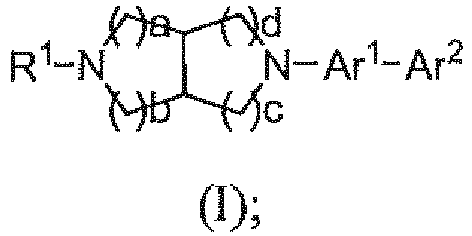
R1 is selected from group consisting of hydrogen, alkyl, cyclic alkyl, haloalkyl, aryl, heteroaryl;
a and c are each independently selected from 0, 1, or 2; b and d are each independently selected from 1, 2, or 3, provided that when both b and d are 1, a and c cannot be 1 simultaneously;
Ar1 is from a 5- or 6-membered aromatic group of formula
X1, X3, X4 are independently selected from group consisting of -CRa,-NRa, -O-, and -S-;
X2 is -C- or -N-, provided that when X2 is -C-, at least one of X1, X3, and X4 is other than -C-;
Ra is selected from group consisting of hydrogen, or alkyl, cyclic alkyl, haloalkyl, alkyl, heteroaryl, halogen, -CO2R1, -COR1, -CONR1, -OR1, and -NR1, wherein R1 is selected from group consisting of hydrogen, alkyl, cyclic alkyl, haloalkyl, aryl, and heteroaryl;
Ar2 is selected from a fused bicyclic aromatic group of formula
Y is selected from group the consisting of -NRd-, -O-, and -S-;
Ra is selected from the group consisting of hydrogen, alkyl, cyclic alkyl, haloalkyl, aryl, heteroaryl, halogen, -CO2R1, -COR1, -CONR1, -OR1, and -NR1; and
Rd is selected from group consisting of hydrogen, alkyl, and cyclic alkyl. - Another aspect of the invention relates to pharmaceutical compositions comprising compounds of the invention. Such compositions can be administered in accordance with a method of the invention, typically as part of a therapeutic regimen for treatment or prevention of conditions and disorders related to nAChR activity, and more particularly α7 nAChR activity, α4β2 nAChR activity, or both α7 nAChR activity and α4β2 nAChR activity.
- Yet another aspect of the invention relates to a method of modulating both α7 and α4β2 nAChR activity. The method is useful for treating, preventing or both treating and preventing conditions and disorders related to both α7 and α4β2 nAChR activity, particularly in mammals.
- A further aspect of the invention relates to a method of selectively modulating nAChR activity, for example α7 nAChR activity. The method is useful for treating, preventing or both treating and preventing conditions and disorders related to α7 nAChR activity in mammals. More particularly, the method is useful for conditions and disorders related to attention deficit disorder, attention deficit hyperactivity disorder (ADHD), Alzheimer's disease (AD), schizophrenia, mild cognitive impairment, age-associated memory impairment (AAMI), senile dementia, AIDS dementia, Pick's Disease, dementia associated with Lewy bodies, dementia associated with Down's syndrome, schizophrenia, amyotrophic lateral sclerosis, Huntington's disease, diminished CNS function associated with traumatic brain injury, acute pain, post-surgical pain, chronic pain, inflammatory pain, neuropathic pain, infertility, lack of circulation, need for new blood vessel growth associated with wound healing, more particularly circulation around a vascular occlusion, need for new blood vessel growth associated with vascularization of skin grafts, ischemia, inflammation, sepsis, wound healing, and other complications associated with diabetes, among other systemic and neuroimmunomodulatory activities.
- A method of selectively modulating nAChR activity, for example a4p2 nAChR activity, also is contemplated.
- The compounds, compositions comprising the compounds, methods for using the compounds, and processes for preparing the compounds, as well as intermediates obtained in such processes, are further described herein.
- As used throughout this specification and in the appended claims, the following terms have the following meanings:
- The term "alkenyl" means a straight or branched chain hydrocarbon containing from 2 to 10 carbons and containing at least one carbon-carbon double bond formed by the removal of two hydrogens. Representative examples of alkenyl include, but are not limited to, ethenyl, 2-propenyl, 2-methyl-2-propenyl, 3-butenyl, 4-pentenyl, 5-hexenyl, 2-heptenyl, 2-methyl-1-heptenyl, and 3-decenyl.
- The term "alkenylene" means a divalent group derived from a straight or branched chain hydrocarbon of from 2 to 10 carbon atoms containing at least one double bond. Representative examples of alkenylene include, but are not limited to, -CH=CH-, - CH=CH2CH2-, and -CH=C(CH3)CH2-.
- The term "alkenyloxy" means an alkenyl group, as defined herein, appended to the parent molecular moiety through an oxygen atom. Representative examples of alkenyloxy include, but are not limited to, allyloxy, 2-butenyloxy and 3-butenyloxy.
- The term "alkoxy" means an alkyl group, as defined herein, appended to the parent molecular moiety through an oxygen atom. Representative examples of alkoxy include, but are not limited to, methoxy, ethoxy, propoxy, 2-propoxy, butoxy, tert-butoxy, pentyloxy, and hexyloxy.
- The term "alkoxyalkoxy" means an alkoxy group, as defined herein, appended to the parent molecular moiety through another alkoxy group, as defined herein. Representative examples of alkoxyalkoxy include, but are not limited to, tert-butoxymethoxy, 2-ethoxyethoxy, 2-methoxyethoxy, and methoxymethoxy.
- The term "alkoxyalkoxyalkyl" means an alkoxyalkoxy group, as defined herein, appended to the parent molecular moiety through an alkyl group, as defined herein. Representative examples of alkoxyalkoxyalkyl include, but are not limited to, tert-butoxymethoxymethyl, ethoxymethoxymethyl, (2-methoxyethoxy)methyl, and 2-(2-methoxyethoxy)ethyl.
- The term "alkoxyalkyl" means an alkoxy group, as defined herein, appended to the parent molecular moiety through an alkyl group, as defined herein. Representative examples of alkoxyalkyl include, but are not limited to, tert-butoxymethyl, 2-ethoxyethyl, 2-methoxyethyl, and methoxymethyl.
- The term "alkoxycarbonyl" means an alkoxy group, as defined herein, appended to the parent molecular moiety through a carbonyl group, as defined herein. Representative examples of alkoxycarbonyl include, but are not limited to, methoxycarbonyl, ethoxycarbonyl, and tert-butoxycarbonyl.
- The term "alkoxycarbonylalkyl" means an alkoxycarbonyl group, as defined herein, appended to the parent molecular moiety through an alkyl group, as defined herein. Representative examples of alkoxycarbonylalkyl include, but are not limited to, 3-methoxycarbonylpropyl, 4-ethoxycarbonylbutyl, and 2-tert-butoxycarbonylethyl.
- The term "alkoxysulfonyl" means an alkoxy group, as defined herein, appended to the parent molecular moiety through a sulfonyl group, as defined herein. Representative examples of alkoxysulfonyl include, but are not limited to, methoxysulfonyl, ethoxysulfonyl and propoxysulfonyl.
- The term "alkyl" means a straight or branched chain hydrocarbon containing from 1 to 10 carbon atoms. Representative examples of alkyl include, but are not limited to, methyl, ethyl, n-propyl, iso-propyl, n-butyl, sec-butyl, iso-butyl, tert-butyl, n-pentyl, isopentyl, neopentyl, n-hexyl, 3-methylhexyl, 2,2-dimethylpentyl, 2,3-dimethylpentyl, n-heptyl, n-octyl, n-nonyl, and n-decyl.
- The term "alkylcarbonyl" means an alkyl group, as defined herein, appended to the parent molecular moiety through a carbonyl group, as defined herein. Representative examples of alkylcarbonyl include, but are not limited to, acetyl, 1-oxopropyl, 2,2-dimethyl-1-oxopropyl, 1-oxobutyl, and 1-oxopentyl.
- The term "alkylcarbonylalkyl" means an alkylcarbonyl group, as defined herein, appended to the parent molecular moiety through an alkyl group, as defined herein. Representative examples of alkylcarbonylalkyl include, but are not limited to, 2-oxopropyl, 3,3-dimethyl-2-oxopropyl, 3-oxobutyl, and 3-oxopentyl.
- The term "alkylcarbonyloxy" means an alkylcarbonyl group, as defined herein, appended to the parent molecular moiety through an oxygen atom. Representative examples of alkylcarbonyloxy include, but are not limited to, acetyloxy, ethylcarbonyloxy, and tert-butylcarbonyloxy.
- The term "alkylene" means a divalent group derived from a straight or branched chain hydrocarbon of from 1 to 10 carbon atoms. Representative examples of alkylene include, but are not limited to, -CH2-, -CH(CH3)-, -C(CH3)2-, -CH2CH2-, -CH2CH2CH2-, -CH2CH2CH2CH2-, and -CH2CH(CH3)CH2-.
- The term "alkylsulfinyl" means an alkyl group, as defined herein, appended to the parent molecular moiety through a sulfinyl group, as defined herein. Representative examples of alkylsulfinyl include, but are not limited to, methylsulfinyl and ethylsulfinyl.
- The term "alkylsulfinylalkyl" means an alkylsulfinyl group, as defined herein, appended to the parent molecular moiety through an alkyl group, as defined herein. Representative examples of alkylsulfinylalkyl include, but are not limited to, methylsulfinylmethyl and ethylsulfinylmethyl.
- The term "alkylsulfonyl" means an alkyl group, as defined herein, appended to the parent molecular moiety through a sulfonyl group, as defined herein. Representative examples of alkylsulfonyl include, but are not limited to, methylsulfonyl and ethylsulfonyl.
- The term "alkylsulfonylalkyl" means an alkylsulfonyl group, as defined herein, appended to the parent molecular moiety through an alkyl group, as defined herein. Representative examples of alkylsulfonylalkyl include, but are not limited to, methylsulfonylmethyl and ethylsulfonylmethyl.
- The term "alkylthio" means an alkyl group, as defined herein, appended to the parent molecular moiety through a sulfur atom. Representative examples of alkylthio include, but are not limited, methylthio, ethylthio, tert-butylthio, and hexylthio.
- The term "alkylthioalkyl" means an alkylthio group, as defined herein, appended to the parent molecular moiety through an alkyl group, as defined herein. Representative examples of alkylthioalkyl include, but are not limited, methylthiomethyl and 2-(ethylthio)ethyl.
- The term "alkynyl" means a straight or branched chain hydrocarbon group containing from 2 to 10 carbon atoms and containing at least one carbon-carbon triple bond. Representative examples of alkynyl include, but are not limited, to acetylenyl, 1-propynyl, 2-propynyl, 3-butynyl, 2-pentynyl, and 1-butynyl.
- The term "alkynylene" means a divalent group derived from a straight or branched chain hydrocarbon of from 2 to 10 carbon atoms containing at least one triple bond. Representative examples of alkynylene include, but are not limited to, -C≡C-, -CH2C≡C-, - CH(CH3)CH2C≡C-, -C≡CCH2-, and -C≡CCH(CH3)CH2-.
- The term "alkynyloxy" means an alkynyl group, as defined herein, appended to the parent molecular moiety through an oxygen atom. Representative examples of alkynyloxy include, but are not limited to, 2-propynyloxy and 2-butynyloxy.
- The term "aryl," means phenyl, a bicyclic aryl or a tricyclic aryl. The bicyclic aryl is naphthyl, a phenyl fused to a cycloalkyl, or a phenyl fused to a cycloalkenyl. Representative examples of the bicyclic aryl include, but are not limited to, dihydroindenyl, indenyl, naphthyl, dihydronaphthalenyl, and tetrahydronaphthalenyl. The tricyclic aryl is anthracene or phenanthrene, or a bicyclic aryl fused to a cycloalkyl, or a bicyclic aryl fused to a cycloalkenyl, or a bicyclic aryl fused to a phenyl. Representative examples of tricyclic aryl ring include, but are not limited to, azulenyl, dihydroanthracenyl, fluorenyl, and tetrahydrophenanthrenyl.
- The aryl groups of this invention can be substituted with 1, 2, 3, 4 or 5 substituents independently selected from alkenyl, alkoxy, alkoxyalkoxy, alkoxyalkoxyalkyl, alkoxyalkyl, alkoxycarbonyl, alkoxycarbonylalkyl, alkyl, alkylcarbonyl, alkylcarbonylalkyl, alkylcarbonyloxy, alkylsulfinyl, alkylsulfinylalkyl, alkylsulfonyl, alkylsulfonylalkyl, alkylthio, alkylthioalkyl, alkynyl, carboxy, carboxyalkyl, cyano, cyanoalkyl, formyl, formylalkyl, halogen, haloalkyl, hydroxy, hydroxyalkyl, mercapto, nitro, -NZ1Z2, and (NZ3Z4)carbonyl.
- The term "arylalkoxy" means an aryl group, as defined herein, appended to the parent molecular moiety through an alkoxy group, as defined herein. Representative examples of arylalkoxy include, but are not limited to, 2-phenylethoxy, 3-naphth-2-ylpropoxy, and 5-phenylpentyloxy.
- The term "arylalkoxycarbonyl" means an arylalkoxy group, as defined herein, appended to the parent molecular moiety through a carbonyl group, as defined herein. Representative examples of arylalkoxycarbonyl include, but are not limited to, benzyloxycarbonyl and naphth-2-ylmethoxycarbonyl.
- The term "arylalkyl" means an aryl group, as defined herein, appended to the parent molecular moiety through an alkyl group, as defined herein. Representative examples of arylalkyl include, but are not limited to, benzyl, 2-phenylethyl, 3-phenylpropyl, and 2-naphth-2-ylethyl.
- The term "arylalkylthio" means an arylalkyl group, as defined herein, appended to the parent molecular moiety through a sulfur atom. Representative examples of arylalkylthio include, but are not limited to, 2-phenylethylthio, 3-naphth-2-ylpropylthio, and 5-phenylpentylthio.
- The term "arylcarbonyl" means an aryl group, as defined herein, appended to the parent molecular moiety through a carbonyl group, as defined herein. Representative examples of arylcarbonyl include, but are not limited to, benzoyl and naphthoyl.
- The term "aryloxy" means an aryl group, as defined herein, appended to the parent molecular moiety through an oxygen atom. Representative examples of aryloxy include, but are not limited to, phenoxy, naphthyloxy, 3-bromophenoxy, 4-chlorophenoxy, 4-mcthylphenoxy, and 3,5-dimethoxyphenoxy.
- The term "aryloxyalkyl" means an aryloxy group, as defined herein, appended to the parent molecular moiety through an alkyl group, as defined herein. Representative examples of aryloxyalkyl include, but are not limited to, 2-phenoxyethyl, 3-naphth-2-yloxypropyl and 3-bromophenoxy methyl.
- The term "arylthio" means an aryl group, as defined herein, appended to the parent molecular moiety through a sulfur atom. Representative examples of arylthio include, but are not limited to, phenylthio and 2-naphthylthio.
- The term "arylthioalkyl" means an arylthio group, as defined herein, appended to the parent molecular moiety through an alkyl group, as defined herein. Representative examples of arylthioalkyl include, but are not limited to, phenylthiomethyl, 2-naphth-2-ylthioethyl, and 5-phenylthiomethyl.
- The term "azido" means a -N3 group.
- The term "carbonyl' means a -C(O)- group.
- The term "carboxy" means a -CO2H group.
- The term "carboxyalkyl" means a carboxy group, as defined herein, appended to the parent molecular moiety through an alkyl group, as defined herein. Representative examples of carboxyalkyl include, but are not limited to, carboxymethyl, 2-carboxyethyl, and 3-carboxypropyl.
- The term "cyano" means a -CN group.
- The term "cyanoalkyl" means a cyano group, as defined herein, appended to the parent molecular moiety through an alkyl group, as defined herein. Representative examples of cyanoalkyl include, but are not limited to, cyanomethyl, 2-cyanoethyl, and 3-cyanopropyl.
- The term "cycloalkenyl" means a cyclic hydrocarbon containing from 3 to 8 carbons and containing at least one carbon-carbon double bond formed by the removal of two hydrogens. Representative examples of cycloalkenyl include, but are not limited to, 2-cyclohexen-1-yl, 3-cyclohexen-1-yl, 2,4-cyclohexadien-1-yl and 3-cyclopenten-1-yl.
- The term "cycloalkyl" as used herein, means a monocyclic, bicyclic, or tricyclic ring system. Monocyclic ring systems are exemplified by a saturated cyclic hydrocarbon group containing from 3 to 8 carbon atoms. Examples of monocyclic ring systems include cyclopropyl, cyclobutyl, cyclopentyl, cyclohexyl, cycloheptyl, and cyclooctyl. Bicyclic ring systems are exemplified by a bridged monocyclic ring system in which two adjacent or non-adjacent carbon atoms of the monocyclic ring are linked by an alkylene bridge of between one and three additional carbon atoms. Representative examples of bicyclic ring systems include, but arc not limited to, bicyclo[3.2.0]heptane, bicyclo[3.3.0]octane, bicyclo[4.3.0]nonane, bicyclo[4.2.0]octane, bicyclo[5.2.0]nonane, bicyclo[5.3.0]decane and bicyclo[4.4.0]decane.
- The cycloalkyl groups of the invention are optionally substituted with 1, 2, 3, 4 or 5 substituents selected from the group consisting of alkenyl, alkoxy, alkoxyalkoxy, alkoxyalkyl, alkoxycarbonyl, alkoxysulfonyl, alkyl, alkylcarbonyl, alkylcarbonyloxy, alkylsulfonyl, alkylthio, alkylthioalkyl, alkynyl, carboxy, cyano, formyl, haloalkoxy, haloalkyl, halogen, hydroxy, hydroxyalkyl, mercapto, oxo, -NZ1Z2, and (NZ3Z4)carbonyl.
- The term "cycloalkylalkyl" means a cycloalkyl group, as defined herein, appended to the parent molecular moiety through an alkyl group, as defined herein. Representative examples of cycloalkylalkyl include, but are not limited to, cyclopropylmethyl, 2-cyclobutylethyl, cyclopentylmethyl, cyclohexylmethyl, and 4-cycloheptylbutyl.
- The term "cycloalkylcarbonyl" means cycloalkyl group, as defined herein, appended to the parent molecular moiety through a carbonyl group, as defined herein. Representative examples of cycloalkylcarbonyl include, but are not limited to, cyclopropylcarbonyl, 2-cyclobutylcarbonyl, and cyclohexylcarbonyl.
- The term "cycloalkyloxy" means cycloalkyl group, as defined herein, appended to the parent molecular moiety through an oxygen atom, as defined herein. Representative examples of cycloalkyloxy include, but are not limited to, cyclopropyloxy, cyclobutyloxy, cyclopentyloxy, cyclohexyloxy, cycloheptyloxy, and cyclooctyloxy.
- The term "cycloalkylthio" means cycloalkyl group, as defined herein, appended to the parent molecular moiety through a sulfur atom, as defined herein. Representative examples of cycloalkylthio include, but are not limited to, cyclopropylthio, cyclobutylthio, cyclopentylthio, cyclohexylthio, cycloheptylthio, and cyclooctylthio.
- The term "ethylenedioxy" means a -O(CH2)2O- group wherein the oxygen atoms of the ethylenedioxy group arc attached to the parent molecular moiety through one carbon atom forming a 5-membered ring or the oxygen atoms of the ethylenedioxy group are attached to the parent molecular moiety through two adjacent carbon atoms forming a 6-membered ring.
- The term "formyl" means a -C(O)H group.
- The term "formylalkyl" means a formyl group, as defined herein, appended to the parent molecular moiety through an alkyl group, as defined herein. Representative examples of formylalkyl include, but are not limited to, formylmethyl and 2-formylethyl.
- The term "halo" or "halogen" means -Cl, -Br, -I or -F.
- The term "haloalkoxy" means at least one halogen, as defined herein, appended to the parent molecular moiety through an alkoxy group, as defined herein. Representative examples of haloalkoxy include, but are not limited to, chloromethoxy, 2-fluoroethoxy, trifluoromethoxy, and pentafluoroethoxy.
- The term "haloalkyl" means at least one halogen, as defined herein, appended to the parent molecular moiety through an alkyl group, as defined herein. Representative examples of haloalkyl include, but are not limited to, chloromethyl, 2-fluoroethyl, trifluoromethyl, pentafluoroethyl, and 2-chloro-3-fluoropentyl.
- The term "heteroaryl," means a monocyclic heteroaryl or a bicyclic heteroaryl. The monocyclic heteroaryl is a 5- or 6-membered ring that contains at least one heteroatom selected from the group consisting of nitrogen, oxygen and sulfur. The 5-membered ring contains two double bonds and the 6-membered ring contains three double bonds. The 5- or 6-membered heteroaryl is connected to the parent molecular moiety through any carbon atom or any substitutable nitrogen atom contained within the heteroaryl, provided that proper valance is maintained. Representative examples of monocyclic heteroaryl include, but are not limited to, furyl, imidazolyl, isoxazolyl, isothiazolyl, oxadiazolyl, oxazolyl, pyridinyl, pyridazinyl, pyrimidinyl, pyrazinyl, pyrazolyl, pyrrolyl, tetrazolyl, thiadiazolyl, thiazolyl, thienyl, triazolyl, and triazinyl. The bicyclic heteroaryl consists of a monocyclic heteroaryl fused to a phenyl, or a monocyclic heteroaryl fused to a cycloalkyl, or a monocyclic heteroaryl fused to a cycloalkenyl, or a monocyclic heteroaryl fused to a monocyclic heteroaryl. The bicyclic heteroaryl is connected to the parent molecular moiety through any carbon atom or any substitutable nitrogen atom contained within the bicyclic heteroaryl, provided that proper valance is maintained. Representative examples of bicyclic heteroaryl include, but are not limited to, azaindolyl, benzimidazolyl, benzofuranyl, benzoxadiazolyl, benzoisoxazole, benzoisothiazole, benzooxazole, 1,3-benzothiazolyl, benzothiophenyl, cinnolinyl, furopyridine, indolyl, indazolyl, isobenzofuran, isoindolyl, isoquinolinyl, naphthyridinyl, oxazolopyridine, quinolinyl, quinoxalinyl and thienopyridinyl.
- The heteroaryl groups of the invention are optionally substituted with 1, 2, 3 or 4 substituents independently selected from the group consisting of alkenyl, alkoxy, alkoxyalkoxy, alkoxyalkyl, alkoxycarbonyl, alkoxycarbonylalkyl, alkoxysulfonyl, alkyl, alkylcarbonyl, alkylcarbonylalkyl, alkylcarbonyloxy, alkylthio, alkylthioalkyl, alkynyl, carboxy, carboxyalkyl, cyano, cyanoalkyl, formyl, haloalkoxy, haloalkyl, halogen, hydroxy, hydroxyalkyl, mercapto, nitro, -NZ1Z2 and (NZ3Z4)carbonyl. Heteroaryl groups of the invention that are substituted with a hydroxyl group may be present as tautomers. The heteroaryl groups of the invention encompass all tautomers including non-aromatic tautomers.
- The term "heteroarylalkoxy" means a heteroaryl group, as defined herein, appended to the parent molecular moiety through an alkoxy group, as defined herein. Representative examples of heteroarylalkoxy include, but are not limited to, fur-3-ylmethoxy, 1H-imidazol-2-ylmethoxy, 1H-imidazol-4-ylmethoxy, 1-(pyridin-4-yl)ethoxy, pyridin-3-ylmethoxy, 6-chloropyridin-3-ylmethoxy, pyridin-4-ylmethoxy, (6-(trifluoromethyl)pyridin-3-yl)methoxy, (6-(cyano)pyridin-3-yl)methoxy, (2-(cyano)pyridin-4-yl)methoxy, (5-(cyano)pyridin-2-yl)methoxy, (2-(chloro)pyridin-4-yl)methoxy, pyrimidin-5-ylmethoxy, 2-(pyrimidin-2-yl)propoxy, thien-2-ylmethoxy, and thien-3-ylmethoxy.
- The term "heteroarylalkyl" means a heteroaryl, as defined herein, appended to the parent molecular moiety through an alkyl group, as defined herein. Representative examples of heteroarylalkyl include, but are not limited to, fur-3-ylmethyl, 1H-imidazol-2-ylmethyl, 1H-imidazol-4-ylmethyl, 1-(pyridin-4-yl)ethyl, pyridin-3-ylmethyl, 6-chloropyridin-3-ylmethyl, pyridin-4-ylmethyl, (6-(trifluoromethyl)pyridin-3-yl)methyl, (6-(cyano)pyridin-3-yl)methyl, (2-(cyano)pyridin-4-yl)methyl, (5-(cyano)pyridin-2-yl)methyl, (2-(chloro)pyridin-4-yl)methyl, pyrimidin-5-ylmethyl, 2-(pyrimidin-2-yl)propyl, thien-2-ylmethyl, and thien-3-ylmethyl.
- The term "heteroarylalkylcarbonyl" means a heteroarylalkyl, as defined herein, appended to the parent molecular moiety through a carbonyl group, as defined herein.
- The term "heteroarylalkylthio" means a heteroarylalkyl group, as defined herein, appended to the parent molecular moiety through a sulfur atom. Representative examples of heteroarylalkylthio include, but are not limited to, fur-3-ylmcthylthio, 1H-imidazol-2-ylmethylthio, 1H-imidazol-4-ylmethylthio, pyridin-3-ylmethylthio, 6-chloropyridin-3-ylmethylthio, pyridin-4-ylmethylthio, (6-(trifluoromethyl)pyridin-3-yl)methylthio, (6-(cyano)pyridin-3-yl)methylthio, (2-(cyano)pyridin-4-yl)methylthio, (5-(cyano)pyridin-2-yl)methylthio, (2-(chloro)pyridin-4-yl)methylthio, pyrimidin-5-ylmethylthio, 2-(pyrimidin-2-yl)propylthio, thien-2-ylmethylthio, and thien-3-ylmethylthio.
- The term "heteroarylcarbonyl" means a heteroaryl group, as defined herein, appended to the parent molecular moiety through a carbonyl group, as defined herein. Representative examples of heteroarylcarbonyl include, but are not limited to, fur-3-ylcarbonyl, 1H-imidazol-2-ylcarbonyl, 1H-imidazol-4-ylcarbonyl, pyridin-3-ylcarbonyl, 6-chloropyridin-3-ylcarbonyl, pyridin-4-ylcarbonyl, (6-(trifluoromethyl)pyridin-3-yl)carbonyl, (6-(cyano)pyridin-3-yl)carbonyl, (2-(cyano)pyridin-4-yl)carbonyl, (5-(cyano)pyridin-2-yl)carbonyl, (2-(chloro)pyridin-4-yl)carbonyl, pyrimidin-5-ylcarbonyl, pyrimidin-2-ylcarbonyl, thien-2-ylcarbonyl, and thien-3-ylcarbonyl.
- The term "heteroaryloxy" means a heteroaryl group, as defined herein, appended to the parent molecular moiety through an oxygen atom. Representative examples of heteroaryloxy include, but are not limited to, fur-3-yloxy, 1H-imidazol-2-yloxy, 1H-imidazol-4-yloxy, pyridin-3-yloxy, 6-chloropyridin-3-yloxy, pyridin-4-yloxy, (6-(trifluoromethyl)pyridin-3-yl) oxy, (6-(cyano)pyridin-3-yl) oxy, (2-(cyano)pyridin-4-yl)oxy, (5-(cyano)pyridin-2-yl)oxy, (2-(chloro)pyridin-4-yl)oxy, pyrimidin-5-yloxy, pyrimidin-2-yloxy, thien-2-yloxy, and thien-3-yloxy.
- The term "heteroaryloxyalkyl" means a heteroaryloxy group, as defined herein, appended to the parent molecular moiety through an alkyl group, as defined herein. Representative examples of heteroaryloxyalkyl include, but are not limited to, pyridin-3-yloxymethyl and 2-quinolin-3-yloxyethyl.
- The term "heteroarylthio" means a heteroaryl group, as defined herein, appended to the parent molecular moiety through a sulfur atom. Representative examples of heteroarylthio include, but are not limited to, pyridin-3-ylthio and quinolin-3-ylthio.
- The term "heteroarylthioalkyl" means a heteroarylthio group, as defined herein, appended to the parent molecular moiety through an alkyl group, as defined herein. Representative examples of heteroarylthioalkyl include, but are not limited to, pyridin-3-ylthiomethyl, and 2-quinolin-3-ylthioethyl.
- The term "heterocycle" or "heterocyclic" means a monocyclic heterocycle, a bicyclic heterocycle or a tricyclic heterocycle. The monocyclic heterocycle is a 3-, 4-, 5-, 6- or 7-membered ring containing at least one heteroatom independently selected from the group consisting of O, N, and S. The 3- or 4-membered ring contains 1 heteroatom selected from the group consisting of O, N and S. The 5-membered ring contains zero or one double bond and one, two or three heteroatoms selected from the group consisting of O, N and S. The 6-or 7-membered ring contains zero, one or two double bonds and one, two or three heteroatoms selected from the group consisting of O, N and S. The monocyclic heterocycle is connected to the parent molecular moiety through any carbon atom or any nitrogen atom contained within the monocyclic heterocycle. Representative examples of monocyclic heterocycle include, but are not limited to, azetidinyl, azepanyl, aziridinyl, diazepanyl, 1,3-dioxanyl, 1,3-dioxolanyl, 1,3-dithiolanyl, 1,3-dithianyl, imidazolinyl, imidazolidinyl, isothiazolinyl, isothiazolidinyl, isoxazolinyl, isoxazolidinyl, morpholinyl, oxadiazolinyl, oxadiazolidinyl, oxazolinyl, oxazolidinyl, piperazinyl, piperidinyl, pyranyl, pyrazolinyl, pyrazolidinyl, pyrrolinyl, pyrrolidinyl, tetrahydrofuranyl, tetrahydrothienyl, thiadiazolinyl, thiadiazolidinyl, thiazolinyl, thiazolidinyl, thiomorpholinyl, 1,1-dioxidothiomorpholinyl (thiomorpholine sulfone), thiopyranyl, and trithianyl, The bicyclic heterocycle is a 5- or 6-membered monocyclic heterocycle fused to a phenyl group, or a 5- or 6-membered monocyclic heterocycle fused to a cycloalkyl, or a 5- or 6-membered monocyclic heterocycle fused to a cycloalkenyl, or a 5- or 6-membered monocyclic heterocycle fused to a monocyclic heterocycle. The bicyclic heterocycle is connected to the parent molecular moiety through any carbon atom or any nitrogen atom contained within the bicyclic heterocycle. Representative examples of bicyclic heterocycle include, but are not limited to, 1,3-benzodioxolyl, 1,3-benzodithiolyl, 2,3-dihydro-1,4-benzodioxnyl, benzodioxolyl, 2,3-dihydro-1-benzofuratiyl, 2,3-dihydro-1-benzothienyl, chromenyl and 1,2,3,4-tetrahydroquinolinyl.
- The heterocycles of this invention are optionally substituted with 1, 2, 3 or 4 substituents independently selected from the group consisting of alkenyl, alkoxy, alkoxyalkoxy, alkoxyalkyl, alkoxycarbonyl, alkoxycarbonylalkyl, alkoxysulfonyl, alkyl, alkylcarbonyl, alkylcarbonylalkyl, alkylcarbonyloxy, alkylthio, alkylthioalkyl, alkynyl, carboxy, carboxyalkyl, cyano, cyanoalkyl, formyl, haloalkoxy, haloalkyl, halogen, hydroxy, hydroxyalkyl, mercapto, and oxo.
- The term "heterocyclealkoxy" means a heterocycle group, as defined herein, appended to the parent molecular moiety through an alkoxy group, as defined herein. Representative examples of heterocyclealkoxy include, but are not limited to, 2-pyridin-3-ylethoxy, 3-quinolin-3-ylpropoxy, and 5-pyridin-4-ylpcntyloxy.
- The term "heterocyclealkyl" means a heterocycle, as defined herein, appended to the parent molecular moiety through an alkyl group, as defined herein.
- The term "heterocyclealkylcarbonyl" means a heterocyclealkyl, as defined herein, appended to the parent molecular moiety through a carbonyl group, as defined herein. Representative examples of heterocyclealkylcarbonyl include, but are not limited to, piperidin-4-ylmethylcarbonyl, piperazin-1-ylmethylcarbonyl, 3-methyl-1-pyrrolidin-1-ylbutylcarbonyl, (1R)-3-methyl-1-pyrrolidin-1-ylbutylcarbonyl, (1S)-3-methyl-1-pyrrolidin-1-ylbutylcarbonyl.
- The term "heterocyclealkylthio" means a heterocyclealkyl group, as defined herein, appended to the parent molecular moiety through a sulfur atom. Representative examples of heterocyclealkylthio include, but are not limited to, 2-pyridin-3-ylethythio, 3-quinolin-3-ylpropythio, and 5-pyridin-4-ylpentylthio.
- The term "heterocyclecarbonyl" means a heterocycle, as defined herein, appended to the parent molecular moiety through a carbonyl group, as defined herein.
- The term "heterocyclecarbonylalkyl" means a heterocyclecarbonyl, as defined herein, appended to the parent molecular moiety through an alkyl group, as defined herein.
- The term "heterocycleoxy" means a heterocycle group, as defined herein, appended to the parent molecular moiety through an oxygen atom. Representative examples of heterocycleoxy include, but are not limited to, pyridin-3-yloxy and quinolin-3-yloxy.
- The term "heterocycleoxyalkyl" means a heterocycleoxy group, as defined herein, appended to the parent molecular moiety through an alkyl group, as defined herein. Representative examples of heterocycleoxyalkyl include, but are not limited to, pyridin-3-yloxymethyl and 2-quinolin-3-yloxyethyl.
- The term "heterocyclethio" means a heterocycle group, as defined herein, appended to the parent molecular moiety through a sulfur atom. Representative examples of heterocyclethio include, but are not limited to, pyridin-3-ylthio and quinolin-3-ylthio.
- The term "heterocyclethioalkyl" means a heterocyclethio group, as defined herein, appended to the parent molecular moiety through an alkyl group, as defined herein. Representative examples of heterocyclethioalkyl include, but are not limited to, pyridin-3-ylthiomethyl, and 2-quinolin-3-ylthioethyl.
- The term "hydroxy" means an -OH group.
- The term "hydroxyalkyl" means at least one hydroxy group, as defined herein, is appended to the parent molecular moiety through an alkyl group, as defined herein. Representative examples of hydroxyalkyl include, but are not limited to, hydroxymethyl, 2-hydroxyethyl, 3-hydroxypropyl, 2,3-dihydroxypentyl, and 2-ethyl-4-hydroxyheptyl.
- The term "hydroxy-protecting group" or "O-protecting group" means a substituent which protects hydroxyl groups against undesirable reactions during synthetic procedures. Examples of hydroxy-protecting groups include, but are not limited to, substituted methyl ethers, for example, methoxymethyl, benzyloxymethyl, 2-methoxyethoxymethyl, 2-(trimethylsilyl)-ethoxymethyl, benzyl, and triphenylmethyl; tetrahydropyranyl ethers; substituted ethyl ethers, for example, 2,2,2-trichloroethyl and t-butyl; silyl ethers, for example, trimethylsilyl, t-butyldimethylsilyl and t-butyldiphenylsilyl; cyclic acetals and kctals, for example, methylene acetal, acetonide and benzylidene acetal; cyclic ortho esters, for example, methoxymethylene; cyclic carbonates; and cyclic boronates. Commonly used hydroxy-protecting groups are disclosed in T.W. Greene and P.G.M. Wuts, Protective Groups in Organic Synthesis, 3rd edition, John Wiley & Sons, New York (1999).
- The term "lower alkenyl" is a subset of alkenyl, as defined herein, and means an alkenyl group containing from 2 to 4 carbon atoms. Examples of lower alkenyl are ethetiyl, propenyl, and butenyl.
- The term " lower alkoxy" is a subset of alkoxy, as defined herein, and means a lower alkyl group, as defined herein, appended to the parent molecular moiety through an oxygen atom, as defined herein. Representative examples of lower alkoxy include, but are not limited to, methoxy, ethoxy, propoxy, 2-propoxy, butoxy, and tert-butoxy.
- The term "lower alkyl" is a subset of alkyl as defined herein and means a straight or branched chain hydrocarbon group containing from 1 to 4 carbon atoms. Examples of lower alkyl are methyl, ethyl, n-propyl, iso-propyl, n-butyl, iso-butyl, sec-butyl, and tert-butyl.
- The term "lower alkylthio" is a subset of alkylthio, means a lower alkyl group, as defined herein, appended to the parent molecular moiety through a sulfur atom. Representative examples of lower alkylthio include, but are not limited, methylthio, ethylthio, and tert-butylthio.
- The term "lower alkynyl" is a subset of alkynyl, as defined herein, and means an alkynyl group containing from 2 to 4 carbon atoms. Examples of lower alkynyl are ethynyl, propynyl, and butynyl.
- The term "lower haloalkoxy" is a subset of haloalkoxy, as defined herein, and means a straight or branched chain haloalkoxy group containing from 1 to 4 carbon atoms. Representative examples of lower haloalkoxy include, but are not limited to, trifluoromethoxy, trichloromethoxy, dichloromethoxy, fluoromethoxy, and pentafluoroethoxy.
- The term "lower haloalkyl" is a subset of haloalkyl, as defined herein, and means a straight or branched chain haloalkyl group containing from 1 to 4 carbon atoms. Representative examples of lower haloalkyl include, but are not limited to, trifluoromethyl, trichloromethyl, dichloromethyl, fluoromethyl, and pentafluoroethyl.
- The term "mercapto" means a -SH group.
- The term "mercaptoalkyl" means a mercapto group, as defined herein, appended to the parent molecular moiety through an alkyl group, as defined herein. Representative examples of mercaptoalkyl include, but are not limited to, 2-mercaptoethyl and 3-mercaptopropyl.
- The term "methylenedioxy" means an -OCH2O- group wherein the oxygen atoms of the methylenedioxy are attached to the parent molecular moiety through two adjacent carbon atoms.
- The term "nitrogen protecting group" means those groups intended to protect an amino group against undesirable reactions during synthetic procedures. Preferred nitrogen protecting groups are acetyl, benzoyl, benzyl, benzyloxycarbonyl (Cbz), formyl, phenylsulfonyl, tert-butoxycarbonyl (Boc), tert-butylacetyl, trifluoroacetyl, and triphenylmethyl (trityl).
- The term "nitro" means a -NO2 group.
- The term "NZ1Z2" means two groups, Z1 and Z2, which are appended to the parent molecular moiety through a nitrogen atom. Z1 and Z2 are each independently selected from the group consisting of hydrogen, alkyl, alkylcarbonyl, alkoxycarbonyl, aryl, arylalkyl, formyl and (NZ5Z6)carbonyl. In certain instances within the invention, Z1 and Z2 taken together with the nitrogen atom to which they are attached form a heterocyclic ring. Representative examples of NZ1Z2 include, but are not limited to, amino, methylamino, acetylamino, acetylmethylamino, phenylamino, benzylamino, azetidinyl, pyrrolidinyl and piperidinyl.
- The term "NZ3Z4" means two groups, Z3 and Z4, which are appended to the parent molecular moiety through a nitrogen atom. Z3 and Z4 are each independently selected from the group consisting of hydrogen, alkyl, aryl and arylalkyl. Representative examples of NZ3Z4 include, but are not limited to, amino, methylamino, phenylamino and benzylamino.
- The term "NZ5Z6" means two groups, Z5 and Z6, which are appended to the parent molecular moiety through a nitrogen atom. Z5 and Z6 are each independently selected from the group consisting of hydrogen, alkyl, aryl and arylalkyl. Representative examples of NZ5Z6 include, but are not limited to, amino, methylamino, phenylamino and benzylamino,
- The term "(NZ3Z4)carbonyl" means a NZ3Z4 group, as defined herein, appended to the parent molecular moiety through a carbonyl group, as defined herein. Representative examples of (NZ3Z4)carbonyl include, but are not limited to, aminocarbonyl, (methylamino)carbonyl, (dimethylamino)carbonyl, and (ethylmethylamino)carbonyl.
- The term "oxo" means a =O moiety.
- The term "sulfinyl" means a -S(O)- group.
- The term "sulfonyl" means a -SO2- group.
- The term "tautomer" means a proton shift from one atom of a compound to another atom of the same compound wherein two or more structurally distinct compounds are in equilibrium with each other.
- Although typically it may be recognized that an asterisk is used to indicate that the exact subunit composition of a receptor is uncertain, for example αb4* indicates a receptor that contains the α and β4 proteins in combination with other subunits, the term α7 as used herein is intended to include receptors wherein the exact subunit composition is both certain and uncertain. For example, as used herein α7 includes homomeric (α7)5 receptors and α7* receptors, which denote a nAChR containing at least one α7 subunit.
- Compounds of the invention have the formula (I)

R1 is selected from group consisting of hydrogen, alkyl, cyclic alkyl, haloalkyl, aryl, and heteroaryl;
a and c are each independently selected from 0, 1, or 2; b and d are each independently selected from 1, 2, or 3, provided that when both b and d are 1, a and c can not be 1 simultaneously;
Ar1 is selected from 5- or 6-membered aromatic group of formula
X1, X3, X4 are independently selected from group consisting of -CRa, -NRa, -O- and -S-;
X2 is -C- or -N-, provided that when X2 is -C-, at least one of X1, X3, X4 is other than -C-;
Ra is selected from group consisting of hydrogen, or alkyl, cyclic alkyl, haloalkyl, aryl, heteroaryl, halogen, -CO2R1, -COR1, -CONR1, -OR1, and -NR1, wherein R1 is selected from group consisting of hydrogen, alkyl, cyclic alkyl, haloalkyl, aryl, and heteroaryl;
Ar2 is selected from a fused bicyclic aromatic group of formula
Y is selected from the group consisting of-NRd-, -O-, and -S-;
Ra is selected from the group consisting of hydrogen, alkyl, cyclic alkyl, haloalkyl, aryl, heteroaiyl, halogen, -CO2R1, -COR1, -CONR1, -OR1, and -NR1; and
Rd is selected from group consisting of hydrogen, alkyl, and cyclic alkyl. - More particularly, compounds of formular (I) are those having fused diazabicycloalkanes of formula (II)

- The variables a and c are each independently selected from 0, 1, 2; b and d are each independently selected from 1, 2, 3. Examples of fused diazabicycloalkanes at least include:




- The Ar1 moiety is independently selected from 5- or 6-membered aromatic group of formula (III) and (IV)


- In Formula (III), A1, A2, A3, A4, are each independently selected from N or CRa, wherein Ra is independently selected from group consisting of hydrogen, alkyl, cyclic alkyl, haloalkyl, aryl, heteroaryl, halogen, -CO2R1, -COR1, -CONR1, -OR1, and -NR1. The moiety is attached to fused diazabicycloalkanes and an Ar2 group by 1,3-substitution or meta-attachment. Preferable, the moiety represented by Formula (III) contains at least one nitrogen atom.
- Formula (IV) represents a 5-membered ring heteroaryl, wherein X1, X3, X4 are independently selected from group consisting of -CRa, -NRa, -O-, and -S-; X2 is -C- and - N-, provided that when X2 is -C-, at least one of X1, X3, X4 is other than -CRa. Wa is independently selected from group consisting of hydrogen, alkyl, cyclic alkyl, haloalkyl, aryl, heteroaryl, halogen, -CO2R1, -COR1, -CONR1, -OR1, and -NR1. The moiety is generally attached to fused diazabicycloalkanes and Ar2 group by 1,3-substitution.
- Examples of specific 6- or 5-membered aromatic rings suitable for Ar1 include imidazolyl, isoxazolyl, isothiazolyl, furyl, oxazolyl, 1,2,4-oxadiazolyl, 1,3,4-oxadiazolyl, phenyl, pyrazolyl, pyridinyl, pyrimidinyl, pyridazinyl, pyrazinyl, thiophenyl, thiazolyl, 1,2,4-thiadiazolyl, and 1,3,4-thiadiazolyl. Preferred Ar1 groups are pyddazinyl, pyridinyl, thiazolyl, 1,3,4-thiadiazolyl, and 1,3,4-oxadiazolyl. Examples of aromatic rings suitable for formula (III) or (IV) at least include:

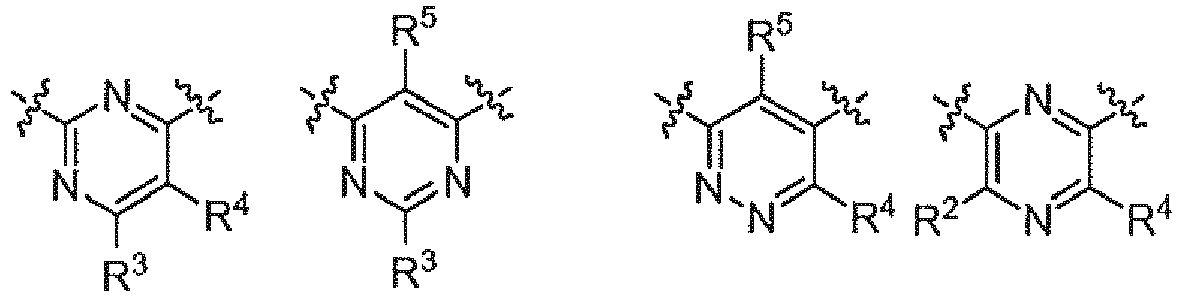


- R2 R3 R4, and R5 are each independently selected from group consisting of hydrogen, alkyl, alkoxy, alkoxycarbonyl, cyano, halo, nitro and -NRbRc; Rb, and Rc are each independently hydrogen, alkyl, alkoxycarbonyl, or alkylcarbonyl.
- The Ar2 moiety is independently selected from a fused bicyclicheteroaryl of formula (V)

- B1, B2, B3, B4, B5, B6 are each independently-N- or -CRa-.
- Y is selected from group consisting of -NRd-, -O-, and -S-.
- Ra is selected from group consisting of hydrogen, or alkyl, cyclic alkyl, haloalkyl, aryl, heteroaryl, halogen, -CO2R1, -COR1, -CONR1, -OR, and -NR1.
- Rd is independently selected from group consisting of hydrogen, alkyl, and cyclic alkyl.
- The moiety Ar2 is attatched to Ar1 group through the C of B1, B2, B3, B4, B5 and B6. Preferably, the moiety represented by Formula (V) contains at least one heteroatom selected from N, O, and S. Examples of specific fused bicyclicheteroaromatic ring suitable for Ar2 include benzofuranyl, benzo[d]imidazolyl, benzo[d]isoxazolyl, benzo[d]isothiazolyl, benzo[d]oxazolyl, benzo[d]thiazolyl, benzo[b]thiophenyl, furo[3,2-b]pyridinyl, furo[3,2-c]pyridinyl, imidazo[4,5-b]pyridinyl, imidazo[4,5-c]pyridine, indolyl, indazolyl, isoxazolo[4,5-b]pyridinyl, isoxazolo[4,5-c]pyridinyl, isoxazolo[5,4-b]pyridinyl, isoxazolo[5,4-c]pyridinyl, isothiazolo[4,5-c]pyridinyl, isothiazolo[4,5-c]pyridinyl, isothiazolo[5,4-b]pyridinyl, isothiazolo[5,4-c]pyridinyl, oxazolo[4,5-b]pyridinyl, oxazolo[4,5-c]pyridinyl, oxazolo[5,4-b]pyridinyl, oxazolo[5,4-c]pyridinyl, pyrazolo[3,4-b]pyridinyl, pyrazolo[3,4-c]pyridinyl, pyrazolo[4,3-b]pyridinyl, pyrazolo[4,3-c]pyridinyl, pyrrolo[2,3-b]pyridinyl, pyrrolo[2,3-c]pyridinyl, pyrrolo[3,2-b]pyridinyl, pyrrolo[3,2-c]pyridinyl, thiazolo[4,5-b]pyridinyl, thiazolo[4,5-c]pyridinyl, thiazolo[5,4-b]pyridinyl, thiazolo[5,4-c]pyridinyl, thieno[2,3-b]pyridinyl, thieno[2,3-c]pyridinyl, thieno[3,2-b]pyridinyl, and thieno[3,2-c]pyridinyl. Examples of suitable Ar2 moieties at least include:


- Ru and Rv are each independently selected from alkoxy, alkyl, cyano, haloalkyl, hydroxy, halogen and NR1.
- The variables m and n are are each independently selected from 0, 1 and 2.
- Specific example of a particular embodiment of the compounds of formula (I) for invention is where the diazabicycloalkane is 3,6-diazabicyclo[3.2.0]heptane, for example:

- R1 is hydrogen, alkyl, cyclic alkyl, or haloalkyl; more preferably hydrogen, alkyl, or cyclic alkyl. Ar1 is oxazolyl, oxadiazolyl, pyridazinyl, pyrazinyl, pyridinyl, thiadiazolyl, or thiazolyl; more preferably pyridinyl, thiadiazolyl or thiazolyl. Ar2 is benzofuranyl, benzo[d]imidazolyl, indolyl, indazolyl or pyrrolopyridinyl, pyrazolopyridinyl, imidazopyridinyl, more preferable indolyl or pyrrolopyridinyl.
- Another example of a particular embodiment of the compounds of formula (I) for invention is where the diazabicycloalkane is 3,8-diazabicyclo[4.2.0]octane, for example:

- R1 is hydrogen, alkyl, cyclic alkyl, haloalkyl; more preferably hydrogen, alkyl, or cyclic alkyl. Ar1 is oxazoleyl, oxadiazolyl, pyridazinyl, pyrazinyl, pyndinyl, thiadiazolyl, or thiazolyl; more preferably pyridinyl, thiadiazolyl or thiazolyl. Ar2 is benzofuranyl, benzo[d]imidazolyl, indolyl, indazolyl pyrrolopyridinyl, pyrazolopyridinyl, or imidazopyridinyl, more preferably indolyl or pyrrolopyridinyl.
- Specific embodiments contemplated as part of the invention include compounds of Formula (I), or salts or prodrugs thereof, for example:
- 5-{5-[(1S,5S)-3,6-diazabicyclo[3.2.0]heptan-3-yl]pyridin-3-yl}-1H-indole;
- 5-{5-[(1S,5S)-6-methyl-3,6-diazabicyclo[3.2.0]heptan-3-yl]pyridin-3-yl}-1H-indole;
- 4-{5-[(1S,5S)-3,6-diazabicyclo[3.2.0]heptan-3-yl]pyridin-3-yl}-1H-indole;
- 4-{5-[(1S,5S)-6-methyl-3,6-diazabicyclo[3.2.0]heptan-3-yl]pyridin-3-yl}-1H-indole;
- 6-{5-[(1S,5S)-3,6-diazabicyclo[3.2.0]heptan-3-yl]pyridin-3-yl}-1H-indole;
- 6-{5-[(1S,5S)-6-methyl-3,6-diazabicyclo[3.2.0]heptan-3-yl]pyridin-3-yl}-1H-indole;
- 5-{5-[(1S,5S)-6-methyl-3,6-diazabicyclo[3.2.0]heptan-3-yl]pyridin-3-yl}-2-(trifluoromethyl)-1H-indole;
- (1S,5S)-3-(5-(benzofuran-5-yl)pyridin-3-yl)-6-methyl-3,6-diazabicyclo[3.2.0]heptane;
- 5-{5-[(1S,5S)-6-methyl-3,6-diazabicyclo[3.2.0]heptan-3-yl]pyridin-3-yl}-1H-indazole;
- (1S,5S)-3-[5-(benzo[b]thiophen-5-yl)pyridin-3-yl]-3,6-diazabicyclo[3.2.0]heptane;
- (1S,5S)-3-[5-(benzo[b]thiophen-5-yl)pyridin-3-yl]-3,6-diazabicyclo[3.2.0]heptane;
- 7-{5-[(1S,5S)-6-methyl-3,6-diazabicyclo[3.2.0]heptan-3-yl]pyridin-3-yl}-1H-indole;
- 5-{5-[(1S,5S)-6-methyl-3,6-diazabicyclo[3.2.0]heptan-3-yl]pyridin-3-yl}-1H-benzo[d]imidazolc;
- 3-methyl-5-{5-[(1S,5S)-6-methyl-3,6-diazabicyclo[3.2.0]heptan-3-yl]pyridin-3-yl}-1H-indole;
- 3-{5-[(1S,5S)-3,6-diazabicyclo[3.2.0]heptan-3-yl]pyridin-3-yl}-9H-carbazole;
- 5-{5-[(1S,5S)-3,6-diazabicyclo[3.2.0]heptan-3-yl]pyridin-3-yl}-3-methyl-1H-indole;
- 3-(5-{(1S,5S)-6-methyl-3,6-diazabicyclo[3.2.0]heptan-3-yl)pyridin-3-yl)-9H-carbazole;
- 7-{5-[(1S,5S)-6-methyl-3,6-diazabicyclo[3.2.0]heptan-3-yl]pyridin-3-yl}-1H pyrrolo[2,3-c]pyridine;
- 5-{5-[(1S,5S)-6-methyl-3,6-diazabicyclo[3.2.0]heptan-3-yl]pyridin-3-yl}-1H-pyrrolo[2,3-b]pyridine;
- 3-{5-[(1S,5S)-6-methyl-3,6-diazabicyclo[3.2.0]heptan-3-yl]pyridin-3-yl}-1-(phenylsulfonyl)-1H-indole;
- 3-(5-((1S,5S)-6-methyl-3,6-diazabicyclo[3.2.0]heptan-3-yl)pyridin-3-yl)-1H-indole;
- d-{6-[(1S,5S)-3,6-diazabicyclo[3.2.0]heptan-3-yl)pyrazin-2-yl}-1H-indole;
- 4-{6-[(1S,5S)-6-methyl-3,6-diazabicyclo[3.2.0]heptan-3-yl]pyrazin-2-yl}-1H-indole;
- 5-{6-[(1S,5S)-6-methyl-3,6-diazabicyclo[3.2.0]heptan-3-yl]pyrazin-2-yl}-1H-indole;
- 6-{6-[(1S,5S)-6-methyl-3,6-diazabicyclo[3.2.0]heptan-3-yl)pyrazin-2-yl}-1H-indole;
- 5-(6-((1S,5S)-6-methyl-3,6-diazabicyclo[3.2.0]heptan-3-yl)pyrazin-2-yl)-2-(trifluoromethyl)-1H-indole
- 5-{5-[(1R,5R)-6-methyl-3,6-diazabicyclo[3.2.0]heptan-3-yl]pyridin-3-yl}-1H-indole;
- 4-{5-[(1R,5R)-6-methyl-3,6-diazabicyclo[3.2.0]heptan-3-yl]pyridin-3-yl}-1H-indole;
- 6-{5-[(1R,5R)-6-methyl-3,6-diazabicyclo[3.2.0]heptan-3-yl]pyridin-3-yl}-1H-indole;
- 5-{5-[(1R,5S)-3,6-diazabicyclo[3.2.0]heptan-6-yl]pyridin-3-yl}-1H-indole;
- 5-{5-[(1R,5S)-3-methyl-3,6-diazabicyclo[3.2.0]heptan-6-yl]pyridin-3-yl}-1H-indole;
- 6-{5-[(1R,5S)-3,6-diazabicyclo[3.2.0]heptan-6-yl]pyridin-3-yl}-1H-indole;
- 6-{5-[(1R,5S)-3-methyl-3,6-diazabicyclo[3.2.0]heptan-6-yl)pyridin-3-yl}-1H-indole;
- 4-(5-((1R,5S)-3-methyl-3,6-diazabicyclo[3.2.0]heptan-6-yl)pyridin-3-yl)-1H-indole;
- 6-{5-[(3aS,6aS)-5-methylhexahydropyrrolo[3,4-b]pyrrol-1(2H)-yl]pyridin-3-yl}-1H-indole; and
- 5-{5-[(3aS,6aS)-5-methylhexahydropyrrolo[3,4-b]pyrrol-1(2H)-yl]pyridin-3-yl}-1H-indole,
- Compounds of the invention can exist as stereoisomers wherein asymmetric or chiral centers are present. These stereoisomers are "R" or "S" depending on the configuration of substituents around the chiral element. The terms "R" and "S" used herein are configurations as defined in IUPAC 1974 Recommendations for Section E, Fundamental Stereochemistry, Pure Appl. Chem., 1976, 45: 13-30. The invention contemplates various stereoisomers and mixtures thereof and is specifically included within the scope of this invention. Stereoisomers include enantiomers, diastereomers, and mixtures of enantiomers or diastereomers. Individual stereoisomers of the invention can be prepared synthetically from commercially available starting materials that contain asymmetric or chiral centers or by preparation of racemic mixtures followed by resolution. These methods of resolution are exemplified by (1) attachment of a mixture of enantiomers to a chiral auxiliary, separation of the resulting mixture of diastereomers by recrystallization or chromatography and optional liberation of the optically pure product from the auxiliary as described in Furniss, Hannaford, Smith, and Tatchell, "Vogel's Textbook of Practical Organic Chemistry", 5th edition (1989), Longman Scientific & Technical, Essex CM20 2JE, England, or (2) direct separation of the mixture of optical enantiomers on chiral chromatographic columns or (3) fractional recrystallization methods.
- As used in the descriptions of the schemes and the examples, certain abbreviations are intended to have the following meanings: Bu for butyl; DMAP for 4-dimethylaminopyridine; DMF for dimethyl formamide; DME for 1,2-dimethoxyethane; Et for ethyl; EtOAc for ethyl acetate; HPLC for high pressure liquid chromatography; Me for methyl; MeOH for methanol; OAc for acctoxy; Pd/C for palladium on carbon; Ph for phenyl; and THF for tetrahydrofuran.
- The reactions exemplified in the schemes are performed in a solvent appropriate to the reagents and materials employed and suitable for the transformations being effected. The described transformations may require modifying the order of the synthetic steps or selecting one particular process scheme over another in order to obtain a desired compound of the invention, depending on the functionality present on the molecule.
- Nitrogen protecting groups can be used for protecting amine groups in the described compounds. Such methods and some suitable nitrogen protecting groups are described in Greene and Wuts (Protective Groups In Organic Synthesis, Wiley and Sons, 1999). For example, suitable nitrogen protecting groups include tert-butoxycarbonyl (Boc), benzyloxycarbonyl (Cbz), benzyl (Bn), acetyl, and trifluoroacetyl. More particularly, the BOC protecting group can be removed by treatment with an acid such as trifluoroacetic acid or hydrochloric acid. The Cbz and Bn protecting groups can be removed by catalytic hydrogenation. The acetyl and trifluoroacetyl protecting groups can be removed by a hydroxide ion.


- Compounds of formula (8), wherein R1, a, b, c, d, A1, A2, A3, A4 and Ar2 are as defined in formula (I), can be prepared as described in Scheme 1. Compounds of formula (1), (either commercially available, or prepared by well-known methods) when treated with a compound of formula (2), wherein Z1 is bromide, chloride, or iodide, and Z2, is bromide, chloride, iodide or Ar2, in the presence of a ligand, such as BINAP, Xantphos, dicyclohexyl(2',4',6'-triisopropylbiphenyl-2-yl)phosphine, dicyclohexyl(2',6'-diisopropoxybiphenyl-2-yl)phosphine and 2'-(dicyclohexylphosphino)-N,N-dimethylbiphenyl-2-amine, and a palladium catalyst, such as Pd(OAc)2, PdCl2(PPh3)2, Pd(PPh3)4, PdCl2(dppf), Pd2(dba)3, (with a base, such as t BuONa and Cs2CO3), in a solvent, such as toluene, at 110 °C as described in Org. Lett., 2005, 7, 3965, provide compounds of formula (3). When Z2 is Ar2, compounds of formula (3) are representative of the invention. When Z2 is a halogen, compounds of formula (3), when treated with hexametlylditin or an organo-borane compound of formula (4), such as bis(pinacolato)diboron or bis(catecholato)diboron, wherein Rm is hydrogen, alkyl or aryl, in the presence of a palladium catalyst, such as PdCl2(PPh3)2, PdCl2(dppf) provide the corresponding tin or boronic acid/esters of formula (5), wherein M is -SnMe3 or -B(ORm)2. Compounds of formula (5) when treated with compounds of formula (6), wherein Ar2 is as defined in formula (I) and halo is bromide, chloride, or iodide, in the presence of a palladium catalyst, such as Pd(OAc)2, PdCl2(PPh3)2, Pd(PPh3)4, PdCl2(dppf), Pd2(dba)3, will provide compounds of formula (8). Alternatively, compounds of formula (6) when treated with hexamethylditin or a di-borane containing compound of formula (4), such as bis(pinacolato)diboron and bis(catecholato)diboron, in the presence of a palladium catalyst, such as PdCl2(PPh3)2, PdCl2(dppf), provide a organotin or organoboronic acid/esters containing compounds of formula (7), wherein Ar2 is as defined in formaul (I), and M is -SnMe3 or -B(ORm)2. Compounds of formula (7) when treated with a compound of formula (3) in the presence of a palladium catalyst, such as Pd(OAc)2, PdCl2(PPh3)2, Pd(PPh3)4, PdCl2(dppf), Pd2(dba)3, provide a compound of formula (8).

- Alternatively, compounds of formula (8), wherein at least one of A1 and A4 is N, R1, a, b, c, d, A2, A3 and Ar2 are as defined in formula (1) can be prepared as described in Scheme 2. Compounds of formula (1), when treated with a compound of formula (2), wherein Z1 is bromide, chloride, or iodide and Z2 is bromide, chloride, iodide or Ar2, in the presence of a base, such as but not limited to, Na2CO3, K2CO3, Cs2CO3 and N, N-diisopropyl ethylamine, in a solvent such as DMSO or NMP at 110 °C provide compounds of formula (3). Compounds of formula (3) can be transformed to compounds of formula (8) as described in Scheme 1.


- Another method of generating compounds of formula (8), wherein at least one of A1 and A4, is N, R1, a, b, c, d, A2, A3 and Ar2 are as defined in formula (I) is described in Scheme 3. Compounds of formula (2), wherein Z1 and Z2 are each independently bromide, chloride, or iodide, when treated with hexamethylditin or an organo-borane compound of formula (4), such as bis(pinacolato)diboron or bis(catecholato)diboron, wherein Rm is hydrogen, alkyl or aryl, in the presence of a palladium catalyst, such as PdCl2(PPh3)2, PdCl2(dppf) provide the corresponding tin or boronic acid/esters of formula (9), wherein M is -SnMe3 of -B(ORm)2. Compounds of formula (9) when treated with compounds of formula (6), wherein Ar2 is as defined and halo is bromide, chloride, or iodide, in the presence of a palladium catalyst, such as Pd(OAc)2, PdCl2(PPh3)2, Pd(PPh3)4, PdCl2(ddpf), Pd2(dba)3, provide compounds of formula (10). Alternatively, compounds of formula (2) when treated with compounds of formula (7) in the presence of a palladium catalyst such as Pd(OAc)2, PdCl2(PPh3)2, Pd(PPh3)4, PdCl2(ddpf), Pd2(dba)3, provide compounds of formula (10). Compounds of formula (10) can be transformed to compounds of formula (8) as described in Schemes 1 and 2.

- Compounds of formula (14), wherein R1, a, b, c, d, X1, X2, X3, X4 and Ar2 are as defined in formula (I), can be prepared as described in Scheme 4. Compounds of formula (1) when treated with a compound of formula (11), wherein Z1 is bromide, chloride, or iodide and Z2 is bromide, chloride, iodide or Ar2, provided that when Z2 is bromide, chloride or iodide, X2 is C, in the presence of a ligand, such as BINAP, Xantphos, dicyclohexyl(2',4',6'-triisopropylbiphenyl-2-yl)phosphine, dicyclohexyl(2',6'-diisopropoxybiphenyl-2-yl)phosphine and 2'-(dicyclohexylphosphino)-N,N-dimethylbiphenyl-2-amine, and a palladium catalyst, such as Pd(OAc)2, PdCl2(PPh3)2, Pd(PPh3)4, PdCl2(dppf), Pd2(dba)3, with a base, such as BuONa and Cs2CO3, in a solvent such as toluene at 110 °C as described in Org. Lett., 2005, 7, 3965, provide compounds of formula (12). When Z2 is Ar2, compounds of formula (12) are representative of the present invention. When Z2 is a halogen, compounds of formula (12) when treated with hexamethylditin or an organo-borane compound of formula (4), such as bis(pinacolato)diboron or bis(catecholato)diboron, wherein Rm is hydrogen, alkyl or aryl, in the presence of a palladium catalyst, such as PdCl2(PPh3)2, PdCl2(dppf) provide the corresponding tin or boronic acid/esters of formula (13), wherein M is -SnMe3 or -B(ORm)2. Compounds of formula (13) when treated with compounds of formula (6), wherein Ar2 is as defined and halo is bromide, chloride, or iodide, in the presence of a palladium catalyst, such as Pd(OAc)2, PdCl2(PPh3)2, Pd(PPh3)4, PdCl2(dppf), Pd2(dba)3, provide compounds of formula (14). Alternatively, compounds of formula (6) when treated with hexamethylditin or a di-borane containing compound of formula (4), such as bis(pinacolato)diboron and bis(catecholato)diboron, in the presence of a palladium catalyst, such as PdCl2(PPh3)2, PdCl2(dppf), will provide an organotin or organoboronic acid/esters containing compounds of formula (7), wherein Ar2 is as defined and M is -SnMe3 or -B(ORm)2. Compounds of formula (7) when treated with a compound of formula (13) in the presence of a palladium catalyst, such as Pd(OAc)2, PdCl2(PPh3)2, Pd(PPh3)4, PdCl2(dppf), Pd2(dba)3, can provide a compound of formula (14).

- Alternatively, compounds of formula (14), wherein at least one of X1 and X4 is N and R1, a, b, c, d, X2, X3, and Ar2 are as previously defined in formula (I), can be prepared as described in Scheme 5. Compounds of formula (1) when treated with a compound of formula (11), wherein Z1 is bromide, chloride, or iodide and Z2 is bromide, chloride, iodide or Ar2, provided that when Z2 is bromide, chloride or iodide, X2 is C, in the presence of a base, such as Na2CO3, K2CO3, Cs2CO3 and N,N-diisopropyl ethylamine, in a solvent such as DMSO or NMP at 110 °C as described provide compounds of formula (12). Compounds of formula (12) can be transformed to compounds of formula (14) as described in Scheme 4.

- Another method of generating compounds of formula (14) wherein at least one of X1 and X4 is N and R1, a, b, c, d, X2, X3, and Ar2 are as previously defined in formula (1) is described in Scheme 6. Compounds of formula (11), wherein Z1 and Z2 are each bromide, chloride, or iodide, and X1, X3 and X4 are as previously defined, when treated with hexamethylditin or an organo-borane compound of formula (4), such as bis(pinacolato)diboron or bis(catecholato)diboron, wherein Rm is hydrogen, alkyl or aryl, in the presence of a palladium catalyst, such as PdCl2(PPh3)2, PdCl2(dppf) provide the corresponding tin or boronic acid/esters of formula (15), wherein M is -SnMe3 or -B(ORm)2. Compounds of formula (15) when treated with compounds of formula (6), wherein Ar2 is as defined if formula (I) and halo is bromide, chloride, or iodide, in the presence of a palladium catalyst, such as Pd(OAc)2, PdCl2(PPh3)2 Pd(PPh3)4, PdCl2(dppf), Pd2(dba)3, provide compounds of formula (16). Altenatively, compounds of formula (11) when treated with compounds of formula (7) in the presence of a palladium catalyst such as Pd(OAc)2, PdCl2(PPh3)2, Pd(PPh3)4, PdCl2(dppf), Pd2(dba)3, provide compounds of formula (16). Compounds of formula (16) can be transformed to compounds of formula (14) as described in Schemes 4 and 5.
- The compounds and intermediates of the invention can be isolated and purified by methods well-known to those skilled in the art of organic synthesis. Examples of conventional methods for isolating and purifying compounds include chromatography on solid supports, such as silica gel, alumina, or silica derivatized with alkylsilane groups; by recrystallization at high or low temperature with an optional pretreatment with activated carbon, thin-layer chromatography, distillation at various pressures; sublimation under vacuum; and trituration, as described for instance in "Vogel's Textbook of Practical Organic Chemistry", 5th edition (1989), by Furniss, Hannaford, Smith, and Tatchell, pub. Longman Scientific & Technical, Essex CM20 2JE, England.
- The compounds of the invention have at least one basic nitrogen whereby the compound can be treated with an acid to form a desired salt. For example, a compound can be reacted with an acid at or above room temperature to provide the desired salt, which is deposited and collected by filtration after cooling. Examples of acids suitable for the reaction include toluenesulfonic, fumaric, trifluoroacetic and the like.
- The compounds of the invention and processes for making these compounds can be better understood by reference to the following Examples, which are intended as an illustration of, and not a limitation upon, the scope of the invention.
- 3,5-dibromopyridine (Aldrich, 2.60 g, 15 mmol) was coupled with (1R,5S)-tert-butyl 3,6-diazabicyclo[3.2.0]heptane-6-carboxylate (
US 2006035936 , 1.98 g, 10 mmol) under the catalysis of Pd2(dba)3 (Aldrich, 183.6 mg, 0.2 mmol) and 2,2'-bis(diphenylphosphino)-1,1'-binaphthyl (Aldrich, 373 mg, 0.6 mmol) in the presence of Cs2CO3 (Aldrich, 6.50 g, 20.0 mmol) in toluene (anhydrous, Aldrich, 50 mL) at 110 °C for 48 h. After the completion of the reaction, the reaction mixture was cooled to ambient temperature and diluted with EtOAc (100 mL). The inorganic solid was filtered off. The organic solution was washed with brine (2 x 20 mL) and concentrated under reduced pressure. The residue was purified with chromatography (SiO2, EtOAc/hexane, v. 50/50, Rf=0.40) to give the title compound (3.05 g, yield, 86%). 1H NMR (300 MHz, CD3OD) δ ppm 1.45 (s, 9 H), 2.95 (dd, J=11.02, 4.24 Hz, 1 H), 3.05 (dd, J=10.51, 6.44 Hz, 1 H), 3.16 - 3.28 (m, 1 H), 3.51 - 3.67 (m, 1 H), 3.79 (d, J=10.51 Hz, 1 H), 3.87 - 3,98 (m, 1 H), 4.03 - 4.19 (m, 1 H), 4.83 - 4.91 (m, Hz, 1 H), 7.40 (t, J=2.20 Hz, 1 H), 7.97 (d, J=1.70 Hz, 1 H) 8.05 (d, J=2.37 Hz, 1 H); MS (DCI/NH3) m/z 354 (M+1)+, 356 (M+1)+. - The product of Example 1A (1.0 g, 2.82 mmol) was coupled with 1H-indol-5-ylboronic acid (Frontier, 677 mg, 4.23 mmol) under the catalysis of Pd2(dba)3 (Aldrich, 18.4 mg, 0.02 mmol) and Pd('Bu3P)2 (Strem Chemicals, 20.5 mg, 0.04 mmol) with CsF (Aldrich, 2.55 g, 17 mmol) in dioxane (50 mL) at 80°C for 15 h. After the reaction was completed, it was cooled to ambient temperature and diluted with EtOAc (100 mL). The mixture was then washed with brine (2 x 20 mL) and concentrated. The residue was purified with chromatography (SiO2 EtOAc/hexane, v. 50/50, Rf=0.40) to give the title compound (1.05 g, yield, 95%). 1H NMR (300 MHz, CD3OD) δ ppm 1.45 [s (br.), 9 H], 2.87 - 2.99 (m, 1 H), 3.05 (dd, J=10.22, 6.56 Hz, 1 H), 3.15-3.30 (m, 2 H), 3.55 - 3.75 (m, 1 H), 3.82 - 3.93 (m, 1 H), 3.96 - 4.26 (m, 3 H), 6.53 (d, J=2.75 Hz, 1 H), 7.28 (d, J=3.05 Hz, 1 H) 7.39 (dd, 1 H) 7.43 (s, 1 H) 7.49 (d, J=8.54 Hz, 1 H) 7.83 (s, 1 H) 8.01 (d, J=2.44 Hz, 1 H) 8.21 (s, 1 H); MS (DCI/NH3) m/z 391(M+1)+.
- The product of Example 1B (500 mg, 1.28 mmol) was treated with 2,2,2-trifluoroacetic acid (Aldrich, 2 mL) in dichloromethane (5.0 mL) at ambient temperature for 10 h. The solution was then concentrated under reduced pressure. The residue was diluted with CHCl3 (50 mL) and washed with saturated Na2CO3 (2 x 5 mL). The organic solution was concentrated, and the residue was purified using chromatography (SiO2, EtOAc/MeOH (with 2 v.% NH3·H2O), 50/50, Rf=0.20) to give the title compound (360 mg, yield, 97.0%). 1H NMR (300 MHz, CD3OD) δ ppm 2.91 - 3.09 (m, 2 H), 3.36 - 3.51 (m, 2 H), 3.69 - 3.83 (m, 2 H), 3.85 - 3.97 (m, 1 H), 4.49 - 4.69 (m, 1 H), 6.55 (t, J=7,36 Hz, 1 H), 6.77 - 6.93 (m, 2 H), 7.00 (t, J=7.21 Hz, 1 H), 7.15 (s, 1 H), 7.25 - 7.40 (m, 2 H), 8.00 (s, 1 H), MS (DCI/NH3) m/z 291(M+1)+.
- The product of Example 1C (360 mg, 1.24 mmol) was treated with p-TsOH·H2O (570 mg, 3.0 mmol) in EtOAc (20 mL) at 80°C for 1 h, then ambient temperature overnight to give the title compound (400 mg, yield, 69.8%). 1H NMR (300 MHz, CD3OD) δ ppm 3.33 (dd, J=12.88, 6.40 Hz, 1 H), 3.44 (dd, J=12.88, 5.09 Hz, 1 H), 3.57-3.64 (m, 1 H), 3.82 (dd, J=11.30, 5.40 Hz, , 1 H), 4.12 (d, J=10.85 Hz, 1 H), 4.28 -4,38 (m, 2H), 5.15 (dd, J=6.78, 5,42 Hz, 1 H), 6.60 (d, J=3.05 Hz, 1 H), 7.19 (d, J=8.14 Hz, 4 H), 7.37 (d, J=3.05 Hz, 1 H), 7.48 - 7.61 (m, 2 H), 7,67 (d, J=8.14 Hz, 4 H), 8.02 (s, 1 H), 8.11 - 8.17 (m, 1 H), 8.22 (d, J=2.71 Hz, 1 H), 8.48 (s, 1 H); MS (DCI/NH3) m/z 291 (M+1)+. Anal. calcd. for C18H18N4·2.00TsOH·0.90H2O: C, 59.60; H, 5.73; N, 8.42. Found: C, 59.26; H, 5.34; N, 8.50.
- The product of Example 1D (200 mg, 0.32 mmol) was treated with formaldehyde (Aldrich, 37%, 33 L, 0.40 mmol) in the presence of NaBH(OAc)3 (Aldrich, 212 mg, 1.0 mmol) in MeCN (3.0 mL) and water (1.0 mL) at ambient temperature for 10 h, The solid was filtered off and the filtrate was dirrectly purified with chromatography (SiO2 EtOAc/MeOH (with 2 v.% NH3·H2O), 50/50, Rf=0.20) to give the title compound (80 mg, yield, 82.0%). 1H NMR (300 MHz, CD3OD) δ ppm 2.62 (s, 3 H), 3.08 (dd, J=11.66, 4.60 Hz, 1 H), 3.19 (dd, J=10.13, 7.06 Hz, 1 H), 3.32 - 3.41 (m, 1 H), 3.59 (dd, J=9.36, 4.14 Hz, 1 H), 3.71 (t, J=8.75 Hz, 1 H), 3.89 (d, J=10.13 Hz, 1 H), 4.01 (d, J=11.66 Hz, 1 H), 4.40 (dd, J=6.75, 4,60 Hz, 1 H), 6.52 (d, J=3.07 Hz, 1 H), 7.29 (d, J=3.07 Hz, 1 H), 7.39 (dd, J=8.29, 1.53 Hz, 1 H), 7.43 - 7.54 (m, 2 H), 7.83 (s, 1 H), 8.03 (d, J=2.45 Hz, 1 H), 8.23 (s, 1 H); MS (DCI/NH3) m/z 305(M+1)+.
- The product of Example 2A (80 mg, 0.26 mmol) was treated with fumaric acid (Aldrich, 58 mg, 0.5 mmol) in EtOAc/EtOH (v. 10/1, 5 mL) at ambient temperature overnight to give the title compound (110 mg, yield, 78.9%). 1H NMR (300 MHz, CD3OD δ ppm 2.97 (s, 3 H) 3.11 (dd, J=8.50, 6.20 Hz1 H), 3.19 (dd, J=12.90, 4.70 Hz, 1 H) 3.46 - 3.64 (m, 1 H), 3.97 - 4.09 (m, 2 H), 4.19 - 4.37 (m, 2 H), 4.93 - 5.02 (m, 1 H), 6.53 (d, J=3.05 Hz, 1 H), 6.76 (s, 5 H), 7.30 (d, J=3.05 Hz, 1 H), 7.41 (dd, J=8.40, 1.70 Hz1 H) 7.51 (d, J=8.20 Hz, 1 H) 7.62 (t, J=2.03 Hz, 1 H), 7.86 (d, J=1.70 Hz, 1 H) 8.15 (d, J=2.37 Hz, 1 H) 8.34 (d, J=1.70 Hz, 1 H); MS (DCI/NH3) m/z 305 (M+1)+. Anal. calcd. for C19H20N4·2.41C4H4O4·2.40H2O: C, 54.83; H, 5.53; N, 8.93. Found: C, 54.41; H, 5.13; N, 9.33.
- The product of Example 1A (240 mg, 0.68 mmol) was coupled with 1H-indol-4-ylboronic acid (Frontier, 164 mg, 1.02 mmol) under the catalysis of Pd(PPh3)4 (Aldrich, 7.8 mg, 0.007 mmol) dioxane (4.0 mL) and K2CO3 aqueous solution (2M, 1.0 mL) at 80 °C for 12 h. After the reaction was completed, it was cooled to ambient temperature and diluted with EtOAc (40 mL). The mixture was then washed with brine (2 x 10 mL) and concentrated. The residue was purified using chromatography (SiO2 EtOAc/hexane, v. 75/25, Rf=0.30) to give the title compound (220 mg, yield, 83%). 1H NMR (300 MHz, CD3OD) δ ppm 1.45 [s (br.), 9 H], 2.98 (dd, J=10.85, 4.41 Hz, 1 H), 3.08 (dd, J=10.51, 6.44 Hz, 1 H), 3.21 - 3.28 (m, 1 H), 3.59 - 3.72 (m, 1 H), 3.87 (d, J=10.17 Hz, 1 H), 3.98 - 4.19 (m, 2 H), 4.78 - 4.93 (m, 1H), 6.59 (d, J=2.71 Hz, 1 H), 7.13 (dd, J=7.40, 2.00 Hz, 1 H), 7.22 (t, J=7.63 Hz, 1 H), 7.32 (d, J=3.39 Hz, 1 H), 7.44 (d, J=8.14 Hz, 1 H), 7.47 - 7.50 (m, 1 H), 8.09 (d, J=2.71 Hz, 1 H), 8.23 (d, J=1.70 Hz, 1 H); MS (DCI/NH3) m/z 391(M+1)+.
- The product of Example 3A (220 mg, 0.56 mmol) was treated with p-TsOH·H2O (235 mg, 1.24 mmol) in EtOAc (20 mL) at 80 °C for 4 h, then ambient temperature overnight to give the title compound (210 mg, yield, 59.1%). 1H NMR (300 MHz, CD3OD) δ ppm 3.33 (dd, J=12.88, 6.40 Hz, 1 H), 3.44 (dd, J=12.88, 5.09 Hz, 1 H), 3.57-3.64 (m, 1 H), 3.82 (dd, J=11.30, 5.40 Hz, , 1 H), 4.12 (d, J=10.85 Hz, 1 H), 4.28 -4.38 (m, 2H), 5.15 (dd, J=6.78, 5.42 Hz, 1 H), 6.60 (d, J=3.05 Hz, 1 H), 7.19 (d, J=8.14 Hz, 4 H), 7.37 (d, J=3.05 Hz, 1 H), 7.48 - 7.61 (m, 2 H), 7.67 (d, J=8.14 Hz, 4 H), 8.02 (s, 1 H), 8.11- 8.17 (m, 1 H), 8.22 (d, J=2.71 Hz, 1 H), 8.48 (s, 1 H); MS (DCI/NH3) m/z 291 (M+1)+, Anal. calcd. for C18H18N4·2.40TsOH·0.80H2O: C, 58.21; H, 5.45; N, 7.80. Found: C, 58.06; H, 5.44; N, 7.67.
- The product of Example 3B (200 mg, 0.32 mmol) was treated with formaldehyde (Aldrich, 37%, 33 µL, 0.40 mmol) according to the procedure of Example 2A. The title compound was purified by preparative HPLC (Gilson, Xterra® column, 7 µm, 40 x 100 mm, eluting solvent, MeCN /H2O (with 0.1 M NH4HCO3/NH4OH, PH=10) (v. 90/10 to 10/90 over 25 minutes), flow rate, 40 mL/min., uv, 254 nm) (60 mg, yield, 62.0%). 1H NMR (300 MHz, CD3OD) δ ppm 2.78 (s, 3 H), 3.10 - 3.22 (m, 2 H), 3.38 - 3.51 (m, 1 H), 3.79 (dd, J=10.17, 4.41 Hz, 1 H), 3.90 - 4.01 (m, 2 H), 4.12 (dd, J=12.50, 7.80 Hz, 1 H), 4.66 (dd, J=7.12, 4.75 Hz, 1 H), 6.59 (d, J=3.05 Hz, 1 H), 7.14 (d, J=7.12 Hz, 1 H), 7.22 (t, J=7.50 Hz,1 H), 7.33 (d, J=3.05 Hz, 1 H), 7.46 (d, J=8.14 Hz, 1 H), 7.54 - 7.61 (m, 1 H), 8.16 (d, J=2.71 Hz, 1 H), 8.30 (d, J=1.70 Hz, 1 H); MS (DCI/NH3) m/z 305(M+1)+.
- The product of Example 4A (50 mg, 0.16 mmol) was treated with TsOH·H2O (Aldrich, 62 mg, 0.33 mmol) in EtOAc/EtOH (v. 10/1, 5 mL) at ambient temperature overnight to give the title compound (45 mg, yield, 43.4%). 1H NMR (300 MHz, Pyridine-D5) δ ppm 2.16 (s, 6 H), 3.04 (s, 3 H), 3.08 (dd, J=12.73, 5.06 Hz, 1 H), 3.09 (dd, J=12.50, 4.90 Hz, 1H), 3.43 - 3.56 (m, 1 H), 3.80 (d, J=10.13 Hz, 1 H), 3.97 (dd, J=10.59, 5.37 Hz, 1 H), 4.45 (t, J=9.67 Hz, 1 H), 4.53 (d, J=12.89 Hz, 1 H),5.23 (t, J=5.40 Hz, 1 H), 6.98 (s, 1 H), 7.15 (d, J=7.80 Hz, 4H), 7.34 - 7.44 (m, 2 H), 7.63 (dt, J=8.90, 2.30 Hz, 1H), 7.72 (dd, J=6.40, 2.8 Hz, 1 H), 8.34 (d, J=8.0 Hz, 4H), 8.52 (d, J=2.50 Hz, 1H), 8.91 (d, J=1.50 Hz, 1 H),12.38 (s, 1 H); MS (DCI/NH3) m/z 305 (M+1)+. Anal. calcd. for C19H20N4·2.25TsOH·1.20H2O: C, 57.96; H, 5.53; N, 8.01. Found: C, 58.14; H, 5.20; N, 7.63.
- The product of Example 1A (240 mg, 0.68 mmol) was coupled with 1H-indol-4-ylboronic acid (Frontier, 164 mg, 1.02 mmol) according to the procedure of Example 3A. The title compound was purified using chromatography (SiO2, EtOAc/hexane, v. 50/50, Rf=0.40) (240 mg, yield, 91%). 1H NMR (300 MHz, CD3OD) δ ppm 1.46 [s (br.), 9 H], 2.96 (dd, J=10.85, 4.07 Hz, 1 H), 3.06 (dd, J=10.17, 6.44 Hz, 1 H), 3.21 - 3.30 (m, 1 H), 3.54 - 3.75 (m, 1 H), 3.88 (d, J=10.17 Hz, 1 H), 3.96 - 4.20 (m, 2 H), 4.85 - 4.90 (m, 1 H), 6.48 (d, J=3.05 Hz, 1 H), 7.26 - 7.36 (m, 2 H), 7.39 - 7.47 (m, 1 H), 7.61 - 7.69 (m, 2 H), 8.03 (d, J=2.37 Hz, 1 H), 8.22 (d, J=1.70 Hz, 1 H); MS (DCI/NH3) m/z 391(M+1)+.
- The product of Example 5A (240 mg, 0.61 mmol) was treated with p-TsOH·H2O (257 mg, 1.35 mmol) in EtOAc (20 mL) at 80°C for 4h, then ambient temperature overnight to give the title compound (230 mg, yield, 59.4%). 1H NMR (400 MHz, Pyridine-D5) δ ppm 2.17 (s, 6 H), 2.91 (dd, J=10.40, 6.20 Hz, 1 H), 2.98 (dd, J=12.20, 4.90 Hz, 1 H), 3.35 - 3.51 (m, 1 H), 3.82 - 3.92 (m, 2H), 4.40 (d, J=12.27 Hz, 1 H), 4.58 (dd, J=10.74, 8.59 Hz, 1 H), 5.47 (dd, J=7.06, 4.91 Hz, 1 H), 6.75 - 6.83 (m, 1 H), 7.17 (d, J=7.67 Hz, 4 H), 7.46 - 7.51 (m, 1 H), 7.56 (dd, J=8.13, 1.69 Hz, 1 H), 7.60 - 7.62 (m, 1 H), 7.92 (d, J=8.29 Hz, 1 H), 8.03 (s, 1 H), 8.36 (d, J=7.98 Hz, 4 H), 8.41 (d, J=2.76 Hz, 1 H), 8.79 (d, J=1.84 Hz, 1 H), 12.26 (s, 1 H); MS (DCI/NH3) m/z 291 (M+1)7+. Anal. calcd. for C18H18N4·2.25TsOH·1.20H2O: C, 57.96; H, 5.53; N, 8.01. Found: C, 58.14; H, 5.20; N, 7.63.
- The product of Example 5B (200 mg, 0.32 mmol) was treated with formaldehyde (Aldrich, 37%, 33 µL, 0.40 mmol) according to the procedure of Example 2A. The title compound was purified by preparative HPLC (Gilson, Xterra® column, 7 µm, 40 x 100 mm, eluting solvent, MeCN /H2O (with 0.1 M NH4HCO3/NH4OH, PH=10) (v. 90/10 to 10/90 over 25 minutes), flow rate, 40 mL/min., uv, 254 nm) (50 mg, yield, 51.8%). 1H NMR (300 MHz, CD3OD) δ ppm 2.39 (s, 3 H) 3.01 (dd, J=11.02, 4.58 Hz, 1 H), 3.17 - 3.29 (m, 3 H), 3.30-3.37 (m, 1H), 3.73 - 3.87 (m, 2 H), 4.01 (dd, J=6.10, 4.41 Hz, 1 H), 4.26 (s, 1H), 7.08 (s, 1 H), 7.22 - 7.29 (m, 1 H), 7.34 - 7.39 (m, 1 H), 7.57 - 7.67 (m, 2 H), 7.96 (d, J=2.37 Hz, 1 H), 8.16 (s, 1 H); MS (DCI/NH3) m/z 305(M+1)+.
- The product of Example 6A (50 mg, 0.16 mmol) was treated with p-TsOH·H2O (Aldrich, 62 mg, 0.33 mmol) in EtOAc/EtOH (v. 10/1, 5 mL) at ambient temperature overnight to give the title compound (55 mg, yield, 74.4%). 1H NMR (300 MHz, CD3OD) δ ppm 1H NMR (400 MHz, Pyridine-D5) δ ppm 2.14 (s, 4.2 H) 2.87 (s, 3 H), 2.91 (dd, J=10.28, 6.60 Hz, 1 H), 2.98 (dd, J=12.43, 4.76 Hz, 1 H), 3.26 - 3.39 (m, 1 H), 3.73 (d, J=10.13 Hz, 1 H), 3.78 (dd, J=10.13, 4.60 Hz, 1 H), 4.11 - 4.21 (m, 1 H), 4.36 (d, J=12.27 Hz, 1 H), 4.61 (s, 1H), 4.84 - 4.97 (m, J=6.14 Hz, 1 H), 7.13 (d, J=7.90 Hz, 2.8H), 7.50 (t, J=2.30 Hz, 1H), 7.54-7.58 (m, 2H), 8.03 - 8.09 (m, 3 H), 8.34 (d, J=7.98 Hz, 2.8 H), 8.83 (d, J=1.90 Hz, 1H), 12.05 (s, 1 H); MS (DCI/NH3) m/z 305 (M+1)+. Anal. calcd. for C19H20N4·1.42TsOH·1.00H2O: C, 61.31; H, 5.93; N, 9.88. Found; C, 61.29; H, 6.11; N, 9.53.
- The product of Example 1A (4.50 g, 12.7 mmol) was treated with HCHO (Aldrich, 37%, 5 mL) in HCO2 (Aldrich, 88%, 30 mL) at 90 °C for 1 h. The solution was then concentrated under reduced pressure. The residue was carefully basified with saturated Na2CO3 to pH9. The mixture was extracted with CHCl3 (3 x 100 mL). The combined extracts were washed with brine (2 x 20 mL) and concentrated. The residue was purified with with chromatography (SiO2 CH2Cl2/MeOH (with 2 v.% NH3·H2O), 90/10, Rf=0.10) to give the title compound (3.36 g, yield, 99%). 1H NMR (300 MHz, CD3OD) δ ppm 2.89 (s, 3 H), 3.09 (dd, J=10.51, 6.44 Hz, 1 H), 3.15 (dd, J=12.89, 4.75 Hz, 1 H), 3.41 - 3.60 (m, 1 H), 3.85 - 3.98 (m, 2 H), 4.09 - 4.25 (m, 2 H), 4.87 - 4.97 (m, 1 H), 7.55 (t, J=2.20 Hz, 1 H), 8.09 (d, J=1,70 Hz, 1 H), 8.17 (d, J=2.37 Hz, 1 H); MS (DCI/NH3) m/z 268 (M+1)+, 270 (M+1)+.
- The product of Example 7A (100 mg, 0.37 mmol) was coupled with 5-(4,4,5,5-tetramethyl-1,3,2-dioxaborolan-2-yl)-2-(trifluoromethyl)-1H-indole (
US 2005043347 , 300 mg, 0.965 mmol) under the catalysis of bis(triphenylphosphine)palladium(II) chloride (Aldrich, 7.0 mg, 0.01 mmol,) and biphenyl-2-yl-dicyclohexyl-phosphane (Strem Chemicals, 10.5 mg, 0.03 mmol) in dioxane/EtOH/Na2CO3 (aq., 1 M) (v. 1/1/1 3 ml) at 130 °C (150 watts max.) for 15 min in an Emry™ Creator microwave. The inorganic solid was filtered off via a syringe filter, and the liquid mixture was purified by preparative HPLC (Gilson, column, Xterra® 5 µm, 40 x 100 mm; eluting solvent, MeCN /H2O (with 0.1% v. TFA) (v. 90/10 to 10/90 over 25 min.), flow rate, 40 mL/min., uv, 254 nm). Fractions of the desired product were collected and concentrated, and the residue was stirred in ether/ethanol (v. 10/1, 5 mL) at room temperature for 16 h to give the title compound (56.1 mg, yield, 22.8%). 1H NMR (300 MHz, CD3OD δ ppm 2.74 - 3.14 (m, 4 H), 3.41 (dd, J=13.2, 4.7 Hz, 1 H), 3.56 - 3.68 (m, 1 H), 4.02 - 4.27 (m, 3 H), 4.39 (d, J=12.9 Hz, 1 H), 5.92-5.05 (m, 1 H), 7.03 (s, 1 H), 7.60 - 7.73 (m, 2 H), 8.05 (s, 1 H), 8.11 (s, 1 H), 8.26 (s, 1 H), 8.51 (s, 1 H); MS (DCI/NH3) m/z 373(M+1)+; Anal. calcd. for C20H19F3N4·2.5C2F3O2H: C, 45.67; H, 3.30; N, 8.52. Found: C, 45.62; H, 3.31; N, 8.47. - The product of Example 7A (100 mg, 0.37 mmol) was coupled with benzofuran-5-ylboronic acid (Maybridge, 150 mg, 0.93 mmol) according to the procedure of Example 7B to give the title compound (156.7 mg, yield, 76.7%). 1H NMR (300 MHz, CD3OD) δ ppm 2.74 - 3.13 (m, 4 H), 3.39 (dd, J=13.1, 4.9 Hz, 1 H), 3.55 - 3.66 (m, 1 H), 4.03 - 4.24 (m, 3 H), 4.40 (d, J=12.9 Hz, 1 H), 4.96 - 5.04 (m, 1 H), 6.97 (d, J=2.0 Hz, 1 H), 7.70 (s, 2 H), 7.88 (d, J=2.0 Hz, 1 H), 7.99 - 8.08 (m, 2 H), 8.29 (s, 1 H), 8.50 (s, 1 H); MS (DCI/NH3) m/z 306 (M+1)+. Anal. calcd. for C19H19N3O·2.1 CF3CO2H: C, 51.15; H, 3.90; N, 7.71. Found: C, 51.14; H, 3.47; N, 7.70.
- 5-bromo-1H-indazole (
US2003199511 , 9.45 g, 48 mmol,) was coupled with bis(pinacolato)diboron (Combi-Blocks, 15.5g, 61 mmol) under the catalysis of Pd(dppf)2Cl2•CH2Cl2 (Aldrich, 985 mg, 1.2 mmol) in the presence of KOAc (Aldrich, 16.7 g, 170 mmol) in dry DMF (160 ml) at 90°C for 24 hours, After the reaction was completed, it was cooled to ambient temperature, diluted with EtOAc (250 mL) and washed with water (2 x 50 mL). The organic phase was concentrated under reduced pressure, and the residue was purified with chromatography (SiO2, Hexane:EtOAc (v. 10:1), Rf=0.6) to give the title compound (9.8 g, yield, 84%). 1H NMR (300 MHz, CD3OD) δ ppm 1.36 (s, 12 H) 7.51 (dt, J=8.5, 1.0 Hz, 1 H) 7.73 (dd, J=8.5, 1.0 Hz, 1 H) 8.08 (d, J=1.0 Hz, 1 H) 8.23 (t, J=1.0 Hz, 1 H); MS (DCI/NH3) m/z 245 (M+1)+. - The product of Example 7A (100 mg, 0.37 mmol) was coupled with the product of Example 9A (200 mg, 0.82 mmol) according to the procedure of Example 7B to give the title compound (128.2 mg, 0.235 mmol, yield, 62.7%). 1H NMR (300 MHz, CD3OD) δ ppm 2.75 - 3.12 (m, 4 H), 3.38 (dd, J=13.1, 4.9 Hz, 1 H), 3.55-3.66 (m, 1 H), 4.05 - 4.23 (m, 3 H), 4.38 (d, J=12.2 Hz, 1 H), 4.96 - 5.06 (m, 1 H), 7.69 - 7.83 (m, 2 H), 8.00 (s, 1 H), 8.18 (d, J=1.0 Hz, 1 H), 8.21 (s, 1 H), 8.29 (m, 1 H), 8.51 (s, 1 H); MS (DCI/NH3) m/z 306 (M+1)+. Anal. calcd. for C18H19N5 2.10 CF3CO2H: C, 48.94; H, 3.90; N, 12.85. Found: C, 48.90; H, 3.73; N, 12.82.
- The product of Example 1A (0.71 g, 2 mmol) was coupled with 4,4,4',4',5,5,5',5'-octamethyl-2,2'-bi(1,3,2-dioxaborolane) (Aldrich, 0.76 g, 3.0 mmol) under the catalysis of {1,1'-bis(diphenylphosphino)-ferrocene]dichloropalladium(II) dichloromethane complex PdCl2(dppf)·CH2Cl2 (Aldrich, 33 mg, 0.04 mmol) with KOAc (Aldrich, 392 mg, 4.0 mmol) in dioxane (anhydrous, 20 mL) at 80 °C for 15h. The solution was then cooled to ambient temperature and diluted with EtOAc (100 mL). The mixture was then washed with brine (2 x 10 mL). The organic solution was concentrated to give the title compound (0.62 g, yield, 96.9%). 1H NMR (300 MHz, CD3OD) δ ppm 1.41 - 1.49 (m, 9 H), 2.98 (dd, J=10.85, 4.07 Hz, 1 H), 3.07 (dd, J=10.25, 6.40 Hz, , 1 H), 3.20 - 3.32 (m, 3 H), 3.52 - 3.67 (m, 1 H), 3.83 (d, .J=10.51 Hz, 1 H), 3.99 (d, J=10.85 Hz, 1 H), 4.10 (t, J=7.80 Hz, 1 H), 7.77 (d, J=2.03 Hz, 1 H), 7.90 (d, J=2.37 Hz, 1 H), 7.98 (s, 1 H); MS (DCI/NH3) m/z 320 (M+1)+.
- The product of example 10A (0.62 g, 1.94 mmol) was treated with p-TsOH·H2O (0.95 g, 5.0 mmol) in EtOH (20 mL) at 80°C for 4 h and cooled to ambient temperature. EtOAc (20 mL) was added. The mixture was stirred at room temperature overnight to give the title compound (1.10 g, Yield, 97.5%). 1H NMR (300 MHz, CD3OD) δ ppm 2.36 (s, 6 H), 3.26 (dd, J=10.50, 6.10 Hz, 1 H), 3.37 (dd, J=12.72, 5.26 Hz, 1 H), 3.52 - 3.66 (m, 1 H), 3.78 (dd, J=11.19, 5.09 Hz, 1 H), 4.03 (d, J=10.85 Hz, 1 H), 4.24 - 4.37 (m, 2 H), 5.13 (dd, J=6.95, 5.26 Hz, 1 H), 7.21 (d, J=7.80 Hz, 4 H), 7.68 (d, J=8.48 Hz, 4 H), 8.13 (d, J=2.37 Hz, 1 H), 8.26 (s, 1 H), 8.30 (d, J=3.05 Hz, 1 H); MS (DCI/NH3) m/z 220 (M+1)+.
- The product of Example 10B (280 mg, 0.50 mmol) was coupled with 5-bromobenzo[b]thiophene (Alfa Aesar, 160 mg, 1.5 mmol) according to the procedure of Example 3A. The free base of the title compound was purified with preparative HPLC (Gilson, Xterra® column, 7 µm, 40 x 100 mm, eluting solvent, MeCN /H2O (with 0.1 M NH4HCO3/NH4OH, PH=10) (v. 90/10 to 10/90 over 25 minutes), flow rate, 40 mL/mm., uv, 254 nm) (40 mg, yield, 26%). The free base (40 mg, 0.13 mmol) was then treated with TsOH·H2O (57 mg, 0.3 mmol) in EtOAc (5.0 mL) at abient temperature overnight to give the title compound (50 mg, yield, 59.4%). 1H NMR (400 MHz, CD3OD) δ ppm 2.35 (s, 6 H), 3.31 - 3.36 (m, 1 H), 3.42 (dd, J=12.72, 5.26 Hz, 1 H), 3.54 - 3.69 (m, 1 H), 3.82 (dd, J=11.02, 5.26 Hz, 1 H), 4.12 (d, J=10.85 Hz, 1 H), 4.27 - 4.33 (m, 1 H), 4.37 (d, J=12.55 Hz, 1 H), 5.15 (dd, J=6.78, 5.43 Hz, 1 H),7.19 (d, J=7.80 Hz, 4 H), 7.51 (d, J=5.43 Hz, 1 H), 7.68 (d, J=8.14 Hz, 4 H), 7.71 - 7.77 (m, 2 H), 8.07 - 8.15 (m, 2 H), 8.28 (d, J=1.70 Hz, 1 H), 8.30 (d, J=2.71 Hz, 1 H), 8.52 (d, J=1.36 Hz, 1 H); MS (DCI/NH3) m/z 308 (M+1)+. Anal. calcd. for C18H17N3S 2.05TsOH·1.60H2O: C, 56.37; H, 5.35; N, 6.10. Found: C, 56.03; H, 5.63; N, 6.10.
- The product of Example 7A (2.50 g, 9.3 mmol) was coupled with 4,4,4',4',5,5,5',5'-octamethyl-2,2'-bi(1,3,2-dioxaborolane) (Aldrich, 2.53 g, 10.0 mmol) under the catalysis of {1,1'-bis(diphenylphosphino)-ferrocene]dichloropalladium(II) dichloromethane complex PdCl2(dppf)•CH2Cl2 (Aldrich, 163 mg, 0.2 mmol) with KOAc (Aldrich, 1.96g, 20.0 mmol) in dioxane (anhydrous, 50 mL) at 80 °C for 15 h. The solution was then cooled to ambient temperature, concentrated and diluted with water (20 mL). The mixture was then extracted with dithyl ether (2 x 10 mL). The aquesous solution was concentrated to give the title compound. 1H NMR (300 MHz, CD3OD) δ ppm 2.95 (dd, J=10.85, 4.41 Hz, 1 H), 3.12 - 3.27 (m, 3 H), 3.31 - 3.39 (m, 1 H), 3.68 - 3.79 (m, 2 H), 4.00 (dd, J=6.44, 4.41 Hz, 1 H), 7.24 (d, J=4.75 Hz, 1 H), 7.87 (dd, J=4.41, 1.36 Hz, 1 H), 8.03 (d, J=2.71 Hz, 1 H); MS (DCI/NH3) m/z 234 (M+1)+.
- The product of Example 11A (117 mg, 0.50 mmol) was coupled with 5-bromobenzo[b]thiophene (Alfa Aesar, 160 mg, 0.75 mmol) according to the procedure of Example 10C to give the title compound (60 mg, yield, 18%). 1H NMR (400 MHz, Pyridine-D5) δ ppm 2.14 (s, 6 H), 2.95 (dd, J=10.13, 6.14 Hz, 1 H), 3.09 (s, 3 H), 3.13 (dd, J=12.89, 4.91 Hz, 1 H), 3.48 - 3.62 (m, 1 H), 3.86 (d, J=10.13 Hz, 1 H), 3.99 - 4.13 (m, 1 H), 4.41 - 4.38 (m, 1 H), 4.68 (d, J=12.89 Hz, 1 H), 5.32 - 5.49 (m, 1 H), 7.13 (d, J=7.98 Hz, 4 H), 7.50 (d, J=5.22 Hz, 1 H), 7.61 (t, J=2.15 Hz, 1 H), 7.69 (d, J=5.22 Hz, 1 H), 7.73 (dd, J=8.29, 1.53 Hz, 1 H), 8.05 (d, J=8.59 Hz, 1 H), 8.27 (d, J=1.53 Hz, 1 H), 8.33 (d, J=7.98 Hz, 4 H), 8.49 (d, J=2.45 Hz, 1 H), 8.74 (d, J=1.53 Hz, 1 H);
- MS (DCI/NH3) m/z 322 (M+1)+. Anal. calcd. for C19H19N3S·2.00TsOH·1.20H2O: C, 57.65; H, 5.48; N, 6.11. Found: C, 57.51; H, 5.24; N, 5.83.
- The product of Example 11A (117 mg, 0.50 mmol) was coupled with 7-bromoindole (Aldrich, 147 mg, 0.75 mmol) according to the procedure of Example 3A. The title compound was purified by preparative HPLC (Gilson, Xterra® column, 7 µm, 40 x 100 mm, eluting solvent, MeCN /H2O (with 0.1 M NH4HCO3/NH4OH, PH=10) (v. 90/10 to 10/90 over 25 minutes), flow rate, 40 mL/min., uv, 254 nm) (40 mg, yield, 26%). 1H NMR (300 MHz, CD3OD) δ ppm 2.42 (s, 3 H), 3.06 (dd, J=11.02, 4.24 Hz, 1 H), 3.20 - 3.28 (m, 2 H), 3.33 - 3.41 (m, 2 H), 3.80 (t, J=10.51 Hz, 2 H), 4.03 (dd, J=6.27, 4.24 Hz, 1 H), 6.53 (d, J=3.05 Hz, 1 H), 7.06 - 7.18 (m, 2 H), 7.26 (d, J=3.39 Hz, 1 H), 7.34 - 7.42 (m, 1 H), 7.59 (dd, J=6.61, 2.20 Hz, 1 H), 8.07 (d, J=2.37 Hz, 1 H), 8.13 (d, J=1.36 Hz, 1 H); MS (DCI/NH3) m/z 305 (M+1)+.
- The product of Example 12A (40 mg, 0.13 mmol) was treated with p-TsOH·H2O (74 mg, 0.39 mmol) in EtOAc (5 mL) at ambient temperature overnight to give the title compound (35 mg, yield, 32.8%). 1H NMR (400 MHz, Pyridine-D5) δ ppm 2.16 (s, 9 H), 2.85 (dd, J=10.13, 6.14 Hz, 1 H), 2.92 - 3.06 (m, 4 H), 3.37 - 3.51 (m, 1 H), 3.81 (d, J=10.13 Hz, 1 H), 3.97 - 4.05 (m, 1 H), 4.28 (t, J=9.36 Hz, 1 H), 4.67 (d, J=12.89 Hz, 1 H), 5.05 - 5.19 (m, 1 H), 6.61 - 6.87 (m, 2 H), 7.15 (d, J=7.67 Hz, 6 H), 7.32 (t, J=7.52 Hz, 1 H), 7.36 - 7.42 (m, 1 H), 7.64 - 7.77 (m, 2 H), 7.87 (d, J=7.98 Hz, 1 H), 8.30 (d, J=7.98 Hz, 6 H), 8.42 (d, J=2.46 Hz, 1 H), 12.00 (s, 1 H); MS (DCI/NH3) m/z 305 (M+1)+. Anal. calcd. for C19H20N4·3.00TsOH·1.00H2O: C, 56.64; H, 5.61; N, 6.77. Found: C, 56.70; H, 5.34; N, 6.97.
- The product of Example 11A (117 mg, 0.50 mmol) was coupled with 7-bromoindole (Aldrich, 147 mg, 0.75 mmol) according to the procedure of Example 12A to give the title compound (80 mg, yield, 52%). 1H NMR (300 MHz, CD3OD) δ ppm 2.41 (s, 3 H), 3.06 (dd, J=11.19, 4.41 Hz, 1 H), 3.22 - 3.28 (m, 2 H), 3.33 - 3.39 (m, 2 H), 4.03 - 4.06 (m, 1 H), 7.37 - 7.42 (m, 1 H), 7.58 (dd, J=8.48, 1.70 Hz, 1 H), 7.72 (d, J=8.48 Hz, 1 H), 7.87 (s, 1 H), 8.03 (d, J=2.71 Hz, 1 H), 8.18 (d, J=1.70 Hz, 1 H), 8.23 (s, 1 H); MS (DCI/NH3) m/z 306 (M+1)+.
- The product of Example 13A (80 mg, 0.26 mmol) was treated with p-TsOH·H2O (114 mg, 0.60 mmol) in EtOAc (5 mL) at ambient temperature overnight to give the title compound (100 mg, yield, 47.5%). 1H NMR (400 MHz, Pyridine-D5) δ ppm 2.16 (s, 6 H), 2.91 (dd, J=10.43, 6.14 Hz, 1 H), 3.03 - 3.12 (m, 4 H), 3.42 - 3.57 (m, 1 H), 3.82 (d, J=10.13 Hz, 1 H), 4.01 (dd, J=10.43, 4.91 Hz, 1 H), 4.33 - 4.51 (m, J=9.21 Hz, 1 H), 4.62 (d, J=12.89 Hz, 1 H), 5.15 - 5.30 (m, 1 H), 7.15 (d, J=7.67 Hz, 4 H), 7.71 (dd, J=8.29, 1.53 Hz, 1 H), 7.84 - 7.95 (m, 1 H), 8.01 (d, J=8.29 Hz, 1 H), 8.29 - 8.37 (m, J=7.98 Hz, 5 H), 8.47 (d, J=2.45 Hz, 1 H), 8.67 (s, 1 H), 8.78 (d, J=1.53 Hz, 1 H); MS (DCI/NH3) m/z 306 (M+1)+. Anal. calcd. for C18H19N5·2.00TsOH·1.50H2O: C, 56.79; H, 5.66; N, 10.35. Found: C, 56.58; H, 5.26; N,10.63.
- The product of Example 11A (117 mg, 0.5 mmol) was coupled with 5-bromo-3-methyl-1H-indole (Aldrich, 210 mg, 1.0 mmol) according to the procedure of Example 7B. After the reaction was completed, the inorganic solid was filtered off via a syringe filter, and the filtrate was purified by preparative HPLC (Gilson, column, Xterra® 7 µm, 40 x 100 mm. eluting solvent, MeCN/H2O (with 0.1M NH4HCO3/NH4OH, pH=10) (v. 90/10 to 10/90 over 25 min.); flow rate, 40 mL/min., uv, 254 nm) to give the free base of the title compound (15 mg, yield, 9.4%), 1H NMR (300 MHz, CD3OD) δ ppm 2.35 (s, 3 H), 2.39 (s, 3 H), 3.03 (dd, J=11.19, 4.41 Hz, 1 H), 3.20 - 3.29 (m, 2 H), 3.31 - 3.39 (m, 2 H), 3.77 - 3.90 (m, 2 H), 4.03 (dd, J=6.27, 4.24 Hz, 2 H), 7.04 (s, 1 H), 7.34 - 7.46 (m, 3 H), 7.74 (s, 1 H), 7.97 (d, J=2.71 Hz, 2 H), 8.17 (d, J=1.70 Hz, 1 H); MS (DCI/NH3) m/z 319 (M+1)+.
- The product of Example 14A (15 mg, 0.047 mmol) was treated with p-TsOH (Aldrich, 19mg, 0.1 mmol) in EtOAc/EtOH(v. 5/1, 5 mL) at room temperaturefor 16 hours to give the title compound (20 mg,yield, 64.3%). 1H NMR (300 MHz, CD3OD) δ ppm 2.33 (s, 6 H), 2.38 (s, 3 H), 3.04 (s, 3 H), 3.35 - 3.49 (m, 2 H), 3.57 - 3.71 (m, 1 H), 4.05 - 4.24 (m, 3 H), 4.45 (d, J=12.9 Hz, 1 H), 5.02 (dd, J=7.1, 4.7 Hz, 1 H), 7.13 (d, J=1.02 Hz, 1 H), 7.18 (d, J=7.8 Hz, 4 H), 7.49 - 7.55 (m, 2 H), 7.67 (d, J=8.1 Hz, 4 H), 7.94 (t, J=1.36 Hz, 1H), 8.12 - 8.33 (m, 2 H), 8.51 (d, J=1.02 Hz, 1H); MS (DCI/NH3) m/z 319 (M+1)+. Anal. calcd. for C20H22N4·2.30C7H8O3S·1.30H2O: C, 58.76; H, 5.87; N, 7.59. Found: C, 58.97; H, 5.52; N, 7.71.
- The product of Example 10B (109 mg, 0.5 mmol) was coupled with 3-bromo-9H-carbazole (Aldrich, 245 mg, 1.0 mmol) according to the procedure of Example 14A to give the free base of the title compound (68 mg, yield, 40%). The free base was then treated with fumaric acid (Aldrich, 23 mg, 0.2 mmol) in EtOAc/EtOH(v. 5/1, 5 mL) at room temperature for 16 hours to give the title compound (64 mg, yield, 72%). 1H NMR (300 MHz, CD3OD) δ ppm 3.12 (dd, J=10.3, 6.3 Hz, 1 H), 3.21 (dd, J=12.2, 5.1 Hz, 1 H), 3.48 - 3.60 (m, 1 H), 3.78 (dd, J=11.2, 5.1 Hz, 1 H), 4.05 (d, J=10.5 Hz, 1 H), 4.22 - 4.33 (m, 2 H), 5.06 (dd, J=7.1, 4.7 Hz, 1 H), 6.68 (s, 1.8 H), 7.19 (ddd, J=7.9, 6.9, 1.2 Hz, 1 H), 7.40 (td, J=7.5, 1.2 Hz, 1 H), 7.45 - 7.51 (m, 1 H), 7.54 - 7.60 (m, 1 H), 7.64 - 7.67 (m, 1 H), 7.67 - 7.72 (m, 1 H), 8.12 - 8.19 (m, 2 H), 8.38 (dd, J=9.7, 1.5 Hz, 2 H); MS (DCI/NH3) m/z 341 (M+1)+. Anal. calcd. for C22H20N4 0.90C4H4O4: C, 69.11; H, 5.35; N, 12.59. Found: C, 68.93; H, 5.40; N, 12.74.
- The product of Example 10B (109 mg, 0.5 mmol) was coupled with 5-bromo-3-methyl-1H-indole (Aldrich, 210 mg, 1.0 mmol) according to the procedure described in Example 7B to give the title compound (90 mg, yield, 30.6%). 1H NMR (300 MHz, CD3OD) δ ppm 2.38 (d, J=1.4 Hz, 3 H), 3.28 - 3.36 (m, 1 H), 3.42 (dd, J=12.7, 5.3 Hz, 1 H), 3.57 - 3.66 (m, 1 H), 3.81 (dd, J=11.4, 5.3 Hz, 1 H), 4.13 (d, J=10.8 Hz, 1 H), 4.28 - 4.39 (m, 2 H), 5.15 (dd, J=7.1, 5.1 Hz, 1 H), 7.12 (q, J=1.0 Hz, 1 H), 7.50 (d, J=1.4 Hz, 2 H), 7.93 (t, J=1.4 Hz, 1 H), 8.11 (dd, J=2.4, 1.7 Hz, 1 H), 8.23 (d, J=2.7 Hz, 1 H), 8.52 (d, J=1.4 Hz, 1 H),; MS (DCI/NH3) m/z 305 (M+1)+. Anal. calcd. for C19H20N4 2.50CF3CO2H: C, 48.90; H, 3.85; N, 9.50. Found: C, 49.13; H, 4.00; N, 9.50.
- The product of Example 11A (117 mg, 0.5 mmol) was coupled with 3-bromo-9H-carbazole (Aldrich, 245 mg, 1.0 mmol) according to the procedure of Example 7B to give the title compound (24.8 mg, yield, 7.3%). 1H NMR (300 MHz, CD3OD) δ ppm 2.77 - 3.12 (m, 4 H), 3.43 (dd, J=13.4, 4.9 Hz, 1 H), 3.56 - 3.66 (m, 1 H), 4.07 - 4.26 (m, 3 H) 4.43 (d, J=12.5 Hz, 1 H), 4.96 -5.05 (m, 1 H), 7.23 (ddd, J=8.0, 7.0, 1.4 Hz, 1 H), 7.44 (ddd, J=8.1, 7.0, 1.2 Hz, 1 H), 7.51 (dt, J=8.1, 1.0 Hz, 1 H), 7.63 (d, J=8.5 Hz, 1 H), 7.80 (dd, J=8.5, 1.7 Hz, 1 H), 8.12 - 8.21 (m, 2 H), 8.25 (s(br), 1 H), 8.53 (s, 1 H), 8.60 (s, 1 H); MS (DCI/NH3) m/z 355 (M+1)+. Anal. calcd. for C23H22N4 2.70CF3CO2H·1.2H2O: C, 49.87; H, 3.99; N, 8.19. Found: C, 49.67; H, 3.86; N, 8.43.
- The product of Example 11A (117 mg, 0.50 mmol) was coupled with 7-bromo-1H-pyrrolo[2,3-c]pyridine(AstaTech, 197mg, 1.0 mmol) according to the procedure of Example 12A to give the title compound (40 mg, yield, 26.1%). 1H NMR (300 MHz, CD3OD) δ ppm 2.41 (s, 3 H), 3.10 (dd, J=11.19, 4.41 Hz, 1 H), 3.20 - 3.28 (m, 1 H), 3.33 - 3.42 (m, 3 H), 3.77 - 3.89 (m, 2 H), 4.04 (dd, J=6.78, 4.41 Hz, 1 H), 6.66 (d, J=3.05 Hz, 1 H), 7.52 - 7.55 (m, 1 H), 7.57 (d, J=3.05 Hz, 1 H), 7.63 (d, J=5.76 Hz, 1 H), 8.13 - 8.23 (m, 2 H), 8.33 (d, J=1.70 Hz, 1 H); MS (DCI/NH3) m/z 306 (M+1)+.
- The product of Example 18A (80 mg, 0.13 mmol) was treated with p-TsOH·H2O (76 mg, 0.40 mmol) in EtOAc (5 mL) at ambient temperature overnight to give the title compound (50 mg, yield, 46.8%). 1H NMR (400 MHz, Pyridine-D5) δ ppm 2.17 (s, 9 H), 2.94 (dd, J=10.43, 6.14 Hz, 1 H), 3.03 - 3.14 (m, 4 H), 3.40 - 3.57 (m, 1 H), 3.94 (d, J=10.13 Hz, 1 H), 4.10 -4.14 (m, 1 H), 4.28 - 4.38 (m, 1 H), 4.78 (d, J=12.89 Hz, 1 H), 5.18 (dd, J=7.06, 4.91 Hz, 1 H), 6.79 (d, J=2.76 Hz, 1 H), 7.16 (d, J=7.98 Hz, 6 H), 7.77 (d, J=5.52 Hz, 1 H), 8.01 (d, J=3.07 Hz, 1 H), 8.06 - 8.11 (m, 1 H), 8.31 (d, J=7.98 Hz, 6 H), 8.47 (d, J=2.46 Hz, 1 H), 8.60 (d, J=5.52 Hz, 1 H), 9.14 (d, J=1.53 Hz, 1 H); MS (DCI/NH3) m/z 306 (M+1)+. Anal. calcd. for C18H19N5·3.05TsOH·2.90H2O: C, 53.53; H, 5.62; N, 7.93. Found: C, 53.17; H, 5.22; N, 7.87.
- 5-Bromo-1H-pyrrolo[2,3-b]pyridine (Alfa Aesar, 1.00 g, 5.0 mmol) was coupled with 4,4,4',4',5,5,5',5'-octamethyl-2,2'-bi(1,3,2-dioxaborolane) (Aldrich, 1.52 g, 6.0 mmol) under the catalysis of {1,1'-bis(diphenylphosphino)-ferrocene]dichloro-palladium(II) dichloromethane complex PdCl2(dppf)·CH2Cl2 (Aldrich, 82 mg, 0.1 mmol) with KOAc (Aldrich, 0.98 g, 10.0 mmol) in dioxane (anhydrous, 20 mL) at 80 °C for 10 h. It was then cooled down to ambient temperature, concentrated and diluted with EtOAc (100 mL). The mixture was then washed with brine (2 x 10 mL). The organic solution was concentrated and the residue was purified using chromatography (SiO2, EtOAc/hexane, v. 50/50, Rf=0.40) to give the title compound (1.15 g, yield, 94.2%). .1H NMR (300 MHz, CD3OD) δ ppm 1.38 (s, 12 H) 6.52 (d, J=3.39 Hz, 1 H) 7.38 (d, J=3.39 Hz, 1 H) 8.34 (d, J=1.70 Hz, 1 H) 8.49 (d, J=1.36 Hz, 1 H); MS (DCI/NH3) m/z 245 (M+1)+.
- The product of Example 19A (244 mg, 1.0 mmol) was coupled with the product of Example 7A (216 mg, 0.8 mmol) according to the procedure of Example 12A to give the title compound (110 mg, yield, 45.1%). 1H NMR (300 MHz, CD3OD) δ ppm 2.40 (s, 3 H), 3.06 (dd, J=11.19, 4.41 Hz, 1 H), 3.20 - 3.29 (m, 2 H), 3.33 - 3.38 (m, 2 H), 3.78 - 3.88 (m, 2 H), 4.03 (dd, J=6.44, 4.07 Hz, 1 H), 6.58 (d, J=3.39 Hz, 1 H), 7.39 (dd, J=2.71, 2.03 Hz, 1 H), 7.45 (d, J=3.39 Hz, 1 H), 8.04 (d, J=2.71 Hz, 1 H), 8.17 (d, J=1.70 Hz, 1 H), 8.27 (d, J=2.03 Hz, 1 H), 8.46 (d, J=2.03 Hz, 1 H); MS (DCI/NH3) m/z 306 (M+1)+.
- The product of Example 19B (110 mg, 0.36 mmol) was treated with p-TsOH-H2O (76 mg, 0.40 mmol) in EtOAc (5 mL) at ambient temperature overnight to give the title compound (170 mg, yield, 99.0%). 1H NMR (300 MHz, CD3OD) δ ppm 2.34 (s, 4.5 H), 3.02 (s, 3 H), 3.10 - 3.26 (m, 2 H), 3.48 - 3.69 (m, 2 H), 4.00 - 4.21 (m, 2 H), 4.33 (d, J=13.90 Hz, 1 H), 4.89 - 5.07 (m, 1 H), 6.60 (d, J=3.73 Hz, 1 H), 7.20 (d, J=8.14 Hz, 3 H), 7.48 (d, J=3.73 Hz, 1 H), 7.65 - 7.76 (m, 4 H), 8.19 - 8.27 (m, 1 H), 8.32 (d, J=2.03 Hz, 1 H), 8.39 (d, J=1.70 Hz, 1 H), 8.50 (d, J=2.03 Hz, 1 H); MS (DCI/NH3) m/z 306 (M+1)+, Anal. calcd. for C18H19N5·1.45TsOH 0.75H2O: C, 59.53; H, 5.70; N, 12.39. Found: C, 59.93; H, 5.81; N, 12.00.
- The product of Example 7A (120 mg, 0.45 mmol) was coupled with 1-(phenylsulfonyl)-1H-indol-3-ylboronic acid (Aldrich, 350 mg, 1.16 mmol) according to the procedure of Example 7B to give the title compound (300 mg, yield, 92.8%). 1H NMR (300 MHz, CD3OD) δ ppm 2.74 - 2.88 (m, 1 H), 3.03 (s, 3 H), 3.33 - 3.40 (m, 1 H), 3.54 - 3.66 (m, 1 H), 4.02 - 4.24 (m, 3 H), 4.35 (d, J=12.5 He, 1 H), 4.95 - 5.04 (m, 1 H), 7.34 - 7.41 (m, 1 H), 7.46 (td, J=7.8, 1.4 Hz, 1 H), 7.51 - 7.59 (m, 2 H), 7.62 - 7.69 (m, 1 H), 7.82 (d, J=7.5 Hz, 1 H), 7.92 (s, 1 H), 8.01 - 8.07 (m, 2 H), 8.11 (d, J=8.1 Hz, 1 H), 8.20 (s, 1 H), 8.29 (s, 1 H), 8.47 (s, 1 H); MS (DCI/NH3) m/z 445 (M+1)+. Anal. calcd. for C25H24N4O2S 2.40CF3CO2H: C, 49.84; H, 3.70; N, 7.80. Found: C, 49.85; H, 3.76; N, 7.71.
- The product of Example 20 (250 mg, 0.35 mmol) was treated with KOH (0.15 g, 2.68 mmol) in methanol (8 mL) at 50°C for 2 hours. After being concentrated, the mixture was purified by preparative HPLC (Gilson, column, Xterra® 5 µm, 40 x 140 mm. Eluting Solvent, MEON /H2O (with 0.1% v. TFA) (v. 90/10 to 10/90 over 25 min.), flow rate, 40 mL/min., uv, 254 nm). Fractions of the desired product were collected and concentrated. The residue was stirred in ether/ethanol (v. 10/1, 5 mL) at room temperature for 16 hours to give the title compound (128.4 mg, yield, 62.5%). 1H NMR (300 MHz, CD3OD) δ ppm 2.76 - 2.86 (m, 1 H), 3.04 (s, 3 H), 3.42 (dd, J=13.1, 4.9 Hz, 1 H), 3.56 - 3.65 (m, 1 H), 4.03 - 4.25 (m, 3 H), 4.39 (d, J=11.9 Hz, 1 H), 4.95 -5.03 (m, 1 H), 7.18 - 7.30 (m, 2 H), 7.52 (dd, J=7.0, 1.5 Hz, 1 H), 7.88 (s, 1 H), 7.90 - 7.96 (m, 1 H), 8.10 [s(br), 1 H], 8.15 [s(br), 1 H], 8.53 (s, 1 H); MS (DCI/NH3) m/z 305 (M+1)+. Anal. calcd. for C19H20N4·2.50CF3CO2H: C, 48.90; H, 3.85; N, 9.50. Found: C, 48.98; H, 3.62; N, 9.67.
- (1R,5S)-tert-Butyl 3,6-diazabicyclo[3.2.0]heptane-6-carboxylate (
US 2006035936 , 0.99 g, 5.0 mmol) was coupled with 2,6-dichloropyrazine (Aldrich, 1.12 g, 7.5 mmol) with Na2CO3 (Aldrich, 1,06 g, 10 mmol) in DMSO (5 .0 mL) at 110 °C for 10 h. After the reaction was completed, it was then diluted with EtOAc (50 mL) and washed with brine (2 x 10 mL). The organic solution was then concentrated, and the residue was purified using chromatography (SiO2, EtOAc/hexane, v. 50/50, Rf=0.10) to give the title compound (1.32 g, yield, 84.9%). 1H NMR (300 MHz, CD3OD) δ ppm 1.44 (s, 9 H), 3.13 - 3.29 (m, 2 H), 3.31-3.35 (m, 1 H), 3.46 - 3.63 (m, 1 H), 4.02 (d, J=10.85 Hz, 1 H), 4.06 - 4.15 (m, 2 H), 4.19 (d, J=12.55 Hz, 1 H), 4.83 - 4.86 (m, 1 H), 7.80 (s, 1 H), 7.97 (s, 1 H); MS (DCI/NH3) m/z 311 (M+1)+, 313 (M+1)+. - The product of Example 22A (103 mg, 0.3 mmol) was coupled with 1H-indol-4-ylboronic acid (Frontier, 80 mg, 0.5 mmol) according to the procedure of Example 12A. After the reaction was completed, it was concentrated, and the residue was treated with trifluroacetic acid (2 mL) at ambient temperature for 1.0 h. After being concentrated, the crude mixture was purified using preparative HPLC (Gilson, Xterra® column, 7 µm, 40 x 100 mm, eluting solvent, MeCN /H2O (with 0.1 M NH4HCO3/NH4OH, PH=10) (v. 90/10 to 10/90 over 25 minutes), flow rate, 40 mL/min., uv, 254 nm) to give the title compound (30 mg, yield, 32.8%). 1H NMR (300 MHz, CD3OD) δ ppm 3.32 - 3.50 (m, 4 H), 3.96 (t, J=8.31 Hz, 1 H), 4.08 - 4.26 (m, 2 H), 4.64 - 4.75 (m, 1 H), 7.07 (dd, J=3,22, 0.85 Hz, 1 H), 7.19 - 7.26 (m, 1 H), 7.35 (d, J=3,39 Hz, 1 H), 7.50 (dt, J=8.14, 0.85 Hz, 1 H), 7.56 (dd, J=7,46, 1.02 Hz, 1 H), 7.99 (s, 1 H), 8.38 (s, 1 H); MS (DCI/NH3) m/z 292 (M+1)+.
- The product of Example 22B (30 mg, 0.10 mmol) was treated with p-TsOH•H2O (38 mg, 0.20 mmol) in EtOAc (5 mL) at ambient temperature overnight to give the title compound (65 mg, yield, 99.0%). 1H NMR (500 MHz, Pyridine-D5) δ ppm 2.17 (s, 6 H), 3.27 (dd, J=10.98, 6.41 Hz, 1 H), 3.39 (dd, J=13.12, 5,19 Hz, 1 H), 3.47-3.59 (m, 1 H), 3.96 (dd, J=10.98, 5.19 Hz, 1 H), 4.23 (d, J=11.29 Hz, 1 H), 4.67 (dd, J=10.83, 8.70 Hz, 1 H), 4.79 (d, J=13.43 Hz, 1 H), 5.53 (dd, J=6.71, 5.19 Hz, 1 H), 7.18 (d, J=7.93 Hz, 4 H), 7.40 - 7.49 (m, 2 H), 7.71 (t, J=2.75 Hz, 1 H), 7.79 (d, J=7.93 Hz, 1 H), 7.89 (d, J=7.02 Hz, 1 H), 8.22 (s, 1 H), 8.39 (d, J=8.24 Hz, 4 H), 8.94 (s, 1 H), 12.46 (s, 1 H); MS (DCI/NH3) m/z 292 (M+1)+. Anal. calcd. for C17H17N5·2.00TsOH 0.85H2O: C, 57.19; H, 5.37; N, 10.76. Found: C, 57.38; H, 5.29; N, 11.04.
- The product of Example 22A (1.30 g, 4.18 mmol) was treated with p-TsOH·H2O (1.78 g, 9.36 mmol) in EtOAc (30 mL) at 80 °C for 2 h to give the title compound (1.50 g, yield, 93.4%). 1H NMR (300 MHz, CD3OD) δ ppm 2.38 (s, 3H), 3.33 (dd, J=11.60, 6.50 Hz, 1 H), 3.44 (dd, J=13.73, 5.26 Hz, 1 H), 3.50 - 3.63 (m, 1 H),3.72 (dd, J=11.02, 5.26 Hz, 1 H), 4.12 (d, J=11.87 Hz, 1 H), 4.26 (dd, J=11.02, 8.65 Hz, 1 H), 4,39 (d, J=13.56 Hz, 1 H), 5.03 - 5.15 (m, 1 H), 7.23 (d, J=7,80 Hz, 2 H), 7.69 (d, J=8.48 Hz, 2 H), 7.95 (s, 1 H), 8.11 (s, 1 H); MS (DCI/NH3) m/z 211 (M+1)+, 213 (M+1)+.
- The product of Example 23A (1.30 g, 4.18 mmol) was treated with with formaldehyde in the presence of NaBH(OAc)3 according to the procedure of Example 2A to give the title compound (1.50 g, yield, 93.4%). 1H NMR (300 MHz, CD3OD) δ ppm 2.66 (s, 3 H), 3.32 - 3.52 (m, 3 H), 3.53 - 3.64 (dd, J=9.50, 3.80 Hz, 1 H), 3.61 - 3.76 (m, 1 H), 3.99 (d, J=11.19 Hz, 1 H), 4.15 (d, J=13.22 Hz, 1 H), 4.44 (dd, J=6.78, 4.75 Hz, 1 H), 7.84(s, 1 H), 7.99 (s, 1 H); MS (DCI/NH3) m/z 225 (M+1)+, 227 (M+1)+.
- The product of Example 23B (112 mg, 0.5 mmol) was coupled with 1H-indol-4-ylboronic acid (Frontier, 160 mg, 1.0 mmol) according to the procedure of Example 12A to give the title compound (140 mg, yield, 92.0%). 1H NMR (300 MHz, CD3OD) δ ppm 2.40 (s, 3 H), 3.18 - 3.38 (m, 4 H), 3.61 (dd, J=11.19, 8.14 Hz, 1 H), 4.00 - 4.08 (m, 3 H), 7.06 (dd, J=3.22, 0.85 Hz, 1 H), 7.18 - 7.26 (m, 1 H), 7.34 (d, J=3.39 Hz, 1 H), 7.47 - 7.52 (m, 1 H), 7.49 (d, J=8.14 Hz, 1 H), 7.91 (s, 1 H), 8.32 (s, 1 H); MS (DCI/NH3) m/z 306(M+1)+.
- The product of Example 23C (140 mg, 0.46 mmol) was treated with p-TsOH•H2O (190 mg, 1.0 mmol) in EtOAc (10 mL) at ambient temperature overnight to give the title compound (170 mg, yield, 56.9%). 1H NMR (300 MHz, CD3OD) δ ppm 2.31 (s, 6 H), 3.04 (s, 3 H), 3.55 - 3.77 (m, 3 H), 4.15 - 4.22 (m, 2 H), 4.32 (d, J=11.19 Hz, 1 H), 4.72 (d, J=14.24 Hz, 1 H), 5.03 (dd, J=6.95, 4.92 Hz, 1 H), 6.57 (d, J=3.05 Hz, 1H), 7.17 (d, J=7.80 Hz, 4 H), 7.24 - 7.33 (m, 1 H), 7.44 - 7.48 (m, 1 H), 7.61 - 7.68 (m, 5 H), 7.72 (d, J=7.46 Hz, 1 H), 8.12 (s, 1 H), 8.53 (s, 1 H); MS (DCI/NH3) m/z 306 (M+1)+. Anal. calcd. for C18H19N5·2.08TsOH 1.70H2O: C, 56.34; H, 5.67; N, 10.09. Found: C, 56.66; H, 5.39; N, 9.70.
- The product of Example 23B (112 mg, 0.5 mmol) was coupled with 1H-indol-5-ylboronic acid (Frontier, 160 mg, 1.0 mmol) according to the procedure of Example 12A to give the title compound (120 mg, yield, 78.7%). 1H NMR (300 MHz, CD3OD) δ ppm 3.20 - 3.39 (m, 4 H), 3.58 (dd, J=11.53, 8.14 Hz, 1 H), 4.00 -4.08 (m, 3 H), 6.54 (d, J=2.37 Hz, 1 H), 7.28 (d, J=3.05 Hz, 1 H), 7.46 (d, J=8.82 Hz, 1 H), 7.81 - 7.88 (m, 2 H), 8.29 - 8.30 (m, 1 H), 8.31 (s, 1 H); MS (DCI/NH3) m/z 306(M+1)+.
- The product of Example 24A(120 mg, 0.39 mmol) was treated with p-TsOH•H2O (950 mg, 0.5 mmol) in EtOAc (10 mL) at ambient temperature overnight to give the title compound (170 mg, yield, 91,4%). 1H NMR (300 MHz, CD3OD) δ ppm 2.34 (s, 4.5 H), 3.05 (s, 3 H), 3,41 - 3.72 (m, 3 H), 4.09-4.19 (m, 2 H), 4.27 (d, J=11.53 Hz, 1 H), 4.67 (d, J=13.90 Hz, 1 H), 4.99 (dd, J=7.29, 4.92 Hz, 1 H), 6.57 (d, J=3.05 Hz, 1 H), 7.19 (d, J=8.14 Hz, 3 H) 7.32 (d, J=3.05 Hz, 1 H), 7.50 (d, J=8.82 Hz, 1 H), 7.68 (d, J=8.14 Hz, 3 H), 7.91 (dd, J=8.48, 1.70 Hz, 1 H), 8.04 (s, 1 H), 8.39 (s, 1 H), 8.53 (s, 1 H); MS (DCT/NH3) m/z 306 (M+1)+. Anal. calcd. for C18H19N5·1.49TsOH 1.00H2O: C, 58.88; H, 5.72; N, 12.08. Found: C, 58.85; H, 5.23; N, 11.68.
- The product of Example 23B (112 mg, 0.5 mmol) was coupled with 1H-indol-6-ylboronic acid (Frontier, 160 mg, 1.0 mmol) according to the procedure of Example 12A to give the title compound (80 mg, yield, 52.4%). 1H NMR (300 MHz, CD3OD) δ ppm 2.40 (s, 3 H), 3.20 - 3.28 (m, 2 H), 3.32 - 3.41 (m, 2 H), 3.59 (dd, J=11.53, 8.14 Hz, 1 H), 3.97 - 4.13 (m, 3 H), 6.48 (dd, J=3.22, 0.85 Hz, 1 H), 7.32 (d, J=3.05 Hz, 1 H), 7.62 (d, J=7.80 Hz, 1 H) 7.74 (dd, J=8.50, 1.70 Hz, 1 H), 7.85 (s, 1 H), 8.15 (s, 1 H,) 8.32 (s, 1 H); MS (DCI/NH3) m/z 306(M+1)+.
- The product of Example 25A(80 mg, 0.26 mmol) was treated with p-TsOH·H2O (114 mg, 0.6 mmol) in EtOAc (10 mL) at ambient temperature overnight to give the title compound (120 mg, yield, 70.6%). 1H NMR (300 MHz, CD3OD) δ ppm 2.30 s, 6 H), 3.04 (s, 3 H), 3.55 - 3.67 (m, 3 H), 4.14 - 4.21 (m, 2 H), 4.31 (d, J=11.53 Hz, 1 H), 4.72 (d, J=14.24 Hz, 1 H), 5.03 (dd, J=7.12, 5.09 Hz, 1 H), 6.55 (d, J=3.05 Hz, 1 H) 7,17 (d, J=8.48 Hz, 4 H), 7.41 - 7.47 (m, 1 H), 7.66 (d, J=8.14 Hz, 4 H), 7.70 (d, J=8.48 Hz, 1 H), 7.82 (dd, J=8.40, 1.40 Hz, 1 H), 8.06 (s, 1 H), 8.24 (s, 1 H), 8.51 (s, 1 H); MS (DCI/NH3) m/z 306 (M+1)+. Anal. calcd. for C18H19N5·2.00TsOH·0.70H2O: C, 58.02; H, 5.54; N, 10.57. Found: C, 57.71; H, 5.24; N,10.35.
- The product of Example 23B (105 mg, 0.469 mmol) was coupled with 5-(4,4,5,5-tetramethyl-1,3,2-dioxaborolan-2-yl)-2-(trifluoromethyl)-1H-indole (
US 2005043347 , 225 mg, 0.723 mmol) according to the procedure of Example 14A to give the free base of title compound (15 mg, yield, 10%). The free base (15 mg, 0.04 mmol) was treated with fumaric acid (12 mg, 0.1 mmol) in ether/ethanol (v. 10/1,5 mL) at room temperature for 16 hours give the title compound (17.8 mg, yield, 53.3%). 1H NMR (300 MHz, CD3OD) δ ppm 2.96 (s, 3 H), 3.37 (dd, J=11.2, 6.4 Hz, 1 H), 3.46 (dd, J=13.9, 4.7 Hz, 1 H), 3.59 (dt, J=13.6, 6.9 Hz, 1 H), 3.99 (dd, J=11.2, 5.1 Hz, 1 H), 4.19 - 4.28 (m, 2 H), 4.64 (d, J=13.9 Hz, 1 H), 4.97 (dd, J=7.0, 4.9 Hz, 1 H), 6,98 - 7.01 (m, 1 H), 7.56 (d, J=8.8 Hz, 1 H), 8.03 - 8.10 (m, 2 H), 8.45 (d, J=1.0 Hz, 1 H), 8.54 (s, 1 H),; MS (DCI/NH3) m/z 374 (M+1)+; Anal. calcd. for C19H18F3N5·2.33C4O4H4 1.20H2O·: C, 51.12; H, 4.50; N, 10.52. Found: C, 51.51; H, 4.13; N, 10.14, - 3,5-Dibromopyridine (Aldrich, 1.00 g, 4.5 mmol) was coupled with (1S,5R)-tert-butyl 3,6-diazabicyclo[3.2.0]heptane-6-carboxylate (
WO 2001081347 , 0.60 g, 3 mmol) accoding to the procedure of Example 1A to give the title compound (0.55 g, yield, 50%). 1H NMR (300 MHz, CD3OD) δ ppm 1.45 (s, 9 H), 2.95 (dd, J=11.19, 4.41 Hz, 1 H), 3.05 (dd, J=10.51, 6.78 Hz, 1 H), 3.18 - 3.29 (m, 1 H), 3.51 - 3.67 (m, 1 H), 3.79 (d, J=10.51 Hz, 1 H), 3.93 (d, J=11.53 Hz, 1 H), 4.02 - 4.19 (m, 1 H), 4.83 - 4,91 (m, Hz, 1 H), 7.39 (t, J=2.20 Hz, 1 H), 7.97 (d, J=1.70 Hz, 1 H), 8.05 (d, J=2.37 Hz, 1 H); MS (DCI/NH3) m/z 354 (M+1)+, 356 (M+1)+. - The product of Example 27A (0.55 g, 12.7 mmol) was treated with HCHO (Aldrich, 37%, 5 mL) in HCO2H (Aldrich, 88%, 10 mL) according to the procedure of Example 7A to give the title compound (0.33 g, yield, 79%). 1H NMR (300 MHz, CD3OD) δ ppm 2.37 (s, 3 H), 3.02 (dd, J=11.19, 4.41 Hz, 1 H), 3.15 - 3.38 (m, 4 H), 3.60 - 3.79 (m, 2 H), 3.99 (dd, J=6.44, 4.41 Hz, 1 H), 7.27 - 7.35 (t, J=2.00 Hz, 1 H), 7.92 (d, J=2.03 Hz, 1 H), 7.99 (d, J=2.37 Hz, 1 H); MS (DCI/NH3) m/z 268 (M+1)+, 270 (M+1)+.
- The product of Example 27B (100 mg, 0.37 mmol) was coupled with the indol-5-ylboronic acid (Frontier, 81.6 mg, 0.51 mmol) according to the procedure of Example 12A to give the title compound (40 mg, yield, 41.0%). 1H NMR (300 MHz, CD3OD) δ ppm 2.44 (s, 3 H), 3.04 (dd, J=11.02, 4.24 Hz, 1 H), 3.18 - 3.28 (m, 2 H), 3.34 - 3.47 (m, 2 H), 3.78 - 3.91 (m, 2 H), 4.09 (dd, J=6.10, 4.75 Hz, 1 H), 6.52 (d, J=3.05 Hz, 1 H), 7.28 (d, J=3.05 Hz, 1 H), 7.36 - 7.43 (m, 2 H), 7,45 - 7.52 (m, 1 H), 7.83 (s, 1 H), 7.98 (d, J=2.71 Hz, 1 H), 8.18 (s, 1 H); MS (DCI/NH3) m/z 305 (M+1)+.
- The product of Example 27C (40 mg, 0.13 mmol) was treated with p-TsOH•H2O (49 mg, 0.26 mmol) in EtOAc (5 mL) at ambient temperature overnight to give the title compound (50 mg, yield, 59.4%). 1H NMR (500 MHz, Pyriditie-D5) δ ppm 2.16 (s, 6 H), 2.90 (dd, J=10.07, 6.10 Hz, 1 H), 2.98 - 3.12 (m, 4 H), 3.41 - 3.57 (m, 1 H), 3.82 (d, J=10.07 Hz, 1 H), 3.92 - 4.02 (m, 1 H), 4.44 (t, J=9.46 Hz, 1 H), 4.59 (d, J=12.82 Hz, 1 H), 5.16 - 5.29 (m, 1 H), 6.82 (s, 1 H), 7.15 (d, J=7.93 Hz, 4 H), 7.59 - 7.61 (m, 1 H), 7.62 - 7.69 (m, 2 H), 7.77 (d, J=8.54 Hz, 1 H), 8.18 (s, 1 H), 8.35 (d, J=7.93 Hz, 4 H), 8.47 (d, J=2.44 Hz, 1 H), 8.84 (d, J=1.53 Hz, 1 H), 12.34 (s, 1 H), MS (DCI/NH3) m/z 305 (M+1)+. Anal. calcd. for C19H20N4·2.25TsOH 0.40H2O: C, 59.71; H, 5.59; N, 8.01. Found: C, 59.77; H, 5.19; N, 8.12.
- The product of Example 27B (100 mg, 0.37 mmol) was coupled with the indol-4-ylboronic acid (Frontier, 81.6 mg, 0.51 mmol) according to the procedure of Example 12A to give the title compound (15 mg, yield, 13 %). 1H NMR (300 MHz, CD3OD) δ ppm 3.02 (s, 3 H), 3.17 - 3.27 (m, 2 H), 3.46 - 3.67 (m, 1 H), 3.98 - 4.22 (m, 3 H), 4.30 (dd, dd, J=11.87, 2.37 Hz , 1 H), 4.93 - 5.04 (m, 1 H), 6.62 (d, J=2.37 Hz, 1 H), 7.15 - 7.30 (m, 2 H), 7.35 - 7.40 (m, 1 H), 7.51 (d, J=8.14 Hz, 1 H), 7.85 (s, 1 H), 8.25 (d, J=3.05 Hz, 1 H), 8.42 (s, 1 H); MS (DCI/NH3) m/z 305 (M+1)+.
- The product of Example 28A (15 mg, 0.05 mmol) was treated with p-TsOH•H2O(27 mg, 0.15 mmol) in EtOAc (5 mL) at ambient temperature overnight to give the title compound (15 mg, yield, 36.5%). 1H NMR (500 MHz, Pyridine-D5) δ ppm 2.16 (s, 9 H), 2.93 (dd, J=10.07, 6.10 Hz, 1 H), 3.01 (s, 3 H), 3.07 (dd, J=12.51, 4.88 Hz, 1 H), 3.41- 3.54 (m, 1 H), 3.79 (d, J=10.07 Hz, 1 H), 3.87 - 3.98 (m, 1 H), 4.40 (t, J=9.92 Hz, 1 H), 4.49 (d, J=12.82 Hz, 1 H), 5.14 - 5.20 (m, 1 H), 6.99 (s, 1 H), 7.14 (d, J=7.93 Hz, 6 H), 7.36 - 7.45 (m, 2 H), 7.60 - 7.62 (m, 1 H), 7.63 - 7.67 (m, 1 H), 7.71 (dd, J=6.10, 2.75 Hz, 1 H), 8.37 (d, J=7.93 Hz, 6 H), 8.53 (d, J=2.75 Hz, 1 H), 8.91 (d, J=1.83 Hz, 1 H), 12.44 (s, 1 H); MS (DCI/NH3) m/z 305 (M+1)+. Anal. calcd. for C19H20N4 3.00TsOH·1.20H2O: C, 57.02; H, 5.55; N, 6.65. Found: C, 57.06; H, 5.23; N, 6.26.
- The product of Example 27B (100 mg, 0.37 mmol) was coupled with the indol-6-ylboronic acid (Frontier, 81.6 mg, 0.51 mmol) according to the procedure of Example 12A to give the title compound (50 mg, yield, 44 %). 1H NMR (300 MHz, CD3OD) δ ppm 2.40 (s, 3 H), 3.04 (dd, J=11.19, 4.41 Hz, 1 H), 3.20 - 3.28 (m, 2 H), 3.32 - 3.44 (m, 2 H), 3.74 - 3.90 (m, 2 H), 4.04 (dd, J=6.10, 4.41 Hz, 1 H), 6.48 (d, J=3.05 Hz, 1 H), 7.28 - 7.33 (m, 2 H), 7.38 (t, J=2.40 Hz, 1 H), 7.59 - 7.70 (m, 2 H), 7.98 (d, J=2.71 Hz, 1 H), 8.17 (d, J=1.70 Hz, 1 H); MS (DCI/NH3) m/z 305 (M+1)+.
- The product of Example 29A (50 mg, 0.16 mmol) was treated with p-TsOH•H2O (38 mg, 0.20 mmol) in EtOAc (5 mL) at ambient temperature overnight to give the title compound (55 mg, yield, 53.0%). 1H NMR (500 MHz, Pyridine-D5) δ ppm 2.15 (s, 6 H), 2.87 (dd, J=10.07, 6.10 Hz, 1 H), 2.98 - 3.12 (m, 4 H), 3.40 - 3.53 (m, 1 H), 3.78 (d, J=10.37 Hz, 1 H), 3.89 - 4.00 (m, 1 H), 4.41 (t, J=9.76 Hz, 1 H), 4.57 (d, J=12.82 Hz, 1 H) 5.09 - 5.36 (m, 1 H), 6.79 (s, 1 H), 7.14 (d, J=7.93 Hz, 4 H), 7.58 - 7.65 (m, 2 H), 7.93 (d, J=8.24 Hz, 1 H), 8.12 (s, 1 H), 8.34 (d, J=8.24 Hz, 4 H), 8,44 (d, J=2.44 Hz, 1 H), 8.81 (d, J=1.83 Hz, 1 H), 12.30 (s, 1 H); MS (DCI/NH3) m/z 305 (M+1)+. Anal, calcd. for C19H20N4 2.00TsOH·0.80H2O: C, 59.76; H, 5.71; N, 8.45. Found: C, 59.37; H, 5.64; N, 8.19.
- 3,5-Dibromopyridine (Aldrich, 2.60 g, 11 mmol) was coupled with (1S,5S)-benzyl 3,6-diazabicyclo[3.2.0]heptane-3-carboxylate tosylate (
US 2006035936 , 4.05 g, 10 mmol) under the catalysis of Pd2(dba)3 (Aldrich, 45 mg, 0.05 mmol) and 4,5-bis(diphenylphosphino)-9,9-dimethylxanthene (Aldrich, 80 mg, 0.138 mmol) in the presence of sodium t-butoxide (Aldrich, 2.88 g, 30.0 mmol) in toluene (anhydrous, Aldrich, 40 mL) at 100 °C for 16 h. After the completion of the reaction, it was cooled down to ambient temperature and diluted with EtOAc (100 mL), washed with brine (2 x 20 mL), and concentrated under reduced pressure. The residue was purified using chromatography (SiO2, EtOAc/hexane, v. 50/50, Rf=0.40) to give the title compound (2.57 g, yield, 66%). 1H NMR (300 MHz, CD3OD) δ ppm 3.21 (dd, J=12.9, 4.1 Hz, 1 H), 3.62 (dd, J=7.8, 3.4 Hz, 1 H), 3.93 - 4.12 (m, 4 H), 4.73 (dd, J=6.1, 4.1 Hz, 1 H), 5.12 (s, 2 H), 7.01 - 7.07 (m, 1 H), 7.18 - 7.41 (m, 5 H), 7.69 (d, J=2.4 Hz, 1 H), 7.90 (d, J=1.7 Hz, 1 H); MS (DCI/NH3) m/z 388 (M+1)+, 390 (M+1)+. - The product of Example 30A (2.57 g, 6.6 mmol) was treated with trifluoroacetic acid (Aldrich, 15 mL) at 75°C for 1.5 h. The mixture was then cooled to ambient temperature and concentrated. The residue was diluted with CHCl3 (100 mL), washed with saturated Na2CO3( 2 x 10 mL) and then concentrated under reduced pressure. The residue was purified using chromatography (SiO2, EtOAc/MeOH-NH4OH, v. 70/30) to give the title compound (1.6 g, yield, 95%). 1H NMR (300 MHz, CD3OD) δ ppm 3.03 (dd, J=12.7, 3.6 Hz, 1 H), 3.19 (dd, J=12.4, 7.3 Hz, 1 H), 3.36 - 3.43 (m, 1 H), 3.60 (t, J=13.1 Hz, 2 H), 3.74 (dd, J=8.1, 3.4 Hz, 1 H), 4.02 (t, J=8.0 Hz, 1 H), 4.89 (dd, J=6.3,3.6 Hz, 1 H), 7.16 - 7.20 (m, 1 H) 7.80 (d, J=2.7 Hz, 1 H) 7.98 (d, J=2.0 Hz, 1 H); MS (DCI/NH3) m/z 254 (M+1)+, 256 (M+1)+.
- The product of Example 30B (120 mg, 0.47 mmol) was coupled with 1H-indol-5-ylboronic acid (Frontier, 160 mg, 1.0 mmol) according to the procedure described in Example 7B to give the title compound (135.5 mg, yield, 52%). 1H NMR (300 MHz, CD3OD) δ ppm 3.22 - 3.29 (m, 1 H), 3.39 (dd, J=12.9, 7.8 Hz, 1 H), 3.52 - 3.63 (m, 1 H), 3.78 (d, J=12.5 Hz, 1 H), 3.85 - 3.96 (m, 2 H), 4.24 (t, J=8.3 Hz, 1 H), 5.16 (dd, J=6.4, 3.7 Hz, 1 H), 6.56 - 6.59 (m, 1 H), 7.33 - 7.36 (m, 1 H), 7.45 - 7.51 (m, 1 H), 7.53 - 7.57 (m, 1 H), 7.72 - 7.77 (m, 1 H), 7.96 (d, J=2.4 Hz, 1 H), 7.98 (d, J=1.7 Hz, 1 H), 8.42 (d, J=1.7 Hz, 1 H); MS (DCT/NH3) m/z 291(M+1)+, Anal. calcd. for C18H18N4·2.20CF3CO2H·0.70H2O: C, 48.58; H, 3.93; N, 10.12. Found: C, 48.61; H, 3.99; N, 9.75.
- The product of Example 30B (1.2 g, 4.7 mmol) was treated with fomaldhyde (Aldrich, aq., wt. 37%, 5 mL, 62 mmol) and NaBH(OAc)3 (Aldrich, 600 mg, 2.83 mmol) in MeCN (20 mL) at room temperature for 16 h. The mixture was then extracted with CHCl3 (3 x 20 mL). The combined extracts were concentrated, and the residue was purified with chromatography (SiO2, EtOAc/MeOH-N4OH, v. 70/30, Rf=0.20) to give the title compound (1.1 g, yield, 87.7%). 1H NMR (300 MHz, CD3OD) δ ppm 2.33 (dd, J=11.5, 3.7 Hz, 1 H), 2.43 (dd, J=10.9, 6.4 Hz, 1 H), 2.57 (s, 3 H), 3.30-3.38 (m, 2H), 3.44 (d, J=11.5 Hz, 1 H), 3.75 (dd, J=8.0, 3.9 Hz, 1 H), 3.98 (t, J=8.0 Hz, 1 H), 4.73 - 4.78 (m, 1 H), 7.05 (t, J=2.2 Hz, 1 H) 7.70 (d, J=2.4 Hz, 1 H) 7.88 (d, J=1.7 Hz, 1 H); MS (DCI/NH3) m/z 268 (M+1)+, 270 (M+1)+.
- The product of Example 31A (120 mg, 0.47 mmol) was coupled with 1H-indol-5-ylboronic acid (Frontier, 160 mg, 1.0 mmol) according to the procedure of Example 14 to give the title compound (204.4 mg, 0.291 mmol, yield, 62%). 1H NMR (300 MHz, CD3OD) δ ppm 2.31 (s, 6 H), 3.10 (s, 3 H), 3.25 (dd, J=12.7, 3.6 Hz, 1 H), 3.30 - 3.38 (m, 1 H), 3.56 - 3.65 (m, 1 H), 3.98 - 4.06 (m, 2 H), 4.12 - 4.19 (m, 1 H), 4.24 (t, J=8.5 Hz, 1 H), 5.20 (dd, J=6.8, 3.4 Hz, 1 H), 6.58 (dd, J=3.2, 0.8 Hz, 1 H), 7.17 (d, J=8.1 Hz, 4 H), 7.36 (d, J=3.1 Hz, 1 H), 7.45 - 7.52 (m, 1 H), 7.53 - 7.59 (m, 1 H), 7.66 (d, J=8.5 Hz, 4 H), 7.80 (dd, J=2.4, 1.7 Hz, 1 H), 7.94 - 7.98 (m, 1 H), 7.99 (dd, J=2.0, 0.7 Hz, 1 H), 8.41 (d, J=0.7 Hz, 1 H); MS (DCI/NH3) m/z 305(M+1)+. Anal. calcd. for C19H20N4·2.10C7H8O3S 1.30H2O: C, 57.66; H, 5.86; N, 7.98. Found: C, 57.81; H, 5.72; N, 7.76.
- The product of Example 30B (130 mg, 0.514 mmol) was coupled with 1H-indol-6-ylboronic acid (Frontier, 158 mg, 1.0 mmol) according to the procedure described in Example 7B to give the title compound (139.2 mg, yield, 50.6%). 1H NMR (300 MHz, CD3OD) δ ppm 3.22 - 3.30 (m, 1 H), 3.39 (dd, J=12.4, 7.6 Hz, 1 H), 3.53 -3.62 (m, 1 H), 3.78 (d, J=12.2 Hz, 1 H), 3.86 - 3.97 (m, 2 H), 4.24 (t, J=8.3 Hz, 1 H), 5.16 (dd, J=6.4, 3.4 Hz, 1 H), 6.53 (dd, J=3.2, 0.8 Hz, 1 H), 7.35 - 7.41 (m, 2 H), 7.69 - 7.74 (m, 2 H), 7.75 - 7.78 (m, 1 H), 7.98 (d, J=2.4 Hz, 1 H), 8.42 (d, J=1.4 Hz, 1 H); MS (DCI/NH3) m/z 291(M+1)+. Anal. calcd. for C18H18N4 2.15CF3CO2H: C, 50.02; H, 3.79; N, 10.46. Found: C, 50.02; H, 3.75; N, 10.50.
- The product of Example 31A (130 mg, 0.487 mmol) was coupled with 1H-indol-6-ylboronic acid (Frontier, 160 mg, 1.0 mmol) according to the procedure of Example 14 to give the title compound (189.8 mg, 0.296 mmol, yield, 60.9%). 1H NMR (300 MHz, CD3OD) δ ppm 2.30 (s, 6 H), 3.10 (s, 3 H), 3.24 (dd, J=12.5, 3.4 Hz, 1 H), 3.30 - 3.37 (m, 1 H), 3.55 - 3.65 (m, 1 H), 3.97 - 4.04 (m, 2 H), 4.13 (d, J=12.5 Hz, 1 H), 4.21 (t, J=8.3 Hz, 1 H), 5.16 (dd, J=6.8, 3.4 Hz, 1 H), 6.51 - 6.54 (m, 1 H), 7.16 (d, J=7.8 Hz, 4 H), 7.35 - 7.40 (m, 2 H), 7.65 (d, J=8.1 Hz, 4 H), 7.69 - 7.74 (m, 2 H), 7.76 - 7.79 (m, 1 H), 7.95 (d, J=2.4 Hz, 1 H), 8.39 (d, J=1.7 Hz, 1 H); MS (DCI/NH3) m/z 305(M+1)+. Anal. calcd. for C19H20N4·1.70C7H8SO3 2.40H2O: C, 57.96; H, 6.04; N, 8.75. Found: C, 57.82; H, 5.74; N, 8.71.
- The product of Example 31A (140 mg, 0.52 mmol) was coupled with 1H-indol-4-ylboronic acid (Frontier, 160 mg, 1.0 mmol) according to the procedure of Example 14 to give the title compound (132.3 mg, yield, 42.1%). 1H NMR (300 MHz, CD3OD) δ ppm 2.32 (s, 4.2 H), 3.10 (s, 3 H), 3.23 (dd, J=12.4, 3.6 Hz, 1 H), 3.31 - 3.37 (m, 1 H), 3.54 - 3.65 (m, 1 H), 3.94 - 4.04 (m, 2 H), 4.05 - 4.12 (m, 1 H), 4.21 (t, J=8.1 Hz, 1 H), 5.13 (dd, J=6.8, 3.4 Hz, 1 H), 6.60 (d, J=1.7 Hz, 1 H), 7.18 (d, J=7.8 Hz, 2.8 H), 7.20 - 7.29 (m, 2 H), 7.37 - 7.41 (m, 1 H), 7.53 (d, J=8.1 Hz, 1 H), 7.61 - 7.64 (m, 1 H), 7.67 (d, J=8.1 Hz, 2.8 H) 8.01 (d, J=2.7 Hz, 1 H), 8.37 (d, J=1.4 Hz, 1 H); MS (DCI/NH3) m/z 305(M+1)+. Anal. calcd. for C19H20N4 1.39C7H8O3S·2.62H2O: C, 58.39; H, 6.20; N, 9.48. Found: C, 58.71; H, 5.98; N, 9.08.
- 3,5-Dibromopyridine (Aldrich, 2.82 g, 12 mmol) was coupled with (3aS,6aS)-tert-butyl hexahydropyrrolo[3,4-b]pyrrole-5(1H)-carboxylate (
WO 2001081347 , 2.12 g, 10 mmol) according to the procedure of Example 30A to give the title compound (2.75 g, yield, 74.5%). 1H NMR (300 MHz, CD3OD) δ ppm 1.42 (s, 9 H), 1.93 (td, J=12.7, 6.1 Hz, 1 H), 2.21 (td, J=13.2, 7.5 Hz, 1 H), 3.02 - 3.16 (m, 1 H), 3.33 - 3.42 (m, 3 H), 3.50 - 3.63 (m, 2 H), 3.67 (dd, J=11.9, 6.1 Hz, 1 H), 4.27 (td, J=6.7, 2.9 Hz, 1 H), 7.14 - 7.19 (m, 1 H), 7.84 (d, J=2.7 Hz, 1 H), 7.89 (d, J=2.0 Hz, 1 H); MS (DCI/NH3) m/z 368 (M+1)+, 370 (M+1)+. - The product of Example 35A (2.1 g, 5.7 mmol) was treated with formaldehyde (Aldrich, aq.37%, 4 mL) in formic acid (Aldrich, 10 mL) at 100°C for 2 h according to the procedure of Example 7A to give the title compound (1.4 g, yield, 87%). 1H NMR (300 MHz, CD3OD) δ ppm 1.92 - 2.05 (m, 1 H), 2.18 - 2.35 (m, 1 H), 2.57 (s, 3 H), 2.94 - 3.00 (m, 2 H), 3.00 - 3.10 (m, 2 H), 3.13 - 3.26 (m, 1 H), 3.35 (dd, J=7.8, 6.1 Hz, 1 H), 3.60 (ddd, J=9.3, 7.1, 7.0 Hz, 1 H), 4.32 (ddd, J=8.2, 5.3, 3.1 Hz, 1 H), 7.18 - 7,24 (m, 1 H), 7.88 (d, J=2.7 Hz, 1 H), 7.93 (d, J=1.7 Hz, 1 H); MS (DCI/NH3) m/z 282 (M+1)+, 284 (M+1)+.
- The product of Example 35B (140 mg, 0.50 mmol) was coupled with 1H-indol-6-ylboronic acid (Frontier, 165 mg, 1.04 mmol) according to the procedure described in Example 7B to give the title compound (173.7 mg, yield, 61.1%). 1H NMR (300 MHz, CD3OD) δ ppm 2.06 - 2.19 (m, 1 H), 2.31 - 2.49 (m, 1 H), 2.97 (s, 3 H), 3.37 - 3.97 (m, 7 H), 4.67 - 4.76 (m, 1 H), 6.54 (d, J=3.1 Hz, 1 H), 7.36 - 7.43 (m, 2 H), 7.73 (d, J=8.1 Hz, 1 H), 7.78 (s, 1 H), 7.81 (s, 1 H), 8.05 (d, J=2.7 Hz, 1 H), 8.41 (s, 1 H); MS (DCI/NH3) m/z 319(M+1)+. Anal. calcd. for C20H22N4·2.20CF3CO2H: C, 51.48; H, 4.28; N, 9.84. Found: C, 51.30; H, 4.35; N, 9.93.
- The product of Example 35B (140 mg, 0.50 mmol) was coupled with 1H-indol-5-ylboronic acid (Frontier, 158 mg, 1.0 mmol) according to the procedure of Example 26 to give the title compound (124.2 mg, 0.214 mmol, yield, 42.8%). 1H NMR (300 MHz, CD3OD) δ ppm 1.98 - 2.14 (m, 1 H), 2.32 - 2.38 (m, 1 H), 2.91 (s, 3 H), 3.35 - 3.66 (m, 6 H), 3.75 - 3.86 (m, 1 H), 4.50 -4.58 (m, 1 H), 6.53 (dd, J=3.2, 0.8 Hz, 1 H), 6.71 (s, 4 H), 7.27 - 7.32 (m, 2 H), 7.36 - 7.43 (m, 1 H), 7.46 - 7.53 (m, 1 H), 7.83 (d, J=1.0 Hz, 1 H), 7.89 (d, J=2.7 Hz, 1 H), 8.23 (d, J=1.7 Hz, 1 H); MS (DCI/NH3) m/z 319 (M+1)+. Anal. calcd. for C20H22N4·2.10C4O4H4·H2O: C, 58.79; H, 5.63; N, 9.66. Found: C, 58.87; H, 5.76; N, 9.30.
- The invention also provides pharmaceutical compositions comprising a therapeutically effective amount of a compound of formula (I) in combination with a pharmaceutically acceptable carrier. The compositions comprise compounds of the invention formulated together with one or more pharmaceutically acceptable carriers. The compositions can be formulated for oral administration in solid or liquid form, for parenteral injection or for rectal administration.
- A pharmaceutically acceptable carrier means a non-toxic, inert solid, semi-solid or liquid filler, diluent, encapsulating material or formulation auxiliary of any type. Some examples of materials that can serve as pharmaceutically acceptable carriers are: sugars, such as lactose, glucose and sucrose; starches, such as corn starch and potato starch; cellulose and its derivatives, such as sodium carboxymethyl cellulose, ethyl cellulose and cellulose acetate; powdered tragacanth; malt; gelatin; talc; cocoa butter and suppository waxes; oils, such as peanut oil, cottonseed oil, safflower oil, sesame oil, olive oil, corn oil and soybean oil; glycols, such a propylene glycol; esters, such as ethyl oleate and ethyl laurate; agar; buffering agents such as magnesium hydroxide and aluminum hydroxide; alginic acid; pyrogen-free water; isotonic saline; Ringer's solution; ethyl alcohol, and phosphate buffer solutions. Other components, such as non-toxic compatible lubricants, such as sodium lauryl sulfate and magnesium stearate; coloring agents, releasing agents, coating agents, sweetening, flavoring and perfuming agents, preservatives and antioxidants can also be present in the composition.
- The pharmaceutical compositions of the invention can be administered to humans and other mammals orally, rectally, parenterally, intracisternally, intravaginally, intraperitoneally, topically (as by powders, ointments or drops), bucally or as an oral or nasal spray. The term "parenterally," as used herein, refers to modes of administration, including intravenous, intramuscular, intraperitoneal, intrasternal, subcutaneous, intraarticular injection and infusion.
- Pharmaceutical compositions for parenteral injection include pharmaceutically acceptable sterile aqueous or nonaqueous solutions, dispersions, suspensions or emulsions and sterile powders for reconstitution into sterile injectable solutions or dispersions. Examples of suitable aqueous and nonaqueous carriers, diluents, solvents or vehicles include water, ethanol, polyols (propylene glycol, polyethylene glycol, glycerol, and the like, and suitable mixtures thereof), vegetable oils (such as olive oil) and injectable organic esters, such as ethyl oleate, or suitable mixtures thereof. Suitable fluidity of the composition can be maintained, for example, by the use of a coating, such as lecithin; by the maintenance of the required particle size in the case of dispersions, and by the use of surfactants.
- These compositions can also contain adjuvants, such as preservative agents, wetting agents, emulsifying agents, and dispersing agents. Prevention of the action of microorganisms can be ensured by various antibacterial and antifungal agents; for example, parabens, chlorobutanol, phenol, sorbic acid, and the like. It also can be desirable to include isotonic agents; for example, sugars, sodium chloride and the like. Prolonged absorption of the injectable pharmaceutical form can be brought about by the use of agents delaying absorption, for example, aluminum monostearate and gelatin.
- In some cases, in order to prolong the effect of a drug, absorption can be slowed. This can be accomplished by the use of a liquid suspension of crystalline or amorphous material with poor water solubility. The rate of absorption of the drug can depend upon its rate of dissolution, which, in turn, can depend upon crystal size and crystalline form. Alternatively, dissolving or suspending the drug in an oil vehicle can administer a parenterally administered drug form.
- Suspensions can contain the active compounds and suspending agents, such as ethoxylated isostearyl alcohols, polyoxyethylene sorbitol and sorbitan esters, microcrystalline cellulose, aluminum metahydroxide, bentonite, agar-agar, tragacanth, and mixtures thereof.
- If desired, and for more effective distribution, the compounds of the invention can be incorporated into slow-release or targeted-delivery systems, such as polymer matrices, liposomes, and microspheres. They can be sterilized, for example, by filtration through a bacteria-retaining filter or by incorporation of sterilizing agents in the form of sterile solid compositions, which may be dissolved in sterile water or some other sterile injectable medium immediately before use.
- Injectable depot forms are made by forming microencapsulated matrices of the drug in biodegradable polymers, such as polylactide-polyglycolide. Depending upon the ratio of drug to polymer and the nature of the particular polymer used, the rate of drug release can be controlled. Examples of other biodegradable polymers include poly(orthoesters) and poly(anhydrides). Depot injectable formulations also are prepared by entrapping the drug in liposomes or microemulsions that are compatible with body tissues.
- The injectable formulations can be sterilized, for example, by filtration through a bacterial-retaining filter or by incorporating sterilizing agents in the form of sterile solid compositions which can be dissolved or dispersed in sterile water or other sterile injectable medium just prior to use.
- Injectable preparations, for example, sterile injectable aqueous or oleaginous suspensions, can be formulated using suitable dispersing or wetting agents and suspending agents. Sterile injectable preparations can be sterile injectable solutions, suspensions or emulsions in a nontoxic, parenterally acceptable diluent or solvent such as a solution in 1,3-butanediol. Among the acceptable vehicles and solvents that can be used are water, Ringer's solution, U.S.P. and isotonic sodium chloride solution. In addition, sterile, fixed oils are conventionally used as a solvent or suspending medium. For this purpose any bland fixed oil can be used including synthetic mono- or diglycerides. In addition, fatty acids, such as oleic acid can be used.
- Solid dosage forms for oral administration include capsules, tablets, pills, powders, and granules. In such solid dosage forms, one or more compounds of the invention is mixed with at least one inert pharmaceutically acceptable carrier, such as sodium citrate or dicalcium phosphate and/or fillers or extenders, such as starches, lactose, sucrose, glucose, mannitol, and salicylic acid; binders, such as carboxymethylcellulose, alginates, gelatin, polyvinylpyrrolidinone, sucrose, and acacia; humectants, such as glycerol; disintegrating agents, such as agar-agar, calcium carbonate, potato or tapioca starch, alginic acid, certain silicates, and sodium carbonate; solution retarding agents, such as paraffin; absorption accelerators, such as quaternary ammonium compounds; wetting agents, such as cetyl alcohol and glycerol monostearate; absorbents, such as kaolin and bentonite clay; and lubricants, such as talc, calcium stearate, magnesium stearate, solid polyethylene glycols, sodium lauryl sulfate, and mixtures thereof. In the case of capsules, tablets and pills, the dosage form can also include buffering agents.
- Solid compositions of a similar type can also be used as fillers in soft and hard-filled gelatin capsules using lactose or milk sugar, as well as high-molecular weight polyethylene glycols.
- The solid dosage forms of tablets, dragees, capsules, pills, and granules can be prepared with coatings and shells, such as enteric coatings. They can optionally contain opacifying agents and can also be of a composition that they release the active ingredient(s) only, or preferentially, in a certain part of the intestinal tract in a delayed manner. Examples of materials useful for delaying release of the active agent include polymeric substances and waxes.
- Compositions for rectal or vaginal administration are preferably suppositories that can be prepared by mixing the compounds of the invention with suitable non-irritating carriers, such as cocoa butter, polyethylene glycol or a suppository wax which are solid at ambient temperature but liquid at body temperature, and therefore melt in the rectum or vaginal cavity to release the active compound.
- Liquid dosage forms for oral administration include pharmaceutically acceptable emulsions, microemulsions, solutions, suspensions, syrups and elixirs. In addition to the active compounds, the liquid dosage forms can contain inert diluents such as, for example, water or other solvents, solubilizing agents and emulsifiers, such as ethyl alcohol, isopropyl alcohol, ethyl carbonate, ethyl acetate, benzyl alcohol, benzyl benzoate, propylene glycol, 1,3-butylene glycol, dimethylformamide; oils, such as cottonseed, groundnut, corn, germ, olive, castor, and sesame oils; glycerol, tetrahydrofurfuryl alcohol, polyethylene glycols and fatty acid esters of sorbitan, and mixtures thereof.
- Besides inert diluents, the oral compositions can also include adjuvants, such as wetting agents, emulsifying and suspending agents, sweetening, flavoring, and perfuming agents.
- Dosage forms for topical or transdermal administration of a compound of the invention include ointments, pastes, creams, lotions, gels, powders, solutions, sprays, inhalants or patches. Ophthalmic formulation, eardrops, eye ointments, powders and solutions are also contemplated.
- Ointments, pastes, creams and gels can contain, in addition to an active compound of the invention, animal and vegetable fats, oils, waxes, paraffins, starch, tragacanth, cellulose derivatives, polyethylene glycols, silicones, bentonites, silicic acid, talc and zinc oxide, or mixtures thereof.
- Powders and sprays can contain, in addition to the compounds of the invention, lactose, talc, silicic acid, aluminum hydroxide, calcium silicates and polyamide powder, or mixtures of these substances. Sprays can additionally contain customary propellant, such as chlorofluorohydrocarbons.
- Compounds of the invention can be administered as liposomes. Liposomes are generally derived from phospholipids or other lipid substances. Liposomes are formed by mono- or multi-lamellar hydrated liquid crystals that are dispersed in an aqueous medium. Any non-toxic, physiologically acceptable and metabolizable lipid capable of forming liposomes can be used. The present compositions in liposome form can contain, in addition to the compounds of the invention, stabilizers, preservatives, and the like. The preferred lipids are the natural and synthetic phospholipids and phosphatidylcholines (lecithins) used separately or together. Methods to form liposomes are known in the art. See, for example, Prescott, Ed., Methods in Cell Biology, Volume XIV, Academic Press, New York, N. Y., (1976), p 33 et seq.
- To determine the effectiveness of representative compounds of the invention as α7 nAChR, modulators, the compounds were evaluated according to the [3H]-methyllycaconitine (MLA) binding assay the [3H]-DPPB binding assay, and/or the [3H]-cytisine binding assay, which were performed as described below.
- Compounds of the invention were analyzed for their ability to compete for α4β2 nAChRs by co-incubating a test compound with a known α4β2 nAChR ligand, cytisine. Binding conditions were modified from the procedures described in Pabreza LA, Dhawan, S, Kellar KJ, [3H]-Cytisine Binding to Nicotinic Cholinergic Receptors in Brain, Mol. Pharm. 39: 9-12, 1991. Membrane enriched fractions from rat brain minus cerebellum (ABS Inc., Wilmington, DE) were slowly thawed at 4 °C, washed and resuspended in 30 volumes of BSS-Tris buffer (120 mM NaCl/5 mM KCl/2 mM CaCl2/2 mM MgCl2/50 mM Tris-Cl, pH 7.4, 4 °C). Samples containing 100-200 µg of protein and 0.75 nM [3H]-cytisine (30 Ci/mmol; Perkin Elmer/NEN Life Science Products, Boston, MA) were incubated in a final volume of 500 µL for 75 minutes at 4 °C. Seven log-dilution concentrations of each compound were tested in duplicate. Non-specific binding was determined in the presence of 10 µM (-)-nicotine. Bound radioactivity was isolated by vacuum filtration onto prewetted glass fiber filter plates (Millipore, Bedford, MA) using a 96-well filtration apparatus (Packard Instruments, Meriden, CT) and were then rapidly rinsed with 2 mL of ice-cold BSS buffer (120 mM NaCl/5 mM KCl/2 mM CaCl2/2 mM MgCl2). PACKARD MICROSCINT-20® scintillation cocktail (40 µL) was added to each well and radioactivity determined using a PACKARD TOPCOUNT® instrument. The IC50 values were determined by nonlinear regression in MICROSOFT EXCEL® software. Ki values were calculated from the IC50s using the Cheng-Prusoff equation, where Ki = IC50/(1+[Ligand]/KD).
- Compounds of the invention were analyzed for their ability to compete for α7 nAChRs by co-incubating a test compound with a known α7 nAChR ligand, MLA. Binding conditions were similar to those for [3H]-cytisine binding. Membrane enriched fractions from rat brain minus cerebellum (ABS Inc., Wilmington, DE) were slowly thawed at 4 °C, washed and resuspended in 30 volumes of BSS-Tris buffer (120 mM NaCl, 5 mM KCl, 2 mM CaCl2, 2 mM MgCl2, and 50 mM Tris-Cl, pH 7.4, 22 °C). Samples containing 100-200 µg of protein, 5 nM [3H]-MLA (25 Ci/mmol; Perkin Elmer/NEN Life Science Products, Boston, MA) and 0.1% bovine serum albumin (BSA, Millipore, Bedford, MA) were incubated in a final volume of 500 µL for 60 minutes at 22 °C. Seven log-dilution concentrations of each compound were tested in duplicate. Non-specific binding was determined in the presence of 10 µM MLA. Bound radioactivity was isolated by vacuum filtration onto glass fiber filter plates prowetted with 2% BSA using a 96-well filtration apparatus (Packard Instrument, Meriden, CT) and were then rapidly rinsed with 2 mL of ice-cold BSS. Packard MICROSCINT-20® scintillation cocktail (40 µL) was added to each well and radioactivity was determined using a Packard TOPCOUNT® instrument. The IC50 values were determined by nonlinear regression in Microsoft EXCEL® software. Ki values were calculated from the IC50s using the Cheng-Prusoff equation, where Ki = TC50/(1+[Ligand]/KD).
- Compounds of the invention were analyzed for their ability to compete for α7 nAChRs by co-incubating a test compound with the known α7 nAChR ligand, DPPB, which is (S,S)-2,2-dimethyl-5-(6-phenyl-pyridazin-3-yl)-5-aza-2-azonia-bicyclo[2.2.1]heptane iodide. Procedures for preparing radiolabeled DPPB, [3H]-DPPB, are described below. Binding to the α7 nAChR subtype was determined using membrane enriched fractions from rat brain minus cerebellum or human cortex (ABS Inc., Wilmington, DE). Pellets were thawed at 4°C, washed and resuspended with a Polytron at a setting of 7 in 30 volumes of BSS-Tris buffer (120 mM NaCl, 5 mM KCl, 2 mM CaCl2, 2 mM MgCl2, and 50 mM Tris-Cl, pH 7.4, 4°C). Seven log-dilution concentrations of test compounds containing 100-200 µg of protein, and 0.5 nM [3H]-DPPB (62.8 Ci/mmol; R46V, Abbott Labs) were incubated in a final volume of 500 µl for 75 minutes at 4°C in duplicate. Non-specific binding was determined in the presence of 10 µM methyllycaconitine. Bound radioactivity was collected on Millipore MULTISCREEN® harvest plates FB presoaked with 0.3% PEI using a Packard cell harvester, washed with 2.5 ml ice-cold buffer, and radioactivity determined using a Packard TOPCOHNT® Microplate beta counter. IC50 values were determined by nonlinear regression in Microsoft® Excel or Assay Explorer. Ki values were calculated from the IC50s using the Cheng-Prusoff equation, where Ki = IC50/(1+[Ligand]/KD). [3H]-DPPB was obtained according to the following preparation procedure.
- [Methyl-3H]2,2-dimethyl-5-(6-phenyl-pyridazin-3-yl)-5-aza-2-azonia-bicyclo[2.2.1]heptane iodide used in the [3H]-DPPB binding assay above was prepared according to the following procedures.
- Triethylamine (20 mL) was added to a suspension of t-butyl (S,S)-2,5-diazabicyclo[2.2.1]heptane-2-carboxylate (3.43 g, 17.3 mmol, Aldrich Chemical Company) and 3-chloro-6-phenylpyridazine (3.30 g, 17.3 mmol, Aldrich Chemical Company) in toluene (50 mL), and the mixture was heated under nitrogen at 100°C for 7 days. The dark mixture was cooled to room temperature, and the resulting precipitate was isolated by filtration, washed with toluene (15 mL) and dried under vacuum to provide the title compound as an off-white solid (3.00 g). The filtrate was concentrated, and the residue was purified by column chromatography on silica gel, eluting with ethyl acetate, to provide additional product (0.41 g, total yield 3.41 g, 56%): MS (DCI/NH3) m/z 353 (M+H)+.
- The product obtained from Step 1 (3.41 g, 9.7 mmol) was dissolved in formic acid (20 mL) and treated with formalin (37% by weight, 1.0 g, 12.3 mmol). The mixture was heated at 100°C for 1 hour, and the brown solution was cooled to room temperature and concentrated under vacuum. The residue was purified by column chromatography on silica gel, eluting with CH2Cl2 - CH3OH - NH4OH (95:5:1) to provide the title compound as an off-white solid (2.50 g, 96%): MS (DCI/NH3) m/z 267 (M+H)+.
- [3H]Methyl iodide in toluene (250 mCi in 0.1 mL, 85Ci/mmol, American Radiolabeled Chemicals, Inc.) was combined with a solution of the product obtained from Step 2 in dichloromethane (0.788 mg, 2.96 µ mole in 0.45 mL). The vial was capped and the mixture was allowed to react overnight at room temperature. Methanol was added, and the solvents were evaporated to give 42 mCi. The product was taken up in methanol for HPLC purification.
- About 7 mCi of [3H]-DPPB was evaporated to dryness, and the residue was dissolved in total about 4.5 ml acetonitrile:water:TFA (15:85:0.1). Approximately 0.9 mL per injection was made onto a PhenomenexLuna C18(2) column (5 µm, 250 mm x 4.6 mm ID) using an Agilent HPLC system. [3H]-DPPB was eluted by a gradient mobile phase from 10% B to 20% B in 20 min where Mobile Phase A= 0.1% trifluoroacetic acid in water and Mobile Phase B= 0.1% trifluoroacetic acid in acetonitrile at a flow rate of approximately 1 mL/min. Peak detection and chromatograms were obtained with an Agilent variable wavelength UV detector set at 275 nm. The fractions containing [3H]-DPPB were collected at approximately 14 minutes using an Agilent fraction collector. The fractions were combined and the solvents were evaporated in vacuo. The residue was dissolved in 200 proof ethanol (2 mL) to give 0.7 mCi.
- [3H]-DPPB was assayed using an Agilent 1100 series HPLC system consisting of a quaternary pump, an autosampler, and a photodiode array UV detector. A Packard Radiomatic A 500 radioactivity detector was connected to the HPLC system. For radiodetection, a 500 µL flow cell and a 3:1 ratio of Ultima-Flo M scintillation cocktail to HPLC mobile phase were used. The analyses were performed using a Phenomenex Luna C18(2) column (5 µm, 250 mm x 4.6 mm ID). The mobile phase consisted of a gradient starting with 10% B and ramping to 20% B in 20 minutes followed by ramping to 90% B in 1 minute and hold at 90% B for 9 minutes, where Mobile Phase A = 0.1% trifluoroacetic acid in water and Mobile Phase B= 0.1% trifluoroacetic acid in acetonitrile. The flow rate was set at approximately 1 mL/min and the UV detection was set at 275 nm.
- Compounds of the invention had Ki values of from about 1 nanomolar to about 10 micromolar when tested by the [3H]-MLA assay, many having a Ki of less than 1 micromolar. [3H]-cytisine binding values of compounds of the invention ranged from about 50 nanomolar to at least 100 micromolar. Preferred compounds typically exhibited greater potency at α7 receptors compared to α4β2 receptors. The determination of preferred compounds typically considered the Ki value as measured by MLA assay in view of the Ki value as measured by [3H]-cytisine binding, such that in the formula D = Ki 3 H-cytisine / Ki MLA, D is greater than about 50. Alternatively, the Ki value as measured by [3H]-DPPB assay can be used in place of the Ki MLA such that in the formula D' = Ki 3 H-cytisine / Ki [3H]-DPPB, D' is greater than about 50.
- Compounds of the invention are α7 nAChRs ligands that modulate function of α7 nAChRs by altering the activity of the receptor or signaling. The compounds can be inverse agonists that inhibit the basal activity of the receptor or antagonists that completely block the action of receptor-activating agonists. The compounds also can be partial agonists that partially block or partially activate the α7 nAChR receptor or agonists that activate the receptor. Binding to α7 receptor also trigger key signaling processes involving various kinases and phosphatases and protein-protein interactions that are important to effects on memory, cytoprotection, gene transcription and disease modification.
- Compounds and compositions of the invention are useful for modulating the effects of nAChRs, and more particularly α7 nAChRs and α4β2 nAChRs. In particular, the compounds and compositions of the invention can be used for treating and preventing disorders modulated by α7 nAChRs. Typically, such disorders can be ameliorated by selectively modulating the α7 nAChRs in an animal, such as a human, preferably by administering a compound or composition of the invention, either alone or in combination with another active agent, for example, as part of a therapeutic regimen. Also, some compounds of the invention possess affinity at the α4β2 nAChRs in addition to α7 nAChRs, and selective compounds with dual affinities at both receptor subtypes have beneficial effects.
- Because α7-containing nAChRs have been shown to be involved in the neuroprotective effects of nicotine both in vitro and in vivo, the compounds of the invention can be used to treat ncurodegeneration that underlies several progressive CNS disorders, such as Alzheimer's disease, Parkinson's disease, amyotrophic lateral sclerosis, Huntington's disease, dementia with Lewy bodies, as well as diminished CNS function resulting from traumatic brain injury. Compounds that activate α7 nAChRs can be used to counter the deficits of Alzheimer's and other neurodegenerative diseases.
- Thus, α7 ligands can be used in the treatment schizophrenia. Activators of α7 receptors are useful for enhancing cognitive function in schizophrenic patients who are being treated with atypical antipsychotics. Accordingly, the combination of a α7 nAChR ligand and an atypical antipsychotic offer improved therapeutic utility. Specific examples of suitable atypical antipsychotics include, but are not limited to, clozapine, risperidone, olanzapine, quietapine, ziprasidone, zotepine, iloperidone, and the like.
- Because improved angiogenesis has been shown to involve activation of the α7 nAChR, nAChR ligands that are selective for the α7 subtype can be used for stimulating angiogenesis with an improved side effect profile.
- α7 nAChR ligands can be used to treat pain, including acute pain, post-surgical pain, as well as chronic pain states including inflammatory pain and neuropathic pain. They can also be used for treating conditions involving TNF-mediated diseases; for example, rheumatoid arthritis, Crohn's disease, ulcerative colitis, inflammatory bowel disease, organ transplant rejection, acute immune disease associated with organ transplantation, chronic immune disease associated with organ transplantation, septic shock, toxic shock syndrome, sepsis syndrome, depression, and rheumatoid spondylitis.
- Because activation of a α7 nAChR on the sperm cell has been shown to be essential for the acrosome reaction, selective α7 agents of the invention can be used to treat fertility disorders.
- Compounds of the invention are α7 nAChRs ligands that modulate function of α7 nAChRs by altering the activity of the receptor or signaling. The compounds can be inverse agonists that inhibit the basal activity of the receptor or antagonists that completely block the action of receptor-activating agonists. The compounds also can be partial agonists that partially block or partially activate the α7 nAChR receptor or agonists that activate the receptor. Binding to an α7 receptor also triggers key signaling processes involving various kinases and phosphatases and protein-protein interactions that are important to effects on memory, cytoprotection, gene transcription and disease modification. Therefore, the administration of a therapeutically effective amount of a compound of formula (I) to a mammal provides a method of selectively modulating the effects of α4β2, α7, or both α4β2 and α7 nicotinic acetylcholine receptors.
- Nicotinic receptor modulation of dopine transmission has been identified as an important mechanism underlying various forms of substance abuse, including for example, smoking cessation, alcohol addition, cannibis addiction, and other forms of substance abuse. (Rose, J.E., Biochem Pharmacol., 74(8): 1263-1270, 2007; Rollema H., Coe J.W., Chambers L.K., Hurst R.S., Stahl S.M., Williams K.E., Trends Pharmacol Sci., 28(7): 316-25, 2007; Steensland P., Simms J.A., Holgate J., Richards J.K., Bartlett S.E., Proc Nat'l Acad Sci U.S.A., 104(30):12518-23, 2007; and Scherma M., Fattor Le., Stoik J., Wertheim C., Tanda G., Fratta W., Goldberg S.R., 27(21):5615-20, 2007). For example, nicotinic receptors including α4β2 and α7 nAChRs are present in brain pathways implicated in addiction. Accordingly, a method of selectively modulating the effects of α4β2, α7, or both α4β2 and α7 nicotinic acetylcholine receptors would be useful in treating or preventing substance abuse.
- Therefore, the administration of a therapeutically effective amount of a compound of formula (I) to a mammal provides a method of treating or preventing a condition or disorder selected from the group consisting of attention deficit disorder, attention deficit hyperactivity disorder (ADHD), Alzheimer's disease (AD), mild cognitive impairment, senile dementia, AIDS dementia, Pick's Disease, dementia associated with Lewy bodies, dementia associated with Down's syndrome, amyotrophic lateral sclerosis, Huntington's disease, diminished CNS function associated with traumatic brain injury, acute pain, post-surgical pain, chronic pain, inflammatory pain, neuropathic pain, infertility, need for new blood vessel growth associated with wound healing, need for new blood vessel growth associated with vascularization of skin grafts, and lack of circulation, more particularly circulation around a vascular occlusion, rheumatoid arthritis, Crohn's disease, ulcerative colitis, inflammatory bowel disease, organ transplant rejection, acute immune disease associated with organ transplantation, chronic immune disease associated with organ transplantation, septic shock, toxic shock syndrome, sepsis syndrome, depression, rheumatoid spondylitis, and substance abuse, More prefered, the administration of a therapeutically effective amount of a compound of formula (I) to a mammal provides a method of treating cognitive disorders, neurodegeneration, and schizophrenia.
- The compounds of the invention can be administered with other medications, either simultaneously, in combined formulations, or in a regimen where the compounds are administered separately. In addition to the atypical psychotics listed previously, the compounds of the invention can be administered in combination with other compounds that treat attention deficit hyperactivity disorder, such as dextroamphetamine, levoamphetamine, dextrothreomethylphenidate, levothreomethylphenidate, amantadine, amineptine, benzphetamine, bupropion, clonidine, modafinil, pemoline, selegiline, and milnacipran; with compounds that treat Alzheimer's disease, such as acetylcholinesterase inhibitors (e.g., tacrine, donepezil, galanthamine and rivastigmine) and memantine and other NMDA antagonists.
- Actual dosage levels of active ingredients in the pharmaceutical compositions of the invention can be varied so as to obtain an amount of the active compound(s) that is effective to achieve the desired therapeutic response for a particular patient, compositions and mode of administration. The selected dosage level depends upon the activity of the particular compound, the route of administration, the severity of the condition being treated and the condition and prior medical history of the patient being treated. However, it is within the skill of the art to start doses of the compound at levels lower than required to achieve the desired therapeutic effect and to gradually increase the dosage until the desired effect is achieved.
- When used in the above or other treatments, a therapeutically effective amount of one of the compounds of the invention can be used in pure form or, where such forms exist, in pharmaceutically acceptable salt or prodrug form. Alternatively, the compound can be administered as a pharmaceutical composition containing the compound of interest in combination with one or more pharmaceutically acceptable carriers. The phrase "therapeutically effective amount" of the compound of the invention means a sufficient amount of the compound to treat disorders, at a reasonable benefit/risk ratio applicable to any medical treatment. It will be understood, however, that the total daily usage of the compounds and compositions of the invention decided by a treating physician within the scope of sound medical judgment.
- The total daily dose of the compounds of the invention administered to a human or lower animal range from about 0.010 mg/kg body weight to about 1 g/kg body weight. More preferable doses can be in the range of from about 0.010 mg/kg body weight to about 100 mg/kg body weight. If desired, the effective daily dose can be divided into multiple doses for purposes of administration. Single dose compositions can contain such amounts or submultiples thereof to make the daily dose.
- It is understood that this detailed description and accompanying examples are merely illustrative and not limitations on the scope of the invention, which is defined solely by the appended claims and their equivalents. Various changes and modifications to the disclosed embodiments will be apparent to those skilled in the art. Such changes and modifications, including without limitation those relating to the chemical structures, substituents, derivatives, intermediates, syntheses, formulations and/or methods of use of the invention, can be made without departing from the spirit and scope thereof.
- In addition, the following items are included in the present invention:
- 1. A compound of formula (I)

R1 is selected from group consisting of hydrogen, alkyl, cyclic alkyl, haloalkyl, aiyl, and heteroaryl;
a and c are each independently selected from 0, 1, 2; b and d are each independently selected from 1, 2, or 3; provided that when both b and d are 1, a and c can not be I simultaneously;
Ar1 is selected from 5- or 6-membered aromatic group of formula:
A1, A2, A3 and A4 are each -N- or -CRa;
X1, X3, X4 are independently selected from group consisting of -CRa, - NRa, -O-, and -S-;
X2 is -C- or -N-, provided that when X2 is -C-, at least one of X1, X3, X4 is other than -C-;
Ra is selected from group consisting of hydrogen, alkyl, cyclic alkyl, haloalkyl, aryl, heteroaryl, halogen, -CO2R1, -COR1, -CONR1, -OR1, and -NR1;
Ar2 is a fused bicyclic aromatic group of formula
B1, B2, B3, B4, B5, B6 are each independently -N- or -CRa-;
Y is selected from group consisting of -NRd-, -O- and -S-;
Ra is selected from group consisting of hydrogen, alkyl, cyclic alkyl, haloalkyl, aryl, heteroaryl, halogen, -CO2R1, -COR1, -CONR1, -OR1, and -NR1; and
Rd is selected from group consisting of hydrogen, alkyl, and cyclic alkyl. - 2. The compound of item 1, wherein the fused diazabicycloalkane moiety is selected from the group consisting of


- 3. The compound of item 1, wherein Ar1 is selected from the group consisting of midazolyl, isoxazolyl, isothiazolyl, furyl, oxazolyl, 1,2,4-oxadiazolyl, 1,3,4-oxadiazolyl, phenyl, pyrazolyl, pyridinyl, pyrimidinyl, pyridazinyl, pyrazinyl, thiophenyl, thiazolyl, 1,2,4-thiadiazolyt, and 1,3,4-thiadiazolyl.
- 4. The compound of item 3, wherein Ar1 is selected from the group consisting of pyridazinyl, pyridinyl, thiazolyl, 1,3,4-thiadiazolyl, and 1,3,4-oxadiazolyl, wherein Ar1 is substituted with 0, 1, or 2 substitutents selected from alkoxy, alkyl, cyano, haloalkyl, hydroxy, halogen and NR1.
- 5. The compound of item 1, wherein Ar2 is selected from the group consisting of benzofuranyl, benzo[d]imidazolyl, benzo[d]isoxazolyl, benzo[d]isothiazolyl, benzo[d]oxazolyl, benzo[d]thiazolyl, benzo[b]thiophenyl, furo[3,2-b]pyridinyl, furo[3,2-c]pyridinyl, imidazo[4,5-b]pyridinyl, imidazo[4,5-c]pyridine, indolyl, indazolyl, isoxazolo[4,5-b]pyridinyl, isoxazolo[4,5-c]pyridinyl, isoxazolo[5,4-b]pyridinyl, isoxazolo[5,4-c]pyridinyl, isothiazolo[4,5-c]pyridinyl, isothiazolo[4,5-c]pyridinyl, isothiazolo[5,4-b]pyridinyl, isothiazolo[5,4-c]pyridinyl, oxazolo[4,5-b]pyridinyl, oxazolo[4,5-c]pyridinyl, oxazolo[5,4-b]pyridinyl, oxazolo[5,4-c]pyridinyl, pyrazolo[3,4-b]pyridinyl, pyrazolo[3,4-c]pyridinyl, pyrazolo[4,3-b]pyridinyl, pyrazolo[4,3-c]pyridinyl, pyrrolo[2,3-b]pyridinyl, pyrrolo[2,3-c]pyridinyl, pyrrolo[3,2-b]pyridinyl, pyrrolo[3,2-c]pyridinyl, thiazolo[4,5-b]pyridinyl, thiazolo[4,5-c]pyridinyl, thiazolo[5,4-b]pyridinyl, thiazolo[5,4-c]pyridinyl, thieno[2,3-b]pyridinyl, thieno[2,3-c]pyridinyl, thieno[3,2-b]pyridinyl, and thieno[3,2-c]pyridinyl.
- 6. The compound of item 2, wherein the fused diazabicycloalkane moiety is

- 7. The compound of item 3, wherein Ar1 is selected from the group consisting of

R2, R3 and R4 are independently selected from the group consisting of alkoxy, alkyl, cyano, haloalkyl, hydroxy, halogen and NR1. - 8. The compound of item 4, wherein Ar2 is selected from the group consisting of

Ru and Rv are each independently selected from the group consisting of alkoxy, alkyl, cyano, haloalkyl, hydroxy, halogen and NR1; and
m and n arc arc each independently selected from the group consisting of 0, 1 and 2. - 9. The compound of item I, wherein the compound is one selected from the group consisting of
5-{5-[(1S,5S)-3,6-diazabicyclo[3.2.0]heptan-3-yl]pyridin-3-yl}-1H-indole;
5-{5-[(1S,5S)-6-methyl-3,6-diazabicyclo[3.2.0]heptan-3-yl]pyridin-3-yl}-1H-indole;
4-{5-[(1S,5S)-3,6-diazabicyclo[3.2.0]heptan-3-yl]pyridin-3-yl}-1H-indole;
4-{5-[(1S,5S)-6-methyl-3,6-diazabicyclo[3.2.0]heptan-3-yl]pyridin-3-yl}-1H-indole;
6-{5-[(1S,5S)-3,6-diazabicyclo[3.2.0]heptan-3-yl]pyridin-3-yl}-1H-indole;
6-{5-[(1S,5S)-6-methyl-3,6-diazabicyclo[3.2.0]heptan-3-yl]pyridin-3-yl}-1H-indole;
5-{5-[(1S,5S)-6-methyl-3,6-diazabicyclo[3.2.0]heptan-3-yl]pyridin-3-yl}-2-(trifluoromethyl)-1H-indole;
(1S,5S)-3-(5-(benzofuran-5-yl)pyridin-3-yl)-6-methyl-3,6-diazabicyclo[3.2.0]heptane;
5-{5-[(1S,5S)-6-methyl-3,6-diazabicyclo[3.2.0]heptan-3-yl]pyridin-3-yl}-1H-indazole;
(1S,5S)-3-[5-(benzo[b]thiophen-5-yl)pyridin-3-yl]-3,6-diazabicyclo[3.2.0]heptane;
(1S,5S)-3-[5-(benzo[b]thiophen-5-yl)pyridin-3-yl]-3,6-diazabicyclo[3.2.0]heptane;
7-{5-[(1S,5S)-6-methyl-3,6-diazabicyclo[3.2.0]heptan-3-yl]pyridin-3-yl}-1H-indole;
5-{5-[(1S,5S)-6-methyl-3,6-diazabicyclo[3.2.0]heptan-3-yl]pyridin-3-yl}-1H-benzo[d]imidazole;
3-methyl-5-{5-[(1S,5S)-6-methyl-3,6-diazabicyclo[3.2.0]heptan-3-yl]pyridin-3-yl}-1H-indole;
3-{5-[(1S,5S)-3,6-diazabicyclo[3.2.0]heptan-3-yl]pyridin-3-yl}-9H-carbazole;
5-{5-[(1S,5S)-3,6-diazabicyclo[3.2.0]heptan-3-yl]pyridin-3-yl}-3-methyl-1H-indole;
3-(5-((1S,5S)-6-methyl-3,6-diazabicyclo[3.2.0]heptan-3-yl)pyridin-3-yl)-9H-carbazole;
7-{5-[(1S,5S)-6-methyl-3,6-diazabicyclo[3.2.0]heptan-3-yl]pyridin-3-yl}-1H-pyrrolo[2,3-c]pyridine;
5-{5-[(1S,5S)-6-methyl-3,6-diazabicyclo[3.2.0]heptan-3-yl]pyridin-3-yl}-1H-pyrrolo[2,3-b]pyridine;
3-{5-[(1S,5S)-6-methyl-3,6-diazabicyclo[3.2.0]heptan-3-yl]pyridin-3-yl}-1-(phenylsulfonyl)-1H-indole;
3-(5-((1S,5S)-6-methyl-3,6-diazabicyclo[3.2.0]heptan-3-yl)pyridin-3-yl)-1H-indole;
4-{6-[(1S,5S)-3,6-diazabicyclo[3.2.0]heptan-3-yl]pyrazin-2-yl}-1H-indole;
4-{6-[(1S,5S)-6-methyl-3,6-diazabicyclo[3.2.0]heptan-3-yl]pyrazin-2-yl}-1H-indole;
5-{6-[(1S,5S)-6-methyl-3,6-diazabicyclo[3.2.0]heptan-3-yl]pyrazin-2-yl}-1H-indole;
6-{6-[(1S,5S)-6-methyl-3,6-diazabicyclo[3.2.0]heptan-3-yl]pyrazin-2-yl}-1H-indole;
5-(6-((1S,5S)-6-methyl-3,6-diazabicyclo[3.2.0]heptan-3-yl)pyrazin-2-yl)-2-(trifluoromethyl)-1H-indole
5-{5-[(1R,5R)-6-methyl-3,6-diazabicyclo[3.2.0]heptan-3-yl]pyridin-3-yl}-1H-indole;
4- {5-[(1R,5R)-6-methyl-3,6-diazabicyclo[3.2.0]heptan-3-yl]pyridin-3-yl}-1H-indole;
6-{5-[(1R,5R)-6-methyl-3,6-diazabicyclo[3.2.0]heptan-3-yl]pyridin-3-yl}-1H-indole;
5-{5-[(1R,5S)-3,6-diazabicyclo[3.2.0]heptan-6-yl]pyridin-3-yl}-1H-indole;
5-{5-[(1R,5S)-3-methyl-3,6-diazabicyclo[3.2.0]heptan-6-yl]pyridin-3-yl}-1H-indole;
6-{5-[(1R,5S)-3,6-diazabicyclo[3.2.0]heptan-6-yl]pyridin-3-yl}-1H-indole;
6-{5-[(1R,5S)-3-methyl-3,6-diazabicyclo[3.2.0]heptan-6-yl]pyridin-3-yl}-1H-indole;
6-(5-((1R,5S)-3-methyl-3,6-diazabicyclo[3.2.0]heptan-6-yl]pyridin-3-yl)-1H-indole;
6- {5-[(3aS,6aS)-5-methylhexahydropyrrolo[3,4-b]pyrrol-1(2H)-yl]pyridin-3-yl}-1H-indole; and
5-{5-[(3aS,6aS)-5-methylhexahydropyrrolo[3,4-b]pyrrol-1(2H)-yl]pyridin-3-yl}-1H-indole. - 10. A pharmaceutical composition comprising a therapeutically effective amount of a compound of item 1 and a pharmaceutically acceptable carrier.
- 11. A method of selectively modulating an α7 nicotinic acetylcholine receptors, α4β2 nicotinic acetylcholine receptors, or both α7 and α4β2 nicotinic acetylcholine receptors in a mammal comprising administering an effective amount of a compound of item 1.
- 12. The method of item 11, wherein the compound is an agonist of at least one α7 or α4β2 nicotinic acetylcholine receptor.
- 13. A method of treating an α7 and α4β2 nicotinic acetylcholine receptor-mediated condition or disorder of a subject comprising administering a compound of item 1 to the subject.
- 14. The method of item 13, wherein the α7 and α4β2 nicotinic acetylcholine receptor-mediated condition or disorder is selected from the group consisting of attention deficit disorder, attention deficit hyperactivity disorder, Alzheimer's disease, mild cognitive impairment, senile dementia, AIDS dementia, Pick's Disease, dementia associated with Lcwy bodies, dementia associated with Down's syndrome, amyotrophic lateral sclerosis, Huntington's disease, diminished CNS function associated with traumatic brain injury, acute pain, post-surgical pain, chronic pain, inflammation, inflammatory pain, neuropathic pain, infertility, need for new blood vessel growth associated with wound healing, need for new blood vessel growth associated with vascularization of skin grafts, and lack of circulation, rheumatoid arthritis, Crohn's disease, ulcerative colitis, inflammatory bowel disease, organ transplant rejection, acute immune disease associated with organ transplantation, chronic immune disease associated with organ transplantation, septic shock, toxic shock syndrome, sepsis syndrome, depression, rheumatoid spondylitis, and substance abuse.
- 15. The method according to item 14, wherein the α7 and α4β2 nicotinic acetylcholine receptor-mediated condition or disorder is an α7 nicotinic acetylcholine receptor-mediated condition or disorder, and is selected from the group consisting of a cognitive disorder, neurodegeneration, and schizophrenia.
- 16. The method according to item 15, wherein the compound is an agonist of at least one α7 nicotinic acetylcholine receptor, and wherein the method further comprises administering an atypical antipsychotic.
- 17. The method of item 16, wherein the atypical antipsychotic is at least one selected from the group consisting of clozapine, risperidone, olanzapine, quietapine, ziprasidone, zotepine, and iloperidone.
- 18. The method of item 11, further comprising administering a compound of item 1 with a second composition to treat a cognitive disorder.
- 19. The method of item 18, wherein the cognitive disorder is attention deficit disorder, and the second composition comprises at least one compound selected from the group consisting of dextroamphetamine, levoamphetamine, dextrothreomethylphenidate, levothreomethylphenidate, amantadine, amineptine, benzphetamine, bupropion, clonidine, modafinil, pemoline, selegiline, and milnacipran.
- 20. The method of item 18, wherein the cognitive disorder is Alzheimer's disease, and the second composition comprises at least one selected from the group consisting of an acetylcholinesterase inhibitor, a NMDA antagonist, vitamin C, and vitamin E.
Claims (15)
- A compound of formula (I)

R1 is selected from group consisting of hydrogen, alkyl, cyclic alkyl, haloalkyl, aryl, and heteroaryl;
a and c are each independently selected from 0, 1, 2; b and d are each independently selected from 1, 2, or 3; provided that when both b and d are 1, a and c can not be 1 simultaneously;
Ar1 is selected from 5- or 6-membered aromatic group of formula:
A1, A2, A3 and A4 are each -N- or -CRa;
X1, X3, X4 are independently selected from group consisting of-CRa, -NRa, -O-, and -S-;
X2 is -C- or -N-, provided that when X2 is -C, at least one of X1, X3, X4 is other than -C-;
Ra is selected from group consisting of hydrogen, alkyl, cyclic alkyl, haloalkyl, aryl, heteroaryl, halogen, -CO2R1, -COR1, -CONR1, -OR1, and -NR1;
Ar2 is a fused bicyclic aromatic group of formula
B1, B2, B3, B4, B5, B6 are each independently -N- or -CRa-;
Y is selected from group consisting of -NRd-, -O- and -S-;
Ra is selected from group consisting of hydrogen, alkyl, cyclic alkyl, haloalkyl, aryl, heteroaryl, halogen, -CO2R1, -COR1, -CONR1, -OR1, and -NR1; and
Rd is selected from group consisting of hydrogen, alkyl, and cyclic alkyl. - The compound of claim 1, wherein the fused diazabicycloalkane moiety is selected from the group consisting of


- The compound of claim 1, wherein Ar1 is selected from the group consisting of midazolyl, isoxazolyl, isothiazolyl, furyl, oxazolyl, 1,2,4-oxadiazolyl, 1,3,4-oxadiazolyl, phenyl, pyrazolyl, pyridinyl, pyrimidinyl, pyridazinyl, pyrazinyl, thiophenyl, thiazolyl, 1,2,4-thiadiazolyl, and 1,3,4-thiadiazolyl.
- The compound of claim 3, wherein Ar1 is selected from the group consisting of pyridazinyl, pyridinyl, thiazolyl, 1,3,4-thiadiazolyl, and 1,3,4-oxadiazolyl, wherein Ar1 is substituted with 0, 1, or 2 substitutents selected from alkoxy, alkyl, cyano, haloalkyl, hydroxy, halogen and NR1.
- The compound of claim 1, wherein Ar2 is selected from the group consisting of benzofuranyl, benzo[d]imidazolyl, benzo[d]isoxazolyl, benzo[d]isothiazolyl, benzo[d]oxazolyl, benzo[d]thiazolyl, benzo[b]thiophenyl, furo[3,2-b]pyridinyl, furo[3,2-c]pyridinyl, imidazo[4,5-b]pyridinyl, imidazo[4,5-c]pyridine, indolyl, indazolyl, isoxazolo[4,5-b]pyridinyl, isoxazolo[4,5-c]pyridinyl, isoxazolo[5,4-b]pyridinyl, isoxazolo[5,4-c]pyridinyl, isothiazolo[4,5-c]pyridinyl, isothiazolo[4,5-c]pyridinyl, isothiazolo[5,4-b]pyridinyl, isothiazolo[5,4-c]pyridinyl, oxazolo[4,5-b]pyridinyl, oxazolo[4,5-c]pyridinyl, oxazolo[5,4-b]pyridinyl, oxazolo[5,4-c]pyridinyl, pyrazolo[3,4-b]pyridinyl, pyrazolo[3,4-c]pyridinyl, pyrazolo[4,3-b]pyridinyl, pyrazolo[4,3-c]pyridinyl, pyrrolo[2,3-b]pyridinyl, pyrrolo[2,3-c]pyridinyl, pyrrolo[3,2-b]pyridinyl, pyrrolo[3,2-c]pyridinyl, thiazolo[4,5-b]pyridinyl, thiazolo[4,5-c]pyridinyl, thiazolo[5,4-b]pyridinyl, thiazolo[5,4-c]pyridinyl, thieno[2,3-b]pyridinyl, thieno[2,3-c]pyridinyl, thieno[3,2-b]pyridinyl, and thieno[3,2-c]pyridinyl.
- The compound of claim 2, wherein the fused diazabicycloalkane moiety is

- The compound of claim 3, wherein Ar1 is selected from the group consisting of

R2, R3 and R4 are independently selected from the group consisting of alkoxy, alkyl, cyano, haloalkyl, hydroxy, halogen and NR1. - The compound of claim 4, wherein Ar2 is selected from the group consisting of

Ru and Rv are each independently selected from the group consisting of alkoxy, alkyl, cyano, haloalkyl, hydroxy, halogen and NR1; and
m and n are are each independently selected from the group consisting of 0, 1 and 2. - The compound of claim 1, wherein the compound is one selected from the group consisting of
5-{5-[(1S,5S)-3,6-diazabicyclo[3.2.0]heptan-3-yl]pyridin-3-yl}-1H-indole;
5-{5-[(1S,5S)-6-methyl-3,6-diazabicyclo[3.2.0]heptan-3-yl]pyridin-3-yl}-1H-indole;
4-{5-[(1S,5S)-3,6-diazabicyclo[3.2.0]heptan-3-yl]pyridin-3-yl}-1H-indole;
4-{5-[(1S,5S)-6-methyl-3,6-diazabicyclo[3.2.0]heptan-3-yl]pyridin-3-yl}-1H-indole;
6-{5-[(1S,5S)-3,6-diazabicyclo[3.2.0]heptan-3-yl]pyridin-3-yl}-1H-indole;
6-{5-[(1S,5S)-6-methyl-3,6-diazabicyclo[3.2.0]heptan-3-yl]pyridin-3-yl}-1H-indole;
5-{5-[(1S,5S)-6-methyl-3,6-diazabicyclo[3.2.0]heptan-3-yl]pyridin-3-yl}-2-(trifluoromethyl)-1H-indole;
(1S,5S)-3-(5-(benzofuran-5-yl)pyridin-3-yl)-6-methyl-3,6-diazabicyclo[3.2.0]heptane;
5-{5-[(1S,5S)-6-methyl-3,6-diazabicyclo[3.2.0]heptan-3-yl]pyridin-3-yl}-1H-indazole;
(1S,5S)-3-[5-(benzo[b]thiophen-5-yl)pyridin-3-yl]-3,6-diazabicyclo[3.2.0]heptane;
(1S,5S)-3-[5-(benzo[b]thiophen-5-yl)pyridin-3-yl]-3,6-diazabicyclo[3,2.0]heptane;
7-{5-[(1S,5S)-6-methyl-3,6-diazabicyolo[3.2.0]heptan-3-yl]pyridin-3-yl}-1H-indole;
5-{5-[(1S,5S)-6-methyl-3,6-diazabicyclo[3.2.0]heptan-3-yl]pyridin-3-yl}-1H-benzo[d]imidazole;
3-methyl-5-{5-[(1S,5S)-6-methyl-3,6-diazabicyclo[3.2.0]heptan-3-yl]pyridin-3-yl}-1H-indole;
3-{5-[(1S,5S)-3,6-diazabicyclo[3.2.0]heptan-3-yl]pyridin-3-yl}-9H-carbazole;
5-{5-[(1S,5S)-3,6-diazabicyclo[3.2.0]heptan-3-yl]pyridin-3-yl}-3-methyul-1H-indole ;
3-{5-[(1S,5S)-6-methyl-3,6-diazabicyclo[3.2.0]heptan-3-yl)pyridin-3-yl)-9H-carbazole;
7-{5-[(1S,5S)-6-methyl-3,6-diazabicyclo[3.2.0]heptan-3-yl]pyridin-3-yl}-1H-pyrrolo[2,3-c]pyridine;
5-{5-[(1S,5S)-6-methyl-3,6-diazabicyclo[3.2.0]heptan-3-yl]pyridin-3-yl}-1H-pyrrolo[2,3-b]pyridine;
3-{5-[(1S,5S)-6-methyl-3,6-diazabicyclo[3.2.0]heptan-3-yl]pyridin-3-yl}-1-(phenylsulfonyl)-1H-indole;
3-(5-((1S,5S)-6-methyl-3,6-diazabicyclo[3.2.0]heptan-3-yl)pyridin-3-yl)-1H-indole;
4-{6-[(1S,5S)-3,6-diazabicyclo[3.2.0]heptan-3-yl]pyrazin-2-yl}-1H-indole; 4-{6-[(1S,5S)-6-methyl-3,6-diazabicyclo[3.2.0]heptan-3-yl]pyrazin-2-yl}-1H-indole;
5-{6-[(1S,5S)-6-methyl-3,6-diazabicyclo[3.2.0]heptan-3-yl]pyrazin-2-yl}-1H-indole;
6-{6-[(1S,5S)-6-methyl-3,6-diazabicyclo[3.2.0]heptan-3-yl]pyrazin-2-yl}-1H-indole;
5-(6-((1S,5S)-6-methyl-3,6-diazabicyclo[3.2.0]heptan-3-yl)pyrazin-2-yl)-2-(trifluoromethyl)-1H-indole
5-{5-[(1R,5R)-6-methyl-3,6-diazabicyclo[3.2.0]heptan-3-yl]pyridin-3-yl}-1H-indole ;
4-{5-[(1R,5R)-6-methyl-3,6-diazabicyclo[3.2.0]heptan-3-yl]pyridin-3-yl}-1H-indole;
6-{5-[(1R,5R)-6-methyl-3,6-diazabicyclo[3.2.0]heptan-3-yl]pyridin-3-yl}-1H-indole;
5-{5-[(1R,5S)-3,6-diazabicyclo[3.2.0]heptan-6-yl]pyridin-3-yl}-1H-indole;
5-{5-[(1R,5S)-3-methyl-3,6-diazabicyclo[3.2.0]heptan-6-yl]pyridin-3-yl}-1H-indole;
6-{5-[(1R,5S)-3,6-diazabicyclo[3.2.0]heptan-6-yl]pyridin-3-yl}-1H-indole;
6-{5-[(1R,5S)-3-methyl-3,6-diazabicyclo[3.2.0]heptan-6-yl]pyridin-3-yl}-1H-indole;
4-(5-((1R,5S)-3-methyl-3,6-diazabicyclo[3.2.0]heptan-6-yl)pyridin-3-yl)-1H-indole;
6-{5-[(3aS,6aS)-5-methylhexahydropyrrolo[3,4-b]pyrrol-1(2H)-yl]pyridin-3-yl}-1H-indole; and
5-{5-[(3aS,6aS)-5-methylhexahydropyrrolo[3,4-b]pyrrol-1(2H)-yl]pyridin-3-yl}-1H-indole. - A pharmaceutical composition comprising a therapeutically effective amount of a compound of claim 1 and a pharmaceutically acceptable carrier.
- The compound of claim 1 for use in treating an α7 and α4β2 nicotinic acetylcholine receptor-mediated condition or disorder in a subject in need thereof by administering said compound to the subject, wherein the α7 and α4β2 nicotinic acetylcholine receptor-mediated condition or disorder is selected from the group consisting of cognitive disorder, neurodegeneration, schizophrenia, attention deficit disorder, attention deficit hyperactivity disorder, Alzheimer's disease, mild cognitive impairment, senile dementia, AIDS dementia, Pick's Disease, dementia associated with Lewy bodies, dementia associated with Down's syndrome, amyotrophic lateral sclerosis, Huntington's disease, diminished CNS function associated with traumatic brain injury, acute pain, post-surgical pain, chronic pain, inflammation, inflammatory pain, neuropathic pain, infertility, need for new blood vessel growth associated with wound healing, need for new blood vessel growth associated with vascularization of skin grafts, and lack of circulation, rheumatoid arthritis, Crohn's disease, ulcerative colitis, inflammatory bowel disease, organ transplant rejection, acute immune disease associated with organ transplantation, chronic immune disease associated with organ transplantation, septic shock, toxic shock syndrome, sepsis syndrome, depression, rheumatoid spondylitis, and substance abuse.
- The compound for use according to claim 11, wherein the compound is an agonist of at least one α7 nicotinic acetylcholine receptor, and is further administered with an atypical antipsychotic.
- The compound for use of claim 12, wherein the atypical antipsychotic is at least one selected from the group consisting of clozapine, risperidone, olanzapine, quietapine, ziprasidone, zotepine, and iloperidone.
- The compound for use of claim 11 wherein said compound is further administered with a second composition to treat a cognitive disorder which is attention deficit disorder, and the second composition comprises at least one compound selected from the group consisting of dextroamphetamine, levoamphetamine, dextrothreomethylphenidate, levothreomethylphenidate, amantadine, amineptine, benzphetamine, bupropion, clonidine, modafinil, pemoline, selegiline, and milnacipran.
- The compound for use of claim 11 wherein said compound is further administered with a second composition to treat a cognitive disorder which is Alzheimer's disease, and the second composition comprises at least one selected from the group consisting of an acetylcholinesterase inhibitor, a NMDA antagonist, vitamin C, and vitamin E.
Applications Claiming Priority (2)
| Application Number | Priority Date | Filing Date | Title |
|---|---|---|---|
| US98960707P | 2007-11-21 | 2007-11-21 | |
| EP08853111.6A EP2231672B1 (en) | 2007-11-21 | 2008-11-20 | BIARYL SUBSTITUTED DIAZABICYCLOHEPTANE DERIVATIVES AS nAChR MODULATORS |
Related Parent Applications (2)
| Application Number | Title | Priority Date | Filing Date |
|---|---|---|---|
| EP08853111.6 Division | 2008-11-20 | ||
| EP08853111.6A Division-Into EP2231672B1 (en) | 2007-11-21 | 2008-11-20 | BIARYL SUBSTITUTED DIAZABICYCLOHEPTANE DERIVATIVES AS nAChR MODULATORS |
Publications (1)
| Publication Number | Publication Date |
|---|---|
| EP2604611A1 true EP2604611A1 (en) | 2013-06-19 |
Family
ID=40316922
Family Applications (2)
| Application Number | Title | Priority Date | Filing Date |
|---|---|---|---|
| EP20120194563 Withdrawn EP2604611A1 (en) | 2007-11-21 | 2008-11-20 | N-Biaryl substituted diazabicycloalkane derivatives as agonists of the alpha7 and alpha4beta2 nACh Receptor |
| EP08853111.6A Active EP2231672B1 (en) | 2007-11-21 | 2008-11-20 | BIARYL SUBSTITUTED DIAZABICYCLOHEPTANE DERIVATIVES AS nAChR MODULATORS |
Family Applications After (1)
| Application Number | Title | Priority Date | Filing Date |
|---|---|---|---|
| EP08853111.6A Active EP2231672B1 (en) | 2007-11-21 | 2008-11-20 | BIARYL SUBSTITUTED DIAZABICYCLOHEPTANE DERIVATIVES AS nAChR MODULATORS |
Country Status (7)
| Country | Link |
|---|---|
| US (1) | US20090197860A1 (en) |
| EP (2) | EP2604611A1 (en) |
| JP (2) | JP5628043B2 (en) |
| CN (1) | CN101918409A (en) |
| CA (1) | CA2705011A1 (en) |
| MX (1) | MX2010005650A (en) |
| WO (1) | WO2009067586A1 (en) |
Families Citing this family (9)
| Publication number | Priority date | Publication date | Assignee | Title |
|---|---|---|---|---|
| WO2009067586A1 (en) * | 2007-11-21 | 2009-05-28 | Abbott Laboratories | Biaryl substituted diazabicycloalkane derivatives |
| US8148408B2 (en) * | 2008-05-09 | 2012-04-03 | Abbott Laboratories | Selective substituted pyridine ligands for neuronal nicotinic receptors |
| TW201217387A (en) | 2010-09-15 | 2012-05-01 | Hoffmann La Roche | Azabenzothiazole compounds, compositions and methods of use |
| EP3623371A1 (en) | 2014-12-16 | 2020-03-18 | Axovant Sciences GmbH | Geminal substituted quinuclidine amide compounds as agonists of alpha-7 nicotinic acetylcholine receptors |
| CN107847494A (en) | 2015-06-10 | 2018-03-27 | 阿考温特科学股份有限公司 | Amino benzisoxazole compounds as the nicotinic acetylcholine receptors alpha7s of α 7 |
| JP2018523707A (en) | 2015-08-12 | 2018-08-23 | アクソバント サイエンシズ ゲーエムベーハー | Geminal-substituted aminobenzisoxazole compounds as agonists of α7-nicotinic acetylcholine receptors |
| AU2018300980A1 (en) | 2017-07-12 | 2020-01-02 | Vanderbilt University | Antagonists of the muscarinic acetylcholine receptor M4 |
| JP2020530451A (en) * | 2017-08-08 | 2020-10-22 | ヴァンダービルト ユニバーシティー | Antagonist of muscarinic acetylcholine receptor M4 |
| IL273924B2 (en) | 2017-10-20 | 2024-07-01 | Univ Vanderbilt | Muscarinic acetylcholine M4 receptor antagonists |
Citations (6)
| Publication number | Priority date | Publication date | Assignee | Title |
|---|---|---|---|---|
| WO2001044243A2 (en) * | 1999-12-14 | 2001-06-21 | Neurosearch A/S | Novel heteroaryl-diazabicycloalkanes |
| WO2001081347A2 (en) | 2000-04-27 | 2001-11-01 | Abbott Laboratories | Diazabicyclic central nervous system active agents |
| US20030199511A1 (en) | 2001-12-13 | 2003-10-23 | Qun Li | Kinase inhibitors |
| US20050043347A1 (en) | 2003-07-24 | 2005-02-24 | Patrick Betschmann | Thienopyridine and furopyridine kinase inhibitors |
| US20050065178A1 (en) * | 2003-09-19 | 2005-03-24 | Anwer Basha | Substituted diazabicycloakane derivatives |
| US20060035936A1 (en) | 2004-05-21 | 2006-02-16 | Jianguo Ji | (1s,5s)-3-(5,6-dichloro-3-pyridinyl)-3,6-diazabicyclo[3.2.0]heptane |
Family Cites Families (4)
| Publication number | Priority date | Publication date | Assignee | Title |
|---|---|---|---|---|
| US7399765B2 (en) * | 2003-09-19 | 2008-07-15 | Abbott Laboratories | Substituted diazabicycloalkane derivatives |
| US7728031B2 (en) * | 2006-02-24 | 2010-06-01 | Abbott Laboratories | Octahydro-pyrrolo[3,4-b]pyrrole derivatives |
| PL2018380T3 (en) * | 2006-05-19 | 2012-05-31 | Abbvie Bahamas Ltd | Cns active fused bicycloheterocycle substituted azabicyclic alkane derivatives |
| WO2009067586A1 (en) * | 2007-11-21 | 2009-05-28 | Abbott Laboratories | Biaryl substituted diazabicycloalkane derivatives |
-
2008
- 2008-11-20 WO PCT/US2008/084165 patent/WO2009067586A1/en not_active Ceased
- 2008-11-20 MX MX2010005650A patent/MX2010005650A/en active IP Right Grant
- 2008-11-20 CA CA2705011A patent/CA2705011A1/en not_active Abandoned
- 2008-11-20 EP EP20120194563 patent/EP2604611A1/en not_active Withdrawn
- 2008-11-20 JP JP2010535056A patent/JP5628043B2/en not_active Expired - Fee Related
- 2008-11-20 US US12/274,532 patent/US20090197860A1/en not_active Abandoned
- 2008-11-20 CN CN2008801251989A patent/CN101918409A/en active Pending
- 2008-11-20 EP EP08853111.6A patent/EP2231672B1/en active Active
-
2014
- 2014-09-30 JP JP2014199884A patent/JP2015028063A/en active Pending
Patent Citations (6)
| Publication number | Priority date | Publication date | Assignee | Title |
|---|---|---|---|---|
| WO2001044243A2 (en) * | 1999-12-14 | 2001-06-21 | Neurosearch A/S | Novel heteroaryl-diazabicycloalkanes |
| WO2001081347A2 (en) | 2000-04-27 | 2001-11-01 | Abbott Laboratories | Diazabicyclic central nervous system active agents |
| US20030199511A1 (en) | 2001-12-13 | 2003-10-23 | Qun Li | Kinase inhibitors |
| US20050043347A1 (en) | 2003-07-24 | 2005-02-24 | Patrick Betschmann | Thienopyridine and furopyridine kinase inhibitors |
| US20050065178A1 (en) * | 2003-09-19 | 2005-03-24 | Anwer Basha | Substituted diazabicycloakane derivatives |
| US20060035936A1 (en) | 2004-05-21 | 2006-02-16 | Jianguo Ji | (1s,5s)-3-(5,6-dichloro-3-pyridinyl)-3,6-diazabicyclo[3.2.0]heptane |
Non-Patent Citations (32)
| Title |
|---|
| "IUPAC 1974 Recommendations for Section E, Fundamental Stereochemistry", PURE APPL. CHEM, vol. 45, 1976, pages 13 - 30 |
| "Methodsin Cell Biology", vol. XIV, 1976, ACADEMIC PRESS, pages: 33 |
| ADAMS, C.E. ET AL., DEVELOPMENTAL BRAIN RESEARCH, vol. 139, 2002, pages 175 - 187 |
| ADLER L. E. ET AL., SCHIZOPHRENIA BULL., vol. 24, 1998, pages 189 - 202 |
| CORDERO-ERAUSQUIN, M.; CHANGEUX, J.-P., PNAS, vol. 98, 2001, pages 2803 - 2807 |
| FALK, L. ET AL., DEVELOPMENTAL BRAIN RESEARCH, vol. 142, 2003, pages 151 - 160 |
| FRIEDMAN, J. I. ET AL., BIOL PSYCHIATRY, vol. 51, 2002, pages 349 - 357 |
| FURNISS; HANNAFORD; SMITH; TATCHELL: "Vogcl's Textbook of Practical Organic Chemistzy", 1989, LONGMAN SCIENTIFIC & TECHNICAL |
| FURNISS; HANNAFORD; SMITH; TATCHELL: "Vogel's Textbook of Practical Organic Chemistry", 1989, LONGMAN SCIENTIFIC & TECHNICAL |
| GREENE; WUTS: "Protective Groups In Organic Synthesis", 1999, WILEY AND SONS |
| HEESCHEN, C. ET AL., J. CLIN. INVEST., vol. 110, 2002, pages 527 - 536 |
| HEESCHEN, C. ET AL., NATURE MEDICINE, vol. 7, 2001, pages 833 - 839 |
| JONNALA, R. B.; BUCCAFUSCO, J. J., J. NEUROSCI. RES., vol. 66, 2001, pages 565 - 572 |
| KIHARA, T. ET AL., J. BIOL CHEM., vol. 276, 2001, pages 13541 - 13546 |
| LEONARD, S., EUR. J. PHARMACOL., vol. 393, 2000, pages 237 - 242 |
| LEVIN, E.D., J. NEUROBIOL., vol. 53, 2002, pages 633 - 640 |
| LIU, Q.-S.; KAWAI, H.; BERG, D. K., PNAS, vol. 98, 2001, pages 4734 - 4739 |
| ORG. LETT., vol. 7, 2005, pages 3965 |
| PABREZA LA; DHAWAN, S; KELLAR KJ: "3H]-Cytisine Binding to Nicotinic Cholinergic Receptors in Brain", MOL. PHARM., vol. 39, 1991, pages 9 - 12, XP009082215 |
| PATERSON; NORBERG, PROGRESS IN NEUROBIOLOGY, vol. 61, 2000, pages 75 - 111 |
| ROLLEMA H.; COE J.W.; CHAMBERS L.K.; HURST R.S.; STAHL S.M.; WILLIAMS K.E., TRENDS PHARMACOL SCI., vol. 28, no. 7, 2007, pages 316 - 25 |
| ROSE, J.E., BIOCHEM PHARMACOL., vol. 74, no. 8, 2007, pages 1263 - 1270 |
| ROWLEY, M. ET AL., J. MED. CHEM., vol. 44, 2001, pages 477 - 501 |
| SAWA A., MOL. MED., vol. 9, 2003, pages 3 - 9 |
| SHIMOHAMA, S. ET AL., BRAIN RES., vol. 779, 1998, pages 359 - 363 |
| SON, J.-H.; MEIZEL, S., BIOL. REPRODUCT., vol. 68, 2003, pages 1348 - 1353 |
| STEENSLAND P.; SIMMS J.A.; HOLGATE J.; RICHARDS J.K.; BARTLETT S.E., PROC NAT'L ACAD SCI U.S.A., vol. 104, no. 30, 2007, pages 12518 - 23 |
| STEVENS, K. E., PSYCHOPHARMACOLOGY, vol. 136, 1998, pages 320 - 327 |
| T.W. GREENE; P.G.M. WUTS: "Protective Groups in Organic Synthesis", 1999, JOHN WILEY & SONS |
| TSUNEKI, H. ET AL., J. PHYSIOL (LONDON, vol. 547, 2003, pages 169 - 179 |
| WANG, H. ET AL., NATURE, vol. 421, 2003, pages 384 - 388 |
| WILENS TE; BIEDERMAN J; SPENCER TJ; BOSTIC J; PRINCE J; MONUTEAUX MC; SORIANO J; FINE C; ABRAMS A; RATER M: "A pilot controlled clinical trial of ABT-418, a cholinergic agonist, in the treatment of adults with attention deficit hyperactivity disorder", AM J PSYCHIATRY, vol. 156, no. 12, December 1999 (1999-12-01), pages 1931 - 7 |
Also Published As
| Publication number | Publication date |
|---|---|
| EP2231672A1 (en) | 2010-09-29 |
| CN101918409A (en) | 2010-12-15 |
| US20090197860A1 (en) | 2009-08-06 |
| EP2231672B1 (en) | 2014-12-17 |
| JP2011504182A (en) | 2011-02-03 |
| MX2010005650A (en) | 2010-06-02 |
| JP5628043B2 (en) | 2014-11-19 |
| JP2015028063A (en) | 2015-02-12 |
| WO2009067586A1 (en) | 2009-05-28 |
| CA2705011A1 (en) | 2009-05-28 |
Similar Documents
| Publication | Publication Date | Title |
|---|---|---|
| EP2231672B1 (en) | BIARYL SUBSTITUTED DIAZABICYCLOHEPTANE DERIVATIVES AS nAChR MODULATORS | |
| US8314119B2 (en) | Azaadamantane derivatives and methods of use | |
| EP2280010B1 (en) | Biaryl substituted azabicyclic alkane derivatives as nicotinic acetylcholine receptor activity modulators | |
| CA2611674A1 (en) | Fused bicycloheterocycle substituted quinuclidine derivatives | |
| US8076350B2 (en) | Spirocyclic azaadamantane derivatives and methods of use | |
| HK1133645B (en) | Azaadamantane derivatives and their uses as nicotinic acetylcholine receptors ligands | |
| HK1154239A (en) | Biaryl substituted azabicyclic alkane derivatives as nicotinic acetylcholine receptor activity modulators |
Legal Events
| Date | Code | Title | Description |
|---|---|---|---|
| PUAI | Public reference made under article 153(3) epc to a published international application that has entered the european phase |
Free format text: ORIGINAL CODE: 0009012 |
|
| AC | Divisional application: reference to earlier application |
Ref document number: 2231672 Country of ref document: EP Kind code of ref document: P |
|
| AK | Designated contracting states |
Kind code of ref document: A1 Designated state(s): AT BE BG CH CY CZ DE DK EE ES FI FR GB GR HR HU IE IS IT LI LT LU LV MC MT NL NO PL PT RO SE SI SK TR |
|
| AX | Request for extension of the european patent |
Extension state: AL BA MK RS |
|
| 17P | Request for examination filed |
Effective date: 20131219 |
|
| RAX | Requested extension states of the european patent have changed |
Extension state: RS Payment date: 20131219 Extension state: MK Payment date: 20131219 Extension state: AL Payment date: 20131219 Extension state: BA Payment date: 20131219 |
|
| RBV | Designated contracting states (corrected) |
Designated state(s): AT BE BG CH CY CZ DE DK EE ES FI FR GB GR HR HU IE IS IT LI LT LU LV MC MT NL NO PL PT RO SE SI SK TR |
|
| 17Q | First examination report despatched |
Effective date: 20140129 |
|
| STAA | Information on the status of an ep patent application or granted ep patent |
Free format text: STATUS: THE APPLICATION IS DEEMED TO BE WITHDRAWN |
|
| 18D | Application deemed to be withdrawn |
Effective date: 20150922 |