EP2602361A1 - Method for tuning surface structure of metallic nano-catalyst and preparation method thereof - Google Patents
Method for tuning surface structure of metallic nano-catalyst and preparation method thereof Download PDFInfo
- Publication number
- EP2602361A1 EP2602361A1 EP11814061.5A EP11814061A EP2602361A1 EP 2602361 A1 EP2602361 A1 EP 2602361A1 EP 11814061 A EP11814061 A EP 11814061A EP 2602361 A1 EP2602361 A1 EP 2602361A1
- Authority
- EP
- European Patent Office
- Prior art keywords
- nanocatalyst
- metal
- nucleation
- electrodes
- growth
- Prior art date
- Legal status (The legal status is an assumption and is not a legal conclusion. Google has not performed a legal analysis and makes no representation as to the accuracy of the status listed.)
- Granted
Links
Images



Classifications
-
- B—PERFORMING OPERATIONS; TRANSPORTING
- B01—PHYSICAL OR CHEMICAL PROCESSES OR APPARATUS IN GENERAL
- B01J—CHEMICAL OR PHYSICAL PROCESSES, e.g. CATALYSIS OR COLLOID CHEMISTRY; THEIR RELEVANT APPARATUS
- B01J37/00—Processes, in general, for preparing catalysts; Processes, in general, for activation of catalysts
- B01J37/34—Irradiation by, or application of, electric, magnetic or wave energy, e.g. ultrasonic waves ; Ionic sputtering; Flame or plasma spraying; Particle radiation
- B01J37/348—Electrochemical processes, e.g. electrochemical deposition or anodisation
-
- B—PERFORMING OPERATIONS; TRANSPORTING
- B01—PHYSICAL OR CHEMICAL PROCESSES OR APPARATUS IN GENERAL
- B01J—CHEMICAL OR PHYSICAL PROCESSES, e.g. CATALYSIS OR COLLOID CHEMISTRY; THEIR RELEVANT APPARATUS
- B01J23/00—Catalysts comprising metals or metal oxides or hydroxides, not provided for in group B01J21/00
- B01J23/38—Catalysts comprising metals or metal oxides or hydroxides, not provided for in group B01J21/00 of noble metals
- B01J23/40—Catalysts comprising metals or metal oxides or hydroxides, not provided for in group B01J21/00 of noble metals of the platinum group metals
- B01J23/42—Platinum
-
- B—PERFORMING OPERATIONS; TRANSPORTING
- B01—PHYSICAL OR CHEMICAL PROCESSES OR APPARATUS IN GENERAL
- B01J—CHEMICAL OR PHYSICAL PROCESSES, e.g. CATALYSIS OR COLLOID CHEMISTRY; THEIR RELEVANT APPARATUS
- B01J23/00—Catalysts comprising metals or metal oxides or hydroxides, not provided for in group B01J21/00
- B01J23/38—Catalysts comprising metals or metal oxides or hydroxides, not provided for in group B01J21/00 of noble metals
- B01J23/40—Catalysts comprising metals or metal oxides or hydroxides, not provided for in group B01J21/00 of noble metals of the platinum group metals
- B01J23/44—Palladium
-
- B—PERFORMING OPERATIONS; TRANSPORTING
- B01—PHYSICAL OR CHEMICAL PROCESSES OR APPARATUS IN GENERAL
- B01J—CHEMICAL OR PHYSICAL PROCESSES, e.g. CATALYSIS OR COLLOID CHEMISTRY; THEIR RELEVANT APPARATUS
- B01J23/00—Catalysts comprising metals or metal oxides or hydroxides, not provided for in group B01J21/00
- B01J23/38—Catalysts comprising metals or metal oxides or hydroxides, not provided for in group B01J21/00 of noble metals
- B01J23/40—Catalysts comprising metals or metal oxides or hydroxides, not provided for in group B01J21/00 of noble metals of the platinum group metals
- B01J23/46—Ruthenium, rhodium, osmium or iridium
- B01J23/462—Ruthenium
-
- B—PERFORMING OPERATIONS; TRANSPORTING
- B01—PHYSICAL OR CHEMICAL PROCESSES OR APPARATUS IN GENERAL
- B01J—CHEMICAL OR PHYSICAL PROCESSES, e.g. CATALYSIS OR COLLOID CHEMISTRY; THEIR RELEVANT APPARATUS
- B01J23/00—Catalysts comprising metals or metal oxides or hydroxides, not provided for in group B01J21/00
- B01J23/38—Catalysts comprising metals or metal oxides or hydroxides, not provided for in group B01J21/00 of noble metals
- B01J23/40—Catalysts comprising metals or metal oxides or hydroxides, not provided for in group B01J21/00 of noble metals of the platinum group metals
- B01J23/46—Ruthenium, rhodium, osmium or iridium
- B01J23/464—Rhodium
-
- B—PERFORMING OPERATIONS; TRANSPORTING
- B01—PHYSICAL OR CHEMICAL PROCESSES OR APPARATUS IN GENERAL
- B01J—CHEMICAL OR PHYSICAL PROCESSES, e.g. CATALYSIS OR COLLOID CHEMISTRY; THEIR RELEVANT APPARATUS
- B01J23/00—Catalysts comprising metals or metal oxides or hydroxides, not provided for in group B01J21/00
- B01J23/38—Catalysts comprising metals or metal oxides or hydroxides, not provided for in group B01J21/00 of noble metals
- B01J23/40—Catalysts comprising metals or metal oxides or hydroxides, not provided for in group B01J21/00 of noble metals of the platinum group metals
- B01J23/46—Ruthenium, rhodium, osmium or iridium
- B01J23/468—Iridium
-
- B—PERFORMING OPERATIONS; TRANSPORTING
- B01—PHYSICAL OR CHEMICAL PROCESSES OR APPARATUS IN GENERAL
- B01J—CHEMICAL OR PHYSICAL PROCESSES, e.g. CATALYSIS OR COLLOID CHEMISTRY; THEIR RELEVANT APPARATUS
- B01J23/00—Catalysts comprising metals or metal oxides or hydroxides, not provided for in group B01J21/00
- B01J23/38—Catalysts comprising metals or metal oxides or hydroxides, not provided for in group B01J21/00 of noble metals
- B01J23/48—Silver or gold
- B01J23/50—Silver
-
- B—PERFORMING OPERATIONS; TRANSPORTING
- B01—PHYSICAL OR CHEMICAL PROCESSES OR APPARATUS IN GENERAL
- B01J—CHEMICAL OR PHYSICAL PROCESSES, e.g. CATALYSIS OR COLLOID CHEMISTRY; THEIR RELEVANT APPARATUS
- B01J23/00—Catalysts comprising metals or metal oxides or hydroxides, not provided for in group B01J21/00
- B01J23/38—Catalysts comprising metals or metal oxides or hydroxides, not provided for in group B01J21/00 of noble metals
- B01J23/48—Silver or gold
- B01J23/52—Gold
-
- B—PERFORMING OPERATIONS; TRANSPORTING
- B01—PHYSICAL OR CHEMICAL PROCESSES OR APPARATUS IN GENERAL
- B01J—CHEMICAL OR PHYSICAL PROCESSES, e.g. CATALYSIS OR COLLOID CHEMISTRY; THEIR RELEVANT APPARATUS
- B01J23/00—Catalysts comprising metals or metal oxides or hydroxides, not provided for in group B01J21/00
- B01J23/70—Catalysts comprising metals or metal oxides or hydroxides, not provided for in group B01J21/00 of the iron group metals or copper
- B01J23/72—Copper
-
- B—PERFORMING OPERATIONS; TRANSPORTING
- B01—PHYSICAL OR CHEMICAL PROCESSES OR APPARATUS IN GENERAL
- B01J—CHEMICAL OR PHYSICAL PROCESSES, e.g. CATALYSIS OR COLLOID CHEMISTRY; THEIR RELEVANT APPARATUS
- B01J23/00—Catalysts comprising metals or metal oxides or hydroxides, not provided for in group B01J21/00
- B01J23/70—Catalysts comprising metals or metal oxides or hydroxides, not provided for in group B01J21/00 of the iron group metals or copper
- B01J23/74—Iron group metals
- B01J23/745—Iron
-
- B—PERFORMING OPERATIONS; TRANSPORTING
- B01—PHYSICAL OR CHEMICAL PROCESSES OR APPARATUS IN GENERAL
- B01J—CHEMICAL OR PHYSICAL PROCESSES, e.g. CATALYSIS OR COLLOID CHEMISTRY; THEIR RELEVANT APPARATUS
- B01J23/00—Catalysts comprising metals or metal oxides or hydroxides, not provided for in group B01J21/00
- B01J23/70—Catalysts comprising metals or metal oxides or hydroxides, not provided for in group B01J21/00 of the iron group metals or copper
- B01J23/74—Iron group metals
- B01J23/75—Cobalt
-
- B—PERFORMING OPERATIONS; TRANSPORTING
- B01—PHYSICAL OR CHEMICAL PROCESSES OR APPARATUS IN GENERAL
- B01J—CHEMICAL OR PHYSICAL PROCESSES, e.g. CATALYSIS OR COLLOID CHEMISTRY; THEIR RELEVANT APPARATUS
- B01J23/00—Catalysts comprising metals or metal oxides or hydroxides, not provided for in group B01J21/00
- B01J23/70—Catalysts comprising metals or metal oxides or hydroxides, not provided for in group B01J21/00 of the iron group metals or copper
- B01J23/74—Iron group metals
- B01J23/755—Nickel
-
- B—PERFORMING OPERATIONS; TRANSPORTING
- B82—NANOTECHNOLOGY
- B82Y—SPECIFIC USES OR APPLICATIONS OF NANOSTRUCTURES; MEASUREMENT OR ANALYSIS OF NANOSTRUCTURES; MANUFACTURE OR TREATMENT OF NANOSTRUCTURES
- B82Y30/00—Nanotechnology for materials or surface science, e.g. nanocomposites
-
- C—CHEMISTRY; METALLURGY
- C25—ELECTROLYTIC OR ELECTROPHORETIC PROCESSES; APPARATUS THEREFOR
- C25C—PROCESSES FOR THE ELECTROLYTIC PRODUCTION, RECOVERY OR REFINING OF METALS; APPARATUS THEREFOR
- C25C5/00—Electrolytic production, recovery or refining of metal powders or porous metal masses
- C25C5/02—Electrolytic production, recovery or refining of metal powders or porous metal masses from solutions
-
- C—CHEMISTRY; METALLURGY
- C25—ELECTROLYTIC OR ELECTROPHORETIC PROCESSES; APPARATUS THEREFOR
- C25C—PROCESSES FOR THE ELECTROLYTIC PRODUCTION, RECOVERY OR REFINING OF METALS; APPARATUS THEREFOR
- C25C7/00—Constructional parts, or assemblies thereof, of cells; Servicing or operating of cells
-
- C—CHEMISTRY; METALLURGY
- C25—ELECTROLYTIC OR ELECTROPHORETIC PROCESSES; APPARATUS THEREFOR
- C25C—PROCESSES FOR THE ELECTROLYTIC PRODUCTION, RECOVERY OR REFINING OF METALS; APPARATUS THEREFOR
- C25C7/00—Constructional parts, or assemblies thereof, of cells; Servicing or operating of cells
- C25C7/06—Operating or servicing
-
- C—CHEMISTRY; METALLURGY
- C25—ELECTROLYTIC OR ELECTROPHORETIC PROCESSES; APPARATUS THEREFOR
- C25D—PROCESSES FOR THE ELECTROLYTIC OR ELECTROPHORETIC PRODUCTION OF COATINGS; ELECTROFORMING; APPARATUS THEREFOR
- C25D1/00—Electroforming
- C25D1/006—Nanostructures, e.g. using aluminium anodic oxidation templates [AAO]
-
- C—CHEMISTRY; METALLURGY
- C25—ELECTROLYTIC OR ELECTROPHORETIC PROCESSES; APPARATUS THEREFOR
- C25D—PROCESSES FOR THE ELECTROLYTIC OR ELECTROPHORETIC PRODUCTION OF COATINGS; ELECTROFORMING; APPARATUS THEREFOR
- C25D1/00—Electroforming
- C25D1/04—Wires; Strips; Foils
-
- C—CHEMISTRY; METALLURGY
- C25—ELECTROLYTIC OR ELECTROPHORETIC PROCESSES; APPARATUS THEREFOR
- C25D—PROCESSES FOR THE ELECTROLYTIC OR ELECTROPHORETIC PRODUCTION OF COATINGS; ELECTROFORMING; APPARATUS THEREFOR
- C25D17/00—Constructional parts, or assemblies thereof, of cells for electrolytic coating
-
- C—CHEMISTRY; METALLURGY
- C25—ELECTROLYTIC OR ELECTROPHORETIC PROCESSES; APPARATUS THEREFOR
- C25D—PROCESSES FOR THE ELECTROLYTIC OR ELECTROPHORETIC PRODUCTION OF COATINGS; ELECTROFORMING; APPARATUS THEREFOR
- C25D17/00—Constructional parts, or assemblies thereof, of cells for electrolytic coating
- C25D17/02—Tanks; Installations therefor
-
- B—PERFORMING OPERATIONS; TRANSPORTING
- B01—PHYSICAL OR CHEMICAL PROCESSES OR APPARATUS IN GENERAL
- B01J—CHEMICAL OR PHYSICAL PROCESSES, e.g. CATALYSIS OR COLLOID CHEMISTRY; THEIR RELEVANT APPARATUS
- B01J21/00—Catalysts comprising the elements, oxides, or hydroxides of magnesium, boron, aluminium, carbon, silicon, titanium, zirconium, or hafnium
- B01J21/18—Carbon
-
- B—PERFORMING OPERATIONS; TRANSPORTING
- B01—PHYSICAL OR CHEMICAL PROCESSES OR APPARATUS IN GENERAL
- B01J—CHEMICAL OR PHYSICAL PROCESSES, e.g. CATALYSIS OR COLLOID CHEMISTRY; THEIR RELEVANT APPARATUS
- B01J21/00—Catalysts comprising the elements, oxides, or hydroxides of magnesium, boron, aluminium, carbon, silicon, titanium, zirconium, or hafnium
- B01J21/18—Carbon
- B01J21/185—Carbon nanotubes
-
- C—CHEMISTRY; METALLURGY
- C25—ELECTROLYTIC OR ELECTROPHORETIC PROCESSES; APPARATUS THEREFOR
- C25D—PROCESSES FOR THE ELECTROLYTIC OR ELECTROPHORETIC PRODUCTION OF COATINGS; ELECTROFORMING; APPARATUS THEREFOR
- C25D1/00—Electroforming
-
- C—CHEMISTRY; METALLURGY
- C25—ELECTROLYTIC OR ELECTROPHORETIC PROCESSES; APPARATUS THEREFOR
- C25D—PROCESSES FOR THE ELECTROLYTIC OR ELECTROPHORETIC PRODUCTION OF COATINGS; ELECTROFORMING; APPARATUS THEREFOR
- C25D3/00—Electroplating: Baths therefor
- C25D3/02—Electroplating: Baths therefor from solutions
- C25D3/50—Electroplating: Baths therefor from solutions of platinum group metals
Definitions
- the present application relates to a metal nanocatalyst, in particular a process of surface structure control and continuous preparation of a metal nanocatalyst having an open surface structure and a high surface energy.
- Nanomaterials are characterized in particular physical/chemical properties such as small size effect, surface effect, quantum tunnelling effect, etc.
- Metal nanomaterials become important catalysts because of the excellent properties.
- Commenly used metal catalysts include generally platinum metals, coinage metals, ferric metals, etc., and are widely used for energy conversion, petroleum chemistry, purification of exhaust gas of automobiles and chemical industries. It has been always an important issue in the field for how to improve the metal nanocatalyst in the activity, selectivity, stability and use efficiency. Taking platinum metal catalyst as an example, a study employing platinum single crystal surface as a model catalyst exhibits that, performance of the catalyst depends on the catalyst's surface structure.
- a high-index crystal surface having an open structure and high surface energy has the catalytic activity and stability remarkably advantageous over a low-index crystal surface whereon atoms are tightly lined up (see reference document: [1] Na Tian, Zhi-You Zhou, Shi-Gang Sun, Platinum Metal Catalysts of High-Index Surfaces: From Single-Crystal Planes to Electrochemically Shape-Controlled Nanoparticles. J. Phys. Chem. C., 2008, 112: 19801-19817 ). Fundamental studies on other metal catalysts gave the similar conclusion, i.e., the surface structure is the decisive factor of performance of the metal catalysts, and a catalyst having an open surface structure has a higher activity and stability.
- different surface structures may have particular catalytic property with respect to special reaction, i.e., exhibiting catalytic selectivity of surface structure.
- metal nanocatalysts are particles or crystals of several nanometers in size, and their surfaces have a structure of crystal planes with compact atomic arrangement.
- the surface structure of a nanocrystal is determined by the shape of the nanocrystal, changing the shape of the prepared nanocrystal can change the surface structure, and thus control the activity and selectivity of the metal nanocatalyst at the level of atomic arrangement structure.
- iron nanocrystal catalysts having various shapes such as rhombic dodecahedron, tetragonal bipyramids, 18-facet polyhedra, and cube on surface of glassy carbon electrodes with electrochemical method, which have very high electro-catalytic activity with respect to the reduction of nitrite. Studies also reveal the rule that more open of the surface structure of the metal catalyst, the higher the catalytic activity is.
- the above metal nanocatalysts having an open surface structure all grow on surface of glassy carbon electrodes, form at most one layer of metal nanocrystal with very few amount, and can hardly be used to practical catalytic system and industrial processes.
- the first object of the present application is to provide a surface structure control and preparation system for a metal nanocatalyst with respect to the requirement of further improving activity, selectivity and stability of the metal nanocatalysts in practical application field.
- the second object of the present application is to provide a metal nanocatalyst having an open surface structure.
- the third object of the present application is to provide a surface structure control and preparation system for a metal nanocatalyst having an open surface structure.
- the surface structure control and preparation system for the metal nanocatalysts of the present application is a surface structure control and preparation system for a metal nanocatalyst having an open surface structure.
- the surface structure control and preparation system for the metal nanocatalysts has a nucleation electrolytic cell, a distribution valve, at least two growth electrolytic cells, with one end of the distribution valve being connected to an output port of the nucleation electrolytic cell and the other end of the distribution valve being connected to input ports of all the growth electrolytic cells.
- the nucleation electrolytic cell has a cell body of the nucleation electrolytic cell and one pair of nucleation electrodes.
- the cell body of the nucleation electrolytic cell has an input port of the reaction solution and an output port of a nucleation reaction solution.
- the input port of the reaction solution is connected outwardly to an input device of the precursor reaction solution, and the outlet port of the nucleation reaction solution is connected to an entrance end of the distribution valve;
- one pair of the nucleation electrodes is disposed inside the cell body of the nucleation electrolytic cell, and said one pair of the nucleation electrodes is applied with nucleation programmed potential.
- said one pair of nucleation electrodes is connected outwardly to equipment such as potentiostat, etc., and nucleation programmed potential can be applied.
- Each of the at least two growth electrolytic cells are provided with a cell body of the growth electrolytic cell and one pair of growth electrodes, the cell body of the growth electrolytic cell is equipped with an input port of the nucleation reaction solution and an outlet port of a product.
- the input port of the nucleation reaction solution is connected with the output port of the nucleation electrolytic cell via the distribution valve; one pair of growth electrodes is disposed inside the cell body of the growth electrolytic cell; said one pair of growth electrodes is applied with growth programmed potential.
- said one pair of the growth electrodes is connected to equipment such as potentiostat, etc., and growth programmed potential can be applied.
- the cell body of the nucleation electrolytic cell may have a structure the same as that of the cell body of the growth electrolytic cell; structures of cell bodies of the nucleation electrolytic cell and growth electrolytic cells include geometric shape, electrode material, size, disposition manner, etc.
- the nucleation electrodes can be plate electrodes.
- the plate electrodes may have an aspect ratio of 1 to 2 : 1, the length of the plate electrodes may be 1 cm to 10 cm, and the distance between the plate electrodes may be 20 ⁇ m to 2000 ⁇ m. It is most preferred that the plate electrodes are inserted in parallel inside the cell body of the nucleation electrolytic cell so that the precursor reaction solution flows through between two plate electrodes, and the related reaction occurs at the same time. It is to say that the precursor reaction solution forms metal crystal nucleus in the nucleation electrolytic cell; the nucleation electrodes can be carbon electrodes, metal electrodes or alloy electrodes, and the alloy electrodes can be stainless steel electrodes, etc.
- the growth electrodes can be plate electrodes having an aspect ratio of 1 to 2 : 1, a length of 1 cm to 10 cm, and a distance between the plate electrodes of 20 ⁇ m to 2000 ⁇ m. It is most preferred that the plate electrodes are inserted in paralled inside the cell body of the growth electrolytic cell so that the reaction solution that has formed metal crystal nucleus in the nucleation electrolytic cell is conveyed to the growth electrolytic cell via the distribution valve to complete the surface structure control and growing process of the metal nanocrystal; the growth electrodes may be carbon electrodes, metal electrodes or alloy electrodes, and the alloy electrodes can be stainless steel electrodes, etc.
- the growth electrodes and the nucleation electrodes can be the same, and the word "same” means that both of them have the same geometric shape, size, material, etc.
- the nucleation programmed potential consists of functional potentials of time; the growth programmed potential consists of functional potentials of time.
- the nucleation programmed potential is stepped functional potential and applied to one pair of electrodes in the nucleation electrolytic cell, with an upper potential limit of 1 V to 2 V together with a retention time of 10 s to 300 s, as well as a lower potential limit of -2 V to 0.5 V together with a retention time of 10 s to 300s.
- the growth programmed potential is a square wave functional potential and applied to one pair of electrodes in the growth electrolytic cell, with an upper potential limit of 1 V to 5 V, a lower potential limit of -1.5 V to 0.5V, a potential waveform frequency of 5 Hz to 50 Hz, and a growth time of 1 min to 200 min.
- the growth programmed potential applied to the different growth electrolytic cells can be controlled the same or different depending on variation of different growth electrolytic cells. When the growth programmed potentials applied to different growth electrolytic cells are the same, metal nanocatalysts having the same open surface structure can be produced.
- metal nanocatalyst having the same open surface structure but different sizes can be prepared; when the growth programmed potentials applied to each growth electrolytic cell are all different, metal nanocatalysts having different open surface structure can be prepared.
- the metal precursor can be selected from the corresponding metal salt or metal oxide.
- the metal salt can be selected from one of potassium chloroplatinate, sodium chloroplatinate, platinum nitrate, platinum chloride, palladium chloride, ammonium palladium chloride, iridium chloride, ruthenium chloride, rhodium chloride, osmium chloride, gold chloride, silver nitrate, copper chloride, ferric chloride, ferric sulfate, cobalt chloride, nickel sulfate;
- the metal oxide can be selected from one of platinum oxide, palladium oxide, iridium oxide, rhodium oxide, ruthenium oxide, osmium oxide, gold oxide, silver oxide, copper oxide, ferric oxide, cobalt oxide, and nickel oxide.
- the metal precursor can also be selected from one of chloroplatinic acid, chloropalladic acid, chloroauric acid, and chloroiridic acid.
- the carrier can be selected from one of the following materials: carbon black, active carbon, mesoporous carbon, and carbon nano-tubes.
- the electrolyte can be selected from one of sulfuric acid, perchloric acid, nitric acid, sodium hydroxide, potassium hydroxide, sodium bicarbonate, and potassium bicarbonate.
- the additive can be selected from one of the following reagents: ascorbic acid, citrate salt, glucose, oleylamine, oleic acid, hexadecylamine, hexadecyl trimethyl ammonium bromide, sodium lauryl benzenesulfate, N-isopropyl acrylamide, and polyvinyl pyrrolidone.
- the precursor reaction solution many have a pH from 0.1 to 13, and more preferably, pH is from 0.1 to 3, 6.5 to 7.5, or 10 to 13.
- the metal nanocatalyst having different open surface structure of the present application is a single metal nanoscale crystal, and has a high density of terrace atoms or active sites on the surface thereof.
- the single metal nanoscale crystal can be a single metal nanoscale simple-form crystal or a single metal nanoscale deformed crystal.
- the nanoscale simple-form crystal is a polyhedron, and the polyhedron can be selected from one of tetrahedron, octahedron, cube, dodecahedron, tetrahexahedron, trisoctahedron, trapezohedron and hexoctahedron; and the single metal nanoscale deformed crystal can be selected from one of deformation twins, deformed nanostick, and nano-thorn.
- the metal nanocatalyst can be selected from one of platinum nanocatalyst, palladium nanocatalyst, iridium nanocatalyst, rhodium nanocatalyst, ruthenium nanocatalyst, osmium nanocatalyst, gold nanocatalyst, silver nanocatalyst, copper nanocatalyst, iron nanocatalyst, cobalt nanocatalyst, and nickel nanocatalyst.
- the surface structure control and preparation process for the metal nanocatalyst having an open surface structure of the present application uses the surface structure control and preparation system of the metal nanocatalyst, and comprises the specific steps of:
- the present invention Comparing with the methods of producing a metal nanocatalyst in the prior art, the present invention has the following advantages:
- Example 1 referring to Figs 1 to 3 , the surface structure control and preparation system of the metal nanocatalyst is designated as follows: the nucleation electrolytic cell 31 and the growth electrolytic cells 321 to 325 have the same geometric dimension and interior structure; the cell body 3 of the electrolytic cell is molded by processing of organic glasses, polytetrafluoroethene or other insulation material; a paire of conductive plate electrodes are inserted in parallel into the cell body 3 of the electrolytic cell; and the gap between the two electrodes is the reaction space.
- a precursor reaction solution P is injected into the nucleation electrolytic cell 31 for reaction, and then, after formation of the crystal nucleus, flowed into a plurality of the growth electrolytic cells 321 to 325 via the distribution valve M to complete the growth of nanoparticles, resulting in products 331 to 335.
- One pair of conductive plate electrodes 7 are inserted directly into a groove in center of the cell body 3 of the electrolytic cell, with the distance between the two electrodes 7 being controlled by adjusting the thickness of an inner gasket 5.
- the electrodes 7 is soldered with a lead 4 on top and connected to a potentiostat outside.
- a flowing chunnel A of the reaction solution is reserved in the middle of the cell body 3 of the electrolytic cell.
- a layer of sealing gasket 2 is covered on top of the cell body 3 of the electrolytic cell, and the electrolytic cell is sealed by the upper lid 1 with a screw.
- Example 2 surface structure control and preparation for the metal nanocatalyst: a precursor reaction solution P is flowed into the nucleation electrolytic cell 31.
- a nucleation programmed potential E n ( t ) is applied on both ends of the nucleation electrodes (wherein E represents potential, n represents nucleation, and t represents time) to induce nanoparticle crystal nucleus flowing into the growth electrolytic cells 321 to 325 after growth.
- a growth programmed potential E g,i ( t ) is applied to both ends of the growth electrodes (wherein E represents potential, g represents growth, i represents sequence of the growth electrolytic cell, and t represents time) to complete growth of the nanocrystals.
- a plurality of parallel growth electrolytic cells may be arranged based on a ratio of the growth time to the nucleation time (it has five growth electrolytic cells 321 to 325 in Fig 3 ) to accomplish continuous preparation of the metal nanocatalysts.
- Fig 3 is the pictorial drawing of the compositions of the surface structure control and preparation system for the metal nanocatalyst described in Example 2 of the present invention.
- Fig 4 is the pictorial drawing of the nucleation programmed potential (or named nucleation potential) E n ( t ) applied to the nucleation electrodes.
- Fig 5 is the pictorial drawing of growth programmed potential (or named growth potential) E g,i ( t ) applied to the growth electrodes.
- Example 3 a preparation process similar to that in Example 2 is used when preparing the platinum nanocatalyst: metal platinum is used as electrodes; the precursor reaction solution comprises platinum precursor and carbon black (carbon black as a carrier); the growth programmed potential has an upper potential limit of 1.2 V, a lower potential limit of -0.8 V, a frequency of 10 Hz, and a growth time of 90 min.
- the prepared platinum nanocatalyst has an appearance of octahedron.
- Fig 6 is the SEM figure of the platinum octahedron nanocatalyst and the model figure of the corresponding platinum octahedron structure.
- Example 4 a preparation process similar to that in Example 3 is used when preparing the platinum nanocatalyst with exception that the growth programmed potential has an upper potential limit of 1.4 V and a lower potential limit of -0.8 V to prepare a platinum nanocatalyst having an appearance of cube.
- Fig 7 is the SEM figure of the platinum cubic nanocatalyst and the model figure of the corresponding platinum cubic structure.
- Example 5 a preparation process similar to that in Example 3 is used when preparing the platinum nanocatalyst with exception that the growth programmed potential has an upper potential limit of 1.6 V and a lower potential limit of -1.2 V to prepare a platinum nanocatalyst having an appearance of icositetrahedron.
- Fig 8 is the SEM figure of the platinum tetrahexahedral nanocatalyst and the model figure of the corresponding platinum tetrahexahedral structure.
- Example 6 a preparation process similar to that in Example 3 is used when preparing the platinum nanocatalyst with exception that the growth programmed potential has an upper potential limit of 1.8 V and a lower potential limit of -1.4 V to prepare a platinum nanocatalyst having an appearance of thorn sphere.
- Fig 9 is the SEM figure of the platinum thorn sphere nanocatalyst and the high resolution SEM figure of the terminal of thorn sphere.
- Example 7 a preparation process similar to that in Example 2 is used when preparing the platinum nanocatalyst: metal platinum is used as electrodes; the reaction solution comprises 0.5g/L of carbon black as a carrier and 0.02 mM of chloroplatinic acid as a metal precursor; the growth programmed potential has an upper potential limit of 1.6 V, a lower potential limit of -1.2 V, a frequency of 10 Hz, and a growth time of 60min, to prepare the platinum nanocatalyst having an average particle size of 4nm and an open surface structure.
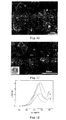
- Fig 10 is the SEM figure of the platinum nanocatalyst having an average particle size of 4nm and an open surface structure.
- Example 8 a preparation process similar to that in Example 7 is used when preparing the platinum nanocatalyst with exception that the growth time is 90 min to prepare a platinum nanocatalyst having an average particle size of 32 nm and an open surface structure.
- Fig 11 is the SEM figure of the platinum nanocatalyst having an average particle size of 32 nm and an open surface structure.
- the nanoparticle circled in the figure has a platinum icositetrahedron structure, and its corresponding structure model figure is shown at the left corner.
- Fig 12 characterizes the catalytic activity of the prepared platinum nanocatalys having the openned structure towards ethanol, indicating that the catalytic activity per surface area is advantageous remarkably over the commercial platinum nanocrystal catalyst produced by the American company E-TEK.
- Example 9 a preparation process similar to that in Example 7 is used when preparing the platinum nanocatalyst with exception that the growth time is 80 min to prepare a platinum nanocatalyst having an average particle size of 9.5 nm and an open surface structure.
- Fig 13 is the SEM figure of the platinum nanocatalyst having an average particle size of 9.5 nm and an open surface structure.
- Fig 14 characterizes the catalytic activity of the prepared platinum nanocatalys having the open surface structure for ethanol oxidation, indicating that the atalytic activity per surface area is advantageous remarkably over the commercial platinum nanocrystal catalyst produced by the American company E-TEK.
- Example 10 a preparation process similar to that in Example 5 is used when preparing the platinum nanocatalyst with exception that glassy carbon sheet is used as electrodes to prepare a platinum nanocatalyst having an open surface structure.
- Example 11 a preparation process similar to that in Example 5 is used when preparing the platinum nanocatalyst with exception that stailless steel is used as electrodes to prepare a platinum nanocatalyst having an open surface structure.
- Example 12 a preparation process similar to that in Example 7 is used when preparing the platinum nanocatalyst with exception that the reaction solution contains 0.1g/L of carbon black as a carrier and 0.02 mM of potassium chloroplatinate as a metal precursor to prepare a platinum nanocatalyst having an open surface structure.
- Example 13 a preparation process similar to that in Example 7 is used when preparing the platinum nanocatalyst with exception that the reaction solution contains 0.02 mM of platinum tetrachloride as a metal precursor and 30 mM of ascorbic acid as a stabilizer to prepare a platinum nanocatalyst having an open surface structure.
- Example 14 a preparation process similar to that in Example 12 is used when preparing the platinum nanocatalyst with exception that the carbon black is replaced by mesoporous carbon as a carrier to prepare a platinum nanocatalyst having an open surface structure.
- Example 15 a preparation process similar to that in Example 12 is used when preparing the platinum nanocatalyst with exception that the carbon black is replaced by carbon nano-tubes as a carrier to prepare a platinum nanocatalyst having an open surface structure.
- Example 16 a preparation process similar to that in Example 13 is used when preparing the platinum nanocatalyst with exception that 10 mM of sodium citrate is used as a stabilizer to prepare a platinum nanocatalyst having an open surface structure.
- Example 17 a preparation process similar to that in Example 13 is used when preparing the platinum nanocatalyst with exception that 10 mM of hexadecyl trimethyl ammonium bromide is used as a stabilizer to prepare a platinum nanocatalyst having an open surface structure.
- Examples 18 to 90 a preparation process similar to that in Example 1 is used with exception that the composition of the precursor reaction solution is changed.
- the prepared metal nanocatalyst having the open surface structure is the corresponding metal nanocatalyst.
- the composition of the precursor reaction solution and the prepared metal nanocatalyst having the open surface structure are shown in Table 1 (in Table 1, "the metal nanocatalyst having the open surface structure” is named metal nanocatalyst in short).
Landscapes
- Chemical & Material Sciences (AREA)
- Engineering & Computer Science (AREA)
- Materials Engineering (AREA)
- Organic Chemistry (AREA)
- Chemical Kinetics & Catalysis (AREA)
- Electrochemistry (AREA)
- Metallurgy (AREA)
- Nanotechnology (AREA)
- Physics & Mathematics (AREA)
- Crystallography & Structural Chemistry (AREA)
- Health & Medical Sciences (AREA)
- Plasma & Fusion (AREA)
- Toxicology (AREA)
- Composite Materials (AREA)
- Condensed Matter Physics & Semiconductors (AREA)
- General Physics & Mathematics (AREA)
- Catalysts (AREA)
- Electrolytic Production Of Metals (AREA)
- Dispersion Chemistry (AREA)
Abstract
Description
- The present application relates to a metal nanocatalyst, in particular a process of surface structure control and continuous preparation of a metal nanocatalyst having an open surface structure and a high surface energy.
- Nanomaterials are characterized in particular physical/chemical properties such as small size effect, surface effect, quantum tunnelling effect, etc. Metal nanomaterials become important catalysts because of the excellent properties. Commenly used metal catalysts include generally platinum metals, coinage metals, ferric metals, etc., and are widely used for energy conversion, petroleum chemistry, purification of exhaust gas of automobiles and chemical industries. It has been always an important issue in the field for how to improve the metal nanocatalyst in the activity, selectivity, stability and use efficiency. Taking platinum metal catalyst as an example, a study employing platinum single crystal surface as a model catalyst exhibits that, performance of the catalyst depends on the catalyst's surface structure. A high-index crystal surface having an open structure and high surface energy has the catalytic activity and stability remarkably advantageous over a low-index crystal surface whereon atoms are tightly lined up (see reference document: [1] Na Tian, Zhi-You Zhou, Shi-Gang Sun, Platinum Metal Catalysts of High-Index Surfaces: From Single-Crystal Planes to Electrochemically Shape-Controlled Nanoparticles. J. Phys. Chem. C., 2008, 112: 19801-19817). Fundamental studies on other metal catalysts gave the similar conclusion, i.e., the surface structure is the decisive factor of performance of the metal catalysts, and a catalyst having an open surface structure has a higher activity and stability. Further, different surface structures may have particular catalytic property with respect to special reaction, i.e., exhibiting catalytic selectivity of surface structure. Currently, commercially available metal nanocatalysts are particles or crystals of several nanometers in size, and their surfaces have a structure of crystal planes with compact atomic arrangement. As the surface structure of a nanocrystal is determined by the shape of the nanocrystal, changing the shape of the prepared nanocrystal can change the surface structure, and thus control the activity and selectivity of the metal nanocatalyst at the level of atomic arrangement structure.
- First of all, depositing platinum nanospheres on surface of glassy carbon electrodes, then appling square wave potential treatment to the surface to dissolve the platinum sphere and allow nucleation growth again. With respect to this, the present applicant ([2] Na Tian, Zhi-You Zhou, Shi-Gang Sun, Yong Ding, Zhong Lin Wang, Synthesis of Tetrahexahedral Platinum Nanocrystals with High-Index Facets and High Electro-Oxidation Activity. Science, 2007, 316: 732-735; [3] Chinese patent
ZL 2007 1 0008741.4 - It is worthy of pointing out that the above metal nanocatalysts having an open surface structure all grow on surface of glassy carbon electrodes, form at most one layer of metal nanocrystal with very few amount, and can hardly be used to practical catalytic system and industrial processes. There is yet no report about the preparation technology of adding metal precursor to the flowing liquid-phase reaction solution as a metal source, and the metal is controlled for nucleation first and growing later with the programmed potential.
- The first object of the present application is to provide a surface structure control and preparation system for a metal nanocatalyst with respect to the requirement of further improving activity, selectivity and stability of the metal nanocatalysts in practical application field.
- The second object of the present application is to provide a metal nanocatalyst having an open surface structure.
- The third object of the present application is to provide a surface structure control and preparation system for a metal nanocatalyst having an open surface structure.
- The surface structure control and preparation system for the metal nanocatalysts of the present application is a surface structure control and preparation system for a metal nanocatalyst having an open surface structure.
- The surface structure control and preparation system for the metal nanocatalysts has a nucleation electrolytic cell, a distribution valve, at least two growth electrolytic cells, with one end of the distribution valve being connected to an output port of the nucleation electrolytic cell and the other end of the distribution valve being connected to input ports of all the growth electrolytic cells.
- The nucleation electrolytic cell has a cell body of the nucleation electrolytic cell and one pair of nucleation electrodes. The cell body of the nucleation electrolytic cell has an input port of the reaction solution and an output port of a nucleation reaction solution. The input port of the reaction solution is connected outwardly to an input device of the precursor reaction solution, and the outlet port of the nucleation reaction solution is connected to an entrance end of the distribution valve; one pair of the nucleation electrodes is disposed inside the cell body of the nucleation electrolytic cell, and said one pair of the nucleation electrodes is applied with nucleation programmed potential. During practical application, said one pair of nucleation electrodes is connected outwardly to equipment such as potentiostat, etc., and nucleation programmed potential can be applied.
- Each of the at least two growth electrolytic cells are provided with a cell body of the growth electrolytic cell and one pair of growth electrodes, the cell body of the growth electrolytic cell is equipped with an input port of the nucleation reaction solution and an outlet port of a product. The input port of the nucleation reaction solution is connected with the output port of the nucleation electrolytic cell via the distribution valve; one pair of growth electrodes is disposed inside the cell body of the growth electrolytic cell; said one pair of growth electrodes is applied with growth programmed potential. During practical application, said one pair of the growth electrodes is connected to equipment such as potentiostat, etc., and growth programmed potential can be applied.
- The cell body of the nucleation electrolytic cell may have a structure the same as that of the cell body of the growth electrolytic cell; structures of cell bodies of the nucleation electrolytic cell and growth electrolytic cells include geometric shape, electrode material, size, disposition manner, etc.
- The nucleation electrodes can be plate electrodes. The plate electrodes may have an aspect ratio of 1 to 2 : 1, the length of the plate electrodes may be 1 cm to 10 cm, and the distance between the plate electrodes may be 20 µm to 2000 µm. It is most preferred that the plate electrodes are inserted in parallel inside the cell body of the nucleation electrolytic cell so that the precursor reaction solution flows through between two plate electrodes, and the related reaction occurs at the same time. It is to say that the precursor reaction solution forms metal crystal nucleus in the nucleation electrolytic cell; the nucleation electrodes can be carbon electrodes, metal electrodes or alloy electrodes, and the alloy electrodes can be stainless steel electrodes, etc.
- The growth electrodes can be plate electrodes having an aspect ratio of 1 to 2 : 1, a length of 1 cm to 10 cm, and a distance between the plate electrodes of 20 µm to 2000 µm. It is most preferred that the plate electrodes are inserted in paralled inside the cell body of the growth electrolytic cell so that the reaction solution that has formed metal crystal nucleus in the nucleation electrolytic cell is conveyed to the growth electrolytic cell via the distribution valve to complete the surface structure control and growing process of the metal nanocrystal; the growth electrodes may be carbon electrodes, metal electrodes or alloy electrodes, and the alloy electrodes can be stainless steel electrodes, etc.
- The growth electrodes and the nucleation electrodes can be the same, and the word "same" means that both of them have the same geometric shape, size, material, etc.
- The nucleation programmed potential consists of functional potentials of time; the growth programmed potential consists of functional potentials of time.
- The nucleation programmed potential is stepped functional potential and applied to one pair of electrodes in the nucleation electrolytic cell, with an upper potential limit of 1 V to 2 V together with a retention time of 10 s to 300 s, as well as a lower potential limit of -2 V to 0.5 V together with a retention time of 10 s to 300s.
- The growth programmed potential is a square wave functional potential and applied to one pair of electrodes in the growth electrolytic cell, with an upper potential limit of 1 V to 5 V, a lower potential limit of -1.5 V to 0.5V, a potential waveform frequency of 5 Hz to 50 Hz, and a growth time of 1 min to 200 min. The growth programmed potential applied to the different growth electrolytic cells can be controlled the same or different depending on variation of different growth electrolytic cells. When the growth programmed potentials applied to different growth electrolytic cells are the same, metal nanocatalysts having the same open surface structure can be produced. Under this condition, if different growth electrolytic cells are controlled to have different growth times, metal nanocatalyst having the same open surface structure but different sizes can be prepared; when the growth programmed potentials applied to each growth electrolytic cell are all different, metal nanocatalysts having different open surface structure can be prepared.
- The precursor reaction solution consists of the following components with the content at mass ratio of: metal precursor:carrier:electrolyte:additive = 1:(0.1 to 5):(10 to 100):(0.1 to 10), more preferable 1:(2.5 to 5):(10 to 30):(1 to 2).
- The metal precursor can be selected from the corresponding metal salt or metal oxide. The metal salt can be selected from one of potassium chloroplatinate, sodium chloroplatinate, platinum nitrate, platinum chloride, palladium chloride, ammonium palladium chloride, iridium chloride, ruthenium chloride, rhodium chloride, osmium chloride, gold chloride, silver nitrate, copper chloride, ferric chloride, ferric sulfate, cobalt chloride, nickel sulfate; the metal oxide can be selected from one of platinum oxide, palladium oxide, iridium oxide, rhodium oxide, ruthenium oxide, osmium oxide, gold oxide, silver oxide, copper oxide, ferric oxide, cobalt oxide, and nickel oxide.
- The metal precursor can also be selected from one of chloroplatinic acid, chloropalladic acid, chloroauric acid, and chloroiridic acid.
- The carrier can be selected from one of the following materials: carbon black, active carbon, mesoporous carbon, and carbon nano-tubes.
- The electrolyte can be selected from one of sulfuric acid, perchloric acid, nitric acid, sodium hydroxide, potassium hydroxide, sodium bicarbonate, and potassium bicarbonate.
- The additive can be selected from one of the following reagents: ascorbic acid, citrate salt, glucose, oleylamine, oleic acid, hexadecylamine, hexadecyl trimethyl ammonium bromide, sodium lauryl benzenesulfate, N-isopropyl acrylamide, and polyvinyl pyrrolidone.
- The precursor reaction solution many have a pH from 0.1 to 13, and more preferably, pH is from 0.1 to 3, 6.5 to 7.5, or 10 to 13.
- The metal nanocatalyst having different open surface structure of the present application is a single metal nanoscale crystal, and has a high density of terrace atoms or active sites on the surface thereof. The single metal nanoscale crystal can be a single metal nanoscale simple-form crystal or a single metal nanoscale deformed crystal. The nanoscale simple-form crystal is a polyhedron, and the polyhedron can be selected from one of tetrahedron, octahedron, cube, dodecahedron, tetrahexahedron, trisoctahedron, trapezohedron and hexoctahedron; and the single metal nanoscale deformed crystal can be selected from one of deformation twins, deformed nanostick, and nano-thorn.
- The metal nanocatalyst can be selected from one of platinum nanocatalyst, palladium nanocatalyst, iridium nanocatalyst, rhodium nanocatalyst, ruthenium nanocatalyst, osmium nanocatalyst, gold nanocatalyst, silver nanocatalyst, copper nanocatalyst, iron nanocatalyst, cobalt nanocatalyst, and nickel nanocatalyst.
- The surface structure control and preparation process for the metal nanocatalyst having an open surface structure of the present application uses the surface structure control and preparation system of the metal nanocatalyst, and comprises the specific steps of:
- 1) injecting a precursor reaction solution into a nucleation electrolytic cell, meanwhile, applying a nucleation programmed potential to one pair of electrodes in the nucleation electrolytic cell; the metal precursor undergoes a nucleation reaction under the action of the nucleation programmed potential to obtain a nucleation reaction solution having the metal crystal nucleus formed;
- 2) conveying the nucleation reaction solution containing the metal crystal nucleus to any one of the growth electrolytic cells through the distribution valve, meanwhile, applying the growth programmed potential to one pair of the electrodes in the growth electrolytic cell; the metal crystal nucleus in the nucleation reaction solution grow gradually under the action of the growth programmed potential with the shape and surface structure of the metal crystal being controlled at the same time, to grow a metal nanoscale crystal having an open surface structure;
- 3) controlling the growth time of the action of the growth programmed potential applied to one pair of electrodes in any one of the growth cells in step 2), to obtain a reaction solution of the metal nanocatalyst having an open surface structure and a desired size; and
- 4) discharging the reaction solution of the metal nanocatalyst having an open surface structure and the desired size obtained in step 3), collecting a product by centrifugal separation, to prepare the metal nanocatalyst having an open surface structure.
- Comparing with the methods of producing a metal nanocatalyst in the prior art, the present invention has the following advantages:
- 1) the surface structure control and preparation process for the metal nanocatalyst uses reaction apparatus having simple structure, and the reaction apparatus can be operated easily and used for continuous preparation.
- 2) increasing numbers of the nucleation electrolytic cells and the correspondingly matched growth electrolytic cells to achieve scaled production.
- 3) the electrodes used in the surface structure control and preparation process for the metal nanocatalyst can be conductive materials such as carbon, metal or alloy.
- 4) metals in the surface structure control and preparation process for the metal nanocatalyst are from metal precursor added to the precursor reaction solution, and the growth of the metal nanocrystal is achieved in liquid phase.
- 5) the metal nanocatalyst prepared in the surface structure control and preparation process for the metal nanocatalysts has controllable surface structure comparing to commercially available catalysts.
- 6) the electrochemistry programmed potential may be used to induce the growth process of the nanoparticles and control the crystal morphology of nanoparticles, thus determining that the present invention can prepare a metal nanocatalyst having selectable different open surface structure, with remarkable catalytic activity and selectivity over the commercially available metal nanocatalyst.
- 7) the metal nanocatalyst prepared according to the surface structure control and preparation process for the metal nanocatalyst can be a single metal nanoscale single-form crystal which can have shapes of regular crystal structures such as tetrahedron, octahedron, cube, dodecahedron, tetrahexahedron, trisoctahedron, trapezohedron and hexoctahedron, and can also be a single metal nanoscale deformed crystal which comprises deformation twins, deformed nanostikc, nano-thorn, etc.
- 8) the metal nanocatalyst prepared according to the surface structure control and preparation process for the metal nanocatalyst may have controllable particle size of nanoparticles. The metal nanocatalysts having different particle sizes can be obtained by changing the nucleation time and growth time, and the particle size can be controlled in a range from 2 nm to 200 nm.
- 9) the metal nanocatalyst prepared according to the surface structure control and preparation process for the metal nanocatalyst may have a controllable support status. The compositions of the precursor reaction solution may be varied to selectively prepare a non-supported and supported catalyst, and the supported catalyst may have different supports.
- 10) the metal nanocatalyst having an open surface structure prepared according to the surface structure control and preparation process for the metal nanocatalyst can be used widely for important fields such as energy conversion, petroleum chemistry and chemical industry. The metal nanocatalyst having an open surface structure is used in fuel cells as an electrocatalyst, and increases remarkable the output powder of fuel cells. The metal nanocatalyst having an open surface structure is used, as a multi-phase catalyst, in industrial processes such as catalytic reforming of hydrocarbon, chemical synthesis, etc. which can improve selectivity and yield of reaction significantly.
-
-
Fig 1 is the front view of appearance of the nucleation electrolytic cell or growth electrolytic cell according to Example 1 of the present invention. InFig 1, 1 is an upper lid, 2 is a sealing gasket, and 3 is a cell body. -
Fig 2 is the structural pictorial drawing of horizontal cross-section of the nucleation electrolytic cell or growth electrolytic cell according to Example 1 of the present invention. InFig 2, 3 is a cell body, 4 is a lead, 5 is an inner gasket, 6 is a screw hole, 7 is an electrode, A is a chunnel. -
Fig 3 is compositional pictorial drawing of the surface structure control and preparation system of the metal nanocatalyst described in Example 2 of the the present invention. InFig 3 , a reaction solution P, a nucleationelectrolytic cell 31, a distribution valve M, a growthelectrolytic cells 321 to 325, aproduct 331 to 335; a nucleation potential E n(t), a growing potential E g,i(t). -
Fig 4 is the pictorial drawing of nucleation programmed potential step (or nucleation potential) E n(t) applied to the nucleation electrode in the preparation process according to Example 2 of the present invention. InFig 4 , x-coordinate represents a reaction time t, y-coordinate represents an electrode potential E n(t). -
Fig 5 is the pictorial drawing of the growth programmed potential (or growing potential) Eg,i(t) applied to the growth electrode during the preparation process according to Example 2 of the present invention. InFig 5 , x-coordinate represents a reaction time t, y-coordinate represents an electrode potential E g,i(t). -
Fig 6 is an image of scanning electron microscope (SEM) of the platinum octahedron nanocatalyst prepared according to Example 3 of the present invention. InFig 6 , a is an image of scan electron microscope, b is an image of the structural model of the corresponding platinum octahedron. -
Fig 7 is an image of the scanning electron microscope (SEM) of the platinum cube nanocatalyst prepared according to Example 4 of the present invention. InFig 7 , a is an image of scan electron microscope, b is an image of the structural model of the corresponding platinum cube. -
Fig 8 is an image of the scanning electron microscope (SEM) of the platinum tetrahexahedral nanocatalyst prepared according to Example 5 of the present invention. InFig 8 , a is an image of scan electron microscope, b is an image of the structural model of the corresponding platinum icositetrahedron. -
Fig 9 is an image of the scanning electron microscope (SEM) of the platinum thorn sphere nanocatalyst prepared according to Example 6 of the present invention. InFig 9 , a is an image of scan electron microscope, b is an image of the high resolution scanning electron microscope (SEM) of the corresponding platinum thorn sphere terminal. -
Fig 10 is an image of scanning electron microscope (SEM) of the platinum nanocatalyst having an average particle size of 4nm prepared according to Example 7 in the present invention. InFig 10 , the scale is 50nm. -
Fig 11 is an image of the scanning electron microscope (SEM) of the platinum nanocatalyst having an average particle size of 32nm prepared according to Example 8 of the present invention. InFig 11 , the structural model at the left lower corner is the image of the structural model corresponding to the nanoparticles in frame portion; the scale is 200nm. -
Fig 12 is a catalytic activity charactering chart of the platinum nanocatalyst prepared according to Example 8 of the present invention to ethanol. InFig 12 , x-coordinate represents the working electrode potential E/V (SCE, saturated calomel electrode as the reference electrode), y-coordinate represents current density j/mA cm-2; curves a and b represent the platinum nanocatalyst having the open structure and the carbon-supported platinum catalyst made by the U.S. E-TEK Corporation (platinum content of 20wt%), the solution during measurement is 0.1M ethanol and 0.1M sulfuric acid, the temperature during measurement is 60 °C. -
Fig 13 is an image of the scanning electron microscope (SEM) of the platinum nanocatalyst having an average particle size of of 9.5nm prepared according to Example 9 of the present invention. InFig 13 , the scale is 50nm. -
Fig 14 is a catalytic activity charactering chart of the platinum nanocatalyst having an open structure prepared according to Example 9 of the present invention towards ethanol. InFig 14 , x-coordinate represents the working electrode potential E/V (SCE, saturated calomel electrode as the reference electrode), y-coordinate represents current density j/mA cm-2; curves a and b represent the platinum nanocatalyst having an openned structure and the carbon-supported platinum catalyst made by the U.S. E-TEK Corporation (platinum content of 20wt%), the solution during measurement is 0.1M ethanol and 0.1M sulfuric acid, the temperature during measurement is 60°C. - The following Examples will further illustrate the present invention in cooperation with the figures.
- Example 1: referring to
Figs 1 to 3 , the surface structure control and preparation system of the metal nanocatalyst is designated as follows: the nucleationelectrolytic cell 31 and the growthelectrolytic cells 321 to 325 have the same geometric dimension and interior structure; thecell body 3 of the electrolytic cell is molded by processing of organic glasses, polytetrafluoroethene or other insulation material; a paire of conductive plate electrodes are inserted in parallel into thecell body 3 of the electrolytic cell; and the gap between the two electrodes is the reaction space. A precursor reaction solution P is injected into the nucleationelectrolytic cell 31 for reaction, and then, after formation of the crystal nucleus, flowed into a plurality of the growthelectrolytic cells 321 to 325 via the distribution valve M to complete the growth of nanoparticles, resulting inproducts 331 to 335. One pair ofconductive plate electrodes 7 are inserted directly into a groove in center of thecell body 3 of the electrolytic cell, with the distance between the twoelectrodes 7 being controlled by adjusting the thickness of aninner gasket 5. Theelectrodes 7 is soldered with alead 4 on top and connected to a potentiostat outside. A flowing chunnel A of the reaction solution is reserved in the middle of thecell body 3 of the electrolytic cell. A layer of sealinggasket 2 is covered on top of thecell body 3 of the electrolytic cell, and the electrolytic cell is sealed by theupper lid 1 with a screw. - Example 2: surface structure control and preparation for the metal nanocatalyst: a precursor reaction solution P is flowed into the nucleation
electrolytic cell 31. A nucleation programmed potential E n(t) is applied on both ends of the nucleation electrodes (wherein E represents potential, n represents nucleation, and t represents time) to induce nanoparticle crystal nucleus flowing into the growthelectrolytic cells 321 to 325 after growth. A growth programmed potential E g,i(t) is applied to both ends of the growth electrodes (wherein E represents potential, g represents growth, i represents sequence of the growth electrolytic cell, and t represents time) to complete growth of the nanocrystals. As the nucleation time is comperatively shorter, a plurality of parallel growth electrolytic cells may be arranged based on a ratio of the growth time to the nucleation time (it has five growthelectrolytic cells 321 to 325 inFig 3 ) to accomplish continuous preparation of the metal nanocatalysts.Fig 3 is the pictorial drawing of the compositions of the surface structure control and preparation system for the metal nanocatalyst described in Example 2 of the present invention.Fig 4 is the pictorial drawing of the nucleation programmed potential (or named nucleation potential) E n(t) applied to the nucleation electrodes.Fig 5 is the pictorial drawing of growth programmed potential (or named growth potential) E g,i(t) applied to the growth electrodes. - Example 3: a preparation process similar to that in Example 2 is used when preparing the platinum nanocatalyst: metal platinum is used as electrodes; the precursor reaction solution comprises platinum precursor and carbon black (carbon black as a carrier); the growth programmed potential has an upper potential limit of 1.2 V, a lower potential limit of -0.8 V, a frequency of 10 Hz, and a growth time of 90 min. The prepared platinum nanocatalyst has an appearance of octahedron.
Fig 6 is the SEM figure of the platinum octahedron nanocatalyst and the model figure of the corresponding platinum octahedron structure. - Example 4: a preparation process similar to that in Example 3 is used when preparing the platinum nanocatalyst with exception that the growth programmed potential has an upper potential limit of 1.4 V and a lower potential limit of -0.8 V to prepare a platinum nanocatalyst having an appearance of cube.
Fig 7 is the SEM figure of the platinum cubic nanocatalyst and the model figure of the corresponding platinum cubic structure. - Example 5: a preparation process similar to that in Example 3 is used when preparing the platinum nanocatalyst with exception that the growth programmed potential has an upper potential limit of 1.6 V and a lower potential limit of -1.2 V to prepare a platinum nanocatalyst having an appearance of icositetrahedron.
Fig 8 is the SEM figure of the platinum tetrahexahedral nanocatalyst and the model figure of the corresponding platinum tetrahexahedral structure. - Example 6: a preparation process similar to that in Example 3 is used when preparing the platinum nanocatalyst with exception that the growth programmed potential has an upper potential limit of 1.8 V and a lower potential limit of -1.4 V to prepare a platinum nanocatalyst having an appearance of thorn sphere.
Fig 9 is the SEM figure of the platinum thorn sphere nanocatalyst and the high resolution SEM figure of the terminal of thorn sphere. - Example 7: a preparation process similar to that in Example 2 is used when preparing the platinum nanocatalyst: metal platinum is used as electrodes; the reaction solution comprises 0.5g/L of carbon black as a carrier and 0.02 mM of chloroplatinic acid as a metal precursor; the growth programmed potential has an upper potential limit of 1.6 V, a lower potential limit of -1.2 V, a frequency of 10 Hz, and a growth time of 60min, to prepare the platinum nanocatalyst having an average particle size of 4nm and an open surface structure.
Fig 10 is the SEM figure of the platinum nanocatalyst having an average particle size of 4nm and an open surface structure. - Example 8: a preparation process similar to that in Example 7 is used when preparing the platinum nanocatalyst with exception that the growth time is 90 min to prepare a platinum nanocatalyst having an average particle size of 32 nm and an open surface structure.
Fig 11 is the SEM figure of the platinum nanocatalyst having an average particle size of 32 nm and an open surface structure. The nanoparticle circled in the figure has a platinum icositetrahedron structure, and its corresponding structure model figure is shown at the left corner.Fig 12 characterizes the catalytic activity of the prepared platinum nanocatalys having the openned structure towards ethanol, indicating that the catalytic activity per surface area is advantageous remarkably over the commercial platinum nanocrystal catalyst produced by the American company E-TEK. - Example 9: a preparation process similar to that in Example 7 is used when preparing the platinum nanocatalyst with exception that the growth time is 80 min to prepare a platinum nanocatalyst having an average particle size of 9.5 nm and an open surface structure.
Fig 13 is the SEM figure of the platinum nanocatalyst having an average particle size of 9.5 nm and an open surface structure.Fig 14 characterizes the catalytic activity of the prepared platinum nanocatalys having the open surface structure for ethanol oxidation, indicating that the atalytic activity per surface area is advantageous remarkably over the commercial platinum nanocrystal catalyst produced by the American company E-TEK. - Example 10: a preparation process similar to that in Example 5 is used when preparing the platinum nanocatalyst with exception that glassy carbon sheet is used as electrodes to prepare a platinum nanocatalyst having an open surface structure.
- Example 11: a preparation process similar to that in Example 5 is used when preparing the platinum nanocatalyst with exception that stailless steel is used as electrodes to prepare a platinum nanocatalyst having an open surface structure.
- Example 12: a preparation process similar to that in Example 7 is used when preparing the platinum nanocatalyst with exception that the reaction solution contains 0.1g/L of carbon black as a carrier and 0.02 mM of potassium chloroplatinate as a metal precursor to prepare a platinum nanocatalyst having an open surface structure.
- Example 13: a preparation process similar to that in Example 7 is used when preparing the platinum nanocatalyst with exception that the reaction solution contains 0.02 mM of platinum tetrachloride as a metal precursor and 30 mM of ascorbic acid as a stabilizer to prepare a platinum nanocatalyst having an open surface structure.
- Example 14: a preparation process similar to that in Example 12 is used when preparing the platinum nanocatalyst with exception that the carbon black is replaced by mesoporous carbon as a carrier to prepare a platinum nanocatalyst having an open surface structure.
- Example 15: a preparation process similar to that in Example 12 is used when preparing the platinum nanocatalyst with exception that the carbon black is replaced by carbon nano-tubes as a carrier to prepare a platinum nanocatalyst having an open surface structure.
- Example 16: a preparation process similar to that in Example 13 is used when preparing the platinum nanocatalyst with exception that 10 mM of sodium citrate is used as a stabilizer to prepare a platinum nanocatalyst having an open surface structure.
- Example 17: a preparation process similar to that in Example 13 is used when preparing the platinum nanocatalyst with exception that 10 mM of hexadecyl trimethyl ammonium bromide is used as a stabilizer to prepare a platinum nanocatalyst having an open surface structure.
- Examples 18 to 90: a preparation process similar to that in Example 1 is used with exception that the composition of the precursor reaction solution is changed. The prepared metal nanocatalyst having the open surface structure is the corresponding metal nanocatalyst. The composition of the precursor reaction solution and the prepared metal nanocatalyst having the open surface structure are shown in Table 1 (in Table 1, "the metal nanocatalyst having the open surface structure" is named metal nanocatalyst in short).
Table 1 Example No. A metal precursor A carrier A additive An electrolyte metal nanocatalyst 18 palladium chloride carbon black ascorbic acid sulfuric acid palladium nanocatalyst 19 palladium oxide carbon black ascorbic acid sulfuric acid palladium nanocatalyst 20 chloropalladic acid carbon black ascorbic acid sulfuric acid palladium nanocatalyst 21 palladium chloride mesoporous carbon sodium citrate nitric acid palladium nanocatalyst 22 palladium oxide mesoporous carbon sodium citrate nitric acid palladium nanocatalyst 23 chloropalladic acid mesoporous carbon sodium citrate nitric acid palladium nanocatalyst 24 palladium chloride carbon nano-tubes hexadecyl trimethyl ammonium bromide perchloric acid palladium nanocatalyst 25 palladium oxide carbon nano-tubes hexadecyl trimethyl ammonium bromide perchloric acid palladium nanocatalyst 26 chloropalladic acid carbon nano-tubes hexadecyl trimethyl ammonium bromide perchloric acid palladium nanocatalyst 27 iridium chloride carbon black ascorbic acid sulfuric acid iridium nanocatalyst 28 chloroiridic acid carbon black ascorbic acid sulfuric acid iridium nanocatalyst 29 iridium oxide carbon black ascorbic acid sulfuric acid iridium nanocatalyst 30 iridium chloride mesoporous carbon sodium citrate nitric acid iridium nanocatalyst 31 chloroiridic acid mesoporous carbon sodium citrate nitric acid iridium nanocatalyst 32 iridium oxide mesoporous carbon sodium citrate nitric acid iridium nanocatalyst 33 iridium chloride carbon nano-tubes hexadecyl trimethyl ammonium bromide perchloric acid iridium nanocatalyst 34 chloroiridic acid carbon nano-tubes hexadecyl trimethyl ammonium bromide perchloric acid iridium nanocatalyst 35 iridium oxide carbon nano-tubes hexadecyl trimethyl ammonium bromide perchloric acid iridium nanocatalyst 36 ruthenium chloride carbon black ascorbic acid sulfuric acid ruthenium nanocatalyst 37 ruthenium oxide carbon black ascorbic acid sulfuric acid ruthenium nanocatalyst 38 ruthenium chloride mesoporous carbon polyvinyl pyrrolidone nitric acid ruthenium nanocatalyst 39 ruthenium oxide mesoporous carbon polyvinyl pyrrolidone nitric acid ruthenium nanocatalyst 40 ruthenium chloride carbon nano-tubes hexadecyl trimethyl ammonium bromide perchloric acid ruthenium nanocatalyst 41 ruthenium oxide carbon nano-tubes hexadecyl trimethyl ammonium bromide perchloric acid ruthenium nanocatalyst 42 rhodium chloride carbon black ascorbic acid sulfuric acid rhodium nanocatalyst 43 rhodium oxide carbon black ascorbic acid sulfuric acid rhodium nanocatalyst 45 rhodium chloride mesoporous carbon polyvinyl pyrrolidone nitric acid rhodium nanocatalyst 46 rhodium oxide mesoporous carbon polyvinyl pyrrolidone nitric acid rhodium nanocatalyst 47 rhodium chloride carbon nano-tubes hexadecyl trimethyl ammonium bromide perchloric acid rhodium nanocatalyst 48 rhodium oxide carbon nano-tubes hexadecyl trimethyl ammonium bromide perchloric acid rhodium nanocatalyst 49 gold chloride carbon black ascorbic acid sulfuric acid gold nanocatalyst 50 gold oxide carbon black ascorbic acid sulfuric acid gold nanocatalyst 51 chloroauric acid carbon black ascorbic acid sulfuric acid gold nanocatalyst 52 gold chloride mesoporous carbon sodium citrate nitric acid gold nanocatalyst 53 gold oxide mesoporous carbon sodium citrate nitric acid gold nanocatalyst 54 chloroauric acid mesoporous carbon sodium citrate nitric acid gold nanocatalyst 55 gold chloride carbon nano-tubes hexadecyl trimethyl ammonium bromide perchloric acid gold nanocatalyst 56 gold oxide carbon nano-tubes hexadecyl trimethyl ammonium bromide perchloric acid gold nanocatalyst 57 chloroauric acid carbon nano-tubes hexadecyl trimethyl ammonium bromide perchloric acid gold nanocatalyst 58 silver nitrate carbon black ascorbic acid sulfuric acid silver nanocatalyst 59 silver oxide carbon black ascorbic acid sulfuric acid silver nanocatalyst 60 silver nitrate mesoporous carbon polyvinyl pyrrolidone nitric acid silver nanocatalyst 61 silver oxide mesoporous carbon polyvinyl pyrrolidone nitric acid silver nanocatalyst 62 silver nitrate carbon nano-tubes hexadecyl trimethyl ammonium bromide perchloric acid silver nanocatalyst 63 silver oxide carbon nano-tubes hexadecyl trimethyl ammonium bromide perchloric acid silver nanocatalyst 64 copper chloride carbon black ascorbic acid sulfuric acid copper nanocatalyst 65 copper oxide carbon black ascorbic acid sulfuric acid copper nanocatalyst 66 copper chloride mesoporous carbon polyvinyl pyrrolidone nitric acid copper nanocatalyst 67 copper oxide mesoporous carbon polyvinyl pyrrolidone nitric acid copper nanocatalyst 68 copper chloride carbon nano-tubes hexadecyl trimethyl ammonium bromide perchloric acid copper nanocatalyst 69 copper oxide carbon nano-tubes hexadecyl trimethyl ammonium bromide perchloric acid copper nanocatalyst 70 ferric chloride carbon black ascorbic acid sodium hydroxide ferric nanocatalyst 71 ferric sulfate carbon black ascorbic acid sodium hydroxide ferric nanocatalyst 72 ferric oxide carbon black ascorbic acid sodium hydroxide ferric nanocatalyst 73 ferric chloride mesoporous carbon sodium citrate potassium hydroxide ferric nanocatalyst 74 ferric sulfate mesoporous carbon sodium citrate potassium hydroxide ferric nanocatalyst 75 ferric oxide mesoporous carbon sodium citrate potassium hydroxide ferric nanocatalyst 76 ferric chloride carbon nano-tubes hexadecyl trimethyl ammonium bromide sodium bicarbonate ferric nanocatalyst 77 ferric sulfate carbon nano-tubes hexadecyl trimethyl ammonium bromide sodium bicarbonate ferric nanocatalyst 78 ferric oxide carbon nano-tubes hexadecyl trimethyl ammonium bromide sodium bicarbonate ferric nanocatalyst 79 cobalt chloride carbon black ascorbic acid sulfuric acid cobalt nanocatalyst 80 cobalt oxide carbon black ascorbic acid sulfuric acid cobalt nanocatalyst 81 cobalt chloride mesoporous carbon polyvinyl pyrrolidone nitric acid cobalt nanocatalyst 82 cobalt oxide mesoporous carbon polyvinyl pyrrolidone nitric acid cobalt nanocatalyst 83 cobalt chloride carbon nano-tubes hexadecyl trimethyl ammonium bromide perchloric acid cobalt nanocatalyst 84 cobalt oxide carbon nano-tubes hexadecyl trimethyl ammonium bromide perchloric acid cobalt nanocatalyst 85 nickel sulfate carbon black ascorbic acid sodium hydroxide nickel nanocatalyst 86 nickel oxide carbon black ascorbic acid sodium hydroxide nickel nanocatalyst 87 nickel sulfate mesoporous carbon polyvinyl pyrrolidone potassium hydroxide nickel nanocatalyst 88 nickel oxide mesoporous carbon polyvinyl pyrrolidone potassium hydroxide nickel nanocatalyst 89 nickel sulfate carbon nano-tubes hexadecyl trimethyl ammonium bromide potassium bicarbonate nickel nanocatalyst 90 nickel oxide carbon nano-tubes hexadecyl trimethyl ammonium bromide potassium bicarbonate nickel nanocatalyst -
- [1] Na Tian, Zhi-You Zhou, Shi-Gang Sun, Platinum Metal Catalysts of High-Index Surfaces: From Single-Crystal Planes to Electrochemically Shape-Controlled Nanoparticles. J. Phys. Chem. C., 2008, 112: 19801-19817.
- [2] Na Tian, Zhi-You Zhou, Shi-Gang Sun, Yong Ding, Zhong Lin Wang, Synthesis of Tetrahexahedral Platinum Nanocrystals with High-Index Facets and High Electro-Oxidation Activity. Science, 2007, 316: 732-735.
- [3] Chinese Patent for Invention No.
ZL 2007 1 0008741.4 - [4] Na Tian, Zhi-You Zhou, Neng-Fei Yu, Li-Yang Wang, Shi-Gang Sun, Direct Electrodeposition of Tetrahexahedral Pd Nanocrystals with High-Index Facets and High Catalytic Activity for Ethanol Electrooxidation, J. Am. Chem. Soc. 2010, 132: 7580-7581.
- [5] Zhi-You Zhou, Zhi-Zhong Huang, De-Jun Chen, Qiang Wang, Na Tian, and Shi-Gang Sun, High-Index Faceted Platinum Nanocrystals Supported on Carbon Black as Highly Efficient Catalysts for Ethanol Electrooxidation, Angew. Chem. Int. Ed. 2010, 49: 411-414.
- [6] Yan-Xin Chen, Sheng-Pei Chen, Zhi-You Zhou, Na Tian, Yan-Xia Jiang, Shi-Gang Sun, Yong Ding, Zhong Lin Wang, Tuning the Shape and Catalytic Activity of Fe Nanocrystals from Rhombic Dodecahedra and Tetragonal Bipyramids to Cubes by Electrochemistry, J.Am. Chem. Sco. 2009, 131: 10860-10862.
Claims (17)
- A surface structure control and preparation system for a metal nanocatalyst, characterized in having a nucleation electrolytic cell, a distribution valve, at least two growth electrolytic cells, with one end of the distribution valve being connected to an output port of the nucleation electrolytic cell and the other end of the distribution valve being connected to input ports of all the growth electrolytic cells; the nucleation electrolytic cell has a cell body of the nucleation electrolytic cell and one pair of nucleation electrodes, the cell body of the nucleation electrolytic cell has an input port of a reaction solution and an output port of a nucleation reaction solution, the input port of the reaction solution is connected outwardly to an input device of the precursor reaction solution, and the outlet port of the nucleation reaction solution is connected to an entrance end of the distribution valve; the one pair of the nucleation electrodes are disposed inside the cell body of the nucleation electrolytic cell, and said one pair of the nucleation electrodes are applied with nucleation programmed potential; each of the at least two growth electrolytic cells are provided with a cell body of the growth electrolytic cell and one pair of growth electrodes, the cell body of the growth electrolytic cell is equipped with an input port of the nucleation reaction solution and an outlet port of a product, the input port of the nucleation reaction solution is connected with the output port of the nucleation electrolytic cell via the distribution valve; one pair of growth electrodes are disposed inside the cell body of the growth electrolytic cell; and said one pair of growth electrodes are applied with growth programmed potential.
- The surface structure control and preparation system for a metal nanocatalyst according to claim 1, wherein the cell body of the nucleation electrolytic cell has a structure the same as that of the cell body of the growth electrolytic cell; structures of cell bodies of the nucleation electrolytic cell and growth electrolytic cell include geometric shape, electrode material, size, and the disposition manner.
- The surface structure control and preparation system for a metal nanocatalyst according to claim 1, wherein the nucleation electrodes are plate electrodes, the plate electrodes have an aspect ratio of 1-2:1, the length of the plate electrodes is 1 cm to 10 cm, and the distance between the plate electrodes is 20 µm to 2000 µm.
- The surface structure control and preparation system for a metal nanocatalyst according to claim 3, wherein the plate electrodes are inserted in parallel inside the cell body of the nucleation electrolytic cell.
- The surface structure control and preparation system for a metal nanocatalyst according to claim 1 or 3, wherein the nucleation electrodes are carbon electrodes, metal electrodes or alloy electrodes, and the alloy electrodes are preferably stainless steel electrodes.
- The surface structure control and preparation system for a metal nanocatalyst according to claim 1, wherein the growth electrodes are plate electrodes, the plate electrodes have an aspect ratio of 1-2:1, the length of the plate electrodes is 1 cm to 10 cm, and the distance between the plate electrodes is 20 µm to 2000 µm.
- The surface structure control and preparation system for a metal nanocatalyst according to claim 6, wherein the plate electrodes are inserted in paralled inside the cell body of the growth electrolytic cell.
- The surface structure control and preparation system for a metal nanocatalyst according to claim 1 or 6, wherein the growth electrodes are carbon electrodes, metal electrodes or alloy electrodes, and the alloy electrodes may be stainless steel electrodes.
- The surface structure control and preparation system for a metal nanocatalyst according to claim 1, wherein the growth electrodes and the nucleation electrodes are the same, and the word "same" means that both of them have the same geometric shape, size, and material.
- The surface structure control and preparation system for a metal nanocatalyst according to claim 1, wherein the nucleation programmed potential consists of functional potentials of time; and the growth programmed potential consists of functional potentials of time.
- The surface structure control and preparation system for a metal nanocatalyst according to claim 1, wherein the nucleation programmed potential is stepped functional potential and applied to one pair of electrodes in the nucleation electrolytic cell, with an upper potential limit of 1 V to 2 V together with a retention time of 10 s to 300 s, as well as a lower potential limit of -2 V to 0.5 V together with a retention time of 10 s to 300s; and
the growth programmed potential is a square wave functional potential and applied to one pair of electrodes in the growth electrolytic cell, with an upper potential limit of 1 V to 5 V, a lower potential limit of -1.5 V to 0.5V, a potential waveform frequency of 5 Hz to 50 Hz, and a growth time of 1 min to 200 min. - The surface structure control and preparation system for a metal nanocatalyst according to claim 1, wherein the precursor reaction solution consists of the following components with the content at mass ratio of: metal precursor:carrier:electrolyte:additive = 1:(0.1 to 5):(10 to 100):(0.1 to 10), more preferable 1:(2.5 to 5):(10 to 30):(1 to 2); the precursor reaction solution has a pH from 0.1 to 13, and more preferably, from 0.1 to 3, from 6.5 to 7.5, or from 10 to 13.
- The surface structure control and preparation system for a metal nanocatalyst according to claim 12, wherein the metal precursor is selected from the corresponding metal salt or metal oxide of the metal precursor, and the metal salt is selected from one of potassium chloroplatinate, sodium chloroplatinate, platinum nitrate, platinum chloride, palladium chloride, ammonium palladium chloride, iridium chloride, ruthenium chloride, rhodium chloride, osmium chloride, gold chloride, silver nitrate, copper chloride, ferric chloride, ferric sulfate, cobalt chloride, and nickel sulfate; the metal oxide is selected from one of platinum oxide, palladium oxide, iridium oxide, rhodium oxide, ruthenium oxide, osmium oxide, gold oxide, silver oxide, copper oxide, ferric oxide, cobalt oxide, and nickel oxide; and the metal precursor is selected from one of chloroplatinic acid, chloropalladic acid, chloroauric acid, and chloroiridic acid.
- The surface structure control and preparation system for a metal nanocatalyst according to claim 12, wherein the carrier is selected from one of carbon black, active carbon, mesoporous carbon, and carbon nano-tubes; the electrolyte is slected from one of sulfuric acid, perchloric acid, nitric acid, sodium hydroxide, potassium hydroxide, sodium bicarbonate, and potassium bicarbonate; the additive is selected from one of ascorbic acid, citrate salt, glucose, oleylamine, oleic acid, hexadecylamine, hexadecyl trimethyl ammonium bromide, sodium lauryl benzenesulfate, N-isopropyl acrylamide, and polyvinyl pyrrolidone.
- A metal nanocatalyst having an open surface structure, characterized in being a single metal nanoscale crystal and having a high density of terrace atoms or active sites on the surface thereof; said single metal nanoscale crystal is a single metal nanoscale simple-form crystal or a single metal nanoscale deformed crystal; said nanoscale simple-form crystal is a polyhedron, and the polyhedron is selected from one of tetrahedron, octahedron, cube, dodecahedron, tetrahexahedron, trisoctahedron, trapezohedron and hexoctahedron; and the single metal nanoscale deformed crystal is selected from one of deformation twins, deformed nanostick, and nano-thorn.
- The metal nanocatalyst having an open surface structure according to claim 15, wherein the metal nanocatalyst is selected from one of platinum nanocatalyst, palladium nanocatalyst, iridium nanocatalyst, rhodium nanocatalyst, ruthenium nanocatalyst, osmium nanocatalyst, gold nanocatalyst, silver nanocatalyst, copper nanocatalyst, iron nanocatalyst, cobalt nanocatalyst, and nickel nanocatalyst.
- A surface structure control and preparation process for the metal nanocatalyst having an open surface structure according to claim 15, characterized in using the surface structure control and preparation system for the metal nanocatalyst according to claim 1, and comprising the specific steps of:1) injecting a precursor reaction solution into a nucleation electrolytic cell, meanwhile, applying a nucleation programmed potential to one pair of electrodes in the nucleation electrolytic cell; the metal precursor undergoes a nucleation reaction under the action of the nucleation programmed potential to obtain a nucleation reaction solution having the metal crystal nucleus formed;2) conveying the nucleation reaction solution containing the metal crystal nucleus to any one of the growth electrolytic cells through the distribution valve, meanwhile, applying the growth programmed potential to one pair of the electrodes in the growth electrolytic cell; the metal crystal nucleus in the nucleation reaction solution grow gradually under the action of the growth programmed potential with the shape and surface structure of the metal crystal being controlled at the same time, to grow a metal nanoscale crystal having an open surface structure;3) controlling the growth time of the action of the growth programmed potential applied to one pair of electrodes in any one of the growth cells in step 2), to obtain a reaction solution of the metal nanocatalyst having an open surface structure and a desired size; and4) discharging the reaction solution of the metal nanocatalyst having an open surface structure and the desired size obtained in step 3), collecting a product by centrifugal separation, to prepare the metal nanocatalyst having an open surface structure.
Applications Claiming Priority (2)
| Application Number | Priority Date | Filing Date | Title |
|---|---|---|---|
| CN2010102491635A CN101928979B (en) | 2010-08-06 | 2010-08-06 | Surface structure regulation, control and preparation method of metallic nanocatalyst |
| PCT/CN2011/075629 WO2012016478A1 (en) | 2010-08-06 | 2011-06-13 | Method for tuning surface structure of metallic nano-catalyst and preparation method thereof |
Publications (3)
| Publication Number | Publication Date |
|---|---|
| EP2602361A1 true EP2602361A1 (en) | 2013-06-12 |
| EP2602361A4 EP2602361A4 (en) | 2016-11-16 |
| EP2602361B1 EP2602361B1 (en) | 2018-05-16 |
Family
ID=43368393
Family Applications (1)
| Application Number | Title | Priority Date | Filing Date |
|---|---|---|---|
| EP11814061.5A Active EP2602361B1 (en) | 2010-08-06 | 2011-06-13 | Method for tuning surface structure of metallic nano-catalyst and preparation method thereof |
Country Status (5)
| Country | Link |
|---|---|
| US (1) | US9162222B2 (en) |
| EP (1) | EP2602361B1 (en) |
| JP (1) | JP5705981B2 (en) |
| CN (1) | CN101928979B (en) |
| WO (1) | WO2012016478A1 (en) |
Cited By (2)
| Publication number | Priority date | Publication date | Assignee | Title |
|---|---|---|---|---|
| RU2611620C2 (en) * | 2013-10-04 | 2017-02-28 | Общество с ограниченной ответственностью "Нанотехнологии для экологии" | Method of producing copper-containing nano-catalysts with developed surface |
| CN110129839A (en) * | 2019-05-20 | 2019-08-16 | 梁生 | A kind of preparation method of brightener for copper plating |
Families Citing this family (12)
| Publication number | Priority date | Publication date | Assignee | Title |
|---|---|---|---|---|
| CN101928979B (en) * | 2010-08-06 | 2012-07-04 | 厦门大学 | Surface structure regulation, control and preparation method of metallic nanocatalyst |
| FR2974582A1 (en) * | 2011-04-27 | 2012-11-02 | Commissariat Energie Atomique | PROCESS FOR GROWING METALLIC PARTICLES BY ELECTRODEPOSITION WITH IN SITU INHIBITION |
| CN104084244A (en) * | 2014-07-10 | 2014-10-08 | 厦门大学 | Preparation device and preparation method of carbon-supported metal nanocatalyst |
| KR101662756B1 (en) * | 2014-09-30 | 2016-10-06 | 충북대학교 산학협력단 | Fabrication of Porous Pt Ball Structure by Electrodeposition |
| CN106018507B (en) * | 2016-05-16 | 2018-05-15 | 天津理工大学 | A kind of preparation method of the mesoporous nickel oxide with ammonia air-sensitive performance |
| US10646921B2 (en) * | 2017-03-31 | 2020-05-12 | The Regents Of The University Of California | Excavated nanoframes with three-dimensional electrocatalytic surfaces |
| CN106902817B (en) * | 2017-04-11 | 2019-07-02 | 辽宁大学 | Method for activating carbon nanotube-supported palladium nanoparticle catalyst and application thereof |
| CN108977846B (en) * | 2018-06-21 | 2020-02-28 | 太原理工大学 | A kind of preparation method of iron oxide nanobelt array film |
| CN110894617A (en) * | 2018-09-13 | 2020-03-20 | 深圳市永达锐国际科技有限公司 | 3D platinum electroforming process method |
| CN113441153B (en) * | 2020-03-24 | 2023-05-09 | 东营市天正化工有限公司 | Magnetic catalyst and preparation method thereof |
| US11833497B2 (en) * | 2021-04-14 | 2023-12-05 | Honda Motor Co., Ltd. | Copper-containing bimetallic structures, syntheses thereof, and uses thereof |
| CN115072810B (en) * | 2022-07-28 | 2023-12-22 | 西安稀有金属材料研究院有限公司 | Green synthesis method of nano ruthenium oxide |
Family Cites Families (21)
| Publication number | Priority date | Publication date | Assignee | Title |
|---|---|---|---|---|
| JP2628184B2 (en) * | 1988-04-25 | 1997-07-09 | 日新製鋼株式会社 | Method of electroplating metal on fine powder |
| JPH03164450A (en) * | 1989-11-24 | 1991-07-16 | Nippon Telegr & Teleph Corp <Ntt> | Production of metal coated fiber |
| JP2837397B2 (en) * | 1995-12-04 | 1998-12-16 | テクノ工業株式会社 | Anodizing equipment for aluminum or aluminum alloy |
| JP2002069689A (en) * | 2000-08-28 | 2002-03-08 | Yuken Industry Co Ltd | Powder electroplating method |
| CN1166019C (en) * | 2001-05-25 | 2004-09-08 | 中国科学院长春应用化学研究所 | Preparation method of nano electrocatalyst for proton exchange membrane fuel cell |
| CN1274884C (en) * | 2003-11-21 | 2006-09-13 | 厦门大学 | Process for preparing carbon supported polymer surface nano-alloy electrocatalytic electrode |
| CN1240878C (en) * | 2003-11-21 | 2006-02-08 | 厦门大学 | Process for preparing carbon supported platinum-based surface alloy electrocatalytic electrode |
| WO2005120703A1 (en) * | 2004-06-10 | 2005-12-22 | Sumitomo Electric Industries, Ltd. | Metal catalyst and method for preparation thereof |
| US7393438B2 (en) * | 2004-07-22 | 2008-07-01 | Phelps Dodge Corporation | Apparatus for producing metal powder by electrowinning |
| JP4608631B2 (en) * | 2005-06-08 | 2011-01-12 | 国立大学法人名古屋大学 | Image processing device for vehicle, driving support device |
| US20070029189A1 (en) * | 2005-08-02 | 2007-02-08 | The University Of Chicago | Combinatorial electrochemical deposition system |
| JP2007203177A (en) * | 2006-02-01 | 2007-08-16 | Hitachi Ltd | Catalyst material, method for producing the same, and fuel cell using the same |
| JP4923763B2 (en) * | 2006-06-09 | 2012-04-25 | 富士ゼロックス株式会社 | Method for producing silver triangular pyramid particles, and silver triangular pyramid particles |
| KR100907877B1 (en) * | 2007-03-15 | 2009-07-14 | 윤의식 | Method for preparing metal nanoparticle colloidal solution and method for preparing metal nanoparticle powder |
| CN100421787C (en) * | 2007-03-23 | 2008-10-01 | 厦门大学 | Platinum tetrahedral nanocrystal catalyst and its preparation method and application |
| JP2009046696A (en) * | 2007-08-13 | 2009-03-05 | Mitsui Mining & Smelting Co Ltd | Silver powder manufacturing method |
| JP5065072B2 (en) * | 2008-02-07 | 2012-10-31 | 古河電気工業株式会社 | Method for producing copper fine particles |
| JP2009214099A (en) * | 2008-02-14 | 2009-09-24 | Okayama Univ | Method for producing amide compound and catalyst to be used therein |
| JP2009221563A (en) * | 2008-03-18 | 2009-10-01 | Ricoh Co Ltd | Gold nanorod, method for producing the same, electromagnetic wave absorber using the nanorod, color material, optical recording material, and two photon reaction material |
| CN101554597B (en) | 2009-05-12 | 2010-12-08 | 厦门大学 | Preparation method and device of carbon-supported platinum nanocatalyst |
| CN101928979B (en) | 2010-08-06 | 2012-07-04 | 厦门大学 | Surface structure regulation, control and preparation method of metallic nanocatalyst |
-
2010
- 2010-08-06 CN CN2010102491635A patent/CN101928979B/en active Active
-
2011
- 2011-06-13 WO PCT/CN2011/075629 patent/WO2012016478A1/en not_active Ceased
- 2011-06-13 EP EP11814061.5A patent/EP2602361B1/en active Active
- 2011-06-13 JP JP2013522076A patent/JP5705981B2/en active Active
- 2011-06-13 US US13/814,462 patent/US9162222B2/en active Active
Cited By (2)
| Publication number | Priority date | Publication date | Assignee | Title |
|---|---|---|---|---|
| RU2611620C2 (en) * | 2013-10-04 | 2017-02-28 | Общество с ограниченной ответственностью "Нанотехнологии для экологии" | Method of producing copper-containing nano-catalysts with developed surface |
| CN110129839A (en) * | 2019-05-20 | 2019-08-16 | 梁生 | A kind of preparation method of brightener for copper plating |
Also Published As
| Publication number | Publication date |
|---|---|
| JP5705981B2 (en) | 2015-04-22 |
| US9162222B2 (en) | 2015-10-20 |
| US20130184146A1 (en) | 2013-07-18 |
| JP2013535579A (en) | 2013-09-12 |
| EP2602361A4 (en) | 2016-11-16 |
| CN101928979A (en) | 2010-12-29 |
| WO2012016478A1 (en) | 2012-02-09 |
| EP2602361B1 (en) | 2018-05-16 |
| CN101928979B (en) | 2012-07-04 |
Similar Documents
| Publication | Publication Date | Title |
|---|---|---|
| EP2602361B1 (en) | Method for tuning surface structure of metallic nano-catalyst and preparation method thereof | |
| Shen et al. | Recent progress of palladium-based electrocatalysts for the formic acid oxidation reaction | |
| Zhou et al. | Preparation of Au@ Pd core–shell nanorods with fcc-2H-fcc heterophase for highly efficient electrocatalytic alcohol oxidation | |
| Huang et al. | One-pot synthesis of penta-twinned palladium nanowires and their enhanced electrocatalytic properties | |
| Teng et al. | Facile synthesis of channel-rich ultrathin palladium-silver nanosheets for highly efficient formic acid electrooxidation | |
| Shen et al. | Morphology-controlled synthesis of palladium nanostructures by sonoelectrochemical method and their application in direct alcohol oxidation | |
| Xu et al. | Facile fabrication of novel PdRu nanoflowers as highly active catalysts for the electrooxidation of methanol | |
| Jia et al. | Unique excavated rhombic dodecahedral PtCu3 alloy nanocrystals constructed with ultrathin nanosheets of high-energy {110} facets | |
| Fujita | Hierarchical nanoporous metals as a path toward the ultimate three-dimensional functionality | |
| Han et al. | Retrospect and prospect: nanoarchitectonics of platinum‐group‐metal‐based materials | |
| Du et al. | Excavated and dendritic Pt-Co nanocubes as efficient ethylene glycol and glycerol oxidation electrocatalysts | |
| García-Cruz et al. | Shape-controlled metal nanoparticles for electrocatalytic applications | |
| Guo et al. | In situ redox growth of mesoporous Pd-Cu2O nanoheterostructures for improved glucose oxidation electrocatalysis | |
| Peng et al. | PdAg alloy nanotubes with porous walls for enhanced electrocatalytic activity towards ethanol electrooxidation in alkaline media | |
| Long et al. | A comparative study of Pt and Pt–Pd core–shell nanocatalysts | |
| US20100099012A1 (en) | Electrocatalyst Synthesized by Depositing a Contiguous Metal Adlayer on Transition Metal Nanostructures | |
| Leteba et al. | High-index core–shell Ni–Pt nanoparticles as oxygen reduction electrocatalysts | |
| Chen et al. | Electrochemical synthesis of Tetrahexahedral Cu nanocrystals with high-index facets for efficient nitrate electroreduction | |
| Ding et al. | Monoatomic platinum-embedded hexagonal close-packed nickel anisotropic superstructures as highly efficient hydrogen evolution catalyst | |
| Ding et al. | Tailoring nanopores within nanoparticles of PtCo networks as catalysts for methanol oxidation reaction | |
| Duan et al. | Regulating surface facets of metallic aerogel electrocatalysts by size-dependent localized ostwald ripening | |
| Li et al. | Electrocatalytic properties of hollow coral-like platinum mesocrystals | |
| CN108161025B (en) | An octapod-shaped Pt-Cu alloy nanomaterial and its synthesis method and application | |
| Hong et al. | Bromide ion mediated synthesis of carbon supported ultrathin palladium nanowires with enhanced catalytic activity toward formic acid/ethanol electrooxidation | |
| CN114101664B (en) | Nickel-platinum core-shell nano-structure material, synthesis method and application |
Legal Events
| Date | Code | Title | Description |
|---|---|---|---|
| PUAI | Public reference made under article 153(3) epc to a published international application that has entered the european phase |
Free format text: ORIGINAL CODE: 0009012 |
|
| 17P | Request for examination filed |
Effective date: 20130206 |
|
| AK | Designated contracting states |
Kind code of ref document: A1 Designated state(s): AL AT BE BG CH CY CZ DE DK EE ES FI FR GB GR HR HU IE IS IT LI LT LU LV MC MK MT NL NO PL PT RO RS SE SI SK SM TR |
|
| DAX | Request for extension of the european patent (deleted) | ||
| RA4 | Supplementary search report drawn up and despatched (corrected) |
Effective date: 20161014 |
|
| RIC1 | Information provided on ipc code assigned before grant |
Ipc: B01J 23/70 20060101ALI20161010BHEP Ipc: C25C 5/02 20060101AFI20161010BHEP Ipc: B01J 23/38 20060101ALI20161010BHEP Ipc: C25C 7/06 20060101ALI20161010BHEP |
|
| REG | Reference to a national code |
Ref country code: DE Ref legal event code: R079 Ref document number: 602011048454 Country of ref document: DE Free format text: PREVIOUS MAIN CLASS: C25D0021120000 Ipc: C25C0005020000 |
|
| GRAP | Despatch of communication of intention to grant a patent |
Free format text: ORIGINAL CODE: EPIDOSNIGR1 |
|
| STAA | Information on the status of an ep patent application or granted ep patent |
Free format text: STATUS: GRANT OF PATENT IS INTENDED |
|
| RIC1 | Information provided on ipc code assigned before grant |
Ipc: C25C 7/06 20060101ALI20180123BHEP Ipc: B01J 37/34 20060101ALI20180123BHEP Ipc: C25C 5/02 20060101AFI20180123BHEP |
|
| INTG | Intention to grant announced |
Effective date: 20180223 |
|
| GRAS | Grant fee paid |
Free format text: ORIGINAL CODE: EPIDOSNIGR3 |
|
| GRAA | (expected) grant |
Free format text: ORIGINAL CODE: 0009210 |
|
| STAA | Information on the status of an ep patent application or granted ep patent |
Free format text: STATUS: THE PATENT HAS BEEN GRANTED |
|
| AK | Designated contracting states |
Kind code of ref document: B1 Designated state(s): AL AT BE BG CH CY CZ DE DK EE ES FI FR GB GR HR HU IE IS IT LI LT LU LV MC MK MT NL NO PL PT RO RS SE SI SK SM TR |
|
| REG | Reference to a national code |
Ref country code: GB Ref legal event code: FG4D |
|
| REG | Reference to a national code |
Ref country code: CH Ref legal event code: EP |
|
| REG | Reference to a national code |
Ref country code: IE Ref legal event code: FG4D |
|
| REG | Reference to a national code |
Ref country code: DE Ref legal event code: R096 Ref document number: 602011048454 Country of ref document: DE |
|
| REG | Reference to a national code |
Ref country code: AT Ref legal event code: REF Ref document number: 999647 Country of ref document: AT Kind code of ref document: T Effective date: 20180615 |
|
| REG | Reference to a national code |
Ref country code: FR Ref legal event code: PLFP Year of fee payment: 8 |
|
| REG | Reference to a national code |
Ref country code: NL Ref legal event code: MP Effective date: 20180516 |
|
| REG | Reference to a national code |
Ref country code: LT Ref legal event code: MG4D |
|
| PG25 | Lapsed in a contracting state [announced via postgrant information from national office to epo] |
Ref country code: BG Free format text: LAPSE BECAUSE OF FAILURE TO SUBMIT A TRANSLATION OF THE DESCRIPTION OR TO PAY THE FEE WITHIN THE PRESCRIBED TIME-LIMIT Effective date: 20180816 Ref country code: FI Free format text: LAPSE BECAUSE OF FAILURE TO SUBMIT A TRANSLATION OF THE DESCRIPTION OR TO PAY THE FEE WITHIN THE PRESCRIBED TIME-LIMIT Effective date: 20180516 Ref country code: NO Free format text: LAPSE BECAUSE OF FAILURE TO SUBMIT A TRANSLATION OF THE DESCRIPTION OR TO PAY THE FEE WITHIN THE PRESCRIBED TIME-LIMIT Effective date: 20180816 Ref country code: SE Free format text: LAPSE BECAUSE OF FAILURE TO SUBMIT A TRANSLATION OF THE DESCRIPTION OR TO PAY THE FEE WITHIN THE PRESCRIBED TIME-LIMIT Effective date: 20180516 Ref country code: ES Free format text: LAPSE BECAUSE OF FAILURE TO SUBMIT A TRANSLATION OF THE DESCRIPTION OR TO PAY THE FEE WITHIN THE PRESCRIBED TIME-LIMIT Effective date: 20180516 Ref country code: LT Free format text: LAPSE BECAUSE OF FAILURE TO SUBMIT A TRANSLATION OF THE DESCRIPTION OR TO PAY THE FEE WITHIN THE PRESCRIBED TIME-LIMIT Effective date: 20180516 |
|
| PG25 | Lapsed in a contracting state [announced via postgrant information from national office to epo] |
Ref country code: LV Free format text: LAPSE BECAUSE OF FAILURE TO SUBMIT A TRANSLATION OF THE DESCRIPTION OR TO PAY THE FEE WITHIN THE PRESCRIBED TIME-LIMIT Effective date: 20180516 Ref country code: NL Free format text: LAPSE BECAUSE OF FAILURE TO SUBMIT A TRANSLATION OF THE DESCRIPTION OR TO PAY THE FEE WITHIN THE PRESCRIBED TIME-LIMIT Effective date: 20180516 Ref country code: RS Free format text: LAPSE BECAUSE OF FAILURE TO SUBMIT A TRANSLATION OF THE DESCRIPTION OR TO PAY THE FEE WITHIN THE PRESCRIBED TIME-LIMIT Effective date: 20180516 Ref country code: HR Free format text: LAPSE BECAUSE OF FAILURE TO SUBMIT A TRANSLATION OF THE DESCRIPTION OR TO PAY THE FEE WITHIN THE PRESCRIBED TIME-LIMIT Effective date: 20180516 Ref country code: GR Free format text: LAPSE BECAUSE OF FAILURE TO SUBMIT A TRANSLATION OF THE DESCRIPTION OR TO PAY THE FEE WITHIN THE PRESCRIBED TIME-LIMIT Effective date: 20180817 |
|
| REG | Reference to a national code |
Ref country code: AT Ref legal event code: MK05 Ref document number: 999647 Country of ref document: AT Kind code of ref document: T Effective date: 20180516 |
|
| PG25 | Lapsed in a contracting state [announced via postgrant information from national office to epo] |
Ref country code: EE Free format text: LAPSE BECAUSE OF FAILURE TO SUBMIT A TRANSLATION OF THE DESCRIPTION OR TO PAY THE FEE WITHIN THE PRESCRIBED TIME-LIMIT Effective date: 20180516 Ref country code: PL Free format text: LAPSE BECAUSE OF FAILURE TO SUBMIT A TRANSLATION OF THE DESCRIPTION OR TO PAY THE FEE WITHIN THE PRESCRIBED TIME-LIMIT Effective date: 20180516 Ref country code: SK Free format text: LAPSE BECAUSE OF FAILURE TO SUBMIT A TRANSLATION OF THE DESCRIPTION OR TO PAY THE FEE WITHIN THE PRESCRIBED TIME-LIMIT Effective date: 20180516 Ref country code: AT Free format text: LAPSE BECAUSE OF FAILURE TO SUBMIT A TRANSLATION OF THE DESCRIPTION OR TO PAY THE FEE WITHIN THE PRESCRIBED TIME-LIMIT Effective date: 20180516 Ref country code: DK Free format text: LAPSE BECAUSE OF FAILURE TO SUBMIT A TRANSLATION OF THE DESCRIPTION OR TO PAY THE FEE WITHIN THE PRESCRIBED TIME-LIMIT Effective date: 20180516 Ref country code: CZ Free format text: LAPSE BECAUSE OF FAILURE TO SUBMIT A TRANSLATION OF THE DESCRIPTION OR TO PAY THE FEE WITHIN THE PRESCRIBED TIME-LIMIT Effective date: 20180516 Ref country code: RO Free format text: LAPSE BECAUSE OF FAILURE TO SUBMIT A TRANSLATION OF THE DESCRIPTION OR TO PAY THE FEE WITHIN THE PRESCRIBED TIME-LIMIT Effective date: 20180516 |
|
| REG | Reference to a national code |
Ref country code: CH Ref legal event code: PL |
|
| REG | Reference to a national code |
Ref country code: DE Ref legal event code: R097 Ref document number: 602011048454 Country of ref document: DE |
|
| PG25 | Lapsed in a contracting state [announced via postgrant information from national office to epo] |
Ref country code: SM Free format text: LAPSE BECAUSE OF FAILURE TO SUBMIT A TRANSLATION OF THE DESCRIPTION OR TO PAY THE FEE WITHIN THE PRESCRIBED TIME-LIMIT Effective date: 20180516 |
|
| REG | Reference to a national code |
Ref country code: BE Ref legal event code: MM Effective date: 20180630 |
|
| REG | Reference to a national code |
Ref country code: IE Ref legal event code: MM4A |
|
| PLBE | No opposition filed within time limit |
Free format text: ORIGINAL CODE: 0009261 |
|
| STAA | Information on the status of an ep patent application or granted ep patent |
Free format text: STATUS: NO OPPOSITION FILED WITHIN TIME LIMIT |
|
| PG25 | Lapsed in a contracting state [announced via postgrant information from national office to epo] |
Ref country code: MC Free format text: LAPSE BECAUSE OF FAILURE TO SUBMIT A TRANSLATION OF THE DESCRIPTION OR TO PAY THE FEE WITHIN THE PRESCRIBED TIME-LIMIT Effective date: 20180516 Ref country code: LU Free format text: LAPSE BECAUSE OF NON-PAYMENT OF DUE FEES Effective date: 20180613 |
|
| 26N | No opposition filed |
Effective date: 20190219 |
|
| PG25 | Lapsed in a contracting state [announced via postgrant information from national office to epo] |
Ref country code: LI Free format text: LAPSE BECAUSE OF NON-PAYMENT OF DUE FEES Effective date: 20180630 Ref country code: IE Free format text: LAPSE BECAUSE OF NON-PAYMENT OF DUE FEES Effective date: 20180613 Ref country code: CH Free format text: LAPSE BECAUSE OF NON-PAYMENT OF DUE FEES Effective date: 20180630 |
|
| PG25 | Lapsed in a contracting state [announced via postgrant information from national office to epo] |
Ref country code: BE Free format text: LAPSE BECAUSE OF NON-PAYMENT OF DUE FEES Effective date: 20180630 Ref country code: SI Free format text: LAPSE BECAUSE OF FAILURE TO SUBMIT A TRANSLATION OF THE DESCRIPTION OR TO PAY THE FEE WITHIN THE PRESCRIBED TIME-LIMIT Effective date: 20180516 |
|
| PG25 | Lapsed in a contracting state [announced via postgrant information from national office to epo] |
Ref country code: AL Free format text: LAPSE BECAUSE OF FAILURE TO SUBMIT A TRANSLATION OF THE DESCRIPTION OR TO PAY THE FEE WITHIN THE PRESCRIBED TIME-LIMIT Effective date: 20180516 |
|
| PG25 | Lapsed in a contracting state [announced via postgrant information from national office to epo] |
Ref country code: MT Free format text: LAPSE BECAUSE OF NON-PAYMENT OF DUE FEES Effective date: 20180613 |
|
| PG25 | Lapsed in a contracting state [announced via postgrant information from national office to epo] |
Ref country code: TR Free format text: LAPSE BECAUSE OF FAILURE TO SUBMIT A TRANSLATION OF THE DESCRIPTION OR TO PAY THE FEE WITHIN THE PRESCRIBED TIME-LIMIT Effective date: 20180516 |
|
| PG25 | Lapsed in a contracting state [announced via postgrant information from national office to epo] |
Ref country code: PT Free format text: LAPSE BECAUSE OF FAILURE TO SUBMIT A TRANSLATION OF THE DESCRIPTION OR TO PAY THE FEE WITHIN THE PRESCRIBED TIME-LIMIT Effective date: 20180516 Ref country code: HU Free format text: LAPSE BECAUSE OF FAILURE TO SUBMIT A TRANSLATION OF THE DESCRIPTION OR TO PAY THE FEE WITHIN THE PRESCRIBED TIME-LIMIT; INVALID AB INITIO Effective date: 20110613 |
|
| PG25 | Lapsed in a contracting state [announced via postgrant information from national office to epo] |
Ref country code: CY Free format text: LAPSE BECAUSE OF FAILURE TO SUBMIT A TRANSLATION OF THE DESCRIPTION OR TO PAY THE FEE WITHIN THE PRESCRIBED TIME-LIMIT Effective date: 20180516 Ref country code: MK Free format text: LAPSE BECAUSE OF NON-PAYMENT OF DUE FEES Effective date: 20180516 |
|
| PG25 | Lapsed in a contracting state [announced via postgrant information from national office to epo] |
Ref country code: IS Free format text: LAPSE BECAUSE OF FAILURE TO SUBMIT A TRANSLATION OF THE DESCRIPTION OR TO PAY THE FEE WITHIN THE PRESCRIBED TIME-LIMIT Effective date: 20180916 |
|
| P01 | Opt-out of the competence of the unified patent court (upc) registered |
Effective date: 20230515 |
|
| PGFP | Annual fee paid to national office [announced via postgrant information from national office to epo] |
Ref country code: DE Payment date: 20250618 Year of fee payment: 15 |
|
| PGFP | Annual fee paid to national office [announced via postgrant information from national office to epo] |
Ref country code: GB Payment date: 20250508 Year of fee payment: 15 |
|
| PGFP | Annual fee paid to national office [announced via postgrant information from national office to epo] |
Ref country code: FR Payment date: 20250508 Year of fee payment: 15 |
|
| PGFP | Annual fee paid to national office [announced via postgrant information from national office to epo] |
Ref country code: IT Payment date: 20250630 Year of fee payment: 15 |