EP2602256A1 - Method for producing epoxy compound having cyanuric acid skeleton - Google Patents
Method for producing epoxy compound having cyanuric acid skeleton Download PDFInfo
- Publication number
- EP2602256A1 EP2602256A1 EP11814521.8A EP11814521A EP2602256A1 EP 2602256 A1 EP2602256 A1 EP 2602256A1 EP 11814521 A EP11814521 A EP 11814521A EP 2602256 A1 EP2602256 A1 EP 2602256A1
- Authority
- EP
- European Patent Office
- Prior art keywords
- epoxy compound
- methyl
- epoxy
- formula
- reaction mixture
- Prior art date
- Legal status (The legal status is an assumption and is not a legal conclusion. Google has not performed a legal analysis and makes no representation as to the accuracy of the status listed.)
- Withdrawn
Links
- 150000001875 compounds Chemical class 0.000 title claims abstract description 82
- 239000004593 Epoxy Substances 0.000 title claims abstract description 66
- 238000004519 manufacturing process Methods 0.000 title claims abstract description 18
- ZFSLODLOARCGLH-UHFFFAOYSA-N isocyanuric acid Chemical group OC1=NC(O)=NC(O)=N1 ZFSLODLOARCGLH-UHFFFAOYSA-N 0.000 title description 9
- 239000000203 mixture Substances 0.000 claims abstract description 35
- 150000002978 peroxides Chemical class 0.000 claims abstract description 12
- MGNCLNQXLYJVJD-UHFFFAOYSA-N cyanuric chloride Chemical compound ClC1=NC(Cl)=NC(Cl)=N1 MGNCLNQXLYJVJD-UHFFFAOYSA-N 0.000 claims abstract description 11
- 125000004435 hydrogen atom Chemical group [H]* 0.000 claims abstract description 8
- 125000000008 (C1-C10) alkyl group Chemical group 0.000 claims abstract description 5
- 239000003795 chemical substances by application Substances 0.000 claims description 29
- 238000000034 method Methods 0.000 claims description 20
- RAXXELZNTBOGNW-UHFFFAOYSA-N imidazole Natural products C1=CNC=N1 RAXXELZNTBOGNW-UHFFFAOYSA-N 0.000 claims description 12
- 125000003700 epoxy group Chemical group 0.000 claims description 11
- 150000008065 acid anhydrides Chemical group 0.000 claims description 10
- 150000001412 amines Chemical class 0.000 claims description 8
- CPJRRXSHAYUTGL-UHFFFAOYSA-N isopentenyl alcohol Chemical compound CC(=C)CCO CPJRRXSHAYUTGL-UHFFFAOYSA-N 0.000 claims description 8
- UIZVMOZAXAMASY-UHFFFAOYSA-N hex-5-en-1-ol Chemical compound OCCCCC=C UIZVMOZAXAMASY-UHFFFAOYSA-N 0.000 claims description 6
- 238000002156 mixing Methods 0.000 claims description 6
- LQAVWYMTUMSFBE-UHFFFAOYSA-N pent-4-en-1-ol Chemical compound OCCCC=C LQAVWYMTUMSFBE-UHFFFAOYSA-N 0.000 claims description 5
- 229920001568 phenolic resin Polymers 0.000 claims description 5
- 239000005011 phenolic resin Substances 0.000 claims description 5
- 229920006122 polyamide resin Polymers 0.000 claims description 5
- UFLHIIWVXFIJGU-ONEGZZNKSA-N (E)-3-Hexenol Natural products CC\C=C\CCO UFLHIIWVXFIJGU-ONEGZZNKSA-N 0.000 claims description 4
- UFLHIIWVXFIJGU-ARJAWSKDSA-N (Z)-hex-3-en-1-ol Chemical compound CC\C=C/CCO UFLHIIWVXFIJGU-ARJAWSKDSA-N 0.000 claims description 4
- 239000000267 (Z)-hex-3-en-1-ol Substances 0.000 claims description 4
- KXGFMDJXCMQABM-UHFFFAOYSA-N 2-methoxy-6-methylphenol Chemical compound [CH]OC1=CC=CC([CH])=C1O KXGFMDJXCMQABM-UHFFFAOYSA-N 0.000 claims description 4
- UFLHIIWVXFIJGU-UHFFFAOYSA-N hex-3-en-1-ol Natural products CCC=CCCO UFLHIIWVXFIJGU-UHFFFAOYSA-N 0.000 claims description 4
- ZSPTYLOMNJNZNG-UHFFFAOYSA-N 3-Buten-1-ol Chemical compound OCCC=C ZSPTYLOMNJNZNG-UHFFFAOYSA-N 0.000 claims description 3
- SCKXCAADGDQQCS-UHFFFAOYSA-N Performic acid Chemical group OOC=O SCKXCAADGDQQCS-UHFFFAOYSA-N 0.000 claims description 3
- 239000007788 liquid Substances 0.000 abstract description 26
- -1 2-methyl-cyclopropyl Chemical group 0.000 description 59
- 239000011541 reaction mixture Substances 0.000 description 46
- 238000001723 curing Methods 0.000 description 41
- XEKOWRVHYACXOJ-UHFFFAOYSA-N Ethyl acetate Chemical compound CCOC(C)=O XEKOWRVHYACXOJ-UHFFFAOYSA-N 0.000 description 33
- 229920000647 polyepoxide Polymers 0.000 description 22
- 239000000047 product Substances 0.000 description 22
- 239000003822 epoxy resin Substances 0.000 description 20
- VLKZOEOYAKHREP-UHFFFAOYSA-N n-Hexane Chemical compound CCCCCC VLKZOEOYAKHREP-UHFFFAOYSA-N 0.000 description 18
- WYURNTSHIVDZCO-UHFFFAOYSA-N Tetrahydrofuran Chemical compound C1CCOC1 WYURNTSHIVDZCO-UHFFFAOYSA-N 0.000 description 16
- 239000002904 solvent Substances 0.000 description 16
- 238000006243 chemical reaction Methods 0.000 description 12
- 239000012043 crude product Substances 0.000 description 12
- 239000000284 extract Substances 0.000 description 12
- XLYOFNOQVPJJNP-UHFFFAOYSA-N water Substances O XLYOFNOQVPJJNP-UHFFFAOYSA-N 0.000 description 12
- LNEPOXFFQSENCJ-UHFFFAOYSA-N haloperidol Chemical compound C1CC(O)(C=2C=CC(Cl)=CC=2)CCN1CCCC(=O)C1=CC=C(F)C=C1 LNEPOXFFQSENCJ-UHFFFAOYSA-N 0.000 description 11
- 239000000126 substance Substances 0.000 description 11
- YXFVVABEGXRONW-UHFFFAOYSA-N Toluene Chemical compound CC1=CC=CC=C1 YXFVVABEGXRONW-UHFFFAOYSA-N 0.000 description 9
- 239000000463 material Substances 0.000 description 9
- HEDRZPFGACZZDS-UHFFFAOYSA-N Chloroform Chemical compound ClC(Cl)Cl HEDRZPFGACZZDS-UHFFFAOYSA-N 0.000 description 8
- 230000003287 optical effect Effects 0.000 description 8
- YLQBMQCUIZJEEH-UHFFFAOYSA-N tetrahydrofuran Natural products C=1C=COC=1 YLQBMQCUIZJEEH-UHFFFAOYSA-N 0.000 description 8
- 239000011248 coating agent Substances 0.000 description 7
- 238000000576 coating method Methods 0.000 description 7
- 239000010408 film Substances 0.000 description 7
- 239000007787 solid Substances 0.000 description 7
- OUPZKGBUJRBPGC-UHFFFAOYSA-N 1,3,5-tris(oxiran-2-ylmethyl)-1,3,5-triazinane-2,4,6-trione Chemical compound O=C1N(CC2OC2)C(=O)N(CC2OC2)C(=O)N1CC1CO1 OUPZKGBUJRBPGC-UHFFFAOYSA-N 0.000 description 6
- 0 CCCN*(C)*=CClCCCCC=*=C Chemical compound CCCN*(C)*=CClCCCCC=*=C 0.000 description 6
- LYCAIKOWRPUZTN-UHFFFAOYSA-N Ethylene glycol Chemical compound OCCO LYCAIKOWRPUZTN-UHFFFAOYSA-N 0.000 description 6
- PMZURENOXWZQFD-UHFFFAOYSA-L Sodium Sulfate Chemical compound [Na+].[Na+].[O-]S([O-])(=O)=O PMZURENOXWZQFD-UHFFFAOYSA-L 0.000 description 6
- UIIMBOGNXHQVGW-UHFFFAOYSA-M Sodium bicarbonate Chemical compound [Na+].OC([O-])=O UIIMBOGNXHQVGW-UHFFFAOYSA-M 0.000 description 6
- 239000007864 aqueous solution Substances 0.000 description 6
- 238000005266 casting Methods 0.000 description 6
- DNIAPMSPPWPWGF-UHFFFAOYSA-N monopropylene glycol Natural products CC(O)CO DNIAPMSPPWPWGF-UHFFFAOYSA-N 0.000 description 6
- 239000002253 acid Substances 0.000 description 5
- 125000002947 alkylene group Chemical group 0.000 description 5
- 239000004850 liquid epoxy resins (LERs) Substances 0.000 description 5
- 239000000565 sealant Substances 0.000 description 5
- KEAYESYHFKHZAL-UHFFFAOYSA-N Sodium Chemical compound [Na] KEAYESYHFKHZAL-UHFFFAOYSA-N 0.000 description 4
- LZCLXQDLBQLTDK-UHFFFAOYSA-N ethyl 2-hydroxypropanoate Chemical compound CCOC(=O)C(C)O LZCLXQDLBQLTDK-UHFFFAOYSA-N 0.000 description 4
- 238000000465 moulding Methods 0.000 description 4
- 239000012312 sodium hydride Substances 0.000 description 4
- 229910000104 sodium hydride Inorganic materials 0.000 description 4
- 239000000758 substrate Substances 0.000 description 4
- MUTGBJKUEZFXGO-OLQVQODUSA-N (3as,7ar)-3a,4,5,6,7,7a-hexahydro-2-benzofuran-1,3-dione Chemical compound C1CCC[C@@H]2C(=O)OC(=O)[C@@H]21 MUTGBJKUEZFXGO-OLQVQODUSA-N 0.000 description 3
- ZWEHNKRNPOVVGH-UHFFFAOYSA-N 2-Butanone Chemical compound CCC(C)=O ZWEHNKRNPOVVGH-UHFFFAOYSA-N 0.000 description 3
- YMWUJEATGCHHMB-UHFFFAOYSA-N Dichloromethane Chemical compound ClCCl YMWUJEATGCHHMB-UHFFFAOYSA-N 0.000 description 3
- PEDCQBHIVMGVHV-UHFFFAOYSA-N Glycerine Chemical compound OCC(O)CO PEDCQBHIVMGVHV-UHFFFAOYSA-N 0.000 description 3
- OKKJLVBELUTLKV-UHFFFAOYSA-N Methanol Chemical compound OC OKKJLVBELUTLKV-UHFFFAOYSA-N 0.000 description 3
- ZMXDDKWLCZADIW-UHFFFAOYSA-N N,N-Dimethylformamide Chemical compound CN(C)C=O ZMXDDKWLCZADIW-UHFFFAOYSA-N 0.000 description 3
- HEMHJVSKTPXQMS-UHFFFAOYSA-M Sodium hydroxide Chemical compound [OH-].[Na+] HEMHJVSKTPXQMS-UHFFFAOYSA-M 0.000 description 3
- 239000002585 base Substances 0.000 description 3
- 239000012776 electronic material Substances 0.000 description 3
- 230000003028 elevating effect Effects 0.000 description 3
- 239000011521 glass Substances 0.000 description 3
- VYKXQOYUCMREIS-UHFFFAOYSA-N methylhexahydrophthalic anhydride Chemical compound C1CCCC2C(=O)OC(=O)C21C VYKXQOYUCMREIS-UHFFFAOYSA-N 0.000 description 3
- 239000004033 plastic Substances 0.000 description 3
- 229920003023 plastic Polymers 0.000 description 3
- 238000007639 printing Methods 0.000 description 3
- 229910000030 sodium bicarbonate Inorganic materials 0.000 description 3
- 235000017557 sodium bicarbonate Nutrition 0.000 description 3
- AKHNMLFCWUSKQB-UHFFFAOYSA-L sodium thiosulfate Chemical compound [Na+].[Na+].[O-]S([O-])(=O)=S AKHNMLFCWUSKQB-UHFFFAOYSA-L 0.000 description 3
- 235000019345 sodium thiosulphate Nutrition 0.000 description 3
- 238000002834 transmittance Methods 0.000 description 3
- LTVUCOSIZFEASK-MPXCPUAZSA-N (3ar,4s,7r,7as)-3a-methyl-3a,4,7,7a-tetrahydro-4,7-methano-2-benzofuran-1,3-dione Chemical compound C([C@H]1C=C2)[C@H]2[C@H]2[C@]1(C)C(=O)OC2=O LTVUCOSIZFEASK-MPXCPUAZSA-N 0.000 description 2
- ARXJGSRGQADJSQ-UHFFFAOYSA-N 1-methoxypropan-2-ol Chemical compound COCC(C)O ARXJGSRGQADJSQ-UHFFFAOYSA-N 0.000 description 2
- GQHTUMJGOHRCHB-UHFFFAOYSA-N 2,3,4,6,7,8,9,10-octahydropyrimido[1,2-a]azepine Chemical compound C1CCCCN2CCCN=C21 GQHTUMJGOHRCHB-UHFFFAOYSA-N 0.000 description 2
- LRWJAIUOXSSAJB-UHFFFAOYSA-N 2,4,6-tris(hex-3-enoxy)-1,3,5-triazine Chemical compound CCC=CCCOC1=NC(OCCC=CCC)=NC(OCCC=CCC)=N1 LRWJAIUOXSSAJB-UHFFFAOYSA-N 0.000 description 2
- DEWXZRFGAWVEMU-UHFFFAOYSA-N 2,4,6-tris(pent-4-enoxy)-1,3,5-triazine Chemical compound C=CCCCOC1=NC(OCCCC=C)=NC(OCCCC=C)=N1 DEWXZRFGAWVEMU-UHFFFAOYSA-N 0.000 description 2
- YNDCPHMNPGEGLV-UHFFFAOYSA-N 2-[(2-amino-1-methylcyclohexyl)methyl]-2-methylcyclohexan-1-amine Chemical compound C1CCCC(N)C1(C)CC1(C)CCCCC1N YNDCPHMNPGEGLV-UHFFFAOYSA-N 0.000 description 2
- XLLIQLLCWZCATF-UHFFFAOYSA-N 2-methoxyethyl acetate Chemical compound COCCOC(C)=O XLLIQLLCWZCATF-UHFFFAOYSA-N 0.000 description 2
- RNLHGQLZWXBQNY-UHFFFAOYSA-N 3-(aminomethyl)-3,5,5-trimethylcyclohexan-1-amine Chemical compound CC1(C)CC(N)CC(C)(CN)C1 RNLHGQLZWXBQNY-UHFFFAOYSA-N 0.000 description 2
- WVRNUXJQQFPNMN-VAWYXSNFSA-N 3-[(e)-dodec-1-enyl]oxolane-2,5-dione Chemical compound CCCCCCCCCC\C=C\C1CC(=O)OC1=O WVRNUXJQQFPNMN-VAWYXSNFSA-N 0.000 description 2
- MWSKJDNQKGCKPA-UHFFFAOYSA-N 6-methyl-3a,4,5,7a-tetrahydro-2-benzofuran-1,3-dione Chemical compound C1CC(C)=CC2C(=O)OC(=O)C12 MWSKJDNQKGCKPA-UHFFFAOYSA-N 0.000 description 2
- GOYGTBXFJBGGLI-UHFFFAOYSA-N 7a-but-1-enyl-3a-methyl-4,5-dihydro-2-benzofuran-1,3-dione Chemical compound C1=CCCC2(C)C(=O)OC(=O)C21C=CCC GOYGTBXFJBGGLI-UHFFFAOYSA-N 0.000 description 2
- RPNUMPOLZDHAAY-UHFFFAOYSA-N Diethylenetriamine Chemical compound NCCNCCN RPNUMPOLZDHAAY-UHFFFAOYSA-N 0.000 description 2
- LFQSCWFLJHTTHZ-UHFFFAOYSA-N Ethanol Chemical compound CCO LFQSCWFLJHTTHZ-UHFFFAOYSA-N 0.000 description 2
- LSDPWZHWYPCBBB-UHFFFAOYSA-N Methanethiol Chemical group SC LSDPWZHWYPCBBB-UHFFFAOYSA-N 0.000 description 2
- KFSLWBXXFJQRDL-UHFFFAOYSA-N Peracetic acid Chemical compound CC(=O)OO KFSLWBXXFJQRDL-UHFFFAOYSA-N 0.000 description 2
- NQRYJNQNLNOLGT-UHFFFAOYSA-N Piperidine Chemical compound C1CCNCC1 NQRYJNQNLNOLGT-UHFFFAOYSA-N 0.000 description 2
- 238000010521 absorption reaction Methods 0.000 description 2
- 125000000217 alkyl group Chemical group 0.000 description 2
- IMUDHTPIFIBORV-UHFFFAOYSA-N aminoethylpiperazine Chemical compound NCCN1CCNCC1 IMUDHTPIFIBORV-UHFFFAOYSA-N 0.000 description 2
- 150000008064 anhydrides Chemical class 0.000 description 2
- 230000003667 anti-reflective effect Effects 0.000 description 2
- 230000001413 cellular effect Effects 0.000 description 2
- JHIVVAPYMSGYDF-UHFFFAOYSA-N cyclohexanone Chemical compound O=C1CCCCC1 JHIVVAPYMSGYDF-UHFFFAOYSA-N 0.000 description 2
- 125000000113 cyclohexyl group Chemical group [H]C1([H])C([H])([H])C([H])([H])C([H])(*)C([H])([H])C1([H])[H] 0.000 description 2
- SWXVUIWOUIDPGS-UHFFFAOYSA-N diacetone alcohol Chemical compound CC(=O)CC(C)(C)O SWXVUIWOUIDPGS-UHFFFAOYSA-N 0.000 description 2
- 150000004985 diamines Chemical class 0.000 description 2
- KEIQPMUPONZJJH-UHFFFAOYSA-N dicyclohexylmethanediamine Chemical compound C1CCCCC1C(N)(N)C1CCCCC1 KEIQPMUPONZJJH-UHFFFAOYSA-N 0.000 description 2
- LYMYULOYDUWMOP-UHFFFAOYSA-M diethoxy-sulfanylidene-sulfido-$l^{5}-phosphane;tetrabutylphosphanium Chemical compound CCOP([S-])(=S)OCC.CCCC[P+](CCCC)(CCCC)CCCC LYMYULOYDUWMOP-UHFFFAOYSA-M 0.000 description 2
- 230000000694 effects Effects 0.000 description 2
- 125000003827 glycol group Chemical group 0.000 description 2
- 238000010438 heat treatment Methods 0.000 description 2
- 150000002460 imidazoles Chemical class 0.000 description 2
- 238000009413 insulation Methods 0.000 description 2
- 239000011229 interlayer Substances 0.000 description 2
- 239000004973 liquid crystal related substance Substances 0.000 description 2
- QOHMWDJIBGVPIF-UHFFFAOYSA-N n',n'-diethylpropane-1,3-diamine Chemical compound CCN(CC)CCCN QOHMWDJIBGVPIF-UHFFFAOYSA-N 0.000 description 2
- 229920003986 novolac Polymers 0.000 description 2
- 230000001590 oxidative effect Effects 0.000 description 2
- BWHMMNNQKKPAPP-UHFFFAOYSA-L potassium carbonate Chemical compound [K+].[K+].[O-]C([O-])=O BWHMMNNQKKPAPP-UHFFFAOYSA-L 0.000 description 2
- 238000004382 potting Methods 0.000 description 2
- WYVAMUWZEOHJOQ-UHFFFAOYSA-N propionic anhydride Chemical compound CCC(=O)OC(=O)CC WYVAMUWZEOHJOQ-UHFFFAOYSA-N 0.000 description 2
- 239000011342 resin composition Substances 0.000 description 2
- 238000007789 sealing Methods 0.000 description 2
- 239000004065 semiconductor Substances 0.000 description 2
- 229920002379 silicone rubber Polymers 0.000 description 2
- 239000004945 silicone rubber Substances 0.000 description 2
- FAGUFWYHJQFNRV-UHFFFAOYSA-N tetraethylenepentamine Chemical compound NCCNCCNCCNCCN FAGUFWYHJQFNRV-UHFFFAOYSA-N 0.000 description 2
- IMNIMPAHZVJRPE-UHFFFAOYSA-N triethylenediamine Chemical compound C1CN2CCN1CC2 IMNIMPAHZVJRPE-UHFFFAOYSA-N 0.000 description 2
- RIOQSEWOXXDEQQ-UHFFFAOYSA-N triphenylphosphine Chemical compound C1=CC=CC=C1P(C=1C=CC=CC=1)C1=CC=CC=C1 RIOQSEWOXXDEQQ-UHFFFAOYSA-N 0.000 description 2
- KMOUUZVZFBCRAM-OLQVQODUSA-N (3as,7ar)-3a,4,7,7a-tetrahydro-2-benzofuran-1,3-dione Chemical compound C1C=CC[C@@H]2C(=O)OC(=O)[C@@H]21 KMOUUZVZFBCRAM-OLQVQODUSA-N 0.000 description 1
- XBTRYWRVOBZSGM-UHFFFAOYSA-N (4-methylphenyl)methanediamine Chemical compound CC1=CC=C(C(N)N)C=C1 XBTRYWRVOBZSGM-UHFFFAOYSA-N 0.000 description 1
- QYGBYAQGBVHMDD-XQRVVYSFSA-N (z)-2-cyano-3-thiophen-2-ylprop-2-enoic acid Chemical compound OC(=O)C(\C#N)=C/C1=CC=CS1 QYGBYAQGBVHMDD-XQRVVYSFSA-N 0.000 description 1
- RYHBNJHYFVUHQT-UHFFFAOYSA-N 1,4-Dioxane Chemical compound C1COCCO1 RYHBNJHYFVUHQT-UHFFFAOYSA-N 0.000 description 1
- RXYPXQSKLGGKOL-UHFFFAOYSA-N 1,4-dimethylpiperazine Chemical compound CN1CCN(C)CC1 RXYPXQSKLGGKOL-UHFFFAOYSA-N 0.000 description 1
- RWNUSVWFHDHRCJ-UHFFFAOYSA-N 1-butoxypropan-2-ol Chemical compound CCCCOCC(C)O RWNUSVWFHDHRCJ-UHFFFAOYSA-N 0.000 description 1
- FUWDFGKRNIDKAE-UHFFFAOYSA-N 1-butoxypropan-2-yl acetate Chemical compound CCCCOCC(C)OC(C)=O FUWDFGKRNIDKAE-UHFFFAOYSA-N 0.000 description 1
- FNBHVKBYRFDOJK-UHFFFAOYSA-N 1-butoxypropan-2-yl propanoate Chemical compound CCCCOCC(C)OC(=O)CC FNBHVKBYRFDOJK-UHFFFAOYSA-N 0.000 description 1
- VLDPXPPHXDGHEW-UHFFFAOYSA-N 1-chloro-2-dichlorophosphoryloxybenzene Chemical compound ClC1=CC=CC=C1OP(Cl)(Cl)=O VLDPXPPHXDGHEW-UHFFFAOYSA-N 0.000 description 1
- RRQYJINTUHWNHW-UHFFFAOYSA-N 1-ethoxy-2-(2-ethoxyethoxy)ethane Chemical compound CCOCCOCCOCC RRQYJINTUHWNHW-UHFFFAOYSA-N 0.000 description 1
- JOLQKTGDSGKSKJ-UHFFFAOYSA-N 1-ethoxypropan-2-ol Chemical compound CCOCC(C)O JOLQKTGDSGKSKJ-UHFFFAOYSA-N 0.000 description 1
- LIPRQQHINVWJCH-UHFFFAOYSA-N 1-ethoxypropan-2-yl acetate Chemical compound CCOCC(C)OC(C)=O LIPRQQHINVWJCH-UHFFFAOYSA-N 0.000 description 1
- ODDDCGGSPAPBOS-UHFFFAOYSA-N 1-ethoxypropan-2-yl propanoate Chemical compound CCOCC(C)OC(=O)CC ODDDCGGSPAPBOS-UHFFFAOYSA-N 0.000 description 1
- 125000006433 1-ethyl cyclopropyl group Chemical group [H]C([H])([H])C([H])([H])C1(*)C([H])([H])C1([H])[H] 0.000 description 1
- DOVZUKKPYKRVIK-UHFFFAOYSA-N 1-methoxypropan-2-yl propanoate Chemical compound CCC(=O)OC(C)COC DOVZUKKPYKRVIK-UHFFFAOYSA-N 0.000 description 1
- 125000006432 1-methyl cyclopropyl group Chemical group [H]C([H])([H])C1(*)C([H])([H])C1([H])[H] 0.000 description 1
- 125000006439 1-n-propyl cyclopropyl group Chemical group [H]C([H])([H])C([H])([H])C([H])([H])C1(*)C([H])([H])C1([H])[H] 0.000 description 1
- FENFUOGYJVOCRY-UHFFFAOYSA-N 1-propoxypropan-2-ol Chemical compound CCCOCC(C)O FENFUOGYJVOCRY-UHFFFAOYSA-N 0.000 description 1
- DMFAHCVITRDZQB-UHFFFAOYSA-N 1-propoxypropan-2-yl acetate Chemical compound CCCOCC(C)OC(C)=O DMFAHCVITRDZQB-UHFFFAOYSA-N 0.000 description 1
- RVNBCIQRFGXLRD-UHFFFAOYSA-N 1-propoxypropan-2-yl propanoate Chemical compound CCCOCC(C)OC(=O)CC RVNBCIQRFGXLRD-UHFFFAOYSA-N 0.000 description 1
- VILCJCGEZXAXTO-UHFFFAOYSA-N 2,2,2-tetramine Chemical compound NCCNCCNCCN VILCJCGEZXAXTO-UHFFFAOYSA-N 0.000 description 1
- YBUSBOHTWDPBBS-UHFFFAOYSA-N 2,4,6-tris(3-methylbut-3-enoxy)-1,3,5-triazine Chemical compound CC(=C)CCOC1=NC(OCCC(C)=C)=NC(OCCC(C)=C)=N1 YBUSBOHTWDPBBS-UHFFFAOYSA-N 0.000 description 1
- AHDSRXYHVZECER-UHFFFAOYSA-N 2,4,6-tris[(dimethylamino)methyl]phenol Chemical compound CN(C)CC1=CC(CN(C)C)=C(O)C(CN(C)C)=C1 AHDSRXYHVZECER-UHFFFAOYSA-N 0.000 description 1
- SBASXUCJHJRPEV-UHFFFAOYSA-N 2-(2-methoxyethoxy)ethanol Chemical compound COCCOCCO SBASXUCJHJRPEV-UHFFFAOYSA-N 0.000 description 1
- KUBDPQJOLOUJRM-UHFFFAOYSA-N 2-(chloromethyl)oxirane;4-[2-(4-hydroxyphenyl)propan-2-yl]phenol Chemical compound ClCC1CO1.C=1C=C(O)C=CC=1C(C)(C)C1=CC=C(O)C=C1 KUBDPQJOLOUJRM-UHFFFAOYSA-N 0.000 description 1
- FALRKNHUBBKYCC-UHFFFAOYSA-N 2-(chloromethyl)pyridine-3-carbonitrile Chemical compound ClCC1=NC=CC=C1C#N FALRKNHUBBKYCC-UHFFFAOYSA-N 0.000 description 1
- XNWFRZJHXBZDAG-UHFFFAOYSA-N 2-METHOXYETHANOL Chemical compound COCCO XNWFRZJHXBZDAG-UHFFFAOYSA-N 0.000 description 1
- RVGLEPQPVDUSOJ-UHFFFAOYSA-N 2-Methyl-3-hydroxypropanoate Chemical compound COC(=O)CCO RVGLEPQPVDUSOJ-UHFFFAOYSA-N 0.000 description 1
- FUIQBJHUESBZNU-UHFFFAOYSA-N 2-[(dimethylazaniumyl)methyl]phenolate Chemical compound CN(C)CC1=CC=CC=C1O FUIQBJHUESBZNU-UHFFFAOYSA-N 0.000 description 1
- ZNQVEEAIQZEUHB-UHFFFAOYSA-N 2-ethoxyethanol Chemical compound CCOCCO ZNQVEEAIQZEUHB-UHFFFAOYSA-N 0.000 description 1
- SVONRAPFKPVNKG-UHFFFAOYSA-N 2-ethoxyethyl acetate Chemical compound CCOCCOC(C)=O SVONRAPFKPVNKG-UHFFFAOYSA-N 0.000 description 1
- ICPWFHKNYYRBSZ-UHFFFAOYSA-M 2-methoxypropanoate Chemical compound COC(C)C([O-])=O ICPWFHKNYYRBSZ-UHFFFAOYSA-M 0.000 description 1
- LXBGSDVWAMZHDD-UHFFFAOYSA-N 2-methyl-1h-imidazole Chemical compound CC1=NC=CN1 LXBGSDVWAMZHDD-UHFFFAOYSA-N 0.000 description 1
- QTWJRLJHJPIABL-UHFFFAOYSA-N 2-methylphenol;3-methylphenol;4-methylphenol Chemical compound CC1=CC=C(O)C=C1.CC1=CC=CC(O)=C1.CC1=CC=CC=C1O QTWJRLJHJPIABL-UHFFFAOYSA-N 0.000 description 1
- ACQVEWFMUBXEMR-UHFFFAOYSA-N 4-bromo-2-fluoro-6-nitrophenol Chemical compound OC1=C(F)C=C(Br)C=C1[N+]([O-])=O ACQVEWFMUBXEMR-UHFFFAOYSA-N 0.000 description 1
- VQVIHDPBMFABCQ-UHFFFAOYSA-N 5-(1,3-dioxo-2-benzofuran-5-carbonyl)-2-benzofuran-1,3-dione Chemical compound C1=C2C(=O)OC(=O)C2=CC(C(C=2C=C3C(=O)OC(=O)C3=CC=2)=O)=C1 VQVIHDPBMFABCQ-UHFFFAOYSA-N 0.000 description 1
- FKBMTBAXDISZGN-UHFFFAOYSA-N 5-methyl-3a,4,5,6,7,7a-hexahydro-2-benzofuran-1,3-dione Chemical compound C1C(C)CCC2C(=O)OC(=O)C12 FKBMTBAXDISZGN-UHFFFAOYSA-N 0.000 description 1
- ULKLGIFJWFIQFF-UHFFFAOYSA-N 5K8XI641G3 Chemical compound CCC1=NC=C(C)N1 ULKLGIFJWFIQFF-UHFFFAOYSA-N 0.000 description 1
- WDYVUKGVKRZQNM-UHFFFAOYSA-N 6-phosphonohexylphosphonic acid Chemical compound OP(O)(=O)CCCCCCP(O)(O)=O WDYVUKGVKRZQNM-UHFFFAOYSA-N 0.000 description 1
- CSHJJWDAZSZQBT-UHFFFAOYSA-N 7a-methyl-4,5-dihydro-3ah-2-benzofuran-1,3-dione Chemical compound C1=CCCC2C(=O)OC(=O)C21C CSHJJWDAZSZQBT-UHFFFAOYSA-N 0.000 description 1
- KNDQHSIWLOJIGP-UHFFFAOYSA-N 826-62-0 Chemical compound C1C2C3C(=O)OC(=O)C3C1C=C2 KNDQHSIWLOJIGP-UHFFFAOYSA-N 0.000 description 1
- LPEKGGXMPWTOCB-UHFFFAOYSA-N 8beta-(2,3-epoxy-2-methylbutyryloxy)-14-acetoxytithifolin Natural products COC(=O)C(C)O LPEKGGXMPWTOCB-UHFFFAOYSA-N 0.000 description 1
- DKPFZGUDAPQIHT-UHFFFAOYSA-N Butyl acetate Natural products CCCCOC(C)=O DKPFZGUDAPQIHT-UHFFFAOYSA-N 0.000 description 1
- MRABAEUHTLLEML-UHFFFAOYSA-N Butyl lactate Chemical compound CCCCOC(=O)C(C)O MRABAEUHTLLEML-UHFFFAOYSA-N 0.000 description 1
- 238000000018 DNA microarray Methods 0.000 description 1
- XYVQFUJDGOBPQI-UHFFFAOYSA-N Methyl-2-hydoxyisobutyric acid Chemical compound COC(=O)C(C)(C)O XYVQFUJDGOBPQI-UHFFFAOYSA-N 0.000 description 1
- CTQNGGLPUBDAKN-UHFFFAOYSA-N O-Xylene Chemical compound CC1=CC=CC=C1C CTQNGGLPUBDAKN-UHFFFAOYSA-N 0.000 description 1
- ISWSIDIOOBJBQZ-UHFFFAOYSA-N Phenol Chemical compound OC1=CC=CC=C1 ISWSIDIOOBJBQZ-UHFFFAOYSA-N 0.000 description 1
- LGRFSURHDFAFJT-UHFFFAOYSA-N Phthalic anhydride Natural products C1=CC=C2C(=O)OC(=O)C2=C1 LGRFSURHDFAFJT-UHFFFAOYSA-N 0.000 description 1
- 239000002202 Polyethylene glycol Substances 0.000 description 1
- XBDQKXXYIPTUBI-UHFFFAOYSA-M Propionate Chemical compound CCC([O-])=O XBDQKXXYIPTUBI-UHFFFAOYSA-M 0.000 description 1
- QLBRROYTTDFLDX-UHFFFAOYSA-N [3-(aminomethyl)cyclohexyl]methanamine Chemical compound NCC1CCCC(CN)C1 QLBRROYTTDFLDX-UHFFFAOYSA-N 0.000 description 1
- KXKVLQRXCPHEJC-UHFFFAOYSA-N acetic acid trimethyl ester Natural products COC(C)=O KXKVLQRXCPHEJC-UHFFFAOYSA-N 0.000 description 1
- 150000001298 alcohols Chemical class 0.000 description 1
- 229910052782 aluminium Inorganic materials 0.000 description 1
- XAGFODPZIPBFFR-UHFFFAOYSA-N aluminium Chemical compound [Al] XAGFODPZIPBFFR-UHFFFAOYSA-N 0.000 description 1
- 150000004945 aromatic hydrocarbons Chemical class 0.000 description 1
- 230000015572 biosynthetic process Effects 0.000 description 1
- PXKLMJQFEQBVLD-UHFFFAOYSA-N bisphenol F Chemical compound C1=CC(O)=CC=C1CC1=CC=C(O)C=C1 PXKLMJQFEQBVLD-UHFFFAOYSA-N 0.000 description 1
- 239000004566 building material Substances 0.000 description 1
- 239000001191 butyl (2R)-2-hydroxypropanoate Substances 0.000 description 1
- JHIWVOJDXOSYLW-UHFFFAOYSA-N butyl 2,2-difluorocyclopropane-1-carboxylate Chemical compound CCCCOC(=O)C1CC1(F)F JHIWVOJDXOSYLW-UHFFFAOYSA-N 0.000 description 1
- URBZEXMYYYABCQ-UHFFFAOYSA-N butyl 2-butoxyacetate Chemical compound CCCCOCC(=O)OCCCC URBZEXMYYYABCQ-UHFFFAOYSA-N 0.000 description 1
- IKRARXXOLDCMCX-UHFFFAOYSA-N butyl 2-butoxypropanoate Chemical compound CCCCOC(C)C(=O)OCCCC IKRARXXOLDCMCX-UHFFFAOYSA-N 0.000 description 1
- VUEYQLJAKGLDNR-UHFFFAOYSA-N butyl 2-ethoxyacetate Chemical compound CCCCOC(=O)COCC VUEYQLJAKGLDNR-UHFFFAOYSA-N 0.000 description 1
- FYRUCHOYGVFKLZ-UHFFFAOYSA-N butyl 2-ethoxypropanoate Chemical compound CCCCOC(=O)C(C)OCC FYRUCHOYGVFKLZ-UHFFFAOYSA-N 0.000 description 1
- VFGRALUHHHDIQI-UHFFFAOYSA-N butyl 2-hydroxyacetate Chemical compound CCCCOC(=O)CO VFGRALUHHHDIQI-UHFFFAOYSA-N 0.000 description 1
- IWPATTDMSUYMJV-UHFFFAOYSA-N butyl 2-methoxyacetate Chemical compound CCCCOC(=O)COC IWPATTDMSUYMJV-UHFFFAOYSA-N 0.000 description 1
- JDJWQETUMXXWPD-UHFFFAOYSA-N butyl 2-methoxypropanoate Chemical compound CCCCOC(=O)C(C)OC JDJWQETUMXXWPD-UHFFFAOYSA-N 0.000 description 1
- WVBJXEYRMVIDFD-UHFFFAOYSA-N butyl 2-propoxyacetate Chemical compound CCCCOC(=O)COCCC WVBJXEYRMVIDFD-UHFFFAOYSA-N 0.000 description 1
- BMOACRKLCOIODC-UHFFFAOYSA-N butyl 3-butoxypropanoate Chemical compound CCCCOCCC(=O)OCCCC BMOACRKLCOIODC-UHFFFAOYSA-N 0.000 description 1
- MVWVAXBILFBQIZ-UHFFFAOYSA-N butyl 3-ethoxypropanoate Chemical compound CCCCOC(=O)CCOCC MVWVAXBILFBQIZ-UHFFFAOYSA-N 0.000 description 1
- MENWVOUYOZQBDM-UHFFFAOYSA-N butyl 3-hydroxypropanoate Chemical compound CCCCOC(=O)CCO MENWVOUYOZQBDM-UHFFFAOYSA-N 0.000 description 1
- RRIRSNXZGJWTQM-UHFFFAOYSA-N butyl 3-methoxypropanoate Chemical compound CCCCOC(=O)CCOC RRIRSNXZGJWTQM-UHFFFAOYSA-N 0.000 description 1
- NPCIWFUNUUCNOM-UHFFFAOYSA-N butyl 3-propoxypropanoate Chemical compound CCCCOC(=O)CCOCCC NPCIWFUNUUCNOM-UHFFFAOYSA-N 0.000 description 1
- 229910052799 carbon Inorganic materials 0.000 description 1
- 125000004432 carbon atom Chemical group C* 0.000 description 1
- 125000003178 carboxy group Chemical group [H]OC(*)=O 0.000 description 1
- 239000002131 composite material Substances 0.000 description 1
- 238000009833 condensation Methods 0.000 description 1
- 230000005494 condensation Effects 0.000 description 1
- 229930003836 cresol Natural products 0.000 description 1
- 238000004132 cross linking Methods 0.000 description 1
- 238000002425 crystallisation Methods 0.000 description 1
- 230000008025 crystallization Effects 0.000 description 1
- 125000001995 cyclobutyl group Chemical group [H]C1([H])C([H])([H])C([H])(*)C1([H])[H] 0.000 description 1
- 125000001511 cyclopentyl group Chemical group [H]C1([H])C([H])([H])C([H])([H])C([H])(*)C1([H])[H] 0.000 description 1
- 125000001559 cyclopropyl group Chemical group [H]C1([H])C([H])([H])C1([H])* 0.000 description 1
- MTHSVFCYNBDYFN-UHFFFAOYSA-N diethylene glycol Chemical class OCCOCCO MTHSVFCYNBDYFN-UHFFFAOYSA-N 0.000 description 1
- 229940019778 diethylene glycol diethyl ether Drugs 0.000 description 1
- XXJWXESWEXIICW-UHFFFAOYSA-N diethylene glycol monoethyl ether Chemical compound CCOCCOCCO XXJWXESWEXIICW-UHFFFAOYSA-N 0.000 description 1
- 229940075557 diethylene glycol monoethyl ether Drugs 0.000 description 1
- SBZXBUIDTXKZTM-UHFFFAOYSA-N diglyme Chemical compound COCCOCCOC SBZXBUIDTXKZTM-UHFFFAOYSA-N 0.000 description 1
- 239000000539 dimer Substances 0.000 description 1
- XXBDWLFCJWSEKW-UHFFFAOYSA-N dimethylbenzylamine Chemical compound CN(C)CC1=CC=CC=C1 XXBDWLFCJWSEKW-UHFFFAOYSA-N 0.000 description 1
- ZZTCPWRAHWXWCH-UHFFFAOYSA-N diphenylmethanediamine Chemical compound C=1C=CC=CC=1C(N)(N)C1=CC=CC=C1 ZZTCPWRAHWXWCH-UHFFFAOYSA-N 0.000 description 1
- ODQWQRRAPPTVAG-GZTJUZNOSA-N doxepin Chemical compound C1OC2=CC=CC=C2C(=C/CCN(C)C)/C2=CC=CC=C21 ODQWQRRAPPTVAG-GZTJUZNOSA-N 0.000 description 1
- 238000001035 drying Methods 0.000 description 1
- 238000005516 engineering process Methods 0.000 description 1
- 230000002708 enhancing effect Effects 0.000 description 1
- 150000002148 esters Chemical class 0.000 description 1
- 150000002170 ethers Chemical class 0.000 description 1
- SVBSJWKYFYUHTF-UHFFFAOYSA-N ethyl 2-butoxyacetate Chemical compound CCCCOCC(=O)OCC SVBSJWKYFYUHTF-UHFFFAOYSA-N 0.000 description 1
- HMONIZCCNGYDDJ-UHFFFAOYSA-N ethyl 2-butoxypropanoate Chemical compound CCCCOC(C)C(=O)OCC HMONIZCCNGYDDJ-UHFFFAOYSA-N 0.000 description 1
- CKSRFHWWBKRUKA-UHFFFAOYSA-N ethyl 2-ethoxyacetate Chemical compound CCOCC(=O)OCC CKSRFHWWBKRUKA-UHFFFAOYSA-N 0.000 description 1
- GFUIDHWFLMPAGY-UHFFFAOYSA-N ethyl 2-hydroxy-2-methylpropanoate Chemical compound CCOC(=O)C(C)(C)O GFUIDHWFLMPAGY-UHFFFAOYSA-N 0.000 description 1
- ZANNOFHADGWOLI-UHFFFAOYSA-N ethyl 2-hydroxyacetate Chemical compound CCOC(=O)CO ZANNOFHADGWOLI-UHFFFAOYSA-N 0.000 description 1
- JLEKJZUYWFJPMB-UHFFFAOYSA-N ethyl 2-methoxyacetate Chemical compound CCOC(=O)COC JLEKJZUYWFJPMB-UHFFFAOYSA-N 0.000 description 1
- WHRLOJCOIKOQGL-UHFFFAOYSA-N ethyl 2-methoxypropanoate Chemical compound CCOC(=O)C(C)OC WHRLOJCOIKOQGL-UHFFFAOYSA-N 0.000 description 1
- ZXONMBCEAFIRDT-UHFFFAOYSA-N ethyl 2-propoxyacetate Chemical compound CCCOCC(=O)OCC ZXONMBCEAFIRDT-UHFFFAOYSA-N 0.000 description 1
- GIRSHSVIZQASRJ-UHFFFAOYSA-N ethyl 3-butoxypropanoate Chemical compound CCCCOCCC(=O)OCC GIRSHSVIZQASRJ-UHFFFAOYSA-N 0.000 description 1
- BHXIWUJLHYHGSJ-UHFFFAOYSA-N ethyl 3-ethoxypropanoate Chemical compound CCOCCC(=O)OCC BHXIWUJLHYHGSJ-UHFFFAOYSA-N 0.000 description 1
- UKDLORMZNPQILV-UHFFFAOYSA-N ethyl 3-hydroxypropanoate Chemical compound CCOC(=O)CCO UKDLORMZNPQILV-UHFFFAOYSA-N 0.000 description 1
- IJUHLFUALMUWOM-UHFFFAOYSA-N ethyl 3-methoxypropanoate Chemical compound CCOC(=O)CCOC IJUHLFUALMUWOM-UHFFFAOYSA-N 0.000 description 1
- LLACVNYOVGHAKH-UHFFFAOYSA-N ethyl 3-propoxypropanoate Chemical compound CCCOCCC(=O)OCC LLACVNYOVGHAKH-UHFFFAOYSA-N 0.000 description 1
- 125000001495 ethyl group Chemical group [H]C([H])([H])C([H])([H])* 0.000 description 1
- 229940116333 ethyl lactate Drugs 0.000 description 1
- JHYNXXDQQHTCHJ-UHFFFAOYSA-M ethyl(triphenyl)phosphanium;bromide Chemical compound [Br-].C=1C=CC=CC=1[P+](C=1C=CC=CC=1)(CC)C1=CC=CC=C1 JHYNXXDQQHTCHJ-UHFFFAOYSA-M 0.000 description 1
- 238000001704 evaporation Methods 0.000 description 1
- 230000008020 evaporation Effects 0.000 description 1
- 238000011049 filling Methods 0.000 description 1
- 239000000706 filtrate Substances 0.000 description 1
- 230000009477 glass transition Effects 0.000 description 1
- FLBJFXNAEMSXGL-UHFFFAOYSA-N het anhydride Chemical compound O=C1OC(=O)C2C1C1(Cl)C(Cl)=C(Cl)C2(Cl)C1(Cl)Cl FLBJFXNAEMSXGL-UHFFFAOYSA-N 0.000 description 1
- FUZZWVXGSFPDMH-UHFFFAOYSA-N hexanoic acid Chemical compound CCCCCC(O)=O FUZZWVXGSFPDMH-UHFFFAOYSA-N 0.000 description 1
- 229910052739 hydrogen Inorganic materials 0.000 description 1
- 239000001257 hydrogen Substances 0.000 description 1
- WGCNASOHLSPBMP-UHFFFAOYSA-N hydroxyacetaldehyde Natural products OCC=O WGCNASOHLSPBMP-UHFFFAOYSA-N 0.000 description 1
- 230000010354 integration Effects 0.000 description 1
- 125000000959 isobutyl group Chemical group [H]C([H])([H])C([H])(C([H])([H])[H])C([H])([H])* 0.000 description 1
- 125000001449 isopropyl group Chemical group [H]C([H])([H])C([H])(*)C([H])([H])[H] 0.000 description 1
- 150000002576 ketones Chemical class 0.000 description 1
- 238000010030 laminating Methods 0.000 description 1
- 239000010410 layer Substances 0.000 description 1
- FPYJFEHAWHCUMM-UHFFFAOYSA-N maleic anhydride Chemical compound O=C1OC(=O)C=C1 FPYJFEHAWHCUMM-UHFFFAOYSA-N 0.000 description 1
- 229910052751 metal Inorganic materials 0.000 description 1
- 239000002184 metal Substances 0.000 description 1
- BKFQHFFZHGUTEZ-UHFFFAOYSA-N methyl 2-butoxyacetate Chemical compound CCCCOCC(=O)OC BKFQHFFZHGUTEZ-UHFFFAOYSA-N 0.000 description 1
- QBVBLLGAMALJGB-UHFFFAOYSA-N methyl 2-butoxypropanoate Chemical compound CCCCOC(C)C(=O)OC QBVBLLGAMALJGB-UHFFFAOYSA-N 0.000 description 1
- PPFNAOBWGRMDLL-UHFFFAOYSA-N methyl 2-ethoxyacetate Chemical compound CCOCC(=O)OC PPFNAOBWGRMDLL-UHFFFAOYSA-N 0.000 description 1
- YVWPDYFVVMNWDT-UHFFFAOYSA-N methyl 2-ethoxypropanoate Chemical compound CCOC(C)C(=O)OC YVWPDYFVVMNWDT-UHFFFAOYSA-N 0.000 description 1
- YSGBMDFJWFIEDF-UHFFFAOYSA-N methyl 2-hydroxy-3-methylbutanoate Chemical compound COC(=O)C(O)C(C)C YSGBMDFJWFIEDF-UHFFFAOYSA-N 0.000 description 1
- GSJFXBNYJCXDGI-UHFFFAOYSA-N methyl 2-hydroxyacetate Chemical compound COC(=O)CO GSJFXBNYJCXDGI-UHFFFAOYSA-N 0.000 description 1
- AVVSSORVCLNBOS-UHFFFAOYSA-N methyl 2-propoxyacetate Chemical compound CCCOCC(=O)OC AVVSSORVCLNBOS-UHFFFAOYSA-N 0.000 description 1
- VBCSBEIIIFLVQV-UHFFFAOYSA-N methyl 3-butoxypropanoate Chemical compound CCCCOCCC(=O)OC VBCSBEIIIFLVQV-UHFFFAOYSA-N 0.000 description 1
- HSDFKDZBJMDHFF-UHFFFAOYSA-N methyl 3-ethoxypropanoate Chemical compound CCOCCC(=O)OC HSDFKDZBJMDHFF-UHFFFAOYSA-N 0.000 description 1
- BDJSOPWXYLFTNW-UHFFFAOYSA-N methyl 3-methoxypropanoate Chemical compound COCCC(=O)OC BDJSOPWXYLFTNW-UHFFFAOYSA-N 0.000 description 1
- DMHHINXESLPPMV-UHFFFAOYSA-N methyl 3-propoxypropanoate Chemical compound CCCOCCC(=O)OC DMHHINXESLPPMV-UHFFFAOYSA-N 0.000 description 1
- 125000002496 methyl group Chemical group [H]C([H])([H])* 0.000 description 1
- 229940057867 methyl lactate Drugs 0.000 description 1
- KNRCVAANTQNTPT-UHFFFAOYSA-N methyl-5-norbornene-2,3-dicarboxylic anhydride Chemical compound O=C1OC(=O)C2C1C1(C)C=CC2C1 KNRCVAANTQNTPT-UHFFFAOYSA-N 0.000 description 1
- 239000012778 molding material Substances 0.000 description 1
- YKYONYBAUNKHLG-UHFFFAOYSA-N n-Propyl acetate Natural products CCCOC(C)=O YKYONYBAUNKHLG-UHFFFAOYSA-N 0.000 description 1
- 125000004108 n-butyl group Chemical group [H]C([H])([H])C([H])([H])C([H])([H])C([H])([H])* 0.000 description 1
- 125000001280 n-hexyl group Chemical group C(CCCCC)* 0.000 description 1
- 125000000740 n-pentyl group Chemical group [H]C([H])([H])C([H])([H])C([H])([H])C([H])([H])C([H])([H])* 0.000 description 1
- 125000004123 n-propyl group Chemical group [H]C([H])([H])C([H])([H])C([H])([H])* 0.000 description 1
- WWZKQHOCKIZLMA-UHFFFAOYSA-N octanoic acid Chemical compound CCCCCCCC(O)=O WWZKQHOCKIZLMA-UHFFFAOYSA-N 0.000 description 1
- 239000013307 optical fiber Substances 0.000 description 1
- 239000012788 optical film Substances 0.000 description 1
- 125000000962 organic group Chemical group 0.000 description 1
- 150000002903 organophosphorus compounds Chemical class 0.000 description 1
- 125000005702 oxyalkylene group Chemical group 0.000 description 1
- 125000000864 peroxy group Chemical group O(O*)* 0.000 description 1
- 150000004714 phosphonium salts Chemical group 0.000 description 1
- 230000000704 physical effect Effects 0.000 description 1
- 229920000768 polyamine Polymers 0.000 description 1
- 229920001223 polyethylene glycol Polymers 0.000 description 1
- 229920001451 polypropylene glycol Polymers 0.000 description 1
- 239000011148 porous material Substances 0.000 description 1
- 229910000027 potassium carbonate Inorganic materials 0.000 description 1
- 150000003141 primary amines Chemical class 0.000 description 1
- LVDAGIFABMFXSJ-UHFFFAOYSA-N propyl 2-butoxyacetate Chemical compound CCCCOCC(=O)OCCC LVDAGIFABMFXSJ-UHFFFAOYSA-N 0.000 description 1
- GYOCIFXDRJJHPF-UHFFFAOYSA-N propyl 2-butoxypropanoate Chemical compound CCCCOC(C)C(=O)OCCC GYOCIFXDRJJHPF-UHFFFAOYSA-N 0.000 description 1
- ADOFEJQZDCWAIL-UHFFFAOYSA-N propyl 2-ethoxyacetate Chemical compound CCCOC(=O)COCC ADOFEJQZDCWAIL-UHFFFAOYSA-N 0.000 description 1
- GXKPKHWZTLSCIB-UHFFFAOYSA-N propyl 2-ethoxypropanoate Chemical compound CCCOC(=O)C(C)OCC GXKPKHWZTLSCIB-UHFFFAOYSA-N 0.000 description 1
- ILVGAIQLOCKNQA-UHFFFAOYSA-N propyl 2-hydroxypropanoate Chemical compound CCCOC(=O)C(C)O ILVGAIQLOCKNQA-UHFFFAOYSA-N 0.000 description 1
- FIABMSNMLZUWQH-UHFFFAOYSA-N propyl 2-methoxyacetate Chemical compound CCCOC(=O)COC FIABMSNMLZUWQH-UHFFFAOYSA-N 0.000 description 1
- CYIRLFJPTCUCJB-UHFFFAOYSA-N propyl 2-methoxypropanoate Chemical compound CCCOC(=O)C(C)OC CYIRLFJPTCUCJB-UHFFFAOYSA-N 0.000 description 1
- BMVTVMIDGMNRRR-UHFFFAOYSA-N propyl 2-propoxyacetate Chemical compound CCCOCC(=O)OCCC BMVTVMIDGMNRRR-UHFFFAOYSA-N 0.000 description 1
- HJIYVZIALQOKQI-UHFFFAOYSA-N propyl 3-butoxypropanoate Chemical compound CCCCOCCC(=O)OCCC HJIYVZIALQOKQI-UHFFFAOYSA-N 0.000 description 1
- IYVPXMGWHZBPIR-UHFFFAOYSA-N propyl 3-ethoxypropanoate Chemical compound CCCOC(=O)CCOCC IYVPXMGWHZBPIR-UHFFFAOYSA-N 0.000 description 1
- KNCDNPMGXGIVOM-UHFFFAOYSA-N propyl 3-hydroxypropanoate Chemical compound CCCOC(=O)CCO KNCDNPMGXGIVOM-UHFFFAOYSA-N 0.000 description 1
- JCMFJIHDWDKYIL-UHFFFAOYSA-N propyl 3-methoxypropanoate Chemical compound CCCOC(=O)CCOC JCMFJIHDWDKYIL-UHFFFAOYSA-N 0.000 description 1
- YTUFRRBSSNRYID-UHFFFAOYSA-N propyl 3-propoxypropanoate Chemical compound CCCOCCC(=O)OCCC YTUFRRBSSNRYID-UHFFFAOYSA-N 0.000 description 1
- 229940090181 propyl acetate Drugs 0.000 description 1
- LLHKCFNBLRBOGN-UHFFFAOYSA-N propylene glycol methyl ether acetate Chemical compound COCC(C)OC(C)=O LLHKCFNBLRBOGN-UHFFFAOYSA-N 0.000 description 1
- 150000003242 quaternary ammonium salts Chemical class 0.000 description 1
- 230000009257 reactivity Effects 0.000 description 1
- 238000001953 recrystallisation Methods 0.000 description 1
- 229920005989 resin Polymers 0.000 description 1
- 239000011347 resin Substances 0.000 description 1
- 150000003839 salts Chemical class 0.000 description 1
- 125000002914 sec-butyl group Chemical group [H]C([H])([H])C([H])([H])C([H])(*)C([H])([H])[H] 0.000 description 1
- 150000003335 secondary amines Chemical class 0.000 description 1
- 229910000679 solder Inorganic materials 0.000 description 1
- 239000011343 solid material Substances 0.000 description 1
- 239000000243 solution Substances 0.000 description 1
- 238000003756 stirring Methods 0.000 description 1
- 229940014800 succinic anhydride Drugs 0.000 description 1
- 239000004094 surface-active agent Substances 0.000 description 1
- 125000000999 tert-butyl group Chemical group [H]C([H])([H])C(*)(C([H])([H])[H])C([H])([H])[H] 0.000 description 1
- JRMUNVKIHCOMHV-UHFFFAOYSA-M tetrabutylammonium bromide Chemical compound [Br-].CCCC[N+](CCCC)(CCCC)CCCC JRMUNVKIHCOMHV-UHFFFAOYSA-M 0.000 description 1
- 238000001029 thermal curing Methods 0.000 description 1
- 229920001187 thermosetting polymer Polymers 0.000 description 1
- 239000010409 thin film Substances 0.000 description 1
- 238000001721 transfer moulding Methods 0.000 description 1
- TUQOTMZNTHZOKS-UHFFFAOYSA-N tributylphosphine Chemical compound CCCCP(CCCC)CCCC TUQOTMZNTHZOKS-UHFFFAOYSA-N 0.000 description 1
- SRPWOOOHEPICQU-UHFFFAOYSA-N trimellitic anhydride Chemical compound OC(=O)C1=CC=C2C(=O)OC(=O)C2=C1 SRPWOOOHEPICQU-UHFFFAOYSA-N 0.000 description 1
- JSPLKZUTYZBBKA-UHFFFAOYSA-N trioxidane Chemical compound OOO JSPLKZUTYZBBKA-UHFFFAOYSA-N 0.000 description 1
- NQPDZGIKBAWPEJ-UHFFFAOYSA-N valeric acid Chemical compound CCCCC(O)=O NQPDZGIKBAWPEJ-UHFFFAOYSA-N 0.000 description 1
- 239000008096 xylene Substances 0.000 description 1
- CHJMFFKHPHCQIJ-UHFFFAOYSA-L zinc;octanoate Chemical compound [Zn+2].CCCCCCCC([O-])=O.CCCCCCCC([O-])=O CHJMFFKHPHCQIJ-UHFFFAOYSA-L 0.000 description 1
Classifications
-
- C—CHEMISTRY; METALLURGY
- C07—ORGANIC CHEMISTRY
- C07D—HETEROCYCLIC COMPOUNDS
- C07D405/00—Heterocyclic compounds containing both one or more hetero rings having oxygen atoms as the only ring hetero atoms, and one or more rings having nitrogen as the only ring hetero atom
- C07D405/14—Heterocyclic compounds containing both one or more hetero rings having oxygen atoms as the only ring hetero atoms, and one or more rings having nitrogen as the only ring hetero atom containing three or more hetero rings
-
- C—CHEMISTRY; METALLURGY
- C08—ORGANIC MACROMOLECULAR COMPOUNDS; THEIR PREPARATION OR CHEMICAL WORKING-UP; COMPOSITIONS BASED THEREON
- C08G—MACROMOLECULAR COMPOUNDS OBTAINED OTHERWISE THAN BY REACTIONS ONLY INVOLVING UNSATURATED CARBON-TO-CARBON BONDS
- C08G59/00—Polycondensates containing more than one epoxy group per molecule; Macromolecules obtained by polymerising compounds containing more than one epoxy group per molecule using curing agents or catalysts which react with the epoxy groups
- C08G59/02—Polycondensates containing more than one epoxy group per molecule
- C08G59/027—Polycondensates containing more than one epoxy group per molecule obtained by epoxidation of unsaturated precursor, e.g. polymer or monomer
-
- C—CHEMISTRY; METALLURGY
- C08—ORGANIC MACROMOLECULAR COMPOUNDS; THEIR PREPARATION OR CHEMICAL WORKING-UP; COMPOSITIONS BASED THEREON
- C08G—MACROMOLECULAR COMPOUNDS OBTAINED OTHERWISE THAN BY REACTIONS ONLY INVOLVING UNSATURATED CARBON-TO-CARBON BONDS
- C08G59/00—Polycondensates containing more than one epoxy group per molecule; Macromolecules obtained by polymerising compounds containing more than one epoxy group per molecule using curing agents or catalysts which react with the epoxy groups
- C08G59/18—Macromolecules obtained by polymerising compounds containing more than one epoxy group per molecule using curing agents or catalysts which react with the epoxy groups ; e.g. general methods of curing
- C08G59/20—Macromolecules obtained by polymerising compounds containing more than one epoxy group per molecule using curing agents or catalysts which react with the epoxy groups ; e.g. general methods of curing characterised by the epoxy compounds used
- C08G59/32—Epoxy compounds containing three or more epoxy groups
- C08G59/3236—Heterocylic compounds
- C08G59/3245—Heterocylic compounds containing only nitrogen as a heteroatom
-
- C—CHEMISTRY; METALLURGY
- C08—ORGANIC MACROMOLECULAR COMPOUNDS; THEIR PREPARATION OR CHEMICAL WORKING-UP; COMPOSITIONS BASED THEREON
- C08G—MACROMOLECULAR COMPOUNDS OBTAINED OTHERWISE THAN BY REACTIONS ONLY INVOLVING UNSATURATED CARBON-TO-CARBON BONDS
- C08G73/00—Macromolecular compounds obtained by reactions forming a linkage containing nitrogen with or without oxygen or carbon in the main chain of the macromolecule, not provided for in groups C08G12/00 - C08G71/00
- C08G73/06—Polycondensates having nitrogen-containing heterocyclic rings in the main chain of the macromolecule
- C08G73/0622—Polycondensates containing six-membered rings, not condensed with other rings, with nitrogen atoms as the only ring hetero atoms
- C08G73/0638—Polycondensates containing six-membered rings, not condensed with other rings, with nitrogen atoms as the only ring hetero atoms with at least three nitrogen atoms in the ring
- C08G73/0644—Poly(1,3,5)triazines
Definitions
- the present invention relates to a method for producing a thermosetting epoxy compound. Furthermore, the present invention relates to a thermally polymerizable resin composition (a resin composition for electronic materials and optical materials) useful for obtaining a cured product having excellent characteristics such as high adhesion to a substrate, high transparency (transparency for a visible light ray), hard coating property, and high heat resistance, and a method for producing a cured product thereof (cured composite).
- a thermally polymerizable resin composition a resin composition for electronic materials and optical materials
- epoxy resins are widely used in the electronic material fields as an epoxy resin composition that combines an epoxy resin and a curing agent.
- the electronic material fields for example, in the applications such as a high refractive-index layer of an antireflective film (an antireflective film for a liquid crystal display, and the like), an optical thin film (such as a reflecting plate), a sealant for electronic parts, a printed wiring substrate, and an interlayer insulation film material (such as an interlayer insulation film material for a built-up printed substrate), performances such as high adhesion to a base material, hard coating property, beat resistance, and high transparency for visible light are required for a molding material.
- Crystalline epoxy resins generally have a rigid backbone skeleton and are multifunctional, so the crystalline epoxy resins have high heat resistance and are used in a field in which reliability for heat resistance is required such as the electric/electronic field.
- epoxy resins used for liquid molding such as casting molding are liquid epoxy resins and cannot satisfactorily satisfy demand for enhancing properties of cured products such as heat resistance for which requirements have become increasingly severe recently in fields such as adhering, casting, sealing, molding, and laminating.
- demand for liquefying crystalline multifunctional epoxy resins providing a cured product having high heat resistance has increased.
- thermally curing the liquid epoxy resins is also demand for thermally curing the liquid epoxy resins.
- An epoxy resin produced by esterifying a part of epoxy groups of a highly crystalline epoxy compound, for example, tris-(2,3-epoxypropyl)-isocyanurate, to lower the crystallinity so as to liquefy the highly crystalline epoxy compound has been disclosed (see Patent Document 1).
- a compound in which an epoxy ring is bonded to a triazinetrione ring through a long chain alkylene group has been disclosed (see Patent Document 2).
- An epoxy compound in which an epoxy ring is bonded to a triazinetrione ring through a long chain alkylene group and an epoxy resin composition using the epoxy compound have been disclosed (see Patent Documents 3, 4, and 5).
- Patent Document 6 An epoxy compound in which an epoxy cyclohexyl group is bonded to a triazinetrione ring through an oxyalkylene group and an epoxy resin composition using the epoxy compound have been disclosed (see Patent Document 6).
- An epoxy compound having a cyanuric acid skeleton that is produced by reacting cyanuric chloride and an epoxy alcohol, and a curable compound using the epoxy compound have been disclosed (see Patent Document 7).
- the liquid epoxy resins are used for potting, coating, and casting.
- the present invention provides: a method for producing an epoxy compound of which a thermally cured product has properties combining high transparency with high flexural strength white maintaining advantageous handling properties in a liquid state thereof for being used for a transparent sealant for an optical semiconductor, i.e., a transparent sealant for an LED (light emitting device); and a method for producing a curable composition containing the epoxy compound.
- the inventor of the present invention has found that by thermally curing an epoxy resin having a cyanuric acid skeleton with a curing agent such as an acid anhydride and an amine, a. cured product or a cured coating film capable of compatibilizing excellent mechanical characteristics with excellent optical characteristics can be provided, and then, has completed the present invention.
- a curing agent such as an acid anhydride and an amine
- the present invention is, according to a first aspect, a method for producing an epoxy compound of Formula (1):
- n1, n2, and n3 are individually any one of integers of 2 to 6; n4, n5, and n6 are individually an integer of 2; n7, n8, and n9 are individually an integer of 1; and R 1 , R 2 , R 3 , R 4 , R 5 , and R 6 are independently a hydrogen atom or a C 1-10 alkyl group), the method characterized by including;
- a side chain between the cyanuric acid moiety and the epoxy group is a long chain, so that the liquefaction of the obtained epoxy compound can be achieved.
- the curable composition of the present invention containing the epoxy compound has an enhanced completeness of the curing reaction of the epoxy group, so that the glass transition temperature of the cured product of the curable composition is stabilized and therefore, even in heated environment, the crosslinking density of the cured product is stabilized and toughness of the cured product can be maintained.
- the curing reaction of the epoxy group is completed in an initial stage of curing, so that the cured product of the curable composition of the present invention has stable flexural strength and stable elastic modulus.
- a liquid epoxy compound having a long chain alkylene group is thermally cured using a curing agent such as an acid anhydride or an amine.
- the epoxy compound having a cyanuric acid skeleton obtained by the present invention has a low viscosity and high capacity of dissolving a curing agent.
- the cured product of the curable composition of the present invention has high toughness.
- the epoxy compound used in the present invention has a low viscosity, so that the curable composition of the present invention has advantageous filling property.
- the present invention is a method for producing an epoxy compound of Formula (1), characterized in that cyanuric chloride and a C 4-8 alkenol are reacted and the obtained compound having an unsaturated bond is reacted with a peroxide.
- n1, n2, and n3 are individually any one of integers of 2 to 6, preferably any one of integers of 2 to 4.
- n4, n5, and n6 are individually an integer of 2.
- n7, n8, and n9 are individually an integer of 1.
- R 1 , R 2 , R 3 , R 4 , R 5 , and R 6 are independently a hydrogen atom or a C 1-10 alkyl group.
- R 1 , R 2 , R 3 , R 4 , R 5 , and R 6 are independently a hydrogen atom or an organic group in which a hydrogen atom bonded to a carbon atom is substituted with an alkyl group.
- alkyl group examples include methyl, ethyl, n-propyl, isopropyl, cyclopropyl, n-butyl, isobutyl, sec-butyl, tert-butyl, cyclobutyl, 1-methyl-cyclopropyl, 2-methyl-cyclopropyl, n-pentyl, 1-methyl-n-butyl, 2-methyl-n-butyl, 3-methyl-n-butyl, 1,1-dimethyl-n-propyl, 1,2-dimethyl-n-propyl, 2,2-dimethyl-n-propyl, 1-ethyl-n-propyl, cyclopentyl, 1-methyl-cyclobutyl, 2-methyl-cyclobutyl, 3-methyl-cyclobutyl, 1,2-dimethyl-cyclopropyl, 2,3-dimethyl-cyclopropyl, 1-ethyl-cyclopropyl, 2-ethyl-cyclopropyl,
- alkenol examples include 3-buten-1-ol, 4-penten-1-ol, 5-hexen-1-ol, 3-hexen-1-ol, and 3-methyl-3-buten-1-ol. These alkenols are shown, for example, below.
- the compound having an unsaturated bond (intermediate) obtained by reacting cyanuric chloride and a C 4-8 alkenol is a compound of Formula (1-1):
- n1, n2, and n3 are individually any one of integers of 2 to 6, preferably any one of integers of 2 to 4; n4, n5, and n6 are individually an integer of 2; n7, n8, and n9 are individually an integer of 1; and R 1 , R 2 , R 3 , R 4 , R 5 , and R 6 are independently a hydrogen atom or a C 1-10 alkyl group).
- the method for producing an epoxy compound of the present invention the method for producing the epoxy compound by reacting cyanuric chloride and n-pentan-1-en-5-ol, and oxidizing the obtained compound having an unsaturated bond and a peroxide, is shown below.
- the reaction of cyanuric chloride and an alkenol is effected using a solvent such as tetrahydrofuran, dioxane, dimethylformamide, and toluene and using a base such as sodium hydride, sodium hydroxide, and potassium carbonate at a temperature of-20 to 100°C for 1 to 12 hour(s).
- a base such as sodium hydride, sodium hydroxide, and potassium carbonate
- the epoxy compound can be obtained.
- the peroxide is a peroxide containing a peroxy structure or a percarboxylic acid structure, and examples thereof include methachloroperbenzoic acid, peracetic acid, and hydrogen peroxide-tungstic acid.
- This reaction can be effected in a solvent such as methylene chloride, chloroform, and toluene at 0 to 110°C for 1 to 10 hour(s).
- the compound of Formula (1) obtained by the present invention is exemplified as follows.
- the present invention is a method for producing a curable composition, characterized in that the epoxy compound of Formula (1) is produced by the above method and the epoxy compound is mixed with a curing agent. If necessary, the curable composition may further contain a solvent, another epoxy compound, a curing agent, a surfactant, and an adhesion accelerator.
- the solid content of the curable composition in the present invention may be 1 to 100% by mass, 5 to 100% by mass, 50 to 100% by mass, or 80 to 100% by mass.
- the solid content is a content of a component remaining after removing a solvent from the curable composition.
- a liquid epoxy compound is used and a curing agent is mixed with the liquid epoxy compound, so that, basically, a solvent is not necessary to be used, but if necessary, it is possible to add a solvent.
- the curing agent when the curing agent is an acid anhydride, an amine, a phenolic resin, a polyamide resin, imidazole, or a polymercaptan, the curing agent may be used in a ratio of 0.5 to 1.5 equivalents, preferably 0.8 to 1.2 equivalents, relative to the epoxy group.
- a curing assistant may be used in a ratio of 0.001 to 0.1 equivalents, relative to the epoxy group.
- the epoxy compound of Formula (1) can be used in combination with another epoxy compound.
- the epoxy compound of Formula (1) and the other epoxy compound can be used in a molar ratio of the epoxy groups in a range of 1:0.1 to 1:0.5.
- Examples of the other epoxy compound include compounds exemplified below.
- Liquid epoxy compound trade name: Epikote 828 (of Formula (2-2), manufactured by Japan Epoxy Resin Co., Ltd.)
- Liquid epoxy compound trade name: YX8000 (of Formula (2-3), manufactured by Japan Epoxy Resin Co., Ltd.)
- Liquid epoxy compound trade name: DME100 (of Formula (2-4), manufactured by New Japan Chemical Co., Ltd.)
- Liquid epoxy compound trade name: CE-2021P (of Formula (2-5), manufactured by Daicel Corporation)
- liquid epoxy compounds tris-(3,4-epoxybutyl)-isocyanurate, tris-(4,5-epoxypentyl)-isocyanurate, and tris-(5,6-epoxyhexyl)-isocyanurate
- Liquid epoxy compound (of Formula (2-9), manufactured by Nissan Chemical Industries, Ltd., trade name: TEPIC-PAS B22) prepared by adding 0.8 mol of propionic anhydride to 1 mol of tris-(2,3-epoxypropyl)-isocyanurate to modify tris-(2,3-epoxypropyl)-isocyanurate.
- Liquid epoxy compound (of Formula (2-10), manufactured by Nissan Chemical Industries, Ltd., trade name: TEPIC-PAS B26) prepared by adding 0.4 mol of propionic anhydride to 1 mol of tris-(2,3-epoxypropyl)-isocyanurate to modify tris-(2,3-epoxypropyl)-isocyanurate.
- the compound of Formula (2-10) contains a compound of Formula (2-10-1), a compound of Formula (2-10-2), and a compound of Formula (2-10-3) in a molar ratio of (2-10-1) : (2-10-2) : (2-10-3) - about 60% : 32% : 8%.
- the equivalent of the curing agent relative to the epoxy compound is expressed in an equivalent ratio of the curable group of the curing agent relative to the epoxy group.
- the curing agent examples include phenolic resins, amines, polyamide resins, imidazoles, polymercaptans, and acid anhydrides. Particularly, acid anhydrides and an amines are preferred.
- a solid curing agent can be used as a solution prepared by dissolving the solid in a solvent. However, because the lowering of the density of the cured product or formation of pores caused by evaporation of the solvent lead to lowered strength and lowered water resistance of the cured product, the curing agent itself is preferably in a liquid state at normal temperature under normal pressure.
- phenolic resin examples include phenol novolac resins and cresol novolac resins.
- amines examples include piperidine, N,N-dimethylpiperazine, triethylenediamine, 2,4,6-tris(dimethylaminomethyl)phenol, benzyldimethylamine, 2-(dimethylaminomethyl)phenol, diethylenetriamine, triethylenetetramine, tetraethylenepentamine, diethylaminopropylamine, N-aminoethylpiperazine, di(1-methyl-2-aminocyclohexyl)methane, mencene diamine, isophorone diamine, diaminodicyclohexylmethane, 1,3-diaminomethylcyclohexane, xylenediamine, methaphenylenedimine, diaminodiphenylmethane, and diaminodiphenylsulfon.
- diethylenetriamine triethylenetatramine, tetraethylenepentamine, diethylaminopropylamine, N-aminoethylpiperazine, di(1-methyl-2-aminocyclohexyl)methane, mencene diamine, isophorone diamine, and diaminodicyclohexylmethane that are in a liquid state.
- polyamide resins examples include a polyamideamine having in the molecule hereof, a primary amine and a secondary amine, which is generated by condensation of a dimer acid with a polyamine.
- imidazoles examples include 2-methylimidazole, 2-ethyl-4-methylimidazole, 1-cyanoethyl-2-undecylimidazolium trimellitate, and an epoxy imidazole adduct.
- polymercaptans examples include a polymercaptan in which a mercaptan group exists at a terminal of a polypropylene glycol chain and a polymercaptan in which a mercaptan group exists at a terminal of a polyethylene glycol chain, and among them, preferred are polymercaptans in a liquid state.
- anhydrides of compounds having, in one molecule thereof, a plurality of carboxy groups is preferred.
- the acid anhydrides include phthalic anhydride, trimellitic anhydride, pyromellitic dianhydride, benzophenone tetracarboxylic anhydride, ethylene glycol bis-trimellitate, glycerol tris-trimellitate, maleic anhydride, tetrahydrophthalic anhydride, methyl tetrahydrophthalic anhydride, endo-methylene tetrahydrophthalic anhydride, methyl endo-methylene tetrahydrophthalic anhydride, methylbutenyl tetrahydrophthalic anhydride, dodecenylsuccinic anhydride, hexahydrophthalic anhydride, methyl hexahydrophthalic anhydride, succinic anhydride, methylcyclohexenedicarboxylic an
- methyl tetrahydrophthalic anhydride preferred are methyl tetrahydrophthalic anhydride, methyl-5-norbornene-2,3-dicarboxylic anhydride (methylnadic anhydride or methylhimic anhydride), hydrogenated methylnadic anhydride, methylbutenyl tetrahydrophthalic anhydride, dodecenylsuccinic anhydride, methyl hexahydrophthalic anhydride, and a mixture of methyl hexahydrophthalic anhydride with hexahydrophthalic anhydride that are in a liquid state at normal temperature under normal pressure.
- the viscosity of these liquid acid anhydrides measured at 25°C is around 10 mPas to 1,000 mPas.
- a curing assistant may be used, as appropriate, in combination with the curing agent.
- the curing assistants include: organic phosphorus compounds such as triphenylphosphine and tributylphosphine; quaternary phosphonium salts such as ethyltriphenylphosphonium bromide and tetrabutylphosphonium diethylphosphorodithioate; 1,8-diazabicyclo (5, 4, 0) undecane-7-ene; a salt of 1,8-diazabicyclo (5, 4, 0) undecane-7-ene with octylic acid; zinc octylate; and quaternary ammonium salts such as tetrabutylammonium bromide.
- the content of the curing assistant may be 0.001 to 0.1 parts by mass, relative to 1 part by mass of the curing agent.
- the epoxy compound of Formula (1) and the curing agent and if desired, the curing assistant are mixed to obtain the curable composition.
- the mixing can be performed using a reaction flask and a stirring propeller.
- the mixing is performed, if necessary, by a heating-mixing method at a temperature of 10°C to 100°C for 0.5 to 1 hour.
- the obtained liquid epoxy resin composition that is, the curable composition of the present invention has a viscosity appropriate for being used as a liquid sealant.
- the liquid curable composition can be prepared to have any viscosity, and for being used as a transparent sealant for an LED or the like by a casting method, a potting method, a dispenser method, a printing method, or the like, the composition can perform partial sealing at any position.
- the curable composition is applied to a base material or is poured into a casting plate to which a mold releasing agent is applied, and by subjecting the curable composition to preliminary cure at a temperature of 100 to 120°C and to postcure at a temperature of 120 to 200°C, a cured product can be obtained.
- the curable composition of the present invention may contain a solvent.
- the solvent include: alcohols such as methanol and ethanol; ethers such as tetrahydrofuran; glycol ethers such as ethylene glycol monomethyl ether and ethylene glycol monoethyl ether; ethylene glycol alkyl ether acetates such as methylcellosolve acetate and ethylcellosolve acetate; diethylene glycols such as diethylene glycol monomethyl ether, diethylene glycol monoethyl ether, diethylene glycol dimethyl ether, diethylene glycol diethyl ether, and diethylene glycol ethyl methyl ether; propylene glycol monoalkyl ethers such as propylene glycol methyl ether, propylene glycol ethyl ether, propylene glycol propyl ether, and propylene glycol butyl ether; propylene glycol alkyl ether acetates such as propylene glyco
- the thickness of the coated film can be selected from a range of around 0.01 ⁇ m to 10 mm depending on the application of the cured product.
- the heating can be performed for 1 to 12 hour(s), preferably around 2 to 5 hours.
- HISHICOLIN PX-4ET manufactured by Nippon Chemical Industrial Co., LTD., component: tetrabutylphosphonium diethylphosphorodithioate
- a curing assistant was added to the reaction mixture.
- the reaction mixture was poured in between glass plates (which were treated with a mold releasing agent SR-2410) between which a silicone rubber of 3 mm was sandwiched and the reaction mixture was cured under conditions of preliminary cure: at 100°C for 2 hours and postcure: at 150°C for 5 hours.
- reaction mixture was poured in between glass plates (which were treated with a mold releasing agent SR-2410) between which a silicone rubber of 3 mm was sandwiched and the reaction mixture was cured under conditions of preliminary cure: at 100°C for 2 hours and posteure: at 150°C for 5 hours.
- the curable composition using the epoxy compound of the present invention obtained as a compound of Formula (1) has a high strength and an excellent transmittance. According to the present invention, a curable composition using an epoxy compound having properties combining high transparency with high flexural strength when thermally cured while maintaining advantageous handling properties in a liquid state thereof can be provided.
- the curable material using the liquid epoxy compound of the present invention has characteristics such as a low viscosity, fast curing, transparency, and small shrinkage on curing and can be used for coating or adhering of electronic parts, optical parts, or precision machine parts.
- the curable material using the liquid epoxy compound of the present invention can be used for adhering of, for example: an optical clement such as a lens of a cellular phone or a camera, a light-emitting diode (LED), and a semiconductor laser (LD); parts such as a liquid crystal panel, a biochip, and a lens or a prism of a camera; magnetic parts of a bard disc of a personal computer or the like; a pickup (a part capturing optical information reflected from a disc) of a CD or DVD player, a. cone and a coil of a speaker, a magnet of a motor; a circuit substrate; electronic parts; and parts inside an engine of an automobile and the like.
- an optical clement such as a lens of
- the present invention is applicable to, for example, a body of an automobile or a motorcycle, a lens or a mirror of a head light, a plastic lens of glasses, a cellular phone, a game machine, an optical film, and an ID card as an application to a hard coating material for surface protection of an automobile body, a lamp or electric appliances, a building material, a plastic, and the like.
- examples of the application of the present invention include application to cards such as a credit card and a membership card, application to a printing ink for a switch and a keyboard of electric appliances and OA equipment, and application to an ink for an inkjet printer for a CD, a DVD, and the like as an application to an ink material for printing on a metal such as aluminum and a plastic.
- Examples of the application of the present invention also include application to a technology for producing a complicated three-dimensional object by curing, in combination with a three-dimensional CAD, a resin, application to a photo fabrication such as modeling of industrial products, and applications to coating of an optical fiber, adhering, optical waveguide, and thick film resist (for MEMS).
Landscapes
- Chemical & Material Sciences (AREA)
- Organic Chemistry (AREA)
- Health & Medical Sciences (AREA)
- Chemical Kinetics & Catalysis (AREA)
- Medicinal Chemistry (AREA)
- Polymers & Plastics (AREA)
- Epoxy Resins (AREA)
- Plural Heterocyclic Compounds (AREA)
Abstract

Description
- The present invention relates to a method for producing a thermosetting epoxy compound. Furthermore, the present invention relates to a thermally polymerizable resin composition (a resin composition for electronic materials and optical materials) useful for obtaining a cured product having excellent characteristics such as high adhesion to a substrate, high transparency (transparency for a visible light ray), hard coating property, and high heat resistance, and a method for producing a cured product thereof (cured composite).
- Conventionally, epoxy resins are widely used in the electronic material fields as an epoxy resin composition that combines an epoxy resin and a curing agent. Among the electronic material fields, for example, in the applications such as a high refractive-index layer of an antireflective film (an antireflective film for a liquid crystal display, and the like), an optical thin film (such as a reflecting plate), a sealant for electronic parts, a printed wiring substrate, and an interlayer insulation film material (such as an interlayer insulation film material for a built-up printed substrate), performances such as high adhesion to a base material, hard coating property, beat resistance, and high transparency for visible light are required for a molding material.
Crystalline epoxy resins generally have a rigid backbone skeleton and are multifunctional, so the crystalline epoxy resins have high heat resistance and are used in a field in which reliability for heat resistance is required such as the electric/electronic field. - In some fields, however, there is an application in which nothing but a liquid composition can be molded such as in casting molding. Thus, crystalline epoxy resins are limited to be used only in an application in which a solid material is used such as in transfer molding, and therefore, a range in which the crystalline epoxy resins can be used is limited.
- Conventionally, epoxy resins used for liquid molding such as casting molding are liquid epoxy resins and cannot satisfactorily satisfy demand for enhancing properties of cured products such as heat resistance for which requirements have become increasingly severe recently in fields such as adhering, casting, sealing, molding, and laminating. Thus, demand for liquefying crystalline multifunctional epoxy resins providing a cured product having high heat resistance has increased. There is also demand for thermally curing the liquid epoxy resins.
- An epoxy resin produced by esterifying a part of epoxy groups of a highly crystalline epoxy compound, for example, tris-(2,3-epoxypropyl)-isocyanurate, to lower the crystallinity so as to liquefy the highly crystalline epoxy compound has been disclosed (see Patent Document 1).
A compound in which an epoxy ring is bonded to a triazinetrione ring through a long chain alkylene group has been disclosed (see Patent Document 2).
An epoxy compound in which an epoxy ring is bonded to a triazinetrione ring through a long chain alkylene group and an epoxy resin composition using the epoxy compound have been disclosed (see Patent Documents 3, 4, and 5).
An epoxy compound in which an epoxy cyclohexyl group is bonded to a triazinetrione ring through an oxyalkylene group and an epoxy resin composition using the epoxy compound have been disclosed (see Patent Document 6).
An epoxy compound having a cyanuric acid skeleton that is produced by reacting cyanuric chloride and an epoxy alcohol, and a curable compound using the epoxy compound have been disclosed (see Patent Document 7). -
- Patent Document 1: International Publication No.
WO 2006/035641 pamphlet - Patent Document 2:
US Patent No. 4376120 specification - Patent Document 3:
US Patent No. 2007/0295956 specification - Patent Document 4:
US Patent No. 2007/0295983 specification - Patent Document 5:
US Patent No. 2007/0299162 specification - Patent Document 6: Japanese Patent Application Publication No.
2010-001424 - Patent Document 7:
US Patent No. 2741607 specification - In recent years, higher integration of circuits or the use of lead free solder has made the characteristics required for the epoxy resin cured product to be used even more severe particularly in the electric/electronic field. Therefore, with conventional liquid epoxy resins, the above characteristics have become difficult to be satisfied.
- Because of their characteristics such as advantageous handling and fewer troubles in the production thereof such as an increase in viscosity due to crystallization, the liquid epoxy resins are used for potting, coating, and casting.
There has been increased demand for enlarging the application range of the crystalline epoxy resins by liquefying the crystalline epoxy resins, such as multifunctional epoxy resins, that provide a cured product having excellent physical properties such as high heat resistance.
There is also demand for performing curing of such epoxy resins by thermal curing. - The present invention provides: a method for producing an epoxy compound of which a thermally cured product has properties combining high transparency with high flexural strength white maintaining advantageous handling properties in a liquid state thereof for being used for a transparent sealant for an optical semiconductor, i.e., a transparent sealant for an LED (light emitting device); and a method for producing a curable composition containing the epoxy compound.
- The inventor of the present invention has found that by thermally curing an epoxy resin having a cyanuric acid skeleton with a curing agent such as an acid anhydride and an amine, a. cured product or a cured coating film capable of compatibilizing excellent mechanical characteristics with excellent optical characteristics can be provided, and then, has completed the present invention.
- The present invention is, according to a first aspect, a method for producing an epoxy compound of Formula (1):
-

- (in Formula (1), n1, n2, and n3 are individually any one of integers of 2 to 6; n4, n5, and n6 are individually an integer of 2; n7, n8, and n9 are individually an integer of 1; and R1, R2, R3, R4, R5, and R6 are independently a hydrogen atom or a C1-10 alkyl group), the method characterized by including;
- reacting cyanuric chloride with a C44 alkenol and reacting the obtained compound having an unsaturated bond with a peroxide,
- according to a second aspect, the method according to the first aspect, in which the alkenol is 3-buten-1-ol, 4-penten-1-ol, 5-hexen-1-ol, 3-hexen-1-ol, or 3-methyl-3-buten-1-ol,
- according to a third aspect, the method according to the first aspect or the second aspect, in which the peroxide contains a peroxide structure or a percarboxylic acid structure,
- according to a fourth aspect, a method for producing a curable composition, characterized by including producing an epoxy compound of Formula (1) in accordance with the method described in any one of the first aspect to the third aspect and mixing the epoxy compound with a curing agent,
- according to a fifth aspect, the method according to the fourth aspect, in which the curing agent is an acid anhydride, an amine, a phenolic resin, a polyamide resin, imidazole, or a polymerceptan, and
- according to a sixth aspect, the method according to the fourth aspect or the fifth aspect, in which the curable composition contains the curing agent in a ratio of 0.5 to 1.5 equivalents relative to an epoxy group of the epoxy compound.
- With the method for producing the epoxy compound of the present invention, a side chain between the cyanuric acid moiety and the epoxy group is a long chain, so that the liquefaction of the obtained epoxy compound can be achieved. The curable composition of the present invention containing the epoxy compound has an enhanced completeness of the curing reaction of the epoxy group, so that the glass transition temperature of the cured product of the curable composition is stabilized and therefore, even in heated environment, the crosslinking density of the cured product is stabilized and toughness of the cured product can be maintained. In the curable composition of the present invention, the curing reaction of the epoxy group is completed in an initial stage of curing, so that the cured product of the curable composition of the present invention has stable flexural strength and stable elastic modulus.
- Such effects are considered to be obtained because of the following reasons. That is, in a cured product of epoxy resin prepared by thermally curing a curable composition containing a compound in which an epoxy ring is bonded to cyanuric acid through a long chain alkylene group, the epoxy ring bonding through a long chain alkylene group has a large degree of freedom and high reactivity, so that all epoxy groups in the epoxy compound are involved in the reaction and the curable composition is converted into a cured product having high toughness.
- In the present invention, a liquid epoxy compound having a long chain alkylene group is thermally cured using a curing agent such as an acid anhydride or an amine. The epoxy compound having a cyanuric acid skeleton obtained by the present invention has a low viscosity and high capacity of dissolving a curing agent. In addition, the cured product of the curable composition of the present invention has high toughness.
- The epoxy compound used in the present invention has a low viscosity, so that the curable composition of the present invention has advantageous filling property.
- The present invention is a method for producing an epoxy compound of Formula (1), characterized in that cyanuric chloride and a C4-8 alkenol are reacted and the obtained compound having an unsaturated bond is reacted with a peroxide.
- In Formula (1), n1, n2, and n3 are individually any one of integers of 2 to 6, preferably any one of integers of 2 to 4. n4, n5, and n6 are individually an integer of 2. n7, n8, and n9 are individually an integer of 1. R1, R2, R3, R4, R5, and R6 are independently a hydrogen atom or a C1-10 alkyl group. R1, R2, R3, R4, R5, and R6 are independently a hydrogen atom or an organic group in which a hydrogen atom bonded to a carbon atom is substituted with an alkyl group.
- Examples of the alkyl group include methyl, ethyl, n-propyl, isopropyl, cyclopropyl, n-butyl, isobutyl, sec-butyl, tert-butyl, cyclobutyl, 1-methyl-cyclopropyl, 2-methyl-cyclopropyl, n-pentyl, 1-methyl-n-butyl, 2-methyl-n-butyl, 3-methyl-n-butyl, 1,1-dimethyl-n-propyl, 1,2-dimethyl-n-propyl, 2,2-dimethyl-n-propyl, 1-ethyl-n-propyl, cyclopentyl, 1-methyl-cyclobutyl, 2-methyl-cyclobutyl, 3-methyl-cyclobutyl, 1,2-dimethyl-cyclopropyl, 2,3-dimethyl-cyclopropyl, 1-ethyl-cyclopropyl, 2-ethyl-cyclopropyl, n-hexyl, 1-methyl-n-pentyl, 2-methyl-n-pentyl, 3-methyl-n-pentyl, 4-methyl-n-pentyl, 1,1-dimethyl-n-butyl, 1,2-dimethyl-n-butyl, 1,3-dimethyl-n-butyl, 2,2-dimethyl-n-butyl, 2,3-dimethyl-n-butyl, 3,3-dimethyl-n-butyl, 1-ethyl-n-butyl, 2-ethyl-n-butyl, 1,1,2-trimethyl-n-propyl, 1,2,2-trimethyl-n-propyl, 1-ethyl-1-methyl-n-propyl, 1-ethyl-2-methyl-n-propyl, cyclohexyl, 1-methyl-cyclopentyl, 2-methyl-cyclopentyl, 3-methyl-cyclopentyl, 1-ethyl-cyclobutyl, 2-ethyl-cyclobutyl, 3-ethyl-cyclobutyl, 1,2-dimethyl-cyclobutyl, 1,3-dimethyl-cyclobutyl, 2,2-dimethyl-cyclobutyl, 2,3-dimethyl-cyclobutyl, 2,4-dimethyl-cyclobutyl, 3,3-dimethyl-cyclobutyl, 1-n-propyl-cyclopropyl, 2-n-propyl-cyclopropyl, 1-isopropyl-cyclopropyl, 2-isopropyl-cyclopropyl, 1,2,2-trimethyl-cyclopropyl, 1,2,3-trimethyl-cyclopropyl, 2,2,3-trimethyl-cyclopropyl, 1-ethyl-2-methyl-cyclopropyl, 2-ethyl-1-methyl-cyclopropyl, 2-ethyl-2-methyl-cyclopropyl, and 2-ethyl-3-methyl-cyclopropyl.
- Examples of the alkenol include 3-buten-1-ol, 4-penten-1-ol, 5-hexen-1-ol, 3-hexen-1-ol, and 3-methyl-3-buten-1-ol. These alkenols are shown, for example, below.


- The compound having an unsaturated bond (intermediate) obtained by reacting cyanuric chloride and a C4-8 alkenol is a compound of Formula (1-1):
-

- (in Formula (1-1), n1, n2, and n3 are individually any one of integers of 2 to 6, preferably any one of integers of 2 to 4; n4, n5, and n6 are individually an integer of 2; n7, n8, and n9 are individually an integer of 1; and R1, R2, R3, R4, R5, and R6 are independently a hydrogen atom or a C1-10 alkyl group).
- In the method for producing an epoxy compound of the present invention, the method for producing the epoxy compound by reacting cyanuric chloride and n-pentan-1-en-5-ol, and oxidizing the obtained compound having an unsaturated bond and a peroxide, is shown below.

- The reaction of cyanuric chloride and an alkenol is effected using a solvent such as tetrahydrofuran, dioxane, dimethylformamide, and toluene and using a base such as sodium hydride, sodium hydroxide, and potassium carbonate at a temperature of-20 to 100°C for 1 to 12 hour(s). Then, by oxidizing the compound having an unsaturated bond with a peroxide, the epoxy compound can be obtained. Here, the peroxide is a peroxide containing a peroxy structure or a percarboxylic acid structure, and examples thereof include methachloroperbenzoic acid, peracetic acid, and hydrogen peroxide-tungstic acid. This reaction can be effected in a solvent such as methylene chloride, chloroform, and toluene at 0 to 110°C for 1 to 10 hour(s).
- The compound of Formula (1) obtained by the present invention is exemplified as follows.


- The present invention is a method for producing a curable composition, characterized in that the epoxy compound of Formula (1) is produced by the above method and the epoxy compound is mixed with a curing agent.
If necessary, the curable composition may further contain a solvent, another epoxy compound, a curing agent, a surfactant, and an adhesion accelerator. - The solid content of the curable composition in the present invention may be 1 to 100% by mass, 5 to 100% by mass, 50 to 100% by mass, or 80 to 100% by mass.
The solid content is a content of a component remaining after removing a solvent from the curable composition. In the present invention, a liquid epoxy compound is used and a curing agent is mixed with the liquid epoxy compound, so that, basically, a solvent is not necessary to be used, but if necessary, it is possible to add a solvent. - When the curing agent is an acid anhydride, an amine, a phenolic resin, a polyamide resin, imidazole, or a polymercaptan, the curing agent may be used in a ratio of 0.5 to 1.5 equivalents, preferably 0.8 to 1.2 equivalents, relative to the epoxy group. At this time, a curing assistant may be used in a ratio of 0.001 to 0.1 equivalents, relative to the epoxy group.
- In the present invention, the epoxy compound of Formula (1) can be used in combination with another epoxy compound. The epoxy compound of Formula (1) and the other epoxy compound can be used in a molar ratio of the epoxy groups in a range of 1:0.1 to 1:0.5.
- Examples of the other epoxy compound include compounds exemplified below.
Solid epoxy compound: tris-(2,3-epoxypropyl)-isocyanurate (of Formula (2-1), trade name: TEPIC, manufactured by Nissan Chemical Industries, Ltd.)
- Liquid epoxy compound: trade name: Epikote 828 (of Formula (2-2), manufactured by Japan Epoxy Resin Co., Ltd.)

- Liquid epoxy compound: trade name: YX8000 (of Formula (2-3), manufactured by Japan Epoxy Resin Co., Ltd.)
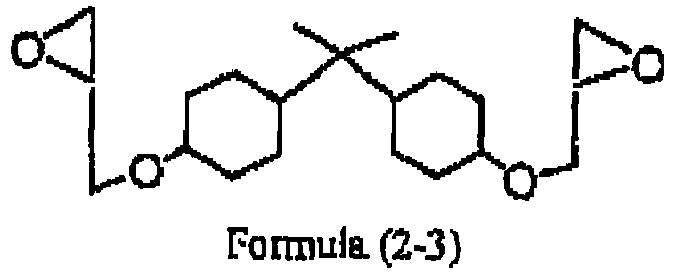
- Liquid epoxy compound: trade name: DME100 (of Formula (2-4), manufactured by New Japan Chemical Co., Ltd.)

- Liquid epoxy compound: trade name: CE-2021P (of Formula (2-5), manufactured by Daicel Corporation)

- As liquid epoxy compounds: tris-(3,4-epoxybutyl)-isocyanurate, tris-(4,5-epoxypentyl)-isocyanurate, and tris-(5,6-epoxyhexyl)-isocyanurate

- Liquid epoxy compound: (of Formula (2-9), manufactured by Nissan Chemical Industries, Ltd., trade name: TEPIC-PAS B22) prepared by adding 0.8 mol of propionic anhydride to 1 mol of tris-(2,3-epoxypropyl)-isocyanurate to modify tris-(2,3-epoxypropyl)-isocyanurate. The compound of Formula (2-9) contains a compound of Formula (2-9-1), a compound of Formula (2-9-2), a compound of Formula (2-9-3), and a compound of Formula (2-9-4) in a molar ratio of (2-9-1) : (2-9-2) : (2-9-3) : (2-9-4) = about 35% : 45% : 17% : 3%.

- Liquid epoxy compound: (of Formula (2-10), manufactured by Nissan Chemical Industries, Ltd., trade name: TEPIC-PAS B26) prepared by adding 0.4 mol of propionic anhydride to 1 mol of tris-(2,3-epoxypropyl)-isocyanurate to modify tris-(2,3-epoxypropyl)-isocyanurate. The compound of Formula (2-10) contains a compound of Formula (2-10-1), a compound of Formula (2-10-2), and a compound of Formula (2-10-3) in a molar ratio of (2-10-1) : (2-10-2) : (2-10-3) - about 60% : 32% : 8%.

- The equivalent of the curing agent relative to the epoxy compound is expressed in an equivalent ratio of the curable group of the curing agent relative to the epoxy group.
- Examples of the curing agent include phenolic resins, amines, polyamide resins, imidazoles, polymercaptans, and acid anhydrides. Particularly, acid anhydrides and an amines are preferred.
A solid curing agent can be used as a solution prepared by dissolving the solid in a solvent. However, because the lowering of the density of the cured product or formation of pores caused by evaporation of the solvent lead to lowered strength and lowered water resistance of the cured product, the curing agent itself is preferably in a liquid state at normal temperature under normal pressure. - Examples of the phenolic resin include phenol novolac resins and cresol novolac resins.
- Examples of the amines include piperidine, N,N-dimethylpiperazine, triethylenediamine, 2,4,6-tris(dimethylaminomethyl)phenol, benzyldimethylamine, 2-(dimethylaminomethyl)phenol, diethylenetriamine, triethylenetetramine, tetraethylenepentamine, diethylaminopropylamine, N-aminoethylpiperazine, di(1-methyl-2-aminocyclohexyl)methane, mencene diamine, isophorone diamine, diaminodicyclohexylmethane, 1,3-diaminomethylcyclohexane, xylenediamine, methaphenylenedimine, diaminodiphenylmethane, and diaminodiphenylsulfon. Among them, preferred to be used are diethylenetriamine, triethylenetatramine, tetraethylenepentamine, diethylaminopropylamine, N-aminoethylpiperazine, di(1-methyl-2-aminocyclohexyl)methane, mencene diamine, isophorone diamine, and diaminodicyclohexylmethane that are in a liquid state.
- Examples of the polyamide resins include a polyamideamine having in the molecule hereof, a primary amine and a secondary amine, which is generated by condensation of a dimer acid with a polyamine.
- Examples of the imidazoles include 2-methylimidazole, 2-ethyl-4-methylimidazole, 1-cyanoethyl-2-undecylimidazolium trimellitate, and an epoxy imidazole adduct.
- Examples of the polymercaptans include a polymercaptan in which a mercaptan group exists at a terminal of a polypropylene glycol chain and a polymercaptan in which a mercaptan group exists at a terminal of a polyethylene glycol chain, and among them, preferred are polymercaptans in a liquid state.
- As the acid anhydrides as the curing agent, anhydrides of compounds having, in one molecule thereof, a plurality of carboxy groups is preferred. Examples of the acid anhydrides include phthalic anhydride, trimellitic anhydride, pyromellitic dianhydride, benzophenone tetracarboxylic anhydride, ethylene glycol bis-trimellitate, glycerol tris-trimellitate, maleic anhydride, tetrahydrophthalic anhydride, methyl tetrahydrophthalic anhydride, endo-methylene tetrahydrophthalic anhydride, methyl endo-methylene tetrahydrophthalic anhydride, methylbutenyl tetrahydrophthalic anhydride, dodecenylsuccinic anhydride, hexahydrophthalic anhydride, methyl hexahydrophthalic anhydride, succinic anhydride, methylcyclohexenedicarboxylic anhydride, and chlorendic anhydride.
Among them, preferred are methyl tetrahydrophthalic anhydride, methyl-5-norbornene-2,3-dicarboxylic anhydride (methylnadic anhydride or methylhimic anhydride), hydrogenated methylnadic anhydride, methylbutenyl tetrahydrophthalic anhydride, dodecenylsuccinic anhydride, methyl hexahydrophthalic anhydride, and a mixture of methyl hexahydrophthalic anhydride with hexahydrophthalic anhydride that are in a liquid state at normal temperature under normal pressure. The viscosity of these liquid acid anhydrides measured at 25°C is around 10 mPas to 1,000 mPas. - When the above cured product is obtained, a curing assistant may be used, as appropriate, in combination with the curing agent. Examples of the curing assistants include: organic phosphorus compounds such as triphenylphosphine and tributylphosphine; quaternary phosphonium salts such as ethyltriphenylphosphonium bromide and tetrabutylphosphonium diethylphosphorodithioate; 1,8-diazabicyclo (5, 4, 0) undecane-7-ene; a salt of 1,8-diazabicyclo (5, 4, 0) undecane-7-ene with octylic acid; zinc octylate; and quaternary ammonium salts such as tetrabutylammonium bromide.
The content of the curing assistant may be 0.001 to 0.1 parts by mass, relative to 1 part by mass of the curing agent. - In the present invention, the epoxy compound of Formula (1) and the curing agent and if desired, the curing assistant are mixed to obtain the curable composition. The mixing can be performed using a reaction flask and a stirring propeller.
The mixing is performed, if necessary, by a heating-mixing method at a temperature of 10°C to 100°C for 0.5 to 1 hour. - The obtained liquid epoxy resin composition, that is, the curable composition of the present invention has a viscosity appropriate for being used as a liquid sealant. The liquid curable composition can be prepared to have any viscosity, and for being used as a transparent sealant for an LED or the like by a casting method, a potting method, a dispenser method, a printing method, or the like, the composition can perform partial sealing at any position. By mounting the Liquid curable composition in a liquid state as it is by the above method directly on an LED or the like, and then, drying and curing the curable composition, an epoxy resin cured product can be obtained.
- The curable composition is applied to a base material or is poured into a casting plate to which a mold releasing agent is applied, and by subjecting the curable composition to preliminary cure at a temperature of 100 to 120°C and to postcure at a temperature of 120 to 200°C, a cured product can be obtained.
- The curable composition of the present invention may contain a solvent. Examples of the solvent include: alcohols such as methanol and ethanol; ethers such as tetrahydrofuran; glycol ethers such as ethylene glycol monomethyl ether and ethylene glycol monoethyl ether; ethylene glycol alkyl ether acetates such as methylcellosolve acetate and ethylcellosolve acetate; diethylene glycols such as diethylene glycol monomethyl ether, diethylene glycol monoethyl ether, diethylene glycol dimethyl ether, diethylene glycol diethyl ether, and diethylene glycol ethyl methyl ether; propylene glycol monoalkyl ethers such as propylene glycol methyl ether, propylene glycol ethyl ether, propylene glycol propyl ether, and propylene glycol butyl ether; propylene glycol alkyl ether acetates such as propylene glycol methyl ether acetate, propylene glycol ethyl ether acetate, propylene glycol propyl ether acetate, and propylene glycol butyl ether acetate; propylene glycol alkyl ether acetates such as propylene glycol methyl ether propionate, propylene glycol ethyl ether propionate, propylene glycol propyl ether propionate, and propylene glycol butyl ether propionate; aromatic hydrocarbons such as toluene and xylene; ketones such as methyl ethyl ketone, cyclohexanone, and 4-hydroxy-4-methyl-2-pentanone; and esters such as methyl acetate, ethyl acetate, propyl acetate, butyl acetate, ethyl 2-hydroxypropionate, methyl 2-hydroxy-2-methylpropionate, ethyl 2-hydroxy-2-methylpropionate, methyl hydroxyacetate, ethyl hydroxyacetate, butyl hydroxyacetate, methyl lactate, ethyl lactate, propyl lactate, butyl lactate, methyl 3-hydroxypropionate, ethyl 3-hydroxypropionate, propyl 3-hydroxypropionate, butyl 3-hydroxypropionate, methyl 2-hydroxy-3-methylbutanate, methyl methoxyacetate, ethyl methoxyacetate, propyl methoxyacetate, butyl methoxyacetate, methyl ethoxyacetate, ethyl ethoxyacetate, propyl ethoxyacetate, butyl ethoxyacetate, methyl propoxyacetate, ethyl propoxyacetate, propyl propoxyacetate, butyl propoxyacetate, methyl butoxyacetate, ethyl butoxyacetate, propyl butoxyacetate, butyl butoxyacetate, methyl 2-methoxypropionate, ethyl 2-methoxypropionate, propyl 2-methoxypropionate, butyl 2-methoxypropionate, methyl 2-ethoxypropionate, ethyl 2-ethoxypropionate, propyl 2-ethoxypropionate, butyl 2-ethoxypropionate, methyl 2-butoxypropionate, ethyl 2-butoxypropionate, propyl 2-butoxypropionate, butyl 2-butoxypropionate, methyl 3-methoxypropionate, ethyl 3-methoxypropionate, propyl 3-methoxypropionate, butyl 3-methoxypropionate, methyl 3-ethoxypropionate, ethyl 3-ethoxypropionate, propyl 3-ethoxypropionate, butyl 3-ethoxypropionate, methyl 3-propoxypropionate, ethyl 3-propoxypropionate, propyl 3-propoxypropionate, butyl 3-propoxypropionate, methyl 3-butoxypropionate, ethyl 3-butoxypropionate, propyl 3-butoxypropionate, and butyl 3-butoxypropionate.
- The thickness of the coated film can be selected from a range of around 0.01 µm to 10 mm depending on the application of the cured product.
As for the heating time, the heating can be performed for 1 to 12 hour(s), preferably around 2 to 5 hours. - To 10.5 g of sodium hydride (purity: 60% or more), 200 mL; of tetrahydrofuran was added and the resultant reaction mixture was cooled down to 0°C, followed by dropping 22.58 g of 4-penten-1-ol into the reaction mixture at 4°C or less to be added. After the completion of the dropping, the resultant reaction mixture was stirred at room temperature for 2 hours. Then, the reaction mixture was cooled down again to 0°C and into the reaction mixture, 11.9 g of 2,4,6-trichloro-1,3,5-triazine dissolved in 85 mL of tetrahydrofuran was slowly dropped at 15°C or less to be added. At room temperature, the reaction was effected over one night and to the reaction mixture, water was added, followed by extracting the resultant reaction mixture with ethyl acetate. The extract was washed with water and was dried over anhydrous sodium sulfate and from the extract, the solvent was distilled off to obtain 21.9 g of a crude product. The crude product was purified with a column (ethyl acetate : hexane = 1:10) to obtain 13.15 g of 2,4,6-tri(4-pentene-1-oxy)-1,3,5-triazine which is the objective substance as a transparent oil. Yield: 60%, Purity: 99.2% (GC)
To 5.4 g of 2,4,6-tri(4-pentene-1-oxy)-1,3,5-triazine, 85 mL of chloroform was added and the resultant reaction mixture was cooled down to 0°C. To the reaction mixture, 9.0 g of methachloroperbenzoic acid (purity: about 77%) was added and while elevating gradually the temperature of the resultant reaction mixture from 0°C to room temperature, the reaction was effected over one night. To the reaction mixture, a 10% sodium thiosulfate aqueous solution was added and the resultant reaction mixture was extracted. The extract was washed with a sodium bicarbonate aqueous solution twice, was washed with water, and was dried over anhydrous sodium sulfate and from the extract, the solvent was distilled off to obtain 9.7 g of a crude product. The crude product was purified with a column (ethyl acetate : hexane = 1:1 to 4:1) to obtain 4.8 g of 2,4,6-tri(4,5-epoxypentyl-1-oxy)-1,3,5-triazine (corresponding to Formula (1-3)) which is the objective substance as a transparent oil. Yield: 77%, Purity: 98.9% (GC) - To 16.6 g of sodium hydride (purity: 60% or more), 600 mL of tetrahydrofuran was added and the resultant reaction mixture was cooled down to 0°C, followed by dropping 40.1 g of 3-hexen-1-ol into the reaction mixture at 4°C or less to be added. After the completion of the dropping, the resultant reaction mixture was stirred at room temperature for 3 hours. Then, the reaction mixture was cooled down again to 0°C and into the reaction mixture, 18.4 g of 2,4,6-trichloro-1,3,5-triazine dissolved in 120 mL of tetrahydrofuran was slowly dropped at 15°C or less to be added. At room temperature, the reaction was effected over one night and to the reaction mixture, water was added, followed by extracting the resultant reaction mixture with ethyl acetate. The extract was washed with water and was dried over anhydrous sodium sulfate and from the extract, the solvent was distilled off to obtain 33.1 g of a crude product. The crude product was purified with a column (ethyl acetate : hexane = 1:10) to obtain 23.22 g of 2,4,6-tri(3-hexene-1-oxy)-1,3,5-triazine which is the objective substance as a transparent oil. Yield: 61%, Purity: 98.6% (GC)
- To 22.5 g of 2,4,6-tri(3-hexene-1-oxy)-1,3,5-triazine, 300 mL of chloroform was added and the resultant reaction mixture was cooled down to 0°C. To the reaction mixture, 49.7 g of methachloroperbenzoic acid (purity: about 77%) was added and while elevating gradually the temperature of the resultant reaction mixture from 0°C to room temperature, the reaction was effected over one night. To the reaction mixture, a 10% sodium thiosulfate aqueous solution was added and the resultant reaction mixture was extracted. The extract was washed with a sodium bicarbonate aqueous solution twice, was washed with water, and was dried over anhydrous sodium sulfate and from the extract, the solvent was distilled off to obtain 27.9 g of a crude product. The crude product was purified with a column (ethyl acetate : hexane = 1:4) to obtain 18.6 g of 2,4,6-tri(3,4-epoxyhexyl-1-oxy)-1,3,5-triazine (corresponding to Formula (1-5)) which is the objective substance as a transparent oil. Yield: 71%, Purity: 96.8% (GC)
- To 16.6 g of sodium hydride (purity: 60% or more), 600 mL of tetrahydrofuran was added and the resultant reaction mixture was cooled down to 0°C, followed by dropping 34.5 g of 3-methyl-3-buten-1-ol into the reaction mixture at 4°C or less to be added. After the completion of the dropping, the resultant reaction mixture was stirred at room temperature for 3 hours. Then, the reaction mixture was cooled down again to 0°C and into the reaction mixture, 18.5 g of 2,4,6-trichloro-1,3,5-triazine dissolved in 110 mL of tetrahydrofuran was slowly dropped at 15°C or less to be added. At room temperature, the reaction was effected over one night and to the reaction mixture, water was added, followed by extracting the resultant reaction mixture with ethyl acetate. The extract was washed with water and was dried over anhydrous sodium sulfate and from the extract, the solvent was distilled off to obtain 31.1 g of a crude product. The crude product was recrystallized (ethyl acetate: hexane - 1:10) and the filtrate was purified with a column (ethyl acetate: hexane = 1:4) to obtain 26.1 g of 2,4,6-tri(3-which is the objective substance as a while solid. Yield: 76%, Purity: 97.0% (GC)
- To 25.4 g of 2,4,6-tri(3-methyl-3-butene-1-oxy)-1,3,5-triazine, 340 mL of chloroform was added and the resultant reaction mixture was cooled down to 0°C. To the reaction mixture, 61.6 g of methachloroperbenzoic acid (purity: about 77%) was added and while elevating gradually the temperature of the resultant reaction mixture from 0°C to room temperature, the reaction was effected over one night. To the reaction mixture, a 10% sodium thiosulfate aqueous solution was added and the resultant reaction mixture was extracted. The extract was washed with a sodium bicarbonate aqueous solution twice, was washed with water, and was dried over anhydrous sodium sulfate and from the extract, the solvent was distilled off to obtain 22.4 g of a crude product. The crude product was purified by recrystallization (ethyl acetate: hexane = 3:1) to obtain 18.3 g of 2,4,6-tri(3-methyl-3,4-epoxybutyl-1-oxy)-1,3,5-triazine (corresponding to Formula (1-6)) which is the objective substance as a white solid. Yield: 63%, Purity: 100% (GC)
- To 10.33 g (epoxy value = 7.79) of 2,4,6-tri(4,5-epoxypentyl-1-oxy)-1,3,5-triazine obtained in Example 1, 13.17 g of MH-700 (manufactured by New Japan Chemical Co., Ltd., the component thereof is prepared by mixing 4-methylhexahydrophthalic anhydride with hexahydrophthalic anhydride in a molar ratio of 70:30) as a curing agent was added and at room temperature, the resultant reaction mixture was stirred and was degassed under reduced pressure for 30 minutes. To the reaction mixture, 110 mg of HISHICOLIN PX-4ET (manufactured by Nippon Chemical Industrial Co., LTD., component: tetrabutylphosphonium diethylphosphorodithioate) as a curing assistant was added and the resultant reaction mixture was stirred and degassed again. The reaction mixture was poured in between glass plates (which were treated with a mold releasing agent SR-2410) between which a silicone rubber of 3 mm was sandwiched and the reaction mixture was cured under conditions of preliminary cure: at 100°C for 2 hours and postcure: at 150°C for 5 hours.
- Flexural strength: 156.0 MPa, flexural modulus: 3009 MPa, deflection until break: 9.35 mm, Tg (TMA): 165°C, linear expansion coefficient (30 to 80°C): 87.0 ppm/°C, transmittance (400 nm): 44.6%, boiled water absorption rate (100 hour): 2.8%.
- To 12.61 g (epoxy value = 7.01) of 2,4,6-tri(3,4-epoxyhexyl-1-oxy)-1,3,5-triazine obtained in Example 2, 14.46 g of MH-700 (manufactured by New Japan Chemical Co., Ltd.) as a curing agent was added and at room temperature, the reaction mixture was stirred and was degassed under reduced pressure for 30 minutes. To the reaction mixture, 120 mg of HISHICOLlN PX-4ET (manufactured by Nippon Chemical Industrial Co., LTD.) as a curing assistant was added and the resultant reaction mixture was stirred and degassed again. The reaction mixture was poured in between glass plates (which were treated with a mold releasing agent SR-2410) between which a silicone rubber of 3 mm was sandwiched and the reaction mixture was cured under conditions of preliminary cure: at 100°C for 2 hours and posteure: at 150°C for 5 hours.
- Flexural strength: 104.8 MPa, flexural modulus: 3238 MPa, deflection until break: 4.38 mm, Tg (TMA): 188°C, linear expansion coefficient (30 to 80°C): 90.1 ppm/°C, transmittance (400 nm): 41.3%, boiled water absorption rate (100 hour): 2.8%.
- The curable composition using the epoxy compound of the present invention obtained as a compound of Formula (1) has a high strength and an excellent transmittance.
According to the present invention, a curable composition using an epoxy compound having properties combining high transparency with high flexural strength when thermally cured while maintaining advantageous handling properties in a liquid state thereof can be provided. - The curable material using the liquid epoxy compound of the present invention has characteristics such as a low viscosity, fast curing, transparency, and small shrinkage on curing and can be used for coating or adhering of electronic parts, optical parts, or precision machine parts. The curable material using the liquid epoxy compound of the present invention can be used for adhering of, for example: an optical clement such as a lens of a cellular phone or a camera, a light-emitting diode (LED), and a semiconductor laser (LD); parts such as a liquid crystal panel, a biochip, and a lens or a prism of a camera; magnetic parts of a bard disc of a personal computer or the like; a pickup (a part capturing optical information reflected from a disc) of a CD or DVD player, a. cone and a coil of a speaker, a magnet of a motor; a circuit substrate; electronic parts; and parts inside an engine of an automobile and the like.
- The present invention is applicable to, for example, a body of an automobile or a motorcycle, a lens or a mirror of a head light, a plastic lens of glasses, a cellular phone, a game machine, an optical film, and an ID card as an application to a hard coating material for surface protection of an automobile body, a lamp or electric appliances, a building material, a plastic, and the like.
- Furthermore, examples of the application of the present invention include application to cards such as a credit card and a membership card, application to a printing ink for a switch and a keyboard of electric appliances and OA equipment, and application to an ink for an inkjet printer for a CD, a DVD, and the like as an application to an ink material for printing on a metal such as aluminum and a plastic.
- Examples of the application of the present invention also include application to a technology for producing a complicated three-dimensional object by curing, in combination with a three-dimensional CAD, a resin, application to a photo fabrication such as modeling of industrial products, and applications to coating of an optical fiber, adhering, optical waveguide, and thick film resist (for MEMS).
Claims (6)
- A method for producing an epoxy compound of Formula (1):
 reacting cyanuric chloride with a C4-8 alkenol and reacting the obtained compound having an unsaturated bond with a peroxide.
 - The method according to claim 1, wherein the alkenol is 3-buten-1-ol, 4-penten-1-ol, 5-hexen-1-ol, 3-hexen-1-ol, or 3-methyl-3-buten-1-ol.
- The method according to claim 1 or 2, wherein the peroxide contains a peroxide structure or a percarboxylic acid structure.
- A method for producing a curable composition, the method characterized by comprising:producing an epoxy compound of Formula (1) in accordance with the method as claimed in any one of claims 1 to 3 and mixing the epoxy compound with a curing agent.
- The method according to claim 4, wherein the curing agent is an acid anhydride, an amine, a. phenolic resin, a polyamide resin, imidazole, or a polymercaptan.
- The method according to claim 4 or 5, wherein the curable composition contains the curing agent in a ratio of 0.5 to 1.5 equivalents relative to an epoxy group of the epoxy compound.
Applications Claiming Priority (2)
| Application Number | Priority Date | Filing Date | Title |
|---|---|---|---|
| JP2010176349 | 2010-08-05 | ||
| PCT/JP2011/067112 WO2012017894A1 (en) | 2010-08-05 | 2011-07-27 | Method for producing epoxy compound having cyanuric acid skeleton |
Publications (2)
| Publication Number | Publication Date |
|---|---|
| EP2602256A1 true EP2602256A1 (en) | 2013-06-12 |
| EP2602256A4 EP2602256A4 (en) | 2014-07-09 |
Family
ID=45559395
Family Applications (1)
| Application Number | Title | Priority Date | Filing Date |
|---|---|---|---|
| EP11814521.8A Withdrawn EP2602256A4 (en) | 2010-08-05 | 2011-07-27 | Method for producing epoxy compound having cyanuric acid skeleton |
Country Status (7)
| Country | Link |
|---|---|
| US (1) | US9102663B2 (en) |
| EP (1) | EP2602256A4 (en) |
| JP (1) | JP5900747B2 (en) |
| KR (1) | KR101734189B1 (en) |
| CN (1) | CN103068823A (en) |
| TW (1) | TWI485176B (en) |
| WO (1) | WO2012017894A1 (en) |
Families Citing this family (2)
| Publication number | Priority date | Publication date | Assignee | Title |
|---|---|---|---|---|
| CN104177226A (en) * | 2014-07-31 | 2014-12-03 | 河北国蓬化工有限公司 | Method for preparing catalyst for polyether |
| JP6511772B2 (en) * | 2014-10-29 | 2019-05-15 | 東洋インキScホールディングス株式会社 | Thermosetting composition |
Family Cites Families (14)
| Publication number | Priority date | Publication date | Assignee | Title |
|---|---|---|---|---|
| US2537816A (en) * | 1951-01-09 | Method-of preparing tjnsaturated | ||
| US2741607A (en) * | 1954-02-23 | 1956-04-10 | Shell Dev | Triglycidyl cyanurate and polymers thereof |
| AT372382B (en) | 1980-08-14 | 1983-09-26 | Henkel Kgaa | METHOD FOR PRODUCING NEW OXIRANYLISOCYANURIC ACID COMPOUNDS |
| US4506063A (en) | 1984-02-22 | 1985-03-19 | The Dow Chemical Company | Advanced epoxy resins containing triazine or both triazine and oxazoline groups |
| EP1795558B1 (en) | 2004-09-29 | 2009-12-02 | Nissan Chemical Industries, Ltd. | Modified epoxy resin composition |
| US20070295956A1 (en) | 2006-06-27 | 2007-12-27 | Gelcore Llc | Optoelectronic device |
| US20070295983A1 (en) | 2006-06-27 | 2007-12-27 | Gelcore Llc | Optoelectronic device |
| US20070299162A1 (en) | 2006-06-27 | 2007-12-27 | Gelcore Llc | Optoelectronic device |
| CN101531737B (en) * | 2008-03-12 | 2011-01-26 | 鞍山润德精细化工有限公司 | Method for synthesizing ultraviolet curing resin by using byproducts in producing Triglycidyl Isocyanurate |
| JP5158430B2 (en) | 2008-06-23 | 2013-03-06 | Dic株式会社 | Epoxy compounds and epoxy cured products |
| JP5729744B2 (en) * | 2008-12-26 | 2015-06-03 | 荒川化学工業株式会社 | Laminate with a pattern formed on the surface |
| EP2397507B1 (en) * | 2009-02-10 | 2017-09-20 | Nissan Chemical Industries, Ltd. | Long chain alkylene group-containing epoxy compound |
| WO2011093188A1 (en) | 2010-01-26 | 2011-08-04 | 日産化学工業株式会社 | Positive-type resist composition and method for producing microlens |
| US8778597B2 (en) | 2010-01-26 | 2014-07-15 | Nissan Chemical Industries, Ltd. | Long-chain alkylene-containing curable epoxy resin composition |
-
2011
- 2011-07-27 JP JP2012527694A patent/JP5900747B2/en not_active Expired - Fee Related
- 2011-07-27 WO PCT/JP2011/067112 patent/WO2012017894A1/en not_active Ceased
- 2011-07-27 EP EP11814521.8A patent/EP2602256A4/en not_active Withdrawn
- 2011-07-27 US US13/814,015 patent/US9102663B2/en not_active Expired - Fee Related
- 2011-07-27 CN CN2011800385704A patent/CN103068823A/en active Pending
- 2011-07-27 KR KR1020137005542A patent/KR101734189B1/en not_active Expired - Fee Related
- 2011-08-03 TW TW100127550A patent/TWI485176B/en not_active IP Right Cessation
Non-Patent Citations (2)
| Title |
|---|
| No further relevant documents disclosed * |
| See also references of WO2012017894A1 * |
Also Published As
| Publication number | Publication date |
|---|---|
| CN103068823A (en) | 2013-04-24 |
| KR101734189B1 (en) | 2017-05-11 |
| WO2012017894A1 (en) | 2012-02-09 |
| US20130172525A1 (en) | 2013-07-04 |
| JPWO2012017894A1 (en) | 2013-10-03 |
| TWI485176B (en) | 2015-05-21 |
| EP2602256A4 (en) | 2014-07-09 |
| TW201221537A (en) | 2012-06-01 |
| US9102663B2 (en) | 2015-08-11 |
| JP5900747B2 (en) | 2016-04-06 |
| KR20130141459A (en) | 2013-12-26 |
Similar Documents
| Publication | Publication Date | Title |
|---|---|---|
| CN103429632B (en) | multifunctional epoxy compound | |
| TWI477498B (en) | Epoxy compound containing long chain alkylene | |
| CN103210012B (en) | Multi-functional epoxy compound | |
| CN103068876B (en) | Epoxy resin composition having monocyclic aliphatic hydrocarbon ring | |
| US9464074B2 (en) | Method for producing epoxy compound | |
| US9102663B2 (en) | Method for producing epoxy compound having cyanuric acid skeleton | |
| KR101821574B1 (en) | Epoxy compound with nitrogen-containing ring |
Legal Events
| Date | Code | Title | Description |
|---|---|---|---|
| PUAI | Public reference made under article 153(3) epc to a published international application that has entered the european phase |
Free format text: ORIGINAL CODE: 0009012 |
|
| 17P | Request for examination filed |
Effective date: 20130305 |
|
| AK | Designated contracting states |
Kind code of ref document: A1 Designated state(s): AL AT BE BG CH CY CZ DE DK EE ES FI FR GB GR HR HU IE IS IT LI LT LU LV MC MK MT NL NO PL PT RO RS SE SI SK SM TR |
|
| DAX | Request for extension of the european patent (deleted) | ||
| A4 | Supplementary search report drawn up and despatched |
Effective date: 20140605 |
|
| RIC1 | Information provided on ipc code assigned before grant |
Ipc: C07D 405/14 20060101AFI20140530BHEP Ipc: C08G 73/06 20060101ALI20140530BHEP |
|
| 17Q | First examination report despatched |
Effective date: 20160706 |
|
| RIC1 | Information provided on ipc code assigned before grant |
Ipc: C07D 405/14 20060101AFI20180309BHEP Ipc: C08G 59/32 20060101ALI20180309BHEP Ipc: C08G 59/02 20060101ALI20180309BHEP |
|
| GRAP | Despatch of communication of intention to grant a patent |
Free format text: ORIGINAL CODE: EPIDOSNIGR1 |
|
| INTG | Intention to grant announced |
Effective date: 20180425 |
|
| STAA | Information on the status of an ep patent application or granted ep patent |
Free format text: STATUS: THE APPLICATION IS DEEMED TO BE WITHDRAWN |
|
| 18D | Application deemed to be withdrawn |
Effective date: 20180906 |