EP2599653A2 - Door molding - Google Patents
Door molding Download PDFInfo
- Publication number
- EP2599653A2 EP2599653A2 EP12194885.5A EP12194885A EP2599653A2 EP 2599653 A2 EP2599653 A2 EP 2599653A2 EP 12194885 A EP12194885 A EP 12194885A EP 2599653 A2 EP2599653 A2 EP 2599653A2
- Authority
- EP
- European Patent Office
- Prior art keywords
- design member
- resin material
- metal particles
- door
- molding
- Prior art date
- Legal status (The legal status is an assumption and is not a legal conclusion. Google has not performed a legal analysis and makes no representation as to the accuracy of the status listed.)
- Withdrawn
Links
- 238000000465 moulding Methods 0.000 title claims abstract description 77
- 239000000463 material Substances 0.000 claims abstract description 85
- 239000002923 metal particle Substances 0.000 claims abstract description 73
- 229920005989 resin Polymers 0.000 claims abstract description 64
- 239000011347 resin Substances 0.000 claims abstract description 64
- 239000010409 thin film Substances 0.000 claims abstract description 17
- 239000002245 particle Substances 0.000 claims description 36
- 239000010408 film Substances 0.000 claims description 35
- 230000000007 visual effect Effects 0.000 claims description 14
- 229910052782 aluminium Inorganic materials 0.000 claims description 8
- XAGFODPZIPBFFR-UHFFFAOYSA-N aluminium Chemical compound [Al] XAGFODPZIPBFFR-UHFFFAOYSA-N 0.000 claims description 8
- 229910001220 stainless steel Inorganic materials 0.000 claims description 7
- 239000010935 stainless steel Substances 0.000 claims description 7
- 230000035515 penetration Effects 0.000 claims description 5
- 239000003086 colorant Substances 0.000 description 26
- 238000004519 manufacturing process Methods 0.000 description 14
- 230000001965 increasing effect Effects 0.000 description 8
- 238000001125 extrusion Methods 0.000 description 7
- 230000000452 restraining effect Effects 0.000 description 6
- 239000005357 flat glass Substances 0.000 description 5
- 238000000034 method Methods 0.000 description 5
- 230000002349 favourable effect Effects 0.000 description 4
- 229910052751 metal Inorganic materials 0.000 description 4
- 239000002184 metal Substances 0.000 description 4
- 229910001111 Fine metal Inorganic materials 0.000 description 3
- 230000000694 effects Effects 0.000 description 3
- 239000000835 fiber Substances 0.000 description 3
- 239000007943 implant Substances 0.000 description 3
- 239000007769 metal material Substances 0.000 description 3
- 239000000049 pigment Substances 0.000 description 3
- 239000007787 solid Substances 0.000 description 3
- 239000004743 Polypropylene Substances 0.000 description 2
- 150000001336 alkenes Chemical class 0.000 description 2
- 238000005516 engineering process Methods 0.000 description 2
- JRZJOMJEPLMPRA-UHFFFAOYSA-N olefin Natural products CCCCCCCC=C JRZJOMJEPLMPRA-UHFFFAOYSA-N 0.000 description 2
- 230000002093 peripheral effect Effects 0.000 description 2
- -1 polypropylene Polymers 0.000 description 2
- 229920001155 polypropylene Polymers 0.000 description 2
- 229920003002 synthetic resin Polymers 0.000 description 2
- 239000000057 synthetic resin Substances 0.000 description 2
- 229920002725 thermoplastic elastomer Polymers 0.000 description 2
- 230000003247 decreasing effect Effects 0.000 description 1
- 230000002708 enhancing effect Effects 0.000 description 1
- 239000011888 foil Substances 0.000 description 1
- 230000003760 hair shine Effects 0.000 description 1
- 239000000454 talc Substances 0.000 description 1
- 229910052623 talc Inorganic materials 0.000 description 1
- XLYOFNOQVPJJNP-UHFFFAOYSA-N water Substances O XLYOFNOQVPJJNP-UHFFFAOYSA-N 0.000 description 1
Images
Classifications
-
- B—PERFORMING OPERATIONS; TRANSPORTING
- B60—VEHICLES IN GENERAL
- B60J—WINDOWS, WINDSCREENS, NON-FIXED ROOFS, DOORS, OR SIMILAR DEVICES FOR VEHICLES; REMOVABLE EXTERNAL PROTECTIVE COVERINGS SPECIALLY ADAPTED FOR VEHICLES
- B60J10/00—Sealing arrangements
- B60J10/20—Sealing arrangements characterised by the shape
- B60J10/26—Sealing arrangements characterised by the shape characterised by the surface shape
- B60J10/265—Sealing arrangements characterised by the shape characterised by the surface shape the surface being primarily decorative
-
- B—PERFORMING OPERATIONS; TRANSPORTING
- B60—VEHICLES IN GENERAL
- B60J—WINDOWS, WINDSCREENS, NON-FIXED ROOFS, DOORS, OR SIMILAR DEVICES FOR VEHICLES; REMOVABLE EXTERNAL PROTECTIVE COVERINGS SPECIALLY ADAPTED FOR VEHICLES
- B60J10/00—Sealing arrangements
- B60J10/15—Sealing arrangements characterised by the material
- B60J10/16—Sealing arrangements characterised by the material consisting of two or more plastic materials having different physical or chemical properties
-
- B—PERFORMING OPERATIONS; TRANSPORTING
- B60—VEHICLES IN GENERAL
- B60J—WINDOWS, WINDSCREENS, NON-FIXED ROOFS, DOORS, OR SIMILAR DEVICES FOR VEHICLES; REMOVABLE EXTERNAL PROTECTIVE COVERINGS SPECIALLY ADAPTED FOR VEHICLES
- B60J10/00—Sealing arrangements
- B60J10/70—Sealing arrangements specially adapted for windows or windscreens
- B60J10/74—Sealing arrangements specially adapted for windows or windscreens for sliding window panes, e.g. sash guides
- B60J10/75—Sealing arrangements specially adapted for windows or windscreens for sliding window panes, e.g. sash guides for sealing the lower part of the panes
-
- B—PERFORMING OPERATIONS; TRANSPORTING
- B60—VEHICLES IN GENERAL
- B60J—WINDOWS, WINDSCREENS, NON-FIXED ROOFS, DOORS, OR SIMILAR DEVICES FOR VEHICLES; REMOVABLE EXTERNAL PROTECTIVE COVERINGS SPECIALLY ADAPTED FOR VEHICLES
- B60J10/00—Sealing arrangements
- B60J10/80—Sealing arrangements specially adapted for opening panels, e.g. doors
- B60J10/86—Sealing arrangements specially adapted for opening panels, e.g. doors arranged on the opening panel
- B60J10/88—Sealing arrangements specially adapted for opening panels, e.g. doors arranged on the opening panel mounted on, or integral with, the glass-run seals
Definitions
- This disclosure generally relates to a door molding.
- a known door molding configured to attach to a window frame of a vehicle door which is a belt molding that attaches along a belt line of a vehicle door
- Reference 1 is disclosed in JPH09-277829A, hereinafter referred to as Reference 1.
- the belt molding disclosed in Reference 1 is provided with a design member 55 formed in a strip form made from a colored synthetic resin arranged at a side surface of the belt molding in a direction of a vehicle exterior so that a vehicle owner may select the belt molding from a wide variety of color variations in accordance with a color preference of the vehicle owner.
- the belt molding disclosed in Reference 1 is integrally formed with a weather strip 50 provided for wiping off water droplets from an external surface of a door window glass 62 while moving the door window glass 62 up and down.
- the weather strip 50 includes a base portion 51 for attachment having a substantially inverted U-shape cross section that fits to an upper most end of a door panel 61.
- the weather strip 50 also includes a seal lip 52 extending obliquely upward from an upper end in an inward direction of the base portion 51 for attachment.
- implant fibers 52a that make contact with the external surface of the door window glass 62 are provided.
- the base portion 51 for attachment is made from a hard resin to serve as a core.
- the seal lip 52 is made from a soft resin.
- the soft resin forming the seal lip 52 extends to a side surface of the base portion 51 for attachment in the direction of the vehicle exterior to form a cover layer 53 that covers an entire area of the side surface.
- the soft resin further extends to form a retaining lip 54 that engages to the door panel 61.
- a portion of the cover layer 53 is formed with a groove formed in a strip form.
- the groove is filled with a colored resin added with pigments to form the design member 55.
- the design member 55 provides a metallic look to the belt molding at a low cost relative to a belt molding provided with a metallic look by providing a solid form stainless steel or a like radiant metal material or a radiant film material.
- the belt molding disclosed in Reference 1 provides the metallic look by using a colored synthetic resin, which lacks radiance.
- the door molding is advantageous in restraining cost of the door molding from increasing relative to a door molding provided with a design member made from a solid form stainless steel or a like radiant metal material, or a radiant film material.
- metal particles are provided as radiance materials that provide target radiance. Accordingly, a shiny metallic look may be provided at a low cost.
- the core member underneath the design member may be visually recognized through the design member while a metallic look is provided, however, adjusting, for example, film thickness of the design member 21, size of the metal particles, or amount of the metal particles may restrain the core member underneath the design member from being visually recognized through the design member.
- the design member of the door molding is made from the resin material as a base, the resin material provided with a characteristic and film thickness that allow penetration of visible light, the resin material allowing visual recognition of the core member through the resin material.
- the design member contains the metal particles serving as the radiance materials reflecting the visible light that penetrates into the resin material to limit visual recognition of the core member.
- the door molding is provided with the design member made from the resin material as the base, the resin material provided in the thin-film form that allows penetration of visible light and allows visual recognition of the core member through the resin material, the design member is provided with the metallic look without the colors underneath the design member being visually recognized through the design member.
- the design member of the door molding is provided with the metal particles being evenly distributed in the resin material.
- the design member In a state where the design member is provided with fixed film thickness and with the metal particles of fixed size and amount, the design member provided with the metal particles evenly distributed in the design member makes visually recognizing the colors underneath the design member difficult. Accordingly, the film thickness of the design member may be reduced, the metal particles having a particle diameter of general versatility may be selected for use, and furthermore, the amount of the metal particles contained in the design member may be reduced. Accordingly, the design member may be manufactured by using a manufacturing equipment and by following a manufacturing process for manufacturing a door molding provided with a design member formed in a thin-film form without containing the metal particles. The door molding may be provided without changing peripheral parts, for example, a door panel, or a door mirror. As a result, the door molding provided with the design member without the metal particles is replaced with the door molding provided with the design member containing the metal particles without difficulties.
- the design member of the door molding contains metal particles of aluminum or of stainless steel.
- Particles of aluminum or of stainless steel are provided to serve as radiance materials that provide target radiance to the design member.
- a shiny metallic look may be provided, accordingly.
- the design member of the door molding is made from the resin material as the base, the resin material being provided with film thickness equal to or more than 0.2 millimeters.
- the door molding is configured such that the door molding is manufactured by extrusion.
- Approximately 0.2 mm is minimum film thickness of the design member that may be handled by an extrusion process in a manufacturing process.
- Visually recognizing colors underneath the design member becomes more difficult as the film thickness of the design member formed in the thin-film form becomes thicker. Accordingly, in a state where 0.2 mm is selected as the film thickness of the design member, visually recognizing colors underneath the design member through the design member is easiest, however, mixing fine metal particles in the resin material and distributing the metal particles within the resin material restrain the colors underneath the design member from being visually recognized through the design member.
- the design member of the door molding is made from the resin material containing the metal particles of equal to or less than 5 ⁇ m particle diameter serving as the radiance materials, the resin material containing an amount of the metal particles equal to or more than 1% in ratio by weight.
- the effect is higher in restraining the colors underneath the design member from being visually recognized through the design member. Accordingly, using the metal particles of smaller particle diameter, for example the metal particles of 2 ⁇ m particle diameter is more effective in restraining the colors underneath the design member from being visually recognized through the design member. Nevertheless, technology for handling the metal particles of 2 ⁇ m is sophisticated. As a result, a use of 2 ⁇ m diameter metal particles leads to increasing cost. Accordingly, using the metal particles of approximately 5 ⁇ m particle diameter, which is the smallest in the metal particles of general versatility, is favorable. By containing the metal particles of 5 ⁇ m particle diameter to the amount equal to or more than 1% in ratio by weight, the metallic look is provided without the colors underneath the design member being visually recognized through the design member.
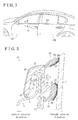
- Fig. 1 is a side view of a vehicle illustrating a periphery of a belt line where a belt molding according to a first embodiment serving as a door molding attaches to;
- Fig. 2 is a cross-sectional view of the belt molding according to the first embodiment taken along line II-II in Fig. 1 ;
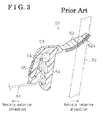
- Fig. 3 is a cross-sectional view illustrating a configuration of a known belt molding integrally formed with a weather strip
- a belt molding 10, which serves as a door molding, according to a first embodiment will be described.
- the belt molding 10 attaches to a portion of a window frame 101 of a vehicle door 100 where a belt line is formed, which in other words is an upper most end of a door panel 1.
- a curved portion 2 connects to a flange portion 3, which is provided in a vehicle interior direction relative to the curved portion 2, the flange portion 3 that forms the belt line.
- the flange portion 3 includes a first surface portion 4 extending upward from the curved portion 2, a folded portion 5 having a substantially inverse U-shape cross section formed by folding back at an upper most end of the first surface portion 4 and extending in a direction of a back surface of the door panel 1, and a second surface portion 6 extending downward from the folded portion 5 along the first surface portion 4.
- the second surface portion 6 extends side by side partway with the first surface portion 4 and then extends further downward.
- the belt molding 10 includes a core member 20 having a substantially inverse U-shape cross section provided with a first opposing portion 14 that covers the first surface portion 4 of the flange portion 3, a folded opposing portion 15 that covers the folded portion 5, and a second opposing portion 16 that covers the second surface portion 6.
- the core member 20 is made of hard polypropylene containing 40% talc in ratio by weight, or a similar material, which provides predetermined product rigidity and a low linear expansion characteristic.
- a hook portion 17 is formed at a lower end of the second opposing portion 16, which selectively engages to a lower end surface of the second surface portion 6 of the flange portion 3.
- a design member 21 formed in a thin-film form is provided on an external surface of the first opposing portion 14 and the folded opposing portion 15 of the core member 20.
- the design member 21 is made from a resin material as a base, which is a hard polypropylene, or a similar material. Film thickness of the design member 21 is defined to 0.2 millimeters (mm).
- the design member 21 contains 1% in ratio by weight of metal particles, which are aluminum particles of 5 micrometers ( ⁇ m) particle diameter.
- the metal particles serve as radiance materials providing radiance to the resin material.
- the resin material without containing the radiance materials provided in 0.2 mm film thickness is thin enough to allow penetration of visible light and to allow visual recognition of the core member 20 through the thin-film of the resin material.
- the radiance materials reflect the visual light that penetrates into the resin material to limit visual recognition of the core member 20.
- a metallic look is favorably provided without a color of the core member 20 being visually recognized through the design member 21.
- Approximately 0.2 mm is minimum film thickness of the design member 21 that may be reliably handled in an extrusion process in a manufacturing process.
- the design member 21 is configured to be manufactured by using a manufacturing equipment and by following a manufacturing process used for manufacturing a door molding provided with a design member made from a resin material without the radiance material.
- a first lip portion 22 is provided at a lower end portion of the first opposing portion 14 of the core member 20 in a state where the first lip portion 22 extends toward the curved portion 2 of the door panel 1.
- the first lip portion 22 is made from a material softer than the core member 20.
- An example of such material is an olefin series thermoplastic elastomer having Shore A hardness of 70 degrees.
- a second lip portion 23 is provided at a middle portion in a height direction of the first opposing portion 14. The second lip portion 23 extends toward the first surface portion 4 of the door panel 1.
- the first lip portion 22 and the second lip portion 23 are made from a same or a similar material.
- Weather strips 24 in pressure contact states with a door window glass 7 are provided for wiping external surfaces of the door window glass 7.
- One of the weather strips 24 is provided on an outward surface at a borderline area between the folded opposing portion 15 and the second opposing portion 16.
- the other weather strip 24 is provided on the outward surface of the second opposing portion 16 at a portion near the lower end.
- Each of the weather strips 24 includes a main body 25 made from an olefin series thermoplastic elastomer having Shore A hardness of 70 degrees, or a similar material.
- a resin portion 26 is arranged as a portion where implant fibers 27 adheres.
- the implant fibers 27 are provided at the resin portions 26.
- the first lip portion 22 is in a pressure contact state with the curved portion 2 of the door panel 1. An elastic rebound force of the first lip portion 22 biases the belt molding 10 in an upward direction.
- the hook portion 17 engages to the lower end surface of the second surface portion 6.
- the second lip portion 23 is in a pressure contact state with the first surface portion 4 of the flange portion 3. An elastic rebound force of the second lip portion 23 biases the belt molding 10 in a vehicle exterior direction.
- the second opposing portion 16 is pressed against the second surface portion 6.
- the design member 21 having the film thickness of 0.2 mm is provided on a surface of the core member 20.
- the design member 21 contains aluminum particles of 5 ⁇ m particle diameter.
- the aluminum particles reflect visible light and shines.
- the core member 20 underneath the design member 21 is not visually recognizable through the design member 21 and the metallic look is favorably provided.
- the belt molding 10 becomes an ornament that provides a luxurious look to the belt line, which is a part of the window frame 101 of the vehicle door 100.
- the belt molding 10 according to the first embodiment is advantageous in following aspects.
- Using the resin material containing metal particles for the design member 21 restrains cost of the belt molding 10 from increasing relative to a belt molding provided with a design member made from a solid form stainless steel, or a like radiant metal material, or a radiant film material.
- metal particles serving as radiance materials are provided for providing target radiance. Accordingly, a shiny metallic look may be provided at a low cost.
- the design member may be reduced in weight.
- the design member 21 is provided with the metallic look without the colors underneath the design member 21 being visually recognized through the design member 21.
- the design member 21 In a state where the design member 21 is provided with fixed film thickness and with the metal particles of fixed size and amount, the design member 21 provided with the metal particles evenly distributed in the design member 21 makes visually recognizing the colors underneath the design member 21 difficult. Accordingly, the film thickness of the design member 21 may be reduced to 0.2 mm.
- the metal particles of 5 ⁇ m particle diameter which is a particle diameter of general versatility, may be selected for use. Furthermore, the amount of the metal particles contained in the design member 21 may be reduced to 1% in ratio by weight. Accordingly, the design member 21 may be manufactured by using a manufacturing equipment and by following a manufacturing process for manufacturing a belt molding provided with a design member formed in a thin-film form without containing metal particles.
- the belt molding 10 may be provided without changing peripheral parts, for example, the door panel 1, or a door mirror. As a result, the belt molding provided with the design member without containing the metal particles is replaced with the belt molding 10 provided with the design member 21 containing the metal particles without difficulties.
- the belt molding 10 serves as an ornament that provides the luxurious look to the belt line, which is a part of the window frame 101 of the vehicle door 100.
- the belt molding 10 according to the first embodiment may be altered in following manners.
- a soft resin may be selected for use as the base material for the design member 21 and metal particles may be mixed into the soft resin to form the design member 21.
- a core metal may be embedded in a soft resin to form the core member 20, instead of providing the core member 20 entirely with the soft resin.
- the design member 21 of the belt molding 10 according to the first embodiment is provided with the film thickness of 0.2 mm in consideration of replacing a belt molding provided with a design member having film thickness of 0.2 mm.
- the film thickness of the design member 21 may be changed to 0.5 mm.
- Visually recognizing colors underneath the design member 21 becomes more difficult as the film thickness of the design member 21 formed in the thin-film form becomes thicker. Accordingly, a particle diameter of the metal particles may be increased or the amount of the metal particles to be contained may be decreased to provide favorable results.
- the film thickness of the design member 21 provided in the belt molding 10 according to the first embodiment is 0.2 mm, which is minimum film thickness an extrusion process in a manufacturing process may handle.
- providing the design member 21 provided with the film thickness of less than 0.2 mm may be allowed.
- visual recognition of the colors underneath the design member 21 through the design member 21 becomes easy. Nevertheless, using the metal particles of less than 5 ⁇ m particle diameter restrains the visual recognition of the colors underneath the design member 21 through the design member 21.
- metal particles of general versatility particle diameter In order to reduce cost, using the metal particles of general versatility particle diameter, is favorable, however, for preventing the visual recognition of the colors underneath the design member 21, using fine metal particles, each of which having the particle diameter of 2 ⁇ m, may be allowed.
- metal particles of 2 ⁇ m particle diameter metal particles of 5 ⁇ m particle diameter, which is a particle diameter of general versatility, may be selected.
- the metal particles to be contained in the design member 21 are not limited to aluminum particles. Stainless steel particles may be used instead of the aluminum particles for the design member 21. Form of the belt molding 10 and materials used for providing elements that structure the belt molding 10 may be changed in accordance with a specification change.
- the belt molding 10 serves as a door molding, however, the door molding is not limited to a belt molding.
- a frame molding configured to attach to the window frame 101 of the vehicle door 100 may serve as a door molding provided with a design member formed in a thin-film form.
- the door molding according to this disclosure includes a design member made from a resin material as a base provided with film thickness equal to or more than 0.2 mm.
- the design member is made from the resin material containing metal particles of equal to or less than 5 ⁇ m particle diameter serving as the radiance material.
- the resin material contains an amount of the metal particles equal to or greater than 1% in ratio by weight.
- the door molding according to this disclosure is configured such that the door molding is manufactured by extrusion.
- Approximately 0.2 mm is minimum film thickness of the design member that may be handled by an extrusion process in a manufacturing process.
- Visually recognizing colors underneath the design member becomes more difficult as the film thickness of the design member formed in a thin-film form becomes thicker. Accordingly, in a state where 0.2 mm is selected as the film thickness of the design member, visually recognizing colors underneath the design member through the design member is easiest, however, mixing fine metal particles in the resin material and distributing the metal particles within the resin material restrain the colors underneath the design member from being visually recognized through the design member.
- Metal particles of 20 ⁇ m particle diameter is an example of the metal particles having relatively large particles.
- the metal particles of approximately 5 ⁇ m particle diameter which is the smallest in the metal partides of general versatility, is favorable.
- containing the metal particles of 5 ⁇ m particle diameter to an amount equal to or more than 1% in ratio by weight a metallic look is provided without the colors underneath the design member being visually recognized through the design member.
- the door molding according to this disclosure may be considered as an ornamental part provided with a design member formed in a thin-film form having equal to or more than 0.2 mm film thickness provided on a surface of the ornamental part.
- the design member is made by mixing metal particles that serve as radiance materials to a resin material that serves as a base material.
- the design member is formed in the thin-film form that allows visual recognition of a material underneath the design member through the design member.
- a metallic look is provided without the colors underneath the design member being visually recognized through the design member, the metallic look which makes the ornamental part look luxurious.
Landscapes
- Engineering & Computer Science (AREA)
- Mechanical Engineering (AREA)
- Vehicle Interior And Exterior Ornaments, Soundproofing, And Insulation (AREA)
- Seal Device For Vehicle (AREA)
- Extrusion Moulding Of Plastics Or The Like (AREA)
Abstract
A door molding (10) configured to attach to a window frame (101) of a vehicle door (100) includes a design member (21) formed in a thin-film form provided on a surface of a core member (20), the design member (21) made from a resin material containing metal particles.
Description
- This disclosure generally relates to a door molding.
- A known door molding configured to attach to a window frame of a vehicle door, which is a belt molding that attaches along a belt line of a vehicle door, is disclosed in JPH09-277829A, hereinafter referred to as Reference 1. As illustrated in
Fig. 3 , the belt molding disclosed in Reference 1 is provided with adesign member 55 formed in a strip form made from a colored synthetic resin arranged at a side surface of the belt molding in a direction of a vehicle exterior so that a vehicle owner may select the belt molding from a wide variety of color variations in accordance with a color preference of the vehicle owner. The belt molding disclosed in Reference 1 is integrally formed with aweather strip 50 provided for wiping off water droplets from an external surface of adoor window glass 62 while moving thedoor window glass 62 up and down. - As
Fig. 3 illustrates, theweather strip 50 includes abase portion 51 for attachment having a substantially inverted U-shape cross section that fits to an upper most end of adoor panel 61. Theweather strip 50 also includes aseal lip 52 extending obliquely upward from an upper end in an inward direction of thebase portion 51 for attachment. At a lower surface of theseal lip 52,implant fibers 52a that make contact with the external surface of thedoor window glass 62 are provided. Thebase portion 51 for attachment is made from a hard resin to serve as a core. Theseal lip 52 is made from a soft resin. The soft resin forming theseal lip 52 extends to a side surface of thebase portion 51 for attachment in the direction of the vehicle exterior to form acover layer 53 that covers an entire area of the side surface. The soft resin further extends to form aretaining lip 54 that engages to thedoor panel 61. A portion of thecover layer 53 is formed with a groove formed in a strip form. The groove is filled with a colored resin added with pigments to form thedesign member 55. As a result, thedesign member 55 provides a metallic look to the belt molding at a low cost relative to a belt molding provided with a metallic look by providing a solid form stainless steel or a like radiant metal material or a radiant film material. - The belt molding disclosed in Reference 1 provides the metallic look by using a colored synthetic resin, which lacks radiance.
- A need thus exists for enhancing a metallic look of a door molding by increasing radiance without increasing cost.
- According to an aspect of this disclosure, a door molding configured to attach to a window frame of a vehicle door includes a design member formed in a thin-film form provided on a surface of a core member, the design member made from a resin material containing metal particles.
- Upon the arrangements described herewith, the door molding is advantageous in restraining cost of the door molding from increasing relative to a door molding provided with a design member made from a solid form stainless steel or a like radiant metal material, or a radiant film material. Instead of providing pigments for providing colors, metal particles are provided as radiance materials that provide target radiance. Accordingly, a shiny metallic look may be provided at a low cost. In a state where the design member is formed in the thin-film form, the core member underneath the design member may be visually recognized through the design member while a metallic look is provided, however, adjusting, for example, film thickness of the
design member 21, size of the metal particles, or amount of the metal particles may restrain the core member underneath the design member from being visually recognized through the design member. - According to another aspect of this disclosure, the design member of the door molding is made from the resin material as a base, the resin material provided with a characteristic and film thickness that allow penetration of visible light, the resin material allowing visual recognition of the core member through the resin material. The design member contains the metal particles serving as the radiance materials reflecting the visible light that penetrates into the resin material to limit visual recognition of the core member.
- In a state where the door molding is provided with the design member made from the resin material as the base, the resin material provided in the thin-film form that allows penetration of visible light and allows visual recognition of the core member through the resin material, the design member is provided with the metallic look without the colors underneath the design member being visually recognized through the design member.
- According to further aspect of this disclosure, the design member of the door molding is provided with the metal particles being evenly distributed in the resin material.
- In a state where the design member is provided with fixed film thickness and with the metal particles of fixed size and amount, the design member provided with the metal particles evenly distributed in the design member makes visually recognizing the colors underneath the design member difficult. Accordingly, the film thickness of the design member may be reduced, the metal particles having a particle diameter of general versatility may be selected for use, and furthermore, the amount of the metal particles contained in the design member may be reduced. Accordingly, the design member may be manufactured by using a manufacturing equipment and by following a manufacturing process for manufacturing a door molding provided with a design member formed in a thin-film form without containing the metal particles. The door molding may be provided without changing peripheral parts, for example, a door panel, or a door mirror. As a result, the door molding provided with the design member without the metal particles is replaced with the door molding provided with the design member containing the metal particles without difficulties.
- According to another aspect of this disclosure, the design member of the door molding contains metal particles of aluminum or of stainless steel.
- Particles of aluminum or of stainless steel are provided to serve as radiance materials that provide target radiance to the design member. A shiny metallic look may be provided, accordingly.
- According to further aspect of this disclosure, the design member of the door molding is made from the resin material as the base, the resin material being provided with film thickness equal to or more than 0.2 millimeters.
- The door molding is configured such that the door molding is manufactured by extrusion. Approximately 0.2 mm is minimum film thickness of the design member that may be handled by an extrusion process in a manufacturing process. Visually recognizing colors underneath the design member becomes more difficult as the film thickness of the design member formed in the thin-film form becomes thicker. Accordingly, in a state where 0.2 mm is selected as the film thickness of the design member, visually recognizing colors underneath the design member through the design member is easiest, however, mixing fine metal particles in the resin material and distributing the metal particles within the resin material restrain the colors underneath the design member from being visually recognized through the design member.
- According to another aspect of this disclosure, the design member of the door molding is made from the resin material containing the metal particles of equal to or less than 5 µm particle diameter serving as the radiance materials, the resin material containing an amount of the metal particles equal to or more than 1% in ratio by weight.
- Smaller the particle diameter of the metal particles mixed into the resin material, the effect is higher in restraining the colors underneath the design member from being visually recognized through the design member. Accordingly, using the metal particles of smaller particle diameter, for example the metal particles of 2 µm particle diameter is more effective in restraining the colors underneath the design member from being visually recognized through the design member. Nevertheless, technology for handling the metal particles of 2 µm is sophisticated. As a result, a use of 2 µm diameter metal particles leads to increasing cost. Accordingly, using the metal particles of approximately 5 µm particle diameter, which is the smallest in the metal particles of general versatility, is favorable. By containing the metal particles of 5 µm particle diameter to the amount equal to or more than 1% in ratio by weight, the metallic look is provided without the colors underneath the design member being visually recognized through the design member.
- The foregoing and additional features and characteristics of this disclosure will become more apparent from the following detailed description considered with the reference to the accompanying drawings, wherein:
-
Fig. 1 is a side view of a vehicle illustrating a periphery of a belt line where a belt molding according to a first embodiment serving as a door molding attaches to; -
Fig. 2 is a cross-sectional view of the belt molding according to the first embodiment taken along line II-II inFig. 1 ; -
Fig. 3 is a cross-sectional view illustrating a configuration of a known belt molding integrally formed with a weather strip; - A
belt molding 10, which serves as a door molding, according to a first embodiment will be described. AsFig. 1 illustrates, thebelt molding 10 attaches to a portion of awindow frame 101 of avehicle door 100 where a belt line is formed, which in other words is an upper most end of a door panel 1. - As
Fig. 2 illustrates, at an upper end portion of the door panel 1, a curved portion 2 connects to a flange portion 3, which is provided in a vehicle interior direction relative to the curved portion 2, the flange portion 3 that forms the belt line. The flange portion 3 includes afirst surface portion 4 extending upward from the curved portion 2, a folded portion 5 having a substantially inverse U-shape cross section formed by folding back at an upper most end of thefirst surface portion 4 and extending in a direction of a back surface of the door panel 1, and a second surface portion 6 extending downward from the folded portion 5 along thefirst surface portion 4. The second surface portion 6 extends side by side partway with thefirst surface portion 4 and then extends further downward. - The
belt molding 10 includes acore member 20 having a substantially inverse U-shape cross section provided with a firstopposing portion 14 that covers thefirst surface portion 4 of the flange portion 3, a foldedopposing portion 15 that covers the folded portion 5, and a secondopposing portion 16 that covers the second surface portion 6. Thecore member 20 is made of hard polypropylene containing 40% talc in ratio by weight, or a similar material, which provides predetermined product rigidity and a low linear expansion characteristic. Ahook portion 17 is formed at a lower end of the secondopposing portion 16, which selectively engages to a lower end surface of the second surface portion 6 of the flange portion 3. - A
design member 21 formed in a thin-film form is provided on an external surface of the firstopposing portion 14 and the foldedopposing portion 15 of thecore member 20. Thedesign member 21 is made from a resin material as a base, which is a hard polypropylene, or a similar material. Film thickness of thedesign member 21 is defined to 0.2 millimeters (mm). Thedesign member 21 contains 1% in ratio by weight of metal particles, which are aluminum particles of 5 micrometers (µm) particle diameter. The metal particles serve as radiance materials providing radiance to the resin material. The resin material without containing the radiance materials provided in 0.2 mm film thickness is thin enough to allow penetration of visible light and to allow visual recognition of thecore member 20 through the thin-film of the resin material. In a state where the resin material is provided with the radiance materials evenly distributed within the resin material, the radiance materials reflect the visual light that penetrates into the resin material to limit visual recognition of thecore member 20. As a result, a metallic look is favorably provided without a color of thecore member 20 being visually recognized through thedesign member 21. Approximately 0.2 mm is minimum film thickness of thedesign member 21 that may be reliably handled in an extrusion process in a manufacturing process. Thedesign member 21 is configured to be manufactured by using a manufacturing equipment and by following a manufacturing process used for manufacturing a door molding provided with a design member made from a resin material without the radiance material. - A
first lip portion 22 is provided at a lower end portion of the first opposingportion 14 of thecore member 20 in a state where thefirst lip portion 22 extends toward the curved portion 2 of the door panel 1. Thefirst lip portion 22 is made from a material softer than thecore member 20. An example of such material is an olefin series thermoplastic elastomer having Shore A hardness of 70 degrees. Asecond lip portion 23 is provided at a middle portion in a height direction of the first opposingportion 14. Thesecond lip portion 23 extends toward thefirst surface portion 4 of the door panel 1. Thefirst lip portion 22 and thesecond lip portion 23 are made from a same or a similar material. - Weather strips 24 in pressure contact states with a
door window glass 7 are provided for wiping external surfaces of thedoor window glass 7. One of the weather strips 24 is provided on an outward surface at a borderline area between the folded opposingportion 15 and the second opposingportion 16. Theother weather strip 24 is provided on the outward surface of the second opposingportion 16 at a portion near the lower end. Each of the weather strips 24 includes amain body 25 made from an olefin series thermoplastic elastomer having Shore A hardness of 70 degrees, or a similar material. On a downward surface of each of themain bodies 25, the downward surface connecting a distal end and a base end, aresin portion 26 is arranged as a portion whereimplant fibers 27 adheres. Theimplant fibers 27 are provided at theresin portions 26. - The
first lip portion 22 is in a pressure contact state with the curved portion 2 of the door panel 1. An elastic rebound force of thefirst lip portion 22 biases thebelt molding 10 in an upward direction. Thehook portion 17 engages to the lower end surface of the second surface portion 6. Upon the arrangement described herewith, a position in an upward and downward direction of thebelt molding 10 relative to the door panel 1 is maintained at a predetermined position and at the same time looseness in the upward and downward direction is restrained. Thesecond lip portion 23 is in a pressure contact state with thefirst surface portion 4 of the flange portion 3. An elastic rebound force of thesecond lip portion 23 biases thebelt molding 10 in a vehicle exterior direction. Furthermore, the second opposingportion 16 is pressed against the second surface portion 6. Upon the arrangement described herewith, a position in a horizontal direction of thebelt molding 10 relative to the door panel 1 is maintained at a predetermined position and at the same time looseness in the horizontal direction is restrained. - How the
belt molding 10 works will be described next. Thedesign member 21 having the film thickness of 0.2 mm is provided on a surface of thecore member 20. Thedesign member 21 contains aluminum particles of 5 µm particle diameter. When thebelt molding 10 is attached to the belt line in a state where thedesign member 21 faces the vehicle exterior direction, the aluminum particles reflect visible light and shines. Thecore member 20 underneath thedesign member 21 is not visually recognizable through thedesign member 21 and the metallic look is favorably provided. As a result, thebelt molding 10 becomes an ornament that provides a luxurious look to the belt line, which is a part of thewindow frame 101 of thevehicle door 100. - Upon the arrangements described herewith, the
belt molding 10 according to the first embodiment is advantageous in following aspects. Using the resin material containing metal particles for thedesign member 21 restrains cost of thebelt molding 10 from increasing relative to a belt molding provided with a design member made from a solid form stainless steel, or a like radiant metal material, or a radiant film material. Instead of providing pigments for providing colors, metal particles serving as radiance materials are provided for providing target radiance. Accordingly, a shiny metallic look may be provided at a low cost. Relative to a configuration of the design member using a metal plate or a metal foil, the design member may be reduced in weight. - In a state where the
belt molding 10 is provided with thedesign member 21 made from the resin material as the base, the resin material provided in the thin-film form having the film thickness of 0.2 mm that allows penetration of visible light and allows visual recognition of thecore member 20 through the resin material, thedesign member 21 is provided with the metallic look without the colors underneath thedesign member 21 being visually recognized through thedesign member 21. - In a state where the
design member 21 is provided with fixed film thickness and with the metal particles of fixed size and amount, thedesign member 21 provided with the metal particles evenly distributed in thedesign member 21 makes visually recognizing the colors underneath thedesign member 21 difficult. Accordingly, the film thickness of thedesign member 21 may be reduced to 0.2 mm. The metal particles of 5 µm particle diameter, which is a particle diameter of general versatility, may be selected for use. Furthermore, the amount of the metal particles contained in thedesign member 21 may be reduced to 1% in ratio by weight. Accordingly, thedesign member 21 may be manufactured by using a manufacturing equipment and by following a manufacturing process for manufacturing a belt molding provided with a design member formed in a thin-film form without containing metal particles. Thebelt molding 10 may be provided without changing peripheral parts, for example, the door panel 1, or a door mirror. As a result, the belt molding provided with the design member without containing the metal particles is replaced with thebelt molding 10 provided with thedesign member 21 containing the metal particles without difficulties. - In a state where the
design member 21 is formed in the thin-film form, which allows visual recognition of thecore member 20 underneath thedesign member 21 through thedesign member 21, mixing the metal particles serving as the radiance materials to the resin material, which is the base material of thedesign member 21, provides thedesign member 21 with the metallic look without the colors underneath thedesign member 21 being visually recognized through thedesign member 21. Accordingly, thebelt molding 10 serves as an ornament that provides the luxurious look to the belt line, which is a part of thewindow frame 101 of thevehicle door 100. - The
belt molding 10 according to the first embodiment may be altered in following manners. Provided that thecore member 20 underneath thedesign member 21 is provided with reliable product rigidity, a soft resin may be selected for use as the base material for thedesign member 21 and metal particles may be mixed into the soft resin to form thedesign member 21. In order to provide reliable product rigidity to thecore member 20, a core metal may be embedded in a soft resin to form thecore member 20, instead of providing thecore member 20 entirely with the soft resin. - The
design member 21 of thebelt molding 10 according to the first embodiment is provided with the film thickness of 0.2 mm in consideration of replacing a belt molding provided with a design member having film thickness of 0.2 mm. In consideration of replacing a belt molding provided with a design member having film thickness of 0.5 mm, the film thickness of thedesign member 21 may be changed to 0.5 mm. Visually recognizing colors underneath thedesign member 21 becomes more difficult as the film thickness of thedesign member 21 formed in the thin-film form becomes thicker. Accordingly, a particle diameter of the metal particles may be increased or the amount of the metal particles to be contained may be decreased to provide favorable results. - The film thickness of the
design member 21 provided in thebelt molding 10 according to the first embodiment is 0.2 mm, which is minimum film thickness an extrusion process in a manufacturing process may handle. In a situation where the extrusion process in the manufacturing process handles film thickness of less than 0.2 mm in accordance with a technological advancement, providing thedesign member 21 provided with the film thickness of less than 0.2 mm may be allowed. In a state where thedesign member 21 is provided in 0.2 mm film thickness, visual recognition of the colors underneath thedesign member 21 through thedesign member 21 becomes easy. Nevertheless, using the metal particles of less than 5 µm particle diameter restrains the visual recognition of the colors underneath thedesign member 21 through thedesign member 21. In order to reduce cost, using the metal particles of general versatility particle diameter, is favorable, however, for preventing the visual recognition of the colors underneath thedesign member 21, using fine metal particles, each of which having the particle diameter of 2 µm, may be allowed. As an alternative to selecting the metal particles of 2 µm particle diameter, metal particles of 5 µm particle diameter, which is a particle diameter of general versatility, may be selected. Even in a case where the metal particles of 5 µm particle diameter is selected, adjustments, for example, increasing an amount of the metal particles to be contained in the resin material that serves as the base material to 2% in ratio by weight, or mixing the metal particles in the resin material in a state where the metal particles are evenly distributed in the resin material, are effective in further preventing the colors underneath thedesign member 21 from visually recognized and providing a metallic look. - The metal particles to be contained in the
design member 21 are not limited to aluminum particles. Stainless steel particles may be used instead of the aluminum particles for thedesign member 21. Form of thebelt molding 10 and materials used for providing elements that structure thebelt molding 10 may be changed in accordance with a specification change. - The
belt molding 10 serves as a door molding, however, the door molding is not limited to a belt molding. A frame molding configured to attach to thewindow frame 101 of thevehicle door 100 may serve as a door molding provided with a design member formed in a thin-film form. - The door molding according to this disclosure includes a design member made from a resin material as a base provided with film thickness equal to or more than 0.2 mm. The design member is made from the resin material containing metal particles of equal to or less than 5 µm particle diameter serving as the radiance material. The resin material contains an amount of the metal particles equal to or greater than 1% in ratio by weight.
- The door molding according to this disclosure is configured such that the door molding is manufactured by extrusion. Approximately 0.2 mm is minimum film thickness of the design member that may be handled by an extrusion process in a manufacturing process. Visually recognizing colors underneath the design member becomes more difficult as the film thickness of the design member formed in a thin-film form becomes thicker. Accordingly, in a state where 0.2 mm is selected as the film thickness of the design member, visually recognizing colors underneath the design member through the design member is easiest, however, mixing fine metal particles in the resin material and distributing the metal particles within the resin material restrain the colors underneath the design member from being visually recognized through the design member. Metal particles of 20 µm particle diameter is an example of the metal particles having relatively large particles. In a state where the metal particles of 20µm particle diameter are mixed and distributed within the resin material, an effect is low in restraining the colors underneath the design member from being visually recognized through the design member. In other words, smaller the particle diameter, the effect is higher in restraining the colors underneath the design member from being visually recognized through the design member. Accordingly, using the metal particles of smaller particle diameter, for example the metal particles of 2 µm particle diameter is more effective in restraining the colors underneath the design member from being visually recognized through the design member. Nevertheless, technology for handling the metal particles of 2 µm is sophisticated. As a result, a use of 2 µm diameter metal particles leads to increasing cost. Accordingly, using the metal particles of approximately 5 µm particle diameter, which is the smallest in the metal partides of general versatility, is favorable. By containing the metal particles of 5 µm particle diameter to an amount equal to or more than 1% in ratio by weight, a metallic look is provided without the colors underneath the design member being visually recognized through the design member.
- The door molding according to this disclosure may be considered as an ornamental part provided with a design member formed in a thin-film form having equal to or more than 0.2 mm film thickness provided on a surface of the ornamental part. The design member is made by mixing metal particles that serve as radiance materials to a resin material that serves as a base material.
- Upon the arrangement described herewith, the design member is formed in the thin-film form that allows visual recognition of a material underneath the design member through the design member. By mixing the metal particles that serve as the radiance materials to the resin material that serves as the base material, a metallic look is provided without the colors underneath the design member being visually recognized through the design member, the metallic look which makes the ornamental part look luxurious.
Claims (6)
- A door molding (10) configured to attach to a window frame (101) of a vehicle door (100), comprising:a design member (21) formed in a thin-film form provided on a surface of a core member (20), the design member (21) made from a resin material containing metal particles.
- The door molding (10) according to Claim 1, wherein
the design member (21) is made from the resin material as a base, the resin material provided with a characteristic and film thickness that allow penetration of visible light, the resin material allowing visual recognition of the core member (20) through the resin material, and wherein
the design member (21) contains the metal particles serving as radiance materials reflecting the visible light that penetrates into the resin material to limit visual recognition of the core member (20). - The door molding (10) according to Claim 1 or 2, wherein the design member (21) is provided with the metal particles being evenly distributed in the resin material.
- The door molding (10) according to Claims 1 to 3, wherein the design member (21) contains metal particles of aluminum or of stainless steel.
- The door molding (10) according to Claims 2 to 4, wherein the design member (21) is made from the resin material as the base, the resin material being provided with film thickness equal to or more than 0.2 millimeters.
- The door molding (10) according to Claims 3 to 5, wherein the design member (21) is made from the resin material containing the metal particles of equal to or less than 5 µm particle diameter serving as the radiance materials, the resin material containing an amount of the metal particles equal to or more than 1 % in ratio by weight.
Applications Claiming Priority (1)
| Application Number | Priority Date | Filing Date | Title |
|---|---|---|---|
| JP2011262566A JP2013112288A (en) | 2011-11-30 | 2011-11-30 | Molding for door |
Publications (1)
| Publication Number | Publication Date |
|---|---|
| EP2599653A2 true EP2599653A2 (en) | 2013-06-05 |
Family
ID=47257664
Family Applications (1)
| Application Number | Title | Priority Date | Filing Date |
|---|---|---|---|
| EP12194885.5A Withdrawn EP2599653A2 (en) | 2011-11-30 | 2012-11-29 | Door molding |
Country Status (4)
| Country | Link |
|---|---|
| US (1) | US20130133267A1 (en) |
| EP (1) | EP2599653A2 (en) |
| JP (1) | JP2013112288A (en) |
| CN (1) | CN103129485A (en) |
Families Citing this family (11)
| Publication number | Priority date | Publication date | Assignee | Title |
|---|---|---|---|---|
| CA2791132A1 (en) * | 2011-09-29 | 2013-03-29 | Hutchinson Sealing Systems | A weather strip seal for an automotive vehicle, and its manufacturing method |
| DE102012023043A1 (en) * | 2012-05-10 | 2013-11-14 | GM Global Technology Operations LLC (n. d. Gesetzen des Staates Delaware) | Sealing strip for a motor vehicle, in particular window sill sealing strip |
| CN104627087B (en) * | 2013-11-07 | 2017-04-12 | 法国圣戈班玻璃公司 | Car bright decorative strip component and forming method thereof and car window |
| JP6441009B2 (en) * | 2014-09-29 | 2018-12-19 | シロキ工業株式会社 | Belt Mall |
| US11148615B2 (en) | 2015-06-19 | 2021-10-19 | Henniges Automotive Sealing Systems North America, Inc. | Fixed window assembly for a vehicle and method of manufacturing same |
| WO2016205799A1 (en) | 2015-06-19 | 2016-12-22 | Henniges Automotive Sealing Systems North America Inc. | Trim strip assembly for vehicle and method of manufacturing the same |
| CN109070713B (en) * | 2016-03-07 | 2022-04-15 | 库博标准汽车配件有限公司 | Belt assembly for a vehicle having a hook and swing attachment and related method |
| DE102016218755B3 (en) * | 2016-09-28 | 2017-11-23 | Süddeutsche Aluminium Manufaktur GmbH | Window channel strip arrangement |
| JP7133303B2 (en) * | 2017-11-14 | 2022-09-08 | シロキ工業株式会社 | Method for manufacturing vehicle door molding |
| CN108274979A (en) * | 2018-01-26 | 2018-07-13 | 奇瑞汽车股份有限公司 | The amount of decrease block that automobile shutdown is rung |
| WO2024243416A1 (en) * | 2023-05-24 | 2024-11-28 | Cooper-Standard Automotive Inc. | Hollow vehicle door seal assembly |
Family Cites Families (4)
| Publication number | Priority date | Publication date | Assignee | Title |
|---|---|---|---|---|
| US5489461A (en) * | 1990-11-22 | 1996-02-06 | Toyoda Gosei Co., Ltd. | Rubber layered structure and manufacturing process therefor |
| JPH09277829A (en) * | 1996-04-17 | 1997-10-28 | Toyoda Gosei Co Ltd | Weather strip for automobile |
| CN100400321C (en) * | 2004-08-09 | 2008-07-09 | 丰田合成株式会社 | Weather strips |
| CN102227646A (en) * | 2008-12-01 | 2011-10-26 | 丰田自动车株式会社 | Decorative film and method for forming same |
-
2011
- 2011-11-30 JP JP2011262566A patent/JP2013112288A/en active Pending
-
2012
- 2012-11-28 CN CN2012104962567A patent/CN103129485A/en active Pending
- 2012-11-29 EP EP12194885.5A patent/EP2599653A2/en not_active Withdrawn
- 2012-11-29 US US13/688,311 patent/US20130133267A1/en not_active Abandoned
Non-Patent Citations (1)
| Title |
|---|
| None |
Also Published As
| Publication number | Publication date |
|---|---|
| US20130133267A1 (en) | 2013-05-30 |
| CN103129485A (en) | 2013-06-05 |
| JP2013112288A (en) | 2013-06-10 |
Similar Documents
| Publication | Publication Date | Title |
|---|---|---|
| EP2599653A2 (en) | Door molding | |
| US6893084B2 (en) | Glass panel arrangement for automotive sun roof systems | |
| EP0642943B2 (en) | Flush glass sealing system | |
| US4442156A (en) | Window weather stripping and the manufacturing method | |
| DE102012211951A1 (en) | Decorative part for motor vehicles and method for its production | |
| US10112468B2 (en) | Glass run for automobile door | |
| KR101960208B1 (en) | Method for producing a plastic vehicle part | |
| US6370824B1 (en) | Automotive vehicle seal with decorative trim sealing surface | |
| EP1755911B1 (en) | Weatherseal with improved show surface | |
| EP2835244B1 (en) | Planar body provided with resin frame and method for producing planar body provided with resin frame | |
| KR20100116669A (en) | Encapsulated window assembly with integral seal and method of installing same | |
| US20150082710A1 (en) | Trim for vehicle | |
| CN113246696B (en) | Glass run channel for car doors | |
| WO2010106868A1 (en) | Decorative molding and framed window glass plate for vehicle | |
| KR20170094325A (en) | Window having a profiled joint, cap and core, and method for manufacturing said window | |
| DE102019130581A1 (en) | Coupling structure and method for manufacturing a touch sensor | |
| EP1360083B1 (en) | Composite weatherstrip having a friction reducing surface coating on a hard bearing layer | |
| US9205722B2 (en) | Vehicle window structure | |
| US4511526A (en) | Method for making weatherstripping having a rough, low-friction surface | |
| DE102011113787B4 (en) | Emblem assembly and method of forming same | |
| EP2803518B1 (en) | Sealing member | |
| DE202015101955U1 (en) | Injection molded water drainage rail and arrangement for a vehicle trim | |
| US6451411B1 (en) | Weatherseal having a substrate with an adhesive overflow containment groove | |
| CN208085812U (en) | Vehicle | |
| DE102017102993A1 (en) | SEALING STRIPS FOR A MOTOR VEHICLE |
Legal Events
| Date | Code | Title | Description |
|---|---|---|---|
| PUAI | Public reference made under article 153(3) epc to a published international application that has entered the european phase |
Free format text: ORIGINAL CODE: 0009012 |
|
| AK | Designated contracting states |
Kind code of ref document: A2 Designated state(s): AL AT BE BG CH CY CZ DE DK EE ES FI FR GB GR HR HU IE IS IT LI LT LU LV MC MK MT NL NO PL PT RO RS SE SI SK SM TR |
|
| AX | Request for extension of the european patent |
Extension state: BA ME |
|
| STAA | Information on the status of an ep patent application or granted ep patent |
Free format text: STATUS: THE APPLICATION HAS BEEN WITHDRAWN |
|
| 18W | Application withdrawn |
Effective date: 20131126 |