EP2599444A1 - Method and device for determining the elastic modulus of a biological tissue - Google Patents
Method and device for determining the elastic modulus of a biological tissue Download PDFInfo
- Publication number
- EP2599444A1 EP2599444A1 EP11191556.7A EP11191556A EP2599444A1 EP 2599444 A1 EP2599444 A1 EP 2599444A1 EP 11191556 A EP11191556 A EP 11191556A EP 2599444 A1 EP2599444 A1 EP 2599444A1
- Authority
- EP
- European Patent Office
- Prior art keywords
- images
- image
- sequence
- elasticity
- mode ultrasound
- Prior art date
- Legal status (The legal status is an assumption and is not a legal conclusion. Google has not performed a legal analysis and makes no representation as to the accuracy of the status listed.)
- Granted
Links
Images
Classifications
-
- A—HUMAN NECESSITIES
- A61—MEDICAL OR VETERINARY SCIENCE; HYGIENE
- A61B—DIAGNOSIS; SURGERY; IDENTIFICATION
- A61B8/00—Diagnosis using ultrasonic, sonic or infrasonic waves
- A61B8/48—Diagnostic techniques
- A61B8/485—Diagnostic techniques involving measuring strain or elastic properties
-
- A—HUMAN NECESSITIES
- A61—MEDICAL OR VETERINARY SCIENCE; HYGIENE
- A61B—DIAGNOSIS; SURGERY; IDENTIFICATION
- A61B8/00—Diagnosis using ultrasonic, sonic or infrasonic waves
- A61B8/08—Clinical applications
- A61B8/0833—Clinical applications involving detecting or locating foreign bodies or organic structures
- A61B8/085—Clinical applications involving detecting or locating foreign bodies or organic structures for locating body or organic structures, e.g. tumours, calculi, blood vessels, nodules
Definitions
- the present invention relates to a method for determining the elastic modulus, a method for determining changes of the elastic modulus, a method of identification of specific biological tissue based on the determination of the elastic modulus and a device for determining the elastic modulus of a region of interest in a body.
- the determination of the elastic modulus of biological tissue by medical imagery serves various purposes both in the field of diagnosis and treatment. For example, as tissues exhibit differences in their elasticity, it is possible to differentiate cancerous tissue from benign tumours or healthy tissue by comparing their elastic modulus. Further, the efficacy of an ablative treatment, e.g. by means of laser or non-invasive high intensity focused ultrasound therapy may be monitored by determining changes of the elastic modulus of the tissue under treatment.
- the term "elastic modulus” is understood as a measure of the mechanical stiffness of an elastic material, such as biological tissue. When an external compression is applied to an elastic material, a deformation or strain is induced within said material. Harder material has a smaller induced strain than softer material.
- static elastography is relying on uniform compression of a portion of the body by a medical professional to cause a deformation in the underlying tissues. An ultrasound probe is then used to display the induced transformation in the imaging plane.
- static elastography shows poor reproducibility as well as variability depending on the specific medical professional applying the compression.
- Another technique uses continuous vibration applied to a specific region of a body.
- the continuous vibration induces stationary waves within tissue which may be analyzed by means of magnetic resonance tomography.
- the elastic modulus of the tissue may be derived from the MRI imaging data.
- shear wave elastography relies on the generation of shear waves within tissue.
- Shear waves propagate transversely in relation to the ultrasound beam within the tissue.
- the generated shear waves are detected by an ultra fast ultrasound system.
- the waves travel at a speed between 1 and 10m/s in human tissue, they cross a standard ultrasound imaging plane of 3cm to 6cm in 10-20 milliseconds ( Bercoff Jeremy: The emergence of shear wave elastography in ultrasound; RAD Magazine; 36; 417; 32; February 2010 ).
- ultrasound imaging probes having frame rates of several thousands of images per second are needed.
- Such an ultrasound system is e.g.
- the propagation of the shear waves in tissue induces small displacements, which may be detected and quantified using Doppler techniques. This allows generating a movie of the shear wave propagation within tissue.
- the shear wave propagation speed may then be estimated for each pixel of the acquired image from the shear wave propagation movie using appropriate algorithms.
- the elasticity modulus displayed as elasticity images, correspond to the Young's modulus.
- two channels may be obtained for each pixel, the first channel is representing the elasticity modulus of the tissue and the second channel is representing the pertinence of the measured value.
- ultrasound devices often comprise a persistence function which allows applying a filtering algorithm on the last acquired images such as to improve the signal to noise ratio.
- persistence functions mostly rely on the determination of a weighted average, where the most recent images are weighted most, or a median value for each pixel based on a certain number of acquired images. The number of images used for the persistence function is usually selectable by the user of the ultrasound device.
- persistence functions allow increasing the signal to nose ratio by averaging the acquired values of a certain number of images, any movement of the target area being measured will create a blurring effect on the image, as the position of the anatomy represented in the image is not constant anymore with respect to time, thus reducing the sharpness of the image.
- a sequence of elasticity images and a sequence of B-mode ultrasound images of a region of interest are acquired alternately.
- at least one B-mode image sub-sequence representing a resting state of the region of interest is generated from said sequence of B-mode ultrasound images.
- an elasticity image sub-sequence is generated by selecting and/or modifying those elasticity images based on said B-mode image sub-sequence.
- the elastic modulus of the region of interest is determined based on the elasticity image sub-sequence.
- an "alternate" acquisition of a B-mode ultrasound image and an elasticity image has the meaning that a B-mode ultrasound image and an elasticity image are intermittently acquired.
- a B-mode ultrasound image and an elasticity image are intermittently acquired.
- This is preferably done by interpolation of both sets of images such as to allocate an elasticity image e(t) to every B-mode ultrasound image b(t) based on respective acquisition time-point.
- the interval between the acquisition of the B-mode image and the elasticity image is typically shorter than 1ms. However, this will vary depending on the ultrasound probe used.
- the resolution of these digital images may vary depending on the device used. Hence, the number of pixels in the image will also vary.
- the acquired images may be 1, 2 or 3 dimensional images.
- the terminology “movement of the region of interest” is understood as either the region of interest is moved in relation to an ultrasound imaging probe, e.g. because of patient movements or breathing, or that the ultrasound imaging probe itself is moved, e.g. by changing its position in relation to the region of interest or by rotating or tilting the ultrasound probe.
- the term “resting state” has to be understood as meaning a temporarily invariant position of the region of interest in relation to the ultrasound probe head, e.g. because either the region of interest does not move or any movement is compensated by an algorithm.
- This B-mode image sub-sequence represents a resting state of the region of interest.
- the images selected for the B-mode image sub-sequence preferably show the region of interest without any movement or with only an insubstantial amount of movement.
- Selection of appropriate images may be performed by an algorithm determining the positions of specific sections on an image and comparing these with the position of the same sections on another, preferably a reference image. If the positions are identical or almost identical, that a similarity value ⁇ between the images is almost or exactly 1, the images are treated as showing the region of interest at a resting state.
- Statistical image analysis algorithms performing such tasks are well known in the art.
- the movement between images is compensated using a registration algorithm as known in the art, calculated on the set of B-mode images B.
- the spatial transformation used for each image is thereby stored.
- the registration algorithm optimizes the similarity value ⁇ for each image in relation to another image, preferably a reference image.
- the selection of an elasticity image sub-sequence is based on the B-mode image subsequence by selecting the appropriate synchronized elasticity images e(t) which correspond to the B-mode images b(t) of the B-mode image sub-sequence.
- the generation of the elasticity image sub-sequence is performed by modifying each elasticity image with the same spatial transformation as the one which was determined for the image of the B-mode image subsequence acquired at the same time.
- the images of the elasticity image sub-sequence are transformed in the same way as the B-mode images of the B-mode image sub-sequence, hence compensating any motion which occurred during their acquisition.
- the images of both the B-mode image sub-sequence as well as the elasticity image sub-sequence are then fused, preferably pixel by pixel, to generate an enhanced B-mode image and an enhanced elasticity image.
- These reference images have an increased signal to noise ratio compared to any individual image.
- the enhanced image is generated by calculating the median value for each pixel based on the corresponding pixel values of every image comprised in the respective image subsequence.
- the respective enhanced values for the elasticity channel and/or for the pertinence channel may be calculated.
- the enhanced images are generated by calculating a weighted average for each pixel based on the respective pixel of every image in respective sub-sequence.
- the similarity value ⁇ of each B-mode image is preferably used as weighting factor, since this allows images having a higher similarity to have a higher contribution to the enhanced image.
- the similarity value ⁇ of the corresponding B-mode image is used.
- the elastic modulus of the region of interest may be determined from the enhanced elasticity image in a known manner.
- the method according to the present invention allows disregarding or correcting any movement of the region of interest based on the analysis of the B-mode ultrasound images, thanks to their higher signal to noise ratio and resolution compared to elasticity images. Therefore it is possible to greatly enhance the accuracy and the robustness of the elastic modulus determination from the elastography images.
- the B-mode image sub-sequence is generated by selecting B-mode ultrasound images from said acquired sequence of B-mode ultrasound images which have a similarity value ⁇ with respect to a reference B-mode ultrasound image which is over a pre-selectable threshold value S ⁇ .
- Different similarity measures are known in the art. For example the absolute value of the differences of the intensities is computed for each pixel and normalized. The similarity measure between the images is calculated as the normalized sum of the absolute value of the differences. This normalized value lies in the interval [0,1].
- a pre-selectable minimal number N of images may be defined. If the amount of selected images in the B-mode image sub-sequence is inferior to N, the sub-sequence is rejected since the number of images is statistically not sufficient to ensure the desired improvement of the signal to noise ratio for subsequently generated enhanced images.
- a pre-definable number N of images which shall constitute the B-mode sub-sequence is selected.
- the acquired B-mode images are sorted according to their similarity value ⁇ to a reference image in decreasing order.
- the first N images are selected for the B-mode image sub-sequence.
- the average similarity value ⁇ of the images in the B-mode image sub-sequence is calculated and the B-mode image sub-sequence is only used if ⁇ is over a pre-selectable threshold value S ⁇ . Otherwise, the sub-sequence is rejected since the average similarity of the images to the reference image is so low that an enhanced image generated therefrom would comprise too much blurring.
- the elasticity image sub-sequence is generated by selecting those synchronized elasticity images which correspond to those B-mode ultrasound images selected for said B-mode image subsequence.
- the threshold value S ⁇ may be chosen by the operator. The lower this threshold value is set, the more images are selected. However, these images will also exhibit less similarity to each other.
- the threshold value used by the user provides a trade off between increased signal to noise ratio (low threshold value) and sharpness (high threshold value) when computing the elastic modulus in a region of interest from the enhanced image as a final step.
- the resting state reference image is preferably an image of the region of interest acquired before or during the acquisition of the image sequences.
- the B-mode image ultrasound subsequence is generated by applying a registration algorithm to the acquired images, preferably using a resting state reference image.
- the elasticity image sub-sequence is then generated by applying to each elasticity image the spatial transformation of the B-mode image corresponding to said elasticity image.
- the movement compensation determined on the B-mode ultrasound image may be applied to compensate the same movement of the region of interest on the elasticity image.
- This method has the advantage that all the elasticity images of the sequence may be used to determine the elastic modulus of the region of interest, thus increasing the accuracy of the measurement compared to a method were several images of the sequence are not included in the sub-sequence because they were acquired when the region of interest was not in a resting state. Hence, this method allows generating a kind of "virtual resting state" of the region of interest, even though the region of interest moved during the acquisition of the sequence.
- a combination of the first and the second alternative methods described above may be applied to generate a B-mode ultrasound and an elasticity image sub-sequence.
- slight movements of the region of interest in B-mode ultrasound images selected for their sufficient similarity with the reference image may further be compensated.
- Such a combination further enhances the resulting determination of the elastic modulus of the region of interest.
- said resting state reference image is randomly selected from said acquired sequence of B-mode ultrasound images. Selection of a resting state reference image by this method is based on the assumption that no image is more relevant than any other.
- said resting state reference image corresponds to the last B-mode ultrasound image acquired in said sequence.
- said resting state reference image corresponds to a B-mode ultrasound image of the sequence which shows the highest similarity with a B-mode ultrasound image of the area of interest acquired prior to the acquisition of said elasticity image sequence and said sequence of B-mode ultrasound images.
- Said resting state reference image is more preferably an enhanced B-mode image of an antecedent acquired sequence.
- each B-mode ultrasound image of the sequence is compared by an appropriate algorithm to a resting state reference B-mode ultrasound image of the area of interest.
- the similarity value ⁇ is determined and each B-mode ultrasound image of the sequence exhibiting a similarity value ⁇ which is above a pre-selectable threshold is selected.
- a differential elasticity image is generated by subtracting the acquired value of each pixel of a first enhanced elasticity image of a region of interest with the corresponding acquired value of each pixel of at least a second enhanced elasticity image of the same region of interest acquired at a different time point.
- Such changes may e.g. be indicative of the evolvement of tumour growth or the effects of an ablative therapy, such as treatment with High Intensity Focused Ultrasound (HIFU).
- HIFU High Intensity Focused Ultrasound
- the enhanced elasticity images are preferably generated according to a method as described above.
- Another object of the present invention is to provide a device for determining the elastic modulus of a region of interest in biological tissue. This objective is achieved with a device according to claim 10.
- the device comprises an ultrasound probe adapted to acquire a sequence of elasticity images and a sequence of B-mode ultrasound images of the region of interest simultaneously. Further, the device includes means for generating at least one sub-sequence of the B-mode ultrasound images of the region of interest representing a resting state of the region of interest from said sequence of B-mode ultrasound images. Additionally, means for generating a sub-sequence of the elasticity images by selecting and/or modifying those elasticity images based on said sub-sequence of the B-mode ultrasound images are present in the device as well as means for determining the elastic modulus of the region of interest based on the subsequence of the elasticity images.
- the elastic modulus of a biological tissue is determined, preferably using a method for determining the elastic modulus of a region of interest in biologic tissue as described above.
- the biological tissue is then identified by comparing the determined elastic modulus with a database comprising reference values of the elastic modulus of different biological tissues. Finally, the thus identified biological tissue is displayed on an appropriate display.
- This method offers the advantage that biological tissue can be easily and non-invasively identified based on its elastic modulus. Further, it is also possible to reliably and non-invasively detect cancerous tissue or tumours in a specific area.
- a further objective of the present invention is to determine changes in elasticity of biological tissue in a region of interest. This objective is achieved by a method according to claim 13.
- a first enhanced elasticity image of the region of interest is generated with a method as described above at a first time-point.
- a second enhanced elasticity image of the region of interest is generated with a method as described above.
- a differential elasticity image is generated by subtracting the measured elasticity values of each pixel of the first enhanced elasticity image with the measured elasticity values of each corresponding pixel of the second enhanced elasticity image.
- This method enables monitoring the effects of a heat treatment of tissue, such as treatment with High Intensity Focused Ultrasound (HIFU).
- HIFU High Intensity Focused Ultrasound
- the enhanced B-mode images corresponding to both the first and the second enhanced elasticity images are compared and the similarity value ⁇ is calculated. If this similarity value is below a pre-selectable threshold value S ⁇ , the differential image is rejected. This enables to reject any differential image which was calculated using enhanced images which do not show the region of interest in a resting state or where the correction of movement is insufficient. That is, the generation of a differential image comprising too much blurring of the structures.
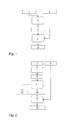
- Figure 1 shows a schematic representation of a first embodiment of the method of determining the elastic modulus of an organic tissue in a region of interest according to the present invention.
- a sequence of B-mode ultrasound images 1 is acquired alternately with a series of elasticity images.
- one elasticity image is allocated to every B-mode ultrasound image based on their respective acquisition time-point to generate a synchronized series of elasticity images 2.
- a sub-sequence 4 of the B-mode ultrasound images 1 is generated by an appropriate algorithm 3, e.g. by determining the similarity ⁇ of each B-mode ultrasound image to a reference B-mode ultrasound image.
- the reference B-mode ultrasound image is one particular image selected amongst the sequence of B-mode ultrasound images, preferably a randomly selected image or the last image acquired in the sequence.
- the images from the B-mode image sequence 1 which exhibit a similarity value ⁇ to the reference B-mode image which is above a pre-defined threshold value S ⁇ are then selected to be included in the B-mode ultrasound image sub-sequence.
- This subsequence is stored in an appropriate memory device.
- an algorithm selects those images from the synchronized elasticity image sequence 2, which correspond to those B-mode ultrasound images selected for the B-mode ultrasound subsequence 4.
- an enhanced elasticity image is calculated by determining a median or averaged value for every pixel.
- the elastic modulus may then be derived from this enhanced image in a known manner.
- Figure 2 depicts a second embodiment of a method for determining the elastic modulus of biological tissue of a region of interest according to the present invention.
- a sequence of B-mode ultrasound images 1 is alternately acquired with a sequence of elasticity images and a synchronized sequence of elasticity images 2 is interpolated.
- a registration algorithm determines and applies a spatial transformation to each image of the B-mode ultrasound image sequence in step 11, such that the similarity value ⁇ of each B-mode ultrasound image is maximized in relation to a reference B-mode ultrasound image.
- the reference B-mode ultrasound image is one particular image selected amongst the sequence of B-mode ultrasound images, preferably a randomly selected image or the last image acquired in the sequence.
- the thus modified B-mode ultrasound images generate a B-mode ultrasound image subsequence 8.
- This B-mode sub-sequence 8 is preferably stored in an appropriate memory device, such as flash memory or the like. Further, the spatial transformation applied on each B-mode ultrasound image of the B-mode sub-sequence is also stored in an appropriate memory device.
- an average similarity value ⁇ of the similarity values of all images of the B-mode image sub-sequence is determined. If this average similarity value ⁇ of the B-mode image sub-sequence is below a pre-defined threshold value S ⁇ , the B-mode image 13 is removed from the B-mode ultrasound image sub-sequence 8.
- the sub-sequence serves as a basis for generating an elasticity image sub-sequence 12 by an algorithm 11.
- the images of the synchronized elasticity image sequence 2 which correspond to the B-mode ultrasound images of the B-mode subsequence 11 are selected.
- the same spatial transformation operation is applied to these elasticity images as the spatial transformation which was applied to the corresponding B-mode ultrasound image.
- the thus generated elasticity image subsequence 12 comprises only elasticity images where any motion of the region of interest was compensated by the spatial transformation.
- an enhanced elasticity image is calculated by determining a median or averaged value for every pixel.
- the elastic modulus may then be derived from this enhanced image in a known manner.
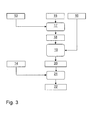
- Figure 3 shows a method to determine changes in the elasticity of an area of interest, e.g. to monitor the progress of a treatment, such as with High Intensity Focused Ultrasound.
- a sequence of B-mode ultrasound images 15 is alternately acquired with a sequence of elasticity images and a synchronized sequence of elasticity images 16 is interpolated.
- a B-mode image sub-sequence is generated from the sequence of B-mode ultrasound images using an enhanced B-mode ultrasound image 13 of the region of interest which was determined according to a method as described above at an earlier time-point, such as prior to the application of the treatment.
- a B-mode image sub-sequence 18 is generated. From this B-mode image sub-sequence 18, an elasticity image subsequence 19 is extracted by an algorithm by selecting those synchronized elasticity images which correspond to the B-mode images of the B-mode image subsequence 18. From this sub-sequence, an enhanced elasticity image 20 is calculated, e.g. by averaging the measured values of each pixel in the sub-sequence.
- the elasticity values of each pixel of the enhanced elasticity image 20 are then compared to the elasticity values of each pixel of an enhanced elasticity image 14 which was determined at the same time as the enhanced B-mode image 13 used as reference image. The differences in elasticity are then shown in a differential elasticity image 22.
Landscapes
- Health & Medical Sciences (AREA)
- Life Sciences & Earth Sciences (AREA)
- Engineering & Computer Science (AREA)
- Medical Informatics (AREA)
- Biophysics (AREA)
- Nuclear Medicine, Radiotherapy & Molecular Imaging (AREA)
- Pathology (AREA)
- Radiology & Medical Imaging (AREA)
- Veterinary Medicine (AREA)
- Biomedical Technology (AREA)
- Heart & Thoracic Surgery (AREA)
- Physics & Mathematics (AREA)
- Molecular Biology (AREA)
- Surgery (AREA)
- Animal Behavior & Ethology (AREA)
- General Health & Medical Sciences (AREA)
- Public Health (AREA)
- Vascular Medicine (AREA)
- Ultra Sonic Daignosis Equipment (AREA)
Abstract
Description
- The present invention relates to a method for determining the elastic modulus, a method for determining changes of the elastic modulus, a method of identification of specific biological tissue based on the determination of the elastic modulus and a device for determining the elastic modulus of a region of interest in a body.
- The determination of the elastic modulus of biological tissue by medical imagery serves various purposes both in the field of diagnosis and treatment. For example, as tissues exhibit differences in their elasticity, it is possible to differentiate cancerous tissue from benign tumours or healthy tissue by comparing their elastic modulus. Further, the efficacy of an ablative treatment, e.g. by means of laser or non-invasive high intensity focused ultrasound therapy may be monitored by determining changes of the elastic modulus of the tissue under treatment.
- In the present application, the term "elastic modulus", is understood as a measure of the mechanical stiffness of an elastic material, such as biological tissue. When an external compression is applied to an elastic material, a deformation or strain is induced within said material. Harder material has a smaller induced strain than softer material.
- Many tumours of the thyroid, breast, and prostate are still detected by manual palpation by a medical professional who senses abnormalities in the elasticity of the tissue. However, palpation is a subjective technique, and small abnormalities and those located in areas that are inaccessible by a physician cannot be detected by touch.
- Hence, different imaging techniques were developed to be able to reliably determine the elastic modulus of biological tissues in a non-invasive, reliable and reproducible manner.
- The so-called "static elastography" is relying on uniform compression of a portion of the body by a medical professional to cause a deformation in the underlying tissues. An ultrasound probe is then used to display the induced transformation in the imaging plane. However, static elastography shows poor reproducibility as well as variability depending on the specific medical professional applying the compression.
- Another technique uses continuous vibration applied to a specific region of a body. The continuous vibration induces stationary waves within tissue which may be analyzed by means of magnetic resonance tomography. The elastic modulus of the tissue may be derived from the MRI imaging data.
- A further technique is the so-called "shear wave elastography" which relies on the generation of shear waves within tissue. Shear waves propagate transversely in relation to the ultrasound beam within the tissue. The generated shear waves are detected by an ultra fast ultrasound system. As the waves travel at a speed between 1 and 10m/s in human tissue, they cross a standard ultrasound imaging plane of 3cm to 6cm in 10-20 milliseconds (Bercoff Jeremy: The emergence of shear wave elastography in ultrasound; RAD Magazine; 36; 417; 32; February 2010). Hence, in order to capture the propagation of a shear wave, ultrasound imaging probes having frame rates of several thousands of images per second are needed. Such an ultrasound system is e.g. being sold under the name Aixplorer® by SuperSonic Imagine (Aix-en-Provence, France). The propagation of the shear waves in tissue induces small displacements, which may be detected and quantified using Doppler techniques. This allows generating a movie of the shear wave propagation within tissue. The shear wave propagation speed may then be estimated for each pixel of the acquired image from the shear wave propagation movie using appropriate algorithms. Young's modulus, defined as the ratio between the applied stress and the induced strain: E=S/e, are then calculated using the local shear wave propagation speeds. The elasticity modulus, displayed as elasticity images, correspond to the Young's modulus.
- When acquiring elasticity images with an ultrasound probe, two channels may be obtained for each pixel, the first channel is representing the elasticity modulus of the tissue and the second channel is representing the pertinence of the measured value.
- One mayor drawback of ultrasound elastography images is the low signal to noise ratio obtained. To increase this ratio, ultrasound devices often comprise a persistence function which allows applying a filtering algorithm on the last acquired images such as to improve the signal to noise ratio. Such persistence functions mostly rely on the determination of a weighted average, where the most recent images are weighted most, or a median value for each pixel based on a certain number of acquired images. The number of images used for the persistence function is usually selectable by the user of the ultrasound device. While persistence functions allow increasing the signal to nose ratio by averaging the acquired values of a certain number of images, any movement of the target area being measured will create a blurring effect on the image, as the position of the anatomy represented in the image is not constant anymore with respect to time, thus reducing the sharpness of the image.
- It is therefore an objective of the present invention to provide a method for improving the quality of the elasticity image of a region of interest in a biologic tissue which avoids the disadvantages known in the art and in particular in case of movement of the tissue or the ultrasound probe head. This objective is achieved with a method as claimed in
claim 1. - In a first step of the method according to the present invention, a sequence of elasticity images and a sequence of B-mode ultrasound images of a region of interest are acquired alternately. Then, at least one B-mode image sub-sequence representing a resting state of the region of interest is generated from said sequence of B-mode ultrasound images. In a third step, an elasticity image sub-sequence is generated by selecting and/or modifying those elasticity images based on said B-mode image sub-sequence. Finally, the elastic modulus of the region of interest is determined based on the elasticity image sub-sequence.
- In the context of the present application, an "alternate" acquisition of a B-mode ultrasound image and an elasticity image has the meaning that a B-mode ultrasound image and an elasticity image are intermittently acquired. Hence, for every B-mode image b(t) there is a corresponding elasticity image e(t) which was acquired before the next B-mode image. This is preferably done by interpolation of both sets of images such as to allocate an elasticity image e(t) to every B-mode ultrasound image b(t) based on respective acquisition time-point. The interval between the acquisition of the B-mode image and the elasticity image is typically shorter than 1ms. However, this will vary depending on the ultrasound probe used.
- For a measurement having been acquired during the time period T, this allows the formation of two synchronized sets of images: one set being the B-mode ultrasound images B={b(t)}tεT, the other set being the elasticity images E={e(t)}tεT, wherein for each B-mode ultrasound image b(t) there is a corresponding synchronized elasticity image e(t).
- The resolution of these digital images may vary depending on the device used. Hence, the number of pixels in the image will also vary. The acquired images may be 1, 2 or 3 dimensional images.
- In the present application, the terminology "movement of the region of interest" is understood as either the region of interest is moved in relation to an ultrasound imaging probe, e.g. because of patient movements or breathing, or that the ultrasound imaging probe itself is moved, e.g. by changing its position in relation to the region of interest or by rotating or tilting the ultrasound probe. Hence, the term "resting state" has to be understood as meaning a temporarily invariant position of the region of interest in relation to the ultrasound probe head, e.g. because either the region of interest does not move or any movement is compensated by an algorithm.
- From the sequence of acquired B-mode ultrasound images, a subsequence is generated. This B-mode image sub-sequence represents a resting state of the region of interest.
- In a first alternative, the images selected for the B-mode image sub-sequence preferably show the region of interest without any movement or with only an insubstantial amount of movement. Selection of appropriate images may be performed by an algorithm determining the positions of specific sections on an image and comparing these with the position of the same sections on another, preferably a reference image. If the positions are identical or almost identical, that a similarity value µ between the images is almost or exactly 1, the images are treated as showing the region of interest at a resting state. Statistical image analysis algorithms performing such tasks are well known in the art.
- In a second alternative, the movement between images is compensated using a registration algorithm as known in the art, calculated on the set of B-mode images B. The spatial transformation used for each image is thereby stored. The registration algorithm optimizes the similarity value µ for each image in relation to another image, preferably a reference image.
- The selection of an elasticity image sub-sequence is based on the B-mode image subsequence by selecting the appropriate synchronized elasticity images e(t) which correspond to the B-mode images b(t) of the B-mode image sub-sequence.
- In an alternatively preferred embodiment, the generation of the elasticity image sub-sequence is performed by modifying each elasticity image with the same spatial transformation as the one which was determined for the image of the B-mode image subsequence acquired at the same time. By performing this operation, the images of the elasticity image sub-sequence are transformed in the same way as the B-mode images of the B-mode image sub-sequence, hence compensating any motion which occurred during their acquisition.
- The images of both the B-mode image sub-sequence as well as the elasticity image sub-sequence are then fused, preferably pixel by pixel, to generate an enhanced B-mode image and an enhanced elasticity image. These reference images have an increased signal to noise ratio compared to any individual image.
- There are different ways to fuse the images of both subsequences to generate the enhanced images. In one preferred method, the enhanced image is generated by calculating the median value for each pixel based on the corresponding pixel values of every image comprised in the respective image subsequence. For the enhanced elasticity image, the respective enhanced values for the elasticity channel and/or for the pertinence channel may be calculated.
- In a further preferred method, the enhanced images are generated by calculating a weighted average for each pixel based on the respective pixel of every image in respective sub-sequence. The similarity value µ of each B-mode image is preferably used as weighting factor, since this allows images having a higher similarity to have a higher contribution to the enhanced image. When determining the enhanced elasticity image, the similarity value µ of the corresponding B-mode image is used.
- Finally, the elastic modulus of the region of interest may be determined from the enhanced elasticity image in a known manner.
- The method according to the present invention allows disregarding or correcting any movement of the region of interest based on the analysis of the B-mode ultrasound images, thanks to their higher signal to noise ratio and resolution compared to elasticity images. Therefore it is possible to greatly enhance the accuracy and the robustness of the elastic modulus determination from the elastography images.
- In a first alternative, the B-mode image sub-sequence is generated by selecting B-mode ultrasound images from said acquired sequence of B-mode ultrasound images which have a similarity value µ with respect to a reference B-mode ultrasound image which is over a pre-selectable threshold value Sµ. Different similarity measures are known in the art. For example the absolute value of the differences of the intensities is computed for each pixel and normalized. The similarity measure between the images is calculated as the normalized sum of the absolute value of the differences. This normalized value lies in the interval [0,1]. Such as to ensure a sufficient number of images in the B-mode image sub-sequence, a pre-selectable minimal number N of images may be defined. If the amount of selected images in the B-mode image sub-sequence is inferior to N, the sub-sequence is rejected since the number of images is statistically not sufficient to ensure the desired improvement of the signal to noise ratio for subsequently generated enhanced images.
- Alternatively, a pre-definable number N of images which shall constitute the B-mode sub-sequence is selected. The acquired B-mode images are sorted according to their similarity value µ to a reference image in decreasing order. Of these images, the first N images are selected for the B-mode image sub-sequence.
- The average similarity value
µ̅ of the images in the B-mode image sub-sequence is calculated and the B-mode image sub-sequence is only used ifµ is over a pre-selectable threshold value Sµ. Otherwise, the sub-sequence is rejected since the average similarity of the images to the reference image is so low that an enhanced image generated therefrom would comprise too much blurring. - The elasticity image sub-sequence is generated by selecting those synchronized elasticity images which correspond to those B-mode ultrasound images selected for said B-mode image subsequence.
- The threshold value Sµ may be chosen by the operator. The lower this threshold value is set, the more images are selected. However, these images will also exhibit less similarity to each other. The threshold value used by the user provides a trade off between increased signal to noise ratio (low threshold value) and sharpness (high threshold value) when computing the elastic modulus in a region of interest from the enhanced image as a final step.
- The resting state reference image is preferably an image of the region of interest acquired before or during the acquisition of the image sequences.
- In a second alternative, the B-mode image ultrasound subsequence is generated by applying a registration algorithm to the acquired images, preferably using a resting state reference image. The elasticity image sub-sequence is then generated by applying to each elasticity image the spatial transformation of the B-mode image corresponding to said elasticity image.
- There are several registration algorithms known in the art which may be used to determine the appropriate spatial transformation, such as "gradient descent" or "simulated annealing".
- By applying the spatial transformation of the corresponding B-mode ultrasound image to each elasticity image, the movement compensation determined on the B-mode ultrasound image may be applied to compensate the same movement of the region of interest on the elasticity image.
- This method has the advantage that all the elasticity images of the sequence may be used to determine the elastic modulus of the region of interest, thus increasing the accuracy of the measurement compared to a method were several images of the sequence are not included in the sub-sequence because they were acquired when the region of interest was not in a resting state. Hence, this method allows generating a kind of "virtual resting state" of the region of interest, even though the region of interest moved during the acquisition of the sequence.
- Preferably, a combination of the first and the second alternative methods described above may be applied to generate a B-mode ultrasound and an elasticity image sub-sequence. In this case, slight movements of the region of interest in B-mode ultrasound images selected for their sufficient similarity with the reference image may further be compensated. Such a combination further enhances the resulting determination of the elastic modulus of the region of interest.
- Preferably, said resting state reference image is randomly selected from said acquired sequence of B-mode ultrasound images. Selection of a resting state reference image by this method is based on the assumption that no image is more relevant than any other.
- Alternatively, said resting state reference image corresponds to the last B-mode ultrasound image acquired in said sequence.
- Further preferably, said resting state reference image corresponds to a B-mode ultrasound image of the sequence which shows the highest similarity with a B-mode ultrasound image of the area of interest acquired prior to the acquisition of said elasticity image sequence and said sequence of B-mode ultrasound images.
- Said resting state reference image is more preferably an enhanced B-mode image of an antecedent acquired sequence.
- Hence, prior to generating the B-mode image sub-sequence, each B-mode ultrasound image of the sequence is compared by an appropriate algorithm to a resting state reference B-mode ultrasound image of the area of interest. For each B-mode ultrasound image of the sequence, the similarity value µ is determined and each B-mode ultrasound image of the sequence exhibiting a similarity value µ which is above a pre-selectable threshold is selected.
- It is a further object of the present invention to provide a method for determining changes of the elasticity of a region of interest in biological tissue. This objective is achieved by a method as claimed in
claim 8. - In this method according to the present invention, a differential elasticity image is generated by subtracting the acquired value of each pixel of a first enhanced elasticity image of a region of interest with the corresponding acquired value of each pixel of at least a second enhanced elasticity image of the same region of interest acquired at a different time point.
- This allows to determine and to visualize the change(s) of the elastic modulus of biological tissue in a region of interest acquired at different time points. Such changes may e.g. be indicative of the evolvement of tumour growth or the effects of an ablative therapy, such as treatment with High Intensity Focused Ultrasound (HIFU).
- The enhanced elasticity images are preferably generated according to a method as described above.
- Another object of the present invention is to provide a device for determining the elastic modulus of a region of interest in biological tissue. This objective is achieved with a device according to
claim 10. - The device according to the present invention comprises an ultrasound probe adapted to acquire a sequence of elasticity images and a sequence of B-mode ultrasound images of the region of interest simultaneously. Further, the device includes means for generating at least one sub-sequence of the B-mode ultrasound images of the region of interest representing a resting state of the region of interest from said sequence of B-mode ultrasound images. Additionally, means for generating a sub-sequence of the elasticity images by selecting and/or modifying those elasticity images based on said sub-sequence of the B-mode ultrasound images are present in the device as well as means for determining the elastic modulus of the region of interest based on the subsequence of the elasticity images.
- With a device according to the present invention it is possible to accurately determine the elastic modulus of biological tissue in a region of interest, even if the region of interest is moved during the acquisition of the elasticity images.
- It is a further objective of the present invention to provide a method for identifying a specific biological tissue in a body. This objective is achieved with a method according to
claim 11. - In a first step of the identification method according to the present invention the elastic modulus of a biological tissue is determined, preferably using a method for determining the elastic modulus of a region of interest in biologic tissue as described above. The biological tissue is then identified by comparing the determined elastic modulus with a database comprising reference values of the elastic modulus of different biological tissues. Finally, the thus identified biological tissue is displayed on an appropriate display.
- This method offers the advantage that biological tissue can be easily and non-invasively identified based on its elastic modulus. Further, it is also possible to reliably and non-invasively detect cancerous tissue or tumours in a specific area.
- A further objective of the present invention is to determine changes in elasticity of biological tissue in a region of interest. This objective is achieved by a method according to
claim 13. - In a first step a first enhanced elasticity image of the region of interest is generated with a method as described above at a first time-point. At a second time-point, a second enhanced elasticity image of the region of interest is generated with a method as described above. Finally, a differential elasticity image is generated by subtracting the measured elasticity values of each pixel of the first enhanced elasticity image with the measured elasticity values of each corresponding pixel of the second enhanced elasticity image.
- This method enables monitoring the effects of a heat treatment of tissue, such as treatment with High Intensity Focused Ultrasound (HIFU). As treated tissue will suffer heat damage, its elasticity will decrease. Hence it is possible to monitor the effect of the treatment by tracking changes of the elasticity in the region of interest.
- Additionally, the enhanced B-mode images corresponding to both the first and the second enhanced elasticity images are compared and the similarity value µ is calculated. If this similarity value is below a pre-selectable threshold value Sµ, the differential image is rejected. This enables to reject any differential image which was calculated using enhanced images which do not show the region of interest in a resting state or where the correction of movement is insufficient. That is, the generation of a differential image comprising too much blurring of the structures.
- Further details and embodiments of the present invention will become apparent from the following description of figures and examples.
- Fig. 1:
- Shows a schematic representation of a first embodiment of the present invention;
- Fig. 2:
- shows a schematic representation of a second embodiment of the present invention; and
- Fig. 3:
- shows a schematic representation of a method to determine changes of elasticity of biological tissue in a region of interest.
-
Figure 1 shows a schematic representation of a first embodiment of the method of determining the elastic modulus of an organic tissue in a region of interest according to the present invention. First, a sequence of B-mode ultrasound images 1 is acquired alternately with a series of elasticity images. By way of an interpolation of both sets of images, one elasticity image is allocated to every B-mode ultrasound image based on their respective acquisition time-point to generate a synchronized series ofelasticity images 2. Then, asub-sequence 4 of the B-mode ultrasound images 1 is generated by anappropriate algorithm 3, e.g. by determining the similarity µ of each B-mode ultrasound image to a reference B-mode ultrasound image. The reference B-mode ultrasound image is one particular image selected amongst the sequence of B-mode ultrasound images, preferably a randomly selected image or the last image acquired in the sequence. The images from the B-mode image sequence 1 which exhibit a similarity value µ to the reference B-mode image which is above a pre-defined threshold value Sµ are then selected to be included in the B-mode ultrasound image sub-sequence. This subsequence is stored in an appropriate memory device. In afurther step 5, an algorithm selects those images from the synchronizedelasticity image sequence 2, which correspond to those B-mode ultrasound images selected for the B-mode ultrasound subsequence 4. From thissub-sequence 6, an enhanced elasticity image is calculated by determining a median or averaged value for every pixel. The elastic modulus may then be derived from this enhanced image in a known manner. -
Figure 2 depicts a second embodiment of a method for determining the elastic modulus of biological tissue of a region of interest according to the present invention. In analogy to the embodiment shown infigure 1 , a sequence of B-mode ultrasound images 1 is alternately acquired with a sequence of elasticity images and a synchronized sequence ofelasticity images 2 is interpolated. A registration algorithm then determines and applies a spatial transformation to each image of the B-mode ultrasound image sequence instep 11, such that the similarity value µ of each B-mode ultrasound image is maximized in relation to a reference B-mode ultrasound image. The reference B-mode ultrasound image is one particular image selected amongst the sequence of B-mode ultrasound images, preferably a randomly selected image or the last image acquired in the sequence. The thus modified B-mode ultrasound images generate a B-modeultrasound image subsequence 8. This B-mode sub-sequence 8 is preferably stored in an appropriate memory device, such as flash memory or the like. Further, the spatial transformation applied on each B-mode ultrasound image of the B-mode sub-sequence is also stored in an appropriate memory device. Instep 9, an average similarity value µ of the similarity values of all images of the B-mode image sub-sequence is determined. If this average similarity valueµ of the B-mode image sub-sequence is below a pre-defined threshold value Sµ, the B-mode image 13 is removed from the B-modeultrasound image sub-sequence 8. If the average similarity valueµ of the B-mode image sub-sequence 10 is higher than the threshold value Sµ, the sub-sequence serves as a basis for generating anelasticity image sub-sequence 12 by analgorithm 11. The images of the synchronizedelasticity image sequence 2 which correspond to the B-mode ultrasound images of the B-mode subsequence 11 are selected. Subsequently, the same spatial transformation operation is applied to these elasticity images as the spatial transformation which was applied to the corresponding B-mode ultrasound image. The thus generatedelasticity image subsequence 12 comprises only elasticity images where any motion of the region of interest was compensated by the spatial transformation. From thissub-sequence 12, an enhanced elasticity image is calculated by determining a median or averaged value for every pixel. The elastic modulus may then be derived from this enhanced image in a known manner. -
Figure 3 shows a method to determine changes in the elasticity of an area of interest, e.g. to monitor the progress of a treatment, such as with High Intensity Focused Ultrasound. In analogy to the two methods described above, a sequence of B-mode ultrasound images 15 is alternately acquired with a sequence of elasticity images and a synchronized sequence ofelasticity images 16 is interpolated. A B-mode image sub-sequence is generated from the sequence of B-mode ultrasound images using an enhanced B-mode ultrasound image 13 of the region of interest which was determined according to a method as described above at an earlier time-point, such as prior to the application of the treatment. By selecting images having a similarity value µ to the enhanced B-mode ultrasound image 13 used as reference image which is higher than a pre-selectable threshold value Sµ or by applying a registration algorithm using saidenhanced image 13 as reference image, a B-mode image sub-sequence 18 is generated. From this B-mode image sub-sequence 18, anelasticity image subsequence 19 is extracted by an algorithm by selecting those synchronized elasticity images which correspond to the B-mode images of the B-mode image subsequence 18. From this sub-sequence, anenhanced elasticity image 20 is calculated, e.g. by averaging the measured values of each pixel in the sub-sequence. The elasticity values of each pixel of the enhancedelasticity image 20 are then compared to the elasticity values of each pixel of anenhanced elasticity image 14 which was determined at the same time as the enhanced B-mode image 13 used as reference image. The differences in elasticity are then shown in adifferential elasticity image 22.
Claims (13)
- Method for determining the elastic modulus of a region of interest in biologic tissue, comprising the steps of:- Acquiring a sequence of elasticity images (2) and a sequence of B-mode ultrasound images (1) of the region of interest alternately;- Generating at least one sub-sequence of the B-mode ultrasound images (4;8) of the region of interest representing a resting state of the region of interest from said sequence of B-mode ultrasound images (1);- Generating a sub-sequence of the elasticity images (6;12) by selecting and/or modifying those elasticity images (2) based on said sub-sequence of the B-mode ultrasound images (4;8); and- Determining the elastic modulus of the region of interest based on the sub-sequence of the elasticity images (6;12).
- Method according to claim 1, characterized in that the subsequence of the B-mode ultrasound images (4) is generated by selecting B-mode ultrasound images from said acquired sequence of B-mode ultrasound images (1) having a similarity value µ to a reference B-mode ultrasound image superior to a pre-definable value and further characterized in that the elasticity image sub-sequence (4) is generated by selecting those elasticity images which correspond to those B-mode ultrasound images selected for said B-mode ultrasound image sub-sequence (4).
- Method according to claim 1, characterized in that the subsequence of the B-mode ultrasound images (8) is generated by determining and applying a spatial transformation to each B-mode ultrasound images of the sequence (1) such as to maximize the similarity value µ of each B-mode ultrasound image to a reference B-mode ultrasound image of the region of interest, further characterized in that said elasticity images subsequence (12) is generated by applying the same spatial transformation of the B-mode corresponding to each elasticity image.
- Method according to claim 2 or 3, characterized in that said reference B-mode ultrasound image is randomly selected from said acquired sequence of B-mode ultrasound images (1).
- Method according to claim 2 or 3, characterized in that said reference B-mode ultrasound image corresponds to a specific image acquired in said sequence (1), preferably the last B-mode ultrasound image of said sequence (1).
- Method according to claim 2 or 3, characterized in that said reference B-mode ultrasound image corresponds to a B-mode ultrasound image of the sequence (1) which shows the highest similarity with a B-mode ultrasound image of the area of interest acquired prior to the acquisition of said elasticity image sequence (2) and said sequence of B-mode ultrasound images (1).
- Method according to any of claims 1 to 6, characterized in that an enhanced B-mode ultrasound image and/or an enhanced elasticity image is generated by computing a median or average value for each pixel of the enhanced image from the corresponding pixels of all images of said B-mode ultrasound subsequence and/or from all images of said elasticity images subsequence.
- Method for determining changes of the elasticity of a region of interest in biological tissue, characterized in that a differential elasticity image is generated by substracting the acquired value of each pixel of a first enhanced elasticity image of a region of interest with the corresponding acquired value of each pixel of at least a second enhanced elasticity image of the same region of interest acquired at a different time point, wherein the enhanced elasticity images are preferably generated according to the method of claim 7.
- Method according to claim 8, characterized in that a confidence level value is determined for each pixel of said differential elasticity image based on a similarity analysis of B-mode ultrasound images corresponding to first and the at least second elasticity images.
- Device for determining the elastic modulus of a region of interest in biological tissue, comprising:- an ultrasound probe adapted to acquire a sequence of elasticity images and a sequence of B-mode ultrasound images of the region of interest alternately;- means for generating at least one sub-sequence of the B-mode ultrasound images of the region of interest representing a resting state of the region of interest from said sequence of B-mode ultrasound images;- means for generating a sub-sequence of the elasticity images by selecting and/or modifying those elasticity images based on said sub-sequence of the B-mode ultrasound images;- means for calculating enhanced images from said B-mode image sub sequence and/or said elasticity image sub-sequence; and- means for determining the elastic modulus of the region of interest based on the enhanced elasticity image.
- Device according to claim 10, characterized in that said device additionally comprises an ultrasound treatment probe head, preferably of the High Intensity Focused Ultrasound type.
- Method of identifying a specific biological tissue in a body comprising the steps of:- determining the elastic modulus of the biological tissue, preferably using a method according to any of claims 1 to 7;- identifying the biological tissue by comparing the determined elastic modulus with a database comprising reference values of the elastic modulus of different biological tissues; and- displaying the thus identified biological tissue on a display.
- Method for determining changes in elasticity of biological tissue in a region of interest, comprising the steps of:- generating a first enhanced elasticity image of the region of interest with the method according to claim 7 at a first time-point;- generating a second enhanced elasticity image of the region of interest with the method according to claim 7 at a second time-point; and- generating a differential elasticity image by subtracting the measured elasticity values of each pixel of the first enhanced elasticity image with the measured elasticity values of each corresponding pixel of the second enhanced elasticity image.
Priority Applications (2)
| Application Number | Priority Date | Filing Date | Title |
|---|---|---|---|
| EP11191556.7A EP2599444B1 (en) | 2011-12-01 | 2011-12-01 | Method and device for determining the elastic modulus of a biological tissue |
| US13/687,574 US9433397B2 (en) | 2011-12-01 | 2012-11-28 | Method and device for determining the elastic modulus of a biological tissue |
Applications Claiming Priority (1)
| Application Number | Priority Date | Filing Date | Title |
|---|---|---|---|
| EP11191556.7A EP2599444B1 (en) | 2011-12-01 | 2011-12-01 | Method and device for determining the elastic modulus of a biological tissue |
Publications (2)
| Publication Number | Publication Date |
|---|---|
| EP2599444A1 true EP2599444A1 (en) | 2013-06-05 |
| EP2599444B1 EP2599444B1 (en) | 2017-08-02 |
Family
ID=45092274
Family Applications (1)
| Application Number | Title | Priority Date | Filing Date |
|---|---|---|---|
| EP11191556.7A Not-in-force EP2599444B1 (en) | 2011-12-01 | 2011-12-01 | Method and device for determining the elastic modulus of a biological tissue |
Country Status (2)
| Country | Link |
|---|---|
| US (1) | US9433397B2 (en) |
| EP (1) | EP2599444B1 (en) |
Cited By (1)
| Publication number | Priority date | Publication date | Assignee | Title |
|---|---|---|---|---|
| WO2020254417A1 (en) | 2019-06-19 | 2020-12-24 | Theraclion Sa | Method, device, and method for using of a device to coagulate varicose veins with high-intensity focused ultrasound |
Families Citing this family (5)
| Publication number | Priority date | Publication date | Assignee | Title |
|---|---|---|---|---|
| GB2539027B (en) * | 2015-06-04 | 2019-04-17 | Thales Holdings Uk Plc | Video compression with increased fidelity near horizon |
| CN106725609A (en) * | 2016-11-18 | 2017-05-31 | 乐普(北京)医疗器械股份有限公司 | A kind of elastomeric check method and apparatus |
| CN111093521B (en) * | 2018-04-13 | 2022-06-17 | 深圳迈瑞生物医疗电子股份有限公司 | Ultrasonic imaging method and ultrasonic imaging apparatus |
| US11850099B2 (en) * | 2019-02-26 | 2023-12-26 | Canon Medical Systems Corporation | Ultrasonic diagnostic apparatus |
| CN113545806A (en) * | 2020-04-26 | 2021-10-26 | 深圳迈瑞生物医疗电子股份有限公司 | Prostate elastography method and ultrasound elastography system |
Citations (6)
| Publication number | Priority date | Publication date | Assignee | Title |
|---|---|---|---|---|
| US20080249408A1 (en) * | 2007-02-09 | 2008-10-09 | Palmeri Mark L | Methods, Systems and Computer Program Products for Ultrasound Shear Wave Velocity Estimation and Shear Modulus Reconstruction |
| US20080294049A1 (en) * | 2007-05-21 | 2008-11-27 | Siemens Medical Solutions Usa, Inc. | Targeted contrast agent imaging with medical diagnostic ultrasound |
| US20100191113A1 (en) * | 2009-01-28 | 2010-07-29 | General Electric Company | Systems and methods for ultrasound imaging with reduced thermal dose |
| WO2011007278A2 (en) * | 2009-07-17 | 2011-01-20 | Koninklijke Philips Electronics, N.V. | Spatially-fine shear wave dispersion ultrasound vibrometry sampling |
| WO2011132014A1 (en) * | 2010-04-20 | 2011-10-27 | Super Sonic Imagine | Imaging method and apparatus using shear waves |
| US20120065507A1 (en) * | 2010-09-09 | 2012-03-15 | Siemens Medical Solutions Usa, Inc. | Reduction of motion artifacts in ultrasound imaging with a flexible ultrasound transducer |
Family Cites Families (5)
| Publication number | Priority date | Publication date | Assignee | Title |
|---|---|---|---|---|
| EP0883860B1 (en) * | 1996-02-29 | 2006-08-23 | Acuson Corporation | Multiple ultrasound image registration system, method and transducer |
| CA2428872C (en) * | 2000-11-28 | 2013-01-08 | Allez Physionix Limited | Systems and methods for making non-invasive physiological assessments |
| US20060079773A1 (en) * | 2000-11-28 | 2006-04-13 | Allez Physionix Limited | Systems and methods for making non-invasive physiological assessments by detecting induced acoustic emissions |
| EP1793730B1 (en) * | 2004-08-24 | 2011-12-28 | The General Hospital Corporation | Process, system and software arrangement for determining elastic modulus |
| US8992426B2 (en) * | 2009-05-04 | 2015-03-31 | Siemens Medical Solutions Usa, Inc. | Feedback in medical ultrasound imaging for high intensity focused ultrasound |
-
2011
- 2011-12-01 EP EP11191556.7A patent/EP2599444B1/en not_active Not-in-force
-
2012
- 2012-11-28 US US13/687,574 patent/US9433397B2/en active Active
Patent Citations (6)
| Publication number | Priority date | Publication date | Assignee | Title |
|---|---|---|---|---|
| US20080249408A1 (en) * | 2007-02-09 | 2008-10-09 | Palmeri Mark L | Methods, Systems and Computer Program Products for Ultrasound Shear Wave Velocity Estimation and Shear Modulus Reconstruction |
| US20080294049A1 (en) * | 2007-05-21 | 2008-11-27 | Siemens Medical Solutions Usa, Inc. | Targeted contrast agent imaging with medical diagnostic ultrasound |
| US20100191113A1 (en) * | 2009-01-28 | 2010-07-29 | General Electric Company | Systems and methods for ultrasound imaging with reduced thermal dose |
| WO2011007278A2 (en) * | 2009-07-17 | 2011-01-20 | Koninklijke Philips Electronics, N.V. | Spatially-fine shear wave dispersion ultrasound vibrometry sampling |
| WO2011132014A1 (en) * | 2010-04-20 | 2011-10-27 | Super Sonic Imagine | Imaging method and apparatus using shear waves |
| US20120065507A1 (en) * | 2010-09-09 | 2012-03-15 | Siemens Medical Solutions Usa, Inc. | Reduction of motion artifacts in ultrasound imaging with a flexible ultrasound transducer |
Non-Patent Citations (3)
| Title |
|---|
| BERCOFF JEREMY: "The emergence of shear wave elastography in ultrasound", RAD MAGAZINE, vol. 36, no. 417, February 2010 (2010-02-01), pages 32 |
| JEREMY BERCOFF: "ShearWave Elastography", WHITE PAPER,, 1 January 2008 (2008-01-01), pages 1 - 12, XP007920586 * |
| PALMERI ET AL: "Quantifying Hepatic Shear Modulus In Vivo Using Acoustic Radiation Force", ULTRASOUND IN MEDICINE AND BIOLOGY, NEW YORK, NY, US, vol. 34, no. 4, 25 January 2008 (2008-01-25), pages 546 - 558, XP022547223, ISSN: 0301-5629 * |
Cited By (1)
| Publication number | Priority date | Publication date | Assignee | Title |
|---|---|---|---|---|
| WO2020254417A1 (en) | 2019-06-19 | 2020-12-24 | Theraclion Sa | Method, device, and method for using of a device to coagulate varicose veins with high-intensity focused ultrasound |
Also Published As
| Publication number | Publication date |
|---|---|
| US20130144162A1 (en) | 2013-06-06 |
| EP2599444B1 (en) | 2017-08-02 |
| US9433397B2 (en) | 2016-09-06 |
Similar Documents
| Publication | Publication Date | Title |
|---|---|---|
| US10682118B2 (en) | Ultrasound system and method for analyzing cardiac periodicity | |
| CN102202580B (en) | Ultrasonic image processing method and device, and ultrasonic image processing program | |
| US9433397B2 (en) | Method and device for determining the elastic modulus of a biological tissue | |
| US20150359520A1 (en) | Ultrasound probe and ultrasound imaging system | |
| EP2925216B1 (en) | Stenosis therapy planning | |
| CN103260526B (en) | There is ultrasonic image-forming system and the method for peak strength measuring ability | |
| Zeng et al. | Automatic detection and measurement of spinous process curve on clinical ultrasound spine images | |
| JP2013542046A (en) | Ultrasound image processing system and method | |
| JP2015198672A (en) | Medical image diagnostic apparatus | |
| US20140018676A1 (en) | Method of generating temperature map showing temperature change at predetermined part of organ by irradiating ultrasound wave on moving organs, and ultrasound system using the same | |
| JP2021502164A (en) | Ultrasonic image generation system | |
| JP7215053B2 (en) | Ultrasonic image evaluation device, ultrasonic image evaluation method, and ultrasonic image evaluation program | |
| US8571633B2 (en) | Diagnostic imaging method | |
| CN107330895B (en) | Medical image segmentation method and device | |
| EP3854313B1 (en) | Ultrasound diagnostic apparatus and method of controlling the same | |
| US12318254B2 (en) | Method and device for characterizing at least one object depicted in an ultrasound image | |
| CN112674791A (en) | Optimization method and system for ultrasonic elastography of muscles | |
| Zeng et al. | Automatic segmentation of vertebral features on ultrasound spine images using Stacked Hourglass Network | |
| JP6073558B2 (en) | Medical diagnostic imaging equipment | |
| JP2018502631A (en) | Automatic radiation reading session detection | |
| JP7233792B2 (en) | Diagnostic imaging device, diagnostic imaging method, program, and method for generating training data for machine learning | |
| US20100305438A1 (en) | System and method for scaling strain image data | |
| CN113164158B (en) | Device and method for detecting bone fractures | |
| WO2018036893A1 (en) | Image processing apparatus and method for segmenting a region of interest | |
| Harding et al. | Automated detection of skeletal muscle twitches from B-mode ultrasound images: An application to motor neuron disease |
Legal Events
| Date | Code | Title | Description |
|---|---|---|---|
| PUAI | Public reference made under article 153(3) epc to a published international application that has entered the european phase |
Free format text: ORIGINAL CODE: 0009012 |
|
| AK | Designated contracting states |
Kind code of ref document: A1 Designated state(s): AL AT BE BG CH CY CZ DE DK EE ES FI FR GB GR HR HU IE IS IT LI LT LU LV MC MK MT NL NO PL PT RO RS SE SI SK SM TR |
|
| AX | Request for extension of the european patent |
Extension state: BA ME |
|
| 17P | Request for examination filed |
Effective date: 20131109 |
|
| RBV | Designated contracting states (corrected) |
Designated state(s): AL AT BE BG CH CY CZ DE DK EE ES FI FR GB GR HR HU IE IS IT LI LT LU LV MC MK MT NL NO PL PT RO RS SE SI SK SM TR |
|
| RAP1 | Party data changed (applicant data changed or rights of an application transferred) |
Owner name: THERACLION SA |
|
| 17Q | First examination report despatched |
Effective date: 20140701 |
|
| GRAP | Despatch of communication of intention to grant a patent |
Free format text: ORIGINAL CODE: EPIDOSNIGR1 |
|
| STAA | Information on the status of an ep patent application or granted ep patent |
Free format text: STATUS: GRANT OF PATENT IS INTENDED |
|
| INTG | Intention to grant announced |
Effective date: 20170125 |
|
| GRAS | Grant fee paid |
Free format text: ORIGINAL CODE: EPIDOSNIGR3 |
|
| GRAJ | Information related to disapproval of communication of intention to grant by the applicant or resumption of examination proceedings by the epo deleted |
Free format text: ORIGINAL CODE: EPIDOSDIGR1 |
|
| GRAL | Information related to payment of fee for publishing/printing deleted |
Free format text: ORIGINAL CODE: EPIDOSDIGR3 |
|
| STAA | Information on the status of an ep patent application or granted ep patent |
Free format text: STATUS: EXAMINATION IS IN PROGRESS |
|
| INTC | Intention to grant announced (deleted) | ||
| GRAR | Information related to intention to grant a patent recorded |
Free format text: ORIGINAL CODE: EPIDOSNIGR71 |
|
| STAA | Information on the status of an ep patent application or granted ep patent |
Free format text: STATUS: GRANT OF PATENT IS INTENDED |
|
| GRAA | (expected) grant |
Free format text: ORIGINAL CODE: 0009210 |
|
| STAA | Information on the status of an ep patent application or granted ep patent |
Free format text: STATUS: THE PATENT HAS BEEN GRANTED |
|
| AK | Designated contracting states |
Kind code of ref document: B1 Designated state(s): AL AT BE BG CH CY CZ DE DK EE ES FI FR GB GR HR HU IE IS IT LI LT LU LV MC MK MT NL NO PL PT RO RS SE SI SK SM TR |
|
| INTG | Intention to grant announced |
Effective date: 20170627 |
|
| REG | Reference to a national code |
Ref country code: GB Ref legal event code: FG4D |
|
| REG | Reference to a national code |
Ref country code: CH Ref legal event code: EP Ref country code: AT Ref legal event code: REF Ref document number: 913560 Country of ref document: AT Kind code of ref document: T Effective date: 20170815 |
|
| REG | Reference to a national code |
Ref country code: IE Ref legal event code: FG4D |
|
| REG | Reference to a national code |
Ref country code: DE Ref legal event code: R096 Ref document number: 602011040098 Country of ref document: DE |
|
| REG | Reference to a national code |
Ref country code: NL Ref legal event code: MP Effective date: 20170802 |
|
| REG | Reference to a national code |
Ref country code: AT Ref legal event code: MK05 Ref document number: 913560 Country of ref document: AT Kind code of ref document: T Effective date: 20170802 |
|
| REG | Reference to a national code |
Ref country code: LT Ref legal event code: MG4D |
|
| PG25 | Lapsed in a contracting state [announced via postgrant information from national office to epo] |
Ref country code: NL Free format text: LAPSE BECAUSE OF FAILURE TO SUBMIT A TRANSLATION OF THE DESCRIPTION OR TO PAY THE FEE WITHIN THE PRESCRIBED TIME-LIMIT Effective date: 20170802 Ref country code: SE Free format text: LAPSE BECAUSE OF FAILURE TO SUBMIT A TRANSLATION OF THE DESCRIPTION OR TO PAY THE FEE WITHIN THE PRESCRIBED TIME-LIMIT Effective date: 20170802 Ref country code: AT Free format text: LAPSE BECAUSE OF FAILURE TO SUBMIT A TRANSLATION OF THE DESCRIPTION OR TO PAY THE FEE WITHIN THE PRESCRIBED TIME-LIMIT Effective date: 20170802 Ref country code: FI Free format text: LAPSE BECAUSE OF FAILURE TO SUBMIT A TRANSLATION OF THE DESCRIPTION OR TO PAY THE FEE WITHIN THE PRESCRIBED TIME-LIMIT Effective date: 20170802 Ref country code: LT Free format text: LAPSE BECAUSE OF FAILURE TO SUBMIT A TRANSLATION OF THE DESCRIPTION OR TO PAY THE FEE WITHIN THE PRESCRIBED TIME-LIMIT Effective date: 20170802 Ref country code: NO Free format text: LAPSE BECAUSE OF FAILURE TO SUBMIT A TRANSLATION OF THE DESCRIPTION OR TO PAY THE FEE WITHIN THE PRESCRIBED TIME-LIMIT Effective date: 20171102 Ref country code: HR Free format text: LAPSE BECAUSE OF FAILURE TO SUBMIT A TRANSLATION OF THE DESCRIPTION OR TO PAY THE FEE WITHIN THE PRESCRIBED TIME-LIMIT Effective date: 20170802 |
|
| PG25 | Lapsed in a contracting state [announced via postgrant information from national office to epo] |
Ref country code: RS Free format text: LAPSE BECAUSE OF FAILURE TO SUBMIT A TRANSLATION OF THE DESCRIPTION OR TO PAY THE FEE WITHIN THE PRESCRIBED TIME-LIMIT Effective date: 20170802 Ref country code: ES Free format text: LAPSE BECAUSE OF FAILURE TO SUBMIT A TRANSLATION OF THE DESCRIPTION OR TO PAY THE FEE WITHIN THE PRESCRIBED TIME-LIMIT Effective date: 20170802 Ref country code: BG Free format text: LAPSE BECAUSE OF FAILURE TO SUBMIT A TRANSLATION OF THE DESCRIPTION OR TO PAY THE FEE WITHIN THE PRESCRIBED TIME-LIMIT Effective date: 20171102 Ref country code: IS Free format text: LAPSE BECAUSE OF FAILURE TO SUBMIT A TRANSLATION OF THE DESCRIPTION OR TO PAY THE FEE WITHIN THE PRESCRIBED TIME-LIMIT Effective date: 20171202 Ref country code: LV Free format text: LAPSE BECAUSE OF FAILURE TO SUBMIT A TRANSLATION OF THE DESCRIPTION OR TO PAY THE FEE WITHIN THE PRESCRIBED TIME-LIMIT Effective date: 20170802 Ref country code: GR Free format text: LAPSE BECAUSE OF FAILURE TO SUBMIT A TRANSLATION OF THE DESCRIPTION OR TO PAY THE FEE WITHIN THE PRESCRIBED TIME-LIMIT Effective date: 20171103 Ref country code: PL Free format text: LAPSE BECAUSE OF FAILURE TO SUBMIT A TRANSLATION OF THE DESCRIPTION OR TO PAY THE FEE WITHIN THE PRESCRIBED TIME-LIMIT Effective date: 20170802 |
|
| PG25 | Lapsed in a contracting state [announced via postgrant information from national office to epo] |
Ref country code: CZ Free format text: LAPSE BECAUSE OF FAILURE TO SUBMIT A TRANSLATION OF THE DESCRIPTION OR TO PAY THE FEE WITHIN THE PRESCRIBED TIME-LIMIT Effective date: 20170802 Ref country code: RO Free format text: LAPSE BECAUSE OF FAILURE TO SUBMIT A TRANSLATION OF THE DESCRIPTION OR TO PAY THE FEE WITHIN THE PRESCRIBED TIME-LIMIT Effective date: 20170802 Ref country code: DK Free format text: LAPSE BECAUSE OF FAILURE TO SUBMIT A TRANSLATION OF THE DESCRIPTION OR TO PAY THE FEE WITHIN THE PRESCRIBED TIME-LIMIT Effective date: 20170802 |
|
| REG | Reference to a national code |
Ref country code: DE Ref legal event code: R097 Ref document number: 602011040098 Country of ref document: DE |
|
| PG25 | Lapsed in a contracting state [announced via postgrant information from national office to epo] |
Ref country code: SM Free format text: LAPSE BECAUSE OF FAILURE TO SUBMIT A TRANSLATION OF THE DESCRIPTION OR TO PAY THE FEE WITHIN THE PRESCRIBED TIME-LIMIT Effective date: 20170802 Ref country code: SK Free format text: LAPSE BECAUSE OF FAILURE TO SUBMIT A TRANSLATION OF THE DESCRIPTION OR TO PAY THE FEE WITHIN THE PRESCRIBED TIME-LIMIT Effective date: 20170802 Ref country code: EE Free format text: LAPSE BECAUSE OF FAILURE TO SUBMIT A TRANSLATION OF THE DESCRIPTION OR TO PAY THE FEE WITHIN THE PRESCRIBED TIME-LIMIT Effective date: 20170802 Ref country code: IT Free format text: LAPSE BECAUSE OF FAILURE TO SUBMIT A TRANSLATION OF THE DESCRIPTION OR TO PAY THE FEE WITHIN THE PRESCRIBED TIME-LIMIT Effective date: 20170802 |
|
| PLBE | No opposition filed within time limit |
Free format text: ORIGINAL CODE: 0009261 |
|
| STAA | Information on the status of an ep patent application or granted ep patent |
Free format text: STATUS: NO OPPOSITION FILED WITHIN TIME LIMIT |
|
| REG | Reference to a national code |
Ref country code: DE Ref legal event code: R119 Ref document number: 602011040098 Country of ref document: DE |
|
| 26N | No opposition filed |
Effective date: 20180503 |
|
| REG | Reference to a national code |
Ref country code: CH Ref legal event code: PL |
|
| GBPC | Gb: european patent ceased through non-payment of renewal fee |
Effective date: 20171201 |
|
| PG25 | Lapsed in a contracting state [announced via postgrant information from national office to epo] |
Ref country code: SI Free format text: LAPSE BECAUSE OF FAILURE TO SUBMIT A TRANSLATION OF THE DESCRIPTION OR TO PAY THE FEE WITHIN THE PRESCRIBED TIME-LIMIT Effective date: 20170802 |
|
| REG | Reference to a national code |
Ref country code: IE Ref legal event code: MM4A |
|
| PG25 | Lapsed in a contracting state [announced via postgrant information from national office to epo] |
Ref country code: LU Free format text: LAPSE BECAUSE OF NON-PAYMENT OF DUE FEES Effective date: 20171201 Ref country code: MT Free format text: LAPSE BECAUSE OF NON-PAYMENT OF DUE FEES Effective date: 20171201 |
|
| REG | Reference to a national code |
Ref country code: FR Ref legal event code: ST Effective date: 20180831 |
|
| REG | Reference to a national code |
Ref country code: BE Ref legal event code: MM Effective date: 20171231 |
|
| PG25 | Lapsed in a contracting state [announced via postgrant information from national office to epo] |
Ref country code: FR Free format text: LAPSE BECAUSE OF NON-PAYMENT OF DUE FEES Effective date: 20180102 Ref country code: IE Free format text: LAPSE BECAUSE OF NON-PAYMENT OF DUE FEES Effective date: 20171201 Ref country code: DE Free format text: LAPSE BECAUSE OF NON-PAYMENT OF DUE FEES Effective date: 20180703 |
|
| PG25 | Lapsed in a contracting state [announced via postgrant information from national office to epo] |
Ref country code: BE Free format text: LAPSE BECAUSE OF NON-PAYMENT OF DUE FEES Effective date: 20171231 Ref country code: CH Free format text: LAPSE BECAUSE OF NON-PAYMENT OF DUE FEES Effective date: 20171231 Ref country code: LI Free format text: LAPSE BECAUSE OF NON-PAYMENT OF DUE FEES Effective date: 20171231 Ref country code: GB Free format text: LAPSE BECAUSE OF NON-PAYMENT OF DUE FEES Effective date: 20171201 |
|
| PG25 | Lapsed in a contracting state [announced via postgrant information from national office to epo] |
Ref country code: HU Free format text: LAPSE BECAUSE OF FAILURE TO SUBMIT A TRANSLATION OF THE DESCRIPTION OR TO PAY THE FEE WITHIN THE PRESCRIBED TIME-LIMIT; INVALID AB INITIO Effective date: 20111201 Ref country code: MC Free format text: LAPSE BECAUSE OF FAILURE TO SUBMIT A TRANSLATION OF THE DESCRIPTION OR TO PAY THE FEE WITHIN THE PRESCRIBED TIME-LIMIT Effective date: 20170802 |
|
| PG25 | Lapsed in a contracting state [announced via postgrant information from national office to epo] |
Ref country code: CY Free format text: LAPSE BECAUSE OF NON-PAYMENT OF DUE FEES Effective date: 20170802 |
|
| PG25 | Lapsed in a contracting state [announced via postgrant information from national office to epo] |
Ref country code: MK Free format text: LAPSE BECAUSE OF FAILURE TO SUBMIT A TRANSLATION OF THE DESCRIPTION OR TO PAY THE FEE WITHIN THE PRESCRIBED TIME-LIMIT Effective date: 20170802 |
|
| PG25 | Lapsed in a contracting state [announced via postgrant information from national office to epo] |
Ref country code: TR Free format text: LAPSE BECAUSE OF FAILURE TO SUBMIT A TRANSLATION OF THE DESCRIPTION OR TO PAY THE FEE WITHIN THE PRESCRIBED TIME-LIMIT Effective date: 20170802 |
|
| PG25 | Lapsed in a contracting state [announced via postgrant information from national office to epo] |
Ref country code: PT Free format text: LAPSE BECAUSE OF FAILURE TO SUBMIT A TRANSLATION OF THE DESCRIPTION OR TO PAY THE FEE WITHIN THE PRESCRIBED TIME-LIMIT Effective date: 20170802 |
|
| PG25 | Lapsed in a contracting state [announced via postgrant information from national office to epo] |
Ref country code: AL Free format text: LAPSE BECAUSE OF FAILURE TO SUBMIT A TRANSLATION OF THE DESCRIPTION OR TO PAY THE FEE WITHIN THE PRESCRIBED TIME-LIMIT Effective date: 20170802 |