EP2598485B1 - Novel montelukast 4-halobenzylamine salt and method for preparing montelukast sodium salt by using the same - Google Patents
Novel montelukast 4-halobenzylamine salt and method for preparing montelukast sodium salt by using the same Download PDFInfo
- Publication number
- EP2598485B1 EP2598485B1 EP20110812784 EP11812784A EP2598485B1 EP 2598485 B1 EP2598485 B1 EP 2598485B1 EP 20110812784 EP20110812784 EP 20110812784 EP 11812784 A EP11812784 A EP 11812784A EP 2598485 B1 EP2598485 B1 EP 2598485B1
- Authority
- EP
- European Patent Office
- Prior art keywords
- formula
- compound represented
- montelukast
- salt
- halobenzylamine
- Prior art date
- Legal status (The legal status is an assumption and is not a legal conclusion. Google has not performed a legal analysis and makes no representation as to the accuracy of the status listed.)
- Not-in-force
Links
- 229960005127 montelukast Drugs 0.000 title claims description 64
- 238000000034 method Methods 0.000 title claims description 58
- LBFBRXGCXUHRJY-HKHDRNBDSA-M montelukast sodium Chemical compound [Na+].CC(C)(O)C1=CC=CC=C1CC[C@H](C=1C=C(\C=C\C=2N=C3C=C(Cl)C=CC3=CC=2)C=CC=1)SCC1(CC([O-])=O)CC1 LBFBRXGCXUHRJY-HKHDRNBDSA-M 0.000 title claims description 43
- UCHDWCPVSPXUMX-TZIWLTJVSA-N Montelukast Chemical compound CC(C)(O)C1=CC=CC=C1CC[C@H](C=1C=C(\C=C\C=2N=C3C=C(Cl)C=CC3=CC=2)C=CC=1)SCC1(CC(O)=O)CC1 UCHDWCPVSPXUMX-TZIWLTJVSA-N 0.000 title claims description 36
- 150000003839 salts Chemical class 0.000 title claims description 22
- 150000001875 compounds Chemical class 0.000 claims description 53
- HEMHJVSKTPXQMS-UHFFFAOYSA-M Sodium hydroxide Chemical compound [OH-].[Na+] HEMHJVSKTPXQMS-UHFFFAOYSA-M 0.000 claims description 36
- YMWUJEATGCHHMB-UHFFFAOYSA-N Dichloromethane Chemical compound ClCCl YMWUJEATGCHHMB-UHFFFAOYSA-N 0.000 claims description 33
- XEKOWRVHYACXOJ-UHFFFAOYSA-N Ethyl acetate Chemical compound CCOC(C)=O XEKOWRVHYACXOJ-UHFFFAOYSA-N 0.000 claims description 30
- VLKZOEOYAKHREP-UHFFFAOYSA-N n-Hexane Chemical compound CCCCCC VLKZOEOYAKHREP-UHFFFAOYSA-N 0.000 claims description 30
- KFZMGEQAYNKOFK-UHFFFAOYSA-N Isopropanol Chemical compound CC(C)O KFZMGEQAYNKOFK-UHFFFAOYSA-N 0.000 claims description 27
- 239000002253 acid Substances 0.000 claims description 19
- YXFVVABEGXRONW-UHFFFAOYSA-N Toluene Chemical compound CC1=CC=CC=C1 YXFVVABEGXRONW-UHFFFAOYSA-N 0.000 claims description 18
- 238000006243 chemical reaction Methods 0.000 claims description 18
- WEVYAHXRMPXWCK-UHFFFAOYSA-N Acetonitrile Chemical compound CC#N WEVYAHXRMPXWCK-UHFFFAOYSA-N 0.000 claims description 15
- LFQSCWFLJHTTHZ-UHFFFAOYSA-N Ethanol Chemical compound CCO LFQSCWFLJHTTHZ-UHFFFAOYSA-N 0.000 claims description 13
- 239000002904 solvent Substances 0.000 claims description 13
- CSCPPACGZOOCGX-UHFFFAOYSA-N Acetone Chemical compound CC(C)=O CSCPPACGZOOCGX-UHFFFAOYSA-N 0.000 claims description 12
- WMFOQBRAJBCJND-UHFFFAOYSA-M Lithium hydroxide Chemical compound [Li+].[OH-] WMFOQBRAJBCJND-UHFFFAOYSA-M 0.000 claims description 12
- KWYUFKZDYYNOTN-UHFFFAOYSA-M Potassium hydroxide Chemical compound [OH-].[K+] KWYUFKZDYYNOTN-UHFFFAOYSA-M 0.000 claims description 12
- DGAQECJNVWCQMB-PUAWFVPOSA-M Ilexoside XXIX Chemical compound C[C@@H]1CC[C@@]2(CC[C@@]3(C(=CC[C@H]4[C@]3(CC[C@@H]5[C@@]4(CC[C@@H](C5(C)C)OS(=O)(=O)[O-])C)C)[C@@H]2[C@]1(C)O)C)C(=O)O[C@H]6[C@@H]([C@H]([C@@H]([C@H](O6)CO)O)O)O.[Na+] DGAQECJNVWCQMB-PUAWFVPOSA-M 0.000 claims description 11
- IMNFDUFMRHMDMM-UHFFFAOYSA-N N-Heptane Chemical compound CCCCCCC IMNFDUFMRHMDMM-UHFFFAOYSA-N 0.000 claims description 11
- 229910052708 sodium Inorganic materials 0.000 claims description 11
- 239000011734 sodium Substances 0.000 claims description 11
- WYURNTSHIVDZCO-UHFFFAOYSA-N Tetrahydrofuran Chemical compound C1CCOC1 WYURNTSHIVDZCO-UHFFFAOYSA-N 0.000 claims description 10
- 239000012359 Methanesulfonyl chloride Substances 0.000 claims description 9
- QARBMVPHQWIHKH-UHFFFAOYSA-N methanesulfonyl chloride Chemical compound CS(Cl)(=O)=O QARBMVPHQWIHKH-UHFFFAOYSA-N 0.000 claims description 9
- HEDRZPFGACZZDS-UHFFFAOYSA-N Chloroform Chemical compound ClC(Cl)Cl HEDRZPFGACZZDS-UHFFFAOYSA-N 0.000 claims description 8
- CDBYLPFSWZWCQE-UHFFFAOYSA-L Sodium Carbonate Chemical compound [Na+].[Na+].[O-]C([O-])=O CDBYLPFSWZWCQE-UHFFFAOYSA-L 0.000 claims description 8
- BWHMMNNQKKPAPP-UHFFFAOYSA-L potassium carbonate Substances [K+].[K+].[O-]C([O-])=O BWHMMNNQKKPAPP-UHFFFAOYSA-L 0.000 claims description 8
- FJDQFPXHSGXQBY-UHFFFAOYSA-L caesium carbonate Chemical compound [Cs+].[Cs+].[O-]C([O-])=O FJDQFPXHSGXQBY-UHFFFAOYSA-L 0.000 claims description 7
- 229910000024 caesium carbonate Inorganic materials 0.000 claims description 7
- YLQBMQCUIZJEEH-UHFFFAOYSA-N tetrahydrofuran Natural products C=1C=COC=1 YLQBMQCUIZJEEH-UHFFFAOYSA-N 0.000 claims description 5
- XDTMQSROBMDMFD-UHFFFAOYSA-N Cyclohexane Chemical compound C1CCCCC1 XDTMQSROBMDMFD-UHFFFAOYSA-N 0.000 claims description 4
- CTQNGGLPUBDAKN-UHFFFAOYSA-N O-Xylene Chemical compound CC1=CC=CC=C1C CTQNGGLPUBDAKN-UHFFFAOYSA-N 0.000 claims description 4
- WQDUMFSSJAZKTM-UHFFFAOYSA-N Sodium methoxide Chemical compound [Na+].[O-]C WQDUMFSSJAZKTM-UHFFFAOYSA-N 0.000 claims description 4
- 229910000027 potassium carbonate Inorganic materials 0.000 claims description 4
- 229910000029 sodium carbonate Inorganic materials 0.000 claims description 4
- 239000008096 xylene Substances 0.000 claims description 4
- -1 montelukast amine salt Chemical class 0.000 description 35
- DTQVDTLACAAQTR-UHFFFAOYSA-N Trifluoroacetic acid Chemical compound OC(=O)C(F)(F)F DTQVDTLACAAQTR-UHFFFAOYSA-N 0.000 description 28
- OKKJLVBELUTLKV-UHFFFAOYSA-N Methanol Chemical compound OC OKKJLVBELUTLKV-UHFFFAOYSA-N 0.000 description 27
- 239000000047 product Substances 0.000 description 26
- XLYOFNOQVPJJNP-UHFFFAOYSA-N water Substances O XLYOFNOQVPJJNP-UHFFFAOYSA-N 0.000 description 22
- QTBSBXVTEAMEQO-UHFFFAOYSA-N Acetic acid Chemical compound CC(O)=O QTBSBXVTEAMEQO-UHFFFAOYSA-N 0.000 description 21
- 238000003756 stirring Methods 0.000 description 19
- 230000000052 comparative effect Effects 0.000 description 18
- HEDRZPFGACZZDS-MICDWDOJSA-N Trichloro(2H)methane Chemical compound [2H]C(Cl)(Cl)Cl HEDRZPFGACZZDS-MICDWDOJSA-N 0.000 description 16
- 238000002360 preparation method Methods 0.000 description 16
- 238000004128 high performance liquid chromatography Methods 0.000 description 14
- 125000001997 phenyl group Chemical group [H]C1=C([H])C([H])=C(*)C([H])=C1[H] 0.000 description 14
- 239000012153 distilled water Substances 0.000 description 13
- 125000002496 methyl group Chemical group [H]C([H])([H])* 0.000 description 13
- 125000001436 propyl group Chemical group [H]C([*])([H])C([H])([H])C([H])([H])[H] 0.000 description 13
- 125000000446 sulfanediyl group Chemical group *S* 0.000 description 13
- 125000000391 vinyl group Chemical group [H]C([*])=C([H])[H] 0.000 description 13
- OKTJSMMVPCPJKN-UHFFFAOYSA-N Carbon Chemical compound [C] OKTJSMMVPCPJKN-UHFFFAOYSA-N 0.000 description 12
- 0 CC(C)(c1ccccc1CCC(C1=CC(C=Cc2nc(C=C(*)CC3)c3cc2)=CC#CC1)SCC1(CC(F)(F)F)C=C1)O Chemical compound CC(C)(c1ccccc1CCC(C1=CC(C=Cc2nc(C=C(*)CC3)c3cc2)=CC#CC1)SCC1(CC(F)(F)F)C=C1)O 0.000 description 9
- 238000005160 1H NMR spectroscopy Methods 0.000 description 8
- 238000004519 manufacturing process Methods 0.000 description 8
- 239000012044 organic layer Substances 0.000 description 7
- KVVDRQDTODKIJD-UHFFFAOYSA-N 2-cyclopropylacetic acid Chemical compound OC(=O)CC1CC1 KVVDRQDTODKIJD-UHFFFAOYSA-N 0.000 description 6
- QTBSBXVTEAMEQO-UHFFFAOYSA-M Acetate Chemical compound CC([O-])=O QTBSBXVTEAMEQO-UHFFFAOYSA-M 0.000 description 6
- LVZWSLJZHVFIQJ-UHFFFAOYSA-N Cyclopropane Chemical compound C1CC1 LVZWSLJZHVFIQJ-UHFFFAOYSA-N 0.000 description 6
- ZMXDDKWLCZADIW-UHFFFAOYSA-N N,N-Dimethylformamide Chemical compound CN(C)C=O ZMXDDKWLCZADIW-UHFFFAOYSA-N 0.000 description 6
- WGQKYBSKWIADBV-UHFFFAOYSA-N aminomethyl benzene Natural products NCC1=CC=CC=C1 WGQKYBSKWIADBV-UHFFFAOYSA-N 0.000 description 6
- 238000001914 filtration Methods 0.000 description 6
- 239000011541 reaction mixture Substances 0.000 description 6
- 159000000000 sodium salts Chemical class 0.000 description 6
- YMVFJGSXZNNUDW-UHFFFAOYSA-N (4-chlorophenyl)methanamine Chemical compound NCC1=CC=C(Cl)C=C1 YMVFJGSXZNNUDW-UHFFFAOYSA-N 0.000 description 4
- 238000010586 diagram Methods 0.000 description 4
- 239000000203 mixture Substances 0.000 description 4
- 238000000634 powder X-ray diffraction Methods 0.000 description 4
- 238000000746 purification Methods 0.000 description 4
- 238000001291 vacuum drying Methods 0.000 description 4
- XRNVSPDQTPVECU-UHFFFAOYSA-N (4-bromophenyl)methanamine Chemical compound NCC1=CC=C(Br)C=C1 XRNVSPDQTPVECU-UHFFFAOYSA-N 0.000 description 3
- RQEUFEKYXDPUSK-UHFFFAOYSA-N 1-phenylethylamine Chemical compound CC(N)C1=CC=CC=C1 RQEUFEKYXDPUSK-UHFFFAOYSA-N 0.000 description 3
- XBPCUCUWBYBCDP-UHFFFAOYSA-N Dicyclohexylamine Chemical compound C1CCCCC1NC1CCCCC1 XBPCUCUWBYBCDP-UHFFFAOYSA-N 0.000 description 3
- 150000003939 benzylamines Chemical class 0.000 description 3
- IDPURXSQCKYKIJ-UHFFFAOYSA-N 1-(4-methoxyphenyl)methanamine Chemical compound COC1=CC=C(CN)C=C1 IDPURXSQCKYKIJ-UHFFFAOYSA-N 0.000 description 2
- BVKZGUZCCUSVTD-UHFFFAOYSA-L Carbonate Chemical compound [O-]C([O-])=O BVKZGUZCCUSVTD-UHFFFAOYSA-L 0.000 description 2
- 238000001157 Fourier transform infrared spectrum Methods 0.000 description 2
- CSNNHWWHGAXBCP-UHFFFAOYSA-L Magnesium sulfate Chemical compound [Mg+2].[O-][S+2]([O-])([O-])[O-] CSNNHWWHGAXBCP-UHFFFAOYSA-L 0.000 description 2
- JGFZNNIVVJXRND-UHFFFAOYSA-N N,N-Diisopropylethylamine (DIPEA) Chemical compound CCN(C(C)C)C(C)C JGFZNNIVVJXRND-UHFFFAOYSA-N 0.000 description 2
- 230000015572 biosynthetic process Effects 0.000 description 2
- 238000010924 continuous production Methods 0.000 description 2
- 239000013078 crystal Substances 0.000 description 2
- 238000000926 separation method Methods 0.000 description 2
- 239000007787 solid Substances 0.000 description 2
- 238000003786 synthesis reaction Methods 0.000 description 2
- UCHDWCPVSPXUMX-JGCGQSQUSA-N 2-[1-[[[(1R)-1-[3-[2-(7-chloro-2-quinolinyl)ethenyl]phenyl]-3-[2-(2-hydroxypropan-2-yl)phenyl]propyl]thio]methyl]cyclopropyl]acetic acid Chemical compound CC(C)(O)C1=CC=CC=C1CC[C@H](C=1C=C(C=CC=2N=C3C=C(Cl)C=CC3=CC=2)C=CC=1)SCC1(CC(O)=O)CC1 UCHDWCPVSPXUMX-JGCGQSQUSA-N 0.000 description 1
- 206010061218 Inflammation Diseases 0.000 description 1
- AFVFQIVMOAPDHO-UHFFFAOYSA-N Methanesulfonic acid Chemical compound CS(O)(=O)=O AFVFQIVMOAPDHO-UHFFFAOYSA-N 0.000 description 1
- 206010039085 Rhinitis allergic Diseases 0.000 description 1
- 238000009825 accumulation Methods 0.000 description 1
- 238000007792 addition Methods 0.000 description 1
- 201000010105 allergic rhinitis Diseases 0.000 description 1
- 238000004458 analytical method Methods 0.000 description 1
- 208000006673 asthma Diseases 0.000 description 1
- 150000001721 carbon Chemical group 0.000 description 1
- 229910052799 carbon Inorganic materials 0.000 description 1
- 239000007795 chemical reaction product Substances 0.000 description 1
- 238000004587 chromatography analysis Methods 0.000 description 1
- 229940126214 compound 3 Drugs 0.000 description 1
- 230000008602 contraction Effects 0.000 description 1
- 239000006184 cosolvent Substances 0.000 description 1
- 238000005859 coupling reaction Methods 0.000 description 1
- 238000002425 crystallisation Methods 0.000 description 1
- 230000008025 crystallization Effects 0.000 description 1
- 238000000113 differential scanning calorimetry Methods 0.000 description 1
- 150000002009 diols Chemical class 0.000 description 1
- 239000003814 drug Substances 0.000 description 1
- 230000000694 effects Effects 0.000 description 1
- 238000002474 experimental method Methods 0.000 description 1
- 239000012530 fluid Substances 0.000 description 1
- 238000004108 freeze drying Methods 0.000 description 1
- 238000010438 heat treatment Methods 0.000 description 1
- 230000007062 hydrolysis Effects 0.000 description 1
- 238000006460 hydrolysis reaction Methods 0.000 description 1
- XLYOFNOQVPJJNP-UHFFFAOYSA-M hydroxide Chemical compound [OH-] XLYOFNOQVPJJNP-UHFFFAOYSA-M 0.000 description 1
- 230000004054 inflammatory process Effects 0.000 description 1
- JJWLVOIRVHMVIS-UHFFFAOYSA-N isopropylamine Chemical class CC(C)N JJWLVOIRVHMVIS-UHFFFAOYSA-N 0.000 description 1
- ZUBZATZOEPUUQF-UHFFFAOYSA-N isopropylhexane Natural products CCCCCCC(C)C ZUBZATZOEPUUQF-UHFFFAOYSA-N 0.000 description 1
- 239000003199 leukotriene receptor blocking agent Substances 0.000 description 1
- 150000002617 leukotrienes Chemical class 0.000 description 1
- 210000004072 lung Anatomy 0.000 description 1
- 229910052943 magnesium sulfate Inorganic materials 0.000 description 1
- 235000019341 magnesium sulphate Nutrition 0.000 description 1
- 238000003328 mesylation reaction Methods 0.000 description 1
- SHELBKCCHYRKGG-UHFFFAOYSA-N methyl 2-[2-(sulfanylmethyl)cyclopropyl]acetate Chemical compound COC(=O)CC1CC1CS SHELBKCCHYRKGG-UHFFFAOYSA-N 0.000 description 1
- 238000012986 modification Methods 0.000 description 1
- 230000004048 modification Effects 0.000 description 1
- 210000003205 muscle Anatomy 0.000 description 1
- 230000003287 optical effect Effects 0.000 description 1
- 239000000843 powder Substances 0.000 description 1
- BDERNNFJNOPAEC-UHFFFAOYSA-N propan-1-ol Chemical compound CCCO BDERNNFJNOPAEC-UHFFFAOYSA-N 0.000 description 1
- 125000006239 protecting group Chemical group 0.000 description 1
- 210000002345 respiratory system Anatomy 0.000 description 1
- 238000005185 salting out Methods 0.000 description 1
- 239000007858 starting material Substances 0.000 description 1
- 238000006467 substitution reaction Methods 0.000 description 1
- 230000002194 synthesizing effect Effects 0.000 description 1
- 125000001412 tetrahydropyranyl group Chemical group 0.000 description 1
- 229940124597 therapeutic agent Drugs 0.000 description 1
Images


Classifications
-
- C—CHEMISTRY; METALLURGY
- C07—ORGANIC CHEMISTRY
- C07D—HETEROCYCLIC COMPOUNDS
- C07D215/00—Heterocyclic compounds containing quinoline or hydrogenated quinoline ring systems
- C07D215/02—Heterocyclic compounds containing quinoline or hydrogenated quinoline ring systems having no bond between the ring nitrogen atom and a non-ring member or having only hydrogen atoms or carbon atoms directly attached to the ring nitrogen atom
- C07D215/16—Heterocyclic compounds containing quinoline or hydrogenated quinoline ring systems having no bond between the ring nitrogen atom and a non-ring member or having only hydrogen atoms or carbon atoms directly attached to the ring nitrogen atom with hetero atoms or with carbon atoms having three bonds to hetero atoms with at the most one bond to halogen, e.g. ester or nitrile radicals, directly attached to ring carbon atoms
- C07D215/18—Halogen atoms or nitro radicals
-
- C—CHEMISTRY; METALLURGY
- C07—ORGANIC CHEMISTRY
- C07D—HETEROCYCLIC COMPOUNDS
- C07D215/00—Heterocyclic compounds containing quinoline or hydrogenated quinoline ring systems
- C07D215/02—Heterocyclic compounds containing quinoline or hydrogenated quinoline ring systems having no bond between the ring nitrogen atom and a non-ring member or having only hydrogen atoms or carbon atoms directly attached to the ring nitrogen atom
- C07D215/12—Heterocyclic compounds containing quinoline or hydrogenated quinoline ring systems having no bond between the ring nitrogen atom and a non-ring member or having only hydrogen atoms or carbon atoms directly attached to the ring nitrogen atom with substituted hydrocarbon radicals attached to ring carbon atoms
- C07D215/14—Radicals substituted by oxygen atoms
-
- A—HUMAN NECESSITIES
- A61—MEDICAL OR VETERINARY SCIENCE; HYGIENE
- A61P—SPECIFIC THERAPEUTIC ACTIVITY OF CHEMICAL COMPOUNDS OR MEDICINAL PREPARATIONS
- A61P11/00—Drugs for disorders of the respiratory system
- A61P11/06—Antiasthmatics
Definitions
- the present invention relates to a novel montelukast amine salt, and a method for preparing a montelukast sodium salt by using the same.
- a montelukast sodium salt as represented by Formula 1 below, is a leukotriene receptor antagonist.
- Leukotriene is related to contraction and inflammation of airway muscles, and fluid accumulation within the lung, and is currently useful as a therapeutic agent for respiratory system diseasessuch as asthma and allergic rhinitis.
- Montelukast sodium salt was first developed by Merck & Co., Inc. and is commercially available as Singulair® which is a moisture-absorbing and optically active white (or pale white) powder having the structural formula below, and is soluble in methanol, ethanol or water, and insoluble in acetonitrile.
- a montelukast sodium salt contains an asymmetric carbon atom, it is very difficult to secure chiral purity of montelukast and obtain a highly pure montelukast sodium salt.
- Korean Registered Patent No. 227716 , and EU Patent No. 480717 disclosed a method for synthesizing montelukast acid, represented by Reaction Scheme 1 below.
- the preparation method requiresnot only an additional process for introducing and removing a tetrahydropyranyl protecting group, but also a purification process through chromatography.
- it is difficult to employ the method in mass production.
- the method is not suitable for mass production due to a low yield.
- Korean Registered Patent No. 899585 disclosed a montelukast isopropylamine salt prepared by Reaction Scheme 2 below, and a method for preparing a montelukast sodium salt by using the same salt.
- there are disadvantages such as a low yield of isopropylamine salt and a low total yield of sodium salt.
- an object of the present invention is to provide a novel montelukast 4-halobenzylamine salt, and a preparation method thereof.
- Another object of the present invention is to provide a method for preparing a montelukast sodium salt by using a novel montelukast 4-halobenzylamine salt.
- a base conventionally used in the art may be used.
- sodium hydroxide may be used.
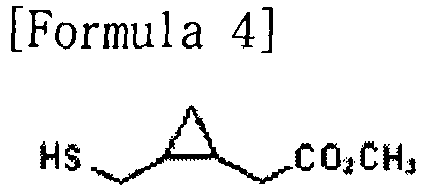
- step a) is preferably to obtain acompound represented by Formula 3 by reacting a compound represented by Formula 5 with methanesulfonyl chloride, then with a compound represented by Formula 4, followed by base treatment, without an additional obtaining process.
- the reaction with the compound represented by Formula 4 in step a) is preferably carried out in at least one base selected from the group consisting ofcesium carbonate, lithium hydroxide, sodium hydroxide, potassium hydroxide, potassium carbonate, and sodium carbonate, and preferably in cesium carbonate.
- the step of reacting the compound represented by Formula 3 with the 4-halobenzylamine is preferably carried out in at least one solvent selected from the group consisting of ethanol, isopropyl alcohol, acetone, acetonitrile, ethyl acetate, tetrahydrofuran, methylene chloride, chloroform, toluene, xylene, hexane, cyclohexane and heptane.
- a base conventionally used in the art may be used.
- sodium hydroxide may be used.
- step a) is preferably to obtain a compound represented by Formula 3 by reacting a compound represented by Formula 5 with methanesulfonyl chloride, then with a compound represented by Formula 4, followed by base treatment, without an additional obtaining process.
- the reaction with the compound represented by Formula 4 in step a) is preferably carried out in at least one base selected from the group consisting ofcesium carbonate, lithium hydroxide, sodium hydroxide, potassium hydroxide, potassium carbonate, and sodium carbonate, and preferably in cesium carbonate.
- the step of obtaining the compound represented by Formula 2 by reacting the compound represented by Formula 3 with the 4-halobenzylamine is preferably carried out in at least one solvent selected from the group consisting of ethanol, isopropyl alcohol, acetone, acetonitrile, ethyl acetate, tetrahydrofuran, methylene chloride, chloroform, toluene, xylene, hexane, cyclohexane and heptane.
- the inventive method for preparing the montelukast sodium salt in the step of attaching sodium, at least one selected from the group consisting ofsodium hydroxide, sodium methoxide, and tert-sodium butoxide is preferably added
- a novel montelukast 4-halobenzylamine salt can be synthesized with a high yield of 88% or more, and a high purity of 98.3% or more through 4-halobenzylamine and montelukast acid represented by Formula 3.
- a montelukast sodium salt can be mass-produced with a high yield of 98% or more and a high purity of 99.6% or more.
- a continuous process is used so as to simplify the production process, reduce production time, and decrease the amount of solvent. This provides an efficient and economical mass-production method.
- a montelukast acid may be synthesized through Reaction Scheme 3, and then finally, a montelukast sodium salt may be synthesized in accordance with the method of Reaction Scheme 5.
- a montelukast acid represented by Compound 3 may be prepared with a purity of 91% or more, and a yield of 95% or more.
- a novel montelukast amine salt may be synthesized.
- various kinds of benzylamine derivatives and dicyclohexylamine were used to carry out comparative experiments.
- a montelukast sodium salt in order to overcome problems (such as a low yield and a low purity) caused by a complicated purification method, as shown in Reaction Scheme 4, 4-chlorobenzylamine or 4-bromobenzylamine is subjected to crystallization in a cosolvent, such as isopropyl alcohol/hexane, ethanol/hexane, ethyl acetate/hexane, so that a montelukast amine salt can be synthesized with a yield of 93%, and a purity of 99.5% or more.
- a cosolvent such as isopropyl alcohol/hexane, ethanol/hexane, ethyl acetate/hexane
- the inventive crystalline montelukast amine salt was analyzed through powder X-ray diffraction and was subjected to a differential scanning calorimetric (DSC) analysis.
- the montelukast amine salt obtained as described above may be subjected to freeze-drying or precipitation-crystallization in accordance with the method as described in Reaction Scheme 5 below so as to provide a montelukast sodium salt with a yield of 98%, a purity of 99.5%, and an optical purity of 99.9% ee or more.
- X-ray powder diffraction data was obtained by using a D/max-2500V/PC (Rigaku) provided with an rpm meter and a solid state detector within an analysis range of 2° ⁇ 50° diffraction angle: 2 ⁇ ) in accordance with a method known in the art.
- DSC was measured by using a DSC 200 F3 (NETZSCH), at a heating rate of 1°C min, within a temperature range of 25°C to 200°C)
- the resultant product was cooled at -15°Cnd 3.55mL of methanesulfonyl chloride was added thereto. At -15°C 15.2mL of diisopropylethylamine was dropped into it,and then stirring was carried out for 1 hour.
- the product was washed with 200ml of salt water, and the organic layer was dehydrated with magnesium sulfate, filtered and vacuum-concentrated so as to provide 24.3g of montelukast acid (yield: 95%, purity: 91.6%, HPLC wavelength: 238nm, Phenyl column, 4.6X250mm, moving phase A: 0.1% TFA in water, B: 0.1% TFA in ACN, flowing at 6:4 to 1:9 for 20min at a flow rate 1.5mL/min).
- the resultant product was dissolved in 20ml of water and freeze-dried so as to provide 8.3g of montelukast sodium salt (yield: 99%, purity: 99.6%, chiral purity: 99.9% ee, HPLC wavelength: 238nm, Phenyl column, 4.6X250mm, moving phase A: 0.1% TFA in water, B: 0.1% TFA in ACN, flowing at 6:4 to 1:9 for 20min at a flow rate 1.5mL/min).
- the resultant product was crystallized using toluene and normal heptane so as to provide 8.2g of montelukast sodium salt (yield: 98%, purity: 99.7%, chiral purity: 99.9% ee, HPLC wavelength: 238nm, Phenyl column, 4.6X250mm, moving phase A: 0.1% TFA in water, B: 0.1% TFA in ACN, flowing at 6:4 to 1:9 for 20min at a flow rate 1.5mL/min).
- the produced crystal was filtered, washed with normal heptane, and vacuum-dried at 50°Cfor 12 hours so as to provide 9.2g of montelukast amine salt (yield: 76%, purity: 96.7%, HPLC wavelength: 238nm, Phenyl column, 4.6X250mm, moving phase A: 0.1% TFA in water, B: 0.1% TFA in ACN, flowing at 6:4 to 1:9 for 20min at a flow rate 1.5mL/min).
- the produced crystal was filtered, washed with an ethyl acetate/hexane (1:2) solution, and vacuum-dried at 40°Cfor 12 hours so as to provide 10.6g of montelukast amine salt (yield: 81%, purity: 97.9%, HPLC wavelength: 238nm, Phenyl column, 4.6X250mm, moving phase A: 0.1% TFA in water, B: 0.1% TFA in ACN, flowing at 6:4 to 1:9 for 20min at a flow rate 1.5mL/min).
- the resultant product was dissolved in 20ml of water and freeze-dried so as to provide 8.5g of montelukast sodium salt (yield: 99%, purity: 96.7%, HPLC wavelength: 238nm, Phenyl column, 4.6X250mm, moving phase A: 0.1% TFA in water, B: 0.1% TFA in ACN, flowing at 6:4 to 1:9 for 20min at a flow rate 1.5mL/min).
- the resultant product was dissolved in 20ml of water and freeze-dried so as to provide 8.7g of montelukast sodium salt (yield: 99%, purity: 94.5%, HPLC wavelength: 238nm, Phenyl column, 4.6X250mm, moving phase A: 0.1% TFA in water, B: 0.1% TFA in ACN, flowing at 6:4 to 1:9 for 20min at a flow rate 1.5mL/min).
- the resultant product was dissolved in 20ml of water and freeze-dried so as to provide 8.3g of montelukast sodium salt (yield: 99%, purity: 95.5%, HPLC wavelength: 238nm, Phenyl column, 4.6X250mm, moving phase A: 0.1% TFA in water, B: 0.1% TFA in ACN, flowing at 6:4 to 1:9 for 20min at a flow rate 1.5mL/min).
- a novel montelukast 4-halobenzylamine salt can be synthesized with a high yield of 88% or more, and a high purity of 98.3% or more through 4-halobenzylamine and montelukast acid represented by Formula 3.
- a montelukast sodium salt can be mass-produced with a high yield of 98% or more and a high purity of 99.6% or more.
- a continuous process is used so as to simplify the production process, reduce production time, and decrease the amount of solvent. This provides an efficient and economical mass-production method.
Landscapes
- Chemical & Material Sciences (AREA)
- Organic Chemistry (AREA)
- Health & Medical Sciences (AREA)
- Pulmonology (AREA)
- Nuclear Medicine, Radiotherapy & Molecular Imaging (AREA)
- Life Sciences & Earth Sciences (AREA)
- General Chemical & Material Sciences (AREA)
- Medicinal Chemistry (AREA)
- Bioinformatics & Cheminformatics (AREA)
- Engineering & Computer Science (AREA)
- Pharmacology & Pharmacy (AREA)
- Chemical Kinetics & Catalysis (AREA)
- Animal Behavior & Ethology (AREA)
- General Health & Medical Sciences (AREA)
- Public Health (AREA)
- Veterinary Medicine (AREA)
- Quinoline Compounds (AREA)
- Pharmaceuticals Containing Other Organic And Inorganic Compounds (AREA)
- Organic Low-Molecular-Weight Compounds And Preparation Thereof (AREA)
Description
- The present invention relates to a novel montelukast amine salt, and a method for preparing a montelukast sodium salt by using the same.
- A montelukast sodium salt, as represented by Formula 1 below, is a leukotriene receptor antagonist. Leukotriene is related to contraction and inflammation of airway muscles, and fluid accumulation within the lung, and is currently useful as a therapeutic agent for respiratory system diseasessuch as asthma and allergic rhinitis. Montelukast sodium salt was first developed by Merck & Co., Inc. and is commercially available as Singulair® which is a moisture-absorbing and optically active white (or pale white) powder having the structural formula below, and is soluble in methanol, ethanol or water, and insoluble in acetonitrile.

- Since a montelukast sodium salt contains an asymmetric carbon atom, it is very difficult to secure chiral purity of montelukast and obtain a highly pure montelukast sodium salt.
- In synthesis of a montelukast sodium salt, a low yield and a difficult purification process have been always problematic due to the complicated purification method.
- First, Korean Registered Patent No.
227716 EU Patent No. 480717 Reaction Scheme 1 below. However, the preparation method requiresnot only an additional process for introducing and removing a tetrahydropyranyl protecting group, but also a purification process through chromatography. Thus, it is difficult to employ the method in mass production. Furthermore, there is a problem in that the method is not suitable for mass production due to a low yield.
- Korean Registered Patent No.
899585 
- International Publication
WO 2007/004237 disclosed a method for preparing a montelukast sodium salt by using α-methyl benzylamine. However, in the method, the purity and yield are not described. Also, Korean Registered Patent No.920314 - Accordingly, in order to solve problems (such as low purity, and low yield) in a method for preparing a montelukast sodium salt by using conventionally known salts of montelukast, the inventors of the present invention have struggled to research a novel salt of montelukast. As a result, they have completed the present invention by developing a novel montelukast 4-halobenzylamine salt. Through the developed novel montelukast amine salt, it is possible to prepare a montelukast sodium salt with a high purity and a high yield, compared to conventionally disclosed methods. Thus, it is possible to very economically and efficiently mass-produce the montelukast sodium salt.
- Accordingly, the present invention has been made to solve the above-mentioned problems occurring in the prior art, and an object of the present invention is to provide a novel montelukast 4-halobenzylamine salt, and a preparation method thereof.
- Another object of the present invention is to provide a method for preparing a montelukast sodium salt by using a novel montelukast 4-halobenzylamine salt.
- In order to accomplish this object, there is provided a montelukast 4-halobenzylamine salt represented by Formula 2 below:

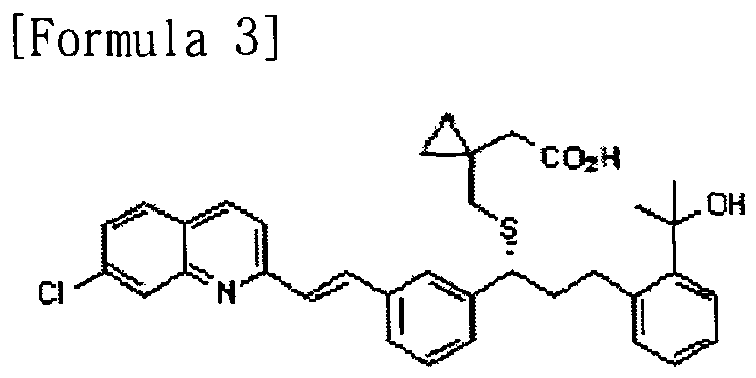
- In accordance with another aspect of the present invention, there is provided a method for preparing a montelukast 4-halobenzylamine salt represented by Formula 2 below, wherein a compound represented by Formula 3 is reacted with 4-halobenzylamine,


X represents F, Cl, Br or I. - In accordance with a further aspect of the present invention, there is provided a method for preparing a montelukast 4-halobenzylamine salt represented by Formula 2, the method including the steps of:
- a) obtaining a compound represented by Formula 3 below by reacting a compound represented by Formula 5 below with methanesulfonyl chloride, then with a compound represented by Formula 4, followed by base treatment and
- b) obtaining a compound represented by Formula 2 by reacting the obtained compound represented by Formula 3 with 4-halobenzylamine,


- Herein, in the base treatment, a base conventionally used in the art may be used. For example, sodium hydroxide may be used.
- In the inventive method for preparing a montelukast 4-halobenzylamine salt, step a) is preferably to obtain acompound represented by Formula 3 by reacting a compound represented by Formula 5 with methanesulfonyl chloride, then with a compound represented by Formula 4, followed by base treatment, without an additional obtaining process.
- In the inventive method for preparing the montelukast 4-halobenzylamine salt, the reaction with the compound represented by
Formula 4 in step a) is preferably carried out in at least one base selected from the group consisting ofcesium carbonate, lithium hydroxide, sodium hydroxide, potassium hydroxide, potassium carbonate, and sodium carbonate, and preferably in cesium carbonate. - In the inventive method for preparing the montelukast 4-halobenzylamine salt, the step of reacting the compound represented by Formula 3 with the 4-halobenzylamine is preferably carried out in at least one solvent selected from the group consisting of ethanol, isopropyl alcohol, acetone, acetonitrile, ethyl acetate, tetrahydrofuran, methylene chloride, chloroform, toluene, xylene, hexane, cyclohexane and heptane.
- In accordance with a still further aspect of the present invention, there is provided a method for preparing a montelukast sodium salt represented by Formula 1 below, the method including the steps of:
- 1) obtaining a compound represented by Formula 2 below by reacting a compound represented by Formula 3 below with 4-halobenzylamine and
- 2) treating the obtained compound represented by Formula 2 with acid, and attaching sodium thereto,
- In accordance with a yet still further aspect of the present invention, there is provided a method for preparing a montelukast sodium salt represented by Formula 1 below, the method including the steps of:
- a) obtaining a compound represented by Formula 3 below by reacting a compound represented by Formula 5 below with methanesulfonyl chloride, then with a compound represented by Formula 4 below, followed by base treatment;
- b) obtaining a compound represented by Formula 2 below by reacting the obtained compound represented by Formula 3 with 4-halobenzylamine, and c)treating the obtained compound represented by Formula 2 with acid, and attaching sodium thereto,

- Herein, in the base treatment, a base conventionally used in the art may be used. For example, sodium hydroxide may be used.
- In the inventive method for preparing a montelukast sodium salt, step a) is preferably to obtain a compound represented by Formula 3 by reacting a compound represented by Formula 5 with methanesulfonyl chloride, then with a compound represented by Formula 4, followed by base treatment, without an additional obtaining process.
- In the inventive method for preparing the montelukast sodium salt, the reaction with the compound represented by Formula 4 in step a) is preferably carried out in at least one base selected from the group consisting ofcesium carbonate, lithium hydroxide, sodium hydroxide, potassium hydroxide, potassium carbonate, and sodium carbonate, and preferably in cesium carbonate.
- In the inventive method for preparing the montelukast sodium salt, the step of obtaining the compound represented by Formula 2 by reacting the compound represented by Formula 3 with the 4-halobenzylamine is preferably carried out in at least one solvent selected from the group consisting of ethanol, isopropyl alcohol, acetone, acetonitrile, ethyl acetate, tetrahydrofuran, methylene chloride, chloroform, toluene, xylene, hexane, cyclohexane and heptane.
- In the inventive method for preparing the montelukast sodium salt, in the step of attaching sodium, at least one selected from the group consisting ofsodium hydroxide, sodium methoxide, and tert-sodium butoxide is preferably added
- According to the present invention, a novel montelukast 4-halobenzylamine salt can be synthesized with a high yield of 88% or more, and a high purity of 98.3% or more through 4-halobenzylamine and montelukast acid represented by Formula 3. Also, through the novel montelukast 4-halobenzylamine salt, a montelukast sodium salt can be mass-produced with a high yield of 98% or more and a high purity of 99.6% or more. Furthermore, in the inventive method for preparing the montelukast sodium salt, a continuous process is used so as to simplify the production process, reduce production time, and decrease the amount of solvent. This provides an efficient and economical mass-production method.
- The above and other objects, features and advantages of the present invention will be more apparent from the following detailed description taken in conjunction with the accompanying drawings, in which:
-
FIG. 1 shows an X-ray powder diffraction diagram of a montelukast 4-chlorobenzylamine salt prepared from Example 3 -
FIG. 2 shows an FT-IR spectrum of a montelukast 4-chlorobenzylamine salt prepared from Example 3; -
FIG. 3 shows a DSC diagram of a montelukast 4-bromobenzylamine salt prepared from Example 3; -
FIG. 4 shows an X-ray powder diffraction diagram of a montelukast 4-bromobenzylamine salt prepared from Example 4; -
FIG. 5 shows an FT-IR spectrum of a montelukast 4-bromobenzylamine salt prepared from Example 4; and -
FIG. 6 shows a DSC diagram of a montelukast 4-bromobenzylamine salt prepared from Example 4. - According to the present invention, a montelukast acid may be synthesized through Reaction Scheme 3, and then finally, a montelukast sodium salt may be synthesized in accordance with the method of Reaction Scheme 5.


- As shown in Reaction Scheme 3, mesylation is carried out by using a diol derivative as a starting material, and then a coupling reaction is carried out without a further separation. After the completion of the reaction, the steps from introduction of sodium hydroxide to hydrolysis are carried out as one process, minimizing a loss caused by separation of a mesylate compound. This improves the yield, simplifies the process, and reduces the amount of solvent. Through the method as described above, a montelukast acid represented by Compound 3 may be prepared with a purity of 91% or more, and a yield of 95% or more.
- Through
Reaction Scheme 4 below, a novel montelukast amine salt may be synthesized. Besides the halobenzylamine used in the present invention, various kinds of benzylamine derivatives and dicyclohexylamine were used to carry out comparative experiments.
- In the synthesis of a montelukast sodium salt, in order to overcome problems (such as a low yield and a low purity) caused by a complicated purification method, as shown in
Reaction Scheme 4, 4-chlorobenzylamine or 4-bromobenzylamine is subjected to crystallization in a cosolvent, such as isopropyl alcohol/hexane, ethanol/hexane, ethyl acetate/hexane, so that a montelukast amine salt can be synthesized with a yield of 93%, and a purity of 99.5% or more. - The inventive crystalline montelukast amine salt was analyzed through powder X-ray diffraction and was subjected to a differential scanning calorimetric (DSC) analysis.
- The montelukast amine salt obtained as described above may be subjected to freeze-drying or precipitation-crystallization in accordance with the method as described in Reaction Scheme 5 below so as to provide a montelukast sodium salt with a yield of 98%, a purity of 99.5%, and an optical purity of 99.9% ee or more.

- Hereinafter, the present invention will be described in more detail with reference to examples. However, the following examples are only for illustrative purposes and are not intended to limit the scope of the invention.
- (X-ray powder diffraction data was obtained by using a D/max-2500V/PC (Rigaku) provided with an rpm meter and a solid state detector within an analysis range of 2° ∼50° diffraction angle: 2θ) in accordance with a method known in the art.
- DSC was measured by using a
DSC 200 F3 (NETZSCH), at a heating rate of 1°C min, within a temperature range of 25°C to 200°C) - 20g of (1S)-1-(3-((E)-2-(7-chloroquinoline-2-yl)ethenyl)phenyl)-3-(2-(2-hydroxypropane-2-yl))propane-1-ol was dissolved in 40ml of tetrahydrofuran and 40ml of toluene.
- The resultant product was cooled at -15°Cnd 3.55mL of methanesulfonyl chloride was added thereto. At -15°C 15.2mL of diisopropylethylamine was dropped into it,and then stirring was carried out for 1 hour.
- 10.5g of methyl 2-(2-(sulfanylmethyl)cyclopropyl)acetate was dissolved in 50ml of dimethylformamide, and 42.7g of cesium carbonate was added thereto. After stirring at room temperature, the resultant product was washed with 40ml of dimethylformamide and dropped into a mesylate solution for 30 min. After the reaction was completed through stirring for 2 to 3 hours, 20ml of distilled water was introduced. Then, 35g of sodium hydroxide was added to the reaction product, it was heated up to 60°C and stirred for 3 to 5 hours. When the reaction was completed, the resultant product was cooled to room temperature.
- 200ml of methylene chloride was added to the reaction solution, and it was then washed with 200ml of pure water twice so as to remove any excess of sodium hydroxide. 5.3g of acetic acid dissolved in 200ml of pure water was introduced to wash the resultant product. Then, the product was washed with 200ml of salt water, and the organic layer was dehydrated with magnesium sulfate, filtered and vacuum-concentrated so as to provide 24.3g of montelukast acid (yield: 95%, purity: 91.6%, HPLC wavelength: 238nm, Phenyl column, 4.6X250mm, moving phase A: 0.1% TFA in water, B: 0.1% TFA in ACN, flowing at 6:4 to 1:9 for 20min at a flow rate 1.5mL/min).
- 1H-NMR(300MHz, CDCl3) δ (ppm) 8.12(d, 1H), 8.05(d, 1H), 7.54∼7.81(m, 4H), 7.09∼7.48(m, 9H), 4.02(t, 1H), 3.14∼3.24(m, 1H), 2.89∼2.98(m, 1H), 2.70(dd, 2H), 2.16∼2.33(m, 4H), 1.63(d, 6H), 0.47∼0.55(m, 4H)
- To 10g of montelukast acid from Example 1, 200ml of isopropyl alcohol was introduced, and the mixture was stirred. At room temperature, to the resultant product, 2.5g of 4-chloro benzylamine was introduced, followed by stirring. When crystallized, the reaction mixture was heated up to 50°C Then, the reaction mixture was stirred while 100ml of normal hexane was dropped into it.The resultant product was stirred at 50°Cfor 3 hours, gradually cooled to room temperature, further stirred for 3 hours, and filtered. Through vacuum-drying at 50°Cfor 12 hours, 10.8g of montelukast 4-chlorobenzylamine salt was obtained (yield: 87%, purity: 98.5%, HPLC wavelength: 238nm, Phenyl column, 4.6X250mm, moving phase A: 0.1% TFA in water, B: 0.1% TFA in ACN, flowing at 6:4 to 1:9 for 20min at a flow rate 1.5mL/min).
- 1H-NMR(300MHz, CDCl3) δ (ppm) : 8.10(d, 1H), 8.02(d, 1H), 7.72∼7.61(m, 4H), 7.46∼7.07(m, 13H), 4.01(t, 1H), 3.84(s, 2H), 3.21∼3.13(m, 1H), 2.94∼2.84(m, 1H), 2.64(d, 1H), 2.49∼2.14(m, 5H), 1.60(d, 6H), 0.55∼0.40(m, 4H)
- To 10g of montelukast acid from Example 1, 200ml of methanol was introduced, and the mixture was stirred. At room temperature, to the resultant product, 3.2g of 4-bromo benzylamine was introduced, followed by stirring for 1 hour. Then, methanol was vacuum-concentrated, and 100ml of isopropyl alcohol was introduced, followed by stirring. When crystallized, the reaction mixture was heated up to 50°C Then, the reaction mixture was stirred while 100ml of normal hexane was dropped into it. The resultant product was stirred at 50°C for 3 hours, gradually cooled to room temperature, further stirred for 3 hours, and filtered.
- Through vacuum-drying at 50°Cfor 12 hours, 10.9g of montelukast 4-bromo benzylamine salt was obtained (yield: 88%, purity: 98.3%, HPLC wavelength: 238nm, Phenyl column, 4.6X250mm, moving phase A: 0.1% TFA in water, B: 0.1% TFA in ACN, flowing at 6:4 to 1:9 for 20min at a flow rate 1.5mL/min).
- 1H-NMR(300MHz, CDCl3) δ (ppm) : 8.13(d, 1H), 8.04(d, 1H), 7.79∼7.61(m, 4H), 7.51∼7.08(m, 13H), 4.01(t, 1H), 3.83(s, 2H), 3.22∼3.14(m, 1H), 2.98∼2.91(m, 1H), 2.73(d, 1H), 2.62∼2.16(m, 5H), 1.63(d, 6H), 0.58∼0.46(m, 4H)
- To 10g of montelukast amine salt obtained from Example 2, 100ml of isopropyl alcohol was introduced. The mixture was heated up to 50°C and stirred for 1 hour while 200ml of normal hexane was dropped into it. The resultant product was stirred at 50°Cfor 3 hours, gradually cooled to room temperature and then to 0°C further stirred for 3 hours, and filtered.
- Through vacuum-drying at 50°Cfor 12 hours, 9.3g of montelukast 4-chlorobenzylamine salt was obtained (yield: 93%, purity: 99.6%, HPLC wavelength: 238nm, Phenyl column, 4.6X250mm, moving phase A: 0.1% TFA in water, B: 0.1% TFA in ACN, flowing at 6:4 to 1:9 for 20min at a flow rate 1.5mL/min).
- 10g of montelukast amine salt obtained from Example 4 was dissolved in 100ml of methylene chloride, and 10% acetic acid was dropped into it so as to adjust the pH to a range of 4 to 4.5. Then, the resultant product was washed with distilled water twice. The organic layer was concentrated and dissolved in 100ml of methanol. Then, 0.54g of Na0H dissolved in 1.7mLof distilled water was introduced, and 1g of activated carbon was added, followed by stirring for 1 hour and filtration. After vacuum-concentration of the solvent, the resultant product was dissolved in 20ml of water and freeze-dried so as to provide 8.3g of montelukast sodium salt (yield: 99%, purity: 99.6%, chiral purity: 99.9% ee, HPLC wavelength: 238nm, Phenyl column, 4.6X250mm, moving phase A: 0.1% TFA in water, B: 0.1% TFA in ACN, flowing at 6:4 to 1:9 for 20min at a flow rate 1.5mL/min).
- 1H-NMR(300MHz, CDCl3) δ (ppm) : 7.98(d, 1H), 7.94(d, 1H), 7.62∼7.47(m, 4H), 7.40∼6.96(m, 9H), 3.93(t, 1H), 3.19∼3.33(m, 1H), 2.65∼2.79(m, 1H), 2.48∼2.35(m, 2H), 2.27∼2.11(m, 4H), 1.55(d, 6H), 0.38∼0.14(m, 4H)
- 10g of montelukast amine salt obtained from Example 3 was dissolved in 100ml of methylene chloride, and 10% acetic acid was dropped into it so as to adjust thepH to a range of 4 to 4.5. Then, the resultant product was washed with distilled water twice. The organic layer was concentrated and dissolved in 100ml of methanol. Then, 0.54g of Na0H dissolved in 1.7mL of distilled water was introduced, and 1g of activated carbon was added, followed by stirring for 1 hour and filtration. After vacuum-concentration of the solvent, the resultant product was crystallized using toluene and normal heptane so as to provide 8.2g of montelukast sodium salt (yield: 98%, purity: 99.7%, chiral purity: 99.9% ee, HPLC wavelength: 238nm, Phenyl column, 4.6X250mm, moving phase A: 0.1% TFA in water, B: 0.1% TFA in ACN, flowing at 6:4 to 1:9 for 20min at a flow rate 1.5mL/min).
- To 10g of montelukast acid from Example 1, 60ml of ethyl acetate was introduced. The mixture was stirred at 45°Cand cooled to 20 to 25°C To the resultant product, 2g of α-methylbenzylamine was introduced, followed by stirring for 1 hour. A seed was introduced, and stirring was carried out for 24 hours. Then, at 20 to 25°C 120ml of normal heptane was dropped into it for 1 hour, and stirring was further carried out for 24 hours.
- The produced crystal was filtered, washed with normal heptane, and vacuum-dried at 50°Cfor 12 hours so as to provide 9.2g of montelukast amine salt (yield: 76%, purity: 96.7%, HPLC wavelength: 238nm, Phenyl column, 4.6X250mm, moving phase A: 0.1% TFA in water, B: 0.1% TFA in ACN, flowing at 6:4 to 1:9 for 20min at a flow rate 1.5mL/min).
- 1H-NMR(300MHz, CDCl3) δ (ppm) 8.10(d, 1H), 8.04(d, 1H), 7.61∼7.73(m, 4H), 7.07∼7.46(m, 14H), 4.15(q, 1H), 4.00(t, 1H), 3.14∼3.19(m, 1H), 2.88∼2.94(m, 1H), 2.62(d, 1H), 2.15∼2.49(m, 5H), 1.60(d, 6H), 1.43(d, 3H), 0.40∼0.55(m, 4H)
- To 10g of montelukast acid obtained from Example 1, 100ml of ethyl acetate was introduced. At room temperature, to the resultant product, 1.9g of benzylamine was introduced, followed by stirring for 24 hours. The produced solid was filtered, washed with 33ml of ethyl acetate, and vacuum-dried at 40 °Cfor 12 hours so as to provide 7g of montelukast amine salt (yield: 59%, purity: 94.5%, HPLC wavelength: 238nm, Phenyl column, 4.6X250mm, moving phase A: 0.1% TFA in water, B: 0.1% TFA in ACN, flowing at 6:4 to 1:9 for 20min at a flow rate 1.5mL/min).
- 1H-NMR(300MHz, CDCl3) δ (ppm) 8.11(d, 1H), 8.04(d, 1H), 7.61∼7.78(m, 4H), 7.09-7.47(m, 14H), 4.02(t, 1H), 3.88(s, 2H), 3.15∼3.22(m, 1H), 2.90∼2.97(m, 1H), 2.70(d, 1H), 2.19∼2.61(m, 5H), 1.61(d, 6H), 0.45∼0.57(m, 4H)
- To 10g of montelukast acid obtained from Example 1, 200ml of isopropyl alcohol was introduced, followed by stirring. At room temperature, to the resultant product, 2.5g of 4-methoxy benzylamine was introduced, followed by stirring. When crystallized, the reaction mixture was heated up to 50°C Then, the reaction mixture was stirred while 100ml of normal hexane was dropped into it. The resultant product was stirred at 50°C for 3 hours, gradually cooled to room temperature, further stirred for 3 hours, and filtered. Through vacuum-drying at 50°Cfor 12 hours, 8.6g of montelukast 4-methoxy benzylamine salt was obtained (yield: 70%, purity: 95.5%, HPLC wavelength: 238nm, Phenyl column, 4.6X250mm, moving phase A: 0.1% TFA in water, B: 0.1% TFA in ACN, flowing at 6:4 to 1:9 for 20min at a flow rate 1.5mL/min).
- 1H-NMR(300MHz, CDCl3) δ (ppm) 8.06(d, 1H), 8.01(d, 1H), 7.61∼7.70(m, 4H), 7.05∼7.44(m, 11H), 6.79∼6.83(m, 2H), 3.98(t, 1H), 3.82(s, 2H), 3.79(s, 3H), 3.14∼3.23(m, 1H), 2.80∼2.90(m, 1H), 2.53(dd, 2H), 2.13∼2.35(m, 4H), 1.58(d, 6H), 1.43(d, 6H), 0.35∼0.53(m, 4H)
- To 10g of montelukast acid obtained from Example 1, 100ml of ethyl acetate was introduced. At room temperature, 3.1g of dicyclohexylamine was introduced thereto. A seed was introduced, and stirring was carried out for 1 hour. 200ml of hexane was dropped into it for 2 hours, and left at 20°Cfor 24 hours.
- The produced crystal was filtered, washed with an ethyl acetate/hexane (1:2) solution, and vacuum-dried at 40°Cfor 12 hours so as to provide 10.6g of montelukast amine salt (yield: 81%, purity: 97.9%, HPLC wavelength: 238nm, Phenyl column, 4.6X250mm, moving phase A: 0.1% TFA in water, B: 0.1% TFA in ACN, flowing at 6:4 to 1:9 for 20min at a flow rate 1.5mL/min).
- 1H-NMR(300MHz, CDCl3) δ (ppm) 8.10(d, 1H), 8.07(d, 1H), 7.62∼7.72(m, 4H), 7.08∼7.50(m, 9), 3.98(t, 1H), 3.13∼3.20(m, 1H), 2.13∼2.90(m, 9H), 1.94∼1.97(m, 4H), 1.73∼1.77(m, 4H),1.59(d, 6H), 1.11∼1.43(m 12H), 0.31∼0.54(m, 4H)
- 10g of montelukast amine salt obtained from Comparative Example 1 was dissolved in 100ml of methylene chloride, and 10% acetic acid was dropped into it so as to adjust the pH to a range of 4 to 4.5. Then, the resultant product was washed with distilled water twice. The organic layer was concentrated and dissolved in 100ml of methanol. Then, 0.54g of Na0H dissolved in 1.7mL of distilled water was introduced, and 1g of activated carbon was added, followed by stirring for 1 hour and filtration. After vacuum-concentration of the solvent, the resultant product was dissolved in 20ml of water and freeze-dried so as to provide 8.5g of montelukast sodium salt (yield: 99%, purity: 96.7%, HPLC wavelength: 238nm, Phenyl column, 4.6X250mm, moving phase A: 0.1% TFA in water, B: 0.1% TFA in ACN, flowing at 6:4 to 1:9 for 20min at a flow rate 1.5mL/min).
- 10g of montelukast amine salt obtained from Comparative Example 2 was dissolved in 100ml of methylene chloride, and 10% acetic acid was dropped into it so as to adjust the pH toa range of 4 to 4.5. Then, the resultant product was washed with distilled water twice. The organic layer was concentrated and dissolved in 100ml of methanol. Then, 0.54g of Na0H dissolved in 1.7mL of distilled water was introduced, and 1g of activated carbon was added, followed by stirring for 1 hour and filtration. After vacuum-concentration of the solvent, the resultant product was dissolved in 20ml of water and freeze-dried so as to provide 8.7g of montelukast sodium salt (yield: 99%, purity: 94.5%, HPLC wavelength: 238nm, Phenyl column, 4.6X250mm, moving phase A: 0.1% TFA in water, B: 0.1% TFA in ACN, flowing at 6:4 to 1:9 for 20min at a flow rate 1.5mL/min).
- 10g of montelukast amine salt obtained from Comparative Example 3 was dissolved in 100ml of methylene chloride, and 10% acetic acid was dropped into it so as to adjust the pH to a range of 4 to 4.5. Then, the resultant product was washed with distilled water twice. The organic layer was concentrated and dissolved in 100ml of methanol. Then, 0.54g of Na0H dissolved in 1.7mL of distilled water was introduced, and 1g of activated carbon was added, followed by stirring for 1 hour and filtration. After vacuum-concentration of the solvent, the resultant product was dissolved in 20ml of water and freeze-dried so as to provide 8.3g of montelukast sodium salt (yield: 99%, purity: 95.5%, HPLC wavelength: 238nm, Phenyl column, 4.6X250mm, moving phase A: 0.1% TFA in water, B: 0.1% TFA in ACN, flowing at 6:4 to 1:9 for 20min at a flow rate 1.5mL/min).
- 10g of montelukast amine salt obtained from Comparative Example 4 was dissolved in 100ml of methylene chloride, and 10% acetic acid was dropped into it so as to adjust thepH to a range of 4 to 4.5. Then, the resultant product was washed with distilled water twice. The organic layer was concentrated and dissolved in 100ml of methanol. Then, 0.54g of Na0H dissolved in 1.7mL of distilled water was introduced, and 1g of activated carbon was added, followed by stirring for 1 hour and filtration. After vacuum-concentration of the solvent, the resultant product was dissolved in 20ml of water and freeze-dried so as to provide 7.8g of montelukast sodium salt. (yield: 99%, purity: 97.9, HPLC wavelength: 238nm, Phenyl column, 4.6X250mm, moving phase A: 0.1% TFA in water, B: 0.1% TFA in ACN, flowing at 6:4 to 1:9 for 20min at a flow rate 1.5mL/min).
- Experimental results of Examples and Comparative Examples are noted in Table 1.
[Table 1] Montelukast acid or salt yield (%) purity (%) Example 1 Montelukast acid 95 91.6 Example 2 4-chlorobenzylamine salt 87 98.5 Example 3 4-bromobenzylamine salt 88 98.3 Example 4 4-chlorobenzylamine salt 93 99.6 Example 5 Montelukast sodium salt 99 99.6 Example 6 Montelukast sodium salt 98 99.7 Comp. Example 1 α-methyl benzylamine salt 76 96.7 Comp. Example 2 benzylamine salt 59 94.5 Comp. Example 3 4- methoxy benzylamine salt 70 95.5 Comp. Example 4 dicyclohexyl amine salt 81 97.9 Comp. Example 5 Montelukast sodium salt 99 96.7 Comp. Example 6 Montelukast sodium salt 99 94.5 Comp. Example 7 Montelukast sodium salt 99 95.5 Comp. Example 8 Montelukast sodium salt 99 97.9 - As noted in Table 1, for the yield and the purity of an amine salt, 4-halo benzylamine salts in Examples 2 to 4 showed a much higher yield and a much higher purity, compared to those (yield: 59 to 81%, and purity: 94.5% to 97.9%) of other amine salts in Comparative Examples 1 to 4.
- Also, in Table 1, montelukast sodium salts from Examples 5 and 6, and Comparative Examples 5 to 8 showed a yield of 90% or more. However, with regard to the yield of an amine salt, the sodium salt prepared from Example 5 showed a yield of 92.07%, and the sodium salt from Example 6 showed a yield of 86.24%. Also, with regard to the yield of an amine salt, the sodium salts from Comparative Examples 5 to 8 showed a yield of 58.41% to 80.19%. Accordingly, it can be determined that the sodium salt according to the present invention showed a significantly high yield. Furthermore, it can be found that montelukast sodium salts prepared from Examples 5 and 6 showed a high purity (99.6% or more), compared to those of Comparative Examples 5 to 8.
- Although preferred embodiments of the present invention havebeen described for illustrative purposes, those skilled in the art will appreciate that various modifications, additions and substitutions are possible, without departing from the scope of the invention as defined in the accompanying claims.
- According to the present invention, a novel montelukast 4-halobenzylamine salt can be synthesized with a high yield of 88% or more, and a high purity of 98.3% or more through 4-halobenzylamine and montelukast acid represented by Formula 3. Also, through the novel montelukast 4-halobenzylamine salt, a montelukast sodium salt can be mass-produced with a high yield of 98% or more and a high purity of 99.6% or more. Furthermore, in the inventive method for preparing the montelukast sodium salt, a continuous process is used so as to simplify the production process, reduce production time, and decrease the amount of solvent. This provides an efficient and economical mass-production method.


X represents F, Cl, Br or I.



Claims (14)
- A montelukast 4-halobenzylamine salt represented by Formula 2 below:

- A method for preparing a montelukast 4-halobenzylamine salt represented by Formula 2 below, wherein a compound represented by Formula 3 below is reacted with 4-halobenzylamine:


- A method for preparing a montelukast 4-halobenzylamine salt represented by Formula 2 below, the method comprising the steps of:a) obtaining a compound represented by Formula 3 below by reacting a compound represented by Formula 5 below with methanesulfonyl chloride, then with a compound represented by Formula 4, followed by base treatment; andb) obtaining a compound represented by Formula 2 by reacting the obtained compound represented by Formula 3 with 4-halobenzylamine,wherein in Formula 2, X represents F, Cl, Br or I.



- The method as claimed in claim 3, wherein step a) is to obtain the compound represented by Formula 3 by reacting the compound represented by Formula 5 with methanesulfonyl chloride, then with the compound represented by Formula 4, followed by the base treatment, without an additional obtaining process.
- The method as claimed in claim 3, wherein in step a), the reaction with the compound represented by Formula 4 is carried out in at least one base selected from the group consisting of cesium carbonate, lithium hydroxide, sodium hydroxide, potassium hydroxide, potassium carbonate, and sodium carbonate.
- The method as claimed in claim 3, wherein in step a), the reaction with the compound represented by Formula 4 is carried out in cesium carbonate.
- The method as claimed in any one of claims 2 to 6, wherein the step of reacting the compound represented by Formula 3 with the 4-halobenzylamine is carried out in at least one solvent selected from the group consisting of ethanol, isopropyl alcohol, acetone, acetonitrile, ethyl acetate, tetrahydrofuran, methylene chloride, chloroform, toluene, xylene, hexane, cyclohexane and heptane.
- A method for preparing a montelukast sodium salt represented by Formula 1 below, the method comprising the steps of:1) obtaining a compound represented by Formula 2 below by reacting a compound represented by Formula 3 below with 4-halobenzylamine; and2) treating the obtained compound represented by Formula 2 with acid, and attaching sodium thereto,wherein in Formula 2, X represents F, Cl, Br or I.


- A method for preparing a montelukast sodium salt represented by Formula 1 below, the method comprising the steps of:a) obtaining a compound represented by Formula 3 below by reacting a compound represented by Formula 5 below with methanesulfonyl chloride, then with a compound represented by Formula 4 below, followed by base treatment;b) obtaining a compound represented by Formula 2 below by reacting the obtained compound represented by Formula 3 with 4-halobenzylamineandc) treating the obtained compound represented by Formula 2 with acid, and attaching sodium thereto,wherein in Formula 2, X represents F, Cl, Br or I.



- The method as claimed in claim 9, wherein step a) is to obtain the compound represented by Formula 3 by reacting the compound represented by Formula 5 with methanesulfonyl chloride, then with the compound represented by Formula 4, followed by the base treatment, without an additional obtaining process.
- The method as claimed in claim 9, wherein in step a), the reaction with the compound represented by Formula 4 is carried out in at least one base selected from the group consisting of cesium carbonate, lithium hydroxide, sodium hydroxide, potassium hydroxide, potassium carbonate, and sodium carbonate.
- The method as claimed in claim 9, wherein in step a), the reaction with the compound represented by Formula 4 is carried out in cesium carbonate.
- The method as claimed in any one of claims 8 to 12, wherein the step of obtaining the compound represented by Formula 2 by reacting the compound represented by Formula 3 with the 4-halobenzylamine is carried out in at least one solvent selected from the group consisting ofethanol, isopropyl alcohol, acetone, acetonitrile, ethyl acetate, tetrahydrofuran, methylene chloride, chloroform, toluene, xylene, hexane, cyclohexane and heptane.
- The method as claimed in any one of claims 8 to 12, wherein in the step of attaching sodium, at least one selected from the group consisting of sodium hydroxide, sodium methoxide, and tert-sodium butoxide is added.
Applications Claiming Priority (2)
| Application Number | Priority Date | Filing Date | Title |
|---|---|---|---|
| KR1020100074005A KR100990046B1 (en) | 2010-07-30 | 2010-07-30 | New 4-halobenzylamine salts of montelukast and process for preparing montelukast sodium by using them |
| PCT/KR2011/005566 WO2012015255A2 (en) | 2010-07-30 | 2011-07-28 | Novel montelukast 4-halobenzylamine salt and method for preparing montelukast sodium salt by using the same |
Publications (3)
| Publication Number | Publication Date |
|---|---|
| EP2598485A2 EP2598485A2 (en) | 2013-06-05 |
| EP2598485A4 EP2598485A4 (en) | 2014-07-30 |
| EP2598485B1 true EP2598485B1 (en) | 2015-04-22 |
Family
ID=43135861
Family Applications (1)
| Application Number | Title | Priority Date | Filing Date |
|---|---|---|---|
| EP20110812784 Not-in-force EP2598485B1 (en) | 2010-07-30 | 2011-07-28 | Novel montelukast 4-halobenzylamine salt and method for preparing montelukast sodium salt by using the same |
Country Status (5)
| Country | Link |
|---|---|
| US (1) | US8686151B2 (en) |
| EP (1) | EP2598485B1 (en) |
| JP (1) | JP5745050B2 (en) |
| KR (1) | KR100990046B1 (en) |
| WO (1) | WO2012015255A2 (en) |
Families Citing this family (3)
| Publication number | Priority date | Publication date | Assignee | Title |
|---|---|---|---|---|
| KR20130041664A (en) * | 2011-10-17 | 2013-04-25 | 주식회사 엘지생명과학 | Process for preparation of highly pure montelukast sodium |
| JP6162004B2 (en) * | 2013-09-10 | 2017-07-12 | 株式会社トクヤマ | Montelukast Sodium Intermediate Analysis Method |
| US10966943B2 (en) | 2018-09-06 | 2021-04-06 | Innopharmascreen Inc. | Methods and compositions for treatment of asthma or parkinson's disease |
Family Cites Families (12)
| Publication number | Priority date | Publication date | Assignee | Title |
|---|---|---|---|---|
| CA2053209C (en) * | 1990-10-12 | 1998-12-08 | Michel L. Belley | Unsaturated hydroxyalkylquinoline acids as leukotriene antagonists |
| JP2006523699A (en) | 2003-04-15 | 2006-10-19 | メルク エンド カムパニー インコーポレーテッド | Polymorphic form of Montelukast sodium |
| WO2007004237A2 (en) * | 2005-07-05 | 2007-01-11 | Matrix Laboratories Ltd | A process for the preparation of montelukast |
| CN101213177A (en) * | 2005-07-05 | 2008-07-02 | 特瓦制药工业有限公司 | Purification of Montelukast |
| EP2004608B1 (en) * | 2006-04-12 | 2011-09-14 | Glade Organics Private Limited | An improved process for the manufacture of montelukast sodium |
| EP1886998A1 (en) * | 2006-08-09 | 2008-02-13 | Esteve Quimica, S.A. | Purification process of montelukast and its amine salts |
| US8115004B2 (en) * | 2006-11-20 | 2012-02-14 | Msn Laboratories Limited | Process for pure montelukast sodium through pure intermediates as well as amine salts |
| WO2009027990A1 (en) * | 2007-08-29 | 2009-03-05 | Morepen Laboratories Limited | Salts of montelukast and process therefor |
| WO2009029770A1 (en) * | 2007-08-31 | 2009-03-05 | Aeras Global Tb Vaccine Foundation | Enhancement of transgene expression from viral-based vaccine vecors by expression of suppressors of the type i interferon response |
| KR20090051855A (en) * | 2007-11-20 | 2009-05-25 | 보령제약 주식회사 | Novel Polymorphs of Montelukast Cyclohexylamine Salts and Methods for Preparing the Same |
| KR100920314B1 (en) * | 2007-11-20 | 2009-10-08 | 보령제약 주식회사 | Montelukast novel salt and preparation method thereof |
| KR101123292B1 (en) * | 2008-09-26 | 2012-03-19 | 주식회사 엘지생명과학 | Process for Preparation of Montelukast Sodium Salt |
-
2010
- 2010-07-30 KR KR1020100074005A patent/KR100990046B1/en not_active Expired - Fee Related
-
2011
- 2011-07-28 JP JP2013523084A patent/JP5745050B2/en not_active Expired - Fee Related
- 2011-07-28 WO PCT/KR2011/005566 patent/WO2012015255A2/en not_active Ceased
- 2011-07-28 EP EP20110812784 patent/EP2598485B1/en not_active Not-in-force
-
2012
- 2012-12-28 US US13/730,168 patent/US8686151B2/en not_active Expired - Fee Related
Also Published As
| Publication number | Publication date |
|---|---|
| WO2012015255A3 (en) | 2012-04-26 |
| JP2013532723A (en) | 2013-08-19 |
| KR100990046B1 (en) | 2010-10-26 |
| EP2598485A2 (en) | 2013-06-05 |
| JP5745050B2 (en) | 2015-07-08 |
| WO2012015255A2 (en) | 2012-02-02 |
| US8686151B2 (en) | 2014-04-01 |
| EP2598485A4 (en) | 2014-07-30 |
| US20130184464A1 (en) | 2013-07-18 |
Similar Documents
| Publication | Publication Date | Title |
|---|---|---|
| JP6607780B2 (en) | LFA-1 inhibitors and polymorphs thereof | |
| CN102985416B (en) | Process for preparing thrombin-specific inhibitors | |
| CN101765595A (en) | Process for preparing voriconazole | |
| JP2005516064A (en) | Method for producing organic compound | |
| KR101308258B1 (en) | A novel method of making Endoxifen | |
| CN101591301B (en) | Preparation method of 3, 5-dihydroxy heptyl-6-gadoleic acid derivative | |
| US8686151B2 (en) | Montelukast 4-halobenzylamine salt and method for preparing montelukast sodium salt by using the same | |
| EP2850064B1 (en) | Process for preparation of montelukast sodium | |
| EP3357901A1 (en) | Method for producing optically active 2-(2-fluorobiphenyl-4-yl) propanoic acid | |
| EP3286168A1 (en) | A solid form of apremilast and a process for preparing the same | |
| WO2008126075A1 (en) | Process for preparing montelukast and salts thereof using optically impure 2-(2-(3(s)-(3-(7-chloro-2-quinolinyl)ethenyl)phenyl)-3-hydroxypropyl)phenyl-2-propanol | |
| JP4783998B2 (en) | Preparation of (3R, 5S) -7-substituted-3,5-dihydroxyhept-6-enoic acid | |
| KR20190077467A (en) | Amorphous trisodium saccharide valsartan and its preparation method | |
| US20180339964A1 (en) | The process of preparing indoline compounds and a novel indolinesalt | |
| US7700776B2 (en) | Compounds and preparation for montelukast sodium | |
| KR101304640B1 (en) | Novel n-methylbenzylamine salt of rosuvastatin and process for the preparation thereof | |
| JP2010533208A (en) | Method for producing tertiary alcohol | |
| JPWO2014051077A1 (en) | Method for producing high purity nitrogen-containing heterocyclic compound | |
| WO2004096765A2 (en) | A novel crystalline polymorph of fluvastatin sodium and a process for preparing it | |
| EP2292594A1 (en) | Method for producing optically active aminoalcohol derivative | |
| CN108586450B (en) | Recrystallization purification method of choline M receptor anticaking agent | |
| CN113956239A (en) | Azelastine hydrochloride, and preparation method and application thereof | |
| KR100920314B1 (en) | Montelukast novel salt and preparation method thereof | |
| KR101469015B1 (en) | Montelukast manufacturing method and its intermediates | |
| CN106279018B (en) | Beta 2-receptor excitant and its preparation method and application |
Legal Events
| Date | Code | Title | Description |
|---|---|---|---|
| PUAI | Public reference made under article 153(3) epc to a published international application that has entered the european phase |
Free format text: ORIGINAL CODE: 0009012 |
|
| 17P | Request for examination filed |
Effective date: 20121213 |
|
| AK | Designated contracting states |
Kind code of ref document: A2 Designated state(s): AL AT BE BG CH CY CZ DE DK EE ES FI FR GB GR HR HU IE IS IT LI LT LU LV MC MK MT NL NO PL PT RO RS SE SI SK SM TR |
|
| DAX | Request for extension of the european patent (deleted) | ||
| A4 | Supplementary search report drawn up and despatched |
Effective date: 20140626 |
|
| RIC1 | Information provided on ipc code assigned before grant |
Ipc: C07D 215/18 20060101AFI20140620BHEP Ipc: A61P 11/06 20060101ALI20140620BHEP Ipc: A61K 31/47 20060101ALI20140620BHEP |
|
| RIC1 | Information provided on ipc code assigned before grant |
Ipc: C07D 215/18 20060101AFI20140917BHEP Ipc: A61P 11/06 20060101ALI20140917BHEP Ipc: A61K 31/47 20060101ALI20140917BHEP Ipc: C07D 215/14 20060101ALI20140917BHEP |
|
| GRAP | Despatch of communication of intention to grant a patent |
Free format text: ORIGINAL CODE: EPIDOSNIGR1 |
|
| INTG | Intention to grant announced |
Effective date: 20141024 |
|
| RAP1 | Party data changed (applicant data changed or rights of an application transferred) |
Owner name: DONG KOOK PHARM. CO., LTD |
|
| GRAS | Grant fee paid |
Free format text: ORIGINAL CODE: EPIDOSNIGR3 |
|
| GRAA | (expected) grant |
Free format text: ORIGINAL CODE: 0009210 |
|
| AK | Designated contracting states |
Kind code of ref document: B1 Designated state(s): AL AT BE BG CH CY CZ DE DK EE ES FI FR GB GR HR HU IE IS IT LI LT LU LV MC MK MT NL NO PL PT RO RS SE SI SK SM TR |
|
| REG | Reference to a national code |
Ref country code: GB Ref legal event code: FG4D |
|
| REG | Reference to a national code |
Ref country code: CH Ref legal event code: EP |
|
| REG | Reference to a national code |
Ref country code: AT Ref legal event code: REF Ref document number: 723130 Country of ref document: AT Kind code of ref document: T Effective date: 20150515 |
|
| REG | Reference to a national code |
Ref country code: IE Ref legal event code: FG4D |
|
| REG | Reference to a national code |
Ref country code: DE Ref legal event code: R096 Ref document number: 602011016007 Country of ref document: DE Effective date: 20150603 |
|
| REG | Reference to a national code |
Ref country code: NL Ref legal event code: VDEP Effective date: 20150422 |
|
| REG | Reference to a national code |
Ref country code: AT Ref legal event code: MK05 Ref document number: 723130 Country of ref document: AT Kind code of ref document: T Effective date: 20150422 |
|
| REG | Reference to a national code |
Ref country code: LT Ref legal event code: MG4D |
|
| PG25 | Lapsed in a contracting state [announced via postgrant information from national office to epo] |
Ref country code: NL Free format text: LAPSE BECAUSE OF FAILURE TO SUBMIT A TRANSLATION OF THE DESCRIPTION OR TO PAY THE FEE WITHIN THE PRESCRIBED TIME-LIMIT Effective date: 20150422 |
|
| PG25 | Lapsed in a contracting state [announced via postgrant information from national office to epo] |
Ref country code: NO Free format text: LAPSE BECAUSE OF FAILURE TO SUBMIT A TRANSLATION OF THE DESCRIPTION OR TO PAY THE FEE WITHIN THE PRESCRIBED TIME-LIMIT Effective date: 20150722 Ref country code: LT Free format text: LAPSE BECAUSE OF FAILURE TO SUBMIT A TRANSLATION OF THE DESCRIPTION OR TO PAY THE FEE WITHIN THE PRESCRIBED TIME-LIMIT Effective date: 20150422 Ref country code: PT Free format text: LAPSE BECAUSE OF FAILURE TO SUBMIT A TRANSLATION OF THE DESCRIPTION OR TO PAY THE FEE WITHIN THE PRESCRIBED TIME-LIMIT Effective date: 20150824 Ref country code: HR Free format text: LAPSE BECAUSE OF FAILURE TO SUBMIT A TRANSLATION OF THE DESCRIPTION OR TO PAY THE FEE WITHIN THE PRESCRIBED TIME-LIMIT Effective date: 20150422 Ref country code: FI Free format text: LAPSE BECAUSE OF FAILURE TO SUBMIT A TRANSLATION OF THE DESCRIPTION OR TO PAY THE FEE WITHIN THE PRESCRIBED TIME-LIMIT Effective date: 20150422 Ref country code: ES Free format text: LAPSE BECAUSE OF FAILURE TO SUBMIT A TRANSLATION OF THE DESCRIPTION OR TO PAY THE FEE WITHIN THE PRESCRIBED TIME-LIMIT Effective date: 20150422 |
|
| PG25 | Lapsed in a contracting state [announced via postgrant information from national office to epo] |
Ref country code: IS Free format text: LAPSE BECAUSE OF FAILURE TO SUBMIT A TRANSLATION OF THE DESCRIPTION OR TO PAY THE FEE WITHIN THE PRESCRIBED TIME-LIMIT Effective date: 20150822 Ref country code: AT Free format text: LAPSE BECAUSE OF FAILURE TO SUBMIT A TRANSLATION OF THE DESCRIPTION OR TO PAY THE FEE WITHIN THE PRESCRIBED TIME-LIMIT Effective date: 20150422 Ref country code: LV Free format text: LAPSE BECAUSE OF FAILURE TO SUBMIT A TRANSLATION OF THE DESCRIPTION OR TO PAY THE FEE WITHIN THE PRESCRIBED TIME-LIMIT Effective date: 20150422 Ref country code: RS Free format text: LAPSE BECAUSE OF FAILURE TO SUBMIT A TRANSLATION OF THE DESCRIPTION OR TO PAY THE FEE WITHIN THE PRESCRIBED TIME-LIMIT Effective date: 20150422 Ref country code: GR Free format text: LAPSE BECAUSE OF FAILURE TO SUBMIT A TRANSLATION OF THE DESCRIPTION OR TO PAY THE FEE WITHIN THE PRESCRIBED TIME-LIMIT Effective date: 20150723 |
|
| REG | Reference to a national code |
Ref country code: DE Ref legal event code: R097 Ref document number: 602011016007 Country of ref document: DE |
|
| PG25 | Lapsed in a contracting state [announced via postgrant information from national office to epo] |
Ref country code: EE Free format text: LAPSE BECAUSE OF FAILURE TO SUBMIT A TRANSLATION OF THE DESCRIPTION OR TO PAY THE FEE WITHIN THE PRESCRIBED TIME-LIMIT Effective date: 20150422 Ref country code: DK Free format text: LAPSE BECAUSE OF FAILURE TO SUBMIT A TRANSLATION OF THE DESCRIPTION OR TO PAY THE FEE WITHIN THE PRESCRIBED TIME-LIMIT Effective date: 20150422 |
|
| REG | Reference to a national code |
Ref country code: DE Ref legal event code: R119 Ref document number: 602011016007 Country of ref document: DE |
|
| PLBE | No opposition filed within time limit |
Free format text: ORIGINAL CODE: 0009261 |
|
| STAA | Information on the status of an ep patent application or granted ep patent |
Free format text: STATUS: NO OPPOSITION FILED WITHIN TIME LIMIT |
|
| PG25 | Lapsed in a contracting state [announced via postgrant information from national office to epo] |
Ref country code: RO Free format text: LAPSE BECAUSE OF NON-PAYMENT OF DUE FEES Effective date: 20150422 Ref country code: SK Free format text: LAPSE BECAUSE OF FAILURE TO SUBMIT A TRANSLATION OF THE DESCRIPTION OR TO PAY THE FEE WITHIN THE PRESCRIBED TIME-LIMIT Effective date: 20150422 Ref country code: MC Free format text: LAPSE BECAUSE OF FAILURE TO SUBMIT A TRANSLATION OF THE DESCRIPTION OR TO PAY THE FEE WITHIN THE PRESCRIBED TIME-LIMIT Effective date: 20150422 Ref country code: CZ Free format text: LAPSE BECAUSE OF FAILURE TO SUBMIT A TRANSLATION OF THE DESCRIPTION OR TO PAY THE FEE WITHIN THE PRESCRIBED TIME-LIMIT Effective date: 20150422 Ref country code: PL Free format text: LAPSE BECAUSE OF FAILURE TO SUBMIT A TRANSLATION OF THE DESCRIPTION OR TO PAY THE FEE WITHIN THE PRESCRIBED TIME-LIMIT Effective date: 20150422 |
|
| REG | Reference to a national code |
Ref country code: CH Ref legal event code: PL |
|
| GBPC | Gb: european patent ceased through non-payment of renewal fee |
Effective date: 20150728 |
|
| 26N | No opposition filed |
Effective date: 20160125 |
|
| PG25 | Lapsed in a contracting state [announced via postgrant information from national office to epo] |
Ref country code: LU Free format text: LAPSE BECAUSE OF FAILURE TO SUBMIT A TRANSLATION OF THE DESCRIPTION OR TO PAY THE FEE WITHIN THE PRESCRIBED TIME-LIMIT Effective date: 20150728 |
|
| REG | Reference to a national code |
Ref country code: IE Ref legal event code: MM4A |
|
| PG25 | Lapsed in a contracting state [announced via postgrant information from national office to epo] |
Ref country code: IT Free format text: LAPSE BECAUSE OF FAILURE TO SUBMIT A TRANSLATION OF THE DESCRIPTION OR TO PAY THE FEE WITHIN THE PRESCRIBED TIME-LIMIT Effective date: 20150422 Ref country code: GB Free format text: LAPSE BECAUSE OF NON-PAYMENT OF DUE FEES Effective date: 20150728 Ref country code: DE Free format text: LAPSE BECAUSE OF NON-PAYMENT OF DUE FEES Effective date: 20160202 Ref country code: LI Free format text: LAPSE BECAUSE OF NON-PAYMENT OF DUE FEES Effective date: 20150731 Ref country code: CH Free format text: LAPSE BECAUSE OF NON-PAYMENT OF DUE FEES Effective date: 20150731 |
|
| REG | Reference to a national code |
Ref country code: FR Ref legal event code: ST Effective date: 20160331 |
|
| PG25 | Lapsed in a contracting state [announced via postgrant information from national office to epo] |
Ref country code: FR Free format text: LAPSE BECAUSE OF NON-PAYMENT OF DUE FEES Effective date: 20150731 Ref country code: SI Free format text: LAPSE BECAUSE OF FAILURE TO SUBMIT A TRANSLATION OF THE DESCRIPTION OR TO PAY THE FEE WITHIN THE PRESCRIBED TIME-LIMIT Effective date: 20150422 |
|
| PG25 | Lapsed in a contracting state [announced via postgrant information from national office to epo] |
Ref country code: IE Free format text: LAPSE BECAUSE OF NON-PAYMENT OF DUE FEES Effective date: 20150728 |
|
| PG25 | Lapsed in a contracting state [announced via postgrant information from national office to epo] |
Ref country code: BE Free format text: LAPSE BECAUSE OF FAILURE TO SUBMIT A TRANSLATION OF THE DESCRIPTION OR TO PAY THE FEE WITHIN THE PRESCRIBED TIME-LIMIT Effective date: 20150422 |
|
| PG25 | Lapsed in a contracting state [announced via postgrant information from national office to epo] |
Ref country code: MT Free format text: LAPSE BECAUSE OF FAILURE TO SUBMIT A TRANSLATION OF THE DESCRIPTION OR TO PAY THE FEE WITHIN THE PRESCRIBED TIME-LIMIT Effective date: 20150422 |
|
| PG25 | Lapsed in a contracting state [announced via postgrant information from national office to epo] |
Ref country code: SM Free format text: LAPSE BECAUSE OF FAILURE TO SUBMIT A TRANSLATION OF THE DESCRIPTION OR TO PAY THE FEE WITHIN THE PRESCRIBED TIME-LIMIT Effective date: 20150422 Ref country code: HU Free format text: LAPSE BECAUSE OF FAILURE TO SUBMIT A TRANSLATION OF THE DESCRIPTION OR TO PAY THE FEE WITHIN THE PRESCRIBED TIME-LIMIT; INVALID AB INITIO Effective date: 20110728 Ref country code: BG Free format text: LAPSE BECAUSE OF FAILURE TO SUBMIT A TRANSLATION OF THE DESCRIPTION OR TO PAY THE FEE WITHIN THE PRESCRIBED TIME-LIMIT Effective date: 20150422 |
|
| PG25 | Lapsed in a contracting state [announced via postgrant information from national office to epo] |
Ref country code: CY Free format text: LAPSE BECAUSE OF FAILURE TO SUBMIT A TRANSLATION OF THE DESCRIPTION OR TO PAY THE FEE WITHIN THE PRESCRIBED TIME-LIMIT Effective date: 20150422 Ref country code: SE Free format text: LAPSE BECAUSE OF FAILURE TO SUBMIT A TRANSLATION OF THE DESCRIPTION OR TO PAY THE FEE WITHIN THE PRESCRIBED TIME-LIMIT Effective date: 20150422 |
|
| PG25 | Lapsed in a contracting state [announced via postgrant information from national office to epo] |
Ref country code: TR Free format text: LAPSE BECAUSE OF FAILURE TO SUBMIT A TRANSLATION OF THE DESCRIPTION OR TO PAY THE FEE WITHIN THE PRESCRIBED TIME-LIMIT Effective date: 20150422 Ref country code: MK Free format text: LAPSE BECAUSE OF FAILURE TO SUBMIT A TRANSLATION OF THE DESCRIPTION OR TO PAY THE FEE WITHIN THE PRESCRIBED TIME-LIMIT Effective date: 20150422 |
|
| PG25 | Lapsed in a contracting state [announced via postgrant information from national office to epo] |
Ref country code: AL Free format text: LAPSE BECAUSE OF FAILURE TO SUBMIT A TRANSLATION OF THE DESCRIPTION OR TO PAY THE FEE WITHIN THE PRESCRIBED TIME-LIMIT Effective date: 20150422 |