EP2597103A1 - Pharmaceutical compositions containing insulin and an insulinotropic peptide - Google Patents
Pharmaceutical compositions containing insulin and an insulinotropic peptide Download PDFInfo
- Publication number
- EP2597103A1 EP2597103A1 EP13155712.6A EP13155712A EP2597103A1 EP 2597103 A1 EP2597103 A1 EP 2597103A1 EP 13155712 A EP13155712 A EP 13155712A EP 2597103 A1 EP2597103 A1 EP 2597103A1
- Authority
- EP
- European Patent Office
- Prior art keywords
- insulin
- glp
- pharmaceutical composition
- glu
- zinc
- Prior art date
- Legal status (The legal status is an assumption and is not a legal conclusion. Google has not performed a legal analysis and makes no representation as to the accuracy of the status listed.)
- Granted
Links
Images


Classifications
-
- C—CHEMISTRY; METALLURGY
- C07—ORGANIC CHEMISTRY
- C07K—PEPTIDES
- C07K14/00—Peptides having more than 20 amino acids; Gastrins; Somatostatins; Melanotropins; Derivatives thereof
- C07K14/435—Peptides having more than 20 amino acids; Gastrins; Somatostatins; Melanotropins; Derivatives thereof from animals; from humans
- C07K14/575—Hormones
- C07K14/605—Glucagons
-
- A—HUMAN NECESSITIES
- A61—MEDICAL OR VETERINARY SCIENCE; HYGIENE
- A61K—PREPARATIONS FOR MEDICAL, DENTAL OR TOILETRY PURPOSES
- A61K38/00—Medicinal preparations containing peptides
- A61K38/16—Peptides having more than 20 amino acids; Gastrins; Somatostatins; Melanotropins; Derivatives thereof
- A61K38/17—Peptides having more than 20 amino acids; Gastrins; Somatostatins; Melanotropins; Derivatives thereof from animals; from humans
- A61K38/22—Hormones
- A61K38/28—Insulins
-
- A—HUMAN NECESSITIES
- A61—MEDICAL OR VETERINARY SCIENCE; HYGIENE
- A61K—PREPARATIONS FOR MEDICAL, DENTAL OR TOILETRY PURPOSES
- A61K38/00—Medicinal preparations containing peptides
- A61K38/16—Peptides having more than 20 amino acids; Gastrins; Somatostatins; Melanotropins; Derivatives thereof
- A61K38/17—Peptides having more than 20 amino acids; Gastrins; Somatostatins; Melanotropins; Derivatives thereof from animals; from humans
- A61K38/22—Hormones
- A61K38/26—Glucagons
-
- A—HUMAN NECESSITIES
- A61—MEDICAL OR VETERINARY SCIENCE; HYGIENE
- A61K—PREPARATIONS FOR MEDICAL, DENTAL OR TOILETRY PURPOSES
- A61K47/00—Medicinal preparations characterised by the non-active ingredients used, e.g. carriers or inert additives; Targeting or modifying agents chemically bound to the active ingredient
- A61K47/02—Inorganic compounds
-
- A—HUMAN NECESSITIES
- A61—MEDICAL OR VETERINARY SCIENCE; HYGIENE
- A61K—PREPARATIONS FOR MEDICAL, DENTAL OR TOILETRY PURPOSES
- A61K47/00—Medicinal preparations characterised by the non-active ingredients used, e.g. carriers or inert additives; Targeting or modifying agents chemically bound to the active ingredient
- A61K47/06—Organic compounds, e.g. natural or synthetic hydrocarbons, polyolefins, mineral oil, petrolatum or ozokerite
- A61K47/08—Organic compounds, e.g. natural or synthetic hydrocarbons, polyolefins, mineral oil, petrolatum or ozokerite containing oxygen, e.g. ethers, acetals, ketones, quinones, aldehydes, peroxides
- A61K47/12—Carboxylic acids; Salts or anhydrides thereof
-
- A—HUMAN NECESSITIES
- A61—MEDICAL OR VETERINARY SCIENCE; HYGIENE
- A61K—PREPARATIONS FOR MEDICAL, DENTAL OR TOILETRY PURPOSES
- A61K47/00—Medicinal preparations characterised by the non-active ingredients used, e.g. carriers or inert additives; Targeting or modifying agents chemically bound to the active ingredient
- A61K47/06—Organic compounds, e.g. natural or synthetic hydrocarbons, polyolefins, mineral oil, petrolatum or ozokerite
- A61K47/16—Organic compounds, e.g. natural or synthetic hydrocarbons, polyolefins, mineral oil, petrolatum or ozokerite containing nitrogen, e.g. nitro-, nitroso-, azo-compounds, nitriles, cyanates
- A61K47/18—Amines; Amides; Ureas; Quaternary ammonium compounds; Amino acids; Oligopeptides having up to five amino acids
- A61K47/183—Amino acids, e.g. glycine, EDTA or aspartame
-
- A—HUMAN NECESSITIES
- A61—MEDICAL OR VETERINARY SCIENCE; HYGIENE
- A61P—SPECIFIC THERAPEUTIC ACTIVITY OF CHEMICAL COMPOUNDS OR MEDICINAL PREPARATIONS
- A61P3/00—Drugs for disorders of the metabolism
- A61P3/04—Anorexiants; Antiobesity agents
-
- A—HUMAN NECESSITIES
- A61—MEDICAL OR VETERINARY SCIENCE; HYGIENE
- A61P—SPECIFIC THERAPEUTIC ACTIVITY OF CHEMICAL COMPOUNDS OR MEDICINAL PREPARATIONS
- A61P3/00—Drugs for disorders of the metabolism
- A61P3/08—Drugs for disorders of the metabolism for glucose homeostasis
- A61P3/10—Drugs for disorders of the metabolism for glucose homeostasis for hyperglycaemia, e.g. antidiabetics
-
- A—HUMAN NECESSITIES
- A61—MEDICAL OR VETERINARY SCIENCE; HYGIENE
- A61P—SPECIFIC THERAPEUTIC ACTIVITY OF CHEMICAL COMPOUNDS OR MEDICINAL PREPARATIONS
- A61P43/00—Drugs for specific purposes, not provided for in groups A61P1/00-A61P41/00
-
- C—CHEMISTRY; METALLURGY
- C07—ORGANIC CHEMISTRY
- C07K—PEPTIDES
- C07K14/00—Peptides having more than 20 amino acids; Gastrins; Somatostatins; Melanotropins; Derivatives thereof
- C07K14/435—Peptides having more than 20 amino acids; Gastrins; Somatostatins; Melanotropins; Derivatives thereof from animals; from humans
- C07K14/575—Hormones
- C07K14/62—Insulins
-
- A—HUMAN NECESSITIES
- A61—MEDICAL OR VETERINARY SCIENCE; HYGIENE
- A61K—PREPARATIONS FOR MEDICAL, DENTAL OR TOILETRY PURPOSES
- A61K38/00—Medicinal preparations containing peptides
Definitions
- the present invention relates to the field of pharmaceutical compositions. More specifically the invention relates to pharmaceutical compositions comprising two different pharmaceutically active peptides.
- Diabetes mellitus is a metabolic disorder in which the ability to utilize glucose is partly or completely lost. Since the introduction of insulin in the 1920's, continuous efforts have been made to improve the treatment of diabetes mellitus. Since people suffering from diabetes are subject to chronic treatment over several decades, there is a major need for safe, convenient and life quality improving insulin formulations.
- insulin formulations In the treatment of diabetes mellitus, many varieties of insulin formulations have been suggested and used, such as regular insulin, isophane insulin (designated NPH), insulin zinc suspensions (such as Semilente ® , Lente ® , and Ultralente ® ), and biphasic isophane insulin.
- NPH isophane insulin
- insulin zinc suspensions such as Semilente ® , Lente ® , and Ultralente ®
- biphasic isophane insulin Some of the commercial available insulin formulations are characterized by a fast onset of action and other formulations have a relatively slow onset but show a more or less prolonged action.
- Fast-acting insulin formulations are usually solutions of insulin, while retarded acting insulin formulations can be suspensions containing insulin in crystalline and/or amorphous form precipitated by addition of zinc salts alone or by addition of protamine or by a combination of both.
- human insulin analogues Within the last decade a number of human insulin analogues
- GLP-1 glucagon-like peptide-1
- Human GLP-1 is a 37 amino acid residue peptide originating from preproglucagon which is synthesized i.a. in the L-cells in the distal ileum, in the pancreas and in the brain. GLP-1 is an important gut hormone with regulatory function in glucose metabolism and gastrointestinal secretion and metabolism. GLP-1 stimulates insulin secretion in a glucose-dependant manner, stimulates insulin biosynthesis, promotes beta cell rescue, decreases glucagon secretion, gastric emptying and food intake. As the type 2 diabetes population is rapidly increasing in the world there is a much larger need for simpler administration of more effective drugs.
- a combination formulation comprising an insulin peptide and a GLP-1 peptide with a fixed ratio of the two pharmaceuticals may be a very efficacious treatment as well as one requiring less injections when administered to the same patient.
- a combined treatment of insulin requiring diabetes comprising administration of insulin and GLP-1 is disclosed in WO 95/31214 .
- Pre-mixed formulation of GLP-1 compounds and basal insulin are disclosed in WO 03/020201 .
- Shelf stable pharmaceutical compositions comprising GLP-1, a basal insulin and surfactants are disclosed in WO 2006/051103 .
- One object of the present invention is to provide a shelf-stable once daily fixed combination of a GLP-1 compound and a basal insulin compound with unchanged PK/PD properties of the combined peptides compared to the individual active components.
- the invention is related to a shelf-stable pharmaceutical composition
- a shelf-stable pharmaceutical composition comprising a fixed combination of an insulinotropic GLP-1 compound and a basal insulin which composition contains at least 5 zinc ions per 6 basal insulin molecules.
- the pharmaceutical composition contains at least 6 zinc ions per 6 basal insulin molecules.
- the pharmaceutical composition contains at least 7 zinc ions per 6 basal insulin molecules.
- the pharmaceutical composition contains at least 8 zinc ions per 6 basal insulin molecules.
- the pharmaceutical composition contains at least 9; 10; 11; 12; 13; 14; 15; or 16 zinc ions per 6 basal insulin molecules.
- the zinc content is between 5 and 16 zinc ions per 6 insulin molecules.
- the zinc content is between 5 and 15; 5 and 14; 5 and 13; 5 and 12; 5 and 11; 5 and 10; 5 and 9, 5 and 8 or between 5 and 7 zinc ions per 6 insulin molecules.
- the zinc content is between 6 and 16 zinc ions per 6 insulin molecules.
- the zinc content is between 6 and 15; 6 and 14; 6 and 13; 6 and 12; 6 and 11; 6 and 10; 6 and 9 or between 6 and 8 zinc ions per 6 insulin molecules.
- the zinc content is between 7 and 16 zinc ions per 6 insulin molecules.
- the zinc content is between 7 and 14; 7 and 15; 7 and 14; 7 and 13; 7 and 12; 7 and 11; 7 to 10; or 7 and 9 zinc ions per 6 basal insulin molecules.
- the zinc content is between 8 and 16 zinc ions per 6 insulin molecules.
- the zinc content is between 8 and 15; 8 and 14; 8 and 13; 8 and 12; 8 and 11; or 8 and 10 zinc ions per 6 insulin molecules.
- the pH of the pharmaceutical formulation will in any of the above embodiments typically be above neutral and will typically be between about 7 and about 9.
- the pH of the pharmaceutical composition is between about pH 7.4 and about pH 9; between about pH 7.4 and about pH 8.5 or between about pH 7.4 and about pH 8.2.
- the pH of the pharmaceutical composition is between about pH 7.5 and about pH 8.5; between about pH 7.5 and about pH 8.2 or between about 7.5 and about 7.7.
- the pH of the pharmaceutical composition is from about pH 7.6 to about pH 8.2. In a further embodiment the pH is between about 7.7 and about 8.2.
- the pH will be between about 7.7 and about 9.
- the pH will be between about 7.7 and about 8.9.
- the pH will be between about 7.7 and about 8.8.
- the pH will be between about 7.7 and about 8.7.
- the pH will be between about 7.7 and about 8.6.
- the pH will be between about 7.7 and about 8.5.
- the pH will be between about 7.7 and about 8.4.
- the pH will be between about 7.7 and about 8.3.
- the pH will be between about 7.7 and about 8.2.
- the pH will be between about 7.7 and about 8.1.
- the pH will be between about 7.7 and about 8.
- the insulinotropic GLP-1 compound may in any of the above embodiments be any GLP-1 compound being effective for type 2 treatment.
- GLP-1 peptide as used herein means GLP-1 (7-37), a GLP-1 (7-37) analogue, a GLP-1 (7-37) derivative or a derivative of a GLP-1 (7-37) analogue.
- Derivatives of GLP-1 may be acylated GLP1-compounds such as disclosed in WO 98/08871 or WO 2006/097537 .
- the GLP-1 compound is an acylated GLP-1 analogue such as Arg 34 , Lys 26 (N ⁇ -( ⁇ -Glu(N ⁇ -hexadecanoyl)))-GLP-1(7-37), Aib8,Lys26(OEG-OEG-gamma-Glu-C18-diacid),Arg34)GLP-1 H(7-37)-OH or (N-epsilon26-[2-(2- ⁇ 2-[2-(2- ⁇ 2-[(2- ⁇ 2-[(S)-4-Carboxy-4-(17-carboxy-heptadecanoylamino)butyrylamino]ethoxy ⁇ ethoxy)acetylamino]ethoxy ⁇ ethoxy)-acetyl][Aib8,Arg34]GLP-1-(7-37).
- Arg 34 acylated GLP-1 analogue
- Lys 26 N ⁇ -( ⁇ -Glu(N ⁇ -hexa
- the GLP-1 is exendin-3,exendin-4 or an exendin-4 analogue.
- the exendin-4-analogue may comprise from 4-10, 4-8 or 4-6 basic amino acid residues added to either the C-terminal or the N-terminal end.
- the basal insulin may in any of the above embodiments be any basal insulin known for treatment of type 1 and type 2 diabetes.
- the basal insulin is an insulin acylated in ⁇ -amino group in the B29Lys in the B-chain of insulin and analogues thereof as disclosed in WO 95/07931 , WO 2005/012347 and in EP2007/054444 .
- the basal insulin is a pl shifted basal insulin such as the type disclosed in US patent 5,656,722 with basic amino acid residue substitutions or additions of the insulin molecule.
- basal insulins are GlyA21, ArgB31, Arg B32 human insulin (insulin glargine).
- Another basal insulin may be an amidated insulin glargine such as the compounds disclosed in WO2008/006496 and WO2008/006497 .
- the basal insulin is N ⁇ B29 -tetradecanoyl des(B30) human insulin.
- the basal insulin is Lys B29 (N ⁇ lithocholyl- ⁇ -Glu)-des(B30) human insulin.
- the basal insulin is N ⁇ B29 -tetradecanoyl des(B30) human insulin or N ⁇ B29 -(N ⁇ -(HOOC(CH 2 ) 14 CO)- ⁇ -Glu) desB30 human insulin.
- the basal insulin is N ⁇ B29 - ⁇ -carboxypentadecanoyl- ⁇ -L-glutaylamide desB30 human insulin or N ⁇ B29 - ⁇ -carboxypentadecanoyl- ⁇ - amino-butanoyl des(B30) human insulin.
- the pharmaceutical composition comprises a fixed combination of an insulinotropic GLP-1 compound and an acylated basal insulin selected from the group consisting of N ⁇ B29 -tetradecanoyl des(B30) human insulin, Lys B29 (N ⁇ lithocholyl- ⁇ -Glu)-des(B30) human insulin, N ⁇ B29 -(N ⁇ -(HOOC(CH 2 ) 14 CO)- ⁇ -Glu) desB30 human insulin, N ⁇ B29 - ⁇ -carboxypentadecanoyl- ⁇ -L-glutaylamide desB30 human insulin and N ⁇ B29 - ⁇ -carboxypentadecanoyl- ⁇ - amino-butanoyl des(B30) human insulin together with suitable pharmaceutically acceptable adjuvants which composition contains at least 5; 6; 7; 8 or 9 zinc atoms per 6 insulin molecules.
- an acylated basal insulin selected from the group consisting of N ⁇ B29 -tetradecanoy
- the pharmaceutical composition comprises a fixed combination of an insulinotropic GLP-1 compound and an acylated basal insulin selected from the group consisting of N ⁇ B29 -tetradecanoyl des(B30) human insulin, Lys B29 (N ⁇ lithocholyl- ⁇ -Glu)-des(B30) human insulin, N ⁇ B29 -(N ⁇ -(HOOC(CH 2 ) 14 CO)- ⁇ -Glu) desB30 human insulin, N ⁇ B29 - ⁇ -carboxypentadecanoyl- ⁇ -L-glutaylamide desB30 human insulin and N ⁇ B29 - ⁇ -carboxypentadecanoyl- ⁇ - amino-butanoyl des(B30) human insulin together with suitable pharmaceutically acceptable adjuvants which composition contains between 5 and 16; 5 and 14; 5 and 12; 5 and 10; or between 5 and 8 zinc ions per 6 insulin molecules.
- an acylated basal insulin selected from the group consisting of N ⁇
- the pharmaceutical composition comprises a fixed combination of an insulinotropic GLP-1 compound and an acylated basal insulin selected from the group consisting of N ⁇ B29 -tetradecanoyl des(B30) human insulin, Lys B29 (N ⁇ lithocholyl- ⁇ -Glu)-des(B30) human insulin, N ⁇ B29 -(N ⁇ -(HOOC(CH 2 ) 14 CO)- ⁇ -Glu) desB30 human insulin, N ⁇ B29 - ⁇ -carboxypentadecanoyl- ⁇ -L-glutaylamide desB30 human insulin and N ⁇ B29 - ⁇ -carboxypentadecanoyl- ⁇ - amino-butanoyl des(B30) human insulin together with suitable pharmaceutically acceptable adjuvants which composition contains between 6 and 16; 6 and 14; 6 and 12; 6 and 10; or between 6 and 8 zinc ions per 6 insulin molecules.
- an insulinotropic GLP-1 compound selected from the group consisting of N ⁇ B
- the pharmaceutical composition comprises a fixed combination of an insulinotropic GLP-1 compound and an acylated basal insulin selected from the group consisting of N ⁇ B29 -tetradecanoyl des(B30) human insulin, Lys B29 (N ⁇ lithocholyl- ⁇ -Glu)-des(B30) human insulin, N ⁇ B29 -(N ⁇ -(HOOC(CH 2 ) 14 CO)- ⁇ -Glu) desB30 human insulin, N ⁇ B29 - ⁇ -carboxypentadecanoyl- ⁇ -L-glutaylamide desB30 human insulin and N ⁇ B29 - ⁇ -carboxypentadecanoyl- ⁇ -amino-butanoyl des(B30) human insulin together with suitable pharmaceutically acceptable adjuvants which composition contains between 7 and 16; 7 and 14; 7 and 12; or between 7 and 10 zinc ions per 6 insulin molecules.
- an acylated basal insulin selected from the group consisting of N ⁇ B29
- the pharmaceutical composition comprises a fixed combination of an insulinotropic GLP-1 compound and an acylated basal insulin selected from the group consisting of N ⁇ B29 -tetradecanoyl des(B30) human insulin, Lys B29 (N ⁇ lithocholyl- ⁇ -Glu)-des(B30) human insulin, N ⁇ B29 -(N ⁇ -(HOOC(CH 2 ) 14 CO)- ⁇ -Glu) desB30 human insulin, N ⁇ B29 - ⁇ -carboxypentadecanoyl- ⁇ -L-glutaylamide desB30 human insulin and N ⁇ B29 - ⁇ -carboxypentadecanoyl- ⁇ - amino-butanoyl des(B30) human insulin together with suitable pharmaceutically acceptable adjuvants which composition contains between 8 and 16; 8 and 14; 8 and 12: or between 8 and 10 zinc ions per 6 insulin molecules.
- an acylated basal insulin selected from the group consisting of N ⁇ B29 -t
- the pharmaceutical composition comprises a fixed combination of an insulinotropic GLP-1 compound and an acylated basal insulin with the formula N ⁇ B29 -(N ⁇ -(HOOC(CH 2 ) 14 CO)- ⁇ -Glu) desB30 human insulin together with suitable pharmaceutically acceptable adjuvants which composition contains at least 5, 6, 7, 8, 9, 10, 11, 12, 13, 14, 15 or 16 zinc ions per 6 insulin molecules.
- the pharmaceutical composition comprises a fixed combination of an insulinotropic GLP-1 compound and an acylated basal insulin N ⁇ B29 -(N ⁇ -(HOOC(CH 2 ) 14 CO)- ⁇ -Glu) desB30 human insulin together with suitable pharmaceutically acceptable adjuvants which composition contains between 5 and 16 zinc ions per 6 insulin molecules.
- the pharmaceutical composition comprises a fixed combination of an insulinotropic GLP-1 compound and an acylated basal insulin N ⁇ B29 -(N ⁇ -(HOOC(CH 2 ) 14 CO)- ⁇ -Glu) desB30 human insulin together with suitable pharmaceutically acceptable adjuvants which composition contains between 6 and 16; 6 and 15; 6 and 14; 6 and 13; 6 and 12; 6 and 10; or between 6 and 8 zinc ions per 6 insulin molecules.
- the pharmaceutical composition comprises a fixed combination of an insulinotropic GLP-1 compound and an acylated basal insulin N ⁇ B29 -(N ⁇ -(HOOC(CH 2 ) 14 CO)- ⁇ -Glu) desB30 human insulin together with suitable pharmaceutically acceptable adjuvants which composition contains between 7 and 16; 7 and 15; 7 and 14; 7 and 13; 7 and 12; 7 and 11; 7 and 10; 7 and 9; or between 7 and 8 zinc ions per 6 insulin molecules.
- the pharmaceutical composition comprises a fixed combination of an insulinotropic GLP-1 compound and an acylated basal insulin N ⁇ B29 -(N ⁇ -(HOOC(CH 2 ) 14 CO)- ⁇ -Glu) desB30 human insulin together with suitable pharmaceutically acceptable adjuvants which composition contains between 8 and 16; 8 and 15; 8 and 14; 8 and 13; 8 and 12; 8 and 11; 8 and 10; or between 8 and 9 zinc ions per 6 insulin molecules.
- the invention is related to a pharmaceutical composition containing a fixed combination of an insulinotropic GLP-1 compound and a basal insulin N ⁇ B29 -tetradecanoyl des(B30) human insulin together with suitable pharmaceutically acceptable adjuvants, wherein the zinc content is at least 5, 6, 7, 8, 9, 10, 11, 12, 13, 14, 15 or 16 zinc ions per 6 insulin molecules.
- the invention is related to a pharmaceutical composition containing a fixed combination of an insulinotropic GLP-1 compound and a basal insulin N ⁇ B29 -tetradecanoyl des(B30) human insulin together with suitable pharmaceutically acceptable adjuvants, wherein the zinc content is between 5 and 16; 6 and 16; between 7 and 16; or between 8 and 16 zinc ions per 6 insulin molecules.
- the pharmaceutical composition comprises a fixed combination of an GLP-1 (7-37) or an analogue or derivative thereof and an acylated basal insulin selected from the group consisting of N ⁇ B29 -tetradecanoyl des(B30) human insulin, Lys B29 (N ⁇ lithocholyl- ⁇ -Glu)-des(B30) human insulin, N ⁇ B29 -(N ⁇ -(HOOC(CH 2 ) 14 CO)- ⁇ -Glu) desB30 human insulin, N ⁇ B29 - ⁇ -carboxypentadecanoyl- ⁇ -L-glutaylamide desB30 human insulin and N ⁇ B29 - ⁇ -carboxypentadecanoyl- ⁇ - amino-butanoyl des(B30) human insulin together with suitable pharmaceutically acceptable adjuvants which composition contains at least 5 or 6 zinc ions per 6 insulin molecules.
- an acylated basal insulin selected from the group consisting of N ⁇ B29 -tetradecano
- the pharmaceutical composition comprises a fixed combination of an GLP-1 (7-37) or an analogue or derivative thereof and an acylated basal insulin selected from the group consisting of N ⁇ B29 -tetradecanoyl des(B30) human insulin, Lys B29 (N ⁇ lithocholyl- ⁇ -Glu)-des(B30) human insulin, N ⁇ B29 -(N ⁇ -(HOOC(CH 2 ) 14 CO)- ⁇ -Glu) desB30 human insulin, N ⁇ B29 - ⁇ -carboxypentadecanoyl- ⁇ -L-glutaylamide desB30 human insulin and N ⁇ B29 - ⁇ -carboxypentadecanoyl- ⁇ - amino-butanoyl des(B30) human insulin together with suitable pharmaceutically acceptable adjuvants which composition contains between 5 and 16; 5 and 14; 5 and 12; 5 and 10 or between 5 and 8 zinc ions per 6 insulin molecules.
- an acylated basal insulin selected from the
- the pharmaceutical composition comprises a fixed combination of an GLP-1 (7-37) or an analogue or derivative thereof and an acylated basal insulin selected from the group consisting of N ⁇ B29 -tetradecanoyl des(B30) human insulin, Lys B29 (N ⁇ lithocholyl- ⁇ -Glu)-des(B30) human insulin, N ⁇ B29 -(N ⁇ -(HOOC(CH 2 ) 14 CO)- ⁇ -Glu) desB30 human insulin, N ⁇ B29 - ⁇ -carboxypentadecanoyl- ⁇ -L-glutaylamide desB30 human insulin and N ⁇ B29 - ⁇ -carboxypentadecanoyl- ⁇ - amino-butanoyl des(B30) human insulin together with suitable pharmaceutically acceptable adjuvants which composition contains between 6 and 16; 6 and 14; 6 and 12; or 6 and 10 zinc ions per 6 insulin molecules.
- an acylated basal insulin selected from the group consisting of
- the pharmaceutical composition comprises a fixed combination of an GLP-1 (7-37) or an analogue or derivative thereof and an acylated basal insulin selected from the group consisting of N ⁇ B29 -tetradecanoyl des(B30) human insulin, Lys B29 (N ⁇ lithocholyl- ⁇ -Glu)-des(B30) human insulin, N ⁇ B29 -(N ⁇ -(HOOC(CH 2 ) 14 CO)- ⁇ -Glu) desB30 human insulin, N ⁇ B29 - ⁇ -carboxypentadecanoyl- ⁇ -L-glutaylamide desB30 human insulin and N ⁇ B29 - ⁇ -carboxypentadecanoyl- ⁇ - amino-butanoyl des(B30) human insulin together with suitable pharmaceutically acceptable adjuvants which composition contains between 7 and 16; 7 and 14; 7 and 12; or between 7 and 10 zinc ions per 6 insulin molecules.
- an acylated basal insulin selected from the group consisting of
- the pharmaceutical composition comprises a fixed combination of an GLP-1 (7-37) or an analogue or derivative thereof and an acylated basal insulin selected from the group consisting of N ⁇ B29 -tetradecanoyl des(B30) human insulin, Lys B29 (N ⁇ lithocholyl- ⁇ -Glu)-des(B30) human insulin, N ⁇ B29 -(N ⁇ -(HOOC(CH 2 ) 14 CO)- ⁇ -Glu) desB30 human insulin, N ⁇ B29 - ⁇ -carboxypentadecanoyl- ⁇ -L-glutaylamide desB30 human insulin and N ⁇ B29 - ⁇ -carboxypentadecanoyl- ⁇ - amino-butanoyl des(B30) human insulin together with suitable pharmaceutically acceptable adjuvants which composition contains between 8 and 16; 8 and 12; or between 8 and 10 zinc ions per 6 insulin molecules.
- an acylated basal insulin selected from the group consisting of N ⁇
- the invention is related to a pharmaceutical composition containing a fixed combination of GLP-1 (7-37) or an analogue or derivatives thereof and N ⁇ B29 -tetradecanoyl des(B30) human insulin together with suitable pharmaceutically acceptable adjuvants, wherein the zinc content is at least 5, 6, 7, 8, 9, or 10 zinc ions per 6 insulin molecules.
- the invention is related to a pharmaceutical composition containing a fixed combination of GLP-1 (7-37) or an analogue or derivatives thereof and N ⁇ B29 -tetradecanoyl des(B30) human insulin together with suitable pharmaceutically acceptable adjuvants, wherein the zinc content is between 6 and 16; 7 and 16 ; 8 and 16; 8 and 14; 8 and 12; or between 8 and 10 zinc ions per 6 insulin molecules.
- the pharmaceutical composition comprises a fixed combination of Arg 34 , Lys 26 (N ⁇ -( ⁇ -Glu(N ⁇ -hexadecanoyl)))-GLP-1(7-37) and an acylated basal insulin selected from the group consisting of N ⁇ B29 -tetradecanoyl des(B30) human insulin, Lys B29 (N ⁇ lithocholyl- ⁇ -Glu)-des(B30) human insulin, N ⁇ B29 -(N ⁇ -(HOOC(CH 2 ) 14 CO)- ⁇ -Glu) desB30 human insulin, N ⁇ B29 - ⁇ -carboxypentadecanoyl- ⁇ -L-glutaylamide desB30 human insulin and N ⁇ B29 - ⁇ -carboxypentadecanoyl- ⁇ - amino-butanoyl des(B30) human insulin together with suitable pharmaceutically acceptable adjuvants which composition contains at least 5, 6, 7, 8, 9, 10, 11, 12,
- the pharmaceutical composition comprises a fixed combination of Arg 34 , Lys 26 (N ⁇ -( ⁇ -Glu(N ⁇ -hexadecanoyl)))-GLP-1(7-37) and an acylated basal insulin selected from the group consisting of N ⁇ B29 -tetradecanoyl des(B30) human insulin, Lys B29 (N ⁇ lithocholyl- ⁇ -Glu)-des(B30) human insulin, N ⁇ B29 -(N ⁇ -(HOOC(CH 2 ) 14 CO)- ⁇ -Glu) desB30 human insulin, N ⁇ B29 - ⁇ -carboxypentadecanoyl- ⁇ -L-glutaylamide desB30 human insulin and N ⁇ B29 - ⁇ -carboxypentadecanoyl- ⁇ - amino-butanoyl des(B30) human insulin together with suitable pharmaceutically acceptable adjuvants which composition contains between 5 and 16; 5 and 14; 5 and
- the pharmaceutical composition comprises a fixed combination of Arg 34 , Lys 26 (N ⁇ -(y-Glu(N ⁇ -hexadecanoyl)))-GLP-1 (7-37) and an acylated basal insulin selected from the group consisting of N ⁇ B29 -tetradecanoyl des(B30) human insulin, Lys B29 (N ⁇ lithocholyl- ⁇ -Glu)-des(B30) human insulin, N ⁇ B29 -(N ⁇ -(HOOC(CH 2 ) 14 CO)- ⁇ -Glu) desB30 human insulin, N ⁇ B29 - ⁇ -carboxypentadecanoyl- ⁇ -L-glutaylamide desB30 human insulin and N ⁇ B29 - ⁇ -carboxypentadecanoyl- ⁇ - amino-butanoyl des(B30) human insulin together with suitable pharmaceutically acceptable adjuvants which composition contains between 6 and 16; 6 and 14; 6 and
- the pharmaceutical composition comprises a fixed combination of Arg 34 , Lys 26 (N ⁇ -(y-Glu(N ⁇ -hexadecanoyl)))-GLP-1 (7-37) and an acylated basal insulin selected from the group consisting of N ⁇ B29 -tetradecanoyl des(B30) human insulin, Lys B29 (N ⁇ lithocholyl- ⁇ -Glu)-des(B30) human insulin, N ⁇ B29 -(N ⁇ -(HOOC(CH 2 ) 14 CO)- ⁇ -Glu) desB30 human insulin, N ⁇ B29 - ⁇ -carboxypentadecanoyl- ⁇ -L-glutaylamide desB30 human insulin and N ⁇ B29 - ⁇ -carboxypentadecanoyl- ⁇ - amino-butanoyl des(B30) human insulin together with suitable pharmaceutically acceptable adjuvants which composition contains between 7 and 16; 7 and 14; 7 and
- the pharmaceutical composition comprises a fixed combination of Arg 34 , Lys 26 (N ⁇ -(y-Glu(N ⁇ -hexadecanoyl)))-GLP-1 (7-37) and an acylated basal insulin selected from the group consisting of N ⁇ B29 -tetradecanoyl des(B30) human insulin, Lys B29 (N ⁇ lithocholyl- ⁇ -Glu)-des(B30) human insulin, N ⁇ B29 -(N ⁇ -(HOOC(CH 2 ) 14 CO)- ⁇ -Glu) desB30 human insulin, N ⁇ B29 - ⁇ -carboxypentadecanoyl- ⁇ -L-glutaylamide desB30 human insulin and N ⁇ B29 - ⁇ -carboxypentadecanoyl- ⁇ - amino-butanoyl des(B30) human insulin together with suitable pharmaceutically acceptable adjuvants which composition contains between 8 and 16; 8 and 14; 8 and
- the invention is related to a pharmaceutical composition containing a fixed combination of Arg 34 , Lys 26 (N ⁇ -(y-Glu(N ⁇ -hexadecanoyl)))-GLP-1 (7-37) and N ⁇ B29 -(N ⁇ -(HOOC(CH 2 ) 14 CO)- ⁇ -Glu) desB30 human insulin together with suitable pharmaceutically acceptable adjuvants, wherein the zinc content is at least 5 zinc ions per 6 insulin molecules.
- the invention is related to a pharmaceutical composition containing a fixed combination of Arg 34 , Lys 26 (N ⁇ -(y-Glu(N ⁇ -hexadecanoyl)))-GLP-1 (7-37) and N ⁇ B29 -(N ⁇ -(HOOC(CH 2 ) 14 CO)- ⁇ -Glu) desB30 human insulin together with suitable pharmaceutically acceptable adjuvants, wherein the zinc content is at least 6 zinc ions per 6 insulin molecules.
- the invention is related to a pharmaceutical composition containing a fixed combination of Arg 34 , Lys 26 (N ⁇ -(y-Glu(N ⁇ -hexadecanoyl)))-GLP-1 (7-37) and N ⁇ B29 -(N ⁇ -(HOOC(CH 2 ) 14 CO)- ⁇ -Glu) desB30 human insulin together with suitable pharmaceutically acceptable adjuvants, wherein the zinc content is at least 7 zinc ions per 6 insulin molecules.
- the invention is related to a pharmaceutical composition containing a fixed combination of Arg 34 , Lys 26 (N ⁇ -(y-Glu(N ⁇ -hexadecanoyl)))-GLP-1 (7-37) and N ⁇ B29 -(N ⁇ -(HOOC(CH 2 ) 14 CO)- ⁇ -Glu) desB30 human insulin together with suitable pharmaceutically acceptable adjuvants, wherein the zinc content is at least 8 zinc ions per 6 insulin molecules.
- the invention is related to a pharmaceutical composition containing a fixed combination of Arg 34 , Lys 26 (N ⁇ -(y-Glu(N ⁇ -hexadecanoyl)))-GLP-1 (7-37) and N ⁇ B29 -(N ⁇ -(HOOC(CH 2 ) 14 CO)- ⁇ -Glu) desB30 human insulin together with suitable pharmaceutically acceptable adjuvants, wherein the zinc content is at least 9 zinc ions per 6 insulin molecules.
- the invention is related to a pharmaceutical composition containing a fixed combination of Arg 34 , Lys 26 (N ⁇ -(y-Glu(N ⁇ -hexadecanoyl)))-GLP-1 (7-37) and N ⁇ B29 -(N ⁇ -(HOOC(CH 2 ) 14 CO)- ⁇ -Glu) desB30 human insulin together with suitable pharmaceutically acceptable adjuvants, wherein the zinc content is at least 10 zinc ions per 6 insulin molecules.
- the invention is related to a pharmaceutical composition containing a fixed combination of Arg 34 , Lys 26 (N ⁇ -(y-Glu(N ⁇ -hexadecanoyl)))-GLP-1 (7-37) and N ⁇ B29 -(N ⁇ -(HOOC(CH 2 ) 14 CO)- ⁇ -Glu) desB30 human insulin together with suitable pharmaceutically acceptable adjuvants, wherein the zinc content is between 5 and 16; 5 and 15; 5 and 14; 5 and 13; 5 and 12; 5 and 11; 5 and 10; 5 and 9; or between 5 and 8 zinc ions per 6 insulin molecules.
- the invention is related to a pharmaceutical composition containing a fixed combination of Arg 34 , Lys 26 (N ⁇ -(y-Glu(N ⁇ -hexadecanoyl)))-GLP-1 (7-37) and N ⁇ B29 -(N ⁇ -(HOOC(CH 2 ) 14 CO)- ⁇ -Glu) desB30 human insulin together with suitable pharmaceutically acceptable adjuvants, wherein the zinc content is between 6 and 16; 6 and 15; 6 and 14; 6 and 13; 6 and 12; 6 and 11; or between 6 and 10 zinc ions per 6 insulin molecules.
- the invention is related to a pharmaceutical composition containing a fixed combination of Arg 34 , Lys 26 (N ⁇ -(y-Glu(N ⁇ -hexadecanoyl)))-GLP-1 (7-37) and N ⁇ B29 -(N ⁇ -(HOOC(CH 2 ) 14 CO)- ⁇ -Glu) desB30 human insulin together with suitable pharmaceutically acceptable adjuvants, wherein the zinc content is between 7 and 16; 7 and 15; 7 and 14; 7 and 13; 7 and 12; 7 and 11; 7 and 10; 7 and 9; or between 7 and 8 zinc ions per 6 insulin molecules.
- the invention is related to a pharmaceutical composition containing a fixed combination of Arg 34 , Lys 26 (N ⁇ -(y-Glu(N ⁇ -hexadecanoyl)))-GLP-1 (7-37) and N ⁇ B29 -(N ⁇ -(HOOC(CH 2 ) 14 CO)- ⁇ -Glu) desB30 human insulin together with suitable pharmaceutically acceptable adjuvants, wherein the zinc content is between 8 and 16; 8 and 15; 8 and 14; 8 and 13, 8 and 12; 8 and 11; 8 and 10; or between 8 and 9 zinc ions per 6 insulin molecules.
- the invention is related to a pharmaceutical composition containing a fixed combination of insulin glargine and an exendin-4 analogue, e.g. an exendin-4 analogue comprising 4-6 added Lys- or Arg-amino acid residues together with suitable pharmaceutically acceptable adjuvants, wherein the zinc content is at least above 5, 6, 7 or 8 zinc ions per 6 insulin molecules.
- the insulin glargine may also be an amidated insulin glargin as disclosed in WO2008/006496 and WO2008/006497 .
- the pH may in any of the above embodiment be 7.4; 7.5; 7.6; 7.8; 7.9; 8; 8.1; 8.2; 8.3; 8.4 or 8.5.
- the pH is between 7.4 and 8.2 or between 7.5 and 8.
- the pH is between 7.6 and 8.
- the pH will typically be between about 7.7 and about 8.2 .
- a further aspect of the present invention is related to a method for preparation of a pharmaceutical composition according to any one of the above embodiments comprising dissolving said basal insulin and admixing it with a preservative and an isotonicity modifier, then adding zinc and finally admixing with the dissolved insulinotropic peptide.
- the method according to the invention comprises the following steps: 1) dissolving the basal insulin in a water solution of buffer and isotonicity agent, 2) adding of zinc optionally stepwise, 3) adjusting pH, 4) storing the solution at a temperature between about 4-5°C and ambient temperature and 5) adding the GLP-1 compound.
- the present invention is related to a method for the treatment of hyperglycemia comprising parenteral administration of an effective amount of the pharmaceutical composition according to any one of the above embodiments to a mammal in need of such treatment.
- the present invention is related to a method for the treatment of obesity, beta-cell deficiency, IGT or dyslipidemia comprising parenteral administration of an effective amount of the pharmaceutical composition according to any one of the above embodiments to a mammal in need of such treatment.
- Another aspect of the present invention is related to the use of a shelf-stable pharmaceutical composition
- a shelf-stable pharmaceutical composition comprising a mixture of an insulinotropic GLP-1 compound and a basal insulin which composition contains at least 6 zinc atoms per 6 insulin molecules for the treatment of hyperglycemia by parenteral administration.
- the invention is related to a method for weight reduction comprising administrating an effective amount of a pharmaceutical composition comprising a mixture of an insulinotropic GLP-1 compound and a basal insulin which composition contains at least 6 zinc atoms per 6 insulin molecules.
- This invention relates to the administration of a fixed mixture of a basal insulin and an insulinotropic GLP-1 compound for diabetes type 2 patients.
- a GLP-1 compound and a basal insulin is combined in a single formulation, the patients save one injection compared to the two separate injections required for administrating the two components separately and more importantly, a number of positive synergetic effects are expected when administrating both a basal insulin analogue and a GLP-1 compound at the same time.
- the individual active component, the basal insulin and the GLP-1 compound should keep their attractive PK profile known from mono treatment.
- the basal insulin analogue insulin N ⁇ B29 -(N ⁇ -(HOOC(CH 2 ) 14 CO)- ⁇ -Glu) desB30 human insulin has an attractive profile suited for once-daily administration.
- the GLP-1 analogue Arg 34 , Lys 26 (N ⁇ -(y-Glu(N ⁇ -hexadecanoyl)))-GLP-1(7-37) is administrated once daily.
- the combination of insulin N ⁇ B29 -(N ⁇ -(HOOC(CH 2 ) 14 CO)- ⁇ -Glu) desB30 human insulin and liraglutide constitutes an attractive combination of a basal insulin analogue and a GLP-1 analogue.
- acylated insulin analogues such as N ⁇ B29 -(N ⁇ -(HOOC(CH 2 ) 14 CO)- ⁇ -Glu) desB30 human insulin
- a GLP-1 compound such as Arg 34 , Lys 26 (N ⁇ -(y-Glu(N ⁇ -hexadecanoyl)))-GLP-1 (7-37)
- a commercial formulation however has to have a high physical stability. Also, if the PK properties of the basal insulin are altered too much it may result in loss of its 24 hours coverage.
- N ⁇ B29 -(N ⁇ -(HOOC(CH 2 ) 14 CO)- ⁇ -Glu) desB30 human insulin is able to bind more than the traditional 2-3 zinc ions per 6 insulin.
- An additional 2 - 3 zinc ions (a total of 5 - 6 zinc ions per 6 insulin molecules) are required for N ⁇ B29 -(N ⁇ -(HOOC(CH 2 ) 14 CO)- ⁇ -Glu) desB30 human insulin to have an optimal once-daily profile.
- GLP-1 compound as used herein means GLP-1 (7-37), insulinotropic analogues thereof and insulinotropic derivatives thereof.
- GLP-1 compounds also include exendin compounds such as exendin-3 and exendin-4 and analogues thereof such as ZP10 or ZP10A which is an exendin-4 analogue with 6 added lysine residues to the C-terminal end of the molecule, see Cristian Thorkildsen et al, The Journal of Pharmacology and Experimental Therapeutics, Vol 307, No. 2 (2003), 490-496 .
- An embodiment of the invention comprises a pharmaceutical composition according to any of the above embodiments, wherein the insulinotropic GLP-1 peptide is acylated exendin-4 or an acylated exendin-4 analogue such as [N-epsilon(17-carboxyheptadecanoic acid)20 exendin-4(1-39)-amide and N-epsilon32-(17-carboxy-heptadecanoyl)[Lys32]exendin-4(1-39)amide.
- the insulinotropic GLP-1 peptide is acylated exendin-4 or an acylated exendin-4 analogue such as [N-epsilon(17-carboxyheptadecanoic acid)20 exendin-4(1-39)-amide and N-epsilon32-(17-carboxy-heptadecanoyl)[Lys32]exendin-4(1-39)amide.
- Gly 8 -GLP-1(7-37) designates an analogue of GLP-1 (7-37) formally derived from GLP-1 (7-37) by substituting the naturally occurring amino acid residue in position 8 (Ala) by Gly.
- Lys 34 (N ⁇ -tetradecanoyl)-GLP-1(7-37) designates GLP-1 (7-37) wherein the ⁇ -amino group of the Lys residue in position 34 has been tetradecanoylated.
- PCT publications WO 98/08871 and WO 99/43706 disclose stable derivatives of GLP-1 analogues, which have a lipophilic substituent. These stable derivatives of GLP-1 analogues have a protracted profile of action compared to the corresponding GLP-1 analogues.
- insulinotropic as used herein referring to a peptide or a compound means the ability to stimulate secretion of insulin in response to an increased plasma glucose level. Insulinotropic peptides and compounds are agonists of the GLP-1 receptor. The insulinotropic property of a compound may be determined by in vitro or in vivo assays known in the art.
- the GLP-1 has an Arg residue in position 34. In another embodiment the GLP-1 has Glu residue in position 22. In another embodiment of the invention the GLP-1 has an L-histidine residue in position 8. In another embodiment of the invention the GLP-1 has a Val residue in position 8. In another embodiment of the invention the derivative of a GLP-1 (7-37) analogue is GLP-1 (7-36)-amide.
- the GLP-1 (7-37) analogue is selected from the group consisting of GLP-1 (7-36) amide, Arg 34 -GLP-1(7-37), Gly 8 -GLP-1(7-36)-amide, Gly 8 -GLP-1 (7-37), Val 8 -GLP-1(7-36)-amide, Val 8 -GLP-1(7-37), Val 8 Asp 22 -GLP-1(7-36)-amide, Val 8 Asp 22 -GLP-1(7-37), Val 8 Glu 22 -GLP-1(7-36)-amide , Val 8 Glu 22 -GLP-1(7-37), Val 8 Lys 22 -GLP-1 (7-36)-amide, Val 8 Lys 22 -GLP-1(7-37), Val 8 Lys 22 -GLP-1(7-37), Val 8 Lys 22 -GLP-1(7-37), Val 8 Lys 22 -GLP-1(7-37), Val 8 Lys 22 -GLP-1(7-
- the insulinotropic peptide is a derivative of GLP-1 (7-37) or a derivative of a GLP-1 (7-37) analogue having a lysine residue, such as one lysine, wherein a lipophilic substituent optionally via a spacer is attached to the epsilon amino group of said lysine.
- said lipophilic substituent has from 8 to 40 carbon atoms, preferably from 8 to 24, eg 12-18.
- said spacer is present and is selected from an amino acid, eg. beta-Ala, L-Glu, aminobutyroyl.
- said insulinotropic peptide is a dipeptidyl aminopeptidase IV protected GLP-1 compound. In another embodiment of the invention said insulinotropic peptide is a plasma stable GLP-1 compound. In another embodiment of the invention said derivative of a GLP-1 (7-37) analogue is Arg 34 , Lys 26 (N ⁇ -( ⁇ -Glu(N ⁇ -hexadecanoyl)))-GLP-1 (7-37).
- GLP-1 derivatives are desamino-His 7 , Arg 26 , Lys 34 (N ⁇ -( ⁇ -Glu(N ⁇ -hexadecanoyl)))-GLP-1(7-37), desamino-His 7 , Arg 26 , Lys 34 (N ⁇ -octanoyl)-GLP-1 (7-37), Arg 26,34 , Lys 38 (N ⁇ -(-carboxypentadecanoyl))-GLP-1(7-38), Arg 26,34 , Lys 36 (N ⁇ -( ⁇ -Glu(N ⁇ -hexadecanoyl)))-GLP-1(7-36) and Arg 34 , Lys 26 (N ⁇ -(y-Glu(N ⁇ -hexadecanoyl)))-GLP-1 (7-37).
- GLP-1 derivatives are desamino-His 7 , Arg 26 , Lys 34 (N ⁇ -( ⁇ -Glu(N ⁇ -hexadecanoyl)))-GLP-1(7-37), desamino-His 7 , Arg 26 , Lys 34 (N ⁇ -octanoyl)-GLP-1 (7-37), Arg 26,34 , Lys 38 (N ⁇ -(-carboxypentadecanoyl))-GLP-1(7-38), Arg 26,34 , Lys 36 (N ⁇ -( ⁇ -Glu(N ⁇ -hexadecanoyl)))-GLP-1 (7-36) and Arg 34 , Lys 26 (N ⁇ -( ⁇ -Glu(N ⁇ -hexadecanoyl)))-GLP-1(7-37).
- the GLP-1 analogue is a further protracted analogue of the type disclosed in WO 2006/097537 , such as Aib8,Lys26(OEG-OEG-gamma-Glu-C18-diacid),Arg34)GLP-1 (7-37), N- ⁇ 26 -(17-carboxyheptadecanoyl)-[Aib8,Arg34]GLP-1-(7-37)-peptide, N- ⁇ 26 -(19-carboxynonadecanoyl)-[Aib8,Arg34]GLP-1-(7-37)-peptide,N- ⁇ 26 -(4- ⁇ [N-(2-carboxyethyl)-N-(15-carboxypentadecanoyl)amino]methyl ⁇ benzoyl)[Arg34]GLP-1-(7-37), N- ⁇ 26 -[2-(2-[2-(2-[2-[4-(17-Carboxyhepta
- the GLP1- derivative is Aib8,Lys26(OEG-OEG-gamma-Glu-C18-diacid),Arg34)GLP-1 (7-37). Its higher potency compared to Arg 34 , Lys 26 (N ⁇ -( ⁇ -Glu(N ⁇ -hexadecanoyl)))-GLP-1 (7-37) and the lower dose required for once-daily rather than once-weekly dosing will result in a lower concentration of the GLP-1 compound needed in a combination formulation with the basal insulin.
- the basal insulin may be an acylated soluble insulin as disclosed in WO 95/07931 , WO 2005/012347 or EP2007/054444 .
- Acylated basal insulin may be selected from the following list:
- the concentration of the GLP-1 compound in the pharmaceutical composition according to the invention may be between about 1 and 25, between about 2 and about 15, between about 2 and about 10, between about 2 and about 8 or between about 2 and about 6 mg/mL.
- the concentration of the basal insulin will be between about 1 and about 25, between about 1.5 and about 15, between about 1.5 and about and 12; between about 1.5 and 8; between about 2 and about 15, between about 2 and about 10, between about 2 and about 8;,between 2 and about 7; and between about 3 and 6 mg/mL.
- the concentration of the basal insulin will be 2 mg/mL.
- the concentration of the basal insulin will be 4 mg/mL.
- the concentration of the basal insulin will be 8 mg/mL.
- the concentration of Arg 34 , Lys 26 (N ⁇ -( ⁇ -Glu(N ⁇ -hexadecanoyl)))-GLP-1 (7-37) is in the range from about 2 mg/mL to about 10 mg/mL and the concentration of basal insulin is in the range from about 3 mg/mL to about 5 mg/mL.
- the concentration of Arg 34 , Lys 26 (N ⁇ -( ⁇ -Glu(N ⁇ -hexadecanoyl)))-GLP-1(7-37) is in the range from about 2 mg/mL to about 10 mg/mL and the concentration of basal insulin is in the range from about 7 mg/mL to about 9 mg/mL.
- the order of adding each single component is important.
- buffer if different from phosphate buffer
- isotonicity modifier are mixed.
- an appropriate amount of the basal insulin analogue stock solution is added and gently mixed.
- the preservative e.g. phenol is added and the mixture is gently mixed for about 15 --60 minutes.
- the next step part of the zinc is added in an amount corresponding to a concentration of 3 zinc ions per 6 insulin molecules.
- the mixture is then gently mixed for at least 5 minutes.
- the remaining amount of zinc ions is added to the desired concentration.
- pH adjusted if it is outside the desired pH range.
- an appropriate amount of the GLP-1 compound stock solution is added to reach the desired final concentration and pH is adjusted to the desired value.
- the preservative is added before adding any zinc to the mixture.
- the order of adding the individual components is: 1) basal insulin, 2) preservative, 3) zinc and 4) GLP-1 compound.
- the zinc is added in several steps e.g. up 3 -4 steps.
- Zinc binding by the GLP-1 compound was studied using 1 D H-NMR.
- the self-association equilibrium of the insulin in the absence and presence of GLP-1 compound and in the presence of increasing zinc concentration was studied using a size exclusion chromatography method with fluorescence detection (for identifying the GLP-1 compound in the chromatogram).
- PK properties of combination formulations were assessed using standard appearance pig models.
- composition according to the invention will in addition to the active components contain the usual pharmaceutically acceptable adjuvants such as an isotonicity agent, a buffer, a preservative and a stabilizer.
- adjuvants such as an isotonicity agent, a buffer, a preservative and a stabilizer.
- preservatives are preservative selected from the group consisting of phenol, o-cresol, m-cresol, p-cresol, methyl p-hydroxybenzoate, propyl p-hydroxybenzoate, 2-phenoxyethanol, butyl p-hydroxybenzoate, 2-phenylethanol, benzyl alcohol, chlorobutanol, and thiomerosal, bronopol, benzoic acid, imidurea, chlorohexidine, sodium dehydroacetate, chlorocresol, ethyl p-hydroxybenzoate, benzethonium chloride, chlorphenesine (3p-chlorphenoxypropane-1,2-diol) or mixtures thereof.
- the preservative is a mixture of phenol and m-cresol. In another embodiment the preservative is phenol.
- a preservative in pharmaceutical compositions is well-known to the skilled person. For convenience reference is made to Remington: The Science and Practice of Pharmacy, 19 th edition, 1995.
- the formulation according to the present invention will typically comprise an isotonic agent such as mannitol, sorbitol, glycerol, propylene glycol or a mixture thereof.
- an isotonic agent such as mannitol, sorbitol, glycerol, propylene glycol or a mixture thereof.
- the isotonicity agent is not a salt.
- the use of an isotonic agent in pharmaceutical compositions is well-known to the skilled person. For convenience reference is made to Remington: The Science and Practice of Pharmacy, 19 th edition, 1995.
- the pharmaceutical composition according to the invention may also comprise a buffer.
- the buffer may be selected from a buffer which is a zwitterionic buffer, glycyl-glycine, TRIS, bicine, HEPES, MOBS, MOPS, TES and mixtures thereof.
- Further suitable buffers are sodium acetate, sodium carbonate, citrate, histidine, glycine, lysine, arginine, sodium dihydrogen phosphate, disodium hydrogen phosphate, sodium phosphate, and tris(hydroxymethyl)-aminomethan, tricine, malic acid, succinate, maleic acid, fumaric acid, tartaric acid, aspartic acid or mixtures thereof.
- the pharmaceutical formulation according to the present invention will preferably not contain a zinc binding buffer such as a phosphate buffer.
- the composition may also comprise a zinc chelating compound, which may act as a zinc buffer for free zinc ions in the formulations. This will enable an increased zinc concentration with relative lower liraglutide diheptamer formation.
- a zinc chelating compound may include (but not limited to), histidine, imidazole, citrate or derivatives hereof.
- the zinc chelator is histidine.
- the zinc chelator is imidazole.
- the addition of such a zinc chelator is preferably below 10 mM, more preferably below 5 mM, more preferably below 2 mM, more preferably below 1 mM, more preferably below 0.5 mM.
- shelf-stable pharmaceutical composition means a pharmaceutical composition which is stable for at least the period which is required by regulatory agencies in connection with therapeutic proteins.
- a shelf-stable pharmaceutical composition is stable for at least one year at 5 °C. Stability includes chemical stability as well as physical stability.
- basal insulin as used herein means an insulin peptide which has a time-action of more than 8 hours in standard models of diabetes.
- the basal insulin has a time-action of at least 9 hours.
- the basal insulin has a time-action of at least 10 hours.
- the basal meal-related insulin has a time-action in the range from 9 to 15 hours.
- the meal-related insulin has a time-action similar to that observed for commercial pharmaceutical compositions of NPH insulin and N ⁇ B29 -tetradecanoyl des(B30) human insulin.
- an effective amount means a dosage which is sufficient in order for the treatment of the patient to be effective compared with no treatment.
- pharmaceutically acceptable means suited for normal pharmaceutical applications, i.e. giving rise to no adverse events in patients etc.
- buffer refers to a chemical compound in a pharmaceutical composition that reduces the tendency of pH of the composition to change over time as would otherwise occur due to chemical reactions. Buffers include chemicals such as sodium phosphate, TRIS, glycine and sodium citrate.
- preservative refers to a chemical compound which is added to a pharmaceutical composition to prevent or delay microbial activity (growth and metabolism).
- isotonicity agent refers to a chemical compound in a pharmaceutical composition that serves to modify the osmotic pressure of the pharmaceutical composition so that the osmotic pressure becomes closer to that of human plasma.
- Isotonicity agents include NaCl, glycerol, mannitol etc.
- stabilizer refers to chemicals added to peptide containing pharmaceutical compositions in order to stabilize the peptide, i.e. to increase the shelf life and/or in-ude time of such compositions.
- stabilizers used in pharmaceutical formulations are L-glycine, L-histidine, arginine, polyethylene glycol, and carboxymethylcellulose.
- insulin peptide as used herein means a peptide which is either human insulin or an analog or a derivative thereof with insulin activity.
- human insulin as used herein means the human hormone whose structure and properties are well known. Human insulin has two polypeptide chains that are connected by disulphide bridges between cysteine residues, namely the A-chain and the B-chain.
- the A-chain is a 21 amino acid peptide and the B-chain is a 30 amino acid peptide, the two chains being connected by three disulphide bridges: one between the cysteines in position 6 and 11 of the A-chain, the second between the cysteine in position 7 of the A-chain and the cysteine in position 7 of the B-chain, and the third between the cysteine in position 20 of the A-chain and the cysteine in position 19 of the B-chain.
- analogue as used herein referring to a peptide means a modified peptide wherein one or more amino acid residues of the peptide have been substituted by other amino acid residues and/or wherein one or more amino acid residues have been deleted from the peptide and/or wherein one or more amino acid residues have been deleted from the peptide and or wherein one or more amino acid residues have been added to the peptide.
- Such addition or deletion of amino acid residues can take place at the N-terminal of the peptide and/or at the C-terminal of the peptide.
- the insulin analogues will typically not comprise more than about 7 mutations, more typically not more than 5 and even more typically at the most 3 mutations compared to human insulin.
- position 28 of the B chain may be modified from the natural Pro residue to Asp, Lys, or Ile and Lys in position B29 may also be modified to Pro.
- Asn at position A21 may be modified to Ala, Gln, Glu, Gly, His, Ile, Leu, Met, Ser, Thr, Trp, Tyr or Val, in particular to Gly, Ala, Ser, or Thr and in particular to Gly.
- Asn at position B3 may be modified to Lys or Asp.
- Further examples of insulin analogues are des(B30) human insulin, insulin analogues wherein one or both of B1 and B2 have been deleted; insulin analogues wherein the A-chain and/or the B-chain have an N-terminal extension and insulin analogues wherein the A-chain and/or the B-chain have a C-terminal extension.
- the natural amino acid residue in position A18 may be changed to a Gln residue or one or more of the amino acid residue in positions B26-B30 may be deleted.
- derivatives as used herein in relation to a parent peptide means a chemically modified parent protein or an analogue thereof, wherein at least one substituent is not present in the parent protein or an analogue thereof, i.e. a parent protein which has been covalently modified.
- Typical modifications are amides, carbohydrates, alkyl groups, acyl groups, esters, PEGylations and the like.
- derivatives of human insulin are threonine methyl ester B30 human insulin and N ⁇ B29 -tetradecanoyl des(B30) human insulin.
- isoelectric point means the pH value where the overall net charge of a macromolecule such as a peptide is zero. In peptides there may be several charged groups, and at the isoelectric point the sum of all these charges is zero. At a pH above the isoelectric point the overall net charge of the peptide will be negative, whereas at pH values below the isoelectric point the overall net charge of the peptide will be positive.
- the term "about” as used herein in relation to the concentration of a peptide in a pharmaceutical composition means plus or minus 10%.
- the concentration "about 5 mg/mL insulin” means a concentration of 4.5 mg/mL insulin to 5.5 mg/mL insulin.
- the following excipients were mixed from appropriate stock solutions in water in this order: 1) water 2) glycerol (isotonicity modifier) 3) insulin analogue 4) phenol.
- the addition of phenol before zinc was critical; otherwise a gel was formed.
- the zinc acetate was added in three portions: Firstly, a zinc amount corresponding to a concentration of 3 zinc/6 insulin analogue molecules; secondly, a zinc amount corresponding to a concentration of 3 zinc/6 insulin analogue molecules; and thirdly any additional zinc.
- the solution was equilibrated 5 minutes after each addition. The pH was measured and adjusted to pH 8.2 as described above. This solution was left to equilibrate for approximately 48 hours at 4°C before an appropriate amount of the liraglutide stock solution was added.
- the protracting mechanism of the insulin analogue N ⁇ B29 -(N ⁇ -(HOOC(CH 2 ) 14 CO)- ⁇ -Glu) desB30 human insulin has been described to depend on the formation of self-associates in the presence of more than 3 zinc ions per 6 insulin analogue molecules.
- a formulation of insulin analogue N ⁇ B29 -(N ⁇ -(HOOC(CH 2 ) 14 CO)- ⁇ -Glu) desB30 human insulin contains a significant fraction of the analogue on monomeric form, the formulation is expected to exhibit an undesirable fast-acting component.
- a high insulin analogue monomer content could compromise the physical stability of the formulation.
- the presence of the GLP-1 analogue liraglutide in a fixed combination with the insulin analogue N ⁇ B29 -(N ⁇ -(HOOC(CH 2 ) 14 CO)- ⁇ -Glu) desB30 human insulin may perturb the insulin analogue self-association equilibrium towards the monomeric state with a simultaneously formation of a liraglutide zinc binding complex. It has been demonstrated that liraglutide forms a heptameric self-assembly under formulation relevant conditions, and in the presence of equimolar concentrations of zinc ions, a zinc binding liraglutide diheptamer is formed.
- Formulations containing both the insulin analogue N ⁇ B29 -(N ⁇ -(HOOC(CH 2 ) 14 CO)- ⁇ -Glu) desB30 human insulin and liraglutide were analysed by a size exclusion chromatography (SEC) method with fluorescence detection.
- SEC size exclusion chromatography
- the SEC method used a Superose 12 10/300GL column, 50 ⁇ l samples were injected and the flow was 0.8 ml/min.
- Two methods including and excluding phenol were used with the solvent 140 mM NaCl, 10 mM Tris/HCl, pH 7.7, +/- 2 mM phenol.
- Detection was done by one channel with absorption at 276 nm (measuring total peptide amount) and another channel with fluorescence detection (excitation at 310 nm, emission at 380 nm), which was specific for liraglutide.
- the amount of insulin analogue on the monomeric form was quantified relative to the total amount of peptide.
- Formulations were prepared as described in Example 1. Four formulations each with 0.3 mM and 0.6 mM insulin analogue, respectively, were prepared with zinc contents corresponding to 6, 8, 10, and 12 zinc ions per 6 insulin analogue molecules. These eight formulations were stored at both 4°C and 37°C.
- All formulation contained 0.3 or 0.6 mM insulin analogue, zinc acetate, 1.6 mM liraglutide, 50 mM phenol, 174 mM glycerol, pH 8.2.
- Table 2 and Table 3 show the amounts of insulin analogue on the monomeric form. The shaded areas indicate conditions where an exact quantification was not possible. Therefore, the quantification was also done for insulin analogue monomer relative to total peptide content. This is shown in Table 4 and Table 5.
- Table 6 and Table 7 show the measured amounts in the analysed samples.
- Table 6 SEC with phenol % Diheptamer of total Liraglutide 0.3 mM Ins 0.6 mM Ins 4°C 37°C 4°C 37°C 6 Zn/6 Ins 0W 0 0 0 0 2W 0 0 0 0 4W 0 0 0 0 8W 0 0 0 0 8 Zn/6 Ins 0W 0 0 0 0 2W 0 0 0 0,3 4W 0 0 0 0,4 8W 0 0 0 0,4 10 Zn/6 Ins 0W 0 0 0 0 2W 0 0 0 1,2 4W 0 0 0 1,5 8W 0 0 0 0,1 2,1 12 Zn/6 Ins 0W 0 0 0 0 0,4 0,4 2W 0 0 0,6 15,4
- Example 2 Following the procedure in Example 1 four formulations were prepared with the compositions shown in Table 8.
- the glycylglycine buffer was added together with the water.
- the phosphate buffer was added after the zinc acetate was added. This was done in order to minimise zinc-phosphate precipitation.
- the used insulin analogue was N ⁇ B29 -(N ⁇ -(HOOC(CH 2 ) 14 CO)- ⁇ -Glu) desB30 human insulin.
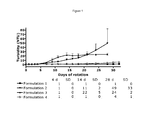
- the physical stability of the four pharmaceutical compositions was evaluated by means of an accelerated stressed test.
- the stressed test was performed as a rotation test. 50 ⁇ L air was added to each of 5 cartridges (glass vials) of each formulation. The cartridges were rotated with a frequency of 30 rotations per minute for 4 hours daily. The inspection of the cartridges was followed daily or as required.
- the turbidity of the formulation was characterized by nephelometric measurement and specified in "Nephelometric Turbidity Unit" (NTU). Physical instability of the protein was characterised by high turbidity measurements.
- Formulation 3 contained 8 zinc/6 insulin analogue molecules and had a comparable stability to the both references with the insulin analogue (with 6 zinc/6 insulin analogue molecules) and liraglutide alone.
- Formulation 6 only contained 0.3 mM insulin analogue but required 10 zinc/6 insulin analogue molecules in order to exhibit a similar stability as the reference. This indicated that higher zinc content relative to the amount of insulin analogue was required in order to achieve the same stability as the insulin analogue reference alone with 6 zinc ions/6 insulin analogue molecules.
- PK pharmacokinetic
- N ⁇ B29 -(N ⁇ -(HOOC(CH 2 ) 14 CO)- ⁇ -Glu) desB30 human insulin and liraglutide were exmanined in pigs.
- the appearances of the two peptides in the blood stream were measured by standard assay techniques for up to 72 hours after injection. For clarity, however, only the first 24 hours are shown for the insulin analogue.
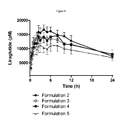
- the results are shown in Figure 5 and Figure 6 as means of the six replica and shown with standard error of the mean.
- Three combination formulations and two references were prepared as outlined in Example 1. Their compositions are shown in Table 10.
- the PK appearance curve for the insulin analogue is shown in Figure 5 and the PK appearance curve for liraglutide is shown in Figure 6 .
- the appearance of the insulin analogue in the combination is critically for several reasons: A fast-acting component will give rise to an unexpected early on-set of effect. An increased bioavailability will also result in a larger blood glucose lowering effect and subsequently an adjustment of the dose would be required. It is interesting to conclude that the combination formulation 3 (formulated with 8 zinc/6 insulin analogue molecules) exhibited a very similar insulin appearance curve compared to the curve for the insulin analogue alone (Formulation 1). Hence, a combination formulation with 8 zinc/6 insulin analogue molecules exhibited very similar insulin PK properties when compared to the insulin analogue alone. All combination formulations exhibited very similar liraglutide appearance curves (Formulations 3-5).
- PK pharmacokinetic
- the relative contents of insulin analogue monomer compared to total insulin analogue measured by the SEC analysis with phenol and without phenol are shown in Table 12 and Table 13, respectively.
- decreasing pH resulted in lower insulin analogue monomer content at each time point of measurement. This indicated that pH is an important factor for controlling and modulating the insulin monomer content in the combinations with liraglutide.
- a lower insulin monomer content could be obtained by using a pH lower than pH 8.2, e.g. pH 7.7.
- Table 14 SEC with phenol % Liraglutide diheptamer 0W 2W 4W pH 8.2 (4°C) 0.0 0.1 0.1 pH 7.7 (4°C) 0.1 0.1 0.1 pH 7.4 (4°C) 0.8 0.4 0.4 pH 8.2 (37°C) 0.0 0.4 0.6 pH 7.7 (37°C) 0.1 4.6 6.1 pH 7.4 (37°C) 0.8 18.0 21.6
- Table 15 SEC without phenol % Liraglutide diheptamer 0W 2W 4W pH 8.2 (4°C) 0.0 0.0 0.0 pH 7.7 (4°C) 0.1 0.1 0.1 pH 7.4 (4°C) 0.9 0.4 0.3 pH 8.2 (37°C) 0.0 0.3 0.5 pH 7.7 (37°C) 0.1 4.4 5.2 pH 7.4 (37°C) 0.9
- Example 7 also contained an insulin analogue N ⁇ B29 -(N ⁇ -(HOOC(CH 2 ) 14 CO)- ⁇ -Glu) desB30 human insulin - liraglutide combination formulation containing a low concentration of histidine.
- the amino acid was intended to act as a zinc buffer in the presence of an increased zinc content.
- Formulation 1 was composed of 0.6 mM insulin analogue, 0.8 mM zinc acetate (8 zinc per 6 insulin analogue molecules), 1.6 mM liraglutide, 50 mM phenol, 214 mM glycerol, with pH adjusted to pH 8.2.
- Formulation 2 was composed of 0.6 mM insulin analogue, 1.0 mM zinc acetate (10 zinc per 6 insulin analogue molecules), 1.6 mM liraglutide, 50 mM phenol, 214 mM glycerol, 0.5 mM histidine, pH adjusted to pH 8.2. Both formulations were basically produced as outlined in Example 1, the histidine was added as the final excipient after liraglutide. The formulations were analysed as described in Example 2 and Example 7.
- Example 7 also contained an insulin analogue N ⁇ B29 -(N ⁇ -(HOOC(CH 2 ) 14 CO)- ⁇ -Glu) desB30 human insulin - liraglutide combination composed of 0.3 mM insulin analogue, 0.8 mM zinc acetate (16 zinc per 6 insulin analogue molecules), 1.6 mM liraglutide, 50 mM phenol, 214 mM glycerol, adjusted to pH 8.2.
- N ⁇ B29 -(N ⁇ -(HOOC(CH 2 ) 14 CO)- ⁇ -Glu) desB30 human insulin - liraglutide combination composed of 0.3 mM insulin analogue, 0.8 mM zinc acetate (16 zinc per 6 insulin analogue molecules), 1.6 mM liraglutide, 50 mM phenol, 214 mM glycerol, adjusted to pH 8.2.
- Table 20 SEC with phenol % Monomer insulin 0W 2W 4W 4°C 7.9 7.0 6.8 37°C 7.9 6.2 5.9
- Table 21 SEC without phenol % Monomer insulin 0W 2W 4W 4°C 7.1 8.3 8.6 37°C 7.1 8.6 10.0
- Formulations combining insulin glargine and the exendin-4 analogue ZP10 were prepared.
- the ZP10 exendin-4 analogue is described in Thorkildsen et al. (2003), JPET 307:490-496 and has the systematic name [des-Pro38]exendin-4-(1-39)yl-Lys-Lys-Lys-Lys-Lys-Lys-Lys-Lys-NH2. From appropriate stock solutions the following compositions were prepared by dilution in water: Formulation 1 consisted of 0.6 mM insulin glargine, 0.46 mM zinc acetate (4.6 zinc/ 6 insulin glargine), 60 ⁇ M ZP10.
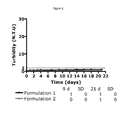
- Formulation 2 consisted of 0.6 mM insulin glargine, 0.6 mM zinc acetate (6 zinc/ 6 insulin glargine), 60 ⁇ M ZP10. Both formulations were adjusted to about pH 4.0 using HCl and NaOH and stored at ambient temperature for three days. After storage both formulations were still about pH 4.0. The two formulations maintained clear solutions immediately after preparation and after the storage at ambient temperature.
Landscapes
- Health & Medical Sciences (AREA)
- Chemical & Material Sciences (AREA)
- Life Sciences & Earth Sciences (AREA)
- General Health & Medical Sciences (AREA)
- Medicinal Chemistry (AREA)
- Organic Chemistry (AREA)
- Veterinary Medicine (AREA)
- Public Health (AREA)
- Animal Behavior & Ethology (AREA)
- Pharmacology & Pharmacy (AREA)
- Endocrinology (AREA)
- Proteomics, Peptides & Aminoacids (AREA)
- Diabetes (AREA)
- Engineering & Computer Science (AREA)
- Gastroenterology & Hepatology (AREA)
- Zoology (AREA)
- Chemical Kinetics & Catalysis (AREA)
- Bioinformatics & Cheminformatics (AREA)
- General Chemical & Material Sciences (AREA)
- Epidemiology (AREA)
- Biophysics (AREA)
- Genetics & Genomics (AREA)
- Molecular Biology (AREA)
- Biochemistry (AREA)
- Toxicology (AREA)
- Nuclear Medicine, Radiotherapy & Molecular Imaging (AREA)
- Obesity (AREA)
- Immunology (AREA)
- Hematology (AREA)
- Oil, Petroleum & Natural Gas (AREA)
- Inorganic Chemistry (AREA)
- Emergency Medicine (AREA)
- Child & Adolescent Psychology (AREA)
- Medicines That Contain Protein Lipid Enzymes And Other Medicines (AREA)
- Peptides Or Proteins (AREA)
- Medicinal Preparation (AREA)
Abstract
Description
- The present invention relates to the field of pharmaceutical compositions. More specifically the invention relates to pharmaceutical compositions comprising two different pharmaceutically active peptides.
- Diabetes mellitus is a metabolic disorder in which the ability to utilize glucose is partly or completely lost. Since the introduction of insulin in the 1920's, continuous efforts have been made to improve the treatment of diabetes mellitus. Since people suffering from diabetes are subject to chronic treatment over several decades, there is a major need for safe, convenient and life quality improving insulin formulations.
- In the treatment of diabetes mellitus, many varieties of insulin formulations have been suggested and used, such as regular insulin, isophane insulin (designated NPH), insulin zinc suspensions (such as Semilente®, Lente®, and Ultralente®), and biphasic isophane insulin. Some of the commercial available insulin formulations are characterized by a fast onset of action and other formulations have a relatively slow onset but show a more or less prolonged action. Fast-acting insulin formulations are usually solutions of insulin, while retarded acting insulin formulations can be suspensions containing insulin in crystalline and/or amorphous form precipitated by addition of zinc salts alone or by addition of protamine or by a combination of both. Within the last decade a number of human insulin analogues have been developed. They are designed for particular profiles of action, i.e. fast acting or prolonged action.
- Another peptide expected to become very important in the treatment of diabetes is glucagon-like peptide-1 (GLP-1). Human GLP-1 is a 37 amino acid residue peptide originating from preproglucagon which is synthesized i.a. in the L-cells in the distal ileum, in the pancreas and in the brain. GLP-1 is an important gut hormone with regulatory function in glucose metabolism and gastrointestinal secretion and metabolism. GLP-1 stimulates insulin secretion in a glucose-dependant manner, stimulates insulin biosynthesis, promotes beta cell rescue, decreases glucagon secretion, gastric emptying and food intake. As the
type 2 diabetes population is rapidly increasing in the world there is a much larger need for simpler administration of more effective drugs. A combination formulation comprising an insulin peptide and a GLP-1 peptide with a fixed ratio of the two pharmaceuticals may be a very efficacious treatment as well as one requiring less injections when administered to the same patient. - A combined treatment of insulin requiring diabetes comprising administration of insulin and GLP-1 is disclosed in
WO 95/31214 WO 03/020201 WO 2006/051103 . -
-
Figure 1 shows the physical stability of four pharmaceutical compositions evaluated by means of an accelerated stressed test. -
Figure 2 -4 show the results from a rotation test -
Figure 5 -8 show the pharmacokinetic (PK) properties of fixed combination formulations with the insulin analogue NεB29-(Nα-(HOOC(CH2)14CO)-γ-Glu) desB30 human insulin and liraglutide exmanined in pigs. - One object of the present invention is to provide a shelf-stable once daily fixed combination of a GLP-1 compound and a basal insulin compound with unchanged PK/PD properties of the combined peptides compared to the individual active components.
- More specifically the invention is related to a shelf-stable pharmaceutical composition comprising a fixed combination of an insulinotropic GLP-1 compound and a basal insulin which composition contains at least 5 zinc ions per 6 basal insulin molecules.
- In one embodiment the pharmaceutical composition contains at least 6 zinc ions per 6 basal insulin molecules.
- In another embodiment the pharmaceutical composition contains at least 7 zinc ions per 6 basal insulin molecules.
- In another embodiment the pharmaceutical composition contains at least 8 zinc ions per 6 basal insulin molecules.
- In a further embodiment the pharmaceutical composition contains at least 9; 10; 11; 12; 13; 14; 15; or 16 zinc ions per 6 basal insulin molecules.
- In one embodiment the zinc content is between 5 and 16 zinc ions per 6 insulin molecules.
- In a another embodiment the zinc content is between 5 and 15; 5 and 14; 5 and 13; 5 and 12; 5 and 11; 5 and 10; 5 and 9, 5 and 8 or between 5 and 7 zinc ions per 6 insulin molecules.
- In a further embodiment the zinc content is between 6 and 16 zinc ions per 6 insulin molecules.
- In a further embodiment the zinc content is between 6 and 15; 6 and 14; 6 and 13; 6 and 12; 6 and 11; 6 and 10; 6 and 9 or between 6 and 8 zinc ions per 6 insulin molecules.
- In another embodiment the zinc content is between 7 and 16 zinc ions per 6 insulin molecules.
- In a further embodiment the zinc content is between 7 and 14; 7 and 15; 7 and 14; 7 and 13; 7 and 12; 7 and 11; 7 to 10; or 7 and 9 zinc ions per 6 basal insulin molecules.
- In another embodiment the zinc content is between 8 and 16 zinc ions per 6 insulin molecules.
- In another embodiment the zinc content is between 8 and 15; 8 and 14; 8 and 13; 8 and 12; 8 and 11; or 8 and 10 zinc ions per 6 insulin molecules.
- The pH of the pharmaceutical formulation will in any of the above embodiments typically be above neutral and will typically be between about 7 and about 9.
- In one embodiment the pH of the pharmaceutical composition is between about pH 7.4 and about
pH 9; between about pH 7.4 and about pH 8.5 or between about pH 7.4 and about pH 8.2. - In another embodiment the pH of the pharmaceutical composition is between about pH 7.5 and about pH 8.5; between about pH 7.5 and about pH 8.2 or between about 7.5 and about 7.7.
- In another embodiment the pH of the pharmaceutical composition is from about pH 7.6 to about pH 8.2. In a further embodiment the pH is between about 7.7 and about 8.2.
- In another embodiment the pH will be between about 7.7 and about 9.
- In another embodiment the pH will be between about 7.7 and about 8.9.
- In another embodiment the pH will be between about 7.7 and about 8.8.
- In another embodiment the pH will be between about 7.7 and about 8.7.
- In another embodiment the pH will be between about 7.7 and about 8.6.
- In another embodiment the pH will be between about 7.7 and about 8.5.
- In another embodiment the pH will be between about 7.7 and about 8.4.
- In another embodiment the pH will be between about 7.7 and about 8.3.
- In another embodiment the pH will be between about 7.7 and about 8.2.
- In another embodiment the pH will be between about 7.7 and about 8.1.
- In another embodiment the pH will be between about 7.7 and about 8.
- The insulinotropic GLP-1 compound may in any of the above embodiments be any GLP-1 compound being effective for
type 2 treatment. The term "GLP-1 peptide" as used herein means GLP-1 (7-37), a GLP-1 (7-37) analogue, a GLP-1 (7-37) derivative or a derivative of a GLP-1 (7-37) analogue. Derivatives of GLP-1 may be acylated GLP1-compounds such as disclosed inWO 98/08871 WO 2006/097537 . - In one embodiment the GLP-1 compound is an acylated GLP-1 analogue such as Arg34, Lys26(Nε-(γ-Glu(Nα-hexadecanoyl)))-GLP-1(7-37), Aib8,Lys26(OEG-OEG-gamma-Glu-C18-diacid),Arg34)GLP-1 H(7-37)-OH or (N-epsilon26-[2-(2-{2-[2-(2-{2-[(S)-4-Carboxy-4-(17-carboxy-heptadecanoylamino)butyrylamino]ethoxy}ethoxy)acetylamino]ethoxy}ethoxy)-acetyl][Aib8,Arg34]GLP-1-(7-37).
- In another embodiment the GLP-1 is exendin-3,exendin-4 or an exendin-4 analogue. The exendin-4-analogue may comprise from 4-10, 4-8 or 4-6 basic amino acid residues added to either the C-terminal or the N-terminal end.
- The basal insulin may in any of the above embodiments be any basal insulin known for treatment of
type 1 andtype 2 diabetes. In one embodiment the basal insulin is an insulin acylated in ε-amino group in the B29Lys in the B-chain of insulin and analogues thereof as disclosed inWO 95/07931 WO 2005/012347 and inEP2007/054444 - In another embodiment the basal insulin is a pl shifted basal insulin such as the type disclosed in
US patent 5,656,722 with basic amino acid residue substitutions or additions of the insulin molecule. One example of such basal insulins is GlyA21, ArgB31, Arg B32 human insulin (insulin glargine). Another basal insulin may be an amidated insulin glargine such as the compounds disclosed inWO2008/006496 andWO2008/006497 . - In one embodiment the basal insulin is NεB29-tetradecanoyl des(B30) human insulin.
- In a further embodiment the basal insulin is LysB29(Nε lithocholyl-γ-Glu)-des(B30) human insulin.
- In a further embodiment the basal insulin is NεB29-tetradecanoyl des(B30) human insulin or NεB29-(Nα-(HOOC(CH2)14CO)-γ-Glu) desB30 human insulin.
- In a further embodiment the basal insulin is NεB29-ω-carboxypentadecanoyl-γ-L-glutaylamide desB30 human insulin or NεB29-ω-carboxypentadecanoyl-γ- amino-butanoyl des(B30) human insulin.
- In one embodiment the pharmaceutical composition comprises a fixed combination of an insulinotropic GLP-1 compound and an acylated basal insulin selected from the group consisting of NεB29-tetradecanoyl des(B30) human insulin, LysB29(Nε lithocholyl-γ-Glu)-des(B30) human insulin, NεB29-(Nα-(HOOC(CH2)14CO)-γ-Glu) desB30 human insulin, NεB29-ω-carboxypentadecanoyl-γ-L-glutaylamide desB30 human insulin and NεB29- ω-carboxypentadecanoyl-γ- amino-butanoyl des(B30) human insulin together with suitable pharmaceutically acceptable adjuvants which composition contains at least 5; 6; 7; 8 or 9 zinc atoms per 6 insulin molecules.
- In a further embodiment the pharmaceutical composition comprises a fixed combination of an insulinotropic GLP-1 compound and an acylated basal insulin selected from the group consisting of NεB29-tetradecanoyl des(B30) human insulin, LysB29(Nε lithocholyl-γ-Glu)-des(B30) human insulin, NεB29-(Nα-(HOOC(CH2)14CO)-γ-Glu) desB30 human insulin, NεB29-ω-carboxypentadecanoyl-γ-L-glutaylamide desB30 human insulin and NεB29- ω-carboxypentadecanoyl-γ- amino-butanoyl des(B30) human insulin together with suitable pharmaceutically acceptable adjuvants which composition contains between 5 and 16; 5 and 14; 5 and 12; 5 and 10; or between 5 and 8 zinc ions per 6 insulin molecules.
- In a further embodiment the pharmaceutical composition comprises a fixed combination of an insulinotropic GLP-1 compound and an acylated basal insulin selected from the group consisting of NεB29-tetradecanoyl des(B30) human insulin, LysB29(Nε lithocholyl-γ-Glu)-des(B30) human insulin, NεB29-(Nα-(HOOC(CH2)14CO)-γ-Glu) desB30 human insulin, NεB29-ω-carboxypentadecanoyl-γ-L-glutaylamide desB30 human insulin and NεB29-ω-carboxypentadecanoyl-γ- amino-butanoyl des(B30) human insulin together with suitable pharmaceutically acceptable adjuvants which composition contains between 6 and 16; 6 and 14; 6 and 12; 6 and 10; or between 6 and 8 zinc ions per 6 insulin molecules.
- In a further embodiment the pharmaceutical composition comprises a fixed combination of an insulinotropic GLP-1 compound and an acylated basal insulin selected from the group consisting of NεB29-tetradecanoyl des(B30) human insulin, LysB29(Nε lithocholyl-γ-Glu)-des(B30) human insulin, NεB29-(Nα-(HOOC(CH2)14CO)-γ-Glu) desB30 human insulin, NεB29-ω-carboxypentadecanoyl-γ-L-glutaylamide desB30 human insulin and NεB29-ω-carboxypentadecanoyl-γ-amino-butanoyl des(B30) human insulin together with suitable pharmaceutically acceptable adjuvants which composition contains between 7 and 16; 7 and 14; 7 and 12; or between 7 and 10 zinc ions per 6 insulin molecules.
- In a further embodiment the pharmaceutical composition comprises a fixed combination of an insulinotropic GLP-1 compound and an acylated basal insulin selected from the group consisting of NεB29-tetradecanoyl des(B30) human insulin, LysB29(Nε lithocholyl-γ-Glu)-des(B30) human insulin, NεB29-(Nα-(HOOC(CH2)14CO)-γ-Glu) desB30 human insulin, NεB29-ω-carboxypentadecanoyl-γ-L-glutaylamide desB30 human insulin and NεB29-ω-carboxypentadecanoyl-γ- amino-butanoyl des(B30) human insulin together with suitable pharmaceutically acceptable adjuvants which composition contains between 8 and 16; 8 and 14; 8 and 12: or between 8 and 10 zinc ions per 6 insulin molecules.
- In a further embodiment the pharmaceutical composition comprises a fixed combination of an insulinotropic GLP-1 compound and an acylated basal insulin with the formula NεB29-(Nα-(HOOC(CH2)14CO)-γ-Glu) desB30 human insulin together with suitable pharmaceutically acceptable adjuvants which composition contains at least 5, 6, 7, 8, 9, 10, 11, 12, 13, 14, 15 or 16 zinc ions per 6 insulin molecules.
- In a further embodiment the pharmaceutical composition comprises a fixed combination of an insulinotropic GLP-1 compound and an acylated basal insulin NεB29-(Nα-(HOOC(CH2)14CO)-γ-Glu) desB30 human insulin together with suitable pharmaceutically acceptable adjuvants which composition contains between 5 and 16 zinc ions per 6 insulin molecules.
- In a further embodiment the pharmaceutical composition comprises a fixed combination of an insulinotropic GLP-1 compound and an acylated basal insulin NεB29-(Nα-(HOOC(CH2)14CO)-γ-Glu) desB30 human insulin together with suitable pharmaceutically acceptable adjuvants which composition contains between 6 and 16; 6 and 15; 6 and 14; 6 and 13; 6 and 12; 6 and 10; or between 6 and 8 zinc ions per 6 insulin molecules.
- In a further embodiment the pharmaceutical composition comprises a fixed combination of an insulinotropic GLP-1 compound and an acylated basal insulin NεB29-(Nα-(HOOC(CH2)14CO)-γ-Glu) desB30 human insulin together with suitable pharmaceutically acceptable adjuvants which composition contains between 7 and 16; 7 and 15; 7 and 14; 7 and 13; 7 and 12; 7 and 11; 7 and 10; 7 and 9; or between 7 and 8 zinc ions per 6 insulin molecules.
- In a further embodiment the pharmaceutical composition comprises a fixed combination of an insulinotropic GLP-1 compound and an acylated basal insulin NεB29-(Nα-(HOOC(CH2)14CO)-γ-Glu) desB30 human insulin together with suitable pharmaceutically acceptable adjuvants which composition contains between 8 and 16; 8 and 15; 8 and 14; 8 and 13; 8 and 12; 8 and 11; 8 and 10; or between 8 and 9 zinc ions per 6 insulin molecules.
- In one embodiment the invention is related to a pharmaceutical composition containing a fixed combination of an insulinotropic GLP-1 compound and a basal insulin NεB29-tetradecanoyl des(B30) human insulin together with suitable pharmaceutically acceptable adjuvants, wherein the zinc content is at least 5, 6, 7, 8, 9, 10, 11, 12, 13, 14, 15 or 16 zinc ions per 6 insulin molecules.
- In another embodiment the invention is related to a pharmaceutical composition containing a fixed combination of an insulinotropic GLP-1 compound and a basal insulin NεB29-tetradecanoyl des(B30) human insulin together with suitable pharmaceutically acceptable adjuvants, wherein the zinc content is between 5 and 16; 6 and 16; between 7 and 16; or between 8 and 16 zinc ions per 6 insulin molecules.
- In a further embodiment the pharmaceutical composition comprises a fixed combination of an GLP-1 (7-37) or an analogue or derivative thereof and an acylated basal insulin selected from the group consisting of NεB29-tetradecanoyl des(B30) human insulin, LysB29(Nε lithocholyl-γ-Glu)-des(B30) human insulin, NεB29-(Nα-(HOOC(CH2)14CO)-γ-Glu) desB30 human insulin, NεB29-ω-carboxypentadecanoyl-γ-L-glutaylamide desB30 human insulin and NεB29- ω-carboxypentadecanoyl-γ- amino-butanoyl des(B30) human insulin together with suitable pharmaceutically acceptable adjuvants which composition contains at least 5 or 6 zinc ions per 6 insulin molecules.
- In a further embodiment the pharmaceutical composition comprises a fixed combination of an GLP-1 (7-37) or an analogue or derivative thereof and an acylated basal insulin selected from the group consisting of NεB29-tetradecanoyl des(B30) human insulin, LysB29(Nε lithocholyl-γ-Glu)-des(B30) human insulin, NεB29-(Nα-(HOOC(CH2)14CO)-γ-Glu) desB30 human insulin, NεB29-ω-carboxypentadecanoyl-γ-L-glutaylamide desB30 human insulin and NεB29- ω-carboxypentadecanoyl-γ- amino-butanoyl des(B30) human insulin together with suitable pharmaceutically acceptable adjuvants which composition contains between 5 and 16; 5 and 14; 5 and 12; 5 and 10 or between 5 and 8 zinc ions per 6 insulin molecules.
- In a further embodiment the pharmaceutical composition comprises a fixed combination of an GLP-1 (7-37) or an analogue or derivative thereof and an acylated basal insulin selected from the group consisting of NεB29-tetradecanoyl des(B30) human insulin, LysB29(Nε lithocholyl-γ-Glu)-des(B30) human insulin, NεB29-(Nα-(HOOC(CH2)14CO)-γ-Glu) desB30 human insulin, NεB29-ω-carboxypentadecanoyl-γ-L-glutaylamide desB30 human insulin and NεB29- ω-carboxypentadecanoyl-γ- amino-butanoyl des(B30) human insulin together with suitable pharmaceutically acceptable adjuvants which composition contains between 6 and 16; 6 and 14; 6 and 12; or 6 and 10 zinc ions per 6 insulin molecules.
- In a further embodiment the pharmaceutical composition comprises a fixed combination of an GLP-1 (7-37) or an analogue or derivative thereof and an acylated basal insulin selected from the group consisting of NεB29-tetradecanoyl des(B30) human insulin, LysB29(Nε lithocholyl-γ-Glu)-des(B30) human insulin, NεB29-(Nα-(HOOC(CH2)14CO)-γ-Glu) desB30 human insulin, NεB29-ω-carboxypentadecanoyl-γ-L-glutaylamide desB30 human insulin and NεB29-ω-carboxypentadecanoyl-γ- amino-butanoyl des(B30) human insulin together with suitable pharmaceutically acceptable adjuvants which composition contains between 7 and 16; 7 and 14; 7 and 12; or between 7 and 10 zinc ions per 6 insulin molecules.
- In a further embodiment the pharmaceutical composition comprises a fixed combination of an GLP-1 (7-37) or an analogue or derivative thereof and an acylated basal insulin selected from the group consisting of NεB29-tetradecanoyl des(B30) human insulin, LysB29(Nε lithocholyl-γ-Glu)-des(B30) human insulin, NεB29-(Nα-(HOOC(CH2)14CO)-γ-Glu) desB30 human insulin, NεB29-ω-carboxypentadecanoyl-γ-L-glutaylamide desB30 human insulin and NεB29- ω-carboxypentadecanoyl-γ- amino-butanoyl des(B30) human insulin together with suitable pharmaceutically acceptable adjuvants which composition contains between 8 and 16; 8 and 12; or between 8 and 10 zinc ions per 6 insulin molecules.
- In one embodiment the invention is related to a pharmaceutical composition containing a fixed combination of GLP-1 (7-37) or an analogue or derivatives thereof and NεB29-tetradecanoyl des(B30) human insulin together with suitable pharmaceutically acceptable adjuvants, wherein the zinc content is at least 5, 6, 7, 8, 9, or 10 zinc ions per 6 insulin molecules.
- In a further embodiment the invention is related to a pharmaceutical composition containing a fixed combination of GLP-1 (7-37) or an analogue or derivatives thereof and NεB29-tetradecanoyl des(B30) human insulin together with suitable pharmaceutically acceptable adjuvants, wherein the zinc content is between 6 and 16; 7 and 16 ; 8 and 16; 8 and 14; 8 and 12; or between 8 and 10 zinc ions per 6 insulin molecules.
- In a further embodiment the pharmaceutical composition comprises a fixed combination of Arg34, Lys26(Nε-(γ-Glu(Nα-hexadecanoyl)))-GLP-1(7-37) and an acylated basal insulin selected from the group consisting of NεB29-tetradecanoyl des(B30) human insulin, LysB29(Nε lithocholyl-γ-Glu)-des(B30) human insulin, NεB29-(Nα-(HOOC(CH2)14CO)-γ-Glu) desB30 human insulin, NεB29-ω-carboxypentadecanoyl-γ-L-glutaylamide desB30 human insulin and NεB29- ω-carboxypentadecanoyl-γ- amino-butanoyl des(B30) human insulin together with suitable pharmaceutically acceptable adjuvants which composition contains at least 5, 6, 7, 8, 9, 10, 11, 12, 13, 14, 15 or 16 zinc atoms per 6 insulin molecules.
- In a further embodiment the pharmaceutical composition comprises a fixed combination of Arg34, Lys26(Nε-(γ-Glu(Nα-hexadecanoyl)))-GLP-1(7-37) and an acylated basal insulin selected from the group consisting of NεB29-tetradecanoyl des(B30) human insulin, LysB29(Nε lithocholyl-γ-Glu)-des(B30) human insulin, NεB29-(Nα-(HOOC(CH2)14CO)-γ-Glu) desB30 human insulin, NεB29-ω-carboxypentadecanoyl-γ-L-glutaylamide desB30 human insulin and NεB29-ω-carboxypentadecanoyl-γ- amino-butanoyl des(B30) human insulin together with suitable pharmaceutically acceptable adjuvants which composition contains between 5 and 16; 5 and 14; 5 and 12; or between 5 and 10 zinc ions per 6 insulin molecules.
- In a further embodiment the pharmaceutical composition comprises a fixed combination of Arg34, Lys26(Nε-(y-Glu(Nα-hexadecanoyl)))-GLP-1 (7-37) and an acylated basal insulin selected from the group consisting of NεB29-tetradecanoyl des(B30) human insulin, LysB29(Nε lithocholyl-γ-Glu)-des(B30) human insulin, NεB29-(Nα-(HOOC(CH2)14CO)-γ-Glu) desB30 human insulin, NεB29-ω-carboxypentadecanoyl-γ-L-glutaylamide desB30 human insulin and NεB29- ω-carboxypentadecanoyl-γ- amino-butanoyl des(B30) human insulin together with suitable pharmaceutically acceptable adjuvants which composition contains between 6 and 16; 6 and 14; 6 and 12; or between 6 and 10 zinc ions per 6 insulin molecules.
- In a further embodiment the pharmaceutical composition comprises a fixed combination of Arg34, Lys26(Nε-(y-Glu(Nα-hexadecanoyl)))-GLP-1 (7-37) and an acylated basal insulin selected from the group consisting of NεB29-tetradecanoyl des(B30) human insulin, LysB29(Nε lithocholyl-γ-Glu)-des(B30) human insulin, NεB29-(Nα-(HOOC(CH2)14CO)-γ-Glu) desB30 human insulin, NεB29-ω-carboxypentadecanoyl-γ-L-glutaylamide desB30 human insulin and NεB29- ω-carboxypentadecanoyl-γ- amino-butanoyl des(B30) human insulin together with suitable pharmaceutically acceptable adjuvants which composition contains between 7 and 16; 7 and 14; 7 and 12 or between 7 and 10 zinc ions per 6 insulin molecules.
- In a further embodiment the pharmaceutical composition comprises a fixed combination of Arg34, Lys26(Nε-(y-Glu(Nα-hexadecanoyl)))-GLP-1 (7-37) and an acylated basal insulin selected from the group consisting of NεB29-tetradecanoyl des(B30) human insulin, LysB29(Nε lithocholyl-γ-Glu)-des(B30) human insulin, NεB29-(Nα-(HOOC(CH2)14CO)-γ-Glu) desB30 human insulin, NεB29-ω-carboxypentadecanoyl-γ-L-glutaylamide desB30 human insulin and NεB29- ω-carboxypentadecanoyl-γ- amino-butanoyl des(B30) human insulin together with suitable pharmaceutically acceptable adjuvants which composition contains between 8 and 16; 8 and 14; 8 and 12 or between 8 and 10 zinc ions per 6 insulin molecules.
- In a further embodiment the invention is related to a pharmaceutical composition containing a fixed combination of Arg34, Lys26(Nε-(y-Glu(Nα-hexadecanoyl)))-GLP-1 (7-37) and NεB29-(Nα-(HOOC(CH2)14CO)-γ-Glu) desB30 human insulin together with suitable pharmaceutically acceptable adjuvants, wherein the zinc content is at least 5 zinc ions per 6 insulin molecules.
- In a further embodiment the invention is related to a pharmaceutical composition containing a fixed combination of Arg34, Lys26(Nε-(y-Glu(Nα-hexadecanoyl)))-GLP-1 (7-37) and NεB29-(Nα-(HOOC(CH2)14CO)-γ-Glu) desB30 human insulin together with suitable pharmaceutically acceptable adjuvants, wherein the zinc content is at least 6 zinc ions per 6 insulin molecules.
- In a further embodiment the invention is related to a pharmaceutical composition containing a fixed combination of Arg34, Lys26(Nε-(y-Glu(Nα-hexadecanoyl)))-GLP-1 (7-37) and NεB29-(Nα-(HOOC(CH2)14CO)-γ-Glu) desB30 human insulin together with suitable pharmaceutically acceptable adjuvants, wherein the zinc content is at least 7 zinc ions per 6 insulin molecules.
- In a further embodiment the invention is related to a pharmaceutical composition containing a fixed combination of Arg34, Lys26(Nε-(y-Glu(Nα-hexadecanoyl)))-GLP-1 (7-37) and NεB29-(Nα-(HOOC(CH2)14CO)-γ-Glu) desB30 human insulin together with suitable pharmaceutically acceptable adjuvants, wherein the zinc content is at least 8 zinc ions per 6 insulin molecules.
- In a further embodiment the invention is related to a pharmaceutical composition containing a fixed combination of Arg34, Lys26(Nε-(y-Glu(Nα-hexadecanoyl)))-GLP-1 (7-37) and NεB29-(Nα-(HOOC(CH2)14CO)-γ-Glu) desB30 human insulin together with suitable pharmaceutically acceptable adjuvants, wherein the zinc content is at least 9 zinc ions per 6 insulin molecules.
- In a further embodiment the invention is related to a pharmaceutical composition containing a fixed combination of Arg34, Lys26(Nε-(y-Glu(Nα-hexadecanoyl)))-GLP-1 (7-37) and NεB29-(Nα-(HOOC(CH2)14CO)-γ-Glu) desB30 human insulin together with suitable pharmaceutically acceptable adjuvants, wherein the zinc content is at least 10 zinc ions per 6 insulin molecules.
- In a further embodiment the invention is related to a pharmaceutical composition containing a fixed combination of Arg34, Lys26(Nε-(y-Glu(Nα-hexadecanoyl)))-GLP-1 (7-37) and NεB29-(Nα-(HOOC(CH2)14CO)-γ-Glu) desB30 human insulin together with suitable pharmaceutically acceptable adjuvants, wherein the zinc content is between 5 and 16; 5 and 15; 5 and 14; 5 and 13; 5 and 12; 5 and 11; 5 and 10; 5 and 9; or between 5 and 8 zinc ions per 6 insulin molecules.
- In a further embodiment the invention is related to a pharmaceutical composition containing a fixed combination of Arg34, Lys26(Nε-(y-Glu(Nα-hexadecanoyl)))-GLP-1 (7-37) and NεB29-(Nα-(HOOC(CH2)14CO)-γ-Glu) desB30 human insulin together with suitable pharmaceutically acceptable adjuvants, wherein the zinc content is between 6 and 16; 6 and 15; 6 and 14; 6 and 13; 6 and 12; 6 and 11; or between 6 and 10 zinc ions per 6 insulin molecules.
- In a further embodiment the invention is related to a pharmaceutical composition containing a fixed combination of Arg34, Lys26(Nε-(y-Glu(Nα-hexadecanoyl)))-GLP-1 (7-37) and NεB29-(Nα-(HOOC(CH2)14CO)-γ-Glu) desB30 human insulin together with suitable pharmaceutically acceptable adjuvants, wherein the zinc content is between 7 and 16; 7 and 15; 7 and 14; 7 and 13; 7 and 12; 7 and 11; 7 and 10; 7 and 9; or between 7 and 8 zinc ions per 6 insulin molecules.
- In a further embodiment the invention is related to a pharmaceutical composition containing a fixed combination of Arg34, Lys26(Nε-(y-Glu(Nα-hexadecanoyl)))-GLP-1 (7-37) and NεB29-(Nα-(HOOC(CH2)14CO)-γ-Glu) desB30 human insulin together with suitable pharmaceutically acceptable adjuvants, wherein the zinc content is between 8 and 16; 8 and 15; 8 and 14; 8 and 13, 8 and 12; 8 and 11; 8 and 10; or between 8 and 9 zinc ions per 6 insulin molecules.
- In a further embodiment the invention is related to a pharmaceutical composition containing a fixed combination of insulin glargine and an exendin-4 analogue, e.g. an exendin-4 analogue comprising 4-6 added Lys- or Arg-amino acid residues together with suitable pharmaceutically acceptable adjuvants, wherein the zinc content is at least above 5, 6, 7 or 8 zinc ions per 6 insulin molecules. In this embodiment the insulin glargine may also be an amidated insulin glargin as disclosed in
WO2008/006496 andWO2008/006497 . - The pH may in any of the above embodiment be 7.4; 7.5; 7.6; 7.8; 7.9; 8; 8.1; 8.2; 8.3; 8.4 or 8.5. In another embodiment the pH is between 7.4 and 8.2 or between 7.5 and 8. In still another embodiment, the pH is between 7.6 and 8.
- If the GLP-1 compound is Arg34, Lys26(Nε-(y-Glu(Nα-hexadecanoyl)))-GLP-1 (7-37) the pH will typically be between about 7.7 and about 8.2 .
- A further aspect of the present invention is related to a method for preparation of a pharmaceutical composition according to any one of the above embodiments comprising dissolving said basal insulin and admixing it with a preservative and an isotonicity modifier, then adding zinc and finally admixing with the dissolved insulinotropic peptide.
- One embodiment the method according to the invention comprises the following steps: 1) dissolving the basal insulin in a water solution of buffer and isotonicity agent, 2) adding of zinc optionally stepwise, 3) adjusting pH, 4) storing the solution at a temperature between about 4-5°C and ambient temperature and 5) adding the GLP-1 compound.
- In a further aspect the present invention is related to a method for the treatment of hyperglycemia comprising parenteral administration of an effective amount of the pharmaceutical composition according to any one of the above embodiments to a mammal in need of such treatment.
- In a further aspect the present invention is related to a method for the treatment of obesity, beta-cell deficiency, IGT or dyslipidemia comprising parenteral administration of an effective amount of the pharmaceutical composition according to any one of the above embodiments to a mammal in need of such treatment.
- Another aspect of the present invention is related to the use of a shelf-stable pharmaceutical composition comprising a mixture of an insulinotropic GLP-1 compound and a basal insulin which composition contains at least 6 zinc atoms per 6 insulin molecules for the treatment of hyperglycemia by parenteral administration.
- In another aspect the invention is related to a method for weight reduction comprising administrating an effective amount of a pharmaceutical composition comprising a mixture of an insulinotropic GLP-1 compound and a basal insulin which composition contains at least 6 zinc atoms per 6 insulin molecules.
- This invention relates to the administration of a fixed mixture of a basal insulin and an insulinotropic GLP-1 compound for
diabetes type 2 patients. When a GLP-1 compound and a basal insulin is combined in a single formulation, the patients save one injection compared to the two separate injections required for administrating the two components separately and more importantly, a number of positive synergetic effects are expected when administrating both a basal insulin analogue and a GLP-1 compound at the same time. - In such mixture the individual active component, the basal insulin and the GLP-1 compound, should keep their attractive PK profile known from mono treatment. For example the basal insulin analogue insulin NεB29-(Nα-(HOOC(CH2)14CO)-γ-Glu) desB30 human insulin has an attractive profile suited for once-daily administration. Likewise, the GLP-1 analogue Arg34, Lys26(Nε-(y-Glu(Nα-hexadecanoyl)))-GLP-1(7-37) is administrated once daily. Hence, the combination of insulin NεB29-(Nα-(HOOC(CH2)14CO)-γ-Glu) desB30 human insulin and liraglutide constitutes an attractive combination of a basal insulin analogue and a GLP-1 analogue.
- However, immediate mixing of acylated insulin analogues such as NεB29-(Nα-(HOOC(CH2)14CO)-γ-Glu) desB30 human insulin with a GLP-1 compound such as Arg34, Lys26(Nε-(y-Glu(Nα-hexadecanoyl)))-GLP-1 (7-37) results in both a physically less stable formulation and in altered PK properties of the acylated insulin. A commercial formulation however has to have a high physical stability. Also, if the PK properties of the basal insulin are altered too much it may result in loss of its 24 hours coverage.
- Most basal insulins will be formulated with zinc to have a satisfactory PK and physical stability. For example it has been shown that NεB29-(Nα-(HOOC(CH2)14CO)-γ-Glu) desB30 human insulin is able to bind more than the traditional 2-3 zinc ions per 6 insulin. An additional 2 - 3 zinc ions (a total of 5 - 6 zinc ions per 6 insulin molecules) are required for NεB29-(Nα-(HOOC(CH2)14CO)-γ-Glu) desB30 human insulin to have an optimal once-daily profile.
- We have found that Arg34, Lys26(Nε-(y-Glu(Nα-hexadecanoyl)))-GLP-1 (7-37) has a low affinity zinc binding and that both the physical instability and the PK properties of the NεB29-(Nα-(HOOC(CH2)14CO)-γ-Glu) desB30 human insulin are influenced by this in a mixture of the two component. In a mixture of Arg34, Lys26(Nε-(y-Glu(Nα-hexadecanoyl)))-GLP-1 (7-37) and NεB29-(Nα-(HOOC(CH2)14CO)-γ-Glu) desB30 human insulin it is in the binding of these additional zinc ions that Arg34, Lys26(Nε-(γ-Glu(Nα-hexadecanoyl)))-GLP-1(7-37) competes with insulin NεB29-(Nα-(HOOC(CH2)14CO)-γ-Glu) desB30 human insulin.
- We have found that adding further zinc ions to the mixture of NεB29-(Nα-(HOOC(CH2)14CO)-γ-Glu) desB30 human insulin with Arg34, Lys26(Nε-(γ-Glu(Nα-hexadecanoyl)))-GLP-1 (7-37) improves the physical stability and improves the PK profile of the NεB29-(Nα-(HOOC(CH2)14CO)-γ-Glu) desB30 human insulin towards the desired profile obtained with 5 - 6 zinc ions per insulin molecule for insulin NεB29-(Nα-(HOOC(CH2)14CO)-γ-Glu) desB30 human insulin alone.
- The term "GLP-1 compound" as used herein means GLP-1 (7-37), insulinotropic analogues thereof and insulinotropic derivatives thereof. GLP-1 compounds also include exendin compounds such as exendin-3 and exendin-4 and analogues thereof such as ZP10 or ZP10A which is an exendin-4 analogue with 6 added lysine residues to the C-terminal end of the molecule, see Cristian Thorkildsen et al, The Journal of Pharmacology and Experimental Therapeutics, Vol 307, No. 2 (2003), 490-496.
- An embodiment of the invention comprises a pharmaceutical composition according to any of the above embodiments, wherein the insulinotropic GLP-1 peptide is acylated exendin-4 or an acylated exendin-4 analogue such as [N-epsilon(17-carboxyheptadecanoic acid)20 exendin-4(1-39)-amide and N-epsilon32-(17-carboxy-heptadecanoyl)[Lys32]exendin-4(1-39)amide.
- A simple system is used to describe fragments and analogues of GLP-1. Thus, for example, Gly8-GLP-1(7-37) designates an analogue of GLP-1 (7-37) formally derived from GLP-1 (7-37) by substituting the naturally occurring amino acid residue in position 8 (Ala) by Gly. Similarly, Lys34(Nε-tetradecanoyl)-GLP-1(7-37) designates GLP-1 (7-37) wherein the ε-amino group of the Lys residue in position 34 has been tetradecanoylated.
PCT publications WO 98/08871 WO 99/43706 - The term "insulinotropic" as used herein referring to a peptide or a compound means the ability to stimulate secretion of insulin in response to an increased plasma glucose level. Insulinotropic peptides and compounds are agonists of the GLP-1 receptor. The insulinotropic property of a compound may be determined by in vitro or in vivo assays known in the art.
- In one embodiment of the invention the GLP-1 has an Arg residue in position 34. In another embodiment the GLP-1 has Glu residue in
position 22. In another embodiment of the invention the GLP-1 has an L-histidine residue inposition 8. In another embodiment of the invention the GLP-1 has a Val residue inposition 8. In another embodiment of the invention the derivative of a GLP-1 (7-37) analogue is GLP-1 (7-36)-amide. - In one embodiment of the invention the GLP-1 (7-37) analogue is selected from the group consisting of GLP-1 (7-36) amide, Arg34-GLP-1(7-37), Gly8-GLP-1(7-36)-amide, Gly8-GLP-1 (7-37), Val8-GLP-1(7-36)-amide, Val8-GLP-1(7-37), Val8Asp22-GLP-1(7-36)-amide, Val8Asp22-GLP-1(7-37), Val8Glu22-GLP-1(7-36)-amide , Val8Glu22-GLP-1(7-37), Val8Lys22-GLP-1 (7-36)-amide, Val8Lys22-GLP-1(7-37), Val8Arg22-GLP-1(7-36)-amide, Val8Arg22-GLP-1(7-37), Val8His22-GLP-1(7-36)-amide, Val8His22-GLP-1(7-37), Val8Trp19Glu22-GLP-1(7-37), Val8Glu22Val25-GLP-1(7-37), Val8Tyr16Glu22-GLP-1(7-37), Val8Trp16Glu22-GLP-1(7-37), Val8Trp16Glu22-GLP-1(7-37), Val8Trp18Glu22-GLP-1(7-37), Val8Trp22Glu37-GLP-1(7-37), Val8Glu22Ile33-GLP-1(7-37), Val8Trp16Glu22Val25Ile33-GLP-1(7-37), Val8Trp16Glu22Ile33-GLP-1 (7-37), Val8Glu22Val25Ile33-GLP-1(7-37), Val8Trp16Glu22Val25-GLP-1(7-37).
- In another embodiment the present invention the insulinotropic peptide is a derivative of GLP-1 (7-37) or a derivative of a GLP-1 (7-37) analogue having a lysine residue, such as one lysine, wherein a lipophilic substituent optionally via a spacer is attached to the epsilon amino group of said lysine. In one embodiment of the invention said lipophilic substituent has from 8 to 40 carbon atoms, preferably from 8 to 24, eg 12-18. In another embodiment of the invention said spacer is present and is selected from an amino acid, eg. beta-Ala, L-Glu, aminobutyroyl. In another embodiment of the invention said insulinotropic peptide is a dipeptidyl aminopeptidase IV protected GLP-1 compound. In another embodiment of the invention said insulinotropic peptide is a plasma stable GLP-1 compound. In another embodiment of the invention said derivative of a GLP-1 (7-37) analogue is Arg34, Lys26(Nε-(γ-Glu(Nα-hexadecanoyl)))-GLP-1 (7-37). Non-limiting examples of GLP-1 derivatives are desamino-His7, Arg26, Lys34(Nε-(γ-Glu(Nα-hexadecanoyl)))-GLP-1(7-37), desamino-His7, Arg26, Lys34(Nε-octanoyl)-GLP-1 (7-37), Arg26,34, Lys38(Nε-(-carboxypentadecanoyl))-GLP-1(7-38), Arg26,34, Lys36(Nε-(γ-Glu(Nα-hexadecanoyl)))-GLP-1(7-36) and Arg34, Lys26(Nε-(y-Glu(Nα-hexadecanoyl)))-GLP-1 (7-37). Non-limiting examples of GLP-1 derivatives are desamino-His7, Arg26, Lys34(Nε-(γ-Glu(Nα-hexadecanoyl)))-GLP-1(7-37), desamino-His7, Arg26, Lys34(Nε-octanoyl)-GLP-1 (7-37), Arg26,34, Lys38(Nε-(-carboxypentadecanoyl))-GLP-1(7-38), Arg26,34, Lys36(Nε-(γ-Glu(Nα-hexadecanoyl)))-GLP-1 (7-36) and Arg34, Lys26(Nε-(γ-Glu(Nα-hexadecanoyl)))-GLP-1(7-37).
- In another embodiment the GLP-1 analogue is a further protracted analogue of the type disclosed in
WO 2006/097537 , such as Aib8,Lys26(OEG-OEG-gamma-Glu-C18-diacid),Arg34)GLP-1 (7-37), N-ε26-(17-carboxyheptadecanoyl)-[Aib8,Arg34]GLP-1-(7-37)-peptide, N-ε26-(19-carboxynonadecanoyl)-[Aib8,Arg34]GLP-1-(7-37)-peptide,N-ε26-(4-{[N-(2-carboxyethyl)-N-(15-carboxypentadecanoyl)amino]methyl}benzoyl)[Arg34]GLP-1-(7-37), N-ε26-[2-(2-[2-(2-[2-(2-[4-(17-Carboxyheptadecanoylamino)-4(S)-carboxybutyrylamino]ethoxy)ethoxy]acetylamino)ethoxy]ethoxy)acetyl][Aib8,Arg34]GLP-1-(7-37)peptide, - In one embodiment the GLP1- derivative is Aib8,Lys26(OEG-OEG-gamma-Glu-C18-diacid),Arg34)GLP-1 (7-37). Its higher potency compared to Arg34, Lys26(Nε-(γ-Glu(Nα-hexadecanoyl)))-GLP-1 (7-37) and the lower dose required for once-daily rather than once-weekly dosing will result in a lower concentration of the GLP-1 compound needed in a combination formulation with the basal insulin.
- The basal insulin may be an acylated soluble insulin as disclosed in
WO 95/07931 WO 2005/012347 orEP2007/054444 - Acylated basal insulin may be selected from the following list:
- NεB29-tridecanoyl des(B30) human insulin,
- NεB29-tetradecanoyl des(B30) human insulin,
- NεB29-decanoyl des(B30) human insulin,
- NεB29-dodecanoyl des(B30) human insulin,
- NεB29-(Nα-(HOOC(CH2)14CO)-γ-Glu) des(B30) human insulin; 0454
- NεB29-(Nα-(HOOC(CH2)15CO)-γ-Glu) des(B30) human insulin;
- NεB29-(Nα-(HOOC(CH2)16CO)-γ-Glu) des(B30) human insulin;
- NεB29-(Nα-(HOOC(CH2)17CO)-γ-Glu) des(B30) human insulin;
- NεB29-(Nα-(HOOC(CH2)18CO)-γ-Glu) des(B30) human insulin;
- NεB29-(Nα-(HOOC(CH2)16CO)-γ-Glu-Nα-(γ-Glu)) des(B30) human insulin;
- NεB29-(Nα-(HOOC(CH2)16CO)-γ-Glu) des(B30) human insulin;
- NεB29-(Nα-(HOOC(CH2)14CO)-γ-Glu) des(B30) human insulin;
- NεB29-(Nα-(HOOC(CH2)14CO)-γ-Glu) des(B30) human insulin;
- NεB29-(Nα-(Asp-OC(CH2)16CO-) des(B30) human insulin;
- NεB29-(Nα-(HOOC(CH2)16CO)-γ-Glu-Nα-(β-Asp)) des(B30) human insulin;
- NεB29-(Nα-(HOOC(CH2)13CO)-γ-Glu) des(B30) human insulin;
- NεB29-(Nα-(HOOC(CH2)13CO)-γ-Glu) des(B30) human insulin,
- NεB29-ω-carboxy-pentadecanoyl-γ-L-glutamylamide desB30 human insulin,
- NεB29-ω-carboxy-pentadecanoyl-γ-amino-butanoyl desB30 human insulin,
- NεB29-ω-carboxy-pentadecanoyl-γ-L-glutamylamide desB30 human insulin,
- NεB29-ω-carboxy-pentadecanoyl-γ-L-glutamylamide desB30 human insulin,
- NεB29-ω-carboxy-pentadecanoyl-β-alanyl desB30 human insulin,
- NεB29-ω-carboxy-pentadecanoyl-γ-L-aspartylamide desB30 human insulin,
- NεB29-ω-carboxy-pentadecanoyl-ε-aminohexanoyl desB30 human insulin,
- NεB29-ω-carboxy-pentadecanoyl-δ-aminopentanoyl desB30 human insulin,
- NεB29-10-(4-carboxyphenoxy)-decanoyl-γ-L-glutamylamide desB30 human insulin,
- NεB29-4-[11-(4-Carboxyphenyl) undecanoylamino] butyryl desB30 human insulin,
- NεB29-(3-(3-{4-[3-(7-carboxyheptanoylamino)propoxy]butoxy}propylcarbamoyl)-propionyl-γ-glutamylamide) desB30 human Insulin,
- NεB29-ω-carboxy-tridecanoyl-γ-amino-butanoyl desB30 human insulin,
- NεB29-ω-carboxy-undecanoyl-γ-amino-butanoyl desB30 human insulin,
- NεB29-ω-carboxy-tetradecanoyl-γ-amino-butanoyl desB30 human insulin,
- NεB29-{4-[10-(4-Carboxy-phenoxy)-decanoylamino]-butyryl} desB30 insulin,
- NεB29-{4-[(14-Carboxy-tetradecanoylamino)-methyl]-benzoyl} desB30 insulin,
- NεB29-[16-(4-Carboxy-phenoxy)-hexadecanoyl] desB30 insulin,
- NεB29-{4-[(15-carboxypentadecanoylamino)benzoyl]- desB30 human insulin and
- NεB29-{4-[(15-Carboxy-pentadecanoylamino)-methyl]-benzoyl}-desB30 insulin.
- The concentration of the GLP-1 compound in the pharmaceutical composition according to the invention may be between about 1 and 25, between about 2 and about 15, between about 2 and about 10, between about 2 and about 8 or between about 2 and about 6 mg/mL.
- The concentration of the basal insulin will be between about 1 and about 25, between about 1.5 and about 15, between about 1.5 and about and 12; between about 1.5 and 8; between about 2 and about 15, between about 2 and about 10, between about 2 and about 8;,between 2 and about 7; and between about 3 and 6 mg/mL.
- In one embodiment the concentration of the basal insulin will be 2 mg/mL.
- In another embodiment the concentration of the basal insulin will be 4 mg/mL.
- In another embodiment the concentration of the basal insulin will be 8 mg/mL.
- In one embodiment of the invention the concentration of Arg34, Lys26(Nε-(γ-Glu(Nα-hexadecanoyl)))-GLP-1 (7-37) is in the range from about 2 mg/mL to about 10 mg/mL and the concentration of basal insulin is in the range from about 3 mg/mL to about 5 mg/mL.
- In another embodiment of the invention the concentration of Arg34, Lys26(Nε-(γ-Glu(Nα-hexadecanoyl)))-GLP-1(7-37) is in the range from about 2 mg/mL to about 10 mg/mL and the concentration of basal insulin is in the range from about 7 mg/mL to about 9 mg/mL.
- When mixing the combination formulations the order of adding each single component is important. As the first step water, buffer (if different from phosphate buffer), isotonicity modifier are mixed. Then an appropriate amount of the basal insulin analogue stock solution is added and gently mixed. Thereafter the preservative, e.g. phenol is added and the mixture is gently mixed for about 15 --60 minutes. As the next step part of the zinc is added in an amount corresponding to a concentration of 3 zinc ions per 6 insulin molecules. The mixture is then gently mixed for at least 5 minutes. As the next step the remaining amount of zinc ions is added to the desired concentration. Then pH adjusted if it is outside the desired pH range. Then an appropriate amount of the GLP-1 compound stock solution is added to reach the desired final concentration and pH is adjusted to the desired value.
- In one embodiment of the process for preparing the pharmaceutical composition the preservative is added before adding any zinc to the mixture. Thus in one embodiment the order of adding the individual components is: 1) basal insulin, 2) preservative, 3) zinc and 4) GLP-1 compound. In one embodiment the zinc is added in several steps e.g. up 3 -4 steps.
- Physical stability was assessed by Thioflavin T fibrillation assays and by the rotation test of Penfill.
- Zinc binding by the GLP-1 compound was studied using 1 D H-NMR.
- The self-association equilibrium of the insulin in the absence and presence of GLP-1 compound and in the presence of increasing zinc concentration was studied using a size exclusion chromatography method with fluorescence detection (for identifying the GLP-1 compound in the chromatogram).
- PK properties of combination formulations were assessed using standard appearance pig models.
- The pharmaceutical composition according to the invention will in addition to the active components contain the usual pharmaceutically acceptable adjuvants such as an isotonicity agent, a buffer, a preservative and a stabilizer.
- Pharmaceutically acceptable preservatives are preservative selected from the group consisting of phenol, o-cresol, m-cresol, p-cresol, methyl p-hydroxybenzoate, propyl p-hydroxybenzoate, 2-phenoxyethanol, butyl p-hydroxybenzoate, 2-phenylethanol, benzyl alcohol, chlorobutanol, and thiomerosal, bronopol, benzoic acid, imidurea, chlorohexidine, sodium dehydroacetate, chlorocresol, ethyl p-hydroxybenzoate, benzethonium chloride, chlorphenesine (3p-chlorphenoxypropane-1,2-diol) or mixtures thereof.
- In one embodiment the preservative is a mixture of phenol and m-cresol. In another embodiment the preservative is phenol. The use of a preservative in pharmaceutical compositions is well-known to the skilled person. For convenience reference is made to Remington: The Science and Practice of Pharmacy, 19th edition, 1995.
- The formulation according to the present invention will typically comprise an isotonic agent such as mannitol, sorbitol, glycerol, propylene glycol or a mixture thereof. In one embodiment the isotonicity agent is not a salt. The use of an isotonic agent in pharmaceutical compositions is well-known to the skilled person. For convenience reference is made to Remington: The Science and Practice of Pharmacy, 19th edition, 1995.
- The pharmaceutical composition according to the invention may also comprise a buffer.The buffer may be selected from a buffer which is a zwitterionic buffer, glycyl-glycine, TRIS, bicine, HEPES, MOBS, MOPS, TES and mixtures thereof. Further suitable buffers are sodium acetate, sodium carbonate, citrate, histidine, glycine, lysine, arginine, sodium dihydrogen phosphate, disodium hydrogen phosphate, sodium phosphate, and tris(hydroxymethyl)-aminomethan, tricine, malic acid, succinate, maleic acid, fumaric acid, tartaric acid, aspartic acid or mixtures thereof.
- The pharmaceutical formulation according to the present invention will preferably not contain a zinc binding buffer such as a phosphate buffer.
- The composition may also comprise a zinc chelating compound, which may act as a zinc buffer for free zinc ions in the formulations. This will enable an increased zinc concentration with relative lower liraglutide diheptamer formation. Such zinc chelating compounds may include (but not limited to), histidine, imidazole, citrate or derivatives hereof.
- In one embodiment the zinc chelator is histidine.
- In another embodiment the zinc chelator is imidazole.
- The addition of such a zinc chelator is preferably below 10 mM, more preferably below 5 mM, more preferably below 2 mM, more preferably below 1 mM, more preferably below 0.5 mM.
- The term "shelf-stable pharmaceutical composition" as used herein means a pharmaceutical composition which is stable for at least the period which is required by regulatory agencies in connection with therapeutic proteins. Preferably, a shelf-stable pharmaceutical composition is stable for at least one year at 5 °C. Stability includes chemical stability as well as physical stability.
- The term "basal insulin" as used herein means an insulin peptide which has a time-action of more than 8 hours in standard models of diabetes. Preferably, the basal insulin has a time-action of at least 9 hours. Preferably, the basal insulin has a time-action of at least 10 hours. Preferably, the basal meal-related insulin has a time-action in the range from 9 to 15 hours. Preferably, the meal-related insulin has a time-action similar to that observed for commercial pharmaceutical compositions of NPH insulin and NεB29-tetradecanoyl des(B30) human insulin.
- The term "effective amount" as used herein means a dosage which is sufficient in order for the treatment of the patient to be effective compared with no treatment.
- The term "pharmaceutically acceptable" as used herein means suited for normal pharmaceutical applications, i.e. giving rise to no adverse events in patients etc.
- The term "buffer" as used herein refers to a chemical compound in a pharmaceutical composition that reduces the tendency of pH of the composition to change over time as would otherwise occur due to chemical reactions. Buffers include chemicals such as sodium phosphate, TRIS, glycine and sodium citrate.
- The term "preservative" as used herein refers to a chemical compound which is added to a pharmaceutical composition to prevent or delay microbial activity (growth and metabolism).
- The term "isotonicity agent" as used refers to a chemical compound in a pharmaceutical composition that serves to modify the osmotic pressure of the pharmaceutical composition so that the osmotic pressure becomes closer to that of human plasma. Isotonicity agents include NaCl, glycerol, mannitol etc.
- The term "stabilizer" as used herein refers to chemicals added to peptide containing pharmaceutical compositions in order to stabilize the peptide, i.e. to increase the shelf life and/or in-ude time of such compositions. Examples of stabilizers used in pharmaceutical formulations are L-glycine, L-histidine, arginine, polyethylene glycol, and carboxymethylcellulose.
- The term "insulin peptide" as used herein means a peptide which is either human insulin or an analog or a derivative thereof with insulin activity.
- The term "human insulin" as used herein means the human hormone whose structure and properties are well known. Human insulin has two polypeptide chains that are connected by disulphide bridges between cysteine residues, namely the A-chain and the B-chain. The A-chain is a 21 amino acid peptide and the B-chain is a 30 amino acid peptide, the two chains being connected by three disulphide bridges: one between the cysteines in
position position 20 of the A-chain and the cysteine in position 19 of the B-chain. - The term "analogue" as used herein referring to a peptide means a modified peptide wherein one or more amino acid residues of the peptide have been substituted by other amino acid residues and/or wherein one or more amino acid residues have been deleted from the peptide and/or wherein one or more amino acid residues have been deleted from the peptide and or wherein one or more amino acid residues have been added to the peptide. Such addition or deletion of amino acid residues can take place at the N-terminal of the peptide and/or at the C-terminal of the peptide.
- The insulin analogues will typically not comprise more than about 7 mutations, more typically not more than 5 and even more typically at the most 3 mutations compared to human insulin.
- Over the years a fairly large number of modification of the insulin A- and or B-chain have been disclosed. Thus the
position 28 of the B chain may be modified from the natural Pro residue to Asp, Lys, or Ile and Lys in position B29 may also be modified to Pro. - Also, Asn at position A21 may be modified to Ala, Gln, Glu, Gly, His, Ile, Leu, Met, Ser, Thr, Trp, Tyr or Val, in particular to Gly, Ala, Ser, or Thr and in particular to Gly. Furthermore, Asn at position B3 may be modified to Lys or Asp. Further examples of insulin analogues are des(B30) human insulin, insulin analogues wherein one or both of B1 and B2 have been deleted; insulin analogues wherein the A-chain and/or the B-chain have an N-terminal extension and insulin analogues wherein the A-chain and/or the B-chain have a C-terminal extension. Also, the natural amino acid residue in position A18 may be changed to a Gln residue or one or more of the amino acid residue in positions B26-B30 may be deleted.
- The term "derivative" as used herein in relation to a parent peptide means a chemically modified parent protein or an analogue thereof, wherein at least one substituent is not present in the parent protein or an analogue thereof, i.e. a parent protein which has been covalently modified. Typical modifications are amides, carbohydrates, alkyl groups, acyl groups, esters, PEGylations and the like. Examples of derivatives of human insulin are threonine methyl esterB30 human insulin and NεB29-tetradecanoyl des(B30) human insulin.
- The term "isoelectric point" as used herein means the pH value where the overall net charge of a macromolecule such as a peptide is zero. In peptides there may be several charged groups, and at the isoelectric point the sum of all these charges is zero. At a pH above the isoelectric point the overall net charge of the peptide will be negative, whereas at pH values below the isoelectric point the overall net charge of the peptide will be positive.
- The term "about" as used herein in relation to the concentration of a peptide in a pharmaceutical composition means plus or minus 10%. Hence, the concentration "about 5 mg/mL insulin" means a concentration of 4.5 mg/mL insulin to 5.5 mg/mL insulin.
- The invention covers the following embodiments:
- Embodiment 1: A soluble pharmaceutical composition for parenteral administration which comprises an insulinotropic GLP-1 compound , a basal insulin peptide, pharmaceutically acceptable additives and zinc, wherein the zinc content is at least 5 Zn ions per 6 insulin molecules.
- Embodiment 2: A soluble pharmaceutical composition for parenteral administration according to
embodiment 1, which comprises an insulinotropic GLP-1 compound , a basal insulin peptide, pharmaceutically acceptable additives and zinc, wherein the zinc content is at least 6 Zn ions per 6 insulin molecules. - Embodiment 3: The pharmaceutical composition according to
embodiment 1, wherein the zinc content is between 5 and 16 zinc ions per 6 insulin molecules. - Embodiment 4: The pharmaceutical composition according to
embodiment 1, wherein the zinc content is between 5 and 15 zinc ions per 6 insulin molecules. - Embodiment 5: The pharmaceutical composition according to
embodiment 1, wherein the zinc content is between 5 and 14 zinc ions per 6 insulin molecules. - Embodiment 6: The pharmaceutical composition according to
embodiment 1, wherein the zinc content is between 5 and 13 zinc ions per 6 insulin molecules. - Embodiment 7: The pharmaceutical composition according to
embodiment 1, wherein the zinc content is between 5 and 12 zinc ions per 6 insulin molecules. - Embodiment 8: The pharmaceutical composition according to
embodiment 1, wherein the zinc content is between 5 and 11 zinc ions per 6 insulin molecules. - Embodiment 9: The pharmaceutical composition according to
embodiment 1, wherein the zinc content is between 5 and 10 zinc ions per 6 insulin molecules. - Embodiment 10: The pharmaceutical composition according to
embodiment 1, wherein the zinc content is between 5 and 9 zinc ions per 6 insulin molecules. - Embodiment 11: The pharmaceutical composition according to
embodiment 1, wherein the zinc content is between 5 and 8 zinc ions per 6 insulin molecules. - Embodiment 12: The pharmaceutical composition according to
embodiment 1, wherein the zinc content is between 5 and 7 zinc ions per 6 insulin molecules. - Embodiment 13: The pharmaceutical composition according to
embodiment 2, wherein the zinc content is between 6 and 16 zinc ions per 6 insulin molecules. - Embodiment 14: The pharmaceutical composition according to
embodiment 2, wherein the zinc content is between 6 and 15 zinc ions per 6 insulin molecules. - Embodiment 15: The pharmaceutical composition according to
embodiment 2, wherein the zinc content is between 6 and 14 zinc ions per 6 insulin molecules. - Embodiment 16: The pharmaceutical composition according to
embodiment 2, wherein the zinc content is between 6 and 13 zinc ions per 6 insulin molecules. - Embodiment 17: The pharmaceutical composition according to
embodiment 2, wherein the zinc content is between 6 and 12 zinc ions per 6 insulin molecules. - Embodiment 18: The pharmaceutical composition according to
embodiment 2, wherein the zinc content is between 6 and 11 zinc ions per 6 insulin molecules. - Embodiment 19: The pharmaceutical composition according to
embodiment 2, wherein the zinc content is between 6 and 10 zinc ions per 6 insulin molecules. - Embodiment 20: The pharmaceutical composition according to embodiment,2, wherein the zinc content is between 6 and 9 zinc ions per 6 insulin molecules.
- Embodiment 21: The pharmaceutical composition according to
embodiment 2, wherein the zinc content is between 6 and 8 zinc ions per 6 insulin molecules. - Embodiment 22: The pharmaceutical composition according to any of the preceding embodiments, wherein the zinc content is between 7 and 16 zinc ions per 6 insulin molecules.
- Embodiment 23: The pharmaceutical composition according to any of the preceding embodiments, wherein the zinc content is between 7 and 15 zinc ions per 6 insulin molecules.
- Embodiment 24: The pharmaceutical composition according to any of the preceding embodiments, wherein the zinc content is between 7 and 14 zinc ions per 6 insulin molecules.
- Embodiment 25: The pharmaceutical composition according to any of the preceding embodiments, wherein the zinc content is between 7 and 13 zinc ions per 6 insulin molecules.
- Embodiment 26: The pharmaceutical composition according to any of the preceding embodiments, wherein the zinc content is between 7 and 12 zinc ions per 6 insulin molecules.
- Embodiment 27: The pharmaceutical composition according to any of the preceding embodiments, wherein the zinc content is between 7 and 11 zinc ions per 6 insulin molecules.
- Embodiment 28: The pharmaceutical composition according to any of the preceding embodiments, wherein the zinc content is between 7 and 10 zinc ions per 6 insulin molecules.
- Embodiment 29: The pharmaceutical composition according to any of the preceding embodiments, wherein the zinc content is between 7 and 9 zinc ions per 6 insulin molecules.
- Embodiment 30: The pharmaceutical composition according to any of the preceding embodiments, wherein the zinc content is between 8 and 16 zinc ions per 6 insulin molecules.
- Embodiment 31: The pharmaceutical composition according to any of the preceding embodiments, wherein the zinc content is between 8 and 15 zinc ions per 6 insulin molecules.
- Embodiment 32: The pharmaceutical composition according to any of the preceding embodiments, wherein the zinc content is between 8 and 14 zinc ions per 6 insulin molecules.
- Embodiment 33: The pharmaceutical composition according to any of the preceding embodiments, wherein the zinc content is between 8 and 13 zinc ions per 6 insulin molecules.
- Embodiment 34: The pharmaceutical composition according to any of the preceding embodiments, wherein the zinc content is between 8 and 12 zinc ions per 6 insulin molecules.
- Embodiment 35: The pharmaceutical composition according to any of the preceding embodiments, wherein the zinc content is between 8 and 11 zinc ions per 6 insulin molecules.
- Embodiment 36: The pharmaceutical composition according to any of the preceding embodiments, wherein the zinc content is between 8 and 10 zinc ions per 6 insulin molecules.
- Embodiment 37: The pharmaceutical composition according to any of the preceding embodiments, wherein the pH of said pharmaceutical composition from about pH 7.4 to about
pH 9. - Embodiment 38: The pharmaceutical composition according to any of the preceding embodiments, wherein the pH of said pharmaceutical composition from about pH 7.4 to about pH 8.2.
- Embodiment 39: The pharmaceutical composition according to any of the preceding embodiments, wherein the pH of said pharmaceutical composition from about pH 7.4 to about pH 7.7.
- Embodiment 40: The pharmaceutical composition according to any of the preceding embodiments, wherein the pH of said pharmaceutical composition from about pH 7.6 to about pH 8.2.
- Embodiment 41: The pharmaceutical composition according to any of the preceding embodiments, wherein the pH of said pharmaceutical composition from about pH 7.7 to about pH 8.2.
- Embodiment 42: The pharmaceutical composition according to any of the preceding V embodiments wherein the pH of said pharmaceutical composition from about pH 8.0 to about
pH 9. - Embodiment 43: The pharmaceutical composition according to any of the preceding embodiments, wherein the insulinotropic GLP-1 peptide is GLP-1 (7-37), a GLP-1 (7-37) analogue, a derivative of GLP-1 (7-37), or a derivative of a GLP-1 (7-37) analogue.
- Embodiment 44: The pharmaceutical composition according to any of the preceding embodiments, wherein the derivative of GLP-1 (7-37) comprises a lysine residue.
- Embodiment 45: The pharmaceutical composition according to embodiment 44, wherein said derivative of a GLP-1 (7-37) analogue is Arg34, Lys26(Nε-(γ-Glu(Nα-hexadecanoyl)))-GLP-1(7-37).
- Embodiment 46: The pharmaceutical composition according to embodiment 44, wherein said derivative of a GLP-1 (7-37) analogue is Aib8,Lys26(OEG-OEG-gamma-Glu-C18-diacid),Arg34)GLP-1 (7-37).
- Embodiment 47: The pharmaceutical composition according to embodiment 44, wherein said derivative of a GLP-1 (7-37) analogue is [desaminoHis7,Arg34]GLP-1-(7-37), [Aib8,Glu22,Arg26,Arg34,Lys37]GLP-1-(7-37)amide.
- Embodiment 48: The pharmaceutical composition according to any of the preceding embodiments 1-42, wherein the insulinotropic GLP-1 peptide is exendin-4 or an analogue thereof.
- Embodiment 49: The pharmaceutical composition according to any one of the preceding embodiments, wherein the basal insulin peptide is an acylated insulin.
- Embodiment 50: A pharmaceutical composition according to any one of the preceding embodiments, wherein the acylated insulin is acylated in position B29 with a lipophilic group.
- Embodiment 51: The pharmaceutical composition according to
embodiment 50, wherein the lipophilic group has from 8 to 40, 8 to 24, or 12-18 carbon atoms. - Embodiment 52: A pharmaceutical composition according to
embodiment 50, wherein the basal insulin is selected from the group consisting of NεB29-tetradecanoyl des(B30) human insulin, NεB29-(Nα-(HOOC(CH2)14CO)-γ-Glu) desB30 human insulin, LysB29(Nε lithocholyl-γ-Glu)-des(B30) human insulin, NεB29-ω-carboxypentadecanoyl-γ-L-glutaylamide desB30 human insulin and NεB29-ω-carboxypentadecanoyl-γ- amino-butanoyl des(B30) human insulin. - Embodiment 53: A pharmaceutical composition according to
embodiment 50, wherein the basal insulin is NεB29-tetradecanoyl des(B30) human insulin, NεB29-(Nα-(HOOC(CH2)14CO)-γ-Glu) desB30 human insulin. - Embodiment 54: A pharmaceutical composition according to
embodiment 50, wherein the basal insulin is NεB29-(Nα-(HOOC(CH2)14CO)-γ-Glu) desB30 human insulin. - Embodiment 55: A pharmaceutical composition according to
embodiment 50, wherein the basal insulin is NεB29-ω-carboxypentadecanoyl-γ-L-glutaylamide desB30 human insulin or NεB29- ω-carboxypentadecanoyl-γ- amino-butanoyl des(B30) human insulin. - Embodiment 56: The pharmaceutical composition according to any one of the preceding embodiments 1-42, wherein the basal insulin is NεB29-(Nα-(HOOC(CH2)14CO)-γ-Glu) desB30 human insulin and the insulinotropic GLP-1 compound is Arg34, Lys26(Nε-(γ-Glu(Nα-hexadecanoyl)))-GLP-1(7-37).
- Embodiment 57: The pharmaceutical composition according to any of the preceding embodiments, wherein the concentration of the basal insulin is in the range from about 1.5 to about 8 mg/mL and the concentration of the GLP-1 compound is in the range of about 2 to about 10 mg/mL.
- Embodiment 58: The pharmaceutical formulation according to embodiment 1-36, wherein the basal insulin is insulin glargine and the insulinotropic GLP-1 compound is ZP10.Embodiment according to embodiment 57, wherein the pH is about 4.
- Embodiment 59: The pharmaceutical formulation according to embodiment 58, wherein the zinc content is between 4 an 5 zinc ions per 6 molecules insulin glargine.
- Embodiment 61. A soluble pharmaceutical composition for parenteral administration, which comprises an insulinotropic GLP-1 compound , a basal insulin peptide, pharmaceutically acceptable additives and zinc, wherein the zinc content is at least 5 or at least 6 Zn ions per 6 insulin molecules.
- Embodiment 62. The pharmaceutical composition according to embodiment 61, wherein the zinc content is between 5 and 16 zinc ions per 6 insulin molecules.
- Embodiment 63. The pharmaceutical composition according to embodiment 61, wherein the zinc content is between 6 and 16 zinc ions per 6 insulin molecules.
- Embodiment 64. The pharmaceutical composition according to any of the preceding embodiments 60 to 63, wherein the pH of said pharmaceutical composition from about pH 7.4 to about pH 8.2.
- Embodiment 65. The pharmaceutical composition according to any of the preceding embodiments 60 to 64, wherein the pH of said pharmaceutical composition from about pH 7.4 to about pH 7.7 or between about 7.7 and about 8.2..
- Embodiment 66. The pharmaceutical composition according to any of the preceding embodiments 60 to 65, wherein the insulinotropic GLP-1 peptide is GLP-1 (7-37), a GLP-1 (7-37) analogue, a derivative of GLP-1 (7-37), or a derivative of a GLP-1 (7-37) analogue.
- Embodiment 67. The pharmaceutical composition according to embodiment 66, wherein said derivative of a GLP-1 (7-37) analogue is Arg34, Lys26(Nε-(γ-Glu(Nα-hexadecanoyl)))-GLP-1(7-37).
- Embodiment 68. The pharmaceutical composition according to any one of the preceding embodiments 60 to 67, wherein the basal insulin peptide is an acylated insulin.
- Embodiment 69. A pharmaceutical composition according to embodiment 68, wherein the acylated insulin is acylated in position B29 with a lipophilic group.
- Embodiment 70. A pharmaceutical composition according to embodiment 69, wherein the basal insulin is selected from the group consisting of NεB29-tetradecanoyl des(B30) human insulin, NεB29-(Nα-(HOOC(CH2)14CO)-γ-Glu) desB30 human insulin, LysB29(Nε lithocholyl-γ-Glu)-des(B30) human insulin, NεB29-ω-carboxypentadecanoyl-γ-L-glutaylamide desB30 human insulin and NεB29- ω-carboxypentadecanoyl-γ- amino-butanoyl des(B30) human insulin.
- Embodiment 71. A pharmaceutical composition according to embodiment 70, wherein the basal insulin is NεB29-tetradecanoyl des(B30) human insulin, NεB29-(Nα-(HOOC(CH2)14CO)-γ-Glu) desB30 human insulin.
-
Embodiment 72. A pharmaceutical composition according to any one of the preceding embodiments 60 to 71, wherein the basal insulin is NεB29-(Nα-(HOOC(CH2)14CO)-γ-Glu) desB30 human insulin and the insulinotropic GLP-1 compound is Arg34, Lys26(Nε-(γ-Glu(Nα-hexadecanoyl)))-GLP-1 (7-37) . - Embodiment 73. A pharmaceutical composition according to any of the preceding embodiments 60 to 72, wherein the concentration of the basal insulin is in the range from about 1.5 to about 8 mg/mL and the concentration of the GLP-1 compound is in the range of about 2 to about 10 mg/mL.
- Embodiment 74. A pharmaceutical composition according to any of the preceding embodiments 60 to 73, wherein the basal insulin is an insulin glargine peptide or amidated insulin glargine peptide and the insulinotropic GLP-1 compound is exendin-4 or an analogue thereof with up to 8 added basic amino acid residues.
- Embodiment 75. A pharmaceutical composition according to any of the preceding embodiments 60 to 74 further comprising histidine.
- A typical formulation of the fixed combination consisting of the insulin analogue NεB29-(Nα-(HOOC(CH2)14CO)-γ-Glu) desB30 human insulin and the GLP-1 analogue Arg34, Lys26(Nε-(γ-Glu(Nα-hexadecanoyl)))-GLP-1(7-37), liraglutide, was prepared as follows. Appropriate stock solutions in water were prepared of the insulin analogue and the GLP-1 analogue. The peptide concentrations of both stocks were typically around 10 mM and pH was adjusted to approximately pH 7.7 for the insulin analogue and approximately pH 8.2 for the liraglutide stock solutions. These pH adjustments were done using either NaOH or HClO4 solutions with maximal concentrations of 1.0 N.
- The following excipients were mixed from appropriate stock solutions in water in this order: 1) water 2) glycerol (isotonicity modifier) 3) insulin analogue 4) phenol. The addition of phenol before zinc was critical; otherwise a gel was formed. After 15 minutes the zinc acetate was added in three portions: Firstly, a zinc amount corresponding to a concentration of 3 zinc/6 insulin analogue molecules; secondly, a zinc amount corresponding to a concentration of 3 zinc/6 insulin analogue molecules; and thirdly any additional zinc. The solution was equilibrated 5 minutes after each addition. The pH was measured and adjusted to pH 8.2 as described above. This solution was left to equilibrate for approximately 48 hours at 4°C before an appropriate amount of the liraglutide stock solution was added. Finally, pH was measured and if necessary adjusted to pH 8.2. Following this procedure a formulation was prepared as described in the Table 1.
Table 1 Compound Stock concentration (mM) Final concentration (mM) Volume added (ml) Order of mixing Insulin analogue 8.64 0.60 0.972 3 Zinc acetate 9.54 0.801) 1.1742) 52) Phenol 500 50 1.4 4 Glycerol 200 16 1.12 2 Liraglutide 9.95 1.6 1.6 63) Water n.a. n.a. 7.083 1 1) Corresponding to 8 Zn2+/6 insulin analogue molecules
2) Was added in three portions: 0.441 ml, 0.440 ml, 0.293 ml, each with 5 minutes in-between and after the last addition
3) The solution was equilibrated at 4 °C for approximately 48 hours before the addition of liraglutide - The protracting mechanism of the insulin analogue NεB29-(Nα-(HOOC(CH2)14CO)-γ-Glu) desB30 human insulin has been described to depend on the formation of self-associates in the presence of more than 3 zinc ions per 6 insulin analogue molecules. Hence, if a formulation of insulin analogue NεB29-(Nα-(HOOC(CH2)14CO)-γ-Glu) desB30 human insulin contains a significant fraction of the analogue on monomeric form, the formulation is expected to exhibit an undesirable fast-acting component. Furthermore, a high insulin analogue monomer content could compromise the physical stability of the formulation. The presence of the GLP-1 analogue liraglutide in a fixed combination with the insulin analogue NεB29-(Nα-(HOOC(CH2)14CO)-γ-Glu) desB30 human insulin may perturb the insulin analogue self-association equilibrium towards the monomeric state with a simultaneously formation of a liraglutide zinc binding complex. It has been demonstrated that liraglutide forms a heptameric self-assembly under formulation relevant conditions, and in the presence of equimolar concentrations of zinc ions, a zinc binding liraglutide diheptamer is formed.
- Formulations containing both the insulin analogue NεB29-(Nα-(HOOC(CH2)14CO)-γ-Glu) desB30 human insulin and liraglutide were analysed by a size exclusion chromatography (SEC) method with fluorescence detection. The SEC method used a Superose 12 10/300GL column, 50 µl samples were injected and the flow was 0.8 ml/min. Two methods including and excluding phenol were used with the solvent 140 mM NaCl, 10 mM Tris/HCl, pH 7.7, +/- 2 mM phenol. Detection was done by one channel with absorption at 276 nm (measuring total peptide amount) and another channel with fluorescence detection (excitation at 310 nm, emission at 380 nm), which was specific for liraglutide.
- Under some conditions specific quantification was impossible due to experimental conditions. Here, the amount of insulin analogue on the monomeric form was quantified relative to the total amount of peptide.
- Formulations were prepared as described in Example 1. Four formulations each with 0.3 mM and 0.6 mM insulin analogue, respectively, were prepared with zinc contents corresponding to 6, 8, 10, and 12 zinc ions per 6 insulin analogue molecules. These eight formulations were stored at both 4°C and 37°C.
- All formulation contained 0.3 or 0.6 mM insulin analogue, zinc acetate, 1.6 mM liraglutide, 50 mM phenol, 174 mM glycerol, pH 8.2.
- The stored formulations were analysed using both the SEC with phenol and the SEC without phenol methods after 0, 2, 4, and 8 weeks of storage. Table 2 and Table 3 show the amounts of insulin analogue on the monomeric form. The shaded areas indicate conditions where an exact quantification was not possible. Therefore, the quantification was also done for insulin analogue monomer relative to total peptide content. This is shown in Table 4 and Table 5.
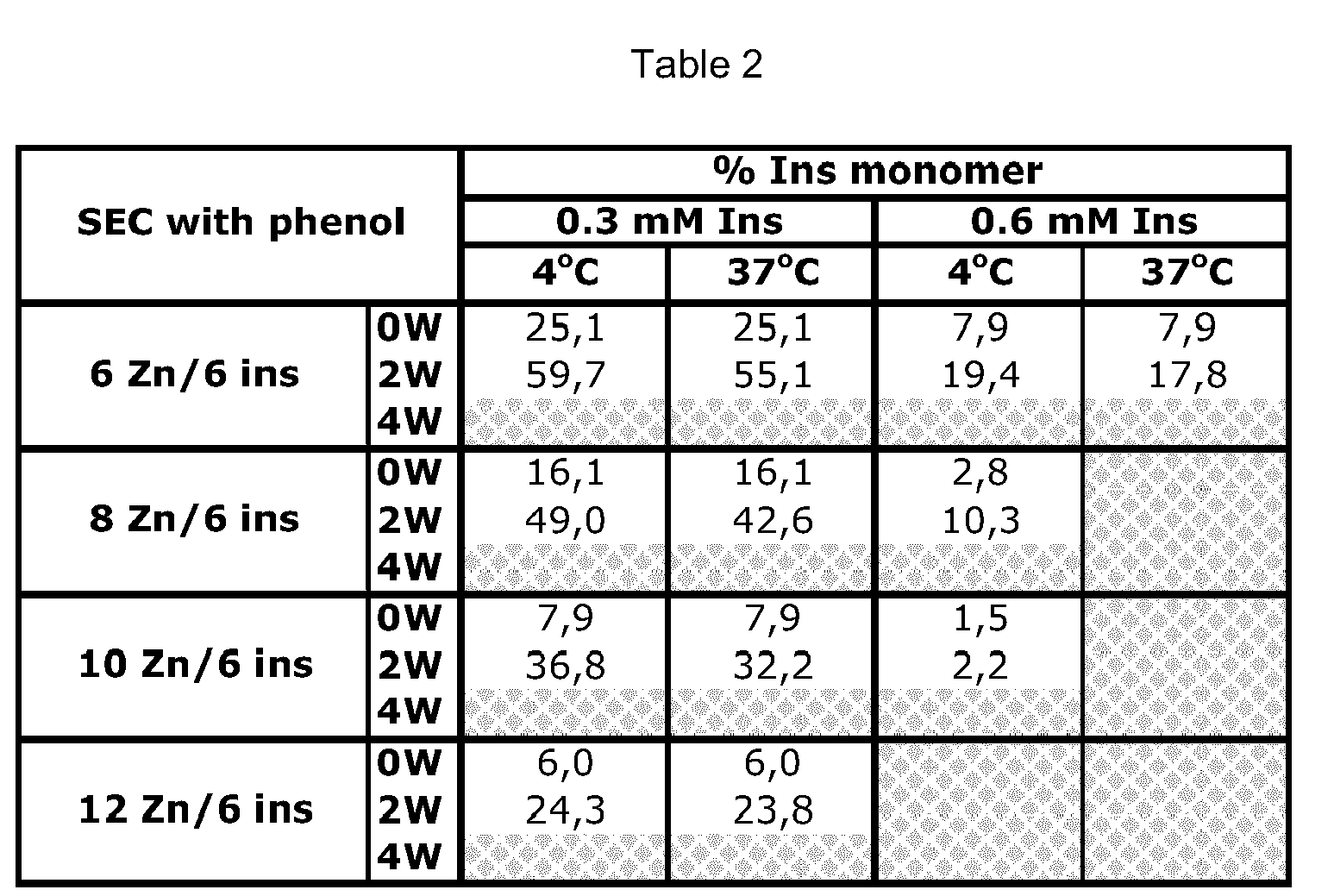

Table 4 SEC with phenol % Ins monomer of total peptide 0.3 mM Ins 0.6 mM Ins 4°C 37°C 4°C 37°C 6 Zn/6 Ins 0W 3,8 3,8 2,0 2,0 2W 8,2 7,0 4,8 4,2 4W 12,4 5,4 4,7 2,9 8W 7,8 5,5 4,5 3,4 8 Zn/6 Ins 0W ,2 2,2 0,8 0,8 2W 7,0 5,6 2,6 2,5 4W 6,8 4,2 2,3 1,8 8W 6,5 4,3 2,8 1,9 10 Zn/6 Ins 0W ,1 1,1 0,4 0,4 2W 5,2 4,3 0,6 0,8 4W 4,9 2,9 0,4 0,6 8W 5,0 3,5 0,8 1,1 12 Zn/6 Ins 0W ,9 0,9 0,8 0,8 2W 3,6 3,3 0,5 0,7 4W 3,2 2,3 0,2 0,4 8W 4,2 2,9 0,4 0,5 Table 5 SEC without phenol % Ins monomer of total peptide 0.3 mM Ins 0.6 mM Ins 4°C 37°C 4°C 37°C 6 Zn/6 Ins 0W 6,3 16,3 7,5 7,5 2W 16,6 12,1 8,3 8,8 4W 10,1 8,8 6,3 5,5 8W 13,1 10,8 9,1 8,1 8 Zn/6 Ins 0W 8,4 8,4 2,0 2,0 2W 11,3 10,1 4,3 5,0 4W 8,3 7,4 2,9 3,0 8W 11,1 9,1 4,9 4,9 10 Zn/6 Ins 0W ,5 4,5 0,5 0,5 2W 8,5 8,3 0,8 1,3 4W 6,3 5,6 0,4 0,8 8W 8,7 7,3 1,3 2,4 12 Zn/6 Ins 0W ,3 2,3 0,7 0,7 2W 5,6 6,1 0,8 1,1 4W 4,3 4,1 0,2 0,5 8W 6,9 7,0 0,6 1,4 - The amount of zinc binding liraglutide di-heptamer was readily measured using the fluorescence detection. Table 6 and Table 7 show the measured amounts in the analysed samples.
Table 6 SEC with phenol % Diheptamer of total Liraglutide 0.3 mM Ins 0.6 mM Ins 4°C 37°C 4°C 37°C 6 Zn/6 Ins 0W 0 0 0 0 2W 0 0 0 0 4W 0 0 0 0 8W 0 0 0 0 8 Zn/6 Ins 0W 0 0 0 0 2W 0 0 0 0,3 4W 0 0 0 0,4 8W 0 0 0 0,4 10 Zn/6 Ins 0W 0 0 0 0 2W 0 0 0 1,2 4W 0 0 0 1,5 8W 0 0 0,1 2,1 12 Zn/6 Ins 0W 0 0 0,4 0,4 2W 0 0 0,6 15,4 4W 0 0 0,4 15,2 8W 0 0,1 0,8 15,6 Table 7 SEC without phenol % Liraglutide diheptamer 0.3 mM Ins 0.6 mM Ins 4°C 37°C 4°C 37°C 6 Zn/6 Ins 0W 0 0 0 0 2W 0 0 0 0 4W 0 0 0 0 8W 0 0 0 0,1 8 Zn/6 Ins 0W 0 0 0 0 2W 0 0 0 0,3 4W 0 0 0 0,2 8W 0 0 0 0,4 10 Zn/6 Ins 0W 0 0 0,1 2W 0 0 0 1,3 4W 0 0 0 1,1 8W 0 0 0 2,4 12 Zn/6 Ins 0W 0 0 0,3 0,3 2W 0 0 0,5 16,7 4W 0 0 0,3 13,5 8W 0 0,1 0,8 17,7 - Following the procedure in Example 1 four formulations were prepared with the compositions shown in Table 8. In
Formulation 3 the glycylglycine buffer was added together with the water. InFormulation 4 the phosphate buffer was added after the zinc acetate was added. This was done in order to minimise zinc-phosphate precipitation. The used insulin analogue was NεB29-(Nα-(HOOC(CH2)14CO)-γ-Glu) desB30 human insulin. - The physical stability of the four pharmaceutical compositions was evaluated by means of an accelerated stressed test. The stressed test was performed as a rotation test. 50µL air was added to each of 5 cartridges (glass vials) of each formulation. The cartridges were rotated with a frequency of 30 rotations per minute for 4 hours daily. The inspection of the cartridges was followed daily or as required. The turbidity of the formulation was characterized by nephelometric measurement and specified in "Nephelometric Turbidity Unit" (NTU). Physical instability of the protein was characterised by high turbidity measurements.
- This rotation test is shown in
Figure 1 . It revealed that the formulation with the insulin analogue and liraglutide combined and formulated at pH 7.7 (Formulation 3) was less stable than the insulin analogue formulated alone at pH 7.4 (Formulation 1) and probably had an unacceptable stability for further development.Formulation 4 also contained the insulin analogue and liraglutide combination but was formulated at pH 8.2. This formulation had an only marginally lower physical stability than the insulin analogue alone. Hence, this comparison illustrated that combining the insulin analogue and liraglutide without any optimisation resulted in an unstable formulation. Increasing the pH to pH 8.2, however, resulted in much improved physical stability comparable to that of insulin analogue alone.Table 8 Formulation 1Formulation 2Formulation 3Formulation 4Insulin analogue (mM) 0.6 n.a. 0.6 0.6 Zinc acetate (mM) 0.6 n.a. 0.6 0.6 Liraglutide (mM) n.a. 1.6 1.6 1.6 Phenol (mM) 16 58 40 40 m-cresol (mM) 16 n.a. n.a. n.a. Glycerol (mM) 174 174 174 174 NaCl (mM) 10 n.a. 10 10 Phosphate (mM) n.a. 8 n.a. 8 Glycylglycine (mM) n.a. n.a. 8 n.a. pH 7.4 7.7 7.7 8.2 - In another rotation test performed as described in Example 3, four combination formulations containing both the insulin analogue NεB29-(Nα-(HOOC(CH2)14CO)-γ-Glu) desB30 human insulin and liraglutide and two references with the insulin analogue and liraglutide alone were tested.
- The formulations were prepared as described in Example 1 and their compositions are shown in Table 9.
Table 9 Form. 1 Form. 2 Form. 3 Form. 4 Form. 5 Form. 6 Insulin analogue (mM) 0.6 n.a. 0.6 0.6 0.6 0.3 Zinc acetate (mM) 0.6 (= 6 Zn2+/6 ins) n.a. 0.8 (= 8 Zn2+/6 ins) 1.0 (= 10 Zn2+/6 ins) 1.2 (= 12 Zn2+/6 ins) 0.5 (= 10 Zn2+/6 ins) Liraglutide (mM) n.a. 1.6 1.6 1.6 1.6 1.6 Phenol (mM) 16 58 50 50 50 50 m-cresol (mM) 16 n.a. n.a. n.a. n.a. n.a. Glycerol (mM) 174 174 174 174 174 174 NaCl (mM) 10 n.a. n.a. n.a. n.a. n.a. Phosphate (mM) n.a. 8 n.a. n.a. n.a. n.a. pH 7.4 8.2 8.2 8.2 8.2 8.2 - The results from the rotation test are shown in
Figure 2 - 4 . -
Formulation 3 contained 8 zinc/6 insulin analogue molecules and had a comparable stability to the both references with the insulin analogue (with 6 zinc/6 insulin analogue molecules) and liraglutide alone.Formulation 6 only contained 0.3 mM insulin analogue but required 10 zinc/6 insulin analogue molecules in order to exhibit a similar stability as the reference. This indicated that higher zinc content relative to the amount of insulin analogue was required in order to achieve the same stability as the insulin analogue reference alone with 6 zinc ions/6 insulin analogue molecules. - The pharmacokinetic (PK) properties of fixed combination formulations with the insulin analogue NεB29-(Nα-(HOOC(CH2)14CO)-γ-Glu) desB30 human insulin and liraglutide were exmanined in pigs. The appearances of the two peptides in the blood stream were measured by standard assay techniques for up to 72 hours after injection. For clarity, however, only the first 24 hours are shown for the insulin analogue. The results are shown in
Figure 5 andFigure 6 as means of the six replica and shown with standard error of the mean. Three combination formulations and two references were prepared as outlined in Example 1. Their compositions are shown in Table 10. The PK appearance curve for the insulin analogue is shown inFigure 5 and the PK appearance curve for liraglutide is shown inFigure 6 .Table 10 Form. 1 Form. 2 Form. 3 Form. 4 Form. 5 Insulin analogue (mM) 0.6 n.a. 0.6 0.6 0.6 Zinc acetate (mM) 0.6 (= 6 Zn2+/6 ins) n.a. 0.8 (= 8 Zn2+/6 ins) 1.0 (= 10 Zn2+/6 ins) 1.2 (= 12 Zn2+/6 ins) Liraglutide (mM) n.a. 1.6 1.6 1.6 1.6 Phenol (mM) 50 50 50 50 50 Glycerol (mM) 174 174 174 174 174 pH 8.2 8.2 8.2 8.2 8.2 - The appearance of the insulin analogue in the combination is critically for several reasons: A fast-acting component will give rise to an unexpected early on-set of effect. An increased bioavailability will also result in a larger blood glucose lowering effect and subsequently an adjustment of the dose would be required. It is interesting to conclude that the combination formulation 3 (formulated with 8 zinc/6 insulin analogue molecules) exhibited a very similar insulin appearance curve compared to the curve for the insulin analogue alone (Formulation 1). Hence, a combination formulation with 8 zinc/6 insulin analogue molecules exhibited very similar insulin PK properties when compared to the insulin analogue alone. All combination formulations exhibited very similar liraglutide appearance curves (Formulations 3-5).
- The pharmacokinetic (PK) properties of other fixed combination formulations with the insulin analogue NεB29-(Nα-(HOOC(CH2)14CO)-γ-Glu) desB30 human insulin and liraglutide in a different ratio were likewise examined in pigs. This ratio enables a larger amount of the insulin analogue relative to liraglutide to be delivered to the patient in a single injection. An equal dose of insulin was administered to the pigs of both the insulin analogue reference (Formulation 1) and the combinations (Formulations 3-5). The appearances of the two peptides in the blood stream were measured by standard assay techniques for up to 72 hours after injection. For clarity, however, only the first 6 hours and 24 hours, respectively, are shown. The results are shown in
Figure 7 andFigure 8 as means of the six replica and shown with standard error of the mean. Three combination formulations and two references were prepared as outlined in Example 1. Their compositions are shown in Table 11. The PK appearance curve for the insulin analogue is shown inFigure 7 and the PK appearance curve for liraglutide is shown inFigure 8 .Table 11 Form. 1 Form. 2 Form. 3 Form. 4 Form. 5 Insulin analogue (mM) 0.6 n.a. 1.2 1.2 1.2 Zinc acetate (mM) 0.6 (= 6 Zn2+/6 ins) n.a. 1.2 (= 6 Zn2+/6 ins) 1.4 (= 7 Zn2+/6 ins) 1.6 (= 8 Zn2+/6 ins) Liraglutide (mM) n.a. 1.6 1.6 1.6 1.6 Phenol (mM) 50 50 50 50 50 Glycerol (mM) 214 214 214 214 214 pH 8.2 8.2 8.2 8.2 8.2 - Compared to the insulin analogue reference (Formulation 1) the combination with 6 Zn2+/6 insulin molecules (Formulation 3) exhibited a minor shoulder with an earlier on-set than the main peak of the reference. Increasing the zinc content to 7 Zn2+/6 insulin molecules (Formulation 4) resulted in an insulin analogue appearance curve much more similar to that of the insulin reference (Formulation 1). Increasing the zinc content further to 8 Zn2+/6 insulin molecules (Formulation 5) did not result in any further improvement. No statistically significant differences were found between the PK appearance curves for liraglutide in the three combinations (Formulations 3-5) and liraglutide alone (Formulation 2). This indicated that a zinc content of 7 Zn2+/6 insulin molecules for the 1.2 mM insulin analogue - 1.6 mM liraglutide combination was preferable in order to obtain a similar PK appearance curve for the insulin analogue in the combination compared to the analogue alone.
- The influence of pH on the content of insulin analogue NεB29-(Nα-(HOOC(CH2)14CO)-γ-Glu) desB30 human insulin monomer in combinations with liraglutide was investigated. Three formulations were prepared as outlined in Example 1 but adjusted to pH 8.2, pH 7.7, and pH 7.4. The composition of all three formulations was: 0.6 mM insulin analogue, 0.8 mM zinc acetate (8 zinc per 6 insulin analogue molecules), 1.6 mM liraglutide, 50 mM phenol, 214 mM glycerol. After preparation the formulations were stored at 4°C for some weeks before the first measurement at
time point 0 weeks. Hereafter the formulations were stored at both 5 °C and 37 °C and analysed after further 2 and 4 weeks of storage at the two temperatures. The formulations were analysed using the SEC method described in Example 2. Both versions with and without phenol were used. - The relative contents of insulin analogue monomer compared to total insulin analogue measured by the SEC analysis with phenol and without phenol are shown in Table 12 and Table 13, respectively. In both SEC methods and at both temperatures, decreasing pH resulted in lower insulin analogue monomer content at each time point of measurement. This indicated that pH is an important factor for controlling and modulating the insulin monomer content in the combinations with liraglutide. A lower insulin monomer content could be obtained by using a pH lower than pH 8.2, e.g. pH 7.7.
Table 12 SEC with phenol % Monomer Ins 0W W 4W pH 8.2 (4°C) 12.4 8.1 8.8 pH 7.7 (4°C) 2.5 2.8 2.8 pH 7.4 (4°C) 1.1 1.2 1.1 pH 8.2 (37°C) 12.4 8.2 7.8 pH 7.7 (37°C) 2.5 3.1 2.3 pH 7.4 (37°C) 1.1 1.5 1.1 Table 13 SEC without phenol % Monomer Ins 0W W 4W pH 8.2 (4°C) 12.5 13.7 13.6 pH 7.7 (4°C) 1.7 3.5 4.3 pH 7.4 (4°C) 0.7 1.3 1.6 pH 8.2 (37°C) 12.5 15.2 17.6 pH 7.7 (37°C) 1.7 4.1 4.6 pH 7.4 (37°C) 0.7 1.9 2.0 - The liraglutide diheptamer contents were also measured in a similar fashion and these results are shown in Table 14 and Table 15 for the SEC method with phenol and without phenol, respectively.
Table 14 SEC with phenol % Liraglutide diheptamer 0W 2W 4W pH 8.2 (4°C) 0.0 0.1 0.1 pH 7.7 (4°C) 0.1 0.1 0.1 pH 7.4 (4°C) 0.8 0.4 0.4 pH 8.2 (37°C) 0.0 0.4 0.6 pH 7.7 (37°C) 0.1 4.6 6.1 pH 7.4 (37°C) 0.8 18.0 21.6 Table 15 SEC without phenol % Liraglutide diheptamer 0W 2W 4W pH 8.2 (4°C) 0.0 0.0 0.0 pH 7.7 (4°C) 0.1 0.1 0.1 pH 7.4 (4°C) 0.9 0.4 0.3 pH 8.2 (37°C) 0.0 0.3 0.5 pH 7.7 (37°C) 0.1 4.4 5.2 pH 7.4 (37°C) 0.9 16.6 19.0 - The study described in Example 7 also contained an insulin analogue NεB29-(Nα-(HOOC(CH2)14CO)-γ-Glu) desB30 human insulin - liraglutide combination formulation containing a low concentration of histidine. The amino acid was intended to act as a zinc buffer in the presence of an increased zinc content.
Formulation 1 was composed of 0.6 mM insulin analogue, 0.8 mM zinc acetate (8 zinc per 6 insulin analogue molecules), 1.6 mM liraglutide, 50 mM phenol, 214 mM glycerol, with pH adjusted to pH 8.2.Formulation 2 was composed of 0.6 mM insulin analogue, 1.0 mM zinc acetate (10 zinc per 6 insulin analogue molecules), 1.6 mM liraglutide, 50 mM phenol, 214 mM glycerol, 0.5 mM histidine, pH adjusted to pH 8.2. Both formulations were basically produced as outlined in Example 1, the histidine was added as the final excipient after liraglutide. The formulations were analysed as described in Example 2 and Example 7. - The relative contents of insulin analogue monomer compared to total insulin analogue measured by the SEC analysis with phenol and without phenol are shown in Table 16 and Table 17, respectively.
Formulation 2 with 10 zinc/6 insulin molecules and 0.5 mM histidine present contained less insulin monomer over time at both temperatures thanFormulation 1 with only 8 zinc/6 insulin molecules.Table 16 SEC with phenol % Ins monomer 0W 2W 4W Formulation 1 (4°C) 12.4 8.1 8.8 Formulation 2 (4°C) 3.2 3.0 3.1 Formulation 1 (37°C) 12.4 8.2 7.8 Formulation 2 (37°C) 3.2 3.7 3.4 Table 17 SEC without phenol % Ins monomer 0W 2W 4W Formulation 1 (4°C) 12.5 13.7 13.6 Formulation 2 (4°C) 2.4 4.0 4.5 Formulation 1 (37°C) 12.5 15.2 17.6 Formulation 2 (37°C) 2.4 5.1 6.3 - The liraglutide diheptamer contents were also measured in a similar fashion and these results are shown in Table 18 and Table 19 for the SEC method with phenol and without phenol, respectively.
Table 18 SEC with phenol % Liraglutide diheptamer 0W 2W 4W Formulation 1 (4°C) 0.0 0.1 0.1 Formulation 2 (4°C) 0.1 0.2 0.2 Formulation 1 (37°C) 0.0 0.4 0.6 Formulation 2 (37°C) 0.1 1.9 3.6 Table 19 SEC without phenol % Liraglutide diheptamer 0W 2W 4W Formulation 1 (4°C) 0.0 0.0 0.0 Formulation 2 (4°C) 0.1 0.1 0.1 Formulation 1 (37°C) 0.0 0.3 0.5 Formulation 2 (37°C) 0.1 1.8 3.0 - The study described in Example 7 also contained an insulin analogue NεB29-(Nα-(HOOC(CH2)14CO)-γ-Glu) desB30 human insulin - liraglutide combination composed of 0.3 mM insulin analogue, 0.8 mM zinc acetate (16 zinc per 6 insulin analogue molecules), 1.6 mM liraglutide, 50 mM phenol, 214 mM glycerol, adjusted to pH 8.2.
- The relative contents of insulin analogue monomer compared to total insulin analogue measured by the SEC analysis with phenol and without phenol (as described in Example 2) are shown in Table 20 and Table 21, respectively.
Table 20 SEC with phenol % Monomer insulin 0W 2W 4W 4°C 7.9 7.0 6.8 37°C 7.9 6.2 5.9 Table 21 SEC without phenol % Monomer insulin 0W 2W 4W 4°C 7.1 8.3 8.6 37°C 7.1 8.6 10.0 - The liraglutide diheptamer contents were also measured in a similar fashion and these results are shown in Table 22 and Table 23 for the SEC method with phenol and without phenol, respectively.
Table 22 SEC with phenol % Liraglutide diheptamer 0W 2W 4W 4°C 0.1 0.1 0.1 37°C 0.1 1.8 2.7 Table 23 SEC without phenol % Liraglutide diheptamer 0W 2W 4W 4°C 0.1 0.1 0.1 37°C 0.1 1.9 2.5 - Formulations combining insulin glargine and the exendin-4 analogue ZP10 (also known as AVE0010) were prepared. The ZP10 exendin-4 analogue is described in Thorkildsen et al. (2003), JPET 307:490-496 and has the systematic name [des-Pro38]exendin-4-(1-39)yl-Lys-Lys-Lys-Lys-Lys-Lys-NH2. From appropriate stock solutions the following compositions were prepared by dilution in water:
Formulation 1 consisted of 0.6 mM insulin glargine, 0.46 mM zinc acetate (4.6 zinc/ 6 insulin glargine), 60 µM ZP10.Formulation 2 consisted of 0.6 mM insulin glargine, 0.6 mM zinc acetate (6 zinc/ 6 insulin glargine), 60 µM ZP10. Both formulations were adjusted to about pH 4.0 using HCl and NaOH and stored at ambient temperature for three days. After storage both formulations were still about pH 4.0. The two formulations maintained clear solutions immediately after preparation and after the storage at ambient temperature.
Claims (15)
- A soluble pharmaceutical composition for parenteral administration, which comprises an insulinotropic GLP-1 compound , a basal insulin peptide, pharmaceutically acceptable additives and zinc, wherein the zinc content is at least 5 or at least 6 Zn ions per 6 insulin molecules.
- The pharmaceutical composition according to claim 1, wherein the zinc content is between 5 and 16 zinc ions per 6 insulin molecules.
- The pharmaceutical composition according to claim 1, wherein the zinc content is between 6 and 16 zinc ions per 6 insulin molecules.
- The pharmaceutical composition according to any of the preceding claims, wherein the pH of said pharmaceutical composition from about pH 7.4 to about pH 8.2.
- The pharmaceutical composition according to any of the preceding claims, wherein the pH of said pharmaceutical composition from about pH 7.4 to about pH 7.7 or between about 7.7 and about 8.2.
- The pharmaceutical composition according to any of the preceding claims, wherein the insulinotropic GLP-1 peptide is GLP-1 (7-37), a GLP-1 (7-37) analogue, a derivative of GLP-1 (7-37), or a derivative of a GLP-1 (7-37) analogue.
- The pharmaceutical composition according to claim 6, wherein said derivative of a GLP-1 (7-37) analogue is Arg34, Lys26(Nε-(y-Glu(Nα-hexadecanoyl)))-GLP-1 (7-37).
- The pharmaceutical composition according to any one of the preceding claims, wherein the basal insulin peptide is an acylated insulin.
- A pharmaceutical composition according to claim 8, wherein the acylated insulin is acylated in position B29 with a lipophilic group.
- A pharmaceutical composition according to claim 9, wherein the basal insulin is selected from the group consisting of NεB29-tetradecanoyl des(B30) human insulin, NεB29-(Nα-(HOOC(CH2)14CO)-γ-Glu) desB30 human insulin, LysB29(Nε lithocholyl-γ-Glu)-des(B30) human insulin, NεB29-ω-carboxypentadecanoyl-γ-L-glutaylamide desB30 human insulin and NεB29-ω-carboxypentadecanoyl-γ- amino-butanoyl des(B30) human insulin.
- A pharmaceutical composition according to claim 10, wherein the basal insulin is NεB29-tetradecanoyl des(B30) human insulin, NεB29-(Nα-(HOOC(CH2)14CO)-γ-Glu) desB30 human insulin.
- A pharmaceutical composition according to any one of the preceding claims, wherein the basal insulin is NεB29-(Nα-(HOOC(CH2)14CO)-γ-Glu) desB30 human insulin and the insulinotropic GLP-1 compound is Arg34, Lys26(Nε-(γ-Glu(Nα-hexadecanoyl)))-GLP-1 (7-37) .
- A pharmaceutical composition according to any of the preceding claims, wherein the concentration of the basal insulin is in the range from about 1.5 to about 8 mg/mL and the concentration of the GLP-1 compound is in the range of about 2 to about 10 mg/mL.
- A pharmaceutical composition according to any of the preceding claims, wherein the basal insulin is an insulin glargine peptide or amidated insulin glargine peptide and the insulinotropic GLP-1 compound is exendin-4 or an analogue thereof with up to 8 added basic amino acid residues.
- A pharmaceutical composition according to any of the preceding further comprising histidine.
Priority Applications (3)
| Application Number | Priority Date | Filing Date | Title |
|---|---|---|---|
| EP13155712.6A EP2597103B1 (en) | 2007-11-16 | 2008-11-14 | Stable pharmaceutical compositions comprising liraglutide and degludec |
| PL13155712T PL2597103T3 (en) | 2007-11-16 | 2008-11-14 | Stable pharmaceutical compositions comprising liraglutide and degludec |
| HUS1700016C HUS1700016I1 (en) | 2007-11-16 | 2017-04-24 | Stable pharmaceutical compositions comprising liraglutide and degludec |
Applications Claiming Priority (3)
| Application Number | Priority Date | Filing Date | Title |
|---|---|---|---|
| EP07120880 | 2007-11-16 | ||
| EP13155712.6A EP2597103B1 (en) | 2007-11-16 | 2008-11-14 | Stable pharmaceutical compositions comprising liraglutide and degludec |
| EP08849536.1A EP2209800B1 (en) | 2007-11-16 | 2008-11-14 | Stable pharmaceutical compositions comprising liraglutide and degludec |
Related Parent Applications (2)
| Application Number | Title | Priority Date | Filing Date |
|---|---|---|---|
| EP08849536.1 Division | 2008-11-14 | ||
| EP08849536.1A Division EP2209800B1 (en) | 2007-11-16 | 2008-11-14 | Stable pharmaceutical compositions comprising liraglutide and degludec |
Publications (2)
| Publication Number | Publication Date |
|---|---|
| EP2597103A1 true EP2597103A1 (en) | 2013-05-29 |
| EP2597103B1 EP2597103B1 (en) | 2016-11-02 |
Family
ID=40639234
Family Applications (2)
| Application Number | Title | Priority Date | Filing Date |
|---|---|---|---|
| EP08849536.1A Active EP2209800B1 (en) | 2007-11-16 | 2008-11-14 | Stable pharmaceutical compositions comprising liraglutide and degludec |
| EP13155712.6A Active EP2597103B1 (en) | 2007-11-16 | 2008-11-14 | Stable pharmaceutical compositions comprising liraglutide and degludec |
Family Applications Before (1)
| Application Number | Title | Priority Date | Filing Date |
|---|---|---|---|
| EP08849536.1A Active EP2209800B1 (en) | 2007-11-16 | 2008-11-14 | Stable pharmaceutical compositions comprising liraglutide and degludec |
Country Status (15)
| Country | Link |
|---|---|
| US (1) | US8937042B2 (en) |
| EP (2) | EP2209800B1 (en) |
| JP (2) | JP5241849B2 (en) |
| CN (2) | CN101861333A (en) |
| BR (1) | BRPI0820535B8 (en) |
| CA (1) | CA2705821A1 (en) |
| DK (1) | DK2597103T3 (en) |
| ES (2) | ES2612736T3 (en) |
| HU (2) | HUE030383T2 (en) |
| MX (1) | MX2010005245A (en) |
| NO (1) | NO2017015I2 (en) |
| PL (2) | PL2209800T3 (en) |
| PT (1) | PT2597103T (en) |
| WO (1) | WO2009063072A2 (en) |
| ZA (1) | ZA201003019B (en) |
Families Citing this family (100)
| Publication number | Priority date | Publication date | Assignee | Title |
|---|---|---|---|---|
| US7407955B2 (en) | 2002-08-21 | 2008-08-05 | Boehringer Ingelheim Pharma Gmbh & Co., Kg | 8-[3-amino-piperidin-1-yl]-xanthines, the preparation thereof and their use as pharmaceutical compositions |
| AU2004261353B2 (en) * | 2003-08-05 | 2009-12-10 | Novo Nordisk A/S | Novel insulin derivatives |
| US7501426B2 (en) | 2004-02-18 | 2009-03-10 | Boehringer Ingelheim International Gmbh | 8-[3-amino-piperidin-1-yl]-xanthines, their preparation and their use as pharmaceutical compositions |
| DE102004054054A1 (en) | 2004-11-05 | 2006-05-11 | Boehringer Ingelheim Pharma Gmbh & Co. Kg | Process for preparing chiral 8- (3-amino-piperidin-1-yl) -xanthines |
| DE102005035891A1 (en) | 2005-07-30 | 2007-02-08 | Boehringer Ingelheim Pharma Gmbh & Co. Kg | 8- (3-amino-piperidin-1-yl) -xanthines, their preparation and their use as pharmaceuticals |
| EP1969004B1 (en) | 2005-12-28 | 2011-08-10 | Novo Nordisk A/S | Compositions comprising an acylated insulin and zinc and method of making the said compositions |
| JP5202338B2 (en) | 2006-02-27 | 2013-06-05 | ノボ・ノルデイスク・エー/エス | New insulin derivatives |
| EP1852108A1 (en) | 2006-05-04 | 2007-11-07 | Boehringer Ingelheim Pharma GmbH & Co.KG | DPP IV inhibitor formulations |
| BRPI0711558A2 (en) | 2006-05-04 | 2011-11-08 | Boeringer Ingelheim Internat Gmbh | polymorphs |
| PE20080251A1 (en) | 2006-05-04 | 2008-04-25 | Boehringer Ingelheim Int | USES OF DPP IV INHIBITORS |
| JP5552046B2 (en) | 2007-06-13 | 2014-07-16 | ノボ・ノルデイスク・エー/エス | Pharmaceutical preparation containing an insulin derivative |
| PE20090938A1 (en) | 2007-08-16 | 2009-08-08 | Boehringer Ingelheim Int | PHARMACEUTICAL COMPOSITION INCLUDING A BENZENE DERIVATIVE SUBSTITUTED WITH GLUCOPYRANOSIL |
| HUE032284T2 (en) | 2008-03-18 | 2017-09-28 | Novo Nordisk As | Protease stabilized, acylated insulin analogues |
| PE20140960A1 (en) | 2008-04-03 | 2014-08-15 | Boehringer Ingelheim Int | FORMULATIONS INVOLVING A DPP4 INHIBITOR |
| UY32030A (en) | 2008-08-06 | 2010-03-26 | Boehringer Ingelheim Int | "TREATMENT FOR DIABETES IN INAPPROPRIATE PATIENTS FOR THERAPY WITH METFORMIN" |
| BRPI0916997A2 (en) | 2008-08-06 | 2020-12-15 | Boehringer Ingelheim International Gmbh | DPP-4 INHIBITOR AND ITS USE |
| AU2009290911A1 (en) | 2008-09-10 | 2010-03-18 | Boehringer Ingelheim International Gmbh | Combination therapy for the treatment of diabetes and related conditions |
| US20200155558A1 (en) | 2018-11-20 | 2020-05-21 | Boehringer Ingelheim International Gmbh | Treatment for diabetes in patients with insufficient glycemic control despite therapy with an oral antidiabetic drug |
| PT3228320T (en) | 2008-10-17 | 2020-03-26 | Sanofi Aventis Deutschland | Combination of an insulin and a glp-1 agonist |
| CN102202683A (en) | 2008-10-30 | 2011-09-28 | 诺沃-诺迪斯克有限公司 | Treating diabetes melitus using insulin injections with less than daily injection frequency |
| EP2382216A1 (en) | 2008-12-23 | 2011-11-02 | Boehringer Ingelheim International GmbH | Salt forms of organic compound |
| AR074990A1 (en) | 2009-01-07 | 2011-03-02 | Boehringer Ingelheim Int | TREATMENT OF DIABETES IN PATIENTS WITH AN INAPPROPRIATE GLUCEMIC CONTROL THROUGH METFORMIN THERAPY |
| MX339194B (en) | 2009-02-13 | 2016-05-16 | Boehringer Ingelheim Int | Pharmaceutical composition comprising a sglt2 inhibitor, a dpp-iv inhibitor and optionally a further antidiabetic agent and uses thereof. |
| PH12011502708B1 (en) | 2009-07-06 | 2017-11-10 | Sanofi Aventis Deutschland | Insulin preparations containing methionine |
| SG10201500871TA (en) | 2009-11-13 | 2015-04-29 | Sanofi Aventis Deutschland | Pharmaceutical composition comprising a glp-1 agonist and methionine |
| JP5832439B2 (en) | 2009-11-13 | 2015-12-16 | サノフィ−アベンティス・ドイチュラント・ゲゼルシャフト・ミット・ベシュレンクテル・ハフツング | Pharmaceutical composition comprising a GLP-1 agonist, insulin and methionine |
| EA034869B1 (en) | 2009-11-27 | 2020-03-31 | Бёрингер Ингельхайм Интернациональ Гмбх | Treatment of genotyped diabetic patients with dpp-4 inhibitors such as linagliptin |
| MX341025B (en) | 2010-05-05 | 2016-08-04 | Boehringer Ingelheim Int Gmbh * | Combination therapy. |
| AU2011202239C1 (en) * | 2010-05-19 | 2017-03-16 | Sanofi | Long-acting formulations of insulins |
| AU2014203421B2 (en) * | 2010-05-19 | 2016-07-07 | Sanofi | Long-acting formulations of insulins |
| AU2012216648C1 (en) * | 2010-05-19 | 2017-03-16 | Sanofi | Long-acting formulations of insulins |
| PH12012502524A1 (en) * | 2010-06-24 | 2014-02-10 | Boehringer Ingelheim Int | Diabetes therapy |
| CN103179978A (en) | 2010-08-30 | 2013-06-26 | 赛诺菲-安万特德国有限公司 | Use of AVE0010 for the manufacture of a medicament for the treatment of type 2 diabetes |
| DK2632478T3 (en) | 2010-10-27 | 2019-10-07 | Novo Nordisk As | TREATMENT OF DIABETES MELITUS USING INSULIN INJECTIONS SUBMITTED AT VARIOUS INJECTION INTERVALS |
| US9034883B2 (en) | 2010-11-15 | 2015-05-19 | Boehringer Ingelheim International Gmbh | Vasoprotective and cardioprotective antidiabetic therapy |
| AR085689A1 (en) | 2011-03-07 | 2013-10-23 | Boehringer Ingelheim Int | PHARMACEUTICAL COMPOSITIONS OF METFORMIN, LINAGLIPTINE AND AN SGLT-2 INHIBITOR |
| US9821032B2 (en) | 2011-05-13 | 2017-11-21 | Sanofi-Aventis Deutschland Gmbh | Pharmaceutical combination for improving glycemic control as add-on therapy to basal insulin |
| UA113626C2 (en) * | 2011-06-02 | 2017-02-27 | A COMPOSITION FOR THE TREATMENT OF DIABETES CONTAINING THE DURABLE INSULIN CON conjugate AND THE DUAL ACTION INSULINOTROPIC PIPIDE | |
| EP3517539B1 (en) | 2011-07-15 | 2022-12-14 | Boehringer Ingelheim International GmbH | Substituted dimeric quinazoline derivative, its preparation and its use in pharmaceutical compositions for the treatment of type i and ii diabetes |
| FR2984749A1 (en) * | 2011-12-23 | 2013-06-28 | Adocia | Composition, useful for treating diabetes, comprises basal insulin, and a dextran substituted by carboxylate charge carrier radicals and hydrophobic radicals |
| WO2013021143A1 (en) * | 2011-08-10 | 2013-02-14 | Adocia | Injectable solution of at least one type of basal insulin |
| JP6367115B2 (en) | 2011-08-29 | 2018-08-01 | サノフィ−アベンティス・ドイチュラント・ゲゼルシャフト・ミット・ベシュレンクテル・ハフツング | Combination medicine used for blood glucose control in patients with type 2 diabetes |
| TWI559929B (en) | 2011-09-01 | 2016-12-01 | Sanofi Aventis Deutschland | Pharmaceutical composition for use in the treatment of a neurodegenerative disease |
| FR2985429B1 (en) * | 2012-01-09 | 2016-07-29 | Adocia | PH 7 INJECTABLE SOLUTION COMPRISING AT LEAST ONE BASIC INSULIN WITH A PI BETWEEN 5.8 AND 8.5 AND A SUBSTITUTED POLYAMINOACID OBTAINED BY A CONTROLLED POLYMERIZATION PROCESS |
| FR2985428B1 (en) * | 2012-01-09 | 2016-05-27 | Adocia | PH 7 INJECTABLE SOLUTION COMPRISING AT LEAST ONE BASIC INSULIN WITH A PI BETWEEN 5.8 AND 8.5 AND A SUBSTITUTED POLYAMINOACIDE |
| US9198971B2 (en) | 2012-01-09 | 2015-12-01 | Adocia | Injectable solution at pH 7 comprising at least one basal insulin the pI of which is between 5.8 and 8.5 and a substituted co-polyamino acid |
| US9555001B2 (en) | 2012-03-07 | 2017-01-31 | Boehringer Ingelheim International Gmbh | Pharmaceutical composition and uses thereof |
| US20130303554A1 (en) | 2012-05-14 | 2013-11-14 | Boehringer Ingelheim International Gmbh | Use of a dpp-4 inhibitor in sirs and/or sepsis |
| JP6224084B2 (en) | 2012-05-14 | 2017-11-01 | ベーリンガー インゲルハイム インターナショナル ゲゼルシャフト ミット ベシュレンクテル ハフツング | Xanthine derivatives as DPP-4 inhibitors for the treatment of glomerular epithelial cell related disorders and / or nephrotic syndrome |
| WO2013174767A1 (en) | 2012-05-24 | 2013-11-28 | Boehringer Ingelheim International Gmbh | A xanthine derivative as dpp -4 inhibitor for use in modifying food intake and regulating food preference |
| US20150314003A2 (en) | 2012-08-09 | 2015-11-05 | Adocia | Injectable solution at ph 7 comprising at least one basal insulin the isoelectric point of which is between 5.8 and 8.5 and a hydrophobized anionic polymer |
| FR3001896B1 (en) | 2013-02-12 | 2015-07-03 | Adocia | PH 7 INJECTABLE SOLUTION COMPRISING AT LEAST ONE BASIC INSULIN WHERE THE ISO-ELECTRIC POINT IS BETWEEN 5.8 AND 8.5 AND A HYDROPHOBIC ANIONIC POLYMER |
| UA116217C2 (en) | 2012-10-09 | 2018-02-26 | Санофі | Exendin-4 derivatives as dual glp1/glucagon agonists |
| FR3001895B1 (en) | 2013-02-12 | 2015-07-03 | Adocia | PH7 INJECTABLE SOLUTION COMPRISING AT LEAST ONE BASIC INSULIN WHERE THE ISOELECTRIC POINT IS INCLUDED IN 5.8 AND 8.5 AND AN ANIONIC COMPOUND CARRYING CARBOXYLATE LOADS AND HYDROPHOBIC RADICALS |
| HUE035803T2 (en) | 2012-12-21 | 2018-05-28 | Sanofi Sa | Dual glp1/gip or trigonal glp1/gip/glucagon agonists |
| TWI780236B (en) | 2013-02-04 | 2022-10-11 | 法商賽諾菲公司 | Stabilized pharmaceutical formulations of insulin analogues and/or insulin derivatives |
| EP3517122A1 (en) | 2013-04-03 | 2019-07-31 | Sanofi | Treatment of diabetes mellitus by long-acting formulations of insulins |
| EP2991672A1 (en) * | 2013-04-30 | 2016-03-09 | Novo Nordisk A/S | Novel administration regime |
| EP3080154B1 (en) | 2013-12-13 | 2018-02-07 | Sanofi | Dual glp-1/gip receptor agonists |
| TW201609797A (en) | 2013-12-13 | 2016-03-16 | 賽諾菲公司 | Dual GLP-1/glucagon receptor agonists |
| WO2015086730A1 (en) | 2013-12-13 | 2015-06-18 | Sanofi | Non-acylated exendin-4 peptide analogues |
| WO2015086728A1 (en) | 2013-12-13 | 2015-06-18 | Sanofi | Exendin-4 peptide analogues as dual glp-1/gip receptor agonists |
| KR20160104726A (en) | 2014-01-09 | 2016-09-05 | 사노피 | Stabilized glycerol free pharmaceutical formulations of insulin analogues and/or insulin derivatives |
| JP6641280B2 (en) | 2014-01-09 | 2020-02-05 | サノフイSanofi | Stabilized pharmaceutical formulations of insulin analogues and / or insulin derivatives |
| CA2932873A1 (en) | 2014-01-09 | 2015-07-16 | Sanofi | Stabilized pharmaceutical formulations of insulin aspart |
| MY186251A (en) | 2014-01-20 | 2021-06-30 | Hanmi Pharm Ind Co Ltd | Long-acting insulin and use thereof |
| AR099569A1 (en) | 2014-02-28 | 2016-08-03 | Novo Nordisk As | INSULIN DERIVATIVES AND THE MEDICAL USES OF THESE |
| US9526728B2 (en) | 2014-02-28 | 2016-12-27 | Boehringer Ingelheim International Gmbh | Medical use of a DPP-4 inhibitor |
| TW201625670A (en) | 2014-04-07 | 2016-07-16 | 賽諾菲公司 | Dual GLP-1/glucagon receptor agonists derived from EXENDIN-4 |
| TW201625668A (en) | 2014-04-07 | 2016-07-16 | 賽諾菲公司 | Exendin-4 derivatives as peptidic dual GLP-1/glucagon receptor agonists |
| TW201625669A (en) | 2014-04-07 | 2016-07-16 | 賽諾菲公司 | Peptidic dual GLP-1/glucagon receptor agonists derived from Exendin-4 |
| AR100639A1 (en) * | 2014-05-29 | 2016-10-19 | Hanmi Pharm Ind Co Ltd | COMPOSITION TO TREAT DIABETES THAT INCLUDES CONJUGATES OF PROLONGED INSULIN ANALOGS AND CONJUGATES OF PROLONGED INSULINOTROPIC PEPTIDES |
| TWI684458B (en) | 2014-05-30 | 2020-02-11 | 南韓商韓美藥品股份有限公司 | Composition for treating diabetes mellitus comprising insulin and a glp-1/glucagon dual agonist |
| US9932381B2 (en) | 2014-06-18 | 2018-04-03 | Sanofi | Exendin-4 derivatives as selective glucagon receptor agonists |
| CN107206058A (en) | 2014-12-12 | 2017-09-26 | 赛诺菲-安万特德国有限公司 | Insulin glargine/lixisenatide fixed ratio preparaton |
| TWI748945B (en) | 2015-03-13 | 2021-12-11 | 德商賽諾菲阿凡提斯德意志有限公司 | Treatment type 2 diabetes mellitus patients |
| TW201705975A (en) | 2015-03-18 | 2017-02-16 | 賽諾菲阿凡提斯德意志有限公司 | Treatment of type 2 diabetes mellitus patients |
| AR105319A1 (en) | 2015-06-05 | 2017-09-27 | Sanofi Sa | PROPHARMS THAT INCLUDE A DUAL AGONIST GLU-1 / GLUCAGON CONJUGATE HIALURONIC ACID CONNECTOR |
| TW201706291A (en) | 2015-07-10 | 2017-02-16 | 賽諾菲公司 | New EXENDIN-4 derivatives as selective peptidic dual GLP-1/glucagon receptor agonists |
| UY36870A (en) | 2015-08-28 | 2017-03-31 | Hanmi Pharm Ind Co Ltd | NEW INSULIN ANALOGS |
| KR20180090785A (en) | 2015-10-07 | 2018-08-13 | 아펠리스 파마슈티컬스 인코포레이티드 | Dose therapy |
| CN109310697A (en) | 2016-06-10 | 2019-02-05 | 勃林格殷格翰国际有限公司 | Combination of linagliptin and metformin |
| WO2018055539A1 (en) * | 2016-09-22 | 2018-03-29 | Wockhardt Limited | Pharmaceutical composition containing buffered insulin glargine and glp-1 analogue |
| AU2017332408B2 (en) | 2016-09-23 | 2022-02-10 | Hanmi Pharm. Co., Ltd. | Insulin analogs with reduced affinity to insulin receptor and use thereof |
| ES2886837T3 (en) | 2016-12-16 | 2021-12-21 | Novo Nordisk As | Pharmaceutical compositions containing insulin |
| WO2018174668A2 (en) | 2017-03-23 | 2018-09-27 | 한미약품 주식회사 | Insulin analog complex with reduced affinity for insulin receptor and use thereof |
| BR112019020955A2 (en) | 2017-04-07 | 2020-05-05 | Apellis Pharmaceuticals, Inc. | dosage regimens and related compositions and methods |
| JP2021507884A (en) | 2017-12-15 | 2021-02-25 | アペリス・ファーマシューティカルズ・インコーポレイテッドApellis Pharmaceuticals,Inc. | Administration regimen and related compositions and methods |
| US10335464B1 (en) | 2018-06-26 | 2019-07-02 | Novo Nordisk A/S | Device for titrating basal insulin |
| CN114096269B (en) | 2019-07-12 | 2024-06-11 | 诺和诺德股份有限公司 | High-concentration insulin preparations |
| CN110669680A (en) * | 2019-11-04 | 2020-01-10 | 张少清 | Culture method of black yeast and process for extracting beta glucan from black yeast |
| WO2021105393A1 (en) | 2019-11-29 | 2021-06-03 | Novo Nordisk A/S | Processes for obtaining stable glp-1 compositions |
| WO2021142733A1 (en) * | 2020-01-16 | 2021-07-22 | Shanghai Benemae Pharmaceutical Corporation | Combinational therapy comprising glp-1 and/or glp-1 analogs, and insulin and/or insulin analogs |
| WO2021142736A1 (en) * | 2020-01-16 | 2021-07-22 | Shanghai Benemae Pharmaceutical Corporation | Dosing regimen of glp-1 |
| BR112023002608A2 (en) * | 2020-08-12 | 2023-05-09 | Txp Pharma Ag | EXENDIN-4 PEPTIDE ANALOGUE, E, METHOD FOR TREATMENT OF TYPE 2 DIABETES MELLITUS, OBESITY AND/OR SATIITY ENHANCEMENT |
| WO2022268208A1 (en) | 2021-06-25 | 2022-12-29 | 甘李药业股份有限公司 | Acylated insulin-containing pharmaceutical composition |
| EP4180060A1 (en) | 2021-11-15 | 2023-05-17 | Adocia | Solid compositions comprising a peptide or a protein and an acylated amino acid |
| EP4433093A1 (en) | 2021-11-15 | 2024-09-25 | Adocia | Solid compositions comprising a peptide or a protein and an acylated amino acid |
| EP4299057A1 (en) | 2022-06-30 | 2024-01-03 | Adocia | Solid compositions comprising a peptide or a protein and an acylated amino acid |
| EP4299071A1 (en) | 2022-07-01 | 2024-01-03 | Adocia | Compositions comprising a peptide or a protein and an acylated amino acid |
Citations (14)
| Publication number | Priority date | Publication date | Assignee | Title |
|---|---|---|---|---|
| GB2114573A (en) * | 1982-02-05 | 1983-08-24 | Novo Industri As | Stabilized insulin solutions and methods for their production |
| WO1995007931A1 (en) | 1993-09-17 | 1995-03-23 | Novo Nordisk A/S | Acylated insulin |
| WO1995031214A1 (en) | 1994-05-12 | 1995-11-23 | London Health Association | Treatment of diabetes |
| US5656722A (en) | 1988-11-08 | 1997-08-12 | Hoechst Aktiengesellschaft | A21 -, B30 - modified insulin derivatives having an altered action profile |
| WO1998008871A1 (en) | 1996-08-30 | 1998-03-05 | Novo Nordisk A/S | Glp-1 derivatives |
| WO1999043706A1 (en) | 1998-02-27 | 1999-09-02 | Novo Nordisk A/S | Derivatives of glp-1 analogs |
| WO2003020201A2 (en) | 2001-08-28 | 2003-03-13 | Eli Lilly And Company | Pre-mixes of glp-1 and basal insulin |
| WO2005012347A2 (en) | 2003-08-05 | 2005-02-10 | Novo Nordisk A/S | Novel insulin derivatives |
| WO2006029634A2 (en) * | 2004-09-17 | 2006-03-23 | Novo Nordisk A/S | Pharmaceutical compositions containing insulin and insulinotropic peptide |
| WO2006051103A2 (en) | 2004-11-12 | 2006-05-18 | Novo Nordisk A/S | Stable formulations of peptides |
| WO2006097537A2 (en) | 2005-03-18 | 2006-09-21 | Novo Nordisk A/S | Acylated glp-1 compounds |
| WO2007074133A2 (en) * | 2005-12-28 | 2007-07-05 | Novo Nordisk A/S | Compositions comprising an acylated insulin and zinc and method of making the said compositions |
| WO2008006496A1 (en) | 2006-07-11 | 2008-01-17 | Sanofi-Aventis Deutschland Gmbh | Amidated glargine insulin |
| WO2008006497A1 (en) | 2006-07-11 | 2008-01-17 | Sanofi-Aventis Deutschland Gmbh | Method for producing insulin analogs having a dibasic b chain terminus |
Family Cites Families (15)
| Publication number | Priority date | Publication date | Assignee | Title |
|---|---|---|---|---|
| US20010041786A1 (en) | 1995-06-07 | 2001-11-15 | Mark L. Brader | Stabilized acylated insulin formulations |
| CO4970787A1 (en) | 1997-12-23 | 2000-11-07 | Lilly Co Eli | INSOLUBLE COMPOSITIONS OF INSULIN AND INSULIN DERIVATIVES THAT CONTROL BLOOD GLUCOSE |
| DE19825447A1 (en) * | 1998-06-06 | 1999-12-09 | Hoechst Marion Roussel De Gmbh | New insulin analogues with increased zinc formation |
| CA2358107C (en) | 1998-12-22 | 2011-08-23 | Eli Lilly And Company | Shelf-stable formulation of glucagon-like peptide-1 |
| EP1196189A2 (en) | 1999-06-25 | 2002-04-17 | Medtronic MiniMed, Inc. | Multiple agent diabetes therapy |
| EP1076066A1 (en) | 1999-07-12 | 2001-02-14 | Zealand Pharmaceuticals A/S | Peptides for lowering blood glucose levels |
| WO2002000222A1 (en) | 2000-06-26 | 2002-01-03 | Novo Nordisk A/S | Use of potassium channel agonists for the treatment of cancer |
| EP1448222A4 (en) | 2001-10-19 | 2006-05-17 | Lilly Co Eli | Biphasic mixtures of glp-1 and insulin |
| WO2003094956A1 (en) | 2002-05-07 | 2003-11-20 | Novo Nordisk A/S | Soluble formulations comprising monomeric insulin and acylated insulin |
| US20060247167A1 (en) * | 2003-09-01 | 2006-11-02 | Novo Nordisk A/S | Stable formulations of peptides |
| US20060287221A1 (en) * | 2003-11-13 | 2006-12-21 | Novo Nordisk A/S | Soluble pharmaceutical compositions for parenteral administration comprising a GLP-1 peptide and an insulin peptide of short time action for treatment of diabetes and bulimia |
| JP4800959B2 (en) | 2003-11-13 | 2011-10-26 | ノヴォ ノルディスク アー/エス | Soluble pharmaceutical composition for parenteral administration comprising GLP-1 peptide and short-acting insulin peptide for the treatment of diabetes and bulimia |
| WO2005067898A2 (en) * | 2004-01-07 | 2005-07-28 | Nektar Therapeutics | Improved sustained release compositions for pulmonary administration of insulin |
| CN101027318B (en) * | 2004-07-19 | 2016-05-25 | 比奥孔有限公司 | Insulin-oligomer conjugates, preparations and uses thereof |
| AU2007247109B2 (en) | 2006-05-09 | 2012-03-15 | Novo Nordisk A/S | Insulin derivative |
-
2008
- 2008-11-14 CN CN200880116227A patent/CN101861333A/en not_active Withdrawn
- 2008-11-14 PT PT131557126T patent/PT2597103T/en unknown
- 2008-11-14 HU HUE13155712A patent/HUE030383T2/en unknown
- 2008-11-14 PL PL08849536T patent/PL2209800T3/en unknown
- 2008-11-14 US US12/741,923 patent/US8937042B2/en active Active
- 2008-11-14 BR BRPI0820535A patent/BRPI0820535B8/en active IP Right Grant
- 2008-11-14 JP JP2010533601A patent/JP5241849B2/en active Active
- 2008-11-14 EP EP08849536.1A patent/EP2209800B1/en active Active
- 2008-11-14 DK DK13155712.6T patent/DK2597103T3/en active
- 2008-11-14 ES ES13155712.6T patent/ES2612736T3/en active Active
- 2008-11-14 MX MX2010005245A patent/MX2010005245A/en active IP Right Grant
- 2008-11-14 WO PCT/EP2008/065601 patent/WO2009063072A2/en not_active Ceased
- 2008-11-14 EP EP13155712.6A patent/EP2597103B1/en active Active
- 2008-11-14 ES ES08849536T patent/ES2430042T3/en active Active
- 2008-11-14 CA CA2705821A patent/CA2705821A1/en not_active Abandoned
- 2008-11-14 PL PL13155712T patent/PL2597103T3/en unknown
- 2008-11-14 CN CN201710279962.9A patent/CN107412742B/en active Active
-
2010
- 2010-04-30 ZA ZA2010/03019A patent/ZA201003019B/en unknown
-
2012
- 2012-05-29 JP JP2012122502A patent/JP5757530B2/en active Active
-
2017
- 2017-04-21 NO NO2017015C patent/NO2017015I2/en unknown
- 2017-04-24 HU HUS1700016C patent/HUS1700016I1/en unknown
Patent Citations (14)
| Publication number | Priority date | Publication date | Assignee | Title |
|---|---|---|---|---|
| GB2114573A (en) * | 1982-02-05 | 1983-08-24 | Novo Industri As | Stabilized insulin solutions and methods for their production |
| US5656722A (en) | 1988-11-08 | 1997-08-12 | Hoechst Aktiengesellschaft | A21 -, B30 - modified insulin derivatives having an altered action profile |
| WO1995007931A1 (en) | 1993-09-17 | 1995-03-23 | Novo Nordisk A/S | Acylated insulin |
| WO1995031214A1 (en) | 1994-05-12 | 1995-11-23 | London Health Association | Treatment of diabetes |
| WO1998008871A1 (en) | 1996-08-30 | 1998-03-05 | Novo Nordisk A/S | Glp-1 derivatives |
| WO1999043706A1 (en) | 1998-02-27 | 1999-09-02 | Novo Nordisk A/S | Derivatives of glp-1 analogs |
| WO2003020201A2 (en) | 2001-08-28 | 2003-03-13 | Eli Lilly And Company | Pre-mixes of glp-1 and basal insulin |
| WO2005012347A2 (en) | 2003-08-05 | 2005-02-10 | Novo Nordisk A/S | Novel insulin derivatives |
| WO2006029634A2 (en) * | 2004-09-17 | 2006-03-23 | Novo Nordisk A/S | Pharmaceutical compositions containing insulin and insulinotropic peptide |
| WO2006051103A2 (en) | 2004-11-12 | 2006-05-18 | Novo Nordisk A/S | Stable formulations of peptides |
| WO2006097537A2 (en) | 2005-03-18 | 2006-09-21 | Novo Nordisk A/S | Acylated glp-1 compounds |
| WO2007074133A2 (en) * | 2005-12-28 | 2007-07-05 | Novo Nordisk A/S | Compositions comprising an acylated insulin and zinc and method of making the said compositions |
| WO2008006496A1 (en) | 2006-07-11 | 2008-01-17 | Sanofi-Aventis Deutschland Gmbh | Amidated glargine insulin |
| WO2008006497A1 (en) | 2006-07-11 | 2008-01-17 | Sanofi-Aventis Deutschland Gmbh | Method for producing insulin analogs having a dibasic b chain terminus |
Non-Patent Citations (3)
| Title |
|---|
| CRISTIAN THORKILDSEN ET AL., THE JOURNAL OF PHARMACOLOGY AND EXPERIMENTAL THERAPEUTICS, vol. 307, no. 2, 2003, pages 490 - 496 |
| GENNARO: "Remington: The Science and Practice of Pharmacy, 19th edition,", 1995 |
| THORKILDSEN ET AL., JPET, vol. 307, 2003, pages 490 - 496 |
Also Published As
| Publication number | Publication date |
|---|---|
| EP2597103B1 (en) | 2016-11-02 |
| DK2597103T3 (en) | 2017-02-13 |
| ES2430042T3 (en) | 2013-11-18 |
| ES2612736T3 (en) | 2017-05-18 |
| BRPI0820535A2 (en) | 2016-06-21 |
| CN107412742A (en) | 2017-12-01 |
| CA2705821A1 (en) | 2009-05-22 |
| US20110152185A1 (en) | 2011-06-23 |
| BRPI0820535B8 (en) | 2021-05-25 |
| JP2012229214A (en) | 2012-11-22 |
| EP2209800B1 (en) | 2013-07-24 |
| JP5241849B2 (en) | 2013-07-17 |
| US8937042B2 (en) | 2015-01-20 |
| PL2597103T3 (en) | 2017-04-28 |
| PT2597103T (en) | 2017-02-08 |
| HUE030383T2 (en) | 2017-05-29 |
| WO2009063072A3 (en) | 2010-01-07 |
| PL2209800T3 (en) | 2013-12-31 |
| NO2017015I1 (en) | 2017-04-21 |
| MX2010005245A (en) | 2010-06-01 |
| ZA201003019B (en) | 2011-06-29 |
| NO2017015I2 (en) | 2017-04-21 |
| CN107412742B (en) | 2022-03-15 |
| BRPI0820535B1 (en) | 2020-09-29 |
| CN107115523A (en) | 2017-09-01 |
| HUS1700016I1 (en) | 2017-05-29 |
| EP2209800A2 (en) | 2010-07-28 |
| WO2009063072A2 (en) | 2009-05-22 |
| BRPI0820535A8 (en) | 2016-10-18 |
| CN101861333A (en) | 2010-10-13 |
| JP2011503152A (en) | 2011-01-27 |
| JP5757530B2 (en) | 2015-07-29 |
Similar Documents
| Publication | Publication Date | Title |
|---|---|---|
| EP2209800B1 (en) | Stable pharmaceutical compositions comprising liraglutide and degludec | |
| JP5832439B2 (en) | Pharmaceutical composition comprising a GLP-1 agonist, insulin and methionine | |
| US8192957B2 (en) | Fibrillation-resistant insulin and insulin analogues | |
| US7238663B2 (en) | Pre-mixes of GLP-1 and basal insulin | |
| KR101852328B1 (en) | Aqueous insulin preparations containing methionine | |
| JP5026567B2 (en) | Insulin composition and method for producing the composition | |
| JP2013545782A (en) | Fast-acting insulin combined with long-acting insulin | |
| US10745458B2 (en) | Non-standard insulin analogues | |
| US20030171535A1 (en) | Peptide derivatives | |
| KR20150021011A (en) | Ultra-concentrated rapid-acting insulin analogue formulations |
Legal Events
| Date | Code | Title | Description |
|---|---|---|---|
| PUAI | Public reference made under article 153(3) epc to a published international application that has entered the european phase |
Free format text: ORIGINAL CODE: 0009012 |
|
| AC | Divisional application: reference to earlier application |
Ref document number: 2209800 Country of ref document: EP Kind code of ref document: P |
|
| AK | Designated contracting states |
Kind code of ref document: A1 Designated state(s): AT BE BG CH CY CZ DE DK EE ES FI FR GB GR HR HU IE IS IT LI LT LU LV MC MT NL NO PL PT RO SE SI SK TR |
|
| 17P | Request for examination filed |
Effective date: 20131129 |
|
| RBV | Designated contracting states (corrected) |
Designated state(s): AT BE BG CH CY CZ DE DK EE ES FI FR GB GR HR HU IE IS IT LI LT LU LV MC MT NL NO PL PT RO SE SI SK TR |
|
| 17Q | First examination report despatched |
Effective date: 20150721 |
|
| GRAP | Despatch of communication of intention to grant a patent |
Free format text: ORIGINAL CODE: EPIDOSNIGR1 |
|
| INTG | Intention to grant announced |
Effective date: 20160511 |
|
| GRAS | Grant fee paid |
Free format text: ORIGINAL CODE: EPIDOSNIGR3 |
|
| GRAA | (expected) grant |
Free format text: ORIGINAL CODE: 0009210 |
|
| AC | Divisional application: reference to earlier application |
Ref document number: 2209800 Country of ref document: EP Kind code of ref document: P |
|
| AK | Designated contracting states |
Kind code of ref document: B1 Designated state(s): AT BE BG CH CY CZ DE DK EE ES FI FR GB GR HR HU IE IS IT LI LT LU LV MC MT NL NO PL PT RO SE SI SK TR |
|
| REG | Reference to a national code |
Ref country code: GB Ref legal event code: FG4D |
|
| REG | Reference to a national code |
Ref country code: AT Ref legal event code: REF Ref document number: 841773 Country of ref document: AT Kind code of ref document: T Effective date: 20161115 Ref country code: CH Ref legal event code: EP |
|
| REG | Reference to a national code |
Ref country code: IE Ref legal event code: FG4D |
|
| REG | Reference to a national code |
Ref country code: DE Ref legal event code: R096 Ref document number: 602008047231 Country of ref document: DE |
|
| REG | Reference to a national code |
Ref country code: FR Ref legal event code: PLFP Year of fee payment: 9 |
|
| REG | Reference to a national code |
Ref country code: NL Ref legal event code: FP |
|
| REG | Reference to a national code |
Ref country code: SE Ref legal event code: TRGR |
|
| REG | Reference to a national code |
Ref country code: PT Ref legal event code: SC4A Ref document number: 2597103 Country of ref document: PT Date of ref document: 20170208 Kind code of ref document: T Free format text: AVAILABILITY OF NATIONAL TRANSLATION Effective date: 20170127 |
|
| REG | Reference to a national code |
Ref country code: DK Ref legal event code: T3 Effective date: 20170207 |
|
| PG25 | Lapsed in a contracting state [announced via postgrant information from national office to epo] |
Ref country code: LV Free format text: LAPSE BECAUSE OF FAILURE TO SUBMIT A TRANSLATION OF THE DESCRIPTION OR TO PAY THE FEE WITHIN THE PRESCRIBED TIME-LIMIT Effective date: 20161102 |
|
| REG | Reference to a national code |
Ref country code: LT Ref legal event code: MG4D |
|
| REG | Reference to a national code |
Ref country code: NO Ref legal event code: T2 Effective date: 20161102 |
|
| REG | Reference to a national code |
Ref country code: FI Ref legal event code: SPCF Spc suppl protection certif: C20170016 |
|
| PG25 | Lapsed in a contracting state [announced via postgrant information from national office to epo] |
Ref country code: LT Free format text: LAPSE BECAUSE OF FAILURE TO SUBMIT A TRANSLATION OF THE DESCRIPTION OR TO PAY THE FEE WITHIN THE PRESCRIBED TIME-LIMIT Effective date: 20161102 |
|
| REG | Reference to a national code |
Ref country code: NO Ref legal event code: SPCF Free format text: PRODUCT NAME: KOMBINASJON AVNEB29-NA-; NAT. REG. NO/DATE: EU/1/14/947 20140918; FIRST REG. NO/DATE: 65041 20140912 Spc suppl protection certif: 2017015 Filing date: 20170421 |
|
| REG | Reference to a national code |
Ref country code: IE Ref legal event code: SPCF Free format text: PRODUCT NAME: COMBINATION OF INSULIN DEGLUDEC AND LIRAGLUTIDE; NAT REGISTRATION NO/DATE: EU/1/14/947 20140918; FIRST REGISTRATION NO/DATE: 65041 20140912 Spc suppl protection certif: 2017/015 Filing date: 20170419 |
|
| REG | Reference to a national code |
Ref country code: ES Ref legal event code: FG2A Ref document number: 2612736 Country of ref document: ES Kind code of ref document: T3 Effective date: 20170518 |
|
| REG | Reference to a national code |
Ref country code: HU Ref legal event code: AA1S Ref document number: E030383 Country of ref document: HU Free format text: PRODUCT NAME: THE COMBINATION OF INSULIN DEGLUDEC AND LIRAGLUTIDE; REGISTRATION NO/DATE: EU/1/14/947 20140922 Spc suppl protection certif: S1700016 Filing date: 20170424 Ref country code: HU Ref legal event code: AG4A Ref document number: E030383 Country of ref document: HU |
|
| PG25 | Lapsed in a contracting state [announced via postgrant information from national office to epo] |
Ref country code: HR Free format text: LAPSE BECAUSE OF FAILURE TO SUBMIT A TRANSLATION OF THE DESCRIPTION OR TO PAY THE FEE WITHIN THE PRESCRIBED TIME-LIMIT Effective date: 20161102 Ref country code: IS Free format text: LAPSE BECAUSE OF FAILURE TO SUBMIT A TRANSLATION OF THE DESCRIPTION OR TO PAY THE FEE WITHIN THE PRESCRIBED TIME-LIMIT Effective date: 20170302 |
|
| REG | Reference to a national code |
Ref country code: AT Ref legal event code: SPCF Ref document number: 841773 Country of ref document: AT Kind code of ref document: T Free format text: PRODUCT NAME: KOMBINATION VON INSULIN DEGLUTEC UND LIRAGLUTID; NAT. REGISTRATION NO/DATE: EU/1/14/947 20140918; FIRST REGISTRATION: LI 65041 20140912 Spc suppl protection certif: 19/2017 Filing date: 20170426 Effective date: 20170615 |
|
| PG25 | Lapsed in a contracting state [announced via postgrant information from national office to epo] |
Ref country code: SK Free format text: LAPSE BECAUSE OF FAILURE TO SUBMIT A TRANSLATION OF THE DESCRIPTION OR TO PAY THE FEE WITHIN THE PRESCRIBED TIME-LIMIT Effective date: 20161102 Ref country code: RO Free format text: LAPSE BECAUSE OF FAILURE TO SUBMIT A TRANSLATION OF THE DESCRIPTION OR TO PAY THE FEE WITHIN THE PRESCRIBED TIME-LIMIT Effective date: 20161102 Ref country code: EE Free format text: LAPSE BECAUSE OF FAILURE TO SUBMIT A TRANSLATION OF THE DESCRIPTION OR TO PAY THE FEE WITHIN THE PRESCRIBED TIME-LIMIT Effective date: 20161102 |
|
| REG | Reference to a national code |
Ref country code: DE Ref legal event code: R097 Ref document number: 602008047231 Country of ref document: DE |
|
| PG25 | Lapsed in a contracting state [announced via postgrant information from national office to epo] |
Ref country code: BG Free format text: LAPSE BECAUSE OF FAILURE TO SUBMIT A TRANSLATION OF THE DESCRIPTION OR TO PAY THE FEE WITHIN THE PRESCRIBED TIME-LIMIT Effective date: 20170202 |
|
| PLBE | No opposition filed within time limit |
Free format text: ORIGINAL CODE: 0009261 |
|
| STAA | Information on the status of an ep patent application or granted ep patent |
Free format text: STATUS: NO OPPOSITION FILED WITHIN TIME LIMIT |
|
| REG | Reference to a national code |
Ref country code: DK Ref legal event code: CTFF Free format text: PRODUCT NAME: KOMBINATION AF INSULIN DEGLUDEC OG LIRAGLUTID; NAT. REG. NO/DATE: EU/1/14/947 20140922; FIRST REG. NO/DATE: CH 65041 20140912 Spc suppl protection certif: CA 2017 00013 Filing date: 20170331 Expiry date: 20281114 Extension date: 20290912 |
|
| PG25 | Lapsed in a contracting state [announced via postgrant information from national office to epo] |
Ref country code: MC Free format text: LAPSE BECAUSE OF FAILURE TO SUBMIT A TRANSLATION OF THE DESCRIPTION OR TO PAY THE FEE WITHIN THE PRESCRIBED TIME-LIMIT Effective date: 20161102 Ref country code: LU Free format text: LAPSE BECAUSE OF NON-PAYMENT OF DUE FEES Effective date: 20161130 |
|
| 26N | No opposition filed |
Effective date: 20170803 |
|
| REG | Reference to a national code |
Ref country code: FR Ref legal event code: PLFP Year of fee payment: 10 |
|
| PG25 | Lapsed in a contracting state [announced via postgrant information from national office to epo] |
Ref country code: SI Free format text: LAPSE BECAUSE OF FAILURE TO SUBMIT A TRANSLATION OF THE DESCRIPTION OR TO PAY THE FEE WITHIN THE PRESCRIBED TIME-LIMIT Effective date: 20161102 |
|
| PG25 | Lapsed in a contracting state [announced via postgrant information from national office to epo] |
Ref country code: CY Free format text: LAPSE BECAUSE OF FAILURE TO SUBMIT A TRANSLATION OF THE DESCRIPTION OR TO PAY THE FEE WITHIN THE PRESCRIBED TIME-LIMIT Effective date: 20161102 |
|
| REG | Reference to a national code |
Ref country code: DK Ref legal event code: CTFG Free format text: PRODUCT NAME: KOMBINATION AF INSULIN DEGLUDEC OG LIRAGLUTID; NAT. REG. NO/DATE: EU/1/14/947 20140922; FIRST REG. NO/DATE: CH 65041 20140912 Spc suppl protection certif: CR 2017 00013 Filing date: 20170331 Expiry date: 20281114 Extension date: 20290912 |
|
| REG | Reference to a national code |
Ref country code: AT Ref legal event code: SPCG Ref document number: 841773 Country of ref document: AT Kind code of ref document: T Free format text: PRODUCT NAME: KOMBINATION VON INSULIN DEGLUTEC UND LIRAGLUTID; NAT. REGISTRATION NO/DATE: EU/1/14/947/001-4 20140918; FIRST REGISTRATION: LI 65041 (CH) 20140912 Spc suppl protection certif: 19/2017 Filing date: 20170426 Expiry date: 20281114 Extension date: 20290912 Effective date: 20180915 |
|
| PG25 | Lapsed in a contracting state [announced via postgrant information from national office to epo] |
Ref country code: MT Free format text: LAPSE BECAUSE OF NON-PAYMENT OF DUE FEES Effective date: 20161114 |
|
| REG | Reference to a national code |
Ref country code: NO Ref legal event code: SPCG Free format text: PRODUCT NAME: KOMBINASJON AVNEB29-NA-; NAT. REG. NO/DATE: EU/1/14/947 20140918; FIRST REG. NO/DATE: 65041 20140912 Spc suppl protection certif: 2017015 Filing date: 20170421 Extension date: 20290912 |
|
| REG | Reference to a national code |
Ref country code: FR Ref legal event code: PLFP Year of fee payment: 11 |
|
| REG | Reference to a national code |
Ref country code: IE Ref legal event code: SPCG Free format text: PRODUCT NAME: COMBINATION OF INSULIN DEGLUDEC AND LIRAGLUTIDE; NAT REGISTRATION NO/DATE: EU/1/14/947 20140918; FIRST REGISTRATION NO/DATE: 65041 20140912 Spc suppl protection certif: 2017/015 Extension date: 20290911 Effective date: 20181212 |
|
| REG | Reference to a national code |
Ref country code: HU Ref legal event code: FG4S Ref document number: E030383 Country of ref document: HU Free format text: PRODUCT NAME: THE COMBINATION OF INSULIN DEGLUDEC AND LIRAGLUTIDE; FIRST REGISTRATION: 65041 20140912 Spc suppl protection certif: S1700016 Filing date: 20170424 |
|
| REG | Reference to a national code |
Ref country code: AT Ref legal event code: UEP Ref document number: 841773 Country of ref document: AT Kind code of ref document: T Effective date: 20161102 |
|
| REG | Reference to a national code |
Ref country code: FI Ref legal event code: SPCG Spc suppl protection certif: 677 Extension date: 20290912 |
|
| P01 | Opt-out of the competence of the unified patent court (upc) registered |
Effective date: 20230510 |
|
| PGFP | Annual fee paid to national office [announced via postgrant information from national office to epo] |
Ref country code: NL Payment date: 20251022 Year of fee payment: 18 |
|
| REG | Reference to a national code |
Ref country code: CH Ref legal event code: U11 Free format text: ST27 STATUS EVENT CODE: U-0-0-U10-U11 (AS PROVIDED BY THE NATIONAL OFFICE) Effective date: 20251201 |
|
| PGFP | Annual fee paid to national office [announced via postgrant information from national office to epo] |
Ref country code: PT Payment date: 20251024 Year of fee payment: 18 |
|
| PGFP | Annual fee paid to national office [announced via postgrant information from national office to epo] |
Ref country code: HU Payment date: 20251117 Year of fee payment: 18 |
|
| PGFP | Annual fee paid to national office [announced via postgrant information from national office to epo] |
Ref country code: DE Payment date: 20251022 Year of fee payment: 18 |
|
| PGFP | Annual fee paid to national office [announced via postgrant information from national office to epo] |
Ref country code: GB Payment date: 20251022 Year of fee payment: 18 |
|
| PGFP | Annual fee paid to national office [announced via postgrant information from national office to epo] |
Ref country code: NO Payment date: 20251024 Year of fee payment: 18 |
|
| PGFP | Annual fee paid to national office [announced via postgrant information from national office to epo] |
Ref country code: AT Payment date: 20251024 Year of fee payment: 18 |
|
| PGFP | Annual fee paid to national office [announced via postgrant information from national office to epo] |
Ref country code: FI Payment date: 20251022 Year of fee payment: 18 Ref country code: DK Payment date: 20251022 Year of fee payment: 18 Ref country code: IT Payment date: 20251022 Year of fee payment: 18 |
|
| PGFP | Annual fee paid to national office [announced via postgrant information from national office to epo] |
Ref country code: FR Payment date: 20251022 Year of fee payment: 18 |
|
| PGFP | Annual fee paid to national office [announced via postgrant information from national office to epo] |
Ref country code: TR Payment date: 20251027 Year of fee payment: 18 Ref country code: GR Payment date: 20251024 Year of fee payment: 18 Ref country code: BE Payment date: 20251022 Year of fee payment: 18 |
|
| PGFP | Annual fee paid to national office [announced via postgrant information from national office to epo] |
Ref country code: CH Payment date: 20251201 Year of fee payment: 18 Ref country code: SE Payment date: 20251022 Year of fee payment: 18 |
|
| PGFP | Annual fee paid to national office [announced via postgrant information from national office to epo] |
Ref country code: IE Payment date: 20251024 Year of fee payment: 18 Ref country code: CZ Payment date: 20251030 Year of fee payment: 18 |
|
| PGFP | Annual fee paid to national office [announced via postgrant information from national office to epo] |
Ref country code: PL Payment date: 20251023 Year of fee payment: 18 |
|
| PGFP | Annual fee paid to national office [announced via postgrant information from national office to epo] |
Ref country code: ES Payment date: 20251201 Year of fee payment: 18 |