EP2597090A1 - Crystalline dapagliflozin hydrate - Google Patents
Crystalline dapagliflozin hydrate Download PDFInfo
- Publication number
- EP2597090A1 EP2597090A1 EP11190866.1A EP11190866A EP2597090A1 EP 2597090 A1 EP2597090 A1 EP 2597090A1 EP 11190866 A EP11190866 A EP 11190866A EP 2597090 A1 EP2597090 A1 EP 2597090A1
- Authority
- EP
- European Patent Office
- Prior art keywords
- crystalline
- dapagliflozin
- water
- hydrate
- process according
- Prior art date
- Legal status (The legal status is an assumption and is not a legal conclusion. Google has not performed a legal analysis and makes no representation as to the accuracy of the status listed.)
- Ceased
Links
Images


Classifications
-
- C—CHEMISTRY; METALLURGY
- C07—ORGANIC CHEMISTRY
- C07H—SUGARS; DERIVATIVES THEREOF; NUCLEOSIDES; NUCLEOTIDES; NUCLEIC ACIDS
- C07H7/00—Compounds containing non-saccharide radicals linked to saccharide radicals by a carbon-to-carbon bond
- C07H7/04—Carbocyclic radicals
-
- C—CHEMISTRY; METALLURGY
- C07—ORGANIC CHEMISTRY
- C07D—HETEROCYCLIC COMPOUNDS
- C07D309/00—Heterocyclic compounds containing six-membered rings having one oxygen atom as the only ring hetero atom, not condensed with other rings
- C07D309/02—Heterocyclic compounds containing six-membered rings having one oxygen atom as the only ring hetero atom, not condensed with other rings having no double bonds between ring members or between ring members and non-ring members
- C07D309/08—Heterocyclic compounds containing six-membered rings having one oxygen atom as the only ring hetero atom, not condensed with other rings having no double bonds between ring members or between ring members and non-ring members with hetero atoms or with carbon atoms having three bonds to hetero atoms with at the most one bond to halogen, e.g. ester or nitrile radicals, directly attached to ring carbon atoms
- C07D309/10—Oxygen atoms
-
- A—HUMAN NECESSITIES
- A61—MEDICAL OR VETERINARY SCIENCE; HYGIENE
- A61P—SPECIFIC THERAPEUTIC ACTIVITY OF CHEMICAL COMPOUNDS OR MEDICINAL PREPARATIONS
- A61P3/00—Drugs for disorders of the metabolism
- A61P3/08—Drugs for disorders of the metabolism for glucose homeostasis
- A61P3/10—Drugs for disorders of the metabolism for glucose homeostasis for hyperglycaemia, e.g. antidiabetics
Definitions
- the present invention is directed to crystalline dapagliflozin hydrate and a process of obtaining the same.
- the present invention relates to dapagliflozin being an inhibitor of sodium dependent glucose transporters found in the intestine and kidney (SGLT2) and to a method for treating diabetes, especially type II diabetes, as well as hyperglycemia, hyperinsulinemia, obesity, hypertriglyceridemia, Syndrome X, diabetic complications, atherosclerosis and related diseases, employing such C-aryl glucosides alone or in combination with one, two or more other type antidiabetic agent and/or one, two or more other type therapeutic agents such as hypolipidemic agents.
- SGLT2 sodium dependent glucose transporters found in the intestine and kidney
- NIDDM type II diabetes
- hyperglycemia due to excessive hepatic glucose production and peripheral insulin resistance, the root causes for which are as yet unknown.
- Hyperglycemia is considered to be the major risk factor for the development of diabetic complications, and is likely to contribute directly to the impairment of insulin secretion seen in advanced NIDDM.
- Normalization of plasma glucose in NIDDM patients would be predicted to improve insulin action, and to offset the development of diabetic complications.
- An inhibitor of the sodium-dependent glucose transporter SGLT2 in the kidney would be expected to aid in the normalization of plasma glucose levels, and perhaps body weight, by enhancing glucose excretion.
- WO 03/099836 A1 refers to dapagliflozin having the structure according to formula 1.
- a route of synthesis is disclosed and one major step is the purification of a compound of formula 2
- the compound of formula 2 provides a means of purification since it crystallizes. Subsequently the compound of formula 2 is converted to dapagliflozin. However, dapagliflozin is obtained as an amorphous glassy off white solid containing 0,11 mol% of EtOAc. Thus, there is the need in the art to obtain pure and crystalline dapalgliflozin containing no organic solvent.
- WO 2008/116179 A1 refers to an immediate release pharmaceutical composition comprising dipagliflozin propylene glycol hydrate.
- Propylene glycol is a chiral substance and (S)-propanediol used is very expensive. Consequently, also the immediate release pharmaceutical composition is more expensive. Moreover, the presence of said propylene glycol in the medicament may detrimentally affect the patient.
- Crystalline forms often show desired different physical and/or biological characteristics which may assist in the manufacture or formulation of the active compound, to the purity levels and uniformity required for regulatory approval.
- the present solid form especially crystalline dapagliflozin hydrate, possesses improved pharmacological characteristics, for example, improved bioavailability, thus offering enhanced possibilities to modulate and design improved drug products.
- the technical problem underlying the present invention is the provision of a crystalline form comprising dapagliflozin and the provision of a process for obtaining the same in high yield and high purity.
- the molar ratio of dapagliflozin and water is in the range of 1:1 to 1:6.
- the molar ratio of dapagliflozin and water is in the range of 1:1 to 1:3, preferably, 1:1,5 to 1:2,5 and most preferred 1:2.
- a preferred embodiment of the present invention is crystalline dapagliflozin dihydrate.
- the crystalline dapagliflozin hydrate contains water and, thus, it is designated as hydrate.
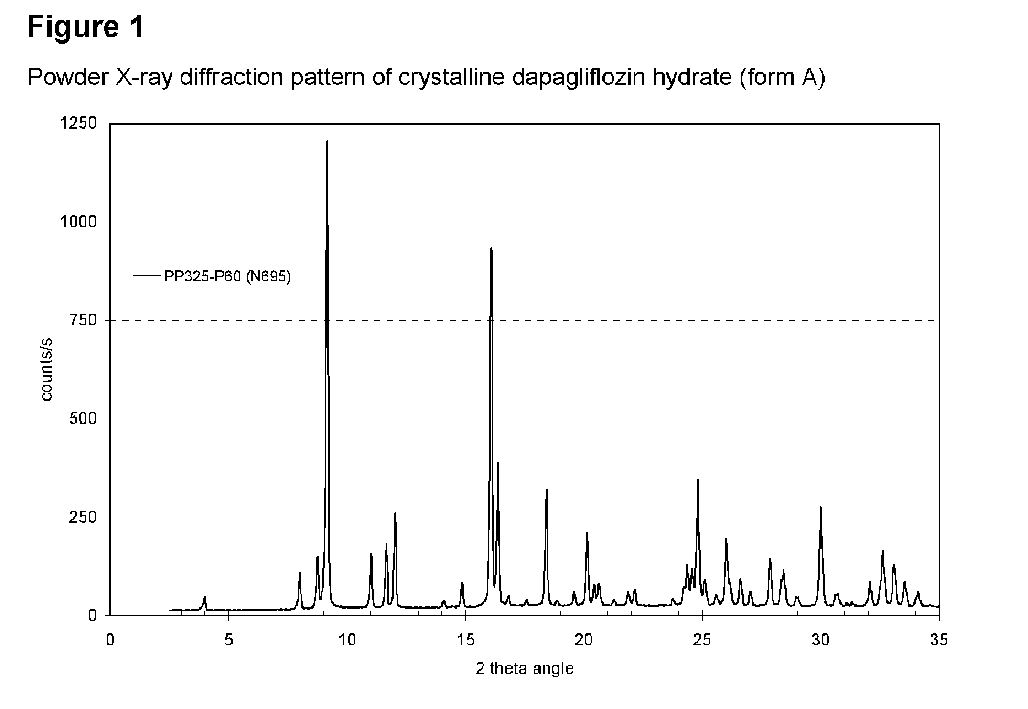
- the crystalline dapagliflozin hydrate has an XRPD pattern with at least one characteristic peak (expressed in 26 ⁇ 0,2° 2 ⁇ (CuK ⁇ radiation)) at 9,2°, 12,0°, 16,1°, 16,4°, 18,4°, 24,8°and 30,0°, designated as form A.
- form A has an XRPD pattern with at least one characteristic peak (expressed in 26 ⁇ 0,2° 26 (CuK ⁇ radiation)) at 9,2°, 11,7°, 12,0°, 16,1°, 16,4°, 18,4°, 20,1°, 24,8°, 26,0°, 30,0° and 32,6°.
- an X-ray powder diffractogram is measured with copper K-alpha radiation.
- An X-ray powder diffractogram of a sample of form A is shown in figure 1 and the present invention, in a preferred embodiment, relates to form A displaying a XRPD pattern which is substantially in accordance with figure 1 .
- the crystalline dapagliflozin hydrate form A has a FT-Raman spectrum comprising peaks at wavenumbers (expressed in ⁇ 2 cm -1 ) of 2932, 1614, 1604, 1237, 1041, 844, 691, 638 and 107 cm -1 .
- An FT Raman spectrum of a sample of form A is shown in figure 2 .
- form A is characterized by an FT Raman spectrum substantially in accordance with figure 2 .
- the crystalline dapagliflozin has an XRPD pattern with at least one characteristic peak (expressed in 2 ⁇ ⁇ 0,2° 2 ⁇ (CuK ⁇ radiation)) at 8,9°, 15,8°, 16,0°, 16,1°, 20,0° and 24,2° designated as form B.
- form B has an XRPD pattern with at least one characteristic peak (expressed in 2 ⁇ ⁇ 0,2° 2 ⁇ (CuK ⁇ radiation)) at 8,9°, 9,2°,11,1 °, 11,3°, 12,0°, 15,8°, 16,0°, 16,1°,16,4°,18,0°, 20,0°, 24,0°, 24,2°, 24,3°, 24,8°, 25,2°and 25,5°.
- an X-ray powder diffractogram is measured with copper K-alpha radiation.
- An X-ray powder diffractogram of a sample of form B is shown in figure 3 and the present invention, in a preferred embodiment, relates to form B displaying a XRPD pattern which is substantially in accordance with figure 3 .
- Form B can be converted into form A.
- a suspension of form B in water must be stirred. Subsequently, form A can be filtered off.
- form B is a useful intermediate for obtaining form A.
- a further aspect of the present invention is above described crystalline dapagliflozin hydrate for use in the treatment of type II diabetes (NIDDM - non-insulin-dependent diabetes mellitus).
- the present invention is also directed to a pharmaceutical composition
- a pharmaceutical composition comprising above described crystalline dapagliflozin hydrate and optionally one or more pharmaceutically acceptable excipients.
- the pharmaceutical composition is used in the treatment of type II diabetes (NIDDM - non-insulin-dependent diabetes mellitus).
- NIDDM type II diabetes
- the present invention is also directed to a process for obtaining seed crystals of the above described crystalline dapagliflozin hydrate comprising the steps of:
- seed crystals of form A or form B of crystalline dapagliflozin hydrate are obtained.
- the molar ratio of the compound of formula 1 in step a) and the polyol of step b) is in the range from 1:0,1 to 1:3.
- the polyol is a sugar alcohol.
- the sugar alcohol is selected from the group consisting of glycol, glycerol, erythritol, threitol, arabitol, xylitol, ribitol, mannitol, sorbitol, dulcitol, iditol, isomalt, maltitol, lactitol, polyglycitol and mixtures thereof.
- the solvent mixture comprises solvents selected from the group consisting of water, C1-C4 alcohols, a C3-C6 ketone, an ether or an acetic ester or mixtures thereof.
- the solvent is water or the amount of water in the solvent mixture is at least 50 weight-%.
- step e) the obtained suspension is equilibrated until the desired crystalline dapagliflozin hydrate is formed.
- a small amount of the suspension can be isolated and the presence of the desired crystalline dapagliflozin hydrate can be determined by PXRD.
- the obtained precipitate can be isolated according to step f).
- a further aspect of the present invention is directed process for obtaining the above described crystalline form comprising the steps of:
- the seed crystals used in step b) can be obtained according to the above described process of obtaining seed crystals.
- the seed crystals are form A or form B of crystalline dapagliflozin hydrate.
- the solvent mixture comprises solvents selected from the group consisting of water, C1-C4 alcohols, a C3-C6 ketone, an ether or an acetic ester or mixtures thereof.
- step a) additionally a polyol is added.
- the polyol is a sugar alcohol.
- the sugar alcohol is selected from the group consisting of glycol, glycerol, erythritol, threitol, arabitol, xylitol, ribitol, mannitol, sorbitol, dulcitol, iditol, isomalt, maltitol, lactitol, polyglycitol and mixtures thereof.
- step e) the obtained suspension is equilibrated until the desired crystalline dapagliflozin hydrate is formed.
- a small amount of the suspension can be isolated and the presence of the desired crystalline dapagliflozin hydrate can be determined by PXRD.
- the obtained precipitate can be isolated according to step f).
- amorphous dapagliflozin can be purified with the process of the present invention.
- amorphous dapagliflozin having a purity of 99,0% can be converted to crystalline dapagliflozin hydrate having a purity of >99,9% (see examples of the present application).
- said crystalline dapagliflozin hydrate does not contain any additional solvent, which is desirable.
- the process of purifying dapagliflozin according to the present invention is superior compared with the process of WO 03/099836 A1 .
- the dapagliflozin hydrate obtained is crystalline which is advantageous with respect to the formulation of a pharmaceutical composition.
- the use of expensive diols such as (S)-propanediol for obtaining an immediate release pharmaceutical composition as disclosed in WO 2008/116179 A1 can be avoided.
- the specific activity is higher compared with the dapagliflozin co-crystals disclosed in the art, since in the co-crystals further non-active compounds are present. Consequently, a tablet comprising crystalline dapagliflozin hydrate according to the present invention is less bulky.
- Powder X-ray diffraction (PXRD) :
- the measurements were carried out with a Bruker D8 Advance powder X-ray diffractometer using Cu K ⁇ radiation in the Bragg-Brentano reflection geometry. Generally, the 2 ⁇ values are accurate within an error of ⁇ 0.1-0.2°. The relative peak intensities can vary considerably for different samples of the same crystalline form because of different preferred orientations of the crystals.
- the samples were prepared without any special treatment other than the application of slight pressure to get a flat surface. Silicon single crystal sample holders of either 0.5 mm or 0.1 mm depth and 12 mm cavity diameter were used. The tube voltage and current were 40 kV and 40 mA, respectively.
- the X-ray diffractometer is equipped with a LynxEye detector. A variable divergence slight was used with a 3° window. The step size was 0.02 °2 ⁇ with a step time of 37 seconds. The samples were rotated at 0.5 rps during the measurement.
- TG-FTIR Thermogravimetry coupled with Fourier Transform Infrared Spectroscopy
- Raman spectra were recorded using a Bruker RFS100 Raman spectrometer equipped with a germanium detector and a Nd:YAG laser with an excitation wavelength of 1064 nm. A few milligrams of material were pressed into aluminum sample holders. Spectra in the range of 50-3500 cm -1 and with a resolution of 2 cm -1 were measured with a laser power of 100 mW. 64 scans were accumulated.
- HPLC measurements were performed with an Agilent 1100 series instrument equipped with a UV-vis detector set to 240 nm according to the following method: Column: Ascentis Express RP-Amide 4.6 x 150 mm, 2.7 mm; Column temperature: 25 °C - Eluent A: 0.1 % formic acid in water - Eluent B: 0.1 % formic acid in acetonitrile - Injection volume: 3 mL - Flow: 0.7 mL/min - Gradient: Time [min] [%] B 0.0 25 25.0 65 26.0 70 29.0 70 29.5 25 35.0 25
- amorphous dapagliflozin is suspended in 3 ml water and heated to 80°C to this mixture is added 18.6 mg L-(-)-arabitol (Sigma Aldrich # A3506) in 0.5 ml water.
- An emulsion is formed which is cooled to 5°C at a rate of 2°C per hour. At this temperature the mixture is stirred for about 20 hours or until crystals can be detected by light microscopy. After crystallization the suspension is filtered off and the solid product (after drying in air at room temperature for about one hour at a relative humidity of about 50%) is investigated by powder X-ray diffraction and 1 H-NMR spectroscopy.
- 1 H-NMR shows that the obtained crystalline solid contains dapagliflozin and water; whereas PXRD shows that crystalline form A is obtained.
- amorphous dapagliflozin is suspended in 3 ml water and heated to 80°C to this mixture is added 22.2 mg D-mannitol (Riedel-deHaen # 33440) in 0.5 ml water.
- An emulsion is formed which is cooled to 5°C at a rate of 2°C per hour. At this temperature the mixture is stirred for about 20 hours or until crystals can be detected by light microscopy. After crystallization the suspension is filtered off and the solid product (after drying in air at room temperature for about one hour at a relative humidity of about 50%) is investigated by powder X-ray diffraction and 1 H-NMR spectroscopy.
- 1 H-NMR shows that the obtained crystalline solid contains dapagliflozin and water; whereas PXRD shows that crystalline form A is obtained.
- 156 mg of amorphous dapagliflozin is suspended in 22 ml water and heated to about 80°C with a laboratory heat gun.
- the stirred emulsion is cooled to room temperature and about 10 mg of seed crystals according to example 1 are added.
- the suspension is stirred at 5°C for three days (or until crystalline material can be detected by light microscopy) before the solid product is separated by filtration.
- H-NMR shows that the obtained crystalline solid contains dapagliflozin and water; whereas PXRD shows that crystalline form A is obtained.
- amorphous dapagliflozin 1.0 gram of amorphous dapagliflozin is suspended in 140 ml water and heated to about 80°C with a laboratory heat gun for a short time.
- the stirred emulsion is cooled to room temperature and then exposed to ultrasound in a standard laboratory ultrasound bath for about two minutes, whereby about 50 mg of seed crystals obtained according to example 5 are added.
- the suspension is further cooled to 5°C and stirred for two days (or until crystalline material can be detected by light microscopy) before the solid product is separated by filtration.
- the wet cake after filtration is stored over a relative humidity of 31 % for about 24 hours, and then investigated by powder X-ray diffraction and 1 H-NMR spectroscopy.
- Example 7 Water content of crystalline hydrate form A
- the purity in area % of amorphous dapagliflozin determined by HPLC is 99.8% (by the method provided in the experimental section).
- 156 mg of the amorphous dapagliflozin is suspended in 22 ml water and heated to about 80°C with a laboratory heat gun.
- the stirred emulsion is cooled to room temperature and about 10 mg of seed crystals according to example 1 are added.
- After drying under vacuum (10 mbar) at room temperature for 30 minutes the solid is investigated by powder X-ray diffraction which confirms that crystalline form A is obtained. Further the obtained crystalline sample is tested with respect to chemical purity by the same HPLC method. A purity of >99,9% is found; i.e. all impurities are removed.
- the purity in area % of amorphous dapagliflozin determined by HPLC is 99.0% (by the method provided in the experimental section).
- 1.0 gram of this amorphous sample is suspended in 140 ml water and heated to about 80°C with a laboratory heat gun for a short time.
- the stirred emulsion is cooled to room temperature, then exposed to ultrasound in a standard laboratory ultrasound bath for about two minutes, whereby about 50 mg of seed crystals obtained according to example 5 are added. Then the suspension is further cooled to 5°C and stirred for two days (or until crystalline material can be detected by light microscopy) before the solid product is separated by filtration.
- the wet cake after filtration is stored over a relative humidity of 31 % for about 24 hours, and then investigated by powder X-ray diffraction and 1 H-NMR spectroscopy.
- 1 H-NMR shows that the obtained crystalline solid contains dapagliflozin and water, whereas PXRD shows that crystalline dapagliflozin is obtained.
- a further test of the solid crystalline sample by the same HPLC method shows that the chemical purity >99,9%; i.e. all impurities were removed by crystallization.
Landscapes
- Chemical & Material Sciences (AREA)
- Organic Chemistry (AREA)
- Health & Medical Sciences (AREA)
- Diabetes (AREA)
- Engineering & Computer Science (AREA)
- General Health & Medical Sciences (AREA)
- Life Sciences & Earth Sciences (AREA)
- Molecular Biology (AREA)
- Genetics & Genomics (AREA)
- Biotechnology (AREA)
- Biochemistry (AREA)
- Obesity (AREA)
- Hematology (AREA)
- Medicinal Chemistry (AREA)
- Pharmacology & Pharmacy (AREA)
- General Chemical & Material Sciences (AREA)
- Animal Behavior & Ethology (AREA)
- Chemical Kinetics & Catalysis (AREA)
- Public Health (AREA)
- Veterinary Medicine (AREA)
- Nuclear Medicine, Radiotherapy & Molecular Imaging (AREA)
- Bioinformatics & Cheminformatics (AREA)
- Endocrinology (AREA)
- Emergency Medicine (AREA)
- Peptides Or Proteins (AREA)
- Pharmaceuticals Containing Other Organic And Inorganic Compounds (AREA)
- Medicines That Contain Protein Lipid Enzymes And Other Medicines (AREA)
- Organic Low-Molecular-Weight Compounds And Preparation Thereof (AREA)
Abstract
The present invention is directed to crystalline dapagliflozin hydrate and a process for obtaining the same.
Dapagliflozin has the structure of formula 1: 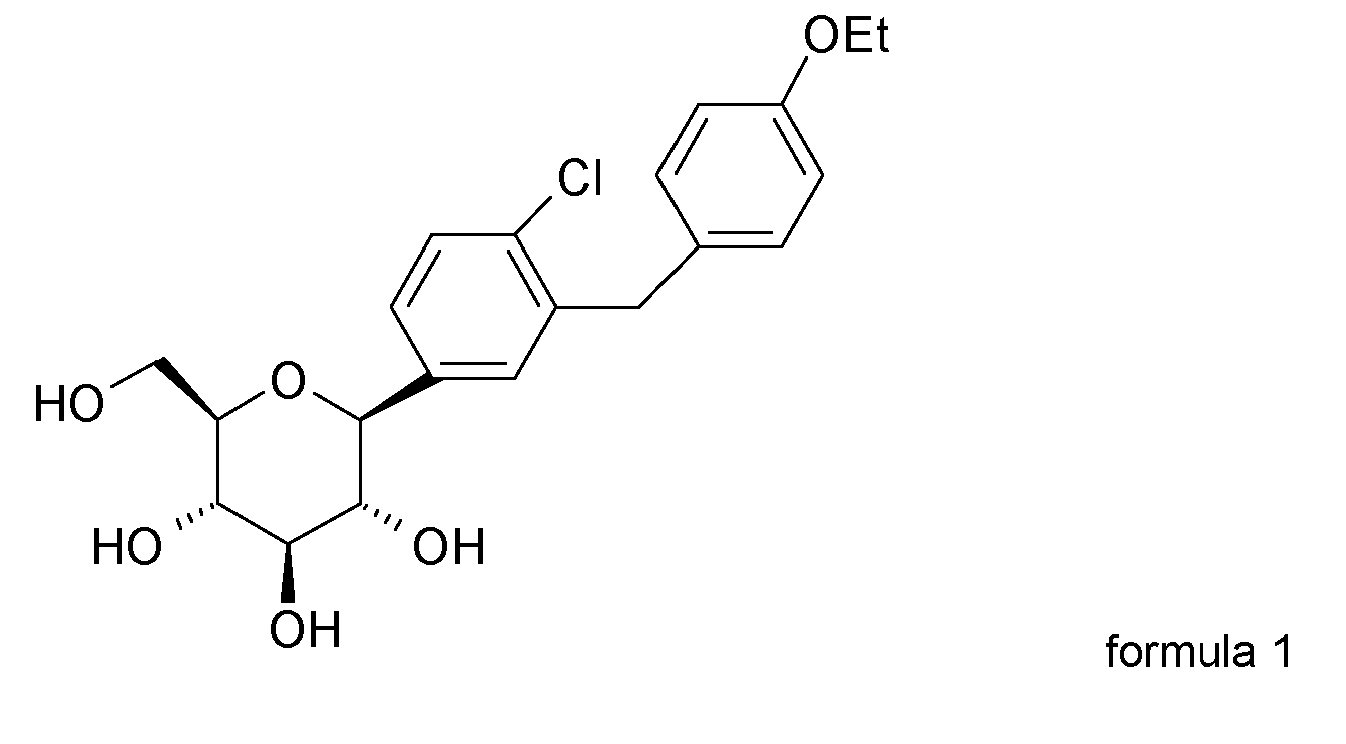
Dapagliflozin has the structure of formula 1:
Description
- The present invention is directed to crystalline dapagliflozin hydrate and a process of obtaining the same.
- The present invention relates to dapagliflozin being an inhibitor of sodium dependent glucose transporters found in the intestine and kidney (SGLT2) and to a method for treating diabetes, especially type II diabetes, as well as hyperglycemia, hyperinsulinemia, obesity, hypertriglyceridemia, Syndrome X, diabetic complications, atherosclerosis and related diseases, employing such C-aryl glucosides alone or in combination with one, two or more other type antidiabetic agent and/or one, two or more other type therapeutic agents such as hypolipidemic agents.
- Approximately 100 million people worldwide suffer from type II diabetes (NIDDM - non-insulin-dependent diabetes mellitus), which is characterized by hyperglycemia due to excessive hepatic glucose production and peripheral insulin resistance, the root causes for which are as yet unknown. Hyperglycemia is considered to be the major risk factor for the development of diabetic complications, and is likely to contribute directly to the impairment of insulin secretion seen in advanced NIDDM. Normalization of plasma glucose in NIDDM patients would be predicted to improve insulin action, and to offset the development of diabetic complications. An inhibitor of the sodium-dependent glucose transporter SGLT2 in the kidney would be expected to aid in the normalization of plasma glucose levels, and perhaps body weight, by enhancing glucose excretion.
-
WO 03/099836 A1 formula 1.
- A route of synthesis is disclosed and one major step is the purification of a compound of
formula 2
- The compound of
formula 2 provides a means of purification since it crystallizes. Subsequently the compound offormula 2 is converted to dapagliflozin. However, dapagliflozin is obtained as an amorphous glassy off white solid containing 0,11 mol% of EtOAc. Thus, there is the need in the art to obtain pure and crystalline dapalgliflozin containing no organic solvent. - In
WO 2008/002824 A1 solvates of dapagliflozin with several alcohols and co-crystals with proline and phenylalanine are disclosed. However, the presence of the alcohols disclosed in said reference is undesirable since they may detrimentally affect the patient. -
WO 2008/116179 A1 refers to an immediate release pharmaceutical composition comprising dipagliflozin propylene glycol hydrate. Propylene glycol is a chiral substance and (S)-propanediol used is very expensive. Consequently, also the immediate release pharmaceutical composition is more expensive. Moreover, the presence of said propylene glycol in the medicament may detrimentally affect the patient. - All of the aforementioned co-crystals of dapalgloflizin have in common that the specific activity is lower compared with pure dapagliflozin, since in the co-crystals further non-active compounds are present. Thus, the co-crystals of dapagliflozin known in the art lead to more bulky pharmaceutical compositions.
- Moreover, the discovery of new crystal forms of a pharmaceutically useful compound offers an opportunity to improve the performance profile of a pharmaceutical product. It widens the reservoir of materials a formulation scientist has available for designing a new dosage form of a drug with improved characteristics.
- Crystalline forms often show desired different physical and/or biological characteristics which may assist in the manufacture or formulation of the active compound, to the purity levels and uniformity required for regulatory approval. The present solid form, especially crystalline dapagliflozin hydrate, possesses improved pharmacological characteristics, for example, improved bioavailability, thus offering enhanced possibilities to modulate and design improved drug products.
- Moreover, the technical problem underlying the present invention is the provision of a crystalline form comprising dapagliflozin and the provision of a process for obtaining the same in high yield and high purity.
- The technical problem is solved by crystalline dapagliflozin hydrate.
- Preferably, in the crystalline dapagliflozin hydrate the molar ratio of dapagliflozin and water is in the range of 1:1 to 1:6. In an even more preferred embodiment the molar ratio of dapagliflozin and water is in the range of 1:1 to 1:3, preferably, 1:1,5 to 1:2,5 and most preferred 1:2. Thus, a preferred embodiment of the present invention is crystalline dapagliflozin dihydrate. The crystalline dapagliflozin hydrate contains water and, thus, it is designated as hydrate.
- Preferably, the crystalline dapagliflozin hydrate has an XRPD pattern with at least one characteristic peak (expressed in 26 ± 0,2° 2θ (CuKα radiation)) at 9,2°, 12,0°, 16,1°, 16,4°, 18,4°, 24,8°and 30,0°, designated as form A. Preferably, form A has an XRPD pattern with at least one characteristic peak (expressed in 26 ± 0,2° 26 (CuKα radiation)) at 9,2°, 11,7°, 12,0°, 16,1°, 16,4°, 18,4°, 20,1°, 24,8°, 26,0°, 30,0° and 32,6°. Typically such an X-ray powder diffractogram is measured with copper K-alpha radiation. An X-ray powder diffractogram of a sample of form A is shown in
figure 1 and the present invention, in a preferred embodiment, relates to form A displaying a XRPD pattern which is substantially in accordance withfigure 1 . - Preferably, the crystalline dapagliflozin hydrate form A has a FT-Raman spectrum comprising peaks at wavenumbers (expressed in ± 2 cm-1) of 2932, 1614, 1604, 1237, 1041, 844, 691, 638 and 107 cm-1. An FT Raman spectrum of a sample of form A is shown in
figure 2 . In a preferred embodiment, form A is characterized by an FT Raman spectrum substantially in accordance withfigure 2 . - In a further preferred embodiment of the present invention the crystalline dapagliflozin has an XRPD pattern with at least one characteristic peak (expressed in 2θ ± 0,2° 2θ (CuKα radiation)) at 8,9°, 15,8°, 16,0°, 16,1°, 20,0° and 24,2° designated as form B. Preferably, form B has an XRPD pattern with at least one characteristic peak (expressed in 2θ ± 0,2° 2θ (CuKα radiation)) at 8,9°, 9,2°,11,1 °, 11,3°, 12,0°, 15,8°, 16,0°, 16,1°,16,4°,18,0°, 20,0°, 24,0°, 24,2°, 24,3°, 24,8°, 25,2°and 25,5°. Typically such an X-ray powder diffractogram is measured with copper K-alpha radiation. An X-ray powder diffractogram of a sample of form B is shown in
figure 3 and the present invention, in a preferred embodiment, relates to form B displaying a XRPD pattern which is substantially in accordance withfigure 3 . - Form B can be converted into form A. In order to obtain form A a suspension of form B in water must be stirred. Subsequently, form A can be filtered off. Thus, form B is a useful intermediate for obtaining form A.
- A further aspect of the present invention is above described crystalline dapagliflozin hydrate for use in the treatment of type II diabetes (NIDDM - non-insulin-dependent diabetes mellitus).
- The present invention is also directed to a pharmaceutical composition comprising above described crystalline dapagliflozin hydrate and optionally one or more pharmaceutically acceptable excipients.
- Preferably, the pharmaceutical composition is used in the treatment of type II diabetes (NIDDM - non-insulin-dependent diabetes mellitus).
- The present invention is also directed to a process for obtaining seed crystals of the above described crystalline dapagliflozin hydrate comprising the steps of:
- a) providing a compound of formula 1 (INN: Dapagliflozin)

- b) adding a polyol to the mixture of step a);
- c) optionally concentrating the composition of step b);
- d) crystallizing;
- e) optionally equilibrating the obtained suspension of step d); and
- f) isolating the obtained precipitate.
- Preferably, seed crystals of form A or form B of crystalline dapagliflozin hydrate are obtained.
- Preferably, the molar ratio of the compound of
formula 1 in step a) and the polyol of step b) is in the range from 1:0,1 to 1:3. - Even more preferred, the polyol is a sugar alcohol. Preferably, the sugar alcohol is selected from the group consisting of glycol, glycerol, erythritol, threitol, arabitol, xylitol, ribitol, mannitol, sorbitol, dulcitol, iditol, isomalt, maltitol, lactitol, polyglycitol and mixtures thereof.
- Preferably, the solvent mixture comprises solvents selected from the group consisting of water, C1-C4 alcohols, a C3-C6 ketone, an ether or an acetic ester or mixtures thereof. Even more preferred, the solvent is water or the amount of water in the solvent mixture is at least 50 weight-%.
- Preferably, in step e) the obtained suspension is equilibrated until the desired crystalline dapagliflozin hydrate is formed. For instance, a small amount of the suspension can be isolated and the presence of the desired crystalline dapagliflozin hydrate can be determined by PXRD. In case the reaction is complete, i.e. the desired crystalline dapagliflozin hydrate is formed, the obtained precipitate can be isolated according to step f).
- A further aspect of the present invention is directed process for obtaining the above described crystalline form comprising the steps of:
- a) providing a compound of formula 1 (INN: Dapagliflozin)

- b) adding seed crystals of the desired form to the composition of step a);
- c) optionally concentrating the composition of step b);
- d) crystallizing;
- e) optionally equilibrating the obtained suspension of step d); and
- f) isolating the obtained precipitate.
- The seed crystals used in step b) can be obtained according to the above described process of obtaining seed crystals. Preferably, the seed crystals are form A or form B of crystalline dapagliflozin hydrate.
- Preferably, the solvent mixture comprises solvents selected from the group consisting of water, C1-C4 alcohols, a C3-C6 ketone, an ether or an acetic ester or mixtures thereof.
- Even more preferred, in step a) additionally a polyol is added. Preferably, the polyol is a sugar alcohol. In a further preferred embodiment, the sugar alcohol is selected from the group consisting of glycol, glycerol, erythritol, threitol, arabitol, xylitol, ribitol, mannitol, sorbitol, dulcitol, iditol, isomalt, maltitol, lactitol, polyglycitol and mixtures thereof.
- Preferably, in step e) the obtained suspension is equilibrated until the desired crystalline dapagliflozin hydrate is formed. For instance, a small amount of the suspension can be isolated and the presence of the desired crystalline dapagliflozin hydrate can be determined by PXRD. In case the reaction is complete, i.e. the desired crystalline dapagliflozin hydrate is formed, the obtained precipitate can be isolated according to step f).
- Surprisingly, amorphous dapagliflozin can be purified with the process of the present invention. For instance amorphous dapagliflozin having a purity of 99,0% can be converted to crystalline dapagliflozin hydrate having a purity of >99,9% (see examples of the present application). Moreover, said crystalline dapagliflozin hydrate does not contain any additional solvent, which is desirable. Thus, the process of purifying dapagliflozin according to the present invention is superior compared with the process of
WO 03/099836 A1 - Additionally, the dapagliflozin hydrate obtained is crystalline which is advantageous with respect to the formulation of a pharmaceutical composition. The use of expensive diols such as (S)-propanediol for obtaining an immediate release pharmaceutical composition as disclosed in
WO 2008/116179 A1 can be avoided. Moreover, the specific activity is higher compared with the dapagliflozin co-crystals disclosed in the art, since in the co-crystals further non-active compounds are present. Consequently, a tablet comprising crystalline dapagliflozin hydrate according to the present invention is less bulky. - The measurements were carried out with a Bruker D8 Advance powder X-ray diffractometer using Cu Kα radiation in the Bragg-Brentano reflection geometry. Generally, the 2θ values are accurate within an error of ±0.1-0.2°. The relative peak intensities can vary considerably for different samples of the same crystalline form because of different preferred orientations of the crystals. The samples were prepared without any special treatment other than the application of slight pressure to get a flat surface. Silicon single crystal sample holders of either 0.5 mm or 0.1 mm depth and 12 mm cavity diameter were used. The tube voltage and current were 40 kV and 40 mA, respectively. The X-ray diffractometer is equipped with a LynxEye detector. A variable divergence slight was used with a 3° window. The step size was 0.02 °2θ with a step time of 37 seconds. The samples were rotated at 0.5 rps during the measurement.
- Thermogravimetry coupled with Fourier Transform Infrared Spectroscopy (TG-FTIR): TG-FTIR was performed on a Netzsch Thermo-Microbalance TG 209, which is coupled to a Bruker FT-IR Spectrometer Vector 22. The measurements were carried out with aluminum crucibles with a micro pinhole under a nitrogen atmosphere and at a heating rate of 10 °C/min over the range 25-250 °C.
- Raman spectra were recorded using a Bruker RFS100 Raman spectrometer equipped with a germanium detector and a Nd:YAG laser with an excitation wavelength of 1064 nm. A few milligrams of material were pressed into aluminum sample holders. Spectra in the range of 50-3500 cm-1 and with a resolution of 2 cm-1 were measured with a laser power of 100 mW. 64 scans were accumulated.
- 1H-NMR spectra were recorded using a Bruker DPX300 instrument. Deuterated methanol was used as the solvent.
- HPLC measurements were performed with an Agilent 1100 series instrument equipped with a UV-vis detector set to 240 nm according to the following method:
Column: Ascentis Express RP-Amide 4.6 x 150 mm, 2.7 mm;
Column temperature: 25 °C
- Eluent A: 0.1 % formic acid in water
- Eluent B: 0.1 % formic acid in acetonitrile
- Injection volume: 3 mL
- Flow: 0.7 mL/min
- Gradient:Time [min] [%] B 0.0 25 25.0 65 26.0 70 29.0 70 29.5 25 35.0 25 - 50 mg of amorphous dapagliflozin is suspended in 3 ml water and heated to 80°C to this mixture is added 18.6 mg L-(-)-arabitol (Sigma Aldrich # A3506) in 0.5 ml water. An emulsion is formed which is cooled to 5°C at a rate of 2°C per hour. At this temperature the mixture is stirred for about 20 hours or until crystals can be detected by light microscopy. After crystallization the suspension is filtered off and the solid product (after drying in air at room temperature for about one hour at a relative humidity of about 50%) is investigated by powder X-ray diffraction and 1H-NMR spectroscopy. 1H-NMR shows that the obtained crystalline solid contains dapagliflozin and water; whereas PXRD shows that crystalline form A is obtained.
- 50 mg of amorphous dapagliflozin is suspended in 3 ml water and heated to 80°C to this mixture is added 22.2 mg D-mannitol (Riedel-deHaen # 33440) in 0.5 ml water. An emulsion is formed which is cooled to 5°C at a rate of 2°C per hour. At this temperature the mixture is stirred for about 20 hours or until crystals can be detected by light microscopy. After crystallization the suspension is filtered off and the solid product (after drying in air at room temperature for about one hour at a relative humidity of about 50%) is investigated by powder X-ray diffraction and 1H-NMR spectroscopy. 1H-NMR shows that the obtained crystalline solid contains dapagliflozin and water; whereas PXRD shows that crystalline form A is obtained.
- 50 mg of amorphous dapagliflozin is suspended in 3 ml water and heated to 80°C. To this mixture 18.6 mg xylitol (Sigma Aldrich # X3375) in 0.5 ml water is added. An emulsion is formed which is cooled to 5°C at a rate of 2°C per hour. At this temperature the mixture is stirred for about 20 hours or until crystals can be detected by light microscopy. After crystallization the suspension is filtered off and the solid product (after drying in air at room temperature for about one hour at a relative humidity of about 50%) is investigated by powder X-ray diffraction and H-NMR spectroscopy. 1H-NMR shows that the obtained crystalline solid contains dapagliflozin and water; whereas PXRD shows that crystalline form A is obtained.
- 156 mg of amorphous dapagliflozin is suspended in 22 ml water and heated to about 80°C with a laboratory heat gun. The stirred emulsion is cooled to room temperature and about 10 mg of seed crystals according to example 1 are added. After further cooling to 5°C the suspension is stirred at 5°C for three days (or until crystalline material can be detected by light microscopy) before the solid product is separated by filtration. After drying under vacuum (10 mbar) at room temperature for 30 minutes the solid is investigated by powder X-ray diffraction and 1H-NMR spectroscopy. H-NMR shows that the obtained crystalline solid contains dapagliflozin and water; whereas PXRD shows that crystalline form A is obtained. The PXRD pattern of this form is shown in
figure 1 and the peak locations are provided in table 1. Further investigation by Raman spectroscopy reveals a characteristic Raman spectrum as shown infigure 2 with peak locations as shown in table 2.Table 1: Powder X-ray diffraction peak locations and qualitative relative intensities for dapagliflozin hydrate form A Angle 2θ d-value [Ǻ] Intensity (qualitative) 4.0 22.1 vw 8.0 11.0 w 8.8 10.1 w 9.2 9.6 vs 11.0 8.0 w 11.7 7.6 m 12.0 7.3 m 14.1 6.3 vw 14.9 5.96 w 16.1 5.51 vs 16.4 5.41 s 16.8 5.27 vw 17.6 5.04 vw 18.4 4.82 s 18.9 4.70 vw 19.6 4.53 vw 20.1 4.41 m 20.4 4.34 w 20.6 4.30 w 21.3 4.17 vw 21.9 4.06 vw 22.1 4.01 w 23.8 3.74 vw 24.2 3.67 w 24.4 3.65 w 24.6 3.62 w 24.8 3.58 s 25.1 3.54 w 25.6 3.48 vw 26.0 3.42 m 26.2 3.40 w 26.6 3.35 w 27.0 3.30 vw 27.9 3.20 w 28.3 3.15 w 28.4 3.14 w 30.0 2.98 s 32.1 2.79 w 32.6 2.74 m Table 2: Raman peak locations for dapagliflozin hydrate form A wavenumber relative intensity (arbitrary units) 3074 6.3 2988 1.8 2932 10.4 2891 3.4 1614 1.8 1604 19.5 1577 6.2 1476 3.4 1456 1.9 1437 6.1 1339 3.8 1308 4.4 1237 14.1 1203 3.7 1181 7.1 1143 2.8 1118 6.4 1041 10.1 914 4 844 17.8 822 2.6 792 4.9 691 16.5 638 11.1 596 7.8 513 3.9 458 2.4 420 4.7 369 4.4 338 9.2 229 6.6 208 2.8 192 3.8 107 67.3 - 1.5 gram of amorphous dapagliflozin is suspended in 60 ml water and heated to about 80°C with a laboratory heat gun for a short time. The stirred emulsion is cooled to room temperature and about 50 mg of seed crystals according to example 1 are added. Then the suspension is stirred at room temperature for three days (or until crystalline material can be detected by light microscopy) before the solid product is separated by filtration. The wet cake after filtration is stored over a relative humidity of 75%, and then investigated by powder X-ray diffraction and H-NMR spectroscopy. 1H-NMR shows that the obtained crystalline solid contains dapagliflozin and water; whereas PXRD shows that crystalline form A is obtained. The PXRD pattern of this form is shown in
figure 1 and the peak locations are provided in table 1. - 1.0 gram of amorphous dapagliflozin is suspended in 140 ml water and heated to about 80°C with a laboratory heat gun for a short time. The stirred emulsion is cooled to room temperature and then exposed to ultrasound in a standard laboratory ultrasound bath for about two minutes, whereby about 50 mg of seed crystals obtained according to example 5 are added. Then the suspension is further cooled to 5°C and stirred for two days (or until crystalline material can be detected by light microscopy) before the solid product is separated by filtration. The wet cake after filtration is stored over a relative humidity of 31 % for about 24 hours, and then investigated by powder X-ray diffraction and 1H-NMR spectroscopy. 1H-NMR shows that the obtained crystalline solid contains dapagliflozin and water; whereas PXRD shows that crystalline form B is obtained. The PXRD pattern of this form is shown in
figure 3 and the peak locations are provided in table 3.Table 3: Powder X-ray diffraction peak locations and qualitative relative intensities for dapagliflozin hydrate form B Angle 2θ d-value [Ǻ] Intensity (qualitative) 4.0 22.1 w 7.9 11.2 w 8.0 11.0 w 8.9 9.9 vs 9.2 9.6 m 11.1 8.0 m 11.3 7.8 m 11.7 7.6 w 12.0 7.4 m 12.3 7.2 vw 14.2 6.3 w 14.5 6.11 w 14.9 5.96 vw 15.8 5.62 s 16.0 5.54 vs 16.1 5.50 s 16.4 5.41 m 17.8 4.97 w 18.0 4.92 m 18.4 4.81 w 18.9 4.70 w 19.6 4.53 w 20.0 4.43 m 20.4 4.34 w 21.4 4.16 w 21.7 4.09 w 22.2 4.00 w 22.8 3.90 w 24.0 3.71 m 24.2 3.68 m 24.3 3.66 m 24.6 3.62 w 24.8 3.58 m 25.2 3.53 m 25.5 3.48 m 26.0 3.43 w 26.4 3.37 w 26.6 3.35 w 27.0 3.30 w - 145 mg of crystalline hydrate form A according to example 6 is stored under a relative humidity of 60% (in an open container) for two weeks. Then the stored sample is investigated by PXRD and TG-FTIR. PXRD shows that form A is retained whereas TG-FTIR reveals a mass loss of about 9% which is attributable to loss of water. Therefore, we conclude that in equilibrium with a water activity of about 0.6 the crystalline form A contains about 2 mol water per mol dapagliflozin, i.e. it is essentially a dihydrate.
- The purity in area % of amorphous dapagliflozin determined by HPLC is 99.8% (by the method provided in the experimental section). 156 mg of the amorphous dapagliflozin is suspended in 22 ml water and heated to about 80°C with a laboratory heat gun. The stirred emulsion is cooled to room temperature and about 10 mg of seed crystals according to example 1 are added. After further cooling to 5°C the suspension is stirred a 5°C for three days (or until crystalline material can be detected by light microscopy) before the solid product is separated by filtration. After drying under vacuum (10 mbar) at room temperature for 30 minutes the solid is investigated by powder X-ray diffraction which confirms that crystalline form A is obtained. Further the obtained crystalline sample is tested with respect to chemical purity by the same HPLC method. A purity of >99,9% is found; i.e. all impurities are removed.
- The purity in area % of amorphous dapagliflozin determined by HPLC is 99.0% (by the method provided in the experimental section). 1.0 gram of this amorphous sample is suspended in 140 ml water and heated to about 80°C with a laboratory heat gun for a short time. The stirred emulsion is cooled to room temperature, then exposed to ultrasound in a standard laboratory ultrasound bath for about two minutes, whereby about 50 mg of seed crystals obtained according to example 5 are added. Then the suspension is further cooled to 5°C and stirred for two days (or until crystalline material can be detected by light microscopy) before the solid product is separated by filtration. The wet cake after filtration is stored over a relative humidity of 31 % for about 24 hours, and then investigated by powder X-ray diffraction and 1H-NMR spectroscopy. 1H-NMR shows that the obtained crystalline solid contains dapagliflozin and water, whereas PXRD shows that crystalline dapagliflozin is obtained. A further test of the solid crystalline sample by the same HPLC method shows that the chemical purity >99,9%; i.e. all impurities were removed by crystallization.
- About 200 mg of dapagliflozin hydrate form B is suspended in 2 ml water and the resulting suspension is stirred at 5°C for 24 hours. Thereafter the suspension is filtered, the wet cake dried in air for about 30 minutes and then investigated by powder X-ray diffraction which confirms that crystalline form A is obtained.
Claims (20)
- Crystalline dapagliflozin hydrate.
- The crystalline dapagliflozin hydrate of claim 1, characterized in that the molar ratio of dapagliflozin and water is in the range of 1:1 to 1:6.
- The crystalline dapagliflozin hydrate of claim 1 or 2, characterized in that it has an XRPD pattern with at least one characteristic peak (expressed in 2θ ± 0,2° 2θ (CuKα radiation)) at 9,2°, 12,0°, 16,1°, 16,4°, 18,4°, 24,8°and 30,0°, designated as form A.
- The crystalline dapagliflozin hydrate according to claim 3, characterized in that it has a FT-Raman spectrum comprising peaks at wavenumbers (expressed in ± 2 cm-1) of 2932, 1614, 1604, 1237, 1041, 844, 691, 638 and 107 cm-1.
- The crystalline dapagliflozin hydrate of claim 1 or 2, characterized in that it has an XRPD pattern with at least one characteristic peak (expressed in 2θ ± 0,2° 2θ (CuKα radiation)) at 8,9°, 15,8°, 16,0°, 16,1°, 20,0° and 24,2° designated as form B.
- The crystalline dapagliflozin hydrate according to at least one of the claims 1 to 5 for use in the treatment of type II diabetes.
- Use of the crystalline dapagliflozin hydrate of claim 5 (form B) for the preparation of form A.
- A process for obtaining seed crystals of the crystalline form according to at least one of the claims 1 to 6 comprising the steps of:a) providing a compound of formula 1 (INN: Dapagliflozin)
 b) adding a polyol to the mixture of step a);c) optionally concentrating the composition of step b);d) crystallizing;e) optionally equilibrating the obtained suspension of step d); andf) isolating the obtained precipitate.
 - The process according to claim 8, characterized in that the molar ratio of the compound of formula 1 in step a) and the polyol of step b) is in the range from 1:0,1 to 1:3.
- The process according to claim 8 or 9, characterized in that the polyol is a sugar alcohol.
- The process according to claim 10, characterized in that the sugar alcohol is selected from the group consisting of glycol, glycerol, erythritol, threitol, arabitol, xylitol, ribitol, mannitol, sorbitol, dulcitol, iditol, isomalt, maltitol, lactitol, polyglycitol and mixtures thereof.
- The process according to at least one of the claims 8 to 11, characterized in that the solvent mixture comprises solvents selected from the group consisting of C1-C4 alcohols, a C3-C6 ketone, an ether or an acetic ester or mixtures thereof.
- The process according to at least one of the claims 8 to 12, characterized in that the solvent is water or that the amount of water in the solvent mixture is at least 50 weight-%.
- A process for obtaining the crystalline form according to at least one of the claims 1 to 6 comprising the steps of:a) providing a compound of formula 1 (INN: Dapagliflozin)
 b) adding seed crystals of the desired form to the composition of step a);c) optionally concentrating the composition of step b);d) crystallizing;e) optionally equilibrating the obtained suspension of step d); andf) isolating the obtained precipitate.
 - The process according to claims 14, characterized in that the solvent mixture comprises solvents selected from the group consisting of water, C1-C4 alcohols, a C3-C6 ketone, an ether or an acetic ester or mixtures thereof.
- The process according to claim 14 or 15, characterized in that in step a) additionally a polyol is added.
- The process according to claim 16, characterized in that the polyol is a sugar alcohol.
- The process according to claim 17, characterized in that the sugar alcohol is selected from the group consisting of glycol, glycerol, erythritol, threitol, arabitol, xylitol, ribitol, mannitol, sorbitol, dulcitol, iditol, isomalt, maltitol, lactitol, polyglycitol and mixtures thereof.
- A pharmaceutical composition comprising crystalline dapagliflozin hydrate according to at least one of the claims 1 to 6 and optionally one or more pharmaceutically acceptable excipients.
- The pharmaceutical composition of claim 19 for use in the treatment of type II diabetes.
Priority Applications (5)
| Application Number | Priority Date | Filing Date | Title |
|---|---|---|---|
| EP11190866.1A EP2597090A1 (en) | 2011-11-28 | 2011-11-28 | Crystalline dapagliflozin hydrate |
| US14/360,583 US9394328B2 (en) | 2011-11-28 | 2012-11-28 | Crystalline dapagliflozin hydrate |
| CN201280058370.XA CN103958491B (en) | 2011-11-28 | 2012-11-28 | Crystalline dapagliflozin hydrate |
| EP12791764.9A EP2785702B1 (en) | 2011-11-28 | 2012-11-28 | Crystalline dapagliflozin hydrate |
| PCT/EP2012/073783 WO2013079501A1 (en) | 2011-11-28 | 2012-11-28 | Crystalline dapagliflozin hydrate |
Applications Claiming Priority (1)
| Application Number | Priority Date | Filing Date | Title |
|---|---|---|---|
| EP11190866.1A EP2597090A1 (en) | 2011-11-28 | 2011-11-28 | Crystalline dapagliflozin hydrate |
Publications (1)
| Publication Number | Publication Date |
|---|---|
| EP2597090A1 true EP2597090A1 (en) | 2013-05-29 |
Family
ID=47257807
Family Applications (2)
| Application Number | Title | Priority Date | Filing Date |
|---|---|---|---|
| EP11190866.1A Ceased EP2597090A1 (en) | 2011-11-28 | 2011-11-28 | Crystalline dapagliflozin hydrate |
| EP12791764.9A Active EP2785702B1 (en) | 2011-11-28 | 2012-11-28 | Crystalline dapagliflozin hydrate |
Family Applications After (1)
| Application Number | Title | Priority Date | Filing Date |
|---|---|---|---|
| EP12791764.9A Active EP2785702B1 (en) | 2011-11-28 | 2012-11-28 | Crystalline dapagliflozin hydrate |
Country Status (4)
| Country | Link |
|---|---|
| US (1) | US9394328B2 (en) |
| EP (2) | EP2597090A1 (en) |
| CN (1) | CN103958491B (en) |
| WO (1) | WO2013079501A1 (en) |
Cited By (4)
| Publication number | Priority date | Publication date | Assignee | Title |
|---|---|---|---|---|
| US9006188B2 (en) | 2013-04-29 | 2015-04-14 | Mapi Pharma Ltd. | Co-crystals of dapagliflozin |
| WO2015104658A3 (en) * | 2014-01-08 | 2015-11-12 | Dr. Reddy’S Laboratories Limited | Amorphous solid dispersion of dapagliflozin and process for the preparation of amorphous dapagliflozin |
| WO2016136830A1 (en) * | 2015-02-27 | 2016-09-01 | 田辺三菱製薬株式会社 | Novel crystal of 1-(β-d-glucopyranosyl)-4-methyl-3-[5-(4-fluorophenyl)-2-thienylmethyl]benzene |
| CN113372315A (en) * | 2021-08-12 | 2021-09-10 | 北京惠之衡生物科技有限公司 | Method for synthesizing impurities of C-glucoside derivatives |
Families Citing this family (21)
| Publication number | Priority date | Publication date | Assignee | Title |
|---|---|---|---|---|
| CN104829572B (en) | 2014-02-10 | 2019-01-04 | 江苏豪森药业集团有限公司 | Dapagliflozin novel crystal forms and preparation method thereof |
| CN104829573B (en) * | 2014-02-11 | 2018-09-07 | 江苏豪森药业集团有限公司 | dapagliflozin crystal form and preparation method thereof |
| EP3229814A4 (en) | 2014-06-23 | 2018-07-11 | Sun Pharmaceutical Industries Ltd | Co-crystal of dapagliflozin with citric acid |
| KR20160013770A (en) * | 2014-07-28 | 2016-02-05 | 한미정밀화학주식회사 | Novel crystalline complex of dapagliflozin and method for preparing same |
| WO2016155578A1 (en) * | 2015-03-27 | 2016-10-06 | 苏州晶云药物科技有限公司 | New crystal form of dapagliflozin and preparation method therefor |
| WO2016161995A1 (en) | 2015-04-08 | 2016-10-13 | Zentiva, K.S. | Solid forms of amorphous dapagliflozin |
| CN106146446B (en) * | 2015-04-17 | 2019-11-08 | 杭州领业医药科技有限公司 | Dapagliflozin hemihydrate and its crystal form, its preparation method and pharmaceutical composition |
| WO2016178148A1 (en) * | 2015-05-05 | 2016-11-10 | Glenmark Pharmaceuticals Limited | Process for preparation of dapagliflozin |
| KR102659761B1 (en) | 2015-08-27 | 2024-04-24 | 베링거잉겔하임베트메디카게엠베하 | Liquid pharmaceutical composition containing SGLT-2 inhibitor |
| WO2017046730A1 (en) | 2015-09-15 | 2017-03-23 | Laurus Labs Private Limited | Co-crystals of sglt2 inhibitors, process for their preparation and pharmaceutical compositions thereof |
| US9845303B2 (en) | 2015-10-19 | 2017-12-19 | Cadila Healthcare Limited | Process for the preparation of dapagliflozin |
| KR20190010578A (en) * | 2016-05-24 | 2019-01-30 | 장쑤 한서 파마슈티칼 그룹 캄파니 리미티드 | New Dapagliflozoline Crystal Forms and Methods of Making and Uses Thereof |
| WO2018167589A1 (en) | 2017-03-16 | 2018-09-20 | Inventia Healthcare Private Limited | Pharmaceutical composition comprising dapagliflozin |
| CN110790735A (en) * | 2018-08-03 | 2020-02-14 | 北京海晶生物医药科技有限公司 | Novel dapagliflozin crystal form N and preparation method thereof |
| CN119264211A (en) | 2018-08-27 | 2025-01-07 | 瑞泽恩制药公司 | Application of Raman spectroscopy in downstream purification |
| EP4114365A1 (en) | 2020-03-05 | 2023-01-11 | KRKA, d.d., Novo mesto | Pharmaceutical composition comprising sglt2 inhibitor |
| CN115867538A (en) | 2020-06-05 | 2023-03-28 | 新梅斯托克公司 | Preparation of highly pure amorphous dapagliflozin |
| US12409186B2 (en) | 2020-07-27 | 2025-09-09 | Astrazeneca Ab | Methods of treating chronic kidney disease with dapagliflozin |
| CN113607846A (en) * | 2021-08-03 | 2021-11-05 | 苏州科技城医院 | Method for determining dapagliflozin concentration in blood plasma |
| AU2023277704A1 (en) | 2022-05-25 | 2024-12-05 | Boehringer Ingelheim Vetmedica Gmbh | Aqueous pharmaceutical compositions comprising sglt-2 inhibitors |
| CN116813675B (en) * | 2023-08-23 | 2023-11-24 | 北京远大九和药业有限公司 | Compound crystal form and preparation, composition and application thereof |
Citations (3)
| Publication number | Priority date | Publication date | Assignee | Title |
|---|---|---|---|---|
| WO2003099836A1 (en) | 2002-05-20 | 2003-12-04 | Bristol-Myers Squibb Company | C-aryl glucoside sglt2 inhibitors and method |
| WO2008002824A1 (en) | 2006-06-28 | 2008-01-03 | Bristol-Myers Squibb Company | Crystalline solvates and complexes of (is) -1, 5-anhydro-l-c- (3- ( (phenyl) methyl) phenyl) -d-glucitol derivatives with amino acids as sglt2 inhibitors for the treatment of diabetes |
| WO2008116179A1 (en) | 2007-03-22 | 2008-09-25 | Bristol-Myers Squibb | Pharmaceutical formulations containing dapagliflozin propylene glycol hydrate |
Family Cites Families (3)
| Publication number | Priority date | Publication date | Assignee | Title |
|---|---|---|---|---|
| AU2006289093A1 (en) | 2005-09-08 | 2007-03-15 | Boehringer Ingelheim International Gmbh | Crystalline forms of 1-chloro-4-(beta-D-glucopyranos-1-yl)-2-(4-ethynyl-benzyl)-benzene, methods for its preparation and the use thereof for preparing medicaments |
| EP2498759B1 (en) * | 2009-11-13 | 2018-08-01 | AstraZeneca AB | Immediate release tablet formulations |
| CN102167715B (en) * | 2011-03-07 | 2013-04-24 | 上海惠斯生物科技有限公司 | Eutectic preparation method of sodium-glucose cotransporter 2 bulk pharmaceutical chemicals |
-
2011
- 2011-11-28 EP EP11190866.1A patent/EP2597090A1/en not_active Ceased
-
2012
- 2012-11-28 WO PCT/EP2012/073783 patent/WO2013079501A1/en not_active Ceased
- 2012-11-28 US US14/360,583 patent/US9394328B2/en active Active
- 2012-11-28 CN CN201280058370.XA patent/CN103958491B/en not_active Expired - Fee Related
- 2012-11-28 EP EP12791764.9A patent/EP2785702B1/en active Active
Patent Citations (3)
| Publication number | Priority date | Publication date | Assignee | Title |
|---|---|---|---|---|
| WO2003099836A1 (en) | 2002-05-20 | 2003-12-04 | Bristol-Myers Squibb Company | C-aryl glucoside sglt2 inhibitors and method |
| WO2008002824A1 (en) | 2006-06-28 | 2008-01-03 | Bristol-Myers Squibb Company | Crystalline solvates and complexes of (is) -1, 5-anhydro-l-c- (3- ( (phenyl) methyl) phenyl) -d-glucitol derivatives with amino acids as sglt2 inhibitors for the treatment of diabetes |
| WO2008116179A1 (en) | 2007-03-22 | 2008-09-25 | Bristol-Myers Squibb | Pharmaceutical formulations containing dapagliflozin propylene glycol hydrate |
Cited By (4)
| Publication number | Priority date | Publication date | Assignee | Title |
|---|---|---|---|---|
| US9006188B2 (en) | 2013-04-29 | 2015-04-14 | Mapi Pharma Ltd. | Co-crystals of dapagliflozin |
| WO2015104658A3 (en) * | 2014-01-08 | 2015-11-12 | Dr. Reddy’S Laboratories Limited | Amorphous solid dispersion of dapagliflozin and process for the preparation of amorphous dapagliflozin |
| WO2016136830A1 (en) * | 2015-02-27 | 2016-09-01 | 田辺三菱製薬株式会社 | Novel crystal of 1-(β-d-glucopyranosyl)-4-methyl-3-[5-(4-fluorophenyl)-2-thienylmethyl]benzene |
| CN113372315A (en) * | 2021-08-12 | 2021-09-10 | 北京惠之衡生物科技有限公司 | Method for synthesizing impurities of C-glucoside derivatives |
Also Published As
| Publication number | Publication date |
|---|---|
| CN103958491A (en) | 2014-07-30 |
| WO2013079501A1 (en) | 2013-06-06 |
| EP2785702A1 (en) | 2014-10-08 |
| US9394328B2 (en) | 2016-07-19 |
| EP2785702B1 (en) | 2020-01-22 |
| US20140323417A1 (en) | 2014-10-30 |
| CN103958491B (en) | 2017-03-22 |
Similar Documents
| Publication | Publication Date | Title |
|---|---|---|
| EP2597090A1 (en) | Crystalline dapagliflozin hydrate | |
| US9493428B2 (en) | Process for the preparation of a chiral compound | |
| EP3170833B1 (en) | 20,23-piperidinyl-5-o-mycaminosyl-tylonolide polymorphs | |
| KR102442536B1 (en) | Linagliptin crystalline form and preparation method thereof | |
| US20080146515A1 (en) | Crystalline form of 1-(beta-D-glucopyransoyl)-4-methyl-3-[5-(4-fluorophenyl)-2- thienylmethyl]benzene hemihydrate | |
| JP2018135384A (en) | CRYSTALLINE COMPLEX OF 1-CYANO-2-(4-CYCLOPROPYL-BENZYL)-4-(β-D-GLUCOPYRANOSE-1-YL)-BENZENE, METHODS FOR ITS PREPARATION, AND USE THEREOF FOR PREPARING MEDICAMENTS | |
| KR20150140418A (en) | Substituted heterocycle fused gamma-carbolines solid | |
| KR20110002462A (en) | 5- [3- (2,5-Dichloro-4,6-dimethyl-1-oxy-pyridin-3-yl)-[1,2,4] oxadiazol-5-yl] -3-nitrobenzene Crystalline form of -1,2-diol | |
| KR20140101753A (en) | Ivabradine hydrochloride form iv | |
| EP1697326B1 (en) | Crystal form of quinoline compound and process for its production | |
| EP3560919A1 (en) | Salt of substituted piperidine compound | |
| EP4112612B1 (en) | Intermediate useful for synthesis of sglt inhibitor and method for preparing sglt inhibitor using same | |
| EP2977372B1 (en) | Polymorphs of febuxostat | |
| EA017483B1 (en) | Stable crystalline salt of (r)-3-fluorophenyl-3,4,5-trifluorobenzylcarbamic acid 1-azabicyclo[2.2.2]oct-3-yl ester | |
| EP2155698A1 (en) | Novel thermodynamically stable polymorphic form-l of letrozole | |
| JP6761564B2 (en) | L-proline compound of sodium-glucose cotransporter 2 inhibitor, and monohydrate and crystal of L-proline compound | |
| EP2085397A1 (en) | Crystalline form of abacavir | |
| EP3816176B1 (en) | Hydrate crystal of 3',3'-cgamp | |
| WO2002038545A2 (en) | Crystalline ethanolate solvate form of zafirlukast, process for manufacture and pharmaceutical compositions thereof | |
| US20240043430A1 (en) | CRYSTAL FORM OF CASEIN KINASE 1e INHIBITOR AND PREPARATION METHOD AND USE THEREOF | |
| AU2024316640A1 (en) | Process of making 2-[(3r)-2-[4-amino-3-(2-fluoro-4-phenoxy- phenyl)pyrazolo[3,4-d]pyrimidin-1-yl]piperidine-1-carbonyl]-4- methyl-4[4-(oxetan-3-yl)piperazin-1-yl]-pent-2-enenitrile and solvate forms thereof | |
| TW202333694A (en) | Crystal form of fused ring derivative and preparation method and application thereof | |
| KR20230092805A (en) | Novel acid addition salt and crystalline form of (2R, 3S)-2-(3-(4,5-dichloro-1H-benzo[d]imidazol-1-yl)propyl)piperidin-3-ol | |
| HK40105022B (en) | Crystalline hydrobromide salt of 5-meo-dmt | |
| KR20170134019A (en) | Novel 1-[(4-methyl-quinazolin-2-yl)methyl]-3-methyl-7-(2-butyn-1-yl)-8-(3-(R)-amino-piperidin-1-yl)-xanthine(Linagliptin) ferulic acid salt and process for the preparation thereof |
Legal Events
| Date | Code | Title | Description |
|---|---|---|---|
| PUAI | Public reference made under article 153(3) epc to a published international application that has entered the european phase |
Free format text: ORIGINAL CODE: 0009012 |
|
| AK | Designated contracting states |
Kind code of ref document: A1 Designated state(s): AL AT BE BG CH CY CZ DE DK EE ES FI FR GB GR HR HU IE IS IT LI LT LU LV MC MK MT NL NO PL PT RO RS SE SI SK SM TR |
|
| AX | Request for extension of the european patent |
Extension state: BA ME |
|
| STAA | Information on the status of an ep patent application or granted ep patent |
Free format text: STATUS: THE APPLICATION HAS BEEN REFUSED |
|
| 18R | Application refused |
Effective date: 20130725 |