EP2596113B1 - Galacto-oligosaccharide-containing composition and a method of producing it - Google Patents
Galacto-oligosaccharide-containing composition and a method of producing it Download PDFInfo
- Publication number
- EP2596113B1 EP2596113B1 EP11734090.1A EP11734090A EP2596113B1 EP 2596113 B1 EP2596113 B1 EP 2596113B1 EP 11734090 A EP11734090 A EP 11734090A EP 2596113 B1 EP2596113 B1 EP 2596113B1
- Authority
- EP
- European Patent Office
- Prior art keywords
- gal
- galactosyl
- galacto
- enzyme
- mol
- Prior art date
- Legal status (The legal status is an assumption and is not a legal conclusion. Google has not performed a legal analysis and makes no representation as to the accuracy of the status listed.)
- Active
Links
Images



Classifications
-
- C—CHEMISTRY; METALLURGY
- C12—BIOCHEMISTRY; BEER; SPIRITS; WINE; VINEGAR; MICROBIOLOGY; ENZYMOLOGY; MUTATION OR GENETIC ENGINEERING
- C12P—FERMENTATION OR ENZYME-USING PROCESSES TO SYNTHESISE A DESIRED CHEMICAL COMPOUND OR COMPOSITION OR TO SEPARATE OPTICAL ISOMERS FROM A RACEMIC MIXTURE
- C12P19/00—Preparation of compounds containing saccharide radicals
- C12P19/02—Monosaccharides
-
- A—HUMAN NECESSITIES
- A23—FOODS OR FOODSTUFFS; TREATMENT THEREOF, NOT COVERED BY OTHER CLASSES
- A23L—FOODS, FOODSTUFFS OR NON-ALCOHOLIC BEVERAGES, NOT OTHERWISE PROVIDED FOR; PREPARATION OR TREATMENT THEREOF
- A23L33/00—Modifying nutritive qualities of foods; Dietetic products; Preparation or treatment thereof
- A23L33/20—Reducing nutritive value; Dietetic products with reduced nutritive value
- A23L33/21—Addition of substantially indigestible substances, e.g. dietary fibres
-
- A—HUMAN NECESSITIES
- A23—FOODS OR FOODSTUFFS; TREATMENT THEREOF, NOT COVERED BY OTHER CLASSES
- A23L—FOODS, FOODSTUFFS OR NON-ALCOHOLIC BEVERAGES, NOT OTHERWISE PROVIDED FOR; PREPARATION OR TREATMENT THEREOF
- A23L33/00—Modifying nutritive qualities of foods; Dietetic products; Preparation or treatment thereof
- A23L33/40—Complete food formulations for specific consumer groups or specific purposes, e.g. infant formula
-
- C—CHEMISTRY; METALLURGY
- C07—ORGANIC CHEMISTRY
- C07H—SUGARS; DERIVATIVES THEREOF; NUCLEOSIDES; NUCLEOTIDES; NUCLEIC ACIDS
- C07H13/00—Compounds containing saccharide radicals esterified by carbonic acid or derivatives thereof, or by organic acids, e.g. phosphonic acids
- C07H13/02—Compounds containing saccharide radicals esterified by carbonic acid or derivatives thereof, or by organic acids, e.g. phosphonic acids by carboxylic acids
- C07H13/04—Compounds containing saccharide radicals esterified by carbonic acid or derivatives thereof, or by organic acids, e.g. phosphonic acids by carboxylic acids having the esterifying carboxyl radicals attached to acyclic carbon atoms
-
- C—CHEMISTRY; METALLURGY
- C07—ORGANIC CHEMISTRY
- C07H—SUGARS; DERIVATIVES THEREOF; NUCLEOSIDES; NUCLEOTIDES; NUCLEIC ACIDS
- C07H3/00—Compounds containing only hydrogen atoms and saccharide radicals having only carbon, hydrogen, and oxygen atoms
- C07H3/04—Disaccharides
-
- C—CHEMISTRY; METALLURGY
- C07—ORGANIC CHEMISTRY
- C07H—SUGARS; DERIVATIVES THEREOF; NUCLEOSIDES; NUCLEOTIDES; NUCLEIC ACIDS
- C07H3/00—Compounds containing only hydrogen atoms and saccharide radicals having only carbon, hydrogen, and oxygen atoms
- C07H3/06—Oligosaccharides, i.e. having three to five saccharide radicals attached to each other by glycosidic linkages
-
- C—CHEMISTRY; METALLURGY
- C12—BIOCHEMISTRY; BEER; SPIRITS; WINE; VINEGAR; MICROBIOLOGY; ENZYMOLOGY; MUTATION OR GENETIC ENGINEERING
- C12N—MICROORGANISMS OR ENZYMES; COMPOSITIONS THEREOF; PROPAGATING, PRESERVING, OR MAINTAINING MICROORGANISMS; MUTATION OR GENETIC ENGINEERING; CULTURE MEDIA
- C12N9/00—Enzymes; Proenzymes; Compositions thereof; Processes for preparing, activating, inhibiting, separating or purifying enzymes
- C12N9/14—Hydrolases (3)
- C12N9/24—Hydrolases (3) acting on glycosyl compounds (3.2)
- C12N9/2402—Hydrolases (3) acting on glycosyl compounds (3.2) hydrolysing O- and S- glycosyl compounds (3.2.1)
- C12N9/2468—Hydrolases (3) acting on glycosyl compounds (3.2) hydrolysing O- and S- glycosyl compounds (3.2.1) acting on beta-galactose-glycoside bonds, e.g. carrageenases (3.2.1.83; 3.2.1.157); beta-agarase (3.2.1.81)
-
- C—CHEMISTRY; METALLURGY
- C12—BIOCHEMISTRY; BEER; SPIRITS; WINE; VINEGAR; MICROBIOLOGY; ENZYMOLOGY; MUTATION OR GENETIC ENGINEERING
- C12N—MICROORGANISMS OR ENZYMES; COMPOSITIONS THEREOF; PROPAGATING, PRESERVING, OR MAINTAINING MICROORGANISMS; MUTATION OR GENETIC ENGINEERING; CULTURE MEDIA
- C12N9/00—Enzymes; Proenzymes; Compositions thereof; Processes for preparing, activating, inhibiting, separating or purifying enzymes
- C12N9/14—Hydrolases (3)
- C12N9/24—Hydrolases (3) acting on glycosyl compounds (3.2)
- C12N9/2402—Hydrolases (3) acting on glycosyl compounds (3.2) hydrolysing O- and S- glycosyl compounds (3.2.1)
- C12N9/2468—Hydrolases (3) acting on glycosyl compounds (3.2) hydrolysing O- and S- glycosyl compounds (3.2.1) acting on beta-galactose-glycoside bonds, e.g. carrageenases (3.2.1.83; 3.2.1.157); beta-agarase (3.2.1.81)
- C12N9/2471—Beta-galactosidase (3.2.1.23), i.e. exo-(1-->4)-beta-D-galactanase
-
- C—CHEMISTRY; METALLURGY
- C12—BIOCHEMISTRY; BEER; SPIRITS; WINE; VINEGAR; MICROBIOLOGY; ENZYMOLOGY; MUTATION OR GENETIC ENGINEERING
- C12P—FERMENTATION OR ENZYME-USING PROCESSES TO SYNTHESISE A DESIRED CHEMICAL COMPOUND OR COMPOSITION OR TO SEPARATE OPTICAL ISOMERS FROM A RACEMIC MIXTURE
- C12P19/00—Preparation of compounds containing saccharide radicals
-
- C—CHEMISTRY; METALLURGY
- C12—BIOCHEMISTRY; BEER; SPIRITS; WINE; VINEGAR; MICROBIOLOGY; ENZYMOLOGY; MUTATION OR GENETIC ENGINEERING
- C12P—FERMENTATION OR ENZYME-USING PROCESSES TO SYNTHESISE A DESIRED CHEMICAL COMPOUND OR COMPOSITION OR TO SEPARATE OPTICAL ISOMERS FROM A RACEMIC MIXTURE
- C12P19/00—Preparation of compounds containing saccharide radicals
- C12P19/12—Disaccharides
-
- C—CHEMISTRY; METALLURGY
- C12—BIOCHEMISTRY; BEER; SPIRITS; WINE; VINEGAR; MICROBIOLOGY; ENZYMOLOGY; MUTATION OR GENETIC ENGINEERING
- C12P—FERMENTATION OR ENZYME-USING PROCESSES TO SYNTHESISE A DESIRED CHEMICAL COMPOUND OR COMPOSITION OR TO SEPARATE OPTICAL ISOMERS FROM A RACEMIC MIXTURE
- C12P19/00—Preparation of compounds containing saccharide radicals
- C12P19/14—Preparation of compounds containing saccharide radicals produced by the action of a carbohydrase (EC 3.2.x), e.g. by alpha-amylase, e.g. by cellulase, hemicellulase
-
- C—CHEMISTRY; METALLURGY
- C12—BIOCHEMISTRY; BEER; SPIRITS; WINE; VINEGAR; MICROBIOLOGY; ENZYMOLOGY; MUTATION OR GENETIC ENGINEERING
- C12Y—ENZYMES
- C12Y302/00—Hydrolases acting on glycosyl compounds, i.e. glycosylases (3.2)
- C12Y302/01—Glycosidases, i.e. enzymes hydrolysing O- and S-glycosyl compounds (3.2.1)
- C12Y302/01023—Beta-galactosidase (3.2.1.23), i.e. exo-(1-->4)-beta-D-galactanase
-
- A—HUMAN NECESSITIES
- A23—FOODS OR FOODSTUFFS; TREATMENT THEREOF, NOT COVERED BY OTHER CLASSES
- A23V—INDEXING SCHEME RELATING TO FOODS, FOODSTUFFS OR NON-ALCOHOLIC BEVERAGES AND LACTIC OR PROPIONIC ACID BACTERIA USED IN FOODSTUFFS OR FOOD PREPARATION
- A23V2002/00—Food compositions, function of food ingredients or processes for food or foodstuffs
Definitions
- the present invention relates to a galacto-oligosaccharide-containing composition as well as an efficient method of producing it.
- Human breast milk is known to contain a number of different oligosaccharides which are ascribed some of the beneficial health effects of breast feeding infants (Kunz et al. (2000)).
- some oligosaccharides such as FOS, GOS, or inulin, are so-called prebiotics, which means that they promote the beneficial bacteria of the gastrointestinal system and disfavour the harmful bacteria.
- Oligosaccharides are, due to their health promoting effects, frequently used in functional food products, such as infant formulas and clinical nutrition.
- oligosaccharides There are several approaches to the production of oligosaccharides.
- One approach is based on isolating oligosaccharides from naturally occurring sources.
- Fructose-oligosaccharide (FOS) and inulin are for example found naturally in Jerusalem artichoke, burdock, chicory, leeks, onions and asparagus and may be isolated from these crops. Preparation of inulin from chicory roots is e.g. described in Frank (2002).
- This approach to the production of oligosaccharides is limited by the availability of suitable crops and may be impossible to implement for more complex oligosaccharides.
- the purified ⁇ -D-galactosidase has a specific galactosyltransferase activity at pH 4.8 and at temperature of 45°C.
- the enzyme releases the leaving group of the galactosyl donor, e.g. lactose, and transfers the galactosyl group of the galactosyl donor to the galactosyl acceptor, thus forming the galacto-oligosaccharide in an amount of up to 29% of the total amount of sugar.
- the transfer reaction of the galactosyl group happens when using lactose having a concentration of 0.5 M as donor and the concentration of acceptors ranging from 0.75 M to 1.5 M, the molar ratio between the galactosyl donors and the galactosyl acceptors being 1:1.5-1:3.
- the T-value is about 0.78. It is also shown that many interesting sugars, such as mannose, fucose and fructose, cannot be used as galactosyl acceptors by use of the disclosed enzyme.
- WO 01/90,317 A2 discloses a method of producing galacto-oligosaccharides (GOS) of the formula Gal-Gal-Glc using a special beta-galactosidase enzyme and lactose as substrate.
- GenBank accession number AJ224435.2, discloses an updated version (from 5 August 2003) of the sequence of the beta-galactosidase enzyme disclosed in WO 01/90317 .
- An object of the invention is to provide improved methods of producing galacto-oligosaccharides. It is furthermore an object of the invention to provide improved compositions containing galacto-oligosaccharides.
- the present inventors have observed that, surprisingly, enzymes having beta-galactosidase activity, and preferably having a T-value of at most 0.6, can be used for highly effective synthesis of a special type of galacto-oligosaccharides, in which the galactosyl acceptor is different from the galactosyl donor.
- an aspect of the invention relates to a method of producing a composition comprising one or more galacto-oligosaccharides, the method comprising the steps of:
- This invention opens up for cheap and efficient production of complex galacto-oligosaccharide compositions in high yield.
- the present invention furthermore appears to reduce the degree of self-galactosylation of the galactosyl donor, which may result in undesired by-products, which are expensive to remove from the composition.
- the enzyme has transgalactosylation activity in addition to beta-galactosidase activity. It may also be preferred that the enzyme has a T-value of at most 0.5.
- transgalactosylation activity of a beta-galactosidase enzyme relates to the ability of the enzyme to transfer a galactosyl group from a donor molecule, e.g. a lactose molecule, to a non-water molecule, e.g. another lactose molecule.
- the T-value is a measure of the transgalactosylation efficiency of a beta-galactosidase enzyme using lactose both as galactosyl donor and acceptor.
- the determination of the T-value of a beta-galactosidase enzyme is performed according to the assay and the formula described in Example 2.
- a lactase enzyme without any transgalactosylation activity will produce one mol galactose for each used mol lactose and would have a T-value of 1.
- a beta-galactosidase having an extremely high transgalactosylation activity would use nearly all the galactosyl groups from the lactose for transgalactosylation instead of generating galactose, and would consequently have a T-value near 0.
- a composition comprising one or more galacto-oligosaccharide(s) is obtainable by the method as described herein.
- an aspect of the invention relates to a method of producing a composition comprising one or more galacto-oligosaccharide(s), the method comprising the steps of:
- glycosyl group relates to a group obtained by removing one or two hydroxyl groups from a monosaccharide or a lower oligosaccharide, such as a di- or tri-saccharide, or from corresponding sugar-alcohols.
- the term is used herein to describe various building blocks of galactosyl donors, galactosyl acceptors and oligosaccharides.
- oligosaccharide relates to a molecule comprising at least two glycosyl groups, and preferably at least three, which may be different or the same type.
- the at least two glycosyl groups are preferably bound via an O-glycosylic bond.
- An oligosaccharide may be a linear chain of glycosyl groups or it may have a branched structure.
- Oligosaccharides may e.g. be represented as a stoichiometric formula, e.g. (Gal) 3 Glc, or as general formulas, e.g.
- Gal-Gal-Gal-Glc Gal-Gal-Glc-Gal, or Gal-(Gal-)Glc-Gal.
- the stoichiometric formulas provide information regarding which glycosyl groups an oligosaccharide, or a group of oligosaccharides, contains, but not the relative position of these, whereas the general formulas also contain general information regarding the relative positions of the glycosyl groups.
- homo-oligosaccharide relates to an oligosaccharide containing only one type of glycosyl group.
- homo-oligosaccharides are Gal-Gal-Gal-Gal and Glc-Glc-Glc.
- hetero-oligosaccharide relates to an oligosaccharide which contains different glycosyl groups, e.g. Gal-Gal-Glc, or Gal-Gal-Fuc.
- the prefix "galacto-" used together with the term “oligosaccharide” indicates that the oligosaccharide contains galactosyl groups as the repeating unit.
- the "homo-" or “hetero-” prefix may be used together with the "galacto-” prefix.
- Gal-Gal-Glc and Gal-Gal-Gal-Gal are galacto-oligosaccharides.
- Gal-Gal-Glc is a hetero-galacto-oligosaccharide
- Gal-Gal-Gal-Gal is a homo-galacto-oligosaccharide.
- X represents a galactosyl acceptor as defined herein.
- -X represents the glycosyl group corresponding to the galactosyl acceptor, and particularly the glycosyl group bound to another group.
- “-” symbolises the bond.
- the glycosyl group is preferably bound via the 3-, 4-, 5- or 6-position of the glycosyl group, and preferably via an O-glycosylic bond.
- Gal- represents a galactosyl group bound to another group, preferably via the 1-position of the galactosyl group, and preferably via an O-glycosylic bond.
- "-Gal-” represents a galactosyl group bound to two other groups.
- the left bond is preferably made via the 4- or 6-position of the galactosyl group, and preferably via an O-glycosylic bond.
- the right bond is preferably made via the 1-position of the galactosyl group, and preferably via an O-glycosylic bond.
- Bonds between two galactosyl groups are typically 1-4 or 1-6 bonds, and normally O-glycosylic bonds.
- a bond between a galactosyl group and a nitrogen-containing acceptor may alternatively be an N-glycosylic bond.
- Step a) involves the provision of the mixture in which the oligosaccharides are to be produced.
- the mixture is preferably a liquid mixture and may e.g. be an aqueous solution containing the galactosyl acceptor and the galactosyl donor.
- the molar ratio between the galactosyl acceptor and the galactosyl donor of the mixture of step a) is at least 1:5, preferably at least 1:1, and even more preferably at least 5:1.
- the molar ratio between the galactosyl acceptor and the galactosyl donor of the mixture of step a) may be at least 10:1, such as at least 15:1.
- the molar ratio between the galactosyl acceptor and the galactosyl donor of the mixture of step a) may e.g. be in the range of 1:10-100:1.
- the molar ratio between the galactosyl acceptor and the galactosyl donor of the mixture of step a) is in the range of 1:10-50:1, preferably in the range of 1:5-30:1, and even more preferably in the range of 1:1-20:1.
- the molar ratio between the galactosyl acceptor and the galactosyl donor of the mixture of step a) may e.g. be in the range of 2:1-40:1, preferably in the range of 4:1-30:1, and even more preferably in the range of 10:1-25:1.
- the galactosyl donors contain a galactosyl group covalently bound to a leaving group.
- the galactosyl group is preferably a ⁇ -D-galactopyranosyl group.
- the galactosyl group is preferably bound to the leaving group via an O-glycosidic bond from the 1-position of the galactosyl group.
- the leaving group of the galactosyl donor may for example be a glycosyl group and/or a sugar-alcohol group. If the leaving group is a glycosyl group of a mono- or disaccharide or a corresponding sugar-alcohol, the galactosyl group is preferably bound to the leaving group via an O-glycosidic bond from the 1-position of the galactosyl group, which bond attaches to the 4-position of a monosaccharide-type leaving group or to the 4'-position of a disaccharide-type leaving group.
- the phrase “Y and/or X” means “Y” or “X” or “Y and X”.
- the phrase “X 1 , X 2 ,..., X i-1 , and/or X i” means “ X 1 " or “X 2 " or... or “X i-1 “ or “X i “ or any combination of the components : X 1, X 2, ...X i-1 , and X i .
- the galactosyl donor has a molar weight of at most 350 g/mol.
- Disaccharides are a presently preferred type of galactosyl donor.
- tri-saccharides may be used as galactosyl donors as well.
- the mixture may contain a combination of different galactosyl donors.
- the galactosyl donor is lactose.
- Another example of a useful galactosyl donor is lactulose.
- Yet an example of a useful galactosyl donor is lactitol.
- lactose relates to the disaccharide ⁇ -D-galactopyranosyl-(1 ⁇ 4)-D-glucose, which is also referred to as milk sugar, and which is the most predominant saccharide of bovine milk.
- the galactosyl donor may be provided via any useful galactosyl donor source, both industrially refined sources, such as purified lactose, and/or natural sources, such as whey permeate, i.e. deproteinated whey prepared by ultrafiltration of whey.
- industrially refined sources such as purified lactose
- natural sources such as whey permeate, i.e. deproteinated whey prepared by ultrafiltration of whey.
- the galactosyl acceptor is a saccharide or a sugar-alcohol and capable of accepting a galactosyl group from the enzyme and typically contains hydroxyl groups, and preferably alcoholic hydroxyl groups.
- accepting means that the galactosyl group of the donor should be covalently bound to the acceptor, e.g. via an O-glycosylic bond.
- the galactosyl acceptor comprises one or more alcoholic hydroxyl group(s).
- the galactosyl acceptor may be a polyol.
- polyol relates to a molecule comprising at least two alcoholic hydroxyl groups.
- the galactosyl acceptor is not lactose. It may furthermore be preferred that the galactosyl acceptor is not glucose.
- the galactosyl acceptor is different from the galactosyl donor. It is particularly preferred to use a relatively cheap galactosyl donor, such as lactose, as galactosyl source and a biologically interesting acceptor, such as fucose, as galactosyl acceptor.
- the galactosyl acceptor is not lactose, galactose, or glucose.
- the galactosyl acceptor is not glucose or oligosaccharides of the general formula Gal-(Gal) i -Glc, where i is a non-negative integer, i.e. for example 0, 1, 2, 3, or 4.
- the galactosyl acceptor is not galactose or oligosaccharides of the general formula Gal-(Gal) i -Gal, where i is a non-negative integer.
- Galactosyl acceptors having various molar weights may be used, but galactosyl acceptors having a molar weight of at least 100 g/mol are presently preferred.
- the galactosyl acceptor has a molar weight of at most 1000 g/mol.
- the galactosyl acceptor may have a molar weight of at most 500 g/mol. It may even be preferred that the galactosyl acceptor has a molar weight of at most 350 g/mol.
- the galactosyl acceptor may for example have a molar weight of at most 200 g/mol.
- the galactosyl acceptor is a saccharide.
- the galactosyl acceptor may for example be a mono-saccharide.
- the galactosyl acceptor may be a di-saccharide.
- the galactosyl acceptor may be a pentose.
- the galactosyl acceptor may e.g. be arabinose.
- Another example of a useful pentose is xylose.
- Yet an example of a useful pentose is ribose.
- the galactosyl acceptor may for example be a pentose selected from the group consisting of arabinose, xylose, and ribose.
- Hexoses are another group of useful galactosyl acceptors.
- the galactosyl acceptor may e.g. be mannose.
- Another example of a useful hexose is galactose.
- Yet an example of a useful hexose is tagatose.
- a further example of a useful hexose is fructose.
- the galactosyl acceptor may for example be a hexose selected from the group consisting of mannose, galactose, tagatose, and fructose.
- the galactosyl acceptor is a deoxy-hexose.
- the galactosyl acceptor may for example be fucose, such as e.g. D-fucose, L-fucose, or a mixture thereof.
- the galactosyl acceptor may be an oligosaccharide, such as e.g. a di-saccharide or a tri-saccharide.
- a useful di-saccharide is maltose.
- Another example of a useful di-saccharide is lactulose.
- saccharide derivative pertains to a saccharide containing one or more non-hydroxyl functional group(s).
- functional groups are a carboxyl group, an amino group, an N-acetylamino group and/or a thiol group.
- Saccharides which contain an aldehyde group at the 1-position or a ketone group at the 2-position are not considered saccharide derivatives as such unless the saccharides comprise some of the non-hydroxyl functional groups mentioned above.
- a useful saccharide derivative is N-acetyl galactosamine.
- Another example of a useful saccharide derivative is sialic acid.
- Yet an example of a useful saccharide derivative is sialyl lactose.
- the galactosyl acceptor may be a saccharide derivative selected from the group consisting of N-acetyl galactosamine, sialic acid, and sialyl lactose.
- galactosyl acceptors is sugar alcohols.
- the galactosyl acceptor is a sugar alcohol.
- useful sugar alcohols are sorbitol, xylitol, lactitol, and/or maltitol.
- the present inventors have found that N-acetyl glucosamine and glucose are less efficient galactosyl acceptors.
- the galactosyl acceptor is not glucose or N-acetyl glucosamine.
- the mixture may contain one or more further galactosyl acceptor(s) different from the first type of galactosyl acceptor.
- the different types of galactosyl acceptors of the mixture may e.g. be selected among the galactosyl acceptor types mentioned herein.
- the produced galactosylated acceptors act as a new type of galactosyl acceptor and can be galactosylated as well.
- galacto-oligosaccharides may be produced which have the stoichiometric formula Gal i+1 X, where i is a non-negative integer. Normally, the most predominant species are GalX, Gal 2 X, and Gal 3 X.
- the produced galactosylated acceptors act as a new type of galactosyl acceptor and can be galactosylated as well.
- galacto-oligosaccharides may be produced which have the general formula Gal-(Gal) i -X, where i is a non-negative integer. Normally, the most predominant species are Gal-X, Gal-Gal-X, and Gal-Gal-Gal-X.
- the mixture of step a) comprises the galactosyl donor in a concentration of at most 0.7 mol/L, preferably at most 0.4 mol/L, and even more preferably at most 0.2 mol/L.
- the mixture may e.g. comprise the galactosyl donor in a concentration in the range of 0.001-0.7 mol/L, preferably in the range of 0.01-0.5 mol/L, and even more preferred in the range of 0.02-0.2 mol/L.
- the mixture of step a) may comprise the galactosyl donor in a concentration of at most 0.3 mol/L, preferably at most 0.1 mol/L, and even more preferably at most 0.05 mol/L.
- the mixture may e.g. comprise the galactosyl donor in a concentration in the range of 0.001-0.2 mol/L, preferably in the range of 0.005-0.1 mol/L, and even more preferred in the range of 0.01-0.05 mol/L.
- galactosylated galactosyl acceptor and galactosylated galactosyl donor may to a limited extent act as a galactosyl donor, but galactosylated galactosyl acceptor and galactosylated galactosyl donor are not considered a galactosyl donor in the context of the present invention and do not contribute to the concentrations or ratios of galactosyl donor mentioned herein.
- the galactosyl acceptor may be used in a range of difference concentrations. It is, however, preferred to avoid saturating the mixture with the galactosyl acceptor since excess galactosyl acceptor normally has to be removed from the galacto-oligosaccharide-containing composition of the invention.
- the mixture of step a) comprises the galactosyl acceptor in an amount of at least 0.05 mol/L, preferably at least 0.10 mol/L, and even more preferably at least 0.30 mol/L. Even higher concentrations of the galactosyl acceptor may be preferred, thus the mixture of step a) may e.g. comprise the galactosyl acceptor in an amount of at least 0.5 mol/L, preferably at least 0.7 mol/L, and even more preferably at least 1 mol/L.
- the mixture may e.g. comprise the galactosyl acceptor in a concentration in the range of 0.05 mol/L - 5 mol/L, preferably in the range of 0.1 mol/L - 2 mol/L, and even more preferably in the range of 0.3 mol/L - 1 mol/L.
- the mixture may e.g. comprise the galactosyl acceptor in a concentration of at most 2 mol/L, preferably at most 0.5 mol/L, and even more preferably at most 0.2 mol/L.
- the mixture may comprise the galactosyl acceptor in a concentration in the range of 0.05 mol/L - 2 mol/L, preferably in the range of 0.06 mol/L - 1 mol/L, and even more preferably in the range of 0.08 mol/L - 0.8 mol/L.
- the mixture may furthermore contain various additives for optimizing the conditions for the enzymatic reaction.
- the mixture may for example contain one or more pH buffer(s) for adjusting the pH of the mixture to the pH optimum of the enzyme.
- the mixture may comprise water soluble salts containing one or more metal ions.
- metal ions such as Ca 2+ , Zn 2+ , or Mg 2+ may e.g. be used. Note, however, that some enzymes are insensitive to the presence of metal ions in the mixture.
- the mixture contains water-activity-lowering agent in an amount of at most 5% by weight relative to the weight of the mixture, preferably at most 1 % by weight, and even more preferably at most 0.1% by weight.
- the mixture may contain water-activity-lowering agent in an amount of at most 0.05% by weight relative to the weight of the mixture.
- the mixture of step a) or the ingredients forming the mixture may have been heat treated before the reaction with enzyme to avoid microbial growth during the reaction.
- the usual heat treatment processes such as pasteurisation (e.g. 72 degrees C for 15 seconds), high pasteurisation (e.g. 90 degrees C for 15 seconds), or UHT treatment (e.g. 140 degrees C for 4 seconds), may be used. Care should be taken when heat treating temperature labile enzymes.
- Step b) involves the provision of an enzyme, which has beta-galactosidase activity with a T-value of at most 0.6. It should be noted that the method may furthermore involve the use of additional enzymes, e.g. enzymes having a different enzymatic activity than beta-galactosidase activity or transgalactosylation activity.
- additional enzymes e.g. enzymes having a different enzymatic activity than beta-galactosidase activity or transgalactosylation activity.
- beta-galactosidase activity relates to enzymatic catalysis of the hydrolysis of terminal non-reducing ⁇ -D-galactose residues in ⁇ -D-galactosides, such as lactose.
- the enzyme used in the invention preferably belongs to the class EC 3.2.1.23.
- the T-value of the enzyme is at most 0.5.
- the T-value of the enzyme may be at most 0.4. It may even be more preferred that the T-value of the enzyme is at most 0.3.
- T-values may be preferred, such as at most 0.2.
- Useful enzymes may e.g. be derived from a peptide (a ⁇ -galactosidase) prepared as described in Example 1.
- the enzyme may contain one or more glycosylated amino acid(s). Alternatively, or in addition, the enzyme may contain one or more phosphorylated amino acid(s). Alternatively, none of the amino acids of the enzyme are glycosylated or phosphorylated.
- the enzyme comprises at least two sub-units, each sub-unit consisting of an enzyme as defined above.
- the enzyme preferably contacts the mixture and is thereby brought into contact with both the galactosyl acceptor and the galactosyl donor.
- the mixture comprises the enzyme.
- the enzyme may e.g. be present in the mixture in dissolved form, e.g. as single enzyme molecules or as soluble aggregate of enzyme molecules.
- the enzyme is separate from the mixture, but brought in contact with the galactosyl acceptor and the galactosyl donor by contacting the enzyme with the mixture.
- enzyme immobilised on a stationary solid phase may be used.
- useful stationary solid phases are e.g. a filter, a packed bed of enzyme-containing particles, or similar structures.
- the solid phase may e.g. be a free flowing, particulate solid phase, e.g. organic or inorganic beads, forming part of the mixture.
- the enzyme is preferably used in a sufficient activity to obtain an acceptable yield of galacto-oligosaccharides.
- the optimal activity depends on the specific implementation of the process and can easily be determined by the person skilled in the art.
- the enzyme may be used in a relatively high activity.
- the activity of the enzyme may be such that the turn-over of the galactosyl donor is at least 0.02 mol/(L*h), preferably at least 0.2 mol/(L*h), and even more preferably at least 2 mol/(L*h).
- step c) The enzymatic reaction takes place during step c). As soon as the mixture is exposed to the right conditions, which may be almost immediately when the galactosyl acceptor and the galactosyl donor are brought in contact with the enzyme, the transgalactosylation usually starts, and in some embodiments of the invention steps b) and c) occur simultaneously.
- the enzyme is capable of releasing the leaving group of the galactosyl donor and transferring the galactosyl group of the galactosyl donor to the galactosyl acceptor.
- the galactosyl donor is lactose
- glucose is released and the galactosyl group is transferred to the acceptor.
- the enzyme acts as catalyst during the enzymatic reaction.
- the enzyme furthermore transfers galactosyl groups to already galactosylated galactosyl acceptors, thereby generating galactosyl acceptors containing two, three or even more galactosyl groups.
- the pH of the mixture is preferably near the optimum pH of the enzyme.
- the pH of the mixture during step c) is in the range of pH 3-9.
- the pH of the mixture during step c) may be in the range of pH 4-8, such as in the range of pH 5-7.5.
- the temperature of the mixture is preferably adjusted to the optimum temperature of the used enzyme.
- the temperature during step c) is in the range of 10-80 degrees C.
- the temperature during step c) may e.g. be in the range of 20-70 degrees C, preferably in the range of 25-60 degrees C, and even more preferably in the range of 30-50 degrees C.
- optimum pH of the enzyme relates to the pH where the enzyme has the highest transgalactosylation activity.
- optimum temperature of the enzyme relates to the temperature where the enzyme has the highest transgalactosylation activity.
- the inventors have discovered that the present method surprisingly provides a high yield of galacto-oligosaccharides even though a relatively low concentration of the galactosyl donor is used.
- the relatively low concentration of galactosyl donor additionally reduces the degree of self-galactosylation of the donor, i.e. when the galactosyl group of a first galactosyl donor is transferred to a second galactosyl donor instead of to a galactosyl acceptor.
- step c) comprises addition of further galactosyl donor to the mixture. This is particularly preferred when a relatively low concentration of the galactosyl donor is used. By adding more galactosyl donor one avoids the galactosyl donor being depleted in the mixture and the concentration of galactosyl donor may be controlled during the enzymatic reaction.
- the addition of further galactosyl donor may involve discrete addition(s) of galactosyl donor, e.g. at least once during the enzymatic reaction. Alternatively, or additionally, the addition of further galactosyl donor may be a continuous addition during the enzymatic reaction.
- the further galactosyl donor is preferably of the same type as used in step a).
- the concentration of galactosyl donor of the mixture during step c) is maintained at a concentration in the range of 0.01-1 mol/L, preferably in the range of 0.01-0.5 mol/L, and preferably in the range of 0.03-0.3 mol/L.
- the concentration of galactosyl donor of the mixture during step c) may be maintained at a concentration in the range of 0.02-0.1 mol/L.
- Step c) may furthermore comprise addition of further galactosyl acceptor. This makes it possible to control the concentration of galactosyl acceptor of the mixture during step c) and e.g. to keep the galactosyl acceptor concentration substantially constant if this is desired.
- the process should consume more galactosyl donor than galactosyl acceptor. Thereby more of the galactosyl acceptors will become galactosylated two or three times.
- the molar ratio between the consumed galactosyl donor and the consumed galactosyl acceptor is at least 1:1, and preferably at least 5:1, and even more preferably at least 10:1.
- the method furthermore comprises the step: d) enriching the galacto-oligosaccharides of the composition of step c).
- the term “enriching the galacto-oligosaccharides” relates to increasing the relative amount of the galacto-oligosaccharides of the composition on a dry weight basis. This is typically done by removing some of the other solids of the composition, e.g. the lower saccharides, and optionally also the enzyme, if required.
- step d) may for example involve chromatographic separation and/or nanofiltration. Details regarding such processes are described in Walstra et al. (2006) which is incorporated herein by reference for all purposes.
- the enrichment involves that at least 50% (w/w on dry weight basis) of the molecules having a molar weight of at most 200 g/mol are removed from the composition of step c).
- the enrichment may involve that at least 80% (w/w on dry weight basis) of the molecules having a molar weight of at most 200 g/mol are removed from the composition of step c).
- the enrichment involves that at least 50% (w/w on dry weight basis) of the molecules having a molar weight of at most 350 g/mol are removed from the composition of step c).
- the enrichment may involve that at least 80% (w/w on dry weight basis) of the molecules having a molar weight of at most 350 g/mol are removed from the composition of step c).
- step d) comprises one or more processes which increase the concentration of the galacto-oligosaccharides in the composition.
- useful concentration steps are e.g. reverse osmosis, evaporation, and/or spray-drying.
- the galacto-oligosaccharide-containing composition provided by the method may for example be in the form of a dry powder or in the form of a syrup.
- step d) furthermore involves concentrating, evaporating, and/or spray-drying the composition in liquid form to obtain the composition in powder form. It is particularly preferred to spray-dry the liquid composition of step d) to obtain a powdered composition.
- Step d) may for example comprise the enrichment step followed by concentration step, e.g. nanofiltration, reverse osmosis, or evaporation, followed by a spray-drying step.
- step d) may comprise the concentration step followed by an enrichment step, followed by a spray-drying step. Concentrating the galacto-oligosaccharides of the composition prior to the enrichment may make the subsequent enrichment process more cost-efficient.
- Efficient spray-drying may require addition of one or more auxiliary agent(s), such as maltodextrin, milk protein, caseinate, whey protein concentrate, and/or skimmed-milk powder.
- auxiliary agent(s) such as maltodextrin, milk protein, caseinate, whey protein concentrate, and/or skimmed-milk powder.
- the present process may e.g. be implemented as a batch process.
- the present process may alternatively be implemented as a fed-batch process.
- the present process may alternatively be implemented as a continuous process.
- the present process may furthermore involve recirculation of enzyme and/or unused galactosyl acceptor back to the mixture.
- the recirculation may e.g. form part of step d).
- step d) may involve separating galactosyl acceptor and/or the enzyme from the galacto-oligosaccharide-containing composition and recirculating galactosyl acceptor and/or enzyme to step a), or c).
- the galactosyl acceptor and/or the enzyme may be recirculated to the mixture of the next batch.
- the galactosyl acceptor may be recirculated back to part of the process line corresponding to step a) or step c).
- the enzyme may be recirculated back to part of the process line corresponding to step b) or step c).
- steps a) and b) need not relate to the actual start of a production process, but should at least occur sometime during the process.
- concentration of the galactosyl donor is kept within the range described in step a) during the entire duration of step c).
- step a) preferably pertains to the composition of the mixture when the synthesis starts. If the method is a continuous process, step a) preferably pertains to the composition of the mixture during the synthesis under steady-state operation.
- the mixture of step a) contains at most 0.5 mol/L galactosylated galactosyl donor.
- the galactosylated galactosyl donor may for example contain at most 0.1 mol/L galactosylated galactosyl donor.
- the galactosylated galactosyl donor contains at most 0.01 mol/L galactosylated galactosyl donor, and preferably substantially no galactosylated galactosyl donor.
- composition comprising galacto-oligosaccharides, which composition is obtainable by the method as defined herein.
- a further aspect decribed herin is a galacto-oligosaccharide-containing composition, e.g. the above-mentioned composition, said galacto-oligosaccharide-containing composition being obtainable according to the method described herein and comprising:
- the galacto-oligosaccharide-containing composition described herein may for example be a food ingredient.
- X or "-X” is preferably a glycosyl group of one of the galactosyl acceptors mentioned herein.
- X or "-X” is a glycosyl group of a monosaccharide, which is not glucose. In other embodiments "-X” is a glycosyl group of a disaccharide, which is not lactose.
- X or "-X” is a fucosyl group. In other preferred embodiments of the invention "X" or “-X” is a galactosyl group.
- the galacto-oligosaccharide-containing composition does not contain any galacto-oligosaccharides of the formula Gal-Glc, Gal-Gal-Glc, and Gal-Gal-Gal-Glc at all.
- the galacto-oligosaccharide-containing composition has a molar ratio between the first galacto-oligosaccharide, the second galacto-oligosaccharide, and the third galacto-oligosaccharide in the range of 50-99 : 1-45 : 0.5-25.
- the galacto-oligosaccharide-containing composition has a molar ratio between the first galacto-oligosaccharide, the second galacto-oligosaccharide, and the third galacto-oligosaccharide in the range of 20-45 : 20-45: 20-45.
- the galacto-oligosaccharide-containing composition has a molar ratio between the first galacto-oligosaccharide, the second galacto-oligosaccharide, and the third galacto-oligosaccharide in the range of 0.5-25 : 1-45 : 50-98.
- the galacto-oligosaccharide-containing composition comprises a total amount of the first galacto-oligosaccharide, second galacto-oligosaccharide, and third galacto-oligosaccharide of at least 10% by weight relative to the total weight of the galacto-oligosaccharide-containing composition.
- the galacto-oligosaccharide-containing composition may comprise a total amount of the first galacto-oligosaccharide, second galacto-oligosaccharide, and third galacto-oligosaccharide of at least 20% by weight relative to the total weight of the galacto-oligosaccharide-containing composition, preferably at least 30% by weight, even more preferably at least 40% relative to the total weight of the galacto-oligosaccharide-containing composition.
- the galacto-oligosaccharide-containing composition comprises a total amount of the first galacto-oligosaccharide, second galacto-oligosaccharide, and third galacto-oligosaccharide of at least 50% by weight relative to the total weight of the galacto-oligosaccharide-containing composition.
- the galacto-oligosaccharide-containing composition may comprise a total amount of the first galacto-oligosaccharide, second galacto-oligosaccharide, and third galacto-oligosaccharide of at least 60% by weight relative to the total weight of the galacto-oligosaccharide-containing composition, preferably least 70% by weight, even more preferably at least 80% relative to the total weight of the galacto-oligosaccharide-containing composition.
- Yet another aspect relates to a food product comprising the galacto-oligosaccharide-containing composition described herein.
- the food product is a functional food product such as infant formula or a product for clinical nutrition.
- the food product is a baked product, e.g. comprising baked dough, such as bread or similar products.
- the food product is a dairy product, e.g. a fresh dairy product such as milk, or a fermented dairy product such as yoghurt.
- the food product is a pet food product.
- a working volume of 750 mL fermentation medium was inoculated with a 2 mL starter-culture of Lysogeny broth (LB) medium with 100 mg/L ampicillin with an OD 600 of 3.0 grown for 12 hours.
- the fermentation was performed in EC medium containing 2 % (w/v) yeast extract, 2 % (w/v) soy peptone, 1 % (w/v) glucose and 100 mg/L ampicillin.
- the E . coli strain expressing OLGA347 ⁇ -galactosidase was prepared as described earlier ( Jorgensen et al., US patent No. 6,555,348 B2 , Examples 1 and 2).
- the fermentor was from Applikon with glass dished bottom vessels with a total volume of 2 L and equipped with two Rushton impellers.
- pH was maintained at pH 6.5 by appropriate addition of 2 M NaOH and 2 M H 3 PO 4 and temperature was controlled at 37 degrees C.
- Oxygen was supplied by bubbling with air at a rate of 1-2 L/min, and pO 2 was maintained at 30 % by increasing the agitation rate.
- Growth was followed by offline OD 600 readings. The culture was harvested by centrifugation after approximately 10 h of growth at an OD 600 value of 29.7. The 650 mL culture supernatant was stored at -20 degrees C.
- the periplasmic proteins were isolated from the cell pellet by osmotic shock by resuspending the cell pellet in 200 mL sucrose buffer (30 mM Tris-HCl, 40 % sucrose, 2 mM EDTA, pH 7.5) and incubating for 10 min at room temperature. After centrifugation, the supernatant was discarded and the pellet resuspended in 200 mL of cold water. 83 ⁇ L of a saturated MgCl 2 solution was added, and the supernatant containing the periplasmic proteins were collected by a centrifugation step. The periplasmic fraction was filter sterilized through a 0.2 ⁇ m Millipak 40 filter and stored at -20 degrees C.
- the ⁇ -galactosidase activity of the 200 mL periplasmic fraction and the 650 mL culture supernatant was determined using o -nitrophenyl- ⁇ -D-galactopyranoside (OPNG) as a substrate according to protocol ( J. Sambrook and D.W. Russell, Molecular Cloning - A laboratory manual, 3rd edition (2001), pp. 17.48-17.51 ). The majority of the activity was found in the periplasmic fraction (525 units, corresponding to 98%).
- OPNG o -nitrophenyl- ⁇ -D-galactopyranoside
- Example 2 Determination of the T-value of a beta-galactosidase enzyme
- T-value of a beta-galactosidase enzyme is determined according to the assay and formula given below.
- the enzyme solution should contain the beta-galactosidase enzyme in an amount sufficient to use 33% (w/w) of the added lactose in 1 hour under the present assay condition.
- the temperature of the enzyme solution should be 37 degrees C.
- the determination of the amount (in mol) of produced galactose and the amount of used lactose (in mol) may be performed using any suitable analysis technique.
- the diluted mixture may be analyzed by HPLC according to the method described by Richmond et al. (1982) and Simms et al. (1994). Other useful analysis techniques are described in El Razzi (2002).
- the diluted mixture obtained from the assay was analyzed with respect to converted (i.e. used) lactose and generated galactose via analytical HPLC.
- the HPLC apparatus was from Waters and equipped with a differential refractometer (RI-detector) and a BioRad Aminex HPX-87C column (300x7.8 mm, 125-0055). Elution of saccharides was performed isocratically with 0.05 g/L CaAcetate, a flow rate of 0.3 mL/min. and an injection volume of 20 ⁇ L.
- the diluted mixture obtained from the assay was also analyzed with respect to converted (i.e. used) lactose and generated galactose via the enzymatic method ISO 5765-2.
- a Boehringer Mannheim Lactose/D-Galactose test-kit from R-Biopharm (Cat. No. 10 176 303 035) was used and the test performed according to protocol.
- the enzymatic method confirmed a T-value of the OLGA347-enzyme of 0.2.
- the above-mentioned assay was performed using the commercially available conventional lactase enzyme Lactozym Pure 2600L (Novozymes, Denmark).
- the diluted mixture obtained from the assay was analyzed as described for the OLGA347 enzyme. Tri- and tetra-saccharides were not present in detectable amounts and equal amounts of glucose and galactose were seen. The corresponding T-value is 1.
- T-values of commercially available beta-galactosidase from Escherichia coli Product number: G6008, Sigma-Aldrich, Germany
- Aspergillus oryzae Product number: G5160, Sigma-Aldrich, Germany
- Mass spectrometry analysis was performed with an Agilent 1100 API-ES LC/MSD Quadropole scanning masses between 100 and 1000 amu (gas temperature: 350 °C, drying gas flow: 13.0 L/min, nebulizer pressure: 60 psig).
- Gal-Fuc disaccharides Gal-Gal-Glc and Gal-Gal-Fuc trisaccharides and Gal-Gal-Gal-Glc and Gal-Gal-Gal-Fuc tetrasaccharides are formed.
- Fig. 3 shows a plot of the calculated peak area as a function of time for the products from the enzymatic reaction.
- star Gal-Fuc disaccharide
- circle Gal-Gal-Glc & Gal-Gal-Fuc trisaccharide
- hollow square Gal-Gal-Gal-Glc & Gal-Gal-Gal-Fuc tetrasaccharide. Both Gal-Fuc disaccharides and tri- and tetrasaccharides are formed.
- the trisaccharides are of the form Gal-Gal-Glc and Gal-Gal-Fuc, and the tetrasaccharides are of the form Gal-Gal-Gal-Glc and Gal-Gal-Gal-Fuc.
- the concentration of the Gal-Gal-Gal-Glc and Gal-Gal-Gal-Fuc tetrasaccharides increases linearly.
- Fig. 4 shows a plot of the calculated peak area as a function of time for the products from the enzymatic reaction.
- star Gal-Fuc disaccharide
- circle Gal-Gal-Glc & Gal-Gal-Fuc trisaccharide
- hollow square Gal-Gal-Gal-Glc & Gal-Gal-Gal-Fuc tetrasaccharide. Both Gal-Fuc disaccharides and tri- and tetrasaccharides are formed.
- the trisaccharides are of the form Gal-Gal-Glc and Gal-Gal-Fuc, and the tetrasaccharides are of the form Gal-Gal-Gal-Glc and Gal-Gal-Gal-Fuc.
- Fig. 5 shows a plot of the calculated peak area as a function of time for the products from the enzymatic reaction.
- star Gal-GalNAc disaccharide
- circle Gal-Gal-Glc & Gal-Gal-GalNAc trisaccharide
- hollow square Gal-Gal-Gal-Glc & Gal-Gal-Gal-GalNAc tetrasaccharide. Both Gal-GalNAc disaccharides and tri- and tetrasaccharides are formed.
- the trisaccharides are of the form Gal-Gal-Glc and Gal-Gal-GalNAc, and the tetrasaccharides are of the form Gal-Gal-Gal-Glc and Gal-Gal-Gal-GalNAc.
- Fig. 6 shows a plot of the calculated peak area as a function of time for the products from the enzymatic reaction.
- star Gal-Xyl disaccharide
- circle Gal-Gal-Glc & Gal-Gal-Xyl trisaccharide
- hollow square Gal-Gal-Gal-Glc & Gal-Gal-Gal-Xyl tetrasaccharide. Both Gal-Xyl disaccharides and tri- and tetrasaccharides are formed.
- the trisaccharides are of the form Gal-Gal-Glc and Gal-Gal-Xyl, and the tetrasaccharides are of the form Gal-Gal-Gal-Glc and Gal-Gal-Gal-Xyl.
Landscapes
- Chemical & Material Sciences (AREA)
- Organic Chemistry (AREA)
- Life Sciences & Earth Sciences (AREA)
- Engineering & Computer Science (AREA)
- Health & Medical Sciences (AREA)
- Zoology (AREA)
- Wood Science & Technology (AREA)
- Genetics & Genomics (AREA)
- General Health & Medical Sciences (AREA)
- Biochemistry (AREA)
- Biotechnology (AREA)
- Bioinformatics & Cheminformatics (AREA)
- General Engineering & Computer Science (AREA)
- Microbiology (AREA)
- Molecular Biology (AREA)
- General Chemical & Material Sciences (AREA)
- Chemical Kinetics & Catalysis (AREA)
- Polymers & Plastics (AREA)
- Nutrition Science (AREA)
- Food Science & Technology (AREA)
- Mycology (AREA)
- Medicinal Chemistry (AREA)
- Biomedical Technology (AREA)
- Pediatric Medicine (AREA)
- Preparation Of Compounds By Using Micro-Organisms (AREA)
- Polysaccharides And Polysaccharide Derivatives (AREA)
- Saccharide Compounds (AREA)
Description
- The present invention relates to a galacto-oligosaccharide-containing composition as well as an efficient method of producing it.
- Human breast milk is known to contain a number of different oligosaccharides which are ascribed some of the beneficial health effects of breast feeding infants (Kunz et al. (2000)). For example, some oligosaccharides, such as FOS, GOS, or inulin, are so-called prebiotics, which means that they promote the beneficial bacteria of the gastrointestinal system and disfavour the harmful bacteria. Oligosaccharides are, due to their health promoting effects, frequently used in functional food products, such as infant formulas and clinical nutrition.
- There are several approaches to the production of oligosaccharides. One approach is based on isolating oligosaccharides from naturally occurring sources. Fructose-oligosaccharide (FOS) and inulin are for example found naturally in Jerusalem artichoke, burdock, chicory, leeks, onions and asparagus and may be isolated from these crops. Preparation of inulin from chicory roots is e.g. described in Frank (2002). This approach to the production of oligosaccharides is limited by the availability of suitable crops and may be impossible to implement for more complex oligosaccharides.
- Another approach is based on enzymatic synthesis in which enzymes catalyse the synthesis of the oligosaccharides. Yun (1996) describes the enzymatic production of fructo-oligosaccharides using enzymes having fructosyltransferase activity and using sucrose as substrate for the enzyme. Dumortier et al, Biotechnol Appl. Biochem, 1994, Vol. 19, pp. 341-354, discloses a method of producing a composition comprising a galacto-oligosaccharide, and the use of cells comprising a β-D-galactosidase. The purified β-D-galactosidase has a specific galactosyltransferase activity at pH 4.8 and at temperature of 45°C. The enzyme releases the leaving group of the galactosyl donor, e.g. lactose, and transfers the galactosyl group of the galactosyl donor to the galactosyl acceptor, thus forming the galacto-oligosaccharide in an amount of up to 29% of the total amount of sugar. The transfer reaction of the galactosyl group happens when using lactose having a concentration of 0.5 M as donor and the concentration of acceptors ranging from 0.75 M to 1.5 M, the molar ratio between the galactosyl donors and the galactosyl acceptors being 1:1.5-1:3. The T-value is about 0.78. It is also shown that many interesting sugars, such as mannose, fucose and fructose, cannot be used as galactosyl acceptors by use of the disclosed enzyme. Another example of enzymatic synthesis is described in
WO 01/90,317 A2 WO 01/90317 - An object of the invention is to provide improved methods of producing galacto-oligosaccharides. It is furthermore an object of the invention to provide improved compositions containing galacto-oligosaccharides.
- The present inventors have observed that, surprisingly, enzymes having beta-galactosidase activity, and preferably having a T-value of at most 0.6, can be used for highly effective synthesis of a special type of galacto-oligosaccharides, in which the galactosyl acceptor is different from the galactosyl donor.
- Thus, an aspect of the invention relates to a method of producing a composition comprising one or more galacto-oligosaccharides, the method comprising the steps of:
- a) providing a mixture comprising
- a galactosyl donor comprising a galactosyl group bound to a leaving group, which galactosyl donor has a molar weight of at most 350 g/mol,
- a galactosyl acceptor which is different from the galactosyl donor, said galactosyl acceptor is a saccharide or a sugar-alcohol, and
- b) providing an enzyme having beta-galactosidase activity and having a T-value of at most 0.6, said enzyme contacting the mixture, the determination of the T-value of a beta-galactosidase enzyme is performed by providing a solution consisting of the beta-galactosidase enzyme in an amount sufficient to use 33% (w/w) of added lactose in 1 hour at 37°C for four hours and calculated using the formula:

- c) allowing the enzyme to release the leaving group of the galactosyl donor and transfer the galactosyl group of the galactosyl donor to the galactosyl acceptor, thus forming the galacto-oligosaccharide, and thereby obtaining the composition comprising the one or more galacto-oligosaccharide(s).
- This invention opens up for cheap and efficient production of complex galacto-oligosaccharide compositions in high yield. The present invention furthermore appears to reduce the degree of self-galactosylation of the galactosyl donor, which may result in undesired by-products, which are expensive to remove from the composition.
- Preferably, the enzyme has transgalactosylation activity in addition to beta-galactosidase activity. It may also be preferred that the enzyme has a T-value of at most 0.5.
- In the context of the present invention the term "transgalactosylation activity" of a beta-galactosidase enzyme relates to the ability of the enzyme to transfer a galactosyl group from a donor molecule, e.g. a lactose molecule, to a non-water molecule, e.g. another lactose molecule.
- The T-value is a measure of the transgalactosylation efficiency of a beta-galactosidase enzyme using lactose both as galactosyl donor and acceptor. The determination of the T-value of a beta-galactosidase enzyme is performed according to the assay and the formula described in Example 2. The T-value is calculated using the formula:

- A lactase enzyme without any transgalactosylation activity will produce one mol galactose for each used mol lactose and would have a T-value of 1. A beta-galactosidase having an extremely high transgalactosylation activity would use nearly all the galactosyl groups from the lactose for transgalactosylation instead of generating galactose, and would consequently have a T-value near 0.
- A composition comprising one or more galacto-oligosaccharide(s) is obtainable by the method as described herein.
- Additional objects and advantages of the invention are described below.
-
-
Figure 1a shows a HPLC chromatogram of the mixture described in Example 3 (containing lactose and L-fucose) before incubation with the enzyme. -
Figure 1b shows a HPLC chromatogram of the mixture of Example 3 after incubation with the enzyme, where peaks of L-fucose-containing galacto-oligosaccharides (peaks -
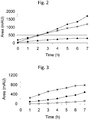
Figure 2 contains a plot of the concentration (arbitrary units) of lactose, glucose and galactose of the mixture of Example 3 during the enzymatic reaction. -
Figure 3 contains a plot of the concentration (arbitrary units) of the oligosaccharides Gal-Fuc, Gal-Gal-Fuc/Gal-Gal-Glc, and Gal-Gal-Gal-Fuc/Gal-Gal-Gal-Glc of the mixture of Example 3 during the enzymatic reaction. -
Figure 4 contains a plot of the concentration (arbitrary units) of the oligosaccharides Gal-Fuc, Gal-Gal-Fuc/Gal-Gal-Glc, and Gal-Gal-Gal-Fuc/Gal-Gal-Gal-Glc of the mixture of Example 4 during the enzymatic reaction. -
Figure 5 contains a plot of the concentration (arbitrary units) of the oligosaccharides Gal-GalNAc, Gal-Gal- GalNAc/Gal-Gal-Glc, and Gal-Gal-Gal-GalNAc /Gal-Gal-Gal-Glc of the mixture of Example 5 during the enzymatic reaction. -
Figure 6 contains a plot of the concentration (arbitrary units) of the oligosaccharides Gal-Xyl, Gal-Gal- Xyl/Gal-Gal-Glc, and Gal-Gal-Gal- Xyl/Gal-Gal-Gal-Glc of the mixture of Example 6 during the enzymatic reaction. - As mentioned, an aspect of the invention relates to a method of producing a composition comprising one or more galacto-oligosaccharide(s), the method comprising the steps of:
- a) providing a mixture comprising
- a galactosyl donor comprising a galactosyl group bound to a leaving group, which galactosyl donor has a molar weight of at most 350 g/mol,
- a galactosyl acceptor which is different from the galactosyl donor, said galactosyl acceptor is a saccharide or a sugar-alcohol, and
- b) providing an enzyme having beta-galactosidase activity and preferably having a T-value of at most 0.6, said enzyme contacting the mixture, the determination of the T-value of a beta-galactosidase enzyme is performed according to the assay in Example 2 and calculated using the formula:

- c) allowing the enzyme to release the leaving group of the galactosyl donor and transfer the galactosyl group of the galactosyl donor to the galactosyl acceptor, thus forming the galacto-oligosaccharide, and thereby obtaining the composition comprising the one or more galacto-oligosaccharide(s).
- In the context of the present invention, the term "glycosyl group" relates to a group obtained by removing one or two hydroxyl groups from a monosaccharide or a lower oligosaccharide, such as a di- or tri-saccharide, or from corresponding sugar-alcohols. The term is used herein to describe various building blocks of galactosyl donors, galactosyl acceptors and oligosaccharides.
- The abbreviations of the most common saccharides and their corresponding glycosyl groups are shown below.
Saccharide Abbreviation Name of glycosyl group glucose Glc glucosyl galactose Gal galactosyl fucose Fuc fucosyl mannose Man mannosyl xylose Xyl xylosyl N-acetylgalactosamine GalNAc N-acetylgalactosaminyl Lactose Lac lactosyl - In the context of the present invention, the term "oligosaccharide" relates to a molecule comprising at least two glycosyl groups, and preferably at least three, which may be different or the same type. The at least two glycosyl groups are preferably bound via an O-glycosylic bond. An oligosaccharide may be a linear chain of glycosyl groups or it may have a branched structure. Oligosaccharides may e.g. be represented as a stoichiometric formula, e.g. (Gal)3Glc, or as general formulas, e.g. Gal-Gal-Gal-Glc, Gal-Gal-Glc-Gal, or Gal-(Gal-)Glc-Gal. The stoichiometric formulas provide information regarding which glycosyl groups an oligosaccharide, or a group of oligosaccharides, contains, but not the relative position of these, whereas the general formulas also contain general information regarding the relative positions of the glycosyl groups.
- In the context of the present invention the term "homo-oligosaccharide" relates to an oligosaccharide containing only one type of glycosyl group. Examples of homo-oligosaccharides are Gal-Gal-Gal-Gal and Glc-Glc-Glc.
- In the context of the present invention the term "hetero-oligosaccharide" relates to an oligosaccharide which contains different glycosyl groups, e.g. Gal-Gal-Glc, or Gal-Gal-Fuc.
- In the context of the present invention, the prefix "galacto-" used together with the term "oligosaccharide" indicates that the oligosaccharide contains galactosyl groups as the repeating unit. The "homo-" or "hetero-" prefix may be used together with the "galacto-" prefix. Both Gal-Gal-Glc and Gal-Gal-Gal-Gal are galacto-oligosaccharides. Gal-Gal-Glc is a hetero-galacto-oligosaccharide and Gal-Gal-Gal-Gal is a homo-galacto-oligosaccharide.
- In the context of the present invention, "X" represents a galactosyl acceptor as defined herein. "-X" represents the glycosyl group corresponding to the galactosyl acceptor, and particularly the glycosyl group bound to another group. "-" symbolises the bond. The glycosyl group is preferably bound via the 3-, 4-, 5- or 6-position of the glycosyl group, and preferably via an O-glycosylic bond.
In the context of the present invention, "Gal-" represents a galactosyl group bound to another group, preferably via the 1-position of the galactosyl group, and preferably via an O-glycosylic bond. - In the context of the present invention, "-Gal-" represents a galactosyl group bound to two other groups. The left bond is preferably made via the 4- or 6-position of the galactosyl group, and preferably via an O-glycosylic bond. The right bond is preferably made via the 1-position of the galactosyl group, and preferably via an O-glycosylic bond.
- Bonds between two galactosyl groups are typically 1-4 or 1-6 bonds, and normally O-glycosylic bonds. A bond between a galactosyl group and a nitrogen-containing acceptor may alternatively be an N-glycosylic bond.
- In the context of the present invention the terms "method" and "process" are used interchangeably.
- Step a) involves the provision of the mixture in which the oligosaccharides are to be produced.
- The mixture is preferably a liquid mixture and may e.g. be an aqueous solution containing the galactosyl acceptor and the galactosyl donor.
- In some embodiments of the invention the molar ratio between the galactosyl acceptor and the galactosyl donor of the mixture of step a) is at least 1:5, preferably at least 1:1, and even more preferably at least 5:1. For example, the molar ratio between the galactosyl acceptor and the galactosyl donor of the mixture of step a) may be at least 10:1, such as at least 15:1.
- The molar ratio between the galactosyl acceptor and the galactosyl donor of the mixture of step a) may e.g. be in the range of 1:10-100:1.
- In some embodiments of the invention the molar ratio between the galactosyl acceptor and the galactosyl donor of the mixture of step a) is in the range of 1:10-50:1, preferably in the range of 1:5-30:1, and even more preferably in the range of 1:1-20:1. For example, the molar ratio between the galactosyl acceptor and the galactosyl donor of the mixture of step a) may e.g. be in the range of 2:1-40:1, preferably in the range of 4:1-30:1, and even more preferably in the range of 10:1-25:1.
- As mentioned, the galactosyl donors contain a galactosyl group covalently bound to a leaving group. The galactosyl group is preferably a β-D-galactopyranosyl group. Furthermore, the galactosyl group is preferably bound to the leaving group via an O-glycosidic bond from the 1-position of the galactosyl group.
- The leaving group of the galactosyl donor may for example be a glycosyl group and/or a sugar-alcohol group. If the leaving group is a glycosyl group of a mono- or disaccharide or a corresponding sugar-alcohol, the galactosyl group is preferably bound to the leaving group via an O-glycosidic bond from the 1-position of the galactosyl group, which bond attaches to the 4-position of a monosaccharide-type leaving group or to the 4'-position of a disaccharide-type leaving group.
- In the context of the present invention, the phrase "Y and/or X" means "Y" or "X" or "Y and X". Along the same line of logic, the phrase "X1, X2,..., Xi-1, and/or Xi" means " X1" or "X2" or... or "Xi-1" or "Xi" or any combination of the components : X1, X2,...Xi-1, and Xi.
- According to the invention the galactosyl donor has a molar weight of at most 350 g/mol.
- Disaccharides are a presently preferred type of galactosyl donor. Alternatively, or additionally, tri-saccharides may be used as galactosyl donors as well. Thus, it is envisioned that the mixture may contain a combination of different galactosyl donors.
- In some preferred embodiments of the invention the galactosyl donor is lactose. Another example of a useful galactosyl donor is lactulose. Yet an example of a useful galactosyl donor is lactitol.
- In the context of the present invention the term "lactose" relates to the disaccharide β-D-galactopyranosyl-(1→4)-D-glucose, which is also referred to as milk sugar, and which is the most predominant saccharide of bovine milk.
- The galactosyl donor may be provided via any useful galactosyl donor source, both industrially refined sources, such as purified lactose, and/or natural sources, such as whey permeate, i.e. deproteinated whey prepared by ultrafiltration of whey.
- The galactosyl acceptor is a saccharide or a sugar-alcohol and capable of accepting a galactosyl group from the enzyme and typically contains hydroxyl groups, and preferably alcoholic hydroxyl groups. The term "accepting" means that the galactosyl group of the donor should be covalently bound to the acceptor, e.g. via an O-glycosylic bond.
- In some embodiments of the invention the galactosyl acceptor comprises one or more alcoholic hydroxyl group(s). For example, the galactosyl acceptor may be a polyol.
- In the context of the present invention the term "polyol" relates to a molecule comprising at least two alcoholic hydroxyl groups.
- In some preferred embodiments of the invention the galactosyl acceptor is not lactose. It may furthermore be preferred that the galactosyl acceptor is not glucose.
- In some preferred embodiments of the invention the galactosyl acceptor is different from the galactosyl donor. It is particularly preferred to use a relatively cheap galactosyl donor, such as lactose, as galactosyl source and a biologically interesting acceptor, such as fucose, as galactosyl acceptor.
- In some embodiments of the invention the galactosyl acceptor is not lactose, galactose, or glucose.
- In some embodiments of the invention the galactosyl acceptor is not glucose or oligosaccharides of the general formula Gal-(Gal)i-Glc, where i is a non-negative integer, i.e. for example 0, 1, 2, 3, or 4.
- In some embodiments of the invention the galactosyl acceptor is not galactose or oligosaccharides of the general formula Gal-(Gal)i-Gal, where i is a non-negative integer.
- Galactosyl acceptors having various molar weights may be used, but galactosyl acceptors having a molar weight of at least 100 g/mol are presently preferred.
- In some embodiments of the invention the galactosyl acceptor has a molar weight of at most 1000 g/mol. For example, the galactosyl acceptor may have a molar weight of at most 500 g/mol. It may even be preferred that the galactosyl acceptor has a molar weight of at most 350 g/mol. The galactosyl acceptor may for example have a molar weight of at most 200 g/mol.
- In some preferred embodiments of the invention the galactosyl acceptor is a saccharide. The galactosyl acceptor may for example be a mono-saccharide. Alternatively, the galactosyl acceptor may be a di-saccharide.
- For example, the galactosyl acceptor may be a pentose. The galactosyl acceptor may e.g. be arabinose. Another example of a useful pentose is xylose. Yet an example of a useful pentose is ribose. The galactosyl acceptor may for example be a pentose selected from the group consisting of arabinose, xylose, and ribose.
- Hexoses are another group of useful galactosyl acceptors. The galactosyl acceptor may e.g. be mannose. Another example of a useful hexose is galactose. Yet an example of a useful hexose is tagatose. A further example of a useful hexose is fructose. The galactosyl acceptor may for example be a hexose selected from the group consisting of mannose, galactose, tagatose, and fructose.
- In some preferred embodiments of the invention the galactosyl acceptor is a deoxy-hexose. The galactosyl acceptor may for example be fucose, such as e.g. D-fucose, L-fucose, or a mixture thereof.
- Alternatively, the galactosyl acceptor may be an oligosaccharide, such as e.g. a di-saccharide or a tri-saccharide. An example of a useful di-saccharide is maltose. Another example of a useful di-saccharide is lactulose.
- Yet a useful group of galactosyl acceptors is saccharide derivatives.
- In the context of the present invention the term "saccharide derivative" pertains to a saccharide containing one or more non-hydroxyl functional group(s). Examples of such functional groups are a carboxyl group, an amino group, an N-acetylamino group and/or a thiol group. Saccharides which contain an aldehyde group at the 1-position or a ketone group at the 2-position are not considered saccharide derivatives as such unless the saccharides comprise some of the non-hydroxyl functional groups mentioned above.
- An example of a useful saccharide derivative is N-acetyl galactosamine. Another example of a useful saccharide derivative is sialic acid. Yet an example of a useful saccharide derivative is sialyl lactose. Thus, the galactosyl acceptor may be a saccharide derivative selected from the group consisting of N-acetyl galactosamine, sialic acid, and sialyl lactose.
- Another group of useful galactosyl acceptors is sugar alcohols. Thus, in some embodiments of the invention the galactosyl acceptor is a sugar alcohol. Examples of useful sugar alcohols are sorbitol, xylitol, lactitol, and/or maltitol.
- Contrary to the above-mentioned galactosyl acceptors, the present inventors have found that N-acetyl glucosamine and glucose are less efficient galactosyl acceptors. Thus, in some embodiments of the invention the galactosyl acceptor is not glucose or N-acetyl glucosamine.
- The mixture may contain one or more further galactosyl acceptor(s) different from the first type of galactosyl acceptor. The different types of galactosyl acceptors of the mixture may e.g. be selected among the galactosyl acceptor types mentioned herein.
- In some preferred embodiments of the invention the produced galactosylated acceptors act as a new type of galactosyl acceptor and can be galactosylated as well. In this way, galacto-oligosaccharides may be produced which have the stoichiometric formula Gali+1X, where i is a non-negative integer. Normally, the most predominant species are GalX, Gal2X, and Gal3X.
- In other preferred embodiments of the invention the produced galactosylated acceptors act as a new type of galactosyl acceptor and can be galactosylated as well. In this way, galacto-oligosaccharides may be produced which have the general formula Gal-(Gal)i-X, where i is a non-negative integer. Normally, the most predominant species are Gal-X, Gal-Gal-X, and Gal-Gal-Gal-X.
- In some embodiments of the invention the mixture of step a) comprises the galactosyl donor in a concentration of at most 0.7 mol/L, preferably at most 0.4 mol/L, and even more preferably at most 0.2 mol/L. The mixture may e.g. comprise the galactosyl donor in a concentration in the range of 0.001-0.7 mol/L, preferably in the range of 0.01-0.5 mol/L, and even more preferred in the range of 0.02-0.2 mol/L.
- Alternatively, the mixture of step a) may comprise the galactosyl donor in a concentration of at most 0.3 mol/L, preferably at most 0.1 mol/L, and even more preferably at most 0.05 mol/L. The mixture may e.g. comprise the galactosyl donor in a concentration in the range of 0.001-0.2 mol/L, preferably in the range of 0.005-0.1 mol/L, and even more preferred in the range of 0.01-0.05 mol/L.
- It should be noted that galactosylated galactosyl acceptor and galactosylated galactosyl donor may to a limited extent act as a galactosyl donor, but galactosylated galactosyl acceptor and galactosylated galactosyl donor are not considered a galactosyl donor in the context of the present invention and do not contribute to the concentrations or ratios of galactosyl donor mentioned herein.
- The galactosyl acceptor may be used in a range of difference concentrations. It is, however, preferred to avoid saturating the mixture with the galactosyl acceptor since excess galactosyl acceptor normally has to be removed from the galacto-oligosaccharide-containing composition of the invention.
- In some embodiments of the invention the mixture of step a) comprises the galactosyl acceptor in an amount of at least 0.05 mol/L, preferably at least 0.10 mol/L, and even more preferably at least 0.30 mol/L. Even higher concentrations of the galactosyl acceptor may be preferred, thus the mixture of step a) may e.g. comprise the galactosyl acceptor in an amount of at least 0.5 mol/L, preferably at least 0.7 mol/L, and even more preferably at least 1 mol/L.
- The mixture may e.g. comprise the galactosyl acceptor in a concentration in the range of 0.05 mol/L - 5 mol/L, preferably in the range of 0.1 mol/L - 2 mol/L, and even more preferably in the range of 0.3 mol/L - 1 mol/L.
- However, in some embodiments a relatively low concentration of the galactosyl acceptor is preferred in which case the mixture may e.g. comprise the galactosyl acceptor in a concentration of at most 2 mol/L, preferably at most 0.5 mol/L, and even more preferably at most 0.2 mol/L. For example, the mixture may comprise the galactosyl acceptor in a concentration in the range of 0.05 mol/L - 2 mol/L, preferably in the range of 0.06 mol/L - 1 mol/L, and even more preferably in the range of 0.08 mol/L - 0.8 mol/L.
- In addition to galactosyl acceptor and galactosyl donor, the mixture may furthermore contain various additives for optimizing the conditions for the enzymatic reaction.
- The mixture may for example contain one or more pH buffer(s) for adjusting the pH of the mixture to the pH optimum of the enzyme. Alternatively, or in addition, the mixture may comprise water soluble salts containing one or more metal ions. Depending on the specific enzyme, metal ions such as Ca2+, Zn2+, or Mg2+ may e.g. be used. Note, however, that some enzymes are insensitive to the presence of metal ions in the mixture.
- Conventional methods of synthesising oligosaccharides often employ water-activity-lowering agents, such as e.g. glycerol, ethylene glycol, propylene glycol, polyethyleneglycol (PEG). The present invention advantageously makes it possible to perform efficient synthesis of galacto-oligosaccharides without the use of such water-activity-lowering agents. Thus, in some preferred embodiments of the invention the mixture contains water-activity-lowering agent in an amount of at most 5% by weight relative to the weight of the mixture, preferably at most 1 % by weight, and even more preferably at most 0.1% by weight. For example, the mixture may contain water-activity-lowering agent in an amount of at most 0.05% by weight relative to the weight of the mixture.
- The mixture of step a) or the ingredients forming the mixture may have been heat treated before the reaction with enzyme to avoid microbial growth during the reaction. The usual heat treatment processes, such as pasteurisation (e.g. 72 degrees C for 15 seconds), high pasteurisation (e.g. 90 degrees C for 15 seconds), or UHT treatment (e.g. 140 degrees C for 4 seconds), may be used. Care should be taken when heat treating temperature labile enzymes.
- Step b) involves the provision of an enzyme, which has beta-galactosidase activity with a T-value of at most 0.6. It should be noted that the method may furthermore involve the use of additional enzymes, e.g. enzymes having a different enzymatic activity than beta-galactosidase activity or transgalactosylation activity.
- In the context of the present invention the term "beta-galactosidase activity" relates to enzymatic catalysis of the hydrolysis of terminal non-reducing β-D-galactose residues in β-D-galactosides, such as lactose. The enzyme used in the invention preferably belongs to the class EC 3.2.1.23.
- In some embodiments of the invention, the T-value of the enzyme is at most 0.5. Preferably the T-value of the enzyme may be at most 0.4. It may even be more preferred that the T-value of the enzyme is at most 0.3.
- Even lower T-values may be preferred, such as at most 0.2.
- Useful enzymes may e.g. be derived from a peptide (a β-galactosidase) prepared as described in Example 1.
- In some embodiments of the invention the enzyme may contain one or more glycosylated amino acid(s). Alternatively, or in addition, the enzyme may contain one or more phosphorylated amino acid(s). Alternatively, none of the amino acids of the enzyme are glycosylated or phosphorylated.
- In some preferred embodiments of the invention the enzyme comprises at least two sub-units, each sub-unit consisting of an enzyme as defined above.
- The enzyme preferably contacts the mixture and is thereby brought into contact with both the galactosyl acceptor and the galactosyl donor.
- In some embodiments of the invention the mixture comprises the enzyme. The enzyme may e.g. be present in the mixture in dissolved form, e.g. as single enzyme molecules or as soluble aggregate of enzyme molecules.
- In other embodiments of the invention the enzyme is separate from the mixture, but brought in contact with the galactosyl acceptor and the galactosyl donor by contacting the enzyme with the mixture. For example, enzyme immobilised on a stationary solid phase may be used. Examples of useful stationary solid phases are e.g. a filter, a packed bed of enzyme-containing particles, or similar structures.
- Alternatively, the solid phase may e.g. be a free flowing, particulate solid phase, e.g. organic or inorganic beads, forming part of the mixture.
- Details relating to the industrial use of enzymes including immobilisation techniques and suitable solid phase types can be found in Buchholz (2005).
- The enzyme is preferably used in a sufficient activity to obtain an acceptable yield of galacto-oligosaccharides. The optimal activity depends on the specific implementation of the process and can easily be determined by the person skilled in the art.
- If a high turn-over of galactosyl donor and a high yield of galacto-oligosaccharide is required, it may be preferred to use the enzyme in a relatively high activity. For example, the activity of the enzyme may be such that the turn-over of the galactosyl donor is at least 0.02 mol/(L*h), preferably at least 0.2 mol/(L*h), and even more preferably at least 2 mol/(L*h).
- The enzymatic reaction takes place during step c). As soon as the mixture is exposed to the right conditions, which may be almost immediately when the galactosyl acceptor and the galactosyl donor are brought in contact with the enzyme, the transgalactosylation usually starts, and in some embodiments of the invention steps b) and c) occur simultaneously.
- The enzyme is capable of releasing the leaving group of the galactosyl donor and transferring the galactosyl group of the galactosyl donor to the galactosyl acceptor. For example, if the galactosyl donor is lactose, glucose is released and the galactosyl group is transferred to the acceptor. The enzyme acts as catalyst during the enzymatic reaction.
- In some preferred embodiments of the invention the enzyme furthermore transfers galactosyl groups to already galactosylated galactosyl acceptors, thereby generating galactosyl acceptors containing two, three or even more galactosyl groups.
- The pH of the mixture is preferably near the optimum pH of the enzyme. In some embodiments of the invention the pH of the mixture during step c) is in the range of pH 3-9. For example, the pH of the mixture during step c) may be in the range of pH 4-8, such as in the range of pH 5-7.5.
- Similar to the pH, the temperature of the mixture is preferably adjusted to the optimum temperature of the used enzyme. In some embodiments of the invention the temperature during step c) is in the range of 10-80 degrees C. The temperature during step c) may e.g. be in the range of 20-70 degrees C, preferably in the range of 25-60 degrees C, and even more preferably in the range of 30-50 degrees C.
- In the context of the present invention, the term "optimum pH of the enzyme" relates to the pH where the enzyme has the highest transgalactosylation activity. Along the same lines, the term "optimum temperature of the enzyme" relates to the temperature where the enzyme has the highest transgalactosylation activity.
- The inventors have discovered that the present method surprisingly provides a high yield of galacto-oligosaccharides even though a relatively low concentration of the galactosyl donor is used. The relatively low concentration of galactosyl donor additionally reduces the degree of self-galactosylation of the donor, i.e. when the galactosyl group of a first galactosyl donor is transferred to a second galactosyl donor instead of to a galactosyl acceptor.
- In some preferred embodiments of the invention, step c) comprises addition of further galactosyl donor to the mixture. This is particularly preferred when a relatively low concentration of the galactosyl donor is used. By adding more galactosyl donor one avoids the galactosyl donor being depleted in the mixture and the concentration of galactosyl donor may be controlled during the enzymatic reaction.
- The addition of further galactosyl donor may involve discrete addition(s) of galactosyl donor, e.g. at least once during the enzymatic reaction. Alternatively, or additionally, the addition of further galactosyl donor may be a continuous addition during the enzymatic reaction. The further galactosyl donor is preferably of the same type as used in step a).
- In some preferred embodiments of the invention, the concentration of galactosyl donor of the mixture during step c) is maintained at a concentration in the range of 0.01-1 mol/L, preferably in the range of 0.01-0.5 mol/L, and preferably in the range of 0.03-0.3 mol/L.
- For example, the concentration of galactosyl donor of the mixture during step c) may be maintained at a concentration in the range of 0.02-0.1 mol/L.
- Step c) may furthermore comprise addition of further galactosyl acceptor. This makes it possible to control the concentration of galactosyl acceptor of the mixture during step c) and e.g. to keep the galactosyl acceptor concentration substantially constant if this is desired.
- In order to produce significant amounts of galacto-oligosaccharides, which contain two or three transferred galactosyl groups, the process should consume more galactosyl donor than galactosyl acceptor. Thereby more of the galactosyl acceptors will become galactosylated two or three times. Thus, in some preferred embodiments of the invention the molar ratio between the consumed galactosyl donor and the consumed galactosyl acceptor is at least 1:1, and preferably at least 5:1, and even more preferably at least 10:1.
- Often it is required to enrich and/or purify the galacto-oligosaccharides of the composition and reduce the concentration of the galactosyl acceptor, the galactosyl donor and the released leaving group.
- Thus, in some preferred embodiments of the invention the method furthermore comprises the step:
d) enriching the galacto-oligosaccharides of the composition of step c). - In the context of the present invention, the term "enriching the galacto-oligosaccharides" relates to increasing the relative amount of the galacto-oligosaccharides of the composition on a dry weight basis. This is typically done by removing some of the other solids of the composition, e.g. the lower saccharides, and optionally also the enzyme, if required.
- The enrichment of step d) may for example involve chromatographic separation and/or nanofiltration. Details regarding such processes are described in Walstra et al. (2006) which is incorporated herein by reference for all purposes.
- In some embodiments of the invention the enrichment involves that at least 50% (w/w on dry weight basis) of the molecules having a molar weight of at most 200 g/mol are removed from the composition of step c). For example, the enrichment may involve that at least 80% (w/w on dry weight basis) of the molecules having a molar weight of at most 200 g/mol are removed from the composition of step c).
- In other embodiments of the invention the enrichment involves that at least 50% (w/w on dry weight basis) of the molecules having a molar weight of at most 350 g/mol are removed from the composition of step c). For example, the enrichment may involve that at least 80% (w/w on dry weight basis) of the molecules having a molar weight of at most 350 g/mol are removed from the composition of step c).
- As an alternative, or in addition, to the enrichment it may be preferred that step d) comprises one or more processes which increase the concentration of the galacto-oligosaccharides in the composition. Examples of useful concentration steps are e.g. reverse osmosis, evaporation, and/or spray-drying.
- The galacto-oligosaccharide-containing composition provided by the method may for example be in the form of a dry powder or in the form of a syrup.
- The production of a dry powder typically requires one or more process steps, such as concentrating, evaporating, and/or spray-drying. Thus, in some preferred embodiments of the invention the step d) furthermore involves concentrating, evaporating, and/or spray-drying the composition in liquid form to obtain the composition in powder form. It is particularly preferred to spray-dry the liquid composition of step d) to obtain a powdered composition. Step d) may for example comprise the enrichment step followed by concentration step, e.g. nanofiltration, reverse osmosis, or evaporation, followed by a spray-drying step. Alternatively, step d) may comprise the concentration step followed by an enrichment step, followed by a spray-drying step. Concentrating the galacto-oligosaccharides of the composition prior to the enrichment may make the subsequent enrichment process more cost-efficient.
- Efficient spray-drying may require addition of one or more auxiliary agent(s), such as maltodextrin, milk protein, caseinate, whey protein concentrate, and/or skimmed-milk powder.
- The present process may e.g. be implemented as a batch process. The present process may alternatively be implemented as a fed-batch process. The present process may alternatively be implemented as a continuous process.
- The present process may furthermore involve recirculation of enzyme and/or unused galactosyl acceptor back to the mixture. The recirculation may e.g. form part of step d). For example, step d) may involve separating galactosyl acceptor and/or the enzyme from the galacto-oligosaccharide-containing composition and recirculating galactosyl acceptor and/or enzyme to step a), or c). In the case of a batch process or a fed-batch process, the galactosyl acceptor and/or the enzyme may be recirculated to the mixture of the next batch.
- In the case of a continuous process, the galactosyl acceptor may be recirculated back to part of the process line corresponding to step a) or step c). The enzyme may be recirculated back to part of the process line corresponding to step b) or step c).
- It should be noted that the details and features related to steps a) and b) need not relate to the actual start of a production process, but should at least occur sometime during the process. However, in some embodiments of the invention the concentration of the galactosyl donor is kept within the range described in step a) during the entire duration of step c).
- If the method is implemented as a batch or feed batch process, step a) preferably pertains to the composition of the mixture when the synthesis starts. If the method is a continuous process, step a) preferably pertains to the composition of the mixture during the synthesis under steady-state operation.
- It may be perceived as desirable that the level of galactosylated galactosyl donor is kept as low as possible, as galactosylated galactosyl donor may be perceived as an undesired impurity, which is tricky to separate from the galactosylated galactosyl acceptor. In some preferred embodiments of the invention, the mixture of step a) contains at most 0.5 mol/L galactosylated galactosyl donor. The galactosylated galactosyl donor may for example contain at most 0.1 mol/L galactosylated galactosyl donor. Even more preferably the galactosylated galactosyl donor contains at most 0.01 mol/L galactosylated galactosyl donor, and preferably substantially no galactosylated galactosyl donor.
- Described herein is also a composition comprising galacto-oligosaccharides, which composition is obtainable by the method as defined herein.
- A further aspect decribed herin is a galacto-oligosaccharide-containing composition, e.g. the above-mentioned composition, said galacto-oligosaccharide-containing composition being obtainable according to the method described herein and comprising:
- a first galacto-oligosaccharide having the general formula Gal-X,
- a second galacto-oligosaccharide having the stoichiometric formula (Gal)2X, such as e.g. the general formula Gal-Gal-X,
- a third galacto-oligosaccharide having the stoichiometric formula (Gal)3X, such as e.g. the general formula Gal-Gal-Gal-X, and
- The galacto-oligosaccharide-containing composition described herein may for example be a food ingredient.
- As described above, "X" or "-X" is preferably a glycosyl group of one of the galactosyl acceptors mentioned herein.
- In some embodiments "X" or "-X" is a glycosyl group of a monosaccharide, which is not glucose. In other embodiments "-X" is a glycosyl group of a disaccharide, which is not lactose.
- In some preferred embodiments of the invention "X" or "-X" is a fucosyl group. In other preferred embodiments of the invention "X" or "-X" is a galactosyl group.
- In some preferred embodiments the galacto-oligosaccharide-containing composition has a molar ratio between:
- the total amount of the galacto-oligosaccharides Gal-X, (Gal)2X, and (Gal)3X, and
- the total amount of the galacto-oligosaccharides Gal-Glc, Gal2Glc, Gal3Glc
- In other preferred embodiments the galacto-oligosaccharide-containing composition has a molar ratio between:
- the total amount of the galacto-oligosaccharides Gal-X, Gal-Gal-X, and Gal-Gal-Gal-X, and
- the total amount of the galacto-oligosaccharides Gal-Glc, Gal-Gal-Glc, Gal-Gal-Gal-Glc
- It is even possible that the galacto-oligosaccharide-containing composition does not contain any galacto-oligosaccharides of the formula Gal-Glc, Gal-Gal-Glc, and Gal-Gal-Gal-Glc at all.
- In some embodiments the galacto-oligosaccharide-containing composition has a molar ratio between the first galacto-oligosaccharide, the second galacto-oligosaccharide, and the third galacto-oligosaccharide in the range of 50-99 : 1-45 : 0.5-25.
- In other embodiments the galacto-oligosaccharide-containing composition has a molar ratio between the first galacto-oligosaccharide, the second galacto-oligosaccharide, and the third galacto-oligosaccharide in the range of 20-45 : 20-45: 20-45.
- In further embodiments the galacto-oligosaccharide-containing composition has a molar ratio between the first galacto-oligosaccharide, the second galacto-oligosaccharide, and the third galacto-oligosaccharide in the range of 0.5-25 : 1-45 : 50-98.
- In some preferred embodiments the galacto-oligosaccharide-containing composition comprises a total amount of the first galacto-oligosaccharide, second galacto-oligosaccharide, and third galacto-oligosaccharide of at least 10% by weight relative to the total weight of the galacto-oligosaccharide-containing composition. For example, the galacto-oligosaccharide-containing composition may comprise a total amount of the first galacto-oligosaccharide, second galacto-oligosaccharide, and third galacto-oligosaccharide of at least 20% by weight relative to the total weight of the galacto-oligosaccharide-containing composition, preferably at least 30% by weight, even more preferably at least 40% relative to the total weight of the galacto-oligosaccharide-containing composition.
- Even higher levels of the first, second, and third galacto-oligosaccharides may be preferred. Thus, in some preferred embodiments the galacto-oligosaccharide-containing composition comprises a total amount of the first galacto-oligosaccharide, second galacto-oligosaccharide, and third galacto-oligosaccharide of at least 50% by weight relative to the total weight of the galacto-oligosaccharide-containing composition. For example, the galacto-oligosaccharide-containing composition may comprise a total amount of the first galacto-oligosaccharide, second galacto-oligosaccharide, and third galacto-oligosaccharide of at least 60% by weight relative to the total weight of the galacto-oligosaccharide-containing composition, preferably least 70% by weight, even more preferably at least 80% relative to the total weight of the galacto-oligosaccharide-containing composition.
- Yet another aspect relates to a food product comprising the galacto-oligosaccharide-containing composition described herein.
- In some embodiments the food product is a functional food product such as infant formula or a product for clinical nutrition.
- In other embodiments the food product is a baked product, e.g. comprising baked dough, such as bread or similar products.
- In further embodiments the food product is a dairy product, e.g. a fresh dairy product such as milk, or a fermented dairy product such as yoghurt.
- In still further embodiments the food product is a pet food product.
- It should be noted that embodiments and features described in the context of one of the aspects of the present invention also apply to the other aspects of the invention.
- The invention will now be described in further details in the following non-limiting examples.
- A working volume of 750 mL fermentation medium was inoculated with a 2 mL starter-culture of Lysogeny broth (LB) medium with 100 mg/L ampicillin with an OD600 of 3.0 grown for 12 hours. The fermentation was performed in EC medium containing 2 % (w/v) yeast extract, 2 % (w/v) soy peptone, 1 % (w/v) glucose and 100 mg/L ampicillin. The E. coli strain expressing OLGA347 β-galactosidase was prepared as described earlier (
Jorgensen et al., US patent No. 6,555,348 B2 , Examples 1 and 2). The fermentor was from Applikon with glass dished bottom vessels with a total volume of 2 L and equipped with two Rushton impellers. During the fermentation, pH was maintained at pH 6.5 by appropriate addition of 2 M NaOH and 2 M H3PO4 and temperature was controlled at 37 degrees C. Oxygen was supplied by bubbling with air at a rate of 1-2 L/min, and pO2 was maintained at 30 % by increasing the agitation rate. Growth was followed by offline OD600 readings. The culture was harvested by centrifugation after approximately 10 h of growth at an OD600 value of 29.7. The 650 mL culture supernatant was stored at -20 degrees C. The periplasmic proteins were isolated from the cell pellet by osmotic shock by resuspending the cell pellet in 200 mL sucrose buffer (30 mM Tris-HCl, 40 % sucrose, 2 mM EDTA, pH 7.5) and incubating for 10 min at room temperature. After centrifugation, the supernatant was discarded and the pellet resuspended in 200 mL of cold water. 83 µL of a saturated MgCl2 solution was added, and the supernatant containing the periplasmic proteins were collected by a centrifugation step. The periplasmic fraction was filter sterilized through a 0.2µm Millipak 40 filter and stored at -20 degrees C. - The β-galactosidase activity of the 200 mL periplasmic fraction and the 650 mL culture supernatant was determined using o-nitrophenyl-β-D-galactopyranoside (OPNG) as a substrate according to protocol (J. Sambrook and D.W. Russell, Molecular Cloning - A laboratory manual, 3rd edition (2001), pp. 17.48-17.51). The majority of the activity was found in the periplasmic fraction (525 units, corresponding to 98%).
- The T-value of a beta-galactosidase enzyme is determined according to the assay and formula given below.
- Prepare 3.3 mL enzyme solution consisting of the beta-galactosidase enzyme to be tested, 10 mM sodium citrate, 1 mM magnesium citrate, 1 mM calcium-citrate, Milli-Q water (Millipore, USA), and having a pH of 6.5. The enzyme solution should contain the beta-galactosidase enzyme in an amount sufficient to use 33% (w/w) of the added lactose in 1 hour under the present assay condition. The temperature of the enzyme solution should be 37 degrees C.
- At time = T0 82.5 mg lactose monohydrate (for biochemistry, Merck Germany) is added to and mixed with, the enzyme solution, and the mixture is subsequently incubated at 37 degrees C for 4 hours. Precisely 1 hour after T0 a 100 µL sample is collected and is diluted 1:5 with Milli-Q water and inactivated by heating to 85 °C for 10 min. The inactivated mixture is kept at -20 degrees C until the characterization.
- The determination of the amount (in mol) of produced galactose and the amount of used lactose (in mol) may be performed using any suitable analysis technique. For example, the diluted mixture may be analyzed by HPLC according to the method described by Richmond et al. (1982) and Simms et al. (1994). Other useful analysis techniques are described in El Razzi (2002).
- Another example of a suitable analysis technique is ISO 5765-2:2002 (IDF 79-2: 2002) "Dried milk, dried ice-mixes and processed cheese - Determination of lactose content - Part 2: Enzymatic method utilizing the galactose moiety of the lactose".
- The T-value is calculated according to the following formula using the data obtained from the characterization of the diluted mixture of the assay:

- The above-mentioned assay was performed using the OLGA347 enzyme of Example 1.
- The diluted mixture obtained from the assay was analyzed with respect to converted (i.e. used) lactose and generated galactose via analytical HPLC. The HPLC apparatus was from Waters and equipped with a differential refractometer (RI-detector) and a BioRad Aminex HPX-87C column (300x7.8 mm, 125-0055). Elution of saccharides was performed isocratically with 0.05 g/L CaAcetate, a flow rate of 0.3 mL/min. and an injection volume of 20 µL.
- The obtained data was appropriately baseline corrected by automated software, peaks were individually identified and integrated. Quantification was performed by using external standards of lactose monohydrate (for biochemistry, Merck, Germany), D-(+)-glucose monohydrate (for biochemistry, Merck Eurolab, France), and D-(+)-galactose (≥99%, Sigma-Aldrich, Italy).
- The conversion of lactose and the formation of galactose to each time T was calculated from the quantified data. At time T=1h 29% of the lactose in the collected 100 µL sample had been converted, which corresponds to 2.3 µmol lactose. At time T=1 0.5 µmol galactose had been formed in the collected 100 µL sample. The T-value can therefore be calculated to 0.5 µmol / 2.3 µmol = 0.2.
- The diluted mixture obtained from the assay was also analyzed with respect to converted (i.e. used) lactose and generated galactose via the enzymatic method ISO 5765-2. A Boehringer Mannheim Lactose/D-Galactose test-kit from R-Biopharm (Cat. No. 10 176 303 035) was used and the test performed according to protocol. The enzymatic method confirmed a T-value of the OLGA347-enzyme of 0.2.
- The above-mentioned assay was performed using the commercially available conventional lactase enzyme Lactozym Pure 2600L (Novozymes, Denmark). The diluted mixture obtained from the assay was analyzed as described for the OLGA347 enzyme. Tri- and tetra-saccharides were not present in detectable amounts and equal amounts of glucose and galactose were seen. The corresponding T-value is 1.
- The T-values of commercially available beta-galactosidase from Escherichia coli (Product number: G6008, Sigma-Aldrich, Germany) and Aspergillus oryzae (Product number: G5160, Sigma-Aldrich, Germany) have also been determined, and both enzymes have a T-value of approx. 1.
- 700 mg L-(-)-Fucose (99%, Sigma-Aldrich, Slovakia) and 20 mg lactose monohydrate (for biochemistry, Merck, Germany) was dissolved in 5 mL buffer (10 mM Na-Citrat, 20 mM Na2HPO4, pH 6.5) and maintained at a temperature of 37 degrees C. 2 mL OLGA347 enzyme, prepared as in Example 1, was added. This time is defined as T=0. During a 6
h period 20 mg lactose monohydrate was added with 30 min. intervals. 100 µL samples were acquired at times T=0, 1, 2, 3, 4, 5, and 7 h. Sample acquisition and characterization was done as in example 2. Mass spectrometry analysis was performed with an Agilent 1100 API-ES LC/MSD Quadropole scanning masses between 100 and 1000 amu (gas temperature: 350 °C, drying gas flow: 13.0 L/min, nebulizer pressure: 60 psig). The detected ions arise from complexation between the analyte and sodium cations from the solution, resulting in detected masses of M(Na+) = M + 23 Da. - HPLC chromatograms from T=0 h and T=7 h are presented in
Fig. 1a and Fig. 1b , respectively. The peaks have been identified by MS (data not shown) and are labeled in the figures. Legend: 1 = lactose, 2 = glucose, 3 = galactose, 4 = L-fucose, 5 = sucrose, 6 = Gal-Fuc disaccharides, 7 = Gal-Gal-Fuc & Gal-Gal-Glc trisaccharides, 8 = Gal-Gal-Gal-Fuc & Gal-Gal-Gal-Glc tetrasaccharides. In the figures it can be seen that the concentration of glucose and galactose increases with glucose being approximately 4 times more abundant than galactose. This is in accordance with the assumption that galactose is being used as donor molecule for the formation of galacto-oligosaccharides and the remaining glucose being released into solution. The concentration of lactose increases due to continuing addition of lactose. This peak also includes allolactose and Gal-Gal disaccharides formed in the enzymatic reaction. Furthermore, Gal-Fuc disaccharides, Gal-Gal-Glc and Gal-Gal-Fuc trisaccharides and Gal-Gal-Gal-Glc and Gal-Gal-Gal-Fuc tetrasaccharides are formed. - Plots of the calculated peak area as a function of time for lactose, glucose and galactose are presented in
Fig. 2 . Legend: diamond = lactose, cross = glucose, triangle = galactose. It is seen that the concentration of lactose, allolactose and Gal-Gal disaccharides increases and that the concentration of glucose increases linearly as glucose is being released into the solution during the enzymatic reaction. The concentration of galactose is low compared to glucose and the concentration increases only slowly. This indicates that almost all galactose provided from the cleavage of lactose has been used to form galacto-oligosaccharides. Furthermore, the concentration of L-fucose decreases during the course of the experiment, as L-fucose is being used as acceptor molecule in the enzymatic reaction to form galacto-oligosaccharides (data not shown). -
Fig. 3 shows a plot of the calculated peak area as a function of time for the products from the enzymatic reaction. Legend: star = Gal-Fuc disaccharide, circle = Gal-Gal-Glc & Gal-Gal-Fuc trisaccharide, hollow square = Gal-Gal-Gal-Glc & Gal-Gal-Gal-Fuc tetrasaccharide. Both Gal-Fuc disaccharides and tri- and tetrasaccharides are formed. The trisaccharides are of the form Gal-Gal-Glc and Gal-Gal-Fuc, and the tetrasaccharides are of the form Gal-Gal-Gal-Glc and Gal-Gal-Gal-Fuc. - The concentration of Gal-Fuc disaccharides increases linearly and shows a tendency of reaching a plateau from T=6 h to T=7 h. The concentration of Gal-Gal-Glc and Gal-Gal-Fuc trisaccharides increases linearly and shows a tendency of exponential increase from T=4 h. The concentration of the Gal-Gal-Gal-Glc and Gal-Gal-Gal-Fuc tetrasaccharides increases linearly.
- The amounts (w/w of total carbohydrate) of L-fucose-containing galacto-oligosaccharides are estimated based on HPLC and MS data at T=7 h: Gal-Fuc = 8 %, Gal-Gal-Fuc = 3 %, Gal-Gal-Gal-Fuc = 1 %. In all, L-fucose-containing galacto-oligosaccharides constitute 12 % after a reaction time of T=7 h. Upon removal of free L-fucose by chromatography, the calculated amount of L-fucose-containing galacto-oligosaccharides is 28 %.
- 110 mg D-(+)-Fucose (≥98 %, Sigma-Aldrich, Slovakia) and 55 mg lactose monohydrate (for biochemistry, Merck, Germany) was dissolved in 1 mL buffer (10 mM Na-Citrat, 20 mM Na2HPO4, pH 6.5). 100 µL OLGA347 enzyme, which was prepared as in Example 1, was added. This time is defined as T=0. 100 µL samples were acquired at times T=0, 2, 4, 6, and 22 h. Sample acquisition and HPLC characterization was done as in example 2. MS characterization was done as in example 3.
-
Fig. 4 shows a plot of the calculated peak area as a function of time for the products from the enzymatic reaction. Legend: star = Gal-Fuc disaccharide, circle = Gal-Gal-Glc & Gal-Gal-Fuc trisaccharide, hollow square = Gal-Gal-Gal-Glc & Gal-Gal-Gal-Fuc tetrasaccharide. Both Gal-Fuc disaccharides and tri- and tetrasaccharides are formed. The trisaccharides are of the form Gal-Gal-Glc and Gal-Gal-Fuc, and the tetrasaccharides are of the form Gal-Gal-Gal-Glc and Gal-Gal-Gal-Fuc. - The concentration of Gal-Fuc disaccharides shows the largest increase from T=0 to T=6 h. From T=6 to T=22 h the rate of increase is lower. The concentration of Gal-Gal-Glc and Gal-Gal-Fuc trisaccharides shows the second largest increase from T=0 to T=6 h. From T=6 to T=22 h the concentration drops to the level of T=4 h. The concentration of the Gal-Gal-Gal-Glc and Gal-Gal-Gal-Fuc tetrasaccharides increases from T=0 to T=6 h. From T=6 to T=22 h the concentration drops to the level of T=4 h.
- The amounts (w/w of total carbohydrate) of D-fucose-containing galacto-oligosaccharides are estimated based on HPLC and MS data from T=22 h. Gal-Fuc = 20 %. Gal-Gal-Fuc = 6, and Gal-Gal-Gal-Fuc = 1 %. In all, D-fucose-containing galacto-oligosaccharides constitute 27 % after a reaction time of T=22 h. Upon removal of free D-fucose by chromatography, the calculated amount of D-fucose-containing galacto-oligosaccharides is 55 %.
- The experiment was conducted as in example 4, only with 110 mg N-Acetyl-D-galactosamine (GalNAc) (98%, Sigma-Aldrich, Germany) as acceptor molecule. 100 µL samples were acquired at times T=0, 4, and 23 h. Sample acquisition and HPLC characterization was done as in example 2. MS characterization was done as in example 3.
-
Fig. 5 shows a plot of the calculated peak area as a function of time for the products from the enzymatic reaction. Legend: star = Gal-GalNAc disaccharide, circle = Gal-Gal-Glc & Gal-Gal-GalNAc trisaccharide, hollow square = Gal-Gal-Gal-Glc & Gal-Gal-Gal-GalNAc tetrasaccharide. Both Gal-GalNAc disaccharides and tri- and tetrasaccharides are formed. The trisaccharides are of the form Gal-Gal-Glc and Gal-Gal-GalNAc, and the tetrasaccharides are of the form Gal-Gal-Gal-Glc and Gal-Gal-Gal-GalNAc. - The concentration of Gal-GalNAc disaccharides increases linearly from T=0 to T=23 h, and is the most abundant galacto-oligosaccharide at T=23 h. The concentration of Gal-Gal-Glc and Gal-Gal-GalNAc trisaccharides shows the largest increase from T=0 to T=4 h. From T=4 to T=23 h the rate of increase in concentration is lower and almost reaches the Gal-GalNAc level at T=23 h. The concentration of the Gal-Gal-Gal-Glc and Gal-Gal-Gal-Fuc tetrasaccharides increases from T=0 to T=23 h with the largest increase from T=0 to T=4 h. The amounts (w/w of total carbohydrate) of N-acetyl-galactosamine-containing galacto-oligosaccharides are estimated based on HPLC and MS data from T=23 h. Gal-GalNAc = 8 %, Gal-Gal-GalNAc = 5 %, and Gal-Gal-Gal-GalNAc = 2 %. In all, GalNAC-containing galacto-oligosaccharides constitute 15 % after a reaction time of T=23 h. Upon removal of free GalNAc by chromatography, the calculated amount of N-acetyl-galactosamine-containing galacto-oligosaccharides is 40 %.
- The experiment was conducted as in example 4, only with 110 mg D-(+)-Xylose (≥99 %, Sigma-Aldrich, USA) as acceptor molecule. 100 µL samples were acquired at times T=0, 5, and 23 h. Sample acquisition and HPLC characterization was done as in example 2. MS characterization was done as in example 3.
-
Fig. 6 shows a plot of the calculated peak area as a function of time for the products from the enzymatic reaction. Legend: star = Gal-Xyl disaccharide, circle = Gal-Gal-Glc & Gal-Gal-Xyl trisaccharide, hollow square = Gal-Gal-Gal-Glc & Gal-Gal-Gal-Xyl tetrasaccharide. Both Gal-Xyl disaccharides and tri- and tetrasaccharides are formed. The trisaccharides are of the form Gal-Gal-Glc and Gal-Gal-Xyl, and the tetrasaccharides are of the form Gal-Gal-Gal-Glc and Gal-Gal-Gal-Xyl. - The concentration of Gal-Xyl disaccharides shows the largest increase from T=0 to T=5 h. From T=5 to T=23 h the concentration drops to the level of T=4 h. The concentration of Gal-Gal-Glc and Gal-Gal-Xyl trisaccharides shows the second largest increase from T=0 to T=5 h. From T=5 to T=23 h the concentration drops to the level of T=4 h. The concentration of the Gal-Gal-Gal-Glc and Gal-Gal-Gal-Fuc tetrasaccharides increases from T=0 to T=5 h. From T=5 to T=23 h the concentration does not change at an observable level.
- The amounts (w/w of total carbohydrate) of xylosyl-containing galacto-oligosaccharides are estimated based on HPLC and MS data from T=23 h. Gal-Xyl = 15 %. Gal-Gal-Xyl = 3 %. Gal-Gal-Gal-Xyl = 0.5 %. In all, xylosyl-containing galacto-oligosaccharides constitute 18.5 % after a reaction time of T=23 h. Upon removal of free Xylose by chromatography, the calculated amount of xylosyl-containing galacto-oligosaccharides is 41 %.
REFERENCES Buchholz (2005) "Biocatalysts and Enzyme technology", Klaus Buchholz et al., ISBN-10: 3-527-30497-5, 2005, Wiley VCH Verlag GmbH Franck (2002) "Technological functionality of inulin and oligofructose", A. Franck, British Journal of Nutrition (2002), 87, Suppl. 2, S287-S291 Yun (1996) "Fructooligosaccharides-Occurrence, preparation, and application", J. W. Yun, Enzyme and Microbial Technology 19: 107-117, 1996 Kunz (2000) "Oligosaccharides in human milk: Structural, functional and metabolic aspects", Kunz et al., Ann. Rev. Nutr. 2000. 20:699-722 Simms et al. (1994) Simms, P.J.; Hicks, K.B.; Haines, R.M.; Hotchkiss, A.T. and Osman, S.F.; (1994) Separations of lactose, lactobionic and lactobionolactose by high performance liquid chromatography. J. of Chromatography, 667, 67-73. Richmond et al. (1982) Richmond, M.L.; Barfuss, D.L.; Harte, B.R.; Gray, J.I. and Stine, C.M.; (1982) Separation of Carbohydrates in Dairy Products by High Performance Liquid Chromatography, J. of Dairy Science, 65 (8), 1394-1400. El Razzi (2002) "Carbohydrate Analysis by Modern Chromatography and Electrophoresis", volume 66, Journal of Chromatography Library, Elsevier Science, 2002, ISBN-10: 0444500618 Walstra et al. (2006) "Dairy science and technology", Walstra et al., CRC Press, Second edition, 2006 -
- <110> Arla Foods amba
- <120> Galacto-oligosaccharide-containing composition and a method of
producing it - <130> P1018PC00
- <160> 2
- <170> PatentIn version 3.1
- <210> 1
<211> 5509
<212> DNA
<213> Bifidobacterium bifidum - <220>
<221> CDS
<222> (212)..(5470)
<223> - <400> 1


- <210> 2
<211> 1752
<212> PRT
<213> Bifidobacterium bifidum - <400> 2



Claims (10)
- A method of producing a composition comprising one or more galacto-oligosaccharide(s), the method comprising the steps of:a) providing a mixture comprising- a galactosyl donor comprising a galactosyl group bound to a leaving group, which galactosyl donor has a molar weight of at most 350 g/mol,- a galactosyl acceptor which is different from the galactosyl donor, said galactosyl acceptor is a saccharide or a sugar-alcohol, andwherein the molar ratio between the galactosyl acceptor and the galactosyl donor is at least 1:10, and wherein the mixture comprises at least 0.05 mol/L of the galactosyl acceptor and the galactosyl donor in a concentration of at most 0.7 mol/L,b) providing an enzyme having beta-galactosidase activity and having a T-value of at most 0.6, said enzyme contacting the mixture, the determination of the T-value of a beta-galactosidase enzyme is performed by providing a solution consisting of the beta-galactosidase enzyme in an amount sufficient to use 33% (w/w) of added lactose in 1 hour at 37°C for 4 hours and calculated using the formula:
 c) allowing the enzyme to release the leaving group of the galactosyl donor and transfer the galactosyl group of the galactosyl donor to the galactosyl acceptor, thus forming the galacto-oligosaccharide, and thereby obtaining the composition comprising the galacto-oligosaccharide.
 - The method according to claim 1, wherein the enzyme has a T-value of at most 0.5.
- The method according to claim 1 or 2, wherein the leaving group of the galactosyl donor is a glycosyl group.
- The method according to any of the preceding claims, wherein the molar ratio between the galactosyl acceptor and the galactosyl donor is at least 1:5.
- The method according to any of the preceding claims, wherein the mixture of step a) comprises the galactosyl donor in a concentration of at most 0.4 mol/L,
- The method according to any of the preceding claims, wherein the galactosyl donor is lactose or lactitol.
- The method according to any of the preceding claims, wherein step c) comprises addition of further galactosyl donor.
- The method according to any of the preceding claims, wherein the concentration of galactosyl donor of the mixture during step c) is maintained at a concentration in the range of 0.01-1 mol/L.
- The method according to any of the preceding claims furthermore comprising the step:
d) enriching the galacto-oligosaccharide of the composition of step c). - The method according to claim 9, wherein the enrichment involves chromatographic separation and/or nanofiltration.
Priority Applications (1)
| Application Number | Priority Date | Filing Date | Title |
|---|---|---|---|
| EP11734090.1A EP2596113B1 (en) | 2010-07-19 | 2011-07-19 | Galacto-oligosaccharide-containing composition and a method of producing it |
Applications Claiming Priority (4)
| Application Number | Priority Date | Filing Date | Title |
|---|---|---|---|
| US36556010P | 2010-07-19 | 2010-07-19 | |
| EP10169981 | 2010-07-19 | ||
| PCT/EP2011/062355 WO2012010597A1 (en) | 2010-07-19 | 2011-07-19 | Galacto-oligosaccharide-containing composition and a method of producing it |
| EP11734090.1A EP2596113B1 (en) | 2010-07-19 | 2011-07-19 | Galacto-oligosaccharide-containing composition and a method of producing it |
Publications (2)
| Publication Number | Publication Date |
|---|---|
| EP2596113A1 EP2596113A1 (en) | 2013-05-29 |
| EP2596113B1 true EP2596113B1 (en) | 2018-09-12 |
Family
ID=43218466
Family Applications (1)
| Application Number | Title | Priority Date | Filing Date |
|---|---|---|---|
| EP11734090.1A Active EP2596113B1 (en) | 2010-07-19 | 2011-07-19 | Galacto-oligosaccharide-containing composition and a method of producing it |
Country Status (13)
| Country | Link |
|---|---|
| US (2) | US20130189746A1 (en) |
| EP (1) | EP2596113B1 (en) |
| JP (1) | JP2013530719A (en) |
| KR (1) | KR20130041953A (en) |
| CN (1) | CN103080329B (en) |
| AR (1) | AR082261A1 (en) |
| BR (1) | BR112013001109A2 (en) |
| CA (1) | CA2805997A1 (en) |
| DK (1) | DK2596113T3 (en) |
| EA (1) | EA201300150A1 (en) |
| MX (1) | MX348325B (en) |
| NZ (1) | NZ607149A (en) |
| WO (1) | WO2012010597A1 (en) |
Families Citing this family (16)
| Publication number | Priority date | Publication date | Assignee | Title |
|---|---|---|---|---|
| EP2620506A1 (en) * | 2012-01-25 | 2013-07-31 | Arla Foods Amba | Method of producing a galacto-oligosaccharide-containing composition |
| WO2013182686A1 (en) | 2012-06-08 | 2013-12-12 | Dupont Nutrition Biosciences Aps | Polypeptides having transgalactosylating activity |
| EP2864492A4 (en) * | 2012-06-22 | 2016-06-15 | Glycom As | Modified galactooligosaccharides |
| US11116235B2 (en) | 2013-05-24 | 2021-09-14 | General Mills, Inc. | Food products with yogurt whey |
| AU2014363517B2 (en) | 2013-12-11 | 2018-06-28 | International N&H Denmark Aps | A method for preparing a dairy product having a stable content of galacto-oligosaccharide(s) |
| KR101595014B1 (en) | 2014-02-21 | 2016-02-18 | 재단법인 임실치즈과학연구소 | Method of fermented milk using lactobacillus |
| US20170339970A1 (en) * | 2014-11-07 | 2017-11-30 | Dupont Nutrition Biosciences Aps | Method of generating a saccharide containing a galactose and a fructose moiety employing enzyme with transgalactosylating activity |
| CA2966718A1 (en) | 2014-11-07 | 2016-05-12 | Dupont Nutrition Biosciences Aps | Recombinant host cell expressing beta-galactosidase and/or transgalactosylating activity deficient in mannanase, cellulase and pectinase |
| DK3607097T3 (en) | 2017-04-07 | 2023-09-18 | Dupont Nutrition Biosci Aps | BACILLUS HOST CELLS PRODUCING BETA-GALACTOSIDASES AND LACTASES IN THE ABSENCE OF P-NITROBENZYL ESTERASE SIDE ACTIVITY |
| GB201805577D0 (en) | 2018-04-04 | 2018-05-16 | Optibiotix Health Ltd | Prebiotic compositions and methods of production thereof |
| AU2022354202A1 (en) | 2021-09-30 | 2024-03-14 | International N&H Denmark Aps | Method for reducing sugar in food stuff |
| CN118695783A (en) | 2021-11-12 | 2024-09-24 | 凯里集团国际有限公司 | Methods of producing dairy products |
| WO2024206631A1 (en) | 2023-03-29 | 2024-10-03 | International N&H Denmark Aps | Methods for modifying texture in foodstuff via preferably in situ produced alpha-glucan |
| WO2026015598A2 (en) | 2024-07-11 | 2026-01-15 | International N&H Denmark Aps | Method to provide improved texture and stable sucrose levels in foodstuff with glucosyltransferase |
| WO2026102382A2 (en) | 2024-11-11 | 2026-05-15 | International N&H Denmark Aps | Method for reducing sugar in foodstuff through conversion of fructose with epimerase |
| WO2026136198A1 (en) | 2024-12-16 | 2026-06-25 | International N&H Denmark Aps | Soluble oligosaccharide syrup production |
Family Cites Families (4)
| Publication number | Priority date | Publication date | Assignee | Title |
|---|---|---|---|---|
| AU6206801A (en) * | 2000-05-26 | 2001-12-03 | Arla Foods Amba | A new enzyme isolated from a bifidobacterium |
| EP1205555A1 (en) * | 2000-11-08 | 2002-05-15 | Solvent Innovation GmbH | Enzymatic catalysis in the presence of ionic liquids |
| PL1644482T5 (en) * | 2003-06-30 | 2015-05-29 | Clasado Inc | Novel galactooligosaccharide composition and the preparation thereof |
| GB0522740D0 (en) * | 2005-11-08 | 2005-12-14 | Clasado Inc | Process for the production of oligosaccharides |
-
2011
- 2011-07-19 US US13/811,171 patent/US20130189746A1/en not_active Abandoned
- 2011-07-19 CA CA2805997A patent/CA2805997A1/en not_active Abandoned
- 2011-07-19 KR KR1020137004179A patent/KR20130041953A/en not_active Ceased
- 2011-07-19 EA EA201300150A patent/EA201300150A1/en unknown
- 2011-07-19 EP EP11734090.1A patent/EP2596113B1/en active Active
- 2011-07-19 AR ARP110102598A patent/AR082261A1/en unknown
- 2011-07-19 CN CN201180035455.1A patent/CN103080329B/en not_active Expired - Fee Related
- 2011-07-19 NZ NZ607149A patent/NZ607149A/en not_active IP Right Cessation
- 2011-07-19 BR BR112013001109A patent/BR112013001109A2/en not_active IP Right Cessation
- 2011-07-19 MX MX2013000793A patent/MX348325B/en active IP Right Grant
- 2011-07-19 WO PCT/EP2011/062355 patent/WO2012010597A1/en not_active Ceased
- 2011-07-19 DK DK11734090.1T patent/DK2596113T3/en active
- 2011-07-19 JP JP2013520127A patent/JP2013530719A/en active Pending
-
2016
- 2016-07-22 US US15/217,266 patent/US20160369313A1/en not_active Abandoned
Non-Patent Citations (1)
| Title |
|---|
| None * |
Also Published As
| Publication number | Publication date |
|---|---|
| BR112013001109A2 (en) | 2016-05-24 |
| WO2012010597A1 (en) | 2012-01-26 |
| EP2596113A1 (en) | 2013-05-29 |
| CN103080329A (en) | 2013-05-01 |
| AU2011281663A1 (en) | 2013-03-07 |
| EA201300150A1 (en) | 2013-08-30 |
| US20160369313A1 (en) | 2016-12-22 |
| CA2805997A1 (en) | 2012-01-26 |
| JP2013530719A (en) | 2013-08-01 |
| MX348325B (en) | 2017-06-06 |
| MX2013000793A (en) | 2014-04-30 |
| AR082261A1 (en) | 2012-11-21 |
| CN103080329B (en) | 2016-08-03 |
| DK2596113T3 (en) | 2019-01-07 |
| KR20130041953A (en) | 2013-04-25 |
| NZ607149A (en) | 2014-12-24 |
| US20130189746A1 (en) | 2013-07-25 |
Similar Documents
| Publication | Publication Date | Title |
|---|---|---|
| US20160369313A1 (en) | Galacto-oligosaccharide-containing composition and a method of producing it | |
| EP2807264B1 (en) | Method of producing a composition containing galacto-oligosaccharides | |
| Mahoney | Galactosyl-oligosaccharide formation during lactose hydrolysis: a review | |
| US8586332B2 (en) | Method for producing oligopolysaccharides | |
| EP3744725B1 (en) | Diversification of human milk oligosaccharides (hmos) or precursors thereof | |
| JP5597890B2 (en) | New prebiotics | |
| Silvério et al. | Biocatalytic approaches using lactulose: end product compared with substrate | |
| Villamiel et al. | Production and bioactivity of oligosaccharides derived from lactose | |
| EP3848471A1 (en) | Sequential fermentative production of oligosaccharides | |
| EP2864492A1 (en) | Modified galactooligosaccharides | |
| CN117716047A (en) | Continuous fermentation production of oligosaccharides | |
| Guerrero et al. | Lactulose | |
| AU2011281663B2 (en) | Galacto-oligosaccharide-containing composition and a method of producing it | |
| JP2017018135A (en) | Galactooligosaccharide-containing composition and method for producing the same | |
| JPH11253191A (en) | Method for synthesizing lacto-N-tetraose | |
| KUMAR | STUDY ON OLIGOSACCHARIDE FORMATION BY β-GALACTOSIDASE OF LACTIC ACID BACTERIA |
Legal Events
| Date | Code | Title | Description |
|---|---|---|---|
| PUAI | Public reference made under article 153(3) epc to a published international application that has entered the european phase |
Free format text: ORIGINAL CODE: 0009012 |
|
| 17P | Request for examination filed |
Effective date: 20130218 |
|
| AK | Designated contracting states |
Kind code of ref document: A1 Designated state(s): AL AT BE BG CH CY CZ DE DK EE ES FI FR GB GR HR HU IE IS IT LI LT LU LV MC MK MT NL NO PL PT RO RS SE SI SK SM TR |
|
| AX | Request for extension of the european patent |
Extension state: BA ME |
|
| STAA | Information on the status of an ep patent application or granted ep patent |
Free format text: STATUS: EXAMINATION IS IN PROGRESS |
|
| 17Q | First examination report despatched |
Effective date: 20170302 |
|
| REG | Reference to a national code |
Ref country code: DE Ref legal event code: R079 Ref document number: 602011051971 Country of ref document: DE Free format text: PREVIOUS MAIN CLASS: C12P0019020000 Ipc: C12P0019140000 |
|
| GRAP | Despatch of communication of intention to grant a patent |
Free format text: ORIGINAL CODE: EPIDOSNIGR1 |
|
| STAA | Information on the status of an ep patent application or granted ep patent |
Free format text: STATUS: GRANT OF PATENT IS INTENDED |
|
| RIC1 | Information provided on ipc code assigned before grant |
Ipc: C07H 3/06 20060101ALI20180117BHEP Ipc: C12P 19/14 20060101AFI20180117BHEP Ipc: C07H 3/04 20060101ALI20180117BHEP |
|
| INTG | Intention to grant announced |
Effective date: 20180220 |
|
| GRAJ | Information related to disapproval of communication of intention to grant by the applicant or resumption of examination proceedings by the epo deleted |
Free format text: ORIGINAL CODE: EPIDOSDIGR1 |
|
| STAA | Information on the status of an ep patent application or granted ep patent |
Free format text: STATUS: EXAMINATION IS IN PROGRESS |
|
| INTC | Intention to grant announced (deleted) | ||
| GRAR | Information related to intention to grant a patent recorded |
Free format text: ORIGINAL CODE: EPIDOSNIGR71 |
|
| GRAS | Grant fee paid |
Free format text: ORIGINAL CODE: EPIDOSNIGR3 |
|
| STAA | Information on the status of an ep patent application or granted ep patent |
Free format text: STATUS: GRANT OF PATENT IS INTENDED |
|
| GRAA | (expected) grant |
Free format text: ORIGINAL CODE: 0009210 |
|
| STAA | Information on the status of an ep patent application or granted ep patent |
Free format text: STATUS: THE PATENT HAS BEEN GRANTED |
|
| AK | Designated contracting states |
Kind code of ref document: B1 Designated state(s): AL AT BE BG CH CY CZ DE DK EE ES FI FR GB GR HR HU IE IS IT LI LT LU LV MC MK MT NL NO PL PT RO RS SE SI SK SM TR |
|
| AX | Request for extension of the european patent |
Extension state: BA ME |
|
| INTG | Intention to grant announced |
Effective date: 20180806 |
|
| RAP1 | Party data changed (applicant data changed or rights of an application transferred) |
Owner name: DUPONT NUTRITION BIOSCIENCES APS |
|
| REG | Reference to a national code |
Ref country code: GB Ref legal event code: FG4D |
|
| REG | Reference to a national code |
Ref country code: CH Ref legal event code: EP |
|
| REG | Reference to a national code |
Ref country code: IE Ref legal event code: FG4D |
|
| REG | Reference to a national code |
Ref country code: DE Ref legal event code: R096 Ref document number: 602011051971 Country of ref document: DE |
|
| REG | Reference to a national code |
Ref country code: AT Ref legal event code: REF Ref document number: 1040634 Country of ref document: AT Kind code of ref document: T Effective date: 20181015 |
|
| REG | Reference to a national code |
Ref country code: DK Ref legal event code: T3 Effective date: 20190103 |
|
| REG | Reference to a national code |
Ref country code: NL Ref legal event code: MP Effective date: 20180912 |
|
| REG | Reference to a national code |
Ref country code: LT Ref legal event code: MG4D |
|
| PG25 | Lapsed in a contracting state [announced via postgrant information from national office to epo] |
Ref country code: NO Free format text: LAPSE BECAUSE OF FAILURE TO SUBMIT A TRANSLATION OF THE DESCRIPTION OR TO PAY THE FEE WITHIN THE PRESCRIBED TIME-LIMIT Effective date: 20181212 Ref country code: GR Free format text: LAPSE BECAUSE OF FAILURE TO SUBMIT A TRANSLATION OF THE DESCRIPTION OR TO PAY THE FEE WITHIN THE PRESCRIBED TIME-LIMIT Effective date: 20181213 Ref country code: FI Free format text: LAPSE BECAUSE OF FAILURE TO SUBMIT A TRANSLATION OF THE DESCRIPTION OR TO PAY THE FEE WITHIN THE PRESCRIBED TIME-LIMIT Effective date: 20180912 Ref country code: SE Free format text: LAPSE BECAUSE OF FAILURE TO SUBMIT A TRANSLATION OF THE DESCRIPTION OR TO PAY THE FEE WITHIN THE PRESCRIBED TIME-LIMIT Effective date: 20180912 Ref country code: LT Free format text: LAPSE BECAUSE OF FAILURE TO SUBMIT A TRANSLATION OF THE DESCRIPTION OR TO PAY THE FEE WITHIN THE PRESCRIBED TIME-LIMIT Effective date: 20180912 Ref country code: RS Free format text: LAPSE BECAUSE OF FAILURE TO SUBMIT A TRANSLATION OF THE DESCRIPTION OR TO PAY THE FEE WITHIN THE PRESCRIBED TIME-LIMIT Effective date: 20180912 Ref country code: BG Free format text: LAPSE BECAUSE OF FAILURE TO SUBMIT A TRANSLATION OF THE DESCRIPTION OR TO PAY THE FEE WITHIN THE PRESCRIBED TIME-LIMIT Effective date: 20181212 |
|
| PG25 | Lapsed in a contracting state [announced via postgrant information from national office to epo] |
Ref country code: AL Free format text: LAPSE BECAUSE OF FAILURE TO SUBMIT A TRANSLATION OF THE DESCRIPTION OR TO PAY THE FEE WITHIN THE PRESCRIBED TIME-LIMIT Effective date: 20180912 Ref country code: LV Free format text: LAPSE BECAUSE OF FAILURE TO SUBMIT A TRANSLATION OF THE DESCRIPTION OR TO PAY THE FEE WITHIN THE PRESCRIBED TIME-LIMIT Effective date: 20180912 Ref country code: HR Free format text: LAPSE BECAUSE OF FAILURE TO SUBMIT A TRANSLATION OF THE DESCRIPTION OR TO PAY THE FEE WITHIN THE PRESCRIBED TIME-LIMIT Effective date: 20180912 |
|
| REG | Reference to a national code |
Ref country code: AT Ref legal event code: MK05 Ref document number: 1040634 Country of ref document: AT Kind code of ref document: T Effective date: 20180912 |
|
| PG25 | Lapsed in a contracting state [announced via postgrant information from national office to epo] |
Ref country code: NL Free format text: LAPSE BECAUSE OF FAILURE TO SUBMIT A TRANSLATION OF THE DESCRIPTION OR TO PAY THE FEE WITHIN THE PRESCRIBED TIME-LIMIT Effective date: 20180912 Ref country code: EE Free format text: LAPSE BECAUSE OF FAILURE TO SUBMIT A TRANSLATION OF THE DESCRIPTION OR TO PAY THE FEE WITHIN THE PRESCRIBED TIME-LIMIT Effective date: 20180912 Ref country code: IS Free format text: LAPSE BECAUSE OF FAILURE TO SUBMIT A TRANSLATION OF THE DESCRIPTION OR TO PAY THE FEE WITHIN THE PRESCRIBED TIME-LIMIT Effective date: 20190112 Ref country code: PL Free format text: LAPSE BECAUSE OF FAILURE TO SUBMIT A TRANSLATION OF THE DESCRIPTION OR TO PAY THE FEE WITHIN THE PRESCRIBED TIME-LIMIT Effective date: 20180912 Ref country code: AT Free format text: LAPSE BECAUSE OF FAILURE TO SUBMIT A TRANSLATION OF THE DESCRIPTION OR TO PAY THE FEE WITHIN THE PRESCRIBED TIME-LIMIT Effective date: 20180912 Ref country code: ES Free format text: LAPSE BECAUSE OF FAILURE TO SUBMIT A TRANSLATION OF THE DESCRIPTION OR TO PAY THE FEE WITHIN THE PRESCRIBED TIME-LIMIT Effective date: 20180912 Ref country code: CZ Free format text: LAPSE BECAUSE OF FAILURE TO SUBMIT A TRANSLATION OF THE DESCRIPTION OR TO PAY THE FEE WITHIN THE PRESCRIBED TIME-LIMIT Effective date: 20180912 Ref country code: RO Free format text: LAPSE BECAUSE OF FAILURE TO SUBMIT A TRANSLATION OF THE DESCRIPTION OR TO PAY THE FEE WITHIN THE PRESCRIBED TIME-LIMIT Effective date: 20180912 Ref country code: IT Free format text: LAPSE BECAUSE OF FAILURE TO SUBMIT A TRANSLATION OF THE DESCRIPTION OR TO PAY THE FEE WITHIN THE PRESCRIBED TIME-LIMIT Effective date: 20180912 |
|
| PG25 | Lapsed in a contracting state [announced via postgrant information from national office to epo] |
Ref country code: SM Free format text: LAPSE BECAUSE OF FAILURE TO SUBMIT A TRANSLATION OF THE DESCRIPTION OR TO PAY THE FEE WITHIN THE PRESCRIBED TIME-LIMIT Effective date: 20180912 Ref country code: PT Free format text: LAPSE BECAUSE OF FAILURE TO SUBMIT A TRANSLATION OF THE DESCRIPTION OR TO PAY THE FEE WITHIN THE PRESCRIBED TIME-LIMIT Effective date: 20190112 Ref country code: SK Free format text: LAPSE BECAUSE OF FAILURE TO SUBMIT A TRANSLATION OF THE DESCRIPTION OR TO PAY THE FEE WITHIN THE PRESCRIBED TIME-LIMIT Effective date: 20180912 |
|
| REG | Reference to a national code |
Ref country code: DE Ref legal event code: R097 Ref document number: 602011051971 Country of ref document: DE |
|
| PLBE | No opposition filed within time limit |
Free format text: ORIGINAL CODE: 0009261 |
|
| STAA | Information on the status of an ep patent application or granted ep patent |
Free format text: STATUS: NO OPPOSITION FILED WITHIN TIME LIMIT |
|
| 26N | No opposition filed |
Effective date: 20190613 |
|
| PG25 | Lapsed in a contracting state [announced via postgrant information from national office to epo] |
Ref country code: SI Free format text: LAPSE BECAUSE OF FAILURE TO SUBMIT A TRANSLATION OF THE DESCRIPTION OR TO PAY THE FEE WITHIN THE PRESCRIBED TIME-LIMIT Effective date: 20180912 |
|
| PG25 | Lapsed in a contracting state [announced via postgrant information from national office to epo] |
Ref country code: MC Free format text: LAPSE BECAUSE OF FAILURE TO SUBMIT A TRANSLATION OF THE DESCRIPTION OR TO PAY THE FEE WITHIN THE PRESCRIBED TIME-LIMIT Effective date: 20180912 |
|
| REG | Reference to a national code |
Ref country code: CH Ref legal event code: PL |
|
| PG25 | Lapsed in a contracting state [announced via postgrant information from national office to epo] |
Ref country code: TR Free format text: LAPSE BECAUSE OF FAILURE TO SUBMIT A TRANSLATION OF THE DESCRIPTION OR TO PAY THE FEE WITHIN THE PRESCRIBED TIME-LIMIT Effective date: 20180912 |
|
| REG | Reference to a national code |
Ref country code: BE Ref legal event code: MM Effective date: 20190731 |
|
| PG25 | Lapsed in a contracting state [announced via postgrant information from national office to epo] |
Ref country code: LU Free format text: LAPSE BECAUSE OF NON-PAYMENT OF DUE FEES Effective date: 20190719 Ref country code: CH Free format text: LAPSE BECAUSE OF NON-PAYMENT OF DUE FEES Effective date: 20190731 Ref country code: LI Free format text: LAPSE BECAUSE OF NON-PAYMENT OF DUE FEES Effective date: 20190731 Ref country code: BE Free format text: LAPSE BECAUSE OF NON-PAYMENT OF DUE FEES Effective date: 20190731 |
|
| PG25 | Lapsed in a contracting state [announced via postgrant information from national office to epo] |
Ref country code: IE Free format text: LAPSE BECAUSE OF NON-PAYMENT OF DUE FEES Effective date: 20190719 |
|
| PGFP | Annual fee paid to national office [announced via postgrant information from national office to epo] |
Ref country code: FR Payment date: 20200611 Year of fee payment: 10 |
|
| PGFP | Annual fee paid to national office [announced via postgrant information from national office to epo] |
Ref country code: DK Payment date: 20200710 Year of fee payment: 10 Ref country code: GB Payment date: 20200708 Year of fee payment: 10 Ref country code: DE Payment date: 20200707 Year of fee payment: 10 |
|
| PG25 | Lapsed in a contracting state [announced via postgrant information from national office to epo] |
Ref country code: CY Free format text: LAPSE BECAUSE OF FAILURE TO SUBMIT A TRANSLATION OF THE DESCRIPTION OR TO PAY THE FEE WITHIN THE PRESCRIBED TIME-LIMIT Effective date: 20180912 |
|
| PG25 | Lapsed in a contracting state [announced via postgrant information from national office to epo] |
Ref country code: HU Free format text: LAPSE BECAUSE OF FAILURE TO SUBMIT A TRANSLATION OF THE DESCRIPTION OR TO PAY THE FEE WITHIN THE PRESCRIBED TIME-LIMIT; INVALID AB INITIO Effective date: 20110719 Ref country code: MT Free format text: LAPSE BECAUSE OF FAILURE TO SUBMIT A TRANSLATION OF THE DESCRIPTION OR TO PAY THE FEE WITHIN THE PRESCRIBED TIME-LIMIT Effective date: 20180912 |
|
| REG | Reference to a national code |
Ref country code: DE Ref legal event code: R119 Ref document number: 602011051971 Country of ref document: DE |
|
| REG | Reference to a national code |
Ref country code: DK Ref legal event code: EBP Effective date: 20210731 |
|
| GBPC | Gb: european patent ceased through non-payment of renewal fee |
Effective date: 20210719 |
|
| PG25 | Lapsed in a contracting state [announced via postgrant information from national office to epo] |
Ref country code: GB Free format text: LAPSE BECAUSE OF NON-PAYMENT OF DUE FEES Effective date: 20210719 Ref country code: DE Free format text: LAPSE BECAUSE OF NON-PAYMENT OF DUE FEES Effective date: 20220201 |
|
| PG25 | Lapsed in a contracting state [announced via postgrant information from national office to epo] |
Ref country code: FR Free format text: LAPSE BECAUSE OF NON-PAYMENT OF DUE FEES Effective date: 20210731 |
|
| PG25 | Lapsed in a contracting state [announced via postgrant information from national office to epo] |
Ref country code: MK Free format text: LAPSE BECAUSE OF FAILURE TO SUBMIT A TRANSLATION OF THE DESCRIPTION OR TO PAY THE FEE WITHIN THE PRESCRIBED TIME-LIMIT Effective date: 20180912 |
|
| PG25 | Lapsed in a contracting state [announced via postgrant information from national office to epo] |
Ref country code: DK Free format text: LAPSE BECAUSE OF NON-PAYMENT OF DUE FEES Effective date: 20210731 |