EP2595234A2 - Cathode active material, cathode and lithium battery using the same - Google Patents
Cathode active material, cathode and lithium battery using the same Download PDFInfo
- Publication number
- EP2595234A2 EP2595234A2 EP12192632.3A EP12192632A EP2595234A2 EP 2595234 A2 EP2595234 A2 EP 2595234A2 EP 12192632 A EP12192632 A EP 12192632A EP 2595234 A2 EP2595234 A2 EP 2595234A2
- Authority
- EP
- European Patent Office
- Prior art keywords
- active material
- cathode active
- cathode
- metal oxide
- layer
- Prior art date
- Legal status (The legal status is an assumption and is not a legal conclusion. Google has not performed a legal analysis and makes no representation as to the accuracy of the status listed.)
- Granted
Links
Images




Classifications
-
- H—ELECTRICITY
- H01—ELECTRIC ELEMENTS
- H01M—PROCESSES OR MEANS, e.g. BATTERIES, FOR THE DIRECT CONVERSION OF CHEMICAL ENERGY INTO ELECTRICAL ENERGY
- H01M4/00—Electrodes
- H01M4/02—Electrodes composed of, or comprising, active material
- H01M4/36—Selection of substances as active materials, active masses, active liquids
- H01M4/58—Selection of substances as active materials, active masses, active liquids of inorganic compounds other than oxides or hydroxides, e.g. sulfides, selenides, tellurides, halogenides or LiCoFy; of polyanionic structures, e.g. phosphates, silicates or borates
-
- H—ELECTRICITY
- H01—ELECTRIC ELEMENTS
- H01M—PROCESSES OR MEANS, e.g. BATTERIES, FOR THE DIRECT CONVERSION OF CHEMICAL ENERGY INTO ELECTRICAL ENERGY
- H01M10/00—Secondary cells; Manufacture thereof
- H01M10/05—Accumulators with non-aqueous electrolyte
- H01M10/052—Li-accumulators
- H01M10/0525—Rocking-chair batteries, i.e. batteries with lithium insertion or intercalation in both electrodes; Lithium-ion batteries
-
- C—CHEMISTRY; METALLURGY
- C01—INORGANIC CHEMISTRY
- C01G—COMPOUNDS CONTAINING METALS NOT COVERED BY SUBCLASSES C01D OR C01F
- C01G45/00—Compounds of manganese
- C01G45/12—Complex oxides containing manganese and at least one other metal element
- C01G45/1221—Manganates or manganites with trivalent manganese, tetravalent manganese or mixtures thereof
- C01G45/1228—Manganates or manganites with trivalent manganese, tetravalent manganese or mixtures thereof of the type (MnO2)-, e.g. LiMnO2 or Li(MxMn1-x)O2
-
- C—CHEMISTRY; METALLURGY
- C01—INORGANIC CHEMISTRY
- C01G—COMPOUNDS CONTAINING METALS NOT COVERED BY SUBCLASSES C01D OR C01F
- C01G45/00—Compounds of manganese
- C01G45/12—Complex oxides containing manganese and at least one other metal element
- C01G45/1221—Manganates or manganites with trivalent manganese, tetravalent manganese or mixtures thereof
- C01G45/125—Manganates or manganites with trivalent manganese, tetravalent manganese or mixtures thereof of the type (MnO3)n-, e.g. CaMnO3
- C01G45/1264—Manganates or manganites with trivalent manganese, tetravalent manganese or mixtures thereof of the type (MnO3)n-, e.g. CaMnO3 containing rare earths, e.g. (La1-xCax)MnO3 or LaMnO3
-
- C—CHEMISTRY; METALLURGY
- C01—INORGANIC CHEMISTRY
- C01G—COMPOUNDS CONTAINING METALS NOT COVERED BY SUBCLASSES C01D OR C01F
- C01G51/00—Compounds of cobalt
- C01G51/40—Complex oxides containing cobalt and at least one other metal element
- C01G51/70—Complex oxides containing cobalt and at least one other metal element containing rare earths, e.g. LaCoO3
-
- C—CHEMISTRY; METALLURGY
- C01—INORGANIC CHEMISTRY
- C01G—COMPOUNDS CONTAINING METALS NOT COVERED BY SUBCLASSES C01D OR C01F
- C01G53/00—Compounds of nickel
- C01G53/40—Complex oxides containing nickel and at least one other metal element
- C01G53/70—Complex oxides containing nickel and at least one other metal element containing rare earths, e.g. LaNiO3
-
- H—ELECTRICITY
- H01—ELECTRIC ELEMENTS
- H01M—PROCESSES OR MEANS, e.g. BATTERIES, FOR THE DIRECT CONVERSION OF CHEMICAL ENERGY INTO ELECTRICAL ENERGY
- H01M10/00—Secondary cells; Manufacture thereof
- H01M10/05—Accumulators with non-aqueous electrolyte
- H01M10/052—Li-accumulators
-
- H—ELECTRICITY
- H01—ELECTRIC ELEMENTS
- H01M—PROCESSES OR MEANS, e.g. BATTERIES, FOR THE DIRECT CONVERSION OF CHEMICAL ENERGY INTO ELECTRICAL ENERGY
- H01M4/00—Electrodes
- H01M4/02—Electrodes composed of, or comprising, active material
- H01M4/36—Selection of substances as active materials, active masses, active liquids
- H01M4/362—Composites
- H01M4/364—Composites as mixtures
-
- H—ELECTRICITY
- H01—ELECTRIC ELEMENTS
- H01M—PROCESSES OR MEANS, e.g. BATTERIES, FOR THE DIRECT CONVERSION OF CHEMICAL ENERGY INTO ELECTRICAL ENERGY
- H01M4/00—Electrodes
- H01M4/02—Electrodes composed of, or comprising, active material
- H01M4/36—Selection of substances as active materials, active masses, active liquids
- H01M4/48—Selection of substances as active materials, active masses, active liquids of inorganic oxides or hydroxides
- H01M4/485—Selection of substances as active materials, active masses, active liquids of inorganic oxides or hydroxides of mixed oxides or hydroxides for inserting or intercalating light metals, e.g. LiTi2O4 or LiTi2OxFy
-
- H—ELECTRICITY
- H01—ELECTRIC ELEMENTS
- H01M—PROCESSES OR MEANS, e.g. BATTERIES, FOR THE DIRECT CONVERSION OF CHEMICAL ENERGY INTO ELECTRICAL ENERGY
- H01M4/00—Electrodes
- H01M4/02—Electrodes composed of, or comprising, active material
- H01M4/36—Selection of substances as active materials, active masses, active liquids
- H01M4/48—Selection of substances as active materials, active masses, active liquids of inorganic oxides or hydroxides
- H01M4/50—Selection of substances as active materials, active masses, active liquids of inorganic oxides or hydroxides of manganese
- H01M4/505—Selection of substances as active materials, active masses, active liquids of inorganic oxides or hydroxides of manganese of mixed oxides or hydroxides containing manganese for inserting or intercalating light metals, e.g. LiMn2O4 or LiMn2OxFy
-
- H—ELECTRICITY
- H01—ELECTRIC ELEMENTS
- H01M—PROCESSES OR MEANS, e.g. BATTERIES, FOR THE DIRECT CONVERSION OF CHEMICAL ENERGY INTO ELECTRICAL ENERGY
- H01M4/00—Electrodes
- H01M4/02—Electrodes composed of, or comprising, active material
- H01M4/36—Selection of substances as active materials, active masses, active liquids
- H01M4/48—Selection of substances as active materials, active masses, active liquids of inorganic oxides or hydroxides
- H01M4/52—Selection of substances as active materials, active masses, active liquids of inorganic oxides or hydroxides of nickel, cobalt or iron
- H01M4/525—Selection of substances as active materials, active masses, active liquids of inorganic oxides or hydroxides of nickel, cobalt or iron of mixed oxides or hydroxides containing iron, cobalt or nickel for inserting or intercalating light metals, e.g. LiNiO2, LiCoO2 or LiCoOxFy
-
- C—CHEMISTRY; METALLURGY
- C01—INORGANIC CHEMISTRY
- C01P—INDEXING SCHEME RELATING TO STRUCTURAL AND PHYSICAL ASPECTS OF SOLID INORGANIC COMPOUNDS
- C01P2002/00—Crystal-structural characteristics
- C01P2002/30—Three-dimensional structures
- C01P2002/34—Three-dimensional structures perovskite-type (ABO3)
-
- C—CHEMISTRY; METALLURGY
- C01—INORGANIC CHEMISTRY
- C01P—INDEXING SCHEME RELATING TO STRUCTURAL AND PHYSICAL ASPECTS OF SOLID INORGANIC COMPOUNDS
- C01P2002/00—Crystal-structural characteristics
- C01P2002/70—Crystal-structural characteristics defined by measured X-ray, neutron or electron diffraction data
- C01P2002/72—Crystal-structural characteristics defined by measured X-ray, neutron or electron diffraction data by d-values or two theta-values, e.g. as X-ray diagram
-
- C—CHEMISTRY; METALLURGY
- C01—INORGANIC CHEMISTRY
- C01P—INDEXING SCHEME RELATING TO STRUCTURAL AND PHYSICAL ASPECTS OF SOLID INORGANIC COMPOUNDS
- C01P2002/00—Crystal-structural characteristics
- C01P2002/80—Crystal-structural characteristics defined by measured data other than those specified in group C01P2002/70
- C01P2002/88—Crystal-structural characteristics defined by measured data other than those specified in group C01P2002/70 by thermal analysis data, e.g. TGA, DTA, DSC
-
- C—CHEMISTRY; METALLURGY
- C01—INORGANIC CHEMISTRY
- C01P—INDEXING SCHEME RELATING TO STRUCTURAL AND PHYSICAL ASPECTS OF SOLID INORGANIC COMPOUNDS
- C01P2004/00—Particle morphology
- C01P2004/01—Particle morphology depicted by an image
- C01P2004/03—Particle morphology depicted by an image obtained by SEM
-
- C—CHEMISTRY; METALLURGY
- C01—INORGANIC CHEMISTRY
- C01P—INDEXING SCHEME RELATING TO STRUCTURAL AND PHYSICAL ASPECTS OF SOLID INORGANIC COMPOUNDS
- C01P2004/00—Particle morphology
- C01P2004/60—Particles characterised by their size
- C01P2004/61—Micrometer sized, i.e. from 1-100 micrometer
-
- C—CHEMISTRY; METALLURGY
- C01—INORGANIC CHEMISTRY
- C01P—INDEXING SCHEME RELATING TO STRUCTURAL AND PHYSICAL ASPECTS OF SOLID INORGANIC COMPOUNDS
- C01P2004/00—Particle morphology
- C01P2004/60—Particles characterised by their size
- C01P2004/62—Submicrometer sized, i.e. from 0.1-1 micrometer
-
- C—CHEMISTRY; METALLURGY
- C01—INORGANIC CHEMISTRY
- C01P—INDEXING SCHEME RELATING TO STRUCTURAL AND PHYSICAL ASPECTS OF SOLID INORGANIC COMPOUNDS
- C01P2004/00—Particle morphology
- C01P2004/80—Particles consisting of a mixture of two or more inorganic phases
- C01P2004/82—Particles consisting of a mixture of two or more inorganic phases two phases having the same anion, e.g. both oxidic phases
-
- H—ELECTRICITY
- H01—ELECTRIC ELEMENTS
- H01M—PROCESSES OR MEANS, e.g. BATTERIES, FOR THE DIRECT CONVERSION OF CHEMICAL ENERGY INTO ELECTRICAL ENERGY
- H01M10/00—Secondary cells; Manufacture thereof
- H01M10/04—Construction or manufacture in general
- H01M10/0422—Cells or battery with cylindrical casing
-
- H—ELECTRICITY
- H01—ELECTRIC ELEMENTS
- H01M—PROCESSES OR MEANS, e.g. BATTERIES, FOR THE DIRECT CONVERSION OF CHEMICAL ENERGY INTO ELECTRICAL ENERGY
- H01M4/00—Electrodes
- H01M4/02—Electrodes composed of, or comprising, active material
- H01M4/13—Electrodes for accumulators with non-aqueous electrolyte, e.g. for lithium-accumulators; Processes of manufacture thereof
- H01M4/131—Electrodes based on mixed oxides or hydroxides, or on mixtures of oxides or hydroxides, e.g. LiCoOx
-
- Y—GENERAL TAGGING OF NEW TECHNOLOGICAL DEVELOPMENTS; GENERAL TAGGING OF CROSS-SECTIONAL TECHNOLOGIES SPANNING OVER SEVERAL SECTIONS OF THE IPC; TECHNICAL SUBJECTS COVERED BY FORMER USPC CROSS-REFERENCE ART COLLECTIONS [XRACs] AND DIGESTS
- Y02—TECHNOLOGIES OR APPLICATIONS FOR MITIGATION OR ADAPTATION AGAINST CLIMATE CHANGE
- Y02E—REDUCTION OF GREENHOUSE GAS [GHG] EMISSIONS, RELATED TO ENERGY GENERATION, TRANSMISSION OR DISTRIBUTION
- Y02E60/00—Enabling technologies; Technologies with a potential or indirect contribution to GHG emissions mitigation
- Y02E60/10—Energy storage using batteries
-
- Y—GENERAL TAGGING OF NEW TECHNOLOGICAL DEVELOPMENTS; GENERAL TAGGING OF CROSS-SECTIONAL TECHNOLOGIES SPANNING OVER SEVERAL SECTIONS OF THE IPC; TECHNICAL SUBJECTS COVERED BY FORMER USPC CROSS-REFERENCE ART COLLECTIONS [XRACs] AND DIGESTS
- Y02—TECHNOLOGIES OR APPLICATIONS FOR MITIGATION OR ADAPTATION AGAINST CLIMATE CHANGE
- Y02P—CLIMATE CHANGE MITIGATION TECHNOLOGIES IN THE PRODUCTION OR PROCESSING OF GOODS
- Y02P70/00—Climate change mitigation technologies in the production process for final industrial or consumer products
- Y02P70/50—Manufacturing or production processes characterised by the final manufactured product
Definitions
- aspects of the present invention relate to a cathode active material, a cathode and a lithium battery using the same, and more particularly, to a cathode including the cathode active material having improved electrical characteristics and a lithium battery that uses the cathode.
- transition metal compounds such as LiNiO 2 , LiCoO 2 , LiMn 2 O 4 , LiFePO 4 , LiNi x Co 1-x O 2 (0 ⁇ x ⁇ 1), and LiNi 1-x-y Co x Mn y O 2 (0 ⁇ x ⁇ 0.5, 0 ⁇ y ⁇ 0.5) are used as 1 cathode active materials for lithium batteries.
- Next generation lithium batteries can be accomplished by improving high-rate discharge performance and high discharge capacity characteristics of the cathode active materials.
- high performance lithium secondary batteries are highly desired. To address these concerns, along with the design of battery systems and advanced battery manufacturing technology, improvement of battery materials is necessary.
- a xLi 2 MO 3 -(1-x)LiMeO 2 (0 ⁇ x ⁇ 1; M, Me a metal ion) complex system, which is a high-capacity cathode material of the next generation, may increase structural instability when a cut-off voltage is increased for high-capacity utilization.
- aspects of the present invention provide a cathode active material with improved electrical characteristics.
- aspects of the present invention provide a cathode, including the cathode active material, with improved electrical characteristics.
- aspects of the present invention provide a lithium battery including the cathode.
- the cathode active material includes a layer-structured material having a composition of xLi 2 MO 3 -(1-x)LiMeO 2 , wherein 0 ⁇ x ⁇ 1, and M and Me are each a metal ion; and a metal oxide having a perovskite structure.
- the layer-structured material and the metal oxide may form a complex.
- the metal oxide may be intermixed in a crystalline structure of the layer-structured material.
- the metal oxide may have a composition of ABO 3 wherein A and B are each a metal ion.
- Me may be one or more elements selected from transition metals.
- M may be one or more elements selected from aluminum (Al), gallium (Ga), germanium (Ge), magnesium (Mg), niobium (Nb), zinc (Zn), cadmium (Cd), titanium (Ti), cobalt (Co), nickel (Ni), potassium (K), sodium (Na), calcium (Ca), silicon (Si), iron (Fe), copper (Cu), tin (Sn), vanadium (V), boron (B), phosphorus (P), selenium (Se), bismuth (Bi), arsenic (As), zirconium (Zr), manganese (Mn), chrome (Cr), strontium (Sr), scandium (Sc), yttrium (Y), and rare earth elements.
- A may include one or more elements selected from a Group 2 element and a rare earth element (Group 3).
- A may include one or more elements selected from lanthanum (La), Sr, barium (Ba), and Ca.
- B may include one or more elements selected from transition metals.
- B may include one or more elements selected from Ti, V, Cr, Mn, Fe, Co, Ni, Mg, and Cu.
- the metal oxide may include at least one from LaNiO 3 , LaCoO 3 , LaMnO 3 , LaMgO 3 , LaFeO 3 , SrNiO 3 , SrCoO 3 , SrMnO 3 , SrMgO 3 , SrFeO 3 , BaNiO 3 , BaCoO 3 , BaMnO 3 , BaMgO 3 , BaFeO 3 , CaNiO 3 , CaCoO 3 , CaMnO 3 , CaMgO 3 and CaFeO 3 .
- the metal oxide may have a concentration of 0.01 mol% to 1 mol% based on 1 mol of the layer-structured material.
- the metal oxide may have a concentration of 0.01 mol% to 0.1 mol% based on 1 mol of the layer-structured material.
- a cathode includes a cathode active material formed on the surface of a current collector, wherein the cathode active material includes a layer structured material having a composition of xLi 2 MO 3 -(1-x)LiMeO 2 , wherein 0 ⁇ x ⁇ 1, and M and Me are each a metal ion; and a metal oxide having a perovskite structure.
- a lithium battery includes a cathode; an anode; and an organic electrolyte solution, wherein the cathode includes a cathode active material formed on the surface of a current collector, wherein the cathode active material includes a layer structured material having a composition of X Li 2 MO 3 -(1-x)LiMeO 2 , wherein 0 ⁇ x ⁇ 1, and M and Me are each a metal ion; and a metal oxide having a perovskite structure.
- a cathode active material includes a layer-structured material having a composition of xLi 2 MO 3 -(1-x)LiMeO 2 ; and a metal oxide having a perovskite structure, in which, 0 ⁇ x ⁇ 1, and M and Me are each a metal ion.
- a xLi 2 MO 3 -(1-x)LiMeO 2 (0 ⁇ x ⁇ 1; M, Me a metal ion) complex system, which is one of the high-capacity cathode active materials of the next generation, is generally composed of Li 2 MO 3 and a layer-structured complex of LiMeO 2 . Excess lithium exists as a substituted form in the transition metal layer.
- the complex system should be charged at about 4.5 V (vs. Li), or higher, in order to achieve a high capacity, and thus stability at high voltages is important.
- the complex consists of the structure xLi 2 MO 3 -(1-x)MeO 2 during an initial charge cycle of up to 4.4 V due to lithium deintercalation from LiMeO 2 and forms the structure (x- ⁇ )Li 2 MO 3 - ⁇ MeO 2 -(1-x)MO 2 along with Li 2 O at 4.4 V or higher. That is, at 4.4 V or higher, Li 2 O is formed due to lithium and oxygen deintercalation from Li 2 MO 3 at the same time and MO 2 is also produced.
- the description above is represented in Chemical Equation 1.
- the remaining content of Li 2 MnO 3 is determined according to a cut-off voltage of charge, and thus, if the cut-off voltage is increased for high-capacity utilization, then the remaining content of Li 2 MnO 3 decreases.
- Compositions of Li 2 MnO 3 serve to stabilize the structure of the complex. Therefore, when the cut-off voltage is increased, the remaining content of Li 2 MnO 3 decreases, and as a result, there is a high possibility for the complex to become structurally unstable.
- the charge-discharge efficiency may be increased, and life characteristics may be improved during high-voltage charge by using a perovskite-based metal oxide, for example an ABO 3 -based material, where A and B are each identical or different metal ions, as a stabilizer phase material that may maintain the structure of the complex at a charged state.
- a perovskite-based metal oxide for example an ABO 3 -based material, where A and B are each identical or different metal ions, as a stabilizer phase material that may maintain the structure of the complex at a charged state.
- the metal oxide which is the stabilizer phase material, has a stable crystalline structure, has a conductivity of lithium ions, and has a perovskite structure compatible with the layer-structured material which has the composition of xLi 2 MO 3 -(1-x)LiMeO 2 .
- the crystalline structure of the metal oxide is of similar type to the layer-structured material, which may improve stability of the layer-structured material without hindering free movements of lithium ions in a cathode material.
- the cathode active material including the stabilizer phase material as described above, may include a complex material including the xLi 2 MO 3 -(1-x)LiMeO 2 -based material having a layered structure, wherein 0 ⁇ x ⁇ 1, and M and Me are each a metal ion; and the metal oxide having a perovskite structure.
- A may include one or more elements selected from a Group 2 element and a rare earth element.
- A may further include one or more elements selected from lanthanum (La), strontium (Sr), barium (Ba), and calcium (Ca).
- B may include one or more elements selected from the group consisting of transition metals.
- B may further include one or more elements selected from titanium (Ti), vanadium (V), chrome (Cr), manganese (Mn), iron (Fe), cobalt (Co), nickel (Ni), magnesium (Mg), and copper (Cu).
- M is a metal ion which may include one or more elements selected from aluminum (Al), gallium (Ga), germanium (Ge), Mg, niobium (Nb), zinc (Zn), cadmium (Cd), Ti, Co, Ni, potassium (K), sodium (Na), Ca, silicon (Si), Fe, Cu, tin (Sn), V, boron (B), phosphorus (P), selenium (Se), bismuth (Bi), arsenic (As), zirconium (Zr), Mn, Cr, Sr, scandium (Sc), yttrium (Y), and rare earth elements.
- M may include at least Mn.
- Me may include one or more elements selected from the group consisting of transition metals. Me may further include one or more elements selected from Ti, V, Cr, Mn, Fe, Co, Ni, and Cu.
- the ABO 3 -based material which is a metal oxide having a perovskite structure, may be in the ratio of 0.01 mol% to 1 mol%, for example, 0.01 mol% to 0.1 mol% based on 1 mol of the xLi 2 MO 3 -(1-x)LiMeO 2 -based material. Sufficient stability may be provided during high-voltage charge of the xLi 2 MO 3 -(1-x)LiMeO 2 -based material within the ranges above.
- a material including the xLi 2 MO 3 -(1-x)LiMeO 2 -based material having a layered structure and the metal oxide having a perovskite structure forms a complex. Furthermore, the metal oxide having a perovskite structure may be intermixed into the crystalline structure of the xLi 2 MO 3 -(1-x)LiMeO 2 -based material.
- the average diameter of the complex including both the xLi 2 MO 3 -(1-x)LiMeO 2 -based material having a layered structure and the metal oxide having a perovskite structure may be from 0.1 ⁇ m to 10 ⁇ m, for example, from 0.2 ⁇ m to 3 ⁇ m.
- the complex including both the xLi 2 MO 3 -(1-x)LiMeO 2 -based material having a layered structure and the metal oxide having a perovskite structure may be obtained by using a combustion synthesis method.
- the combustion synthesis method may be any known method commonly used in the art.
- An example of the combustion synthesis method for obtaining the complex may include heating the solution that is formed by dissolving a precursor of each metal composition for a desired time to remove a polymer composition.
- a lithium battery according to another embodiment includes a cathode, an anode, and an electrolyte solution, in which the cathode includes a complex material including the layer-structured material having the composition of xLi 2 MO 3 -(1-x)LiMeO 2 (in which, x, M, and Me are as defined above) and the metal oxide having a perovskite structure.
- the type of the lithium battery is not limited and may include, for example, a secondary lithium battery, such as a lithium ion battery, a lithium-ion polymer battery, or a lithium-sulfur battery, and a primary lithium battery.
- a secondary lithium battery such as a lithium ion battery, a lithium-ion polymer battery, or a lithium-sulfur battery, and a primary lithium battery.
- the cathode includes a current collector and a cathode active material layer formed on the current collector.
- a cathode active material composition is prepared by mixing a cathode active material, that includes a complex material including both the xLi 2 MO 3 -(1-x)LiMeO 2 -based material having a layered structure and the metal oxide having the perovskite structure, a conducting agent, a binder, and a solvent.
- a cathode plate may be manufactured by forming the cathode active material layer by directly coating the cathode active material composition on an aluminum current collector and drying.
- the cathode active material layer is formed by casting the cathode active material composition on a separate support, delaminating a film obtained from the support, and laminating the film on the current collector.
- the cathode manufacturing methods above are known in the art.
- N-methyl pyrrolidone N-methyl pyrrolidone, acetone, or water may be used, but the solvent is not limited thereto.
- the binder included in the cathode active material layer serves to attach cathode active material particles to one another and attach the cathode active material to the current collector.
- the binder include polyvinyl alcohol, carboxymethyl cellulose, hydroxypropyl cellulose, diacetyl cellulose, polyvinyl chloride, carboxylated polyvinyl chloride, polyvinyl fluoride, polymer including ethylene oxide, polyvinylpyrrolidone, polyurethane, polytetrafluoroethylene, polyvinylidene fluoride (PVDF), polyethylene, polypropylene, styrene-butadiene rubber, acrylated styrene-butadiene rubber, epoxy resin, or nylon, but is not limited thereto.
- the conducting agent included in the cathode active material is used to induce conductivity of an electrode.
- This may include any electronic conductive material that does not cause chemical change in the construction of a battery.
- An example of the conductor may be a carbon-based material such as natural graphite, artificial graphite, carbon black, acetylene black, or carbon fiber; a metal-based material such as metal powder or metal fiber of Cu, Ni, Al, or Ag; a conductive material including a conductive polymer such as polyphenylene derivative; or a mixture thereof.
- the current collector may be aluminum, but is not limited thereto.
- an anode active material composition may be manufactured by mixing an anode active material, a conducting agent, a binder, and a solvent. An anode plate may then be manufactured by directly coating the anode active material composition on a copper current collector. Alternatively the anode active material composition is cast on a separate support and then an anode active material film, which is delaminated from the support, is laminated on the copper current collector. Concentrations of the anode active material, the conductor, the binder, and the solvent are at concentrations commonly used in a lithium battery.
- the anode active material may be a material capable of intercalating/deintercalating lithium.
- lithium metal or lithium alloy, coke, artificial graphite, natural graphite, the combusted body of an organic polymer compound, or carbon fiber may be used.
- materials for the conducting agent, the binder, and the solvent may be the same materials used in the case of the cathode as described above.
- pores may be formed inside the electrode plate by adding a plasticizer to the cathode or anode active material composition.
- a separator between the cathode and the anode may be present. Any separator commonly used in a lithium battery may be used. Particularly, a material with low resistance in regard to electrolyte ion movement and having excellent electrolyte-absorbability is appropriate for the separator.
- the material may be selected from glass fiber, polyester, polyethylene, polypropylene, polytetrafluoroethylene (PTFE), and a combination thereof which may have a type of non-woven or woven fabric.
- a lithium ion battery may include a rollable separator made of materials such as polyethylene or polypropylene, and a lithium ion polymer battery may include a separator with an excellent organic electrolyte solution containing ability.
- the separator may be prepared by the following method.
- a separator film may be formed by preparing a separator composition by mixing a polymer resin, a filler, and a solvent, directly coating the separator composition on the electrode, and drying.
- the separator may be formed by casting the separator composition on a support, drying, delaminating the separator film from the support, and laminating the separator film on the electrode.
- the polymer resin is not particularly limited, and any material used in the field for a binder of an electrode plate may be used.
- any material used in the field for a binder of an electrode plate may be used.
- vinylidene fluoride/hexafluoropropylene copolymer, PVDF, polyacrylonitrile, polymethylmethacrylate, or a mixture thereof may be used.
- vinylidene fluoride/hexafluoropropylene copolymer containing hexafluoropropylene may be used with a concentration of 8 weight % to 25 weight %.
- a battery structure may be formed by disposing the separator between the cathode plate and the anode plate as described above.
- the lithium ion battery may be completed by winding or folding the battery structure, inserting the battery structure into a cylindrical battery case or a box-shaped battery case and injecting an organic electrolyte solution.
- the lithium ion polymer battery may be completed by stacking the battery in a bi-cell structure, impregnating the structure with organic electrolyte solution and sealing the resultant in a pouch.
- FIG. 1 schematically illustrates a structure of the lithium battery 30 according to an embodiment of the present invention.
- the lithium battery 30 is composed of the cathode 23, the anode 22, the separator 24 disposed between the cathode 23 and the anode 22, an electrolyte (not shown) impregnated in the cathode 23, the anode 22, and the separator 24, the battery case 25, and the sealer 26 to seal the battery case 25 as main parts.
- the lithium battery 30 is composed by sequentially stacking the cathode 23, the anode 22, and the separator 24, and by spirally winding and storing the stacked cathode 23, the anode 22, and the separator 24 in the battery case.
- a composition of a cathode active material was 0.5Li[Li 1/3 Mn 2/3 ]O 2 -0.5LiNi 1/3 CO 1/3 Mn 1/3 O 2 , and its manufactured powder was synthesized by using the following combustion synthesis method.
- lithium carbonate, nickel acetate, cobalt acetate, and manganese acetate were measured to satisfy the stoichiometry above and were dissolved in 200 ml of a dilute nitric acid aqueous solution. Then, 15 ml of a citric acid aqueous solution and 15 ml of ethylene glycol were added to prepare a sol. The sol was stirred and heated on a hot plate to evaporate the water, and thus the mixture was obtained in a gel state. The gel was heated on a hot plate until it burned, and an additional heat treatment was performed after completely decomposing the gel by combustion.
- the additional heat treatment was performed at a temperature of 950 °C for 5 hours with a dry air flow, and thus a cathode active material powder of 0.5Li[Li 1/3 Mn 2/3 ]O 2 -0.5LiNi 1/3 Co 1/3 Mn 1/3 O 2 was prepared.
- the 0.5Li[Li 1/3 Mn 2/3 ]O 2 -0.5LiNi 1/3 Co 1/3 Mn 1/3 O 2 cathode active material powder and a carbon conducting material (carbon black) were homogenously mixed in a weight ratio of 93:3, and then, a PVDF solution was added as a binder to prepare a slurry with a weight ratio of the cathode active material to the carbon conducting material to the binder equaling 93:3:4.
- a cathode plate was prepared by coating the slurry on aluminum foil with a thickness of 15 ⁇ m and drying.
- EC ethylene carbonate
- DEC diethyl carbonate
- EMC ethyl methyl carbonate
- a cathode active material was synthesized by using the following combustion synthesis method.
- the gel heated on the hot plate until it was burned, and an additional heat treatment was performed after completely decomposing the gel by combustion.
- the additional heat treatment was performed at a temperature of 950 °C for 5 hours with a dry air flow, and thus a cathode active material powder of 0.5Li[La 0.01 Li 0.32 Mn 0.67 ]O 2 -0.5LiNi 1/3 CO 1/3 Mn 1/3 O 2 , including the slightest quantity of LaNiO 3 , LaCoO 3 , and LaMnO 3 , was prepared.
- the cathode active material powder and a carbon conducting material were homogenously mixed in a weight ratio of 93:3. Then, a PVDF solution was added as a binder to prepare a slurry with a weight ratio of the cathode active material to the carbon conducting material to the binder equaling 93:3:4.
- the cathode plate was prepared by coating the slurry on aluminum foil with a thickness of 15 ⁇ m and drying.
- a cathode active material was synthesized by using the following combustion synthesis method.
- Combustion of the gel was also performed on the hot plate, and an additional heat treatment was performed after completely decomposing the gel by combustion.
- the additional heat treatment was performed at a temperature of 950 °C for 5 hours with a dry air flow, and thus, a cathode active material powder of 0.5Li[La 0.01 Li 0.32 Mg 0.02 Mn 0.65 ]O 2 -0.5LiNi 1/3 Co 1/3 Mn 1/3 O 2 , including the slightest quantity of LaNiO 3 , LaCoO 3 , LaMnO 3 , and LaMgO 3 , was prepared.
- the cathode active material powder and a carbon conducting material were homogenously mixed in a weight ratio of 93:3, and then, a PVDF solution was added as a binder to prepare a slurry with a weight ratio of the cathode active material to the carbon conducting material to the binder equaling 93:3:4.
- a cathode plate was prepared by coating the slurry on an aluminum foil with a thickness of 15 ⁇ m and drying.
- FIG. 2 illustrates the results of the X-ray Diffraction (XRD) analysis of the cathode active materials obtained in the Comparative Example and Examples 1 and 2.
- XRD X-ray Diffraction
- Peak positions of the LaNiO 3 , LaCoO 3 , LaMnO 3 , and LaMgO 3 are as follows:
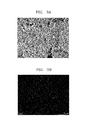
- FIGS. 3A and 3B The Scanning Electron Microscopy with Energy Dispersive X-Ray Spectrometer (SEM/EDS) images of the cathode electrodes prepared by using the cathode active material obtained in Example 1 are shown in FIGS. 3A and 3B . From the results of FIGS. 3A and 3B , lanthanum (La) distribution on the cathode electrode is confirmed.
- SEM/EDS Scanning Electron Microscopy with Energy Dispersive X-Ray Spectrometer
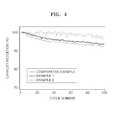
- FIGS. 4 and 5 The characteristics at room temperature and a high temperature are illustrated in FIGS. 4 and 5 .
- life characteristics at room temperature increased to 93% in Example 1 and increased to 97% in Example 2 compared to 92% for the Comparative Example.
- life characteristics at a high temperature increased to 86% in Example 1 and increased to 84% in Example 2 compared to 71% for the Comparative Example.
- a large capacity decrease was observed in the Comparative Example after the 70 th cycle, but was not observed in Examples 1 and 2.
- FIG. 6 illustrates charge/discharge efficiency at room temperature of the batteries of the Comparative Example and Example 1.
- the battery of Example 1 shows the results being about 0.5 % greater than the battery of the Comparative Example at initial cycles. Further, the battery of Example 1 shows the results of improved charge/discharge efficiency in cycles.
- the batteries of Examples 1 and 2 have higher initial heating temperatures and peak temperatures than the battery of Comparative Example. Heating values are not much different over the whole temperature range, but heating values of Examples 1 and 2 around the peaks are lower than that of Comparative Example. Accordingly, the cathode active materials of Examples 1 and 2 including the perovskite-based metal oxide have improved thermal stabilities.
- charge/discharge efficiency and life characteristics may be improved by mixing in a perovskite structured-metal oxide which may structurally stabilize the complex, and thus electrical and chemical characteristics of the lithium battery using the complex may be improved.
Landscapes
- Chemical & Material Sciences (AREA)
- Organic Chemistry (AREA)
- Inorganic Chemistry (AREA)
- General Chemical & Material Sciences (AREA)
- Chemical Kinetics & Catalysis (AREA)
- Electrochemistry (AREA)
- Geology (AREA)
- General Life Sciences & Earth Sciences (AREA)
- Life Sciences & Earth Sciences (AREA)
- Engineering & Computer Science (AREA)
- Composite Materials (AREA)
- Materials Engineering (AREA)
- Manufacturing & Machinery (AREA)
- Battery Electrode And Active Subsutance (AREA)
- Secondary Cells (AREA)
Abstract
Description
- Aspects of the present invention relate to a cathode active material, a cathode and a lithium battery using the same, and more particularly, to a cathode including the cathode active material having improved electrical characteristics and a lithium battery that uses the cathode.
- In general, transition metal compounds such as LiNiO2, LiCoO2, LiMn2O4, LiFePO4, LiNixCo1-xO2 (0<x<1), and LiNi1-x-yCoxMnyO2 (0≤x≤0.5, 0≤y≤0.5) are used as 1 cathode active materials for lithium batteries.
- Next generation lithium batteries can be accomplished by improving high-rate discharge performance and high discharge capacity characteristics of the cathode active materials. As portable electronic devices are becoming more complex and diverse in view of their functions, high performance lithium secondary batteries are highly desired. To address these concerns, along with the design of battery systems and advanced battery manufacturing technology, improvement of battery materials is necessary.
- A xLi2MO3-(1-x)LiMeO2 (0≤x≤1; M, Me = a metal ion) complex system, which is a high-capacity cathode material of the next generation, may increase structural instability when a cut-off voltage is increased for high-capacity utilization.
- Aspects of the present invention provide a cathode active material with improved electrical characteristics.
- Aspects of the present invention provide a cathode, including the cathode active material, with improved electrical characteristics.
- Aspects of the present invention provide a lithium battery including the cathode.
- According to an aspect of the present invention, the cathode active material includes a layer-structured material having a composition of xLi2MO3-(1-x)LiMeO2, wherein 0 < x < 1, and M and Me are each a metal ion; and a metal oxide having a perovskite structure.
- The layer-structured material and the metal oxide may form a complex.
- The metal oxide may be intermixed in a crystalline structure of the layer-structured material.
- The metal oxide may have a composition of ABO3 wherein A and B are each a metal ion.
- Me may be one or more elements selected from transition metals.
- M may be one or more elements selected from aluminum (Al), gallium (Ga), germanium (Ge), magnesium (Mg), niobium (Nb), zinc (Zn), cadmium (Cd), titanium (Ti), cobalt (Co), nickel (Ni), potassium (K), sodium (Na), calcium (Ca), silicon (Si), iron (Fe), copper (Cu), tin (Sn), vanadium (V), boron (B), phosphorus (P), selenium (Se), bismuth (Bi), arsenic (As), zirconium (Zr), manganese (Mn), chrome (Cr), strontium (Sr), scandium (Sc), yttrium (Y), and rare earth elements.
- A may include one or more elements selected from a
Group 2 element and a rare earth element (Group 3). - A may include one or more elements selected from lanthanum (La), Sr, barium (Ba), and Ca.
- B may include one or more elements selected from transition metals.
- B may include one or more elements selected from Ti, V, Cr, Mn, Fe, Co, Ni, Mg, and Cu.
- The metal oxide may include at least one from LaNiO3, LaCoO3, LaMnO3, LaMgO3, LaFeO3, SrNiO3, SrCoO3, SrMnO3, SrMgO3, SrFeO3, BaNiO3, BaCoO3, BaMnO3, BaMgO3, BaFeO3, CaNiO3, CaCoO3, CaMnO3, CaMgO3 and CaFeO3.
- The metal oxide may have a concentration of 0.01 mol% to 1 mol% based on 1 mol of the layer-structured material.
- The metal oxide may have a concentration of 0.01 mol% to 0.1 mol% based on 1 mol of the layer-structured material.
- According to another aspect of the present invention, a cathode includes a cathode active material formed on the surface of a current collector, wherein the cathode active material includes a layer structured material having a composition of xLi2MO3-(1-x)LiMeO2, wherein 0 < x < 1, and M and Me are each a metal ion; and a metal oxide having a perovskite structure.
- According to another aspect of the present invention, a lithium battery includes a cathode; an anode; and an organic electrolyte solution, wherein the cathode includes a cathode active material formed on the surface of a current collector, wherein the cathode active material includes a layer structured material having a composition of XLi2MO3-(1-x)LiMeO2, wherein 0 < x < 1, and M and Me are each a metal ion; and a metal oxide having a perovskite structure.
- Additional aspects and/or advantages of the invention will be set forth in part in the description which follows and, in part, will be obvious from the description, or may be learned by practice of the invention.
- These and/or other aspects and advantages of the invention will become apparent and more readily appreciated from the following description of the embodiments, taken in conjunction with the accompanying drawings of which:
-
FIG. 1 schematically illustrates the structure of a lithium battery according to an embodiment of the present invention; -
FIG. 2 is a graph illustrating the XRD results of the Comparative Example and Examples 1 and 2; -
FIGS. 3A and 3B are the SEM EDS images of the positive electrode (cathode) obtained in Example 1; -
FIG. 4 is a graph illustrating the cycle characteristics at room temperature of the batteries obtained in the Comparative Example and Examples 1 and 2; -
FIG. 5 is a graph illustrating the cycle characteristics at high temperature of the batteries obtained in the Comparative Example and Examples 1 and 2; and -
FIG. 6 is a graph illustrating the charge/discharge characteristics at room temperature of the batteries obtained in the Comparative Example and Examples 1 and 2. - Reference will now be made in detail to the present embodiments of the present invention, examples of which are illustrated in the accompanying drawings, wherein like reference numerals refer to the like elements throughout. The embodiments are described below in order to explain the present invention by referring to the figures.
- A cathode active material according to an embodiment of the present invention includes a layer-structured material having a composition of xLi2MO3-(1-x)LiMeO2; and a metal oxide having a perovskite structure, in which, 0 < x < 1, and M and Me are each a metal ion.
- A xLi2MO3-(1-x)LiMeO2 (0≤x≤1; M, Me = a metal ion) complex system, which is one of the high-capacity cathode active materials of the next generation, is generally composed of Li2MO3 and a layer-structured complex of LiMeO2. Excess lithium exists as a substituted form in the transition metal layer. The complex system should be charged at about 4.5 V (vs. Li), or higher, in order to achieve a high capacity, and thus stability at high voltages is important. The complex consists of the structure xLi2MO3-(1-x)MeO2 during an initial charge cycle of up to 4.4 V due to lithium deintercalation from LiMeO2 and forms the structure (x-δ)Li2MO3-δMeO2-(1-x)MO2 along with Li2O at 4.4 V or higher. That is, at 4.4 V or higher, Li2O is formed due to lithium and oxygen deintercalation from Li2MO3 at the same time and MO2 is also produced. The description above is represented in Chemical Equation 1.
<Chemical Equation 1> Li2MO3 -> xLi2O + yMO2 + (1-x-y)Li2MO3, in which, M is a metal ion, 0 ≤ x ≤ 1, and 0 ≤ y ≤ 1.
- In the reaction above, the remaining content of Li2MnO3 is determined according to a cut-off voltage of charge, and thus, if the cut-off voltage is increased for high-capacity utilization, then the remaining content of Li2MnO3 decreases. Compositions of Li2MnO3 serve to stabilize the structure of the complex. Therefore, when the cut-off voltage is increased, the remaining content of Li2MnO3 decreases, and as a result, there is a high possibility for the complex to become structurally unstable.
- According to an embodiment of the present invention, the charge-discharge efficiency may be increased, and life characteristics may be improved during high-voltage charge by using a perovskite-based metal oxide, for example an ABO3-based material, where A and B are each identical or different metal ions, as a stabilizer phase material that may maintain the structure of the complex at a charged state.
- The metal oxide, which is the stabilizer phase material, has a stable crystalline structure, has a conductivity of lithium ions, and has a perovskite structure compatible with the layer-structured material which has the composition of xLi2MO3-(1-x)LiMeO2. The crystalline structure of the metal oxide is of similar type to the layer-structured material, which may improve stability of the layer-structured material without hindering free movements of lithium ions in a cathode material.
- The cathode active material, including the stabilizer phase material as described above, may include a complex material including the xLi2MO3-(1-x)LiMeO2-based material having a layered structure, wherein 0 < x < 1, and M and Me are each a metal ion; and the metal oxide having a perovskite structure.
- An example of the metal oxide having a perovskite structure includes the ABO3-based material, wherein A and B are metal ions. A may include one or more elements selected from a
Group 2 element and a rare earth element. A may further include one or more elements selected from lanthanum (La), strontium (Sr), barium (Ba), and calcium (Ca). B may include one or more elements selected from the group consisting of transition metals. B may further include one or more elements selected from titanium (Ti), vanadium (V), chrome (Cr), manganese (Mn), iron (Fe), cobalt (Co), nickel (Ni), magnesium (Mg), and copper (Cu). - In the xLi2MO3-(1-x)LiMeO2-based material, M is a metal ion which may include one or more elements selected from aluminum (Al), gallium (Ga), germanium (Ge), Mg, niobium (Nb), zinc (Zn), cadmium (Cd), Ti, Co, Ni, potassium (K), sodium (Na), Ca, silicon (Si), Fe, Cu, tin (Sn), V, boron (B), phosphorus (P), selenium (Se), bismuth (Bi), arsenic (As), zirconium (Zr), Mn, Cr, Sr, scandium (Sc), yttrium (Y), and rare earth elements. For example, M may include at least Mn.
- In the xLi2MO3-(1-x)LiMeO2-based material, Me may include one or more elements selected from the group consisting of transition metals. Me may further include one or more elements selected from Ti, V, Cr, Mn, Fe, Co, Ni, and Cu.
- The ABO3-based material, which is a metal oxide having a perovskite structure, may be in the ratio of 0.01 mol% to 1 mol%, for example, 0.01 mol% to 0.1 mol% based on 1 mol of the xLi2MO3-(1-x)LiMeO2-based material. Sufficient stability may be provided during high-voltage charge of the xLi2MO3-(1-x)LiMeO2-based material within the ranges above.
- A material including the xLi2MO3-(1-x)LiMeO2-based material having a layered structure and the metal oxide having a perovskite structure forms a complex. Furthermore, the metal oxide having a perovskite structure may be intermixed into the crystalline structure of the xLi2MO3-(1-x)LiMeO2-based material.
- The average diameter of the complex including both the xLi2MO3-(1-x)LiMeO2-based material having a layered structure and the metal oxide having a perovskite structure may be from 0.1µm to 10 µm, for example, from 0.2 µm to 3 µm.
- The complex including both the xLi2MO3-(1-x)LiMeO2-based material having a layered structure and the metal oxide having a perovskite structure may be obtained by using a combustion synthesis method. The combustion synthesis method may be any known method commonly used in the art.
- An example of the combustion synthesis method for obtaining the complex may include heating the solution that is formed by dissolving a precursor of each metal composition for a desired time to remove a polymer composition.
- A lithium battery according to another embodiment includes a cathode, an anode, and an electrolyte solution, in which the cathode includes a complex material including the layer-structured material having the composition of xLi2MO3-(1-x)LiMeO2 (in which, x, M, and Me are as defined above) and the metal oxide having a perovskite structure.
- The type of the lithium battery is not limited and may include, for example, a secondary lithium battery, such as a lithium ion battery, a lithium-ion polymer battery, or a lithium-sulfur battery, and a primary lithium battery.
- The cathode includes a current collector and a cathode active material layer formed on the current collector. In order to form the cathode, a cathode active material composition is prepared by mixing a cathode active material, that includes a complex material including both the xLi2MO3-(1-x)LiMeO2-based material having a layered structure and the metal oxide having the perovskite structure, a conducting agent, a binder, and a solvent.
- A cathode plate may be manufactured by forming the cathode active material layer by directly coating the cathode active material composition on an aluminum current collector and drying. Alternatively, the cathode active material layer is formed by casting the cathode active material composition on a separate support, delaminating a film obtained from the support, and laminating the film on the current collector. The cathode manufacturing methods above are known in the art.
- For the solvent, N-methyl pyrrolidone, acetone, or water may be used, but the solvent is not limited thereto.
- The binder included in the cathode active material layer serves to attach cathode active material particles to one another and attach the cathode active material to the current collector. Examples of the binder include polyvinyl alcohol, carboxymethyl cellulose, hydroxypropyl cellulose, diacetyl cellulose, polyvinyl chloride, carboxylated polyvinyl chloride, polyvinyl fluoride, polymer including ethylene oxide, polyvinylpyrrolidone, polyurethane, polytetrafluoroethylene, polyvinylidene fluoride (PVDF), polyethylene, polypropylene, styrene-butadiene rubber, acrylated styrene-butadiene rubber, epoxy resin, or nylon, but is not limited thereto.
- The conducting agent included in the cathode active material is used to induce conductivity of an electrode. This may include any electronic conductive material that does not cause chemical change in the construction of a battery. An example of the conductor may be a carbon-based material such as natural graphite, artificial graphite, carbon black, acetylene black, or carbon fiber; a metal-based material such as metal powder or metal fiber of Cu, Ni, Al, or Ag; a conductive material including a conductive polymer such as polyphenylene derivative; or a mixture thereof.
- The current collector may be aluminum, but is not limited thereto.
- As the cathode plate is manufactured, an anode active material composition may be manufactured by mixing an anode active material, a conducting agent, a binder, and a solvent. An anode plate may then be manufactured by directly coating the anode active material composition on a copper current collector. Alternatively the anode active material composition is cast on a separate support and then an anode active material film, which is delaminated from the support, is laminated on the copper current collector. Concentrations of the anode active material, the conductor, the binder, and the solvent are at concentrations commonly used in a lithium battery.
- The anode active material may be a material capable of intercalating/deintercalating lithium. For example, lithium metal or lithium alloy, coke, artificial graphite, natural graphite, the combusted body of an organic polymer compound, or carbon fiber may be used. Also, materials for the conducting agent, the binder, and the solvent may be the same materials used in the case of the cathode as described above.
- Depending on the case, pores may be formed inside the electrode plate by adding a plasticizer to the cathode or anode active material composition.
- Depending on the type of lithium battery, a separator between the cathode and the anode may be present. Any separator commonly used in a lithium battery may be used. Particularly, a material with low resistance in regard to electrolyte ion movement and having excellent electrolyte-absorbability is appropriate for the separator. The material may be selected from glass fiber, polyester, polyethylene, polypropylene, polytetrafluoroethylene (PTFE), and a combination thereof which may have a type of non-woven or woven fabric. For example, a lithium ion battery may include a rollable separator made of materials such as polyethylene or polypropylene, and a lithium ion polymer battery may include a separator with an excellent organic electrolyte solution containing ability.
- The separator may be prepared by the following method. A separator film may be formed by preparing a separator composition by mixing a polymer resin, a filler, and a solvent, directly coating the separator composition on the electrode, and drying. Alternatively, the separator may be formed by casting the separator composition on a support, drying, delaminating the separator film from the support, and laminating the separator film on the electrode.
- The polymer resin is not particularly limited, and any material used in the field for a binder of an electrode plate may be used. For example, vinylidene fluoride/hexafluoropropylene copolymer, PVDF, polyacrylonitrile, polymethylmethacrylate, or a mixture thereof may be used. Particularly, vinylidene fluoride/hexafluoropropylene copolymer containing hexafluoropropylene may be used with a concentration of 8 weight % to 25 weight %.
- According to an embodiment of the present invention, a battery structure may be formed by disposing the separator between the cathode plate and the anode plate as described above. The lithium ion battery may be completed by winding or folding the battery structure, inserting the battery structure into a cylindrical battery case or a box-shaped battery case and injecting an organic electrolyte solution. The lithium ion polymer battery may be completed by stacking the battery in a bi-cell structure, impregnating the structure with organic electrolyte solution and sealing the resultant in a pouch.
-
FIG. 1 schematically illustrates a structure of thelithium battery 30 according to an embodiment of the present invention. As shown inFIG. 1 , thelithium battery 30 is composed of thecathode 23, theanode 22, theseparator 24 disposed between thecathode 23 and theanode 22, an electrolyte (not shown) impregnated in thecathode 23, theanode 22, and theseparator 24, thebattery case 25, and thesealer 26 to seal thebattery case 25 as main parts. Thelithium battery 30 is composed by sequentially stacking thecathode 23, theanode 22, and theseparator 24, and by spirally winding and storing the stackedcathode 23, theanode 22, and theseparator 24 in the battery case. - Hereinafter, the present invention will be explained in detail with Examples and a Comparative Example.
- A composition of a cathode active material was 0.5Li[Li1/3Mn2/3]O2-0.5LiNi1/3CO1/3Mn1/3O2, and its manufactured powder was synthesized by using the following combustion synthesis method.
- First, as a starting material, lithium carbonate, nickel acetate, cobalt acetate, and manganese acetate were measured to satisfy the stoichiometry above and were dissolved in 200 ml of a dilute nitric acid aqueous solution. Then, 15 ml of a citric acid aqueous solution and 15 ml of ethylene glycol were added to prepare a sol. The sol was stirred and heated on a hot plate to evaporate the water, and thus the mixture was obtained in a gel state. The gel was heated on a hot plate until it burned, and an additional heat treatment was performed after completely decomposing the gel by combustion. The additional heat treatment was performed at a temperature of 950 °C for 5 hours with a dry air flow, and thus a cathode active material powder of 0.5Li[Li1/3Mn2/3]O2-0.5LiNi1/3Co1/3Mn1/3O2 was prepared.
- The 0.5Li[Li1/3Mn2/3]O2-0.5LiNi1/3Co1/3Mn1/3O2 cathode active material powder and a carbon conducting material (carbon black) were homogenously mixed in a weight ratio of 93:3, and then, a PVDF solution was added as a binder to prepare a slurry with a weight ratio of the cathode active material to the carbon conducting material to the binder equaling 93:3:4. A cathode plate was prepared by coating the slurry on aluminum foil with a thickness of 15 µm and drying.
- A coin cell was prepared by additionally vacuum drying the cathode plate. Metal lithium was used as a counter electrode during the coin cell preparation, and 1.3M LiPF6 ethylene carbonate (EC)/diethyl carbonate (DEC)/ethyl methyl carbonate (EMC)=3/5/2 (a volume ratio) was used as an electrolyte.
- A cathode active material was synthesized by using the following combustion synthesis method. First, as a starting material, lithium carbonate, nickel acetate, cobalt acetate, manganese acetate, and lanthanum(III) nitrate hexahydrate were measured to satisfy the stoichiometry and were dissolved in 200 ml of a dilute nitric acid aqueous solution. Then, 15 ml of a citric acid aqueous solution and 15 ml of ethylene glycol were added to prepare a sol. The sol was stirred and heated on a hot plate to evaporate the water, and thus the mixture was obtained in a gel state. The gel heated on the hot plate until it was burned, and an additional heat treatment was performed after completely decomposing the gel by combustion. The additional heat treatment was performed at a temperature of 950 °C for 5 hours with a dry air flow, and thus a cathode active material powder of 0.5Li[La0.01Li0.32Mn0.67]O2-0.5LiNi1/3CO1/3Mn1/3O2, including the slightest quantity of LaNiO3, LaCoO3, and LaMnO3, was prepared.
- The cathode active material powder and a carbon conducting material (carbon black) were homogenously mixed in a weight ratio of 93:3. Then, a PVDF solution was added as a binder to prepare a slurry with a weight ratio of the cathode active material to the carbon conducting material to the binder equaling 93:3:4. The cathode plate was prepared by coating the slurry on aluminum foil with a thickness of 15 µm and drying.
- A coin cell was prepared by additionally vacuum drying the cathode plate. Metal lithium was used as a counter electrode during the coin cell preparation, and 1.3M LiPF6 EC/DEC/EMC=3/5/2 was used as an electrolyte.
- A cathode active material was synthesized by using the following combustion synthesis method. First, as a starting material, lithium carbonate, nickel acetate, cobalt acetate, manganese acetate, and lanthanum(III) nitrate hexahydrate were measured to satisfy the stoichiometry and were dissolved in 200 ml of a dilute nitric acid aqueous solution. Then, 15 ml of a citric acid aqueous solution and 15 ml of ethylene glycol were added to prepare a sol. The sol was stirred and heated on a hot plate to evaporate the water, and thus the mixture was obtained in a gel state. Combustion of the gel was also performed on the hot plate, and an additional heat treatment was performed after completely decomposing the gel by combustion. The additional heat treatment was performed at a temperature of 950 °C for 5 hours with a dry air flow, and thus, a cathode active material powder of 0.5Li[La0.01Li0.32Mg0.02Mn0.65]O2-0.5LiNi1/3Co1/3Mn1/3O2, including the slightest quantity of LaNiO3, LaCoO3, LaMnO3, and LaMgO3, was prepared.
- The cathode active material powder and a carbon conducting material (carbon black) were homogenously mixed in a weight ratio of 93:3, and then, a PVDF solution was added as a binder to prepare a slurry with a weight ratio of the cathode active material to the carbon conducting material to the binder equaling 93:3:4. A cathode plate was prepared by coating the slurry on an aluminum foil with a thickness of 15 µm and drying.
- A coin cell was prepared by additionally vacuum drying the cathode plate. Metal lithium was used as a counter electrode during the coin cell preparation, and 1.3M LiPF6 EC/DEC/EMC=3/5/2 was used as an electrolyte.
-
FIG. 2 illustrates the results of the X-ray Diffraction (XRD) analysis of the cathode active materials obtained in the Comparative Example and Examples 1 and 2. From the XRD analysis ofFIG. 2 , the cathode active material of Example 1 had a secondary state which included LaNiO3, LaCoO3, and LaMnO3 of a perovskite structure. The cathode active material of Example 2 included LaNiO3, LaCoO3, LaMnO3, and LaMgO3 of a perovskite structure. - Peak positions of the LaNiO3, LaCoO3, LaMnO3, and LaMgO3 are as follows:
- LaNiO3: 32.893 (110), 33.191 (012), 47.332 (202);
- LaCoO3: 33.015 (110), 33.421 (104), 47.596 (024);
- LaMnO3: 32.412 (112), 45.668 (220), 47.280 (221); and
- LaMgO3: 32.608 (121), 32.702 (200), 46.740 (202).
- The Scanning Electron Microscopy with Energy Dispersive X-Ray Spectrometer (SEM/EDS) images of the cathode electrodes prepared by using the cathode active material obtained in Example 1 are shown in
FIGS. 3A and 3B . From the results ofFIGS. 3A and 3B , lanthanum (La) distribution on the cathode electrode is confirmed. - Electrical and chemical characteristics of the lithium batteries obtained in the Comparative Example and Examples 1 and 2 were evaluated.
- An evaluation of the electrical and chemical characteristics was performed at room temperature (25°C) and at a high temperature (45°C). For charge/discharge conditions, the batteries were charged with 0.5 C of constant current until the voltage reached 4.6 V, and constant voltage was induced and maintained until the current was dropped to 0.05 C during charge. The batteries were discharged with 0.5 C of constant current until the voltage reached 2 V during discharge.
- The characteristics at room temperature and a high temperature are illustrated in
FIGS. 4 and5 . As shown inFIG. 4 , after 100 cycles of repetition, life characteristics at room temperature increased to 93% in Example 1 and increased to 97% in Example 2 compared to 92% for the Comparative Example. As shown inFIG. 5 , after 100 cycles of repetition, life characteristics at a high temperature increased to 86% in Example 1 and increased to 84% in Example 2 compared to 71% for the Comparative Example. Also, a large capacity decrease was observed in the Comparative Example after the 70th cycle, but was not observed in Examples 1 and 2. -
FIG. 6 illustrates charge/discharge efficiency at room temperature of the batteries of the Comparative Example and Example 1. As shown inFIG. 6 , the battery of Example 1 shows the results being about 0.5 % greater than the battery of the Comparative Example at initial cycles. Further, the battery of Example 1 shows the results of improved charge/discharge efficiency in cycles. - Therefore, improved life time/span and capacity characteristics of the cathode active materials of Examples 1 and 2 which include a perovskite-based metal oxide are confirmed.
- Thermal stability was measured by using an Auto DSC Q-20 differential scanning calorimeter (DSC) from TA Instruments for the batteries of Comparative Example and Examples 1 and 2, and results are shown in Table 1.
<Table 1 > Class In itial Heating Temperature (°C) Peak Temperature (°C) Heat of Reaction (J/g) Around Peak 100 ~ 350 °C Comparative Example 200 258.8 1332 1547 Example 1 225 261.1 1108 1525 Example 2 210 278.5 904.2 1568 - As shown in Table 1, the batteries of Examples 1 and 2 have higher initial heating temperatures and peak temperatures than the battery of Comparative Example. Heating values are not much different over the whole temperature range, but heating values of Examples 1 and 2 around the peaks are lower than that of Comparative Example. Accordingly, the cathode active materials of Examples 1 and 2 including the perovskite-based metal oxide have improved thermal stabilities.
- As described above, according to one or more of the above embodiments of the present invention, when preparing a cathode plate of xLi2MO3-(1-x)LiMeO2 (0≤x≤1; M, Me= metal ion) complex, which is one of the high-capacity cathode materials for the next generation, charge/discharge efficiency and life characteristics may be improved by mixing in a perovskite structured-metal oxide which may structurally stabilize the complex, and thus electrical and chemical characteristics of the lithium battery using the complex may be improved.
- It should be understood that the exemplary embodiments described herein should be considered in a descriptive sense only and not for purposes of limitation. Descriptions of features or aspects within each embodiment should typically be considered as available for other similar features or aspects in other embodiments.
- Although a few embodiments of the present invention have been shown and described, it would be appreciated by those skilled in the art that changes may be made in this embodiment without departing from the principles of the invention, the scope of which is defined in the claims and their equivalents.
Claims (14)
- A cathode active material comprising:a layer-structured material having a composition of xLi2MO3-(1-x)LiMeO2; anda metal oxide having a perovskite structure, wherein 0 < x < 1, and M and Me are each a metal ion.
- The cathode active material of claim 1, wherein the layer-structured material and the metal oxide form a complex.
- The cathode active material of claim 1 or 2, wherein the metal oxide is intermixed in a crystalline structure of the layer-structured material.
- The cathode active material of any of claims 1-3, wherein Me is one or more elements selected from transition metals.
- The cathode active material of any of claims 1-4, wherein M is one or more elements selected from aluminum (Al), gallium (Ga), germanium (Ge), magnesium (Mg), niobium (Nb), zinc (Zn), cadmium (Cd), titanium (Ti), cobalt (Co), nickel (Ni), potassium (K), sodium (Na), calcium (Ca), silicon (Si), iron (Fe), copper (Cu), tin (Sn), vanadium (V), boron (B), phosphorus (P), selenium (Se), bismuth (Bi), arsenic (As), zirconium (Zr), manganese (Mn), chrome (Cr), strontium (Sr), scandium (Sc), yttrium (Y), and rare earth elements.
- The cathode active material of any of claims 1-5, wherein the metal oxide has a composition of ABO3, wherein A and B are each a metal ion.
- The cathode active material of claim 6, wherein A is one or more elements selected from a Group 2 element and a rare earth element.
- The cathode active material of claim 6, wherein A is at least one element selected from lanthanum (La), Sr, barium (Ba), and Ca.
- The cathode active material of any of claims 6-8, wherein B is one or more selected from transition metals.
- The cathode active material of any of claims 6-8, wherein B is one or more elements selected from the group consisting of Ti, V, Cr, Mn, Fe, Co, Ni, Mg, and Cu.
- The cathode active material of claim 6, wherein the metal oxide is at least one from LaNiO3, LaCoO3, LaMnO3, LaMgO3, LaFeO3, SrNiO3, SrCoO3, SrMnO3, SrMgO3, SrFeO3, BaNiO3, BaCoO3, BaMnO3, BaMgO3, BaFeO3, CaNiO3, CaCoO3, CaMnO3, CaMgO3 and CaFeO3.
- The cathode active material of any of claims 1-11, wherein the metal oxide has a concentration of 0.01 mol% to 1 mol% based on 1 mol of the layer-structured material.
- A cathode comprising a cathode active material according to any of claims 1-12 formed on a surface of a current collector.
- A lithium battery comprising:the cathode of claim 13;an anode; andan organic electrolyte solution.
Applications Claiming Priority (1)
| Application Number | Priority Date | Filing Date | Title |
|---|---|---|---|
| KR1020110121191A KR102014983B1 (en) | 2011-11-18 | 2011-11-18 | Cathode and lithium battery using same |
Publications (3)
| Publication Number | Publication Date |
|---|---|
| EP2595234A2 true EP2595234A2 (en) | 2013-05-22 |
| EP2595234A3 EP2595234A3 (en) | 2015-03-25 |
| EP2595234B1 EP2595234B1 (en) | 2020-05-13 |
Family
ID=47216111
Family Applications (1)
| Application Number | Title | Priority Date | Filing Date |
|---|---|---|---|
| EP12192632.3A Active EP2595234B1 (en) | 2011-11-18 | 2012-11-14 | Cathode active material, cathode and lithium battery using the same |
Country Status (3)
| Country | Link |
|---|---|
| US (1) | US10326160B2 (en) |
| EP (1) | EP2595234B1 (en) |
| KR (1) | KR102014983B1 (en) |
Cited By (3)
| Publication number | Priority date | Publication date | Assignee | Title |
|---|---|---|---|---|
| CN104458663A (en) * | 2014-12-12 | 2015-03-25 | 西南铝业(集团)有限责任公司 | AHS aluminum alloy spectral standard sample and detection method of AHS aluminum alloy component |
| CN108682842A (en) * | 2018-03-23 | 2018-10-19 | 格林美(无锡)能源材料有限公司 | A kind of Y doping CaMnO3Tertiary cathode material of cladding and preparation method thereof |
| WO2019192833A1 (en) * | 2018-04-06 | 2019-10-10 | Robert Bosch Gmbh | Lithium-ion battery and method for producing a cathode for a lithium-ion battery |
Families Citing this family (29)
| Publication number | Priority date | Publication date | Assignee | Title |
|---|---|---|---|---|
| WO2015008700A1 (en) * | 2013-07-15 | 2015-01-22 | Semiconductor Energy Laboratory Co., Ltd. | Positive electrode active material and secondary battery |
| KR102163731B1 (en) | 2013-11-22 | 2020-10-08 | 삼성전자주식회사 | Electrolyte for lithium battery and lithium battery comprising the same |
| WO2016036091A1 (en) * | 2014-09-02 | 2016-03-10 | 서울대학교 산학협력단 | Electrode material mixture additive for secondary battery, method for preparing same, electrode for secondary battery comprising same, and secondary battery |
| KR102285150B1 (en) | 2014-12-29 | 2021-08-04 | 삼성에스디아이 주식회사 | Composite Cathode active material, cathode and lithium battery containing material |
| KR102358436B1 (en) | 2014-12-30 | 2022-02-04 | 삼성전자주식회사 | Cathode active material, cathode and lithium battery comprising the same, and method of preparing the cathode active material |
| US11011746B2 (en) | 2015-07-13 | 2021-05-18 | Samsung Electronics Co., Ltd. | Composite cathode active material for lithium battery, cathode for lithium battery including the same, and lithium battery including the cathode |
| DE102015217743A1 (en) * | 2015-09-16 | 2017-03-16 | Robert Bosch Gmbh | Active material for a positive electrode of a battery cell, positive electrode and battery cell |
| US10862106B2 (en) | 2015-10-28 | 2020-12-08 | Samsung Electronics Co., Ltd. | Composite positive electrode active material, positive electrode including the same, and lithium battery including the positive electrode |
| JP6323725B2 (en) * | 2015-11-30 | 2018-05-16 | トヨタ自動車株式会社 | Positive electrode active material used for lithium ion secondary battery |
| CN116565296A (en) | 2016-07-05 | 2023-08-08 | 株式会社半导体能源研究所 | Lithium-ion secondary battery |
| US12308421B2 (en) | 2016-09-12 | 2025-05-20 | Semiconductor Energy Laboratory Co., Ltd. | Electrode and power storage device comprising graphene compound |
| CN115188931A (en) | 2016-10-12 | 2022-10-14 | 株式会社半导体能源研究所 | Positive electrode active material particle and method for producing positive electrode active material particle |
| JP6705369B2 (en) * | 2016-12-22 | 2020-06-03 | トヨタ自動車株式会社 | Active material and fluoride ion battery |
| JP7060336B2 (en) * | 2017-04-27 | 2022-04-26 | トヨタ自動車株式会社 | Method for manufacturing positive electrode active material, lithium ion secondary battery and positive electrode active material |
| CN110546794A (en) | 2017-05-12 | 2019-12-06 | 株式会社半导体能源研究所 | Positive electrode active material particles |
| KR20240023214A (en) | 2017-05-19 | 2024-02-20 | 가부시키가이샤 한도오따이 에네루기 켄큐쇼 | Positive electrode active material, method for manufacturing positive electrode active material, and secondary battery |
| CN112201844A (en) | 2017-06-26 | 2021-01-08 | 株式会社半导体能源研究所 | Manufacturing method of positive electrode active material and secondary battery |
| JP2021503690A (en) * | 2017-11-16 | 2021-02-12 | トヨタ・モーター・ヨーロッパToyota Motor Europe | One-dimensional pre-calcinated material as positive electrode for rechargeable calcium battery and cell containing it |
| JP6904892B2 (en) * | 2017-11-28 | 2021-07-21 | トヨタ自動車株式会社 | Positive electrode material and lithium secondary battery using it |
| JP6919994B2 (en) * | 2017-12-12 | 2021-08-18 | トヨタ自動車株式会社 | Positive electrode material and lithium secondary battery using it |
| US10734640B2 (en) * | 2018-03-16 | 2020-08-04 | Polymorph Quantum Energy | Non-chemical electric battery using two-phase working material |
| JP7028716B2 (en) * | 2018-05-29 | 2022-03-02 | トヨタ自動車株式会社 | Positive electrode material |
| CN108987741B (en) * | 2018-06-12 | 2021-09-10 | 西安理工大学 | Nickel cobalt lithium manganate positive electrode material and preparation method thereof |
| JP7397792B2 (en) | 2018-06-22 | 2023-12-13 | 株式会社半導体エネルギー研究所 | Positive electrode active material, positive electrode, secondary battery, and method for producing positive electrode |
| CN109326778B (en) * | 2018-09-11 | 2021-08-24 | 武汉理工大学 | A kind of ternary cathode material coated with lanthanum nickelate and preparation method thereof |
| CN111477856B (en) * | 2020-04-26 | 2023-05-05 | 河北省科学院能源研究所 | Nickel-based positive electrode material and preparation method thereof |
| CN114054032B (en) * | 2021-11-23 | 2023-11-07 | 东莞理工学院 | Preparation method and application of strontium perovskite catalytic cathode |
| WO2024243906A1 (en) * | 2023-05-31 | 2024-12-05 | 宁德时代新能源科技股份有限公司 | Positive electrode active material and preparation method therefor, and positive electrode sheet, battery and electric device comprising same |
| CN119191388B (en) * | 2024-11-22 | 2025-05-02 | 帕瓦(诸暨)新能源科技有限公司 | A sodium ion battery positive electrode material precursor and preparation method thereof and positive electrode material |
Family Cites Families (23)
| Publication number | Priority date | Publication date | Assignee | Title |
|---|---|---|---|---|
| US5616437A (en) * | 1996-06-14 | 1997-04-01 | Valence Technology, Inc. | Conductive metal oxide coated current collector for improved adhesion to composite electrode |
| JP2001266879A (en) * | 2000-03-22 | 2001-09-28 | Toshiba Corp | Non-aqueous electrolyte secondary battery |
| EP2418713A1 (en) * | 2000-03-31 | 2012-02-15 | Sony Corporation | Separator, gelated electrolyte, non-aqueous electrolyte, electrode and non-aqueous electrolyte cell empolying the same |
| US7468223B2 (en) * | 2000-06-22 | 2008-12-23 | Uchicago Argonne, Llc | Lithium metal oxide electrodes for lithium cells and batteries |
| US6677082B2 (en) | 2000-06-22 | 2004-01-13 | The University Of Chicago | Lithium metal oxide electrodes for lithium cells and batteries |
| US7435402B2 (en) | 2002-11-01 | 2008-10-14 | U Chicago Argonne Llc | Method and apparatus for preparation of spherical metal carbonates and lithium metal oxides for lithium rechargeable batteries |
| US7314682B2 (en) | 2003-04-24 | 2008-01-01 | Uchicago Argonne, Llc | Lithium metal oxide electrodes for lithium batteries |
| JP4503964B2 (en) | 2003-09-19 | 2010-07-14 | 株式会社東芝 | Nonaqueous electrolyte secondary battery |
| US7135352B2 (en) | 2004-02-26 | 2006-11-14 | Eastman Kodak Company | Method of fabricating a cover plate bonded over an encapsulated OLEDs |
| KR100895354B1 (en) | 2004-09-03 | 2009-04-29 | 유시카고 아곤, 엘엘씨 | Manganese Oxide Composite Electrodes for Lithium Batteries |
| JP2007227199A (en) | 2006-02-24 | 2007-09-06 | Toshiba Corp | Nonaqueous electrolyte battery and battery pack |
| US7935270B2 (en) | 2006-10-04 | 2011-05-03 | Samsung Sdi Co., Ltd | Cathode active material and lithium battery using the same |
| KR101206037B1 (en) | 2006-12-13 | 2012-11-28 | 삼성에스디아이 주식회사 | Cathode active material for lithium battery, cathode including the same and lithium battery using the same |
| CN100495770C (en) | 2007-03-16 | 2009-06-03 | 天津巴莫科技股份有限公司 | Lithium-ion secondary battery cathode material LixCoyLazMn2-y-zO4 and preparation method thereof |
| JP5159142B2 (en) * | 2007-04-03 | 2013-03-06 | 株式会社日立製作所 | Semiconductor device and wiring parts thereof |
| KR101430615B1 (en) | 2007-09-19 | 2014-08-14 | 삼성에스디아이 주식회사 | Cathode and lithium battery employing it |
| KR101430616B1 (en) | 2007-12-18 | 2014-08-14 | 삼성에스디아이 주식회사 | Cathode and lithium battery using the same |
| KR101278752B1 (en) * | 2008-06-26 | 2013-06-25 | 에이지씨 세이미 케미칼 가부시키가이샤 | Surface modified lithium containing composite oxide for positive electrode active material of lithium ion secondary batteries and method of producing thereof |
| JP2010086935A (en) | 2008-09-03 | 2010-04-15 | Sharp Corp | Redox flow battery |
| JP5504800B2 (en) | 2009-03-23 | 2014-05-28 | 住友化学株式会社 | Lithium composite metal oxide and positive electrode active material |
| CN101662025B (en) | 2009-09-21 | 2013-01-16 | 昆明理工大学 | A kind of positive electrode active material of lithium ion battery and preparation method thereof |
| KR101730955B1 (en) * | 2010-02-18 | 2017-04-27 | 삼성에스디아이 주식회사 | Cathode and lithium battery using same |
| CN103155235A (en) * | 2010-05-25 | 2013-06-12 | 佩里昂技术公司 | Electrode material for magnesium battery |
-
2011
- 2011-11-18 KR KR1020110121191A patent/KR102014983B1/en active Active
-
2012
- 2012-10-17 US US13/653,702 patent/US10326160B2/en active Active
- 2012-11-14 EP EP12192632.3A patent/EP2595234B1/en active Active
Non-Patent Citations (1)
| Title |
|---|
| None |
Cited By (4)
| Publication number | Priority date | Publication date | Assignee | Title |
|---|---|---|---|---|
| CN104458663A (en) * | 2014-12-12 | 2015-03-25 | 西南铝业(集团)有限责任公司 | AHS aluminum alloy spectral standard sample and detection method of AHS aluminum alloy component |
| CN108682842A (en) * | 2018-03-23 | 2018-10-19 | 格林美(无锡)能源材料有限公司 | A kind of Y doping CaMnO3Tertiary cathode material of cladding and preparation method thereof |
| CN108682842B (en) * | 2018-03-23 | 2021-03-30 | 格林美(无锡)能源材料有限公司 | A Y-doped CaMnO3-coated ternary cathode material and preparation method thereof |
| WO2019192833A1 (en) * | 2018-04-06 | 2019-10-10 | Robert Bosch Gmbh | Lithium-ion battery and method for producing a cathode for a lithium-ion battery |
Also Published As
| Publication number | Publication date |
|---|---|
| KR102014983B1 (en) | 2019-08-28 |
| US20130130103A1 (en) | 2013-05-23 |
| US10326160B2 (en) | 2019-06-18 |
| KR20130055441A (en) | 2013-05-28 |
| EP2595234B1 (en) | 2020-05-13 |
| EP2595234A3 (en) | 2015-03-25 |
Similar Documents
| Publication | Publication Date | Title |
|---|---|---|
| EP2595234B1 (en) | Cathode active material, cathode and lithium battery using the same | |
| CN111384377B (en) | Positive electrode material and preparation method and application thereof | |
| CN108336328B (en) | Positive electrode active material and battery | |
| KR100943193B1 (en) | Cathode active material and lithium battery employing the same | |
| US11569492B2 (en) | Positive-electrode active material and battery | |
| US7927506B2 (en) | Cathode active material and lithium battery using the same | |
| US9172086B2 (en) | Cathode and lithium battery using the same | |
| US7479352B2 (en) | Cathode active material for lithium battery, cathode including the cathode active material, and lithium battery employing the cathode active material | |
| JP5370937B2 (en) | Positive electrode active material, positive electrode and non-aqueous secondary battery | |
| US10818910B2 (en) | Positive-electrode active material and battery | |
| CN107431242A (en) | Battery | |
| US9312564B2 (en) | Positive electrode including first and second lithium compounds and lithium battery using same | |
| JP2011134670A (en) | Lithium secondary battery positive electrode active material | |
| JP2026511286A (en) | Positive electrode active material, method for manufacturing the same, and lithium secondary battery containing the positive electrode active material | |
| JP2010123341A (en) | Positive electrode active material, positive electrode, and nonaqueous secondary battery | |
| JP5451671B2 (en) | Positive electrode active material, positive electrode and non-aqueous secondary battery | |
| KR101602419B1 (en) | A positive electrode active material, a positive electrode containing the positive electrode active material, and a lithium battery employing the positive electrode | |
| JP7117539B2 (en) | Negative electrode active material and battery | |
| KR101100435B1 (en) | Positive electrode and lithium battery employing same | |
| KR101681545B1 (en) | Positive electrode active material for rechargable lithium battery, method for manufacturing the same, and rechargable lithium battery including the same |
Legal Events
| Date | Code | Title | Description |
|---|---|---|---|
| PUAI | Public reference made under article 153(3) epc to a published international application that has entered the european phase |
Free format text: ORIGINAL CODE: 0009012 |
|
| AK | Designated contracting states |
Kind code of ref document: A2 Designated state(s): AL AT BE BG CH CY CZ DE DK EE ES FI FR GB GR HR HU IE IS IT LI LT LU LV MC MK MT NL NO PL PT RO RS SE SI SK SM TR |
|
| AX | Request for extension of the european patent |
Extension state: BA ME |
|
| PUAL | Search report despatched |
Free format text: ORIGINAL CODE: 0009013 |
|
| AK | Designated contracting states |
Kind code of ref document: A3 Designated state(s): AL AT BE BG CH CY CZ DE DK EE ES FI FR GB GR HR HU IE IS IT LI LT LU LV MC MK MT NL NO PL PT RO RS SE SI SK SM TR |
|
| AX | Request for extension of the european patent |
Extension state: BA ME |
|
| RIC1 | Information provided on ipc code assigned before grant |
Ipc: H01M 4/485 20100101ALI20150213BHEP Ipc: H01M 10/04 20060101ALN20150213BHEP Ipc: C01G 53/00 20060101ALI20150213BHEP Ipc: H01M 4/525 20100101ALI20150213BHEP Ipc: H01M 4/505 20100101ALI20150213BHEP Ipc: C01G 51/00 20060101ALI20150213BHEP Ipc: H01M 4/131 20100101ALN20150213BHEP Ipc: H01M 4/36 20060101ALI20150213BHEP Ipc: H01M 10/0525 20100101AFI20150213BHEP |
|
| 17P | Request for examination filed |
Effective date: 20150925 |
|
| RBV | Designated contracting states (corrected) |
Designated state(s): AL AT BE BG CH CY CZ DE DK EE ES FI FR GB GR HR HU IE IS IT LI LT LU LV MC MK MT NL NO PL PT RO RS SE SI SK SM TR |
|
| STAA | Information on the status of an ep patent application or granted ep patent |
Free format text: STATUS: EXAMINATION IS IN PROGRESS |
|
| 17Q | First examination report despatched |
Effective date: 20161201 |
|
| RIC1 | Information provided on ipc code assigned before grant |
Ipc: H01M 10/0525 20100101AFI20200109BHEP Ipc: C01G 45/12 20060101ALI20200109BHEP Ipc: H01M 4/505 20100101ALI20200109BHEP Ipc: H01M 4/525 20100101ALI20200109BHEP Ipc: C01G 53/00 20060101ALI20200109BHEP Ipc: H01M 4/36 20060101ALI20200109BHEP Ipc: C01G 51/00 20060101ALI20200109BHEP Ipc: H01M 4/485 20100101ALI20200109BHEP Ipc: H01M 4/131 20100101ALN20200109BHEP Ipc: H01M 10/04 20060101ALN20200109BHEP |
|
| GRAP | Despatch of communication of intention to grant a patent |
Free format text: ORIGINAL CODE: EPIDOSNIGR1 |
|
| STAA | Information on the status of an ep patent application or granted ep patent |
Free format text: STATUS: GRANT OF PATENT IS INTENDED |
|
| INTG | Intention to grant announced |
Effective date: 20200228 |
|
| GRAS | Grant fee paid |
Free format text: ORIGINAL CODE: EPIDOSNIGR3 |
|
| GRAA | (expected) grant |
Free format text: ORIGINAL CODE: 0009210 |
|
| STAA | Information on the status of an ep patent application or granted ep patent |
Free format text: STATUS: THE PATENT HAS BEEN GRANTED |
|
| AK | Designated contracting states |
Kind code of ref document: B1 Designated state(s): AL AT BE BG CH CY CZ DE DK EE ES FI FR GB GR HR HU IE IS IT LI LT LU LV MC MK MT NL NO PL PT RO RS SE SI SK SM TR |
|
| REG | Reference to a national code |
Ref country code: GB Ref legal event code: FG4D |
|
| REG | Reference to a national code |
Ref country code: CH Ref legal event code: EP |
|
| REG | Reference to a national code |
Ref country code: DE Ref legal event code: R096 Ref document number: 602012070054 Country of ref document: DE |
|
| REG | Reference to a national code |
Ref country code: AT Ref legal event code: REF Ref document number: 1271442 Country of ref document: AT Kind code of ref document: T Effective date: 20200615 |
|
| REG | Reference to a national code |
Ref country code: LT Ref legal event code: MG4D |
|
| REG | Reference to a national code |
Ref country code: NL Ref legal event code: MP Effective date: 20200513 |
|
| PG25 | Lapsed in a contracting state [announced via postgrant information from national office to epo] |
Ref country code: PT Free format text: LAPSE BECAUSE OF FAILURE TO SUBMIT A TRANSLATION OF THE DESCRIPTION OR TO PAY THE FEE WITHIN THE PRESCRIBED TIME-LIMIT Effective date: 20200914 Ref country code: IS Free format text: LAPSE BECAUSE OF FAILURE TO SUBMIT A TRANSLATION OF THE DESCRIPTION OR TO PAY THE FEE WITHIN THE PRESCRIBED TIME-LIMIT Effective date: 20200913 Ref country code: LT Free format text: LAPSE BECAUSE OF FAILURE TO SUBMIT A TRANSLATION OF THE DESCRIPTION OR TO PAY THE FEE WITHIN THE PRESCRIBED TIME-LIMIT Effective date: 20200513 Ref country code: FI Free format text: LAPSE BECAUSE OF FAILURE TO SUBMIT A TRANSLATION OF THE DESCRIPTION OR TO PAY THE FEE WITHIN THE PRESCRIBED TIME-LIMIT Effective date: 20200513 Ref country code: NO Free format text: LAPSE BECAUSE OF FAILURE TO SUBMIT A TRANSLATION OF THE DESCRIPTION OR TO PAY THE FEE WITHIN THE PRESCRIBED TIME-LIMIT Effective date: 20200813 Ref country code: SE Free format text: LAPSE BECAUSE OF FAILURE TO SUBMIT A TRANSLATION OF THE DESCRIPTION OR TO PAY THE FEE WITHIN THE PRESCRIBED TIME-LIMIT Effective date: 20200513 Ref country code: GR Free format text: LAPSE BECAUSE OF FAILURE TO SUBMIT A TRANSLATION OF THE DESCRIPTION OR TO PAY THE FEE WITHIN THE PRESCRIBED TIME-LIMIT Effective date: 20200814 |
|
| PG25 | Lapsed in a contracting state [announced via postgrant information from national office to epo] |
Ref country code: BG Free format text: LAPSE BECAUSE OF FAILURE TO SUBMIT A TRANSLATION OF THE DESCRIPTION OR TO PAY THE FEE WITHIN THE PRESCRIBED TIME-LIMIT Effective date: 20200813 Ref country code: LV Free format text: LAPSE BECAUSE OF FAILURE TO SUBMIT A TRANSLATION OF THE DESCRIPTION OR TO PAY THE FEE WITHIN THE PRESCRIBED TIME-LIMIT Effective date: 20200513 Ref country code: RS Free format text: LAPSE BECAUSE OF FAILURE TO SUBMIT A TRANSLATION OF THE DESCRIPTION OR TO PAY THE FEE WITHIN THE PRESCRIBED TIME-LIMIT Effective date: 20200513 Ref country code: HR Free format text: LAPSE BECAUSE OF FAILURE TO SUBMIT A TRANSLATION OF THE DESCRIPTION OR TO PAY THE FEE WITHIN THE PRESCRIBED TIME-LIMIT Effective date: 20200513 |
|
| REG | Reference to a national code |
Ref country code: AT Ref legal event code: MK05 Ref document number: 1271442 Country of ref document: AT Kind code of ref document: T Effective date: 20200513 |
|
| PG25 | Lapsed in a contracting state [announced via postgrant information from national office to epo] |
Ref country code: AL Free format text: LAPSE BECAUSE OF FAILURE TO SUBMIT A TRANSLATION OF THE DESCRIPTION OR TO PAY THE FEE WITHIN THE PRESCRIBED TIME-LIMIT Effective date: 20200513 Ref country code: NL Free format text: LAPSE BECAUSE OF FAILURE TO SUBMIT A TRANSLATION OF THE DESCRIPTION OR TO PAY THE FEE WITHIN THE PRESCRIBED TIME-LIMIT Effective date: 20200513 |
|
| PG25 | Lapsed in a contracting state [announced via postgrant information from national office to epo] |
Ref country code: AT Free format text: LAPSE BECAUSE OF FAILURE TO SUBMIT A TRANSLATION OF THE DESCRIPTION OR TO PAY THE FEE WITHIN THE PRESCRIBED TIME-LIMIT Effective date: 20200513 Ref country code: EE Free format text: LAPSE BECAUSE OF FAILURE TO SUBMIT A TRANSLATION OF THE DESCRIPTION OR TO PAY THE FEE WITHIN THE PRESCRIBED TIME-LIMIT Effective date: 20200513 Ref country code: SM Free format text: LAPSE BECAUSE OF FAILURE TO SUBMIT A TRANSLATION OF THE DESCRIPTION OR TO PAY THE FEE WITHIN THE PRESCRIBED TIME-LIMIT Effective date: 20200513 Ref country code: DK Free format text: LAPSE BECAUSE OF FAILURE TO SUBMIT A TRANSLATION OF THE DESCRIPTION OR TO PAY THE FEE WITHIN THE PRESCRIBED TIME-LIMIT Effective date: 20200513 Ref country code: ES Free format text: LAPSE BECAUSE OF FAILURE TO SUBMIT A TRANSLATION OF THE DESCRIPTION OR TO PAY THE FEE WITHIN THE PRESCRIBED TIME-LIMIT Effective date: 20200513 Ref country code: RO Free format text: LAPSE BECAUSE OF FAILURE TO SUBMIT A TRANSLATION OF THE DESCRIPTION OR TO PAY THE FEE WITHIN THE PRESCRIBED TIME-LIMIT Effective date: 20200513 Ref country code: CZ Free format text: LAPSE BECAUSE OF FAILURE TO SUBMIT A TRANSLATION OF THE DESCRIPTION OR TO PAY THE FEE WITHIN THE PRESCRIBED TIME-LIMIT Effective date: 20200513 Ref country code: IT Free format text: LAPSE BECAUSE OF FAILURE TO SUBMIT A TRANSLATION OF THE DESCRIPTION OR TO PAY THE FEE WITHIN THE PRESCRIBED TIME-LIMIT Effective date: 20200513 |
|
| REG | Reference to a national code |
Ref country code: DE Ref legal event code: R097 Ref document number: 602012070054 Country of ref document: DE |
|
| PG25 | Lapsed in a contracting state [announced via postgrant information from national office to epo] |
Ref country code: PL Free format text: LAPSE BECAUSE OF FAILURE TO SUBMIT A TRANSLATION OF THE DESCRIPTION OR TO PAY THE FEE WITHIN THE PRESCRIBED TIME-LIMIT Effective date: 20200513 Ref country code: SK Free format text: LAPSE BECAUSE OF FAILURE TO SUBMIT A TRANSLATION OF THE DESCRIPTION OR TO PAY THE FEE WITHIN THE PRESCRIBED TIME-LIMIT Effective date: 20200513 |
|
| PLBE | No opposition filed within time limit |
Free format text: ORIGINAL CODE: 0009261 |
|
| STAA | Information on the status of an ep patent application or granted ep patent |
Free format text: STATUS: NO OPPOSITION FILED WITHIN TIME LIMIT |
|
| 26N | No opposition filed |
Effective date: 20210216 |
|
| PG25 | Lapsed in a contracting state [announced via postgrant information from national office to epo] |
Ref country code: SI Free format text: LAPSE BECAUSE OF FAILURE TO SUBMIT A TRANSLATION OF THE DESCRIPTION OR TO PAY THE FEE WITHIN THE PRESCRIBED TIME-LIMIT Effective date: 20200513 |
|
| PG25 | Lapsed in a contracting state [announced via postgrant information from national office to epo] |
Ref country code: MC Free format text: LAPSE BECAUSE OF FAILURE TO SUBMIT A TRANSLATION OF THE DESCRIPTION OR TO PAY THE FEE WITHIN THE PRESCRIBED TIME-LIMIT Effective date: 20200513 |
|
| REG | Reference to a national code |
Ref country code: CH Ref legal event code: PL |
|
| PG25 | Lapsed in a contracting state [announced via postgrant information from national office to epo] |
Ref country code: LU Free format text: LAPSE BECAUSE OF NON-PAYMENT OF DUE FEES Effective date: 20201114 |
|
| REG | Reference to a national code |
Ref country code: BE Ref legal event code: MM Effective date: 20201130 |
|
| PG25 | Lapsed in a contracting state [announced via postgrant information from national office to epo] |
Ref country code: LI Free format text: LAPSE BECAUSE OF NON-PAYMENT OF DUE FEES Effective date: 20201130 Ref country code: CH Free format text: LAPSE BECAUSE OF NON-PAYMENT OF DUE FEES Effective date: 20201130 |
|
| PG25 | Lapsed in a contracting state [announced via postgrant information from national office to epo] |
Ref country code: IE Free format text: LAPSE BECAUSE OF NON-PAYMENT OF DUE FEES Effective date: 20201114 |
|
| PG25 | Lapsed in a contracting state [announced via postgrant information from national office to epo] |
Ref country code: TR Free format text: LAPSE BECAUSE OF FAILURE TO SUBMIT A TRANSLATION OF THE DESCRIPTION OR TO PAY THE FEE WITHIN THE PRESCRIBED TIME-LIMIT Effective date: 20200513 Ref country code: MT Free format text: LAPSE BECAUSE OF FAILURE TO SUBMIT A TRANSLATION OF THE DESCRIPTION OR TO PAY THE FEE WITHIN THE PRESCRIBED TIME-LIMIT Effective date: 20200513 Ref country code: CY Free format text: LAPSE BECAUSE OF FAILURE TO SUBMIT A TRANSLATION OF THE DESCRIPTION OR TO PAY THE FEE WITHIN THE PRESCRIBED TIME-LIMIT Effective date: 20200513 |
|
| PG25 | Lapsed in a contracting state [announced via postgrant information from national office to epo] |
Ref country code: MK Free format text: LAPSE BECAUSE OF FAILURE TO SUBMIT A TRANSLATION OF THE DESCRIPTION OR TO PAY THE FEE WITHIN THE PRESCRIBED TIME-LIMIT Effective date: 20200513 |
|
| PG25 | Lapsed in a contracting state [announced via postgrant information from national office to epo] |
Ref country code: BE Free format text: LAPSE BECAUSE OF NON-PAYMENT OF DUE FEES Effective date: 20201130 |
|
| P01 | Opt-out of the competence of the unified patent court (upc) registered |
Effective date: 20230530 |
|
| PGFP | Annual fee paid to national office [announced via postgrant information from national office to epo] |
Ref country code: DE Payment date: 20251022 Year of fee payment: 14 |
|
| PGFP | Annual fee paid to national office [announced via postgrant information from national office to epo] |
Ref country code: GB Payment date: 20251016 Year of fee payment: 14 |
|
| PGFP | Annual fee paid to national office [announced via postgrant information from national office to epo] |
Ref country code: FR Payment date: 20251023 Year of fee payment: 14 |