EP2594606A2 - Modified urea-formaldehyde binders for non-woven fiber glass mats - Google Patents
Modified urea-formaldehyde binders for non-woven fiber glass mats Download PDFInfo
- Publication number
- EP2594606A2 EP2594606A2 EP20120007784 EP12007784A EP2594606A2 EP 2594606 A2 EP2594606 A2 EP 2594606A2 EP 20120007784 EP20120007784 EP 20120007784 EP 12007784 A EP12007784 A EP 12007784A EP 2594606 A2 EP2594606 A2 EP 2594606A2
- Authority
- EP
- European Patent Office
- Prior art keywords
- starch
- binder composition
- fiber reinforced
- resin
- petroleum
- Prior art date
- Legal status (The legal status is an assumption and is not a legal conclusion. Google has not performed a legal analysis and makes no representation as to the accuracy of the status listed.)
- Granted
Links
Images
Classifications
-
- C—CHEMISTRY; METALLURGY
- C08—ORGANIC MACROMOLECULAR COMPOUNDS; THEIR PREPARATION OR CHEMICAL WORKING-UP; COMPOSITIONS BASED THEREON
- C08L—COMPOSITIONS OF MACROMOLECULAR COMPOUNDS
- C08L61/00—Compositions of condensation polymers of aldehydes or ketones; Compositions of derivatives of such polymers
-
- C—CHEMISTRY; METALLURGY
- C08—ORGANIC MACROMOLECULAR COMPOUNDS; THEIR PREPARATION OR CHEMICAL WORKING-UP; COMPOSITIONS BASED THEREON
- C08J—WORKING-UP; GENERAL PROCESSES OF COMPOUNDING; AFTER-TREATMENT NOT COVERED BY SUBCLASSES C08B, C08C, C08F, C08G or C08H
- C08J5/00—Manufacture of articles or shaped materials containing macromolecular substances
- C08J5/04—Reinforcing macromolecular compounds with loose or coherent fibrous material
- C08J5/0405—Reinforcing macromolecular compounds with loose or coherent fibrous material with inorganic fibres
- C08J5/043—Reinforcing macromolecular compounds with loose or coherent fibrous material with inorganic fibres with glass fibres
-
- C—CHEMISTRY; METALLURGY
- C08—ORGANIC MACROMOLECULAR COMPOUNDS; THEIR PREPARATION OR CHEMICAL WORKING-UP; COMPOSITIONS BASED THEREON
- C08J—WORKING-UP; GENERAL PROCESSES OF COMPOUNDING; AFTER-TREATMENT NOT COVERED BY SUBCLASSES C08B, C08C, C08F, C08G or C08H
- C08J5/00—Manufacture of articles or shaped materials containing macromolecular substances
- C08J5/24—Impregnating materials with prepolymers which can be polymerised in situ, e.g. manufacture of prepregs
- C08J5/241—Impregnating materials with prepolymers which can be polymerised in situ, e.g. manufacture of prepregs using inorganic fibres
- C08J5/244—Impregnating materials with prepolymers which can be polymerised in situ, e.g. manufacture of prepregs using inorganic fibres using glass fibres
-
- C—CHEMISTRY; METALLURGY
- C08—ORGANIC MACROMOLECULAR COMPOUNDS; THEIR PREPARATION OR CHEMICAL WORKING-UP; COMPOSITIONS BASED THEREON
- C08L—COMPOSITIONS OF MACROMOLECULAR COMPOUNDS
- C08L61/00—Compositions of condensation polymers of aldehydes or ketones; Compositions of derivatives of such polymers
- C08L61/20—Condensation polymers of aldehydes or ketones with only compounds containing hydrogen attached to nitrogen
- C08L61/22—Condensation polymers of aldehydes or ketones with only compounds containing hydrogen attached to nitrogen of aldehydes with acyclic or carbocyclic compounds
- C08L61/24—Condensation polymers of aldehydes or ketones with only compounds containing hydrogen attached to nitrogen of aldehydes with acyclic or carbocyclic compounds with urea or thiourea
-
- C—CHEMISTRY; METALLURGY
- C08—ORGANIC MACROMOLECULAR COMPOUNDS; THEIR PREPARATION OR CHEMICAL WORKING-UP; COMPOSITIONS BASED THEREON
- C08J—WORKING-UP; GENERAL PROCESSES OF COMPOUNDING; AFTER-TREATMENT NOT COVERED BY SUBCLASSES C08B, C08C, C08F, C08G or C08H
- C08J2361/00—Characterised by the use of condensation polymers of aldehydes or ketones; Derivatives of such polymers
- C08J2361/20—Condensation polymers of aldehydes or ketones with only compounds containing hydrogen attached to nitrogen
- C08J2361/22—Condensation polymers of aldehydes or ketones with only compounds containing hydrogen attached to nitrogen of aldehydes with acyclic or carbocyclic compounds
- C08J2361/24—Condensation polymers of aldehydes or ketones with only compounds containing hydrogen attached to nitrogen of aldehydes with acyclic or carbocyclic compounds with urea or thiourea
-
- Y—GENERAL TAGGING OF NEW TECHNOLOGICAL DEVELOPMENTS; GENERAL TAGGING OF CROSS-SECTIONAL TECHNOLOGIES SPANNING OVER SEVERAL SECTIONS OF THE IPC; TECHNICAL SUBJECTS COVERED BY FORMER USPC CROSS-REFERENCE ART COLLECTIONS [XRACs] AND DIGESTS
- Y10—TECHNICAL SUBJECTS COVERED BY FORMER USPC
- Y10T—TECHNICAL SUBJECTS COVERED BY FORMER US CLASSIFICATION
- Y10T442/00—Fabric [woven, knitted, or nonwoven textile or cloth, etc.]
- Y10T442/20—Coated or impregnated woven, knit, or nonwoven fabric which is not [a] associated with another preformed layer or fiber layer or, [b] with respect to woven and knit, characterized, respectively, by a particular or differential weave or knit, wherein the coating or impregnation is neither a foamed material nor a free metal or alloy layer
- Y10T442/2926—Coated or impregnated inorganic fiber fabric
- Y10T442/2992—Coated or impregnated glass fiber fabric
Definitions
- Thermoset urea-formaldehyde (UF) resins are commonly used as binders for fiber reinforced composites because of their suitability for various applications and their relatively low cost.
- fiber reinforced composites bonded with neat UF resin are often brittle and cause processing and product performance issues.
- Binder compositions are described that include urea-formaldehyde (UF) resin and a starch modifier at concentration levels that strengthen the tensile and tear strength (among other properties) of composites formed with the binder compositions.
- the starch may replace at least a portion of the conventional, petroleum-based modifiers used in the binder compositions to create composites based on more sustainable and renewable materials than conventional composites.
- present starch-containing binder compositions are shown to form composites with hot/wet tensile strength that is actually higher than comparable composites made exclusively with petroleum-based modifiers.
- present binder compositions are not only made with environmentally advantageous materials, they also demonstrate performance characteristics that make them superior materials for challenging environments such as roofing materials in hot, humid climates.
- Embodiments of the invention include binder compositions that include UF resins and starch used as a modifier/strengthener.
- the concentration of the starch may by about 1 wt.% to about 10 wt.% of the binder composition.
- Embodiments of the invention further include fiber reinforced composites that include a polymer matrix formed from a binder composition having UF resin and about 1 wt.% to about 10 wt.% of a starch.
- the composites may further include organic and/or inorganic fibers.
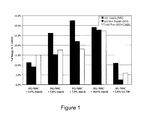
- Figure 1 is a graph of dry tensile in machine-direction (MD), hot/wet tensile (MD), and total tear strengths for fiber glass mat samples bonded with modified UF resins, expressed as a ratio to a standard UF resin.
- binder compositions and their use in fiber reinforced composites are described. These compositions may include combinations of conventional thermoset binders such as urea-formaldehyde (UF) and starches to at least partially replace more conventional, petroleum-based modifiers such as polyvinyl acetate, acrylic latexes, and/or styrene-butadiene latexes, among other modifiers.
- UF urea-formaldehyde
- the fiber reinforced composites made from these binder compositions may have tensile and tear strength characteristics that exceed those made exclusively with petroleum-based modifiers.
- the present binder compositions may include a urea-formaldehyde based resin and one or more starch compounds with concentrations that promote the tougheneing and/or strengthening of a composite made from the binder.
- Exemplary starch concentration ranges may be from about 1 wt.% to about 10 wt.% of the binder composition.
- Additional exemplary starch concentration ranges may include about 1 wt.% to about 7.5 wt.%; about 1 wt.% to about 5 wt.%; 1 wt.% to about 4 wt.%; about 1 wt.% to about 3 wt.%; about 1 wt.% to about 2.5 wt.%; about 1 wt.% to about 2 wt.%; about 1 wt.% to about 1.5 wt.%. etc.
- a ceiling for the starch concentration may be set such that the starch does not function as a significant thickener in the binder composition that substantially increases the viscosity of the composition.
- the concentration of the starch may have an upper limit threshold of about 10 wt.% in embodiments where it is not desired for the starch to act as a thickener.
- the starches used in the present binder compositions may include one or more native or modified starches.
- the native or modified starches may be derived from corn, potatoes, tapioca, or wheat among other sources.
- Exemplary modified starches may include cationic or anionic starches.
- modified cationic starch is the RediBOND5330 starch produced by National Starch.
- the size of the starch compounds may be controlled to affect the thickness of the binder compositions.
- Exemplary weight average molecular weights may include a range of about 200,000 g/mol or less; about 190,000 g/mol or less; about 180,000 g/mol or less; about 170,000 g/mol or less; about 160,000 g/mol or less; or about 150,000 g/mol or less; etc. Further exemplary weight average molecular weights may include about 100,000 g/mol or less; about 90,000 g/mol or less; about 80,000 g/mol or less; about 70,000 g/mol or less; about 60,000 g/mol or less; about 50,000 g/mol or less; etc.
- the starch may have a weight average molecular weight range of about 100,000 to about 2,000,000 g/mole. Additional exemplary ranges include about 200,000 to about 1,000,000 g/mole.
- the present binder compositions may alternatively include a urea-formaldehyde based resin, one or more starch compounds, and/or one or more petroleum-based modifiers.
- the petroleum-based modifiers may include polyvinyl acetate, acrylic latexes, and/or styrene-butadiene latexes, among other modifiers.
- the weight ratio of the starch to the petroleum-based plasticizer may be about 0.1:1 or more. Alternatively, the starch may replace about 10 wt.% of the petroleum-based plasticizer.
- thermosetting urea-formaldehyde (UF) resins used in the present binder compositions may be prepared from urea and formaldehyde monomers and UF precondensates.
- Suitable resin compositions include thermosetting UF resin compositions that can be used for making binder compositions for fiber mats. Any form of these resin compositions which can react with other reactants and not introduce extraneous moieties deleterious to the desired reaction and reaction product can be utilized.
- Exemplary thermosetting UF resins that may be used in preparing the present binder compositions are disclosed in U.S. Pat. No. 5,851,933 , the disclosure of which is incorporated herein by reference for all purposes.
- Formaldehyde for making the thermosetting UF resin is available in many forms. Examples include paraform (solid, polymerized formaldehyde) and formalin solutions (aqueous solutions of formaldehyde, sometimes with a small amount of methanol, in 37%, 44%, or 50% formaldehyde concentrations). Formaldehyde also is available as a gas.
- thermosetting UF resins is available in many forms. Solid urea, such as prill, and urea solutions, typically aqueous solutions, may be used. Further, the urea may be combined with another moiety, such as formaldehyde and urea-formaldehyde adducts, which may be provided in aqueous solution.
- Solid urea such as prill
- urea solutions typically aqueous solutions
- the urea may be combined with another moiety, such as formaldehyde and urea-formaldehyde adducts, which may be provided in aqueous solution.
- thermosetting UF resin composition A wide variety of procedures may be used for reacting the principal urea and formaldehyde components to form an aqueous thermosetting UF resin composition, such as staged monomer addition, staged catalyst addition, pH control, and amine modification among other procedures.
- the urea and formaldehyde may be reacted at a mole ratio of formaldehyde to urea in the range of about 1.1:1 to 4:1.
- urea and formaldehyde may be reacted at an F:U mole ratio of between about 2.1:1 to 3.2:1.
- the U-F resin may also be highly water dilutable, if not water soluble.
- Exemplary resin compositions may contain reactive methylol groups, which upon curing form methylene or ether linkages.
- methylol-containing adducts may include N,N'-dimethylol, dihydroxymethylolethylene; N,N'bis(methoxymethyl), N,N'-dimethylolpropylene; 5,5-dimethyl-N,N'dimethylolethylene; N,N'-dimethylolethylene; and the like.
- Thermosetting UF resins useful in the practice of the invention may contain 45 to 75% by weight nonvolitiles, for example about 50 to 60% by weight nonvolitiles. These resins may also have an initial viscosity of about 50 to 600 cPs.
- a thermosetting UF resin useful in the practice of the invention may have a viscosity of 150 to 400 cPs.
- a thermosetting UF resin may exhibit a pH of 7.0 to 9.0 or alternatively 7.5 to 8.5.
- These resins may also have a free formaldehyde level of not more than about 3.0% (for example less than 1%) and a water dilutability of 1:1 to 100:1 (for example 5:1 and above).
- a resin modifier such as ammonia, alkanolamines, or polyamines may be added to the reactants that are used to make the UF resin.
- Polyamines may include an alkyl primary diamine such as ethylenediamine (EDA).
- EDA ethylenediamine
- Additional modifiers such as melamine, ethylene ureas, primary amines, secondary amines, and tertiary amines may also be incorporated into a UF resin. Concentrations of these modifiers in the reaction mixture often will vary from 0.05 to 15.0% by weight of the UF resin solids. These types of modifiers may promote hydrolysis resistance, polymer flexibility, and lower formaldehyde emissions in the cured resin.
- present binder compositions may also contain a variety of additives such as silica colloid to enhance fire resistance, antifoamers, biocides, pigments, surfactants and the like.
- the binder compositions may have a solids content of about 5 wt.% to about 70 wt.%.
- Exemplary solids contents for binder compositions that have not been diluted with water may be greater than about 35 wt.%; greater than about 40 wt.%; greater than about 45 wt.%; greater than about 50 wt.%; etc.
- Exemplary solids content ranges may include about 5 wt.% to about 35 wt.% and about 45 wt.% to about 70 wt.%, among others.
- Exemplary solids contents for aqueous binder compositions may include about 35 wt.% or less; about 30 wt.% or less; about 25 wt.% or less; about 20 wt.% or less; about 15 wt.% or less; etc.
- Exemplary solids content ranges for aqueous binder compositions may include about 10 wt.% to about 30 wt.%, among others.
- the present fiber reinforced composites may include a binder matrix made from the present binder compositions and organic and/or inorganic fibers.
- Organic fibers may include without limitation, acrylic, aromatic polyamides, polyesters, cellulosic fibers, and/or polyolefin fibers among others.
- Exemplary inorganic fibers may include mineral fibers, ceramic fibers, graphite fibers, metal fibers, metal coated glass or graphite fibers, and/or glass fibers among others.
- Various glass fibers may be suitable for use in this invention including E type, T type, C type, A type, and S type glass fibers.
- a fiber reinforced composite may include a binder matrix made from the present binder compositions and glass fibers.
- a fiber reinforced composite may include a binder matrix made from the present binder composition, glass fibers, and up to about 25 wt.% organic fibers.
- Fibers used in the present fiber reinforced composites may independently have lengths of about 1/4 inch to 5 inches (about 6 to about 140 mm) and diameters of about 3 to 25 microns.
- glass fibers having diameters in the range of 3 to 25 microns may be used.
- glass fibers having diameters in the range of 12 to 17 microns may be used.
- the glass fibers may all have about the same target length, such as 0.75 inches, 1 inch, or 1.25 inches.
- fibers of different lengths and diameters can also be used to produce composites with different characteristics.
- Glass fibers used in a wet process for making fiber glass mats may be up to about 3 to 5 inches in length, and even longer fibers can be used in some processes. Generally the longer the fiber, the higher the tensile and strengths of the mat, but the poorer the fiber dispersion.
- solid particles such as organic and/or inorganic flakes (e.g., carbon and/or glass flakes) may reinforce the composite.
- Other reinforcing solid particles may include ceramic particles, metal particles such as aluminum, and amorphous materials including polymers and carbon black among other particles.
- the fiber reinforced composites may include fiber reinforced mats used for building materials, for example, as components of roofing shingles.
- the mats may be formed by contacting the binder compositions with a woven or non-woven mat of fibers (e.g., glass fibers) and curing the mixture to form the composite mat.
- the finished mat may contain about 55 wt.% to about 97 wt.% fibers, and about 3 wt.% to about 45 wt.% (e.g., about 15-30 wt.%) of the binder matrix (i.e., the cured binder).
- the present fiber reinforced composites that include starch as a modifier/strengthener have comparable and in some cases enhanced strength characteristics compared with composites made exclusively with petroleum-based modifiers.
- fiber reinforced composites that include starch have hot/wet tensile strengths that are about 5% to about 10% greater than fiber reinforced composites that include acrylic latex modifier.
- fiber reinforced composites that include starch have total tear strengths that are about 5% to about 10% greater than fiber reinforced composites that include acrylic latex modifer.
- the present fiber reinforced composites that include starch as a modifier/strengthener also have enhanced strength characteristics compared with composites made without modifiers/strengtheners.
- fiber reinforced composites that include starch have tensile strengths that are about 5% to about 40% greater than fiber reinforced composites made with unmodified UF resin.
- fiber reinforced composites that include starch have hot/wet tensile strengths that are about 5% to about 35% greater than fiber reinforced composites made with unmodified UF resin.
- fiber reinforced composites that include starch have total tear strengths that are about 10% to about 35% greater than fiber reinforced composites made with unmodified UF resin.
- the fiber reinforced composites made from the present binder compositions show improved dry tensile, hot/wet tensile, and tear strengths as compared to corresponding binder compositions without starch.
- Table 1 shows the results of dry tensile, hot/wet tensile, and tear tests for non-woven fiber glass mat samples bonded with various UF resins.
- the UF resins evaluated included (1) a FG-705C UF resin from Hexion (standard resin), (2) a FG-705C UF resin from Hexion modified with 2.5%, 5%, 7.5%, and 10 wt.% RediBOND5330 starch, and (3) a FG-705C UF resin from Hexion modified with 2.5 wt.% GL720 acrylic latex from Rohm & Haas.
- Dry tensile and hot/wet tensile strengths for fiber glass mats bonded with UF resins were measured in the machine direction (MD) at room temperature. Tear strengths for fiber glass mats bonded with UF resins were measured in both the machine direction and cross machine direction (CMD) at room temperature using a standard Instron.
- Table 1 Physical Properties of UF Resins Binder LOI Dry Tensile (MD) Hot/Wet Tensile (MD) Hot/W et Retention Tear (MD +CMD) Mean STDev Mean STDev Mean STDev FG-705C (Standard) 19.3% 34.7 6.4 24.1 6.2 69.5% 914.3 100.8 FG-705C + 2.5% Starch 18.9% 38.6 4.5 26.3 4.1 68.1% 1051.5 137.1 FG-705C + 5% Starch 18.9% 43.8 7.3 27.8 5.2 63.5% 1075.1 154.2 FG-705C + 7.5% Starch 19.0% 46.0 9.8 29.4 3.6 63.9% 1080.0 113.7 FG-705C + 10% Starch 19.1% 44.8 11 30.8 1.9 68.8% 1163.9 100.0 FG-705C + 2.5% GL720 19.1% 38.5 6.4 24.7 3.0 64.2% 967.7 107.8
- Figure 1 shows the improvements in dry tensile, hot/wet tensile, and tear strength exhibited by starch modified UF resins and an acrylic latex modified UF resin over a standard UF resin. Substantial increases in dry tensile, hot/wet tensile and tear strength are obtained when starch is added to a standard UF resin.
- Figure 1 also shows that comparable dry tensile strengths are exhibited by composites made with 2.5 wt.% latex modified UF resin and 2.5 wt.% starch modified UF resin. Both exhibit about an 11 % increase in dry tensile strength over a standard UF binder.
- Figure 1 shows that a 2.5 wt.% starch modified UF resin exhibits improved hot/wet tensile and tear strength as compared to a 2.5 wt.% acrylic latex-modified UF resin, about 6.6% and 9.1% respectively.
- Table 2 lists viscosities of various binder compositions at 16% solids. The data shows that the standard binder, the starch modified binder, and the latex modified binder all exhibit comparable viscosities. Table 2: Viscosities of UF Resins Binder Viscosity @ 16% Solids (cPs) FG-705C (standard) 5.44 FG-705C + 1 %Starch 5.53 FG-705C + 2.5% Starch 5.53 FG-705C + 2.5% GL720 5.06
Landscapes
- Chemical & Material Sciences (AREA)
- Health & Medical Sciences (AREA)
- Chemical Kinetics & Catalysis (AREA)
- Medicinal Chemistry (AREA)
- Polymers & Plastics (AREA)
- Organic Chemistry (AREA)
- Engineering & Computer Science (AREA)
- Materials Engineering (AREA)
- Manufacturing & Machinery (AREA)
- Inorganic Chemistry (AREA)
- Compositions Of Macromolecular Compounds (AREA)
- Reinforced Plastic Materials (AREA)
Abstract
Description
- The present application is related to co-assigned
U.S. Pat. No. 7,662,258 issued February 16, 2010 ; andU.S. Pat. No. 7,691,761 issued April 6, 2010 . The entire contents of both patents are herein incorporated by reference for all purposes. - Thermoset urea-formaldehyde (UF) resins are commonly used as binders for fiber reinforced composites because of their suitability for various applications and their relatively low cost. However, fiber reinforced composites bonded with neat UF resin are often brittle and cause processing and product performance issues. In order to overcome these issues, it is common to modify UF resin with conventional latexes, such as polyvinyl acetate, vinyl acrylic, or styrene-butadiene latexes. Modifying UF resin with conventional latexes improves the flexibility of fiber reinforced composites which in turn improves the strength of fiber reinforced composites. Improved strength is needed to achieve high speed processing of fiber reinforced composites on commercial manufacturing lines as well as optimal product performance. However, these conventional latex modifiers are typically expensive and the modification of UF resins with conventional latexes increases binder cost significantly. In addition, conventional latexes are petroleum-based, and are thus derived from a non-renewable and non-sustainable resource. Therefore, there is a need to develop binder compositions that are more cost effective, more environmentally sustainable, and that do not degrade the strength of fiber reinforced composites.
- Binder compositions are described that include urea-formaldehyde (UF) resin and a starch modifier at concentration levels that strengthen the tensile and tear strength (among other properties) of composites formed with the binder compositions. The starch may replace at least a portion of the conventional, petroleum-based modifiers used in the binder compositions to create composites based on more sustainable and renewable materials than conventional composites.
- There is widespread belief that starches would make inadequate substitutes for petroleum-based modifiers, especially in composites exposed to hot, humid conditions such as roofing materials. The present starch-containing binder compositions are shown to form composites with hot/wet tensile strength that is actually higher than comparable composites made exclusively with petroleum-based modifiers. Thus, the present binder compositions are not only made with environmentally advantageous materials, they also demonstrate performance characteristics that make them superior materials for challenging environments such as roofing materials in hot, humid climates.
- Embodiments of the invention include binder compositions that include UF resins and starch used as a modifier/strengthener. The concentration of the starch may by about 1 wt.% to about 10 wt.% of the binder composition.
- Embodiments of the invention further include fiber reinforced composites that include a polymer matrix formed from a binder composition having UF resin and about 1 wt.% to about 10 wt.% of a starch. The composites may further include organic and/or inorganic fibers.
- Additional embodiments and features are set forth in part in the description that follows, and in part will become apparent to those skilled in the art upon examination of the specification or may be learned by the practice of the invention. The features and advantages of the invention may be realized and attained by means of the instrumentalities, combinations, and methods described in the specification.
- A further understanding of the nature and advantages of the present invention may be realized by reference to the remaining portions of the specification and the drawings wherein like reference numerals may be used throughout the drawings to refer to similar components. In some instances, a sublabel is associated with a reference numeral and follows a hyphen to denote one of multiple similar components. When reference is made to a reference numeral without specification to an existing sublabel, it is intended to refer to all such multiple similar components.
-
Figure 1 is a graph of dry tensile in machine-direction (MD), hot/wet tensile (MD), and total tear strengths for fiber glass mat samples bonded with modified UF resins, expressed as a ratio to a standard UF resin. - Exemplary binder compositions and their use in fiber reinforced composites are described. These compositions may include combinations of conventional thermoset binders such as urea-formaldehyde (UF) and starches to at least partially replace more conventional, petroleum-based modifiers such as polyvinyl acetate, acrylic latexes, and/or styrene-butadiene latexes, among other modifiers. The fiber reinforced composites made from these binder compositions may have tensile and tear strength characteristics that exceed those made exclusively with petroleum-based modifiers.
- The present binder compositions may include a urea-formaldehyde based resin and one or more starch compounds with concentrations that promote the tougheneing and/or strengthening of a composite made from the binder. Exemplary starch concentration ranges may be from about 1 wt.% to about 10 wt.% of the binder composition. Additional exemplary starch concentration ranges may include about 1 wt.% to about 7.5 wt.%; about 1 wt.% to about 5 wt.%; 1 wt.% to about 4 wt.%; about 1 wt.% to about 3 wt.%; about 1 wt.% to about 2.5 wt.%; about 1 wt.% to about 2 wt.%; about 1 wt.% to about 1.5 wt.%. etc.
- A ceiling for the starch concentration may be set such that the starch does not function as a significant thickener in the binder composition that substantially increases the viscosity of the composition. For example, the concentration of the starch may have an upper limit threshold of about 10 wt.% in embodiments where it is not desired for the starch to act as a thickener.
- The starches used in the present binder compositions may include one or more native or modified starches. The native or modified starches may be derived from corn, potatoes, tapioca, or wheat among other sources. Exemplary modified starches may include cationic or anionic starches. One example of modified cationic starch is the RediBOND5330 starch produced by National Starch.
- In some embodiments, the size of the starch compounds may be controlled to affect the thickness of the binder compositions. Exemplary weight average molecular weights may include a range of about 200,000 g/mol or less; about 190,000 g/mol or less; about 180,000 g/mol or less; about 170,000 g/mol or less; about 160,000 g/mol or less; or about 150,000 g/mol or less; etc. Further exemplary weight average molecular weights may include about 100,000 g/mol or less; about 90,000 g/mol or less; about 80,000 g/mol or less; about 70,000 g/mol or less; about 60,000 g/mol or less; about 50,000 g/mol or less; etc.
- Higher weight average molecular weight ranges for the starches are also contemplated for embodiments of the present binder compositions. For example, the starch may have a weight average molecular weight range of about 100,000 to about 2,000,000 g/mole. Additional exemplary ranges include about 200,000 to about 1,000,000 g/mole.
- The present binder compositions may alternatively include a urea-formaldehyde based resin, one or more starch compounds, and/or one or more petroleum-based modifiers. The petroleum-based modifiers may include polyvinyl acetate, acrylic latexes, and/or styrene-butadiene latexes, among other modifiers. The weight ratio of the starch to the petroleum-based plasticizer may be about 0.1:1 or more. Alternatively, the starch may replace about 10 wt.% of the petroleum-based plasticizer.
- The thermosetting urea-formaldehyde (UF) resins used in the present binder compositions may be prepared from urea and formaldehyde monomers and UF precondensates. Suitable resin compositions include thermosetting UF resin compositions that can be used for making binder compositions for fiber mats. Any form of these resin compositions which can react with other reactants and not introduce extraneous moieties deleterious to the desired reaction and reaction product can be utilized. Exemplary thermosetting UF resins that may be used in preparing the present binder compositions are disclosed in
U.S. Pat. No. 5,851,933 , the disclosure of which is incorporated herein by reference for all purposes. - Formaldehyde for making the thermosetting UF resin is available in many forms. Examples include paraform (solid, polymerized formaldehyde) and formalin solutions (aqueous solutions of formaldehyde, sometimes with a small amount of methanol, in 37%, 44%, or 50% formaldehyde concentrations). Formaldehyde also is available as a gas.
- Similarly, urea for thermosetting UF resins is available in many forms. Solid urea, such as prill, and urea solutions, typically aqueous solutions, may be used. Further, the urea may be combined with another moiety, such as formaldehyde and urea-formaldehyde adducts, which may be provided in aqueous solution.
- A wide variety of procedures may be used for reacting the principal urea and formaldehyde components to form an aqueous thermosetting UF resin composition, such as staged monomer addition, staged catalyst addition, pH control, and amine modification among other procedures. The urea and formaldehyde may be reacted at a mole ratio of formaldehyde to urea in the range of about 1.1:1 to 4:1. For example, urea and formaldehyde may be reacted at an F:U mole ratio of between about 2.1:1 to 3.2:1. The U-F resin may also be highly water dilutable, if not water soluble.
- Exemplary resin compositions may contain reactive methylol groups, which upon curing form methylene or ether linkages. Such methylol-containing adducts may include N,N'-dimethylol, dihydroxymethylolethylene; N,N'bis(methoxymethyl), N,N'-dimethylolpropylene; 5,5-dimethyl-N,N'dimethylolethylene; N,N'-dimethylolethylene; and the like.
- Thermosetting UF resins useful in the practice of the invention may contain 45 to 75% by weight nonvolitiles, for example about 50 to 60% by weight nonvolitiles. These resins may also have an initial viscosity of about 50 to 600 cPs. For example, a thermosetting UF resin useful in the practice of the invention may have a viscosity of 150 to 400 cPs. Additionally, a thermosetting UF resin may exhibit a pH of 7.0 to 9.0 or alternatively 7.5 to 8.5. These resins may also have a free formaldehyde level of not more than about 3.0% (for example less than 1%) and a water dilutability of 1:1 to 100:1 (for example 5:1 and above).
- A resin modifier such as ammonia, alkanolamines, or polyamines may be added to the reactants that are used to make the UF resin. Polyamines may include an alkyl primary diamine such as ethylenediamine (EDA). Additional modifiers, such as melamine, ethylene ureas, primary amines, secondary amines, and tertiary amines may also be incorporated into a UF resin. Concentrations of these modifiers in the reaction mixture often will vary from 0.05 to 15.0% by weight of the UF resin solids. These types of modifiers may promote hydrolysis resistance, polymer flexibility, and lower formaldehyde emissions in the cured resin. Further urea additions for purposes of scavenging formaldehyde or as a diluent may also be used. The present binder compositions may also contain a variety of additives such as silica colloid to enhance fire resistance, antifoamers, biocides, pigments, surfactants and the like.
- The binder compositions may have a solids content of about 5 wt.% to about 70 wt.%. Exemplary solids contents for binder compositions that have not been diluted with water (e.g., resin compositions) may be greater than about 35 wt.%; greater than about 40 wt.%; greater than about 45 wt.%; greater than about 50 wt.%; etc. Exemplary solids content ranges may include about 5 wt.% to about 35 wt.% and about 45 wt.% to about 70 wt.%, among others. Exemplary solids contents for aqueous binder compositions may include about 35 wt.% or less; about 30 wt.% or less; about 25 wt.% or less; about 20 wt.% or less; about 15 wt.% or less; etc. Exemplary solids content ranges for aqueous binder compositions may include about 10 wt.% to about 30 wt.%, among others.
- The present fiber reinforced composites may include a binder matrix made from the present binder compositions and organic and/or inorganic fibers. Organic fibers may include without limitation, acrylic, aromatic polyamides, polyesters, cellulosic fibers, and/or polyolefin fibers among others. Exemplary inorganic fibers may include mineral fibers, ceramic fibers, graphite fibers, metal fibers, metal coated glass or graphite fibers, and/or glass fibers among others. Various glass fibers may be suitable for use in this invention including E type, T type, C type, A type, and S type glass fibers. In one embodiment, a fiber reinforced composite may include a binder matrix made from the present binder compositions and glass fibers. In another embodiment, a fiber reinforced composite may include a binder matrix made from the present binder composition, glass fibers, and up to about 25 wt.% organic fibers.
- Fibers used in the present fiber reinforced composites may independently have lengths of about 1/4 inch to 5 inches (about 6 to about 140 mm) and diameters of about 3 to 25 microns. For example, glass fibers having diameters in the range of 3 to 25 microns may be used. Alternatively, glass fibers having diameters in the range of 12 to 17 microns may be used. The glass fibers may all have about the same target length, such as 0.75 inches, 1 inch, or 1.25 inches. However, fibers of different lengths and diameters can also be used to produce composites with different characteristics. Glass fibers used in a wet process for making fiber glass mats may be up to about 3 to 5 inches in length, and even longer fibers can be used in some processes. Generally the longer the fiber, the higher the tensile and strengths of the mat, but the poorer the fiber dispersion.
- In addition (or in lieu of) the fibers, solid particles such as organic and/or inorganic flakes (e.g., carbon and/or glass flakes) may reinforce the composite. Other reinforcing solid particles may include ceramic particles, metal particles such as aluminum, and amorphous materials including polymers and carbon black among other particles.
- The fiber reinforced composites may include fiber reinforced mats used for building materials, for example, as components of roofing shingles. The mats may be formed by contacting the binder compositions with a woven or non-woven mat of fibers (e.g., glass fibers) and curing the mixture to form the composite mat. The finished mat may contain about 55 wt.% to about 97 wt.% fibers, and about 3 wt.% to about 45 wt.% (e.g., about 15-30 wt.%) of the binder matrix (i.e., the cured binder).
- The present fiber reinforced composites that include starch as a modifier/strengthener have comparable and in some cases enhanced strength characteristics compared with composites made exclusively with petroleum-based modifiers. For example, fiber reinforced composites that include starch have hot/wet tensile strengths that are about 5% to about 10% greater than fiber reinforced composites that include acrylic latex modifier. In another example, fiber reinforced composites that include starch have total tear strengths that are about 5% to about 10% greater than fiber reinforced composites that include acrylic latex modifer.
- While not wishing to be bound by any particular scientific theory, it is believed that starch and UF resin crosslink with each other via reaction between hydroxyl functionalities on starch molecules and reactive functionalities on UF resin, and this crosslinking strengthens fiber glass composites. Latex modifiers are often non-reactive or less reactive toward UF resin, and thus there is minimal or no crosslinking between the UF resin and the latex modifier. The substantial increase in hot/wet tensile and tear strength for a UF resin modified with starch, as compared to a UF resin modified with latex (see
Figure 1 ), indicates that crosslinking occurs between UF resin and starch. - The present fiber reinforced composites that include starch as a modifier/strengthener also have enhanced strength characteristics compared with composites made without modifiers/strengtheners. For example, fiber reinforced composites that include starch have tensile strengths that are about 5% to about 40% greater than fiber reinforced composites made with unmodified UF resin. In another example, fiber reinforced composites that include starch have hot/wet tensile strengths that are about 5% to about 35% greater than fiber reinforced composites made with unmodified UF resin. In an alternate example, fiber reinforced composites that include starch have total tear strengths that are about 10% to about 35% greater than fiber reinforced composites made with unmodified UF resin.
- As noted above, the fiber reinforced composites made from the present binder compositions show improved dry tensile, hot/wet tensile, and tear strengths as compared to corresponding binder compositions without starch. Table 1 shows the results of dry tensile, hot/wet tensile, and tear tests for non-woven fiber glass mat samples bonded with various UF resins. The UF resins evaluated included (1) a FG-705C UF resin from Hexion (standard resin), (2) a FG-705C UF resin from Hexion modified with 2.5%, 5%, 7.5%, and 10 wt.% RediBOND5330 starch, and (3) a FG-705C UF resin from Hexion modified with 2.5 wt.% GL720 acrylic latex from Rohm & Haas.
- Dry tensile and hot/wet tensile strengths for fiber glass mats bonded with UF resins were measured in the machine direction (MD) at room temperature. Tear strengths for fiber glass mats bonded with UF resins were measured in both the machine direction and cross machine direction (CMD) at room temperature using a standard Instron.
Table 1: Physical Properties of UF Resins Binder LOI Dry Tensile (MD) Hot/Wet Tensile (MD) Hot/W et Retention Tear (MD +CMD) Mean STDev Mean STDev Mean STDev FG-705C (Standard) 19.3% 34.7 6.4 24.1 6.2 69.5% 914.3 100.8 FG-705C + 2.5% Starch 18.9% 38.6 4.5 26.3 4.1 68.1% 1051.5 137.1 FG-705C + 5% Starch 18.9% 43.8 7.3 27.8 5.2 63.5% 1075.1 154.2 FG-705C + 7.5% Starch 19.0% 46.0 9.8 29.4 3.6 63.9% 1080.0 113.7 FG-705C + 10% Starch 19.1% 44.8 11 30.8 1.9 68.8% 1163.9 100.0 FG-705C + 2.5% GL720 19.1% 38.5 6.4 24.7 3.0 64.2% 967.7 107.8 -
Figure 1 shows the improvements in dry tensile, hot/wet tensile, and tear strength exhibited by starch modified UF resins and an acrylic latex modified UF resin over a standard UF resin. Substantial increases in dry tensile, hot/wet tensile and tear strength are obtained when starch is added to a standard UF resin.Figure 1 also shows that comparable dry tensile strengths are exhibited by composites made with 2.5 wt.% latex modified UF resin and 2.5 wt.% starch modified UF resin. Both exhibit about an 11 % increase in dry tensile strength over a standard UF binder. Additionally,Figure 1 shows that a 2.5 wt.% starch modified UF resin exhibits improved hot/wet tensile and tear strength as compared to a 2.5 wt.% acrylic latex-modified UF resin, about 6.6% and 9.1% respectively. - Table 2 lists viscosities of various binder compositions at 16% solids. The data shows that the standard binder, the starch modified binder, and the latex modified binder all exhibit comparable viscosities.
Table 2: Viscosities of UF Resins Binder Viscosity @ 16% Solids (cPs) FG-705C (standard) 5.44 FG-705C + 1 %Starch 5.53 FG-705C + 2.5% Starch 5.53 FG-705C + 2.5% GL720 5.06 - Having described several embodiments, it will be recognized by those of skill in the art that various modifications, alternative constructions, and equivalents may be used without departing from the spirit of the invention. Additionally, a number of well-known processes and elements have not been described in order to avoid unnecessarily obscuring the present invention. Accordingly, the above description should not be taken as limiting the scope of the invention.
- Where a range of values is provided, it is understood that each intervening value, to the tenth of the unit of the lower limit unless the context clearly dictates otherwise, between the upper and lower limits of that range is also specifically disclosed. Each smaller range between any stated value or intervening value in a stated range and any other stated or intervening value in that stated range is encompassed. The upper and lower limits of these smaller ranges may independently be included or excluded in the range, and each range where either, neither or both limits are included in the smaller ranges is also encompassed within the invention, subject to any specifically excluded limit in the stated range. Where the stated range includes one or both of the limits, ranges excluding either or both of those included limits are also included.
- As used herein and in the appended claims, the singular forms "a", "an", and "the" include plural referents unless the context clearly dictates otherwise. Thus, for example, reference to "a process" includes a plurality of such processes and reference to "the starch" includes reference to one or more starches and equivalents thereof known to those skilled in the art, and so forth.
- Also, the words "comprise," "comprising," "include," "including," and "includes" when used in this specification and in the following claims are intended to specify the presence of stated features, integers, components, or steps, but they do not preclude the presence or addition of one or more other features, integers, components, steps, acts, or groups.
Claims (19)
- A binder composition comprising:a urea-formaldehyde resin; andabout 1 wt.% to about 10 wt.% of a starch.
- The binder composition of claim 1, wherein the binder composition comprises about 1 wt.% to about 2.5 wt.% of the starch.
- The binder composition of claim 1, wherein the starch comprises a native starch or a modified starch.
- The binder composition of claim 1, wherein the starch comprises a cationic starch.
- The binder composition of claim 1, wherein the binder composition has a solids content of greater than 35 wt.%.
- The binder composition of claim 1, wherein the binder composition has a solids content of about 45 wt.% to about 70 wt.%.
- The binder composition of claim 1, wherein the binder composition further comprises water.
- The binder composition of claim 7, wherein the binder composition has a solids content of about 5 to 35 wt.%.
- The binder composition of claim 1, wherein the binder composition further comprises a petroleum-based modifier.
- The binder composition of claim 9, wherein a weight ratio of the starch to the petroleum-based modifier is about 0.1:1 or more.
- The binder composition of claim 9, wherein the starch replaces at least about 10 wt.% of the petroleum-based modifier.
- The binder composition of claim 9, wherein the petroleum-based modifier comprises one or more of a polyvinyl acetate, a vinyl acrylic latex, or a styrene-butadiene latex.
- A fiber reinforced composite comprising:a polymer matrix formed from a binder composition that comprises:a urea-formaldehyde resin; andabout 1 wt.% to about 10 wt.% of a starch; andorganic or inorganic fibers.
- The fiber reinforced composite of claim 13, wherein the organic or inorganic fibers comprise glass fibers.
- The fiber reinforced composite of claim 13, wherein the composite comprises a non-woven glass-fiber reinforced mat.
- The fiber reinforced composite of claim 15, wherein the non-woven glass-fiber reinforced mat forms part of a roofing shingle.
- The fiber reinforced composite of claim 13, wherein the fiber reinforced composite further comprises a petroleum-based modifier.
- The fiber reinforced composite of claim 17, wherein the petroleum-based modifier comprises one or more of a polyvinyl acetate, a vinyl acrylic latex, or a styrene-butadiene latex.
- The fiber reinforced composite of claim 17, wherein a weight ratio of the starch to the petroleum-based modifier is about 0.1:1 or more.
Applications Claiming Priority (1)
| Application Number | Priority Date | Filing Date | Title |
|---|---|---|---|
| US13/300,841 US10119020B2 (en) | 2011-11-21 | 2011-11-21 | Modified urea-formaldehyde binders for non-woven fiber glass mats |
Publications (3)
| Publication Number | Publication Date |
|---|---|
| EP2594606A2 true EP2594606A2 (en) | 2013-05-22 |
| EP2594606A3 EP2594606A3 (en) | 2013-09-18 |
| EP2594606B1 EP2594606B1 (en) | 2021-05-12 |
Family
ID=47227419
Family Applications (1)
| Application Number | Title | Priority Date | Filing Date |
|---|---|---|---|
| EP12007784.7A Active EP2594606B1 (en) | 2011-11-21 | 2012-11-16 | Modified urea-formaldehyde binders for non-woven fiber glass mats |
Country Status (4)
| Country | Link |
|---|---|
| US (1) | US10119020B2 (en) |
| EP (1) | EP2594606B1 (en) |
| CA (1) | CA2795935C (en) |
| ES (1) | ES2870587T3 (en) |
Cited By (1)
| Publication number | Priority date | Publication date | Assignee | Title |
|---|---|---|---|---|
| EP3778820A1 (en) * | 2019-08-16 | 2021-02-17 | Johns Manville | Modified urea-formaldehyde binders for non-woven fiber glass mats |
Families Citing this family (3)
| Publication number | Priority date | Publication date | Assignee | Title |
|---|---|---|---|---|
| EP3408082B1 (en) * | 2016-01-27 | 2021-12-08 | Draudins, Kristaps | An electrically conductive multi-layer material |
| IT201800004786A1 (en) * | 2018-04-23 | 2019-10-23 | SUPPORT LAYER FOR INSULATING BUILDING PANELS INCLUDING ECO-SUSTAINABLE MATERIALS AND METHOD OF MANUFACTURING THE SUPPORT LAYER | |
| CN112663398A (en) * | 2020-12-23 | 2021-04-16 | 西安爱德乐环保科技有限公司 | Flexible glass fiber paper and preparation method thereof |
Citations (1)
| Publication number | Priority date | Publication date | Assignee | Title |
|---|---|---|---|---|
| US5851933A (en) | 1995-09-14 | 1998-12-22 | Johns Manville International, Inc. | Method for making fiber glass mats and improved mats using this method |
Family Cites Families (20)
| Publication number | Priority date | Publication date | Assignee | Title |
|---|---|---|---|---|
| US2302309A (en) * | 1939-10-19 | 1942-11-17 | Rohm & Haas | Stabilization of wet processed starch pastes with urea-formaldehyde |
| GB907302A (en) | 1957-12-27 | 1962-10-03 | Owens Corning Fiberglass Corp | Improved glass fibre structures |
| US3485776A (en) * | 1967-10-27 | 1969-12-23 | Corn Products Co | Novel starch composition and method of preparation |
| US4014726A (en) | 1974-03-18 | 1977-03-29 | Owens-Corning Fiberglas Corporation | Production of glass fiber products |
| CA1067226A (en) | 1974-03-18 | 1979-11-27 | Harland E. Fargo | Production of glass fiber products |
| US4255485A (en) | 1979-11-08 | 1981-03-10 | Owens-Corning Fiberglas Corporation | Binder for glass fiber mat |
| US4654259A (en) * | 1984-02-14 | 1987-03-31 | Carbocol Inc. | Method and composition for bonding solid lignocellulosic material |
| US4855354A (en) * | 1988-01-07 | 1989-08-08 | Borden, Inc. | Aldehyde starch saturant laminating adhesives |
| JPH0299655A (en) * | 1988-08-03 | 1990-04-11 | Sequa Chemicals Inc | Starch group binder composition for fiber mat and manufacture thereof |
| US5026746A (en) * | 1989-06-26 | 1991-06-25 | Sequa Chemicals, Inc. | Starch based binder composition for non-woven fibers or fabrics |
| US5582670A (en) * | 1992-08-11 | 1996-12-10 | E. Khashoggi Industries | Methods for the manufacture of sheets having a highly inorganically filled organic polymer matrix |
| US6379814B1 (en) * | 1997-12-19 | 2002-04-30 | Georgia-Pacific Resins, Inc. | Cyclic urea-formaldehyde prepolymer for use in phenol-formaldehyde and melamine-formaldehyde resin-based binders |
| US7435483B2 (en) * | 2001-04-04 | 2008-10-14 | Advanced Plastics Technologies Luxembourg S.A. | Process for coating paper, paperboard, and molded fiber with a water-dispersible polyester polymer |
| US20050070186A1 (en) * | 2003-09-29 | 2005-03-31 | Georgia-Pacific Resins, Inc. | Urea-formaldehyde binder composition and process |
| US8257554B2 (en) * | 2006-10-05 | 2012-09-04 | Georgia-Pacific Chemicals Llc | Urea-formaldehyde resin composition and process for making fiber mats |
| US7662258B2 (en) | 2006-12-28 | 2010-02-16 | Johns Manville | Roofing mat using urea-formaldehyde binder of particular viscosity and surface tension |
| US7691761B2 (en) | 2006-12-28 | 2010-04-06 | Johns Manville | Roofing mat using modified urea-formaldehyde binder |
| CN101679722B (en) | 2007-05-30 | 2012-08-29 | 佐治亚-太平洋化工品有限公司 | Binder compositions for fiber mats, and fiber mats and articles comprising them |
| GB0905111D0 (en) | 2009-03-25 | 2009-05-06 | Dynea Oy | Binder for fibrous materials |
| SI2464773T1 (en) | 2009-08-11 | 2017-12-29 | Johns Manville | Process for binding fiberglass and fiberglass product |
-
2011
- 2011-11-21 US US13/300,841 patent/US10119020B2/en active Active
-
2012
- 2012-11-16 EP EP12007784.7A patent/EP2594606B1/en active Active
- 2012-11-16 CA CA2795935A patent/CA2795935C/en active Active
- 2012-11-16 ES ES12007784T patent/ES2870587T3/en active Active
Patent Citations (1)
| Publication number | Priority date | Publication date | Assignee | Title |
|---|---|---|---|---|
| US5851933A (en) | 1995-09-14 | 1998-12-22 | Johns Manville International, Inc. | Method for making fiber glass mats and improved mats using this method |
Cited By (1)
| Publication number | Priority date | Publication date | Assignee | Title |
|---|---|---|---|---|
| EP3778820A1 (en) * | 2019-08-16 | 2021-02-17 | Johns Manville | Modified urea-formaldehyde binders for non-woven fiber glass mats |
Also Published As
| Publication number | Publication date |
|---|---|
| US20130130582A1 (en) | 2013-05-23 |
| US10119020B2 (en) | 2018-11-06 |
| CA2795935C (en) | 2019-09-10 |
| EP2594606B1 (en) | 2021-05-12 |
| ES2870587T3 (en) | 2021-10-27 |
| EP2594606A3 (en) | 2013-09-18 |
| CA2795935A1 (en) | 2013-05-21 |
Similar Documents
| Publication | Publication Date | Title |
|---|---|---|
| US12195621B2 (en) | Modified urea-formaldehyde binders for non-woven fiber glass mats | |
| US8053528B2 (en) | Binder compositions for fiber mats, and fiber mats and articles comprising them | |
| US6642299B2 (en) | Urea-formaldehyde resin binders containing styrene acrylates and acrylic copolymers | |
| US5914365A (en) | Modified urea-formaldehyde binder for making fiber mats | |
| US7964061B2 (en) | Roofing mat and the process for making a roofing mat using modified urea-formaldehyde binder | |
| US7964060B2 (en) | Roofing mat using urea-formaldehyde binder of particular viscosity and surface tension | |
| EP2924071B1 (en) | Improved curable formaldehyde-free resin dispersion with reduced viscosity and mineral wool products produced therewith | |
| US20110165398A1 (en) | Binder compositions for making fiberglass products | |
| EP2594606B1 (en) | Modified urea-formaldehyde binders for non-woven fiber glass mats | |
| WO2013036752A2 (en) | Binder compositions for making fiberglass products | |
| US8222167B2 (en) | Urea-formaldehyde resin binders containing acrylic bi-modal molecular weight solution polymer | |
| CN104136540A (en) | Adhesive composition and methods of making and using same | |
| Saud et al. | Introduction of eco-friendly adhesives: source, types, chemistry and characterization | |
| Sultana et al. | Physico-mechanical and thermal properties of thermoplastic poly (vinyl alcohol) modified thermosetting urea formaldehyde resin | |
| EP4267525A1 (en) | Water-dilutable binders | |
| WO2024134445A1 (en) | Improved bonding resin | |
| EP4526390A1 (en) | Improved bonding resin |
Legal Events
| Date | Code | Title | Description |
|---|---|---|---|
| PUAI | Public reference made under article 153(3) epc to a published international application that has entered the european phase |
Free format text: ORIGINAL CODE: 0009012 |
|
| AK | Designated contracting states |
Kind code of ref document: A2 Designated state(s): AL AT BE BG CH CY CZ DE DK EE ES FI FR GB GR HR HU IE IS IT LI LT LU LV MC MK MT NL NO PL PT RO RS SE SI SK SM TR |
|
| AX | Request for extension of the european patent |
Extension state: BA ME |
|
| PUAL | Search report despatched |
Free format text: ORIGINAL CODE: 0009013 |
|
| AK | Designated contracting states |
Kind code of ref document: A3 Designated state(s): AL AT BE BG CH CY CZ DE DK EE ES FI FR GB GR HR HU IE IS IT LI LT LU LV MC MK MT NL NO PL PT RO RS SE SI SK SM TR |
|
| AX | Request for extension of the european patent |
Extension state: BA ME |
|
| RIC1 | Information provided on ipc code assigned before grant |
Ipc: C08L 61/24 20060101ALI20130812BHEP Ipc: C08L 61/00 20060101AFI20130812BHEP Ipc: C08K 3/00 20060101ALI20130812BHEP Ipc: C08K 5/00 20060101ALI20130812BHEP |
|
| 17P | Request for examination filed |
Effective date: 20140306 |
|
| RBV | Designated contracting states (corrected) |
Designated state(s): AL AT BE BG CH CY CZ DE DK EE ES FI FR GB GR HR HU IE IS IT LI LT LU LV MC MK MT NL NO PL PT RO RS SE SI SK SM TR |
|
| 17Q | First examination report despatched |
Effective date: 20140407 |
|
| STAA | Information on the status of an ep patent application or granted ep patent |
Free format text: STATUS: EXAMINATION IS IN PROGRESS |
|
| GRAP | Despatch of communication of intention to grant a patent |
Free format text: ORIGINAL CODE: EPIDOSNIGR1 |
|
| STAA | Information on the status of an ep patent application or granted ep patent |
Free format text: STATUS: GRANT OF PATENT IS INTENDED |
|
| INTG | Intention to grant announced |
Effective date: 20201124 |
|
| RIN1 | Information on inventor provided before grant (corrected) |
Inventor name: ASRAR, JAWED Inventor name: ZHANG, MINGFU Inventor name: WEITH, LUKE SAYLOR Inventor name: ZHENG, GUODONG |
|
| GRAS | Grant fee paid |
Free format text: ORIGINAL CODE: EPIDOSNIGR3 |
|
| GRAA | (expected) grant |
Free format text: ORIGINAL CODE: 0009210 |
|
| STAA | Information on the status of an ep patent application or granted ep patent |
Free format text: STATUS: THE PATENT HAS BEEN GRANTED |
|
| AK | Designated contracting states |
Kind code of ref document: B1 Designated state(s): AL AT BE BG CH CY CZ DE DK EE ES FI FR GB GR HR HU IE IS IT LI LT LU LV MC MK MT NL NO PL PT RO RS SE SI SK SM TR |
|
| REG | Reference to a national code |
Ref country code: GB Ref legal event code: FG4D |
|
| REG | Reference to a national code |
Ref country code: CH Ref legal event code: EP |
|
| REG | Reference to a national code |
Ref country code: DE Ref legal event code: R096 Ref document number: 602012075543 Country of ref document: DE |
|
| REG | Reference to a national code |
Ref country code: IE Ref legal event code: FG4D |
|
| REG | Reference to a national code |
Ref country code: AT Ref legal event code: REF Ref document number: 1392163 Country of ref document: AT Kind code of ref document: T Effective date: 20210615 |
|
| REG | Reference to a national code |
Ref country code: NL Ref legal event code: FP |
|
| REG | Reference to a national code |
Ref country code: SK Ref legal event code: T3 Ref document number: E 37431 Country of ref document: SK |
|
| REG | Reference to a national code |
Ref country code: LT Ref legal event code: MG9D |
|
| REG | Reference to a national code |
Ref country code: AT Ref legal event code: MK05 Ref document number: 1392163 Country of ref document: AT Kind code of ref document: T Effective date: 20210512 |
|
| REG | Reference to a national code |
Ref country code: ES Ref legal event code: FG2A Ref document number: 2870587 Country of ref document: ES Kind code of ref document: T3 Effective date: 20211027 |
|
| PG25 | Lapsed in a contracting state [announced via postgrant information from national office to epo] |
Ref country code: HR Free format text: LAPSE BECAUSE OF FAILURE TO SUBMIT A TRANSLATION OF THE DESCRIPTION OR TO PAY THE FEE WITHIN THE PRESCRIBED TIME-LIMIT Effective date: 20210512 Ref country code: AT Free format text: LAPSE BECAUSE OF FAILURE TO SUBMIT A TRANSLATION OF THE DESCRIPTION OR TO PAY THE FEE WITHIN THE PRESCRIBED TIME-LIMIT Effective date: 20210512 Ref country code: BG Free format text: LAPSE BECAUSE OF FAILURE TO SUBMIT A TRANSLATION OF THE DESCRIPTION OR TO PAY THE FEE WITHIN THE PRESCRIBED TIME-LIMIT Effective date: 20210812 Ref country code: LT Free format text: LAPSE BECAUSE OF FAILURE TO SUBMIT A TRANSLATION OF THE DESCRIPTION OR TO PAY THE FEE WITHIN THE PRESCRIBED TIME-LIMIT Effective date: 20210512 Ref country code: FI Free format text: LAPSE BECAUSE OF FAILURE TO SUBMIT A TRANSLATION OF THE DESCRIPTION OR TO PAY THE FEE WITHIN THE PRESCRIBED TIME-LIMIT Effective date: 20210512 |
|
| PG25 | Lapsed in a contracting state [announced via postgrant information from national office to epo] |
Ref country code: NO Free format text: LAPSE BECAUSE OF FAILURE TO SUBMIT A TRANSLATION OF THE DESCRIPTION OR TO PAY THE FEE WITHIN THE PRESCRIBED TIME-LIMIT Effective date: 20210812 Ref country code: PT Free format text: LAPSE BECAUSE OF FAILURE TO SUBMIT A TRANSLATION OF THE DESCRIPTION OR TO PAY THE FEE WITHIN THE PRESCRIBED TIME-LIMIT Effective date: 20210913 Ref country code: PL Free format text: LAPSE BECAUSE OF FAILURE TO SUBMIT A TRANSLATION OF THE DESCRIPTION OR TO PAY THE FEE WITHIN THE PRESCRIBED TIME-LIMIT Effective date: 20210512 Ref country code: IS Free format text: LAPSE BECAUSE OF FAILURE TO SUBMIT A TRANSLATION OF THE DESCRIPTION OR TO PAY THE FEE WITHIN THE PRESCRIBED TIME-LIMIT Effective date: 20210912 Ref country code: LV Free format text: LAPSE BECAUSE OF FAILURE TO SUBMIT A TRANSLATION OF THE DESCRIPTION OR TO PAY THE FEE WITHIN THE PRESCRIBED TIME-LIMIT Effective date: 20210512 Ref country code: GR Free format text: LAPSE BECAUSE OF FAILURE TO SUBMIT A TRANSLATION OF THE DESCRIPTION OR TO PAY THE FEE WITHIN THE PRESCRIBED TIME-LIMIT Effective date: 20210813 Ref country code: SE Free format text: LAPSE BECAUSE OF FAILURE TO SUBMIT A TRANSLATION OF THE DESCRIPTION OR TO PAY THE FEE WITHIN THE PRESCRIBED TIME-LIMIT Effective date: 20210512 Ref country code: RS Free format text: LAPSE BECAUSE OF FAILURE TO SUBMIT A TRANSLATION OF THE DESCRIPTION OR TO PAY THE FEE WITHIN THE PRESCRIBED TIME-LIMIT Effective date: 20210512 |
|
| PG25 | Lapsed in a contracting state [announced via postgrant information from national office to epo] |
Ref country code: RO Free format text: LAPSE BECAUSE OF FAILURE TO SUBMIT A TRANSLATION OF THE DESCRIPTION OR TO PAY THE FEE WITHIN THE PRESCRIBED TIME-LIMIT Effective date: 20210512 Ref country code: CZ Free format text: LAPSE BECAUSE OF FAILURE TO SUBMIT A TRANSLATION OF THE DESCRIPTION OR TO PAY THE FEE WITHIN THE PRESCRIBED TIME-LIMIT Effective date: 20210512 Ref country code: DK Free format text: LAPSE BECAUSE OF FAILURE TO SUBMIT A TRANSLATION OF THE DESCRIPTION OR TO PAY THE FEE WITHIN THE PRESCRIBED TIME-LIMIT Effective date: 20210512 Ref country code: EE Free format text: LAPSE BECAUSE OF FAILURE TO SUBMIT A TRANSLATION OF THE DESCRIPTION OR TO PAY THE FEE WITHIN THE PRESCRIBED TIME-LIMIT Effective date: 20210512 Ref country code: SM Free format text: LAPSE BECAUSE OF FAILURE TO SUBMIT A TRANSLATION OF THE DESCRIPTION OR TO PAY THE FEE WITHIN THE PRESCRIBED TIME-LIMIT Effective date: 20210512 |
|
| REG | Reference to a national code |
Ref country code: DE Ref legal event code: R097 Ref document number: 602012075543 Country of ref document: DE |
|
| PLBE | No opposition filed within time limit |
Free format text: ORIGINAL CODE: 0009261 |
|
| STAA | Information on the status of an ep patent application or granted ep patent |
Free format text: STATUS: NO OPPOSITION FILED WITHIN TIME LIMIT |
|
| 26N | No opposition filed |
Effective date: 20220215 |
|
| PG25 | Lapsed in a contracting state [announced via postgrant information from national office to epo] |
Ref country code: IS Free format text: LAPSE BECAUSE OF FAILURE TO SUBMIT A TRANSLATION OF THE DESCRIPTION OR TO PAY THE FEE WITHIN THE PRESCRIBED TIME-LIMIT Effective date: 20210912 Ref country code: AL Free format text: LAPSE BECAUSE OF FAILURE TO SUBMIT A TRANSLATION OF THE DESCRIPTION OR TO PAY THE FEE WITHIN THE PRESCRIBED TIME-LIMIT Effective date: 20210512 |
|
| PG25 | Lapsed in a contracting state [announced via postgrant information from national office to epo] |
Ref country code: MC Free format text: LAPSE BECAUSE OF FAILURE TO SUBMIT A TRANSLATION OF THE DESCRIPTION OR TO PAY THE FEE WITHIN THE PRESCRIBED TIME-LIMIT Effective date: 20210512 |
|
| REG | Reference to a national code |
Ref country code: CH Ref legal event code: PL |
|
| PG25 | Lapsed in a contracting state [announced via postgrant information from national office to epo] |
Ref country code: LU Free format text: LAPSE BECAUSE OF NON-PAYMENT OF DUE FEES Effective date: 20211116 |
|
| PG25 | Lapsed in a contracting state [announced via postgrant information from national office to epo] |
Ref country code: LI Free format text: LAPSE BECAUSE OF NON-PAYMENT OF DUE FEES Effective date: 20211130 Ref country code: CH Free format text: LAPSE BECAUSE OF NON-PAYMENT OF DUE FEES Effective date: 20211130 |
|
| PG25 | Lapsed in a contracting state [announced via postgrant information from national office to epo] |
Ref country code: IE Free format text: LAPSE BECAUSE OF NON-PAYMENT OF DUE FEES Effective date: 20211116 |
|
| PG25 | Lapsed in a contracting state [announced via postgrant information from national office to epo] |
Ref country code: HU Free format text: LAPSE BECAUSE OF FAILURE TO SUBMIT A TRANSLATION OF THE DESCRIPTION OR TO PAY THE FEE WITHIN THE PRESCRIBED TIME-LIMIT; INVALID AB INITIO Effective date: 20121116 Ref country code: CY Free format text: LAPSE BECAUSE OF FAILURE TO SUBMIT A TRANSLATION OF THE DESCRIPTION OR TO PAY THE FEE WITHIN THE PRESCRIBED TIME-LIMIT Effective date: 20210512 |
|
| PG25 | Lapsed in a contracting state [announced via postgrant information from national office to epo] |
Ref country code: MK Free format text: LAPSE BECAUSE OF FAILURE TO SUBMIT A TRANSLATION OF THE DESCRIPTION OR TO PAY THE FEE WITHIN THE PRESCRIBED TIME-LIMIT Effective date: 20210512 |
|
| PG25 | Lapsed in a contracting state [announced via postgrant information from national office to epo] |
Ref country code: TR Free format text: LAPSE BECAUSE OF FAILURE TO SUBMIT A TRANSLATION OF THE DESCRIPTION OR TO PAY THE FEE WITHIN THE PRESCRIBED TIME-LIMIT Effective date: 20210512 |
|
| PG25 | Lapsed in a contracting state [announced via postgrant information from national office to epo] |
Ref country code: MT Free format text: LAPSE BECAUSE OF FAILURE TO SUBMIT A TRANSLATION OF THE DESCRIPTION OR TO PAY THE FEE WITHIN THE PRESCRIBED TIME-LIMIT Effective date: 20210512 |
|
| PGFP | Annual fee paid to national office [announced via postgrant information from national office to epo] |
Ref country code: NL Payment date: 20251126 Year of fee payment: 14 |
|
| PGFP | Annual fee paid to national office [announced via postgrant information from national office to epo] |
Ref country code: DE Payment date: 20251128 Year of fee payment: 14 |
|
| PGFP | Annual fee paid to national office [announced via postgrant information from national office to epo] |
Ref country code: GB Payment date: 20251127 Year of fee payment: 14 |
|
| PGFP | Annual fee paid to national office [announced via postgrant information from national office to epo] |
Ref country code: IT Payment date: 20251119 Year of fee payment: 14 |
|
| PGFP | Annual fee paid to national office [announced via postgrant information from national office to epo] |
Ref country code: FR Payment date: 20251125 Year of fee payment: 14 |
|
| PGFP | Annual fee paid to national office [announced via postgrant information from national office to epo] |
Ref country code: BE Payment date: 20251127 Year of fee payment: 14 |
|
| PGFP | Annual fee paid to national office [announced via postgrant information from national office to epo] |
Ref country code: SK Payment date: 20251031 Year of fee payment: 14 |
|
| PGFP | Annual fee paid to national office [announced via postgrant information from national office to epo] |
Ref country code: ES Payment date: 20251201 Year of fee payment: 14 |