EP2593226B1 - Phosphine ligands for catalytic reactions - Google Patents
Phosphine ligands for catalytic reactions Download PDFInfo
- Publication number
- EP2593226B1 EP2593226B1 EP11739235.7A EP11739235A EP2593226B1 EP 2593226 B1 EP2593226 B1 EP 2593226B1 EP 11739235 A EP11739235 A EP 11739235A EP 2593226 B1 EP2593226 B1 EP 2593226B1
- Authority
- EP
- European Patent Office
- Prior art keywords
- alkyl
- tetramethyl
- hydrogen
- group
- nmr
- Prior art date
- Legal status (The legal status is an assumption and is not a legal conclusion. Google has not performed a legal analysis and makes no representation as to the accuracy of the status listed.)
- Active
Links
- XYFCBTPGUUZFHI-UHFFFAOYSA-N Phosphine Chemical compound P XYFCBTPGUUZFHI-UHFFFAOYSA-N 0.000 title claims description 138
- 239000003446 ligand Substances 0.000 title claims description 123
- 229910000073 phosphorus hydride Inorganic materials 0.000 title claims description 69
- 238000006555 catalytic reaction Methods 0.000 title description 7
- 125000000217 alkyl group Chemical group 0.000 claims description 176
- 238000000034 method Methods 0.000 claims description 120
- 150000001875 compounds Chemical class 0.000 claims description 113
- 239000001257 hydrogen Substances 0.000 claims description 96
- 229910052739 hydrogen Inorganic materials 0.000 claims description 96
- 238000006243 chemical reaction Methods 0.000 claims description 85
- 125000003545 alkoxy group Chemical group 0.000 claims description 79
- 125000003342 alkenyl group Chemical group 0.000 claims description 74
- 125000000304 alkynyl group Chemical group 0.000 claims description 74
- -1 biaryl halide Chemical class 0.000 claims description 72
- 125000001188 haloalkyl group Chemical group 0.000 claims description 69
- 125000005843 halogen group Chemical group 0.000 claims description 60
- 125000004438 haloalkoxy group Chemical group 0.000 claims description 55
- 125000004093 cyano group Chemical group *C#N 0.000 claims description 54
- 229910052757 nitrogen Inorganic materials 0.000 claims description 54
- UFHFLCQGNIYNRP-UHFFFAOYSA-N Hydrogen Chemical group [H][H] UFHFLCQGNIYNRP-UHFFFAOYSA-N 0.000 claims description 52
- 125000002768 hydroxyalkyl group Chemical group 0.000 claims description 52
- 125000003118 aryl group Chemical group 0.000 claims description 47
- 239000000203 mixture Substances 0.000 claims description 47
- 125000002947 alkylene group Chemical group 0.000 claims description 44
- 125000001072 heteroaryl group Chemical group 0.000 claims description 39
- KDLHZDBZIXYQEI-UHFFFAOYSA-N Palladium Chemical group [Pd] KDLHZDBZIXYQEI-UHFFFAOYSA-N 0.000 claims description 34
- 125000004435 hydrogen atom Chemical group [H]* 0.000 claims description 34
- 239000003054 catalyst Substances 0.000 claims description 28
- 125000000753 cycloalkyl group Chemical group 0.000 claims description 27
- 230000009467 reduction Effects 0.000 claims description 25
- 150000003839 salts Chemical class 0.000 claims description 25
- 125000001424 substituent group Chemical group 0.000 claims description 25
- 125000000623 heterocyclic group Chemical group 0.000 claims description 24
- 229910052799 carbon Inorganic materials 0.000 claims description 20
- 125000001997 phenyl group Chemical group [H]C1=C([H])C([H])=C(*)C([H])=C1[H] 0.000 claims description 17
- 125000004103 aminoalkyl group Chemical group 0.000 claims description 14
- DZJACQIDXCWAGQ-UHFFFAOYSA-N 2,2,6,6-tetramethyl-1-[2-[2,4,6-tri(propan-2-yl)phenyl]phenyl]phosphinan-4-one Chemical compound CC(C)C1=CC(C(C)C)=CC(C(C)C)=C1C1=CC=CC=C1P1C(C)(C)CC(=O)CC1(C)C DZJACQIDXCWAGQ-UHFFFAOYSA-N 0.000 claims description 13
- 229910052763 palladium Inorganic materials 0.000 claims description 13
- 125000004183 alkoxy alkyl group Chemical group 0.000 claims description 12
- 125000004397 aminosulfonyl group Chemical group NS(=O)(=O)* 0.000 claims description 12
- 125000005842 heteroatom Chemical group 0.000 claims description 12
- 125000005188 oxoalkyl group Chemical group 0.000 claims description 12
- 229910052723 transition metal Inorganic materials 0.000 claims description 12
- 150000003624 transition metals Chemical class 0.000 claims description 12
- 125000003710 aryl alkyl group Chemical group 0.000 claims description 10
- 150000001721 carbon Chemical group 0.000 claims description 10
- CREMABGTGYGIQB-UHFFFAOYSA-N carbon carbon Chemical compound C.C CREMABGTGYGIQB-UHFFFAOYSA-N 0.000 claims description 10
- 125000004663 dialkyl amino group Chemical group 0.000 claims description 10
- 125000003709 fluoroalkyl group Chemical group 0.000 claims description 10
- 229940124530 sulfonamide Drugs 0.000 claims description 10
- 150000003456 sulfonamides Chemical class 0.000 claims description 10
- 239000011203 carbon fibre reinforced carbon Substances 0.000 claims description 9
- BYFHGEFWDTYSSA-UHFFFAOYSA-N 8-[3,6-dimethoxy-2-[2,4,6-tri(propan-2-yl)phenyl]phenyl]-7,7,9,9-tetramethyl-1,4-dioxa-8-phosphaspiro[4.5]decane Chemical compound COC1=CC=C(OC)C(C=2C(=CC(=CC=2C(C)C)C(C)C)C(C)C)=C1P(C(C1)(C)C)C(C)(C)CC21OCCO2 BYFHGEFWDTYSSA-UHFFFAOYSA-N 0.000 claims description 8
- 125000004414 alkyl thio group Chemical group 0.000 claims description 8
- 125000002915 carbonyl group Chemical group [*:2]C([*:1])=O 0.000 claims description 8
- 125000002887 hydroxy group Chemical group [H]O* 0.000 claims description 8
- UPTOVVNJJYGVKZ-UHFFFAOYSA-N 7,7,9,9-tetramethyl-8-[2-[2,4,6-tri(propan-2-yl)phenyl]phenyl]-1,4-dioxa-8-phosphaspiro[4.5]decane Chemical compound CC(C)C1=CC(C(C)C)=CC(C(C)C)=C1C1=CC=CC=C1P1C(C)(C)CC2(OCCO2)CC1(C)C UPTOVVNJJYGVKZ-UHFFFAOYSA-N 0.000 claims description 7
- 238000006664 bond formation reaction Methods 0.000 claims description 7
- 125000003003 spiro group Chemical group 0.000 claims description 7
- 125000004001 thioalkyl group Chemical group 0.000 claims description 7
- MMLPSBIJCVXDOQ-UHFFFAOYSA-N 2,2,6,6-tetramethyl-1-(1-naphthalen-1-ylnaphthalen-2-yl)phosphinan-4-one Chemical compound CC1(C)CC(=O)CC(C)(C)P1C1=CC=C(C=CC=C2)C2=C1C1=CC=CC2=CC=CC=C12 MMLPSBIJCVXDOQ-UHFFFAOYSA-N 0.000 claims description 6
- 125000001153 fluoro group Chemical group F* 0.000 claims description 6
- 229910052760 oxygen Inorganic materials 0.000 claims description 6
- GAYAKVCPQXTGEC-UHFFFAOYSA-N 1-[1-(2-methoxynaphthalen-1-yl)naphthalen-2-yl]-2,2,6,6-tetramethylphosphinan-4-one Chemical compound COC1=CC=C2C=CC=CC2=C1C(C1=CC=CC=C1C=C1)=C1P1C(C)(C)CC(=O)CC1(C)C GAYAKVCPQXTGEC-UHFFFAOYSA-N 0.000 claims description 5
- ZPLQQRVJHAGFKK-UHFFFAOYSA-N 1-[3,6-dimethoxy-2-[2,4,6-tri(propan-2-yl)phenyl]phenyl]-2,2,6,6-tetramethylphosphinan-4-one Chemical compound COC1=CC=C(OC)C(C=2C(=CC(=CC=2C(C)C)C(C)C)C(C)C)=C1P1C(C)(C)CC(=O)CC1(C)C ZPLQQRVJHAGFKK-UHFFFAOYSA-N 0.000 claims description 5
- LAPTZFMJDYNNEI-UHFFFAOYSA-N 2,2,6,6-tetramethyl-1-(2-naphthalen-1-ylphenyl)phosphinan-4-one Chemical compound CC1(C)CC(=O)CC(C)(C)P1C1=CC=CC=C1C1=CC=CC2=CC=CC=C12 LAPTZFMJDYNNEI-UHFFFAOYSA-N 0.000 claims description 5
- IKOFOBHLEZKVIL-UHFFFAOYSA-N 2,2,6,6-tetramethyl-1-(2-phenylphenyl)phosphinan-4-one Chemical compound CC1(C)CC(=O)CC(C)(C)P1C1=CC=CC=C1C1=CC=CC=C1 IKOFOBHLEZKVIL-UHFFFAOYSA-N 0.000 claims description 5
- SQIJTQNOQMNXCK-UHFFFAOYSA-N 2,2,6,6-tetramethyl-1-(2-pyrrol-1-ylphenyl)phosphinan-4-one Chemical compound CC1(C)CC(=O)CC(C)(C)P1C1=CC=CC=C1N1C=CC=C1 SQIJTQNOQMNXCK-UHFFFAOYSA-N 0.000 claims description 5
- KKLXLBFLSRDEDA-UHFFFAOYSA-N 2,2,6,6-tetramethyl-1-[2-(1,3,5-triphenylpyrazol-4-yl)pyrazol-3-yl]phosphinan-4-one Chemical compound CC1(C)CC(=O)CC(C)(C)P1C1=CC=NN1C1=C(C=2C=CC=CC=2)N(C=2C=CC=CC=2)N=C1C1=CC=CC=C1 KKLXLBFLSRDEDA-UHFFFAOYSA-N 0.000 claims description 5
- BCUFUJDGRRXSNZ-UHFFFAOYSA-N 8-[2-[2,6-di(propan-2-yloxy)phenyl]phenyl]-7,7,9,9-tetramethyl-1,4-dioxa-8-phosphaspiro[4.5]decane Chemical compound CC(C)OC1=CC=CC(OC(C)C)=C1C1=CC=CC=C1P1C(C)(C)CC2(OCCO2)CC1(C)C BCUFUJDGRRXSNZ-UHFFFAOYSA-N 0.000 claims description 5
- 125000003282 alkyl amino group Chemical group 0.000 claims description 5
- 125000000592 heterocycloalkyl group Chemical group 0.000 claims description 5
- 125000005113 hydroxyalkoxy group Chemical group 0.000 claims description 5
- PGNJOOZGCSPQRV-UHFFFAOYSA-N 1-(3,6-dimethoxy-2-phenylphenyl)-2,2,6,6-tetramethylphosphinan-4-one Chemical compound CC1(C)CC(=O)CC(C)(C)P1C=1C(OC)=CC=C(OC)C=1C1=CC=CC=C1 PGNJOOZGCSPQRV-UHFFFAOYSA-N 0.000 claims description 4
- UGSGDTDUONOHBC-UHFFFAOYSA-N 1-[2-(2,6-dimethoxyphenyl)phenyl]-2,2,6,6-tetramethylphosphinan-4-one Chemical compound COC1=CC=CC(OC)=C1C1=CC=CC=C1P1C(C)(C)CC(=O)CC1(C)C UGSGDTDUONOHBC-UHFFFAOYSA-N 0.000 claims description 4
- UVOMLMYKNXKNID-UHFFFAOYSA-N 1-[2-(3,5-dimethoxyphenyl)phenyl]-2,2,6,6-tetramethylphosphinan-4-one Chemical compound COC1=CC(OC)=CC(C=2C(=CC=CC=2)P2C(CC(=O)CC2(C)C)(C)C)=C1 UVOMLMYKNXKNID-UHFFFAOYSA-N 0.000 claims description 4
- UVLOPYNZOXRUNM-UHFFFAOYSA-N 1-[2-(4-tert-butylphenyl)phenyl]-2,2,6,6-tetramethylphosphinan-4-one Chemical compound C1=CC(C(C)(C)C)=CC=C1C1=CC=CC=C1P1C(C)(C)CC(=O)CC1(C)C UVLOPYNZOXRUNM-UHFFFAOYSA-N 0.000 claims description 4
- KQCPGOHSIJKGRZ-UHFFFAOYSA-N 1-[2-[2,6-bis(dimethylamino)phenyl]phenyl]-2,2,6,6-tetramethylphosphinan-4-one Chemical compound CN(C)C1=CC=CC(N(C)C)=C1C1=CC=CC=C1P1C(C)(C)CC(=O)CC1(C)C KQCPGOHSIJKGRZ-UHFFFAOYSA-N 0.000 claims description 4
- JBYGKIPWNLUHSM-UHFFFAOYSA-N 1-[2-[2,6-di(propan-2-yloxy)phenyl]phenyl]-2,2,6,6-tetramethylphosphinan-4-one Chemical compound CC(C)OC1=CC=CC(OC(C)C)=C1C1=CC=CC=C1P1C(C)(C)CC(=O)CC1(C)C JBYGKIPWNLUHSM-UHFFFAOYSA-N 0.000 claims description 4
- JMZKYYDMCGCHHZ-UHFFFAOYSA-N 1-[2-[2-(dimethylamino)-6-methoxyphenyl]phenyl]-2,2,6,6-tetramethylphosphinan-4-one Chemical compound COC1=CC=CC(N(C)C)=C1C1=CC=CC=C1P1C(C)(C)CC(=O)CC1(C)C JMZKYYDMCGCHHZ-UHFFFAOYSA-N 0.000 claims description 4
- KQSQZVQWLHRDPT-UHFFFAOYSA-N 1-[2-[2-(dimethylamino)phenyl]phenyl]-2,2,6,6-tetramethylphosphinan-4-one Chemical compound CN(C)C1=CC=CC=C1C1=CC=CC=C1P1C(C)(C)CC(=O)CC1(C)C KQSQZVQWLHRDPT-UHFFFAOYSA-N 0.000 claims description 4
- YVYONCMFSFSYEF-UHFFFAOYSA-N 1-[3,6-dimethoxy-2-(2,4,6-trimethylphenyl)phenyl]-2,2,6,6-tetramethylphosphinan-4-one Chemical compound COC1=CC=C(OC)C(C=2C(=CC(C)=CC=2C)C)=C1P1C(C)(C)CC(=O)CC1(C)C YVYONCMFSFSYEF-UHFFFAOYSA-N 0.000 claims description 4
- IOAMQMDZZQRNRY-UHFFFAOYSA-N 1-[4,5-dimethoxy-2-[2,4,6-tri(propan-2-yl)phenyl]phenyl]-2,2,6,6-tetramethylphosphinan-4-one Chemical compound CC(C)C=1C=C(C(C)C)C=C(C(C)C)C=1C=1C=C(OC)C(OC)=CC=1P1C(C)(C)CC(=O)CC1(C)C IOAMQMDZZQRNRY-UHFFFAOYSA-N 0.000 claims description 4
- KKYATTHBOWPLDY-UHFFFAOYSA-N 2,2,6,6-tetramethyl-1-(2-naphthalen-2-ylphenyl)phosphinan-4-one Chemical compound CC1(C)CC(=O)CC(C)(C)P1C1=CC=CC=C1C1=CC=C(C=CC=C2)C2=C1 KKYATTHBOWPLDY-UHFFFAOYSA-N 0.000 claims description 4
- VTEVRMCGGCUXQE-UHFFFAOYSA-N 2,2,6,6-tetramethyl-1-(2-phenylpyrazol-3-yl)phosphinan-4-one Chemical compound CC1(C)CC(=O)CC(C)(C)P1C1=CC=NN1C1=CC=CC=C1 VTEVRMCGGCUXQE-UHFFFAOYSA-N 0.000 claims description 4
- VQGFGOOWWYKEBV-UHFFFAOYSA-N 2,2,6,6-tetramethyl-1-[2-[2,4,6-tri(propan-2-yl)phenyl]phenyl]phosphinane Chemical compound CC(C)C1=CC(C(C)C)=CC(C(C)C)=C1C1=CC=CC=C1P1C(C)(C)CCCC1(C)C VQGFGOOWWYKEBV-UHFFFAOYSA-N 0.000 claims description 4
- HWWJYRLUKFEPNH-UHFFFAOYSA-N 3,3,8,8,10,10-hexamethyl-9-[2-[2,4,6-tri(propan-2-yl)phenyl]phenyl]-1,5-dioxa-9-phosphaspiro[5.5]undecane Chemical compound CC(C)C1=CC(C(C)C)=CC(C(C)C)=C1C1=CC=CC=C1P1C(C)(C)CC2(OCC(C)(C)CO2)CC1(C)C HWWJYRLUKFEPNH-UHFFFAOYSA-N 0.000 claims description 4
- JGAPHZUZUVQYFX-UHFFFAOYSA-N 7,7,9,9-tetramethyl-8-(1-naphthalen-1-ylnaphthalen-2-yl)-1,4-dioxa-8-phosphaspiro[4.5]decane Chemical compound C1C(C)(C)P(C=2C(=C3C=CC=CC3=CC=2)C=2C3=CC=CC=C3C=CC=2)C(C)(C)CC21OCCO2 JGAPHZUZUVQYFX-UHFFFAOYSA-N 0.000 claims description 4
- ZTRKIGQKJSYYFV-UHFFFAOYSA-N 8,8,10,10-tetramethyl-9-[2-[2,4,6-tri(propan-2-yl)phenyl]phenyl]-1,5-dioxa-9-phosphaspiro[5.5]undecane Chemical compound CC(C)C1=CC(C(C)C)=CC(C(C)C)=C1C1=CC=CC=C1P1C(C)(C)CC2(OCCCO2)CC1(C)C ZTRKIGQKJSYYFV-UHFFFAOYSA-N 0.000 claims description 4
- PXHVJJICTQNCMI-UHFFFAOYSA-N Nickel Chemical compound [Ni] PXHVJJICTQNCMI-UHFFFAOYSA-N 0.000 claims description 4
- QAOWNCQODCNURD-UHFFFAOYSA-L Sulfate Chemical compound [O-]S([O-])(=O)=O QAOWNCQODCNURD-UHFFFAOYSA-L 0.000 claims description 4
- 125000001769 aryl amino group Chemical group 0.000 claims description 4
- 125000004104 aryloxy group Chemical group 0.000 claims description 4
- 125000000000 cycloalkoxy group Chemical group 0.000 claims description 4
- 125000004446 heteroarylalkyl group Chemical group 0.000 claims description 4
- 125000005241 heteroarylamino group Chemical group 0.000 claims description 4
- 125000005553 heteroaryloxy group Chemical group 0.000 claims description 4
- 229910052744 lithium Inorganic materials 0.000 claims description 4
- BASFCYQUMIYNBI-UHFFFAOYSA-N platinum Chemical compound [Pt] BASFCYQUMIYNBI-UHFFFAOYSA-N 0.000 claims description 4
- 125000002924 primary amino group Chemical group [H]N([H])* 0.000 claims description 4
- 125000006570 (C5-C6) heteroaryl group Chemical group 0.000 claims description 3
- YNCWUNKEMNMPRW-UHFFFAOYSA-N 1,3,5,7-tetramethyl-8-(2-phenylphenyl)-2,4,6-trioxa-8-phosphatricyclo[3.3.1.13,7]decane Chemical compound O1C(C)(O2)CC3(C)OC2(C)CC1(C)P3C1=CC=CC=C1C1=CC=CC=C1 YNCWUNKEMNMPRW-UHFFFAOYSA-N 0.000 claims description 3
- MZXJPEIZNZSVJI-UHFFFAOYSA-N 1,3,5,7-tetramethyl-8-[2-[2,4,6-tri(propan-2-yl)phenyl]phenyl]-2,4,6-trioxa-8-phosphatricyclo[3.3.1.13,7]decane Chemical compound CC(C)C1=CC(C(C)C)=CC(C(C)C)=C1C1=CC=CC=C1P1C(O2)(C)CC3(C)OC2(C)CC1(C)O3 MZXJPEIZNZSVJI-UHFFFAOYSA-N 0.000 claims description 3
- MGXUAPLJAIZCCQ-UHFFFAOYSA-N 1-[2-(7,7,9,9-tetramethyl-1,4-dioxa-8-phosphaspiro[4.5]decan-8-yl)phenyl]pyrrole Chemical compound C1C(C)(C)P(C=2C(=CC=CC=2)N2C=CC=C2)C(C)(C)CC21OCCO2 MGXUAPLJAIZCCQ-UHFFFAOYSA-N 0.000 claims description 3
- REOKIBRTBSTWJA-UHFFFAOYSA-N 1-phenyl-5-(7,7,9,9-tetramethyl-1,4-dioxa-8-phosphaspiro[4.5]decan-8-yl)pyrazole Chemical compound C1C(C)(C)P(C=2N(N=CC=2)C=2C=CC=CC=2)C(C)(C)CC21OCCO2 REOKIBRTBSTWJA-UHFFFAOYSA-N 0.000 claims description 3
- JRCJUKVVAWGUGQ-UHFFFAOYSA-N 2,2,6,6-tetramethyl-1-[2-[2,4,6-tri(propan-2-yl)phenyl]phenyl]phosphinan-4-ol Chemical compound CC(C)C1=CC(C(C)C)=CC(C(C)C)=C1C1=CC=CC=C1P1C(C)(C)CC(O)CC1(C)C JRCJUKVVAWGUGQ-UHFFFAOYSA-N 0.000 claims description 3
- NUMAPPGUFQDLCO-UHFFFAOYSA-N 3-methoxy-n,n-dimethyl-2-[2-(7,7,9,9-tetramethyl-1,4-dioxa-8-phosphaspiro[4.5]decan-8-yl)phenyl]aniline Chemical compound COC1=CC=CC(N(C)C)=C1C1=CC=CC=C1P1C(C)(C)CC2(OCCO2)CC1(C)C NUMAPPGUFQDLCO-UHFFFAOYSA-N 0.000 claims description 3
- SJETXUYSRNALQQ-UHFFFAOYSA-N 7,7,9,9-tetramethyl-8-(2-naphthalen-2-ylphenyl)-1,4-dioxa-8-phosphaspiro[4.5]decane Chemical compound C1C(C)(C)P(C=2C(=CC=CC=2)C=2C=C3C=CC=CC3=CC=2)C(C)(C)CC21OCCO2 SJETXUYSRNALQQ-UHFFFAOYSA-N 0.000 claims description 3
- CGISGWMFAVDITH-UHFFFAOYSA-N 7,7,9,9-tetramethyl-8-(2-phenylphenyl)-1,4-dioxa-8-phosphaspiro[4.5]decane Chemical compound C1C(C)(C)P(C=2C(=CC=CC=2)C=2C=CC=CC=2)C(C)(C)CC21OCCO2 CGISGWMFAVDITH-UHFFFAOYSA-N 0.000 claims description 3
- AJBUKGHIXVFGEG-UHFFFAOYSA-N 7,7,9,9-tetramethyl-8-(4-methyl-2-naphthalen-1-ylphenyl)-1,4-dioxa-8-phosphaspiro[4.5]decane Chemical compound C=1C=CC2=CC=CC=C2C=1C1=CC(C)=CC=C1P(C(C1)(C)C)C(C)(C)CC21OCCO2 AJBUKGHIXVFGEG-UHFFFAOYSA-N 0.000 claims description 3
- OOLMNAGZZDFMJS-UHFFFAOYSA-N 8-(3,6-dimethoxy-2-phenylphenyl)-7,7,9,9-tetramethyl-1,4-dioxa-8-phosphaspiro[4.5]decane Chemical compound CC1(C)CC2(OCCO2)CC(C)(C)P1C=1C(OC)=CC=C(OC)C=1C1=CC=CC=C1 OOLMNAGZZDFMJS-UHFFFAOYSA-N 0.000 claims description 3
- HJUUBFQLUARMGK-UHFFFAOYSA-N 8-[1-(2-methoxynaphthalen-1-yl)naphthalen-2-yl]-7,7,9,9-tetramethyl-1,4-dioxa-8-phosphaspiro[4.5]decane Chemical compound COC1=CC=C2C=CC=CC2=C1C(C1=CC=CC=C1C=C1)=C1P(C(C1)(C)C)C(C)(C)CC21OCCO2 HJUUBFQLUARMGK-UHFFFAOYSA-N 0.000 claims description 3
- JVIMKUKQYDLAGZ-UHFFFAOYSA-N 8-[2-(2,6-dimethoxyphenyl)phenyl]-7,7,9,9-tetramethyl-1,4-dioxa-8-phosphaspiro[4.5]decane Chemical compound COC1=CC=CC(OC)=C1C1=CC=CC=C1P1C(C)(C)CC2(OCCO2)CC1(C)C JVIMKUKQYDLAGZ-UHFFFAOYSA-N 0.000 claims description 3
- IBHSWYOMWGZNEJ-UHFFFAOYSA-N 8-[2-(3,5-dimethoxyphenyl)phenyl]-7,7,9,9-tetramethyl-1,4-dioxa-8-phosphaspiro[4.5]decane Chemical compound COC1=CC(OC)=CC(C=2C(=CC=CC=2)P2C(CC3(CC2(C)C)OCCO3)(C)C)=C1 IBHSWYOMWGZNEJ-UHFFFAOYSA-N 0.000 claims description 3
- IJWVBNJVDAMRGW-UHFFFAOYSA-N 8-[2-(4-tert-butylphenyl)phenyl]-7,7,9,9-tetramethyl-1,4-dioxa-8-phosphaspiro[4.5]decane Chemical compound C1=CC(C(C)(C)C)=CC=C1C1=CC=CC=C1P1C(C)(C)CC2(OCCO2)CC1(C)C IJWVBNJVDAMRGW-UHFFFAOYSA-N 0.000 claims description 3
- JVPGPZPKJURROF-UHFFFAOYSA-N 8-[3,6-dimethoxy-2-(2,4,6-trimethylphenyl)phenyl]-7,7,9,9-tetramethyl-1,4-dioxa-8-phosphaspiro[4.5]decane Chemical compound COC1=CC=C(OC)C(C=2C(=CC(C)=CC=2C)C)=C1P(C(C1)(C)C)C(C)(C)CC21OCCO2 JVPGPZPKJURROF-UHFFFAOYSA-N 0.000 claims description 3
- PCNJNLXXCPELCO-UHFFFAOYSA-N 8-[4,5-dimethoxy-2-[2,4,6-tri(propan-2-yl)phenyl]phenyl]-7,7,9,9-tetramethyl-1,4-dioxa-8-phosphaspiro[4.5]decane Chemical compound CC(C)C=1C=C(C(C)C)C=C(C(C)C)C=1C=1C=C(OC)C(OC)=CC=1P(C(C1)(C)C)C(C)(C)CC21OCCO2 PCNJNLXXCPELCO-UHFFFAOYSA-N 0.000 claims description 3
- VOPWNXZWBYDODV-UHFFFAOYSA-N Chlorodifluoromethane Chemical compound FC(F)Cl VOPWNXZWBYDODV-UHFFFAOYSA-N 0.000 claims description 3
- PPWPWBNSKBDSPK-UHFFFAOYSA-N [B].[C] Chemical compound [B].[C] PPWPWBNSKBDSPK-UHFFFAOYSA-N 0.000 claims description 3
- CKUAXEQHGKSLHN-UHFFFAOYSA-N [C].[N] Chemical compound [C].[N] CKUAXEQHGKSLHN-UHFFFAOYSA-N 0.000 claims description 3
- JXBAVRIYDKLCOE-UHFFFAOYSA-N [C].[P] Chemical compound [C].[P] JXBAVRIYDKLCOE-UHFFFAOYSA-N 0.000 claims description 3
- QVGXLLKOCUKJST-UHFFFAOYSA-N atomic oxygen Chemical compound [O] QVGXLLKOCUKJST-UHFFFAOYSA-N 0.000 claims description 3
- ITVPBBDAZKBMRP-UHFFFAOYSA-N chloro-dioxido-oxo-$l^{5}-phosphane;hydron Chemical compound OP(O)(Cl)=O ITVPBBDAZKBMRP-UHFFFAOYSA-N 0.000 claims description 3
- NBVXSUQYWXRMNV-UHFFFAOYSA-N fluoromethane Chemical compound FC NBVXSUQYWXRMNV-UHFFFAOYSA-N 0.000 claims description 3
- 239000002638 heterogeneous catalyst Substances 0.000 claims description 3
- CSJDCSCTVDEHRN-UHFFFAOYSA-N methane;molecular oxygen Chemical compound C.O=O CSJDCSCTVDEHRN-UHFFFAOYSA-N 0.000 claims description 3
- YQCIWBXEVYWRCW-UHFFFAOYSA-N methane;sulfane Chemical compound C.S YQCIWBXEVYWRCW-UHFFFAOYSA-N 0.000 claims description 3
- 239000001301 oxygen Substances 0.000 claims description 3
- UCUUFSAXZMGPGH-UHFFFAOYSA-N penta-1,4-dien-3-one Chemical compound C=CC(=O)C=C UCUUFSAXZMGPGH-UHFFFAOYSA-N 0.000 claims description 3
- 230000002194 synthesizing effect Effects 0.000 claims description 3
- UJVBINXFHFIWDO-UHFFFAOYSA-N 1,3,5-triphenyl-4-[5-(2,2,6,6-tetramethylphosphinan-1-yl)pyrazol-1-yl]pyrazole Chemical compound CC1(C)CCCC(C)(C)P1C1=CC=NN1C1=C(C=2C=CC=CC=2)N(C=2C=CC=CC=2)N=C1C1=CC=CC=C1 UJVBINXFHFIWDO-UHFFFAOYSA-N 0.000 claims description 2
- AADNFDDORWOFDA-UHFFFAOYSA-N 1-N,1-N,3-N,3-N-tetramethyl-2-[2-(7,7,9,9-tetramethyl-1,4-dioxa-8-phosphaspiro[4.5]decan-8-yl)phenyl]benzene-1,3-diamine Chemical compound CN(C)C1=CC=CC(N(C)C)=C1C1=CC=CC=C1P1C(C)(C)CC2(OCCO2)CC1(C)C AADNFDDORWOFDA-UHFFFAOYSA-N 0.000 claims description 2
- INQAGKXNKXOVJM-UHFFFAOYSA-N 1-[2-(2,2,6,6-tetramethylphosphinan-1-yl)phenyl]pyrrole Chemical compound CC1(C)CCCC(C)(C)P1C1=CC=CC=C1N1C=CC=C1 INQAGKXNKXOVJM-UHFFFAOYSA-N 0.000 claims description 2
- JNKRPQUONXEJBD-UHFFFAOYSA-N 1-[3,6-dimethoxy-2-[2,4,6-tri(propan-2-yl)phenyl]phenyl]-2,2,6,6-tetramethylphosphinane Chemical compound COC1=CC=C(OC)C(C=2C(=CC(=CC=2C(C)C)C(C)C)C(C)C)=C1P1C(C)(C)CCCC1(C)C JNKRPQUONXEJBD-UHFFFAOYSA-N 0.000 claims description 2
- RYGMFSIKBFXOCR-UHFFFAOYSA-N Copper Chemical compound [Cu] RYGMFSIKBFXOCR-UHFFFAOYSA-N 0.000 claims description 2
- 239000010941 cobalt Substances 0.000 claims description 2
- 229910017052 cobalt Inorganic materials 0.000 claims description 2
- GUTLYIVDDKVIGB-UHFFFAOYSA-N cobalt atom Chemical compound [Co] GUTLYIVDDKVIGB-UHFFFAOYSA-N 0.000 claims description 2
- 229910052802 copper Inorganic materials 0.000 claims description 2
- 239000010949 copper Substances 0.000 claims description 2
- PCHJSUWPFVWCPO-UHFFFAOYSA-N gold Chemical compound [Au] PCHJSUWPFVWCPO-UHFFFAOYSA-N 0.000 claims description 2
- 229910052737 gold Inorganic materials 0.000 claims description 2
- 239000010931 gold Substances 0.000 claims description 2
- 229910052741 iridium Inorganic materials 0.000 claims description 2
- GKOZUEZYRPOHIO-UHFFFAOYSA-N iridium atom Chemical compound [Ir] GKOZUEZYRPOHIO-UHFFFAOYSA-N 0.000 claims description 2
- 238000005304 joining Methods 0.000 claims description 2
- 238000006263 metalation reaction Methods 0.000 claims description 2
- LFNDISDZVNBCMB-UHFFFAOYSA-N n,n-dimethyl-2-[2-(7,7,9,9-tetramethyl-1,4-dioxa-8-phosphaspiro[4.5]decan-8-yl)phenyl]aniline Chemical compound CN(C)C1=CC=CC=C1C1=CC=CC=C1P1C(C)(C)CC2(OCCO2)CC1(C)C LFNDISDZVNBCMB-UHFFFAOYSA-N 0.000 claims description 2
- 229910052759 nickel Inorganic materials 0.000 claims description 2
- 229910052697 platinum Inorganic materials 0.000 claims description 2
- 239000011949 solid catalyst Substances 0.000 claims description 2
- 150000002431 hydrogen Chemical group 0.000 claims 8
- 239000012018 catalyst precursor Substances 0.000 claims 3
- 239000012685 metal catalyst precursor Substances 0.000 claims 3
- KJTLSVCANCCWHF-UHFFFAOYSA-N Ruthenium Chemical compound [Ru] KJTLSVCANCCWHF-UHFFFAOYSA-N 0.000 claims 1
- 229910052703 rhodium Inorganic materials 0.000 claims 1
- 239000010948 rhodium Substances 0.000 claims 1
- MHOVAHRLVXNVSD-UHFFFAOYSA-N rhodium atom Chemical compound [Rh] MHOVAHRLVXNVSD-UHFFFAOYSA-N 0.000 claims 1
- 229910052707 ruthenium Inorganic materials 0.000 claims 1
- HEDRZPFGACZZDS-MICDWDOJSA-N Trichloro(2H)methane Chemical compound [2H]C(Cl)(Cl)Cl HEDRZPFGACZZDS-MICDWDOJSA-N 0.000 description 484
- XEKOWRVHYACXOJ-UHFFFAOYSA-N Ethyl acetate Chemical compound CCOC(C)=O XEKOWRVHYACXOJ-UHFFFAOYSA-N 0.000 description 163
- YMWUJEATGCHHMB-UHFFFAOYSA-N Dichloromethane Chemical compound ClCCl YMWUJEATGCHHMB-UHFFFAOYSA-N 0.000 description 162
- IMNFDUFMRHMDMM-UHFFFAOYSA-N N-Heptane Chemical compound CCCCCCC IMNFDUFMRHMDMM-UHFFFAOYSA-N 0.000 description 124
- 238000005160 1H NMR spectroscopy Methods 0.000 description 104
- 238000004128 high performance liquid chromatography Methods 0.000 description 95
- 238000004679 31P NMR spectroscopy Methods 0.000 description 90
- WYURNTSHIVDZCO-UHFFFAOYSA-N Tetrahydrofuran Chemical compound C1CCOC1 WYURNTSHIVDZCO-UHFFFAOYSA-N 0.000 description 90
- 239000000243 solution Substances 0.000 description 82
- 239000003153 chemical reaction reagent Substances 0.000 description 79
- IJGRMHOSHXDMSA-UHFFFAOYSA-N Atomic nitrogen Chemical compound N#N IJGRMHOSHXDMSA-UHFFFAOYSA-N 0.000 description 77
- XLYOFNOQVPJJNP-UHFFFAOYSA-N water Substances O XLYOFNOQVPJJNP-UHFFFAOYSA-N 0.000 description 62
- 238000001644 13C nuclear magnetic resonance spectroscopy Methods 0.000 description 61
- 235000019439 ethyl acetate Nutrition 0.000 description 55
- HEMHJVSKTPXQMS-UHFFFAOYSA-M Sodium hydroxide Chemical compound [OH-].[Na+] HEMHJVSKTPXQMS-UHFFFAOYSA-M 0.000 description 51
- YXFVVABEGXRONW-UHFFFAOYSA-N Toluene Chemical compound CC1=CC=CC=C1 YXFVVABEGXRONW-UHFFFAOYSA-N 0.000 description 51
- 239000007787 solid Substances 0.000 description 49
- CYPYTURSJDMMMP-WVCUSYJESA-N (1e,4e)-1,5-diphenylpenta-1,4-dien-3-one;palladium Chemical group [Pd].[Pd].C=1C=CC=CC=1\C=C\C(=O)\C=C\C1=CC=CC=C1.C=1C=CC=CC=1\C=C\C(=O)\C=C\C1=CC=CC=C1.C=1C=CC=CC=1\C=C\C(=O)\C=C\C1=CC=CC=C1 CYPYTURSJDMMMP-WVCUSYJESA-N 0.000 description 44
- 238000003556 assay Methods 0.000 description 44
- CSCPPACGZOOCGX-UHFFFAOYSA-N Acetone Chemical compound CC(C)=O CSCPPACGZOOCGX-UHFFFAOYSA-N 0.000 description 42
- 238000010438 heat treatment Methods 0.000 description 41
- 238000000746 purification Methods 0.000 description 38
- 238000003756 stirring Methods 0.000 description 37
- YLQBMQCUIZJEEH-UHFFFAOYSA-N tetrahydrofuran Natural products C=1C=COC=1 YLQBMQCUIZJEEH-UHFFFAOYSA-N 0.000 description 36
- OKKJLVBELUTLKV-UHFFFAOYSA-N Methanol Chemical compound OC OKKJLVBELUTLKV-UHFFFAOYSA-N 0.000 description 34
- 239000012299 nitrogen atmosphere Substances 0.000 description 31
- 239000011541 reaction mixture Substances 0.000 description 31
- LFQSCWFLJHTTHZ-UHFFFAOYSA-N Ethanol Chemical compound CCO LFQSCWFLJHTTHZ-UHFFFAOYSA-N 0.000 description 30
- 239000000047 product Substances 0.000 description 29
- 238000004458 analytical method Methods 0.000 description 28
- VEXZGXHMUGYJMC-UHFFFAOYSA-N Hydrochloric acid Chemical compound Cl VEXZGXHMUGYJMC-UHFFFAOYSA-N 0.000 description 26
- 238000004440 column chromatography Methods 0.000 description 26
- LXCYSACZTOKNNS-UHFFFAOYSA-N diethoxy(oxo)phosphanium Chemical compound CCO[P+](=O)OCC LXCYSACZTOKNNS-UHFFFAOYSA-N 0.000 description 26
- 239000012071 phase Substances 0.000 description 25
- XKRFYHLGVUSROY-UHFFFAOYSA-N Argon Chemical compound [Ar] XKRFYHLGVUSROY-UHFFFAOYSA-N 0.000 description 24
- 238000010992 reflux Methods 0.000 description 24
- MTZWHHIREPJPTG-UHFFFAOYSA-N phorone Chemical compound CC(C)=CC(=O)C=C(C)C MTZWHHIREPJPTG-UHFFFAOYSA-N 0.000 description 23
- 238000010626 work up procedure Methods 0.000 description 23
- XJNBEPIANDHVLB-UHFFFAOYSA-N O=P1CC=CC=C1 Chemical compound O=P1CC=CC=C1 XJNBEPIANDHVLB-UHFFFAOYSA-N 0.000 description 22
- 239000010410 layer Substances 0.000 description 22
- 229930193351 phorone Natural products 0.000 description 22
- UEZVMMHDMIWARA-UHFFFAOYSA-M phosphonate Chemical compound [O-]P(=O)=O UEZVMMHDMIWARA-UHFFFAOYSA-M 0.000 description 22
- 238000003786 synthesis reaction Methods 0.000 description 22
- KWYUFKZDYYNOTN-UHFFFAOYSA-M Potassium hydroxide Chemical compound [OH-].[K+] KWYUFKZDYYNOTN-UHFFFAOYSA-M 0.000 description 21
- 230000015572 biosynthetic process Effects 0.000 description 21
- MTHSVFCYNBDYFN-UHFFFAOYSA-N diethylene glycol Chemical compound OCCOCCO MTHSVFCYNBDYFN-UHFFFAOYSA-N 0.000 description 21
- 238000005907 ketalization reaction Methods 0.000 description 21
- PMZURENOXWZQFD-UHFFFAOYSA-L Sodium Sulfate Chemical compound [Na+].[Na+].[O-]S([O-])(=O)=O PMZURENOXWZQFD-UHFFFAOYSA-L 0.000 description 20
- 150000004945 aromatic hydrocarbons Chemical class 0.000 description 20
- 229910052938 sodium sulfate Inorganic materials 0.000 description 20
- 235000011152 sodium sulphate Nutrition 0.000 description 20
- WEVYAHXRMPXWCK-UHFFFAOYSA-N Acetonitrile Chemical compound CC#N WEVYAHXRMPXWCK-UHFFFAOYSA-N 0.000 description 19
- MJUJXFBTEFXVKU-UHFFFAOYSA-N diethyl phosphonate Chemical class CCOP(=O)OCC MJUJXFBTEFXVKU-UHFFFAOYSA-N 0.000 description 19
- 239000003921 oil Substances 0.000 description 19
- 235000019198 oils Nutrition 0.000 description 19
- VLKZOEOYAKHREP-UHFFFAOYSA-N n-Hexane Chemical class CCCCCC VLKZOEOYAKHREP-UHFFFAOYSA-N 0.000 description 17
- 239000012044 organic layer Substances 0.000 description 17
- 150000003623 transition metal compounds Chemical class 0.000 description 17
- 238000010898 silica gel chromatography Methods 0.000 description 16
- 0 *c1ccccc1 Chemical compound *c1ccccc1 0.000 description 15
- QARVLSVVCXYDNA-UHFFFAOYSA-N bromobenzene Chemical compound BrC1=CC=CC=C1 QARVLSVVCXYDNA-UHFFFAOYSA-N 0.000 description 15
- 239000012065 filter cake Substances 0.000 description 15
- 238000001914 filtration Methods 0.000 description 15
- 239000002002 slurry Substances 0.000 description 15
- OAKJQQAXSVQMHS-UHFFFAOYSA-N Hydrazine Chemical compound NN OAKJQQAXSVQMHS-UHFFFAOYSA-N 0.000 description 14
- ZMXDDKWLCZADIW-UHFFFAOYSA-N N,N-Dimethylformamide Chemical compound CN(C)C=O ZMXDDKWLCZADIW-UHFFFAOYSA-N 0.000 description 14
- VYPSYNLAJGMNEJ-UHFFFAOYSA-N Silicium dioxide Chemical compound O=[Si]=O VYPSYNLAJGMNEJ-UHFFFAOYSA-N 0.000 description 14
- UHOVQNZJYSORNB-MZWXYZOWSA-N benzene-d6 Chemical compound [2H]C1=C([2H])C([2H])=C([2H])C([2H])=C1[2H] UHOVQNZJYSORNB-MZWXYZOWSA-N 0.000 description 14
- XTHFKEDIFFGKHM-UHFFFAOYSA-N Dimethoxyethane Chemical compound COCCOC XTHFKEDIFFGKHM-UHFFFAOYSA-N 0.000 description 13
- YJVFFLUZDVXJQI-UHFFFAOYSA-L palladium(ii) acetate Chemical compound [Pd+2].CC([O-])=O.CC([O-])=O YJVFFLUZDVXJQI-UHFFFAOYSA-L 0.000 description 13
- 229910052786 argon Inorganic materials 0.000 description 12
- 229910052698 phosphorus Inorganic materials 0.000 description 12
- BWHMMNNQKKPAPP-UHFFFAOYSA-L potassium carbonate Chemical compound [K+].[K+].[O-]C([O-])=O BWHMMNNQKKPAPP-UHFFFAOYSA-L 0.000 description 12
- RIOQSEWOXXDEQQ-UHFFFAOYSA-N triphenylphosphine Chemical compound C1=CC=CC=C1P(C=1C=CC=CC=1)C1=CC=CC=C1 RIOQSEWOXXDEQQ-UHFFFAOYSA-N 0.000 description 12
- 238000005406 washing Methods 0.000 description 12
- BZLVMXJERCGZMT-UHFFFAOYSA-N Methyl tert-butyl ether Chemical compound COC(C)(C)C BZLVMXJERCGZMT-UHFFFAOYSA-N 0.000 description 11
- 239000012267 brine Substances 0.000 description 11
- IJOOHPMOJXWVHK-UHFFFAOYSA-N chlorotrimethylsilane Chemical compound C[Si](C)(C)Cl IJOOHPMOJXWVHK-UHFFFAOYSA-N 0.000 description 11
- 238000005859 coupling reaction Methods 0.000 description 11
- HPALAKNZSZLMCH-UHFFFAOYSA-M sodium;chloride;hydrate Chemical compound O.[Na+].[Cl-] HPALAKNZSZLMCH-UHFFFAOYSA-M 0.000 description 11
- OKTJSMMVPCPJKN-UHFFFAOYSA-N Carbon Chemical compound [C] OKTJSMMVPCPJKN-UHFFFAOYSA-N 0.000 description 10
- MZRVEZGGRBJDDB-UHFFFAOYSA-N N-Butyllithium Chemical compound [Li]CCCC MZRVEZGGRBJDDB-UHFFFAOYSA-N 0.000 description 10
- 125000004432 carbon atom Chemical group C* 0.000 description 10
- 238000001816 cooling Methods 0.000 description 10
- KZMGYPLQYOPHEL-UHFFFAOYSA-N Boron trifluoride etherate Chemical compound FB(F)F.CCOCC KZMGYPLQYOPHEL-UHFFFAOYSA-N 0.000 description 9
- LYCAIKOWRPUZTN-UHFFFAOYSA-N Ethylene glycol Chemical compound OCCO LYCAIKOWRPUZTN-UHFFFAOYSA-N 0.000 description 9
- DKGAVHZHDRPRBM-UHFFFAOYSA-N Tert-Butanol Chemical compound CC(C)(C)O DKGAVHZHDRPRBM-UHFFFAOYSA-N 0.000 description 9
- 239000012298 atmosphere Substances 0.000 description 9
- 230000000052 comparative effect Effects 0.000 description 9
- 230000008878 coupling Effects 0.000 description 9
- 238000010168 coupling process Methods 0.000 description 9
- 239000000463 material Substances 0.000 description 9
- LWIHDJKSTIGBAC-UHFFFAOYSA-K tripotassium phosphate Chemical compound [K+].[K+].[K+].[O-]P([O-])([O-])=O LWIHDJKSTIGBAC-UHFFFAOYSA-K 0.000 description 9
- RYHBNJHYFVUHQT-UHFFFAOYSA-N 1,4-Dioxane Chemical compound C1COCCO1 RYHBNJHYFVUHQT-UHFFFAOYSA-N 0.000 description 8
- FAPWRFPIFSIZLT-UHFFFAOYSA-M Sodium chloride Chemical compound [Na+].[Cl-] FAPWRFPIFSIZLT-UHFFFAOYSA-M 0.000 description 8
- ZMANZCXQSJIPKH-UHFFFAOYSA-N Triethylamine Chemical compound CCN(CC)CC ZMANZCXQSJIPKH-UHFFFAOYSA-N 0.000 description 8
- 239000000706 filtrate Substances 0.000 description 8
- 239000012280 lithium aluminium hydride Substances 0.000 description 8
- NWZSZGALRFJKBT-KNIFDHDWSA-N (2s)-2,6-diaminohexanoic acid;(2s)-2-hydroxybutanedioic acid Chemical compound OC(=O)[C@@H](O)CC(O)=O.NCCCC[C@H](N)C(O)=O NWZSZGALRFJKBT-KNIFDHDWSA-N 0.000 description 7
- 125000004169 (C1-C6) alkyl group Chemical group 0.000 description 7
- UIIMBOGNXHQVGW-UHFFFAOYSA-M Sodium bicarbonate Chemical compound [Na+].OC([O-])=O UIIMBOGNXHQVGW-UHFFFAOYSA-M 0.000 description 7
- 150000001499 aryl bromides Chemical class 0.000 description 7
- 150000001500 aryl chlorides Chemical class 0.000 description 7
- 125000004429 atom Chemical group 0.000 description 7
- 238000006880 cross-coupling reaction Methods 0.000 description 7
- 229910001873 dinitrogen Inorganic materials 0.000 description 7
- IKDUDTNKRLTJSI-UHFFFAOYSA-N hydrazine monohydrate Substances O.NN IKDUDTNKRLTJSI-UHFFFAOYSA-N 0.000 description 7
- LXNAVEXFUKBNMK-UHFFFAOYSA-N palladium(II) acetate Substances [Pd].CC(O)=O.CC(O)=O LXNAVEXFUKBNMK-UHFFFAOYSA-N 0.000 description 7
- 150000003003 phosphines Chemical group 0.000 description 7
- 125000000008 (C1-C10) alkyl group Chemical group 0.000 description 6
- LUBJCRLGQSPQNN-UHFFFAOYSA-N 1-Phenylurea Chemical compound NC(=O)NC1=CC=CC=C1 LUBJCRLGQSPQNN-UHFFFAOYSA-N 0.000 description 6
- NPDACUSDTOMAMK-UHFFFAOYSA-N 4-Chlorotoluene Chemical compound CC1=CC=C(Cl)C=C1 NPDACUSDTOMAMK-UHFFFAOYSA-N 0.000 description 6
- CDBYLPFSWZWCQE-UHFFFAOYSA-L Sodium Carbonate Chemical compound [Na+].[Na+].[O-]C([O-])=O CDBYLPFSWZWCQE-UHFFFAOYSA-L 0.000 description 6
- 150000005347 biaryls Chemical group 0.000 description 6
- 239000012141 concentrate Substances 0.000 description 6
- 238000002425 crystallisation Methods 0.000 description 6
- 230000008025 crystallization Effects 0.000 description 6
- 125000001183 hydrocarbyl group Chemical group 0.000 description 6
- KJIFKLIQANRMOU-UHFFFAOYSA-N oxidanium;4-methylbenzenesulfonate Chemical compound O.CC1=CC=C(S(O)(=O)=O)C=C1 KJIFKLIQANRMOU-UHFFFAOYSA-N 0.000 description 6
- 239000011574 phosphorus Substances 0.000 description 6
- 229910000027 potassium carbonate Inorganic materials 0.000 description 6
- 239000007858 starting material Substances 0.000 description 6
- 238000006467 substitution reaction Methods 0.000 description 6
- ONDSBJMLAHVLMI-UHFFFAOYSA-N trimethylsilyldiazomethane Chemical compound C[Si](C)(C)[CH-][N+]#N ONDSBJMLAHVLMI-UHFFFAOYSA-N 0.000 description 6
- MSXVEPNJUHWQHW-UHFFFAOYSA-N 2-methylbutan-2-ol Chemical compound CCC(C)(C)O MSXVEPNJUHWQHW-UHFFFAOYSA-N 0.000 description 5
- 239000005909 Kieselgur Substances 0.000 description 5
- OAICVXFJPJFONN-UHFFFAOYSA-N Phosphorus Chemical compound [P] OAICVXFJPJFONN-UHFFFAOYSA-N 0.000 description 5
- 150000001502 aryl halides Chemical class 0.000 description 5
- 238000006254 arylation reaction Methods 0.000 description 5
- 229910052796 boron Inorganic materials 0.000 description 5
- 239000012043 crude product Substances 0.000 description 5
- 125000001495 ethyl group Chemical group [H]C([H])([H])C([H])([H])* 0.000 description 5
- 239000007789 gas Substances 0.000 description 5
- 150000002576 ketones Chemical class 0.000 description 5
- 229910052751 metal Inorganic materials 0.000 description 5
- 239000002184 metal Substances 0.000 description 5
- 125000002496 methyl group Chemical group [H]C([H])([H])* 0.000 description 5
- 150000002825 nitriles Chemical class 0.000 description 5
- 125000004437 phosphorous atom Chemical group 0.000 description 5
- SCVFZCLFOSHCOH-UHFFFAOYSA-M potassium acetate Chemical compound [K+].CC([O-])=O SCVFZCLFOSHCOH-UHFFFAOYSA-M 0.000 description 5
- 125000006413 ring segment Chemical group 0.000 description 5
- 239000000741 silica gel Substances 0.000 description 5
- 229910002027 silica gel Inorganic materials 0.000 description 5
- 238000004809 thin layer chromatography Methods 0.000 description 5
- PLVCYMZAEQRYHJ-UHFFFAOYSA-N (2-bromophenyl)boronic acid Chemical compound OB(O)C1=CC=CC=C1Br PLVCYMZAEQRYHJ-UHFFFAOYSA-N 0.000 description 4
- 125000006273 (C1-C3) alkyl group Chemical group 0.000 description 4
- XGLVDUUYFKXKPL-UHFFFAOYSA-N 2-(2-methoxyethoxy)-n,n-bis[2-(2-methoxyethoxy)ethyl]ethanamine Chemical compound COCCOCCN(CCOCCOC)CCOCCOC XGLVDUUYFKXKPL-UHFFFAOYSA-N 0.000 description 4
- NKJIFDNZPGLLSH-UHFFFAOYSA-N 4-nitrobenzonitrile Chemical compound [O-][N+](=O)C1=CC=C(C#N)C=C1 NKJIFDNZPGLLSH-UHFFFAOYSA-N 0.000 description 4
- QGZKDVFQNNGYKY-UHFFFAOYSA-N Ammonia Chemical compound N QGZKDVFQNNGYKY-UHFFFAOYSA-N 0.000 description 4
- 101150003085 Pdcl gene Proteins 0.000 description 4
- 238000006161 Suzuki-Miyaura coupling reaction Methods 0.000 description 4
- PYHZXOYNICJOTG-UHFFFAOYSA-N [2-[2,4,6-tri(propan-2-yl)phenyl]phenyl]phosphane Chemical compound CC(C)C1=CC(C(C)C)=CC(C(C)C)=C1C1=CC=CC=C1P PYHZXOYNICJOTG-UHFFFAOYSA-N 0.000 description 4
- 125000004450 alkenylene group Chemical group 0.000 description 4
- 125000003277 amino group Chemical group 0.000 description 4
- 239000012300 argon atmosphere Substances 0.000 description 4
- 230000003197 catalytic effect Effects 0.000 description 4
- 239000012230 colorless oil Substances 0.000 description 4
- 208000012839 conversion disease Diseases 0.000 description 4
- 239000013058 crude material Substances 0.000 description 4
- 239000012039 electrophile Substances 0.000 description 4
- 238000003818 flash chromatography Methods 0.000 description 4
- 239000011521 glass Substances 0.000 description 4
- 239000000543 intermediate Substances 0.000 description 4
- 125000001449 isopropyl group Chemical group [H]C([H])([H])C([H])(*)C([H])([H])[H] 0.000 description 4
- HNQIVZYLYMDVSB-UHFFFAOYSA-N methanesulfonimidic acid Chemical compound CS(N)(=O)=O HNQIVZYLYMDVSB-UHFFFAOYSA-N 0.000 description 4
- 239000012038 nucleophile Substances 0.000 description 4
- VLTRZXGMWDSKGL-UHFFFAOYSA-N perchloric acid Chemical compound OCl(=O)(=O)=O VLTRZXGMWDSKGL-UHFFFAOYSA-N 0.000 description 4
- 125000002577 pseudohalo group Chemical group 0.000 description 4
- 229920006395 saturated elastomer Polymers 0.000 description 4
- LPXPTNMVRIOKMN-UHFFFAOYSA-M sodium nitrite Chemical compound [Na+].[O-]N=O LPXPTNMVRIOKMN-UHFFFAOYSA-M 0.000 description 4
- MFRIHAYPQRLWNB-UHFFFAOYSA-N sodium tert-butoxide Chemical compound [Na+].CC(C)(C)[O-] MFRIHAYPQRLWNB-UHFFFAOYSA-N 0.000 description 4
- 125000000547 substituted alkyl group Chemical group 0.000 description 4
- 125000002023 trifluoromethyl group Chemical group FC(F)(F)* 0.000 description 4
- 125000006274 (C1-C3)alkoxy group Chemical group 0.000 description 3
- QCZZSANNLWPGEA-UHFFFAOYSA-N 1-(4-phenylphenyl)ethanone Chemical group C1=CC(C(=O)C)=CC=C1C1=CC=CC=C1 QCZZSANNLWPGEA-UHFFFAOYSA-N 0.000 description 3
- BHKKSKOHRFHHIN-MRVPVSSYSA-N 1-[[2-[(1R)-1-aminoethyl]-4-chlorophenyl]methyl]-2-sulfanylidene-5H-pyrrolo[3,2-d]pyrimidin-4-one Chemical compound N[C@H](C)C1=C(CN2C(NC(C3=C2C=CN3)=O)=S)C=CC(=C1)Cl BHKKSKOHRFHHIN-MRVPVSSYSA-N 0.000 description 3
- FZIOAOUCRBKUPR-UHFFFAOYSA-N 2,2,7,7-tetramethyl-1-[2-[2,4,6-tri(propan-2-yl)phenyl]phenyl]phosphepan-4-one Chemical compound CC(C)C1=CC(C(C)C)=CC(C(C)C)=C1C1=CC=CC=C1P1C(C)(C)CC(=O)CCC1(C)C FZIOAOUCRBKUPR-UHFFFAOYSA-N 0.000 description 3
- LSFXHUDSZGHNQV-UHFFFAOYSA-N 2-(2-iodophenyl)-1,3,5-tri(propan-2-yl)benzene Chemical group CC(C)C1=CC(C(C)C)=CC(C(C)C)=C1C1=CC=CC=C1I LSFXHUDSZGHNQV-UHFFFAOYSA-N 0.000 description 3
- 125000003903 2-propenyl group Chemical group [H]C([*])([H])C([H])=C([H])[H] 0.000 description 3
- 238000010485 C−C bond formation reaction Methods 0.000 description 3
- PCKPVGOLPKLUHR-UHFFFAOYSA-N OH-Indolxyl Natural products C1=CC=C2C(O)=CNC2=C1 PCKPVGOLPKLUHR-UHFFFAOYSA-N 0.000 description 3
- 235000019502 Orange oil Nutrition 0.000 description 3
- 229910002666 PdCl2 Inorganic materials 0.000 description 3
- 230000002378 acidificating effect Effects 0.000 description 3
- 238000006795 borylation reaction Methods 0.000 description 3
- FJDQFPXHSGXQBY-UHFFFAOYSA-L caesium carbonate Chemical compound [Cs+].[Cs+].[O-]C([O-])=O FJDQFPXHSGXQBY-UHFFFAOYSA-L 0.000 description 3
- 229910000024 caesium carbonate Inorganic materials 0.000 description 3
- 125000003917 carbamoyl group Chemical group [H]N([H])C(*)=O 0.000 description 3
- SBZXBUIDTXKZTM-UHFFFAOYSA-N diglyme Chemical compound COCCOCCOC SBZXBUIDTXKZTM-UHFFFAOYSA-N 0.000 description 3
- 150000002170 ethers Chemical class 0.000 description 3
- 238000003682 fluorination reaction Methods 0.000 description 3
- 125000000524 functional group Chemical group 0.000 description 3
- 238000007429 general method Methods 0.000 description 3
- 125000004994 halo alkoxy alkyl group Chemical group 0.000 description 3
- JYGFTBXVXVMTGB-UHFFFAOYSA-N indolin-2-one Chemical compound C1=CC=C2NC(=O)CC2=C1 JYGFTBXVXVMTGB-UHFFFAOYSA-N 0.000 description 3
- CETVQRFGPOGIQJ-UHFFFAOYSA-N lithium;hexane Chemical compound [Li+].CCCCC[CH2-] CETVQRFGPOGIQJ-UHFFFAOYSA-N 0.000 description 3
- 239000010502 orange oil Substances 0.000 description 3
- 125000004043 oxo group Chemical group O=* 0.000 description 3
- PIBWKRNGBLPSSY-UHFFFAOYSA-L palladium(II) chloride Chemical compound Cl[Pd]Cl PIBWKRNGBLPSSY-UHFFFAOYSA-L 0.000 description 3
- ALQHHUFONRFGMF-UHFFFAOYSA-N phosphinan-2-one Chemical compound O=C1CCCCP1 ALQHHUFONRFGMF-UHFFFAOYSA-N 0.000 description 3
- 229910000160 potassium phosphate Inorganic materials 0.000 description 3
- 235000011009 potassium phosphates Nutrition 0.000 description 3
- 238000002360 preparation method Methods 0.000 description 3
- 125000003373 pyrazinyl group Chemical group 0.000 description 3
- 125000002098 pyridazinyl group Chemical group 0.000 description 3
- 238000004007 reversed phase HPLC Methods 0.000 description 3
- 229910000029 sodium carbonate Inorganic materials 0.000 description 3
- 239000000126 substance Substances 0.000 description 3
- 229910052717 sulfur Inorganic materials 0.000 description 3
- 150000003573 thiols Chemical class 0.000 description 3
- RMVRSNDYEFQCLF-UHFFFAOYSA-N thiophenol Chemical compound SC1=CC=CC=C1 RMVRSNDYEFQCLF-UHFFFAOYSA-N 0.000 description 3
- 230000009466 transformation Effects 0.000 description 3
- 125000000391 vinyl group Chemical group [H]C([*])=C([H])[H] 0.000 description 3
- DNIAPMSPPWPWGF-VKHMYHEASA-N (+)-propylene glycol Chemical compound C[C@H](O)CO DNIAPMSPPWPWGF-VKHMYHEASA-N 0.000 description 2
- GAIZLNPSXYNVNE-UHFFFAOYSA-N (1-naphthalen-1-ylnaphthalen-2-yl)phosphane Chemical compound C1=CC=C2C(C3=C4C=CC=CC4=CC=C3P)=CC=CC2=C1 GAIZLNPSXYNVNE-UHFFFAOYSA-N 0.000 description 2
- NRVWUGUOJZHTEI-UHFFFAOYSA-N (2-naphthalen-1-ylphenyl)phosphane Chemical compound PC1=CC=CC=C1C1=CC=CC2=CC=CC=C12 NRVWUGUOJZHTEI-UHFFFAOYSA-N 0.000 description 2
- IBGRKHVHUYUISG-UHFFFAOYSA-N (2-naphthalen-2-ylphenyl)phosphane Chemical compound PC1=CC=CC=C1C1=CC=C(C=CC=C2)C2=C1 IBGRKHVHUYUISG-UHFFFAOYSA-N 0.000 description 2
- UTAHFAJHGGPJEQ-UHFFFAOYSA-N (2-phenylphenyl)phosphane Chemical compound PC1=CC=CC=C1C1=CC=CC=C1 UTAHFAJHGGPJEQ-UHFFFAOYSA-N 0.000 description 2
- DQZKJFWKFWLCIL-UHFFFAOYSA-N (2-phenylpyrazol-3-yl)phosphane Chemical compound PC1=CC=NN1C1=CC=CC=C1 DQZKJFWKFWLCIL-UHFFFAOYSA-N 0.000 description 2
- DDGUPXUGDYAWSF-UHFFFAOYSA-N (2-pyrrol-1-ylphenyl)phosphane Chemical compound PC1=CC=CC=C1N1C=CC=C1 DDGUPXUGDYAWSF-UHFFFAOYSA-N 0.000 description 2
- QBDSUZJTMNDCFQ-UHFFFAOYSA-N (3,6-dimethoxy-2-phenylphenyl)phosphane Chemical compound COC1=CC=C(OC)C(C=2C=CC=CC=2)=C1P QBDSUZJTMNDCFQ-UHFFFAOYSA-N 0.000 description 2
- ZYMCBJWUWHHVRX-UHFFFAOYSA-N (4-nitrophenyl)-phenylmethanone Chemical compound C1=CC([N+](=O)[O-])=CC=C1C(=O)C1=CC=CC=C1 ZYMCBJWUWHHVRX-UHFFFAOYSA-N 0.000 description 2
- YPFDHNVEDLHUCE-UHFFFAOYSA-N 1,3-propanediol Substances OCCCO YPFDHNVEDLHUCE-UHFFFAOYSA-N 0.000 description 2
- IWLDSTZLVWVFJN-UHFFFAOYSA-N 1-(2-bromophenyl)-3,5-dimethoxybenzene Chemical group COC1=CC(OC)=CC(C=2C(=CC=CC=2)Br)=C1 IWLDSTZLVWVFJN-UHFFFAOYSA-N 0.000 description 2
- LLAHJMQVBZRZSJ-UHFFFAOYSA-N 1-(2-bromophenyl)naphthalene Chemical compound BrC1=CC=CC=C1C1=CC=CC2=CC=CC=C12 LLAHJMQVBZRZSJ-UHFFFAOYSA-N 0.000 description 2
- KZHVXEJTCJNZEU-UHFFFAOYSA-N 1-(2-diethoxyphosphorylphenyl)-3,5-dimethoxybenzene Chemical compound CCOP(=O)(OCC)C1=CC=CC=C1C1=CC(OC)=CC(OC)=C1 KZHVXEJTCJNZEU-UHFFFAOYSA-N 0.000 description 2
- KHCGXEXCOMMBAD-UHFFFAOYSA-N 1-(2-diethoxyphosphorylphenyl)naphthalene Chemical compound CCOP(=O)(OCC)C1=CC=CC=C1C1=CC=CC2=CC=CC=C12 KHCGXEXCOMMBAD-UHFFFAOYSA-N 0.000 description 2
- PNHGLSURLAUWJC-UHFFFAOYSA-N 1-(2-diethoxyphosphorylphenyl)pyrrole Chemical compound CCOP(=O)(OCC)C1=CC=CC=C1N1C=CC=C1 PNHGLSURLAUWJC-UHFFFAOYSA-N 0.000 description 2
- BUZYGTVTZYSBCU-UHFFFAOYSA-N 1-(4-chlorophenyl)ethanone Chemical compound CC(=O)C1=CC=C(Cl)C=C1 BUZYGTVTZYSBCU-UHFFFAOYSA-N 0.000 description 2
- DOQSFJGDAWKRKT-UHFFFAOYSA-N 1-(4-tert-butylphenyl)-2-diethoxyphosphorylbenzene Chemical compound CCOP(=O)(OCC)C1=CC=CC=C1C1=CC=C(C(C)(C)C)C=C1 DOQSFJGDAWKRKT-UHFFFAOYSA-N 0.000 description 2
- YDMBXANYZBDOCB-UHFFFAOYSA-N 1-bromo-2-(4-tert-butylphenyl)benzene Chemical group C1=CC(C(C)(C)C)=CC=C1C1=CC=CC=C1Br YDMBXANYZBDOCB-UHFFFAOYSA-N 0.000 description 2
- KVAZDLHVRQURRE-UHFFFAOYSA-N 1-bromo-4,5-dimethoxy-2-[2,4,6-tri(propan-2-yl)phenyl]benzene Chemical group C1=C(OC)C(OC)=CC(Br)=C1C1=C(C(C)C)C=C(C(C)C)C=C1C(C)C KVAZDLHVRQURRE-UHFFFAOYSA-N 0.000 description 2
- FDGYZZIZZAXOEW-UHFFFAOYSA-N 1-butoxy-2-methoxybenzene Chemical compound CCCCOC1=CC=CC=C1OC FDGYZZIZZAXOEW-UHFFFAOYSA-N 0.000 description 2
- QGRPVMLBTFGQDQ-UHFFFAOYSA-N 1-chloro-2-methoxybenzene Chemical compound COC1=CC=CC=C1Cl QGRPVMLBTFGQDQ-UHFFFAOYSA-N 0.000 description 2
- DMXIWVHOPPMMHA-UHFFFAOYSA-N 1-diethoxyphosphoryl-2-phenylbenzene Chemical compound CCOP(=O)(OCC)C1=CC=CC=C1C1=CC=CC=C1 DMXIWVHOPPMMHA-UHFFFAOYSA-N 0.000 description 2
- KLECYOQFQXJYBC-UHFFFAOYSA-N 1-fluoro-2-phenylbenzene Chemical group FC1=CC=CC=C1C1=CC=CC=C1 KLECYOQFQXJYBC-UHFFFAOYSA-N 0.000 description 2
- QFUYDAGNUJWBSM-UHFFFAOYSA-N 1-iodo-2-phenylbenzene Chemical group IC1=CC=CC=C1C1=CC=CC=C1 QFUYDAGNUJWBSM-UHFFFAOYSA-N 0.000 description 2
- VODRKNXFSZRXRZ-UHFFFAOYSA-N 2,2,7,7-tetramethyl-1-(2-phenylphenyl)phosphepan-4-one Chemical compound CC1(C)CCC(=O)CC(C)(C)P1C1=CC=CC=C1C1=CC=CC=C1 VODRKNXFSZRXRZ-UHFFFAOYSA-N 0.000 description 2
- DFLSMXMLBOFAOU-UHFFFAOYSA-N 2,2,7,7-tetramethyl-1-[2-[2,4,6-tri(propan-2-yl)phenyl]phenyl]phosphepane Chemical compound CC(C)C1=CC(C(C)C)=CC(C(C)C)=C1C1=CC=CC=C1P1C(C)(C)CCCCC1(C)C DFLSMXMLBOFAOU-UHFFFAOYSA-N 0.000 description 2
- CSDWLJZFSSMORB-UHFFFAOYSA-N 2,2,8,8-tetramethyl-1-[2-[2,4,6-tri(propan-2-yl)phenyl]phenyl]phosphocan-4-one Chemical compound CC(C)C1=CC(C(C)C)=CC(C(C)C)=C1C1=CC=CC=C1P1C(C)(C)CC(=O)CCCC1(C)C CSDWLJZFSSMORB-UHFFFAOYSA-N 0.000 description 2
- CESUFNSEOLEPAN-UHFFFAOYSA-N 2-(2-bromophenyl)naphthalene Chemical compound BrC1=CC=CC=C1C1=CC=C(C=CC=C2)C2=C1 CESUFNSEOLEPAN-UHFFFAOYSA-N 0.000 description 2
- BUMZWHMUPIZVAX-UHFFFAOYSA-N 2-(2-diethoxyphosphoryl-4,5-dimethoxyphenyl)-1,3,5-tri(propan-2-yl)benzene Chemical compound CCOP(=O)(OCC)C1=CC(OC)=C(OC)C=C1C1=C(C(C)C)C=C(C(C)C)C=C1C(C)C BUMZWHMUPIZVAX-UHFFFAOYSA-N 0.000 description 2
- MPNPWEJWSKAZDS-UHFFFAOYSA-N 2-(2-diethoxyphosphorylphenyl)-1,3,5-tri(propan-2-yl)benzene Chemical compound CCOP(=O)(OCC)C1=CC=CC=C1C1=C(C(C)C)C=C(C(C)C)C=C1C(C)C MPNPWEJWSKAZDS-UHFFFAOYSA-N 0.000 description 2
- KKDDGCXDOYNLJS-UHFFFAOYSA-N 2-(2-diethoxyphosphorylphenyl)-1,3-di(propan-2-yloxy)benzene Chemical compound CCOP(=O)(OCC)C1=CC=CC=C1C1=C(OC(C)C)C=CC=C1OC(C)C KKDDGCXDOYNLJS-UHFFFAOYSA-N 0.000 description 2
- HOFCQYWQUSYZCG-UHFFFAOYSA-N 2-(2-diethoxyphosphorylphenyl)-1,3-dimethoxybenzene Chemical compound CCOP(=O)(OCC)C1=CC=CC=C1C1=C(OC)C=CC=C1OC HOFCQYWQUSYZCG-UHFFFAOYSA-N 0.000 description 2
- GEBGHXJUKROWAA-UHFFFAOYSA-N 2-(2-diethoxyphosphorylphenyl)-1-n,1-n,3-n,3-n-tetramethylbenzene-1,3-diamine Chemical compound CCOP(=O)(OCC)C1=CC=CC=C1C1=C(N(C)C)C=CC=C1N(C)C GEBGHXJUKROWAA-UHFFFAOYSA-N 0.000 description 2
- OIIRVCIXDWPBKH-UHFFFAOYSA-N 2-(2-diethoxyphosphorylphenyl)-3-methoxy-n,n-dimethylaniline Chemical compound CCOP(=O)(OCC)C1=CC=CC=C1C1=C(OC)C=CC=C1N(C)C OIIRVCIXDWPBKH-UHFFFAOYSA-N 0.000 description 2
- RQYOTLDYTOESLA-UHFFFAOYSA-N 2-(2-diethoxyphosphorylphenyl)-n,n-dimethylaniline Chemical compound CCOP(=O)(OCC)C1=CC=CC=C1C1=CC=CC=C1N(C)C RQYOTLDYTOESLA-UHFFFAOYSA-N 0.000 description 2
- XQKCWAOIBSKCIO-UHFFFAOYSA-N 2-(2-diethoxyphosphorylphenyl)naphthalene Chemical compound CCOP(=O)(OCC)C1=CC=CC=C1C1=CC=C(C=CC=C2)C2=C1 XQKCWAOIBSKCIO-UHFFFAOYSA-N 0.000 description 2
- LOEQEBLBGHPFRA-UHFFFAOYSA-N 2-diethoxyphosphoryl-1,4-dimethoxy-3-(2,4,6-trimethylphenyl)benzene Chemical compound CCOP(=O)(OCC)C1=C(OC)C=CC(OC)=C1C1=C(C)C=C(C)C=C1C LOEQEBLBGHPFRA-UHFFFAOYSA-N 0.000 description 2
- DZZQRGOLWVSSCQ-UHFFFAOYSA-N 2-diethoxyphosphoryl-1,4-dimethoxy-3-[2,4,6-tri(propan-2-yl)phenyl]benzene Chemical compound CCOP(=O)(OCC)C1=C(OC)C=CC(OC)=C1C1=C(C(C)C)C=C(C(C)C)C=C1C(C)C DZZQRGOLWVSSCQ-UHFFFAOYSA-N 0.000 description 2
- BUBIOTGROZOTOB-UHFFFAOYSA-N 2-diethoxyphosphoryl-1,4-dimethoxy-3-phenylbenzene Chemical compound CCOP(=O)(OCC)C1=C(OC)C=CC(OC)=C1C1=CC=CC=C1 BUBIOTGROZOTOB-UHFFFAOYSA-N 0.000 description 2
- CRWXVKGFVATNBU-UHFFFAOYSA-N 2-diethoxyphosphoryl-1-naphthalen-1-ylnaphthalene Chemical compound C1=CC=C2C(C3=C4C=CC=CC4=CC=C3P(=O)(OCC)OCC)=CC=CC2=C1 CRWXVKGFVATNBU-UHFFFAOYSA-N 0.000 description 2
- NDWIKCZEIOISAC-UHFFFAOYSA-N 2-iodo-1,4-dimethoxy-3-(2,4,6-trimethylphenyl)benzene Chemical group COC1=CC=C(OC)C(C=2C(=CC(C)=CC=2C)C)=C1I NDWIKCZEIOISAC-UHFFFAOYSA-N 0.000 description 2
- YFAANOPBMWIKBX-UHFFFAOYSA-N 3-methoxy-n,n-dimethyl-2-(2-phosphanylphenyl)aniline Chemical compound COC1=CC=CC(N(C)C)=C1C1=CC=CC=C1P YFAANOPBMWIKBX-UHFFFAOYSA-N 0.000 description 2
- BWRRWBIBNBVHQF-UHFFFAOYSA-N 4-(3-pyridin-2-yl-1,2,4-oxadiazol-5-yl)butanoic acid Chemical compound O1C(CCCC(=O)O)=NC(C=2N=CC=CC=2)=N1 BWRRWBIBNBVHQF-UHFFFAOYSA-N 0.000 description 2
- HCFKCHWWBSTSEK-UHFFFAOYSA-N 4-(5-diethoxyphosphorylpyrazol-1-yl)-1,3,5-triphenylpyrazole Chemical compound CCOP(=O)(OCC)C1=CC=NN1C1=C(C=2C=CC=CC=2)N(C=2C=CC=CC=2)N=C1C1=CC=CC=C1 HCFKCHWWBSTSEK-UHFFFAOYSA-N 0.000 description 2
- GJNGXPDXRVXSEH-UHFFFAOYSA-N 4-chlorobenzonitrile Chemical compound ClC1=CC=C(C#N)C=C1 GJNGXPDXRVXSEH-UHFFFAOYSA-N 0.000 description 2
- NTIVWDMKHPGHKY-UHFFFAOYSA-N 5-diethoxyphosphoryl-1-phenylpyrazole Chemical compound CCOP(=O)(OCC)C1=CC=NN1C1=CC=CC=C1 NTIVWDMKHPGHKY-UHFFFAOYSA-N 0.000 description 2
- ZCYVEMRRCGMTRW-UHFFFAOYSA-N 7553-56-2 Chemical compound [I] ZCYVEMRRCGMTRW-UHFFFAOYSA-N 0.000 description 2
- AVVSJWUWBATQBX-UHFFFAOYSA-N 97739-46-3 Chemical compound O1C(C)(O2)CC3(C)OC2(C)CC1(C)P3C1=CC=CC=C1 AVVSJWUWBATQBX-UHFFFAOYSA-N 0.000 description 2
- SZIBYWZRNFOUCP-UHFFFAOYSA-N CCOP(=O)C1=CC=CC=C1C1=C(C(C)C)C=C(C(C)C)C=C1C(C)C Chemical compound CCOP(=O)C1=CC=CC=C1C1=C(C(C)C)C=C(C(C)C)C=C1C(C)C SZIBYWZRNFOUCP-UHFFFAOYSA-N 0.000 description 2
- SAAUPVVRNMUTMF-UHFFFAOYSA-N CN(C)C1=CC=CC(N(C)C)=C1C1=CC=CC=C1P Chemical compound CN(C)C1=CC=CC(N(C)C)=C1C1=CC=CC=C1P SAAUPVVRNMUTMF-UHFFFAOYSA-N 0.000 description 2
- 239000004215 Carbon black (E152) Substances 0.000 description 2
- HEDRZPFGACZZDS-UHFFFAOYSA-N Chloroform Chemical compound ClC(Cl)Cl HEDRZPFGACZZDS-UHFFFAOYSA-N 0.000 description 2
- 238000010499 C–H functionalization reaction Methods 0.000 description 2
- VGGSQFUCUMXWEO-UHFFFAOYSA-N Ethene Chemical compound C=C VGGSQFUCUMXWEO-UHFFFAOYSA-N 0.000 description 2
- 239000005977 Ethylene Substances 0.000 description 2
- 229910010084 LiAlH4 Inorganic materials 0.000 description 2
- YNAVUWVOSKDBBP-UHFFFAOYSA-N Morpholine Chemical compound C1COCCN1 YNAVUWVOSKDBBP-UHFFFAOYSA-N 0.000 description 2
- KWYHDKDOAIKMQN-UHFFFAOYSA-N N,N,N',N'-tetramethylethylenediamine Chemical compound CN(C)CCN(C)C KWYHDKDOAIKMQN-UHFFFAOYSA-N 0.000 description 2
- LRHPLDYGYMQRHN-UHFFFAOYSA-N N-Butanol Chemical compound CCCCO LRHPLDYGYMQRHN-UHFFFAOYSA-N 0.000 description 2
- 150000001204 N-oxides Chemical class 0.000 description 2
- 238000005481 NMR spectroscopy Methods 0.000 description 2
- NBIIXXVUZAFLBC-UHFFFAOYSA-N Phosphoric acid Chemical compound OP(O)(O)=O NBIIXXVUZAFLBC-UHFFFAOYSA-N 0.000 description 2
- 238000004639 Schlenk technique Methods 0.000 description 2
- ZLUHNOZAPOITSE-UHFFFAOYSA-N [1-(2-methoxynaphthalen-1-yl)naphthalen-2-yl]phosphane Chemical compound C1=CC=C2C(C3=C4C=CC=CC4=CC=C3OC)=C(P)C=CC2=C1 ZLUHNOZAPOITSE-UHFFFAOYSA-N 0.000 description 2
- JFOZWUNPTMHQEF-UHFFFAOYSA-N [2-(1,3,5-triphenylpyrazol-4-yl)pyrazol-3-yl]phosphane Chemical compound PC1=CC=NN1C1=C(C=2C=CC=CC=2)N(C=2C=CC=CC=2)N=C1C1=CC=CC=C1 JFOZWUNPTMHQEF-UHFFFAOYSA-N 0.000 description 2
- CHPDCDRDTOQRAG-UHFFFAOYSA-N [2-(2,6-dimethoxyphenyl)phenyl]phosphane Chemical compound COC1=CC=CC(OC)=C1C1=CC=CC=C1P CHPDCDRDTOQRAG-UHFFFAOYSA-N 0.000 description 2
- QKZYKFNHMBBQPA-UHFFFAOYSA-N [2-(3,5-dimethoxyphenyl)phenyl]phosphane Chemical compound COC1=CC(OC)=CC(C=2C(=CC=CC=2)P)=C1 QKZYKFNHMBBQPA-UHFFFAOYSA-N 0.000 description 2
- VIJDFPUTSGCHRM-UHFFFAOYSA-N [2-(4-tert-butylphenyl)phenyl]phosphane Chemical compound C1=CC(C(C)(C)C)=CC=C1C1=CC=CC=C1P VIJDFPUTSGCHRM-UHFFFAOYSA-N 0.000 description 2
- CMBZOALBSQQXFT-UHFFFAOYSA-N [2-[2,6-di(propan-2-yloxy)phenyl]phenyl]phosphane Chemical compound CC(C)OC1=CC=CC(OC(C)C)=C1C1=CC=CC=C1P CMBZOALBSQQXFT-UHFFFAOYSA-N 0.000 description 2
- MCWNHMYEVKFVIL-UHFFFAOYSA-N [3,6-dimethoxy-2-(2,4,6-trimethylphenyl)phenyl]phosphane Chemical compound COC1=CC=C(OC)C(C=2C(=CC(C)=CC=2C)C)=C1P MCWNHMYEVKFVIL-UHFFFAOYSA-N 0.000 description 2
- SAONXXDNRUZVOW-UHFFFAOYSA-N [3,6-dimethoxy-2-[2,4,6-tri(propan-2-yl)phenyl]phenyl]phosphane Chemical compound COC1=CC=C(OC)C(C=2C(=CC(=CC=2C(C)C)C(C)C)C(C)C)=C1P SAONXXDNRUZVOW-UHFFFAOYSA-N 0.000 description 2
- QZCOJTHTSRXMJT-UHFFFAOYSA-N [4,5-dimethoxy-2-[2,4,6-tri(propan-2-yl)phenyl]phenyl]phosphane Chemical compound C1=C(OC)C(OC)=CC(P)=C1C1=C(C(C)C)C=C(C(C)C)C=C1C(C)C QZCOJTHTSRXMJT-UHFFFAOYSA-N 0.000 description 2
- 125000004419 alkynylene group Chemical group 0.000 description 2
- 150000001408 amides Chemical class 0.000 description 2
- 229910021529 ammonia Inorganic materials 0.000 description 2
- 125000005228 aryl sulfonate group Chemical group 0.000 description 2
- 125000002393 azetidinyl group Chemical group 0.000 description 2
- 125000000499 benzofuranyl group Chemical group O1C(=CC2=C1C=CC=C2)* 0.000 description 2
- 125000004196 benzothienyl group Chemical group S1C(=CC2=C1C=CC=C2)* 0.000 description 2
- 125000003354 benzotriazolyl group Chemical group N1N=NC2=C1C=CC=C2* 0.000 description 2
- 125000002619 bicyclic group Chemical group 0.000 description 2
- 125000001246 bromo group Chemical group Br* 0.000 description 2
- XJHCXCQVJFPJIK-UHFFFAOYSA-M caesium fluoride Chemical compound [F-].[Cs+] XJHCXCQVJFPJIK-UHFFFAOYSA-M 0.000 description 2
- 238000010758 carbon-nitrogen bond forming reactions Methods 0.000 description 2
- 238000010757 carbon-oxygen bond forming reactions Methods 0.000 description 2
- 125000001309 chloro group Chemical group Cl* 0.000 description 2
- TXHWYSOQHNMOOU-UHFFFAOYSA-N chloro(diethoxy)phosphane Chemical compound CCOP(Cl)OCC TXHWYSOQHNMOOU-UHFFFAOYSA-N 0.000 description 2
- 239000013078 crystal Substances 0.000 description 2
- 238000007333 cyanation reaction Methods 0.000 description 2
- 125000001316 cycloalkyl alkyl group Chemical group 0.000 description 2
- VZEGPPPCKHRYGO-UHFFFAOYSA-N diethoxyphosphorylbenzene Chemical compound CCOP(=O)(OCC)C1=CC=CC=C1 VZEGPPPCKHRYGO-UHFFFAOYSA-N 0.000 description 2
- LGTLXDJOAJDFLR-UHFFFAOYSA-N diethyl chlorophosphate Chemical compound CCOP(Cl)(=O)OCC LGTLXDJOAJDFLR-UHFFFAOYSA-N 0.000 description 2
- 125000002147 dimethylamino group Chemical group [H]C([H])([H])N(*)C([H])([H])[H] 0.000 description 2
- ZUOUZKKEUPVFJK-UHFFFAOYSA-N diphenyl Chemical compound C1=CC=CC=C1C1=CC=CC=C1 ZUOUZKKEUPVFJK-UHFFFAOYSA-N 0.000 description 2
- LTYMSROWYAPPGB-UHFFFAOYSA-N diphenyl sulfide Chemical compound C=1C=CC=CC=1SC1=CC=CC=C1 LTYMSROWYAPPGB-UHFFFAOYSA-N 0.000 description 2
- 238000001035 drying Methods 0.000 description 2
- 230000000694 effects Effects 0.000 description 2
- 125000002485 formyl group Chemical group [H]C(*)=O 0.000 description 2
- 125000002541 furyl group Chemical group 0.000 description 2
- 229930195733 hydrocarbon Natural products 0.000 description 2
- 150000002430 hydrocarbons Chemical class 0.000 description 2
- 125000002883 imidazolyl group Chemical group 0.000 description 2
- 125000003453 indazolyl group Chemical group N1N=C(C2=C1C=CC=C2)* 0.000 description 2
- 125000001041 indolyl group Chemical group 0.000 description 2
- 229910052740 iodine Inorganic materials 0.000 description 2
- 239000011630 iodine Substances 0.000 description 2
- 125000000904 isoindolyl group Chemical group C=1(NC=C2C=CC=CC12)* 0.000 description 2
- 125000003253 isopropoxy group Chemical group [H]C([H])([H])C([H])(O*)C([H])([H])[H] 0.000 description 2
- 125000001786 isothiazolyl group Chemical group 0.000 description 2
- 125000000956 methoxy group Chemical group [H]C([H])([H])O* 0.000 description 2
- DCZDKGSEQXBGSR-UHFFFAOYSA-N n,n-dimethyl-2-(2-phosphanylphenyl)aniline Chemical compound CN(C)C1=CC=CC=C1C1=CC=CC=C1P DCZDKGSEQXBGSR-UHFFFAOYSA-N 0.000 description 2
- 238000006396 nitration reaction Methods 0.000 description 2
- 125000002971 oxazolyl group Chemical group 0.000 description 2
- HXITXNWTGFUOAU-UHFFFAOYSA-N phenylboronic acid Chemical compound OB(O)C1=CC=CC=C1 HXITXNWTGFUOAU-UHFFFAOYSA-N 0.000 description 2
- 229920001343 polytetrafluoroethylene Polymers 0.000 description 2
- 239000004810 polytetrafluoroethylene Substances 0.000 description 2
- 229920000166 polytrimethylene carbonate Polymers 0.000 description 2
- 235000011056 potassium acetate Nutrition 0.000 description 2
- 230000003389 potentiating effect Effects 0.000 description 2
- 239000000843 powder Substances 0.000 description 2
- 150000003138 primary alcohols Chemical class 0.000 description 2
- 125000001436 propyl group Chemical group [H]C([*])([H])C([H])([H])C([H])([H])[H] 0.000 description 2
- 239000013014 purified material Substances 0.000 description 2
- 239000012264 purified product Substances 0.000 description 2
- 125000004309 pyranyl group Chemical group O1C(C=CC=C1)* 0.000 description 2
- 125000003226 pyrazolyl group Chemical group 0.000 description 2
- 125000004076 pyridyl group Chemical group 0.000 description 2
- 125000000714 pyrimidinyl group Chemical group 0.000 description 2
- 125000000168 pyrrolyl group Chemical group 0.000 description 2
- 238000010791 quenching Methods 0.000 description 2
- 238000001953 recrystallisation Methods 0.000 description 2
- 239000012047 saturated solution Substances 0.000 description 2
- 150000003335 secondary amines Chemical class 0.000 description 2
- 239000000377 silicon dioxide Substances 0.000 description 2
- 235000010288 sodium nitrite Nutrition 0.000 description 2
- 239000002904 solvent Substances 0.000 description 2
- 125000001113 thiadiazolyl group Chemical group 0.000 description 2
- 125000000335 thiazolyl group Chemical group 0.000 description 2
- 125000001544 thienyl group Chemical group 0.000 description 2
- JOXIMZWYDAKGHI-UHFFFAOYSA-N toluene-4-sulfonic acid Chemical compound CC1=CC=C(S(O)(=O)=O)C=C1 JOXIMZWYDAKGHI-UHFFFAOYSA-N 0.000 description 2
- ITMCEJHCFYSIIV-UHFFFAOYSA-M triflate Chemical compound [O-]S(=O)(=O)C(F)(F)F ITMCEJHCFYSIIV-UHFFFAOYSA-M 0.000 description 2
- 229910000404 tripotassium phosphate Inorganic materials 0.000 description 2
- 229920002554 vinyl polymer Polymers 0.000 description 2
- RRKODOZNUZCUBN-CCAGOZQPSA-N (1z,3z)-cycloocta-1,3-diene Chemical compound C1CC\C=C/C=C\C1 RRKODOZNUZCUBN-CCAGOZQPSA-N 0.000 description 1
- RKXHGAAXTVZDNE-UHFFFAOYSA-N (2-phenylphenyl) trifluoromethanesulfonate Chemical compound FC(F)(F)S(=O)(=O)OC1=CC=CC=C1C1=CC=CC=C1 RKXHGAAXTVZDNE-UHFFFAOYSA-N 0.000 description 1
- 125000000027 (C1-C10) alkoxy group Chemical group 0.000 description 1
- 125000004400 (C1-C12) alkyl group Chemical group 0.000 description 1
- 125000004178 (C1-C4) alkyl group Chemical group 0.000 description 1
- 125000004191 (C1-C6) alkoxy group Chemical group 0.000 description 1
- 125000006710 (C2-C12) alkenyl group Chemical group 0.000 description 1
- 125000005913 (C3-C6) cycloalkyl group Chemical group 0.000 description 1
- VJNYTMGAKLYZRS-AATRIKPKSA-N (e)-n,n,n',n'-tetramethylethene-1,2-diamine Chemical compound CN(C)\C=C\N(C)C VJNYTMGAKLYZRS-AATRIKPKSA-N 0.000 description 1
- POILWHVDKZOXJZ-ARJAWSKDSA-M (z)-4-oxopent-2-en-2-olate Chemical compound C\C([O-])=C\C(C)=O POILWHVDKZOXJZ-ARJAWSKDSA-M 0.000 description 1
- AUFZDQOLIHQOCV-UHFFFAOYSA-N 1,1,2,2,3,3,4,4,4-nonafluorobutane-1-sulfonic acid toluene Chemical compound CC1=CC=CC=C1.OS(=O)(=O)C(F)(F)C(F)(F)C(F)(F)C(F)(F)F AUFZDQOLIHQOCV-UHFFFAOYSA-N 0.000 description 1
- ZYCLQXMMFJREPJ-UHFFFAOYSA-N 1,2-dibromo-4,5-dimethoxybenzene Chemical compound COC1=CC(Br)=C(Br)C=C1OC ZYCLQXMMFJREPJ-UHFFFAOYSA-N 0.000 description 1
- DSYQHWPNJZFRCU-UHFFFAOYSA-N 1,3,5,7-tetramethyl-2,4,6-trioxa-8-phosphatricyclo[3.3.1.13,7]decane Chemical compound C1C(P2)(C)OC3(C)CC2(C)OC1(C)O3 DSYQHWPNJZFRCU-UHFFFAOYSA-N 0.000 description 1
- QDXQJSKMNAIONX-UHFFFAOYSA-N 1,3,5-triphenyl-4-[5-(7,7,9,9-tetramethyl-1,4-dioxa-8-phosphaspiro[4.5]decan-8-yl)pyrazol-1-yl]pyrazole Chemical compound C1C(C)(C)P(C=2N(N=CC=2)C2=C(N(N=C2C=2C=CC=CC=2)C=2C=CC=CC=2)C=2C=CC=CC=2)C(C)(C)CC21OCCO2 QDXQJSKMNAIONX-UHFFFAOYSA-N 0.000 description 1
- YGEDFNCNIQNZNA-UHFFFAOYSA-N 1,3,5-triphenyl-4-pyrazol-1-ylpyrazole Chemical group C1=CC=NN1C1=C(C=2C=CC=CC=2)N(C=2C=CC=CC=2)N=C1C1=CC=CC=C1 YGEDFNCNIQNZNA-UHFFFAOYSA-N 0.000 description 1
- 125000005940 1,4-dioxanyl group Chemical group 0.000 description 1
- GFZKXLBCEOLJJH-UHFFFAOYSA-N 1-(2-bromophenyl)pyrrole Chemical group BrC1=CC=CC=C1N1C=CC=C1 GFZKXLBCEOLJJH-UHFFFAOYSA-N 0.000 description 1
- AGZGRJNNPSJVKR-UHFFFAOYSA-N 1-(4-methylphenyl)-3-phenylurea Chemical compound C1=CC(C)=CC=C1NC(=O)NC1=CC=CC=C1 AGZGRJNNPSJVKR-UHFFFAOYSA-N 0.000 description 1
- ZQRVJWRZCYVGGH-UHFFFAOYSA-N 1-N,1-N,3-N,3-tetramethyl-2-[2-(7,7,9,9-tetramethyl-1,4-dioxa-8-phosphaspiro[4.5]decan-8-yl)phenyl]cyclohexa-1,5-diene-1,3-diamine Chemical compound CC1(C(=C(C=CC1)N(C)C)C1=C(C=CC=C1)P1C(CC2(OCCO2)CC1(C)C)(C)C)NC ZQRVJWRZCYVGGH-UHFFFAOYSA-N 0.000 description 1
- KRWRFIMBWRVMKE-UHFFFAOYSA-N 1-bromo-3,5-dimethoxybenzene Chemical compound COC1=CC(Br)=CC(OC)=C1 KRWRFIMBWRVMKE-UHFFFAOYSA-N 0.000 description 1
- ZDFBKZUDCQQKAC-UHFFFAOYSA-N 1-bromo-4-nitrobenzene Chemical compound [O-][N+](=O)C1=CC=C(Br)C=C1 ZDFBKZUDCQQKAC-UHFFFAOYSA-N 0.000 description 1
- XHCAGOVGSDHHNP-UHFFFAOYSA-N 1-bromo-4-tert-butylbenzene Chemical compound CC(C)(C)C1=CC=C(Br)C=C1 XHCAGOVGSDHHNP-UHFFFAOYSA-N 0.000 description 1
- DLKQHBOKULLWDQ-UHFFFAOYSA-N 1-bromonaphthalene Chemical compound C1=CC=C2C(Br)=CC=CC2=C1 DLKQHBOKULLWDQ-UHFFFAOYSA-N 0.000 description 1
- YRGAYAGBVIXNAQ-UHFFFAOYSA-N 1-chloro-4-methoxybenzene Chemical compound COC1=CC=C(Cl)C=C1 YRGAYAGBVIXNAQ-UHFFFAOYSA-N 0.000 description 1
- WITMXBRCQWOZPX-UHFFFAOYSA-N 1-phenylpyrazole Chemical group C1=CC=NN1C1=CC=CC=C1 WITMXBRCQWOZPX-UHFFFAOYSA-N 0.000 description 1
- NSXCPSFWZJBRCG-UHFFFAOYSA-N 2,2,7,7-tetramethyl-1-(2-phenylphenyl)phosphepane Chemical compound CC1(C)CCCCC(C)(C)P1C1=CC=CC=C1C1=CC=CC=C1 NSXCPSFWZJBRCG-UHFFFAOYSA-N 0.000 description 1
- HBWLLFOZCKHUTA-UHFFFAOYSA-N 2,2,8,8-tetramethyl-1-[2-[2,4,6-tri(propan-2-yl)phenyl]phenyl]phosphocane Chemical compound CC(C)C1=CC(C(C)C)=CC(C(C)C)=C1C1=CC=CC=C1P1C(C)(C)CCCCCC1(C)C HBWLLFOZCKHUTA-UHFFFAOYSA-N 0.000 description 1
- FOWPQNIEEGZFMM-UHFFFAOYSA-N 2,3-dimethyl-6-[2-(7,7,9,9-tetramethyl-1,4-dioxa-8-phosphaspiro[4.5]decan-8-yl)phenyl]aniline Chemical compound NC1=C(C)C(C)=CC=C1C1=CC=CC=C1P1C(C)(C)CC2(OCCO2)CC1(C)C FOWPQNIEEGZFMM-UHFFFAOYSA-N 0.000 description 1
- SHUUMGHTDLOJAU-UHFFFAOYSA-N 2-(2-bromophenyl)-1,3-di(propan-2-yloxy)benzene Chemical group CC(C)OC1=CC=CC(OC(C)C)=C1C1=CC=CC=C1Br SHUUMGHTDLOJAU-UHFFFAOYSA-N 0.000 description 1
- PUOROVCYOTZRRV-UHFFFAOYSA-N 2-(2-bromophenyl)-1,3-dimethoxybenzene Chemical group COC1=CC=CC(OC)=C1C1=CC=CC=C1Br PUOROVCYOTZRRV-UHFFFAOYSA-N 0.000 description 1
- XLVOBPSJQPPHPA-UHFFFAOYSA-N 2-(2-bromophenyl)-1-n,1-n,3-n,3-n-tetramethylbenzene-1,3-diamine Chemical group CN(C)C1=CC=CC(N(C)C)=C1C1=CC=CC=C1Br XLVOBPSJQPPHPA-UHFFFAOYSA-N 0.000 description 1
- JACLGUJMBXREOW-UHFFFAOYSA-N 2-(2-bromophenyl)-3-methoxy-n,n-dimethylaniline Chemical group COC1=CC=CC(N(C)C)=C1C1=CC=CC=C1Br JACLGUJMBXREOW-UHFFFAOYSA-N 0.000 description 1
- AILIDRDRRAFKFA-UHFFFAOYSA-N 2-(2-bromophenyl)-n,n-dimethylaniline Chemical group CN(C)C1=CC=CC=C1C1=CC=CC=C1Br AILIDRDRRAFKFA-UHFFFAOYSA-N 0.000 description 1
- HIXDQWDOVZUNNA-UHFFFAOYSA-N 2-(3,4-dimethoxyphenyl)-5-hydroxy-7-methoxychromen-4-one Chemical compound C=1C(OC)=CC(O)=C(C(C=2)=O)C=1OC=2C1=CC=C(OC)C(OC)=C1 HIXDQWDOVZUNNA-UHFFFAOYSA-N 0.000 description 1
- VFIKPDSQDNROGM-UHFFFAOYSA-N 2-(4-methoxyphenyl)-4,4,5,5-tetramethyl-1,3,2-dioxaborolane Chemical compound C1=CC(OC)=CC=C1B1OC(C)(C)C(C)(C)O1 VFIKPDSQDNROGM-UHFFFAOYSA-N 0.000 description 1
- IMSODMZESSGVBE-UHFFFAOYSA-N 2-Oxazoline Chemical compound C1CN=CO1 IMSODMZESSGVBE-UHFFFAOYSA-N 0.000 description 1
- ZRPAUEVGEGEPFQ-UHFFFAOYSA-N 2-[4-[2-(2,3-dihydro-1H-inden-2-ylamino)pyrimidin-5-yl]pyrazol-1-yl]-1-(2,4,6,7-tetrahydrotriazolo[4,5-c]pyridin-5-yl)ethanone Chemical compound C1C(CC2=CC=CC=C12)NC1=NC=C(C=N1)C=1C=NN(C=1)CC(=O)N1CC2=C(CC1)NN=N2 ZRPAUEVGEGEPFQ-UHFFFAOYSA-N 0.000 description 1
- YJLUBHOZZTYQIP-UHFFFAOYSA-N 2-[5-[2-(2,3-dihydro-1H-inden-2-ylamino)pyrimidin-5-yl]-1,3,4-oxadiazol-2-yl]-1-(2,4,6,7-tetrahydrotriazolo[4,5-c]pyridin-5-yl)ethanone Chemical compound C1C(CC2=CC=CC=C12)NC1=NC=C(C=N1)C1=NN=C(O1)CC(=O)N1CC2=C(CC1)NN=N2 YJLUBHOZZTYQIP-UHFFFAOYSA-N 0.000 description 1
- LHGMWNNIRQJEBS-UHFFFAOYSA-N 2-bromo-1-naphthalen-1-ylnaphthalene Chemical group C1=CC=C2C(C3=C4C=CC=CC4=CC=C3Br)=CC=CC2=C1 LHGMWNNIRQJEBS-UHFFFAOYSA-N 0.000 description 1
- APSMUYYLXZULMS-UHFFFAOYSA-N 2-bromonaphthalene Chemical compound C1=CC=CC2=CC(Br)=CC=C21 APSMUYYLXZULMS-UHFFFAOYSA-N 0.000 description 1
- WNCYZVMZKSOPMU-UHFFFAOYSA-N 2-fluoro-1,4-dimethoxybenzene Chemical compound COC1=CC=C(OC)C(F)=C1 WNCYZVMZKSOPMU-UHFFFAOYSA-N 0.000 description 1
- LOUYGKSUFMSHGM-UHFFFAOYSA-N 2-iodo-1,4-dimethoxy-3-[2,4,6-tri(propan-2-yl)phenyl]benzene Chemical group COC1=CC=C(OC)C(C=2C(=CC(=CC=2C(C)C)C(C)C)C(C)C)=C1I LOUYGKSUFMSHGM-UHFFFAOYSA-N 0.000 description 1
- PBYXULCRFZLBRZ-UHFFFAOYSA-N 2-iodo-1,4-dimethoxy-3-phenylbenzene Chemical group COC1=CC=C(OC)C(C=2C=CC=CC=2)=C1I PBYXULCRFZLBRZ-UHFFFAOYSA-N 0.000 description 1
- SDTMFDGELKWGFT-UHFFFAOYSA-N 2-methylpropan-2-olate Chemical compound CC(C)(C)[O-] SDTMFDGELKWGFT-UHFFFAOYSA-N 0.000 description 1
- 125000000094 2-phenylethyl group Chemical group [H]C1=C([H])C([H])=C(C([H])=C1[H])C([H])([H])C([H])([H])* 0.000 description 1
- 125000001494 2-propynyl group Chemical group [H]C#CC([H])([H])* 0.000 description 1
- 125000006201 3-phenylpropyl group Chemical group [H]C1=C([H])C([H])=C(C([H])=C1[H])C([H])([H])C([H])([H])C([H])([H])* 0.000 description 1
- WEQPBCSPRXFQQS-UHFFFAOYSA-N 4,5-dihydro-1,2-oxazole Chemical compound C1CC=NO1 WEQPBCSPRXFQQS-UHFFFAOYSA-N 0.000 description 1
- PAXNBXMWTXSDBK-UHFFFAOYSA-N 4-(2-oxo-3h-indol-1-yl)benzonitrile Chemical compound O=C1CC2=CC=CC=C2N1C1=CC=C(C#N)C=C1 PAXNBXMWTXSDBK-UHFFFAOYSA-N 0.000 description 1
- OLAFVASCPJETBP-UHFFFAOYSA-N 4-(4-methylphenyl)morpholine Chemical compound C1=CC(C)=CC=C1N1CCOCC1 OLAFVASCPJETBP-UHFFFAOYSA-N 0.000 description 1
- UGVRJVHOJNYEHR-UHFFFAOYSA-N 4-chlorobenzophenone Chemical compound C1=CC(Cl)=CC=C1C(=O)C1=CC=CC=C1 UGVRJVHOJNYEHR-UHFFFAOYSA-N 0.000 description 1
- 125000006043 5-hexenyl group Chemical group 0.000 description 1
- 125000006163 5-membered heteroaryl group Chemical group 0.000 description 1
- CONKBQPVFMXDOV-QHCPKHFHSA-N 6-[(5S)-5-[[4-[2-(2,3-dihydro-1H-inden-2-ylamino)pyrimidin-5-yl]piperazin-1-yl]methyl]-2-oxo-1,3-oxazolidin-3-yl]-3H-1,3-benzoxazol-2-one Chemical compound C1C(CC2=CC=CC=C12)NC1=NC=C(C=N1)N1CCN(CC1)C[C@H]1CN(C(O1)=O)C1=CC2=C(NC(O2)=O)C=C1 CONKBQPVFMXDOV-QHCPKHFHSA-N 0.000 description 1
- HBAQYPYDRFILMT-UHFFFAOYSA-N 8-[3-(1-cyclopropylpyrazol-4-yl)-1H-pyrazolo[4,3-d]pyrimidin-5-yl]-3-methyl-3,8-diazabicyclo[3.2.1]octan-2-one Chemical class C1(CC1)N1N=CC(=C1)C1=NNC2=C1N=C(N=C2)N1C2C(N(CC1CC2)C)=O HBAQYPYDRFILMT-UHFFFAOYSA-N 0.000 description 1
- QTBSBXVTEAMEQO-UHFFFAOYSA-M Acetate Chemical compound CC([O-])=O QTBSBXVTEAMEQO-UHFFFAOYSA-M 0.000 description 1
- KHBQMWCZKVMBLN-UHFFFAOYSA-N Benzenesulfonamide Chemical compound NS(=O)(=O)C1=CC=CC=C1 KHBQMWCZKVMBLN-UHFFFAOYSA-N 0.000 description 1
- LSNNMFCWUKXFEE-UHFFFAOYSA-M Bisulfite Chemical compound OS([O-])=O LSNNMFCWUKXFEE-UHFFFAOYSA-M 0.000 description 1
- 238000006443 Buchwald-Hartwig cross coupling reaction Methods 0.000 description 1
- 125000006374 C2-C10 alkenyl group Chemical group 0.000 description 1
- 125000005865 C2-C10alkynyl group Chemical group 0.000 description 1
- 125000000882 C2-C6 alkenyl group Chemical group 0.000 description 1
- 125000003601 C2-C6 alkynyl group Chemical group 0.000 description 1
- RLLXMJZZVQXMLV-UHFFFAOYSA-N CC(C)(C1)[F]C(C)(C)CC1=O Chemical compound CC(C)(C1)[F]C(C)(C)CC1=O RLLXMJZZVQXMLV-UHFFFAOYSA-N 0.000 description 1
- FPNKYPJHUJEWGS-UHFFFAOYSA-N CC(C)(CC1(CC2(C)C)OCCO1)P2c1ccccc1-c1cccc2c1cccc2 Chemical compound CC(C)(CC1(CC2(C)C)OCCO1)P2c1ccccc1-c1cccc2c1cccc2 FPNKYPJHUJEWGS-UHFFFAOYSA-N 0.000 description 1
- WOGJABBIHMJWIE-UHFFFAOYSA-N CC1(C)COC(CC2(C)C)(CC(C)(C)P2[IH]C[F]C2(CC(C)(C)P(C)C(C)(C)C2)F)OC1 Chemical compound CC1(C)COC(CC2(C)C)(CC(C)(C)P2[IH]C[F]C2(CC(C)(C)P(C)C(C)(C)C2)F)OC1 WOGJABBIHMJWIE-UHFFFAOYSA-N 0.000 description 1
- LWCMOXGNOGINEQ-UHFFFAOYSA-N CC1(CC(CC2(C)C)=O)P2c(c(-c2c(C)cc(C)cc2C)c(cc2)OC)c2[O]1C Chemical compound CC1(CC(CC2(C)C)=O)P2c(c(-c2c(C)cc(C)cc2C)c(cc2)OC)c2[O]1C LWCMOXGNOGINEQ-UHFFFAOYSA-N 0.000 description 1
- HVGWQFNCHOFXJM-UHFFFAOYSA-N CC1(CC(CC2(C)C)=O)P2c2c1cccc2-c(c(N(C)C)ccc1)c1N(C)C Chemical compound CC1(CC(CC2(C)C)=O)P2c2c1cccc2-c(c(N(C)C)ccc1)c1N(C)C HVGWQFNCHOFXJM-UHFFFAOYSA-N 0.000 description 1
- LPQNINQQRUINRI-UHFFFAOYSA-N CC1(CC2(CC3(C)C)OCCO2)P3c(c(-c2c(C)cc(C)cc2C)c(cc2)OC)c2[O]1C Chemical compound CC1(CC2(CC3(C)C)OCCO2)P3c(c(-c2c(C)cc(C)cc2C)c(cc2)OC)c2[O]1C LPQNINQQRUINRI-UHFFFAOYSA-N 0.000 description 1
- GAWIXWVDTYZWAW-UHFFFAOYSA-N C[CH]O Chemical group C[CH]O GAWIXWVDTYZWAW-UHFFFAOYSA-N 0.000 description 1
- 239000004593 Epoxy Substances 0.000 description 1
- 239000007818 Grignard reagent Substances 0.000 description 1
- 229910021605 Palladium(II) bromide Inorganic materials 0.000 description 1
- NFHFRUOZVGFOOS-UHFFFAOYSA-N Pd(PPh3)4 Substances [Pd].C1=CC=CC=C1P(C=1C=CC=CC=1)C1=CC=CC=C1.C1=CC=CC=C1P(C=1C=CC=CC=1)C1=CC=CC=C1.C1=CC=CC=C1P(C=1C=CC=CC=1)C1=CC=CC=C1.C1=CC=CC=C1P(C=1C=CC=CC=1)C1=CC=CC=C1 NFHFRUOZVGFOOS-UHFFFAOYSA-N 0.000 description 1
- 239000004809 Teflon Substances 0.000 description 1
- 229920006362 Teflon® Polymers 0.000 description 1
- XSQUKJJJFZCRTK-UHFFFAOYSA-N Urea Chemical compound NC(N)=O XSQUKJJJFZCRTK-UHFFFAOYSA-N 0.000 description 1
- HCHKCACWOHOZIP-UHFFFAOYSA-N Zinc Chemical compound [Zn] HCHKCACWOHOZIP-UHFFFAOYSA-N 0.000 description 1
- FGFYEKLWZBTLEW-UHFFFAOYSA-N [2,4,6-tri(propan-2-yl)phenyl]boronic acid Chemical compound CC(C)C1=CC(C(C)C)=C(B(O)O)C(C(C)C)=C1 FGFYEKLWZBTLEW-UHFFFAOYSA-N 0.000 description 1
- WAIPAZQMEIHHTJ-UHFFFAOYSA-N [Cr].[Co] Chemical compound [Cr].[Co] WAIPAZQMEIHHTJ-UHFFFAOYSA-N 0.000 description 1
- YPPQDPIIWDQYRY-UHFFFAOYSA-N [Ru].[Rh] Chemical compound [Ru].[Rh] YPPQDPIIWDQYRY-UHFFFAOYSA-N 0.000 description 1
- 159000000021 acetate salts Chemical group 0.000 description 1
- RBYGDVHOECIAFC-UHFFFAOYSA-L acetonitrile;palladium(2+);dichloride Chemical compound [Cl-].[Cl-].[Pd+2].CC#N.CC#N RBYGDVHOECIAFC-UHFFFAOYSA-L 0.000 description 1
- 125000002777 acetyl group Chemical group [H]C([H])([H])C(*)=O 0.000 description 1
- YRKCREAYFQTBPV-UHFFFAOYSA-N acetylacetone Chemical compound CC(=O)CC(C)=O YRKCREAYFQTBPV-UHFFFAOYSA-N 0.000 description 1
- 125000002252 acyl group Chemical group 0.000 description 1
- 238000007259 addition reaction Methods 0.000 description 1
- 150000001298 alcohols Chemical class 0.000 description 1
- 150000001336 alkenes Chemical class 0.000 description 1
- 150000001345 alkine derivatives Chemical class 0.000 description 1
- 125000004453 alkoxycarbonyl group Chemical group 0.000 description 1
- 125000000278 alkyl amino alkyl group Chemical group 0.000 description 1
- 150000008051 alkyl sulfates Chemical class 0.000 description 1
- 125000005422 alkyl sulfonamido group Chemical group 0.000 description 1
- 150000008052 alkyl sulfonates Chemical class 0.000 description 1
- 125000004390 alkyl sulfonyl group Chemical group 0.000 description 1
- 125000001118 alkylidene group Chemical group 0.000 description 1
- 150000001361 allenes Chemical class 0.000 description 1
- 229910000147 aluminium phosphate Inorganic materials 0.000 description 1
- 150000001412 amines Chemical class 0.000 description 1
- 239000008346 aqueous phase Substances 0.000 description 1
- 239000007864 aqueous solution Substances 0.000 description 1
- 150000001501 aryl fluorides Chemical class 0.000 description 1
- 125000005421 aryl sulfonamido group Chemical group 0.000 description 1
- 125000004391 aryl sulfonyl group Chemical group 0.000 description 1
- 125000005110 aryl thio group Chemical group 0.000 description 1
- 125000003785 benzimidazolyl group Chemical group N1=C(NC2=C1C=CC=C2)* 0.000 description 1
- 125000004601 benzofurazanyl group Chemical group N1=C2C(=NO1)C(=CC=C2)* 0.000 description 1
- WXNOJTUTEXAZLD-UHFFFAOYSA-L benzonitrile;dichloropalladium Chemical compound Cl[Pd]Cl.N#CC1=CC=CC=C1.N#CC1=CC=CC=C1 WXNOJTUTEXAZLD-UHFFFAOYSA-L 0.000 description 1
- 125000005872 benzooxazolyl group Chemical group 0.000 description 1
- 125000001164 benzothiazolyl group Chemical group S1C(=NC2=C1C=CC=C2)* 0.000 description 1
- 125000004541 benzoxazolyl group Chemical group O1C(=NC2=C1C=CC=C2)* 0.000 description 1
- 125000001797 benzyl group Chemical group [H]C1=C([H])C([H])=C(C([H])=C1[H])C([H])([H])* 0.000 description 1
- 239000012455 biphasic mixture Substances 0.000 description 1
- 235000010290 biphenyl Nutrition 0.000 description 1
- 239000004305 biphenyl Substances 0.000 description 1
- IPWKHHSGDUIRAH-UHFFFAOYSA-N bis(pinacolato)diboron Chemical compound O1C(C)(C)C(C)(C)OB1B1OC(C)(C)C(C)(C)O1 IPWKHHSGDUIRAH-UHFFFAOYSA-N 0.000 description 1
- ZADPBFCGQRWHPN-UHFFFAOYSA-N boronic acid Chemical compound OBO ZADPBFCGQRWHPN-UHFFFAOYSA-N 0.000 description 1
- XGEVQFYEGCLIGT-UHFFFAOYSA-N bromoboronic acid Chemical compound OB(O)Br XGEVQFYEGCLIGT-UHFFFAOYSA-N 0.000 description 1
- 239000008364 bulk solution Substances 0.000 description 1
- 125000006309 butyl amino group Chemical group 0.000 description 1
- 125000000484 butyl group Chemical group [H]C([*])([H])C([H])([H])C([H])([H])C([H])([H])[H] 0.000 description 1
- 238000004364 calculation method Methods 0.000 description 1
- 150000004657 carbamic acid derivatives Chemical class 0.000 description 1
- 239000004202 carbamide Substances 0.000 description 1
- 125000000609 carbazolyl group Chemical group C1(=CC=CC=2C3=CC=CC=C3NC12)* 0.000 description 1
- 125000001589 carboacyl group Chemical group 0.000 description 1
- 125000004623 carbolinyl group Chemical group 0.000 description 1
- 238000010743 carbon-heteroatom bond forming reactions Methods 0.000 description 1
- 238000010759 carbon-sulfur bond forming reactions Methods 0.000 description 1
- 238000005810 carbonylation reaction Methods 0.000 description 1
- 125000000490 cinnamyl group Chemical group C(C=CC1=CC=CC=C1)* 0.000 description 1
- 125000000259 cinnolinyl group Chemical group N1=NC(=CC2=CC=CC=C12)* 0.000 description 1
- 229910052681 coesite Inorganic materials 0.000 description 1
- 229910052906 cristobalite Inorganic materials 0.000 description 1
- 239000002178 crystalline material Substances 0.000 description 1
- 125000004122 cyclic group Chemical group 0.000 description 1
- 125000001995 cyclobutyl group Chemical group [H]C1([H])C([H])([H])C([H])(*)C1([H])[H] 0.000 description 1
- 125000004850 cyclobutylmethyl group Chemical group C1(CCC1)C* 0.000 description 1
- 125000000582 cycloheptyl group Chemical group [H]C1([H])C([H])([H])C([H])([H])C([H])([H])C([H])(*)C([H])([H])C1([H])[H] 0.000 description 1
- 125000000596 cyclohexenyl group Chemical group C1(=CCCCC1)* 0.000 description 1
- 125000000113 cyclohexyl group Chemical group [H]C1([H])C([H])([H])C([H])([H])C([H])(*)C([H])([H])C1([H])[H] 0.000 description 1
- 125000004210 cyclohexylmethyl group Chemical group [H]C([H])(*)C1([H])C([H])([H])C([H])([H])C([H])([H])C([H])([H])C1([H])[H] 0.000 description 1
- 238000007366 cycloisomerization reaction Methods 0.000 description 1
- 125000000640 cyclooctyl group Chemical group [H]C1([H])C([H])([H])C([H])([H])C([H])([H])C([H])(*)C([H])([H])C([H])([H])C1([H])[H] 0.000 description 1
- 125000002433 cyclopentenyl group Chemical group C1(=CCCC1)* 0.000 description 1
- 125000001511 cyclopentyl group Chemical group [H]C1([H])C([H])([H])C([H])([H])C([H])(*)C1([H])[H] 0.000 description 1
- 125000001559 cyclopropyl group Chemical group [H]C1([H])C([H])([H])C1([H])* 0.000 description 1
- 125000004186 cyclopropylmethyl group Chemical group [H]C([H])(*)C1([H])C([H])([H])C1([H])[H] 0.000 description 1
- 125000002704 decyl group Chemical group [H]C([H])([H])C([H])([H])C([H])([H])C([H])([H])C([H])([H])C([H])([H])C([H])([H])C([H])([H])C([H])([H])C([H])([H])* 0.000 description 1
- 239000011903 deuterated solvents Substances 0.000 description 1
- 125000004985 dialkyl amino alkyl group Chemical group 0.000 description 1
- 125000005509 dibenzothiophenyl group Chemical group 0.000 description 1
- 125000004177 diethyl group Chemical group [H]C([H])([H])C([H])([H])* 0.000 description 1
- 125000006264 diethylaminomethyl group Chemical group [H]C([H])([H])C([H])([H])N(C([H])([H])*)C([H])([H])C([H])([H])[H] 0.000 description 1
- 125000000723 dihydrobenzofuranyl group Chemical group O1C(CC2=C1C=CC=C2)* 0.000 description 1
- 125000005436 dihydrobenzothiophenyl group Chemical group S1C(CC2=C1C=CC=C2)* 0.000 description 1
- 125000005435 dihydrobenzoxazolyl group Chemical group O1C(NC2=C1C=CC=C2)* 0.000 description 1
- 125000004852 dihydrofuranyl group Chemical group O1C(CC=C1)* 0.000 description 1
- 125000005047 dihydroimidazolyl group Chemical group N1(CNC=C1)* 0.000 description 1
- 125000001070 dihydroindolyl group Chemical group N1(CCC2=CC=CC=C12)* 0.000 description 1
- 125000005049 dihydrooxadiazolyl group Chemical group O1N(NC=C1)* 0.000 description 1
- 125000005050 dihydrooxazolyl group Chemical group O1C(NC=C1)* 0.000 description 1
- 125000005051 dihydropyrazinyl group Chemical group N1(CC=NC=C1)* 0.000 description 1
- 125000005052 dihydropyrazolyl group Chemical group N1(NCC=C1)* 0.000 description 1
- 125000004655 dihydropyridinyl group Chemical group N1(CC=CC=C1)* 0.000 description 1
- 125000005053 dihydropyrimidinyl group Chemical group N1(CN=CC=C1)* 0.000 description 1
- 125000005054 dihydropyrrolyl group Chemical group [H]C1=C([H])C([H])([H])C([H])([H])N1* 0.000 description 1
- 125000005044 dihydroquinolinyl group Chemical group N1(CC=CC2=CC=CC=C12)* 0.000 description 1
- 125000005056 dihydrothiazolyl group Chemical group S1C(NC=C1)* 0.000 description 1
- 125000005057 dihydrothienyl group Chemical group S1C(CC=C1)* 0.000 description 1
- 125000005058 dihydrotriazolyl group Chemical group N1(NNC=C1)* 0.000 description 1
- IJKVHSBPTUYDLN-UHFFFAOYSA-N dihydroxy(oxo)silane Chemical compound O[Si](O)=O IJKVHSBPTUYDLN-UHFFFAOYSA-N 0.000 description 1
- 238000007865 diluting Methods 0.000 description 1
- 125000006222 dimethylaminomethyl group Chemical group [H]C([H])([H])N(C([H])([H])[H])C([H])([H])* 0.000 description 1
- OJVUNGKDLNJBTJ-UHFFFAOYSA-N dipotassium dioxido(trifluoromethoxy)borane Chemical compound [K+].[K+].[O-]B([O-])OC(F)(F)F OJVUNGKDLNJBTJ-UHFFFAOYSA-N 0.000 description 1
- 239000003480 eluent Substances 0.000 description 1
- 238000010828 elution Methods 0.000 description 1
- RTZKZFJDLAIYFH-UHFFFAOYSA-N ether Substances CCOCC RTZKZFJDLAIYFH-UHFFFAOYSA-N 0.000 description 1
- 125000005448 ethoxyethyl group Chemical group [H]C([H])([H])C([H])([H])OC([H])([H])C([H])([H])* 0.000 description 1
- 125000006534 ethyl amino methyl group Chemical group [H]N(C([H])([H])*)C([H])([H])C([H])([H])[H] 0.000 description 1
- TZMFJUDUGYTVRY-UHFFFAOYSA-N ethyl methyl diketone Natural products CCC(=O)C(C)=O TZMFJUDUGYTVRY-UHFFFAOYSA-N 0.000 description 1
- 125000000219 ethylidene group Chemical group [H]C(=[*])C([H])([H])[H] 0.000 description 1
- 239000000499 gel Substances 0.000 description 1
- 150000004795 grignard reagents Chemical class 0.000 description 1
- 229910052736 halogen Inorganic materials 0.000 description 1
- 125000003187 heptyl group Chemical group [H]C([*])([H])C([H])([H])C([H])([H])C([H])([H])C([H])([H])C([H])([H])C([H])([H])[H] 0.000 description 1
- 125000004415 heterocyclylalkyl group Chemical group 0.000 description 1
- 125000005844 heterocyclyloxy group Chemical group 0.000 description 1
- 125000004468 heterocyclylthio group Chemical group 0.000 description 1
- 125000004634 hexahydroazepinyl group Chemical group N1(CCCCCC1)* 0.000 description 1
- 125000004051 hexyl group Chemical group [H]C([H])([H])C([H])([H])C([H])([H])C([H])([H])C([H])([H])C([H])([H])* 0.000 description 1
- 238000005913 hydroamination reaction Methods 0.000 description 1
- 238000005984 hydrogenation reaction Methods 0.000 description 1
- 125000004029 hydroxymethyl group Chemical group [H]OC([H])([H])* 0.000 description 1
- 239000005457 ice water Substances 0.000 description 1
- 125000003392 indanyl group Chemical group C1(CCC2=CC=CC=C12)* 0.000 description 1
- 125000003387 indolinyl group Chemical group N1(CCC2=CC=CC=C12)* 0.000 description 1
- 230000003993 interaction Effects 0.000 description 1
- 125000002346 iodo group Chemical group I* 0.000 description 1
- 125000001977 isobenzofuranyl group Chemical group C=1(OC=C2C=CC=CC12)* 0.000 description 1
- 125000000959 isobutyl group Chemical group [H]C([H])([H])C([H])(C([H])([H])[H])C([H])([H])* 0.000 description 1
- 239000012948 isocyanate Substances 0.000 description 1
- 150000002513 isocyanates Chemical class 0.000 description 1
- 238000002955 isolation Methods 0.000 description 1
- 125000002183 isoquinolinyl group Chemical group C1(=NC=CC2=CC=CC=C12)* 0.000 description 1
- 125000005956 isoquinolyl group Chemical group 0.000 description 1
- 125000000842 isoxazolyl group Chemical group 0.000 description 1
- 150000002561 ketenes Chemical class 0.000 description 1
- 238000011068 loading method Methods 0.000 description 1
- 238000005710 macrocyclization reaction Methods 0.000 description 1
- JOWQNXIISCPKBK-UHFFFAOYSA-M magnesium;1,3,5-trimethylbenzene-6-ide;bromide Chemical compound [Mg+2].[Br-].CC1=CC(C)=[C-]C(C)=C1 JOWQNXIISCPKBK-UHFFFAOYSA-M 0.000 description 1
- 238000003760 magnetic stirring Methods 0.000 description 1
- 238000004519 manufacturing process Methods 0.000 description 1
- 229910000000 metal hydroxide Inorganic materials 0.000 description 1
- 150000004692 metal hydroxides Chemical class 0.000 description 1
- 229910052976 metal sulfide Inorganic materials 0.000 description 1
- 125000005394 methallyl group Chemical group 0.000 description 1
- 125000004184 methoxymethyl group Chemical group [H]C([H])([H])OC([H])([H])* 0.000 description 1
- 125000006533 methyl amino methyl group Chemical group [H]N(C([H])([H])[H])C([H])([H])* 0.000 description 1
- 125000002950 monocyclic group Chemical group 0.000 description 1
- 125000002757 morpholinyl group Chemical group 0.000 description 1
- JSSIRQJITXDDGR-UHFFFAOYSA-N n-(4-methylphenyl)methanesulfonamide Chemical compound CC1=CC=C(NS(C)(=O)=O)C=C1 JSSIRQJITXDDGR-UHFFFAOYSA-N 0.000 description 1
- 125000001624 naphthyl group Chemical group 0.000 description 1
- SLCVBVWXLSEKPL-UHFFFAOYSA-N neopentyl glycol Chemical compound OCC(C)(C)CO SLCVBVWXLSEKPL-UHFFFAOYSA-N 0.000 description 1
- YCWSUKQGVSGXJO-NTUHNPAUSA-N nifuroxazide Chemical group C1=CC(O)=CC=C1C(=O)N\N=C\C1=CC=C([N+]([O-])=O)O1 YCWSUKQGVSGXJO-NTUHNPAUSA-N 0.000 description 1
- QJGQUHMNIGDVPM-UHFFFAOYSA-N nitrogen group Chemical group [N] QJGQUHMNIGDVPM-UHFFFAOYSA-N 0.000 description 1
- 125000006574 non-aromatic ring group Chemical group 0.000 description 1
- 125000001400 nonyl group Chemical group [H]C([*])([H])C([H])([H])C([H])([H])C([H])([H])C([H])([H])C([H])([H])C([H])([H])C([H])([H])C([H])([H])[H] 0.000 description 1
- SJYNFBVQFBRSIB-UHFFFAOYSA-N norbornadiene Chemical compound C1=CC2C=CC1C2 SJYNFBVQFBRSIB-UHFFFAOYSA-N 0.000 description 1
- 238000000655 nuclear magnetic resonance spectrum Methods 0.000 description 1
- 125000002347 octyl group Chemical group [H]C([*])([H])C([H])([H])C([H])([H])C([H])([H])C([H])([H])C([H])([H])C([H])([H])C([H])([H])[H] 0.000 description 1
- 230000003287 optical effect Effects 0.000 description 1
- 239000012074 organic phase Substances 0.000 description 1
- 238000006053 organic reaction Methods 0.000 description 1
- 125000001979 organolithium group Chemical group 0.000 description 1
- 125000001181 organosilyl group Chemical group [SiH3]* 0.000 description 1
- 125000001715 oxadiazolyl group Chemical group 0.000 description 1
- 125000003566 oxetanyl group Chemical group 0.000 description 1
- 230000003647 oxidation Effects 0.000 description 1
- 238000007254 oxidation reaction Methods 0.000 description 1
- INIOZDBICVTGEO-UHFFFAOYSA-L palladium(ii) bromide Chemical compound Br[Pd]Br INIOZDBICVTGEO-UHFFFAOYSA-L 0.000 description 1
- 125000001147 pentyl group Chemical group C(CCCC)* 0.000 description 1
- 125000005010 perfluoroalkyl group Chemical group 0.000 description 1
- CTYRPMDGLDAWRQ-UHFFFAOYSA-N phenyl hydrogen sulfate Chemical compound OS(=O)(=O)OC1=CC=CC=C1 CTYRPMDGLDAWRQ-UHFFFAOYSA-N 0.000 description 1
- 239000008363 phosphate buffer Substances 0.000 description 1
- ACVYVLVWPXVTIT-UHFFFAOYSA-M phosphinate Chemical compound [O-][PH2]=O ACVYVLVWPXVTIT-UHFFFAOYSA-M 0.000 description 1
- AQSJGOWTSHOLKH-UHFFFAOYSA-N phosphite(3-) Chemical class [O-]P([O-])[O-] AQSJGOWTSHOLKH-UHFFFAOYSA-N 0.000 description 1
- 230000000865 phosphorylative effect Effects 0.000 description 1
- 125000004193 piperazinyl group Chemical group 0.000 description 1
- 125000003386 piperidinyl group Chemical group 0.000 description 1
- 125000003367 polycyclic group Chemical group 0.000 description 1
- 238000001556 precipitation Methods 0.000 description 1
- 150000003141 primary amines Chemical class 0.000 description 1
- ULWHHBHJGPPBCO-UHFFFAOYSA-N propane-1,1-diol Chemical compound CCC(O)O ULWHHBHJGPPBCO-UHFFFAOYSA-N 0.000 description 1
- 125000002572 propoxy group Chemical group [*]OC([H])([H])C(C([H])([H])[H])([H])[H] 0.000 description 1
- 238000000607 proton-decoupled 31P nuclear magnetic resonance spectroscopy Methods 0.000 description 1
- 238000010926 purge Methods 0.000 description 1
- 125000000561 purinyl group Chemical group N1=C(N=C2N=CNC2=C1)* 0.000 description 1
- 125000000719 pyrrolidinyl group Chemical group 0.000 description 1
- 125000002294 quinazolinyl group Chemical group N1=C(N=CC2=CC=CC=C12)* 0.000 description 1
- 125000002943 quinolinyl group Chemical group N1=C(C=CC2=CC=CC=C12)* 0.000 description 1
- 125000005493 quinolyl group Chemical group 0.000 description 1
- 125000001567 quinoxalinyl group Chemical group N1=C(C=NC2=CC=CC=C12)* 0.000 description 1
- 239000012066 reaction slurry Substances 0.000 description 1
- 230000035484 reaction time Effects 0.000 description 1
- 238000007157 ring contraction reaction Methods 0.000 description 1
- 238000006049 ring expansion reaction Methods 0.000 description 1
- 125000004469 siloxy group Chemical group [SiH3]O* 0.000 description 1
- 229910000030 sodium bicarbonate Inorganic materials 0.000 description 1
- 235000017557 sodium bicarbonate Nutrition 0.000 description 1
- 239000011780 sodium chloride Substances 0.000 description 1
- AKHNMLFCWUSKQB-UHFFFAOYSA-L sodium thiosulfate Chemical class [Na+].[Na+].[O-]S([O-])(=O)=S AKHNMLFCWUSKQB-UHFFFAOYSA-L 0.000 description 1
- 230000003068 static effect Effects 0.000 description 1
- 229910052682 stishovite Inorganic materials 0.000 description 1
- 239000000758 substrate Substances 0.000 description 1
- BDHFUVZGWQCTTF-UHFFFAOYSA-M sulfonate Chemical compound [O-]S(=O)=O BDHFUVZGWQCTTF-UHFFFAOYSA-M 0.000 description 1
- 238000010189 synthetic method Methods 0.000 description 1
- 125000000999 tert-butyl group Chemical group [H]C([H])([H])C(*)(C([H])([H])[H])C([H])([H])[H] 0.000 description 1
- 125000003718 tetrahydrofuranyl group Chemical group 0.000 description 1
- 125000003039 tetrahydroisoquinolinyl group Chemical group C1(NCCC2=CC=CC=C12)* 0.000 description 1
- 125000001712 tetrahydronaphthyl group Chemical group C1(CCCC2=CC=CC=C12)* 0.000 description 1
- 125000001412 tetrahydropyranyl group Chemical group 0.000 description 1
- 125000005958 tetrahydrothienyl group Chemical group 0.000 description 1
- 125000004632 tetrahydrothiopyranyl group Chemical group S1C(CCCC1)* 0.000 description 1
- CZDYPVPMEAXLPK-UHFFFAOYSA-N tetramethylsilane Chemical compound C[Si](C)(C)C CZDYPVPMEAXLPK-UHFFFAOYSA-N 0.000 description 1
- 125000003831 tetrazolyl group Chemical group 0.000 description 1
- 125000005306 thianaphthenyl group Chemical group 0.000 description 1
- 125000004149 thio group Chemical group *S* 0.000 description 1
- 125000003396 thiol group Chemical group [H]S* 0.000 description 1
- 125000004568 thiomorpholinyl group Chemical group 0.000 description 1
- 238000000844 transformation Methods 0.000 description 1
- 125000001425 triazolyl group Chemical group 0.000 description 1
- 229910052905 tridymite Inorganic materials 0.000 description 1
- KAKQVSNHTBLJCH-UHFFFAOYSA-N trifluoromethanesulfonimidic acid Chemical compound NS(=O)(=O)C(F)(F)F KAKQVSNHTBLJCH-UHFFFAOYSA-N 0.000 description 1
- 125000000876 trifluoromethoxy group Chemical group FC(F)(F)O* 0.000 description 1
- 235000019798 tripotassium phosphate Nutrition 0.000 description 1
- 239000003039 volatile agent Substances 0.000 description 1
- 238000010792 warming Methods 0.000 description 1
- GTLDTDOJJJZVBW-UHFFFAOYSA-N zinc cyanide Chemical compound [Zn+2].N#[C-].N#[C-] GTLDTDOJJJZVBW-UHFFFAOYSA-N 0.000 description 1
Classifications
-
- C—CHEMISTRY; METALLURGY
- C07—ORGANIC CHEMISTRY
- C07F—ACYCLIC, CARBOCYCLIC OR HETEROCYCLIC COMPOUNDS CONTAINING ELEMENTS OTHER THAN CARBON, HYDROGEN, HALOGEN, OXYGEN, NITROGEN, SULFUR, SELENIUM OR TELLURIUM
- C07F9/00—Compounds containing elements of Groups 5 or 15 of the Periodic Table
- C07F9/02—Phosphorus compounds
- C07F9/547—Heterocyclic compounds, e.g. containing phosphorus as a ring hetero atom
- C07F9/6564—Heterocyclic compounds, e.g. containing phosphorus as a ring hetero atom having phosphorus atoms, with or without nitrogen, oxygen, sulfur, selenium or tellurium atoms, as ring hetero atoms
- C07F9/6571—Heterocyclic compounds, e.g. containing phosphorus as a ring hetero atom having phosphorus atoms, with or without nitrogen, oxygen, sulfur, selenium or tellurium atoms, as ring hetero atoms having phosphorus and oxygen atoms as the only ring hetero atoms
- C07F9/657163—Heterocyclic compounds, e.g. containing phosphorus as a ring hetero atom having phosphorus atoms, with or without nitrogen, oxygen, sulfur, selenium or tellurium atoms, as ring hetero atoms having phosphorus and oxygen atoms as the only ring hetero atoms the ring phosphorus atom being bound to at least one carbon atom
-
- B—PERFORMING OPERATIONS; TRANSPORTING
- B01—PHYSICAL OR CHEMICAL PROCESSES OR APPARATUS IN GENERAL
- B01J—CHEMICAL OR PHYSICAL PROCESSES, e.g. CATALYSIS OR COLLOID CHEMISTRY; THEIR RELEVANT APPARATUS
- B01J31/00—Catalysts comprising hydrides, coordination complexes or organic compounds
- B01J31/16—Catalysts comprising hydrides, coordination complexes or organic compounds containing coordination complexes
- B01J31/24—Phosphines, i.e. phosphorus bonded to only carbon atoms, or to both carbon and hydrogen atoms, including e.g. sp2-hybridised phosphorus compounds such as phosphabenzene, phosphole or anionic phospholide ligands
-
- B—PERFORMING OPERATIONS; TRANSPORTING
- B01—PHYSICAL OR CHEMICAL PROCESSES OR APPARATUS IN GENERAL
- B01J—CHEMICAL OR PHYSICAL PROCESSES, e.g. CATALYSIS OR COLLOID CHEMISTRY; THEIR RELEVANT APPARATUS
- B01J31/00—Catalysts comprising hydrides, coordination complexes or organic compounds
- B01J31/16—Catalysts comprising hydrides, coordination complexes or organic compounds containing coordination complexes
- B01J31/24—Phosphines, i.e. phosphorus bonded to only carbon atoms, or to both carbon and hydrogen atoms, including e.g. sp2-hybridised phosphorus compounds such as phosphabenzene, phosphole or anionic phospholide ligands
- B01J31/2404—Cyclic ligands, including e.g. non-condensed polycyclic ligands, the phosphine-P atom being a ring member or a substituent on the ring
- B01J31/2419—Cyclic ligands, including e.g. non-condensed polycyclic ligands, the phosphine-P atom being a ring member or a substituent on the ring comprising P as ring member
- B01J31/2423—Cyclic ligands, including e.g. non-condensed polycyclic ligands, the phosphine-P atom being a ring member or a substituent on the ring comprising P as ring member comprising aliphatic or saturated rings
-
- B—PERFORMING OPERATIONS; TRANSPORTING
- B01—PHYSICAL OR CHEMICAL PROCESSES OR APPARATUS IN GENERAL
- B01J—CHEMICAL OR PHYSICAL PROCESSES, e.g. CATALYSIS OR COLLOID CHEMISTRY; THEIR RELEVANT APPARATUS
- B01J31/00—Catalysts comprising hydrides, coordination complexes or organic compounds
- B01J31/16—Catalysts comprising hydrides, coordination complexes or organic compounds containing coordination complexes
- B01J31/24—Phosphines, i.e. phosphorus bonded to only carbon atoms, or to both carbon and hydrogen atoms, including e.g. sp2-hybridised phosphorus compounds such as phosphabenzene, phosphole or anionic phospholide ligands
- B01J31/2404—Cyclic ligands, including e.g. non-condensed polycyclic ligands, the phosphine-P atom being a ring member or a substituent on the ring
- B01J31/2442—Cyclic ligands, including e.g. non-condensed polycyclic ligands, the phosphine-P atom being a ring member or a substituent on the ring comprising condensed ring systems
- B01J31/2461—Cyclic ligands, including e.g. non-condensed polycyclic ligands, the phosphine-P atom being a ring member or a substituent on the ring comprising condensed ring systems and phosphine-P atoms as ring members in the condensed ring system or in a further ring
- B01J31/2466—Cyclic ligands, including e.g. non-condensed polycyclic ligands, the phosphine-P atom being a ring member or a substituent on the ring comprising condensed ring systems and phosphine-P atoms as ring members in the condensed ring system or in a further ring comprising aliphatic or saturated rings
-
- B—PERFORMING OPERATIONS; TRANSPORTING
- B01—PHYSICAL OR CHEMICAL PROCESSES OR APPARATUS IN GENERAL
- B01J—CHEMICAL OR PHYSICAL PROCESSES, e.g. CATALYSIS OR COLLOID CHEMISTRY; THEIR RELEVANT APPARATUS
- B01J31/00—Catalysts comprising hydrides, coordination complexes or organic compounds
- B01J31/16—Catalysts comprising hydrides, coordination complexes or organic compounds containing coordination complexes
- B01J31/24—Phosphines, i.e. phosphorus bonded to only carbon atoms, or to both carbon and hydrogen atoms, including e.g. sp2-hybridised phosphorus compounds such as phosphabenzene, phosphole or anionic phospholide ligands
- B01J31/2404—Cyclic ligands, including e.g. non-condensed polycyclic ligands, the phosphine-P atom being a ring member or a substituent on the ring
- B01J31/2442—Cyclic ligands, including e.g. non-condensed polycyclic ligands, the phosphine-P atom being a ring member or a substituent on the ring comprising condensed ring systems
- B01J31/2461—Cyclic ligands, including e.g. non-condensed polycyclic ligands, the phosphine-P atom being a ring member or a substituent on the ring comprising condensed ring systems and phosphine-P atoms as ring members in the condensed ring system or in a further ring
- B01J31/248—Bridged ring systems, e.g. 9-phosphabicyclononane
- B01J31/2485—Tricyclic systems, e.g. phosphaadamantanes and hetero analogues
-
- B—PERFORMING OPERATIONS; TRANSPORTING
- B01—PHYSICAL OR CHEMICAL PROCESSES OR APPARATUS IN GENERAL
- B01J—CHEMICAL OR PHYSICAL PROCESSES, e.g. CATALYSIS OR COLLOID CHEMISTRY; THEIR RELEVANT APPARATUS
- B01J31/00—Catalysts comprising hydrides, coordination complexes or organic compounds
- B01J31/16—Catalysts comprising hydrides, coordination complexes or organic compounds containing coordination complexes
- B01J31/24—Phosphines, i.e. phosphorus bonded to only carbon atoms, or to both carbon and hydrogen atoms, including e.g. sp2-hybridised phosphorus compounds such as phosphabenzene, phosphole or anionic phospholide ligands
- B01J31/2404—Cyclic ligands, including e.g. non-condensed polycyclic ligands, the phosphine-P atom being a ring member or a substituent on the ring
- B01J31/2442—Cyclic ligands, including e.g. non-condensed polycyclic ligands, the phosphine-P atom being a ring member or a substituent on the ring comprising condensed ring systems
- B01J31/249—Spiro-condensed ring systems
-
- C—CHEMISTRY; METALLURGY
- C07—ORGANIC CHEMISTRY
- C07C—ACYCLIC OR CARBOCYCLIC COMPOUNDS
- C07C1/00—Preparation of hydrocarbons from one or more compounds, none of them being a hydrocarbon
- C07C1/26—Preparation of hydrocarbons from one or more compounds, none of them being a hydrocarbon starting from organic compounds containing only halogen atoms as hetero-atoms
- C07C1/30—Preparation of hydrocarbons from one or more compounds, none of them being a hydrocarbon starting from organic compounds containing only halogen atoms as hetero-atoms by splitting-off the elements of hydrogen halide from a single molecule
-
- C—CHEMISTRY; METALLURGY
- C07—ORGANIC CHEMISTRY
- C07C—ACYCLIC OR CARBOCYCLIC COMPOUNDS
- C07C1/00—Preparation of hydrocarbons from one or more compounds, none of them being a hydrocarbon
- C07C1/32—Preparation of hydrocarbons from one or more compounds, none of them being a hydrocarbon starting from compounds containing hetero-atoms other than or in addition to oxygen or halogen
- C07C1/321—Preparation of hydrocarbons from one or more compounds, none of them being a hydrocarbon starting from compounds containing hetero-atoms other than or in addition to oxygen or halogen the hetero-atom being a non-metal atom
-
- C—CHEMISTRY; METALLURGY
- C07—ORGANIC CHEMISTRY
- C07C—ACYCLIC OR CARBOCYCLIC COMPOUNDS
- C07C15/00—Cyclic hydrocarbons containing only six-membered aromatic rings as cyclic parts
- C07C15/12—Polycyclic non-condensed hydrocarbons
- C07C15/14—Polycyclic non-condensed hydrocarbons all phenyl groups being directly linked
-
- C—CHEMISTRY; METALLURGY
- C07—ORGANIC CHEMISTRY
- C07C—ACYCLIC OR CARBOCYCLIC COMPOUNDS
- C07C17/00—Preparation of halogenated hydrocarbons
- C07C17/093—Preparation of halogenated hydrocarbons by replacement by halogens
-
- C—CHEMISTRY; METALLURGY
- C07—ORGANIC CHEMISTRY
- C07C—ACYCLIC OR CARBOCYCLIC COMPOUNDS
- C07C17/00—Preparation of halogenated hydrocarbons
- C07C17/361—Preparation of halogenated hydrocarbons by reactions involving a decrease in the number of carbon atoms
-
- C—CHEMISTRY; METALLURGY
- C07—ORGANIC CHEMISTRY
- C07C—ACYCLIC OR CARBOCYCLIC COMPOUNDS
- C07C201/00—Preparation of esters of nitric or nitrous acid or of compounds containing nitro or nitroso groups bound to a carbon skeleton
- C07C201/06—Preparation of nitro compounds
- C07C201/10—Preparation of nitro compounds by substitution of functional groups by nitro groups
-
- C—CHEMISTRY; METALLURGY
- C07—ORGANIC CHEMISTRY
- C07C—ACYCLIC OR CARBOCYCLIC COMPOUNDS
- C07C253/00—Preparation of carboxylic acid nitriles
- C07C253/30—Preparation of carboxylic acid nitriles by reactions not involving the formation of cyano groups
-
- C—CHEMISTRY; METALLURGY
- C07—ORGANIC CHEMISTRY
- C07C—ACYCLIC OR CARBOCYCLIC COMPOUNDS
- C07C273/00—Preparation of urea or its derivatives, i.e. compounds containing any of the groups, the nitrogen atoms not being part of nitro or nitroso groups
- C07C273/18—Preparation of urea or its derivatives, i.e. compounds containing any of the groups, the nitrogen atoms not being part of nitro or nitroso groups of substituted ureas
- C07C273/1854—Preparation of urea or its derivatives, i.e. compounds containing any of the groups, the nitrogen atoms not being part of nitro or nitroso groups of substituted ureas by reactions not involving the formation of the N-C(O)-N- moiety
-
- C—CHEMISTRY; METALLURGY
- C07—ORGANIC CHEMISTRY
- C07C—ACYCLIC OR CARBOCYCLIC COMPOUNDS
- C07C273/00—Preparation of urea or its derivatives, i.e. compounds containing any of the groups, the nitrogen atoms not being part of nitro or nitroso groups
- C07C273/18—Preparation of urea or its derivatives, i.e. compounds containing any of the groups, the nitrogen atoms not being part of nitro or nitroso groups of substituted ureas
- C07C273/1854—Preparation of urea or its derivatives, i.e. compounds containing any of the groups, the nitrogen atoms not being part of nitro or nitroso groups of substituted ureas by reactions not involving the formation of the N-C(O)-N- moiety
- C07C273/1863—Preparation of urea or its derivatives, i.e. compounds containing any of the groups, the nitrogen atoms not being part of nitro or nitroso groups of substituted ureas by reactions not involving the formation of the N-C(O)-N- moiety from urea
-
- C—CHEMISTRY; METALLURGY
- C07—ORGANIC CHEMISTRY
- C07C—ACYCLIC OR CARBOCYCLIC COMPOUNDS
- C07C303/00—Preparation of esters or amides of sulfuric acids; Preparation of sulfonic acids or of their esters, halides, anhydrides or amides
- C07C303/36—Preparation of esters or amides of sulfuric acids; Preparation of sulfonic acids or of their esters, halides, anhydrides or amides of amides of sulfonic acids
- C07C303/40—Preparation of esters or amides of sulfuric acids; Preparation of sulfonic acids or of their esters, halides, anhydrides or amides of amides of sulfonic acids by reactions not involving the formation of sulfonamide groups
-
- C—CHEMISTRY; METALLURGY
- C07—ORGANIC CHEMISTRY
- C07C—ACYCLIC OR CARBOCYCLIC COMPOUNDS
- C07C315/00—Preparation of sulfones; Preparation of sulfoxides
- C07C315/04—Preparation of sulfones; Preparation of sulfoxides by reactions not involving the formation of sulfone or sulfoxide groups
-
- C—CHEMISTRY; METALLURGY
- C07—ORGANIC CHEMISTRY
- C07C—ACYCLIC OR CARBOCYCLIC COMPOUNDS
- C07C319/00—Preparation of thiols, sulfides, hydropolysulfides or polysulfides
- C07C319/14—Preparation of thiols, sulfides, hydropolysulfides or polysulfides of sulfides
-
- C—CHEMISTRY; METALLURGY
- C07—ORGANIC CHEMISTRY
- C07C—ACYCLIC OR CARBOCYCLIC COMPOUNDS
- C07C319/00—Preparation of thiols, sulfides, hydropolysulfides or polysulfides
- C07C319/14—Preparation of thiols, sulfides, hydropolysulfides or polysulfides of sulfides
- C07C319/18—Preparation of thiols, sulfides, hydropolysulfides or polysulfides of sulfides by addition of thiols to unsaturated compounds
-
- C—CHEMISTRY; METALLURGY
- C07—ORGANIC CHEMISTRY
- C07C—ACYCLIC OR CARBOCYCLIC COMPOUNDS
- C07C41/00—Preparation of ethers; Preparation of compounds having groups, groups or groups
- C07C41/01—Preparation of ethers
- C07C41/09—Preparation of ethers by dehydration of compounds containing hydroxy groups
-
- C—CHEMISTRY; METALLURGY
- C07—ORGANIC CHEMISTRY
- C07C—ACYCLIC OR CARBOCYCLIC COMPOUNDS
- C07C45/00—Preparation of compounds having >C = O groups bound only to carbon or hydrogen atoms; Preparation of chelates of such compounds
- C07C45/61—Preparation of compounds having >C = O groups bound only to carbon or hydrogen atoms; Preparation of chelates of such compounds by reactions not involving the formation of >C = O groups
- C07C45/67—Preparation of compounds having >C = O groups bound only to carbon or hydrogen atoms; Preparation of chelates of such compounds by reactions not involving the formation of >C = O groups by isomerisation; by change of size of the carbon skeleton
- C07C45/68—Preparation of compounds having >C = O groups bound only to carbon or hydrogen atoms; Preparation of chelates of such compounds by reactions not involving the formation of >C = O groups by isomerisation; by change of size of the carbon skeleton by increase in the number of carbon atoms
-
- C—CHEMISTRY; METALLURGY
- C07—ORGANIC CHEMISTRY
- C07D—HETEROCYCLIC COMPOUNDS
- C07D209/00—Heterocyclic compounds containing five-membered rings, condensed with other rings, with one nitrogen atom as the only ring hetero atom
- C07D209/02—Heterocyclic compounds containing five-membered rings, condensed with other rings, with one nitrogen atom as the only ring hetero atom condensed with one carbocyclic ring
- C07D209/04—Indoles; Hydrogenated indoles
- C07D209/30—Indoles; Hydrogenated indoles with hetero atoms or with carbon atoms having three bonds to hetero atoms with at the most one bond to halogen, directly attached to carbon atoms of the hetero ring
- C07D209/32—Oxygen atoms
- C07D209/34—Oxygen atoms in position 2
-
- C—CHEMISTRY; METALLURGY
- C07—ORGANIC CHEMISTRY
- C07D—HETEROCYCLIC COMPOUNDS
- C07D239/00—Heterocyclic compounds containing 1,3-diazine or hydrogenated 1,3-diazine rings
- C07D239/02—Heterocyclic compounds containing 1,3-diazine or hydrogenated 1,3-diazine rings not condensed with other rings
- C07D239/24—Heterocyclic compounds containing 1,3-diazine or hydrogenated 1,3-diazine rings not condensed with other rings having three or more double bonds between ring members or between ring members and non-ring members
- C07D239/28—Heterocyclic compounds containing 1,3-diazine or hydrogenated 1,3-diazine rings not condensed with other rings having three or more double bonds between ring members or between ring members and non-ring members with hetero atoms or with carbon atoms having three bonds to hetero atoms with at the most one bond to halogen, directly attached to ring carbon atoms
- C07D239/46—Two or more oxygen, sulphur or nitrogen atoms
- C07D239/52—Two oxygen atoms
- C07D239/54—Two oxygen atoms as doubly bound oxygen atoms or as unsubstituted hydroxy radicals
-
- C—CHEMISTRY; METALLURGY
- C07—ORGANIC CHEMISTRY
- C07D—HETEROCYCLIC COMPOUNDS
- C07D295/00—Heterocyclic compounds containing polymethylene-imine rings with at least five ring members, 3-azabicyclo [3.2.2] nonane, piperazine, morpholine or thiomorpholine rings, having only hydrogen atoms directly attached to the ring carbon atoms
- C07D295/02—Heterocyclic compounds containing polymethylene-imine rings with at least five ring members, 3-azabicyclo [3.2.2] nonane, piperazine, morpholine or thiomorpholine rings, having only hydrogen atoms directly attached to the ring carbon atoms containing only hydrogen and carbon atoms in addition to the ring hetero elements
- C07D295/027—Heterocyclic compounds containing polymethylene-imine rings with at least five ring members, 3-azabicyclo [3.2.2] nonane, piperazine, morpholine or thiomorpholine rings, having only hydrogen atoms directly attached to the ring carbon atoms containing only hydrogen and carbon atoms in addition to the ring hetero elements containing only one hetero ring
- C07D295/033—Heterocyclic compounds containing polymethylene-imine rings with at least five ring members, 3-azabicyclo [3.2.2] nonane, piperazine, morpholine or thiomorpholine rings, having only hydrogen atoms directly attached to the ring carbon atoms containing only hydrogen and carbon atoms in addition to the ring hetero elements containing only one hetero ring with the ring nitrogen atoms directly attached to carbocyclic rings
-
- C—CHEMISTRY; METALLURGY
- C07—ORGANIC CHEMISTRY
- C07F—ACYCLIC, CARBOCYCLIC OR HETEROCYCLIC COMPOUNDS CONTAINING ELEMENTS OTHER THAN CARBON, HYDROGEN, HALOGEN, OXYGEN, NITROGEN, SULFUR, SELENIUM OR TELLURIUM
- C07F5/00—Compounds containing elements of Groups 3 or 13 of the Periodic Table
- C07F5/02—Boron compounds
- C07F5/027—Organoboranes and organoborohydrides
-
- C—CHEMISTRY; METALLURGY
- C07—ORGANIC CHEMISTRY
- C07F—ACYCLIC, CARBOCYCLIC OR HETEROCYCLIC COMPOUNDS CONTAINING ELEMENTS OTHER THAN CARBON, HYDROGEN, HALOGEN, OXYGEN, NITROGEN, SULFUR, SELENIUM OR TELLURIUM
- C07F9/00—Compounds containing elements of Groups 5 or 15 of the Periodic Table
- C07F9/02—Phosphorus compounds
- C07F9/28—Phosphorus compounds with one or more P—C bonds
- C07F9/38—Phosphonic acids [RP(=O)(OH)2]; Thiophosphonic acids ; [RP(=X1)(X2H)2(X1, X2 are each independently O, S or Se)]
- C07F9/40—Esters thereof
-
- C—CHEMISTRY; METALLURGY
- C07—ORGANIC CHEMISTRY
- C07F—ACYCLIC, CARBOCYCLIC OR HETEROCYCLIC COMPOUNDS CONTAINING ELEMENTS OTHER THAN CARBON, HYDROGEN, HALOGEN, OXYGEN, NITROGEN, SULFUR, SELENIUM OR TELLURIUM
- C07F9/00—Compounds containing elements of Groups 5 or 15 of the Periodic Table
- C07F9/02—Phosphorus compounds
- C07F9/547—Heterocyclic compounds, e.g. containing phosphorus as a ring hetero atom
- C07F9/645—Heterocyclic compounds, e.g. containing phosphorus as a ring hetero atom having two nitrogen atoms as the only ring hetero atoms
- C07F9/6503—Five-membered rings
- C07F9/65031—Five-membered rings having the nitrogen atoms in the positions 1 and 2
-
- C—CHEMISTRY; METALLURGY
- C07—ORGANIC CHEMISTRY
- C07F—ACYCLIC, CARBOCYCLIC OR HETEROCYCLIC COMPOUNDS CONTAINING ELEMENTS OTHER THAN CARBON, HYDROGEN, HALOGEN, OXYGEN, NITROGEN, SULFUR, SELENIUM OR TELLURIUM
- C07F9/00—Compounds containing elements of Groups 5 or 15 of the Periodic Table
- C07F9/02—Phosphorus compounds
- C07F9/547—Heterocyclic compounds, e.g. containing phosphorus as a ring hetero atom
- C07F9/655—Heterocyclic compounds, e.g. containing phosphorus as a ring hetero atom having oxygen atoms, with or without sulfur, selenium, or tellurium atoms, as the only ring hetero atoms
- C07F9/65515—Heterocyclic compounds, e.g. containing phosphorus as a ring hetero atom having oxygen atoms, with or without sulfur, selenium, or tellurium atoms, as the only ring hetero atoms the oxygen atom being part of a five-membered ring
-
- C—CHEMISTRY; METALLURGY
- C07—ORGANIC CHEMISTRY
- C07F—ACYCLIC, CARBOCYCLIC OR HETEROCYCLIC COMPOUNDS CONTAINING ELEMENTS OTHER THAN CARBON, HYDROGEN, HALOGEN, OXYGEN, NITROGEN, SULFUR, SELENIUM OR TELLURIUM
- C07F9/00—Compounds containing elements of Groups 5 or 15 of the Periodic Table
- C07F9/02—Phosphorus compounds
- C07F9/547—Heterocyclic compounds, e.g. containing phosphorus as a ring hetero atom
- C07F9/655—Heterocyclic compounds, e.g. containing phosphorus as a ring hetero atom having oxygen atoms, with or without sulfur, selenium, or tellurium atoms, as the only ring hetero atoms
- C07F9/6552—Heterocyclic compounds, e.g. containing phosphorus as a ring hetero atom having oxygen atoms, with or without sulfur, selenium, or tellurium atoms, as the only ring hetero atoms the oxygen atom being part of a six-membered ring
-
- C—CHEMISTRY; METALLURGY
- C07—ORGANIC CHEMISTRY
- C07F—ACYCLIC, CARBOCYCLIC OR HETEROCYCLIC COMPOUNDS CONTAINING ELEMENTS OTHER THAN CARBON, HYDROGEN, HALOGEN, OXYGEN, NITROGEN, SULFUR, SELENIUM OR TELLURIUM
- C07F9/00—Compounds containing elements of Groups 5 or 15 of the Periodic Table
- C07F9/02—Phosphorus compounds
- C07F9/547—Heterocyclic compounds, e.g. containing phosphorus as a ring hetero atom
- C07F9/6564—Heterocyclic compounds, e.g. containing phosphorus as a ring hetero atom having phosphorus atoms, with or without nitrogen, oxygen, sulfur, selenium or tellurium atoms, as ring hetero atoms
- C07F9/6568—Heterocyclic compounds, e.g. containing phosphorus as a ring hetero atom having phosphorus atoms, with or without nitrogen, oxygen, sulfur, selenium or tellurium atoms, as ring hetero atoms having phosphorus atoms as the only ring hetero atoms
-
- C—CHEMISTRY; METALLURGY
- C07—ORGANIC CHEMISTRY
- C07F—ACYCLIC, CARBOCYCLIC OR HETEROCYCLIC COMPOUNDS CONTAINING ELEMENTS OTHER THAN CARBON, HYDROGEN, HALOGEN, OXYGEN, NITROGEN, SULFUR, SELENIUM OR TELLURIUM
- C07F9/00—Compounds containing elements of Groups 5 or 15 of the Periodic Table
- C07F9/02—Phosphorus compounds
- C07F9/547—Heterocyclic compounds, e.g. containing phosphorus as a ring hetero atom
- C07F9/6564—Heterocyclic compounds, e.g. containing phosphorus as a ring hetero atom having phosphorus atoms, with or without nitrogen, oxygen, sulfur, selenium or tellurium atoms, as ring hetero atoms
- C07F9/6568—Heterocyclic compounds, e.g. containing phosphorus as a ring hetero atom having phosphorus atoms, with or without nitrogen, oxygen, sulfur, selenium or tellurium atoms, as ring hetero atoms having phosphorus atoms as the only ring hetero atoms
- C07F9/65683—Heterocyclic compounds, e.g. containing phosphorus as a ring hetero atom having phosphorus atoms, with or without nitrogen, oxygen, sulfur, selenium or tellurium atoms, as ring hetero atoms having phosphorus atoms as the only ring hetero atoms the ring phosphorus atom being part of a phosphine
-
- C—CHEMISTRY; METALLURGY
- C07—ORGANIC CHEMISTRY
- C07F—ACYCLIC, CARBOCYCLIC OR HETEROCYCLIC COMPOUNDS CONTAINING ELEMENTS OTHER THAN CARBON, HYDROGEN, HALOGEN, OXYGEN, NITROGEN, SULFUR, SELENIUM OR TELLURIUM
- C07F9/00—Compounds containing elements of Groups 5 or 15 of the Periodic Table
- C07F9/02—Phosphorus compounds
- C07F9/547—Heterocyclic compounds, e.g. containing phosphorus as a ring hetero atom
- C07F9/6564—Heterocyclic compounds, e.g. containing phosphorus as a ring hetero atom having phosphorus atoms, with or without nitrogen, oxygen, sulfur, selenium or tellurium atoms, as ring hetero atoms
- C07F9/6571—Heterocyclic compounds, e.g. containing phosphorus as a ring hetero atom having phosphorus atoms, with or without nitrogen, oxygen, sulfur, selenium or tellurium atoms, as ring hetero atoms having phosphorus and oxygen atoms as the only ring hetero atoms
-
- C—CHEMISTRY; METALLURGY
- C07—ORGANIC CHEMISTRY
- C07F—ACYCLIC, CARBOCYCLIC OR HETEROCYCLIC COMPOUNDS CONTAINING ELEMENTS OTHER THAN CARBON, HYDROGEN, HALOGEN, OXYGEN, NITROGEN, SULFUR, SELENIUM OR TELLURIUM
- C07F9/00—Compounds containing elements of Groups 5 or 15 of the Periodic Table
- C07F9/02—Phosphorus compounds
- C07F9/547—Heterocyclic compounds, e.g. containing phosphorus as a ring hetero atom
- C07F9/6564—Heterocyclic compounds, e.g. containing phosphorus as a ring hetero atom having phosphorus atoms, with or without nitrogen, oxygen, sulfur, selenium or tellurium atoms, as ring hetero atoms
- C07F9/6581—Heterocyclic compounds, e.g. containing phosphorus as a ring hetero atom having phosphorus atoms, with or without nitrogen, oxygen, sulfur, selenium or tellurium atoms, as ring hetero atoms having phosphorus and nitrogen atoms with or without oxygen or sulfur atoms, as ring hetero atoms
- C07F9/6584—Heterocyclic compounds, e.g. containing phosphorus as a ring hetero atom having phosphorus atoms, with or without nitrogen, oxygen, sulfur, selenium or tellurium atoms, as ring hetero atoms having phosphorus and nitrogen atoms with or without oxygen or sulfur atoms, as ring hetero atoms having one phosphorus atom as ring hetero atom
-
- B—PERFORMING OPERATIONS; TRANSPORTING
- B01—PHYSICAL OR CHEMICAL PROCESSES OR APPARATUS IN GENERAL
- B01J—CHEMICAL OR PHYSICAL PROCESSES, e.g. CATALYSIS OR COLLOID CHEMISTRY; THEIR RELEVANT APPARATUS
- B01J2231/00—Catalytic reactions performed with catalysts classified in B01J31/00
- B01J2231/30—Addition reactions at carbon centres, i.e. to either C-C or C-X multiple bonds
- B01J2231/34—Other additions, e.g. Monsanto-type carbonylations, addition to 1,2-C=X or 1,2-C-X triplebonds, additions to 1,4-C=C-C=X or 1,4-C=-C-X triple bonds with X, e.g. O, S, NH/N
- B01J2231/341—1,2-additions, e.g. aldol or Knoevenagel condensations
- B01J2231/342—Aldol type reactions, i.e. nucleophilic addition of C-H acidic compounds, their R3Si- or metal complex analogues, to aldehydes or ketones
- B01J2231/344—Boronation, e.g. by adding R-B(OR)2
-
- B—PERFORMING OPERATIONS; TRANSPORTING
- B01—PHYSICAL OR CHEMICAL PROCESSES OR APPARATUS IN GENERAL
- B01J—CHEMICAL OR PHYSICAL PROCESSES, e.g. CATALYSIS OR COLLOID CHEMISTRY; THEIR RELEVANT APPARATUS
- B01J2231/00—Catalytic reactions performed with catalysts classified in B01J31/00
- B01J2231/40—Substitution reactions at carbon centres, e.g. C-C or C-X, i.e. carbon-hetero atom, cross-coupling, C-H activation or ring-opening reactions
- B01J2231/42—Catalytic cross-coupling, i.e. connection of previously not connected C-atoms or C- and X-atoms without rearrangement
- B01J2231/4205—C-C cross-coupling, e.g. metal catalyzed or Friedel-Crafts type
- B01J2231/4211—Suzuki-type, i.e. RY + R'B(OR)2, in which R, R' are optionally substituted alkyl, alkenyl, aryl, acyl and Y is the leaving group
- B01J2231/4227—Suzuki-type, i.e. RY + R'B(OR)2, in which R, R' are optionally substituted alkyl, alkenyl, aryl, acyl and Y is the leaving group with Y= Cl
-
- B—PERFORMING OPERATIONS; TRANSPORTING
- B01—PHYSICAL OR CHEMICAL PROCESSES OR APPARATUS IN GENERAL
- B01J—CHEMICAL OR PHYSICAL PROCESSES, e.g. CATALYSIS OR COLLOID CHEMISTRY; THEIR RELEVANT APPARATUS
- B01J2231/00—Catalytic reactions performed with catalysts classified in B01J31/00
- B01J2231/40—Substitution reactions at carbon centres, e.g. C-C or C-X, i.e. carbon-hetero atom, cross-coupling, C-H activation or ring-opening reactions
- B01J2231/42—Catalytic cross-coupling, i.e. connection of previously not connected C-atoms or C- and X-atoms without rearrangement
- B01J2231/4277—C-X Cross-coupling, e.g. nucleophilic aromatic amination, alkoxylation or analogues
- B01J2231/4283—C-X Cross-coupling, e.g. nucleophilic aromatic amination, alkoxylation or analogues using N nucleophiles, e.g. Buchwald-Hartwig amination
-
- B—PERFORMING OPERATIONS; TRANSPORTING
- B01—PHYSICAL OR CHEMICAL PROCESSES OR APPARATUS IN GENERAL
- B01J—CHEMICAL OR PHYSICAL PROCESSES, e.g. CATALYSIS OR COLLOID CHEMISTRY; THEIR RELEVANT APPARATUS
- B01J2231/00—Catalytic reactions performed with catalysts classified in B01J31/00
- B01J2231/40—Substitution reactions at carbon centres, e.g. C-C or C-X, i.e. carbon-hetero atom, cross-coupling, C-H activation or ring-opening reactions
- B01J2231/42—Catalytic cross-coupling, i.e. connection of previously not connected C-atoms or C- and X-atoms without rearrangement
- B01J2231/4277—C-X Cross-coupling, e.g. nucleophilic aromatic amination, alkoxylation or analogues
- B01J2231/4288—C-X Cross-coupling, e.g. nucleophilic aromatic amination, alkoxylation or analogues using O nucleophiles, e.g. alcohols, carboxylates, esters
-
- B—PERFORMING OPERATIONS; TRANSPORTING
- B01—PHYSICAL OR CHEMICAL PROCESSES OR APPARATUS IN GENERAL
- B01J—CHEMICAL OR PHYSICAL PROCESSES, e.g. CATALYSIS OR COLLOID CHEMISTRY; THEIR RELEVANT APPARATUS
- B01J2231/00—Catalytic reactions performed with catalysts classified in B01J31/00
- B01J2231/40—Substitution reactions at carbon centres, e.g. C-C or C-X, i.e. carbon-hetero atom, cross-coupling, C-H activation or ring-opening reactions
- B01J2231/42—Catalytic cross-coupling, i.e. connection of previously not connected C-atoms or C- and X-atoms without rearrangement
- B01J2231/4277—C-X Cross-coupling, e.g. nucleophilic aromatic amination, alkoxylation or analogues
- B01J2231/4294—C-X Cross-coupling, e.g. nucleophilic aromatic amination, alkoxylation or analogues using S nucleophiles, e.g. thiols
-
- B—PERFORMING OPERATIONS; TRANSPORTING
- B01—PHYSICAL OR CHEMICAL PROCESSES OR APPARATUS IN GENERAL
- B01J—CHEMICAL OR PHYSICAL PROCESSES, e.g. CATALYSIS OR COLLOID CHEMISTRY; THEIR RELEVANT APPARATUS
- B01J2531/00—Additional information regarding catalytic systems classified in B01J31/00
- B01J2531/02—Compositional aspects of complexes used, e.g. polynuclearity
- B01J2531/0202—Polynuclearity
- B01J2531/0205—Bi- or polynuclear complexes, i.e. comprising two or more metal coordination centres, without metal-metal bonds, e.g. Cp(Lx)Zr-imidazole-Zr(Lx)Cp
-
- B—PERFORMING OPERATIONS; TRANSPORTING
- B01—PHYSICAL OR CHEMICAL PROCESSES OR APPARATUS IN GENERAL
- B01J—CHEMICAL OR PHYSICAL PROCESSES, e.g. CATALYSIS OR COLLOID CHEMISTRY; THEIR RELEVANT APPARATUS
- B01J2531/00—Additional information regarding catalytic systems classified in B01J31/00
- B01J2531/02—Compositional aspects of complexes used, e.g. polynuclearity
- B01J2531/0261—Complexes comprising ligands with non-tetrahedral chirality
- B01J2531/0266—Axially chiral or atropisomeric ligands, e.g. bulky biaryls such as donor-substituted binaphthalenes, e.g. "BINAP" or "BINOL"
-
- B—PERFORMING OPERATIONS; TRANSPORTING
- B01—PHYSICAL OR CHEMICAL PROCESSES OR APPARATUS IN GENERAL
- B01J—CHEMICAL OR PHYSICAL PROCESSES, e.g. CATALYSIS OR COLLOID CHEMISTRY; THEIR RELEVANT APPARATUS
- B01J2531/00—Additional information regarding catalytic systems classified in B01J31/00
- B01J2531/02—Compositional aspects of complexes used, e.g. polynuclearity
- B01J2531/0286—Complexes comprising ligands or other components characterized by their function
- B01J2531/0288—Sterically demanding or shielding ligands
-
- B—PERFORMING OPERATIONS; TRANSPORTING
- B01—PHYSICAL OR CHEMICAL PROCESSES OR APPARATUS IN GENERAL
- B01J—CHEMICAL OR PHYSICAL PROCESSES, e.g. CATALYSIS OR COLLOID CHEMISTRY; THEIR RELEVANT APPARATUS
- B01J2531/00—Additional information regarding catalytic systems classified in B01J31/00
- B01J2531/80—Complexes comprising metals of Group VIII as the central metal
- B01J2531/82—Metals of the platinum group
- B01J2531/824—Palladium
-
- B—PERFORMING OPERATIONS; TRANSPORTING
- B01—PHYSICAL OR CHEMICAL PROCESSES OR APPARATUS IN GENERAL
- B01J—CHEMICAL OR PHYSICAL PROCESSES, e.g. CATALYSIS OR COLLOID CHEMISTRY; THEIR RELEVANT APPARATUS
- B01J2540/00—Compositional aspects of coordination complexes or ligands in catalyst systems
- B01J2540/10—Non-coordinating groups comprising only oxygen beside carbon or hydrogen
-
- B—PERFORMING OPERATIONS; TRANSPORTING
- B01—PHYSICAL OR CHEMICAL PROCESSES OR APPARATUS IN GENERAL
- B01J—CHEMICAL OR PHYSICAL PROCESSES, e.g. CATALYSIS OR COLLOID CHEMISTRY; THEIR RELEVANT APPARATUS
- B01J2540/00—Compositional aspects of coordination complexes or ligands in catalyst systems
- B01J2540/40—Non-coordinating groups comprising nitrogen
-
- B—PERFORMING OPERATIONS; TRANSPORTING
- B01—PHYSICAL OR CHEMICAL PROCESSES OR APPARATUS IN GENERAL
- B01J—CHEMICAL OR PHYSICAL PROCESSES, e.g. CATALYSIS OR COLLOID CHEMISTRY; THEIR RELEVANT APPARATUS
- B01J31/00—Catalysts comprising hydrides, coordination complexes or organic compounds
- B01J31/16—Catalysts comprising hydrides, coordination complexes or organic compounds containing coordination complexes
- B01J31/18—Catalysts comprising hydrides, coordination complexes or organic compounds containing coordination complexes containing nitrogen, phosphorus, arsenic or antimony as complexing atoms, e.g. in pyridine ligands, or in resonance therewith, e.g. in isocyanide ligands C=N-R or as complexed central atoms
- B01J31/189—Catalysts comprising hydrides, coordination complexes or organic compounds containing coordination complexes containing nitrogen, phosphorus, arsenic or antimony as complexing atoms, e.g. in pyridine ligands, or in resonance therewith, e.g. in isocyanide ligands C=N-R or as complexed central atoms containing both nitrogen and phosphorus as complexing atoms, including e.g. phosphino moieties, in one at least bidentate or bridging ligand
-
- C—CHEMISTRY; METALLURGY
- C07—ORGANIC CHEMISTRY
- C07C—ACYCLIC OR CARBOCYCLIC COMPOUNDS
- C07C2523/00—Catalysts comprising metals or metal oxides or hydroxides, not provided for in group C07C2521/00
- C07C2523/38—Catalysts comprising metals or metal oxides or hydroxides, not provided for in group C07C2521/00 of noble metals
- C07C2523/40—Catalysts comprising metals or metal oxides or hydroxides, not provided for in group C07C2521/00 of noble metals of the platinum group metals
- C07C2523/42—Platinum
-
- C—CHEMISTRY; METALLURGY
- C07—ORGANIC CHEMISTRY
- C07C—ACYCLIC OR CARBOCYCLIC COMPOUNDS
- C07C2523/00—Catalysts comprising metals or metal oxides or hydroxides, not provided for in group C07C2521/00
- C07C2523/38—Catalysts comprising metals or metal oxides or hydroxides, not provided for in group C07C2521/00 of noble metals
- C07C2523/40—Catalysts comprising metals or metal oxides or hydroxides, not provided for in group C07C2521/00 of noble metals of the platinum group metals
- C07C2523/44—Palladium
-
- C—CHEMISTRY; METALLURGY
- C07—ORGANIC CHEMISTRY
- C07C—ACYCLIC OR CARBOCYCLIC COMPOUNDS
- C07C2523/00—Catalysts comprising metals or metal oxides or hydroxides, not provided for in group C07C2521/00
- C07C2523/38—Catalysts comprising metals or metal oxides or hydroxides, not provided for in group C07C2521/00 of noble metals
- C07C2523/40—Catalysts comprising metals or metal oxides or hydroxides, not provided for in group C07C2521/00 of noble metals of the platinum group metals
- C07C2523/46—Ruthenium, rhodium, osmium or iridium
-
- C—CHEMISTRY; METALLURGY
- C07—ORGANIC CHEMISTRY
- C07C—ACYCLIC OR CARBOCYCLIC COMPOUNDS
- C07C2523/00—Catalysts comprising metals or metal oxides or hydroxides, not provided for in group C07C2521/00
- C07C2523/38—Catalysts comprising metals or metal oxides or hydroxides, not provided for in group C07C2521/00 of noble metals
- C07C2523/48—Silver or gold
- C07C2523/52—Gold
-
- C—CHEMISTRY; METALLURGY
- C07—ORGANIC CHEMISTRY
- C07C—ACYCLIC OR CARBOCYCLIC COMPOUNDS
- C07C2523/00—Catalysts comprising metals or metal oxides or hydroxides, not provided for in group C07C2521/00
- C07C2523/70—Catalysts comprising metals or metal oxides or hydroxides, not provided for in group C07C2521/00 of the iron group metals or copper
- C07C2523/72—Copper
-
- C—CHEMISTRY; METALLURGY
- C07—ORGANIC CHEMISTRY
- C07C—ACYCLIC OR CARBOCYCLIC COMPOUNDS
- C07C2523/00—Catalysts comprising metals or metal oxides or hydroxides, not provided for in group C07C2521/00
- C07C2523/70—Catalysts comprising metals or metal oxides or hydroxides, not provided for in group C07C2521/00 of the iron group metals or copper
- C07C2523/74—Iron group metals
- C07C2523/75—Cobalt
-
- C—CHEMISTRY; METALLURGY
- C07—ORGANIC CHEMISTRY
- C07C—ACYCLIC OR CARBOCYCLIC COMPOUNDS
- C07C2523/00—Catalysts comprising metals or metal oxides or hydroxides, not provided for in group C07C2521/00
- C07C2523/70—Catalysts comprising metals or metal oxides or hydroxides, not provided for in group C07C2521/00 of the iron group metals or copper
- C07C2523/74—Iron group metals
- C07C2523/755—Nickel
-
- C—CHEMISTRY; METALLURGY
- C07—ORGANIC CHEMISTRY
- C07C—ACYCLIC OR CARBOCYCLIC COMPOUNDS
- C07C2527/00—Catalysts comprising the elements or compounds of halogens, sulfur, selenium, tellurium, phosphorus or nitrogen; Catalysts comprising carbon compounds
- C07C2527/14—Phosphorus; Compounds thereof
-
- C—CHEMISTRY; METALLURGY
- C07—ORGANIC CHEMISTRY
- C07C—ACYCLIC OR CARBOCYCLIC COMPOUNDS
- C07C2531/00—Catalysts comprising hydrides, coordination complexes or organic compounds
- C07C2531/16—Catalysts comprising hydrides, coordination complexes or organic compounds containing coordination complexes
- C07C2531/22—Organic complexes
-
- C—CHEMISTRY; METALLURGY
- C07—ORGANIC CHEMISTRY
- C07C—ACYCLIC OR CARBOCYCLIC COMPOUNDS
- C07C2531/00—Catalysts comprising hydrides, coordination complexes or organic compounds
- C07C2531/16—Catalysts comprising hydrides, coordination complexes or organic compounds containing coordination complexes
- C07C2531/24—Phosphines
-
- Y—GENERAL TAGGING OF NEW TECHNOLOGICAL DEVELOPMENTS; GENERAL TAGGING OF CROSS-SECTIONAL TECHNOLOGIES SPANNING OVER SEVERAL SECTIONS OF THE IPC; TECHNICAL SUBJECTS COVERED BY FORMER USPC CROSS-REFERENCE ART COLLECTIONS [XRACs] AND DIGESTS
- Y02—TECHNOLOGIES OR APPLICATIONS FOR MITIGATION OR ADAPTATION AGAINST CLIMATE CHANGE
- Y02P—CLIMATE CHANGE MITIGATION TECHNOLOGIES IN THE PRODUCTION OR PROCESSING OF GOODS
- Y02P20/00—Technologies relating to chemical industry
- Y02P20/50—Improvements relating to the production of bulk chemicals
- Y02P20/52—Improvements relating to the production of bulk chemicals using catalysts, e.g. selective catalysts
Definitions
- Transition metal catalyst complexes play important roles in organic synthesis. These complexes contain a central transition metal such as palladium as well as ligands that associate with the metal. The catalysts are used in a wide variety of carbon-carbon and carbon-heteroatom bond forming reactions.
- the properties of the catalysts are recognized as being influenced by the nature of the central metal and also by the structure of the ligands.
- the structure of the ligands is believed to have an effect on rate constants and regioselectivity of the reactions, for example.
- Phosphine ligands including trivalent phosphorus are known for use with transition metals such as palladium.
- transition metals such as palladium.
- current ligands still require significant catalyst loading and are not optimal in either reaction completion or reaction rate. There is therefore a need for new and more effective phosphine ligands.
- Phosphacycles suitable for use as ligands for transition metal catalyst systems include those represented by the general formula I, or a salt thereof, wherein,
- the disclosure is directed to catalyst compositions comprising a ligand of formula (I) and one or more transition metal compounds.
- the disclosure is directed to catalyst compositions comprising a ligand of formula (I) covalently bonded to a solid catalyst support.
- the disclosure is directed to methods of performing a bond-forming reaction comprising catalyzing said reaction with a ligand of formula (I), wherein the bond-forming reaction is selected from the group consisting of carbon-nitrogen, carbon-oxygen, carbon-carbon, carbon-sulfur, carbon-phosphorus, carbon-boron, carbon-fluorine and carbon-hydrogen.
- the disclosure is directed to methods of forming a bond in a chemical reaction comprising catalyzing said reaction with a ligand of formula (I), wherein the bond is selected from the group consisting of a carbon-nitrogen bond, a carbon-oxygen bond, a carbon-carbon bond, a carbon-sulfur bond, a carbon-phosphorus bond, a carbon-boron bond, a carbon-fluorine bond and a carbon-hydrogen bond.
- the disclosure is also directed to methods of synthesizing phosphacylces such as a method comprising metalation of a biaryl halide to form a biaryl lithium species; reacting a chlorophosphate with said biaryl lithium species to form biaryl phosphonate; reduction of second product to form primary phosphine; and reacting primary phosphine with a divinylketone.
- Alkyl refers to a straight or branched chain hydrocarbyl group of formula -(C n H 2n+1 ). In an embodiment, n is 1 to 12, so that the alkyl has from 1 to 12 carbon atoms and is called as a C 1 -C 12 alkyl. Similarly, in some embodiments, alkyl is a C 1 -C 10 alkyl group, a C 1 -C 6 alkyl group, or a C 1 -C 4 alkyl group.
- alkyl groups include methyl, ethyl, propyl, isopropyl, butyl, isobutyl, t -butyl, pentyl, hexyl, heptyl, octyl, nonyl, decyl, and so on.
- Alkylene is a hydrocarbyl group containing two points of attachment on different carbons. An examples is ethylene represented by -(CH 2 CH 2 )-.
- Alkylidene is a hydrocarbyl group containing two points of attachment on the same carbon. An example is ethylidene represented by -CH(CH 3 )-.
- alkenyl refers to a straight or branched hydrocarbyl group with at least one site of unsaturation, i.e. a carbon-carbon, sp 2 double bond.
- the general formula is -(C n H 2n-1 ).
- alkenyl has from 2 to 12 carbon atoms, represented as C 2 -C 12 alkenyl.
- alkenyl is a C 2 -C 10 alkenyl group or a C 2 -C 6 alkenyl group.
- alkenylene means a divalent group derived from a straight or branched chain hydrocarbon and contains at least one carbon-carbon double.
- Oxoalkyl is a substituted alkyl group wherein at least one of the carbon atoms of an alkyl group is substituted with an oxo group, being a double bond to an oxygen, also known as a carbonyl.
- An oxoalkyl group thus has ketone or aldehyde functionality. If the oxo substitution is on the first atom bonded to the respective ring, the group can be called as "alkanoyl” or "acyl,” being the group RC(O)- where R is an alkyl group as defined herein.
- oxoalkyl is a C 1 -C 10 oxoalkyl group, a C 1 -C 6 oxoalkyl group, or a C 1 -C 3 oxoalkyl group.
- Alkoxy is RO- where R is alkyl.
- alkoxy groups include a C 1 -C 10 alkoxy group, a C 1 -C 6 alkoxy group, or a C 1 -C 3 alkoxy group methoxy, ethoxy and propoxy.
- Alkoxyalkyl refers to an alkyl moiety substituted with an alkoxy group. Embodiments can be named by combining the designations of alkoxy and alkyl. So for example, there can be (C 1 -C 6 )alkoxy-(C 1 -C 10 )alkyl and the like. Examples of alkoxyalkyl groups include methoxymethyl, methoxyethyl, methoxypropyl, ethoxyethyl, and so on.
- Alkoxycarbonyl is ROC(O)-, where R is an alkyl group as defined herein. In various embodiments, R is a C 1 -C 10 alkyl group or a C 1 -C 6 alkyl group.
- Alkylamino is RNH- and "dialkylamino” is R 2 N-, where the R groups are alkyl as defined herein and are the same or different.
- R is a C 1 -C 10 alkyl group or a C 1 -C 6 alkyl group.
- alkylamino groups include methylamino, ethylamino, propylamino, and butylamino.
- dialkylamino groups include dimethylamino, diethylamino, methylethylamino, and methylpropylamino.
- Alkynyl refers to a straight or branched carbon-chain group with at least one carbon-carbon, sp triple bond. In an embodiment, alkynyl has from 2 to 12 carbon atoms. In some embodiments, alkynyl is a C 2 -C 10 alkynyl group or a C 2 -C 6 alkynyl group. Examples of alkynyl groups include acetylenic (-C ⁇ CH) and propargyl (-CH 2 C ⁇ CH).
- Alkynylene refers to a straight or branched chain hydrocarbon of from 2 to 10 carbon atoms containing at least one triple bond.
- Representative examples of alkynylene include, but are not limited to, -C ⁇ C-, -CH 2 C ⁇ C-, -CH(CH 3 )CH 2 C ⁇ C-, -C ⁇ CCH 2 -, and -C ⁇ CCH(CH 3 )CH 2 -.
- Alkylthio is -SR and "alkylseleno” is -SeR, where R is alkyl as defined herein.
- Alkylsulfate and arylsulfate are -O-S(O 2 ) -OR where R is alkyl or aryl, respectively.
- Alkylsulfonate and arylsulfonate are -S(O 2 ) -OR where R is alkyl or aryl, respectively.
- Alkylsulfonyl and arylsulfonyl are -S(O 2 )-R, where R is alkyl or aryl, respectively.
- Alkylsulfonamido is -N(R')-S(O) 2 -R, where R is alkyl and where R' is H or alkyl.
- Arylsulfonamido is -N(R')-S(O) 2 -R, where R is aryl and where R' is H or alkyl.
- Amino (alone or in combination with another term(s)) means -NH 2 .
- Aminoalkyl is an alkyl group substituted with an amino group -NH 2 .
- N-alkylaminoalkyl means aminoalkyl in which there is an alkyl group substituted for one of the hydrogens of the amino group.
- Dialkylaminoalkyl or " N,N -dialkylaminoalkyl” means aminoalkyl in which there is an alkyl group substituted for both of the hydrogens of the amino group. The two substituted alkyl groups can be the same or different.
- Trialkylammoniumalkyl or " N,N,N -trialkylammoniumalkyl” means aminoalkyl in which there are three alkyl group substituted on the nitrogen of the amino group resulting in a net positive charge.
- the three substituted alkyl groups can be the same of different.
- alkylaminoalkyl groups include methylaminomethyl and ethylaminomethyl.
- N,N -dialkylaminoalkyl groups include dimethylaminomethyl and diethylaminomethyl.
- Examples of N,N,N -trialkyammoniumalkyl include trimethylammoniummethyl and diethylmethylammoniummethyl.
- Aryl refers to any monocyclic or bicyclic carbon ring of up to 7 atoms in each ring, wherein at least one ring is aromatic.
- Aryl encompasses a ring system of up to 14 carbons atoms that includes a carbocyclic aromatic group fused with a 5-or 6-membered cycloalkyl group.
- aryl groups include, but are not limited to, phenyl, naphthyl, tetrahydronaphthyl and indanyl.
- Arylalkyl refers to an aryl group, as defined herein, appended to the parent molecular moiety through an alkyl group, as defined herein.
- aryl-C 1 -C 6 alkyl or "aryl-C 1 -C 8 alkyl” contains an aryl moiety attached to an alkyl chain of from one to six, or from one to eight carbon atoms, respectively.
- Representative examples of arylalkyl include, but are not limited to, benzyl, 2-phenylethyl, 3-phenylpropyl, and 2-naphth-2-ylethyl.
- Arylamino is RNH-, where R is aryl.
- Aryloxy is RO-, where R is aryl.
- Arylthio is RS-, where R is aryl.
- Carbamoyl is the group NH 2 -C(O)- ; the nitrogen can be substituted with alkyl groups.
- N -(alkyl)carbamoyl is RNH-C(O)- and N,N -(alkyl) 2 carbamoyl is R 2 N-C(O)-, where the R groups are alkyl as defined herein and are the same or different.
- R is a C 1 -C 10 alkyl group or a C 1 -C 6 alkyl group.
- Cyano as used herein, means a -CN group.
- Cycloalkyl is a hydrocarbyl group containing at least one saturated or unsaturated ring structure which is not an aromatic ring, and attached via a ring carbon. In various embodiments, it refers to a saturated or an unsaturated but not aromatic C 3 -C 12 cyclic moiety, examples of which include cyclopropyl, cyclobutyl, cyclopentyl, cyclopentenyl, cyclohexyl, cyclohexenyl, cycloheptyl and cyclooctyl.
- Cycloalkyloxy is RO-, where R is cycloalkyl.
- Cycloalkylalkyl refers to an alkyl moiety substituted with a cycloalkyl group, wherein cycloalkyl is as defined herein.
- Examples of cycloalkylalkyl groups include, but are not limited to, cyclopropylmethyl, cyclobutylmethyl, cyclopentylethyl and cyclohexylmethyl.
- Fluoroalkyl refers to an alkyl moiety substituted with one or more fluorine atoms. Examples of fluoroalkyl groups include -CF 3 and -CHF 2 .
- Halo refers to chloro (-Cl), bromo (-Br), fluoro (-F) or iodo (-I).
- Haloalkoxy refers to an alkoxy group substituted with one or more halo groups.
- haloalkoxy groups include, but are not limited to, -OCF 3 , -OCHF 2 and-OCH 2 F.
- Haloalkoxyalkyl refers to an alkyl moiety substituted with a haloalkoxy group, wherein haloalkoxy is as defined herein.
- haloalkoxyalkyl groups include trifluoromethoxymethyl, trifluoroethoxymethyl and trifluoromethoxyethyl.
- Haloalkyl refers to an alkyl moiety substituted with one or more halo groups. Examples of haloalkyl groups include -CCl 3 and -CHBr 2 .
- Heterocyclyl includes the heteroaryls defined below and refers to an unsaturated, saturated, or partially unsaturated single ring, two fused ring, or three fused ring group of 2 to 14 ring-carbon atoms. In addition to ring-carbon atoms, at least one ring has one or more heteroatoms selected from P, N, O and S. In various embodiments the heterocyclic group is attached to another moiety through carbon or through a heteroatom, and is optionally substituted on carbon or a heteroatom.
- heterocyclyl examples include azetidinyl, benzoimidazolyl, benzofuranyl, benzofurazanyl, benzopyrazolyl, benzotriazolyl, benzothiophenyl, benzoxazolyl, carbazolyl, carbolinyl, cinnolinyl, furanyl, imidazolyl, indolinyl, indolyl, indolazinyl, indazolyl, isobenzofuranyl, isoindolyl, isoquinolyl, isothiazolyl, isoxazolyl, naphthpyridinyl, oxadiazolyl, oxazolyl, oxazoline, isoxazoline, oxetanyl, pyranyl, pyrazinyl, pyrazolyl, pyridazinyl, pyridopyridinyl, pyridazinyl, pyridyl,
- Heterocyclylalkyl is an alkyl group substituted with a heterocyclyl.
- Heterocyclyloxy is RO-, where R is heterocyclyl.
- Heterocyclylthio is RS-, where R is heterocyclyl.
- Heteroaryl is a heterocyclyl where at least one ring is aromatic. In various embodiments, it refers to a single ring, two ring fused system, or three ring fused system having up to 7 atoms in each ring, wherein at least one ring is aromatic and contains from 1 to 4 heteroatoms in the ring selected from the group consisting of N, O and S.
- a 5-membered heteroaryl is a heteroaryl ring with 5 ring atoms.
- a 6-membered heteroaryl is a heteroaryl ring with 6 ring atoms.
- heteroaryl examples include pyridyl, thienyl, furanyl, pyrimidyl, imidazolyl, pyranyl, pyrazolyl, thiazolyl, thiadiazolyl, isothiazolyl, oxazolyl, isoxazoyl, pyrrolyl, pyridazinyl, pyrazinyl, quinolinyl, isoquinolinyl, benzofuranyl, dibenzofuranyl, dibenzothiophenyl, benzothienyl, indolyl, benzothiazolyl, benzooxazolyl, benzimidazolyl, isoindolyl, benzotriazolyl, purinyl, thianaphthenyl and pyrazinyl.
- heteroaryl can occur via an aromatic ring, or, if heteroaryl is bicyclic or tricyclic and one of the rings is not aromatic or contains no heteroatoms, through a nonaromatic ring or a ring containing no heteroatoms.
- Heteroaryl is also understood to include the N-oxide derivative of any nitrogen-containing heteroaryl.
- Heteroarylamino is RNH-, where R is heteroaryl.
- Heteroaryloxy is RO-, where R is heteroaryl.
- Heterocycloalkyl is a heterocyclyl where no rings are aromatic.
- Hydrophill or "hydroxy” as used herein, means an -OH group.
- Hydroxyalkyl is an alkyl group as defined herein substituted with at least one hydroxy group.
- hydroxyalkyl groups include, but are not limited to, hydroxymethyl, hydroxyethyl, hydroxypropyl and hydroxybutyl.
- Hydroxyalkoxy refers to an alkoxy group substituted with a hydroxy group (-OH), wherein alkoxy is as defined herein.
- An example of hydroxyalkoxy is hydroxyethoxy.
- “Selenoalkyl” is an alkyl group as defined herein substituted with a seleno group -SeH.
- “Thioalkyl” is an alkyl group as defined herein substituted with a thio group - SH.
- silica is -SiR 3 where each R is alkyl, and the three R groups are the same or different.
- siloxy is -OSiR 3 where each R is alkyl, and the three R groups are the same or different.
- “Sulfamoyl” is -S(O) 2 -NH 2 .
- R is a C 1 -C 10 alkyl group or a C 1 -C 6 alkyl group.
- Sulfonamide as used herein, means a Z 1 S(O) 2 NZ 2 - group, as defined herein, wherein Z 1 is an optionally substituted alkyl, aryl, haloalkyl, or heteroaryl as defined herein, and Z 2 is hydrogen or alkyl.
- Representative examples of sulfonamide include, but are not limited to, methanesulfonamide, trifluoromethanesulfonamide, and benzenesulfonamide.
- the number of carbon atoms in a hydrocarbyl substituent is indicated by the prefix "C x -C y -", wherein x is the minimum and y is the maximum number of carbon atoms in the substituent.
- C 1 -C 6 -alkyl refers to an alkyl substituent containing from 1 to 6 carbon atoms.
- C 3 -C 6 -cycloalkyl means a saturated hydrocarbyl ring containing from 3 to 6 carbon ring atoms.
- the disclosure includes the racemic mixture as well as the isolated optical isomers, including enantiomers and diastereomers.
- R groups are named equivalently with and without subscripts or superscipts.
- R1 is the same as R 1 and R 1
- R10 is the same as R 10 and R 10
- Q1 is the same as Q 1 and Q 10
- R is used several places in different ways. Unless the context requires, there is no intention that all the R groups are the same.
- ligands for transition metal catalyst systems are selected from those of general formula (I),
- Ar 1 and Ar 2 are each independently aryl or heteroaryl, and Ar 1 and Ar 2 are each independently optionally substituted with one or more R 1 and R 2 , respectively. Ar 1 and Ar 2 independently are substituted with R 1 and R 2 , respectively, any number of times depending on, for example, stability and rules of valence.
- R 1 and R 2 are independently selected at each occurrence from the group consisting of hydrogen; amino; hydroxyl; cyano; halo; alkyl; alkenyl; alkynyl; haloalkyl; haloalkoxy; oxoalkyl; alkoxy; aryloxy; heteroaryloxy; arylamino; heteroarylamino; alkylamino; dialkylamino; cycloalkyl optionally substituted with alkyl, alkenyl, alkynyl, alkoxy, cyano, halo, haloalkyl or haloalkoxy; cycloalkyloxy optionally substituted with alkyl, alkenyl, alkynyl, alkoxy, cyano, halo, haloalkyl or haloalkoxy; 5- or 6-membered heteroaryl optionally substituted with alkyl, alkenyl, alkynyl, alkoxy, cyano, halo
- X is a phosphorus-containing heterocyclic ring of Formula (Ia). (not part of the invention)
- a phosphorus heterocycle labeled above as ring A (a "phosphacycle") is bonded through a phosphorus atom to a substituted aromatic ring that is in turn substituted with another aromatic ring at an adjacent or ortho carbon atom to the phosphacycle.
- the phosphacycle contains six ring atoms including a phosphorus atom and two ring carbons bonded directly to the phosphorus atom.
- Ring A is a phosphorus monocyclic heterocyclic ring, wherein ring A includes the phosphorus and 5 carbon ring atoms of formula (Ia).
- the two ring carbons bonded to the phosphorus atom are in turn bonded to substituents R 10 , R 11 , R 12 , and R 13 through a carbon atom. That is to say, substituents R 10 , R 11 , R 12 , and R 13 are bonded to the phosphacycle through a carbon atom of the respective substituents.
- phosphacycle X is represented by the formula (Id):
- one or more of the substituents R 17 and R 18 can optionally form a ring with substituents R 10 , R 11 , R 12 , or R 13 . If the respective substituent does not form such a ring, the following hold in illustrative embodiments: R 16 and R 19 are H; and R 17 and R 18 together form a carbonyl; an exocyclic double bond optionally substituted with alkyl, alkenyl, alkynyl, aryl, cycloalkyl, heterocyclyl, or heteroaryl; or a 3- to 7-membered spiro ring containing zero, one, or two heteroatoms.
- alkyl, alkenyl, alkynyl, aryl, cycloalkyl, heterocyclyl, or heteroaryl with which the exocyclic double bond is substituted, as well as the exocyclic spiro ring optionally formed by R 17 and R 18 together can in turn be optionally substituted with substituents that do no interfere unacceptably with the catalytic action of the respective ligand when used in combination with transition metal compounds.
- these optional substituents are selected from alkyl, alkenyl, alkynyl, aryl, cycloalkyl, heterocyclyl, or heteroaryl.
- R 17 and R 18 are independently selected from moieties that do no interfere unacceptably with the catalytic action of the respective ligand when used in combination with transition metal compounds.
- R 17 and R 18 are independently selected from: hydrogen; halo; fluoro; alkyl; alkenyl; alkynyl; haloalkyl; fluoroalkyl; alkyloxy; N -alkylamino; N,N -dialkylamino; cycloalkyl optionally substituted with alkyl, alkenyl, alkynyl, alkoxy, cyano, halo, haloalkyl or haloalkoxy; heterocycloalkyl optionally substituted with alkyl, alkenyl, alkynyl, alkoxy, cyano, halo, haloalkyl or haloalkoxy; C 5-6 heteroaryl optionally substituted with alkyl, alkenyl, alkynyl, alkoxy, cyano, halo, haloalkyl or haloalkoxy, phenyl optionally substituted with alkyl, alkenyl, alkynyl,
- Illustrative phosphacycles of formula (Id) are shown in Table 1. Some have substituted or unsubstituted exocyclic double bonds, some have spiro rings, and some illustrate other substitutions for R 17 and R 18 . Polycyclic rings with bridging atoms are also illustrated.
- the phosphacycle substituents of Table 1 are based on 6-membered ring phosphacycles. Some have chiral centers; these include, for example, 1-15, 1-16, 1-17, 1-18, 1-19, 1-20, 1-21, 1-22, 1-32, 1-33, 1-34, 1-35, 1-36, 1-42, 1-43, and 1-44.
- phosphacycles of formula (Ia) and (Id), including the individual species shown in Table 1, are substituted as group X on the Ar 1 -Ar 2 group of formula (I), wherein the groups R 1 and R 2 are hydrogen or a non-hydrogen substituent.
- Illustrative substitution patterns on the Ar 1 -Ar 2 group are given in formulae (I-1)-(I-42) in Table 3, where R 1 and R 2 are as defined herein.
- the groups R 1 and R 2 substituted as shown in each of Formulae (I-1)-(I-42) are selected from alkyl, alkoxy, dialkylamino, haloalkyl, fluoroalkyl, and phenyl.
- the alkyl groups are C 1 -C 3 alkyl
- the alkoxy are C 1 -C 3 alkoxy
- the haloalkyl and fluoroalkyl and are also based on C 1 -C 3 alkyl groups.
- alkyl include methyl, ethyl, and isopropyl.
- alkoxy include methoxy and isopropoxy.
- Examples of haloalkyl include trifluoromethyl.
- the dialkylamino include dimethylamino.
- Sub-genera disclosed by combining Ar 1 -Ar 2 substitution formulae (I-1)-(I-42) and phosphacycle formulae Ia and Id are designated for convenience by referring to both formulae in the sub-genus name. So, for example, in addition to the generic ligand formulae disclosed above, a sub-genus (I-2)-(1-5) would indicate that the diaryl substitution pattern is that of formula (1-2) and the phosphacycle is that of generic formula 1-5. To further illustrate, a sub-genus denoted as (I-4)-(1-3) would be based on the substitution pattern of formula (1-4) and the phosphacycle of formula (1-3), and so on according to the pattern described. In this way a total of 3649 sub-generic structures are disclosed by combining each of formulae (1-1)-(I-42) with each of formulae Ia and Id in turn.
- Sub-generic structures for the specific phosphacycles ligands are conveniently designated by referring to the biaryl portion of the ligand depicted in Table 3, (I-1), first, then the designation of the phosphacycle in Table 1.
- suitable ligands are selected from those of any of the formulae (I-1)-(I-42), wherein X is selected from any of the generic phosphacycles of formulae Ia or Id, or is selected from any of the specific phosphacycles shown in Table 1.
- the groups R 1 and R 2 are selected from those described above for formula (I).
- the ligands of this paragraph are further defined as the groups R 1 and R 2 being selected from alkyl, alkoxy, haloalkyl (including fluoroalkyl such as trifluoromethyl), and dialklamino.
- the alkyl groups are C 1 -C 3 alkyl
- the alkoxy are C 1 -C 3 alkoxy
- alkyl include methyl, ethyl, and isopropyl.
- alkoxy include methoxy and isopropoxy.
- haloalkyl include trifluoromethyl.
- Examples of the dialkylamino group include dimethylamino.
- the phosphine ligand is (1-1), or a salt thereof, wherein
- the phosphine ligand is (1-8), or a salt thereof, wherein
- the phosphine ligand is (I-10), or a salt thereof, wherein
- the phosphine ligand is (1-9), or a salt thereof, wherein
- the phosphine ligand is (1-2), or a salt thereof, wherein
- the phosphine ligand is (1-3), or a salt thereof, wherein
- the phosphine ligand is (1-4), or a salt thereof, wherein
- the phosphine ligand is (I-1), or a salt thereof, wherein
- any of the ligand embodiments disclosed herein can be provided with a substituent that permits covalent or other attachment to a solid support to create a heterogeneous catalyst composition.
- This provides a convenient method to carry out various catalytic reactions by eluting starting materials and optional transition metal compounds through a column to effect contact with the catalytic ligand.
- the substituents described contain suitable functional groups
- the ligands can be covalently bound to a solid support.
- Functional groups include hydroxyl, carboxylic, halo, epoxy, isocyanate, sulfhydryl, vinyl, amino, imino, and so on.
- ligands described herein can be synthesized from known starting materials using organic transformations known in the art.
- a phosphorus moiety is added as a substituent to a biaryl system and is elaborated into a phosphacyclic ring in subsequent synthetic steps.
- biaryliodide or biarylbromide 2 is converted by metal-halogen exchange to its derived organolithium, which is quenched with chlorophosphate to give biarylphosphonate 3, which is in turn reduced to primary phosphine 4, for example, using lithium aluminum hydride as shown.
- the primary phosphine 4 then undergoes double conjugate addition to divinylketone 5 to give phosphorinanone 1b.
- Phosphorinanone 1b is then converted to ethylene glycol ketal Id or to phosphine 1a under known conditions.
- Propanediol ketal 1c is likewise available from reaction of 1,3-propanediol with phosphorinanone 1b under the acidic conditions shown.
- An alcohol such as 1c is available through conventional reduction of the carbonyl group of 1b.
- Additional phosphacycle ligands can be synthesized from the intermediates of Scheme A and especially from the ketone 1b or the alcohol 1c by known organic transformation reactions. In this way, Scheme A provides a general method for preparing phosphacycle ligands containing a 6-membered phosphacycle ring of formula 1b.
- Scheme A' is a variation of Scheme A where a different phosphorylating reagent is used that generates a different first isolated intermediate 3'. Accordingly, Scheme A and Scheme A' provide general methods for preparing phosphacycle ligands containing a 6-membered phosphacycle ring of formula 1b
- Ketone 1b can undergo a variety of ring contraction or ring expansion reactions to produce ligands containing phosphacycles having other than 6 ring atoms. Such reactions can result in the inclusion of heteroatoms other than P into the phosphacycle ring of the ligands. Similar reactions can introduce hetero ring atoms also into a 6-membered phosphacycle ring.
- the phosphacycle may be formed first, followed by coupling of the phosphacycle to a biaryl ring system.
- This coupling reaction can be catalyzed by one or more of the disclosed ligands.
- Scheme A" shows the general reaction between a biaryl system on the left and a preformed phosphacycle like that of formula (Ia).
- Other examples are provided in Scheme B' and in Example 2.
- Such an approach can also be applied to preparation of the fused phosphacycles of (Ic-1) or (Ic-1a).
- methods for synthesizing the ligands involve reacting a biaryl system as in Scheme A" with the secondary phosphines shown in generic form in Scheme A" under basic conditions, optionally with a catalyst containing the ligands described herein, where the groups R1 through R13 and Q1 through Q5 are as defined herein.
- Bridges between ring atoms or between ring substituents can be provided in a variety of post annelation reactions, or can be formed as the phosphacycle ring is formed.
- a trioxaphosphatricylcodecane ring can be formed by reaction of a primary phosphine 4 under acidic conditions with a pentanedione 6 to make trioxaphosphatricylcodecane ligand 7 according to Scheme B, where R' and R" can be any group that does not interfere with the reaction, and where for clarity of illustration R represents the biaryl radical of 4 to which the P atom is attached.
- R' and R" include alkyl, haloalkyl, perfluoroalkyl, methyl, ethyl, propyl, and isopropyl. In certain embodiments, R' and R" are the same.
- the reaction of Scheme B is described for example in US 3,026,327 .
- Scheme B' illustrates a method of making ligand 7 by coupling a phosphine and a biaryl starting material such as shown in Scheme A".
- Scheme C illustrates several sequences that can be used to construct the biaryl halides used in the preparation of the ligands.
- a bromo-boronic acid, 8, can be coupled with an aryl bromide, 9, to give biarylbromide, 10.
- a bis-bromoaryl, 11, can be coupled with a boronic acid, 12, to give biarylbromide, 10.
- aryl fluoride, 13, can be reacted first with an alkyllithium, then treated with Grignard reagent, 14, and finally treated with iodine to give biaryliodide, 15.
- the biaryl halides can be used in the synthetic sequences described in Schemes A, A', A", and B'.
- catalyst compositions contain a ligand described herein and a transition metal compound.
- transition metal compounds include those of palladium, rhodium ruthenium, platinum, gold, cobalt, iridium, copper, and nickel, as well as combinations.
- the transition metal compound and the ligand are provided in the catalyst composition in stoichiometric amounts with respect to one another.
- the catalyst compositions contain one mole of ligand per one mole of transition metal compound, or they may contain two moles of ligand per one mole of transition metal compound.
- the optimum ligand to metal ratio depends on the metal source used as well as the specifics of the transformation being attempted.
- the stoichiometric relation between the transition metal and the ligand is an indication that catalysis proceeds through interaction of the organic starting materials with a transition metal catalyst having a phosphacycle ligand bound to a central transition metal, at least for a portion of the reaction.
- the phosphine based compounds of formula I and the like are referred to as ligands.
- the transition metal compound is provided in the catalyst composition as a salt of a central atom.
- a non-limiting example of such a salt is an acetate salt.
- a preferred transition metal compound is palladium acetate, or Pd(OAc) 2 .
- a catalyst composition is then formed of a mixture of palladium acetate and a ligand compound as described herein.
- palladium sources formally in the 2+ oxidation state include but are not limited to PdCl 2 , PdCl 2 (CH 3 CN) 2 , [PdCl(allyl)] 2 , [PdCl(2-methylallyl)] 2 , PdCl 2 (PhCN) 2 , Pd(acetylacetonate) 2 , Pd(O 2 CCF 3 ) 2 , Pd(OTf) 2 , PdBr 2 , [Pd(CH 3 CN) 4 ](BF 4 ) 2 , PdCl 2 (cyclooctadiene), and PdCl 2 (norbornadiene).
- the transition metal compound is in the zero valence state.
- An example is tris(dibenzylideneacetone)dipalladium(0), commonly abbreviated as Pd 2 (dba) 3 .
- Other palladium sources in formally the zero or other valence states may also be suitable. Examples include but are not limited to Pd(dba) 2 , Pd 2 (dba) 3 •CHCl 3 , and Pd(PPh 3 ) 4 .
- the ligands described herein exhibit utility in transition metal catalyzed reactions.
- the disclosed ligands may be combined with a variety of transition metal compounds to catalyzes a range of chemical transformations.
- compositions containing a transition metal compound and a disclosed ligand can be used to catalyze a variety of organic reactions.
- a non-limiting example of a reaction catalyzed by a disclosed ligand is given in Scheme E, illustrating the catalysis of a sulfonamidation reaction.
- an aryl nonaflate 8 is reacted with a sulfonamide 9 in the presence of a palladium catalyst and a ligand described herein to produce a sulfonamide 10 in high yield.
- Other reactions of interest include carbon-nitrogen, carbon-oxygen, carbon-carbon, carbon-sulfur, carbon-phosphorus, carbon-boron, carbon-fluorine and carbon-hydrogen bond-forming reactions.
- the catalysts can be used to catalyze Buchwald-Hartwig type C-N bond-forming reactions and C-O bond-forming reactions including ether-forming macrocyclizations (see Scheme E, where L stands for a ligand) and the like, among other reactions. More specifically, a combination of a ligand with a transition metal compound catalyzes the following reactions:
- Examples 1-a, 1-b, 1-c, 1-d, and 1-e were synthesized using the general method described in Scheme A'.
- Ethyl 2',4',6'-triisopropylbiphenyl-2-ylphosphinate A 1-L 3-neck round-bottom flask was fitted with an addition funnel and the atmosphere was purged with nitrogen. Anhydrous, degassed THF (170 mL) was added to the 1-L flask and cooled to -60 °C (internal temperature). The addition funnel was charged with hexyllithium (2.38 M in hexanes, 57 mL, 135 mmol, 2.0 equiv). The hexyllithium was transferred into the cold THF over 20 min, maintaining the temperature below -40 °C. The solution was re-cooled to -60 °C (internal temperature).
- (2',4',6'-triisopropylbiphenyl-2-yl)phosphine A 1-L 3-neck round-bottom flask was purged with nitrogen. Anhydrous, degassed THF (100 mL) was added to the flask and cooled to 0 °C (internal temperature). Lithium aluminum hydride (2.0 M in THF, 70 mL, 140 mmol, 3.0 equiv) was added to the cooled THF. Chlorotrimethylsilane (18 mL, 140 mmol, 3.0 equiv) was added by addition funnel to the LAH solution over 10 min while maintaining the internal temperature below +10 °C. This solution was allowed to stir at 0 °C for 20 min.
- Example 1-a 2,2,6,6-tetramethyl-1-(2',4',6'-triisopropylbiphenyl-2-yl)phosphinane:
- the mixture was charged with 1.05 mL of hydrazine hydrate (55 wt% hydrazine, 11.7 mmol, 5 equiv) and 0.77 g of potassium hydroxide (88 wt%, 12.1 mmol, 5 equiv) and the mixture was immersed in an oil bath at 115 °C under an argon atmosphere. The temperature of the bath was gradually increased to 200 °C over two hours and kept at that temperature for 5 h. The reaction mixture was cooled to room temperature under argon gas. The reaction mixture was partitioned between heptane and water. The organic solution was washed once with 0.1 M aqueous hydrochloric acid, once with 10 wt% aqueous sodium carbonate and once with water.
- reaction mixture was quenched by the slow addition of aqueous hydrochloric acid (50 mL, 1 M ). The solution was stirred vigorously until homogeneous. The phases were partitioned and the aqueous layer was collected. The aqueous layer was washed with ethyl acetate (4 ⁇ 20 mL), then the combined organic layers were washed with brine (50 mL), dried over sodium sulfate and concentrated.
- aqueous hydrochloric acid 50 mL, 1 M
- the solution was stirred vigorously until homogeneous. The phases were partitioned and the aqueous layer was collected. The aqueous layer was washed with ethyl acetate (4 ⁇ 20 mL), then the combined organic layers were washed with brine (50 mL), dried over sodium sulfate and concentrated.
- the resulting white solid was purified by column chromatography using an Isco CombiFlash Companion® with a Teledyne Isco RediSepRf column (40-g, flow rate: 40 mL/minute, gradient: 1 column volumes heptane, ramp up to 60:40 heptane:ethyl acetate over 7 column volumes, hold at 60:40 for 2 column volumes).
- the title compound was isolated as a white solid (1.32 g, 95 area% by HPLC at 254 nm, 88% yield).
- the reaction flask was equipped with a Dean-Stark trap and warmed to an internal temperature of 110 °C for 2 h under nitrogen atmosphere. The distilled toluene was collected in the Dean-Stark trap.
- the reaction mixture was cooled to room temperature under nitrogen gas.
- the reaction was quenched with 1.6 mL of aqueous 10 wt% sodium carbonate solution and partitioned between 65 mL of heptane and 35 mL of water.
- the organic solution was washed twice with 20 mL portions of water, concentrated in vacuo with gentle heating and the residue was chased once with heptane.
- the concentrate was dissolved in 35 g of methanol.
- the atmosphere was purged with argon and the reaction flask was equipped with a Dean-Stark trap and warmed in an oil bath at 125 °C for 20 h under argon atmosphere.
- the distilled toluene was collected in the Dean-Stark trap.
- the reaction mixture was cooled to room temperature, quenched with saturated aqueous sodium bicarbonate and partitioned between toluene and water.
- the aqueous solution was back extracted once with toluene, the combined organic solution was washed once with water, dried over potassium carbonate and concentrated in vacuo.
- the unpurified material was purified by flash chromatography over silica gel with gradient elution using acetone/heptane mixtures. After concentration.
- the reaction flask was equipped with a Dean-Stark trap and warmed to an internal temperature of 110 °C for 2 h under argon atmosphere.
- the distilled toluene was collected in the Dean-Stark trap.
- the reaction mixture was cooled to room temperature under argon gas.
- the reaction was quenched with 1.7 mL of aqueous 10 wt% sodium carbonate solution and partitioned between 65 mL of heptane and 35 mL of water.
- the organic solution was washed three times with 20 mL portions of water and concentrated in vacuo with gentle heating.
- Anhydrous ethanol (78 g) was added to the crystalline residue and removed in vacuo with gentle heating.
- Example 2a 1,3,5,7-tetramethyl-8-(2',4',6'-triisopropylbiphenyl-2-yl)-2,4,6-trioxa-8-phosphatricyclo[3.3.1.1 3,7 ]decane
- a 100-mL 3-neck round-bottom flask equipped with a magnetic stir bar and a reflux condenser was charged with potassium phosphate tribasic (1.23 g, 5.78 mmol), adamantylphosphine (1.00 g, 4.63 mmol), 2'-iodo-2,4,6-triisopropylbiphenyl (1.92 g, 1.02 mmol) and palladium acetate (10.4 mg, 0.046 mmol).
- the solids were purged with argon for approximately 30 min.
- a separate 25-mL round bottom flask was charged with diglyme (10 mL) and degassed with argon for 30 min.
- the degassed diglyme solution was transferred to the 100-mL 3-neck flask using a syringe.
- the contents of the 3-neck flask were heated to 155 °C and stirred for 18 h under a positive pressure of argon.
- the reaction mixture was cooled to 80 °C, water (15 mL) was added and the mixture was allowed to cool down to the room temperature.
- Brown colored solid (2.55 g) was obtained after filtration and wash with water (20 mL).
- the solid obtained was transferred to a 100-mL round bottom flask, methanol (10 mL) was added and stirred under nitrogen for 30 min. Off-white solid was isolated after filtration and washed with methanol (10 mL).
- Example 2b 8-(biphenyl-2-yl)-1,3,5,7-tetramethyl-2,4,6-trioxa-8-phosphatricyclo[3.3.1.1 3,7 ]decane
- the flask was then purged with N 2 for 10 minutes before finally adding palladium(II) acetate (87 mg, 0.39 mmol, 0.02 equiv) and triphenylphosphine (405 mg, 1.55 mmol, 0.08 equiv).
- the reaction mixture was heated to 85 °C under a positive pressure of nitrogen for 16 hours. After cooling to room temperature, the phases were partitioned and the organic layer was collected, and the aqueous layer was washed with ethyl acetate (3 x 20 mL). The combined organic fractions were washed with brine (50 mL), dried over sodium sulfate, filtered, and concentrated on a rotary evaporator.
- the crude material was purified by column chromatography on an Isco CombiFlash system (120-g column; gradient: ramp up from heptane to 99:1 heptane:ethyl acetate over 1.5 column volumes, hold at 99:1 for 1.5 column volumes, ramp up to 92:8 heptane:ethyl acetate over 6 column volumes, hold at 92:8 for 6 column volumes) and then recrystallization from 99:1 heptane:ethanol to afford the title compound as a white solid (2.81 g, 93 area% by HPLC, 51% yield).
- the flask was purged with N 2 for 10 minutes before finally adding palladium(II) acetate (87 mg, 0.39 mmol, 0.02 equiv) and triphenylphosphine (405 mg, 1.55 mmol, 0.08 equiv).
- the reaction mixture was heated to 85 °C under a positive pressure of nitrogen for 7 hours. After cooling to room temperature, the phases were partitioned and the organic layer was collected. The aqueous layer was washed with ethyl acetate (3 x 30 mL), and the combined organic fractions were washed with brine (60 mL), dried over sodium sulfate, filtered, and concentrated on a rotary evaporator.
- the crude orange oil was purified by column chromatography on an Isco CombiFlash system (120-g column; gradient: 0.5 column volumes heptane, ramp up to 99:1 heptane:dichloromethane over 0.5 column volumes, hold at 99:1 for 1 column volumes, ramp up to 92:8 heptane:dichloromethane over 7 column volumes, hold at 92:8 for 6 column volumes) to afford the title compound as a colorless oil (4.26 g, 97 area% by HPLC, 78% yield).
- reaction mixture was cooled in an ice bath to 0 °C and added a fresh solution of iodine (46.1 mL, 46.1 mmol, 1.2 equiv, 1 M in tetrahydrofuran) was added dropwise over 10 minutes.
- the flask was removed from the ice bath and stirred for an additional hour.
- the reaction mixture was concentrated to afford a red oil.
- the oil was dissolved in dichloromethane (100 mL), washed with aqueous saturated sodium thiosulfate (2 x 50 mL) and brine (50 mL), dried over sodium sulfate, filtered, and concentrated to furnish a brown-yellowish oil.
- the flask was purged with nitrogen for 30 minutes, then anhydrous, degassed tetrahydrofuran (20 mL) was added.
- the reddish slurry was stirred at room temperature for 30 minutes, and then degassed water (2 mL), and 1,2-dibromo-4,5-dimethoxybenzene (3.20 g, 10.8 mmol, 1 equiv) was added.
- the reaction was stirred at reflux for 21 hours.
- the reaction mixture was cooled to room temperature and then diluted with water (30 mL). The phases were separated and the aqueous layer was washed with ethyl acetate (3 x 20 mL).
- the product was further purified by column chromatography on an Isco CombiFlash system (120-g column; gradient: 1 column volumes heptane, ramp up to 98:2 heptane:ethyl acetate over 0.5 column volumes, hold at 98:2 for 2 column volumes, ramp up to 90:10 heptane:ethyl acetate over 7 column volumes, hold at 90:10 for 1 column volumes) to afford the title compound as a white solid (1.47 g, 99 area% by HPLC, 32% yield).
- the flask was purged with N 2 for 10 minutes before finally adding palladium(II) acetate (145 mg, 0.645 mmol, 0.02 equiv) and triphenylphosphine (677 mg, 2.58 mmol, 0.08 equiv).
- the reaction mixture was heated to 85 °C under a positive pressure of nitrogen for 16 hours. After cooling to room temperature, the phases were partitioned. The organic phase was collected and the aqueous phase was washed with ethyl acetate (3 x 20 mL). The combined organic fractions were washed with brine (50 mL), dried over sodium sulfate, filtered, and concentrated on a rotary evaporator.
- the flask was then purged with N 2 for 10 minutes before finally adding palladium(II) acetate (84 mg, 0.375 mmol, 0.02 equiv) and triphenylphosphine (394 mg, 1.50 mmol, 0.08 equiv).
- the reaction mixture was heated to 85 °C under a positive pressure of nitrogen for 18 hours. After cooling to room temperature, the phases were partitioned and the organic layer was collected. The aqueous layer was washed with ethyl acetate (3 x 20 mL). The combined organic fractions were washed with brine (50 mL), dried over sodium sulfate, filtered, and concentrated on a rotary evaporator.
- the reaction mixture was worked up by separating the phases and washing the aqueous layer with ethyl acetate (3x). The combined organic fractions were then washed once with brine, dried over sodium sulfate, filtered, and concentrated on a rotary evaporator. The crude diethylphosphonate was purified by silica gel column chromatography on an Isco CombiFlash system as described.
- the titled compound was prepared as described in the general procedure for synthesis of diethylphosphonates substituting 2'-iodo-2,4,6-triisopropylbiphenyl (10.0 g, 24.6 mmol, 1 equiv), for the arene, wherein all other reagents are scaled accordingly, followed by purification via column chromatography (120-g column; gradient: 2 column volumes dichloromethane, ramp up to 92:8 dichloromethane:acetone over 8 column volumes, hold at 92:8 for 4 column volumes) (8.31 g, 97 area% by HPLC, 81% yield).
- the titled compound was prepared as described in the general procedure for synthesis of diethylphosphonates substituting 2'-bromo-6-methoxy- N,N -dimethylbiphenyl-2-amine (see Buchwald SL, et al. JACS 2009; 131: 7532-7533 ) (3.00 g, 9.80 mmol, 1 equiv) for the arene, wherein all other reagents are scaled accordingly, followed by purification via column chromatography (80-g column; gradient: 1.5 column volumes dichloromethane, ramp up to 90:10 dichloromethane:acetone over 9.5 column volumes, hold at 90:10 for 6 column volumes) (2.97 g, 95 area% by HPLC, 83% yield).
- the titled compound was prepared as described in the general procedure for synthesis of diethylphosphonates substituting 2'-bromo- N 2 ,N 2 ,N 6 ,N 6 -tetramethylbiphenyl-2,6-diamine (see Buchwald SL, JACS 2009; 131: 7532-7533 ) (5.00 g, 15.7 mmol, 1 equiv) for the arene, wherein all other reagents are scaled accordingly, followed by purification via column chromatography (120-g column; gradient: 1.5 column volumes dichloromethane, ramp up to 84:16 dichloromethane:acetone over 8 column volumes, hold at 84:16 for 6 column volumes) (5.25 g, >94 area% by HPLC, 89% yield).
- n -butyllithium (11.5 mL, 28.7 mmol, 1.2 equiv, 2.5 M in hexanes) was added in a dropwise fashion. After the addition of 5 mL of n -butyllithium the reaction slurry could no longer be stirred. The reaction flask was warmed to 0 °C at which point the slurry became free-flowing. The remainder of the n -butyllithium ( ⁇ 6.5 mL) was added over the course of 10 minutes.
- reaction was stirred for 90 minutes at 0 °C, and then the aryllithium intermediate was quenched with diethyl chlorophosphate (4.15 mL, 28.7 mmol, 1.2 equiv).
- diethyl chlorophosphate (4.15 mL, 28.7 mmol, 1.2 equiv).
- the reaction was re-cooled to -78 °C and stirred for 1 hour, then the cooling bath was removed and the flask was warmed to room temperature. At that point, the reaction solution was diluted with pH 7 phosphate buffer (100 mL).
- the reaction mixture was worked up by separating the phases and washing the aqueous layer with ethyl acetate (4 ⁇ 60 mL).
- the titled compound was prepared as described in the general procedure for synthesis of diethylphosphonates substituting 2'-bromo-2,6-diisopropoxybiphenyl (12.0 g, 34.4 mmol, 1 equiv) for the arene, wherein all other reagents are scaled accordingly, followed by purification via flash column chromatography (300-mL SiO 2 gel; gradient: 85:15 to 75:25 dichloromethane:acetone) (11.0 g, 79% yield).
- the titled compound was prepared as described in the general procedure for synthesis of diethylphosphonates substituting 2'-bromo- N,N -dimethylbiphenyl-2-amine (1.99 g, 7.21 mmol, 1 equiv) for the arene, wherein all other reagents are scaled accordingly, followed by purification via column chromatography (80-g column; gradient: 1.5 column volumes dichloromethane, ramp up to 90:10 dichloromethane:acetone over 9.5 column volumes, hold at 90:10 for 6 column volumes) (1.96 g, 96 area% by HPLC, 82% yield).
- the titled compound was prepared as described in the general procedure for synthesis of diethylphosphonates substituting 2-iodobiphenyl (4 mL, 22.7 mmol, 1 equiv) for the arene, wherein all other reagents are scaled accordingly, followed by purification via column chromatography (120-g column; gradient: 1 column volumes dichloromethane, ramp up to 91:9 dichloromethane:acetone over 9 column volumes, hold at 91:9 for 6 column volumes) (5.27 g, 94 area% by HPLC, 80% yield).
- the titled compound was prepared as described in the general procedure for synthesis of diethylphosphonates substituting 2-bromo-1,1'-binaphthyl (4.15 g, 12.5 mmol, 1 equiv) for the arene, wherein all other reagents are scaled accordingly, followed by purification via column chromatography (80-g column; gradient: 1.5 column volumes dichloromethane, ramp up to 91:9 dichloromethane:acetone over 9.5 column volumes, hold at 91:9 for 7 column volumes) (3.91 g, 95 area% by HPLC, 80% yield).
- the titled compound was prepared as described in the general procedure for synthesis of diethylphosphonates substituting 1-(2-bromophenyl)naphthalene (2.78 g, 9.82 mmol, 1 equiv) for the arene, wherein all other reagents are scaled accordingly, followed by purification via column chromatography (120-g column; gradient: 1.5 column volumes dichloromethane, ramp up to 89:11 dichloromethane:acetone over 8 column volumes, hold at 89:11 for 3.5 column volumes) (2.14 g, 97 area% by HPLC, 64% yield).
- the titled compound was prepared as described in the general procedure for synthesis of diethylphosphonates substituting 2-(2-bromophenyl)naphthalene (4.25 g, 15.0 mmol, 1 equiv) for the arene, wherein all other reagents are scaled accordingly, followed by purification via column chromatography (120-g column; gradient: 1.5 column volumes dichloromethane, ramp up to 90:10 dichloromethane:acetone over 7.5 column volumes, hold at 90:10 for 4 column volumes) (3.10 g, 96 area% by HPLC, 61% yield).
- the titled compound was prepared as described in the general procedure for synthesis of diethylphosphonates substituting 1',3',5'-triphenyl-1' H -1,4'-bipyrazole (see Sieser JE et al, Org. Proc. Res. & Devel.
- the titled compound was prepared as described in the general procedure for synthesis of diethylphosphonates substituting 1-phenyl-1 H -pyrazole (5.00 mL, 37.8 mmol, 1 equiv) for the arene, wherein all other reagents are scaled accordingly, followed by purification via column chromatography (120-g column; gradient: 1.5 column volumes dichloromethane, ramp up to 92:8 dichloromethane:acetone over 8.5 column volumes, hold at 92:8 for 8 column volumes) (8.34 g, 98 area% by HPLC, 79% yield).
- the titled compound was prepared as described in the general procedure for synthesis of diethylphosphonates substituting 1-(2-bromophenyl)-1 H -pyrrole (see Lautens M et al, Organic Letters 2007; 9: 1761-1764 ) (5.29 g, 23.8 mmol, 1 equiv) for the arene, wherein all other reagents are scaled accordingly, followed by purification via column chromatography (80-g column; gradient: 1.5 column volumes dichloromethane, ramp up to 92:8 dichloromethane:acetone over 9.5 column volumes, hold at 92:8 for 5 column volumes) (4.81 g, 97 area% by HPLC, 72% yield).
- the titled compound was prepared as described in the general procedure for synthesis of diethylphosphonates substituting 2-iodo-3,6-dimethoxybiphenyl (5.00 g, 14.7 mmol, 1 equiv) (see Buchwald SL et al, US Patent No. 7,858,784, December 28, 2010 ) for the arene, wherein all other reagents are scaled accordingly, followed by purification via column chromatography (120-g column; gradient: 1 column volumes dichloromethane, ramp up to 82:18 dichloromethane:acetone over 8 column volumes, hold at 82:18 for 6 column volumes) (2.54 g, >99 area% by HPLC, 49% yield).
- the titled compound was prepared as described in the general procedure for synthesis of diethylphosphonates substituting 2-iodo-3,6-dimethoxy-2',4',6'-trimethylbiphenyl (5.01 g, 13.1 mmol, 1 equiv) for the arene, wherein all other reagents are scaled accordingly, followed by purification via column chromatography (120-g column; gradient: 1.5 column volumes dichloromethane, ramp up to 85:15 dichloromethane:acetone over 8.5 column volumes, hold at 85:15 for 6 column volumes) (3.09 g, 88 area% by HPLC, 60% yield).
- the titled compound was prepared as described in the general procedure for synthesis of diethylphosphonates substituting 2-iodo-2',4',6'-triisopropyl-3,6-dimethoxybiphenyl (see Buchwald SL et al, JACS 2008;130: 13552-13554 ) (6.00 g, 12.9 mmol, 1 equiv) for the arene, wherein all other reagents are scaled accordingly, followed by purification via column chromatography (120-g column; gradient: 1.5 column volumes dichloromethane, ramp up to 88:12 dichloromethane:acetone over 8 column volumes, hold at 88:12 for 7.5 column volumes) (3.51 g, 93 area% by HPLC, 57% yield).
- the titled compound was prepared as described in the general procedure for synthesis of diethylphosphonates substituting 2-bromo-2',4',6'-triisopropyl-4,5-dimethoxybiphenyl (1.47 g, 3.51 mmol, 1 equiv) for the arene, wherein all other reagents are scaled accordingly, followed by purification via column chromatography (80-g column; gradient: 2 column volumes dichloromethane, ramp up to 92:8 dichloromethane:acetone over 8 column volumes, hold at 92:8 for 8 column volumes) (1.13 g, 99 area% by HPLC, 68% yield).
- the titled compound was prepared as described in the general procedure for synthesis of diethylphosphonates substituting 2-bromo-3',5'-dimethoxybiphenyl (4.50 g, 15.4 mmol, 1 equiv) for the arene, wherein all other reagents are scaled accordingly, followed by purification via column chromatography (120-g column; gradient: 1.5 column volumes dichloromethane, ramp up to 88:12 dichloromethane:acetone over 8 column volumes, hold at 88:12 for 4 column volumes) (2.81 g, 98 area% by HPLC, 52% yield).
- the titled compound was prepared as described in the general procedure for synthesis of diethylphosphonates substituting 2-bromo-4'- tert -butylbiphenyl (2.86 g, 9.89 mmol, 1 equiv) for the arene, wherein all other reagents are scaled accordingly, followed by purification via column chromatography (120-g column; gradient: 2 column volumes dichloromethane, ramp up to 92:8 dichloromethane:acetone over 8 column volumes, hold at 92:8 for 6 column volumes) (2.53 g, 96 area% by HPLC, 74% yield).
- a tetrahydrofuran solution ( ⁇ 0.7 M relative to the phosphonate) of the diethylphosphonate (1 equiv) was prepared in a separate round-bottom flask, then cooled to 0 °C in an ice bath while under a positive pressure of N 2 . After 30 minutes, the lithium aluminum hydride/chlorotrimethylsilane solution was transferred to the solution of diethylphosphonate in a dropwise fashion by cannula using a positive pressure of nitrogen. Rapid gas evolution was observed. The reaction was stirred vigorously at 0 °C and warmed slowly to room temperature overnight. After ⁇ 16 hours, the reaction solution was cooled in an ice bath to 0 °C and quenched using either an acidic workup (method A) or by the Fieser method (method B).
- Workup method B was employed with air-sensitive phosphines and air-stable phosphines containing basic substituents.
- the filtrate solution was collected in a 3-neck round-bottom flask.
- the reaction flask was rinsed with nitrogen-sparged dichloromethane (2x), and the wash was passed through the Schlenk filter each time.
- the filter cake was also rinsed with dichloromethane (2x).
- the combined organic fractions were concentrated in vacuo to ⁇ 10 mL, then the solution was cannula transferred into a degassed 40-mL scintillation vial with a septa-top cap. The solution was concentrated in the vial to furnish the phosphine, which was used without further purification.
- the titled compound was prepared as described in the general procedure for the phosphonate reduction substituting diethyl 2',4',6'-triisopropylbiphenyl-2-ylphosphonate (8.31 g, 20.0 mmol, 1 equiv) for diethylphosphonate, wherein all other reagents were scaled accordingly, and using work up method A (15 mL ethyl acetate, 250 mL 1 M aqueous hydrochloric acid) (6.20 g, 95 area% by HPLC, 99% yield).
- the titled compound was prepared as described in the general procedure for the phosphonate reduction substituting diethyl 2'-(dimethylamino)-6'-methoxybiphenyl-2-ylphosphonate (3.15 g, 8.67 mmol, 1 equiv) for diethylphosphonate, wherein all other reagents were scaled accordingly, and using work up method B (1 mL water, 1 mL 15% aqueous sodium hydroxide, 3 mL water) (2.17 g, 96 area% by HPLC, 97% yield).
- the titled compound was prepared as described in the general procedure for the phosphonate reduction substituting diethyl 2',6'-bis(dimethylamino)biphenyl-2-ylphosphonate (5.14 g, 13.7 mmol, 1 equiv) for diethylphosphonate, wherein all other reagents were scaled accordingly, and using work up method B (1.55 mL water, 1.55 mL 15% aqueous sodium hydroxide, 4.7 mL water) (3.45 g, >99 area% by HPLC, 93% yield).
- the titled compound was prepared as described in the general procedure for the phosphonate reduction substituting diethyl 2',6'-dimethoxybiphenyl-2-ylphosphonate (5.40 g, 15.4 mmol, 1 equiv) for diethylphosphonate, wherein all other reagents were scaled accordingly, and using. work up method A (10 mL ethyl acetate, 100 mL 1 M aqueous hydrochloric acid) to afford the product as a white solid (3.80 g, 86 area% by HPLC, >99% yield).
- the titled compound was prepared as described in the general procedure for the phosphonate reduction substituting diethyl 2',6'-diisopropoxybiphenyl-2-ylphosphonate (3.16 g, 15.4 mmol, 1 equiv) for diethylphosphonate, wherein all other reagents were scaled accordingly, and using. work up method A (6 mL ethyl acetate, 75 mL 1 M aqueous hydrochloric acid) (2.30 g, 94 area% by HPLC, 98% yield).
- the titled compound was prepared as described in the general procedure for the phosphonate reduction substituting diethyl 2'-(dimethylamino)biphenyl-2-ylphosphonate (1.96 g, 5.88 mmol, 1 equiv) for diethylphosphonate, wherein all other reagents were scaled accordingly, and using. the air-free work up method B (0.7 mL water, 0.7 mL 15% aqueous sodium hydroxide, 2.0 mL water) (1.20 g, 89% yield).
- the titled compound was prepared as described in the general procedure for the phosphonate reduction substituting diethyl biphenyl-2-ylphosphonate (9.00 g, 31.0 mmol, 1 equiv) for diethylphosphonate, wherein all other reagents were scaled accordingly, and using the air-free work up method B (3.5 mL water, 3.5 mL 15% aqueous sodium hydroxide, 11.5 mL water) (4.96 g, 86% yield).
- the titled compound was prepared as described in the general procedure for the phosphonate reduction substituting diethyl 1,1'-binaphthyl-2-ylphosphonate (3.90 g, 9.99 mmol, 1 equiv) for diethylphosphonate, wherein all other reagents were scaled accordingly, and using the air-free work up method B (1.1 mL water, 1.1 mL 15% aqueous sodium hydroxide, 3.4 mL water) (2.80 g, 98% yield).
- the titled compound was prepared as described in the general procedure for the phosphonate reduction substituting diethyl 2'-methoxy-1,1'-binaphthyl-2-ylphosphonate(see Powell DR, et al. Journal of Organic Chemistry 1998; 63: 2338-2341 ) (1.23 g, 2.92 mmol, 1 equiv) for diethylphosphonate, wherein all other reagents were scaled accordingly, and using the air-free work up method B (0.3 mL water, 0.3 mL 15% aqueous sodium hydroxide, 1.0 mL water) (908 mg, 98% yield).
- the titled compound was prepared as described in the general procedure for the phosphonate reduction substituting diethyl 2-(naphthalen-1-yl)phenylphosphonate (2.12 g, 6.23 mmol, 1 equiv) for diethylphosphonate, wherein all other reagents were scaled accordingly, and using the air-free work up method B (0.7 mL water, 0.7 mL 15% aqueous sodium hydroxide, 2.1 mL water) (1.43 g, 97% yield).
- the titled compound was prepared as described in the general procedure for the phosphonate reduction substituting diethyl 2-(naphthalen-2-yl)phenylphosphonate (3.06 g, 8.99 mmol, 1 equiv) for diethylphosphonate, wherein all other reagents were scaled accordingly, and using. the reaction air-free work up method B (1.0 mL water, 1.0 mL 15% aqueous sodium hydroxide, 3.1 mL water) (1.92 g, 90% yield).
- the titled compound was prepared as described in the general procedure for the phosphonate reduction substituting diethyl 1',3',5'-triphenyl-1' H -1,4'-bipyrazol-5-ylphosphonate (2.42 g, 4.85 mmol, 1 equiv) for diethylphosphonate, wherein all other reagents were scaled accordingly, and using the air-free work up method B (0.6 mL water, 0.6 mL 15% aqueous sodium hydroxide, 1.6 mL water) (1.81 g, 86 area% by HPLC, 95% yield).
- the titled compound was prepared as described in the general procedure for the phosphonate reduction substituting diethyl 1-phenyl-1 H -pyrazol-5-ylphosphonate (3.77 g, 13.5 mmol, 1 equiv) for diethylphosphonate, wherein all other reagents were scaled accordingly, and using the air-free work up method B (1.6 mL water, 1.6 mL 15% aqueous sodium hydroxide, 4.6 mL water) (1.95 g, 82% yield).
- the titled compound was prepared as described in the general procedure for the phosphonate reduction substituting diethyl 2-(1 H -pyrrol-1-yl)phenylphosphonate (4.00 g, 14.3 mmol, 1 equiv) for diethylphosphonate, wherein all other reagents were scaled accordingly, and using the air-free work up method B (1.6 mL water, 1.6 mL 15% aqueous sodium hydroxide, 4.9 mL water) (2.03 g, 81% yield).
- the titled compound was prepared as described in the general procedure for the phosphonate reduction substituting diethyl 3,6-dimethoxybiphenyl-2-ylphosphonate (2.50 g, 7.14 mmol, 1 equiv) for diethylphosphonate, wherein all other reagents were scaled accordingly, and using the air-free work up method B(0.8 mL water, 0.8 mL 15% aqueous sodium hydroxide, 2.4 mL water) (1.64 g, 93% yield).
- the titled compound was prepared as described in the general procedure for the phosphonate reduction substituting diethyl 3,6-dimethoxy-2',4',6'-trimethylbiphenyl-2-ylphosphonate (3.05 g, 7.77 mmol, 1 equiv) for diethylphosphonate, wherein all other reagents were scaled accordingly, and using the air-free work up method B (0.9 mL water, 0.9 mL 15% aqueous sodium hydroxide, 2.7 mL water) (2.19 g, 98% yield).
- the titled compound was prepared as described in the general procedure for the phosphonate reduction substituting diethyl 2',4',6'-triisopropyl-3,6-dimethoxybiphenyl-2-ylphosphonate (3.47 g, 7.28 mmol, 1 equiv) for diethylphosphonate, wherein all other reagents were scaled accordingly, and using work up method A (6 mL ethyl acetate, 100 mL 1 M aqueous hydrochloric acid) (2.67 g, 98% yield).
- the titled compound was prepared as described in the general procedure for the phosphonate reduction substituting diethyl 2',4',6'-triisopropyl-4,5-dimethoxybiphenyl-2-ylphosphonate (1.10 g, 2.31 mmol, 1 equiv) for diethylphosphonate, wherein all other reagents were scaled accordingly, and using work up method A (1.7 mL ethyl acetate, 32 mL 1 M aqueous hydrochloric acid) (798 mg, 93% yield).
- the titled compound was prepared as described in the general procedure for the phosphonate reduction substituting diethyl 3',5'-dimethoxybiphenyl-2-ylphosphonate (2.75 g, 7.85 mmol, 1 equiv) for diethylphosphonate, wherein all other reagents were scaled accordingly, and using the air-free work up method B (0.9 mL water, 0.9 mL 15% aqueous sodium hydroxide, 2.7 mL water) (1.54 g, 80% yield).
- the titled compound was prepared as described in the general procedure for the phosphonate reduction substituting diethyl 4'- tert -butylbiphenyl-2-ylphosphonate (2.52 g, 7.27 mmol, 1 equiv) for diethylphosphonate, wherein all other reagents were scaled accordingly, and using the air-free work up method B (0.8 mL water, 0.8 mL 15% aqueous sodium hydroxide, 2.5 mL water) (1.40 g, 79% yield).
- a 20-mL glass liner equipped with a magnetic stir bar was charged with the primary biarylphosphine (1 equiv) and phorone (2.1 equiv).
- the glass liner was then placed into a 30-mL Parr Hastelloy C reactor, which was purged with nitrogen gas and sealed under 30 psig of N 2 .
- the reaction was setup in a nitrogen-atmosphere glovebox and sealed under an atmosphere of N 2 .
- the reaction was stirred overnight in an oil bath at 170 °C. Upon cooling to room temperature, the Parr reactor was carefully vented and then unsealed.
- the glass liner was removed from the Parr body and typically contained a yellow solid.
- Ethanol was added to the crude material and manually slurried with a spatula. If necessary, gentle heating (50 °C) was applied to aid in breaking the solid apart. The product was isolated by filtration and the glass liner and filter cake were washed with cold ethanol (3x).
- Example 6-a Alternative Preparation of 2,2,6,6-Tetramethyl-1-(2',4',6'-triisopropylbiphenyl-2-yl)phosphinan-4-one (Example 1-b)
- the titled compound was prepared as described in the general procedure for the double conjugate addition to phorone substituting (2',4',6'-triisopropylbiphenyl-2-yl)phosphine (4.0 g, 12.8 mmol, 1 equiv) for biarylphosphine, wherein all other reagents were scaled accordingly, and heating for 20 hours (4.49 g, 92 area% by HPLC, 78% yield).
- the titled compound was prepared as described in the general procedure for the double conjugate addition to phorone substituting 6-methoxy- N,N -dimethyl-2'-phosphinobiphenyl-2-amine (1.82 g, 7.02 mmol, 1 equiv) for biarylphosphine, wherein all other reagents were scaled accordingly, and heating for 20 hours (2.01 g, >99 area% by HPLC, 72% yield).
- the titled compound was prepared as described in the general procedure for the double conjugate addition to phorone substituting N 2 ,N 2 , N 6 , N 6 -tetramethyl-2'-phosphinobiphenyl-2,6-diamine (2.89 g, 10.6 mmol, 1 equiv) for biarylphosphine, wherein all other reagents were scaled accordingly, and heating for 20 hours (2.81 g, 87 area% by HPLC, 65% yield).
- the titled compound was prepared as described in the general procedure for the double conjugate addition to phorone substituting (2',6'-dimethoxybiphenyl-2-yl)phosphine (3.80 g, 15.4 mmol, 1 equiv) for biarylphosphine, wherein all other reagents were scaled accordingly, and heating for 19 hours (2.81 g, 84 area% by HPLC, 65% yield).
- the titled compound was prepared as described in the general procedure for the double conjugate addition to phorone substituting (2',6'-diisopropoxybiphenyl-2-yl)phosphine (3.93 g, 13.0 mmol, 1 equiv) for biarylphosphine, wherein all other reagents were scaled accordingly, and heating for 15 hours (2.81 g, 83 area% by HPLC, 49% yield).
- the titled compound was prepared as described in the general procedure for the double conjugate addition to phorone in a nitrogen-atmosphere glovebox substituting N,N- dimethyl-2'-phosphinobiphenyl-2-amine (1.05 g, 4.58 mmol, 1 equiv) for biarylphosphine, wherein all other reagents were scaled accordingly, and heating for 18.5 hours. (1.15 g, 68 area% by HPLC, 68% yield).
- the titled compound was prepared as described in the general procedure for the double conjugate addition to phorone in a nitrogen-atmosphere glovebox substituting biphenyl-2-ylphosphine (2.73 g, 14.7 mmol, 1 equiv) for biarylphosphine, wherein all other reagents were scaled accordingly, and heating for 21 hours (3.05 g, >99 area% by HPLC, 64% yield).
- the titled compound was prepared as described in the general procedure for the double conjugate addition to phorone in a nitrogen-atmosphere glovebox substituting 1,1'-binaphthyl-2-ylphosphine (1.73 g, 6.04 mmol, 1 equiv) for biarylphosphine, wherein all other reagents were scaled accordingly, and heating for 20 hours (1.71 g, 91 area% by HPLC, 67% yield).
- the titled compound was prepared as described in the general procedure for the double conjugate addition to phorone in a nitrogen-atmosphere glovebox substituting (2'-methoxy-1,1'-binaphthyl-2-yl)phosphine (808 mg, 2.55 mmol, 1 equiv) for biarylphosphine, wherein all other reagents were scaled accordingly, and heating for 19.5 hours (1.07 g, 92 area% by HPLC, 92% yield).
- the titled compound was prepared as described in the general procedure for the double conjugate addition to phorone in a nitrogen-atmosphere glovebox substituting (2-(naphthalen-1-yl)phenyl)phosphine (1.07 g, 4.52 mmol, 1 equiv) for biarylphosphine, wherein all other reagents were scaled accordingly, and heating for 18 hours (1.44 g, 87 area% by HPLC, 85% yield).
- the titled compound was prepared as described in the general procedure for the double conjugate addition to phorone in a nitrogen-atmosphere glovebox substituting (2-(naphthalen-2-yl)phenyl)phosphine (1.41 g, 5.98 mmol, 1 equiv) for biarylphosphine, wherein all other reagents were scaled accordingly, and heating for 18 hours (1.74 g, 99 area% by HPLC, 78% yield).
- the titled compound was prepared as described in the general procedure for the double conjugate addition to phorone substituting 1',3',5'-triphenyl-5-phosphino-1' H -1,4'-bipyrazole (2.36 g, 5.98 mmol, 1 equiv) for biarylphosphine, wherein all other reagents were scaled accordingly, and heating for 21.5 hours (1.64 g, 80 area% by HPLC, 52% yield).
- the titled compound was prepared as described in the general procedure for the double conjugate addition to phorone in a nitrogen-atmosphere glovebox substituting 1-phenyl-5-phosphino-1 H -pyrazole (1.45 g, 8.23 mmol, 1 equiv) for biarylphosphine, wherein all other reagents were scaled accordingly, and heating for 18 hours (1.08 g, 67 area% by HPLC, 42% yield).
- the titled compound was prepared as described in the general procedure for the double conjugate addition to phorone in a nitrogen-atmosphere glovebox substituting 1-(2-phosphinophenyl)-1 H -pyrrole (2.00 g, 11.4 mmol, 1 equiv) for biarylphosphine, wherein all other reagents were scaled accordingly, and heating for 19 hours (1.65 g, 85 area% by HPLC, 46% yield).
- the titled compound was prepared as described in the general procedure for the double conjugate addition to phorone in a nitrogen-atmosphere glovebox substituting (3,6-dimethoxybiphenyl-2-yl)phosphine (1.58 g, 6.42 mmol, 1 equiv) for biarylphosphine, wherein all other reagents were scaled accordingly, and heating for 18 hours (1.84 g, 87 area% by HPLC, 75% yield).
- the titled compound was prepared as described in the general procedure for the double conjugate addition to phorone substituting (3,6-dimethoxy-2',4',6'-trimethylbiphenyl-2-yl)phosphine (2.08 g, 7.23 mmol, 1 equiv) for biarylphosphine, wherein all other reagents were scaled accordingly, and heating for 19 hours (1.65 g, 88 area% by HPLC, 46% yield).
- the titled compound was prepared as described in the general procedure for the double conjugate addition to phorone substituting (2',4',6'-triisopropyl-3,6-dimethoxybiphenyl-2-yl)phosphine (1.80 g, 4.83 mmol, 1 equiv) for biarylphosphine, wherein all other reagents were scaled accordingly, and heating for 19 hours followed by purification via silica gel column chromatography (80-g column; gradient: 2 column volumes heptane, ramp up to 80:20 heptane:ethyl acetate over 8 column volumes, hold at 80:20 for 4 column volumes) (1.63 g, 93 area% by HPLC, 66% yield).
- the titled compound was prepared as described in the general procedure for the double conjugate addition to phorone substituting (2',4',6'-triisopropyl-4,5-dimethoxybiphenyl-2-yl)phosphine (600 mg, 1.61 mmol, 1 equiv) for biarylphosphine, wherein all other reagents were scaled accordingly, and heating for 16 hours.
- the product was slurried in a mixture of heptane and collected by filtration (581 mg, 97% pure by 1 H NMR, 71% yield).
- the titled compound was prepared as described in the general procedure for the double conjugate addition to phorone in a nitrogen-atmosphere glovebox substituting (3',5'-dimethoxybiphenyl-2-yl)phosphine (1.30 g, 5.28 mmol, 1 equiv) for biarylphosphine, wherein all other reagents were scaled accordingly, and heating for 18 hours (1.33 g, 94 area% by HPLC, 66% yield).
- the titled compound was prepared as described in the general procedure for the double conjugate addition to phorone in a nitrogen-atmosphere glovebox substituting (4'- tert -butylbiphenyl-2-yl)phosphine (1.24 g, 5.10 mmol, 1 equiv) for biarylphosphine, wherein all other reagents were scaled accordingly, and heating for 17 hours followed by purification via silica gel column chromatography (80-g column; gradient: 2 column volumes heptane, ramp up to 85:15 heptane:ethyl acetate over 8 column volumes, hold at 85:15 for 2 column volumes) to afford the air-stable product as a white powder (1.53 g, 74 area% by HPLC, 79% yield).
- the solution was cooled to room temperature and quenched with aqueous saturated sodium bicarbonate. The phases were partitioned, and the organic layer was collected. The aqueous layer was then washed with ethyl acetate (3x), and the combined organic fractions were washed once with brine, dried over sodium sulfate, filtered, and concentrated on a rotary evaporator. The resulting crude material was then crystallized from a saturated ethanol solution. The crystalline material was isolated by filtration, washed with ice-cold ethanol, and dried under vacuum at room temperature.
- the titled compound was prepared as described in the general procedure for the phosphorinone ketalization substituting 2,2,6,6-tetramethyl-1-(2',4',6'-triisopropylbiphenyl-2-yl)phosphinan-4-one (2.79 g, 6.19 mmol, 1 equiv) for biaryl phosphorinone, wherein all other reagents were scaled accordingly, and refluxing for 3 hours, followed by purification via crystallization from a saturated ethanol solution (3.06 g, 95 area% by HPLC, >99% yield).
- the titled compound was prepared as described in the general procedure for the phosphorinone ketalization substituting 1-(2'-(dimethylamino)-6'-methoxybiphenyl-2-yl)-2,2,6,6-tetramethylphosphinan-4-one (1.48 g, 3.72 mmol, 1 equiv) for biaryl phosphorinone, wherein all other reagents were scaled accordingly, and refluxing for 5.5 hours, followed by purification via crystallization from a saturated methanol solution (1.24 g, 97 area% by HPLC, 76% yield).
- the titled compound was prepared as described in the general procedure for the phosphorinone ketalization substituting 1-(2',6'-bis(dimethylamino)biphenyl-2-yl)-2,2,6,6-tetramethylphosphinan-4-one (2.72 g, 6.63 mmol, 1 equiv) for biaryl phosphorinone, wherein all other reagents were scaled accordingly, and refluxing for 3 hours, followed by purification via crystallization from a saturated ethanol solution (2.37 g, 89 area% by HPLC, 79% yield).
- the titled compound was prepared as described in the general procedure for the phosphorinone ketalization substituting 1-(2',6'-dimethoxybiphenyl-2-yl)-2,2,6,6-tetramethylphosphinan-4-one (4.22 g, 11.0 mmol, 1 equiv) for biaryl phosphorinone, wherein all other reagents were scaled accordingly, and refluxing for 3 hours, followed by purification via silica gel column chromatography (330-g column; gradient: 1.5 column volumes heptane, ramp up to 78:22 heptane:ethyl acetate over 8.5 column volumes, hold at 78:22 over 6 column volumes) (3.92 g, 92 area% by HPLC, 83% yield).
- the titled compound was prepared as described in the general procedure for the phosphorinone ketalization substituting 1-(2',6'-diisopropoxybiphenyl-2-yl)-2,2,6,6-tetramethylphosphinan-4-one (2.77 g, 6.29 mmol, 1 equiv) for biaryl phosphorinone, wherein all other reagents were scaled accordingly, and refluxing for 3 hours (2.60 g, >99 area% by HPLC, 85% yield).
- the titled compound was prepared as described in the general procedure for the phosphorinone ketalization substituting 1-(2'-(dimethylamino)biphenyl-2-yl)-2,2,6,6-tetramethylphosphinan-4-one (1.13 g, 3.07 mmol, 1 equiv) for biaryl phosphorinone, wherein all other reagents were scaled accordingly, and refluxing for 5 hours (1.02 g, 98 area% by HPLC, 81% yield).
- the titled compound was prepared as described in the general procedure for the phosphorinone ketalization substituting 1-(biphenyl-2-yl)-2,2,6,6-tetramethylphosphinan-4-one (2.00 g, 6.17 mmol, 1 equiv) for biaryl phosphorinone, wherein all other reagents were scaled accordingly, and refluxing for 4 hours (1.81 g, >99 area% by HPLC, 80% yield).
- the titled compound was prepared as described in the general procedure for the phosphorinone ketalization substituting 1-(1,1'-binaphthyl-2-yl)-2,2,6,6-tetramethylphosphinan-4-one (1.66 g, 3.91 mmol, 1 equiv) for biaryl phosphorinone, wherein all other reagents were scaled accordingly, and refluxing for 5 hours (1.60 g, >99 area% by HPLC, 87% yield).
- the titled compound was prepared as described in the general procedure for the phosphorinone ketalization substituting 1-(2'-methoxy-1,1'-binaphthyl-2-yl)-2,2,6,6-tetramethylphosphinan-4-one (955 mg, 2.19 mmol, 1 equiv) for biaryl phosphorinone, wherein all other reagents were scaled accordingly, and refluxing for 5 hours (910 mg, 95 area% by HPLC, 83% yield).
- the titled compound was prepared as described in the general procedure for the phosphorinone ketalization substituting 2,2,6,6-tetramethyl-1-(2-(naphthalen-1-yl)phenyl)phosphinan-4-one (1.39 g, 3.71 mmol, 1 equiv) for biaryl phosphorinone, wherein all other reagents were scaled accordingly, and refluxing for 4 hours (1.43 g, 88 area% by HPLC, 92% yield).
- the titled compound was prepared as described in the general procedure for the phosphorinone ketalization substituting 2,2,6,6-tetramethyl-1-(2-(naphthalen-2-yl)phenyl)phosphinan-4-one (1.71 g, 4.56 mmol, 1 equiv) for biaryl phosphorinone, wherein all other reagents were scaled accordingly, and refluxing for 15 hours (1.69 g, 99 area% by HPLC, 89% yield).
- the titled compound was prepared as described in the general procedure for the phosphorinone ketalization substituting 2,2,6,6-tetramethyl-1-(1',3',5'-triphenyl-1' H -1,4'-bipyrazol-5-yl)phosphinan-4-one (1.57 g, 2.95 mmol, 1 equiv) for biaryl phosphorinone, wherein all other reagents were scaled accordingly, and refluxing for 4 hours (1.38 g, 95 area% by HPLC, 81% yield).
- the titled compound was prepared as described in the general procedure for the phosphorinone ketalization substituting 2,2,6,6-tetramethyl-1-(1-phenyl-1 H -pyrazol-5-yl)phosphinan-4-one (1.04 g, 3.30 mmol, 1 equiv) for biaryl phosphorinone, wherein all other reagents were scaled accordingly, and refluxing for 15 hours (659 mg, 94 area% by HPLC, 56% yield).
- the titled compound was prepared as described in the general procedure for the phosphorinone ketalization substituting 1-(2-(1 H -pyrrol-1-yl)phenyl)-2,2,6,6-tetramethylphosphinan-4-one (1.32 g, 4.21 mmol, 1 equiv) for biaryl phosphorinone, wherein all other reagents were scaled accordingly, and refluxing for 3 hours, followed by purification via silica gel column chromatography (40-g column; gradient: 1.5 column volumes heptane, ramp up to 85:15 heptane:ethyl acetate over 7 column volumes, hold at 85:15 for 3 column volumes) (572 mg, 98 area% by HPLC, 38% yield).
- the titled compound was prepared as described in the general procedure for the phosphorinone ketalization substituting 1-(3,6-dimethoxybiphenyl-2-yl)-2,2,6,6-tetramethylphosphinan-4-one (1.80 g, 4.67 mmol, 1 equiv) for biaryl phosphorinone, wherein all other reagents were scaled accordingly, and refluxing for 5 hours, followed by purification via silica gel column chromatography (80-g column; gradient: 1.5 column volumes heptane, ramp up to 80:20 heptane:ethyl acetate over 8.5 column volumes, hold at 80:20 over 6 column volumes) (1.27 mg, 88 area% by HPLC, 63% yield).
- the titled compound was prepared as described in the general procedure for the phosphorinone ketalization substituting 1-(3,6-dimethoxy-2',4',6'-trimethylbiphenyl-2-yl)-2,2,6,6-tetramethylphosphinan-4-one (1.39 g, 3.25 mmol, 1 equiv) for biaryl phosphorinone, wherein all other reagents were scaled accordingly, and refluxing for ⁇ 14.5 hours, followed by purification via silica gel column chromatography (80-g column; gradient: 1.5 column volumes heptane, ramp up to 80:20 heptane:ethyl acetate over 8.5 column volumes, hold at 80:20 over 4 column volumes) (644 mg, >99 area% by HPLC, 42% yield).
- the titled compound was prepared as described in the general procedure for the phosphorinone ketalization substituting 2,2,6,6-tetramethyl-1-(2',4',6'-triisopropyl-3,6-dimethoxybiphenyl-2-yl)phosphinan-4-one (1.10 g, 2.15 mmol, 1 equiv) for biaryl phosphorinone, wherein all other reagents were scaled accordingly, and refluxing for ⁇ 15.6 hours, followed by purification via silica gel column chromatography (80-g column; gradient: 2 column volumes heptane, ramp up to 80:20 heptane:ethyl acetate over 8 column volumes, hold at 80:20 over 6 column volumes) (1.08 g, 94 area% by HPLC, 90% yield).
- the titled compound was prepared as described in the general procedure for the phosphorinone ketalization substituting 2,2,6,6-tetramethyl-1-(2',4',6'-triisopropyl-4,5-dimethoxybiphenyl-2-yl)phosphinan-4-one (670 mg, 1.31 mmol, 1 equiv) for biaryl phosphorinone, wherein all other reagents were scaled accordingly, and refluxing for ⁇ 15.5 hours, followed by purification via silica gel column chromatography (80-g column; gradient: 2 column volumes heptane, ramp up to 78:22 heptane:ethyl acetate over 8 column volumes, hold at 78:22 over 2 column volumes).
- the titled compound was prepared as described in the general procedure for the phosphorinone ketalization substituting 1-(3',5'-dimethoxybiphenyl-2-yl)-2,2,6,6-tetramethylphosphinan-4-one (1.28 g, 3.33 mmol, 1 equiv) for biaryl phosphorinone, wherein all other reagents were scaled accordingly, and refluxing for ⁇ 15.5 hours (1.23 g, >99 area% by HPLC, 86% yield).
- the titled compound was prepared as described in the general procedure for the phosphorinone ketalization substituting 1-(4'- tert -butylbiphenyl-2-yl)-2,2,6,6-tetramethylphosphinan-4-one (1.49 g, 3.92 mmol, 1 equiv) for biaryl phosphorinone, wherein all other reagents were scaled accordingly, and refluxing for ⁇ 15 hours (1.12 g, 93 area% by HPLC, 67% yield).
- Example 8 1',3',5'-Triphenyl-5-(2,2,6,6-tetramethylphosphinan-1-yl)-1' H -1,4'-bipyrazole
- the mixture was charged with hydrazine hydrate (1.07 mL, 11.7 mmol, 5 equiv, 55 wt% hydrazine) and potassium hydroxide (658 mg, 11.7 mmol, 5 equiv).
- the mixture was immersed in an oil bath at 125 °C under a nitrogen atmosphere. The temperature of the bath was increased to 210 °C over 1 hour and kept at that temperature for 7 hours.
- the reaction mixture was cooled to room temperature under a positive pressure of nitrogen, and then diluted with heptane (10 mL) and ethyl acetate (10 mL). The phases were partitioned, and the aqueous layer was collected.
- aqueous layer was then washed with ethyl acetate (2 x 20 mL), and the combined organic fractions were washed once with aqueous saturated sodium chloride (50 mL), dried over sodium sulfate, filtered, and concentrated on a rotary evaporator.
- the crude concentrate was dissolved in a minimal amount of hot ethanol, and the solution was allowed to cool, effecting the crystallization of the product as a white solid. (826 mg, 95 area% by HPLC, 68% yield).
- the flask was further charged with hydrazine hydrate (1.24 mL, 14.0 mmol, 5 equiv, 55 wt% hydrazine) and potassium hydroxide (786 mg, 14.0 mmol, 5 equiv), and the mixture was immersed in an oil bath at 60 °C. The temperature of the bath was gradually increased to 210 °C over 1 hour and kept at that temperature for 7 hours. The reaction mixture was cooled to room temperature under a positive pressure of nitrogen and then diluted with water (50 mL) and ethyl acetate (20 mL). The phases were partitioned, and the organic layer was collected.
- the flask was charged with hydrazine hydrate (0.892 mL, 10.1 mmol, 5 equiv, 55 wt% hydrazine) and potassium hydroxide (918 mg, 10.1 mmol, 5 equiv).
- the mixture was immersed in an oil bath at 170 °C. The temperature of the bath was gradually increased to 210 °C over 1 hour and kept at that temperature for 7 hours.
- the reaction mixture was cooled to room temperature under a positive pressure of nitrogen. Reaction material that had condensed on the Claisen adapter was washed down into the reaction flask with ethyl acetate (5 mL). The phases were partitioned, and the organic layer was collected.
- the solution was charged into a separatory funnel and the phases were partitioned.
- the dichloromethane layer was collected, and the aqueous layer was washed with dichloromethane (3 x 20 mL).
- the combined organic layers were then washed with aqueous saturated sodium bicarbonate (50 mL), dried over sodium sulfate, filtered, and concentrated in a rotary evaporator.
- the mixture was immersed in an oil bath at 175 °C. The temperature of the bath was gradually increased to 210 °C over 30 minutes and kept at that temperature for 7 hours.
- the reaction mixture was cooled to room temperature under a positive pressure of nitrogen, and the reaction mixture was diluted with water (10 mL) and heptane (30 mL). The phases were partitioned, and the organic layer was collected. The aqueous layer was washed with heptane (2 x 20 mL). The combined organic fractions were washed once with aqueous saturated sodium chloride (20 mL), dried over sodium sulfate, filtered, and concentrated on a rotary evaporator.
- the mixture was charged with hydrazine hydrate (1.01 mL, 11.4 mmol, 5 equiv, 55 wt% hydrazine) and potassium hydroxide (641 mg, 11.4 mmol, 5 equiv).
- the mixture was immersed in an oil bath at 175 °C under a nitrogen atmosphere. The temperature of the bath was gradually increased to 210 °C over 40 minutes and kept at that temperature for 7 hours.
- the reaction mixture was cooled to room temperature under a positive pressure of nitrogen and then the reaction mixture was diluted with heptane (20 mL) and ethyl acetate (20 mL). The phases were partitioned, and the organic layer was collected.
- the aqueous layer was washed with ethyl acetate (3 x 20 mL).
- the combined organic fractions were washed once with aqueous saturated sodium chloride (50 mL), dried over sodium sulfate, filtered, and concentrated on a rotary evaporator.
- the crude product was purified by silica gel column chromatography (80-g column; gradient: 1.5 column volumes heptane, ramp up to 92:8 heptane:ethyl acetate over 8.5 column volumes, hold at 92:8 for 2 column volumes) to afford the title compound as a white solid (810 mg, >99 area% by HPLC, 79% yield).
- the mixture was charged with hydrazine hydrate (1.16 mL, 13.1 mmol, 5 equiv, 55 wt% hydrazine) and potassium hydroxide (733 mg, 13.1 mmol, 5 equiv).
- the mixture was immersed in an oil bath at 160 °C under a nitrogen atmosphere. The temperature of the bath was gradually increased to 210 °C over 30 minutes and kept at that temperature for 7 hours.
- the reaction mixture was cooled to room temperature under a positive pressure of nitrogen overnight.
- the Claisen adapter was washed with ethyl acetate (30 mL). The phases were partitioned, and the organic layer was collected.
- the aqueous layer was washed with ethyl acetate (3 x 20 mL), and the combined organic fractions were washed once with water (50 mL) and aqueous saturated sodium chloride (50 mL), dried over sodium sulfate, filtered, and concentrated on a rotary evaporator.
- the purified product was triturated from hot methanol and collected by filtration to afford the title compound as a white solid (499 mg, 92 area% by HPLC, 41% yield).
- Assay yield % A soln ⁇ Vol soln ⁇ Wt std ⁇ Wt pdt ⁇ 100 A std ⁇ Wt sample ⁇ Vol std ⁇ theoretical yield
- Example 17 Palladium-catalyzed C-O cross-coupling of a primary alcohol with an aryl chloride.
- Example 18 Palladium-catalyzed C-N cross-coupling of an aryl nonaflate with methylsulfonamide.
- N - p -tolylmethanesulfonamide N - p -tolylmethanesulfonamide.
- a microwave vial equipped with a magnetic stir bar was charged with potassium phosphate (71.6 mg, 0.337 mmol, 1.1 equivalents), tris(dibenzylideneacetone)dipalladium(0) (Pd 2 dba 3 ) (2.8 mg, 0.00307 mmol, 0.01 equivalents) and phosphine ligand (0.00736 mmol, 0.024 equivalents).
- t -Amyl alcohol 1.1 mL was syringed into the vial and the mixture was stirred for 30 minutes at 80 °C.
- the filtrate was transferred to a tared flask and concentrated on a rotary evaporator to furnish an orange oil.
- the crude concentrate was sampled for a wt% analysis. Purified material could be isolated as an off-white solid by silica gel flash column chromatography (30 g silica gel, gradient from 85:15 to 70:30 heptane:ethyl acetate) (literature reference: Shekhar S, et al. J. Org. Chem. 2011; 76: 4552-4563 .).
- the conversion is a ratio of ((desired)/(starting material + desired)).
- Example 20 Palladium-catalyzed nitration of an aryl chloride.
- 4-Nitrobenzonitrile In a nitrogen-atmosphere glovebox, a microwave vial equipped with a magnetic stir bar was charged with 4-chlorobenzonitrile (100 mg, 0.727 mmol, 1 equivalent), sodium nitrite (100 mg, 1.45 mmol, 2 equivalents), tris(dibenzylideneacetone)dipalladium(0) (Pd 2 dba 3 ) (6.7 mg, 0.00727 mmol, 0.01 equivalents) and phosphine ligand (0.017 mmol, 0.024 equivalents).
- the solids were slurried in t -butyl alcohol (1.3 mL) before adding tris[2-(2-methoxyethoxy)ethyl]amine (TDA-1) (12 ⁇ L, 0.036 mmol, 0.05 equivalents).
- TDA-1 tris[2-(2-methoxyethoxy)ethyl]amine
- the vial was sealed with a crimp top and placed in a heating block at 130 °C. After 24 hours, the reaction vial was cooled to room temperature and brought out of the glovebox.
- the reaction solution was diluted with tetrahydrofuran (2 mL) and filtered through a pad of diatomaceous earth into a tared 125-mL Erlenmeyer flask.
- the solids were slurried in t -butyl alcohol (0.84 mL) before adding tris[2-(2-methoxyethoxy)ethyl]amine (TDA-1) (7.4 ⁇ L, 0.023 mmol, 0.05 equivalents).
- TDA-1 tris[2-(2-methoxyethoxy)ethyl]amine
- the vial was sealed with a crimp top and placed in a heating block at 130 °C. After indicated reaction time, the vial was cooled to room temperature and brought out of the glovebox.
- the reaction solution was diluted with tetrahydrofuran (2 mL) and filtered through a pad of diatomaceous earth into a tared 125-mL Erlenmeyer flask.
- Example 21 Palladium-catalyzed selective N -arylation of oxindole.
- tetrahydrofuran (0.3 mL) was syringed into the vial.
- the vial was sealed with a crimp top and placed in a heating block at 80 °C. After 24 hours, the vial was removed from the heating block, cooled to room temperature and brought out of the glovebox.
- the reaction solution was diluted with tetrahydrofuran (2 mL) and filtered into a tared 125-mL Erlenmeyer flask.
- the vial was rinsed with tetrahydrofuran (2 ⁇ 2.5 mL), followed by washing of the filter cake with tetrahydrofuran (5 mL).
- Example 22 Palladium-catalyzed alkyl Suzuki-Miyaura cross-coupling with an aryl bromide.
- Example 23 Palladium-catalyzed borylation of an aryl chloride.
- dioxane (0.7 mL) was syringed into the vial, followed by 4-chloroanisole (43 ⁇ L, 0.351 mmol, 1 equivalent).
- the vial was sealed with a crimp top and placed in a heating block at 110 °C. After 20 hours, the reaction vial was removed from the heating block, cooled to room temperature and brought out of the glovebox. The reaction solution was filtered into a tared 125-mL Erlenmeyer flask. The vial was rinsed with dioxane (5 ⁇ 1 mL), followed by washing of the filter cake with dioxane (5 mL). A wt% analysis was performed on the filtered solution to obtain an assay yield of 73%.
- Ligand Assay Yield (%) a 73 (42) b a Assay yields were determined by weight percent analyses versus commercially available material.
- b Value in parentheses is the assay yield of the borylation when 0.25 mol % tris(dibenzylideneacetone)dipalladium(0) (Pd 2 dba 3 ) and 0.6 mol % ligand were used under the same reaction conditions.
- Example 24 Palladium-catalyzed fluorination of an aryl trifluoromethanesulfonate.
- Tetrahedron 2002; 58: 5927-5931 (100 mg, 0.331 mmol, 1 equivalent).
- the vial was sealed with a crimp top and placed in a heating block at 110 °C. After 18 hours, the vial was removed from the heating block, cooled to room temperature and brought out of the glovebox.
- the reaction solution was diluted with tetrahydrofuran (2 mL) and filtered into a tared 125-mL Erlenmeyer flask.
- the vial was rinsed with tetrahydrofuran (5 ⁇ 1 mL), followed by washing of the filter cake with tetrahydrofuran (5 mL).
- Example 25 Palladium-catalyzed arylation of a secondary amine.
- Ligand Conversion (%) a Area% b >99 87.8 (93%) c >99 74.3 >99 75.1 >99 81.9 (83%) c >99 77.6 a Reaction conversion determined by reverse phase HPLC versus isolated, characterized product. The conversion is a ratio of ((desired)/(starting material + desired)). b Area% of desired product in the crude reaction solution measured at 210 nm by HPLC. c Isolated yield of product following column chromatography.
- Example 26 Palladium-catalyzed coupling of bromobenzene with a thiol.
- Diphenylsulfide In a nitrogen-atmosphere glovebox, a microwave vial equipped with a magnetic stir bar was charged with sodium tert-butoxide (33.7 mg, 0.350 mmol, 1.1 equivalents), tris(dibenzylideneacetone)dipalladium(0) (Pd 2 dba 3 ) (2.9 mg, 0.00318 mmol, 0.01 equivalents), 7,7,9,9-tetramethyl-8-(2',4',6'-triisopropylbiphenyl-2-yl)-1,4-dioxa-8-phosphaspiro[4.5]decane (3.8 mg, 0.00764 mmol, 0.024 equivalents) and dioxane (0.48 mL).
- sodium tert-butoxide 33.7 mg, 0.350 mmol, 1.1 equivalents
- Pd 2 dba 3 tris(dibenzylideneacetone)dipalladium(0)
- the slurry was stirred at room temperature for 1 hour before adding bromobenzene (34 ⁇ L, 0.318 mmol, 1 equivalent) and benzenethiol (33 ⁇ L, 0.318 mmol, 1 equivalent).
- the vial was sealed with a crimp top and stirred at 110 °C. After 19 hours, the vial was removed from the heating block, cooled to room temperature and brought out of the glovebox.
- the reaction solution was diluted with tetrahydrofuran (2 mL) and filtered into a tared 125-mL Erlenmeyer flask.
- the slurry was stirred at room temperature for 1 hour before adding 4'-chloroacetophenone (42 ⁇ L, 0.323 mmol, 1 equivalents).
- the vial was sealed with a crimp top and stirred at 100 °C. After 14 hours, the vial was removed from the heating block, cooled to room temperature and brought out of the glovebox.
- the reaction solution was diluted with tetrahydrofuran (2 mL) and filtered into a tared 125-mL Erlenmeyer flask.
- the vial was rinsed with tetrahydrofuran (3 ⁇ 2 mL), followed by washing of the filter cake with tetrahydrofuran (5 mL).
- Example 28 Palladium-catalyzed cyanation of an aryl bromide.
- the vial was sealed with a crimp top and stirred at 100 °C. After 20 hours, the vial was removed from the heating block, cooled to room temperature and brought out of the glovebox. The reaction solution was diluted with tetrahydrofuran (2 mL) and filtered into a tared 50-mL Erlenmeyer flask. The vial was rinsed with tetrahydrofuran (5 ⁇ 1 mL), followed by washing of the filter cake with tetrahydrofuran (5 mL). A wt% analysis was performed on the filtered solution and an assay yield was measured versus commercially available 4-nitrobenzonitrile. Ligand Assay Yield (%) a Ligand Assay Yield (%) a 82 81 81 77 78 74 a Assay yields were determined by weight percent analyses versus commercially available material.
- Example 29 Palladium-catalyzed coupling of diethylphosphite with bromobenzene.
Landscapes
- Chemical & Material Sciences (AREA)
- Organic Chemistry (AREA)
- Chemical Kinetics & Catalysis (AREA)
- Health & Medical Sciences (AREA)
- Life Sciences & Earth Sciences (AREA)
- Biochemistry (AREA)
- General Health & Medical Sciences (AREA)
- Molecular Biology (AREA)
- Inorganic Chemistry (AREA)
- Engineering & Computer Science (AREA)
- Materials Engineering (AREA)
- Catalysts (AREA)
- Organic Low-Molecular-Weight Compounds And Preparation Thereof (AREA)
- Low-Molecular Organic Synthesis Reactions Using Catalysts (AREA)
- Pharmaceuticals Containing Other Organic And Inorganic Compounds (AREA)
- Indole Compounds (AREA)
- Nitrogen Condensed Heterocyclic Rings (AREA)
Description
- Transition metal catalyst complexes play important roles in organic synthesis. These complexes contain a central transition metal such as palladium as well as ligands that associate with the metal. The catalysts are used in a wide variety of carbon-carbon and carbon-heteroatom bond forming reactions.
- The properties of the catalysts are recognized as being influenced by the nature of the central metal and also by the structure of the ligands. The structure of the ligands is believed to have an effect on rate constants and regioselectivity of the reactions, for example. Phosphine ligands including trivalent phosphorus are known for use with transition metals such as palladium. However, current ligands still require significant catalyst loading and are not optimal in either reaction completion or reaction rate. There is therefore a need for new and more effective phosphine ligands.
- Phosphacycles suitable for use as ligands for transition metal catalyst systems include those represented by the general formula I,

- Ar1 and Ar2 are each independently aryl or heteroaryl, and wherein Ar1 and Ar2 are each independently optionally substituted with one or more R1 and R2, respectively;
- R1 and R2 are independently selected at each occurrence from the group consisting of hydrogen; amino; hydroxyl; cyano; halo; alkyl; alkenyl; alkynyl; haloalkyl; haloalkoxy; oxoalkyl; alkoxy; aryloxy; heteroaryloxy; arylamino; heteroarylamino; alkylamino; dialkylamino; cycloalkyl optionally substituted with alkyl, alkenyl, alkynyl, alkoxy, cyano, halo, haloalkyl or haloalkoxy; cycloalkyloxy optionally substituted with alkyl, alkenyl, alkynyl, alkoxy, cyano, halo, haloalkyl or haloalkoxy; 5- or 6-membered heteroaryl optionally substituted with alkyl, alkenyl, alkynyl, alkoxy, cyano, halo, haloalkyl or haloalkoxy; phenyl optionally substituted with alkyl, alkenyl, alkynyl, alkoxy, cyano, halo, haloalkyl or haloalkoxy; hydroxyalkyl; hydroxyalkoxy; alkoxyalkyl; aminoalkyl; N-alkylaminoalkyl; N,N-dialkylaminoalkyl; N,N,N-trialkylammoniumalkyl; L1-C(O)-OR1', L1-P(O)-(OR1')2, or L1-S(O)2-OR1', wherein L1 is a bond or alkylene, and R1' is selected from the group consisting of hydrogen, alkyl and hydroxyalkyl; L2-O-C(O)-R2', wherein L2 is a bond or alkylene, and R2' is alkyl or hydroxyalkyl; L3-C(O)-NR3'R4', wherein L3 is a bond or alkylene, and R3' and R4' are each independently selected from the group consisting of hydrogen, alkyl, and hydroxyalkyl; L4-NR5'-C(O)-R6', wherein L4 is a bond or alkylene, R5' is hydrogen or alkyl, and R6' is alkyl or hydroxyalkyl; sulfamoyl; N-(alkyl)sulfamoyl; N,N-(dialkyl)sulfamoyl; sulfonamide; sulfate; alkylthio; thioalkyl; and a ring containing an alkylene or -O-(CH2)m-O- formed by the joining together of any two R1 or any two R2 or an R1 and an R2, wherein m is 1, 2, 3 or 4;
- X is a phosphine of formula (Id):

- as to R10, R11, R12, and R13,
- i. R10 or R11 together with R12 or R13 form a ring; or
- ii. R10 and R11 together with the carbon atom to which they are attached form a spirocyclic ring and/or R12 and R13 together with the carbon atom to which they are attached form a spirocyclic ring; or
- iii. one or more of R10, R11, R12 and R13 form a ring together with R17 or R18;
- wherein as to R17 and R18:
- i. R17 together with R18 optionally form a carbonyl; an exocyclic double bond optionally substituted with alkyl, alkenyl, alkynyl, aryl, cycloalkyl, heterocyclyl, or heteroaryl; or a 3- to 7-membered spiro ring containing zero, one, or two heteroatoms, optionally substituted with alkyl, alkenyl, alkynyl, aryl, cycloalkyl, heterocyclyl, or heteroaryl; or
- ii. R17 and R18 are each independently selected from the group consisting of hydrogen; halo; fluoro; alkyl; alkenyl; alkynyl; haloalkyl; fluoroalkyl; alkyloxy; N-alkylamino; N,N-dialkylamino; cycloalkyl optionally substituted with alkyl, alkenyl, alkynyl, alkoxy, cyano, halo, haloalkyl or haloalkoxy; heterocycloalkyl optionally substituted with alkyl, alkenyl, alkynyl, alkoxy, cyano, halo, haloalkyl or haloalkoxy; heteroaryl optionally substituted with alkyl, alkenyl, alkynyl, alkoxy, cyano, halo, haloalkyl or haloalkoxy, phenyl optionally substituted with alkyl, alkenyl, alkynyl, alkoxy, cyano, halo, haloalkyl or haloalkoxy; arylalkyl optionally substituted with alkyl, alkenyl, alkynyl, alkoxy, cyano, halo, haloalkyl or haloalkoxy; hydroxyalkyl; alkoxyalkyl; aminoalkyl; N-alkylaminoalkyl; N,N-dialkylaminoalkyl; N,N,N-trialkylammoniumalkyl; L1-C(O)-OR1', L1-P(O)-(OR1')2, or L1-S(O)2-OR1', wherein L1 is a bond or alkylene, and R1' is selected from the group consisting of hydrogen, alkyl and hydroxyalkyl L2-O-C(O)-R2', wherein L2 is a bond or alkylene, and R2' is alkyl or hydroxyalkyl; L3-C(O)-NR3'R4', wherein L3 is a bond or alkylene, R3' and R4' are each independently selected from the group consisting of hydrogen, alkyl, and hydroxyalkyl; L4-NR5'-C(O)-R6', wherein L4 is a bond or alkylene, and R5' is hydrogen or alkyl, R6' is alkyl or hydroxyalkyl; and alkylthio;
- R16 and R19 are each hydrogen; and
- at least one of bonds a and b in formula (Id) is a single bond and one of bonds a or b is optionally a double bond.
- as to R10, R11, R12, and R13,
- The disclosure is directed to catalyst compositions comprising a ligand of formula (I) and one or more transition metal compounds.
- The disclosure is directed to catalyst compositions comprising a ligand of formula (I) covalently bonded to a solid catalyst support.
- The disclosure is directed to methods of performing a bond-forming reaction comprising catalyzing said reaction with a ligand of formula (I), wherein the bond-forming reaction is selected from the group consisting of carbon-nitrogen, carbon-oxygen, carbon-carbon, carbon-sulfur, carbon-phosphorus, carbon-boron, carbon-fluorine and carbon-hydrogen.
- The disclosure is directed to methods of forming a bond in a chemical reaction comprising catalyzing said reaction with a ligand of formula (I), wherein the bond is selected from the group consisting of a carbon-nitrogen bond, a carbon-oxygen bond, a carbon-carbon bond, a carbon-sulfur bond, a carbon-phosphorus bond, a carbon-boron bond, a carbon-fluorine bond and a carbon-hydrogen bond.
- The disclosure is also directed to methods of synthesizing phosphacylces such as a method comprising metalation of a biaryl halide to form a biaryl lithium species; reacting a chlorophosphate with said biaryl lithium species to form biaryl phosphonate; reduction of second product to form primary phosphine; and reacting primary phosphine with a divinylketone.
- Further benefits of this disclosure will be apparent to one skilled in the art.
- This detailed description is intended only to acquaint others skilled in the art with this disclosure, its principles, and its practical application so that others skilled in the art may adapt and apply the disclosure in its numerous forms, as they may be best suited to the requirements of a particular use. This description and its specific examples are intended for purposes of illustration only. This disclosure, therefore, is not limited to the embodiments described in this patent application, and may be variously modified
- "Alkyl" refers to a straight or branched chain hydrocarbyl group of formula -(CnH2n+1). In an embodiment, n is 1 to 12, so that the alkyl has from 1 to 12 carbon atoms and is called as a C1-C12 alkyl. Similarly, in some embodiments, alkyl is a C1-C10 alkyl group, a C1-C6 alkyl group, or a C1-C4 alkyl group. Examples of alkyl groups include methyl, ethyl, propyl, isopropyl, butyl, isobutyl, t-butyl, pentyl, hexyl, heptyl, octyl, nonyl, decyl, and so on.
- "Alkylene" is a hydrocarbyl group containing two points of attachment on different carbons. An examples is ethylene represented by -(CH2CH2)-. "Alkylidene" is a hydrocarbyl group containing two points of attachment on the same carbon. An example is ethylidene represented by -CH(CH3)-.
- "Alkenyl" refers to a straight or branched hydrocarbyl group with at least one site of unsaturation, i.e. a carbon-carbon, sp2 double bond. The general formula is -(CnH2n-1). In an embodiment, alkenyl has from 2 to 12 carbon atoms, represented as C2-C12 alkenyl. In some embodiments, alkenyl is a C2-C10 alkenyl group or a C2-C6 alkenyl group. Examples of alkenyl group include ethylene or vinyl (-CH=CH2), allyl (-CH2CH=CH2), and 5-hexenyl (-CH2CH2CH2CH2CH=CH2).
- "Alkenylene" means a divalent group derived from a straight or branched chain hydrocarbon and contains at least one carbon-carbon double. "C2-C6 alkenylene" means an alkenylene group containing 2-6 carbon atoms. Representative examples of alkenylene include, but are not limited to, -CH=CH- and -CH2CH=CH-.
- "Oxoalkyl" is a substituted alkyl group wherein at least one of the carbon atoms of an alkyl group is substituted with an oxo group, being a double bond to an oxygen, also known as a carbonyl. An oxoalkyl group thus has ketone or aldehyde functionality. If the oxo substitution is on the first atom bonded to the respective ring, the group can be called as "alkanoyl" or "acyl," being the group RC(O)- where R is an alkyl group as defined herein. In various embodiments, "oxoalkyl" is a C1-C10 oxoalkyl group, a C1-C6 oxoalkyl group, or a C1-C3 oxoalkyl group.
- "Alkoxy" is RO- where R is alkyl. Non-limiting examples of alkoxy groups include a C1-C10 alkoxy group, a C1-C6 alkoxy group, or a C1-C3 alkoxy group methoxy, ethoxy and propoxy.
- "Alkoxyalkyl" refers to an alkyl moiety substituted with an alkoxy group. Embodiments can be named by combining the designations of alkoxy and alkyl. So for example, there can be (C1-C6)alkoxy-(C1-C10)alkyl and the like. Examples of alkoxyalkyl groups include methoxymethyl, methoxyethyl, methoxypropyl, ethoxyethyl, and so on.
- "Alkoxycarbonyl" is ROC(O)-, where R is an alkyl group as defined herein. In various embodiments, R is a C1-C10 alkyl group or a C1-C6 alkyl group.
- "Alkylamino" is RNH- and "dialkylamino" is R2N-, where the R groups are alkyl as defined herein and are the same or different. In various embodiments, R is a C1-C10 alkyl group or a C1-C6 alkyl group. Examples of alkylamino groups include methylamino, ethylamino, propylamino, and butylamino. Examples of dialkylamino groups include dimethylamino, diethylamino, methylethylamino, and methylpropylamino.
- "Alkynyl" refers to a straight or branched carbon-chain group with at least one carbon-carbon, sp triple bond. In an embodiment, alkynyl has from 2 to 12 carbon atoms. In some embodiments, alkynyl is a C2-C10 alkynyl group or a C2-C6 alkynyl group. Examples of alkynyl groups include acetylenic (-C≡CH) and propargyl (-CH2C≡CH).
- "Alkynylene" refers to a straight or branched chain hydrocarbon of from 2 to 10 carbon atoms containing at least one triple bond. Representative examples of alkynylene include, but are not limited to, -C≡C-, -CH2C≡C-, -CH(CH3)CH2C≡C-, -C≡CCH2-, and -C≡CCH(CH3)CH2-.
- "Alkylthio" is -SR and "alkylseleno" is -SeR, where R is alkyl as defined herein.
- "Alkylsulfate" and "arylsulfate" are -O-S(O2) -OR where R is alkyl or aryl, respectively.
- "Alkylsulfonate" and "arylsulfonate" are -S(O2) -OR where R is alkyl or aryl, respectively.
- "Alkylsulfonyl" and "arylsulfonyl" are -S(O2)-R, where R is alkyl or aryl, respectively.
- "Alkylsulfonamido" is -N(R')-S(O)2-R, where R is alkyl and where R' is H or alkyl. "Arylsulfonamido" is -N(R')-S(O)2-R, where R is aryl and where R' is H or alkyl.
- "Amino" (alone or in combination with another term(s)) means -NH2.
- "Aminoalkyl" is an alkyl group substituted with an amino group -NH2. "N-alkylaminoalkyl" means aminoalkyl in which there is an alkyl group substituted for one of the hydrogens of the amino group. "Dialkylaminoalkyl" or "N,N-dialkylaminoalkyl" means aminoalkyl in which there is an alkyl group substituted for both of the hydrogens of the amino group. The two substituted alkyl groups can be the same or different. "Trialkylammoniumalkyl" or "N,N,N-trialkylammoniumalkyl" means aminoalkyl in which there are three alkyl group substituted on the nitrogen of the amino group resulting in a net positive charge. The three substituted alkyl groups can be the same of different. Examples of alkylaminoalkyl groups include methylaminomethyl and ethylaminomethyl. Examples of N,N-dialkylaminoalkyl groups include dimethylaminomethyl and diethylaminomethyl. Examples of N,N,N-trialkyammoniumalkyl include trimethylammoniummethyl and diethylmethylammoniummethyl.
- "Aryl" refers to any monocyclic or bicyclic carbon ring of up to 7 atoms in each ring, wherein at least one ring is aromatic. Aryl encompasses a ring system of up to 14 carbons atoms that includes a carbocyclic aromatic group fused with a 5-or 6-membered cycloalkyl group. Examples of aryl groups include, but are not limited to, phenyl, naphthyl, tetrahydronaphthyl and indanyl.
- "Arylalkyl" refers to an aryl group, as defined herein, appended to the parent molecular moiety through an alkyl group, as defined herein. For example, "aryl-C1-C6 alkyl" or "aryl-C1-C8 alkyl" contains an aryl moiety attached to an alkyl chain of from one to six, or from one to eight carbon atoms, respectively. Representative examples of arylalkyl include, but are not limited to, benzyl, 2-phenylethyl, 3-phenylpropyl, and 2-naphth-2-ylethyl.
- "Arylamino" is RNH-, where R is aryl.
- "Aryloxy" is RO-, where R is aryl. "Arylthio" is RS-, where R is aryl.
- "Carbamoyl" is the group NH2-C(O)- ; the nitrogen can be substituted with alkyl groups. N-(alkyl)carbamoyl is RNH-C(O)- and N,N-(alkyl)2 carbamoyl is R2N-C(O)-, where the R groups are alkyl as defined herein and are the same or different. In various embodiments, R is a C1-C10 alkyl group or a C1-C6 alkyl group.
- "Cyano" as used herein, means a -CN group.
- "Cycloalkyl" is a hydrocarbyl group containing at least one saturated or unsaturated ring structure which is not an aromatic ring, and attached via a ring carbon. In various embodiments, it refers to a saturated or an unsaturated but not aromatic C3-C12 cyclic moiety, examples of which include cyclopropyl, cyclobutyl, cyclopentyl, cyclopentenyl, cyclohexyl, cyclohexenyl, cycloheptyl and cyclooctyl.
- "Cycloalkyloxy" is RO-, where R is cycloalkyl.
- "Cycloalkylalkyl" refers to an alkyl moiety substituted with a cycloalkyl group, wherein cycloalkyl is as defined herein. Examples of cycloalkylalkyl groups include, but are not limited to, cyclopropylmethyl, cyclobutylmethyl, cyclopentylethyl and cyclohexylmethyl.
- "Fluoroalkyl" refers to an alkyl moiety substituted with one or more fluorine atoms. Examples of fluoroalkyl groups include -CF3 and -CHF2.
- "Halo" refers to chloro (-Cl), bromo (-Br), fluoro (-F) or iodo (-I).
- "Haloalkoxy" refers to an alkoxy group substituted with one or more halo groups. Examples of haloalkoxy groups include, but are not limited to, -OCF3, -OCHF2 and-OCH2F.
- "Haloalkoxyalkyl" refers to an alkyl moiety substituted with a haloalkoxy group, wherein haloalkoxy is as defined herein. Examples of haloalkoxyalkyl groups include trifluoromethoxymethyl, trifluoroethoxymethyl and trifluoromethoxyethyl.
- "Haloalkyl" refers to an alkyl moiety substituted with one or more halo groups. Examples of haloalkyl groups include -CCl3 and -CHBr2.
- "Heterocyclyl" includes the heteroaryls defined below and refers to an unsaturated, saturated, or partially unsaturated single ring, two fused ring, or three fused ring group of 2 to 14 ring-carbon atoms. In addition to ring-carbon atoms, at least one ring has one or more heteroatoms selected from P, N, O and S. In various embodiments the heterocyclic group is attached to another moiety through carbon or through a heteroatom, and is optionally substituted on carbon or a heteroatom. Examples of heterocyclyl include azetidinyl, benzoimidazolyl, benzofuranyl, benzofurazanyl, benzopyrazolyl, benzotriazolyl, benzothiophenyl, benzoxazolyl, carbazolyl, carbolinyl, cinnolinyl, furanyl, imidazolyl, indolinyl, indolyl, indolazinyl, indazolyl, isobenzofuranyl, isoindolyl, isoquinolyl, isothiazolyl, isoxazolyl, naphthpyridinyl, oxadiazolyl, oxazolyl, oxazoline, isoxazoline, oxetanyl, pyranyl, pyrazinyl, pyrazolyl, pyridazinyl, pyridopyridinyl, pyridazinyl, pyridyl, pyrimidyl, pyrrolyl, quinazolinyl, quinolyl, quinoxalinyl, tetrahydropyranyl, tetrahydrothiopyranyl, tetrahydroisoquinolinyl, tetrazolyl, tetrazolopyridyl, thiadiazolyl, thiazolyl, thienyl, triazolyl, azetidinyl, 1,4-dioxanyl, hexahydroazepinyl, piperazinyl, piperidinyl, pyridin-2-onyl, pyrrolidinyl, morpholinyl, thiomorpholinyl, dihydrobenzoimidazolyl, dihydrobenzofuranyl, dihydrobenzothiophenyl, dihydrobenzoxazolyl, dihydrofuranyl, dihydroimidazolyl, dihydroindolyl, dihydroisooxazolyl, dihydroisothiazolyl, dihydrooxadiazolyl, dihydrooxazolyl, dihydropyrazinyl, dihydropyrazolyl, dihydropyridinyl, dihydropyrimidinyl, dihydropyrrolyl, dihydroquinolinyl, dihydrotetrazolyl, dihydrothiadiazolyl, dihydrothiazolyl, dihydrothienyl, dihydrotriazolyl, dihydroazetidinyl, methylenedioxybenzoyl, tetrahydrofuranyl, and tetrahydrothienyl, and N-oxides thereof.
- "Heterocyclylalkyl" is an alkyl group substituted with a heterocyclyl.
- "Heterocyclyloxy" is RO-, where R is heterocyclyl. "Heterocyclylthio" is RS-, where R is heterocyclyl.
- "Heteroaryl" is a heterocyclyl where at least one ring is aromatic. In various embodiments, it refers to a single ring, two ring fused system, or three ring fused system having up to 7 atoms in each ring, wherein at least one ring is aromatic and contains from 1 to 4 heteroatoms in the ring selected from the group consisting of N, O and S. A 5-membered heteroaryl is a heteroaryl ring with 5 ring atoms. A 6-membered heteroaryl is a heteroaryl ring with 6 ring atoms. Non-limiting examples of heteroaryl include pyridyl, thienyl, furanyl, pyrimidyl, imidazolyl, pyranyl, pyrazolyl, thiazolyl, thiadiazolyl, isothiazolyl, oxazolyl, isoxazoyl, pyrrolyl, pyridazinyl, pyrazinyl, quinolinyl, isoquinolinyl, benzofuranyl, dibenzofuranyl, dibenzothiophenyl, benzothienyl, indolyl, benzothiazolyl, benzooxazolyl, benzimidazolyl, isoindolyl, benzotriazolyl, purinyl, thianaphthenyl and pyrazinyl. Attachment of heteroaryl can occur via an aromatic ring, or, if heteroaryl is bicyclic or tricyclic and one of the rings is not aromatic or contains no heteroatoms, through a nonaromatic ring or a ring containing no heteroatoms. "Heteroaryl" is also understood to include the N-oxide derivative of any nitrogen-containing heteroaryl.
- "Heteroarylamino" is RNH-, where R is heteroaryl.
- "Heteroaryloxy" is RO-, where R is heteroaryl.
- "Heterocycloalkyl" is a heterocyclyl where no rings are aromatic.
- "Hydroxyl" or "hydroxy" as used herein, means an -OH group.
- "Hydroxyalkyl" is an alkyl group as defined herein substituted with at least one hydroxy group. Examples of hydroxyalkyl groups include, but are not limited to, hydroxymethyl, hydroxyethyl, hydroxypropyl and hydroxybutyl.
- "Hydroxyalkoxy" refers to an alkoxy group substituted with a hydroxy group (-OH), wherein alkoxy is as defined herein. An example of hydroxyalkoxy is hydroxyethoxy.
- "Oxo" as used herein, means a =O or carbonyl group.
- "Selenoalkyl" is an alkyl group as defined herein substituted with a seleno group -SeH. "Thioalkyl" is an alkyl group as defined herein substituted with a thio group - SH.
- "Silyl" is -SiR3 where each R is alkyl, and the three R groups are the same or different. "Silyloxy" is -OSiR3 where each R is alkyl, and the three R groups are the same or different.
- "Sulfate" is -O-S(O2)-OH or its salt form.
- "Sulfamoyl" is -S(O)2-NH2. "N-(alkyl)sulfamoyl" is RNH-S(O)2-; and "N,N-(alkyl)2sulfamoyl" or "N,N-(dialkyl)sulfamoyl" is R2N-S(O)2-, where the R groups are alkyl as defined herein and are the same or different. In various embodiments, R is a C1-C10 alkyl group or a C1-C6 alkyl group.
- "Sulfonamide" as used herein, means a Z1S(O)2NZ2- group, as defined herein, wherein Z1 is an optionally substituted alkyl, aryl, haloalkyl, or heteroaryl as defined herein, and Z2 is hydrogen or alkyl. Representative examples of sulfonamide include, but are not limited to, methanesulfonamide, trifluoromethanesulfonamide, and benzenesulfonamide.
- "Sulfonic acid is -S(O2) -OH. "Sulfonate" is its salt form.
- When cycloalkyl, heterocyclyl, heteroaryl, phenyl, and the like are "substituted", it means there are one or more substituents other than hydrogen on the respective ring. The substituents are selected from those defined herein for the groups R1, R2, R10, R11, R12, and R13. "Unsubstituted" rings have no substituents other than hydrogen.
- In some instances, the number of carbon atoms in a hydrocarbyl substituent (e.g., alkyl, alkenyl, alkynyl, or cycloalkyl) is indicated by the prefix "Cx-Cy-", wherein x is the minimum and y is the maximum number of carbon atoms in the substituent. Thus, for example, "C1-C6-alkyl" refers to an alkyl substituent containing from 1 to 6 carbon atoms. Illustrating further, C3-C6-cycloalkyl means a saturated hydrocarbyl ring containing from 3 to 6 carbon ring atoms.
- When the ligands disclosed herein have chiral centers, the disclosure includes the racemic mixture as well as the isolated optical isomers, including enantiomers and diastereomers.
- R groups are named equivalently with and without subscripts or superscipts. Thus, R1 is the same as R1 and R1, R10 is the same as R10 and R10, Q1 is the same as Q1 and Q10, and so on. The designation "R" is used several places in different ways. Unless the context requires, there is no intention that all the R groups are the same.
- In one embodiment, ligands for transition metal catalyst systems are selected from those of general formula (I),

- Ar1 and Ar2 are each independently aryl or heteroaryl, and Ar1 and Ar2 are each independently optionally substituted with one or more R1 and R2, respectively. Ar1 and Ar2 independently are substituted with R1 and R2, respectively, any number of times depending on, for example, stability and rules of valence.
- R1 and R2 are independently selected at each occurrence from the group consisting of hydrogen; amino; hydroxyl; cyano; halo; alkyl; alkenyl; alkynyl; haloalkyl; haloalkoxy; oxoalkyl; alkoxy; aryloxy; heteroaryloxy; arylamino; heteroarylamino; alkylamino; dialkylamino; cycloalkyl optionally substituted with alkyl, alkenyl, alkynyl, alkoxy, cyano, halo, haloalkyl or haloalkoxy; cycloalkyloxy optionally substituted with alkyl, alkenyl, alkynyl, alkoxy, cyano, halo, haloalkyl or haloalkoxy; 5- or 6-membered heteroaryl optionally substituted with alkyl, alkenyl, alkynyl, alkoxy, cyano, halo, haloalkyl or haloalkoxy; phenyl optionally substituted with alkyl, alkenyl, alkynyl, alkoxy, cyano, halo, haloalkyl or haloalkoxy; hydroxyalkyl; hydroxyalkoxy; alkoxyalkyl; aminoalkyl; N-alkylaminoalkyl; N,N-dialkylaminoalkyl; N,N,N-trialkylammoniumalkyl; L1-C(O)-OR1', L1-P(O)-(OR1')2, or L1-S(O)2-OR1', wherein L1 is a bond or alkylene, and R1' is selected from the group consisting of hydrogen, alkyl and hydroxyalkyl; L2-O-C(O)-R2', wherein L2 is a bond or alkylene, and R2' is alkyl or hydroxyalkyl; L3-C(O)-NR3'R4', wherein L3 is a bond or alkylene, and R3' and R4' are each independently selected from the group consisting of hydrogen, alkyl, and hydroxyalkyl; L4-NR5'-C(O)-R6', wherein L4 is a bond or alkylene, R5' is hydrogen or alkyl, and R6' is alkyl or hydroxyalkyl; sulfamoyl; N-(alkyl)sulfamoyl; N,N-(dialkyl)sulfamoyl; sulfonamide; sulfate; alkylthio; and thioalkyl; or an R1 and an R2 join together to form an alkylene or -O-(CH2)m-O-, wherein m is 1, 2, 3 or 4. R1 and R2 may be optional substituents that do not interfere with the catalytic action of the ligands when they are used in a catalyst composition in combination with transition metal compounds.
- X is a phosphorus-containing heterocyclic ring of Formula (Ia). (not part of the invention)

- In the ligands where X is a phosphorus-containing heterocyclic ring of formula (Ia), a phosphorus heterocycle labeled above as ring A (a "phosphacycle") is bonded through a phosphorus atom to a substituted aromatic ring that is in turn substituted with another aromatic ring at an adjacent or ortho carbon atom to the phosphacycle. The phosphacycle contains six ring atoms including a phosphorus atom and two ring carbons bonded directly to the phosphorus atom. Ring A is a phosphorus monocyclic heterocyclic ring, wherein ring A includes the phosphorus and 5 carbon ring atoms of formula (Ia). The two ring carbons bonded to the phosphorus atom are in turn bonded to substituents R10, R11, R12, and R13 through a carbon atom. That is to say, substituents R10, R11, R12, and R13 are bonded to the phosphacycle through a carbon atom of the respective substituents.
- According to the invention the phosphacycle X is represented by the formula (Id):

- wherein as to R10, R11, R12, and R13,
- i. R10 or R11 together with R12 or R13 form a ring; or
- ii. R10 and R11 together with the carbon atom to which they are attached form a spirocyclic ring and/or R12 and R13 together with the carbon atom to which they are attached form a spirocyclic ring; or
- iii. one or more of R10, R11, R12 and R13 form a ring together with R17 or R18;
- wherein if any of the substituents R10, R11, R12, and R13 do not form a ring, said substituents are each independently selected from the group consisting of alkyl; alkenyl; haloalkyl; alkynyl; oxoalkyl; cycloalkyl optionally substituted with alkyl, alkenyl, alkynyl, alkoxy, cyano, halo, haloalkyl or haloalkoxy; heterocyclyl optionally substituted with alkyl, alkenyl, alkynyl, alkoxy, cyano, halo, haloalkyl or haloalkoxy; heteroaryl optionally substituted with alkyl, alkenyl, alkynyl, alkoxy, cyano, halo, haloalkyl or haloalkoxy; phenyl optionally substituted with alkyl, alkenyl, alkynyl, alkoxy, cyano, halo, haloalkyl or haloalkoxy; hydroxyalkyl; alkoxyalkyl; aminoalkyl; N-alkylaminoalkyl; N,N-dialkylaminoalkyl; N,N,N-trialkylammoniumalkyl; thioalkyl; L13-C(O)-OR14', L13-P(O)-(OR14')2, or L13-S(O)2-OR14', wherein L13 is a bond or alkylene, and R14' is selected from the group consisting of hydrogen, alkyl and hydroxyalkyl; L15-O-C(O)-R16', wherein L15 is alkylene and R16' is alkyl or hydroxyalkyl; L17-C(O)-NR18'R19', wherein L17 is a bond or alkylene, and R18' and R19' are each independently selected from the group consisting of hydrogen, alkyl, and
- hydroxyalkyl; and L20-NR21'-C(O)-R22', wherein L20 is alkylene, R21' is hydrogen or alkyl, and R22' is alkyl or hydroxyalkyl;
- wherein as to R17 and R18:
- i. R17 together with R18 optionally form a carbonyl; an exocyclic double bond optionally substituted with alkyl, alkenyl, alkynyl, aryl, cycloalkyl, heterocyclyl, or heteroaryl; or a 3- to 7-membered spiro ring containing zero, one, or two heteroatoms, optionally substituted with alkyl, alkenyl, alkynyl, aryl, cycloalkyl, heterocyclyl, or heteroaryl; or
- ii. R17 and R18 are each independently selected from the group consisting of hydrogen; halo; fluoro; alkyl; alkenyl; alkynyl; haloalkyl; fluoroalkyl; alkyloxy; N-alkylamino; N,N-dialkylamino; cycloalkyl optionally substituted with alkyl, alkenyl, alkynyl, alkoxy, cyano, halo, haloalkyl or haloalkoxy; heterocycloalkyl optionally substituted with alkyl, alkenyl, alkynyl, alkoxy, cyano, halo, haloalkyl or haloalkoxy; heteroaryl optionally substituted with alkyl, alkenyl, alkynyl, alkoxy, cyano, halo, haloalkyl or haloalkoxy, phenyl optionally substituted with alkyl, alkenyl, alkynyl, alkoxy, cyano, halo, haloalkyl or haloalkoxy; arylalkyl optionally substituted with alkyl, alkenyl, alkynyl, alkoxy, cyano, halo, haloalkyl or haloalkoxy; hydroxyalkyl; alkoxyalkyl; aminoalkyl; N-alkylaminoalkyl; N,N-dialkylaminoalkyl; N,N,N-trialkylammoniumalkyl; L1-C(O)-OR1', L1-P(O)-(OR1')2, or L1-S(O)2-OR1', wherein L1 is a bond or alkylene, and R1' is selected from the group consisting of hydrogen, alkyl and hydroxyalkyl L2-O-C(O)-R2', wherein L2 is a bond or alkylene, and R2' is alkyl or hydroxyalkyl; L3-C(O)-NR3'R4', wherein L3 is a bond or alkylene, R3' and R4' are each independently selected from the group consisting of hydrogen, alkyl, and hydroxyalkyl; L4-NR5'-C(O)-R6', wherein L4 is a bond or alkylene, and R5' is hydrogen or alkyl, R6' is alkyl or hydroxyalkyl; and alkylthio;
- R16 and R19 are each hydrogen; and
- at least one of bonds a and b in formula (Id) is a single bond and one of bonds a or b is optionally a double bond.
- In the phosphacycles of formula (Id), one or more of the substituents R17 and R18 can optionally form a ring with substituents R10, R11, R12, or R13. If the respective substituent does not form such a ring, the following hold in illustrative embodiments: R16 and R19 are H; and R17 and R18 together form a carbonyl; an exocyclic double bond optionally substituted with alkyl, alkenyl, alkynyl, aryl, cycloalkyl, heterocyclyl, or heteroaryl; or a 3- to 7-membered spiro ring containing zero, one, or two heteroatoms.
- Further, the alkyl, alkenyl, alkynyl, aryl, cycloalkyl, heterocyclyl, or heteroaryl with which the exocyclic double bond is substituted, as well as the exocyclic spiro ring optionally formed by R17 and R18 together can in turn be optionally substituted with substituents that do no interfere unacceptably with the catalytic action of the respective ligand when used in combination with transition metal compounds. In various embodiments, these optional substituents are selected from alkyl, alkenyl, alkynyl, aryl, cycloalkyl, heterocyclyl, or heteroaryl.
- When R17 and R18 are not a carbonyl or exocyclic double bond or spiro ring as described above, in further non-limiting embodiments they are independently selected from moieties that do no interfere unacceptably with the catalytic action of the respective ligand when used in combination with transition metal compounds. In particular embodiments, R17 and R18 are independently selected from:
hydrogen; halo; fluoro; alkyl; alkenyl; alkynyl; haloalkyl; fluoroalkyl; alkyloxy; N-alkylamino; N,N-dialkylamino; cycloalkyl optionally substituted with alkyl, alkenyl, alkynyl, alkoxy, cyano, halo, haloalkyl or haloalkoxy; heterocycloalkyl optionally substituted with alkyl, alkenyl, alkynyl, alkoxy, cyano, halo, haloalkyl or haloalkoxy; C5-6 heteroaryl optionally substituted with alkyl, alkenyl, alkynyl, alkoxy, cyano, halo, haloalkyl or haloalkoxy, phenyl optionally substituted with alkyl, alkenyl, alkynyl, alkoxy, cyano, halo, haloalkyl or haloalkoxy; arylalkyl optionally substituted with alkyl, alkenyl, alkynyl, alkoxy, cyano, halo, haloalkyl or haloalkoxyalkyl, alkenyl, alkynyl, aryl, cycloalkyl, heterocyclyl, or heteroaryl; hydroxyalkyl; alkoxyalkyl; aminoalkyl; N-alkylaminoalkyl; N,N-dialkylaminoalkyl; N,N,N-trialkylammoniumalkyl; L1-C(O)-OR1', L1-P(O)-(OR1')2, or L1-S(O)2-OR1', wherein L1 is a bond or alkylene, and R1' is selected from the group consisting of hydrogen, alkyl and hydroxyalkyl L2-O-C(O)-R2', wherein L2 is a bond or alkylene, and R2' is alkyl or hydroxyalkyl; L3-C(O)-NR3'R4', wherein L3 is a bond or alkylene, R3' and R4' are each independently selected from the group consisting of hydrogen, alkyl, and hydroxyalkyl; L4-NR5'-C(O)-R6', wherein L4 is a bond or alkylene, and R5' is hydrogen or alkyl, R6' is alkyl or hydroxyalkyl; and alkylthio;
R16 and R19 are hydrogen. - Illustrative phosphacycles of formula (Id) are shown in Table 1. Some have substituted or unsubstituted exocyclic double bonds, some have spiro rings, and some illustrate other substitutions for R17 and R18. Polycyclic rings with bridging atoms are also illustrated. The phosphacycle substituents of Table 1 are based on 6-membered ring phosphacycles. Some have chiral centers; these include, for example, 1-15, 1-16, 1-17, 1-18, 1-19, 1-20, 1-21, 1-22, 1-32, 1-33, 1-34, 1-35, 1-36, 1-42, 1-43, and 1-44.


- or a salt thereof, wherein R" is selected from the group consisting of oxygen, NR20, and C(R20)2;
- R20 is hydrogen, alkyl, aryl, heteroaryl, arylalkyl or heteroarylalkyl, wherein the aryl, heteroaryl, aryl of arylalkyl and heteroaryl of heteroarylalkyl are optionally substituted with alkyl, alkenyl, alkynyl, alkoxy, cyano, halo, haloalkyl or haloalkoxy; and
- n is 0, 1, or 2.
- In various embodiments, phosphacycles of formula (Ia) and (Id), including the individual species shown in Table 1, are substituted as group X on the Ar1-Ar2 group of formula (I), wherein the groups R1 and R2 are hydrogen or a non-hydrogen substituent. Illustrative substitution patterns on the Ar1-Ar2 group are given in formulae (I-1)-(I-42) in Table 3, where R1 and R2 are as defined herein.


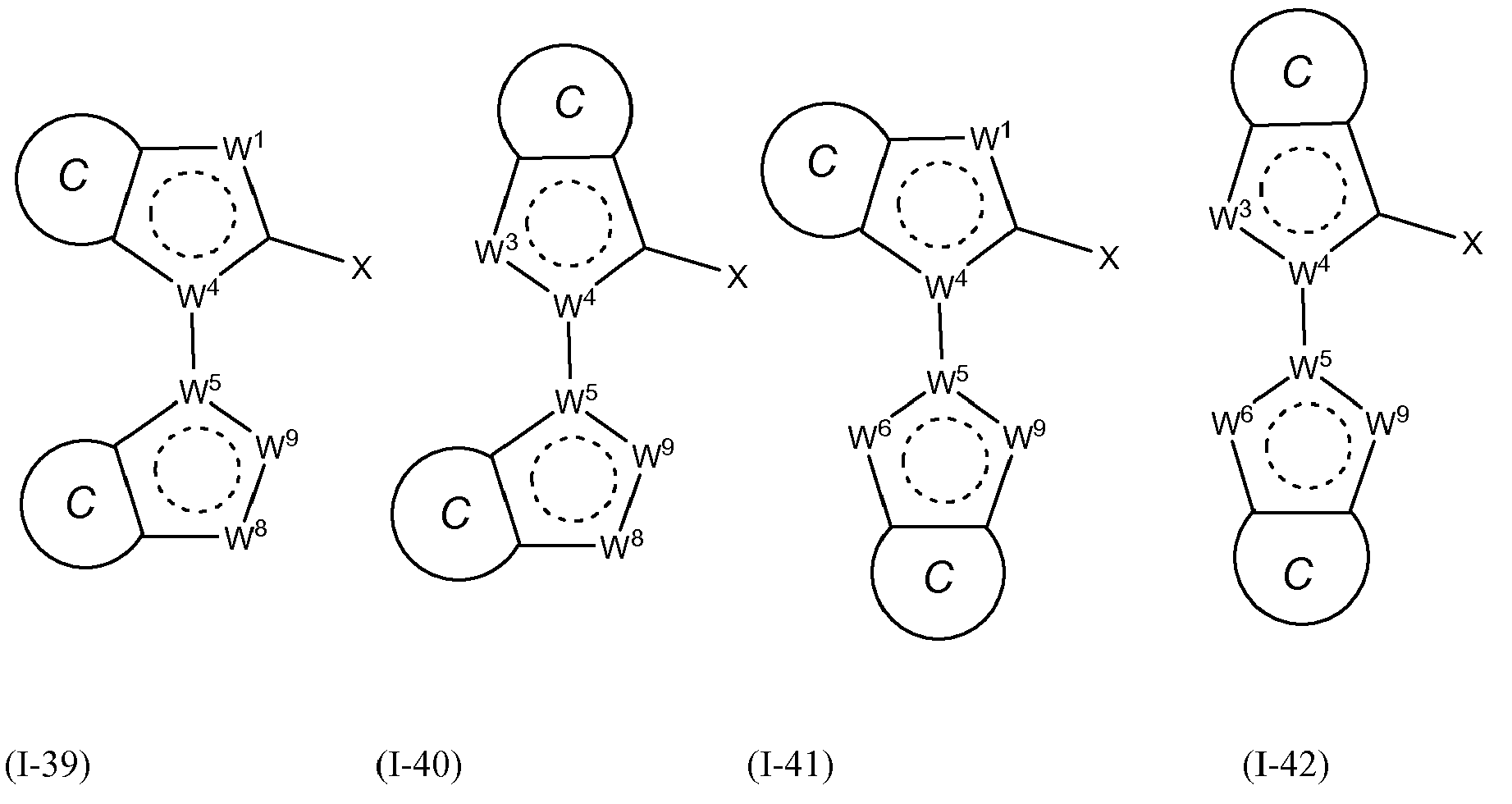
- wherein X is a phosphine of formula (Ia);
- V1, V2, V3, and V4 are independently selected from CR1 or N;
- V5, V6, V7, V8 and V9 are independently selected from CR2 or N;
- W1, W2, an W3 are independently selected from CR1, NR1, N or O;
- W4 is C or N;
- W5 is C or N;
- W6, W7, W8 and W9 are independently selected from CR2, NR2, N or O;
- indicates that the 5- or 6-membered ring which it is inside is aromatic; and

- ring C, at each occurrence, is independently a fused-aryl or fused-heteroaryl unsubstituted or substituted with R1 and R2, respectively, any number of times depending on, for example, stability and rules of valence.
- In particular embodiments, the groups R1 and R2 substituted as shown in each of Formulae (I-1)-(I-42) are selected from alkyl, alkoxy, dialkylamino, haloalkyl, fluoroalkyl, and phenyl. In various embodiments, the alkyl groups are C1-C3 alkyl, the alkoxy are C1-C3 alkoxy, and the haloalkyl and fluoroalkyl and are also based on C1-C3 alkyl groups. Examples of alkyl include methyl, ethyl, and isopropyl. Examples of alkoxy include methoxy and isopropoxy. Examples of haloalkyl include trifluoromethyl. Examples of the dialkylamino include dimethylamino.
- Sub-genera disclosed by combining Ar1-Ar2 substitution formulae (I-1)-(I-42) and phosphacycle formulae Ia and Id are designated for convenience by referring to both formulae in the sub-genus name. So, for example, in addition to the generic ligand formulae disclosed above, a sub-genus (I-2)-(1-5) would indicate that the diaryl substitution pattern is that of formula (1-2) and the phosphacycle is that of generic formula 1-5. To further illustrate, a sub-genus denoted as (I-4)-(1-3) would be based on the substitution pattern of formula (1-4) and the phosphacycle of formula (1-3), and so on according to the pattern described. In this way a total of 3649 sub-generic structures are disclosed by combining each of formulae (1-1)-(I-42) with each of formulae Ia and Id in turn.
- Sub-generic structures for the specific phosphacycles ligands are conveniently designated by referring to the biaryl portion of the ligand depicted in Table 3, (I-1), first, then the designation of the phosphacycle in Table 1.
- Thus, in various embodiments suitable ligands are selected from those of any of the formulae (I-1)-(I-42), wherein X is selected from any of the generic phosphacycles of formulae Ia or Id, or is selected from any of the specific phosphacycles shown in Table 1. In these embodiments, the groups R1 and R2 are selected from those described above for formula (I). In various embodiments, the ligands of this paragraph are further defined as the groups R1 and R2 being selected from alkyl, alkoxy, haloalkyl (including fluoroalkyl such as trifluoromethyl), and dialklamino. In various embodiments, the alkyl groups are C1-C3 alkyl, the alkoxy are C1-C3 alkoxy, and the haloalkyl and fluoroalkyl and are also based on C1-C3 alkyl groups. Examples of alkyl include methyl, ethyl, and isopropyl. Examples of alkoxy include methoxy and isopropoxy. Examples of haloalkyl include trifluoromethyl. Examples of the dialkylamino group include dimethylamino.
- In one embodiment, the phosphine ligand is (1-1),

- V1 and V4 are CR1, wherein R1 is independently, at each occurrence, hydrogen or alkoxy;
- V2 and V3 are CR1, wherein R1 is independently, at each occurrence, hydrogen or alkoxy;
- V5 and V9 are CR2, wherein R2 is independently, at each occurrence, hydrogen, alkoxy, alkyl, or dialkylamino;
- V6 and V8 are CR2, wherein R2 is independently, at each occurrence, hydrogen or alkoxy;
- V7 is CR2, wherein R2 is hydrogen or alkyl; and
- X is selected from the group consisting of 1-1, 1-2, 1-3, 1-4, 1-5, and 1-64.


- Specific embodiments contemplated as part of the invention also include, but are not limited to, compounds of formula (I), as defined, for example:
- 2,2,6,6-tetramethyl-1-(2',4',6'-triisopropylbiphenyl-2-yl)phosphinane;
- 2,2,6,6-tetramethyl-1-(2',4',6'-triisopropylbiphenyl-2-yl)phosphinan-4-one;
- 2,2,6,6-tetramethyl-1-(2',4',6'-triisopropylbiphenyl-2-yl)phosphinan-4-ol;
- 7,7,9,9-tetramethyl-8-(2',4',6'-triisopropylbiphenyl-2-yl)-1,4-dioxa-8-phosphaspiro[4.5]decane;
- 8,8,10,10-tetramethyl-9-(2',4',6'-triisopropylbiphenyl-2-yl)-1,5-dioxa-9-phospha-spiro[5.5]undecane;
- 3,3,8,8,10,10-hexamethyl-9-(2',4',6'-triisopropylbiphenyl-2-yl)-1,5-dioxa-9-phosphaspiro[5.5]undecane;
- 1-(2'-(dimethylamino)-6'-methoxybiphenyl-2-yl)-2,2,6,6-tetramethylphosphinan-4-one;
- 1-(2',6'-bis(dimethylamino)biphenyl-2-yl)-2,2,6,6-tetramethylphosphinan-4-one;
- 1-(2',6'-dimethoxybiphenyl-2-yl)-2,2,6,6-tetramethylphosphinan-4-one;
- 1-(2',6'-diisopropoxybiphenyl-2-yl)-2,2,6,6-tetramethylphosphinan-4-one;
- 1-(2'-(dimethylamino)biphenyl-2-yl)-2,2,6,6-tetramethylphosphinan-4-one;
- 1-(biphenyl-2-yl)-2,2,6,6-tetramethylphosphinan-4-one;
- 1-(1,1'-binaphthyl-2-yl)-2,2,6,6-tetramethylphosphinan-4-one;
- 1-(2'-methoxy-1,1'-binaphthyl-2-yl)-2,2,6,6-tetramethylphosphinan-4-one;
- 1-(3,6-dimethoxybiphenyl-2-yl)-2,2,6,6-tetramethylphosphinan-4-one;
- 1-(3,6-dimethoxy-2',4',6'-trimethylbiphenyl-2-yl)-2,2,6,6-tetramethylphosphinan-4-one;
- 2,2,6,6-tetramethyl-1-(2',4',6'-triisopropyl-3,6-dimethoxybiphenyl-2-yl)phosphinan-4-one;
- 2,2,6,6-tetramethyl-1-(2',4',6'-triisopropyl-4,5-dimethoxybiphenyl-2-yl)phosphinan-4-one;
- 1-(3',5'-dimethoxybiphenyl-2-yl)-2,2,6,6-tetramethylphosphinan-4-one;
- 1-(4'-tert-butylbiphenyl-2-yl)-2,2,6,6-tetramethylphosphinan-4-one;
- 6-methoxy-N,N-dimethyl-2'-(7,7,9,9-tetramethyl-1,4-dioxa-8-phosphaspiro[4.5]decan-8-yl)biphenyl-2-amine;
- N2,N2,N6,N6 -tetramethyl-2'-(7,7,9,9-tetramethyl-1,4-dioxa-8-phosphaspiro[4.5]decan-8-yl)biphenyl-2,6-diamine;
- 8-(2',6'-dimethoxybiphenyl-2-yl)-7,7,9,9-tetramethyl-1,4-dioxa-8-phosphaspiro[4.5]decane;
- 8-(2',6'-diisopropoxybiphenyl-2-yl)-7,7,9,9-tetramethyl-1,4-dioxa-8-phosphaspiro[4.5]decane;
- N,N-dimethyl-2'-(7,7,9,9-tetramethyl-1,4-dioxa-8-phosphaspiro[4.5]decan-8-yl)biphenyl-2-amine;
- 8-(biphenyl-2-yl)-7,7,9,9-tetramethyl-1,4-dioxa-8-phosphaspiro[4.5]decane;
- 8-(3,6-dimethoxybiphenyl-2-yl)-7,7,9,9-tetramethyl-1,4-dioxa-8-phosphaspiro[4.5]decane;
- 8-(3,6-dimethoxy-2',4',6'-trimethylbiphenyl-2-yl)-7,7,9,9-tetramethyl-1,4-dioxa-8-phosphaspiro[4.5]decane;
- 7,7,9,9-tetramethyl-8-(2',4',6'-triisopropyl-3,6-dimethoxybiphenyl-2-yl)-1,4-dioxa-8-phosphaspiro[4.5]decane;
- 7,7,9,9-tetramethyl-8-(2',4',6'-triisopropyl-4,5-dimethoxybiphenyl-2-yl)-1,4-dioxa-8-phosphaspiro[4.5]decane;
- 8-(3',5'-dimethoxybiphenyl-2-yl)-7,7,9,9-tetramethyl-1,4-dioxa-8-phosphaspiro[4.5]decane;
- 8-(4'-tert-butylbiphenyl-2-yl)-7,7,9,9-tetramethyl-1,4-dioxa-8-phosphaspiro[4.5]decane; and
- 2,2,6,6-tetramethyl-1-(2',4',6'-triisopropyl-3,6-dimethoxybiphenyl-2-yl)phospinane.
- In one embodiment, the phosphine ligand is (1-8),

- V1 and V2 are each CR1, wherein R1 is, at each occurrence, hydrogen;
- V3 and V4 are independently selected from CR1 or N;
- V7 and V8 are each CR2, wherein R2 is, at each occurrence, hydrogen;
- V9 is CR2, wherein R2 is hydrogen;
- ring C at each occurrence is an unsubstituted fused-phenyl; and
- X is a phosphine having a structure corresponding to a formula selected from the group consisting of formulae 1-1, 1-3 and 1-5.

- Specific embodiments contemplated as part of the invention also include, but are not limited to, compounds of formula (I), as defined, for example:
- 2,2,6,6-tetramethyl-1-(2-(naphthalen-1-yl)phenyl)phosphinan-4-one; and
- 7,7,9,9-tetramethyl-8-(4-methyl-2-(naphthalen-1-yl)phenyl)-1,4-dioxa-8-phosphaspiro[4.5]decane.
- In one embodiment, the phosphine ligand is (I-10),

- V1 and V2 are each CR1, wherein R1 is, at each occurrence, hydrogen;
- V7 and V8 are each CR2, wherein R2 is, at each occurrence, hydrogen;
- V9 is CR2, wherein R2 is hydrogen or alkoxy;
- ring C at each occurrence is an unsubstituted fused-phenyl; and
- X is a phosphine having a structure corresponding to a formula selected from the group consisting of formulae 1-1, 1-3, and 1-5.

- Specific embodiments contemplated as part of the invention also include, but are not limited to, compounds of formula (I), as defined, for example:
- 1-(1,1'-binaphthyl-2-yl)-2,2,6,6-tetramethylphosphinan-4-one;
- 1-(2'-methoxy-1,1'-binaphthyl-2-yl)-2,2,6,6-tetramethylphosphinan-4-one;
- 8-(1,1'-binaphthyl-2-yl)-7,7,9,9-tetramethyl-1,4-dioxa-8-phosphaspiro[4.5]decane; and
- 8-(2'-methoxy-1,1'-binaphthyl-2-yl)-7,7,9,9-tetramethyl-1,4-dioxa-8-phosphaspiro[4.5]decane.
- In one embodiment, the phosphine ligand is (1-9),

- V1, V2, V3, and V4 are each CR1, wherein R1, at each occurrence, is hydrogen;
- V5, V8 and V9 are each CR2, wherein R2, at each occurrence, is hydrogen;
- ring C is an unsubstituted fused-phenyl; and
- X is a phosphine having a structure corresponding to a formula selected from the group consisting of formulae 1-1, 1-3, and 1-5.

- Specific embodiments contemplated as part of the invention also include, but are not limited to, compounds of formula (I), as defined, for example:
- 2,2,6,6-tetramethyl-1-(2-(naphthalen-2-yl)phenyl)phosphinan-4-one; and
- 7,7,9,9-tetramethyl-8-(2-(naphthalen-2-yl)phenyl)-1,4-dioxa-8-phosphaspiro[4.5]decane.
- In one embodiment, the phosphine ligand is (1-2),

- W1 and W2 are each CR1, wherein R1, at each occurrence, is hydrogen;
- W3 and W4 are each N;
- V5, V6, V7, V8, and V9 are each CR2, wherein R2, at each occurrence, is hydrogen; and
- X is a phosphine having a structure corresponding to a formula selected from the group consisting of formulae 1-1, 1-3 and 1-5.

- Specific embodiments contemplated as part of the invention also include, but are not limited to, compounds of formula (I), as defined, for example:
- 2,2,6,6-tetramethyl-1-(1-phenyl-1H-pyrazol-5-yl)phosphinan-4-one; and
- 1-phenyl-5-(7,7,9,9-tetramethyl-1,4-dioxa-8-phosphaspiro[4.5]decan-8-yl)-1H-pyrazole.
- In one embodiment, the phosphine ligand is (1-3),

- V1, V2, V3 and V4 are each CR1, wherein R1, at each occurrence, is hydrogen;
- W6, W7, W8 and W9 are each CR2, wherein R2, at each occurrence, is hydrogen;
- W5 is N; and
- X is a phosphine having a structure corresponding to a formula selected from the group consisting of formulae 1-1, 1-3 and 1-5.

- Specific embodiments contemplated as part of the invention also include, but are not limited to, compounds of formula (I), as defined, for example:
- 1-(2-(1H-pyrrol-1-yl)phenyl)-2,2,6,6-tetramethylphosphinan-4-one; and
- 1-(2-(7,7,9,9-tetramethyl-1,4-dioxa-8-phosphaspiro[4.5]decan-8-yl)phenyl)-1H-pyrrole.
- In one embodiment, the phosphine ligand is (1-4),
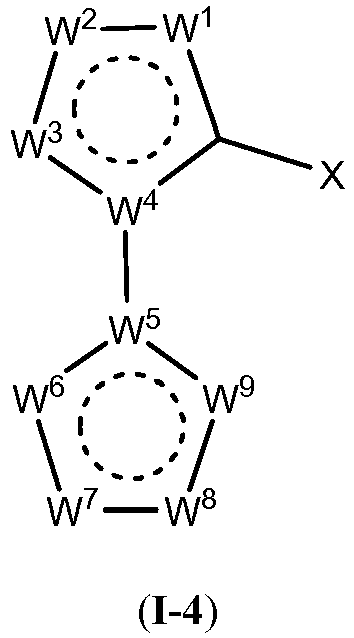
- W1 and W2 are each CR1, wherein R1, at each occurrence, is hydrogen;
- W3 and W4 are each N;
- W5 is C;
- W6 and W9 are each CR2, wherein R2, at each occurrence, is substituted or unsubstituted phenyl;
- W7 is N;
- W8 is NR2, wherein R2, at each occurrence, is phenyl optionally substituted with alkyl, alkenyl, alkynyl, alkoxy, cyano, halo, haloalkyl or haloalkoxy; and
- X is a phosphine having a structure corresponding to a formula selected from the group consisting of formulae 1-1, 1-3 and 1-5.

- Specific embodiments contemplated as part of the invention also include, but are not limited to, compounds of formula (I), as defined, for example:
- 2,2,6,6-Tetramethyl-1-(1',3',5'-triphenyl-1'H-1,4'-bipyrazol-5-yl)phosphinan-4-one;
- 1'1',3',5'-Triphenyl-5-(7,7,9,9-tetramethyl-1,4-dioxa-8-phosphaspiro[4.5]decan-8-yl)-1'H-1,4'-bipyrazole; and
- 1',3',5'-Triphenyl-5-(2,2,6,6-tetramethylphosphinan-1-yl)-1'H-1,4'-bipyrazole.
- In one embodiment, the phosphine ligand is (I-1),

- V1, V2, V3 and V4 are each CR1, wherein R1 is, at each occurrence, hydrogen;
- V5 and V9 are CR2, wherein R2 is independently, at each occurrence, hydrogen or alkyl;
- V6 and V8 are CR2, wherein R2, at each occurrence, is hydrogen;
- V7 is CR2, wherein R2 is hydrogen or alkyl; and
- X is a phosphine of formula 1-37.

- Specific embodiments contemplated as part of the invention also include, but are not limited to, compounds of formula (I), as defined, for example:
- 1,3,5,7-tetramethyl-8-(2',4',6'-triisopropylbiphenyl-2-yl)-2,4,6-trioxa-8-phosphatricyclo[3.3.1.13,7]decane; and
- 8-(biphenyl-2-yl)-1,3,5,7-tetramethyl-2,4,6-trioxa-8-phosphatricyclo[3.3.1.13,7]decane.
- Optionally, any of the ligand embodiments disclosed herein can be provided with a substituent that permits covalent or other attachment to a solid support to create a heterogeneous catalyst composition. This provides a convenient method to carry out various catalytic reactions by eluting starting materials and optional transition metal compounds through a column to effect contact with the catalytic ligand. Thus in various embodiments, when the substituents described contain suitable functional groups, the ligands can be covalently bound to a solid support. Functional groups include hydroxyl, carboxylic, halo, epoxy, isocyanate, sulfhydryl, vinyl, amino, imino, and so on.
- In various embodiments, ligands described herein can be synthesized from known starting materials using organic transformations known in the art. In one embodiment, a phosphorus moiety is added as a substituent to a biaryl system and is elaborated into a phosphacyclic ring in subsequent synthetic steps. In the illustrative synthetic route of Scheme A, biaryliodide or biarylbromide 2 is converted by metal-halogen exchange to its derived organolithium, which is quenched with chlorophosphate to give biarylphosphonate 3, which is in turn reduced to primary phosphine 4, for example, using lithium aluminum hydride as shown. The primary phosphine 4 then undergoes double conjugate addition to divinylketone 5 to give phosphorinanone 1b. Phosphorinanone 1b is then converted to ethylene glycol ketal Id or to phosphine 1a under known conditions. Propanediol ketal 1c is likewise available from reaction of 1,3-propanediol with phosphorinanone 1b under the acidic conditions shown. An alcohol such as 1c is available through conventional reduction of the carbonyl group of 1b. Additional phosphacycle ligands can be synthesized from the intermediates of Scheme A and especially from the ketone 1b or the alcohol 1c by known organic transformation reactions. In this way, Scheme A provides a general method for preparing phosphacycle ligands containing a 6-membered phosphacycle ring of formula 1b.


- Scheme A' is a variation of Scheme A where a different phosphorylating reagent is used that generates a different first isolated intermediate 3'. Accordingly, Scheme A and Scheme A' provide general methods for preparing phosphacycle ligands containing a 6-membered phosphacycle ring of formula 1b
- Ketone 1b can undergo a variety of ring contraction or ring expansion reactions to produce ligands containing phosphacycles having other than 6 ring atoms. Such reactions can result in the inclusion of heteroatoms other than P into the phosphacycle ring of the ligands. Similar reactions can introduce hetero ring atoms also into a 6-membered phosphacycle ring.
- In another synthetic route, the phosphacycle may be formed first, followed by coupling of the phosphacycle to a biaryl ring system. This coupling reaction can be catalyzed by one or more of the disclosed ligands. Scheme A" shows the general reaction between a biaryl system on the left and a preformed phosphacycle like that of formula (Ia). Other examples are provided in Scheme B' and in Example 2. Such an approach can also be applied to preparation of the fused phosphacycles of (Ic-1) or (Ic-1a).

- In various embodiments, methods for synthesizing the ligands involve reacting a biaryl system as in Scheme A" with the secondary phosphines shown in generic form in Scheme A" under basic conditions, optionally with a catalyst containing the ligands described herein, where the groups R1 through R13 and Q1 through Q5 are as defined herein.
- Bridges between ring atoms or between ring substituents can be provided in a variety of post annelation reactions, or can be formed as the phosphacycle ring is formed. To illustrate, a trioxaphosphatricylcodecane ring can be formed by reaction of a primary phosphine 4 under acidic conditions with a pentanedione 6 to make trioxaphosphatricylcodecane ligand 7 according to Scheme B, where R' and R" can be any group that does not interfere with the reaction, and where for clarity of illustration R represents the biaryl radical of 4 to which the P atom is attached. Non-limiting examples of R' and R" include alkyl, haloalkyl, perfluoroalkyl, methyl, ethyl, propyl, and isopropyl. In certain embodiments, R' and R" are the same. The reaction of Scheme B is described for example in
US 3,026,327 .

- Scheme B' illustrates a method of making ligand 7 by coupling a phosphine and a biaryl starting material such as shown in Scheme A".

- Scheme C illustrates several sequences that can be used to construct the biaryl halides used in the preparation of the ligands. A bromo-boronic acid, 8, can be coupled with an aryl bromide, 9, to give biarylbromide, 10. Similarly, a bis-bromoaryl, 11, can be coupled with a boronic acid, 12, to give biarylbromide, 10. In another sequence, aryl fluoride, 13, can be reacted first with an alkyllithium, then treated with Grignard reagent, 14, and finally treated with iodine to give biaryliodide, 15. The biaryl halides can be used in the synthetic sequences described in Schemes A, A', A", and B'.
- The ligands described herein find application in catalyst compositions in combination with transition metal compounds. In various embodiments, catalyst compositions contain a ligand described herein and a transition metal compound. Examples of transition metal compounds include those of palladium, rhodium ruthenium, platinum, gold, cobalt, iridium, copper, and nickel, as well as combinations. In various embodiments, the transition metal compound and the ligand are provided in the catalyst composition in stoichiometric amounts with respect to one another. For example, the catalyst compositions contain one mole of ligand per one mole of transition metal compound, or they may contain two moles of ligand per one mole of transition metal compound. In various embodiments, the optimum ligand to metal ratio depends on the metal source used as well as the specifics of the transformation being attempted. The stoichiometric relation between the transition metal and the ligand is an indication that catalysis proceeds through interaction of the organic starting materials with a transition metal catalyst having a phosphacycle ligand bound to a central transition metal, at least for a portion of the reaction. For this reason, the phosphine based compounds of formula I and the like are referred to as ligands.
- In various embodiments, the transition metal compound is provided in the catalyst composition as a salt of a central atom. A non-limiting example of such a salt is an acetate salt. When the central atom is palladium in a preferred embodiment, a preferred transition metal compound is palladium acetate, or Pd(OAc)2. A catalyst composition is then formed of a mixture of palladium acetate and a ligand compound as described herein. Other embodiments of palladium sources formally in the 2+ oxidation state include but are not limited to PdCl2, PdCl2(CH3CN)2, [PdCl(allyl)]2, [PdCl(2-methylallyl)]2, PdCl2(PhCN)2, Pd(acetylacetonate)2, Pd(O2CCF3)2, Pd(OTf)2, PdBr2, [Pd(CH3CN)4](BF4)2, PdCl2(cyclooctadiene), and PdCl2(norbornadiene).
- In various embodiments, the transition metal compound is in the zero valence state. An example is tris(dibenzylideneacetone)dipalladium(0), commonly abbreviated as Pd2(dba)3. Other palladium sources in formally the zero or other valence states may also be suitable. Examples include but are not limited to Pd(dba)2, Pd2(dba)3•CHCl3, and Pd(PPh3)4.
- The ligands described herein exhibit utility in transition metal catalyzed reactions. In embodiments, the disclosed ligands may be combined with a variety of transition metal compounds to catalyzes a range of chemical transformations. In embodiments, compositions containing a transition metal compound and a disclosed ligand can be used to catalyze a variety of organic reactions. A non-limiting example of a reaction catalyzed by a disclosed ligand is given in Scheme E, illustrating the catalysis of a sulfonamidation reaction. As shown, an aryl nonaflate 8 is reacted with a sulfonamide 9 in the presence of a palladium catalyst and a ligand described herein to produce a sulfonamide 10 in high yield. Other reactions of interest include carbon-nitrogen, carbon-oxygen, carbon-carbon, carbon-sulfur, carbon-phosphorus, carbon-boron, carbon-fluorine and carbon-hydrogen bond-forming reactions. In non-limiting examples, the catalysts can be used to catalyze Buchwald-Hartwig type C-N bond-forming reactions and C-O bond-forming reactions including ether-forming macrocyclizations (see Scheme E, where L stands for a ligand) and the like, among other reactions. More specifically, a combination of a ligand with a transition metal compound catalyzes the following reactions:
- i. Carbon-carbon bond forming reactions such as Suzuki, Stille, Heck, Negishi, Kumada, Hayashi coupling reactions.
- ii. Carbon-nitrogen bond-forming reactions where aryl halides, pseudohalides, nitriles, carboxalates, ether etc. are used as electrophiles and amines, ammonia, ammonia surrogates, amides, carbamates, sulfonamides and other nitrogen containing molecules are used as nucleophiles.
- iii. Carbon-oxygen bond-forming reactions where aryl halides, pseudohalides, nitriles, carboxalates, ethers, etc. are used as electrophiles and alcohols, metal hydroxides and water are used as nucleophiles.
- iv. Carbon-sulfur bond-forming reactions where aryl halides, pseudohalides, nitriles, carboxalates, ethers, etc. are used as electrophiles and thiols and metal sulfides are used as nucleophiles.
- v. Carbon-phosphorus bond-forming reactions where aryl halides, pseudohalides, nitriles, carboxalates, ethers, etc. are used as electrophiles and phosphines, metal phosphides and phosphites are used as nucleophiles.
- vi. Carbon-carbon bond-forming reactions via C-H functionalization.
- vii. Carbon-X (X= N, O, S, P) bond-forming reactions via C-H functionalization.
- viii. Metal-catalyzed addition reactions to alkenes, alkynes, allenes, ketenes, etc. such as hydroamination, hydroalkoxylation, hydroamidation, etc.
- ix. Metal-catalyzed carbonylation reactions.
- x. Metal-catalyzed hydrogenation reactions.
- xi. Alpha-arylation of ketones, aldehydes, nitriles, amides, etc.
- xii. Metal-catalyzed cycloisomerization reactions.
- xiii. Metal-catalyzed fluorination of aryl sulfonates.
- xiv. Metal-catalyzed borolation of aryl halides.
- Palladium-catalyzed C-N cross-coupling of an aryl bromide with a primary amine.

- Palladium-catalyzed C-N cross-coupling of an aryl nonaflate with methylsulfonamide.

- Palladium-catalyzed phenylurea coupling with an aryl chloride.

- Palladium-catalyzed selective N-arylation of oxindole.

- Palladium-catalyzed arylation of a secondary amine.

- Palladium-catalyzed nitration of an aryl chloride

- Palladium-catalyzed cyanation of an aryl bromide.

- Palladium-catalyzed C-O cross-coupling of a primary alcohol with an aryl chloride or aryl bromide.

- Palladium-catalyzed alkyl Suzuki-Miyaura cross-coupling with an aryl bromide.

- Palladium-catalyzed Suzuki-Miyaura coupling.

- Palladium-catalyzed borylation of an aryl chloride.

- Palladium-catalyzed fluorination of an aryl trifluoromethanesulfonate.

- Palladium-catalyzed coupling of bromobenzene with a thiol.

- Palladium-catalyzed coupling of diethylphosphite with bromobenzene.

- Ligands, catalyst compositions, and catalyzed reactions have been described with respect to various preferred embodiments. Further non-limiting description is given by way of the working examples in the section following.
- Abbreviations : Ac for acetyl; t-AmOH for tert-amyl alcohol; BF3-Et2O for boron trifluoride diethyl etherate; t-BuOH for tert-butyl alcohol; CYTOP 292® for 1,3,5,7-tetramethyl-8-phenyl-2,4,6-trioxa-8-phosphatricyclo[3.3.1.13,7]decane; DME for 1,2-dimethoxyethane; DMF for dimethylformamide ; Et for ethyl; EtOH for ethanol; Et3N for triethylamine ; HPLC for high pressure liquid chromatography; HRMS for high resolution mass specroscopy; KOAc for potassium acetate; Me for methyl; NMR for nuclear magnetic resonance; OAc for acetate; Ot-Bu for tert-butoxide; Pd2dba3 for tris(dibenzylideneacetone)dipalladium(0) ; Pd(OAc)2 for palladium(II) acetate; PPh3 for triphenylphosphine ; Tf for trifluoromethanesulfonate ; THF for tetrahydrofuran ; TLC for thin layer chromatography; TMEDA for N,N,N',N',-tetramethylethylenediamine; TMSCl for chlorotrimethylsilane; TOF-ESI+ for time-of-flight-electron spary ionization
- General Information. Unless otherwise noted, reactions were performed under an inert atmosphere using standard Schlenk techniques. Glassware was oven-dried for at least 8 hours at 100 °C prior to use. NMR spectra were recorded on a 400, 500, or 600 MHz spectrometers, with 1H and 13C chemical shifts reported in parts per million (ppm) downfield from tetramethylsilane and referenced to residual proton (1H) or deuterated solvent (13C). 31P NMR chemical shifts reported in ppm relative to 85% aqueous phosphoric acid. Thin layer chromatography (TLC) analysis of reaction mixtures was performed on EMD silica gel 60 F254 thin layer chromatography plates. Silica gel column chromatography was performed with an Isco CombiFlash Companion® with prepackaged Teledyne Isco RediSepRf normal phase silica columns using default flow rates (40-g: 40 mL/minutes; 80-g: 60 mL/minutes; 120-g: 85 mL/minutes). Product purities were determined using a Hewlett Packard Series 1100 HPLC and are reported as the peak area percent (a%) of the desired peak at 254 nm. The following HPLC method was used for Examples 1-16:
Mobile phase A: 0.1% perchloric acid in water.
Mobile phase B: acetonitrile.
Column: Ascentis® Express C8 2.7 µm, 4.6 mm × 150 mm.
Flow rate: 1.5 mL/minutes.
Column temperature: 40 °C.
Monitored at 254 nm.Time (minutes) % A % B 0 60% 40% 8 5% 95% 16 5% 95% 17 60% 40% -


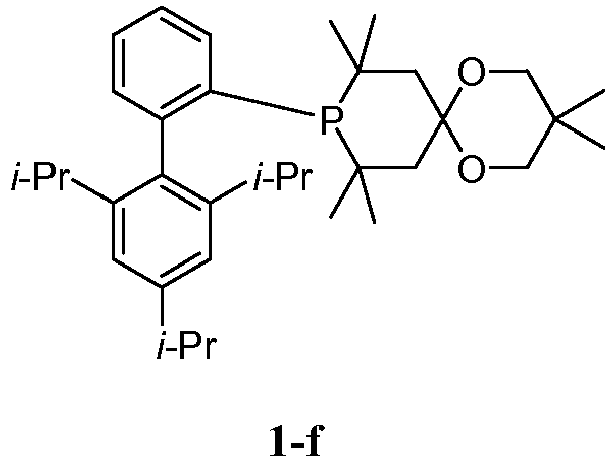
- Examples 1-a, 1-b, 1-c, 1-d, and 1-e were synthesized using the general method described in Scheme A'.

- Ethyl 2',4',6'-triisopropylbiphenyl-2-ylphosphinate: A 1-L 3-neck round-bottom flask was fitted with an addition funnel and the atmosphere was purged with nitrogen. Anhydrous, degassed THF (170 mL) was added to the 1-L flask and cooled to -60 °C (internal temperature). The addition funnel was charged with hexyllithium (2.38 M in hexanes, 57 mL, 135 mmol, 2.0 equiv). The hexyllithium was transferred into the cold THF over 20 min, maintaining the temperature below -40 °C. The solution was re-cooled to -60 °C (internal temperature). A solution of 2'-iodo-2,4,6-triisopropylbiphenyl (27.5 g, 67.7 mmol, 1.0 equiv) in 170 mL of anhydrous, degassed THF was transferred, via cannula, drop wise to the n-hexyllithium solution. This was done over 25 min while maintaining the temperature below - 40 °C. After addition, the reaction mixture was allowed to stir at -60 °C for 30 min. Diethyl chlorophosphite (19.62 mL, 135 mmol, 2.0 equiv) was added to the reaction mixture, over 10 min while maintaining the temperature below -40 °C. After addition of diethyl chlorophosphite, the reaction was allowed to proceed at -60 °C for an additional 30 min. Aqueous hydrochloric acid (1 M, 338 mL, 338 mmol) was added at -60 °C. The flask was removed from the cold bath and the reaction was allowed to warm to 22 °C. The resultant solution was diluted with heptane (340 mL) and transferred to a separatory funnel. The layers were separated and the organic layer was assayed for product by quantitative HPLC (94% yield). The organic layer was concentrated under reduced pressure to give an oil which was used in the next reaction without further purification.

- (2',4',6'-triisopropylbiphenyl-2-yl)phosphine: A 1-L 3-neck round-bottom flask was purged with nitrogen. Anhydrous, degassed THF (100 mL) was added to the flask and cooled to 0 °C (internal temperature). Lithium aluminum hydride (2.0 M in THF, 70 mL, 140 mmol, 3.0 equiv) was added to the cooled THF. Chlorotrimethylsilane (18 mL, 140 mmol, 3.0 equiv) was added by addition funnel to the LAH solution over 10 min while maintaining the internal temperature below +10 °C. This solution was allowed to stir at 0 °C for 20 min.
- A solution of ethyl 2',4',6'-triisopropylbiphenyl-2-ylphosphinate (17.5 g, 47.0 mmol, 1.0 equiv) in 100 mL of anhydrous, degassed THF was cooled to 0 °C under an atmosphere of nitrogen. The lithium aluminum hydride/chlorotrimethylsilane solution was transferred by cannula into the solution of phosphinate over 20 min. The reaction was allowed to proceed overnight with slow warming to 22 °C. Prior to quench the mixture was cooled in an ice bath. The reaction was quenched by slow addition of EtOAc (23 mL, 235 mmol, 5 equiv), followed by aqueous hydrochloric acid (2 M, 250 mL, 500 mmol, 10.6 equiv). This mixture was allowed to stir for 1 h under an atmosphere of N2. This mixture was diluted with EtOAc (250 mL), the layers were separated and the organic layer was washed once with a saturated solution of NaCl (100 mL). The organic solution was concentrated in vacuo to give a white solid (23.0 g) which was 66% potent (w/w by HPLC), for a 99% yield. This material was used without further purification.
-

- A flask was charged with 1.05 g of 2,2,6,6-tetramethyl-1-(2',4',6'-triisopropylbiphenyl-2-yl)phosphinan-4-one (2.33 mmol, 1.0 equiv), the atmosphere was sparged with argon and 12 mL of argon-sparged diethylene glycol was added. The flask was mounted with a Dean-Stark trap and condenser to collect distillate. The mixture was charged with 1.05 mL of hydrazine hydrate (55 wt% hydrazine, 11.7 mmol, 5 equiv) and 0.77 g of potassium hydroxide (88 wt%, 12.1 mmol, 5 equiv) and the mixture was immersed in an oil bath at 115 °C under an argon atmosphere. The temperature of the bath was gradually increased to 200 °C over two hours and kept at that temperature for 5 h. The reaction mixture was cooled to room temperature under argon gas. The reaction mixture was partitioned between heptane and water. The organic solution was washed once with 0.1 M aqueous hydrochloric acid, once with 10 wt% aqueous sodium carbonate and once with water. The organic solution was concentrated in vacuo with gentle heating and the residue dried in vacuo to give 0.99 g of 2,2,6,6-tetramethyl-1-(2',4',6'-triisopropylbiphenyl-2-yl)phosphinane (97 area% by HPLC, 94% yield) as a white solid. 1H NMR (C6D6, 500 MHz), δ = 0.93 (d, 6H, J = 10 Hz), 1.11 (d, 6H, J = 7 Hz), 1.13 (d, 6H, J = 19 Hz), 1.23 (d, 6H, J = 7 Hz), 1.31-1.26 (m, 2H), 1.42 (d, 6H, J = 7 Hz), 1.57-1.50 (m, 1H), 1.65-1.57 (m, 1H), 1.88-1.83 (m, 2H), 2.79 (sept, 2H, J = 7 Hz), 2.84 (sept, 1H, J = 7 Hz), 7.12-7.11 (m, 2H), 7.22 (s, 2H), 7.27-7.24 (m, 1H), 7.98-7.93 (m, 1H); 31P NMR (C6D6, 202 MHz), δ ppm -0.4 (br singlet).
-

- A flask was charged with 10.8 g of (2',4',6'-triisopropylbiphenyl-2-yl)phosphine (66% potent, 7.13 g, 22.8 mmol, 1.0 equiv) and 6.6 g of 2,6-dimethyl-2,5-heptadien-4-one (47.7 mmol, 2.1 equiv). The vessel was purged with argon gas and immersed in an oil bath at 170 °C with magnetic stirring. The flask was sealed with a Teflon stopcock and the reaction was allowed to proceed under a static argon atmosphere. The flask was removed from the oil bath after 14 h and the contents allowed to cool to room temperature under argon gas. Anhydrous ethanol (70 mL) was added to the unpurified solids and the solids were broken up manually. The slurry was warmed to 80 °C, held for an hour, and cooled to room temperature. The product was isolated by filtration, washes with ethanol and dried in vacuo to give 7.82 g of 2,2,6,6-tetramethyl-1-(2',4',6'-triisopropylbiphenyl-2-yl)phosphinan-4-one (98 area% by HPLC, 74% yield).
-

- A flask was charged with 1.5 g of 2,2,6,6-tetramethyl-1-(2',4',6'-triisopropylbiphenyl-2-yl)phosphinan-4-one (3.33 mmol, 1.0 equiv). The ketone was dissolved in 16 mL of nitrogen-sparged tetrahydrofuran and cooled in an ice water bath. A solution of lithium aluminum hydride (3.33 mL, 6.66 mmol, 2 equiv, 2 M in THF) was added dropwise over 3 minutes to the solution. The solution was warmed to room temperature and stirred for 7 hours. The reaction mixture was quenched by the slow addition of aqueous hydrochloric acid (50 mL, 1 M). The solution was stirred vigorously until homogeneous. The phases were partitioned and the aqueous layer was collected. The aqueous layer was washed with ethyl acetate (4×20 mL), then the combined organic layers were washed with brine (50 mL), dried over sodium sulfate and concentrated. The resulting white solid was purified by column chromatography using an Isco CombiFlash Companion® with a Teledyne Isco RediSepRf column (40-g, flow rate: 40 mL/minute, gradient: 1 column volumes heptane, ramp up to 60:40 heptane:ethyl acetate over 7 column volumes, hold at 60:40 for 2 column volumes). The title compound was isolated as a white solid (1.32 g, 95 area% by HPLC at 254 nm, 88% yield). 1H NMR (400 MHz, CDCl3) δ ppm 7.88-7.81 (m, 1H), 7.40 - 7.28 (m, 2H), 7.23 - 7.17 (m, 1H), 7.00 (s, 2H), 4.04 (tt, J = 10.2, 3.5 Hz, 1H), 2.94 (hept, J = 6.9 Hz, 1H), 2.50 (hept, J = 6.7 Hz, 2H), 1.92 - 1.74 (m, 2H), 1.71 - 1.57 (m, 2H), 1.38 (d, J = 3.8 Hz, 6H), 1.32 (d, J = 6.9 Hz, 6H), 1.20 (d, J = 6.8 Hz, 6H), 1.04 (s, 3H), 0.99 (s, 3H), 0.95 (d, J = 6.7 Hz, 6H) ppm. 13C NMR (100 MHz, CDCl3) δ = 149.4 (d, J = 36 Hz), 147.1, 145.5, 136.8 (d, J = 6 Hz), 135.7 (d, J = 3 Hz), 133.5 (d, J = 32 Hz), 132.7 (d, J = 7 Hz), 127.8, 125.0, 120.0, 66.4, 51.1 (d, J = 12 Hz), 34.2, 33.7, 33.4 (d, J = 4 Hz), 33.2, 30.8, 27.8 (d, J = 4 Hz), 26.5, 24.3, 23.1. 31P NMR (CDCl3, 202 MHz), δ ppm 0.0.
-

- A flask was charged with 3.75 g of 2,2,6,6-tetramethyl-1-(2',4',6'-tri-isopropylbiphenyl-2-yl)phosphinan-4-one (8.32 mmol, 1.0 equiv) and 0.16 g of p-toluenesulfonic acid monohydrate (0.84 mmol, 0.1 equiv). The atmosphere was purged with nitrogen and the flask was charged with 80 mL of nitrogen-sparged toluene. To this solution was added 4.6 mL of ethylene glycol (83 mmol, 10 equiv). The reaction flask was equipped with a Dean-Stark trap and warmed to an internal temperature of 110 °C for 2 h under nitrogen atmosphere. The distilled toluene was collected in the Dean-Stark trap. The reaction mixture was cooled to room temperature under nitrogen gas. The reaction was quenched with 1.6 mL of aqueous 10 wt% sodium carbonate solution and partitioned between 65 mL of heptane and 35 mL of water. The organic solution was washed twice with 20 mL portions of water, concentrated in vacuo with gentle heating and the residue was chased once with heptane. The concentrate was dissolved in 35 g of methanol. Seed crystals were added to induce crystallization, the solvent was removed in vacuo and 16 mL of methanol was added to the crystalline solid. The mixture was stirred overnight at room temperature and the crystalline product was isolated by filtration, washed with methanol and dried in vacuo at 50 °C to give 3.5 g of 7,7,9,9-tetramethyl-8-(2',4',6'-triisopropylbiphenyl-2-yl)-1,4-dioxa-8-phosphaspiro[4.5]decane (96 area% by HPLC, 82% yield).
-

- A flask was charged with 0.40 g of 2,2,6,6-tetramethyl-1-(2',4',6'-triisopropylbiphenyl-2-yl)phosphinan-4-one (0.89 mmol, 1.0 equiv), 10 mL of argon-sparged toluene, 0.65 mL of 1,3-propanediol (8.9 mmol, 10 equiv) and 0.015 g of p-toluenesulfonic acid monohydrate (0.09 mmol, 0.1 equiv). The atmosphere was purged with argon and the reaction flask was equipped with a Dean-Stark trap and warmed in an oil bath at 125 °C for 20 h under argon atmosphere. The distilled toluene was collected in the Dean-Stark trap. The reaction mixture was cooled to room temperature, quenched with saturated aqueous sodium bicarbonate and partitioned between toluene and water. The aqueous solution was back extracted once with toluene, the combined organic solution was washed once with water, dried over potassium carbonate and concentrated in vacuo. The unpurified material was purified by flash chromatography over silica gel with gradient elution using acetone/heptane mixtures. After concentration. 0.3 g (66% yield) of 8,8,10,10-tetramethyl-9-(2',4',6'-triisopropylbiphenyl-2-yl)-1,5-dioxa-9-phosphaspiro[5.5]undecane was isolated as a solid. 1H NMR (C6D6, 500 MHz) δ ppm 1.02 (d, 6H, J = 10 Hz), 1.12 (d, 6H, J = 7 Hz), 1.24 (d, 6H, J = 7 Hz), 1.31-1.28 (pent, 2H, J = 5.5 Hz), 1.42 (d, 6H, J = 20 Hz), 1.45 (d, 6H, J = 7 Hz), 2.13 (d, 2H, J = 14.5 Hz), 2.25 (dd, 2H, J = 14.5, 6 Hz), 2.80 (sept, 2H, J = 7 Hz), 2.86 (sept, 1H, J = 7 Hz), 3.48 (t, 2H, J = 5.5 Hz), 3.72 (t, 2H, J = 5.5 Hz), 7.01 (td, 1H, J = 7.5, 1.5 Hz), 7.08 (br t, 1H, J = 7.5 Hz), 7.24 (s, 2H), 7.26-7.24 (m, 1H), 7.89 (br d, 1H, J = 8 Hz); 31P NMR (C6D6, 200 MHz) δ ppm-2.7 (br singlet).
-

- A flask was charged with 4.0 g of 2,2,6,6-tetramethyl-1-(2',4',6'-triisopropylbiphenyl-2-yl)phosphinan-4-one (8.88 mmol, 1.0 equiv) 4.6 g of neopentyl glycol (44 mmol, 5 equiv) and 0.15 g of p-toluenesulfonic acid monohydrate (0.89 mmol, 0.1 equiv). The atmosphere was purged with argon and the flask was charged with 80 mL of argon-sparged toluene. The reaction flask was equipped with a Dean-Stark trap and warmed to an internal temperature of 110 °C for 2 h under argon atmosphere. The distilled toluene was collected in the Dean-Stark trap. The reaction mixture was cooled to room temperature under argon gas. The reaction was quenched with 1.7 mL of aqueous 10 wt% sodium carbonate solution and partitioned between 65 mL of heptane and 35 mL of water. The organic solution was washed three times with 20 mL portions of water and concentrated in vacuo with gentle heating. Anhydrous ethanol (78 g) was added to the crystalline residue and removed in vacuo with gentle heating. Anhydrous ethanol (24 mL) was added to the unpurified solids and the solids slurry was warmed to 80 °C, held for an hour, and cooled to room temperature. The product was isolated by filtration, washed with ethanol and dried in vacuo at 50 °C to give 4.3 g of 3,3,8,8,10,10-hexamethyl-9-(2',4',6'-triisopropylbiphenyl-2-yl)-1,5-dioxa-9-phosphaspiro[5.5]undecane (98 area% by HPLC, 88% yield).
-

- A 100-mL 3-neck round-bottom flask equipped with a magnetic stir bar and a reflux condenser was charged with potassium phosphate tribasic (1.23 g, 5.78 mmol), adamantylphosphine (1.00 g, 4.63 mmol), 2'-iodo-2,4,6-triisopropylbiphenyl (1.92 g, 1.02 mmol) and palladium acetate (10.4 mg, 0.046 mmol). The solids were purged with argon for approximately 30 min. A separate 25-mL round bottom flask was charged with diglyme (10 mL) and degassed with argon for 30 min. The degassed diglyme solution was transferred to the 100-mL 3-neck flask using a syringe. The contents of the 3-neck flask were heated to 155 °C and stirred for 18 h under a positive pressure of argon. The reaction mixture was cooled to 80 °C, water (15 mL) was added and the mixture was allowed to cool down to the room temperature. Brown colored solid (2.55 g) was obtained after filtration and wash with water (20 mL). The solid obtained was transferred to a 100-mL round bottom flask, methanol (10 mL) was added and stirred under nitrogen for 30 min. Off-white solid was isolated after filtration and washed with methanol (10 mL). The off-white solid was transferred again to a separate 100-mL round bottom flask, methanol (15 mL) was added and stirred under nitrogen for 20 min. White solid isolated after filtration was washed with methanol (15 mL) and dried in vacuo to obtain 1.55 g of impure product. A portion (0.5 g) of the solid was further purified by flash chromatography using 0-2% acetone in heptane as eluent to afford 0.35 g of the desired product. 31P NMR (202 MHz, C6D6): δ ppm -38.8.
-

- Into a dry 100-mL round-bottom flask equipped with a reflux condenser and magnetic stir bar, was placed the 1,3,5,7-tetramethyl-2,4,8-trioxa-6-phosphaadamantane (4.32 g, 19.98 mmol), milled K3PO4 (5.25 g, 24.73 mmol), and palladium acetate (22 mg, 0.098 mmol). The system was purged thoroughly with argon and 2-iodobiphenyl (6.16 g, 21.99 mmol) was added via syringe and degassed diglyme (40 mL) was added via cannula. The mixture was stirred at ambient temperature for about 1 hour and then heated in an oil bath at 145 °C (bath temperature) for about 8 hours under argon.
- After cooling to ambient temperature, water (90 mL) was added to the mixture over about 3 minutes. The resulting solid was filtered, rinsed with water (2×20 mL), and dried in vacuo at ambient temperature to afford 7.16 g of a greenish-yellow powder. The solid was recrystallized from about 50 mL of 1:1 heptane/ethyl acetate. The recovered light green solid was dissolved in toluene (ca. 200 mL) and ethyl acetate (75 mL) and treated first with activated carbon (Darco S-51, 3.0 g) and then filtered through a plug of silica gel. After rinsing the solids with ethyl acetate, the combined filtrates were evaporated. The residue was recrystallized from t-butyl methyl ether (ca. 60 mL) to afford 3.72 g (50.6%) of pale yellow-orange crystals after drying in vacuo at 50-60 °C overnight. mp (Mettler FP-62, 0.4 °C/minute) 168-169 °C. 1H NMR (600 MHz, CDCl3) δ ppm 8.34 (dt, J = 7.8, 1.8 Hz, 1 H), 7.25 - 7.43 (m, 8 H), 2.02 (dd, J = 13.3, 7.3 Hz, 1 H), 1.89 (d, J = 13.2 Hz, 1 H), 1.88 (dd, J = 25.8, 13.2 Hz, 1 H), 1.52 (d, J = 12.4 Hz, 3 H), 1.43 (s, 3 H), 1.41 (dd, J = 13.3, 3.9 Hz, 1 H), 1.32 (s, 3 H), 0.90 (d, J = 11.9 Hz, 3 H). 31P{1H} NMR (243 MHz, CDCl3) δ ppm -39.1. Anal. Calcd for C22H25O3P: C, 71.72; H, 6.84. Found: C, 71.63; H, 6.97.
-
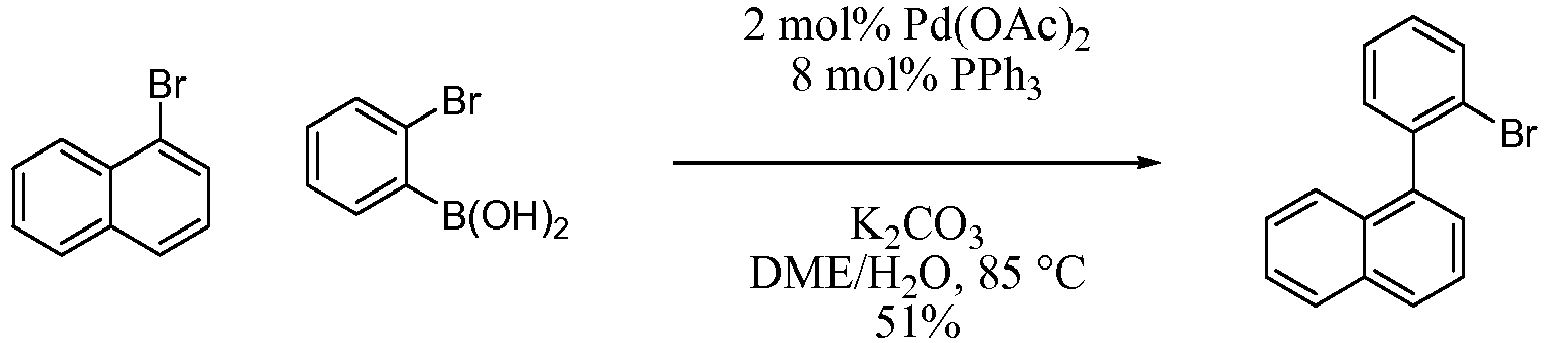
- To a 250-mL round bottom flask equipped with a magnetic stir bar was added water (25 mL) and 1,2-dimethoxyethane (25 mL). The solution was sparged with nitrogen for 20 minutes, then potassium carbonate (6.67 g, 48.3 mmol, 3 equiv), 2-bromophenylboronic acid (3.80 g, 18.9 mmol, 0.98 equiv) and 1-bromonaphthalene (2.70 mL, 19.3 mmol, 1 equiv) were added. The flask was then purged with N2 for 10 minutes before finally adding palladium(II) acetate (87 mg, 0.39 mmol, 0.02 equiv) and triphenylphosphine (405 mg, 1.55 mmol, 0.08 equiv). The reaction mixture was heated to 85 °C under a positive pressure of nitrogen for 16 hours. After cooling to room temperature, the phases were partitioned and the organic layer was collected, and the aqueous layer was washed with ethyl acetate (3 x 20 mL). The combined organic fractions were washed with brine (50 mL), dried over sodium sulfate, filtered, and concentrated on a rotary evaporator. The crude material was purified by column chromatography on an Isco CombiFlash system (120-g column; gradient: ramp up from heptane to 99:1 heptane:ethyl acetate over 1.5 column volumes, hold at 99:1 for 1.5 column volumes, ramp up to 92:8 heptane:ethyl acetate over 6 column volumes, hold at 92:8 for 6 column volumes) and then recrystallization from 99:1 heptane:ethanol to afford the title compound as a white solid (2.81 g, 93 area% by HPLC, 51% yield). 1H NMR (400 MHz, CDCl3) δ ppm 7.91 (dd, J = 8.3, 0.8 Hz, 2H), 7.74 (dd, J = 8.0, 1.2 Hz, 1H), 7.57 - 7.29 (m, 8H)

- To a 250-mL round bottom flask equipped with a magnetic stir bar was added water (25 mL) and 1,2-dimethoxyethane (25 mL). The solution was sparged with nitrogen for 20 minutes, and then potassium carbonate (6.67 g, 48.3 mmol, 3 equiv), 2-bromophenylboronic acid (3.80 g, 18.9 mmol, 0.98 equiv) and 2-bromonaphthalene (4.00 g, 19.3 mmol, 1 equiv) were added. The flask was purged with N2 for 10 minutes before finally adding palladium(II) acetate (87 mg, 0.39 mmol, 0.02 equiv) and triphenylphosphine (405 mg, 1.55 mmol, 0.08 equiv). The reaction mixture was heated to 85 °C under a positive pressure of nitrogen for 7 hours. After cooling to room temperature, the phases were partitioned and the organic layer was collected. The aqueous layer was washed with ethyl acetate (3 x 30 mL), and the combined organic fractions were washed with brine (60 mL), dried over sodium sulfate, filtered, and concentrated on a rotary evaporator. The crude orange oil was purified by column chromatography on an Isco CombiFlash system (120-g column; gradient: 0.5 column volumes heptane, ramp up to 99:1 heptane:dichloromethane over 0.5 column volumes, hold at 99:1 for 1 column volumes, ramp up to 92:8 heptane:dichloromethane over 7 column volumes, hold at 92:8 for 6 column volumes) to afford the title compound as a colorless oil (4.26 g, 97 area% by HPLC, 78% yield). 1H NMR (400 MHz, CDCl3) δ ppm 7.93 - 7.85 (m, 4H), 7.72 (dd, J = 8.0, 1.0 Hz, 1H), 7.57 (dd, J = 8.5, 1.7 Hz, 1H), 7.55 - 7.49 (m, 2H), 7.46 - 7.38 (m, 2H), 7.28 - 7.21 (m, 1H).

- To an oven-dried 500-mL round bottom flask equipped with a magnetic stir bar was added 2-fluoro-1,4-dimethoxybenzene (6 g, 38.4 mmol, 1 equiv). The flask was purged with N2, and anhydrous degassed tetrahydrofuran (250 mL) was added. The solution was cooled to -78 °C, and n-butyllithium (15.4 mL, 38.4 mmol, 1 equiv, 2.5 M in hexanes) was added dropwise over 12 minutes The mixture was stirred for another 30 minutes, and mesitylmagnesium bromide (38.4 mL, 38.4 mmol, 1 equiv, 1 M in tetrahydrofuran) was slowly added over 16 minutes. The reaction mixture was stirred at -78 °C for an additional hour, then removed from the cold bath to warm to room temperature. After 2 hours at room temperature, the reaction mixture was cooled in an ice bath to 0 °C and added a fresh solution of iodine (46.1 mL, 46.1 mmol, 1.2 equiv, 1 M in tetrahydrofuran) was added dropwise over 10 minutes. The flask was removed from the ice bath and stirred for an additional hour. Then the reaction mixture was concentrated to afford a red oil. The oil was dissolved in dichloromethane (100 mL), washed with aqueous saturated sodium thiosulfate (2 x 50 mL) and brine (50 mL), dried over sodium sulfate, filtered, and concentrated to furnish a brown-yellowish oil. Purification of the crude product by column chromatography (330-g column; gradient: 1.5 column volumes heptane, ramp up to 89:11 heptane:ethyl acetate over 8 column volumes, hold at 89:11 for 2 column volumes) followed by crystallization in heptane (20 mL) and a minimal amount of methyl tert-butyl ether, filtration, washing with cold heptane, and drying under vacuum afforded the title compound (6.64 g, >99 area% by HPLC, 45% yield). 1H NMR (400 MHz, CDCl3) δ ppm 6.99 - 6.96 (m, 2H), 6.94 (d, J = 8.9 Hz, 1H), 6.82 (d, J = 8.9 Hz, 1H), 3.90 (s, 3H), 3.69 (s, 3H), 2.37 (s, 3H), 1.93 (s, 6H). 13C NMR (100 MHz, CDCl3) δ ppm 152.4, 150.9, 137.6, 136.7, 135.8, 135.3, 127.7, 110.9, 109.3, 94.5, 56.9, 56.4, 21.6, 20.1.

- To a 100-mL round bottom flask equipped with a magnetic stir bar was added tris(dibenzylideneacetone)dipalladium(0) (198 mg, 0.216 mmol, 0.02 equiv), 1,3,5,7-tetramethyl-8-phenyl-2,4,6-trioxa-8-phosphatricyclo[3.3.1.13,7]decane (152 mg, 0.519 mmol, 0.048 equiv, CYTOP® 292) 2,4,6-triisopropylphenylboronic acid (4.02 g, 16.2 mmol, 1.5 equiv) and potassium phosphate (6.89 g, 32.4 mmol, 3 equiv). The flask was purged with nitrogen for 30 minutes, then anhydrous, degassed tetrahydrofuran (20 mL) was added. The reddish slurry was stirred at room temperature for 30 minutes, and then degassed water (2 mL), and 1,2-dibromo-4,5-dimethoxybenzene (3.20 g, 10.8 mmol, 1 equiv) was added. The reaction was stirred at reflux for 21 hours. The reaction mixture was cooled to room temperature and then diluted with water (30 mL). The phases were separated and the aqueous layer was washed with ethyl acetate (3 x 20 mL). The combined organics were washed with brine (50 mL), dried over sodium sulfate, filtered, and concentrated on a rotary evaporator. The unreacted dibromoarene was removed by recrystallization from hot methanol. The product was further purified by column chromatography on an Isco CombiFlash system (120-g column; gradient: 1 column volumes heptane, ramp up to 98:2 heptane:ethyl acetate over 0.5 column volumes, hold at 98:2 for 2 column volumes, ramp up to 90:10 heptane:ethyl acetate over 7 column volumes, hold at 90:10 for 1 column volumes) to afford the title compound as a white solid (1.47 g, 99 area% by HPLC, 32% yield). 1H NMR (400 MHz, CDCl3) δ ppm 7.13 (s, 1H), 7.05 (s, 2H), 6.69 (s, 1H), 3.94 (s, 3H), 3.81 (s, 3H), 2.96 (hept, J = 7.0 Hz, 1H), 2.52 (hept, J = 6.9 Hz, 2H), 1.32 (d, J = 6.9 Hz, 6H), 1.20 (d, J = 6.9 Hz, 6H), 1.07 (d, J = 6.8 Hz, 6H). 13C NMR (100 MHz, CDCl3) δ ppm 148.0, 147.9, 147.6, 146.0, 135.3, 133.2, 120.5, 114.8, 114.8, 113.9, 56.2, 34.4, 30.9, 25.1, 24.3, 23.9.

- To a 250-mL round bottom flask equipped with a magnetic stir bar was added water (41 mL) and 1,2-dimethoxyethane (41 mL). The solution was sparged with nitrogen for 20 minutes, and then potassium carbonate (11.1 g, 81.0 mmol, 3 equiv), 2-bromophenylboronic acid (6.35 g, 31.6 mmol, 0.98 equiv) and 1-bromo-3,5-dimethoxybenzene (7.00 g, 32.2 mmol, 1 equiv) were added. The flask was purged with N2 for 10 minutes before finally adding palladium(II) acetate (145 mg, 0.645 mmol, 0.02 equiv) and triphenylphosphine (677 mg, 2.58 mmol, 0.08 equiv). The reaction mixture was heated to 85 °C under a positive pressure of nitrogen for 16 hours. After cooling to room temperature, the phases were partitioned. The organic phase was collected and the aqueous phase was washed with ethyl acetate (3 x 20 mL). The combined organic fractions were washed with brine (50 mL), dried over sodium sulfate, filtered, and concentrated on a rotary evaporator. The crude yellow oil was purified by column chromatography on the Isco (120-g column; gradient: 2 column volumes heptane, ramp up to 94:6 heptane:ethyl acetate over 8 column volumes, hold at 94:6 for 6 column volumes) to afford the title compound as a colorless oil (4.51 g, 94 area% by HPLC, 48% yield). 1H NMR (400 MHz, CDCl3) δ ppm 7.68 - 7.62 (m, 1H), 7.40 - 7.31 (m, 2H), 7.24 - 7.15 (m, 1H), 6.55 (d, J = 2.3 Hz, 2H), 6.50 (t, J = 2.3 Hz, 1H), 3.83 (s, 6H). 13C NMR (100 MHz, CDCl3) δ ppm 159.8, 142.6, 142.1, 132.8, 130.7, 128.5, 127.0, 122.1, 107.4, 99.6, 55.5.

- To a 250-mL round bottom flask equipped with a magnetic stir bar was added water (41 mL) and 1,2-dimethoxyethane (41 mL). The solution was sparged with nitrogen for 20 minutes, then potassium carbonate (6.49 g, 46.9 mmol, 3 equiv), 2-bromophenylboronic acid (3.69 g, 18.4 mmol, 0.98 equiv) and 1-bromo-4-tert-butylbenzene (4.00 g, 18.8 mmol, 1 equiv) were added. The flask was then purged with N2 for 10 minutes before finally adding palladium(II) acetate (84 mg, 0.375 mmol, 0.02 equiv) and triphenylphosphine (394 mg, 1.50 mmol, 0.08 equiv). The reaction mixture was heated to 85 °C under a positive pressure of nitrogen for 18 hours. After cooling to room temperature, the phases were partitioned and the organic layer was collected. The aqueous layer was washed with ethyl acetate (3 x 20 mL). The combined organic fractions were washed with brine (50 mL), dried over sodium sulfate, filtered, and concentrated on a rotary evaporator. The crude yellow oil was purified by column chromatography on an Isco CombiFlash system (120-g column; eluted with 14 column volumes heptane) to afford the title compound as a colorless oil (2.93 g, 67 area% by HPLC, 54% yield). 1H NMR (400 MHz, CDCl3) δ ppm 7.68 - 7.64 (m, 1H), 7.48 - 7.42 (m, 2H), 7.39 - 7.31 (m, 4H), 7.21 - 7.15 (m, 1H), 1.39 (s, 9H).
- To a round-bottom flask equipped with a magnetic stir bar was added the arene (1 equiv). After purging the flask with nitrogen for 10 minutes, degassed, anhydrous tetrahydrofuran was added (0.3 M relative to arene). The resulting solution was cooled to -78 °C, and then n-butyllithium (1.2 equiv, 2.5 M in hexanes) was added in a dropwise fashion. The reaction was typically stirred for 1 hour at -78 °C, and then the aryllithium intermediate was quenched with diethyl chlorophosphate (1.2 equiv). The reaction was allowed to warm slowly to room temperature overnight, and then diluted with aqueous saturated sodium bicarbonate. The reaction mixture was worked up by separating the phases and washing the aqueous layer with ethyl acetate (3x). The combined organic fractions were then washed once with brine, dried over sodium sulfate, filtered, and concentrated on a rotary evaporator. The crude diethylphosphonate was purified by silica gel column chromatography on an Isco CombiFlash system as described.

- The titled compound was prepared as described in the general procedure for synthesis of diethylphosphonates substituting 2'-iodo-2,4,6-triisopropylbiphenyl (10.0 g, 24.6 mmol, 1 equiv), for the arene, wherein all other reagents are scaled accordingly, followed by purification via column chromatography (120-g column; gradient: 2 column volumes dichloromethane, ramp up to 92:8 dichloromethane:acetone over 8 column volumes, hold at 92:8 for 4 column volumes) (8.31 g, 97 area% by HPLC, 81% yield). 1H NMR (400 MHz, CDCl3) δ ppm 8.02 (ddd, J = 14.3, 7.7, 1.3 Hz, 1H), 7.51 (tt, J = 7.5, 1.5 Hz, 1H), 7.43 (tdd, J = 7.5, 3.6, 1.3 Hz, 1H), 7.24 - 7.15 (m, 1H), 7.02 (s, 2H), 3.86 (ddq, J = 10.2, 8.7, 7.1 Hz, 2H), 3.64 (ddq, J = 10.2, 8.9, 7.1 Hz, 2H), 2.93 (hept, J = 6.9 Hz, 1H), 2.42 (hept, J = 6.8 Hz, 2H), 1.28 (d, J = 6.9 Hz, 6H), 1.21 (d, J = 6.8Hz, 6H), 1.09 (t, J = 7.1 Hz, 6H), 0.97 (d, J = 6.8 Hz, 6H).

- The titled compound was prepared as described in the general procedure for synthesis of diethylphosphonates substituting 2'-bromo-6-methoxy-N,N-dimethylbiphenyl-2-amine (see Buchwald SL, et al. JACS 2009; 131: 7532-7533) (3.00 g, 9.80 mmol, 1 equiv) for the arene, wherein all other reagents are scaled accordingly, followed by purification via column chromatography (80-g column; gradient: 1.5 column volumes dichloromethane, ramp up to 90:10 dichloromethane:acetone over 9.5 column volumes, hold at 90:10 for 6 column volumes) (2.97 g, 95 area% by HPLC, 83% yield). 1H NMR (400 MHz, CDCl3) δ ppm 7.98 (ddd, J = 14.1, 7.7, 1.3 Hz, 1H), 7.54 (tt, J = 7.6, 1.5 Hz, 1H), 7.39 (tdd, J = 7.6, 3.5, 1.3 Hz, 1H), 7.32 - 7.20 (m, 2H), 6.72 (dd, J = 8.2, 0.7 Hz, 1H), 6.60 (d, J = 8.2 Hz, 1H), 4.02 - 3.74 (m, 4H), 3.67 (s, 3H), 2.49 (s, 6H), 1.16 (td, J = 7.1, 4.7 Hz, 6H). 31P NMR (CDCl3, 202 MHz) δ ppm 15.0 (s).

- The titled compound was prepared as described in the general procedure for synthesis of diethylphosphonates substituting 2'-bromo-N2,N2,N6,N6 -tetramethylbiphenyl-2,6-diamine (see Buchwald SL, JACS 2009; 131: 7532-7533) (5.00 g, 15.7 mmol, 1 equiv) for the arene, wherein all other reagents are scaled accordingly, followed by purification via column chromatography (120-g column; gradient: 1.5 column volumes dichloromethane, ramp up to 84:16 dichloromethane:acetone over 8 column volumes, hold at 84:16 for 6 column volumes) (5.25 g, >94 area% by HPLC, 89% yield). 1H NMR (500 MHz, CDCl3) δ ppm 7.83 (dd, J = 14.0, 7.7 Hz, 1H), 7.43 (t, J = 7.5 Hz, 1H), 7.30 - 7.24 (m, 2H), 7.19 - 7.12 (m, 1H), 6.76 (d, J = 8.0 Hz, 2H), 3.94 - 3.81 (m, 2H), 3.81 - 3.63 (m, 2H), 2.31 (s, 12H), 1.05 (t, J = 7.0 Hz, 6H). 31P NMR (CDCl3, 202 MHz) δ ppm 14.8 (s).

- To a 250-mL round-bottom flask equipped with a magnetic stir bar was added 2'-bromo-2,6-dimethoxybiphenyl (see Buchwald SL, Journal of the American Chemical Society 2005;127:4685-4696) (7.02 g, 24.0 mmol, 1 equiv). Degassed, anhydrous tetrahydrofuran was added (80 mL) followed by N,N,N',N'-tetramethylethylene-1,2-diamine (4.31 mL, 28.7 mmol, 1.2 equiv). The resulting solution was cooled to -78 °C, and then n-butyllithium (11.5 mL, 28.7 mmol, 1.2 equiv, 2.5 M in hexanes) was added in a dropwise fashion. After the addition of 5 mL of n-butyllithium the reaction slurry could no longer be stirred. The reaction flask was warmed to 0 °C at which point the slurry became free-flowing. The remainder of the n-butyllithium (∼6.5 mL) was added over the course of 10 minutes. The reaction was stirred for 90 minutes at 0 °C, and then the aryllithium intermediate was quenched with diethyl chlorophosphate (4.15 mL, 28.7 mmol, 1.2 equiv). The reaction was re-cooled to -78 °C and stirred for 1 hour, then the cooling bath was removed and the flask was warmed to room temperature. At that point, the reaction solution was diluted with pH 7 phosphate buffer (100 mL). The reaction mixture was worked up by separating the phases and washing the aqueous layer with ethyl acetate (4×60 mL). The combined organic fractions were then washed once with brine (150 mL), dried over sodium sulfate, filtered, and concentrated on a rotary evaporator. The crude product was purified by column chromatography (120-g column; gradient: 1.5 column volumes dichloromethane, ramp up to 88:12 dichloromethane:acetone over 10.5 column volumes, hold at 88:12 for 6 column volumes), the product was isolated as a white solid (5.49 g, 78 area% by HPLC, 65% yield). 1H NMR (400 MHz, CDCl3) δ ppm 8.07 (dd, J = 14.1, 7.7 Hz, 1H), 7.57 (t, J = 7.5 Hz, 1H), 7.46 - 7.37 (m, 1H), 7.30 (t, J = 8.3 Hz, 1H), 7.24 - 7.18 (m, 1H), 6.60 (d, J = 8.4 Hz, 2H), 3.98 - 3.77 (m, 4H), 3.70 (s, 6H), 1.17 (t, J = 7.1 Hz, 6H). 31P NMR (CDCl3, 202 MHz) δ ppm 15.2 (s).

- The titled compound was prepared as described in the general procedure for synthesis of diethylphosphonates substituting 2'-bromo-2,6-diisopropoxybiphenyl (12.0 g, 34.4 mmol, 1 equiv) for the arene, wherein all other reagents are scaled accordingly, followed by purification via flash column chromatography (300-mL SiO2 gel; gradient: 85:15 to 75:25 dichloromethane:acetone) (11.0 g, 79% yield). 1H NMR (400 MHz, C6D6) δ ppm 8.31 (dd, J = 14.0, 7.7 Hz, 1H), 7.28 - 7.22 (m, 2H), 7.19 (t, J = 3.3 Hz, 1H), 7.15 - 7.07 (m, 1H), 6.51 (d, J = 8.3 Hz, 2H), 4.26 (hept, J = 6.1 Hz, 2H), 4.13 - 3.97 (m, 2H), 3.96 - 3.83 (m, 2H), 1.12 - 1.06 (m, 12H), 1.02 (d, J = 6.0 Hz, 6H). 31P NMR (C6D6, 202 MHz) δ ppm 18.2 (s).

- The titled compound was prepared as described in the general procedure for synthesis of diethylphosphonates substituting 2'-bromo-N,N-dimethylbiphenyl-2-amine (1.99 g, 7.21 mmol, 1 equiv) for the arene, wherein all other reagents are scaled accordingly, followed by purification via column chromatography (80-g column; gradient: 1.5 column volumes dichloromethane, ramp up to 90:10 dichloromethane:acetone over 9.5 column volumes, hold at 90:10 for 6 column volumes) (1.96 g, 96 area% by HPLC, 82% yield). 1H NMR (400 MHz, CDCl3) δ ppm 8.00 (ddd, J = 14.3, 7.7, 1.1 Hz, 1H), 7.50 (ttd, J = 5.1, 3.3, 1.7 Hz, 1H), 7.47 - 7.34 (m, 2H), 7.32 - 7.22 (m, 2H), 7.04 - 6.92 (m, 2H), 4.05 - 3.87 (m, 3H), 3.80 - 3.62 (m, 1H), 2.52 (s, 6H), 1.18 (t, J = 7.1 Hz, 3H), 1.11 (t, J = 7.1 Hz, 3H). 31P NMR (CDCl3, 202 MHz) δ ppm 24.8 (s).

- The titled compound was prepared as described in the general procedure for synthesis of diethylphosphonates substituting 2-iodobiphenyl (4 mL, 22.7 mmol, 1 equiv) for the arene, wherein all other reagents are scaled accordingly, followed by purification via column chromatography (120-g column; gradient: 1 column volumes dichloromethane, ramp up to 91:9 dichloromethane:acetone over 9 column volumes, hold at 91:9 for 6 column volumes) (5.27 g, 94 area% by HPLC, 80% yield). 1H NMR (400 MHz, CDCl3) δ ppm 8.04 (ddd, J = 14.3, 7.7, 1.3 Hz, 1H), 7.56 (tt, J = 7.6, 1.5 Hz, 1H), 7.50 - 7.29 (m, 7H), 4.01 - 3.76 (m, 4H), 1.13 (t, J = 7.1 Hz, 6H). 31P NMR (CDCl3, 202 MHz) δ ppm 25.0 (s).

- The titled compound was prepared as described in the general procedure for synthesis of diethylphosphonates substituting 2-bromo-1,1'-binaphthyl (4.15 g, 12.5 mmol, 1 equiv) for the arene, wherein all other reagents are scaled accordingly, followed by purification via column chromatography (80-g column; gradient: 1.5 column volumes dichloromethane, ramp up to 91:9 dichloromethane:acetone over 9.5 column volumes, hold at 91:9 for 7 column volumes) (3.91 g, 95 area% by HPLC, 80% yield). 1H NMR (400 MHz, CDCl3) δ ppm 8.26 - 8.16 (m, 1H), 8.02 (dd, J = 8.4, 3.7 Hz, 1H), 7.99 - 7.89 (m, 3H), 7.60 (dd, J = 8.2, 7.0 Hz, 1H), 7.57 - 7.47 (m, 2H), 7.43 (ddd, J = 8.1, 6.8, 1.2 Hz, 1H), 7.29-7.15 (m, 3H), 7.08 (d, J = 8.4 Hz, 1H), 3.85 - 3.51 (m, 4H), 0.98 (t, J = 7.1 Hz, 3H), 0.75-0.70 (m, 3H). 13C NMR (100 MHz, CDCl3) δ ppm 143.1 (d, J = 10 Hz), 135.5 (d, J = 6 Hz), 134.6 (d, J = 2 Hz), 133.0, 132.8, 132.8, 128.4 (d, J = 3 Hz), 128.3 (d, J = 6 Hz), 127.9, 127.7, 127.6, 127.5, 127.3 (d, J = 15 Hz), 126.8, 126.4, 126.4 (d, J = 1 Hz), 125.6, 125.3, 125.0, 124.6, 61.8 (d, J = 6 Hz), 61.6 (d, J = 6 Hz), 16.3 (d, J = 7 Hz), 15.8 (d, J = 7 Hz). 31P NMR (CDCl3, 202 MHz) δ ppm 17.5 (s).
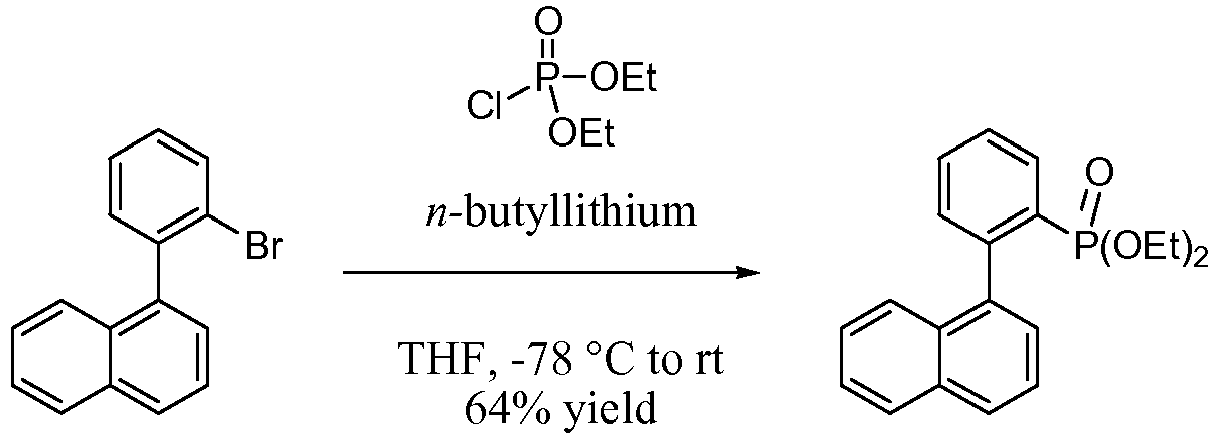
- The titled compound was prepared as described in the general procedure for synthesis of diethylphosphonates substituting 1-(2-bromophenyl)naphthalene (2.78 g, 9.82 mmol, 1 equiv) for the arene, wherein all other reagents are scaled accordingly, followed by purification via column chromatography (120-g column; gradient: 1.5 column volumes dichloromethane, ramp up to 89:11 dichloromethane:acetone over 8 column volumes, hold at 89:11 for 3.5 column volumes) (2.14 g, 97 area% by HPLC, 64% yield). 1H NMR (400 MHz, CDCl3) δ ppm 8.17 (ddd, J = 14.2, 7.7, 1.4 Hz, 1H), 7.89 - 7.84 (m, 2H), 7.61 (tt, J = 7.5, 1.5 Hz, 1H), 7.57 - 7.48 (m, 2H), 7.48 - 7.40 (m, 2H), 7.40 - 7.30 (m, 3H), 3.85 - 3.48 (m, 4H), 0.95 (t, J = 7.1 Hz, 3H), 0.71 (td, J = 7.0, 0.5 Hz, 3H). 13C NMR (100 MHz, CDCl3) δ ppm 143.4 (d, J = 9 Hz), 138.0 (d, J = 4 Hz), 133.6 (d, J = 10 Hz), 132.9, 132.2, 131.6 (d, J = 14 Hz), 131.2 (d, J = 3 Hz), 129.2, 127.6 (d, J = 6 Hz), 127.3, 127.2, 126.8 (d, J = 15 Hz), 126.1, 125.4, 125.2, 124.3, 61.7 (dd, J = 13, 6 Hz), 16.2 (d, J = 7Hz), 15.76 (d, J = 7Hz). 31P NMR (CDCl3, 202 MHz) δ ppm 14.3 (s).

- The titled compound was prepared as described in the general procedure for synthesis of diethylphosphonates substituting 2-(2-bromophenyl)naphthalene (4.25 g, 15.0 mmol, 1 equiv) for the arene, wherein all other reagents are scaled accordingly, followed by purification via column chromatography (120-g column; gradient: 1.5 column volumes dichloromethane, ramp up to 90:10 dichloromethane:acetone over 7.5 column volumes, hold at 90:10 for 4 column volumes) (3.10 g, 96 area% by HPLC, 61% yield). 1H NMR (400 MHz, CDCl3) δ ppm 8.09 (ddd, J = 14.3, 7.7, 1.2 Hz, 1H), 7.96 - 7.78 (m, 4H), 7.65 - 7.55 (m, 2H), 7.55 - 7.45 (m, 3H), 7.45 - 7.36 (m, 1H), 3.98 - 3.75 (m, 4H), 1.06 (t, J = 7.1 Hz, 6H). 13C NMR (100 MHz, CDCl3) δ ppm 145.5 (d, J = 10 Hz), 138.5 (d, J = 4 Hz), 133.6 (d, J = 10 Hz), 132.4, 132.2, 131.6 (d, J = 3 Hz), 131.2 (d, J = 14 Hz), 127.9, 127.8, 127.8, 127.4, 127.3, 126.7, 126.6, 126.0, 125.8 (d, J = 17 Hz), 61.8 (d, J = 6 Hz), 16.3 (d, J = 7 Hz). 31P NMR (CDCl3, 202 MHz) δ ppm 14.8 (s).

- The titled compound was prepared as described in the general procedure for synthesis of diethylphosphonates substituting 1',3',5'-triphenyl-1'H-1,4'-bipyrazole (see Sieser JE et al, Org. Proc. Res. & Devel. 2008;12:480-489) (2.00 g, 5.52 mmol, 1 equiv) for the arene, wherein all other reagents are scaled accordingly, followed by purification via column chromatography (80-g column; gradient: 1.5 column volumes dichloromethane, ramp up to 95:5 dichloromethane:acetone over 8.5 column volumes, hold at 95:5 for 6 column volumes) (2.47 g, 99 area% by HPLC, 90% yield). 1H NMR (400 MHz, CDCl3) δ ppm 7.76 (dd, J = 1.6, 1.6 Hz, 1H), 7.36 - 7.22 (m, 7H), 7.22 - 7.05 (m, 8H), 6.85 (dd, J = 2.4, 1.6 Hz, 1H), 3.75 - 3.49 (m, 2H), 3.34 - 3.16 (m, 2H), 0.85 (dt, J = 8.4, 6.8 Hz, 6H). 13C NMR (100 MHz, CDCl3) δ ppm 148.0, 141.2, 139.9 (d, J = 17 Hz), 139.4, 135.7, 133.5, 131.0, 129.0, 128.7, 128.5, 128.1, 128.0, 127.5, 126.3, 125.0, 119.7, 116.7 (d, J = 20 Hz), 62.5 (d, J = 5 Hz), 62.3 (d, J = 6 Hz), 16.3 (d, J = 6 Hz), 16.2 (d, J = 6 Hz). 31P NMR (CDCl3, 202 MHz) δ ppm 11.0 (s).
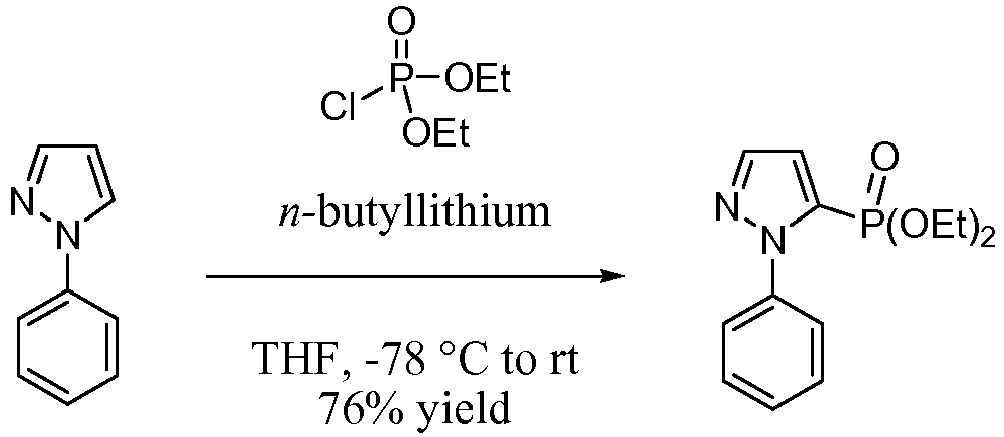
- The titled compound was prepared as described in the general procedure for synthesis of diethylphosphonates substituting 1-phenyl-1H-pyrazole (5.00 mL, 37.8 mmol, 1 equiv) for the arene, wherein all other reagents are scaled accordingly, followed by purification via column chromatography (120-g column; gradient: 1.5 column volumes dichloromethane, ramp up to 92:8 dichloromethane:acetone over 8.5 column volumes, hold at 92:8 for 8 column volumes) (8.34 g, 98 area% by HPLC, 79% yield). 1H NMR (400 MHz, CDCl3) δ ppm 7.71 (t, J = 1.7 Hz, 1H), 7.66 - 7.60 (m, 2H), 7.49 - 7.36 (m, 3H), 6.96 (dd, J = 2.5, 1.9 Hz, 1H), 4.11 - 3.92 (m, 4H), 1.17 (td, J = 7.0, 0.5 Hz, 6H). 13C NMR (100 MHz, CDCl3) δ ppm 140.1, 139.3 (d, J = 17 Hz), 131.6 (d, J = 216 Hz), 128.4, 128.3, 125.1, 117.0 (d, J = 19 Hz), 62.9 (d, J = 6 Hz), 16.3 (d, J = 7 Hz). 31P NMR (CDCl3, 202 MHz) δ ppm 5.0 (s).

- The titled compound was prepared as described in the general procedure for synthesis of diethylphosphonates substituting 1-(2-bromophenyl)-1H-pyrrole (see Lautens M et al, Organic Letters 2007; 9: 1761-1764) (5.29 g, 23.8 mmol, 1 equiv) for the arene, wherein all other reagents are scaled accordingly, followed by purification via column chromatography (80-g column; gradient: 1.5 column volumes dichloromethane, ramp up to 92:8 dichloromethane:acetone over 9.5 column volumes, hold at 92:8 for 5 column volumes) (4.81 g, 97 area% by HPLC, 72% yield). 1H NMR (400 MHz, CDCl3) δ ppm 8.04 (ddd, J = 14.6, 7.7, 1.6 Hz, 1H), 7.59 (tt, J = 7.7, 1.4 Hz, 1H), 7.45 (tdd, J = 7.6, 3.1, 1.2 Hz, 1H), 7.39 - 7.29 (m, 1H), 6.97 (t, J = 2.2 Hz, 2H), 6.29 (t, J = 2.2 Hz, 2H), 4.09 - 3.89 (m, 4H), 1.23 (t, J = 7.1 Hz, 6H). 31P NMR (CDCl3, 202 MHz) δ ppm 15.1 (s).

- The titled compound was prepared as described in the general procedure for synthesis of diethylphosphonates substituting 2-iodo-3,6-dimethoxybiphenyl (5.00 g, 14.7 mmol, 1 equiv) (see
Buchwald SL et al, US Patent No. 7,858,784, December 28, 2010 ) for the arene, wherein all other reagents are scaled accordingly, followed by purification via column chromatography (120-g column; gradient: 1 column volumes dichloromethane, ramp up to 82:18 dichloromethane:acetone over 8 column volumes, hold at 82:18 for 6 column volumes) (2.54 g, >99 area% by HPLC, 49% yield). 1H NMR (400 MHz, CDCl3) δ ppm 7.44 - 7.26 (m, 5H), 7.09 (d, J = 9.0 Hz, 1H), 6.98 (dd, J = 9.0, 7.2 Hz, 1H), 4.02 - 3.91 (m, 5H), 3.75 - 3.66 (m, 2H), 3.64 (d, J = 2.5 Hz, 3H), 1.09 (t, J = 7.0 Hz, 6H). 13C NMR (100 MHz, CDCl3) δ ppm 155.7, 151.0 (d, J = 19 Hz), 137.4 (d, J = 5 Hz), 136.2 (d, J = 8 Hz), 129.6, 126.9, 126.5, 118.2 (d, J = 188 Hz), 116.1 (d, J = 3 Hz), 111.6 (d, J = 11 Hz), 61.5 (d, J = 6 Hz), 56.9, 16.4 (d, J = 7 Hz). 31P NMR (CDCl3, 202 MHz) δ ppm 12.4 (s).
- The titled compound was prepared as described in the general procedure for synthesis of diethylphosphonates substituting 2-iodo-3,6-dimethoxy-2',4',6'-trimethylbiphenyl (5.01 g, 13.1 mmol, 1 equiv) for the arene, wherein all other reagents are scaled accordingly, followed by purification via column chromatography (120-g column; gradient: 1.5 column volumes dichloromethane, ramp up to 85:15 dichloromethane:acetone over 8.5 column volumes, hold at 85:15 for 6 column volumes) (3.09 g, 88 area% by HPLC, 60% yield). 1H NMR (400 MHz, CDCl3) δ ppm 7.07 (d, J = 9.0 Hz, 1H), 6.94 (dd, J = 9.0, 7.2 Hz, 1H), 6.85 (s, 2H), 4.01 - 3.87 (m, 5H), 3.70 - 3.55 (m, 5H), 2.30 (s, 3H), 1.95 (s, 6H), 1.09 (t, J= 7.1 Hz, 6H). 13C NMR (100 MHz, CDCl3) δ ppm 155.7, 150.5 (d, J = 20 Hz), 135.6, 135.6, 134.6 (d, J = 9 Hz), 134.0 (d, J = 4 Hz), 127.1, 119.5, 115.5 (d, J = 3 Hz), 111.1 (d, J = 11 Hz), 61.4 (d, J = 7 Hz), 56.7 (d, J = 12 Hz), 21.4, 20.6, 16.5 (d, J = 6 Hz). 31P NMR (CDCl3, 202 MHz) δ ppm 12.6 (s).

- The titled compound was prepared as described in the general procedure for synthesis of diethylphosphonates substituting 2-iodo-2',4',6'-triisopropyl-3,6-dimethoxybiphenyl (see Buchwald SL et al, JACS 2008;130: 13552-13554) (6.00 g, 12.9 mmol, 1 equiv) for the arene, wherein all other reagents are scaled accordingly, followed by purification via column chromatography (120-g column; gradient: 1.5 column volumes dichloromethane, ramp up to 88:12 dichloromethane:acetone over 8 column volumes, hold at 88:12 for 7.5 column volumes) (3.51 g, 93 area% by HPLC, 57% yield). 1H NMR (400 MHz, CDCl3) δ ppm 7.04 - 6.89 (m, 4H), 3.99 - 3.84 (m, 5H), 3.60 (s, 3H), 3.57 - 3.44 (m, 2H), 2.93 (hept, J = 6.9 Hz, 1H), 2.49 (hept, J = 6.8 Hz, 2H), 1.28 (d, J = 6.9 Hz, 1H), 1.17 (d, J = 6.8 Hz, 6H), 1.01 (dd, J = 9.3, 4.9 Hz, 6H), 0.97 (d, J = 6.8 Hz, 6H). 13C NMR (100 MHz, CDCl3) δ ppm 155.4, 151.3 (d, J = 20 Hz), 146.6, 145.7, 133.7 (d, J = 8 Hz), 131.9, 119.8, 119.5 (d, J = 190 Hz), 113.7 (d, J = 3 Hz), 110.5 (d, J = 11 Hz), 61.1 (d, J = 7 Hz), 56.5, 55.5, 34.4 31.0, 24.7, 24.3, 23.7, 16.6 (d, J = 6 Hz). 31P NMR (CDCl3, 202 MHz) δ ppm 13.1 (s).
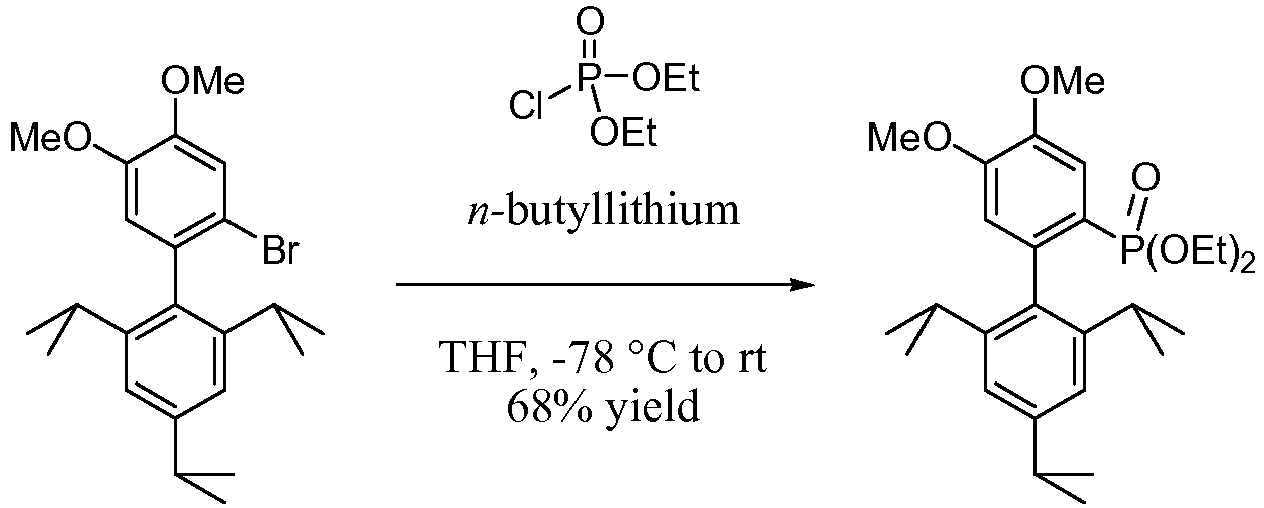
- The titled compound was prepared as described in the general procedure for synthesis of diethylphosphonates substituting 2-bromo-2',4',6'-triisopropyl-4,5-dimethoxybiphenyl (1.47 g, 3.51 mmol, 1 equiv) for the arene, wherein all other reagents are scaled accordingly, followed by purification via column chromatography (80-g column; gradient: 2 column volumes dichloromethane, ramp up to 92:8 dichloromethane:acetone over 8 column volumes, hold at 92:8 for 8 column volumes) (1.13 g, 99 area% by HPLC, 68% yield). 1H NMR (400 MHz, CDCl3) δ ppm 7.49 (dd, J = 14.9, 3.9 Hz, 1H), 7.01 (s, 2H), 6.67 (d, J = 5.5 Hz, 1H), 3.98 (s, 3H), 3.91 - 3.78 (m, 5H), 3.66 (ddq, J = 10.2, 8.7, 7.1 Hz, 2H), 2.92 (hept, J = 7.0 Hz, 1H), 2.50 (hept, J = 6.8 Hz, 2H), 1.28 (d, J = 6.9 Hz, 6H), 1.21 (d, J = 6.8 Hz, 6H), 1.07 (t, J = 7.1 Hz, 6H), 1.00 (d, J = 6.8 Hz, 6H). 13C NMR (100 MHz, CDCl3) δ ppm 150.4 (d, J = 4 Hz), 147.7, 146.8 (d, J = 19 Hz), 146.3, 137.3 (d, J = 10 Hz), 135.5 (d, J = 3 Hz), 120.0, 119.5 (d, J = 197 Hz), 116.5, 115.0 (d,J= 13 Hz), 114.6 (d, J = 19 Hz), 61.6 (d, J = 6 Hz), 56.1 (d, J = 5 Hz), 34.6, 30.9, 26.1, 24.4, 22.9, 16.5 (d, J = 6 Hz). 31P NMR (CDCl3, 202 MHz) δ ppm 18.3 (s).

- The titled compound was prepared as described in the general procedure for synthesis of diethylphosphonates substituting 2-bromo-3',5'-dimethoxybiphenyl (4.50 g, 15.4 mmol, 1 equiv) for the arene, wherein all other reagents are scaled accordingly, followed by purification via column chromatography (120-g column; gradient: 1.5 column volumes dichloromethane, ramp up to 88:12 dichloromethane:acetone over 8 column volumes, hold at 88:12 for 4 column volumes) (2.81 g, 98 area% by HPLC, 52% yield). 1H NMR (400 MHz, CDCl3) δ ppm 8.02 (ddd, J = 14.3, 7.7, 1.4 Hz, 1H), 7.54 (tt, J = 7.5, 1.5 Hz, 1H), 7.46 - 7.38 (m, 1H), 7.38 - 7.32 (m, 1H), 6.63 (d, J = 2.3 Hz, 2H), 6.48 (t, J = 2.3 Hz, 1H), 4.03 - 3.84 (m, 4H), 3.82 (s, 7H), 1.17 (t, J = 7.1 Hz, 6H). 13C NMR (100 MHz, CDCl3) δ ppm 159.5, 145.4 (d, J = 10 Hz), 142.9 (d, J = 4 Hz), 133.5 (d, J = 10 Hz), 131.6 (d, J = 3 Hz), 130.7 (d, J = 14 Hz), 126.7 (d, J = 14 Hz), 126.6 (d, J = 186 Hz), 107.5, 99.7, 61.9 (d, J = 6 Hz), 55.5, 16.4 (d, J = 7 Hz). 31P NMR (CDCl3, 202 MHz) δ ppm 17.7 (s).

- The titled compound was prepared as described in the general procedure for synthesis of diethylphosphonates substituting 2-bromo-4'-tert-butylbiphenyl (2.86 g, 9.89 mmol, 1 equiv) for the arene, wherein all other reagents are scaled accordingly, followed by purification via column chromatography (120-g column; gradient: 2 column volumes dichloromethane, ramp up to 92:8 dichloromethane:acetone over 8 column volumes, hold at 92:8 for 6 column volumes) (2.53 g, 96 area% by HPLC, 74% yield). 1H NMR (400 MHz, CDCl3) δ ppm 8.02 (ddd, J = 14.3, 7.7, 1.4 Hz, 1H), 7.54 (tt, J = 7.6, 1.5 Hz, 1H), 7.45 - 7.30 (m, 6H), 3.98 - 3.74 (m, 4H), 1.36 (s, 9H), 1.10 (t, J = 7.0 Hz, 6H). 13C NMR (100 MHz, CDCl3) δ ppm 149.9, 145.6 (d, J = 10 Hz), 138.2 (d, J = 4 Hz), 133.4 (d, J = 10 Hz), 131.5 (d, J = 3 Hz), 131.1 (d, J = 14 Hz), 128.7, 127.7, 126.3 (d, J = 15 Hz), 124.1, 61.8 (d, J = 6 Hz), 34.8, 31.6, 16.3 (d, J = 7 Hz). 31P NMR (CDCl3, 202 MHz) δ ppm 17.8 (s).
- In a round-bottom flask equipped with a magnetic stir bar and under a positive pressure of nitrogen was added anhydrous, degassed tetrahydrofuran (∼1.6 M relative to LiAlH4) and lithium aluminum hydride (3 equiv) as a solution in tetrahydrofuran. After cooling the mixture to 0 °C in an ice bath, chlorotrimethylsilane (3 equiv) was added in a dropwise manner. The resulting solution was stirred at 0 °C. A tetrahydrofuran solution (∼0.7 M relative to the phosphonate) of the diethylphosphonate (1 equiv) was prepared in a separate round-bottom flask, then cooled to 0 °C in an ice bath while under a positive pressure of N2. After 30 minutes, the lithium aluminum hydride/chlorotrimethylsilane solution was transferred to the solution of diethylphosphonate in a dropwise fashion by cannula using a positive pressure of nitrogen. Rapid gas evolution was observed. The reaction was stirred vigorously at 0 °C and warmed slowly to room temperature overnight. After ∼16 hours, the reaction solution was cooled in an ice bath to 0 °C and quenched using either an acidic workup (method A) or by the Fieser method (method B).
- Workup method A was used for air-stable phosphines without a basic functional group. The reaction mixture was quenched slowly with ethyl acetate (7.7 equiv), followed by 1 M aqueous hydrochloric acid (15 equiv). The biphasic mixture was then stirred vigorously at room temperature until the phases became clear (∼1 h), at which point the phases were partitioned. The organic layer was collected, and the aqueous layer was washed with ethyl acetate (3x). The combined organic fractions were then washed once with brine, dried over sodium sulfate, filtered, and concentrated on a rotary evaporator. The isolated primary phosphines were used without further purification.
- Workup method B was employed with air-sensitive phosphines and air-stable phosphines containing basic substituents. For air-sensitive substrates, the water and 15% aqueous sodium hydroxide solution used in the Fieser quench (n mL of water, n mL 15% aqueous sodium hydroxide, 3n mL water, where n = grams of LiAlH4 used) were degassed by sparging with nitrogen for 30 minutes prior to use. The resulting slurry was stirred vigorously for 15 minutes. Then, using standard Schlenk technique, the air-sensitive phosphine slurry was cannula transferred into a fritted Schlenk filter under nitrogen pressure. The filtrate solution was collected in a 3-neck round-bottom flask. The reaction flask was rinsed with nitrogen-sparged dichloromethane (2x), and the wash was passed through the Schlenk filter each time. The filter cake was also rinsed with dichloromethane (2x). The combined organic fractions were concentrated in vacuo to ∼10 mL, then the solution was cannula transferred into a degassed 40-mL scintillation vial with a septa-top cap. The solution was concentrated in the vial to furnish the phosphine, which was used without further purification.

- The titled compound was prepared as described in the general procedure for the phosphonate reduction substituting diethyl 2',4',6'-triisopropylbiphenyl-2-ylphosphonate (8.31 g, 20.0 mmol, 1 equiv) for diethylphosphonate, wherein all other reagents were scaled accordingly, and using work up method A (15 mL ethyl acetate, 250 mL 1 M aqueous hydrochloric acid) (6.20 g, 95 area% by HPLC, 99% yield). 1H NMR (400 MHz, CDCl3) δ ppm 7.65 - 7.55 (m, 1H), 7.36 - 7.29 (m, 1H), 7.29 - 7.22 (m, 1H), 7.16 - 7.10 (m, 1H), 7.06 (s, 2H), 3.57 (d, J = 203.7 Hz, 2H), 2.95 (hept, J = 6.9 Hz, 1H), 2.42 (hept, J = 6.8 Hz, 2H), 1.32 (d, J = 6.9 Hz, 6H), 1.20 (d, J = 6.9 Hz, 6H), 1.02 (d, J = 6.8 Hz, 6H). 31P NMR (CDCl3, 202 MHz) δ ppm -130.5 (s).

- The titled compound was prepared as described in the general procedure for the phosphonate reduction substituting diethyl 2'-(dimethylamino)-6'-methoxybiphenyl-2-ylphosphonate (3.15 g, 8.67 mmol, 1 equiv) for diethylphosphonate, wherein all other reagents were scaled accordingly, and using work up method B (1 mL water, 1 mL 15% aqueous sodium hydroxide, 3 mL water) (2.17 g, 96 area% by HPLC, 97% yield). 1H NMR (400 MHz, CDCl3) δ ppm 7.61 (dd, J = 10.6, 3.8 Hz, 1H), 7.37 - 7.26 (m, 3H), 7.24 - 7.18 (m, 1H), 6.72 (t, J = 8.0 Hz, 1H), 6.65 (d, J = 8.2 Hz, 1H), 3.72 (s, 3H), 3.65 (dq, J = 202.4, 12.1 Hz, 2H), 2.48 (s, 6H). 31P NMR (CDCl3, 202 MHz) δ ppm -131.9 (s).

- The titled compound was prepared as described in the general procedure for the phosphonate reduction substituting diethyl 2',6'-bis(dimethylamino)biphenyl-2-ylphosphonate (5.14 g, 13.7 mmol, 1 equiv) for diethylphosphonate, wherein all other reagents were scaled accordingly, and using work up method B (1.55 mL water, 1.55 mL 15% aqueous sodium hydroxide, 4.7 mL water) (3.45 g, >99 area% by HPLC, 93% yield). 1H NMR (400 MHz, CDCl3) δ ppm 7.58 (dd, J = 10.7, 4.2 Hz, 1H), 7.34 (ddd, J = 12.3, 7.1, 5.1 Hz, 1H), 7.31 - 7.26 (m, 1H), 7.26 - 7.22 (m, 1H), 7.19 - 7.12 (m, 1H), 6.81 (d, J = 8.0 Hz, 2H), 3.60 (d, J = 202.4 Hz, 2H), 2.39 (s, 12H). 31P NMR (CDCl3, 202 MHz) δ ppm -133.7 (s).

- The titled compound was prepared as described in the general procedure for the phosphonate reduction substituting diethyl 2',6'-dimethoxybiphenyl-2-ylphosphonate (5.40 g, 15.4 mmol, 1 equiv) for diethylphosphonate, wherein all other reagents were scaled accordingly, and using. work up method A (10 mL ethyl acetate, 100 mL 1 M aqueous hydrochloric acid) to afford the product as a white solid (3.80 g, 86 area% by HPLC, >99% yield). 1H NMR (400 MHz, CDCl3) δ ppm 7.68 - 7.59 (m, 1H), 7.41 - 7.29 (m, 2H), 7.29-7.22 (m, 1H), 7.22 - 7.17 (m, 1H), 6.65 (dd, J = 9.9, 4.7 Hz, 2H), 3.73 (d, J = 4.7 Hz, 6H), 3.65 (d, J = 203.0 Hz, 2H). 31P NMR (CDCl3, 202 MHz) δ ppm -131.5 (s).

- The titled compound was prepared as described in the general procedure for the phosphonate reduction substituting diethyl 2',6'-diisopropoxybiphenyl-2-ylphosphonate (3.16 g, 15.4 mmol, 1 equiv) for diethylphosphonate, wherein all other reagents were scaled accordingly, and using. work up method A (6 mL ethyl acetate, 75 mL 1 M aqueous hydrochloric acid) (2.30 g, 94 area% by HPLC, 98% yield). 1H NMR (400 MHz, CDCL3) δ 7.63 - 7.53 (m, 1H), 7.34 - 7.27 (m, 1H), 7.25 - 7.13 (m, 3H), 6.63 (dd, J = 6.8, 4.0 Hz, 2H), 4.33 (hept, J = 6.1 Hz, 2H), 3.68 (d, J = 202.7 Hz, 2H), 1.16 (d, J = 6.1 Hz, 6H), 1.13 (d, J = 6.0 Hz, 6H). 31P NMR (CDCl3, 202 MHz) δ ppm -132.2 (s).

- The titled compound was prepared as described in the general procedure for the phosphonate reduction substituting diethyl 2'-(dimethylamino)biphenyl-2-ylphosphonate (1.96 g, 5.88 mmol, 1 equiv) for diethylphosphonate, wherein all other reagents were scaled accordingly, and using. the air-free work up method B (0.7 mL water, 0.7 mL 15% aqueous sodium hydroxide, 2.0 mL water) (1.20 g, 89% yield). 1H NMR (400 MHz, CDCl3) δ ppm 7.73 - 7.49 (m, 1H), 7.37 - 7.29 (m, 3H), 7.25 - 7.19 (m, 1H), 7.19 - 7.14 (m, 1H), 7.03 (dd, J = 10.6, 4.4 Hz, 2H), 4.15 - 3.22 (m, 2H), 2.52 (s, 6H).

- The titled compound was prepared as described in the general procedure for the phosphonate reduction substituting diethyl biphenyl-2-ylphosphonate (9.00 g, 31.0 mmol, 1 equiv) for diethylphosphonate, wherein all other reagents were scaled accordingly, and using the air-free work up method B (3.5 mL water, 3.5 mL 15% aqueous sodium hydroxide, 11.5 mL water) (4.96 g, 86% yield). 1H NMR (400 MHz, CDCl3) δ ppm 7.56 - 7.39 (m, 1H), 7.38 - 7.19 (m, 6H), 7.19 - 7.09 (m, 2H), 3.72 (d, J = 204.4 Hz, 2H). 31P NMR (CDCl3, 202 MHz) δ ppm -123.6 (t, 1 J PH = 202 Hz).

- The titled compound was prepared as described in the general procedure for the phosphonate reduction substituting diethyl 1,1'-binaphthyl-2-ylphosphonate (3.90 g, 9.99 mmol, 1 equiv) for diethylphosphonate, wherein all other reagents were scaled accordingly, and using the air-free work up method B (1.1 mL water, 1.1 mL 15% aqueous sodium hydroxide, 3.4 mL water) (2.80 g, 98% yield). 1H NMR (400 MHz, CDCl3) δ ppm 7.93-7.84 (m, 2H), 7.78 (dd, J = 12.0, 8.3 Hz, 2H), 7.67 - 7.57 (m, 1H), 7.53 (dt, J = 10.7, 5.3 Hz, 1H), 7.44 - 7.28 (m, 3H), 7.23 - 7.13 (m, 2H), 7.08 (dd, J = 16.5, 8.5 Hz, 2H), 3.57 (ddd, J = 205.2, 66.6, 12.0 Hz, 2H). 31P NMR (CDCl3, 202 MHz) δ ppm -126.1 (s).
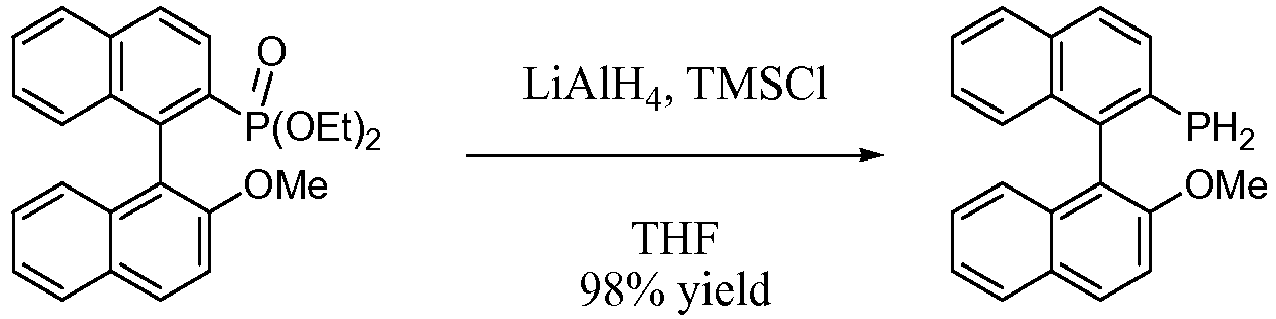
- The titled compound was prepared as described in the general procedure for the phosphonate reduction substituting diethyl 2'-methoxy-1,1'-binaphthyl-2-ylphosphonate(see Powell DR, et al. Journal of Organic Chemistry 1998; 63: 2338-2341) (1.23 g, 2.92 mmol, 1 equiv) for diethylphosphonate, wherein all other reagents were scaled accordingly, and using the air-free work up method B (0.3 mL water, 0.3 mL 15% aqueous sodium hydroxide, 1.0 mL water) (908 mg, 98% yield). 1H NMR (400 MHz, CDCL3) δ 8.07 - 7.96 (m, 1H), 7.93 - 7.80 (m, 3H), 7.80 - 7.67 (m, 1H), 7.52 - 7.37 (m, 2H), 7.37 - 7.26 (m, 1H), 7.26 - 7.17 (m, 2H), 7.13 (dt, J = 6.9, 1.9 Hz, 1H), 6.99 - 6.88 (m, 1H), 3.79 (s, 3H), 3.62 (ddd, J = 204.0, 46.0, 12.1 Hz, 2H). 31P NMR (CDCl3, 202 MHz) δ ppm -129.2 (s).

- The titled compound was prepared as described in the general procedure for the phosphonate reduction substituting diethyl 2-(naphthalen-1-yl)phenylphosphonate (2.12 g, 6.23 mmol, 1 equiv) for diethylphosphonate, wherein all other reagents were scaled accordingly, and using the air-free work up method B (0.7 mL water, 0.7 mL 15% aqueous sodium hydroxide, 2.1 mL water) (1.43 g, 97% yield). 1H NMR (400 MHz, CDCl3) δ ppm 7.98 - 7.85 (m, 2H), 7.72 - 7.62 (m, 1H), 7.57 - 7.29 (m, 8H), 3.59 (ddd, J= 102.0, 34.9, 12.2 Hz, 2H). 31P NMR (CDCl3, 202 MHz) δ ppm -130.1 (s).

- The titled compound was prepared as described in the general procedure for the phosphonate reduction substituting diethyl 2-(naphthalen-2-yl)phenylphosphonate (3.06 g, 8.99 mmol, 1 equiv) for diethylphosphonate, wherein all other reagents were scaled accordingly, and using. the reaction air-free work up method B (1.0 mL water, 1.0 mL 15% aqueous sodium hydroxide, 3.1 mL water) (1.92 g, 90% yield). 1H NMR (400 MHz, CDCl3) δ 7.93 - 7.82 (m, 3H), 7.82 - 7.76 (m, 1H), 7.63 (ddd, J = 13.6, 4.6, 4.0 Hz, 1H), 7.54 - 7.45 (m, 3H), 7.40 - 7.31 (m, 2H), 7.31 - 7.22 (m, 1H), 3.85 (d, J = 204.6 Hz, 2H). 31P NMR (CDCl3, 202 MHz) δ ppm -126.0 (s).
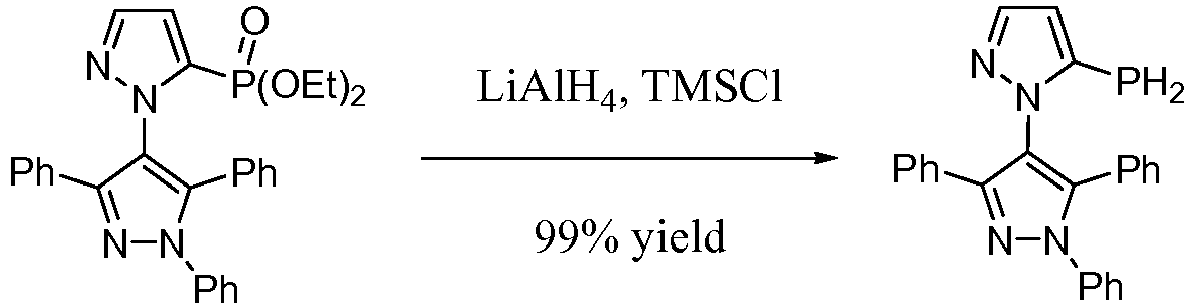
- The titled compound was prepared as described in the general procedure for the phosphonate reduction substituting diethyl 1',3',5'-triphenyl-1'H-1,4'-bipyrazol-5-ylphosphonate (2.42 g, 4.85 mmol, 1 equiv) for diethylphosphonate, wherein all other reagents were scaled accordingly, and using the air-free work up method B (0.6 mL water, 0.6 mL 15% aqueous sodium hydroxide, 1.6 mL water) (1.81 g, 86 area% by HPLC, 95% yield). 1H NMR (400 MHz, CDCL3) δ 7.76 (t, J = 1.6 Hz, 1H), 7.46 - 7.32 (m, 6H), 7.32 - 7.27 (m, 4H), 7.25 - 7.18 (m, 3H), 7.15 - 7.09 (m, 2H), 6.60 - 6.50 (m, 1H), 3.32 (dm, J = 208.4 Hz, 2H).

- The titled compound was prepared as described in the general procedure for the phosphonate reduction substituting diethyl 1-phenyl-1H-pyrazol-5-ylphosphonate (3.77 g, 13.5 mmol, 1 equiv) for diethylphosphonate, wherein all other reagents were scaled accordingly, and using the air-free work up method B (1.6 mL water, 1.6 mL 15% aqueous sodium hydroxide, 4.6 mL water) (1.95 g, 82% yield). 1H NMR (400 MHz, CDCl3) δ ppm 7.75 - 7.65 (m, 1H), 7.52 - 7.37 (m, 5H), 6.60 (d, J = 1.2 Hz, 1H), 3.92 (d, J = 207.8 Hz, 2H). 31P NMR (CDCl3, 202 MHz) δ ppm -161.3 (s).

- The titled compound was prepared as described in the general procedure for the phosphonate reduction substituting diethyl 2-(1H-pyrrol-1-yl)phenylphosphonate (4.00 g, 14.3 mmol, 1 equiv) for diethylphosphonate, wherein all other reagents were scaled accordingly, and using the air-free work up method B (1.6 mL water, 1.6 mL 15% aqueous sodium hydroxide, 4.9 mL water) (2.03 g, 81% yield). 1H NMR (400 MHz, CDCl3) δ ppm 7.63 - 7.52 (m, 1H), 7.43 - 7.31 (m, 1H), 7.31 - 7.21 (m, 2H), 6.84 - 6.74 (m, 2H), 6.37-6.29 (m, 2H), 3.74 (d, J = 205.6 Hz, 2H). 31P NMR (CDCl3, 202 MHz) δ ppm -132.3 (s).

- The titled compound was prepared as described in the general procedure for the phosphonate reduction substituting diethyl 3,6-dimethoxybiphenyl-2-ylphosphonate (2.50 g, 7.14 mmol, 1 equiv) for diethylphosphonate, wherein all other reagents were scaled accordingly, and using the air-free work up method B(0.8 mL water, 0.8 mL 15% aqueous sodium hydroxide, 2.4 mL water) (1.64 g, 93% yield). 1H NMR (400 MHz, CDCl3) δ 7.49-7.40 (m, 2H), 7.40 - 7.33 (m, 1H), 7.26 - 7.20 (m, 1H), 6.84 (dt, J = 8.9, 5.9 Hz, 2H), 3.88 (s, 3H), 3.67 (s, 3H), 3.46 (d, J = 215.1 Hz, 2H). 31P NMR (CDCl3, 202 MHz) δ ppm -154.6 (s).

- The titled compound was prepared as described in the general procedure for the phosphonate reduction substituting diethyl 3,6-dimethoxy-2',4',6'-trimethylbiphenyl-2-ylphosphonate (3.05 g, 7.77 mmol, 1 equiv) for diethylphosphonate, wherein all other reagents were scaled accordingly, and using the air-free work up method B (0.9 mL water, 0.9 mL 15% aqueous sodium hydroxide, 2.7 mL water) (2.19 g, 98% yield). 1H NMR (400 MHz, CDCl3) δ ppm 6.95 (s, 2H), 6.83 (dt, J = 8.9, 6.0 Hz, 2H), 3.87 (s, 3H), 3.67 (s, 3H), 3.34 (d, J = 214.2 Hz, 2H), 2.34 (s, 3H), 1.94 (s, 6H). 31P NMR (CDCl3, 202 MHz) δ ppm -160.4 (s).

- The titled compound was prepared as described in the general procedure for the phosphonate reduction substituting diethyl 2',4',6'-triisopropyl-3,6-dimethoxybiphenyl-2-ylphosphonate (3.47 g, 7.28 mmol, 1 equiv) for diethylphosphonate, wherein all other reagents were scaled accordingly, and using work up method A (6 mL ethyl acetate, 100 mL 1 M aqueous hydrochloric acid) (2.67 g, 98% yield). 1H NMR (CDCl3, 400 MHz) δ ppm 7.05 (d, J = 3.2 Hz, 2H), 6.86-6.78 (m, 2H), 3.88 (s, 3H), 3.65 (s, 3H), 3.31 (d, J = 215.0 Hz, 2H), 3.01-2.88 (m, 1H), 2.44 (hept, J = 6.8 Hz, 2H), 1.31 (d, J = 6.9 Hz, 6H), 1.15 (d, J = 6.9 Hz, 6H), 1.02 (d, J = 6.8 Hz, 6H). 31P NMR (CDCl3, 202 MHz) δ ppm -156.3 (s).

- The titled compound was prepared as described in the general procedure for the phosphonate reduction substituting diethyl 2',4',6'-triisopropyl-4,5-dimethoxybiphenyl-2-ylphosphonate (1.10 g, 2.31 mmol, 1 equiv) for diethylphosphonate, wherein all other reagents were scaled accordingly, and using work up method A (1.7 mL ethyl acetate, 32 mL 1 M aqueous hydrochloric acid) (798 mg, 93% yield). 1H NMR (400 MHz, CDCl3) δ ppm 7.11 - 7.03 (m, 3H), 6.69 - 6.65 (m, 1H), 3.96 (d, J = 57.3 Hz, 1H), 3.94 (s, 3H), 3.81 (s, 3H), 3.31 (s, 1H), 3.02 - 2.89 (m, 1H), 2.56 - 2.39 (m, 3H), 1.32 (d, J = 6.9 Hz, 2H), 1.19 (d, J = 6.9 Hz, 2H), 1.04 (d, J = 6.8 Hz, 2H). 31P NMR (CDCl3, 202 MHz) δ ppm -128.9 (s).

- The titled compound was prepared as described in the general procedure for the phosphonate reduction substituting diethyl 3',5'-dimethoxybiphenyl-2-ylphosphonate (2.75 g, 7.85 mmol, 1 equiv) for diethylphosphonate, wherein all other reagents were scaled accordingly, and using the air-free work up method B (0.9 mL water, 0.9 mL 15% aqueous sodium hydroxide, 2.7 mL water) (1.54 g, 80% yield). 1H NMR (400 MHz, CDCl3) δ ppm 7.55 - 7.45 (m, 1H), 7.31 - 7.11 (m, 3H), 6.45 - 6.38 (m, 3H), 3.79 (d, J = 204.4 Hz, 2H), 3.74 (s, 6H). 31P NMR (CDCl3, 202 MHz) δ ppm -123.5 (t, 1 J PH = 200 MHz).

- The titled compound was prepared as described in the general procedure for the phosphonate reduction substituting diethyl 4'-tert-butylbiphenyl-2-ylphosphonate (2.52 g, 7.27 mmol, 1 equiv) for diethylphosphonate, wherein all other reagents were scaled accordingly, and using the air-free work up method B (0.8 mL water, 0.8 mL 15% aqueous sodium hydroxide, 2.5 mL water) (1.40 g, 79% yield). 1H NMR (400 MHz, CDCl3) δ ppm 7.56 - 7.46 (m, 1H), 7.41 - 7.33 (m, 2H), 7.30 - 7.09 (m, 5H), 3.78 (d, J = 204.7 Hz, 2H), 1.30 (s, 9H). 31P NMR (CDCl3, 202 MHz) δ ppm -121.1 (t, 1 J PH = 204 MHz).
- A 20-mL glass liner equipped with a magnetic stir bar was charged with the primary biarylphosphine (1 equiv) and phorone (2.1 equiv). The glass liner was then placed into a 30-mL Parr Hastelloy C reactor, which was purged with nitrogen gas and sealed under 30 psig of N2. For air sensitive phosphines, the reaction was setup in a nitrogen-atmosphere glovebox and sealed under an atmosphere of N2. The reaction was stirred overnight in an oil bath at 170 °C. Upon cooling to room temperature, the Parr reactor was carefully vented and then unsealed. The glass liner was removed from the Parr body and typically contained a yellow solid. Ethanol was added to the crude material and manually slurried with a spatula. If necessary, gentle heating (50 °C) was applied to aid in breaking the solid apart. The product was isolated by filtration and the glass liner and filter cake were washed with cold ethanol (3x).

- The titled compound was prepared as described in the general procedure for the double conjugate addition to phorone substituting (2',4',6'-triisopropylbiphenyl-2-yl)phosphine (4.0 g, 12.8 mmol, 1 equiv) for biarylphosphine, wherein all other reagents were scaled accordingly, and heating for 20 hours (4.49 g, 92 area% by HPLC, 78% yield). 1H NMR (400 MHz, CDCl3) δ ppm 7.91 - 7.79 (m, 1H), 7.43 - 7.33 (m, 2H), 7.29 - 7.21 (m, 1H), 7.02 (s, 2H), 3.04 - 2.89 (m, 3H), 2.49 (hept, J = 6.6 Hz, 2H), 2.29 (dd, J = 13.6, 4.9 Hz, 2H), 1.32 (d, J = 6.9 Hz, 6H), 1.25 - 1.15 (m, 12H), 1.02 - 0.95 (m, 12H). 31P NMR (CDCl3, 202 MHz) δ ppm 6.1 (s).

- The titled compound was prepared as described in the general procedure for the double conjugate addition to phorone substituting 6-methoxy-N,N-dimethyl-2'-phosphinobiphenyl-2-amine (1.82 g, 7.02 mmol, 1 equiv) for biarylphosphine, wherein all other reagents were scaled accordingly, and heating for 20 hours (2.01 g, >99 area% by HPLC, 72% yield). 1H NMR (400 MHz, CDCl3) δ ppm 7.82 (dd, J = 5.3, 3.9 Hz, 1H), 7.47-7.40 (m, 1H), 7.36 - 7.27 (m, 3H), 6.69 (dd, J = 8.2, 0.9 Hz, 1H), 6.63 (dd, J = 8.3, 0.8 Hz, 1H), 3.63 (s, 3H), 3.03 (d, J = 13.8 Hz, 1H), 2.90 - 2.78 (m, 1H), 2.46 (s, 6H), 2.42 - 2.33 (m, 1H), 2.18 - 2.02 (m, 1H), 1.23 (d, J = 19.6 Hz, 3H), 1.15 (d, J = 9.2 Hz, 3H), 1.00 (d, J = 17.8 Hz, 3H), 0.62 (d, J = 10.0 Hz, 3H). 13C NMR (100 MHz, CDCl3) δ ppm 212.1, 157.1, 152.3 (d, J = 3 Hz), 145.6 (d, J = 36 Hz), 135.8 (d, J = 28 Hz), 133.3 (d, J = 7 Hz), 133.1 (d, J = 4 Hz), 128.3, 128.2, 125.8, 124.1 (d, J = 7Hz), 110.5, 104.1, 55.2, 54.7 (d, J = 3 Hz), 52.3, 43.6, 35.8 (d, J = 21 Hz), 34.9 (d, J = 24 Hz), 33.8 (d, J = 39 Hz), 31.2 (d, J = 34 Hz), 29.6 (d, J = 9 Hz), 29.0 (d, J = 7 Hz). 31P NMR (CDCl3, 202 MHz) δ ppm 0.0 (s). LRMS (ESI+) found for [M+H, C24H33NO2P]+ 398.2.

- The titled compound was prepared as described in the general procedure for the double conjugate addition to phorone substituting N2,N 2,N6 ,N6 -tetramethyl-2'-phosphinobiphenyl-2,6-diamine (2.89 g, 10.6 mmol, 1 equiv) for biarylphosphine, wherein all other reagents were scaled accordingly, and heating for 20 hours (2.81 g, 87 area% by HPLC, 65% yield). 1H NMR (400 MHz, CDCl3) δ ppm 7.79 (d, J = 7.7 Hz, 1H), 7.50 - 7.35 (m, 2H), 7.35 - 7.26 (m, 2H), 6.93 - 6.82 (m, 2H), 2.91 (dd, J = 13.9, 2.9 Hz, 2H), 2.46 (s, 12H), 2.30 (ddd, J = 14.0, 10.2, 4.1 Hz, 2H), 1.15 (s, 3H), 1.10 (s, 3H), 0.95 (s, 3H), 0.93 (s, 3H). 13C NMR (100 MHz, CDCl3) δ ppm 212.0, 153.1, 147.6, 135.5 (d, J = 29 Hz), 133.9 (d, J = 4 Hz), 133.5 (d, J = 7 Hz), 132.7 - 131.8 (m), 128.3, 127.6, 125.5, 114.4, 53.7, 45.5, 35.1, 34.9, 33.4, 33.0, 29.6, 29.5. 31P NMR (CDCl3, 202 MHz) δ ppm 0.0 (s). HRMS (TOF-ESI+) calcd for [M, C25H35N2OP]+ 410.2487, found 410.2491.

- The titled compound was prepared as described in the general procedure for the double conjugate addition to phorone substituting (2',6'-dimethoxybiphenyl-2-yl)phosphine (3.80 g, 15.4 mmol, 1 equiv) for biarylphosphine, wherein all other reagents were scaled accordingly, and heating for 19 hours (2.81 g, 84 area% by HPLC, 65% yield). 1H NMR (400 MHz, CDCl3) δ ppm 7.83 (d, J = 7.7 Hz, 1H), 7.50 - 7.41 (m, 1H), 7.41 - 7.29 (m, 2H), 7.22 (ddd, J = 7.5, 3.8, 1.3 Hz, 1H), 6.60 (t, J = 9.3 Hz, 2H), 3.69 (s, 6H), 2.91 (dd, J = 13.1, 3.9 Hz, 2H), 2.29 (dt, J = 21.8, 10.9 Hz, 2H), 1.16 (s, 3H), 1.12 (s, 3H), 0.98 (s, 3H), 0.96 (s, 3H). 13C NMR (100 MHz, CDCl3) δ ppm 211.7, 156.8 (d, J = 2 Hz), 144.0 (d, J = 38 Hz), 135.8 (d, J = 26 Hz), 132.7 (d, J = 4 Hz), 131.6 (d, J = 7 Hz), 128.8, 128.5, 126.3, 119.8 (d, J = 9 Hz), 103.0, 55.3, 53.7, 35.6, 35.6, 35.4, 35.4, 32.6, 32.2, 29.5 (d, J = 7 Hz). 31P NMR (CDCl3, 202 MHz) δ ppm -0.5 (s). LRMS (ESI+) found for [M+H, C23H30O3P]+ 385.1.

- The titled compound was prepared as described in the general procedure for the double conjugate addition to phorone substituting (2',6'-diisopropoxybiphenyl-2-yl)phosphine (3.93 g, 13.0 mmol, 1 equiv) for biarylphosphine, wherein all other reagents were scaled accordingly, and heating for 15 hours (2.81 g, 83 area% by HPLC, 49% yield). 1H NMR (400 MHz, CDCl3) δ ppm 7.77 (dd, J = 5.4, 3.7 Hz, 1H), 7.38 - 7.27 (m, 2H), 7.22 (dd, J = 7.3, 4.0 Hz, 1H), 7.10 (ddd, J = 7.4, 3.8, 1.7 Hz, 1H), 6.56 (d, J = 8.3 Hz, 2H), 4.42 (hept, J = 6.1 Hz, 2H), 2.95 (dd, J = 13.3, 2.2 Hz, 2H), 2.27 (dd, J = 13.3, 4.8 Hz, 2H), 1.18 (dd, J = 12.3, 8.6 Hz, 12H), 1.04 (d, J = 6.0 Hz, 6H), 0.99 (d, J = 9.9 Hz, 6H). 31P NMR (CDCl3, 202 MHz) δ ppm -1.3(s). LRMS (ESI+) found for [M+H, C27H38O3P]+ 441.2.

- The titled compound was prepared as described in the general procedure for the double conjugate addition to phorone in a nitrogen-atmosphere glovebox substituting N,N-dimethyl-2'-phosphinobiphenyl-2-amine (1.05 g, 4.58 mmol, 1 equiv) for biarylphosphine, wherein all other reagents were scaled accordingly, and heating for 18.5 hours. (1.15 g, 68 area% by HPLC, 68% yield). 1H NMR (400 MHz, CDCl3) δ ppm 7.81 (d, J = 7.7 Hz, 1H), 7.46 (t, J = 7.4 Hz, 1H), 7.39 - 7.28 (m, 3H), 7.05 - 6.96 (m, 3H), 3.06 (d, J = 13.7 Hz, 1H), 2.83 (d, J = 12.6 Hz, 1H), 2.48 (s, 6H), 2.44 - 2.32 (m, 1H), 2.05 (ddd, J = 12.6, 4.6, 1.4 Hz, 1H), 1.33 - 1.15 (m, 6H), 1.00 (d, J = 17.8 Hz, 3H), 0.56 (d, J = 9.9 Hz, 3H). 31P NMR (CDCl3, 202 MHz) δ ppm 9.5 (s). LRMS (ESI+) found for [M+H, C23H31NOP]+ 368.1.

- The titled compound was prepared as described in the general procedure for the double conjugate addition to phorone in a nitrogen-atmosphere glovebox substituting biphenyl-2-ylphosphine (2.73 g, 14.7 mmol, 1 equiv) for biarylphosphine, wherein all other reagents were scaled accordingly, and heating for 21 hours (3.05 g, >99 area% by HPLC, 64% yield). 1H NMR (400 MHz, CDCl3) δ ppm 7.96 - 7.86 (m, 1H), 7.52 - 7.33 (m, 6H), 7.33 - 7.24 (m, 2H), 3.07 - 2.86 (m, 2H), 2.32 (dd, J = 13.0, 4.9 Hz, 2H), 1.23 (s, 3H), 1.19 (s, 3H), 1.01 (s, 3H), 0.99 (s, 3H). 13C NMR (100 MHz, CDCl3) δ ppm 211.0, 151.7 (d,J= 35 Hz), 142.8 (d, J = 8 Hz), 134.0 (d, J = 30 Hz), 133.0 (d, J = 4 Hz), 130.9 (d, J = 6 Hz), 130.3 (d, J = 5 Hz), 128.7, 127.1, 126.5, 126.4, 53.4 (d, J = 1 Hz), 36.0 (d, J = 21 Hz), 32.2, 31.9, 30.1 (d, J = 8 Hz). 31P NMR (CDCl3, 202 MHz) δ ppm -3.9 (s). HRMS (TOF-ESI+) calcd for [M, C21H25OP]+ 324.1643, found 324.1638.

- The titled compound was prepared as described in the general procedure for the double conjugate addition to phorone in a nitrogen-atmosphere glovebox substituting 1,1'-binaphthyl-2-ylphosphine (1.73 g, 6.04 mmol, 1 equiv) for biarylphosphine, wherein all other reagents were scaled accordingly, and heating for 20 hours (1.71 g, 91 area% by HPLC, 67% yield). 1H NMR (400 MHz, CDCl3) δ ppm 8.10 - 7.86 (m, 5H), 7.66 - 7.55 (m, 1H), 7.48 (dddd, J = 16.4, 8.1, 6.8, 1.2 Hz, 2H), 7.40 - 7.31 (m, 1H), 7.30 - 7.20 (m, 2H), 7.14 (t, J = 9.3 Hz, 2H), 3.19 - 2.90 (m, 2H), 2.31 (dddd, J = 22.0, 13.0, 4.9, 1.1 Hz, 2H), 1.18 - 1.08 (m, 3H), 1.07 - 0.89 (m, 9H). 13C NMR (100 MHz, CDCl3) δ ppm 211.1, 148.3 (d, J = 37 Hz), 138.1 (d, J = 10 Hz), 133.6 (d, J = 16 Hz), 133.4 (d, J = 5 Hz), 133.1, 133.0 (d, J = 2 Hz), 133.0, 129.0 (d, J = 4 Hz), 128.8 (d, J = 3 Hz), 128.0, 127.6 - 127.4 (m), 127.3 (d, J = 11 Hz), 126.7 (d, J = 6 Hz), 126.2, 125.4 (d, J = 6 Hz), 124.5, 54.1, 53.4, 36.3 (d, J = 22 Hz), 35.5 (d, J = 22 Hz), 32.7 (d, J = 36 Hz), 31.9 (d, J = 34 Hz), 30.7 (d, J = 7 Hz), 30.0 (d, J = 8 Hz). 31P NMR (CDCl3, 202 MHz) δ ppm -1.1 (s). LRMS (ESI+) found for [M+H, C29H30OP]+ 425.2.

- The titled compound was prepared as described in the general procedure for the double conjugate addition to phorone in a nitrogen-atmosphere glovebox substituting (2'-methoxy-1,1'-binaphthyl-2-yl)phosphine (808 mg, 2.55 mmol, 1 equiv) for biarylphosphine, wherein all other reagents were scaled accordingly, and heating for 19.5 hours (1.07 g, 92 area% by HPLC, 92% yield). 1H NMR (400 MHz, CDCl3) δ ppm 8.11 - 7.81 (m, 5H), 7.55 - 7.46 (m, 1H), 7.46 - 7.38 (m, 1H), 7.35 - 7.20 (m, 2H), 7.20 - 7.09 (m, 2H), 6.94 - 6.84 (m, 1H), 3.76 (d, J = 3.7 Hz, 3H), 3.09 - 2.94 (m, 2H), 2.44 - 2.23 (m, 2H), 1.19 - 1.09 (m, 3H), 1.06 (t, J = 8.5 Hz, 3H), 0.94 - 0.85 (m, 6H). 13C NMR (100 MHz, CDCl3) δ ppm 211.5, 153.6, 145.1 (d, J = 38 Hz), 134.1 (d, J = 28 Hz), 133.9 (d, J = 2 Hz), 133.3, 133.2 (d, J = 8 Hz), 129.4, 129.3 (d, J = 3 Hz), 128.3, 127.6, 127.4, 127.0 (d, J = 3 Hz), 126.9, 126.6, 126.1, 125.9, 125.6, 122.9, 122.3 (d, J = 10 Hz), 112.2, 55.6, 54.0, 53.7, 35.7 (d, J = 23 Hz), 35.4 (d, J = 22 Hz), 32.9 (d, J = 37 Hz), 32.5 (d, J = 36 Hz), 30.4 (d, J = 7 Hz), 29.8 (d, J = 7 Hz). 31P NMR (CDCl3, 202 MHz) δ ppm -1.3 (s). LRMS (ESI+) found for [M+H, C30H32O2P]+ 455.2.

- The titled compound was prepared as described in the general procedure for the double conjugate addition to phorone in a nitrogen-atmosphere glovebox substituting (2-(naphthalen-1-yl)phenyl)phosphine (1.07 g, 4.52 mmol, 1 equiv) for biarylphosphine, wherein all other reagents were scaled accordingly, and heating for 18 hours (1.44 g, 87 area% by HPLC, 85% yield). 1H NMR (400 MHz, CDCL3) δ 8.04 - 7.96 (m, 1H), 7.96 - 7.87 (m, 2H), 7.61 - 7.47 (m, 4H), 7.44 - 7.36 (m, 3H), 7.35 - 7.27 (m, 1H), 2.99 (ddd, J = 13.0, 11.3, 3.1 Hz, 2H), 2.43 - 2.20 (m, 2H), 1.18 - 0.96 (m, 12H). 13C NMR (100 MHz, CDCl3) δ ppm 211.0, 149.5 (d, J = 37 Hz), 140.5 (d, J = 9 Hz), 135.9 (d, J = 29 Hz), 133.3 - 132.8 (m), 132.4 (d, J = 2 Hz), 131.5 (d, J = 6 Hz), 128.8, 127.9, 127.8 (d, J = 3 Hz), 127.2, 127.0, 126.6, 125.3, 125.2, 124.4, 54.0 (d, J = 1 Hz), 52.9 (d, J = 1 Hz), 36.2 (d, J = 22 Hz), 35.4 (d, J = 22 Hz), 32.5 (d, J = 35 Hz), 31.5 (d, J = 33 Hz), 30.4 (d, J = 7 Hz), 30.0 (d, J = 8 Hz). 31P NMR (CDCl3, 202 MHz) δ ppm -4.9 (s). LRMS (ESI+) found for [M+H, C25H28OP]+ 375.2.
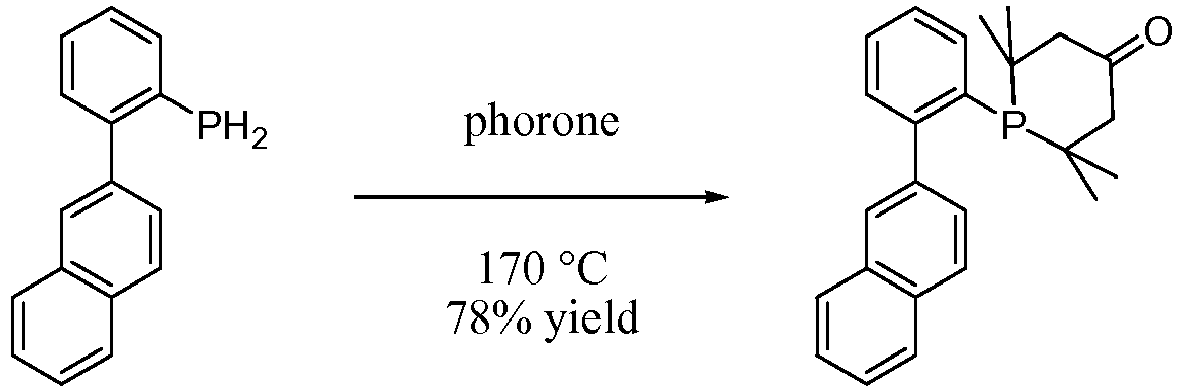
- The titled compound was prepared as described in the general procedure for the double conjugate addition to phorone in a nitrogen-atmosphere glovebox substituting (2-(naphthalen-2-yl)phenyl)phosphine (1.41 g, 5.98 mmol, 1 equiv) for biarylphosphine, wherein all other reagents were scaled accordingly, and heating for 18 hours (1.74 g, 99 area% by HPLC, 78% yield). 1H NMR (400 MHz, CDCl3) δ ppm 7.99 - 7.80 (m, 4H), 7.68 (s, 1H), 7.58 - 7.37 (m, 6H), 3.07 - 2.84 (m, 2H), 2.39 - 2.22 (m, 2H), 1.18 (s, 3H), 1.14 (s, 3H), 1.02 (s, 3H), 0.99 (d, J = 9.0 Hz, 3H). 13C NMR (100 MHz, CDCl3) δ ppm 210.9, 151.6 (d, J = 34 Hz), 140.6 (d, J = 8 Hz), 134.2 (d, J = 30 Hz), 133.0 (d, J = 4 Hz), 132.7, 131.9, 131.2 (d, J = 6 Hz), 129.3 (d, J = 6 Hz), 128.8, 128.6 (d, J = 3 Hz), 127.7, 127.5, 126.7, 126.2, 125.8, 125.5, 53.5, 36.2, 36.0, 32.1, 31.8, 30.2, 30.1. 31P NMR (CDCl3, 202 MHz) δ ppm -6.8 (s).

- The titled compound was prepared as described in the general procedure for the double conjugate addition to phorone substituting 1',3',5'-triphenyl-5-phosphino-1'H-1,4'-bipyrazole (2.36 g, 5.98 mmol, 1 equiv) for biarylphosphine, wherein all other reagents were scaled accordingly, and heating for 21.5 hours (1.64 g, 80 area% by HPLC, 52% yield). 1H NMR (400 MHz, CDCl3) δ ppm 8.20 (d, J = 2.0 Hz, 1H), 7.76 - 7.61 (m, 4H), 7.61 - 7.28 (m, 13H), 6.80 (t, J = 3.3 Hz, 1H), 2.93 - 2.75 (m, 2H), 2.27 - 2.12 (m, 2H), 1.12 (dd, J = 18.5 Hz, 6H), 0.30 (d, J = 12.1 Hz, 3H), 0.01 (d, J = 12.0 Hz, 3H). 13C NMR (100 MHz, CDCl3) δ ppm 210.3, 149.2, 141.9, 141.7, 141.0 (d, J = 2 Hz), 140.3 (d, J = 2 Hz), 139.6, 131.3, 129.4, 128.6, 128.5, 128.1, 128.1, 128.1, 128.0, 127.3, 127.2, 125.1, 120.4, 111.9 (d, J = 5 Hz), 52.7 - 52.4 (m), 35.5 (d, J = 3 Hz), 35.3 (d, J = 4 Hz), 30.0 (d, J = 7 Hz), 29.6 (d, J = 7 Hz), 29.4 (d, J = 9 Hz), 28.3 (d, J = 9 Hz). 31P NMR (CDCl3, 202 MHz) δ ppm -21.6 (s). LRMS (ESI+) found for [M+H, C33H34N4OP]+ 533.2.

- The titled compound was prepared as described in the general procedure for the double conjugate addition to phorone in a nitrogen-atmosphere glovebox substituting 1-phenyl-5-phosphino-1H-pyrazole (1.45 g, 8.23 mmol, 1 equiv) for biarylphosphine, wherein all other reagents were scaled accordingly, and heating for 18 hours (1.08 g, 67 area% by HPLC, 42% yield). 1H NMR (400 MHz, CDCl3) δ ppm 7.81 (t, J = 3.3 Hz, 1H), 7.49 - 7.38 (m, 5H), 6.87 - 6.71 (m, 1H), 3.02 - 2.87 (m, 2H), 2.25 (dd, J = 12.7, 5.6 Hz, 2H), 1.24 (s, 3H), 1.20 (s, 3H), 0.96 (s, 3H), 0.93 (s, 3H). 13C NMR (100 MHz, CDCl3) δ ppm 210.0, 139.7 (d, J = 2 Hz), 138.5 (d, J = 28 Hz), 128.3, 128.2, 127.7 (d, J = 5 Hz), 112.0 (d, J = 5 Hz), 52.7, 52.6, 36.1, 35.9, 30.3, 30.2, 30.2, 29.9. 31P NMR (CDCl3, 202 MHz) δ ppm -22.0 (s). LRMS (ESI+) found for [M+H, C18H24N2OP]+ 315.1.
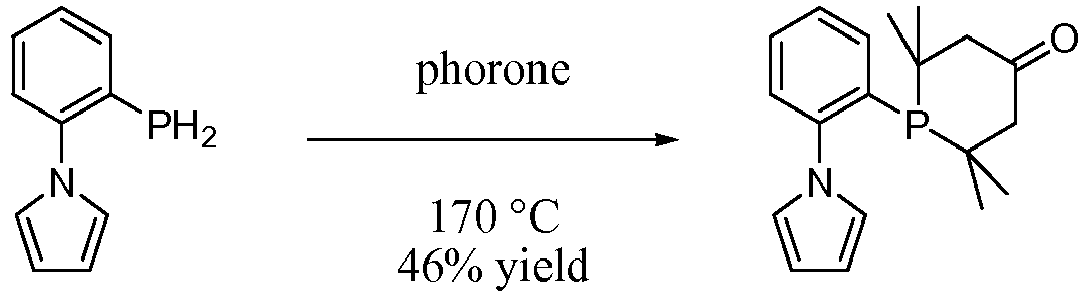
- The titled compound was prepared as described in the general procedure for the double conjugate addition to phorone in a nitrogen-atmosphere glovebox substituting 1-(2-phosphinophenyl)-1H-pyrrole (2.00 g, 11.4 mmol, 1 equiv) for biarylphosphine, wherein all other reagents were scaled accordingly, and heating for 19 hours (1.65 g, 85 area% by HPLC, 46% yield). 1H NMR (400 MHz, CDCl3) δ ppm 7.96 - 7.83 (m, 1H), 7.54 - 7.41 (m, 2H), 7.41 - 7.33 (m, 1H), 6.86 - 6.73 (m, 2H), 6.37 - 6.23 (m, 2H), 2.91 (dd, J = 13.0, 3.3 Hz, 2H), 2.41 - 2.26 (m, 2H), 1.25 (s, 3H), 1.20 (s, 3H), 0.98 (s, 3H), 0.96 (s, 3H). 13C NMR (100 MHz, CDCl3) δ ppm 210.5, 148.4 (d, J = 28 Hz), 134.2 (d, J = 34 Hz), 133.4 (d, J = 4 Hz), 129.9, 128.4 (d, J = 3 Hz), 127.4, 123.3 (d, J = 3 Hz), 108.4, 53.2, 35.7, 35.5, 32.2, 31.8, 30.0, 29.9. 31P NMR (CDCl3, 202 MHz) δ ppm -5.4 (s). LRMS (ESI+) found for [M+H, C19H25NOP]+ 314.1.

- The titled compound was prepared as described in the general procedure for the double conjugate addition to phorone in a nitrogen-atmosphere glovebox substituting (3,6-dimethoxybiphenyl-2-yl)phosphine (1.58 g, 6.42 mmol, 1 equiv) for biarylphosphine, wherein all other reagents were scaled accordingly, and heating for 18 hours (1.84 g, 87 area% by HPLC, 75% yield). 1H NMR (400 MHz, CDCl3) δ ppm 7.44 - 7.27 (m, 3H), 7.11 - 7.03 (m, 2H), 7.00 (d, J = 8.9 Hz, 1H), 6.87 (dd, J = 10.2, 6.9 Hz, 1H), 3.82 (s, 3H), 3.65 (s, 3H), 3.13 (d, J = 12.4 Hz, 2H), 2.15 (dd, J = 12.6, 5.3 Hz, 2H), 1.12 (s, 3H), 1.07 (s, 3H), 0.95 (s, 3H), 0.93 (s, 3H). 13C NMR (100 MHz, CDCl3) δ ppm 214.0, 154.2 (d, J = 3 Hz), 151.4 (d, J = 11 Hz), 142.9 (d, J = 42 Hz), 139.2 (d, J = 12 Hz), 130.5 (d, J = 5 Hz), 126.9, 126.0, 124.6 (d, J = 44 Hz), 113.3, 108.5, 56.5, 54.6, 54.6, 54.4, 35.8, 35.5, 34.1, 33.6, 30.4, 30.3. 31P NMR (CDCl3, 202 MHz) δ ppm 0.1 (s). HRMS (TOF-ESI+) calcd for [M, C23H29O3P]+ 384.1854, found 384.1860.

- The titled compound was prepared as described in the general procedure for the double conjugate addition to phorone substituting (3,6-dimethoxy-2',4',6'-trimethylbiphenyl-2-yl)phosphine (2.08 g, 7.23 mmol, 1 equiv) for biarylphosphine, wherein all other reagents were scaled accordingly, and heating for 19 hours (1.65 g, 88 area% by HPLC, 46% yield). 1H NMR (400 MHz, CDCl3) δ ppm 7.03 - 6.95 (m, 1H), 6.85 (dd, J = 12.9, 9.0 Hz, 3H), 3.79 (s, 3H), 3.64 (s, 3H), 2.98 (dd, J = 14.3, 4.3 Hz, 2H), 2.33 (s, 3H), 2.31 - 2.21 (m, 2H), 1.95 (s, 6H), 1.17 - 1.11 (m, 3H), 1.08 (s, 3H), 0.99 (s, 3H), 0.97 (s, 3H). 13C NMR (100 MHz, CDCl3) δ ppm 213.4, 154.5, 151.4 (d, J = 12 Hz), 140.7 (d, J = 41 Hz), 135.7, 135.4 (d, J = 3 Hz), 134.5 (d, J = 10 Hz), 127.2, 124.2 (d, J = 43 Hz), 113.1, 108.5, 56.3, 54.3, 54.3, 54.2, 35.0, 34.5, 34.5, 34.2, 29.0 (d, J = 3 Hz), 21.6, 21.4, 21.3. 31P NMR (CDCl3, 202 MHz) δ ppm 6.8 (s). HRMS (TOF-ESI+) calcd for [M, C26H35O3P]+ 426.2324, found 426.2327.

- The titled compound was prepared as described in the general procedure for the double conjugate addition to phorone substituting (2',4',6'-triisopropyl-3,6-dimethoxybiphenyl-2-yl)phosphine (1.80 g, 4.83 mmol, 1 equiv) for biarylphosphine, wherein all other reagents were scaled accordingly, and heating for 19 hours followed by purification via silica gel column chromatography (80-g column; gradient: 2 column volumes heptane, ramp up to 80:20 heptane:ethyl acetate over 8 column volumes, hold at 80:20 for 4 column volumes) (1.63 g, 93 area% by HPLC, 66% yield). 1H NMR (CDCl3, 400 MHz) δ ppm 7.00 (s, 2H), 6.98 - 6.86 (m, 2H), 3.85 (s, 3H), 3.62 (s, 3H), 3.08 (dd, J = 12.8, 1.7 Hz, 1H), 2.98 (hept, J = 6.7 Hz, 1H), 2.48 (hept, J = 6.7 Hz, 1H),2.21 (dd, J = 12.8, 5.0 Hz, 1H), 1.35 (d, J = 6.9 Hz, 6H), 1.25 (d, J = 6.8 Hz, 6H), 1.16 (d, J = 22.8 Hz, 3H), 1.02 - 0.94 (m, 12H). 13C NMR (100 MHz, CDCl3) δ ppm 213.8, 154.1 (d, J = 2Hz), 152.2 (d, J = 12 Hz), 146.9, 145.6 (d, J = 2 Hz), 140.5 (d, J = 42 Hz), 132.0 (d, J = 10 Hz), 125.4 (d, J = 44 Hz), 119.8, 111.4, 107.9, 55.3 (d, J = 4 Hz), 54.6, 54.2, 36.4, 36.1, 34.9, 34.4, 34.1, 30.9, 29.4 (d, J = 3 Hz), 25.5, 24.3, 23.9. 31P NMR (CDCl3, 202 MHz) δ ppm 6.2 (br s). HRMS (TOF-ESI+) calcd for [M, C32H47O3P]+ 510.3263, found 510.3267.

- The titled compound was prepared as described in the general procedure for the double conjugate addition to phorone substituting (2',4',6'-triisopropyl-4,5-dimethoxybiphenyl-2-yl)phosphine (600 mg, 1.61 mmol, 1 equiv) for biarylphosphine, wherein all other reagents were scaled accordingly, and heating for 16 hours. The product was slurried in a mixture of heptane and collected by filtration (581 mg, 97% pure by 1H NMR, 71% yield). 1H NMR (400 MHz, CDCl3) δ ppm 7.29 (d, J = 1.0 Hz, 1H), 7.02 (s, 2H), 6.72 (d, J = 3.6 Hz, 1H), 3.94 (d, J = 5.2 Hz, 3H), 3.84 (d, J = 8.4 Hz, 3H), 3.01 - 2.85 (m, 3H), 2.65 - 2.51 (m, 2H), 2.34 (dt, J = 14.6, 5.2 Hz, 2H), 1.32 (d, J = 6.9 Hz, 6H), 1.26 - 1.21 (m, 9H), 1.18 (s, 3H), 1.05 - 0.99 (m, 12H). 13C NMR (100 MHz, CDCl3) δ ppm 211.0, 148.6 (d, J = 1 Hz), 147.4, 146.4, 145.8, 143.0 (d, J = 39 Hz), 135.9 (d, J = 6 Hz), 126.0 (d, J = 29 Hz), 120.3, 115.9 (d, J = 3 Hz), 115.3 (d, J = 8 Hz), 56.1, 55.8, 53.9 (d, J = 1 Hz), 36.3, 36.0, 34.2, 32.9, 32.5, 30.7, 30.2 (d, J = 6 Hz), 26.7, 24.3, 23.3. 31P NMR (CDCl3, 202 MHz) δ ppm -0.9 (s). LRMS (ESI+) found for [M+H, C32H48O3P]+ 511.2.

- The titled compound was prepared as described in the general procedure for the double conjugate addition to phorone in a nitrogen-atmosphere glovebox substituting (3',5'-dimethoxybiphenyl-2-yl)phosphine (1.30 g, 5.28 mmol, 1 equiv) for biarylphosphine, wherein all other reagents were scaled accordingly, and heating for 18 hours (1.33 g, 94 area% by HPLC, 66% yield). 1H NMR (400 MHz, CDCl3) δ ppm 7.87 (dt, J = 6.2, 1.8 Hz, 1H), 7.46 - 7.36 (m, 2H), 7.36 - 7.30 (m, 1H), 6.46 (t, J = 2.3 Hz, 1H), 6.39 (d, J = 2.3 Hz, 2H), 3.81 (s, 6H), 2.94 (dd, J = 13.0, 3.3 Hz, 2H), 2.30 (dd, J = 13.0, 4.9 Hz, 2H), 1.22 (s, 3H), 1.17 (s, 3H), 0.99 (s, 3H), 0.96 (s, 3H). 13C NMR (100 MHz, CDCl3) δ ppm 211.0, 159.3, 151.6 (d,J = 36 Hz), 144.8 (d, J = 8 Hz), 134.0 (d, J = 30 Hz), 132.9 (d, J= 4 Hz), 130.4 (d, J = 6 Hz), 128.7, 126.6, 108.8 (d, J = 4 Hz), 98.6, 55.4, 53.5, 36.1, 35.9, 32.3, 31.9, 30.2 (d, J = 7 Hz). 31P NMR (CDCl3, 202 MHz) δ ppm -3.7 (s). HRMS (TOF-ESI+) calcd for [M, C23H29O3P]+ 384.1854, found 384.18604.

- The titled compound was prepared as described in the general procedure for the double conjugate addition to phorone in a nitrogen-atmosphere glovebox substituting (4'-tert-butylbiphenyl-2-yl)phosphine (1.24 g, 5.10 mmol, 1 equiv) for biarylphosphine, wherein all other reagents were scaled accordingly, and heating for 17 hours followed by purification via silica gel column chromatography (80-g column; gradient: 2 column volumes heptane, ramp up to 85:15 heptane:ethyl acetate over 8 column volumes, hold at 85:15 for 2 column volumes) to afford the air-stable product as a white powder (1.53 g, 74 area% by HPLC, 79% yield). 1H NMR (400 MHz, CDCl3) δ ppm 7.87 (d, J = 7.5 Hz, 1H), 7.46 - 7.36 (m, 4H), 7.36 - 7.30 (m, 1H), 7.19 (d, J = 7.9 Hz, 2H), 2.95 (dd, J = 12.9, 2.7 Hz, 2H), 2.28 (dd, J = 13.0, 4.8 Hz, 2H), 1.39 (s, 8H), 1.22 (s, 3H), 1.17 (s, 3H), 0.96 (d, J = 10.0 Hz, 6H). 13C NMR (100 MHz, CDCl3) δ ppm 211.3, 151.7 (d, J = 34 Hz), 148.8, 139.6 (d, J = 8 Hz), 134.1 (d, J = 30 Hz), 132.9 (d, J = 4 Hz), 131.2 (d, J = 6 Hz), 130.1 (d, J = 5 Hz), 128.7, 126.3, 124.0, 53.4, 36.2, 35.9, 34.7, 32.3, 31.9, 31.7, 30.2 (d, J = 8 Hz). 31P NMR (CDCl3, 202 MHz) δ ppm -4.3 (br s). HRMS (TOF-ESI+) calcd for [M, C25H33OP]+ 380.2269, found 380.2282.
- To a round-bottom flask equipped with a magnetic stir bar was added the biaryl phosphorinone (1 equiv) and p-toluenesulfonic acid (0.1 equiv). The flask was purged with nitrogen for 15 minutes, and then anhydrous nitrogen-sparged toluene was added (0.1 M in the phosphorinone), followed by ethylene glycol (10 equiv). The reaction flask was fitted with a Dean-Stark trap and heated to reflux under a N2 atmosphere. The distilled toluene and water were collected in the Dean-Stark trap. Reaction conversion was determined by reverse phase HPLC. Upon completion of the reaction, the solution was cooled to room temperature and quenched with aqueous saturated sodium bicarbonate. The phases were partitioned, and the organic layer was collected. The aqueous layer was then washed with ethyl acetate (3x), and the combined organic fractions were washed once with brine, dried over sodium sulfate, filtered, and concentrated on a rotary evaporator. The resulting crude material was then crystallized from a saturated ethanol solution. The crystalline material was isolated by filtration, washed with ice-cold ethanol, and dried under vacuum at room temperature.

- The titled compound was prepared as described in the general procedure for the phosphorinone ketalization substituting 2,2,6,6-tetramethyl-1-(2',4',6'-triisopropylbiphenyl-2-yl)phosphinan-4-one (2.79 g, 6.19 mmol, 1 equiv) for biaryl phosphorinone, wherein all other reagents were scaled accordingly, and refluxing for 3 hours, followed by purification via crystallization from a saturated ethanol solution (3.06 g, 95 area% by HPLC, >99% yield). 1H NMR (400 MHz, CDCl3) δ ppm 7.79 - 7.71 (m, 1H), 7.35 - 7.27 (m, 2H), 7.19 - 7.12 (m, 1H), 7.00 (s, 2H), 4.09 - 3.99 (m, 2H), 3.99 - 3.90 (m, 2H), 2.94 (hept, J = 7.0 Hz, 1H), 2.49 (hept, J = 6.7 Hz, 2H), 2.15 (d, J = 14.3 Hz, 2H), 1.67 (dd, J = 14.3, 5.7 Hz, 2H), 1.36 - 1.29 (m, 9H), 1.28 - 1.19 (m, 9H), 0.95 (d, J = 6.7Hz, 6H), 0.87 (d, J = 10.1 Hz, 6H). 13C NMR (100 MHz, CDCl3) δ ppm 148.8 (d, J = 36 Hz), 147.0, 145.5, 136.7 (d, J = 16 Hz), 136.5 (d, J = 9 Hz), 133.8 (d, J = 3 Hz), 132.3 (d, J = 7 Hz), 127.6, 125.8, 120.2, 110.6, 64.9, 63.1, 44.9 (d, J = 3 Hz), 34.2, 32.6, 32.3 (d, J = 6 Hz), 32.1, 31.3 (d, J = 7 Hz), 30.6, 26.3, 24.3, 23.4. 31P NMR (CDCl3, 202 MHz) δ ppm -9.4 (s). LRMS (ESI+) found for [M+H, C32H48O2P]+ 495.3.

- The titled compound was prepared as described in the general procedure for the phosphorinone ketalization substituting 1-(2'-(dimethylamino)-6'-methoxybiphenyl-2-yl)-2,2,6,6-tetramethylphosphinan-4-one (1.48 g, 3.72 mmol, 1 equiv) for biaryl phosphorinone, wherein all other reagents were scaled accordingly, and refluxing for 5.5 hours, followed by purification via crystallization from a saturated methanol solution (1.24 g, 97 area% by HPLC, 76% yield). 1H NMR (400 MHz, CDCl3) δ ppm 7.68 - 7.58 (m, 1H), 7.34 - 7.08 (m, 4H), 6.60 (dt, J = 5.4, 2.2 Hz, 1H), 6.52 (dd, J = 8.3, 0.8 Hz, 1H), 3.98 - 3.76 (m, 4H), 3.52 (s, 3H), 2.36 (s, 6H), 2.13 (d, J = 14.4 Hz, 1H), 1.84 (dd, J = 14.2, 1.1 Hz, 1H), 1.74 - 1.60 (m, 1H), 1.49 - 1.38 (m, 1H), 1.20 (t, J = 12.9 Hz, 3H), 1.05 (t, J = 14.9 Hz, 3H), 0.95 (d, J = 9.5 Hz, 3H), 0.43 (d, J = 10.0 Hz, 3H). 13C NMR (100 MHz, CDCl3) δ ppm 157.0, 152.3 (d, J = 3.0 Hz), 145.2 (d, J = 35.4 Hz), 136.9 (d, J = 28.6 Hz), 133.5 (d, J = 4.3 Hz), 132.9 (d, J = 6.6 Hz), 127.8 (d, J = 41.7 Hz), 125.5, 124.6 (d, J = 7.4 Hz), 111.2, 110.4, 104.0, 64.8, 63.0, 55.2, 45.8 (d, J = 2.8 Hz), 43.6, 43.5 (d, J = 2.4 Hz), 33.2 (d, J = 39.4 Hz), 31.7 (d, J = 37.1 Hz), 31.2 (d, J = 19.6 Hz), 31.0 (d, J = 13.9 Hz), 30.9, 29.8 (d, J = 7.2 Hz). 31P NMR (CDCl3, 202 MHz) δ ppm -5.6 (s). LRMS (ESI+) found for [M+H, C26H37NO3P]+ 442.2.

- The titled compound was prepared as described in the general procedure for the phosphorinone ketalization substituting 1-(2',6'-bis(dimethylamino)biphenyl-2-yl)-2,2,6,6-tetramethylphosphinan-4-one (2.72 g, 6.63 mmol, 1 equiv) for biaryl phosphorinone, wherein all other reagents were scaled accordingly, and refluxing for 3 hours, followed by purification via crystallization from a saturated ethanol solution (2.37 g, 89 area% by HPLC, 79% yield). 1H NMR (400 MHz, CDCl3) δ ppm 7.72 (d, J = 7.7 Hz, 1H), 7.40 -7.28 (m, 3H), 7.26 - 7.21 (m, 1H), 6.90 (d, J = 8.0 Hz, 2H), 4.05 - 3.98 (m, 2H), 3.96 - 3.90 (m, 2H), 2.47 (s, 12H), 2.11 (d, J = 14.5 Hz, 2H), 1.69 (dd, J = 14.2, 5.6 Hz, 2H), 1.26 (s, 3H), 1.21 (s, 3H), 0.87 (s, 3H), 0.84 (s, 3H). 13C NMR (100 MHz, CDCl3) δ ppm 153.1, 147.1 (d, J = 36 Hz), 136.7 (d, J = 29 Hz), 134.0 (d, J = 4 Hz), 133.3 (d, J = 7 Hz), 128.1, 126.9, 125.3, 114.4, 110.9, 64.8, 63.0, 45.6, 45.3 (d, J = 3 Hz), 33.2, 32.8, 31.5, 31.3, 30.6 (d, J = 7 Hz). 31P NMR (CDCl3, 202 MHz) δ ppm -6.0 (s). HRMS (TOF-ESI+) calcd for [M, C27H39N2O2P]+ 454.2749, found 454.2753.

- The titled compound was prepared as described in the general procedure for the phosphorinone ketalization substituting 1-(2',6'-dimethoxybiphenyl-2-yl)-2,2,6,6-tetramethylphosphinan-4-one (4.22 g, 11.0 mmol, 1 equiv) for biaryl phosphorinone, wherein all other reagents were scaled accordingly, and refluxing for 3 hours, followed by purification via silica gel column chromatography (330-g column; gradient: 1.5 column volumes heptane, ramp up to 78:22 heptane:ethyl acetate over 8.5 column volumes, hold at 78:22 over 6 column volumes) (3.92 g, 92 area% by HPLC, 83% yield). 1H NMR (400 MHz, CDCl3) δ ppm 7.88 - 7.66 (m, 1H), 7.50 - 7.25 (m, 3H), 7.24 - 7.12 (m, 1H), 6.61 (dd, J = 15.2, 8.3 Hz, 2H), 4.07 -4.00 (m, 2H), 3.96 (ddd, J = 13.1, 8.7, 3.7 Hz, 2H), 3.72 (s, 6H), 2.11 (dd, J = 14.2, 3.1 Hz, 2H), 1.71 (dd, J = 14.3, 5.5 Hz, 2H), 1.28 (s, 3H), 1.22 (d, J = 10.8 Hz, 3H), 0.91 (s, 3H), 0.89 (s, 3H). 13C NMR (100 MHz, CDCl3) δ ppm 156.8 (d, J = 1.8 Hz), 143.6 (d, J = 37.3 Hz), 137.0, 133.2 (d, J = 4.3 Hz), 131.1 (d, J = 6.8 Hz), 128.3, 128.2, 126.0, 120.3, 116.5 (m), 111.0, 102.9, 64.7, 63.2, 55.3, 44.9, 32.6, 32.2, 31.4, 31.2, 30.6, 30.6. 31P NMR (CDCl3, 202 MHz) δ ppm -5.6 (s). LRMS (ESI+) found for [M+H, C25H34O4P]+ 429.2.
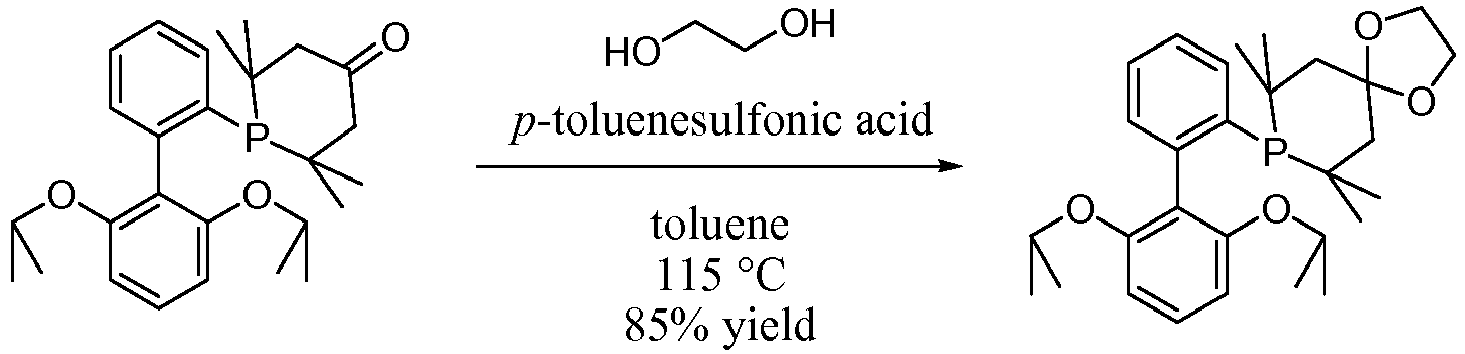
- The titled compound was prepared as described in the general procedure for the phosphorinone ketalization substituting 1-(2',6'-diisopropoxybiphenyl-2-yl)-2,2,6,6-tetramethylphosphinan-4-one (2.77 g, 6.29 mmol, 1 equiv) for biaryl phosphorinone, wherein all other reagents were scaled accordingly, and refluxing for 3 hours (2.60 g, >99 area% by HPLC, 85% yield). 1H NMR (400 MHz, CDCl3) δ ppm 7.78 - 7.64 (m, 1H), 7.36 - 7.17 (m, 3H), 7.10 - 7.01 (m, 1H), 6.63 - 6.51 (m, 2H), 4.53 - 4.36 (m, 2H), 4.10 - 4.01 (m, 2H), 4.01 - 3.92 (m, 2H), 2.21 - 2.03 (m, 2H), 1.70 (dd, J = 14.3, 5.6 Hz, 2H), 1.32 (s, 3H), 1.28 (d, J = 7.8 Hz, 3H), 1.23 (s, 3H), 1.22 (s, 3H), 1.07 (d, J = 3.4 Hz, 3H), 1.05 (s, 3H), 0.93 (s, 3H), 0.90 (d, J = 5.3 Hz, 3H). 13C NMR (100 MHz, CDCl3) δ ppm 155.7, 144.7 (d, J = 37 Hz), 137.3 (d, J = 26 Hz), 132.7 (d, J = 4 Hz), 131.3 (d, J = 7 Hz), 127.6 (d, J = 24 Hz), 125.3, 123.8, 111.2, 105.8, 70.3, 64.8, 63.0, 44.7 (d, J = 3 Hz), 32.6, 32.3, 31.4 (d, J = 8 Hz), 31.2 (d, J = 19 Hz), 22.5, 22.4. 31P NMR (CDCl3, 202 MHz) δ ppm -6.7 (s). LRMS (ESI+) found for [M+H, C29H42O4P]+ 485.2.

- The titled compound was prepared as described in the general procedure for the phosphorinone ketalization substituting 1-(2'-(dimethylamino)biphenyl-2-yl)-2,2,6,6-tetramethylphosphinan-4-one (1.13 g, 3.07 mmol, 1 equiv) for biaryl phosphorinone, wherein all other reagents were scaled accordingly, and refluxing for 5 hours (1.02 g, 98 area% by HPLC, 81% yield). 1H NMR (400 MHz, CDCl3) δ ppm 7.73 (dd, J = 6.8, 1.5 Hz, 1H), 7.41 (ddd, J = 8.1, 2.1, 1.0 Hz, 1H), 7.38-7.23 (m, 3H), 7.01 (td, J = 8.2, 2.6 Hz, 3H), 4.14 - 3.88 (m, 4H), 2.51 (s, 6H), 2.27 (d, J = 14.5 Hz, 1H), 1.92 (d, J = 14.1 Hz, 1H), 1.81 (ddd, J = 14.5, 5.3, 1.5 Hz, 1H), 1.52 (ddd, J = 14.2, 5.3, 1.6 Hz, 1H), 1.36 (d, J = 19.9 Hz, 3H), 1.17 (d, J = 18.9 Hz, 3H), 1.11 (d, J = 9.7 Hz, 3H), 0.51 (d, J = 9.8 Hz, 3H). 13C NMR (100 MHz, CDCl3) δ ppm 151.0 (d, J = 3.0 Hz), 150.1 (d, J = 36 Hz), 136.6 (d, J = 23 Hz), 136.5, 133.3 (d, J = 5 Hz), 131.9, 130.7 (d, J = 7 Hz), 128.6, 127.6, 125.7, 120.7, 117.2, 111.0, 64.8, 63.0, 45.9 (d, J = 3 Hz), 43.3, 43.2 (d, J = 3 Hz), 33.3, 32.9, 31.9 (d, J = 20 Hz), 31.7, 31.3 (d, J = 3 Hz), 31.3, 30.9 (d, J = 22 Hz), 30.0 (d, J = 7 Hz). 31P NMR (CDCl3, 202 MHz) δ ppm -3.8 (s). LRMS (ESI+) found for [M+H, C25H35NO2P]+ 412.2.

- The titled compound was prepared as described in the general procedure for the phosphorinone ketalization substituting 1-(biphenyl-2-yl)-2,2,6,6-tetramethylphosphinan-4-one (2.00 g, 6.17 mmol, 1 equiv) for biaryl phosphorinone, wherein all other reagents were scaled accordingly, and refluxing for 4 hours (1.81 g, >99 area% by HPLC, 80% yield). 1H NMR (400 MHz, CDCl3) δ 7.80 (dd, J = 5.3, 3.8 Hz, 1H), 7.51 - 7.21 (m, 8H), 4.14 - 4.01 (m, 2H), 4.01 - 3.87 (m, 2H), 2.13 (dt, J = 14.2, 4.0 Hz, 2H), 1.70 (dd, J = 14.3, 5.6 Hz, 2H), 1.33 (s, 3H), 1.28 (d, J = 5.6 Hz, 3H), 0.91 (s, 3H), 0.88 (s, 3H). 13C NMR (100 MHz, CDCl3) δ 151.3 (d, J = 34 Hz), 143.2 (d, J = 8 Hz), 135.3, 133.6 (d, J = 4 Hz), 130.5 (d, J = 6 Hz), 130.3 (d, J = 4 Hz), 128.1, 127.0, 126.1, 110.9, 64.8, 63.2, 44.5 (d, J = 2 Hz), 32.2, 31.9, 31.7, 31.5, 31.3, 31.2. 31P NMR (CDCl3, 202 MHz) δ ppm -8.8 (s). LRMS (ESI+) found for [M+H, C23H30O2P]+ 369.1.

- The titled compound was prepared as described in the general procedure for the phosphorinone ketalization substituting 1-(1,1'-binaphthyl-2-yl)-2,2,6,6-tetramethylphosphinan-4-one (1.66 g, 3.91 mmol, 1 equiv) for biaryl phosphorinone, wherein all other reagents were scaled accordingly, and refluxing for 5 hours (1.60 g, >99 area% by HPLC, 87% yield). 1H NMR (400 MHz, CDCl3) δ ppm 7.98 - 7.88 (m, 3H), 7.85 (dd, J = 8.3, 4.4 Hz, 2H), 7.55 (dt, J = 11.0, 5.5 Hz, 1H), 7.42 (dddd, J = 8.1, 6.9, 5.8, 1.2 Hz, 2H), 7.30 (dd, J = 7.0, 1.1 Hz, 1H), 7.18 (dddd, J = 22.1, 20.7, 10.3, 4.6 Hz, 3H), 7.05 (d, J = 8.1 Hz, 1H), 4.03 - 3.87 (m, 4H), 2.20 (ddd, J = 25.6, 14.2, 1.8 Hz, 2H), 1.81 - 1.58 (m, 2H), 1.28 - 1.13 (m, 3H), 1.02 (d, J = 19.6 Hz, 3H), 0.89 (dd, J = 19.9, 10.0 Hz, 6H). 13C NMR (100 MHz, CDCl3) δ ppm 147.6 (d, J = 37 Hz), 138.6 (d, J = 10 Hz), 134.9 (d, J = 29 Hz), 133.4 (d, J = 7 Hz), 133.1 (d, J = 2 Hz), 132.9, 129.6 (d, J = 4 Hz), 129.0 (d, J = 4 Hz), 127.9, 127.4 (d, J = 3 Hz), 127.3, 127.2, 127.0, 126.6, 126.2, 125.8, 125.3, 125.2, 124.5, 110.9, 64.8, 63.2, 45.1, 44.5, 32.7, 32.3, 32.2, 32.0, 31.9, 31.8, 31.2, 31.1, 31.0. 31P NMR (CDCl3, 202 MHz) δ ppm -8.8 (s). LRMS (ESI+) found for [M+H, C31H34O2P]+ 469.2.
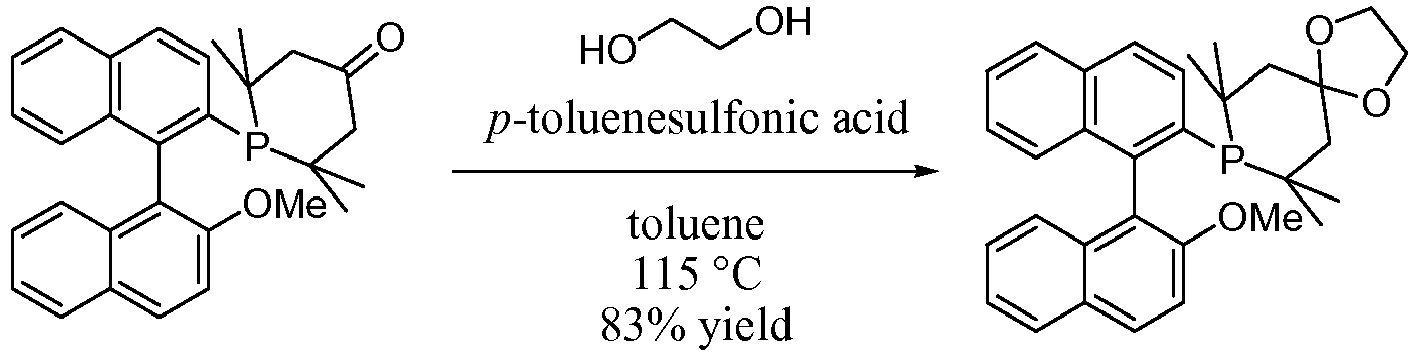
- The titled compound was prepared as described in the general procedure for the phosphorinone ketalization substituting 1-(2'-methoxy-1,1'-binaphthyl-2-yl)-2,2,6,6-tetramethylphosphinan-4-one (955 mg, 2.19 mmol, 1 equiv) for biaryl phosphorinone, wherein all other reagents were scaled accordingly, and refluxing for 5 hours (910 mg, 95 area% by HPLC, 83% yield). 1H NMR (400 MHz, CDCl3) δ ppm 8.10 - 7.99 (m, 1H), 7.99 - 7.91 (m, 1H), 7.91 - 7.80 (m, 2H), 7.53 - 7.40 (m, 2H), 7.33 - 7.26 (m, 2H), 7.26 - 7.19 (m, 1H), 7.19 - 7.07 (m, 2H), 6.95 - 6.86 (m, 1H), 4.10 - 3.91 (m, 4H), 3.79 (s, 3H), 2.34 - 2.16 (m, 2H), 1.82 - 1.64 (m, 2H), 1.35 - 1.19 (m, 3H), 1.10 - 0.94 (m, 6H), 0.81 (dd, J = 12.4, 7.2 Hz, 3H). 13C NMR (100 MHz, CDCl3) δ ppm 153.6, 144.3 (d, J = 37 Hz), 135.5 (d, J = 28 Hz), 133.9, 133.2, 133.1, 130.0 (d, J = 3 Hz), 129.1, 128.3, 127.4 (d, J = 12 Hz), 126.9 (d, J = 2 Hz), 126.4, 126.2, 126.1, 125.8, 125.3, 122.8, 122.7 (d, J = 10 Hz), 112.2, 111.0, 64.8, 63.2, 55.6, 45.2, 44.9, 33.0, 32.6, 32.2, 31.7, 31.5 (dd, J = 7, 4 Hz), 31.3, 30.8 (d, J = 7 Hz). 31P NMR (CDCl3, 202 MHz) δ ppm -6.5 (s). LRMS (ESI+) found for [M+H, C32H36O3P]+ 499.2.

- The titled compound was prepared as described in the general procedure for the phosphorinone ketalization substituting 2,2,6,6-tetramethyl-1-(2-(naphthalen-1-yl)phenyl)phosphinan-4-one (1.39 g, 3.71 mmol, 1 equiv) for biaryl phosphorinone, wherein all other reagents were scaled accordingly, and refluxing for 4 hours (1.43 g, 88 area% by HPLC, 92% yield). 1H NMR (400 MHz, CDCl3) δ ppm 7.98 - 7.83 (m, 3H), 7.58 - 7.24 (m, 8H), 4.10 - 3.91 (m, 4H), 2.31 - 2.04 (m, 2H), 1.78 - 1.58 (m, 2H), 1.24 (d, J = 18.8 Hz, 3H), 1.09 (d, J = 19.2 Hz, 3H), 0.94 (dd, J = 11.2, 10.4 Hz, 6H). 13C NMR (100 MHz, CDCl3) δ ppm 149.1 (d, J = 36 Hz), 141.0 (d, J = 8 Hz), 136.9 (d, J = 30 Hz), 133.5 (d, J = 4 Hz), 132.9, 132.4, 131.2 (d, J = 6 Hz), 128.1, 127.8, 127.8, 127.0, 126.9, 126.6, 125.1 (d, J = 11 Hz), 124.3, 110.8, 64.8, 63.1, 45.0 (d, J = 2 Hz), 44.1 (d, J = 2 Hz), 32.4, 32.0, 31.9, 31.8, 31.7, 31.6, 31.5, 31.5, 31.2, 31.1, 31.0. 31P NMR (CDCl3, 202 MHz) δ ppm -9.8 (s).

- The titled compound was prepared as described in the general procedure for the phosphorinone ketalization substituting 2,2,6,6-tetramethyl-1-(2-(naphthalen-2-yl)phenyl)phosphinan-4-one (1.71 g, 4.56 mmol, 1 equiv) for biaryl phosphorinone, wherein all other reagents were scaled accordingly, and refluxing for 15 hours (1.69 g, 99 area% by HPLC, 89% yield). 1H NMR (400 MHz, CDCl3) δ ppm 7.93 - 7.76 (m, 4H), 7.65 (s, 1H), 7.54 - 7.42 (m, 3H), 7.42 - 7.29 (m, 3H), 4.06 - 3.97 (m, 2H), 3.96 - 3.89 (m, 2H), 2.11 (dd, J = 14.3, 2.2 Hz, 2H), 1.67 (dd, J = 14.3, 5.6 Hz, 2H), 1.26 (d, J = 4.8 Hz, 3H), 1.22 (s, 3H), 0.92 (s, 3H), 0.89 (s, 3H). 13CNMR (100 MHz, CDCl3) δ 151.2 (d, J = 34 Hz), 141.1 (d, J = 8 Hz), 135.2 (d, J = 31 Hz), 133.6 (d, J = 4 Hz), 132.7, 131.8, 130.8 (d, J = 6 Hz), 129.5 (d, J = 6 Hz), 128.5 (d, J = 3 Hz), 128.2, 127.6, 127.5, 126.3, 126.0, 125.6, 125.3, 110.8, 64.8, 63.2, 44.5 (d, J = 2 Hz), 32.2, 31.8, 31.8, 31.6, 31.3, 31.3. 31P NMR (CDCl3, 202 MHz) δ ppm -11.6 (s). HRMS (TOF-ESI+) calcd for [M, C27H31O2P]+ 418.2062, found 418.2068.

- The titled compound was prepared as described in the general procedure for the phosphorinone ketalization substituting 2,2,6,6-tetramethyl-1-(1',3',5'-triphenyl-1'H-1,4'-bipyrazol-5-yl)phosphinan-4-one (1.57 g, 2.95 mmol, 1 equiv) for biaryl phosphorinone, wherein all other reagents were scaled accordingly, and refluxing for 4 hours (1.38 g, 95 area% by HPLC, 81% yield). 1H NMR (400 MHz, CDCl3) δ ppm 7.91 (d, J = 2.0 Hz, 1H), 7.52 - 7.43 (m, 4H), 7.40 - 7.28 (m, 3H), 7.28 - 7.20 (m, 5H), 7.20 - 7.11 (m, 3H), 6.48 (d, J = 2.0 Hz, 1H), 3.95 - 3.78 (m, 4H), 1.72 (t, J = 14.3 Hz, 2H), 1.50 - 1.31 (m, 2H), 1.02 (dd, J = 21.1, 19.0 Hz, 6H), -0.01 (d, J = 12.0 Hz, 3H), -0.30 (d, J = 11.9 Hz, 3H). 13C NMR (100 MHz, CDCl3) δ ppm 149.9, 143.2 (d, J = 27 Hz), 141.6, 140.5, 140.3, 131.9, 129.9, 129.0, 128.9, 128.7, 128.5, 128.4, 128.3, 128.3, 127.7, 127.6, 125.5, 121.1, 112.6 (d, J = 5 Hz), 110.5, 64.7, 62.9, 43.6 (d, J = 3.6 Hz), 30.6, 30.5, 30.1, 30.0, 29.5 (d, J = 3 Hz), 29.2 (d, J = 3 Hz), 29.0, 28.9. 31P NMR (CDCl3, 202 MHz) δ ppm -16.0 (s). LRMS (ESI+) found for [M+H, C35H38N4O2P]+ 577.2.

- The titled compound was prepared as described in the general procedure for the phosphorinone ketalization substituting 2,2,6,6-tetramethyl-1-(1-phenyl-1H-pyrazol-5-yl)phosphinan-4-one (1.04 g, 3.30 mmol, 1 equiv) for biaryl phosphorinone, wherein all other reagents were scaled accordingly, and refluxing for 15 hours (659 mg, 94 area% by HPLC, 56% yield). 1H NMR (400 MHz, CDCl3) δ ppm 7.75 (t, J = 3.2 Hz, 1H), 7.54 - 7.39 (m, 5H), 6.71 (dd, J = 5.7, 1.1 Hz, 1H), 4.09 - 4.01 (m, 2H), 3.99 - 3.92 (m, 2H), 2.04 (dd, J = 14.6, 5.1 Hz, 2H), 1.75 - 1.62 (m, 2H), 1.38 (s, 3H), 1.33 (s, 3H), 0.88 (s, 3H), 0.85 (s, 3H). 13C NMR (100 MHz, CDCl3) δ ppm 140.1 (d, J = 126 Hz), 139.3 (d, J = 2 Hz), 128.1, 127.9, 127.8, 127.7, 112.5 (d, J = 5 Hz), 110.3, 64.9, 63.1, 43.7 (d, J = 4 Hz), 31.6, 31.4, 31.3, 31.2, 30.1, 29.7. 31P NMR (CDCl3, 202 MHz) δ ppm -26.2 (s). HRMS (TOF-ESI+) calcd for [M, C20H27N2O2P]+ 358.1810, found 358.1814.
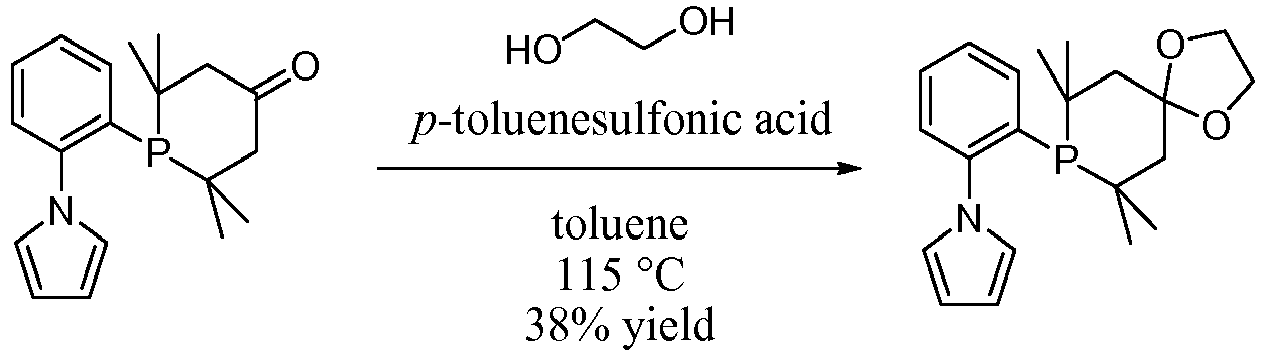
- The titled compound was prepared as described in the general procedure for the phosphorinone ketalization substituting 1-(2-(1H-pyrrol-1-yl)phenyl)-2,2,6,6-tetramethylphosphinan-4-one (1.32 g, 4.21 mmol, 1 equiv) for biaryl phosphorinone, wherein all other reagents were scaled accordingly, and refluxing for 3 hours, followed by purification via silica gel column chromatography (40-g column; gradient: 1.5 column volumes heptane, ramp up to 85:15 heptane:ethyl acetate over 7 column volumes, hold at 85:15 for 3 column volumes) (572 mg, 98 area% by HPLC, 38% yield). 1H NMR (400 MHz, CDCl3) δ ppm 7.67 (dd, J = 5.2, 3.8 Hz, 1H), 7.40 - 7.25 (m, 2H), 7.21 (dddd, J = 7.5, 5.7, 4.0, 2.0 Hz, 1H), 6.70 (dd, J = 3.8, 2.0 Hz, 2H), 6.21 (t, J = 2.1 Hz, 2H), 3.99 - 3.90 (m, 2H), 3.90 - 3.77 (m, 2H), 1.96 (dt, J = 9.7, 4.9 Hz, 2H), 1.61 (dd, J = 14.4, 5.7 Hz, 2H), 1.25 (s, 3H), 1.20 (s, 3H), 0.78 (s, 3H), 0.75 (s, 3H). 13C NMR (100 MHz, CDCl3) δ 148.1 (d, J = 28 Hz), 135.3 (d, J = 35 Hz), 133.9 (d, J = 4 Hz), 129.2, 128.0 (d, J = 3 Hz), 127.0, 123.3 (d, J = 3 Hz), 110.7, 108.1, 64.8, 63.2, 44.3 (d, J = 2 Hz), 32.2, 31.8, 31.3, 31.1, 31.1, 31.0. 31P NMR (CDCl3, 202 MHz) δ ppm -13.3 (s). LRMS (ESI+) found for [M+H, C21H29NO2P]+ 358.1.

- The titled compound was prepared as described in the general procedure for the phosphorinone ketalization substituting 1-(3,6-dimethoxybiphenyl-2-yl)-2,2,6,6-tetramethylphosphinan-4-one (1.80 g, 4.67 mmol, 1 equiv) for biaryl phosphorinone, wherein all other reagents were scaled accordingly, and refluxing for 5 hours, followed by purification via silica gel column chromatography (80-g column; gradient: 1.5 column volumes heptane, ramp up to 80:20 heptane:ethyl acetate over 8.5 column volumes, hold at 80:20 over 6 column volumes) (1.27 mg, 88 area% by HPLC, 63% yield). 1H NMR (400 MHz, CDCl3) δ ppm 7.37 (ddd, J = 7.4, 4.4, 1.3 Hz, 2H), 7.33 - 7.27 (m, 1H), 7.08 - 7.02 (m, 2H), 6.97 - 6.90 (m, 1H), 6.79 (d, J = 8.9 Hz, 1H), 3.98 (dd, J = 9.8, 3.6 Hz, 2H), 3.88 (dd, J = 9.6, 3.5 Hz, 1H), 3.80 (s, 3H), 3.63 (s, 3H), 2.21 (d, J = 13.3 Hz, 2H), 1.55 (dd, J = 13.3, 6.2 Hz, 1H), 1.22 (s, 3H), 1.16 (s, 3H), 0.82 (d, J = 9.3 Hz, 6H). 13C NMR (100 MHz, CDCl3) δ ppm 154.5 (d, J = 3 Hz), 151.1 (d, J = 11 Hz), 142.7 (d, J = 41 Hz), 139.6 (d, J = 12 Hz), 130.6 (d, J = 5 Hz), 126.8, 126.2 (d, J = 45 Hz), 125.8, 112.8, 112.1, 107.8, 64.7, 62.9, 56.5, 54.2, 45.6 (d, J = 4 Hz), 33.9, 33.4, 31.7, 31.6 (d, J = 1 Hz), 31.4. 31P NMR (CDCl3, 202 MHz) δ ppm -5.6 (s). HRMS (TOF-ESI+) calcd for [M, C25H33O4P]+ 428.2117, found 428.2122.

- The titled compound was prepared as described in the general procedure for the phosphorinone ketalization substituting 1-(3,6-dimethoxy-2',4',6'-trimethylbiphenyl-2-yl)-2,2,6,6-tetramethylphosphinan-4-one (1.39 g, 3.25 mmol, 1 equiv) for biaryl phosphorinone, wherein all other reagents were scaled accordingly, and refluxing for ∼14.5 hours, followed by purification via silica gel column chromatography (80-g column; gradient: 1.5 column volumes heptane, ramp up to 80:20 heptane:ethyl acetate over 8.5 column volumes, hold at 80:20 over 4 column volumes) (644 mg, >99 area% by HPLC, 42% yield). 1H NMR (400 MHz, CDCl3) δ ppm 6.93 (d, J = 8.9 Hz, 1H), 6.85 (s, 2H), 6.79 (d, J = 8.9 Hz, 1H), 4.01 - 3.95 (m, 2H), 3.93 - 3.86 (m, 2H), 3.79 (s, 3H), 3.62 (s, 3H), 2.33 (s, 3H), 2.21 (d, J = 13.5 Hz, 2H), 1.95 (s, 6H), 1.57 (dd, J = 13.3, 6.4 Hz, 2H), 1.24 (s, 3H), 1.18 (s, 3H), 0.86 (d, J = 8.8 Hz, 6H). 13C NMR (100 MHz, CDCl3) δ ppm 154.7, 151.3 (d, J = 11 Hz), 140.7 (d, J = 41 Hz), 135.4, 135.4 (d, J = 1 Hz), 134.8 (d, J = 10 Hz), 127.1, 126.0 (d, J = 45 Hz), 112.5, 111.8, 107.7, 77.3, 77.0, 76.7, 64.6, 62.9, 56.3, 54.1, 46.2 (d, J = 4 Hz), 34.5, 34.1, 32.1, 31.9, 30.8 (d, J = 4 Hz), 21.6, 21.4 (d, J = 3 Hz). 31P NMR (CDCl3, 202 MHz) δ ppm 0.1 (s). HRMS (TOF-ESI+) calcd for [M, C28H39O4P]+ 470.2586, found 470.2590.

- The titled compound was prepared as described in the general procedure for the phosphorinone ketalization substituting 2,2,6,6-tetramethyl-1-(2',4',6'-triisopropyl-3,6-dimethoxybiphenyl-2-yl)phosphinan-4-one (1.10 g, 2.15 mmol, 1 equiv) for biaryl phosphorinone, wherein all other reagents were scaled accordingly, and refluxing for ∼15.6 hours, followed by purification via silica gel column chromatography (80-g column; gradient: 2 column volumes heptane, ramp up to 80:20 heptane:ethyl acetate over 8 column volumes, hold at 80:20 over 6 column volumes) (1.08 g, 94 area% by HPLC, 90% yield). 1H NMR (CDCl3, 400 MHz), δ ppm 6.99 (s, 2H), 6.91 - 6.77 (m, 2H), 4.02 (dd, J = 9.6, 3.4 Hz, 2H), 3.92 (dd, J = 9.6, 3.5 Hz, 2H), 3.83 (s, 3H), 3.59 (s, 3H), 2.98 (hept, J = 6.8 Hz, 1H), 2.51 (hept, J = 6.7 Hz, 1H), 2.21 (d, J = 13.2 Hz, 2H), 1.59 (dd, J = 13.2, 6.4 Hz, 2H), 1.35 (d, J = 6.9 Hz, 3H), 1.25 (dd, J = 15.1, 8.3 Hz, 6H), 0.96 (d, J = 6.7 Hz, 6H), 0.88 (d, J = 8.7 Hz, 6H). 13C NMR (100 MHz, CDCl3) δ ppm 154.2, 152.0 (d, J = 12 Hz), 146.4, 145.5 (d, J = 2 Hz), 140.3 (d, J = 42 Hz), 132.3 (d, J = 9 Hz), 127.0 (d, J = 46 Hz), 119.8, 111.8), 110.8, 107.2, 64.7, 62.9, 54.6, 54.0, 46.8 (d, J = 4 Hz), 34.4, 34.0, 33.9, 32.8, 32.5, 30.7, 30.7, 30.7, 25.5, 24.3, 24.2. 31P NMR (CDCl3, 202 MHz), δ ppm -0.7 (br s). HRMS (TOF-ESI+) calcd for [M, C34H51O4P]+ 554.3525, found 554.3528.

- The titled compound was prepared as described in the general procedure for the phosphorinone ketalization substituting 2,2,6,6-tetramethyl-1-(2',4',6'-triisopropyl-4,5-dimethoxybiphenyl-2-yl)phosphinan-4-one (670 mg, 1.31 mmol, 1 equiv) for biaryl phosphorinone, wherein all other reagents were scaled accordingly, and refluxing for ∼15.5 hours, followed by purification via silica gel column chromatography (80-g column; gradient: 2 column volumes heptane, ramp up to 78:22 heptane:ethyl acetate over 8 column volumes, hold at 78:22 over 2 column volumes). The title compound was isolated as a white solid (585 mg, 85 area% by HPLC, 80% yield). 1H NMR (CDCl3, 400 MHz), δ ppm 6.99 (s, 2H), 6.91 - 6.77 (m, 2H), 4.02 (dd, J = 9.6, 3.4 Hz, 2H), 3.92 (dd, J = 9.6, 3.5 Hz, 2H), 3.83 (s, 3H), 3.59 (s, 3H), 2.98 (hept, J = 6.8 Hz, 1H), 2.51 (hept, J = 6.7 Hz, 1H), 2.21 (d, J = 13.2 Hz, 2H), 1.59 (dd, J = 13.2, 6.4 Hz, 2H), 1.35 (d, J = 6.9 Hz, 3H), 1.25 (dd, J = 15.1, 8.3 Hz, 6H), 0.96 (d, J = 6.7 Hz, 6H), 0.88 (d, J = 8.7 Hz, 6H). 13C NMR (100 MHz, CDCl3) δ ppm 148.0, 147.0, 146.1, 145.8, 142.5 (d, J = 38 Hz), 136.4 (d, J = 6Hz), 127.4 (d, J = 29 Hz), 120.3, 116.0 (d, J = 3 Hz), 115.1 (d, J = 8 Hz), 110.5, 64.9, 63.2, 56.0, 55.7, 45.5 (d, J = 2 Hz), 34.2, 32.6, 32.4, 32.3 (d, J = 4 Hz), 32.1, 31.2 (d, J = 7 Hz), 30.5, 29.3, 26.6, 24.3, 23.5, 23.0, 14.5. 31P NMR (CDCl3, 202 MHz), δ ppm -0.7 (br s). HRMS (TOF-ESI+) calcd for [M, C34H51O4P]+ 554.3525, found 554.3533.

- The titled compound was prepared as described in the general procedure for the phosphorinone ketalization substituting 1-(3',5'-dimethoxybiphenyl-2-yl)-2,2,6,6-tetramethylphosphinan-4-one (1.28 g, 3.33 mmol, 1 equiv) for biaryl phosphorinone, wherein all other reagents were scaled accordingly, and refluxing for ∼15.5 hours (1.23 g, >99 area% by HPLC, 86% yield). 1H NMR (400 MHz, CDCl3) δ ppm 7.82 - 7.74 (m, 1H), 7.42 - 7.23 (m, 3H), 6.47 (t, J = 2.3 Hz, 1H), 6.41 (d, J = 2.3 Hz, 2H), 4.08 - 4.01 (m, 2H), 4.00 - 3.94 (m, 2H), 3.84 (s, 6H), 2.12 (dd, J = 14.3, 2.4 Hz, 2H), 1.71 (dd, J = 14.3, 5.5 Hz, 2H), 1.34 (s, 3H), 1.29 (s, 3H), 0.91 (s, 3H), 0.89 (s, 3H). 13C NMR (100 MHz, CDCl3) δ ppm 159.2, 151.2 (d, J = 35 Hz), 145.3 (d, J = 9 Hz), 135.1 (d, J = 31 Hz), 133.5 (d, J = 4 Hz), 130.0 (d, J = 6 Hz), 128.1, 126.2, 110.9, 108.7 (d, J = 4 Hz), 98.6, 64.8, 63.2, 55.4, 44.5, 32.3, 31.9, 31.6, 31.4, 31.4, 31.3. 31P NMR (CDCl3, 202 MHz), δ ppm -8.5 (br s). HRMS (TOF-ESI+) calcd for [M, C25H33O4P]+ 428.2117, found 428.2121.

- The titled compound was prepared as described in the general procedure for the phosphorinone ketalization substituting 1-(4'-tert-butylbiphenyl-2-yl)-2,2,6,6-tetramethylphosphinan-4-one (1.49 g, 3.92 mmol, 1 equiv) for biaryl phosphorinone, wherein all other reagents were scaled accordingly, and refluxing for ∼15 hours (1.12 g, 93 area% by HPLC, 67% yield). 1H NMR (400 MHz, CDCl3) δ ppm 7.82 - 7.75 (m, 1H), 7.42 - 7.33 (m, 3H), 7.33 - 7.24 (m, 2H), 7.24 - 7.17 (m, 2H), 4.12 - 4.01 (m, 2H), 4.01 - 3.88 (m, 2H), 2.13 (dd, J = 14.3, 1.9 Hz, 2H), 1.69 (dd, J = 14.3, 5.5 Hz, 2H), 1.42 (s, 9H), 1.34 (s, 3H), 1.29 (s, 3H), 0.88 (d, J = 10.0 Hz, 6H). 13C NMR (100 MHz, CDCl3) δ ppm 151.3 (d, J = 34 Hz), 148.4, 140.1 (d, J = 8 Hz), 135.1 (d, J = 31 Hz), 133.6 (d, J = 4 Hz), 130.9 (d, J = 6 Hz), 130.1 (d, J = 5 Hz), 128.1, 125.9, 123.9, 110.9, 64.8, 63.1, 44.5, 34.7, 32.3, 31.9, 31.7, 31.7, 31.5, 31.3, 31.3. 31P NMR (CDCl3, 202 MHz), δ ppm -9.4 (br s). HRMS (TOF-ESI+) calcd for [M, C27H37O2P]+ 424.2531, found 424.2539.

- A round bottom flask was charged with 2,2,6,6-tetramethyl-1-(1',3',5'-triphenyl-1'H-1,4'-bipyrazol-5-yl)phosphinan-4-one (1.25 g, 2.35 mmol, 1.0 equiv) and purged with nitrogen for 15 minutes. Then nitrogen-sparged diethylene glycol (12.3 mL, 129 mmol, 55 equiv) was added and the flask was equipped with a Claisen adapter and a Dean-Stark trap. The mixture was charged with hydrazine hydrate (1.07 mL, 11.7 mmol, 5 equiv, 55 wt% hydrazine) and potassium hydroxide (658 mg, 11.7 mmol, 5 equiv). The mixture was immersed in an oil bath at 125 °C under a nitrogen atmosphere. The temperature of the bath was increased to 210 °C over 1 hour and kept at that temperature for 7 hours. The reaction mixture was cooled to room temperature under a positive pressure of nitrogen, and then diluted with heptane (10 mL) and ethyl acetate (10 mL). The phases were partitioned, and the aqueous layer was collected. The aqueous layer was then washed with ethyl acetate (2 x 20 mL), and the combined organic fractions were washed once with aqueous saturated sodium chloride (50 mL), dried over sodium sulfate, filtered, and concentrated on a rotary evaporator. The crude concentrate was dissolved in a minimal amount of hot ethanol, and the solution was allowed to cool, effecting the crystallization of the product as a white solid. (826 mg, 95 area% by HPLC, 68% yield). 1H NMR (400 MHz, CDCl3) δ ppm 7.91 (d, J = 1.9 Hz, 1H), 7.52 - 7.42 (m, 4H), 7.38 - 7.26 (m, 3H), 7.25 - 7.19 (m, 5H), 7.19 - 7.11 (m, 3H), 6.61 (d, J = 1.8 Hz, 1H), 1.53 (dd, J = 14.1, 12.0 Hz, 5H), 1.21 (ddd, J = 24.9, 11.7, 5.7 Hz, 2H), 0.85 (dd, J = 24.4, 18.8 Hz, 6H), 0.01 (d, J = 11.6 Hz, 3H), -0.27 (d, J = 11.5 Hz, 3H). 13C NMR (100 MHz, CDCl3) δ ppm 149.3 (d, J = 2 Hz), 145.0, 143.2 (d, J = 27 Hz), 141.0 (d, J = 2 Hz), 139.8, 139.6 (d, J = 2 Hz), 131.5, 129.5, 128.5, 128.3, 128.0, 127.9, 127.8, 127.3, 127.2, 125.1, 120.9, 113.0 (d, J = 5 Hz), 37.1 (dd, J = 8, 2 Hz), 29.9, 29.8, 29.3 (d, J = 2 Hz), 29.2 (d, J = 2 Hz), 29.1 (d, J = 2 Hz), 28.8 (d, J = 2 Hz), 28.8 (d, J = 8 Hz), 20.2. 31P NMR (CDCl3, 202 MHz) δ ppm -17.0 (s). LRMS (ESI+) found for [M+H, C33H36N4P]+ 519.2.

- A round bottom flask was charged with 1-(2-(1H-pyrrol-1-yl)phenyl)-2,2,6,6-tetramethylphosphinan-4-one (878 mg, 2.80 mmol, 1.0 equiv) and purged with nitrogen for 15 minutes. Then nitrogen-sparged diethylene glycol (14.7 mL, 154 mmol, 55 equiv) was added and the flask was equipped with a Claisen adapter and a Dean-Stark trap. The flask was further charged with hydrazine hydrate (1.24 mL, 14.0 mmol, 5 equiv, 55 wt% hydrazine) and potassium hydroxide (786 mg, 14.0 mmol, 5 equiv), and the mixture was immersed in an oil bath at 60 °C. The temperature of the bath was gradually increased to 210 °C over 1 hour and kept at that temperature for 7 hours. The reaction mixture was cooled to room temperature under a positive pressure of nitrogen and then diluted with water (50 mL) and ethyl acetate (20 mL). The phases were partitioned, and the organic layer was collected. The aqueous layer was washed with ethyl acetate (4 x 20 mL), and the combined organic fractions were washed once with aqueous saturated sodium chloride, dried over sodium sulfate, filtered, and concentrated on a rotary evaporator to afford the title compound as a pale yellow solid (811 mg, 91 area% by HPLC, 97% yield). 1H NMR (400 MHz, CDCl3) δ ppm 7.96 - 7.83 (m, 1H), 7.35 - 7.22 (m, 2H), 7.22 - 7.17 (m, 1H), 6.72 - 6.66 (m, 2H), 6.20 (t, J = 2.1 Hz, 2H), 1.87 - 1.71 (m, 2H), 1.71 - 1.56 (m, 2H), 1.50 - 1.33 (m, 2H), 1.11 (s, 3H), 1.06 (s, 3H), 0.76 (d, J = 9.7 Hz, 6H). 13C NMR (100 MHz, CDCl3) δ ppm 149.4 - 146.8 (m), 134.7 (d, J = 4 Hz), 129.0, 127.8 (d, J = 3 Hz), 126.5, 123.3 (d, J = 3 Hz), 107.9, 37.6, 31.4, 31.1, 30.2 (d, J = 7 Hz), 29.6 (d, J = 18 Hz), 20.5. 31P NMR (CDCl3, 202 MHz) δ ppm -7.6 (s).

- A round bottom flask was charged with 2,2,6,6-tetramethyl-1-(2',4',6'-triisopropyl-3,6-dimethoxybiphenyl-2-yl)phosphinan-4-one (1.03 g, 2.02 mmol, 1.0 equiv) and purged with nitrogen for 15 minutes. Then nitrogen-sparged diethylene glycol (10.6 mL, 111 mmol, 55 equiv) was added and the flask was equipped with a Claisen adapter and a Dean-Stark trap. The flask was charged with hydrazine hydrate (0.892 mL, 10.1 mmol, 5 equiv, 55 wt% hydrazine) and potassium hydroxide (918 mg, 10.1 mmol, 5 equiv). The mixture was immersed in an oil bath at 170 °C. The temperature of the bath was gradually increased to 210 °C over 1 hour and kept at that temperature for 7 hours. The reaction mixture was cooled to room temperature under a positive pressure of nitrogen. Reaction material that had condensed on the Claisen adapter was washed down into the reaction flask with ethyl acetate (5 mL). The phases were partitioned, and the organic layer was collected. The aqueous layer was washed with ethyl acetate (2 x 20 mL). The combined organic fractions were washed once with aqueous saturated sodium chloride, dried over sodium sulfate, filtered, and concentrated on a rotary evaporator. Purification of the crude material by silica gel column chromatography on an Isco CombiFlash system (40-g column; gradient: 2 column volumes heptane, ramp up to 85:15 heptane:ethyl acetate over 8 column volumes, hold at 85:15 for 4 column volumes) afforded the title compound as a white solid (266 mg, >99 area% by HPLC, 27% yield). 1H NMR (400 MHz, CDCl3) δ ppm 6.95 (s, 2H), 6.85 (d, J = 8.8 Hz, 1H), 6.79 (d, J = 8.8 Hz, 1H), 3.82 (s, 3H), 3.56 (s, 3H), 2.95 (hept, J = 6.9 Hz, 1H), 2.49 (hept, J = 6.7 Hz, 2H), 2.10 - 1.89 (m, 2H), 1.71 - 1.51 (m, 2H), 1.45 - 1.26 (m, 8H), 1.21 (d, J = 6.8 Hz, 6H), 1.14 (s, 3H), 1.08 (s, 3H), 0.93 (d, J = 6.7 Hz, 6H), 0.80 (d, J = 8.6 Hz, 6H). 13C NMR (100 MHz, CDCl3) δ ppm 154.3, 151.9 (d, J = 11 Hz), 146.3, 145.5 (d, J = 2 Hz), 140.1 (d, J = 42 Hz), 132.5 (d, J = 9 Hz), 127.7 (d, J = 46 Hz), 119.7, 110.6, 107.1, 54.3 (d, J = 62 Hz), 40.8 (d, J = 4 Hz), 34.0 (d, J = 5 Hz), 33.4, 30.7, 30.3 (d, J = 24 Hz), 30.1 (d, J = 3 Hz), 25.5, 24.2 (d, J = 13 Hz), 20.8. 31P NMR (CDCl3, 202 MHz) δ ppm -6.0 (br s). HRMS (TOF-ESI+) calcd for [M, C32H49O2P]+ 496.3470, found 496.3465.

- To a 40-mL scintillation vial equipped with a magnetic stir bar was added 1-(biphenyl-2-yl)-2,2,6,6-tetramethylphosphinan-4-one (900 mg, 2.77 mmol, 1 equiv). The vial was sealed with a septa-top cap and then purged with nitrogen gas for 10 minutes. The solid was then dissolved with anhydrous, degassed dichloromethane (9 mL). In a separate 250-mL round bottom flask was added anhydrous, degassed dichloromethane (31 mL) which was cooled to -78 °C. Boron trifluoride diethyl etherate (527 µL, 4.16 mmol, 1.5 equiv) was then added to the flask. The phosphine solution was transferred by cannula to the reaction flask over the course of 3 minutes using a positive pressure of nitrogen gas. After stirring the solution for 5 minutes, (trimethylsilyl)diazomethane (2.1 mL, 4.16 mmol, 1.5 equiv, 2 M in hexane) was added slowly over 3 minutes The bright yellow solution was stirred at -78 °C for an hour, and then diluted with 1 M aqueous hydrochloric acid (50 mL). The slurry was warmed to room temperature overnight. The solution was charged into a separatory funnel and the phases were partitioned. The dichloromethane layer was collected, and the aqueous layer was washed with dichloromethane (3 x 20 mL). The combined organic layers were then washed with aqueous saturated sodium bicarbonate (50 mL), dried over sodium sulfate, filtered, and concentrated in a rotary evaporator. Purification of the crude product oil by silica gel column chromatography on an Isco CombiFlash system (120-g column; gradient: 1.5 column volumes heptane, ramp up to 98:2 heptane:methyl tert-butyl ether over 0.5 column volumes, hold at 98:2 for 2 column volumes, ramp up to 75:25 heptane:methyl tert-butyl ether over 8 column volumes, hold at 75:25 for 2 column volumes) afforded the title compound as a white solid (578 mg, 98 area% by HPLC, 62% yield). 1H NMR (400 MHz, CDCl3) δ ppm 7.88 (dt, J = 7.8, 1.5 Hz, 1H), 7.47 - 7.32 (m, 5H), 7.32 - 7.27 (m, 1H), 7.26 - 7.20 (m, 2H), 2.91 (dd, J = 12.2, 7.6 Hz, 1H), 2.67 - 2.46 (m, 3H), 2.17 - 2.04 (m, 1H), 1.91 (dddd, J = 21.9, 15.4, 6.4, 4.7 Hz, 1H), 1.20 (d, J = 5.0 Hz, 3H), 1.16 (d, J = 5.5 Hz, 3H), 1.02 (d, J = 13.6 Hz, 3H), 0.98 (d, J = 13.6 Hz, 3H). 13C NMR (100 MHz, CDCl3) δ ppm 211.3, 151.5 (d, J = 34 Hz), 143.2, 134.6 (d, J = 3 Hz), 133.1 (d, J = 29 Hz), 130.5 (d, J = 6 Hz), 130.0 (d, J = 4 Hz), 128.7, 126.9, 126.3, 125.7, 55.7 (d, J = 17 Hz), 41.5, 37.0 (d, J = 18 Hz), 35.2, 35.0, 33.2, 32.9, 32.6, 32.3, 31.9, 31.6, 27.3, 26.3. 31P NMR (CDCl3, 202 MHz) δ ppm 15.1 (s). HRMS (TOF-ESI+) calcd for [M, C22H27OP]+ 338.1800, found 338.1805.

- A round bottom flask was charged with 1-(biphenyl-2-yl)-2,2,7,7-tetramethylphosphepan-4-one (520 mg, 1.54 mmol, 1.0 equiv) and purged with nitrogen for 15 minutes. Then nitrogen-sparged diethylene glycol (8.0 mL, 85 mmol, 55 equiv) was added and the flask was equipped with a Claisen adapter and a Dean-Stark trap. The mixture was charged with hydrazine hydrate (0.680 mL, 7.68 mmol, 5 equiv, 55 wt% hydrazine) and potassium hydroxide (431 mg, 7.68 mmol, 5 equiv). The mixture was immersed in an oil bath at 175 °C. The temperature of the bath was gradually increased to 210 °C over 30 minutes and kept at that temperature for 7 hours. The reaction mixture was cooled to room temperature under a positive pressure of nitrogen, and the reaction mixture was diluted with water (10 mL) and heptane (30 mL). The phases were partitioned, and the organic layer was collected. The aqueous layer was washed with heptane (2 x 20 mL). The combined organic fractions were washed once with aqueous saturated sodium chloride (20 mL), dried over sodium sulfate, filtered, and concentrated on a rotary evaporator. The crude product was crystallized from a saturated solution of ethanol and isolated by filtration to afford an off-white solid (254 mg, 90 area% by HPLC, 51% yield). 1H NMR (400 MHz, CDCl3) δ ppm 8.03 - 7.95 (m, 1H), 7.47 - 7.27 (m, 8H), 1.88 - 1.54 (m, 8H), 1.26 (d, J = 4.0 Hz, 6H), 0.96 (s, 3H), 0.92 (s, 3H). 13C NMR (100 MHz, CDCl3) δ ppm 150.8 (d, J = 34 Hz), 143.5 (d, J = 7 Hz), 136.3 (d, J = 3 Hz), 134.8 (d, J = 32 Hz), 130.3 (d, J = 4 Hz), 130.2 (d, J = 6 Hz), 127.9, 126.7, 125.9, 125.3, 45.1 (d, J = 18 Hz), 35.2, 34.9, 32.3, 32.0, 28.1 (d, J = 3 Hz), 25.6 (d, J = 3 Hz). 31P NMR (CDCl3, 202 MHz) δ ppm 14.4 (s). HRMS (TOF-ESI+) calcd for [M, C22H29P]+ 324.2007, found 324.2004.
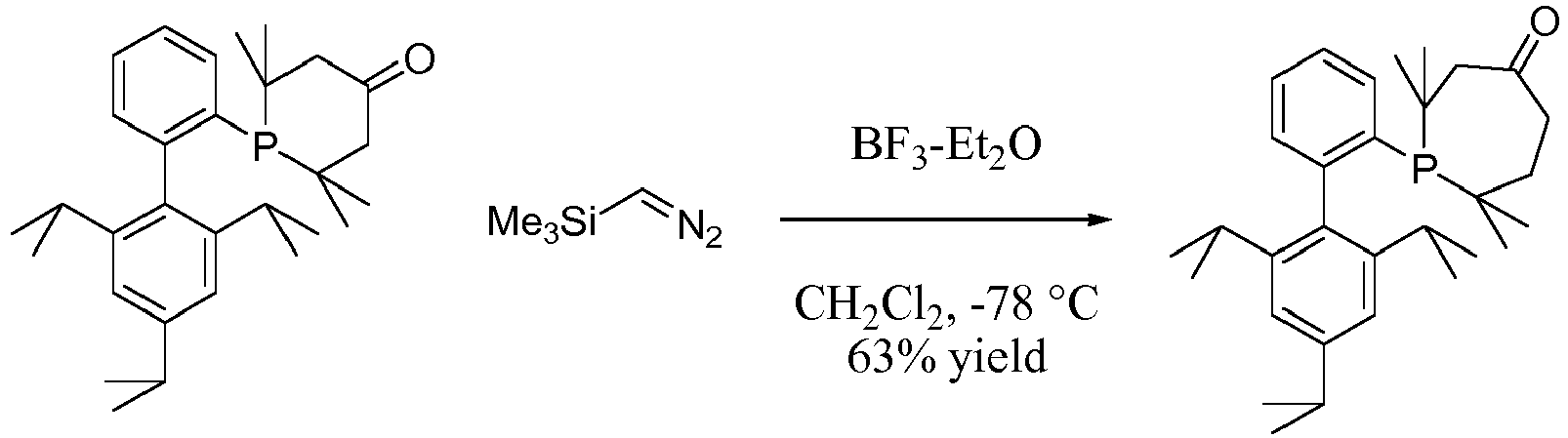
- To a 40-mL scintillation vial equipped with a magnetic stir bar was added 2,2,6,6-tetramethyl-1-(2',4',6'-triisopropylbiphenyl-2-yl)phosphinan-4-one (1.38 g, 3.06 mmol, 1 equiv). The vial was sealed with a septa-top cap and then purged with nitrogen gas for 10 minutes The solid was then dissolved with anhydrous, degassed dichloromethane (10 mL). In a separate 250-mL round bottom flask was added anhydrous, degassed dichloromethane (36 mL) which was cooled to -78 °C. Boron trifluoride diethyl etherate (582 µL, 4.59 mmol, 1.5 equiv) was then added to the flask. The phosphine solution was transferred by cannula to the reaction flask over the course of 3 minutes using a positive pressure of nitrogen gas. After stirring the solution for 5 minutes, (trimethylsilyl)diazomethane (2.3 mL, 4.59 mmol, 1.5 equiv, 2 M in hexane) was added slowly over 3 minutes The bright yellow solution was stirred at -78 °C for an hour, then diluted with 1 M aqueous hydrochloric acid (50 mL). The slurry was warmed to room temperature overnight. The solution was charged into a separatory funnel and the phases were partitioned. The organic layer was collected and washed with aqueous saturated sodium bicarbonate (50 mL), dried over sodium sulfate, filtered, and concentrated in a rotary evaporator. Purification of the crude colorless oil by silica gel column chromatography on an Isco CombiFlash system (120-g column; gradient: 1.5 column volumes heptane, ramp up to 98:2 heptane:methyl tert-butyl ether over 0.5 column volumes, hold at 98:2 for 2 column volumes, ramp up to 80:20 heptane:methyl tert-butyl ether over 8 column volumes, hold at 80:20 for 2 column volumes) afforded the title compound as a white solid (900 mg, 90 area% by HPLC, 63% yield). 1H NMR (400 MHz, CDCl3) δ ppm 8.00 - 7.90 (m, 1H), 7.43 - 7.29 (m, 2H), 7.28 - 7.21 (m, 1H), 7.00 (s, 2H), 3.10 - 2.86 (m, 2H), 2.73 - 2.37 (m, 5H), 2.34 - 2.18 (m, 1H), 1.95 - 1.77 (m, 1H), 1.31 (d, J = 6.9 Hz, 5H), 1.23 (d, J = 6.8 Hz, 3H), 1.20 (d, J = 6.8 Hz, 3H), 1.15 (d, J = 6.6 Hz, 3H), 1.10 (d, J = 6.4 Hz, 3H), 1.08 - 1.03 (m, 4H), 1.02 - 0.98 (m, 4H), 0.95 (d, J = 6.7 Hz, 3H). 13C NMR (100 MHz, CDCl3) δ ppm 211.3, 148.6 (d, J = 35 Hz), 147.5, 145.8 (d, J = 16 Hz), 136.1 (d, J = 6 Hz), 135.5 (d, J = 31 Hz), 134.3 (d, J = 2 Hz), 132.6 (d, J = 7 Hz), 127.8, 125.5, 120.1 (d, J = 5 Hz), 56.5 (d, J = 10 Hz), 41.5, 36.3 (d, J = 10 Hz), 35.0 (d, J = 24 Hz), 34.3, 33.3 (d, J = 27 Hz), 32.2 (d, J = 31 Hz), 31.9 (dd, J = 6, 2 Hz), 30.7, 29.5 (d, J = 5 Hz), 29.3 (d, J = 3 Hz), 26.7 (d, J = 33 Hz), 24.3 (d, J = 8 Hz), 22.9 (d, J = 9 Hz). 31P NMR (CDCl3, 202 MHz) δ ppm 18.3 (s). HRMS (TOF-ESI+) calcd for [M, C31H45OP]+ 464.3208, found 464.3216.

- A round bottom flask was charged with 2,2,7,7-tetramethyl-1-(2',4',6'-triisopropylbiphenyl-2-yl)phosphepan-4-one (1.06 g, 2.29 mmol, 1.0 equiv) and purged with nitrogen for 15 minutes. Nitrogen-sparged diethylene glycol (12.0 mL, 126 mmol, 55 equiv) was added and the flask was equipped with a Claisen adapter and a Dean-Stark trap. The mixture was charged with hydrazine hydrate (1.01 mL, 11.4 mmol, 5 equiv, 55 wt% hydrazine) and potassium hydroxide (641 mg, 11.4 mmol, 5 equiv). The mixture was immersed in an oil bath at 175 °C under a nitrogen atmosphere. The temperature of the bath was gradually increased to 210 °C over 40 minutes and kept at that temperature for 7 hours. The reaction mixture was cooled to room temperature under a positive pressure of nitrogen and then the reaction mixture was diluted with heptane (20 mL) and ethyl acetate (20 mL). The phases were partitioned, and the organic layer was collected. The aqueous layer was washed with ethyl acetate (3 x 20 mL). The combined organic fractions were washed once with aqueous saturated sodium chloride (50 mL), dried over sodium sulfate, filtered, and concentrated on a rotary evaporator. The crude product was purified by silica gel column chromatography (80-g column; gradient: 1.5 column volumes heptane, ramp up to 92:8 heptane:ethyl acetate over 8.5 column volumes, hold at 92:8 for 2 column volumes) to afford the title compound as a white solid (810 mg, >99 area% by HPLC, 79% yield). 1H NMR (400 MHz, CDCl3) δ ppm 8.00 - 7.83 (m, 1H), 7.33 - 7.26 (m, 2H), 7.22 - 7.13 (m, 1H), 6.97 (s, 2H), 2.91 (hept, J = 6.9 Hz, 1H), 2.48 (hept, J = 6.7 Hz, 2H), 1.77 - 1.60 (m, 6H), 1.60 - 1.47 (m, 2H), 1.29 (d, J = 6.9 Hz, 6H), 1.21 (dd, J = 8.2, 4.4 Hz, 12H), 0.96 (d, J = 6.7 Hz, 6H), 0.82 (s, 3H), 0.78 (s, 3H). 13C NMR (100 MHz, CDCl3) δ ppm 148.0, 147.7, 147.2, 145.8, 137.0 (d, J = 34 Hz), 136.7, 136.2 (d, J = 2 Hz), 131.7 (d, J = 7 Hz), 126.9, 125.1, 119.9, 46.3 (d, J = 17 Hz), 35.1, 34.8, 34.3, 32.1, 31.9, 31.1 (d, J = 3 Hz), 28.8 (d, J = 3 Hz), 26.7, 26.2 (d, J = 3 Hz), 24.4, 22.9 (d, J = 2 Hz). 31P NMR (CDCl3, 202 MHz) δ ppm 20.1 (s). HRMS (TOF-ESI+) calcd for [M, C31H47P]+ 450.3415, found 450.3429.

- To a 250-mL round bottom flask equipped with a magnetic stir bar was added 2,2,7,7-tetramethyl-1-(2',4',6'-triisopropylbiphenyl-2-yl)phosphepan-4-one (1.24 g, 2.67 mmol, 1 equiv). The flask was sealed with a septum and purged with nitrogen gas for 10 minutes The solid was dissolved with anhydrous, degassed dichloromethane (38 mL), and the solution was cooled to -78 °C. Boron trifluoride diethyl etherate (507 µL, 4.00 mmol, 1.5 equiv) was added to the flask over the course of 3 minutes After stirring the solution for 5 minutes, (trimethylsilyl)diazomethane (2.0 mL, 4.00 mmol, 1.5 equiv, 2 M in hexane) was added slowly over 3 minutes The bright yellow solution was stirred at -78 °C for an hour, then diluted with 1 M aqueous hydrochloric acid (50 mL). The slurry was warmed to room temperature overnight. The solution was charged into a separatory funnel and the phases were partitioned. The organic layer was collected, and the aqueous layer was washed with dichloromethane (2 x 20 mL). The combined organic fractions were then washed with aqueous saturated sodium bicarbonate (30 mL), dried over sodium sulfate, filtered, and concentrated via a rotary evaporator. Purification by silica gel column chromatography on an Isco CombiFlash system (120-g column; gradient: 1.5 column volumes heptane, ramp up to 90:10 heptane:ethyl acetate over 8.5 column volumes, hold at 90:10 for 4 column volumes) afforded the title compound as a white solid (905 mg, >99 area% by HPLC, 71% yield). 1H NMR (400 MHz, CDCl3) δ ppm 7.87 - 7.80 (m, 1H), 7.37 - 7.27 (m, 2H), 7.22 (ddd, J = 4.2, 3.3, 1.9 Hz, 1H), 6.97 (dd, J = 7.3, 1.8 Hz, 2H), 3.09 - 2.97 (m, 1H), 2.92 (dq, J = 13.7, 6.9 Hz, 1H), 2.75 - 2.54 (m, 2H), 2.46 - 2.30 (m, 2H), 2.24 (dq, J = 15.0, 5.7 Hz, 1H), 1.98 - 1.77 (m, 2H), 1.65 (tdd, J = 13.5, 9.4, 3.9 Hz, 1H), 1.55 - 1.41 (m, 4H), 1.30 (d, J = 6.9 Hz, 6H), 1.27 (t, J = 4.5 Hz, 6H), 1.17 (d, J = 6.8 Hz, 3H), 1.01 (d, J = 6.6 Hz, 3H), 0.95 (d, J = 6.7 Hz, 3H), 0.90 (d, J = 12.2 Hz, 3H), 0.74 (d, J = 16.4 Hz, 3H). 13C NMR (100 MHz, CDCl3) δ ppm 213.9, 148.5, 148.1, 147.4, 145.9, 145.6, 136.9 (d, J = 2 Hz), 136.1 (d, J = 5 Hz), 134.9, 134.6, 132.2 (d, J = 7 Hz), 127.6, 124.9, 120.0 (d, J = 14 Hz), 59.7 (d, J = 27 Hz), 42.9 (d, J = 12 Hz), 42.6, 36.9 (d, J = 31 Hz), 36.0 (d, J = 28 Hz), 34.3, 31.8 (d, J = 14 Hz), 31.2 (d, J = 4 Hz), 31.0, 30.3 (d, J = 26 Hz), 29.0 (d, J = 4 Hz), 27.1, 26.4 - 26.0 (m), 24.4 (d, J = 7 Hz), 23.2 - 22.8 (m), 21.3 (d, J = 7 Hz). 31P NMR (CDCl3, 202 MHz) δ ppm 10.5 (s). HRMS (TOF-ESI+) calcd for [M, C32H47OP]+ 478.3365, found 478.3369.

- A round bottom flask was charged with 2,2,8,8-tetramethyl-1-(2',4',6'-triisopropylbiphenyl-2-yl)phosphocan-4-one (1.25 g, 2.61 mmol, 1.0 equiv) and purged with nitrogen for 15 minutes. Nitrogen-sparged diethylene glycol (13.7 mL, 144 mmol, 55 equiv) was added, and the flask was equipped with a Claisen adapter and a Dean-Stark trap. The mixture was charged with hydrazine hydrate (1.16 mL, 13.1 mmol, 5 equiv, 55 wt% hydrazine) and potassium hydroxide (733 mg, 13.1 mmol, 5 equiv). The mixture was immersed in an oil bath at 160 °C under a nitrogen atmosphere. The temperature of the bath was gradually increased to 210 °C over 30 minutes and kept at that temperature for 7 hours. The reaction mixture was cooled to room temperature under a positive pressure of nitrogen overnight. The Claisen adapter was washed with ethyl acetate (30 mL). The phases were partitioned, and the organic layer was collected. The aqueous layer was washed with ethyl acetate (3 x 20 mL), and the combined organic fractions were washed once with water (50 mL) and aqueous saturated sodium chloride (50 mL), dried over sodium sulfate, filtered, and concentrated on a rotary evaporator. The purified product was triturated from hot methanol and collected by filtration to afford the title compound as a white solid (499 mg, 92 area% by HPLC, 41% yield). 1H NMR (400 MHz, CDCl3) δ ppm 7.96 - 7.87 (m, 1H), 7.33 - 7.26 (m, 2H), 7.23 - 7.17 (m, 1H), 6.97 (s, 2H), 3.00 - 2.85 (m, 1H), 2.61 - 2.44 (m, 2H), 1.91 - 1.61 (m, 5H), 1.61 - 1.41 (m, 5H), 1.39 (d, J = 2.5 Hz, 6H), 1.31 (d, J = 6.9 Hz, 6H), 1.23 (d, J = 6.8 Hz, 6H), 0.98 (d, J = 6.7 Hz, 6H), 0.74 (d, J = 15.0 Hz, 6H). 13C NMR (100 MHz, CDCl3) δ ppm 148.2 (d, J = 35 Hz), 147.1, 145.8, 137.3, 136.8 (d, J = 8 Hz), 136.6 (d, J = 21 Hz), 132.0 (d, J = 7 Hz), 126.9, 124.6, 119.8, 43.8 (d, J = 18 Hz), 36.3 (d, J = 30 Hz), 34.3, 31.1, 31.0 (d, J = 18 Hz), 28.3 (d, J = 4 Hz), 26.8 (d, J = 11 Hz), 26.7, 24.4, 23.1 (d, J = 2 Hz), 22.4 (d, J = 6 Hz). 31P NMR (CDCl3, 202 MHz) δ ppm 10.5 (s). HRMS (TOF-ESI+) calcd for [M, C32H49P]+ 464.3572, found 464.3584.
- Assay yield calculation for Examples 17-29. Product standards were determined using commercially available or purified material. The product standard of interest was weighed into a volumetric flask (Wtstd) and dissolved in the appropriate volume of acetonitrile (Volstd). A sample was injected into an HPLC instrument and the area corresponding to the product was recorded (Astd). The mass of the crude reaction solution following filtration and rinse was obtained (Wtpdt). A sample of known mass (Wtsample) was taken from the bulk solution and added to a volumetric flask, then diluted in acetonitrile (Volsoln). A sample was then injected into an HPLC instrument, recording the area corresponding to the product (Asoln). The assay yield of product was then determined using the following formula.

- Unless noted otherwise, the following HPLC method was used for reaction analyses for Examples 17-29.
Mobile phase A: 0.1% HClO4 in water (volume/volume).
Mobile phase B: acetonitrile.
Column: Ascentis® Express C8 2.7 µm, 4.6 mm×150 mm.
Flow rate: 1.25 mL/minute.
Column temperature: 40 °C.
Monitor at 210 nm.Time (minutes) % A % B 0 40% 60% 6 5% 95% 10 5% 95% 11 40% 60% -

- 1-Butoxy-2-methoxybenzene. In a nitrogen-atmosphere glovebox, a 40-mL scintillation vial equipped with a magnetic stir bar was charged with palladium(II) acetate (3.2 mg, 0.014 mmol, 0.01 equivalents), 7,7,9,9-tetramethyl-8-(2',4',6'-triisopropyl-3,6-dimethoxybiphenyl-2-yl)-1,4-dioxa-8-phosphaspiro[4.5]decane (8.6 mg, 0.015 mmol, 0.011 equivalents) and cesium carbonate (686 mg, 2.10 mmol, 1.5 equivalents). The solids were then slurried in toluene (2.8 mL) and n-butanol (385 µL, 4.21 mmol, 3 equivalents). 2-Chloroanisole (178 µL, 1.40 mmol, 1 equivalent) was added by syringe, then the vial was sealed with a polytetrafluoroethylene (PTFE) screw cap septum and heated to 110 °C for 19 hours. After cooling the reaction to room temperature, the vial was brought outside the glovebox. The reaction mixture was diluted with ethyl acetate (2 mL) and filtered through a pad of diatomaceous earth. After the vial was rinsed with ethyl acetate (2×2 mL) and filtered, the filter cake was washed with ethyl acetate (2 mL). The ethyl acetate was carefully removed on a rotary evaporator. A weight percent (wt%) analysis was then performed on the crude concentrate to determine an assay yield of 62% (literature reference: Wolter M, et al. Org. Lett. 2002; 4: 973-976). 1H NMR (400 MHz, CDCl3) δ ppm 6.96 - 6.84 (m, 4H), 4.03 (t, J = 6.8 Hz, 2H), 3.87 (s, 3H), 1.91 - 1.78 (m, 2H), 1.57 - 1.44 (m, 2H), 0.99 (t, J = 7.4 Hz, 3H).
Ligand Assay Yield (%) a 
62 a Assay yield was determined by weight percent analysis versus isolated, characterized product. -

- N-p-tolylmethanesulfonamide. In a nitrogen-atmosphere glovebox, a microwave vial equipped with a magnetic stir bar was charged with potassium phosphate (71.6 mg, 0.337 mmol, 1.1 equivalents), tris(dibenzylideneacetone)dipalladium(0) (Pd2dba3) (2.8 mg, 0.00307 mmol, 0.01 equivalents) and phosphine ligand (0.00736 mmol, 0.024 equivalents). t-Amyl alcohol (1.1 mL) was syringed into the vial and the mixture was stirred for 30 minutes at 80 °C. After cooling to room temperature, methanesulfonamide (35.0 mg, 0.368 mmol, 1.2 equivalents) and p-methylbenzene nonaflate (100 mg, 0.307 mmol, 1 equivalent) were added to the reaction solution. The vial was sealed with a crimp top and placed in a heating block at 80 °C. After 16 hours, the reaction was cooled to room temperature and brought out of the glovebox. The reaction solution was diluted with CH2Cl2 (2 mL) and filtered through a pad of diatomaceous earth. The vial was rinsed with CH2Cl2 (2×2 mL), then the filter cake was washed with CH2Cl2 (2×2 mL). The filtrate was transferred to a tared flask and concentrated on a rotary evaporator to furnish an orange oil. The crude concentrate was sampled for a wt% analysis. Purified material could be isolated as an off-white solid by silica gel flash column chromatography (30 g silica gel, gradient from 85:15 to 70:30 heptane:ethyl acetate) (literature reference: Shekhar S, et al. J. Org. Chem. 2011; 76: 4552-4563.). 1H NMR (400 MHz, CDCl3) δ ppm 7.22 - 7.07 (m, 4H), 6.57 (br s, 1H), 2.99 (s, 3H), 2.34 (s, 3H).
Ligand Assay Yield (%) a Comparative Ligand Assay Yield (%) a 
>99 (92) 
87 
>99 
79 a Assay yields were determined by weight percent analyses versus isolated, characterized product. -

- 1-Phenyl-3-p-tolylurea. In a nitrogen-atmosphere glovebox, a microwave vial equipped with a magnetic stir bar was charged with phenylurea (100 mg, 0.734 mmol, 1 equivalent), potassium phosphate (234 mg, 1.10 mmol, 1.5 equivalents), tris(dibenzylideneacetone)dipalladium(0) (Pd2dba3) (6.7 mg, 0.00734 mmol, 0.01 equivalents) and phosphine ligand (0.029 mmol, 0.04 equivalents). Then 1,2-dimethoxyethane (1.34 mL) was syringed into the vial. After stirring the mixture for 1 hour at room temperature, 4-chlorotoluene (96 µL, 0.808 mmol, 1.1 equivalents) was added. The vial was sealed with a crimp top and placed in a heating block at 85 °C. After 15 hours, the reaction vial was cooled to room temperature and brought out of the glovebox. The reaction solution was diluted with dimethylformamide (0.6 mL) and stirred for 15 minutes. The slurry was then filtered through a pad of diatomaceous earth. The vial was rinsed with dimethylformamide (0.6 mL) before passing through the filter. The combined filtrate was concentrated on a rotary evaporator to furnish an orange oil. A 1:1 mixture of methanol:water (3.5 mL) was added dropwise to the crude concentrate, leading to the precipitation of product. The solids were collected by filtration and washed with 1:1 methanol:water (3 mL). The isolated product urea was dried in a vacuum oven for 6 hours at 60 °C/150 mm Hg. (literature reference: Kotecki BJ, et al. Org. Lett. 2009; 11: 947-950). 1H NMR (400 MHz, DMSO-d 6) δ ppm 8.52 (t, J = 22.7 Hz, 2H), 7.42 (dd, J = 8.5, 1.0 Hz, 2H), 7.31 (t, J = 5.4 Hz, 2H), 7.26 (dd, J = 10.7, 5.2 Hz, 2H), 7.07 (d, J = 8.2 Hz, 2H), 6.95 (dd, J = 10.5, 4.2 Hz, 1H), 2.24 (s, 3H).
Ligand Conversion (%) a Yield (%) b 
>99 96 (>99) 
>99 98 (>99) 
96 c - a Reaction conversion determined by reverse phase HPLC versus isolated, characterized product. The conversion is a ratio of ((desired)/(starting material + desired)). b Isolated yields. Values in parentheses are the assay yields of the crude reaction mixtures measured by weight percent analyses. c Reaction conversion measured after 22 hours at 85 °C. -

- 4-Nitrobenzonitrile. In a nitrogen-atmosphere glovebox, a microwave vial equipped with a magnetic stir bar was charged with 4-chlorobenzonitrile (100 mg, 0.727 mmol, 1 equivalent), sodium nitrite (100 mg, 1.45 mmol, 2 equivalents), tris(dibenzylideneacetone)dipalladium(0) (Pd2dba3) (6.7 mg, 0.00727 mmol, 0.01 equivalents) and phosphine ligand (0.017 mmol, 0.024 equivalents). The solids were slurried in t-butyl alcohol (1.3 mL) before adding tris[2-(2-methoxyethoxy)ethyl]amine (TDA-1) (12 µL, 0.036 mmol, 0.05 equivalents). The vial was sealed with a crimp top and placed in a heating block at 130 °C. After 24 hours, the reaction vial was cooled to room temperature and brought out of the glovebox. The reaction solution was diluted with tetrahydrofuran (2 mL) and filtered through a pad of diatomaceous earth into a tared 125-mL Erlenmeyer flask. The vial was rinsed with tetrahydrofuran (3×1 mL) before the filter cake was washed with tetrahydrofuran (2 mL). A wt% analysis was performed on the filtrate and an assay yield was measured (literature reference: Fors BP, et al. J. Am. Chem. Soc. 2009; 131: 12898-12899).
Ligand Assay Yield (%) a 
92 
32 a Assay yields were determined by weight percent analyses versus commercially available 4-nitrobenzonitrile. 
- 4-Nitrobenzophenone. In a nitrogen-atmosphere glovebox, a microwave vial equipped with a magnetic stir bar was charged with 4-chlorobenzophenone (100 mg, 0.462 mmol, 1 equivalent), sodium nitrite (63.7 mg, 0.923 mmol, 2 equivalents), tris(dibenzylideneacetone)dipalladium(0) (Pd2dba3) (0.005 or 0.0025 equivalents) and 7,7,9,9-tetramethyl-8-(2',4',6'-triisopropyl-3,6-dimethoxybiphenyl-2-yl)-1,4-dioxa-8-phosphaspiro[4.5]decane (0.012 or 0.006 equivalents, respectively). The solids were slurried in t-butyl alcohol (0.84 mL) before adding tris[2-(2-methoxyethoxy)ethyl]amine (TDA-1) (7.4 µL, 0.023 mmol, 0.05 equivalents). The vial was sealed with a crimp top and placed in a heating block at 130 °C. After indicated reaction time, the vial was cooled to room temperature and brought out of the glovebox. The reaction solution was diluted with tetrahydrofuran (2 mL) and filtered through a pad of diatomaceous earth into a tared 125-mL Erlenmeyer flask. The vial was rinsed with tetrahydrofuran (5×1 mL) before the filter cake was washed with tetrahydrofuran (5 mL). A wt% analysis was performed on the filtrate and an assay yield was measured.
Ligand mol % Pd2dba3 mol % ligand Time (h) Assay Yield (%) 
0.5% 1.2% 22 93 0.25% 0.6% 24 96 a Assay yields were determined by weight percent analyses versus commercially available 4-nitrobenzophenone. -

- 4-(2-Oxoindolin-1-yl)benzonitrile. In a nitrogen-atmosphere glovebox, a microwave vial equipped with a magnetic stir bar was charged with oxindole (40 mg, 0.300 mmol, 1 equivalent), 4-chlorobenzonitrile (50 mg, 0.361 mmol, 1.2 equivalents), potassium carbonate (83 mg, 0.601 mmol, 2 equivalents), tris(dibenzylideneacetone)dipalladium(0) (Pd2dba3) (2.8 mg, 0.0030 mmol, 0.01 equivalents) and 2,2,7,7-tetramethyl-1-(2',4',6'-triisopropylbiphenyl-2-yl)phosphepane (3.0 mg, 0.0066 mmol, 0.022 equivalents). Then tetrahydrofuran (0.3 mL) was syringed into the vial. The vial was sealed with a crimp top and placed in a heating block at 80 °C. After 24 hours, the vial was removed from the heating block, cooled to room temperature and brought out of the glovebox. The reaction solution was diluted with tetrahydrofuran (2 mL) and filtered into a tared 125-mL Erlenmeyer flask. The vial was rinsed with tetrahydrofuran (2×2.5 mL), followed by washing of the filter cake with tetrahydrofuran (5 mL). A wt% analysis was performed on the filtered solution and an assay yield of 71% was measured (literature reference: Altman RA, et al. J. Am. Chem. Soc. 2008; 130: 9613-9620). 1H NMR (400 MHz, CDCl3) δ ppm 7.90 - 7.82 (m, 2H), 7.68 - 7.60 (m, 2H), 7.41 - 7.34 (m, 1H), 7.32 - 7.25 (m, 1H), 7.21 - 7.13 (m, 1H), 6.93 (dd, J = 9.8, 2.1 Hz, 1H), 3.79 (s, 2H).
Comparative Ligand Assay Yield (%) a 
71 a Assay yield was determined by weight percent analysis versus isolated, characterized product. -

- Toluene. In a nitrogen-atmosphere glovebox, a microwave vial equipped with a magnetic stir bar was charged with potassium trifluoromethylborate (140 mg, 1.15 mmol, 1.2 equivalents), cesium carbonate (934 mg, 2.87 mmol, 3 equivalents), tris(dibenzylideneacetone)dipalladium(0) (Pd2dba3) (8.8 mg, 0.00955 mmol, 0.01 equivalents), and phosphine ligand (0.021 mmol, 0.022 equivalents). Dioxane (1.7 mL) was added to the vial and the resulting slurry was stirred for 1 hour before adding water (190 µL) and bromobenzene (101 µL, 0.955 mmol, 1 equivalent). The vial was sealed with a crimp top and placed in a heating block at 100 °C. After 21 hours, the reaction was cooled to room temperature and brought out of the glovebox. The reaction solution was filtered into a tared 125-mL Erlenmeyer flask. The vial was rinsed with dioxane (5×1 mL), followed by washing of the filter cake with dioxane (5 mL). A wt% analysis was performed on the filtrate to obtain an assay yield for toluene.
Ligand Assay Yield (%) a 
68 
72 a Assay yields were determined by weight percent analyses versus a toluene standard. -

- 4-Methoxyphenylboronic acid pinacol ester. In a nitrogen-atmosphere glovebox, a microwave vial equipped with a magnetic stir bar was charged bis(pinacolato)diboron (107 mg, 0.421 mmol, 1.2 equivalents), potassium acetate (68.8 mg, 0.701 mmol, 2 equivalents), tris(dibenzylideneacetone)dipalladium(0) (Pd2dba3) (3.2 mg, 0.00351 mmol, 0.01 equivalents), and 8-(2',6'-diisopropoxybiphenyl-2-yl)-7,7,9,9-tetramethyl-1,4-dioxa-8-phosphaspiro[4.5]decane (4.1 mg, 0.00842 mmol, 0.024 equivalents). Then dioxane (0.7 mL) was syringed into the vial, followed by 4-chloroanisole (43 µL, 0.351 mmol, 1 equivalent). The vial was sealed with a crimp top and placed in a heating block at 110 °C. After 20 hours, the reaction vial was removed from the heating block, cooled to room temperature and brought out of the glovebox. The reaction solution was filtered into a tared 125-mL Erlenmeyer flask. The vial was rinsed with dioxane (5×1 mL), followed by washing of the filter cake with dioxane (5 mL). A wt% analysis was performed on the filtered solution to obtain an assay yield of 73%.
Ligand Assay Yield (%) a 
73 (42) b a Assay yields were determined by weight percent analyses versus commercially available material. b Value in parentheses is the assay yield of the borylation when 0.25 mol % tris(dibenzylideneacetone)dipalladium(0) (Pd2dba3) and 0.6 mol % ligand were used under the same reaction conditions. -

- 2-Fluorobiphenyl. In a nitrogen-atmosphere glovebox, a microwave vial equipped with a magnetic stir bar was charged with cesium fluoride (101 mg, 0.662 mmol, 2 equivalents), palladium catalyst (0.00662 mmol, 0.02 equivalents), 7,7,9,9-tetramethyl-8-(2',4',6'-triisopropyl-3,6-dimethoxybiphenyl-2-yl)-1,4-dioxa-8-phosphaspiro[4.5]decane (11.0 mg, 0.020 mmol, 0.06 equivalents) and biphenyl-2-yl trifluoromethanesulfonate (Wang J-Q, et al. Tetrahedron 2002; 58: 5927-5931) (100 mg, 0.331 mmol, 1 equivalent). After adding toluene (1.65 mL) the vial was sealed with a crimp top and placed in a heating block at 110 °C. After 18 hours, the vial was removed from the heating block, cooled to room temperature and brought out of the glovebox. The reaction solution was diluted with tetrahydrofuran (2 mL) and filtered into a tared 125-mL Erlenmeyer flask. The vial was rinsed with tetrahydrofuran (5×1 mL), followed by washing of the filter cake with tetrahydrofuran (5 mL). A wt% analysis was performed on the filtered solution and an assay yield was measured against commercially available 2-fluorobiphenyl (literature reference: Watson DA, et al. Science 2009; 325: 1661-1664).
Ligand Pd catalyst Assay Yield (%) a 
[(allyl)PdCl]2 78(4) [(cinnamyl)PdCl]2 73 (3) a Assay yields were determined by weight percent analyses versus commercially available material. Values in parentheses are the measured assay yields of biphenyl formed via reduction of starting triflate. -

- 4-Tolylmorpholine. In a nitrogen-atmosphere glovebox, a microwave vial equipped with a magnetic stir bar was charged with sodium tert-butoxide (56.9 mg, 0.592 mmol, 1.5 equivalents), tris(dibenzylideneacetone)dipalladium(0) (Pd2dba3) (3.62 mg, 0.00395 mmol, 0.01 equivalents), phosphine ligand (0.00869 mmol, 0.022 equivalents) and dioxane (0.79 mL). To the slurry was added 4-chlorotoluene (47 µL, 0.395 mmol, 1 equivalents) and morpholine (42 µL, 0.474 mmol, 1.2 equivalents). The vial was sealed with a crimp top and stirred at 100 °C. After 14 hours, the vial was removed from the heating block, cooled to room temperature and brought out of the glovebox. To assay the crude reaction, an aliquot (7 µL) was taken and diluted in acetonitrile (1.5 mL), then injected onto an HPLC instrument. For isolation purposes, the reaction solution was worked up by diluting with CH2Cl2 (2 mL) and filtering into a round-bottom flask. The vial was rinsed with CH2Cl2 (5 mL), followed by washing of the filter cake with CH2Cl2 (2 mL). The volatiles were removed on a rotary evaporator and the crude concentrate was purified by silica gel column chromatography (25 g silica gel, 85:15 heptane:ethyl acetate). The purified product was isolated as a beige solid. 1H NMR (400 MHz, CDCl3) δ ppm 7.10 (d, J = 8.2 Hz, 1H), 6.88 - 6.81 (m, 2H), 3.87 (dd, J = 5.7, 3.9 Hz, 4H), 3.15 - 3.09 (m, 4H), 2.29 (s, 3H).
Ligand Conversion (%) a Area% b 
>99 87.8 (93%) c 
>99 74.3 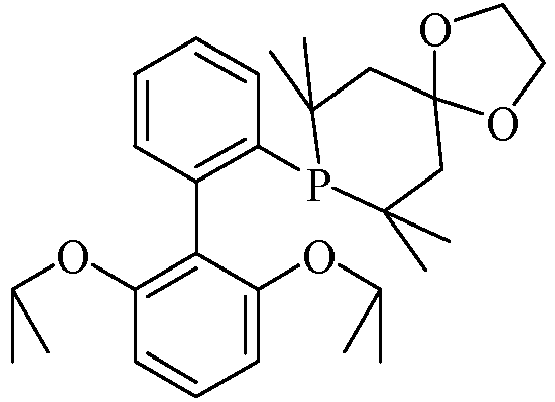
>99 75.1 
>99 81.9 (83%) c 
>99 77.6 a Reaction conversion determined by reverse phase HPLC versus isolated, characterized product. The conversion is a ratio of ((desired)/(starting material + desired)). b Area% of desired product in the crude reaction solution measured at 210 nm by HPLC. c Isolated yield of product following column chromatography. -

- Diphenylsulfide. In a nitrogen-atmosphere glovebox, a microwave vial equipped with a magnetic stir bar was charged with sodium tert-butoxide (33.7 mg, 0.350 mmol, 1.1 equivalents), tris(dibenzylideneacetone)dipalladium(0) (Pd2dba3) (2.9 mg, 0.00318 mmol, 0.01 equivalents), 7,7,9,9-tetramethyl-8-(2',4',6'-triisopropylbiphenyl-2-yl)-1,4-dioxa-8-phosphaspiro[4.5]decane (3.8 mg, 0.00764 mmol, 0.024 equivalents) and dioxane (0.48 mL). The slurry was stirred at room temperature for 1 hour before adding bromobenzene (34 µL, 0.318 mmol, 1 equivalent) and benzenethiol (33 µL, 0.318 mmol, 1 equivalent). The vial was sealed with a crimp top and stirred at 110 °C. After 19 hours, the vial was removed from the heating block, cooled to room temperature and brought out of the glovebox. The reaction solution was diluted with tetrahydrofuran (2 mL) and filtered into a tared 125-mL Erlenmeyer flask. The vial was rinsed with tetrahydrofuran (5×1 mL), followed by washing of the filter cake with tetrahydrofuran (5 mL). A wt% analysis was performed on the filtered solution and an assay yield of 88% was measured against commercially available diphenylsulfide.
Ligand Assay Yield (%) a 
88 a Assay yield was determined by weight percent analysis versus commercially available material. -

- 4-Acetylbiphenyl. In a nitrogen-atmosphere glovebox, a microwave vial equipped with a magnetic stir bar was charged with phenylboronic acid (59 mg, 0.485 mmol, 1.5 equivalents), cesium carbonate (316 mg, 0.970 mmol, 3 equivalents), tris(dibenzylideneacetone)dipalladium(0) (Pd2dba3) (3.0 mg, 0.00323 mmol, 0.01 equivalents), phosphine ligand (0.00712 mmol, 0.022 equivalents) and toluene (0.65 mL). The slurry was stirred at room temperature for 1 hour before adding 4'-chloroacetophenone (42 µL, 0.323 mmol, 1 equivalents). The vial was sealed with a crimp top and stirred at 100 °C. After 14 hours, the vial was removed from the heating block, cooled to room temperature and brought out of the glovebox. The reaction solution was diluted with tetrahydrofuran (2 mL) and filtered into a tared 125-mL Erlenmeyer flask. The vial was rinsed with tetrahydrofuran (3×2 mL), followed by washing of the filter cake with tetrahydrofuran (5 mL). A wt% analysis was performed on the filtered solution and an assay yield was measured versus commercially available 4-acetylbiphenyl. A modified solvent gradient was utilized in the HPLC method for the weight% analyses. On an Ascentis® Express C8 (2.7 µm, 4.6 mm×150 mm) column at 40 °C with a flow rate of 1.5 mL/minute, the following gradient was used: starting at 60% A (0.1% HClO4 in water) and 40% B (acetonitrile), ramped up to 5% A and 95% B over 8 minutes, followed by a 2 minute hold, and ramp down to 60% A and 40% B over 1 minute.
Ligand Assay Yield (%) a 
80 
85 
87 a Assay yields were determined by weight percent analyses versus commercially available material. -

- 4-Nitrobenzonitrile. In a nitrogen-atmosphere glovebox, a microwave vial equipped with a magnetic stir bar was charged with 1-bromo-4-nitrobenzene (50 mg, 0.248 mmol, 1 equivalent), zinc cyanide (16.0 mg, 0.136 mmol, 0.55 equivalents), zinc dust (1.6 mg, 0.025 mmol, 0.1 equivalents), tris(dibenzylideneacetone)dipalladium(0) (Pd2dba3) (4.5 mg, 0.00495 mmol, 0.02 equivalents), phosphine ligand (0.012 mmol, 0.048 equivalents) and dimethylformamide (0.55 mL). The vial was sealed with a crimp top and stirred at 100 °C. After 20 hours, the vial was removed from the heating block, cooled to room temperature and brought out of the glovebox. The reaction solution was diluted with tetrahydrofuran (2 mL) and filtered into a tared 50-mL Erlenmeyer flask. The vial was rinsed with tetrahydrofuran (5×1 mL), followed by washing of the filter cake with tetrahydrofuran (5 mL). A wt% analysis was performed on the filtered solution and an assay yield was measured versus commercially available 4-nitrobenzonitrile.
Ligand Assay Yield (%) a Ligand Assay Yield (%) a 
82 
81 
81 
77 
78 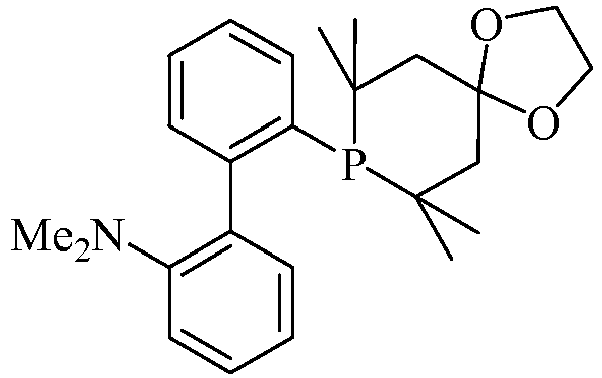
74 a Assay yields were determined by weight percent analyses versus commercially available material. -

- Diethyl phenylphosphonate. In a nitrogen-atmosphere glovebox, a microwave vial equipped with a magnetic stir bar was charged with palladium(II) acetate (1.4 mg, 0.00637 mmol, 0.02 equivalents), 8-(1,1'-binaphthyl-2-yl)-7,7,9,9-tetramethyl-1,4-dioxa-8-phosphaspiro[4.5]decane (3.6 mg, 0.00764 mmol, 0.024 equivalents) and ethanol (0.64 mL). To the slurry were added triethylamine (67 µL, 0.478 mmol, 1.5 equivalents), bromobenzene (34 µL, 0.318 mmol, 1 equivalent) and diethylphosphite (49 µL, 0.382 mmol, 1.2 equivalents). The vial was sealed with a crimp top and stirred at 80 °C. After 24 hours, the vial was removed from the heating block, cooled to room temperature and brought out of the glovebox. The reaction solution was diluted with tetrahydrofuran (2 mL) and filtered into a tared 125-mL Erlenmeyer flask. The vial was rinsed with tetrahydrofuran (5×1 mL), followed by washing of the filter cake with tetrahydrofuran (5 mL). A wt% analysis was performed on the filtrate and an assay yield of 59% was measured versus commercially available diethyl phenylphosphonate.
Ligand Assay Yield (%) a 
59 a Assay yield was determined by weight percent analysis versus commercially available material.
Claims (31)
- A phosphine ligand having a structure corresponding to formula (I),

whereinAr1 and Ar2 are each independently aryl or heteroaryl, and wherein Ar1 and Ar2 are each independently optionally substituted with one or more R1 and R2, respectively;R1 and R2 are independently selected at each occurrence from the group consisting of hydrogen; amino; hydroxyl; cyano; halo; alkyl; alkenyl; alkynyl; haloalkyl; haloalkoxy; oxoalkyl; alkoxy; aryloxy; heteroaryloxy; arylamino; heteroarylamino; alkylamino; dialkylamino; cycloalkyl optionally substituted with alkyl, alkenyl, alkynyl, alkoxy, cyano, halo, haloalkyl or haloalkoxy; cycloalkyloxy optionally substituted with alkyl, alkenyl, alkynyl, alkoxy, cyano, halo, haloalkyl or haloalkoxy; 5- or 6-membered heteroaryl optionally substituted with alkyl, alkenyl, alkynyl, alkoxy, cyano, halo, haloalkyl or haloalkoxy; phenyl optionally substituted with alkyl, alkenyl, alkynyl, alkoxy, cyano, halo, haloalkyl or haloalkoxy; hydroxyalkyl; hydroxyalkoxy; alkoxyalkyl; aminoalkyl; N-alkylaminoalkyl; N,N-dialkylaminoalkyl; N,N,N-trialkylammoniumalkyl; L1-C(O)-OR1', L1-P(O)-(OR1')2, or L1-S(O)2-OR1', wherein L1 is a bond or alkylene, and R1' is selected from the group consisting of hydrogen, alkyl and hydroxyalkyl; L2-O-C(O)-R2', wherein L2 is a bond or alkylene, and R2' is alkyl or hydroxyalkyl; L3-C(O)-NR3'R4', wherein L3 is a bond or alkylene, and R3' and R4' are each independently selected from the group consisting of hydrogen, alkyl, and hydroxyalkyl; L4-NR5'-C(O)-R6', wherein L4 is a bond or alkylene, R5' is hydrogen or alkyl, and R6' is alkyl or hydroxyalkyl; sulfamoyl; N-(alkyl)sulfamoyl; N,N-(dialkyl)sulfamoyl; sulfonamide; sulfate; alkylthio; thioalkyl; and a ring containing an alkylene or -O-(CH2)m-O- formed by the joining together of any two R1 or any two R2 or an R1 and an R2, wherein m is 1, 2, 3 or 4;X is a phosphine of formula (Id): as to R10, R11, R12, and R13,i. R10 or R11 together with R12 or R13 form a ring; orii. R10 and R11 together with the carbon atom to which they are attached form a spirocyclic ring and/or R12 and R13 together with the carbon atom to which they are attached form a spirocyclic ring; oriii. one or more of R10, R11, R12 and R13 form a ring together with R17 or R18;wherein,
if any of substituents R10, R11, R12, and R13 do not form a ring, said substituents are each independently selected from the group consisting of alkyl; alkenyl; haloalkyl; alkynyl; oxoalkyl; cycloalkyl optionally substituted with alkyl, alkenyl, alkynyl, alkoxy, cyano, halo, haloalkyl or haloalkoxy; heterocyclyl optionally substituted with alkyl, alkenyl, alkynyl, alkoxy, cyano, halo, haloalkyl or haloalkoxy; heteroaryl optionally substituted with alkyl, alkenyl, alkynyl, alkoxy, cyano, halo, haloalkyl or haloalkoxy; phenyl optionally substituted with alkyl, alkenyl, alkynyl, alkoxy, cyano, halo, haloalkyl or haloalkoxy; hydroxyalkyl; alkoxyalkyl; aminoalkyl; N-alkylaminoalkyl; N,N-dialkylaminoalkyl; N,N,N-trialkylammoniumalkyl; thioalkyl; L13-C(O)-OR14', L13-P(O)-(OR14')2, or L13-S(O)2-OR14', wherein L13 is a bond or alkylene, and R14' is selected from the group consisting of hydrogen, alkyl and hydroxyalkyl; L15-O-C(O)-R16', wherein L15 is alkylene and R16' is alkyl or hydroxyalkyl; L17-C(O)-NR18'R19', wherein L17 is a bond or alkylene, and R18' and R19' are each independently selected from the group consisting of hydrogen, alkyl, and hydroxyalkyl ; and L20-NR21'-C(O)-R22', wherein L20 is alkylene, R21' is hydrogen or alkyl, and R22' is alkyl or hydroxyalkyl;wherein as to R17 and R18:i. R17 together with R18 optionally form a carbonyl; an exocyclic double bond optionally substituted with alkyl, alkenyl, alkynyl, aryl, cycloalkyl, heterocyclyl, or heteroaryl; or a 3- to 7-membered spiro ring containing zero, one, or two heteroatoms, optionally substituted with alkyl, alkenyl, alkynyl, aryl, cycloalkyl, heterocyclyl, or heteroaryl; orii. R17 and R18 are each independently selected from the group consisting of hydrogen; halo; fluoro; alkyl; alkenyl; alkynyl; haloalkyl; fluoroalkyl; alkyloxy; N-alkylamino; N,N-dialkylamino; cycloalkyl optionally substituted with alkyl, alkenyl, alkynyl, alkoxy, cyano, halo, haloalkyl or haloalkoxy; heterocycloalkyl optionally substituted with alkyl, alkenyl, alkynyl, alkoxy, cyano, halo, haloalkyl or haloalkoxy; heteroaryl optionally substituted with alkyl, alkenyl, alkynyl, alkoxy, cyano, halo, haloalkyl or haloalkoxy, phenyl optionally substituted with alkyl, alkenyl, alkynyl, alkoxy, cyano, halo, haloalkyl or haloalkoxy; arylalkyl optionally substituted with alkyl, alkenyl, alkynyl, alkoxy, cyano, halo, haloalkyl or haloalkoxy; hydroxyalkyl; alkoxyalkyl; aminoalkyl; N-alkylaminoalkyl; N,N-dialkylaminoalkyl; N,N,N-trialkylammoniumalkyl; L1-C(O)-OR1', L1-P(O)-(OR1')2, or L1-S(O)2-OR1', wherein L1 is a bond or alkylene, and R1' is selected from the group consisting of hydrogen, alkyl and hydroxyalkyl L2-O-C(O)-R2', wherein L2 is a bond or alkylene, and R2' is alkyl or hydroxyalkyl; L3-C(O)-NR3'R4', wherein L3 is a bond or alkylene, R3' and R4' are each independently selected from the group consisting of hydrogen, alkyl, and hydroxyalkyl; L4-NR5'-C(O)-R6', wherein L4 is a bond or alkylene, and R5' is hydrogen or alkyl, R6' is alkyl or hydroxyalkyl; and alkylthio;R16 and R19 are each hydrogen; andat least one of bonds a and b in formula (Id) is a single bond and one of bonds a or b is optionally a double bond. - The phosphine ligand according to claim 1, said ligand having a structure corresponding to a structure of a formula selected from the group consisting of formulae (I-1) - (I-42), or a salt thereof:
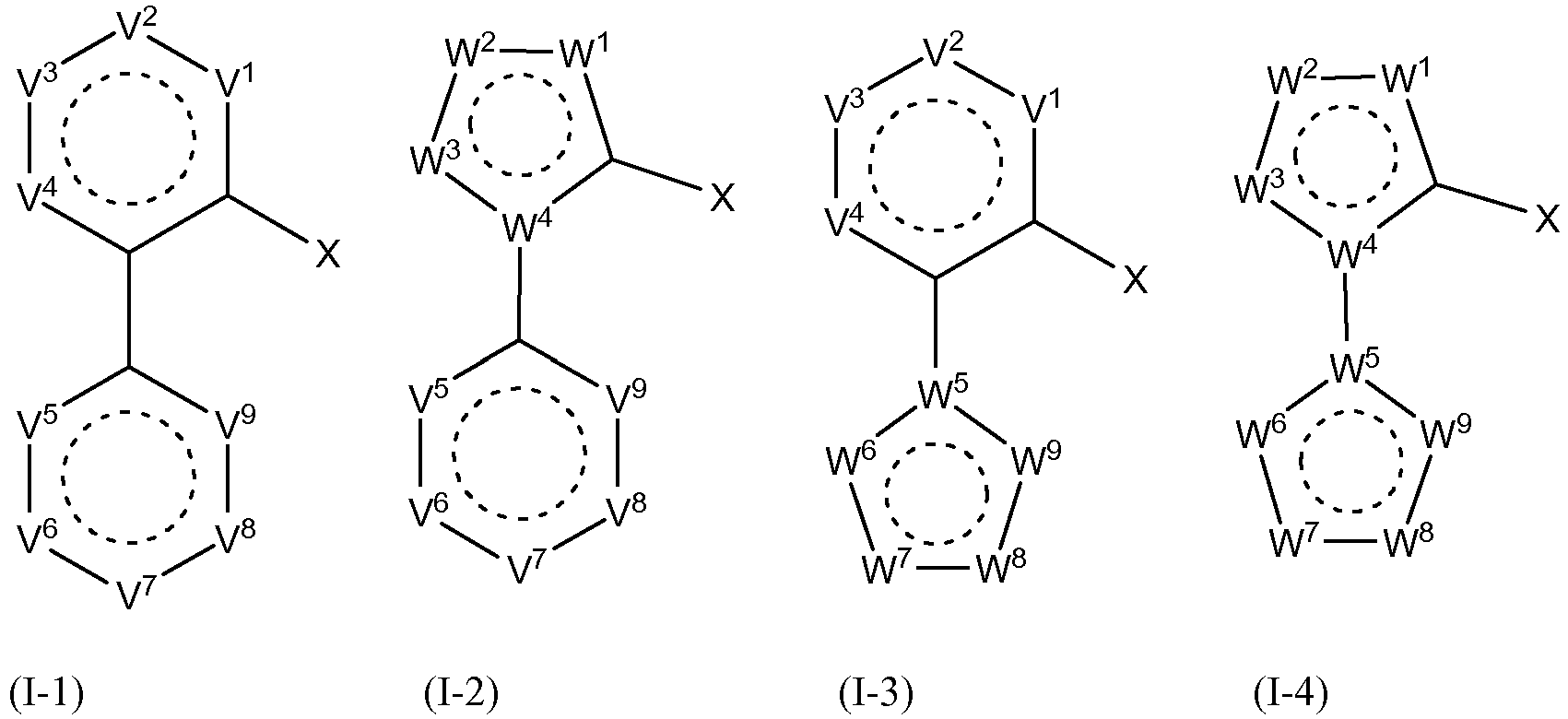


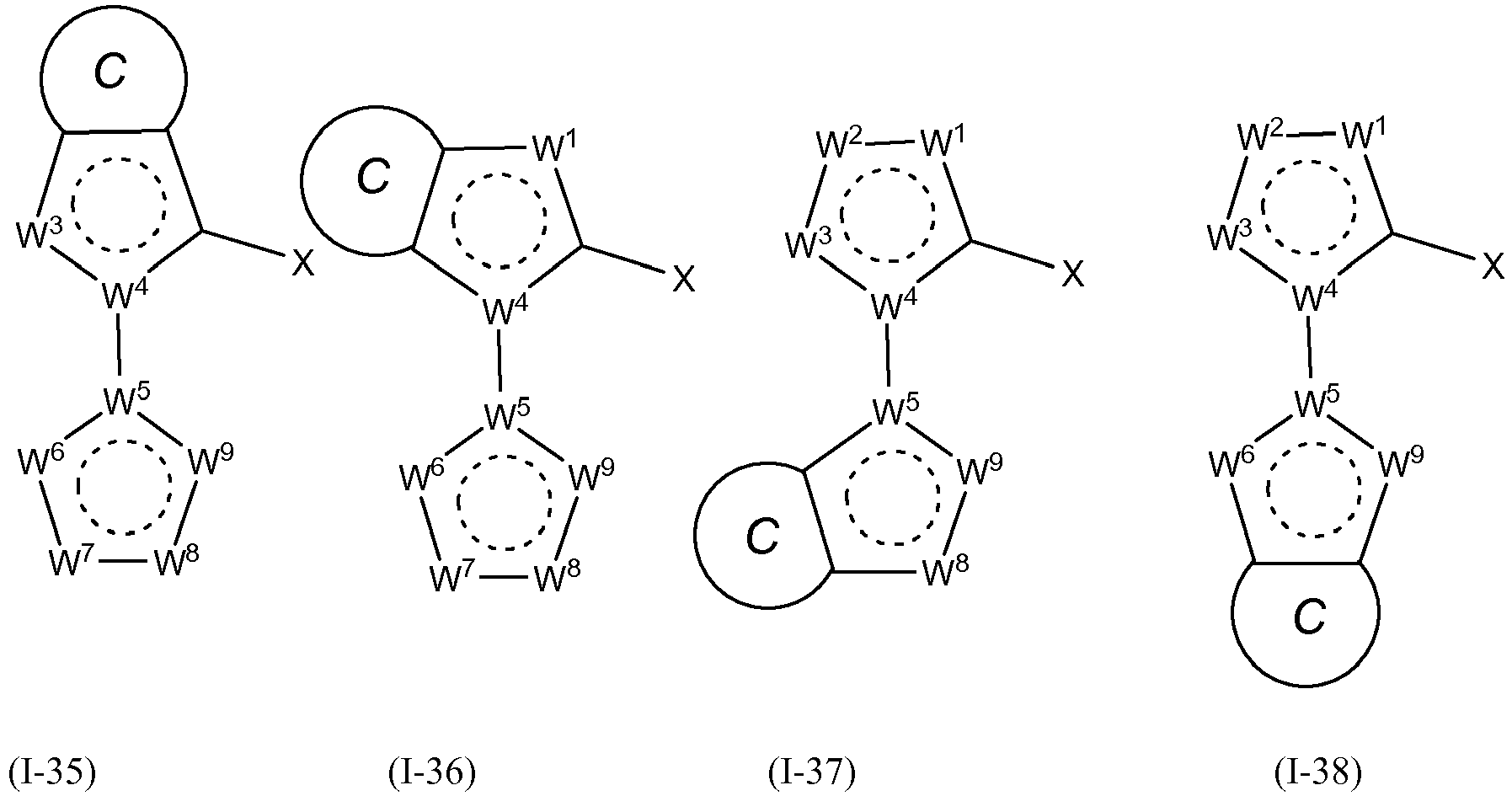
 V1, V2, V3, and V4 are each independently CR1 or N;V5, V6, V7, V8 and V9 are each independently CR2 or N;W1, W2, an W3 are each independently selected from the group consisting of CR1, NR1, N and O;W4 is C or N;W5 is C or N;W6, W7, W8 and W9 are each independently selected from the group consisting of CR2, NR2, N and O; andring C, at each occurrence, is a fused-aryl or fused-heteroaryl and is optionally substituted with R1 and R2.
 - The compound according to claim 1 or claim 2, wherein R17 and R18 together with the carbon atom to which they are attached form a 3-, 4-, 5-, 6-, or 7-membered spirocyclic ring containing 0, 1, or 2 ring heteroatoms.
- The compound according to claim 1 or claim 2, wherein X is a phosphine having a structure corresponding to a formula selected from the group consisting of:


R20 is hydrogen, alkyl, aryl, heteroaryl, arylalkyl or heteroarylalkyl, wherein the aryl, heteroaryl, aryl of arylalkyl and heteroaryl of heteroarylalkyl are optionally substituted with alkyl, alkenyl, alkynyl, alkoxy, cyano, halo, haloalkyl or haloalkoxy; and
n is 0, 1, or 2. - The phosphine ligand of claim 2, said ligand having a structure corresponding to formula (1-1),

whereinV1 and V4 are CR1, wherein R1 is independently, at each occurrence, hydrogen or alkoxy;V2 and V3 are CR1, wherein R1 is independently, at each occurrence, hydrogen or alkoxy;V5 and V9 are CR2, wherein R2 is independently, at each occurrence, selected from the group consisting of hydrogen, alkoxy, alkyl, and dialkylamino;V6 and V8 are CR2, wherein R2 is independently, at each occurrence, hydrogen or alkoxy;V7 is CR2, wherein R2 is hydrogen or alkyl; andX is selected from the group consisting of phoshines of formulae 1-1, 1-2, 1-3, 1-4, 1-5, and 1-64.

- The phosphine ligand of claim 5, wherein said ligand is selected from the group consisting of:2,2,6,6-tetramethyl-1-(2',4',6'-triisopropylbiphenyl-2-yl)phosphinane;2,2,6,6-tetramethyl-1-(2',4',6'-triisopropylbiphenyl-2-yl)phosphinan-4-one;2,2,6,6-tetramethyl-1-(2',4',6'-triisopropylbiphenyl-2-yl)phosphinan-4-ol;7,7,9,9-tetramethyl-8-(2',4',6'-triisopropylbiphenyl-2-yl)-1,4-dioxa-8-phosphaspiro[4.5]decane;8,8,10,10-tetramethyl-9-(2',4',6'-triisopropylbiphenyl-2-yl)-1,5-dioxa-9-phosphaspiro [5 .5]undecane;3,3,8,8,10,10-hexamethyl-9-(2',4',6'-triisopropylbiphenyl-2-yl)-1,5-dioxa-9-phosphaspiro [5 .5]undecane;1-(2'-(dimethylamino)-6'-methoxybiphenyl-2-yl)-2,2,6,6-tetramethylphosphinan-4-one;1-(2',6'-bis(dimethylamino)biphenyl-2-yl)-2,2,6,6-tetramethylphosphinan-4-one;1-(2',6'-dimethoxybiphenyl-2-yl)-2,2,6,6-tetramethylphosphinan-4-one;1-(2',6'-diisopropoxybiphenyl-2-yl)-2,2,6,6-tetramethylphosphinan-4-one;1-(2'-(dimethylamino)biphenyl-2-yl)-2,2,6,6-tetramethylphosphinan-4-one;1-(biphenyl-2-yl)-2,2,6,6-tetramethylphosphinan-4-one;1-(3,6-dimethoxybiphenyl-2-yl)-2,2,6,6-tetramethylphosphinan-4-one;1-(3,6-dimethoxy-2',4',6'-trimethylbiphenyl-2-yl)-2,2,6,6-tetramethylphosphinan-4-one;2,2,6,6-tetramethyl-1-(2',4',6'-triisopropyl-3,6-dimethoxybiphenyl-2-yl)phosphinan-4-one;2,2,6,6-tetramethyl-1-(2',4',6'-triisopropyl-4,5-dimethoxybiphenyl-2-yl)phosphinan-4-one;1-(3',5'-dimethoxybiphenyl-2-yl)-2,2,6,6-tetramethylphosphinan-4-one;1-(4'-tert-butylbiphenyl-2-yl)-2,2,6,6-tetramethylphosphinan-4-one;6-methoxy-N,N-dimethyl-2'-(7,7,9,9-tetramethyl-1,4-dioxa-8-phosphaspiro[4.5]decan-8-yl)biphenyl-2-amine;N2,N2,N6,N6 -tetramethyl-2'-(7,7,9,9-tetramethyl-1,4-dioxa-8-phosphaspiro[4.5]decan-8-yl)biphenyl-2,6-diamine;8-(2',6'-dimethoxybiphenyl-2-yl)-7,7,9,9-tetramethyl-1,4-dioxa-8-phosphaspiro[4.5]decane;8-(2',6'-diisopropoxybiphenyl-2-yl)-7,7,9,9-tetramethyl-1,4-dioxa-8-phosphaspiro[4.5]decane;N,N-dimethyl-2'-(7,7,9,9-tetramethyl-1,4-dioxa-8-phosphaspiro[4.5]decan-8-yl)biphenyl-2-amine;8-(biphenyl-2-yl)-7,7,9,9-tetramethyl-1,4-dioxa-8-phosphaspiro[4.5]decane;8-(3,6-dimethoxybiphenyl-2-yl)-7,7,9,9-tetramethyl-1,4-dioxa-8-phosphaspiro[4.5]decane;8-(3,6-dimethoxy-2',4',6'-trimethylbiphenyl-2-yl)-7,7,9,9-tetramethyl-1,4-dioxa-8-phosphaspiro[4.5]decane;7,7,9,9-tetramethyl-8-(2',4',6'-triisopropyl-3,6-dimethoxybiphenyl-2-yl)-1,4-dioxa-8-phosphaspiro[4.5]decane;7,7,9,9-tetramethyl-8-(2',4',6'-triisopropyl-4,5-dimethoxybiphenyl-2-yl)-1,4-dioxa-8-phosphaspiro[4.5]decane;8-(3',5'-dimethoxybiphenyl-2-yl)-7,7,9,9-tetramethyl-1,4-dioxa-8-phosphaspiro[4.5]decane;8-(4'-tert-butylbiphenyl-2-yl)-7,7,9,9-tetramethyl-1,4-dioxa-8-phosphaspiro[4.5]decane; and2,2,6,6-tetramethyl-1-(2',4',6'-triisopropyl-3,6-dimethoxybiphenyl-2-yl)phosphinane.
- The phosphine ligand of claim 2, said ligand having a structure corresponding to formula (1-8),

whereinV1 and V2 are each CR1, wherein R1 is, at each occurrence, hydrogen;V7 and V8 are each CR2, wherein R2 is, at each occurrence, hydrogen;V9 is CR2, wherein R2 is hydrogen;ring C at each occurrence is an unsubstituted fused-phenyl; andX is a phosphine having a structure corresponding to a formula selected from the group consisting of formulae 1-1, 1-3 and 1-5.
- The phosphine ligand of claim 7, wherein said ligand is selected from the group consisting of:2,2,6,6-tetramethyl-1-(2-(naphthalen-1-yl)phenyl)phosphinan-4-one; and7,7,9,9-tetramethyl-8-(4-methyl-2-(naphthalen-1-yl)phenyl)-1,4-dioxa-8-phosphaspiro[4.5]decane.
- The phosphine ligand of claim 2, said ligand having a structure corresponding to formula (I-10),

whereinV1 and V2 are each CR1, wherein R1 is, at each occurrence, hydrogen;V7 and V8 are each CR2, wherein R2 is, at each occurrence, hydrogen;V9 is CR2, wherein R2 is hydrogen or alkoxy;ring C at each occurrence is an unsubstituted fused-phenyl; andX is a phosphine having a structure corresponding to a formula selected from the group consisting of formulae 1-1, 1-3, and 1-5.
- The phosphine ligand of claim 9, wherein said ligand is selected from the group consisting of:1-(1,1'-binaphthyl-2-yl)-2,2,6,6-tetramethylphosphinan-4-one;1-(2'-methoxy-1,1'-binaphthyl-2-yl)-2,2,6,6-tetramethylphosphinan-4-one;8-(1,1'-binaphthyl-2-yl)-7,7,9,9-tetramethyl-1,4-dioxa-8-phosphaspiro[4.5]decane; and8-(2'-methoxy-1,1'-binaphthyl-2-yl)-7,7,9,9-tetramethyl-1,4-dioxa-8-phosphaspiro[4.5]decane.
- The phosphine ligand of claim 2, said ligand having a structure corresponding to formula (1-9),

whereinV1, V2, V3, and V4 are each CR1, wherein R1, at each occurrence, is hydrogen;V5, V8 and V9 are each CR2, wherein R2, at each occurrence, is hydrogen;ring C is an unsubstituted fused-phenyl; andX is a phosphine having a structure corresponding to a formula selected from the group consisting of formulae 1-1, 1-3, and 1-5.
- The phosphine ligand of claim 11, wherein said ligand is selected from the group consisting of:2,2,6,6-tetramethyl-1 -(2-(naphthalen-2-yl)phenyl)phosphinan-4-one; and7,7,9,9-tetramethyl-8-(2-(naphthalen-2-yl)phenyl)-1,4-dioxa-8-phosphaspiro[4.5]decane.
- The phosphine ligand of claim 2, said ligand having a structure corresponding to formula (1-2),

whereinW1 and W2 are each CR1, wherein R1, at each occurrence, is hydrogen;W3 and W4 are each N;V5, V6, V7, V8, and V9 are each CR2, wherein R2, at each occurrence, is hydrogen; andX is a phosphine having a structure corresponding to a formula selected from the group consisting of formulae 1-1, 1-3 and 1-5.
- The phosphine ligand of claim 13, wherein said ligand is selected from the group consisting of:2,2,6,6-tetramethyl-1-(1-phenyl-1H-pyrazol-5-yl)phosphinan-4-one; and1-phenyl-5-(7,7,9,9-tetramethyl-1,4-dioxa-8-phosphaspiro[4.5]decan-8-yl)-1H-pyrazole.
- The phosphine ligand of claim 2, said ligand having a structure corresponding to formula (1-3),
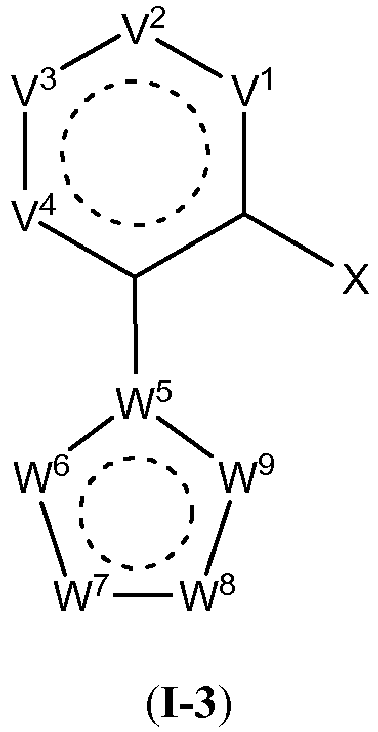
whereinV1, V2, V3 and V4 are each CR1, wherein R1, at each occurrence, is hydrogen;W6, W7, W8 and W9 are each CR2, wherein R2, at each occurrence, is hydrogen;W5 is N; andX is a phosphine having a structure corresponding to a formula selected from the group consisting of formulae 1-1, 1-3 and 1-5.
- The phosphine ligand of claim 15, wherein said ligand is selected from the group consisting of:1-(2-(1H-pyrrol-1-yl)phenyl)-2,2,6,6-tetramethylphosphinan-4-one;1-(2-(7,7,9,9-tetramethyl-1,4-dioxa-8-phosphaspiro[4.5]decan-8-yl)phenyl)-1H-pyrrole; and1 -(2-(2,2,6,6-tetramethylphosphinan-1 -yl)phenyl)-1H-pyrrole.
- The compound of claim 2, said compound having a structure corresponding to formula (I-4),
 W1 and W2 are each CR1, wherein R1, at each occurrence, is hydrogen;W3 and W4 are each N;W5 is C;W6 and W9 are each CR2, wherein R2, at each occurrence, is phenyl optionally substituted with alkyl, alkenyl, alkynyl, alkoxy, cyano, halo, haloalkyl or haloalkoxy;W7 is N;W8 is NR2, wherein R2, at each occurrence, is phenyl optionally substituted with alkyl, alkenyl, alkynyl, alkoxy, cyano, halo, haloalkyl or haloalkoxy; andX is a phosphine having a structure corresponding to a formula selected from the group consisting of formulae 1-1, 1-3 and 1-5.
- The phosphine ligand of claim 17, wherein said compound is selected from the group consisting of:2,2,6,6-Tetramethyl-1-(1',3',5'-triphenyl-1'H-1,4'-bipyrazol-5-yl)phosphinan-4-one;1'1',3',5'-Triphenyl-5-(7,7,9,9-tetramethyl-1,4-dioxa-8-phosphaspiro[4.5]decan-8-yl)-1'H-1,4'-bipyrazole; and1',3',5'-Triphenyl-5-(2,2,6,6-tetramethylphosphinan-1-yl)-1'H-1,4'-bipyrazole.
- A phosphine ligand having a structure corresponding to formula (I-1),

whereinV1, V2, V3 and V4 are each CR1, wherein R1 is, at each occurrence, hydrogen;V5 and V9 are CR2, wherein R2 is independently, at each occurrence, hydrogen or alkyl;V6 and V8 are CR2, wherein R2, at each occurrence, is hydrogen;V7 is CR2, wherein R2 is hydrogen or alkyl; andX is a phosphine of formula 1-37
- The phosphine ligand of claim 19, wherein said ligand is selected from the group consisting of:1,3,5,7-tetramethyl-8-(2',4',6'-triisopropylbiphenyl-2-yl)-2,4,6-trioxa-8-phosphatricyclo[3.3.1.13,7]decane; and8-(biphenyl-2-yl)-1,3,5,7-tetramethyl-2,4,6-trioxa-8-phosphatricyclo[3.3.1.13,7]decane.
- A phosphine ligand according to claim 1 which is 7,7,9,9-tetramethyl-8-(2',4',6'-triisopropyl-3,6-dimethoxybiphenyl-2-yl)-1,4-dioxa-8-phosphaspiro[4.5]decane.
- A catalyst composition comprising a transition metal catalyst precursor and a compound according to claim 1.
- The catalyst composition according to claim 22, wherein the transition metal catalyst precursor is selected from the group consisting of palladium, rhodium, ruthenium, platinum, gold, cobalt, iridium, copper and nickel.
- The catalyst composition according to claim 23, wherein the transition metal catalyst precursor contains palladium.
- A catalyst composition according to claim 22 comprising a palladium catalyst precursor and a compound according to claim 4.
- A catalyst composition according to claim 22 comprising a palladium catalyst precursor and 7,7,9,9-tetramethyl-8-(2',4',6'-triisopropyl-3,6-dimethoxybiphenyl-2-yl)-1,4-dioxa-8-phosphaspiro[4.5]decane.
- A heterogeneous catalyst composition comprising a compound of claim 1 covalently bonded to a solid catalyst support.
- A method for synthesizing a secondary organic sulfonamide, comprising reacting an aryl nonaflate with a primary sulfonamide in the presence of a palladium catalyst precursor and a phosphine ligand according to claim 1.
- A method of performing a bond-forming reaction comprising catalyzing said reaction with a compound according to claim 1, wherein the bond-forming reaction is selected from the group consisting of carbon-nitrogen, carbon-oxygen, carbon-carbon, carbon-sulfur, carbon-phosphorus, carbon-boron, carbon-fluorine and carbon-hydrogen.
- A method of forming a bond in a chemical reaction comprising catalyzing said reaction with a compound according to claim 1, wherein the bond is selected from the group consisting of a carbon-nitrogen bond, a carbon-oxygen bond, a carbon-carbon bond, a carbon-sulfur bond, a carbon-phosphorus bond, a carbon-boron bond, a carbon-fluorine bond and a carbon-hydrogen bond.
- A method of preparing phosphacycles according to any one of claims 1-21 comprising:metalation of a biaryl halide to form a biaryl lithium species;reacting a chlorophosphate with said biaryl lithium species to form biaryl phosphonate;reduction of second product to form primary phosphine; andreacting primary phosphine with a divinylketone.
Priority Applications (1)
| Application Number | Priority Date | Filing Date | Title |
|---|---|---|---|
| EP18205778.6A EP3461556A1 (en) | 2010-07-16 | 2011-07-15 | Phosphine ligands for catalytic reactions |
Applications Claiming Priority (2)
| Application Number | Priority Date | Filing Date | Title |
|---|---|---|---|
| US36529310P | 2010-07-16 | 2010-07-16 | |
| PCT/US2011/044282 WO2012009698A1 (en) | 2010-07-16 | 2011-07-15 | Phosphine ligands for catalytic reactions |
Related Child Applications (1)
| Application Number | Title | Priority Date | Filing Date |
|---|---|---|---|
| EP18205778.6A Division EP3461556A1 (en) | 2010-07-16 | 2011-07-15 | Phosphine ligands for catalytic reactions |
Publications (2)
| Publication Number | Publication Date |
|---|---|
| EP2593226A1 EP2593226A1 (en) | 2013-05-22 |
| EP2593226B1 true EP2593226B1 (en) | 2018-11-14 |
Family
ID=44544080
Family Applications (2)
| Application Number | Title | Priority Date | Filing Date |
|---|---|---|---|
| EP18205778.6A Withdrawn EP3461556A1 (en) | 2010-07-16 | 2011-07-15 | Phosphine ligands for catalytic reactions |
| EP11739235.7A Active EP2593226B1 (en) | 2010-07-16 | 2011-07-15 | Phosphine ligands for catalytic reactions |
Family Applications Before (1)
| Application Number | Title | Priority Date | Filing Date |
|---|---|---|---|
| EP18205778.6A Withdrawn EP3461556A1 (en) | 2010-07-16 | 2011-07-15 | Phosphine ligands for catalytic reactions |
Country Status (24)
| Country | Link |
|---|---|
| US (2) | US8841487B2 (en) |
| EP (2) | EP3461556A1 (en) |
| JP (2) | JP6030057B2 (en) |
| KR (1) | KR101774742B1 (en) |
| CN (1) | CN103097027B (en) |
| AU (1) | AU2011278926B2 (en) |
| BR (1) | BR112013001138A2 (en) |
| CA (1) | CA2804827A1 (en) |
| CL (2) | CL2013000146A1 (en) |
| CO (1) | CO6710898A2 (en) |
| CR (1) | CR20130057A (en) |
| DO (1) | DOP2013000013A (en) |
| EA (1) | EA030228B1 (en) |
| EC (1) | ECSP13012446A (en) |
| GT (1) | GT201300020A (en) |
| IL (2) | IL224221B (en) |
| MX (1) | MX338725B (en) |
| NZ (2) | NZ704603A (en) |
| PE (1) | PE20131095A1 (en) |
| PH (1) | PH12013500063A1 (en) |
| SG (1) | SG187103A1 (en) |
| UA (1) | UA113498C2 (en) |
| WO (1) | WO2012009698A1 (en) |
| ZA (1) | ZA201300250B (en) |
Families Citing this family (14)
| Publication number | Priority date | Publication date | Assignee | Title |
|---|---|---|---|---|
| AU2014280934B2 (en) * | 2010-07-16 | 2017-03-16 | Abbvie Ireland Unlimited Company | Phosphine ligands for catalytic reactions |
| BR112013001138A2 (en) * | 2010-07-16 | 2016-07-05 | Abbvie Inc | phosphine binders for catalytic reactions |
| US9255074B2 (en) | 2010-07-16 | 2016-02-09 | Abbvie Inc. | Process for preparing antiviral compounds |
| US8975443B2 (en) * | 2010-07-16 | 2015-03-10 | Abbvie Inc. | Phosphine ligands for catalytic reactions |
| WO2012009699A2 (en) | 2010-07-16 | 2012-01-19 | Abbott Laboratories | Process for preparing antiviral compounds |
| CN104892424A (en) * | 2015-04-03 | 2015-09-09 | 江苏省原子医学研究所 | Nitrobenzene preparation method |
| CN107922439A (en) * | 2015-08-18 | 2018-04-17 | 陶氏环球技术有限责任公司 | Make aromatic series or vinyl compound and the method for boron-containing compound coupling |
| US10787738B2 (en) * | 2016-01-27 | 2020-09-29 | Basf Se | Process for the generation of thin inorganic films |
| EP3454981B1 (en) * | 2016-05-10 | 2021-03-03 | Promega Corporation | Palladium catalysts with improved performance in biological environments |
| CN107684930B (en) * | 2016-08-05 | 2020-12-22 | 中国石油化工股份有限公司 | A kind of preparation method of cyclohexanone catalyst for hydrogenation of phenol |
| CN106928153B (en) * | 2017-03-24 | 2019-04-16 | 宁波大学 | A kind of cobalt complex with electrocatalytic activity to formaldehyde and preparation method thereof |
| CN111116653B (en) * | 2020-01-02 | 2022-08-12 | 河北工业大学 | A kind of preparation method of pyrazole-linked triazole phosphine compound |
| KR102582223B1 (en) * | 2021-07-23 | 2023-09-25 | 한국화학연구원 | Ag catalyst for carboxylation of aromatic compounds and method for producing aromatic carboxylic acid using same |
| EP4180440B1 (en) | 2021-11-16 | 2026-01-28 | Heraeus Precious Metals GmbH & Co. KG | Cyclic biarylphosphines as ligands for palladium-containing catalysts in cross-coupling reactions |
Family Cites Families (89)
| Publication number | Priority date | Publication date | Assignee | Title |
|---|---|---|---|---|
| US3050531A (en) | 1960-07-06 | 1962-08-21 | American Cyanamid Co | Substituted 10-phosphatricyclo [3.3.1.1] decanes and methods of preparing same |
| US4239888A (en) | 1974-11-04 | 1980-12-16 | Pfizer Inc. | 1-Phenyluracils |
| JPS60243017A (en) | 1984-05-16 | 1985-12-03 | Kyowa Hakko Kogyo Co Ltd | Antispasmodic composition |
| US4731472A (en) | 1986-03-03 | 1988-03-15 | Merck & Co., Inc. | (5,6-dichloro-3-oxo-9A-propyl-2,3,9,9A-tetrahydrofluoren-7-yl)alkanoic acids and alkanimidamides |
| US4958023A (en) | 1988-09-19 | 1990-09-18 | American Home Products Corporation | 2-pyridinecarbothioamides, processes for preparation thereof and pharmaceutical compositions comprising the same |
| US4873238A (en) | 1988-09-19 | 1989-10-10 | American Home Products Corporation | 2-Pyridinecarbothioamides and pharmaceutical compositions comprising the same |
| AU627906B2 (en) | 1989-07-14 | 1992-09-03 | Nissan Chemical Industries Ltd. | Uracil derivatives and herbicides containing the same as active ingredient |
| US5084084A (en) | 1989-07-14 | 1992-01-28 | Nissan Chemical Industries Ltd. | Uracil derivatives and herbicides containing the same as active ingredient |
| US5162326A (en) | 1990-02-15 | 1992-11-10 | Takeda Chemical Industries, Ltd. | Pyrimidinedione derivatives, their production and use |
| NL9001075A (en) | 1990-05-04 | 1991-12-02 | Duphar Int Res | |
| US5489682A (en) | 1990-11-21 | 1996-02-06 | Massachusetts Institute Of Technology | Catalytic asymmetric reduction of enamines |
| JPH06502867A (en) | 1990-11-21 | 1994-03-31 | マサチューセッツ インスティテュート オブ テクノロジー | A novel method for catalytic reduction of organic substrates |
| WO1993015089A1 (en) | 1992-01-31 | 1993-08-05 | F. Hoffmann-La Roche Ag | Diphosphine ligands |
| JPH05213755A (en) | 1992-02-07 | 1993-08-24 | Nikko Kyodo Co Ltd | Therapeutic agent for hepatopathy |
| JP3345476B2 (en) | 1993-05-18 | 2002-11-18 | 株式会社東芝 | Organic nonlinear optical material |
| IT1264813B1 (en) | 1993-07-28 | 1996-10-10 | Oxon Italia Spa | PROCESS FOR THE PREPARATION OF ALCANSOLPHONAMIDES |
| ES2130321T3 (en) * | 1993-10-08 | 1999-07-01 | Hoffmann La Roche | OPTICALLY ACTIVE PHOSPHORUS COMPOUNDS. |
| DE19528305A1 (en) | 1995-08-02 | 1997-02-06 | Bayer Ag | Substituted phenyluracile |
| US6231783B1 (en) | 1995-11-14 | 2001-05-15 | Massachusetts Institute Of Technology | Replacement solvents for use in chemical synthesis |
| US6031105A (en) | 1996-04-09 | 2000-02-29 | Pfizer Inc | Substituted pyridines |
| US5847166A (en) | 1996-10-10 | 1998-12-08 | Massachusetts Institute Of Technology | Synthesis of aryl ethers |
| US6096904A (en) | 1996-12-03 | 2000-08-01 | The Trustees Of The University Of Pennsylvania | Synthetic techniques and intermediates for polyhydroxy, dienyl lactone derivatives |
| US5789605A (en) | 1996-12-03 | 1998-08-04 | Trustees Of The University Of Pennsylvania | Synthetic techniques and intermediates for polyhydroxy, dienyl lactones and mimics thereof |
| US6870058B2 (en) | 1996-12-03 | 2005-03-22 | The Trustees Of The University Of Pennsylvania | Compounds which mimic the chemical and biological properties of discodermolide |
| US20050065353A1 (en) | 1996-12-03 | 2005-03-24 | Smith Amos B. | Synthetic techniques and intermediates for polyhydroxy dienyl lactones and mimics thereof |
| US6242616B1 (en) | 1996-12-03 | 2001-06-05 | The Trustees Of The University Of Pennsylvania | Synthetic techniques and intermediates for polyhydroxy, dienyl lactone derivatives |
| US6323366B1 (en) | 1997-07-29 | 2001-11-27 | Massachusetts Institute Of Technology | Arylamine synthesis |
| US6395939B1 (en) | 1997-10-06 | 2002-05-28 | Massachusetts Institute Of Technology | Diaryl ether condensation reactions |
| US6867310B1 (en) | 1997-11-20 | 2005-03-15 | Massachusetts Institute Of Technology | Arylation and vinylation of activated carbons |
| US6235871B1 (en) | 1997-12-03 | 2001-05-22 | Massachusetts Institute Of Technology | Synthesis of oligoarylamines, and uses and reagents related thereto |
| EP1058678B1 (en) | 1998-02-26 | 2002-12-11 | Massachusetts Institute of Technology | Metal-catalyzed arylations and vinylations of hydrazines, hydrazones, hydroxylamines and oximes |
| US6395916B1 (en) | 1998-07-10 | 2002-05-28 | Massachusetts Institute Of Technology | Ligands for metals and improved metal-catalyzed processes based thereon |
| US6307087B1 (en) | 1998-07-10 | 2001-10-23 | Massachusetts Institute Of Technology | Ligands for metals and improved metal-catalyzed processes based thereon |
| US7223879B2 (en) | 1998-07-10 | 2007-05-29 | Massachusetts Institute Of Technology | Ligands for metals and improved metal-catalyzed processes based thereon |
| ATE360634T1 (en) | 1998-07-10 | 2007-05-15 | Massachusetts Inst Technology | LIGANDS FOR METALS AND IMPROVED METAL-CATALYzed PROCESSES BASED THEREOF |
| DE19920847A1 (en) | 1999-05-06 | 2000-11-09 | Clariant Gmbh | Pd and Ni complexes of biphenyl-2-ylphosphanes and their application in catalytic C, C, N and C, O couplings |
| WO2001019761A2 (en) | 1999-09-15 | 2001-03-22 | Massachusetts Institute Of Technology | Asymmetric 1,4-reductions of and 1,4-additions to enoates and related systems |
| CA2391966A1 (en) | 1999-11-24 | 2001-05-31 | Massachusetts Institute Of Technology | Protecting groups useful in the synthesis of polysaccharides, natural products, and combinatorial libraries |
| US6380387B1 (en) | 1999-12-06 | 2002-04-30 | Hoffmann-La Roche Inc. | 4-Pyrimidinyl-n-acyl-l phenylalanines |
| SI1237878T1 (en) | 1999-12-06 | 2007-08-31 | Hoffmann La Roche | 4-pyrimidinyl-n-acyl-l-phenylalanines |
| IL141034A0 (en) | 2000-02-04 | 2002-02-10 | Sumitomo Chemical Co | Uracil compounds and use thereof |
| PY0111577A (en) | 2000-05-23 | 2017-01-02 | Idenix Cayman Ltd | METHODS AND COMPOSITIONS FOR THE TREATMENT OF HEPATITIS C VIRUS |
| US7012162B2 (en) | 2000-06-26 | 2006-03-14 | Basf Aktiengesellschaft | Phosphacyclohexanes and the use thereof in the hydroformylation of olefins |
| US6624159B2 (en) | 2000-07-12 | 2003-09-23 | Pharmacia & Upjohn Company | Heterocycle carboxamides as antiviral agents |
| CN1266112C (en) | 2001-04-24 | 2006-07-26 | 麻省理工学院 | Copper-catalyzed carbon-heteroatom bond and carbon-carbon bond formation |
| WO2003013502A1 (en) | 2001-08-07 | 2003-02-20 | The Trustees Of The University Of Pennsylvania | Compounds which mimic the chemical and biological properties of discodermolide |
| AR037940A1 (en) | 2001-12-20 | 2004-12-22 | Upjohn Co | PIRIDOQUINOXALINA ANTIVIRAL COMPOUNDS |
| WO2003066570A1 (en) | 2002-02-04 | 2003-08-14 | Massachusetts Institute Of Technology | Transition-metal-catalyzed carbon-nitrogen bond-forming methods using carbene ligands |
| ITMI20020415A1 (en) * | 2002-03-01 | 2003-09-01 | Chemi Spa | METAL CATALYSTS FOR CHEMO-REGIO-STEREO-SELECTIVE REACTION PRECURSORS |
| CN1684944A (en) | 2002-08-02 | 2005-10-19 | 麻省理工学院 | Copper-catalyzed formation of carbon-heteroatoms and carbon-carbon bonds |
| US20040110802A1 (en) | 2002-08-23 | 2004-06-10 | Atli Thorarensen | Antibacterial benzoic acid derivatives |
| AU2003265382A1 (en) | 2002-08-23 | 2004-03-11 | Pharmacia & Upjohn Company Llc | Antibacterial benzoic acid derivatives |
| US20050113450A1 (en) | 2002-08-23 | 2005-05-26 | Atli Thorarensen | Antibacterial agents |
| US7208490B2 (en) | 2002-10-07 | 2007-04-24 | Pharmacia & Upjohn Company Llc | Tricyclic tetrahydroquinoline antibacterial agents |
| AU2003296326A1 (en) | 2002-12-09 | 2004-06-30 | Massachusetts Institute Of Technology | Ligands for metals and improved metal-catalyzed processes based thereon |
| US7163937B2 (en) | 2003-08-21 | 2007-01-16 | Bristol-Myers Squibb Company | Cyclic derivatives as modulators of chemokine receptor activity |
| WO2005061477A1 (en) | 2003-12-04 | 2005-07-07 | Wyeth | Biaryl sulfonamides as mmp inhibitors |
| US20050143349A1 (en) | 2003-12-17 | 2005-06-30 | Quatrx Pharmaceuticals Co. | Phosphorus containing compounds useful for the regulation of LDL and Lp(a) levels |
| BRPI0417947A (en) | 2003-12-22 | 2007-04-17 | Lilly Co Eli | compound, pharmaceutical composition, manufacture of a medicament for use in the treatment and / or prevention of a metabolic disorder, and, pharmaceutical formulation |
| EP1824837B1 (en) | 2004-11-10 | 2008-08-13 | Pfizer, Inc. | Substituted n-sulfonylaminobenzyl-2-phenoxy acetamide compounds |
| SE0403006D0 (en) | 2004-12-09 | 2004-12-09 | Biovitrum Ab | New compounds |
| GB0427403D0 (en) | 2004-12-15 | 2005-01-19 | Astrazeneca Ab | Novel compounds I |
| US7902356B2 (en) | 2004-12-17 | 2011-03-08 | Eli Lilly And Company | Thiazolopyridinone derivates as MCH receptor antagonists |
| JP5244399B2 (en) | 2005-01-10 | 2013-07-24 | マサチューセッツ インスティテュート オブ テクノロジー | Carbon-nitrogen bonds and carbon-carbon bond formation reactions catalyzed by transition metals |
| MX2007011105A (en) | 2005-03-10 | 2007-10-08 | Pfizer | Substituted n-sulfonylaminophenylethyl-2-phenoxy acetamide compounds. |
| CA2601508C (en) | 2005-03-17 | 2012-01-03 | Pfizer, Inc. | Cyclopropanecarboxamide derivatives |
| CA2651871A1 (en) | 2006-05-10 | 2007-11-22 | Renovis, Inc. | Amide derivatives as ion-channel ligands and pharmaceutical compositions and methods of using the same |
| GB0713686D0 (en) | 2007-07-13 | 2007-08-22 | Addex Pharmaceuticals Sa | New compounds 2 |
| US8258131B2 (en) | 2007-08-01 | 2012-09-04 | Mitsubishi Tanabe Pharma Corporation | Fused bicyclic compound |
| TWI534137B (en) | 2007-09-17 | 2016-05-21 | 艾伯維巴哈馬有限公司 | Anti-infective agents and uses thereof |
| WO2009039135A1 (en) | 2007-09-17 | 2009-03-26 | Abbott Laboratories | N-phenyl-dioxo-hydropyrimidines useful as hepatitis c virus (hcv) inhibitors |
| DK2203431T3 (en) | 2007-09-17 | 2011-11-21 | Abbott Lab | Anti-infectious pyrimidines and their applications |
| EP2231680B1 (en) | 2007-12-12 | 2018-03-28 | Massachusetts Institute of Technology | Ligands for transition-metal-catalyzed cross-couplings, and methods of use thereof |
| BRPI0916233A2 (en) | 2008-07-23 | 2018-03-13 | F.Hoffman-La Roche Ag | antiviral heterocyclic compounds |
| EP2184273A1 (en) | 2008-11-05 | 2010-05-12 | Bayer CropScience AG | Halogen substituted compounds as pesticides |
| JP5326510B2 (en) | 2008-11-11 | 2013-10-30 | セントラル硝子株式会社 | Process for producing α-substituted esters |
| MX2011010049A (en) | 2009-03-24 | 2011-10-11 | Abbott Lab | Process for preparing antiviral compound. |
| EP2445875A2 (en) | 2009-06-24 | 2012-05-02 | F. Hoffmann-La Roche AG | Heterocyclic antiviral compound |
| US20110005533A1 (en) | 2009-07-07 | 2011-01-13 | Evans Douglas J | Mold For a Smoking Device |
| WO2011008725A2 (en) | 2009-07-13 | 2011-01-20 | Massachusetts Institute Of Technology | Metal-catalyzed carbon-fluorine bond formation |
| WO2011008618A1 (en) | 2009-07-13 | 2011-01-20 | National University Of Singapore | Metal-catalyzed carbon-fluorine bond formation |
| AR079170A1 (en) | 2009-12-10 | 2011-12-28 | Lilly Co Eli | COMPOSITE OF CICLOPROPIL-BENZAMIDA-IMIDAZO-BENZAZEPINA INHIBITOR OF DIACIL-GLICEROL ACILTRANSFERASA, SALT OF THE SAME, PHARMACEUTICAL COMPOSITION THAT INCLUDES IT, ITS USE TO PREPARE A USEFUL MEDICATION FOR THE TREATMENT OF INTEREST OR COMPENSATION |
| AU2010327936B2 (en) | 2009-12-11 | 2015-08-20 | Nono Inc. | Agents and methods for treating ischemic and other diseases |
| WO2011082400A2 (en) | 2010-01-04 | 2011-07-07 | President And Fellows Of Harvard College | Modulators of immunoinhibitory receptor pd-1, and methods of use thereof |
| FR2958289B1 (en) | 2010-03-30 | 2012-06-15 | Sanofi Aventis | PROCESS FOR THE PREPARATION OF 3-KETO-BENZOFURAN DERIVATIVES |
| WO2011133795A2 (en) | 2010-04-22 | 2011-10-27 | The Brigham And Women's Hospital, Inc. | Beta-carbolines as inhibitors of haspin and dyrk kinases |
| US8980929B2 (en) | 2010-05-21 | 2015-03-17 | Merck Sharp & Dohme Corp. | Substituted seven-membered heterocyclic compounds as dipeptidyl peptidase-iv inhibitors for the treatment of diabetes |
| WO2012009699A2 (en) | 2010-07-16 | 2012-01-19 | Abbott Laboratories | Process for preparing antiviral compounds |
| BR112013001138A2 (en) * | 2010-07-16 | 2016-07-05 | Abbvie Inc | phosphine binders for catalytic reactions |
-
2011
- 2011-07-15 BR BR112013001138A patent/BR112013001138A2/en not_active Application Discontinuation
- 2011-07-15 NZ NZ704603A patent/NZ704603A/en not_active IP Right Cessation
- 2011-07-15 US US13/184,425 patent/US8841487B2/en not_active Expired - Fee Related
- 2011-07-15 KR KR1020137003712A patent/KR101774742B1/en not_active Expired - Fee Related
- 2011-07-15 MX MX2013000583A patent/MX338725B/en active IP Right Grant
- 2011-07-15 PH PH1/2013/500063A patent/PH12013500063A1/en unknown
- 2011-07-15 AU AU2011278926A patent/AU2011278926B2/en not_active Ceased
- 2011-07-15 UA UAA201301880A patent/UA113498C2/en unknown
- 2011-07-15 PE PE2013000072A patent/PE20131095A1/en not_active Application Discontinuation
- 2011-07-15 EP EP18205778.6A patent/EP3461556A1/en not_active Withdrawn
- 2011-07-15 EP EP11739235.7A patent/EP2593226B1/en active Active
- 2011-07-15 SG SG2013003587A patent/SG187103A1/en unknown
- 2011-07-15 NZ NZ605471A patent/NZ605471A/en not_active IP Right Cessation
- 2011-07-15 CN CN201180044511.8A patent/CN103097027B/en not_active Expired - Fee Related
- 2011-07-15 JP JP2013519864A patent/JP6030057B2/en not_active Expired - Fee Related
- 2011-07-15 WO PCT/US2011/044282 patent/WO2012009698A1/en not_active Ceased
- 2011-07-15 CA CA2804827A patent/CA2804827A1/en not_active Abandoned
- 2011-07-15 EA EA201390128A patent/EA030228B1/en not_active IP Right Cessation
-
2013
- 2013-01-10 ZA ZA2013/00250A patent/ZA201300250B/en unknown
- 2013-01-14 CL CL2013000146A patent/CL2013000146A1/en unknown
- 2013-01-14 IL IL224221A patent/IL224221B/en active IP Right Grant
- 2013-01-14 DO DO2013000013A patent/DOP2013000013A/en unknown
- 2013-01-15 GT GT201300020A patent/GT201300020A/en unknown
- 2013-02-08 CR CR20130057A patent/CR20130057A/en unknown
- 2013-02-13 CO CO13029369A patent/CO6710898A2/en unknown
- 2013-02-15 EC ECSP13012446 patent/ECSP13012446A/en unknown
-
2014
- 2014-08-25 US US14/467,625 patent/US9266913B2/en not_active Expired - Fee Related
-
2016
- 2016-05-03 CL CL2016001056A patent/CL2016001056A1/en unknown
- 2016-10-18 JP JP2016204216A patent/JP6306121B2/en not_active Expired - Fee Related
-
2018
- 2018-07-23 IL IL260742A patent/IL260742A/en unknown
Non-Patent Citations (1)
| Title |
|---|
| None * |
Also Published As
Similar Documents
| Publication | Publication Date | Title |
|---|---|---|
| US8841487B2 (en) | Phosphine ligands for catalytic reactions | |
| CA2611791A1 (en) | Stable cyclic (alkyl)(amino) carbenes as ligands for transition metal catalysts | |
| CN108659041B (en) | Phosphine ligand compounds based on tetramethylspirodihydroindene skeleton, intermediates, preparation methods and uses thereof | |
| US9669399B2 (en) | Phosphine ligands for catalytic reactions | |
| CN112916042B (en) | Chiral quaternary ammonium salt phase transfer catalyst based on tetramethylspirodihydroindene skeleton and preparation method | |
| AU2014280934B2 (en) | Phosphine ligands for catalytic reactions | |
| EP4471039A1 (en) | Cyclopropane skeleton monophosphine ligand and palladium complex thereof as well as preparation method and use thereof | |
| CN110156832A (en) | Bisacetal base Phenylphosphine, their preparation method and the purposes in coupling reaction | |
| EP2937355B1 (en) | Phosphorus compound and transition metal complex of the same | |
| Bieliūnas et al. | Fine‐Tuning the Bicyclo [3.3. 1] nona‐2, 6‐diene Ligands: Second Generation 4, 8‐Substituted Dienes for Rh‐Catalyzed Asymmetric 1, 4‐Addition Reactions | |
| CN114478632B (en) | Spirobisdihydrobenzothiolebisphosphine compounds, preparation methods and applications thereof | |
| EP2876108B1 (en) | Compounds of chiral aromatic spiroketal diphosphine ligands, preparation methods and uses thereof | |
| CN102675017B (en) | Method for preparing chiral diaryl- substitute methylamine | |
| CN118388396A (en) | Preparation method of alpha-dehydropiperidine compound | |
| CA1063117A (en) | Cyclopentano (h) or (f) 1,2,3,4-tetrahydroisoquinolines | |
| Jin et al. | Synthesis and structural features of chiral cyclic squaramides and their application in asymmetric catalytic reaction. | |
| CN103159802A (en) | Heteronuclear ruthenium-gold bicyclic metal compound and its preparation method and use |
Legal Events
| Date | Code | Title | Description |
|---|---|---|---|
| PUAI | Public reference made under article 153(3) epc to a published international application that has entered the european phase |
Free format text: ORIGINAL CODE: 0009012 |
|
| 17P | Request for examination filed |
Effective date: 20130124 |
|
| AK | Designated contracting states |
Kind code of ref document: A1 Designated state(s): AL AT BE BG CH CY CZ DE DK EE ES FI FR GB GR HR HU IE IS IT LI LT LU LV MC MK MT NL NO PL PT RO RS SE SI SK SM TR |
|
| AX | Request for extension of the european patent |
Extension state: BA ME |
|
| REG | Reference to a national code |
Ref country code: HK Ref legal event code: DE Ref document number: 1184744 Country of ref document: HK |
|
| RAP1 | Party data changed (applicant data changed or rights of an application transferred) |
Owner name: ABBVIE BAHAMAS LTD. |
|
| STAA | Information on the status of an ep patent application or granted ep patent |
Free format text: STATUS: EXAMINATION IS IN PROGRESS |
|
| 17Q | First examination report despatched |
Effective date: 20161116 |
|
| RAP1 | Party data changed (applicant data changed or rights of an application transferred) |
Owner name: ABBVIE IRELAND UNLIMITED COMPANY |
|
| GRAP | Despatch of communication of intention to grant a patent |
Free format text: ORIGINAL CODE: EPIDOSNIGR1 |
|
| STAA | Information on the status of an ep patent application or granted ep patent |
Free format text: STATUS: GRANT OF PATENT IS INTENDED |
|
| INTG | Intention to grant announced |
Effective date: 20180523 |
|
| GRAS | Grant fee paid |
Free format text: ORIGINAL CODE: EPIDOSNIGR3 |
|
| GRAA | (expected) grant |
Free format text: ORIGINAL CODE: 0009210 |
|
| STAA | Information on the status of an ep patent application or granted ep patent |
Free format text: STATUS: THE PATENT HAS BEEN GRANTED |
|
| AK | Designated contracting states |
Kind code of ref document: B1 Designated state(s): AL AT BE BG CH CY CZ DE DK EE ES FI FR GB GR HR HU IE IS IT LI LT LU LV MC MK MT NL NO PL PT RO RS SE SI SK SM TR |
|
| AX | Request for extension of the european patent |
Extension state: BA ME |
|
| REG | Reference to a national code |
Ref country code: GB Ref legal event code: FG4D |
|
| REG | Reference to a national code |
Ref country code: CH Ref legal event code: EP Ref country code: AT Ref legal event code: REF Ref document number: 1064174 Country of ref document: AT Kind code of ref document: T Effective date: 20181115 |
|
| REG | Reference to a national code |
Ref country code: DE Ref legal event code: R096 Ref document number: 602011053872 Country of ref document: DE |
|
| REG | Reference to a national code |
Ref country code: IE Ref legal event code: FG4D |
|
| REG | Reference to a national code |
Ref country code: NL Ref legal event code: MP Effective date: 20181114 |
|
| REG | Reference to a national code |
Ref country code: LT Ref legal event code: MG4D |
|
| REG | Reference to a national code |
Ref country code: AT Ref legal event code: MK05 Ref document number: 1064174 Country of ref document: AT Kind code of ref document: T Effective date: 20181114 |
|
| PG25 | Lapsed in a contracting state [announced via postgrant information from national office to epo] |
Ref country code: FI Free format text: LAPSE BECAUSE OF FAILURE TO SUBMIT A TRANSLATION OF THE DESCRIPTION OR TO PAY THE FEE WITHIN THE PRESCRIBED TIME-LIMIT Effective date: 20181114 Ref country code: LV Free format text: LAPSE BECAUSE OF FAILURE TO SUBMIT A TRANSLATION OF THE DESCRIPTION OR TO PAY THE FEE WITHIN THE PRESCRIBED TIME-LIMIT Effective date: 20181114 Ref country code: HR Free format text: LAPSE BECAUSE OF FAILURE TO SUBMIT A TRANSLATION OF THE DESCRIPTION OR TO PAY THE FEE WITHIN THE PRESCRIBED TIME-LIMIT Effective date: 20181114 Ref country code: LT Free format text: LAPSE BECAUSE OF FAILURE TO SUBMIT A TRANSLATION OF THE DESCRIPTION OR TO PAY THE FEE WITHIN THE PRESCRIBED TIME-LIMIT Effective date: 20181114 Ref country code: BG Free format text: LAPSE BECAUSE OF FAILURE TO SUBMIT A TRANSLATION OF THE DESCRIPTION OR TO PAY THE FEE WITHIN THE PRESCRIBED TIME-LIMIT Effective date: 20190214 Ref country code: AT Free format text: LAPSE BECAUSE OF FAILURE TO SUBMIT A TRANSLATION OF THE DESCRIPTION OR TO PAY THE FEE WITHIN THE PRESCRIBED TIME-LIMIT Effective date: 20181114 Ref country code: ES Free format text: LAPSE BECAUSE OF FAILURE TO SUBMIT A TRANSLATION OF THE DESCRIPTION OR TO PAY THE FEE WITHIN THE PRESCRIBED TIME-LIMIT Effective date: 20181114 Ref country code: NO Free format text: LAPSE BECAUSE OF FAILURE TO SUBMIT A TRANSLATION OF THE DESCRIPTION OR TO PAY THE FEE WITHIN THE PRESCRIBED TIME-LIMIT Effective date: 20190214 Ref country code: IS Free format text: LAPSE BECAUSE OF FAILURE TO SUBMIT A TRANSLATION OF THE DESCRIPTION OR TO PAY THE FEE WITHIN THE PRESCRIBED TIME-LIMIT Effective date: 20190314 |
|
| PG25 | Lapsed in a contracting state [announced via postgrant information from national office to epo] |
Ref country code: GR Free format text: LAPSE BECAUSE OF FAILURE TO SUBMIT A TRANSLATION OF THE DESCRIPTION OR TO PAY THE FEE WITHIN THE PRESCRIBED TIME-LIMIT Effective date: 20190215 Ref country code: NL Free format text: LAPSE BECAUSE OF FAILURE TO SUBMIT A TRANSLATION OF THE DESCRIPTION OR TO PAY THE FEE WITHIN THE PRESCRIBED TIME-LIMIT Effective date: 20181114 Ref country code: PT Free format text: LAPSE BECAUSE OF FAILURE TO SUBMIT A TRANSLATION OF THE DESCRIPTION OR TO PAY THE FEE WITHIN THE PRESCRIBED TIME-LIMIT Effective date: 20190314 Ref country code: RS Free format text: LAPSE BECAUSE OF FAILURE TO SUBMIT A TRANSLATION OF THE DESCRIPTION OR TO PAY THE FEE WITHIN THE PRESCRIBED TIME-LIMIT Effective date: 20181114 Ref country code: AL Free format text: LAPSE BECAUSE OF FAILURE TO SUBMIT A TRANSLATION OF THE DESCRIPTION OR TO PAY THE FEE WITHIN THE PRESCRIBED TIME-LIMIT Effective date: 20181114 Ref country code: SE Free format text: LAPSE BECAUSE OF FAILURE TO SUBMIT A TRANSLATION OF THE DESCRIPTION OR TO PAY THE FEE WITHIN THE PRESCRIBED TIME-LIMIT Effective date: 20181114 |
|
| PG25 | Lapsed in a contracting state [announced via postgrant information from national office to epo] |
Ref country code: IT Free format text: LAPSE BECAUSE OF FAILURE TO SUBMIT A TRANSLATION OF THE DESCRIPTION OR TO PAY THE FEE WITHIN THE PRESCRIBED TIME-LIMIT Effective date: 20181114 Ref country code: CZ Free format text: LAPSE BECAUSE OF FAILURE TO SUBMIT A TRANSLATION OF THE DESCRIPTION OR TO PAY THE FEE WITHIN THE PRESCRIBED TIME-LIMIT Effective date: 20181114 Ref country code: PL Free format text: LAPSE BECAUSE OF FAILURE TO SUBMIT A TRANSLATION OF THE DESCRIPTION OR TO PAY THE FEE WITHIN THE PRESCRIBED TIME-LIMIT Effective date: 20181114 Ref country code: DK Free format text: LAPSE BECAUSE OF FAILURE TO SUBMIT A TRANSLATION OF THE DESCRIPTION OR TO PAY THE FEE WITHIN THE PRESCRIBED TIME-LIMIT Effective date: 20181114 |
|
| REG | Reference to a national code |
Ref country code: DE Ref legal event code: R097 Ref document number: 602011053872 Country of ref document: DE |
|
| PG25 | Lapsed in a contracting state [announced via postgrant information from national office to epo] |
Ref country code: SM Free format text: LAPSE BECAUSE OF FAILURE TO SUBMIT A TRANSLATION OF THE DESCRIPTION OR TO PAY THE FEE WITHIN THE PRESCRIBED TIME-LIMIT Effective date: 20181114 Ref country code: EE Free format text: LAPSE BECAUSE OF FAILURE TO SUBMIT A TRANSLATION OF THE DESCRIPTION OR TO PAY THE FEE WITHIN THE PRESCRIBED TIME-LIMIT Effective date: 20181114 Ref country code: SK Free format text: LAPSE BECAUSE OF FAILURE TO SUBMIT A TRANSLATION OF THE DESCRIPTION OR TO PAY THE FEE WITHIN THE PRESCRIBED TIME-LIMIT Effective date: 20181114 Ref country code: RO Free format text: LAPSE BECAUSE OF FAILURE TO SUBMIT A TRANSLATION OF THE DESCRIPTION OR TO PAY THE FEE WITHIN THE PRESCRIBED TIME-LIMIT Effective date: 20181114 |
|
| PGFP | Annual fee paid to national office [announced via postgrant information from national office to epo] |
Ref country code: FR Payment date: 20190621 Year of fee payment: 9 |
|
| PLBE | No opposition filed within time limit |
Free format text: ORIGINAL CODE: 0009261 |
|
| STAA | Information on the status of an ep patent application or granted ep patent |
Free format text: STATUS: NO OPPOSITION FILED WITHIN TIME LIMIT |
|
| 26N | No opposition filed |
Effective date: 20190815 |
|
| PG25 | Lapsed in a contracting state [announced via postgrant information from national office to epo] |
Ref country code: SI Free format text: LAPSE BECAUSE OF FAILURE TO SUBMIT A TRANSLATION OF THE DESCRIPTION OR TO PAY THE FEE WITHIN THE PRESCRIBED TIME-LIMIT Effective date: 20181114 |
|
| PGFP | Annual fee paid to national office [announced via postgrant information from national office to epo] |
Ref country code: DE Payment date: 20190617 Year of fee payment: 9 |
|
| REG | Reference to a national code |
Ref country code: HK Ref legal event code: WD Ref document number: 1184744 Country of ref document: HK |
|
| PG25 | Lapsed in a contracting state [announced via postgrant information from national office to epo] |
Ref country code: MC Free format text: LAPSE BECAUSE OF FAILURE TO SUBMIT A TRANSLATION OF THE DESCRIPTION OR TO PAY THE FEE WITHIN THE PRESCRIBED TIME-LIMIT Effective date: 20181114 |
|
| REG | Reference to a national code |
Ref country code: CH Ref legal event code: PL |
|
| GBPC | Gb: european patent ceased through non-payment of renewal fee |
Effective date: 20190715 |
|
| PG25 | Lapsed in a contracting state [announced via postgrant information from national office to epo] |
Ref country code: TR Free format text: LAPSE BECAUSE OF FAILURE TO SUBMIT A TRANSLATION OF THE DESCRIPTION OR TO PAY THE FEE WITHIN THE PRESCRIBED TIME-LIMIT Effective date: 20181114 |
|
| REG | Reference to a national code |
Ref country code: BE Ref legal event code: MM Effective date: 20190731 |
|
| PG25 | Lapsed in a contracting state [announced via postgrant information from national office to epo] |
Ref country code: GB Free format text: LAPSE BECAUSE OF NON-PAYMENT OF DUE FEES Effective date: 20190715 |
|
| PG25 | Lapsed in a contracting state [announced via postgrant information from national office to epo] |
Ref country code: LI Free format text: LAPSE BECAUSE OF NON-PAYMENT OF DUE FEES Effective date: 20190731 Ref country code: BE Free format text: LAPSE BECAUSE OF NON-PAYMENT OF DUE FEES Effective date: 20190731 Ref country code: CH Free format text: LAPSE BECAUSE OF NON-PAYMENT OF DUE FEES Effective date: 20190731 Ref country code: LU Free format text: LAPSE BECAUSE OF NON-PAYMENT OF DUE FEES Effective date: 20190715 |
|
| PG25 | Lapsed in a contracting state [announced via postgrant information from national office to epo] |
Ref country code: IE Free format text: LAPSE BECAUSE OF NON-PAYMENT OF DUE FEES Effective date: 20190715 |
|
| REG | Reference to a national code |
Ref country code: DE Ref legal event code: R119 Ref document number: 602011053872 Country of ref document: DE |
|
| PG25 | Lapsed in a contracting state [announced via postgrant information from national office to epo] |
Ref country code: FR Free format text: LAPSE BECAUSE OF NON-PAYMENT OF DUE FEES Effective date: 20200731 |
|
| PG25 | Lapsed in a contracting state [announced via postgrant information from national office to epo] |
Ref country code: DE Free format text: LAPSE BECAUSE OF NON-PAYMENT OF DUE FEES Effective date: 20210202 Ref country code: CY Free format text: LAPSE BECAUSE OF FAILURE TO SUBMIT A TRANSLATION OF THE DESCRIPTION OR TO PAY THE FEE WITHIN THE PRESCRIBED TIME-LIMIT Effective date: 20181114 |
|
| PG25 | Lapsed in a contracting state [announced via postgrant information from national office to epo] |
Ref country code: MT Free format text: LAPSE BECAUSE OF FAILURE TO SUBMIT A TRANSLATION OF THE DESCRIPTION OR TO PAY THE FEE WITHIN THE PRESCRIBED TIME-LIMIT Effective date: 20181114 Ref country code: HU Free format text: LAPSE BECAUSE OF FAILURE TO SUBMIT A TRANSLATION OF THE DESCRIPTION OR TO PAY THE FEE WITHIN THE PRESCRIBED TIME-LIMIT; INVALID AB INITIO Effective date: 20110715 |
|
| PG25 | Lapsed in a contracting state [announced via postgrant information from national office to epo] |
Ref country code: MK Free format text: LAPSE BECAUSE OF FAILURE TO SUBMIT A TRANSLATION OF THE DESCRIPTION OR TO PAY THE FEE WITHIN THE PRESCRIBED TIME-LIMIT Effective date: 20181114 |