EP2592129A1 - Swellable material using soy spent flakes - Google Patents
Swellable material using soy spent flakes Download PDFInfo
- Publication number
- EP2592129A1 EP2592129A1 EP12191993.0A EP12191993A EP2592129A1 EP 2592129 A1 EP2592129 A1 EP 2592129A1 EP 12191993 A EP12191993 A EP 12191993A EP 2592129 A1 EP2592129 A1 EP 2592129A1
- Authority
- EP
- European Patent Office
- Prior art keywords
- elastomer
- swellable
- oil
- water
- phr
- Prior art date
- Legal status (The legal status is an assumption and is not a legal conclusion. Google has not performed a legal analysis and makes no representation as to the accuracy of the status listed.)
- Withdrawn
Links
- 239000000463 material Substances 0.000 title abstract description 19
- 229920001971 elastomer Polymers 0.000 claims abstract description 91
- 239000000806 elastomer Substances 0.000 claims abstract description 62
- XLYOFNOQVPJJNP-UHFFFAOYSA-N water Substances O XLYOFNOQVPJJNP-UHFFFAOYSA-N 0.000 claims abstract description 25
- 239000012267 brine Substances 0.000 claims abstract description 19
- HPALAKNZSZLMCH-UHFFFAOYSA-M sodium;chloride;hydrate Chemical compound O.[Na+].[Cl-] HPALAKNZSZLMCH-UHFFFAOYSA-M 0.000 claims abstract description 19
- 229920005601 base polymer Polymers 0.000 claims description 23
- 229920000459 Nitrile rubber Polymers 0.000 claims description 20
- 229920002943 EPDM rubber Polymers 0.000 claims description 18
- 229920000247 superabsorbent polymer Polymers 0.000 claims description 17
- HLBBKKJFGFRGMU-UHFFFAOYSA-M sodium formate Chemical compound [Na+].[O-]C=O HLBBKKJFGFRGMU-UHFFFAOYSA-M 0.000 claims description 13
- 238000007789 sealing Methods 0.000 claims description 12
- 235000019254 sodium formate Nutrition 0.000 claims description 12
- 239000000203 mixture Substances 0.000 claims description 8
- 239000006229 carbon black Substances 0.000 claims description 7
- 239000004280 Sodium formate Substances 0.000 claims description 6
- 239000004014 plasticizer Substances 0.000 claims description 5
- 229920006168 hydrated nitrile rubber Polymers 0.000 claims description 4
- 239000011159 matrix material Substances 0.000 abstract description 8
- 239000013505 freshwater Substances 0.000 abstract description 6
- 239000011368 organic material Substances 0.000 abstract description 2
- 239000005060 rubber Substances 0.000 description 29
- 150000001875 compounds Chemical class 0.000 description 27
- 235000010469 Glycine max Nutrition 0.000 description 20
- 239000003921 oil Substances 0.000 description 15
- 239000004583 superabsorbent polymers (SAPs) Substances 0.000 description 15
- 235000019198 oils Nutrition 0.000 description 14
- 150000003839 salts Chemical class 0.000 description 10
- 230000008961 swelling Effects 0.000 description 7
- FAPWRFPIFSIZLT-UHFFFAOYSA-M Sodium chloride Chemical compound [Na+].[Cl-] FAPWRFPIFSIZLT-UHFFFAOYSA-M 0.000 description 6
- 239000000654 additive Substances 0.000 description 6
- 229920000642 polymer Polymers 0.000 description 6
- UXVMQQNJUSDDNG-UHFFFAOYSA-L Calcium chloride Chemical compound [Cl-].[Cl-].[Ca+2] UXVMQQNJUSDDNG-UHFFFAOYSA-L 0.000 description 4
- 235000013312 flour Nutrition 0.000 description 4
- 238000004073 vulcanization Methods 0.000 description 4
- 244000068988 Glycine max Species 0.000 description 3
- 108010073771 Soybean Proteins Proteins 0.000 description 3
- 150000001720 carbohydrates Chemical class 0.000 description 3
- 239000012530 fluid Substances 0.000 description 3
- 239000011780 sodium chloride Substances 0.000 description 3
- 229940001941 soy protein Drugs 0.000 description 3
- 230000002745 absorbent Effects 0.000 description 2
- 239000002250 absorbent Substances 0.000 description 2
- 230000000996 additive effect Effects 0.000 description 2
- 230000015572 biosynthetic process Effects 0.000 description 2
- 239000001110 calcium chloride Substances 0.000 description 2
- 229910001628 calcium chloride Inorganic materials 0.000 description 2
- 239000003795 chemical substances by application Substances 0.000 description 2
- 238000000034 method Methods 0.000 description 2
- 238000002156 mixing Methods 0.000 description 2
- -1 CaCl2 Chemical class 0.000 description 1
- JOYRKODLDBILNP-UHFFFAOYSA-N Ethyl urethane Chemical compound CCOC(N)=O JOYRKODLDBILNP-UHFFFAOYSA-N 0.000 description 1
- 229920000181 Ethylene propylene rubber Polymers 0.000 description 1
- 239000005862 Whey Substances 0.000 description 1
- 102000007544 Whey Proteins Human genes 0.000 description 1
- 108010046377 Whey Proteins Proteins 0.000 description 1
- 238000005299 abrasion Methods 0.000 description 1
- 239000002253 acid Substances 0.000 description 1
- 239000003963 antioxidant agent Substances 0.000 description 1
- 239000006227 byproduct Substances 0.000 description 1
- 239000001913 cellulose Substances 0.000 description 1
- 229920002678 cellulose Polymers 0.000 description 1
- 238000010960 commercial process Methods 0.000 description 1
- 239000012141 concentrate Substances 0.000 description 1
- 238000010276 construction Methods 0.000 description 1
- 229920001577 copolymer Polymers 0.000 description 1
- 238000010586 diagram Methods 0.000 description 1
- 230000000694 effects Effects 0.000 description 1
- 239000013536 elastomeric material Substances 0.000 description 1
- 238000000605 extraction Methods 0.000 description 1
- 238000001125 extrusion Methods 0.000 description 1
- 150000004676 glycans Chemical class 0.000 description 1
- 239000002440 industrial waste Substances 0.000 description 1
- 239000011256 inorganic filler Substances 0.000 description 1
- 229910003475 inorganic filler Inorganic materials 0.000 description 1
- 150000002500 ions Chemical class 0.000 description 1
- 238000002955 isolation Methods 0.000 description 1
- 239000001814 pectin Substances 0.000 description 1
- 229920001277 pectin Polymers 0.000 description 1
- 235000010987 pectin Nutrition 0.000 description 1
- 229920001282 polysaccharide Polymers 0.000 description 1
- 239000005017 polysaccharide Substances 0.000 description 1
- 239000000843 powder Substances 0.000 description 1
- 239000000047 product Substances 0.000 description 1
- 108090000623 proteins and genes Proteins 0.000 description 1
- 102000004169 proteins and genes Human genes 0.000 description 1
- 230000002787 reinforcement Effects 0.000 description 1
- 239000011347 resin Substances 0.000 description 1
- 229920005989 resin Polymers 0.000 description 1
- 238000000926 separation method Methods 0.000 description 1
- 238000010563 solid-state fermentation Methods 0.000 description 1
- 239000000243 solution Substances 0.000 description 1
- 229940071440 soy protein isolate Drugs 0.000 description 1
- 235000012424 soybean oil Nutrition 0.000 description 1
- 239000003549 soybean oil Substances 0.000 description 1
Images



Classifications
-
- C—CHEMISTRY; METALLURGY
- C09—DYES; PAINTS; POLISHES; NATURAL RESINS; ADHESIVES; COMPOSITIONS NOT OTHERWISE PROVIDED FOR; APPLICATIONS OF MATERIALS NOT OTHERWISE PROVIDED FOR
- C09K—MATERIALS FOR MISCELLANEOUS APPLICATIONS, NOT PROVIDED FOR ELSEWHERE
- C09K8/00—Compositions for drilling of boreholes or wells; Compositions for treating boreholes or wells, e.g. for completion or for remedial operations
- C09K8/50—Compositions for plastering borehole walls, i.e. compositions for temporary consolidation of borehole walls
- C09K8/504—Compositions based on water or polar solvents
- C09K8/506—Compositions based on water or polar solvents containing organic compounds
- C09K8/508—Compositions based on water or polar solvents containing organic compounds macromolecular compounds
-
- C—CHEMISTRY; METALLURGY
- C09—DYES; PAINTS; POLISHES; NATURAL RESINS; ADHESIVES; COMPOSITIONS NOT OTHERWISE PROVIDED FOR; APPLICATIONS OF MATERIALS NOT OTHERWISE PROVIDED FOR
- C09K—MATERIALS FOR MISCELLANEOUS APPLICATIONS, NOT PROVIDED FOR ELSEWHERE
- C09K8/00—Compositions for drilling of boreholes or wells; Compositions for treating boreholes or wells, e.g. for completion or for remedial operations
- C09K8/50—Compositions for plastering borehole walls, i.e. compositions for temporary consolidation of borehole walls
- C09K8/504—Compositions based on water or polar solvents
- C09K8/506—Compositions based on water or polar solvents containing organic compounds
- C09K8/508—Compositions based on water or polar solvents containing organic compounds macromolecular compounds
- C09K8/514—Compositions based on water or polar solvents containing organic compounds macromolecular compounds of natural origin, e.g. polysaccharides, cellulose
-
- C—CHEMISTRY; METALLURGY
- C09—DYES; PAINTS; POLISHES; NATURAL RESINS; ADHESIVES; COMPOSITIONS NOT OTHERWISE PROVIDED FOR; APPLICATIONS OF MATERIALS NOT OTHERWISE PROVIDED FOR
- C09K—MATERIALS FOR MISCELLANEOUS APPLICATIONS, NOT PROVIDED FOR ELSEWHERE
- C09K8/00—Compositions for drilling of boreholes or wells; Compositions for treating boreholes or wells, e.g. for completion or for remedial operations
- C09K8/50—Compositions for plastering borehole walls, i.e. compositions for temporary consolidation of borehole walls
- C09K8/516—Compositions for plastering borehole walls, i.e. compositions for temporary consolidation of borehole walls characterised by their form or by the form of their components, e.g. encapsulated material
-
- E—FIXED CONSTRUCTIONS
- E21—EARTH OR ROCK DRILLING; MINING
- E21B—EARTH OR ROCK DRILLING; OBTAINING OIL, GAS, WATER, SOLUBLE OR MELTABLE MATERIALS OR A SLURRY OF MINERALS FROM WELLS
- E21B33/00—Sealing or packing boreholes or wells
- E21B33/10—Sealing or packing boreholes or wells in the borehole
- E21B33/12—Packers; Plugs
- E21B33/1208—Packers; Plugs characterised by the construction of the sealing or packing means
Definitions
- the present invention relates to the field of swellable elastomers, and in particular to a swellable elastomer that includes soy spent flakes.
- swellable tools are used to provide isolation between two regions in an annulus formed between an exterior surface of a tubular and an interior surface of well casing or a wellbore.
- a swellable member is formed from an elastomeric material selected to swell when placed in certain fluids.
- the member may comprise an oleophilic polymer such as ethylene propylene diene monomer rubber (EPDM).
- EPDM ethylene propylene diene monomer rubber
- the swellable member swells in water, the member may comprise a polymer such as an N-vinylcarboxylic acid amide-base cross-linked resin and a water swellable urethane in an ethylene-propylene rubber matrix.
- Hybrid swellable materials have been developed that swell in both oil and water. Such hybrid swellable materials typically use EPDM or other similar oil-swellable materials mixed with acrylate copolymers, commonly designated as super absorbent polymers (SAPs), that swell in water. Other types of swellable materials have been used, including various clays, salts, and other absorbents. Swellable materials are relatively recent in the oil and gas industry, and no industry standard exists.
- SAP-based hybrid swellable materials have vastly different swell rates in fresh and salt water, because of the ionic nature of the SAP.
- the industry has desired a swellable material that will perform better in salt water conditions.
- SAPs have a tendency to extrude from the elastomer matrix, and a material that would reduce extrusion from the elastomer matrix would be desirable.
- a hybrid swellable material employs an oleophilic elastomer as a matrix admixed with an organic material derived from soy that is water swellable in salt water, as well as fresh water.
- Various downhole tools may be made using this hybrid swellable material.
- an elastomer comprising:
- the elastomer may comprise a hybrid swellable elastomer, swellable in oil, brine, and a mixture of oil and brine.
- the base polymer may comprise ethylene propylenediene monomer rubber.
- the base polymer may comprise acrylonitrile butadiene rubber.
- the base polymer may comprise hydrogenated acrylonitrile butadiene rubber.
- the base polymer may comprise carboxylated acrylonitrile butadiene rubber.
- the elastomer may comprise:
- the elastomer may further comprise:
- the elastomer may further comprise:
- the elastomer may further comprise:
- the elastomer may further comprises:
- a sealing element for a downhole tool comprising an elastomer, configured for disposing on the downhole tool, swellable responsive to contact with water, comprising:
- the elastomer may comprise a hybrid swellable elastomer, swellable in oil, water, and a mixture of oil and water.
- the base polymer may comprise ethylene propylene diene monomer rubber.
- the base polymer may comprise acrylonitrile butadiene rubber.
- the base polymer may comprise hydrogenated acrylonitrile butadiene rubber.
- the base polymer may comprise carboxylated acrylonitrile butadiene rubber.
- the elastomer may comprise:
- the elastomer may further comprise:
- the elastomer may further comprise:
- the elastomer may further comprise:
- the elastomer may further comprise:
- a downhole tool comprising:
- the downhole tool may be a well packer.
- the swellable elastomer may also be swellable responsive to contact with oil.
- the base polymer may be ethylene propylene diene monomer.
- the base polymer may be acrylonitrile butadiene rubber.
- the base polymer may comprise hydrogenated acrylonitrile butadiene rubber.
- the base polymer may comprise carboxylated acrylonitrile butadiene rubber.
- the swellable elastomer may comprise:
- the swellable elastomer may further comprise:
- a new hybrid swelling rubber compound has been discovered that gives improved brine swelling volumes under the same conditions as compared with conventional compounds that use super absorbent polymers as a water-swellable component of a hybrid swellable compound.
- the rubber compound has been developed for use in downhole applications where the presence of brines would make conventional hybrid rubber compounds less useful because of the reduced swelling of SAPs.
- the “base” polymer may be an oleophilic polymer such as EPDM.
- EPDM swells in oil
- EPDM does not swell significantly in water. Therefore, hybrid swellable elastomers for use in both oil and water fluid environments have conventionally used SAPs mixed into a matrix of EPDM to provide water swellability.
- SAPs do not swell nearly as much in brine as they do in fresh water. Indeed, additive salts such as sodium formate have been added to SAPs to try to overcome swelling problems in calcium chloride (CaCl 2 ) solutions commonly found in wells.
- CaCl 2 calcium chloride
- soy spent flakes By replacing SAPs with an easily available industrial waste material, soy spent flakes (SSF), a hybrid compound may be produced that swells in both oil and brine, and which does not exhibit the same reduction in the amount of swelling in brines as SAPs.
- SSF is non-ionic and is not affected by divalent ions.
- SSF is a residual material left from processing soy beans, and is a renewable resource with no general market.
- SSF is mostly a soy carbohydrate fraction in soybean. Soybean can be processed into soybean oil and defatted soy flour. SSF is mostly an insoluble carbohydrate after most of soy protein and soy whey, a soluble carbohydrate, are removed from defatted soy flour. SSF is a by-product or residue in the commercial extraction process of soy protein isolate. It is an abundant and inexpensive renewable material, but it has little commercial value at this time.
- One source of SSF is the Archer Daniels Midland Company, but other sources of SSF exist and may be used.
- SSF may be made from defatted soy flour, which is commercially available from multiple sources, including Archer Daniels Midland Company.
- composition of SSF is generally considered to be approximately 12% cellulose, 17% pectin, 14% protein, and 53% insoluble polysaccharide, although those percentages may vary.
- SSF is desirable to be used in the as-is form from the commercial process without further separation so that its cost is comparable to inorganic fillers.
- SSF has the lowest cost among soy products such as defatted soy flour, soy protein concentrate, and soy proteins isolate (SPI), whereas SPI has the highest cost.
- Dry SSF is a rigid material and has a shear elastic modulus of ⁇ 4 GPa under ambient conditions as illustrated in the graph 100 of FIG. 1 .
- SSF is typically available in granular form.
- the SSF is further ground to a powder form before admixing with the rubber matrix.
- SSF does not swell with a volume of expansion as high in fresh water as does SAP, with SSF expansion amounts typically in the range of 20%-40%, compared to a typical 800% expansion of SAP.
- salts such as sodium chloride (NaCl)
- NaCl sodium chloride
- CaCl 2 calcium chloride
- SAP only swells about 2-3%.
- SSF swells with a volume of expansion of the same order of magnitude in fresh water, brine with CaCl 2 , and brine with NaCl.
- SSF swells significantly more than SAP.
- SSF can be used as a replacement for SAP in a standard mixing process with the base rubber.
- SAP rubber compounds commonly known curing agents may be added to the mixture.
- the SSF does not appear to have any effect on the curing time of the rubber compound when compared to a rubber compound containing SAPs.
- SSF does not affect the vulcanization of the rubber compound, and do not dissolve out of the rubber, but act as an absorbent.
- SAPs SSF when mixed into rubber compound matrices sticks to the rubber matrix and does not extrude easily.
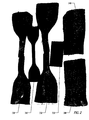
- FIG. 2 is a photograph illustrating test samples of a rubber compound containing EPDM and SSF instead of SAPs.
- Samples 210 and 220 are original sized samples prior to exposure to oil.
- Samples 230 and 240 are samples of the rubber compound originally identical to samples 210 and 220, after exposure to oil, illustrating the amount of volume swell produced by the SSF and EPDM, both of which swell in oil.
- a rubber compound may be formed by mixing both SSF and SAP into the oleophilic base rubber, producing a compound that has the swelling capacity of a conventional hybrid swellable elastomer in fresh water, but which continues to swell in brines because of the SSF.
- SSFs are both oleoscopic and hygroscopic.
- Conventional swellable elastomers for use in water-based fluids typically use a rubber compound based upon an acrylonitrile butadiene rubber (NBR), which has been compounded with hygroscopic polymers, such as SAPs.
- NBR acrylonitrile butadiene rubber
- SAPs hygroscopic polymers
- a hybrid swellable elastomer may be compounded from an NBR-based rubber compound into which is mixed SSF, either with or without SAPs or other hygroscopic polymers.
- the NBR-based rubber compound may include any type of NBR, including carboxylated NBR and hydrogenated NBR.
- the SSF may be compounded with EPDM in a mixture comprising about 100 phr EPDM and about 60 phr SSF, in addition to conventional plasticizing, curing, and vulcanization additives.
- carbon black may be added at about 60 phr.
- HCOONa is added to the compound, about 10 phr HCOONa may be used.
- the SSF may be compounded with NBR in a mixture comprising about 100 phr NBR and about 60 phr SSF, in addition to conventional plasticizing, curing, and vulcanization additives.
- carbon black may be added at about 60 phr.
- HCOONa is added to the compound, about 10 phr HCOONa may be used.
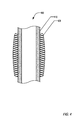
- FIGs. 4 and 5 An example of using the hybrid swellable elastomers described herein on a downhole tool 400, in this example a packer, is schematically illustrated in FIGs. 4 and 5 , where the downhole tool 400 has a central support body or mandrel 410, about which a mantle of the swellable elastomer is disposed to form a sealing element 420.
- the sealing element 420 has a first or initial size as seen in FIG. 4 .
- the shape of the sealing element 420 is illustrative and by way of example only, and the sealing element 420 may have other shapes and configurations for disposing the sealing element 420 on the downhole too l 400 , and other elements not shown in FIG. 4 may be included in the downhole tool 400 as desired.
- the sealing element 420 During run-in of the tool into the wellbore, the sealing element 420 is in its first or initial state which will allow it to be put into the correct place easily. After contact with water or brine, the deployed sealing element will expand or swell to a second shape and volume, which conforms to the wellbore walls 510 of the subterranean formation 520 , as illustrated in FIG. 5 , where the sealing element 420 has a volume greater than the volume illustrated in FIG. 4 , and seals the wellbore.
- the water or brine that causes the sealing element 420 to expand outward may come from the subterranean formation or may be pumped downhole from the surface, as desired or needed.
Landscapes
- Life Sciences & Earth Sciences (AREA)
- General Life Sciences & Earth Sciences (AREA)
- Chemical & Material Sciences (AREA)
- Engineering & Computer Science (AREA)
- Materials Engineering (AREA)
- Organic Chemistry (AREA)
- Geology (AREA)
- Mining & Mineral Resources (AREA)
- Environmental & Geological Engineering (AREA)
- Fluid Mechanics (AREA)
- Physics & Mathematics (AREA)
- Geochemistry & Mineralogy (AREA)
- Sealing Material Composition (AREA)
- Compositions Of Macromolecular Compounds (AREA)
Abstract
Description
- The present invention relates to the field of swellable elastomers, and in particular to a swellable elastomer that includes soy spent flakes.
- In the fields of wellbore construction and intervention, swellable tools are used to provide isolation between two regions in an annulus formed between an exterior surface of a tubular and an interior surface of well casing or a wellbore. A swellable member is formed from an elastomeric material selected to swell when placed in certain fluids. Where the swellable member swells in oil, the member may comprise an oleophilic polymer such as ethylene propylene diene monomer rubber (EPDM). Where the swellable member swells in water, the member may comprise a polymer such as an N-vinylcarboxylic acid amide-base cross-linked resin and a water swellable urethane in an ethylene-propylene rubber matrix.
- Hybrid swellable materials have been developed that swell in both oil and water. Such hybrid swellable materials typically use EPDM or other similar oil-swellable materials mixed with acrylate copolymers, commonly designated as super absorbent polymers (SAPs), that swell in water. Other types of swellable materials have been used, including various clays, salts, and other absorbents. Swellable materials are relatively recent in the oil and gas industry, and no industry standard exists.
- However, SAP-based hybrid swellable materials have vastly different swell rates in fresh and salt water, because of the ionic nature of the SAP. The industry has desired a swellable material that will perform better in salt water conditions. In addition, SAPs have a tendency to extrude from the elastomer matrix, and a material that would reduce extrusion from the elastomer matrix would be desirable.
- A hybrid swellable material employs an oleophilic elastomer as a matrix admixed with an organic material derived from soy that is water swellable in salt water, as well as fresh water. Various downhole tools may be made using this hybrid swellable material.
- According to an aspect of the present invention there is provided an elastomer comprising:
- a base polymer;
- soy spent flakes; and
- a curative,
- wherein the elastomer is swellable responsive to contact with brine.
- The elastomer may comprise a hybrid swellable elastomer, swellable in oil, brine, and a mixture of oil and brine.
- The base polymer may comprise ethylene propylenediene monomer rubber.
- The base polymer may comprise acrylonitrile butadiene rubber.
- The base polymer may comprise hydrogenated acrylonitrile butadiene rubber.
- The base polymer may comprise carboxylated acrylonitrile butadiene rubber.
- The elastomer may comprise:
- about 100 phr base polymer; and
- about 60 phr soy spent flakes.
- The elastomer may further comprise:
- about 10 phr sodium formate.
- The elastomer may further comprise:
- about 50 phr carbon black.
- The elastomer may further comprise:
- a plasticizer.
- The elastomer may further comprises:
- a super absorbent polymer.
- According to another aspect of the invention there is provided a sealing element for a downhole tool, comprising
an elastomer, configured for disposing on the downhole tool, swellable responsive to contact with water, comprising: - a base polymer;
- soy spent flakes; and
- a curative.
- The elastomer may comprise a hybrid swellable elastomer, swellable in oil, water, and a mixture of oil and water.
- The base polymer may comprise ethylene propylene diene monomer rubber.
- The base polymer may comprise acrylonitrile butadiene rubber.
- The base polymer may comprise hydrogenated acrylonitrile butadiene rubber.
- The base polymer may comprise carboxylated acrylonitrile butadiene rubber.
- The elastomer may comprise:
- about 100 phr base polymer; and
- about 60 phr soy spent flakes.
- The elastomer may further comprise:
- about 10 phr sodium formate.
- The elastomer may further comprise:
- about 50 phr carbon black.
- The elastomer may further comprise:
- a plasticizer.
- The elastomer may further comprise:
- a super absorbent polymer.
- According to a further aspect of the present invention there is provided a downhole tool, comprising:
- a body;
- a swellable elastomer, disposed about the body, comprising:
- a base polymer;
- soy spent flakes; and
- a curative,
- wherein the swellable elastomer is swellable responsive to contact with brine.
- The downhole tool may be a well packer.
- The swellable elastomer may also be swellable responsive to contact with oil.
- The base polymer may be ethylene propylene diene monomer.
- The base polymer may be acrylonitrile butadiene rubber.
- The base polymer may comprise hydrogenated acrylonitrile butadiene rubber.
- The base polymer may comprise carboxylated acrylonitrile butadiene rubber.
- The swellable elastomer may comprise:
- about 100 phr base polymer;
- about 60 phr soy spent flakes; and
- about 10 phr sodium formate.
- The swellable elastomer may further comprise:
- about 50 phr carbon black; and
- a plasticizer.
- The accompanying drawings, which are incorporated in and constitute a part of this specification, illustrate an implementation of apparatus and methods consistent with the present invention and, together with the detailed description, serve to explain advantages and principles consistent with the invention. In the drawings,
-
Figure 1 is a graph illustrating elastic modulus of soy spent flakes at ambient temperatures. -
Figure 2 is a photograph illustrating samples of a swellable elastomer in an original state and in a swollen state responsive to contact with oil according to one embodiment. -
Figure 3 is a graph illustrating swellability of a swellable elastomer according to two embodiments. -
Figure 4 is an elevation view illustrating a downhole tool employing a swellable elastomer according to one embodiment. -
Figure 5 is an elevation view illustrating the downhole tool ofFIG. 4 as deployed in a formation. - In the following description, for purposes of explanation, numerous specific details are set forth in order to provide a thorough understanding of the invention. It will be apparent, however, to one skilled in the art that the invention may be practiced without these specific details. In other instances, structure and devices are shown in block diagram form in order to avoid obscuring the invention. References to numbers without subscripts or suffixes are understood to reference all instance of subscripts and suffixes corresponding to the referenced number. Moreover, the language used in this disclosure has been principally selected for readability and instructional purposes, and may not have been selected to delineate or circumscribe the inventive subject matter, resort to the claims being necessary to determine such inventive subject matter. Reference in the specification to "one embodiment" or to "an embodiment" means that a particular feature, structure, or characteristic described in connection with the embodiments is included in at least one embodiment of the invention, and multiple references to "one embodiment" or "an embodiment" should not be understood as necessarily all referring to the same embodiment.
- A new hybrid swelling rubber compound has been discovered that gives improved brine swelling volumes under the same conditions as compared with conventional compounds that use super absorbent polymers as a water-swellable component of a hybrid swellable compound. The rubber compound has been developed for use in downhole applications where the presence of brines would make conventional hybrid rubber compounds less useful because of the reduced swelling of SAPs.
- The "base" polymer may be an oleophilic polymer such as EPDM. Although EPDM swells in oil, EPDM does not swell significantly in water. Therefore, hybrid swellable elastomers for use in both oil and water fluid environments have conventionally used SAPs mixed into a matrix of EPDM to provide water swellability. However, as explained above, SAPs do not swell nearly as much in brine as they do in fresh water. Indeed, additive salts such as sodium formate have been added to SAPs to try to overcome swelling problems in calcium chloride (CaCl2) solutions commonly found in wells.
- By replacing SAPs with an easily available industrial waste material, soy spent flakes (SSF), a hybrid compound may be produced that swells in both oil and brine, and which does not exhibit the same reduction in the amount of swelling in brines as SAPs. Unlike SAPs, SSF is non-ionic and is not affected by divalent ions.
- SSF is a residual material left from processing soy beans, and is a renewable resource with no general market. SSF is mostly a soy carbohydrate fraction in soybean. Soybean can be processed into soybean oil and defatted soy flour. SSF is mostly an insoluble carbohydrate after most of soy protein and soy whey, a soluble carbohydrate, are removed from defatted soy flour. SSF is a by-product or residue in the commercial extraction process of soy protein isolate. It is an abundant and inexpensive renewable material, but it has little commercial value at this time. One source of SSF is the Archer Daniels Midland Company, but other sources of SSF exist and may be used. In addition, SSF may be made from defatted soy flour, which is commercially available from multiple sources, including Archer Daniels Midland Company.
- The composition of SSF is generally considered to be approximately 12% cellulose, 17% pectin, 14% protein, and 53% insoluble polysaccharide, although those percentages may vary. SSF is desirable to be used in the as-is form from the commercial process without further separation so that its cost is comparable to inorganic fillers. SSF has the lowest cost among soy products such as defatted soy flour, soy protein concentrate, and soy proteins isolate (SPI), whereas SPI has the highest cost. Dry SSF is a rigid material and has a shear elastic modulus of ∼4 GPa under ambient conditions as illustrated in the
graph 100 ofFIG. 1 . - Although designated a "spent flake," SSF is typically available in granular form. In one embodiment, the SSF is further ground to a powder form before admixing with the rubber matrix.
- SSF does not swell with a volume of expansion as high in fresh water as does SAP, with SSF expansion amounts typically in the range of 20%-40%, compared to a typical 800% expansion of SAP. In brine containing salts such as sodium chloride (NaCl), the SAP swell drops to approximately 300%. In brine containing salts such as calcium chloride (CaCl2), SAP only swells about 2-3%.SSF swells with a volume of expansion of the same order of magnitude in fresh water, brine with CaCl2, and brine with NaCl. Thus, in brine containing salts such as CaCl2, SSF swells significantly more than SAP.
- SSF can be used as a replacement for SAP in a standard mixing process with the base rubber. As with SAP rubber compounds, commonly known curing agents may be added to the mixture. The SSF does not appear to have any effect on the curing time of the rubber compound when compared to a rubber compound containing SAPs. Unlike some salts that have been used for water absorbency, SSF does not affect the vulcanization of the rubber compound, and do not dissolve out of the rubber, but act as an absorbent. Unlike SAPs, SSF when mixed into rubber compound matrices sticks to the rubber matrix and does not extrude easily.
-
FIG. 2 is a photograph illustrating test samples of a rubber compound containing EPDM and SSF instead of SAPs.Samples Samples samples - In one embodiment, a rubber compound may be formed by mixing both SSF and SAP into the oleophilic base rubber, producing a compound that has the swelling capacity of a conventional hybrid swellable elastomer in fresh water, but which continues to swell in brines because of the SSF.
- Although described above in terms of an additive to an oleophilic rubber such as EPDM to produce a hybrid rubber compound, SSFs are both oleoscopic and hygroscopic. Conventional swellable elastomers for use in water-based fluids typically use a rubber compound based upon an acrylonitrile butadiene rubber (NBR), which has been compounded with hygroscopic polymers, such as SAPs. In one embodiment, a hybrid swellable elastomer may be compounded from an NBR-based rubber compound into which is mixed SSF, either with or without SAPs or other hygroscopic polymers. The NBR-based rubber compound may include any type of NBR, including carboxylated NBR and hydrogenated NBR.
- Other common rubber additives such as carbon black may also be added to the swellable elastomer for reinforcement of the rubber or to provide other desirable properties. In another example, sodium formate salts may also be added to the compound to help draw water into the rubber compound to enhance swelling. As illustrated in the
graph 300 ofFIG 3 , in which material M1 is a rubber compound with EPDM and SSF, while material M2 is a rubber compound with EPDM, SSF, and sodium formate (HCOONa), adding HCOONa to the rubber compound increases volume expansion in both fresh and salt water significantly. As with conventional SAP-containing rubber compounds, other common rubber additives such as antioxidants, plasticizers, curing agents and accelerators, and vulcanization accelerators may be added as desired. - In one embodiment, the SSF may be compounded with EPDM in a mixture comprising about 100 phr EPDM and about 60 phr SSF, in addition to conventional plasticizing, curing, and vulcanization additives. In a further embodiment, carbon black may be added at about 60 phr. In a further embodiment in which HCOONa is added to the compound, about 10 phr HCOONa may be used. These proportions are illustrative and by way of example only, and other proportions may be used.
- In one embodiment, the SSF may be compounded with NBR in a mixture comprising about 100 phr NBR and about 60 phr SSF, in addition to conventional plasticizing, curing, and vulcanization additives. In a further embodiment, carbon black may be added at about 60 phr. In a further embodiment in which HCOONa is added to the compound, about 10 phr HCOONa may be used. These proportions are illustrative and by way of example only, and other proportions may be used. Various embodiments may use hydrogenated NBR (HNBR) or carboxlyated NBR (XNBR) instead of regular NBR as desired to provide improved heat resistance and improved mechanical properties (HNBR) or improved tear and abrasion resistance (XNBR).
- An example of using the hybrid swellable elastomers described herein on a
downhole tool 400, in this example a packer, is schematically illustrated inFIGs.4 and5 , where the downhole tool 400has a central support body ormandrel 410, about which a mantle of the swellable elastomer is disposed to form asealing element 420. The sealingelement 420 has a first or initial size as seen inFIG. 4 . The shape of the sealingelement 420 is illustrative and by way of example only, and the sealingelement 420 may have other shapes and configurations for disposing the sealing element 420on thedownhole tool 400, and other elements not shown inFIG. 4 may be included in the downhole tool400 as desired. - During run-in of the tool into the wellbore, the sealing element 420is in its first or initial state which will allow it to be put into the correct place easily. After contact with water or brine, the deployed sealing element will expand or swell to a second shape and volume, which conforms to the wellbore walls 510of the subterranean formation520, as illustrated in
FIG. 5 , where the sealingelement 420 has a volume greater than the volume illustrated inFIG. 4 , and seals the wellbore. The water or brine that causes the sealing element420to expand outward may come from the subterranean formation or may be pumped downhole from the surface, as desired or needed. - It is to be understood that the above description is intended to be illustrative, and not restrictive. For example, the above-described embodiments may be used in combination with each other. Many other embodiments will be apparent to those of skill in the art upon reviewing the above description. The scope of the invention therefore should be determined with reference to the appended claims, along with the full scope of equivalents to which such claims are entitled. In the appended claims, the terms "including" and "in which" are used as the plain-English equivalents of the respective terms "comprising" and "wherein."
Claims (15)
- An elastomer comprising:a base polymer;soy spent flakes; anda curative,wherein the elastomer is swellable responsive to contact with at least one of water and brine.
- The elastomer of claim 1, wherein the elastomer comprises a hybrid swellable elastomer, swellable in oil, brine, and a mixture of oil and brine.
- The elastomer of claim 1 or 2, wherein the base polymer comprises ethylene propylenediene monomer rubber.
- The elastomer of claim 1, 2 or 3, wherein the base polymer comprises acrylonitrile butadiene rubber.
- The elastomer of claim 1, 2, 3 or 4, wherein the base polymer comprises:(i) hydrogenated acrylonitrile butadiene rubber; or(ii) carboxylated acrylonitrile butadiene rubber.
- The elastomer of any preceding claim, wherein the elastomer comprises:about 100 phr base polymer; andabout 60 phr soy spent flakes.
- The elastomer of any preceding claim, wherein the elastomer further comprises:about 10 phr sodium formate.
- The elastomer of any preceding claim, wherein the elastomer further comprises:about 50 phr carbon black.
- The elastomer of any preceding claim, wherein the elastomer further comprises:a plasticizer.
- The elastomer of any preceding claim, wherein the elastomer further comprises:a super absorbent polymer.
- A sealing element for a downhole tool, comprisingthe elastomer of any preceding claim, configured for disposing on the downhole tool, swellable responsive to contact with water.
- The sealing element of claim 11, wherein the elastomer comprises a hybrid swellable elastomer, swellable in oil, water, and a mixture of oil and water.
- A downhole tool, comprising:a body; anda swellable elastomer as claimed in any of claims 1 to 10, disposed about the body,wherein the swellable elastomer is swellable responsive to contact with brine.
- The downhole tool of claim 13, wherein the downhole tool is a well packer.
- The downhole tool of claim 13 or 14, wherein the swellable elastomer is also swellable responsive to contact with oil.
Applications Claiming Priority (1)
| Application Number | Priority Date | Filing Date | Title |
|---|---|---|---|
| US13/293,779 US8912256B2 (en) | 2011-11-10 | 2011-11-10 | Swellable material using soy spent flakes |
Publications (1)
| Publication Number | Publication Date |
|---|---|
| EP2592129A1 true EP2592129A1 (en) | 2013-05-15 |
Family
ID=47172512
Family Applications (1)
| Application Number | Title | Priority Date | Filing Date |
|---|---|---|---|
| EP12191993.0A Withdrawn EP2592129A1 (en) | 2011-11-10 | 2012-11-09 | Swellable material using soy spent flakes |
Country Status (4)
| Country | Link |
|---|---|
| US (1) | US8912256B2 (en) |
| EP (1) | EP2592129A1 (en) |
| AU (1) | AU2012244200B2 (en) |
| CA (1) | CA2794291C (en) |
Cited By (1)
| Publication number | Priority date | Publication date | Assignee | Title |
|---|---|---|---|---|
| WO2022191825A1 (en) * | 2021-03-08 | 2022-09-15 | Halliburton Energy Services, Inc. | Heat hardening polymer for expandable downhole seals |
Families Citing this family (5)
| Publication number | Priority date | Publication date | Assignee | Title |
|---|---|---|---|---|
| US8887816B2 (en) * | 2011-07-29 | 2014-11-18 | Halliburton Energy Services, Inc. | Polymer compositions for use in downhole tools and components thereof |
| US9482082B2 (en) * | 2013-03-15 | 2016-11-01 | Ormat Technologies Inc. | Method and apparatus for stimulating a geothermal well |
| US9334337B2 (en) | 2014-01-24 | 2016-05-10 | Baker Hughes Incorporated | Enhanced water swellable compositions |
| US9994746B2 (en) | 2016-05-06 | 2018-06-12 | Rl Hudson & Company | Swellable packer seal composition |
| CN114909105B (en) * | 2021-02-08 | 2024-07-12 | 中国石油化工股份有限公司 | Sliding sleeve type packer for nonmetallic oil pipe |
Citations (6)
| Publication number | Priority date | Publication date | Assignee | Title |
|---|---|---|---|---|
| US20060094800A1 (en) * | 2004-10-29 | 2006-05-04 | Lei Jong | Material compositions for reinforcing ionic polymer composites |
| US20080108733A1 (en) * | 2006-11-07 | 2008-05-08 | Cooper Tire & Rubber Co. | Method and formulation for reinforcing elastomers |
| EP2025732A1 (en) * | 2007-07-27 | 2009-02-18 | Services Pétroliers Schlumberger | Self-repairing isolation systems |
| US7527099B2 (en) * | 2003-07-29 | 2009-05-05 | Shell Oil Company | System for sealing a space in a wellbore |
| US20100147507A1 (en) * | 2007-10-01 | 2010-06-17 | Baker Hughes Incorporated | Polymer composition, swellable composition comprising the polymer composition, and articles including the swellable composition |
| US20100326649A1 (en) * | 2009-06-26 | 2010-12-30 | Swelltec Limited | Swellable Oilfield Apparatus and Methods of Forming |
Family Cites Families (5)
| Publication number | Priority date | Publication date | Assignee | Title |
|---|---|---|---|---|
| US7703539B2 (en) | 2006-03-21 | 2010-04-27 | Warren Michael Levy | Expandable downhole tools and methods of using and manufacturing same |
| US8181708B2 (en) | 2007-10-01 | 2012-05-22 | Baker Hughes Incorporated | Water swelling rubber compound for use in reactive packers and other downhole tools |
| US9175237B2 (en) | 2007-12-12 | 2015-11-03 | Chevron Oronite Technology B.V. | Trunk piston engine lubricating oil compositions |
| US20100210770A1 (en) | 2009-02-13 | 2010-08-19 | Jacques Nadeau | Elastomeric composite |
| US8093324B2 (en) | 2010-05-26 | 2012-01-10 | Ford Global Technologies, Llc | Soy-based rubber composition and methods of manufacture and use |
-
2011
- 2011-11-10 US US13/293,779 patent/US8912256B2/en not_active Expired - Fee Related
-
2012
- 2012-10-29 AU AU2012244200A patent/AU2012244200B2/en not_active Ceased
- 2012-11-06 CA CA2794291A patent/CA2794291C/en not_active Expired - Fee Related
- 2012-11-09 EP EP12191993.0A patent/EP2592129A1/en not_active Withdrawn
Patent Citations (6)
| Publication number | Priority date | Publication date | Assignee | Title |
|---|---|---|---|---|
| US7527099B2 (en) * | 2003-07-29 | 2009-05-05 | Shell Oil Company | System for sealing a space in a wellbore |
| US20060094800A1 (en) * | 2004-10-29 | 2006-05-04 | Lei Jong | Material compositions for reinforcing ionic polymer composites |
| US20080108733A1 (en) * | 2006-11-07 | 2008-05-08 | Cooper Tire & Rubber Co. | Method and formulation for reinforcing elastomers |
| EP2025732A1 (en) * | 2007-07-27 | 2009-02-18 | Services Pétroliers Schlumberger | Self-repairing isolation systems |
| US20100147507A1 (en) * | 2007-10-01 | 2010-06-17 | Baker Hughes Incorporated | Polymer composition, swellable composition comprising the polymer composition, and articles including the swellable composition |
| US20100326649A1 (en) * | 2009-06-26 | 2010-12-30 | Swelltec Limited | Swellable Oilfield Apparatus and Methods of Forming |
Non-Patent Citations (2)
| Title |
|---|
| JONG ET AL: "Effect of soy spent flakes and carbon black co-filler in rubber composites", COMPOSITES PART A: APPLIED SCIENCE AND MANUFACTURING, ELSEVIER SCIENCE PUBLISHERS B.V., AMSTERDAM, NL, vol. 38, no. 2, 5 December 2006 (2006-12-05), pages 252 - 264, XP005793898, ISSN: 1359-835X, DOI: 10.1016/J.COMPOSITESA.2006.05.003 * |
| L JONG: "Rubber composites reinforced by soy spent flakes", POLYMER INTERNATIONAL, vol. 54, no. 11, 1 January 2005 (2005-01-01), pages 1572 - 1580, XP055052585, ISSN: 0959-8103, DOI: 10.1002/pi.1886 * |
Cited By (4)
| Publication number | Priority date | Publication date | Assignee | Title |
|---|---|---|---|---|
| WO2022191825A1 (en) * | 2021-03-08 | 2022-09-15 | Halliburton Energy Services, Inc. | Heat hardening polymer for expandable downhole seals |
| GB2616572A (en) * | 2021-03-08 | 2023-09-13 | Halliburton Energy Services Inc | Heat hardening polymer for expandable downhole seals |
| US12037868B2 (en) | 2021-03-08 | 2024-07-16 | Halliburton Energy Services, Inc. | Heat hardening polymer for expandable downhole seals |
| GB2616572B (en) * | 2021-03-08 | 2025-03-19 | Halliburton Energy Services Inc | Heat hardening polymer for expandable downhole seal |
Also Published As
| Publication number | Publication date |
|---|---|
| AU2012244200B2 (en) | 2014-04-24 |
| US20130123394A1 (en) | 2013-05-16 |
| AU2012244200A1 (en) | 2013-05-30 |
| CA2794291A1 (en) | 2013-05-10 |
| US8912256B2 (en) | 2014-12-16 |
| CA2794291C (en) | 2016-06-28 |
Similar Documents
| Publication | Publication Date | Title |
|---|---|---|
| US8181708B2 (en) | Water swelling rubber compound for use in reactive packers and other downhole tools | |
| AU2012244200B2 (en) | Swellable material using soy spent flakes | |
| WO2010039131A1 (en) | Water swelling rubber compound for use in reactive packers and other downhole tools | |
| US9702217B2 (en) | Swellable sealing systems and methods for increasing swelling efficiency | |
| AU2012238218B2 (en) | Enhanced Oilfield Swellable Elastomers and Methods for Making and Using Same | |
| US10179873B1 (en) | Water swellable rubber composition suitable for use with oil field equipment | |
| US20170015824A1 (en) | Swellable rubber compositions | |
| WO2014052238A1 (en) | High water and brine swell elastomeric compositions and method for making and using same | |
| CA2980722A1 (en) | Controlled degradation of elastomers and use in oilfield applications | |
| WO2004076808A1 (en) | Compositions and methods of cementing in subterranean formations using a swelling agent to inhibit the influx of water into a cement slurry | |
| NO346607B1 (en) | Oil field apparatus and method comprising swellable elastomers | |
| US20240318059A1 (en) | Self-healing water-swellable hydraulic seal | |
| CN105860179B (en) | Rubber seal productses and its preparation method and application | |
| EP3068841B1 (en) | Swellable seals and their use | |
| US20140083703A1 (en) | Triggerable Lost Circulation Material and Method of Use | |
| CN104672524B (en) | A kind of hydro-expansive rubber | |
| CN113896969A (en) | High-strength salt-resistant water-swelling elastomer and preparation method thereof | |
| RU2765950C1 (en) | Rubber mixture for making oil-swelling products | |
| CN110804427B (en) | Degradable temporary plugging material for low-pressure gas well killing and preparation method thereof | |
| US9994746B2 (en) | Swellable packer seal composition | |
| CN111574762A (en) | Preparation method of filling-free self-adaptive sand control material | |
| EP3164455A1 (en) | Improved high temperature mechanical properties of elastomers with semi-crystalline polymers for downhole applications |
Legal Events
| Date | Code | Title | Description |
|---|---|---|---|
| PUAI | Public reference made under article 153(3) epc to a published international application that has entered the european phase |
Free format text: ORIGINAL CODE: 0009012 |
|
| 17P | Request for examination filed |
Effective date: 20121109 |
|
| AK | Designated contracting states |
Kind code of ref document: A1 Designated state(s): AL AT BE BG CH CY CZ DE DK EE ES FI FR GB GR HR HU IE IS IT LI LT LU LV MC MK MT NL NO PL PT RO RS SE SI SK SM TR |
|
| AX | Request for extension of the european patent |
Extension state: BA ME |
|
| RAP1 | Party data changed (applicant data changed or rights of an application transferred) |
Owner name: WEATHERFORD/LAMB, INC. |
|
| RAP1 | Party data changed (applicant data changed or rights of an application transferred) |
Owner name: WEATHERFORD TECHNOLOGY HOLDINGS, LLC |
|
| 17Q | First examination report despatched |
Effective date: 20160211 |
|
| GRAP | Despatch of communication of intention to grant a patent |
Free format text: ORIGINAL CODE: EPIDOSNIGR1 |
|
| INTG | Intention to grant announced |
Effective date: 20161104 |
|
| STAA | Information on the status of an ep patent application or granted ep patent |
Free format text: STATUS: THE APPLICATION IS DEEMED TO BE WITHDRAWN |
|
| 18D | Application deemed to be withdrawn |
Effective date: 20170315 |