EP2590982B1 - Protein kinase inhibitors and methods of treatment - Google Patents
Protein kinase inhibitors and methods of treatment Download PDFInfo
- Publication number
- EP2590982B1 EP2590982B1 EP11803020.4A EP11803020A EP2590982B1 EP 2590982 B1 EP2590982 B1 EP 2590982B1 EP 11803020 A EP11803020 A EP 11803020A EP 2590982 B1 EP2590982 B1 EP 2590982B1
- Authority
- EP
- European Patent Office
- Prior art keywords
- compound
- mmol
- lcms
- esi
- nmr
- Prior art date
- Legal status (The legal status is an assumption and is not a legal conclusion. Google has not performed a legal analysis and makes no representation as to the accuracy of the status listed.)
- Not-in-force
Links
- 238000011282 treatment Methods 0.000 title claims description 23
- 238000000034 method Methods 0.000 title description 69
- 229940045988 antineoplastic drug protein kinase inhibitors Drugs 0.000 title 1
- 239000003909 protein kinase inhibitor Substances 0.000 title 1
- 150000001875 compounds Chemical class 0.000 claims description 226
- 150000003839 salts Chemical class 0.000 claims description 22
- 206010028980 Neoplasm Diseases 0.000 claims description 18
- 206010009944 Colon cancer Diseases 0.000 claims description 7
- 208000029742 colonic neoplasm Diseases 0.000 claims description 7
- 239000008194 pharmaceutical composition Substances 0.000 claims description 5
- 239000003085 diluting agent Substances 0.000 claims description 4
- 206010006187 Breast cancer Diseases 0.000 claims description 3
- 208000026310 Breast neoplasm Diseases 0.000 claims description 3
- 201000001320 Atherosclerosis Diseases 0.000 claims description 2
- 208000011231 Crohn disease Diseases 0.000 claims description 2
- 208000008839 Kidney Neoplasms Diseases 0.000 claims description 2
- 206010061535 Ovarian neoplasm Diseases 0.000 claims description 2
- 208000000236 Prostatic Neoplasms Diseases 0.000 claims description 2
- 201000004681 Psoriasis Diseases 0.000 claims description 2
- 208000000453 Skin Neoplasms Diseases 0.000 claims description 2
- 206010052779 Transplant rejections Diseases 0.000 claims description 2
- 230000001154 acute effect Effects 0.000 claims description 2
- 239000002671 adjuvant Substances 0.000 claims description 2
- 210000000481 breast Anatomy 0.000 claims description 2
- 210000003169 central nervous system Anatomy 0.000 claims description 2
- 201000007455 central nervous system cancer Diseases 0.000 claims description 2
- 230000001684 chronic effect Effects 0.000 claims description 2
- 210000001072 colon Anatomy 0.000 claims description 2
- 230000007365 immunoregulation Effects 0.000 claims description 2
- 208000032839 leukemia Diseases 0.000 claims description 2
- 210000004072 lung Anatomy 0.000 claims description 2
- 208000020816 lung neoplasm Diseases 0.000 claims description 2
- 201000001441 melanoma Diseases 0.000 claims description 2
- 230000002611 ovarian Effects 0.000 claims description 2
- 210000002307 prostate Anatomy 0.000 claims description 2
- 210000003491 skin Anatomy 0.000 claims description 2
- 206010058467 Lung neoplasm malignant Diseases 0.000 claims 1
- 206010033128 Ovarian cancer Diseases 0.000 claims 1
- 206010060862 Prostate cancer Diseases 0.000 claims 1
- 206010038389 Renal cancer Diseases 0.000 claims 1
- 230000004968 inflammatory condition Effects 0.000 claims 1
- 201000010982 kidney cancer Diseases 0.000 claims 1
- 201000005202 lung cancer Diseases 0.000 claims 1
- 206010039073 rheumatoid arthritis Diseases 0.000 claims 1
- 201000000849 skin cancer Diseases 0.000 claims 1
- YMWUJEATGCHHMB-UHFFFAOYSA-N Dichloromethane Chemical compound ClCCl YMWUJEATGCHHMB-UHFFFAOYSA-N 0.000 description 231
- HEDRZPFGACZZDS-MICDWDOJSA-N Trichloro(2H)methane Chemical compound [2H]C(Cl)(Cl)Cl HEDRZPFGACZZDS-MICDWDOJSA-N 0.000 description 170
- OKKJLVBELUTLKV-UHFFFAOYSA-N Methanol Chemical compound OC OKKJLVBELUTLKV-UHFFFAOYSA-N 0.000 description 160
- 238000004895 liquid chromatography mass spectrometry Methods 0.000 description 118
- XEKOWRVHYACXOJ-UHFFFAOYSA-N Ethyl acetate Chemical compound CCOC(C)=O XEKOWRVHYACXOJ-UHFFFAOYSA-N 0.000 description 89
- 239000007787 solid Substances 0.000 description 89
- 238000005160 1H NMR spectroscopy Methods 0.000 description 88
- 239000000203 mixture Substances 0.000 description 78
- 239000000243 solution Substances 0.000 description 74
- 238000006243 chemical reaction Methods 0.000 description 68
- XLYOFNOQVPJJNP-UHFFFAOYSA-N water Substances O XLYOFNOQVPJJNP-UHFFFAOYSA-N 0.000 description 68
- VYPSYNLAJGMNEJ-UHFFFAOYSA-N Silicium dioxide Chemical compound O=[Si]=O VYPSYNLAJGMNEJ-UHFFFAOYSA-N 0.000 description 53
- PMZURENOXWZQFD-UHFFFAOYSA-L Sodium Sulfate Chemical compound [Na+].[Na+].[O-]S([O-])(=O)=O PMZURENOXWZQFD-UHFFFAOYSA-L 0.000 description 43
- ZMANZCXQSJIPKH-UHFFFAOYSA-N Triethylamine Chemical compound CCN(CC)CC ZMANZCXQSJIPKH-UHFFFAOYSA-N 0.000 description 43
- WEVYAHXRMPXWCK-UHFFFAOYSA-N Acetonitrile Chemical compound CC#N WEVYAHXRMPXWCK-UHFFFAOYSA-N 0.000 description 39
- 235000019439 ethyl acetate Nutrition 0.000 description 34
- 239000012044 organic layer Substances 0.000 description 33
- 229910052938 sodium sulfate Inorganic materials 0.000 description 33
- 239000003921 oil Substances 0.000 description 32
- LFQSCWFLJHTTHZ-UHFFFAOYSA-N Ethanol Chemical compound CCO LFQSCWFLJHTTHZ-UHFFFAOYSA-N 0.000 description 31
- 235000019198 oils Nutrition 0.000 description 31
- ZMXDDKWLCZADIW-UHFFFAOYSA-N N,N-Dimethylformamide Chemical compound CN(C)C=O ZMXDDKWLCZADIW-UHFFFAOYSA-N 0.000 description 27
- 239000011541 reaction mixture Substances 0.000 description 27
- VEXZGXHMUGYJMC-UHFFFAOYSA-N Hydrochloric acid Chemical compound Cl VEXZGXHMUGYJMC-UHFFFAOYSA-N 0.000 description 25
- UIIMBOGNXHQVGW-UHFFFAOYSA-M Sodium bicarbonate Chemical class [Na+].OC([O-])=O UIIMBOGNXHQVGW-UHFFFAOYSA-M 0.000 description 25
- RTZKZFJDLAIYFH-UHFFFAOYSA-N Diethyl ether Chemical compound CCOCC RTZKZFJDLAIYFH-UHFFFAOYSA-N 0.000 description 24
- -1 n-propenyl Chemical group 0.000 description 24
- CSCPPACGZOOCGX-UHFFFAOYSA-N Acetone Chemical compound CC(C)=O CSCPPACGZOOCGX-UHFFFAOYSA-N 0.000 description 23
- 125000001072 heteroaryl group Chemical group 0.000 description 23
- 239000000377 silicon dioxide Substances 0.000 description 23
- 229910052681 coesite Inorganic materials 0.000 description 22
- 229910052906 cristobalite Inorganic materials 0.000 description 22
- 229910052682 stishovite Inorganic materials 0.000 description 22
- 229910052905 tridymite Inorganic materials 0.000 description 22
- IAZDPXIOMUYVGZ-UHFFFAOYSA-N Dimethylsulphoxide Chemical compound CS(C)=O IAZDPXIOMUYVGZ-UHFFFAOYSA-N 0.000 description 21
- 229940093499 ethyl acetate Drugs 0.000 description 21
- 125000003118 aryl group Chemical group 0.000 description 20
- 210000004027 cell Anatomy 0.000 description 20
- BWHMMNNQKKPAPP-UHFFFAOYSA-L potassium carbonate Chemical compound [K+].[K+].[O-]C([O-])=O BWHMMNNQKKPAPP-UHFFFAOYSA-L 0.000 description 20
- 238000003818 flash chromatography Methods 0.000 description 19
- 125000000623 heterocyclic group Chemical group 0.000 description 19
- 239000000047 product Substances 0.000 description 19
- QTBSBXVTEAMEQO-UHFFFAOYSA-N Acetic acid Chemical compound CC(O)=O QTBSBXVTEAMEQO-UHFFFAOYSA-N 0.000 description 18
- YXFVVABEGXRONW-UHFFFAOYSA-N Toluene Chemical compound CC1=CC=CC=C1 YXFVVABEGXRONW-UHFFFAOYSA-N 0.000 description 18
- 239000012267 brine Substances 0.000 description 18
- 239000010410 layer Substances 0.000 description 18
- HPALAKNZSZLMCH-UHFFFAOYSA-M sodium;chloride;hydrate Chemical compound O.[Na+].[Cl-] HPALAKNZSZLMCH-UHFFFAOYSA-M 0.000 description 18
- 102000009076 src-Family Kinases Human genes 0.000 description 18
- 108010087686 src-Family Kinases Proteins 0.000 description 18
- 239000007832 Na2SO4 Substances 0.000 description 17
- 125000001997 phenyl group Chemical group [H]C1=C([H])C([H])=C(*)C([H])=C1[H] 0.000 description 17
- IJGRMHOSHXDMSA-UHFFFAOYSA-N Atomic nitrogen Chemical group N#N IJGRMHOSHXDMSA-UHFFFAOYSA-N 0.000 description 16
- WYURNTSHIVDZCO-UHFFFAOYSA-N Tetrahydrofuran Chemical compound C1CCOC1 WYURNTSHIVDZCO-UHFFFAOYSA-N 0.000 description 16
- 239000003795 chemical substances by application Substances 0.000 description 16
- IXCSERBJSXMMFS-UHFFFAOYSA-N hydrogen chloride Substances Cl.Cl IXCSERBJSXMMFS-UHFFFAOYSA-N 0.000 description 16
- 229910000041 hydrogen chloride Inorganic materials 0.000 description 16
- 235000011152 sodium sulphate Nutrition 0.000 description 16
- 0 CIc1n[n](C(*)(*)CN(*)*)c2ncnc(N)c12 Chemical compound CIc1n[n](C(*)(*)CN(*)*)c2ncnc(N)c12 0.000 description 15
- HEMHJVSKTPXQMS-UHFFFAOYSA-M Sodium hydroxide Chemical compound [OH-].[Na+] HEMHJVSKTPXQMS-UHFFFAOYSA-M 0.000 description 15
- 125000000217 alkyl group Chemical group 0.000 description 15
- 125000000753 cycloalkyl group Chemical group 0.000 description 15
- 239000003112 inhibitor Substances 0.000 description 15
- 239000004480 active ingredient Substances 0.000 description 14
- 239000007864 aqueous solution Substances 0.000 description 14
- 125000004432 carbon atom Chemical group C* 0.000 description 14
- 239000001257 hydrogen Substances 0.000 description 14
- 229910052739 hydrogen Inorganic materials 0.000 description 14
- 239000000843 powder Substances 0.000 description 14
- 238000000746 purification Methods 0.000 description 14
- 238000002360 preparation method Methods 0.000 description 13
- 239000002904 solvent Substances 0.000 description 13
- VHYFNPMBLIVWCW-UHFFFAOYSA-N 4-Dimethylaminopyridine Chemical compound CN(C)C1=CC=NC=C1 VHYFNPMBLIVWCW-UHFFFAOYSA-N 0.000 description 12
- KFZMGEQAYNKOFK-UHFFFAOYSA-N Isopropanol Chemical compound CC(C)O KFZMGEQAYNKOFK-UHFFFAOYSA-N 0.000 description 12
- 239000002585 base Substances 0.000 description 12
- 208000037265 diseases, disorders, signs and symptoms Diseases 0.000 description 12
- 238000001914 filtration Methods 0.000 description 11
- 239000006071 cream Substances 0.000 description 10
- KDLHZDBZIXYQEI-UHFFFAOYSA-N palladium Substances [Pd] KDLHZDBZIXYQEI-UHFFFAOYSA-N 0.000 description 10
- 229910000027 potassium carbonate Inorganic materials 0.000 description 10
- DTQVDTLACAAQTR-UHFFFAOYSA-N trifluoroacetic acid Substances OC(=O)C(F)(F)F DTQVDTLACAAQTR-UHFFFAOYSA-N 0.000 description 10
- 238000001644 13C nuclear magnetic resonance spectroscopy Methods 0.000 description 9
- WFDIJRYMOXRFFG-UHFFFAOYSA-N Acetic anhydride Chemical compound CC(=O)OC(C)=O WFDIJRYMOXRFFG-UHFFFAOYSA-N 0.000 description 9
- CSNNHWWHGAXBCP-UHFFFAOYSA-L Magnesium sulfate Chemical compound [Mg+2].[O-][S+2]([O-])([O-])[O-] CSNNHWWHGAXBCP-UHFFFAOYSA-L 0.000 description 9
- XPOLVIIHTDKJRY-UHFFFAOYSA-N acetic acid;methanimidamide Chemical compound NC=N.CC(O)=O XPOLVIIHTDKJRY-UHFFFAOYSA-N 0.000 description 9
- 238000003556 assay Methods 0.000 description 9
- KRKNYBCHXYNGOX-UHFFFAOYSA-N citric acid Chemical compound OC(=O)CC(O)(C(O)=O)CC(O)=O KRKNYBCHXYNGOX-UHFFFAOYSA-N 0.000 description 9
- 239000012043 crude product Substances 0.000 description 9
- 201000010099 disease Diseases 0.000 description 9
- 125000002887 hydroxy group Chemical group [H]O* 0.000 description 9
- 239000002244 precipitate Substances 0.000 description 9
- 238000002953 preparative HPLC Methods 0.000 description 9
- IAZDPXIOMUYVGZ-WFGJKAKNSA-N Dimethyl sulfoxide Chemical compound [2H]C([2H])([2H])S(=O)C([2H])([2H])[2H] IAZDPXIOMUYVGZ-WFGJKAKNSA-N 0.000 description 8
- CPELXLSAUQHCOX-UHFFFAOYSA-N Hydrogen bromide Chemical compound Br CPELXLSAUQHCOX-UHFFFAOYSA-N 0.000 description 8
- 102000004022 Protein-Tyrosine Kinases Human genes 0.000 description 8
- 108090000412 Protein-Tyrosine Kinases Proteins 0.000 description 8
- JUJWROOIHBZHMG-UHFFFAOYSA-N Pyridine Chemical compound C1=CC=NC=C1 JUJWROOIHBZHMG-UHFFFAOYSA-N 0.000 description 8
- 230000037396 body weight Effects 0.000 description 8
- 238000010511 deprotection reaction Methods 0.000 description 8
- 230000000694 effects Effects 0.000 description 8
- 125000004435 hydrogen atom Chemical class [H]* 0.000 description 8
- 229910052757 nitrogen Inorganic materials 0.000 description 8
- 150000003141 primary amines Chemical class 0.000 description 8
- 229910000030 sodium bicarbonate Inorganic materials 0.000 description 8
- 239000007858 starting material Substances 0.000 description 8
- 238000003756 stirring Methods 0.000 description 8
- 125000003107 substituted aryl group Chemical group 0.000 description 8
- UFHFLCQGNIYNRP-UHFFFAOYSA-N Hydrogen Chemical compound [H][H] UFHFLCQGNIYNRP-UHFFFAOYSA-N 0.000 description 7
- 229960000583 acetic acid Drugs 0.000 description 7
- 125000005843 halogen group Chemical group 0.000 description 7
- 239000007788 liquid Substances 0.000 description 7
- OKKJLVBELUTLKV-VMNATFBRSA-N methanol-d1 Chemical compound [2H]OC OKKJLVBELUTLKV-VMNATFBRSA-N 0.000 description 7
- 239000011734 sodium Substances 0.000 description 7
- 239000000725 suspension Substances 0.000 description 7
- 238000003786 synthesis reaction Methods 0.000 description 7
- 125000004178 (C1-C4) alkyl group Chemical group 0.000 description 6
- LMDZBCPBFSXMTL-UHFFFAOYSA-N 1-Ethyl-3-(3-dimethylaminopropyl)carbodiimide Substances CCN=C=NCCCN(C)C LMDZBCPBFSXMTL-UHFFFAOYSA-N 0.000 description 6
- 102000004190 Enzymes Human genes 0.000 description 6
- 108090000790 Enzymes Proteins 0.000 description 6
- ZHNUHDYFZUAESO-UHFFFAOYSA-N Formamide Chemical compound NC=O ZHNUHDYFZUAESO-UHFFFAOYSA-N 0.000 description 6
- WMFOQBRAJBCJND-UHFFFAOYSA-M Lithium hydroxide Chemical compound [Li+].[OH-] WMFOQBRAJBCJND-UHFFFAOYSA-M 0.000 description 6
- FAPWRFPIFSIZLT-UHFFFAOYSA-M Sodium chloride Chemical compound [Na+].[Cl-] FAPWRFPIFSIZLT-UHFFFAOYSA-M 0.000 description 6
- 239000002253 acid Substances 0.000 description 6
- 125000002252 acyl group Chemical group 0.000 description 6
- 239000008346 aqueous phase Substances 0.000 description 6
- 125000004104 aryloxy group Chemical group 0.000 description 6
- WPYMKLBDIGXBTP-UHFFFAOYSA-N benzoic acid group Chemical group C(C1=CC=CC=C1)(=O)O WPYMKLBDIGXBTP-UHFFFAOYSA-N 0.000 description 6
- 230000015572 biosynthetic process Effects 0.000 description 6
- 239000000969 carrier Substances 0.000 description 6
- 230000004663 cell proliferation Effects 0.000 description 6
- 238000004440 column chromatography Methods 0.000 description 6
- 239000013078 crystal Substances 0.000 description 6
- 125000004093 cyano group Chemical group *C#N 0.000 description 6
- 239000000706 filtrate Substances 0.000 description 6
- 238000004519 manufacturing process Methods 0.000 description 6
- 239000012074 organic phase Substances 0.000 description 6
- SIOXPEMLGUPBBT-UHFFFAOYSA-N picolinic acid Chemical compound OC(=O)C1=CC=CC=N1 SIOXPEMLGUPBBT-UHFFFAOYSA-N 0.000 description 6
- 125000002924 primary amino group Chemical group [H]N([H])* 0.000 description 6
- 230000008569 process Effects 0.000 description 6
- 238000010992 reflux Methods 0.000 description 6
- 229920006395 saturated elastomer Polymers 0.000 description 6
- 239000003826 tablet Substances 0.000 description 6
- XNWFRZJHXBZDAG-UHFFFAOYSA-N 2-METHOXYETHANOL Chemical compound COCCO XNWFRZJHXBZDAG-UHFFFAOYSA-N 0.000 description 5
- OAKJQQAXSVQMHS-UHFFFAOYSA-N Hydrazine Chemical compound NN OAKJQQAXSVQMHS-UHFFFAOYSA-N 0.000 description 5
- DGAQECJNVWCQMB-PUAWFVPOSA-M Ilexoside XXIX Chemical compound C[C@@H]1CC[C@@]2(CC[C@@]3(C(=CC[C@H]4[C@]3(CC[C@@H]5[C@@]4(CC[C@@H](C5(C)C)OS(=O)(=O)[O-])C)C)[C@@H]2[C@]1(C)O)C)C(=O)O[C@H]6[C@@H]([C@H]([C@@H]([C@H](O6)CO)O)O)O.[Na+] DGAQECJNVWCQMB-PUAWFVPOSA-M 0.000 description 5
- 229910019142 PO4 Inorganic materials 0.000 description 5
- 125000002947 alkylene group Chemical group 0.000 description 5
- 150000001412 amines Chemical class 0.000 description 5
- 230000002401 inhibitory effect Effects 0.000 description 5
- 229960004592 isopropanol Drugs 0.000 description 5
- 229910052760 oxygen Inorganic materials 0.000 description 5
- 239000010452 phosphate Substances 0.000 description 5
- 235000015424 sodium Nutrition 0.000 description 5
- 229940083542 sodium Drugs 0.000 description 5
- 229910052708 sodium Inorganic materials 0.000 description 5
- 125000001424 substituent group Chemical group 0.000 description 5
- 125000004953 trihalomethyl group Chemical group 0.000 description 5
- 125000006273 (C1-C3) alkyl group Chemical group 0.000 description 4
- RYHBNJHYFVUHQT-UHFFFAOYSA-N 1,4-Dioxane Chemical compound C1COCCO1 RYHBNJHYFVUHQT-UHFFFAOYSA-N 0.000 description 4
- 125000000882 C2-C6 alkenyl group Chemical group 0.000 description 4
- OKTJSMMVPCPJKN-UHFFFAOYSA-N Carbon Chemical compound [C] OKTJSMMVPCPJKN-UHFFFAOYSA-N 0.000 description 4
- ZBNZXTGUTAYRHI-UHFFFAOYSA-N Dasatinib Chemical compound C=1C(N2CCN(CCO)CC2)=NC(C)=NC=1NC(S1)=NC=C1C(=O)NC1=C(C)C=CC=C1Cl ZBNZXTGUTAYRHI-UHFFFAOYSA-N 0.000 description 4
- PEDCQBHIVMGVHV-UHFFFAOYSA-N Glycerine Chemical compound OCC(O)CO PEDCQBHIVMGVHV-UHFFFAOYSA-N 0.000 description 4
- 238000005481 NMR spectroscopy Methods 0.000 description 4
- CDBYLPFSWZWCQE-UHFFFAOYSA-L Sodium Carbonate Chemical compound [Na+].[Na+].[O-]C([O-])=O CDBYLPFSWZWCQE-UHFFFAOYSA-L 0.000 description 4
- WGLPBDUCMAPZCE-UHFFFAOYSA-N Trioxochromium Chemical compound O=[Cr](=O)=O WGLPBDUCMAPZCE-UHFFFAOYSA-N 0.000 description 4
- 125000003342 alkenyl group Chemical group 0.000 description 4
- 125000003545 alkoxy group Chemical group 0.000 description 4
- 125000000304 alkynyl group Chemical group 0.000 description 4
- 239000012911 assay medium Substances 0.000 description 4
- QVGXLLKOCUKJST-UHFFFAOYSA-N atomic oxygen Chemical group [O] QVGXLLKOCUKJST-UHFFFAOYSA-N 0.000 description 4
- 201000011510 cancer Diseases 0.000 description 4
- 229910052799 carbon Inorganic materials 0.000 description 4
- 125000003178 carboxy group Chemical group [H]OC(*)=O 0.000 description 4
- 230000001413 cellular effect Effects 0.000 description 4
- 239000007789 gas Substances 0.000 description 4
- 238000010438 heat treatment Methods 0.000 description 4
- 125000005842 heteroatom Chemical group 0.000 description 4
- 239000000543 intermediate Substances 0.000 description 4
- 229910052943 magnesium sulfate Inorganic materials 0.000 description 4
- 125000002496 methyl group Chemical group [H]C([H])([H])* 0.000 description 4
- 150000007522 mineralic acids Chemical class 0.000 description 4
- OWIUPIRUAQMTTK-UHFFFAOYSA-M n-aminocarbamate Chemical compound NNC([O-])=O OWIUPIRUAQMTTK-UHFFFAOYSA-M 0.000 description 4
- QJGQUHMNIGDVPM-UHFFFAOYSA-N nitrogen group Chemical group [N] QJGQUHMNIGDVPM-UHFFFAOYSA-N 0.000 description 4
- 239000001301 oxygen Substances 0.000 description 4
- 239000003208 petroleum Substances 0.000 description 4
- NBIIXXVUZAFLBC-UHFFFAOYSA-K phosphate Chemical compound [O-]P([O-])([O-])=O NBIIXXVUZAFLBC-UHFFFAOYSA-K 0.000 description 4
- 125000006239 protecting group Chemical group 0.000 description 4
- UMJSCPRVCHMLSP-UHFFFAOYSA-N pyridine Natural products COC1=CC=CN=C1 UMJSCPRVCHMLSP-UHFFFAOYSA-N 0.000 description 4
- 239000000758 substrate Substances 0.000 description 4
- 229910052717 sulfur Inorganic materials 0.000 description 4
- JOXIMZWYDAKGHI-UHFFFAOYSA-N toluene-4-sulfonic acid Chemical compound CC1=CC=C(S(O)(=O)=O)C=C1 JOXIMZWYDAKGHI-UHFFFAOYSA-N 0.000 description 4
- 125000004665 trialkylsilyl group Chemical group 0.000 description 4
- ONDSBJMLAHVLMI-UHFFFAOYSA-N trimethylsilyldiazomethane Chemical compound C[Si](C)(C)[CH-][N+]#N ONDSBJMLAHVLMI-UHFFFAOYSA-N 0.000 description 4
- NAWXUBYGYWOOIX-SFHVURJKSA-N (2s)-2-[[4-[2-(2,4-diaminoquinazolin-6-yl)ethyl]benzoyl]amino]-4-methylidenepentanedioic acid Chemical compound C1=CC2=NC(N)=NC(N)=C2C=C1CCC1=CC=C(C(=O)N[C@@H](CC(=C)C(O)=O)C(O)=O)C=C1 NAWXUBYGYWOOIX-SFHVURJKSA-N 0.000 description 3
- 125000004169 (C1-C6) alkyl group Chemical group 0.000 description 3
- 125000004209 (C1-C8) alkyl group Chemical group 0.000 description 3
- VXMMUDFDTWWSQT-UHFFFAOYSA-N 2-methyl-1-nitroprop-1-ene Chemical group CC(C)=C[N+]([O-])=O VXMMUDFDTWWSQT-UHFFFAOYSA-N 0.000 description 3
- RPHHYRNGCJYQSP-UHFFFAOYSA-N 4-bromopyridine-2-carboxylic acid Chemical compound OC(=O)C1=CC(Br)=CC=N1 RPHHYRNGCJYQSP-UHFFFAOYSA-N 0.000 description 3
- NLXLAEXVIDQMFP-UHFFFAOYSA-N Ammonia chloride Chemical class [NH4+].[Cl-] NLXLAEXVIDQMFP-UHFFFAOYSA-N 0.000 description 3
- 239000005711 Benzoic acid Substances 0.000 description 3
- WVDDGKGOMKODPV-UHFFFAOYSA-N Benzyl alcohol Chemical compound OCC1=CC=CC=C1 WVDDGKGOMKODPV-UHFFFAOYSA-N 0.000 description 3
- 125000003320 C2-C6 alkenyloxy group Chemical group 0.000 description 3
- WSFSSNUMVMOOMR-UHFFFAOYSA-N Formaldehyde Chemical compound O=C WSFSSNUMVMOOMR-UHFFFAOYSA-N 0.000 description 3
- 239000002067 L01XE06 - Dasatinib Substances 0.000 description 3
- LRHPLDYGYMQRHN-UHFFFAOYSA-N N-Butanol Chemical compound CCCCO LRHPLDYGYMQRHN-UHFFFAOYSA-N 0.000 description 3
- 108091000080 Phosphotransferase Proteins 0.000 description 3
- DNIAPMSPPWPWGF-UHFFFAOYSA-N Propylene glycol Chemical compound CC(O)CO DNIAPMSPPWPWGF-UHFFFAOYSA-N 0.000 description 3
- 102000038012 SFKs Human genes 0.000 description 3
- 108091008118 SFKs Proteins 0.000 description 3
- 229930006000 Sucrose Natural products 0.000 description 3
- CZMRCDWAGMRECN-UGDNZRGBSA-N Sucrose Chemical compound O[C@H]1[C@H](O)[C@@H](CO)O[C@@]1(CO)O[C@@H]1[C@H](O)[C@@H](O)[C@H](O)[C@@H](CO)O1 CZMRCDWAGMRECN-UGDNZRGBSA-N 0.000 description 3
- NINIDFKCEFEMDL-UHFFFAOYSA-N Sulfur Chemical group [S] NINIDFKCEFEMDL-UHFFFAOYSA-N 0.000 description 3
- 230000002378 acidificating effect Effects 0.000 description 3
- 125000000266 alpha-aminoacyl group Chemical group 0.000 description 3
- 239000011324 bead Substances 0.000 description 3
- 239000003054 catalyst Substances 0.000 description 3
- 238000002648 combination therapy Methods 0.000 description 3
- 125000004122 cyclic group Chemical group 0.000 description 3
- 125000000392 cycloalkenyl group Chemical group 0.000 description 3
- 125000000000 cycloalkoxy group Chemical group 0.000 description 3
- 229960002448 dasatinib Drugs 0.000 description 3
- 208000035475 disorder Diseases 0.000 description 3
- 239000003814 drug Substances 0.000 description 3
- 125000001495 ethyl group Chemical group [H]C([H])([H])C([H])([H])* 0.000 description 3
- 125000000524 functional group Chemical group 0.000 description 3
- 239000012362 glacial acetic acid Substances 0.000 description 3
- 239000008187 granular material Substances 0.000 description 3
- 125000005553 heteroaryloxy group Chemical group 0.000 description 3
- 125000005844 heterocyclyloxy group Chemical group 0.000 description 3
- 238000011534 incubation Methods 0.000 description 3
- 239000004615 ingredient Substances 0.000 description 3
- 235000019341 magnesium sulphate Nutrition 0.000 description 3
- 230000007246 mechanism Effects 0.000 description 3
- 230000000269 nucleophilic effect Effects 0.000 description 3
- 150000007524 organic acids Chemical class 0.000 description 3
- 239000011368 organic material Substances 0.000 description 3
- 239000006072 paste Substances 0.000 description 3
- WLJVXDMOQOGPHL-UHFFFAOYSA-N phenylacetic acid Chemical compound OC(=O)CC1=CC=CC=C1 WLJVXDMOQOGPHL-UHFFFAOYSA-N 0.000 description 3
- 102000020233 phosphotransferase Human genes 0.000 description 3
- 229940081066 picolinic acid Drugs 0.000 description 3
- 239000002798 polar solvent Substances 0.000 description 3
- 230000003389 potentiating effect Effects 0.000 description 3
- 239000003755 preservative agent Substances 0.000 description 3
- 230000002062 proliferating effect Effects 0.000 description 3
- 230000035755 proliferation Effects 0.000 description 3
- 230000009467 reduction Effects 0.000 description 3
- 239000000741 silica gel Substances 0.000 description 3
- 229910002027 silica gel Inorganic materials 0.000 description 3
- 235000017557 sodium bicarbonate Nutrition 0.000 description 3
- 239000011780 sodium chloride Substances 0.000 description 3
- 125000005346 substituted cycloalkyl group Chemical group 0.000 description 3
- 239000005720 sucrose Substances 0.000 description 3
- 239000011593 sulfur Chemical group 0.000 description 3
- BZWKPZBXAMTXNQ-UHFFFAOYSA-N sulfurocyanidic acid Chemical compound OS(=O)(=O)C#N BZWKPZBXAMTXNQ-UHFFFAOYSA-N 0.000 description 3
- 238000002560 therapeutic procedure Methods 0.000 description 3
- YBJHBAHKTGYVGT-ZKWXMUAHSA-N (+)-Biotin Chemical compound N1C(=O)N[C@@H]2[C@H](CCCCC(=O)O)SC[C@@H]21 YBJHBAHKTGYVGT-ZKWXMUAHSA-N 0.000 description 2
- GHYOCDFICYLMRF-UTIIJYGPSA-N (2S,3R)-N-[(2S)-3-(cyclopenten-1-yl)-1-[(2R)-2-methyloxiran-2-yl]-1-oxopropan-2-yl]-3-hydroxy-3-(4-methoxyphenyl)-2-[[(2S)-2-[(2-morpholin-4-ylacetyl)amino]propanoyl]amino]propanamide Chemical compound C1(=CCCC1)C[C@@H](C(=O)[C@@]1(OC1)C)NC([C@H]([C@@H](C1=CC=C(C=C1)OC)O)NC([C@H](C)NC(CN1CCOCC1)=O)=O)=O GHYOCDFICYLMRF-UTIIJYGPSA-N 0.000 description 2
- QFLWZFQWSBQYPS-AWRAUJHKSA-N (3S)-3-[[(2S)-2-[[(2S)-2-[5-[(3aS,6aR)-2-oxo-1,3,3a,4,6,6a-hexahydrothieno[3,4-d]imidazol-4-yl]pentanoylamino]-3-methylbutanoyl]amino]-3-(4-hydroxyphenyl)propanoyl]amino]-4-[1-bis(4-chlorophenoxy)phosphorylbutylamino]-4-oxobutanoic acid Chemical compound CCCC(NC(=O)[C@H](CC(O)=O)NC(=O)[C@H](Cc1ccc(O)cc1)NC(=O)[C@@H](NC(=O)CCCCC1SC[C@@H]2NC(=O)N[C@H]12)C(C)C)P(=O)(Oc1ccc(Cl)cc1)Oc1ccc(Cl)cc1 QFLWZFQWSBQYPS-AWRAUJHKSA-N 0.000 description 2
- GVJHHUAWPYXKBD-UHFFFAOYSA-N (±)-α-Tocopherol Chemical compound OC1=C(C)C(C)=C2OC(CCCC(C)CCCC(C)CCCC(C)C)(C)CCC2=C1C GVJHHUAWPYXKBD-UHFFFAOYSA-N 0.000 description 2
- VBICKXHEKHSIBG-UHFFFAOYSA-N 1-monostearoylglycerol Chemical compound CCCCCCCCCCCCCCCCCC(=O)OCC(O)CO VBICKXHEKHSIBG-UHFFFAOYSA-N 0.000 description 2
- JKMHFZQWWAIEOD-UHFFFAOYSA-N 2-[4-(2-hydroxyethyl)piperazin-1-yl]ethanesulfonic acid Chemical compound OCC[NH+]1CCN(CCS([O-])(=O)=O)CC1 JKMHFZQWWAIEOD-UHFFFAOYSA-N 0.000 description 2
- IZHVBANLECCAGF-UHFFFAOYSA-N 2-hydroxy-3-(octadecanoyloxy)propyl octadecanoate Chemical compound CCCCCCCCCCCCCCCCCC(=O)OCC(O)COC(=O)CCCCCCCCCCCCCCCCC IZHVBANLECCAGF-UHFFFAOYSA-N 0.000 description 2
- FPQQSJJWHUJYPU-UHFFFAOYSA-N 3-(dimethylamino)propyliminomethylidene-ethylazanium;chloride Chemical compound Cl.CCN=C=NCCCN(C)C FPQQSJJWHUJYPU-UHFFFAOYSA-N 0.000 description 2
- NNMYRMGMVLMQAY-UHFFFAOYSA-N 4-chloropyridine-2-carboxylic acid Chemical compound OC(=O)C1=CC(Cl)=CC=N1 NNMYRMGMVLMQAY-UHFFFAOYSA-N 0.000 description 2
- 229960000549 4-dimethylaminophenol Drugs 0.000 description 2
- YYROPELSRYBVMQ-UHFFFAOYSA-N 4-toluenesulfonyl chloride Chemical compound CC1=CC=C(S(Cl)(=O)=O)C=C1 YYROPELSRYBVMQ-UHFFFAOYSA-N 0.000 description 2
- MNNQIBXLAHVDDL-UHFFFAOYSA-N 5-bromopyridine-2-carboxylic acid Chemical compound OC(=O)C1=CC=C(Br)C=N1 MNNQIBXLAHVDDL-UHFFFAOYSA-N 0.000 description 2
- ZKHQWZAMYRWXGA-UHFFFAOYSA-N Adenosine triphosphate Natural products C1=NC=2C(N)=NC=NC=2N1C1OC(COP(O)(=O)OP(O)(=O)OP(O)(O)=O)C(O)C1O ZKHQWZAMYRWXGA-UHFFFAOYSA-N 0.000 description 2
- CIWBSHSKHKDKBQ-JLAZNSOCSA-N Ascorbic acid Chemical compound OC[C@H](O)[C@H]1OC(=O)C(O)=C1O CIWBSHSKHKDKBQ-JLAZNSOCSA-N 0.000 description 2
- FERIUCNNQQJTOY-UHFFFAOYSA-N Butyric acid Chemical compound CCCC(O)=O FERIUCNNQQJTOY-UHFFFAOYSA-N 0.000 description 2
- CXQXXKZSDWKQLX-UHFFFAOYSA-N CC(C)(CN/C(/c1cc(-c2ccccc2)ccn1)=[O]\N=C(/c1c2N)\N)[n]2nc1-c1ccc(C)cc1 Chemical compound CC(C)(CN/C(/c1cc(-c2ccccc2)ccn1)=[O]\N=C(/c1c2N)\N)[n]2nc1-c1ccc(C)cc1 CXQXXKZSDWKQLX-UHFFFAOYSA-N 0.000 description 2
- LFBPGBMCVQEMCQ-UHFFFAOYSA-N CC(C)(CN/C(/c1ccncc1)=[O]\N=C(/c1c2N)\N)[n]2nc1-c1ccc(C)cc1 Chemical compound CC(C)(CN/C(/c1ccncc1)=[O]\N=C(/c1c2N)\N)[n]2nc1-c1ccc(C)cc1 LFBPGBMCVQEMCQ-UHFFFAOYSA-N 0.000 description 2
- AOJJSUZBOXZQNB-TZSSRYMLSA-N Doxorubicin Chemical compound O([C@H]1C[C@@](O)(CC=2C(O)=C3C(=O)C=4C=CC=C(C=4C(=O)C3=C(O)C=21)OC)C(=O)CO)[C@H]1C[C@H](N)[C@H](O)[C@H](C)O1 AOJJSUZBOXZQNB-TZSSRYMLSA-N 0.000 description 2
- 102100023272 Dual specificity mitogen-activated protein kinase kinase 5 Human genes 0.000 description 2
- 239000001828 Gelatine Substances 0.000 description 2
- 229920000084 Gum arabic Polymers 0.000 description 2
- 239000007995 HEPES buffer Substances 0.000 description 2
- 101001115390 Homo sapiens Dual specificity mitogen-activated protein kinase kinase 5 Proteins 0.000 description 2
- 239000002145 L01XE14 - Bosutinib Substances 0.000 description 2
- TWRXJAOTZQYOKJ-UHFFFAOYSA-L Magnesium chloride Chemical compound [Mg+2].[Cl-].[Cl-] TWRXJAOTZQYOKJ-UHFFFAOYSA-L 0.000 description 2
- BZLVMXJERCGZMT-UHFFFAOYSA-N Methyl tert-butyl ether Chemical compound COC(C)(C)C BZLVMXJERCGZMT-UHFFFAOYSA-N 0.000 description 2
- YNAVUWVOSKDBBP-UHFFFAOYSA-N Morpholine Chemical compound C1COCCN1 YNAVUWVOSKDBBP-UHFFFAOYSA-N 0.000 description 2
- JGFZNNIVVJXRND-UHFFFAOYSA-N N,N-Diisopropylethylamine (DIPEA) Chemical compound CCN(C(C)C)C(C)C JGFZNNIVVJXRND-UHFFFAOYSA-N 0.000 description 2
- LQZMLBORDGWNPD-UHFFFAOYSA-N N-iodosuccinimide Chemical compound IN1C(=O)CCC1=O LQZMLBORDGWNPD-UHFFFAOYSA-N 0.000 description 2
- 229910020889 NaBH3 Inorganic materials 0.000 description 2
- PVNIIMVLHYAWGP-UHFFFAOYSA-N Niacin Chemical compound OC(=O)C1=CC=CN=C1 PVNIIMVLHYAWGP-UHFFFAOYSA-N 0.000 description 2
- NQRYJNQNLNOLGT-UHFFFAOYSA-N Piperidine Chemical compound C1CCNCC1 NQRYJNQNLNOLGT-UHFFFAOYSA-N 0.000 description 2
- 229920001213 Polysorbate 20 Polymers 0.000 description 2
- ZLMJMSJWJFRBEC-UHFFFAOYSA-N Potassium Chemical compound [K] ZLMJMSJWJFRBEC-UHFFFAOYSA-N 0.000 description 2
- 102000001253 Protein Kinase Human genes 0.000 description 2
- 239000006146 Roswell Park Memorial Institute medium Substances 0.000 description 2
- 102000001332 SRC Human genes 0.000 description 2
- 108060006706 SRC Proteins 0.000 description 2
- WQDUMFSSJAZKTM-UHFFFAOYSA-N Sodium methoxide Chemical compound [Na+].[O-]C WQDUMFSSJAZKTM-UHFFFAOYSA-N 0.000 description 2
- DKGAVHZHDRPRBM-UHFFFAOYSA-N Tert-Butanol Chemical compound CC(C)(C)O DKGAVHZHDRPRBM-UHFFFAOYSA-N 0.000 description 2
- HCHKCACWOHOZIP-UHFFFAOYSA-N Zinc Chemical compound [Zn] HCHKCACWOHOZIP-UHFFFAOYSA-N 0.000 description 2
- 230000001594 aberrant effect Effects 0.000 description 2
- 239000000205 acacia gum Substances 0.000 description 2
- 125000004442 acylamino group Chemical group 0.000 description 2
- 239000000654 additive Substances 0.000 description 2
- 150000004703 alkoxides Chemical class 0.000 description 2
- VZTDIZULWFCMLS-UHFFFAOYSA-N ammonium formate Chemical compound [NH4+].[O-]C=O VZTDIZULWFCMLS-UHFFFAOYSA-N 0.000 description 2
- 230000033115 angiogenesis Effects 0.000 description 2
- 125000005251 aryl acyl group Chemical group 0.000 description 2
- 235000010233 benzoic acid Nutrition 0.000 description 2
- MJSHDCCLFGOEIK-UHFFFAOYSA-N benzyl (2,5-dioxopyrrolidin-1-yl) carbonate Chemical compound O=C1CCC(=O)N1OC(=O)OCC1=CC=CC=C1 MJSHDCCLFGOEIK-UHFFFAOYSA-N 0.000 description 2
- 125000001584 benzyloxycarbonyl group Chemical group C(=O)(OCC1=CC=CC=C1)* 0.000 description 2
- 239000011230 binding agent Substances 0.000 description 2
- HTJWUNNIRKDDIV-UHFFFAOYSA-N bis(1-adamantyl)-butylphosphane Chemical compound C1C(C2)CC(C3)CC2CC13P(CCCC)C1(C2)CC(C3)CC2CC3C1 HTJWUNNIRKDDIV-UHFFFAOYSA-N 0.000 description 2
- UBPYILGKFZZVDX-UHFFFAOYSA-N bosutinib Chemical compound C1=C(Cl)C(OC)=CC(NC=2C3=CC(OC)=C(OCCCN4CCN(C)CC4)C=C3N=CC=2C#N)=C1Cl UBPYILGKFZZVDX-UHFFFAOYSA-N 0.000 description 2
- 229960003736 bosutinib Drugs 0.000 description 2
- FJDQFPXHSGXQBY-UHFFFAOYSA-L caesium carbonate Chemical compound [Cs+].[Cs+].[O-]C([O-])=O FJDQFPXHSGXQBY-UHFFFAOYSA-L 0.000 description 2
- 229910000024 caesium carbonate Inorganic materials 0.000 description 2
- 125000002837 carbocyclic group Chemical group 0.000 description 2
- 230000021164 cell adhesion Effects 0.000 description 2
- 230000010261 cell growth Effects 0.000 description 2
- OGEBRHQLRGFBNV-RZDIXWSQSA-N chembl2036808 Chemical compound C12=NC(NCCCC)=NC=C2C(C=2C=CC(F)=CC=2)=NN1C[C@H]1CC[C@H](N)CC1 OGEBRHQLRGFBNV-RZDIXWSQSA-N 0.000 description 2
- 125000001309 chloro group Chemical group Cl* 0.000 description 2
- 238000004587 chromatography analysis Methods 0.000 description 2
- 239000011248 coating agent Substances 0.000 description 2
- 229940125797 compound 12 Drugs 0.000 description 2
- 238000001816 cooling Methods 0.000 description 2
- 239000013058 crude material Substances 0.000 description 2
- 231100000433 cytotoxic Toxicity 0.000 description 2
- 230000001472 cytotoxic effect Effects 0.000 description 2
- NKLCNNUWBJBICK-UHFFFAOYSA-N dess–martin periodinane Chemical compound C1=CC=C2I(OC(=O)C)(OC(C)=O)(OC(C)=O)OC(=O)C2=C1 NKLCNNUWBJBICK-UHFFFAOYSA-N 0.000 description 2
- 238000010790 dilution Methods 0.000 description 2
- 239000012895 dilution Substances 0.000 description 2
- VAYGXNSJCAHWJZ-UHFFFAOYSA-N dimethyl sulfate Chemical compound COS(=O)(=O)OC VAYGXNSJCAHWJZ-UHFFFAOYSA-N 0.000 description 2
- 239000002552 dosage form Substances 0.000 description 2
- 229940079593 drug Drugs 0.000 description 2
- 238000001035 drying Methods 0.000 description 2
- 239000000839 emulsion Substances 0.000 description 2
- 239000000796 flavoring agent Substances 0.000 description 2
- 239000006260 foam Substances 0.000 description 2
- 235000013355 food flavoring agent Nutrition 0.000 description 2
- 235000003599 food sweetener Nutrition 0.000 description 2
- 238000009472 formulation Methods 0.000 description 2
- 239000000499 gel Substances 0.000 description 2
- 229920000159 gelatin Polymers 0.000 description 2
- 235000019322 gelatine Nutrition 0.000 description 2
- 230000014509 gene expression Effects 0.000 description 2
- 235000011187 glycerol Nutrition 0.000 description 2
- 229940093915 gynecological organic acid Drugs 0.000 description 2
- 229910052736 halogen Inorganic materials 0.000 description 2
- 150000002367 halogens Chemical class 0.000 description 2
- 125000005253 heteroarylacyl group Chemical group 0.000 description 2
- FUZZWVXGSFPDMH-UHFFFAOYSA-N hexanoic acid Chemical compound CCCCCC(O)=O FUZZWVXGSFPDMH-UHFFFAOYSA-N 0.000 description 2
- JYGXADMDTFJGBT-VWUMJDOOSA-N hydrocortisone Chemical compound O=C1CC[C@]2(C)[C@H]3[C@@H](O)C[C@](C)([C@@](CC4)(O)C(=O)CO)[C@@H]4[C@@H]3CCC2=C1 JYGXADMDTFJGBT-VWUMJDOOSA-N 0.000 description 2
- 230000005764 inhibitory process Effects 0.000 description 2
- 238000002347 injection Methods 0.000 description 2
- 239000007924 injection Substances 0.000 description 2
- NOESYZHRGYRDHS-UHFFFAOYSA-N insulin Chemical compound N1C(=O)C(NC(=O)C(CCC(N)=O)NC(=O)C(CCC(O)=O)NC(=O)C(C(C)C)NC(=O)C(NC(=O)CN)C(C)CC)CSSCC(C(NC(CO)C(=O)NC(CC(C)C)C(=O)NC(CC=2C=CC(O)=CC=2)C(=O)NC(CCC(N)=O)C(=O)NC(CC(C)C)C(=O)NC(CCC(O)=O)C(=O)NC(CC(N)=O)C(=O)NC(CC=2C=CC(O)=CC=2)C(=O)NC(CSSCC(NC(=O)C(C(C)C)NC(=O)C(CC(C)C)NC(=O)C(CC=2C=CC(O)=CC=2)NC(=O)C(CC(C)C)NC(=O)C(C)NC(=O)C(CCC(O)=O)NC(=O)C(C(C)C)NC(=O)C(CC(C)C)NC(=O)C(CC=2NC=NC=2)NC(=O)C(CO)NC(=O)CNC2=O)C(=O)NCC(=O)NC(CCC(O)=O)C(=O)NC(CCCNC(N)=N)C(=O)NCC(=O)NC(CC=3C=CC=CC=3)C(=O)NC(CC=3C=CC=CC=3)C(=O)NC(CC=3C=CC(O)=CC=3)C(=O)NC(C(C)O)C(=O)N3C(CCC3)C(=O)NC(CCCCN)C(=O)NC(C)C(O)=O)C(=O)NC(CC(N)=O)C(O)=O)=O)NC(=O)C(C(C)CC)NC(=O)C(CO)NC(=O)C(C(C)O)NC(=O)C1CSSCC2NC(=O)C(CC(C)C)NC(=O)C(NC(=O)C(CCC(N)=O)NC(=O)C(CC(N)=O)NC(=O)C(NC(=O)C(N)CC=1C=CC=CC=1)C(C)C)CC1=CN=CN1 NOESYZHRGYRDHS-UHFFFAOYSA-N 0.000 description 2
- TWBYWOBDOCUKOW-UHFFFAOYSA-N isonicotinic acid Chemical compound OC(=O)C1=CC=NC=C1 TWBYWOBDOCUKOW-UHFFFAOYSA-N 0.000 description 2
- CFHGBZLNZZVTAY-UHFFFAOYSA-N lawesson's reagent Chemical compound C1=CC(OC)=CC=C1P1(=S)SP(=S)(C=2C=CC(OC)=CC=2)S1 CFHGBZLNZZVTAY-UHFFFAOYSA-N 0.000 description 2
- 239000000314 lubricant Substances 0.000 description 2
- HQKMJHAJHXVSDF-UHFFFAOYSA-L magnesium stearate Chemical compound [Mg+2].CCCCCCCCCCCCCCCCCC([O-])=O.CCCCCCCCCCCCCCCCCC([O-])=O HQKMJHAJHXVSDF-UHFFFAOYSA-L 0.000 description 2
- 229910052751 metal Inorganic materials 0.000 description 2
- 239000002184 metal Substances 0.000 description 2
- LXCFILQKKLGQFO-UHFFFAOYSA-N methylparaben Chemical compound COC(=O)C1=CC=C(O)C=C1 LXCFILQKKLGQFO-UHFFFAOYSA-N 0.000 description 2
- 239000002808 molecular sieve Substances 0.000 description 2
- 239000001788 mono and diglycerides of fatty acids Substances 0.000 description 2
- 238000000465 moulding Methods 0.000 description 2
- 125000001624 naphthyl group Chemical group 0.000 description 2
- 239000013642 negative control Substances 0.000 description 2
- 239000012299 nitrogen atmosphere Substances 0.000 description 2
- 235000005985 organic acids Nutrition 0.000 description 2
- CTSLXHKWHWQRSH-UHFFFAOYSA-N oxalyl chloride Chemical compound ClC(=O)C(Cl)=O CTSLXHKWHWQRSH-UHFFFAOYSA-N 0.000 description 2
- 229910052763 palladium Inorganic materials 0.000 description 2
- YJVFFLUZDVXJQI-UHFFFAOYSA-L palladium(ii) acetate Chemical compound [Pd+2].CC([O-])=O.CC([O-])=O YJVFFLUZDVXJQI-UHFFFAOYSA-L 0.000 description 2
- NFHFRUOZVGFOOS-UHFFFAOYSA-N palladium;triphenylphosphane Chemical compound [Pd].C1=CC=CC=C1P(C=1C=CC=CC=1)C1=CC=CC=C1.C1=CC=CC=C1P(C=1C=CC=CC=1)C1=CC=CC=C1.C1=CC=CC=C1P(C=1C=CC=CC=1)C1=CC=CC=C1.C1=CC=CC=C1P(C=1C=CC=CC=1)C1=CC=CC=C1 NFHFRUOZVGFOOS-UHFFFAOYSA-N 0.000 description 2
- 125000002467 phosphate group Chemical group [H]OP(=O)(O[H])O[*] 0.000 description 2
- 238000007747 plating Methods 0.000 description 2
- 235000010486 polyoxyethylene sorbitan monolaurate Nutrition 0.000 description 2
- 239000000256 polyoxyethylene sorbitan monolaurate Substances 0.000 description 2
- 239000001267 polyvinylpyrrolidone Substances 0.000 description 2
- 229920000036 polyvinylpyrrolidone Polymers 0.000 description 2
- 235000013855 polyvinylpyrrolidone Nutrition 0.000 description 2
- 239000011591 potassium Substances 0.000 description 2
- 229910052700 potassium Inorganic materials 0.000 description 2
- 108090000765 processed proteins & peptides Proteins 0.000 description 2
- QELSKZZBTMNZEB-UHFFFAOYSA-N propylparaben Chemical compound CCCOC(=O)C1=CC=C(O)C=C1 QELSKZZBTMNZEB-UHFFFAOYSA-N 0.000 description 2
- 108060006633 protein kinase Proteins 0.000 description 2
- ZFCHNZDUMIOWFV-UHFFFAOYSA-N pyrimidine-2-carboxylic acid Chemical compound OC(=O)C1=NC=CC=N1 ZFCHNZDUMIOWFV-UHFFFAOYSA-N 0.000 description 2
- LOAUVZALPPNFOQ-UHFFFAOYSA-N quinaldic acid Chemical compound C1=CC=CC2=NC(C(=O)O)=CC=C21 LOAUVZALPPNFOQ-UHFFFAOYSA-N 0.000 description 2
- UPUZGXILYFKSGE-UHFFFAOYSA-N quinoxaline-2-carboxylic acid Chemical compound C1=CC=CC2=NC(C(=O)O)=CN=C21 UPUZGXILYFKSGE-UHFFFAOYSA-N 0.000 description 2
- URGAHOPLAPQHLN-UHFFFAOYSA-N sodium aluminosilicate Chemical compound [Na+].[Al+3].[O-][Si]([O-])=O.[O-][Si]([O-])=O URGAHOPLAPQHLN-UHFFFAOYSA-N 0.000 description 2
- WBHQBSYUUJJSRZ-UHFFFAOYSA-M sodium bisulfate Chemical compound [Na+].OS([O-])(=O)=O WBHQBSYUUJJSRZ-UHFFFAOYSA-M 0.000 description 2
- 229910000104 sodium hydride Inorganic materials 0.000 description 2
- 239000004094 surface-active agent Substances 0.000 description 2
- 239000003765 sweetening agent Substances 0.000 description 2
- DYHSDKLCOJIUFX-UHFFFAOYSA-N tert-butoxycarbonyl anhydride Chemical compound CC(C)(C)OC(=O)OC(=O)OC(C)(C)C DYHSDKLCOJIUFX-UHFFFAOYSA-N 0.000 description 2
- 239000002562 thickening agent Substances 0.000 description 2
- ZMZDMBWJUHKJPS-UHFFFAOYSA-N thiocyanic acid Chemical compound SC#N ZMZDMBWJUHKJPS-UHFFFAOYSA-N 0.000 description 2
- FYSNRJHAOHDILO-UHFFFAOYSA-N thionyl chloride Chemical compound ClS(Cl)=O FYSNRJHAOHDILO-UHFFFAOYSA-N 0.000 description 2
- 238000004448 titration Methods 0.000 description 2
- 238000011200 topical administration Methods 0.000 description 2
- 238000012546 transfer Methods 0.000 description 2
- WJKHJLXJJJATHN-UHFFFAOYSA-N triflic anhydride Chemical compound FC(F)(F)S(=O)(=O)OS(=O)(=O)C(F)(F)F WJKHJLXJJJATHN-UHFFFAOYSA-N 0.000 description 2
- QAEDZJGFFMLHHQ-UHFFFAOYSA-N trifluoroacetic anhydride Chemical compound FC(F)(F)C(=O)OC(=O)C(F)(F)F QAEDZJGFFMLHHQ-UHFFFAOYSA-N 0.000 description 2
- 125000000391 vinyl group Chemical group [H]C([*])=C([H])[H] 0.000 description 2
- 239000011701 zinc Substances 0.000 description 2
- GVJHHUAWPYXKBD-IEOSBIPESA-N α-tocopherol Chemical compound OC1=C(C)C(C)=C2O[C@@](CCC[C@H](C)CCC[C@H](C)CCCC(C)C)(C)CCC2=C1C GVJHHUAWPYXKBD-IEOSBIPESA-N 0.000 description 2
- SZUVGFMDDVSKSI-WIFOCOSTSA-N (1s,2s,3s,5r)-1-(carboxymethyl)-3,5-bis[(4-phenoxyphenyl)methyl-propylcarbamoyl]cyclopentane-1,2-dicarboxylic acid Chemical compound O=C([C@@H]1[C@@H]([C@](CC(O)=O)([C@H](C(=O)N(CCC)CC=2C=CC(OC=3C=CC=CC=3)=CC=2)C1)C(O)=O)C(O)=O)N(CCC)CC(C=C1)=CC=C1OC1=CC=CC=C1 SZUVGFMDDVSKSI-WIFOCOSTSA-N 0.000 description 1
- GCTFTMWXZFLTRR-GFCCVEGCSA-N (2r)-2-amino-n-[3-(difluoromethoxy)-4-(1,3-oxazol-5-yl)phenyl]-4-methylpentanamide Chemical compound FC(F)OC1=CC(NC(=O)[C@H](N)CC(C)C)=CC=C1C1=CN=CO1 GCTFTMWXZFLTRR-GFCCVEGCSA-N 0.000 description 1
- YJLIKUSWRSEPSM-WGQQHEPDSA-N (2r,3r,4s,5r)-2-[6-amino-8-[(4-phenylphenyl)methylamino]purin-9-yl]-5-(hydroxymethyl)oxolane-3,4-diol Chemical compound C=1C=C(C=2C=CC=CC=2)C=CC=1CNC1=NC=2C(N)=NC=NC=2N1[C@@H]1O[C@H](CO)[C@@H](O)[C@H]1O YJLIKUSWRSEPSM-WGQQHEPDSA-N 0.000 description 1
- VIJSPAIQWVPKQZ-BLECARSGSA-N (2s)-2-[[(2s)-2-[[(2s)-2-[[(2s)-2-[[(2s)-2-[[(2s)-2-acetamido-5-(diaminomethylideneamino)pentanoyl]amino]-4-methylpentanoyl]amino]-4,4-dimethylpentanoyl]amino]-4-methylpentanoyl]amino]propanoyl]amino]-5-(diaminomethylideneamino)pentanoic acid Chemical compound NC(=N)NCCC[C@@H](C(O)=O)NC(=O)[C@H](C)NC(=O)[C@H](CC(C)C)NC(=O)[C@H](CC(C)(C)C)NC(=O)[C@H](CC(C)C)NC(=O)[C@H](CCCNC(N)=N)NC(C)=O VIJSPAIQWVPKQZ-BLECARSGSA-N 0.000 description 1
- HUWSZNZAROKDRZ-RRLWZMAJSA-N (3r,4r)-3-azaniumyl-5-[[(2s,3r)-1-[(2s)-2,3-dicarboxypyrrolidin-1-yl]-3-methyl-1-oxopentan-2-yl]amino]-5-oxo-4-sulfanylpentane-1-sulfonate Chemical compound OS(=O)(=O)CC[C@@H](N)[C@@H](S)C(=O)N[C@@H]([C@H](C)CC)C(=O)N1CCC(C(O)=O)[C@H]1C(O)=O HUWSZNZAROKDRZ-RRLWZMAJSA-N 0.000 description 1
- MPDDTAJMJCESGV-CTUHWIOQSA-M (3r,5r)-7-[2-(4-fluorophenyl)-5-[methyl-[(1r)-1-phenylethyl]carbamoyl]-4-propan-2-ylpyrazol-3-yl]-3,5-dihydroxyheptanoate Chemical compound C1([C@@H](C)N(C)C(=O)C2=NN(C(CC[C@@H](O)C[C@@H](O)CC([O-])=O)=C2C(C)C)C=2C=CC(F)=CC=2)=CC=CC=C1 MPDDTAJMJCESGV-CTUHWIOQSA-M 0.000 description 1
- KFXUHRXGLWUOJT-UHFFFAOYSA-N (4-phenoxyphenyl)boronic acid Chemical compound C1=CC(B(O)O)=CC=C1OC1=CC=CC=C1 KFXUHRXGLWUOJT-UHFFFAOYSA-N 0.000 description 1
- YQOLEILXOBUDMU-KRWDZBQOSA-N (4R)-5-[(6-bromo-3-methyl-2-pyrrolidin-1-ylquinoline-4-carbonyl)amino]-4-(2-chlorophenyl)pentanoic acid Chemical compound CC1=C(C2=C(C=CC(=C2)Br)N=C1N3CCCC3)C(=O)NC[C@H](CCC(=O)O)C4=CC=CC=C4Cl YQOLEILXOBUDMU-KRWDZBQOSA-N 0.000 description 1
- VUEGYUOUAAVYAS-JGGQBBKZSA-N (6ar,9s,10ar)-9-(dimethylsulfamoylamino)-7-methyl-6,6a,8,9,10,10a-hexahydro-4h-indolo[4,3-fg]quinoline Chemical compound C1=CC([C@H]2C[C@@H](CN(C)[C@@H]2C2)NS(=O)(=O)N(C)C)=C3C2=CNC3=C1 VUEGYUOUAAVYAS-JGGQBBKZSA-N 0.000 description 1
- 125000000229 (C1-C4)alkoxy group Chemical group 0.000 description 1
- 125000004191 (C1-C6) alkoxy group Chemical group 0.000 description 1
- KKHFRAFPESRGGD-UHFFFAOYSA-N 1,3-dimethyl-7-[3-(n-methylanilino)propyl]purine-2,6-dione Chemical compound C1=NC=2N(C)C(=O)N(C)C(=O)C=2N1CCCN(C)C1=CC=CC=C1 KKHFRAFPESRGGD-UHFFFAOYSA-N 0.000 description 1
- HMVYYTRDXNKRBQ-UHFFFAOYSA-N 1,3-thiazole-4-carboxylic acid Chemical compound OC(=O)C1=CSC=N1 HMVYYTRDXNKRBQ-UHFFFAOYSA-N 0.000 description 1
- YZQFNVYZORXVLD-UHFFFAOYSA-N 1-(1-amino-2-methylpropan-2-yl)-3-phenylpyrazolo[3,4-d]pyrimidin-4-amine;hydrobromide Chemical compound Br.C12=C(N)N=CN=C2N(C(C)(CN)C)N=C1C1=CC=CC=C1 YZQFNVYZORXVLD-UHFFFAOYSA-N 0.000 description 1
- QXOGPTXQGKQSJT-UHFFFAOYSA-N 1-amino-4-[4-(3,4-dimethylphenyl)sulfanylanilino]-9,10-dioxoanthracene-2-sulfonic acid Chemical compound Cc1ccc(Sc2ccc(Nc3cc(c(N)c4C(=O)c5ccccc5C(=O)c34)S(O)(=O)=O)cc2)cc1C QXOGPTXQGKQSJT-UHFFFAOYSA-N 0.000 description 1
- VFWCMGCRMGJXDK-UHFFFAOYSA-N 1-chlorobutane Chemical class CCCCCl VFWCMGCRMGJXDK-UHFFFAOYSA-N 0.000 description 1
- APXRHPDHORGIEB-UHFFFAOYSA-N 1H-pyrazolo[4,3-d]pyrimidine Chemical class N1=CN=C2C=NNC2=C1 APXRHPDHORGIEB-UHFFFAOYSA-N 0.000 description 1
- QUKPALAWEPMWOS-UHFFFAOYSA-N 1h-pyrazolo[3,4-d]pyrimidine Chemical class C1=NC=C2C=NNC2=N1 QUKPALAWEPMWOS-UHFFFAOYSA-N 0.000 description 1
- AJPKQSSFYHPYMH-UHFFFAOYSA-N 2,6-dichloropyridine-3-carboxylic acid Chemical compound OC(=O)C1=CC=C(Cl)N=C1Cl AJPKQSSFYHPYMH-UHFFFAOYSA-N 0.000 description 1
- WGFNXGPBPIJYLI-UHFFFAOYSA-N 2,6-difluoro-3-[(3-fluorophenyl)sulfonylamino]-n-(3-methoxy-1h-pyrazolo[3,4-b]pyridin-5-yl)benzamide Chemical compound C1=C2C(OC)=NNC2=NC=C1NC(=O)C(C=1F)=C(F)C=CC=1NS(=O)(=O)C1=CC=CC(F)=C1 WGFNXGPBPIJYLI-UHFFFAOYSA-N 0.000 description 1
- VCUXVXLUOHDHKK-UHFFFAOYSA-N 2-(2-aminopyrimidin-4-yl)-4-(2-chloro-4-methoxyphenyl)-1,3-thiazole-5-carboxamide Chemical compound ClC1=CC(OC)=CC=C1C1=C(C(N)=O)SC(C=2N=C(N)N=CC=2)=N1 VCUXVXLUOHDHKK-UHFFFAOYSA-N 0.000 description 1
- SMZOUWXMTYCWNB-UHFFFAOYSA-N 2-(2-methoxy-5-methylphenyl)ethanamine Chemical compound COC1=CC=C(C)C=C1CCN SMZOUWXMTYCWNB-UHFFFAOYSA-N 0.000 description 1
- KGIWPGKKIFFMKP-UHFFFAOYSA-N 2-(ethoxymethylidene)-3-hydroxybutanedinitrile Chemical compound CCOC=C(C#N)C(O)C#N KGIWPGKKIFFMKP-UHFFFAOYSA-N 0.000 description 1
- NIXOWILDQLNWCW-UHFFFAOYSA-N 2-Propenoic acid Natural products OC(=O)C=C NIXOWILDQLNWCW-UHFFFAOYSA-N 0.000 description 1
- PYRKKGOKRMZEIT-UHFFFAOYSA-N 2-[6-(2-cyclopropylethoxy)-9-(2-hydroxy-2-methylpropyl)-1h-phenanthro[9,10-d]imidazol-2-yl]-5-fluorobenzene-1,3-dicarbonitrile Chemical compound C1=C2C3=CC(CC(C)(O)C)=CC=C3C=3NC(C=4C(=CC(F)=CC=4C#N)C#N)=NC=3C2=CC=C1OCCC1CC1 PYRKKGOKRMZEIT-UHFFFAOYSA-N 0.000 description 1
- FMKGJQHNYMWDFJ-CVEARBPZSA-N 2-[[4-(2,2-difluoropropoxy)pyrimidin-5-yl]methylamino]-4-[[(1R,4S)-4-hydroxy-3,3-dimethylcyclohexyl]amino]pyrimidine-5-carbonitrile Chemical compound FC(COC1=NC=NC=C1CNC1=NC=C(C(=N1)N[C@H]1CC([C@H](CC1)O)(C)C)C#N)(C)F FMKGJQHNYMWDFJ-CVEARBPZSA-N 0.000 description 1
- LRPBIQKKNVMJSG-UHFFFAOYSA-N 2-[methoxy-(4-methylphenyl)methylidene]propanedinitrile Chemical compound N#CC(C#N)=C(OC)C1=CC=C(C)C=C1 LRPBIQKKNVMJSG-UHFFFAOYSA-N 0.000 description 1
- VVCMGAUPZIKYTH-VGHSCWAPSA-N 2-acetyloxybenzoic acid;[(2s,3r)-4-(dimethylamino)-3-methyl-1,2-diphenylbutan-2-yl] propanoate;1,3,7-trimethylpurine-2,6-dione Chemical compound CC(=O)OC1=CC=CC=C1C(O)=O.CN1C(=O)N(C)C(=O)C2=C1N=CN2C.C([C@](OC(=O)CC)([C@H](C)CN(C)C)C=1C=CC=CC=1)C1=CC=CC=C1 VVCMGAUPZIKYTH-VGHSCWAPSA-N 0.000 description 1
- 125000004974 2-butenyl group Chemical group C(C=CC)* 0.000 description 1
- QXCOHSRHFCHCHN-UHFFFAOYSA-N 2-chloropyridine-4-carboxylic acid Chemical compound OC(=O)C1=CC=NC(Cl)=C1 QXCOHSRHFCHCHN-UHFFFAOYSA-N 0.000 description 1
- UNCQVRBWJWWJBF-UHFFFAOYSA-N 2-chloropyrimidine Chemical compound ClC1=NC=CC=N1 UNCQVRBWJWWJBF-UHFFFAOYSA-N 0.000 description 1
- YMDSUQSBJRDYLI-UHFFFAOYSA-N 2-chloropyrimidine-4-carboxylic acid Chemical compound OC(=O)C1=CC=NC(Cl)=N1 YMDSUQSBJRDYLI-UHFFFAOYSA-N 0.000 description 1
- FFNVQNRYTPFDDP-UHFFFAOYSA-N 2-cyanopyridine Chemical compound N#CC1=CC=CC=N1 FFNVQNRYTPFDDP-UHFFFAOYSA-N 0.000 description 1
- ZNQVEEAIQZEUHB-UHFFFAOYSA-N 2-ethoxyethanol Chemical compound CCOCCO ZNQVEEAIQZEUHB-UHFFFAOYSA-N 0.000 description 1
- NSTREUWFTAOOKS-UHFFFAOYSA-N 2-fluorobenzoic acid Chemical compound OC(=O)C1=CC=CC=C1F NSTREUWFTAOOKS-UHFFFAOYSA-N 0.000 description 1
- JXPDNDHCMMOJPC-UHFFFAOYSA-N 2-hydroxybutanedinitrile Chemical compound N#CC(O)CC#N JXPDNDHCMMOJPC-UHFFFAOYSA-N 0.000 description 1
- LFOIDLOIBZFWDO-UHFFFAOYSA-N 2-methoxy-6-[6-methoxy-4-[(3-phenylmethoxyphenyl)methoxy]-1-benzofuran-2-yl]imidazo[2,1-b][1,3,4]thiadiazole Chemical compound N1=C2SC(OC)=NN2C=C1C(OC1=CC(OC)=C2)=CC1=C2OCC(C=1)=CC=CC=1OCC1=CC=CC=C1 LFOIDLOIBZFWDO-UHFFFAOYSA-N 0.000 description 1
- HDECRAPHCDXMIJ-UHFFFAOYSA-N 2-methylbenzenesulfonyl chloride Chemical compound CC1=CC=CC=C1S(Cl)(=O)=O HDECRAPHCDXMIJ-UHFFFAOYSA-N 0.000 description 1
- PZZRSEUDGCFXIH-UHFFFAOYSA-N 2-methylsulfanyl-4,5-dihydro-1h-imidazol-1-ium;iodide Chemical compound I.CSC1=NCCN1 PZZRSEUDGCFXIH-UHFFFAOYSA-N 0.000 description 1
- LEACJMVNYZDSKR-UHFFFAOYSA-N 2-octyldodecan-1-ol Chemical compound CCCCCCCCCCC(CO)CCCCCCCC LEACJMVNYZDSKR-UHFFFAOYSA-N 0.000 description 1
- 125000001494 2-propynyl group Chemical group [H]C#CC([H])([H])* 0.000 description 1
- OXCDRCGLQPSXNL-UHFFFAOYSA-N 3-(4-methylphenyl)-2h-pyrazolo[3,4-d]pyrimidin-4-amine Chemical compound C1=CC(C)=CC=C1C1=C2C(N)=NC=NC2=NN1 OXCDRCGLQPSXNL-UHFFFAOYSA-N 0.000 description 1
- BGAJNPLDJJBRHK-UHFFFAOYSA-N 3-[2-[5-(3-chloro-4-propan-2-yloxyphenyl)-1,3,4-thiadiazol-2-yl]-3-methyl-6,7-dihydro-4h-pyrazolo[4,3-c]pyridin-5-yl]propanoic acid Chemical compound C1=C(Cl)C(OC(C)C)=CC=C1C1=NN=C(N2C(=C3CN(CCC(O)=O)CCC3=N2)C)S1 BGAJNPLDJJBRHK-UHFFFAOYSA-N 0.000 description 1
- BMYNFMYTOJXKLE-UHFFFAOYSA-N 3-azaniumyl-2-hydroxypropanoate Chemical compound NCC(O)C(O)=O BMYNFMYTOJXKLE-UHFFFAOYSA-N 0.000 description 1
- ZMKCTJPFEYRZOT-UHFFFAOYSA-M 3-benzoyloxypropyl(triphenyl)phosphanium;bromide Chemical compound [Br-].C=1C=CC=CC=1C(=O)OCCC[P+](C=1C=CC=CC=1)(C=1C=CC=CC=1)C1=CC=CC=C1 ZMKCTJPFEYRZOT-UHFFFAOYSA-M 0.000 description 1
- RDZPMWLHALUNCD-UHFFFAOYSA-N 3-bromo-6-chloropyridine-2-carboxylic acid Chemical compound OC(=O)C1=NC(Cl)=CC=C1Br RDZPMWLHALUNCD-UHFFFAOYSA-N 0.000 description 1
- MXNBDFWNYRNIBH-UHFFFAOYSA-N 3-fluorobenzoic acid Chemical compound OC(=O)C1=CC=CC(F)=C1 MXNBDFWNYRNIBH-UHFFFAOYSA-N 0.000 description 1
- GJMPSRSMBJLKKB-UHFFFAOYSA-N 3-methylphenylacetic acid Chemical compound CC1=CC=CC(CC(O)=O)=C1 GJMPSRSMBJLKKB-UHFFFAOYSA-N 0.000 description 1
- LMHIBYREWJHKNZ-UHFFFAOYSA-N 3-methylpyridine-2-carboxylic acid Chemical compound CC1=CC=CN=C1C(O)=O LMHIBYREWJHKNZ-UHFFFAOYSA-N 0.000 description 1
- MCFBUIIRFZBRCU-UHFFFAOYSA-N 4-[1-[5-[6-(trifluoromethyl)-1h-benzimidazol-2-yl]pyridin-2-yl]piperidin-4-yl]oxycyclohexane-1-carboxylic acid Chemical compound C1CC(C(=O)O)CCC1OC1CCN(C=2N=CC(=CC=2)C=2NC3=CC(=CC=C3N=2)C(F)(F)F)CC1 MCFBUIIRFZBRCU-UHFFFAOYSA-N 0.000 description 1
- WYFCZWSWFGJODV-MIANJLSGSA-N 4-[[(1s)-2-[(e)-3-[3-chloro-2-fluoro-6-(tetrazol-1-yl)phenyl]prop-2-enoyl]-5-(4-methyl-2-oxopiperazin-1-yl)-3,4-dihydro-1h-isoquinoline-1-carbonyl]amino]benzoic acid Chemical compound O=C1CN(C)CCN1C1=CC=CC2=C1CCN(C(=O)\C=C\C=1C(=CC=C(Cl)C=1F)N1N=NN=C1)[C@@H]2C(=O)NC1=CC=C(C(O)=O)C=C1 WYFCZWSWFGJODV-MIANJLSGSA-N 0.000 description 1
- RKIDDEGICSMIJA-UHFFFAOYSA-N 4-chlorobenzoyl chloride Chemical compound ClC(=O)C1=CC=C(Cl)C=C1 RKIDDEGICSMIJA-UHFFFAOYSA-N 0.000 description 1
- BBYDXOIZLAWGSL-UHFFFAOYSA-N 4-fluorobenzoic acid Chemical compound OC(=O)C1=CC=C(F)C=C1 BBYDXOIZLAWGSL-UHFFFAOYSA-N 0.000 description 1
- UELRAKDBDJRXST-UHFFFAOYSA-N 4-methoxypyridine-2-carboxylic acid Chemical compound COC1=CC=NC(C(O)=O)=C1 UELRAKDBDJRXST-UHFFFAOYSA-N 0.000 description 1
- CMMURVLHXMNTHY-UHFFFAOYSA-N 4-methylpyridine-2-carboxylic acid Chemical compound CC1=CC=NC(C(O)=O)=C1 CMMURVLHXMNTHY-UHFFFAOYSA-N 0.000 description 1
- VSKRUAKMKGOMBG-UHFFFAOYSA-N 4-phenylpyridine-2-carboxylic acid Chemical compound C1=NC(C(=O)O)=CC(C=2C=CC=CC=2)=C1 VSKRUAKMKGOMBG-UHFFFAOYSA-N 0.000 description 1
- QCVGEOXPDFCNHA-UHFFFAOYSA-N 5,5-dimethyl-2,4-dioxo-1,3-oxazolidine-3-carboxamide Chemical compound CC1(C)OC(=O)N(C(N)=O)C1=O QCVGEOXPDFCNHA-UHFFFAOYSA-N 0.000 description 1
- XFJBGINZIMNZBW-CRAIPNDOSA-N 5-chloro-2-[4-[(1r,2s)-2-[2-(5-methylsulfonylpyridin-2-yl)oxyethyl]cyclopropyl]piperidin-1-yl]pyrimidine Chemical compound N1=CC(S(=O)(=O)C)=CC=C1OCC[C@H]1[C@@H](C2CCN(CC2)C=2N=CC(Cl)=CN=2)C1 XFJBGINZIMNZBW-CRAIPNDOSA-N 0.000 description 1
- HWMYXZFRJDEBKC-UHFFFAOYSA-N 5-methylpyridine-2-carboxylic acid Chemical compound CC1=CC=C(C(O)=O)N=C1 HWMYXZFRJDEBKC-UHFFFAOYSA-N 0.000 description 1
- RSIWALKZYXPAGW-NSHDSACASA-N 6-(3-fluorophenyl)-3-methyl-7-[(1s)-1-(7h-purin-6-ylamino)ethyl]-[1,3]thiazolo[3,2-a]pyrimidin-5-one Chemical compound C=1([C@@H](NC=2C=3N=CNC=3N=CN=2)C)N=C2SC=C(C)N2C(=O)C=1C1=CC=CC(F)=C1 RSIWALKZYXPAGW-NSHDSACASA-N 0.000 description 1
- XURXQNUIGWHWHU-UHFFFAOYSA-N 6-bromopyridine-2-carboxylic acid Chemical compound OC(=O)C1=CC=CC(Br)=N1 XURXQNUIGWHWHU-UHFFFAOYSA-N 0.000 description 1
- DIEMCUFYSOEIDU-UHFFFAOYSA-N 6-fluoropyridine-2-carboxylic acid Chemical compound OC(=O)C1=CC=CC(F)=N1 DIEMCUFYSOEIDU-UHFFFAOYSA-N 0.000 description 1
- LTUUGSGSUZRPRV-UHFFFAOYSA-N 6-methylpyridine-2-carboxylic acid Chemical compound CC1=CC=CC(C(O)=O)=N1 LTUUGSGSUZRPRV-UHFFFAOYSA-N 0.000 description 1
- HCCNBKFJYUWLEX-UHFFFAOYSA-N 7-(6-methoxypyridin-3-yl)-1-(2-propoxyethyl)-3-(pyrazin-2-ylmethylamino)pyrido[3,4-b]pyrazin-2-one Chemical compound O=C1N(CCOCCC)C2=CC(C=3C=NC(OC)=CC=3)=NC=C2N=C1NCC1=CN=CC=N1 HCCNBKFJYUWLEX-UHFFFAOYSA-N 0.000 description 1
- GJCOSYZMQJWQCA-UHFFFAOYSA-N 9H-xanthene Chemical compound C1=CC=C2CC3=CC=CC=C3OC2=C1 GJCOSYZMQJWQCA-UHFFFAOYSA-N 0.000 description 1
- ZKHQWZAMYRWXGA-KQYNXXCUSA-J ATP(4-) Chemical compound C1=NC=2C(N)=NC=NC=2N1[C@@H]1O[C@H](COP([O-])(=O)OP([O-])(=O)OP([O-])([O-])=O)[C@@H](O)[C@H]1O ZKHQWZAMYRWXGA-KQYNXXCUSA-J 0.000 description 1
- 102000007469 Actins Human genes 0.000 description 1
- 108010085238 Actins Proteins 0.000 description 1
- 102000001714 Agammaglobulinaemia Tyrosine Kinase Human genes 0.000 description 1
- 108010029445 Agammaglobulinaemia Tyrosine Kinase Proteins 0.000 description 1
- 229920001817 Agar Polymers 0.000 description 1
- 102000009027 Albumins Human genes 0.000 description 1
- 108010088751 Albumins Proteins 0.000 description 1
- GUBGYTABKSRVRQ-XLOQQCSPSA-N Alpha-Lactose Chemical compound O[C@@H]1[C@@H](O)[C@@H](O)[C@@H](CO)O[C@H]1O[C@@H]1[C@@H](CO)O[C@H](O)[C@H](O)[C@H]1O GUBGYTABKSRVRQ-XLOQQCSPSA-N 0.000 description 1
- QGZKDVFQNNGYKY-UHFFFAOYSA-O Ammonium Chemical compound [NH4+] QGZKDVFQNNGYKY-UHFFFAOYSA-O 0.000 description 1
- 108010011485 Aspartame Proteins 0.000 description 1
- 241000167854 Bourreria succulenta Species 0.000 description 1
- CPELXLSAUQHCOX-UHFFFAOYSA-M Bromide Chemical compound [Br-] CPELXLSAUQHCOX-UHFFFAOYSA-M 0.000 description 1
- JQUCWIWWWKZNCS-LESHARBVSA-N C(C1=CC=CC=C1)(=O)NC=1SC[C@H]2[C@@](N1)(CO[C@H](C2)C)C=2SC=C(N2)NC(=O)C2=NC=C(C=C2)OC(F)F Chemical compound C(C1=CC=CC=C1)(=O)NC=1SC[C@H]2[C@@](N1)(CO[C@H](C2)C)C=2SC=C(N2)NC(=O)C2=NC=C(C=C2)OC(F)F JQUCWIWWWKZNCS-LESHARBVSA-N 0.000 description 1
- 125000003601 C2-C6 alkynyl group Chemical group 0.000 description 1
- IZEMAOCAPFEVIU-UHFFFAOYSA-O CC(C(NC(C)(C)CNC(C(C=CC1)=CC1N1CCOCC1)=O)[NH2+]NC)C(c1ccc(C)cc1)=N Chemical compound CC(C(NC(C)(C)CNC(C(C=CC1)=CC1N1CCOCC1)=O)[NH2+]NC)C(c1ccc(C)cc1)=N IZEMAOCAPFEVIU-UHFFFAOYSA-O 0.000 description 1
- JXZPROBMKNVKMO-UHFFFAOYSA-N CC(C)(C)Nc1c(C(c2ccc(C)cc2)=N)c(N)ncn1 Chemical compound CC(C)(C)Nc1c(C(c2ccc(C)cc2)=N)c(N)ncn1 JXZPROBMKNVKMO-UHFFFAOYSA-N 0.000 description 1
- WROSFNCPYQQCAC-UHFFFAOYSA-N CC(C)(C)OC(N/C(/NCC(C)(C)[n](c1c2c(N)ncn1)nc2-c1ccc(C)cc1)=N/C(OC(C)(C)C)=O)=O Chemical compound CC(C)(C)OC(N/C(/NCC(C)(C)[n](c1c2c(N)ncn1)nc2-c1ccc(C)cc1)=N/C(OC(C)(C)C)=O)=O WROSFNCPYQQCAC-UHFFFAOYSA-N 0.000 description 1
- UGSHQEQQIXCUEO-UHFFFAOYSA-N CC(C)(C)OC(NCCc(cc1)ccc1C(NCC(C)(C)[n](c1ncnc(N)c11)nc1-c1ccc(C)cc1)=O)=O Chemical compound CC(C)(C)OC(NCCc(cc1)ccc1C(NCC(C)(C)[n](c1ncnc(N)c11)nc1-c1ccc(C)cc1)=O)=O UGSHQEQQIXCUEO-UHFFFAOYSA-N 0.000 description 1
- YJZKRIBZXFRMRJ-UHFFFAOYSA-N CC(C)(CNC(C)=O)[n](c1c2c(N)ncn1)nc2-c1ccc(C)cc1 Chemical compound CC(C)(CNC(C)=O)[n](c1c2c(N)ncn1)nc2-c1ccc(C)cc1 YJZKRIBZXFRMRJ-UHFFFAOYSA-N 0.000 description 1
- DHPKZXOKDDNCSE-UHFFFAOYSA-N CC(C)(CNC(Cc1ccccc1)=O)[n](c1ncnc(N)c11)nc1-c1ccc(C)cc1 Chemical compound CC(C)(CNC(Cc1ccccc1)=O)[n](c1ncnc(N)c11)nc1-c1ccc(C)cc1 DHPKZXOKDDNCSE-UHFFFAOYSA-N 0.000 description 1
- YGDRKKWBWAXTHD-UHFFFAOYSA-P CC(C)(CNC([NH3+])=[NH2+])[n](c1ncnc(N)c11)nc1-c1ccc(C)cc1 Chemical compound CC(C)(CNC([NH3+])=[NH2+])[n](c1ncnc(N)c11)nc1-c1ccc(C)cc1 YGDRKKWBWAXTHD-UHFFFAOYSA-P 0.000 description 1
- WZPBOXNOWLMZAK-UHFFFAOYSA-N CC(C)(CNC(c(nc(cc1)Cl)c1Cl)=O)[n](c1c2c(N)ncn1)nc2-c1ccc(C)cc1 Chemical compound CC(C)(CNC(c(nc(cc1)Cl)c1Cl)=O)[n](c1c2c(N)ncn1)nc2-c1ccc(C)cc1 WZPBOXNOWLMZAK-UHFFFAOYSA-N 0.000 description 1
- XLPHYMIAKVVHSW-UHFFFAOYSA-N CC(C)(CNC(c1ccc(CN)cc1)=O)Nc1c(C(c2ccc(C)cc2)=N)c(N)ncn1 Chemical compound CC(C)(CNC(c1ccc(CN)cc1)=O)Nc1c(C(c2ccc(C)cc2)=N)c(N)ncn1 XLPHYMIAKVVHSW-UHFFFAOYSA-N 0.000 description 1
- AYKBMBDRABRTFN-UHFFFAOYSA-N CC(C)(CNC(c1cccc(F)n1)=O)[n](c1c2c(N)ncn1)nc2-c1ccc(C)cc1 Chemical compound CC(C)(CNC(c1cccc(F)n1)=O)[n](c1c2c(N)ncn1)nc2-c1ccc(C)cc1 AYKBMBDRABRTFN-UHFFFAOYSA-N 0.000 description 1
- PCNQEBCUAOHJFP-UHFFFAOYSA-N CC(C)(CNC(c1nccc(Br)c1)=O)[n](c1c2c(N)ncn1)nc2-c1ccc(C)cc1 Chemical compound CC(C)(CNC(c1nccc(Br)c1)=O)[n](c1c2c(N)ncn1)nc2-c1ccc(C)cc1 PCNQEBCUAOHJFP-UHFFFAOYSA-N 0.000 description 1
- KLBOPUBHUQQYIG-UHFFFAOYSA-N CC(C)(CNC(c1nccc(C)c1)=O)[n](c1ncnc(N)c11)nc1-c1ccc(C)cc1 Chemical compound CC(C)(CNC(c1nccc(C)c1)=O)[n](c1ncnc(N)c11)nc1-c1ccc(C)cc1 KLBOPUBHUQQYIG-UHFFFAOYSA-N 0.000 description 1
- PEMZISARJMIDGQ-UHFFFAOYSA-N CC(C)(CNC(c1nccc(Cl)c1)=O)[n](c1c2c(N)ncn1)nc2-c1ccc(C)cc1 Chemical compound CC(C)(CNC(c1nccc(Cl)c1)=O)[n](c1c2c(N)ncn1)nc2-c1ccc(C)cc1 PEMZISARJMIDGQ-UHFFFAOYSA-N 0.000 description 1
- DUAVLZMAQJVHEK-KPFJFFDNSA-N CC1(C)N/C(/N)=C(\C(c2ccc(C)cc2)=N)/C(/N)=N\[O]=C(\c2cc(C)ccn2)/NC1 Chemical compound CC1(C)N/C(/N)=C(\C(c2ccc(C)cc2)=N)/C(/N)=N\[O]=C(\c2cc(C)ccn2)/NC1 DUAVLZMAQJVHEK-KPFJFFDNSA-N 0.000 description 1
- JGLMVXWAHNTPRF-CMDGGOBGSA-N CCN1N=C(C)C=C1C(=O)NC1=NC2=CC(=CC(OC)=C2N1C\C=C\CN1C(NC(=O)C2=CC(C)=NN2CC)=NC2=CC(=CC(OCCCN3CCOCC3)=C12)C(N)=O)C(N)=O Chemical compound CCN1N=C(C)C=C1C(=O)NC1=NC2=CC(=CC(OC)=C2N1C\C=C\CN1C(NC(=O)C2=CC(C)=NN2CC)=NC2=CC(=CC(OCCCN3CCOCC3)=C12)C(N)=O)C(N)=O JGLMVXWAHNTPRF-CMDGGOBGSA-N 0.000 description 1
- RBEYSOFJRQYEJC-UHFFFAOYSA-N CCNC(NCC(C)(C)[n](c1ncnc(N)c11)nc1-c1ccc(C)cc1)=O Chemical compound CCNC(NCC(C)(C)[n](c1ncnc(N)c11)nc1-c1ccc(C)cc1)=O RBEYSOFJRQYEJC-UHFFFAOYSA-N 0.000 description 1
- PKMUHQIDVVOXHQ-HXUWFJFHSA-N C[C@H](C1=CC(C2=CC=C(CNC3CCCC3)S2)=CC=C1)NC(C1=C(C)C=CC(NC2CNC2)=C1)=O Chemical compound C[C@H](C1=CC(C2=CC=C(CNC3CCCC3)S2)=CC=C1)NC(C1=C(C)C=CC(NC2CNC2)=C1)=O PKMUHQIDVVOXHQ-HXUWFJFHSA-N 0.000 description 1
- OYPRJOBELJOOCE-UHFFFAOYSA-N Calcium Chemical compound [Ca] OYPRJOBELJOOCE-UHFFFAOYSA-N 0.000 description 1
- 101710167800 Capsid assembly scaffolding protein Proteins 0.000 description 1
- 238000006376 Chugaev elimination reaction Methods 0.000 description 1
- 229920002261 Corn starch Polymers 0.000 description 1
- 229910019929 CrO2Cl2 Inorganic materials 0.000 description 1
- 229920002785 Croscarmellose sodium Polymers 0.000 description 1
- 238000006969 Curtius rearrangement reaction Methods 0.000 description 1
- XZMCDFZZKTWFGF-UHFFFAOYSA-N Cyanamide Chemical compound NC#N XZMCDFZZKTWFGF-UHFFFAOYSA-N 0.000 description 1
- XFXPMWWXUTWYJX-UHFFFAOYSA-N Cyanide Chemical compound N#[C-] XFXPMWWXUTWYJX-UHFFFAOYSA-N 0.000 description 1
- XDTMQSROBMDMFD-UHFFFAOYSA-N Cyclohexane Chemical compound C1CCCCC1 XDTMQSROBMDMFD-UHFFFAOYSA-N 0.000 description 1
- 102100029638 Dual serine/threonine and tyrosine protein kinase Human genes 0.000 description 1
- KCXVZYZYPLLWCC-UHFFFAOYSA-N EDTA Chemical compound OC(=O)CN(CC(O)=O)CCN(CC(O)=O)CC(O)=O KCXVZYZYPLLWCC-UHFFFAOYSA-N 0.000 description 1
- 102000002322 Egg Proteins Human genes 0.000 description 1
- 108010000912 Egg Proteins Proteins 0.000 description 1
- 102100030011 Endoribonuclease Human genes 0.000 description 1
- 101710199605 Endoribonuclease Proteins 0.000 description 1
- VGGSQFUCUMXWEO-UHFFFAOYSA-N Ethene Chemical compound C=C VGGSQFUCUMXWEO-UHFFFAOYSA-N 0.000 description 1
- HZMKSGSOBKQGJX-UHFFFAOYSA-N Ethyl 2-quinoxalinecarboxylate Chemical compound C1=CC=CC2=NC(C(=O)OCC)=CN=C21 HZMKSGSOBKQGJX-UHFFFAOYSA-N 0.000 description 1
- 239000005977 Ethylene Substances 0.000 description 1
- 108050007372 Fibroblast Growth Factor Proteins 0.000 description 1
- 102000018233 Fibroblast Growth Factor Human genes 0.000 description 1
- GHASVSINZRGABV-UHFFFAOYSA-N Fluorouracil Chemical compound FC1=CNC(=O)NC1=O GHASVSINZRGABV-UHFFFAOYSA-N 0.000 description 1
- 102000016621 Focal Adhesion Protein-Tyrosine Kinases Human genes 0.000 description 1
- 108010067715 Focal Adhesion Protein-Tyrosine Kinases Proteins 0.000 description 1
- 102100037813 Focal adhesion kinase 1 Human genes 0.000 description 1
- 102000018898 GTPase-Activating Proteins Human genes 0.000 description 1
- 108091006094 GTPase-accelerating proteins Proteins 0.000 description 1
- WQZGKKKJIJFFOK-GASJEMHNSA-N Glucose Natural products OC[C@H]1OC(O)[C@H](O)[C@@H](O)[C@@H]1O WQZGKKKJIJFFOK-GASJEMHNSA-N 0.000 description 1
- 108010068370 Glutens Proteins 0.000 description 1
- 244000148687 Glycosmis pentaphylla Species 0.000 description 1
- 101000865739 Homo sapiens Dual serine/threonine and tyrosine protein kinase Proteins 0.000 description 1
- 101000878536 Homo sapiens Focal adhesion kinase 1 Proteins 0.000 description 1
- 101000800498 Homo sapiens Transketolase-like protein 1 Proteins 0.000 description 1
- 108090000144 Human Proteins Proteins 0.000 description 1
- 102000003839 Human Proteins Human genes 0.000 description 1
- 102000004877 Insulin Human genes 0.000 description 1
- 108090001061 Insulin Proteins 0.000 description 1
- 102000004890 Interleukin-8 Human genes 0.000 description 1
- 108090001007 Interleukin-8 Proteins 0.000 description 1
- 229910021578 Iron(III) chloride Inorganic materials 0.000 description 1
- OWIKHYCFFJSOEH-UHFFFAOYSA-N Isocyanic acid Chemical compound N=C=O OWIKHYCFFJSOEH-UHFFFAOYSA-N 0.000 description 1
- AYFVYJQAPQTCCC-GBXIJSLDSA-N L-threonine Chemical compound C[C@@H](O)[C@H](N)C(O)=O AYFVYJQAPQTCCC-GBXIJSLDSA-N 0.000 description 1
- GUBGYTABKSRVRQ-QKKXKWKRSA-N Lactose Natural products OC[C@H]1O[C@@H](O[C@H]2[C@H](O)[C@@H](O)C(O)O[C@@H]2CO)[C@H](O)[C@@H](O)[C@H]1O GUBGYTABKSRVRQ-QKKXKWKRSA-N 0.000 description 1
- 235000010643 Leucaena leucocephala Nutrition 0.000 description 1
- 240000007472 Leucaena leucocephala Species 0.000 description 1
- WHXSMMKQMYFTQS-UHFFFAOYSA-N Lithium Chemical compound [Li] WHXSMMKQMYFTQS-UHFFFAOYSA-N 0.000 description 1
- 102000043136 MAP kinase family Human genes 0.000 description 1
- 108091054455 MAP kinase family Proteins 0.000 description 1
- 238000000134 MTT assay Methods 0.000 description 1
- 231100000002 MTT assay Toxicity 0.000 description 1
- FYYHWMGAXLPEAU-UHFFFAOYSA-N Magnesium Chemical compound [Mg] FYYHWMGAXLPEAU-UHFFFAOYSA-N 0.000 description 1
- SUKXKLNDBLNTSW-UHFFFAOYSA-N N-(4-hydroxycyclohexyl)-6-phenylhexanamide Chemical compound OC1CCC(CC1)NC(CCCCCC1=CC=CC=C1)=O SUKXKLNDBLNTSW-UHFFFAOYSA-N 0.000 description 1
- LVDRREOUMKACNJ-BKMJKUGQSA-N N-[(2R,3S)-2-(4-chlorophenyl)-1-(1,4-dimethyl-2-oxoquinolin-7-yl)-6-oxopiperidin-3-yl]-2-methylpropane-1-sulfonamide Chemical compound CC(C)CS(=O)(=O)N[C@H]1CCC(=O)N([C@@H]1c1ccc(Cl)cc1)c1ccc2c(C)cc(=O)n(C)c2c1 LVDRREOUMKACNJ-BKMJKUGQSA-N 0.000 description 1
- ZDZOTLJHXYCWBA-VCVYQWHSSA-N N-debenzoyl-N-(tert-butoxycarbonyl)-10-deacetyltaxol Chemical compound O([C@H]1[C@H]2[C@@](C([C@H](O)C3=C(C)[C@@H](OC(=O)[C@H](O)[C@@H](NC(=O)OC(C)(C)C)C=4C=CC=CC=4)C[C@]1(O)C3(C)C)=O)(C)[C@@H](O)C[C@H]1OC[C@]12OC(=O)C)C(=O)C1=CC=CC=C1 ZDZOTLJHXYCWBA-VCVYQWHSSA-N 0.000 description 1
- QOVYHDHLFPKQQG-NDEPHWFRSA-N N[C@@H](CCC(=O)N1CCC(CC1)NC1=C2C=CC=CC2=NC(NCC2=CN(CCCNCCCNC3CCCCC3)N=N2)=N1)C(O)=O Chemical compound N[C@@H](CCC(=O)N1CCC(CC1)NC1=C2C=CC=CC2=NC(NCC2=CN(CCCNCCCNC3CCCCC3)N=N2)=N1)C(O)=O QOVYHDHLFPKQQG-NDEPHWFRSA-N 0.000 description 1
- 229910020700 Na3VO4 Inorganic materials 0.000 description 1
- LHCPRYRLDOSKHK-UHFFFAOYSA-N Nc1ncnc2c1cn[nH]2 Chemical compound Nc1ncnc2c1cn[nH]2 LHCPRYRLDOSKHK-UHFFFAOYSA-N 0.000 description 1
- 238000006411 Negishi coupling reaction Methods 0.000 description 1
- XGQMXSATCGEOLJ-UHFFFAOYSA-N OC1C(O)=CC=CC1 Chemical compound OC1C(O)=CC=CC1 XGQMXSATCGEOLJ-UHFFFAOYSA-N 0.000 description 1
- 229930012538 Paclitaxel Natural products 0.000 description 1
- 102000018546 Paxillin Human genes 0.000 description 1
- ACNHBCIZLNNLRS-UHFFFAOYSA-N Paxilline 1 Natural products N1C2=CC=CC=C2C2=C1C1(C)C3(C)CCC4OC(C(C)(O)C)C(=O)C=C4C3(O)CCC1C2 ACNHBCIZLNNLRS-UHFFFAOYSA-N 0.000 description 1
- 229920003171 Poly (ethylene oxide) Polymers 0.000 description 1
- 239000002202 Polyethylene glycol Substances 0.000 description 1
- 229920001214 Polysorbate 60 Polymers 0.000 description 1
- 101710130420 Probable capsid assembly scaffolding protein Proteins 0.000 description 1
- 239000007868 Raney catalyst Substances 0.000 description 1
- NPXOKRUENSOPAO-UHFFFAOYSA-N Raney nickel Chemical compound [Al].[Ni] NPXOKRUENSOPAO-UHFFFAOYSA-N 0.000 description 1
- 229910000564 Raney nickel Inorganic materials 0.000 description 1
- 102000004278 Receptor Protein-Tyrosine Kinases Human genes 0.000 description 1
- 108090000873 Receptor Protein-Tyrosine Kinases Proteins 0.000 description 1
- 108010079933 Receptor-Interacting Protein Serine-Threonine Kinase 2 Proteins 0.000 description 1
- 102100022502 Receptor-interacting serine/threonine-protein kinase 2 Human genes 0.000 description 1
- 235000011034 Rubus glaucus Nutrition 0.000 description 1
- 244000235659 Rubus idaeus Species 0.000 description 1
- 235000009122 Rubus idaeus Nutrition 0.000 description 1
- 229910006124 SOCl2 Inorganic materials 0.000 description 1
- 101710204410 Scaffold protein Proteins 0.000 description 1
- BUGBHKTXTAQXES-UHFFFAOYSA-N Selenium Chemical compound [Se] BUGBHKTXTAQXES-UHFFFAOYSA-N 0.000 description 1
- MTCFGRXMJLQNBG-UHFFFAOYSA-N Serine Natural products OCC(N)C(O)=O MTCFGRXMJLQNBG-UHFFFAOYSA-N 0.000 description 1
- 101710113029 Serine/threonine-protein kinase Proteins 0.000 description 1
- 229920001800 Shellac Polymers 0.000 description 1
- KEAYESYHFKHZAL-UHFFFAOYSA-N Sodium Chemical compound [Na] KEAYESYHFKHZAL-UHFFFAOYSA-N 0.000 description 1
- DWAQJAXMDSEUJJ-UHFFFAOYSA-M Sodium bisulfite Chemical compound [Na+].OS([O-])=O DWAQJAXMDSEUJJ-UHFFFAOYSA-M 0.000 description 1
- BCKXLBQYZLBQEK-KVVVOXFISA-M Sodium oleate Chemical compound [Na+].CCCCCCCC\C=C/CCCCCCCC([O-])=O BCKXLBQYZLBQEK-KVVVOXFISA-M 0.000 description 1
- HVUMOYIDDBPOLL-XWVZOOPGSA-N Sorbitan monostearate Chemical compound CCCCCCCCCCCCCCCCCC(=O)OC[C@@H](O)[C@H]1OC[C@H](O)[C@H]1O HVUMOYIDDBPOLL-XWVZOOPGSA-N 0.000 description 1
- 235000021355 Stearic acid Nutrition 0.000 description 1
- 108010090804 Streptavidin Proteins 0.000 description 1
- QAOWNCQODCNURD-UHFFFAOYSA-L Sulfate Chemical compound [O-]S([O-])(=O)=O QAOWNCQODCNURD-UHFFFAOYSA-L 0.000 description 1
- 238000006069 Suzuki reaction reaction Methods 0.000 description 1
- 108700031954 Tgfb1i1/Leupaxin/TGFB1I1 Proteins 0.000 description 1
- 229910021626 Tin(II) chloride Inorganic materials 0.000 description 1
- 229920001615 Tragacanth Polymers 0.000 description 1
- 102000040945 Transcription factor Human genes 0.000 description 1
- 108091023040 Transcription factor Proteins 0.000 description 1
- 102100033108 Transketolase-like protein 1 Human genes 0.000 description 1
- 108091008605 VEGF receptors Proteins 0.000 description 1
- 102000009484 Vascular Endothelial Growth Factor Receptors Human genes 0.000 description 1
- 102000005789 Vascular Endothelial Growth Factors Human genes 0.000 description 1
- 108010019530 Vascular Endothelial Growth Factors Proteins 0.000 description 1
- 229930003427 Vitamin E Natural products 0.000 description 1
- 229920002494 Zein Polymers 0.000 description 1
- SPXSEZMVRJLHQG-XMMPIXPASA-N [(2R)-1-[[4-[(3-phenylmethoxyphenoxy)methyl]phenyl]methyl]pyrrolidin-2-yl]methanol Chemical compound C(C1=CC=CC=C1)OC=1C=C(OCC2=CC=C(CN3[C@H](CCC3)CO)C=C2)C=CC=1 SPXSEZMVRJLHQG-XMMPIXPASA-N 0.000 description 1
- PSLUFJFHTBIXMW-WYEYVKMPSA-N [(3r,4ar,5s,6s,6as,10s,10ar,10bs)-3-ethenyl-10,10b-dihydroxy-3,4a,7,7,10a-pentamethyl-1-oxo-6-(2-pyridin-2-ylethylcarbamoyloxy)-5,6,6a,8,9,10-hexahydro-2h-benzo[f]chromen-5-yl] acetate Chemical compound O([C@@H]1[C@@H]([C@]2(O[C@](C)(CC(=O)[C@]2(O)[C@@]2(C)[C@@H](O)CCC(C)(C)[C@@H]21)C=C)C)OC(=O)C)C(=O)NCCC1=CC=CC=N1 PSLUFJFHTBIXMW-WYEYVKMPSA-N 0.000 description 1
- JDPCUDAAHPKWGW-UHFFFAOYSA-O [NH3+]C(c1cc(N2CCCCC2)ccc1)O Chemical compound [NH3+]C(c1cc(N2CCCCC2)ccc1)O JDPCUDAAHPKWGW-UHFFFAOYSA-O 0.000 description 1
- 238000010521 absorption reaction Methods 0.000 description 1
- 235000010489 acacia gum Nutrition 0.000 description 1
- 125000002777 acetyl group Chemical group [H]C([H])([H])C(*)=O 0.000 description 1
- 150000007513 acids Chemical class 0.000 description 1
- 230000004913 activation Effects 0.000 description 1
- 239000013543 active substance Substances 0.000 description 1
- 125000004423 acyloxy group Chemical group 0.000 description 1
- 230000000996 additive effect Effects 0.000 description 1
- 239000000853 adhesive Substances 0.000 description 1
- 230000001070 adhesive effect Effects 0.000 description 1
- 239000008272 agar Substances 0.000 description 1
- 235000010443 alginic acid Nutrition 0.000 description 1
- 239000000783 alginic acid Substances 0.000 description 1
- 229920000615 alginic acid Polymers 0.000 description 1
- 229960001126 alginic acid Drugs 0.000 description 1
- 150000004781 alginic acids Chemical class 0.000 description 1
- 125000003302 alkenyloxy group Chemical group 0.000 description 1
- 125000005210 alkyl ammonium group Chemical group 0.000 description 1
- 125000002877 alkyl aryl group Chemical group 0.000 description 1
- 125000005907 alkyl ester group Chemical group 0.000 description 1
- 150000001350 alkyl halides Chemical class 0.000 description 1
- 125000005133 alkynyloxy group Chemical group 0.000 description 1
- 229940087168 alpha tocopherol Drugs 0.000 description 1
- HSFWRNGVRCDJHI-UHFFFAOYSA-N alpha-acetylene Natural products C#C HSFWRNGVRCDJHI-UHFFFAOYSA-N 0.000 description 1
- 150000001413 amino acids Chemical group 0.000 description 1
- QCTBMLYLENLHLA-UHFFFAOYSA-N aminomethylbenzoic acid Chemical compound NCC1=CC=C(C(O)=O)C=C1 QCTBMLYLENLHLA-UHFFFAOYSA-N 0.000 description 1
- 229960003375 aminomethylbenzoic acid Drugs 0.000 description 1
- 235000019270 ammonium chloride Nutrition 0.000 description 1
- SOIFLUNRINLCBN-UHFFFAOYSA-N ammonium thiocyanate Chemical compound [NH4+].[S-]C#N SOIFLUNRINLCBN-UHFFFAOYSA-N 0.000 description 1
- 230000002491 angiogenic effect Effects 0.000 description 1
- 150000008064 anhydrides Chemical class 0.000 description 1
- 150000001450 anions Chemical class 0.000 description 1
- 239000005557 antagonist Substances 0.000 description 1
- 125000005428 anthryl group Chemical group [H]C1=C([H])C([H])=C2C([H])=C3C(*)=C([H])C([H])=C([H])C3=C([H])C2=C1[H] 0.000 description 1
- 239000003242 anti bacterial agent Substances 0.000 description 1
- 230000000844 anti-bacterial effect Effects 0.000 description 1
- 230000000843 anti-fungal effect Effects 0.000 description 1
- 230000000259 anti-tumor effect Effects 0.000 description 1
- 239000003429 antifungal agent Substances 0.000 description 1
- 229940121375 antifungal agent Drugs 0.000 description 1
- 239000003963 antioxidant agent Substances 0.000 description 1
- 235000006708 antioxidants Nutrition 0.000 description 1
- 239000003125 aqueous solvent Substances 0.000 description 1
- 125000003710 aryl alkyl group Chemical group 0.000 description 1
- 125000002102 aryl alkyloxo group Chemical group 0.000 description 1
- 235000010323 ascorbic acid Nutrition 0.000 description 1
- 239000011668 ascorbic acid Substances 0.000 description 1
- 229960005070 ascorbic acid Drugs 0.000 description 1
- 125000003289 ascorbyl group Chemical group [H]O[C@@]([H])(C([H])([H])O*)[C@@]1([H])OC(=O)C(O*)=C1O* 0.000 description 1
- IAOZJIPTCAWIRG-QWRGUYRKSA-N aspartame Chemical compound OC(=O)C[C@H](N)C(=O)N[C@H](C(=O)OC)CC1=CC=CC=C1 IAOZJIPTCAWIRG-QWRGUYRKSA-N 0.000 description 1
- 239000000605 aspartame Substances 0.000 description 1
- 235000010357 aspartame Nutrition 0.000 description 1
- 229960003438 aspartame Drugs 0.000 description 1
- 239000000305 astragalus gummifer gum Substances 0.000 description 1
- 238000011914 asymmetric synthesis Methods 0.000 description 1
- 239000012298 atmosphere Substances 0.000 description 1
- 239000003899 bactericide agent Substances 0.000 description 1
- 239000000440 bentonite Substances 0.000 description 1
- 229910000278 bentonite Inorganic materials 0.000 description 1
- SVPXDRXYRYOSEX-UHFFFAOYSA-N bentoquatam Chemical compound O.O=[Si]=O.O=[Al]O[Al]=O SVPXDRXYRYOSEX-UHFFFAOYSA-N 0.000 description 1
- CSKNSYBAZOQPLR-UHFFFAOYSA-N benzenesulfonyl chloride Chemical compound ClS(=O)(=O)C1=CC=CC=C1 CSKNSYBAZOQPLR-UHFFFAOYSA-N 0.000 description 1
- 125000004196 benzothienyl group Chemical group S1C(=CC2=C1C=CC=C2)* 0.000 description 1
- PASDCCFISLVPSO-UHFFFAOYSA-N benzoyl chloride Chemical compound ClC(=O)C1=CC=CC=C1 PASDCCFISLVPSO-UHFFFAOYSA-N 0.000 description 1
- 125000003236 benzoyl group Chemical group [H]C1=C([H])C([H])=C(C([H])=C1[H])C(*)=O 0.000 description 1
- 235000019445 benzyl alcohol Nutrition 0.000 description 1
- 125000001797 benzyl group Chemical group [H]C1=C([H])C([H])=C(C([H])=C1[H])C([H])([H])* 0.000 description 1
- XNWFPIQNHQPZBF-UHFFFAOYSA-N benzyl n-[2-(4-amino-3-phenylpyrazolo[3,4-d]pyrimidin-1-yl)-2-methylpropyl]carbamate Chemical compound N1=C(C=2C=CC=CC=2)C2=C(N)N=CN=C2N1C(C)(C)CNC(=O)OCC1=CC=CC=C1 XNWFPIQNHQPZBF-UHFFFAOYSA-N 0.000 description 1
- QYSTVIODZMAUDB-UHFFFAOYSA-N benzyl n-[2-(5-amino-4-cyano-3-phenylpyrazol-1-yl)-2-methylpropyl]carbamate Chemical compound N1=C(C=2C=CC=CC=2)C(C#N)=C(N)N1C(C)(C)CNC(=O)OCC1=CC=CC=C1 QYSTVIODZMAUDB-UHFFFAOYSA-N 0.000 description 1
- WKGPQOZWAHTWTM-UHFFFAOYSA-N benzyl n-[2-methyl-2-[2-[(2-methylpropan-2-yl)oxycarbonyl]hydrazinyl]propyl]carbamate Chemical compound CC(C)(C)OC(=O)NNC(C)(C)CNC(=O)OCC1=CC=CC=C1 WKGPQOZWAHTWTM-UHFFFAOYSA-N 0.000 description 1
- WQZGKKKJIJFFOK-VFUOTHLCSA-N beta-D-glucose Chemical compound OC[C@H]1O[C@@H](O)[C@H](O)[C@@H](O)[C@@H]1O WQZGKKKJIJFFOK-VFUOTHLCSA-N 0.000 description 1
- 230000000975 bioactive effect Effects 0.000 description 1
- 230000033228 biological regulation Effects 0.000 description 1
- 229960002685 biotin Drugs 0.000 description 1
- 235000020958 biotin Nutrition 0.000 description 1
- 239000011616 biotin Substances 0.000 description 1
- 210000004369 blood Anatomy 0.000 description 1
- 239000008280 blood Substances 0.000 description 1
- 238000009835 boiling Methods 0.000 description 1
- ZADPBFCGQRWHPN-UHFFFAOYSA-N boronic acid Chemical compound OBO ZADPBFCGQRWHPN-UHFFFAOYSA-N 0.000 description 1
- 150000001649 bromium compounds Chemical class 0.000 description 1
- 125000001246 bromo group Chemical group Br* 0.000 description 1
- 239000000872 buffer Substances 0.000 description 1
- ARUJJNVNLJPSDO-UHFFFAOYSA-N butanamide;hydrochloride Chemical class Cl.CCCC(N)=O ARUJJNVNLJPSDO-UHFFFAOYSA-N 0.000 description 1
- 239000011575 calcium Substances 0.000 description 1
- 229910052791 calcium Inorganic materials 0.000 description 1
- 239000002775 capsule Substances 0.000 description 1
- 230000003197 catalytic effect Effects 0.000 description 1
- 125000002091 cationic group Chemical group 0.000 description 1
- 150000001768 cations Chemical class 0.000 description 1
- 230000012292 cell migration Effects 0.000 description 1
- 230000005754 cellular signaling Effects 0.000 description 1
- 230000006364 cellular survival Effects 0.000 description 1
- 229940081733 cetearyl alcohol Drugs 0.000 description 1
- 238000012512 characterization method Methods 0.000 description 1
- 239000007795 chemical reaction product Substances 0.000 description 1
- 239000003153 chemical reaction reagent Substances 0.000 description 1
- 239000003638 chemical reducing agent Substances 0.000 description 1
- 230000000973 chemotherapeutic effect Effects 0.000 description 1
- 235000019693 cherries Nutrition 0.000 description 1
- 210000000991 chicken egg Anatomy 0.000 description 1
- DQLATGHUWYMOKM-UHFFFAOYSA-L cisplatin Chemical compound N[Pt](N)(Cl)Cl DQLATGHUWYMOKM-UHFFFAOYSA-L 0.000 description 1
- 229960004316 cisplatin Drugs 0.000 description 1
- HUBANNPOLNYSAD-UHFFFAOYSA-N clopyralid Chemical compound OC(=O)C1=NC(Cl)=CC=C1Cl HUBANNPOLNYSAD-UHFFFAOYSA-N 0.000 description 1
- 238000000576 coating method Methods 0.000 description 1
- 235000019868 cocoa butter Nutrition 0.000 description 1
- 229940110456 cocoa butter Drugs 0.000 description 1
- 238000007398 colorimetric assay Methods 0.000 description 1
- 229940126543 compound 14 Drugs 0.000 description 1
- 229940126540 compound 41 Drugs 0.000 description 1
- 229940125844 compound 46 Drugs 0.000 description 1
- 229940127271 compound 49 Drugs 0.000 description 1
- 229940126545 compound 53 Drugs 0.000 description 1
- 229940127113 compound 57 Drugs 0.000 description 1
- 229940125900 compound 59 Drugs 0.000 description 1
- 229940126179 compound 72 Drugs 0.000 description 1
- 239000007891 compressed tablet Substances 0.000 description 1
- 238000007906 compression Methods 0.000 description 1
- 230000006835 compression Effects 0.000 description 1
- 238000013270 controlled release Methods 0.000 description 1
- 238000007796 conventional method Methods 0.000 description 1
- 239000013256 coordination polymer Substances 0.000 description 1
- 229920001577 copolymer Polymers 0.000 description 1
- 239000008120 corn starch Substances 0.000 description 1
- 229940099112 cornstarch Drugs 0.000 description 1
- 238000005859 coupling reaction Methods 0.000 description 1
- 235000010947 crosslinked sodium carboxy methyl cellulose Nutrition 0.000 description 1
- 239000001767 crosslinked sodium carboxy methyl cellulose Substances 0.000 description 1
- ATDGTVJJHBUTRL-UHFFFAOYSA-N cyanogen bromide Chemical compound BrC#N ATDGTVJJHBUTRL-UHFFFAOYSA-N 0.000 description 1
- 125000006165 cyclic alkyl group Chemical group 0.000 description 1
- 125000001995 cyclobutyl group Chemical group [H]C1([H])C([H])([H])C([H])(*)C1([H])[H] 0.000 description 1
- 125000000113 cyclohexyl group Chemical group [H]C1([H])C([H])([H])C([H])([H])C([H])(*)C([H])([H])C1([H])[H] 0.000 description 1
- 125000000640 cyclooctyl group Chemical group [H]C1([H])C([H])([H])C([H])([H])C([H])([H])C([H])(*)C([H])([H])C([H])([H])C1([H])[H] 0.000 description 1
- 125000001511 cyclopentyl group Chemical group [H]C1([H])C([H])([H])C([H])([H])C([H])(*)C1([H])[H] 0.000 description 1
- 125000001559 cyclopropyl group Chemical group [H]C1([H])C([H])([H])C1([H])* 0.000 description 1
- 231100000223 dermal penetration Toxicity 0.000 description 1
- 238000001514 detection method Methods 0.000 description 1
- 238000011161 development Methods 0.000 description 1
- 150000008050 dialkyl sulfates Chemical class 0.000 description 1
- DENRZWYUOJLTMF-UHFFFAOYSA-N diethyl sulfate Chemical compound CCOS(=O)(=O)OCC DENRZWYUOJLTMF-UHFFFAOYSA-N 0.000 description 1
- 229940008406 diethyl sulfate Drugs 0.000 description 1
- 125000000118 dimethyl group Chemical group [H]C([H])([H])* 0.000 description 1
- 239000007884 disintegrant Substances 0.000 description 1
- 239000002270 dispersing agent Substances 0.000 description 1
- 239000002612 dispersion medium Substances 0.000 description 1
- 229960003668 docetaxel Drugs 0.000 description 1
- 229960004679 doxorubicin Drugs 0.000 description 1
- 235000014103 egg white Nutrition 0.000 description 1
- 239000008387 emulsifying waxe Substances 0.000 description 1
- BJXYHBKEQFQVES-NWDGAFQWSA-N enpatoran Chemical compound N[C@H]1CN(C[C@H](C1)C(F)(F)F)C1=C2C=CC=NC2=C(C=C1)C#N BJXYHBKEQFQVES-NWDGAFQWSA-N 0.000 description 1
- 239000002702 enteric coating Substances 0.000 description 1
- 238000009505 enteric coating Methods 0.000 description 1
- 102000052116 epidermal growth factor receptor activity proteins Human genes 0.000 description 1
- 108700015053 epidermal growth factor receptor activity proteins Proteins 0.000 description 1
- 210000002919 epithelial cell Anatomy 0.000 description 1
- 150000002148 esters Chemical class 0.000 description 1
- GWNFQAKCJYEJEW-UHFFFAOYSA-N ethyl 3-[8-[[4-methyl-5-[(3-methyl-4-oxophthalazin-1-yl)methyl]-1,2,4-triazol-3-yl]sulfanyl]octanoylamino]benzoate Chemical compound CCOC(=O)C1=CC(NC(=O)CCCCCCCSC2=NN=C(CC3=NN(C)C(=O)C4=CC=CC=C34)N2C)=CC=C1 GWNFQAKCJYEJEW-UHFFFAOYSA-N 0.000 description 1
- MODZVIMSNXSQIH-UHFFFAOYSA-N ethyl benzenecarboximidate;hydron;chloride Chemical compound Cl.CCOC(=N)C1=CC=CC=C1 MODZVIMSNXSQIH-UHFFFAOYSA-N 0.000 description 1
- IIEWJVIFRVWJOD-UHFFFAOYSA-N ethyl cyclohexane Natural products CCC1CCCCC1 IIEWJVIFRVWJOD-UHFFFAOYSA-N 0.000 description 1
- WUDNUHPRLBTKOJ-UHFFFAOYSA-N ethyl isocyanate Chemical compound CCN=C=O WUDNUHPRLBTKOJ-UHFFFAOYSA-N 0.000 description 1
- 125000000219 ethylidene group Chemical group [H]C(=[*])C([H])([H])[H] 0.000 description 1
- 125000002534 ethynyl group Chemical group [H]C#C* 0.000 description 1
- 150000002191 fatty alcohols Chemical class 0.000 description 1
- 229940126864 fibroblast growth factor Drugs 0.000 description 1
- 239000000945 filler Substances 0.000 description 1
- 125000001153 fluoro group Chemical group F* 0.000 description 1
- 229960002949 fluorouracil Drugs 0.000 description 1
- 239000012458 free base Substances 0.000 description 1
- 125000002541 furyl group Chemical group 0.000 description 1
- WIGCFUFOHFEKBI-UHFFFAOYSA-N gamma-tocopherol Natural products CC(C)CCCC(C)CCCC(C)CCCC1CCC2C(C)C(O)C(C)C(C)C2O1 WIGCFUFOHFEKBI-UHFFFAOYSA-N 0.000 description 1
- 210000001035 gastrointestinal tract Anatomy 0.000 description 1
- SDUQYLNIPVEERB-QPPQHZFASA-N gemcitabine Chemical compound O=C1N=C(N)C=CN1[C@H]1C(F)(F)[C@H](O)[C@@H](CO)O1 SDUQYLNIPVEERB-QPPQHZFASA-N 0.000 description 1
- 229960005277 gemcitabine Drugs 0.000 description 1
- 239000008103 glucose Substances 0.000 description 1
- 235000021312 gluten Nutrition 0.000 description 1
- 229940074045 glyceryl distearate Drugs 0.000 description 1
- 229940075507 glyceryl monostearate Drugs 0.000 description 1
- BCDGQXUMWHRQCB-UHFFFAOYSA-N glycine methyl ketone Natural products CC(=O)CN BCDGQXUMWHRQCB-UHFFFAOYSA-N 0.000 description 1
- 230000012010 growth Effects 0.000 description 1
- 239000003102 growth factor Substances 0.000 description 1
- 230000036541 health Effects 0.000 description 1
- 125000005368 heteroarylthio group Chemical group 0.000 description 1
- 238000004128 high performance liquid chromatography Methods 0.000 description 1
- 150000004677 hydrates Chemical class 0.000 description 1
- BHEPBYXIRTUNPN-UHFFFAOYSA-N hydridophosphorus(.) (triplet) Chemical compound [PH] BHEPBYXIRTUNPN-UHFFFAOYSA-N 0.000 description 1
- 229960000890 hydrocortisone Drugs 0.000 description 1
- 238000005984 hydrogenation reaction Methods 0.000 description 1
- UWYVPFMHMJIBHE-OWOJBTEDSA-N hydroxymaleic acid group Chemical group O/C(/C(=O)O)=C/C(=O)O UWYVPFMHMJIBHE-OWOJBTEDSA-N 0.000 description 1
- 235000010979 hydroxypropyl methyl cellulose Nutrition 0.000 description 1
- 239000001866 hydroxypropyl methyl cellulose Substances 0.000 description 1
- 229920003088 hydroxypropyl methyl cellulose Polymers 0.000 description 1
- UFVKGYZPFZQRLF-UHFFFAOYSA-N hydroxypropyl methyl cellulose Chemical compound OC1C(O)C(OC)OC(CO)C1OC1C(O)C(O)C(OC2C(C(O)C(OC3C(C(O)C(O)C(CO)O3)O)C(CO)O2)O)C(CO)O1 UFVKGYZPFZQRLF-UHFFFAOYSA-N 0.000 description 1
- 230000003463 hyperproliferative effect Effects 0.000 description 1
- 230000001900 immune effect Effects 0.000 description 1
- 239000012535 impurity Substances 0.000 description 1
- 238000000338 in vitro Methods 0.000 description 1
- 125000003406 indolizinyl group Chemical group C=1(C=CN2C=CC=CC12)* 0.000 description 1
- 239000003701 inert diluent Substances 0.000 description 1
- 239000012442 inert solvent Substances 0.000 description 1
- 230000000977 initiatory effect Effects 0.000 description 1
- 230000000266 injurious effect Effects 0.000 description 1
- 229940125396 insulin Drugs 0.000 description 1
- 102000006495 integrins Human genes 0.000 description 1
- 108010044426 integrins Proteins 0.000 description 1
- 230000003993 interaction Effects 0.000 description 1
- 229940096397 interleukin-8 Drugs 0.000 description 1
- XKTZWUACRZHVAN-VADRZIEHSA-N interleukin-8 Chemical compound C([C@H](NC(=O)[C@H](CC(O)=O)NC(=O)[C@H](CC=1C2=CC=CC=C2NC=1)NC(=O)[C@@H](NC(C)=O)CCSC)C(=O)N[C@@H](CC(O)=O)C(=O)N[C@@H](CC(O)=O)C(=O)N[C@@H](CC(C)C)C(=O)N[C@@H](CC(N)=O)C(=O)N[C@@H](CC=1C=CC=CC=1)C(=O)N[C@@H]([C@@H](C)O)C(=O)NCC(=O)N[C@@H](CCSC)C(=O)N1[C@H](CCC1)C(=O)N1[C@H](CCC1)C(=O)N[C@@H](C)C(=O)N[C@H](CC(O)=O)C(=O)N[C@H](CCC(O)=O)C(=O)N[C@H](CC(O)=O)C(=O)N[C@H](CC=1C=CC(O)=CC=1)C(=O)N[C@H](CO)C(=O)N1[C@H](CCC1)C(N)=O)C1=CC=CC=C1 XKTZWUACRZHVAN-VADRZIEHSA-N 0.000 description 1
- 238000007918 intramuscular administration Methods 0.000 description 1
- 238000001990 intravenous administration Methods 0.000 description 1
- 230000009545 invasion Effects 0.000 description 1
- 150000004694 iodide salts Chemical class 0.000 description 1
- 230000026045 iodination Effects 0.000 description 1
- 238000006192 iodination reaction Methods 0.000 description 1
- 125000002346 iodo group Chemical group I* 0.000 description 1
- RBTARNINKXHZNM-UHFFFAOYSA-K iron trichloride Chemical compound Cl[Fe](Cl)Cl RBTARNINKXHZNM-UHFFFAOYSA-K 0.000 description 1
- 125000000959 isobutyl group Chemical group [H]C([H])([H])C([H])(C([H])([H])[H])C([H])([H])* 0.000 description 1
- 239000012948 isocyanate Substances 0.000 description 1
- 150000002513 isocyanates Chemical class 0.000 description 1
- 125000000555 isopropenyl group Chemical group [H]\C([H])=C(\*)C([H])([H])[H] 0.000 description 1
- 125000001449 isopropyl group Chemical group [H]C([H])([H])C([H])(*)C([H])([H])[H] 0.000 description 1
- 229940043355 kinase inhibitor Drugs 0.000 description 1
- 239000008101 lactose Substances 0.000 description 1
- 229910052744 lithium Inorganic materials 0.000 description 1
- RENRQMCACQEWFC-UGKGYDQZSA-N lnp023 Chemical compound C1([C@H]2N(CC=3C=4C=CNC=4C(C)=CC=3OC)CC[C@@H](C2)OCC)=CC=C(C(O)=O)C=C1 RENRQMCACQEWFC-UGKGYDQZSA-N 0.000 description 1
- 239000006210 lotion Substances 0.000 description 1
- 239000007937 lozenge Substances 0.000 description 1
- 239000011777 magnesium Substances 0.000 description 1
- 229910052749 magnesium Inorganic materials 0.000 description 1
- 229910001629 magnesium chloride Inorganic materials 0.000 description 1
- 235000019359 magnesium stearate Nutrition 0.000 description 1
- 230000003211 malignant effect Effects 0.000 description 1
- CUONGYYJJVDODC-UHFFFAOYSA-N malononitrile Chemical compound N#CCC#N CUONGYYJJVDODC-UHFFFAOYSA-N 0.000 description 1
- 230000001404 mediated effect Effects 0.000 description 1
- 239000002609 medium Substances 0.000 description 1
- 239000001525 mentha piperita l. herb oil Substances 0.000 description 1
- VNWKTOKETHGBQD-UHFFFAOYSA-N methane Natural products C VNWKTOKETHGBQD-UHFFFAOYSA-N 0.000 description 1
- 125000000956 methoxy group Chemical group [H]C([H])([H])O* 0.000 description 1
- GSYSFVSGPABNNL-UHFFFAOYSA-N methyl 2-dimethoxyphosphoryl-2-(phenylmethoxycarbonylamino)acetate Chemical group COC(=O)C(P(=O)(OC)OC)NC(=O)OCC1=CC=CC=C1 GSYSFVSGPABNNL-UHFFFAOYSA-N 0.000 description 1
- 229920000609 methyl cellulose Polymers 0.000 description 1
- 239000004292 methyl p-hydroxybenzoate Substances 0.000 description 1
- 235000010270 methyl p-hydroxybenzoate Nutrition 0.000 description 1
- CILJSZLWPHTUIP-UHFFFAOYSA-N methyl quinoline-2-carboxylate Chemical compound C1=CC=CC2=NC(C(=O)OC)=CC=C21 CILJSZLWPHTUIP-UHFFFAOYSA-N 0.000 description 1
- OSWPMRLSEDHDFF-UHFFFAOYSA-N methyl salicylate Chemical compound COC(=O)C1=CC=CC=C1O OSWPMRLSEDHDFF-UHFFFAOYSA-N 0.000 description 1
- 239000001923 methylcellulose Substances 0.000 description 1
- 125000000325 methylidene group Chemical group [H]C([H])=* 0.000 description 1
- 229960002216 methylparaben Drugs 0.000 description 1
- 238000013508 migration Methods 0.000 description 1
- 239000002480 mineral oil Substances 0.000 description 1
- 235000010446 mineral oil Nutrition 0.000 description 1
- 238000002156 mixing Methods 0.000 description 1
- PJUIMOJAAPLTRJ-UHFFFAOYSA-N monothioglycerol Chemical compound OCC(O)CS PJUIMOJAAPLTRJ-UHFFFAOYSA-N 0.000 description 1
- 125000004573 morpholin-4-yl group Chemical group N1(CCOCC1)* 0.000 description 1
- 125000002757 morpholinyl group Chemical group 0.000 description 1
- 239000002324 mouth wash Substances 0.000 description 1
- 230000035772 mutation Effects 0.000 description 1
- YOHYSYJDKVYCJI-UHFFFAOYSA-N n-[3-[[6-[3-(trifluoromethyl)anilino]pyrimidin-4-yl]amino]phenyl]cyclopropanecarboxamide Chemical compound FC(F)(F)C1=CC=CC(NC=2N=CN=C(NC=3C=C(NC(=O)C4CC4)C=CC=3)C=2)=C1 YOHYSYJDKVYCJI-UHFFFAOYSA-N 0.000 description 1
- 125000004108 n-butyl group Chemical group [H]C([H])([H])C([H])([H])C([H])([H])C([H])([H])* 0.000 description 1
- 125000004123 n-propyl group Chemical group [H]C([H])([H])C([H])([H])C([H])([H])* 0.000 description 1
- IOMMMLWIABWRKL-WUTDNEBXSA-N nazartinib Chemical compound C1N(C(=O)/C=C/CN(C)C)CCCC[C@H]1N1C2=C(Cl)C=CC=C2N=C1NC(=O)C1=CC=NC(C)=C1 IOMMMLWIABWRKL-WUTDNEBXSA-N 0.000 description 1
- 230000007935 neutral effect Effects 0.000 description 1
- 238000006386 neutralization reaction Methods 0.000 description 1
- 229960003512 nicotinic acid Drugs 0.000 description 1
- 235000001968 nicotinic acid Nutrition 0.000 description 1
- 239000011664 nicotinic acid Substances 0.000 description 1
- 125000000449 nitro group Chemical group [O-][N+](*)=O 0.000 description 1
- 239000012038 nucleophile Substances 0.000 description 1
- GLDOVTGHNKAZLK-UHFFFAOYSA-N octadecan-1-ol Chemical compound CCCCCCCCCCCCCCCCCCO GLDOVTGHNKAZLK-UHFFFAOYSA-N 0.000 description 1
- QIQXTHQIDYTFRH-UHFFFAOYSA-N octadecanoic acid Chemical compound CCCCCCCCCCCCCCCCCC(O)=O QIQXTHQIDYTFRH-UHFFFAOYSA-N 0.000 description 1
- OQCDKBAXFALNLD-UHFFFAOYSA-N octadecanoic acid Natural products CCCCCCCC(C)CCCCCCCCC(O)=O OQCDKBAXFALNLD-UHFFFAOYSA-N 0.000 description 1
- 239000002674 ointment Substances 0.000 description 1
- ZQPPMHVWECSIRJ-KTKRTIGZSA-N oleic acid group Chemical group C(CCCCCCC\C=C/CCCCCCCC)(=O)O ZQPPMHVWECSIRJ-KTKRTIGZSA-N 0.000 description 1
- 230000002018 overexpression Effects 0.000 description 1
- DWAFYCQODLXJNR-BNTLRKBRSA-L oxaliplatin Chemical compound O1C(=O)C(=O)O[Pt]11N[C@@H]2CCCC[C@H]2N1 DWAFYCQODLXJNR-BNTLRKBRSA-L 0.000 description 1
- 229960001756 oxaliplatin Drugs 0.000 description 1
- 229960001592 paclitaxel Drugs 0.000 description 1
- IPCSVZSSVZVIGE-UHFFFAOYSA-N palmitic acid group Chemical group C(CCCCCCCCCCCCCCC)(=O)O IPCSVZSSVZVIGE-UHFFFAOYSA-N 0.000 description 1
- 238000007911 parenteral administration Methods 0.000 description 1
- 235000010603 pastilles Nutrition 0.000 description 1
- 230000037361 pathway Effects 0.000 description 1
- ACNHBCIZLNNLRS-UBGQALKQSA-N paxilline Chemical compound N1C2=CC=CC=C2C2=C1[C@]1(C)[C@@]3(C)CC[C@@H]4O[C@H](C(C)(O)C)C(=O)C=C4[C@]3(O)CC[C@H]1C2 ACNHBCIZLNNLRS-UBGQALKQSA-N 0.000 description 1
- NQPDZGIKBAWPEJ-UHFFFAOYSA-N pentanoic acid group Chemical class C(CCCC)(=O)O NQPDZGIKBAWPEJ-UHFFFAOYSA-N 0.000 description 1
- 235000019477 peppermint oil Nutrition 0.000 description 1
- 239000000546 pharmaceutical excipient Substances 0.000 description 1
- 229960003424 phenylacetic acid Drugs 0.000 description 1
- 239000003279 phenylacetic acid Substances 0.000 description 1
- UHZYTMXLRWXGPK-UHFFFAOYSA-N phosphorus pentachloride Chemical compound ClP(Cl)(Cl)(Cl)Cl UHZYTMXLRWXGPK-UHFFFAOYSA-N 0.000 description 1
- 239000003757 phosphotransferase inhibitor Substances 0.000 description 1
- 125000004193 piperazinyl group Chemical group 0.000 description 1
- 125000003386 piperidinyl group Chemical group 0.000 description 1
- 125000003367 polycyclic group Chemical group 0.000 description 1
- 229920001223 polyethylene glycol Polymers 0.000 description 1
- 229920000642 polymer Polymers 0.000 description 1
- 235000010989 polyoxyethylene sorbitan monostearate Nutrition 0.000 description 1
- 239000001818 polyoxyethylene sorbitan monostearate Substances 0.000 description 1
- 229920001451 polypropylene glycol Polymers 0.000 description 1
- 229940113124 polysorbate 60 Drugs 0.000 description 1
- 239000013641 positive control Substances 0.000 description 1
- 159000000001 potassium salts Chemical class 0.000 description 1
- 230000002335 preservative effect Effects 0.000 description 1
- 125000001436 propyl group Chemical group [H]C([*])([H])C([H])([H])C([H])([H])[H] 0.000 description 1
- 239000004405 propyl p-hydroxybenzoate Substances 0.000 description 1
- 235000010232 propyl p-hydroxybenzoate Nutrition 0.000 description 1
- 125000004805 propylene group Chemical group [H]C([H])([H])C([H])([*:1])C([H])([H])[*:2] 0.000 description 1
- 229960003415 propylparaben Drugs 0.000 description 1
- 235000018102 proteins Nutrition 0.000 description 1
- 108090000623 proteins and genes Proteins 0.000 description 1
- 102000004169 proteins and genes Human genes 0.000 description 1
- 239000003586 protic polar solvent Substances 0.000 description 1
- NIPZZXUFJPQHNH-UHFFFAOYSA-N pyrazine-2-carboxylic acid Chemical compound OC(=O)C1=CN=CC=N1 NIPZZXUFJPQHNH-UHFFFAOYSA-N 0.000 description 1
- JUSIWJONLKBPDU-UHFFFAOYSA-N pyridazine-4-carboxylic acid Chemical compound OC(=O)C1=CC=NN=C1 JUSIWJONLKBPDU-UHFFFAOYSA-N 0.000 description 1
- WHMDPDGBKYUEMW-UHFFFAOYSA-N pyridine-2-thiol Chemical compound SC1=CC=CC=N1 WHMDPDGBKYUEMW-UHFFFAOYSA-N 0.000 description 1
- 125000004076 pyridyl group Chemical group 0.000 description 1
- YPOXGDJGKBXRFP-UHFFFAOYSA-N pyrimidine-4-carboxylic acid Chemical compound OC(=O)C1=CC=NC=N1 YPOXGDJGKBXRFP-UHFFFAOYSA-N 0.000 description 1
- 150000004944 pyrrolopyrimidines Chemical class 0.000 description 1
- 125000000168 pyrrolyl group Chemical group 0.000 description 1
- 230000005855 radiation Effects 0.000 description 1
- 238000011946 reduction process Methods 0.000 description 1
- 230000002829 reductive effect Effects 0.000 description 1
- CVHZOJJKTDOEJC-UHFFFAOYSA-N saccharin Chemical compound C1=CC=C2C(=O)NS(=O)(=O)C2=C1 CVHZOJJKTDOEJC-UHFFFAOYSA-N 0.000 description 1
- 239000012047 saturated solution Substances 0.000 description 1
- 229910052711 selenium Inorganic materials 0.000 description 1
- 239000011669 selenium Substances 0.000 description 1
- CYOHGALHFOKKQC-UHFFFAOYSA-N selumetinib Chemical compound OCCONC(=O)C=1C=C2N(C)C=NC2=C(F)C=1NC1=CC=C(Br)C=C1Cl CYOHGALHFOKKQC-UHFFFAOYSA-N 0.000 description 1
- 238000007493 shaping process Methods 0.000 description 1
- 239000004208 shellac Substances 0.000 description 1
- 229940113147 shellac Drugs 0.000 description 1
- ZLGIYFNHBLSMPS-ATJNOEHPSA-N shellac Chemical compound OCCCCCC(O)C(O)CCCCCCCC(O)=O.C1C23[C@H](C(O)=O)CCC2[C@](C)(CO)[C@@H]1C(C(O)=O)=C[C@@H]3O ZLGIYFNHBLSMPS-ATJNOEHPSA-N 0.000 description 1
- 235000013874 shellac Nutrition 0.000 description 1
- 230000019491 signal transduction Effects 0.000 description 1
- 229910000108 silver(I,III) oxide Inorganic materials 0.000 description 1
- 150000003384 small molecules Chemical class 0.000 description 1
- WXMKPNITSTVMEF-UHFFFAOYSA-M sodium benzoate Chemical compound [Na+].[O-]C(=O)C1=CC=CC=C1 WXMKPNITSTVMEF-UHFFFAOYSA-M 0.000 description 1
- 239000004299 sodium benzoate Substances 0.000 description 1
- 235000010234 sodium benzoate Nutrition 0.000 description 1
- 229960003885 sodium benzoate Drugs 0.000 description 1
- 229910000342 sodium bisulfate Inorganic materials 0.000 description 1
- 229910000029 sodium carbonate Inorganic materials 0.000 description 1
- MNWBNISUBARLIT-UHFFFAOYSA-N sodium cyanide Chemical compound [Na+].N#[C-] MNWBNISUBARLIT-UHFFFAOYSA-N 0.000 description 1
- JVBXVOWTABLYPX-UHFFFAOYSA-L sodium dithionite Chemical compound [Na+].[Na+].[O-]S(=O)S([O-])=O JVBXVOWTABLYPX-UHFFFAOYSA-L 0.000 description 1
- QDRKDTQENPPHOJ-UHFFFAOYSA-N sodium ethoxide Chemical compound [Na+].CC[O-] QDRKDTQENPPHOJ-UHFFFAOYSA-N 0.000 description 1
- 239000012312 sodium hydride Substances 0.000 description 1
- 239000004289 sodium hydrogen sulphite Substances 0.000 description 1
- 235000010267 sodium hydrogen sulphite Nutrition 0.000 description 1
- 159000000000 sodium salts Chemical class 0.000 description 1
- 239000008109 sodium starch glycolate Substances 0.000 description 1
- 229940079832 sodium starch glycolate Drugs 0.000 description 1
- 229920003109 sodium starch glycolate Polymers 0.000 description 1
- IXBPPZBJIFNGJJ-UHFFFAOYSA-N sodium;cyanoiminomethylideneazanide Chemical compound [Na+].N#C[N-]C#N IXBPPZBJIFNGJJ-UHFFFAOYSA-N 0.000 description 1
- 239000012453 solvate Substances 0.000 description 1
- 238000007614 solvation Methods 0.000 description 1
- 235000011076 sorbitan monostearate Nutrition 0.000 description 1
- 239000001587 sorbitan monostearate Substances 0.000 description 1
- 229940035048 sorbitan monostearate Drugs 0.000 description 1
- 239000007921 spray Substances 0.000 description 1
- 229940068117 sprycel Drugs 0.000 description 1
- 238000010561 standard procedure Methods 0.000 description 1
- 239000008117 stearic acid Substances 0.000 description 1
- 239000011550 stock solution Substances 0.000 description 1
- 210000002784 stomach Anatomy 0.000 description 1
- 238000003860 storage Methods 0.000 description 1
- 238000007920 subcutaneous administration Methods 0.000 description 1
- 125000000547 substituted alkyl group Chemical group 0.000 description 1
- 238000006467 substitution reaction Methods 0.000 description 1
- 125000000446 sulfanediyl group Chemical group *S* 0.000 description 1
- QAOWNCQODCNURD-UHFFFAOYSA-N sulfuric acid Substances OS(O)(=O)=O QAOWNCQODCNURD-UHFFFAOYSA-N 0.000 description 1
- 229910021653 sulphate ion Inorganic materials 0.000 description 1
- 239000000829 suppository Substances 0.000 description 1
- 230000004083 survival effect Effects 0.000 description 1
- 239000000375 suspending agent Substances 0.000 description 1
- 239000000454 talc Substances 0.000 description 1
- 229910052623 talc Inorganic materials 0.000 description 1
- 238000003419 tautomerization reaction Methods 0.000 description 1
- RCINICONZNJXQF-MZXODVADSA-N taxol Chemical compound O([C@@H]1[C@@]2(C[C@@H](C(C)=C(C2(C)C)[C@H](C([C@]2(C)[C@@H](O)C[C@H]3OC[C@]3([C@H]21)OC(C)=O)=O)OC(=O)C)OC(=O)[C@H](O)[C@@H](NC(=O)C=1C=CC=CC=1)C=1C=CC=CC=1)O)C(=O)C1=CC=CC=C1 RCINICONZNJXQF-MZXODVADSA-N 0.000 description 1
- AGKAKKFWVXEJRP-UHFFFAOYSA-N tert-butyl 2-[[4-(trifluoromethyl)anilino]methyl]piperidine-1-carboxylate Chemical compound CC(C)(C)OC(=O)N1CCCCC1CNC1=CC=C(C(F)(F)F)C=C1 AGKAKKFWVXEJRP-UHFFFAOYSA-N 0.000 description 1
- BSCMJQUASNXFIA-UHFFFAOYSA-N tert-butyl 4-chloropyridine-2-carboxylate Chemical compound CC(C)(C)OC(=O)C1=CC(Cl)=CC=N1 BSCMJQUASNXFIA-UHFFFAOYSA-N 0.000 description 1
- QMYQSGAEQQDPBA-UHFFFAOYSA-N tert-butyl n-[(2-methyl-1-nitropropan-2-yl)amino]carbamate Chemical compound CC(C)(C)OC(=O)NNC(C)(C)C[N+]([O-])=O QMYQSGAEQQDPBA-UHFFFAOYSA-N 0.000 description 1
- PUMZKOLPJOPGBQ-UHFFFAOYSA-N tert-butyl n-[(2-methylpropan-2-yl)oxycarbonyl]-n-[n'-(trifluoromethylsulfonyl)carbamimidoyl]carbamate Chemical compound CC(C)(C)OC(=O)N(C(=O)OC(C)(C)C)C(=N)NS(=O)(=O)C(F)(F)F PUMZKOLPJOPGBQ-UHFFFAOYSA-N 0.000 description 1
- GOQZIPJCBUYLIR-UHFFFAOYSA-N tert-butyl n-[n-[(2-methylpropan-2-yl)oxycarbonyl]-n'-(trifluoromethylsulfonyl)carbamimidoyl]carbamate Chemical compound CC(C)(C)OC(=O)NC(=NS(=O)(=O)C(F)(F)F)NC(=O)OC(C)(C)C GOQZIPJCBUYLIR-UHFFFAOYSA-N 0.000 description 1
- DKACXUFSLUYRFU-UHFFFAOYSA-N tert-butyl n-aminocarbamate Chemical compound CC(C)(C)OC(=O)NN DKACXUFSLUYRFU-UHFFFAOYSA-N 0.000 description 1
- JRMUNVKIHCOMHV-UHFFFAOYSA-M tetrabutylammonium bromide Chemical compound [Br-].CCCC[N+](CCCC)(CCCC)CCCC JRMUNVKIHCOMHV-UHFFFAOYSA-M 0.000 description 1
- MHXBHWLGRWOABW-UHFFFAOYSA-N tetradecyl octadecanoate Chemical compound CCCCCCCCCCCCCCCCCC(=O)OCCCCCCCCCCCCCC MHXBHWLGRWOABW-UHFFFAOYSA-N 0.000 description 1
- YLQBMQCUIZJEEH-UHFFFAOYSA-N tetrahydrofuran Natural products C=1C=COC=1 YLQBMQCUIZJEEH-UHFFFAOYSA-N 0.000 description 1
- 238000010257 thawing Methods 0.000 description 1
- 230000001225 therapeutic effect Effects 0.000 description 1
- 125000001544 thienyl group Chemical group 0.000 description 1
- 229940035024 thioglycerol Drugs 0.000 description 1
- 229960002898 threonine Drugs 0.000 description 1
- AXZWODMDQAVCJE-UHFFFAOYSA-L tin(II) chloride (anhydrous) Chemical compound [Cl-].[Cl-].[Sn+2] AXZWODMDQAVCJE-UHFFFAOYSA-L 0.000 description 1
- 229960000984 tocofersolan Drugs 0.000 description 1
- 230000000699 topical effect Effects 0.000 description 1
- 230000009466 transformation Effects 0.000 description 1
- 238000000844 transformation Methods 0.000 description 1
- 125000004044 trifluoroacetyl group Chemical group FC(C(=O)*)(F)F 0.000 description 1
- LWIHDJKSTIGBAC-UHFFFAOYSA-K tripotassium phosphate Chemical compound [K+].[K+].[K+].[O-]P([O-])([O-])=O LWIHDJKSTIGBAC-UHFFFAOYSA-K 0.000 description 1
- 229910000404 tripotassium phosphate Inorganic materials 0.000 description 1
- IHIXIJGXTJIKRB-UHFFFAOYSA-N trisodium vanadate Chemical compound [Na+].[Na+].[Na+].[O-][V]([O-])([O-])=O IHIXIJGXTJIKRB-UHFFFAOYSA-N 0.000 description 1
- 125000001493 tyrosinyl group Chemical group [H]OC1=C([H])C([H])=C(C([H])=C1[H])C([H])([H])C([H])(N([H])[H])C(*)=O 0.000 description 1
- 235000019165 vitamin E Nutrition 0.000 description 1
- 229940046009 vitamin E Drugs 0.000 description 1
- 239000011709 vitamin E Substances 0.000 description 1
- 239000003039 volatile agent Substances 0.000 description 1
- 238000005406 washing Methods 0.000 description 1
- 239000008215 water for injection Substances 0.000 description 1
- 239000001993 wax Substances 0.000 description 1
- 239000009637 wintergreen oil Substances 0.000 description 1
- 238000010626 work up procedure Methods 0.000 description 1
- 229920001285 xanthan gum Polymers 0.000 description 1
- 229940093612 zein Drugs 0.000 description 1
- 239000005019 zein Substances 0.000 description 1
- 229910052725 zinc Inorganic materials 0.000 description 1
- 239000002076 α-tocopherol Substances 0.000 description 1
- 235000004835 α-tocopherol Nutrition 0.000 description 1
Classifications
-
- C—CHEMISTRY; METALLURGY
- C07—ORGANIC CHEMISTRY
- C07D—HETEROCYCLIC COMPOUNDS
- C07D487/00—Heterocyclic compounds containing nitrogen atoms as the only ring hetero atoms in the condensed system, not provided for by groups C07D451/00 - C07D477/00
- C07D487/02—Heterocyclic compounds containing nitrogen atoms as the only ring hetero atoms in the condensed system, not provided for by groups C07D451/00 - C07D477/00 in which the condensed system contains two hetero rings
- C07D487/04—Ortho-condensed systems
-
- A—HUMAN NECESSITIES
- A61—MEDICAL OR VETERINARY SCIENCE; HYGIENE
- A61K—PREPARATIONS FOR MEDICAL, DENTAL OR TOILETRY PURPOSES
- A61K31/00—Medicinal preparations containing organic active ingredients
- A61K31/33—Heterocyclic compounds
- A61K31/395—Heterocyclic compounds having nitrogen as a ring hetero atom, e.g. guanethidine or rifamycins
- A61K31/495—Heterocyclic compounds having nitrogen as a ring hetero atom, e.g. guanethidine or rifamycins having six-membered rings with two or more nitrogen atoms as the only ring heteroatoms, e.g. piperazine or tetrazines
- A61K31/505—Pyrimidines; Hydrogenated pyrimidines, e.g. trimethoprim
- A61K31/519—Pyrimidines; Hydrogenated pyrimidines, e.g. trimethoprim ortho- or peri-condensed with heterocyclic rings
-
- A—HUMAN NECESSITIES
- A61—MEDICAL OR VETERINARY SCIENCE; HYGIENE
- A61P—SPECIFIC THERAPEUTIC ACTIVITY OF CHEMICAL COMPOUNDS OR MEDICINAL PREPARATIONS
- A61P1/00—Drugs for disorders of the alimentary tract or the digestive system
-
- A—HUMAN NECESSITIES
- A61—MEDICAL OR VETERINARY SCIENCE; HYGIENE
- A61P—SPECIFIC THERAPEUTIC ACTIVITY OF CHEMICAL COMPOUNDS OR MEDICINAL PREPARATIONS
- A61P17/00—Drugs for dermatological disorders
- A61P17/06—Antipsoriatics
-
- A—HUMAN NECESSITIES
- A61—MEDICAL OR VETERINARY SCIENCE; HYGIENE
- A61P—SPECIFIC THERAPEUTIC ACTIVITY OF CHEMICAL COMPOUNDS OR MEDICINAL PREPARATIONS
- A61P19/00—Drugs for skeletal disorders
- A61P19/02—Drugs for skeletal disorders for joint disorders, e.g. arthritis, arthrosis
-
- A—HUMAN NECESSITIES
- A61—MEDICAL OR VETERINARY SCIENCE; HYGIENE
- A61P—SPECIFIC THERAPEUTIC ACTIVITY OF CHEMICAL COMPOUNDS OR MEDICINAL PREPARATIONS
- A61P29/00—Non-central analgesic, antipyretic or antiinflammatory agents, e.g. antirheumatic agents; Non-steroidal antiinflammatory drugs [NSAID]
-
- A—HUMAN NECESSITIES
- A61—MEDICAL OR VETERINARY SCIENCE; HYGIENE
- A61P—SPECIFIC THERAPEUTIC ACTIVITY OF CHEMICAL COMPOUNDS OR MEDICINAL PREPARATIONS
- A61P35/00—Antineoplastic agents
-
- A—HUMAN NECESSITIES
- A61—MEDICAL OR VETERINARY SCIENCE; HYGIENE
- A61P—SPECIFIC THERAPEUTIC ACTIVITY OF CHEMICAL COMPOUNDS OR MEDICINAL PREPARATIONS
- A61P35/00—Antineoplastic agents
- A61P35/02—Antineoplastic agents specific for leukemia
-
- A—HUMAN NECESSITIES
- A61—MEDICAL OR VETERINARY SCIENCE; HYGIENE
- A61P—SPECIFIC THERAPEUTIC ACTIVITY OF CHEMICAL COMPOUNDS OR MEDICINAL PREPARATIONS
- A61P37/00—Drugs for immunological or allergic disorders
- A61P37/02—Immunomodulators
- A61P37/06—Immunosuppressants, e.g. drugs for graft rejection
-
- A—HUMAN NECESSITIES
- A61—MEDICAL OR VETERINARY SCIENCE; HYGIENE
- A61P—SPECIFIC THERAPEUTIC ACTIVITY OF CHEMICAL COMPOUNDS OR MEDICINAL PREPARATIONS
- A61P43/00—Drugs for specific purposes, not provided for in groups A61P1/00-A61P41/00
-
- A—HUMAN NECESSITIES
- A61—MEDICAL OR VETERINARY SCIENCE; HYGIENE
- A61P—SPECIFIC THERAPEUTIC ACTIVITY OF CHEMICAL COMPOUNDS OR MEDICINAL PREPARATIONS
- A61P9/00—Drugs for disorders of the cardiovascular system
- A61P9/10—Drugs for disorders of the cardiovascular system for treating ischaemic or atherosclerotic diseases, e.g. antianginal drugs, coronary vasodilators, drugs for myocardial infarction, retinopathy, cerebrovascula insufficiency, renal arteriosclerosis
Definitions
- the present invention relates generally to chemical compounds and the disclosure relates also to methods for their use and preparation.
- the invention relates to substituted pyrazolo[3,4-d]pyrimidine based compounds which can be used in treating proliferative disorders, these compounds for use in methods of therapy as well as pharmaceutical compositions containing these compounds.
- Tyrosine protein kinases are able to catalyse the transfer of the terminal phosphate of adenosine triphosphate to tyrosine residues in protein substrates.
- TPK are a subgroup of the larger protein kinase class of enzymes. The enzymes' ability to phosphorylate is an important mechanism in signal transduction for the regulation of cellular activity. Cellular proliferation in thought to rely (at least to some extent) on TKRs. Mutations can cause some TPKs to become constitutively active, and this aberrant activity has been thought to contribute to initiation or progression of proliferative disorders such as cancer. Accordingly, in relation to the treatment of diseases and conditions characterised by the proliferation of cells the TPK subgroup of enzymes represents an attractive target.
- SFKs Src family kinases
- SFKs comprise nine family members that share similar structure and function.
- the nine members are c-Src, Yrk, Yes, Fyn, Fgr, Lyn, Lck, Hck, and Blk.
- the overexpression or high activation of these SFKs has been observed in many tumours.
- SFKs can interact with tyrosine kinase receptors, such as the EGFR and the VEGF receptor.
- SFKs are thought to affect cell proliferation through the Ras/ERK/MAPK pathway and may regulate gene expression via transcription factors such as STAT molecules.
- SFKs like some other TPKs can also affect cell adhesion and migration.
- the SFKs are thought to act via interaction with integrins, actins, GTPase-activating proteins, scaffold proteins, such as p130 CAS and paxillin, and kinases such as focal adhesion kinases.
- SFKs have also been shown to regulate angiogenesis via gene expression of angiogenic growth factors, such as VEGF, interleukin 8, and fibroblast growth factor.
- SFK inhibitors are being developed for the treatment of hyperproliferative disorders such as cancer.
- SFK inhibitors e.g., Bosutinib, AZ0530, and Desatinib as shown below
- Desatinib is approved whereas the others are presently still undergoing clinical trials and as such there is no guarantee that any further acceptable SFK inhibitor (based on the currently recognised compounds) will reach the market.
- US2007/293516 describes pyrazolopyrimidine and pyrrolopyrimidine compounds that are antagonists of P13 kinase. The compounds are suitable for treating cancer.
- WO2008/039218 and WO2010/009342 disclose pyrazolopyrimidine compounds having inhibitory activity against Bruton's tyrosine kinase and their use in treating cancers.
- the invention provides compounds as detailed in claim 1.
- the invention provides pharmaceutical compositions comprising a compound as detailed in claim 1 or a salt thereof, together with at least one pharmaceutically acceptable adjuvant, carrier or diluent.
- the disclosure provides a method of treating a disease or condition characterised by cell proliferation including the step of administering an effective amount of a compound as detailed in claim 1 or a salt thereof to a patient in need thereof.
- the disclosure provides the use of a compound as detailed in claim 1 or a salt thereof in the manufacture of a medicament for the treatment of a disease or condition characterised by cell proliferation, including cell hyperproliferation.
- the invention also provides a compound as detailed in claim 1 or a salt thereof for use in the treatment of a disease or condition characterised by cell proliferation, including cell hyperproliferation, as detailed in claims 3-5.
- alkyl refers to monovalent alkyl groups which may be straight chained or branched and preferably have from 1 to 10 carbon atoms, more preferably 1 to 6 carbon atoms and most preferably 1 to 4 carbon atoms. Examples of such alkyl groups include methyl, ethyl, n -propyl, iso -propyl, n -butyl, iso -butyl, and the like.
- alkylene refers to divalent alkyl groups. Examples of such alkylene groups include methylene (-CH 2 -), ethylene (-CH 2 CH 2 -), and the propylene isomers (e.g., - CH 2 CH 2 CH 2 - and -CH(CH 3 )CH 2 -), and the like.
- aryl refers to an unsaturated aromatic carbocyclic group having a single ring (eg., phenyl) or multiple condensed rings (eg., naphthyl or anthryl), preferably having from 6 to 14 carbon atoms.
- aryl groups include phenyl, naphthyl and the like.
- acyl refers to groups H-C(O)-, alkyl-C(O)-, cycloalkyl-C(O)-, aryl-C(O)-, heteroaryl-C(O)- and heterocyclyl-C(O)-, where alkyl, cycloalkyl, aryl, heteroaryl and heterocyclyl are as described herein.
- arylacyl refers to the group -C(O)aryl where the aryl group is as described above.
- alkynyl refers to monovalent alkynyl groups which may be straight chained or branched and preferably have from 2 to 10 carbon atoms, more preferably 2 to 6 carbon atoms and most preferably 2 to 4 carbon atoms and have at least 1, and preferably from 1-2, carbon to carbon, triple bonds.
- amino refers to the group -NR*R* where each R* is independently hydrogen, alkyl, cycloalkyl, aryl, heteroaryl, and heterocyclyl and where each of alkyl, cycloalkyl, aryl, heteroaryl and heterocyclyl is as described herein.
- aminoacyl refers to the group -C(O)NR*R* where each R* is independently hydrogen, alkyl, cycloalkyl and aryl, and where each of alkyl, aryl, and cycloalkyl, is as described herein.
- Acylamino refers to the group NR*C(O)R* where each R* is independently hydrogen, alkyl, cycloalkyl, aryl, heteroaryl and heterocyclyl and where each of alkyl, cycloalkyl, aryl, heteroaryl, and heterocyclyl are as described herein, and preferably hydrogen and C 1 -C 4 alkyl.
- Oxyacylamino refers to the group NR*C(O)OR* where each R* is independently hydrogen, alkyl, cycloalkyl, aryl, heteroaryl and heterocyclyl and where each of alkyl, cycloalkyl, aryl, heteroaryl, and heterocyclyl are as described herein, and preferably hydrogen and C 1 -C 4 alkyl.
- cycloalkyl refers to cyclic alkyl groups having a single cyclic ring or multiple condensed rings, preferably incorporating 3 to 8 carbon atoms.
- Such cycloalkyl groups include, by way of example, single ring structures such as cyclopropyl, cyclobutyl, cyclopentyl, cyclohexyl, cyclooctyl, and the like, or multiple ring structures such as adamantanyl, and the like.
- Cycloalkenyl refers to cyclic alkenyl groups having a single cyclic ring and at least one point of internal unsaturation, preferably incorporating 4 to 8 carbon atoms.
- suitable cycloalkenyl groups include, for instance, cyclobut-2-enyl, cyclopent-3-enyl, cyclohex-4-enyl, cyclooct-3-enyl and the like.
- halo or halogen as used herein refers to fluoro, chloro, bromo and iodo.
- Heteroaryl refers to a monovalent aromatic carbocyclic group, preferably of from 2 to 10 carbon atoms and 1 to 4 heteroatoms selected from oxygen, nitrogen and sulfur within the ring. The most preferred heteroatoms are nitrogen, oxygen, and sulfur.
- Such heteroaryl groups can have a single ring (e.g., pyridyl, pyrrolyl, imididazolyl, thienyl, or furanyl) or multiple condensed rings (e.g., indolizinyl or benzothienyl).
- Heteroarylacyl refers to the group -C(O)heteroaryl where heteroaryl is given the meaning referred to above.
- Heteroarylthio refers to the group -S-heteroaryl wherein the heteroaryl group is as described above.
- Heterocyclyl refers to a monovalent saturated or unsaturated group having a single ring or multiple condensed rings, preferably from 1 to 8 carbon atoms and from 1 to 4 hetero atoms selected from nitrogen, sulfur, oxygen, selenium or phosphorous within the ring. The most preferred heteroatoms are nitrogen and oxygen. Examples of heterocyclyl groups include morpholinyl, piperidinyl and piperazinyl.
- Heterocyclylacyl refers to the group -C(O)heterocyclyl where heterocyclyl is given the meaning referred to above.
- the term "optionally substituted” is taken to mean that a group may or may not be further substituted or fused (so as to form a condensed polycyclic group) with one or more groups.
- Substituents may be selected from hydroxyl, acyl, alkyl, alkoxy, alkenyl, alkenyloxy, alkynyl, alkynyloxy, amino, aminoacyl, oxyacylamino, thio, arylalkyl, arylalkoxy, aryl, aryloxy, carboxyl, cycloalkyl, cyano, halogen, nitro, sulphate, phosphate, heterocyclyl, heteroaryl, heterocyclyloxy, heteroaryloxy, trihalomethyl, and trialkylsilyl.
- L is -O-, -S-, -N(R 9 )-, optionally substituted alkylene (preferably C 1 -C 3 alkylene), or -N(R 9 )C(X')-N(R 9 )-, where each of R 9 and R 9' is independently hydrogen or C 1 -C 4 alkyl.
- L is a bond
- L is a bond and R 5 is selected from optionally substituted aryl, optionally substituted heteroaryl, optionally substituted heterocyclyl, and optionally substituted cycloalkyl.
- L is a bond and R 5 is an optionally substituted aryl or optionally substituted heteroaryl.
- L is a bond and R 5 is an optionally substituted phenyl.
- L is a bond and R 5 is a phenyl group substituted one to three times with substitutent groups independently selected from halo, hydroxyl, acyl, C 1 -C 8 alkyl, C 2 -C 6 alkenyl, C 2 -C 6 alkenyloxy, amino, oxyacylamino, C 1 -C 8 alkoxy, aryl, aryloxy, carboxyl, cycloalkyl, cycloalkyloxy, cyano, sulphate, phosphate, heterocyclyl, heterocyclyloxy, heteroaryl, heteroaryloxy, trihalomethyl, and trialkylsilyl.
- substitutent groups independently selected from halo, hydroxyl, acyl, C 1 -C 8 alkyl, C 2 -C 6 alkenyl, C 2 -C 6 alkenyloxy, amino, oxyacylamino, C 1 -C 8 alkoxy, aryl, aryloxy, carboxyl,
- L is a bond and R 5 is a phenyl group substituted one or two times with substituent groups independently selected from halo, hydroxyl, acyl, C 1 -C 8 alkyl, C 2 -C 6 alkenyl, C 2 -C 6 alkenyloxy, amino, oxyacylamino, C 1 -C 8 alkoxy, aryl, aryloxy, carboxyl, cycloalkyl, cycloalkyloxy, cyano, sulphate, phosphate, heterocyclyl, heterocyclyloxy, heteroaryl, heteroaryloxy, trihalomethyl, and trialkylsilyl, and preferably C 1 -C 4 alkyl, hydroxy, oxyacylamino, heteroaryl, aryloxy, and halo.
- substituent groups independently selected from halo, hydroxyl, acyl, C 1 -C 8 alkyl, C 2 -C 6 alkenyl, C 2 -C 6 alkeny
- L is a bond and R 5 is a phenyl group substituted with hydroxyl.
- -LR 5 is
- L is a bond and R 5 is a phenyl group substituted with C 1 -C 4 alkoxy and - NHC(O)OC 1- C 4 alkyl.
- -LR 5 is
- L is a bond and R 5 is a phenyl group substituted with halo and hydroxy.
- -LR 5 is
- L is a bond and R 5 is a heteroaryl group.
- -LR 5 is
- L is a bond and R 5 is a phenyl group substituted with aryloxy.
- -LR 5 is
- L is -CH 2 - and R 5 is a phenyl group substituted with halo, hydroxy, and C 1 -C 3 alkyl.
- L is -CH 2 - and R 5 is a phenyl group substituted with hydroxy.
- -LR 5 is
- L is -CH 2 - and R 5 is a phenyl group substituted with C 1 -C 3 alkyl.
- -LR 5 is
- L is -CH 2 - and R 5 is a phenyl group substituted with chloro and C 1 -C 4 alkyl.
- -LR 5 is
- -LR 5 is phenyl
- L is a bond and R 5 is a phenyl group substituted with a substituent group selected from halo, hydroxyl, acyl, C 1 -C 8 alkyl, C 2 -C 6 alkenyl, C 2 -C 6 alkenyloxy, amino, C 1 -C 8 alkoxy, aryl, aryloxy, carboxyl, cycloalkyl, cycloalkyloxy, cyano, sulphate, phosphate, heterocyclyl, trihalomethyl, and trialkylsilyl.
- a substituent group selected from halo, hydroxyl, acyl, C 1 -C 8 alkyl, C 2 -C 6 alkenyl, C 2 -C 6 alkenyloxy, amino, C 1 -C 8 alkoxy, aryl, aryloxy, carboxyl, cycloalkyl, cycloalkyloxy, cyano, sulphate, phosphate, heterocyclyl,
- the compounds of the present invention are selected from: and
- the compounds of the present invention may be prepared by the following general reaction sequence depicted in the Schemes below:
- variables R 3 -R 5 and L are as defined above.
- the compounds of formula (8), (9) and (10) represent key intermediates in the production of the compounds of the present invention as these intermediates are endowed with the group (or a salt or protected form thereof) which provides greater accessibility and convergency to the compounds of formula (I) in relation to variations in R 2 or more particularly R 1 .
- the disclosure provides a process for preparing a compound of formula (8): said process comprising the steps of:
- the disclosure also provides a process for preparing a compound of formula (9): said process comprising the step of:
- the reaction is conducted at elevated temperatures, preferably between 130°-160°C.
- reaction is conducted at elevated temperatures, using methoxyethanol as solvent.
- the disclosure also provides a process for preparing a compound of formula (10) said process comprising the step of:
- the deprotection step involves treating a compound of formula (10) with an acid, and preferably an inorganic acid selected from HBr or HCl, more preferably an aqueous solution of HBr.
- the compounds of formula (I) with variable R 1 and R 2 groups may be prepared, for instance, using conventional nucleophilic chemistry by initially treating the salt (9) with a suitable non-nucleophilic base (e.g., Hünigs base or TEA) and then reacting with a desired electrophilic group (e.g, a substituted anhydride).
- a suitable non-nucleophilic base e.g., Hünigs base or TEA
- a desired electrophilic group e.g, a substituted anhydride
- the disclosure also provides a process for preparing a compound of formula (I): said process comprising the step of:
- Another variation is to add, remove or modify the substituents of the product to form new derivatives which fall within the scope of the compounds of the present invention. This could be achieved again by using standard techniques for functional group inter-conversion, well known in the industry such as those described in Comprehensive Organic Transformations: a guide to functional group preparations by Larock R C, New York, VCH Publishers, Inc. 1989 .
- Examples of possible functional group inter-conversions are: -C(O)NRR' from -CO 2 CH 3 by heating with or without catalytic metal cyanide, e.g. NaCN, and HNRR' in CH 3 OH; -OC(O)R from -OH with e.g., ClC(O)R' in pyridine; -NR-C(S)NR'R" from -NHR with an alkylisothiocyanate or thiocyanic acid; -NRC(O)OR from NHR with alkyl chloroformate; - NRC(O)NR'R" from -NHR by treatment with an isocyanate, e.g.
- the preferred compounds of the invention are inhibitors of tyrosine kinase and in particular Src kinase and therefore can be useful in methods of therapy.
- the compounds of the present invention have also been observed to target serine/threonin protein kinases, and in particular RIPK2 and MEK5. As such, these compounds may be used for treating tumours.
- tumor is used broadly to define any malignant cancerous growth, and may include leukemias, melanomas, colon, lung, ovarian, skin, breast, prostate, CNS, and renal cancers, as well as other cancers.
- the compounds of the invention having Src kinase inhibitory activity may also be used in the treatment of tumours, and in particular colon cancer.
- the invention also provides for a compound as claimed in claim 1 for use in treating tumours, and in particular colon cancer.
- tumours in particular colon cancer
- administration of an effective amount of a compound of claim 1 to a subject in need thereof comprising the administration of an effective amount of a compound of claim 1 to a subject in need thereof.
- the tumour is breast cancer.
- the compounds of the invention can be used in treating diseases or conditions characterised by cell proliferation (including cell hyperproliferation) which is initiated and/or progressed by aberrant TPK activity and more particualrly serine/threonine protein kinase and/or Src kinase activity.
- the present compounds can also be used in treating psoriasis, immunoregulation (graft rejection), atherosclerosis, rheumatoid arthrities, acute and chronic inflammatroy conditions, Crohn's disease and the like.
- Known related pyrazolopyrimidines PP1 and PP2 have been reported as potent inhibitors of SFKs, althought they do not discriminate between members of this kinase family. They also inhibit other tyrosine kinases such as EGF-R. While such activity would appear to be therapeutically useful, PP1 and PP2 are poorly soluble and accordingly these compounds are not viewed as being "drug like". It has been surprisingly found that the compounds of the present invention have improved solubility and drug-like profiles (especially under acidic conditions) while at the same time retain potent inhibitory acitivity.
- Compounds of the invention which possess bioactivity, such as Src kinase inhibitory activity, can be formulated as a composition, particularly a pharmaceutical composition, together with a pharmaceutically acceptable additive.
- a treatment effective amount is intended to include at least partially attaining the desired effect, or delaying the onset of, or inhibiting the progression of, or halting or reversing altogether the onset or progression of the particular disease of condition being treated (e.g., colon cancer).
- the term "effective amount" relates to an amount of compound which, when administered according to a desired dosing regimen, provides the desired therapeutic activity. Dosing may occur at intervals of minutes, hours, days, weeks, months or years or continuously over any one of these periods. Suitable dosages may lie within the range of about 0.1 ng per kg of body weight to 1 g per kg of body weight per dosage. A typical dosage is in the range of 1 ⁇ g to 1 g per kg of body weight per dosage, such as is in the range of 1 mg to 1 g per kg of body weight per dosage. In one embodiment, the dosage may be in the range of 1 mg to 500 mg per kg of body weight per dosage. In another embodiment, the dosage may be in the range of 1 mg to 250 mg per kg of body weight per dosage. In yet another embodiment, the dosage may be in the range of 1 mg to 100 mg per kg of body weight per dosage, such as up to 50 mg per body weight per dosage.
- Suitable dosage amounts and dosing regimens can be determined by the attending physician and may depend on the particular condition being treated, the severity of the condition as well as the general age, health and weight of the subject.
- the active ingredient may be administered in a single dose or a series of doses. While it is possible for the active ingredient to be administered alone, it is preferable to present it as a composition, preferably as a pharmaceutical composition.
- the formulation of such compositions is well known to those skilled in the art.
- the composition may contain any suitable carriers, diluents or excipients. These include all conventional solvents, dispersion media, fillers, solid carriers, coatings, antifungal and antibacterial agents, dermal penetration agents, surfactants, isotonic and absorption agents and the like. It will be understood that the compositions of the invention may also include other supplementary physiologically active agents.
- compositions include those suitable for oral, rectal, nasal, topical (including buccal and sublingual), vaginal or parental (including subcutaneous, intramuscular, intravenous and intradermal) administration.
- the compositions may conveniently be presented in unit dosage form and may be prepared by any methods well blown in the art of pharmacy. Such methods include the step of bringing into association the active ingredient with the carrier which constitutes one or more accessory ingredients.
- the compositions are prepared by uniformly and intimately bringing into association the active ingredient with liquid carriers or finely divided solid carriers or both, and then if necessary shaping the product.
- compositions of the present invention suitable for oral administration may be presented as discrete units such as capsules, sachets or tablets each containing a predetermined amount of the active ingredient; as a powder or granules; as a solution or a suspension in an aqueous or non-aqueous liquid; or as an oil-in-water liquid emulsion or a water-in-oil liquid emulsion.
- the active ingredient may also be presented as a bolus, electuary or paste.
- a tablet may be made by compression or moulding, optionally with one or more accessory ingredients.
- Compressed tablets may be prepared by compressing in a suitable machine the active ingredient in a free-flowing form such as a powder or granules, optionally mixed with a binder (e.g inert diluent, preservative disintegrant (e.g. sodium starch glycolate, cross-linked polyvinyl pyrrolidone, cross-linked sodium carboxymethyl cellulose) surface-active or dispersing agent.
- a binder e.g inert diluent, preservative disintegrant (e.g. sodium starch glycolate, cross-linked polyvinyl pyrrolidone, cross-linked sodium carboxymethyl cellulose) surface-active or dispersing agent.
- Moulded tablets may be made by moulding in a suitable machine a mixture of the powdered compound moistened with an inert liquid diluent.
- the tablets may optionally be coated or scored and may be formulated so as to provide slow or controlled release of the active ingredient therein using, for example, hydroxypropylmethyl cellulose in varying proportions to provide the desired release profile. Tablets may optionally be provided with an enteric coating, to provide release in parts of the gut other than the stomach.
- compositions suitable for topical administration in the mouth include lozenges comprising the active ingredient in a flavoured base, usually sucrose and acacia or tragacanth gum; pastilles comprising the active ingredient in an inert basis such as gelatine and glycerin, or sucrose and acacia gum; and mouthwashes comprising the active ingredient in a suitable liquid carrier.
- compositions suitable for topical administration to the skin may comprise the compounds dissolved or suspended in any suitable carrier or base and may be in the form of lotions, gel, creams, pastes, ointments and the like.
- suitable carriers include mineral oil, propylene glycol, polyoxyethylene, polyoxypropylene, emulsifying wax, sorbitan monostearate, polysorbate 60, cetyl esters wax, cetearyl alcohol, 2-octyldodecanol, benzyl alcohol and water.
- Transdermal patches may also be used to administer the compounds of the invention.
- compositions for rectal administration may be presented as a suppository with a suitable base comprising, for example, cocoa butter, glycerin, gelatine or polyethylene glycol.
- compositions suitable for vaginal administration may be presented as pessaries, tampons, creams, gels, pastes, foams or spray formulations containing in addition to the active ingredient such carriers as are known in the art to be appropriate.
- compositions suitable for parenteral administration include aqueous and non-aqueous isotonic sterile injection solutions which may contain anti-oxidants, buffers, bactericides and solutes which render the composition isotonic with the blood of the intended recipient; and aqueous and non-aqueous sterile suspensions which may include suspending agents and thickening agents.
- the compositions may be presented in unit-dose or multi-dose sealed containers, for example, ampoules and vials, and may be stored in a freeze-dried (lyophilised) condition requiring only the addition of the sterile liquid carrier, for example water for injections, immediately prior to use.
- Extemporaneous injection solutions and suspensions may be prepared from sterile powders, granules and tablets of the kind previously described.
- Preferred unit dosage compositions are those containing a daily dose or unit, daily sub- dose, as herein above described, or an appropriate fraction thereof, of the active ingredient.
- compositions of this invention may include other agents conventional in the art having regard to the type of composition in question, for example, those suitable for oral administration may include such further agents as binders, sweeteners, thickeners, flavouring agents disintegrating agents, coating agents, preservatives, lubricants and/or time delay agents.
- suitable sweeteners include sucrose, lactose, glucose, aspartame or saccharine.
- Suitable disintegrating agents include cornstarch, methylcellulose, polyvinylpyrrolidone, xanthan guni, bentonite, alginic acid or agar.
- Suitable flavouring agents include peppermint oil, oil of wintergreen, cherry, orange or raspberry flavouring.
- Suitable coating agents include polymers or copolymers of acrylic acid and/or niethacrylic acid and/or their esters, waxes, fatty alcohols, zein, shellac or gluten.
- Suitable preservatives include sodium benzoate, vitamin E, alpha-tocopherol, ascorbic acid, methyl paraben, propyl paraben or sodium bisulphite.
- Suitable lubricants include magnesium stearate, stearic acid, sodium oleate, sodium chloride or talc.
- Suitable time delay agents include glyceryl monostearate or glyceryl distearate.
- novel bioactive compounds of the invention can be administered to a subject as a pharmaceutically acceptable salt thereof. It will be appreciated however that non-pharmaceutically acceptable salts also fall within the scope of the present invention since these may be useful as intermediates in the preparation of pharmaceutically acceptable salts.
- Suitable pharmaceutically acceptable salts include, but are not limited to salts of pharmaceutically acceptable inorganic acids such as hydrochloric, sulphuric, phosphoric, nitric, carbonic, boric, sulfamic, and hydrobromic acids, or salts of pharmaceutically acceptable organic acids such as acetic, propionic, butyric, tartaric, maleic, hydroxymaleic, fumaric, maleic, citric, lactic, mucic, gluconic, benzoic, succinic, oxalic, phenylacetic, methanesulphonic, toluenesulphonic, benezenesulphonic, salicyclic sulphanilic, aspartic, glutamic, edetic, stearic, palmitic, oleic, lauric, pantothenic, tannic, ascorbic and valeric acids.
- pharmaceutically acceptable inorganic acids such as hydrochloric, sulphuric, phosphoric, nitric
- Base salts include, but are not limited to, those formed with pharmaceutically acceptable cations, such as sodium, potassium, lithium, calcium, magnesium, ammonium and alkylammonium.
- the present invention includes within its scope cationic salts eg sodium or potassium salts, or alkyl esters (eg methyl, ethyl) of the phosphate group.
- Basic nitrogen-containing groups may be quartemised with such agents as lower alkyl halide, such as methyl, ethyl, propyl, and butyl chlorides, bromides and iodides; dialkyl sulfates like dimethyl and diethyl sulfate; and others.
- lower alkyl halide such as methyl, ethyl, propyl, and butyl chlorides, bromides and iodides
- dialkyl sulfates like dimethyl and diethyl sulfate; and others.
- the compounds of the invention may be in crystalline form either as the free compounds or as solvates (e.g. hydrates). Methods of solvation are generally known within the art.
- compounds of the invention may possess asymmetric centres and are therefore capable of existing in more than one stereoisomeric form.
- the invention thus also relates to compounds in substantially pure isomeric form at one or more asymmetric centres eg., greater than about 90% ee, such as about 95% or 97% ee or greater than 99% ee, as well as mixtures, including racemic mixtures, thereof.
- Such isomers may be prepared by asymmetric synthesis, for example using chiral intermediates, or mixtures may be resolved by conventional methods, eg., chromatography, or use of a resolving agent.
- the compounds of the present invention may be capable of undergoing tautomerism. Accordingly, all possible tautomers of a compound of the present invention fall within the scope of the invention.
- the mode of proliferative diseases is multi-factorial.
- drugs with different mechanisms may be combined (ie combination therapies).
- the compounds of the invention may be particularly useful in combination therapy, eg. combining the treatment with other chemotherapeutic or radiation treatments.
- cytotoxic compounds including 5-FU, oxaliplatin, paclitaxel, gemcitabine, docetaxel, cisplatin, and doxorubicin may also be administered.
- the combination therapy may also include the addition of other Src kinase inhibitors such as AZD-0530 (Saracatinib), Dasatinib (BMS-354825 or Sprycel) and Bosutinib (SKI0606) or inhibitors of ERKS, MEK5, RIPK5, and FAK (PTK2) such as AZD6244, U0126, SB202190, and PF-562271.
- Src kinase inhibitors such as AZD-0530 (Saracatinib), Dasatinib (BMS-354825 or Sprycel) and Bosutinib (SKI0606) or inhibitors of ERKS, MEK5, RIPK5, and FAK (PTK2) such as AZD6244, U01
- the combination partners in such therapies may be administered together, one after the other, separately in one combined unit dosage or in separate unit dosage forms.
- Compound 12 was prepared according to the procedure used to prepare compound from example 11 using picolinic acid (22 mg, 0.18 mmol). The off-white solids obtained were triturated with Et 2 O, collected by filtration and rinsed with more Et 2 O. A white powder was obtained (15 mg, 22%).
- Example 42 was prepared according to the procedure described for example 11 using 4-bromopicolinic acid (17.9 mg, 88.7 ⁇ mol). A dark cream solid was obtained (18.6 mg, 43%).
- 1 H NMR (ppm, CDCl 3 ): ⁇ 9.02 (s, 1H), 8.41-8.30 (m, 3H), 7.68-7.36 (m, 5H), 5.30 (s, 2H), 4.16 (d, J 6.6 Hz, 1H), 2.45 (s, 3H), 1.75 (s, 6H).
- LCMS (+esi): 482.0 (M+H + ), RT 7.05 min.
- Example 59 (not in accordance with the invention):
- Example 68 (not in accordance with the invention):
- 68B A solution of compound 1E (59 mg, 0.16 mmol) in 3 mL of dichloromethane was treated with triethylamine (65 ⁇ L, 0.47 mmol). This solution was stirred for 6 hours. 68A (28 mg, 0.16 mmol) in 3 mL of dichloromethane was then added dropwise at 0°C. The mixture was stirred 20 minutes at 0°C and 24 hours at room temperature. After 24 hours, the solution was treated with a saturated solution of ammonium chloride and extracted 3 times with dichloromethane. The combined organic layers were dried over magnesium sulfate and concentrated. Compound 68B was obtained as white crystal (53 mg, 78% yield).
- 69B compound 69A (100 mg, 0.58 mmol) and piperidine (171 ⁇ L, 1.7 mmol) were heated at 110°C overnight. 776 ⁇ L of an 8% aqueous hydrochloric acid solution (1.7 mmol) were then added and the brown solution was stirred at 110°C for 2 hours. The solution was then cooled at 0°C and concentrated in vacuo. The residue was dissolved in boiling water and heated at 110°C for 5 minutes then kept at -20°C for 1 hour and at 4°C for 72 hours. Filtration afforded compound 69B as brown crystals (18 mg, 9 % yield).
- Triethylamine (696 mg, 6.9 mmol) and compound 74A (300 mg, 1.4 mmol) were successively added. The reaction was then stirred at 60°C for 3 hours. After cooling down, the reaction was concentrated. Water and ethyl acetate were then added and the aqueous phase was extracted three times with ethyl acetate. The combine organic layers were dried over sodium sulphate and concentrated. The oily residue obtained was purified by flash chromatography on SiO 2 using 100% DCM then MeOH/DCM 1:99 to afford compound 74C as a semi solid (387 mg, 67%).
- Example 76 (not in accordance with the invention):
- Example 77 (not in accordance with the invention):
- Example 78 (not in accordance with the invention):
- Example 80 (not in accordance with the invention):
- Example 81 (not in accordance with the invention):
- 82B in an oven dried Schlenk tube were added palladium acetate (13 mg, 0.02 mmol), butyl di-1-adamantyl phosphine (14 mg, 0.04 mmol), potassium (piperidin-1-yl)-methyltrifluoroborate (0.08 g, 0.4 mmol), compound 82A (0.1 g, 0.4 mmol) and cesium carbonate (0.38 g, 1.2 mmol). The tube was filled with nitrogen and evacuated three times. 2 mL of anhydrous toluene were added and the mixture stirred for 5 minutes, followed by the addition of 200 ⁇ L of water. The mixture was heated up to 95°C and left stirring for 24 hours.
- Example 86 (not in accordance with the invention):
- 86B compound 86A (20 mg, 0.06 mmol) was dissolved in 2 mL of ethanol. Next, 589 ⁇ L of 6M of hydrogen chloride was added followed by zinc dust (60 mg, 0.92 mmol). The reaction was stirred at room temperature for 2 hours. The excess zinc was removed by filtration and the ethanol was concentrated in vacuo. Saturated sodium hydrogen carbonate was added until ph 9 and dichloromethane was added to the aqueous layer and was stirred for 30 minutes. The aqueous layer was further extracted with dichloromethane and the crude compound 86B was obtained. LCMS (+esi): 297 (M+H + ).
- 87D Compound 87C (200 mg, 0.77 mmol), K3PO 4 (488 mg, 2.30 mmol), 4-phenoxybenzene boronic acid (491 mg, 2.32 mmol) and Tetrakis-(triphenylphosphine)palladium (124 mg, 0.11 mmol) were dissolved in 2.5 mL of dioxane in a microwave vial. The vial was sealed and the reaction mixture was heated to 180°C for 10 min under microwave irradiation. The reaction mixture was partitioned between water and ethylacetate and the organic layer was separated, dried over anhydrous Na 2 SO 4 , filtered and concentrated.
- Example 88 (not in accordance with the invention):
- 89A Sodium (54 mg, 2 mmol) was placed into an oven dried Schlenk tube. 5 mL of anhydrous tetrahydrofuranwere then added followed by 2-methoxy-ethanol (0.18 mL, 2 mmol). A gas evolution occurred. The reaction was stirred at room temperature for 30 minutes. It was then heated to 50°C until all the sodium had disappeared. In another flask 4-chloropicolinic tert -butyl ester (0.5 g, 2 mmol) was dissolved in 5 mL of anhydrous tetrahydrofuran. The solution of the alkoxide was then added to the reaction mixture and the reaction was stirred at reflux for 5 hours.
- 89B Compound 89A (50 g, 0.18 mmol) was dissolved in 1 mL of methanol and 0.5 mL of 2M sodium hydroxide was added. The reaction was stirred at room temperature overnight. The methanol was concentrated down and the aqueous layer was acidified to pH 2 with 2 mL of 1M hydrogen chloride. The aqueous layer was placed on a freeze drier overnight. Compound 89B was used in the next step without further purification.
- 89C Compound 89C was obtained following the procedure described for the preparation of compound 82D using compound 1E (67 mg, 0.17 mmol) and compound 89B (37 mg 0.19 mmol). Purification via flash chromatography on SiO 2 using methanol/dichloromethane (2:98) afforded compound 89C as a white solid (54 mg, 67%).
- a biotin labeled peptide was used as substrate (amino acid sequence: Biotin-Glu-Gly-Pro-Trp-Leu-Glu-Glu-Glu-Glu-Glu-Glu-Ala-Tyr-Gly-Trp-Met-Asp-Phe-NH 2 ).
- Src recombinant enzyme was purchased as N-terminally His 6 tagged full-length human protein. The 15 ⁇ L assay reactions were run in Greiner brand white 384-well low volume plates.
- All reactions contained 10 mM HEPES pH 7.4, 25 mM NaCl, 10 mM MgCl 2 , 0.01 % (v/v) Tween-20, 50 ⁇ M Na 3 VO 4 , 0.01% (w/v) albumin from chicken egg white, 111 nM peptide substrate, 80 ⁇ M ATP, and 0.3 ng/reaction Src enzyme, with the enzyme being omitted from negative control reactions.
- Compounds were added in a volume of 100 nL from dilution series made up in DMSO, positive and negative control reactions receiving the same volume DMSO without compounds. The plates were sealed with adhesive seals and incubated for 90 minutes at 30 degree Celsius.
- compound concentration [I] to %I (A+((B-A)/(1+((C/[I]) ⁇ D)))) where A is the lower asymptote, B is the upper asymptote, C is the IC 50 value, and D is the slope factor.
- LIM 1899 colon carcinoma derived epithelial cells were grown in RPMI + Adds 1 + 10% FCS.
- Inhibitors were dissolved in DMSO for 10 mM stocks. MW and amount of compound given was used to calculate the volume required for each.
- the compounds in this invention display cellular activities against a range of tumour or transformed cell lines in particular colon cancer cell lines such as LIM1215, LIM2537 and LIM1899.
Landscapes
- Health & Medical Sciences (AREA)
- Chemical & Material Sciences (AREA)
- Organic Chemistry (AREA)
- Life Sciences & Earth Sciences (AREA)
- Veterinary Medicine (AREA)
- Public Health (AREA)
- General Health & Medical Sciences (AREA)
- Medicinal Chemistry (AREA)
- Animal Behavior & Ethology (AREA)
- Pharmacology & Pharmacy (AREA)
- Nuclear Medicine, Radiotherapy & Molecular Imaging (AREA)
- General Chemical & Material Sciences (AREA)
- Chemical Kinetics & Catalysis (AREA)
- Engineering & Computer Science (AREA)
- Bioinformatics & Cheminformatics (AREA)
- Immunology (AREA)
- Epidemiology (AREA)
- Rheumatology (AREA)
- Cardiology (AREA)
- Urology & Nephrology (AREA)
- Vascular Medicine (AREA)
- Transplantation (AREA)
- Heart & Thoracic Surgery (AREA)
- Pain & Pain Management (AREA)
- Oncology (AREA)
- Hematology (AREA)
- Dermatology (AREA)
- Orthopedic Medicine & Surgery (AREA)
- Physical Education & Sports Medicine (AREA)
- Pharmaceuticals Containing Other Organic And Inorganic Compounds (AREA)
- Nitrogen Condensed Heterocyclic Rings (AREA)
Description
- The present invention relates generally to chemical compounds and the disclosure relates also to methods for their use and preparation. In particular, the invention relates to substituted pyrazolo[3,4-d]pyrimidine based compounds which can be used in treating proliferative disorders, these compounds for use in methods of therapy as well as pharmaceutical compositions containing these compounds.
- Tyrosine protein kinases (TPKs) are able to catalyse the transfer of the terminal phosphate of adenosine triphosphate to tyrosine residues in protein substrates. TPK are a subgroup of the larger protein kinase class of enzymes. The enzymes' ability to phosphorylate is an important mechanism in signal transduction for the regulation of cellular activity. Cellular proliferation in thought to rely (at least to some extent) on TKRs. Mutations can cause some TPKs to become constitutively active, and this aberrant activity has been thought to contribute to initiation or progression of proliferative disorders such as cancer. Accordingly, in relation to the treatment of diseases and conditions characterised by the proliferation of cells the TPK subgroup of enzymes represents an attractive target.
- A family of proto-oncogenic TPKs referred to herein as SFKs (Src family kinases) have provided researchers with a better understanding of the mechanism of cancer as a disease state where normally healthy cellular signalling is disrupted. SFKs have been observed to play a critical role in cell adhesion, invasion, proliferation, survival and angiogenesis during tumour development.
- SFKs comprise nine family members that share similar structure and function. The nine members are c-Src, Yrk, Yes, Fyn, Fgr, Lyn, Lck, Hck, and Blk. The overexpression or high activation of these SFKs has been observed in many tumours.
- SFKs can interact with tyrosine kinase receptors, such as the EGFR and the VEGF receptor. SFKs are thought to affect cell proliferation through the Ras/ERK/MAPK pathway and may regulate gene expression via transcription factors such as STAT molecules. SFKs like some other TPKs can also affect cell adhesion and migration. The SFKs are thought to act via interaction with integrins, actins, GTPase-activating proteins, scaffold proteins, such as p130CAS and paxillin, and kinases such as focal adhesion kinases. Furthermore, SFKs have also been shown to regulate angiogenesis via gene expression of angiogenic growth factors, such as VEGF, interleukin 8, and fibroblast growth factor.
- Due to this recognition and better understanding as to role being played by TPKs in general and SFKs in particular, small-molecule SFK inhibitors are being developed for the treatment of hyperproliferative disorders such as cancer. At this stage however of a number of promising SFK inhibitors (e.g., Bosutinib, AZ0530, and Desatinib as shown below) only Desatinib is approved whereas the others are presently still undergoing clinical trials and as such there is no guarantee that any further acceptable SFK inhibitor (based on the currently recognised compounds) will reach the market.


-
US2007/293516 describes pyrazolopyrimidine and pyrrolopyrimidine compounds that are antagonists of P13 kinase. The compounds are suitable for treating cancer. -
WO2008/039218 andWO2010/009342 disclose pyrazolopyrimidine compounds having inhibitory activity against Bruton's tyrosine kinase and their use in treating cancers. - In one aspect, the invention provides compounds as detailed in claim 1.
- The present disclosure provides compounds of formula (I) or salts thereof,

- R1
- is selected from hydrogen, optionally substituted alkyl, -(SO2)-optionally substituted aryl, -(SO2)-optionally substituted heteroaryl, optionally substituted heteroaryl, optionally substituted heterocyclyl, optionally substituted aryl, and C(=X)-R6;
- R2
- is selected from hydrogen and C1-C3 alkyl;
- R3 and R4
- are independently C1-C3 alkyl;
- L
- is selected from a bond, -O-, -S-, -N(R9)-, optionally substituted alkylene,-N(R9)C(X')-N(R9')-, where each of R9 and R9' is independently hydrogen or C1-C4 alkyl;
- R5
- is selected from optionally substituted aryl, optionally substituted heteroaryl, optionally substituted heterocyclyl, and optionally substituted cycloalkyl;
- X and X'
- are independently selected from O, S and NR7;
- R6
- is selected from optionally substituted C1-C6 alkyl, optionally substituted C1-C6 alkoxy, optionally substituted C2-C6alkenyl, optionally substituted C2-C6 alkynyl, optionally substituted heteroaryl, optionally substituted heterocyclyl, optionally substituted aryl, optionally substituted cycloalkyl, optionally substituted cycloalkenyl, optionally substituted amino, optionally substituted acylamino, optionally substituted arylacyl, optionally substituted heteroarylacyl, optionally substituted heterocyclylacyl, optionally substituted cycloalkylacyl, and trihalomethyl;
- R7
- is selected from hydrogen, cyano, optionally substituted C1-C6 alkyl, optionally substituted aryl, S(O)2R8, and optionally substituted aminoacyl; and
- R8
- is selected from optionally substituted C1-C6 alkyl and optionally substituted aryl.
- In a further aspect, the invention provides pharmaceutical compositions comprising a compound as detailed in claim 1 or a salt thereof, together with at least one pharmaceutically acceptable adjuvant, carrier or diluent.
- In a further aspect, the disclosure provides a method of treating a disease or condition characterised by cell proliferation including the step of administering an effective amount of a compound as detailed in claim 1 or a salt thereof to a patient in need thereof.
- In still a further aspect the disclosure provides the use of a compound as detailed in claim 1 or a salt thereof in the manufacture of a medicament for the treatment of a disease or condition characterised by cell proliferation, including cell hyperproliferation.
- In yet a further aspect the invention also provides a compound as detailed in claim 1 or a salt thereof for use in the treatment of a disease or condition characterised by cell proliferation, including cell hyperproliferation, as detailed in claims 3-5.
- The term "alkyl" as used herein refers to monovalent alkyl groups which may be straight chained or branched and preferably have from 1 to 10 carbon atoms, more preferably 1 to 6 carbon atoms and most preferably 1 to 4 carbon atoms. Examples of such alkyl groups include methyl, ethyl, n-propyl, iso-propyl, n-butyl, iso-butyl, and the like.
- The term "alkylene" as used herein refers to divalent alkyl groups. Examples of such alkylene groups include methylene (-CH2-), ethylene (-CH2CH2-), and the propylene isomers (e.g., - CH2CH2CH2- and -CH(CH3)CH2-), and the like.
- The term "aryl" as used herein refers to an unsaturated aromatic carbocyclic group having a single ring (eg., phenyl) or multiple condensed rings (eg., naphthyl or anthryl), preferably having from 6 to 14 carbon atoms. Examples of aryl groups include phenyl, naphthyl and the like.
- The term "acyl" refers to groups H-C(O)-, alkyl-C(O)-, cycloalkyl-C(O)-, aryl-C(O)-, heteroaryl-C(O)- and heterocyclyl-C(O)-, where alkyl, cycloalkyl, aryl, heteroaryl and heterocyclyl are as described herein.
- The term "arylacyl" as used herein refers to the group -C(O)aryl where the aryl group is as described above.
- The term "alkenyl" as used herein refers to a monovalent alkenyl groups which may be straight chained or branched and preferably have from 2 to 10 carbon atoms, more preferably 2 to 6 carbon atoms and most preferably 2 to 4 carbon atoms and have at least 1 and preferably from 1-2, carbon to carbon, double bonds. Examples include ethenyl (-CH=CH2), n-propenyl (-CH2CH=CH2), iso-propenyl (-C(CH3)=CH2), but-2-enyl (-CH2CH=CHCH3), and the like.
- The term "alkynyl" as used herein refers to monovalent alkynyl groups which may be straight chained or branched and preferably have from 2 to 10 carbon atoms, more preferably 2 to 6 carbon atoms and most preferably 2 to 4 carbon atoms and have at least 1, and preferably from 1-2, carbon to carbon, triple bonds. Examples of alkynyl groups include ethynyl (-C= CH), propargyl (-CH2C≡CH), pent-2-ynyl (-CH2C≡CCH2-CH3), and the like.
- The term "amino" as used herein refers to the group -NR*R* where each R* is independently hydrogen, alkyl, cycloalkyl, aryl, heteroaryl, and heterocyclyl and where each of alkyl, cycloalkyl, aryl, heteroaryl and heterocyclyl is as described herein.
- The term "aminoacyl" as used herein refers to the group -C(O)NR*R* where each R* is independently hydrogen, alkyl, cycloalkyl and aryl, and where each of alkyl, aryl, and cycloalkyl, is as described herein.
- "Acylamino" refers to the group NR*C(O)R* where each R* is independently hydrogen, alkyl, cycloalkyl, aryl, heteroaryl and heterocyclyl and where each of alkyl, cycloalkyl, aryl, heteroaryl, and heterocyclyl are as described herein, and preferably hydrogen and C1-C4 alkyl.
- "Oxyacylamino" refers to the group NR*C(O)OR* where each R* is independently hydrogen, alkyl, cycloalkyl, aryl, heteroaryl and heterocyclyl and where each of alkyl, cycloalkyl, aryl, heteroaryl, and heterocyclyl are as described herein, and preferably hydrogen and C1-C4 alkyl.
- The term "cycloalkyl" as used herein refers to cyclic alkyl groups having a single cyclic ring or multiple condensed rings, preferably incorporating 3 to 8 carbon atoms. Such cycloalkyl groups include, by way of example, single ring structures such as cyclopropyl, cyclobutyl, cyclopentyl, cyclohexyl, cyclooctyl, and the like, or multiple ring structures such as adamantanyl, and the like.
- "Cycloalkenyl" refers to cyclic alkenyl groups having a single cyclic ring and at least one point of internal unsaturation, preferably incorporating 4 to 8 carbon atoms. Examples of suitable cycloalkenyl groups include, for instance, cyclobut-2-enyl, cyclopent-3-enyl, cyclohex-4-enyl, cyclooct-3-enyl and the like.
- The term "halo" or "halogen" as used herein refers to fluoro, chloro, bromo and iodo.
- "Heteroaryl" refers to a monovalent aromatic carbocyclic group, preferably of from 2 to 10 carbon atoms and 1 to 4 heteroatoms selected from oxygen, nitrogen and sulfur within the ring. The most preferred heteroatoms are nitrogen, oxygen, and sulfur. Such heteroaryl groups can have a single ring (e.g., pyridyl, pyrrolyl, imididazolyl, thienyl, or furanyl) or multiple condensed rings (e.g., indolizinyl or benzothienyl).
- "Heteroarylacyl" refers to the group -C(O)heteroaryl where heteroaryl is given the meaning referred to above.
- "Heteroarylthio" as used herein refers to the group -S-heteroaryl wherein the heteroaryl group is as described above.
- "Heterocyclyl" as used herein refers to a monovalent saturated or unsaturated group having a single ring or multiple condensed rings, preferably from 1 to 8 carbon atoms and from 1 to 4 hetero atoms selected from nitrogen, sulfur, oxygen, selenium or phosphorous within the ring. The most preferred heteroatoms are nitrogen and oxygen. Examples of heterocyclyl groups include morpholinyl, piperidinyl and piperazinyl.
- "Heterocyclylacyl" as used herein refers to the group -C(O)heterocyclyl where heterocyclyl is given the meaning referred to above.
- In this specification, the term "optionally substituted" is taken to mean that a group may or may not be further substituted or fused (so as to form a condensed polycyclic group) with one or more groups. Substituents may be selected from hydroxyl, acyl, alkyl, alkoxy, alkenyl, alkenyloxy, alkynyl, alkynyloxy, amino, aminoacyl, oxyacylamino, thio, arylalkyl, arylalkoxy, aryl, aryloxy, carboxyl, cycloalkyl, cyano, halogen, nitro, sulphate, phosphate, heterocyclyl, heteroaryl, heterocyclyloxy, heteroaryloxy, trihalomethyl, and trialkylsilyl.
- In an embodiment, L is -O-, -S-, -N(R9)-, optionally substituted alkylene (preferably C1-C3 alkylene), or -N(R9)C(X')-N(R9)-, where each of R9 and R9' is independently hydrogen or C1-C4 alkyl.
- In an embodiment, L is a bond.
- In an embodiment, L is a bond and R5 is selected from optionally substituted aryl, optionally substituted heteroaryl, optionally substituted heterocyclyl, and optionally substituted cycloalkyl.
- In an embodiment, L is a bond and R5 is an optionally substituted aryl or optionally substituted heteroaryl.
- In an embodiment, L is a bond and R5 is an optionally substituted phenyl.
- In an embodiment, L is a bond and R5 is a phenyl group substituted one to three times with substitutent groups independently selected from halo, hydroxyl, acyl, C1-C8 alkyl, C2-C6 alkenyl, C2-C6 alkenyloxy, amino, oxyacylamino, C1-C8 alkoxy, aryl, aryloxy, carboxyl, cycloalkyl, cycloalkyloxy, cyano, sulphate, phosphate, heterocyclyl, heterocyclyloxy, heteroaryl, heteroaryloxy, trihalomethyl, and trialkylsilyl.
- In an embodiment, L is a bond and R5 is a phenyl group substituted one or two times with substituent groups independently selected from halo, hydroxyl, acyl, C1-C8 alkyl, C2-C6 alkenyl, C2-C6 alkenyloxy, amino, oxyacylamino, C1-C8 alkoxy, aryl, aryloxy, carboxyl, cycloalkyl, cycloalkyloxy, cyano, sulphate, phosphate, heterocyclyl, heterocyclyloxy, heteroaryl, heteroaryloxy, trihalomethyl, and trialkylsilyl, and preferably C1-C4 alkyl, hydroxy, oxyacylamino, heteroaryl, aryloxy, and halo.
- In an embodiment, L is a bond and R5 is a phenyl group substituted with hydroxyl.
- In an embodiment, -LR5 is

- In an embodiment, L is a bond and R5 is a phenyl group substituted with C1-C4 alkoxy and - NHC(O)OC1-C4 alkyl.
- In an embodiment, -LR5 is

- In an embodiment, L is a bond and R5 is a phenyl group substituted with halo and hydroxy.
- In an embodiment, -LR5 is

- In an embodiment, L is a bond and R5 is a heteroaryl group.
- In an embodiment, -LR5 is

- In an embodiment, L is a bond and R5 is a phenyl group substituted with aryloxy.
- In an embodiment, -LR5 is

- In an embodiment, L is -CH2- and R5 is a phenyl group substituted with halo, hydroxy, and C1-C3 alkyl.
- In an embodiment, L is -CH2- and R5 is a phenyl group substituted with hydroxy.
- In an embodiment, -LR5 is

- In an embodiment, L is -CH2- and R5 is a phenyl group substituted with C1-C3 alkyl.
- In an embodiment, -LR5 is

- In an embodiment, L is -CH2- and R5 is a phenyl group substituted with chloro and C1-C4 alkyl.
- In an embodiment, -LR5 is

- In an embodiment, -LR5 is phenyl.
- In an embodiment, L is a bond and R5 is a phenyl group substituted with a substituent group selected from halo, hydroxyl, acyl, C1-C8 alkyl, C2-C6 alkenyl, C2-C6 alkenyloxy, amino, C1-C8 alkoxy, aryl, aryloxy, carboxyl, cycloalkyl, cycloalkyloxy, cyano, sulphate, phosphate, heterocyclyl, trihalomethyl, and trialkylsilyl.
- In a preferred embodiment of the disclosure, where L is a bond and R5 is a phenyl group, the substituent group, if present, is in the para position.
- The compounds of the present invention are selected from:


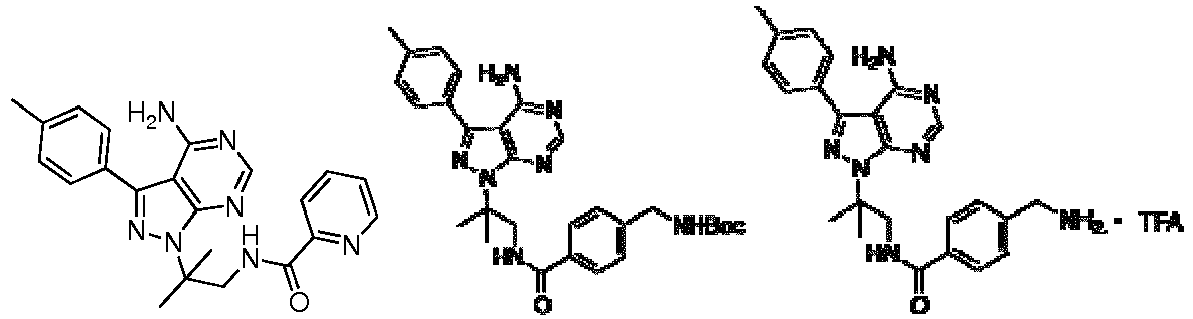


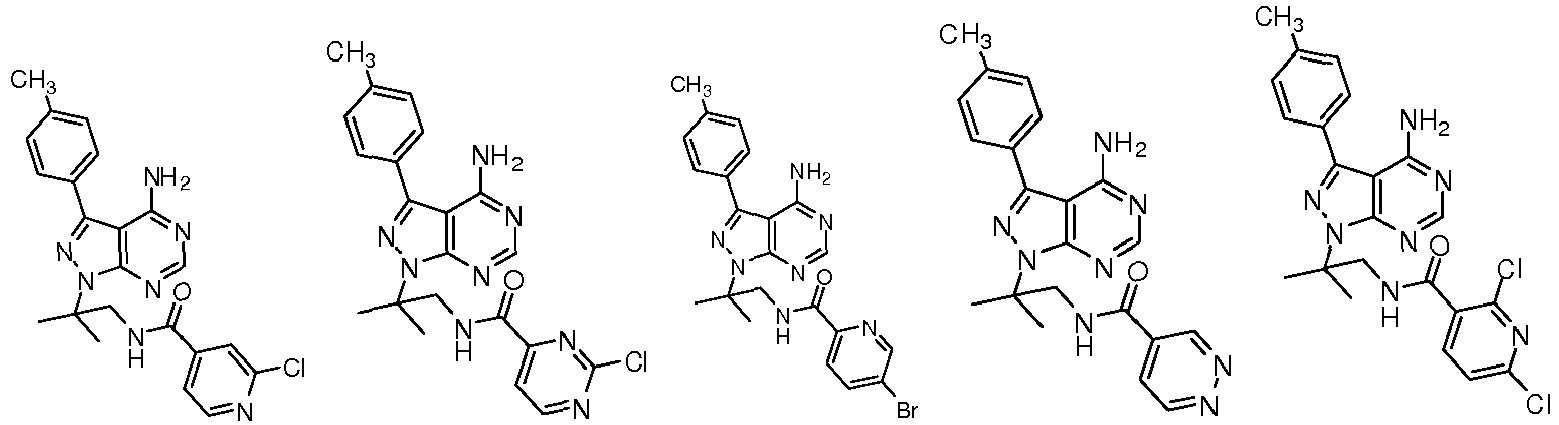


- The compounds of the present invention may be prepared by the following general reaction sequence depicted in the Schemes below:


- Whereinand
 represent nitrogen protecting groups, and variables R3-R5 and L are as defined above.
- Preferred conditions for the steps outlined in Scheme 1 include:
- Step A: Addition of the 2,2-disubstituted nitroethene (1) to protected carbazate (2) may be facilitated by mixing the starting materials (in preferably equimolar amounts) in an aqueous solvent system. Preferably the solvent system is 1:1 water/acetonitrile. Preferably the reaction is conducted at room temperature. The reaction progress can be monitored by layer chromatography (TLC) [e.g., CH2Cl2/MeOH 90:10].
- Step B: The reduction of (3) to primary amine (4) may be facilitated by any suitable reducing agent known in the art such as FeCl3, and sodium dithionite. The reduction may also be facilitated by hydrogenation using pallasium (Pd) or Raney nickel as catalysts. More preferably the reduction process is catalysed by 10% Pd/C in the presence of ammonium formate in a polar protic solvent such as methanol. This reaction is preferably conducted at room temperature and the reaction progress may be monitored by TLC (e.g., CH2Cl2/MeOH 95:5). The crude reaction product may be separated from the catalyst by filtration and used in the next step without any further purification.
- Step C: Involves the protection of the primary amine group. Suitable nitrogen protecting groups for andare known to those skilled in the art of organic synthesis and include acyl groups (e.g., acetyl, trifluoroacetyl, and benzoyl), acyloxy groups (e.g., benzylester), aryl (e.g., phenyl), alkylaryl (e.g., benzyl), etc. Other nitrogen protecting groups may be found in Protective Groups in Organic Synthesis, T.W. Greene and P. Wutz, John Wiley & Son, 3rd edition. In a preferred embodiment the protecting groupis t-butyloxy carbonyl (BOC). In a preferred embodiment the protecting groupis the N-benzyloxy carbonyl group (Cbz). Protection may be facilitated by reacting the amine (4) in acetonitrile with triethylamine and N-(Benzyloxycarbonyloxy)succinimide.
- Step D: Involves the deprotection of the group of (5) to prepare the salt (6).
- Step E: In a preferred embodiment, the reaction product (6) from step D is not purified but instead directly reacted (in situ) with 2-(methoxy-optionally substituted aryl-methylene)-malonitrile (7) to afford the substituted pyrazole (8). This cyclisation step may be facilitated with the use of a suitable non-nucleophilic base (such as Hünigs base, or TEA). The reaction is preferably conducted at elevated temperatures (e.g., between 50°-70°C).
- Step F: The subsequent ring forming step to prepare the pyrazole-[3,4,d]-pyrimidine (9) may be facilitated by reacting (8) with formamide or formamidine acetate (in mol excess) (HN=CHNH2 · CH3COOH) at elevated temperatures (e.g., between 110° - 160°C). To drive the reaction to completion further amounts of formamidine acetate may be required over the course of the reaction.
- Step G: Involves a deprotection step which may be facilitated by a suitable deprotection agent known in the art. Such agents include those discussed in Protective Groups in Organic Synthesis, T.W. Greene and P. Wutz, John Wiley & Son, 3rd edition. Usually such deprotection agents include inorganic and organic acids and accordingly A⊝ represents an anion which has been exchanged during the deprotection step using the inorganic or organic acid. Accordingly, depending on the deprotection agents employed in the process, both X⊝ and A⊝ may be the same or different. Preferably, X⊝ and A⊝ are different. In relation to the embodiments where is a Cbz group, the deprotection agent may be a HBr solution. In this instance, A⊝ would be represented as Br⊝ (bromide).
- Accordingly, it would be appreciated by those skilled in the art that the compounds of formula (8), (9) and (10) represent key intermediates in the production of the compounds of the present invention as these intermediates are endowed with the

- Accordingly, in a further aspect the disclosure provides a process for preparing a compound of formula (8):

- a) reacting a compound of formula (1)


- b) reducing (3) to obtain (4)

- c) protecting the primary amine of (4) to obtain (5)

- d) treating (5) with a deprotection agent to obtain (6)

- e) reacting (6) with (7)

- In a further aspect, the disclosure also provides a process for preparing a compound of formula (9):

- a) reacting a compound of formula (8)

- In an embodiment, the reaction is conducted at elevated temperatures, preferably between 130°-160°C.
- In a further embodiment, the reaction is conducted at elevated temperatures, using methoxyethanol as solvent.
- In a further aspect, the disclosure also provides a process for preparing a compound of formula (10)

- a) deprotecting a compound of formula (9)

- In an embodiment, the deprotection step involves treating a compound of formula (10) with an acid, and preferably an inorganic acid selected from HBr or HCl, more preferably an aqueous solution of HBr.
- With (10) in hand the compounds of formula (I) with variable R1 and R2 groups may be prepared, for instance, using conventional nucleophilic chemistry by initially treating the salt (9) with a suitable non-nucleophilic base (e.g., Hünigs base or TEA) and then reacting with a desired electrophilic group (e.g, a substituted anhydride).
- In still a further aspect, the disclosure also provides a process for preparing a compound of formula (I):

- a) reacting a compound of formula (10)

- Other methods for preparing the compounds may include the following process steps:


- Step A': Uses hydrazine or salt thereof maybe in presence of base in EtOH at reflux
- Step B': Starting material heated at, for instance, 180°C in formamide or reacted with formamidine acetate in ethoxyethanol at 120°C. Other classical methods of pyrrazolopyrimidine synthesis can be used.
- Step C': Starting material and substituted nitroalkene stirred in, for instance, DMF at 95°C for 48 hrs.
- Step D': Aliphatic nitro reduction methods apply here. Used for this work: Zn, 6M HCl, EtOH or Pd(OH)2 in MeOH under hydrogen.

- Step A": Usual iodination methods. Methods used: N-iodosuccinimide in DMF at 80°C.
- Step B": Metal mediated coupling reactions such as Suzuki or Negishi coupling reactions can be applied here. For example, boronic acid and Pd(Ph3)4 in dioxane at 180°C in microwave reactor for 10 minutes; or aryl- or alkyl- potassium trifluoroborate salts with palladium catalysts.
- Step C" and D": As with step C' and D' above.
- Another variation is to add, remove or modify the substituents of the product to form new derivatives which fall within the scope of the compounds of the present invention. This could be achieved again by using standard techniques for functional group inter-conversion, well known in the industry such as those described in Comprehensive Organic Transformations: a guide to functional group preparations by Larock R C, New York, VCH Publishers, Inc. 1989.
- Examples of possible functional group inter-conversions are: -C(O)NRR' from -CO2CH3 by heating with or without catalytic metal cyanide, e.g. NaCN, and HNRR' in CH3OH; -OC(O)R from -OH with e.g., ClC(O)R' in pyridine; -NR-C(S)NR'R" from -NHR with an alkylisothiocyanate or thiocyanic acid; -NRC(O)OR from NHR with alkyl chloroformate; - NRC(O)NR'R" from -NHR by treatment with an isocyanate, e.g. HN=C=O or RN=C=O; - NRC(O)R' from -NHR by treatment with ClC(O)R' in pyridine; -C(=NR)NR'R" from - C(NR'R")SR'" with H3NR+OAc- by heating in alcohol; -C(NR'R")SR from -C(S)NR'R" with R-I in an inert solvent, e.g. acetone; -C(S)NR'R" (where R' or R" is not hydrogen) from - C(S)NH2 with HNR'R"; -C(=NCN)-NR'R" from -C(=NR'R")-SR with NH2CN by heating in anhydrous alcohol, alternatively from -C(=NH)-NR'R" by treatment with BrCN and NaOEt in EtOH; -NR-C(=NCN)SR from -NHR' by treatment with (RS)2C=NCN; -NR"SO2R from - NHR' by treatment with CISO2R by heating in pyridine; -NR'C(S)R from -NR'C(O)R by treatment with Lawesson's reagent [2,4-bis(4-methoxyphenyl)-1,3,2,4-dithiadiphosphetane-2,4-disulfide]; -NRSO2CF3 from NHR with triflic anhydride and base, -CH(NH2)CHO from - CH(NH2)C(O)OR' with Na(Hg) and HCl/EtOH; -CH2C(O)OH from -C(O)OH by treatment with SOCl2 then CH2N2 then H2O/Ag2O; -C(O)OH from -CH2C(O)OCH3 by treatment with PhMgX/HX then acetic anhydride then CrO3; R-OC(O)R' from RC(O)R' by R"CO3H; - CCH2OH from -C(O)OR' with Na / R'OH; -CHCH2 from -CH2CH2OH by the Chugaev reaction; -NH2 from -C(O)OH by the Curtius reaction; -NH2 from -C(O)NHOH with TsCl/base then H2O; -CHC(O)CHR from -CHCHOHCHR by using the Dess-Martin Periodinane regent or CrO3 / aqH2SO4 / acetone; -C6H5CHO from -C6H5CH3 with CrO2Cl2; - CHO from -CN with SnCl2 / HCl; -CN from -C(O)NHR with PCl5; -CH2R from -C(O)R with N2H4 / KOH; -S(O)2R from -SR with mCPBA.
- As mentioned previously, the preferred compounds of the invention are inhibitors of tyrosine kinase and in particular Src kinase and therefore can be useful in methods of therapy. The compounds of the present invention have also been observed to target serine/threonin protein kinases, and in particular RIPK2 and MEK5. As such, these compounds may be used for treating tumours. As used herein the term "tumour" is used broadly to define any malignant cancerous growth, and may include leukemias, melanomas, colon, lung, ovarian, skin, breast, prostate, CNS, and renal cancers, as well as other cancers.
- The compounds of the invention having Src kinase inhibitory activity may also be used in the treatment of tumours, and in particular colon cancer.
- The invention also provides for a compound as claimed in claim 1 for use in treating tumours, and in particular colon cancer.
- There is also provided a method of treatment of tumours (in particular colon cancer) comprising the administration of an effective amount of a compound of claim 1 to a subject in need thereof.
- In another embodiment, the tumour is breast cancer.
- However, it will be understood that the compounds of the invention can be used in treating diseases or conditions characterised by cell proliferation (including cell hyperproliferation) which is initiated and/or progressed by aberrant TPK activity and more particualrly serine/threonine protein kinase and/or Src kinase activity. In particular, the present compounds can also be used in treating psoriasis, immunoregulation (graft rejection), atherosclerosis, rheumatoid arthrities, acute and chronic inflammatroy conditions, Crohn's disease and the like.
- Known related pyrazolopyrimidines PP1 and PP2 (as disclosed in
US 5,593,997 )
- Compounds of the invention which possess bioactivity, such as Src kinase inhibitory activity, can be formulated as a composition, particularly a pharmaceutical composition, together with a pharmaceutically acceptable additive.
- The compounds of the invention are administered to the subject in a treatment effective amount. As used herein, a treatment effective amount is intended to include at least partially attaining the desired effect, or delaying the onset of, or inhibiting the progression of, or halting or reversing altogether the onset or progression of the particular disease of condition being treated (e.g., colon cancer).
- As used herein, the term "effective amount" relates to an amount of compound which, when administered according to a desired dosing regimen, provides the desired therapeutic activity. Dosing may occur at intervals of minutes, hours, days, weeks, months or years or continuously over any one of these periods. Suitable dosages may lie within the range of about 0.1 ng per kg of body weight to 1 g per kg of body weight per dosage. A typical dosage is in the range of 1 µg to 1 g per kg of body weight per dosage, such as is in the range of 1 mg to 1 g per kg of body weight per dosage. In one embodiment, the dosage may be in the range of 1 mg to 500 mg per kg of body weight per dosage. In another embodiment, the dosage may be in the range of 1 mg to 250 mg per kg of body weight per dosage. In yet another embodiment, the dosage may be in the range of 1 mg to 100 mg per kg of body weight per dosage, such as up to 50 mg per body weight per dosage.
- Suitable dosage amounts and dosing regimens can be determined by the attending physician and may depend on the particular condition being treated, the severity of the condition as well as the general age, health and weight of the subject.
- The active ingredient may be administered in a single dose or a series of doses. While it is possible for the active ingredient to be administered alone, it is preferable to present it as a composition, preferably as a pharmaceutical composition. The formulation of such compositions is well known to those skilled in the art. The composition may contain any suitable carriers, diluents or excipients. These include all conventional solvents, dispersion media, fillers, solid carriers, coatings, antifungal and antibacterial agents, dermal penetration agents, surfactants, isotonic and absorption agents and the like. It will be understood that the compositions of the invention may also include other supplementary physiologically active agents.
- The carrier must be pharmaceutically "acceptable" in the sense of being compatible with the other ingredients of the composition and not injurious to the subject. Compositions include those suitable for oral, rectal, nasal, topical (including buccal and sublingual), vaginal or parental (including subcutaneous, intramuscular, intravenous and intradermal) administration. The compositions may conveniently be presented in unit dosage form and may be prepared by any methods well blown in the art of pharmacy. Such methods include the step of bringing into association the active ingredient with the carrier which constitutes one or more accessory ingredients. In general, the compositions are prepared by uniformly and intimately bringing into association the active ingredient with liquid carriers or finely divided solid carriers or both, and then if necessary shaping the product.
- Compositions of the present invention suitable for oral administration may be presented as discrete units such as capsules, sachets or tablets each containing a predetermined amount of the active ingredient; as a powder or granules; as a solution or a suspension in an aqueous or non-aqueous liquid; or as an oil-in-water liquid emulsion or a water-in-oil liquid emulsion. The active ingredient may also be presented as a bolus, electuary or paste.
- A tablet may be made by compression or moulding, optionally with one or more accessory ingredients. Compressed tablets may be prepared by compressing in a suitable machine the active ingredient in a free-flowing form such as a powder or granules, optionally mixed with a binder (e.g inert diluent, preservative disintegrant (e.g. sodium starch glycolate, cross-linked polyvinyl pyrrolidone, cross-linked sodium carboxymethyl cellulose) surface-active or dispersing agent. Moulded tablets may be made by moulding in a suitable machine a mixture of the powdered compound moistened with an inert liquid diluent. The tablets may optionally be coated or scored and may be formulated so as to provide slow or controlled release of the active ingredient therein using, for example, hydroxypropylmethyl cellulose in varying proportions to provide the desired release profile. Tablets may optionally be provided with an enteric coating, to provide release in parts of the gut other than the stomach.
- Compositions suitable for topical administration in the mouth include lozenges comprising the active ingredient in a flavoured base, usually sucrose and acacia or tragacanth gum; pastilles comprising the active ingredient in an inert basis such as gelatine and glycerin, or sucrose and acacia gum; and mouthwashes comprising the active ingredient in a suitable liquid carrier.
- Compositions suitable for topical administration to the skin may comprise the compounds dissolved or suspended in any suitable carrier or base and may be in the form of lotions, gel, creams, pastes, ointments and the like. Suitable carriers include mineral oil, propylene glycol, polyoxyethylene, polyoxypropylene, emulsifying wax, sorbitan monostearate, polysorbate 60, cetyl esters wax, cetearyl alcohol, 2-octyldodecanol, benzyl alcohol and water. Transdermal patches may also be used to administer the compounds of the invention.
- Compositions for rectal administration may be presented as a suppository with a suitable base comprising, for example, cocoa butter, glycerin, gelatine or polyethylene glycol.
- Compositions suitable for vaginal administration may be presented as pessaries, tampons, creams, gels, pastes, foams or spray formulations containing in addition to the active ingredient such carriers as are known in the art to be appropriate.
- Compositions suitable for parenteral administration include aqueous and non-aqueous isotonic sterile injection solutions which may contain anti-oxidants, buffers, bactericides and solutes which render the composition isotonic with the blood of the intended recipient; and aqueous and non-aqueous sterile suspensions which may include suspending agents and thickening agents. The compositions may be presented in unit-dose or multi-dose sealed containers, for example, ampoules and vials, and may be stored in a freeze-dried (lyophilised) condition requiring only the addition of the sterile liquid carrier, for example water for injections, immediately prior to use. Extemporaneous injection solutions and suspensions may be prepared from sterile powders, granules and tablets of the kind previously described.
- Preferred unit dosage compositions are those containing a daily dose or unit, daily sub- dose, as herein above described, or an appropriate fraction thereof, of the active ingredient.
- It should be understood that in addition to the active ingredients particularly mentioned above, the compositions of this invention may include other agents conventional in the art having regard to the type of composition in question, for example, those suitable for oral administration may include such further agents as binders, sweeteners, thickeners, flavouring agents disintegrating agents, coating agents, preservatives, lubricants and/or time delay agents. Suitable sweeteners include sucrose, lactose, glucose, aspartame or saccharine. Suitable disintegrating agents include cornstarch, methylcellulose, polyvinylpyrrolidone, xanthan guni, bentonite, alginic acid or agar. Suitable flavouring agents include peppermint oil, oil of wintergreen, cherry, orange or raspberry flavouring. Suitable coating agents include polymers or copolymers of acrylic acid and/or niethacrylic acid and/or their esters, waxes, fatty alcohols, zein, shellac or gluten. Suitable preservatives include sodium benzoate, vitamin E, alpha-tocopherol, ascorbic acid, methyl paraben, propyl paraben or sodium bisulphite. Suitable lubricants include magnesium stearate, stearic acid, sodium oleate, sodium chloride or talc. Suitable time delay agents include glyceryl monostearate or glyceryl distearate.
- The novel bioactive compounds of the invention can be administered to a subject as a pharmaceutically acceptable salt thereof. It will be appreciated however that non-pharmaceutically acceptable salts also fall within the scope of the present invention since these may be useful as intermediates in the preparation of pharmaceutically acceptable salts. Suitable pharmaceutically acceptable salts include, but are not limited to salts of pharmaceutically acceptable inorganic acids such as hydrochloric, sulphuric, phosphoric, nitric, carbonic, boric, sulfamic, and hydrobromic acids, or salts of pharmaceutically acceptable organic acids such as acetic, propionic, butyric, tartaric, maleic, hydroxymaleic, fumaric, maleic, citric, lactic, mucic, gluconic, benzoic, succinic, oxalic, phenylacetic, methanesulphonic, toluenesulphonic, benezenesulphonic, salicyclic sulphanilic, aspartic, glutamic, edetic, stearic, palmitic, oleic, lauric, pantothenic, tannic, ascorbic and valeric acids. Base salts include, but are not limited to, those formed with pharmaceutically acceptable cations, such as sodium, potassium, lithium, calcium, magnesium, ammonium and alkylammonium. In particular, the present invention includes within its scope cationic salts eg sodium or potassium salts, or alkyl esters (eg methyl, ethyl) of the phosphate group.
- Basic nitrogen-containing groups may be quartemised with such agents as lower alkyl halide, such as methyl, ethyl, propyl, and butyl chlorides, bromides and iodides; dialkyl sulfates like dimethyl and diethyl sulfate; and others.
- The compounds of the invention may be in crystalline form either as the free compounds or as solvates (e.g. hydrates). Methods of solvation are generally known within the art.
- It will also be recognised that compounds of the invention may possess asymmetric centres and are therefore capable of existing in more than one stereoisomeric form. The invention thus also relates to compounds in substantially pure isomeric form at one or more asymmetric centres eg., greater than about 90% ee, such as about 95% or 97% ee or greater than 99% ee, as well as mixtures, including racemic mixtures, thereof. Such isomers may be prepared by asymmetric synthesis, for example using chiral intermediates, or mixtures may be resolved by conventional methods, eg., chromatography, or use of a resolving agent.
- Furthermore, depending on the substitution pattern the compounds of the present invention may be capable of undergoing tautomerism. Accordingly, all possible tautomers of a compound of the present invention fall within the scope of the invention.
- The mode of proliferative diseases, such as tumors, is multi-factorial. In the treatment of such diseases drugs with different mechanisms may be combined (ie combination therapies). The compounds of the invention may be particularly useful in combination therapy, eg. combining the treatment with other chemotherapeutic or radiation treatments.
- For instance in order to potentiate anti-tumour treatments using the compounds of the present invention one or more other cytotoxic compounds including 5-FU, oxaliplatin, paclitaxel, gemcitabine, docetaxel, cisplatin, and doxorubicin may also be administered. The combination therapy may also include the addition of other Src kinase inhibitors such as AZD-0530 (Saracatinib), Dasatinib (BMS-354825 or Sprycel) and Bosutinib (SKI0606) or inhibitors of ERKS, MEK5, RIPK5, and FAK (PTK2) such as AZD6244, U0126, SB202190, and PF-562271.
- The combination partners in such therapies may be administered together, one after the other, separately in one combined unit dosage or in separate unit dosage forms.
- Certain embodiments of the invention will now be described with reference to the following examples which are intended for the purpose of illustration only.
-

- 1A: tert-Butyl carbazate (2.61 g, 19.8 mmol) was added to mixture of 2,2-dimethyl-nitroethylene (2 g, 19.8 mmol) in 20 mL of 1:1 water/acetonitrile. After one hour, TLC (CH2Cl2/MeOH 90:10) indicated complete reaction. The reaction was diluted with water. The aqueous phase was washed three times with EtOAc. The combined organic phases were rinsed with water and brine, dried over Na2SO4 and concentrated. The solid residue was purified on SiO2 using CH2Cl2/MeOH 95:5 to 90:10. A white solid was obtained (m = 3.6 g, 78%). 1H NMR (ppm, CDCl3): δ 1.26 (s, 6H), 1.49 (s, 9H), 4.43 (s, 2H), 6.12 (br s, 1H). 13C NMR (ppm, CDCl3): δ23.24, 28.23, 57.91, 81.35, 82.06, 158.20. LCMS (+esi): 256 (M+Na+).
-

- Pd/C (10%, 240 mg) was added to a mixture of compound 1A (1 g, 4 mmol) and ammonium formate (1.16 g, 18.4 mmol) in 8 mL of dry methanol. The reaction was stirred at room temperature for 1 hour (strong gas evolution) after which time TLC (CH2Cl2/MeOH 95:5) indicated complete consumption of starting material. The reaction was filtered through a pad of celite and the solids were rinsed with methanol. The filtrate was concentrated. The colourless oil was used in the next step without further purification. 1H NMR (ppm, CDCl3): δ 1.16 (s, 6H), 1.47 (s, 9H), 2.78 (s, 2H), 3.03 (br s, 2H +H2O), 6.6 (br s, 1H). LCMS (+esi): 204.1 (M+H+).
- The amine was dissolved in 8 mL of anhydrous acetonitrile. Triethylamine (0.5 mL, 3.6 mmol) and N-(Benzyloxycarbonyloxy)succinimide (897 mg, 3.6 mmol) were successively added. The reaction was stirred at room temperature for 16 hours and then concentrated. The residue was taken into EtOAc and 10% citric acid. The aqueous layer was extracted three times with EtOAc. The combined organic layers were washed with 10% citric acid, water and brine, dried over Na2SO4 and concentrated. A colourless oil was obtained that crystallised slowly upon standing. No further purification was required (m = 1.2 g, 90% for two steps). 1H NMR (ppm, CDCl3): δ 1.01 (s, 6H), 1.43 (s, 9H), 3.04 (d, J = 6.57 Hz, 2H), 3.51 (br s, 1H), 5.09 (s, 2H), 6.22 (br s, 1H), 7.28-7.32 (m, 5H). 13C NMR (ppm, CDCl3): δ 22.91, 28.25, 46.36, 57.73, 66.67, 81.08, 128.00, 128.06, 128.46, 136.76, 157.23, 157.61.
-
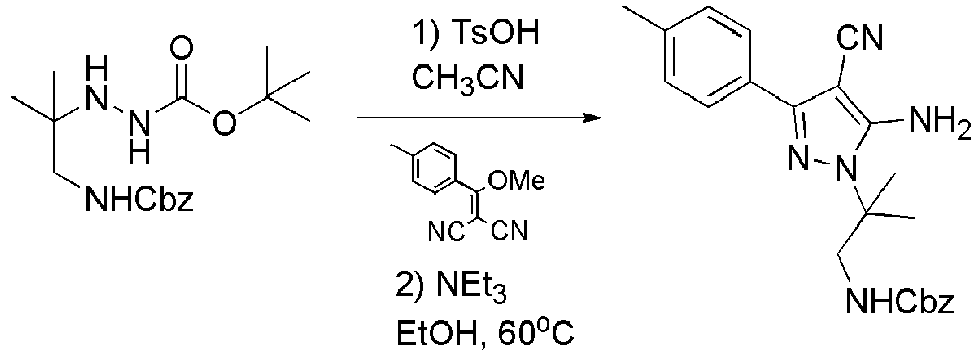
- Compound 1B (310 mg, 0.92 mmol) was dissolved in 1 mL of dry acetonitrile. Tosic acid (875 mg, 4.6 mmol) was dissolved in 3 mL of dry acetonitrile. Molecular sieves were added to both solutions and stood for 30 minutes. The solution of tosic acid was then added the other mixture and the reaction was stirred at room temperature for 3 hours. After that time the reaction was filtered and the solid washed with acetonitrile and CH2Cl2). The filtrate was concentrated to afford a thick colourless oil. It was dissolved in 2 mL of ethanol. Triethylamine (640 µL, 1.48 mmol) and 2-(Methoxy-p-tolyl-methylene)-malononitrile (182 mg, 0.92 mmol) were successively added. The reaction was then heated at 60°C for 3 hours. After cooling down, the reaction was concentrated. Water and EtOAc were then added and the aqueous phase was extracted three times with EtOAc. The combined organic layers were dried over Na2SO4 and concentrated. The oily residue obtained was purified by flash chromatography on SiO2 using 100% CH2Cl2 then CH2Cl2/MeOH 99:1. A colourless oil that solidifies slowly overnight was obtained (m = 270 mg, 73%). 1H NMR (ppm, CDCl3): δ1.58 (s, 6H), 2.36 (s, 3H), 3.77 (d, J = 6.63 Hz, 2H), 4.40 (br s, 2H), 5.08 (s, 2H), 5.59 (br t, J = 5.94 Hz, 1H), 7.20 (d, J = 8.55 Hz, 2H), 7.31 (m, 5H), 7.74 (d, J = 8.13 Hz, 2H). 13C NMR (ppm, CDCl3): δ 21.35, 24.18, 50.56, 63.17, 66.99, 76.34, 115.22, 126.09, 128.15, 128.22, 128.33, 128.55, 129.42, 136.34, 139.11, 149.13, 151.57, 156.96. LCMS (+esi): 404.3 (M+H+).
-

- Compound 1C (100 mg, 0.25 mmol) and formamidine acetate (108 mg, 1 mmol) were reacted at 150°C in 0.4 mL of methoxyethanol. 3 more portions of formamidine acetate were added at one hour interval to reaction mixture. After that time, water and EtOAc were added. The aqueous phase was extracted three times with EtOAc. The combined organic phases were washed two times with water and brine, dried over Na2SO4 and concentrated. The thick yellowish oil obtained was purified by two successive flash chromatographies: first using CH2Cl2/MeOH 100:0 to 97:3 then CH2Cl2/EtOAc 70:30 to 50:50. A colourless oil was obtained which solidified slowly (m = 76 mg, 71 %). 1H NMR (ppm, CDCl3): δ1.71 (s, 6H), 2.38 (s, 3H), 3.87 (d, J = 6.63 Hz, 2H), 5.02 (s, 2H), 5.82 (br t, J = 6.33 Hz, 1H), 5.94 (br s, 2H), 7.23-7.28 (m, 7H), 7.45 (d, J = 8.07 Hz, 2H), 8.23 (s, 1H). 13C NMR (ppm, CDCl3): δ 21.34, 25.02, 49.82, 64.24, 66.77, 99.18, 128.12, 128.16, 128.35, 128.51, 129.87, 130.15, 136.58, 139.50, 143.79, 152.50, 153.71, 156.83, 156.86. LCMS (+esi): 431.3 (M+H+).
-
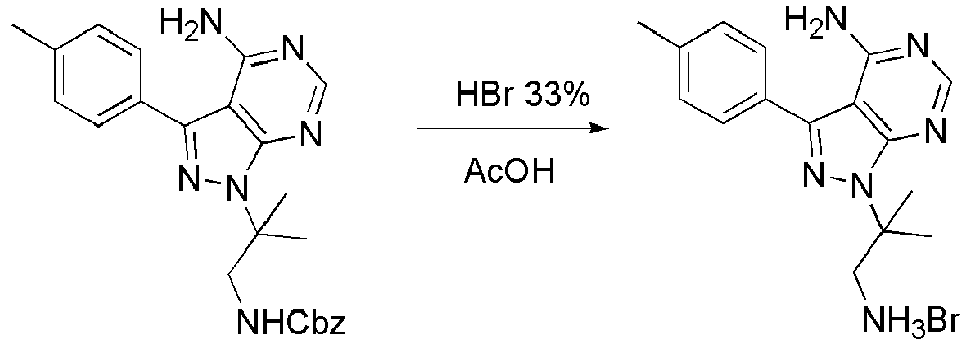
- Compound 1D (85 mg, 0.2 mmol) was treated with 1 mL of 33% solution of HBr in glacial acetic acid. The reaction was stirred at room temperature for 1 hour. Dry ether was then added to the mixture leading to the formation of a precipitate. It was collected by filtration, rinsed thoroughly with Et2O and dried. 50 mg of the compound were redissolved in 50 mL of water and freeze dried for two days. A white solid was obtained. 1H NMR (ppm, DMSO-d6): δ 1.73 (s, 6H), 2.34 (s, 3H), 3.59 (br q, J = 5.67 Hz, 2H), 7.33 (d, J = 7.89 Hz, 2H), 7.53 (d, J = 8.07 Hz, 2H), 7.95 (br s, 3H), 8.40 (s, 1H). 13C NMR (ppm, DMSO-d6): δ 20.93, 24.83, 46.51, 61.41, 98.47, 128.33, 128.76, 129.80, 138.82, 144.85, 149.49, 152.83, 154.21. LCMS (+esi): 297 (M-Br-).
-

- Compound 1E (50 mg, 0.13 mmol) was dissolved in 1 mL of dry CH2Cl2. The solution was cooled to 0°C and triethylamine (38 µL, 0.27 mmol) followed by acetic anhydride (13 µL, 0.13 mmol) were added. The reaction was stirred for 1 hour at 0°C after which time more triethylamine (19 µL, 0.132 mmol) and acetic anhydride (3 µL, 0.03 mmol) were added. The reaction was stirred for a total of 2.5 hours. TLC (90:10 CH2Cl2/MeOH) indicated complete reaction. The mixture was diluted with CH2Cl2 and poured onto water. The mixture was extracted three times with CH2Cl2. The combined organic phases were washed with water end brine and dried over Na2SO4. Concentration afforded the expected compound, which did not require further purification (m = 24.5 mg, 56%). 1H NMR (ppm, CDCl3): δ 1.77 (s, 6H), 1.98 (s, 3H), 2.44 (s, 3H), 3.96 (d, J = 6.36 Hz, 2H), 5.74 (br s, 2H), 7.02 (br s, 1H), 7.35 (d, J = 7.8 Hz, 2H), 7.55 (d, J = 8.07 Hz, 2H), 8.33 (s, 1H). LCMS (+esi): 339.1 (M+H+).
-

- Compound 1E (50 mg, 0.13 mmol) was dissolved in 275 µL of CH2Cl2. Acetic acid (55 µL), 37% formaldehyde (275 µL) and 550 µL of a 1 M solution of NaBH3CN in THF were added. The reaction was stirred for 30 minutes. After that time, the reaction was diluted with CH2Cl2 and water was added. The aqueous phase was extracted three times with CH2Cl2. The combined organic layers were washed with water and brine and dried over Na2SO4. The residue was purified by flash chromatography using CH2Cl2/EtOAc (70:30 to 30:70). A white solid was obtained (m = 22 mg, 51%). 1H NMR (ppm, DMSO-d6): δ1.72 (s, 6H), 2.05 (br s, 6H), 2.37 (s, 3H), 2.98 (br s, 2H), 6.7 (br s, 2H), 7.33 (d, J = 8.34 Hz, 2H), 7.52 (d, J = 8.07 Hz, 2H), 8.21 (s, 1H). LCMS (+esi): 325.2 (M+H+).
-

- 4A: Compound 1E (50 mg, 0.132 mmol) was dissolved in 1.5 mL of dry CH2Cl2 under nitrogen. DMAP (1.6 mg, 0.0132 mmol) and freshly distilled triethylamine (40 mg, 55.1 µL, 0.398 mmol) were added. The solution was cooled to 0°C in an ice bath and stirred. In a separate flask, trifluoroacetic anhydride (41.6 mg, 27.5 µL, 0.198 mmol) was dissolved in 1 mL of CH2Cl2. This solution was added into the first flask and the reaction was stirred overnight. The product was directly purified by flash chromatography on SiO2 using EtOAc/petroleum ether (20:80 to 40:60). The product was obtained as a pale pink solid (m = 27 mg, 52%). 1H NMR (ppm, CDCl3): δ1.79 (s, 6H), 2.44 (s, 3H), 3.98 (d, J = 6.18 Hz, 2H), 5.74 (br s, 2H), 7.34 (d, J = 8.1 Hz, 2H), 7.54 (d, J = 8.1 Hz, 2H), 8.33 (s, 1H), 9.27 (br s, 1H). 13C NMR (ppm, CDCl3): δ 21.3, 25.3, 48.6, 63.2, 116.2, 128.1, 130.2, 139.5, 143.7, 153.9, 154.8, 157.0 (q), 158.1. LCMS (+esi): 393.2 (M+H+).

- 4B: Compound 4A (40 mg, 0.102 mmol), Cs2COs (99.7 mg, 0.31 mmol,) and Tetrabutylammonium bromide (3.3 mg, 0.01 mmol) was dissolved in 1 mL of acetone. MeI (22.3 µL, 0.36 mmol) in solution in acetone was added. The solution was stirred for 48 hr. The TLC (EtOAc/Petroleum Ether 50:50) showed 2 new products but no starting material. The mixture was filtered through celite and the filtrate concentrated. The residue was purified by flash chromatography on silica using EtOAc/Petroleum Ether 20:80 to eliminate the first product (dimethylated) and then 40:60 to give the expected product as a white solid (12 mg, 28%). 1H NMR (ppm, CDCl3): δ 1.87 (s, 6H), 2.44 (s, 3H), 2.54 (q, J HF= 1.64 Hz, 3H), 4.30 (s, 2H), 5.66 (br s, 2H), 7.34 (d, J = 8.1 Hz, 2H), 7.54 (d, J = 8.1 Hz, 2H), 8.34 (br s, 1H). 13C NMR (ppm, CDCl3): δ 21.3, 25.7, 35.6, 56.1, 63.8, 128.3, 130.1, 139.4, 143.5, 153.7, 154.6, 157.39, 158.02. LCMS (+esi): 407.1 (M+H+).

- 4C: Compound 4B (15.1 mg, 0.04 mmol) was dissolved in 1.5 mL of methanol/water (94:6) and K2CO3 (26.8 mg, 0.194 mmol) was added. The solution was stirred at room temperature for 1 hr. TLC showed starting material left so the mixture was heated at reflux for 2h. The solvent was removed and 5 mL of water was added. The product was extracted with dichloromethane (3x5 mL), the combined organic layers were washed with water, dried over Na2SO4 and concentrated to give 12.3 mg of compound 4C (82%). 1H NMR (ppm, CDCl3): δ 1.83 (s, 6H), 2.43 (s, 3H), 2.45 (s, 3H), 3.27 (s, 2H), 5.52 (br s, 2H), 7.32 (d, J = 7.9 Hz, 2H), 7.56 (d, J = 7.9 Hz, 2H), 8.31 (br s, 1H). 13C NMR (ppm, CDCl3): δ 21.3, 25.9, 29.7, 36.9, 56.1, 60.9, 63.4, 128.5, 129.9, 130.6, 138.9, 142.8, 154.5, 157.9. LCMS (+esi): 311.1 (M+H+).
-

- 5A: Compound 1E (50 mg, 0.13 mmol), N,N-Di-Boc-N'-triflylguanidine (prepared according to Feichtinger et al., J. Org. Chem., 1998, 63, 8432; 48.7 mg, 0.120 mmol) and triethylamine (37 µL, 0.266 mmol) were dissolved in dry dichloromethane (1 mL). The mixture was stirred at room temperature for 18 hr. It was then diluted in CH2Cl2, washed with 2M sodium bisulfate, saturated sodium bicarbonate and brine. The organic layer was dried over sodium sulfate and concentrated to give a white solid. The crude product was then purified on silica gel using CH2Cl2/MeOH (100:0 to 95:5). A white solid was obtained (m = 38.7 mg, 55%). 1H NMR (ppm, CDCl3): δ 1.47 (s, 9H), 1.49 (s, 9H), 1.84 (s, 6H), 2.42 (s, 3H), 4.14 (d, J = 5.81 Hz, 2H), 5.76 (br s, 2H), 7.30 (d, J = 7.92 Hz, 2H), 7.71 (d, J = 7.92 Hz, 2H), 8.32 (s, 1H), 9.21 (t, J = 5.81 Hz, 1H). 13C NMR (ppm, CDCl3): δ 21.3, 24.8, 28.1, 28.3, 49.3, 63.0, 79.0, 82.7, 99.8, 128.7, 129.8, 130.5, 138.9, 143.2, 152.8, 154.3, 154.6, 156.7, 158.0, 163.8. LCMS (+esi): 539.0 (M+H+).

- 5B: Compound 5A (38.9 mg, 0.072 mmol) was dissolved in 1 mL of dry CH2Cl2 and cooled at 0°C. Then TFA (495 µL, 6.5 mmol) was added dropwise. The mixture was allowed to warm to room temperature and was stirred for 6 hrs. Solvent was removed under vacuum to give a thick brown oil. Toluene was added and evaporated to remove the remaining TFA. The product, still oily, was dissolved in a water/acetonitrile mixture and freeze-dried to give 31.6 mg (78%) of a white solid. 1H NMR (ppm, MeOD): δ 1.89 (s, 6H), 2.45 (s, 3H), 3.99 (s, 2H), 7.41 (d, J = 6.24 Hz, 2H), 7.60 (d, J = 6.90 Hz, 2H), 8.40 (s, 1H). LCMS (+esi): 339.0 (M-2TFA+H+).
-

- 6A: Compound 1E (50 mg, 0.132 mmol) was free-based by treating a suspension of the hydrobromide salt in CH2Cl2 with saturated aqueous NaHCO3, drying over K2CO3 and concentrating. The residue was dissolved in 1 mL of acetone and triethylamine (18.4 µL, 0.132 mmol) was added. In a separate flask, PhCOCl (21.5 µL., 0.185 mmol,) was added dropwise to a solution of NH4SCN (15.1 mg, 0.198 mmol) in 1 mL of acetone. A white precipitate was observed. The mixture was stirred and heated at reflux for 15 min and then cooled to room temperature. The solution of neutralised 1E in acetone was added quickly and the mixture was stirred at room temperature for 1h. The mixture was then poured into excess cracked ice with stirring. A white precipitate was formed; it was filtered off and washed with water and then methanol:water (1:1). The solid was dried in a vacuum oven to afford 30 mg of a white powder (49%). 1H NMR (ppm, CDCl3): δ 1.92 (s, 6H), 2.44 (s, 3H), 4.58 (d, J = 6.09 Hz, 2H), 5.83 (br s, 2H), 7.36 (d, J = 7.92 Hz, 2H), 7.50 (t, J = 7.8 Hz, 2H), 7.61 (t, J = 7.53 Hz, 1H), 7.75 (d, J = 8.07 Hz, 2H), 7.81 (d, J = 7.26 Hz, 2H), 8.35 (s, 1H), 9.00 (s, 1H).

- 6B: NaOH aq. 10% (2 mL) was to the crude compound 6A. The mixture was stirred and heated at 90°C for 1 hr and was then poured in a mixture of HCl 4M and ice. Na2CO3 was added to basify the solution until pH = 8-10. The product was extracted with dichloromethane (3 times). The combined organic phases were dried over sodium sulfate and concentrated to afford 12 mg of crude product. LCMS showed a mix of starting material and desired product. The crude mixture was purified by preparative HPLC preparative to afford 1.5 mg (3% yield) of the expected compound. 1H NMR (ppm, CDCl3): δ 1.82 (s, 6H), 2.45 (s, 3H), 4.35 (br s, 2H), 6.09 (br s, 1H), 7.37 (d, J = 7.53 Hz, 2H), 7.54 (d, J = 7.89 Hz, 2H), 8.08 (s, 1H), 8.25 (s, 1H). LCMS (+esi): 356.0 (M+H+).
-

- Compound 1E (15 mg, 0.05 mmol) was neutralised (suspended in CH2Cl2 and treated with saturated NaHCO3 aqueous solution, dried over K2CO3 and concentrated). The residue was dissolved in 0.6 mL of dry THF. Ethyl isocyanate (4 µL, 0.05 mmol) was added at 0°C. The solution turned white cloudy. The mixture was stirred overnight and was then diluted with Ether (5 mL), washed with 1M HCl, saturated NaHCO3 and then brine. The organic layer was dried over Na2SO4 and concentrated. As no expected compound was present in the organic layer, the combined aqueous layers were extracted twice with CH2Cl2, dried and concentrated again to give 17.2 mg of a white solid. This crude product was purified on silica gel using MeOH/CH2Cl2 (0:100 to 10:90) to afford 12.7 mg (69%) of a white solid. 1H NMR (ppm, CDCl3): δ 1.09 (t, J = 7.2 Hz, 3H), 1.77 (s, 6H), 2.44 (s, 3H), 3.16 (q, J = 6.96 Hz, 2H), 3.93 (d, J = 4.38 Hz, 2H), 4.44 (br s, 1H), 5.68 (br s, 2H), 5.81 (br s, 1H), 7.34 (d, J = 7.77 Hz, 2H), 7.54 (d, J = 7.92 Hz, 2H), 8.30 (s, 1H). LCMS (+esi): 368.0 (M+H+).
-

- Compound 1E (50 mg, 0.132 mmol), acetone (48.5 µL, 0.66 mmol) and NaBH3CN (33 mg, 0.53 mmol) were dissolved in 1.5 mL of methanol. The mixture was stirred at room temperature for 3 days (the reaction was monitored by TLC 10% MeOH in CH2Cl2). Solvents and volatiles were removed in vacuum, water. The residue was dissolved in CH2Cl2. The aqueous layer was extracted 3 times with CH2Cl2. The combined organic layers were washed with brine, dried over sodium sulfate and concentrated to afford 34 mg of a colourless oil. The crude was purified on silica gel using MeOH/CH2Cl2, (0:100 to 6:94). A white solid was obtained (m = 21 mg, 47%). 1H NMR (ppm, CDCl3): δ 1.01 (d, J = 6.27 Hz, 6H), 1.82 (s, 6H), 2.45 (s, 3H), 2.76 (hept, J = 6.36 Hz, 1H), 3.27 (s, 2H), 5.62 (br s, 2H), 7.32 (d, J = 8.37 Hz, 2H), 7.56 (d, J = 8.04 Hz, 2H), 8.30 (s, 1H). LCMS (+esi): 338.4 (M+H+).
-

- Compound 1E (50 mg, 0.132 mmol), DMAP (49 mg, 0.40 mmol), phenyl acetic acid (20 mg, 0.145 mmol) and EDCI (33 mg, 0.172 mmol) were dissolved in 2 mL of dry CH2Cl2. The reaction was stirred at room temperature for 3 hours. The reaction was diluted with CH2Cl2 and washed successively with HCl 1N, NaHCO3sat., water and brine. The organic layer was dried over Na2SO4 and concentrated. NMR and LCMS indicated that the compound was pure (m = 31 mg, 56%). 1H NMR (ppm, CDCl3): δ1.71 (s, 6H), 2.46 (s, 3H), 3.59 (s, 2H), 3.92 (d, J = 6.42 Hz, 2H), 5.74 (br s, 2H), 6.96 (br t, J = 6.06 Hz, 1H), 7.16 (s, 5H), 7.33 (d, J = 7.92 Hz, 2H), 7.39 (d, J = 8.19 Hz, 2H), 8.12 (s, 1H). LCMS (+esi): 415.0 (M+H+).
-

- 10A: 4-(2-aminethyl)-benzoic acid (200 mg, 0.99 mmol) and Boc2O (260 mg, 1.2 mmol) were dissolved in 1 mL of 1M aqueous NaOH. The reaction was stirred at room temperature for 4 hrs. After this time, ethyl acetate was added followed by 10 % aqueous solution of citric acid. A white solid precipitated. It was removed by filtration. The filtrate was then extracted three times with ethyl acetate. The combined organic layers were washed with water and brine, dried over Na2SO4 and concentrated. The residue was purified by flash chromatography on SiO2 using CH2Cl2/MeOH (100:0 to 95:5). A white solid was obtained (m = 47 mg, 16%). 1H NMR (ppm, CDCl3): δ 1.33 (s, 9H), 2.74 (t, J = 7.44 Hz, 2H), 3.14 (quar, J = 6.78 Hz, 2H), 6.84 (br t, J = 5.43 Hz, 1H), 7.28 (d, J = 8.28 Hz, 2H), 7.83 (d, J = 8.25 Hz, 2H).

- 10B: Compound 10B was prepared using the same procedure described in example 1E using compound 1E (20 mg, 0.053 mmol) and compound 10A. After work up the resulting crude compound was purified by flash chromatography on SiO2 using CH2Cl2/MeOH (99:1 to 98:2). A white solid was obtained (m = 15 mg, 53%). 1H NMR (ppm, CDCl3): δ1.41 (s, 9H), 1.83 (s, 6H), 2.44 (s, 3H), 2.83 (t, J = 6.9 Hz, 2H), 3.37 (br quar, J = 6.72 Hz, 2H), 4.12 (d, J = 6.12 Hz, 2H), 4.58 (br s, 1H), 5.78 (br s, 1H), 7.23 (d, J = 7.95 Hz, 2H), 7.36 (d, J = 8.28 Hz, 2H), 7.56 (d, J = 8.07 Hz, 2H), 7.74 (d, J = 8.01 Hz, 2H), 8.35 (br s, 2H overlapping).

- 10C: Compound 10B (15 mg, 0.03 mmol) dissolved in 1 mL of CH2Cl2 was treated with 200 µL of TFA. The reaction was stirred at room temperature for 16 hrs. 200 µL of TFA was added and the reaction was left for a further 24 hours. The TFA was removed by azeotroping with toluene (3 times) to afford a colourless oil. A white solid precipitated upon addition of Et2O. The solid was collected by filtration, rinsed with Et2O and dried in a vacuum oven. NMR (ppm, CDCl3): δ1.81 (s, 6H), 2.38 (s, 3H), 2.92 (br s, 2H), 3.07 (br s, 2H), 4.02 (br s, 2H), 7.10 (br s, 2H), 7.26-7.31 (m, 2H), 7.29-7.46 (m, 4H), 7.72 (br s, 2H), 8.6 (br s, 3H). LCMS (+esi): 444.1 (M+H+).
-

- Compound from example 1E (64 mg, 0.17 mmol) was neutralised by treating a suspension of the hydrobromide salt in CH2Cl2 with saturated aqueous NaHCO3, drying over K2CO3 and concentrating. The residue was dissolved in CH2Cl2 and benzoic acid (22 mg, 0.18 mmol) followed by solid supported DCC (Novabiochem, 390 mg, 0.51 mmol) were added and the reaction was placed on an orbital shaker for 24 hrs. The reaction was then filtered through a pad of celite. The solids were rinsed with CH2Cl2. Concentration afforded a colourless oil (m = 40 mg, 59%). 1H NMR (ppm, CDCl3): δ1.85 (s, 6H), 2.44 (s, 3H), 4.14 (d, J = 6.18 Hz, 2H), 5.69 (br s, 2H), 7.34-7.48 (m, 5H), 7.57 (d, J = 8.1 Hz, 2H), 7.81 (t d, J = 8.37 Hz, 2H), 8.37 (s, 1H), 8.39 (br t, 1H). LCMS (+esi): 401.1 (M+H+).
-

- Compound 12: Compound 12 was prepared according to the procedure used to prepare compound from example 11 using picolinic acid (22 mg, 0.18 mmol). The off-white solids obtained were triturated with Et2O, collected by filtration and rinsed with more Et2O. A white powder was obtained (15 mg, 22%). NMR (ppm, CDCl3): δ1.87 (s, 6H), 2.46 (s, 3H), 4.20 (d, J = 6.66 Hz, 2H), 5.75 (br s, 2H), 7.37 (d, J = 7.68 Hz, 2H), 7.41-7.43 (m, 1H), 7.69 (d, J = 8.1 Hz, 2H), 7.83 (t d, J = 7.71, 1.65 Hz, 1H), 8.20 (d, J = 7.83 Hz, 1H), 8.37(s, 1H), 8.55(d, J = 4.8 Hz, 1H), 9.23 (br t, J = 6.06 Hz, 1H). LCMS (+esi): 402.1 (M+H+).
-

- 13A: Compound 13A was prepared according to the procedure described for example 10A with 4-amino-methyl benzoic acid (200 mg, 1.94 mmol). A white solid was obtained (m = 232 mg, 52%). 1H NMR (ppm, CDCl3): δ1.47 (s, 9H), 4.39 (br d, J = 5.19 Hz, 2H), 4.94 (br s, 1H), 7.38 (d, J= 8.4 Hz, 2H), 8.06 (d, J= 8.31 Hz, 2H).

- 13B: Compound 13B was prepared according to the procedure described for example 11, using 13A. The product was obtained as a white foam. 1H NMR (ppm, CDCl3): δ1.45 (s, 9H), 1.84 (s, 6H), 2.45 (s, 3H), 2.82 (br s, 1H), 4.11 (d, J= 6.21 Hz, 2H), 4.33 (d, J= 5.82 Hz, 2H), 4.95 (br s, 1H), 5.78 (br s, 1H), 7.33 (dd, J= 2.25 Hz, 8.46 Hz, 4H), 7.55 (d, J= 8.07 Hz, 2H), 7.77 (d, J = 8.31 Hz, 2H), 8.33 (br s, 1H), 8.35 (s, 1H).

- 13C: Compound 13C was prepared according to the procedure described for compound 10C, using 13B as the BOC-protected amine. 1H NMR (ppm, CDCl3): δ1.88 (s, 6H), 2.42 (s, 3H), 4.02 (m, 4H), 6.37 (br s, 2H), 7.34 - 7.51 (m, 8H), 8.13 (br s, 1H), 8.40 (br s, 2H), 10.41 (br s, 1H). LCMS (+esi): 430.3 (M+H+).
-
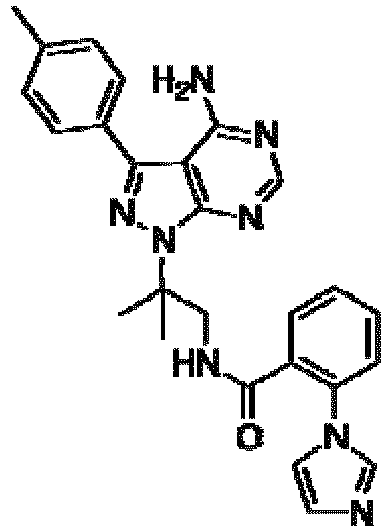
- Compound 14 was prepared according to the procedure described for example 11, using 2-(1H-imidazol-1-yl)benzoic acid (6.7 mg, 0.04 mmol). The expected product was obtained as a white solid (10.3 mg, 55%). 1H NMR (ppm, CDCl3): δ1.72 (s, 6H), 2.42 (s, 3H), 3.98 (d, J = 6.30 Hz, 2H), 5.68 (br s, 2H), 7.01 (bs, 1H), 7.05 (br s, 1H), 7.29 (d, J = 1.44 Hz, 1H), 7.32 (s. 1H), 7.35 (s, 1H), 7.41 (bs, 1H), 7.45 (d, J = 1.41 Hz, 1H), 7.47 (d, J = 1.65 Hz, 1H), 7.49 (d, J = 2.01 Hz, 1H), 7.51 (s, 1H), 7.54 (s, 1H), 7.65 (d, J = 1.83 Hz, 1H), 7.68 (d, J = 1.62 Hz, 1H), 8.22 (s, 1H). LCMS (+esi): 467.2 (M+H+).
- Similarly, the following examples were prepared from the corresponding acids:
Example Structure Characterisation Data 15 
LCMS (+esi): 544.0 (M+H+) 16 
LCMS (+esi): 394.9 (M+H+) 17 
LCMS (+esi): 382.8 (M+H+) 18 
LCMS (+esi): 486.1 (M+H+) 19 
LCMS (+esi): 364.2 (M+H+) 20 
LCMS (+esi): 443.3 (M+H+) 21 
LCMS (+esi): 484.3 (M+H+) 22 
LCMS (+esi): 484.2 (M+H+) 23 
LCMS (+esi): 458.1 (M+H+) 24 
LCMS (+esi): 497.2 (M+H+) 25 
LCMS (+esi): 473.2 (M+H+) 26 
LCMS (+esi): 569.3 (M+H+) 27 
LCMS (+esi): 513.2 (M+H+) 28 
LCMS (+esi): 553.2 (M+H+) 29 
LCMS (+esi): 613.2 (M+H+) 30 
LCMS (+esi): 423.0 (M+H+) 31 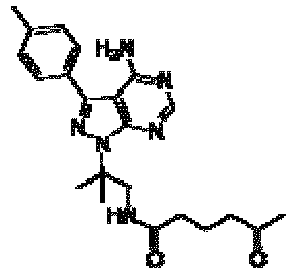
LCMS (+esi): 409.1 (M+H+) 32 
LCMS (+esi): 479.2 (M+H+) 33 
LCMS (+esi): 404.2 (M+H+) 34 
LCMS (+esi): 426.4 (M+H+) 35 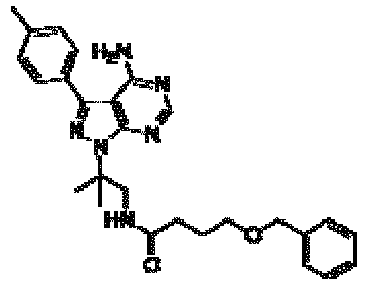
LCMS (+esi): 473.2 (M+H+) 36 
LCMS (+esi): 501.3 (M+H+) 37 
LCMS (+esi): 438.1 (M+H+) 38 
LCMS (+esi): 472.1 (M+H+) 39 
LCMS (+esi): 444.9 (M+H+) -

- Compound 40 was prepared according to the procedure described for example 11 using 6-bromopicolinic acid (17.9 mg, 88.7 µmol). A white solid was obtained (3.4 mg, 8 %). 1H NMR (ppm, CDCl3): δ 9.35 (s, 1H), 8.43-8.12 (m, 3H), 7.79-7.22 (m, 5H), 5.61 (br s, 2H), 4.18 (d, J = 6.5 Hz, 1H), 2.42 (s, 3H), 1.78 (s, 6H). LCMS (+esi): 482.0 (M+H+), RT = 6.96 min.
-

- Compound 41 was prepared according to the procedure described for example 11 using 6-fluoropicolinic acid (12.5 mg, 88.7 µmol). A cream solid was obtained (19.9 mg, 54%). 1H NMR (ppm, CDCl3): δ 9.27 (s, 1H), 8.38-7.06 (m, 8H), 5.82 (br s, 2H), 4.16 (d, J = 6.5 Hz, 1H), 2.49 (s, 3H), 1.89 (s, 6H). LCMS (+esi): 420.1 (M+H+), RT = 6.71 min.
-

- Example 42 was prepared according to the procedure described for example 11 using 4-bromopicolinic acid (17.9 mg, 88.7 µmol). A dark cream solid was obtained (18.6 mg, 43%). 1H NMR (ppm, CDCl3): δ 9.02 (s, 1H), 8.41-8.30 (m, 3H), 7.68-7.36 (m, 5H), 5.30 (s, 2H), 4.16 (d, J = 6.6 Hz, 1H), 2.45 (s, 3H), 1.75 (s, 6H). LCMS (+esi): 482.0 (M+H+), RT = 7.05 min.
-

- Compound 43 was prepared according to the procedure described for example 11 using 2-chloroisonicotinic acid (12.7 mg, 88.7 µmol) A yellow solid was obtained (27.5 mg, 75%). 1H NMR (ppm, CDCl3): δ 9.03 (s, 1H), 8.50-8.39 (m, 3H), 7.76-7.27 (m, 5H), 5.89 (s, 2H), 4.09 (d, J = 6.7 Hz, 1H), 2.47 (s, 3H), 1.83 (s, 6H). LCMS (+esi): 436.1 (M+H+), RT = 6.36 min.
-

- Compound 44 was prepared according to the procedure described for example 11 using 2-chloropyrimidine-4-carboxylic acid (14.1 mg, 88.7 µmol). A cream solid was obtained (18.4 mg, 50%). 1H NMR (ppm, CDCl3): δ 9.62 (s, 1H), 8.85-7.38 (m, 7H), 5.60 (br s, 2H), 4.16 (d, J = 6.8 Hz, 2H), 2.49 (s, 3H), 1.88 (s, 6H). LCMS (+esi): 437.0 (M+H+), RT = 6.64 min.
-

- Compound 45 was prepared according to the procedure described for example 11 using 5-bromopicolinic acid (17.9 mg, 88.7 µmol). A white solid was obtained (10 mg, 25 %). LCMS (+esi): 482.0 (M+H+), RT = 6.28 min.
-

- Compound 46 was prepared according to the procedure described for example 11 using pyridazine-4-carboxylic acid (11.0 mg, 88.7 µmol). A cream solid was obtained (18.0 mg, 53%). 1H NMR (ppm, CDCl3): δ 9.58 (s, 1H), 8.39-7.28 (m, 8H), 5.25 (br s, 2H), 4.16 (d, J= 6.6 Hz, 2H), 2.45 (s, 3H), 1.77 (s, 6H). LCMS (+esi): 403.1 (M+H+), RT = 5.68 min.
-
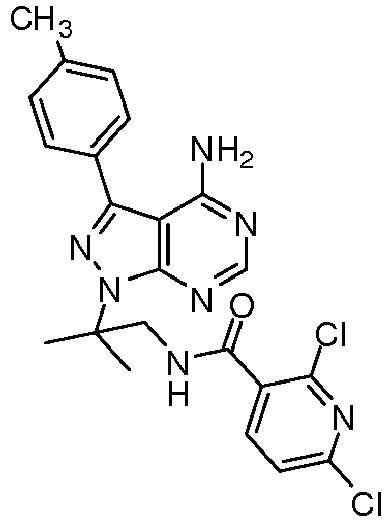
- Compound 47 was prepared according to the procedure described for example 11 using 2,6-dichloronicotinic acid (16.9 mg, 88.7 µmol). A cream solid was obtained (19.7 mg, 49%). 1H NMR (ppm, CDCl3): δ 8.30-8.09 (m, 2H), 8.18 (s, 1H), 7.54-7.26 (m, 5H), 7.26 (s, 2H), 4.20 (d, J = 6.4 Hz, 2H), 2.44 (s, 3H), 1.88 (s, 6H). LCMS (+esi): 470.0 (M+H+), RT = 6.49 min.
-

- Compound 48 was prepared according to the procedure described for example 11 using 3,6-dichloropicolinic acid (16.2 mg, 88.7 µmol). A cream solid (17.9 mg, 45%) was obtained. 1H NMR (ppm, CDCl3): δ 9.16 (s, 1H), 8.40-8.19 (m, 2H), 7.76-7.57 (m, 5H), 5.57 (s, 2H), 4.12 (d, J = 6.3 Hz, 2H), 2.16 (s, 3H), 1.76 (s, 6H). LCMS (+esi): 470.0 (M+H+), RT = 6.76 min.
-

- Compound 49 was prepared according to the procedure described for example 11 using 3-bromo-6-chloropicolinic acid (20.0 mg, 88.7 µmol). A white solid was obtained (24.6 mg, 56%). 1H NMR (ppm, CDCl3): δ 8.95 (s, 1H), 8.35-7.33 (m, 7H), 5.71 (s, 2H), 4.12 (d, J = 6.6 Hz, 2H), 2.44 (s, 3H), 1.85 (s, 6H). LCMS (+esi): 516.0 (M+H+), RT = 6.90 min.
-

- To a stirred solution of lithium hydroxide (20.0 mg, 0.84 mmol) in water (1 mL), methyl quinoline-2-carboxylate (20.0 mg, 0.11 mmol) in methanol (3 mL) was added. The solution was left to stir at room temperature for 2 h. The solution was then concentrated in vacuo. The yellow solid residue was dissolved in water and made acidic with concentrated hydrochloric acid. The organic material was extracted with ethyl acetate. The organic layers were dried with anhydrous sodium sulphate, filtered, and concentrated in vacuo to yield quinoline-2-carboxylic acid as a white solid.
- Compound 50 was prepared according to the procedure described for example 11 using quinoline-2-carboxylic acid (16.6 mg, 88.7 µmol). A white solid was obtained (23.4 mg, 61 %). 1H NMR (ppm, CDCl3): δ 8.32 (d, 1H), 7.58 (s, 1H), 7.58 (s, 1H), 7.56 (d, 1H), 7.55 (d, 1H), 7.34 (m, 1H), 7.31 (m, 1H), 5.50 (s, 1H), 5.30 (s, 4H), 3.38 (s, 2H), 2.43 (s, 6H), 2.17 (s, 2H), 1.73 (s, 3H). LCMS (+esi): 440.1 (M+H+), RT = 5.78 min.
-

- To a stirred solution of lithium hydroxide (20.0 mg, 0.84 mmol) in water (1 mL), ethyl quinoxaline-2-carboxylate (20.0 mg, 0.99 mmol) in methanol (3 mL) was added. The solution was left to stir at room temperature for 2 h. The solution was concentrated in vacuo. This cream solid residue was dissolved in water and made acidic with concentrated hydrochloric acid. The organic material was extracted into ethyl acetate. The organic layers were dried with anhydrous sodium sulphate, filtered, and concentrated in vacuo to yield quinoxaline-2-carboxylic acid as a white solid.
- Compound 51 was prepared according to the procedure described for example 11 using quinoxaline-2-carboxylic acid (15.4 mg, 88.7 µmol). A white solid was obtained (25.2 mg, 66 %). 1H NMR (ppm, CDCl3): δ 9.66 (s, 1H), 8.30-7.26 (m, 10H), 5.62 (br s, 2H), 3.94 (d, J = 6.3 Hz, 2H), 2.43 (s, 3H), 1.78 (s, 6H). LCMS (+esi): 453.1 (M+H+), RT = 5.75 min.
-

- Compound 52 was prepared according to the procedure described for example 11 using 5-bromopicolinic acid (17.9 mg, 88.7 µmol). A white solid was obtained (0.3 mg, 0.7 %). LCMS (+esi): 482.0 (M+H+), RT = 7.08 min.
-

- Compound 53 was prepared according to the procedure described for example 11 using 4-fluorobenzoic acid (12.4 mg, 88.7 µmol). A white solid was obtained (28.7 mg, 81 %). 1H NMR (ppm, CDCl3): δ 8.35 (s, 1H), 8.18-7.05 (m, 9H), 5.90 (br s, 2H), 4.11 (d, J = 6.2 Hz, 2H), 2.45 (s, 3H), 1.84 (s, 6H). LCMS (+esi): 419.1 (M+H+), RT = 7.64 min.
-

- Compound 54 was prepared according to the procedure described for example 11 using 2-fluorobenzoic acid (12.4 mg, 88.7 µmol). A white solid was obtained (14.8 mg, 42 %). 1H NMR (ppm, CDCl3): δ 8.33 (s, 1H), 7.59-7.03 (m, 9H), 5.29 (br s, 2H), 4.11 (d, J = 7.2 Hz, 2H), 2.44 (s, 3H), 1.82 (s, 6H). LCMS (+esi): 419.1 (M+H+), RT = 7.70 min.
-

- Compound 55 was prepared according to the procedure described for example 11 using 3-fluorobenzoic acid (12.4 mg, 88.7 µmol). A white solid was obtained (22.8 mg, 65 %). 1H NMR (ppm, CDCl3): δ 8.37 (s, 1H), 7.60-7.15 (m, 8H), 5.29 (br s, 2H), 4.12 (d, J = 6.2 Hz, 2H), 2.45 (s, 3H), 1.85 (s, 6H). LCMS (+esi): 419.1 (M+H+), RT = 7.63 min.
-

- Compound 56 was prepared according to the procedure described for example 11 using pyrazine-2-carboxylic acid (12.2 mg, 88.7 µmol). A beige solid was obtained (2.8 mg, 8 %). LCMS (+esi): 403.1 (M+H+), RT = 7.16 min.
-

- Compound 57 was prepared according to the procedure described for example 11 using pyrimidine-2-carboxylic acid (12.2 mg, 88.7 µmol). A beige solid was obtained (12.5 mg, 37 %). 1H NMR (ppm, CDCl3): δ 9.31 (s, 1H), 9.17 (s, 2H), 8.38 (s, 1H), 7.37 (s, 4H), 5.66 (s, 1H), 5.29 (s, 2H), 2.45 (s, 3H), 2.43 (s, 3H), 1.73 (s, 6H). LCMS (+esi): 403.1 (M+H+), RT = 6.76 min.
-

- Saturated sodium hydrogen carbonate (10 mL) was added to compound 1E (106 mg, 0.29 mmol) in dichloromethane (10 mL) and left to stir at room temperature for 5 min. The organic material was extracted into dichloromethane (3 x 10 mL), dried with anhydrous potassium carbonate, and concentrated in vacuo. This was combined with pyrimidine-2-carboxylic acid (45 mg, 0.38 mmol), HBTU (164 mg, 0.43 mmol) and DIPEA (77.8 µL, 0.45 mmol) in DMF (6 mL) and placed in the orbital shaker overnight. The resulting solution was diluted with dichloromethane and washed with a saturated aqueous solution of sodium hydrogen carbonate and water. The organic layer was dried with anhydrous magnesium sulphate, filtered, and concentrated in vacuo to yield a yellow oil. This oil was purified using HPLC to yield compound 58 as a yellow solid (3.7 mg, 3.2%). LCMS (+esi): 403.1 (M+H+), RT = 6.80 min.
-

- To a stirring solution of 1E (58.4 mg, 0.16 mmol) in dichloromethane (6 mL) at 0°C, triethylamine (64.5 µL, 0.46 mmol) was added. A solution of benzenesulfonyl chloride (27.4 mg, 0.15 mmol) in dichloromethane (2 mL) was then added dropwise. After 20 min at 0°C, the reaction mixture was stirred at room temperature for 24 h. The solution was then hydrolysed with saturated ammonium chloride, and extracted with dichloromethane. The combined organic layers were washed with water, dried with anhydrous magnesium sulfate, and concentrated in vacuo to yield compound 59 as a white powder (46.7 mg, 69 %). LCMS (+esi): 437.1 (M+H+), RT = 7.57 min.
-

- Compound 60 was prepared according to the procedure described for example 11 using nicotinic acid (10.9 mg, 88.7 µmol). A beige solid was obtained (26.8 mg, 79 %). LCMS (+esi): 402.1 (M+H+), RT = 7.04 min.
-

- Compound 61 was prepared according to the procedure described for example 11 using 4-methoxypicolinic acid (13.7 mg, 88.7 µmol). A cream solid was obtained (14.6 mg, 40 %). LCMS (+esi): 432.3 (M+H+), RT = 8.80 min.
-

- Compound 62 was prepared according to the procedure described for example 11 using pyrimidine-4-carboxylic acid (10.6 mg, 88.7 µmol). A yellow solid was obtained (5.8 mg, 17 %). LCMS (+esi): 403.3 (M+H+), RT = 7.93 min.
-

- Compound 63 was prepared according to the procedure described for example 11 using 4-chloropicolinic acid (12.7 mg, 88.7 µmol). A white solid was obtained (7.8 mg, 21 %). LCMS (+esi): 436.3 (M+H+), RT = 9.38 min.
-

- Compound 64 was prepared according to the procedure described for example 11 using thiazole-4-carboxylic acid (11.5 mg, 88.7 µmol). A white solid was obtained (4.8 mg, 14 %). LCMS (+esi): = 408.1 (M+H+), RT = 8.05 min.
-

- Compound 65 was prepared according to the procedure described for example 11 using 4-methylpicolinic acid (11.5 mg, 88.7 µmol). A brown solid was obtained (17.2 mg, 49 %). LCMS (+esi): 416.3 (M+H+), RT = 8.84 min.
-

- Compound 66 was prepared according to the procedure described for example 11 using 4-phenylpicolinic acid (17.7 mg, 88.7 µmol). A white solid was obtained (9.6 mg, 24 %). LCMS (+esi): 478.3 (M+H+), RT = 9.91 min.
-

- Compound 67 was prepared according to the procedure described for example 11 using isonicotinic acid (10.4 mg, 88.7 µmol). A white solid was obtained (4.9 mg, 14 %). LCMS (+esi): 402.1 (M+H+), RT = 6.70 min.
-
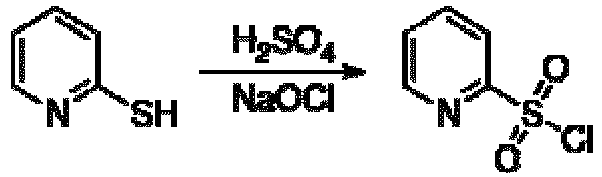
- 68A: A solution of 2-Mercaptopyridine (100 mg, 0.9 mmol) in 2.5 mL of concentrated sulfuric acid cooled at 0°C was treated with 5.6 mL of 12.5% sodium hydrochloric solution added dropwise. The mixture was stirred at room temperature for 30 minutes, then poured on ice and water, extracted three times with dichloromethane, dried over magnesium sulfate and concentrated. Compound 68A was obtained as a colourless oil (110 mg, 70%yield). 1H NMR (ppm, CDCl3): δ 7.69 (t, J = 5.9 Hz, 1H), 8.09 (m, 2H), 8.80 (d, J = 3.9 Hz, 1H).

- 68B: A solution of compound 1E (59 mg, 0.16 mmol) in 3 mL of dichloromethane was treated with triethylamine (65 µL, 0.47 mmol). This solution was stirred for 6 hours. 68A (28 mg, 0.16 mmol) in 3 mL of dichloromethane was then added dropwise at 0°C. The mixture was stirred 20 minutes at 0°C and 24 hours at room temperature. After 24 hours, the solution was treated with a saturated solution of ammonium chloride and extracted 3 times with dichloromethane. The combined organic layers were dried over magnesium sulfate and concentrated. Compound 68B was obtained as white crystal (53 mg, 78% yield). 1H NMR (ppm, CDCl3): δ 1.78 (s, 6H), 2.42 (s, 3H), 3.82 (s, 2H), 5.81 (br s, 2H), 7.26-7.29 (m, 2H), 7.46-7.48 (m, 3H), 7.86 (td, J = 1.7 and 7.7 Hz, 1H), 7.97 (dt, J = 7.8 and 1.1 Hz, 1H), 8.11 (s, 1H), 8.64 (d, J = 3.9 Hz, 1H). LCMS (+esi): 438.1 (M+H+). Purity: 94.2%.
-

- 69A: 4-Chloropicolinic acid (200 mg, 1.27 mmol) was dissolved in a mixture of 2 mL of THF and 600 µL of methanol and cooled to 0°C. Trimethylsilyldiazomethane (552 µL, 1.1 mmol) were added dropwise (strong gas evolution). The solution was stirred for 3 hours at 0°C, then overnight at room temperature. After that time, a few drops of acetic acid were added, followed by water. The aqueous solution was extracted three times with ethyl acetate. The combined organic layers were dried over sodium sulfate and concentrated in vacuo. Compound 69A was obtained as a white crystalline solid (210 mg, 96% yield). 1H NMR (ppm, CDCl3): δ 4.01 (s, 3H), 7.50 (dd, J = 2.0 Hz and 5.3 Hz, 1H), 8.13 (d, J = 2.1 Hz, 1H), 8.67 (d, J = 5.3 Hz, 1H). LCMS (+esi): 171.9 (M+H+).

- 69B: compound 69A (100 mg, 0.58 mmol) and piperidine (171 µL, 1.7 mmol) were heated at 110°C overnight. 776 µL of an 8% aqueous hydrochloric acid solution (1.7 mmol) were then added and the brown solution was stirred at 110°C for 2 hours. The solution was then cooled at 0°C and concentrated in vacuo. The residue was dissolved in boiling water and heated at 110°C for 5 minutes then kept at -20°C for 1 hour and at 4°C for 72 hours. Filtration afforded compound 69B as brown crystals (18 mg, 9 % yield). 1H NMR (ppm, MeOD): δ1.78 (s, 6 H), 3.77 (s, 4H), 7.21 (dd, J = 3.1 and 7.4 Hz, 1H), 7.67 (d, J = 3.1 Hz, 1H), 8.07 (d, J = 7.4 Hz, 1H). LCMS (+esi): 207.1 (M+H+).

- 69C: Compound 69C was prepared according to the procedure described for example 11 using acid 69B (31.4 mg, 0.08 mmol). Compound 69C was obtained as a white solid (24 mg, 71 % yield). 1H NMR (ppm, CDCl3): δ 1.65 (s, 6H), 1.85 (s, 6H), 2.44 (s, 3H), 3.40 (s, 4H), 4.18 (d, J = 6.0 Hz, 2H), 5.57 (br s, 2H), 6.67 (dd, J = 2.8 and 5.9 Hz, 1H), 7.35 (d, J = 7.8 Hz, 2H), 7.61 (d, J = 2.7 Hz, 1H), 7.71 (d, J = 8.1 Hz, 2H), 8.14 (d, J = 5.9 Hz, 1H), 8.36 (s, 1H), 9.21 (t, J = 6.3 Hz, 1H). LCMS (+esi): 485.2 (M+H+). Purity: 98.8 %.
-

- 70A: 4-Bromopicolinic acid (127.5 mg, 0.63 mmol) was dissolved in a mixture of 1 mL of THF and 300 µL of methanol and cooled at 0°C. Trimethylsilyldiazomethane (276 µL, 1.87 mmol) was added dropwise at 0°C (strong gas evolution). The solution was stirred for 2 hours at 0°C, then over night at room temperature. A few drop of acetic acid were then added followed by water. The aqueous solution was extracted three times with ethyl acetate. The combined organic layers were dried over sodium sulfate and concentrated in vacuo. Compound 70A was obtained as a yellow oil (71 mg, 60% yield). 1H NMR (ppm, CDCl3): δ 3.98 (s, 3H), 7.64 (dd, J = 1.9 and 5.2 Hz, 1H), 8.27 (d, J = 1.9 Hz, 1H), 8.54 (d, J = 5.2 Hz, 1H).

- 70B: compound 70A (120 mg, 0.56 mmol) was dissolved in morpholine (146 µL, 1.68 mmol) and the red solution was stirred at 110°C overnight. 381.6 µL of an 8% aqueous hydrochloric acid solution (1.68 mmol) were added and this solution was stirred at 110°C for 7 hours. The dark solution was concentrated in vacuo and the brown oil was crystallized in water. Compound 70B was obtained as brown crystals (35.2 mg, 30 % yield). 1H NMR (ppm, MeOD): δ 3.86-3.76 (m, 8H), 7.28 (dd, J = 3.1 and 7.4 Hz, 1H), 7.72 (d, J = 3.0 Hz, 1H), 8.18 (d, J = 7.4 Hz, 1H). LCMS (+esi): 209.1 (M+H+).

- 70C: compound 70C was prepared according to the procedure described for example 11 using acid 70B (35 mg, 0.17 mmol). A colourless oil was obtained (22 mg, 30% yield). 1H NMR (ppm, CDCl3): δ 1.85 (s, 6H), 2.45 (s, 3H), 3.36 (t, J = 5.0 Hz, 4H), 3.83 (t, J = 5.0 Hz, 4H), 4.18 (d, J = 6.6 Hz, 2H), 6.64 (dd, J = 2.7 and 6.1 Hz, 1H), 6.70 (br m, 2H), 7.36 (d, J = 7.9 Hz, 2H), 7.64 (d, J = 2.5 Hz, 1H), 7.71 (d, J = 7.9 Hz, 2H), 8.22 (d, J = 6.0 Hz, 1H), 8.38 (s, 1H), 9.23 (t, J = 6.4 Hz, 1H). LCMS (+esi): 487.2 (M+H+). Purity: 92%.
-

- Compound 1E (50 mg, 0.14 mmol) was treated with a saturated aqueous solution of NaHCO3 solution and dichloromethane. The two layers were stirred at room temperature for 1 hour. The aqueous layer was then extracted 3 times with dichloromethane. The combined organic layers are dried over K2CO3 and concentrated in vacuo to yield a white solid. To the neutral from of 1E were added methylpicolinic acid (19.8 mg, 0.15 mmol), then 1-ethyl-3-(3-dimethylaminopropyl)carbodiimide (34.4 mg, 0.18 mmol) and 4-dimethylaminopyridine (10 mg, 0.08 mmol). 2 mL of dimethylformamide were then added and the colourless solution was stirred for 18 hours. A further 10 mg of 4-dimethylaminopyridine (0.08 mmol) was added and the solution was stirred overnight. Dichloromethane was added and the yellow mixture was extracted 3 times with HCl 4M. The combined aqueous layers were basified with a saturated Na2CO3 aqueous solution, and a white precipitate appears. Filtration and rinsing with water afforded compound 71 as a white solid (20.2 mg, 37% yield). 1H NMR (ppm, CDCl3): δ 1.86 (s, 6H), 2.44 (s, 3H), 2.73 (s, 3H), 4.16 (d, J= 6.6 Hz, 2H), 5.53 (br s, 2H), 7.27 (dd, J = 4.6 and 7.8 Hz, 1H), 7.35 (d, J = 7.9 Hz, 2H), 7.56 (d, J = 7.0 Hz, 1H), 7.67 (d, J = 8.0 Hz, 2H), 8.36 (s, 1H), 8.37 (s, 1H), 9.19 (t, J = 6.5 Hz, 1H). LCMS (+esi): 438.2 (M+Na+). Purity: 98.6%.
-

- Compound 72 was prepared according to the procedure described for example 71 using 5-methylpicolinic acid (20 mg, 0.15 mmol). A white solid is obtained (28.2 mg, 51% yield). 1H NMR (ppm, CDCl3): δ 1.85 (s, 6H), 2.38 (s, 3H), 2.45 (s, 3H), 4.19 (d, J = 6.6 Hz, 2H), 5.59 (br s, 2H), 7.37 (d, J = 7.8 Hz, 2H), 7.61 (d, J = 7.9 Hz, 1H), 7.70 (d, J = 8.0 Hz, 2H), 8.09 (d, J = 8.0 Hz, 1H), 8.36 (s, 1H), 8.37 (s, 1H), 9.19 (t, J = 6.0 Hz, 1H). LCMS (+esi): 438.2 (M+Na+). Purity: 98.5%.
-

- Compound 73 was prepared according to the procedure described for example 72 using 6-methylpicolinic acid (20 mg, 0.15 mmol). A white solid is obtained (24.1 mg, 44% yield). 1H NMR (ppm, CDCl3): δ 1.85 (s, 6H), 2.45 (s, 3H), 2.50 (s, 3H), 4.18 (d, J = 6.7 Hz, 2H), 5.61 (br s, 2H), 7.23 (d, J = 6.7 Hz, 1H), 7.35 (d, J = 7.9 Hz, 2H), 7.67-7.71 (m, 3H), 8.00 (d, J = 7.7 Hz, 1H), 8.37 (s, 1H), 9.31 (br s, 1H). LCMS (m/z): 416.1 (M+H+). Purity: 94.1%.
-

- 74A: NaH (725 mg, 30 mmol) was added to a suspension of malononitrile (1 g, 15.1 mmol) in 15 mL of THF at 0°C. After the addition was complete, 4-chlorobenzoyl chloride (1 g, 5.75 mmol) was added dropwise at 0°C. The reaction mixture was stirred at room temperature for 30 mins. HCl IN was added and the acid aqueous layer was extracted three times with ethyl acetate. The combine organic layers were washed with brine, dried over sodium sulfate, filtered and concentrated in vacuo to obtain compound 74A as pale yellow solid (1.12 g, 95%). 1H NMR (ppm, MeOD): δ 7.69 (d, J = 8.7 Hz, 2H), 7.55 (d, J = 8.9 Hz, 2H), 4.12 (s, 3H).

- 74B: Compound 74A (1.92 g, 9.4 mmol) was dissolved in a mixture of dioxane (15 mL) and water (2 mL) in a two-neck flask. Sodium bicarbonate (6.2 g, 74.3 mmol) was added to the mixture followed by dimethylsulfate (8.3 g, 65.9 mmol). The reaction was stirred at 84°C for 2 hr 30 mins. Water was added and the aqueous layer was extracted with tert-Butylmethyl ether followed by diethyl ether. The combine organic phases were dried over anhydrous sodium sulphate, filtered and concentrated in vacuo. The resulting mixture was recrystallised with methanol to yield compound 74B as white solid (1.3 g, 65%). 1H NMR (ppm, MeOD): δ 7.56 (d, J = 8.6 Hz, 2H), 7.47 (d, J = 8.7 Hz, 2H), 3.98 (s, 3H). LCMS (+esi): 219 (M+H+).

- 74C: Compound 1B (1 g, 4.2 mmol) was dissolved in 4.3 mL of dry acetonitrile. Tosic acid (4 g, 21.1 mmol) was dissolved in 29 mL of dry acetonitrile. Molecular sieves were added to both solutions and stood for 30 minutes. The solution of Tosic acid was then added to the solution of 1B and the reaction was stirred at room temperature for 2 hours. The reaction was filtered and the solid washed with acetonitrile and dichloromethane. The filtrate was concentrated in vacuo to afford a thick and colourless oil. The colourless oil was dissolved in 5 mL of ethanol. Triethylamine (696 mg, 6.9 mmol) and compound 74A (300 mg, 1.4 mmol) were successively added. The reaction was then stirred at 60°C for 3 hours. After cooling down, the reaction was concentrated. Water and ethyl acetate were then added and the aqueous phase was extracted three times with ethyl acetate. The combine organic layers were dried over sodium sulphate and concentrated. The oily residue obtained was purified by flash chromatography on SiO2 using 100% DCM then MeOH/DCM 1:99 to afford compound 74C as a semi solid (387 mg, 67%). 1H NMR (ppm, CDCl3): δ 7.83 (d, J = 8.8 Hz, 2H), 7.37 (d, J = 2.6 Hz, 2H), 7.33 (m, 5 H), 5.52 (t, J = 6.3 Hz, 1H), 5.10 (s, 2H), 4.48 (s, 2H), 3.78 (d, J = 6.7 Hz, 2H), 1.60 (s, 6H). LCMS (+esi): 423 (M+H+).

- 74D: Compound 74C (372 mg, 0.88 mmol) and formamidine acetate (366 mg, 3.52 mmol) were reacted at 150°C in 1.5 mL of 2-methoxyethanol. 3 more portions of formamidine acetate were added to the reaction mixture within 1 hour interval. The reaction mixture was refluxed at 150°C overnight. The reaction mixture was then cooled to room temperature; water and ethyl acetate were added. The aqueous phase was extracted three times with ethyl acetate. The combine organic phases were washed two times with water and brine, dried over anhydrous sodium sulphate, filtered and concentrated in vacuo. The yellow oil obtained was purified by flash chromatography eluted with 30%-50% EtOAc/Petroleum spirit to yield compound 74D as clear oil, which solidified overnight (241 mg, 61%). 1H NMR (ppm, CDCl3): δ 8.34 (s, 1H), 7.60 (d, J = 8.7 Hz, 2H), 7.52 (d, J = 8.6 Hz, 2H), 7.34 (m, 5H), 5.94 (t, J = 6.2 Hz, 1H), 5.44 (s, 2H), 5.09 (s, 2H), 3.96 (d, J = 6.6 Hz, 2H), 1.78 (s, 6H). LCMS (+esi): 452 (M+H+).

- 74E: Compound 74D (240 mg, 0.53 mmol) was treated with 2.7 mL of a 33% solution of HBr in glacial acetic acid. The reaction was stirred at room temperature for one hour. Dry ether was then added to the reaction mixture leading to yellow precipitate. It was collected by filtration and rinsed thoroughly with ether and dried for a day to afford compound 74E as white solid (140 mg, 84%). 1H NMR (ppm, DMSO-d6): δ 8.32 (s, 1H), 7.94 (s, 2H), 7.69 (d, J = 8.6 Hz, 2H), 7.61 (d, J = 8.4 Hz, 2H), 3.65 (d, J = 5.5 Hz, 2H), 1.76 (s, 6H). LCMS (+esi): 317 (M+H+).

- 74F: Compound 74F was obtained following the procedure used to prepare compound 11 using compound 74E (50 mg, 0.16 mmol) and benzoic acid (19 mg, 0.16 mmol). Compound 74F was obtained as white solid (40 mg, 61%). 1H NMR (ppm, CDCl3): δ 8.41 (s, 1H), 8.36 (t, J = 6.1 Hz, 1H), 7.81 (d, J = 8.6 Hz, 2H), 7.63 (d, J = 8.3 Hz, 2H), 7.46 (m, 5H), 5.61 (s, 2H), 5.29 (s, 1H), 4.15 (d, J = 5.5 Hz, 2H), 1.85 (s, 6H). LCMS (+esi): 421 (M+H+).
-
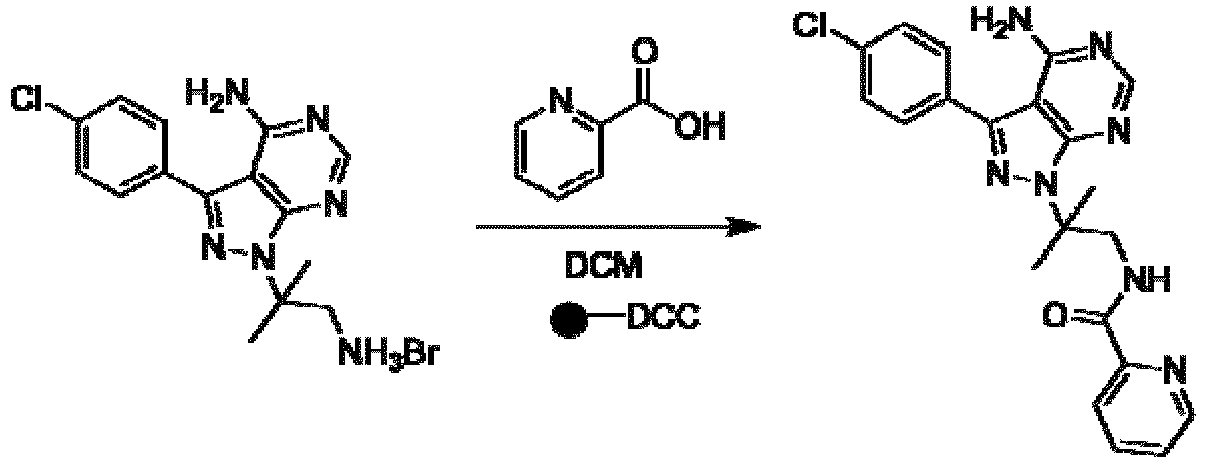
- Compound 75 was obtained following the procedure used to prepare compound 11 using compound 74E (50 mg, 0.16 mmol) and picolinic acid (19 mg, 0.16 mmol). Compound 75 was obtained as white solid (32 mg, 48%). 1H NMR (ppm, CDCl3): δ 9.20 (s, 1H), 8.2-8.53 (m, 3H), 7.29-7.86 (m, 5H), 5.54 (s, 2H), 4.2 (d, J = 6.6 Hz, 2H), 1.86 (s, 6H). LCMS (+esi): 422 (M+H+).
-
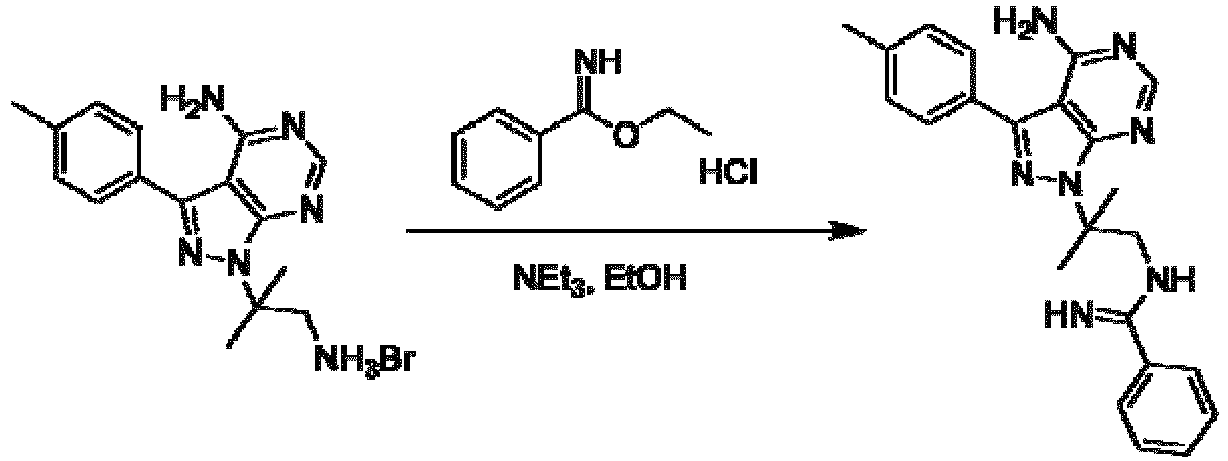
- Compound 1E (73 mg, 0.19 mmol) was neutralised (suspended in CH2Cl2 and treated with saturated sodium bicarbonate aqueous solution, dried over potassium carbonate and concentrated). The residue dissolved in 0.7 mL of EtOH was added to a solution of ethyl benzimidate hydrochloride (36 mg, 0.19mmol) in 0.1 mL of EtOH followed by triethylamine (60 mg, 0.58 mmol). The reaction mixture was stirred at room temperature for 16 hours. The reaction mixture was concentrated in vacuo to remove excess EtOH. It was then purified by preparative HPLC to afford compound 76 as white solid (12 mg, 16%). 1H NMR (ppm, MeOD): δ 8.32 (s, 1H), 7.67 (s, 1H), 7.47-7.7.58 (m, 6H), 7.37 (d, J = 7.8 Hz, 2H), 5.48 (s, 1H), 4.20 (s, 2H), 2.43 (s, 3H), 2.00 (s, 6H). LCMS (+esi): 400 (M+H+)
-

- To a stirred suspension of 2-cyanopyridine (50 mg, 0.49 mmol) in 1.4 mL of dry methanol was added a 0.5 M sodium methoxide solution in methanol (0.35 mL, 0.18 mmol). The reaction mixture was stirred at room temperature for two days to allow the imidate ester to form. To this solution of imidate ester (0.1 mL, 0.08 mmol) was added compound 1E (30 mg, 0.08 mmol). The resulting mixture was stirred at room temperature until all the starting material had reacted. A white precipitate formed while stirring overnight. The reaction mixture was stopped and concentrated in vacuo to remove methanol. The mixture was purified by preparative HPLC to afford compound 77 as white solid (7.5 mg, 23%). 1H NMR (ppm, MeOD): δ 8.75 (s, 1H), 8.24 (s, 1H), 8.07 (d, J = 5.3 Hz, 2H), 7.71 (s, 1H), 7.61 (d, J = 7.0 Hz, 2H), 7.39 (d, J = 7.2 Hz, 2H), 4.24 (s, 2H), 2.45 (s, 3H), 1.96 (s, 6H). LCMS (+esi): 401 (M+H+).
-

- Compound 1E (22.7 mg, 0.06 mmol) was neutralised (suspended in CH2Cl2 and treated with saturated sodium bicarbonate aqueous solution, dried over potassium carbonate, filtered and concentrated). The residue and 4,5-dihydro-2-(methylthio)-1H-imidazole hydroiodide (30 mg, 0.12 mmol) in 0.4 mL of dry methanol were refluxed for 1 day under nitrogen. Another equivalent of 4,5-hydro-2-(methylthio)-1H-imidazole hydroiodide was added to the reaction mixture and stirred at reflux for another day. The reaction mixture was concentrated in vacuo to remove methanol. The mixture was purified using preparative HPLC to afford compound 78 as semi-white solid (5 mg, 20%). 1H NMR (ppm, CDCl3): δ 8.33 (s, 1H), 7.59 (d, J = 7.3 Hz, 2H), 7.34 (d, J = 7.7 Hz, 2H), 6.91 (s, 2H), 5.43 (t, J = 3.9 Hz, 2H), 4.15 (s, 4H), 3.65 (d, J = 2.3 Hz, 2H), 3.53 (s, 3H), 2.44 (s, 3H), 1.90 (s, 6H). LCMS (+esi): 364 (M+H+).
-

- 79A: To a solution of 2-m-tolylacetic acid (1 g, 6.7 mmol) in 10 mL of dichloromethane were added oxalyl chloride (887 mg, 7 mmol) and one drop of DMF. The resulting solution was stirred for 1h at room temperature. The solvent was removed in vacuo, and the resulting product was directly used in the next step without further purification.

- 79B: malonitrile (440 mg, 6.6 mmol) in 5 mL of THF was treated with sodium hydride (320 mg, 13.3 mmol). Compound 79A in solution in THF was then added dropwise. The solution was stirred at room temperature for 1 hr. Aqueous 1N HCl solution was then added, and the mixture was extracted three times with ethyl acetate. The combined organic layers were then dried over MgSO4 and concentrated. The resulting crude material was purified by column chromatography on SiO2 using ethyl acetate/cyclohexane (50:50). Compound 79B was obtained as a brown oil (477 mg, 36% yield). 1H NMR (CDCl3): δ 7.03 (m, 4H), 3.63 (s, 2H), 2.23 (s, 3H).

- 79C: To sodium hydrogen carbonate (1.62 g, 19 mmol) in 3.9 mL of 1,4-dioxane were slowly added compound 79B (477 mg, 2.4 mmol) and dimethyl sulphate (2.1 g, 17 mmol). After stirring at 80°C for 3h, water was added, and the mixture was extracted three times with tert-butylmethyl ether. The combined organic layers were then dried over Na2SO4 and concentrated. Purification by column chromatography on SiO2 using methanol/dichloromethane (1:99) led to compound 79C as a pale yellow oil (235 mg, 46% yield). 1H NMR (CDCl3): δ 7.27 (t, J = 7.5 Hz, 1H), 7.15 (d, J = 9 Hz, 1H), 7.05 (m, 2H), 3.99 (s, 3H), 3.99 (s, 2H), 2.37 (s, 3H).

- 79D: the procedure used to prepare compound 1D was followed using 1C (126 mg, 0.64 mmol) and 79C (135 mg, 0.64 mmol). Purification by column chromatography on SiO2 using methanol/dichloromethane (1:99) afforded compound 79D as a pale yellow oil (210 mg, 79% yield). 1H NMR (CDCl3): δ 7.34 (m, 6H), 7.04 (m, 3H), 5.65 (br s, 1H), 5.10 (s, 2H), 4.4 (br s, 2H), 3.81 (s, 2H), 3.69 (m, 2H), 2.27 (s, 3H), 1.51 (s, 6H).

- 79E: compound 79D (210 mg, 0.5 mmol) and formamidine acetate (209 mg, 2 mmol) were stirred in 2.7 mL of methoxyethanol. The reaction mixture was refluxed for 4h and 4 additional portions of formamidine acetate (209 mg each, 2 mmol) were added in the reaction mixture every hour. The reaction mixture was then cooled to room temperature and the solvent was evaporated in vacuo. The crude product was then dissolved in dichloromethane, and the brown precipitate was filtered off. The filtrate was concentrated and purified by column chromatography on SiO2 using methanol/dichloromethane (2:98) to afford compound 79C (116 mg, 52% yield). 1H NMR (CDCl3): δ 8.21 (s, 1H), 7.33 (m, 6H), 7.20 (t, J = 6.0 Hz, 1H), 7.07 (d, J = 6.0 Hz, 1H), 6.98 (d, J = 9 Hz, 1H), 6.01 (br t, 1H), 5.09 (d, J = 6.0 Hz, 2H), 5.05 (br s, 2H), 4.23 (s, 2H), 3.62 (d, J = 6 Hz, 2H), 2.29 (s, 3H), 1.59 (s, 6H). LCMS (+esi): 444.9 (M+H+), RT = 6.46 min.

- 79D: Compound 79C (116 mg, 0.26 mmol) was treated with 2 mL of a 33% solution of hydrobromic acid in acetic acid. The reaction mixture was stirred at room temperature for 5h (monitored by TLC). The solvent was then removed in vacuo and the crude product was dried in a vacuum oven. Dichloromethane was added and the precipitate was filtered off and dried in vacuo. This precipitate was then stirred in dichloromethane and saturated NaHCO3 solution for 30min for neutralization. The reaction mixture was then extracted three times with dichloromethane, dried over Na2SO4 and concentrated, to give compound 79D as an orange powder (28 mg, 35% yield). LCMS (+esi): 311.2 (M+H+), RT = 4.51 min.

- 79E: Compound 79D (28 mg, 0.09 mmol), N,N'-diBoc-N"-trifluoromethanesulfonylguanidine (32 mg, 0.08 eq) and triethylamine (12 µL, 0.09 mmol) were dissolved in 0.7 mL of dry dichloromethane. The reaction mixture was stirred at room temperature overnight. Dichloromethane was then added and this organic layer was washed successively with a 0.2 M sodium bisulphate aqueous solution, saturated sodium bicarbonate aqueous solution and brine. The combined organic layers were dried over Na2SO4 and concentrated, to give compound 79E as yellow oil (57 mg, quantitative). LCMS (+esi): 353.1 (M-Boc+), RT = 5.68 min.

- 79F: Compound 79E (57 mg, 0.13 mmol) was dissolved in 1.8 mL of dry dichloromethane and cooled to 0°C. 0.7 mL of Trifluoroacetic acid was then added dropwise. The reaction mixture was allowed to warm to room temperature and stirred overnight. The solvent was removed in vacuo, and toluene was then added and evaporated to remove the remaining TFA. The brown oil that was obtained was dissolved in water and acetonitrile and placed into the freeze dryer to afford a white solid. Preparative HPLC afforded compound 79F as a white powder. NMR (CDCl3): δ 8.53 (br s, 1H), 8.15 (s, 1H), 7.19 (t, J = 7.7 Hz, 1H), 7.08 (s, 1H), 7.04-7.00 (m, 2H), 4.31 (s, 2H), 3.96 (s, 2H), 2.29 (s, 3H), 1.78 (s, 6H). LCMS (+esi): 353.3 (M+H+), RT = 4.62 min.
-

- To a solution of compound 1E (10 mg, 0.03 mmol) in 1 mL of dichloromethane was added a saturated aqueous solution of NaHCO3 and the mixture was stirred for 2 hours at room temperature. The reaction mixture was then extracted three times with dichloromethane, dried over anhydrous K2CO3 and concentrated to give the free amine. A mixture of this amine and ethylacetamidate hydrochloride (3.3 mg, 0.03 mmol) in 200 µL of methanol was stirred at room temperature for 25 h. The solution was then evaporated under reduced pressure and 1 mL of acetonitrile was added to the residue. The mixture was then alkalized with a 0.1 M aqueous solution of NaOH and extracted thrice with dichloromethane. The solution was then dried over anhydrous Na2SO4, filtered, concentrated in vacuo, and purified by preparative HPLC to give compound 80 as white powder (1.5 mg, 17% yield). 1H NMR (ppm, CDCl3): δ 8.27 (s, 1H), 7.53 (d, J = 7.4 Hz, 2H), 7.36 (d, J = 7.6 Hz, 2H), 3.82 (s br, 2H), 2.40-2.44 (m, 6H), 1.85 (s, 6H). LCMS (+esi): 338.2 (M+H+), RT = 4.37 min.
-

- To a solution of Compound 1E (30 mg, 0.08 mmol) in 0.5 mL of 1-butanol was added sodium dicyanamide (7.1 mg, 0.08 mmol). The mixture was stirred at 140°C overnight. The mixture was concentrated and the residue purified by preparative HPLC to give compound 81 as a white powder (12 mg, 41% yield). 1H NMR (ppm, CDCl3): δ 8.29 (s, 1H), 7.55 (d, J = 6.9 Hz, 2H,), 7.36 (d, J = 7.6 Hz, 2H), 3.87 (s, 2H), 2.43 (s, 3H), 1.83 (s, 6H). LCMS (+esi): 364.4 (M+H+), RT = 4.31 min.
-

- 82A: To a solution of 4-Bromopicolinic acid (0.5 g, 3.2 mmol) in 5 mL of t-butanol was added pyridine (1.5 mL, 19 mmol) and cooled to 0°C. Toluene sulfonyl chloride (1.8 g, 9.5 mmol) was then added portion-wise. The reaction was stirred at 0°C for 10 minutes and at room temperature overnight. The mixture was slowly poured into saturated sodium hydrogen carbonate and extracted three times with dichloromethane. The combined organic layers were washed with brine and concentrated in vacuo. The crude product was purified via flash chromatography on SiO2 using methanol/dichloromethane (2:98). Compound 82A was obtained as a white solid (735 mg, 89%). 1H NMR (ppm, CDCl3): δ 8.53 (d, J = 4 Hz, 1H), 8.18 (s, 1H), 7.58 (d, J = 4 Hz, 1H), 1.63 (s, 9H). LCMS (+esi): 259 (M+H+).
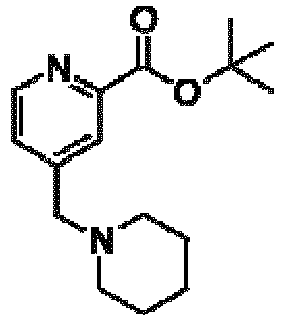
- 82B: in an oven dried Schlenk tube were added palladium acetate (13 mg, 0.02 mmol), butyl di-1-adamantyl phosphine (14 mg, 0.04 mmol), potassium (piperidin-1-yl)-methyltrifluoroborate (0.08 g, 0.4 mmol), compound 82A (0.1 g, 0.4 mmol) and cesium carbonate (0.38 g, 1.2 mmol). The tube was filled with nitrogen and evacuated three times. 2 mL of anhydrous toluene were added and the mixture stirred for 5 minutes, followed by the addition of 200 µL of water. The mixture was heated up to 95°C and left stirring for 24 hours. The reaction was concentrated in vacuo and the residue was re-dissolved in ethyl acetate and washed with water, brine and dried over sodium sulphate. The product was purified via flash chromatography on SiO2 using methanol/dichloromethane (5:95). A clear oil was obtained (104 mg, 94%). 1H NMR (ppm, CDCl3): δ 8.63 (d, J = 9 Hz, 1H), 7.97 (s, 1H), 7.47 (d, J = 9 Hz, 1H), 3.54 (s, 2H), 2.3-2.41 (m, 4H), 1.58-1.66 (m, 11H), 1.38-1.46 (m, 4H). LCMS (+esi): 277 (M+H+).

- 82C: Compound 82B (0.06 g, 0.22 mmol) was dissolved in methanol (1 mL) and 0.5 mL of a 2M solution of sodium hydroxide was added. The reaction was stirred at room temperature overnight. The methanol was concentrated down and the remaining aqueous layer was acidified to pH 2 with 1M aqueous hydrogen chloride. The aqueous layer was placed on freeze drier overnight. The sodium salt was used in the next reaction without further purification.

- 82D: to compound 1E (64 mg, 0.17 mmol) dissolved in 2 mL of dichloromethane was added saturated sodium carbonate. The mixture was stirred at room temperature for 1 hour. The aqueous layer was extracted with dichloromethane. The combined organic layers were dried over K2CO3 and concentrated in vacuo. The neutralized product (50 mg, 0.17 mmol), compound 82C (40 mg 0.17 mmol), 1-ethyl-3-(3-dimethyl aminopropyl)carbodiimide (40 g, 0.22 mmol) and 4-dimethylaminopyridine (62 mg, 0.51 mmol) were dissolved in 2 mL of anhydrous dimethylformamide. The reaction was stirred for 24 hours at room temperature. After this time, water was added to the reaction. The aqueous layer was extracted three times with ethyl acetate; the combined organic layers were washed with brine, dried over sodium sulphate and concentrated. The crude mixture was purified via flash chromatography on SiO2 using methanol/dichloromethane (2:98). Compound 82D was obtained as a white solid (41 mg, 49%). 1H NMR (ppm, CDCl3: δ 9.23 (t, J = 6 Hz, 1H), 8.44 (d, J = 5 Hz, 1H), 8.36 (s, 1H), 8.11 (d, J = 1 Hz, 1H), 7.68 (d, J = 8 Hz, 2H), 7.37 (m, 1H), 7.26 (d, J = 8 Hz, 2H), 5.60 (br s, 2H), 4.18 (d, J = 7 Hz, 2H), 3.5 (s, 2H), 2.99 (s, 3H), 2.34-2.37 (m, 4H), 1.85 (s, 6H), 1.53-1.60 (m, 4H), 1.42-1.44 (m, 2H). LCMS (+esi): 499 (M+H+).
-

- 83A: In an oven dried Schlenk tube were added palladium acetate (13 mg, 0.02 mmol), butyl di-1-adamantyl phosphine (14 mg, 0.04 mmol), potassium (morpholin-4-yl) methyltrifluoroborate (80 mg, 0.4 mmol), compound 82A (100 mg, 0.4 mmol) and cesium carbonate (380 mg, 1.2 mmol). The tube was filled with nitrogen and evacuated three times. 2 mL of anhydrous toluene were added and the mixture was stirred for 5 minutes. 200 µL of water were then added. The mixture was heated up to 95°C and stirred for 24 hours. After this time, the reaction was concentrated in vacuo. The residue was redissolved in ethyl acetate. The organic layer was washed with water, brine and dried over sodium sulphate. The crude material was purified via flash chromatography on SiO2 using methanol/dichloromethane (5:95). Compound 83A was obtained as a clear oil (95 mg, 85%). 1H NMR (ppm, CDCl3): δ 8.62 (d, J = 5 Hz, 1H), 7.97 (s, 1H), 7.42 (d, J = 5 Hz, 1H), 3.68-3.71 (m, 4H), 3.53 (s, 2H), 2.42-2.45 (m, 4H), 1.59 (s, 9H). LCMS (+esi): 279 (M+H+).

- 83B: compound 83B was obtained following the procedure described for the preparation of compound 82C using compound 83A (50 mg, 0.18 mmol).

- 83C: Compound 83C was obtained following the procedure described for the preparation of compound 82D using compound 1E (67 mg, 0.17 mmol) and compound 83B (40 mg, 0.17 mmol). Purification via flash chromatography on SiO2 using methanol/dichloromethane (2:98) afforded compound 83C as a white solid (45 mg, 53%). 1H NMR (ppm, CDCl3): δ 9.25 (t, J = 6 Hz, 1H), 8.47 (d, J = 5 Hz, 1H), 8.35 (s, 1H), 8.17 (s, 1H), 7.69 (d, J = 8 Hz, 2H), 7.42 (d, J = 4 Hz, 1H), 7.27 (d, J = 8 Hz, 2 H), 5.80 (br s, 2H), 4.19 (d, J = 7 Hz, 2 H), 3.69-3.72 (m, 4H), 3.55 (s, 2H), 2.45 (s, 7H), 1.86 (s, 6H). LCMS (+esi): 501 (M+H+).
-

- 84A: Compound 84A was prepared according to the procedure described for the preparation of compound 10A using caproic acid (200 mg, 1.32 mmol). A white solid was obtained (296 mg, 97%). 1H NMR (ppm, CDCl3): δ 1.44 (s, 9H), 1.52-1.37 (m, 4H), 1.65 (quint., J = 7.59 Hz, 2H), 2.35 (t, J = 7.35 Hz, 2H), 3.11 (br q, J = 6.06 Hz, 2H), 4.54 (br s, 1H).

- 84B: Compound 84B was prepared according to the procedure described for compound 82D using compound 84A (41 mg 0.17 mmol). Purification via flash chromatography on SiO2 using methanol/dichloromethane (2:98) afforded compound 84B as a clear oil (63 mg, 73%). 1H NMR (ppm, CDCl3): δ 8.28 (s, 1H), 7.52 (d, J = 8 Hz, 2H), 7.31 (d, J = 8 Hz, 2H), 7.05 (s, 1H), 5.89 (br s, 2H), 4.62 (s, 1H), 3.92 (d, J = 6 Hz, 2H), 2.99-3.05 (m, 2H), 2.41 (s, 3 H), 2.12 (t, J = 7 Hz, 2H), 1.74 (s, 6H), 1.57-1.62 (m, 2H), 1.39-1.44 (m, 11H), 1.22-1.29 (m, 2H). LCMS (+esi): 510 (M+H+).

- 84C: compound 84B (24 mg, 0.05 mmol) was dissolved in 1 mL of dichloromethane and 0.5 mL of trifluoroacetic acid was added. The mixture was stirred at room temperature for 12 hours. The solvents were concentrated in vacuo and the residue was redissolved in toluene and concentrated again. This process was repeated three times. Compound 84C was obtained as a glassy solid (22 mg, 100%). 1H NMR (ppm, CDCl3): δ 8.34 (s, 1H), 7.55 (d, J = 8 Hz, 2H), 7.39 (d, J = 8 Hz, 2H), 3.88 (s, 2H), 3.29-3.34 (m, 1H), 2.78 (t, J = 7 Hz, 2H), 2.44 (s, 3 H), 2.05 (t, J = 7 Hz, 2H), 1.85 (s, 6H), 1.41-1.59 (m, 4H), 1.28-1.31 (m, 2H). LCMS (+esi): 410 (M+H+).
-

- 85A: Compound 85A was prepared according to the procedure described for the synthesis of compound 10A using butyric acid (200 mg, 1.52 mmol). A white solid was obtained (206 mg, 67%). 1H NMR (ppm, CDCl3): δ 1.44 (s, 9H), 1.82 (quint, J = 6.96 Hz, 2H), 2.40 (t, J = 6.33 Hz, 2H), 3.18 (br q, J = 6.33 Hz, 2H), 4.67 (br s, 1H).

- 85B: Compound 85B was prepared according to the procedure described for the synthesis of compound 82D using compound 85A (36 mg 0.17 mmol). Purification via flash chromatography on SiO2 using methanol/dichloromethane (2:98) afforded compound 84B as a clear oil (46 mg, 56%). 1H NMR (ppm, CDCl3): δ 8.31 (s, 1H), 7.53 (d, J = 8 Hz, 2H), 7.32 (d, J = 8 Hz, 2H), 7.19 (s, 1H), 5.74 (br s, 2H), 4.82 (s, 1H), 3.95 (d, J = 6 Hz, 2H), 3.08-3.14 (m, 2H), 2.43 (s, 3 H), 2.18 (t, J = 7 Hz, 2H), 1.75-1.81 (m, 8H), 1.38 (s, 9H). LCMS (+esi): 482 (M+H+).

- 85C: Compound 85C was prepared according to the procedure described for the synthesis of compound 84C using compound 85B (24 mg 0.04 mmol). A glassy solid was obtained (26 mg, 100%). 1H NMR (ppm, CDCl3): δ 6.86 (s, 1H), 6.06 (d, J = 8 Hz, 2H), 5.88 (d, J = 8 Hz, 2H), 2.42 (s, 2H), 1.79-1.81 (m, 2H), 2.10 (t, J = 7 Hz, 2H), 0.94 (s, 3 H), 0.71 (t, J = 7 Hz, 2H), 0.24-0.34 (m, 8H). LCMS (+esi): 382 (M+H+).
-

- 86A: 3-p-Tolyl-1H-pyrazolo[3,4-d]pyrimidin-4-amine (100 mg, 0.44 mmol) and 2-methyl-1-nitroprop-1-ene (90 mg, 0.88 mmol) were dissolved in 2 mL of dimethylformamide. The reaction vessel was sealed and the mixture was stirred at 95°C for 48 hours. The reaction mixture was cooled to room temperature and diluted with water. The aqueous layer was extracted twice with ethyl acetate. The combined organic layers were washed with brine and dried over sodium sulphate. The product was purified via flash chromatography on SiO2 using methanol/dichloromethane (2:98). Compound 86A was obtained as yellow solid (99 mg, 69 %). 1H NMR (ppm, CDCl3): δ 8.33 (s, 1H), 7.54 (d, J = 8 Hz, 2H), 7.31 (d, J = 8 Hz, 2H), 5.72 (br s, 2H), 5.29 (s, 2H), 2.43 (s, 3H), 1.96 (s, 9H). LCMS (+esi): 327 (M+H+).

- 86B: compound 86A (20 mg, 0.06 mmol) was dissolved in 2 mL of ethanol. Next, 589 µL of 6M of hydrogen chloride was added followed by zinc dust (60 mg, 0.92 mmol). The reaction was stirred at room temperature for 2 hours. The excess zinc was removed by filtration and the ethanol was concentrated in vacuo. Saturated sodium hydrogen carbonate was added until ph 9 and dichloromethane was added to the aqueous layer and was stirred for 30 minutes. The aqueous layer was further extracted with dichloromethane and the crude compound 86B was obtained. LCMS (+esi): 297 (M+H+).
-

- 87A: To a solution of hydrazine in water (65%, 2.5 g, 50 mmol) was added portionwise ethoxymethylene malonitrile (3.35 g, 28 mmol). An exothermic reaction occurred during the addition. After the addition was complete, the brown solution was heated to 90°C for 5 hours. The resulting solution was placed in a refrigerator for 2 days. Light brown crystals were collected by filtration, washed with cold water and ether and dried under vacuum to give compound 87A as brown crystals (1.78 g, 60% yield). 1H NMR (ppm, DMSO): δ 7.70 (s, 1H), 5.99 (s, 2H).

- 87B: Compound 87A (800 mg, 7.4 mmol) was dissolved in 8 mL of formamide and the resulting solution was heated at 180°C overnight under nitrogen atmosphere. The reaction was cooled and water was added. The resulting solid was filtered and rinsed with cold water. The solid was dried in vacuo to give compound 87B as a pale yellow powder (790 mg, 79% yield). 1H NMR (ppm, DMSO): δ 8.13 (s, 1H), 8.07 (s, 1H) 7.57 (s, 2H).

- 87C : Compound 87B (700 mg, 5.18 mmol) andN-iodo-succinimide (1.75 g, 7.77 mmol) were dissolved in 12 mL of N,N-dimethylformamide and stirred at 80°C overnight under nitrogen atmosphere. The mixture was cooled and 30 mL of water were added. The resulting solid was filtered and rinsed with cold ethanol. The product was dried in vacuo. Compound 87C was obtained as a brown powder (935 mg, 69% yield). 1H NMR (ppm, DMSO): δ 8.17 (s, 1H). LCMS (+esi): 262.0 (M+H+).

- 87D: Compound 87C (200 mg, 0.77 mmol), K3PO4 (488 mg, 2.30 mmol), 4-phenoxybenzene boronic acid (491 mg, 2.32 mmol) and Tetrakis-(triphenylphosphine)palladium (124 mg, 0.11 mmol) were dissolved in 2.5 mL of dioxane in a microwave vial. The vial was sealed and the reaction mixture was heated to 180°C for 10 min under microwave irradiation. The reaction mixture was partitioned between water and ethylacetate and the organic layer was separated, dried over anhydrous Na2SO4, filtered and concentrated. The residue was purified by column chromatography on SiO2 using MeOH/CH2Cl2 (0:100 to 10:90). Compound 87D was obtained as a white powder (92 mg, 41% yield). 1H NMR (ppm, DMSO): δ 8.21 (s, 1H), 7.66 (d, J = 8.8 Hz, 2H), 7.43 (t, J = 7.9 Hz, 2H), 7.21-7.11 (m, 5H). LCMS (+esi): 304.2 (M+H+).
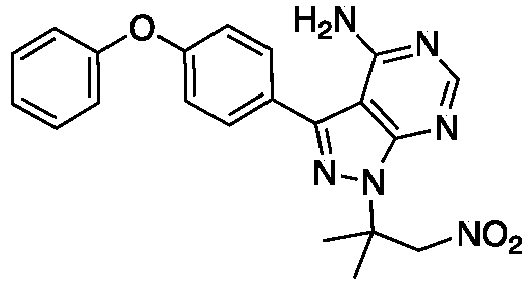
- 87E: Compound 87D (80 mg, 0.26 mmol) was dissolved in 2 mL of DMF. 2-methyl-1-nitroprop-1-ene (53 mg, 0.52 mmol) was added to the solution and the resulting mixture was stirred at 95°C for 2 days. The reaction mixture was poured into water and extracted three times with ethylacetate. The combined organic layers were dried over anhydrous Na2SO4, filtered and concentrated. The crude product was purified by column chromatography on SiO2 using MeOH/CH2Cl2 (0:100 to 5:85). Compound 87EA was obtained as a brown oil (33 mg, 31% yield). 1H NMR (ppm, CDCl3): δ 8.33 (s, 1H), 7.61 (d, J = 8.8 Hz, 2H), 7.41-7.37 (m, 2H), 7.17-7.04 (m, 5H), 5.26 (s, 2H), 1.97 (s, 6H).

- 87D: Compound 87E (10 mg, 0.025 mmol) was placed into an oven dried round bottom flask. 1 mL of anhydrous methanol and glacial acetic acid (5 µL, 0.09 mmol) were then added followed by 20% palladium hydroxyde (16 mg, 0.022 mmol). The round bottom flask was filled with hydrogen gas and evacuated three times. The reaction was stirred at room temperature overnight under hydrogen atmosphere. The mixture was then filtered through a plug of celite and concentrated. Compound 87D was used in the next step without further purification. LCMS (+esi): 375.1 (M+H+).

- 87E: Compound 87C (8 mg, 0.021 mmol) was dissolved in 1.5 mL of N,N-dimethylformamide. 1-ethyl-3-(3-dimethylaminopropyl) carbodiimide hydrochloride (4.7 mg, 0.025 mmol), 4-Dimethylaminopyridine (7.8 mg, 0.064 mmol) and picolinic acid (2.7 mg, 0.022 mmol) were added to the solution. The resulting mixture was stirred at room temperature overnight. Water was added to the solution and the mixture was extracted three times with ethylacetate. The combined organic layers were dried over anhydrous Na2SO4, filtered and concentrated. The crude product was purified by preparative HPLC. Compound 87E was obtained as a white powder (1.6 mg, 16% yield). 1H NMR (ppm, CDCl3): δ 8.51 (s, 1H), 8.25 (s, 1H), 8.21-8.14 (m, 1H), 7.85-7.82 (m, 1H), 7.65 (d, J = 8.7 Hz, 1H), 7.43-7.36 (m, 3H), 7.23-7.08 (m, 6H), 4.17 (d, J = 4.7 Hz, 1H), 4.15 (d, J = 4.7 Hz, 1H), 1.90 (s, 4H), 1.82 (s, 2H). LCMS (+esi): 480.2 (M+H+).
-

- Compound 1E (75 mg, 0.2 mmol), 2-chloropyrimidine (25 mg, 0.22 mmol), CS2CO3 (196 mg, 0.6 mmol) were stirred at 80°C in 250 mL of DMF for 12 hours. After this time, water was added. The white solid that precipitated was collected by filtration and rinsed with water. It was then further purified by preparative HPLC. A white solid was obtained (m = 12 mg, 16%). 1H NMR (ppm, CDCl3): δ 8.3 (s, 1H), 8.21 (d, J = 4.7 Hz, 2H), 7.55 (d, J = 8.0 Hz, 2H), 7.34 (d, J = 8.4 Hz, 2H), 6.48 (t, J = 4.8 Hz, 1H), 6.15 (br t, J = 6.0 Hz, 1H), 4.34 (d, J = 6.6 Hz, 2H), 2.44 (s, 3H), 1.84 (s, 6H). LCMS (+esi): 375.1 (M+H+).
-

- 89A: Sodium (54 mg, 2 mmol) was placed into an oven dried Schlenk tube. 5 mL of anhydrous tetrahydrofuranwere then added followed by 2-methoxy-ethanol (0.18 mL, 2 mmol). A gas evolution occurred. The reaction was stirred at room temperature for 30 minutes. It was then heated to 50°C until all the sodium had disappeared. In another flask 4-chloropicolinic tert-butyl ester (0.5 g, 2 mmol) was dissolved in 5 mL of anhydrous tetrahydrofuran. The solution of the alkoxide was then added to the reaction mixture and the reaction was stirred at reflux for 5 hours. Another solution of alkoxide was prepared and was added to the reaction mixture. The reaction was stirred for a further 15 hours at reflux. The reaction was then cooled to room temperature and the solvent was removed in vacuo. The residue was taken up into ethyl acetate and washed several times with water. The organic layer was dried over sodium sulphate and concentrated. The crude product was purified via flash chromatography on SiO2 using methanol/dichloromethane (5:95). Compound 89A was obtained as a brown oil (328 mg, 55 %). 1H NMR (CDCl3, 300 MHz): δ 8.54 (d, J = 8 Hz, 1H), 7.69 (s, 1H), 6.98 (d, J = 8 Hz, 1H), 4.53 (t, J = 5 Hz, 2H), 4.21 (t, J = 5 Hz, 2H), 3.74 (m, 4 H), 3.43 (s, 3H), 3.41 (s, 3H). LCMS (+esi): 256 (M+H+).

- 89B: Compound 89A (50 g, 0.18 mmol) was dissolved in 1 mL of methanol and 0.5 mL of 2M sodium hydroxide was added. The reaction was stirred at room temperature overnight. The methanol was concentrated down and the aqueous layer was acidified to pH 2 with 2 mL of 1M hydrogen chloride. The aqueous layer was placed on a freeze drier overnight. Compound 89B was used in the next step without further purification.

- 89C: Compound 89C was obtained following the procedure described for the preparation of compound 82D using compound 1E (67 mg, 0.17 mmol) and compound 89B (37 mg 0.19 mmol). Purification via flash chromatography on SiO2 using methanol/dichloromethane (2:98) afforded compound 89C as a white solid (54 mg, 67%). 1H NMR (CDCl3, 300 MHz): δ 9.24 (s, 1H), 8.31 (m, 2H), 7.73 (s, 1H), 7.68 (d, J = 7 Hz, 2H), 7.26 (d, J = 7 Hz, 2H), 6.91 (d, J = 8 Hz, 1 H), 5.82 (br s, 2H), 4.16 (m, 4H), 3.74 (m, 2H), 3.39 (s, 3H), 2.43 (s, 3H), 1.84 (s, 6H). LCMS (+esi): 476.6 (M+H+).
- Compounds of the invention were tested for in vitro activity in the following assay:
A biotin labeled peptide was used as substrate (amino acid sequence: Biotin-Glu-Gly-Pro-Trp-Leu-Glu-Glu-Glu-Glu-Glu-Ala-Tyr-Gly-Trp-Met-Asp-Phe-NH2). Src recombinant enzyme was purchased as N-terminally His6 tagged full-length human protein. The 15 µL assay reactions were run in Greiner brand white 384-well low volume plates. All reactions contained 10 mM HEPES pH 7.4, 25 mM NaCl, 10 mM MgCl2, 0.01 % (v/v) Tween-20, 50 µM Na3VO4, 0.01% (w/v) albumin from chicken egg white, 111 nM peptide substrate, 80 µM ATP, and 0.3 ng/reaction Src enzyme, with the enzyme being omitted from negative control reactions. Compounds were added in a volume of 100 nL from dilution series made up in DMSO, positive and negative control reactions receiving the same volume DMSO without compounds. The plates were sealed with adhesive seals and incubated for 90 minutes at 30 degree Celsius. The reactions were stopped with the detection reagents added at the same time. Product formation was quantified as photochemiluminescence between PerkinElmer AlphaScreen™ beads, using Streptavidin-coated donor and anti-phosphotyrosine (P-Tyr-100) acceptor beads. To each reaction, 5 µL containing 10 mM HEPES pH 7.4, 25 mM NaCl, 100 mM EDTA, 0.01 % (v/v) Tween-20, and 6.25 µg/mL of each bead type were added. Plates were incubated for 5 hours before being read on a PerkinElmer EnVision™ plate reader in HTS Alphascreen™ mode. IC50 values were obtained by calculating percent inhibition (%I) for each reaction relative to controls on the same plate (%I=(I-CN)/(CP-CN) where CN/ CP are the averages of the negative/ positive reactions, respectively), then fitting the %I data vs. compound concentration [I] to %I=(A+((B-A)/(1+((C/[I])^D)))) where A is the lower asymptote, B is the upper asymptote, C is the IC50 value, and D is the slope factor.Example No IC50 (SRC) 1 (compound 1E) B 2 B 3 C 4 (compound 4C) B 5 (compound 5B) A 6 (compound 6B) A 7 A 8 B 9 C 10 (compound 10C) A 11 B 12 A 13 (compound 13C) A 14 B 15 B 16 C 17 A 18 B 19 A 20 B 21 B 22 B 23 A 24 C 25 C 26 A 27 B 28 A 29 B 30 B 31 B 32 B 33 B 34 B 35 B 36 B 37 B 38 B 39 B 40 B 41 B 42 A 43 B 44 B 45 C 46 B 47 B 48 B 49 C 50 B 51 B 52 C 53 B 54 B 55 C 57 C 56 A 58 A 59 B 60 B 61 A 62 A 63 B 64 A 65 B 66 A 67 C 68 (compound 68B) B 69 (compound 69C) A 70 (compound 70C) B 72 A 73 C 71 D 74 (compound 74E) B 75 A 76 C 77 A 78 B 80 B 81 A 82 A 83 A 84 (compound 84C) B 85 (compound 85C) B 88 B 89 A A: 0.001 µM - 0.10 µM
B: 0.10 µM - 1.0 µM
C: 1.0 µM - 10 µM
D: > 10 µM - LIM 1899 colon carcinoma derived epithelial cells were grown in RPMI + Adds1 + 10% FCS.
-
- Assay medium: RPMI + Adds + 5% FCS
- Cells are trypsinized, washed once in assay medium and brought to the required concentration as described below:
- Need 104 cells per well in 100 µL per well = 105 per mL for plating
- After washing, cells were resuspended in 5 mL and counted (1 x T75 flask gives approx 2-3 x 10eg6 per mL).
Cells were then diluted to 105 cells/mL (need 10 mL minimum per plate). - Eg.
- Cell count in 5 mL is 25x105/mL
- For 105/mL, dilute 1 mL to 25mL
- 100 µL per well cells were plated with multistepper pipette, over the whole plate. Plates were incubated overnight at 37°C + 5% CO2 incubator.
- Inhibitors were dissolved in DMSO for 10 mM stocks. MW and amount of compound given was used to calculate the volume required for each.
- 4x the highest concentration of the compound in the assay was calculated to prepare the working stocks.
- eg 1st well final concentration in assay was 10 µM.
- Therefore working stock was 40 µM
- Stock solution is 10 mM → 40 µM = 4 µl in 1.0 mL assay medium for working stock.
-
- Rows A,B: Inhibitor 1
- Rows C,D: Inhibitor 2
- Rows E,F: Inhibitor 3
- Row G: RPMI + Adds +5% FCS (= maximum growth)
- Row H: RPMI + Adds serum free (= minimum growth)
- A 96 well plate was used to titrate the inhibitors for each assay plate:
- 150 µL assay medium was added to each well of a 96 well plate.
- 150 µL of Inhibitor 1 working stock was added wells A1 and B1.
- Repeated with Inhibitor 2 to C1 and D1
- Repeated with Inhibitor 3 to E1 and F1
- Serial ½ dilutions were performed across the plate, rows A to F, left to right with 150 µL.
- Using a multichannel pipette, 100 µL was transferred from the corresponding wells of the titration plate to the cell assay plate, rows A to G.
- Row H: medium was carefully removed from the cell wells with a 200 µL tip, and replaced with 200 µL serum free medium.
- Plates were incubated for 4 days at 37°C with 5% CO2.
-
- MTT Sigma M-2128 5 g
- Dissolved in PBS, at 5 mg/mL
- 5 g bottle dissolved in 1 litre PBS (some impurities remain)
- Filter sterilized and aliquoted in 50 mL tubes, stored at -20°C
- As needed, 50 mL tube was thawed and aliquoted in 5 mL tubes, re-stored at -20°C
- Stable at 4°C for 1 month (unstable if left at 37°C too long while thawing)
-
- a. 1M HCl:
- Mixed 44.6 mL conc HCl (11.2M) in 500 mL DDW
- b. Acidified isopropanol (Isopropanol with 0.04 N HCl):
- Mixed 20 mL 1M HCl with 480 mL isopropanol (Propan-2-ol, iso-Propyl Alcohol)
- After cell incubation (above):
- Added 10 µL MTT to each well.
- Incubated 4 hrs in 37°C incubator.
- Spun plates, 5 min, 1500 rpm.
- Carefully flicked out medium into the sink, without disturbing the crystals.
- Added 200 µL acidified isopropanol per well.
- Placed on plate shaker, RT, speed 6.5, for 10 min- 30 min.
- Read OD of plates on Thermo Multiskan Ex, at 560/690 nm.
- 1 Additives for culture of LIM cell lines: 10 µM thioglycerol, 0.025 U/mL insulin, 1 µg/mL hydrocortisone
- Rapid colorimetric assay for cellular growth and survival: application to proliferation and cytotoxic assays. Journal of Immunological Methods (1983), 65:55-63.
Table with examples of cellular data Example LIM1215 LIM2537 RasNIH3T3 LIM1899 12 0.17 0.17 0.11 0.17 11 1.7 1 (compound 1E) 8.5 42 0.9 1.9 57 1.6 >20 56 0.4 1.62 59 3.1 >20 60 1.9 17 61 0.8 1.83 1.6 62 0.25 0.35 63 2.6 6.29 1.7 64 1.1 0.63 0.88 65 0.96 1.67 0.9 66 0.52 0.5 0.31 73 1.1 71 3.1 74 (compound 74F) >10 >20 75 1.6 0.9 76 >10 19 77 >10 PP1 0.25 9.25 Dasatinib 2 4 to above 10 9 to 12 1.2 - The compounds in this invention display cellular activities against a range of tumour or transformed cell lines in particular colon cancer cell lines such as LIM1215, LIM2537 and LIM1899.
Claims (5)
- A compound represented by one of the following formulae:


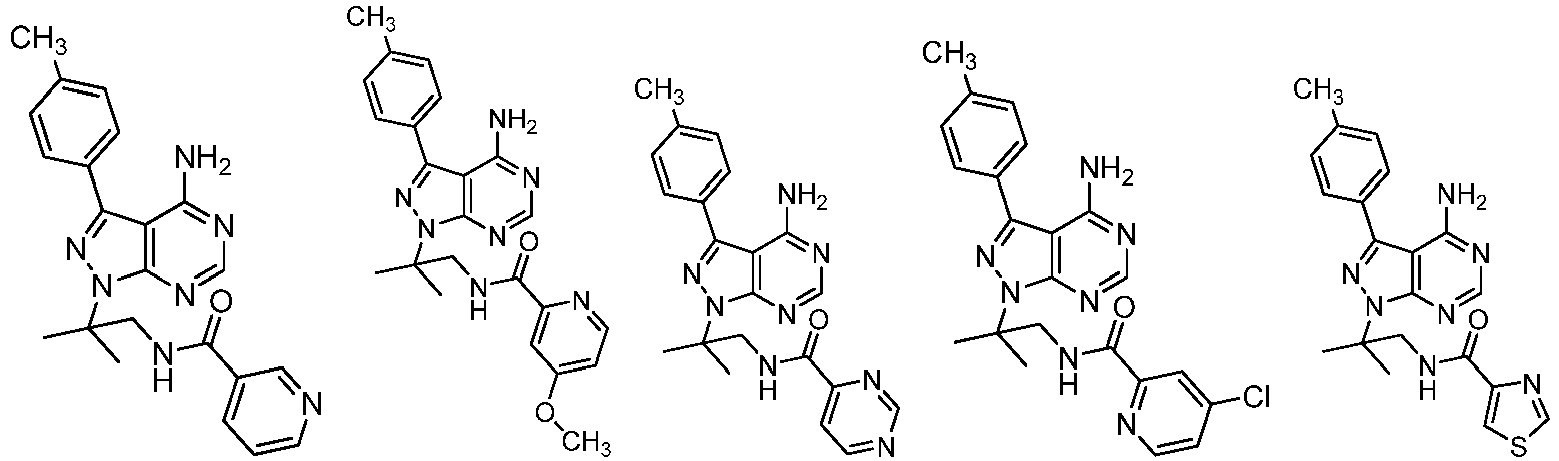


- A pharmaceutical composition comprising a compound according to claim 1 or a salt thereof, with at least one pharmaceutically acceptable adjuvant, carrier or diluent.
- A compound according to claim 1 or a salt thereof for use in the treatment of a tumour.
- The compound for use according to claim 3 wherein the tumour is selected from leukemia; melanoma; and colon, lung, ovarian, skin, breast, prostate, CNS or renal cancer.
- A compound according to claims 1 or a salt thereof for use in the treatment of psoriasis, immunoregulation (graft rejection), atherosclerosis, rheumatoid arthritis, acute and chronic inflammatory conditions or Crohn's disease.
Applications Claiming Priority (2)
| Application Number | Priority Date | Filing Date | Title |
|---|---|---|---|
| US36273910P | 2010-07-09 | 2010-07-09 | |
| PCT/AU2011/000858 WO2012003544A1 (en) | 2010-07-09 | 2011-07-08 | Protein kinase inhibitors and methods of treatment |
Publications (3)
| Publication Number | Publication Date |
|---|---|
| EP2590982A1 EP2590982A1 (en) | 2013-05-15 |
| EP2590982A4 EP2590982A4 (en) | 2014-04-02 |
| EP2590982B1 true EP2590982B1 (en) | 2017-08-23 |
Family
ID=45440707
Family Applications (1)
| Application Number | Title | Priority Date | Filing Date |
|---|---|---|---|
| EP11803020.4A Not-in-force EP2590982B1 (en) | 2010-07-09 | 2011-07-08 | Protein kinase inhibitors and methods of treatment |
Country Status (6)
| Country | Link |
|---|---|
| US (1) | US8962830B2 (en) |
| EP (1) | EP2590982B1 (en) |
| JP (1) | JP5810157B2 (en) |
| AU (1) | AU2011276955B2 (en) |
| CA (1) | CA2804648C (en) |
| WO (1) | WO2012003544A1 (en) |
Families Citing this family (29)
| Publication number | Priority date | Publication date | Assignee | Title |
|---|---|---|---|---|
| WO2012088266A2 (en) | 2010-12-22 | 2012-06-28 | Incyte Corporation | Substituted imidazopyridazines and benzimidazoles as inhibitors of fgfr3 |
| LT3495367T (en) | 2012-06-13 | 2021-02-25 | Incyte Holdings Corporation | MODIFIED TRICYCLIC COMPOUNDS AS FGFR INHIBITORS |
| WO2014026125A1 (en) | 2012-08-10 | 2014-02-13 | Incyte Corporation | Pyrazine derivatives as fgfr inhibitors |
| US9266892B2 (en) | 2012-12-19 | 2016-02-23 | Incyte Holdings Corporation | Fused pyrazoles as FGFR inhibitors |
| CN102977012B (en) * | 2012-12-20 | 2015-06-03 | 江苏弘和药物研发有限公司 | Synthesis method of methyl 4-bromopyridyl-2-formate |
| ES2924193T3 (en) * | 2013-03-15 | 2022-10-05 | Janssen Pharmaceutica Nv | Processes and intermediates to prepare a medicine |
| LT2986610T (en) | 2013-04-19 | 2018-04-10 | Incyte Holdings Corporation | Bicyclic heterocycles as fgfr inhibitors |
| CN103626774B (en) * | 2013-11-20 | 2015-11-04 | 苏州明锐医药科技有限公司 | The preparation method of Ibrutinib |
| CN103965201A (en) * | 2014-04-30 | 2014-08-06 | 淮海工学院 | Method for synthesizing intermediate 4-amino-3-(4-phenoxy-phenyl)-1H-pyrazolo[3,4-d]pyrimidine of Ibrutinib |
| JP6571077B2 (en) | 2014-06-13 | 2019-09-04 | 武田薬品工業株式会社 | Nitrogen-containing heterocyclic compounds |
| US10851105B2 (en) | 2014-10-22 | 2020-12-01 | Incyte Corporation | Bicyclic heterocycles as FGFR4 inhibitors |
| US10196397B2 (en) | 2014-11-19 | 2019-02-05 | Sun Pharmaceutical Industries Limited | Process for the preparation of ibrutinib |
| SG11201706287PA (en) | 2015-02-20 | 2017-09-28 | Incyte Corp | Bicyclic heterocycles as fgfr inhibitors |
| WO2016134294A1 (en) | 2015-02-20 | 2016-08-25 | Incyte Corporation | Bicyclic heterocycles as fgfr4 inhibitors |
| MA41551A (en) | 2015-02-20 | 2017-12-26 | Incyte Corp | BICYCLIC HETEROCYCLES USED AS FGFR4 INHIBITORS |
| AR111960A1 (en) | 2017-05-26 | 2019-09-04 | Incyte Corp | CRYSTALLINE FORMS OF A FGFR INHIBITOR AND PROCESSES FOR ITS PREPARATION |
| ES3061844T3 (en) | 2018-05-04 | 2026-04-07 | Incyte Corp | Salts of an fgfr inhibitor |
| MX2020011718A (en) | 2018-05-04 | 2021-02-15 | Incyte Corp | SOLID FORMS OF A FIBROBLAST GROWTH FACTOR RECEPTOR (FGFR) INHIBITOR AND PROCESSES FOR PREPARING THEM. |
| US11628162B2 (en) | 2019-03-08 | 2023-04-18 | Incyte Corporation | Methods of treating cancer with an FGFR inhibitor |
| US11591329B2 (en) | 2019-07-09 | 2023-02-28 | Incyte Corporation | Bicyclic heterocycles as FGFR inhibitors |
| US12122767B2 (en) | 2019-10-01 | 2024-10-22 | Incyte Corporation | Bicyclic heterocycles as FGFR inhibitors |
| TWI891666B (en) | 2019-10-14 | 2025-08-01 | 美商英塞特公司 | Bicyclic heterocycles as fgfr inhibitors |
| US11566028B2 (en) | 2019-10-16 | 2023-01-31 | Incyte Corporation | Bicyclic heterocycles as FGFR inhibitors |
| CA3163875A1 (en) | 2019-12-04 | 2021-06-10 | Incyte Corporation | Tricyclic heterocycles as fgfr inhibitors |
| WO2021113462A1 (en) | 2019-12-04 | 2021-06-10 | Incyte Corporation | Derivatives of an fgfr inhibitor |
| US12012409B2 (en) | 2020-01-15 | 2024-06-18 | Incyte Corporation | Bicyclic heterocycles as FGFR inhibitors |
| TW202304459A (en) | 2021-04-12 | 2023-02-01 | 美商英塞特公司 | Combination therapy comprising an fgfr inhibitor and a nectin-4 targeting agent |
| JP2024522189A (en) | 2021-06-09 | 2024-06-11 | インサイト・コーポレイション | Tricyclic Heterocycles as FGFR Inhibitors |
| EP4352060A1 (en) | 2021-06-09 | 2024-04-17 | Incyte Corporation | Tricyclic heterocycles as fgfr inhibitors |
Family Cites Families (9)
| Publication number | Priority date | Publication date | Assignee | Title |
|---|---|---|---|---|
| FR2687402B1 (en) * | 1992-02-14 | 1995-06-30 | Lipha | NOVEL AZAINDOLES, METHODS OF PREPARATION AND MEDICAMENTS CONTAINING THEM. |
| US5593997A (en) | 1995-05-23 | 1997-01-14 | Pfizer Inc. | 4-aminopyrazolo(3-,4-D)pyrimidine and 4-aminopyrazolo-(3,4-D)pyridine tyrosine kinase inhibitors |
| US6921763B2 (en) * | 1999-09-17 | 2005-07-26 | Abbott Laboratories | Pyrazolopyrimidines as therapeutic agents |
| MXPA03008560A (en) * | 2001-03-22 | 2004-06-30 | Abbot Gmbh & Co Kg | Single-stage pfc + ballast control circuit/general purpose power converter. |
| ATE492544T1 (en) * | 2004-08-26 | 2011-01-15 | Pfizer | PYRAZOLE-SUBSTITUTED AMINOHETEROARYL COMPOUNDS AS PROTEIN KINASE INHIBITORS |
| EA200870409A1 (en) | 2006-04-04 | 2009-04-28 | Дзе Риджентс Оф Дзе Юниверсити Оф Калифорния | ANTAGONISTS OF KINASE PI3 |
| PL2526933T3 (en) | 2006-09-22 | 2015-08-31 | Pharmacyclics Llc | Inhibitors of Bruton's tyrosine kinase |
| CA2730930C (en) * | 2008-07-16 | 2015-01-13 | Pharmacyclics, Inc. | Inhibitors of bruton's tyrosine kinase for the treatment of solid tumors |
| US7741330B1 (en) * | 2009-10-12 | 2010-06-22 | Pharmacyclics, Inc. | Pyrazolo-pyrimidine inhibitors of Bruton's tyrosine kinase |
-
2011
- 2011-07-08 JP JP2013516912A patent/JP5810157B2/en not_active Expired - Fee Related
- 2011-07-08 EP EP11803020.4A patent/EP2590982B1/en not_active Not-in-force
- 2011-07-08 US US13/809,369 patent/US8962830B2/en not_active Expired - Fee Related
- 2011-07-08 CA CA2804648A patent/CA2804648C/en not_active Expired - Fee Related
- 2011-07-08 WO PCT/AU2011/000858 patent/WO2012003544A1/en not_active Ceased
- 2011-07-08 AU AU2011276955A patent/AU2011276955B2/en not_active Ceased
Non-Patent Citations (1)
| Title |
|---|
| None * |
Also Published As
| Publication number | Publication date |
|---|---|
| CA2804648C (en) | 2019-01-22 |
| US20130184274A1 (en) | 2013-07-18 |
| CA2804648A1 (en) | 2012-01-12 |
| AU2011276955B2 (en) | 2014-11-06 |
| JP5810157B2 (en) | 2015-11-11 |
| WO2012003544A1 (en) | 2012-01-12 |
| AU2011276955A1 (en) | 2013-01-24 |
| JP2013529649A (en) | 2013-07-22 |
| EP2590982A1 (en) | 2013-05-15 |
| EP2590982A4 (en) | 2014-04-02 |
| US8962830B2 (en) | 2015-02-24 |
Similar Documents
| Publication | Publication Date | Title |
|---|---|---|
| US8962830B2 (en) | Protein kinase inhibitors and methods of treatment | |
| EP2614061B1 (en) | Quinoline and quinoxaline derivatives as kinase inhibitors | |
| EP3481831B1 (en) | 4-aminopyrazolo[3,4-d]pyrimidinylazabicyclo derivatives and pharmaceutical composition comprising the same | |
| US10793575B2 (en) | Oxoisoquinoline derivatives | |
| CN105408324A (en) | Substituted benzylpyrazoles | |
| CN105452242A (en) | Heteroaryl substituted pyrazoles | |
| CN105452236A (en) | Substituted benzylpyrazoles | |
| EP3873474A1 (en) | Heterocyclic compounds as bet inhibitors | |
| EP3590941B1 (en) | Urea-substituted aromatic ring-linked dioxane-quinazoline and -linked dioxane-quinoline compounds, preparation method therefor and use thereof | |
| CN105473570A (en) | Diaminoheteroaryl substituted pyrazoles | |
| EP4029862A1 (en) | Compound having axl and c-met kinase inhibitory activity, preparation thereof and application thereof | |
| CN117425648A (en) | Compounds that are PARP7 inhibitors | |
| CN116262750A (en) | A kind of aromatic heterocyclic compound and its preparation method and application | |
| CN110167943B (en) | Pyrrolotriazine derivatives as kinase inhibitors | |
| US12384795B2 (en) | Pyrimido[5,4-b]pyrrolizin compound, optical isomer thereof, preparation method therefor and use thereof | |
| EP3558964B1 (en) | 4-amino-2-pyrido-bicyclic pyrimidines and use thereof as topoisomerase ii inhibitors | |
| JP7136793B2 (en) | 5-(pyrimidin-4-yl)-2-(pyrrolidin-1-yl)nicotinonitrile compounds as IKKE, TBK1 and/or SIK2 kinase inhibitors | |
| EP3750894B1 (en) | Urea-substituted aromatic ring-linked dioxazoline compound, preparation method therefor, and uses thereof | |
| CN112209933B (en) | BTK inhibitors containing 4-azaspiroheptane | |
| EP4067354B1 (en) | Novel triazolopyridine derivative and pharmaceutical composition comprising same | |
| CN116102545B (en) | A diaryl urea PI3K/mTOR/HDAC multi-target inhibitor and its pharmaceutical composition and application | |
| CN108047231B (en) | Hydrochloride of [1,2,4] triazino [6,1-a ] isoindole compound and application thereof | |
| KR20250132936A (en) | The new small molecular compounds having IRP2 inhibition activity | |
| KR101812266B1 (en) | 4-((2-Acrylamidophenyl)amino)thieno[3,2-d]pyrimidin-7-carboxamide derivatives as protein kinase inhibitors | |
| HK40006200A (en) | Pyrrolotriazine derivatives as kinase inhibitor |
Legal Events
| Date | Code | Title | Description |
|---|---|---|---|
| PUAI | Public reference made under article 153(3) epc to a published international application that has entered the european phase |
Free format text: ORIGINAL CODE: 0009012 |
|
| 17P | Request for examination filed |
Effective date: 20130130 |
|
| AK | Designated contracting states |
Kind code of ref document: A1 Designated state(s): AL AT BE BG CH CY CZ DE DK EE ES FI FR GB GR HR HU IE IS IT LI LT LU LV MC MK MT NL NO PL PT RO RS SE SI SK SM TR |
|
| DAX | Request for extension of the european patent (deleted) | ||
| A4 | Supplementary search report drawn up and despatched |
Effective date: 20140227 |
|
| RIC1 | Information provided on ipc code assigned before grant |
Ipc: A61P 19/02 20060101ALI20140221BHEP Ipc: C07D 231/38 20060101ALI20140221BHEP Ipc: A61P 35/00 20060101ALI20140221BHEP Ipc: A61P 29/00 20060101ALI20140221BHEP Ipc: C07D 487/04 20060101AFI20140221BHEP Ipc: A61P 35/02 20060101ALI20140221BHEP Ipc: A61K 31/519 20060101ALI20140221BHEP |
|
| 17Q | First examination report despatched |
Effective date: 20151008 |
|
| GRAP | Despatch of communication of intention to grant a patent |
Free format text: ORIGINAL CODE: EPIDOSNIGR1 |
|
| INTG | Intention to grant announced |
Effective date: 20170227 |
|
| GRAS | Grant fee paid |
Free format text: ORIGINAL CODE: EPIDOSNIGR3 |
|
| GRAA | (expected) grant |
Free format text: ORIGINAL CODE: 0009210 |
|
| AK | Designated contracting states |
Kind code of ref document: B1 Designated state(s): AL AT BE BG CH CY CZ DE DK EE ES FI FR GB GR HR HU IE IS IT LI LT LU LV MC MK MT NL NO PL PT RO RS SE SI SK SM TR |
|
| REG | Reference to a national code |
Ref country code: GB Ref legal event code: FG4D |
|
| REG | Reference to a national code |
Ref country code: CH Ref legal event code: EP |
|
| REG | Reference to a national code |
Ref country code: AT Ref legal event code: REF Ref document number: 921209 Country of ref document: AT Kind code of ref document: T Effective date: 20170915 |
|
| REG | Reference to a national code |
Ref country code: IE Ref legal event code: FG4D |
|
| REG | Reference to a national code |
Ref country code: DE Ref legal event code: R096 Ref document number: 602011040930 Country of ref document: DE |
|
| REG | Reference to a national code |
Ref country code: SE Ref legal event code: TRGR |
|
| REG | Reference to a national code |
Ref country code: NL Ref legal event code: FP |
|
| REG | Reference to a national code |
Ref country code: CH Ref legal event code: NV Representative=s name: MICHELI AND CIE SA, CH |
|
| REG | Reference to a national code |
Ref country code: LT Ref legal event code: MG4D |
|
| REG | Reference to a national code |
Ref country code: AT Ref legal event code: MK05 Ref document number: 921209 Country of ref document: AT Kind code of ref document: T Effective date: 20170823 |
|
| PG25 | Lapsed in a contracting state [announced via postgrant information from national office to epo] |
Ref country code: FI Free format text: LAPSE BECAUSE OF FAILURE TO SUBMIT A TRANSLATION OF THE DESCRIPTION OR TO PAY THE FEE WITHIN THE PRESCRIBED TIME-LIMIT Effective date: 20170823 Ref country code: AT Free format text: LAPSE BECAUSE OF FAILURE TO SUBMIT A TRANSLATION OF THE DESCRIPTION OR TO PAY THE FEE WITHIN THE PRESCRIBED TIME-LIMIT Effective date: 20170823 Ref country code: HR Free format text: LAPSE BECAUSE OF FAILURE TO SUBMIT A TRANSLATION OF THE DESCRIPTION OR TO PAY THE FEE WITHIN THE PRESCRIBED TIME-LIMIT Effective date: 20170823 Ref country code: LT Free format text: LAPSE BECAUSE OF FAILURE TO SUBMIT A TRANSLATION OF THE DESCRIPTION OR TO PAY THE FEE WITHIN THE PRESCRIBED TIME-LIMIT Effective date: 20170823 Ref country code: NO Free format text: LAPSE BECAUSE OF FAILURE TO SUBMIT A TRANSLATION OF THE DESCRIPTION OR TO PAY THE FEE WITHIN THE PRESCRIBED TIME-LIMIT Effective date: 20171123 |
|
| PG25 | Lapsed in a contracting state [announced via postgrant information from national office to epo] |
Ref country code: LV Free format text: LAPSE BECAUSE OF FAILURE TO SUBMIT A TRANSLATION OF THE DESCRIPTION OR TO PAY THE FEE WITHIN THE PRESCRIBED TIME-LIMIT Effective date: 20170823 Ref country code: BG Free format text: LAPSE BECAUSE OF FAILURE TO SUBMIT A TRANSLATION OF THE DESCRIPTION OR TO PAY THE FEE WITHIN THE PRESCRIBED TIME-LIMIT Effective date: 20171123 Ref country code: ES Free format text: LAPSE BECAUSE OF FAILURE TO SUBMIT A TRANSLATION OF THE DESCRIPTION OR TO PAY THE FEE WITHIN THE PRESCRIBED TIME-LIMIT Effective date: 20170823 Ref country code: RS Free format text: LAPSE BECAUSE OF FAILURE TO SUBMIT A TRANSLATION OF THE DESCRIPTION OR TO PAY THE FEE WITHIN THE PRESCRIBED TIME-LIMIT Effective date: 20170823 Ref country code: IS Free format text: LAPSE BECAUSE OF FAILURE TO SUBMIT A TRANSLATION OF THE DESCRIPTION OR TO PAY THE FEE WITHIN THE PRESCRIBED TIME-LIMIT Effective date: 20171223 Ref country code: GR Free format text: LAPSE BECAUSE OF FAILURE TO SUBMIT A TRANSLATION OF THE DESCRIPTION OR TO PAY THE FEE WITHIN THE PRESCRIBED TIME-LIMIT Effective date: 20171124 Ref country code: PL Free format text: LAPSE BECAUSE OF FAILURE TO SUBMIT A TRANSLATION OF THE DESCRIPTION OR TO PAY THE FEE WITHIN THE PRESCRIBED TIME-LIMIT Effective date: 20170823 |
|
| PG25 | Lapsed in a contracting state [announced via postgrant information from national office to epo] |
Ref country code: RO Free format text: LAPSE BECAUSE OF FAILURE TO SUBMIT A TRANSLATION OF THE DESCRIPTION OR TO PAY THE FEE WITHIN THE PRESCRIBED TIME-LIMIT Effective date: 20170823 Ref country code: DK Free format text: LAPSE BECAUSE OF FAILURE TO SUBMIT A TRANSLATION OF THE DESCRIPTION OR TO PAY THE FEE WITHIN THE PRESCRIBED TIME-LIMIT Effective date: 20170823 Ref country code: CZ Free format text: LAPSE BECAUSE OF FAILURE TO SUBMIT A TRANSLATION OF THE DESCRIPTION OR TO PAY THE FEE WITHIN THE PRESCRIBED TIME-LIMIT Effective date: 20170823 |
|
| REG | Reference to a national code |
Ref country code: DE Ref legal event code: R097 Ref document number: 602011040930 Country of ref document: DE |
|
| PG25 | Lapsed in a contracting state [announced via postgrant information from national office to epo] |
Ref country code: SM Free format text: LAPSE BECAUSE OF FAILURE TO SUBMIT A TRANSLATION OF THE DESCRIPTION OR TO PAY THE FEE WITHIN THE PRESCRIBED TIME-LIMIT Effective date: 20170823 Ref country code: IT Free format text: LAPSE BECAUSE OF FAILURE TO SUBMIT A TRANSLATION OF THE DESCRIPTION OR TO PAY THE FEE WITHIN THE PRESCRIBED TIME-LIMIT Effective date: 20170823 Ref country code: EE Free format text: LAPSE BECAUSE OF FAILURE TO SUBMIT A TRANSLATION OF THE DESCRIPTION OR TO PAY THE FEE WITHIN THE PRESCRIBED TIME-LIMIT Effective date: 20170823 Ref country code: SK Free format text: LAPSE BECAUSE OF FAILURE TO SUBMIT A TRANSLATION OF THE DESCRIPTION OR TO PAY THE FEE WITHIN THE PRESCRIBED TIME-LIMIT Effective date: 20170823 |
|
| REG | Reference to a national code |
Ref country code: FR Ref legal event code: PLFP Year of fee payment: 8 |
|
| PLBE | No opposition filed within time limit |
Free format text: ORIGINAL CODE: 0009261 |
|
| STAA | Information on the status of an ep patent application or granted ep patent |
Free format text: STATUS: NO OPPOSITION FILED WITHIN TIME LIMIT |
|
| 26N | No opposition filed |
Effective date: 20180524 |
|
| PG25 | Lapsed in a contracting state [announced via postgrant information from national office to epo] |
Ref country code: SI Free format text: LAPSE BECAUSE OF FAILURE TO SUBMIT A TRANSLATION OF THE DESCRIPTION OR TO PAY THE FEE WITHIN THE PRESCRIBED TIME-LIMIT Effective date: 20170823 |
|
| PG25 | Lapsed in a contracting state [announced via postgrant information from national office to epo] |
Ref country code: LU Free format text: LAPSE BECAUSE OF NON-PAYMENT OF DUE FEES Effective date: 20180708 Ref country code: MC Free format text: LAPSE BECAUSE OF FAILURE TO SUBMIT A TRANSLATION OF THE DESCRIPTION OR TO PAY THE FEE WITHIN THE PRESCRIBED TIME-LIMIT Effective date: 20170823 |
|
| PG25 | Lapsed in a contracting state [announced via postgrant information from national office to epo] |
Ref country code: MT Free format text: LAPSE BECAUSE OF NON-PAYMENT OF DUE FEES Effective date: 20180708 |
|
| PG25 | Lapsed in a contracting state [announced via postgrant information from national office to epo] |
Ref country code: TR Free format text: LAPSE BECAUSE OF FAILURE TO SUBMIT A TRANSLATION OF THE DESCRIPTION OR TO PAY THE FEE WITHIN THE PRESCRIBED TIME-LIMIT Effective date: 20170823 |
|
| PG25 | Lapsed in a contracting state [announced via postgrant information from national office to epo] |
Ref country code: HU Free format text: LAPSE BECAUSE OF FAILURE TO SUBMIT A TRANSLATION OF THE DESCRIPTION OR TO PAY THE FEE WITHIN THE PRESCRIBED TIME-LIMIT; INVALID AB INITIO Effective date: 20110708 Ref country code: PT Free format text: LAPSE BECAUSE OF FAILURE TO SUBMIT A TRANSLATION OF THE DESCRIPTION OR TO PAY THE FEE WITHIN THE PRESCRIBED TIME-LIMIT Effective date: 20170823 |
|
| PG25 | Lapsed in a contracting state [announced via postgrant information from national office to epo] |
Ref country code: CY Free format text: LAPSE BECAUSE OF FAILURE TO SUBMIT A TRANSLATION OF THE DESCRIPTION OR TO PAY THE FEE WITHIN THE PRESCRIBED TIME-LIMIT Effective date: 20170823 Ref country code: MK Free format text: LAPSE BECAUSE OF NON-PAYMENT OF DUE FEES Effective date: 20170823 |
|
| PG25 | Lapsed in a contracting state [announced via postgrant information from national office to epo] |
Ref country code: AL Free format text: LAPSE BECAUSE OF FAILURE TO SUBMIT A TRANSLATION OF THE DESCRIPTION OR TO PAY THE FEE WITHIN THE PRESCRIBED TIME-LIMIT Effective date: 20170823 |
|
| PGFP | Annual fee paid to national office [announced via postgrant information from national office to epo] |
Ref country code: IE Payment date: 20200519 Year of fee payment: 10 Ref country code: NL Payment date: 20200519 Year of fee payment: 10 Ref country code: FR Payment date: 20200523 Year of fee payment: 10 Ref country code: CH Payment date: 20200602 Year of fee payment: 10 |
|
| PGFP | Annual fee paid to national office [announced via postgrant information from national office to epo] |
Ref country code: SE Payment date: 20200519 Year of fee payment: 10 Ref country code: BE Payment date: 20200519 Year of fee payment: 10 Ref country code: GB Payment date: 20200519 Year of fee payment: 10 |
|
| PGFP | Annual fee paid to national office [announced via postgrant information from national office to epo] |
Ref country code: DE Payment date: 20200519 Year of fee payment: 10 |
|
| REG | Reference to a national code |
Ref country code: DE Ref legal event code: R119 Ref document number: 602011040930 Country of ref document: DE |
|
| REG | Reference to a national code |
Ref country code: CH Ref legal event code: PL |
|
| REG | Reference to a national code |
Ref country code: NL Ref legal event code: MM Effective date: 20210801 |
|
| GBPC | Gb: european patent ceased through non-payment of renewal fee |
Effective date: 20210708 |
|
| REG | Reference to a national code |
Ref country code: BE Ref legal event code: MM Effective date: 20210731 |
|
| PG25 | Lapsed in a contracting state [announced via postgrant information from national office to epo] |
Ref country code: LI Free format text: LAPSE BECAUSE OF NON-PAYMENT OF DUE FEES Effective date: 20210731 Ref country code: GB Free format text: LAPSE BECAUSE OF NON-PAYMENT OF DUE FEES Effective date: 20210708 Ref country code: DE Free format text: LAPSE BECAUSE OF NON-PAYMENT OF DUE FEES Effective date: 20220201 Ref country code: CH Free format text: LAPSE BECAUSE OF NON-PAYMENT OF DUE FEES Effective date: 20210731 |
|
| PG25 | Lapsed in a contracting state [announced via postgrant information from national office to epo] |
Ref country code: SE Free format text: LAPSE BECAUSE OF NON-PAYMENT OF DUE FEES Effective date: 20210709 Ref country code: NL Free format text: LAPSE BECAUSE OF NON-PAYMENT OF DUE FEES Effective date: 20210801 Ref country code: FR Free format text: LAPSE BECAUSE OF NON-PAYMENT OF DUE FEES Effective date: 20210731 |
|
| PG25 | Lapsed in a contracting state [announced via postgrant information from national office to epo] |
Ref country code: IE Free format text: LAPSE BECAUSE OF NON-PAYMENT OF DUE FEES Effective date: 20210708 Ref country code: BE Free format text: LAPSE BECAUSE OF NON-PAYMENT OF DUE FEES Effective date: 20210731 |