EP2590416A2 - Image processing apparatus and method - Google Patents
Image processing apparatus and method Download PDFInfo
- Publication number
- EP2590416A2 EP2590416A2 EP20120190356 EP12190356A EP2590416A2 EP 2590416 A2 EP2590416 A2 EP 2590416A2 EP 20120190356 EP20120190356 EP 20120190356 EP 12190356 A EP12190356 A EP 12190356A EP 2590416 A2 EP2590416 A2 EP 2590416A2
- Authority
- EP
- European Patent Office
- Prior art keywords
- image
- input
- visual attention
- region
- image processing
- Prior art date
- Legal status (The legal status is an assumption and is not a legal conclusion. Google has not performed a legal analysis and makes no representation as to the accuracy of the status listed.)
- Granted
Links
Images


Classifications
-
- G—PHYSICS
- G06—COMPUTING OR CALCULATING; COUNTING
- G06T—IMAGE DATA PROCESSING OR GENERATION, IN GENERAL
- G06T15/00—3D [Three Dimensional] image rendering
- G06T15/04—Texture mapping
-
- H—ELECTRICITY
- H04—ELECTRIC COMMUNICATION TECHNIQUE
- H04N—PICTORIAL COMMUNICATION, e.g. TELEVISION
- H04N13/00—Stereoscopic video systems; Multi-view video systems; Details thereof
- H04N13/10—Processing, recording or transmission of stereoscopic or multi-view image signals
- H04N13/106—Processing image signals
- H04N13/128—Adjusting depth or disparity
-
- G—PHYSICS
- G06—COMPUTING OR CALCULATING; COUNTING
- G06T—IMAGE DATA PROCESSING OR GENERATION, IN GENERAL
- G06T15/00—3D [Three Dimensional] image rendering
- G06T15/10—Geometric effects
- G06T15/20—Perspective computation
-
- G—PHYSICS
- G06—COMPUTING OR CALCULATING; COUNTING
- G06T—IMAGE DATA PROCESSING OR GENERATION, IN GENERAL
- G06T7/00—Image analysis
- G06T7/10—Segmentation; Edge detection
- G06T7/11—Region-based segmentation
-
- H—ELECTRICITY
- H04—ELECTRIC COMMUNICATION TECHNIQUE
- H04N—PICTORIAL COMMUNICATION, e.g. TELEVISION
- H04N13/00—Stereoscopic video systems; Multi-view video systems; Details thereof
- H04N13/10—Processing, recording or transmission of stereoscopic or multi-view image signals
- H04N13/106—Processing image signals
- H04N13/111—Transformation of image signals corresponding to virtual viewpoints, e.g. spatial image interpolation
-
- H—ELECTRICITY
- H04—ELECTRIC COMMUNICATION TECHNIQUE
- H04N—PICTORIAL COMMUNICATION, e.g. TELEVISION
- H04N13/00—Stereoscopic video systems; Multi-view video systems; Details thereof
- H04N13/10—Processing, recording or transmission of stereoscopic or multi-view image signals
- H04N13/106—Processing image signals
- H04N13/15—Processing image signals for colour aspects of image signals
-
- H—ELECTRICITY
- H04—ELECTRIC COMMUNICATION TECHNIQUE
- H04N—PICTORIAL COMMUNICATION, e.g. TELEVISION
- H04N13/00—Stereoscopic video systems; Multi-view video systems; Details thereof
- H04N13/30—Image reproducers
- H04N13/324—Colour aspects
-
- G—PHYSICS
- G06—COMPUTING OR CALCULATING; COUNTING
- G06T—IMAGE DATA PROCESSING OR GENERATION, IN GENERAL
- G06T2200/00—Indexing scheme for image data processing or generation, in general
- G06T2200/04—Indexing scheme for image data processing or generation, in general involving 3D image data
-
- G—PHYSICS
- G06—COMPUTING OR CALCULATING; COUNTING
- G06T—IMAGE DATA PROCESSING OR GENERATION, IN GENERAL
- G06T2207/00—Indexing scheme for image analysis or image enhancement
- G06T2207/10—Image acquisition modality
- G06T2207/10024—Color image
-
- G—PHYSICS
- G06—COMPUTING OR CALCULATING; COUNTING
- G06V—IMAGE OR VIDEO RECOGNITION OR UNDERSTANDING
- G06V10/00—Arrangements for image or video recognition or understanding
- G06V10/40—Extraction of image or video features
- G06V10/44—Local feature extraction by analysis of parts of the pattern, e.g. by detecting edges, contours, loops, corners, strokes or intersections; Connectivity analysis, e.g. of connected components
- G06V10/443—Local feature extraction by analysis of parts of the pattern, e.g. by detecting edges, contours, loops, corners, strokes or intersections; Connectivity analysis, e.g. of connected components by matching or filtering
- G06V10/449—Biologically inspired filters, e.g. difference of Gaussians [DoG] or Gabor filters
- G06V10/451—Biologically inspired filters, e.g. difference of Gaussians [DoG] or Gabor filters with interaction between the filter responses, e.g. cortical complex cells
- G06V10/454—Integrating the filters into a hierarchical structure, e.g. convolutional neural networks [CNN]
-
- H—ELECTRICITY
- H04—ELECTRIC COMMUNICATION TECHNIQUE
- H04N—PICTORIAL COMMUNICATION, e.g. TELEVISION
- H04N13/00—Stereoscopic video systems; Multi-view video systems; Details thereof
- H04N2013/0074—Stereoscopic image analysis
- H04N2013/0077—Colour aspects
-
- H—ELECTRICITY
- H04—ELECTRIC COMMUNICATION TECHNIQUE
- H04N—PICTORIAL COMMUNICATION, e.g. TELEVISION
- H04N13/00—Stereoscopic video systems; Multi-view video systems; Details thereof
- H04N2013/0074—Stereoscopic image analysis
- H04N2013/0081—Depth or disparity estimation from stereoscopic image signals
Definitions
- Example embodiments disclosed herein relate to a display device to provide a three dimensional (3D) image and an internal image processing method, and more particularly, to an image processing apparatus and method that may decrease a visual fatigue when viewing a 3D image.
- a 3D image may be configured by providing images corresponding to different views with respect to a plurality of views.
- the 3D image may be a multi-view image corresponding to a plurality of views, or a stereoscopic image that may provide a left eye image and a right eye image corresponding to two views.
- a 3D display may provide a relatively higher sense of reality to a user.
- the 3D display may express different image information with respect to a left field of view and a right field of view and thus, may cause increased visual fatigue as compared to the 2D display. Accordingly, there is a desire for a solution to decrease visual fatigue.
- Conventional methods for decreasing visual fatigue include a method of uniformly decreasing depth information, a method of increasing a contrast in the case of a near side region and decreasing the contrast in the case of a far side region, and the like.
- an image processing apparatus including a region of interest (ROI) configuration unit to generate a visual attention map according to a visual attention of a user or observer in correspondence to an input three dimensional (3D) image, and a disparity adjustment unit to adjust disparity information, included in the input 3D image, using the visual attention map.
- ROI region of interest
- 3D three dimensional
- the ROI configuration unit may include a region divider to divide, into a plurality of regions, a depth value distribution included in the input 3D image, using disparity information of the input 3D image, and at least one region calculator to calculate a visual attention level corresponding to each of the plurality of regions.
- the ROI configuration unit may further include a visual attention map calculator to generate the visual attention map by integrating visual attention levels of the plurality of regions calculated by the at least one region calculator.
- the at least one region calculator may change a color space of the input 3D image, may classify each portion of the input 3D image into an attractive color and an unattractive color, and may calculate a visual attention level of the attractive color to be higher than a visual attention level of the unattractive color.
- Change of the color space may be to change the color space to a CIECAM02 color space when the input 3D image is associated with red, green, blue (RGB) color space, and classification of each portion into the attractive color and the inattention may be performed based on a hue and a chroma of color values.
- RGB red, green, blue
- the at least one region calculator may calculate the visual attention level to be high.
- the at least one region calculator may divide the input 3D image into blocks of a predetermined size. When a difference of pixel values with respect to a block positioned at the same position within different two frames is greater than or equal to the predetermined threshold, the at least one region calculator may determine the block as a motion detection block and calculates a visual attention level of the block to be high.
- the at least one region calculator may group the blocks into a plurality of groups. When a predetermined number of motion detection blocks are present within a single group, the at least one region calculator may calculate a visual attention level of the entire blocks within the single group to be high.
- the at least one region calculator may calculate the visual attention level to be low.
- the image processing apparatus may further include a perceived depth enhancement processing unit to enhance a perceived depth by applying a texture enhancement scheme based on a texture type of a predetermined region on the visual attention map that is generated according to the visual attention.
- an image processing apparatus including a ROI configuration unit to generate a visual attention map corresponding to an input 3D image based on at least one of a color value of the input 3D image, a disparity value, and a motion detection result, and a disparity adjustment unit to readjust a disparity of the input 3D image using the visual attention map.
- an image processing method including generating, by a ROI configuration unit of an image processing apparatus, a visual attention map according to a visual attention of a human in correspondence to an input 3D image, and adjusting, by a disparity adjustment unit of the image processing apparatus using the visual attention map, disparity information that is included in the input 3D image.
- the example embodiments may include an image processing apparatus and method that may maintain a 3D effect as is and decrease visual fatigue associated with a human visual system characteristic.
- the example embodiments may also include an image processing apparatus and method that may efficiently select a ROI based on an observer's visual attention without a decrease in the 3D effect that may occur using other conventional methods which may be used to decrease visual fatigue.
- FIG. 1 illustrates an image processing method according to an embodiment.
- the image processing method may analyze a characteristic of an input three dimensional (3D) image to be provided from a 3D display.
- the image processing method may decrease a fatigue level resulting from viewing the input 3D image by adjusting disparity information of the input 3D image using the analyzed characteristic.
- An image processing apparatus may efficiently and accurately predict a region of interest (ROI) using visual perception characteristics of a user, for example, visual attention characteristics. Based thereon, the image processing apparatus may enhance a visual perceived depth according to a characteristic of the input 3D image, and may also significantly decrease visual fatigue.
- ROI region of interest
- the sense of sight may provide ten folds of information compared to the sense of hearing and therefore performs a very important function. For example, it is believed that at least 70% of all obtained information may be obtained from visual information. In a 3D image, visual information may function as a major means of input information such that the sense of sight may become tactile.
- the eyes perform visual functions which may receive, from ambient environments, various and large amounts of information, for example, shapes, colors, distances, motions, lightness, textures, gradients, positions, directions, and the like. Even though a large amount of information is input, the brain of a user may select and focus on meaningful information from among the large amounts of information coming into the eyes. This is referred to as visual attention or selective attention. For example, what to see or where to see may be determined by a user using visual attention or selective attention.
- a 3D image may be input.
- the input 3D image may include a color image and disparity information.
- a 3D display device may generate a stereoscopic image or a multi-view image by decoding the color image and the disparity information.
- a ROI configuration unit of the image processing apparatus may generate a visual attention map by analyzing the input 3D image.
- the ROI configuration unit may divide the input 3D image into a plurality of layers having different depth levels, using disparity information of the 3D input image.
- the layer may also be referred to as a region.
- the ROI configuration unit may calculate a visual attention level according to a visual model among a plurality of regions, using at least one of color information of each region, disparity information of each region, and motion information of each region.
- the calculated visual attention level may be expressed in correspondence to a screen and thus, may be understood as a configuration of the visual attention map.
- a disparity adjustment unit of the image processing apparatus may readjust disparity information included in the 3D image input in operation 130.
- the above readjustment may be understood as an operation of enabling a portion having a highest visual attention level, verified from the visual attention map, to have a disparity level minimizing visual fatigue of a human.
- the disparity level minimizing the visual fatigue may be a disparity corresponding to a point proximate to a display screen. For example, when a point at which a disparity becomes "zero" is understood as the display screen, a disparity of the portion having the highest visual attention level may be adjusted to "zero".
- a 3D image generator of the image processing apparatus may generate a 3D image using the readjusted disparity.
- the generated 3D image for example, a stereoscopic image may be output.
- FIG. 2 illustrates an image processing method including a perceived depth enhancement processing process according to an example embodiment.
- operation 250 of generating a 3D image applied with optimal depth and operation 260 of outputting the 3D image after operation 240 may also be the same as the description made above with reference to FIG. 1 .
- Image processing operation 240 for enhancing the perceived depth will be described with reference to FIG. 6 through FIG. 8 .
- FIG. 3 illustrates an image processing apparatus according to an example embodiment.
- a ROI configuration unit 310 may generate a visual attention map by analyzing the input 3D image.
- the ROI configuration unit 310 may divide the input 3D image into a plurality of regions having different depth levels, using disparity information of the input 3D image.
- the ROI configuration unit 310 may calculate a visual attention level according to a visual model among the plurality of regions, using at least one of color information of each region, disparity information of each region, and motion information of each region.
- the calculated visual attention level may be expressed in correspondence to a display screen and thus, may be understood as a configuration of the visual attention map.
- a disparity adjustment unit 320 may adjust a disparity of the input 3D image to achieve an optimal decrease in visual fatigue.
- a region having a highest visual attention level, verified from the visual attention map, through the disparity adjustment may be moved to a depth at which visual fatigue of a user may be minimized.
- a disparity level minimizing visual fatigue may be a disparity corresponding to a point proximate to a display screen and thus, a disparity of the region having the highest visual attention level may be adjusted to "zero".
- a 3D image generator 330 may generate a 3D image of providing a minimum visual fatigue using the readjusted disparity. An operation of the 3D image generator 330 will be further described with reference to FIG. 7 and FIG. 8 .
- FIG. 4 illustrates a configuration of the ROI configuration unit 310 of the image processing apparatus of FIG. 3 according to an embodiment.
- the ROI configuration unit 310 may include a region divider 410, a region 1 calculator 421, a region 2 calculator 422, ..., a region N calculator 423, and a visual attention map calculator 430.
- the region divider 410 may divide a depth value distribution of the input 3D image into N regions, using disparity information included in the input 3D image. During the above process, a distribution between a minimum depth value and a maximum depth value may be equivalently divided into N regions.
- a relatively large number of layers may be assigned to a region around a depth value corresponding to a large number of pixels according to a distribution of depth values.
- a relatively wide range may be assigned as a single layer.
- a depth value based region (layer) division may be adaptively performed per frame over time.
- each region calculator may calculate a visual attention level of each region.
- the region 1 calculator 421 may calculate a visual attention level of region 1
- the region 2 calculator 422 may calculate a visual attention level of region 2
- the region N calculator 423 may calculate a visual attention level of region N.
- the visual attention level may be determined based on at least one of a color, a disparity, and a motion of an object according to a visual recognition model of a user, for example, a human.
- the above calculation may be performed so that a relatively high visual attention level may be obtained with respect to a hue viewed by a human with great attention, a portion having a disparity level to be emphasized, and/or a portion in which an object moves.
- the visual attention map calculator 430 may generate the visual attention map with respect to the entire display screen using visual attention levels calculated by the region 1 calculator 421, the region 2 calculator 422, ..., the region N calculator 423.
- a process of each region calculator that may calculate a region map of a corresponding region will be described with reference to FIG. 5 .
- FIG. 5 illustrates a process of calculating, by a ROI configuration unit, a region map according to an example embodiment.
- a color space change may be performed to analyze color information with respect to each region that is divided based on a depth value level.
- Color information of an input 3D image having a red, green, blue (RGB) color space may be converted to a lightness (L), chroma (C), hue quadrature (H) based color space of CIECAM02 (International Commission on Illumination Color Appearance Modeling 2002) that is most similar to human visual perception.
- L, C, and H of CIECAM02 may indicate a lightness value, a chroma value, and a hue value, respectively.
- a color space with respect to the input 3D image may be an RGB digital signal and be unassociated with a human visual system. Therefore, human perception characteristics, for example, a lightness, a chroma, and a hue expressed as a final output of the human visual system may be used.
- Each region calculator may generate a color histogram corresponding to each region, for example, each layer using color information obtained from the converted color space.
- a histogram may be generated, for example, based on hue information in the color information.
- a hue region to be used may be divided into a hue quadrature or a hue angle of CIECAM02 in the color space that is described as a predetermined region, or may be divided based on a hue value of an LCH color space.
- a representative hue capable of representing a corresponding layer may be determined through a color histogram generated for each region.
- the representative hue may be a color having a largest frequency in the color histogram, and may be referred to as a representative hue of the corresponding layer.
- the representative hue may be determined using other methods.
- the representative hue may be a color corresponding to a median or average color determined from the color histogram.
- whether a corresponding pixel corresponds to a lightness value associated with visual attention may be determined with respect to each pixel corresponding to an attractive color.
- a hue may not be recognized even in the case of a hue region corresponding to visual attention (i.e., even when a hue region is determined to be attractive to a user). Therefore, a visual attention level may not be calculated to be high.
- noise may be removed during a process of calculating the visual attention level.
- the motion difference may be calculated using the lightness.
- the motion may be based on assumption that panning or undesired shaking of an image input apparatus, for example, a camera barely exists.
- a corresponding portion may be determined as a portion having an object motion, for example, a portion to be attended.
- a T0 input frame and a (T0 + ⁇ t) input frame may be divided into blocks of a predetermined size.
- a difference of pixels values with respect to a block positioned at the same position within two frames is greater than or equal to a predetermined threshold, a motion may be determined to have occurred.
- a quickly moving object may be detected as two different regions.
- a method of displaying the entire block group as a single region may be employed. That is, neighboring blocks instead of individual blocks may also be considered.
- a region map calculated with respect to each region may be integrated. Accordingly, the entire visual attention map may be configured.
- FIG. 6 illustrates a diagram to describe an operation of the disparity adjustment unit 320 of the image processing apparatus of FIG. 3 according to an embodiment.
- the disparity adjustment unit 320 may generate a readjusted disparity using a disparity of an input 3D image and a visual attention map provided from the ROI configuration unit 310.
- FIG. 7 illustrates a diagram to describe an operation of the 3D image generator 330 of the image processing apparatus according to an embodiment.
- a disparity having a highest interest level for example, a disparity to be attended (i.e., one which optimizes a fatigue level of a user) may be determined as a representative value using a visual attention map.
- a distribution of pixels having a largest visual attention value in the visual attention map may be verified.
- a region corresponding to the pixels may be determined and an average of disparities corresponding to a depth value of the determined region, or a representative value region thereof may be obtained.
- a plurality of methods of setting a representative value to be readjusted may be employed.
- the representative value may be set by exemplarily setting the average value.
- the disparity representative value ⁇ may be determined as set forth above and may be used when moving a depth.
- the determined disparity representative value ⁇ may be applied to change a difference between disparity information of each pixel corresponding to a ROI or a region of non-interest and the disparity representative value ⁇ as a disparity value of a corresponding pixel.
- the ROI may be positioned on a display and other pixels excluding the ROI may be moved based on the disparity representative value ⁇ of the ROI.
- the disparity described herein may be one of a plurality of terms indicating a perceived depth and thus, other terms indicating the perceived depth may be used in addition to the disparity.
- FIG. 8 illustrates a diagram to describe an operation of a 3D effect enhancement unit included in an image processing apparatus according to an example embodiment.
- a 3D image generator may function to render again a 3D image having a disparity different from an input image using the readjusted disparity.
- a depth image based rendering (DIBR) method may be used for the above operation.
- the DIBR method may render an image at a predetermined view using a reference image and a depth image including distance information corresponding to each pixel of the reference image.
- a scene at a predetermined view may be generated using DIBR technology.
- Equation 1 may be commonly used.
- Equation 1 u v denotes a virtual view desired to be obtained, u r denotes an input, d denotes a disparity, and ⁇ denotes a predetermined number that is changeable when setting a desired view. For example, when an image is projected again in a 3D space using a single reference image and depth information of a depth image, a left image may move objects within the image to the right and a right image may move the objects to the left compared to an original color image.
- FIGS. 9A and 9B , and FIGS. 10A and 10B illustrate diagrams to describe a difference before and after adjusting a disparity by a 3D image generator of an image processing apparatus according to an example embodiment.
- FIGS. 9A and 9B , and FIGS. 10A and 10B illustrate top down views of objects to be displayed in a 3D image and a display screen.
- An object motion may be determined in proportion to a perceived depth.
- a perceived depth before a disparity translation corresponding to a depth may be the same as a perceived depth after the disparity translation as shown in FIGS. 9A and 9B , and FIGS. 10A and 10B .
- the 3D effect may be enhanced to be greater than or equal to a level at which the 3D effect is maintained.
- a disparity may be reduced so that a representative object 1010 having a high visual attention may be around a screen 1001.
- a relative 3D effect difference with other objects 1020 and 1030 may be maintained or enhanced.
- FIG. 11 illustrates diagrams to describe a process of generating a positive perceived depth 3D image using an image processing method according to an example embodiment.
- FIG. 11 shows an example in which an input 3D image is moved to be positioned on a positive perceived depth, for example, on the rear of a display.
- hole filling may be performed by cutting the input 3D image by ⁇ /2 in each of a left image 1121 and a right image 1111, and by inpainting an empty space cut by ⁇ /2.
- FIG. 12 illustrates diagrams to describe a process of generating a negative perceived depth 3D image using an image processing method according to an embodiment.
- FIG. 12 shows an example in which an input 3D image 1210 or 1220 is moved to appear protruded from the front of a display, as a negative perceived depth. Similar to the example of the positive perceived depth, FIG. 12 shows an example of cutting the input 3D image by positive ⁇ /2 in each of a left image 1221 and a right image 1211,and by performing a recovery operation such as inpainting, corresponding to cut ⁇ /2.
- FIG. 7 illustrates using the processes of warping and inpainting to obtain output color and output disparity values.
- various view images may be reconfigured using the same method as the method used for the stereoscopic image.
- global lightness mapping may be applied to an input color of an input image, to change a contrast, for example.
- a texture type may be analyzed by verifying a characteristic of a ROI.
- an image having a further perceived depth may be provided using a texture processing method suitable for a characteristic of a region that requires a visual attention.
- many enhancement schemes may be employed and a texture enhancement scheme is disclosed herein as one example.
- the aforementioned example embodiments may very efficiently decrease visual fatigue.
- the method of enhancing the perceived depth using the aerial perspective may correspond to a method of enhancing a contrast in the case of a near side region and decreasing the contrast in the case of a far side region using depth information in an input 3D image. Accordingly, a perceived depth, for example, the 3D effect may be enhanced, however visual fatigue may not be sufficiently reduced compared to the example embodiments disclosed herein.
- human visual system characteristics may be used to enhance the perceived depth and to decrease visual fatigue.
- a ROI corresponding to a visual attention in the human visual perception characteristics may be efficiently selected and an image may be replayed so that the ROI may have a disparity level minimizing the visual fatigue. Accordingly, it is possible to decrease visual fatigue and to enhance the perceived depth.
- the image processing apparatus and method according to the above-described example embodiments may use one or more processors, which may include a microprocessor, central processing unit (CPU), digital signal processor (DSP), or application-specific integrated circuit (ASIC), as well as portions or combinations of these and other processing devices.
- processors which may include a microprocessor, central processing unit (CPU), digital signal processor (DSP), or application-specific integrated circuit (ASIC), as well as portions or combinations of these and other processing devices.
- module may refer to, but is not limited to, a software or hardware component or device, such as a Field Programmable Gate Array (FPGA) or Application Specific Integrated Circuit (ASIC), which performs certain tasks.
- a module or unit may be configured to reside on an addressable storage medium and configured to execute on one or more processors.
- a module or unit may include, by way of example, components, such as software components, object-oriented software components, class components and task components, processes, functions, attributes, procedures, subroutines, segments of program code, drivers, firmware, microcode, circuitry, data, databases, data structures, tables, arrays, and variables.
- components such as software components, object-oriented software components, class components and task components, processes, functions, attributes, procedures, subroutines, segments of program code, drivers, firmware, microcode, circuitry, data, databases, data structures, tables, arrays, and variables.
- the functionality provided for in the components and modules/units may be combined into fewer components and modules/units or further separated into additional components and modules.
- the image processing method may be recorded in non-transitory computer-readable media including program instructions to implement various operations embodied by a computer.
- the media may also include, alone or in combination with the program instructions, data files, data structures, and the like.
- Examples of non-transitory computer-readable media include magnetic media such as hard disks, floppy disks, and magnetic tape; optical media such as CD ROM disks and DVDs; magneto-optical media such as optical discs; and hardware devices that are specially configured to store and perform program instructions, such as read-only memory (ROM), random access memory (RAM), flash memory, and the like.
- Examples of program instructions include both machine code, such as produced by a compiler, and files containing higher level code that may be executed by the computer using an interpreter.
- the described hardware devices may be configured to act as one or more software modules in order to perform the operations of the above-described embodiments, or vice versa.
- Each block of the flowchart illustrations may represent a unit, module, segment, or portion of code, which comprises one or more executable instructions for implementing the specified logical function(s). It should also be noted that in some alternative implementations, the functions noted in the blocks may occur out of the order. For example, two blocks shown in succession may in fact be executed substantially concurrently or the blocks may sometimes be executed in the reverse order, depending upon the functionality involved.
Landscapes
- Engineering & Computer Science (AREA)
- Multimedia (AREA)
- Signal Processing (AREA)
- Physics & Mathematics (AREA)
- Theoretical Computer Science (AREA)
- General Physics & Mathematics (AREA)
- Computer Graphics (AREA)
- Computer Vision & Pattern Recognition (AREA)
- Computing Systems (AREA)
- Geometry (AREA)
- Processing Or Creating Images (AREA)
- Testing, Inspecting, Measuring Of Stereoscopic Televisions And Televisions (AREA)
- Apparatus For Radiation Diagnosis (AREA)
- Image Generation (AREA)
Abstract
Description
- This application claims the priority benefit of Korean Patent Application No.
10-2011-0112603, filed on November 1, 2011 - Example embodiments disclosed herein relate to a display device to provide a three dimensional (3D) image and an internal image processing method, and more particularly, to an image processing apparatus and method that may decrease a visual fatigue when viewing a 3D image.
- Recently, interest in three dimensional (3D) image processing has increased. A 3D image may be configured by providing images corresponding to different views with respect to a plurality of views. For example, the 3D image may be a multi-view image corresponding to a plurality of views, or a stereoscopic image that may provide a left eye image and a right eye image corresponding to two views.
- Compared to a two dimensional (2D) display which displays only an existing plane image, a 3D display may provide a relatively higher sense of reality to a user. However, the 3D display may express different image information with respect to a left field of view and a right field of view and thus, may cause increased visual fatigue as compared to the 2D display. Accordingly, there is a desire for a solution to decrease visual fatigue.
- Conventional methods for decreasing visual fatigue include a method of uniformly decreasing depth information, a method of increasing a contrast in the case of a near side region and decreasing the contrast in the case of a far side region, and the like.
- The foregoing and/or other aspects are achieved by providing an image processing apparatus, including a region of interest (ROI) configuration unit to generate a visual attention map according to a visual attention of a user or observer in correspondence to an input three dimensional (3D) image, and a disparity adjustment unit to adjust disparity information, included in the
input 3D image, using the visual attention map. - The ROI configuration unit may include a region divider to divide, into a plurality of regions, a depth value distribution included in the
input 3D image, using disparity information of theinput 3D image, and at least one region calculator to calculate a visual attention level corresponding to each of the plurality of regions. - The ROI configuration unit may further include a visual attention map calculator to generate the visual attention map by integrating visual attention levels of the plurality of regions calculated by the at least one region calculator.
- The at least one region calculator may change a color space of the
input 3D image, may classify each portion of theinput 3D image into an attractive color and an unattractive color, and may calculate a visual attention level of the attractive color to be higher than a visual attention level of the unattractive color. - Change of the color space may be to change the color space to a CIECAM02 color space when the
input 3D image is associated with red, green, blue (RGB) color space, and classification of each portion into the attractive color and the inattention may be performed based on a hue and a chroma of color values. - When a lightness difference between frames is greater than or equal to a predetermined threshold based on lightness information determined using color information of the
input 3D image, the at least one region calculator may calculate the visual attention level to be high. - The at least one region calculator may divide the
input 3D image into blocks of a predetermined size. When a difference of pixel values with respect to a block positioned at the same position within different two frames is greater than or equal to the predetermined threshold, the at least one region calculator may determine the block as a motion detection block and calculates a visual attention level of the block to be high. - The at least one region calculator may group the blocks into a plurality of groups. When a predetermined number of motion detection blocks are present within a single group, the at least one region calculator may calculate a visual attention level of the entire blocks within the single group to be high.
- When a lightness value determined using color information of the
input 3D image is less than a predetermined threshold, the at least one region calculator may calculate the visual attention level to be low. - The image processing apparatus may further include a perceived depth enhancement processing unit to enhance a perceived depth by applying a texture enhancement scheme based on a texture type of a predetermined region on the visual attention map that is generated according to the visual attention.
- The foregoing and/or other aspects are achieved by providing an image processing apparatus, including a ROI configuration unit to generate a visual attention map corresponding to an
input 3D image based on at least one of a color value of theinput 3D image, a disparity value, and a motion detection result, and a disparity adjustment unit to readjust a disparity of theinput 3D image using the visual attention map. - The foregoing and/or other aspects are achieved by providing an image processing method, including generating, by a ROI configuration unit of an image processing apparatus, a visual attention map according to a visual attention of a human in correspondence to an
input 3D image, and adjusting, by a disparity adjustment unit of the image processing apparatus using the visual attention map, disparity information that is included in theinput 3D image. - The example embodiments may include an image processing apparatus and method that may maintain a 3D effect as is and decrease visual fatigue associated with a human visual system characteristic.
- The example embodiments may also include an image processing apparatus and method that may efficiently select a ROI based on an observer's visual attention without a decrease in the 3D effect that may occur using other conventional methods which may be used to decrease visual fatigue.
- Additional aspects of embodiments will be set forth in part in the description which follows and, in part, will be apparent from the description, or may be learned by practice of the disclosure.
- These and/or other aspects will become apparent and more readily appreciated from the following description of embodiments, taken in conjunction with the accompanying drawings of which:
-
FIG. 1 illustrates an image processing method according to an embodiment; -
FIG. 2 illustrates an image processing method including a perceived depth enhancement processing process according to an embodiment; -
FIG. 3 illustrates an image processing apparatus according to an embodiment; -
FIG. 4 illustrates a configuration of a region of interest (ROI) configuration unit of the image processing apparatus ofFIG. 3 according to an embodiment; -
FIG. 5 illustrates a process of calculating, by a ROI configuration unit, a region map according to an embodiment; -
FIG. 6 illustrates a diagram to describe an operation of a disparity adjustment unit of the image processing apparatus ofFIG. 3 according to an embodiment; -
FIG. 7 illustrates a diagram to describe an operation of a three dimensional (3D) image generator of the image processing apparatus according to an embodiment; -
FIG. 8 illustrates a diagram to describe an operation of a 3D effect enhancement unit included in an image processing apparatus according to an embodiment; -
FIGS. 9A and 9B , andFIGS. 10A and 10B illustrate diagrams to describe a difference before and after adjusting a disparity by a 3D image generator of an image processing apparatus according to an embodiment; -
FIG. 11 illustrates diagrams to describe a process of generating a positive perceiveddepth 3D image using an image processing method according to an embodiment; and -
FIG. 12 illustrates diagrams to describe a process of generating a negative perceiveddepth 3D image using an image processing method according to an embodiment. - Reference will now be made in detail to embodiments, examples of which are illustrated in the accompanying drawings, wherein like reference numerals refer to like elements throughout. Embodiments are described below to explain the present disclosure by referring to the figures.
-
FIG. 1 illustrates an image processing method according to an embodiment. - The image processing method may analyze a characteristic of an input three dimensional (3D) image to be provided from a 3D display. The image processing method may decrease a fatigue level resulting from viewing the
input 3D image by adjusting disparity information of theinput 3D image using the analyzed characteristic. - An image processing apparatus according to example embodiments disclosed herein may efficiently and accurately predict a region of interest (ROI) using visual perception characteristics of a user, for example, visual attention characteristics. Based thereon, the image processing apparatus may enhance a visual perceived depth according to a characteristic of the
input 3D image, and may also significantly decrease visual fatigue. - According to research regarding visual attention in association with human visual perception characteristics, the sense of sight may provide ten folds of information compared to the sense of hearing and therefore performs a very important function. For example, it is believed that at least 70% of all obtained information may be obtained from visual information. In a 3D image, visual information may function as a major means of input information such that the sense of sight may become tactile.
- The eyes perform visual functions which may receive, from ambient environments, various and large amounts of information, for example, shapes, colors, distances, motions, lightness, textures, gradients, positions, directions, and the like. Even though a large amount of information is input, the brain of a user may select and focus on meaningful information from among the large amounts of information coming into the eyes. This is referred to as visual attention or selective attention. For example, what to see or where to see may be determined by a user using visual attention or selective attention.
- Hereinafter, an image processing method of an image processing apparatus that may decrease visual fatigue by readjusting a disparity of an
input 3D image according to an example embodiment will be described. - Referring to
FIG. 1 , inoperation 110, a 3D image may be input. Theinput 3D image may include a color image and disparity information. A 3D display device may generate a stereoscopic image or a multi-view image by decoding the color image and the disparity information. - In
operation 120, a ROI configuration unit of the image processing apparatus may generate a visual attention map by analyzing theinput 3D image. - The ROI configuration unit may divide the
input 3D image into a plurality of layers having different depth levels, using disparity information of the 3D input image. Hereinafter, the layer may also be referred to as a region. - The ROI configuration unit may calculate a visual attention level according to a visual model among a plurality of regions, using at least one of color information of each region, disparity information of each region, and motion information of each region. The calculated visual attention level may be expressed in correspondence to a screen and thus, may be understood as a configuration of the visual attention map.
- Embodiments of the ROI configuration unit that may generate the visual attention map will be further described with reference to the accompanying drawings.
- When the visual attention map is calculated, a disparity adjustment unit of the image processing apparatus may readjust disparity information included in the 3D image input in
operation 130. - The above readjustment may be understood as an operation of enabling a portion having a highest visual attention level, verified from the visual attention map, to have a disparity level minimizing visual fatigue of a human.
- According to an embodiment, the disparity level minimizing the visual fatigue may be a disparity corresponding to a point proximate to a display screen. For example, when a point at which a disparity becomes "zero" is understood as the display screen, a disparity of the portion having the highest visual attention level may be adjusted to "zero".
- In
operation 140, a 3D image generator of the image processing apparatus may generate a 3D image using the readjusted disparity. Inoperation 150, the generated 3D image, for example, a stereoscopic image may be output. - Through the above process, it is possible to perform image processing that may decrease visual fatigue and may also maintain or further enhance the relative 3D effect within a screen.
-
FIG. 2 illustrates an image processing method including a perceived depth enhancement processing process according to an example embodiment. - Even though there is a difference between the image processing method of
FIG. 1 and the image processing method ofFIG. 2 in that a process of enhancing a perceived depth is performed inoperation 240 afteroperation 230, the remaining operations, for example,operation 210 of receiving a 3D image,operation 220 of configuring a visual attention map, andoperation 230 of readjusting a disparity, may be the same as the description made above with reference toFIG. 1 . - In addition,
operation 250 of generating a 3D image applied with optimal depth andoperation 260 of outputting the 3D image afteroperation 240 may also be the same as the description made above with reference toFIG. 1 . -
Image processing operation 240 for enhancing the perceived depth will be described with reference toFIG. 6 through FIG. 8 . -
FIG. 3 illustrates an image processing apparatus according to an example embodiment. - When a 3D image is input, a
ROI configuration unit 310 may generate a visual attention map by analyzing theinput 3D image. - As described above with reference to
FIG. 1 , theROI configuration unit 310 may divide theinput 3D image into a plurality of regions having different depth levels, using disparity information of theinput 3D image. - The
ROI configuration unit 310 may calculate a visual attention level according to a visual model among the plurality of regions, using at least one of color information of each region, disparity information of each region, and motion information of each region. The calculated visual attention level may be expressed in correspondence to a display screen and thus, may be understood as a configuration of the visual attention map. - An operation of the
ROI configuration unit 310 that may generate the visual attention map will be further described with reference toFIG. 4 andFIG. 5 . - Using the visual attention map generated by the
ROI configuration unit 310, adisparity adjustment unit 320 may adjust a disparity of theinput 3D image to achieve an optimal decrease in visual fatigue. - A region having a highest visual attention level, verified from the visual attention map, through the disparity adjustment may be moved to a depth at which visual fatigue of a user may be minimized. A disparity level minimizing visual fatigue may be a disparity corresponding to a point proximate to a display screen and thus, a disparity of the region having the highest visual attention level may be adjusted to "zero".
- An operation of the
disparity adjustment unit 320 will be further described with reference toFIG. 6 andFIG. 9 throughFIG. 12 . - A
3D image generator 330 may generate a 3D image of providing a minimum visual fatigue using the readjusted disparity. An operation of the3D image generator 330 will be further described with reference toFIG. 7 andFIG. 8 . -
FIG. 4 illustrates a configuration of theROI configuration unit 310 of the image processing apparatus ofFIG. 3 according to an embodiment. - The
ROI configuration unit 310 may include aregion divider 410, aregion 1calculator 421, aregion 2calculator 422, ..., aregion N calculator 423, and a visualattention map calculator 430. - The
region divider 410 may divide a depth value distribution of theinput 3D image into N regions, using disparity information included in theinput 3D image. During the above process, a distribution between a minimum depth value and a maximum depth value may be equivalently divided into N regions. - However, it is only an example and thus, a relatively large number of layers may be assigned to a region around a depth value corresponding to a large number of pixels according to a distribution of depth values. In the case of a depth value corresponding to a small number of pixels, a relatively wide range may be assigned as a single layer. In this example, a depth value based region (layer) division may be adaptively performed per frame over time.
- When the depth value distribution is divided into
region 1 through region N based on a depth value level, each region calculator may calculate a visual attention level of each region. For example, theregion 1calculator 421 may calculate a visual attention level ofregion 1, theregion 2calculator 422 may calculate a visual attention level ofregion 2, and theregion N calculator 423 may calculate a visual attention level of region N. The visual attention level may be determined based on at least one of a color, a disparity, and a motion of an object according to a visual recognition model of a user, for example, a human. - The above calculation may be performed so that a relatively high visual attention level may be obtained with respect to a hue viewed by a human with great attention, a portion having a disparity level to be emphasized, and/or a portion in which an object moves.
- The visual
attention map calculator 430 may generate the visual attention map with respect to the entire display screen using visual attention levels calculated by theregion 1calculator 421, theregion 2calculator 422, ..., theregion N calculator 423. - A process of each region calculator that may calculate a region map of a corresponding region will be described with reference to
FIG. 5 . -
FIG. 5 illustrates a process of calculating, by a ROI configuration unit, a region map according to an example embodiment. - In
operation 510, a color space change may be performed to analyze color information with respect to each region that is divided based on a depth value level. - Color information of an
input 3D image having a red, green, blue (RGB) color space may be converted to a lightness (L), chroma (C), hue quadrature (H) based color space of CIECAM02 (International Commission on Illumination Color Appearance Modeling 2002) that is most similar to human visual perception. Here, L, C, and H of CIECAM02 may indicate a lightness value, a chroma value, and a hue value, respectively. - A color space with respect to the
input 3D image may be an RGB digital signal and be unassociated with a human visual system. Therefore, human perception characteristics, for example, a lightness, a chroma, and a hue expressed as a final output of the human visual system may be used. - Each region calculator may generate a color histogram corresponding to each region, for example, each layer using color information obtained from the converted color space. A histogram may be generated, for example, based on hue information in the color information.
- A hue region to be used may be divided into a hue quadrature or a hue angle of CIECAM02 in the color space that is described as a predetermined region, or may be divided based on a hue value of an LCH color space.
- A representative hue capable of representing a corresponding layer may be determined through a color histogram generated for each region. Here, the representative hue may be a color having a largest frequency in the color histogram, and may be referred to as a representative hue of the corresponding layer. However, it is only an example and thus, the representative hue may be determined using other methods. For example, the representative hue may be a color corresponding to a median or average color determined from the color histogram.
- In
operation 520, whether the determined representative hue corresponds to an attractive hue region associated with visual attention or an unattractive hue region may be determined. - In
operation 530, whether a corresponding pixel corresponds to a lightness value associated with visual attention may be determined with respect to each pixel corresponding to an attractive color. - In general, when lightness is low, for example, when it is dark, a hue may not be recognized even in the case of a hue region corresponding to visual attention (i.e., even when a hue region is determined to be attractive to a user). Therefore, a visual attention level may not be calculated to be high. By considering lightness as described above, noise may be removed during a process of calculating the visual attention level.
- In
operation 540, whether a predetermined pixel corresponds to a moving object may be determined. - In general, when a motion difference is greater, a corresponding portion may require an attention according to the visual attention. Based on the above theoretical presumption, the motion difference may be calculated using the lightness.
- For example, the motion may be based on assumption that panning or undesired shaking of an image input apparatus, for example, a camera barely exists. When a lightness difference for each frame is greater, a corresponding portion may be determined as a portion having an object motion, for example, a portion to be attended.
- During the above process, a T0 input frame and a (T0 + Δt) input frame may be divided into blocks of a predetermined size. When a difference of pixels values with respect to a block positioned at the same position within two frames is greater than or equal to a predetermined threshold, a motion may be determined to have occurred.
- During the above process, it is highly likely that a quickly moving object may be detected as two different regions. In order to integrate two different regions into a single region, when at least a predetermined number of motion detection blocks appear within a block group, a method of displaying the entire block group as a single region may be employed. That is, neighboring blocks instead of individual blocks may also be considered.
- In
operation 550, a region map calculated with respect to each region may be integrated. Accordingly, the entire visual attention map may be configured. -
FIG. 6 illustrates a diagram to describe an operation of thedisparity adjustment unit 320 of the image processing apparatus ofFIG. 3 according to an embodiment. - The
disparity adjustment unit 320 may generate a readjusted disparity using a disparity of aninput 3D image and a visual attention map provided from theROI configuration unit 310. -
FIG. 7 illustrates a diagram to describe an operation of the3D image generator 330 of the image processing apparatus according to an embodiment. - A disparity having a highest interest level, for example, a disparity to be attended (i.e., one which optimizes a fatigue level of a user) may be determined as a representative value using a visual attention map.
- When the visual attention map configured by the
ROI configuration unit 310 and region disparities divided into N based on a predetermined threshold are input during the above process, a distribution of pixels having a largest visual attention value in the visual attention map may be verified. A region corresponding to the pixels may be determined and an average of disparities corresponding to a depth value of the determined region, or a representative value region thereof may be obtained. - A plurality of methods of setting a representative value to be readjusted may be employed. The representative value may be set by exemplarily setting the average value.
- The disparity representative value α may be determined as set forth above and may be used when moving a depth. For example, the determined disparity representative value α may be applied to change a difference between disparity information of each pixel corresponding to a ROI or a region of non-interest and the disparity representative value α as a disparity value of a corresponding pixel. By applying a calculated final disparity value for each pixel, the ROI may be positioned on a display and other pixels excluding the ROI may be moved based on the disparity representative value α of the ROI. The disparity described herein may be one of a plurality of terms indicating a perceived depth and thus, other terms indicating the perceived depth may be used in addition to the disparity.
-
FIG. 8 illustrates a diagram to describe an operation of a 3D effect enhancement unit included in an image processing apparatus according to an example embodiment. - When a disparity is readjusted, a 3D image generator may function to render again a 3D image having a disparity different from an input image using the readjusted disparity. A depth image based rendering (DIBR) method may be used for the above operation. The DIBR method may render an image at a predetermined view using a reference image and a depth image including distance information corresponding to each pixel of the reference image. Also, a scene at a predetermined view may be generated using DIBR technology. The following
Equation 1 may be commonly used.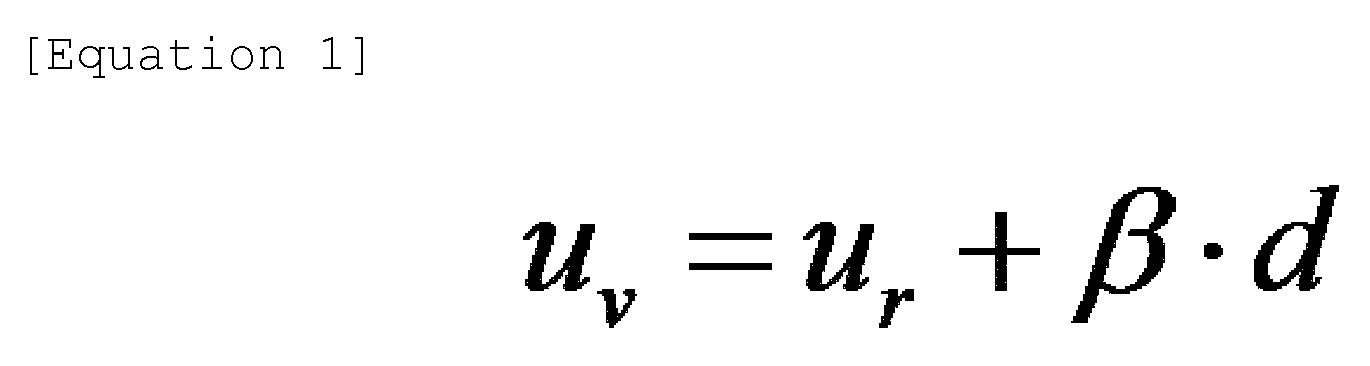
- In
Equation 1, uv denotes a virtual view desired to be obtained, ur denotes an input, d denotes a disparity, and β denotes a predetermined number that is changeable when setting a desired view. For example, when an image is projected again in a 3D space using a single reference image and depth information of a depth image, a left image may move objects within the image to the right and a right image may move the objects to the left compared to an original color image. -
FIGS. 9A and 9B , andFIGS. 10A and 10B illustrate diagrams to describe a difference before and after adjusting a disparity by a 3D image generator of an image processing apparatus according to an example embodiment. -
FIGS. 9A and 9B , andFIGS. 10A and 10B illustrate top down views of objects to be displayed in a 3D image and a display screen. - An object motion may be determined in proportion to a perceived depth. When objects are moved using the above method, a perceived depth before a disparity translation corresponding to a depth may be the same as a perceived depth after the disparity translation as shown in
FIGS. 9A and 9B , andFIGS. 10A and 10B . - For example, even though depth values of
objects FIG. 9A to FIG. 9B to minimize visual fatigue, the relative 3D effect among theobjects - Due to visual characteristics associated with a human, the 3D effect may be enhanced to be greater than or equal to a level at which the 3D effect is maintained.
- Referring again to
FIGS. 10A and 10B , a disparity may be reduced so that arepresentative object 1010 having a high visual attention may be around ascreen 1001. However, a relative 3D effect difference withother objects - The above description may be applied to a case where the
objects screen 901 inFIG. 9B . -
FIG. 11 illustrates diagrams to describe a process of generating a positive perceiveddepth 3D image using an image processing method according to an example embodiment. -
FIG. 11 shows an example in which aninput 3D image is moved to be positioned on a positive perceived depth, for example, on the rear of a display. - When the
input 3D imageFIG. 11 , hole filling may be performed by cutting theinput 3D image by α/2 in each of aleft image 1121 and a right image 1111, and by inpainting an empty space cut by α/2. -
FIG. 12 illustrates diagrams to describe a process of generating a negative perceiveddepth 3D image using an image processing method according to an embodiment. -
FIG. 12 shows an example in which aninput 3D imageFIG. 12 shows an example of cutting theinput 3D image by positive α/2 in each of aleft image 1221 and aright image 1211,and by performing a recovery operation such as inpainting, corresponding to cut α/2. - Specific processing may be understood with reference to
FIG. 7 , which illustrates using the processes of warping and inpainting to obtain output color and output disparity values. - Even though all of the above examples assume that a final 3D image is output as a stereoscopic image, it will be understood to one of ordinary skill in the art that the above description may also be applied to a multi-view image.
- Accordingly, even though there may be slight difference in rendering, various view images may be reconfigured using the same method as the method used for the stereoscopic image.
- When performing image processing for the perceived depth enhancement to be generated as a new output in
FIG. 7 andFIG. 8 , it is possible to generate a more realistic image by applying texture related technology to maintain a perceived depth in a 3D image and to generate an image which optimizes a fatigue level experienced by a viewer. - For example, as illustrated in
FIG. 8 , global lightness mapping may be applied to an input color of an input image, to change a contrast, for example. After increasing a contrast of an input image through global lightness mapping, a texture type may be analyzed by verifying a characteristic of a ROI. By applying a predetermined lightness mapping method based on the analyzed texture type or classification, an image having a further perceived depth may be provided using a texture processing method suitable for a characteristic of a region that requires a visual attention. In addition, many enhancement schemes may be employed and a texture enhancement scheme is disclosed herein as one example. - Compared to a conventional method of enhancing a perceived depth using an aerial perspective, the aforementioned example embodiments may very efficiently decrease visual fatigue. The method of enhancing the perceived depth using the aerial perspective may correspond to a method of enhancing a contrast in the case of a near side region and decreasing the contrast in the case of a far side region using depth information in an
input 3D image. Accordingly, a perceived depth, for example, the 3D effect may be enhanced, however visual fatigue may not be sufficiently reduced compared to the example embodiments disclosed herein. - In addition, in the case of a conventional method of obtaining a ROI using only a view distance and depth information without considering visual characteristics of a user, and uniformly adjusting the perceived depth of near/far regions based on a distance from the ROI, visual fatigue may globally decrease to some levels, however the perceived depth may not be achieved, which is contrary to the intended purpose and role of a 3D display.
- However, according to the example embodiments disclosed herein, human visual system characteristics may be used to enhance the perceived depth and to decrease visual fatigue. A ROI corresponding to a visual attention in the human visual perception characteristics may be efficiently selected and an image may be replayed so that the ROI may have a disparity level minimizing the visual fatigue. Accordingly, it is possible to decrease visual fatigue and to enhance the perceived depth.
- The image processing apparatus and method according to the above-described example embodiments may use one or more processors, which may include a microprocessor, central processing unit (CPU), digital signal processor (DSP), or application-specific integrated circuit (ASIC), as well as portions or combinations of these and other processing devices.
- The terms "module", and "unit," as used herein, may refer to, but is not limited to, a software or hardware component or device, such as a Field Programmable Gate Array (FPGA) or Application Specific Integrated Circuit (ASIC), which performs certain tasks. A module or unit may be configured to reside on an addressable storage medium and configured to execute on one or more processors. Thus, a module or unit may include, by way of example, components, such as software components, object-oriented software components, class components and task components, processes, functions, attributes, procedures, subroutines, segments of program code, drivers, firmware, microcode, circuitry, data, databases, data structures, tables, arrays, and variables. The functionality provided for in the components and modules/units may be combined into fewer components and modules/units or further separated into additional components and modules.
- The image processing method according to the above-described embodiments may be recorded in non-transitory computer-readable media including program instructions to implement various operations embodied by a computer. The media may also include, alone or in combination with the program instructions, data files, data structures, and the like. Examples of non-transitory computer-readable media include magnetic media such as hard disks, floppy disks, and magnetic tape; optical media such as CD ROM disks and DVDs; magneto-optical media such as optical discs; and hardware devices that are specially configured to store and perform program instructions, such as read-only memory (ROM), random access memory (RAM), flash memory, and the like. Examples of program instructions include both machine code, such as produced by a compiler, and files containing higher level code that may be executed by the computer using an interpreter. The described hardware devices may be configured to act as one or more software modules in order to perform the operations of the above-described embodiments, or vice versa.
- Each block of the flowchart illustrations may represent a unit, module, segment, or portion of code, which comprises one or more executable instructions for implementing the specified logical function(s). It should also be noted that in some alternative implementations, the functions noted in the blocks may occur out of the order. For example, two blocks shown in succession may in fact be executed substantially concurrently or the blocks may sometimes be executed in the reverse order, depending upon the functionality involved.
- Although example embodiments have been shown and described, it would be appreciated by those skilled in the art that changes may be made to these embodiments without departing from the principles and spirit of the disclosure, the scope of which is defined by the claims and their equivalents.
Claims (15)
- An image processing apparatus, comprising:a region of interest (ROI) configuration unit to generate a visual attention map in correspondence to an input three dimensional (3D) image; anda disparity adjustment unit to adjust disparity information included in the input 3D image, using the visual attention map.
- The image processing apparatus of claim 1, wherein the ROI configuration unit comprises:a region divider to divide, into a plurality of regions, a depth value distribution included in the input 3D image, using disparity information of the input 3D image; andat least one region calculator to calculate a visual attention level corresponding to each of the plurality of regions.
- The image processing apparatus of claim 2, wherein the at least one region calculator calculates the visual attention level according to at least one of color information of each region, disparity information of each region, and motion information of each region.
- The image processing apparatus of claim 2 or 3, wherein the ROI configuration unit further comprises:a visual attention map generator to generate the visual attention map by integrating visual attention levels of the plurality of regions calculated by the at least one region calculator.
- The image processing apparatus of claim 2, 3 or 4, wherein the at least one region calculator changes a color space of the input 3D image, classifies each portion of the input 3D image into an attractive color and an unattractive color, and calculates a visual attention level of the attractive color to be higher than a visual attention level of the unattractive color.
- The image processing apparatus of claim 5, wherein the change of the color space changes the color space to a International Commission on Illumination Color Appearance Modeling 2002 (CIECAM02) color space when the input 3D image is associated with a red, green, blue (RGB) color space, and classification of each portion into the attractive color and the unattractive color is performed based on a hue and a chroma of color values.
- The image processing apparatus of any of claims 2-6, wherein when a lightness difference between frames is greater than or equal to a predetermined threshold based on lightness information determined using color information of the input 3D image, the at least one region calculator calculates the visual attention level to be higher than when the lightness difference between frames is less than the predetermined threshold.
- The image processing apparatus of any of claims 2-7, wherein:the at least one region calculator divides the input 3D image into blocks of a predetermined size, andwhen a difference of pixel values with respect to a block positioned at a same position within different two frames is greater than or equal to a predetermined threshold, the at least one region calculator determines the block as a motion detection block and calculates a visual attention level of the block to be higher than when the difference of pixel values is less than the predetermined threshold.
- The image processing apparatus of claim 8, wherein:the at least one region calculator groups the blocks into a plurality of groups, andwhen a predetermined number of motion detection blocks are present within a single group, the at least one region calculator calculates a visual attention level of the blocks within the single group to be higher than when a number of motion detection blocks within a single group is less than the predetermined number.
- The image processing apparatus of any of claims 2-9, wherein when a lightness value determined using color information of the input 3D image is less than a predetermined threshold, the at least one region calculator calculates the visual attention level to be lower than when the lightness value is equal to or greater than the predetermined threshold.
- The image processing apparatus of any of claim 1-10, further comprising:a perceived depth enhancement processing unit to enhance a perceived depth by applying a texture enhancement scheme based on a texture type of a predetermined region to the visual attention map that is generated according to a calculated visual attention level.
- An image processing method, comprising:generating, by a region of interest (ROI) configuration unit of an image processing apparatus, a visual attention map according to an input three dimensional (3D) image; andadjusting, by a disparity adjustment unit of the image processing apparatus, disparity information included in the input 3D image, using the visual attention map.
- The method of claim 12, using the apparatus corresponding to any of claims 1-11, wherein the generating comprises:dividing, into a plurality of regions, a depth value distribution included in the input 3D image, using disparity information of the input 3D image; andcalculating a visual attention level corresponding to each of the plurality of regions.
- A non-transitory computer-readable medium comprising a program for instructing a computer to perform an image processing method, corresponding to claim 12 or 13:generating, by a region of interest (ROI) configuration unit of an image processing apparatus, a visual attention map according to an input three dimensional (3D) image; andadjusting, by a disparity adjustment unit of the image processing apparatus, disparity information included in the input 3D image, using the visual attention map.
- A three dimensional (3D) image processing method, comprising:generating a visual attention map by dividing an input 3D image into a plurality of regions and analyzing the regions according to a visual model; andadjusting disparity information in the input 3D image using the visual attention map,wherein the adjusting disparity information preferably further comprises:calculating a representative disparity value corresponding to a region for each of the plurality of regions using the visual attention map; andcalculating a final disparity value for each pixel in the region by applying the representative disparity value to each pixel,the method further preferably comprising:repositioning the input 3D image based on calculated representative disparity value;performing hole filling and inpainting based on the repositioned input 3D image,an image processing apparatus preferably comprising claim 12.
Applications Claiming Priority (1)
| Application Number | Priority Date | Filing Date | Title |
|---|---|---|---|
| KR1020110112603A KR101960844B1 (en) | 2011-11-01 | 2011-11-01 | Image processing apparatus and method |
Publications (3)
| Publication Number | Publication Date |
|---|---|
| EP2590416A2 true EP2590416A2 (en) | 2013-05-08 |
| EP2590416A3 EP2590416A3 (en) | 2013-06-12 |
| EP2590416B1 EP2590416B1 (en) | 2017-08-02 |
Family
ID=47296945
Family Applications (1)
| Application Number | Title | Priority Date | Filing Date |
|---|---|---|---|
| EP12190356.1A Active EP2590416B1 (en) | 2011-11-01 | 2012-10-29 | Image processing apparatus and method |
Country Status (4)
| Country | Link |
|---|---|
| US (2) | US9064319B2 (en) |
| EP (1) | EP2590416B1 (en) |
| KR (1) | KR101960844B1 (en) |
| CN (1) | CN103096106B (en) |
Cited By (1)
| Publication number | Priority date | Publication date | Assignee | Title |
|---|---|---|---|---|
| ES2614982A1 (en) * | 2015-12-02 | 2017-06-02 | Industries Fac, S.L. | Method for the elaboration of a three-dimensional map of a food of irregular configuration in relief (Machine-translation by Google Translate, not legally binding) |
Families Citing this family (22)
| Publication number | Priority date | Publication date | Assignee | Title |
|---|---|---|---|---|
| US9118911B2 (en) * | 2013-02-07 | 2015-08-25 | Delphi Technologies, Inc. | Variable disparity three-dimensional (3D) display system and method of operating the same |
| KR101856568B1 (en) | 2013-09-16 | 2018-06-19 | 삼성전자주식회사 | Multi view image display apparatus and controlling method thereof |
| KR101537174B1 (en) * | 2013-12-17 | 2015-07-15 | 가톨릭대학교 산학협력단 | Method for extracting salient object from stereoscopic video |
| CN104754322B (en) * | 2013-12-27 | 2018-01-23 | 华为技术有限公司 | A three-dimensional video comfort evaluation method and device |
| JP2015154101A (en) * | 2014-02-10 | 2015-08-24 | ソニー株式会社 | Image processing method, image processor and electronic apparatus |
| TWI566576B (en) * | 2014-06-03 | 2017-01-11 | 宏碁股份有限公司 | Stereoscopic view synthesis method and apparatus using the same |
| CN105323573B (en) * | 2014-07-16 | 2019-02-05 | 北京三星通信技术研究有限公司 | Three-dimensional image display device and method |
| KR102224718B1 (en) * | 2014-08-06 | 2021-03-08 | 삼성전자주식회사 | Method and apparatus for generating hologram |
| KR101649185B1 (en) * | 2015-02-27 | 2016-08-18 | 서울대학교 산학협력단 | Method and apparatus for calculating visual attention score |
| US20170054897A1 (en) * | 2015-08-21 | 2017-02-23 | Samsung Electronics Co., Ltd. | Method of automatically focusing on region of interest by an electronic device |
| KR102824640B1 (en) | 2016-09-07 | 2025-06-25 | 삼성전자주식회사 | Recognition apparatus based on neural network and training method of neural network |
| CN106502501A (en) * | 2016-10-31 | 2017-03-15 | 宁波视睿迪光电有限公司 | Index localization method and device |
| KR102271285B1 (en) * | 2016-11-09 | 2021-07-01 | 삼성전자주식회사 | Image processing apparatus and method for processing image |
| CN109542209A (en) * | 2017-08-04 | 2019-03-29 | 北京灵境世界科技有限公司 | A method of adapting to human eye convergence |
| KR102442449B1 (en) * | 2017-09-01 | 2022-09-14 | 삼성전자주식회사 | Image processing apparatus, method for processing image and computer-readable recording medium |
| JP6666892B2 (en) * | 2017-11-16 | 2020-03-18 | 株式会社Subaru | Driving support device and driving support method |
| CN111492657B (en) * | 2017-12-08 | 2023-06-30 | 上海科技大学 | Light Field Video Compression Based on Face Region Detection |
| KR102612925B1 (en) * | 2018-10-18 | 2023-12-13 | 주식회사 에이치엘클레무브 | Emergency controlling device for vehicle |
| KR20210071410A (en) | 2019-12-06 | 2021-06-16 | 삼성전자주식회사 | Sensor-specific image recognition device and method |
| US11967096B2 (en) | 2021-03-23 | 2024-04-23 | Mediatek Inc. | Methods and apparatuses of depth estimation from focus information |
| CN117121475A (en) * | 2021-04-12 | 2023-11-24 | 索尼集团公司 | Information processing device, information processing method and program |
| KR20240173959A (en) * | 2023-06-07 | 2024-12-16 | 삼성전자주식회사 | Head mounted display apparatus comprising eye-tracking sensor and operating method for the same |
Family Cites Families (22)
| Publication number | Priority date | Publication date | Assignee | Title |
|---|---|---|---|---|
| JP2004004532A (en) | 2002-03-25 | 2004-01-08 | Sharp Corp | Video display device |
| KR100439341B1 (en) * | 2002-08-27 | 2004-07-07 | 한국전자통신연구원 | Depth of field adjustment apparatus and method of stereo image for reduction of visual fatigue |
| CA2449982A1 (en) | 2003-07-16 | 2005-01-16 | Aurora Digital Advertising Inc. | Three dimensional display method, system and apparatus |
| GB0329312D0 (en) | 2003-12-18 | 2004-01-21 | Univ Durham | Mapping perceived depth to regions of interest in stereoscopic images |
| KR100728110B1 (en) | 2004-01-29 | 2007-06-13 | 삼성에스디아이 주식회사 | Stereoscopic image display device and method for controlling stereoscopic effect |
| US8150155B2 (en) | 2006-02-07 | 2012-04-03 | Qualcomm Incorporated | Multi-mode region-of-interest video object segmentation |
| KR101457893B1 (en) | 2007-10-10 | 2014-11-04 | 삼성전자주식회사 | Method and apparatus for reducing fatigue occurring when viewing three-dimensional video, and method and apparatus for generating low-fatigue three-dimensional video data stream |
| WO2010039954A1 (en) * | 2008-10-03 | 2010-04-08 | 3M Innovative Properties Company | Systems and methods for evaluating robustness |
| US8478111B2 (en) * | 2008-10-03 | 2013-07-02 | 3M Innovative Properties Company | Systems and methods for optimizing a scene |
| KR20100040236A (en) | 2008-10-09 | 2010-04-19 | 삼성전자주식회사 | Two dimensional image to three dimensional image converter and conversion method using visual attention analysis |
| US8774498B2 (en) * | 2009-01-28 | 2014-07-08 | Xerox Corporation | Modeling images as sets of weighted features |
| KR101613133B1 (en) | 2009-05-14 | 2016-04-18 | 삼성전자주식회사 | Method and apparatus for processing 3-dimensional image |
| CN101945295B (en) | 2009-07-06 | 2014-12-24 | 三星电子株式会社 | Method and device for generating depth maps |
| JP5444955B2 (en) * | 2009-08-31 | 2014-03-19 | ソニー株式会社 | Stereoscopic image display system, parallax conversion device, parallax conversion method, and program |
| KR101699920B1 (en) | 2009-10-07 | 2017-01-25 | 삼성전자주식회사 | Apparatus and method for controling depth |
| US8711204B2 (en) * | 2009-11-11 | 2014-04-29 | Disney Enterprises, Inc. | Stereoscopic editing for video production, post-production and display adaptation |
| KR101636537B1 (en) | 2009-11-12 | 2016-07-06 | 삼성전자주식회사 | Image processing apparatus and method for enhancing of depth perception |
| US8446492B2 (en) * | 2009-12-10 | 2013-05-21 | Honda Motor Co., Ltd. | Image capturing device, method of searching for occlusion region, and program |
| KR101286651B1 (en) | 2009-12-21 | 2013-07-22 | 한국전자통신연구원 | Apparatus for compensating image and method for compensating image using the same |
| US8213708B2 (en) | 2010-03-22 | 2012-07-03 | Eastman Kodak Company | Adjusting perspective for objects in stereoscopic images |
| KR101690297B1 (en) | 2010-04-12 | 2016-12-28 | 삼성디스플레이 주식회사 | Image converting device and three dimensional image display device including the same |
| CN101883291B (en) * | 2010-06-29 | 2012-12-19 | 上海大学 | Method for drawing viewpoints by reinforcing interested region |
-
2011
- 2011-11-01 KR KR1020110112603A patent/KR101960844B1/en active Active
-
2012
- 2012-10-26 US US13/661,833 patent/US9064319B2/en active Active
- 2012-10-29 EP EP12190356.1A patent/EP2590416B1/en active Active
- 2012-10-30 CN CN201210423115.2A patent/CN103096106B/en active Active
-
2015
- 2015-06-22 US US14/746,024 patent/US9445075B2/en active Active
Non-Patent Citations (1)
| Title |
|---|
| None |
Cited By (1)
| Publication number | Priority date | Publication date | Assignee | Title |
|---|---|---|---|---|
| ES2614982A1 (en) * | 2015-12-02 | 2017-06-02 | Industries Fac, S.L. | Method for the elaboration of a three-dimensional map of a food of irregular configuration in relief (Machine-translation by Google Translate, not legally binding) |
Also Published As
| Publication number | Publication date |
|---|---|
| CN103096106A (en) | 2013-05-08 |
| EP2590416B1 (en) | 2017-08-02 |
| KR101960844B1 (en) | 2019-03-22 |
| KR20130048299A (en) | 2013-05-10 |
| US20150288946A1 (en) | 2015-10-08 |
| EP2590416A3 (en) | 2013-06-12 |
| CN103096106B (en) | 2017-04-26 |
| US9064319B2 (en) | 2015-06-23 |
| US20130106844A1 (en) | 2013-05-02 |
| US9445075B2 (en) | 2016-09-13 |
Similar Documents
| Publication | Publication Date | Title |
|---|---|---|
| EP2590416B1 (en) | Image processing apparatus and method | |
| US9445072B2 (en) | Synthesizing views based on image domain warping | |
| US7983477B2 (en) | Method and apparatus for generating a stereoscopic image | |
| US8711204B2 (en) | Stereoscopic editing for video production, post-production and display adaptation | |
| EP3158536B1 (en) | Method and apparatus for generating a three dimensional image | |
| US10095953B2 (en) | Depth modification for display applications | |
| US9041773B2 (en) | Conversion of 2-dimensional image data into 3-dimensional image data | |
| US20050253924A1 (en) | Method and apparatus for processing three-dimensional images | |
| JP5402504B2 (en) | Pseudo stereoscopic image creation device and pseudo stereoscopic image display system | |
| EP2755187A2 (en) | 3d-animation effect generation method and system | |
| JP5673032B2 (en) | Image processing apparatus, display apparatus, image processing method, and program | |
| JP2015156607A (en) | Image processing apparatus, image processing apparatus, and electronic apparatus | |
| US9196080B2 (en) | Medial axis decomposition of 2D objects to synthesize binocular depth | |
| CN102379127A (en) | Video processing device, video processing method, and computer program | |
| KR102281462B1 (en) | Systems, methods and software for creating virtual three-dimensional images that appear to be projected in front of or on an electronic display | |
| KR20130091245A (en) | Method and system of using floating window in three-dimensional (3d) presentation | |
| CN105611267B (en) | Merging of real world and virtual world images based on depth and chrominance information | |
| US20190295280A1 (en) | Dynamically modifying virtual and augmented reality content to reduce depth conflict between user interface elements and video content | |
| JP2019118004A (en) | Information processing apparatus, information processing method, and recording medium | |
| KR101754976B1 (en) | Contents convert method for layered hologram and apparatu | |
| KR101121979B1 (en) | Method and device for stereoscopic image conversion | |
| US20180322689A1 (en) | Visualization and rendering of images to enhance depth perception | |
| JP2015149547A (en) | Image processing method, image processing apparatus, and electronic apparatus | |
| US9137519B1 (en) | Generation of a stereo video from a mono video | |
| KR101978176B1 (en) | Image processing apparatus and method |
Legal Events
| Date | Code | Title | Description |
|---|---|---|---|
| PUAI | Public reference made under article 153(3) epc to a published international application that has entered the european phase |
Free format text: ORIGINAL CODE: 0009012 |
|
| AK | Designated contracting states |
Kind code of ref document: A2 Designated state(s): AL AT BE BG CH CY CZ DE DK EE ES FI FR GB GR HR HU IE IS IT LI LT LU LV MC MK MT NL NO PL PT RO RS SE SI SK SM TR |
|
| AX | Request for extension of the european patent |
Extension state: BA ME |
|
| PUAL | Search report despatched |
Free format text: ORIGINAL CODE: 0009013 |
|
| AK | Designated contracting states |
Kind code of ref document: A3 Designated state(s): AL AT BE BG CH CY CZ DE DK EE ES FI FR GB GR HR HU IE IS IT LI LT LU LV MC MK MT NL NO PL PT RO RS SE SI SK SM TR |
|
| AX | Request for extension of the european patent |
Extension state: BA ME |
|
| RIC1 | Information provided on ipc code assigned before grant |
Ipc: H04N 13/00 20060101AFI20130507BHEP |
|
| 17P | Request for examination filed |
Effective date: 20131211 |
|
| 17Q | First examination report despatched |
Effective date: 20141105 |
|
| GRAP | Despatch of communication of intention to grant a patent |
Free format text: ORIGINAL CODE: EPIDOSNIGR1 |
|
| INTG | Intention to grant announced |
Effective date: 20170223 |
|
| GRAS | Grant fee paid |
Free format text: ORIGINAL CODE: EPIDOSNIGR3 |
|
| GRAA | (expected) grant |
Free format text: ORIGINAL CODE: 0009210 |
|
| AK | Designated contracting states |
Kind code of ref document: B1 Designated state(s): AL AT BE BG CH CY CZ DE DK EE ES FI FR GB GR HR HU IE IS IT LI LT LU LV MC MK MT NL NO PL PT RO RS SE SI SK SM TR |
|
| REG | Reference to a national code |
Ref country code: GB Ref legal event code: FG4D |
|
| REG | Reference to a national code |
Ref country code: CH Ref legal event code: EP Ref country code: AT Ref legal event code: REF Ref document number: 915633 Country of ref document: AT Kind code of ref document: T Effective date: 20170815 |
|
| REG | Reference to a national code |
Ref country code: IE Ref legal event code: FG4D |
|
| REG | Reference to a national code |
Ref country code: DE Ref legal event code: R096 Ref document number: 602012035249 Country of ref document: DE |
|
| REG | Reference to a national code |
Ref country code: FR Ref legal event code: PLFP Year of fee payment: 6 |
|
| REG | Reference to a national code |
Ref country code: NL Ref legal event code: MP Effective date: 20170802 |
|
| REG | Reference to a national code |
Ref country code: AT Ref legal event code: MK05 Ref document number: 915633 Country of ref document: AT Kind code of ref document: T Effective date: 20170802 |
|
| REG | Reference to a national code |
Ref country code: LT Ref legal event code: MG4D |
|
| PG25 | Lapsed in a contracting state [announced via postgrant information from national office to epo] |
Ref country code: FI Free format text: LAPSE BECAUSE OF FAILURE TO SUBMIT A TRANSLATION OF THE DESCRIPTION OR TO PAY THE FEE WITHIN THE PRESCRIBED TIME-LIMIT Effective date: 20170802 Ref country code: SE Free format text: LAPSE BECAUSE OF FAILURE TO SUBMIT A TRANSLATION OF THE DESCRIPTION OR TO PAY THE FEE WITHIN THE PRESCRIBED TIME-LIMIT Effective date: 20170802 Ref country code: HR Free format text: LAPSE BECAUSE OF FAILURE TO SUBMIT A TRANSLATION OF THE DESCRIPTION OR TO PAY THE FEE WITHIN THE PRESCRIBED TIME-LIMIT Effective date: 20170802 Ref country code: LT Free format text: LAPSE BECAUSE OF FAILURE TO SUBMIT A TRANSLATION OF THE DESCRIPTION OR TO PAY THE FEE WITHIN THE PRESCRIBED TIME-LIMIT Effective date: 20170802 Ref country code: AT Free format text: LAPSE BECAUSE OF FAILURE TO SUBMIT A TRANSLATION OF THE DESCRIPTION OR TO PAY THE FEE WITHIN THE PRESCRIBED TIME-LIMIT Effective date: 20170802 Ref country code: NO Free format text: LAPSE BECAUSE OF FAILURE TO SUBMIT A TRANSLATION OF THE DESCRIPTION OR TO PAY THE FEE WITHIN THE PRESCRIBED TIME-LIMIT Effective date: 20171102 Ref country code: NL Free format text: LAPSE BECAUSE OF FAILURE TO SUBMIT A TRANSLATION OF THE DESCRIPTION OR TO PAY THE FEE WITHIN THE PRESCRIBED TIME-LIMIT Effective date: 20170802 |
|
| PG25 | Lapsed in a contracting state [announced via postgrant information from national office to epo] |
Ref country code: LV Free format text: LAPSE BECAUSE OF FAILURE TO SUBMIT A TRANSLATION OF THE DESCRIPTION OR TO PAY THE FEE WITHIN THE PRESCRIBED TIME-LIMIT Effective date: 20170802 Ref country code: BG Free format text: LAPSE BECAUSE OF FAILURE TO SUBMIT A TRANSLATION OF THE DESCRIPTION OR TO PAY THE FEE WITHIN THE PRESCRIBED TIME-LIMIT Effective date: 20171102 Ref country code: RS Free format text: LAPSE BECAUSE OF FAILURE TO SUBMIT A TRANSLATION OF THE DESCRIPTION OR TO PAY THE FEE WITHIN THE PRESCRIBED TIME-LIMIT Effective date: 20170802 Ref country code: GR Free format text: LAPSE BECAUSE OF FAILURE TO SUBMIT A TRANSLATION OF THE DESCRIPTION OR TO PAY THE FEE WITHIN THE PRESCRIBED TIME-LIMIT Effective date: 20171103 Ref country code: PL Free format text: LAPSE BECAUSE OF FAILURE TO SUBMIT A TRANSLATION OF THE DESCRIPTION OR TO PAY THE FEE WITHIN THE PRESCRIBED TIME-LIMIT Effective date: 20170802 Ref country code: IS Free format text: LAPSE BECAUSE OF FAILURE TO SUBMIT A TRANSLATION OF THE DESCRIPTION OR TO PAY THE FEE WITHIN THE PRESCRIBED TIME-LIMIT Effective date: 20171202 Ref country code: ES Free format text: LAPSE BECAUSE OF FAILURE TO SUBMIT A TRANSLATION OF THE DESCRIPTION OR TO PAY THE FEE WITHIN THE PRESCRIBED TIME-LIMIT Effective date: 20170802 |
|
| PG25 | Lapsed in a contracting state [announced via postgrant information from national office to epo] |
Ref country code: RO Free format text: LAPSE BECAUSE OF FAILURE TO SUBMIT A TRANSLATION OF THE DESCRIPTION OR TO PAY THE FEE WITHIN THE PRESCRIBED TIME-LIMIT Effective date: 20170802 Ref country code: CZ Free format text: LAPSE BECAUSE OF FAILURE TO SUBMIT A TRANSLATION OF THE DESCRIPTION OR TO PAY THE FEE WITHIN THE PRESCRIBED TIME-LIMIT Effective date: 20170802 Ref country code: DK Free format text: LAPSE BECAUSE OF FAILURE TO SUBMIT A TRANSLATION OF THE DESCRIPTION OR TO PAY THE FEE WITHIN THE PRESCRIBED TIME-LIMIT Effective date: 20170802 |
|
| REG | Reference to a national code |
Ref country code: DE Ref legal event code: R097 Ref document number: 602012035249 Country of ref document: DE |
|
| PG25 | Lapsed in a contracting state [announced via postgrant information from national office to epo] |
Ref country code: EE Free format text: LAPSE BECAUSE OF FAILURE TO SUBMIT A TRANSLATION OF THE DESCRIPTION OR TO PAY THE FEE WITHIN THE PRESCRIBED TIME-LIMIT Effective date: 20170802 Ref country code: IT Free format text: LAPSE BECAUSE OF FAILURE TO SUBMIT A TRANSLATION OF THE DESCRIPTION OR TO PAY THE FEE WITHIN THE PRESCRIBED TIME-LIMIT Effective date: 20170802 Ref country code: SM Free format text: LAPSE BECAUSE OF FAILURE TO SUBMIT A TRANSLATION OF THE DESCRIPTION OR TO PAY THE FEE WITHIN THE PRESCRIBED TIME-LIMIT Effective date: 20170802 Ref country code: SK Free format text: LAPSE BECAUSE OF FAILURE TO SUBMIT A TRANSLATION OF THE DESCRIPTION OR TO PAY THE FEE WITHIN THE PRESCRIBED TIME-LIMIT Effective date: 20170802 Ref country code: MC Free format text: LAPSE BECAUSE OF FAILURE TO SUBMIT A TRANSLATION OF THE DESCRIPTION OR TO PAY THE FEE WITHIN THE PRESCRIBED TIME-LIMIT Effective date: 20170802 |
|
| REG | Reference to a national code |
Ref country code: CH Ref legal event code: PL |
|
| PLBE | No opposition filed within time limit |
Free format text: ORIGINAL CODE: 0009261 |
|
| STAA | Information on the status of an ep patent application or granted ep patent |
Free format text: STATUS: NO OPPOSITION FILED WITHIN TIME LIMIT |
|
| 26N | No opposition filed |
Effective date: 20180503 |
|
| REG | Reference to a national code |
Ref country code: IE Ref legal event code: MM4A |
|
| PG25 | Lapsed in a contracting state [announced via postgrant information from national office to epo] |
Ref country code: LU Free format text: LAPSE BECAUSE OF NON-PAYMENT OF DUE FEES Effective date: 20171029 Ref country code: CH Free format text: LAPSE BECAUSE OF NON-PAYMENT OF DUE FEES Effective date: 20171031 Ref country code: LI Free format text: LAPSE BECAUSE OF NON-PAYMENT OF DUE FEES Effective date: 20171031 |
|
| REG | Reference to a national code |
Ref country code: BE Ref legal event code: MM Effective date: 20171031 |
|
| PG25 | Lapsed in a contracting state [announced via postgrant information from national office to epo] |
Ref country code: SI Free format text: LAPSE BECAUSE OF FAILURE TO SUBMIT A TRANSLATION OF THE DESCRIPTION OR TO PAY THE FEE WITHIN THE PRESCRIBED TIME-LIMIT Effective date: 20170802 Ref country code: BE Free format text: LAPSE BECAUSE OF NON-PAYMENT OF DUE FEES Effective date: 20171031 |
|
| REG | Reference to a national code |
Ref country code: FR Ref legal event code: PLFP Year of fee payment: 7 |
|
| PG25 | Lapsed in a contracting state [announced via postgrant information from national office to epo] |
Ref country code: MT Free format text: LAPSE BECAUSE OF NON-PAYMENT OF DUE FEES Effective date: 20171029 |
|
| PG25 | Lapsed in a contracting state [announced via postgrant information from national office to epo] |
Ref country code: IE Free format text: LAPSE BECAUSE OF NON-PAYMENT OF DUE FEES Effective date: 20171029 |
|
| PG25 | Lapsed in a contracting state [announced via postgrant information from national office to epo] |
Ref country code: HU Free format text: LAPSE BECAUSE OF FAILURE TO SUBMIT A TRANSLATION OF THE DESCRIPTION OR TO PAY THE FEE WITHIN THE PRESCRIBED TIME-LIMIT; INVALID AB INITIO Effective date: 20121029 |
|
| PG25 | Lapsed in a contracting state [announced via postgrant information from national office to epo] |
Ref country code: CY Free format text: LAPSE BECAUSE OF NON-PAYMENT OF DUE FEES Effective date: 20170802 |
|
| PG25 | Lapsed in a contracting state [announced via postgrant information from national office to epo] |
Ref country code: MK Free format text: LAPSE BECAUSE OF FAILURE TO SUBMIT A TRANSLATION OF THE DESCRIPTION OR TO PAY THE FEE WITHIN THE PRESCRIBED TIME-LIMIT Effective date: 20170802 |
|
| PG25 | Lapsed in a contracting state [announced via postgrant information from national office to epo] |
Ref country code: TR Free format text: LAPSE BECAUSE OF FAILURE TO SUBMIT A TRANSLATION OF THE DESCRIPTION OR TO PAY THE FEE WITHIN THE PRESCRIBED TIME-LIMIT Effective date: 20170802 |
|
| PG25 | Lapsed in a contracting state [announced via postgrant information from national office to epo] |
Ref country code: PT Free format text: LAPSE BECAUSE OF FAILURE TO SUBMIT A TRANSLATION OF THE DESCRIPTION OR TO PAY THE FEE WITHIN THE PRESCRIBED TIME-LIMIT Effective date: 20170802 |
|
| PG25 | Lapsed in a contracting state [announced via postgrant information from national office to epo] |
Ref country code: AL Free format text: LAPSE BECAUSE OF FAILURE TO SUBMIT A TRANSLATION OF THE DESCRIPTION OR TO PAY THE FEE WITHIN THE PRESCRIBED TIME-LIMIT Effective date: 20170802 |
|
| P01 | Opt-out of the competence of the unified patent court (upc) registered |
Effective date: 20230530 |
|
| PGFP | Annual fee paid to national office [announced via postgrant information from national office to epo] |
Ref country code: GB Payment date: 20250911 Year of fee payment: 14 |
|
| PGFP | Annual fee paid to national office [announced via postgrant information from national office to epo] |
Ref country code: FR Payment date: 20250908 Year of fee payment: 14 |
|
| PGFP | Annual fee paid to national office [announced via postgrant information from national office to epo] |
Ref country code: DE Payment date: 20250910 Year of fee payment: 14 |